



автордың кітабын онлайн тегін оқу The White Prophet, Volume II (of 2)
THE WHITE PROPHET, VOLUME II
This ebook is for the use of anyone anywhere in the United States and most other parts of the world at no cost and with almost no restrictions whatsoever. You may copy it, give it away or re-use it under the terms of the Project Gutenberg License included with this ebook or online at http://www.gutenberg.org/license. If you are not located in the United States, you'll have to check the laws of the country where you are located before using this ebook.
Title: The White Prophet, Volume II (of 2) Author: Hall Caine Release Date: June 15, 2016 [EBook #52343] Language: English Character set encoding: UTF-8
*** START OF THIS PROJECT GUTENBERG EBOOK THE WHITE PROPHET, VOLUME II (OF 2) ***
Produced by Al Haines.
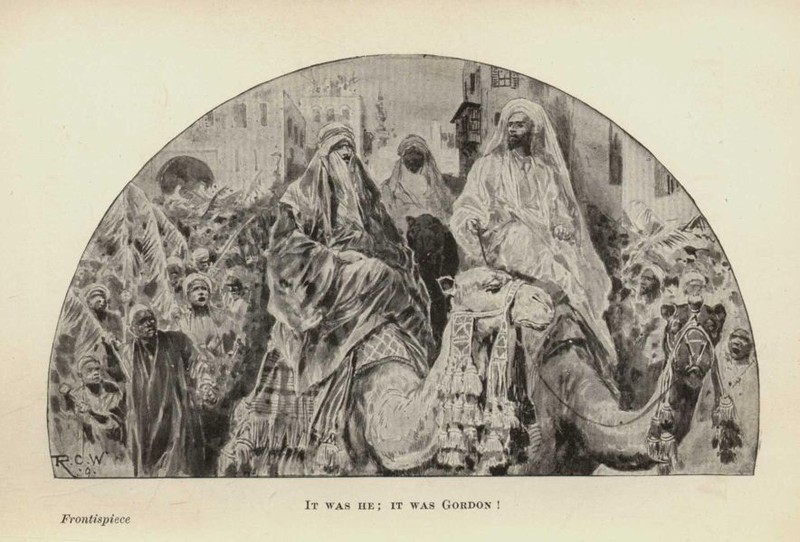
IT WAS HE; IT WAS GORDON!
THE WHITE PROPHET
BY
HALL CAINE
ILLUSTRATED BY R. CATON WOODVILLE
IN TWO VOLUMES VOL II.
LONDON WILLIAM HEINEMANN 1909
Copyright London 1909 by William Heinemann and
Washington U.S.A. by D. Appleton & Company
ILLUSTRATIONS
It was he! It was Gordon . . . Frontispiece
Helena was in the gallery
"Yes; conspiracy against you and against England"
The Consul-General . . . was hurling his last reproaches upon his enemies
THE WHITE PROPHET
BOOK THREE—Continued
THE LIGHT OF THE WORLD
CHAPTER XI
When Helena awoke next morning she was immediately conscious of a great commotion both within and without the house. After a moment Zenoba came into the bedroom and began to tell her what had happened.
"Have you not heard, O Rani?" said the Arab woman, in her oily voice. "No? You sleep so late, do you? When everybody is up and doing, too! Well, the Master has news that the great Bedouin is at Omdurman and he is sending the people down to the river to bring him up. The stranger is to be received in the mosque, I may tell you. Yes, indeed, in the mosque, although he is English and a Christian."
Then Ayesha came skipping into the room in wild excitement.
"Rani! Rani!" she cried. "Get up and come with us. We are going now—this minute—everybody."
Helena excused herself; she felt unwell and would stay in bed that day; so the child and the nurse went off without her.
Yet left alone she could not rest. The feverish uncertainty of the night before returned with redoubled force, and after a while she felt compelled to rise.
Going into the guest-room she found the house empty and the camp in front of it deserted. She was standing by the door, hardly knowing what to do, when the strange sound which she had heard on the night of the betrothal came from a distance.
"Lu-lu-lu-u-u!"
It was the zaghareet, the women's cry of joy, and it was mingled with the louder shouts of men. The stranger was coming! the people were bringing him on. Who would he be? Helena's anxiety was almost more than her brain and nerves could bear. She strained her eyes in the direction of the jetty, past the Abbas Barracks and the Mongers Fort.
The moments passed like hours, but at length the crowd appeared. At first sight it looked like a forest of small trees approaching. The forest seemed to sway and to send out monotonous sounds as if moved by a moaning wind. But looking again, Helena saw what was happening—the people were carrying green palm branches and strewing them on the yellow sand in front of the great stranger.
He was riding on a white camel, Ishmael's camel, and Ishmael was riding beside him.. Long before he came near to her, Helena saw him, straining her sight to do so. He was wearing the ample robes of a Bedouin, and his face was almost hidden by the sweeping shawl which covered his head and neck.
But it was he! It was Gordon! Helena could not mistake him. One glance was enough. Without looking a second time she ran back to her bedroom, and covered her eyes and ears.
For a time the voices of the people followed her through the deadening walls.
"Lu-lu-u-u!" cried the women.
"La ilaha illa-llah! La ilaha illa-llah!" shouted the men.
But after a while the muffled sounds died away, and Helena knew that the great company had passed on to the mosque. It was like a dream, a mirage of the mind. It had come and it was gone, and in the dazed condition of her senses she could almost persuade herself that she had imagined everything.
Her impatience would not permit her to remain in the house. She, too, must go to the mosque, although she had never been there before. So putting on her Indian veil she set out hurriedly. When she came to herself again she was in the gallery, people were making way for her, and she was dropping into a place. Then she realised that she was sitting between Zenoba and little Ayesha.
The mosque was a large, four-square edifice, full of columns and arches, and with a kind of inner court that was open to the sky and had minarets at every corner. The gallery looked down on this court, and Helena saw below her, half in shadow, half in sunshine, the heads of a great concourse of men in turbans, tarbooshes, and brown felt skull-caps, all kneeling in rows on bright red carpets. In the front row, with his face to the Kibleh (the niche towards Mecca), Ishmael knelt in his white caftan, and by his side, with all eyes upon him, as if every interest centred on that spot, knelt the stranger in Bedouin dress.
It was Friday, and prayers were proceeding, now surging like the sea, now silent like the desert, sometimes started, as it seemed, by the voice of the unseen muezzin on the minarets above, then echoed by the men on the carpets below. But Helena hardly heard them. Of one thing only was she conscious—that by the tragic play of destiny he was there while she was here!
After a while she became aware that Ishmael had risen and was beginning to speak, and she tried to regain composure enough to listen to what he said.
"My brothers," he said, "it is according to the precepts of the Prophet (peace to his name!) to receive the Christian in our temples if he comes with the goodwill of good Moslems and with a heart that is true to them. You know, O my brothers, whether I am a Moslem or not, and I pray to the Most Merciful to bless all such Christians as the one who is here to-day."
More of the same kind Ishmael said, but Helena found it hard, in the tumult of her brain, to follow him. She saw that both the women about her and the men below were seized with that religious fervour which comes to the human soul when it feels that something grand is being done. It was as though the memory of a thousand years of hatred between Moslem and Christian, with all its legacy of cruelty and barbarity, had been wiped out of their hearts by the stranger on whom their eyes were fixed—as though by some great act of self-sacrifice and brotherhood he had united East and West—and this fact of his presence at their prayers was the sign and symbol of an eternal truce.
The sublime spectacle seemed to capture all their souls, and when Ishmael turned towards the stranger at last and laid his hand on his head and said—
"May God and His Prophet bless you for what you have done for us and ours," the emotions of the people were raised to the highest pitch, and they rose to their feet as one man, and holding up their hands they cried, the whole congregation together, in a voice that was like the breaking of a great wave—
"You are now of us, and we are of you, and we are brothers."
By this time the women in the gallery were weeping audibly, and Helena, from quite other causes, was scarcely able to control her feelings. "Why did I come here?" she asked herself, and then, seeing that the Arab woman was watching her through the slits of her jealous eyes, she got up and pushed her way out of the mosque.
Back in her room, lying face down upon the bed, she sought in vain to collect her faculties sufficiently to follow and comprehend the course of events. Yes, it was Gordon. He had come to join Ishmael. Why had she never thought of that as a probable sequel to what had occurred in Cairo? Had he not been turned out by his own? In effect cashiered from the army? Forbidden his father's house? And had she not herself driven him away from her? What sequel was more natural—more plainly inevitable?
Then she grew hot and cold at a new and still more terrifying thought—Gordon would come there! How could she meet him? How look into his face? A momentary impulse to deny her own identity was put aside immediately. Impossible! Useless! Then how could she account to Gordon for her presence in that house? Ishmael's wife! According to Mohammedan law and custom not only betrothed but married to him!
When she put her position to herself so, the thread of her thoughts seemed to snap in her brain. She could not disentangle the knot of them. A sense of infidelity to Gordon, to the very spirit of love itself, brought her for a moment the self-reproach and the despair of a woman who has sinned.
In the midst of her pain she heard the light voices of people returning to the house, and at the next moment Ayesha and Zenoba came into her room. The child was skipping about, full of high spirits, and the Arab woman was bitterly merry.
"Rani will be happy to hear that the Master is bringing the stranger home," said Zenoba.
Helena turned and gazed at the woman with a stupefied expression. What she had foreseen as a terrifying possibility was about to come to pass! She opened her mouth as if to speak but said nothing.
Meantime the Arab woman, in a significant tone that was meant to cut to the core, went on to say that this was the highest honour the Moslem could show the unbeliever, as well as the greatest trust he could repose in him.
"Have you never heard of that in your country, O Rani? No? It is true, though! Quite true!"
People supposed that every Moslem guarded his house so jealously that no strange man might look upon his wife, but among the Arabs of the desert, when a traveller, tired and weary, sought food and rest, the Sheikh would sometimes send him into his harem and leave him there for three days with full permission to do as he thought well.
"But he must never wrong that harem, O lady! If he does the Arab husband will kill him! Yes, and the faithless wife as well!"
So violent was the conflict going on within her that Helena hardly heard the woman's words, though the jealous spirit behind them was piercing her heart like needles. She became conscious of the great crowd returning, and it was making the same ululation as before, mingled with the same shouts. At the next moment there came a knock at the bedroom door and Abdullah's voice, crying—
"Lady! Lady!"
Helena reeled a little in rising to reply, and it was with difficulty that she reached the door.
"Master has brought Sheikh Omar Benani back and is calling for the lady. What shall I say?"
Helena fumbled the hem of her handkerchief in her fingers, as she was wont to do in moments of great agitation. She was asking herself what would happen if she obeyed Ishmael's summons. Would Gordon see through her motive in being there? If so, would he betray her to Ishmael?
Already she could hear a confused murmur in the guest-room, and out of that murmur her memory seemed to grasp back, as from a vanishing dream, the sound of a voice that had been lost to her.
She felt as if she were suffocating. Her breathing was coming rapidly from the depth of her throat. Yet the Arab woman was watching her, and while a whirlwind was going on within she had to preserve a complete tranquillity without.
"Say I am coming," she said.
The supreme moment had arrived. With a great effort she gathered up all her strength, drew her Indian shawl over her head in such a way that it partly concealed her face, and then, pallid, trembling, and with downcast eyes she walked out of the room.
CHAPTER XII
Gordon had that day experienced emotions only less poignant than those of Helena. In the early morning, after parting with Osman, the devoted comrade of his desert journey, he had encountered the British Sub-Governor of Omdurman, a young Captain of Cavalry who had once served under himself but now spoke to him, in his assumed character as a Bedouin, with a certain air of command.
This brought him some twinges of wounded pride, which were complicated by qualms of conscience, as he rode through the streets, past the silversmiths' shops, where grave-looking Arabs sold bracelets and necklets; past the weaving quarter, where men and boys were industriously driving the shuttle through the strings of their flimsy looms; past the potter's bazaar and the grain market, all so sweet and so free from their former smell of sun-dried filth and warm humanity packed close together.
"Am I coming here to oppose the power that in so few years has turned chaos into order?" he asked himself, but more personal emotions came later.
They came in full flood when the ferry steamer, by which he crossed the river, approached the bank on the other side, and he saw standing there, near to the spot on which the dervishes landed on the black night of the fall of Khartoum, a vast crowd of their sons and their sons' sons who were waiting to receive him.
Again came qualms of conscience when out of this crowd stepped Ishmael Ameer, who kissed him on both cheeks and led him forward to his own camel amid the people's shouts of welcome. Was he, as a British soldier, throwing in his lot with the enemies of his country? As an Englishman and a Christian was he siding with the adversaries of religion and civilisation?
The journey through the town to the mosque, with the lu-lu-ing and the throwing of palm branches before his camel's feet, was less of a triumphal progress than an abject penance. He could hardly hold up his head. Sight of the bronze and black faces about him, shouting for him.—for him of another race and creed—making that act his glory which had led to his crime—this was almost more than he could bear.
But when he reached the mosque; when he found himself, unbeliever though he was, kneeling in front of the Kibleh; when Ishmael laid his hand on his head and called on God to bless him, and the people cried with one voice, "You are of us and we are brothers," the sense of human sympathy swept down every other emotion, and he felt as if at any moment he might burst into tears.
And then, when prayers were over and Ishmael brought up his uncle, and the patriarchal old man, with a beard like a flowing fleece, said he was to lodge at his house; and finally when Ishmael led him home and took him to his own chamber and called to Abdullah to set up another angerib, saying they were to sleep in the same room, Gordon's twinges of pride and qualms of conscience were swallowed up in one great wave of human brotherhood.
But both came back, with a sudden bound, when Ishmael began to talk of his wife, and sent the servant to fetch her. They were sitting in the guest-room by this time, waiting for the lady to come to them, and Gordon felt himself moved by the inexplicable impulse of anxiety he had felt before. Who was this Mohammedan woman who had prompted Ishmael to a scheme that must so surely lead to disaster? Did she know what she was doing? Was she betraying him?
Then a door on the women's side of the house opened slowly and he saw a woman enter the room. He did not look into her face. His distrust of her, whereof he was now half ashamed, made him keep his head down while he bowed low during the little formal ceremony of Ishmael's presentation. But instantly a certain indefinite memory of height and step and general bearing made his blood flow fast, and he felt the perspiration breaking out on his forehead.
A moment afterwards he raised his eyes, and then it seemed as if his hair stood upright. He was like a man who has been made colour-blind by some bright light. He could not at first believe the evidence of his senses that she who appeared to be before him was actually there.
He did not speak or utter a sound, but his embarrassment was not observed by Ishmael, who was clapping his hands to call for food. During the next few minutes there was a little confusion in the room—Black Zogal and Abdullah were laying a big brass tray on tressels and covering it with dishes. Then came the ablutions and the sitting down to eat—Gordon at the head of the table, with Ishmael on his right and old Mahmud on his left, and Helena next to Ishmael.
The meal began with the beautiful Eastern custom of the host handing the first mouthful of food to his guest as a pledge of peace and brotherhood, faith and trust. This kept Gordon occupied for the moment, but Helena had time for observation. In the midst of her agitation she could not help seeing that Gordon had grown thinner, that his eyes were bloodshot and his nostrils pinched as if by physical or moral suffering. After a while she saw that he was looking across at her with increasing eagerness, and under his glances she became nervous and almost hysterical.
Gordon, on his part, had now not the shadow of a doubt of Helena's identity, but still he did not speak. He, too, noticed a change—Helena's profile had grown more severe, and there were dark rims under her large eyes. He could not help seeing these signs of the pain she had gone through, though his mind was going like a windmill under constantly changing winds. Why was she there? Could it be that the great sorrow which fell upon her at the death of her father had made her fly to the consolation of religion?
He dismissed that thought the instant it came to him, for behind it, close behind it, came the recollection of Helena's hatred of Ishmael Ameer and of the jealousy which had been the first cause of the separation between themselves. "Smash the Mahdi," she had said, not altogether in play. Then why was she there? Great God! could it be possible ... that after the death of the General ... she had——
Gordon felt at that moment as if the world were reeling round him.
Helena, glancing furtively across the table, was sure she could read Gordon's thoughts. With the certainty that he knew what had brought her to Khartoum she felt at first a crushing sense of shame. What a fatality! If anybody had told her that she would be overwhelmed with confusion by the very person she had been trying to avenge, she would have thought him mad, yet that was precisely what Providence had permitted to come to pass.
The sense of her blindness and helplessness in the hands of destiny was so painful as to reach the point of tears. When Gordon spoke in reply to Ishmael's or old Mahmud's questions the very sound of his voice brought memories of their happy days together, and, looking back on the past of their lives and thinking where they were now, she wanted to run away and cry.
All this time Ishmael saw nothing, for he was talking rapturously of the great hope, the great expectation, the near approach of the time when the people's sufferings would end. A sort of radiance was about him, and his face shone with the joy and the majesty of the dreamer in the full flood of his dream.
When the meal was over the old man, who had been too busy with his food to see anything else, went off to his siesta, and then, the dishes being removed and the servants gone, Ishmael talked in lower tones of the details of his scheme—how he was to go into Cairo, in advance, in the habit of a Bedouin such as Gordon wore, in order to win the confidence of the Egyptian Army, so that they should throw down the arms which no man ought to bear, and thus permit the people of the pilgrimage, coming behind, to take possession of the city, the citadel, the arsenal, and the engines of war, in the name of God and His Expected One.
All this he poured out in the rapturous language of one who saw no impediments, no dangers, no perils from chance or treachery, and then, turning to where Helena sat with her face aflame and her eyes cast down, he gave her the credit of everything that had been thought of, everything that was to be done.
"Yes, it was the Rani who suggested it," he said, "and when the triumph of peace is won God will write it on her forehead."
The afternoon had passed by this time, and the sun, which had gone far round to the West, was glistening like hammered gold along the river, in the line of the forts of Omdurman. It was near to the hour for evening prayers, and Helena was now trembling under a new thought—the thought that Ishmael would soon be called out to speak to the people who gathered in the evening in front of the house, and then she and Gordon would be left alone.
When she thought of that she felt a desire which she had never felt before and never expected to feel—a desire that Ishmael might remain to protect her from the shock of the first word that would be spoken when he was gone.
Gordon on his part, too, was feeling a thrill of the heart from his fear of the truth that must fall on him the moment he and Helena were left together.
But Black Zogal came to the open door of the guest-room, and Ishmael, who was still on the heights of his fanatical rapture, rose to go.
"Talk to him, Rani! Tell him everything! About the kufiah you intend to make, and all the good plans you proposed to prevent bloodshed."
The two unhappy souls, still sitting at the empty table, heard his sandalled footsteps pass out behind them.
Then they raised their eyes and for the first time looked into each other's faces.
CHAPTER XIII
When they began to speak it was in scarcely audible whispers.
"Helena!"
"Gordon!"
"Why are you here, Helena? What have you come for? You disliked and distrusted Ishmael Ameer when you heard about him first. You used to say you hated him. What does it all mean?"
Helena did not answer immediately.
"Tell me, Helena. Don't let me go on thinking these cruel thoughts. Why are you here with Ishmael in Khartoum?"
Still Helena did not answer. She was now sitting with her eyes down, and her hands tightly folded in her lap. There was a moment of silence while he waited for her to speak, and in that silence there came the muffled sound of Ishmael's voice outside, reciting the Fatihah—
"Praise be to God, the Lord of all creatures——"
When the whole body of the people had repeated the solemn words there was silence in the guest-room again, and, in the same hushed whisper as before, but more eagerly, more impetuously, Gordon said—
"He says you put this scheme into his mind, Helena. If so, you must know quite well what it will lead to. It will lead to ruin—inevitable ruin; bloodshed—perhaps great bloodshed."
Helena found her voice at last. A spirit of defiance took possession of her for a moment, and she said firmly—
"No, it will never come to that. It will all end before it goes so far."
"You mean that he will be ... will be taken?"
"Yes, he will be taken the moment he sets foot in Cairo. Therefore the rest of the plan will never be carried out, and consequently there will be no bloodshed."
"Do you know that, Helena?"
Her lips were compressed; she made a silent motion of her head.
"How do you know it?"
"I have written to your father."
"You have ... written ... to my father?"
"Yes," she said, still more firmly. "He will know everything before Ishmael arrives, and will act as he thinks best."
"Helena! Hel——"
But he was struck breathless both by what she said and by the relentless strength with which she said it. There was silence again for some moments, and once more the voice of Ishmael came from without—
"There are three holy books, O my brothers—the took of Moses and the Hebrew prophets, the book of the Gospel of the Lord Jesus, and the plain book of the Koran. In the first of these it is written: 'I know that my Redeemer liveth and that He shall stand at the latter day upon the earth.'"
Gordon reached over to where Helena sat at the side of the table, with her eyes fixed steadfastly before her, and touching her arm he said in a whisper so low that he seemed to be afraid the very air would hear—
"Then ... then .... you are sending him to his death!"
She shuddered for an instant as if cut to the quick; then she braced herself up.
"Isn't that so, Helena? Isn't it?"
With her lips still firmly compressed she made the same silent motion of her head.
"Is that what you came here to do?"
"Yes."
"To possess yourself of his secrets and then——?"
"There was no other way," she answered, biting her under-lip.
"Helena! Can it be possible that you have deliberately——"
He stopped, as if afraid to utter the word that was trembling on his tongue, and then said in a softer voice—
"But why, Helena? Why?"
The spirit of defiance took possession of her again, and she said—
"Wasn't it enough that he came between you and me, and that our love——"
"Love! Helena! Helena! Can you talk of our love here ... now?"
She dropped her head before his flashing eyes, and again he reached over to her and said in the same breathless whisper—
"Is this love ... for me ... to become the wife of another man? ... Helena, what are you saying?"
She did not speak; only her hard breathing told how much she suffered.
"Then think of the other man! His wife! When a woman becomes a man's wife they are one. And to marry a man in order to ... to ... Oh, it is impossible! I cannot believe it of you, Helena."
Suddenly, without warning, she burst into tears, for something in the tone of his voice rather than the strength of his words had made her feel the shame of the position she occupied in his eyes.
After a moment she recovered herself, and, in wild anger at her own weakness, she flamed out at him, saying that if she was Ishmael's wife it was in name only, that if she had married Ishmael it was only as a matter of form, at best a betrothal, in order to meet his own wish and to make it possible for her to go on with her purpose.
"As for love ... our love ... it is not I who have been false to it. No, never for one single moment ... although ... in spite of everything ... for even when you were gone ... when you had abandoned me ... in the hour of my trouble, too ... and I had lost all hope of you ... I——"
"Then why, Helena? You hated Ishmael and wished to put him down while you thought he was coming between you and me. But why ... when all seemed to be over between us——"
Her lips were twitching and her eyes were ablaze.
"You ask me why I wished to punish him?" she said. "Very well, I will tell you. Because—" she paused, hesitated, breathed hard, and then said, "because he killed my father."
Gordon gasped, his face became distorted, his lips grew pale, he tried to speak but could only stammer out broken exclamations.
"Great God! Hele——"
"Oh, you may not believe it, but I know," said Helena.
And then, with a rush of emotion, in a torrent of hot words, she told him how Ishmael Ameer had been the last man seen in her father's company; how she had seen them together and they were quarrelling; how her father had been found dead a few minutes after Ishmael had left him; how she had found him; how other evidence gave proof, abundant proof, that violence, as a contributory means at least, had been the cause of her father's death; and how the authorities knew this perfectly, but were afraid, in the absence of conclusive evidence, to risk a charge against one whom the people in their blindness worshipped.
"So I was left alone—quite alone—for you were gone too—and therefore I vowed that if there was no one else I would punish him."
"And that is what you——"
"Yes."
"O God! O God!"
Gordon hid his face in his hands, being made speechless by the awful strength of the blind force which had governed her life and led her into the tragic tangle of her error. But she misunderstood his feeling, and with flashing, almost blazing eyes, though sobs choked her voice for a moment, she turned on him and said—
"Why not? Think of what my father had been to me and say if I was not justified. Nobody ever loved me as he did—nobody. He was old, too, and weak, for he was ill, though nobody knew it. And then this ... this barbarian ... this hypocritical ... Oh, when I think of it I have such a feeling of physical repulsion for the man that I can scarcely sit by his side."
Saying this she rose to her feet, and standing before Gordon, as he sat with his face covered by his hands, she said, with intense bitterness, as if exulting in the righteousness of her vengeance—
"Let him go to Damietta or to death itself if need be. Doesn't he deserve it? Doesn't he? Uncover your face and tell me. Tell me if ... if ... tell me if——"
She was approaching Gordon as if to draw away his hands when she began to gasp and stammer as though she had experienced a sudden electric shock. Her eyes had fallen on the third finger of his left hand, and they fixed themselves upon it with the fascination of fear. She saw that it was shorter than the rest, and that, since she had seen it before, it had been injured and amputated.
Her breath, which had been labouring heavily, seemed to stop altogether, and there was silence once more, in which the voice of Ishmael came again—
"When the Deliverer comes will he find peace on the earth? Will he find war? Will he find corruption and the worship of false gods? Will he find hatred and vengeance? Beware of vengeance, O my brothers! It corrupts the heart; it pulls down the pillars of the soul! Vengeance belongs to God, and when men take it out of His hands He writes black marks upon their faces."
The two unhappy people sitting together in the guest-room seemed to hear their very hearts beat. At length Gordon, making a great call on his resolution, began to speak.
"Helena!"
"Well?"
"It is all a mistake—a fearful, frightful mistake."
She listened without drawing breath—a vague foreshadowing of the truth coming over her.
"Ishmael Ameer did not kill your father."
Her lips trembled convulsively; she grew paler and paler every moment.
"I know he did not, Helena, because—" (he covered his face again) "because I know who did."
"Then who ... who was it?"
"He did not intend to do it, Helena."
"Who was it?"
"It was all in the heat of blood."
"Who was——"
He hesitated, then stammered out, "Don't you see, Helena?—it was I."
She had known in advance what he was going to say, but not until he had said it did the whole truth fall on her. Then in a moment the world itself seemed to reel. A moral earthquake, upheaving everything, had brought all her aims to ashes. The mighty force which had guided and sustained her soul (the sense of doing a necessary and a righteous thing) had collapsed without an instant's warning. Another force, the powerful, almost brutal force of fate, had broken it to pieces.
"My God! My God! What has become of me?" she thought, and without speaking she gazed blankly at Gordon as he sat with his eyes hidden by his injured hand.
Then in broken words, with gasps of breath, he told her what had happened, beginning with the torture of his separation from her at the door of the General's house.
"You said I had not really loved you—that you had been mistaken and were punished and ... and that was the end."
Going away with the memory of these words in his mind, his wretched soul had been on the edge of a vortex of madness in which all its anger, all its hatred, had been directed against the General. In the blind leading of his passion, torn to the heart's core, he had then returned to the Citadel to accuse the General of injustice and tyranny.
"'Helena was mine,' I said, 'and you have taken her from, me, and broken her heart as well as my own. Is that the act of a father?'"
Other words he had also said, in the delirium of his rage, mad and insulting words such as no father could bear; then the General had snatched up the broken sword from the floor and fallen on him, hacking at his hand—see!
"I didn't want to do it, God knows I did not, for he was an old man and I was no coward, but the hot blood was in my head, and I laid hold of him by the throat to hold him off."
He uncovered his face—it was full of humility and pain.
"God forgive me, I didn't know my strength. I flung him away; he fell. I had killed him—my General, my friend!"
Tears filled his eyes. In her eyes, also, tears were gathering.
"Then you came to the door and knocked. 'Father!' you said. 'Are you alone? May I come in?' Those were your words, and how often I have heard them since! In the middle of the night, in my dreams, O God, how many times!"
He dropped his head and stretched a helpless arm along the table.
"I wanted to open the door and say, 'Helena, forgive me, I didn't mean to do it, and that is the truth, as God is my witness.' But I was afraid—I fled away."
She was now sitting with her hands clasped in her lap and her eyelids tightly closed.
"Next day I wanted to go back to you, but I dared not do so. I wanted to comfort you—I could not. I wanted to give myself up to justice—it was impossible, there was nothing for me to do except to fly away."
The tears were rolling down his thin face to his pinched nostrils.
"But I could not fly from myself or from ... from my love for you. They told me you had gone to England. 'Where is she to-night?' I thought. If I had never really loved you before I loved you now. And you were gone! I had lost you for ever."
Emotion choked his voice; tears were forcing themselves through her closed eyelids. There was another moment of silence and then, nervously, hesitatingly, she put out her hand to where his hand was lying on the table and clasped it.
The two unhappy creatures, like wrecked souls about to be swallowed up in a tempestuous ocean, saw one raft of hope—their love for each other, which had survived all the storms of their fate.
But just as their hands were burning as if with fever, and quivering in each other's clasp like the bosom of a captured bird, a voice from without fell on their ears like a trumpet from the skies. It was the voice of the muezzin calling to evening prayers from the minaret of the neighbouring mosque:—
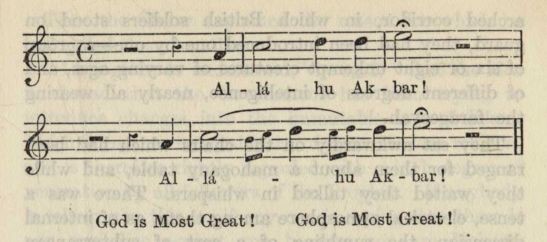
Music fragment: God is Most Great! God is Most Great!
It seemed to be a supernatural voice, the voice of an accusing angel, calling them back to their present position. Ishmael—Helena—the betrothal!
Their hands separated and they rose to their feet. One moment they stood with bowed heads, at opposite sides of the table, listening to the voice outside, and then, without a word more, they went their different ways—he to his room, she to hers.
Into the empty guest-room, a moment afterwards, came the rumbling and rolling sound of the voices of the people, repeating the Fatihah after Ishmael—
"Praise be to God, the Lord of all creatures.... Direct us in the right way, O Lord ... not the way of those who go astray."
CHAPTER XIV
That day the Sirdar had held his secret meeting of the Ulema, the Sheikhs and Notables of Khartoum. Into a room on the ground floor of the Palace, down a dark, arched corridor, in which British soldiers stood on guard, they had been introduced one by one—a group of six or eight unkempt creatures of varying ages, and of different degrees of intelligence, nearly all wearing the farageeyah.
They sat awkwardly on the chairs which had been ranged for them about a mahogany table, and while they waited they talked in whispers. There was a tense, electrical atmosphere among them, as of internal dissension, the rumbling of a sort of subterranean thunder.
But this subsided instantly, when the voice of the sergeant outside, and the clash of saluting arms, announced the coming of the Sirdar. The Governor-General, who was in uniform and booted and spurred as if returning from a ride, was accompanied by his Inspector-General, his Financial Secretary, the Governor of the town, and various minor officers.
He was received by the Sheikhs, all standing, with sweeping salaams from floor to forehead, a circle of smiles and looks of complete accord.
The Sirdar, with his ruddy and cheerful face, took his seat at the head of the table and began by asking, as if casually, who was the stranger that had arrived that day in Khartoum.
"A Bedouin," said the Cadi. "One whom Ishmael Ameer loves and who loves him."
"Yet a Bedouin, you say?" asked the Sirdar, in an incredulous tone, and with a certain elevation of the eyebrows.
"A Bedouin, O Excellency," repeated the Cadi, whereupon the others, without a word of further explanation, bent their turbaned heads in assent.
Then the Sirdar explained the reason for which he had called them together.
"I am given to understand," he said, "that the idea is abroad that the Government has been trying to introduce changes into the immutable law of Islam, which forms an integral part of your Moslem religion, and is therefore rightly regarded with a high degree of veneration by all followers of the Prophet. If anybody is telling you this, or if any one is saying that there is any prejudice against you because you are Mohammedans, he is a wicked and mischievous person, and I beg of you to tell me who he is."
Saying this, the Sirdar looked sharply round the table, but met nothing but blank and expressionless faces. Then turning to the Cadi, who as Chief Judge of the Mohammedan law-courts had been constituted spokesman, he asked pointedly what Ishmael Ameer was saying.
"Nothing, O Excellency," said the Cadi; "nothing that is contrary to the Sharia—the religious law of Islam."
"Is he telling the people to resist the Government?"
The grave company about the table silently shook their heads.
"Do you know if he has anything to do with a conspiracy to resist the payment of taxes?"
The grave company knew nothing.
"Then what is he doing, and why has he come to Khartoum? Pasha, have you no explanation to make to me?" asked the Sirdar, singling out a vivacious old gentleman, with a short, white, carefully oiled beard—a person of doubtful repute who had once been a slave-dealer and was now living patriarchally, under the protection of the Government, with his many wives and concubines.
The old black sinner cast his little glittering eyes around the room and then said—
"If you ask me, O Master, I say, Ishmael Ameer is putting down polygamy and divorce and ought himself to be put down."
At that there was some clamour among the Ulema, and the Sirdar thought he saw a rift through which he might discover the truth, but the Pasha was soon silenced, and in a moment there was the same unanimity as before.
"Then what is he?" asked the Sirdar, whereupon a venerable old Sheikh, after the usual Arabic compliments and apologies, said that, having seen the new teacher with his own eyes and talked with him, he had now not the slightest doubt that Ishmael was a man sent from God, and therefore that all who resisted him, all who tried to put him down, would perish miserably. At these words the electrical atmosphere which had been held in subjection seemed to burst into flame. In a moment six tongues were talking together. One Sheikh, with wild eyes, told of Ishmael's intercourse with angels. Another knew a man who had seen him riding with the Prophet in the desert. A third had spoken to somebody who had seen angels, in the form of doves, descending upon him from the skies, and a fourth was ready to swear that one day, while Ishmael was preaching in the mosque, people heard a voice from heaven crying, "Hear him! He is My messenger!"
"What was he preaching about?" said the Sirdar.
"The last days, the coming of the Deliverer," said the Sheikh with the wild eyes, in an awesome whisper.
"What Deliverer?"
"Seyidna Isa—our Lord Jesus—the White Christ that is to come."
"Is this to be soon?"
"Soon, O Excellency, very soon."
After this outburst there was a moment of tense and breathless silence, during which the Sirdar sat with his serious eyes fixed on the table, and his officers, standing behind, glanced at each other and smiled.
Immediately afterwards the Sirdar put an end to the interview.
"Tell your people," he said, "that the Government has no wish to interfere with your religious beliefs and feelings, whatever they may be; but tell them also, that it intends to have its orders obeyed, and that any suspicion of conspiracy, still more of rebellion, will be instantly put down."
The group of unkempt creatures went off with sweeping salaams, and then the Sirdar dismissed his officers also, saying—
"Bear in mind that you are the recognised agents of a just and merciful Government, and whatever your personal opinions may be of these Arabs and their superstitions, please understand that you are to give no anti-Islamic colour to your British feelings. At the same time remember that we have worked for the redemption of the Soudan from a state of savagery, and we cannot allow it to be turned back to barbarism in the name of religion."
Both the Ulema and the other British officials being gone, the Sirdar was alone with his Inspector-General.
"Well?" he said.
"Well?" repeated the Inspector-General, biting the ends of his close-cropped moustache. "What more did you expect, sir? Naturally the man's own people were not going to give him away. They nearly did so, though. You heard what old Zewar Pasha said?"
"Tut! I take no account of that," said the Sirdar. "The brothers of Christ Himself would have put Him down, too—locked Him up in an asylum, I dare say."
"That's exactly what I would do with Ishmael Ameer, anyway," said the Inspector-General. "Of course he performs no miracles, and is attended by no angels. His removal to Torah, and his inability to free himself from a Government jail, would soon dispel the belief in his supernatural agencies."
"But how can we do it? Under what pretext? We can't imprison a man for preaching the second coming of Christ. If we did, our jails would be pretty full at home, I'm thinking."
The Inspector-General laughed. "Your old error, dear Sirdar. You can't apply the same principles to East and West."
"And your old Parliamentary cant, dear friend! I'm sick to death of it."
There was a moment of strained silence, and then the Inspector-General said—
"Ah well, I know these holy men, with their sham inspirations and their so-called heavenly messages. They develop by degrees, sir. This one has begun by proclaiming the advent of the Lord Jesus, and he will end by hoisting a flag and claiming to be the Lord Jesus himself."
"When he does that, Colonel, we'll consider our position afresh. Meantime it may do us no mischief to remember that if the family of Jesus could have dealt with the founder of our own religion as you would deal with this olive-faced Arab there would probably be no Christianity in the world to-day."
The Inspector-General shrugged his shoulders and rose to go.
"Good-night, sir."
"Good-night, Colonel," said the Sirdar, and then he sat down to draft a dispatch to the Consul-General—
"Nothing to report since the marriage, betrothal, or whatever it was, of the 'Rani' to the man in question. Undoubtedly he is laying a strong hold on the imagination of the natives and acquiring the allegiance of large bodies of workers; but I cannot connect him with any conspiracy to persuade people not to pay taxes or with any organised scheme that is frankly hostile to the continuance of British rule.
"Will continue to watch him, but find myself at fearful odds owing to difference of faith. It is one of the disadvantages of Christian Governments among people of alien race and religion, that methods of revolt are not always visible to the naked eye, and God knows what is going on in the sealed chambers of the mosque.
"That only shows the danger of curtailing the liberty of the vernacular press, whatever the violence of its sporadic and muddled anarchy. Leave the press alone, I say. Instead of chloroforming it into silence give it a tonic if need be, or you drive your trouble underground. Such is the common sense and practical wisdom of how to deal with sedition in a Mohammedan country, let some of the logger-headed dunces who write leading articles in England say what they will.
"If this man should develop supernatural pretensions I shall know what to do. But without that, whether he claim divine inspiration or not, if his people should come to regard him as divine, the very name and idea of his divinity may become a danger, and I suppose I shall have to put him under arrest."
Then remembering that he was addressing not only the Consul-General but a friend, the Sirdar wrote—
"'Art Thou a King?' Strange that the question of Pontius Pilate is precisely what we may find in our own mouths soon! And stranger still, almost ludicrous, even farcical and hideously ironical, that though for two thousand years Christendom has been spitting on the pusillanimity of the old pagan, the representative of a Christian Empire will have to do precisely what he did.
"Short of Pilate's situation, though, I see no right to take this man, so I am not taking him. Sorry to tell you so, but I cannot help it.
"Our love from both to both. Trust Janet is feeling better. No news of our poor boy, I suppose?"
"Our boy" had for thirty years been another name for Gordon.
CHAPTER XV
Grave as was the gathering in the Sirdar's Palace at Khartoum, there was a still graver gathering that day at the British Agency in Cairo—the gathering of the wings of Death.
Lady Nuneham was nearing her end. Since Gordon's disgrace and disappearance she had been visibly fading away under a burden too heavy for her to bear.
The Consul-General had been trying hard to shut his eyes to this fact. More than ever before, he had immersed himself in his work, being plainly impelled to fresh efforts by hatred of the man who had robbed him of his son.
Through the Soudan Intelligence Department in Cairo he had watched Ishmael's movements in Khartoum, expecting him to develop the traits of the Mahdi and thus throw himself into the hands of the Sirdar.
It was a deep disappointment to the Consul-General that this did not occur. The same report came to him. again and again. The man was doing nothing to justify his arrest. Although surrounded by fanatical folk, whose minds were easily inflamed, he was not trying to upset governors or giving "divine" sanction for the removal of officials.
But meantime some mischief was manifestly at work all over the country. From day to day Inspectors had been coming in to say that the people were not paying their taxes. Convinced that this was the result of conspiracy, the Consul-General had shown no mercy.
"Sell them up," he had said, and the Inspectors, taking their cue from his own spirit but exceeding his orders, had done his work without remorse.
Week by week the trouble had deepened, and when disturbances had been threatened he had asked the British Army of Occupation, meaning no violence, to go out into the country and show the people England's power.
Then grumblings had come down on him from the representatives of foreign nations. If the people were so discontented with British rule that they were refusing to pay their taxes, there would be a deficit in the Egyptian treasury—how then were Egypt's creditors to be paid?
"Time enough to cross the bridge when you come to it, gentlemen," said the Consul-General, in his stinging tone and with a curl of his iron lip.
If the worst came to the worst England would pay, but England should not be asked to do so because Egypt must meet the cost of her own government. Hence more distraining and some inevitable violence in suppressing the riots that resulted from evictions.
Finally came a hubbub in Parliament, with the customary "Christian" prattlers prating again. Fools! They did not know what a subtle and secret conspiracy he had to deal with while they were crying out against his means of killing it.
He must kill it! This form of passive resistance, this attack on the Treasury, was the deadliest blow that had ever yet been aimed at England's power in Egypt.
But he must not let Europe see it! He must make believe that nothing was happening to occasion the least alarm. Therefore to drown the cries of the people who were suffering not because they were poor and could not pay, but because they were perverse and would not, he must organise some immense demonstration.
Thus came to the Consul-General the scheme of the combined festival of the King's Birthday and the —th anniversary of the British Occupation of Egypt. It would do good to foreign Powers, for it would make them feel that, not for the first time, England had been the torch-bearer in a dark country. It would do good to the Egyptians, too, for it would force their youngsters (born since Tel-el-Kebir) to realise the strength of England's arm.
Thus had the Consul-General occupied himself while his wife had faded away. But at length he had been compelled to see that the end was near, and towards the close of every day he had gone to her room and sat almost in silence, with bowed head, in the chair by her side.
The great man, who for forty years had been the virtual ruler of millions, had no wisdom that told him what to say to a dying woman; but at last, seeing that her pallor had become whiteness, and that she was sinking rapidly and hungering for the consolations of her religion, he asked her if she would like to take the sacrament.
"It is just what I wish, dear," she answered, with the nervous smile of one who had been afraid to ask.
At heart the Consul-General had been an agnostic all his life, looking upon religion as no better than a civilising superstition, but all the same he went downstairs and sent one of his secretaries for the Chaplain of St. Mary's—the English Church.
The moment he had gone out of the door Fatimah, under the direction of the dying woman, began to prepare the bedroom for the reception of the clergyman by laying a side-table with a fair white cloth, a large prayer-book, and two silver candlesticks containing new candles.
While the Egyptian nurse did this the old lady looked on with her deep, slow, weary eyes, and talked in whispers, as if the wings of the august Presence that was soon to come were already rustling in the room. When all was done she looked very happy.
"Everything is nice and comfortable now," she said, as she lay back to wait for the clergyman.
But even then she could not help thinking the one thought that made a tug at her resignation. It was about Gordon.
"I am quite ready to die, Fatimah," she said, "but I should have loved to see my dear Gordon once more."
This was what she had been waiting for, praying for, eating her heart and her life out for.
"Only to see and kiss my boy! It would have been so easy to go then."
Fatimah, who was snuffling audibly, as she straightened the eider-down coverlet over the bed, began to hint that if her "sweet eyes" could not see her son she could send him a message.
"Perhaps I know somebody who could see it reaches him, too," said Fatimah, in a husky whisper.
The old lady understood her instantly.
"You mean Hafiz! I always thought as much. Bring me my writing-case—quick!"
The writing-case was brought and laid open before her, and she made some effort to write a letter, but the power of life in her was low, and after a moment the shaking pen dropped from her fingers.
"Ma'aleysh, my lady!" said Fatimah soothingly. "Tell me what you wish to say. I will remember everything."
Then the dying mother sent a few touching words as her last message to her beloved son.
"Wait! Let me think. My head is a little ... just a little ... Yes, this is what I wish to say, Fatimah. Tell my boy that my last thoughts were about him. Though I am sorry he took the side of the false prophet, say I am certain he did what he thought was right. Be sure you tell him I die happy, because I know I shall see him again. If I am never to see him in this world I shall do so in the world to come. Say I shall be waiting for him there. And tell him it will not seem long."
"Could you sign your name for him, my heart?" said Fatimah, in her husky voice.
"Yes, oh yes, easily," said the old lady, and then with an awful effort she wrote—
"Your ever-loving Mother."
At that moment Ibrahim in his green caftan, carrying a small black bag, brought the English chaplain into the room.
"Peace be to this house," said the clergyman, using the words of his Church ritual, and the Egyptian nurse, thinking it was an Eastern salutation, answered, "Peace!"
The Chaplain went into the "boys' room" to put on his surplice, and when he came out, robed in white, and began to light the candles and prepare the vessels which he placed on the side-table, the old lady was talking to Fatimah in nervous whispers—
"His lordship?" "Yes!" "Do you think, my lady——"
She wanted the Consul-General to be present and was half afraid to send for him; but just at that instant the door opened again, and her pale, spiritual face lit up with a smile as she saw her husband come into the room.
The clergyman was now ready to begin, and the old lady looked timidly across the bed at the Consul-General as if there were something she wished to ask and dared not.
"Yes, I will take the sacrament with you, Janet," said the old man, and then the old lady's face shone like the face of an angel.
The Consul-General took the chair by the side of the bed and the Chaplain began the service—
"Almighty, ever-living God, Maker of mankind, who dost correct those whom Thou dost love——"
All the time the triumphant words reverberated through the room the dying woman was praying fervently, her lips moving to her unspoken words and her eyes shining as if the Lord of Life she had always loved was with her now and she was giving herself to Him—her soul, her all.
The Consul-General was praying too—praying for the first time to the God he did not know and had never looked to—
"If Thou art God, let her die in peace. It is all I ask—all I wish."
Thus the two old people took the sacrament together, and when the Communion Service came to a close, the old lady looked again at the Consul-General and asked, with a little confusion, if they might sing a hymn.
The old man bent his head, and a moment later the Chaplain, after a whispered word from the dying woman, began to sing—
"Sun of my soul, Thou Saviour dear,
It is not night if Thou be near ..."
At the second bar the old lady joined him in her breaking, cracking voice, and the Consul-General, albeit his throat was choking him, forced himself to sing with her—
"When the soft dews of kindly sleep
My wearied eyelids gently steep..."
It was as much as the Consul-General could do to sing of a faith he did not feel, but he felt tenderly to it for his wife's sake now, and with a great effort he went on with her to the end—
"If some poor wandering child of Thine
Have spurned to-day the voice divine ..."
The light of another world was in the old lady's eyes when all was over, and she seemed to be already half way to heaven.
CHAPTER XVI
All the same there was a sweet humanity left in her, and when the Chaplain was gone and the side-table had been cleared, and she was left alone with her old husband, there came little gleams of the woman who wanted to be loved to the last.
"How are you now?" he asked.
"Better so much better," she said, smiling upon him, and caressing with her wrinkled hand the other wrinkled hand that lay on the eider-down quilt.
The great Consul-General, sitting on the chair by the side of the bed, felt as helpless as before, as ignorant as ever of what millions of simple people know—how to talk to those they love when the wings of Death are hovering over them. But the sweet old lady, with the wisdom and the courage which God gives to His own on the verge of eternity, began to speak in a lively and natural voice of the end that was coming and what was to follow it.
He was not to allow any of his arrangements to be interfered with, and, above all, the festivities appointed for the King's Birthday were not to be disturbed.
"They must be necessary or you would not have them, especially now," she said, "and I shall not be happy if I know that on my account they are not coming off."
And then, with the sweet childishness which the feebleness of illness brings, she talked of the last King's Birthday, and of the ball they had given in honour of it.
That had been in their own house, and the dancing had been in the drawing-room, and the Consul-General had told Ibrahim to set the big green arm-chair for her in the alcove, and sitting there she had seen everything. What a spectacle! Ministers Plenipotentiary, Egyptian Ministers, ladies, soldiers! Such gorgeous uniforms! Such glittering orders! Such beautiful toilets!
The old lady's pale face filled with light as she thought of all this, but the Consul-General dropped his head, for he knew well what was coming next.
"And, John, don't you remember? Gordon was there that night, and Helena—dear Helena! How lovely they looked! Among all those lovely people, dear.... He was wearing every one of his medals that night, you know. So tall, so brave-looking, a soldier every inch of him, and such a perfect English gentleman! Was there ever anything in the world so beautiful? And Helena, too! She wore a silvery silk, and a kind of coif on her beautiful black hair. Oh, she was the loveliest thing in all the room, I thought! And when they led the cotillion—don't you remember they led the cotillion, dear?—I could have cried, I was so proud of them."
The Consul-General continued to sit with his head down, listening to the old lady and saying nothing, yet seeing the scene as she depicted it and feeling again the tingling pride which he, too, had felt that night but permitted nobody to know.
After a moment the beaming face on the bed became clouded over, as if that memory had brought other memories less easy to bear—dreams of happy days to come, of honours and of children.
"Ah well, God knows best," she said in a tremulous voice, releasing the Consul-General's hand.
The old man felt as if he would have to hurry out of the room without uttering another word, but, as well as he could, he controlled himself and said—
"You are agitating yourself, Janet. You must lie quiet now."
"Yes, I must lie quiet now, and think of ... of other things," she answered.
He was stepping away when she called on him to turn her on her right side, for that was how she always slept, and upon the Egyptian nurse coming hurrying up to help, she said—
"No, no, not you, Fatimah—his lordship."
Then the Consul-General put his arms about her—feeling how thin and wasted she was, and how little of her was left to die—and turning her gently round he laid her back on the pillow which Fatimah had in the meantime shaken out.
While he did so her dim eyes brightened again, and stretching her white hands out of her silk nightdress she clasped them about his neck, with the last tender efforts of the woman who wanted to be fondled to the end.
The strain of talking had been too much for her, and after a few minutes she sank into a restless doze, in which the perspiration broke out on her forehead and her face acquired an expression of pain, for sleep knows no pretences. But at length her features became more composed and her breathing more regular, and then the Consul-General, who had been standing aside, mute with anguish, said in a low tone to Fatimah—
"She is sleeping quietly now," and then he turned to go.
Fatimah followed him to the head of the stairs and said in a husky whisper—
"It will be all over to-night, though—you'll see it will."
For a moment he looked steadfastly into the woman's eyes, and then, without answering her, walked heavily down the stairs.
Back in the library, he stood for some time with his face to the empty fireplace. Over the mantelpiece there hung a little picture, in a black-and-gilt frame, of a bright-faced boy in an Arab fez. It was more than he could do to look at that portrait now, so he took it off its nail and laid it, face down, on the marble mantel-shelf.
Just at that moment one of his secretaries brought in a despatch. It was the despatch from the Sirdar, sent in cypher but now written out at length. The Consul-General read it without any apparent emotion and put it aside without a word.
The hours passed slowly; the night was very long; the old man did not go to bed. Not for the first time, he was asking himself searching questions about the mystery of life and death, but the great enigma was still baffling him. Could it be possible that while he had occupied himself with the mere shows and semblance of things, calling them by great names—Civilisation and Progress—that simple soul upstairs had been grasping the eternal realities?
There were questions that cut deeper even than that, and now they faced him one by one. Was it true that he had married merely in the hope of having some one to carry on his name and thus fulfil the aspirations of his pride? Had he for nearly forty years locked his heart away from the woman who had been starving for his love, and was it only by the loss of the son who was to have been the crown of his life that they were brought together in the end?
Thus the hoofs of the dark hours beat heavily on the great Proconsul's brain, and in the awful light that came to him from an open grave, the triumphs of the life behind him looked poor and small.
But meantime the palpitating air of the room upstairs was full of a different spirit. The old lady had apparently awakened from her restless sleep, for she had opened her eyes and was talking in a bright and happy voice. Her cheeks were tinged with the glow of health, and her whole face was filled with light.
"I knew I should see them," she said.
"See whom, my heart?" asked Fatimah, but without answering her, the old lady, with the same rapturous expression, went on talking.
"I knew I should, and I have! I have seen both of them!"
"Whom have you seen, my lady?" asked Fatimah again, but once more the dying woman paid no heed to her.
"I saw them as plainly as I see you now, dear. It was in a place I did not know. The sun was so hot, and the room was so close. There was a rush roof and divans all round the walls. But Gordon and Helena were there together, sitting at opposite sides of a table and holding each other's hands."
"Allah! Allah!" muttered Fatimah, with upraised hands.
The old lady seemed to hear her, for an indulgent smile passed over her radiant face and she said in a tone of tender remonstrance—
"Don't be foolish, Fatimah! Of course I saw him. The Lord said I should, and He never breaks His promises. 'Help me, O God, for Christ's sake,' I said. 'Shall I see my dear son again? O God, give me a sign.' And He did! Yes, it was in the middle of the night. 'Janet,' said a voice, and I was not afraid. 'Be patient, Janet. You shall see your dear boy before you die.'"
Her face was full of happy visions. The life of this world seemed to be no longer there. A kind of life from the other world appeared to reanimate the sinking woman. The near approach of eternity illumined her whole being with a supernatural light. She was dying in a flood of joy.
"Oh, how good the Lord is! It is so easy to go now! ... John, you must not think I suffer any longer, because I don't. I have no pain now, dear—none whatever."
Then she clasped her wasted hands together in the attitude of prayer and said in a rustling whisper—
"To-night, Lord Jesus! Let it be to-night!"
After that her rapturous voice died away and her ecstatic eyes gently closed, but an ineffable smile continued to play on her faintly-tinted face, as if she were looking on the wings that were waiting to bear her away.
The doctor came in at that moment, and was told what had occurred.
"Delirium, of course," he said. A change had come; the crisis was approaching. If the same thing happened at the supreme moment the patient was not to be contradicted; her delusion was to be indulged.
It did not happen.
In the early hours of the morning the Consul-General was called upstairs. There was a deep silence in the bedroom, as if the air had suddenly become empty and void. The day was breaking, and through the windows that looked over to the Nile the white sails of a line of boats gliding by seemed like the passing of angels' wings. Sparrows were twittering in the eaves, and through the windows to the east the first streamers of the sunrise were rising in the sky.
The Consul-General approached the bed and looked down at the pallid face on the pillow. He wanted to stoop and kiss it, but he felt as if it would be a profanation to do so now. His own face was full of suffering, for the sealed chambers of his iron soul had been broken open at last.
With his hands clasped behind his back he stood for some minutes quite motionless. Then laying one hand on the brass head-rail of the bed, he leaned over his dead wife and spoke to her as if she could hear.
"Forgive me, Janet! Forgive me!" he said in a low voice that was like a sob.
Did she hear him? Who can say she did not? Was it only a ray from the sunrise that made the Egyptian woman think that over the dead face of the careworn and weary one, whose sweet soul was even then winging its way to heaven, there passed the light of a loving smile?
CHAPTER XVII
Within three days the softening effects on the Consul-General of Lady Nuneham's death were lost. Out of his very bereavement and the sense of being left friendless and alone he became a harder and severer man than before. His secretaries were more than ever afraid of him, and his servants trembled as they entered his room.
It heightened his anger against Gordon to believe that by his conduct he had hastened his mother's end. In his absolute self-abasement there were moments when he would have found it easier to forgive Gordon if he had been a prodigal, a wastrel, prompted to do what he had done by the grossest selfishness; but deep down in some obscure depths of the father's heart the worst suffering came of the certainty that his son had been moved by that tragic earnestness which belongs only to the greatest and noblest souls.
Still more hardening and embittering to the Consul-General than the memory of Gordon was the thought of Ishmael. It intensified his anger against the Egyptian to feel that having first by his "visionary mummery," by his "manoeuvring and quackery," robbed him of his son, he had now, by direct consequence, robbed him of his wife also.
All the Consul-General's bull-necked strength, all his force of soul, were roused to fury when he thought of that. He was old and tired and he needed rest, but before he permitted himself to think of retirement, he must crush Ishmael Ameer.
Not that he allowed himself to recognise his vindictiveness. Shutting his eyes to his personal motive, he believed he was thinking of England only. Ishmael was the head-centre of an anarchical conspiracy which was using secret and stealthy weapons that were more deadly than bombs; therefore Ishmael must be put down, he must be trampled into the earth, and his movement must be destroyed.
But how?
Within a few hours after Lady Nuneham's funeral the Grand Cadi came by night, and with many vague accusations against "the Arab innovator," repeated his former warning—
"I tell you again, O Excellency, if you permit that man to go on it will be death to the rule of England in Egypt."
"Then prove what you say—prove it, prove it," cried the Consul-General, raising his impatient voice.
But the suave old Moslem judge either could not or would not do so. Indeed, being a Turkish official, accustomed to quite different procedure, he was at a loss to understand why the Consul-General wanted proof.
"Arrest the offender first and you'll find evidence enough afterwards," he said.
An English statesman could not act on lines like those, so the Consul-General turned back to the despatches of the Sirdar. The last of them—the one received during the dark hours preceding his wife's death—contained significant passages—
"If this man should develop supernatural pretensions I shall know what to do."
Ha! There was hope in that! The charlatan element in Ishmael Ameer might carry him far if only the temptation of popular idolatry were strong enough.
Once let a man deceive himself with the idea that he was divine, nay, once let his followers delude themselves with the notion of his divinity, and a civilised Government would be bound to make short work of him. Whosoever and whatsoever he might be, that man must die!
A sudden cloud passed over the face of the Consul-General as he glanced again at the Sirdar's despatch and saw its references to Christ.
"How senseless everybody is becoming in this world," he thought.
Pontius Pilate! Pshaw! When would religious hypocrisy open its eyes and see that, according to all the laws of civilised states, the Roman Governor had done right? Jesus claimed to be divine, His people were ready to recognise Him as King; and whether His kingdom was of this world or another, what did it matter? If His pretensions had been permitted they would have led to wild, chaotic, shapeless anarchy. Therefore Pilate crucified Jesus, and, scorned though he had been through all the ages, he had done no more than any so-called "Christian" governor would be compelled to do to-day.
"Jesus of Nazareth, the King of the Jews." Why would not people understand that these words were written not in derision but in self-defence? There could be only one authority in Palestine then, and there could be only one authority in Egypt now.
"If this visionary mummer, with his empty quackeries, should develop the idea that he is divine, or even the messenger of divinity, I will hang him like a dog!" thought the Consul-General.
CHAPTER XVIII
Five days after the death of Lady Nuneham the Consul-General was reading at his breakfast the last copy of the Times to arrive in Cairo. It contained an anticipatory announcement of a forthcoming Mansion House Banquet in honour of the King's Birthday. The Foreign Minister was expected to speak on the "unrest in the East, with special reference to the affair of El Azhar."
The Consul-General's face frowned darkly, and he began to picture the scene as it would occur. The gilded hall, the crowd of distinguished persons eating in public, the mixed odours of many dishes, the pop of champagne corks, the smoke of cigars, the buzz of chatter like the gobbling of geese on a green, and then the Minister, with his hand on his heart, uttering timorous apologies for his Proconsul's policy, and pouring out pompous platitudes as if he had newly discovered the Decalogue.
The Consul-General's gorge rose at the thought. Oh, when would these people, who stayed comfortably at home and lived by the votes of the factory-hands of Lancashire and Yorkshire, and hungered for the shouts of the mob, understand the position of men like himself, who, in foreign lands, among alien races, encompassed by secret conspiracies, were spending their strength in holding high the banner of Empire?
"Having chosen a good man, why can't they leave him alone?" thought the Consul-General.
And then, his personal feelings getting the better of his patriotism, he almost wished that the charlatan element in Ishmael Ameer might develop speedily; that he might draw off the allegiance of the native soldiers in the Soudan and break out, like the Mahdi, into open rebellion. That would bring the Secretary of State to his senses, make him realise a real danger, and see in the everlasting "affair of El Azhar" if not light, then lightning.
The door of the breakfast-room opened and Ibrahim entered.
"Well, what is it?" demanded the Consul-General with a frown.
Ibrahim answered in some confusion that a small boy was in the hall, asking to see the English lord. He said he brought an urgent message, but would not tell what it was or where it came from. Had been there three times before, slept last night on the ground outside the gate, and could not be driven away—would his lordship see the lad?
"What is his race? Egyptian?"
"Nubian, my lord."
"Ever seen the boy before?"
"No ... yes ... that is to say ... well, now that your lordship mentions it, I think ... yes I think he came here once with Miss Hel ... I mean General Graves's daughter."
"Bring him up immediately," said the Consul-General.
At the next moment a black boy stepped boldly into the room. It was Mosie. His clothes were dirty, and his pudgy face was like a block of dark soap splashed with stale lather, but his eyes were clear and alert and his manner was eager.
"Well, my boy, what do you want?" asked the Consul-General.
Mosie looked fearlessly up into the stern face with its iron jaw, and tipped his black thumb over his shoulder to where Ibrahim, in his gorgeous green caftan, stood timidly behind him.
At a sign from the Consul-General, the Egyptian servant left the room, and then, quick as light, Mosie slipped off his sandal, ripped open its inner sole, and plucked out a letter stained with grease.
It was the letter which Helena had written in Khartoum.
The Consul-General read it rapidly, with an eagerness which even he could not conceal. So great, indeed, was his excitement that he did not see that a second paper (Ishmael's letter to the Chancellor of El Azhar) had fallen to the floor until Mosie picked it up and held it out to him.
"Good boy," said the Consul-General—the cloud had passed and his face bore an expression of joy.
Instantly apprehending the dim purport of Helena's hasty letter, the Consul-General saw that what he had predicted and half hoped for was already coming to pass. It was to be open conspiracy now, not passive conspiracy any longer. The man Ishmael was falling a victim to the most fatal of all mental maladies. The Mahdist delusion was taking possession of him, and he was throwing himself into the Government's hands.
Hurriedly ringing his bell, the Consul-General committed Mosie to Ibrahim's care, whereupon the small black boy, in his soiled clothes, with his dirty face and hands, strutted out of the room in front of the Egyptian servant, looking as proud as a peacock and feeling like sixteen feet tall. Then the Consul-General called for one of his secretaries and sent him for the Commandant of Police.
The Commandant came in hot haste. He was a big and rather corpulent Englishman, wearing a blue-braided uniform and a fez—naturally a blusterous person with his own people, but as soft-voiced as a woman and as obsequious as a slave before his chief.
"Draw up your chair, Commandant—closer; now listen," said the Consul-General.
And then in a low tone he repeated what he had already learned from Helena's letter, and added what he had instantly divined from it—that Ishmael Ameer was to return to Cairo; that he was to come back in the disguise of a Bedouin Sheikh; that his object was to draw off the allegiance of the Egyptian army in order that a vast horde of his followers might take possession of the city; that this was to be done during the period of the forthcoming festivities, while the British army was still in the provinces, and that the conspiracy was to reach its treacherous climax on the night of the King's Birthday.
The Commandant listened with a gloomy face, and, looking timidly into the flashing eyes before him, he asked if his Excellency could rely on the source of his information.
"Absolutely! Infallibly!" said the Consul-General.
"Then," said the Commandant nervously, "I presume the festivities must be postponed?"
"Certainly not, sir."
"Or perhaps your Excellency intends to have the British army called back to Cairo?"
"Not that either."
"At least you will arrest the 'Bedouin'?"
"Not yet at all events."
The policy to be pursued was to be something quite different.
Everything was to go on as usual. Sports, golf, cricket, croquet, tennis-tournaments, polo-matches, race-meetings, automobile-meetings, "all the usual fooleries and frivolities"—with crowds of sight-seers, men in flannels and ladies in beautiful toilets—were to be encouraged to proceed. The police-bands were to play in the public gardens, the squares, the streets, everywhere.
"Say nothing to anybody. Give no sign of any kind. Let the conspiracy go on as if we knew nothing about it. But——"
"Yes, my lord? Yes?"
"Keep an eye on the 'Bedouin.' Let every train that arrives at the railway-station and every boat that comes down the river be watched. As soon as you have spotted your man, see where he goes. He may be a fanatical fool, miscalculating his 'divine' influence with the native soldier, but he cannot be working alone. Therefore find out who visit him, learn all their movements, let their plans come to a head, and, when the proper time arrives, in one hour, at one blow we will crush their conspiracy and clap our hands upon the whole of them."
"Splendid! An inspiration, my lord!"
"I've always said it would some day be necessary to forge a special weapon to meet special needs, and the time has come to forge it. Meantime undertake nothing hurriedly. Make no mistakes, and see that your men make none."
"Certainly, my lord."
"Investigate every detail for yourself, and above all hold your tongue and guard your information with inviolable secrecy."
"Surely, my lord."
"You can go now. I'm busy. Good-morning!"
"Wonderful man!" thought the Commandant, as he went out at the porch. "Seems to have taken a new lease of life! Wonderful!"
The Consul-General spent the whole of that day in thinking out his scheme for a "special weapon," and when night came and he went upstairs—through the great echoing house that was like the bureau of a department of state now, being so empty and so cheerless, and past the dark and silent room whereof the door was always closed—he felt conscious of a firmer and lighter step than he had known for years.
Fatimah was in his bedroom, for she had constituted herself his own nurse since his wife's death. She was nailing up on the wall the picture of the little boy in the Arab fez, and, having her own theory about why he had taken it down in the library, she said—
"There! It will be company for your lordship, and nobody will ask questions about it here."
When Fatimah had gone the Consul-General could not but think of Gordon. He always thought of him at that hour of the night, and the picture of his son that rose in his mind's eye was always the same. It was a picture of Gordon's deadly white face with its trembling lower lip, as he stood bolt upright while his medals were being torn from his breast, and then said, in that voice which his father could never forget: "General, the time may come when it will be even more painful to you to remember all this than it has been to me to bear it."
Oh, that Gordon could be here now and see for himself what a sorry charlatan, what a self-deceived quack and conspirator, was the man in whose defence he had allowed his own valuable life to rush down to a confused welter of wreck and ruin!
As the Consul-General got into bed he was thinking of Helena. What a glorious, courageous, resourceful woman she was! It carried his mind back to Biblical days to find anything equal to her daring and her success. But what was the price she had paid for them? He remembered something the Sirdar had said of "a marriage, a sort of betrothal," and then he recalled the words of her first letter: "I know exactly how far I intend to go, and I shall go no farther. I know exactly what I intend to do, and I shall do it without fear or remorse."
What had happened in the Soudan? What was happening there now? In what battle-whirlwind had that splendid girl's magnificent victory been won?
CHAPTER XIX
Meantime Helena in Khartoum was feeling like a miserable traitress.
She had condemned an innocent man to death! Ishmael had not killed her father, yet she had taken such steps that the moment he entered Cairo he would be walking to his doom!
One after another sweet and cruel memories crowded upon her, and in the light of the awful truth as Gordon had revealed it, she began to see Ishmael with quite different eyes. All she had hitherto thought evil in his character now looked like good; what she had taken for hypocrisy was sincerity; what she had supposed to be subtlety was simplicity. His real nature was a rebuke to every one of her preconceived ideas. The thought of his tenderness, his modesty, his devotion, and even the unselfishness which had led to their betrothal, cut her to the heart. Yet she had doomed him to destruction. The letter she had written to the Consul-General was his death-warrant.
That night she could fix her mind on nothing except the horror of her position, but next morning she set herself to think out schemes for stopping the consequences of her own act.
The black boy was gone; it was not possible to overtake him; there was no other train to Egypt for four days, but there was the telegraph—she could make use of that.
"I'll telegraph to the Consul-General to pay no attention to my letter," she thought.
Useless! The Consul-General would ask himself searching questions and take his precautions just the same.
"I'll telegraph that my letter is a forgery," she thought.
Madness! The Consul-General would ask himself how, if it was a forgery, she could know anything about it.
"I'll go across to the Sirdar and tell him everything, and leave him to act for both of us as he thinks best!"
Impossible! How could she explain her position to the Sirdar without betraying Gordon's identity and thereby leading to his arrest?
That settled everything. There was no escape from the consequences of her conduct, no way to put an end to the network of dangers by which she had surrounded Ishmael. Mosie was now far on his way to Cairo; he carried to the Consul-General not only her own letter but also the original of Ishmael's letter to the Chancellor of El Azhar. The hideous work was done.
Two days passed, during which her over-excited feelings seemed to paralyse all her powers of thought. Then a new idea took possession of her, and she set herself to undo what she had done with Ishmael himself. Little by little, in tremulous tones, and with a still deeper sense of duplicity than before, she began to express halting doubts of the success of their enterprise.
"I have been thinking about it," she said nervously, "and now I fear——"
"What do you fear, O Rani?" asked Ishmael.
"I fear," said Helena, trembling visibly, "that the moment the Government learn from the Sirdar, as they needs must, that the great body of your people have left Khartoum, and are travelling north, they will recall the British army to protect the capital and thus——"
But Ishmael interrupted her with a laugh.
"If the day of the Redeemer has come," he said, "will human armies hinder him? No!"
It was useless! Ishmael was now more than ever an enthusiast, a fanatic, a visionary. His spiritual ecstasy swept away every obstacle, and made him blind to every danger.
Helena felt like a witch who was trying to undo the effects of her charm. She could not undo them. She could not destroy the potency of the spell she herself had raised, and the effort to do so put her into a fever of excitement.
Two days more passed like this, and still Helena was in the toils of her own actions. From time to time she saw Gordon as he sat at meals or moved about the house. He did not speak to her, and she dropped her head in shame as often as they came close together. But at length she caught a look in his face which seemed to her to say, "Are you really going to let an innocent man walk into the jaws of death?"
That brought her wavering mind to a quick conclusion. Gordon was waiting for her to speak. She must speak! She must confess everything! She must tell Ishmael what she had done, and by what tragic error she had done it. At any cost, no matter what, she must put an end to the false situation in which she lived, and thus redeem herself in Gordon's eyes and in her own.
At noon that day, being Friday, Ishmael preached in the mosque, delivering a still more fervent and passionate message. The kingdom of heaven which the Lord Isa had foretold was soon to come! When it came God would lend them legions of angels, if need be, to protect the oppressed and to uphold the down-trodden! Therefore let the children of God fear nothing from the powers and principalities of the world! Their pilgrimage was safe! No harm could come to them, for however their feet might slip the arms of the Compassionate would bear them up!
As Ishmael's ecstasy had increased so had the devotion of his people, and when he returned home they followed him in a dense crowd through the streets shouting the wildest acclamations.
"Out of the way! The Master is coming! The Messenger is here! Allah! El Hamdullillah!"
Helena heard them, but she did not hear Ishmael reprove them, as in earlier days he had been wont to do. She was standing in the guest-room, and the noise of the approaching crowd had brought Gordon from his bedroom, at the moment when Ishmael, surrounded by a group of his people, stepped into the house.
Ishmael was in a state of excitement amounting to exaltation, and after holding out hands both to Helena and Gordon he turned to his followers to dismiss them. "Go back now," he said, "and to-night, two hours after sunset, let the Ulema and the Notables come to me that we may decide on the details of our pilgrimage."
"Allah! El Hamdullillah!" cried the people.
More than ever they were like creatures possessed. Hungry and ragged as many of them were, the new magnificence that was to be given to their lives appeared to be already shining in their eyes.
Helena saw this, and her heart was smitten with remorse at the thought of the cruel confession she had decided to make. She could not make it in sight of the hopes it must destroy. But neither could she look into Gordon's searching face and remain silent, and as soon as the crowd had gone, she made an effort to speak.
"Ishmael," she said, trembling all over, "there is something I wish to say—if it will not displease you."
"Nothing the Rani can say will displease me," said Ishmael.
He was looking at her with the expression of enthusiastic admiration which she had seen in his eyes before. It was hard to go on.
"Your intentions are now known to everybody," she said. "You have not hidden them from any of your own people. That has been very trustful, very noble, but still——"
"Still—what, my sister?"
"If somebody ... should betray your scheme to the Government, and ... and the moment you set foot in Cairo——"
Again Ishmael interrupted her with a laugh.
"Impossible!" he said, smiling upon her with his bright and joyous eyes. "Islam has only one heart, one soul, one mind."
Then taking her quivering hand and leading her to the door, he pointed to the camp outside and said—
"Look! Ten thousand of our poor unhappy people are there. They have come to me from the tyrannies of cruel taskmasters and have been true to me through the temptations of hunger and thirst. Some of them are from Cairo and are waiting to return home. All are the children of Islam, and are looking for the coming of the Expected who brings peace and joy. Is there one of them who will betray me now? Not one! Treachery would injure me, but it would hurt the betrayer more."
Then with the same expression of enthusiastic admiration, and in a still tenderer and softer voice, he began to laugh and to rally her, saying he knew well what was going on in his sweet sister's mind—that though her brave spirit had devised the plan they had adopted, yet now that the time was near for carrying it into execution her womanly heart was failing her, and affectionate anxiety for his own safety was making her afraid.
"But have no fear at all," he said, standing behind her and smoothing her cheek with a light touch of his tapering fingers. "If this is God's work will God forget me? No!"
With a sense of stifling duplicity Helena made one more effort and said—
"Still, who knows, there may be some one——"
"None, O Rani!"
"But don't you know——"
"I don't want to know anything except one thing—that God guides and directs me."
Again he laughed, and asked where was the kufiah (the Bedouin head-dress) which she had promised to make for his disguise.
"Get to work at it quick," he said; "it will be wanted soon, my sister."
And then, clapping his hands for the mid-day meal, he went into his room to prepare for it, leaving Gordon and Helena for some moments alone together.
Gordon had been standing aside in the torment of a hundred mixed emotions, and now he and Helena spoke in whispers.
"He is determined to go into Cairo," she said.
"Quite determined."
"Oh, is there no way to prevent him?"
"None now—unless——"
"Unless—what?" she asked eagerly.
"Let us ... Let us wait and see," said Gordon, and then Abdullah came in to lay the table.
CHAPTER XX
As soon as the mid-day meal was over Gordon escaped to his room—the room he shared with Ishmael—and throwing himself down on the angerib with his hands clasped across his face, he tried to think out the situation in which he found himself, to gaze into the depths of his conscience, and to see where he was and what he ought to do.
So violent was the state of his soul that he sat there a long time before he could link together his memories of what had happened since he arrived in Khartoum.
"Am I dreaming?" he asked himself again and again, as one by one his thoughts rolled over him like tempestuous waves.
The first thing he saw clearly was that Ishmael was not now the same man that he had known at Alexandria; that the anxieties, responsibilities, and sufferings he had gone through as a religious leader had dissipated his strong common sense; and that as a consequence the caution whereby men guard their conduct had gone.
He also saw that Ishmael's spiritual ecstasy had reached a point not far removed from madness; that his faith in divine guidance, divine guardianship, divine intervention had become an absolute obsession.
Therefore it was hopeless to try to move him from his purpose by any appeals on the score of danger to himself or to his people.
"He is determined to go into Cairo," thought Gordon, "and into Cairo he will go."
The next thing Gordon saw, as he examined the situation before him, was that Helena was powerless to undo the work which by the cruel error of fate she had been led to do; that her act was irrevocable; that there was no calling it back, and that it would go from its consequences to the consequences of its consequences.
Helena's face appeared to him, and his heart bled for her as he thought of how she passed before him—she who had always been so bold and gay—with her once proud head bent low. He remembered her former strength and self-reliance; her natural force and grace; her fearless daring and that dash of devilry which had been for him one of her greatest charms; and then he thought of her false position in that house, brought there by her own will, held there by her own act—a tragic figure of a woman in the meshes of her own net.
"She cannot continue to live like this. It is impossible. Yet what can the end be?" he asked himself.
Hours passed like this. His head under his hot hands burned and his temples throbbed, yet no ray of light emerged from the darkness surrounding him.
But at length the man in him, the soldier and the lover, swept down every obstacle, and he told himself that he must save Helena from the consequences of her own conduct whatever the result might be.
"I must! I must!" he kept on repeating as Helena's face rose before him; and after a while this blind resolution brought him at one stride to a new idea.
Ishmael was determined to go into Cairo, but there was one way to prevent him doing so—that he, Gordon himself, should go instead!
When he first thought of that his temples beat so violently that it seemed as if they would burst, and he felt as if he had been brought to the very brink of despair. Seeing nothing before him but instant arrest the moment he entered the city, it seemed to be a pitiful end to his long journey across the desert, a poor sequel to his fierce struggle with himself, and to the mystic hopes with which he had buoyed up his heart, that immediately after he had reached Khartoum he should turn back to his death.
Work, mission, redemption—all that had so recently had a meaning for him had disappeared. But his heart rose when he remembered that if he did what he had determined to do he would break the cruel error of fate whereby Ishmael had been doomed to die for an offence he did not commit.
What was the first fact of this cruel situation? That Helena had believed Ishmael to be guilty of the death of her father. But Ishmael was innocent, whereas he, Gordon, was guilty! Could he allow an innocent man to die for his crime?
That brought him to the crisis of his conscience. It settled everything. Destiny, acting under the blind force of a poor girl's love for her father, was sending Ishmael to his death. But destiny should be defeated! He should pay his own penalty! Ishmael should be snatched from the doom that threatened him, and Helena should be saved from lifelong remorse.
"Yes, yes, I must go into Cairo instead," he told himself.
It had grown late by this time, and the bedroom had become dark when Abdullah knocked at the door and said that the Sheikhs were in the guest-room and Ishmael was asking for Omar.
Under its roof thatched with stalks of durah, lit by lamps suspended from its rafters, the Ulema and Notables of Khartoum—the same that visited the Sirdar—had gathered soon after sunset, and squatting on the divans covered by carpets and cushions, had drunk their coffee and talked in their winding, circuitous Eastern way of the business before them, and particularly of the White Lady's part in it, while they waited for Ishmael, who was still at the mosque.
"Yes," the vivacious old Pasha had said, "no matter how great a man may be, when he undertakes an enterprise like this he should always consult ten of his friends."
"But great ones are not great in friends," said a younger Sheikh. "What if he has not got ten?"
"Then let him consult one friend ten times over."
"Nay, but if he stands so high that he has not got even one friend?"
"Then," said the old man, with a sly look over his shoulder towards the women's side of the house, "let him consult his wife, and, whatever she advises, let him do the contrary."
When Gordon in his Bedouin dress entered the guest-room, Ishmael was sitting in the midst of his people, and he called to him to take the seat by his right side.
"But where is the Rani?" he asked, looking round, whereupon Abdullah answered that she was still in her room, and the old Pasha hinted that in the emancipation of the Eastern woman perhaps women themselves would be the chief impediment.
"I know! I know!" said Ishmael. "But all the same we must turn our backs on the madness of a bygone age that woman is inferior to man, and her counsel is not to be trusted. Bring her, Abdullah."
A few minutes afterwards Helena, wearing her Indian veil but with her face uncovered, entered the guest-room with downcast eyes, followed by the Arab woman and the child.
It cut Gordon to the heart to see her look of shame and of confusion, but Ishmael saw nothing in Helena's manner except maidenly modesty under the eyes of so many men, and making a place for her on his left, he began without further delay on the business that had brought them together.
They were about to win a dear victory for God, but it was to be a white war, a bloodless revolution. The heartless festivities that were to be held in honour of the birthday of the King who lived across the seas while people perished in Egypt, were to reach their climax something more than a month hence. Therefore the great caravan of God's children who were to cross the desert by camel and horse and ass, in order that they might meet the Expected One when he appeared in Cairo, should start within a week. But the messenger of God who had to prepare the path before them must go by train, and he ought to leave Khartoum in four days.
Other preliminaries of the pilgrimage there were to arrange, and after the manner of their kind the Sheikhs talked long and leisurely, agreeing finally that Ishmael should go first into Cairo in the disguise of a Bedouin Sheikh to make sure of the success of their mission, and that Omar (Gordon) should follow him in command of the body of the people.
At length there was silence for a moment, and then Ishmael said—
"Is there anything else, my brothers?"
And at that Gordon, who had not spoken before, turned to him and answered, in the style as well as the language of the Arabs—
"Listen, I beg of you, to my words, and forgive me if what I say is not pleasing to you or yours."
"Speak, Omar Benani, speak," said Ishmael, laying his right hand, with an affectionate gesture, on Gordon's left.
There was a moment of silence, in which Gordon could distinctly hear the sound of Helena's breathing. Then lie said—
"Reverse your order, O my brother, and let me go first into Cairo."
A tingling electrical current seemed to pass through the air of the room, and again Gordon heard the sound of Helena's laboured breathing, but no one spoke except Ishmael, who said in a soft voice—
"But why, Omar, why?"
Gordon braced himself up and answered—
"First, because it best becomes a messenger of God to enter Cairo in the company of his people, not alone and in disguise."
"And next?"
"Next, because I know Cairo better than Ishmael, and all that he can do I can do, and more."
There was another moment of tense silence, and then Ishmael said—
"I listen to your sincere proposal, O my brother, but before I answer it I ask for the counsel of my friends."
Then raising his voice he cried, "Companions, you have heard what Omar Benani has said—which of us is it to be?"
At that the tense atmosphere in the room broke into eager and impetuous speech. First came, as needs must in an Eastern conclave, some gusts of questions, then certain breezes of protest, but finally a strong and unbroken current of assent.
"Master," said one of the Sheikhs, "I have eaten bread and salt with you, therefore I will not deceive you. Let Omar go first. He can do all that Ishmael can do and run no risk."
"Messenger of the Merciful," said another, "neither will I deceive you. Omar knows Cairo best. Therefore let him go first."
After others had answered in the same way Ishmael turned to Mahmud, his uncle, whereupon the old man wiped his rheumy eyes and said—
"Your life is in God's hand, O son of my brother, and man cannot escape his destiny. If it is God's will that you should be the first to go into Cairo you will go, and God will protect you. But speaking for myself, I should think it a shame and a humiliation that the father of his people should not enter the city with his children. If Omar says he can do as much as you, believe him—the white man does not lie."
No sooner had the old man concluded than the whole company with one voice shouted that they were all of the same opinion, whereupon Ishmael cried—
"So be it, then! Omar it shall be! And do not think for one moment that I grudge your choice."
"El Hamdullillah!" shouted the company, as from a sense of otherwise inexpressible relief.
Meantime Gordon was conscious only of Helena's violent agitation. Though he dared not look at her, he seemed to see her feverish face and the expression of terror in her lustrous eyes. At length, when the shouts of the Sheikhs had subsided, he heard her tremulous voice saying hurriedly to Ishmael—
"Do not listen to them."
"But why, my Rani?" Ishmael asked in a whisper.
She tried to answer him and could not. "Because ... because——"
"Because—what?" asked Ishmael again.
"Oh, I don't know—I can't think—but I beg you, I entreat you not to let Omar go into Cairo."
Her agitated voice caused another moment of silence, and then Ishmael said in a soft, indulgent tone—
"I understand you, O my Rani. This may be the task of greatest danger, but it is the place of highest honour too, and you would fain see no man except your husband assigned to it. But Omar is of me and I am of him, and there can be no pride nor jealousy between us."
And then, taking Gordon by the right hand, while with his left he was holding Helena, he said—
"Omar, my friend, my brother!"
"El Hamdullillah!" cried the Sheikhs again, and then one by one they rose to go.
Helena rose too, and with her face aflame and her breath coming in gusts she hurried back to her room. The Arab woman followed her in a moment, and with a mocking smile in her glinting eyes, she said—
"How happy you must be, O lady, that some one else than your husband is to go into that place of danger!"
But Helena could bear no more.
"Go out of the room this moment! I cannot endure you! I hate you! Go, woman, go!" she cried.
Zenoba fled before the fury in her lady's face, but at the next moment Helena had dropped to the floor and burst into a flood of tears.
When she regained possession of herself, the child, Ayesha, was embracing her and, without knowing why, was weeping over her wet cheeks.
CHAPTER XXI
Now that Gordon was to take Ishmael's place, Helena found herself deeper than ever in the toils of her own plot. She could see nothing but death before him as the result of his return to Cairo. If his identity were discovered, he would die for his own offences as a soldier. If it were not discovered, he would be executed for Ishmael's conspiracies as she had made them known.
"Oh, it cannot be! It must not be! It shall not be!" she continued to say to herself, but without seeing a way to prevent it.
Never for a moment, in her anxiety to save Gordon from stepping into the pit she had dug for Ishmael, did she allow herself to think that, being the real cause of her father's death, he deserved the penalty she had prepared for the guilty man. Her mind had altered towards that event since the man concerned in it had changed. The more she thought of it the more sure she became that it was a totally different thing, and in the strict sense hardly a crime at all.
In the first place, she reminded herself that her father had suffered from an affection of the heart which must have contributed to his death, even if it had not been the principal cause of it. How could she have forgotten that fact until now?
Remembering her father's excitement and exhaustion when she saw him last, she could see for the first time, by the light of Gordon's story, what had afterwards occurred—the burst of ungovernable passion, the struggle, the fall, the death.
Then she told herself that Gordon had not intended to kill her father, and whatever he had done had been for love of her. "Helena was mine, and you have taken her from me, and broken her heart as well as my own." Yes, love for her and the torment of losing her had brought Gordon back to the Citadel after he had been ordered to return to his quarters. Love for her, and the delirium of a broken heart, had wrung out of him the insults which had led to the quarrel that resulted in her father's death.
In spite of her lingering tenderness for the memory of her father, she began to see how much he had been to blame for what had happened—to think of the gross indignity, the frightful shame, the unmerciful and even unlawful degradation to which in his towering rage he had subjected Gordon. The scene came back to her with horrible distinctness now—her father crying in a half-stifled voice, "You are a traitor! A traitor who has consorted with the enemies of his country!" and then tearing Gordon's sword from its scabbard and breaking it across his knee.
But seeing this, she also saw her own share in what had occurred. At the moment of Gordon's deepest humiliation she had driven him away from her. Her pride had conquered her love, and instead of flinging herself into his arms as she ought to have done, whether he was in the right or in the wrong, when everybody else was trampling upon him, she had insulted him with reproaches and turned her back upon him in his disgrace.
That scene came back to her, too—Gordon at the door of the General's house, with his deadly white face and trembling lips, stammering out, "I couldn't help it, Helena—it was impossible for me to act otherwise," and then, bareheaded as he was, and with every badge of rank and honour gone, staggering across the garden to the gate.
When she thought of all this now it seemed to her that, if anybody had been to blame for her father's death, it was not Gordon, but herself. His had been the hand, the blind hand only, but the heart that had wrought the evil had been hers.
"Oh, it cannot be! it shall not be!" she continued to say to herself, and just as she had tried to undo her work with Ishmael when he was bent on going into Cairo, so she determined to do the same with Gordon, now that he had stepped into Ishmael's place. Her opportunity came soon.
A little before mid-day of the day following the meeting of the Sheikhs, she was alone in the guest-room, sitting at the brass table that served her as a desk—Ishmael being in the camp, Zenoba and the child in the town, and old Mahmud still in bed—when Gordon came out of the men's quarter and walked towards the door as if intending to pass out of the house.
He had seen her as he came from his bedroom, with one of her hands pressed to her brow, and a feeling of inexpressible pity and unutterable longing had so taken possession of him, with the thought that he was soon to lose her—the most precious gift life had given him—that he had tried to steal away.
But instinctively she felt his approach, and with a trembling voice she called to him, so he returned and stood by her side.
"Why are you doing this?" she said. "You know what I mean. Why are you doing it?"
"You know quite well why I am doing it, Helena. Ishmael was determined to go to his death. There was only one way to prevent him. I had to take it."
"But you are going to death yourself—isn't that so?"
He did not answer. He was trying not to look at her.
"Or perhaps you see some way of escape—do you?"
Still he did not speak—he was even trying not to hear her.
"If not, why are you going into Cairo instead of Ishmael?"
"Don't ask me that, Helena. I would rather not answer you."
Suddenly the tears came into her eyes, and after a moment's silence she said—
"I know! I understand! But remember your father. He loves you. You may not think it, but he does—I am sure he does. Yet if you go into Cairo you know quite well what he will do."
"My father is a great man, Helena. He will do his duty whatever happens—what he believes to be his duty."
"Certainly he will, but all the same, do you think he will not suffer! And do you wish to put him into the position of being compelled to cut off his own son? Is that right? Can anything—anything in the world— make it necessary?"
Gordon did not answer her, but under the strain of his emotion he tightened his lips, and his pinched nostrils began to dilate like the nostrils of a horse.
"Then remember your mother, too," said Helena. "She is weak and ill. It breaks my heart to think of her as I saw her last. She believes that you have fled away to some foreign country, but she is living in the hope that time will justify you, and then you will be reconciled to your father, and come back to her again. Is this how you would come back? ... Oh, it will kill her! I'm sure it will!"
She saw that Gordon's strong and manly face was now utterly discomposed, and she could not help but follow up her advantage.
"Then think a little of me too, Gordon. This is all my fault, and if anything is done to you in Cairo it will be just the same to me as if I had done it. Do you wish me to die of remorse?"
She saw that he was struggling to restrain himself, and turning her beautiful wet eyes upon him and laying her hand on his arm, she said—
"Don't go back to Cairo, Gordon! For my sake, for your own sake, for our love's sake——"
But Gordon could bear no more, and he cried in a low, hoarse whisper—
"Helena, for heaven's sake, don't speak so. I knew it wouldn't be easy to do what I intended to do, and it isn't easy. But don't make it harder for me than it is, I beg, I pray."
She tried to speak again, but he would not listen.
"When you sent the message into Cairo which doomed Ishmael to death you thought he had killed your father. If he had really done so he would have deserved all you did to him. But he hadn't, whereas I had. Do you think I can let an innocent man die for my crime?"
"But, Gordon—" she began, and again he stopped her.
"Don't speak about it, Helena. For heaven's sake, don't! I've fought this battle with myself before, and I can't fight it over again—with your eyes upon me too, your voice in my ears, and your presence by my side."
He was trying to move away, and she was still clinging to his arm.
"Don't speak about our love, either. All that is over now. You must know it is. There is a barrier between us that can never——"
His voice was breaking and he was struggling to tear himself away from her, but she leapt to her feet and cried—
"Gordon, you shall hear me—you must!" and then he stopped short and looked at her.
"You think you were the cause of my father's death, but you were not," she said.
His mouth opened, his lips trembled, he grew deadly pale.
"You think, too, that there is a barrier of blood between us, but there is no such thing."
"Take care of what you are saying, Helena."
"What I am saying is the truth, Gordon—it is God's truth."
He looked blankly at her for a moment in silence, then laid hold of her violently by both arms, gazed closely into her face, and said in a low, trembling voice—
"Helena, if you knew what it is to live for months under the shadow of a sin—an awful sin—an unpardonable sin—surely you wouldn't ... But why don't you speak? Speak, girl, speak!"
Then Helena looked fearlessly back into his excited face and said—
"Gordon, do you remember that you came to my room in the Citadel before you went in to that ... that fatal interview?"
"Yes, yes! How can I forget it?"
"Do you also remember what I told you then, that whatever happened that day I could never leave my father?"
"Yes, certainly, yes."
"Do you remember that you asked me why, and I said I couldn't tell you because it was a secret—somebody else's secret?"
"Well?" His pulses were beating violently; she could feel them throbbing on her arms.
"Gordon," she said, "do you know what that secret was? I can tell you now. Do you know what it was?"
"What?"
"That my father was suffering from heart-disease, and had already received his death-warrant."
She waited for Gordon to speak, but he was almost afraid to breathe.
"He didn't know his condition until we arrived in Egypt, and then perhaps he ought to have resigned his commission, but he had been out of the service for two years, and the temptation to remain was too much for him, so he asked me to promise to say nothing about it."
Gordon released her arms and she sat down again. He stood over her, breathing fast and painfully.
"I thought you ought to have been told at the time when we became engaged, but my father said, 'No! Why put him in a false position, and burden him with responsibilities he ought not to bear?'"
Helena's own voice was breaking now, and as Gordon listened to it he was looking down at her flushed face, which was thinner than before but more beautiful than ever in his eyes, and a hundredfold more touching than when it first won his heart.
"I tried to tell you that day, too, before you went into the General's office, so that you might see for yourself, dear, that if you separated yourself from my father I ... I couldn't possibly follow you, but there was my promise, and then ... then my pride and ... and something you said that pained and wounded me——"
"I know, I know, I know," he said.
"But now," she continued, rising to her feet again, "now," she repeated, in the same trembling voice, but with a look of joy and triumph, "now that you have told me what happened after your return to the Citadel, I see quite clearly—I am sure—perfectly sure—that my dear father died not by your hand at all, but by the hand and the will of God."
"Helena! Helena!" cried Gordon, and in the tempest of his love and the overwhelming sense of boundless relief he flung his arms about her and covered her face with kisses.
One long moment of immeasurable joy they were permitted to know, and then the hand of fate snatched at them again.
From their intoxicating happiness they were awakened by a voice. It was only the voice of the muezzin calling to mid-day prayers, but it seemed to be reproaching them, separating them, tearing them asunder, reminding them of where they were now, and what they were, and that God was over them.
Music fragment
Their lips parted, their arms fell away from each other, and irresistibly, simultaneously, as if by an impulse of the same heart, they dropped to their knees to pray for pardon.
The voice of the muezzin ceased, and in the silence of the following moment they heard a soft footstep coming behind.
It was Ishmael. He did not speak to either of them, but seeing them on their knees, at the hour of mid-day prayers, he stepped up and knelt between.
CHAPTER XXII
When Gordon had time to examine the new situation in which he found himself he saw that he was now in a worse case than before.
It had been an inexpressible relief to realise that he was not the first cause of the General's death, and therefore that conscience did not require him to go into Cairo in order to protect Ishmael from the consequences of a crime he did not commit. But no sooner had he passed this great crisis than he was brought up against a great test. What was it to him that he could save his life if he had to lose Helena?
Helena was now Ishmael's wife—betrothed to him by the most sacred pledges of Mohammedan law. If the barrier of blood which had kept him from Helena had been removed, the barrier of marriage which kept Helena from him remained.
"What can we do?" he asked himself, and for a long time he saw no answer.
In the fierce struggle that followed, honour and duty seemed to say, that inasmuch as Helena had entered into this union of her own free will—however passively acquiescing in its strange conditions—she must abide by it, and he must leave her where she was and crush down his consuming passion, which was an unholy passion now. But honour and duty are halting and timorous guides in the presence of love, and when Gordon came to think of Helena as the actual wife of Ishmael he was conscious of nothing but the flame that was burning at his heart's core.
Remembering what Helena had told him, and what he had seen since he came to that house, he reminded himself that after all the marriage was only a marriage pro formâ, a promise made under the mysterious compulsion of fate, a contract of convenience and perhaps generosity on the one side, and on the other side of dark and calculating designs which would not bear to be thought of any longer, being a result of the blind leading of awful passions under circumstances of the most irresistible provocation.
When he came to think of love he was dead to everything else. Ishmael did not love Helena, whereas he, Gordon, loved her with all his heart and soul and strength. She was everything in life to him, and though he might have gone to his death without her, it was impossible to live and leave her behind him.
Thinking so, he began to conjure up the picture of a time when Ishmael, under the influence of Helena's beauty and charm, might perhaps forget the bargain between them, and claim his rights as a husband, and then the thought of her beautiful head with its dark curling locks as it lay in his arms that day lying in the arms of the Arab, with Ishmael's swarthy face above her, so tortured him that it swept away every other consideration.
"It must not, shall not, cannot be!" he told himself.
And that brought him to the final thought that since he loved Helena, and since Helena loved him and not her husband, their position in Ishmael's house was utterly false and wrong, and could not possibly continue.
"It is not fair even to Ishmael himself," he thought.
And when, struggling with his conscience, he asked himself how he was to put an end to the odious and miserable situation, he concluded at once that he would go boldly to Ishmael and tell him the whole story of Helena's error and temptation, thereby securing his sympathy and extricating all of them from the position in which they were placed.
"Anything will be better than the present state of things," he thought, as he reflected upon the difficult and delicate task he intended to undertake.
But after a moment he saw that while it would be hard to explain Helena's impulse of vengeance to the man who had been the object of it, to tell him of the message she had sent into Cairo would be utterly impossible.
"I cannot say anything to Ishmael about that," he thought, and the only logical sequence of ideas was that he could not say anything to Ishmael at all.
This left him with only one conclusion—that inasmuch as it was impossible that he and Helena could remain any longer in that house, and equally impossible that they could leave it with Ishmael's knowledge and consent, there was nothing for them to do but to fly away.
He found it hard to reconcile himself to the idea of a secret flight. The very thought of it seemed to put them into the position of adulterers, deceiving an unsuspecting husband. But when he remembered the scene in the guest-room that day, the moment of over-powering love, the irresistible kiss, and then the crushing sense of duplicity, as Ishmael entered and without a thought of treachery knelt between them, he told himself that at any cost whatsoever he must put an end to the false position in which they lived.
"We must do it soon—the sooner the better," he thought.
Though he had lived so long with the thought of losing Helena, that kiss had in a moment put his soul and body into a flame. He knew that his love was blinding him to certain serious considerations, and that some of these would rise up later and perhaps accuse him of selfishness or disloyalty or worse. But he could only think of Helena now, and his longing to possess her made him dead to everything else.
In a fever of excitement he began to think out plans for their escape, and reflecting that two days had still to pass before the train left Khartoum by which it had been intended that he should travel in his character as Ishmael's messenger, he decided that it was impossible for them to wait for that.
They must get away at once by camel if not by rail. And remembering Osman, his former guide and companion, he concluded to go over to the Gordon College and secure his aid.
Having reached this point, he asked himself if he ought not to obtain Helena's consent before going any further; but no, he would not wait even for that. And then, remembering how utterly crushed she was, a victim of storm and tempest, a bird with a broken wing, he assumed the attitude of strength towards her, telling himself she was a woman after all, and it was his duty as a man to think and to act for her.
So he set out in haste to see Osman, and when, on his way through the town, he passed (without being recognised) a former comrade in khaki, a Colonel of Lancers, whose life had been darkened by the loss of his wife through the treachery of a brother officer, he felt no qualms at all at the thought of taking Helena from Ishmael.
"Ours is a different case altogether," he said, and then he told himself that their life would be all the brighter in the future because it had had this terrible event in it.
It was late and dark when he returned from the Gordon College, and then old Mahmud's house was as busy as a fair, with people coming and going on errands relating to the impending pilgrimage, but he watched his opportunity to speak to Helena, and as soon as Ishmael, who was more than commonly animated and excited that night, had dismissed his followers and gone to the door to drive them home, he approached her and whispered in her ear—
"Helena!"
"Yes?"
"Can you be ready to leave Khartoum at four o'clock in the morning?"
For a moment she made no reply. It seemed to her an incredible happiness that they were really to go away together. But quickly collecting her wandering thoughts she answered—
"Yes, I can be ready."
"Then go down to the Post Landing. I shall be there with a launch."
"Yes, yes!" Her heart was beating furiously.
"Osman, the guide who brought me here, will be waiting with camels on the other side of the river."
"Yes, yes, yes!"
"We are to ride as far as Atbara, and take train from there to the Red Sea."
"And what then?"
"God knows what then. We must wait for the direction of fate. America, perhaps, as we always hoped and intended."
She looked quickly round, then took his face between her hands and kissed him.
"To-morrow morning at four o'clock," she whispered.
"At four," he repeated.
A thousand thoughts were flashing through her mind, but she asked no further questions, and at the next moment she went off to her own quarters.
The door of her room was ajar, and the face of the Arab woman, who was within, doing something with the clothes of the child, seemed to wear the same mocking smile as before; but Helena was neither angry nor alarmed. When she asked herself if the woman had seen or heard what had taken place between Gordon and herself, no dangers loomed before her in relation to their flight.
Her confidence in Gordon—his strength, his courage, his power to protect her—was absolute. If he intended to take her away he would do so, and not Ishmael nor all the Arabs on earth could stop him.
CHAPTER XXIII
Gordon could not allow himself to sleep that night, lest he should not be awake when the hour came to go. The room he shared with Ishmael was large, and it had one window looking to the river and another to Khartoum. Through these windows, which were open, he heard every noise of the desert town by night.
Sometimes there was the dead, measured thud of a camel's tread on the unpaved streets; sometimes the light beat of a donkey's hoofs; at intervals there were the faint and distant cries of the night watchmen from various parts of the town, intersecting the air like cross currents of wireless telegraphy, and once an hour there was the guttural voice of Black Zogal at the door of their own house, calling the confession of faith.
"There is no god but God—no god but God!"
It had been late when Ishmael came to bed, and even then, being excited and in high spirits, and finding Gordon still awake, he had talked for a long time in the darkness of his preparations for the forthcoming pilgrimage and his hopes of its progress across the desert—three and a half miles an hour, fourteen hours a day, making a month for the journey altogether. But finding that Gordon did not reply, and thinking he must be sleepy, he wished him a good night and a blessed morning, and then, with a few more words that were trustful, affectionate, warm-hearted and brotherly, he fell asleep.
It was after twelve by this time, and though Gordon intended to rise at three it seemed to him that the few hours between would never end. He listened to the measured breathing of the sleeping man and counted the cries outside, but the time passed as if with feet of lead.
It was never quite dark, and through the luminous dark blue of the southern night, fretted with stars, nearly everything outside could be dimly seen. Of all lights that is the one most conducive to thought, and in spite of himself Gordon could not help thinking. The obstinate questions which he had been able to crush down during the day were now rising to torment him.
"What will happen when this household which is now asleep awakes in the morning?" he asked himself.
He knew quite well what would happen. He would soon be missed. Helena would be missed too, and it would be concluded that they had gone together. But after he had banished the picture which rose to his mind's eye of the confusion that would ensue on the discovery of their flight, he set himself to defend it.
It was true that he was breaking the pledge he had made to the people when he undertook to go into Cairo, but he had made his promise under a mistake as to his own position, and therefore it was not incumbent upon him to keep it, now that he knew the truth.
It was true that Helena was breaking the betrothal which she had entered into with Ishmael, but she, too, had acted under an error, and therefore her marriage was not binding upon her conscience.
But do what he would to justify himself, he could not shake off a sense of deceit and even of treachery. He thought of Ishmael, and how he had heaped kindness and honour upon him since he came to Khartoum. He thought of Helena, and of the shame with which her flight would overwhelm the man who considered himself her husband.
"Go on!" something seemed to say in a taunting whisper. "Fly away! Seek your own happiness and think of nothing else! This is what you came to Khartoum for! This is what your great hopes and aims amount to! Leave this good man in the midst of the confusion you have brought upon him! Let him go into Cairo, innocent though he is, and die by the cruel error of fate! That's good! That's brave! That's worthy of a man and a soldier!"
Against thoughts like these he tried to set the memory of old Mahmud's words at the meeting of the Sheikhs: "Man cannot resist his destiny. If God wills that you should go into Cairo you will go, and God will protect you!"
But there was really only one way to reconcile himself to what he intended to do, and that was to think of Helena and to keep her beautiful face constantly before him. She was on the other side of the wall, and she would be awake now—the only other person in the house who was not asleep—thinking of him and waiting for the hour when they were to escape.
The luminous dark blue of the air died into the soft red of the early dawn, the "Wahhed!" of the night watchmen became less frequent, and the call of Black Zogal stopped altogether. It was now three o'clock, and Gordon, who had not undressed, rose to a sitting position on his bed.
This brought him face to face with Ishmael, whose angerib was on the opposite side of the room. The Arab was sleeping peacefully. He, too, had lain down in his clothes, having to rise early, but he had unrolled his turban, leaving nothing on his head but his Mecca skullcap, which made him look like the picture of a saintly Pope. The dim light that was filtering through the windows rested on him as he lay in his white garments under a white sheepskin. There was a look of serenity, of radiance, almost of divinity, in his tranquil face.
Gordon felt as if he were a thief and a murderer—stealing from and stabbing the man who loved and trusted him. He had an almost irresistible impulse to waken Ishmael there and then, and tell him plainly what he was about to do. But the thought of Helena came back again, and he remembered that that was quite impossible.
At length he rose to go. He was still wearing Hafiz's slippers, but he found himself stepping on his toes to deaden the sound of his tread. When he got to the door he opened it carefully so as to make no noise; but just at that moment the sleeping man stirred and began to speak.
In the toneless voice of sleep, but nevertheless with an accent of affection which Gordon had never heard from him before, Ishmael said—
"Rani! My Rani!"
Gordon stood and listened, not daring to move. After a moment all was quiet again. There was no sound in the room but Ishmael's measured breathing as before.
How Gordon got out at last he never quite knew. When he recovered his self-possession he was in the guest-room, drawing aside the curtain that covered the open doorway, and feeling the cool, fresh, odourless desert air on his hot face and in his nostrils.
He saw Black Zogal stretched out at the bottom of the wooden steps, fast asleep and with his staff beside him. The insurgent dawn was sweeping up, but all was silent both within and without. Save for the Nubian's heavy snoring there was not a sound about the house.
Feeling his throat to be parched, he turned back to the water-niche for a drink, and while he was lifting the can to his lips his eye fell on a letter which had been left for him there, having come by the train which arrived late the night before, and then been specially delivered after he had gone to bed.
The letter, which was in a black-bordered envelope, was addressed—
"SHEIKH OMAR BENANI, "In the care of ISHMAEL AMEER."
At first sight the handwriting struck him like a familiar face, but before he had time to recognise it he was conscious of a crushing sense of fatality, a vague but almost heart-breaking impression that while he had been spending the long, black hours of the night in building up hopes of flying away with Helena, this little packet of sealed paper had all the time been waiting outside his door to tell him they could not go.
He took it and opened it with trembling fingers, and read it at a glance as one reads a picture. It was from Hafiz, and it told him that his mother was dead.
Then all the pent-up pain and shame of the night rolled over him like a breaking wave, and he dropped down on the nearest seat and wept like a child.
CHAPTER XXIV
Contrary to Gordon's surmise, Helena had slept soundly, with the beautiful calm confidence of one who relied absolutely upon him and thought her troubles were over; but she awoke at half-past three as promptly as if an alarum-clock had wakened her.
The arms of Ayesha were then closely encircling her neck, and it was with difficulty that she liberated herself without awakening the child, but as soon as she had done so she could not resist an impulse to kiss the little one, so boundless was her happiness and so entirely at that moment had she conquered the sense that Ishmael's innocent daughter had been a constant torture to her.
Then dressing rapidly in her usual mixed Eastern and Western costume, and throwing a travelling cloak over her shoulders instead of her Indian veil, but giving no thought to the other belongings which she must leave behind, she stepped lightly out of the sleeping room.
The moment she entered the guest-room she heard a moan, and before realising where it came from, she said—
"Who's there?"
Then Gordon lifted his tear-stained face to her face, and, without speaking, held out the letter which hung from his helpless hand.
She took it and read it with a sense of overwhelming disaster, while Gordon, with that access of grief which, at the first moment of a great sorrow, the presence of a loved one brings, heaped reproaches upon himself, as if all that he had done at the hard bidding of his conscience had been a sin and a crime.
"Poor mother! My poor, dear mother! It was I who made her last days unhappy."
Half-an-hour went by in this way, and the time for going passed. Helena dared not tell him that their opportunity for flight was slipping away—it seemed like an outrage to think of that now—so she stood by his side, feeling powerless to comfort him, and dazed by the blow that had shattered their hopes.
Then Black Zogal, being awakened by the sound of Gordon's weeping, came in with his wild eyes, and after him came Abdullah, and then Zenoba, who, gathering an idea of trouble, went off to awaken Ishmael and old Mahmud, so that in a little while the whole of the Arab household were standing round Gordon as he sat doubled up on the edge of a divan.
When Ishmael heard what had happened he was deeply moved, and sitting down by Gordon's side he took one of his hands and smoothed it, while in that throbbing voice which went to the heart of everybody, and with a look of suffering in his swarthy face and luminous black eyes, he spoke some sympathetic words.
"All life ends in death, my brother. This world is a place of going, not of staying. The mystery of pain—who can fathom it? Life would be unbearable but for one thought—that God is over all. He rules everything for the best. Yes, believe me, everything. I have had my hours of sorrow too, but I have always found it so."
After a while Gordon was able to control his grief, and then Ishmael asked him if he would not read his letter aloud. With some reluctance Gordon did so, but it required all his self-control to repeat his mother's message.
Leaving out the usual Arabic salutations he began where Hafiz said—
"With a heavy heart I have to tell you, my most dear brother, that your sweet and saintly mother died this morning. She had been sinking ever since you went away, but the end came so quickly that it took us all by surprise."
Gordon's voice thickened, and Ishmael said—
"Take your time, brother."
"She had the consolations of her religion, and I think she passed in peace. There was only one thing clouded her closing hours. On her deathbed she was constantly expressing an earnest hope that you might all be re-united—you and she and your father and Helena, who are now so far apart."
"Take time, O my brother," said Ishmael, and seeing that Helena also was moved, he took her hand too, as if to strengthen her.
Thus he sat between them, comforting both, while Gordon in a husky voice struggled on—
"Not long before she died she wished to send you a message, but the power of life was low in her, and she could not write, except to sign her name (as you see below), and then she did not know where you were to be found. But my mother promised her that I should take care that whatever she said should come to your hands, and these were the words she sent: 'Tell my boy that my last thoughts were about him. Though I am sorry he took the side of the false ... the false prophet——'"
"Go on, brother, go on," said Ishmael in his soft voice.
"'Say I am certain he did what he thought was right. Be sure you tell him I died happy, because ... because I know I shall see him again. If I am never to see him in this world I shall do so in the world to come. Say ... say I shall be waiting for him there. And tell him it will not seem long.'"
It was with difficulty that Gordon came to the end, for his eyes were full of tears and his throat was parched and tight, and he would have broken down altogether but for the sense of Helena's presence by his side.
Ishmael was now more deeply moved than before.
"How she must have loved you!" he said, and then he began to speak of his own mother, and what she had done for him.
"She was only a poor, ignorant woman perhaps, but she died to save me, and I loved her with all my heart."
At that the two black servants, Abdullah and Zogal, who had been standing before Gordon in silence, tried to utter some homely words of comfort, and old Mahmud, wiping his wet eyes, said—
"May God be merciful to your mother, my son, and forgive her all her sins."
"She was a saint—she never had any," replied Gordon, whereupon the Arab nurse, who alone of all that household had looked on at this scene with dry and evil eyes, said bitterly—
"Nevertheless she died as a Christian and an unbeliever, therefore she cannot look for mercy."
Then Helena's eyes flashed like fire into the woman's face, and Gordon felt the blood rush to his head, but Ishmael was before them both.
"Zenoba, ask pardon of God," he said, and before the thunder of his voice and the majesty of his glance the Arab woman fell back.
"Heed her not, my brother," said Ishmael, turning back to Gordon; and then he added—
"We all serve under the same General, and though some of us wear uniform of red, and some of brown, and some of blue, he who serves best is the best soldier. In the day of victory will our General ask us the colour of our garments? No!"
At that generous word Gordon burst into tears once more, but Ishmael said—
"Don't weep for one who has entered into the joys of Paradise."
When Gordon had regained his composure Ishmael asked him if he would read part of the letter again, but knowing what part it would be—the part about the prophet—he tried to excuse himself, saying he was not fit to read any more.
"Then the Rani will read," said Ishmael, and far as Helena would have fled from the tragic ordeal she could not escape from it. So in her soft and mellow voice she read on without faltering until she came to her own name, and then she stopped and tears began to trickle down her cheeks.
"Go on," said Ishmael; "don't be afraid of what follows."
And when Helena came to "false prophet," he turned to Gordon and said—
"Your dear mother didn't know how much I love you. But she knows now," he added, "for the dead know all."
There was no further interruption until Helena had finished, and then Ishmael said—
"She didn't know, either, what work the Merciful had waiting for you in Khartoum. Perhaps you did not know yourself. Something called you to come here. Something drew you on. Which of us has not felt like that? But God guides our hearts—the Merciful makes no mistakes."
Nobody spoke, but Gordon's eyes began to shine with a light which Helena, who was looking at him, had never seen in them before.
"All the same," continued Ishmael, "you hear what your mother says, and it is not for me to keep you against your will. If you wish to go back now none shall reproach you. Speak, Omar; do you wish to leave me?"
There was a moment of tense silence, in which Gordon hesitated and Helena waited breathlessly for his reply. Then with a great effort Gordon answered—
"No."
"El Hamdullillah!" cried the two black servants; and then Ishmael sent Zogal into the town and the camp to say that the faithful would bid farewell to Omar in the mosque the following night.
That evening after sunset, instead of delivering his usual lecture to the people squatting on the sand in front of his house, Ishmael read the prayers for the dead, while Gordon and Helena and a number of the Sheikhs sat on the divans in the guest-room.
When the service was over, and the company was breaking up, the old men pressed Gordon's hand as they were passing out and said—
"May God give you compensation!"
As soon as they were gone Gordon approached Helena and whispered hurriedly—
"I must speak to you soon—where can it be?"
"I ought to go to the water-women's well by the Goods Landing to-morrow morning," said Helena.
"At what hour?"
"Ten."
"I shall be there," said Gordon.
His eyes were still full of the strange wild light.
CHAPTER XXV
At ten o'clock next morning Helena was at the well by the Goods Landing where the water-women draw water in their earthen jars to water the gardens and the streets, and while standing among the gross creatures who, with their half-naked bodies and stark-naked souls, were crowding about her for what they could get, she saw Gordon coming down in his Bedouin dress with a firm, strong step.
His flickering, steel-blue eyes were as full of light as when she saw them last, but that vague suggestion of his mother which she had hitherto seen in his face was gone, and there was a look of his father which she had never observed before.
"Let us walk this way," he said, indicating a road that went down to the empty and unfrequented tongue of land that leads to the point at which the Blue Nile and the White Nile meet.
"Helena," he said, stepping closely by her side, and speaking almost in her ear, "there is something I wish to say—to ask—and everything depends on your answer—what we are to do and what is to become of us."
"What is it?" said she, with trembling voice.
"When our escape from Khartoum was stopped by the letter telling me of my mother's death, I thought at first it was only an accident—a sad, strange accident—that it should arrive at that moment."
"And don't you think so now?" she asked.
"No; I think it was a divine intervention."
She glanced up at him. "He is going to talk about the betrothal," she thought.
But he did not do so. In his intense and poignant voice he continued—
"When I proposed that we should go away together I supposed your coming here had been due to a mistake—that my coming here had been due to a mistake—that your sending that letter into Cairo and my promising to take Ishmael's place had been due to a mistake—that it had all been a mistake—a long, miserable line of mistakes."
"And wasn't it?" she asked, walking on with her eyes to the sand.
"So far as we are concerned, yes, but with God ... with God Almighty mistakes do not happen."
They walked some paces in silence, and then in a still more poignant voice he said—
"Don't you believe that, Helena? Wasn't it true, what Ishmael said yesterday? Can you possibly believe that we have been allowed to go on as we have been going—both of us—without anything being meant by it?—all a cruel, stupid, merciless, Almighty blunder?"
"Well?"
"Well, think of what would have happened if we had been allowed to carry out our plan. Ishmael would have gone into Cairo as he originally intended, and he would have been seized and executed for conspiracy. What then? The whole country—yes, the whole country from end to end—would have risen in revolt. The sleeping terror of religious hatred would have been awakened. It would have been the affair of El Azhar over again—only worse, a thousand-fold worse."
Again a few steps in silence, and then—
"The insurrection would have been suppressed of course, but think of the bloodshed, the carnage! On the other hand——"
She saw what was coming, and with difficulty she walked steadily.
"On the other hand, if I go into Cairo, as I have promised to do—as I am expected to do—there can be no such result. The moment I arrive I shall be arrested, and the moment I am arrested I shall be identified and handed over to the military authorities to be tried for my offences as a soldier. There will be no religious significance in my punishment, therefore there will be no fanatical frenzy provoked by it, and consequently there can be no bloodshed. Don't you see that, Helena?"
She could not answer; she felt sick and faint. After a moment he went on in the same eager, enthusiastic voice—
"But that's not all. There is something better than that."
"Better—do you say better?"
"Something that comes closer to us at all events. Do you believe in omens, Helena? That some mystic sense tells us things of which we have no proof, no evidence?"
She bent her head without raising her eyes from the sand.
"Well, I have a sense of some treachery going on in Cairo that Ishmael knows nothing about, and I believe it was just this treachery which led to the idea of his going there at all."
She looked up into his face, and thinking he read her thought, he said quickly—
"Oh, I know—I've heard about the letters of the Ulema—that those suggestions of assassination and so forth were signed by the simple old Chancellor of El Azhar. But isn't it possible that a subtler spirit inspired them? ... Helena?"
"Yes," she faltered.
"Do you remember that one day in the Citadel I said it was not really Judas Iscariot who betrayed Jesus, and that there was somebody in Egypt now who was doing what the High Priest of the Jews did in Palestine two thousand years ago?"
"The Grand Cadi?"
"Yes! Something tells me that that subtle old scoundrel is playing a double sword game—with the Ulema and with the Government—and that his object is not only to destroy Ishmael, but, by awakening the ancient religious terror, to ruin England as well—tempt her to ruin her prestige, at all events."
They had reached the margin of the river, and he stopped.
"Well?" she faltered again.
"Well, I am a British soldier still, Helena, even though I am a disgraced one, and I want to ... I want to save the good name of my country."
She could not speak—she felt as if she would choke.
"I want to save the good name of the Consul-General also. He is my father, and though he no longer thinks of me as his son, I want to save him from ... from himself."
"I can do it too," he added eagerly. "At this moment I am perhaps the only man who can. I am nobody now—only a runaway and a deserter—but I can cross the line of fire and so give warning."
"But, Gordon, don't you see——"
"Oh, I know what you are going to say, Helena—I must die for it. Yes! Nobody wants to do that, if he can help it, but I can't! Listen!"
She raised her eyes to his—they seemed to be ablaze with a kind of frenzy.
"Death was the penalty of what I did in Cairo, and if I did not stay there to be court-martialled and condemned, was it because I wanted to save my life? No; I thought there was nothing left in my life that made it worth saving. It was because I wanted to give it in some better cause. Something told me I should, and when I came to Khartoum I didn't know what fate was before me, or what I had to do, but I know now. This is what I have to do, Helena—to go back to Cairo instead of Ishmael, and so save England and Egypt and my father and these poor Moslem people, and prevent a world of bloodshed."
Then Helena, who in her nervousness had been scraping her feet on the sand, said in a halting, trembling voice—
"Was this what you wanted to say to me, Gordon?"
"Yes, but now I want you to say something to me."
"What is that?" she asked, trembling.
"To tell me to go."
It was like a blow. She felt as if she would fall.
"I cannot go unless you send me, Helena—not as things stand now—leaving you here—under these conditions—in a place like this—alone. Therefore tell me to go, Helena."
Tears sprang to her eyes. She thought of all the hopes she had so lately cherished, all the dreams of the day before of love and a new life among quite different scenes—sweet scenes full of the smell of new-cut grass, the rustling of trees, the swish of the scythe, the songs of birds, and the ringing of church bells, instead of this empty and arid wilderness—and then of the ruin, the utter wreck and ruin, that everything was falling to.
"Tell me to go, Helena—tell me," he repeated.
It was crushing. She could not bear it.
"I cannot," she said. "Don't ask me to do such a thing. Just when we were going away, too ... expecting to escape from all this miserable tangle and to be happy at last——"
"But should we be happy, Helena? Say we escaped to Europe, America, Australia, anywhere far enough away, and what I speak of were to come to pass, should we be happy—should we?"
"We should be together at all events, and we should be able to love each other——"
"But could we love each other with the memory of all that misery—the misery we might have prevented—left here behind us?"
"At least we should be alive and safe and well."
"Should we be well if our whole life became abominable to us, Helena? ... On the other hand——"
"On the other hand, you want us to part—never to see each other again."
"It's hard—I know it's hard—but isn't that better than to become odious in each other's eyes?"
A cruel mixture of anger and sorrow and despair took possession of her, and, choking with emotion, she said—
"I have nobody but you now, yet you want me to tear my heart out—to sacrifice the love that is my only happiness, my only refuge.... Oh, I cannot do it! You are asking me to send you into the jaws of death itself—that's it—the very jaws of death itself—and I cannot do it. I tell you I cannot, I cannot! There is no woman in the world who could."
There was silence for a moment after this vehement cry; then in a low tone he said—
"Every soldier's wife does as much when she sends her husband into battle, Helena."
"Ah!"
She caught her breath as if a hand from heaven had smitten her.
"Am I not going into battle now? And aren't you a soldier's daughter?"
There was another moment of silence in which he looked out on the sparkling waters of the Blue Nile and she gazed through clouded eyes on the sluggish waves of the White.
Something had suddenly begun to rise in her throat. This was the real Gordon, the hero who had won battles, the soldier who had faced death before, and she had never known him until now!
A whirlwind of sensation and emotion seemed to race through her soul and body. She felt hot, she felt cold, she felt ashamed, and then all at once she felt as if she were being lifted out of herself by the spirit of the man beside her. At length she said, trying to speak calmly—
"You are right, quite right; you are always right, Gordon. If you feel like that about going into Cairo you must go. It is your duty. You have received your orders."
"Helena!" he cried, in a burst of joy.
"You mustn't think about me, though. I'm sorry for what I said a while ago, but I'm better now. I have always thought that if the time ever came to me to see my dearest go into battle, I should not allow myself to be afraid."
"I was sure of you, Helena, quite sure."
"This doesn't look like going into battle, perhaps, but it may be something still better—going to save life, to prevent bloodshed."
"Yes, yes!" he said; and struggling to control herself, Helena continued—
"You mustn't think about leaving me here, either. Whatever happens in this place, I shall always remember that you love me, so ... so nothing else will matter."
"Nothing—nothing!"
"And though it may be hard to think that you have gone to your death, and that I ... that in a sense I have been the cause of it——"
"But you haven't, Helena! Your hand may have penned that letter, but a higher Power directed it."
She looked at him with shining eyes, and answered in a firmer voice and with a proud lift of her beautiful head—
"I don't know about that, Gordon. I only know that you want to give your life in a great cause. And though they have degraded you and driven you out and hunted you down like a dog, you are going to die like a man and an Englishman."
"And you tell me to do it, Helena?"
"Yes, for I'm a soldier's daughter, and in my heart I'm a soldier's wife as well, and I shouldn't be worthy to be either if I didn't tell you to do your duty, whatever the consequences to me."
"My brave girl!" he cried, clutching at her hand.
Then they began to walk back.
As they walked they encouraged each other.
"We are on the right road now, Helena."
"Yes, we are on the right road now, Gordon."
"We are doing better than running away."
"Yes, we are doing better than running away."
"The train leaves Khartoum this evening, and I suppose they want to say farewell to me in the mosque at sunset.... You'll be strong to the last and not break down when the time comes for me to go?"
"No, I'll not break down ... when the time comes for you to go."
But for all her brave show of courage, her eyes were filling fast and the tears were threatening to fall.
"Better leave me now," she whispered. "Let me go back alone."
He was not sorry to let her go ahead, for at sight of her emotion his own was mastering him.
"Will she keep up to the end?" he asked himself.
CHAPTER XXVI
As the hours of the day passed on, Helena became painfully aware that her courage was ebbing away.
Unconsciously Ishmael was adding to her torture. Soon after the midday meal he called on her to write to his dictation a letter which Gordon was to take into Cairo...
"One more letter, O Rani, only one, before our friend and brother leaves us."
It was to the Ulema, telling them of the change in his plans and begging them to be good to Gordon.
"Trust him and love him. Receive him as you would receive me, and believe that all he does and says is according to my wish and word."
Helena had to write this letter. It was like writing Gordon's death-warrant.
Later in the day, seeing her idle, nibbling the top of the reed pen which she held in her trembling fingers, Ishmael called for the kufiah.
"Where is the kufiah, O Rani—the kufiah that was to disguise the messenger of God from his enemies?"
And when Helena, in an effort to escape from that further torture, protested that in Gordon's case a new kufiah was not essential, because he wore the costume of a Bedouin already, Ishmael replied—
"But the kufiah he wears now is white, and every official in Khartoum has seen it. Therefore another is necessary, and let it be of another colour."
At that, with fiendish alacrity, the Arab woman ran off for a strip of red silken wool, and Helena had to shape and stitch it.
It was like stitching Gordon's shroud.
The day seemed to fly on the wings of an eagle, the sun began to sink, the shadows to lengthen on the desert sand, and the time to approach for the great ceremony of the leave-taking in the mosque. Helena was for staying at home, but Ishmael would not hear of it.
"Nay, my Rani," he said. "In the courtyard after prayers we must say farewell to Omar, and you must clothe him in the new kufiah that is to hide him from his foes. Did you not promise to do as much for me? And shall it be said that you grudge the same honour to my friend and brother?"
Half-an-hour afterwards, Ishmael having gone off hand in hand with Gordon, and old Mahmud and Zenoba and Ayesha and the two black servants having followed him, Helena put on a veil for the first time since coming to Khartoum, and made her way to the mosque.
The streets of the town, as she passed through them, seemed to be charged with an atmosphere of excitement that was little short of frenzy; but the courtyard, when she had crossed the threshold, was like the scene of some wild phantasmagoria.
A crowd of men and women, squatting about the walls of the open space, were strumming on native drums, playing on native pipes, and uttering the weird, monotonous ululation that is the expression of the Soudanese soul in its hours of joy.
A moment later Helena was in the gallery, the people had made way for her, and she was sitting as before by the Arab woman and the child. Overhead was a brazen, blood-red Southern sky; below were a thousand men on crimson carpets, some in silks, some in rags, all moving and moaning like tumultuous waves in a cavern of the sea.
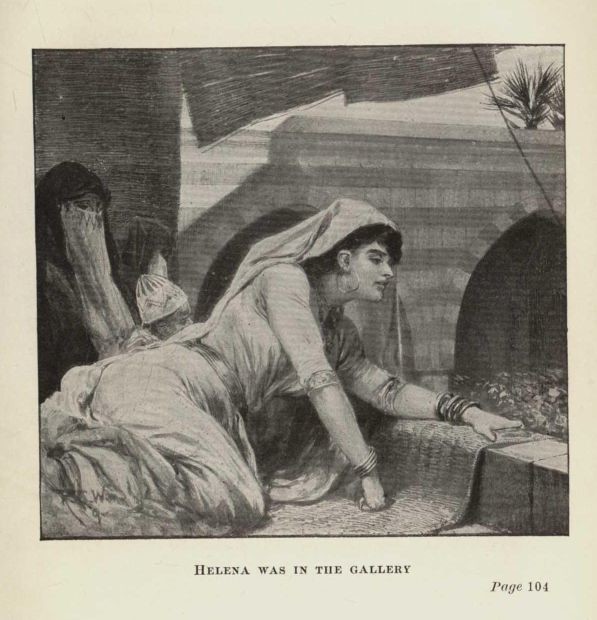
Helena was in the gallery
The Reader, in the middle of the mosque, was chanting the Koran, the muezzin in the minaret was calling to prayers, the men on the floor were uttering their many-throated responses, and the very walls of the mosque itself seemed to be vibrating with religious fervour.
A moment after Helena had taken her seat Ishmael entered, followed by Gordon, and the people gathered round them to kiss their hands and garments. Helena felt her head reel, she wanted to cry out, and it was with difficulty she controlled herself.
Then the Reader stood up in his desk and recited an invocation, and the people repeated it after him.
"God is Most Great!"
"God is Most Great!"
"There is no god but God! ...
"Mohammed is His Prophet! ...
"Listen to the preacher! ...
"Amen!"
"Amen!"
After that Ishmael rose from his knees before the Kibleh, took the wooden sword at the foot of the pulpit, ascended to the topmost step, and, after a preliminary prayer, began to preach.
Never had Helena seen him so eager and excited, and every passage of his sermon seemed to increase both his own ecstasy and the emotion of his hearers.
Helena hardly heard his words, so far away were her thoughts and so steadfastly were her eyes fixed on the other figure in front of the Kibleh, but a general sense of their import was beating on her brain as on a drum.
All religions began in poverty and ended in corruption.
It had been so with Islam, which began with the breaking of idols and went on to the worship of wealth, the quest of power, the lust of conquest—Caliphs seeking to establish their claim not by election and the choice of God but by theft and murder.
It had been so with Christianity, which began in meekness and humility and went on to pride and persecution—Holy Fathers exchanging their cells for palaces and their poverty for pomp, forgetting the principle of their great Master, whose only place in their midst was in pictured windows, on vaporous clouds, blessing with outstretched arms a Church which favoured everything he fought against and a world which practised everything he condemned.
"What is the result, O my brothers? War, wealth, luxury, sensuality, slavery, robbery, injustice, and oppression!
"Listen to the word of the Holy Koran: 'And Pharaoh made proclamation among his people, saying, Is not this Kingdom of Egypt mine and the rivers thereof?'
"But not in Egypt only, nor alone under the Government of the King who lives across the seas, but all the world over, wheresoever human empires are founded, wheresoever men claim the earth and the fruits of the earth and the treasures that lie in the bowels of the earth—impoverishing the children of men to obtain them, or destroying their souls that they may deck and delight their bodies—there the Pharaohs of this world are saying, 'Is not this Kingdom of Egypt mine and the rivers thereof?'
"But the earth and the fruits of the earth and the treasures of the earth are God's, my brothers, and He is coming to reclaim them, and to right the wrongs of the oppressed, to raise up the downtrodden, and to comfort the broken-hearted."
The mosque seemed to rock with the shouts which followed these words, and as soon as the cries of the people had subsided, the voice of Ishmael, now louder and more tremulous than before, rang through its vaults again.
"Deep in the heart of man, my brothers, is the expectation of a day when the Almighty will send His Messenger to purify and pacify the world and to banish intolerance and wrong. The Jews look for the Messiah, the Christians for the divine man of Judæa, and we that are Moslems for the Mahdi and the Christ.
"In all climes and ages, amid all sorrows and sufferings, sunk in the depths of ignorance, sold into slavery, the poorest of the poor, the most miserable among the most miserable of the world, humanity has yet cherished that great expectation. Real as life, real as death, real as wells of water in a desert land to man on his earthly pilgrimage is the hope of a Deliverer from oppression and injustice—and who shall say it is vain and false? It is true, my brothers, true as the sky rolling overhead. Our Deliverer is coming! He is coming soon! He is coming now!"
Ishmael's tremulous voice had by this time broken into hysterical sobs, and the responses of his hearers had risen to delirious cries.
More of the same kind followed which Helena did not hear, but suddenly she was awakened to full consciousness of what was going on about her by hearing Ishmael speak of Gordon and the people answering him with rapturous shouts.
"He is not of our race, yet no doubt enters into our hearts of his fidelity."
"El Hamdullillah!"
"He is not of our faith, yet he will be true to God and His people."
"Allah! Allah!"
"For us he has left his home, his country, and his kindred."
"Allah! Allah! Allah!"
"For us he is going into the place of danger."
"Allah! Allah! Allah!"
"What says the Lord in the Holy Koran?—'They therefore who had left their country and suffered for My sake I will surely bring them into gardens watered by rivers—a reward of God.'"
"Allah! Allah! Allah!"
"The Lord bless the white man to whom the black man is a brother! Bless him in the morning splendour! Bless him in the still of night! Bless him with children—the eye of the heart of man! Bless him with the love of woman—the joy and the crown of life!"
"Allah! Allah! Allah!"
"And may the Lord of majesty and might who has hitherto covered his head in battle protect and preserve him now!"
At this last word the whole company of men on the floor below—men in silks and men in rags—rose to their feet, as if they had been one being animated by one heart, and raising their arms to heaven, cried—
"Allah! Allah! Allah! Allah!"
Helena felt as if some one had taken her by the throat. To see these poor, emotional Eastern children, with their brown and black faces, streaming with tears and full of love for Gordon, shouting down God's blessing upon him, was stifling her.
It was like singing his dirge before he was dead.
During the next few minutes Helena was vaguely aware that Ishmael had come down from the pulpit; that the Reader was reciting prayers again; that the men on the crimson carpets were bowing, kneeling, prostrating themselves and putting their foreheads to the floor; and finally that the whole congregation was rising and surging out of the mosque.
When she came to herself once more, somebody by her side—it was Zenoba—was touching her shoulder and saying—
"The Master is in the Courtyard and he is calling for you—come!"
The scene outside was even more tumultuous. Instead of the steady solemnity of the service within the mosque there were the tum-tumming of the drums, the screeling of the pipes, and the lu-luing of the women.
The great enclosure was densely crowded, but a space had been cleared in the centre of the courtyard, where the Ulema of Khartoum, in their grey farageeyahs, were ranged in a wide half-circle. In the mouth of this half-circle Gordon was standing in his Bedouin dress with Ishmael by his side.
Silence was called, and then Ishmael gave Gordon his last instructions and spoke his last words of farewell.
"Tell our brothers, the Ulema of Cairo," he said, "that we are following close behind you, and when the time comes to enter the city we shall be lying somewhere outside their walls. Let them therefore put a light on their topmost height—on the minaret of the mosque of Mohammed Ali—after the call to prayers at midnight—and we shall take that as a sign that the Light of the World is with you, that the Expected One has appeared, and that we may enter in peace, injuring no man, being injured by none, without malice towards any, and with charity to all."
Then seeing Helena as she came out of the mosque, veiled and with her head down, he called on her to come forward.
"Now do as you have always designed and intended," he said. "Cover our friend and forerunner with the kufiah you have made for him, that until his work is done and the time has come to reveal himself, he may, like the angel of the Lord, be invisible to his foes."
What happened after that Helena never quite knew—only that a way had been made for her through the throng of wild-eyed people and that she was standing by Gordon's side.
Down to that instant she had intended to bear herself bravely for Gordon's sake if not for her own, but now a hundred cruel memories came in a flood to sap away her strength—memories of the beautiful moments of their love, of the little passages of their life together that had been so tender and so sweet. In vain she tried to recover the spirit with which he had inspired her in the morning, to think how much better it was that he should die gloriously than live in disgrace, to feel the justice, the necessity, the inevitableness of what he was going to do.
It was impossible. She could think of nothing but that she was seeing Gordon for the last time, that he was leaving her behind him, among these Allah-intoxicated Arabs, that he was going away, not into battle—with its chance of victory and its hope of life—but to death, certain death, perhaps shameful death, and that, say what he would about Fate and Destiny or the will of God, she herself was sending him to his doom.
She felt that the tears were running down her cheeks under her thin white veil, and that Gordon must see them, but she could not keep them back; and though she had promised not to break down, she knew that at that last moment, in the face of the death that was about to separate them, the dauntless heroine of the morning was nothing better than a poor, weak, heart-broken woman.
Meantime the drums and the pipes and the lu-luing had begun again, and she was conscious that under the semi-savage din Gordon was speaking to her and comforting her.
"Keep up! Be brave! Nobody knows what may happen. I'll write. You shall hear from me again."
He had taken off the white kufiah which he had hitherto worn, and she could see his face. It was calm—the calmest face in all that vast assembly.
The sight of his face strengthened her, and suddenly a new element entered into the half-barbaric scene—an element that was half human and half divine. These poor, half-civilised people thought Gordon was going to risk his life for them; but he was going to die—deliberately to die for them—to save them from themselves, from the consequences of their fanaticism, the panic of their rulers, and the fruits of the age-long hatred that had separated the black man from the white.
Helena felt her bosom heave, her nerves twitch, her fingers dig trenches in her palms, and her thoughts fly up to scenes of sacrifice which men talk of with bated breath.
"If he can do it, why can't I?" she asked herself, and taking the red kufiah, which the Arab woman was thrusting into her hands, with a great effort she put it on Gordon—over his head and under his chin and across his shoulders and about his waist.
It was like clothing him for the grave.
Every eye had been on her, and when her work was done, Ishmael, who was now weeping audibly, demanded silence and called on the Ulema to recite the first Surah—
"Praise be to God, the Lord of all creatures——"
When the weird chanting had come to an end the hoarse voices of the people broke afresh into loud shouts of "Allah! Allah! El Hamdullillah!"
In the midst of the wild maëlstrom of religious frenzy which followed—the tum-tumming of the drums, the screeling of the pipes, and the ululation of the women—Helena felt her hand grasped, and heard Gordon speaking to her again.
"Don't faint! Don't be afraid! Don't break down at the last moment."
"I'm not afraid," she answered, but whether with her voice or only with her lips she never knew.
Still the drums, the pipes, the zaghareet, and the delirious cries of "Allah!" And to show Gordon that she felt no fear, that she was not going to faint or to break down, Helena also, in the fierce tension of the moment, cried—
"Allah! El Hamdullillah!"
"That's right! That's brave! God bless you!" whispered the voice by her side. And again a moment later—
"God bless and protect you!"
After that she heard no more. She saw the broad gate of the Courtyard thrown open—she saw a long streak of blood-red sand outside—she saw Gordon turn away from her—she saw Ishmael embrace and kiss him—she saw the surging mass of hot and streaming black and brown faces close about him—and then a loud wind seemed to roar in her ears, the earth seemed to give way under her feet, the brazen sky seemed to reel about her head, and again she felt as if she were falling, falling, falling into a bottomless abyss.
When she recovered consciousness the half-barbaric scene was over, and she was being carried into the silence of her own room in the arms of Ishmael, who with many words of tender endearment was laying her gently on her bed.
CHAPTER XXVII
That day, under the two crackling flags, the Crescent and the Union Jack, Lady Mannering had given a party in the garden of the Palace of the Sirdar.
The physiognomy of the garden had changed since "the martyr of the Soudan" walked in it. Where scraggy mimosa bushes and long camel grasses had spurted up through patches of sand and blotches of baking earth there were the pleasant lawns, the sycamores, the date-trees, and the blue streams of running water. And where the solitary soldier, with his daily whitening head, had paced to and fro, his face to the ground, smoking innumerable cigarettes, there were a little group of officers of the military administration, with their charming wives and daughters, a Coptic priest, a Greek priest, a genial old Protestant clergyman, and a number of European visitors, chiefly English girls, wearing the lightest of white summer costumes, and laughing and chattering like birds.
In pith helmets and straw hats, Lady Mannering's guests strolled about in the sunshine or drank tea at tables that were set under the cool shadow of spreading trees, while, at a little distance, the band of a black regiment, the Tenth Soudanese (sons and grandsons of the very men who in the grey dawn of a memorable morning had rushed in a wild horde into those very grounds for their orgy of British blood), played selections from the latest comic operas of London and New York.
The talk was the same all over the gardens—of the new Mahdi and his doings.
"Married to an Indian Princess, you say!"
"Oh yes! Quite an emancipated person, too! A sort of thirty-second cousin of the Rani of Jhansi. It seems she was educated by an English governess, kicked over the traces, became a sort of semi-religious suffragette, and followed her holy man to Egypt and the Soudan."
"How very droll! It is too amusing!"
The Sirdar, who had gone indoors some time before, returned to the garden dressed for a journey.
"Going away, your Excellency?"
"Yes, for a few weeks—to the lower Nile."
His ruddy, good-natured face was less bright than usual, and his manner was noticeably less buoyant. A few of his principal officials gathered about him, and he questioned them one by one.
"Any fresh news, Colonel?" he said, addressing the Governor of the city.
"No, sir. A sort of sing-song to-day in honour of the Bedouin Sheikh—that's all I hear about."
But the Financial Secretary spoke of further difficulties in the gathering of taxes—the land tax, the animal tax, and the tax on the date-trees not having yet come in—and then the Inspector-General repeated an opinion he had previously expressed, that everything gave evidence of a projected pilgrimage, presumably in a northerly direction and almost certainly to Cairo.
The Governor of the city corroborated this, and added that his Zabit, his police officer, had said that Ishmael Ameer, on passing to the mosque that day, had been saluted in the streets by a screaming multitude as the "Messenger" and the "Anointed One."
"It's just as I say," said the Inspector-General. "These holy men develop by degrees. This one will hoist his flag as soon as he finds himself strong enough—unless we stop him before he goes further—and the Soudan is lost to civilisation."
"Well, we'll see what Nuneham says," said the Sirdar, and at that moment his Secretary came to say that the launch was ready at the boat-landing to take him across the river to the train.
The Sirdar said good-bye to his guests, to his officers, and to his wife, and as he left the garden of the palace the Soudanese band, sons of the Mahdi's men, played the number which goes to the words—
"They never proceed to follow that light,
But always follow me."
Half-an-hour afterwards, while the Sirdar's black body-guard were ranged up on the platform of the railway station, and his black servant was packing his luggage into his compartment, the Governor-General was standing by the door of the carriage, with his Aide-de-camp, giving his last instructions to his General Secretary.
"Telegraph to the Consul-General and say ... but please make a note of it."
"Yes, sir," said the Secretary, taking out his pocketbook and preparing to write.
"Think it best to go down myself to deal personally with matter of suspected mutiny in native army. Must admit increasing gravity of situation. Man here is undoubtedly acquiring name and influence of Mahdi, so time has come to consider carefully what we ought to do. Signs of intended pilgrimage, probably in northerly direction, enormous numbers of camels, horses, and donkeys having been gathered up from various parts of country and immense quantities of food-stuffs being bought for desert journey. Am leaving to-night, and hope to arrive in four days."
"Four days," repeated the Secretary, as he came to an end.
At that moment a tall man in the costume of a Bedouin walked slowly up the platform. His head and most of his face were closely covered by the loose woollen shawl which the sons of the desert wear, leaving only his eyes, his nose, and part of his mouth visible. As he passed the Sirdar, he looked sharply at him; then, pushing forward with long strides until he came to the third-class compartments, he stepped into the first of them, which was full of coloured people, strident with high-pitched voices and pungent with Eastern odours.
"Who was that?" asked the Sirdar.
"I don't know, sir," replied the Secretary. "I thought at first it was their Bedouin Sheikh, but I see I was mistaken."
Then came the whistle of the locomotive, and its slow, rhythmic, volcanic throb. The guard saluted, and the Sirdar got into his carriage.
"Well, good-bye, Graham! Don't forget the telegram."
"I'll send it at once.... In cypher, sir?"
"In cypher certainly."
At the next moment the Sirdar and Gordon Lord, travelling in the same train, were on their way to Cairo.
END OF THIRD BOOK
FOURTH BOOK
THE COMING DAY
CHAPTER I
The Consul-General had taken a firm grasp of affairs. Every morning his Advisers and Under-Secretaries visited him, and it seemed as if they could not come too often or say too much. He who rules the machine of State becomes himself a machine, and it looked as if Lord Nuneham were ceasing to be a man.
Within a week after the day on which he received Helena's letter, he was sitting in his bleak library walled with Blue-Books, with the Minister of the Interior and the Adviser to the same department. The Minister was the sallow-faced Egyptian Pasha whom he had made Regent on the departure of the Khedive; the Adviser was a tall, young Englishman with bright red hair on which the red tarboosh sat strangely. They were discussing the "special weapon" which had been designed to meet special needs. The Consul-General's part of the discussion was to expound, the Adviser's was to applaud, the Minister's was to acquiesce.
The special weapon was a decree. It was to be known as the Law of Public Security, and it was intended to empower the authorities to establish a Special Tribunal to deal with all crimes, offences, and conspiracies committed or conceived by natives against the State. The Tribunal was to be set up at any time and at any place on the request of the Agent and Consul-General of Great Britain; its sentences, which were to be pronounced forthwith, were not to be subject to appeal; and it was to inflict such penalties as it might consider necessary, including the death penalty, without being bound by the provisions of the penal code.
"Drastic!" said the Pasha, with a sinister smile.
"Necessary," said the Consul-General, with a frown.
The Pasha became silent again while the virtual ruler of Egypt went on to say that the state of the country demanded that the Government should be armed with special powers to meet widespread fanaticism and secret conspiracy.
"No one deplores more than I do," he said, "that the existing law of the land is not sufficient to deal with the new perils by which we are threatened, but it is not, and therefore we must make it stronger."
"Certainly, my lord," said the red-headed figure in the fez, and again the sinister face of the Pasha smiled.
"And now tell me, Pasha," said the Consul-General, "how long a time will it take to pass this law through the Legislative Council and the Council of Ministers?"
The Pasha looked up out of his small, shrewd eyes, and answered—
"Just as long or as short as your lordship desires."
And then the Consul-General, who was wiping his spectacles, put them deliberately on to his nose, looked deliberately into the Pasha's face, and deliberately replied—
"Then let it be done without a day's delay, your Excellency."
A few minutes afterwards, without too much ceremony, the Consul-General had dismissed his visitors and was tearing open a number of English newspapers which Ibrahim had brought into the room.
The first of them, The Times, contained a report of the Mansion House Dinner, headed "UNREST IN THE EAST. Important Speech by Foreign Minister."
The Consul-General found the beginning full of platitudes. Egypt had become the great gate between the Eastern and Western hemispheres. It was essential for the industry and enterprise of mankind that that gate should be kept open, and therefore it was necessary that Egypt should be under a peaceful, orderly, and legal Government.
Then, lowering the lights, the Minister had begun to speak to slow music. While it was the duty of Government to preserve order, it was also the duty of a Christian nation in occupation of a foreign country to govern it in the interests of the inhabitants, and, speaking for himself, he thought the executive authority would be strengthened, not weakened, by associating the people with the work of government. However this might be, the public could at least be sure that as long as the present Ministry remained in power it would countenance no policy on the part of its representatives that would outrage the moral, social, and, above all, religious sentiments of a Moslem people.
The Consul-General flung down the paper in disgust.
"Fossils of Whitehall! Dunces of Downing Street!"
For some minutes he tramped about the room, telling himself again that he didn't care a straw what any Government and any Foreign Minister might say because he had a power stronger than either at his back—the public.
This composed his irritated nerves, and presently he took up the other newspapers. Then came a shock. Without an exception the journals accepted the Minister's speech as a remonstrance addressed to him, and reading it so they sympathised with it.
One of them saw that Lord Nuneham, however pure and beneficent his intentions might be, had no right to force his ideals upon an alien race. Another hinted that he was destroying England's prestige in her Mohammedan dominions, and, if permitted to go on, he would not only endanger the peace of Egypt, but also the safety of our Indian Empire. And a third, advocating the establishment of representative institutions, said that the recent arbitrary action of the Consul-General showed in glaringly dangerous colours the faults of the One-Man Rule which we granted to the King's representative while we denied it to the King himself.
The great Proconsul was, for some moments, utterly shaken—the sheet-anchor of his public life was gone. But within half-an-hour he had called for his First Secretary and was dictating a letter to the Premier, who was also the Minister of Foreign Affairs.
"Having read the report of your lordship's speech at the Mansion House," he said, "I find myself compelled to tell you that so great a difference between your lordship's views and mine makes it difficult for me to remain in Egypt.
"I take the view that nine-tenths of these people are still in swaddling-clothes, and that any attempt to associate them with the work of government would do a grave injustice to the inarticulate masses for whom we rule the country.
"I also take the view that Egypt is honeycombed with agitators, who, masquerading as religious reformers, are sowing sedition against British rule, and that the only way to deal with such extremists is by stern repression.
"Taking these views and finding them at variance with those of your lordship, I respectfully beg to tender my resignation of the post of H.M.'s Agent, Consul-General and Minister Plenipotentiary, which I have held through so many long and laborious years, and at the same time to express the hope that my successor may be a man qualified by knowledge and experience of the East to deal with these millions of Orientals who, accustomed for seventy centuries to the dictation of imperial autocrats, are so easily inflamed by fanatics and yield so readily to the wily arts of spies and secret conspirators."
Having finished the dictating of his letter, the Consul-General asked when the next mail left for England, whereupon the Secretary, whose voice was now as tremulous as his hand had been, replied that there would be no direct post for nearly a week.
"That will do. Copy out the letter and let me have it to sign."
With a frightened look the Secretary turned to go.
"Wait! Of course you will observe absolute secrecy about the contents of it?"
With a tremulous promise to do so the Secretary left the room.
Then the Consul-General took up a calendar that had been standing on his desk and began to count the days.
"Five—ten—fifteen, and five days more before I can receive a reply—it's enough," he thought.
England's eyes would be opened by that time and the public would see how much the Government knew about Egypt. Accept his resignation? They dare not! It would do them good, though—serve as a rebuke, and strengthen his own hands for the work he had now to do.
What was that work? To destroy the man who had robbed him of his son.
CHAPTER II
Early the next morning the Consul-General received a letter from the Princess Nazimah, saying she had something to communicate, and proposed to come to tea with him. At five o'clock she came, attended by sais, footmen, and even eunuch, but wearing the latest of Paris hats and the lightest of chiffon veils.
Tea was laid on the shady verandah overlooking the fresh verdure of the garden, with its wall of purple bougainvillea, and thinking to set the lady at ease the Consul-General had told Fatimah, instead of Ibrahim, to serve it. But hardly had they sat down when the Princess said in French—
"Send that woman away. I don't trust women. I'm a woman myself, and I know too much of them."
A few minutes afterwards she said, "Now you can give me a cigarette. Light it. That will do. Thank you!" Then squaring her plump person in a large cane chair, she prepared to speak, while the Consul-General, who was in his most silent mood, composed himself to listen.
"I suppose you were surprised when this woman who blossomed out of a harem wrote to say that she was coming to take tea with you? Here she is, though, and now she has something to say to you."
Then puff, puff, puff from the scarlet lips, while the powdered face grew hard, and the eyes, heavily shaded with kohl, looked steadfastly forward.
"I have always suspected it, but I discovered it for certain only yesterday. And where did I discover it? In my own salon!"
"What did you discover in your own salon, Princess?" asked the Consul-General in his tired voice.
"Conspiracy!"
Trained as was the Consul-General's face to self-command it betrayed surprise and alarm.
"Yes, conspiracy against you and against England."
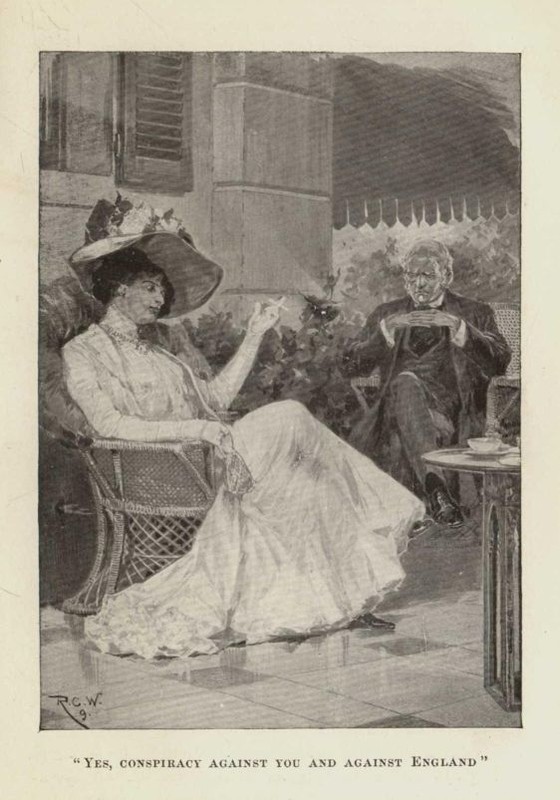
"Yes, conspiracy against you and against England"
"You mean, perhaps, that the man Ishmael Ameer——"
"Rubbish! Ishmael indeed! He is in it, certainly. In a country like Egypt the holy man always is. Religion and politics are twins here—Siamese twins, you may say, for you couldn't get a slip of paper between them.... What's that? The Mahdist movement political? Perhaps it was, but politics on the top of religion—the monkey on the donkey's back, you know. Always so in the East. The only way to move the masses is to make an appeal to their religious passions. They know that, and they've not scrupled to use their knowledge, the rascals! Rascals, that's what I call them. Excuse the word. I say what I think, Nuneham."
"They? Who are they, Princess?"
"The corps diplomatique."
Again the stern face expressed surprise.
"Yes, the corps dip-lo-ma-tique!" with a dig on every syllable. "Half-a-dozen of them were at my house yesterday and they were not ashamed to let me know what they are doing."
"And what are they doing, Princess?"
"Helping the people to rebel!"
Then throwing away her cigarette the Princess rose to her feet, and pacing to and fro on the verandah, with a firm tread that had little of the East and not much of the woman, she repeated the story she had heard in her salon—how Ishmael Ameer was to return to Cairo, with twenty, thirty, forty thousand of his followers, and some fantastic dream of establishing a human society that should be greater, nobler, wider, and more God-like than any that had yet dwelt on this planet; how the diplomats laughed at the ridiculous hallucination, but were nevertheless preparing to support it in order to harass the Government and dishonour England.
"But how?"
"By finding arms for the people to fight with if you attempt to keep their Prophet out! Ask your Inspectors! Ask your police! See if rifles bought with foreign money are not coming into Cairo every day."
By this time it was the Consul-General who was pacing up and down the verandah, while the Princess, who sat to smoke another cigarette, repeated the opinions of the foreign representatives one by one—Count This, who was old and should know better if white hairs brought wisdom; Baron That, who was as long as a palm tree but without a date; and the Marquis of So-and-So.
"They tell me because I'm a Turk; but a Turk need not be a traitor, so I'm telling you."
The iron face of the Consul-General grew white and rigid, but, saying nothing, he continued to pace to and fro.
"Why don't you turn them all out? They are making nothing but mischief. The head of the idle man is the house of the devil, and the best way is to pull it down. Why not? Capitulations! Pooh! While the meat hangs above, the dogs will quarrel below. Dogs, that's what I call them. Excuse the word. I speak what I think."
"And the Egyptians—what are they doing?"
"What are they always doing? Conspiring with your enemies to turn you out of the country on the ground that you are trampling on their religious liberty."
"Which of them?"
"All of them—pashas, people, effendis, officials, your own Ministers—everybody."
"Everybody?"
"Everybody! The stupids! They can't see farther than the ends of their noses, or realise that they would only be exchanging one master for fourteen. What would Egypt be then? A menagerie with all the gates of the cages open. Oh, I know! I say what I think! I'm their Princess, but they can take my rank to-morrow if they wish to."
The second cigarette was thrown away, and a powder-puff and small mirror were taken from a silver bag that hung from the lady's wrist.
"But serve you right, you English! You make the same mistake everywhere. Education! Civilisation! Judicial reform! Rubbish! The Koran tells the Moslem what to believe and what to do, so what does he want with your progress?"
The powder-puff made dabs at the white cheeks, but the lady continued to talk.
"Your Western institutions are thrown away on him. It's like a beautiful wife married to a blind husband—a waste!"
The sun began to set behind the wall of purple creeper and the lady rose to go.
"No news of your Gourdan yet? No? He was the best of the bunch, and I simply lost my heart to him. You should have kept him more in hand though.... You couldn't? You, the greatest man in.... Well, there's something to say for the Eastern way of bringing up boys, it seems."
Passing through the drawing-room the Princess came upon the portrait of Helena, which used to stand by Lady Nuneham's bed.
"Ah, the moon! The beauty! Bismillah! What did Allah give her such big black eyes for? Back in England, isn't she? My goodness, there was red blood in that girl's veins, Nuneham! God have mercy upon me, yes! You should have heard her talk of your Ishmael!"
The Princess put the portrait to her lips and kissed it, then closed her eyes and said with a voluptuous laugh—
"Ah, mon Dieu, if this had only been a Muslemah, you wouldn't have had much trouble with your Mahdi!"
Hardly had the Consul-General returned to his library after the departure of the Princess when his Secretary brought him a telegram from the Sirdar—the same that he had dictated at Khartoum, telling of the intended visit to Cairo, of the preparations for Ishmael's projected pilgrimage, and of the danger that was likely to arise from the growing belief in the Prophet's "divine" inspiration.
"So our friend is beginning to understand the man at last," he said, with an expression of bitter joy. "Meet him on his arrival. Tell him I have much to say."
That night when the Consul-General went up to his bedroom—the room in which alone the machine became the man—he was thinking, as usual, of Gordon.
"Such power, such fire, such insight, such resource! My own son too, and worth all the weaklings put together! Oh, that he could be here now—now, when every hand seems to be raised against his father! But where is he? What is he doing? Only God can say."
Then the Consul-General remembered what the Princess had said about Helena. Ah, if those two could have carried on his line—what a race! So pure, so clean, so strong! But that was past praying for now, and woe to the day when they had said to him, "A man child is born to you."
After that the Consul-General thought of Ishmael, and then the bitterness of his soul almost banished sleep. He had known from the first that the man could not be working alone; he had known, too, that some of England's "allies" were her secret enemies, but a combination of Eastern mummery with Western treachery was more than he had reckoned upon.
"No matter! I'll master both of them!" he thought.
A great historical tragedy should be played before the startled audience of disunited Europe, whose international jealousies were conspiring with religious quackeries to make the government of Egypt impossible, and when the curtain fell on that drama England would be triumphant, he would himself be vindicated, and the "fossils of Whitehall" would be ashamed.
Last of all he thought of the Egyptian Ministers. These were the ingrates he had made and worked with, but they were no fools, and it was difficult to understand why they were throwing in their lot with a visionary mummer who was looking for a millennium.
"I am at a loss to know what to think of a world in which such empty quackery can be supported by sane people," he thought.
There was one sweeter thought left, though, and as the Consul-General dropped off to sleep he told himself that, thanks to Helena, he would soon have Ishmael in his hands, and then he would kill him as he would kill a dangerous and demented dog.
CHAPTER III
During the next few days the Consul-General was closely occupied. The Law of Public Security being promulgated, he called upon the Minister of the Interior to call upon the Commandant of Police to issue a warrant for the arrest of Ishmael Ameer.
"But where is Ishmael Ameer?" asked the Minister.
When this was reported to the Consul-General his stern face smiled, and he said—
"Let him wait and see."
Early one morning his Secretary came to his room to say that the Sirdar had arrived from Khartoum, and had gone on to headquarters, but would give himself the pleasure of calling upon his lordship before long.
"Tell him it must be soon—there is much to do," said the Consul-General.
Later the same day the Commandant of Police came, with a knowing smile on his ruddy face, to say that the Bedouin had reached Cairo, and that he had been followed to the Serai Fum el Khalig, the palace of the Chancellor of El Azhar, where he had already been visited by the Grand Mufti, some of the Ministers, certain of the Diplomatic Corps and nearly the whole of the Ulema.
"Was he alone?" asked the Consul-General.
"Quite alone, your lordship, and now he is as safely in our hands as if he were already under lock and key."
"Good! What did you say his address was?"
"Serai Fum el Khalig."
"Palace Fum el Khalig," repeated the Consul-General, making a note on a marble tablet which stood on his desk.
Later still, very late, the Grand Cadi came with the same news. The suave old Moslem judge was visibly excited. His pale, lymphatic, pock-marked cheeks, his earth-coloured lips, his base eyes, and his nose as sharp as a beak, gave him more than ever the appearance of a fierce and sagacious bird of prey. After exaggerated bows, he began to speak in the oily, half-smothered voice of one who lives in constant fear of being overheard.
"Your Excellency will remember that when on former occasions I have had the inestimable privilege of approaching your honourable person in order to warn you that if you did not put down a certain Arab innovator the result would be death to the rule of England in Egypt, your Excellency has demanded proofs."
"Well?"
"I am now in a position to provide them."
"State the case precisely," said the Consul-General.
"Your Excellency will be interested to hear that a person of some consequence has arrived in Cairo."
Trained to self-control, the Consul-General conquered an impulse to say, "I know," and merely said, "Who is he?"
"He calls himself Sheikh Omar Benani, and is understood to be the wise and wealthy head of the great tribe of the Ababdah Bedouins who inhabit the country that lies east of Assouan to the Red Sea."
"Well?"
"The man who calls himself Omar Benani is—Ishmael Ameer."
At that the base eyes glanced up with a look of triumph, but the Consul-General's face remained immovable.
"Well?"
"No doubt your Excellency is asking yourself why he comes in this disguise, and if your Excellency will deign to give me your attention I will tell you."
"I am listening."
"Ishmael Ameer pretends to be a reformer intent upon the moral and intellectual regeneration of Islam, and he preaches the coming of a golden age in which unity, peace and brotherhood are to reign throughout the earth.
"Well?"
"With this ridiculous and impracticable propaganda he has appealed to many wild and ardent minds, so that a vast following of half-civilised people whom he has gathered up in the Soudan are to start soon—may have started already—for this city, which they believe to be the Mecca of the new world."
"Well?"
"Ishmael Ameer pretends to have come to Cairo in advance of his followers to prepare for that millennium."
"And what has he really come for?"
"To establish a political State."
Down to that moment the Consul-General had been leaning back in his chair in the attitude of one who was listening to something he already knew, but now he sat up sharply.
"Is this a fact?"
"It is a fact, your Excellency. And if your Excellency will once more deign to grant me your attention, I will put you in possession of a secret."
"Go on," said the Consul-General.
Instinctively the suave old judge drew his legs up on his chair and fingered his amber beads.
"Your Excellency will perhaps remember that owing to differences of opinion with the Khedive—may Allah bless him!—you were compelled to require that for a while he should leave the country."
"Well?"
"He went to Constantinople with the intention of laying his grievances against England before His Serenity the Sultan—may the Merciful give him long life!"
"Well?"
"The Sultan is a friend of England, your Excellency—the Khedive was turned away."
"And then?"
"Then he went to Paris, as your Excellency is probably aware."
"Well?"
"Perhaps your Excellency supposes that he occupied himself with the frivolities of the gay capital of France—dinners, theatres, dances, races? But no! He had two enemies now, England and Turkey, and he presumed to think he could punish both."
"How? In what way?"
"By founding a secret society for the conquest of Syria, Palestine and Arabia, and the establishment of a great Arab Empire with himself as its Caliph and Cairo as its capital."
"Well? What happened?"
"Need I say what happened, your Excellency? By means of his great wealth he was able to send out hundreds of paid emissaries to every part of the Arabic world, and Ishmael Ameer was the first of them."
The Consul-General was at length startled out of all his composure.
"Can you prove this?" he said.
"Your Excellency, if I say anything I can always prove it."
The Consul-General's brow grew more and more severe.
"And his name—his assumed name—what did you say it was?"
"Sheikh Omar Benani."
"Sheikh Omar Benani," repeated the Consul-General, making another note on his marble tablet.
"That is enough for the present," he said. "I have something to do to-night. I must ask your Eminence to excuse me."
After the Grand Cadi had gone, with many sweeping salaams, various oily compliments, and that cruel gleam in his base eyes which proceeds only from base souls, the Consul-General rang sharply for his Secretary.
"We have not yet made out our invitations for the King's dinner—let us do so now," he said.
He threw a sheet of paper across the table to his Secretary, who prepared to make notes.
"First, the Diplomatic Corps—every one of them."
"Yes, my lord."
"Next, our Egyptian Ministers and the leading members of the Legislative Council."
"Yes, my lord."
"Next, the more prominent Pashas and Notables."
"Yes!"
"Of course our own people as usual, and finally——"
"Yes?"
"Finally, the Ulema of El Azhar."
The Secretary looked up in astonishment.
"Oh, I know," said the Consul-General. "They have never been invited before, but this is a special occasion."
"Quite so, my lord."
The Consul-General fixed his eyeglass and took up his marble tablet.
"In writing to the Chancellor of El Azhar at the Palace Fum el Khalig," he said, "enclose a card for the Sheikh Omar Benani."
"Sheikh Omar Benani."
"Say that hearing that one so highly esteemed among his own people is at present on a visit to Cairo, I shall be honoured by his company."
"Yes, my lord."
"That will do. Good-night!"
"Good-night, my lord."
It was early morning before the Consul-General went to bed. The Grand Cadi's story, being so exactly what he wanted to believe, had thrown him entirely off his guard. It appeared to illuminate everything that had looked dark and mysterious—the sudden advent of Ishmael, the growth of his influence, the sending out of his emissaries, his projected pilgrimage, and the gathering up of camels and horses in such enormous quantities as even the Government could not have commanded in time of war.
It accounted for Ishmael's presence in Cairo, and his mission (as described by Helena) of drawing off the allegiance of the Egyptian army. It accounted, too, for the treachery of the Ministers, Pashas and Notables, who were too shrewd and too selfish (whatever the riff-raff of the Soudan might be) to risk their comfortable incomes for a religious chimera.
Yes, the Khedive's money and the substantial prospect of establishing a vast Arab Empire, not the vague hope of a spiritual millennium, had been the power that worked these wonders.
It vexed him to think that his old enemy whom he had banished had been more powerful in exile than at home, and it tortured him to reflect that Ishmael had developed, with the religious malady of the Mahdi, his political mania as well.
But no matter! He would be more than a match for all these forces, and when his great historical drama came to be played before the eyes of astonished humanity, it would be seen that he had saved, not England only but Europe, and perhaps civilisation itself.
Thus, for three triumphant hours, the Consul-General saw himself as a patriot trampling on the enemies of his country; but hardly had he left the library and begun to climb the stairs of his great, empty, echoing house, switching off the lights as he ascended, and leaving darkness behind him, than the statesman sank back on the man—the broken, bereaved human being—and he recognised his motives for what they were.
A few minutes after he had reached his bedroom Fatimah entered it with a jug of hot water, and found him sitting with his head in his hands, looking fixedly at the portrait in the black-and-gilt frame of the little lad in an Arab fez.
"Ah, everybody loved that boy," she said, whereupon the old man raised his head and dismissed her brusquely.
"You ought to be in bed by this time—go at once," he said.
"Dear heart, so ought your lordship," said the Egyptian woman.
The Consul-General could dismiss Fatimah, but there was some one he could not get rid of, the manly, magnificent, heart-breaking young figure that always lived in his mind's eye, with its deadly white face, its trembling lower lip, and its quivering voice, which said, "General, the time may come when it will be even more painful to you to remember all this than it has been to me to bear it."
Where was he now? What was he doing? His son, his only son, all that was left to him!
There was only one way to lay that ghost, and the Consul-General did so by telling himself with a sort of fierce joy that wherever Gordon might be he must soon hear that Ishmael, in a pitiful and tricky disguise, had been discovered in Cairo, and then he would see for himself what an arrant schemer and unscrupulous charlatan was the person for whom he had sacrificed his life.
With that bitter-sweet thought the lonely old man forced back the tears that had been gathering in his eyes and went to bed.
CHAPTER IV
I
"SERAI FUM EL KHALIG,
"CAIRO.
"MY DEAREST HELENA,—Here I am, you see, and I am not arrested, although I travelled in the same train with the Sirdar, met him face to face on the platform at Khartoum, again on the platform at Atbara, again on the landing place at Shelal, and finally in the station at Cairo, where he was received on his arrival by his officers of the Egyptian army, by my father's first Secretary, and by the Commandant of Police.
"I was asking myself what this could mean, whether your black boy had reached his destination, and if your letter had been delivered, when suddenly I became aware that I was being observed, watched and followed to this house, and by that I knew that in this land of mystery my liberty was to be allowed to me a little longer for reasons I have still to fathom.
"This is the home of the Chancellor of El Azhar, and I have delivered Ishmael's letter announcing the change of plan whereby I have come into Cairo instead of him, but I have pledged the good old man to secrecy on that subject, for the present at all events, giving him my confident assurance that in common with the best of the Ulema he is being wickedly deceived and made an innocent instrument for the destruction of his own cause.
"My dear Helena, I was right. My vague suspicions of that damnable intriguer the Grand Cadi were justified. Already I realise that after fruitless efforts to inveigle Ishmael into schemes of anarchical rebellion it was he who conceived the conspiracy, which has taken our friend by storm, in the form of a passive mutiny of the Egyptian army. The accursed scoundrel knows well it cannot be passive, that somewhere and somehow it will break into active resistance, but that is precisely what he desires. As I told you, it is the old trick of Caiaphas over again, and that is the lowest, meanest, dirtiest thing in history.
"Query, is he playing the same game with the Consul-General? I am sure he is, and when I think that England and my father may be in as much danger as Egypt and Ishmael from the man's devilish machinations, I am more than ever certain that Providence had a purpose in bringing me to Cairo, and I feel reconciled to the necessity of living here in this threefold disguise, being one thing to Ishmael, another to the Grand Cadi and Co., and a third to the Government and police. I feel reconciled too, or almost reconciled, to the necessity of leaving you where you are, for the present at all events, although it rips me like a sword-cut as often as I think of it.
"I have sent for Hafiz and expect to hear through him what is happening at the Agency, but I am hoping he will not come until morning, for to-night I can think of nothing but ourselves. When I left you at Khartoum I felt that higher powers were constraining and controlling me, and that I was only yielding at last to an overwhelming sense of fatality. I thought I had made every possible effort, had exhausted every means and had nothing to reproach myself with, but hardly had I got away into the desert when a hand seemed to grasp me at the back of my neck and to say, 'Why did you leave her behind?'
"In Ishmael's house and in that atmosphere of delirious ecstasy in the mosque it was easy to think it necessary for you to remain, otherwise my purpose in going away must from the first be frustrated, but awakening in the morning in my native compartment, with men and boys lying about on sacks, the sandy daylight filtering through the closed shutters of the carriage and the train full of the fetid atmosphere of exhausted sleep, I could not help but protest to myself that at any cost whatever I should have found a way to bring you with me.
"Thank God, if I have left you behind in that trying and false position it is with no Khalifa, no corrupt and concupiscent fanatic, but a man of the finest and purest instincts, who is too much occupied with his spiritual mission, praise the Lord, to think of the beautiful woman by his side, so I tell myself it was the will of Providence, and there is nothing to do now but to leave ourselves in the hands of fate.
"Good-night, dearest! D.V. I'll write again to-morrow."
II
"Have just seen Hafiz. The dear old fellow came racing up here at six o'clock this morning, with his big round face like the aurora borealis, shining in smiles and tears. Heavens, how he laughed and cried and swore and sweated!
"He thought his letter about my mother's death had brought me back, and when I gave him a hint of my real errand he nearly dropped with terror. It seems that among my old colleagues in Cairo my reputation is now of the lowest, being that of a person who was bribed—God knows by whom—to do what I did. As a consequence it will go ill with me, according to Hafiz, if I should be discovered, but as that is pretty certain to happen in any case I am not too much troubled, and find more interest in the fact that your boy Mosie is staying at the Agency and that consequently my father must have received your letter.
"My dear Helena, my 'mystic sense' has been right again. The Grand Cadi continues to pay secret visits to the Consul-General. That much Hafiz could say from his intercourse with his mother, and it is sufficient to tell me that, by keeping a running sore open with my father, the scoundrel counts on destroying not only Ishmael but England, by leading her to such resistance as will result in bloodshed, and thus dishonour her in the eyes of the civilised world and leave Egypt a cockpit in which half the foreign Powers will fight for themselves, no matter who may suffer.
"What should I do? God knows! I have an almost unconquerable impulse to go straight to my father and open his eyes to what is going on. He is enveloped by intrigues and surrounded by enemies in high places—his Egyptian Ministers, the creatures of his own creation; some of the foreign diplomats, the European leeches who suck his blood while they pretend to be his friends, and above all this rascally Cadi, with his sleek face and double-sword game.
"But what can I say? What positive fact can I yet point to? Will my father believe me if I tell him that Ishmael's following which is coming up to Cairo is not, as he thinks, an armed force? That the Grand Cadi & Co. are a pack of lying intriguers, each one playing for his own hand?
"My father is a great man who probably does not need and would certainly resent my compassion, but, Lord God, how I pity him! Alone, in his old age, after all he has done for Egypt! As for his Secretaries and Advisers, he has not brought them up to help him, and I would enlarge the Biblical warning about not putting one's trust in princes to include parvenus as well.
"My dear Helena, where are you now, I wonder? What is happening to you? What occurred after I left Khartoum? These are the questions which during half the day and nearly the whole of the night are hammering, hammering, hammering on my brain. Ishmael was to follow me in a few days, so I suppose you are on the desert by this time. The desert! In the midst of that vast horde! The scourings of a whole continent! Poor old Hafiz had something like a fit when I told him you were not in England but in the Soudan, yet as a fatalist he feels bound to believe that everything will work out for the best and he asks me to send his high regard to you.
"It gives one a strange sensation, and is almost like seeing things from another state of existence, to be here in Cairo walking about unrecognised amid the familiar sights, and hearing the gun fired from the Citadel every day; but the sharpest twinge comes of the hacking thought of where you are and what circumstances surround you. In fact, memory is always playing some devilish trick with me and raking up thoughts of the condition in which I found you in Khartoum.
"Helena, my dear Helena, I have an immense faith in your strength and your courage. You are mine, mine, mine—remember that! I do—I have to—all the time. That is what sets me at ease in my dark hours and gives sleep, as the Arabs say, to my eyelids. For the rest, we must resign ourselves and continue to wait for the direction of fate. The fact that I was not arrested in the character of Ishmael immediately on my arrival in Cairo makes me think Hafiz may be right—that, D.V. one way or another, God knows how, everything is working out for the best. It's damned easy to say that, I know, but, upon my soul, dearest, I believe it. So keep up heart, my poor old girl, and God bless you! GORDON.
"P.S.—I'll hold this letter back until I think you must be nearing Assouan, and then send it D.V. by safe hands to be delivered to you there.
"P.P.S.—I open my envelope to tell you of a new development! I am invited with the Chancellor of El Azhar to the Consul-General's dinner in honour of the King's Birthday. This, in the character of Sheikh Omar Benani, who is, it seems, the chief of the tribe of the Ababdah, inhabiting the wild country between Assouan and the Red Sea, a person with a great reputation for wealth and wisdom, and a man whose word is truth.
"What does it mean? One thing certainly—that acting on the information contained in your letter the authorities are mistaking me for Ishmael Ameer, and proposing some scheme to capture me. But why don't they take me without further ado? What unfathomable reason can there be for the delay in doing so? Intrigue on intrigue! I must wait and see.
"Meantime I am asking myself where the real Ishmael is and what he is doing now? Is the belief in his 'divine' guidance increasing? Is he acquiring the influence of a Mahdi? If so, God help him! God help his people! God help my father! God help everybody!
"But sit tight, my girl! Something good is going to happen to us! I feel it, I know it! All my love to you, Helena! Maa-es-salamah!"
CHAPTER V
I
"KHARTOUM.
"MY DEAR, DEAR GORDON,—Gone! You are actually gone! I can hardly believe it. It must be like this to awaken from chloroform after losing one's right hand, only it must be something out of my heart in this instance, for though I have not shed a tear since you went away and do not intend to shed one, I have a wild sense of weeping in the desolate chambers of my soul.
"Writing to you? Certainly I am. Gordon, do you know what you have done for me? You have given me faith in your 'mystic senses,' and by virtue of certain of my own I am now sure that you are not dead, and that you are not going to die, so I am writing to you out of the chaos that envelops me, having no one here to speak to, literally no one, and being at present indifferent to the mystery of what is to become of my letter.
"It seems I fainted in the mosque after that wild riot of barbaric sounds, and did not come back to full consciousness until next morning, and then I found the Arab woman and the child attending on me in my room. Naturally I thought I might have been delirious and I was in terror lest I had betrayed myself, so I asked what I had been saying in my sleep, whereupon Zenoba protested that I had said nothing at all, but Ayesha, the sweet little darling, said I had been calling upon the great White Pasha (meaning General Gordon) whose picture (his statue) was by the Palace gates. What an escape!
"Of course my first impulse was to run away, but at the next moment I saw that to do so would be to defeat your own scheme in going, and that as surely as it had been your duty to go into Cairo, it was mine to remain in Khartoum. But all the same I felt myself to be a captive—as surely a captive as any white woman who was ever held in the Mahdi's camp—and it did not sweeten my captivity to remember that I had first become a prisoner of my own free will.
"If I am a captive I am under no cruel tyrant, though, and Ishmael's kindness is killing me. I was certainly wrong about him in Cairo, and his character is precisely the reverse of what I expected. Little Ayesha tells me that during the night I lay unconscious her father did not sleep at all, but kept coming into the guest-room every hour to ask for news of me, and now he knocks at my door a dozen times a day, asking if I am better, and saying 'To morrow, please God, you will be well.' It makes me wretched, and brings me dreadfully near to the edge of tears, remembering what I have done to him and how certainty his hopes will be destroyed.
"Naturally his people have taken his cue, and last night Black Zogal gathered up a crowd of half-crazy creatures like himself to say a prayer for me at the Saint's house which is just outside my window.
"'Thou knowest our White Lady, O Father Gabreel, that she is betrothed to our Master, and that his heart is low and his bread is bitter because she is sick. Make her well if it please God, O Father Gabreel!' Thus the simple-hearted children of the desert called down God's spirit to their circle of fire for me, and after loud cries of 'Allah! Allah!' going on for nearly an hour, they seemed to be content, for Zogal said—
"'Abu Gabreel hears, O my brothers, and to-morrow, please God, our sister will be well.'
"I had been reaching up in bed to look and listen, and when all was over I wanted to lay down my head and howl.
"The time has come for the people to start on their pilgrimage, but Ishmael insists upon postponing the journey until I have quite recovered. Meantime Zenoba is trying to make mischief, and to-day when the door of my room was ajar, I heard her hinting to Ishmael that the White Lady was not really ill but only pretending to be—a bit of treachery for which she got no thanks, being as sharply reproved as she was on the morning of your mother's letter.
"That woman makes a wild cat of me. I can't help it—I hate her! Of course I see through her, too. She is in love with Ishmael, and though I ought to pity her pangs of jealousy there are moments when I want to curse her religion and the dawn of the day of her birth and her mother and her grandmother.
"There! You see I have caught the contagion of the country; but I am really a little weak and out of heart to-night, dear, so perhaps I had better say good-night! Good-night, my dearest!"
II
"Oh dear! Oh dear! I could not bear to play the hypocrite any longer, so I got up to-day and told Ishmael I was well, and therefore he must not keep back his pilgrimage any longer. Such joy! Such rejoicing! It would break my heart, if I had any here, but having sent all I possess to Cairo I could do nothing but sit in the guest-room and look on at the last of the people's preparations for the desert journey—tents and beds being packed, and camels and horses and donkeys brought in to a continuous din of braying and grunting and neighing.
"We are to start away to-morrow morning, and this afternoon when that fact was announced to me I was so terrified by the idea of being dragged over the desert like a slave that I asked Ishmael to leave me behind. His face fell, but—would you believe it?—he agreed, saying I was not strong enough to travel and Zenoba should stay to nurse me. At that I speedily repented of my request and asked him to allow me to go, whereupon his face lightened like a child's, and with joy he agreed again, saying the Arab woman should go to take care of me, for Ayesha was a big girl now and needed a nurse no longer. This was jumping out of the frying-pan into the fire, and I protested that I was quite able to look after myself; but, out of his anxiety for my health, Ishmael would not be gainsaid, and the Arab woman said, 'I'll watch over you like my eyes, my sister.' I am sure she will, the vixen!"
III
"We have left Khartoum and are now on the desert. The day had not yet dawned when we were awakened by a tattoo of pipes and native drums—surely the weirdest sound in the darkness that ever fell on mortal ear, creeping into the pores and getting under the very skin. Then came a din, a roar, a clamour—the grunting and gurgling and braying of five thousand animals and as much shouting and bellowing of human tongues as went to the building of the tower of Babel.
"The sun was rising, and there was a golden belt of cloud in the Eastern sky by the time we were ready to go. They had brought a litter on a dromedary for me, and I was almost the last to start. It was hard to part from the child, for though her sweet innocence had given me many a stab and I felt sometimes as if she had been created to torture me, I had grown to love her, and I think she loved me. She stood as we rode away, with a big tear ready to drop on to her golden cheek and looked after me with her gazelle-like eyes. Sweet little Ayesha, creature of the air and the desert, I shall see her no more!
"Crossing the Mahdi's open-air mosque at Omdurman, where we said morning prayers, we set our faces northward over the wild halfa grass and clumps of mimosa scrub, and as soon as we were out in the open desert with its vast sky I saw how gigantic was our caravan. The great mass of men and animals seemed to stretch for miles across the yellow sand, and looked like an enormous tortoise creeping slowly along.
"We camped at sunset in the Wadi Bishara, the signal for the bivouac being the blowing of a great elephant-horn which had a thrilling effect in that lonesome place. But more thrilling still was the effect of evening prayers, which began as soon as the camels and horses and donkeys had been unsaddled, and their gruntings and brayings and gurglings, as well as the various noises of humanity, had ceased.
"The afterglow was flaming along the flat sand, giving its yellow the look of bronze, when all knelt with their faces to the East—Ishmael in front with sixty or seventy rows of men behind him. It was really very moving and stately to see, and made me understand what was meant by somebody who said he could never look upon Mohammedans at prayers, and think of the millions of hearts which at the same hour were sending their great chorus of praise to God, without wishing to be a Moslem. I did not wish to be that, but with the odious Arab woman always watching me, I found myself fingering my rosary and pretending to be a good Muslemah, though in reality I was repeating the Lord's Prayer.
"It is dark night now, the fires at which the people baked their durah and cooked their asida are dying down, and half the camp is already asleep in this huge wild wilderness, under its big white stars.
"I must try to sleep too, so good-night, dearest, and God bless you! I don't know what is to be the end of all this, or where I am to dispatch my letter, or when you are to receive it, but I am sure you are alive and listening to me—and what should I do if I could not talk to you? HELENA."
CHAPTER VI
I
"SOUDAN DESERT (somewhere).
"It is ten days, my dear Gordon, since I wrote my last letter, and there has never been an hour between when I dared pretend to this abomination of Egypt (she is now snoring on the angerib by my side, sweetheart) that I must while away an hour by writing in my 'Journal.'
"Such a time! Boil and bubble, toil and trouble! Every morning before daybreak the wild peal of the elephant-horn, then the whole camp at prayers with the rising sun in our faces, then the striking of tents and the ruckling, roaring, gurgling and grunting of camels which resembles nothing so much as a styful of pigs in extremis; then twelve hours of trudging through a forlorn and lifeless solitude with only a rest for the midday meal; then the elephant-horn again and evening prayers, with the savage sun behind us, and then settling down to sleep in some blank and numb and soundless wilderness—such is our daily story.
"My goodness, Ishmael is a wonderful person! But all the same the 'divine' atmosphere that is gathering about him is positively frightening. I suspect Black Zogal of being the author and 'only begetter' of a good deal of this idolatry. He gallops on a horse in front of us, crying, 'There is no god but God,' and 'The Messenger of God is coming,' with the result that crowds of people are waiting for Ishmael at every village, with their houses swept, their straw mats laid down, and their carpets spread on the divans, all eager to entertain him, to open their secret granaries to feed his followers, or at least to kiss the hem of his caftan.
"Every day our numbers increase, and we go off from the greater towns to the beating of copper war-drums, the blowing of antelope horns, and sometimes to the cracking of rifles. It is all very crude in its half-savage magnificence, but it is almost terrifying, too, and the sight of this emotional creature, so liable to spasms of religious ecstasy, riding on his milk-white camel through these fiercely fanatical people like a god, makes one tremble to think of the time that will surely come when they find out, and he finds out, that after all he is nothing but a man.
"What sights, what scenes! The other day there was a fearful sand-storm, in which a fierce cloud came sweeping out of the horizon, big with flame and wrath, and fell on us like a mountain of hell. As long as it lasted the people lay flat on the sand or crouched under their kneeling camels, and when it was over they rose in the dead blankness with the red sand on their faces and sent up, as with one voice, a cry of lamentation and despair. But Ishmael only smiled and said, 'Let us thank God for this day, O my brothers,' and when the people asked him why, he answered, 'Because we can never know anything so bad again.'
"That simple word set every face shining, and as soon as we reached the next village—Black Zogal as usual having gone before us—lo, we heard a story of how Ishmael had commanded a sand-storm to pass over our heads without touching us—and it had!
"Another day we had stifling heat, in which the glare of the sand made our eyes to ache and the air to burn like the breath of a furnace. The water in the water-bottles became so hot that we dared not pour it on to the back of our hands, and even some of the camels dropped dead under the blazing eye of the sun.
"And when at length the sun sank beneath the horizon and left us in the cool dark night, the people could not sleep for want of water to bathe their swelling eyelids and to moisten their cracking throats, but Ishmael walked through their tents and comforted them, telling them it was never intended that man should always live well and comfortably, yet God, if He willed it, would bring them safely to their journey's end.
"After that the people lay down on the scorching sand as if their thirst had suddenly been quenched; and next day, on coming to the first village, we heard that in the middle of a valley of black and blistered hills, Ishmael smote with his staff a metallic rock that was twisted into the semblance of a knotted snake, and a well of ice-cold water sprung out of it, and everybody drank of it and then 'shook his fist at the sun.'
"Nearly all last week our people were in poor heart by reason of the mirages which mocked and misled them, showing an enchanted land on the margin of the sky, with beautiful blue lakes and rivers and green islands and shady groves of palm, and sweet long emerald grasses that quivered beneath a refreshing breeze; but when, from their monotonous track on the parched and naked desert, the poor souls would go in search of these phantoms, they would find nothing but a great lone land, in the fulness of a still deeper desolation.
"Then they would fling themselves down in despair and ask why they had been brought out into the wilderness to die, but Ishmael, with the same calm smile as before, would tell them that the life of this world was all a mirage, a troubled dream, a dream in a sleep, that the life to come was the awakening, and that he whose dream was most disturbed was nearest the gates of Paradise.
"Result—at the next town we came to, we were told that when we were in the middle of the wilderness Ishmael had made an oasis to spring up around us, with waving trees and rippling water and the air full of the songs of birds, the humming of bees, and the perfume of flowers, and we all fell asleep in it, and when we awoke in the morning we believed we had been in Heaven!
"Good-night, my dear—dear! Oh, to think that all this wilderness divides us! But ma'aleysh! In another hour I shall be asleep, and then—then I shall be in your arms."
II
"Oh my! Oh my! Two incidents have happened to-day, dearest, that can hardly fail of great results. Early in the morning we came upon the new convict settlement, a rough bastioned place built of sun-dried bricks in the middle of the Soudan desert. It contains the hundred and fifty Notables who were imprisoned by the Special Tribunal for assaults on the Army of Occupation when they were defending the house of your friend the Grand Cadi. How Ishmael discovered this I do not know, but what he did was like another manifestation of the 'mystic sense.'
"Stopping the caravan with an unexpected blast of the elephant-horn, he caused ten rows of men to be ranged around the prison, and after silence had been proclaimed, he called on them to say the first Surah: 'Praise be to God, the Lord of all creatures.'
"It had a weird effect in that lonesome place, as of a great monotonous wave breaking on a bar far out at sea, but what followed was still more eerie. After a breathless moment, in which everybody seemed to listen and hold his breath, there came the deadened and muffled sound of the same words repeated by the prisoners within the walls: 'Praise be to God, the Lord of all creatures.'
"When this was over Ishmael cried, 'Peace, brothers! Patience! The day of your deliverance is near! The Redeemer is coming! All your wrongs will be righted, all your bruises will be healed! Peace!'
"And then there came from within the prison walls the muffled answer, 'Peace!'
"The second of the incidents occurred about midday. When crossing a lifeless waste of gloomy volcanic sand, we came upon a desert graveyard, with those rounded hillocks of clay which make one think that the dead beneath must be struggling in their sleep.
"At a word from Ishmael all the men of our company who belong to that country stepped out from the caravan and riding round and round the cemetery, shouted the names of their kindred who were buried there: 'Ali!' 'Abdul!' 'Mohammed!' 'Mahmud!' 'Said!'
"After that Ishmael himself rode forward, and addressing the dead as if they could hear, he cried, 'Peace to you, O people of the graves! Wait! Lie still! The night is passing! The daylight dawns!'
"It was thrilling! Strange, simple, primitive, crude in its faith perhaps, but such love and reverence for the dead contrasted only too painfully with the vandalism of our 'Christian' vultures (yclept Egyptologists), who rifle the graves of the old Egyptians for their jewels and mummy beads, and then leave their bones in tons to bleach on the bare sand—a condition that is sufficient of itself to account for Jacob's prayer, 'Bury me not, I pray thee, in the land of Egypt.'
"And so say all of us! But seriously, my dear Gordon, I quite expect to hear at the next stopping-place a story of how Ishmael recited the Fatihah and the walls of a prison fell down before him, and how he spoke to the dead and they replied."
III
"It has happened! I knew it would! I have seen it coming, and it has come—without any help from Black Zogal's crazy imagination, either. There was only one thing wanted to complete the faith of these people in Ishmael's 'divinity'—a miracle, and it has been performed!
"I suppose it really belongs to the order of things that happen according to natural law—magnetism, suggestion, God knows what—but my pen positively jibs at recording it, so surely will it seem as if I had copied it out of a Book I need not name.
"This afternoon our vast human tortoise was trudging along, and a halt was being called to enable stragglers to come up, when a funeral procession crossed our track on its way to a graveyard on the stony hillside opposite.
"The Sheikh of a neighbouring village had lost his only child, a girl twelve years of age, and behind the blind men chanting the Koran, the hired mourners with their plaintive wail and the body on a bare board, the old father walked in his trouble, rending his garments and tearing off his turban.
"It was a pitiful sight; and when the mourners came up to Ishmael and told him the Sheikh was a God-fearing man who had not deserved this sorrow, I could see that he was deeply moved, for he called on the procession to stop, and making his camel kneel, he got down and tried to comfort the old man, saying, 'May the name of God be upon thee!'
"Then thinking, as it seemed to me, to show sympathy with the poor father, he stepped up to the bier and took the little brown hand which, with its silver ring and bracelet, hung over the board, and held it for a few moments while he asked when the child had died and what she had died of, and he was told she had died this morning, and the sun had killed her.
"All at once I saw Ishmael's hand tremble and a strange contraction pass over his face, and at the next moment, in a quivering voice, he called on the bearers to put down the bier. They did so, and at his bidding they uncovered the body, and I saw the face. It was the face of the dead! Yes, the dead, as lifeless and as beautiful as a face of bronze.
"At the next instant Ishmael was on his knees beside the body of the girl, and asking the father for her name. It was Helimah.
"'Helimah! Your father is waiting for you! Come,' said Ishmael, touching the child's eyes and smoothing her forehead, and speaking in a soft, caressing voice.
"Gordon, as I am a truthful woman, I saw it happen. A slight fluttering of the eyelids, a faint heaving of the bosom, and then the eyes were open, and at the next moment the girl was standing on her feet!
"God! what a scene it was that followed. The Sheikh on his knees kissing the hem of Ishmael's caftan, the men prostrating themselves before him, and the women tearing away the black veils that covered their faces, and crying, 'Blessed be the woman that bore thee!'
"It has been what the Arabs call a red day, and at that moment the setting sun catching the clouds of dust raised by the camels made the whole world one brilliant, fiery red. What wonder if these poor, benighted people thought the Lord of Heaven Himself had just come down!
"We left the village loaded with blessings (Black Zogal galloping frantically in front), and when we came to the next town—Berber, with its miles of roofless mud-huts, telling of Dervish destruction—crowds came out to salute Ishmael as the 'Guided One,' 'The true Mahdi,' and 'The Deliverer,' bringing their sick and lame and blind for him to heal them, and praying of him to remain.
"Oh, my dear Gordon, it is terrifying! Ishmael is no longer the messenger, the forerunner; he is now the Redeemer he foretold! I really believe he is beginning to believe it! This is the pillar of fire that is henceforth to guide us on our way. Already our numbers are three times what they were when we left Khartoum. What is to happen when thirty thousand persons, following a leader they believe to be divine, arrive in Cairo and are confronted by five thousand British soldiers?
"No! It is not bloodshed I am afraid of—I know you will prevent that. But what of the awful undeceiving, the utter degradation, the crushing collapse?
"And I? Don't think me a coward, Gordon—it isn't everybody who was born brave like you—but when I think of what I have done to this man, and how surely it will be found out that I have betrayed him, I tell myself that the moment I touch the skirts of civilisation I must run away.
"But meanwhile our pilgrimage is moving on—to its death, as it seems to me—and I am moving on with it as a slave—the slave of my own actions. If this is Destiny, it is wickedly cruel, I will say that for it; and if it is God, I think He might be a jealous God without making the blundering impulse of one poor girl the means of wrecking the hopes of a whole race of helpless people. Of course it acts as a sop to my conscience to remember what you said about God never making mistakes, but I cannot help wishing that in His inscrutable wisdom He could have left me out.
"Oh, my dear-dear! Where are you now, I wonder? What are you doing? What is being done to you? Have you seen your father, the Princess, and the Grand Cadi? I suppose I must not expect news until we reach Assouan. You promised to write to me, and you will—I know you will. Good-night, dearest! My love, my love, my only love! But I must stop. We are to make a night journey. The camp is in movement, and my camel is waiting. Adieu!
"HELENA."
CHAPTER VII
"SERAI FUM EL KHALIG,
"CAIRO.
"Salaam aleykoum! Ten days have passed, my dear Helena, since I wrote my last letter, and during that time I have learned all that is going on here, having in my assumed character of Ishmael in disguise interviewed nearly the whole of the Ulema, including that double-dyed dastard, the Grand Cadi.
"Under the wing—the rather fluttered one—of the good old Chancellor of El Azhar I saw the oily reprobate in his own house, and in his honeyed voice he made pretence of receiving me with boundless courtesy. I was his 'beloved friend in God,' 'the reformer of Islam,' called to the task of bringing men back to the Holy Koran, to the Prophet, and to eternal happiness. On the other hand, my father was 'the slave of power,' the 'evil-doer,' the 'adventurer,' and the 'great assassin,' who was led away by worldly things, and warring against God.
"More than once my hands itched to take the hypocrite from behind by the ample folds of his Turkish garments and fling him like vermin down the stairs, but I was there to hear what he was doing, so I smothered a few strong expressions which only the recording angel knows anything about, and was compelled to sit and listen.
"My dear Helena, it is even worse than I expected. Some of the double-dealing Egyptian Ministers, backed by certain of the diplomatic corps, but inspired by this Chief Judge in Islam, have armed a considerable part of the native populace, in the hope that the night when England, in the persons of her chief officials, is merry-making on the island of Ghezirah, and the greater part of the British force is away in the provinces quelling disturbances and keeping peace, the people may rise, the Egyptian army may mutiny, and Ishmael's followers may take possession of the city.
"All this and more, with many suave words about the 'enlightening help of God,' and the certainty of 'a bloodless victory,' in which the Almighty would make me glorious and the English would be driven out of Egypt, the crafty scoundrel did not hesitate to propound as a means whereby the 'true faith might be established all over Europe, Rome and London!'
"Since my interview with the Grand Cadi I have learned of a certainty, what I had already surmised, that the Consul-General has been made aware of the whole plot, and is taking his own measures to defeat it. Undoubtedly the first duty of a Government is to preserve order and to establish authority, and I know my father well enough to be sure that at any cost he will set himself to do both. But what will happen?
"Mark my word, the British army will be ordered back to the Capital—perhaps on the eve of the festival—and as surely as it enters the city on the night of the King's Birthday there will be massacre in the streets, for the Egyptian soldiers will rebel, and the people who have been provided with arms from the Secret Service money of England's enemies will rise, thinking the object of the Government is to prevent the entrance of Ishmael and his followers.
"Result—a holy war; and as that is the only kind of war that was ever yet worth waging, it will put Egypt in the right and England in the wrong.
"Does Ishmael expect this? No; he thinks he is to make a peaceful entry into Cairo when he comes to establish his World State, his millennium of universal faith and empire. Do the Ulema expect it? No; they think the Army of Occupation will be far away when their crazy scheme is carried into effect. Does my father expect it? Not for one moment, so sure is he—I know it perfectly, I have heard him say it a score of times—that the Egyptian soldier will not fight alone, and that Egyptian civilians can be scattered by a water-hose.
"Heaven help him! If ever a man was preparing to draw a sword from its scabbard it is my father at this moment, but it is only because he is played upon and deceived by this son and successor of Caiaphas the damned. I'll go and open his eyes to the Grand Cadi's duplicity. I'll say, 'Bring your oily scoundrel face to face with me, and see what I will say. If he denies it, you must choose for yourself which of us you will believe—your own son, who has nothing to gain by coming back to warn you, or this reptile who is fighting for the life of his rotten old class.'
"The thing is hateful to me, and if there were any other possible way of stopping the wretched slaughter I should not go, for I know it will end in the Consul-General handing me over to the military authorities to be court-martialled for my former offences, and, as you may say, it is horrible to put a father, with a high sense of duty, into the position of being compelled to cut off his own son.
"Meanwhile I am conscious that the police continue to watch me, and I am just as much a prisoner as if I were already within the walls of a jail. For their own purposes they are leaving me at liberty, and I believe they will go on doing so until after the night of the King's Birthday. After that, God knows what will happen.
"I am writing late, and I must turn in soon, so good-night, and God bless and preserve you, my own darling—mine, mine, mine, and nobody else's, remember that! Hafiz continues to protest that the Prophet has a love for you, and will bring out everything for the best. I think so too—I really do, so you must not be frightened about anything I have said in this letter.
"There is only one thing frightens me, and that is the damnable trick memory plays me when it rakes up all you told me of the terms of your betrothal to Ishmael. I can bear it pretty well during the day, but in that dead grey hour of the early morning, when the moonlight slinks into the dawn, before the sparrows begin to chop the air and the Arabs to rend it, I find myself thinking that though Ishmael, when he proposed marriage to you, may have been thinking of nothing but how to protect your good name, being a pure-minded man who had consecrated his life to a spiritual mission, yet the constant presence of a beautiful woman by his side must sooner or later sweep away his pledge.
"He wouldn't be a man if it didn't, and, the prophet notwithstanding, Ishmael is that to his finger-tips. But heaven help me! I daren't let my mind dwell on this subject, or I should have to fly back to you and leave my task here unfulfilled. So as often as I shut my eyes and see you trudging through the desert in Ishmael's caravan, I tell myself that Providence has something for you to do there—must have—though what the deuce it is, I don't yet see.
"No matter! D.V. I'll know some day, and meantime I'll nail my colours to the mast of your strength and courage, knowing that the bravest girl in the world belongs to me, and wherever she is, she is mine, and always will be. GORDON.
"P.S.—I am now dispatching my two letters to Assouan by Hamid Ibrahim—the second of the two Sheikhs who went with me to Alexandria—and if you find you can send me an answer, for God's sake, do! I am hungering and thirsting and starving and perishing for a letter from you—a line, a word, a syllable, the scratch of your pen on a piece of paper. Send it, for heaven's sake!
"I hear that hundreds of native boats are going up to Assouan to bring you down the Nile, so look out for my next letter when you get to Luxor—I may have something to tell you by that time."
CHAPTER VIII
I
"NUBIAN DESERT (anywhere).
"O MY GORDON,—Such startling developments! Ishmael's character has made a new manifestation. It concerns me, and I hardly know whether I ought to speak of it. Yet I must—I cannot help myself.
"I find there is something distinctly masculine in his interest in me! In Khartoum (in spite of certain evidences to the contrary) I was always fool enough to suppose that it was without sex—what milksops call Platonic—as if any such relation between a man and a woman ever was or ever will be!
"Oh, I know what you are saying! 'That foolish young woman thinks Ishmael is falling in love with her.' But wait, sir, only wait and listen.
"We left Berber at night, and rode for four hours in the moonlight. Goodness! What ghosts the desert is full of—ghosts of pyramids that loom large and then fade away. Such mysterious lights! Such spectral watch-towers standing on spectral heights! It was what the Arabs call 'a white night,' and besides the moon in its splendour there was a vast star-strewn sky. Sometimes we heard the hyena's cry, sometimes the jackal's ululation, and through the silver shimmering haze we could see the wild creatures scuttling away from us.
"Thus on and on went our weary caravan—the camels like great swans with their steady upturned heads, slithering as if in slippers along the noiseless sand, and many of the tired people asleep on them. But I could not sleep, and Ishmael, who was very much awake, rode by my side and talked to me.
"It was about love, and included one pretty story of a daughter of the Bedawee who married a Sultan—how she scorned the silken clothes he gave her and would not live in his palace—saying she was no fellaha to sleep in houses—and made him come out into the desert with her and dwell in a tent. I thought there was a certain self-reference in the story, but that was not all by any means.
"At midnight we halted by a group of wells, and while our vast army of animals was being watered my tent was set up outside the camp, so that I might rest without noise. I suppose I had been looking faint and pale, for just as I was listening to the monotonous voice of a boy who, at a fire not far away, was singing both himself and me to sleep, Ishmael came with a dish of medida, saying, 'Drink this, it will do you good.'
"Then he sat down, and, with that paralysing plainness of speech which the Easterns have, began to talk of love again, especially in relation to the duty of renunciation, quoting in that connection 'the lord of the Christians,' who had said, 'There be eunuchs which have made themselves eunuchs for the kingdom of heaven's sake.'
"It was more than embarrassing from the beginning, but it became startling and almost shocking when he went on to talk about Jesus in relation to Mary Magdalene (whom he supposed to be the sister of Martha), and of the home at Bethany as the only place in which He found the solace of female society, and how He had to turn His back on the love of woman for His work's sake.
"We are so accustomed to think of Jesus's inaccessibility to human affection as if it were a merit in Him to be superior to love, that it made my skin creep to hear this person of another faith talk like that. But I shivered a good deal more when he came to closer quarters, and said that renunciation was the duty of every one on whom God had laid a great mission until his task was finished, and then ... then it was just as much his duty to live as a man!
"He went away quite calmly, commending me to God, but he left me in a state of terror; and though I was nearly worn to death by the double journey, I did not sleep a wink that night for thinking of that accursed day of the betrothal, and what would happen if he ever broke his promise and came to me to claim the rights of a husband.
"The next day or two passed without any serious incident except that Ishmael, who had developed a pair of haunting, imploring eyes, was always riding his camel by its halter and nose-rein at the side of my litter, and talking constantly on the same subject. But then came an event of thrilling interest. Can I—shall I—must I tell you about it? Yes, I can, I shall, I must!
"Out here on the desert I always feel as if I were travelling in Bible lands, and if our caravan were to come upon 'Abram the Hebrew,' and Rachel and Rebecca flying away with some Bedouin Jacob, I should not be the least surprised, so it seemed natural enough that yesterday, in the country of the Bisharin Arabs, we lit upon Laban, living as a patriarch among his people.
"There were his sons and his sons' sons, big, brawny boys, strong and clean of limb, and with their loins well girt but hardly anything else covered, and there were 'the souls born of his house' in their felt skull-caps and blue galabeahs. But what most concerned me were his two splendid daughters. No corsetted women out of Bond Street, sir, but superbly fine and majestic young females, tall and straight, with big bosoms like pomegranates, ringletted black hair, clear oval faces, the olive skin of the purest Arab blood, and large black eyes that shone like gems.
"Such a woman, I thought, must Ruth have been when she lay at the feet of Boaz; but lo, it never occurred to me that the people's faith in Ishmael's 'divinity' did not forbid their ascribing to him the attributes of a man. Shall I go on? Yes, I will, for already you know that your Helena, your lady-love, is no mealy-mouthed miss—never was, and never can be.
"Well, last night, late, while I was looking at the shadowy forms of the camels coming and going in the light of the dying fires, I saw Laban, who had been pouring hospitalities upon us, leading one of his daughters, whose head was low, to Ishmael's tent. It was like something horrible out of the Old Testament, but I had to watch—I simply could not help it—and after a while I saw Laban and Rachel going away together, and then the old man's head as well as the girl's was down.
"Act One being finished last night, Act Two began to-day. We are in the middle of the Nubian desert now, and as the heat is great under the red wrath of the fiery mountains on either side, we have to rest for three hours in the middle of every day. Well, at noon to-day Ishmael came to my tent and talked of love again. It was a heavenly passion. Surely God had created it. Yet the Christians had made 'monkery,' and were thus rebuking the Almighty and claiming to be wiser than He. The union of man and woman without love was sin. That was what made so many Moslem marriages sinful. Marriage was not betrothal, not the joining of hands under a handkerchief, not the repeating of words after a Cadi; marriage was the sacrament of love, and love being present and nothing else intervening, renunciation was wrong, it was against the spirit of Islam, and no matter who he might be, a man should live as a man.
"I don't know what I said, or whether I said anything, but I do know that the blood left my heart and seemed long in making its way back again. My skin was creeping, and I had a feeling which I had never known before—a feeling of repulsion—the feeling of the white woman about the black man. Ishmael is not black by any means, but I felt exactly as if he were, for I could see quite well what was going on in his mind. He was thinking of his journey's end, of the day when his work would be finished, and he was promising himself the realisation of his love.
"That shall never, never be! No, not under any circumstances! My God, no, not for worlds of worlds! Good-night, Gordon! I may be betrothed to this man, but there is no law of nature that binds me to him. I belong to you, just as Rachel belonged to Jacob, and whatever I may be in my religion, I am no Trinitarian in my love at all events.
"Good-bye, dearest! Don't let what I have said alarm you. Oh, I know what you are now: 'That foolish young woman expects me to hear her when I am in Cairo and she is in the middle of the Nubian desert.' But you do, I am sure you do. And I hear you also. I hear your voice at this moment as clearly as I hear it when I awake in the middle of the night and it rings through my miserable tent and makes me wildly hysterical. So don't be alarmed; I can take care of myself, I tell you! My love, my love, my love!
II
"Mercy! I don't know who did it, or by whose orders it was done, but last night Ishmael's tent, which has hitherto been set up at a distance, was placed mouth to mouth with mine. More than that, the odious Arab woman, who has always afflicted me with her abominable presence, was nowhere to be seen. I was feeling by one of your 'mystic senses' that something was going to happen when late, very late, the last of the fires having died down and the camp being asleep, I heard Ishmael calling to me in a whisper—
"'Rani!'
"I did not answer—I could not have done so if I had tried, for my heart was thumping like an anvil.
"'Rani!' he whispered again, and again I did not reply. I knew he knew I was awake, and after a moment of silence that seemed eternal, he said—
"'By-and-by, then! When we come to Cairo and my mission is at an end.
"O God, what tears of anger and despair I shed when he was gone and all was quiet! And now I ask myself if I can bear this strain any longer. After all, Ishmael is only an Oriental, and perhaps in spite of himself and the pledge he gave to me, the natural man is coming to the top. Then I am his wife, and he has rights in me, according to his own view and the laws of his religion! I am in his camp too, and we are in the middle of the desert!
"How did it happen—that betrothal? Are these things ordained? Gordon, you talk about Destiny, but why don't you see that what took me to Khartoum was not really the desire to avenge my father (though I thought it was) but to avenge myself for the loss of you. So you—you—you were the real cause of my hideous error, and if you had loved me as I loved you I could never have been put to that compulsion.
"... Forgive me, dear! I am feeling wicked, but I shall soon get over it. I have not been sleeping well lately, and there are dark rims under my eyes and I am a fright in every way.... I feel calm already, so good-night, dearest! We cannot be far from civilisation now, therefore there can be no need to run away from here."
III
"Hurrah! Hurrah! Hurrah! We camped last night on the top of a stony granite hill, and this morning we can see the silver streak of the Nile with the sweet green verdure along its banks, and the great dam at Assouan with its cascades of falling water. Such joy! Such a frenzy of gladness! The people are capering about like demented children. Just so must the children of Israel have felt when God brought them out of the wilderness and they saw the promised land before them.
"Black Zogal galloped into the town at daybreak and has just galloped back, bringing a great company of Sheikhs and Notables—Egyptians, chiefly—who have come up the Nile to meet us, but many are Bedouins from the wild East country running to the Red Sea. Such fine faces and stately figures! Most of them living in tents, but all dressed like princes. They are saluting Ishmael as the 'Deliverer,' the 'Guided One,' the 'Redeemer,' and even the 'Lord Isa,' and he is not reproving them!
"But I cannot think of Ishmael now. I feel as if I were coming out of chaos and entering into the world. If anything has happened to you I shall know it soon. Shall I be able to control myself? I shall! I must!
"Oh, how my heart beats and swells! I can scarcely breathe. But you are alive, I am sure you are, and I shall hear from you presently. I shall also escape from this false position and sleep at last, as the Arabs say, with both eyes shut. I must stop. My tent has to be struck. The camp is already in movement.
* * * * *
"One word. We were plunging into Assouan, through the cool bazaars with their blazing patches of sunlight and sudden blots of shadow when I saw your Sheikh sidling up to me. He slipped your letter into my hand and is to come back in a moment for mine. I am staying at a khan. Oh, God bless and love you! El Hamdullillah! My dear, my dear, my dear!
"HELENA."
CHAPTER IX
I
"THE NILE
"(between Assouan and Luxor).
"OH, MY DEAR, DEAREST GORDON,—Mohammed's rapture when he received from the angel the 'holy Koran' was a mild emotion compared to mine when I read your letter. Perhaps I ought to be concerned about the contents of it, but I am not—not a bit of me! Having found out what the Grand Cadi is doing, you will confound his 'knavish tricks.'
"Never mind, my dear old boy, what the officials are saying. They'll soon see whether you have been a bad Englishman, and in any case you cannot compete with the descendants of all the creeping things that came out of the Ark.
"Don't worry about me either. Unparalleled as my position is, I am quite capable of taking care of myself, for I find that in the decalogue you delivered to your devoted slave on the day she saw you first, there was one firm and plain commandment, 'Thou shalt have no other love but me.' I dare say, being a woman, I am faithless to the first instinct of my sex in telling you this, but I have no time for 'female' fooleries, however delicious, and be bothered to them anyway!
"As you see, I did not run away from Ishmael's camp on reaching the railway terminus, and the reason was that you said you were writing to me again at Luxor. Hence, I was compelled to come on, for of course I would not have lost that letter, or let it go astray, for all the value of the British Empire.
"I was delighted with my day at Assouan though, with its glimpses of a green, riotous, prodigal, ungovernable Nature after the white nakedness of the wilderness: with its flashlight peep at civilised frivolities, its hotels for European visitors, its orchestras playing 'When we are mar-ried,' its Egyptian dragomans with companies of tourists tailing behind them, its dahabeahs and steam launches, and, above all, its groups of English girls, maddeningly pretty and full of the intoxication of life, yet pretending to be consumed by a fever of self-culture and devoured by curiosity about mummies and tombs.
"It's no use—these pink-white faces after the brown and black are a joy to behold, and when I came upon a bunch of them chattering and laughing like linnets ('Frocks up, children!' as they crossed a puddle made by the watermen) I could hardly help kissing them all round, they looked so sweet and so homelike.
"You were right about the boats. A whole fleet was waiting for us, which was a mercy, for the animals were utterly done up after the desert journey, and next morning we embarked under the strenuous supervision of a British Bimbashi who looked as large as if he had just won the battle of Waterloo.
"Of course the people were following Ishmael like a swarm of bees, and, much to my discomfiture, I came in for a share of reflected glory from a crowd of visitors who were evidently wondering whether I was a reincarnation of Lady Hester Stanhope or the last Circassian slave-wife of the Ameer of Afghanistan. One horrible young woman cocked her camera and snapped me—American, of course, a sort of half-countrywoman of yours, sir, shockingly stylish, good-looking and attractive, with frills and furbelows that gave a far view of Regent Street and the Rue de la Paix, and made me feel so dreadfully shabby in my Eastern dress and veil that I wanted to slap her.
"We are now two days down the river, five hundred to a thousand boat-loads of us, our peaked white sails looking like a vast flight of seagulls and our slanting bamboo masts like an immense field of ripe corn swaying in the wind. It is a wonderful sight, this flotilla of 'feluccas' going slowly down the immemorial stream, and when one thinks of it in relation to its object it is almost magnificent—a nation going up to its millennium!
"They have rigged up a sort of cabin for me in the bow of one of the high-prowed boats, with shelter and shade included, so that I still have some seclusion in which to write my 'Journal,' in spite of this pestilent Arab woman who is always watching me. In the hold outside there must be a hundred men at least, and at the stern there are a few women who bake durali cakes on a charcoal stove, making it a marvel to me that they do not set fire to the boat a dozen times a day.
"The wind being fair and the river in full flood—seven men's height above the usual level, and boiling and bubbling and tearing down like a torrent—we sail from daylight to dark, but at night we are hauled up and moored to the bank, so that the people may go ashore to sleep if they are so minded.
"Oh, these delicious mornings! Oh, these white, enchanting nights! The wide, smooth, flowing water, reflecting the tall palms, the banks, the boats themselves; in the morning a soft brown, at noon a cool green, at sunset a glowing rose, at night a pearly grey! Then the broad blue sky with its blaze of lemon and yellow and burnished gold as the sun goes down; the rolling back of the darkness as the dawn appears and the sweeping up of the crimson wings of day! If I dared only give myself up to the delight of it! But I daren't, I daren't, having something to do here, so my dear one says, though what the deuce and the dickens it is (except to stay until I receive that letter) I cannot conceive."
II
"The people are in great spirits now, all their moaning and murmuring being turned to gladness, and as we glide along they squat in the boats and sing. Strangely enough, in a country where religion counts for so much, there is hardly anything answering to sacred music, but there are war-songs in abundance, full of references to the 'filly foal' and of invocations to the God of Victory. These songs the men sing to something like three notes, accompanied by the beat of their tiny drums, and if the natives who stand on the banks to listen convey the warlike words to their Moudirs it cannot be a matter for much surprise that the Government thinks an army is coming down the Nile and that your father finds it necessary to prepare to 'establish authority.'
"As for Ishmael, he is in a state of ecstasy that is bordering on frenzy. He passes from boat to boat, teaching and preaching early and late. Of course it is always the same message—the great Hope, the Deliverer, the Redeemer, the Christ, the Kingdom or Empire that is to come, but just as he drew his lessons from the desert before so now he draws them from the Nile.
"The mighty river, mother of Egypt, numbered among the deities in olden days, born in the heights and flowing down to the ocean, rising and falling and bringing fertility, suckling the land, sustaining it, the great waterway from North to South, the highway for humanity—what is it but a symbol of the golden age so soon to begin, when all men will be gathered together as the children of one Mother, with one God one Law one Faith!
"It becomes more and more terrifying. I am sure the people are taking their teaching literally, for they are like children in their delirious joy; and when I think how surely their hopes are doomed to be crushed, I ask myself what is to happen to Ishmael when the day of their disappointment comes. They will kill him—I am sure they will!
"Gordon, I go through hell at certain moments. It was good of you to tell me I need not charge myself with everything that is happening, but I am hysterical when I think that although this hope may be only a dream, a vain dream, and I had nothing to do with creating it, it is through me that it is to be so ruthlessly destroyed.
"Then there is that masculine development in Ishmael's relation to me, and the promise he has made himself that as soon as his task is finished he will live the life of a man!
"Thank God, we are close to Luxor now, and when I get that letter I shall be free to escape. Have you seen your father, I wonder? If so, what has happened? Oh, my dear-dear! It is four years—days, I mean—since I heard from you—what an age in a time like this! My love—all, all my love! HELENA."
CHAPTER X
I
"CAIRO.
"MY DEAKEST HELENA,—El Hamdullillah! Hamid brought me the letter you gave him at Assouan and I nearly fell on his neck and kissed him. He also told me you were looking 'stout and well,' and added, with an expression of astonishment, that you were 'the sweetest and most beautiful woman in the world.' Of course you are—what the deuce did he expect you to be?
"I am not ashamed to say that while I read your letter I was either laughing like a boy or crying like a baby. What wonder? Helena was speaking to me! I could see her very eyes, hear her very voice, feel her very hand. No dream this time, no dear, sweet, murderous make-believe, but Helena herself, actually Helena!
"I am not surprised, dearest, at what you tell me of the development of the masculine side of Ishmael's interest in you. It was what I feared and foresaw, yet how I am to stay here, now that I know it has come to pass, heaven alone can say. I suppose I must, or else everything I have come for, lived for, hoped for, and fought for will be wasted and thrown away. Thank God, I have always hitherto been able, even in my blackest hours, to rely on your love and courage, and I shall continue to do so, and to tell myself that if you are in Ishmael's camp it must be for some good and useful purpose, although I know that in the dead waste of every blessed night I shall have some damnable pricks from the green-eyed monster, not to speak of downright fear and honest conscience.
"Neither am I at all surprised at what you say of the growth of the Mahdist element in and around Ishmael, though that is a pity in itself and a deadly misfortune in relation to the Government. Of course it is the old wretched story over again—the moment a man arises who has anything of the divine in him, an apostle of the soul of humanity, a flame-bearer in a realm of darkness, the world jumps on him, body and soul, and he finds he has brought not peace but a sword. The Governments of the world do not want the divine, for the simple reason that the divine begets divided authority, which begets divided allegiance, which begets riot and insurrection, so down with the divine!—hang it, quarter it, crucify it—which is precisely what they have been doing with it for two thousand years at all events.
"That, too, is a reason why I cannot carry out my first intention of going to my father, and another is that I see only too plainly now that he is playing for a coup. Not that I believe for a moment that like the authorities under arbitrary Governments (Russian, for example) my father would use provocation even if it were the only means by which peaceful work and life seemed possible, but I fear he is becoming a sort of conscientious collaborator with the accursed Grand Cadi, by acquiescing in conspiracy and permitting it to go on until it has reached a head in order to crush it with one blow.
"God forgive me if I am judging my own father, but I cannot help it. There is such a thing as being 'drunk with power,' as the Arabs say, and everything points to the fact that the Consul-General counts on making one surprising and overwhelming effort to suppress this unrest. That he did not take me (in my character of Ishmael) on my arrival in Cairo points to it, and that he has invited me to the dinner in honour of the King's Birthday puts it beyond the shadow of a doubt.
"How do I know that? I'll tell you how. Do you remember that when Ishmael's return was first proposed it was suggested that he should enter the city while the Consul-General and his officials were feasting on the Ghezirah, the bridge of their island being drawn and the key of the Pavilion being turned on them? Well, that was the scheme of the Cadi, and I have reason to believe that having obtained Ishmael's consent to it, he straightway revealed it to my father.
"What is the result? The Consul-General has invited the conspirators to join him at his festivities, so that while they think they are to hold him prisoner on Ghezirah until Ishmael's followers have entered Cairo, he will in fact be holding them, the whole boiling of them, including myself, especially myself, thus arresting his enemies in a bunch at the very moment when their rebellion is being put down on the other side of the Nile.
"There is something tragic in the idea that if I go to that dinner my father may find that there has been one gigantic error in his calculations, and I hate the thought of going, but if I go I go, and (D.V.) I shall not shrink.
"Good-night, dearest! 'Where is she now?' I ask myself for the nine-hundredth time, and for the nine-hundred and first time I answer, 'Wherever she is she is mine and nobody else's.' In-sha-allah!"
II
"Whew! It's comic, and if I were not such a ridiculously tragic person I should like to scream with laughter. The Ulema are at a loss to know what to do about the invitation to the King's Dinner, and have been putting their turbaned heads together like frightened chickens in a storm. Never having been invited to such functions before, they suspect treachery, think their conspiracy has got wind, and are for excusing themselves on the ground of a general epidemic among grandmothers, which will require them to be present at funerals in various parts of the country.
"On the other hand, Caiaphas, who is giving himself the airs of a hero—a hero, mind you—counsels courage, saying that if there is any suspicion of conspiracy the only way to put it out of countenance is to accept the Consul-General's invitation, which is of the nature of a command, and that this argument applies especially to me (that is to say, Ishmael), who might otherwise expose myself to the inference that I am not the wise and wealthy chief of the Ababdah, but another person who dare not permit himself to be seen. The fox! All the same I may find that it suits my book to go to the King's Dinner."
III
"The day of the festivities is approaching, and already the preparations have begun. Placards on the walls announcing a military tattoo, officials flying about the town, workmen hanging up lanterns for the illumination of the public gardens, and police bands in the squares playing 'God save' and 'The Girl I left,' and meantime Ishmael with his vast following coming up the Nile, full of the great Hope, the great Expectation!
"Talk about Nero fiddling while Rome burned! that was an act of no particular callousness compared to the infectious merriment of the European population, though many of them know nothing about the tidal wave that is sweeping down, the English press having been forbidden to mention it, and the one strong man in Egypt waiting calmly at the Agency until the moment comes to dam it.
"Of course the official classes are aware of what is happening, and their attitude towards the mighty flood that is coming on is a wonderful example of our British pluck and our crass stupidity. Not a man will budge, that much I can say for my countrymen who are ready to face death any day under a vertical sun, amid deadly swamps and human beings almost as dangerous. But they will not see that while the fanaticism of one hallucinated individual (Ishmael, for example) may be a little thing, the soul of a whole nation is a big thing, and God help the Government that attempts to crush it.
"In order to realise the situation here at this moment one has to make a daring, audacious, almost impious comparison—to think of the day when Christ entered Jerusalem through a dense, delirious crowd that shouted 'Hosanna to the Son of David!' and (forgetting that soon afterwards they deserted Him when His divinity appeared to fail) ask oneself what would have happened then if the Roman Consul, prompted by the Chief Priests, had met that frenzied multitude with a charge of Roman steel!
"God keep us from such consequences in Cairo; but meantime, though the Arabic newspapers are suppressed, the natives know that Ishmael's host is coming on, and the effect of the rumour that has gone through the air like a breath of wind seems to be frantically intoxicating. I confess that the sense of that mighty human wave, sweeping down the red waters of the high Nile, coming on and on, as they think to the millennium, but as I know to death, sits on me, too, like a nightmare. It has the effect of the supernatural, and I ask myself what in the name of God I can do to prevent the collision that will occur between two forces that seem bent on destroying each other.
"Something I must do, that is certain, and seeing that I am now the only one who knows what is being done on both sides, and that it is useless to appeal either to my father or to Ishmael, what I do must be done by me alone. Alone is a terrible word, Helena; but what I do I do, and the devil take the consequences.
"I expect to get further information from Hafiz to-morrow, so (D.V.) I'll write my last letter to Bedrasheen, where, as I hear, you are to encamp. Look out for it there—I see something I may want you to do for me with Ishmael. Meantime don't be afraid of him. Remember that you belong to me, to me only, and that I'm thinking of you every hour and minute, and then nothing can go seriously astray. Good-bye, my beloved, my dear, my darling! GORDON.
"P.S.—Is it not extraordinary, my dear Helena, that notwithstanding the torment I suffer at the thought of your position in Ishmael's camp I continue to ask you to remain in it? But wait—only wait! Something good is going to happen! In-sha-allah!"
CHAPTER XI
I
"THE NILE "(between Luxor and Bedrasheen).
"MY DEAR, DEAR GORDON—I saw your Hamid Ibrahim the moment I set foot in Luxor, and the way he passed your letter to me and I passed mine to him would have done credit to Charlie Bates and the Artful Dodger in the art of passing 'a wipe.'
"I really think we escaped the eyes of this odious Arab woman, but I am bound to add that almost as soon as I got back to the boat, and began to read your letter and to weep tears of joy over it, I was conscious of a shadow at the mouth of my cabin, and it was she, the daughter of a dog!
"No matter! Who the dickens cares! I shall be gone from here before the woman can do me any mischief, and if I am still in Ishmael's camp it is only because you said you were sending your last letter to Bedrasheen, so, you see, I had no choice but to come on.
"What you tell me of the course of affairs in Cairo only fills me with hatred of the Grand Cadi ('whom Allah damn'), and I find that I exhaust my Christianity in finding names that seem suitable to 'his Serenity'—beginning, of course, with the fourth letter of the English alphabet.
"I see already what you are going to do, and when I think of it I feel like a shocking coward. If you cannot work with the Consul-General I suppose you will work without him, perhaps against him, and a conflict between you and your father is the tragedy I always foresaw. It will be the end of one or both of you, and I am trembling at the bare thought.
"Oh, I know you are the bravest thing God ever made and at the same time the most unselfish, but I sometimes wish to heaven you were not—though I suppose in that event you would fall from your god-like pedestal, and I should not love you so much if I admired you less.
"We left Luxor immediately, for although there were still three days to spare before the day of the "festivities" and the river was racing down fast enough to carry a fleet of war, the people were in a fever to reach the end of their journey, so Ishmael consented to go on without a rest.
"I find the whole thing more frightening than ever now that we are so near to the end, for I suppose it is certain that whatever else happens, this vast horde of Ishmael's fanatical followers will never be allowed to enter Cairo, and it will be impossible to convince the Consul-General and the Government that they are not coming as an armed force. Then what will the people do? What will they say to Ishmael? And if Ishmael suspects treachery, what will he say? What will he say to me? But no matter—I shall be gone before that can occur.
"It is now eleven o'clock at night, yet I cannot sleep, so I shall sit up all night and see the rising of the Southern Cross. A silver slip of a moon has just appeared, and by its shimmering light our vast fleet seems to be floating down the rive like ships in a dream. Such calm, such silence! Phantoms of houses, of villages, of funereal palms gliding in ghostly muteness past us. Sometimes an obelisk goes like a dark skeleton down the bank—vestige of a vanished civilisation as full, perhaps, of delusive faith as ours. What is God doing with us all, I wonder? Why does He——
II
"Another thrilling moment! I must tell you—I cannot help myself.
"You may have gathered that since the scene in the tent on the desert Ishmael has left me alone, but last night he came again.
"That grim woman had gone to her crib somewhere outside, and I was writing to you as you see above, when suddenly in the silence, broken by nothing but the snores of the men in the hold, the lapping of the water against the side of the boat and the occasional voice of the Reis at the rudder, I heard a soft step which I have learned to know.
"'Rani!' said a voice without, and in a moment the canvas of my cabin was drawn, and Ishmael was sitting by my side.
"There was a look in his eyes that told of depths of tenderness, not to speak of consuming emotion, but at first he talked calmly. He began by speaking of you. It seems he had had news of you at Assouan, that you were staying at the Chancellor of El Azhar's house, and that the old Chancellor had no words warm enough for your wisdom and courage. Neither had Ishmael, who said the whole Mohammedan world was praising you.
I really believe he loves you, and I was beginning to melt towards him, thinking how much more he would worship you if he only knew what you had really done for him, when—heigho!—he began to speak of me and to return to his old subject. Love was a God-given passion, and he was looking forward to the end of his work when he might give himself up to it. His vow of chastity and consecration would then be annulled and he could live the life of a man!
Very tender, very delicate, but very warm and dreadfully Oriental! My nerves were tingling all over, and I was feeling shockingly weak and womanish while the great powerful man sat beside me, and when he talked about children, saying a woman without them was like a tree without fruit, I found myself for the first time in my life in actual physical terror.
"At last he rose to go, and before I knew what he was doing he had flung his arms around me and kissed me, and when I recovered myself he was gone.
"Then all the physical repulsion I spoke of before arose in me again, and at the same moment, as if by a whirlwind of emotion, I remembered you, and my strength came back.
"I have often wondered what sort of horror it must be to the woman who is married to an unfaithful husband or to a drunkard, to have him come in his uncleanness to claim her, and now (though Ishmael is neither of these, but merely a man who has 'rights' in me) I think I know.
"No matter! I am not afraid of Ishmael any longer, so you need not be afraid for me. It is not for nothing that I have Jewish blood in me, and if Ishmael attempts to force me, as surely as I am a daughter of Zion I will ... well, never mind! Dreadful? Perhaps so. Jezebel? I cannot help it. My husband? No, no, no; and if destiny has put me into the position of his wife, I despise and intend to defy it.
III
"Of course I did not sleep a wink last night, but I crept out of my hiding-place under the high prow of the boat when the dawn came up like a bride robed in pearly grey and blushing rosy red. By that time we were nearing Bedrasheen, and now we are moored alongside of it, and the people are beginning to land, for it seems they are to camp at Sakkara, in order to be in a position to see the light which is to shine from the minaret of Mohammed Ali.
"Such joy, such rapture! Men with the madra pole sounding the depths of the water, men with sculls pushing the boats ashore; all shouting in strident voices, or singing in guttural tones.
"Soon, very soon, their hopes will be blighted. Will they never know by whom? I wonder if anybody will tell them about that letter! Where is Mosie? I trust the Consul-General may keep him in Cairo. The boy is as true as steel, but with this woman to question him...! My God, make her meet a fate as black as her heart, the hussy!
"But why do I trouble about this? It matters nothing to me what becomes of the Arab woman, or of the Egyptians, or of the Soudanese, or even of Ishmael himself—the whole boiling of them, as you say. I know I'm heartless, but I can't help it. The only question of any consequence is what is happening to you. After all, it was I who put you where you are, and it is quite enough for me to reproach myself with that.
"What is the Government doing to you? What has your father done? What is going on among the descendants of the creeping things that came out of the Ark?
* * * * *
"I cannot see Hamid among the crowd on the land, but I hope to find him as soon as I go ashore. If I miss him in the fearful chaos, I suppose I shall have to go on to the camp, for, besides my anxiety to receive your letter, I am living under the strongest conviction that there is something for me to do for you, and that it has not been for nothing that I have gone through the bog and slush of this semi-barbaric life.
"There! You see what you've done for me! You've given me as strong a belief in the 'mystic sense' as you have yourself, and as firm a faith in fatality.
* * * * *
"No sign of Hamid yet! Never mind! Don't be afraid for me—I am all right.
"Gordon, my dear, my dear-dear, good-bye!
"HELENA."
CHAPTER XII
For more than three weeks the Consul-General had kept his own counsel, and not even to the Sirdar, whom he saw daily, did he reveal the whole meaning of his doings.
When the Sirdar had come to say that through the Soudan Intelligence Department in Cairo he had heard that Ishmael and his vast company had left Khartoum, and that the Inspector-General was of opinion that the pilgrimage must be stopped or it would cause trouble, the Consul-General had said—
"No! Let the man come on. We shall be ready to receive him."
Again, when the Governor at Assouan, hearing of the approach of the ever-increasing horde of Soudanese, had telegraphed for troops to keep them out of Egypt, the Consul-General had replied—
"Leave them alone, and mind your own business."
Finally when the Commandant of Police at Cairo had come with looks of alarm to say that a thousand open boats, all packed with people, were sailing down the river like an invading army, and that if the pilgrims attempted to enter the city the native police could not be relied upon to resist them, the Consul-General had said—
"Don't be afraid. I have made other arrangements."
Meantime the great man who seemed to be so calm on the outside was white hot within. Every day, while Ishmael was in the Soudan, and every hour after the Prophet had entered Egypt, he had received telegrams from his Inspectors saying where the pilgrimage was and what was happening to it. So great indeed had been the fever of his anxiety that he had caused a telegraphic tape to be fixed up in his bedroom that in the middle of the night, if need be, he might rise and read the long white slips.
A few days before the date fixed for the festivities one of the Inspectors of the Ministry of the Interior came to tell him that there were whispers of a conspiracy that had been blown upon, with hushed rumours of some bitter punishment which the Consul-General was preparing for those who had participated in it. As a consequence a number of the Notables and certain of the diplomats were rapidly leaving the country, nearly every train containing some of them. A sombre fire shone in the great man's eyes while he listened to this, but he only answered with a sinister smile—
"The air of Egypt doesn't agree with them perhaps. Let them go. They'll be lucky if they live to come back."
As soon as the Inspector was gone the Consul-General sent for his Secretary and asked what acceptances had been received of the invitations to the King's Dinner, whereupon the Secretary's face fell, and he replied that there had been many excuses.
Half the diplomats had pleaded calls from their own countries, and half the Pashas had protested with apologetic prayers that influenza or funerals in their families would compel them to decline. The Ministers had accepted as they needs must, but, with a few exceptions, the Ulema, after endless invocations to God and the Prophet, had, on various grounds, begged to be excused.
"And the exceptions, who are they?" asked the Consul-General.
"The Chancellor of El Azhar, his guest the Sheikh Omar Benani, the Grand Mufti, and——"
"Good! All goes well," said the Consul-General. "Make a list of the refusals and let me have it on the day of the dinner."
Before that day there was much to do, and on the day immediately preceding it the British Agency received a stream of visitors. The first to come by appointment was the English Adviser to the Ministry of Justice.
"I wish you," said the Consul-General, "to summon the new Special Tribunal to hold a court in Cairo at ten o'clock to-morrow night."
"Ten o'clock to-morrow night? Did your lordship say ten?" asked the Adviser.
"Don't I speak plainly?" replied the Consul-General, whereupon the look of bewilderment on the Adviser's face broke up into an expression of embarrassment, and his desire to ask further questions was crushed.
The next visitor to come by appointment was the British Adviser to the Minister of the Interior, the tall young Englishman on whose red hair the red fez sat so strangely.
"I wish you," said the Consul-General, "to arrange that the gallows be got out and set up after dark to-morrow night in the square in front of the Governorat."
"The square in front of the Governorat?" repeated the Adviser in tones of astonishment. "Does your lordship forget that public execution within the city is no longer legal?"
"Damn it, I'll make it legal," replied the Consul-General, whereupon the red head under the red fez bowed itself out of the library without waiting to ask who was to be hanged.
The next visitor to come to the Agency by appointment was the burly Commandant of Police.
"You still hold your warrant for the arrest of Ishmael Ameer?" asked the Consul-General.
"I do, my lord."
"Then come to Ghezirah to-morrow night, and be ready to receive my orders."
Then came the Colonel who, since the death of General Graves, had been placed in temporary command of the Army of Occupation.
"Is everything in order?"
"Everything, my lord."
"All your regiments now in the country can arrive at Calioub by the last train to-morrow night?"
"All of them."
"Then wait there yourself until you hear from me. I shall speak to you over the telephone from Ghezirah. On receiving my message you will cause fifty rounds of ammunition to be issued to your men, and then march them into the city and line them up in the principal thoroughfares. Let them stay there as long as they may be required to do so—all night if necessary; and if there is unrest or armed resistance on the part of the populace, of the native army, or of people coming into the town, you will promptly put it down. You understand?"
"I understand, my lord."
"But wait for my telephone call. Don't let one man stir out of barracks until you receive it. Mind that. Good-bye!"
The better part of the day was now gone, yet so great had been the Consul-General's impatience that he had not even yet broken his fast, although Fatimah, who alone was permitted to do so, had repeatedly entered his room to remind him that his meals were ready.
At sunset he went up to the roof of his house. Every day for nearly a week he had done this, taking a telescope in his hand that he might look down the river for the mighty octopus of demented people who were soon to come. Yesterday he had seen them for the first time—a vast flotilla of innumerable native boats with white, three-cornered sails, stretching far down the Nile, as a flight of birds of passage might stretch along the sky.
Now the people were encamped on the desert between Bedrasheen and Sakkara, a sinuous line of speckled white and black on the golden yellow of the sand, looking like a great serpent encircling the city on the south. As a serpent they fascinated the Consul-General when he looked at them, but not with fear, so sure was he that, by the machinery he had set to work, the vermin would soon be trampled into the earth.
There they were, he thought, an armed force, the scourings of the Soudan, under the hypnotic sway of a fanatic-hypocrite, waiting to fall on the city and to destroy its civilisation. In every saddle-bag a rifle; in every gebah a copy of the Koran; in every heart a spirit of hatred and revenge.
Since the Grand Cadi had told him of the conspiracy to establish an Arab Empire the Consul-General's mind had evolved developments of the devilish scheme. The practical heart of the matter was Pan-Islamism, a combination of all the Moslem peoples to resist the Christian nations. Therefore in the great historical drama which he was soon to play he would be seen to be the saviour not only of England and of Europe and of civilisation, but even of Christianity itself!
It would be a life and death struggle, in which cruel things could not fail to be done, but the issues were world-great, and therefore he would not shrink. He who wanted the end must not think too much about the means.
Ishmael? The gallows in the square of the Governorat? Why not? The man might have begun as a mere paid emissary of the Khedive, but having developed the Mahdist malady, a belief in his own divinity, he meant to throw off his allegiance to his master and proclaim himself Caliph. Therefore they must hang him—hang him before the eyes of his followers, and fling his "divine" body into the Nile!
As the Consul-General stepped down from the roof Ibrahim met him with a letter from the Grand Cadi saying he found himself suspected by his own people, and therefore begged to be excused from attendance at the King's Dinner, but sent this secret message to warn his Excellency that by the plotting of his enemies the Kasr-el-Nil bridge which connected Ghezirah with Cairo would be opened immediately after the beginning of the festival.
"The fox!" thought the Consul-General, but interpreting in his own way the dim purpose of the plot—that it was intended to imprison him on the island while Ishmael's followers entered the city—he merely added to his order for his carriage an order for his steam-launch as well.
Daylight had faded by this time, and as soon as darkness fell the Consul-General received a line of other visitors—strange visitors such as the British Agency had never seen before. They were women, Egyptian women, the harem, shrouded figures in black satin and the yashmak, the wives of the Ministers who had felt compelled to accept their invitations, but were in fear of the consequences of having done so.
Unexampled, unparalleled event, never before known in an Eastern country, the women, disregarding the seclusion of their sex, had come to plead for their husbands, to make tacit admission of a conspiracy, but to say, each trembling woman in her turn, "My husband is not in it," and to implicate other men who were.
The Consul-General listened with cold, old-fashioned courtesy to everything they had to say, and then bowed them out without many words. Instinctively Ibrahim had darkened the Agency as soon as they began to come, so that veiled they passed in, veiled they passed out, and they were gone before anybody else was aware.
The dinner-hour was now near, and leaving the library with the intention of going up to dress, the Consul-General came upon two men who were sitting in an alcove of the hall. They were Reuter's reporters, who for the past ten years had been accustomed to come for official information. Rising as the Consul-General approached, they asked him if he had anything to say.
"Be here at ten o'clock to-morrow night and I shall have something to give you," he said. "It will be something important, so keep the wires open to receive it."
"The wires to London, my lord?"
"To London, Paris, Berlin—everywhere! Good-night!"
Going upstairs with a flat and heavy step but a light and almost joyous heart, the Consul-General remembered his letter of resignation, and thought of the hubbub in Downing Street the day after to-morrow when news of the conspiracy, and of how he had scotched it, fell like a thunderbolt on the "fossils of Whitehall."
In the conflagration that would blaze heaven-high in England it would be seen at last how necessary a strong authority in Egypt was, and then—what then? He would be asked to use his own discretion, unlimited power be reposed in him; he would hoist the Union Jack over the Citadel, annex the country to the British Crown, cast off all futile obligations to the Sultan, and so end for ever the present ridiculous, paradoxical, suicidal situation.
While Ibrahim helped him to dress for dinner, he was partly conscious that the man was talking about Mosie and repeating some bewildering story which the black boy had been telling downstairs of Helena's "marriage to the new Mahdi."
This turned his thoughts in another direction, and for a few short moments the firm and stern, but not fundamentally hard and cruel man, became aware that all his fierce and savage and candid ferocity that day had been no more than the wild ejaculation of a heart that was broken and trembling because it was bereaved.
It was Gordon again—always Gordon! Where was "our boy" now? What was happening to him? Could it be possible that he was so far away that he would not hear of the weltering downfall, so soon to come, of the "charlatan mummer" whose evil influence had brought his bright young life to ruin?
CHAPTER XIII
That night the Sirdar dined with the Consul-General, and as soon as the servants had gone from the dining-room he said—
"Nuneham, I have something to tell you."
"What is it?" asked the Consul-General.
"Notwithstanding three weeks of the closest observation, I have found no trace of insubordination in the Egyptian army, but nevertheless, in obedience to your warning, I have taken one final precaution. I have given orders that the ammunition with which every soldier is entrusted shall be taken from him to-morrow evening, so that if Ishmael Ameer comes into Cairo at night with any hope of——"
"My dear Mannering," interrupted the Consul-General with his cold smile, "would it surprise you to be told that Ishmael Ameer is already in Cairo?"
"Already? Did you say——"
"That he has been here for three weeks, that he came by the same train as yourself, wearing the costume of a Bedouin Sheikh, and that——"
"But, my dear Nuneham, this is incredible," said the Sirdar, with his buoyant laugh. "It is certainly true that a Bedouin Sheikh travelled in the same train with me from the Soudan, but that he was Ishmael Ameer in disguise is of course utterly unbelievable."
"Why so?"
"Because a week after I left Khartoum I heard that Ishmael was still living there, and because every other day since then has brought us advices from our Governors saying the man was coming across the desert with his people."
"My dear friend," said the Consul-General, "in judging of the East one must use Eastern weights and measures. The race that could for fourteen centuries accept the preposterous tradition that it was not Jesus Christ who was crucified but some one else who took on His likeness and died instead of Him, is capable of accepting for itself and imposing upon others a substitute for this White Prophet."
"But you bewilder me," said the Sirdar. "Isn't the man Ishmael at this moment lying encamped, with fifty thousand of his demented people, on the desert outside Cairo?"
"No," said the Consul-General.
And then in his slow, deep, firm voice, grown old and husky, he unburdened himself for the first time—telling of Helena's departure for Khartoum on her errand of vengeance; of her letter from there announcing Ishmael's intention of coming into Cairo in advance of his people in order to draw off the allegiance of the Egyptian army; of Ishmael's arrival and his residence at the house of the Chancellor of El Azhar; of the visit of the Princess Nazimah and her report of the conspiracy of the diplomatic corps, and finally of the Grand Cadi's disclosure of the Khedive's plot for the establishment of an Arab Empire.
"So you see," said the Consul-General, with an indulgent smile, "that all the bad concomitants of an Oriental revolution are present, and that while you, my dear friend, have been holding your hand in the Soudan for fear of repeating the error of two thousand years ago—troubling yourself about Pontius Pilate and moral forces versus physical ones, and giving me the benefit of all the catchwords of your Christian socialism and Western democracy—a conspiracy of gigantic proportions has been gathering about us."
The Sirdar's usually ruddy face whitened, and he listened with a dumb, vague wonder while the Consul-General went on, with bursts of bitter humour, to describe one by one the means he had taken to defeat the enemies by whom they were surrounded.
"So you see, too," he said at last, lifting unconsciously his tired voice, "that by this time to-morrow we shall have defeated the worst conspiracy that has ever been made even in Egypt—meted out sternly retributive justice to the authors of it; put an end to all forms of resistance, whether passive or active, silenced all chatter about Nationalism and all prattle about representative institutions, destroyed the devilish machinery of this accursed Pan-Islamism, crushed the Khedive, and wiped out his fanatic-hypocrite and charlatan-mummer, Ishmael Ameer."
The Consul-General had spoken with such intensity, and the Sirdar had listened so eagerly, that down to that moment neither of them had been aware that another person was in the room. It was Fatimah, who was standing, with the death-like rigidity of a ghost, near to the door, in the half-light of the shaded electric lamps.
The Sirdar saw her first, and with a motion of his hand he indicated her presence to the Consul-General, who, with a face that was pale and stern, turned angrily round and asked the woman what she wanted, whereupon Fatimah, with trembling lips and a quivering voice, as if struggling with the spirit of falsehood, said she had only come to ask if the Sirdar intended to sleep there that night and whether she was to make up a bed for him.
"No, certainly not! Why should you think so? Go to bed yourself," said the Consul-General, and with obvious relief the woman turned to go.
"Wait!" he cried. "How long have you been in the room?"
"Only a little moment, oh my lord," replied Fatimah.
After that the two men went to the library, but some time passed before the conversation was resumed. The Sirdar lit a cigar and puffed in silence, while the Consul-General, who did not smoke, sat in an arm-chair with his wrinkled hands clasped before his breast. At length the Sirdar said—
"And all this came of Helena's letter from Khartoum?"
"Was suggested by it," said the Consul-General.
"You told me she was there, but I could not imagine what she was doing—what her errand was. Good heavens, what a revenge! It makes one shiver! Carries one back to another age!"
"A better age," said the Consul-General. "A more natural and less hypocritical age at all events."
"The age of an eye for an eye, a tooth for a tooth, perhaps—the age of a hot and consuming God."
"Yes, a God of wrath, a God of anger, a God who did something, not the pale, meek, forgiving, anæmic God of our day—a God who does nothing."
"The God of our day is at least a God of mercy, of pity, and of love," said the Sirdar.
"He is a lay figure, my friend, who permits wrong without avenging it—in short, no God at all, but an illogical, inconsequential, useless creature."
The Sirdar made no further resistance, and the Consul-General went on to defend Helena's impulse of vengeance by assailing the Christian spirit of forgiveness.
"There was at least something natural and logical as well as majestic and magnificent in the old ideal of Jehovah, but your new ideal of Jesus is contrary to nature and opposed to the laws of life. 'Love your enemies.' 'Do good to them that hate you.' 'If a man smite thee on the right cheek, turn to him the other also.' 'Resist not evil!' 'If any man take away thy coat, let him have thy cloak also!' Impossible! Fatal! If this is Christianity, I am no Christian. When I am hit, I hit back. When I am injured, I demand justice. The only way! Any other would lead to the triumph of the worst elements in humanity. And what I do everybody else does—everybody—though the hypocrisy of the modern world will not permit people to admit it."
The Consul-General had risen and was tramping heavily across the room.
"Is there one man alive who will dare to say that he actually orders his life according to the precepts of Christ? If so, he is either a liar or a fool. As for the nations, look at the facts. Christianity has been two thousand years in the world, yet here we are competing against each other in the building of warships, the imposition of tariffs, the union of trades. Why not? I say, why not?"
The Consul-General drew up and waited, but getting no answer he continued—
"Civilisation requires it—I say requires it. What holds the world together and preserves peace among the nations is not Christianity but cast-iron and gunpowder. Yet what vexes me and stirs my soul is to hear people praying in their churches for peace and concord, while all the time they know that 'peace and concord' is an impossible ideal, that Christianity in its first sense is dead, and that Jesus as a practical guide to life—as a practical guide to life, mind you—has failed."
Then the Sirdar lifted his eyes and said—
"Do you know, my dear Nuneham, I once heard somebody else talk like that, though from the opposite standpoint—of sympathy, not contempt."
"Who was it?"
"Your own son."
"Humph!"
The Consul-General frowned and there was silence again for some moments. When the conversation was resumed it concerned the dangers of the Arab Empire, which, according to the Grand Cadi, the Khedive (with the help of Ishmael) expected to found.
"What would it mean?" said the Consul-General. "The utter annihilation of the unbeliever. Does not the word 'Ghazi' signify a hero who slays the infidel? Does not every Mollah, when he recites the Khuttab in the mosque, invoke divine wrath on the non-Moslem? What then? The establishment of an Arab Empire would mean the revolt of the whole Eastern world against the Western world, and a return to all the brutality, all the intolerance of the farrago of moribund nonsense known as the Sacred Law."
The Sirdar made no reply, and after a moment the Consul-General said—
"Then think of the spectacle of a conquering Mohammedan army in Cairo! If the Citadel and the Arsenal of the capital could be occupied by that horde outside, it would not be merely England's power in Egypt that would be ended, or the English Empire as a world force that would be injured—it would be Western civilisation itself that would in the end be destroyed. The Mohammedans in India would think that what their brethren in Cairo had done they might do. The result would be incalculable chaos, unlimited anarchy, the turning back of the clock ten centuries."
The Consul-General returned to his seat, saying—
"No, no, my friend, a catastrophe so appalling as that cannot be left to chance, and if it is necessary to blow these fifty thousand fanatics out of the mouths of guns rather than lay the fate of the world open to irretrievable ruin, I ... I will do it."
"But all this depends on the truthfulness of the Grand Cadi's story—isn't it so?" asked the Sirdar.
The Consul-General bent his head.
"And the first test of its truthfulness is whether or not these thousands of Ishmael's followers are an armed force?"
Again the Consul-General bent his head.
"Well," said the Sirdar, rising and throwing away his cigar, "I am bound to tell you that I see no reason to think they are. More than that, I will not believe that when our boy took his serious step he would have sided with this White Prophet if he had suspected that the man's aims included an attack upon England's power in Egypt, and I cannot imagine for a moment that he could be fool enough not to know."
Again the Consul-General frowned, but the Sirdar went on firmly.
"I believe he thought and knew that Ishmael Ameer's propaganda was purely spiritual, the establishment of an era of universal peace and brotherhood, and that is a world-question having nothing to do with England or Egypt, or Arab Empires, except so far as——"
But the Consul-General, who was cut to the quick by the Sirdar's praise of Gordon, could bear no more.
"Only old women of both sexes look for an era of universal peace," he said testily.
"In that case," replied the Sirdar, "the old women are among the greatest of mankind—the Hebrew prophets, the prophets of Buddhism, of Islam, and of Christianity. And if that is going too far, then Abraham Lincoln and John Bright, and, to come closer home, your own son, as brave a man as ever drew a sword, a soldier too, the finest young soldier in the King's service, one who might have risen to any height if he had been properly handled, instead of being——"
But the old man, whose nostrils were swelling and dilating like the nostrils of a broken-winded horse, leapt to his feet and stopped him.
"Why will you continue to talk about my son?" he cried. "Do you wish to torture me? He allowed himself to become a tool in the hands of my enemies, yet you are accusing me of destroying his career and driving him away. You are—you know you are!"
"Ah, well! God grant everything may go right to-morrow," said the Sirdar after a while, and with that he rose to go.
It was now very late, and when Ibrahim, in the hall, with sleepy eyes, hardly able to keep himself from yawning, opened the outer door, the horses of the Sirdar's carriage, which had been waiting for nearly an hour, were heard stamping impatiently on the gravel of the drive.
At the last moment the old man relented.
"Reg," he said, and his voice trembled, "forgive me if I have been rude to you. I have been hard hit and I must make a fight. I need not explain. Good-night!" And he had gone back to the library before the Sirdar could reply.
But after a while the unconquerable spirit and force of the man enabled him to regain his composure, and before going to bed he went up on to the roof to take a last look at the enemy he was about to destroy. There it lay in the distance, more than ever like a great serpent encircling the city on the south, for there was no moon, the night was very dark, and the dying fires of the sinuous camp at Sakkara made patches of white and black like the markings of a mighty cobra.
Fatimah was at his bedroom door, waiting to bring his hot water and to ask if he wanted anything else.
"Yes, I want you to go to bed," he replied, but the Egyptian woman, still dallying about the room and speaking with difficulty, wished to know if it was true, as the black boy had said, that Miss Helena was in Khartoum and that she had betrothed herself to the White Prophet.
"I don't know and I don't care—go to bed," said the Consul-General.
"Poor Gordon! My poor boy! Wah! Wah! Everything goes wrong with him. Yet he hadn't an evil thought in his heart."
"Go to bed, I tell you!"
It was even longer than usual before the Consul-General slept.
He thought of Helena. Where was she now? He had been telling himself all along that to save appearances she might find it necessary to remain for a while in Ishmael's camp, but surely she might have escaped by this time. Could it be possible that she was kept as a prisoner? Was there anything he ought to do for her?
Then he thought of the speech he was to make in proposing the King's health the following day, and framed some of the stinging, ironical sentences with which he meant to lash his enemies to the bone.
Last of all he thought of Gordon, as he always did when he was dropping off to sleep, and the only regret that mingled with his tingling sense of imminent triumph was that his son could not be present at the King's Dinner to see—what he would see!
"Oh, if I could have him there to-morrow night—what I would give for it!" he thought.
At length the Consul-General slept and his big desolate house was silent. If any human eye could have looked upon him as he lay on his bed that night, the old man with his lips sternly set, breathing fitfully, only the tired body overcome, the troubled brain still working, it would have been a pitiful thing to think that he who was the virtual master of millions appeared to be himself the sport of those inscrutable demons of destiny which seem to toss us about like toys.
His power, his pride, his life-success—what had he gained by them? His wife dead; his son in revolt against him; alone, enfeebled, duped, and self-deluded.
God, what a little thing is man! He who for forty years had guided the ship of State, before whose word Ministers and even Khedives had trembled, could not see into the dark glass of the first few hours before him.
Peace to him—until to-morrow!
CHAPTER XIV
"SERAI FUM EL KHALIG,
"CAIRO.
"MY DEAREST HELENA,—I am going to that dinner! Yes, as Ishmael Ameer in the disguise of the Sheikh Omar Benani, chief of the Ababdah, I am to be one of my father's guests.
"This is the morning of the day of the festivities, and from Hafiz, by the instrumentality of one who would live or die or give her immortal soul for me, I have at length learned all the facts of my father's coup.
"Did you ever hear of the incident of the Opera House? Well, this incident is to be a replica of that, though the parts to be played in the drama are in danger of being differently cast.
"As this is the last letter I shall be able to send to you before an event which may decide one way or other the fate of England in Egypt, my father's fate, Ishmael's, and perhaps yours and mine, I must tell you as much as I dare commit to paper.
"The British army, as I foresaw from the first, is being brought back to Cairo. It is to come in to-night as quietly as possible by the last trains arriving at Calioub. The Consul-General is to go to Ghezirah as if nothing were about to happen, but at the last moment, when his enemies have been gathered under one roof—Ministers, Diplomats, Notables, Ulema—when the operation of their plot has begun, and the bridge is drawn and the island is isolated, and Ishmael and his vast following are making ready to enter the city, my father is to speak over the telephone to the officer commanding at Abbassiah, and then the soldiers, with fifty rounds of ammunition, are to march into Cairo and line up in the streets.
"Such is my father's coup, and to make sure of the complete success of it—that Ishmael's following is on the move, and that no conspirator (myself above all) escapes—he has given orders to the Colonel not to stir one man out of the barracks until he receives his signal. Well, my work to-night is to see that he never receives it.
"Already you will guess what I am going to do. I must go to the dinner in order to do it, for both the central office of the telephone and the office of the telegraph are now under the roofs of the Ghezirah Palace and Pavilion.
"I hate to do the damnable thing, but it must be done. It must, it must! There is no help for it.
"I cannot tell you how hard it is to me to be engaged in a secret means to frustrate my father's plans—it is like fighting one's own flesh and blood, and is not fair warfare. Neither can I say what a struggle it has been to me as an English soldier to make up my mind to intercept an order of the British army—it is like playing traitor, and I can scarcely bear to think of it.
"But all the same I know it is necessary. I also know God knows it is necessary, and when I think of that my heart beats wildly.
"It is necessary to prevent the massacre which I know (and my father does not) would inevitably ensue; necessary to save my father himself from the execration of the civilised world; necessary to save Ishmael from the tragic consequences of his determined fanaticism; necessary to save England from the possible loss of her Mohammedan dominions, from being faithless to her duty as a Christian nation, and from the divine judgment which will overtake her if she wantonly destroys her great fame as the one Western power that seems designed by Providence to rule and to guide the Eastern peoples; and necessary above all to save the white man and the black man from a legacy of hatred that would divide them for another hundred years and put back the union of races and faiths for countless centuries.
"If I am not a vain fool this is what I (D.V.) have got to do, so why in the name of God need I trouble myself about the means by which I do it? And if I am the only man who can, I must, or I shall be a coward skulking out of his plain responsibility, and a traitor not only to England but to humanity itself.
"God does not promise me success, but I believe I shall succeed. Indeed I am so sure of success that I feel as if all the recent events of my life have been leading up to this one. What I felt when I left Cairo for Khartoum, and again when I left Khartoum for Cairo—that everything had been governed by higher powers which could not err—I feel now more than ever.
"If I had delivered myself up to the authorities after your father's death my life would have been wasted and thrown away. Nay, if I had obeyed orders over the blunder of El Azhar I should not have been where I am now—between two high-spirited men who are blindly making for each other's ruin, and the destruction of all they stand for.
"This reconciles me to everything that has happened, and if I have to pay the penalty of playing buffer I am ready to do so. I have great trust that God will bring me out all right, but if that is not His plan, then so be it. I am willing to give my life for England, whatever name she may know me by when she comes to see what I have done, and I am willing to die for these poor Egyptians, because I was born and brought up among them, and I cannot help loving them.
"Death has no terrors for me anyway. I think the experiences of the past months have taught me all that death has to teach. In fact I feel at this moment exactly as I have felt at the last charge in battle, when, fighting against frightful odds, it has not been a case of every man for himself, but of God for us all.
"Besides I feel that on the day of your father's death I died to myself—to my selfish hopes of life, I mean—and if God intends to crush me in order that I may save my country and these people whom I love and who love me I really wish and long for Him to do so.
"But In-sha-allah! It will be as God pleases, and I believe from the bottom of my heart that He is working out His wonderful embroidery of events to a triumphant issue. So don't be afraid, my dear Helena, whatever occurs to-night. I may be taken, but (D.V.) I shall not be taken in disgrace. In any case I feel that my hour has come—the great hour that I have been waiting for so long.
"This may be the last letter I shall write to you, so I am sending it by Mosie, lest Hamid should find a difficulty in getting into your camp. I hope to God you may get it, for I want you to know that my last thoughts are about yourself.
"Upon my soul, dear, I believe the end will be all right, but if it is to be otherwise, and we are to be separated, and our lives in this world are to be wasted, remember that deep love bridges death.
"Remember, too, what you said to me at Khartoum. 'I am a soldier's daughter,' you said, 'and in my heart I am a soldier's wife as well, and I shouldn't be worthy to be either if I didn't tell you to do your duty, whatever the consequences to me.'
"Good-bye, my dear, my dear! If anything happens you will know what to do. I trust you without fear. I have always trusted you. I can say it now, at this last moment—never, dearest, never for one instant has the shadow of a doubt of you entered into my heart. My brave girl, my love, my life, my Helena!
"May the great God of Heaven bless and protect you!
"GORDON.
"P.S.—Oh, how the deuce did I forget? There is something for you to do—something important—and I had almost sent off my letter without saying anything about it.
"Do you remember that on the day I left Khartoum it was ordered by Ishmael that after the call of the muezzin to midnight prayers, a light was to be set up in the minaret of the mosque of Mohammed Ali as a sign that he might enter the city in peace?
"Well, if I fail and the British army comes into Cairo Ishmael must be kept out of it. He may be stubborn—a man who thinks God guides and protects him and makes a special dispensation for him is not easy to dissuade—but if the light does not appear he must be restrained.
"That is your work with Ishmael—why you are with him still. I knew it would be revealed to us some day. Once more, my dear, my dear, God bless and protect you!"
CHAPTER XV
"UNDER THE PYKAMIDS.
"MY DEAR GORDON,—Your letter has not yet reached me. What has happened? Has your messenger been caught? Who was it? Was it Hamid?
"Not having heard from you, I was of course compelled to come on with the camp and therefore I am with it still. We are under the shadow of the pyramids, with the mud-built village of Sakkara by our side and Cairo in front of us, beyond the ruins of old Memphis and across a stretch of golden sand.
"This is, it seems, the day of 'the King's Dinner,' and at sunset when the elephant-horn was blown for the last time we gathered for prayers under a sea-blue sky on the blood-red side of the Step Pyramid.
"It was a splendid, horrible, inspiring, depressing, devilish, divine spectacle. First, Ishmael recited from the Koran the chapter about the Prophet's great vision (the Surat er Russoul, I think), while the people on their knees in the shadow, with the sun slanting over their heads, shouted their responses. Then in rapturous tones he spoke, and though I was on the farthest verge of the vast crowd I heard nearly all he said.
"They had reached their journey's end, and had to thank God who had brought them so far without the loss of a single life. Soon they were to go into Cairo, the Mecca of the new world, but they were to enter it in the spirit of love, not hate, of peace, not war, doing violence to none and raising no rebellion. What said the Holy Koran? 'Whosoever among Moslems, Christians or Jews believe in God and in another life shall be rewarded.'
"Therefore let no man think they were come to turn the Christians out of Egypt. They were there on a far higher errand—to turn the devil out of the world! The intolerance and bitterness of past ages had been the product of hatred and darkness. The grinding poverty and misery of the present age was the result of a false faith and civilisation. But they were come to bring universal peace, universal brotherhood, and universal religion to all nations and races and creeds—one State, one Faith, one Law, one God!
"Cairo was the gate to the East. It was also the gate to the West. He who held the keys of that gate was master of the world. Who, then, should hold them but God's own, His Guided One, His Expected One, His Christ?
"More and yet more of this kind Ishmael said in his thrilling, throbbing voice, and of course the people greeted every sentence with shouts of joy. And then finally, pointing to the minarets of the mosque of Mohammed Ali, far off on the Mokattam hills, he told them that at midnight, after the call to prayers, a light was to shine there, and they were to take it for a sign that they might enter Cairo without injury to any and with goodwill towards all.
"'Watch for that light, O my brothers! It will come! As surely as the sun will rise on you to-morrow, that light will shine on you to-night!'
"It is now quite dark and the camp is in a delirious state of excitement. The scene about my tent is simply terrifying. At one side there is an immense Zikr, with fifty frantic creatures crying 'Allah!' to a leader who in wild guttural tones is reciting the ninety-nine attributes of God. At the other side there is a huge fire at which a group of men, having slaughtered a sheep, are boiling it in a cauldron, with many pungent herbs, that they may feast and rejoice together in honour of the coming day. People are sitting in circles and singing hymns of victory; tambourines, kettle-drums, and one-stringed lutes are being played everywhere, and strolling singers are going about from fire to fire making up songs that describe Ishmael's good looks, and good deeds, and his 'divinity'—the wildest ditty being the most applauded.
"Where Ishmael himself is I do not know, but he must indeed be carried away by religious ecstasy if he is not trembling at the mere thought of to-morrow morning. What is to happen if these 'Allah-intoxicated Arabs' have to meet five thousand British bayonets? Or, supposing you can obviate that, what is to occur when they are compelled to realise that all their high-built hopes are in the dust? O God! O God!
II
"El Hamdullillah! Your letter has come at last! Perhaps I wish it hadn't been Mosie who brought it, but the boy was clever in riding into the camp unobserved, and now I have sent him outside to hide in the darkness while I scribble a few lines in reply. He is to come back presently, and meantime, please God, he will keep out of the sight of that she-cat of an Arab woman.
"You are doing right, darling—I am sure you are! Naturally you must be troubled with thoughts about England and your father, but both will yet see what motives inspired you, and whatever they do now they will eventually make amends.
"Bravo, my boy, bravo! Perhaps we shall all become Quakers some day, but let the peace-people croak as they please, it is war that brings out the truly heroic virtues, and though you are trying to prevent bloodshed you are really going into battle. Go, then, and God bless you!
"What wretched ink this is—it must have got mixed with water.
"Oh yes, certainly! I will stay here to the end, and if occasion arises I will do what you desire, though I have not the faintest hope of succeeding. The fact is that even if I could persuade Ishmael not to enter Cairo the people would not under any circumstances be restrained.
"To tell you the truth, I cannot help feeling sorry for him. He really began with the highest aims and the strongest common sense, but he has become the victim of his people's idolatry, and, being made an idol, he may no longer be a man.
"I cannot help feeling sorry for the people also, for I suppose they have only tried in their blind way to realise the dream of humanity in all ages, the dream of all the holy books and all the great prophets—the dream of a millennium.
"It seems, too, as if God, who puts beautiful ideals in people's hearts, always calls for a scapegoat to pay the price of them. That is what you are to be, dear, and when I think of what you are going to do to save these poor people I begin to see for the first time what is meant by the sacrificial blood of Christ.
"I suppose this is shocking, but I don't care a pin about that. Every heroic man who risks his life for his fellow-man is doing what Christ did. You are doing it, and I don't believe the good God will ask any question about ways and means.
"There! That's something out of my eyes splash on to the very point of my pen. Don't take it as a mark of weakness, though, but as the sign-manual of Helena's heart telling you to go on without thinking about her.
"Forget what I said about my Jewish blood and Jezebel and all that nonsense. Ishmael's 'work' will not be 'finished' until he enters into Cairo, so I run no risk while I am here, you see.
"Of course I am in a fever of impatience to know what is happening on Ghezirah to-night, but you must not suppose that I am afraid. In any case, I shall stay here, having no longer the faintest thought of running away, and if there is anything to do I'll do it.
"This may be the last letter I am to write to you, so good-bye, my Gordon, and God bless you again! My dear, my dear, my dear! HELENA.
"P.S.—I suppose you are in the thick of it by this time, for I see that the illuminations on Ghezirah have already begun. My dear, my dear, my ... my——"
CHAPTER XVI
At eight o'clock that night the Pavilion of the Ghezirah Palace was brilliantly lit up for the "King's Dinner." A troop of British cavalry was mounted in front of it under the sparkling lights that swung from the tall palms of the garden, and a crowd of eager spectators were waiting to see the arrival of the guests.
The Consul-General came early, driving in his open carriage with two gorgeously clad saises running before him. When he stepped down at the door, in his cocked hat, laced coat, and gold-braided trousers, he was saluted like a sovereign. The band of a British regiment under the trees played some bars of the National Anthem, and the English onlookers cheered.
In the open court of the Pavilion, which was walled about by Oriental hangings, the Consul-General's own people were waiting to receive him. His old and weakened but still massive and even menacing personality showed out strongly against the shadowy forms of some of the Advisers and Under-Secretaries who stood behind him.
It was quickly seen that his manner was less brusque and masterful than usual, but that his tone was cynical and almost bitter. When his First Secretary stepped up to him and whispered that a Reuter's telegram, which had just come, announced that the Khedive had left Paris for Marseilles intending to take steamer for Egypt, he was heard to say—
"I don't care a —— what the Khedive does or what he intends to do. Let him wait until to-morrow."
The Sirdar was one of the first of the guests to arrive, and after saying in a low tone that he had just taken the necessary steps to withdraw the ammunition from the native troops, he whispered—
"The great thing is to keep calm—not to allow yourself to lose your temper."
"I am calm, perfectly calm," said the Consul-General.
Then the other guests came in quick succession, Envoys Extraordinary, Ministers-Plenipotentiary, Chancellors and Counsellors of Legation and Attachés, wearing all their orders; Barons, Counts, and Marquises—attired magnificently in a prodigious quantity of pad and tailor-work, silk stockings, white, blue, and red, coats with frogs and fur collars, stars, ribbons, silver shoe-buckles, tight breeches, and every conceivable kind of uniform and court-dress.
Among the diplomatic corps came Egyptian Ministers wearing the tarboosh and many decorations; the Turkish High Commissioner, a gorgeous and expansive person; a Prince of the Khedivial house, a long miscellaneous line of Pashas and Beys, and finally a few of the Ulema in their turbans and flowing Eastern robes.
The Consul-General received them all with smiles, and it was said afterwards that never before had he seemed to be so ceremoniously polite.
There was a delay in announcing dinner, and people were beginning to ask who else was expected, when the First Secretary was seen to approach the host and to say something which only he could hear. A moment later the venerable Chancellor of El Azhar entered the hall in his simple grey farageeyah, accompanied by a tall, strong, upright man in the ample folds of a Bedouin Sheikh, and almost immediately afterwards the guests went into the dining-hall.
Dinner was served by Arab waiters in white, and while the band in the gardens outside played selections from the latest French operas, some of the European guests consumed a prodigious deal of fermented liquor, and buzzed and twittered and fribbled in the manner of their kind. The Egyptian Ministers and Pashas were less at ease and the Ulema were obviously constrained, but the Consul-General himself, though he continued to smile and to bow, was the most preoccupied person in the room.
He passed dish after dish, eating little and drinking nothing, though his tongue wras dry and his throat was parched. From time to time he looked about him with keen eyes, as if counting up the number of those among his guests who had conspired against him. There they were, nearly all of them, his secret enemies, his unceasing revilers, his heartless and treacherous foes. But wait! Only wait! He would soon see their confusion!
The Sirdar, who sat on the left of the host, seemed to be conscious of the Consul-General's impatience, and he whispered again—
"The great thing is to be calm—perfectly calm."
"I am calm," said the Consul-General, but in a tone of anger which belied his words.
Towards the end of the dinner his Secretary stepped up to the back of his chair and whispered to him that the bridge had been opened, and after that his impatience increased visibly, until the last dish had been served, the waiters had left the room, the band outside had ceased playing, and the toast-master had called silence for the first toast. Then in an instant all impatience, all nervousness, all anxiety disappeared, and the Consul-General rose to propose "The King."
Never had any one heard such a bitter, ironical, biting speech. Every word stung, every sentence cut to the bone.
He began by telling his guests how happy he was to welcome them in that historic hall, "sacred to the memory of the glories of Ismail Pasha, whose princely prodigality brought Egypt to bankruptcy." Then he assured them that he took their presence there that night as a cordial recognition of what Great Britain had done through forty hard and sleepless years to rescue the Valley of the Nile from financial ruin and moral corruption. Next, he reminded them that England was now reaping the results of the education it had given the country, and among these results were certain immature efforts to found Western institutions on Eastern soil, not to speak of secret conspiracies to embarrass, disturb, and even destroy her rule in Egypt altogether.
"But I am glad to realise," he said in a withering tone, "that all such attempts to carry the country back from civilisation to barbarism have been repelled by the best elements in the community, European and Egyptian alike, and especially by the illustrious leaders by whom I am now surrounded."
Then his eyes flashed like the eyes of an old eagle, while, amid breathless silence, in the husky voice that came from his dry throat, turning from side to side, he thanked his guests, class by class, for the help they had given to the representative of the King in putting down political and religious fanaticism.
"Gentlemen of the diplomatic corps," he said, "you are satisfied with what England has done for Egypt, and you do not wish to see her rule disturbed. Between you and ourselves there are no animosities, no selfish interests to serve, no hostile groupings, no rival combinations. Knowing that we are the joint trustees of civilisation in a backward Eastern country, nothing could induce you so to act as if you wanted Egypt for yourselves. Gentlemen, in the name of the King, I thank you!"
Turning then to the Egyptian Ministers, he said in tones of blistering irony—
"Your Excellencies, it seems idle to thank you for your loyalty to the nation by whose power you live. You are far too intelligent not to see that a man cannot set fire to his house and yet hope to preserve it from being burnt to the ground, far too sensible of your own interests to listen to the extremists who would tear to pieces the country you govern and give it back to bankruptcy and ruin. Gentlemen, in the name of the King, I thank you."
Then facing the Notables he said, with a curl of his firm lip—
"It might perhaps be thought that you, of all others, had least reason to be grateful to the Power that took the courbash out of your hands, and deprived you of the advantages of forced labour; but you do not want to regain the powers you once held over the great unmoving masses of the people; you are willing to see all false ledgers showing unjust debts burnt in the public squares with your whips and instruments of the bastinado. Therefore, gentlemen, in the name of the King, I thank you."
Finally, looking down the middle table to where the Chancellor of El Azhar sat with his Bedouin friend beside him, he said—
"And your Eminences of the Ulema, I thank you also. Your enemies sometimes say that you continue to live in the Middle Ages, but you are much too keenly alive to your interests in the present hour not to realise how necessary it is to you to be assured for the future against the possible recurrence of Mahdist raids and revolutions. You know that the hydra-headed monster called fanaticism would destroy you and your class, and therefore you support with all the loyalty of your eager hearts the Power which in the interests of true religion would crush and quell it. Gentlemen, in the name of the King, I thank you."
The effect of the speech was paralysing. As, one by one, the Consul-General spoke to the classes represented by his guests, there was not a response, not a sound, nothing but silence in the room, with white faces and quivering lips on every side.
At length the Consul-General raised his glass and, in a last passage of withering sarcasm, called on the company to drink to the great sovereign of the great nation which, with the cordial sympathy and united help of the whole community, as represented by those who were there present, had done so much for civilisation and progress in the East—"The King!"
They could not help themselves—they rose, a lame, halting, half-terrified company, getting up irregularly, with trembling hands and pallid cheeks, and repeated after the toast-master in nervous, faltering, broken voices, "The King!"
After the speaker sat down there was a subdued murmur which rose by degrees to a sort of muffled growl. The Consul-General heard it, and his keen eyes flashed around the company. Down to this moment he had done no more than he intended to do, but now, carried away by the excitement created within himself by his own speech, he wished to throw off all disguise, and fling out at everybody.
"Better be calm, though," he thought, remembering the Sirdar's advice, and at the next moment the Sirdar himself, whom he had missed from his side, returned and said, in a whisper—
"Afraid I must go. Just heard that some of the Egyptian soldiers have been knocking down the officers who were sent to remove their ammunition."
At that news, which appeared to confirm predictions and to be the beginning of everything he had been led to expect, the Consul-General lost all control of himself.
"Wait! Wait a little and we'll go together," he whispered back, and then, calling for silence, he rose to his feet again and faced full upon his guests.
"Your Highness, your Eminences, your Excellencies, and Gentlemen," he said in a loud voice, "I have one more toast. I have given you the health of the King, and now I give you 'Confusion to his Enemies.'"
If a bomb had fallen in the dining-hall it could scarcely have made more commotion. The Consul-General saw this and smiled.
"Yes, gentlemen, I say his enemies, and when I speak of the King's enemies, I refer to his enemies in Egypt, his enemies in this room."
The sensation produced by these words was compounded of many emotions. To such of the guests as were entirely innocent of conspiracy it seemed plainly evident that a kind of mental vertigo had seized the Consul-General. One of them looked round for a doctor, another rose from his seat with the intention of stepping up to the speaker, while a third took out his gold pencil-case and began to scribble a note to the Sirdar, asking him, as the best friend of their host, to remove the Consul-General from the room.
On the other hand, the persons who were actually participating in conspiracy had, by operation of that inscrutable instinct which compels guilty men to expose themselves, risen to their feet, and were loudly shouting their protests.
"Untrue!" "Disgraceful!" "False!" "Utterly false!"
"False, is it?" said the Consul-General. "We shall see."
Then glancing over them one by one as they stood about him, his eye fixed itself first upon a foreign representative whose breast was covered with decorations, and he said—
"Baron, did you not say in the Salon of a certain Princess that out of your Secret Service money you were providing arms for the Egyptian populace?"
The Baron gave a start of surprise, made some movement of the lips as if trying to reply, and sank back to his seat. Then the Consul-General turned to one of two Egyptian Ministers who, with faces as red as their tarbooshes, were standing side by side, and said—
"Pasha, will you deny that as recently as yesterday you sent somebody to me in secret to say that while you were innocent of conspiracy against British rule, your colleague, who stands at your right, was deeply guilty?"
The Pasha stammered out some confused words and collapsed.
Then the Consul-General faced down to one of the Ulema, the Grand Mufti, who, in his white turban and graceful robes, was trying his best to smile, and said—
"Your Eminence, can it be possible that you were not present at the house of the Chancellor of El Azhar when a letter was sent to a certain visionary mummer then in the Soudan, asking him to return to Cairo in order to draw off the allegiance of the Egyptian army?"
The smile passed in a flash from the Grand Mufti's face, and he, too, dropped back to his seat. Then one by one the others who had been standing, slithered down to their places, as if each of them was in fear that some secret he had whispered in the salon, the harem or the mosque, would in like manner be blurted from the housetops.
The Consul-General swept the whole company with a look of triumph and said—
"You see, gentlemen, I know everything, and it is useless to deny. In order to overthrow the authority of England in Egypt you have condescended to the arts of anarchists—you have joined together to provoke rebellion against law and order."
All this time the Sirdar's face had been stamped with an expression of sadness, and now he was seen to be addressing the Consul-General in a few low-toned words, but his warning, if such it were, seemed to be quite unheeded. With increasing excitement and intense bitterness the Consul-General turned hotly upon the foreign representatives and said—
"Gentlemen of the diplomatic corps, joint trustees with me of peace and civilisation in a backward country, you thought you were using the unrest of the Egyptians to serve your own ends, but listen, and I will tell you what you were really doing."
Then, more fiercely than ever, his face aflame, his hoarse voice breaking into harsh cries, he disclosed his knowledge of the Egyptian plot as he understood it to be—how the final aim, the vast and luminous fact to which all Moslem energies were directed, was the establishment of an Arab Empire which should have for its first purpose to resist the Christian nations; how this Empire had originated in the mind of the Khedive, who wished to put himself at the head of it; and how, since it was necessary in an Eastern country to give a religious colour to political intriguing, Ishmael Ameer, the mock Mahdi, the fanatic-hypocrite, had been employed to intimidate the British authorities by bringing up the scourings of the Soudan to their very doors.
This fell on the whole company, innocent and guilty, like a thunderclap.
The great Proconsul, the strong and practical intellect which had governed the State so long, had been deceived on the main issue, had been fooled, and was fighting a gigantic phantom!
"Is this news to you, gentlemen of the diplomatic corps? Ask your friends, the Ulema! Is it news to you, too, gentlemen of El Azhar? Ask your Grand Cadi! But that is not all. You have had no scruples, no shame! In hitting at England you have not hesitated to hit at England's servant—myself. You have hit me where I could least bear the blow. By lies, by hypocrisies, by false pretences you have got hold of my son, my only son, my only relative, all that was left to me ... the one in whom my hopes in life were centred and——"
Here the old man's voice faltered, and it was afterwards remembered that at this moment the Bedouin Sheikh rose in obvious agitation, made some steps forward, and then stopped.
At the next instant the Consul-General had recovered himself, and, with increasing strength and still greater ferocity, was hurling his last reproaches upon his enemies.
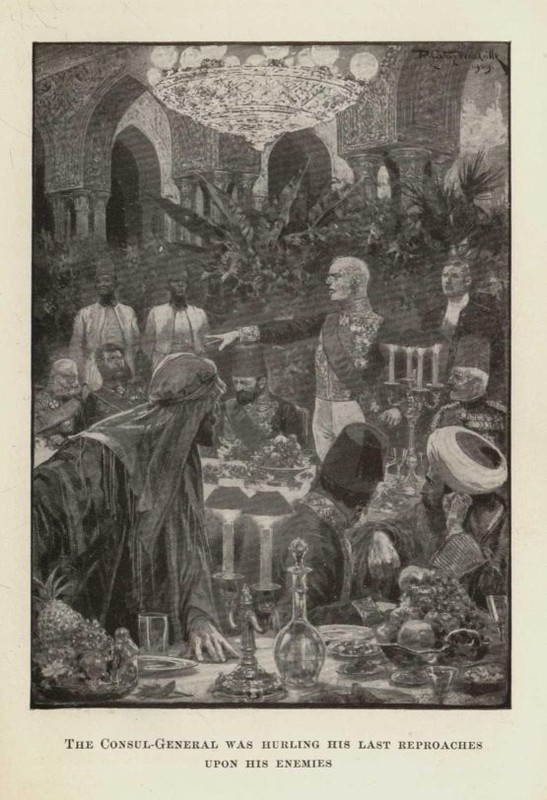
The Consul-General was hurling his last reproaches upon his enemies
"But you are mistaken, gentlemen. I may be old but I am not yet helpless. In the interests not only of England but of Europe I have made all necessary preparations to defeat your intrigues, and now—now I am about to put them into execution."
Saying this he left his seat and directed his steps towards the door. Nearly the whole of the company rose at the same moment, and all stood aside to let him pass. Nobody spoke, nobody made a gesture. In that room there were now no longer conspirators and non-conspirators. There were only silent spectators of a great tragedy. Everybody felt that an immense figure was passing from the world's stage, and none would have been more surprised if the Pyramid of Gizeh had crumbled before their eyes.
On reaching the door the Consul-General stopped and spoke again, but with something of his old courageous calm.
"I understand," he said, "that it was part of the plan that to-night at midnight, while the British army was expected to be on the Delta, and I and my colleagues were to be held prisoners on Ghezirah, the horde of armed fanatics now lying outside on the desert were to enter and occupy the city. That was a foolish scheme, gentlemen, such as could only have been conceived in the cobwebbed brains of El Azhar. But whatever it was I must ask you to abide by its consequences. In the interests of peace and of your own safety you will remain on this island until to-morrow, and in the morning you shall see ... what you shall see!"
Then saying something in a low voice to the Commandant of Police who was standing near, he passed out of the dining-hall and the door was closed behind him.
CHAPTER XVII
A few minutes afterwards the military band in the garden was playing again, red and white rockets were shooting into the dark sky from the grounds of the Khedivial Sports Club, and the Consul-General was entering the little insular telephone office of Ghezirah, which was under the same roof as the Pavilion.
"Call me up the Colonel commanding at Abbassiah and ask him to hold the line."
"Yes, my lord."
While the attendant put in the plug of his machine and waited for a reply, the Consul-General walked nervously to and fro between the counter and the door. He was expecting the Commandant of Police to come to him in a moment with news of the arrest of Ishmael Ameer. Without this certainty (though he had never had an instant's doubt of it) he could not allow himself to proceed to the last and most serious extremity.
"Not got him yet?"
"Not yet, my lord," said the attendant, and he plugged his machine afresh.
The Consul-General resumed his restless perambulation. He was by no means at ease about the unpremeditated developments of the scene in the dining-hall, but he had always intended to make sure that his enemies were safely housed on the island, and thereby cut off from the power of making further mischief, before he ordered the army into the city. The plugging of the machine was repeated.
"Not got him even yet, boy?"
"Cannot get an answer from the Central in Cairo, my lord."
"Try yet another line. Quick!"
The Consul-General thought the Commandant was long in coming, but no doubt the police staff had removed the supposed "Bedouin" to a private room, so that in making his arrest, and in stripping off his disguise to secure evidence of his identity, there might be no unnecessary commotion, no vulgar sensation. The plugging of the machine ceased.
"Got him at last?"
"No, my lord. Think there must be something wrong with the wires."
"The wires?"
"They seem to have been tampered with."
"You mean—cut?"
"Afraid they are, my lord."
"Then the island—so far as the telephone goes—the island is isolated?"
"Yes, my lord."
The old man's face, which had been flushed, became deadly pale, and his stubborn lower lip began to tremble.
"Who can have done this? Who? Who?"
The attendant, terrified by the fierce eye that looked into his face, was answering with a vacant stare and a shake of the head when the Sirdar entered the office, accompanied by the Commandant of Police, and both were as white as if they had seen a ghost.
"Well, what is it now?" demanded the Consul-General, whereupon the Sirdar answered—
"The Commandant's men have got him, but——"
"But—what?"
"It is not Ishmael Ameer."
"Not Ishma ... you say it is not Ish——"
The Consul-General stopped, and for a long moment he stared in silence into the blanched faces before him. Then he said sharply, "Who is it?"
The Commandant dropped his head and the Sirdar seemed unwilling to reply.
"Who is it, then?"
"It is ... it is a British officer."
"A British ... you say a British——"
"A Colonel."
The old man's lips moved as if he were repeating the word without uttering it.
"His tunic was torn where his decorations had been. He looked like ... like a man who might have been degraded."
The Consul-General's face twitched, but in a fierce, almost ferocious voice he said, "Speak! Who is it?"
There was another moment of silence, which seemed to be eternal, and then the Sirdar replied—
"Nuneham, it is your own son."