автордың кітабын онлайн тегін оқу The Seven Great Monarchies Of The Ancient Eastern World, Vol 2: Assyria / The History, Geography, And Antiquities Of Chaldaea, Assyria, Babylon, Media, Persia, Parthia, And Sassanian or New Persian Empire; With Maps and Illustrations
The Project Gutenberg EBook of The Seven Great Monarchies Of The Ancient
Eastern World, Vol 2. (of 7): Assyria, by George Rawlinson
This eBook is for the use of anyone anywhere at no cost and with
almost no restrictions whatsoever. You may copy it, give it away or
re-use it under the terms of the Project Gutenberg License included
with this eBook or online at www.gutenberg.net
Title: The Seven Great Monarchies Of The Ancient Eastern World, Vol 2. (of 7): Assyria
The History, Geography, And Antiquities Of Chaldaea,
Assyria, Babylon, Media, Persia, Parthia, And Sassanian
or New Persian Empire; With Maps and Illustrations.
Author: George Rawlinson
Illustrator: George Rawlinson
Release Date: July 1, 2005 [EBook #16162]
Last Updated: October 20, 2012
Language: English
*** START OF THIS PROJECT GUTENBERG EBOOK THE SEVEN GREAT MONARCHIES ***
Produced by David Widger
THE SEVEN GREAT MONARCHIES
OF THE ANCIENT EASTERN WORLD; OR, THE HISTORY, GEOGRAPHY, AND ANTIQUITIES OF CHALDAEA, ASSYRIA BABYLON, MEDIA, PERSIA, PARTHIA, AND SASSANIAN, OR NEW PERSIAN EMPIRE. BY GEORGE RAWLINSON, M.A., CAMDEN PROFESSOR OF ANCIENT HISTORY IN THE UNIVERSITY OF OXFORD IN THREE VOLUMES. VOLUME I. With Maps and Illustrations
CONTENTS
THE SECOND MONARCHY, Part 1.
CHAPTER I. DESCRIPTION OF THE COUNTRY
CHAPTER II. CLIMATE AND PRODUCTIONS
THE SECOND MONARCHY, Part 2.
CHAPTER III. THE PEOPLE
CHAPTER IV. THE CAPITAL
CHAPTER V. LANGUAGE AND WRITING
THE SECOND MONARCHY, Part 3.
CHAPTER VI. ARCHITECTURE AND OTHER ARTS.
THE SECOND MONARCHY, Part 4.
CHAPTER VII. MANNERS AND CUSTOMS.
THE SECOND MONARCHY, Part 4.
CHAPTER VIII. RELIGION
CHAPTER IX. CHRONOLOGY AND HISTORY
APPENDIX.
Illustrations
Map1
Plate 22
49. Signet of Kurri-galzu. King of Babylon
(drawn by the author from an impression in the
possession of Sir H. Rawlinson)
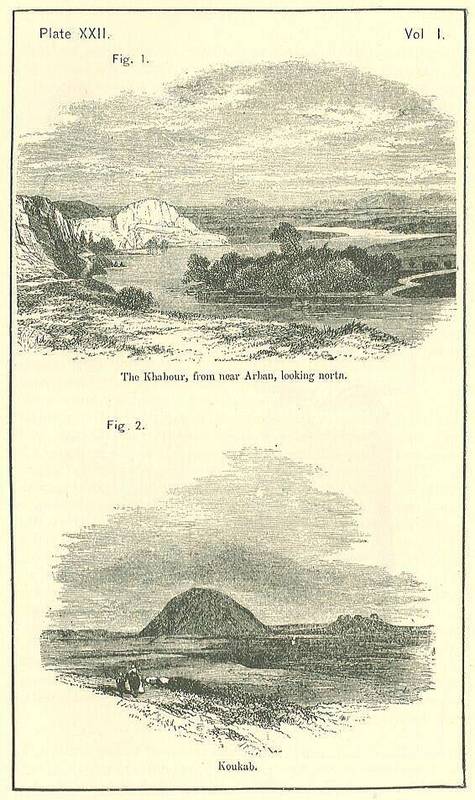
50. The Khabour, from near Arban, looking north (after Layard)
Plate 23
51. Koukab (ditto)
52. Lake of Khatouniyeh (ditto)
53. Colossal lion, near Seruj (after Chesney)
Plate 24
54. Plan of the ruins of Nimrud (Calah)
(reduced by the Author from Captain Jones's survey)
55. Great wound of Nimrud or Calah (after Layard)
Plate 25
56. Hand-swipe, Koyunjik (ditto)
57. Assyrian lion, from Nimrud (ditto)
58. Ibex, or wild goat, from Nimrud (ditto)
Plate 26
59. Wild ass (after Ker Porter)
60. Leopard, from Nimrud (after Layard)
61. Wild ass, from Koyunjik (from an unpublished
drawing by Mr. Boutcher in the British Museum)
Plate 27
62. Gazelle, from Nimrud (after Layard)
63. Stag and hind, from Koyunjik (from an unpublished
drawing by Mr. Boutcher in the British Museum)
64. Fallow deer, from Koyunjik (after Layard)
Plate 28
65. Hare and eagles, from Nimrud (ditto)
66. Hare, from Khorsabad (after Botta)
67. Chase of wild ox, from Nimrud (after Layard)
68. Vulture, from Nimrud (ditto)
69. Vulture feeding on corpse, Koyunjik (ditto)
Plate 29
70. Ostrich, from a cylinder (after Cullimore)
71. Ostrich, from Nimrud (after Layard)
72. Partridges, from Khorsabad (after Botta)
73. Unknown birds, Khorsabad (ditto)
Plate 30
74. Assyrian garden and fish-pond, Koyunjik (after Layard)
75. Bactrian or two-humped camel, from Nimrud (ditto)
76. Mesopotamian sheep (ditto)
77. Loading a camel, Koyunjik (ditto)
78. Head of an Assyrian horse, Koyunjik (ditto)
Plate 31
79. Assyrian horse, from Nimrud (ditto)
80. Mule ridden by two women, Koyunjik (after Layard
Plate 32
81. Loaded mule, Koyunjik (ditto)
82. Cart drawn by mules, Koyunjik (ditto)
83. Dog modelled in clay, from the palace of
Asshur-bani-pal, Koyunjik, (drawn by the Author
from the original in the British Museum)
Plate 33
84. Dog in relief, on a clay tablet (after Layard)
85. Assyrian cluck, Nimrud (ditto)
86. Assyrians, Nimrud (ditto)
Map1
Plate 34
87. Mesopotamian captives, from an Egyptian monument (Wilkinson)
88. Limbs of Assyrians, from the sculptures (after Layard)
Plate 35
89. Capture of a city, Nimrud (ditto)
90. Captives of Sargon, Khorsabad (after Botta)
Plate 36
91. Captive women in a cart, Nimrud (Layard)
92. Ruins of Nineveh (reduced by the Author from Captain Jones's survey)
Plate 37
93. Khosr-Su and mound of Nebbi-Yunus (after Layard)
94. Gate in the north wall, Nineveh (ditto)
Plate 38
95. Outer defences of Nineveh, in their present condition (ditto)
Plate 39
96. Assyrian cylinder (after Birch)
97. Assyrian seals (after Layard)
Plate 40
98. Assyrian clay tablets (ditto)
99. Black obelisk, from Nimrud (after Birch)
Partial Page 171
Partial Page 172
Partial Page 173
Partial Page 174
Page 175
Page 176
Page 177
Partial Page 178
Map of Assyria
Plate 41
100. Terrace-wall at Khorsabad (after Botta)
101. Pavement-slab, from the Northern Palace.
Koyunjik (Fergusson)
Plate 42
102. Mound of Khorsabad (ditto)
103. Plan of the Palace of Sargon, Khorsabad (ditto)
Plate 43
104. Hall of Esar-haddon's Palace, Nimrud (ditto)
106. Remains of Propyheum, or outer gateway, Khorsabad (Layard)
107. King and attendants, Khorsabad (after Botta)
Plate 44
105. Plan of the Palace of Sargon, Khorsabad (ditto)
Plate 45
108. Plan of palace gateway (ditto)
109. King punishing prisoners, Khorsabad (ditto)
111. Sargon in his war-chariot, Khorsabad (after Botta)
112. Cornice of temple, Khorsabad (Fergusson)
Plate 46
110. North-West Court of Sargon's Palace at
Khorsabad, restored (after Fergusson)
Plate 47
113. Armenian louvre ((after Botta)
114. Armenian buildings. from Koyunjik (Layard)
116. Assyrian castle on Nimrud obelisk (drawn by
the Author from the original in the British Museum)
Plate 48
115. Interior of an Assyrian palace, restored (ditto)
Plate 49
117. Assyrian altar, from a bas-relief, Khorsabad
(after Botta)
118. Assyrian temple, Khorsabad (ditto)
119. Assyrian temple, from Lord Aberdeen's
black stone (after Fergusson)
120. Assyrian temple, Nimrud (drawn by
the Author from the original in the British Museum)
121. Assyrian temple, North Palace, Koyunjik (ditto)
Plate 50
123. Basement portion of an Assyrian temple,
North Palace. Koyunjik (drawn by the Author
from the original in the British Museum)
Plate 51
122. Circular pillar-base, Koyunjik (after Layard)
124. Porch of the Cathedral, Trent (from an
original sketch made by the Author)
Plate 52
125. Tower of a temple, Koyunjik (after Layard)
126. Tower of ditto, restored (by the Author)
127. Tower of great temple at Nimrud (after Layard)
Plate 53
Plate 54
128. Basement of temple-tower, Nimrud,
north and west sides (ditto)
129. Ground-plan of Nimrud Tower (ditto)
130. Ground-plans of temples, Nimrud (ditto)
Plate 55
131. Entrance to smaller temple. Nimrud(ditto)
Plate 56
132. Assyrian village. Koyunjik (ditto)
133. Village near Aleppo (ditto)
Plate 57
134. Assyrian hattlemented wall (ditto)
135. Masonry and section of platform wall.
Khorsabad (after Botta)
136. Masonry of town-wall. Khorsabad (ditto)
Plate 58
137. Masonry of tower or moat, Khorsabad (ditto)
139. Arched drain, South-East Palace, Nimrud (ditto)
Plate 59
138. Arched drain, North-West Palace, Nimrud (after Layard)
140. False arch (Greek)
Plate 60
141. Assyrian patterns, Nimrud (Layard)
142. Ditto (ditto)
Plate 61
143. Bases and capitals of pillars (chiefly
drawn by the Author from bas-reliefs
in the British Museum)
Plate 62
144. Ornamental doorway, North Palace, Koyunjik
(from an unpublished drawing'by Mr. Boutcher
in the British Museum)
145. Water transport of stone for building,
Koyunjik (after Layard)
Plate 63
146. Assyrian statue from Kileh-Sherghat (ditto)
147. Statue of Sardanapalus I., from Nimrud (ditto)
148. Clay statuettes of the god Nebo (after Botta)
Plate 64
149. Clay statuette of the Fish-God (drawn by
the Author from the original in the British Museum)
150. Clay statuette from Khorsabad (after Botto)
151. Lion hunt, from Nimrud (after Layard)
Plate 65
152. Assyrian seizing a wild bull, Nimrud (ditto)
153. Hawk-headed figure and sphinx, Nimrud (ditto)
154. Death of a wild bull, Nimrud(ditto)
Plate 66
155. King killing a lion, Nimrud (ditto)
156. Trees from Nimrud (ditto)
157. Trees from Koyunjik (ditto)
Plate 67
158. Groom and horses, Khorsabad (ditto)
159., 160. Assyrian oxen, Koyunjik (ditto)
Plate 68
161. Assyrian goat and sheep, Koyunjik (ditto)
162. Vine trained on a fir, from the North Palace,
Koyunjik (drawn by the Author from a bas-relief
in the British Museum)
Plate 69
163. Lilies, from the North Palace, Koyunjik (ditto)
164. Death of two wild asses, from the North Palace,
Koyunjik (from an unpublished drawing by Mr. Boutcher
in the British Museum)
165. Lion about to spring, from the North Palace,
Koyunjik (ditto)
Plate 70
166. Wounded wild ass seized by hounds,
from the North Palace, Koyunjik
167. Wounded lion about to fall,from the North Palace,
Koyunjik (from an unpublished drawing by Mr. Boutcher,
in the British Museum)
Plate 71
168. Wounded lion biting a chariot-wheel,
from the North Palace, Koyunjik
Plate 72
169. King shooting a lion on the spring,
from the North Palace, Koyunjik (ditto)
Plate 73
170. Lion-hunt in a river. from the
North Palace, Koyunjik (ditto)
Plate 74
171. Bronze lion, from Nimrud (after Layard)
172. Fragments of bronze ornaments of the throne,
from Nimrud (ditto)
173. Bronze casting, from the throne, Nimrud (ditto)
Plate 75
174. Feet of tripods in bronze and iron (ditto)
175. Bronze bull's head, from thethrone (ditto)
176. Bronze head, part of throne,
showing bitumen inside (ditto)
177. End of a sword-sheath, from
the N. W. Palace, Nimrud (ditto)
178. Stool or chair, Khorsabad (after Botta)
Plate 76
179. Engraved scarab in centre of cup,
from the N. W. Palace, Nimrud (Layard)
180. Egyptian head-dresses on bronze dishes,
from Nimrud (ditto)
181. Ear-rings from Nimrud and Khorsabad (ditto)
182. Bronze cubes inlaid with gold, original size (ditto)
183. Egyptian scarab (from Wilkinson)
onk (Page 223)
Plate 77
184. Fragment of ivory panel, from Nimrod (after Layard)
185. Fragment of a lion in ivory, Nimrud (ditto)
187. Fragment of a stag in ivory, Nimrud (ditto)
188. Royal attendant, Nimrud (ditto)
Plate 78
186. Figures and cartouche with hieroglyphics,
on an ivory panel, from the N.W. Palace, Nimrud (ditto)
Plate 79
189. Arcade work, on enamelled brick, Nimrud (ditto)
190. Human figure, on enamelled brick, from Nimrud (ditto)
191. Ram's head, on enamelled brick, from Nimrud (ditto)
193. Impression of ancient Assyrian cylinder,
in serpentine (ditto)
Plate 80
192. King and attendants, on enamelled brick,
from Nimrud (ditto)
197. Assyrian vases. amphorae, etc. (after Birch)
Plate 81
194. Assyrian seals (ditto)
195. Assyrian cylinder, with Fish-God (ditto)
196. Royal cylinder of Sennacherib (ditto)
198. Funereal Urn from Khorsabad (after Botta)
200. Lustral ewer, from a bas relief, Khorsabad (after Botta)
201. Wine vase, from a bas-relief, Khorsabad (ditto)
Plate 82
199. Nestorian and Arab workmen,
with jar discovered at Nimrud (Layard)
202. Assyrian clay-lamp, (after Layard and Birch)
Plate 83
203. Amphora, with twisted arrns, Ninirud (Birch)
201. Assyrian glass bottles and bowl (after Layard)
205. Glass vase, bearing the name of Sargon,
from Nimrud (ditto)
206. Fragments of hollow tubes, in glass,
from Koyunjik (ditto)
Plate 84
207. Ordinary Assyrian tables, from the bas-reliefs
(by the Author)
208, 209. Assyrian tables, from bas-reliefs,
Koymrjik (ditto)
210. Table, ornamented with rain's heads,
Koyunjik (after Layard)
211. Ornamented table, Khorsabad (ditto)
212. Three-legged table, Koyunjik (ditto)
213. Sennacherib on his throne. Koyunjilc(ditto)
Plate 85
214. Arm-chair or throne, Khorsahad (after Botta)
215. Assyrian ornamented seat, Khorsabad (ditto)
216. Assyrian couch, from a bas-relief.
Koyunjik (by the Author)
217. Assyrian footstools, Koynnjik (ditto)
218. Stands for jars (Layyard)
Plate 86
219. Royal embroidered dresses, Nimrud (ditto)
220. Embroidery on a royal dress, Nimrud (ditto)
Plate 87
221. Circular breast ornament on a royal robe,
Nimrud (ditto)
Plate 88
222. Assyrians moving a human-headed bull, partly
restored from a bas-relief at Koyunjik (ditto)
225. Part of a bas-relief, showing a pulley and
a warrior cutting a bucket from the rope (ditto)
Plate 89
223. Laborer employed in drawing a colossal bull,
Koyunjik (ditto)
224. Attachment of rope to sledge, on which the bull
was placed for transport, Koyunjik (ditto)
226. Assyrian war-chariot, Koyunjik
from the original in the British Museum)
Map1
Plate 90
227. Chariot-wheel of the early period, Nimrud
(from the original in the British Museum)
228. Chariot-wheel of the middle period, Koyunjik (ditto)
229. Chariot-wheel of the latest period, Koyunjik (ditto)
230. Ornamented ends of chariot poles, Nimrud and Koyunjik ditto
Plate 91
231. End of pole, with cross-bar, Khorsabad (after Botta
232. End of pole, with curved yoke, Koyunjik (after Layard)
233. End of pole, with elaborate cross-bar or yoke, Khorsabad
(after Botta)
234. Assyrian chariot containing four warriors, Koyunjik
(after Boutcher)
Plate 92
235. Assyrian war-chariot of the early period, Nimrud
(from the original in the British Museum)
236. Assyrian war-chariot of the later period,
Koyunjik (ditto)
237. Assyrian chariot of the transition period,
Koyunjik (after Boutcher)
Plate 93
238. Assyrian chariot of the early period, Nimrud
(from the original in the British Museum)
239. Chariot-horse protected by clothing, Koyunjik (ditto)
240. Head of a chariot-horse, showing collar with
bells attached, Koyunjik(after Boutcher)
Plate 94
241. Bronze bit, Nimrud (from the original
in the British Museum)
242. Bits of chariot-horses, from the sculptures,
Nimrud and Koyunjik (ditto)
243. Driving-whips of Assyrian charioteers,
from the sculptures (ditto)
244. Mode of tying horses' tails, Koyunjik (ditto)
Plate 95
245. Mounted spearmen of the time of Sargon,
Khorsabad (after Botta)
246. Greave or laced boot of a horseman,
Khorsabad (ditto)
248. Horse archer of the latest period, Koyunjik
(from the original in the British Museum)
Plate 96
247. Cavalry soldiers of the time of Sennacherib,
Koyunjik (after Layard)
249. Ordinary sandal of the first period, Nimrud (ditto)
250. Convex shield of the first period, Nimrud (after Layard)
251. Foot spearmen of the first period, with wicker shield,
Nimrud (from the original in the British Museum)
252. Foot archer with attendant, first period, Nimrud (ditto)
253. Foot archer of the lightest equipment, time of Sargon,
Khorsabad (after Botta)
Plate 97
254. Foot archer of the intermediate equipment,
with attendant, time of Sargon, Khorsabad (after Botta)
255. Foot archer of the heavy equipment, with attendant,
time of Sargon, Khorsabad (ditto)
256. Foot spearman of the time of Sargon, Khorsabad (ditto)
257. Shield and greave of a spearman, Khorsabad (ditto)
Plate 98
258. Spear, with weight at the lower end, Khorsabad (ditto)
259. Sling, Koyunjik (from the original in the British Museum)
260. Foot archer of the heavy equipment, with attendant,
time of Sennacherib, Koyunjik (ditto)
261. Foot archers of the second class, time of Sennacherib,
Koyunjik (ditto)
262. Belts and head-dress of a foot archer of the third class,
time of Sennacherib, Koyunjik (after Boutcher)
Plate 99
263. Mode of carrying the quiver, time of Sennacherib,
Koyunjik (from the original in the British Museum)
264. Foot archers of the lightest equipment,
time of Sennacherib, Koyunjik
266. Wicker shields, time of Sennacherib, Koyunjik
(from the originals in the British Museum)
Plate 100
267. Metal shield of the latest period, Koyunjik (ditto)
268. Slinger, time of Asshur-bani-pal, Koyunjik (after Boutcher)
269. Pointed helmet, with curtain of scales, Nimrud (after Layard)
270. Iron helmet, from Koyunjik, now in the British Museum
(by the Author)
271. Assyrian crested helmets, from the bas-reliefs,
Khorsabad and Koyunjik (from the originals in the British Museum)
Plate 101
272. Scale, Egyptian (after Sir G. Wilkinson)
273. Arrangement of scales in Assyrian scale-armour
of the second period, Khorsabad (after Botta)
274. Sleeve of a coat of mail-scale-armor of the first period,
Nimrud (from the original in the British Museum)
275. Assyrian gerrha, or large wicker shields (ditto)
276. Soldier undermining a wall, sheltered by gerrhon,
Koyunjik (ditto)
Plate 102
277. Round shields or targes, patterned, Khorsabad (after Botta)
278. Convex shields with teeth, Nimrud (from the originals
in the British Museum)
279. Egyptian convex shield, worn on back (after Sir G. Wilkinson)
280. Assyrian ditto, Koyunjik (from the original in the British Museum
Plate 103
281. Assyrian convex shield, resembling the Greek, Koyunjik (ditto)
282. Quiver, with arrows and javelin, Nimrud (ditto)
283. Ornamented end of bow, Khorsabad (after Botta)
284. Stringing the bow, Koyunjik (from the original
in the British Museum)
Plate 104
285. Assyrian curved bow (ditto)
286. Assyrian angular bow, Khorsabad (after Botta)
287. Mode of carrying the bow in a bow-case, Koyunjik
(from the original in the British Museum)
288. Peculiar mode of carrying the quiver, Koyunjik (ditto)
289. Quiver, with rich ornamentation, Nimrud (after Layard)
290. Quivers of the ordinary character, Koyunjik
(from the originals in the British Museum)
Plate 105
291. Quiver with projecting rod, Khorsabad (after Botta)
292. Assyrian covered quivers, Koyunjik
(from the originals in the British Museum)
293. Bronze arrow-heads, Nimrud and Koyunjik (ditto)
294. Flint arrow-brad; Nimrud (ditto)
295. Assyrian arrow (ditto)
Plate 106
296. Mode of drawing the bow, Koyunjik (after Boutcher)
297. Guard worn by an archer, Koyunjik (ditto)
298. Bronze spear-head, Nimrud (from the original
in the British Museum)
299. Spear-heads (from the Sculptures)
300. Ornamented ends of spear-shafts, Nimrud (after Layard)
Plate 107
301. Ornamented handle of short sword, Khorsabad (after Botta)
302. Sheathed sword, Koyunjik (after Boutcher)
303. Ornamented handle of longer sword, Nimrud
(from the original in the British Museum?
304. Assyrian curved sword, Khorsabad (after Botta)
308. Scythian battle-axe (after Tester)
309. Ornamented handles of daggers, Nimrud (after Layard)
310. Handle of dagger, with chain, Nimrud (ditto)
Plate 108
305. Head of royal mace, Khorsabad (ditto)
306. Maces, from the Sculptures
307. Assyrian battle-axes, Koyunjik
(from the originals in the British Museum)
311. Sheaths of daggers, Nimrud
312. Assyrian standard, Khorsabad (after Botta)
313. Soldier swimming a river, Koyunjik (after Layard)
Plate 109
314. Royal tent, Koyunjik (from the original in the British Museum)
315. Ordinary tent, Koyunjik (after Boutcher)
316. Interior of tent, Koyunjik (ditto)
317. King walking in a mountainous country, chariot following,
supported by men, Koyunjik (from an obelisk in the British Museum,
after Boutcher)
318. Fortified place belonging to an enemy of the Assyrians,
Nimrud (after Layard)
Plate 110
319. Gateway of castle, Koyunjik (after Boutcher)
320. Battering-rams, Khorsabad and Koyunjik (partly after Botta)
322. Crowbar, and mining the wall, Koyunjik (ditto)
Plate 111
321. Assyrian balistce, Nimrud (after Layard)
324. Soldiers destroying date-palms, Koyunjik (after Layard)
325. Soldier carrying off spoil from a temple, Khorsabad (after Botta)
326. Scribes taking account of the spoil, Khorsabad (ditto)
327. Mace-bearer, with attendant, executing a prisoner,
Koyunjtk (from the original in the British Museum)
Plate 112
323. Implement used in the destruction of cities,
Khorsabad (after Botta)
328. Swordsman decapitating a prisoner, Koyunjik (ditto)
329. Female captives, with children, Koyunjik (after Layard)
330. Chasuble or outer garment of the king (chiefly after Botta)
331. King in his robes, Khorsabad (after Botta)
Plate 113
332. Tiaras of the later and earlier Periods,
Koyunjik and Nimrud (Layard and Boutcher)
333. Fillet worn by the king, Nimrud (after Layard)
334. Royal sandals, times of Sargon and Asshur-izir-pal
(from the originals in the British Museum)
335. Royal shoe, time of Sennacherib, Koyunjik (ditto)
336. Royal necklace, Nimrud (ditto)
337. Royal collar, Nimrud (ditto)
Plate 114
338. Royal armlets, Khorsabad (after Botta)
339. Royal bracelets, Khorsabad and Koyunjik
(after Botta and Boutcher)
340. Royal ear-rings, Nimrud (from the originals
in the British Museum)
341. Early king in his war-costume, Nimrud (ditto)
Plate 115
342. King, queen, and attendants, Koyunjik (ditto)
343. Enlarged figure of the queen, Koyunjik (ditto)
345. Heads of eunuchs, Nimrud (ditto)
Plate 116
344. Royal parasols, Nimrud and Koyunjik (ditto)
316. The chief eunuch, Nimrud (ditto)
347. Head-dress of the vizier, Khorsabad (after Botta)
Plate 117
348. Costumes of the vizier, times of Sennacherib and
Asshur-izir-pal, Nimrud and Koyunjik (from the originals
in the British Museum)
Plate 118
349. Tribute-bearers presented by the chief eunuch,
Nimrud obelisk (ditto)
350. Fans or fly-flappers, Nimrud and Koyunjik
351. King killing a lion, Nimrud (after Layard)
352. King, with attendants, spearing a lion, Koyunjik
(after Boutcher)
Plate 119
353. King, with attendant, stabbing a lion, Koyunjik (ditto)
354. Lion let out of trap, Koyunjik (ditto)
Plate 120
355. Hound held in leash, Koyunjik (from the original
in the British Museum)
356. Wounded lioness, Koyunjik (ditto)
351. Fight of lion and bull, Nimrud (after Layard)
358. King hunting the wild bull, Nimrud (ditto)
359. King pouring libation over four dead lions,
Koyunjik (from the original in the British Museum)
Plate 121
360. Hound chasing a wild ass colt, Koyunjik (after Boutcher)
361. Dead wild ass, Koyunjik (ditto)
362. Hounds pulling down a wild ass, Koyunjik (ditto)
563. Wild ass taken with a rope, Koyunjik
(from the original in the British Museum)
Plate 122
364. Hound chasing a doe, Koyunjik (after Boutcher)
365. Hunted stag taking the water, Koyunjik (ditto)
Plate 123
366. Net spread to take deer, Koyunjik (from the original
in the British Museum)
367. Portion of net showing the arrangement of the meshes
and the pegs, Koyunjik (ditto)
368. Hunted ibex, flying at full speed. Koyunjik
(after Boutcher)
369. Ibex transfixed with arrow-falling (ditto)
Plate 124
370. Sportsman carrying a, gazelle, Khorsabad
(from the original in the British Museum)
371. Sportsman shooting, Khorsabad (after Bntta)
372. Greyhound and hare, Niunrud (from a bronze bowl
in the British Museum)
373. Nets, pegs, and balls of string, Koyunjik
(after Boutcher)
Plate 125
374. Man fishing, Nimrud (after Layard)
375. Man fishing, Koyunjik (ditto)
Plate 126
376. Man fishing, seated on skin, Koyunjik
(from the original in the British Museum)
377. Bear standing, Nimrud (from a bronze bowl
in the British Museum)
378. Ancient Assyrian harp and harper, Nimrud
(from the originals in the British Museum)
330. Triangular lyre, Koyunjik (ditto)
Plate 127
379. Later Assyrian harps and harpers, Koyunjik (ditto)
381. Lyre with ten strings, Khorsabad (after Botta)
Plate 128
382. Lyres with five and seven strings, Koyunjik
(from the originals in the British Museurn)
383. Guitar or tamboura, Koyunjik (ditto)
384. Player on the double pipe. Koyunjik (ditto)
Plate 129
385. Tambourine player and other musicians, Koyunjik (ditto)
387. Assyrian tubbuls, or drums, Koyunjik
(from the originals in the British Museum)
Plate 130
386. Eunuch playing on the cymbals, Koyunjik (after Boutcher)
388. Musician playing the dulcimer, Koyunjik (ditto)
389. Roman trumpet (Column of Trajan)
390. Assyrian ditto, Koyunjik (after Layard)
391. Portion of an Assyrian trumpet (from the original
in the British Museum)
Plate 131
392. Captives playing on lyres, Koyunjik (ditto)
Plate 132
333. Lyre on a Hebrew coin (ditto)
394. Baud of twenty-six musicians, Koyunjik (ditto)
Plate 133
395. Time-keepers, Koyunjik (after Boutcher)
396. Assyrian coracle, Nimrud (from the original
in the British Museum)
397. Common oar, time of Sennacherib, Koyunjik (ditto)
398. Steering oar, time of Asshur-izir-pal, Nimrud (ditto)
399. Early long boat, Nimrud (ditto)
400. Later long boat, Khorsabad (after Botta)
401. Phoenician bireme, Koyunjik (after Layard)
402. Oar kept in place by pegs, Koyunjik
(from the original in the British Museum)
Plate 134
403. Chart of the district about Nimrud, showing the
course of the ancient canal and conduit (after the
survey of Captain Jones)
404. Assyrian drill-plough (from Lori Aberdeen's
black stone, after Fergusson.
405. Modern Turkish plough (after Sir C. Fellows)
406. Modern Arab plough (after C. Niebuhr)
Plate 135
407. Ornamental belt or girdle, Koyunjik
(from the original in the British Museum)
408. Ornamental cross-belt, Khorsabad (after Botta)
409. Armlets of Assyrian grandees, Khorsabad (ditto)
410. Head-dresses of various officials, Koyunjik
(from the originals in the British Musemn)
411. Curious mode of arranging the hair, Koyunjik
(from the originals in the British Museum)
412. Female seated (from an ivory in the British Museum)
Plate 136
413. Females gathering grapes
(from some ivory fragments in the British Museum)
414. Necklace of flat glass beads (from the original
in the British Museum)
415. Metal mirror (ditto)
Plate 137
416. Combs in iron and lapis lazuli (from the original
in the British Museum)
417. Assyrian joints of meat (from the Sculptures)
418. Killing the sheep, Koyunjik (after Boutcher)
419. Cooking meat in caldron, Koyunjik (after Layard)
420. Frying, Nimrud (from the original in the British Museum)
421. Assyrian fruits (from the Monuments)
Plate 138
422. Drinking scene, Khorsabad (after Botta)
423. Ornamental wine-cup, Khorsabad (ditto)
424. Attendant bringing flowers to a banquet, Koyunjik
(after Layard)
425. Socket of hinge, Nimrud (ditto)
Map1
Page 358
Plate 143
448. Evil genii contending, Koyunjik (after Boutcher)
450. Triangular altar, Khorsabad (after Botta)
451. Portable altar in an Assyrian camp,
with priests offering, Khorsabad (ditto)
Plate 144
449. Sacrificial scene, from an obelisk found
at Nimrud (ditto)
452. Worshipper bringing an offering,
from a cylinder (after Lajard)
453. Figure of Tiglath-Pileser I.
(from an original drawing by Mr. John Taylor)
Page 371
Page 372
Plate 145
454. Plan of the palace of Asshur-izir-pal (after Fergusson)
455. Stele of Asshur-izir-pal with an altar in front, Nimrud
(from the original in the British Museum)
Plate 146
456. Israelites bringing tribute to Shalmaneser II.,
Nimrud (ditto)
457. Assyrian sphinx, time of Asshur-bani-pal
(after Layard)
458. Scythian soldiers, from a vase found in a Scythian tomb
Page 508
Page 509
Page 510
Page 511
Page 512
Page 513
Map of Media
THE SECOND MONARCHY
ASSYRIA
ENLARGE TO FULL SIZE
CHAPTER I.
DESCRIPTION OF THE COUNTRY.
"Greek phrase[—]"—HEROD. i. 192.
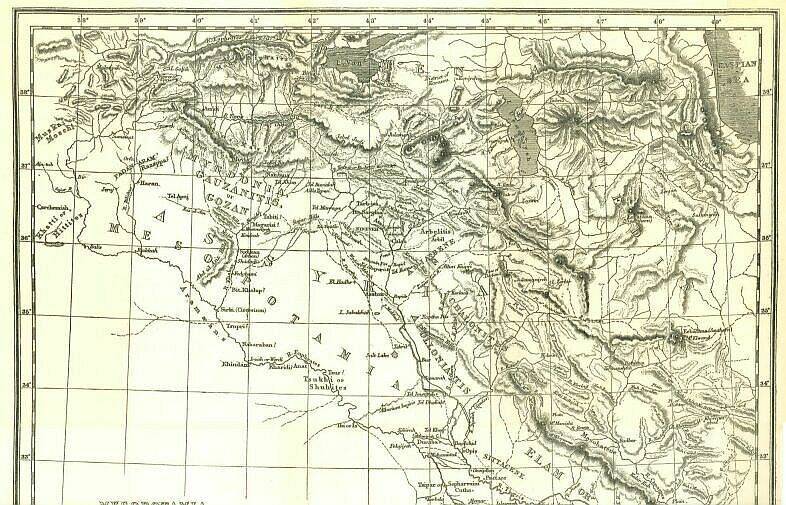
The site of the second—or great Assyrian-monarchy was the upper portion of the Mesopotamian valley. The cities which successively formed its capitals lay, all of them, upon the middle Tigris; and the heart of the country was a district on either side that river, enclosed within the thirty-fifth and thirty-seventh parallels. By degrees these limits were enlarged; and the term Assyria came to be used, in a loose and vague way, of a vast and ill-defined tract extending on all sides from this central region. Herodotus considered the whole of Babylonia to be a mere district of Assyria. Pliny reckoned to it all Mesopotamia. Strabo gave it, besides these regions, a great portion of Mount Zagros (the modern Kurdistan), and all Syria as far as Cilicia, Judaea, and Phoenicia.
If, leaving the conventional, which is thus vague and unsatisfactory, we seek to find certain natural limits which we may regard as the proper boundaries of the country, in two directions we seem to perceive an almost unmistakable line of demarcation. On the east the high mountain-chain of Zagros. penetrable only in one or two places, forms a barrier of the most marked character, and is beyond a doubt the natural limit for which we are looking. On the south a less striking, but not less clearly defined, line—formed by the abutment of the upper and slightly elevated plain on the alluvium of the lower valley—separates Assyria from Babylonia, which is best regarded as a distinct country. In the two remaining directions, there is more doubt as to the most proper limit. Northwards,we may either view Mount Masius as the natural boundary, or the course of the Tigris from Diarbekr to Til, or even perhaps the Armenian mountain-chain north of this portion of the Tigris, from whence that river receives its early tributaries. Westward, we might confine Assyria to the country watered by the affluents of the Tigris, or extend it so as to in elude the Khabour and its tributaries, or finally venture to carry it across the whole of Mesopotamia, and make it be bounded by the Euphrates. On the whole it is thought that in both the doubted cases the wider limits are historically the truer ones. Assyrian remains cover the entire country between the Tigris and the Khabour, and are frequent on both banks of the latter stream, giving unmistakable indications of a long occupation of that region by the great Mesopotamian people. The inscriptions show that even a wider tract was in process of time absorbed by the conquerors; and if we are to draw a line between the country actually taken into Assyria, and that which was merely conquered and held in subjection, we can select no better boundary than the Euphrates westward, and northward the snowy mountain-chain known to the ancients as Mons Niphates.
If Assyria be allowed the extent which is here assigned to her, she will be a country, not only very much larger than Chaldaea or Babylonia, but positively of considerable dimensions. Reaching on the north to the thirty-eighth and on the south to the thirty-fourth parallel, she had a length diagonally from Diarbekr to the alluvium of 350 miles, and a breadth between the Euphrates and Mount Zagros varying from about 300 to 170 miles. Her area was probably not less than 75,000 square miles, which is more than double that of Portugal, and not much below that of Great Britain. She would thus from her mere size be calculated to play an important (part) in history; and the more so, as during the period of her greatness scarcely any nation with which she came in contact possessed nearly so extensive a territory.
Within the limits here assigned to Assyria, the face of the country is tolerably varied. Possessing, on the whole, perhaps, a predominant character of flatness, the territory still includes some important ranges of hills, while on the two sides it abuts upon lofty mountain-chains. Towards the north and east it is provided by nature with an ample supply of water, rills everywhere flowing from the Armenian and Kurdish ranges, which soon collect into rapid and abundant rivers. The central, southern, and western regions are, however, less bountifully supplied; for though the Euphrates washes the whole western and south-western frontier, it spreads fertility only along its banks; and though Mount Masius sends down upon the Mesopotamian plain a considerable number of streams, they form in the space of 200 miles between Balls and Mosul but two rivers, leaving thus large tracts to languish for want of the precious fluid. The vicinity of the Arabian and Syrian deserts is likewise felt in these regions, which, left to themselves, tend to acquire the desert character, and have occasionally been regarded as actual parts of Arabia.
The chief natural division of the country is that made by the Tigris, which, having a course nearly from north to south, between Til and Samarah, separates Assyria into a western and an eastern district. Of these two, the eastern or that upon the left bank of the Tigris, although considerably the smaller, has always been the more important region. Comparatively narrow at first, it broadens as the course of the river is descended, till it attains about the thirty-fifth parallel a width of 130 or 140 miles. It consists chiefly of a series of rich and productive plains, lying along the courses of the various tributaries which flow from Mount Zagros into the Tigris, and often of a semi-alluvial character. These plains are not, however, continuous. Detached ranges of hills, with a general direction parallel to the Zagros chain, intersect the flat rich country, separating the plains from one another, and supplying small streams and brooks in addition to the various rivers, which, rising within or beyond the great mountain barriers, traverse the plains on their way to the Tigris. The hills themselves—known now as the Jebel Maklub, the Ain-es-sufra, the Karachok, etc.—are for the most part bare and sterile. In form they are hogbacked, and viewed from a distance have a smooth and even outline but on a nearer approach they are found to be rocky and rugged. Their limestone sides are furrowed by innumerable ravines, and have a dry and parched appearance, being even in spring generally naked and without vegetation. The sterility is most marked on the western flank, which faces the hot rays of the afternoon sun; the eastern slope is occasionally robed with a scanty covering of dwarf oak or stunted brushwood. In the fat soil of the plains the rivers commonly run deep and concealed from view, unless in the spring and the early summer, when through the rains and the melting of the snows in the mountains they are greatly swollen, and run bank full, or even overflow the level country.
The most important of these rivers are the following:—the Kurnib or Eastern Khabour, which joins the Tigris in lat. 37° 12'; the Greater Zab (Zab Ala), which washes the ruins of Nimrud, and enters the main stream almost exactly in lat. 30°; the Lesser Zab (Zab Asfal), which effects its junction about lat. 35° 15'; the Adhem, which is received a little below Samarah, about lat. 34°; and the Diyaleh, which now joins below Baghdad, but from which branches have sometimes entered the Tigris a very little below the mouth of the Adhem. Of these streams the most northern, the Khabour, runs chiefly in an untraversed country—the district between Julamerik and the Tigris. It rises a little west of Julamerik in one of the highest mountain districts of Kurdistan, and runs with a general south-westerly course to its junction with another large branch, which reaches it from the district immediately west of Amadiyeh; it then flows due west, or a little north of west, to Zakko, and, bending to the north after passing that place, flows once more in a south-westerly direction until it reaches the Tigris. The direct distance from its source to its embouchure is about 80 miles; but that distance is more than doubled by its windings. It is a stream of considerable size, broad and rapid; at many seasons not fordable at all, and always forded with difficulty.
The Greater Zab is the most important of all the tributaries of the Tigris. It rises near Konia, in the district of Karasu, about lat. 32° 20', long. 44° 30', a little west of the watershed which divides the basins of Lakes Van and Urymiyeh. Its general course for the first 150 miles is S.S.W., after which for 25 or 30 miles it runs almost due south through the country of the Tiyari. Near Amadiyeh it makes a sudden turn, and flows S.E. or S.S.E. to its junction with the Rowandiz branch whence, finally, it resumes its old direction, and runs south-west past the Nimrud ruins into the Tigris. Its entire course, exclusive of small windings, is above 350 miles, and of these nearly 100 are across the plain country, which it enters soon after receiving the Rowandiz stream. Like the Khabour, it is fordable at certain places and during the summer season; but even then the water reaches above the bellies of horses. It is 20 yards wide a little above its junction with the main steam. On account of its strength and rapidity the Arabs sometimes call it the "Mad River."
The Lesser Zab has its principal source near Legwin, about twenty miles south of Lake Urumiyeh, in lat. 36° 40', long. 46° 25'. The source is to the east of the great Zagros chain; and it might have been supposed that the waters would necessarily flow northward or eastward, towards Lake Urumiyeh, or towards the Caspian. But the Legwin river, called even at its source the Zei or Zab, flows from the first westward, as if determined to pierce the mountain barrier. Failing, however, to find an opening where it meets the range, the Little Zab turns south and even south-east along its base, till about 25 or 30 miles from its source it suddenly resumes its original direction, enters the mountains in lat. 36° 20', and forces its way through the numerous parallel ranges, flowing generally to the S.S.W., till it debouches upon the plain near Arbela, after which it runs S.W. and S.W. by S. to the Tigris. Its course among the mountains is from 80 to 90 miles, exclusive of small windings; and it runs more than 100 miles through the plain. Its ordinary width, just above its confluence with the Tigris, is 25 feet.
The Diyaleh, which lies mostly within the limits that have been here assigned to Assyria, is formed by the confluence of two principal streams, known respectively as the Holwan, and the Shirwan, river. Of these, the Shirwan seems to be the main branch. This stream rises from the most eastern and highest of the Zagros ranges, in lat. 34° 45', long. 47° 40' nearly. It flows at first west, and then north-west, parallel to the chain, but on entering the plain of Shahrizur, where tributaries join it from the north-east and the north-west, the Shirwan changes its course and begins to run south of west, a direction, which, it pursues till it enters the low country, about lat. 35° 5', near Semiram. Thence to the Tigris it has a course which in direct distance is 150 miles, and 200 if we include only main windings. The whole course cannot be less than 380 miles, which is about the length of the Great Zab river. The width attained before the confluence with the Tigris is 60 yards, or three times the width of the Greater, and seven times that of the Lesser Zab.
On the opposite side of the Tigris, the traveller comes upon a region far less favored by nature than that of which we have been lately speaking. Western Assyria has but a scanty supply of water; and unless the labor of man is skilfully applied to compensate this natural deficiency, the greater part of the region tends to be, for ten months out of the twelve, a desert. The general character of the country is level, but not alluvial. A line of mountains, rocky and precipitous, but of no great elevation, stretches across the northern part of the region, running nearly due east and west, and extending from the Euphrates at Rum-kaleh to Til and Chelek upon the Tigris. Below this, a vast slightly undulating plain extends from the northern mountains to the Babylonian alluvium, only interrupted about midway by a range of low limestone hills called the Sinjar, which leaving the Tigris near Mosul runs nearly from east to west across central Mesopotamia, and strikes the Euphrates half-way between Rakkeh and Kerkesiyeh, nearly in long. 40°.
The northern mountain region, called by Strabo "Mons Masius," and by the Arabs the Karajah Dagh towards the west, and towards the east the Jebel Tur, is on the whole a tolerably fertile country. It contains a good deal of rocky land; but has abundant springs, and in many parts is well wooded. Towards the west it is rather hilly than mountainous; but towards the east it rises considerably, and the cone above Mardin is both lofty and striking. The waters flowing from the range consist, on the north, of a small number of brooks, which after a short course fall into the Tigris; on the south, of more numerous and more copious streams, which gradually unite, and eventually form two rather important rivers. These rivers are the Belik, known anciently as the Bileeha, and the Western Khabour, called Habor in Scripture, and by the classical writers Aborrhas or Chaboras. [PLATE XXII., Fig. 1.]
The Belik rises among the hills east of Orfa, about long. 39°, lat. 37° 10'. Its course is at first somewhat east of south; but it soon sweeps round, and, passing by the city of Harran—the Haran of Scripture and the classical Carrh—proceeds nearly due south to its junction, a few miles below Rakkah, with the Euphrates. It is a small stream throughout its whole course, which may be reckoned at 100 or 120 miles.
The Khabour is a much more considerable river. It collects the waters which flow southward from at least two-thirds of the Mons Masius, and has, besides, an important source, which the Arabs regard as the true "head of the spring," derived apparently from a spur of the Sinjar range. This stream, which rises about lat. 36° 40', long. 40°, flows a little south of east to its junction near Koukab with the Jerujer or river Nisi-his, which comes down from Mons Masius with a course not much west of south. Both of these branches are formed by the union of a number of streams. Neither of them is fordable for some distance above their junction; and below it, they constitute a river of such magnitude as to be navigable for a considerable distance by steamers. The course of the Khabour below Koukab is tortuous; but its general direction is S.S.W. The entire length of the stream is certainly not less than 200 miles.
The country between the "Mons Masius" and the Sinjar range is an undulating plain, from 60 to 70 miles in width, almost as devoid of geographical features as the alluvium of Babylonia. From a height the whole appears to be a dead level: but the traveller finds, on descending, that the surface, like that of the American prairies and the Roman Campagna, really rises and falls in a manner which offers a decided contrast to the alluvial flats nearer the sea. Great portions of the tract are very deficient in water. Only small streams descend from the Sinjar range, and these are soon absorbed by the thirsty soil; so that except in the immediate vicinity of the hills north and south, and along the courses of the Khabour, the Belik, and their affluents, there is little natural fertility, and cultivation is difficult. The soil too is often gypsiferous, and its salt and nitrous exudations destroy vegetation; while at the same time the streams and springs are from the same cause for the most part brackish and unpalatable. Volcanic action probably did not cease in the region very much, if at all, before the historical period. Fragments of basalt in many places strew the plain; and near the confluence of the two chief branches of the Khabour, not only are old craters of volcanoes distinctly visible, but a cone still rises from the centre of one, precisely like the cones in the craters of Etna and Vesuvius, composed entirely of loose lava, scorim, and ashes, and rising to the height of 300 feet. The name of this remarkable hill, which is Koukab, is even thought to imply that the volcano may have been active within the time to which the traditions of the country extend. [PLATE XXII., Fig. 2.]
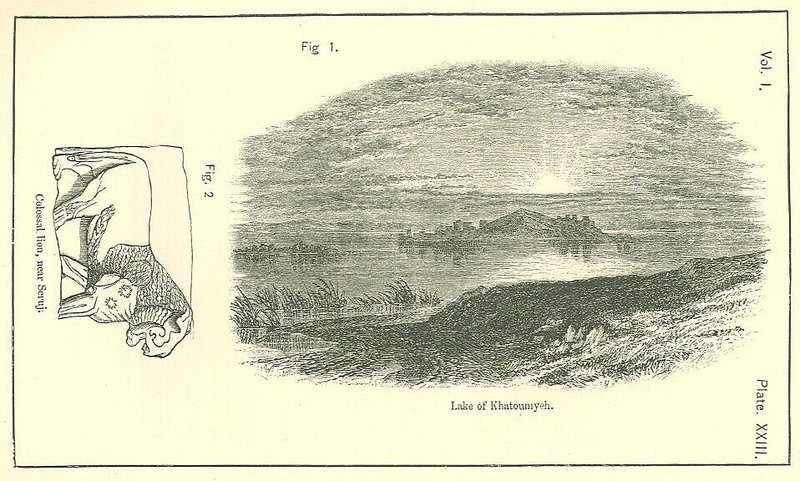
Sheets of water are so rare in this region that the small lake of Khatouniyeh seems to deserve especial description. This lake is situated near the point where the Sinjar changes its character, and from a high rocky range subsides into low broken hills. It is of oblong shape, with its greater axis pointing nearly due east and west, in length about four miles, and in its greatest breadth somewhat less than three. [PLATE XXIII., Fig. 1] The banks are low and parts marshy, more especially on the side towards the Khabour, which is not more than ten miles distant. In the middle of the lake is a hilly peninsula, joined to the mainland by a narrow causeway, and beyond it a small island covered with trees. The lake abounds with fish and waterfowl; and its water, though brackish, is regarded as remarkably wholesome both for man and beast.
The Sinjar range, which divides Western Assyria into two plains, a northern and a southern, is a solitary limestone ridge, rising up abruptly from the flat country, which it commands to a vast distance on both sides. The limestone of which it is composed is white, soft, and fossiliferous; it detaches itself in enormous flakes from the mountain-sides, which are sometimes broken into a succession of gigantic steps, while occasionally they present the columnar appearance of basalt. The flanks of the Sinjar are seamed with innumerable ravines, and from these small brooks issue, which are soon dispersed by irrigation, or absorbed in the thirsty plains. The sides of the mountain are capable of being cultivated by means of terraces, and produce fair crops of corn and excellent fruit; the top is often wooded with fruit trees or forest-trees. Geographically, the Sinjar may be regarded as the continuation of that range of hills which shuts in the Tigris on the west, from Tekrit nearly to Mosul, and then leaving the river strikes across the plain in a direction almost from east to west as far as the town of Sinjar. Here the mountains change their course and bend to the south-west, till having passed the little lake described above, they somewhat suddenly subside, sinking from a high ridge into low undulating hills, which pass to the south of the lake, and then disappear in the plain altogether. According to some, the Sinjar here terminates; but perhaps it is best to regard it as rising again in the Abd-el-aziz hills, which, intervening between the Khabour and the Euphrates, run in the same south-west direction from Arban to Zelabi. If this be accepted as the true course of the Sinjar, we must view it as throwing out two important spurs. One of these is near its eastern extremity, and runs to the south-east, dividing the plain of Zerga from the great central level. Like the main chain, it is of limestone; and, though low, has several remarkable peaks which serve as landmarks from a vast distance. The Arabs call it Kebritiyeh, or "the Sulphur range," from a sulphurous spring which rises at its foot. The other spur is thrown out near the western extremity, and runs towards the north-west, parallel to the course of the upper Khabour, which rises from its flank at Ras-el-Ain. The name of Abd-el-aziz is applied to this spur, as well as to the continuation of the Sinjar between Arban and Halebi. It is broken into innumerable valleys and ravines, abounding with wild animals, and is scantily wooded with dwarf oak. Streams of water abound in it.
South of the Sinjar range, the country resumes the same level appearance which characterizes it between the Sinjar and the Mons Masius. A low limestone ridge skirts the Tigris valley from Mosul to Tekrit, and near the Euphrates the country is sometimes slightly hilly; but generally the eye travels over a vast slightly undulating level, unbroken by eminences, and supporting but a scanty vegetation. The description of Xenophon a little exaggerates the flatness, but is otherwise faithful enough:—"In these parts the country was a plain throughout, as smooth as the sea, and full of wormwood; if any other shrub or reed grew there, it had a sweet aromatic smell; but there was not a tree in the whole region." Water is still more scarce than in the plains north of the Sinjar. The brooks descending from that range are so weak that they generally lose themselves in the plain before they have run many miles. In one case only do they seem sufficiently strong to form a river. The Tharthar, which flows by the ruins of El Hadhr, is at that place a considerable stream, not indeed very wide but so deep that horses have to swim across it. Its course above El Hadhr has not been traced; but the most probable conjecture seems to be that it is a continuation of the Sinjar river, which rises about the middle of the range, in long. 41° 50', and flows south-east through the desert. The Tharthar appears at one time to have reached the Tigris near Tekrit, but it now ends in a marsh or lake to the south-west of that city.
The political geography of Assyria need not occupy much of our attention. There is no native evidence that in the time of the great monarchy the country was formally divided into districts, to which any particular names were attached, or which were regarded as politically separate from one another; nor do such divisions appear in the classical writers until the time of the later geographers, Strabo, Dionysius, and Ptolemy. If it were not that mention is made in the Old Testament of certain districts within the region which has been here termed Assyria, we should have no proof that in the early times any divisions at all had been recognized. The names, however, of Padan-Aram, Aram-Naharaim, Gozan, Halah, and (perhaps) Huzzab, designate in Scripture particular portions of the Assyrian territory; and as these portions appear to correspond in some degree with the divisions of the classical geographers, we are led to suspect that these writers may in many, if not in most cases, have followed ancient and native traditions or authorities. The principal divisions of the classical geographers will therefore be noticed briefly, so far at least as they are intelligible.
According to Strabo, the district within which Nineveh stood was called Aturia, which seems to be the word Assyria slightly corrupted, as we know that it habitually was by the Persians. The neighboring plain country he divides into four regions—Dolomene, Calachene, Chazene, and Adiabene. Of Dolomene, which Strabo mentions but in one place, and which is wholly omitted by other authors, no account can be given. Calachene, which is perhaps the Calacine of Ptolemy, must be the tract about Calah (Nimrud), or the country immediately north of the Upper Zab river. Chazene, like Dolomene, is a term which cannot be explained. Adiabene, on the contrary, is a well-known geographical expression. It is the country of the Zab or Diab rivers, and either includes the whole of Eastern Assyria between the mountains and the Tigris, or more strictly is applied to the region between the Upper and Lower Zab, which consists of two large plains separated from each other by the Karachok hills. In this way Arbelitis, the plain between the Karachok and Zagros, would fall within Adiabene, but it is sometimes made a distinct region, in which case Adiabene must be restricted to the flat between the two Zabs, the Tigris, and the harachok. Chalonitis and Apolloniatis, which Strabo seems to place between these northern plains and Susiana, must be regarded as dividing between them the country south of the Lesser Zab, Apolloniatis (so called from its Greek capital, Apollonia) lying along the Tigris, and Chalonitis along the mountains from the pass of Derbend to Gilan. Chalonitis seems to have taken its name from a capital city called Chala, which lay on the great route connecting Babylon with the southern Ecbatana, and in later times was known as Holwan. Below Apolloniatis, and (like that district) skirting the Tigris, was Sittacene, (so named from its capital, Sittace which is commonly reckoned to Assyria, but seems more properly regarded as Susianian territory.) Such are the chief divisions of Assyria east of the Tigris.
West of the Tigris, the name Mesopotamia is commonly used, like the Aram-Naharaim of the Hebrews, for the whole country between the two great rivers. Here are again several districts, of which little is known, as Acabene, Tigene, and Ancobaritis. Towards the north, along the flanks of Mons Masius from Nisibis to the Euphrates, Strabo seems to place the Mygdonians, and to regard the country as Mygdonia. Below Mygdonia, towards the west, he puts Anthemusia, which he extends as far as the Khabour river. The region south of the Khabour and the Sinjar he seems to regard as inhabited entirely by Arabs. Ptolemy has, in lieu of the Mygdonia of Strabo, a district which he calls Gauzanitis; and this name is on good grounds identified with the Gozan of Scripture, the true original probably of the "Mygdonia" of the Greeks. Gozan appears to represent the whole of the upper country from which the longer affluents of the Khabour spring; while Halah, which is coupled with it in Scripture, and which Ptolemy calls Chalcitis, and makes border on Gauzanitis, may designate the tract upon the main stream, as it comes down from Ras-el-Ain. The region about the upper sources of the Belik has no special designation in Strabo, but in Scripture it seems to be called Padan-Aram, a name which has been explained as "the flat Syria," or "the country stretching out from the foot of the hills." In the later Roman times it was known as Osrhoene; but this name was scarcely in use before the time of the Antonines.
The true heart of Assyria was the country close along the Tigris, from lat. 35° to 36° 30'. Within these limits were the four great cities, marked by the mounds at Khorsabad, Mosul, Nimrud, and Kileh-Sherghat, besides a multitude of places of inferior consequence. It has been generally supposed that the left bank of the river was more properly Assyria than the right; and the idea is so far correct, as that the left bank was in truth of primary value and importance, whence it naturally happened that three out of the four capitals were built on that side of the stream. Still the very fact that one early capital was on the right bank is enough to show that both shores of the stream were alike occupied by the race from the first; and this conclusion is abundantly confirmed by other indications throughout the region. Assyrian ruins, the remains of considerable towns, strew the whole country between the Tigris and Khabour, both north and south of the Sin jar range. On the banks of the Lower Khabour are the remains of a royal palace, besides many other traces of the tract through which it runs having been permanently occupied by the Assyrian people. Mounds, probably Assyrian, are known to exist along the course of the Khabour's great western affluent; and even near Seruj, in the country between Harlan and the Euphrates some evidence has been found not only of conquest but of occupation. Remains are perhaps more frequent on the opposite side of the Tigris; at any rate they are more striking and more important. Bavian, Khorsabad, Shereef-Khan, Neb-bi-Yunus, Koyunjik, and Nimrud, which have furnished by far the most valuable and interesting of the Assyrian monuments, all lie east of the Tigris; while on the west two places only have yielded relics worthy to be compared with these, Arban and Kileh-Sherghat.
It is curious that in Assyria, as in early Chaldaea, there is a special pre-eminence of four cities. An indication of this might seem to be contained in Genesis, where Asshur is said to have "builded Nineveh," and the city Rehoboth, and Calah, and Resen; but on the whole it is more probable that we have here a mistranslation (which is corrected for us in the margin), and that three cities only are ascribed by Moses to the great patriarch. In the flourishing period of the empire, however, we actually find four capitals, of which the native names seem to have been Ninua, Calah, Asshur, and Bit-Sargina, or Dur-Sargina (the city of Sargon)—all places of first-rate consequence. Besides these principal cities, which were the sole seats of government, Assyria contained a vast number of large towns, few of which it is possible to name, but so numerous that they cover the whole face of the country with their ruins. Amomig; them were Tarbisa, Arbil, Arapkha, and Khazeh, in the tract between the Tigris and Mount Zagros; Haran, Tel-Apni, Razappa (Rezeph), and Amida, towards the north-west frontier; Nazibina (Nisibis), on the eastern branch of the Khabour; Sirki (Circesium), at the confluence of the Khabour with the Euphrates; Anat, on the Euphrates, some way below this junction; Tabiti, Magarisi, Sidikan, Katni, Beth-Khalupi,etc., in the district south of the Sinjar, between the lower course of the Khabour and the Tigris. Here, again, as in the case of Chaldaea, it is impossible at present to locate with accuracy all the cities. We must once more confine ourselves to the most important, mind seek to determine, either absolutely or with a certain vagueness, their several positions.
It admits of no reasonable doubt that the ruins opposite Mosul are those of Nineveh. The name of Nineveh is read on the bricks; and a uniform tradition, reaching from the Arab conquest to comparatively recent times, attaches to the mounds themselves the same title. They are the most extensive ruins in Assyria; and their geographical position suits perfectly all the notices of the geographers and historians with respect to the great Assyrian capital. As a subsequent chapter will be devoted to a description of this famous city, it is enough in this place to observe that it was situated on the left or east bank of the Tigris, in lat. 36° 21', at the point where a considerable brook, the Khosr-su, falls into the main stream. On its west flank flowed the broad and rapid Tigris, the "arrow-stream," as we may translate the word; while north, east, and south, expanded the vast undulating plain which intervenes between the river and the Zagros mountain-range. Mid-way in this plain, at the distance of from 15 to 18 miles from the city, stood boldly up the Jabel Maklub and Ain Sufra hills, calcareous ridges rising nearly 2000 feet above the level of the Tigris, and forming by far the most prominent objects in the natural landscape. Inside the Ain Sufra, and parallel to it, ran the small stream of the Gomel, or Ghazir, like a ditch skirting a wall, an additional defence in that quarter. On the south-east and south, distant about fifteen miles, was the strong and impetuous current of the Upper Zab, completing the natural defences of the position which was excellently chosen to be the site of a great capital.
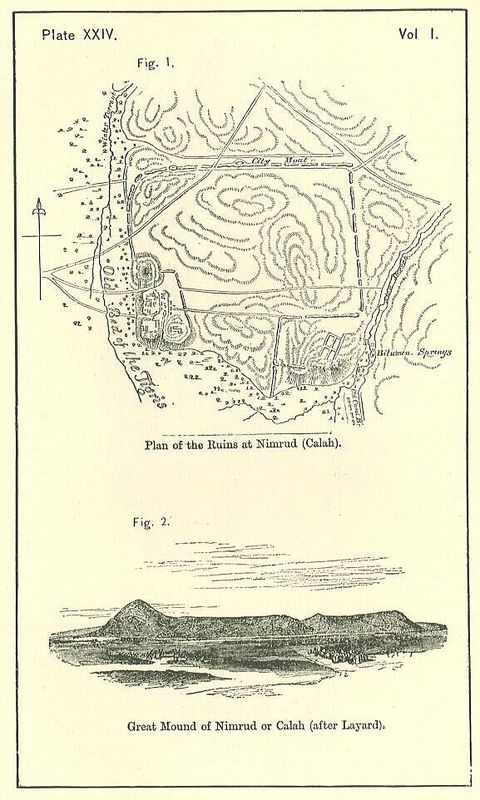
South of Nineveh, at the distance of about twenty miles by the direct route and thirty by the course of the Tigris, stood the second city of the empire, Calah, the site of which is marked by the extensive ruins at Nimrud. [PLATE XXIV., Fig. 1.] Broadly, this place may be said to have been built at the confluence of the Tigris with the Upper Zab; but in strictness it was on the Tigris only, the Zab flowing five or six miles further to the south, and entering the Tigris at least nine miles below the Nimrud ruins. These ruins at present occupy an area somewhat short of a thousand English acres, which is little more than one-half of the area of the ruins of Nineveh; but it is thought that the place was in ancient times considerably larger, and that the united action of the Tigris and some winter streams has swept away no small portion of the ruins. They form at present an irregular quadrangle, the sides of which face the four cardinal points. On the north and east the rampart may still be distinctly traced. It was flanked with towers along its whole course, and pierced at uncertain intervals by gates, but was nowhere of very great strength or dimensions. On the south side it must have been especially weak, for there it has disappeared altogether. Here, however, it seems probable that the Tigris and the Shor Derreh stream, to which the present obliteration of the wall may be ascribed, formed in ancient times a sufficient protection. Towards the west, it seems to be certain that the Tigris (which is now a mile off) anciently flowed close to the city. On this side, directly facing the river, and extending along it a distance of 600 yards, or more than a third of a mile, was the royal quarter, or portion of the city occupied by the palaces of the kings. It consisted of a raised platform, forty feet above the level of the plain, composed in some parts of rubbish, in others of regular layers of sun-dried bricks, and cased on every side with solid stone masonry, containing an area of sixty English acres, and in shape almost a regular rectangle, 560 yards long, and from 350 to 450 broad. The platform was protected at its edges by a parapet, and is thought to have been ascended in various places by wide staircases, or inclined ways, leading up from the plain. The greater part of its area is occupied by the remains of palaces constructed by various native kings, of which a more particular account will be given in the chapter on the architecture and other arts of the Assyrians. It contains also the ruins of two small temples, and abuts at its north-western angle on the most singular structure which has as yet been discovered among the remains of the Assyrian cities. This is the famous tower or pyramid which looms so conspicuously over the Assyrian plams, and which has always attracted the special notice of the traveller. [PLATE XXIV., Fig. 2.] An exact description of this remarkable edifice will be given hereafter.
It appears from the inscriptions on its bricks to have been commenced by one of the early kings, and completed by another. Its internal structure has led to the supposition that it was designed to be a place of burial for one or other of these monarchs. Another conjecture is, that it was a watch-tower; but this seems very unlikely, since no trace of any mode by which it could be ascended has been discovered.
Forty miles below Calah, on the opposite bank of the Tigris, was a third great city, the native name of which appears to have been Asshur. This place is represented by the ruins at Kileh-Sherghat, which are scarcely inferior in extent to those at Nimrud or Calah. It will not be necessary to describe minutely this site, as in general character it closely resembles the other ruins of Assyria. Long lines of low mounds mark the position of the old walls, and show that the shape of the city was quadrangular. The chief object is a large square mound or platform, two miles and a half in circumference, and in places a hundred feet above the level of the plain, composed in part of sun-dried bricks, in part of natural eminences, and exhibiting occasionally remains of a casing of hewn stone, which may once have encircled the whole structure. About midway on the north side of the platform, and close upon its edge, is a high cone or pyramid. The rest of the platform is covered with the remains of walls and with heaps of rubbish, but does not show much trace of important buildings. This city has been supposed to represent the Biblical Resen; but the description of that place as lying "between Nineveh and Calah" seems to render the identification worse than uncertain.
The ruins at Kileh-Sherghat are the last of any extent towards the south, possessing a decidedly Assyrian character. To complete our survey, therefore of the chief Assyrian towns, we must return northwards, and, passing Nineveh, direct our attention to the magnificent ruins on the small stream of the Khosrsu, which have made the Arab village of Khorsabad one of the best known names in Oriental topography. About nine miles from the north-east angle of the wall of Nineveh, in a direction a very little east of north, stands the ruin known as Khorsabad, from a small village which formerly occupied its summit—the scene of the labors of M. Botta, who was the first to disentomb from among the mounds of Mesopotamia the relics of an Assyrian palace. The enclosure at Khorsabad is nearly square in shape, each side being about 2000 yards long. No part of it is very lofty, but the walls are on every side well marked. Their angles point towards the cardinal points, or nearly so; and the walls themselves consequently face the north-east, the north-west, the south-west, and the south-east. Towards the middle of the north-west wall, and projecting considerably beyond it, was a raised platform of the usual character; and here stood the great palace, which is thought to have been open to the plain, and on that side quite undefended.
Four miles only from Khorsabad, in a direction a little west of north, are the ruins of a smaller Assyrian city, whose native name appears to have been Tarbisa, situated not far from the modern village of Sherif-khan. Here was a palace, built by Esarhaddon for one of his sons, as well as several temples and other edifices. In the opposite direction at the distance of about twenty miles, is Keremles, an Assyrian ruin, whose name cannot yet be rendered phonetically. West of this site, and about half-way between the ruins of Nineveh and Nimrud or Calah, is Selamiyah, a village of some size, the walls of which are thought to be of Assyrian construction. We may conjecture that this place was the Resen, or Dase, of Holy Scripture, which is said to have been a large city, interposed between Nineveh and Calah. In the same latitude, but considerably further to the east, was the famous city of Arabil or Arbil, known to the Greeks as Arbela, and to this day retaining its ancient appellation. These were the principal towns, whose positions can be fixed, belonging to Assyria Proper, or the tract in the immediate vicinity of Nineveh.
Besides these places, the inscriptions mention a large number of cities which we cannot definitely connect with any particular site. Such are Zaban and Zadu, beyond the Lower Zab, probably somewhere in the vicinity of Kerkuk; Kurban, Tidu (?), Napulu, Kapa, in Adiabene; Arapkha and Khaparkhu, the former of which names recalls the Arrapachitis of Ptolemy, in the district about Arbela; Hurakha, Sallat (?), Dur-Tila, Dariga, Lupdu, and many others, concerning whose situations it is not even possible to make any reasonable conjecture. The whole country between the Tigris and the mountains was evidently studded thickly with towns, as it is at the present day with ruins; but until a minute and searching examination of the entire region has taken place, it is idle to attempt an assignment to particular localities of these comparatively obscure names.
In Western Assyria, or the tract on the right bank of the Tigris, while there is reason to believe that population was as dense, and that cities were as numerous, as on the opposite side of the river, even fewer sites can be determinately fixed, owing to the early decay of population in those parts, which seem to have fallen into their present desert condition shortly after the destruction of the Assyrian empire by the conquering Medes. Besides Asshur, which is fixed to the ruins at Kileh-Sherghat, we can only locate with certainty some half-dozen places. These are Nazibina, which is the modern Nisibin, the Nisibis of the Greeks; Amidi, which is Amida or Diarbekr; Haran, which retains its name unchanged; Sirki, which is the Greek Circesium, now Kerkesiyeh; Anat, now Anah, on an island in the Euphrates; and Sidikan, now Arban, on the Lower Khabour. The other known towns of this region, whose exact position is more or less uncertain, are the following:—Tavnusir, which is perhaps Dunisir, near Mardin; Guzana, or Gozan, in the vicinity of Nisibin; Razappa, or Rezeph, probably not far from Harran; Tel Apni, about Orfah or Ras-el-Ain; Tabiti and Magarisi, on the Jerujer, or river of Nisibin; Katni and Beth-Khalupi, on the Lower Khabour; Tsupri and Nakarabani, on the Euphrates, between its junction with the Khabour and Allah; and Khuzirina, in the mountains near the source of the Tigris. Besides these, the inscriptions contain a mention of some scores of towns wholly obscure, concerning which we cannot even determine whether they lay west or east of the Tigris.
Such are the chief geographical features of Assyria. It remains to notice briefly the countries by which it was bordered. To the east lay the mountain region of Zagros, inhabited principally, during the earlier times of the Empire, by the Zimri, and afterwards occupied by the Medes, and known as a portion of Media. This region is one of great strength, and at the same time of much productiveness and fertility. Composed of a large number of parallel ridges. Zagros contains, besides rocky and snow-clad summits, a multitude of fertile valleys, watered by the great affluents of the Tigris or their tributaries, and capable of producing rich crops with very little cultivation. The sides of the hills are in most parts clothed with forests of walnut, oak, ash, plane, and sycamore, while mulberries, olives, and other fruit-trees abound; in many places the pasturage is excellent; and thus, notwithstanding its mountainous character, the tract will bear a large population. Its defensive strength is immense, equalling that of Switzerland before military roads were constructed across the High Alps. The few passes by which it can be traversed seem, according to the graphic phraseology of the ancients, to be carried up ladders; they surmount six or seven successive ridges, often reaching the elevation of 10,000 feet, and are only open during seven months of the year. Nature appears to have intended Zagros as a seven fold wall for the protection of the fertile Mesopotamian lowland from the marauding tribes inhabiting the bare plateau of Iran.
North of Assyria lays a country very similar to the Zagros region. Armenia, like Kurdistan, consists, for the most part of a number of parallel mountain ranges, with deep valleys between them, watered by great rivers or their affluents. Its highest peaks, like those of Zagros, ascend considerably above the snow-line. It has the same abundance of wood, especially in the more northern parts; and though its valleys are scarcely so fertile, or its products so abundant and varied, it is still a country where a numerous population may find subsistence. The most striking contrast which it offers to the Zagros region is in the direction of its mountain ranges. The Zagros ridges run from north-west to south-east, like the principal mountains of Italy, Greece, Arabia, Hindustan, and Cochin China; those of Armenia have a course from a little north of east to a little south of west, like the Spanish Sierras, the Swiss and Tyrolese Alps, the Southern Carpathians, the Greater Balkan, the Cilician Taurus, the Cyprian Olympus, and the Thian Chan. Thus the axes of the two chains are nearly at right angles to one another, the triangular basin of Van occurring at the point of contact, and softening the abruptness of the transition. Again, whereas the Zagros mountains present their gradual slope to the Mesopotamian lowland, and rise in higher and higher ridges as they recede from the mountains of Armenia ascend at once to their full heignt from the level of the Tigris, and the ridges then gradually decline towards the Euxine. It follows from this last contrast, that, while Zagros invites the inhabitants of the Mesopotamian plain to penetrate its recesses, which are at first readily accessible, and only grow wild and savage towards the interior, the Armenian mountains repel by presenting their greatest difficulties and most barren aspect at once, seeming, with their rocky sides and snow-clad summits, to form an almost insurmountable obstacle to an invading host. Assyrian history bears traces of this difference; for while the mountain region to the east is gradually subdued and occupied by the people of the plain, that on the north continues to the last in a state of hostility and semi-independence.
West of Assyria (according to the extent which has here been given to it), the border countries were, towards the south, Arabia, and towards the north, Syria. A desert region, similar to that which bounds Chaldaea in this direction, extends along the Euphrates as far north as the 36th parallel, approaching commonly within a very short distance of the river. This has been at all times the country of the wandering Arabs. It is traversed in places by rocky ridges of a low elevation, and intercepted by occasional wadys, but otherwise it is a continuous gravelly or sandy plain, incapable of sustaining a settled population. Between the desert and the river intervenes commonly a narrow strip of fertile territory, which in Assyrian times was held by the Tsukhi or Shuhites, and the Aramaeans or Syrians. North of the 36th parallel, the general elevation of the country west of the Euphrates rises. There is an alternation of bare undulating hills and dry plains, producing wormwood and other aromatic plants. Permanent rivers are found, which either terminate in salt lakes or run into the Euphrates. In places the land is tolerably fertile, and produces good crops of grain, besides mulberries, pears, figs, pomegranates, olives, vines, and pistachio-nuts. Here dwelt, in the time of the Assyrian Empire, the Khatti, or Hittites, whose chief city, Carchemish, appears to have occupied the site of Hierapolis, now Bambuk. In a military point of view, the tract is very much less strong than either Armenia or Kurdistan, and presents but slight difficulties to invading armies.
The tract south of Assyria was Chaldaea, of which a description has been given in an earlier portion of this volume. Naturally it was at once the weakest of the border countries, and the one possessing the greatest attractions to a conqueror. Nature had indeed left it wholly without defence; and though art was probably soon called in to remedy this defect, yet it could not but continue the most open to attack of the various regions by which Assyria was surrounded. Syria was defended by the Euphrates—at all times a strong barrier; Arabia, not only by this great stream, but by her arid sands and burning climate; Armenia and Kurdistan had the protection of their lofty mountain ranges. Chaldaea was naturally without either land or water barrier; and the mounds and dykes whereby she strove to supply her wants were at the best poor substitutes for Nature's bulwarks. Here again geographical features will be found to have had an important bearing on the course of history, the close connection of the two countries, in almost every age, resulting from their physical conformation.
CHAPTER II.
CLIMATE AND PRODUCTIONS.
"Assyria, celebritate et magnitudine, et multiformi feracitate ditissima."—AMM. MARC. xxiii
In describing the climate and productions of Assyria, it will be necessary to divide it into regions, since the country is so large, and the physical geography so varied, that a single description would necessarily be both incomplete and untrue. Eastern Assyria has a climate of its own, the result of its position at the foot of Zagros. In Western Assyria we may distinguish three climates, that of the upper or mountainous country extending from Bir to Til and Jezireh, that of the middle region on either side of the Sinjar range, and that of the lower region immediately bordering on Babylonia. The climatic differences depend in part on latitude; but probably in a greater degree on differences of elevation, distance or vicinity of mountains, and the like.
Eastern Assyria, from its vicinity to the high and snow-clad range of Zagros, has a climate at once cooler and moister than Assyria west of the Tigris. The summer heats are tempered by breezes from the adjacent mountains, and, though trying to the constitution of an European, are far less oppressive than the torrid blasts which prevail on the other side of the river. A good deal of rain falls in the winter, and even in the spring; while, after the rains are past, there is frequently an abundant dew, which supports vegetation and helps to give coolness to the air. The winters are moderately severe.
In the most southern part of Assyria, from lat. 34° to 35° 30', the climate scarcely differs from that of Babylonia, which has been already described. The same burning summers, and the same chilly but not really cold winters, prevail in both districts; and the time and character of the rainy season is alike in each. The summers are perhaps a little less hot, and the winters a little colder than in the more southern and alluvial region; but the difference is inconsiderable, and has never been accurately measured.
In the central part of Western Assyria, on either side of the Sinjar range, the climate is decidedly cooler than in the region adjoining Babylonia. In summer, though the heat is great, especially from noon to sunset, yet the nights are rarely oppressive, and the mornings enjoyable. The spring-time in this region is absolutely delicious; the autumn is pleasant; and the winter, though cold and accompanied by a good deal of rain and snow, is rarely prolonged and never intensely rigorous. Storms of thunder and lightning are frequent, especially in spring, and they are often of extraordinary violence: hail-stones fall of the size of pigeon's eggs; the lightning is incessant; and the wind rages with fury. The force of the tempest is, however, soon exhausted; in a few hours' time it has passed away, and the sky is once more cloudless: a delightful calm and freshness pervade the air, producing mingled sensations of pleasure and repose.
The mountain tract, which terminates Western Assyria to the north, has a climate very much more rigorous than the central region. The elevation of this district is considerable, and the near vicinity of the great mountain country of Armenia, with its eternal snows and winters during half the year, tends greatly to lower the temperature, which in the winter descends to eight or ten degrees below zero. Much snow then falls, which usually lies for some weeks; the spring is wet and stormy, but the summer and the autumn are fine; and in the western portion of the region about Harran and Orfah, the summer heat is great. The climate is here an "extreme" one, to use on expression of Humboldt's—the range of the thermometer being even greater than it is in Chaldaea, reaching nearly (or perhaps occasionally exceeding) 120 degrees.
Such is the present climate of Assyria, west and east of the Tigris. There is no reason to believe that it was very different in ancient times. If irrigation was then more common and cultivation more widely extended, the temperature would no doubt have been somewhat lower and the air more moist. But neither on physical nor on historical grounds Can it be argued that the difference thus produced was; more than slight. The chief causes of the remarkable heat of Mesopotamnia—so much exceeding that of many countries under the same parallels of latitude—are its near vicinity to the Arabian and Syrian deserts, and its want of trees, those great refrigerators. While the first of these causes would be wholly untouched by cultivation, the second would be affected in but a small degree. The only tree which is known to have been anciently cultivated in Mesopotamia is the date-palm; and as this ceases to bear fruit about lat. 35°, its greater cultivation could have prevailed only in a very small portion of the country, and so would have affected the general climate but little. Historically, too, we find, among the earliest notices which have any climatic bearing, indications that the temperature and the consequent condition of the country were anciently very nearly what they now are. Xenophon speaks of the barrenness of the tract between the Khabour and Babylonia, and the entire absence of forage, in as strong terms as could be used at the present day. Arrian, following his excellent authorities, notes that Alexander, after crossing the Euphrates, kept close to the hills, "because the heat there was not so scorching as it was lower down," and because he could then procure green food for his horses. The animals too which Xenophon found in the country are either such as now inhabit it, or where not such, they are the denizens of hotter rather than colder climates and countries.
The fertility of Assyria is a favorite theme with the ancient writers. Owing to the indefiniteness of their geographical terminology, it is however uncertain, in many cases, whether the praise which they bestow upon Assyria is really intended for the country here called by that name, or whether it does not rather apply to the alluvial tract, already described, which is more properly termed Chaldaea or Babylonia. Naturally Babylonia is very much more fertile than the greater part of Assyria, which being elevated above the courses of the rivers, and possessing a saline and gypsiferous soil, tends, in the absence of a sufficient water supply, to become a bare and arid desert. Trees are scanty in both regions except along the river courses; but in Assyria, even grass fails after the first burst of spring; and the plains, which for a few weeks have been carpeted with the tenderest verdure and thickly strewn with the brightest and loveliest flowers, become, as the summer advances, yellow, parched, and almost herbless. Few things are more remarkable than the striking difference between the appearance of the same tract in Assyria at different seasons of the year. What at one time is a garden, glowing with brilliant hues and heavy with luxuriant pasture, on which the most numerous flocks can scarcely make any sensible impression, at another is an absolute waste, frightful and oppressive from its sterilityr.
If we seek the cause of this curious contrast, we shall find it in the productive qualities of the soil, wherever there is sufficient moisture to allow of their displaying themselves, combined with the fact, already noticed, that the actual supply of water is deficient. Speaking generally, we may say with truth, as was said by Herodotus more than two thousand years ago—that "but little rain falls in Assyria," and, if water is to be supplied in adequate quantity to the thirsty soil, it must be derived from the rivers. In most parts of Assyria there are occasional rains during the winter, and, in ordinary years, frequent showers in early spring. The dependence of the present inhabitants both for pasture and for grain is on these. There is scarcely any irrigation; and though the soil is so productive that wherever the land is cultivated, good crops are commonly obtained by means of the spring rains, while elsewhere nature at once spontaneously robes herself in verdure of the richest kind, yet no sooner does summer arrive than barrenness is spread over the scene; the crops ripen and are gathered in; "the grass withereth, the flower fadeth;" the delicate herbage of the plains shrinks back and disappears; all around turns to a uniform dull straw-color; nothing continues to live but what is coarse, dry, and sapless; and so the land, which was lately an Eden, becomes a desert.
Far different would be the aspect of the region were a due use made of that abundant water supply—actually most lavish in the summer time, owing to the melting of the snows which nature has provided in the two great Mesopotamian rivers and their tributaries. So rapid is the fall of the two main streams in their upper course, that by channels derived from them, with the help perhaps of dams thrown across them at certain intervals, the water might be led to almost any part of the intervening country, and a supply kept up during the whole year. Or, even without works of this magnitude, by hydraulic machines of a very simple construction, the life-giving fluid might be raised from the great streams and their affluents in sufficient quantity to maintain a broad belt on either side of the river-courses in perpetual verdure. Anciently, we know that recourse was had to both of these systems. In the tract between the Tigris and the Upper Zab, which is the only part of Assyria that has been minutely examined, are distinct remains of at least one Assyrian canal, wherein much ingenuity and hydraulic skill is exhibited, the work being carried through the more elevated ground by tunnelling, and the canal led for eight miles contrary to the natural course of every stream in the district. Sluices and dams, cut sometimes in the solid rock, regulated the supply of the fluid at different seasons, and enabled the natives to make the most economical application of the great fertilizer. The use of the hand-swipe was also certainly known, since it is mentioned by Herodotus, and even represented upon the sculptures. [PLATE XXV., Fig. 1.] Very probably other more elaborate machines were likewise employed, unless the general prevalency of canals superseded their necessity. It is certain that over wide districts, now dependent for productive power wholly on the spring rains, and consequently quite incapable of sustaining a settled population, there must have been maintained in Assyrian times some effective water-system, whereby regions that at present with difficulty furnish a few months' subsistence to the wandering Arab tribes, were enabled to supply to scores of populous cities sufficient food for their consumption.
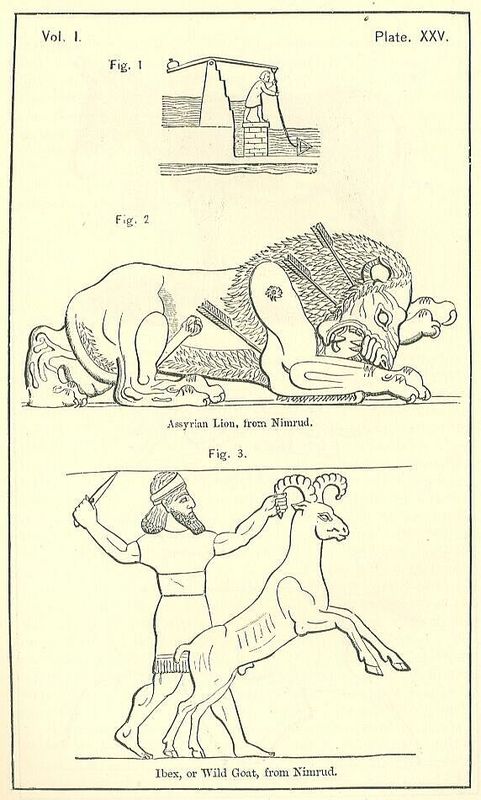
We have not much account of the products of Assyria Proper in early times. Its dates were of small repute, being greatly inferior to those of Babylon. It grew a few olives in places, and some spicy shrubs, which cannot be identified with any certainty. Its cereal crops were good, and may perhaps be regarded as included in the commendations bestowed by Herodotus and Strabo on the grain of the Mesopotamian region. The country was particularly deficient in trees, large tracts growing nothing but wormwood and similar low shrubs, while others were absolutely without either tree or bush. The only products of Assyria which acquired such note as to be called by its name were its silk and its citron trees. The silk, according to Pliny, was the produce of a large kind of silkworm not found elsewhere. The citron trees obtained a very great celebrity. Not only were they admired for their perpetual fruitage, and their delicious odor; but it was believed that the fruit which they bore was an unfailing remedy against poisons. Numerous attempts were made to naturalize the tree in other countries; but up to the time when Pliny wrote, every such attempt had failed, and the citron was still confined to Assyria, Persia and Media.
It is not to be imagined that the vegetable products of Assyria were confined within the narrow compass which the ancient notices might seem to indicate. Those notices are casual, and it is evident that they are incomplete: nor will a just notion be obtained of the real character of the region, unless we take into account such of the present products as may be reasonably supposed to be indigenous. Now setting aside a few plants of special importance to man, the cultivation of which may have been introduced, such as tobacco, rice, Indian corn, and cotton, we may fairly say that Assyria has no exotics, and that the trees, shrubs, and vegetables now found within her limits are the same in all probability as grew there anciently. In order to complete our survey, we may therefore proceed to inquire what are the chief vegetable products of the region at the present time.
In the south the date-palm grows well as far as Anah on the Euphrates and Tekrit on the Tigris. Above that latitude it languishes, and ceases to give fruit altogether about the junction of the Khabour with the one stream and the Lesser Zab with the other. The unproductive tree, however, which the Assyrians used for building purposes, will grow and attain a considerable size to the very edge of the mountains. Of other timber trees the principal are the sycamore and the Oriental plane, which are common in the north the oak, which abounds about Mardin (where it yields gall-nuts and the rare product manna), and which is also found in the Sinjar and Abd-el-Aziz ranges; the silver poplar, which often fringes the banks of the streams; the sumac, which is found on the Upper Euphrates; and the walnut, which grows in the Jebel Tur, and is not uncommon between the foot of Zagros and the outlying ranges of hills. Of fruit-trees the most important are the orange, lemon, pomegranate, apricot, olive, vine, fig, mulberry, and pistachio-nut. The pistachio-nut grows wild in the northern mountains, especially between Orfah and Diarbekr. The fig is cultivated with much care in the Sinjar. The vine is also grown in that region, but bears better on the skirts of the hills above Orfah and Mardin. Pomegranates flourish in various parts of the country. Oranges and lemons belong to its more southern parts, where it verges on Babylonia. The olive clothes the flanks of Zagros in places. Besides these rarer fruits, Assyria has chestnuts, pears, apples, plums, cherries, wild and cultivated, qinces, apricots, melons and filberts.
The commonest shrubs are a kind of wormwood—the apsinthium of Xenophon—which grows over much of the plain extending south of the Khabour—and the tamarisk. Green myrtles, and oleanders with their rosy blossoms, clothe the banks of some of the smaller streams between the Tigris and Mount Zagros; and a shrub of frequent occurrence is the liquorice plant. Of edible vegetables there is great abundance. Truffles and capers grow wild; while peas, beans, onions, spinach, cucumbers, and lentils are cultivated successfully. The carob (Ceratonia Siliqua) must also be mentioned as among the rarer products of this region.
It was noticed above that manna is gathered in Assyria from the dwarf oak. It is abundant in Zagros, and is found also in the woods about Mardin, and again between Orfah and Diarbekr. According to Mr. Rich, it is not confined to the dwarf oak, or even to trees and shrubs, but is deposited also on sand, rocks, and stone. It is most plentiful in wet seasons, and especially after fogs; in dry seasons it fails almost totally. The natives collect it in spring and autumn. The best and purest is that taken from the ground; but by far the greater quantity is obtained from the trees, by placing cloths under them and shaking the branches. The natives use it as food both in its natural state and manufactured into a kind of paste. It soon corrupts; and in order to fit it for exportation, or even for the storeroom of the native housewife, it has to undergo the process of boiling. When thus prepared, it is a gentle purgative; but, in its natural state and when fresh, it may be eaten in large quantities without any unpleasant consequences.
Assyria is far better supplied with minerals than Babylonia. Stone of a good quality, either limestone, sandstone, or conglomerate, is always at hand; while a tolerable clay is also to be found in most plices. If a more durable material is required, basaltic rock may be obtained from the Mons Masius—a substance almost as hard as granite. On the left bank of the Tigris a soft gray alabaster abounds which is easily cut into slabs, and forms an excellent material for the sculptor. The neighboring mountains of Kurdistan contain marbles of many different qualities; and these could be procured without much difficulty by means of the rivers. From the same quarter it was easy to obtain the most useful metals. Iron, copper, and lead are found in great abundance in the Tiyari Mountains within a short distance of Nineveh, where they crop out upon the surface, so that they cannot fail to be noticed. Lead and copper are also obtainable from the neighborhood of Diarbekr. The Kurdish Mountains may have supplied other metals. They still produce silver and antimony; and it is possible that they may anciently have furnished gold and tin. As their mineral riches have never been explored by scientific persons, it is very probable that they may contain many other metals besides those which they are at present known to yield.
Among the mineral products of Assyria, bitumen, naphtha, petroleum, sulphur, alum, and salt have also to be reckoned. The bitumen pits of Kerkuk, in the country between the Lesser Zab and the Adhem, are scarcely less celebrated than those of Hit; and there are some abundant springs of the same character close to Nimrud, in the bed of the Shor Derrell torrent. The Assyrian palaces furnish sufficient evidence that the springs were productive in old times; for the employment of bitumen as a cement, though not so frequent as in Babylonia, is yet occasionally found in them. With the bitumen are always procured both naphtha and petroleum; while at Kerkuk there is an abundance of sulphur also. Salt is obtained from springs in the Kerkuk country; and is also formed in certain small lakes lying between the Sinjar and Babylonia. Alum is plentiful in the hills about Kifri.
The most remarkable wild animals of Assyria are the following: the lion, the leopard, the lynx, the wild-cat, the hyaena, the wild ass, the bear, the deer, the gazelle, the ibex, the wild sheep, the wild boar, the jackal, the wolf, the fox, the beaver, the jerboa, the porcupine, the badger, and the hare. The Assyrian lion is of the maneless kind, and in general habits resembles the lion of Babylonia. The animal is comparatively rare in the eastern districts, being seldom found on the banks of the Tigris above Baghdad, and never above Kileh-Sherghat. On the Euphrates it has been seen as high as Bir; and it is frequent on the banks of the Khabour, and in the Sinjar. It has occasionally that remarkable peculiarity—so commonly represented on the sculptures—a short horny claw at the extremity of the tail in the middle of the ordinary tuft of hair. The ibex or wild goat—also a favorite subject with the Assyrian sculptors—is frequent in Kurdistan, and moreover abounds on the highest ridges of the Abd-el-Aziz and the Sinjar, where it is approached with difficulty by the hunter. The gazelle, wild boar, wolf, jackal, fox, badger, porcupine, and hare are common in the plains, and confined to no particular locality. The jerboa is abundant near the Khabour. Beau's and deer are found on the skirts of the Kurdish hills. The leopard, hyaena, lynx, and beaver are comparatively rare. The last named animal, very uncommon in Southern Asia, was at one time found in large numbers on the Khabour; but in consequence of the value set upon its musk bag, it has been hunted almost to extermination, and is now very seldom seen. The Khabour beavers are said to be a different species from the American. Their tail is not large and broad, but sharp and pointed; nor do they build houses, or construct dams across the stream, but live in the banks, making themselves large chambers above the ordinary level of the floods, which are entered by holes beneath the water-line.
The rarest of all the animals which are still found in Assyria is the wild ass (Equus hemionous). Till the present generation of travellers, it was believed to have disappeared altogether from the region, and to have "retired into the steppes of Mongolia and the deserts of Persia. But a better acquaintance with the country between the rivers has shown that wild asses, though uncommon, still inhabit the tract where, they were seen by Xenophon." [PLATE XXVI., Fig. 1.] They are delicately made, in color varying from a grayish-white in winter to a bright bay, approaching to pink, in the summer-time; they are said to be remarkably swift. It is impossible to take them when full grown; but the Arabs often capture the foals, and bring them up with milk in their tents. They then become very playful and docile; but it is found difficult to keep them alive; and they have never, apparently, been domesticated. The Arabs usually kill them and eat their flesh.
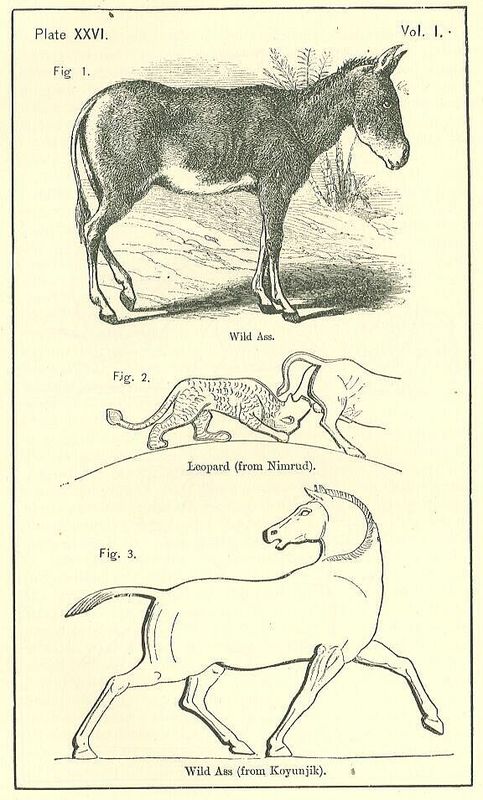
It is probable that all these animals, and some others, inhabited Assyria during the time of the Empire. Lions of two kinds, with and without manes, abound in the sculptures, the former, which do not now exist in Assyria, being the more common. [PLATE XXV., Fig. 2.] They are represented with a skill and a truth which shows the Assyrian sculptor to have been familiar not only with their forms and proportions, but with their natural mode of life, their haunts, and habits. The leopard is far less often depicted, but appears sometimes in the ornamentation of utensils, and is frequently mentioned in the inscriptions. The wild ass is a favorite subject with the sculptors of the late Empire, and is represented with great spirit, though not with complete accuracy. [PLATE XXVI., Fig. 1.] The ears are too short, the head is too fine, the legs are not fine enough, and the form altogether approaches too nearly to the type of the horse. The deer, the gazelle, and the ibex all occur frequently; and though the forms are to some extent conventional, they are not wanting in spirit. [PLATE XXVII.] Deer are apparently of two kinds. That which is most commonly found appears to represent the gray deer, which is the only species existing at present within the confines of Assyria. The other sort is more delicate in shape, and spotted, seeming to represent the fallow deer, which is not now known in Syria or the adjacent countries. It sometimes appears wild, lying among the reeds; sometimes tame, in the arms of a priest or of a winged figure. There is no representation in the sculptures of the wild boar; but a wild sow and pigs are given in one bas-relief, sufficiently indicating the Assyrian acquaintance with this animal. Hares are often depicted, and with much truth; generally they are carried in the hands of men, but sometimes they are being devoured by vultures or eagles. [PLATE XXVIII Figs. 1, 2.] No representations have been found of bears, wild cats, hyaenas, wolves, jackals, wild sheep, foxes, beavers, jerbdas, porcupines, or badgers.
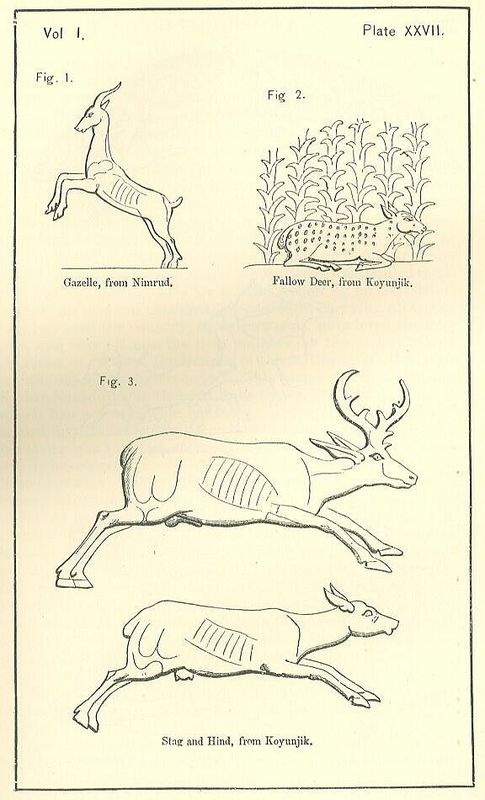
There is reason to believe that two other animals, which have now altogether disappeared from the country, inhabited at least some parts of Assyria during its flourishing period. One of these is the wild bull-often represented on the bas-reliefs as a beast of chase, and perhaps mentioned as such in the inscriptions. This animal, which is sometimes depicted as en-gaged in a contest with the lion, must have been of vast strength and boldness. It is often hunted by the king, and appears to have been considered nearly as noble an object of pursuit as the lion. We may presume, from the practice in the adjoining country, Palestine, 96 that the flesh was eaten as food.
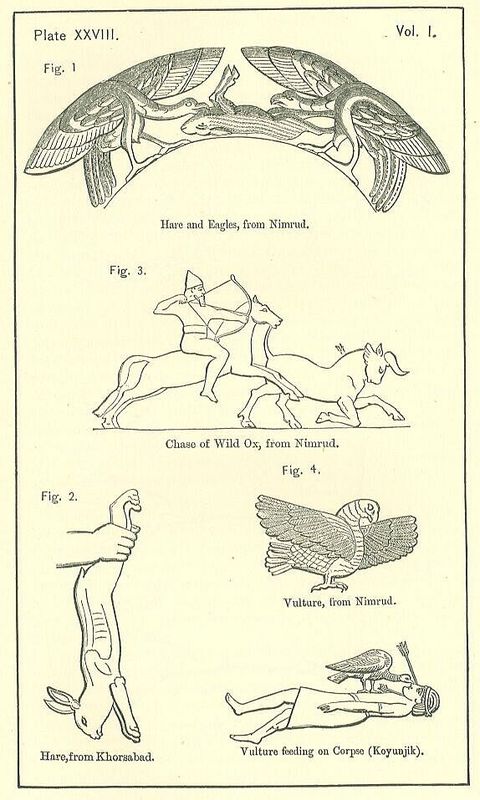
The other animal, once indigenous, but which has now disappeared, was called by the Assyrians the mithin, and is thought to have been the tiger. Tigers are not now found nearer to Assyria than the country south of the Caspian, Ghilan, and Mazanderan; but as there is no conceivable reason why they should not inhabit Mesopotamia, and as the mithin is constantly joined with the lion, as if it were a beast of the same kind, and of nearly equal strength and courage, we may fairly conjecture that the tiger is the animal intended. If this seem too bold a theory, we must regard the mithin as the larger leopard, an animal of considerable strength and ferocity, which, as well as the hunting leopard, is still found in the country. [PLATE XXVI., Fig. 2.]
The birds at present frequenting Assyria are chiefly the following: the bustard (which is of two kinds—the great and the middle-sized), the egret, the crane, the stork, the pelican, the flamingo, the red partridge, the black partridge or francolin, the parrot, the Seleucian thrush (Turdus Seleucus), the vulture, the falcon or hunting hawk, the owl, the wild swan, the bramin goose, the ordinary wild goose, the wild duck, the teal, the tern, the sand-grouse, the turtle dove, the nightingale, the jay, the plover, and the snipe. There is also a large kite or eagle, called "agab," or "the butcher," by the Arabs, which is greatly dreaded by fowlers, as it will attack and kill the falcon no less than other birds.
We have little information as to which of these birds frequented the country in ancient times. The Assyrian artists are not happy in their delineation of the feathered tribe; and though several forms of birds are represented upon the sculptures of Sargon and elsewhere, there are but three which any writer has ventured to identify—the vulture, the ostrich, and the partridge. The vulture is commonly represented flying in the air, in attendance upon the march and the battle—sometimes devouring, as he flies, the entrails of one of Assyria's enemies. Occasionally he appears upon the battle-field, perched upon the bodies of the slain, and pecking at their eyes or their vitals. [PLATE XXVIII., Fig. 4.] The ostrich, which we know from Xenophon to have been a former inhabitant of the country on the left bank of the Euphrates, but which has now retreated into the wilds of Arabia, occurs frequently upon cylinders, dresses, and utensils; sometimes stalking along apparently unconcerned; sometimes hastening at full speed, as if pursued by the hunter, and, agreeably to the description of Xenophon, using its wing for a sail. [PLATE XXIX., Figs. 1, 2.] The partridge is still more common than either of these. He is evidently sought as food. We find him carried in the hand of sportsmen returning from the chase, or see him flying above their heads as they beat the coverts, or finally observe him pierced by a successful shot, and in the act of falling a prey to his pursuers. [PLATE XXIX., Fig. 3.]
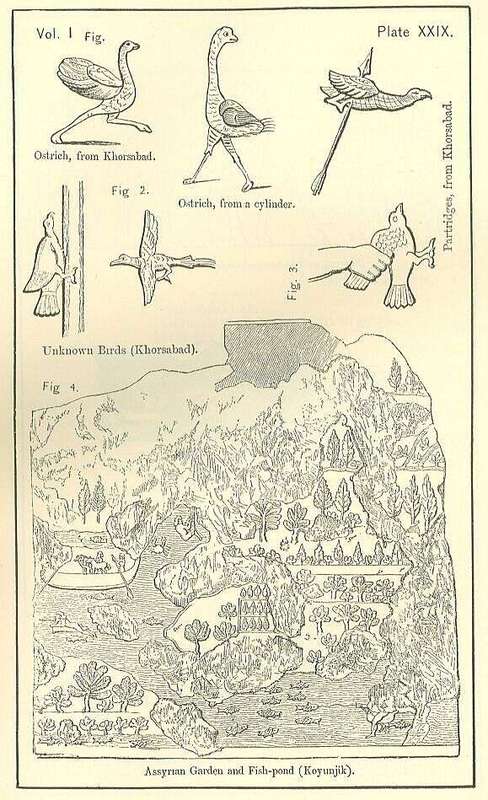
The other birds represented upon the sculptures, though occasionally possessing some marked peculiarities of form or habit, have not yet been identified with any known species. [PLATE XXIX., Fig. 2.] They are commonly represented as haunting the fir-woods, and often as perched upon the trees. One appears, in a sculpture of Sargon's. in the act of climbing the stein of a tree, like the nut-hatch or the woodpecker. Another has a tail like a pheasant, but in other respects cannot be said to resemble that bird. The artist does not appear to aim at truth in these delineations, and it probably would be a waste of ingenuity to conjecture which species of bird he intended.
We have no direct evidence that bustards inhabited Mesopotamia in Assyrian times; but as they have certainly been abundant in that region front the time of Xenophon to our own, there can be little doubt that they existed in some parts of Assyria during the Empire. Considering their size, their peculiar appearance, and the delicacy of their flesh, it is remarkable that the Assyrian remains furnish no trace of them. Perhaps, as they are extremely shy, they may have been comparatively rare in the country when the population was numerous, and when the greater portion of the tract between the rivers was brought under cultivation.
The fish most plentiful in Assyria are the same as in Babylonia, namely, barbel and carp. They abound not only in the Tigris and Euphrates, but also in the lake of Khutaniyeh, and often grow to a great size. Trout are found in the streams which run down from Zagros; and there may be many other sorts which have not yet been observed. The sculptures represent all the waters, whether river, pond, or marsh, as full of fish; but the forms are for the most part too conventional to admit of identification. [PLATE XXIX., Fig. 3.]
The domestic animals now found in Assyria are camels, horses, asses, mules, sheep, goats, oxen, cows, and dogs. The camels are of three colors—white, yellow, and dark brown or black. They are probably all of the same species, though commonly distinguished into camels proper, and delouls or dromedaries, the latter differing from the others as the English race-horse from the cart-horse. The Bactrian or two-humped camel, though known to the ancient Assyrians, is not now found in the country. [PLATE XXX., Fig. 1.] The horses are numerous, and of the best Arab blood. Small in stature, but of exquisite symmetry and wonderful powers of endurance, they are highly prized throughout the East, and constitute the chief wealth of the wandering tribes who occupy the greater portion of Mesopotamia. The sheep and goats are also of good breeds, and produce wool of an excellent quality. [PLATE XXX., Fig. 2.] The cows and oxen cannot be commended. The dogs kept are chiefly greyhounds, which are used to course the hare and the gazelle.
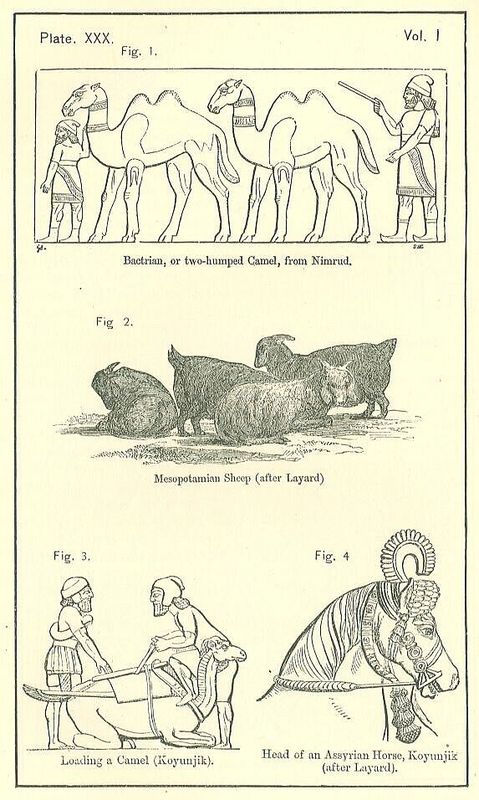
It is probable that in ancient times the animals domesticated by the Assyrians were not very different from these. The camel appears upon the monuments both as a beast of burden and also as ridden in war, but only by the enemies of the Assyrians. [PLATE XXX., Fig. 3.] The horse is used both for draught and for riding, but seems never degraded to ignoble purposes. His breed is good, though he is not so finely or delicately made as the modern Arab. The head is small and well shaped, the nostrils large and high, the neck arched, but somewhat thick, the body compact, the loins strong, the legs moderately slender and sinewy. [PLATE XXX., Fig. 4.] [PLATE XXXI., Fig. 1.] The ass is not found; but the mule appears, sometimes ridden by women, sometimes used as a beast of burden, sometimes employed in drawing a cart. [PLATE XXXI., Fig. 2] [PLATE XXXII., Figs. 1, 2.] Cows, oxen, sheep, and goats are frequent; but they are foreign rather tham Assyrian, since they occur only among the spoil taken from conquered countries. The dog is frequent on the later sculptures; and has been found modelled in clay, and also represented in relief on a clay tablet. [PLATE XXXII., Fig. 3.] [PLATE XXXIII., Fig. 1.] Their character is that of a large mastiff or hound, and there is abundant evidence that they were employed in hunting.
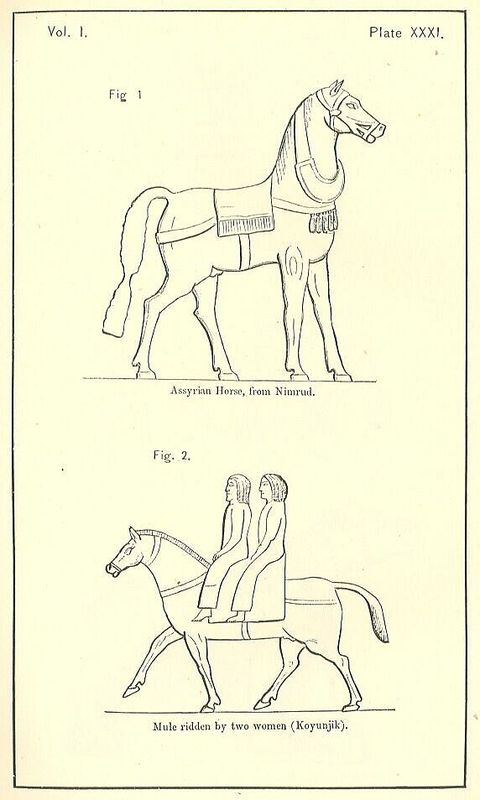
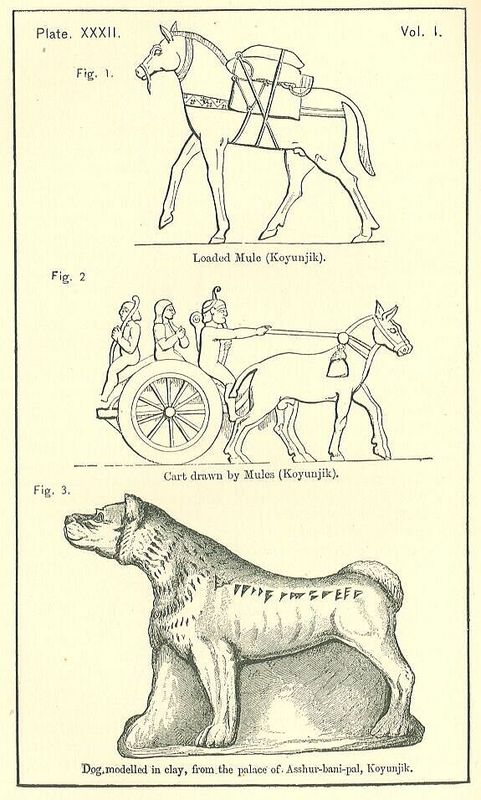
If the Assyrians domesticated any bird, it would seem to have been the duck. Models of the duck are common, and seem generally to have been used for weights. [PLATE XXXIII., Fig. 2.] The bird is ordinarily represented with its head turned upon its back, the attitude of the domestic duck when asleep. The Assyrians seem to have had artificial ponds or stews, which are always represented as full of fish, but the forms are conventional, as has been already observed. Considering the size to which the carp and barbel actually grow at the present day, the ancient representations are smaller than might have been expected.
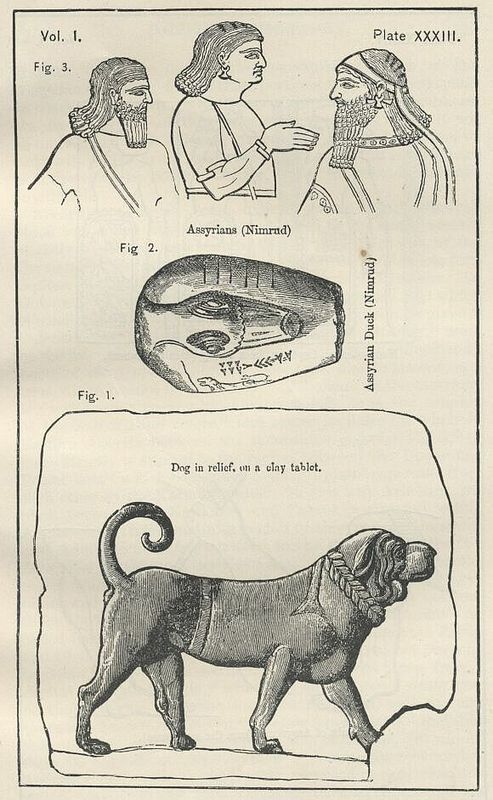
===============
THE SECOND MONARCHY
ASSYRIA
CHAPTER III.
THE PEOPLE.
"The Assyrian was a cedar in Lebanon, fair of branches, and with a shadowing shroud, and of high stature; and his top was among the thick boughs. . . . Nor was any tree in the garden of God like unto him in his beauty."—EZEK. xxxi. 3 and 8.
The ethnic character of the ancient Assyrians, like that of the Chaldaeans, was in former times a matter of controversy. When nothing was known of the original language of the people beyond the names of certain kings, princes, and generals, believed to have belonged to the race, it was difficult to arrive at any determinate conclusion on the subject. The ingenuity of etymologists displayed itself in suggesting derivations for the words in question, which were sometimes absurd, sometimes plausible, but never more than very doubtful conjectures. No sound historical critic could be content to base a positive view on any such unstable foundation, and nothing remained but to decide the controversy on other than linguistic considerations.
Various grounds existed on which it was felt that a conclusion could be drawn. The Scriptural genealogies connected Asshur with Aran, Pier, and Joktan, the allowed progenitors of the Armaeians or Syrians, the Israelites or Hebrews, and the northern or Joktanian Arabs. The languages, physical type, and moral characteristics of these races were well known: they all belonged evidently to a single family the family known to ethnologists as the Semitic. Again, the manners and customs, especially the religious customs, of the Assyrians connected then plainly with the Syrians and Phoenicians, with whose practices they were closely allied. Further it was observed that the modern Chaldaeans of Kurdistan, who regard themselves as descendants of the ancient inhabitants of the neighboring Assyria, still speak a Semitic dialect. These three distinct and convergent lines of testimony were sufficient to justify historians in the conclusion, which they commonly drew, that the ancient Assyrians belonged to the Semitic family, and were more or less closely connected with the Syrians, the (later) Babylonians, the Phoenicians, the Israelites, and the Arabs of the northern portion of the peninsula.
Recent linguistic discoveries have entirely confirmed the conclusion thus, arrived at. We now possess in the engraved slabs, the clay tablets, the cylinders, and the bricks, exhumed from the ruins of the great Assyrian cities, copious documentary evidence of the character of the Assyrian language, and (so far as language is a proof) of the ethnic character of the race. It appears to be doubted by none who have examined the evidence, that the language of these records is Semitic. However imperfect the acquaintance which our best Oriental archaeologists have as yet obtained with this ancient and difficult form of speech, its connection with the Syriac, the later Babylonian, the Hebrew, and the Arabic does not seem to admit of a doubt.
Another curious confirmation of the ordinary belief is to be found in the physical characteristics of the people, as revealed to us by the sculptures. Few persons in any way familiar with these works of art can have failed to remark the striking resemblance to the Jewish physiognomy which is presented by the sculptured effigies of the Assyrians. The forehead straight but not high, the full brow, the eye large and almond-shaped, the aquiline nose, a little coarse at the end, and unduly depressed, the strong, firm mouth, with lips somewhat over thick, the well-formed chin—best seen in the representation of eunuchs—the abundant hair and ample beard, both colored as black—all these recall the chief peculiarities of the Jew more especially as he appears in southern countries. [PLATE XXXIII., Fig. 3.] They are less like the traits of the Arab, though to them also they bear a considerable resemblance. Chateaubriand's description of the Bedouin—"la tete ovale, le front haut et argue, le nez aquilia, les yeux grandes et coupe en amandes, le regard humide et singulierement doux" would serve in many respects equally well for a description of the physiognomy of the Assyrians, as they appear upon the monuments. The traits, in fact, are for the most part common to the Semitic race generally, and not distinctive of any particular subdivision of it. They are seen now alike in the Arab, the Jew, and the Chalaedeans of Kurdistan, while anciently they not only characterized the Assyrians, but probably belonged also to the Phoenicians, the Syrians, and other minor Semetic races. It is evident, even from the mannered and conventional sculptures of Egypt, that the physiognomy was regarded as characteristic of the western Asiatic races. Three captives on the monuments of Amenophis III., represented as belonging to the Patana (people of Bashan?), the Asuru (Assyrians), and the Karukamishi (people of Carchemish), present to us the sane style of face, only slightly modified by Egyptian ideas. [PLATE. XXXIV., Fig. 1.]
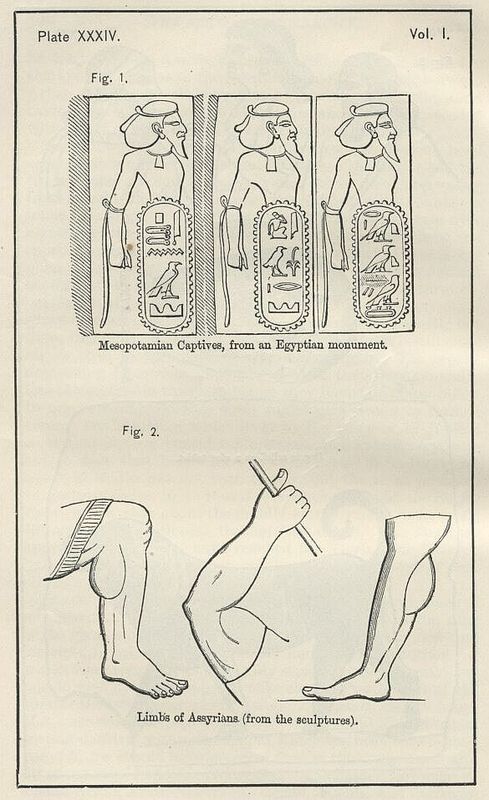
White in face the Assyrians appear thus to have borne a most close resemblance to the Jews, in shape and make they are perhaps more nearly represented by their descendants, the Chaldaeans of Kurdistan. While the Oriental Jew has a spare form and a weak muscular development, the Assyrian, like the modern Chaldaean, is robust, broad-shouldered, and large-limbed. Nowhere have we a race represented to us monumentally of a stronger or more muscular type than the ancient Assyrian. The great brawny limbs are too large for beauty; but they indicate a physical power which we may well believe to have belonged to this nation—the Romans of Asia—the resolute and sturdy people which succeeded in imposing its yoke upon all its neighbors. [PLATE XXXIV., Fig, 2.]
If from physical we proceed to mental characteristics, we seem again to have in the Jewish character the best and closest analogy to the Assyrian. In the first place, there is observable in each a strong and marked prominency of the religious principle. Inscriptions of Assyrian kings begin and end, almost without exception, with praises, invocations, and prayers to the principal objects of their adoration. All the monarch's successes, all his conquests and victories, and even his good fortune in the chase, are ascribed continually to the protection and favor of guardian deities. Wherever he goes, he takes care to "set up the emblems of Asshur," or of "the great gods;" and forces the vanquished to do them homage. The choicest of the spoil is dedicated as a thank-offering in the temples. The temples themselves are adorned, repaired, beautified, enlarged, increased in manner, by almost, every monarch. The kings worship them in person, and offer sacrifices. They embellish their palaces, not only with representations of their own victories and hunting expeditions, but also with religious figures—the emblems of some of the principal deities, and with scenes in which are portrayed acts of adoration. Their signets, and indeed those of the Assyrians generally, have a religious character. In every way religion seems to hold a marked and prominent place in the thoughts of the people, who fight more for the honor of their gods than even of their king, and aim at extending their belief as much as their dominion.
Again, combined with this prominency of the religious principle, is a sensuousness—such as we observe in Judaism continually struggling against a higher and purer element—but which in this less favored branch of the Semitic family reigns uncontrolled, and gives to its religion a gross, material, and even voluptuous character. The ideal and the spiritual find little favor with this practical people, which, not content with symbols, must have gods of wood and stone whereto to pray, and which in its complicated mythological system, its priestly hierarchy, its gorgeous ceremonial, and finally in its lascivious ceremonies, is a counterpart to that Egypt, from which the Jew was privileged to make his escape.
The Assyrians are characterized in Scripture as "a fierce people." Their victories seem to have been owing to their combining individual bravery and hardihood with a skill and proficiency in the arts of war not possessed by their more uncivilized neighbors. This bravery and hardihood were kept up, partly (like that of the Romans) by their perpetual wars, partly by the training afforded to their manly qualities by the pursuit and destruction of wild animals. The lion—the king of beasts—abounded in their country, together with many other dangerous and ferocious animals. Unlike the ordinary Asiatic, who trembles before the great beasts of prey and avoids a collision by flight if possible, the ancient Assyrian sought out the strongest and fiercest of the animals, provoked them to the encounter, and engaged with them in hand-to-hand combats. The spirit of Nimrod, the "mighty hunter before the Lord," not only animated his own people, but spread on from them to their northern neighbors; and, as far as we can judge by the monuments, prevailed even more in Assyria than in Chaldaea itself. The favorite objects of chase with the Assyrians seem to have been the lion and the wild bull, both beasts of vast strength and courage, which could not be attacked without great danger to the bold assailant.
No doubt the courage of the Assyrians was tinged with ferocity. The nation was "a mighty and strong one, which, as a tempest of hail and a destroying storm, as a flood of mighty waters overflowing, cast down to the earth with the hand." Its capital might well deserve to be called "a bloody city," or "a city of bloods." Few conquering races have been tender-hearted, or much inclined to spare; and undoubtedly carnage, ruin, and desolation followed upon the track of an Assyrian army, and raised feelings of fear and hatred among their adversaries. But we have no reason to believe that the nation was especially bloodthirsty or unfeeling. The mutilation of the slain—not by way of insult, but in proof of their slayer's prowess was indeed practised among them; but otherwise there is little indication of any barbarous, much less of any really cruel, usages. The Assyrian listens to the enemy who asks for quarter; he prefers making prisoners to slaying; he is very terrible in the battle and the assault, but afterwards he forgives, and spares. Of course in some cases he makes exceptions. When a town has rebelled and been subdued, he impales some of the most guilty [PLATE XXXV., Fig. 1]; and in two or three instances prisoners are represented as led before the king by a rope fastened to a ring which passes through the under lip, while now and then one appears in the act of being flayed with it knife [PLATE XXXV., Fig. 2.] But, generally, captives are either released, or else transferred, without unnecessary suffering, from their own country to some other portion of the empire. There seems even to be something of real tenderness in the treatment of captured women, who are never manacled, and are often allowed to ride on mules, or in carts. [PLATE XXXVI., Fig. 1.]
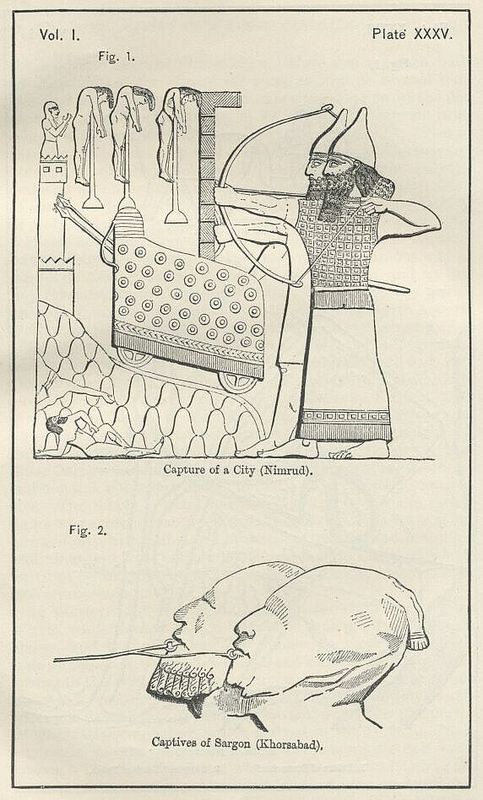
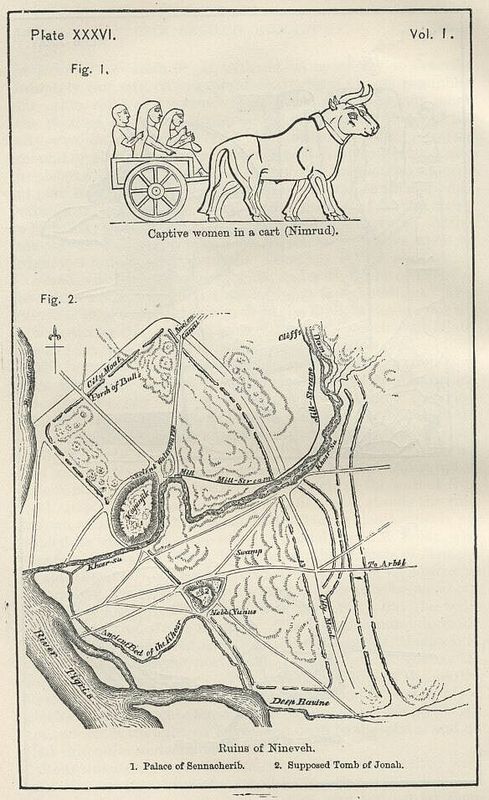
The worst feature in the character of the Assyrians was their treachery. "Woe to thee that spoilest, though thou wast not spoiled, and dealest treacherously, though they dealt not treacherously with thee!" is the denunciation of the evangelical prophet. And in the same spirit the author of "The Burthen of Nineveh" declares that city to be "full of lies and robbery"—or, more correctly, full of lying and violence. Falsehood and treachery are commonly regarded as the vices of the weak, who are driven to defend themselves against superior strength by the weapon of cunning; but they are perhaps quite as often employed by the strong as furnishing short cuts to success, and even where the moral standard is low, as being in themselves creditable. It certainly was not necessity which made the Assyrians covenant-breakers; it seems to have been in part the wantonness of power—because they "despised the cities and regarded no man;" perhaps it was in part also their imperfect moral perception, which may have failed to draw the proper distinction between craft and cleverness.
Another unpleasant feature in the Assyrian character—but one at which we can feel no surprise—was their pride. This is the quality which draws forth the sternest denunciations of Scripture, and is expressly declared to have called down the Divine judgments upon the race. Isaiah, Ezekiel, and Zephaniah alike dwell upon it. It pervades the inscriptions. Without being so rampant or offensive as the pride of some Orientals—as, for instance, the Chinese, it is of a marked and decided color: the Assyrian feels himself infinitely superior to all the nations with whom he is brought into contact; he alone enjoys the favor of the gods; he alone is either truly wise or truly valiant; the armies of his enemies are driven like chaff before him; he sweeps them away, like heaps of stubble; either they fear to fight, or they are at once defeated; he carries his victorious arms just as far as it pleases him, and never under any circumstances admits that he has suffered a reverse. The only merit that he allows to foreigners is some skill in the mechanical and mimetic arts, and his acknowledgment of this is tacit rather than express, being chiefly known from the recorded fact that he employs foreign artists to ornament his edifices.
According to the notions which the Greeks derived from Ctesias, and passed on to the Romans, and through them to the moderns generally, the greatest defect in the Assyrian character—the besetting sin of their leading men—was luxuriousness of living and sensuality. From Ninyas to Sardanapalus—from the commencement to the close of the Empire—a line of voluptuaries, according to Ctesias and his followers, held possession of the throne; and the principle was established from the first, that happiness consisted in freedom from all cares or troubles, and unchecked indulgence in every species of sensual pleasure. This account, intrinsically suspicious, is now directly contradicted by the authentic records which we possess of the warlike character and manly pursuits of so many of the kings. It probably, however, contains a germ of truth. In a flourishing kingdom like Assyria, luxury must have gradually advanced; and when the empire fell under the combined attack of its two most powerful neighbors, no doubt it had lost much of its pristine vigor. The monuments lend some support to the view that luxury was among the causes which produced the fall of Assyria; although it may be questioned whether, even to the last, the predominant spirit was not warlike and manly, or even fierce and violent. Among the many denunciations of Assyria in Scripture, there is only one which can even be thought to point to luxury as a cause of her downfall; and that is a passage of very doubtful interpretation. In general it is her violence, her treachery, and her pride that are denounced. When Nineveh repented in the time of Jonah, it was by each man "turning from his evil way and from the violence which was in their hands." When Nahum announces the final destruction, it is on "the bloody city, full of lies and robbery." In the emblematic language of prophecy, the lion is taken as the fittest among animals to symbolize Assyria, even at this late period of her history. She is still "the lion that did tear in pieces enough for his whelps, and strangled for his lioness, and filled his holes with prey, and his dens with ravin." The favorite national emblem, if it may be so called, is accepted as the true type of the people; and blood, ravin, and robbery are their characteristics in the mind of the Hebrew prophet.
In mental power the Assyrians certainly deserve to be considered as among the foremost of the Asiatic races. They had not perhaps so much originality as the Chaldaeans, from whom they appear to have derived the greater part of their civilization; but in many respects it is clear that they surpassed their instructors, and introduced improvements which gave a greatly increased value and almost a new character to arts previously discovered. The genius of the people will best be seen from the accounts hereafter to be given of their language, their arts, and their system of government. If it must be allowed that these have all a certain smack of rudeness and primitive simplicity, still they are advances upon aught that had previously existed—not only in Mesopotamia—but in the world. Fully to appreciate the Assyrians, we should compare them with the much-lauded Egyptians, who in all important points are very decidedly their inferiors. The spirit and progressive character of their art offers the strongest contrast to the stiff, lifeless, and unchanging conventionalism of the dwellers on the Nile. Their language and alphabet are confessedly in advance of the Egyptian. Their religion is more earnest and less degraded. In courage and military genius their superiority is very striking; for the Egyptians are essentially an unwarlike people. The one point of advantage to which Egypt may fairly lay claim is the grandeur and durability of her architecture. The Assyrian palaces, magnificent, as they undoubtedly were, must yield the palm to the vast structures of Egyptian Thebes. No nation, not even Rome, has equalled Egypt in the size and solemn grandeur of its buildings. But, except in this one respect, the great African kingdom must be regarded as inferior to her Asiatic rival—which was indeed "a cedar in Lebanon, exalted above all the trees of the field—fair in greatness and in the length of his branches—so that all the trees that were in the garden of God envied him, and not one was like unto him in his beauty."
CHAPTER IV.
THE CAPITAL.
"Fuit et Ninus, imposita Tigri, ad solis occasum spectans, quondam clarissima."—PLIN. H. N. vi. 13.
The site of the great capital of Assyria had generally been regarded as fixed with sufficient certainty to the tract immediately opposite Mosul, alike by local tradition and by the statements of ancient writers, when the discovery by modern travellers of architectural remains of great magnificence at some considerable distance from this position, threw a doubt upon the generally received belief, and made the true situation of the ancient Nineveh once more a matter of controversy. When the noble sculptures and vast palaces of Nimrud were first uncovered, it was natural to suppose that they marked the real site; for it seemed unlikely that any mere provincial city should have been adorned by a long series of monarchs with buildings at once on so grand a scale and so richly ornamented. A passage of Strabo, and another of Ptolemy, were thought to lend confirmation to this theory, which placed the Assyrian capital nearly at the junction of the Upper Zab with the Tigris; and for awhile the old opinion was displaced, and the name of Nineveh was attached very generally in this country to the ruins at Nimrud.
Shortly afterwards a rival claimant started up in the regions further to the north. Excavations carried on at the village of Khorsabad showed that a magnificent palace and a considerable town had existed in Assyrian times at that site. In spite of the obvious objection that the Khorsabad ruins lay at the distance of fifteen miles from the Tigris, which according to every writer of weight anciently washed the walls of Nineveh, it was assumed by the excavator that the discovery of the capital had been reserved for himself, and the splendid work representing the Khorsabad bas-reliefs and inscriptions, which was published in France under the title of "Monument de Ninive," caused the reception of M. Botta's theory in many parts of the Continent.
After awhile an attempt was made to reconcile the rival claims by a theory, the grandeur of which gained it acceptance, despite its improbability. It was suggested that the various ruins, which had hitherto disputed the name, were in fact all included within the circuit of the ancient Nineveh; which was described as a rectangle, or oblong square, eighteen miles long and twelve broad. The remains of Khorsabad, Koyunjik, Nimrud, and Keremles marked the four corners of this vast quadrangle, which contained an area of 216 square miles—about ten times that of London! In confirmation of this view was urged, first, the description in Diodorus, derived probably from Ctesias, which corresponded (it was said) both with the proportions and with the actual distances; and next, the statements contained in the book of Jonah, which (it was argued) implied a city of some such dimensions. The parallel of Babylon, according to the description given by Herodotus, might fairly have been cited as a further argument; since it might have seemed reasonable to suppose that there was no great difference of size between the chief cities of the two kindred empires.
Attractive, however, as this theory is from its grandeur, and harmonious as it must be allowed to be with the reports of the Greeks, we have nevertheless to reject it on two grounds, the one historical and the other topographical. The ruins of Khorsabad, Keremles, Nimrud, and Koyunjik bear on their bricks distinct local titles; and these titles are found attaching to distinct cities in the historical inscriptions. Nimrud, as already observed, is Calah; and Khorsabad is Dur-Sargina, or "the city of Sargon." Keremles has also its own appellation Dur-* * *, "the city of the God [—]." Now the Assyrian writers do not consider these places to be parts of Nineveh, but speak of them as distinct and separate cities. Calah for a long time is the capital, while Nineveh is mentioned as a provincial town. Dur-Sargina is built by Sargon, not at Nineveh, but "near to Nineveh." Scripture, it must be remembered, similarly distinguishes Calah as a place separate from Nineveh, and so far from it that there was room for "a great city" between them. And the geographers, while they give the name of Aturia or Assyria Proper to the country about the one town, call the region which surrounds the other by a distinct name, Calachene. Again, when the country is closely examined, it is found, not only that there are no signs of any continuous town over the space included within the four sites of Nimrud, Keremles. Khorsabad, and Koyunjik, nor any remains of walls or ditches connecting them, but that the four sites themselves are as carefully fortified on what, by the theory we are examining, would be the inside of the city as in other directions. It perhaps need scarcely be added, unless to meet the argument drawn from Diodorus, that the four sites in question are not so placed as to form the "oblong square" of his description, but mark the angles of a rhombus very munch slanted from the perpendicular.
The argument derived from the book of Jonah deserves more attention than that which rests upon the authority of Diodorus and Ctesias. Unlike Ctesias, Jonah saw Nineveh while it still stood; and though the writer of the prophetical book may not have been Jonah himself, he probably lived not very many years later. Thus his evidence is that of a contemporary, though (it may be) not that of an eye-witness; and, even apart from the inspiration which guided his pen, he is entitled to be heard with the utmost respect. Now the statements of this writer, which have a bearing on the size of Nineveh, are two. He tells us, in one place, that it was "an exceeding great city, of three days' journey;" in another, that "in it were more than 120,000 persons who could not discern between their right hand and their left." These passages are clearly intended to describe a city of a size unusual at the time; but both of them are to such an extent vague and indistinct, that it is impossible to draw front either separately, or even from the two combined, an exact definite notion. "A city of three days' journey" may be one which it requires three days to traverse from end to end, or one which is three days' journey in circumference, or, lastly, one which cannot be thoroughly visited and explored by a prophet commissioned to warn the inhabitants of a coming danger in less than three days' time. Persons not able to distinguish their right hand from their left may (if taken literally) mean children, and 120,000 such persons may therefore indicate a total population of 600,000; or, the phrase may perhaps with greater probability be understood of moral ignorance, and the intention would in that case be to designate by it all the inhabitants. If Nineveh was in Jonah's time a city containing a population of 120,000, it would sufficiently deserve the title of "an exceeding great city;" and the prophet might well be occupied for three days in traversing its squares and streets. We shall find hereafter that the ruins opposite Mosul have an extent more than equal to the accommodation of this number of persons.
The weight of the argument from the supposed parallel ease of Babylon must depend on the degree of confidence which can be reposed in the statement made by Herodotus, and on the opinion which is ultimately formed with regard to the real size of that capital. It would be improper to anticipate here the conclusions which may be arrived at hereafter concerning the real dimensions of "Babylon the Great;" but it may be observed that grave doubts are entertained in many quarters as to the ancient statements on the subject, and that the ruins do not cover much more than one twenty-fifth of the space which Herodotus assigns to the city.
We may, therefore, without much hesitation, set aside the theory which would ascribe to the ancient Nineveh dimensions nine or ten times greater than those of London, and proceed to a description of the group of ruins believed by the best judges to mark the true site.
The ruins opposite Mosul consist of two principal Mounds, known respectively as Nebbi-Yunus and Koyunjik. [PLATE XXXVI., Fig. 2.] The Koyunjik mound, which lies to the north-west of the other, at the distance of 900 yards, or a little more than half a mile, is very much the more considerable of the two. Its shape is an irregular oval, elongated to a point towards the north-east, in the line of its greater axis. The surface is nearly flat; the sides slope at a steep angle, and are furrowed with numerous ravines, worn in the soft material by the rains of some thirty centuries. The greatest height of the mound above the plum is towards the south-eastern extremity, where it overhangs the small stream of the Khosr; the elevation in this part being about ninety-five feet. The area covered by the mound is estimated at a hundred acres, and the entire mass is said to contain 14,500,000 tons of earth. The labor of a man would scarcely excavate and place in position more than 120 tons of earth in a year; it would require, therefore, the united exertions of 10,000 men for twelve years, or 20,000 men for six years, to complete the structure. On this artificial eminence were raised in ancient times the palaces and temples of the Assyrian monarchs, which are now imbedded in the debris of their own ruins.
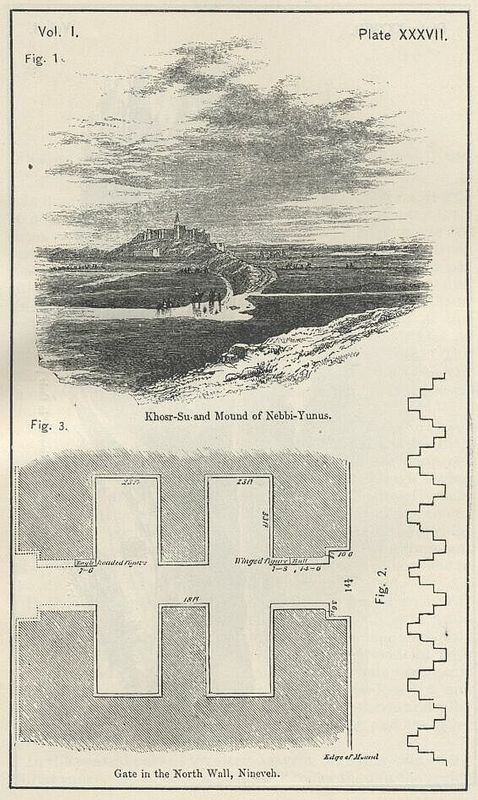
The mound of Nebbi-Ymus is at its base nearly triangular: [PLATE XXXVII., Fig. 1.] It covers an area of about forty acres. It is loftier, and its sides are more precipitous, than Koyunjik, especially on the west, where it abutted upon the wall of the city. The surface is mostly flat, but is divided about the middle by a deep ravine, running nearly from north to south, and separating the mound into an eastern and a western portion. The so-called tomb of Jonah is conspicuous on the north edge of the western portion of the mound, and about it are grouped the cottages of the Kurds and Turcomans to whom the site of the ancient Nineveh belongs. The eastern portion of the mound forms a burial-ground, to which the bodies of Mahometans are brought from considerable distances. The mass of earth is calculated at six and a half millions of tons; so that its erection would have given full employment to 10,000 men for the space of five years and a half.
These two vast mounds—the platforms on which palaces and temples were raised—are both in the same line, and abutted, both of them, on the western wall of the city. Their position in that wall is thought to have been determined, not by chance, but by design; since they break the western face of the city into three nearly equal portions. The entire length of this side of Nineveh was 13,600 feet, or somewhat more than two and a half miles. Anciently it seems to have immediately overhung the Tigris, which has now moved off to the west, leaving a plain nearly a mile in width between its eastern edge and the old rampart of the city. This rampart followed, apparently, the natural course of the river-bank; and hence, while on the whole it is tolerably straight, in the most southern of the three portions it exhibits a gentle curve, where the river evidently made a sweep, altering its course from south-east nearly to south.
The western wall at its northern extremity approaches the present course of the Tigris, and is here joined, exactly at right angles, by the northern, or rather the north-western, rampart, which runs in a perfectly straight line to the north-eastern angle of the city, and is said to measure exactly 7000 feet. This wall is again divided, like the western, but with even more preciseness, into three equal portions. Commencing at the north-eastern angle, one-third of it is carried along comparatively high ground, after which for the remaining two-thirds of its course it falls by a gentle decline towards the Tigris. Exactly midway in this slope the rampart is broken by a road, adjoining which is a remarkable mound, covering one of the chief gates of the city.
At its other extremity the western wall forms a very obtuse angle with the southern, which impends over a deep ravine formed by it winter torrent, and runs in a straight line for about 1000 yards, when it meets the eastern wall, with which it forms a slightly acute angle.
It remains to describe the eastern wall, which is the longest and the least regular of the four. Tins barrier skirts the edge of a ridge of conglomerate rock, which here rises somewhat above the level of the plain, and presents a slightly convex sweep to the north east. At first it runs nearly parallel to the western, and at right angles to the northern wall; but, after pursuing this course for about three quarters of a mile, it is forced by the natural convexity of the ridge to retire a little, and curving gently inwards it takes a direction much more southerly than at first, thus drawing continually nearer to the western wall, whose course is almost exactly south-east. The entire length of this wall is 16,000 feet, or above three miles. It is divided into two portions, whereof the southern is somewhat the longer, by the stream of the Khosr-Su; which coming from the north west, finds its way through the ruins of the city, and then runs on across the low plain to the Tigris.
The enceinte of Nineveh forms thus an irregular trapezium, or a "triangle with its apex abruptly cut off to the south." The breadth, even in the broadest part—that towards the north—is very disproportionate to the length, standing to it as four to nine, or as 1 to 2.25. The town is thus of an oblong shape, and so far Diodorus truly described it; though his dimensions greatly exceed the truth. The circuit of the walls is somewhat less than eight miles, instead of being more than fifty and the area which they include is 1100 English acres, instead of being 112,000!
It is reckoned that in a populous Oriental town we may compute the inhabitants at nearly, if not quite, a hundred per acre. This allows a considerable space for streets, open squares, and gardens, since it assigns but one individual to every space of fifty square yards. According to such a mode of reckoning, the population of ancient Nineveh, within the enceinte here described, may be estimated at 175,000 souls. No city of Western Asia is at the present day so populous.
In the above description of the ramparts surrounding Nineveh, no account has been given of their width or height. According to Diodorus, the wall wherewith Ninus surrounded his capital was 100 feet high, and so broad that three chariots might drive side by side along the top. Xenophon, who passed close to the ruins on his retreat with the Ten Thousand, calls the height 150 feet, and the width 50 feet. The actual greatest height at present seems to be 46 feet; but the debris at the foot of the walls are so great, and the crumbled character of the walls themselves is so evident, that the chief modern explorer inclines to regard the computation of Diodorus as probably no exaggeration of the truth. The width of the walls, in their crumbled condition, is from 100 to 200 feet.
The mode in which the walls were constructed seems to have been the following. Up to a certain height—fifty feet, according to Xenophon—they were composed of neatly-hewn blocks of a fossiliferous limestone, smoothed and polished on the outside. Above this, the material used was sun-dried brick. The stone masonry was certainly ornamented along its top by a continuous series of battlements or gradines in the same material [PLATE XXXVII., Fig. 2] and it is not unlikely that a similar ornamentation crowned the upper brick structure. The wall was pierced at irregular intervals by gates, above which rose lofty towers; while towers, probably of lesser elevation, occurred also in the portions of the wall intervening between one gate and another. A gate in the north-western rampart has been cleared by means of excavation, the form and construction of which will best appear from the annexed ground-plan. [PLATE XXXVII., Fig. 3.] It seems to have consisted of three gateways, whereof the inner and outer were ornamented with colossal human-headed hulls and other figures, while the central one was merely panelled with slabs of alabaster. Between the gateways were two large chambers, 70 feet long by 23 feet wide, which were thus capable of containing a considerable body of soldiers. The chambers and gateways are supposed to have been arched over, like the castles' gates on the bas-reliefs. The gates themselves have wholly disappeared: but the debris which filled both the chambers and the passages contained so much charcoal that it is thought they must have been made, not of bronze, like the gates of Babylon, but of wood. The ground within the gate-way was paved with large slabs of limestone, still bearing the marks of chariot wheels.
The castellated rampart which thus surrounded and guarded Nineveh did not constitute by any means its sole defence. Outside the stone basement wall lay on every side a water barrier, consisting on the west and south of natural river courses; on the north and east, of artificial channels into which water was conducted from the Khosr-su. The northern and eastern walls were skirted along their whole length by a broad and deep moat, into which the Khosr-su was made to flow by occupying its natural bed with a strong dam carried across it in the line of the eastern wall, and at the point where the stream now enters the enclosure. On meeting this obstruction, of which there are still some remains, the waters divided, and while part flowed to the south-east, and reached the Tigris by the ravine immediately to the south of the city, which is a natural water-course, part turned at an acute angle to the north-west, and, washing the remainder of the eastern and the whole of the northern wall, gained the Tigris at the north-west angle of the city, where a second dam kept it at a sufficient height. Moreover, on the eastern face, which appears to have been regarded as the weakest, a series of outworks were erected for the further defence of the city. North of the Khosr, between the city wall and that river, which there runs parallel to the wall and forms a sort of second or outermost moat, there are traces of a detached fort of considerable size, which must have strengthened the defences in that quarter. South and south-east of the Khosr, the works are still more elaborate. In the first place, from a point where the Khosr leaves the hills and debouches upon comparatively low ground, a deep ditch, 200 feet broad, was carried through compact silicious conglomerate for upwards of two miles, till it joined the ravine which formed the natural protection of the city upon the south. On either side of this ditch, which could be readily supplied with water from the Khosr at its northern extremity, was built a broad and lofty wall; the eastern one, which forms the outermost of the defences, rises even now a hundred feet above the bottom of the ditch on which it adjoins. Further, between this outer barrier and the city moat wall interposed a species of demilune, guarded by a double wall and a broad ditch and connected (as is thought) by a covered way with Neneveh itself. Thus the city was protected on this, its most vulnerable side, towards the centre by five walls and three broad and deep moats; towards the north, by a wall, a moat, the Khosr, and a strong outpost; towards the south by two moats and three lines of rampart. The breadth of the whole fortification on this side is 2200 feet, or not far from half a mile. [PLATE XXXVIII.]
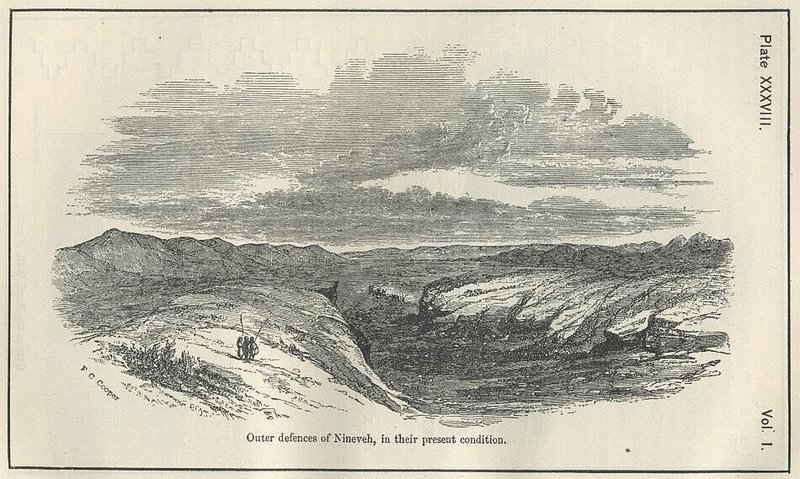
Such was the site, and such were the defences, of the capital of Assyria. Of its internal arrangements but little can be said at present, since no general examination of the space within the ramparts has been as yet made, and no ancient account of the interior has come down to us. We can only see that the side of the city which was most fashionable was the western, which immediately overhung the Tigris; since here were the palaces of the kings, and here seem also to have been the dwellings of the richer citizens; at least, it is on this side in the space intervening between Koyunjik and the northern rampart, that the only very evident remains of edifices—besides the great Mounds of Koyunjik and Nebbi-Yunus—are found. The river was no doubt the main attraction; but perhaps the western side was also considered the most secure, as lying furthest frown the quarter whence alone the inhabitants expected to be attacked, namely, the east. It is impossible at present to give any account of the character of the houses or the the direction of the streets. Perhaps the time may not be far distant when more systematic and continuous efforts will be made by the enterprise of Europe to obtain full knowledge of all the remains which still lie buried at this interesting site. No such discoveries are indeed to be expected as those which have recently startled the world but patient explorers would still be sure of an ample reward, were they to glean, after Layard in the field from which he swept so magnificent a harvest.
CHAPTER V.
LANGUAGE AND WRITING.
Greek phrase [—]—HEROD. iv. 137.
There has never been much difference of opinion among the learned with regard to the language spoken by the Assyrians. As the Biblical genealogy connected Asshur with Eber and Aram, while the Greeks plainly regarded the Syrians, Assyrians, and Babylonians as a single race, it was always supposed that the people thus associated must have possessed a tongue allied, more or less closely, to the Hebrew, the Syriac, and the Chaldee. These tongues were known to be dialectic varieties of a single form of speech the Semitic; and it was consequently the general belief, before any Assyrian inscriptions had been disinterred, that the Assyrian language was of this type, either a sister tongue to the three above mentioned, or else identical with some one of them. The only difficulty in the way of this theory was the supposed Medo-Persic or Arian character of a certain number of Assyrian royal names; but this difficulty was thought to be sufficiently met by a suggestion that the ruling tribe might have been of Median descent, and have maintained its own national appellatives, while the mass of the population belonged to a different race. Recent discoveries have shown that this last suggestion was needless, as the difficulty which it was intended to meet does not exist. The Assyrian names which either history or the monuments have handed down to us are Semitic, and not Arian. It is only among the fabulous accounts of the Assyrian Empire put forth by Ctesias that Arian names, such as Xerxes, Arius, Armamithres, Mithraus, etc., are to be found.
Together with the true names of the Assyrian kings, the mounds of Mesopotamia have yielded up a mass of documents in the Assyrian language, from which it is possible that we may one day acquire as full a knowledge of its structure and vocabulary as we possess at present of Greek or Latin. These documents have confirmed the previous belief that the tongue is Semitic. They consist, in the first place, of long inscriptions upon the slabs of stone with which the walls of palaces were panelled, sometimes occupying the stone to the exclusion of any sculpture, sometimes carried across the dress of figures, always carefully cut, and generally in good preservation. Next in importance to these memorials are the hollow cylinders, or, more strictly speaking, hexagonal or octagonal prisms, made in extremely fine and thin terra cotta, which the Assyrian kings used to deposit at the corners of temples, inscribed with an account of their chief acts and with numerous religious invocations. [PLATE XXXIX., Fig. 1.] These cylinders vary from a foot and a half to three feet in height, and are covered closely with a small writing, which it often requires a good magnifying glass to decipher. A cylinder of Tiglath-Pileser I. (about B.C. 1180) contains thirty lines in a space of six inches, or five lines to an inch, which is nearly as close as the type of the present volume. This degree of closeness is exceeded on a cylinder of Asshur-bani-pal's (about B.C. 660), where the lines are six to the inch, or as near together as the type of the Edinburgh Review. If the complexity of the Assyrian characters be taken into account, and if it be remembered that the whole inscription was in every ease impressed by the hand, this minuteness must be allowed to be very surprising. It is not favorable to legibility; and the patience of cuneiform scholars has been severely tried by a mode of writing which sacrifices everything to the desire of crowding the greatest possible quantity of words into the smallest possible space. In one respect, however, facility of reading is consulted, for the inscriptions on the cylinders are not carried on in continuous lines round all the sides, but are written in columns, each column occupying a side. The lines are thus tolerably short; and the whole of a sentence is brought before the eye at once.
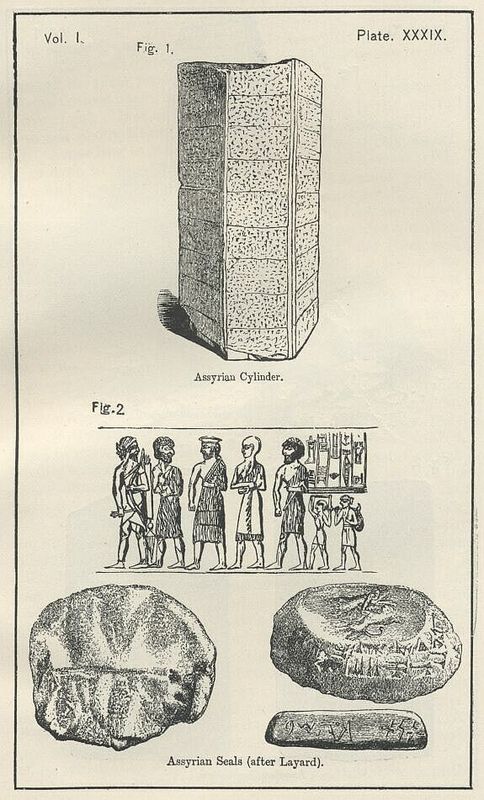
Besides slabs and cylinders, the written memorials of Assyria comprise inscribed bulls and lions, stone obelisks, clay tablets, bricks, and engraved seals. Tin seals generally resemble those of the Chaldaeans, which have been already described: but are somewhat more elaborate, and more varied in their character. [PLATE XXXIX., Fig. 2.] They do not very often exhibit any writing; but occasionally they are inscribed with the name of their owner, while in a few instances they show an inscription of some length. The clay tablets are both numerous and curious. They are of various sizes, ranging from nine inches long by six and a half wide, to an inch and a half long by an inch wide, or even less. [PLATE XL., Fig. 2.] Sometimes they are entirely covered with writing; while sometimes they exhibit on a portion of their surface the impressions of seals, mythological emblems, and the like. Some thousands of them have been recovered; and they are found to be of the most varied character. Many are historical, still more mythological; some are linguistic, some geographic, some again astronomical. It is anticipated that, when they are deciphered, we shall obtain a complete eneyclopaedia of Assyrian science, and shall be able by this means to trace a large portion of the knowledge of the Greeks to an Oriental source. Here is a mine still very little worked, from which patient and cautious investigators may one day extract the most valuable literary treasures. The stone obelisks are but few, and are mostly in a fragmentary condition. One alone is perfect—the obelisk in black basalt, discovered by Mr. Layard at Nimrud, which has now for many years been in the British Museum. [PLATE XL., Fig. 1.] This monument is sculptured on each of its four sides, in part with writing and in part with bas-reliefs. It is about seven feet high, and two feet broad at the base, tapering gently towards the summit, which is crowned with three low steps, or gradines. The inscription, which occupies the upper and lower portion of each side, and is also carried along the spaces between the bas-reliefs, consists of 210 clearly cut lines, and is one of the most important documents that has come down to us. It gives an account of various victories gained by the monarch who set it up, and of the tribute brought him by several princes. The inscribed lions and bulls are numerous. They commonly guard the portals of palaces, and are raised in a bold relief on alabaster slabs. The writing does not often trench upon the sculpture, but covers all those portions of the slabs which are not occupied by the animal. It is usually a full account of some particular campaign, which was thus specially commemorated, giving in detail what is far more briefly expressed in the obelisk and slab inscriptions.
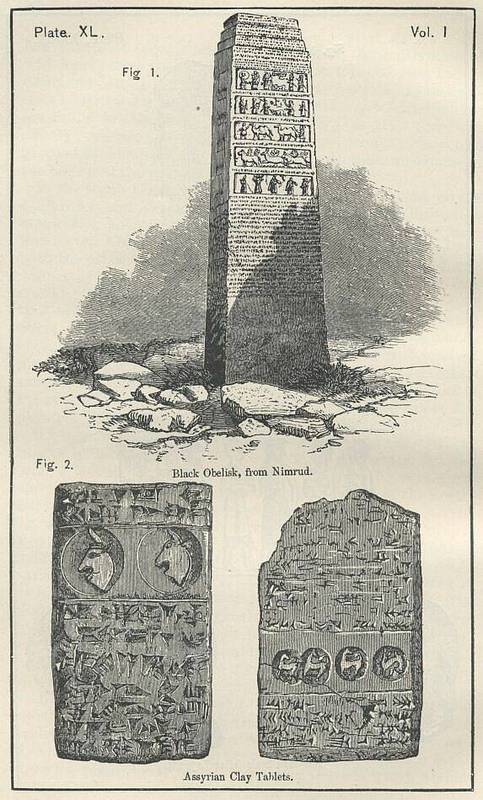
This review of the various kinds of documents which have been discovered in the ancient cities of Assyria, seems to show that two materials were principally in use among the people for literary purposes, namely, stone and moist clay. The monarchs used the former most commonly, though sometimes they condescended for some special object to the coarser and more fragile material. Private persons in their business transactions, literary and scientific men in their compositions, employed the latter, on which it was possible to write rapidly with a triangular instrument, and which was no doubt far cheaper than the slabs of fine stone, which were preferred for the royal inscriptions. The clay documents, when wanted for instruction or as evidence, were carefully baked; and thus it is that they have come down to us, despite their fragility, often in as legible a condition, with the letters as clear and sharp, as any legend on marble, stone, or metal that we possess belonging to Greek or even to Roman times. The best clay, skilfully baked, is a material quite as enduring as either stone or metal, resisting many influences better than either of those materials.
It may still be asked, did not the Assyrians use other materials also? Did they not write with ink of some kind on paper, or leather, or parchment? It is certain that the Egyptians had invented a kind of thick paper many centuries before the Assyrian power arose; and it is further certain that the later Assyrian kings had a good deal of intercourse with Egypt. Under such circumstances, can we suppose that they did not import paper from that country? Again, the Persians, we are told, used parchment for their public records. Are not the Assyrians a much more ingenious people, likely to have done the same, at any rate to some extent? There is no direct evidence by which these questions can be determinately answered. No document on any of the materials suggested has been found. No ancient author states that the Assyrians or the Babylonians used them. Had it not been for one piece of indirect evidence, it would have seemed nearly certain that they were not employed by the Mesopotamian races. In some of the royal palaces, however, small humps of fine clay have been found, bearing the impressions of seals, and exhibiting traces of the string by which they were attached to documents, while the documents themselves, being of a different material, have perished. It seems probable that in these instances some substance like paper or parchment was used; and thus we are led to the conclusion that, while clay was the most common, and stone an ordinary writing material among the Assyrians, some third substance, probably Egyptian paper, was also known, and was used occasionally, though somewhat rarely, for public documents.
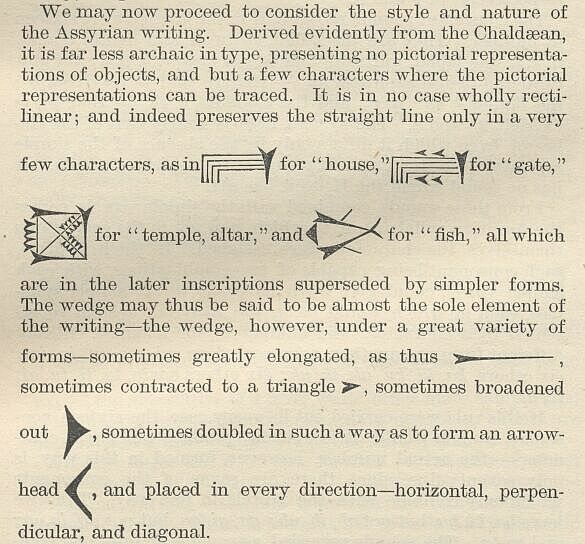
The number of characters is very great. Sir H. Rawlinson, in the year 1851, published a list of 216, or, including variants, 366 characters, as occurring in the inscriptions known to him. M. Oppei t, in 1858, gave 318 forms as those "most in use." Of course it is at once evident that this alphabet cannot represent elementary sounds. The Assyrian characters do, in fact, correspond, not to letters, according to our notion of letters, but to syllables. These syllables are either mere vowel sounds, such as we represent by our vowels and diphthongs, or such sounds accompanied by one or two consonants.
The vowels are not very numerous. The Assyrians recognize three only as fundamental—a, i, and u. Besides these they have the diphthongs ai, nearly equivalent to e, and au, nearly equivalent to o. The vowels i and u have also the powers, respectively, of y and v.
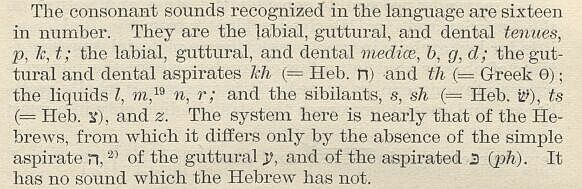
From these sounds, combined with the simple vowels, comes the Assyrian syllabarium, to which, and not to the consonants themselves, the characters were assigned. In the first place, each consonant being capable of two combinations with each simple vowel, could give birth naturally to six simple syllables, each of which would be in the Assyrian system represented by a character. Six characters, for instance, entirely different from one another, represented pa, pi, pu, ap, ip, up; six others, ka, ki, ke, ak, ik, uk; six others again, ta, ti, tu, at, it, ut.
If this rule were carried out in every case, the sixteen consonant sounds would, it is evident, produce ninety-six characters. The actual number, however, formed in this way, is only seventy-five. Since these are seven of the consonants which only combine with the vowels in one way. Thus we have ba, bi, bu, but not ab, ib, ub; ga, qi, gu, but not ay, iq,ug; and so on. The sounds regarded as capable of only one combination are the mediae, b, q, d; the aspirates kh, tj; and the sibilants ts and z.
Such is the first and simplest syllabarium: but the Assyrian system does not stop here. It proceeds to combine with each simple vowel sound two consonants, one preceding the vowel and the other following it. If this plan were followed out to the utmost possible extent, the result would be an addition to the syllabarium of seven hundred and sixty-eight sounds, each having its proper character, which would raise the number of characters to between eight and nine hundred! Fortunately for the student, phonetic laws and other causes have intervened to check this extreme luxuriance; and the combinations of this kind which are known to exist, instead of amounting to the full limit of seven hundred and sixty-eight, are under one hundred and fifty. The known Assyrian alphabet is, however, in this way raised from eighty, or, including variants, one hundred, to between two hundred and forty and two hundred and fifty characters.
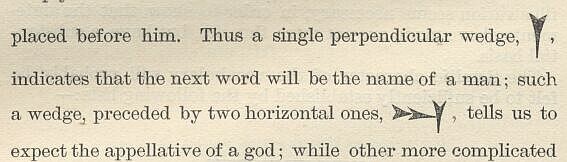
Finally, there are a certain number of characters which have been called "ideographs," or "monograms." Most of the gods, and various cities and countries, are represented by a group of wedges, which is thought not to have a real phonetic force, but to be a conventional sign for an idea, much as the Arabic numerals, 1, 2, 3. etc., are non-phonetic signs representing the ideas, one, two, three, etc. The known characters of this description are between twenty and thirty.
The known Assyrian characters are thus brought up nearly to three hundred! There still remain a considerable number which are either wholly unknown, or of which the meaning is known, while the phonetic value cannot at present be determined. M. Oppert's Catalogue contains fourteen of the former and fifty-nine of the latter class.
It has already been observed that the monumental evidence accords with the traditional belief in regard to the character of the Assyrian language, which is unmistakably Semitic. Not only does the vocabulary present constant analogies to other Semitic dialects, but the phonetic laws and the grammatical forms are equally of this type. At the same time the language has peculiarities of its own, which separate it from its kindred tongues, and constitute it a distinct form of Semitic speech, not a mere variety of any known form. It is neither Hebrew, nor Arabic, nor Phoenician, nor Chaldee, nor Syriac, but a sister tongue to these, having some analogies with all of them, and others, more or fewer, with each. On the whole, its closest relationship seems to be with the Hebrew, and its greatest divergence from the Aramaic or Syriac, with which it was yet, locally, in immediate connection.
To attempt anything like a full illustration of these statements in the present place would be manifestly unfitting. It would be to quit the province of the historian and archeologist, in order to enter upon that of the comparative philologer or the grammarian. At the same time a certain amount of illustration seems necessary, in order to show that the statements above made are not mere theories, but have a substantial basis.
The Semitic character of the vocabulary will probably be felt to be sufficiently established by the following lists:
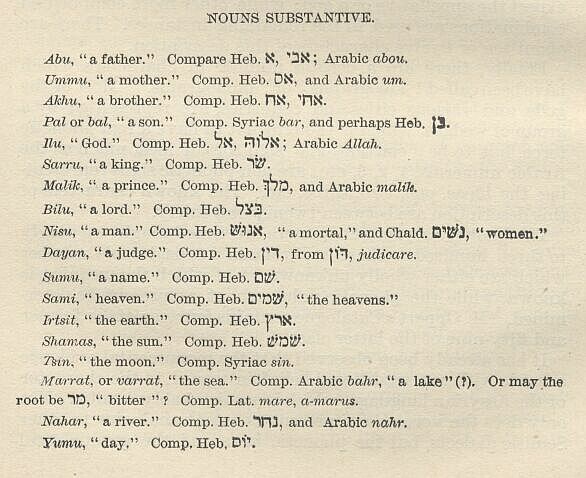
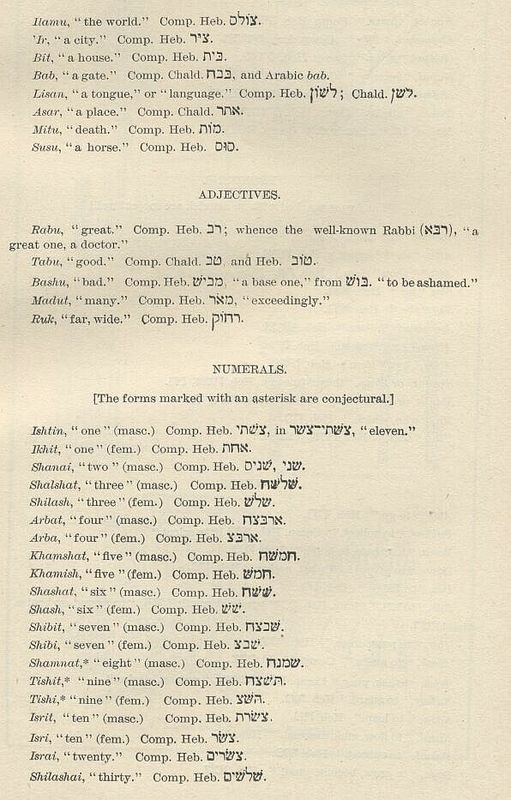
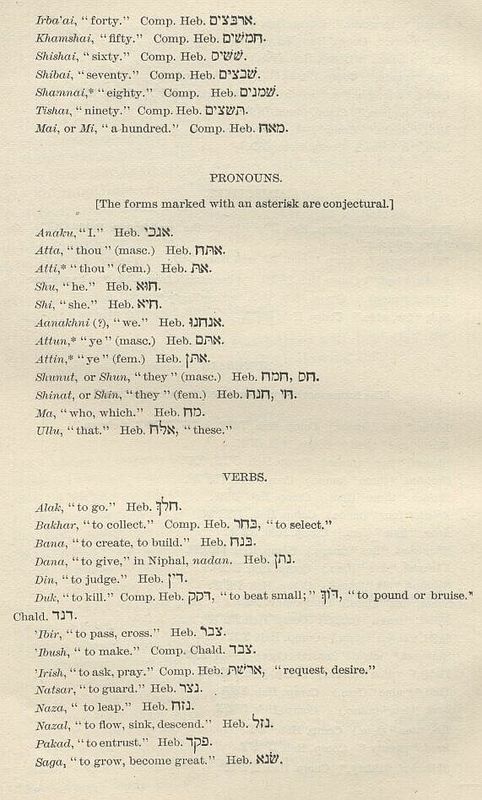
========================
THE SECOND MONARCHY.
ASSYRIA.
CHAPTER VI.
ARCHITECTURE AND OTHER ARTS.
"Architecti multarum artium solertes."—Mos. CHOR. (De Assyriis) i. 15.
The luxury and magnificence of the Assyrians, and the advanced condition of the arts among them which such words imply, were matters familiar to the Greeks and Romans, who, however, had little ocular evidence of the fact, but accepted it upon the strength of a very clear and uniform tradition. More fortunate than the nations of classical antiquity, whose comparative proximity to the time proved no advantage to them, we possess in the exhumed remains of this interesting people a mass of evidence upon the point, which, although in many respects sadly incomplete, still enables us to form a judgment for ourselves upon the subject, and to believe—on better grounds than they possessed—the artistic genius and multiform ingenuity of the Assyrians. As architects, as designers, as sculptors, as metallurgists, as engravers, as upholsterers, as workers in ivory, as glass-blowers, as embroiderers of dresses, it is evident that they equalled, if they did not exceed, all other Oriental nations. It is the object of the present chapter to give some account of their skill in these various respects. Something is now known of them all; and though in every case there are points still involved in obscurity, and recourse must therefore be had upon occasion to conjecture, enough appears certainly made out to justify such an attempt as the present, and to supply a solid groundwork of fact valuable in itself, even if it be insufficient to sustain in addition any large amount of hypothetical superstructure.
The architecture of the Assyrians will naturally engage our attention at the outset. It is from an examination of their edifices that we have derived almost all the knowledge which we possess of their progress in every art; and it is further as architects that they always enjoyed a special repute among their neighbors. Hebrew and Armenian united with Greek tradition in representing the Assyrians as notable builders at a very early time. When Asshur "went forth out of the land of Shinar," it was to build cities, one of which is expressly called "a great city." When the Armenians had to give an account of the palaces and other vast structures in their country, they ascribed their erection to the Assyrians. Similarly. when the Greeks sought to trace the civilization of Asia to its source, they carried it back to Ninus and Semiramis, whom they made the founders, respectively, of Nineveh and Babylon, the two chief cities of the early world.
Among the architectural works of the Assyrians, the first place is challenged by their palaces. Less religious, or more servile, than the Egyptians and the Greeks, they make their temples insignificant in comparison with the dwellings of their kings, to which indeed the temple is most commonly a sort of appendage. In the palace their art culminates—there every effort is made, every ornament lavished. If the architecture of the Assyrian palaces be fully considered, very little need be said on the subject of their other buildings.
The Assyrian palace stood uniformly on an artificial platform. Commonly this platform was composed of sun-dried-bricks in regular layers; but occasionally the material used was merely earth or rubbish, excepting towards the exposed parts—the sides and the surface which were always either of brick or of stone. In most cases the sides were protected by massive stone masonry, carried perpendicularly from the natural ground to a height somewhat exceeding that of the plat-form, and either made plain at the top or else crowned with stone battlements cut into gradines. The pavement consisted in part of stone slabs, part of kiln-dried bricks of a large size, often as much as two feet square. The stone slabs were sometimes inscribed, sometimes ornamented with an elegant pattern. Occasionally the terrace was divided into portions at different elevations, which were connected by staircases or inclined planes. The terrace communicated in the same way with the level ground at its base, being (as is probable) sometimes ascended in a single place, sometimes in several. These ascents were always on the side where the palace adjoined upon the neighboring town, and were thus protected from hostile attack by the town walls. [PLATE XLI., Fig. 1] Where the palace abutted upon the walls or projected beyond them—and the palace was always placed at the edge of a town, for the double advantage, probably, of a clear view and of fresh air—the platform rose perpendicularly or nearly so; and generally a water protection, a river, a moat, or a broad lake, lay at its base, thus rendering attack, except on the city side, almost impossible.
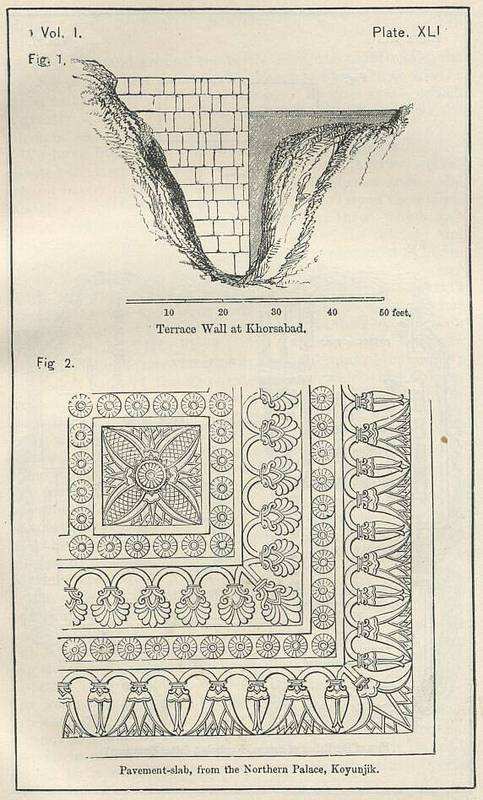
The platform appears to have been, in general shape, a rectangle, or where it had different elevations, to have been composed of a rectangles. The mound of Khorsabad, which is of this latter character, resembles a gigantic T. [PLATE XLII., Fig. 1.]
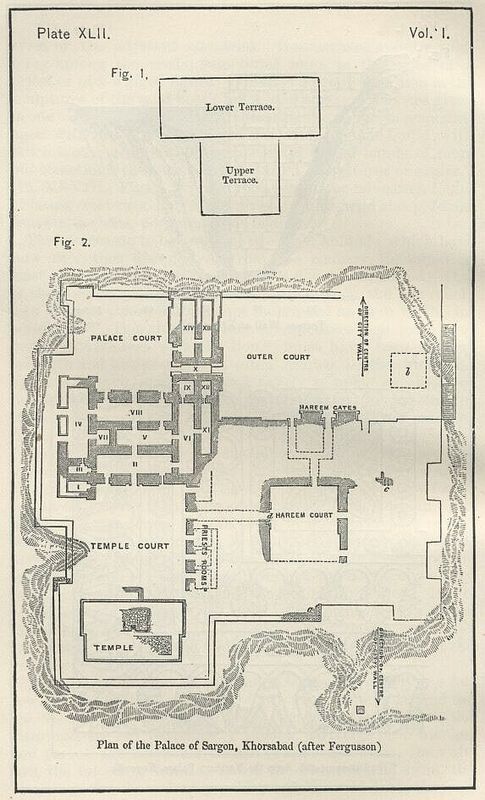
It must not be supposed, however, that the rectangle was always exact. Sometimes its outline was broken by angular projections and indentations, as in the plan [PLATE XLII., Fig. 21.] where the shaded parts represent actual discoveries. Sometimes it grew to be irregular, by the addition of fresh portions, as new kings arose who determined on fresh erections. This is the ease at Nimrud, where the platform broadens towards its lower or southern end, and still more at Koyunjik and Nebbi Yunus, where the rectangular idea has been so overlaid as to have almost wholly disappeared. Palaces were commonly placed near one edge of the mound—more especially near the river edge probably for the better enjoyment of the prospect, and of the cool air over the water.
The palace itself was composed of three main elements, courts, grand halls, and small private apartments. A palace has usually from two to four courts, which are either square or oblong, and vary in size according to the general scale of the building. In the north-west palace at Nimrud, the most ancient of the edifices yet explored, one court only has been found, the dimensions of which are 120 feet by 90. At Khorsabad, the palace of Sargon has four courts. [PLATE XLII., Fig. 2.] Three of them are nearly square, the largest of these measuring 180 feet each Way, and the smallest about 120 feet; the fourth is oblong, and must have been at least 250 feet long and 150 feet wide. The palace of Sennacherib at Koyunjik, a much larger edifice than the palace of Sargon, has also three courts, which are respectively 93 feet by 84, 124 feet by 90, and 154 feet by 125. Esarhaddon's palace at Nimrud has a court 220 feet long and 100 wide. These courts were all paved either with baked bricks of large size, or with stone slabs, which were frequently patterned. Sometimes the courts were surrounded with buildings; sometimes they abutted upon the edge of the platform: in this latter case they were protected by a stone parapet, which (at least in places) was six feet high.
The grand halls of the Assyrian palaces constitute their most remarkable feature. Each palace has commonly several. They are apartments narrow for their length, measuring from three to five times their own width, and thus having always somewhat the appearance of galleries. The scale upon which they are built is, commonly, magnificent. In the palace of Asshur-izir-pal at Nimrud, the earliest of the discovered edifices, the great hall was 160 feet long by nearly 40 broad. In Sargon's palace at Khorsabad the size of no single room was so great; but the number of halls was remarkable, there being no fewer than five of nearly equal dimensions. The largest was 116 feet long, and 33 wide; the smallest 87 feet long, and 25 wide. The palace of Sennacherib at Koyuhjik contained the most spacious apartment yet exhumed. It was immediately inside the great portal, and extended in length 180 feet, with a uniform width of forty feet. In one instance only, so far as appears, was an attempt made to exceed this width. In the palace of Esarhaddon, the son of Sennacherib, a hall was designed intended to surpass all former ones. [PLATE XLIII., Fig. 2.] Its length was to be 165 feet, and its width 62; consequently it would have been nearly one-third larger than the great hall of Sennacherib, its area exceeding 10,000 square feet. But the builder who had designed this grand structure appears to have been unable to overcome the difficulty of carrying a roof over so vast an expanse. He was therefore obliged to divide his hall by a wall down the middle; which, though he broke it in an unusual way into portions, and kept it at some distance from both ends of the apartment, still had the actual effect of subdividing his grand room into four apartments of only moderate size. The halls were paved with sun-burnt brick. They were ornamented throughout by the elaborate sculptures, now so familiar to us, carried generally in a single, but sometimes in a double line, round the four walls of the apartment. The sculptured slabs rested on the ground, and clothed the walls to the height of 10 or 12 feet. Above, for a space which we cannot positively fix, but which was certainly not less than four or five feet, the crude brick wall was continued, faced here with burnt brick enamelled on the side towards the apartment, pleasingly and sometimes even brilliantly colored. 10 The whole height of the walls was probably from 15 to 20 feet.
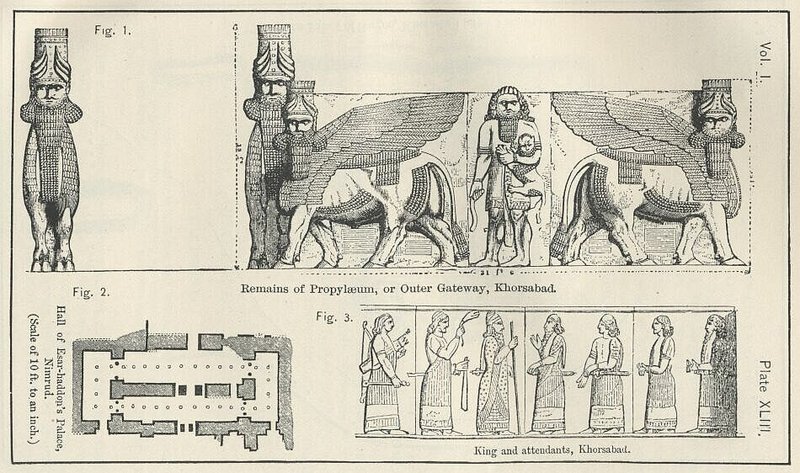
By the side of the halls, or at their ends, and opening into them, or sometimes collected together into groups, with no hall near, are the smaller chambers of which mention has been already made. These chambers are in every case rectangular: in their proportions they vary from squares to narrow oblongs. 90 feet by 17, 85 by 16, 80 by 15, and the like. When they are square, the side is never more than about 25 feet. They are often as richly decorated as the halls, but sometimes are merely faced with plain slabs or plastered; while occasionally they have no facing at all, but exhibit throughout the crude brick. This, however, is unusual.
The number of chambers in a palace is very large. In Sennacherib's palace at Koyunjik, where great part of the building remains still unexplored, the excavated chambers amount to sixty-eight—all, be it remembered, upon the ground floor. The space covered by them and by their walls exceeds 40,000 square yards. As Mr. Fergusson observes, "the imperial palace of Sennacherib is, of all the buildings of antiquity, surpassed in magnitude only by the great palace-temple of Karnak; and when we consider the vastness of the mound on which it was raised, and the richness of the ornaments with which it was adorned, it is by no means clear that it was not as great, or at least as expensive, a work as the great palace-temple at Thebes." Elsewhere the excavated apartments are less numerous; but in no case is it probable that a palace contained on its ground floor fewer than forty or fifty chambers.
The most striking peculiarity which the ground-plans of the palaces disclose is the uniform adoption throughout of straight and parallel lines. No plan exhibits a curve of any kind, or any angle but a right angle. Courts, chambers, and halls are, in most cases, exact rectangles; and even where any variety occurs, it is only by the introduction of squared recesses or projections, which are moreover shallow and infrequent. When a palace has its own special platform, the lines of the building are further exactly parallel with those of the mound on which it is placed; and the parallelism extends to any other detached buildings that there may be anywhere upon the platform. When a mound is occupied by more palaces than one, sometimes this law still obtains, as at Nimrud, where it seems to embrace at any rate the greater number of the palaces; sometimes, as at Koyunjik, the rule ceases to be observed, and the ground-plan of each palace seems formed separately and independently, with no reference to any neighboring edifice.
Apart from this feature, the buildings do not affect much regularity. In courts and facades, to a certain extent, there is correspondence; but in the internal arrangements, regularity is decidedly the exception. The two sides of an edifice never correspond; room never answers to room; doorways are rarely in the middle of walls; where a rooms has several doorways, they are seldom opposite to one another, or in situations at all corresponding.
There is a great awkwardness in the communications. Very few corridors or passages exist in any of the buildings. Groups of rooms, often amounting to ten or twelve, open into one another; and we find comparatively few rooms to which there is any access except through some other room. Again, whole sets of apartments are sometimes found, between which and the rest of the palace all communication is cut off by thick walls. Another peculiarity in the internal arrangements is the number of doorways in the larger apartments, and their apparently needless multiplication. We constantly find two or even three doorways leading from a court into a hall, or from one hall into a second. It is difficult to see what could be gained by such an arrangement.
The disposition of the various parts of a palace will probably be better apprehended from an exact account of a single building than from any further general statements. For this purpose it is necessary to select a specimen from among the various edifices that have been disentombed by the labors of recent excavators. The specimen should be, if possible, complete; it should have been accurately surveyed, and the survey should have been scientifically recorded; it should further stand single and separate, that there may be no danger of confusion between its remains and those of adjacent edifices. These requirements, though nowhere exactly met, are very nearly met by the building at Khorsabad, which stands on a mound of its own, unmixed with other edifices, has been most carefully examined, and most excellently represented and described, and which, though not completely excavated, has been excavated with a nearer approach to completeness than any other edifice in Assyria. The Khorsabad building—which is believed to be a palace built by Sargon, the son of Sennacherib—will therefore be selected for minute description in this place, as the palace most favorably circumstanced, and the one of which we have, on the whole, the most complete and exact knowledge. [PLATE XLIV.]
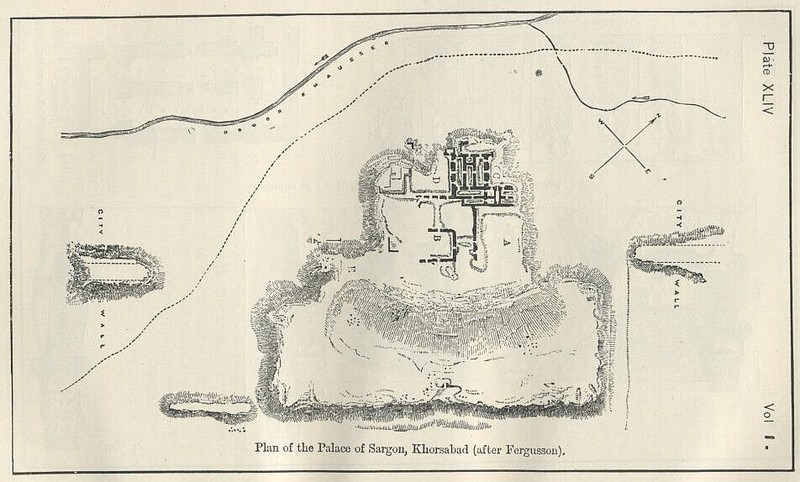
The situation of the town, whereof the palace of Sargon formed a part, has been already described in a former part of this volume. The shape, it has been noted, was square, the angles facing the four cardinal points. Almost exactly in the centre of the north-west wall occurs the palace platform, a huge mass of crude brick, from 20 to 30 feet high, shaped like a T, the upper limb lying within the city walls, and the lower limb (which is at a higher elevation) projecting beyond the line of the walls to a distance of at least 500 feet. At present there is a considerable space between the ends of the wall and the palace mound; but anciently it is provable that they either abutted on the mound, or were separated from it merely by gateways. The mound, or at any rate the part of it which projected beyond the walls, was faced with hewn stone, carried perpendicularly from the plain to the top of the platform, and even beyond, so as to form a parapet protecting the edge of the platform. On the more elevated portion of the mound—that which projected beyond the walls stood the palace, consisting of three groups of buildings, the principal group lying towards the mound's northern angle. On the lower portion of the platform were several detached buildings, the most remarkable being a huge gateway or propylaeum, through which the entrance lay to the palace from the city. Beyond and below this, on the level of the city, the first or outer portals were placed, giving entrance to a court in front of the lower terrace.
A visitor approaching the palace had in the first place to pass through these portals. They were ornamented with colossal human-headed bulls on either side, and probably spanned by an arch above, the archivolte being covered with enamelled bricks disposed in a pattern. Received within the portals, the visitor found himself in front of a long wall of solid stone masonry, the revetement of the lower terrace, which rose from the outer court to a height of at least twenty feet. Either an inclined-way or a flight of steps—probably the latter—must have led up from the outer court to this terrace. Here the visitor found another portal or propylaeum of a magnificent character. [PLATE XLIII., Fig. 1.] Midway in the south-east side of the lower terrace, and about fifty feet from its edge, stood this grand structure, gateway ninety-feet in width, and at least twenty-five in depth, having on each side three winged bulls of gigantic size, two of them fifteen feet high, and the third nineteen feet. Between the two small bulls, which styled back to back, presenting their sides to the spectator, was a colossal figure, strangling a lion—the Assyria Hercules, according to most writers. The larger bulls stood at right angles to these figures, withdrawn within the portal, and facing the spectator. The space between the bulls, which is nearly twenty feet, was (it is probable) arched over. Perhaps the archway led into a chamber beyond which was a second archway and an inner portal, as marked in Mr. Fergusson's plan: but this is at present uncertain.
Besides the great portal, the only buildings as yet discovered on this lower platform, are a suite of not very extensive apartments. They are remarkable for their ornamentation. The walls are neither lined with slabs, nor yet (as is sometimes the case) painted, but the plaster of which they are composed is formed into sets of half pillars or reeding, separated from one another by pilasters with square sunk panels. The former kind of ornamentation is found also in Lower Chaldaea, and has been already represented; the latter is peculiar to this building. It is suggested that these apartments formed the quarters of the soldiers who kept watch over the royal residence.
About 300 feet from the outer edge of the lower terrace, the upper terrace seems to have commenced. It was raised probably about ten feet above the lower one. The mode of access has not been discovered, but is presumed to have been by a flight of steps, not directly opposite the propylaeum, but somewhat to the right, whereby entrance was given to the great court, into which opened the main gateways of the palace itself. The court was probably 250 feet long by 160 or 170 feet wide. The visitor, on mounting the steps, perhaps passed through another propylaeum (b in the plan); after which, if his business was with the monarch, he crossed the full length of the court, leaving a magnificent triple entrance, which is thought to have led to the king's hareem, on his left and making his way to the public gate of the palace, which fronted him when he mounted the steps. The hareem portal, which he passed, resembled in the main the great propylaeum of the lower platform; but, being triple, it was still more magnificent exhibiting two other entrances on either side of the main one, guarded each by a single pair of winged bulls of the smaller size. Along the hareem wall, from the gateway to the angle of the court, was a row of sculptured bas-reliefs, ten feet in height, representing the monarch with his attendant guards and officers. [PLATE XLIII., Fig. 3.] The facade occupying the end of the court was of inferior grandeur. [PLATE XLV., Fig.1. ] Sculptures similar to those along the hareem wall adorned it; but its centre showed only a single gateway, guarded by one pair of the larger bulls, fronting the spectator, and standing each in a sort of recess, the character of which will be best understood by the ground-plan in the illustration. Just inside the bulls was the great door of the palace, a single door made of wood-apparently of mulberry,—opening inwards, and fastened on the inside by a bolt at bottom, and also by an enormous lock. This door gave entrance into a passage, 70 feet long and about 10 feet wide, paved with large slabs of stone, and adorned on either side with inscriptions, and with a double row of sculptures, representing the arrival of tribute and gifts for the monarch. All the figures here faced one way, towards the inner palace court into which the passage led. M. Botta believes that the passage was uncovered; while Mx. Fergusson imagines that it was vaulted throughout. It must in any case have been lighted from above; for it would have been impossible to read the inscriptions, or even to see the sculptures, merely by the light admitted at the two ends.
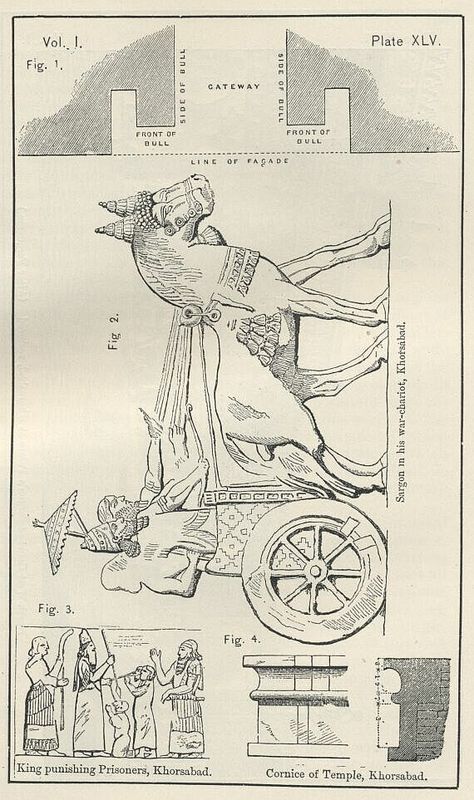
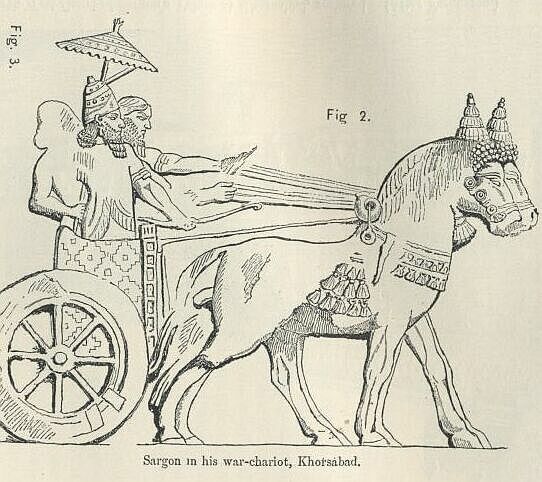
From the passage in question—one of the few in the edifice—no doorway opened out either on the right hand or on the left. The visitor necessarily proceeded along its whole extent, as he saw the figures proceeding in sculptures, and, passing through a second portal, found himself in the great inner court of the palace, a square of about 100 or 160 feet, enclosed on two sides—the south-east and the south-west-by buildings, on the other two sides reaching to the edge of the terrace, which here gave upon, the open country. The buildings on the south-eastside, looking towards the north-west, and and joining the gateway by which the had entered, were of comparatively minor importance. They consisted of a few chambers suitable for officers of the court, and were approached from the court by two doorways, one on either side of the passage through which he had come. To his left, looking towards the north-east, were the great state apartments, the principal part of the palace, forming a facade, of which some idea may perhaps be formed from the representation. [PLATE XLVI.] The upper part of this representation is indeed purely conjectural; and when we come to consider the mode in which the Assyrian palaces were roofed and lighted, we shall perhaps find reason to regard it as not very near the truth; but the lower part, up to the top of the sculptures, the court itself, and the various accessories, are correctly given, and furnish the only perspective view of this part of the palace which has been as yet published.
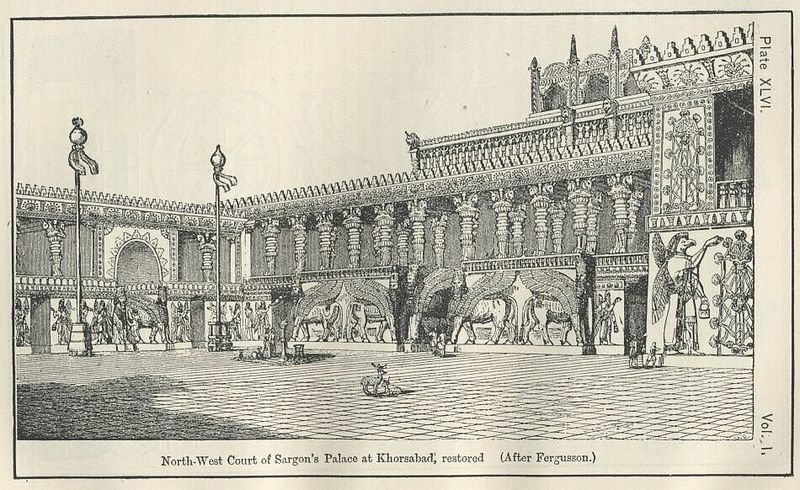
The great state apartments consisted of a suite of ten rooms. Five of these were halls of large dimensions; one was a long and somewhat narrow chamber, and the remaining four were square or slightly oblong apartments of minor consequence. All of them were lined throughout with sculpture. The most important seem to have been three halls en-suite (VIII., V., and II. in the plan), which are, both in their external and internal decorations, by far the most splendid of the whole palace. The first lay just within the north-east facade, and ran parallel to it. It was entered by three doorways, the central one ornamented externally. with two colossal bulls of the largest size, one on either side within the entrance, and with two pairs of smaller bulls, back to back, on the projecting pylons; the side ones guarded by winged genii, human or hawk-headed. The length of the chamber was 116 feet 6 inches, and its breadth 33 feet. Its sculptures represented the monarch receiving prisoners, and either personally or by deputy punishing them: [PLATE XLV., Fig. 3.] We may call it, for distinction's sake, "the Hall of Punishment."
The second hall (V. in the plan) ran parallel with the first, but did not extend along its whole length. It measured from end to end about 86 feet, and from side to side 21 feet 6 inches. Two doorways led into it from the first chamber, and two others led from it into two large apartments. One communicated with a lateral hall (marked VI. in the plan), the other with the third hall of the suite which is here the special object of our attention. This third hall (II. in the plan) was of the same length as the first, but was less wide by about three feet. It opened by three doorways upon a square, court, which has been called "the Temple Court," from a building on one side of it which will be described presently.
The sculptures of the second and third halls represented in a double row, separated by an inscribed space about two feet in width, chiefly the wars of the monarch, his battles, sieges, reception of captives and of spoil, etc. The monarch himself appeared at least four times standing in his chariot, thrice in calm procession, and once shooting his arrows against his enemies. [PLATE XLV., Fig. 2.] Besides these, the upper sculptures on one side exhibited sacred ceremonies.
Placed at right angles to this primary suite of three halls were two others, one (IV. in the plan) of dimensions little, if at all, inferior to those of the largest (No. VIII), the other (VI. in the plan) nearly of the same length, but as narrow as the narrowest of the three (No. V.). Of these two lateral halls the former communicated directly with No. VIII., and also by a narrow passage room (III. in the plan with No. II.) The other had direct communication both with No. II and No. V., but none with No. VIII. With this hall (No. VI. ) three smaller chambers were connected (Nos. IX., XI., and XI.); with the other lateral hall, two only (Nos. III. and VII. ). One chamber attached to this block of buildings (I. in the plan) opened only on the Temple Court. It has been suggested that it contained a staircase; but of this there is no evidence.
The Temple Court—a square of 150 feet—was occupied by buildings on three sides, and open on one only—that to the north-west. The state apartments closed it in on the north-east, the temple on the south-west: on the south-east it was bounded by the range of buildings called "Priests' Rooms" in the plan, chambers of less pretension than almost any that have been excavated. The principal facade here was that of the state apartments, on the north-east. On this, as on the opposite side of the palace, were three portals; but the two fronts were not of equal magnificence. On the side of the Temple Court a single pair of bulls, facing the spectator, guarded the middle portals; the side portals exhibited only figures of genii, while the spaces between the portals were occupied, not with bulls, but merely with a series of human figures, resembling those in the first or outer court, of which a representation has been already given. Two peculiarities marked the south-east facade. In the first place, it lay in a perfectly straight line, unbroken by any projection, which is very unusual in Assyrian architecture. In the second place, as if to compensate for this monotony in its facial line, it was pierced by no fewer than five doorways, all of considerable width, and two of them garnished with bulls, of namely, the second and the fourth. The bulls of the second gateway were of the larger, those of the fourth were of the smaller size; they stood in the usual manner, a little withdrawn within the gateways and looking towards the spectator.
Of the curious building which closed in the court on the third or south-west side, which is believed to have been a temple, the remains are unfortunately very slight. It stood so near the edge of the terrace that the greater part of it has fallen into the plain. Less than half of the ground-plan is left, and only a few feet of the elevation. The building may originally have been a square, or it may have been an oblong, as represented in the plan. It was approached from the court by a a flight of stone stops, probably six in number, of which four remain in place. This flight of steps was placed directly opposite to the central door of the south-west palace facade. From the level of the court, to that of the top of the steps, a height of about six feet, a solid platform of crude brick was raised as a basis for the temple; and this was faced, probably throughout its whole extent, with a solid wall of hard black basalt, ornamented with a cornice in gray limestone, of which the accompanying figures are representations. [PLATE. XLV., Fig. 4.] above this the external work has disappeared. Internally, two chambers may be traced, floored with a mixture of stones and chalk; and round one of these are some fragments of bas-reliefs, representing sacred subjects, cut on the same black basalt as that by which the platform is cased, and sufficient to show that the same style of ornamentation prevailed here as in the palace.
The principal doorway on the north-west side of the Temple Court communicated by a passage, with another and similar doorway (d on the plan), which opened into a fourth court, the smallest and least ornamented of those on the upper platform.
The mass of building whereof this court occupied the centre, is believed to have constituted the hareem or private apartments of the monarch. It adjoined the state apartments at its northern angle, but had no direct communication with them. To enter it from them the visitor had either to cross the Temple Court and proceed by the passage above indicated, or else to go round by the great entrance (X in the plan ) and obtain admission by the grand portals on the south-west side of the outer court. These latter portals, it is to be observed, are so placed as to command no view into the Hareem Court, though it is opposite to them. The passages by which they gave entrance into that court must have formed some such angles as those marked by the dotted lines in the plan, the result being that visitors, while passing through the outer court, would be unable to catch any sight of what was going on in the Hareem Court. even if the great doors happened to be open. Those admitted so far into the palace as the Temple Court were more favored or less feared. The doorway (d) on the south-east side of the Hareem Court is exactly opposite the chief doorway on the north-west side of the Temple Court, and there can be no reasonable doubt that a straight passage connected the two.
It is uncertain whether the Hareem Court was surrounded by buildings on every side, or open towards the south-west. M. Botta believed that it was open; and the analogy of the other courts would seem to make this probable. It is to be regretted, however, that this portion of the great Khorsabad ruin still remains so incompletely examined. Consisting of the private apartments, it is naturally less rich in sculptures than other parts; and hence it has been comparatively neglected. The labor would, nevertheless, be well employed which should be devoted to this part of the ruin, as it would give us (what we do not now possess) the complete ground-plan of an Assyrian palace. It is earnestly to be hoped that future excavators will direct their efforts to this easily attainable and interesting object.
The ground-pins of the palaces, and some sixteen feet of their elevations, are all that fire and time have left us of these remarkable monuments. The total destruction of the upper portion of every palatial building in Assyria, combined with the want of any representation of the royal residences upon the bas-reliefs, reduces us to mere conjecture with respect to their height, to the mode in which they were roofed and lighted, and even to the question whether they had or had not an upper story. On these subjects various views have been put forward by persons entitled to consideration; and to these it is proposed now to direct the reader's attention.
In the first place, then, had they an upper story? Mr. Layard and Mr. Fergusson decide this question in the affirmative. Mr. Layard even goes so far as to say that the fact is one which "can no longer be doubted." He rests this conclusion on two grounds first, on a belief that "upper chambers" are mentioned in the Inscriptions, and, secondly, on the discovery by himself, in Sennacherib's palace at Koyunjik, of what seemed to be an inclined way, by which he supposes that the ascent was made to an upper story. The former of these two arguments must be set aside as wholly uncertain. The interpretation of the architectural inscriptions of the Assyrians is a matter of far too much doubt at present to serve as a groundwork upon which theories can properly be raised as to the plan of their buildings. With regard to the inclined passage, it is to be observed that it did not appear to what it led. It may have conducted to a gallery looking into one of the great halls, or to an external balcony overhanging an outer court; or it may have been the ascent to the top of a tower, whence a look-out was kept up and down the river. Is it not more likely that this ascent should have been made for some exceptional purpose, than that it should be the only specimen left of the ordinary mode by which one half of a palace was rendered accessible? It is to be remembered that no remains of a staircase, whether of stone or of wood have been found in any of the palaces, and that there is no other instance in any of them even of an inclined passage. Those who think the palaces had second stories, believe these stories to have been reached by staircases of wood, placed in various parts of the buildings, which were totally destroyed by the conflagrations in which the palaces perished. But it is at least remarkable that no signs have been found in any existing walls of rests for the ends of beams, or of anything implying staircases. Hence M. Botta, the most careful and the most scientific of recent excavators, came to a very positive conclusion that the Khorsabad buildings had had no second story, a conclusion which it would not, perhaps, be very bold to extend to Assyrian edifices generally.
It has been urged by Mr. Fergusson that there must have been an upper story, because otherwise all the advantage of the commanding position of the palaces, perched on their lofty platforms, would have been lost. The platform at Khorsabad was protected, in the only places where its edge has been laid bare, by a stone wall or parapet six feet in height. Such a parapet continued along the whole of the platform would effectually have shut out all prospect of the open country, both from the platform itself and also from the gateways of the palace, which are on the same level. Nor could there well be any view at all from the ground chambers, which had no windows, at any rate within fifteen feet of the floor. To enjoy a view of anything but the dead wall skirting the mound, it was necessary (Mr. Fergusson thinks) to mount to a second story, which he ingeniously places, not over the ground rooms, but on the top of the outer and party walls, whose structure is so massive that their area falls (he observes) but little short of the area of the ground-rooms themselves.
This reasoning is sufficiently answered, in the first place, by observing that we know not whether the Assyrians appreciated the advantage of a view, or raised their palace platforms for any such object. They may have constructed them for security only, or for greater dignity and greater seclusion. They may have looked chiefly for comfort and have reared them in order to receive the benefit of every breeze, and at the same time to be above the elevation to which gnats and mosquitoes commonly rise. Or there may be a fallacy in concluding, from the very slight data furnished by the excavations of M. Botta, that a palace platform was, in any case, skirted along its whole length, by a six-foot parapet. Nothing is more probable than that in places the Khorsabad parapet may have been very much lower than this; and elsewhere it is not even ascertained that any parapet at all edged the platform. On the whole we seem to have no right to conclude, merely on account of the small portions of parapet wall uncovered by M. Botta, that an upper story was a necessity to the palaces. If the Assyrians valued a view, they may easily have made their parapets low in places: if they cared so little for it as to shut it out from all their halls and terraces, they may not improbably have dispensed with the advantage altogether.
The two questions of the roofing and lighting of the Assyrian palaces are so closely connected together that they will most conveniently be treated in combination. The first conjecture published on the subject of roofing was that of M. Flandin. who suggested that the chambers generally—the great halls at any rate—had been ceiled with a brick vault. He thought that the complete filling up of the apartments to the height of fifteen or twenty feet was thus best explained; and he believed that there were traces of the fallen vaulting in the debris with which the apartments were filled. His conjecture was combated, soon after he put it forth, by M. Botta, who gave it as his opinion—first, that the walls of the chambers, notwithstanding their great thickness, would have been unable, considering their material, to sustain the weight, and (still more to bear) the lateral thrust, of a vaulted roof; and, secondly, that such a roof, if it had existed at all, must have been made of baked brick or stone-crude brick being too weak for the purpose—and when it fell must have left ample traces of itself within the apartments, whereas, in none of them, though he searched, could he find any such traces. On this latter point M. Botta and M. Flandin—both eye witnesses—were at variance. M. Flandin believed that he had seen such traces, not only in numerous broken fragments of burnt brick strewn through all the chambers, but in occasional masses of brick-work contained in some of them actual portions, as he thought, of the original vaulting. M. Botta, however, observed—first, that the quantity of baked brick within the chambers was quite insufficient for a vaulted roof; and, secondly, that the position of the masses of brickwork noticed by M. Flandin was always towards the sides, never towards the centres of the apartments; a clear proof that they had fallen from the upper part of the walls above the sculptures, and not from a ceiling covering the whole room. He further observed that the quantity of charred wood and charcoal within the chambers, and the calcined appearance of all the slabs, were phenomena incompatible with any other theory than that of the destruction of the palace by the conflagration of a roof mainly of wood.
To these arguments of M. Botta may be added another from the improbability of the Assyrians being sufficiently advanced in architectural science to be able to construct an arch of the width necessary to cover some of the chambers. The principle of the arch was, indeed, as will be hereafter shown, well known to the Assyrians, but hitherto we possess no proof that they were capable of applying it on a large scale. The widest arch which has been found in any of the buildings is that of the Khorsabad town-gate uncovered by M. Place, which spans a space of (at most) fourteen or fifteen feet. But the great halls of the Assyrian palaces have a width of twenty-five, thirty, and even forty feet. It is at any rate uncertain whether the constructive skill of their architects could have grappled successfully with the difficulty of throwing a vault over so wide an interval as even the least of these.
M. Botta, after objecting, certainly with great force, to the theory of M. Flandin, proceeded to suggest a theory of his own. After carefully reviewing all the circumstances, he gave it as his opinion that the Khorsabad building had been roofed throughout with a flat, earth-covered roofing of wood. He observed that some of the buildings on the bas-reliefs had flat roofs, that flat roofs are still the fashion of the country, and that the debris within the chambers were exactly such as a roof of that kind would be likely, if destroyed by fire, to have produced. He further noticed that on the floors of the chambers, in various parts of the palace, there had been discovered stone rollers closely resembling those still in use at Mosul and Baghdad, for keeping close-pressed and hard the earthen surface of such roofs; which rollers had, in all probability, been applied to the same use by the Assyrians, and, being kept on the roofs, had fallen through during the conflagration.
The first difficulty which presented itself here was one of those regarded as most fatal to the vaulting theory, namely, the width of the chambers. Where flat timber roofs prevail in the East, their span seems never to exceed twenty-five feet. The ordinary chambers in the Assyrian palaces might, undoubtedly, therefore, have been roofed in this way, by a series of horizontal beans laid across them from side to side, with the ends resting upon the tops of the side walls. But the great halls seemed too wide to have borne such a roofing without supports. Accordingly, M. Botts suggested that in the greater apartments a single or a double row of pillars ran down the middle, reaching to the roof and sustaining it. His theory was afterwards warmly embraced by Mr. Fergusson, who endeavored to point out the exact position of the pillars in the three great halls of Sargon at Khorsabad. It seems, however, a strong and almost a fatal objection to this theory, that no bases of pillars have been found within the apartments, nor any marks on the brick floors of such bases or of the pressure of the pillars. M. Botta states that he made a careful search for bases, or for marks of pillars, on the pavement of the north-east hall (No. VIII.) at Khorsabad, but that he entirely failed to discover any. This negative evidence is the more noticeable as stone pillar-bases have been found in wide doorways, where they would have been less necessary than in the chambers, as pillars in doorways could have had but little weight to sustain.
M. Botta and Mr. Fergusson, who both suppose that in an Assyrian palace the entire edifice was roofed in, and only the courts left open to the sky, suggest two very different modes by which the buildings may have been lighted. M. Botta brings light in from the roof by means of wooden louvres, such as are still employed for the purpose in Armenia and parts of India, whereof he gives the representation which is reproduced. [PLATE XLVII., Fig. 7.] Mr. Fergusson introduces light from the sides, by supposing that the roof did not rest directly on the walls, but on rows of wooden pillars placed along the edge of the walls both internally towards the apartments and externally towards the outer air. The only ground for this supposition, which is of a very startling character, seems to be the occurrence in a single bas-relief, representing a city in Armenia, of what is regarded as a similar arrangement. But it must be noted that the lower portion of the building, represented opposite, bears no resemblance at all to the same part of an Assyrian palace, since in it perpendicular lines prevail, whereas, in the Assyrian palaces, the lower hues were almost wholly horizontal; and that it is not even Certain that the upper portion, where the pillars occur, is an arrangement for admitting light, since it may be merely an ornamentation.
The difficulties attaching to every theory of roofing and lighting which places the whole of an Assyrian palace under covert, has led some to suggest that the system actually adopted in the larger apartments was that hypoethral one which is generally believed to have prevailed in the Greek temples, and which was undoubtedly followed in the ordinary Roman house. Mr. Layard was the first to post forward the view that the larger halls, at any rate, were uncovered, a projecting ledge, sufficiently wide to afford shelter and shade, being carried round the four sides of the apartment while the centre remained open to the sky. The objections taken to this view are—first, that far too much heat and light would thereby have been admitted into the palace; secondly, that in the rainy season far too much rain would have come in for comfort; and, thirdly, that the pavement of the halls, being mere sun-dried brick, would, under such circumstances, have been turned into mud. If these objections are not removed, they would be, at any rate, greatly lessened by supposing the roofing to have extended to two-thirds or three-fourths of the apartment, and the opening to have been comparatively narrow. We may also suppose that on very bright and on very rainy days carpets or other awnings were stretched across the opening, which furnished a tolerable defence against the weather.
On the whole, our choice seems to lie—so far as the great halls are concerned—between this theory of the mode in which they were roofed and lighted, and a supposition from which archaeologists have hitherto shrunk, namely, that they were actually spanned from side to side by beams. If we remember that the Assyrians did not content themselves with the woods produced in their own country, but habitually cut timber in the forests of distant regions, as, for instance, of Amanus, Hermon, and Lebanon, which they conveyed to Nineveh, we shall perhaps not think it impassible that they may have been able to accomplish the feat of roofing in this simple fashion even chambers of thirteen or fourteen yards in width. Mr. Layard observes that rooms of almost equal width with the Assyrian halls are to this day covered in with beams laid horizontally from side to side in many parts of Mesopotamia, although the only timber used is that furnished by the indigenous palms and poplars. May not more have been accomplished in this way by the Assyrain architects, who had at their disposal the lofty firs and cedars of the above mentioned regions?
If the halls were roofed in this way, they may have been lighted by louvres; or the upper portion of the walls, which is now destroyed, may have been pierced by windows, which are of frequent occurrence, and seem generally to be some-what high placed, in the representations of buildings upon the sculptures. [PLATE XLVII Fig. 3.]
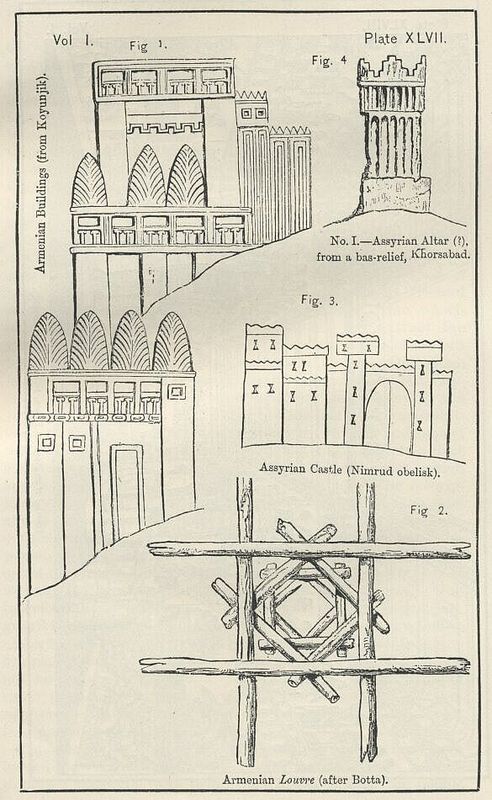
It might have been expected that the difficulties with respect to Assyrian roofing and lighting which have necessitated this long discussion, would have received illustration, or even solution, from the forms of buildings which occur so frequently on the bas-reliefs. But this is not found to be the actual result. The forms are rarely Assyrian, since they occur commonly in the sculptures which represent the foreign campaigns of the kings; and they have the appearance of being to a great extent conventional, being nearly the same, whatever country is the object of attack. In the few cases where there is ground for regarding the building as native and not foreign, it is never palatial, but belongs either to sacred or to domestic architecture. Thus the monumental representations of Assyrian buildings which have come down to us, throw little or no light on the construction of their palaces. As, however, they have an interest of their own, and will serve to illustrate in some degree the domestic and sacred architecture of the people, some of the most remarkable of them will be here introduced.
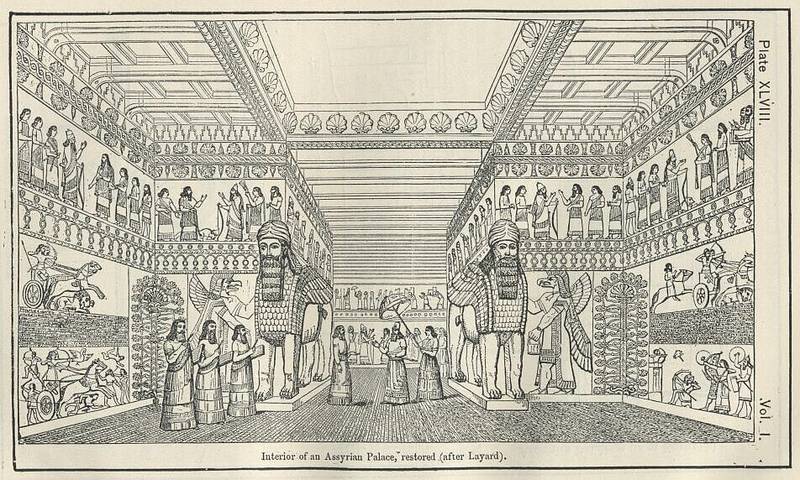
The representation No. I. is from a slab at Khorsabad. [PLATE XLVII., Fig. 4.] It is placed on the summit of a hill, and is regarded by M. Botta as an altar. No. II. is from the same slab. [PLATE XLIX., Fig. 1.] It stands at the foot of the hill crowned by No. I. It has been called a "fishing pavilion;" but it is most probably a small temple, since it bears a good deal of resemblance to other representations which are undoubted temples, as (particularly) to No. V. No. III., which is from Lord Aberdeen's black stone, is certainly a temple, since it is accompanied by a priest, a sacred tree, and an ox for sacrifice. [PLATE XLIX., Fig. 2.] The representation No. IV. is also thought to be a temple. [PLATE XLIX., Fig. 3.] It is of earlier date than any of the others, being taken from a slab belonging to the North-west Palace at Nimrud, and is remarkable in many ways. First, the want of symmetry is curious, and unusual. Irregular as are the palaces of the Assyrian kings, there is for the most part no want of regularity in their sacred buildings. The two specimens here adduced (No. II. and No. III.) are proof of this; and such remains of actual temples as exist are in accordance with the sculptures in this particular. The right-hand aisle in No. IV., having nothing correspondent to it on the other side, is thus an anomaly in Assyrian architecture. The patterning of the pillars with chevrons is also remarkable; and their capitals are altogether unique. No. V. is a temple of a more elaborate character. [PLATE XLIX., Fig. 4.] It is from the sculptures of Asshur-banipal, the son of Esar-haddon, and possesses several features of great interest. The body of the temple is a columnar structure, exhibiting at either corner a broad pilaster surmounted by a capital composed of two sets of volutes placed one over the other. Between the two pilasters are two pillars resting upon very extraordinary rounded bases, and crowned by capitals not unlike the Corinthian. We might have supposed the bases mere figments of the sculptor, but for an independent evidence of the actual employment by the Assyrians of rounded pillar-bases. Mr. Layard discovered at Koyunjik a set of "circular pedestals," whereof he gives the representation which is figured. [PLATE LI., Fig. 1.] They appeared to form part of a double line of similar objects, extending from the edge of the platform to an entrance of the palace, and probably (as Mr. Layard suggests) supported the wooden pillars of a covered way by which the palace was approached on this side. Above the pillars the temple (No. V.) exhibits a heavy cornice or entablature projecting considerably, and finished at the top with a row of gradines. (Compare No. II.) At one side of this main building is a small chapel or oratory, also finished with gradines, against the wall of which is a representation of a king, standing in a species of frame arched at the top. A road leads straight up to this royal tablet, and in this road within a little distance of the king stands an altar. The temple occupies the top of a mound, which is covered with trees of two different kinds, and watered by rivulets. On the right is a "hanging garden," artificially elevated to the level of the temple by means of masonry supported on an arcade, the arch here used being not the round arch but a pointed one. No. VI. [PLATE L.] is unfortunately very imperfect, the entire upper portion having been lost. Even, however, in its present mutilated state it represents by far the most magnificent building that has yet been found upon the bas-reliefs. The facade, as it now stands, exhibits four broad pilasters and four pillars, alternating in pairs, excepting that, as in the smaller temples, pilasters occupy both corners. In two cases, the base of the pilaster is carved into the figure of a winged bull, closely resembling the bulls which commonly guarded the outer gates of palaces. In the other two the base is plain—a piece of negligence, probably, on the part of the artist. The four pillars all exhibit a rounded base, nearly though not quite similar to that of the pillars in No. V.; and this rounded base in every case rests upon the back of a walking lion. We might perhaps have imagined that this was a mere fanciful or mythological device of the artist's, on a par with the representations at Bavian, where figures, supposed to be Assyrian deities, stand upon the backs of animals resembling dogs. But one of M. Place's architectural discoveries seems to make it possible, or even probable, that a real feature in Assyrian building is here represented M. Place found the arch of the town gateway which he exhumed at Khorsabad to spring from the backs of the two bulls which guarded it on either side. Thus the lions at the base of the pillars may be real architectural forms, as well as the winged bulls which support the pilasters. The lion was undoubtedly a sacred animal, emblematic of divine power, and especially assigned to Nergal, the Assyrian Mars, the god at once of war and of hunting. His introduction on the exteriors of buildings was common in Asia Minor but no other example occurs of his being made to support a pillar, excepting in the so-called Byzantine architecture of Northern Italy.
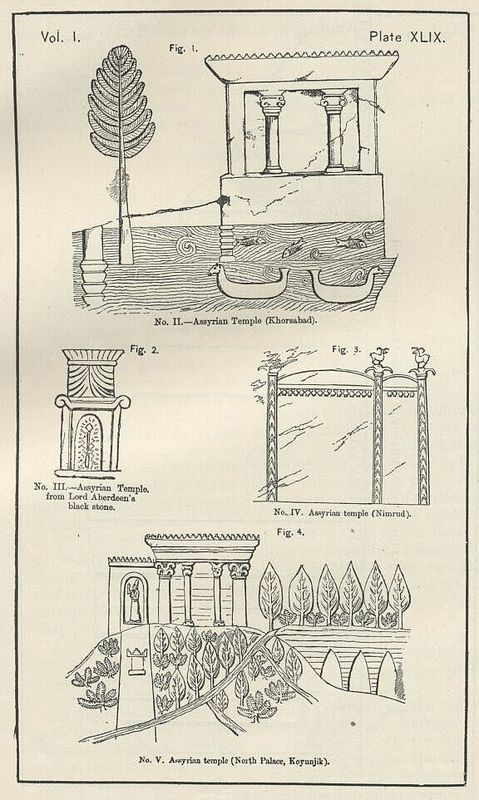
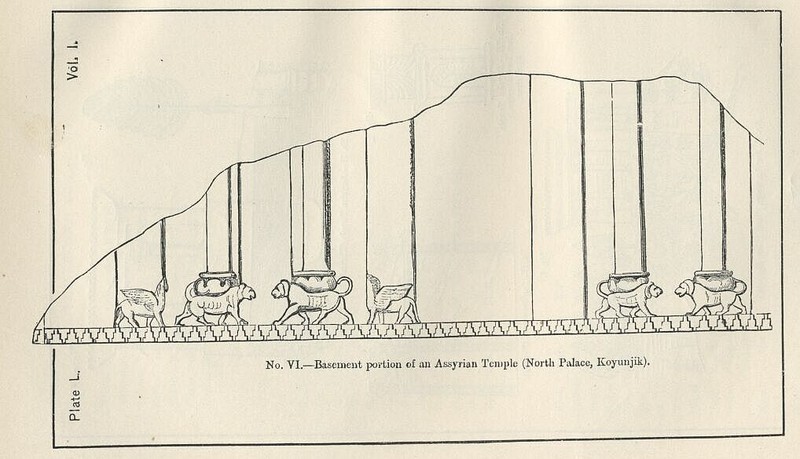
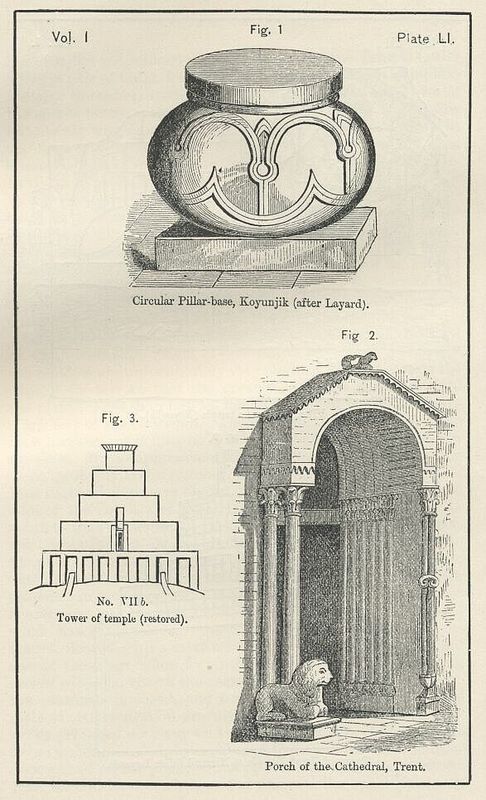
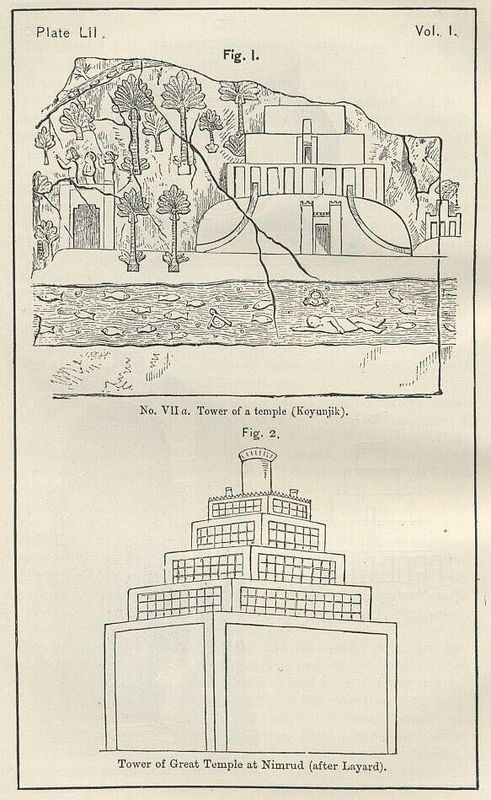
No. VII. a [PLATE LII., Fig. 1] introduces us to another kind of Assyrian temple, or perhaps it should rather be said to another feature of Assyrian temples—common to them with Babylonian—the tower or ziggurat. This appears to have been always built in stages, which probably varied in number—never, how-ever, so far as appears, exceeding seven. The sculptured example before us, which is from a bas-relief found at Koyunjik, distinctly exhibits four stages, of which the topmost, owing to the destruction of the upper portion of the tablet, is imperfect. It is not unlikely that in this instance there was above the fourth a fifth stage, consisting of a shrine like that which at Babylon crowned the great temple of Belus. The complete elevation would then have been nearly as in No. VII. b. [PLATE XLI., Fig. 3.]
The following features are worth of remark in this temple. The basement story is panelled with indented rectangular recesses, as was the ease at Nimrud [PLATE LIII.] and at the Birs the remainder are plain, as are most of the stages in the Birs temple. Up to the second of these squared recesses on either side there runs what seems to be a road or path, which sweeps away down the hill whereon the temple stands in a bold curve, each path closely matching the other. The whole building is perfectly symmetrical, except that the panelling is not quite uniform in width nor arranged quite regularly. On the second stage, exactly in the middle, there is evidently a doorway, and on either side of it a shallow buttress or pilaster. In the centre of the third story, exactly over the doorway of the second, is a squared niche. In front of the temple, but not exactly opposite its centre, may be seen the prophylaea, consisting of a squared doorway placed under a battlemented wall, between two towers also battlemented. It is curious that the paths do not lead to the propylaea, but seen to curve round the hill.
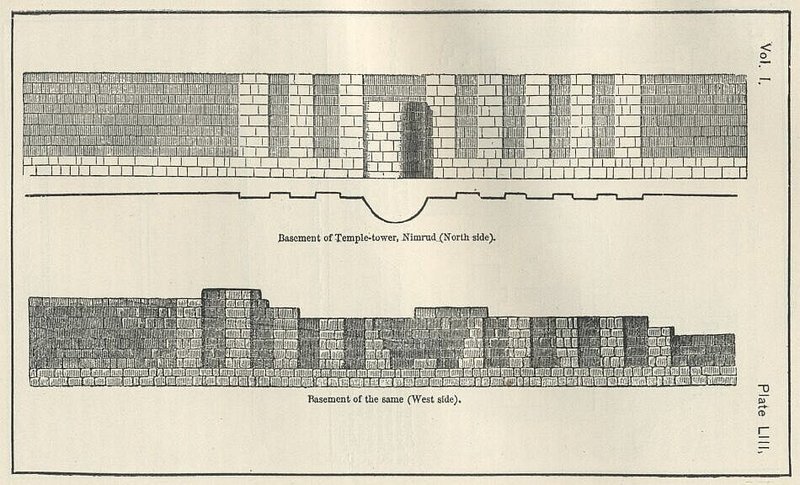
Remains of ziggurats similar to this have been discovered at Khorsabad, at Nimrud, and at Kileh-Sherghat. The conical mound at Khorsabad explored by M. Place was found to contain a tower in seven stages; that of Nimrud, which is so striking an object from the plain, and which was carefully examined by Mr. Layard, presented no positive proof of more than a single stage; but from its conical shape, and from the general analogy of such towers, it is believed to have had several stages. [PLATE LII., Fig. 2.] Mr. Layard makes their number five, and crowns the fifth with a circular tower terminating in a heavy cornice; but for this last there is no authority at all, and the actual number of the stages is wholly uncertain. The base of this ziggurat was a square, 167 feet 6 inches each way, composed of a solid mass of sun-dried brick, faced at bottom to the height of twenty feet with a wall of hewn stones, more than eight feet and a half in thickness. The outer stones were bevelled at the edges, and on the two most conspicuous sides the wall was ornamented with a series of shallow recesses arranged without very much attention to regularity. The other two sides, one of which abutted on and was concealed by the palace mound, while the other faced towards the city, were perfectly plain. At the top of the stone masonry was a row of gradines, such as are often represented in the sculptures as crowning an edifice. Above the stone masonry the tower was continued at nearly the same width, the casing of stone being simply replaced by one of burnt brick of inferior thickness. It is supposed that the upper stages were constructed in the same way. As the actual present height of the ruin is 140 feet, and the upper stages have so entirely crumbled away, it can scarcely be supposed that the original height fell much short of 200 feet.
The most curious of the discoveries made during the examination of this building, was the existence in its interior of a species of chamber or gallery, the true object of which still re-mains wholly unexplained. This gallery was 100 feet long, 12 feet high, and no more than 6 feet broad. It was arched or vaulted at top, both the side walls and the vaulting being of sun-dried brick. [PLATE LIV., Fig. 2.] Its position was exactly half-way between the tower's northern and southern faces, and with these it ran parallel, its height in the tower being such that its floor was exactly on a level with the top of the stone masonry, which again was level with the terrace or platform whereupon the Nimrud palaces stood. There was no trace of any way by which the gallery was intended to be entered; its walls showed no signs of inscription, sculpture, or other ornament; and absolutely nothing was found in it. Mr. Layard, prepossessed with an opinion derived from several confused notices in the classical writers, believed the tower to be a sepulchral monument, and the gallery to be the tomb in which was originally deposited "the embalmed body of the king." To account for the complete disappearance, not only of the body, but of all the ornaments and vessels found commonly in the Mesopotamian tombs, he suggested that the gallery had been rifled in times long anterior to his visit; and he thought that he found traces, both internally and externally, of the tunnel by which it had been entered. But certainly, if this long and narrow vault was intended to receive a body, it is most extraordinarily shaped for the purpose. What other sepulchral chamber is there anywhere of so enormous a, length? Without pretending to say what the real object of the gallery was, we may feel tolerably sure that it was not a tomb. The building which contained it was a temple tower, and it is not likely that the religious feelings of the Assyrians would have allowed the application of a religious edifice to so utilitarian a purpose.
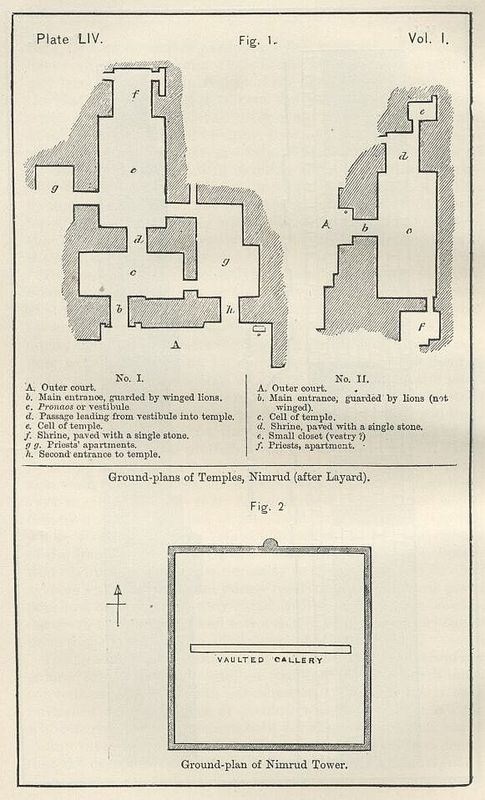
Besides the ziggerat or tower, which may commonly have been surmounted by a chapel or shrine, an Assyrian temple had always a number of basement chambers, in one of which was the principal shrine of the god. [PLATE LIV.,Fig. 1.] This was a square or slightly oblong recess at the end of an oblong apartment, raised somewhat above its level; it was paved (sometimes, if not always) with a single slab, the weight of which must occasionally have been as much as thirty tons. One or two small closets opened out from the shrine, in which it is likely that the priests kept the sacerdotal garments and the sacrificial utensils. Sometimes the cell of the temple or chamber into which the shrine opened was reached through another apartment, corresponding to the Greek pronaos. In such a case, care seems to have been taken so to arrange the outer and inner doorways of the vestibule that persons passing by the outer doorway should not be able to catch a sight of the shrine. Where there was no vestibule, the entrance into the cell or body of the temple seems to have been placed at the side, instead of at the end, probably with the same object. Besides these main parts of a temple, a certain number of chambers are always found, which appear to have been priests' apartments.
The ornamentation of temples, to judge by the few specimens which remain, was very similar to that of palaces. The great gateways were guarded by colossal bulls or lions see [PLATE LV.], accompanied by the usual sacred figures, and sometimes covered with inscriptions. The entrances and some portions of the chambers were ornamented with the customary sculptured slabs, representing here none but religious subjects. No great proportion of the interior, however, was covered in this way, the walls being in general only plastered and then painted with figures or patterns. Externally, enamelled bricks were used as a decoration wherever sculptured slabs did not hide the crude brick.
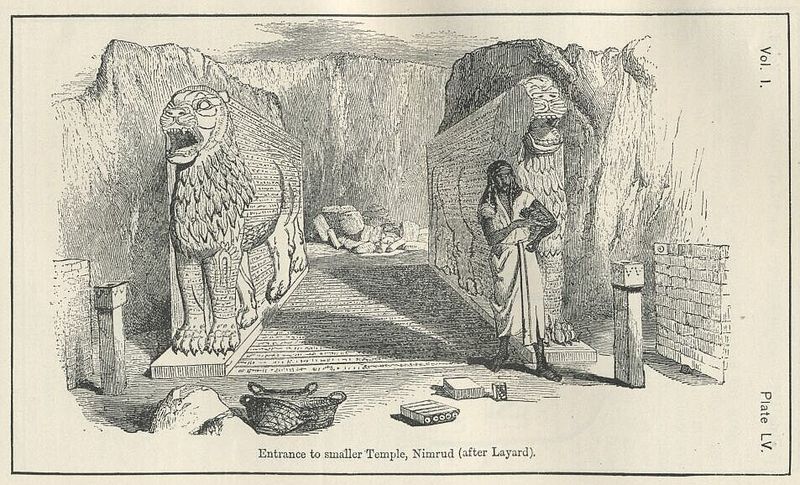
Much the sane doubts and difficulties beset the subjects of the roofing and lighting of the temples as those which have been discussed already in connection with the palaces. Though the span of the temple-chambers is less than that of the great palace halls, still it is considerable, sometimes exceeding thirty feet. No effort seems made to keep the temple-chambers narrow, for their width is sometimes as much as two-thirds of their length. Perhaps, therefore, they were hypaethral, like the temples of the Greeks. All that seems to be certain is that what roofing they had was of wood, which at Nimrud was cedar, brought probably from the mountains of Syria.
Of the domestic architecture of the Assyrians we possess absolutely no specimen. Excavation has been hitherto confined to the most elevated portions of the mounds which mark the sites of cities, where it was likely that remains of the greatest interest would be found. Palaces, temples, and the great gates which gave entrance to towns, have in this way seen the light; but the humbler buildings, the ordinary dwellings of the people, remain buried beneath the soil, unexplored and even unsought for. In this entire default of any actual specimen of an ordinary Assyrian house, we naturally turn to the sculptured representations which are so abundant and represent so many different sorts of scenes. Even here, however, we obtain but little light. The bulk of the slabs exhibit the wars of the kings in foreign countries, and thus place before us foreign rather than Assyrian architecture. The processional slabs, which are another large class, contain rarely any building at all, and, where they furnish one, exhibit to us a temple rather than a house. The hunting scenes, representing wilds far from the dwellings of man, afford us, as might be expected, no help. Assyrian buildings, other than temples, are thus most rarely placed before us. In one case, indeed, we have an Assyrian city, which a foreign enemy is passing; but the only edifices represented are the walls and towers of the exterior, and the temple [No. VI., PLATE L.] whose columns rest upon lions. In one other we seem to have an unfortified Assyrian village; and from this single specimen we are forced to form our ideas of the ordinary character of Assyrian houses.
It is observable here, its the first place, that the houses have no windows, and are, therefore, probably lighted from the roof; next, that the roofs are very curious, since, although flat in some instances, they consist more often either of hemispherical domes, such as are still so common in the East, or of steep and high cones, such as are but seldom seen anywhere. Mr. Layard finds a parallel for these last in certain villages of Northern Syria, where all the houses have conical roofs, built of mud, which present a very singular appearance. [PLATE LVI., Fig. 2.] Both the domes and the cones of the Assyrian example have evidently an opening at the top, which may have admitted as much light into the houses as was thought necessary. The doors are of two kinds, square at the top, and arched; they are placed commonly towards the sides of the houses. The houses themselves seem to stand separate, though in close juxtaposition.
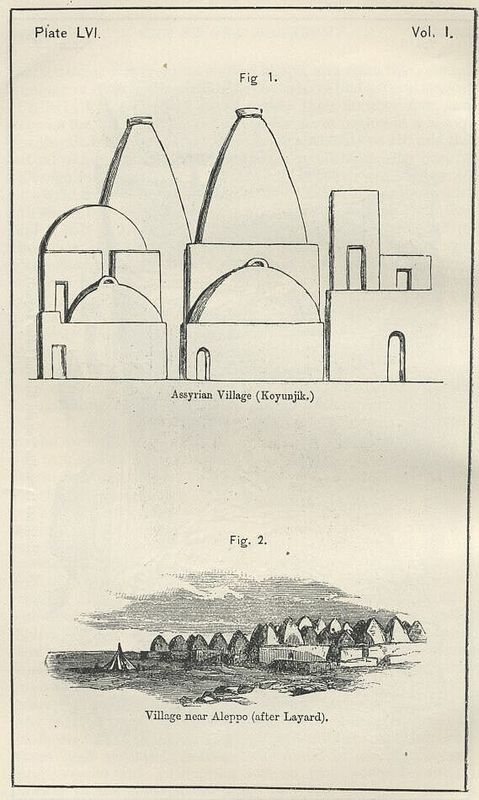
The only other buildings of the Assyrians which appear to require some notice are the fortified enceintes of their towns. The simplest of these consisted of a single battlemented wall, carried in lines nearly or quite straight along the four sides of the place, pierced with gates, and guarded at the angles, at the gates, and at intervals along the curtain with projecting towers, raised not very much higher than the walls, and (apparently) square in shape. [PLATE LVII., Fig 1.] In the sculptures we sometimes find the battlemented wall repeated twice or thrice in lines placed one above the other, the intention being to represent the defence of a city by two or three walls, such as we have seen existed on one side of Nineveh.
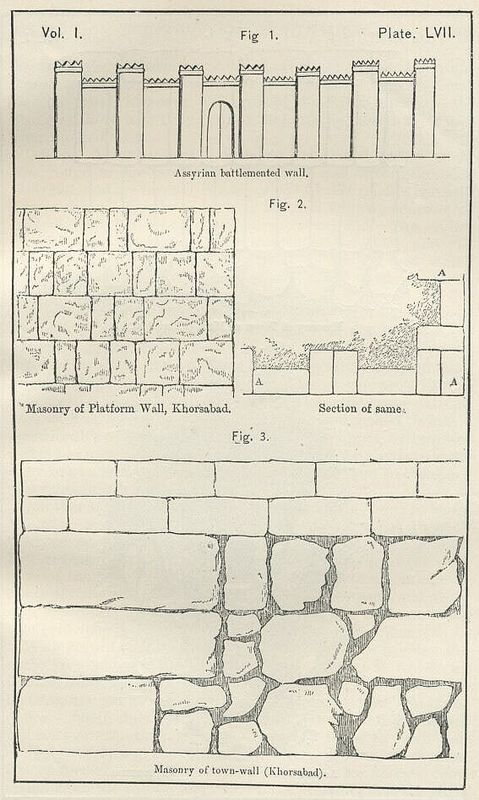
The walls were often, if not always, guarded by moats. Internally they were, in every case, constructed of crude brick; while externally it was common to face them with hewn stone, either from top to bottom, or at any rate to a certain height. At Khorsabad the stone revetement of one portion at least of the wall was complete; at Nimrud (Calah) and at Nineveh itself, it was partial, being carried at the former of those places only to the height of twenty feet. The masonry at Khorsabad was of three kinds. That of the palace mound, which formed a portion of the outer defence, was composed entirely of blocks of stone, square-hewn and of great size, the length of the blocks varying from two to three yards, while the width was one yard, and the height from five to six feet. [PLATE LVII., Fig.2.] The masonry was laid somewhat curiously. The blocks (A A) were placed alternately long-wise and end-wise against the crude brick (B), so as not merely to lie against it, but to penetrate it with their ends in many places. [PLATE LVII, Fig. 2.] Care was also taken to make the angles especially strong, as will be seen by the accompanying section.
The rest of the defences at Khorsabad were of an inferior character. The wall of the town had a width of about forty-five feet, and its basement, to the height of three feet, was constructed of stone; but the blocks were neither so large, nor were they hewn with the same care, as those of the palace platform. [PLATE LVII., Fig. 3.] The angles, indeed, were of squared stone; but even there the blocks measured no more than three feet in length and a foot in height: the rest of the masonry consisted of small polygonal stones, merely smoothed on their outer face, and roughly fitting together in a manner recalling the Cyclopian walls of Greece and Italy. They were not united by any cement. Above the stone basement was a massive structure of crude brick, without any facing either of burnt brick or of stone.
The third kind of masonry at Khorsabad was found outside the main wall, and may have formed either part of the lining of the moat or a portion of a tower, which may have projected in advance of the wall at this point. [PLATE LVIII., Fig. 1.] It was entirely of stone. The lowest course was formed of small and very irregular polygonal blocks roughly fitted together; above this came two courses of carefully squared stones more than a foot long, but less than six inches in width, which were placed end-wise, one over the other, care being taken that the joints of the upper tier should never coincide exactly with those of the lower. Above these was a third course of hewn stones, somewhat smaller than the others, which were laid in the ordinary manner. Here the construction, as discovered, terminated; but it was evident, from the debris of hewn stones at the foot of the wall, that originally the courses had been continued to a much greater height.
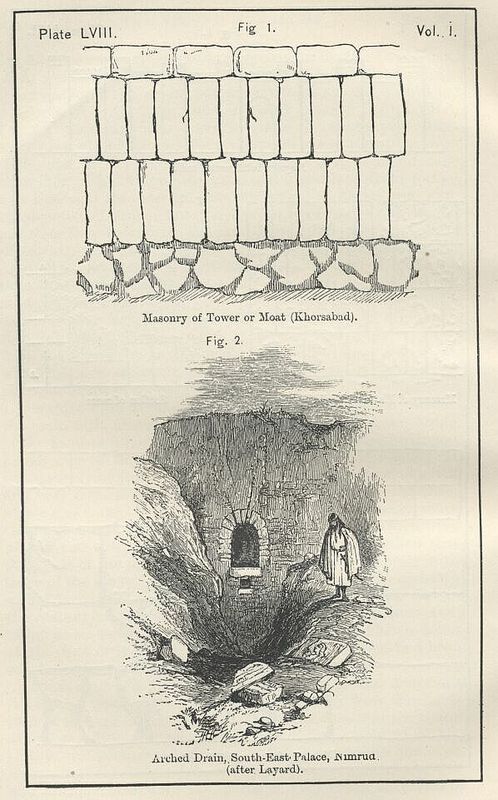
In this description of the buildings raised by the Assyrians it has been noticed more than once that they were not ignorant of the use of the arch. The old notion that the round arch was a discovery of the Roman, and the pointed of the Gothic architecture, has gradually faded away with our ever-increasing knowledge of the actual state of the ancient world; and antiquarians were not, perhaps, very much surprised to learn, by the discoveries of Mr. Layard, that the Assyrians knew and used both kinds of arch in their constructions. Some interest, however, will probably be felt to attach to the two questions, how they formed their arches, and to what uses they applied them.
All the Assyrian arches hitherto discovered are of brick. The round arches are both of the crude and of the kiln-dried material, and are formed, in each case, of brick made expressly for vaulting, slightly convex at top and slightly concave at bottom, with one broader and one narrower end. The arches are of the simplest kind, being exactly semicircular, and rising from plain perpendicular jambs. The greatest width which any such arch has been hitherto found to span is about fifteen feet.
The only pointed arch actually discovered is of burnt brick. The bricks are of the ordinary shape, and not intended for vaulting. They are laid side by side up to a certain point, being bent into a slight arch by the interposition between them of thin wedges of mortar. The two sides of the arch having been in this way carried up to a point where the lower extremities of the two innermost bricks nearly touched, while a considerable space remained between their upper extremities instead of a key-stone, or a key-brick fitting the aperture, ordinary bricks were placed in it longitudinally, and so the space was filled in.
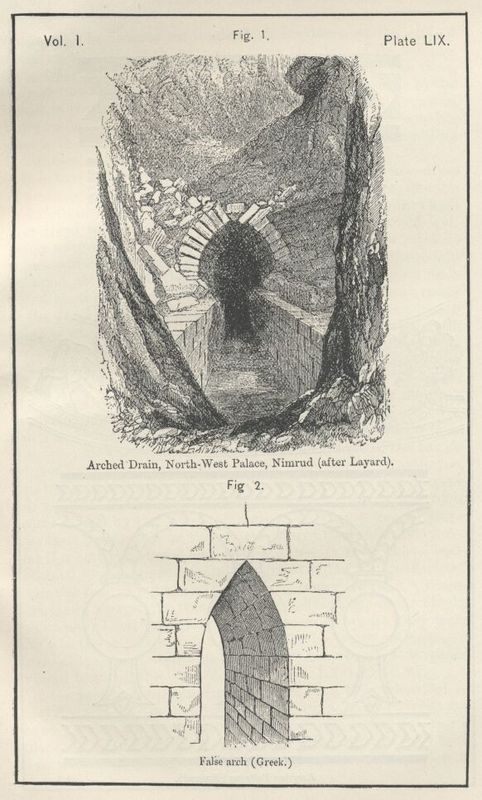
Another mode of constructing a pointed arch seems to be intended in a bas-relief, whereof a representation has been already given. The masonry of the arcade in No. V. [PLATE XLIX., Fig. 4] runs (it will be seen) in horizontal lines up to the very edge of the arch, thus suggesting a construction common in many of the early Greek arches, where the stones are so cut away that an arched opening is formed, though the real constructive principle of the arch has no place in such specimens.
With regard to the uses whereto the Assyrians applied the arch, it would certainly seem, from the evidence which we possess, that they neither employed it as a great decorative feature, nor yet as a main principle of construction. So far as appears, their chief use of it was for doorways and gateways. Not only are the town gates of Khorsabad found to have been arched over, but in the representations of edifices, whether native or foreign, upon the bas-reliefs, the arch for doors is commoner than the square top. It is most probable that the great palace gateways were thus covered in, while it is certain that some of the interior doorways in palaces had rounded tops. Besides this use of the arch for doors and gates, the Assyrians are known to have employed it for drains, aqueducts, and narrow chambers or galleries. [PLATE LVIII. Fig. 2.]; [PLATE LIX., Fig. 1.]
It has been suggested that the Assyrians applied the two kinds of arches to different purposes, "thereby showing more science and discrimination than we do in our architectural works;" that "they used the pointed arch for underground work, where they feared great superincumbent pressure on the apex, and the round arch above ground, where that was not to be dreaded." [PLATE LIX., Fig. 2.] But this ingenious theory is scarcely borne out by the facts. The round arch is employed underground in two instances at Nimrud, besides occurring in the basement story of the great tower, where the superincumbent weight must have been enormous. And the pointed arch is used above ground for the aqueduct and hanging garden in the bas-relief (see [PLATE XLIX., Fig. 4]), where the pressure, though considerable, would not have been very extraordinary. It would seem, therefore, to be doubtful whether the Assyrians were really guided by any constructive principle in their preference of one form of the arch over the other.
In describing generally the construction of the palaces and other chief buildings of the Assyrians, it has been necessary occasionally to refer to their ornamentation; but the subject is far from exhausted, and will now claim, for a short space, our special attention. Beyond a doubt the chief adornment, both of palaces and temples, consisted of the colossal bulls and lions guarding the great gateways, together with the sculptured slabs wherewith the walls, both internal and external, were ordinarily covered to the height of twelve or sometimes even of fifteen feet. These slabs and carved figures will necessarily be considered in connection with Assyrian sculpture, of which they form the most important part. It will, therefore, only be noted at present that the extent of wall covered with the slabs was, in the Khorsabad palace, at least 4000 feet, or nearly four-fifths of a mile, while in each of the Koyunjik palaces the sculptures extended to considerably more than that distance.
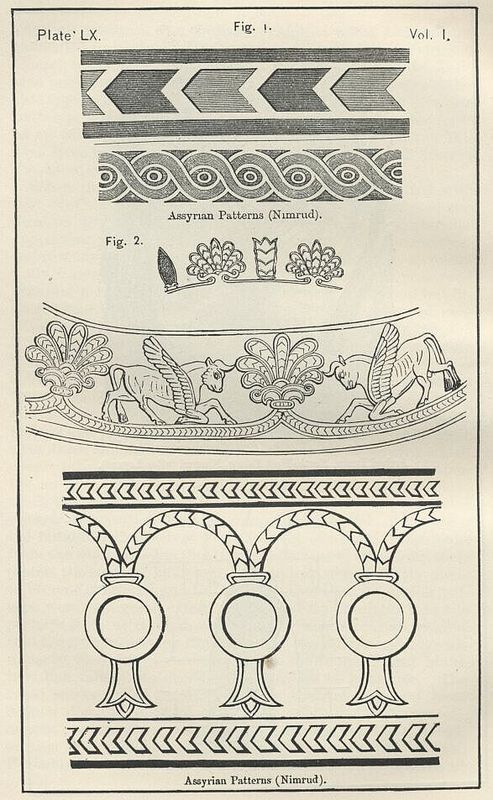
The ornamentation of the walls above the slabs, both internally and externally, was by means of bricks painted on the exposed side and covered with an enamel. The colors are for the most part somewhat pale, but occasionally they possess some brilliancy. [PLATE LX., Fig 1.] Predominant among the tints are a pale blue, an olive green, and a dull yellow. White is also largely used; brown and black are not infrequent; red is comparatively rare. The subjects represented are either such scenes as occur upon the sculptured slabs, or else mere patterns—scrolls, honeysuckles, chevrons, gradines, guilloches, etc. In the scenes some attempt seems to be made at representing objects in their natural colors. The size of the figures is small; and it is difficult to imagine that any great effect could have been produced on the beholder by such minute drawings placed at such a height from the ground. Probably the most effective ornamentation of this kind was by means of patterns, which are often graceful and striking. [PLATE LX., 2.]
It has been observed that, so far as the evidence at present goes, the use of the column in Assyrian architecture would seem to have been very rare indeed. In palaces we have no grounds for thinking that they were employed at all excepting in certain of the interior doorways, which, being of unusual breadth, seem to have been divided into three distinct portals by means of two pillars placed towards the sides of the opening. The bases of these pillars were of stone, and have been found in situ; their shafts and capitals had disappeared, and can only be supplied by conjecture. In the temples, as we have seen, the use of the column was more frequent. Its dimensions greatly varied. Ordinarily it was too short and thick for beauty, while occasionally it had the opposite defect, being too tall and slender. Its base was sometimes quite plain, sometimes diversified by a few mouldings, sometimes curiously and rather clumsily rounded (as in No. II., [PLATE LXI., Fig. 1]). The shaft was occasionally patterned. The capital, in one instance (No. I., [PLATE LXI., Fig. 3]), approaches to the Corinthian; in another (No. II.) it reminds us of the Ionic; but the volutes are double, and the upper ones are surmounted by an awkward-looking abacus. A third (No. III., [PLATE. LXI., Fig. 2]) is very peculiar, and to some extent explains the origin of the second. It consists of two pairs of ibex horns, placed one over the other. With this maybe compared another (No. IV.). the most remarkable of all, where we have first a single pair of ibex horns, and then, at the summit, a complete figure of an ibex very graphically portrayed.
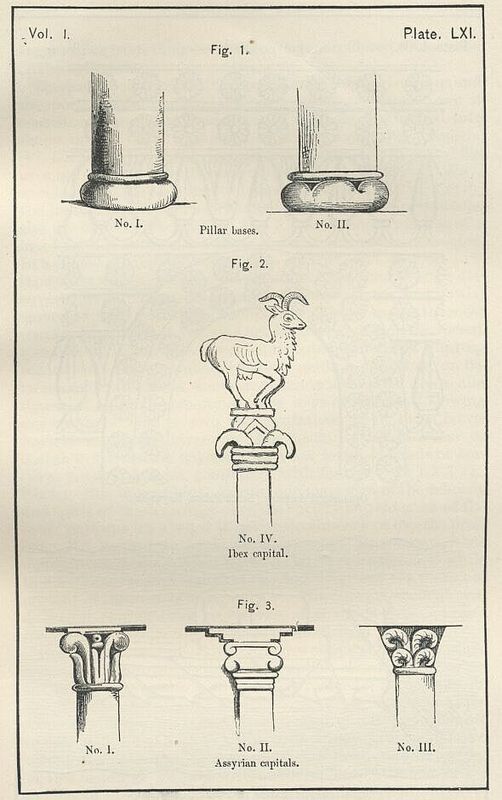
The beauty of Assyrian patterning has been already noticed. Patterned work is found not only on the enamelled bricks, but on stone pavement slabs, and around arched doorways leading from one chamber to another, where the patterns are carved with great care and delicacy upon the alabaster. The accompanying specimen of a doorway, which is taken from an unpublished drawing by Mr. Boutcher, is very rich and elegant, though it exhibits none but the very commonest of the Assyrian patterns. [PLATE LXII., Fig. 1.] A carving of a more elaborate type, and one presenting even greater delicacy of workmanship, has been given in an earlier portion of this chapter as an example of a patterned pavement slab. Slabs of this kind have been found in many of the palaces, and well deserve the attention of modern designers.
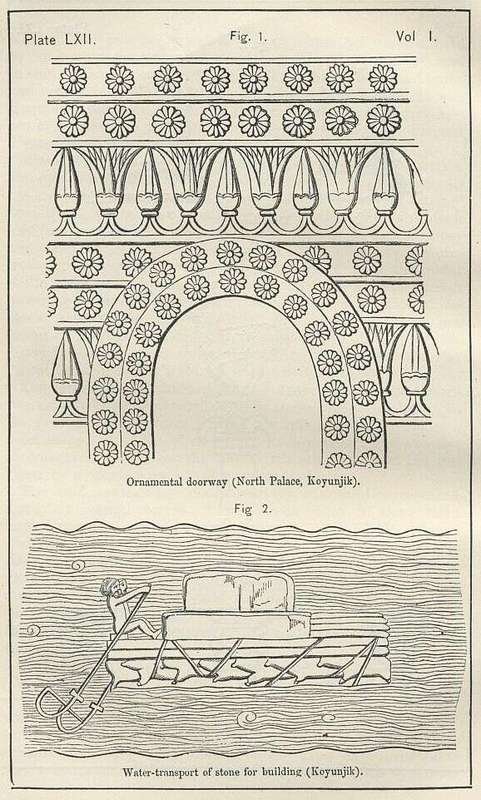
When the architecture of the Assyrians is compared with that of other nations possessing about the same degree of civilization, the impression that it leaves is perhaps somewhat disappointing. Vast labor and skill, exquisite finish, the most extraordinary elaboration, were bestowed on edifices so essentially fragile and perishable that no care could have preserved them for manly centuries. Sun-dried brick, a material but little superior to the natural clay of which it was composed, constituted everywhere the actual fabric, which was then covered thinly and just screened from view by a facing, seldom more than a few inches in depth, of a more enduring and handsomer substance. The tendency of the platform mounds, as soon as formed, must have been to settle down, to bulge at the sides and become uneven at the top, to burst their stone or brick facings and precipitated them into the ditch below, at the same time disarranging and breaking up the brick pavements which covered their surface. The weight of the buildings raised upon the monads must have tended to hasten these catastrophes, while the unsteadiness of their foundations and the character of their composition must have soon had the effect of throwing the buildings themselves into disorder, of loosening the slabs from the walls, causing the enamelled bricks to start from their places, the colossal bulls and lions to lean over, and the roofs to become shattered and fall in. The fact that the earlier palaces were to a great extent dismantled by the later kings is perhaps to be attributed, not so much to a barbarous resolve that they would destroy the memorials of a former and a hostile dynasty, as to the circumstance that the more ancient buildings had fallen into decay and ceased to be habitable. The rapid succession of palaces, the fact that, at any rate from Sargon downwards, each monarch raises a residence, or residences, for himself, is yet more indicative of the rapid deterioration and dilapidation (so to speak) of the great edifices. Probably a palace began to show unmistakable symptoms of decay and to become an unpleasant residence at the end of some twenty-five or thirty years from the date of its completion; effective repairs were, by the very nature of the case, almost impossible; and it was at once easier and more to the credit of the monarch that he should raise a fresh platform and build himself a fresh dwelling than that he should devote his efforts to keeping in a comfortable condition the crumbling habitation of his predecessor.
It is surprising that, under these circumstances, a new style of architecture did not arise. The Assyrians were not, like the Babylonians, compelled by the nature of the country in which they lived to use brick as their chief building material. M. Botta expresses his astonishment at the preference of brick to stone exhibited by the builders of Khorsabad, when the neighborhood abounds in rocky hills capable of furnishing an inexhaustible supply of the better material. The limestone range of the Jebel Maklub is but a few miles distant, and many out-lying rocky elevations might have been worked with still greater facility. Even at Nineveh itself, and at Calah or Nimrud, though the hills were further removed, stone was, in reality, plentiful. The cliffs a little above Koyunjik are composed of a "hard sandstone," and a part of the moat of the town is carried through "compact silicious conglomerate." The town is, in fact, situated on "a spur of rock" thrown off from the Jebel Dlakiub, which, terminates at the edge of the ravine whereby Nineveh was protected on the south. Calah, too, was built on a number of "rocky undulations," and its western wall skirts the edge of "conglomerate" cliffs, which have been scarped by the hand of man. A very tolerable stone was thus procurable on the actual sites of these ancient cities; and if a better material had been wanted, it might have been obtained in any quantity, and of whatever quality was desired, from the Zagros range and its outlying rocky barriers. Transport could scarcely have caused much difficulty, as the blocks might have been brought from the quarries where they were hewn to the sites selected for the cities by water-carriage—a mode of transport well known to the Assyrians, as is made evident to us by the bas-reliefs. (See [PLATE LXII. Fig. 2.])
If the best possible building material was thus plentiful in Assyria, and its conveyance thus easy to manage, to what are we to ascribe the decided preference shown for so inferior a substance as brick? No considerable difficulty can have been experienced in quarrying the stone of the country, which is seldom very hard, and which was, in fact, cut by the Assyrians, whenever they had any sufficient motive for removing or making use of it. One answer only can be reasonably given to the question. The Assyrians had learnt a certain style of architecture in the alluvial Babylonia, and having brought it with them into A country far less fitted for it, maintained it from habit, not withstanding its unsuitableness. In some few respects, indeed, they made a slight change. The abundance of stone in the country induced them to substitute it in several places where in Babylonia it was necessary to use burnt brick, as in the facings of platforms and of temples, in dams across streams, in pavements sometimes, and universally in the ornamentation of the lover portions of palace and temple walls. But otherwise they remained faithful to their architectural traditions, and raised in the comparatively hilly Assyria the exact type of building which nature and necessity had led them to invent and use in the flat and stoneless alluvium where they had had their primitive abode. As platforms were required both for security and for comfort in the lower region, they retained them, instead of choosing natural elevations in the upper one. As clay was the only possible material in the one place, clay was still employed, notwithstanding the abundance of stone, in the other. Being devoid of any great inventive genius, the Assyrians found it easier to maintain and slightly modify a system with which they had been familiar in their original country than to devise a new one more adapted to the land of their adoption.
Next to the architecture of the Assyrians, their mimetic art seems to deserve attention. Though the representations in the works of Layard and Botta, combined with the presence of so many specimens in the great national museums of London and Paris, have produced a general familiarity with the subject, still, as a connected view of it in its several stages and branches is up to the present time a desideratum in our literature, it may not be superfluous here to attempt a brief account of the different classes into which their productions in this kind of art fall, and the different eras and styles under which they naturally range themselves.
Assyrian mimetic art consists of statues, bas-reliefs, metal-castings, carvings in ivory, statuettes in clay, enamellings on brick, and intaglios on stones and gems.
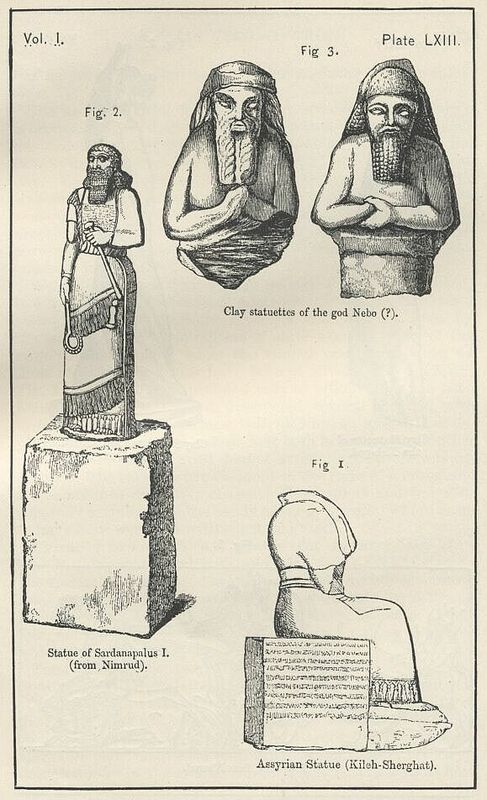
Assyrian statues are comparatively rare, and, when they occur, are among the least satisfactory of this people's productions. They are coarse, clumsy, purely formal in their design, and generally characterized by an undue flatness, or want of breadth in the side view, as if they were only intended to be seen directly in front. Sometimes, however, this defect is not apparent. A sitting statue in black basalt, of the size of life, representing an early king, which Mr. Layard discovered at Kileh-Sherghat [PLATE LXIII, Fig. 1], and which is now in the British Museum, may be instanced as quite free from this disproportion. It is very observable, however, in another of the royal statues recently recovered [PLATE LXIII, Fig. 2], as it is also in the monolith bulls and lions universally. Otherwise, the proportions of the figures are commonly correct. They bear a resemblance to the archaic Greek, especially to that form of it which we find in the sculptures from Branchidae. They have just the same rudeness, heaviness, and stiff formality. It is difficult to judge of their execution, as they have mostly suffered great injury from the hand of man, or from the weather; but the royal statue here represented, which is in better preservation than any other Assyrian work "in the round" that has come down to us, exhibits a rather high finish. It is smaller than life, being about three and a half feet high: the features are majestic, and well marked; the hair and beard are elaborately curled; the arms and hands are well shaped, and finished with care. The dress is fringed elaborately, and descends to the ground, concealing all the lower part of the figure. The only statues recovered besides these are two of the god Nebo, brought from Nimrud, a mutilated one of Ishtar, or Astarte, found at Koyunjik [PLATE LXIII., Fig. 3], and a tolerably perfect one of Sargon, which was discovered at Idalium, in the island of Cyprus.
The clay statuettes of the Assyrians possess even less artistic merit than their statues. They are chiefly images of gods or genii, and have most commonly something grotesque in their appearance. Among the most usual are figures which represent either Mylitta (Bettis), or Ishtar. They are made in a fine terra cotta, which has turned of a pale red in baking, and are colored with a cretaceous coating, so as greatly to resemble Greek pottery. Another type is that of an old man, bearded, and with hands clasped, which we may perhaps identify with Nebo, the Assyrian Mercury, since his statues in the British Museum have a somewhat similar character. Other forms are the fish-god Nin, or Nin-ip [PLATE LXIV., Fig. 1]; and the deities, not yet identified, which were found by M. Botta under the pavement-bricks at Khorsahad. [PLATE LXIV., Fig. 2.] These specimens have the formal character of the statues, and are even more rudely shaped. Other examples, which carry the grotesque to an excess, appear to have been designed with greater spirit and freedom. Animal and human forms are sometimes intermixed in them; and while it cannot be denied that they are rude and coarse, it must be allowed, on the other hand, that they possess plenty of vigor. M. Botta has engraved several specimens, including two which have the hind legs and tail of a bull, with a human neck and arms, the head bearing the usual horned cap.
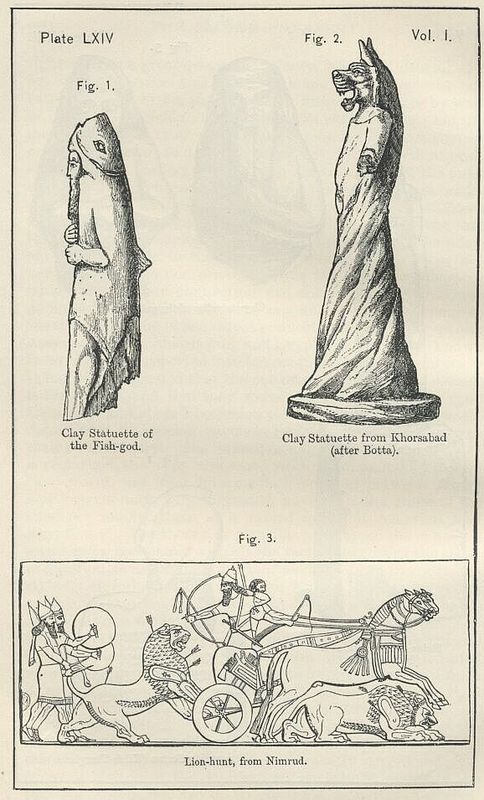
Small figures of animals in terra cotta have also been found. They consist chiefly of dogs and ducks. A representation of each has been given in the chapter on the productions of Assyria. The dogs discovered are made of a coarse clay, and seem to have been originally painted. They are not wanting in spirit; but it detracts from their merit that the limbs are merely in relief, the whole space below the belly of the animal being filled up with a mass of clay for the sake of greater strength. The ducks are of a fine yellow material, and represent the bird asleep, with its head lying along its back.
Of all the Assyrian works of art which have come down to us, by far the most important are the bas-reliefs. It is here especially, if not solely, that we can trace progress in style; and it is here alone that we see the real artistic genius of the people. What sculpture in its full form, or in the slightly modified form of very high relief, was to the Greeks, what painting has been to modern European nations since the time of Cimabue, that low relief was to the Assyrians—the practical mode in which artistic power found vent among them. They used it for almost every purpose to which mimetic art is applicable; to express their religious feelings and ideas, to glorify their kings, to hand down to posterity the nation's history and its deeds of prowess, to depict home scenes and domestic occupations, to represent landscape and architecture, to imitate animal and vegetable forms, even to illustrate the mechanical methods which they employed in the construction of those vast architectural works of which the reliefs were the principal ornamentation. It is not too much to say that we know the Assyrians, not merely artistically, but historically and ethnologically, chiefly through their bas reliefs, which seem to represent to us almost the entire life of the people.
The reliefs may be divided under five principal heads:—1, War scenes, including battles, sieges, devastations of an enemy's country, naval expeditions, and triumphant returns from foreign war, with the trophies and fruits of victory; 2. Religious scenes, either mythical or real; 3. Processions generally of tribute-bearers, bringing the produce of their several countries to the Great King; 4. hunting and sporting scenes, including the chase of savage animals, and of animals sought for food, the spreading of nets, the shooting of birds, and the like; and 5. Scenes of ordinary life, as those representing the transport and erection of colossal bulls, landscapes, temples, interiors, gardens, etc.
The earliest art is that of the most ancient palaces at Nimrud. It belongs to the latter part of the tenth century before our era; the time of Asa in Judaea, of Omri and Ahab in Samaria, and of the Sheshonks in Egypt. It is characterized by much spirit and variety in the design, by strength and firmness, combined with a good deal of heaviness, in the execution, by an entire contempt for perspective, and by the rigid preservation in almost every case, both human and animal, of the exact profile both of figure and face. Of the illustrations already given in the present volume a considerable number belong to this period. The heads [PLATE XXXIII.], and the figures [PLATE XXXV.], represent the ordinary appearance of the men, while animal forms of the time will be found in the lion [PLATE XXV.], the ibex [PLATE XXV.], the gazelle [PLATE XXVII.], the horse [PLATE XXXI.], and the horse and wild bull [PLATE XXVIII.] It will be seen upon reference that the animal are very much superior to the human forms, a characteristic which is not, however, peculiar to the style of this period, but belongs to all Assyrian art, from its earliest to its latest stage. A favorable specimen of the style will be found in the lion-hunt which Mr. Layard has engraved in his "Monuments," and of which he himself observes, that it is "one of the finest specimens hitherto discovered of Assyrian sculpture." in [PLATE LXIV., Fig. 3.] The composition is at once simple and effective. The king forms the principal object, nearly in the centre of the picture, and by the superior height of his conical head-dress, and the position of the two arrows which he holds in the hand that draws the bow-string, dominates over the entire composition. As he turns round to shoot down at the lion which assails him from behind, his body is naturally and gracefully bent, while his charioteer, being engaged in urging his horses forward, leans naturally in the opposite direction, thus contrasting with the main figure and balancing it. The lion immediately behind the chariot is outlined with great spirit and freedom; his head is masterly; the fillings up of the body, however, have too much conventionality. As he rises to attack the monarch, he conducts the eye up to the main figure, while at the same time by this attitude his principal lines form a pleasing contrast to the predominant perpendicular and horizontal lines of the general composition. The dead lion in front of the chariot balances the living one behind it, and, with its crouching attitude, and drooping head and tail, contrasts admirably with the upreared form of its fellow. Two attendants, armed with sword and shield, following behind the living lion, serve to balance the horses drawing the chariot, without rendering the composition too symmetrical. The horses themselves are the weakest part of the picture; the forelegs are stiff and too slight, and the heads possess little spirit.
It is seldom that designs of this early period can boast nearly so much merit. The religious and processional pieces are stiff in the extreme; the battle scenes are overcrowded and confused; the hunting' scenes are superior to these, but in general they too fall far below the level of the above-described composition.

The best drawing of this period is found in the figures forming the patterns or embroidery of dresses. The gazelle, the ibex, the horse, and the horseman hunting the wild bull of which representations have been given, are from ornamental work of this kind. They are favorable specimens perhaps; but, still, they are representative of a considerable class. Some examples even exceed these in the freedom of their outline, and the vigorous action which they depict, as, for instance, the man seizing a wild bull by the horn and foreleg, which is figured. [PLATE LXV., Fig. 1.] In general, however, there is a tendency in these early drawings to the grotesque. Lions and bulls appear in absurd attitudes; hawk-headed figures in petticoats threaten human-headed lions with a mace or a strap, sometimes holding them by a paw, sometimes grasping then round the middle of the tail [PLATE LXV. Fig. 2]; priests hold up ibexes at arm's length by one of their hindlegs, so that their heads trail upon the ground; griffins claw after antelopes, or antelopes toy with winged lions; even in the hunting scenes, which are less simply ludicrous, there seems to be an occasional striving after strange and laughable attitudes, as when a stricken bull tumbles upon his head, with his tail tossed straight in the air [PLATE LXV., Fig. 31], or when a lion receives his death-wound with arms outspread, and mouth wildly agape. [PLATE LXVI., Fig. 2.]
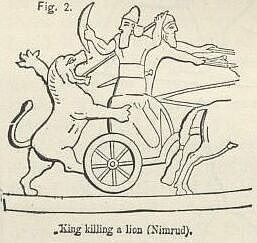
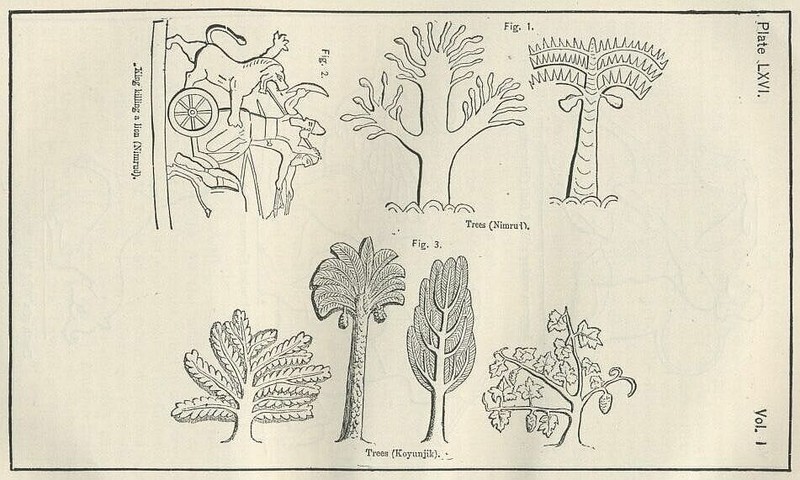
The second period of Assyrian mimetic art extends from the latter part of the eighth to nearly the middle of the seventh century before our era; or, more exactly, from about B.C. 721 to B.C. 667. It belongs to the reigns of the three consecutive kings—Sargon, Sennacherib, and Esar-haddon, who were contemporary with Hezekiah and Manasseh in Judaea, and with the Sabacos (Shebeks) and Tirhakah (Tehiak) in Egypt. The sources which chiefly illustrate this period are the magnificent series of engravings published by MM. Flandin and Botta, together with the originals of a certain portion of them in the Louvre; the engravings in Mr. Layard's first folio work, from plate 68 to 83; those in his second folio work from plate 7 to 44, and from plate 50 to 56; the originals of many of these in the British Museum; several monuments procured for the British Museum by Mr. Loftus; and a series of unpublished drawings by Mr. Boutcher in the same great national collection.
The most obvious characteristic of this period, when we compare it with the preceding one, is the advance which the artists have made in their vegetable forms, and the pre-Raphaelite accuracy which they affect in all the accessories of their representations. In the bas-reliefs of the first period we have for the most part no backgrounds. Figures alone occupy the slabs, or figures and buildings. In some few instances water is represented in a very rude fashion; and once or twice only do we meet with trees, which, when they occur, are of the poorest and strangest character. (See [PLATE LXVI., Fig. 1.]) In the second period, on the contrary, backgrounds are the rule, and slabs without them form the exception. The vegetable forms are abundant and varied, though still somewhat too conventional. Date-palms, firs, and vines are delineated with skill and spirit; other varieties are more difficult to recognize. [PLATE LXVI., Fig. 3.] The character of the countries through which armies march is almost always given—their streams, lakes, and rivers, their hills and mountains, their trees, and in the case of marshy districts, their tall reeds. At the same time, animals in the wild state are freely introduced without their having any bearing on the general subject of the picture. The water teems with fish, and, where the sea is represented, with crabs, turtle, star-fish, sea-serpents, and other monsters. The woods are alive with birds; wild swine and stags people the marshes. Nature is evidently more and more studied; and the artist takes a delight in adorning the scenes of violence, which he is forced to depict, with quiet touches of a gentle character—rustics fishing or irrigating their grounds, fish disporting themselves, birds flying from tree to tree, or watching the callow young which look up to them from the nest for protection.
In regard to human forms, no great advance marks this period. A larger variety in their attitudes is indeed to be traced, and a greater energy and life appears in most of the figures; but there is still much the same heaviness of outline, the same over-muscularity, and the same general clumsiness and want of grace. Animal forms show a much more considerable improvement. Horses are excellently portrayed, the attitudes being varied, and the heads especially delineated with great spirit. Mules and camels are well expressed, but have scarcely the vigor of the horses. Horned cattle, as oxen, both with and without humps, goats, and sheep are very skilfully treated, being represented with much character, in natural yet varied attitudes, and often admirably grouped.
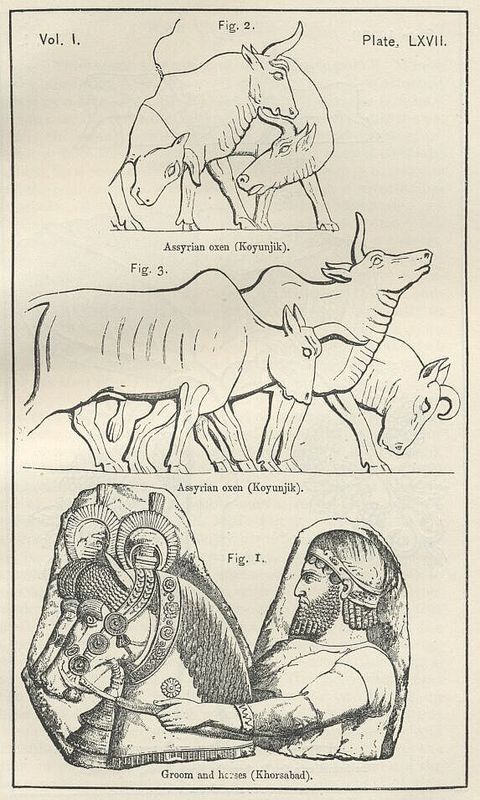
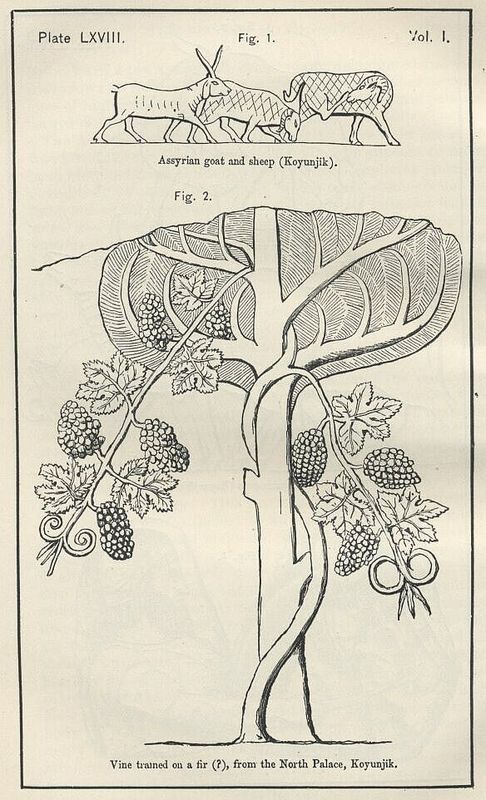
The composition during this period is more complicated and more ambitious than during the preceding one; but it may be questioned whether it is so effective. No single scene of the time can compare for grandeur with the lion-hunt above described. The battles and siege are spirited, but want unity; the hunting scenes are comparatively tame; the representations of the transport of colossal bulls possess more interest than artistic merit. On the other hand, the manipulation is decidedly superior; the relief is higher, the outline is more flowing, the finish of the features more delicate. What is lost in grandeur of composition is, on the whole, more than made up by variety, naturalness, improved handling, and higher finish.
The highest perfection of Assyrian art is in the third period, which extends from B.C. 667 to about B.C. 640. It synchronizes with the reign of Asshur-bani-pal, the son of Essarhaddon, who appears to have been contemporary with Gyges in Lydia, and with Psammetichus in Egypt. The characteristics of the time are a less conventional type in the vegetable forms, a wonderful freedom spirit, and variety in the forms of animals, extreme minuteness and finish in the human figures, and a delicacy in the handling considerably beyond that of even the second or middle period. The sources illustrative of this stage of the art consist of the plates in Mr. Layard's "Second Series of Monuments," from plate 45 to 49, the originals of these in the British Museum, the noble series of slabs obtained by Mr. Loftus from the northern palace of Koyunjik, and of the drawings made from them, and from other slabs, which were in a more damaged condition by Mr. Boutcher, who accompanied Mr. Loftus in the capacity of artist.
Vegetable forms are, on the whole, somewhat rare. The artists have relinquished the design of representing scenes with perfect truthfulness, and have recurred as a general rule to the plain backgrounds of the first period. This is particularly the case in the hunting scenes, which are seldom accompanied by any landscape whatsoever. In processional and military scenes landscape is introduced, but sparingly; the forms, for the most part, resembling those of the second period. Now and then, however, in such scenes the landscape has been made the object of special attention, becoming the prominent part, while the human figures are accessories. It is here that an advance in art is particularly discernible. In one set of slabs a garden seems to be represented. Vines are trained upon trees, which may be either firs or cypresses, winding elegantly around their stems, and on either side letting fall their pendent branches laden with fruit. [PLATE LXVIII.. Fig. 2.] Leaves. branches, and tendrils are delineated with equal truth and finish, a most pleasing and graceful effect being thereby produced. Irregularly among the trees occur groups of lilies, some in bud, some in full blow, all natural, graceful, and spirited. [PLATE LXIX., Fig. 1.]
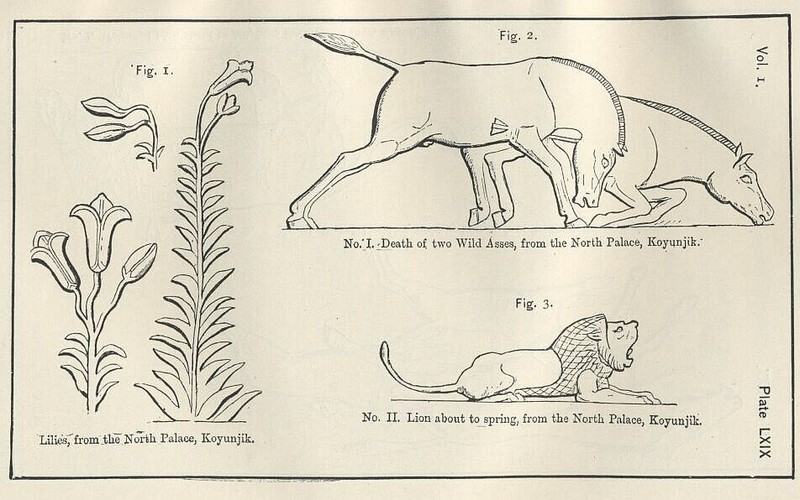
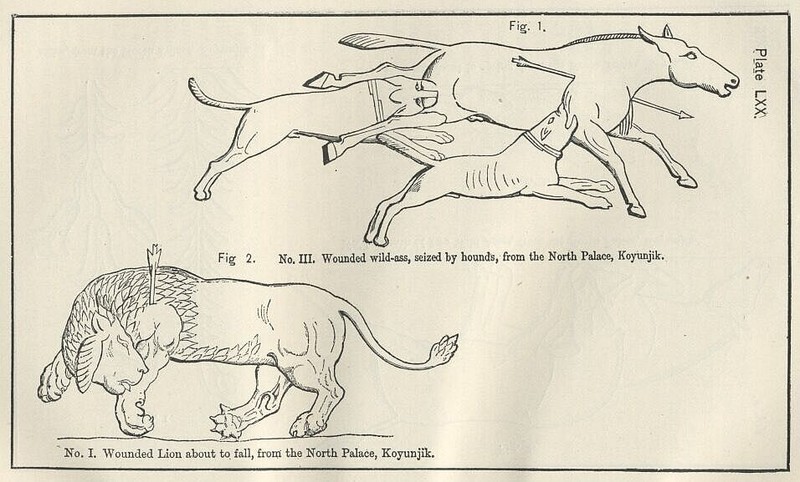
It is difficult to do justice to the animal delineation of this period. without reproducing before the eye of the reader the entire series of reliefs and drawings which belong to it. It is the infinite variety in the attitudes, even more than the truth and naturalness of any particular specimens, that impresses us as we contemplate the series. Lions, wild asses, dogs, deer, wild goats, horses, are represented in profusion: and we scarcely find a single form which is repeated. Some specimens have been already given, as the hunted stag and hind [PLATE XXVII.] and the startled wild ass [PLATE XXVI.] Others will occur among the illustrations of the next chapter. For the present it may suffice to draw attention to the spirit of the two falling asses in the illustration [PLATE LXIX., Fig. 3], and of the crouching lion in the illustration [PLATE LXIX., Fig. 2]; to the lifelike force of both ass and hounds in the representation [PLATE LXX., Fig. 1], and here particularly to the bold drawing of one of the dogs' heads in full, instead of in profile—a novelty now first occurring in the bas-reliefs. As instances of still bolder attempts at unusual attitudes, and at the same time of a certain amount of foreshortening, two further illustrations are appended. The sorely wounded lion in the first [PLATE LXX., Fig. 2] turns his head piteously towards the cruel shaft, while he totters to his fall, his limbs failing him, and his eyes beginning to close. The more slightly stricken king of beasts in the second [PLATE LXXI.], urged to fury by the smart of his wound, rushes at the chariot whence the shaft was sped, and in his mad agony springs upon a wheel, clutches it with his two fore-paws, and frantically grinds it between his teeth. Assyrian art, so far as is yet known, has no finer specimen of animal drawing than this head, which may challenge comparison with anything of the kind that either classic or modern art has produced.
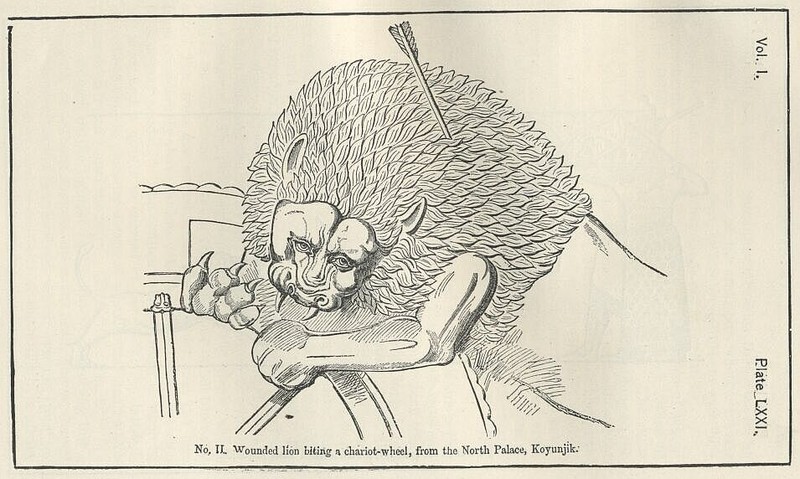
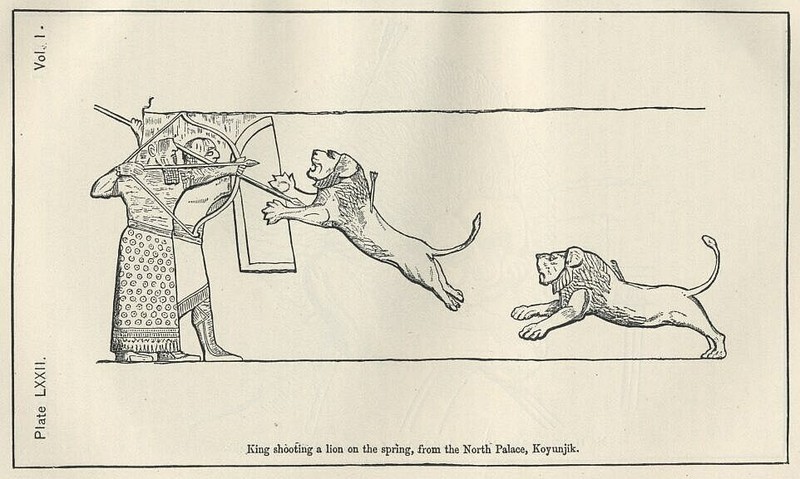
As a specimen at once of animal vigor and of the delicacy and finish of the workmanship in the human forms of the time, a bas-relief of the king receiving the spring of a lion, and shooting an arrow into his mouth, while a second lion advances at a rapid pace a little behind the first, may be adduced. (See [PLATE LXXII.]) The boldness of the composition, which represents the first lion actually in mid-air, is remarkable; the drawing of the brute's fore-paws, expanded to seize his intended prey, is lifelike and very spirited, while the head is massive and full of vigor. There is something noble in the calmness of the monarch contrasted with the comparative eagerness of the attendant, who stretches forward with shield and spear to protect has master from destruction, if the arrow fails. The head of the king is, unfortunately, injured; but the remainder of the figure is perfect and here, in the elaborate ornamentation of the whole dress, we have an example of the careful finish of the time—a finish, which is so light and delicate that it does not interfere with the general effect, being scarcely visible at a few yards' distance.
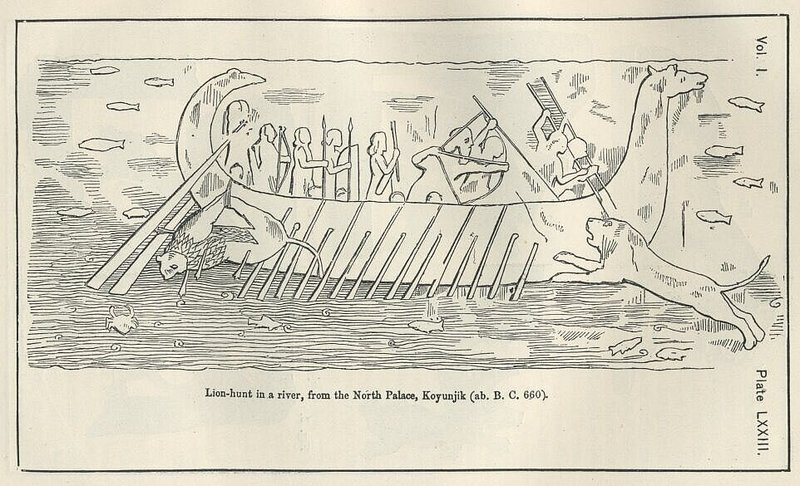
The faults which still remain in this best period of Assyrian art are heaviness and stiffness of outline in the human forms; a want of expression in the faces, and of variety and animation in the attitudes; and an almost complete disregard of perspective. If the worst of these faults are anywhere overcome, it would seem to be in the land lion-hunt, from which the noble head represented below is taken; and in the river-hunt of the same, beast, found on a slab too much injured to be re-moved, of which a representation is given. [PLATE LXXIII.] From what appears to have remained of the four figures towards the prow of the boat, we may conclude that there was a good deal of animation here. The drawing must certainly have been less stiff than usual; and if there is not much variety in the attitudes of the three spearmen in front, at any rate those attitudes contrast well, both with the stillness of the unengaged attendants in the rear, and with the animated but very different attitude of the king.
Before the subject of Assyrian sculpture is dismissed, it is necessary to touch the question whether the Assyrians applied color to statuary, and, if so, in what way and to what extent. Did they, like the Egyptians, cover the whole surface of the stone with a layer of stucco, and then paint the sculptured parts with strong colors—red, blue, yellow, white, and black? Or did they, like the Greeks, apply paint to certain portions of their sculptures only, as the hair, eyes, beard and draperies? Or finally, did they simply leave the stone in its natural condition, like the Italians and the modern sculptors generally?
The present appearance of the sculptures is most in accordance with the last of these three theories, or at any rate with that theory very slightly modified by the second. The slabs now offer only the faintest and most occasional traces of color. The evidence, however, of the original explorers is distinct, that at the time of discovery these traces were very much more abundant. Mr. Layard observed color at Nimrud on the hair, beard, and eyes of the figures, on the sandals and the bows, on the tongues of the eagle-headed mythological emblems, on a garland round the head of a winged priest(?), and on the representation of fire in the bas-relief of a siege. At Khorsabad, MM. Botta and Flandin found paint on the fringes of draperies, on fillets, on the mitre of the king, on the flowers carried by the winged figures, on bows and spearshafts, on the harness of the horses, on the chariots, on the sandals, on the birds, and sometimes on the trees. The torches used to fire cities, and the flames of the cities themselves, were invariably colored red. M. Flandin also believed that he could detect, in some instances, a faint trace of yellow ochre on the flesh and on the background of bas-reliefs, whence he concluded that this tint was spread over every part not otherwise colored.
It is evident, therefore, that the theory of an absence of color, or of a very rare use of it, must be set aside. Indeed, as it is certain that the upper portions of the palace walls, both inside and outside, were patterned with colored bricks, covering the whole space above the slabs, it must be allowed to be extremely improbable that at a particular line color would suddenly and totally cease. The laws of decorative harmony forbid such abrupt transitions; and to these laws all nations with any taste instinctively and unwittingly conform. The Assyrian reliefs were therefore, we may be sure, to some extent colored. The real question is, to what extent in the Egyptian or in the classical style?
In Mr. Layard's first series of "Monuments," a preference was expressed for what may be called the Egyptian theory. In the Frontispiece of that work, and in the second Plate, containing the restoration of a palace interior, the entire bas-reliefs were represented as strongly colored. A jet-black was assigned to the hair and beards of men and of all human-headed figures, to the manes and tails of horses, to vultures, eagle heads, and the like: a coarse red-brown to winged lions, to human flesh, to horses' bodies, and to various ornaments, a deep yellow to common lions, to chariot wheels, quivers, fringes, belts, sandals, and other portions of human apparel; white to robes, helmets, shields. tunic's, towns, trees, etc.; and a dull blue to some of the feathers of winged lions and genii, and to large portions of the ground from which the sculptures stood out. This conception of Assyrian coloring, framed confessedly on the assumption of a close analogy between the ornamentation of Assyria and that of Egypt, was at once accepted by the unlearned, and naturally enough was adopted by most of those who sought to popularize the new knowledge among their countrymen. Hence the strange travesties of Assyrian art which have been seen in so-called "Assyrian Courts," where all the delicacy of the real sculpture has disappeared, and the spectator has been revolted by grim figures of bulls and lions, from which a thick layer of coarse paint has taken away all dignity, and by reliefs which, from the same cause, have lost all spirit and refinement.
It is sufficient objection to the theory here treated of, that it has no solid basis of fact to rest upon. Color has only been found on portions of the bas-reliefs, as on the hair and beards of men, on head-ornaments, to a small extent on draperies, on the harness of horses, on sandals, weapons, birds, flowers, and the like. Neither the flesh of men, nor the bodies of animals, nor the draperies generally, nor the backgrounds (except perhaps at Khorsabad), present the slightest appearance of having been touched by paint. It is inconceivable that, if these portions of the sculptures were universally or even ordinarily colored, the color should have so entirely disappeared in every instance. It is moreover inconceivable that the sculptor, if he knew his work was about to be concealed beneath a coating of paint, should have cared to give it the delicate elaboration which is found at any rate in the later examples. All leads to the conclusion that in Assyrian as in classical sculpture, color was sparingly applied, being confined to such parts as the hair, eyes, and beards of men, to the fringes of dresses, to horse trappings, and other accessory parts of the representations. In this way the lower part of the wall was made to harmonize sufficiently with the upper portion, which was wholly colored, but chiefly with pale hues. At the same time a greater distinctness was given to the scenes represented upon the sculptured slabs, the color being judiciously applied to disentangle human from animal figures, dress from flesh, or human figures from one another.
The colors actually found upon the bas-reliefs are four only—red, blue, black, and white. The red is a good bright tint, far exceeding in brilliancy that of Egypt. On the sculptures of Khorsabad it approaches to vermilion, while on those of Nimrud it inclines to a crimson or a lake tint. It is found alternating with the natural stone on the royal parasol and mitre; with blue on the crests of helmets, the trappings of horses, on flowers, sandals, and on fillets; and besides, it occurs, unaccompanied by any other color, on the stems and branches of trees, on the claws of birds, the shafts of spears and arrows, bows, belts, fillets, quivers, maces, reins, sandals, flowers, and the fringe of dresses. It is uncertain whence the coloring matter was derived; perhaps the substance used was the suboxide of copper, with which the Assyrians are known to have colored their red glass.
The blue of the Assyrian monuments is an oxide of copper, sometimes containing also a trace of lead. Besides occurring in combination with red in the cases already mentioned, it was employed to color the foliage of trees, the plumage of birds, the heads of arrows, and sometimes quivers, and sandals.
White occurs very rarely indeed upon the sculptures. At Khorsabad it was not found of all; at Nimrud it was confined to the inner part of the eye on either side of the pupil, and in this position it occurred only on the colossal lions and bulls, and a very few other figures. On bricks and pottery it was frequent, and their (sp.) it is found to have been derived from tin; but it is uncertain whether the white of the sculptures was not derived from a commoner material.
Black is applied in the sculptures chiefly to the hair, beards, and eyebrows of men. It was also used to color the eyeballs not only of men, but also of the colossal lions and bulls. Sometimes, when the eyeball was thus marked, a line of black was further carried round the inner edge of both the upper and the lower eyelid. In one place black bars have been introduced to ornament an antelope's horns. On the older sculptures black was also the common color for sandals, which however were then edged with red. The composition of the black is uncertain. Browns upon the enamelled bricks are found to have been derived from, iron; but Mr. Layard believes the black upon the sculptures to have been, like the Egyptian, a bone black mixed with a little gum.
The ornamental metallurgy of the Assyrians deserves attention next to their sculpture. It is of three kinds, consisting, in the first place, of entire figures, or parts of figures, cast in a solid shape; secondly, of castings in a low relief; and thirdly, of embossed work wrought mainly with the hammer, but finished by a sparing use of the graving tool.
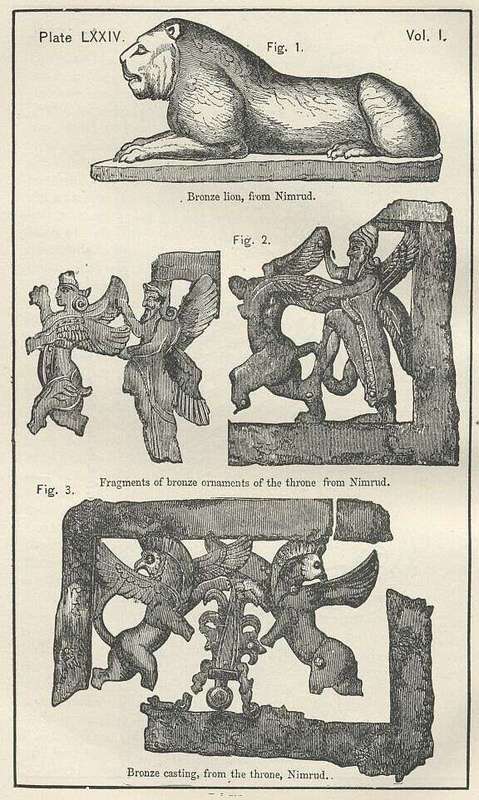
The solid castings are comparatively rare, and represented none but animal forms. Lions, which seem to have been used as weights, occur most frequently, [PLATE LXXIV., Fig. 1.] None are of any great size; nor have we any evidence that the Assyrians could cast large masses of metal. They seem to have used castings, not (as the Greeks and the moderns) for the greater works of art, but only for the smaller. The forms of the few casts which have come down to us are good, and are free from the narrowness which characterizes the representations in stone.
Castings in a low relief formed the ornamentation of thrones [PLATE LXXIV., Figs. 2, 3], stools, and sometimes probably of chariots. They consisted of animal and human figures, winged deities, griffins, and the like. The castings were chiefly in open-work, and were attached to the furniture which they ornamented by means of small nails. They have no peculiar merit, being merely repetitions of the forms with which we are familiar from their occurrence on embroidered dresses and on the cylinders.
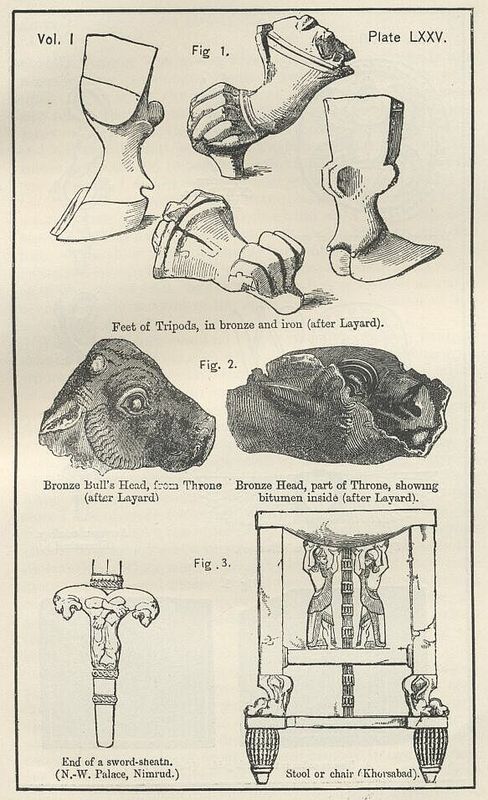
The embossed work of the Assyrians is the most curious and the most artistic portion of their metallurgy. Sometimes it consisted of mere heads and feet of animals, hammered into shape upon a model composed of clay mixed with bitumen. [PLATE LXXV., Figs. 1, 2.] Sometimes it extended to entire figures, as (probably) in the case of the lions clasping each other, so common at the ends of sword-sheaths (see [PLATE LXXV., Fig. 3]), the human figures which ornament the sides of chairs or stools, and the like. [PLATE. LXXV., Fig. 3.] Occasionally it was of a less solid but at the same time of a more elaborate character. In a palace inhabited by Sargon at Nimrud, and in close juxtaposition with a monument certainly of his time, were discovered by Mr. Layard a number of dishes, plates, and bowls, embossed with great taste and skill, which are among the most elegant specimens of Assyrian art discovered during the recent researches. Upon these were represented sometimes hunting scenes, sometimes combats between griffins and lions, or between men and lions, sometimes landscapes with trees and figures of animals, sometimes mere rows of animals following one another. One or two representations from these bowls have been already given. They usually contain a star or scarab in the centre, beyond which is a series of bands or borders, patterned most commonly with figures. [PLATE LXXVI., Fig 1.] It is impossible to give an adequate idea of the delicacy and spirit of the drawings, or of the variety and elegance of the other patterns, in a work of moderate dimensions like the present. Mr. Layard, in his Second Series of "Monuments," has done justice to the subject by pictorial representation, while in his "Nineveh and Babylon" he has described the more important of the vessels separately. The curious student will do well to consult these two works, after which he may examine with advantage the originals in the British Museum.
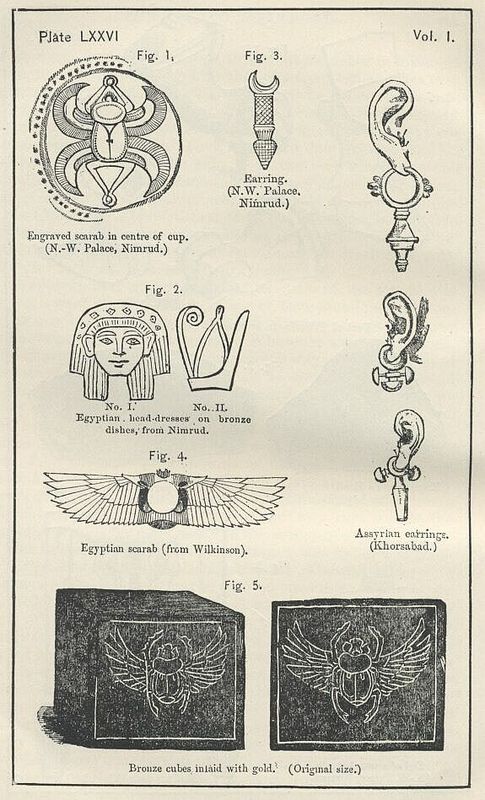
One of the most remarkable features observable in this whole series of monuments, is its semi-Egyptian character. The occurrence of the scarab has been just noticed. It appears on the bowls frequently, as do sphinxes of an Egyptian type; while sometimes heads and head-dresses purely Egyptian are found, as in [PLATE LXXVI., Fig. 2], which are well-known forms, and have nothing Assyrian about them and in one or two instances we meet with hieroglyphics, the onk

The usual material of the Assyrian ornamental metallurgy is bronze, composed of one part of tin to ten of copper which are exactly the proportions considered to be best by the Greeks and Romans, and still in ordinary use at the present day. In some instances, where more than common strength was required, as in the legs of tripods and tables, the bronze was ingeniously cast over an inner structure of iron. This practice was unknown to modern metallurgists until the discovery of the Assyrian specimens, from which it has been successfully imitated.
We may presume that, besides bronze, the Assyrians used, to a certain extent, silver and gold as materials for ornamental metal-work. The earrings, bracelets, and armlets worn by the kings and the great officers of state were probably of the more valuable metal, while the similar ornaments worn by those of minor may have been of silver. [PLATE LXXVI., Fig. 3.] One solitary specimen only of either class has been found; but Mr. Layard discovered several moulds, with tasteful designs for earrings, both at Nimrud and at Koyunjik; and the sculptures show that both in these and the other personal ornaments a good deal of artistic excellence was exhibited. The earrings are frequent in the form of a cross, and are sometimes delicately chased. The armlets and bracelets generally terminate in the heads of rams or bulls, which seem to have been rendered with spirit and taste.

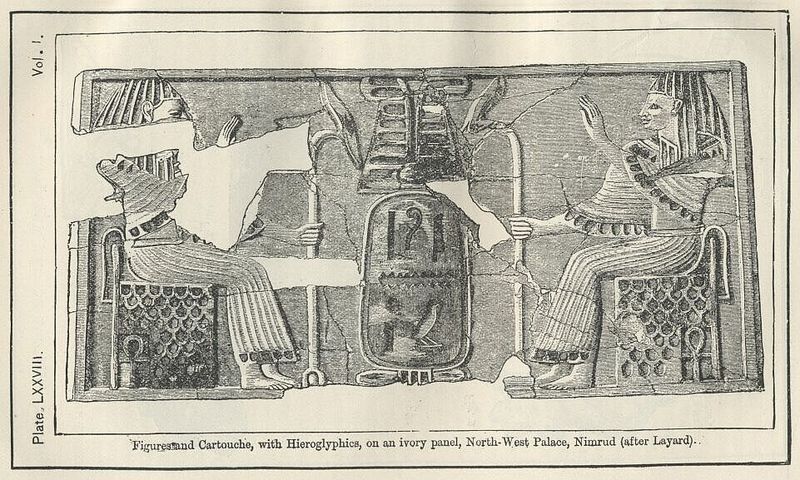
By one or two instances it appears that the Assyrians knew how to inlay one metal with another. [PLATE LXXVI, Fig. 5.] The specimens discovered are scarcely of an artistic character, being merely winged scarabaei, outlined in gold on a bronze ground [PLATE LXXVI., Fig. 4.] The work, however, is delicate, and the form very much more true to nature than that which prevailed in Egypt.
The ivories of the Assyrians are inferior both to their metal castings and to their bas-reliefs. They consist almost entirely of a single series, discovered by Mr. Layard in a chamber of the North-West Palace at Nimrud, in the near vicinity of slabs on which was engraved the name of Sargon. The most remarkable point connected with them is the thoroughly Egyptian character of the greater number which at first sight have almost the appearance of being importations from the valley of the Nile. Egyptian profiles, head-dresses, fashions of dressing the hair, ornaments, attitudes, meet us at every turn; while sometimes we find the representations of Egyptian gods, and in two cases hieroglyphics within cartouches. (See [PLATE LXXVIII.]) A few specimens only are of a distinctly Assyrian type, as a fragment of a panel, figured by Mr. Layard [PLATE LXXVII., Fig. 1], and one or two others, in which the guilloche border appears. These carvings are usually mere low reliefs, occupying small panels or tablets, which were mortised or glued to the woodwork of furniture. They were sometimes inlaid in parts with blue grass, or with blue and green pastes let into the ivory, and at the same time decorated with gilding. Now and then the relief is tolerably high, and presents fragments of forms which seem to have had some artistic merit. The best of these is the fore part of a lion walking among reeds (p. 373), which presents analogies with the early art of Asia Minor. [PLATE LXXVII., Fig. 3.] One or two stags' heads have likewise been found, designed and wrought with much spirit and delicacy. [PLATE LXXVII., Fig. 3.] It is remarked that several of the specimens show not only a considerable acquaintance with art, but also an intimate knowledge of the method of working in ivory. One head of a lion was "of singular beauty," but unfortunately it fell to pieces at the very moment of discovery.
It is possible that some of the objects here described may be actual specimens of Egyptian art, sent to Sargon as tribute or presents, or else carried off as plunder in his Egyptian expedition. The appearance, however, which even the most Egyptian of them present, on a close examination, is rather that of Assyrian works imitated from Egyptian models than of genuine Egyptian productions. For instance, in the tablet figured on the page opposite, where we see hieroglyphics within a cartouche, the onk or symbol of life, the solar disk, the double ostrich-plume, the long hair-dress called namms, and the tam or kukupha sceptre, all unmistakable Egyptian features—we observe a style of drapery which is quite unknown in Egypt, while in several respects it is Assyrian, or at least Mesopotamian. It is scanty, like that of all Assyrian robed figures; striped, like the draperies of the Chaldaeans and Babylonians: fringed with a broad fringe elaborately colored, as Assyrian fringes are known to have been, and it has large hanging sleeves also fringed, a fashion which appears once or twice upon the Nimrud sculptures. [PLATE LXXVII, Fig. 4.] But if this specimen, notwithstanding its numerous and striking Egyptian features, is rightly regarded as Mesopotamian, it would seem to follow that the rest of the series must still more decidedly be assigned to native genius.
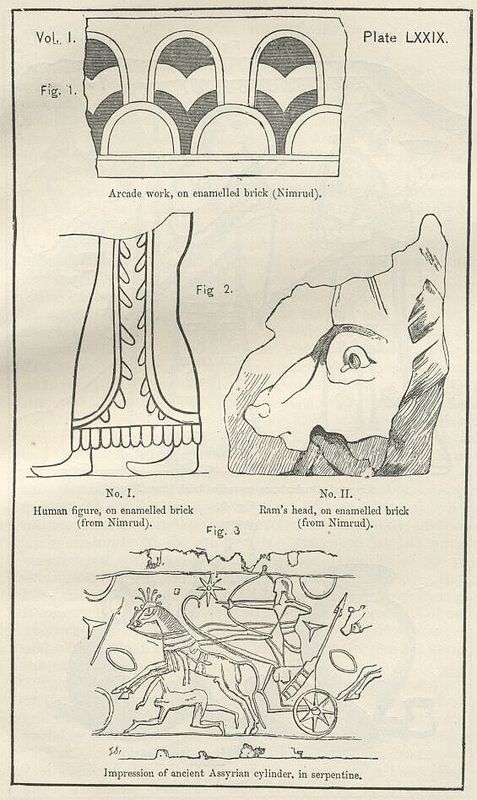
The enamelled bricks of the Assyrians are among the most interesting remains of their art. It is from these bricks alone that we are able to judge at all fully of their knowledge and ideas with respect to color; and it is from them also chiefly that an analysis has been made of the coloring materials employed by the Assyrian artists. The bricks may be divided into two classes—those which are merely patterned, and those which contain designs representing men and animals. The patterned bricks have nothing about them which is very remarkable. They present the usual guilloches, rosettes, bands, scrolls, etc., such as are found in the painted chambers and in the ornaments on dresses, varied with geometrical figures, as circles, hexagons, octagons, and the like; and sometimes with a sort of arcade-work, which is curious, if not very beautiful. [PLATE LXXIX., Fig. 1.] The colors chiefly used in the patterns are pale green, pale yellow, dark brown, and white. Now and then an intense blue and a bright red occur, generally together; but these positive hues are rare, and the taste of the Assyrians seems to have led them to prefer, for their patterned walls, pale and dull hues. The same preference appears, even more strikingly, in the bricks on which designs are represented. There the tints almost exclusively used are pale yellow, pale greenish blue, olive green, white, and a brownish black. It is suggested that the colors have faded, but of this there is no evidence. The Assyrians, when they used the primitive hues, seem, except in the case of red, to have employed subdued tints of them, and red they appear to have introduced very sparingly. Olive-green they affected for grounds, and they occasionally used other half-tints. A pale orange and a delicate lilac or pale purple were found at Khorsabad, while brown (as already observed) is far more common on the bricks than black. Thus the general tone of their coloring is quiet, not to say sombre. There is no striving after brilliant effects. The Assyrian artist seeks to please by the elegance of his forms and the harmony of his hues, not to startle by a display of bright and strongly-contrasted colors. The tints used in a single composition vary from three to five, which latter number they seem never to exceed. The following are the combinations of five hues which occur: brown, green, blue, dark yellow, and pale yellow; orange, lilac, white, yellow, and olive-green. Combinations of four hues are much more common: e.q., red, white, yellow, and black; deep yellow, brown lilac, white, and pale yellow; lilac, yellow, white, and green; yellow, blue, white, and brown, and yellow, blue, white, and olive-green. Sometimes the tints are as few as three, the ground in these cases being generally of a hue used also in the figures. Thus we have yellow, blue, and white on a blue ground and again the same colors on a yellow ground. We have also the simple combinations of white and yellow on a blue ground, and of white and yellow on an olive-green ground.
In every ease there is at harmony in the coloring. We find no harsh contrasts. Either the tones are all subdued, or if any are intense and positive, then all (or almost all) are so. Intense red occurs in two fragments of patterned bricks found by Mr. Layard. It is balanced by intense blue, and accompanied in each case by a full brown and a clear white, while in one case it is further accompanied by a pale green, which has a very good effect. A similar red appears on a design figured by M. Botta. Its accompaniments are white, black, and full yellow. Where lilac occurs, it is balanced by its complementary color, yellow, or by yellow and orange, and further accompanied by white. It is noticeable also that bright hues are not placed one against the other, but are separated by narrow bands of white, or brown and white. This use of white gives a great delicacy and refinement to the coloring, which is saved by it, even where the hues are the strongest, from being coarse or vulgar.
The drawing of the designs resembles that of the sculptures except that the figures are generally slimmer and less muscular. The chief peculiarity is the strength of the outline, which is almost always colored differently from the object drawn, either white, black, yellow, or brown. Generally it is of a uniform thickness (as in No. I., [PLATE LXXIX., Fig. 2]), sometimes, though rarely, it has that variety which characterizes good drawing (as in No. II., [PLATE LXXIX Fig. 2]). Occasionally there is a curious combination of the two styles, as in the specimen [PLATE LXXX., Fig. 1]—the most interesting yet discovered—where the dresses of the two main figures are coarsely outlined in yellow, while the remainder of the design is very lightly sketched in a brownish black.
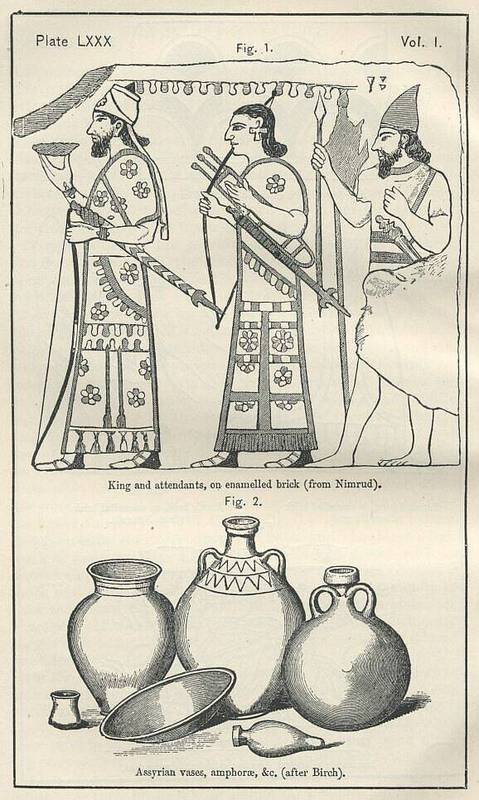
The size of the designs varies considerably. Ordinarily the figures are small, each brick containing several; but sometimes a scale has been adopted of such a size that portions of the same figure must have been on different bricks. A foot and leg brought by Mr. Layard from Nimrud must have belonged to a man a foot high; while part of a human face discovered in the same locality is said to indicate the form to which it belonged, a height of three feet. Such a size as this is, however, very unusual.
It is scarcely necessary to state that the designs on the bricks are entirely destitute of chiaroscuro. The browns and blacks, like the blues, yellows, and reds, are simply used to express local color. They are employed for hair, eyes, eye-brows, and sometimes for bows and sandals. The other colors are applied as follows: yellow is used for flesh, for shafts of weapons, for horse trappings, sometimes for horses, for chariots, cups, earrings bracelets, fringes, for wing-feathers, occasionally for helmets, and almost always for the hoofs of horses; blue is used for shields, for horses, for some parts of horse-trappings, armor, and dresses, for fish, and for feathers; white is employed for the inner part of the eye, for the linen shirts worn by men, for the marking on fish and feathers, for horses, for buildings, for patterns on dresses, for rams' heads, and for portions of the tiara of the king. Olive-green seems to occur only as a ground; red only in some parts of the royal tiara, orange and lilac only in the wings of winged monsters. It is doubtful how far we may trust the colors on the bricks as accurately or approximately resembling the real local hues. In some cases the intention evidently is to be true to nature, as in the eyes and hair of men, in the representations of flesh, fish, shields, bows, buildings, etc. The yellow of horses may represent cream-color, and the blue may stand for gray, as distinct from white, which seems to have been correctly rendered. The scarlet and white of the king's tiara is likely to be true. When, however, we find eyeballs and eyebrows white, while the inner part of the eye is yellow, the blade of swords yellow, and horses' hoofs blue we seem to have proof that, sometimes at any rate, local color was intentionally neglected, the artist limiting himself to certain hues, and being therefore obliged to render some objects untruly. Thus we must not conclude front the colors of dresses and horse trappings on the bricks which are three only, yellow, blue and white—that the Assyrians used no other hues than those, even for the robes of their kings. It is far more probable that they employed a variety of tints in their apparel, but did not attempt to render that variety on the ordinary painted bricks.
The pigments used by the Assyrians seem to have derived their tints entirely from minerals. The opaque white is found to be oxide of tin; the yellow is the antimoniate of lead, or Naples yellow, with a slight admixture of tin; the blue is oxide of copper, without any cobalt; the green is also from copper; the brown is from iron; and the red is a suboxide of copper. The bricks were slightly baked before being painted; they were then taken from the kiln, painted and enamelled on one side only, the flux and glazes used being composed of silicate of soda aided by oxide of lead; thus prepared, they were again submitted to the action of fire, care being taken to place the painted side upwards, and having been thoroughly baked were then ready for use.
The Assyrian intaglios on stones and gems are commonly of a rude description; but occasionally they exhibit a good deal of delicacy, and sometimes even of grace. They are cut upon serpentine, jasper, chalcedony, cornelian, agate, sienite, quartz, loadstone, amazon-stone, and lapis-lazuli. The usual form of the stone is cylindrical; the sides, however, being either slightly convex or slightly concave, most frequently the latter. [PLATE LXXIX., Fig. 3.] The cylinder is always perforated in the direction of its axis. Besides this ordinary form, a few gems shaped like the Greek—that is, either round or oval—have been found: and numerous impressions from such gems on sealing-clay show that they must have been a tolerably common. The subjects which occur are mostly the same as those on the sculptures—warriors pursuing their foes, hunters in full chase, the king slaying a lion, winged bulls before the sacred tree, acts of worship and other religious or mythological scenes. [PLATE LXXXI. Fig. 1.] There appears to have been a gradual improvement in the workmanship from the earliest period to the time of Sennacherib, when the art culminates. A cylinder found in the ruins of Sennacherib's palace at Koyunjik, which is believed with reason to have been his signet, is scarcely surpassed in delicacy of execution by any intaglio of the Greeks. [PLATE LXXXI., Fig. 1.] The design has a good deal of the usual stiffness, though even here something may be said for the ibex or wild-goat which stands upon the lotus flower to the left: but the special excellence of the gem is in the fineness and minuteness of its execution. The intaglio is not very deep but all the details are beautifully sharp and distinct, while they are on so small a scale that it requires a magnifying glass to distinguish them. The material of the cylinder is translucent green felspar, or amazon-stone, one of the hardest substances known to the lapidary.
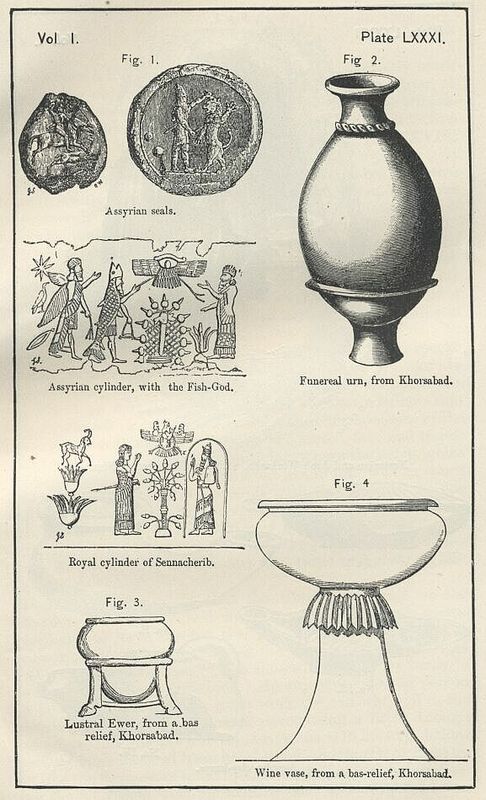
The fictile art of the Assyrians in its higher branches, as employed for directly artistic purposes, has been already considered; but a few pages may be now devoted to the humbler divisions of the subject, where the useful preponderates over the ornamental. The pottery of Assyria bears a general resemblance in shape, form, and use to that of Egypt; but still it has certain specific differences. According to Mr. Birch, it is, generally speaking, "finer in its paste, brighter in its color, employed in thinner masses, and for purposes not known in Egypt." Abundant and excellent clay is furnished by the valley of the Tigris, more especially by those parts of it which are subject to the annual inundation. The chief employment of this material by the Assyrians was for bricks, which were either simply dried in the sun, or exposed to the action of fire in a kiln. In this latter case they seem to have been uniformly slack-baked; they are light for their size, and are of a pale-red color. The clay of which the bricks were composed was mixed with stubble or vegetable fibre, for the purpose of holding it together—a practice common to the Assyrians with the Egyptians and the Babylonians. This fibre still appears in the sun-dried bricks, but has been destroyed by the heat of the kiln in the case of the baked bricks, leaving behind it, however, in the clay traces of the stalks or stems. The size and shape of the bricks vary. They are most commonly square, or nearly so; but occasionally the shape more resembles that of the ancient Egyptian and modern English brick, the width being about half the length, and the thickness half or two-thirds of the width. The greatest size to which the square bricks attain is a length and width of about two feet. From this maximum they descend by manifold gradations to a minimum of one foot. The oblong bricks are smaller; they seldom much exceed a foot in length, and in width vary from six to seven and a half inches. Whatever the shape and size of the bricks, their thickness is nearly uniform, the thinnest being as much as three inches in thickness, and the thickest not more than four inches or four and a half. Each brick was made in a wooden frame or mould. Most of the baked bricks were inscribed, not however like the Chaldaean, the Egyptian, and the Babylonian, with an inscription in a small square or oval depression near the centre of one of the broad faces, but with one which either covered the whole of one such face, or else ran along the edge. It is uncertain whether the inscription was stamped upon the bricks by a single impression, or whether it was inscribed by the potter with a triangular style. Mr. Birch thinks the former was the means used, "as the trouble of writing upon each brick would have been endless." Mr. Layard, however, is of a different opinion.
In speaking of the Assyrian writing, some mention has been made of the terra cotta cylinders and tablets, which in Assyria replaced the parchment and papyrus of other nations, being the most ordinary writing material in use through the country. The purity and fineness of the material thus employed is very remarkable, as well as its strength, of which advantage was taken to make the cylinders hollow, and thus at once to render them cheaper and more portable. The terra cotta of the cylinders and tablets is sometimes unglazed; sometimes the natural surface has been covered with a "vitreous silicious glaze or white coating." The color varies, being sometimes a bright polished brown, sometimes a pale yellow, sometimes pink, and sometimes a very dark tint, nearly black. The most usual color however for cylinders is pale yellow, and for tablets light red, or pink. There is no doubt that in both these cases the characters were impressed separately by the hand, a small metal style of rod being used for the purpose.
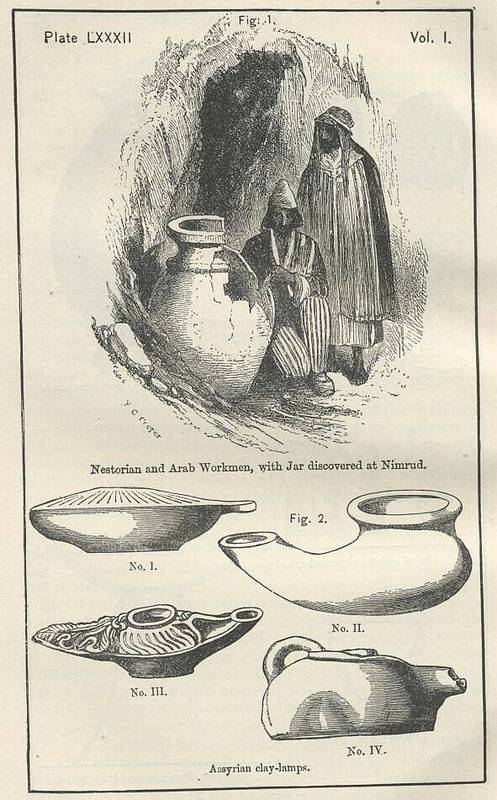
Terra cotta vessels, glazed and unglazed, were in common use among the Assyrians, for drinking and other domestic purposes. They comprised vases, lamps, jugs, amphorae, saucers, jars, etc. [PLATE LXXX., Fig. 2.] The material of the vessels is fine, though generally rather yellow in tone. The shapes present no great novelty, being for the most part such as are found both in the old Chaldaean tombs, and in ordinary Roman sepulchres. Among the most elegant are the funeral urns discovered by M. Botta at Khorsabad, which are with a small opening at top, a short and very scanty pedestal, and two raised rings, one rather delicately chased, by way of ornament. [PLATE LXXXI., Fig. 2.] Another graceful form is that of the large jars uncovered at Nimrud [PLATE LXXXII., Fig. 1], of which Mr. Layard gives a representation. Still more tasteful are some of the examples which occur upon the bas-reliefs, and seemingly represent earthen vases. Among these may be particularized a lustral ewer resting in a stand supported by bulls' feet, which appears in front of a temple at Khorsabad [PLATE LXXXI., Fig. 3], and a wine vase (see [PLATE LXXXI., Fig. 4]) of ample dimensions, which is found in a banquet scene at the same place. Some of the lamps are also graceful enough, and seem to be the prototypes out of which were developed the more elaborate productions of the Greeks. [PLATE LXXXII., Fig. 2.] Others are more simple, being without ornament of any kind, and nearly resembling a modern tea-pot (see No., IV. [PLATE LXXXII., Fig. 2.]) The glazed pottery is, for the most part, tastefully colored. An amphora, with twisted arms, found at Nimrud (see [PLATE LXXXIII., Fig. 1]) is of two colors, a warm yellow, and a cold bluish green. The green predominates in the upper, the yellow in the under portion; but there is a certain amount of blending or mottling in the mid-region, which has a very pleasant effect. A similarly mottled character is presented by two other amphorae from the same place, where the general hue is a yellow which varies in intensity, and the mottling is with a violet blue. In some cases the colors are not blended, but sharply defined by lines, as in a curious spouted cup figured by Mr. Layard, and in several fragmentary specimens. Painted patterns are not uncommon upon the glazed pottery, though upon the unglazed they are scarcely ever found. The most usual colors are blue, yellow, and white; brown, purple, and lilac have been met with occasionally. These colors are thought to be derived chiefly from metallic oxides, over which was laid as a glazing a vitreous silicated substance. On the whole, porcelain of this fine kind is rare in the Assyrian remains, and must be regarded as a material that was precious and used by few.
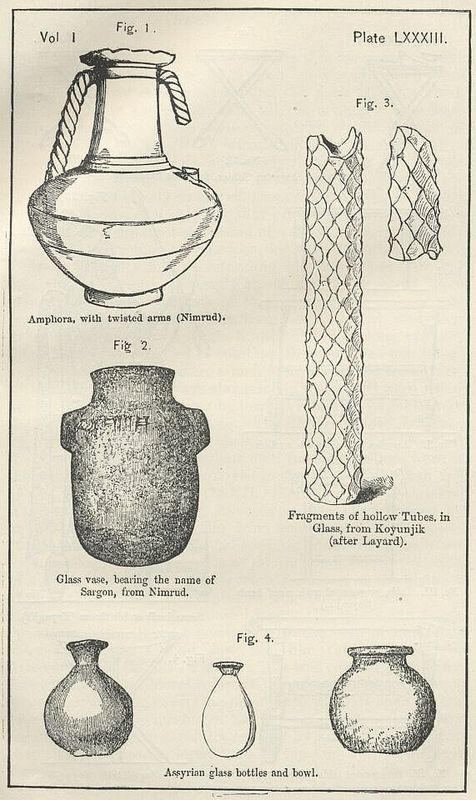
Assyrian glass is among the most beautiful of the objects which have been exhumed. M. Botta compared it to certain fabrics of Venice and Bohemia, into which a number sit different colors are artificially introduced. But a careful analysis has shown that the lovely prismatic hues which delight us in the Assyrian specimens, varying under different lights with all the delicacy and brilliancy of the opal, are due, not to art, but to the wonder-working hand of time, which, as it destroys the fabric, compassionately invests it with additional grace and beauty. Assyrian glass was either transparent or stained with a single uniform color. It was composed, in the usual way, by a mixture of sand or silex with alkalis, and, like the Egyptian, appears to have been first rudely fashioned into shape by the blowpipe. It was then more carefully shaped, and, where necessary, hollowed out by a turning machine, the Marks of which are sometimes still visible. The principal specimens which have been discovered are small bottles and bowls, the former not more than three or four inches high, the latter from four to five inches in diameter, [PLATE LXXXIII., Fig. 4.] The vessels are occasionally inscribed with the name of a king, as is the case in the famous vase of Sargon, found by Mr. Layard at Nimrud, which is here figured. [PLATE LXXXIII., Fig. 2.] This is the earliest known specimen of transparent glass, which is not found in Egypt until the time of the Psammetichi. The Assyrians used also opaque glass, which they colored, sometimes red, with the suboxide of copper, sometimes white, sometimes of other hues. They seem not to have been able to form masses of glass of any considerable size; and thus the employment of the material must have been limited to a few ornamental, rather than useful, purposes. A curious specimen is that of a pipe or tube, honey-combed externally, which Mr. Layard exhumed at Koyunjik, and of which the cut [PLATE LXXXIII., Fig. 1] is a rough representation.
An object found at Nimrud, in close connection with several glass vessels, is of a character sufficiently similar to render its introduction in this place not inappropriate. This is a lens composed of rock crystal, about an inch and a half in diameter, and nearly an inch thick, having one plain and one convex surface, and somewhat rudely shaped and polished which, however gives a tolerably distinct focus at the distance of 4 1/2 inches from the plane side, and which may have been used either as a magnifying glass or to concentrate the rays of the sun. The form is slightly oval, the longest diameter being one and six-tenths inch, the shortest one and four-tenths inch. The thickness is not uniform, but greater on one side than on the other. The plane surface is ill-polished and scratched, the convex one, not polished on a concave spherical disk, but fashioned on a lapidary's wheel, or by some method equally rude. As a burn, glass the lens has no great power; but it magnifies fairly, and may have been of great use to those who inscribed, or to those who sought to decipher, the royal memoirs. It is the only object of the kind that has been found among the remains of antiquity, though it cannot he doubled that lenses were known and were used as burning glasses by the Greeks.
Some examples have been already given illustrating the tasteful ornamentation of Assyrian furniture. It consisted, so far as we know, of tables, chairs, couches, high stools, foot-stools, and stands with shelves to hold the articles needed for domestic purposes. As the objects themselves have in all cases ceased to exist, leaving behind them only a few fragments, it is necessary to have recourse to the bas-reliefs for such notices as may be thence derived of their construction and character. In these representations the most ordinary form of table is one in which the principal of our camp-stools seems to be adopted, the legs crossing each other as in the illustrations [PLATE LXXXIV.]. only two legs are represented, but we must undoubtedly regard these two as concealing two others of the same kind at the opposite end of the table. The legs ordinarily terminate in the feet of animals, sometimes of bulls, but more commonly of horses. Sometimes between the two legs we see a species of central pillar, which, however, is not traceable below the point where the legs cross one another. The pillar itself is either twisted or plain (see No. III., [PLATE LXXXIV.]). Another form of table, less often met with, but simpler, closely resembles the common table of the moderns. It has merely the necessary flat top, with perpendicular legs at the corners. The skill of the cabinet-makers enabled them to dispense in most instances with cross-bars (see No. I.), which are, however, sometimes seen (see No. II., No. III., and No. IV.), uniting the legs of this kind of tables. The corners are often ornamented with lions' or rams' heads, and the feet are frequently in imitation of some animal form (see No. III. and No. IV.). Occasionally we find a representation of a three-legged table, as the specimen [PLATE LXXXIV., Fig. 4], which is from a relief at Koyunjik. The height of tables appears to have been greater than with ourselves; the lowest reach easily to a man's middle; the highest are level with the upper part of the chest.
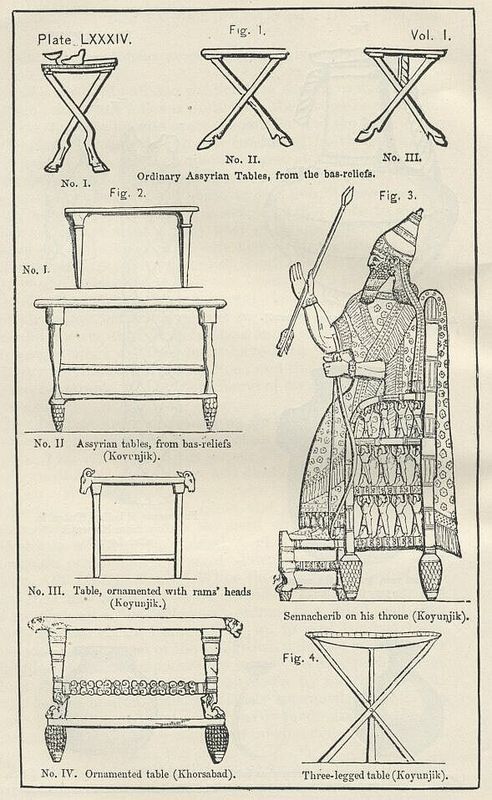
Assyrian thrones and chairs were very elaborate. The throne of Sennacherib exhibited on its sides and arms three rows of carved figures, one above another [PLATE LXXXIV.,Fig. 3], supporting the bars with their hands. The bars, the arms, and the back were patterned. The legs ended in a pine-shaped ornament very common in Assyrian furniture. Over the back was thrown an embroidered cloth hinged at the end, which hung down nearly to the floor. A throne of Sargon's was adorned on its sides with three human figures, apparently representations of the king, below which was the war-horse of the monarch, caparisoned as for battle. [PLATE LXXXV., Fig. 1.] Another throne of the same monarch's had two large and four small figures of men at the side, while the back was supported on either side by a human figure of superior dimensions. The use of chairs with high backs, like these, was apparently confined to the monarchs. Persons of less exalted rank were content to sit on seats which were either stools, or chairs with a low back level with the arms.
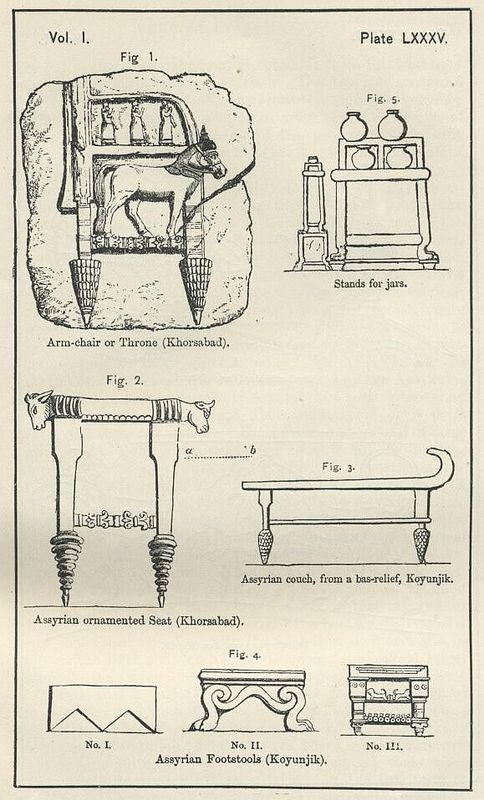
Seats of this kind, whether thrones or chairs, were no doubt constructed mainly of wood. The ornamental work may, however, have been of bronze, either cast into the necessary shape, or wrought into it by the hammer. The animal heads at the ends of arms seem to have fallen under the latter description [PLATE LXXXV., Fig. 2.] In some cases, ivory was among the materials used: it has been found in the legs of a throne at Koyunjik, and may not improbably have entered into the ornamentation of the best furniture very much more generally.
The couches which we find represented upon the sculptures are of a simple character. The body is flat, not curved; the legs are commonly plain, and fastened to each other by a cross-bar, sometimes terminating in the favorite pine-shaped ornament. One end only is raised, and this usually curves inward nearly in a semicircle. [PLATE LXXXV., Fig. 3.] The couches are decidedly lower than the Egyptian; and do not, like them, require a stool or steps in order to ascend them.
Stools, however, are used with the chairs or thrones of which mention was made above—lofty seats, where such a support for the sitter's feet was imperatively required. [PLATE LXXXV., Fig. 4.] They are sometimes plain at the sides, and merely cut en chevron at the base; sometimes highly ornamented, terminating in lions' feet supported on cones, in the same (or in volutes), supported on balls, and otherwise adorned with volutes, lion castings, and the like. The most elaborate specimen is the stool (No. III.) which supports the feet of Asshur-bani-pal's queen on a relief brought from the North Palace at Koyunjik, and now in the National Collection. Here the upper corners exhibit the favorite gradines, guarding and keeping in place an embroidered cushion; the legs are ornamented with rosettes and with horizontal mouldings, they are connected together by two bars, the lower one adorned with a number of double volutes, and the upper one with two lions standing back to back; the stool stands on balls, surmounted first by a double moulding, and then by volutes.
Stands with shelves often terminate, like other articles of furniture, in animals' feet, most commonly lions', as in the accompanying specimens. [PLATE LXXXV., Fig. 5.]
Of the embroidered robes and draperies of the Assyrians, as of their furniture, we can judge only by the representations made of them upon the bas-reliefs. The delicate texture of such fabrics has prevented them from descending to our day even in the most tattered condition; and the ancient testimonies on the subject are for the most part too remote from the times of the Assyrians to be of much value. Ezekiel's notice is the only one which comes within such a period of Assyria's fall as to make it an important testimony, and even from this we cannot gather much that goes beyond the evidence of the sculptures. The sculptures show us that robes and draperies of all kinds were almost always more or less patterned; and this patterning, which is generally of an extremely elaborate kind, it is reasonable to conclude was the work of the needle. Sometimes the ornamentation is confined to certain portions of garments, as to the ends of sleeves and the bottoms of robes or tunics; at others it is extended over the whole dress. This is more particularly the case with the garments of the kings, which are of a magnificence difficult to describe, or to represent within a narrow compass. [PLATE LXXXVI, Fig. 1.] One or two specimens, however, may be given almost at random, indicating different styles of ornamentation usual in the royal apparel. Other examples will be seen in the many illustrations throughout this volume where the king is represented. It is remarkable that the earliest representations exhibit the most elaborate types of all, after which a reaction seems to set in simplicity is affected, which, however, is gradually trenched upon, until at last a magnificence is reached little short of that which prevailed in the age of the first monuments. The draperies of Asshur-izir-pal in the north-west palace at Nimrud, are at once more minutely labored and more tasteful than those of any later time. Besides elegant but unmeaning patterns, they exhibit human and animal forms, sacred trees, sphinxes, griffins, winged horses, and occasionally bull-hunts and lion-hunts. The upper part of this king's dress is in one instance almost covered with figures, which range themselves round a circular breast ornament, whereof the cut opposite is a representation. Elsewhere his apparel is less superb, and indeed it presents almost every degree of richness, from the wonderful embroidery of the robe just mentioned to absolute plainness. In the celebrated picture of the lion-hunt. [PLATE LXXXVI., Fig. 2.] With Sargon, the next king who has left many monuments, the case is remarkably different. Sargon is represented always in the same dress—a long fringed robe, embroidered simply with rosettes, which are spread somewhat scantily over its whole surface. Sennacherib's apparel is nearly of the same kind, or, if anything, richer, though sometimes the rosettes are omitted His grandson, Asshur-bani-pal, also affects the rosette ornament, but reverts alike to the taste and the elaboration of the early kings. He wears a breast ornament containing human figures, around which are ranged a number of minute and elaborate patterns. [PLATE LXXXVII.]
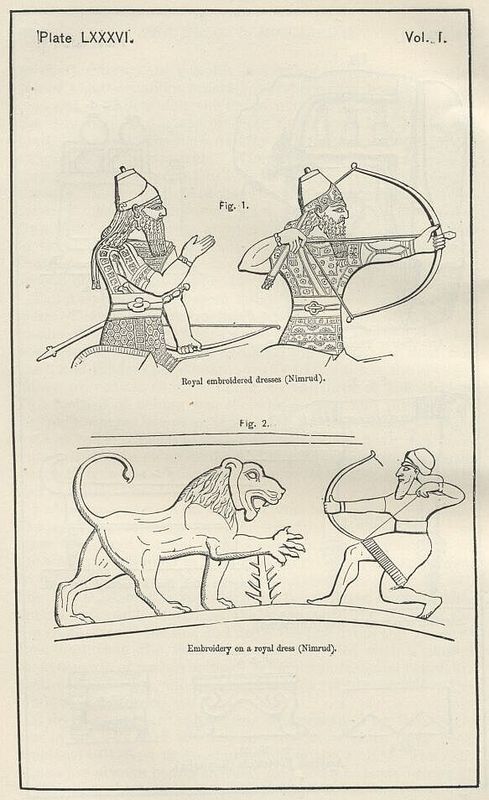
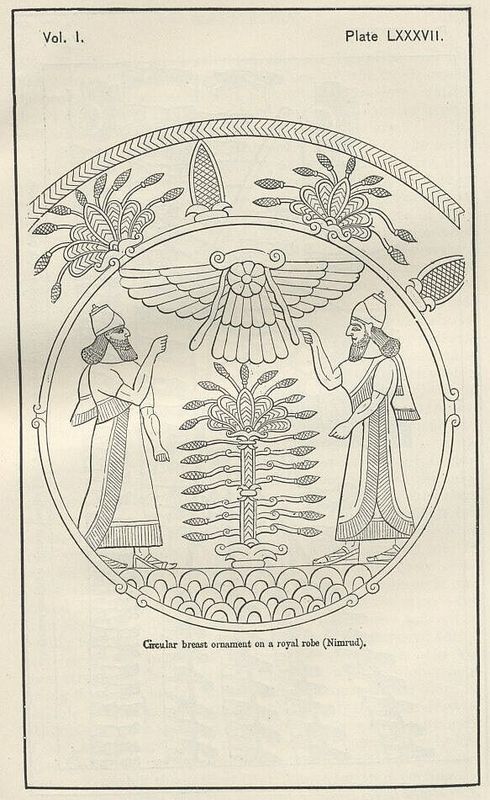
To this account of the arts, mimetic and other, in which the Assyrians appear to have excelled, it might be expected that there should be added a sketch of their scientific knowledge. On this subject, however, so little is at present known, while so much may possibly become known within a short time, that it seems best to omit it, or to touch it only in the lightest and most cursory manner. When the numerous tablets now in the British Museum shall have been deciphered, studied, and translated, it will probably be found that they contain a tolerably full indication of what Assyrian science really was, and it will then be seen how far it was real and valuable, in what respects mistaken and illusory. At present this mine is almost unworked, nothing more having been ascertained than that the subjects whereof the tables treat are various, and their apparent value very different. Comparative philology seems to have been largely studied, and the works upon it exhibit great care and diligence. Chronology is evidently much valued, and very exact records are kept whereby the lapse of time can even now be accurately measured. Geography and history have each an important place in Assyrian learning; while astronomy and mythology occupy at least as great a share of attention. The astronomical observations recorded are thought to be frequently inaccurate, as might be expected when there were no instruments, or none of any great value. Mythology is a very favorite subject, and appears to be treated most fully; but hitherto cuneiform scholars have scarcely penetrated below the surface of the mythological tablets, baffled by the obscurity of the subject and the difficulty of the dialect (in) which they are written.
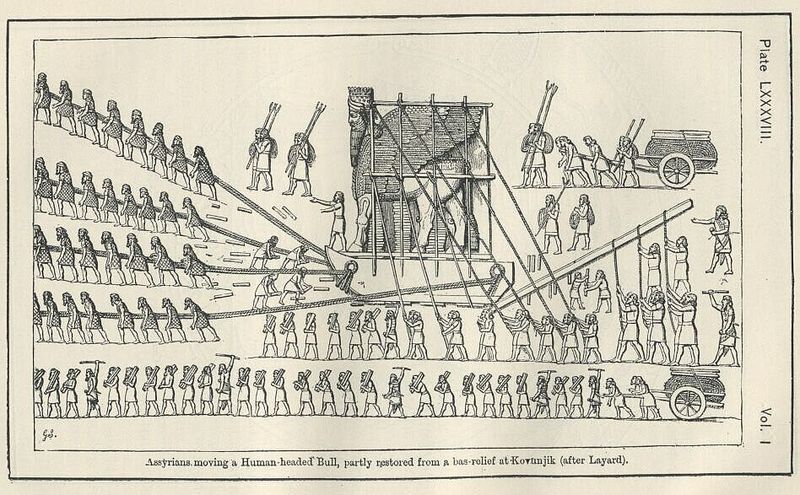
On one point alone, belonging to the domain of science, do the Assyrian representations of their life enable us to comprehend, at least to some extent, their attainments. The degree of knowledge which this people possessed on the subject of practical mechanics is illustrated with tolerable fulness in the bas-reliefs, more especially in the important series discovered at Koyunjik, where the transport of the colossal bulls from the quarry to the palace gateways is represented in the most elaborate detail. [PLATE LXXXVIII.] The very fact that they were able to transport masses of stone, many tons in weight, over a considerable space of ground, and to place then on the summit of artificial platforms from thirty to eighty (or ninety) feet high, would alone indicate considerable mechanical knowledge. The further fact, now made clear from the bas-reliefs, that they wrought all the elaborate carving of the colossi before they proceeded to raise them or put them in place, is an additional argument of their skill, since it shows that they had no fear of any accident happening in the transport. It appears from the representations that they placed their colossus in a standing posture, not on a truck or wagon of any kind, but on a huge wooden sledge, shaped nearly like a boat, casing it with an openwork of spars or beams, which crossed each other at right angles, and were made perfectly tight by means of wedges. To avert the great danger of the mass toppling over sideways, ropes were attached to the top of the casing, at the point where the beams crossed one another, and were held taut by two parties of laborers, one on either side of the statue. Besides these, wooden forks or props were applied on either side to the second set of horizontal cross-beams, held also by men whose business it would be to resist the least inclination of the huge stone to lean to one side more than to the other. The front of the sledge on which the colossus stood was curved gently upwards, to facilitate its sliding along the ground, and to enable it to rise with readiness upon the rollers, which were continually placed before it by laborers just in front, while others following behind gathered them up when the bulky mass had passed over there. The motive power was applied in front by four gangs of men who held on to four large cables, at which they pulled by means of small ropes or straps fastened to them, and passed under one shoulder and over the other—an arrangement which enabled them to pull by weight as much as by muscular strength, as the annexed figure will plainly show. [PLATE LXXXIX., Fig. 1.] The cables appear to have been of great strength, and are fastened carefully to four strong projecting pins—two near the front, two at the back part of the sledge, by a knot so tied that it would be sure not to slip. [PLATE LXXXIX., Fig. 4.] Finally, as in spite of the rollers, whose use in diminishing friction, and so facilitating progress, was evidently well understood, and in spite of the amount of force applied in front, it would have been difficult to give the first impetus to so great a mass, a lever was skilfully applied behind to raise the hind part of the sledge slightly, and so propel it forward, while to secure a sound and firm fulcrum, wedges of wood were inserted between the lever and the ground. The greater power of a lever at a distance from the fulcrum being known, ropes were attached to its upper end, which could not otherwise have been reached, and the lever was worked by means of them.
We have thus unimpeachable evidence as to the mode whereby the conveyance of huge blocks of stone along level ground was effected. But it may be further asked, how were the blocks raised up to the elevation at which we find them placed? Upon this point there is no direct evidence; but the probability is that they were drawn up inclined ways, sloping gently from the natural ground to the top of the platforms. The Assyrians were familiar with inclined ways, which they used almost always in their attacks on walled places, and which in many cases they constructed either of brick or stone. The Egyptians certainly employed them for the elevation of large blocks; and probably in the earlier times most nations who affected massive architecture had recourse to the same simple but uneconomical plan. The crane and pulley were applied to this purpose later. In the Assyrian sculptures we find no application of either to building, and no instance at all of the two in combination. Still each appears on the bas-reliefs separately—the crane employed for drawing water from the rivers, and spreading it over the lands, the pulley for lowering and raising the bucket in wells. [PLATE LXXXIX., Fig. 3.]
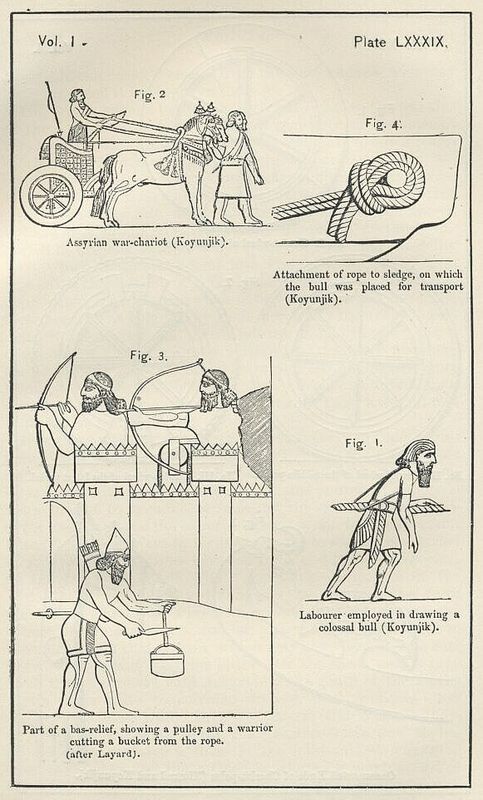
We must conclude from these facts that the Assyrians had made considerable advances in mechanical knowledge, and were, in fact, acquainted, more or less, with most of the contrivances whereby heavy weights have commonly been moved and raised among the civilized nations of Europe. We have also evidence of their skill in the mechanical processes of shaping pottery and glass, of casting and embossing metals, and of cutting intaglios upon hard stones. Thus it was not merely in the ruder and coarser, but likewise in the more delicate processes, that they excelled. The secrets of metallurgy, of dyeing, enamelling, inlaying, glass-blowing, as well as most of the ordinary manufacturing processes, were known to them. In all the common arts and appliances of life, they must be pronounced at least on a par with the Egyptians, while in taste they greatly exceeded, not that nation only, but all the Orientals. Their "high art" is no doubt much inferior to that of Greece; but it has real merit, and is most remarkable considering the time when it was produced. It has grandeur, dignity, boldness, strength, and sometimes even freedom and delicacy; it is honest and painstaking, unsparing of labor, and always anxious for truth. Above all, it is not lifeless and stationary, like the art of the Egyptians and the Chinese, but progressive and aiming at improvement. To judge by the advance over previous works which we observe in the sculptures of the son of Esarhaddon, it would seem that if Assyria had not been assailed by barbaric enemies about his time, she might have anticipated by above a century the finished excellence of the Greeks.
===========================
THE SECOND MONARCHY.
ASSYRIA.
CHAPTER VII.
MANNERS AND CUSTOMS.
"Whose arrows are sharp, and all their bows bent, their horses' hoofs shall be counted like flint, and their wheels like a whirlwind."—ISA. v. 28.
In reviewing, so far as our materials permit, the manners and customs of the Assyrians, it will be convenient to consider separately their warlike and their peaceful usages. The sculptures furnish very full illustration of the former, while on the latter they throw light far more sparingly.
The Assyrians fought in chariots, on horseback, and on foot. Like most ancient nations, as the Egyptians, the Greeks in the heroic times, the Canaanites, the Syrians, the Jews and Israelites, the Persians, the Gauls, the Britons, and many others, the Assyrians preferred the chariot as most honorable, and probably as most safe. The king invariably went out to war in a chariot, and always fought from it, excepting at the siege of a town, when he occasionally dismounted and shot his arrows on foot. The chief state-officers and other personages of high rank followed the same practice. Inferior persons served either as cavalry or as foot-soldiers.
The Assyrian war-chariot is thought to have been made of wood. Like the Greek and the Egyptian, it appears to have been mounted from behind where it was completely open, or closed only by means of a shield, which (as it seems) could be hung across the aperture. It was completely panelled at the sides, and often highly ornamented, as will be seen from the various illustrations given in this chapter. The wheels were two in number, and were placed far back, at or very near the extreme end of the body, so that the weight pressed considerably upon the pole, as was the case also in Egypt. They had remarkably broad felloes, thin and delicate spokes, and small or moderate sized axels. [PLATE LXXXIX. Fig. 2], and [PLATE XC., Figs. 1, 2.] The number of the spokes was either six or eight. The felloes appear to have been formed of three distinct circles of wood, the middle one being the thinnest, and the outer one far the thickest of the three. Sometimes these circles were fastened together externally by bands of mental, hatchet-shaped. In one or two instances we find the outermost circle divided by cross-bars, as if it had been composed of four different pieces. Occasionally there is a fourth circle, which seems to represent a metal tire outside the felloe, whereby it was guarded from injury. This tire is either plain or ornamented.
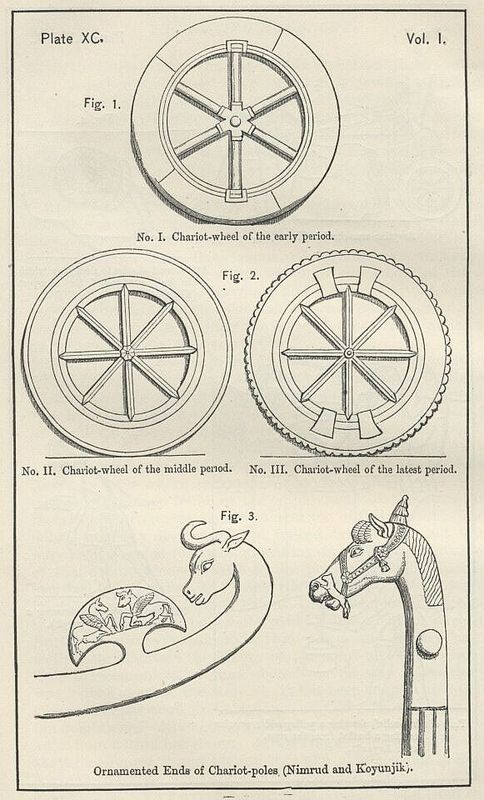
The wheels were attached to an axletree, about which they revolved, in the usual manner. The body was placed directly upon the axletree and upon the pole, without the intervention of any springs. The pole started from the middle of the axle-tree, and, passing below the floor of the body in a horizontal direction, thence commonly curved upwards till it had risen to about half the height of the body, when it was again horizontal for awhile, once more curving upwards at the end. It usually terminated in an ornament, which was sometimes the head of an animal—a bull, a horse, or a duck—sometimes a more elaborate and complicated work of art. [PLATE XC., Fig. 3.] Now and then the pole continued level with the bottom of the body till it had reached its full projection, and then rose suddenly to the height of the top of the chariot. It was often strengthened by one or more thin bars, probably of metal; which united it to the upper part of the chariot-front.
Chariots were drawn either by two or three, never by four, horses. They seem to have had but a single pole. Where three horses were used, one must therefore have been attached merely by a rope or thong, like the side horses of the Greeks, and, can scarcely have been of much service for drawing the vehicle. He seems rightly regarded as a supernumerary, intended to take the place of one of the others, should either be disabled by a wound or accident. It is not easy to determine from the sculptures how the two draught horses were attached to the pole. Where chariots are represented without horses, we find indeed that they have always a cross-bar or yoke; but where horses are represented in the act of drawing a chariot, the cross-bar commonly disappears altogether. It would seem that the Assyrian artists, despairing of their ability to represent the yoke properly when it was presented to the eye end-wise, preferred, for the most part, suppressing it wholly to rendering it in an unsatisfactory manner. Probably a yoke did really in every case pass over the shoulders of the two draught horses, and was fastened by straps to the collar which is always seen round their necks.
These yokes, or cross-bars, were of various kinds. Sometimes they appear to have consisted of a mere slight circular bar, probably of metal, which passed through the pole; sometimes of a thicker spar, through which the pole itself passed. In this latter case the extremities were occasionally adorned with heads of animals. [PLATE XCI., Fig. 1.] The most common kind of yoke exhibits a double curve, so as to resemble a species of bow unstrung. [PLATE XCI., Fig. 2.] Now and then a specimen is found very curiously complicated, being formed of a bar curved strongly at either end, and exhibiting along its course four other distinct curvatures having opposite to there apertures resembling eyes, with an upper and a lower eyelid. [PLATE XCI., Fig. 3.] It has been suggested that this yoke belonged to a four-horse chariot, and that to each of the four eyes (a a a a) there was a steed attached; but, as no representation of a four-horse chariot has been found, this suggestion must be regarded as inadmissible. The probability seems to be that this yoke, like the others, was for two horses, on whose necks it rested at the points marked b b, the apertures (c c c c) lying thus on either side of the animals' necks, and furnishing the means whereby the he was fastened to the collar. It is just possible that we have in the sculptures of the later period a representation of the extremities (d d) of this kind of yoke, since in them a curious curve appears sometimes on the necks of chariot-horses, just above the upper end of the collar.
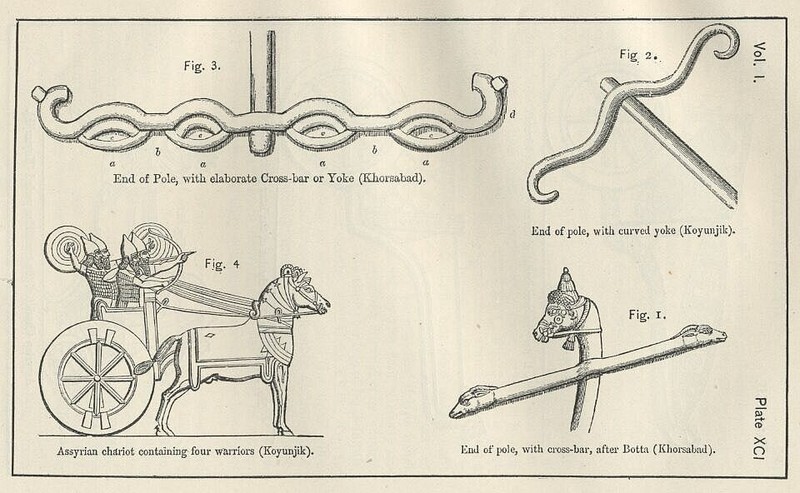
Assyrian chariots are exceedingly short: but, apparently, they must have been of a considerable width. They contain two persons at the least; and this number is often increased to three, and sometimes even to four. [PLATE XCI. Fig. 4.] The warrior who fights from a chariot is necessarily attended by his charioteer; and where he is a king, or a personage of high importance, he is accompanied by a second attendant, who in battle-scenes always bears a shield, with which he guards the person of his master. Sometimes, though rarely, four persons are seen in a chariot—the king or chief, the charioteer, and two guards, who protect the monarch on either side with circular shields or targes. The charioteer is always stationed by the side of the warrior, not as frequently with the Greeks, behind him. The guards stand behind, and, owing to the shortness of the chariot, must have experienced some difficulty in keeping their places. They are evidently forced to lean back-wards from want of room, and would probably have often fallen out, had they not grasped with one hand a rope or strap firmly fixed to the front of the vehicle.
There are two principal types of chariots in the Assyrian sculptures, which may be distinguished as the earlier and the later. The earlier are comparatively low and short. The wheels are six-spoked, and of small diameter. The body is plain, or only ornamented by a border, and is rounded in front, like the Egyptian and the classical chariots. [PLATE XCII., Fig 1.] Two quivers are suspended diagonally at the side of the body, while a rest for a spear, commonly fashioned into the shape of a human head, occupies the upper corner at the back. From the front of the body to the further end of the pole, which is generally patterned and terminates in the head and neck of a ball or a duck, extends an ornamented structure, thought to have been of linen or silk stitched upon a framework of wood, which is very conspicuous in the representation. A shield commonly hangs behind these chariots, perhaps closing the entrance; and a standard is sometimes fixed in them towards the front, connected with the end of the pole by a rope or bar.
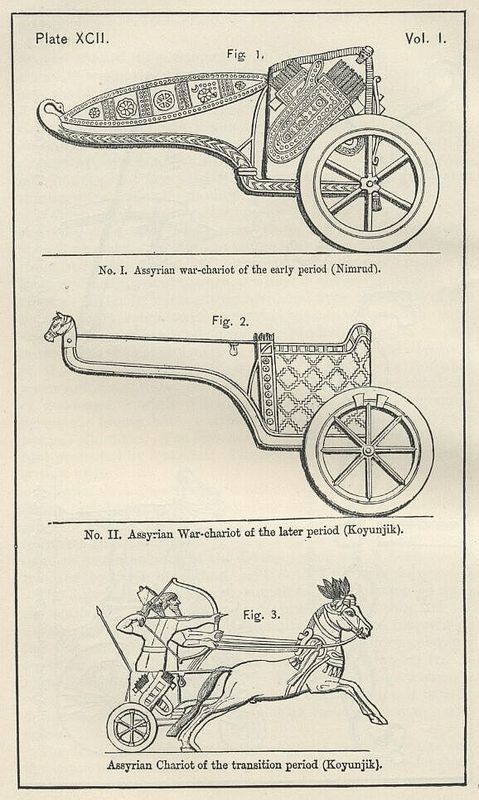
The later chariots are loftier and altogether larger than the earlier. The wheel is eight spoked, and reaches as high as the shoulders of the horses, which implies a diameter of about five feet. [PLATE XCII., Fig. 2. ] The body rises a foot or rather more, above this; and the riders thus from their elevated position command the whole battle-field. The body is not rounded, but made square in front: it has no quivers attached to it externally, but has, instead, a projection at one or both of the corners which seems to have served as an arrow-case. This projection is commonly patterned, as is in many cases the entire body of the chariot, though sometimes the ornamentation is confined to an elegant but somewhat scanty border. The poles are plain, not patterned, sometimes, however, terminating in the head of a horse; there is no ornamental framework connecting them with the chariot, but in its stead we see a thin bar, attached to which, either above or below, there is in most instances a loop, whereto we may suppose that the reins were occasionally fastened. No shield is suspended behind these chariots; but we sometimes observe an embroidered drapery hanging over the back, in a way which would seem to imply that they were closed behind, at any rate by a cross-bar.
The trappings of the chariot-horses belonging to the two periods are not very different. They consist principally of a headstall, a collar, a breast-ornament, and a sort of huge tassel pendent at the horse's side. The headstall was formed commonly of three straps: one was attached to the bit at either end, and passed behind the ears over the neck; another, which was joined to this above, encircled the smallest part of the neck; while a third, crossing the first at right angles, was carried round the forehead and the cheek bones. At the point where the first and second joined, or a little in front of this, rose frequently a waving plume, or a crest composed of three huge tassels, one above another; while at the intersection of the second and third was placed a rosette or other suitable ornament. The first strap was divided where it approached the bit into two or three smaller straps, which were attached to the bit in different places. A fourth strap sometimes passed across the nose from the point where the first strap subdivided. All the straps were frequently patterned; the bit was sometimes shaped into an animal form and streamers occasional floated from the nodding plume or crest which crowned the heads of the war-steeds.
The collar is ordinarily represented as a mere broad band passing round the neck, not of the withers (as with ourselves). but considerably higher up, almost midway between the withers and the cheek-bone. Sometimes it is of uniform width while often it narrows greatly as it approaches the back of the neck. It is generally patterned, and appears to have been a mere flat leathern band. It is impossible to say in what exact way the pole was attached to it, though in the later sculptures we have elaborate representations of the fastening. The earlier sculptures seem to append to the collar one or more patterned straps, which, passing round the horse's belly immediately behind the fore legs, served to keep it in place, while at the same time they were probably regarded as ornamental; but under the later kings these belly Lands were either reduced to a single strap, or else dispensed with altogether.
The breast-ornament consists commonly of a fringe, more or less complicated. The simplest form, which is that of the most ancient times, exhibits a patterned strap with a single row of long tassels pendent from it, as in the annexed representation. At a later date we find a double and even a triple row of tassels.
The pendent side-ornament is a very conspicuous portion of the trappings. It is attached to the collar either by a long straight strap or by a circular band which falls on either side of the neck. The upper extremity is often shaped into the form of an animal's head, below which comes most commonly a circle or disk, ornamented with a rosette, a Maltese cross, a winged bull, or other sacred emblem, while below the circle hang huge tassels in a single row or smaller ones arranged in several rows. In the sculptures of Sargon at Khorsabad, the tassels of both the breast and side ornaments were colored, the tints being in most cases alternately red and blue.
Occasionally the chariot-horses were covered from the ears almost to the tail with rich cloths, magnificently embroidered over their whole surface.' [PLATE XCIII., Fig. 2.] These cloths encircled the neck, which they closely fitted, and, falling on either side of the body, were then kept in place by means of a broad strap round the rump and a girth under the belly.
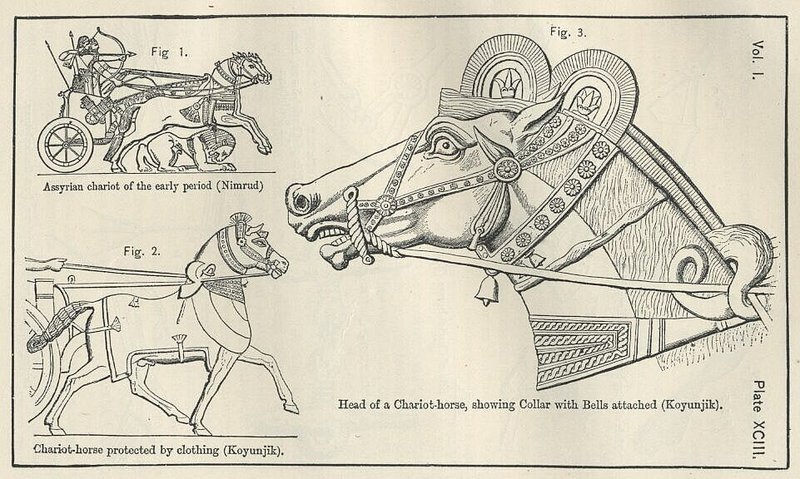
A simpler style of clothing chariot-horses is found towards the close of the later period, where we observe, below the collar, a sort of triple breastplate, and over the rest of the body a plain cloth, square cut, with flaps descending at the arms and quarters, which is secured in its place by three narrow straps fastened on externally. The earlier kind of clothing has the appearance of being for ornament but this looks as if it was meant solely for protection.
Besides the trappings already noticed, the Assyrian chariot-horses had frequently strings of beads suspended round their necks, between the ears and the collar; they had also, not unfrequently, tassels or bells attached to different parts of the headstall [PLATE XCIII., Fig. 3], and finally they had, in the later period most commonly, a curious ornament upon the forehead, which covered almost the whole space between the ears and the eyes, and was composed of a number of minute bosses, colored, like the tassels of the breast ornament, alternately red and blue.
Each horse appears to have been driven by two reins—one attached to either end of the bit in the ordinary manner, and each passed through a ring or loop in the harness, whereby the rein was kept down and a stronger purchase secured to the driver. The shape of the bit within the mouth, if we may judge by the single instance of an actual bit which remains to us, bore a near resemblance to the modern snaffle. [PLATE XCIV., Fig. 1.] Externally the bit was large, and in most cases clumsy—a sort of cross-bar extending across the whole side of the horse's face, commonly resembling a double axe-head, or a hammer. Occasionally the shape was varied, the hatchet or hammer being replaced by forms similar to those annexed, or by the figure of a horse at full gallop. The rein seems, in the early times, to have been attached about midway in the cross-bar, while afterwards it became usual to attach it near the lower end. This latter arrangement was probably found to increase the power of the driver.
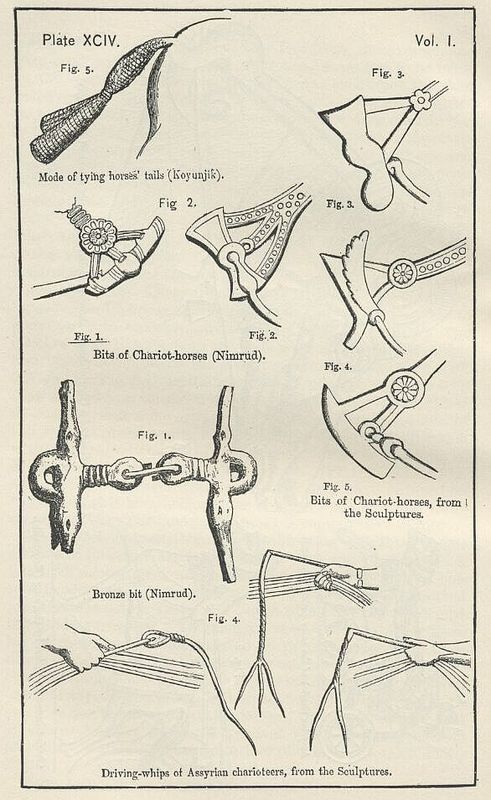
The use of the bearing-rein, which prevailed in Egypt, was unknown to the Assyrians, or disapproved by them. The driving-reins were separate, not stitched or buckled together, and were held in the two hands separately. The right hand grasped the reins, whatever their number, which were attached at the horses' right cheeks, while the left hand performed the same office with the remaining reins. The charioteer urged his horses onward with a powerful whip, having a short handle, and a thick plaited or twisted lash, attached like the lash of a modern horsewhip, sometimes with, sometimes without, a loop, and often subdivided at the end into two or three tails. [PLATE XCIV., Fig. 4.]
Chariot-horses were trained to three paces, a walk, a trot, and a gallop. In battle-pieces they are commonly represented at full speed, in marches trotting, in processions walking in a stately manner. Their manes were frequently hogged, though more commonly they lay on the neck, falling (apparently) upon either side indifferently. Occasionally a portion only was hogged, while the greater part remained in its natural condition. The tail was uncut, and generally almost swept the ground, but was confined by a string or ribbon tied tightly around it about midway. Sometimes, more especially in the later sculptures, the lower half of the tail is plaited and tied up into a loop or bunch [PLATE XCIV., Fig. 5], according to the fashion which prevails in the present day through most parts of Turkey and Persia.
The warrior who fought from a chariot was sometimes merely dressed in a tunic, confined at the waist by a belt; sometimes, however, he wore a coat of mail, very like the Egyptian, consisting of a sort of shirt covered with small plates or scales of metal. This shirt reached at least as low as the knees, beneath which the chariot itself was sufficient protection. It had short sleeves, which covered the shoulder and upper part of the arm, but left the elbow and fore-arm quite undefended. The chief weapon of the warrior was the bow, which is always seen in his hands, usually with the arrow upon the string; he wears, besides, a short sword, suspended at his left side by a strap, and he has commonly a spear within his reach; but we never see him using either of these weapons. He either discharges his arrows against the foe from the standing-board of his chariot, or, commanding the charioteer to halt, descends, and, advancing a few steps before his horses' heads, takes a surer and more deadly aim from terra firma. In this case his attendant defends him from missiles by extending in front of him a shield, which he holds in his left hand, while at the same time he makes ready to repel any close assailant by means of a spear or sword grasped firmly in his right. The warrior's face and arms are always bare; sometimes the entire head is undefended, though more commonly it has the protection of a helmet. This, however, is without a visor, and does not often so much as cover the ears. In some few instances only is it furnished with flaps or lappets, which, where they exist, seem to be made of metal scales, and, falling over the shoulders, entirely conceal the ears, the back of the head, the neck, and even the chin.
The position occupied by chariots in the military system of Assyria is indicated in several passages of Scripture, and distinctly noticed by many of the classical writers. When Isaiah began to warn his countrymen of the 'miseries in store for them at the hands of the new enemy which first attacked Judea in his day, he described them as a people "whose arrows were sharp, and all their bows bent, whose horses' hoofs should be counted like flint, and their wheels like a whirlwind." When in after days he was commissioned to raise their drooping courage by assuring them that they would escape Sennacherib, who had angered God by his pride, he noticed, as one special provocation of Jehovah, that monarch's confidence in the multitude of his chariots. Nahum again, having to denounce the approaching downfall of the haughty nation, declares that God is "against her, and will burn her chariots in the smoke." In the fabulous account which Ctesias gave of the origin of Assyrian greatness, the war-chariots of Ninus were represented as amounting to nearly eleven thousand, while those of his wife and successor, Semiramis, were estimated at the extravagant number of a hundred thousand. Ctesias further stated that the Assyrian chariots, even at this early period, were armed with scythes, a statement contradicted by Xenophon, who ascribes this invention to the Persians, and one which receives no confirmation from the monuments. Amid all this exaggeration and inventiveness, one may still trace a knowledge of the fact that war-chariots were highly esteemed by the Assyrians from a very ancient date, while from other notices we may gather that they continued to be reckoned an important arm of the military service to the very end of the empire.
Next to the war-chariots of the Assyrians we must place their cavalry, which seems to have been of scarcely less importance in their wars. Ctesias, who amid all his exaggerations shows glimpses of some real knowledge of the ancient condition of the Assyrian people, makes the number of the horsemen in their armies always greatly exceed that of the chariots. The writer of the book of Judith gives Holofernes 12,000 horse-archers, and Ezekiel seems to speak of all the "desirable young men" as "horsemen riding upon horses." The sculptures show on the whole a considerable excess of cavalry over chariots, though the preponderance is not uniformly exhibited throughout the different periods.
During the time of the Upper dynasty, cavalry appears to have been but little used. Tiglath-Pileser I. in the whole of his long Inscription has not a single mention of them, though he speaks of his chariots continually. In the sculptures of Asshur-izir-pal, the father of the Black-Obelisk king, while chariots abound, horsemen occur only in rare instances. Afterwards, under Sargon and Sennacherib, we notice a great change in this respect. The chariot comes to be almost confined to the king, while horsemen are frequent in the battle scenes.
In the first period the horses' trappings consisted of a head-stall, a collar, and one or more strings of beads. The head-stall was somewhat heavy, closely resembling that of the chariot-horses of the time, representations of which have been already given. It had the same heavy axe-shaped bit, the same arrangement of straps, and nearly the same ornamentation. The only marked difference was the omission of the crest or plume, with its occasional accompaniment of streamers. The collar was very peculiar. It consisted of a broad flap, probably of leather, shaped almost like a half-moon, which was placed on the neck about half way between the ears and the withers, and thence depended over the breast, where it was broadened out and ornamented by large drooping tassels. Occasionally the collar was plain, but more often it was elaborately patterned. Sometimes pomegranates hung from it, alternating with the tassels.
The cavalry soldiers of this period ride without any saddle. Their legs and feet are bare, and their seat is very remarkable. Instead of allowing their legs to hang naturally down the horses' sides, they draw them up till their knees are on a level with their chargers' backs, the object (apparently) being to obtain a firm seat by pressing the base of the horse's neck between the two knees. The naked legs seem to indicate that it was found necessary to obtain the fullest and freest play of the muscles to escape the inconveniences of a fall.
The chief weapon of the cavalry at this time is the bow. Sword and shield indeed are worn, but in no instance do we see them used. Cavalry soldiers are either archers or mere attendants who are without weapons of offence. One of these latter accompanies each horse-archer in battle, for the purpose of holding and guiding his steed while he discharges his arrows. The attendant wears a skull cap and a plain tunic, the archer has an embroidered tunic, a belt to which his sword is attached, and one of the ordinary pointed helmets.
In the second period the cavalry consists in part of archers, in part of spearmen. Unarmed attendants are no longer found, both spearmen and archers appearing to be able to manage their own horses. Saddles have now come into common use: they consist of a simple cloth, or flap of leather, which is either cut square, or shaped somewhat like the saddle-cloths of our own cavalry. A single girth beneath the belly is their ordinary fastening; but sometimes they are further secured by means of a strap or band passed round the breast, and a few instances occur of a second strap passed round the quarters. The breast-strap is generally of a highly ornamented character. The headstall of this period is not unlike the earlier one, from which it differs chiefly in having a crest, and also a forehead ornament composed of a number of small bosses. It has likewise commonly a strap across the nose, but none under the cheek-bones. It is often richly ornamented, particularly with rosettes, bells, and tassels.
The old pendent collar is replaced by one encircling the neck about halfway up, or is sometimes dispensed with altogether. Where it occurs, it is generally of uniform width, and is ornamented with rosettes or tassels. No conjecture has been formed of any use which either form of collar could serve; and the probability is that they were intended solely for ornament.
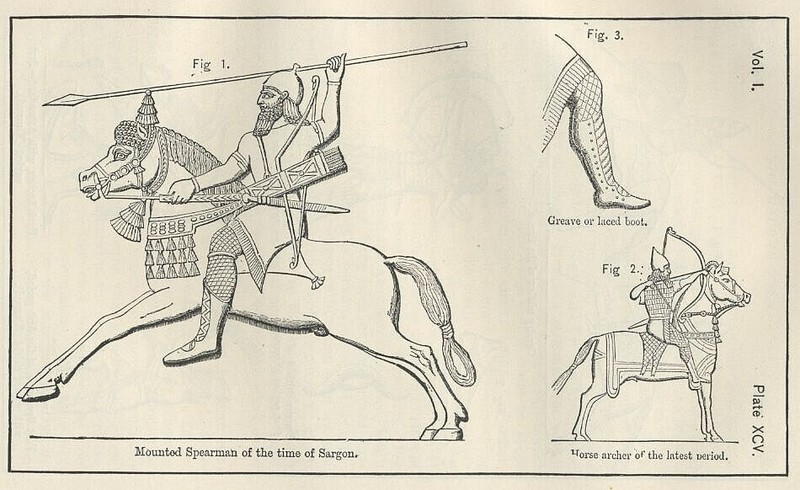
A great change is observable in the sculptures of the second period with respect to the dress of the riders. [PLATE XCV., Fig. 1.] The cavalry soldier is now completely clothed, with the exception of his two arms, which are bare from a little below the shoulder. He wears most commonly a tunic which fits him closely about the body, but below the waist expands into a loose kilt or petticoat, very much longer behind than in front, which is sometimes patterned, and always terminates in a fringe. Round his waist he has a broad belt; and another, of inferior width, from which a sword hangs, passes over his left shoulder. His legs are encased in a close-fitting pantaloon or trouser, over which he wears a laced boot or greave, which generally reaches nearly to the knee, though sometimes it only covers about half the calf. [PLATE XCV., Fig. 2.] This costume, which is first found in the time of Sargon, and continues to the reign of Asshur-bani-pal, Esarhaddon's son, may probably be regarded as the regular cavalry uniform under the monarchs of the Lower Empire. In Sennacherib's reign there is found in conjunction with it another costume, which is unknown to the earlier sculptures. This consists of a dress closely fitting the whole body, composed apparently of a coat of mail, leather or felt breeches, and a high greave or jack boot. [PLATE XCVI., Fig. 1.] The wearers of this costume are spearmen or archers indifferently. The former carry a long weapon, which has generally a rather small head, and is grasped low down the shaft. The bow of the latter is either round-arched or angular, and seems to be not more than four feet in length; the arrows measure less than three feet, and are slung in a quiver at the archer's back. Both spearmen and archers commonly carry swords, which are hung on the left side, in a diagonal, and sometimes nearly in a horizontal position. In some few cases the spearman is also an archer, and carries his bow on his right arm, apparently as a reserve in case he should break or lose his spear.
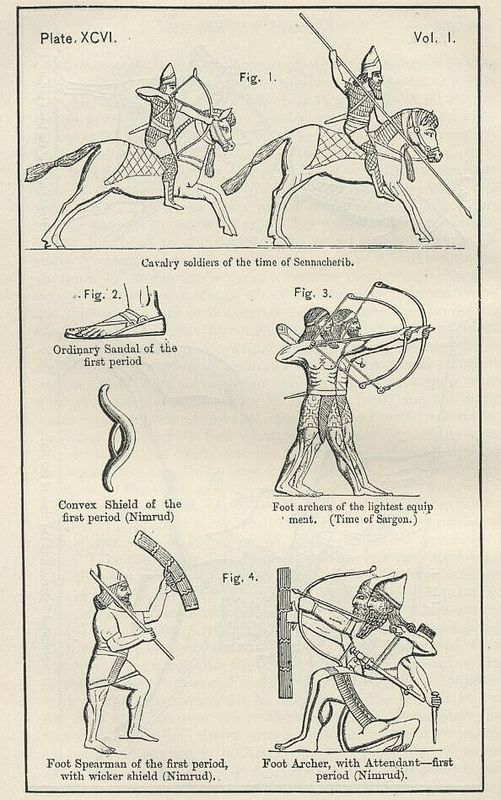
The seat of the horseman is far more graceful in the second than in the first period his limbs appear to move freely, and his mastery over his horse is such that he needs no attendant. The spearman holds the bridle in his left hand; the archer boldly lays it upon the neck of his steed, who is trained either to continue his charge, or to stand firm while a steady aim is taken. [PLATE XCV., Fig. 3.]
In the sculptures of the son and successor of Esarhaddon, the horses of the cavalry carry not unfrequently, in addition to the ordinary saddle or pad, a large cloth nearly similar to that worn sometimes by chariot-horses, of which a representation has been already given. It is cut square with two drooping lappets, and covers the greater part of the body. Occasionally it is united to a sort of breastplate which protects the neck, descending about halfway clown the chest. The material may be supposed to have been thick felt or leather, either of which would have been a considerable protection against weapons.
While the cavalry and the chariots were regarded as the most important portions of the military force, and were the favorite services with the rich and powerful, there is still abundant reason to believe that Assyrian armies, like most others, consisted mainly of foot. Ctesias gives Minis 1,700,000 footmen to 210,000 horsemen, and 10,600 chariots. Xenophon contrasts the multitude of the Assyrian infantry with the comparatively scanty numbers of the other two services: Herodotus makes the Assyrians serve in the army of Xerxes on foot only. The author of the book of Judith assigns to Holofernes an infantry force ten times as numerous as his cavalry.—The Assyrian monuments entirely bear out the general truth involved in all these assertions, showing us, as they do, at least ten Assyrian warriors on foot for each one mounted on horseback, and at least a hundred for each one who rides in a chariot. However terrible to the foes of the Assyrians may have been the shock of their chariots and the impetuosity of their horsemen, it was probably to the solidity of the infantry, to their valor, equipment, and discipline, that the empire was mainly indebted for its long series of victories.
In the time of the earliest sculptures, all the Assyrian foot-soldiers seem to have worn nearly the same costume. This consisted of a short tunic, not quite reaching to the knees, confined round the waist by a broad belt, fringed, and generally opening in front, together with a pointed helmet, probably of metal. The arms, legs, neck, and even the feet, were ordinarily bare, although these last had sometimes the protection of a very simple sandal. [PLATE XCVI., Fig. 2.] Swordsmen used a small straight sword or dagger which they wore at their left side in an ornamented sheath, and a shield which was either convex and probably of metal, or oblong-square and composed of wickerwork. [PLATE XCVI., Fig. 2.] Spearmen had shields of a similar shape and construction, and carried in their right hands a short pike or javelin, certainly not exceeding five feet in length. [PLATE XCVI., Fig. 4.] Sometimes, but not always, they carried, besides the pike, a short sword. Archers had rounded bows about four feet in length, and arrows a little more than three feet long. Their quivers, which were often highly ornamented, hung at their backs, either over the right or over the left shoulder. [PLATE XCVI., Fig. 4.] They had swords suspended at their left sides by a cross-belt, and often carried maces, probably of bronze or iron, which bore a rosette or other ornament at one end, and a ring or strap at the other. The tunics of archers were sometimes elaborately embroidered; and on the whole they seem to have been regarded as the flower of the foot-soldiery. Generally they are represented in pairs, the two being in most cases armed and equipped alike; but, occasionally, one of the pair acts as guard while the other takes his aim. In this case both kneel on one knee, and the guard, advancing his long wicker shield, protects both himself and his comrade from missiles, while he has at the same time his sword drawn to repel all hand-to-hand assailants. [PLATE XCVII., Fig. 1.]
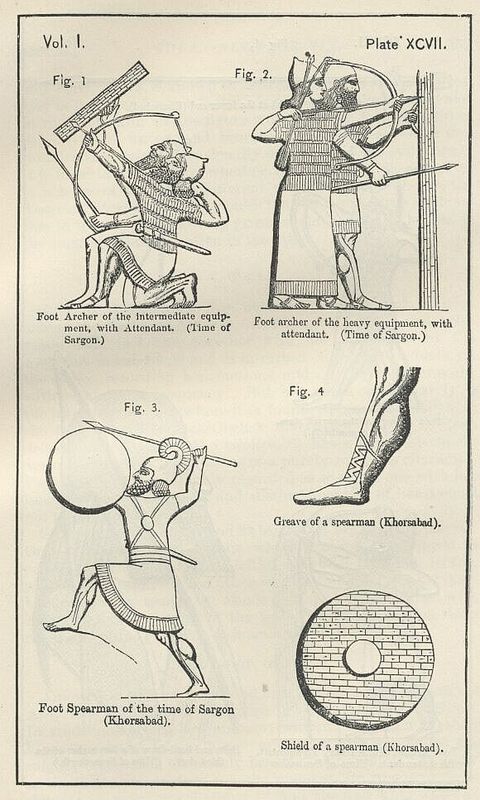
In the early part of the second period, which synchronizes with the reign of Sargon, the difference in the costumes of the foot-soldiers becomes much more marked. The Assyrian infantry now consists of two great classes, archers and spear-men. The archers are either light-armed or heavy-armed, and of the latter there are two clearly distinct varieties. The light-armed have no helmet, but wear on their heads a mere fillet or band, which is either plain or patterned. [PLATE XCVI., Fig. 3.] Except for a cross-belt which supports the quiver, they are wholly naked to the middle. Their only garment is a tunic of the scantiest dimensions, beginning at the waist, round which it is fastened by a broad belt or girdle, and descending little more than half-way down the thigh. In its make it sometimes closely resembles the tunic of the first period, but more often it has the peculiar pendent ornament which has been compared to the scotch phillibeg, and which will be here given that name. It is often patterned with squares and gradines. The light-armed archer has usually bare feet; occasionally, however, he wears the slight sandal of this period, which is little more than a cap for the heel held in place by two or three strings passed across the instep. There is nothing remarkable in his arms, which resemble those of the preceding period: but it may be observed that, while shooting, he frequently holds two arrows in his right hand besides that which is upon the string. He shoots either kneeling or standing, generally the latter. His ordinary position is in the van of battle, though sometimes a portion of the heavy-armed troops precede him. He has no shield, and is not protected by an attendant, thus running more risk than any of the rest of the army.
The more simply equipped of the heavy archers are clothed in a coat of mail, which reaches from their neck to their middle, and partially covers the arms. Below this they wear a fringed tunic reaching to the knees, and confined at the waist by a broad belt of the ordinary character. Their feet have in most instances the protection of a sandal, and they wear on their heads the common or pointed helmet. They usually discharge their arrows kneeling on the left knee, with the right foot advanced before them. Daring this operation they are protected by an attendant, who is sometimes dressed like themselves, sometimes merely clad a tunic, without a coat of mail. Like them, he wears a pointed helmet; and while in one hand he carries a spear, with the other he holds forward a shield, which is either of a round form—apparently, of metal embossed with figures—or oblong-square in shape, and evidently made of wickerwork. Archers of this class are the least common, and scarcely ever occur unless in combination with some of the class which has the heaviest equipment.
The principal characteristic of the third or most heavily armed class of archers is the long robe, richly fringed, which descends nearly to their feet, thus completely protecting all the lower part of their person. [PLATE XCVII., Fig. 2.] Above this they wear a coat of mail exactly resembling that of archers of the intermediate class, which is sometimes crossed by a belt ornamented with crossbars. Their head is covered by the usual pointed helmet, and their feet are always, or nearly always, protected by sandals. They are occasionally represented without either sword or quiver, but more usually they have a short sword at their left side, which appears to have been passed through their coat of mail, between the armor plates, and in a few instances they have also quivers at their backs. Where these are lacking, they generally either carry two extra arrows in their right hand, or have the same number borne for them by an attendant. They are never seen unattended: sometimes they have one, sometimes two attendants, who accompany them, and guard them from attack. One of these almost always bears the long wicker shield, called by the Greeks [_yeppov_] which he rests firmly upon the ground in front of himself and comrade. The other, where there is a second, stands a little in the rear, and guards the archer's head with a round shield or targe. Both attendants are dressed in a short tunic, a phillibeg, a belt, and a pointed helmet. Generally they wear also a coat of mail and sandals, like those of the archer. They carry swords at their left sides, and the principal attendant, except when he bears the archer's arrows, guards him from attack by holding in advance a short spear. The archers of this class never kneel, but always discharge their arrows standing. They seem to be regarded as the most important of the foot-soldiers, their services being more particularly valuable in the siege of fortified places.
The spearmen of this period are scarcely better armed than the second or intermediate class of archers. Except in very rare instances they have no coat of mail, and their tunic, which is either plain or covered with small squares, barely reaches to the knee. The most noticeable point about them is their helmet, which is never the common pointed or conical one, but is always surmounted by a crest of one kind or another. [PLATE XCVII.. Fig. 3.] Another very frequent peculiarity is the arrangement of their cross-belts, which meet on the back and breast, and are ornamented at the points of junction with a circular disk, probably of metal. The shield of the spearman is also circular, and is formed generally, if not always—of wickerwork, with (occasionally) a central boss of wood or metal. [PLATE XCVII., Fig. 4.] In most cases their legs are wholly bare; but sometimes they have sandals, while in one or two instances they wear a low boot or greave laced in front, and resembling that of the cavalry. [PLATE XCVII.. Fig. 4.] The spear with which they are armed varies in length, from about four to six feet. [PLATE XCVIII.. Fig. 1.] It is grasped near the lower extremity, at which a weight was sometimes attached, in order the better to preserve the balance. Besides this weapon they have the ordinary short sword. The spear-men play an important part in the Assyrian wars, particularly at sieges, where they always form the strength of the storming party.
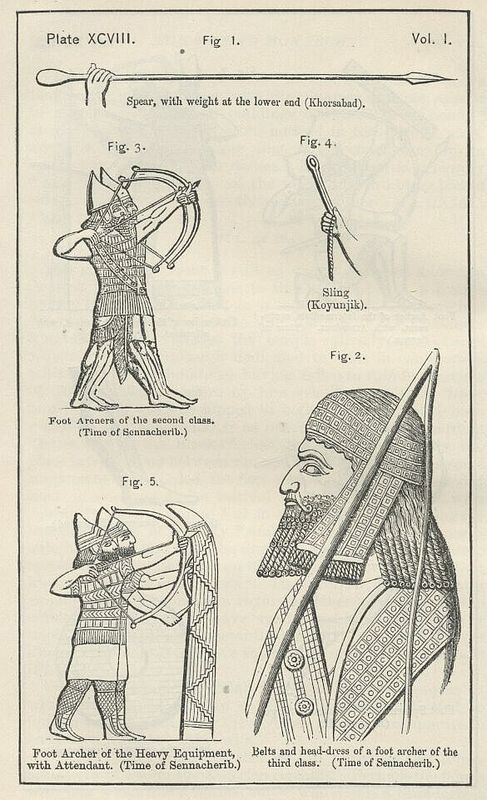
Some important changes seen to have been made under Sennacherib in the equipment and organization of the infantry force. These consisted chiefly in the establishment of a greater number of distinct corps differently armed, and in an improved equipment of the more important of them. Sennacherib appears to have been the first to institute a corps of slingers, who at any rate make their earliest appearance in his sculptures. They were kind of soldier well-known to the Egyptians and Sennacherib's acquaintance with the Egyptian warfare may have led to their introduction among the troops of Assyria. The slinger in most countries where his services were employed was lightly clad, and reckoned almost as a supernumerary. It is remarkable that in Assyria he is, at first, completely armed according to Assyrian ideas of completeness, having a helmet, a coat of mail to the waist, a tunic to the knees, a close-fitting trouser, and a short boot or greave. The weapon which distinguishes him appears to have consisted of two pieces of rope or string, attached to a short leathern strap which received the stone. [PLATE XCVIII., Fig. 4.] Previous to making his throw, the slinger seems to have whirled the weapon round his head two or three times, in order to obtain on increased impetus—a practice which was also known to the Egyptians and the Romans. With regard to ammunition, it does not clearly appear how the Assyrian slinger was supplied. He has no bag like the Hebrew slinger, no sinus like the Roman. Frequently we see him simply provided with a single extra stone, which he carries in his left hand. Sometimes, besides this reserve, he has a small heap of stones at his feet; but whether he has collected them from the field, or has brought them with him and deposited them where they lie, is not apparent.
Sennacherib's archers fall into four classes, two of which may be called heavy-armed and two light-armed. None of them exactly resemble the archers of Sargon. The most heavily equipped wears a tunic, a coat of mail reaching to the waist, a pointed helmet, a close-fitting trouser, and a short boot or greave. [PLATE XCVIII., Fig. 1.] He is accompanied by an attendant (or sometimes by two attendants) similarly attired, and fights behind a large wicker shield or gerrhon. A modification of this costume is worn by the second class, the archers of which have bare legs, a tunic which seems to open at the side, and a phillibeg. They fight without the protection of a shield, generally in pairs, who shoot together. [PLATE XCVIII., Fig. 3.]
The better equipped of the light-armed archers of this period have a costume which is very striking. Their head-dress consists of a broad fillet, elaborately patterned, from which there often depends on either side of the head a large lappet, also richly ornamented, generally of an oblong-square shape, and terminating in a fringe. [PLATE XCVIII., Fig. 2.] Below this they wear a closely fitting tunic, as short as that worn by the light-armed archers of Sargon, sometimes patterned, like that, with squares and gradines, sometimes absolutely plain. The upper part of this tunic is crossed by two belts of very unusual breadth, which pass respectively over the right and the left shoulder. There is also a third broad belt round the waist; and both this and the transverse belts are adorned with elegant patterns. The phillibeg depends from the girdle, and is seen in its full extent, hanging either in front or on the right side. The arms are naked from the shoulder, and the legs from considerably above the knee, the feet alone being protected by a scanty sandal. The ordinary short sword is worn at the side, and a quiver is carried at the back; the latter is sometimes kept in place by means of a horizontal strap which passes over it and round the body. [PLATE XCIX., Fig. 2.]
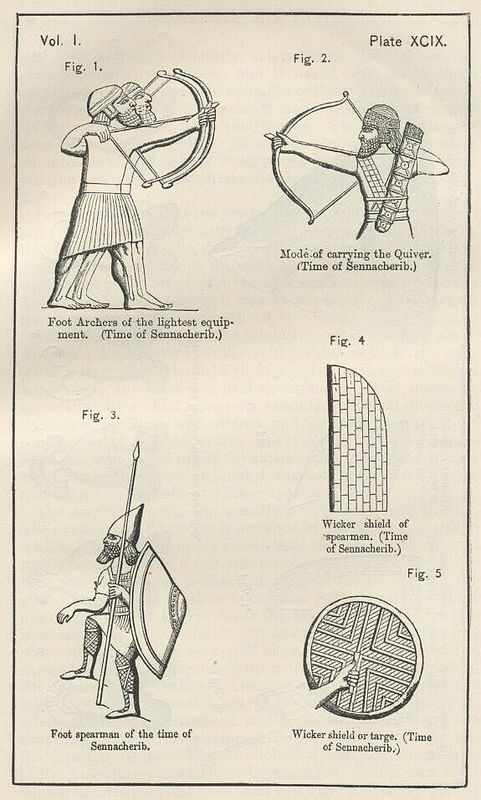
The archers of the lightest equipment wear nothing but a fillet, with or without lappets, upon the head, and a striped tunic, longer behind than in front, which extends from the neck to the knees, and is confined at the waist by a girdle. [PLATE XCIX., Fig. 1.] Their arms, legs, and feet are bare, they have seldom any sword, and their quiver seems to be suspended only by a single horizontal strap, like that represented in [PLATE XCIX., Fig. 2.] They do not appear very often upon the monuments: when seen, they are interspersed among archers and soldiers of other classes.
Sennacherib's foot spearmen are of two classes only. The better armed have pointed helmets, with lappets protecting the ears, a coat of mail descending to the waist and also covering all the upper part of the arms, a tunic opening at the side, a phillibeg, close-fitting trousers, and greaves of the ordinary character. [PLATE XCIX., Fig. 3.] They carry a large convex shield, apparently of metal, which covers them almost from head to foot, and a spear somewhat less than their own height. Commonly they have a short sword at their right side. Their shield is often ornamented with rows of bosses towards the centre and around the edge. It is ordinarily carried in front; but when the warrior is merely upon the march, he often bears it slung at his back, as in the accompanying representation. There is reason to suspect that the spearmen of this description constituted the royal bodyguard. They are comparatively few in number, and are usually seen in close proximity to the monarch, or in positions which imply trust, as in the care of prisoners and of the spoil. They never make the attacks in sieges, and are rarely observed to be engaged in battle. Where several of them are seen together, it is almost always in attendance upon the king whom they constantly precede upon his journeys.
The inferior spearmen of Sennacherib are armed nearly like those of Sargon. They have crested helmets, plain tunics confined at the waist by a broad girdle, cross-belts ornamented with circular disks where they meet in the centre of the breast, and, most commonly, round wicker shields. The chief points wherein they differ from Sargon's spearmen is the following: they usually (though not universally) wear trousers and greaves; they have sleeves to their tunics, winch descend nearly to the elbow; and they carry sometimes, instead of the round shield, a long convex one arched at the top. [PLATE XCIX., fig. 4.] Where they have not this defence, but the far commoner targe, it is always of larger dimensions than the targe of Sargon, and is generally surrounded by a rim. [PLATE XCIX., Fig. 4.] Sometimes it appears to be of metal: but more often it is of wickerwork, either of the plain construction common in Sargon's time, or of one considerably more elaborate.
Among the foot soldiers of Sennacherib we seem to find a corps of pioneers. They wear the same dress as the better equipped of the spearmen, but carry in their hands, instead of a spear, a doubled-headed axe or hatchet, wherewith they clear the ground for the passage and movements of the army. They work in pairs, one pulling at the tree by its branches while the other attacks the stem with his weapon.
After Sennacherib's time we find but few alterations in the equipment of the foot soldiers. Esarhaddon has left us no sculptures, and in those of his son and successor, Asshur-bani pal, the costumes of Sennacherib are for the most part reproduced almost exactly. The chief difference is that there are not at this time quite so many varieties of equipment, both archers and spearmen being alike divided into two classes only, light armed and heavy-armed. The light-armed archers correspond to Sennacherib's bowmen of the third class. They have the fillet, the plain tunic, the cross-belts, the broad girdle, and the phillibeg. They differ only in having no lappets over the ears and no sandals. The heavy-armed archers resemble the first class of Sennacherib exactly, except that they are not seen shooting from behind the gerrhon.
In the case of the spearmen, the only novelty consists in the shields. The spearmen of the heavier equipment, though sometimes they carry the old convex oval shield, more often have one which is made straight at the bottom, and rounded only at top. [PLATE C., Fig. 1. ] The spearmen of the lighter equipment have likewise commonly a shield of this shape, but it is of wicker work instead of metal, like that borne occasionally by the light-armed spearmen of Sennacherib.
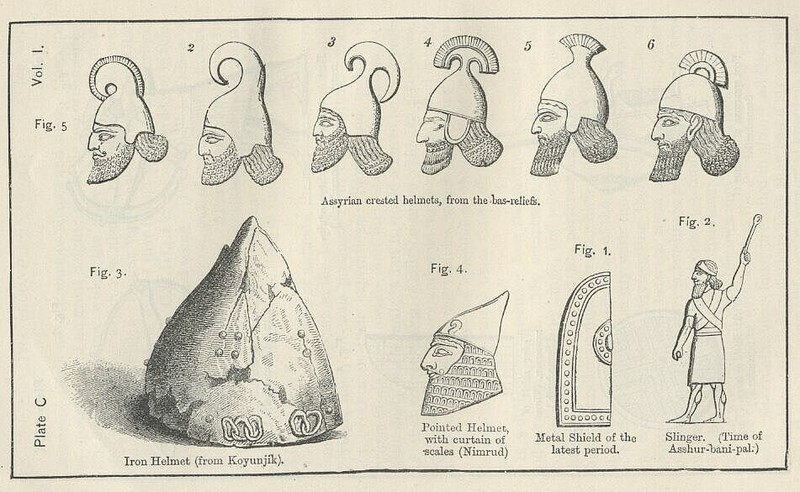
Besides spearmen and archers, we see among the foot soldiers of Asshur-bani-pal, slingers, mace-bearers, and men armed with battle axes. For the slingers Sennacherib's heavy equipment has been discarded; and they wear nothing but a plain tunic, with a girdle and cross-belts. [PLATE C., Fig. 2.] The mace-bearers and men with axes have the exact dress of Asshur-bani-pal's heavy-armed spearmen, and may possibly be spearmen who have broken or lost their weapons. It makes, however, against this view, that they have no shields, which spearmen always carry. Perhaps, therefore, we must conclude that towards the close of the empire, besides spearmen, slingers, and archers, there were distinct corps of mace-bearers and axe-bearers.
The arms used by the Assyrians have been mentioned, and to a certain extent described, in the foregoing remarks upon the various classes of their soldiers. Some further details may, however, be now added on their character and on the variety observable in them.
The common Assyrian pointed helmet has been sufficiently described already, and has received abundant illustration both in the present and in former chapters. It was at first regarded as Scythic in character; but Mr. Layard long ago observed that the resemblance which it bears to the Scythian cap is too slight to prove any connection. That cap appears, whether we follow the foreign, or the native representations of it, to have been of felt, whereas the Assyrian pointed helmet was made of metal: it was much taller than the Assyrian head-dress, and it was less upright. [PLATE C, Fig. 3.]
The pointed helmet admitted of but few varieties. In its simplest form it was a plain conical casque, with one or two rings round the base, and generally with a half-disk in front directly over the forehead. [PLATE C. Fig. 4.] Sometimes, however, there was appended to it a falling curtain covered with metal scales, whereby the chin, neck, ears, and back of the head were protected. More often it had, in lieu of this effectual but cumbrous guard, a mere lappet or cheek-piece, consisting of a plate of metal, attached to the rim, which descended over the ears in the form of a half-oval or semicircle. If we may judge by the remains actually found, the chief material of the helmet was iron; copper was used only for the rings and the half-disk in front, which were inlaid into the harder metal.
As if to compensate themselves for the uniformity to which they submitted in this instance, the Assyrians indulged in a variety of crested helmets. [PLATE. C., Fig. 5.] We cannot positively say that they invented the crest; but they certainly dealt with it in the free spirit which is usually seen where a custom is of home growth and not a foreign importation. They used either a plain metal crest, or one surmounted by tuffs of hair; and they either simply curved the crest forwards over the front of the helmet, or extended it and carried it back-wards also. In this latter case they generally made the curve a complete semicircle, while occasionally they were content with a small segment, less even than a quarter of a circle. They also varied considerably the shape of the lappet over the ear, and the depth of the helmet behind and before the lappet.
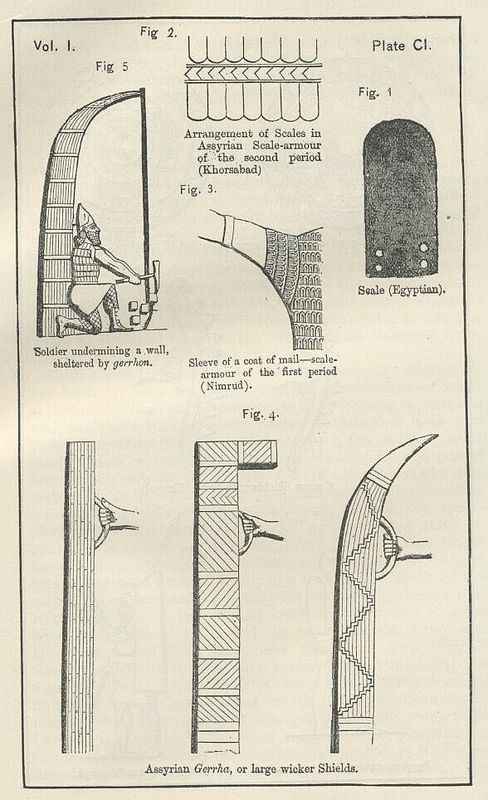
Assyrian coats of mail were of three sizes, and of two different constructions. In the earlier times they were worn long, descending either to the feet or to the knees; and at this period they seem to have been composed simply of successive rows of similar iron scales sewn on to a shirt of linen or felt. [PLATE CI., Fig. 1.] Under the later monarchs the coat of mail reached no lower than the waist, and it was composed of alternate bands of dissimilar arrangement and perhaps of different material. Mr. Layard suggests that at this time the scales, which were larger than before, were "fastened to bands of iron or copper." But it is perhaps more probable that scales of the old character alternated in rows with scales of a new shape and smaller dimensions. [PLATE CI., Fig. 2.] The old scales were oblong, squared at one end and rounded at the other, very much resembling the Egyptian. They were from two to three inches, or more, in length, and were placed side by side, so that their greater length corresponded with the height of the wearer. The new scales seem to have been not more than an inch long; they appear to have been pointed at one end, and to have been laid horizontally, each a little overlapping its fellow. It was probably found that this construction, while possessing quite as much strength as the other, was more favorable to facility of movement.
Remains of armor belonging to the second period have been discovered in the Assyrian ruins. The scales are frequently embossed over their whole surface with groups of figures and fanciful ornaments. The small scales of the first period have no such elaborate ornamentation, being simply embossed in the centre with a single straight line, which is of copper inlaid into the iron.
The Assyrian coat of mail, like the Egyptian, had commonly a short sleeve, extending about half way down to the elbow. [PLATE CI.. Fig. 1.] This was either composed of scales set similarly to those of the rest of the cuirass, or of two, three, or more rows placed at right angles to the others. The greater part of the arm was left without any protection.
A remarkable variety existed in the form and construction of the Assyrian shields. The most imposing kind is that which has been termed the gerrhon, from its apparent resemblance to the Persian shield mentioned under that name by Herodotus. [PLATE CI.. Fig. 1.] This was a structure in wickerwork, which equalled or exceeded the warrior in height, and which was broad enough to give shelter to two or even three men. In shape it was either an oblong square, or such a square with a projection at top, which stood out at right angles to the body of the shield; or, lastly, and most usually, it curved inwards from a certain height, gradually narrowing at the same time, and finally ending in a point. Of course a shield of this vast size, even although formed of a light material, was too heavy to be very readily carried upon the arm. The plan adopted was to rest it upon the ground, on which it was generally held steady by a warrior armed with sword or spear, while his comrade, whose weapon was the bow, discharged his arrows from behind its shelter. Its proper place was in sieges, where the roof-like structure at the top was especially useful in warding off the stones and other missiles which the besieged threw down upon their assailants. We sometimes see it employed by single soldiers, who lean the point against the wall of the place, and, ensconcing themselves beneath the penthouse thus improvised, proceed to carry on the most critical operations of the siege in almost complete security.
Modifications of this shield, reducing it to a smaller and more portable size, were common in the earlier times, when among the shields most usually borne we find one of wicker-work oblong-square in shape, and either perfectly fiat, or else curving slightly inwards both at top and at bottom. This shield was commonly about half the height of a man, or a little more; it was often used as a protection for two, but must have been scanty for that purpose.
Round shields were commoner in Assyria than any others. They were used by most of those who fought in chariots, by the early monarchs' personal attendants, by the cross-belted spear-men, and by many of the spearmen who guarded archers. In the most ancient times they seem to have been universally made of solid metal, and consequently they were small, perhaps not often exceeding two feet, or two feet and a half, in diameter. They were managed by means of a very simple handle, placed in the middle of the shield at the back, and fastened to it by studs or nails, which was not passed over the arm but grasped by the hand. The rim was bent inwards, so as to form a deep groove all round the edge. The material of which these shields were composed was in some cases certainly bronze; in others it may have been iron: in a few silver, or even gold. Some metal shields were perfectly plain; others exhibited a number of concentric rings, others again were inlaid or embossed with tasteful and elaborate patterns.
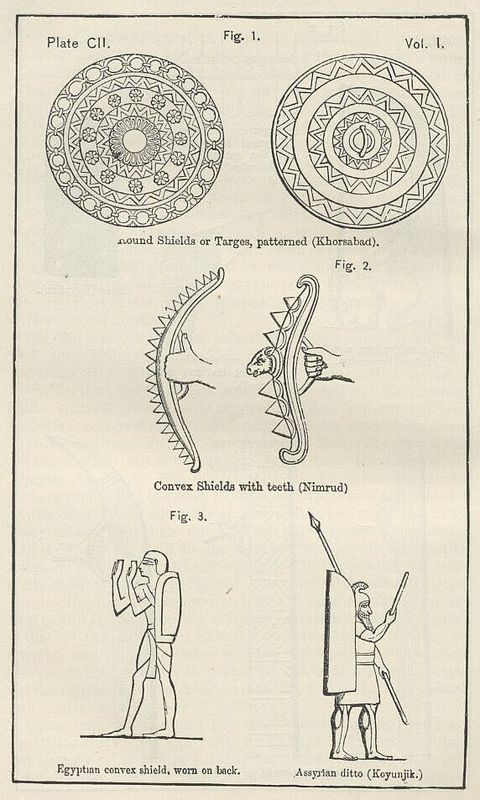
Among the later Assyrians the round metal shield seems to have been almost entirely disused, its place being supplied by a wicker buckler of the same shape, with a rim round the edge made of solid wood or of metal, and sometimes with a boss in the centre. [PLATE CII., Fig. 1.] The weight of the metal shield must have been considerable; and this both limited their size and made it difficult to move them with rapidity. With the change of material we perceive a decided increase of magnitude, the diameter of the wicker buckler being often fully half the warrior's height, or not much short of three feet.
Convex shields, generally of an oblong form, were also in common use during the later period, and one kind is found in the very earliest sculptures. This is of small dimensions and of a clumsy make. Its curve is slight, and it is generally ornamented with a perpendicular row of spikes or teeth, in the centre of which we often see the head of a lion. [PLATE CII., Fig. 2.]
The convex shields of later date were very much larger than these. [PLATE CIII., Fig. 3.] They were sometimes square at bottom and rounded at top, in which case they were either made of wickerwork, or (apparently) of metal. These latter had generally a boss in the centre, and both this and the edge of the shield were often ornamented with a row of rosettes or rings. Shields of this shape were from four to five feet in height, and protected the warrior from the head to the knee. On a march they were often worn upon the back, like the convex shield of the Egyptians, which they greatly resembled.
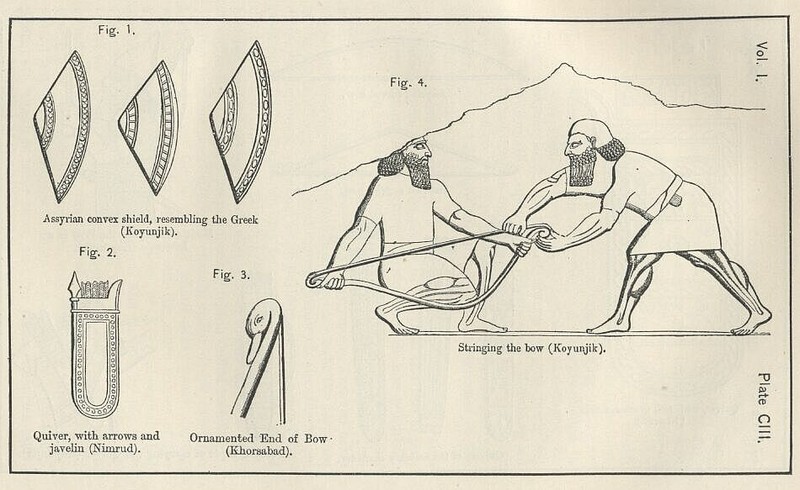
The more ordinary convex shield was of an oval form, like the convex shield of the Greeks, but larger, and with a more prominent centre. [PLATE CIII., Fig. 1.] In its greater diameter it must often have exceeded five feet, though no doubt sometimes it was smaller. It was generally ornamented with narrow bands round the edge and round the boss at the centre, the space between the bands being frequently patterned with ring; or otherwise. Like the other form of convex shield, it could be slung at the back, and was so carried on marches, on crossing rivers, and other similar occasions.
The offensive arms certainly used by the Assyrians were the bow, the spear, the sword, the mace, the sling, the axe or hatchet, and the dagger. They may also have occasionally made use of the javelin, which is sometimes seen among the arrows of a quiver. But the actual employment of this weapon in war has not yet been found upon the bas-reliefs. If faithfully represented, it must have been very short,—scarcely, if at all, exceeding three feet. [PLATE CIII., Fig. 2.]
Assyrian bows were of two kinds, curved and angular. Compared with the Egyptian, and with the bows used by the archers of the middle ages, they were short, the greatest length of the strung bow being about four feet. They seem to have been made of a single piece of wood, which in the angular bow was nearly of the same thickness throughout, but in the curved one tapered gradually towards the two extremities. At either end was a small knob or button, in the later times often carved into the representation of a duck's head. [PLATE CIII, Fig. 3.] Close above this was a notch or groove, whereby the string was held in place. The mode of stringing was one still frequently practised in the East. The bowman stooped, and placing his right knee against the middle of the bow on its inner side, pressed it downwards, at the same time drawing the two ends of the bow upwards with his two hands. [PLATE CIII, Fig. 4.] A comrade stood by, and, when the ends were brought sufficiently near, slipped the string over the knob into the groove, where it necessarily remained. The bend of the bow, thus strung, was slight. When full drawn, however, it took the shape of a half-moon, which shows that it must have possessed great elasticity. [PLATE CIV., Fig. 4.] The bow was known to be full drawn when the head of the arrow touched the archer's left hand.
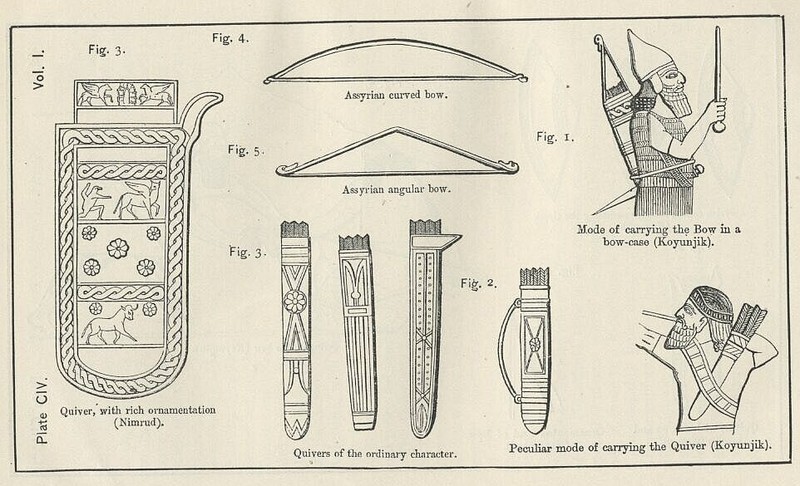
The Assyrian angular bow was of smaller size than the curved one. It was not often carried unless as a reserve by those who also possessed the larger and better weapon. [PLATE CIV., Fig. 5.]
Bows were but seldom unstrung. When not in use, they were carried strung, the archer either holding them by the middle with his left hand, or putting his arm through them, and letting them rest upon his shoulders, or finally carrying them at his back in a bow case. [PLATE CIV., Fig. I. ] The bow-case was a portion of the quiver, as frequently with the Greeks, and held only the lower half of the bow, the upper portion projecting from it.
Quivers were carried by foot and horse archers at their backs, in a diagonal position, so that the arrows could readily be drawn from them over the right shoulder. They were commonly slung in this position by a strap of their own, attached to two rings, one near the top and the other near the bottom of the quiver, which the archer slipped over his left arm and his head. Sometimes, however, this strap seems to have been wanting, and the quiver was either thrust through one of the cross-belts, or attached by a strap which passed horizontally round the body a little above the girdle. [PLATE CIV.,Fig. 2.] The archers who rode in chariots carried their quivers at the chariot's side, in the manner which has been already described and illustrated.
The ornamentation of quivers was generally elaborate. [PLATE CIV., Fig. 3.] Rosettes and bands constituted their most usual adornment; but sometimes these gave place to designs of a more artistic character, as wild bulls, griffins, and other mythic figures. Several examples of a rich type have been already given in the representations of chariots, but none exhibit this peculiarity. One further specimen of a chariot quiver is therefore appended, which is among the most tasteful hitherto discovered. [PLATE CIV., Fig. 3. ]
The quivers of the foot and horse archers were less richly adorned than those of the bowmen who rode in chariots, but still they were in almost every case more or less patterned. The rosette and the band here too constituted the chief resource of the artist, who, however, often introduced with good effect other well-known ornaments, as the guilloche, the boss and cross, the zigzag, etc.
Sometimes the quiver had an ornamented rod attached to it, which projected beyond the arrows and terminated in a pomegranate blossom or other similar carving. [PLATE CV. Fig. 1]. To this rod was attached the rings which received the quiver strap, a triple tassel hanging from them at the point of attachment. The strap was probably of leather, and appears to have been twisted or plaited.
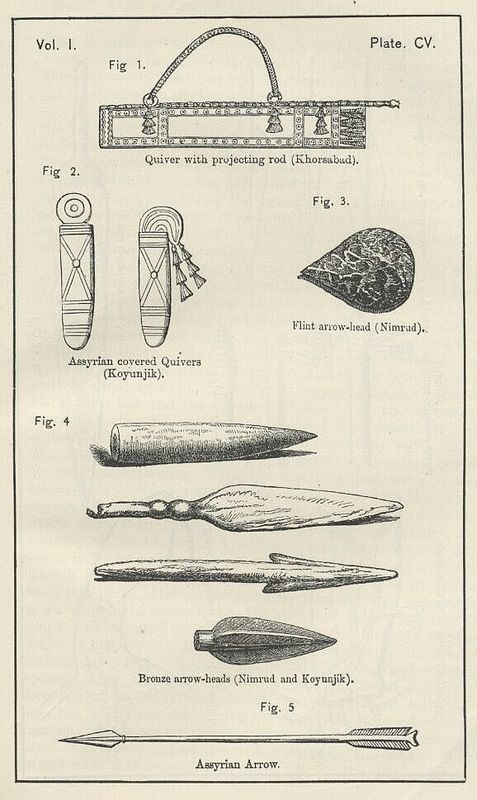
It is uncertain whether the material of the quivers was wood or metal. As, however, no remains of quivers have been discovered in any of the ruins, while helmets, shields, diggers, spear-heads, and arrow-heads have been found in tolerable abundance, we may perhaps assume that they were of the more fragile substance, which would account for their destruction. In this case their ornamentation may have been either by carving or painting, the bosses and rosettes being perhaps in some cases of metal, mother-of-pearl, or ivory. Ornaments of this kind were discovered by hundreds at Nimrud in a chamber which contained arms of many descriptions. Quivers have in some cases a curious rounded head, which seems to have been a lid or cap used for covering the arrows. They have also, occasionally, instead of this, a kind of bag at their top, which falls backwards, and is ornamented with tassels. [PLATE CV., Fig. 2.] Both these constructions, however, are exceptional, a very large majority of the quivers being open, and having the feathered ends of the arrows projecting from them.
There is nothing remarkable in the Assyrian arrows except their perfect finish and completeness in all that constitutes the excellence of such a weapon. The shaft was thin and straight, and was probably of reed, or of some light and tough wood. The head was of metal, either of bronze or iron, and was generally diamond-shaped, like a miniature spear-head. [PLATE CV., Fig. 4. ] It was flattish, and for greater strength had commonly a strongly raised line down the centre. The lower end was hollowed, and the shaft was inserted into it. The notching and feathering of the shaft were carefully attended to. It is doubtful whether three feathers were used, as by ourselves and by the Egyptians, or two only as by many nations. The fact that we never see more than two feathers upon the monuments cannot be considered decisive, since the Assyrian artists, from their small knowledge of perspective, would have been unable to represent all three feathers. So far as we can judge from the representations, it would seem that the feathers were glued to the wood exactly as they are with ourselves. The notch was somewhat large, projecting beyond the line of the shaft—a construction rendered necessary by the thickness of the bowstring., which was seldom less than of the arrow it-self. [PLATE CV., Fig. 5.]
The mode of drawing the bow was peculiar. It was drawn neither to the ear, nor to the breast, but to the shoulder. In the older sculptures the hand that draws it is represented in a curiously cramped and unnatural position, which can scarcely be supposed to be true to nature. But in the later bas-reliefs greater accuracy seems to have been attained, and there we probably see the exact mode in which the shooting was actually managed. The arrow was taken below the feathers by the thumb and forefinger of the right hand, the forefinger bent down upon it in the way represented in the accompanying illustration, and the notch being then placed upon the string, the arrow was drawn backwards by the thumb and forefinger only, the remaining three fingers taking no part in the operation. [PLATE CVI., Fig. 1.] The bow was grasped by the left hand between the fingers and the muscle of the thumb, the thumb itself being raised, and the arrow made to pass between it and the bow, by which it was kept in place and prevented from slipping. The arrow was then drawn till the cold metal head touched the forefinger of the left hand, upon which the right hand quitted its hold, and the shaft sped on its way. To save the left arm from being bruised or cut by the bowstring, a guard, often simply yet effectively ornamented, was placed upon it, at one end passing round the thumb and at the other round the arm a little above the elbow. [PLATE CVI., Fig. 2.]
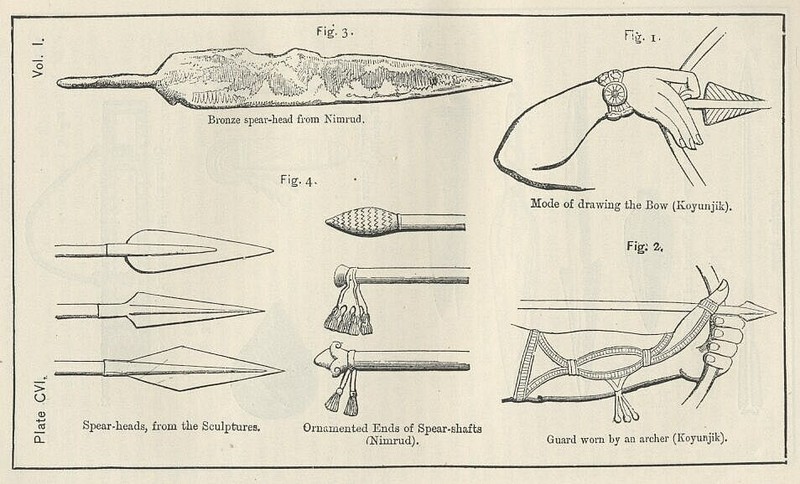
The Assyrians had two kinds of spears, one a comparatively short weapon, varying from five to six feet in length, with which they armed a portion of their foot soldiers, the other a weapon nine or ten feet long, which was carried by most of their cavalry. The shaft seems in both cases to have been of wood, and the head was certainly of metal, either bronze or iron. [PLATE CVI., Fig. 3.] It was most usually diamond-shaped, but sometimes the side angles were rounded off, and the contour became that of an elongated pear. [PLATE CVI., Fig. 4.] In other instances, the jambs of the spear-head were exceedingly short, and the point long and tapering. The upper end of the shaft was sometimes weighted, and it was often carved into some ornamental form, as a fir-cone or a pomegranate blossom, while in the earlier times it was further occasionally adorned with streamers. [PLATE CVI., Fig. 4.] The spear of the Assyrians seems never to have been thrown, like that of the Greeks, but was only used to thrust with, as a pike.
The common sword of the Assyrians was a short straight weapon, like the sword of the Egyptians, or the acinaces of the Persians. It was worn at the left side, generally slung by a belt of its own which was passed over the right shoulder, but sometimes thrust through the girdle or (apparently) through the armor. It had a short rounded handle, more or less ornamented [PLATE CVII.. Fig. 1], but without any cross-bar or guard, and a short blade which tapered gradually from the handle to the point. The swordsman commonly thrust with his weapon, but he could cut with it likewise, for it was with this arm that the Assyrian warrior was wont to decapitate his fallen enemy. The sheath of the sword was almost always tastefully designed, and sometimes possessed artistic excellence of a high order. [PLATE CVII., Fig. 3.] The favorite terminal ornament consisted of two lions clasping one another, with their heads averted and their mouths agape. Above this, patterns in excellent taste usually adorned the scabbard, which moreover exhibited occasionally groups of figures, sacred trees, and other mythological objects.
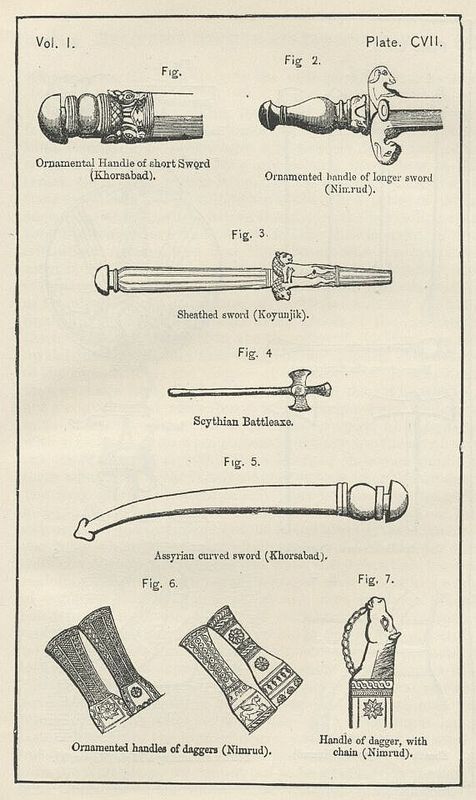
Instead of the short sword, the earlier warriors had a weapon of a considerable length. This was invariably slung at the side by a cross-belt passing over the shoulder. In its ornamentation it closely resembled the later short sword, but its hilt was longer and more tasteful.
One or two instances occur where the sword of an Assyrian warrior is represented as curved slightly. The sheath in these cases is plain, and terminates in a button. [PLATE CVII, Fig. 5.]
The Assyrian mace was a short thin weapon, and must either have been made of a very tough wood, or—and this is more probable of metal. [PLATE CVIII., Fig. 7.] It had an ornamented head, which was sometimes very beautifully modelled and generally a strap or string at the lower end, by which it could be grasped with greater firmness. Foot archers frequently carried it in battle, especially those who were in close attendance upon the king's person. It seems, however, not to have been often used as a warlike weapon until the time of the latest sculptures, when we see it wielded, generally with both hands, by a certain number of the combatants. In peace it was very commonly borne by the royal attendants, and it seems also to have been among the weapons used by the monarch himself, for whom it is constantly carried by one of those who wait most closely upon his person. [PLATE., CVIII., Fig. I.]
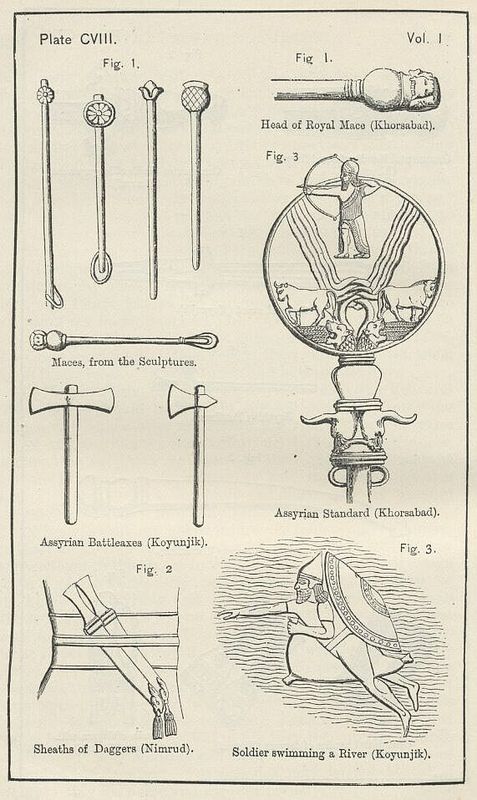
The battle-axe was a weapon but rarely employed by the Assyrians. It is only in the very latest sculptures and in a very few instances that we find axes represented as used by the warriors for any other purpose besides the felling of trees. Where they are seen in use against the enemy, the handle is short, the head somewhat large, and the weapon wielded with one hand. Battle-axes had heads of two kinds. [PLATE CVIII., Fig. 1.] Some were made with two blades, like the bipennis of the Romans. and the labra of the Lydians and Carians; others more nearly resembled the weapons used by our own knights in the middle ages, having a single blade, and a mere ornamental point on the other side of the haft.
The dagger was worn by the Assyrian kings at almost all times in their girdles, and was further often assigned to the mythic winged beings, hawk headed or human-headed, which occur so frequently in the sculptures; but it seems to have been very seldom carried by subjects. It had commonly a straight handle, slightly concave, and very richly chased, exhibiting the usual Assyrian patterns, rosettes, chevrons, guilloches, pine-cones, and the like. [PLATE CVII., Fig. 6.] Sometimes, however, it was still more artistically shaped, being cast into the form of a horse's head and neck. In this case there was occasionally a chain attached at one end to the horse's chin, and at the other to the bottom of his neck, which, passing outside the hand, would give it a firmer hold on the weapon. The sheaths of daggers seem generally to have been plain, or nearly so, but occasionally they terminated in the head of an animal, from whose mouth depended a tassel. [PLATE CVIII., Fig. 2.]
Though the Assyrian troops were not marshalled by the aid of standards, like the Roman and the Egyptian, yet still a kind of standard is occasionally to be recognized in the bas-reliefs. This consists of a pole of no great height, fixed upright at the front of a chariot, between the charioteer and the warrior, and carrying at the top a circular frame, within which are artistic representations of gods or sacred animals. Two bulls, back to back, either trotting or running at speed, are a favorite device. Above there sometimes stands a figure in a horned cap, shooting his arrows against the enemy. Occasionally only one bull is represented, and the archer shoots standing upon the bull's back. Below the circular framework are minor ornaments, as lions' and bulls' heads, or streamers adorned with tassels. [PLATE CVIII., Fig. 2.]
We do not obtain much information from the monuments with respect to the military organization or the the tactics of the Assyrians. It is clear, however, that they had advanced beyond the first period in military matters, when men fight in a confused mass of mingled horse, foot, and chariots, heavy-armed and light-armed spear-men, archers, and stingers, each standing and moving as mere chance may determine. It is even certain that they had advanced beyond the second period, when the phalanx order of battle is adopted, the confused mass being replaced by a single serried body presenting its best armed troops to the enemy, and keeping in the rear, to add their weight to the charge, the weaker and more imperfectly protected. It was not really left for Cyaxares the Mede to be the first to organize an Asiatic army—to divide the troops into companies and form distinct bodies of the spearmen, the archers, and the cavalry. The Assyrian troops were organized in this way, at least from the time of Sennacherib, on whose sculptures we find, in the first place, bodies of cavalry on the march unaccompanied by infantry; secondly, engagements where cavalry only are acting against the enemy; thirdly, long lines of spearmen on foot marching in double file, and sometimes divided into companies; and, fourthly, archers drawn up together, but similarly divided into companies, each distinguished by its own uniform. We also meet with a corps of pioneers, wearing a uniform and armed only with a hatchet, and with bodies of slingers, who are all armed and clothed alike. If, in the battles and the sieges of this time, the troops seem to be to a great extent confused together, we may account for it partly by the inability of the Assyrian artists to represent bodies of troops in perspective, partly by their not aiming at an actual, but rather at a typical representation of events, and partly also by their fondness for representing, not the preparation for battle or its first shock, but the rout and flight of the enemy and their own hasty pursuit of them.
The wars of the Assyrians, like those of ancient Rome, consisted of annual inroads into the territories of their neighbors, repeated year after year, till the enemy was exhausted, sued for peace, and admitted the suzerainty of the more powerful nation. The king in person usually led forth his army, in spring or early summer, when the mountain passes were opened, and, crossing his own borders, invaded some one or other of the adjacent countries. The monarch himself invariably rode forth in his chariot, arrayed in his regal robes, and with the tiara upon his head: he was accompanied by numerous attendants, and generally preceded and followed by the spearmen of the Royal Guard, and a detachment of horse-archers. Conspicuous among the attendants were the charioteer who managed the reins, and the parasol-bearer, commonly a eunuch, who, standing in the chariot behind the monarch, held the emblem of sovereignty over his head. A bow-bearer, a quiver-bearer, and a mace-bearer were usually also in attendance, walking before or behind the chariot of the king, who, however, did not often depend for arms wholly upon them, but carried a bow in his left hand, and one or more arrows in his right, while he had a further store of the latter either in or outside his chariot. Two or three led horses were always at hand, to furnish a means of escape in any difficulty. The army, marshalled in its several corps, in part preceded the royal cortege, in part followed at a little distance behind it.
On entering the enemy's country, if a wooded tract presented itself, the corps of pioneers was thrown out in advance, and cleared away the obstructions. When a river was reached too deep to be forded, the horses were detached from the royal and other chariots by grooms and attendants; the chariots themselves were embarked upon boats and rowed across the stream; while the horses, attached by ropes to a post near the stern of the boat, swam after it. The horses of the cavalry were similarly drawn across by their riders. The troops, both cavalry and infantry, and the attendants, a very numerous body, swam the stream, generally upon inflated skins, which they placed under them, holding the neck in their left hand, and sometimes increasing the inflation as they went by applying the orifice at the top of the neck to their mouths. [PLATE CVIII., Fig. 3.] We have no direct evidence as to the mode in which the baggage of an army, which must have been very considerable, was conveyed, either along the general line of route, or when it was necessary to cross a river. We may conjecture that in the latter case it was probably placed upon rafts supported on inflated skins, such as those which conveyed stones from distant quarries to be used in the Assyrian buildings. In the former, we may perhaps assume that the conveyance was chiefly by beasts of burden, camels and asses, as the author of the book of Judith imagined. Carts may have been used to some extent; since they were certainly employed to convey back to Assyria the spoil of the conquered nations.
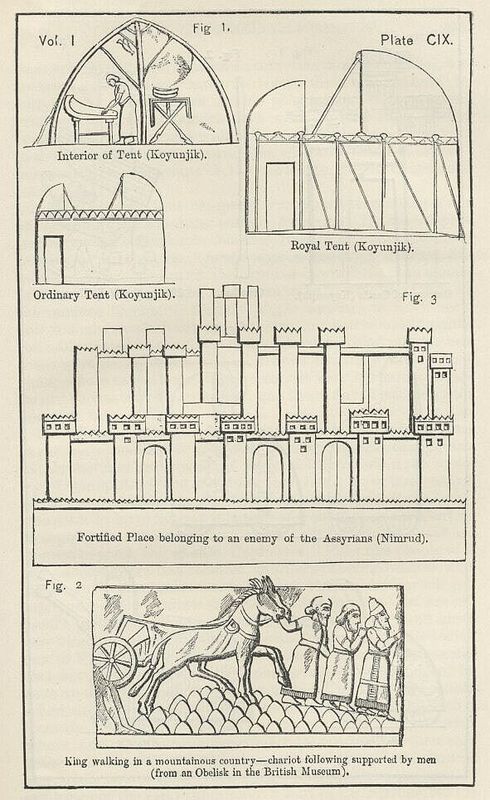
It does not appear whether the army generally was provided with tents or not. Possibly the bulk of the soldiers may have bivouacked in the open field, unless when they were able to obtain shelter in towns or villages taken from the enemy. Tents, however, were certainly provided for the monarch and his suite. [PLATE CIX., Fig. 1.] Like the tents of the Romans, these appear to have been commonly pitched within a fortified enclosure, which was of an oval shape. They were disposed in rows, and were all nearly similar in construction and form, the royal tent being perhaps distinguished from the others by a certain amount of ornamentation and by a slight superiority of size. The material used for the covering was probably felt. All the tents were made open to the sky in the centre, but closed in at either extremity with a curious semicircular top. [PLATE CIX., Fig. 1.] The two tops were unequal of size. Internally, either both of them, or at any rate the larger ones, were supported by a central pole, which threw out branches in different directions resembling the branches of a tree or the spokes of a parasol. Sometimes the walls of the tent had likewise the support of poles, which were kept in place by ropes passed obliquely from the top of each to the ground in front of them, and then firmly secured by pegs. Each tent had a door, square-headed, which was placed at the side, near the end which had the smaller covering. The furniture of tents consisted of tables, couches, footstools, and domestic utensils of various kinds. [PLATE CIX., Fig. 1.] Within the fortified enclosure, but outside the tents, were the chariot and horses of the monarch, an altar where sacrifice could be made, and a number of animals suitable for food, as oxen, sheep, and goats.
It appears that occasionally the advance of the troops was along a road. Ordinarily, however, they found no such convenience, but had to press forward through woods and over mountains as they best could. Whatever the obstructions, the chariot of the monarch was in some way or other conveyed across them, though it is difficult to suppose that he could have always remained, as he is represented, seated in it. Probably he occasionally dismounted, and made use of one of the led horses by which he was always accompanied, while sometimes he even condescended to proceed on foot. [PLATE CIX., Fig. 2.] Tile use of palanquins or litters seem not to have been known to the Assyrians, though it was undoubtedly very ancient in Asia; but the king was sometimes carried on men's shoulders, seated on his throne in the way that we see the enthroned gods borne in many of the sculptures.
The first object in entering a country was to fight, if possible, a pitched battle with the inhabitants. The Assyrians were always confident of victory in such an encounter, being better armed, better disciplined, and perhaps of stronger frames than any of their neighbors. There is no evidence to show how their armies were drawn up, or how the troops were handled in an engagement; but it would seem that in most cases, after a longer or a shorter resistance, the enemy broke and fled, sometimes throwing away his arms, at other tunes fighting as he retired, always vigorously pursued by horse and foot, and sometimes driven headlong into a river. Quarter was not very often given in a battle. The barbarous practice of rewarding those who carried back to camp the heads of foemen prevailed; and this led to the massacre in many cases even of the wounded, the disarmed, and the unresisting, though occasionally quarter was given, more especially to generals and other leading personages whom it was of importance to take alive. Even while the engagement continued, it would seem that soldiers might quit the ranks, decapitate a fallen foe, and carry off his head to the rear, without incurring any reproof; and it is certain that, so soon as the engagement was over, the whole army turned to beheading the fallen, using for this purpose the short sword which almost every warrior carried at his left side. A few unable to obtain heads, were forced to be content with gathering the spoils of the slain and of the fled, especially their arms, such as quivers, hews, helmets, and the like; while their more fortunate comrades, proceeding to an appointed spot in the rear, exhibited the tokens of their valor, or of their good luck, to the royal scribes, who took an exact account of the amount, of the spoil, and of the number of the enemy killed.
When the enemy could no longer resist in the open field, he usually fled to his strongholds. Almost all the nations with whom the Assyrians waged their wars possessed fortified cities, or castles, which seem to have been places constructed with a good deal of skill, and possessed of no inconsiderable strength. According to the representations of the sculptures, they were all nearly similar in character, the defences consisting of high battlemented walls, pierced with loopholes or windows towards their upper part, and flanked at intervals along their whole course by towers. [PLATE CIX., Fig. 3.] Often they possessed two or more enceintes, which in the bas-reliefs are represented one above the other; and in these cases the outermost circuit was sometimes a mere plain continuous wall, as in the illustration. They were entered by large gateways, most commonly arched, and closed by two huge gates or doors, which completely filled up the aperture. Occasionally, however, the gateways were square-headed, as in the illustration, where there occurs, moreover, a very curious ornamentation of the battlements. [PLATE CX., Fig. 1.]
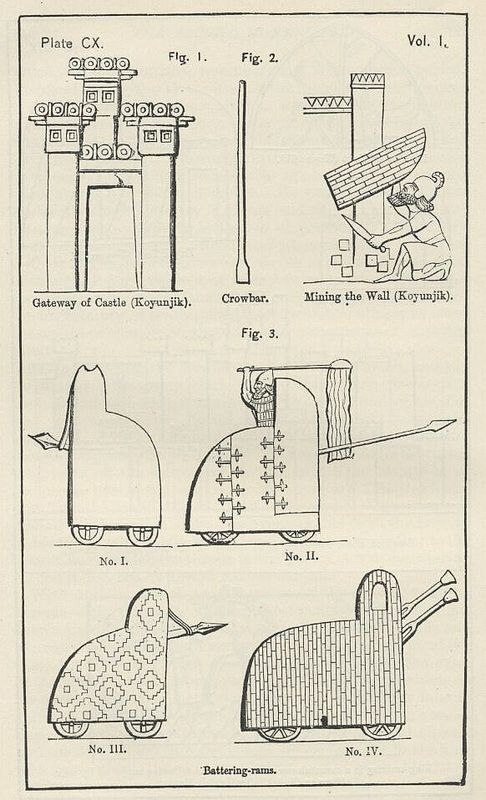
These fortified places the Assyrians attacked in three principal ways. Sometimes they endeavored to take them by escalade, advancing for this purpose a number of long ladders against different parts of the walls, thus distracting the enemy's attention and seeking to find a weak point. Up the ladders proceeded companies of spearmen and archers in combination, the spearmen invariably taking the lead, since their large shields afforded them a protection which archers advancing in file up a ladder could not have. Meanwhile from below a constant discharge was kept up by bowmen and slingers, the former of whom were generally protected by the gerrhon or high wicker shield, held in front of them by a comrade. The besieged endeavored to dislodge and break the ladders, which are often represented in fragments; or, failing in this attempt, sought by hurling down large stones, and by discharges from their bows and slings, to precipitate and destroy their assailants. If finally they were unable by these means to keep the Assyrians from reaching the topmost rounds of the ladders, they had recourse to their spears, and man to man, spear to spear, and shield to shield, they still struggled to defend themselves. The Assyrians always represent the sieges which they conduct as terminating successfully: but we may be tolerably sure that in many instances the invader was beaten back, and forced to relinquish his prey, or to try fresh methods of obtaining it.
If the escalade failed, or if it was thought unadvisable to attempt it, the plan most commonly adopted was to try the effect of the battering-ram. [PLATE CX., Fig. 3.] The Assyrian armies were abundantly supplied with these engines, of which we see as many as seven engaged in a single siege. They were variously designed and arranged. Some had a head shaped like the point of a spear; others, one more resembling the end of a blunderbuss. All of them were covered with a frame-work, which was of ozier, wood, felt, or skins, for the better protection of those who worked the implement; but some appear to have been stationary, having their framework resting on the ground itself, while others were moveable, being provided with wheels, which in the early times were six, but in the later times four only. Again, sometimes, combined with the ram and its framework was a moveable tower containing soldiers, who at once fought the enemy on a level, and protected the engine from their attacks. Fire was the weapon usually turned against the ram, torches, burning tow, or other inflammable substances being cast from the walls upon its framework, which, wherever it was of ozier or of wood, could be easily set alight and consumed. To prevent this result, the workers of the ram were sometimes provided with a supply of water, which they could direct through leathern or metal pipes against the combustibles. At other times they sought to protect themselves by suspending from a pole in front of their engine a curtain of cloth, leather, or some other non-inflammable substance.
Another mode of meeting the attacks of the battering-ram was by catching the point with a chain suspended by its two ends from the walls, and then, when the ram was worked, diverting the stroke by drawing the head upwards. To oppose this device, the besiegers provided some of their number with strong metal hooks, and stationed them below the ram, where they watched for the descent of the chain. As soon as ever it caught the head of the ram, they inserted their hooks into its links, and then hanging upon it with their whole weight, prevented its interference with the stroke.
Battering-rams were frequently used against the walls from the natural ground at their foot. Sometimes, however, the besiegers raised vast mounds against the ramparts, and advanced their engines up these, thus bringing theirs on a level with the upper and weaker portions of the defences. Of this nature probably were the mounds spoken of in Scripture as employed by the Babylonians and Egyptians, as well as the Assyrians, in their sieges of cities. The intention was not so much to pile up the mounds till they were on a level with the top of the walls as to work the battering-ram with greater advantage from them. A similar use was made of mounds by the Peloponnesian Greeks, who nearly succeeded in taking Plataea in this way. The mounds were not always composed entirely of earth; the upper portion was often made of several layers of stone or brick, arranged in regular order, so as to form a sort of paved road, up which the rams might be dragged with no great difficulty. Trees, too, were sometimes cut down and built into the mound.
Besides battering-rams, the Assyrians appear to have been acquainted with an engine resembling the catapult, or rather the balista of the Romans. [PLATE CXI., Fig. 1.] This engine, which was of great height, and threw stones of a large size, was protected, like the ram, by a framework, apparently of wood, covered with canvas, felt, or hides. The stones thrown from the engine were of irregular shape, and it was able to discharge several at the same time. The besiegers worked it from a mound or inclined plane, which enabled them to send their missiles to the top of the ramparts. It had to be' brought very close to the walls in order to be effective—a position which gave the besieged an opportunity of assailing it by fire. Perhaps it was this liability which caused the infrequent use of the engine in question, which is rare upon the earlier, and absent from the later, sculptures.
The third mode of attack employed by the Assyrians in their sieges of fortified places was the mine. While the engines were in full play, and the troops drawn up around the place assailed the defenders of the walls with their slings and bows, warriors, singly, or in twos and threes, advanced stealthily to the foot of the ramparts, and either with their swords and the points of their spears, or with implements better suited for the purpose, such as crowbars and pickaxes, attacked the foundations of the walls, endeavoring to remove the stones one by one, and so to force an entrance. While thus employed, the assailant commonly either held his shield above him as a protection or was guarded by the shield of a comrade; or, finally, if he carried the curved gerrhon, leant it against the wall, and then placed himself under its shelter. [PLATE CX., Fig. 2.] Sometimes, however, he dispensed with the protection of a shield altogether, and, trusting his helmet and coat of mail, which covered him at all vital points, pursued his labor without paying any attention to the weapons aimed at him by the enemy.
Occasionally the efforts of the besiegers were directed against the gates, which they endeavored to break open with axes, or to set on fire by an application of the torch. From this latter circumstance we may gather that the gates were ordinarily of wood, not, like those of Babylon and Veii, of brass. In the hot climate of Southern Asia wood becomes so dry by exposure to the sun that the most solid doors may readily be ignited and consumed.
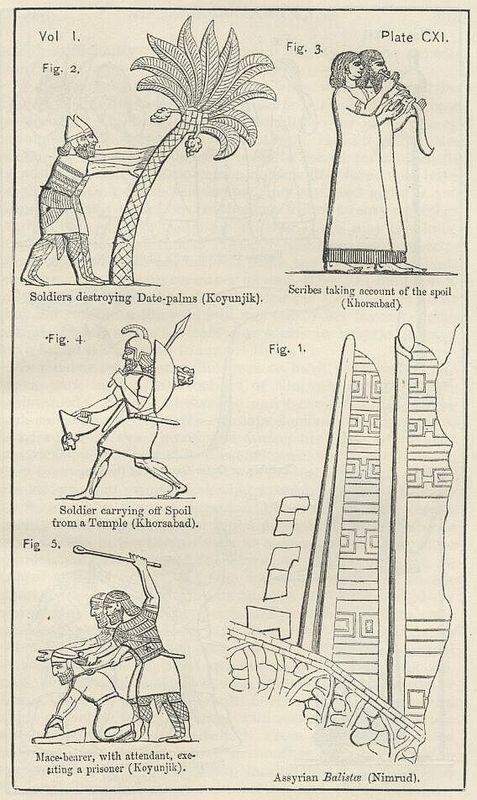
When at last the city or castle was by some of these means reduced, and the garrison consented to surrender itself, the work of demolition, already begun, was completed. Generally the place was set on fire; sometimes workmen provided with pickaxes and other tools mounted upon the ramparts and towers, hurled down the battlements, broke breaches in the walls, or even levelled the whole building. [PLATE CXII., Fig. 1.] Vengeance was further taken by the destruction of the valuable trees in the vicinity, more especially the highly prized date-palms, which were cut with hatchets half through their stems at the distance of about two feet from the ground, and then pulled or pushed down. [PLATE CXI., Fig. 2.] Other trees were either treated similarly, or denuded of their branches. Occasionally the destruction was of a less wanton and vengeful character. Timber-trees were cut down for transport to Assyria, where they were used in the construction of the royal-palaces; and fruit-trees were occasionally taken up by the roots, removed carefully, and planted in the gardens and orchards of the conquerors. Meanwhile there was a general plundering of the captured place. The temples were entered, and the images of the gods, together, with the sacred vessels, which were often of gold and silver, were seized and carried off in triumph. [PLATE CXI., Fig. 4.] This was not mere cupidity. It was regarded as of the utmost importance to show that the gods of the Assyrians were superior to those of other countries, who were powerless to protect either their votaries or even themselves from the irresistible might of the servants of Asshur. The ordinary practice was to convey the images of the foreign gods from the temples of the captured places to Assyria, and there to offer then at the shrines of the principal Assyrian deities. Hence the special force of the proud question, "Where are the gods of Hanath and of Arpad? Where are the gods of Sepharvaim, Hena, and Ivah? Where are they but carried captive to Assyria, prisoners and slaves in the temples of those deities whose power they ventured to resist?"
The houses of the city were also commonly plundered, and everything of value in them was carried off. Long files of men, each bearing some article of furniture out of the gate of a captured town, are frequent upon the bas-reliefs, where we likewise often observe in the train of a returning army carts laden with household stuff of every kind, alternating with long strings of captives. All the spoil seems to have been first brought by the individual plunderers to one place, where it was carefully sorted and counted in the presence and under the superintendence of royal scribes, who took an exact inventory of the whole before it was carried away by its captors. [PLATE CXI., Fig. 3.] Scales were used to determine the weight of articles made of the precious metals, which might otherwise have been subjected to clipping. We may conclude from these practices that a certain proportion of the value of all private spoil was either due to the royal treasury, or required to be paid to the gods in acknowledgment of their aid and protection. Besides the private spoil, there was a portion which was from the first set apart exclusively for the monarch. This consisted especially of the public treasure of the captured city, the gold and silver, whether in bullion, plate, or ornaments, from the palace of its prince, and the idols, and probably the other valuables from the temples.
The inhabitants of a captured place were usually treated with more or less of severity. Those regarded as most responsible for the resistance or the rebellion were seized; generally their hands were manacled either before them or behind their backs, while sometimes fetters were attached to their feet, and even rings passed through their lips, and in this abject guise they were brought into the presence of the Assyrian king. Seated on his throne in his fortified camp without the place, and surrounded by his attendants, he received them one by one, and instantly pronounced their doom. On some he proudly placed his foot, some he pardoned, a few he ordered for execution, many he sentenced to be torn from their homes and carried into slavery.
Various modes of execution seem to have been employed in the case of condemned captives. One of them was empalement. This has always been, and still remains, a common mode of punishment in the East; but the manner of empaling which the Assyrians adopted was peculiar. They pointed a stake at one end, and, having fixed the other end firmly into the ground, placed their criminal with the pit of his stomach upon the point, and made it enter his body just below the breastbone. This method of empaling must have destroyed life tolerably soon, and have thus been a far less cruel punishment than the crucifixion of the Romans. We do not observe it very often in the Assyrian sculptures, nor do we ever see it applied to more than a few individuals. It was probably reserved for those who were considered the worst criminals. Another very common mode of executing captives was by beating in their skulls with a mace. In this case the victim commonly knelt; his two hands were placed before him upon a block or cushion: behind him stood two executioners, one of whom held him by a cord round the neck, while the other, seizing his back hair in one hand, struck him a furious blow upon the head with a mace which he held in the other. [PLATE CXI., Fig. 5.] It must have been rarely, if ever, that a second blow was needed.
Decapitation was less frequently practised. The expression, indeed. "I cut off their heads," is common in the Inscriptions but in most instances it evidently refers to the practice, already noticed, of collecting the heads of those who had fallen in battle. Still there are instances, both in the Inscriptions and in the sculptures, of what appears to have been a formal execution of captives by beheading. In these cases the criminal, it would seem, stood upright, or bending a little forwards, and the executioner, taking him by a lock of hair with his left hand, struck his head from his shoulders with a short sword, which he held in his right. [PLATE CXII., Fig. 5.]
It is uncertain whether a punishment even more barbarous than these was not occasionally resorted to. In two or three bas-reliefs executioners are represented in the act of flaying prisoners with a knife. The bodies are extended upon the ground or against a wall, to which they are fastened by means of four pegs attached by strings or thongs to the two wrists and the two ankles. The executioner leans over the victim, and with his knife detaches the skin from the flesh. One would trust that this operation was not performed until life was extinct. We know that it was the practice of the Persians, and even of the barbarous Scythians, to flay the corpses, and not the living forms, of criminals and of enemies; we may hope, therefore, that the Assyrians removed the skin from the dead, to use it as a trophy or as a warning, and did not inflict so cruel a torture on the living.
Sometimes the punishment awarded to a prisoner was mutilation instead of death. Cutting off the ears close to the head, blinding the eyes with burning-irons, cutting off the nose, and plucking out the tongue by the roots, have been in all ages favorite Oriental punishments. We have distinct evidence that some at least of these cruelties were practised by the Assyrians. Asshur-izir-pal tells us in his great Inscription that he often cut off the noses and the ears of prisoners; while a slab of Asshur-bani-pal, the son of Esarhaddon, shows a captive in the hands of the torturers, one of whom holds his head firm and fast, while another thrusts his hand into his mouth for the purpose of tearing out the tongue.
The captives carried away by the conquerors consisted of men, women, and children. The men were formed into bands, under the conduct of officers, who urged theme forward on their way by blows, with small regard to their sufferings. Commonly they were conveyed to the capital, where they were employed by the monarchs in the lower or higher departments of labor, according to their capacities. The skilled workmen were in request to assist in the ornamentation of shrines and palaces, while the great mass of the unskilled were made use of to quarry and drag stone, to raise mounds, make bricks, and the like. Sometimes, instead of being thus employed in task-work in or near the capital, the captives were simply settled in new regions, where it was thought that they would maintain the Assyrian power against native malcontents. Thus Esarhaddon planted Babylonians, Susanchites, Dehavites, Elamites, and others in Samaria, while Sargon settled his Samaritan captives in Gauzanitis and in "the cities of the Medes."
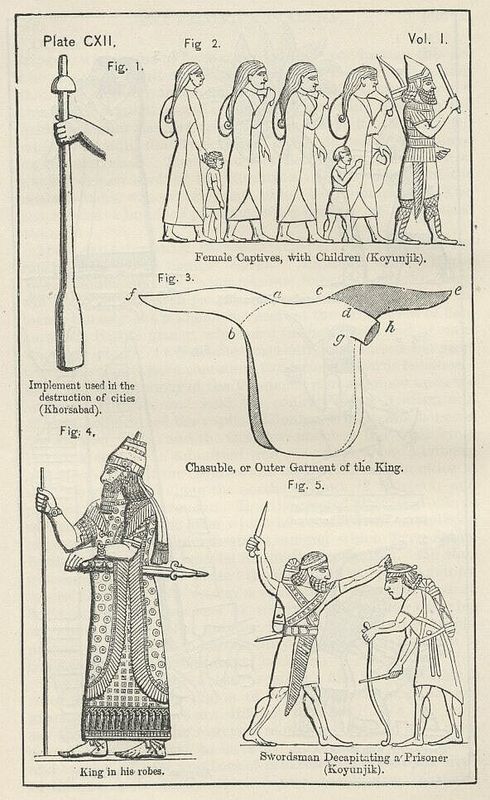
The women and children carried off by the conquerors were treated with more tenderness than the men. [PLATE CXII., Fig. 2.] Sometimes on foot, but often mounted on mules, or seated in carts drawn by bullocks or asses, they followed in the train of their new masters, not always perhaps unwilling to exchange the monotony of domestic life at home for the excitement of a new and unknown condition in a fresh country. We seldom see them exhibiting any signs of grief. The women and children are together, and the mothers lavish on their little ones the usual caresses and kind offices, taking them in their laps, giving then the breast, carrying them upon their shoulders, or else leading them by the hand. At intervals they were allowed to stop and rest; and it was not even the practice to deprive them of such portion of their household stuff as they might have contrived to secure before quitting their homes. This they commonly bore in a bag or sack, which was either held in the hand or thrown over one shoulder, When they reached Assyria, it would seem that they were commonly assigned as wives to the soldiers of the Assyrian army.
Together with their captives, the Assyrians carried off vast quantities of the domesticated animals, such as oxen, sheep, goats, horses, asses, camels, and mules. The numbers mentioned in the Inscriptions are sometimes almost incredible. Sennacherib, for instance, says that in one foray he bore off from the tribes on the Euphrates "7200 horses and mares, 5230 camels, 11,000 mules, 120,000 oxen, and 800,000 sheep"! Other kings omit particulars, but speak of the captured animals which they led away as being "too numerous to be counted," or "countless as the stars of heaven." The Assyrian sculptors are limited by the nature of their art to comparatively small numbers, but they show us horses, camels, and mules in the train of a returning army, together with groups of the other animals, indicative of the vast flocks and herds continually mentioned in the Inscriptions.
Occasionally the monarchs were not content with bringing home domesticated animals only, but took the trouble to transport from distant regions into Assyria wild beasts of various kinds. Tiglath-Pileser I. informs us in general terms that, besides carrying off the droves of the horses, cattle, and asses that he obtained from the subjugated countries, he "took away and drove off the herds of the wild goats and the ibexes, the wild sheep and the wild cattle;" and another monarch mentions that in one expedition he carried off from the middle Euphrates a drove of forty wild cattle, and also a flock of twenty ostriches. The object seems to have been to stock Assyria with a variety and an abundance of animals of chase.
The foes of the Assyrians would sometimes, when hard pressed, desert the dry land, and betake themselves to the marshes, or cross the sea to islands where they trusted that they might be secure from attack. Not unfrequently they obtained their object by such a retreat, for the Assyrians were not a maritime people. Sometimes, however, they were pursued. The Assyrians would penetrate into the marshes by means of reed boats, probably not very different from the terradas at present in use among the Arabs of the Mesopotamian marsh districts. Such boats are represented upon the bas-reliefs as capable of holding from three to five armed men. On these the Assyrian foot-soldiers would embark, taking with them a single boatman to each boat, who propelled the vessel much as a Venetian gondolier propels his gondola, i.e., with a single long oar or paddle, which he pushed from him standing at the stern. They would then in these boats attack the vessels of the enemy, which are always represented as smaller than theirs, run them down or board them, kill their crews or force them into the water, or perhaps allow them to surrender. Meanwhile, the Assyrian cavalry was stationed round the marsh among the tall reeds which thickly clothed its edge, ready to seize or slay such of the fugitives as might escape from the foot.
When the refuge sought was an island, if it lay near the shore, the Assyrians would sometimes employ the natives of the adjacent coast to transport beams of wood and other materials by means of their boats, in order to form a sort of bridge or mole reaching from the mainland to the isle whereto their foes had fled. Such a design was entertained, or at least professed, by Xerxes after the destruction of his fleet in the battle of Salamis, and it was successfully executed by Alexander the Great, who took in this way the new or island of Tyre. From a series of reliefs discovered at Khorsabad wo may conclude that more than two hundred years before the earlier of these two occasions, the Assyrians had conceived the idea, and even succeeded in carrying out the plan, of reducing islands near the coast by moles.
Under the Chaldaeans, whose "cry was in their ships," the Assyrians seem very rarely to have adventured themselves upon the deep. If their enemies fled to islands which could not be reached by moles, or to lands across the sea, in almost every instance they escaped. Such escapes are represented upon the sculptures, where we see the Assyrians taking a maritime town at one end, while at the other the natives are embarking their women and children, and putting to sea, without any pursuit being made after them. In none of the bas-reliefs do we observe any sea-going vessels with Assyrians on board and history tells us of but two or three expeditions by sea in which they took part. One of these was an expedition by Sennacharib against the coast of the Persian Gulf, to which his Chaldaean enemies had fled. On this occasion he brought shipwrights from Phoenicia to Assyria, and made them build him ships there, which were then launched upon the Tigris, and conveyed down to the sea. With a fleet thus constructed, and probably manned, by Phoenicians, Sennacherib crossed to the opposite coast, defeated the refugees, and embarking his prisoners on board, returned in triumph to the mainland. Another expedition was that of Shalmaneser IV. against the island Tyre. Assyrians are said to have been personally engaged in it; but here again we are told that they embarked in ships furnished to then by the Phoenicians, and maimed chiefly by Phoenician sailors.
When a country was regarded as subjugated, the Assyrian monarch commonly marked the establishment of his sovereignty by erecting a memorial in some conspicuous or important situation within the territory conquered, as an enduring sign of his having taken possession. These memorials were either engraved on the natural rock or on solid blocks of stone cut into the form of a broad low stele. They contained a figure of the king, usually enclosed in an arched frame; and an inscription, of greater or less length, setting forth his name, his titles, and some of his exploits. More than thirty such memorials are mentioned in the extant Inscriptions, and the researches of recent times have recovered some ten or twelve of them. They uniformly represent the king in his sacerdotal robes, with the sacred collar round his neck, and the emblems of the gods above his head, raising the right hand in the act of adoration, as if he were giving thanks to Asshur and his guardian deities on account of his successes.
. . . . . . . . . . . . . . . .
It is now time to pass from the military customs of the Assyrians to a consideration of their habits and usages in time of peace, so far as they are made known to us either by historical records or by the pictorial evidence of the has reliefs. And here it may be convenient to treat separately of the public life of the king and court, and of the private life of the people.
In Assyria, as in most Oriental countries, the keystone of the social arch, the central point of the system, round which all else revolved, and on which all else depended, was the monarch. "L'etat, c'est moi" might have been said with more truth by an Assyrian prince than even by the "Grand Monarque," whose dictum it is reported to have been. Alike in the historical notices, and in the sculptures, we have the person of the king presented to us with consistent prominence, and it is consequently with him that we most naturally commence the present portion of our inquiry.
The ordinary dress of the monarch in time of peace was a long flowing robe, reaching to the ankles, elaborately patterned and fringed, over which was worn, first, a broad belt, and then a species of open mantle, or chasuble, very curiously contrived. [PLATE CXII., Fig. 3.] This consisted mainly of two large flaps, both of which were commonly rounded, though sometimes one of them was square at bottom. These fell over the robe in front and behind, leaving the sides open, and so exposing the under dress to view. The two flaps must have been sewn together at the places marked with the dotted lines a b and c d, the space from a to c being left open, and the mantle passed by that means over the head. At d g there was commonly a short sleeve (h), which covered the upper part of the left arm, but the right arm was left free, the mantle falling of either side of it. Sometimes, besides the flaps, the mantle seems to have had two pointed wings attached to the shoulders (a f b and c e h in the illustration), which were made to fall over in front. Occasionally there was worn above the chasuble a broad diagonal belt ornamented with a deep fringe and sometimes there depended at the back of the dress a species of large hood.
The special royal head-dress was a tall mitre or tiara, which at first took the shape of the head, but rose above it to a certain height in a gracefully curved line, when it was covered in with a top, flat, like that of a hat, but having a projection towards the centre, which rose up into a sort of apex, or peak, not however pointed, but either rounded or squared off. The tiara was generally ornamented with a succession of bands, between which were commonly patterns more or less elaborate. Ordinarily the lowest band, instead of running parallel with the others, rose with a gentle curve towards the front, allowing room for a large rosette over the forehead, and for other similar ornaments. If we may trust the representations on the enamelled bricks, supported as they are to some extent by the tinted reliefs, we may say that the tiara was of three colors, red, yellow, and white. The red and white alternated in broad bands; the ornaments upon them were yellow, being probably either embroidered on the material of the head-dress in threads of gold, or composed of thin gold plates which may have been sown on. The general material of the tiara is likely to have been cloth or felt; it can scarcely have been metal, if the deep crimson tint of the bricks and the reliefs is true. [PLATE CXII., Fig. 4.]
In the early sculptures the tiara is more depressed than in the later, and it is also less richly ornamented. It has seldom more than two bands, viz., a narrow one at top, and at bottom a broader curved one, rising towards the front. To this last are attached two long strings or lappets, which fall behind the monarch's back to a level with his elbow. [PLATE CXIII., Fig. 1.]