


автордың кітабын онлайн тегін оқу Sugar and Spice
The Project Gutenberg eBook,
Sugar and Spice, by James Johnson
This eBook is for the use of anyone anywhere at no cost and with
almost no restrictions whatsoever. You may copy it, give it away or
re-use it under the terms of the Project Gutenberg License included
with this eBook or online at www.gutenberg.net
Title: Sugar and Spice
Author: James Johnson
Release Date: January 26, 2004 [eBook #10839]
Language: English
***START OF THE PROJECT GUTENBERG EBOOK SUGAR AND SPICE***
E-text prepared by Internet Archive, University of Florida,
Andy Jewell, David Garcia,
and the Project Gutenberg Online Distributed Proofreading Team
SUGAR AND SPICE.

Comical Tales Comically Dressed.

BY JAMES JOHNSON
LONDON: DEAN & SON, 160A, FLEET STREET, E.C.
FACTORS AND CHRISTMAS CARD MANUFACTURERS.
Contents
Sugar and Spice.
The Little Bootmaker.
The Little Gardener.
The Little Cooks.
The Young Sportsman.
The Little Dauber.
The Busy Bees.
The Little Soldiers.
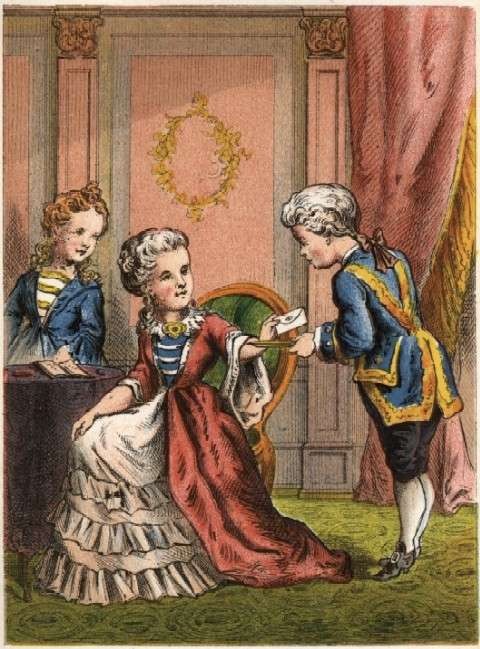
A knock at the door!
A visitor more.
SUGAR AND SPICE.
Our dear children gave a party,
Not one grown person there;
And the laughter, it was hearty,
Without a servant's care.
"One must," said they, "a servant be,"
And quick they cried, "one should."
So they cast lots, did that par—ty:
The lot fell on T. Good.
They rang the bell, he never came;
They called, he would not hear;
They stamped, but it was all the same,
T. Good would not appear.
They coaxed him in with marmalade,
To take a letter out.
He said that he was scarcely made
"To post and run about!"
Said he, "I've seen rich people do
Kind acts for servants' good;
But seldom have I known, its true,
Them act as e'er they should!
"That is, you know, quite to a T,
And sure as eggs are eggs,
Men-servants in a family,
Care mostly for their legs!"
Oh! Tommy was quite rated high
By all the children fair.
He pardon begged, and quick did fly
To run both here and there.
Now mind and do as you are bid,
Or you'll come in for blame;
And never let your joy be hid
Beneath some passing shame.
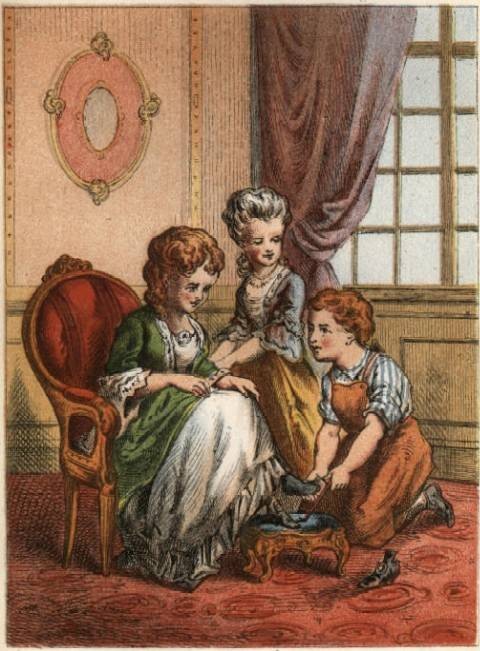
Knock, knock, knock! paste, paste, paste!
Use wax, and thread, and awl each day
While there's light to work we'll haste,
For health and time soon pass away.
THE LITTLE BOOTMAKER.

Annie, of the same family, who knew nothing of this, sent hers, and said they must be done by the next day.
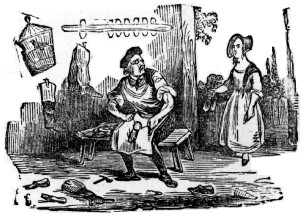
The cobbler said if they brought him two pairs again to do at once, he'd knock their heads together with his lasts, and then give them a good "welting." He was the only cobbler in the village, or he would not have been so independent.
Franky had often watched the boot-maker at his work; so he coaxed his father to let him have some money to buy tools and leather, in order that he and his sisters might play at making boots and shoes.
He set to work, and they had such fun!
Annie came and asked young master cobbler what time it was; and Franky pretended to hit her on the head with a last, and said it had "just struck one." Then he measured her, and cut out his vamps, sides, linings, welts, soles, and heels. Next he made a soft-like sock of leather. This he turned inside out, and did his best to sew on a welt.
The boot was turned out right again, and then he sewed on a thin sole, and over this nailed another. The heel he formed by fastening little bits of leather one upon the other.
After all this, he took a piece of common glass, and scraped the sides and bottoms of the soles, and heel-balled the sides of the soles and heels, and the boots were made. He did not try any other ornamental work. Of course the young lad could not do this without the help of a cobbler, to shew him what and how to do each portion of his boot-making; but the man was frightened at having so apt a pupil, and begged pardon for his former neglect; for though they were not all they might have been; they were boots.
"I see," said he, "if some people neglect their work, there are sure to be others about who will soon leave them no business to do."
After this, he would sit for quite half a day at his work without going round to the "Cobbler's Arms." Some people said it was the wax that got on his seat that made him do it; but I do not think it was.
A flower lives, a flower dies,
And we so stand and fall;
Some flowers waft scent to the skies,
And pleasure give to all.
THE LITTLE GARDENER.

They spoke right out and told their father what was in their minds.
He said "By all means, my dears."
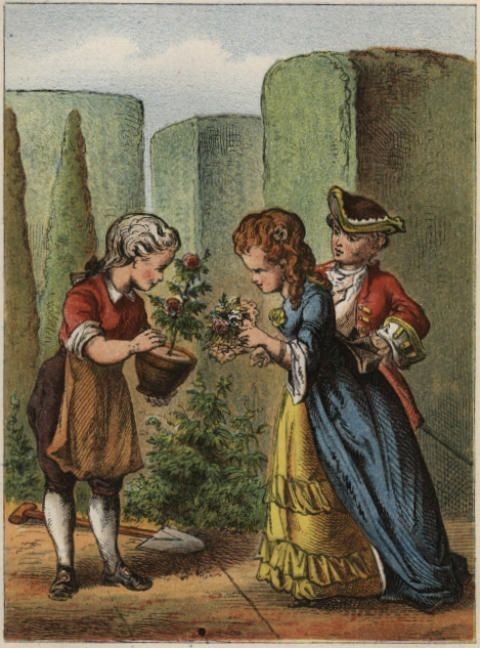
Tom became gardener. You can guess who were the others. A very gentlemanly one he was, too. Full of nice bows and smiles. As for Eva, she looked quite the grown lady, and acted so well, that when she put her hand in her pocket for her purse, Edwin was quite surprised to find that only threepenny and fourpenny pieces came out of it.
"Now what sort of bouquets would your ladyship like me to cut?" asked Tom, holding up a very pretty rose before his sister.
"I have consulted his lordship, here," answered, Eva, very grandly, "and I'll have ten dozen in five minutes, like this one in my hand!"
"I'm pleased, your ladyship," said Tom, respectfully, "that you give me plenty of time to execute so large an order, or I might not have been able to have come up with them to time!"
"Oh! great people are never in a hurry," quietly remarked Edwin.
Tom cut all the flowers he knew could be spared from the greenhouse, and her ladyship and his lordship took them and gave them to a poor girl whose sick mother wanted some little pleasure; and the girl sold the flowers for gentlemen's button-holes.
When Mr. Woffles heard all about it, he was very pleased, and kissed the little Woffles all round. Wasn't it a nice game for rich children to play at; to do good to poor ones?

When children try their best to please,
It makes them good and kind,
And gives to those they love some ease,
And ev'ry comfort find.
THE LITTLE COOKS.

So, one fine morning, when his mother and father were about to start for the Crystal Palace, Frank, who had been sitting on his thumbs and thinking very deeply, jumped up all of a sudden and said, (he tried to speak in an off-hand manner); "I suppose you couldn't say to a minute, could you, when you'll be back?"
Father laughed, and mother turned aside her head for an instant
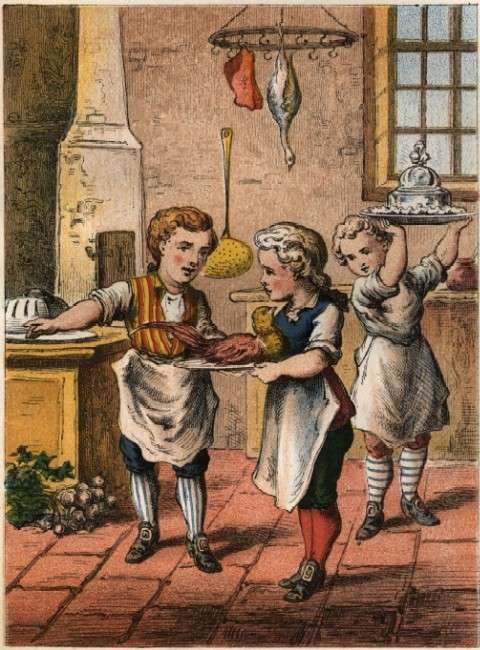
"And mother's laughing, too," cried little Edwin. You can see him; but I'd better introduce them.
1st—Frank: right hand, near oven.
2nd—George: holding bird.
3rd—Edwin: bearing tray and cover.
Now we can go on.
"I know mother's laughing," said Edwin, "because the back of her neck's red!"
Mother kissed him, and said she'd be back at five o'clock, exactly; and father shook the boys by the hand, and said he'd be home at five, too.
The moment they were gone, Frank beckoned his brothers to him, and said in whispers;
"Let's ask the cook to give us leave, and then treat mother and father to a jolly good dinner, and cook it ourselves!"
George clapped his hands with delight, and Edwin danced for a moment or two quite on his own account.
"Let's have some shrimps and marmalade," said he, about to run out of the room.
Frank and George laughed at him and told him he might buy some shrimps for a sauce and the marmalade would do for the pastry. They went to work, and Frank gave his orders quite like a grand cook. He tried the cookery book, but, boy as he was, he threw it away in disgust. "For," said he, "if you live in one town, you'd have to send to another to get all the things named in it." They had two nice birds and a joint, and many other things.
When their parents came home, and saw the table laid out with what the children had paid for out of their pocket money, they were very pleased; and, mind, I won't be sure; but I don't think the boys lost anything by their generosity. One thing I must tell, you as a secret—Edwin nearly shed a tear when he found he had eaten so much of the meat, which his money had bought, that he couldn't find room for his marmalade-tart.

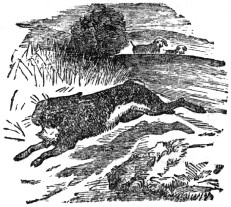
A hare runs away,
And little boys play;
And girls they have skippers,
While maidens work slippers.
THE YOUNG SPORTSMAN.

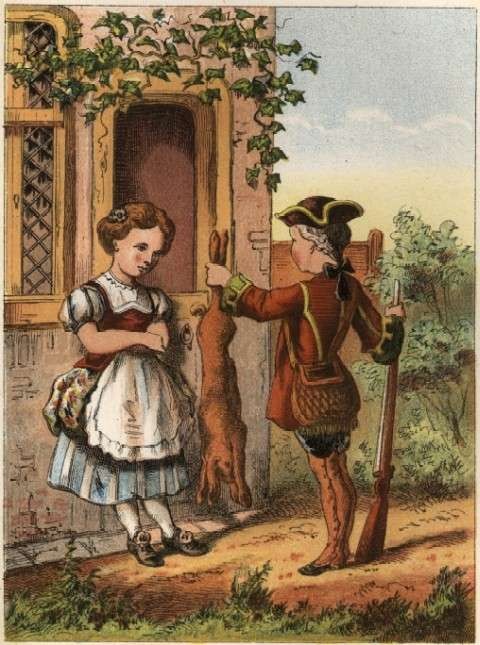
His dearest friend was little Minnie Warren. He ran up to her one fine September day, and said, "Oh! Minnie, father has been so kind; he has given me a hare, and after you and I have had a game at hunting it, I'm to give it to you, and you're to give it to your mother to jug. There! what say you to that?"
Minnie was pleased.
It was fun to see how they made believe.
Minnie tied, oh! such a long string to the hare's hind legs, and walked off a good way; and just as Henry cocked his gun and pretended to fire, she gave the string a pull, and off she ran, Henry after her.
They played at this till they were quite tired, and then our little friend at last made a pretence of shooting very carefully; and then Minnie quite gravely let him come and pick Miss Hare up.
"Now," said Henry, "walk home first and stand at the door with your arms crossed, and look quite seriously at me when I come up and give it to you. My gun will be in my left hand, and the hare in the other; so I shan't be able to take my hat off; but I'll bow twice, and make it up that way."
He gave it to her; and Mrs. Warren was pleased when her daughter handed her Henry's gift.
You may be sure he was asked to dine with them when it was cooked.
Minnie said the hare turned out tender, on purpose; and Henry added he believed he enjoyed the game.
Mrs. Warren said it was the knocking about that made it so soft. But it came out all right, jugged; and with the black currant jelly it was really,—but there! I dare say you know what it was.

Lazy people think they're clever.
So won't work like common folk;
But in life they'll prosper never,
If all's true that I've heard spoke.
THE LITTLE DAUBER.

"Now," said he, trying to look wise, "Miss Fanny, just stand with flowers in your hand while I paint you like a grand lady; and one of you quiz the work as it goes on, and the other pretend to be in raptures with the portrait."
"Will you write her name under it, when it's done?" asked Bobby Butt, who was always ready with his fun.
"No," answered Richard, laughingly; "I shall make it a speaking likeness."
"Well, I'm glad of that," returned the lady; "for I shouldn't like to be taken with my mouth shut."
So they went to work.
Richard looked at the lady very sharp, particularly with his right eye,—you can see him; and Bob took a penny out of his pocket and held it in front of him as if it were an eye-glass; and Frank put his right leg out, and bent forward and said every now and then, "To a T!" "Charming!" "Nature improved!" and other such flatteries.
It was very well to say all this; but the truth must be told: when Richard had painted the lady's head and neck, he had no more room on the canvas; and what was done was so ugly, that the subject threw her bouquet at it. Then Richard sent it back again, at which she boxed his ears.
"It certainly is like nothing in the world," said Bob, putting his hands before his eyes as he looked at the smudges.
"Of course not," retorted Richard; "it's in the high school of art, and is not therefore meant to be natural!"
"Oh! that alters the case," said Frank. After a bit they began to throw the things about, and a terrible mess and rout they made.
When they were quite tired, Richard said, "Now I'll show you all my toys!" and he was about to go out of the studio to fetch them,—
"Stay where you are!" cried his father, slyly entering. "You have been spoiling my things, and romping where you have no business; I must set you a task as a punishment, and your friends must go home at once."
All the boys turned red enough without being painted; and Richard's father said, quite sternly, "Next time, before you, children, play with, and destroy property, just ask yourselves how you would like your playthings meddled with and broken?"

Oh! Boys and Girls can useful prove,
If they will only try;
And smile and work in some slight groove,
As well as play or cry.
THE BUSY BEES.

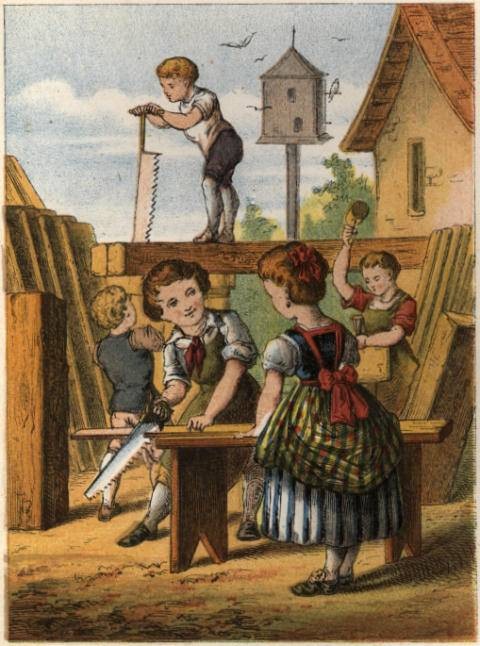
Little Bob he fetched a board,
And then began to saw,
And Mary Jane said she'd afford
Him help to do much more,
While he used his—saw! saw! saw!
Young Dick he held his mallet high,
And struck the wedge quite bold,
Until it made the wood quick fly
Like feathers with no hold,
Blown by the wind quite—cold! cold! cold!
And John and James sawed up and down,
John sawed up; James sawed low;
The birds they flew all o'er the town
To tell the folks these things were so,
As if they did—know! know! know!
They made some boxes, tops, and hoops,
They fashioned bowls and chairs,
They sold a thousand million scoops,
And seven hundred stairs;
And this Bob—declares! declares! declares!
Eleven hundred sticks they cut,
And all of them good size;
With a five mile long water-butt,
"In which to float," Tom cries,
And "Time," they said—"flies! flies! flies!"
Oh! work and play are very good,
Work number one, you know;
Play number two has ever stood
The best in this world's show
And it should be—so! so! so!
Hence these young children played at work,
And thus learnt to work well,
And now their duties they ne'er shirk,
Which is all I've to tell,
And you to—spell! spell! spell!
Or, maybe, read and then to write,
Until you know it through;
Which will to you give great delight,
And mem'ry strengthen too,
As you ought to—do! do! do!
And, who knows, one day you may give
Some stories to the young,
To make your name through ages live
And loud your praises sung.
Keep your life well—strung! strung! strung!
'Tis said 'That he who fights and runs away
Is sure to live to fight another day;'
But better to clear keep of ev'ry brawl,
And then you'll never have to fight at all.
THE LITTLE SOLDIERS.

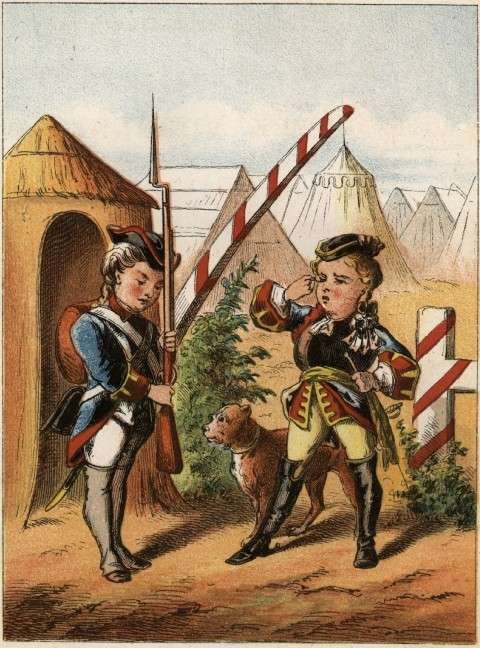
Well, one day the two boys went to the family tailor, and Robert said, very big, "Haw! measure us for two suits of military clothes, officers' ones, haw! and see that you send home with them at the same time—swords, muskets, canes, sentry box, tents, and all, haw! necessarythings for playing at soldiers!"
Now, don't let it slip out of your mind that a bit before this, the boys' rich uncle had bought them some beautiful sets of boxes of soldiers.
When the clothes and other things came home, these young fellows, followed by the dog, which they called their army, dressed themselves, cleverly set up their tents, and went to work in good earnest. Billy, the dog, sniffed at the butt of the musket to make quite sure that it was not loaded. Robert put his glass to his right eye, and having posted Henry as a sentry, began to officer over, him, commanding him rather more than his brother liked.
It's not a nice thing to see a soldier cry; but if you look at Harry, you will find that he feels hurt very much.
"Haw! hem! sir!" roared Robert, "with, haw! the help of my glass I see, haw! a speck of rust on one of your buttons, haw! as big as the tip of a fly's eyelash!"
The dog at this set up a howl. The howl called their mother's attention to the garden, and then she saw them. With a funny smile she took all their toy soldiers and walked to her children.
"Haw! Pre-sent, Fire!" cried Bob.
"Certainly," said his mother; and almost before they knew what she was about, all the soldiers were set out, just like two armies, and Mrs. Graham called the gardener to lay a train of gunpowder, and called—mimicking Robert—"Present, Fire!" and set fire to it, and there was heard a tremendous "pop," followed by a "puff," and then; no! there wasn't a bit of one of all those soldiers and horses left large enough to make a match of.
The boys began to cry.
"Now," said their mother, "others, you see, can play at soldiers. What right had you to go to the tailor and order clothes of him! neither I nor your father gave you permission; I have a great mind to make you go to school in those soldiers' suits; and nice fun your play fellows would make of you!"
***END OF THE PROJECT GUTENBERG EBOOK SUGAR AND SPICE***
******* This file should be named 10839-h.txt or 10839-h.zip *******
This and all associated files of various formats will be found in:
http://www.gutenberg.net/1/0/8/3/10839
Updated editions will replace the previous one--the old editions
will be renamed.
Creating the works from public domain print editions means that no
one owns a United States copyright in these works, so the Foundation
(and you!) can copy and distribute it in the United States without
permission and without paying copyright royalties. Special rules,
set forth in the General Terms of Use part of this license, apply to
copying and distributing Project Gutenberg-tm electronic works to
protect the PROJECT GUTENBERG-tm concept and trademark. Project
Gutenberg is a registered trademark, and may not be used if you
charge for the eBooks, unless you receive specific permission. If you
do not charge anything for copies of this eBook, complying with the
rules is very easy. You may use this eBook for nearly any purpose
such as creation of derivative works, reports, performances and
research. They may be modified and printed and given away--you may do
practically ANYTHING with public domain eBooks. Redistribution is
subject to the trademark license, especially commercial
redistribution.
*** START: FULL LICENSE ***
THE FULL PROJECT GUTENBERG LICENSE
PLEASE READ THIS BEFORE YOU DISTRIBUTE OR USE THIS WORK
To protect the Project Gutenberg-tm mission of promoting the free
distribution of electronic works, by using or distributing this work
(or any other work associated in any way with the phrase "Project
Gutenberg"), you agree to comply with all the terms of the Full Project
Gutenberg-tm License (available with this file or online at
http://gutenberg.net/license).
Section 1. General Terms of Use and Redistributing Project Gutenberg-tm
electronic works
1.A. By reading or using any part of this Project Gutenberg-tm
electronic work, you indicate that you have read, understand, agree to
and accept all the terms of this license and intellectual property
(trademark/copyright) agreement. If you do not agree to abide by all
the terms of this agreement, you must cease using and return or destroy
all copies of Project Gutenberg-tm electronic works in your possession.
If you paid a fee for obtaining a copy of or access to a Project
Gutenberg-tm electronic work and you do not agree to be bound by the
terms of this agreement, you may obtain a refund from the person or
entity to whom you paid the fee as set forth in paragraph 1.E.8.
1.B. "Project Gutenberg" is a registered trademark. It may only be
used on or associated in any way with an electronic work by people who
agree to be bound by the terms of this agreement. There are a few
things that you can do with most Project Gutenberg-tm electronic works
even without complying with the full terms of this agreement. See
paragraph 1.C below. There are a lot of things you can do with Project
Gutenberg-tm electronic works if you follow the terms of this agreement
and help preserve free future access to Project Gutenberg-tm electronic
works. See paragraph 1.E below.
1.C. The Project Gutenberg Literary Archive Foundation ("the Foundation"
or PGLAF), owns a compilation copyright in the collection of Project
Gutenberg-tm electronic works. Nearly all the individual works in the
collection are in the public domain in the United States. If an
individual work is in the public domain in the United States and you are
located in the United States, we do not claim a right to prevent you from
copying, distributing, performing, displaying or creating derivative
works based on the work as long as all references to Project Gutenberg
are removed. Of course, we hope that you will support the Project
Gutenberg-tm mission of promoting free access to electronic works by
freely sharing Project Gutenberg-tm works in compliance with the terms of
this agreement for keeping the Project Gutenberg-tm name associated with
the work. You can easily comply with the terms of this agreement by
keeping this work in the same format with its attached full Project
Gutenberg-tm License when you share it without charge with others.
1.D. The copyright laws of the place where you are located also govern
what you can do with this work. Copyright laws in most countries are in
a constant state of change. If you are outside the United States, check
the laws of your country in addition to the terms of this agreement
before downloading, copying, displaying, performing, distributing or
creating derivative works based on this work or any other Project
Gutenberg-tm work. The Foundation makes no representations concerning
the copyright status of any work in any country outside the United
States.
1.E. Unless you have removed all references to Project Gutenberg:
1.E.1. The following sentence, with active links to, or other immediate
access to, the full Project Gutenberg-tm License must appear prominently
whenever any copy of a Project Gutenberg-tm work (any work on which the
phrase "Project Gutenberg" appears, or with which the phrase "Project
Gutenberg" is associated) is accessed, displayed, performed, viewed,
copied or distributed:
This eBook is for the use of anyone anywhere at no cost and with
almost no restrictions whatsoever. You may copy it, give it away or
re-use it under the terms of the Project Gutenberg License included
with this eBook or online at www.gutenberg.net
1.E.2. If an individual Project Gutenberg-tm electronic work is derived
from the public domain (does not contain a notice indicating that it is
posted with permission of the copyright holder), the work can be copied
and distributed to anyone in the United States without paying any fees
or charges. If you are redistributing or providing access to a work
with the phrase "Project Gutenberg" associated with or appearing on the
work, you must comply either with the requirements of paragraphs 1.E.1
through 1.E.7 or obtain permission for the use of the work and the
Project Gutenberg-tm trademark as set forth in paragraphs 1.E.8 or
1.E.9.
1.E.3. If an individual Project Gutenberg-tm electronic work is posted
with the permission of the copyright holder, your use and distribution
must comply with both paragraphs 1.E.1 through 1.E.7 and any additional
terms imposed by the copyright holder. Additional terms will be linked
to the Project Gutenberg-tm License for all works posted with the
permission of the copyright holder found at the beginning of this work.
1.E.4. Do not unlink or detach or remove the full Project Gutenberg-tm
License terms from this work, or any files containing a part of this
work or any other work associated with Project Gutenberg-tm.
1.E.5. Do not copy, display, perform, distribute or redistribute this
electronic work, or any part of this electronic work, without
prominently displaying the sentence set forth in paragraph 1.E.1 with
active links or immediate access to the full terms of the Project
Gutenberg-tm License.
1.E.6. You may convert to and distribute this work in any binary,
compressed, marked up, nonproprietary or proprietary form, including any
word processing or hypertext form. However, if you provide access to or
distribute copies of a Project Gutenberg-tm work in a format other than
"Plain Vanilla ASCII" or other format used in the official version
posted on the official Project Gutenberg-tm web site (www.gutenberg.net),
you must, at no additional cost, fee or expense to the user, provide a
copy, a means of exporting a copy, or a means of obtaining a copy upon
request, of the work in its original "Plain Vanilla ASCII" or other
form. Any alternate format must include the full Project Gutenberg-tm
License as specified in paragraph 1.E.1.
1.E.7. Do not charge a fee for access to, viewing, displaying,
performing, copying or distributing any Project Gutenberg-tm works
unless you comply with paragraph 1.E.8 or 1.E.9.
1.E.8. You may charge a reasonable fee for copies of or providing
access to or distributing Project Gutenberg-tm electronic works provided
that
- You pay a royalty fee of 20% of the gross profits you derive from
the use of Project Gutenberg-tm works calculated using the method
you already use to calculate your applicable taxes. The fee is
owed to the owner of the Project Gutenberg-tm trademark, but he
has agreed to donate royalties under this paragraph to the
Project Gutenberg Literary Archive Foundation. Royalty payments
must be paid within 60 days following each date on which you
prepare (or are legally required to prepare) your periodic tax
returns. Royalty payments should be clearly marked as such and
sent to the Project Gutenberg Literary Archive Foundation at the
address specified in Section 4, "Information about donations to
the Project Gutenberg Literary Archive Foundation."
- You provide a full refund of any money paid by a user who notifies
you in writing (or by e-mail) within 30 days of receipt that s/he
does not agree to the terms of the full Project Gutenberg-tm
License. You must require such a user to return or
destroy all copies of the works possessed in a physical medium
and discontinue all use of and all access to other copies of
Project Gutenberg-tm works.
- You provide, in accordance with paragraph 1.F.3, a full refund of any
money paid for a work or a replacement copy, if a defect in the
electronic work is discovered and reported to you within 90 days
of receipt of the work.
- You comply with all other terms of this agreement for free
distribution of Project Gutenberg-tm works.
1.E.9. If you wish to charge a fee or distribute a Project Gutenberg-tm
electronic work or group of works on different terms than are set
forth in this agreement, you must obtain permission in writing from
both the Project Gutenberg Literary Archive Foundation and Michael
Hart, the owner of the Project Gutenberg-tm trademark. Contact the
Foundation as set forth in Section 3 below.
1.F.
1.F.1. Project Gutenberg volunteers and employees expend considerable
effort to identify, do copyright research on, transcribe and proofread
public domain works in creating the Project Gutenberg-tm
collection. Despite these efforts, Project Gutenberg-tm electronic
works, and the medium on which they may be stored, may contain
"Defects," such as, but not limited to, incomplete, inaccurate or
corrupt data, transcription errors, a copyright or other intellectual
property infringement, a defective or damaged disk or other medium, a
computer virus, or computer codes that damage or cannot be read by
your equipment.
1.F.2. LIMITED WARRANTY, DISCLAIMER OF DAMAGES - Except for the "Right
of Replacement or Refund" described in paragraph 1.F.3, the Project
Gutenberg Literary Archive Foundation, the owner of the Project
Gutenberg-tm trademark, and any other party distributing a Project
Gutenberg-tm electronic work under this agreement, disclaim all
liability to you for damages, costs and expenses, including legal
fees. YOU AGREE THAT YOU HAVE NO REMEDIES FOR NEGLIGENCE, STRICT
LIABILITY, BREACH OF WARRANTY OR BREACH OF CONTRACT EXCEPT THOSE
PROVIDED IN PARAGRAPH F3. YOU AGREE THAT THE FOUNDATION, THE
TRADEMARK OWNER, AND ANY DISTRIBUTOR UNDER THIS AGREEMENT WILL NOT BE
LIABLE TO YOU FOR ACTUAL, DIRECT, INDIRECT, CONSEQUENTIAL, PUNITIVE OR
INCIDENTAL DAMAGES EVEN IF YOU GIVE NOTICE OF THE POSSIBILITY OF SUCH
DAMAGE.
1.F.3. LIMITED RIGHT OF REPLACEMENT OR REFUND - If you discover a
defect in this electronic work within 90 days of receiving it, you can
receive a refund of the money (if any) you paid for it by sending a
written explanation to the person you received the work from. If you
received the work on a physical medium, you must return the medium with
your written explanation. The person or entity that provided you with
the defective work may elect to provide a replacement copy in lieu of a
refund. If you received the work electronically, the person or entity
providing it to you may choose to give you a second opportunity to
receive the work electronically in lieu of a refund. If the second copy
is also defective, you may demand a refund in writing without further
opportunities to fix the problem.
1.F.4. Except for the limited right of replacement or refund set forth
in paragraph 1.F.3, this work is provided to you 'AS-IS,' WITH NO OTHER
WARRANTIES OF ANY KIND, EXPRESS OR IMPLIED, INCLUDING BUT NOT LIMITED TO
WARRANTIES OF MERCHANTIBILITY OR FITNESS FOR ANY PURPOSE.
1.F.5. Some states do not allow disclaimers of certain implied
warranties or the exclusion or limitation of certain types of damages.
If any disclaimer or limitation set forth in this agreement violates the
law of the state applicable to this agreement, the agreement shall be
interpreted to make the maximum disclaimer or limitation permitted by
the applicable state law. The invalidity or unenforceability of any
provision of this agreement shall not void the remaining provisions.
1.F.6. INDEMNITY - You agree to indemnify and hold the Foundation, the
trademark owner, any agent or employee of the Foundation, anyone
providing copies of Project Gutenberg-tm electronic works in accordance
with this agreement, and any volunteers associated with the production,
promotion and distribution of Project Gutenberg-tm electronic works,
harmless from all liability, costs and expenses, including legal fees,
that arise directly or indirectly from any of the following which you do
or cause to occur: (a) distribution of this or any Project Gutenberg-tm
work, (b) alteration, modification, or additions or deletions to any
Project Gutenberg-tm work, and (c) any Defect you cause.
Section 2. Information about the Mission of Project Gutenberg-tm
Project Gutenberg-tm is synonymous with the free distribution of
electronic works in formats readable by the widest variety of computers
including obsolete, old, middle-aged and new computers. It exists
because of the efforts of hundreds of volunteers and donations from
people in all walks of life.
Volunteers and financial support to provide volunteers with the
assistance they need, is critical to reaching Project Gutenberg-tm's
goals and ensuring that the Project Gutenberg-tm collection will
remain freely available for generations to come. In 2001, the Project
Gutenberg Literary Archive Foundation was created to provide a secure
and permanent future for Project Gutenberg-tm and future generations.
To learn more about the Project Gutenberg Literary Archive Foundation
and how your efforts and donations can help, see Sections 3 and 4
and the Foundation web page at http://www.pglaf.org.
Section 3. Information about the Project Gutenberg Literary Archive
Foundation
The Project Gutenberg Literary Archive Foundation is a non profit
501(c)(3) educational corporation organized under the laws of the
state of Mississippi and granted tax exempt status by the Internal
Revenue Service. The Foundation's EIN or federal tax identification
number is 64-6221541. Its 501(c)(3) letter is posted at
http://pglaf.org/fundraising. Contributions to the Project Gutenberg
Literary Archive Foundation are tax deductible to the full extent
permitted by U.S. federal laws and your state's laws.
The Foundation's principal office is located at 4557 Melan Dr. S.
Fairbanks, AK, 99712., but its volunteers and employees are scattered
throughout numerous locations. Its business office is located at
809 North 1500 West, Salt Lake City, UT 84116, (801) 596-1887, email
business@pglaf.org. Email contact links and up to date contact
information can be found at the Foundation's web site and official
page at http://pglaf.org
For additional contact information:
Dr. Gregory B. Newby
Chief Executive and Director
gbnewby@pglaf.org
Section 4. Information about Donations to the Project Gutenberg
Literary Archive Foundation
Project Gutenberg-tm depends upon and cannot survive without wide
spread public support and donations to carry out its mission of
increasing the number of public domain and licensed works that can be
freely distributed in machine readable form accessible by the widest
array of equipment including outdated equipment. Many small donations
($1 to $5,000) are particularly important to maintaining tax exempt
status with the IRS.
The Foundation is committed to complying with the laws regulating
charities and charitable donations in all 50 states of the United
States. Compliance requirements are not uniform and it takes a
considerable effort, much paperwork and many fees to meet and keep up
with these requirements. We do not solicit donations in locations
where we have not received written confirmation of compliance. To
SEND DONATIONS or determine the status of compliance for any
particular state visit http://pglaf.org
While we cannot and do not solicit contributions from states where we
have not met the solicitation requirements, we know of no prohibition
against accepting unsolicited donations from donors in such states who
approach us with offers to donate.
International donations are gratefully accepted, but we cannot make
any statements concerning tax treatment of donations received from
outside the United States. U.S. laws alone swamp our small staff.
Please check the Project Gutenberg Web pages for current donation
methods and addresses. Donations are accepted in a number of other
ways including including checks, online payments and credit card
donations. To donate, please visit: http://pglaf.org/donate
Section 5. General Information About Project Gutenberg-tm electronic
works.
Professor Michael S. Hart is the originator of the Project Gutenberg-tm
concept of a library of electronic works that could be freely shared
with anyone. For thirty years, he produced and distributed Project
Gutenberg-tm eBooks with only a loose network of volunteer support.
Project Gutenberg-tm eBooks are often created from several printed
editions, all of which are confirmed as Public Domain in the U.S.
unless a copyright notice is included. Thus, we do not necessarily
keep eBooks in compliance with any particular paper edition.
Each eBook is in a subdirectory of the same number as the eBook's
eBook number, often in several formats including plain vanilla ASCII,
compressed (zipped), HTML and others.
Corrected EDITIONS of our eBooks replace the old file and take over
the old filename and etext number. The replaced older file is renamed.
VERSIONS based on separate sources are treated as new eBooks receiving
new filenames and etext numbers.
Most people start at our Web site which has the main PG search facility:
http://www.gutenberg.net
This Web site includes information about Project Gutenberg-tm,
including how to make donations to the Project Gutenberg Literary
Archive Foundation, how to help produce our new eBooks, and how to
subscribe to our email newsletter to hear about new eBooks.
EBooks posted prior to November 2003, with eBook numbers BELOW #10000,
are filed in directories based on their release date. If you want to
download any of these eBooks directly, rather than using the regular
search system you may utilize the following addresses and just
download by the etext year.
http://www.ibiblio.org/gutenberg/etext06
(Or /etext 05, 04, 03, 02, 01, 00, 99,
98, 97, 96, 95, 94, 93, 92, 92, 91 or 90)
EBooks posted since November 2003, with etext numbers OVER #10000, are
filed in a different way. The year of a release date is no longer part
of the directory path. The path is based on the etext number (which is
identical to the filename). The path to the file is made up of single
digits corresponding to all but the last digit in the filename. For
example an eBook of filename 10234 would be found at:
http://www.gutenberg.net/1/0/2/3/10234
or filename 24689 would be found at:
http://www.gutenberg.net/2/4/6/8/24689
An alternative method of locating eBooks:
http://www.gutenberg.net/GUTINDEX.ALL
*** END: FULL LICENSE ***