


автордың кітабын онлайн тегін оқу The Natural History of the Varieties of Man
The cover image was created by the transcriber and is placed in the public domain.
THE
NATURAL HISTORY
OF
THE VARIETIES OF MAN.
[Pg ii] [Pg iii]
THE NATURAL HISTORY
OF THE VARIETIES OF MAN.
BY
ROBERT GORDON LATHAM, M.D., F.R.S.,
LATE FELLOW OF KING'S COLLEGE, CAMBRIDGE;
ONE OF THE VICE-PRESIDENTS OF THE ETHNOLOGICAL SOCIETY, LONDON;
CORRESPONDING MEMBER TO THE ETHNOLOGICAL SOCIETY,
NEW YORK, ETC.

LONDON:
JOHN VAN VOORST, PATERNOSTER ROW.
M.D.CCCL.
LONDON:
Printed by S. & J. Bentley and Henry Fley,
Bangor House, Shoe Lane.
TO
EDWIN NORRIS, Esq.,
OF THE ROYAL ASIATIC SOCIETY,
TO WHOSE VALUABLE INFORMATION AND SUGGESTIONS
MANY OF THE STATEMENTS AND OPINIONS OF THE PRESENT VOLUME
OWE THEIR ORIGIN,
The following Pages are Inscribed,
BY HIS FRIEND,
THE AUTHOR.
London, July 25th, 1850.
[Pg vi] [Pg vii]
PREFACE.
If the simple excellence of a book were a sufficient reason for making it the only one belonging to the sciences which it professed to illustrate, few writers would be desirous of attempting a systematic work upon the Natural History of their species, after the admirable Physical History of Mankind, by the late and lamented Dr. Prichard,—a work which even those who are most willing to defer to the supposed superior attainments of Continental scholars, are not afraid to place on an unapproached eminence in respect to both our own and other countries. The fact of its being the production of one who was at one and the same time a physiologist amongst physiologists, and a scholar amongst scholars, would have made it this; since the grand ethnological desideratum required at the time of its publication, was a work which, by combining the historical, the philological, and the anatomical methods, should command the attention of the naturalist, as well as of the scholar. Still it was a work of a rising rather than of a stationary science; and the very stimulus which it supplied, created and diffused a spirit of investigation, which—as the author himself would, above all men, have desired—rendered subsequent investigations likely to modify the preceding ones. A subject that a single book, however encyclopædic, can represent, is scarcely a subject worth taking up in earnest.
Besides this, there are two other reasons of a more special and particular nature for the present addition to the literature of Ethnology.
I. For each of the great sections of our species, the accumulation of facts, even in the eleventh hour, has out-run the anticipations of the most impatient; indeed so rapidly did it take place during the latter part of Dr. Prichard's own lifetime, that the learning which he displays in his latest edition, is, in its way, as admirable as the bold originality exhibited in the first sketch of his system, published as early as 1821; rather in the shape of a university thesis than of a full and complete production. Thus—
For Asia, there are the contributions of Rosen to the philology of Caucasus; without which (especially the grammatical sketch of the Circassian dialects) the present writer would have considered his evidence as disproportionate to his theory. Then, although matters of Archæology rather than of proper Ethnography, come in brilliant succession, the labours of Botta, Layard, and Rawlinson, on Assyrian antiquity, to which may be added the bold yet cautious criticism and varied observations of Hodgson, illustrating the obscure Ethnology of the Sub-Himalayan Indians, and preeminently confirmatory of the views of General Briggs and others as to the real affinities of the mysterious hill-tribes of Hindostan. Add to these much new matter in respect to the Indo-Chinese frontiers of China, Siam, and the Burmese Empire; and add to this the result of the labours of Fellowes, Sharpe, and Forbes, upon the monuments and language of Asia Minor. I do not say that any notable proportion of these latter investigations have been incorporated in the present work; their proper place being in a larger and more discursive work. Nevertheless, they have helped to determine those results to the general truth of which the present writer commits himself.
Africa has had a bright light thrown over more than one of its darkest portions by Krapff for the eastern coast, by Dr. Beke for Abyssinia, by the Tutsheks for the Gallas and Tumalis, by the publications of the Ethnological Society of Paris, and the researches of the American and English Missionaries for many other of its ill-understood and diversified populations, especially those to the south and west.
The copious extract from Mr. Jukes's Voyage of the Fly, show at once how much has been added; yet, at the same time, how much remains to be learned in respect to our knowledge of New Guinea; whilst the energy of the Rajah Brooke has converted Borneo, from a terra incognita, into one of the clear points of the ethnological world.
In South America, although many of the details of Sir Robert Schomburgk were laid before the world previous to the publication of the fifth volume of the Physical History, many of them, though now published, were at that time still in manuscript.
The great field, however, has been the northern half of the New World; and the researches which have illustrated this have illustrated Polynesia and Africa as well. What may be called the personal history of the United States Exploring Expedition, was published in 1845. The greatest mass, however, of philological data ever accumulated by a single enquirer—the contents of Mr. Hale's work on the philology of the voyage—is recent. The areas which this illustrates are the Oregon territory and California; and the proper complements to it are Pickering's work on the Races of Man, the Smithsonian Contributions to Knowledge, and the last work of the venerable Gallatin on the Semi-civilized nations of America.
Surely these are elements pregnant with modifying doctrines!
II. For each of the great sections of our species, the present classification presents some differences, which if true, are important. Whether such novelties (so to say) are of a value at all proportionate to that of the fresh data, is a matter for the reader rather than the writer to determine—the latter is satisfied with indicating them. The extension of the Seriform group, so as to include the Caucasian Georgians and Circassians on the one side, and the Indians of Hindostan on the other; the generalization of the term Oceanic so as to include the Australians and Papuans—the definitude given to the Micronesian origin of the Polynesians—the new distribution of the Siberian Samöeids, Yeniseians, and Yukahiri—the formation of the class of Peninsular Mongolidæ, so as to affiliate the Americans (previously recognised as fundamentally of one and the same stock) with the north-eastern Asiatics—the sequences in the way of transition from the Semitic Arab to the Negro—the displacement of the Celtic nations, and the geographical extension given to the original Slavonians, are points for which the present writer is responsible; not, however, without previous minute investigation. The proofs thereof lie in tables of vocabularies, analyses of grammars, and ethnological reasonings, far too elaborate to be fit for aught else than a series of special monographs; not for a general view of the human species, as classified according to its varieties.
This classification is the chief end of his work; and, more than anything else, it is this attempt at classification which has given a subordinate position to certain other departments of his subject. Where such is not the case, one of three reasons stands in its place to account for the matters enlarged upon, apparently at the expense of others.
1. The novelty of the information acquired.
2. The extent to which the subject has been previously either overlooked or thrown in the back-ground.
3. And, finally (though perhaps the plea is scarcely a legitimate one), the degree of attention which has been paid to the particular question by its expositor.
London, July 25th, 1850.
[Pg xii] [Pg xiii]
BIBLIOGRAPHY.
Notice of the chief works either used as authorities, and not particularly quoted, or else illustrative of certain portions of the subject.
Arnold.—History of Rome—Early Italian nations.
Adelung (Vater).—The Mithridates—Generally.
Baer's Beyträge, &c.—For Russian America.
Bartlett.—Report upon the present state of Ethnology. New York.
Beke.—Papers in the Transactions of the Philological and Geographical Societies—Abyssinia.
Bopp.—Vergleichende Grammatik, &c., other works.
Brooke (Keppell and Marryat).—Borneo.
Brown.—Papers in the Journal of the Asiatic Society of Bengal, iv. 2.—The tribes about Manipur.
Balbi.—Atlas Ethnologique.
Bunsen.—Ægypt's Place in Universal History.
Catlin.—American Indians.
Crawford's.—Embassy to Ava, and Papers read before the Ethnological Society and the British Association for the Advancement of Science.
Dennis.—Cities and Cemeteries of Etruria.
D'Orbigny.—Homme Americain—South America. The chief authority.
Ellis.—History of Madagascar.
Ermann.—Reise in Siberian.
Fellowes, Sir C.—Travels in Lycia.
Forbes (and Spratt's), Professor E.—Ditto.
Gaimard (and Quoy).—Zoology of the Voyage de l'Astrolabe—The Papuas, Micronesians, &c.
Gallatin.—Papers in the Archæologia Americana, and the Transactions of the Ethnological Society, New York.
Grimm.—Deutsche Grammatik, Deutsche Sprache, &c.
Grote.—History of Greece—Pelasgians and other early nations.
Hodgson.—On the Kocch, Bodo, and Dhimál. Papers in the Transactions of the Asiatic Society of Bengal—Indispensable for the Sub-Himalayan Indians.
Hales.—Philology of the United States Exploring Expedition—Oregon, California, Polynesia, Australia, Africa.
Humboldt, A.—Personal Narrative—Indians of the Orinoco.
Humboldt, W.—Über die Kawisprachi—Java, and the influence of the Indian upon the Malay stock, &c.
Jukes.—Voyage of the Fly—- New Guinea.
Kemble.—The Anglo-Saxons in England.
Krapff.—MS. vocabularies of the Pocomo and other languages of Eastern Africa.
Klaproth.—Asia Polyglotta, Sprachatlas, &c.—The chief authorities for Caucasus and Siberia.
Lesson.—Mammologie.—Classification of Man as a Mammal. Zoology of the Uranie and Physicienne—Micronesia, &c.
Leyden.—Asiatic Researches—For the Indo-Chinese Languages.
Layard.—Antiquities of Assyria.
Müller.—Die Ugrischen Völker—The Ugrian Mongolidæ.
Marsden's Sumatra.
Mallat.—Description des Isles Philippines.
Morton.—Crania Americana, Crania Ægyptiaca, &c.
Newbold.—Malacca Settlements.
Niebuhr.—Roman History—Ancient Nations of Italy, Etruscans, Pelasgi.
Newman (Francis).—Berber Grammar. Paper in the Philological Transactions. Hebrew Monarchy.
Prichard.—Physical History of Mankind. Eastern origin of the Celtic Nations.
Prescott.—History of Mexico, Peru.
Pickering.—The Races of Men. See Hales and Wilkes.
Quoy (and Gaimard).—Zoology of the Astrolabe—Papuans and Micronesians.
Retzius.—Papers in the Literary Transactions of Stockholm.
Rosen.—On the Languages of Caucasus.
Rühs.—Finnland und seine Einwohner.
Raffles.—- History of Java.
Renouard.—Abstract of Spix and Martius on the Indians of Brazil. Transactions of the Royal Geographical Society.
Rüppell.—Reise in Kordofan.
Schomburgk, Sir R.—Transactions of the Geographical, Ethnological and Philological Societies—British Guiana.
Smithsonian Contributions to Knowledge.—(Squier and Davis.)—North American Archæology.
Scouler, Dr.—Papers in the Transactions of the Geographical and Ethnological Societies.—Oregon and the Hudson's Bay Territory.
Stockfleth.—Om Finnerne—Om Quänerne.—The Laplanders, and Finlanders of Scandinavia.
Sharpe.—History of Ægypt.
Sharpe (Dan.).—On the Lycian Inscriptions—Transactions of the Philological Society.
Spratt (and Forbes).—Travels in Lycia.
Transactions of the Ethnological Societies of London—Paris—New York.
Wilson, H. H.—Ariana Antiqua, &c.
Wilkes.—United States Exploring Expedition.
Zeuss.—Die Deutschen und die Nachbarstämme.
[Pg xvi] [Pg xvii]
EXPLANATION OF PLATES.
Fig. page1.
A Yakut. From Von Middendorf (
Travels in Siberia)
12.
Skull of an Eskimo. From Prichard's Physical History of Mankind
53.
Skull of one of Napoleon's Guards killed at Waterloo.
Ibid.
54.
Skull of a Creole Negro.
Ibid.
65.
A Yakut Female. From Von Middendorf
946, 7.
Papuan skulls. From the Voyage sur L'Uranie et La Physicienne
2138.
A Native of Van Diemen's Land. Drawn by Campbell De Morgan, Esq., from a cast belonging to the Ethnological Society
2459.
Samöeid Man. From Von Middendorf
26810.
Ground-plan of embankments in Ohio. From the Smithsonian Contributions to Knowledge
36011.
Ground-plan, &c., in Wisconsin.
Ibid.
36112.
Antiquities from the Tumali of the Valley of the Mississippi.
Ibid.
36213.
Casa Grande. From a Treatise of Mr. Squier's upon the Ethnology of California and New Mexico
38814.
A Patagonian Female. From a Treatise of Professor Retzius on the Patagonians
41715.
Fac-simile of a Vei MS., in the possession of the Royal Geographical Society, taken by E. Norriss, Esq., F.A.S.
47416.
Arrow-headed Persian character. From Rawlinson. Transactions of Asiatic Society
52217.
Tuarick Alphabet. From Richardson
52318.
Specimen of the Cherokee syllabic alphabet. From a Cherokee Newspaper
52419.
Sub-Himalayan Indians. From Hodgson's Kocch, Bodo, and Dhimál
548[Pg xviii]
[Pg xix]
CONTENTS.
PAGE
Explanation of Terms
1Terms descriptive of differences in the way of physical conformation
2Typical, sub-typical, transitional, quasi-transitional
7Terms descriptive of differences in the way of language
9Terms descriptive of differences in social civilization
12The primary varieties of the human race
13PART I.
MONGOLIDÆ
15-
462A.
Altaic Mongolidæ 15-
106Seriform Altaic Mongolidæ
15-
60Chinese
16Tibetans
18Anamese
20Siamese
21Kambojians
22Burmese
23Môn
23Si-Fan
24Miaou-tse
25Lolos, &c.
25-
34Garo
34Brown's Tables
36Dhimál and Bodo
37-
53Tribes of Sikkim and Nepaul
53Antiquity of the Chinese civilization—how far indisputable
55-
60Turanian Altaic Mongolidæ
61-
106Mongolians
63-
73Tungús
74Turks
75-
95Ugrians
95-
106Voguls
96Permians
97Tcheremiss
99Finlanders
99Esthonians
101Laplanders
101Hungarians
101B.
Dioscurian Mongolidæ 107-
128Georgians
112Lesgians, Mizjeji, Irôn
115Ossetic grammar
116Circassians
119Circassian grammar
120Table of comparison between the Dioscurian and Seriform languages
123C.
Oceanic Mongolidæ 129-
264Amphinesians
133-
210Protonesians
133-
183Malacca
133Sumatra
137Mythology of the Battas
143Malay characteristics
147Java
152The Teng'ger Mountaineers
153Bali, &c.
158Languages between Sumbawa and Australia
158Timor
160Timor Laut
161The Serwatty and Ki Islands
161The Arru Isles
162Borneo
163-
169Celebes
169Bugis constitution
170The Moluccas, &c.
175The Philippines
176Philippine Blacks
177—————— languages
178Extent of Hindu influences
178Remains of original mythology
179Formosa
182Polynesians
183-
210Micronesians
186-
191Lord North's Island
186Sonsoral, The Pelews
187The Mariannes
188Carolines
189Isles of Brown, &c.
190Proper Polynesians
191-
210The mythology
191-
195Navigators' Isles
195Tonga group
ibid.
Tahitian group
196Easter Island
197The Marquesas
198Sandwich Islands
198New Zealand, &c.
203Tikopia
204Questions connected with the Ethnology of Polynesia
205-
210Kelænonesians
210-
264Papuan Branch
211-
229Waigiú
212New Guinea
213Vanikoro, &c.
222Erromango
224Tanna, Annatom
225New Caledonia
ibid.
The Fiji Islanders
226Australian Branch
229-
246Australians
229-
245Tasmanians
244Andaman Islanders
246Nicobarians
247Origin of the Kelænonesians
250—————— Polynesians
253Ceremonial Language
262D.
Hyperborean Mongolidæ 265-
272Samöeids
266Yeniseians
268Yukahiri
269Table of languages
270-
272E.
Peninsular Mongolidæ 273-
286Koreans
275Japanese
277Aino
281Koriaks
283Kamskadales
285F.
American Mongolidæ 287-
460Eskimo
288Kolúch
294Doubtful Kolúches
297The Nehanni
298Haidah, &c.
300Nutkans
301Athabaskans
302-
310Chippewyans, &c.
303Hare Indians
ibid.
Dog-ribs
ibid.
Carriers
304Sikani
306Southern Athabaskans
308Table of languages
308-
310Tsihaili
310-
316The Salish
311Kútanis
316Chinúks
317-
323The Lingua Franca
321Sahaptin, &c.
323-
328Algonkins
328Bethuck
330Shyennes
ibid.
Blackfoots
332Iroquois
ibid.Sioux
333Catawba, Woccoon
334Extinct tribes
ibid.
Cherokees
337Choctahs
ibid.
Uché, Coosadas, Alibamons
338Caddos
ibid.
Value of Classes
339The Natchez
340Taensas, &c.
341Ahnenin, Arrapahoes
344Riccarees and Pawnees
ibid.
The Paduca areas
345Wihinast
346Shoshonis, Cumanches
347Apaches
348Texian tribes
349-
351The unity or non-unity of the American populations
352-
380Opinions
352Vater's remark
354 Polysynthetic.—Philological paradox
356Grounds for disconnecting the Eskimo
357———————————————— Peruvians
ibid.
Archæology of the Valley of the Mississippi
359-
362American characteristics
363————— languages
365-
380Tables for simple comparison
366————— indirect
371Paucity of general terms
375Numerals
376Verb-substantive
378Negative points of agreement
ibid.
Positive
379The Californias
380-
395Description of a Casa Grande
388Pimos Indians
390Coco-Maricopas
394New Mexico
395-
398Tarahumara
398Casa Grande
399Tepeguana, &c.
400Otomi
403-
408Supposed monosyllabic character of the language
404Tables
405Mexico
408The Maya
410Indians of the Isthmus
411——————— Andes (western)
412-
414Moluché, Puelché, Huilliché
415Conventional ethnological centre
418Charruas
420Indians of Moxos
424————— Chiquitos
425————— Chaco
428————— Brazil (
notGuarani)
429Warows
438Tarumas
439Wapityan, &c.
ibid.
Atures
440Maypure
441Achagua, Yarura, Ottomacas
442Chiricoas
ibid.
Guarani
443Caribs
445Their supposed North American origin
447Indians of the Eastern Andes
448Yuracares
ibid.
Apolistas
ibid.
Northern Indians of the Eastern Andes
450Reasons for not separating the Eskimo from the other Americans
452Reasons for not separating the Peruvians, &c.
454Classification of D'Orbigny
459G.
Indian Mongolidæ. 461-
468Tamulians
462Pulindas
463Rajmahali
464Brahúi
ibid.
Indo-Gangetic Indians
465Purbutti
466Cashmirian
467Cingalese
468Maldivians
ibid.ATLANTIDÆ
469A.
Negro Atlantidæ 471Woloffs
473Sereres
ibid.
Serawolli
ibid.
Mandingos
ibid.
The Vei alphabet
474Felúps, &c.
475Fantí, &c.
476The Ghá
ibid.
Whidah, Maha, Benin tribes
477Grebo, &c.
478The Yarriba
479The Tapua
ibid.
Haussa
ibid.
Fulahs
480Cumbri
ibid.
Sungai
481Kissour
ibid.
Bornú, &c.
ibid.
Begharmi
ibid.
Mandara
ibid.
Mobba
483Furians
ibid.
Koldagi
ibid.
Shilluk, &c.
ibid.
Qamamyl
484Dallas, &c.
ibid.
Tibboo
485Gongas
ibid.
B.
Kaffre Atlantidæ 487-
494Peculiarities of Kaffre language
487Western Kaffres
489Southern Kaffres
490Eastern Kaffres
ibid.
Kazumbi, Mazenas, &c.
491Pocomo, Wanika, Wakamba, &c.
492C.
Hottentot Atlantidæ 495-
498Hottentots
496Saabs
497Dammaras
ibid.
Overlapped peripheries
498D.
Nilotic Atlantidæ 499-
506Gallas
499Agows and Falasha
500Nubians
ibid.
Bishari
501The M'Kuafi, &c.
ibid.
E.
Amazirgh Atlantidæ 507, 508
F.
Ægyptian Atlantidæ 509, 510
G.
Semitic Atlantidæ 511Syrians
ibid.
Syriac literary influence
512Assyrians
ibid.
Babylonians
ibid.
Beni Terah
513Edomites
514Beni Israel
ibid.
Samaritans
ibid.
Jews
ibid.
Arabs
515Æthiopians
517Canaanites, &c.
518Malagasi
519Question to the single origin of alphabetical writing
520On the accumulation of certain climatologic influences
524IAPETIDÆ
527A.
Occidental Iapetidæ 528Kelts
ibid.
B.
Indo-Germanic Iapetidæ 531European Class
531-
543Goths
531-
535Teutons
532-
534Mœso-Goths
ibid.
High Germans
533Franks
ibid.
Low Germans
534Batavians
ibid.
Saxons
ibid.
Frisians
ibid.
Scandinavians
ibid.
Sarmatians
535-
541Lithuanians
536Slavonians
538Russians
ibid.
Servians
ibid.
Illyrians
539Bohemians (T`sheks)
ibid.
Poles
ibid.
Serbs
ibid.
Slavonians of the Germanic frontier
ibid.
Mediterranean Indo-Germans
541Hellenic branch
ibid.
Italian branch
542Iranian class
543The Sanskrit language
ibid.
Population of Persia
546Siaposh
547Lughmani
ibid.
Dardoh
ibid.
Wokhan
ibid.
[Pg xxviii]Armenians
549Iberians
550Finnic hypothesis
552Albanians
ibid.
Pelasgi
553Etruscans
554Populations of Asia Minor
555Hybridism
ibid.
PART II.
Apophthegms on the nature of the Science of Ethnology
559-
566dolikhokephalic
2nd. That not less than one-third of the words (and some of them the names of very simple ideas) are other than Turk.[29]
The Koibals are in all probability the most advanced of the Samöeids—being the owners of herds, flocks, horses, and camels(?).
And first, as to the area over which these remains are spread.—West of the Rocky Mountains,[136] the most that has hitherto been found is a few mounds, tumuli, or barrows. They will be called mounds. North, too, of the Great Lakes, the remains are but few, and imperfectly described. On Lake Pepin, on Lake Travers (in 46° N.L.), we find notices of them; so we do for the Missouri, as much as 1000 miles above its junction with the Mississippi. Eastward, they decrease as we approach the Atlantic; i.e. on the Atlantic aspects of Pennsylvania, New York, and Virginia, they become scarcer. They become scarce, too, on the other side of the River Sabine; not that they are wanting in Texas, but that they either fall off in number or change in character as we approach Mexico.
What was the civilization? what the tribes? It is best to express both these facts in as general a way as possible. The Casas Grandes represent the first. The Pimos Indians the second.
3. That an alphabet, however much it may differ from others in the arrangement of the lines and points which form its letters, is not to be considered original if it has been framed within the literary period, and with a knowledge of previous ones—the idea of the analysis of a sentence into words, and of words into elementary articulations, being the really great achievement in the invention of an alphabet, and this, in such cases, not being original.
In justice to the classification of the so-called Indian Mongolidæ, I must here remark that the position of the Indo-Gangetic portion of it as Tamulian by no means stands or falls with the relation of its languages to the Sanskrit; since, even if an undeniably Sanskrit origin were proved for them, the evidence of physical form would still justify the inquirer in asking whether they might not still be Tamulians whose language had been replaced by an imported one.
Previous to entering upon the details connected with the varieties, and affinities of the human species, it is advisable to explain the meaning and full import of certain terms that are likely to be of frequent occurrence. It is only, however, so far as an explanation is required, that any remarks will be made. The questions themselves, although necessary and preliminary, are well capable of being isolated from the properly descriptive portions of the subject, and of forming separate sections of ethnological science; a separation which is fully justified by their great range and extent.
Upon these distinctions are founded the following forthcoming terms: occipito-frontal diameter, parietal diameter, occipito-frontal[5] profile, frontal profile, nasal profile, maxillary profile, zygomatic development.
Area.—Hindustan, Cashmere, Ceylon, the Maldives and Laccadives, part of Beloochistan.
Conterminous with the Iapetidæ(?) of Beloochistan and Cabúl, the Seriform tribes of Little Tibet and the Sub-Himalayan countries of Bisahur, Nepaul, Sikkim, the Koch and Bodo country, the Garo country, Assam, and Aracan.
Political relations.—Chiefly either English or Independent. Partially French, Dutch, Danish, and Portuguese.
Religions.—Brahminism, Buddism, with a variety of eclectic and intermediate creeds, Parsi fireworship, Mahometanism, with creeds intermediate to it and Brahminism or Buddhism, Paganism, fragments or rudiments of Judaism and Christianity.
Physical condition of country.—Chiefly intertropical, with a. Fluviatile alluvia (deltas of the Indus and Ganges). b. Mountain and forest ranges (the Ghants, &c.). c. Sandy steppes (Ajmeer and the Punjaub). d. Portions of the Himalayan range (Cashmere).
Social and civilizational influences.—a. Ante-Mahometan; Persian, and Greek. b. Mahometan; Arabic, Persian, Turk, Mongol. c. Recent; Portuguese, Dutch, French, Danish, British.
Physical conformation.—The two extreme forms.—a. Colour dark, or even black, skin coarse, nasal profile flattened, cheek-bones prominent, lips thick, hair coarse and generally straight, beard scanty, limbs oftener slender than massive, stature oftener short than tall.
b. Colour brunette, sometimes of great clearness and delicacy, skin delicate, nose aquiline, eyebrows arched and delicate, frontal profile perpendicular, cranium dolikhokephalic, zygomatic development moderate, lips thin, stature sometimes tall, limbs often powerful, the whole body being well-formed, even when not muscular, and the face oval, with regular and expressive features.
Habits.—Agricultural and industrial. More rarely pastoral. Sometimes predatory.
Nutrition.—Varied. Sometimes nearly wholly vegetable; sometimes almost exclusively animal.
Social constitution.—Castes; the higher the caste, the more predominant the second type of physical conformation.
Intermixture.—Arabs on the western, Malays, Indo-Chinese, on the eastern coast. In earlier time, Turanian Turks, Mongols, Scythians(?), Persians.
Emigrant and Indians.—1. The Gypsies. 2. Hindu traders in different parts of Asia.
Frontier.—Partly encroaching on that of the Sub-Himalayan Seriform tribes (i.e., in Kumaon, Gurhwhal, and Bisahur), partly receding, i.e. in Nepaul.
Antiquities.—Rock temples, tombs, columns, coins, inscriptions in the Pali. Ancient literature in the Sanskrit language.
Epochs.—1. Ante-historical Persian, i.e. the epoch of the introduction of the languages represented by the Sanskrit, and the germs of the Brahminical system. 2. Macedonian, from the time of Alexander to the breaking-up of the Indo-Bactrian kingdom. 3. Mahometan. 4. European.
Alphabets.—1. With the letters more square than round, manifestly derived from the Sanskrit. 2. With the letters more round than square, derived from the Sanskrit, but not so visibly as the former.
Divisions.—1. The Tamul. 2. The Pulinda. 3. The Brahúi. 4. The Indo-Gangetic. 5. The Purbutti. 6. The Cashmirian. 7. The Cingalese. 8. The Maldivian.
In the ethnology of Scandinavia—in the skilful and industrious hands of Retzius, Eschricht, Nilson, Kaiser, and others—Ugrian archæology, and Ugrian craniology, are preeminently prominent. The numerous barrows of Scandinavia are attentively studied; and observation has shown that the older the tomb, and the greater the proportion of instruments found within it not made of iron (but of greater antiquity than the art of forging that metal) the less dolikhokephalic, and the more brakhykephalic, (or Ugrian,) is the skull. Hence comes the inference that the southward extension of barrows, containing remains of the sort in question, is a measure of the southward extension of the Ugrian family.
I have begun with the nations and tribes represented by the Chinese, Tibetans, and Indo-Chinese, on the strength of the primitive condition of their languages. This represents the earliest known stage of human speech; by which I mean, not that it was spoken earlier than the other tongues of the world, but only that it has changed, or grown, more slowly. I should also add, that over and above the fact of these languages being destitute of true inflection, the separate words generally consist of only a single syllable. Hence the class has been called monosyllabic. This latter character, however, has no essential connection with the aptotic form. A language of dissyllables or trisyllables may, for any thing known to the contrary, be as destitute of inflections as a monosyllabic one. Still, it must be admitted that no such tongue has yet been discovered.
In physical conformation the Chinese have a yellow-brown complexion, a broad face, and a scanty beard, lank black hair, dark irides, and a stature below that of the European. This is what we expect, as part and parcel of the common Mongol characteristics. Harshness of feature they have in a less degree than the true Mongolians; a tendency to obesity in a greater. In this respect, they have been called Mongols softened down. This is what they really are. One point of physiognomy, however, is more peculiarly Chinese than aught else,—viz. the linear character, and oblique direction of the opening of the eyes. This is narrow, so that little of the eye is seen. It is also drawn upwards at its outer angle, and so becomes oblique in its position. Sometimes in addition to this the upper eyelid hangs heavy and tumid over the eyeball; and sometimes the skin forms a crescentic fold between the inner angle of the eye and the nose; as may be seen in individuals out of China, and which is not uncommon in England.
4.—The Bulti of Bultistan, or Little Tibet.—The most differential characteristic of the Bulti Tibetans, is that they are no Buddhists, but Mahometans, of the Shia persuasion, their conversion having come from Persia. It has been already stated that the Bulti enjoy a political independence.
Physical Appearance.—Like that of the Chinese, except that the average height is somewhat less. Upper extremities long, lower, short and stout. Form of the skull more globular than square. Eyelids less turned than that of the Chinese. Mouth large; lips prominent, but not thick; moustache more abundant than beard; beard scanty, though encouraged. Colour more yellow than either brown or blackish. Clothing abundant.—Finlayson from Prichard.
The Khamti.—In the North Eastern corner of Assam, the Khamti are conterminous with the Singpho, Mishimi, and Miri, and are traditionally reported to have emigrated from the head-waters of the Irawaddi. In physical appearance they are middle-sized, more resembling the Chinese than any tribe on the frontier. Perhaps, a shade darker in complexion. Their alphabet is Siamese; and their language, far north as it is spoken, when compared with the Siamese of Bankok, closely resembles that dialect. In Brown's[11] Vocabularies the proportion of words, similar or identical, in Khamti and Siamese, is 92 per cent.
The notices hitherto given have applied only to the great political divisions of the variety speaking monosyllabic languages; and have referred to nations of a known and similar degree of civilization. It would be an error, however, to suppose that they supply a complete enumeration. Hardly an empire mentioned will not exhibit some instance of a new series of phenomena standing over for investigation. The Chinese, the Burmese, and the Siamese, represent merely the dominant tribes of their several areas; those whereof the civilization and territorial power have given their possessors a certain degree of prominence in the history of the world. The intermixed tribes, sometimes imperfectly subdued, always imperfectly civilized, inhabiting barren tracts or mountain fastnesses, have a value in ethnology which they cannot command in history. In these we see the original substratum of the different national characters, as it may be supposed to have shown itself, before it was modified by foreign influences. In a more advanced stage of our knowledge, these tribes will probably be brought under one of the sub-divisions already noticed. At present, even when in some cases they may be so placed, it is best to take them in detail; premising that, the list does not pretend to be exhaustive, that, from the fluctuations of the geographical nomenclature, the same tribe may be mentioned twice over, and, lastly, that partly from imperfect knowledge, and partly from changes of locality, arising from migrations of the tribes themselves, the geographical position is, in many cases, difficult to fix.
We are now in that part of the Indian side of the Himalayan range, which lies between Assam on the east, and Sikkim on the west, and which is bounded on the north by Bhután. This is the area where the aboriginal Indian and the Tibetan most intermix.
2. The converted Kooch.—Residents, in contact with the Bodo and Dhimál, of the Sub-Himalayan range, between the north-west corner of Assam and Sikkim. The higher class of the converted Kooch are Brahminists: the lower Mahometans. Both call themselves Raibansi. The notice of the Kooch kingdom of Hájo, explains this term.
We know, too, (though in a less degree) what modifies language. New wants gratified by objects with new names, new ideas requiring new terms, increased intercourse between man and man, tribe and tribe, nation and nation, &c. do this; all (or nearly all) such changes being of a moral nature.
Persia.—By Persia, is meant the half-restored empire of the Kalifs, so that it includes the whole country from Bokhara to Arabia, from Samarcand to Bagdad. Holagou is the grandson identified with this series of conquests; which embrace Syria, Asia Minor, and Armenia, and do not embrace Ægypt. There the Mongolian was met and repulsed by the Mameluke.
The locality of the Yakuts is remarkable. It is that of a weak section of the human race, pressed into an inhospitable climate by a stronger one. Yet the Turks have ever been the people to displace others, rather than to be displaced themselves. On the other hand, the traditions of the country speak expressly to a southern origin.
1. Present distribution—continuous.—West and East—From Norway to the Yenisey. North and South (South-East)—From the North Cape to the Russian governments of Simbirsk, Saratof, and Astrakhan. The Volga south of its confluence with the Kama.
2. Isolated portion.—Hungary.
3. Ancient distribution.—Further southwards along the whole frontier, i.e., in Scandinavia, Russia, and Siberia. The Eastward extension probably less than at present.
4. As portions of a mixed population beyond their proper area—In Sweden and Norway.
Religion.—Lutheranism, Romanism, Greek Church, Imperfect Christianity, Shamanism.
Physical conformation.—Chief departure from the Mongol type, the frequency of blue eyes, and light (red) hair.
Conterminous with.—1. Goths of the Scandinavian group in Norway and Sweden; 2. Slavonians in Russia; 3. Lithuanians in Esthonia; 4, 5, 6. Turks, Yeniseians, and Tungús in Siberia. In Europe, in contact with the North Sea. East of Archangel, separated therefrom by the Samöeids.
- Divisions.—1. Trans-Uralian Ugrians.—Between the Ural Mountains and the Yenisey. Voguls and Ostiaks.
- 2. Permian Finns.—Permians, Siranians, Votiaks.
- 3. Finns of the Volga.—Morduins, Tcheremiss, Tshuvatsh.
- 4. Finlanders of Finland.
- 5. Esthonians of Esthonia.
- 6. Laplanders of Sweden and Finmark.
- 7. Majiars of Hungary.
The Voguls are very nearly on the low level of a tribe of fishers and hunters. Except towards the south, where they are partially Russianized, and where they have also partially adopted the manners of the Bashkirs, there is but little pasturage, and no agriculture. The horse is not in use amongst them—the rein-deer being the nearest approach to a domestic animal. Their tribute is paid in its skins.
For the metals, and agriculture, the terms are almost always native. Cheese, however, on the one side, and gold, tin, and lead, on the other, have Swedish names. So have oats and rye.
·Tibetan, shjanggu
2. The Orpelian settlement from China.—In the thirteenth century, according to those who are most willing to allow a comparatively high antiquity to Armenian literature, a work was composed in Armenian, by Stephen, Archbishop of Siounia. In this, it is stated that a noble family, called Ouhrbélêan, or Orpelian, entered Georgia, settled on the frontiers of Orpeth, and became the founders of one of the great families of Georgia; to which family the historian himself belonged. Finally, it is added, that this family came from Djenasdan or China. This is probably a mere tradition; one which, even if true, would denote an immigration wholly unconnected with the real ante-historical relations between Caucasus and the Seriform area.
As the single skull of the Georgian female did all the mischief in the physiological ethnography of Caucasus, an Irôn vocabulary has been the prime source of error in the way of its philology. Klaproth considered that the number of words common to the Irôn[40] and Persian languages was sufficient to place the former amongst the Indo-European languages. More than this, there were historical grounds for believing that the Irôn was the ancient language of Media[41]—also of the Alani of the later Roman empire. No man believed all this more than the present writer until the appearance of Rosen's sketch of the Irôn (Ossetic) grammar. He now believes that the Irôn is more Chinese than Indo-European.
Qus-inc`.
The declensional inflections are preeminently scanty. In English substantives there is a sign for the possessive case, and for none other. In Absné there is not even this—ab=father, ácĕ=horse; ab ácĕ=father's horse, (verbally, father horse). In expressions like these, position does the work of an inflection.
"The Papuan race exclusively possesses the islands on the north-east of Australia, namely, New Guinea with New Britain and New Ireland, the Solomon Islands, the islands called Tierra Austral del Espiritu Santo, and the New Hebrides, and New Caledonia. It extends also to the Feejee Islands, where it is more or less mingled with the Polynesian race, and where the language appears to be of Polynesian origin. It is probable that from New Caledonia proceeded the colony, or whatever it was, that reached Tasmania, and there mingled with the Australian race. To the westward of New Guinea scattered tribes, apparently of Papuan race, are said to occur in the interior of many islands as far west as that called Endé Flores or Mangeray, and as far north as the Philippine Islands. It has even been said that the Andaman Islands, in the Bay of Bengal, are inhabited by a people much resembling the Papuans, and I have been struck with the similarity of many of their customs to those which are said to characterize some of the wild hill tribes in the centre of India. I believe, however, that many of the stories of tribes of people being found in the various parts of the Archipelago, must be received with much caution, and that most of the wild people so described will be found, like the Dyaks of Borneo, or the wild tribes of the Malacca Peninsula, to be really of Polynesian race. A mingling of the Papuan race with the Australian, probably takes place at the present day in the neighbourhood of Torres Strait, but not, perhaps, to so great an extent as might be expected, for I am inclined to think that the Australians give way and retreat before the islanders. * * * * Whatever may have been the origin of the Polynesians, it is certainly most probable that their reason for going round these Papuan islands (whether from the east or west), and not taking possession of them, was the fact of their being previously inhabited by the Papuans."[86]
That an island so near as Formosa should have been so long unknown to the Chinese, surprises Klaproth; who reasonably thinks that it was known at an earlier period, but known under a different name. The more so, as the Pescadores islands, half-way between, are within sight of the mainland.
Dr. Prichard would study the three forms of Malay development in Sumatra, in Java, and in the Philippines. In Sumatra for the Mahometan aspect, in Java for the Indian, and in the Philippines for the phenomena of indigenous growth and progress. In the main, this view is a right one. A Philippine language, of all the Malay language, is the richest in inflections, perhaps also in vocables; and the Philippine civilization, as found by the first Spanish missionaries, was on a level with that of any other non-Mahometan or non-Indianized tribe. It was also essentially Malay. Marsden remarks upon the great similarity between the few facts known of the early Philippine Mythology and that of the Battas. So that thus far the Philippines are Malay; and Malay in its most developed form; also in its more indigenous form. Still they are not wholly Malay; at least their development is not wholly independent of extraneous influences. Though there is little about them Mahometan, their alphabet is Indian in origin.
Head-hunting.—No trophy is more honourable, either among the Battas of Sumatra, or the Dyaks of Borneo, than a human head; the head of a conquered enemy. These are preserved in the houses as tokens; so that the number of skulls is a measure of the prowess of the possessor. In tribes, where this feeling becomes morbid, no young man can marry before he has presented his future bride with a human head, cut off by himself. Hence, for a marriage to take place, an enemy must be either found or made. To this subject I shall return when treating of Borneo.
"Their language does not differ much from the Javan of the present day, though more gutturally pronounced. Upon a comparison of about a hundred words with the Javan vernacular two only were found to differ. They do not marry or intermix with the people of the low-lands, priding themselves on their independence and purity in this respect."
"We have rarely met with any Negrito language, in which many corrupt Polynesian words might not be detected. In those of New Holland or Australia, such a mixture is not found. Among them no foreign terms that connect them with the languages, even of other Papua or Negrito countries, can be discovered; with regard to the physical qualities of the natives, it is nearly superfluous to state, that they are Negritos of the most decided class."
Timor, and the Arru Islands bring us to Australia, and New Guinea, parts of Kelænonesia, or true Negrito areas. How far the transition from the Oceanic tribes of the Protonesian to the Oceanic tribes of the Negrito type, both in the way of language and physical conformation, is abrupt or gradual, is to be studied in the islands last enumerated. At present we will return to Java, and follow the Malay population in a different direction, i.e. from south to north, rather than from east to west.
The tribes described by Mr. Brooke are chiefly the Lundu, Sakarran, the Sarebas, the Suntah, Sow, Sibnow, Meri, Millanow, and Kayan; also the Bajow, or Sea-Gipsies, who live as wanderers (pilots or pirates, as the case may be) on the ocean, and are found on Borneo, the Sulu islands, Celebes, and elsewhere.
"The office itself is called 'Manang;' and no particular age is specified, the 'Manang' being young or old, as chance may determine. The present occupier of this important post became so when quite a child, and he is now well stricken in years, and much respected by his tribe."[58]
Divisions.—1. The southern island of Magindano, or Mindanao. 2. The northern island of Luçon, or Luçonia. 3. The Bissayan Archipelago between the two. Of this last, the most important islands are Mindoro, Samar, Leyte, Panay, and the Isola de Negros.
3. The Extent of Hindu influences.—These are less in the Philippines than in Celebes, and much less than in Java and Bali. Still the Philippines have a native alphabet, and this native alphabet has the same origin with the alphabets of Sumatra, Java, and Celebes; viz. the Hindu Devanagari.
The recognition of this conflict between the two probabilities, has determined me to consider the Micronesian Archipelago, as that part of Polynesia which is the part most likely to have been first peopled; and hence comes a reason for taking it first in order.
The paucity of quadrupeds, and the abundance of tropical vegetables is common to the Pelew Islands, and the whole of Polynesia. Hence, it is mentioned once for all. The chief exception, however, is an important one. The hog will be found to be partially distributed; and the partial character of its distribution has been one of the instruments of ethnological criticism (especially in the hands of the French naturalists), by means of which the order of succession in which the different islands have been peopled has been investigated.
Direction.—West to east.
Extent.—From 140° to 15° E. L. from Paris. Under 5° N. L.
Particular islands.—Lamoursek, Satawal, Faroilep (the most northern), Aurupig (the most southern).
Physical conformation of the natives.—Stature average, hair black, beard scanty, only in some cases thick, forehead narrow, eyes oblique, nose somewhat flattened, face broad, complexion clear yellow (citron), lightest in the case of the chiefs.—Lesson.
From the feeling of pedigree, and from the belief that the nobler families become spirits after death, we have the belief in ghosts, and the reverence for the dead. Whoever studies the details of the Polynesian creeds and traditions will find abundant instances of this; and in such detail they should be studied. To exhibit them (as has just been attempted) in a general point of view, can only be done by applying terms adapted to a different system, and, as such, only partially appropriate. It can only be done at the sacrifice of those special elements which give life and individuality to a description. Such, however, as it is, the previous sketch is the only one that could be admitted into a work like the present.
Synonym.—The Hapai Islands; the Friendly Islands.
ISLANDS.
POPULATION.
Eooa
200
Hapai
4,000
Vavao
4,000
Keppell's Islan
1,000
Boscawen's Islan
1,300
Tonga-tabú
8,000
Total
18,500
Said to be on the increase. Number of Christians, about 4,500.
Pantheon.—Múoi.—The Hotooas, Táli-y-tobú, Higooléo, Tooboo-toti, Alaivaloo, Ali-ali, Tangaloa—Tangaloa's sons, Toobó, and Váca-ácow-ooli, &c. Bolotoo=the Happy Island.
Term for
the Tonga
chiefs—
Egi.
"
"
councillors—
Mataboulai.
"
"
king—
How.
"
"
lower classes—
Mooa.
"
"
lowest—
Tooa.
Real or supposed peculiarities.—Infant sacrifices; the cutting off of a finger on the death of relatives; domestic architecture on a scale approaching that of Borneo. Remains of stone architecture; probably the tombs of the chiefs.
That they are not objects of worship is inferred from the extent to which they are neglected. When fallen, or broken they are not repaired; neither are they connected with the burial-places.
"Here," Sir G. Simpson continues, "is an average of one person under eighteen, to rather more than three persons above it—a state of things which would carry depopulation written on its very face, unless every creature, without exception, were to attain the good old age of seventy-five." To this we add a remark upon the bearing of the early period of marriages throughout Polynesia. Not one—but two—generations are included in the population under eighteen years; since before that time boys and girls have begun to have boys and girls of their own.
On the other hand, they use the bow and arrow, and raise cicatrices by burning—both of which habits are Kelænonesian.
Physical conformation.—Modified Amphinesian Negrito. Skin rough and harsh, black rather than brown or olive. Hair crisp, curly, frizzy, and woolly(?) rather than straight; black. Stature from five feet, or under, to six(?).
Languages.—Not generally admitted to contain a certain proportion of Malay words—but really containing it.
Distribution.—Wholly insular; islands often large.
Area.—New Guinea, New Ireland, Solomon's Isles, Louisiade, New Hebrides, New Caledonia, Australia, Tasmania.
Aliment.—Mammalian fauna considerable. In parts, deficient in ruminants and pachydermata.
Religion.—Paganism.
Social and physical development.—Maritime habits rare and partial. Industrial arts limited. Foreign influences of all sorts inconsiderable.
Divisions.—1. The Papua Branch. 2. The Australian Branch. 3. The Tasmanian Branch(?).
"The colour of the Feejeeans is a chocolate-brown, or a hue mid-way between the jet-black of the Negro, and the brownish yellow of the Polynesian. There are, however, two shades very distinctly marked, like the blonde and brunette complexions in the white race; besides all the intermediate gradations. In one of these shades the brown predominates, and in the other the copper. They do not belong to distinct castes or classes, but are found indiscriminately among all ranks and in all tribes. The natives are aware of the distinction, and call the lighter coloured people, Viti ndamundamu, "red Feejeeans;" but they do not seem to regard it as anything which requires or admits of explanation. These red-skinned natives must not be confounded with the Tonga-Viti, or individuals of mixed Tongan and Feejeean blood, of whom there are many on some parts of the group."
The probable source, however, of the Papuan population must be sought for in the parts about Gilolo. Here the distinction between those islands which constitute the more eastern and northern portions of the Moluccas, and those which are considered to belong to New Guinea, is difficult to be drawn. In Guebé, for instance, the natives are described by M. Freycinet as having flat noses and projecting lips. To this it may be added, that their colour is dark. On the other hand, however, the facial angle is from ten to twelve degrees higher than that of the Negrito of New Guinea. Mr. Crawford, who rarely either overlooks or undervalues physical distinctions, adopts Freycinet's notice as descriptive of a second variety of the true Malay type, and suggests the likelihood of there being an intermediate race between the lank and the woolly-haired families.
b. Vanikoro is the Kelænonesian Island, which, by its vicinity, gives to[71] Tikopia, which is Polynesian, its peculiarity of distribution.
Erromango Native as described by Hales.—"He was about five feet high, slender and long limbed. He had close woolly hair, and retreating arched forehead, short and scanty eyebrows, and small snub-nose, thick lips (especially the upper), a retreating chin, and that projection of the jaws and lower part of the face, which is one of the distinctive characteristics of the Negro race. His limbs and body were covered with fine short hairs, made conspicuous by their light colour. On his left side were many small round cicatrices burnt into the skin, which he said was a mode of marking common amongst his people. Placed in a crowd of African blacks, there was nothing about him by which he could have been distinguished from the rest."—Vol. 6. p. 44.
Of this Island I have seen no definite account. Such notices, however, as I have met with, make the population what we should expect it to be—Papua-Kelænonesian.
Writers who are not, otherwise, over-prone to exaggerate differences, have separated the Tasmanians from the Australians; and this arrangement is followed in the present work. The physical difference is chiefly that of the hair. The language, as far as the imperfect vocabularies have allowed me to examine it, has fewer affinities with the southern dialects of Australia than even the known amount of dissimilarity between fundamentally allied languages prepares us for.
"The two armies (usually from fifty to two hundred each) meet, and after a great deal of mutual vituperation, the combat commences. From their singular dexterity in avoiding or parrying the missiles of their adversaries, the engagement usually continues a long time without any fatal result. When a man is killed (and sometimes before), a cessation takes place; another scene of recrimination, abuse, and explanation ensues, and the affair commonly terminates. All hostility is at an end, and the two parties mix amicably together, bury the dead, and join in a general dance.
One of the most remarkable of their customs is the way in which they celebrate the anniversary of the burial of any near relation, when "their houses are decorated with garlands of flowers, fruits, and branches of trees. The people of each village assemble, dressed in their best attire, at the principal house in the place, where they spend the day in a convivial manner; the men, sitting apart from the women, smoke tobacco and intoxicate themselves, while the latter are nursing their children, and employed in preparations for the mournful business of the night. At a certain hour of the afternoon, announced by striking the coung, the women set up the most dismal howls and lamentations, which they continue without intermission till about sunset; when the whole party gets up, and walks in procession to the burying-ground. Arrived at the place, they form a circle around one of the graves, when the stake, planted exactly over the head of the corpse, is pulled up. The woman who is nearest of kin to the deceased, steps out from the crowd, digs up the skull, and draws it up with her hands. At sight of the bones, her strength seems to fail her; she shrieks, she sobs, and tears of anguish abundantly fall to the mouldering object of her pious care. She clears it from the earth, scrapes off the festering flesh, and laves it plentifully with the milk of fresh coco-nuts, supplied by the bystanders; after which she rubs it over with an infusion of saffron, and wraps it carefully in a piece of new cloth. It is then deposited again in the earth, and covered up; the stake is replanted, and hung with the various trappings and implements belonging to the deceased. They proceed then to the other graves, and the whole night is spent in repetitions of these dismal and disgustful rites."[82]
The distinction just indicated is of more importance, as illustrative of a general principle, than as a fact affecting the particular point in question. The special facts of the case are, in the mind of the present writer, in favour of Timor and not New Guinea, having been the quarter from whence Australia was peopled, the particular part of the Timorian stock being, of course, the darker, wilder, and, apparently, more ancient tribes of the west and of the interior.
Pustoserk, pirçe
Respecting the extent to which the Yeniseian, the Samöeid, and Yukahiri, are isolated languages; the classification of the present writer is opposed to that of the Asia Polyglotta. Klaproth raises each to the rank of a separate family, and neither admits any definite relationship between the three, as compared with each other, nor yet between any one of them and any of the neighbouring languages. Still he indicates some important general and miscellaneous affinities; and Prichard does the same. The following table helps to verify the present classification.
"According to Steller, the Kamtschatkans have no idea of a Supreme Being, but this must have been true only in some peculiar sense of the expression, for he adds an account of their mythology, which in part contradicts the above statement. They believe, as he says, in the immortality of souls. All creatures, even to the smallest fly, are destined, as they believe, to another eternal life under the earth, where they are to meet with similar adventures to those of their present state of existence, but never to suffer hunger. In that world there is no punishment of crimes, which, in the opinion of the Kamskadales, meet their chastisement in the present life, but the rich are destined to become poor and the poor here are to be enriched. The sky and stars existed before the earth, which was made by Katchu, or, as others say, brought by Katchu and his sister Katligith with them from heaven and fastened upon the sea. After Katchu had made the earth he left heaven and came to dwell in Kamtschatka. He had a son, Tigil, and a daughter, Sidanka, who married and became parents of offspring: the latter clothed themselves with the leaves of trees and fed upon the bark, for beasts were not yet made, and the gods knew not how to catch fish. When Katchu went to drink, the hills and valleys were formed under his feet, for the earth had till then been a flat surface. Tigil finding his family increase invented nets and betook himself to fishing. The Kamtschatkans have, like other pagans, images of their gods."[102]
"The Kamis or gods of the original Japanese, were, according to a collection of the national traditions, not eternal. The first five gods originated at the separation of elements in which the world began: they are the Amatsukami. A bud, similar to that of the Asi, the Erianthus Japonicus, expanded itself between heaven and earth and produced Kuni-soko-tatsino-mi-koto, or the 'Maker of the dry land,' who governed the world, as yet unfashioned, during an immeasurable space of time, which was more than a hundred thousand millions of years. This kami had many successors whose reigns were nearly as long. Their temples are still places of worship in Oomi and Ise, districts of Japan. There were seven dynasties of celestial gods. The last, Iza-na-gi, standing on a bridge that floated between heaven and earth, said to his wife, Iza-na-mi, 'Come on; there must be some habitable land: let us try to find it.' He dipped his pike, ornamented with precious stones, into the surrounding waters and agitated the waves: the drops which fell from his pike when he raised it thickened and formed an island, named 'Ono-koro-sima.' On this island Iza-na-gi and his wife descended, and made the other provinces of the Japanese empire. From them descended the five dynasties or reigns of earthly gods. From the last of these originated Zin-moo-teu-woo, the ruler of men, who, as above mentioned, founded the empire of Japan, and conquered the aboriginal tribes. From Zin-moo's reign is dated the first year of the epoch of Japanese chronology, coinciding with the seventh year of the Chinese emperor Hoéï-wâng, B. C. 660. Such is the cosmogony of the Japanese. Their highest adoration is given to the deity of the sun, offspring of Iza-na-gi and Iza-na-mi: to him are subordinate all the genii or demons which govern the elements and all the operations of nature, as well as the souls of men, who after death go to the gods or to an infernal place of punishment, according to their actions on earth. Sacred festivals are held at certain seasons of the year and at changes of the moon. The whole number of kamis or gods worshipped by the Japanese amounts to three thousand one hundred and thirty-two. These gods are worshipped in different temples without idols."
So great is the influence of the Shamans, or so low is the value set upon human life, that in 1814, after a terrible storm, followed by a fatal epidemic, and by a murrain among the cattle, the result of a general consultation having been, that one of the most respected of the chiefs, named Kotshen, must be sacrificed, to appease the irritated spirits, the sacrifice took place accordingly. In the first instance, indeed, the commands of the Shamans were rejected. The plague, however, continued, when Kotshen at last declared his willingness to submit. No one, however, could be found to be his executioner; until his own son plunged a knife in his heart, and gave his body to the Shamans.
b. Antisian branch.—Colour, varying from a deep olive to nearly white; form, not massive; forehead, not retreating; physiognomy, lively, mild.—Yuracares, Mocéténès, Tacanas, Maropas, and Apolistas.
Furthermore—when the American languages differ from one another, they differ in a manner to which Asia has supplied no parallel.
The Tungaas.—Of this we have only a short vocabulary of Mr. Tolmic, which is stated by Dr. Scouler, to exhibit affinities with the Sitkan. This is the case. Whether, however, these affinities with the languages to the north of the Tungaas localities, are so much greater than those with the tongues spoken southwards, as to justify us in drawing a line between the true Kolúch dialects and those that will soon be enumerated, has yet to be ascertained. Assuming, however, that this is the case, and, again, insisting upon the conventional character of the present class, and the transitional nature of the Kolúch languages, I consider that the undoubted Kolúch dialects end in the neighbourhood of Queen Charlotte's Islands.
tchon
[105]thun-agalgus.
The languages which now follow are known but imperfectly; so that the classes which they form are all provisional, and of uncertain value. It is certainly not safe to call them Kolúch, although they all contain a notable per-centage of Kolúch words; nor yet is it advisable to throw them all together as members of a separate division—equivalent to, but distinct from, the Kolúch. For this, they are hardly sufficiently like each other, and hardly sufficiently unlike those spoken to the north of them. In other words we are now in one of those difficult ethnological areas, where we have no broad and trenchant lines of demarcation, but the phenomena of intermixture instead. This is the coast and a little beyond the coast of the Pacific, where the common climatologic conditions presented by a deeply-indented sea-board, make this arrangement natural as well as convenient.
nakhuk.
The Dog-ribs.—Due-east of the Hare Indians.—"They live upon the rein-deer, which frequent their lands in great numbers, following the migrations of these animals as closely as if they formed part and parcel of the herd. They are almost entirely independent of the whites, and present a marked contrast with their neighbours of the Hare Tribe. They are well-clothed in the skins of the rein-deer, and have all the elements of comfort and Indian prosperity within their reach. They are a healthy, vigorous, but not very active race, of a mild and peaceful disposition, but very low in the mental scale, and apparently of very inferior capacity. There is no reason to think that they are decreasing in numbers. They receive the name of the Dog-ribs, from a tradition that they are descended from the dog."
"The natives are prone to sensuality, and chastity among the women is unknown. At the same time, they seem to be almost devoid of natural affection. Children are considered by them a burden, and they often use means to destroy them before birth. Their religious ideas are very gross and confused. It is not known that they have any distinct ideas of a God, or of the existence of the soul. They have priests, or doctors, whose art consists in certain mummeries, intended for incantations. When a corpse is burned, which is the ordinary mode of disposing of the dead, the priest, with many gesticulations and contortions, pretends to receive in his closed hands something, perhaps the life of the deceased, which he communicates to some living person, by throwing his hands towards him, and at the same time blowing upon him. This person then takes the rank of the deceased, and assumes his name in addition to his own. Of course the priest always understands to whom this succession is properly due.
Sub-divisions.—Value of the classification unascertained. a. Continuous Tsihaili. 1. Shushwap. 2. Salish. 3. Skitsuish. 4. Piskwaus. 5. Kawitchen. 6. Skwali. 7. Checheeli. 8. Kowelits. 9. Noosdalum.
The Kútanis are described by Simpson as undersized, irregularly fed, poor, and squalid; the women being plainer than the men. Irregularly fed upon fish and venison, they dig up the kammas and mash it into a pulp. This, in times of unusual scarcity, they flavour with a sort of moss or lichen collected from the trees. On the other hand they are sharp-sighted in making bargains, prudent enough to be the best economisers in their district of the fur-animals, steady in their fidelity to the whites, and so brave, under attacks, as to hold their own against the powerful Blackfoots of the eastern side of the Rocky Mountains.
"The place at which the jargon is most in use is at Fort Vancouver. At this establishment five languages are spoken by about five hundred persons—namely, the English, the Canadian French, the Tshinúk, the Cree or Knisteneau, and the Hawaiian. The three former are already accounted for; the Cree is the language spoken in the families of many officers and men belonging to the Hudson's Bay Company, who have married half-breed wives at the posts east of the Rocky Mountains. The Hawaiian is in use among about a hundred natives of the Sandwich Islands, who are employed as labourers about the fort. Besides these five languages there are many others—the Tsihailish, Wallawalla, Kalapuya, Naskwali, &c., which are daily heard from natives who visit the fort for the purpose of trading. Among all these individuals, there are very few who understand more than two languages, and many who speak only their own. The general communication is, therefore, maintained chiefly by means of the jargon, which may be said to be the prevailing idiom. There are Canadians and half-breeds married to Chinook women, who can only converse with their wives in this speech; and it is the fact, strange as it may seem, that many young children are growing up to whom this factitious language is really the mother tongue, and who speak it with more readiness and perfection than any other."
The divisions of the American population that occupy, or occupied, this area, are of unascertained value; I shall give them, in the first instance, nearly according to the classification and nomenclature of Gallatin's standard dissertation in the Archæologia Americana. Some of these will be large, some small; some like the Turk, some like the Dioscurian; phænomena for which we are now prepared. The first in the list, single handed, takes up more than half the whole area.
That the evidence of the Shyenne numerals, the only part of Lieut. Abert's vocabulary then known to him, made the Shyennes Algonkin, was also stated by the present writer at the meeting of the British Association, in 1847, at Oxford.—Transactions of the Sections, p. 123.
Area.—Central North America, between the Mississippi and the Rocky Mountains, east and west. Between Lake Winebago and the Arkansas, north and south. The valley of the Missouri. The water-system of Lake Winebago. One division east of the Mississippi.
Divisions.—1. Winnebagoes, Hochungohrah=Trout Nation. 2. Dakotas, Sioux, or Nadowessiou. 3. Assineboins, or Stone Indians. 4. Upsaroka, or Crows. 5. Mandans. 6. Minetari. 7. Osage.
Sub-divisions.—a. Of the Dahcota—1. Yanktons. 2. Yanktoanans(?) 3. Tetons. 4. Proper Sioux.
b. Of the Osage.—1. Konzas. 2. Missouris. 3. Ottos. 4. Omahaws. 5. Puncas. 6. Ioways. 7. Quappas. 8. Osage Proper.
Again, not only have whole tribes become extinct since the settlement of Europeans, but at the very beginning of the American historical period, tribes were found mutually exterminating each other. The empire of Powhattan was founded upon the annihilation of some tribes, and the incorporation of others. The Huron Iroquois were nearly extinguished by the Five Nations. The Mandans, within the last decennium, after being thinned and weakened by the small-pox, were, as a separate tribe, destroyed by the Sioux, who incorporated with themselves those who were not killed in the attack.
The Choctah family has, probably, been a family of encroaching area, the population which it displaced being represented by—
The provisional character of all these groups has been noticed. This is so great that scarcely two inquirers would give the same answer to the question, "What is the difference between a member of (say) the Algonkin and one of (say) the Cherokee, Choctah, or Iroquois class?" The most extreme opinions are, perhaps, those of Gallatin, as expressed in the Synopsis, and the present writer. According to the former, the Algonkin, Iroquois, Sioux, Catawba, Cherokee, Choctah, and Caddo, and Uché languages differ from one another, as the English and Turkish, or the Greek and Lapplandic, i.e. as languages reducible to no common class, a view which makes divisions so large as the Algonkin, and so small as the Uché, equally equivalent to the great class denominated Indo-European—a doctrine by no means improbable in itself, since it differs in degree rather than in kind, from the similar juxtaposition of large and small, simple and sub-divided classes, which we find in Europe; where the isolated Basque and Albanian are, in the present state of our knowledge, co-extensive in the way of classification with the wide and varied Indo-European, Semitic, and Ugrian groups.
The present writer allows a value, equal to that expressed by the term Indo-European to three groups only, the first of which contains the Algonkin, which is apparently more different from the others than they are from each other; the second, the Uché, which, although it has several miscellaneous affinities, is not at present subordinated to any other class; and the third, the remainder, i.e. the Iroquois, Sioux, Catawba, Cherokee, Choctah, and Caddo, or (probably) the Iroquois, Sioux, and Cherokee, as primary divisions, to the last of which the Catawba, Choctah, and Caddo are subordinate. This is the very utmost he would do, in the way of recognising differences. He will, however, hereafter give reasons for doing less. At present the notification of fresh divisions of the population is continued.
Westward we come to Texas. Now the imperfect and fragmentary character of our information makes the consideration of the Texian Indians (known by little beyond their names) most conveniently follow the enumeration of the tribes to the north and west of them—besides which, four unplaced families have still to be enumerated as belonging to, and interrupting the great Algonkin and Sioux areas.
Now all this is the case with the great Paduca area. Spreading from the Pacific to the Atlantic, it has to the north developments like those of the Oregon and the valley of the Mississippi: to the south those of Mexico, Guatimala, and Yucatan.
Wihinast.—Called by Mr. Hales, Western Shoshonis, and unequivocally members of that division. Locality 45° N.L. 117° W.L., on the southern bank of the Snake or Lewis River, and conterminous with the Wailatpu. Of the Northern Paducas, these are the nearest to the Pacific, from which they are separated by the Lutuami, Umkwa and Saintskla. The evidence that the Wihinast are Shoshoni is derived from a vocabulary of their language.—Philology of the U.S.E.E.
Cumanches.—The chief Indians of Texas.—It is the ethnological position of the Cumanches that determines the extent of the Paduca group. That the Kiaways, &c., are Cumanche is believed on external evidence, and on the a priori probability. That the Cumanche are Shoshoni is believed upon external evidence by those Americans who have had means of forming an opinion, and also upon the evidence of a short MS. vocabulary of the Cumanche, with which the present writer was favoured by Mr. Bollaert, compared with an equally short one of the Shoshoni in Gallatin's Synopsis. This was in 1844;[130] since which time, although the data for the Shoshoni have greatly increased, those of the Cumanche are as imperfect as ever. Still the author has but little doubt as to the truth of the opinion of the Shoshoni affinity with the Cumanche, or (changing the expression) of the common Paduca character of the two.
The Cumanches are the chief Indians of Texas; hence, from the north and west of that state they form an ethnological boundary. The names (all that the author can give) of the Texian tribes not already included in the several extensions of the Cumanche, Pawnee, Sioux, Cherokee, Choctah, Natchez, and other smaller families, are—
b. The incorporation of the possessive pronoun.—Certain words like hand, father, son, express, all the world over, objects which are rarely mentioned except in relation to some other object to which they belong—a hand, for instance, is mine, thine, his, and so is a father, a son, a wife, &c. In other words there is almost always a pronoun[141] attached to them. Now in the American languages this is almost always incorporated with the substantive; so that an American can only talk of my father, thy father, &c., being incapable of using the substantive in a sense sufficiently abstract to dispense with the pronoun.
The phænomena, however, which the multiplicity of mutually unintelligible tongues spoken within limited areas exhibited, were first made known in the case of the languages of America; and, as new facts, they were not likely to be undervalued. On the contrary, another natural tendency of the human mind, viz., a readiness to exaggerate difference in cases where similarity had been expected, was allowed full play; and not only were the really remarkable phænomena of philological diversity overstated, but the inferences from them rather exceeded than fell short of their legitimate compass. A measure of the extent to which this was carried may be collected from the following extract from Prichard,—"We owe the earliest information respecting the languages of America to the missionaries sent from time to time by the kings of Spain at the instigation of the Pope, with the view of converting the native inhabitants to the Christian religion. Many of these persons devoted immense labour to the acquisition of the idioms of various tribes, with the intention of qualifying themselves for the effectual performance of their duties. They represent the number of distinct languages spoken in the New World as very great. Abbé Gilii, who wrote a history of the Orinoco and collected specimens of the languages spoken in different districts with which he was acquainted, says that if a catalogue were formed of all the idioms of the continent, they would be found to be 'non molte moltissime,' but 'infinite, innumerabili.' Abbé Clavigero declares that he had cognisance of thirty-five different idioms spoken by races within the jurisdiction of Mexico. Father Kircher, a celebrated philologer of his time, after consulting the Jesuits assembled in Rome on the occasion of a general congregation of the order in 1676, informs us that those missionaries who had been in the New World supposed the number of languages, of which they had some notices in South America, to be five hundred. But the Abbé Royo, who had made diligent inquiries about the language of Peru, where he had dwelt, asserts that the whole people of America spoke not less than two thousand languages. The learned Francisco Lopez, a native of South America, who had extensive knowledge of that country as well as of the northern continent, a great part of which was traversed by the Jesuits, thought it no rash assertion to say that the idioms, 'notabilmente diversi,' of the whole country were not less than fifteen hundred."
"In America," says Humboldt,[133] "from the country of the Eskimo to the banks of the Oronoco, and again, from these torrid banks to the frozen climate of the Straits of Magellan, mother-tongues, entirely different with regard to their roots, have, if we may use the expression, the same physiognomy. Striking analogies of grammatical construction are acknowledged, not only in the more perfect languages, as that of the Incas, the Aymara, the Guarani, the Mexican, and the Cora, but also in languages extremely rude. Idioms, the roots of which do not resemble each other more than the roots of the Sclavonian and Biscayan, have those resemblances of internal mechanism which are found in the Sanscrit, the Persian, the Greek, and the German languages. Almost everywhere in the New World we recognise a multiplicity of forms and tenses in the verb, an industrious artifice to indicate beforehand, either by inflection of the personal pronouns which form the terminations of the verb, or by an intercalated suffix, the nature and the relation of its object and its subject, and to distinguish whether the object be animate or inanimate, of the masculine or the feminine gender, simple or complex in number. It is on account of this general analogy of structure; it is because American languages, which have no words in common, the Mexican for instance, and the Quichua, resemble each other by their organisation, and form complete contrasts with the languages of Latin Europe, that the Indians of the missions familiarise themselves more easily with other American idioms than with the language of the mistress country."
We now see in a general way (and this is as much as in a work like the present can be shown), the meaning of a statement made in a former page,[135] viz.: that "where the American languages differ from each other they differ in a manner to which Asia supplies no parallel," whilst when they "agree with each they agree in a way to which Asia supplies no parallel"—i. e., whilst they agree grammatically they differ glossarially; so exhibiting what may be called a philological paradox.
Notwithstanding the convenience of deferring the more general discussion of the question until the Peruvians—indeed, until the whole of the American tribes have been considered—the present is, nevertheless, a convenient time for taking in, by means of a retrospect, some of the more material facts connected with the social and civilizational capacity of the Indians which have last been described—i.e. the non-Eskimo tribes of the parts between the Rocky Mountains and the Paducas. This is to be measured by what is called the Indian biography of their men of mark like Thyandeeeya (Brandt), Tecumseh, or Powhattan, by the history of the Indian wars and confederations, and, better still, by an exponent which, because it has a special application upon the problems last indicated, will find a place amongst our present investigations—their architectural archæology.
Other customs, such as the Indian council of war, the Indian calumet of peace, the stoic fortitude of the Indian warrior, the patient bearing of the Indian squaw, their scalpings during war, their probationary tortures during peace, preeminently interesting objects of description, have a subordinate value in ethnology. Value, however, they have. The list of them is a long one, and out of it may be selected numerous characteristics of a twofold import.
As the criticism respecting the general characteristics, has its bearing upon the relations of the American aborigines to those of the world at large, so that of the sectional ones determines our views as to their unity or non-unity among themselves. It is the same in both cases. It is an easy matter to say that the Athabaskans (for instance) burn their dead to ashes, whilst the Peruvians desiccate them into mummies; that the Nehannis treat their women with respect, whilst servitude, on the part of the female, is the rule elsewhere; or that (enterprise and industry being exceptional phænomena in the western hemisphere), the Waraws are navigators, and the Haidah islanders tradesmen; and easier still is it to discover that in populations which live on fishing, we miss certain elements of the social state of the hunter or agriculturist. The real difficulty is to take the exact measure of their value. Failing the data for doing this, the parallel statement of the points of agreement becomes a duty on the part of the ethnologist.
na il zay.
Sack and Fox, aneekwah
The paucity of general terms.—What shall we say to a language where a term sufficiently general to denote an oak-tree is exceptional; a language where the white-oak has one specific name, the black-oak another, the red-oak a third, and so? Yet such is the ease with the Choctah;[139] where, a fortiori, the still more general name for tree is more exceptional still. This is the case with a noun.
Names, then, for numerals in the American languages differ as much as the natural objects from which they may be derived, the separation from the parent-stock of the tongues in which they occur having taken place before the evolution of fixed absolute and abstract terms.
patri-s, ather-'s
4. The Moqui.—The peculiarities of the Moqui have had full prominence given to them; being, though not the best authenticated, some of the first described. No living writer seems to have seen them; whilst the evidence of Mr. Gregg, and Lieutenant Emory, which in both cases is especially stated to be founded on the communications of others, simply places them in the same category with the tribes which have preceded them. By more sanguine writers, however, they have had attributed to them white skins, long beards, towns containing from 2000 to 3000 inhabitants, public squares, parallel streets, and stone houses.
"A few yards further, in the same direction, northward, was a terrace one hundred yards by seventy, about five feet high. Upon this was a pyramid about eight feet high, twenty-five yards square at the top. From this, sitting on my horse, I could overlook the vast plain lying north-east and west, on the left bank of the Gila. The ground in view was about fifteen miles—all of which, it would seem, had been irrigated by the waters of the Gila. I picked up a broken crystal of quartz in one of these piles. Leaving the casa I turned towards the Pimos, and travelling at random over the plain (now covered with mezquite), the piles of earth and pottery showed for miles in every direction. I also found the remains of a zequia (a canal for irrigation) which followed the range of houses for miles. It had been very large."
3. The Pimos.—Both the Pimos[150] and the Coco-maricopas are on the south bank of the River Gila, bounded on the south by Apaches. The former are considered as aboriginal to their present locality. Not so, however, the Coco-maricopas, whose immigrations are said to be recent, and whose language is akin to the Californian of San Diego.
Finally, we find by comparing one account with another either real additions to our divisions of the populations, or else new names. Such are, probably, amongst others—
"Casas Grandes is one of the few ruins existing in Mexico, the original owners of which are said to have come from the north, and I, therefore, determined to examine it. Only a portion of the external walls is standing; the building is square, and of very considerable extent; the sides stand accurately north and south, which gives reason to suppose that the builders were not unversed in astronomy, having determined so precisely the cardinal points. The roof has long lain in the area of the building, and there are several excavations said to have been made by the Apache Indians to discover earthenware jars, and shells. A specimen of the jars I was fortunate enough to procure, and it is in excellent preservation. There were also good specimens of earthen images in the Ægyptian style, which are to me at least so perfectly uninteresting, that I was at no pains to procure any of them. The country here, for an extent of several leagues, is covered with the ruins of buildings capable of containing a population of at least 20,000 or 30,000 souls. Casas Grandes is, indeed, particularly favourable for maintaining so many inhabitants. Situated by the side of a large river which periodically inundates a great part of the low surrounding lands, the verdure is perpetual. There are ruins also of aqueducts, and, in short, every indication that its former inhabitants were men who knew how to avail themselves of the advantages of nature, and improve them by art; but who they were and what became of them, it is impossible to tell. On the south bank of the Rio Gila there is another specimen of these singular ruins; and it may be observed, that wherever these traces are found, the surrounding country invariably possesses great fertility of soil, and abundance of wood and water."[155]
how much more like they are to the Otomi than to the Maya
1. He thinks that it has yet to be determined whether the comparative absence (if real) of inflections has arisen from the loss of forms previously existing, or from the nondevelopment of them in toto. In the latter case only the language would be in the predicament of the Seriform tongues, or aptotic; whereas in the former its parallel would be the English, an anaptotic language.
Again, more than one philologist has suggested that many American agglutinations are (like such forms as je l'aime, if written jelaime), instances of what may be called a mere printer's polysyntheticism, i.e. points of spelling rather than of real language.
The value of the Maya-Huasteca (or Huasteca-Maya) group, is wholly undetermined. Probably it should extend to the inclusion of the Poconchi and several other tongues of Guatemala.
The following is a notice of a tribe on the sea-coast, at present either extinct or incorporated with some other, but well known to the old buccaneers. [159] "The next day we got ashore in one of them [the islands] in hopes of getting some corn, but met with none but a few poor wretches, who had been stripped of all by the privateers, who also frequently made them their slaves; for they are very fit for that purpose, being of a low stature but strong limbed; for the rest they are of a dark olive colour, with round faces, black hair, and small eyes of the same colour: with eyebrows hanging over their eyes, low foreheads, short, thick, and flat noses, full lips, and short chins. They have a peculiar fashion of cutting holes in the lips of the boys whilst yet infants, which they keep open with small pegs till they are fourteen or fifteen years of age; then they put in them something resembling a long beard made of tortoise-shell. Both boys and girls have holes bored in their ears, which by degrees they stretch to the bigness of a crown-piece, and wear in them round and smooth pieces of wood, so that their ears seem wood, unless only in a small skin. As they have very little feet (notwithstanding they are bare-footed), so the females take a great pride in their legs, which they tie very hard from the ankle to the beginning of the calf with a piece of calico, which renders their calfs very round and beautiful. They have no other clothing but a clout about their middle."
Having now reached the Ultima Thule of the New World we may look back and ask how far the general phænomena and problems connected with the ethnology of South, resemble those of North America: they do so in many respects. There are the same physical divisions of elevated table-land, of open pasture, of steppe, and of forest; the same low levels along similar large rivers, and the same swamps on the sea-shore. And so it is with the distribution of tribes and races. Large areas, like those of the Algonkins and Iroquois, are conterminous with groups of unfixed and almost isolated languages: so that what we have found in Mexico, as opposed to Canada, we shall find in Central South America, as opposed to Brazil and Peru.
The distinction here is so far from being ethnological that it is scarcely geographical. Political, however, as it is, it is convenient—since the term itself indicates what we shall find, viz., a more or less imperfect Christianity throughout.
It by no means follows that the existing locality of any section of the aboriginal population is the real natural and original one. On the contrary, wherever we find them Christianized, or semi-civilized, the chance is in favour of their having been moved from the original habitat to some so-called Reserve or Mission, and vice versâ. Now the Indians of the Reserves and Missions are almost always modificated in character as well as frequently mixed in blood. On the other hand, although less typical in the way of ethnological characteristics they are the best known, on account of the greater opportunities of intercourse; the laborious and successful Jesuit Missionaries of Spanish America being the chief authorities.
In British Guiana, the tribes not of Carib origin will be first enumerated; since in British Guiana the words not Carib have the same import as the words not Guarani have in Brazil. Like this last-named language in South, and the Algonkin and others in North America, the Carib is the single language of a large area, and like the Guarani and Algonkin it, as such, stands in remarkable contrast with numerous languages covering a small area which are spoken around it.
The Atures, now extinct, give their name to the Atures cataracts of the Orinoco. It is also the Atures whose mode of sepulture and burial-cavern is thus described by Humboldt:—"The most remote part of the valley is covered by a thick forest. In this shady and solitary spot, on the declivity of a steep mountain, the cavern of Ataruipé opens itself. It is less a cavern than a jutting rock, in which the waters have scooped a vast hollow; when, in the ancient revolutions of our planet, they attained that height. We soon reckoned in this tomb of a whole extinct tribe, nearly six hundred skeletons, well preserved, and so regularly placed that it would have been difficult to make an error in their number. Every skeleton reposes in a sort of basket made of the petioles of the palm-tree. These baskets, which the natives call mapires, have the form of a square bag; their sizes are proportioned to the age of the dead; there are some for infants cut off the moment of their birth: we saw them from ten inches to three feet long, the skeletons in them being bent together. They are all ranged near each other, and are so entire that not a rib or a phalanx is wanting. The bones have been prepared in three different manners, either whitened in the air and the sun, dyed red with arnotto, a colouring matter extracted from the bixa orellana; or, like real mummies, varnished with odoriferous resins, and enveloped in leaves of the heliconea, or the plantain tree. The Indians related to us, that the fresh corpse is placed in damp ground in order that the flesh remaining on the bones may be scraped off with sharp stones. Several hordes in Guyana still observe this custom. Earthen vases, half-baked, are found near the mapires, or baskets: they appear to contain the bones of the same family. The largest of these vases, or funeral urns, are three feet high, and five feet and a half long. Their colour is greenish grey, and their oval form is sufficiently pleasing to the eye. The handles are made in the shape of crocodiles, or serpents; the edge is bordered with meanders, labyrinths, and real grecques, in straight lines variously combined."
Again, the same writer, on the authority of Mr. Brigstock, a gentleman well versed in the Floridian and Virginian languages, attributes to the whole stock a North American origin; their progenitors, the Colfachi, having availed themselves of a Mexican migration of the Appalachians to take possession of a portion of Florida. Thence, after a time, a part was ejected, and so found its way to both the Islands and the Southern Continent. Upon the tradition itself I lay little stress. Upon the fact of certain words being common to the Colfachi who remained in Florida, and the true Caribs, I lay more. Probably, the existence of certain points common to the two populations originated the tradition—the connexion (if real) being different from what is described in the legend.
In the ethnography of Polynesia certain peculiar customs in respect to the language of caste and ceremony were noted. The Carib has long been known to exhibit a remarkable peculiarity in this respect. The current statement is—that the women have one language and the men another; so that while the husband talks (say) French, the wife answers in English. The real fact is less extraordinary. Certain objects have two names; one of which is applied by males, the other by females only. Raymond says that the latter terms are Arawak, and that the Arawaks were the older inhabitants of the islands, the men whereof were exterminated and the women adopted as wives. No explanation is more probable than this, and it is applicable in other parts of the world besides America.[164]
The Yuracares, Mocéténès, Tacana, Apolista and Maropa sections form a division of the South American population characterised by the remarkable fairness of its complexion, a fact indicated by the very term Yuracares = white men. D'Orbigny, who raises the section to a class under the name of Antisien, and who is the writer to whom we owe nearly all our information, makes this lightness of colour coincide with the woody and shady character of the quarters inhabited; the Maropas, who are in the most exposed countries, being also the darkest in hue.
Area.—Continuous. The Dekhan, from Cape Comorin to an irregular line from Goa, west, to Chicacole, east.
Physical appearance.—Chiefly referable to the first type. Complexion oftener a black than a clear brunette; the latter, however, the case with certain hill-tribes (the Tudahs of the Nilgherries). A high stature and aquiline nose rarer than with Indo-Gangetic tribes. Lips often thick. Skull probably more dolikhokephalic than brakhykephalic. Maxillary profile often prognathic. The general physiognomy exhibiting many points common to the African.
Religion.—Paganism, and in the cases of Brahminism, with a considerable amount of the original Paganism intermixed.
Language.—Containing Sanskrit words in proportion to the non-Pagan character of the tribe by which it is spoken; in no case, however, are they so numerous as to prevent the original non-Sanskritic character of the language from being admitted.
Alphabets.—Of the second class.
Quasi-Pulinda[168] sections of the population.—Tudahs, Buddugurs, Erulars, Curumbars, Cohatars.
Languages.—a. The Tamul Proper.—Falling into two varieties, a. The High Tamul or Literary Dialect, and, b. The Low Tamul.
Spoken. From the parts about Pulicat to Cape Comorin, and as far west as Coimbatoor, the south portion of Mysore.
Conterminous with the Telinga (Teluga), Kanara, and Malayálam.
b. Tbelinga (Telugu). a. High. b. Low.
Spoken, immediately to the north of the Tamul from Pulicat to about 18° north latitude on the coast, and as far inland as Bangalore south, and the head-waters of the river Tapti, north.
Conterminous with the Udiya, the Mahratta, certain Pulinda dialects(?), and the Kanara.
c. Kanara.—a. High, b. Low.
Central part of the Deccan from Beder, north, to the lower-third of Mysore, south.
Conterminous with the Mahratta, Telinga, certain Pulinda dialects, the Udiya, the Telugu, the Kanarese, and the Tamul.
d. Tulava.—A dialect of the Kanarese. Spoken on the western coast between Goa and Mangalore, i.e. chiefly in the province of Kanara.
e. Malayálam.—South-west coast, from the limits of the Kanara to Cape Comorin.
f. Coorgi.—Spoken in Coorg. Unwritten.
g. Tudah.—Mountaineers of the Nilgherri Hills. Unwritten.
Area.—Irregular, and in the present state of our knowledge, discontinuous. Nearly encompassed by that of the Indo-Gangetic Indians. Chiefly mountain-ranges.
Physical appearance.—Exclusively of the first type, approaching by an increased zygomatic development, with the northern tribes, that of the Seriform Mongolidæ.
Religion.—Absolute Paganism, or Paganism with the minimum amount of Brahminical influences.
Languages or dialects.—Numerous. All unwritten, and but partially known. Even when mutually unintelligible, evidently connected with each other. Evidently, also, connected with the Tamuls. Proportion of Sanskrit at the minimum.
Vocabularies.—1. Kol. 2. Larka-Kol. 3. Sontal. 4. Soar. 5. Bhumij. 6. Mandala. 7. Rajmahal. 8. Goandi.
Divisions.—A. Northern Pulindas. B. Eastern Pulindas. C. Central Pulindas.
Distribution.—A. The Ganges on the confines of Bahar and Bengal, in the mountain-range between Baghulpur and Rajmahal.
B. Orissa, the Northern Circars, and the Eastern part of Gundwana—Kóls, Khonds, and Soárs.
C. Western Gundwana—Goands.
The southern part of the Udiya area is irregularly bounded by portions of the country belonging to the first class, and its western by portions belonging to the second class of Indian languages. As the Udiya is the most southern of the Indian tongues belonging to the first division on the east, the—
The question which it involves is by no means answered by saying that the advent of the Brahminical Hindus of Gurwhal, Sirmor, and Kumaon, as conquerors and colonists, is a matter of history. Even, then, the nature of the primitive race remains uncertain, i. e. it is an open question whether they were southern branches of the Seriform stock, or northern Pulindas; to say nothing about the likelihood of their being intermediate to the two, or different for different parts of the frontier.
Area.—The Lower Senegal and Gambia, the coast as far as the Kong Mountains, the Lower Niger, and the coast south of that river.
Chief divisions.—1. The Woloffs. 2. The Sereres. 3. The Serawolli. 4. The Mandingo. 5. The Sapi-Felúp. 6. The Ibo-Ashantí.
The Ghá are Negroes in appearance; speaking a language unintelligible to the Fantí populations, but with undoubted general and miscellaneous affinities. They have the appearance of being derived from some country in the interior of Africa, a fact which Mr. Hanson—himself a native preacher, who has studied the ethnology of his country with great zeal—thinks can be verified by the comparison of an Acra vocabulary with one from the parts near Timbuctú.
The peculiar distribution of the Mandingos must now be considered, along with the configuration of the Guinea coast, and, the imperfectly-known range of highlands, which, at irregular distances from the ocean, runs nearly parallel with it; this range of highlands being the assumed watersheds of the following rivers between Sierra Leone and the western frontier of the Fantí country—the rivers Jong, Gallinas, Cape Mount, St. Paul's, St. John's, Cestos, Lagos, Negros, Costa. All these are inconsiderable, indicating that the elevations in which they rise are near the coast. On the other hand, in Ashantí and Dahomey, the rivers are of considerable magnitude, and indicate that the mountain range in which they rise (the Kong mountains) is far inland.
Locality.—The Old Calabar river.
Language.—Different from—
Area.—Irregular, being deeply indented by that of the Fellatahs.
Conterminous with the Tapua(?), Yarriba, Fellatahs, Bornúi, the Berber Tuaricks.
Philological divisions.—Haussa Proper, Guberi, Kashna, Mallowa(?), Quollaliffa(?), Kallaghi(?).
Religion.—Mohametanism and Paganism.
Physical appearance.—Sub-typical Negroes.
Locality.—Forests, mountain fastnesses and swamps of Borgho, Bowssa, Youri, and Wawa.
Language.—Not known by a vocabulary, but said to differ from that of the neighbouring tribes, Tapua and Yarriba.
Physical conformation.—That of the Yarriba.
Religion.—Pagan.
Due east of Lake Tshad we have, according to a variety of imperfect descriptions, a series of Negro districts; and here it must be admitted that the coincidence between the Negro conformation and the existence of fluviatile, lacustrine, or oceanic low-lands is not found to occur; the greater part of the tract being, according to all accounts, a table-land.
Lastly, their languages have undoubted affinities with those of the Nubian class, a fact which verifies the statement at the beginning of the present section, viz. that the group of African Negroes was artificial rather than natural, since tested by physical form, the Denkas, &c., fall in the same class with the Ibos, &c., whereas their real affiliation is with the Nubians.
Physical conformation.—Modified Negro.
Language.—Prefixional and alliterational.
Area.—Western, Central(?), and Eastern Africa, from the north of the Equator to the south of the Tropic of Capricorn.
Chief divisions.—1. Western. 2. Southern Kaffres. 3. Eastern Kaffres.
If the difference between these two extremes be rightly estimated by the present writer, the former should prevail along the courses, the latter on the watersheds of the rivers. His information, however, is imperfect upon this point.
The locality of the Koniunkis was also said to be so far in the interior, as for the gang to have been three or four months in reaching the Mozambique coast.
Forced downwards by the stronger tribes of the Kaffres, with their periphery overlaid, the Hottentots probably represent a population whose original area was extended much more towards the north—possibly as far as the central range of mountains. Nay, more—fragments of the stock may still, in central Africa, interrupt the Kaffre area, and form future discoveries in ethnology.
Area. The southern extremity of Africa. Encroached upon by a. the Kaffres; b. the Dutch and English of the Cape.
Divisions. 1. The Hottentots. 2. The Saabs.
Physical conformation. Stature, low; limbs, slight; colour, more brown or yellow than black (that of new-born children said to be nearly white); cheek-bones, prominent; nasal profile, depressed; hair, in tufts rather than equally distributed over the head.—Thus described by Barrow: "It does not cover the whole surface of the scalp, but grows in small tufts, at certain distances from each other, and when clipped short, has the appearance and feel of a hard shoe-brush, except that it is curled and twisted into small, round lumps, about the size of a marrow-fat pea. When suffered to grow, it hangs on the neck in hard, twisted tassels, like a fringe."[177]—Eyes, oblique; vision, acute; cranium, Mongoliform with wide orbits, brakhykephalic, nasal profile extremely flat, broad at the root; and the chin, long, forward, and thin.
Pelvis, with a maximum difference in structure according as it is male or female; that of the former being strong and dense, that of the latter, light, and delicate. In both cases a minimum of diploe between the bony plates; ossa ilii, vertical; sacrum, narrow; conjugate diameter, short; neck of the thigh-bone, short, and with an oblique direction.[178]—Vrolik.—Oftener wedge-shaped or oblong, than oval, round, or square.—Weber.
Buttocks often steatomatous.[179]
Physical condition of area.—Karroos, i.e. elevated terraces and table-lands, with the soil dry, hard, clayey, fissured, rarely moistened with rain, and chiefly productive of the succulent classes of the vegetable kingdom.
Language.—Containing two inarticulate elements, viz. h (like other tongues), and a peculiar and characteristic click.
Intermixture.—Dutch, the Griquas of the Orange River being a mixed stock.
Habits.—Pastoral and hunter state; the latter exhibiting the lower forms of the type (i.e. the Saabs, or Bushmen, once disconnected from the others, and considered as forming a separate and more degraded class).
2. Koraquas (Kora, Korana), north-east frontier, on the upper part of the Orange River.—In the more favourable localities the Koraquas are the tallest and best-looking men of the Hottentot stock. On the other hand, the Koras of the Hartebeest River, who formerly possessed, but have since lost their cattle, "exhibit the obvious process by which the Bushmen race have been originally driven back from the pastoral state, to that of the huntsman and robber."—Thompson's Travels in Southern Africa.—Prichard, vol. ii. p. 274.
"He did not know how old he was, and asked, 'if any one could tell him.' His people have no prayers: he could not speak lies. He did not wish to return to his native-country—he had got no bullocks; he was now a slave: no matter, he should soon die. He did not know where he should go to after death. He had heard that God had made him, that was all."
Area.—Preeminently encroaching. From 4° to (there or thereabouts) 16° north latitude. Irregular.
Chief divisions.—1. Galla Proper, or Ilmorma—south and east of Abyssinia.
2. Somauli—The parts between the Sea of Bab-el-Mandeb, the Indian Ocean, and (there or thereabouts) 45° east latitude.
3. The Danakil, or Afer—The coast of the Red Sea from Adel to Suakin.
Religion.—Paganism, Mahometanism. According to Dr. Beke, fragmentary Christianity among the Gallas.
Habits.—Chiefly pastoral. Partially mercantile.
Physical appearance.—Colour varying from a deep black to a brownish-yellow. Stature, tall; bodies, spare, wiry, and muscular; frontal profile vaulted; nose, often straight or even arched; lips, moderate; hair, often hanging over the neck in long twisted plaits.
Locality.—Valley of the Nile, Nubia, and Dongola.
Dialects.—a. North Nubian, or Kensi. b. Middle Nubian, or Nub. c. Dongolawi of Dongola.
Synonym.—Barabbra, or Berber.
Antiquities.—Monuments of a. an Ægyptian, in the Lower, b. an Æthiopian type in the Upper Nubia.
Political relations.—Subject to Ægypt.
Intermixture.—Arab. Negro from slaves.
Religion.—Paganism and Mahometanism.
Habits.—Agricultural and trading.
Physical appearance.—Eyes, deep set and sparkling; nose, pointed; nostrils, large; mouth, wide; lips, moderate; hair and beard, thin; body, slender; colour, shining jet black.—Denon.[181]
Hair, long, slightly crisp, not woolly. Colour, intermediate between the ebon-black of Sennaar Negroes, and the brown of Ægyptians.[181]—Costaz.
Extract from Rüppell[181] as to the Dongolawi.—"An attentive inquiry will enable us to distinguish amongst the old national physiognomies, which their forefathers have marked upon colossal statues, and the bas-reliefs of temples and sepulchres, a long oval countenance, beautifully-curved nose, somewhat rounded towards the top, proportionately thick lips, but not protruding excessively, a retreating chin, scanty beard, lively eyes, strongly frizzled but never woolly hair, and remarkably beautiful figure, generally of middle size, and a bronze colour, as the characteristics of the genuine Dongolawi."
Descent.—From the ancient Nobatæ.
Among the first if not first builders of cities, among the first if not the first organizers of empires, the inhabitants of both the Lower Tigris and the Lower Euphrates, were one of the earliest influences in civilization, much in the way of Art; more, however, in the way of politics and commerce than either intellectually or morally. It is not, however, for the sake of enlarging upon these points that the notice of the Babylonians detains us.
Æra.—National existence terminated, A.D. 89. Since then dispersed, but not incorporated.
Physical Conformation.—Differing from that of the Arab in a. greater massiveness of frame; b. thicker lips; c. nose more frequently aquiline; d. cranium of greater capacity.
Intellectual culture.—Preeminently early, and preeminently continuous, i.e. from the time of the Prophets to that of the Rabbinical writers of the Middle Ages, and from these to the present moment; in the latter case the medium generally being languages other than the Hebrew, i.e. those of the respective countries of the different writers.
Moral influence.—1. As manifested by Jewish writers of modern Europe, identified with that of the literature of the particular country which produced it.
2. As manifested by the Rabbinical writers anterior to the revival of literature, and subsequent to the dispersion, limited, or nearly limited, to the Semitic nations.
3. As manifested in the evolution of monotheistic creeds co-extensive with a. Judaism Proper. b. Christianity. c. Mahometanism.
1. The Gheez language is too closely allied to the Arabic and Hebrew to lead to the belief that it is aboriginal, i. e. other than of comparatively recent introduction.
The Malagasi have already been enumerated amongst the Oceanic Mongolidæ. Why were they, then, only mentioned by name, and why do they now find a place at the end of the Atlantidæ? The reason lies in the antagonism between the evidence of their language and the evidence of their physical conformation; the first pointing exclusively towards Malacca, the latter partly towards Malacca and partly towards the opposite coast of Africa. The phænomenon of intermixture is, in this ease, so likely, that the doctrine that the Malagasi are Africans speaking a Malay language, or, at least, that there is a strong African intermixture, almost forces itself upon the investigator.
So thoroughly are the Iapetidæ, populations who have encroached upon the frontiers of others rather than admitted encroachments on their own, that, with the exception of the Arab dominion in Spain, which has not, and the Turk and Majiar in Rumelia and Hungary, which have lasted till our own times, there is no instance of their permanent displacement by either Mongolidæ or Atlantidæ of any sort.
the following classification is, perhaps, the most convenient; to which the previous arrangement of the ethnological elements into a, the Original; b, the Roman; and c, the Superadded, gives precision.
Languages.—With a middle voice, and with the definite article incorporated with, and appended to, its noun. (Thus, whilst sol=sun and bord=table, hin=the for the masculine, and hitt=the for the neuter gender, sol-en=the sun, and bord-et=the table.)
Descent.—From the Germans of that part of the ancient Germania which lay (there or thereabouts) between the rivers Rhine and Elbe.—Batavi, Chamavi, Caninifates, Frisii, Chauci, Angrivarii, Bructeri, Catti, Cherusci, Fosi, Marcomanni, &c.
Area.—Indeterminate, but ethnologically bounded by those of the Batavians, Old Saxons, and High Germans. Encroaching; being that of the population which either displaced or incorporated the Old and the Hanoverian Saxons, as well as the greater part of the Slavonians of the Elbe.
The Polabi.—Conterminal with the Wagrians and the Saxons of Sturmar, from whom they were separated by the river Bille.
Divisions.—1. Servians of Servia, Slavonia, Transylvania, and New Servia (a Russian colony on the Dnieper, settled A.D. 1754).[189] 2. Bosniaks of Bosnia and Herzegovina (Mahometans). 3. Dalmatians, Ragusans, and Montenegriners of Monte Negro, conterminous with the Albanians.
The present writer believes that it unfixes these also; an opinion to which he has been led quite as much by what has been said by the defenders as by what has been said by the impugners of their Sanskritic origin. It is not likely any better case will be made out for this, than the one contained in a very able Dissertation of Dr. Max Müllers.[191] Yet it is so unsatisfactory, that it almost proves the question the other way.
Now—where the invaded have been so little changed as to preserve both their original habits and their original language, they are full or true Pulindas; whilst, where they have lost their language, but retained enough of their habits to show their probable Pulinda relations, they are called quasi-Pulindas.
With such a view—the earliest European population was once comparatively homogeneous, from Lapland to Grenada, from Tornea to Gibraltar. But it has been overlaid and displaced; the only remnants extant being the Finns and Lapplanders, protected by their arctic climate, the Basques by their Pyrenæan fastnesses, and, perhaps the nation next in order of notice.
1. If these represented parts of the original area, the intermediate portions whereof had been overlaid by a permanent invasion, the evidence would be in favour of the Pelasgi having been in the same category with the Thracians; and, as such, perhaps Slavonic.
I believe, then, that the Etrurians represented the maximum civilization, and the Rhætian mountaineers the maximum rudeness of one and the same stock—a stock originally indigenous to Northern Italy, but subsequently broken-up by Keltic and other permanent invasions. Such, at least, is the ethnological view of the question—based upon the general phænomena of ethnological distribution.
[Pg 559]
The probable nature of the future changes in the relationship between the different varieties of man is, certainly, within the department of the ethnologist. In this case, however, he reverses his method, and, arguing from the past and present to the future, argues from cause to effect also.
NATURAL HISTORY OF MAN.
Fig. 1.
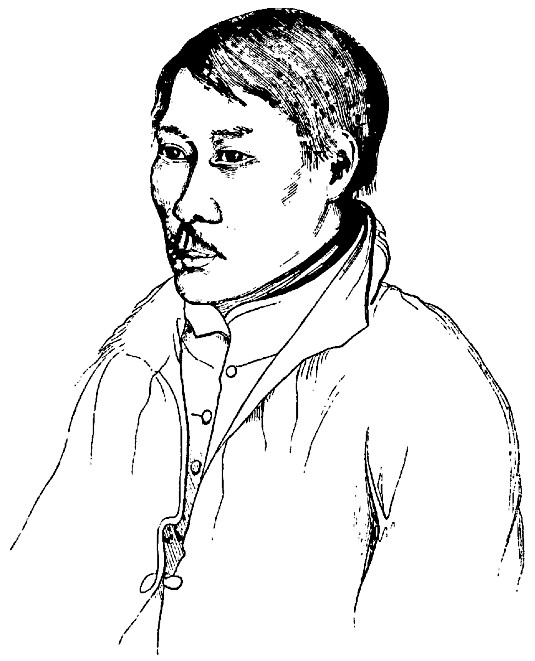
INTRODUCTION.
Previous to entering upon the details connected with the varieties, and affinities of the human species, it is advisable to explain the meaning and full import of certain terms that are likely to be of frequent occurrence. It is only, however, so far as an explanation is required, that any remarks will be made. The questions themselves, although necessary and preliminary, are well capable of being isolated from the properly descriptive portions of the subject, and of forming separate sections of ethnological science; a separation which is fully justified by their great range and extent.
A. Terms descriptive of differences in the way of physical conformation.—If we were to take three individual specimens of the human species, which should exhibit three of the most important differences, they would, I think, be—1. A Mongolian, or a Tungús, from Central or Siberian Asia; 2, a Negro from the Delta of the Niger; and 3, a European from France, Germany, or England. At the first view the Negro would seem the most unlike of the three; and, perhaps, he would do so after a minute and careful scrutiny. Still, the characteristic and differential features of the Asiatic would be of a very remarkable kind. In the general profile, in the form of the eye, in the front view of the face, he would differ from both. In the colour of his skin, in the character of his hair, and in the lower part of his profile, he would differ from the Negro. In the upper portion of the profile, and in the outline of the head, he would differ from the European.
The Mongolian's, or Tungusian's, face would be broad and flat, with the cheek-bones prominent. The breadth of the head from side to side would be nearly equal to its length from the forehead to the occiput; the nose would be flat, and, almost certainly, neither arched nor aquiline; the eyes would be drawn upwards at their outer angle, the skin would be of a yellowish-brown, the hair straight, the beard scanty, and the stature undersized.
The Negro, besides his black complexion and crisp hair, would exhibit a greater depth of head measuring from before backwards, and the upper jaw would be much more projecting. Possibly it might be so prominent as to give the head the appearance of being placed behind the face rather than above it.
The European would be characterized by negative rather than positive qualities. His face would be less broad, and his head would have greater depth in proportion to its breadth than would be the case with the Mongol. As compared with the African he would differ most in the parts between the nose and chin. The mouth of the Negro, instead of lying under the nose and forehead, projects forwards, in a slightly elongated shape, so as, in extreme cases, to be a muzzle rather than a mouth; the effect of which, as already stated, is to throw the upper part of the face and head behind the jaw. In the European profile, on the other hand, the general direction is vertical. The upper jaw does not project, and the forehead does not retire; so that the forehead, nose, and mouth are, comparatively speaking, nearly in the same line.
Now these distinctions we find in looking at the face only; those of the Mongolian being best shown in a front view, those of the Negro and European in profile. They are also those that would be drawn by a painter or a sculptor; i.e. such as we can detect by merely examining the outline and surface of the head and face. They are external. Differences in the colour of the eyes and the form of the limbs might also be easily discovered.
Important as these are, they are not the points which the ethnologist most looks to. Although the colour of the skin and eyes and the texture of the hair may be determined by external influences, the real reasons for the differences of outline lie in the differences of the skull and the bony parts of the face: and as, in addition to this, the skull is the receptacle of the brain, and the brain is the organ wherein the human species most differs from others, anatomists have long been in the habit of determining the different varieties of the human race, by the difference in the conformation of their skulls. With this view, the particular bones of most importance are the following:—
The Frontal bone, forming the forehead.—The more the frontal bone retires, the lower is the forehead, and the more prominent the face. The more it is vertical or arched, the more the brain seems to be in superposition over the face; rather than lying behind it. By drawing one line from the opening of the ear to the base of the nose, by drawing a second from the most prominent part of the forehead to the insertion of the teeth, and by measuring the inner angle at which these two lines bisect each other, we have the famous facial angle of Camper; in other words, we have a measure for the extent to which a forehead is retreating or vertical.
The Occipital bone.—This forms the back of the head. The distance between the frontal and occipital bones is the occipito-frontal diameter. It constitutes the length or depth of the head, in contradistinction to its breadth.
The Parietal bones, forming the sides of the skull.—The distance between the two parietal bones is the parietal diameter. It constitutes the breadth of the skull, in contradistinction to its length or depth. The ratio between these two diameters has been most studied by Professor Retzius, of Stockholm. Nations where the development is in the occipito-frontal diameter are called dolikhokephalic.[1] Nations where it is in the parietal diameter are called brakhykephalic.[2]
The Zygoma.—Formed by the union of two processes, one from the malar, and one from the temporal bone, and enclosing a space, within which the muscles pass from the temporal bone to the lower jaw. It constitutes the ridge that can be felt through the skin, between the cheek-bone and the ear. When the zygomatic space is large, the arch of the zygoma itself projects laterally outwards.
The Malar bones, i.e. the cheek-bones.—It is unnecessary to say that the prominence of the cheek-bone affects the physiognomy. When, over and above this prominence, the zygoma has a lateral and outward development, the breadth of the face becomes remarkably and characteristically broad and flat. It is upon the effect of a great zygomatic development on the form of the skull that Prichard has founded one of his primary divisions.
Fig. 2.
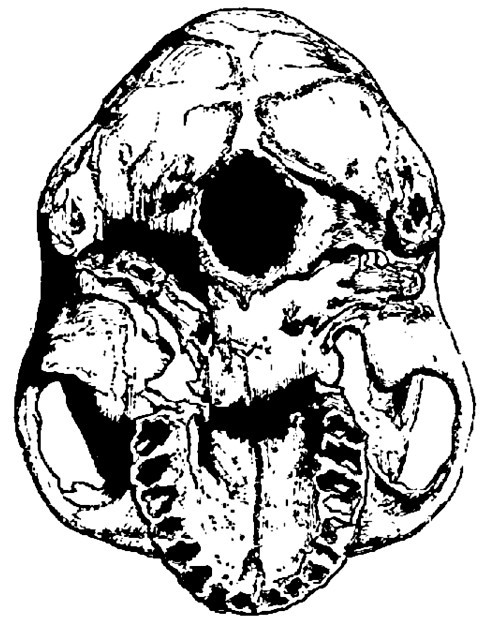
Fig. 3.
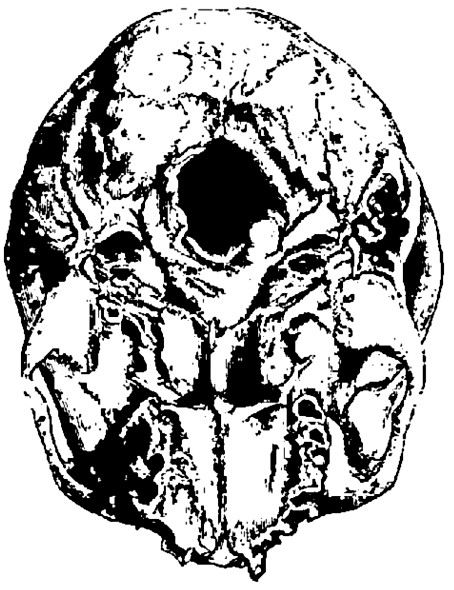
Distance between the zygomata gives breadth to the face. Distance between the parietal bones, to the head.
The Nasal bones.—The flatter the nasal bones the flatter the nose. They are generally flat in tribes of Central Asia and Africa; prominent, or saddle-shaped, in those of Europe.
The Upper Maxillary bone.—In this are inserted the teeth of the upper jaw. In the European it is nearly perpendicular. In the Negro it projects forwards; hence, in the European, the insertion of the teeth is perpendicular, in the African oblique. The effect of a projecting maxilla is a character upon which Prichard has founded one of his primary divisions. When the insertion of the teeth is perpendicular, or nearly perpendicular to the base of the nose, the skull is orthognathic;[3] when projecting forwards, prognathic.[4]
Fig. 4.
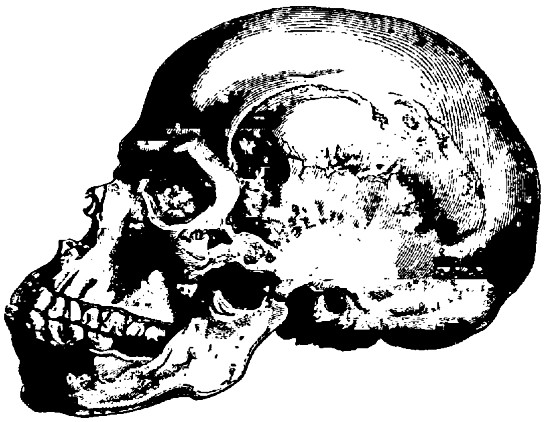
Upon these distinctions are founded the following forthcoming terms: occipito-frontal diameter, parietal diameter, occipito-frontal[5] profile, frontal profile, nasal profile, maxillary profile, zygomatic development.
Next to the head, the bony structure of the pelvis has drawn most attention; the importance thus given being natural and reasonable. The form of the pelvis determines the erect posture of man. These, however, and other numerous minor details will be noticed as occasion requires.
Notwithstanding the anatomical character of the principles upon which the varieties of the Human Species have been arranged, the terms denoting the chief divisions have not been given upon anatomical grounds. Hence we do not talk of the zygomatic or the occipito-frontal tribes, but of the Negro, or the Mongolian, &c. In other words, the term is taken from that particular variety which has the most characteristic conformation.
How many of such terms are necessary is a disputed point; the number of the primary divisions being undetermined. My own opinion is in favour of it being limited to three,—the Mongolian, the African, and the European. To these, many would add a fourth, and fifth, the Malay and American; whilst others would raise the Australian and Hottentot (and many other) conformations into separate and primary types. As terms, these will be retained. Their value, however, as the names of groups and divisions, will be subordinate to that of the three great types first named; a circumstance which brings us to the terms, typical, sub-typical, transitional and quasi-transitional.
A Malay and an American, although different, agree between themselves much more than either of them would with a Negro. Furthermore, each of them differs from the Mongolian and Chinese; less, however, than from the African and European.
Now, so far as this difference is concerned, the terms typical and sub-typical, in their usual sense, are sufficient; the Mongolian being the type of the variety which he represents, whilst the Malay and American each illustrate a sub-typical modification.
But this is not all. In departing from one type, an individual, a tribe, or a nation may approach another. This is the case when the hair of the African becomes straight, his complexion brunette, and his lips thin. It is also the case when a Mongol becomes light-haired or blue-eyed. In each of these changes the effect is the same. The original conformation has become Europeanized. Hence we have—
1st. Simple sub-typical deviation.—This occurs in the Eskimo. His face is broader than that of the Mongolian; but, as this increased breadth merely makes him somewhat unlike the natives of Central Asia, without approximating him to the African or European, the deviation is simple.
2nd. Deviation with Transition.—The Finlander has a Mongoliform skull, but (very often) blue eyes and light hair; so that he agrees with the European where he differs with the Kalmuk. This is deviation and something more. It is deviation accompanied with the phenomenon of a transition in form.
Transitions in form, however, are of two kinds—a. those in which descent plays a part; b. those in which causes other than descent play a part.
a. The light-haired Finlander is probably one of three things—
1. The descendant of Mongolians passing into Europeans.
2. The descendant of Europeans passing into Mongolians.
3. The descendant of the common stock from which the Europeans on one side, and Mongolians on the other, originated. In all these cases his differential characters are accounted for by the doctrine of descent.
b. Contrast, however, the case of an Australian Black. He has Mongol characters and he has Negro characters; so that, looking to his form only, he presents the phenomenon of transition; yet he is in none of the predicaments of the Finlander, since few ethnologists believe that, in the way of descent, he has any but the most indirect relationship to the African.
Hence, transitional forms are of two kinds, the first indicates descent, affiliation, and historical connexion; the second, the effect of common climatologic, alimentary, or social influences. This last will be called quasi-transitional.
B. Terms descriptive of differences in the way of language.—At the present moment, there are three methods by which the relation between the different words that constitute sentences is indicated:—1. The method of which the Chinese is a sample; 2. The method of which the Greek and Latin are samples; 3. The method of which the English is a sample.
In the way of illustration, though not in the way of history, it is best to take the second first.
1. The Classical method.—In a word like homin-em, there are two parts, homin-, radical; -em, inflectional. In the word te-tig-i, there are the same. The power of these parts is clear. The tig- and homin- denote the simple action, or the simple object. The te- denotes the time in which it takes place; the -i the agent. In the proposition te-tig-i homin-em, the -em denotes the relation between the object (the man touched) and the action (of touching). Logically, there are two ideas, e.g., that of the action or object, and that of the superadded conditions in respect to time, agency, and relation. In Latin and Greek, as in many other languages, these superadded conditions are expressed by altering the form of the original word. Sometimes this is done by the addition of some sound or sounds, sometimes by simple change—(a,) homin-is, homin-em; (b,) speak, spoke. Now this method of expressing the relation between the different words of a proposition by changes in the form of the words themselves is called the method of inflection, and languages which adopt it are called inflectional.
2. The English method.—The English language possesses inflections. Words like father-s, touch-ed, spoke, are instances of it. Nevertheless it has such important non-inflectional methods, that it may fairly be put in contrast with the Latin and Greek. Where a Roman said te-tig-i, we say I have touched, or I touched; using I, a separate word, instead of the incorporated syllable -i. Where a Roman said patr-i, we say to father; where a Roman said tang-am, we say I will (or shall) touch. In other words, we make auxiliary verbs and prepositions do the work of inflections, expressive of case and tense.
3. The Chinese method.—The Chinese method agrees with the English in expressing the different conditions and relations of actions and objects by separate words rather than by inflections; and it carries this principle so far as to have even a less amount of inflection; according to some writers, none at all. Wherein, then, does it differ? Even thus. The English is non-inflectional because it has lost inflections which it once possessed. The Chinese is non-inflectional because inflections have never been developed. This involves a great difference between the nature of the words which, in the two languages (English and Chinese) do the work of the Greek and Latin inflections. In English they are, generally speaking, so abstract, as to have a meaning only when in the context with other words. In Chinese they are often the names of objects and actions, i.e. nouns and verbs. If, instead of saying, I go to London, figs come from Turkey, the sun shines through the air, we said, I go, end London, figs come, origin Turkey, the sun shines, passage air, we should discourse after the manner of the Chinese.
But what if the inflectional parts of inflected words (nouns and verbs) were once separate words, which have since been incorporated with the radical term? In such a case, the difference between languages of the Chinese, and languages of the classical type would be a difference of degree only. Nay more, in languages like the Chinese the separate words most in use to express relation may become adjuncts or annexes. In this case, inflection is developed out of mere juxtaposition, and composition. Is this a hypothesis or a real fact? It is thus much of a fact. The numerous inflectional languages fall into two classes. In one the inflections have no appearance of having been separate words. In the other their origin as separate words is demonstrable.
The nomenclature arising from these distinctions, and requiring notice in the present preliminary remarks, is as follows:—
1. Languages of the Chinese type.—Aptotic.[6]
2. Inflection which can generally be shown to have arisen out of the juxtaposition and composition of different words.—Agglutinate.—Here the incorporation has not been sufficiently complete to wholly disguise the originally independent and separate character of the inflectional addition.
3. Inflection, wherein the existence of the inflectional elements as separate and independent words cannot be shown.—Amalgamate.—Here the speculator is at liberty to argue from the analogy of the agglutinate inflections, and to suppose that, owing to a greater amount of euphonic influences, the incorporation is more perfect.
4. Languages of the English type.—Anaptotic.[7]
c. Terms descriptive of differences in social cultivation.
1. The hunter state.—The full import of this term, which always implies a low degree of civilization, is to be inferred from the extent to which it indicates migratory habits, precariousness of subsistence, and imperfect property in the soil. Changing the land for the sea, the fisher state is essentially the same.
2. The pastoral state.—Precariousness of subsistence less than in the hunter state. Migratory habits, in many cases, much the same. Higher in the scale of civilization; since the breeding of animals gives moveable property. Property in the soil improved but still imperfect.
3. The agricultural state.—Migratory habits rare. Precariousness of food but slight. Property in the soil—except in the cases of migratory[8] cultivation—perfect.
4, 5. Material and moral influences in the history of the world.—The first term means changes effected by physical force only; the second, the influences of religion, literature, science, and political and social morality.
FOOTNOTES:
[1] From dolikhos=long, and kefalæ=head.
[2] From brakhys=short, and kefalæ=head.
[3] From orthos=upright, and gnathos=jaw.
[4] From pro=forwards, and gnathos=jaw.
[5] The outline of the hairy scalp.
[6] From a=not, and ptosis=a case.
[7] From ana=back, and ptosis=a case. Falling back from inflection.
[8] As that of some of the sub-Himalayan and Indo-Chinese tribes.
PART I.
The Primary Varieties of the Human Species.
- I. MONGOLIDÆ.
- II. ATLANTIDÆ.
- III. IAPETIDÆ.
The questions connected with the Natural History of the Human Species are so thoroughly questions of descent, affiliation, or pedigree, that I have no hesitation in putting the names of the primary divisions in the form of Greek patronymics; the supposed ancestor (or eponymus) being, of course, no real individual, but an ethnological fiction.
To have used, instead, the words stock, race, tribe, or even the more scientific terms—order, class, sub-order, preceded by an adjective, and to have spoken of the Mongolian stock, race, tribe or order, &c., would, apparently, have been the correcter method. It is not, however, so convenient. Every word of the sort in question is either required for the expression of the minor divisions, or is objectionable on other grounds.
I am also aware that this use of the forms in -idæ to express the divisions of a species, rather than those of an order, is at variance with the nomenclature of the zoologists. Still, the terms are less embarrassed with inconveniences than any I have hit upon.
I. Mongolidæ.—Face broad and flat from either the development of the zygomata, or that of the parietal bones; often from the depression of the nasal bones. Frontal profile retiring, or depressed, rarely approaching the perpendicular. Maxillary profile, moderately prognathic or projecting, rarely orthognathic. Eyes often oblique. Skin rarely a true white; rarely a jet black. Irides generally dark. Hair straight, and lank, and black; rarely light-coloured; sometimes curly, rarely woolly.
Languages.—Aptotic, and agglutinate; rarely with a truly amalgamate inflection.
Distribution.—Asia, Polynesia, America.
Influence upon the history of the world.—Material rather than moral.
II. Atlantidæ.—Maxillary profile projecting, nasal generally flat, frontal retiring, cranium dolikhokephalic, the parietal diameter being generally narrow. Eyes rarely oblique. Skin often jet-black, very rarely approaching a pure white. Hair crisp, woolly, rarely straight, still more rarely light-coloured.
Languages.—With an agglutinate, rarely an amalgamate inflection.
Distribution.—Africa.
Influence on the history of the world.—Inconsiderable.
III. Iapetidæ.—Maxillary profile but little projecting, nasal often prominent, frontal sometimes nearly vertical. Face rarely very flat, moderately broad. Skull generally dolikhokephalic. Eyes rarely oblique. Skin white, or brunette. Hair never woolly, often light-coloured. Irides black, blue, grey.
Languages.—With amalgamate inflections, or else anaptotic; rarely agglutinate, never aptotic.
Distribution.—Europe.
Influence on the history of the world.—Greater than that of either the Mongolidæ or the Atlantidæ. Moral as well as material.
These characters have been framed to meet the typical, sub-typical, and quasi-transitional, but not the true transitional forms. The reason of this is clear. Where the transition is real, and where the affiliation in the way of descent coincides with similarity of conformation, the tribe thus situated belong to two divisions, rather than to any single one.
MONGOLIDÆ.
DIVISIONS.
- A.—The Altaic Mongolidæ.
- B.—The Dioscurian Mongolidæ.
- C.—The Oceanic Mongolidæ.
- D.—The Hyperborean Mongolidæ.
- E.—The Peninsular Mongolidæ.
- F.—The American Mongolidæ.
- G.—The Indian Mongolidæ.
A.
ALTAIC MONGOLIDÆ.
The term Altaic is taken from the Altai mountains in Central Asia, these being a convenient geographical centre for the different nations and tribes comprised in this division. It contains the following sub-divisions:—
1. The Seriform Stock.
2. The Turanian Stock.
I.
SERIFORM STOCK.
Physical conformation.—Mongol.
Languages.—Either wholly aptotic, or with only the rudiments of an inflection.
Area.—China, Tibet, and the Indo-Chinese, or Transgangetic, Peninsula, as far as Malaya; the Himalayan, and parts of the sub-Himalayan, range of mountains.
Chief Divisions.—1. The Chinese. 2. The Tibetans. 3. The Anamese. 4. The Siamese. 5. The Kambojians. 6. The Burmese. 7. The Môn. 8. Numerous unplaced tribes.
I have begun with the nations and tribes represented by the Chinese, Tibetans, and Indo-Chinese, on the strength of the primitive condition of their languages. This represents the earliest known stage of human speech; by which I mean, not that it was spoken earlier than the other tongues of the world, but only that it has changed, or grown, more slowly. I should also add, that over and above the fact of these languages being destitute of true inflection, the separate words generally consist of only a single syllable. Hence the class has been called monosyllabic. This latter character, however, has no essential connection with the aptotic form. A language of dissyllables or trisyllables may, for any thing known to the contrary, be as destitute of inflections as a monosyllabic one. Still, it must be admitted that no such tongue has yet been discovered.
THE CHINESE.
Locality.—China; bounded by the countries of the Koreans, Mantshu, Mongolians, Tibetans, and the hill tribes of the Transgangetic Peninsula and Assam.
Religion.—Modified Buddhism, or the religion of Fo.
Mode of Writing.—Rhæmatographic, i.e. the written signs represent whole words;[9] not merely the parts of words, single articulate sounds or syllables.
Physical Conformation.—Mongoliform. According to Prichard the maxillary profile projects. According to Retzius, the maxillary profile projects, and the cranial development is elongated, or occipito-frontal. That the jaw, in some degree, projects, and that the forehead also retires, is shown by a remark of Tradescant Lay's,—e.g.: that the Chinese profile slopes upwards from the chin to the beginning of the hairy scalp.
No country in the world of equal magnitude with China has so homogeneous or so dense a population. From the ocean to Tibet, from Korea to Cochin-China, the language is one, and the physiognomy is one; and it is only when we reach the mountain-ridges of the west and south, that we find, in the ruder and more imperfectly civilized tribes that inhabit them, any material variation from the general uniformity of the most populous empire in the world. This is the case whatever be the test that is applied. The language varies from the refined speech of the Mandarins to the comparative rudeness of certain provincial dialects; the complexion and contour of the face vary also; and the civilization is less characteristic in some districts than in others; but all these deviations lie within narrow limits.
In China, the steppe-land of High Asia slopes downwards to the North Pacific. Hence we have a sea-board of average proportion as compared with the inland area. It faces, however, one ocean only; and that the Pacific. Of this no island larger than Hainan is inhabited by a Chinese population; Formosa not being Chinese. No mountain-ranges are of sufficient magnitude to be compared with the systems of Tibet or those of the Transgangetic Peninsula. Still, there are three well-marked watersheds—that of the Hoang-ho on the north, that of the Canton River on the south, and that of Kiang-Ku between them: and there are the fertile alluvial valleys corresponding.
Upon the whole the physical geography of China is that of an agricultural and industrial population. This the Chinese are to a preeminent degree: and when we come to the Malay Archipelago we shall find that they are also traders. I am much more inclined to measure their civilization by this test, than by their pretensions to an indigenous literature of an almost unfathomable antiquity; a point which will be noticed in the sequel.
In physical conformation the Chinese have a yellow-brown complexion, a broad face, and a scanty beard, lank black hair, dark irides, and a stature below that of the European. This is what we expect, as part and parcel of the common Mongol characteristics. Harshness of feature they have in a less degree than the true Mongolians; a tendency to obesity in a greater. In this respect, they have been called Mongols softened down. This is what they really are. One point of physiognomy, however, is more peculiarly Chinese than aught else,—viz. the linear character, and oblique direction of the opening of the eyes. This is narrow, so that little of the eye is seen. It is also drawn upwards at its outer angle, and so becomes oblique in its position. Sometimes in addition to this the upper eyelid hangs heavy and tumid over the eyeball; and sometimes the skin forms a crescentic fold between the inner angle of the eye and the nose; as may be seen in individuals out of China, and which is not uncommon in England.
Now the peculiarity that I have just attempted to describe, is one of the minute points of difference between the Chinese and several other Mongol nations. The oblique eye will often be noticed in the following pages; sometimes from the fact of its presence, sometimes from that of its absence. It is not exclusively Chinese: but it is found in its most marked form in China.
THE TIBETANS.
Localities.—Tibet, Bután, Ladakh, Bultistan, or Little Tibet.
Political relations.—Tibet, subject to China, Ladakh a part of the Sikh empire, Bultistan and Bután, independent.
Divisions.—1. The Bhot of Tibet. 2. The Bhután Tibetans. 3. The Ladakh Tibetans. 4. The Bulti.
Conterminous.—Taking the family altogether, with the Chinese, Mongolians, Turks, Northern tribes and nations of Hindostan, North-Western tribes of the Burmese empire, and certain tribes akin to the Persians.
Religion.—Chiefly Buddhism. Brahminism on the Indian frontier. Shia Mahometanism in Little Tibet.
Language.—Dialects, in some cases, perhaps, independent languages, of the Tibetan.
Alphabet.—Derived from the Pali of India.
Physical appearance.—Mongol.
1.—The Bhot.—These are the inhabitants of Tibet Proper, and Tangut. They are all Buddhists in the more exaggerated form; and it is in the Tibetan monasteries where the greatest abundance of Buddhist literature is to be found. This is almost wholly religious, and in a great measure a translation from either the Sanskrit or the Pali. The first century after Christ is generally considered as the epoch at which the religion was introduced into Tibet: and this epoch is a likely one.
2.—The Tibetans of Bután.—Although Buddhists, the Tibetans of Bután have been modified by Hindu influences. Their government is that of a Rajah, and many of their outlying tribes are extended to the south of the Himalayan range.
3.—Ladakh Tibetans.—With the exception of the southern frontier of Bután, Ladakh is the portion of the Tibetan area which is best known, and where the proper Tibetan type is most subjected to foreign influences. Although the religion be the religion of Buddha, there was a short interval of Mahometanism. Originally dependent upon the Guru Lama of Hlassa, Ladakh subsequently became one of the extreme points of the Chinese empire, retaining its own princes. In the reign, however, of Aurungzeb, it was overrun by the Turks. These, however, Aurungzeb expelled at the request of the fugitive Rajah, who promised to become Mahometan in return; and kept his promise. It was broken, however, by his successor, so that the religion of Mahomet was professed for a time only. It was, however, tolerated afterwards. The last conquest of Ladakh was by the Sikhs under Runjeet Singh; and it now follows the fortunes of the Sikh dynasty. This has opened a door to the Indians of the Punjâb. To these elements of intermixture may be added, the presence of numerous settlers from Cashmir. Lastly, there is a settlement of Shia Mahometans from Little Tibet.
4.—The Bulti of Bultistan, or Little Tibet.—The most differential characteristic of the Bulti Tibetans, is that they are no Buddhists, but Mahometans, of the Shia persuasion, their conversion having come from Persia. It has been already stated that the Bulti enjoy a political independence.
Kunawer.(?) I have not examined how far the Kunawer tribes, located where the Sutlege breaks through the Himalayas, deserve to be classed as a separate division. At all events their language is monosyllabic (probably closely allied to the Ladakh), as may be seen in the Theburskud, Milchan, and Súmchú vocabularies of Gerard.[10]
The Polyandria of Tibet.—The current doctrine respecting the so-called Polyandria of Tibet, is that it is the common polygamy of the east reversed; i.e., that one woman marries several husbands, who may all be alive at the same time.
What is most certain upon this obscure point is that the surviving brother inherits the wife of the one that died.
It is not so certain, although highly probably, that the wife is the property of two or more brothers at the same time.
At any rate the marriage, if so it may be called, is confined to the circle of the brothers-in-law. Perhaps the truth is that every brother-in-law is a husband.
THE ANAMESE.
Locality.—Tunkín and Cochin-China.
Conterminous with the Chinese; and, except so far as they are partially separated by mountain-tribes, with the Kambojians and Siamese.
Religion.—Buddhism.
Language.—Different from, but allied to, the Chinese.
Physical Appearance.—Like that of the Chinese, except that the average height is somewhat less. Upper extremities long, lower, short and stout. Form of the skull more globular than square. Eyelids less turned than that of the Chinese. Mouth large; lips prominent, but not thick; moustache more abundant than beard; beard scanty, though encouraged. Colour more yellow than either brown or blackish. Clothing abundant.—Finlayson from Prichard.
THE SIAMESE.
Locality.—From the Gulf of Siam and the neck of the Malayan Peninsula to the frontiers of China. Part of Assam. Conterminous on the east, except so far as they are separated by mountain tribes, with the Anamese, and Kambojians; on the west, subject to the same limitation, with the Môn of Pegu, and the tribes of the Burmese empire. On the south with the Malays of the Malayan Peninsula.
Synonym.—T'hay, the native name.
Religion.—Buddhist.
Alphabets.—Of Indian origin, rounded forms of the Pali. Chief Divisions.—Laos, Shyán, (Ahom?) Khamti.
Physical Appearance.—Average height of twenty men, taken indiscriminately, five feet three inches, the tallest being five feet eight inches, the shortest, five feet two inches. Limbs and trunk robust. Complexion, light brown, lighter than the Malay, darker than the Chinese. Hair, black, lank, coarse and abundant. Hairy scalp descends low. Nose small, but not flattened; nostrils divergent. Sclerotica yellowish. Outer angles of the eye turned upwards. Cheek-bones broad and high. Lower jaw square, so as to look as if the parotid gland were swollen.—Crawford and Finlayson from Prichard.
In the history of the Siamese Tribes, the conquest of Assam is, perhaps, the most important event; and this is connected with their wide distribution.
In the lower part of the valley of Assam the language is Bengali, or nearly so; but only in the lower part. The upper half is peopled by different small mountain tribes, one of which is the Khamti.
The Khamti.—In the North Eastern corner of Assam, the Khamti are conterminous with the Singpho, Mishimi, and Miri, and are traditionally reported to have emigrated from the head-waters of the Irawaddi. In physical appearance they are middle-sized, more resembling the Chinese than any tribe on the frontier. Perhaps, a shade darker in complexion. Their alphabet is Siamese; and their language, far north as it is spoken, when compared with the Siamese of Bankok, closely resembles that dialect. In Brown's[11] Vocabularies the proportion of words, similar or identical, in Khamti and Siamese, is 92 per cent.
Still it is by no means certain that the Khamti represent the original conquerors. These were Ahoms; their alphabet was Ahom, and the language Ahom. The Ahom, however, was Siamese; and probably the Khamti was a dialect of it.
The Ahom literature, preserved in the books of the Assam priesthood, is said to be remarkable for the negative fact of there being in it no traces of the Hindu religion—either Buddhist or Brahminical. This speaks much either in favour of the antiquity of the conquest, or for the recent date of the Hindu influence.
In A.D. 1695, the Brahminical religion was established in Assam: how much earlier is uncertain.
THE KAMBOJIANS.
Locality.—Lower course of the Mekhong river. East of the Siamese, west of the Anamese, except so for as they may be separated by isolated mountain tribes, conterminous with these nations.
Our knowledge respecting the Kambojians is not sufficiently definite to enable us to say how far they differ, or how far they agree with certain tribes of the interior, which have been described separately. In Prichard I find that they were supposed by the Portuguese to have been derived from a warlike nation of the interior, called Kho, or Gueo; who are still represented as painting and tattooing their bodies.
Now these Kho, or Gueo, are probably the Ka described along with the Chong, as a separate people. If so we are enabled to dispose of three unplaced tribes; since, by Crawfurd's Ka and Chong vocabularies we can connect, perhaps identify, them with the Kambojians.
ENGLISH.
KA.
CHONG.
KAMBOJIAN.
Sun
tangi
tańgi
tangai.
Moon
kot
kang
ke.
Stone
tamoe
tamok
tamo.
Water
dak
tak
tak.
River
dak-tani
talle
tanle.
Fire
un
pleu
plung.
Fish
tre
mel
trai.
One
moe
moe
moe.
Two
bar
bar
pir.
Three
peh
peh
bai.
Four
puan
pon
buan.
Five
chang
pram
pram.
Most of the Ka, and Chong words which are not Kambojian are either Anamitic or Môn.
Furthermore, in Crawfurd's Embassy to Siam, a vocabulary representing a fourth Kambojian dialect is given; the Khomen.
THE BURMESE.
[1] From dolikhos=long, and kefalæ=head.
[2] From brakhys=short, and kefalæ=head.
[3] From orthos=upright, and gnathos=jaw.
[4] From pro=forwards, and gnathos=jaw.
[5] The outline of the hairy scalp.
[6] From a=not, and ptosis=a case.
[7] From ana=back, and ptosis=a case. Falling back from inflection.
[8] As that of some of the sub-Himalayan and Indo-Chinese tribes.
The Parietal bones, forming the sides of the skull.—The distance between the two parietal bones is the parietal diameter. It constitutes the breadth of the skull, in contradistinction to its length or depth. The ratio between these two diameters has been most studied by Professor Retzius, of Stockholm. Nations where the development is in the occipito-frontal diameter are called dolikhokephalic.[1] Nations where it is in the parietal diameter are called brakhykephalic.[2]
The Parietal bones, forming the sides of the skull.—The distance between the two parietal bones is the parietal diameter. It constitutes the breadth of the skull, in contradistinction to its length or depth. The ratio between these two diameters has been most studied by Professor Retzius, of Stockholm. Nations where the development is in the occipito-frontal diameter are called dolikhokephalic.[1] Nations where it is in the parietal diameter are called brakhykephalic.[2]
The Upper Maxillary bone.—In this are inserted the teeth of the upper jaw. In the European it is nearly perpendicular. In the Negro it projects forwards; hence, in the European, the insertion of the teeth is perpendicular, in the African oblique. The effect of a projecting maxilla is a character upon which Prichard has founded one of his primary divisions. When the insertion of the teeth is perpendicular, or nearly perpendicular to the base of the nose, the skull is orthognathic;[3] when projecting forwards, prognathic.[4]
The Upper Maxillary bone.—In this are inserted the teeth of the upper jaw. In the European it is nearly perpendicular. In the Negro it projects forwards; hence, in the European, the insertion of the teeth is perpendicular, in the African oblique. The effect of a projecting maxilla is a character upon which Prichard has founded one of his primary divisions. When the insertion of the teeth is perpendicular, or nearly perpendicular to the base of the nose, the skull is orthognathic;[3] when projecting forwards, prognathic.[4]
Upon these distinctions are founded the following forthcoming terms: occipito-frontal diameter, parietal diameter, occipito-frontal[5] profile, frontal profile, nasal profile, maxillary profile, zygomatic development.
1. Languages of the Chinese type.—Aptotic.[6]
4. Languages of the English type.—Anaptotic.[7]
3. The agricultural state.—Migratory habits rare. Precariousness of food but slight. Property in the soil—except in the cases of migratory[8] cultivation—perfect.
[9] In Greek, Rhæmata=words.
[10] Transactions of the Asiatic Society of Bengal.
[11] Transactions of the Asiatic Society of Bengal, vol. vi. part 2.
Locality.—Valley of the Irawaddi. Conterminous, save so far as interrupted by mountain-tribes, with Assam, China, Siam, and Pegu.
Divisions.—1. The Myamma, or Burmese of Ava. 2. The Rhukheng, or people of Arakan.
Religion.—Buddhist.
Alphabet.—Of Indian origin, a rounded form of the Pali.
Physical appearance.—More beard, more prominent features, and darker complexions than the Siamese, Anamese, and Chinese. Beard also more abundant. The darkness of complexion increasing towards the confines of Bengal.
THE MÔN.
Locality.—The Delta of the Irawaddi; Pegu.
Alphabet.—Burmese.
The notices hitherto given have applied only to the great political divisions of the variety speaking monosyllabic languages; and have referred to nations of a known and similar degree of civilization. It would be an error, however, to suppose that they supply a complete enumeration. Hardly an empire mentioned will not exhibit some instance of a new series of phenomena standing over for investigation. The Chinese, the Burmese, and the Siamese, represent merely the dominant tribes of their several areas; those whereof the civilization and territorial power have given their possessors a certain degree of prominence in the history of the world. The intermixed tribes, sometimes imperfectly subdued, always imperfectly civilized, inhabiting barren tracts or mountain fastnesses, have a value in ethnology which they cannot command in history. In these we see the original substratum of the different national characters, as it may be supposed to have shown itself, before it was modified by foreign influences. In a more advanced stage of our knowledge, these tribes will probably be brought under one of the sub-divisions already noticed. At present, even when in some cases they may be so placed, it is best to take them in detail; premising that, the list does not pretend to be exhaustive, that, from the fluctuations of the geographical nomenclature, the same tribe may be mentioned twice over, and, lastly, that partly from imperfect knowledge, and partly from changes of locality, arising from migrations of the tribes themselves, the geographical position is, in many cases, difficult to fix.
The notice, however, of the minor representatives, real or supposed, of the great division of the human race speaking monosyllabic languages now commences.
THE SI-FAN.
The word[12] Si means west, whilst Fan means stranger; so that Si-fan means western strangers. The term means one or more of the wilder tribes on the Tibetan or Mongolian frontier.
Nothing is less likely than that the Si-fan should differ in kind from the Chinese—unless it be that they are Turk, Mongol, or Tibetan.
THE MIAOU-TSE.
These are the so-called aborigines of China. It were, perhaps, more accurate to call them the Chinese in their most aboriginal form. The term means children of the soil. Their localities are the mountains of Southern and Central China. They seem to consist of a number of tribes rather than to constitute any particular people; so that it is possible that many varieties of the primitive Chinese may be comprised under the general appellation. Those of Ping-sha-hwang are divided into the white and black Miaou-tse; from the difference of their complexion. Both the Abbé Gosier and Tradescant Lay[13] speak to their indomitable courage, and to their spirit of independence, their subjection being still imperfect. Their weapons are the bow and cross-bow. Their employment agriculture. The following is an account of their religious rites from the author last named.
"Religious Rites.—When a man among the Miaou-tse who inhabit the Ping-sha-shih hills, marries, he sticks five small flags into a bundle of grass fastened together by about seven different bands. Before this strange pageant he kneels, while the rest of his friends fold their arms and bow; after this they make merry with music and dancing. At the death of father or mother, the eldest son remains at home for forty-nine days without washing his face; when this period has been completed, he sacrifices to a divinity which is called Fang-kwei, and seems to correspond in office with Mercury, who, according to the views of ancient mythology, conducted the spirits of the dead to the abodes of happiness. If the eldest son be poor, and cannot afford to lose the labour of so long a time, the grandson or some other descendant performs this duty in his stead. Among the mountaineers styled the Hea-king, when a man is sick, his friends offer the head of a tiger to the prince of divinities. The head is placed upon a charger, with a sword; three incense-sticks and two candles behind it, and three cups of wine in front. Before this curious oblation the worshippers fold their hands, or cross their arms and bow themselves. Another tribe, when they would propitiate the good-will of the powers which influence the weather, appoint ten companies of young men and women, who, after dressing themselves in robes made of felt, and binding their loins with an embroidered girdle, dance and play the organ with every suitable demonstration of joy and festivity. This gay ceremony is kept up for three days and three nights, at the end of which they sacrifice an ox, to obtain, says the Chinese writer, a plentiful year. A father among the same people, when his son is ten months old, offers a white tiger, and accompanies the oblation with such rites of merriment as his circumstances can afford. At this time a name is given to the child. This reminds us of a modern christening, when the solemnities of religion are straightway followed by the mirth, good cheer, and gaieties of a festival. When a tribe called the Chung-king mourn for their dead, they kill an ox, and place the head and feet upon an altar, with basins filled with food, lighted candles, and cups of wine by way of drink-offering. The altar resembles a table, and explains a phrase used in Isaiah, "Ye have prepared a table for that number." The bridal ceremonies with another tribe are attended by the sacrifice of a dog, at which the relatives of husband and wife are present.
"A people called the Western Miaou-tse, in the middle of autumn offer a sacrifice to the great ancestor or founder of their race. For this purpose, they select a male ox or buffalo which is well covered with hair, and has its horns quite perfect; that is, in other words, an animal without blemish. To put it in good condition, they feed it with grass and water till the rice or corn is ripe, when the animal is fat. They then distil a certain quantity of spirit from the grain, and slay the ox. Being thus provided for a feast, they invite all their relatives, who come and carouse with them amidst plays, singing, and the loud challenges of jolly companions. In the first-fruits which the Chinese present at the close of harvest, we have a representative of Cain's offering; but in the ceremony just described, there are some traces of that which Abel brought to the altar. The aboriginal Chinese retain the rite, but the object worshipped is disguised under an equivocal name,—equivocal, because the Creator has a claim to the title of original ancestor by way of eminence, as well as the common parent of mankind. When the mind of man was darkened, he confounded Adam with his Maker, and worshipped the creature instead of the Creator, who is blessed for ever.
"With the White Miaou-tse, a rite is observed somewhat in character like the last, but for a different purpose. These select an ox well-proportioned and carrying a perfect pair of horns. This animal they feed carefully to prepare it for sacrifice. Each cantonment keeps an ox in this way in readiness to be offered to the great ancestor, whenever, in any of their contests, victory shall declare in their favour. After the sacrifice has been performed by the master of the sacrifice, or priest, the relatives of the sacrificer join in a regular festivity of singing and drinking. A tribe commended for the purity of their disposition and their obedience to the magistrate, at the death of a person collect a large quantity of fuel together, and, I suppose, make a great burning for him. When a man is about to marry among a particular race of mountaineers, he allows two of his teeth to be knocked out with a hammer and hard chisel, to avert the mischiefs of matrimony. These, too, cut off the forelocks and spread the hair behind; they also, like the Chinese, bestow some attention upon the beauty of their eyebrows."
THE LOLOS.
Probably these belong more to Siam[14] than to China. Mutatis mutandis, they are on the southern frontier what the Si-fan are on the west.
They are so far civilized as to have taken their religion (Buddhism), and an alphabet from Ava or Pegu.
THE QUANTO.
The Quanto inhabit[14] the range of mountains between Anam and China. They represent the original civilization, or want of civilization, of Cochin-China and Tonkin,—i.e. of Cochin-China and Tonkin before the influence of China.
They are in possession of an alphabet.
THE TSHAMPA.
Inhabitants of the southernmost[14] coast of Cochin-China. Their language, of which I have not seen a specimen, is said to differ from both the Chinese and the Kambojian. They are a civilized people, and were so in the time of Marco Polo. According to Crawfurd, their civilization was, to a certain extent, due to Indian influences. At present there is a Malay settlement on their coast.
THE MOY.
The southern part of the mountains which form the watershed between Cochin-China and Kambojia is the residence of the Moy. According to Chapman, they are eminently dark-complexioned; an observation which will be found in the sequel to apply to several other of the minor tribes of the division in question.[14]
Sub-divisions of the Laos branch of the Siamese.—As laid down in the maps, the Laos fill up the whole area between China on the north, Siam on the south, Cochin-China and Kambojia on the east, and Ava on the west; of this area, however, little is known in detail.
One of the divisions of the Laos is called Lau[14]-pang-dun, or the Black Laos, from the darkness of their complexion.
Tribes, too, called Pa-y and Pa-pe,[15] are said to be Laos.
Lastly, the relations between the true Laos, and the Ahom, Khamti, and Shyán, have yet to be made out in a satisfactory manner.
KARIEN.
Distribution.—Irregular; from the eleventh to the twenty-third degree of north latitude; from the Mergui Province in Tenasserim to the borders of China, between the Burmese on the west and the Siamese on the east. On the river Salwin, are the so-called Red Karien.
Name.—Burmese. Called Kadun in Pegu.
The Kariens, unless they are Siamese, have next to that nation the greatest extension, north and south. Ground down by the oppression of the Burmese, they are, with the exception of the red Kariens, who still preserve an imperfect independence, a decreasing race. Of their language we have specimens[16] in more than one dialect, viz., the Passuko, Maplu, and Play. They are agricultural tribes, clearing the land for the cultivation of rice, and then leaving it to migrate elsewhere.—Arva in annos mutant, et superest ager.
SILONG.
Locality.—Islands of the Mergui Archipelago.
Numbers.—Said to be about one thousand.
Language.—Said to be peculiar.
Authority.—Dr. Helfer's Third Report on the Tenasserim Provinces.—Journal of the Asiatic Society of Bengal, vol. viii.
The details now forthcoming apply to the districts lying north of a line drawn from the southernmost point of Arakan to the Irawaddi; and they comprise the eastern extensions of the Arakan tribes, the parts about Manipur, and the complex, but important line of frontier between the Indo-Chinese kingdoms, and the Indian portions of Bengal and Assam.
The first tribes that will be noticed are those which are most closely related to the inhabitants of Arakan.
NAGAS.
Locality.—South-east Assam, in the north-eastern portion of the mountain range between Assam and the Burmese empire. Conterminous with the Singpho on the north-east.
KUKI.
Locality.—Mountains of Tipperah, Sylhet and Chittagong. A south-western prolongation of the Nagas.
Synonyms.—Lunctas, Koung-thias.(?)
KHUMIA (CHOOMEEAS).
Locality.—The same mountains as the Kuki, only on a lower level. The word means villagers, Khúm=village.
The Naga, Kuki, and Khumia, are tribes of one family. Their ethnographical position is certain. They have long been known to be part of Rhukheng division of the Burmese tribes, speaking the same language with the inhabitants of Arakan, and connecting themselves with that people in their traditions respecting their own origin.
I may also add that the similarity of manners between them and the Garo is very manifest.
KHYEN.
Locality.—The Yuma mountains between Ava and Arakan. Independent Pagans.
Name.—Burmese. Native name Koloun. Buchanan, in Asiatic Researches, vol. v.
Authority.—Lieutenant Trant in Asiatic Researches, vol. xvi.
The faces of the Khyen women are tattooed. That the following reason, however, for the practice is valid, is more than I will venture to vouch.
One of the forms of tribute to one of the conquerors of the Khyens, was the payment of a certain number of the most beautiful women of the country. In order to do away with the danger to which their unmutilated charms exposed them, the whole generation tattooed themselves; and their descendants have done so since.
MANIPUR.
Synonyms.—Kathi or Kassay, Moitay.
Locality.—Bounded on the east by the right branch of the Irawaddi, on the north and west by the Naga and Kachari countries, on the south by the Khyen.
An idea of the extent to which the language, for these parts varies within a small geographical area, may be collected from Captain Gordon's notices of the dialects spoken in the neighbourhood of Manipur.
Besides the Manipur proper, the following eleven dialects are illustrated by his vocabularies,[17] and are said to be spoken within the limits of a very inconsiderable circle, of which Manipur is the centre.
1. The Songpú. The most western. Per-centage of Manipur words, 21. Brown.
2. The Kapwi. A very small tribe. Ditto, 41. Brown.
3. The Koreng. Ditto, 18. Brown.
4. The Maram. Ditto, 25. Brown.
5. The Champhung. Thirty or forty families. Ditto, 28. Brown.
6. The Luhuppa. Ditto, 31. Brown.
7. The North Tankhul.
Ditto, 28.
Brown.Said to be mutually unintelligible.
8. The Central Tankhul.
Ditto, 35.
Brown.9. The South Tankhul.
Ditto, 33.
Brown.10. The Khoibú. Per-centage of Manipur words, 40. Brown.
11. The Maring. Ditto, 50. Brown.
KYO.
Locality.—Arakan, banks of the river Koladyng. A single village.
Religion.—Worship of Nats (Spirits).
Physical Appearance.—Contrasted with that of their neighbours, being so dark as to suggest the idea that they are of Bengal origin. No traditions, however, to that effect.
Language.—Monosyllabic, as ascertained by two vocabularies.—Lieut. Phayre's Journal of the Asiatic Society of Bengal, and Lieut. Latter, ditto.
KACHARI.
Locality.—Between the Kasia county, with which it is conterminous on the east, and Manipur.
KASIA.
Locality.—Southern border of Lower Assam. Conterminous with the Kachari on the east and the Garo on the west.
A better knowledge of the wild tribes in these parts than we possess, will, probably, enable us to ascertain the nature of the most primitive Indo-Chinese religion. It seems in these parts to be the worship of Nats or spirits.
In the Kasia country the occurrence of erect pillars, evidently objects of mysterious respect, if not of adoration, is frequent. These are explained by similar ones in the Khyen district. They are depicted by Lieutenant Latter—accurate magis quam verecunde—and are lingams.
Stout legs, thick lips, and angular eyes, are marked characters in the Kasia conformation. They burn their dead. Their ceremonies are few or none. Like the Garo, they drink no milk. Like the Garo, also, they are said to have no beast of burden. Like many of the tribes around them they chew pawn; and like many of the tribes around them they obtain, for drink, a liquor fermented from millet. Millet or rice are the usual sources for the stimulant beverages of this section of the Seriform tribes; and, it may be added, that the art of distillation as well as of simple fermentation is widely spread. I am not aware that the former is practised by the present tribe; it is common, however, in the Sub-Himalayan range.—Lieutenant Yule, Journal of the Asiatic Society of Bengal, xiii. 3.
SINGPHO.
Locality.—A tract of about one thousand four hundred square miles in the north-eastern corner of Assam. Conterminous with the Khamtis and Mishimis on the north. Bounded on the south and east by the Patkoe range; which divides Assam from the Burmese empire.
Population.—Calculated in 1838 at six thousand.
Government.—Clans under chiefs called Gaums.
Religion.—Imperfect Buddhism. Worship of dead chieftains.
Alphabet.—Shyán or Ahom.
Physical Appearance.—Body long, legs short, complexion tawny.
JILI.
Locality.—The Burmese side of the Patkoe range. Conterminous with the Singpho, by whom they have been nearly extinguished.
Language.—Seven-tenths of the Jili vocabulary is Singpho.
MISHIMI.
Locality.—North-east extremity of Assam. Conterminous with the Khamti on the south, and the Abors on the west. Mountaineers. Tibet on the north.
Mishimi Tribes.—The Chool Kutta=crop-haired, the Meahu, the Tairi, or Digaru. According to Brown, the Maí Mishimi, the Taron Mishimi, and the Maiye or Meme Mishimi.
Probable Population.—Four hundred and sixty.
Physical Appearance.—Stature short. Limbs small, but active, and well-knit.
The Mishimi country produces, and the Mishimi collect, a poison called the Bikh Mishimi. This is used both for the purposes of hunting and of war. So poisonous is it that a single wound is said to kill an elephant. The flesh, however, of the animal so killed is eaten with impunity.
BOR ABORS.
Locality.—The loftiest portion of the mountains to the north of Assam.
ABORS.
Locality.—The lower range of the mountains inhabited by the Bor Abors.
MIRI.
Locality.—The foot of the Abor and Bor Abor range. Speaking generally, the Bor Abors, Abors, and Miri are conterminous with the Khamti, and Mishimi on the north-east.
DUFLA.
Locality.—South-west of the Abors, on the same mountain range. No less than one hundred and eighty petty chiefs are said to rule over the numerous disunited Dufla tribes of the Char Dwán; and this is only one of their localities.
AKA.
Locality.—The south-western prolongation of the range inhabited by the Abors and Dufla. Conterminous with the latter.
Language.—Half the words in an Aka and Abor vocabulary are alike.
MUTTUCK.
Locality.—North-east Assam, south of the Burramputer. Conterminous with the Singhu, Khamti, and Miri.
Synonym.—Muamaria, or Moa Mareya.
Religion.—Imperfect Brahmanism.
The Muttuck persecution is one of the most important facts in the history of Assam. Prior to the Ahom invasion, said to have taken place 1224, A. D., the Muttucks had been converted to Hinduism; but to a form of it which denied the divinity of Durga, and would not admit the worship of her image. A violent persecution on this account, between A.D. 1714 and 1744, brought about a resistance which did much to weaken and disorganise the Assam empire.
GARO.
Locality.—The Garo hills, at the south-western entrance of the valley of Assam.
No tribe hitherto mentioned is of the ethnographical importance of the Garo.
If we call them Indian, they are the most northern tribe that has been described as having Negro elements in their physiognomy.
If we call them Tibetan, or Burmese, they are equally remarkable for this peculiarity.
Taking their physical appearance as a test, it is the Garo that seem the likeliest to exhibit a transition between the type already illustrated, and the type of the aborigines of Hindostan, supposing such a transition to exist.
Taking their language into consideration, something of the same intermediate character is, perhaps, to be found. It has been referred to each class; by some to the monosyllabic tongues of Tibet, or the Burmese empire; by others to the Indian group of dialects and languages.
The first description of the Garo is to be found in the Asiatic Researches. Here it is where they are described as approaching the Negro type. Endued with great physical strength, at least as compared with the Bengali, they are pagans and savages: their manners, as stated above, agreeing in many points with those of the Kukis.
It is, however, by their language that their ethnographical position will best be determined.
The present writer, who had not then seen Mr. Brown's Vocabularies, placed this, in 1844, in the Tibetan division; being satisfied of its monosyllabic character.
Mr. Brown's Vocabularies confirm this view (so far as it goes) of the monosyllabic character of the Garo; and I think that the following table—Mr. Brown's also—shewing the per-centage of words in any two languages, does the same.
Khamti,
Siamese,
A'ká,
A'bor,
Mishimi,
Burmese,
Karien,
Singpho,
Jili,
Garo,
Manipurí,
Songpú,
Kapwi,
Koreng,
Maram,
Champhung,
Luhuppa,
N. Tángkhul,
C. Tángkhul,
S. Tángkhul,
Khoibú,
Maring,
Anamese,
Khamti,
92
1
1
5
8
8
3
10
3
3
1
0
1
0
0
0
0
0
0
0
0
5
Siamese,
92
0
0
3
6
8
3
10
1
3
1
0
1
0
0
0
0
0
0
0
0
5
A'bor,
1
0
47
20
17
12
15
15
5
11
3
10
3
8
8
8
5
6
10
8
10
0
A'ká,
1
0
47
20
11
10
18
11
6
15
6
11
5
8
6
8
8
8
10
10
18
0
Mishimi,
5
3
20
20
10
10
10
13
10
11
0
11
0
3
5
6
8
6
13
10
8
1
Burmese,
8
6
17
11
10
23
23
26
12
16
8
20
6
11
11
11
10
13
13
16
16
1
Karien,
8
8
12
10
10
23
17
21
8
15
10
15
8
12
4
12
8
12
12
10
15
2
Singpho,
3
3
15
18
10
23
17
70
16
25
10
18
11
11
13
15
13
25
13
20
18
5
Jili,
10
10
15
11
13
26
21
70
22
16
10
21
13
11
11
18
20
20
13
20
20
3
Garo,
3
1
5
6
10
12
8
16
22
10
5
6
5
8
5
8
13
11
5
5
5
3
Manipurí,
3
3
11
15
11
16
15
25
16
10
21
41
18
25
28
31
28
35
33
40
50
6
Songpú,
1
1
3
6
0
8
10
10
10
5
21
35
50
53
20
23
15
15
13
8
15
6
Kapwi,
0
0
10
11
11
20
15
18
21
6
41
35
30
33
20
35
30
40
45
38
40
5
Koreng,
1
1
3
5
0
6
8
11
13
5
18
50
30
41
18
21
20
20
—
10
15
3
Maram,
0
0
8
8
3
11
12
11
11
8
25
53
33
41
21
28
25
20
16
23
26
3
Champhung,
0
0
8
6
5
11
4
13
11
5
28
20
20
18
21
40
20
20
16
15
25
3
Luhuppa,
0
0
8
8
6
11
12
15
18
8
31
23
35
21
28
40
63
55
36
33
40
5
N. Tángkhul,
0
0
5
8
8
10
8
13
20
13
28
15
30
20
25
20
63
85
30
31
31
3
C. Tángkhul,
0
0
6
8
6
13
12
25
20
11
35
15
40
20
20
20
55
85
41
45
41
1
S. Tángkhul,
0
0
10
10
13
13
12
13
13
5
33
13
45
11
16
16
36
30
41
43
43
5
Khoibú,
0
0
8
10
10
16
10
20
20
5
40
8
38
10
23
15
33
31
45
43
78
3
Maring,
0
0
10
18
8
16
15
18
20
5
50
15
40
15
26
25
40
31
41
43
78
3
Anamese,
5
5
0
0
1
1
2
5
3
3
6
6
5
3
3
3
5
3
1
5
3
3
In the face of this, however, the author writes that it "would be difficult to decide from the specimens before us, whether it is to be ranked with the monosyllabic or polysyllabic languages. It probably belongs to the latter."
Again—Mr. Hodgson connects the Garos with the Bodo, not, indeed, as a sub-division of that group, but as a class with a common origin; adding, that fifteen out of sixty words in Brown's Vocabulary are the same in Garo and Bodo.
This involves the position of the Garo with that of the Bodo; whilst, in respect to the Bodo, it is convenient to consider them along with the Dhimál.
We are now in that part of the Indian side of the Himalayan range, which lies between Assam on the east, and Sikkim on the west, and which is bounded on the north by Bhután. This is the area where the aboriginal Indian and the Tibetan most intermix.
DHIMÁL.
Locality.—Mixed with the Bodo, in their most westerly locality, i.e. between the Konki and Dhorla.
Numbers.—According to Mr. Hodgson, about 15,000.
Authority.—-Hodgson's Dissertation on the Kocch, Bodo, and Dhimál.
BODO.
Locality.—The forest belt (not the mountains) in a circle round the Valley of Assam, from Tipperah S. E. to Morung, N.W. Mixed, in their most westerly localities with the Dhimál.
Synonym.—Mécch.
Name.—Native; the Mécch call themselves Bodo, and so do the Kachari.
Authority.—Same as for the Dhimál.
The Bodo are the rudest division of the present group whereof we possess anything like a sufficient amount of detailed information; Mr. Hodgson's Dissertation being, perhaps, the best ethnological monograph existing. Hence, it is in the Bodo nation that, in the present state of our knowledge, we must study the general phenomena of the wilder Seriform tribes.
In respect to their social development the Bodo are good examples of a very peculiar form. They are tillers of the soil, and (as such) agriculturists rather than hunters, fishers, or feeders of flocks and herds. But their agriculture is imperfect, and quasi-nomadic; since they are not fixed but erratic or migratory cultivators. They have no name for a village, no sheep, no oxen, no fixed property in the soil. Like the ancient Germans, arva in annos mutant, et superest ager. They clear a jungle, crop it as long as it will yield an average produce, and then remove themselves elsewhere.
"They never cultivate the same field beyond the second year, or remain in the same village beyond the fourth to sixth year. After the lapse of four or five years, they frequently return to their old fields, and resume their cultivation, if in the interim the jungle has grown well, and they have not been anticipated by others, for there is no pretence of appropriation other than possessory, and if, therefore, another party have preceded them, or, if the slow growth of the jungle give no sufficient promise of a good stratum of ashes for the land when cleared by fire, they move on to another site new or old. If old, they resume the identical fields they tilled before, but never the old houses or site of the old village, that being deemed unlucky. In general, however, they prefer new land to old, and having still abundance of unbroken forest around them, they are in constant movement, more especially as, should they find a new spot prove unfertile, they decamp after the first harvest is got in."[18]
It is a fact of some importance that erratic agriculture, a rare and exceptional form of industrial development, is probably more general among the Seriform tribes than elsewhere. It has already been stated to be the habit of the Karien, and there is little doubt as to its being far more general than it has hitherto been described to be. Contrast with this imperfect form of agricultural industry the cultivation of the soil in China. The Bodo villages are small communities of from ten to forty huts. The head of these communities is called the Grá. It is the Grá who is responsible to the foreign government (British, Tibetan, or Nepalese), for the order of the community, and for the payment of its tribute. In cases of perplexity the Grás of three or four neighbouring communities meet in deliberation. Offenders against the customs of the community may be admonished, fined, or excommunicated.
This last term suggests a new series of ideas. The Bodo religious ordinances are apparently very simple; so that they form a remarkable contrast with the numerous details of Hinduism. The birth, the weaning, and the naming of children are all unattended with ceremonies requiring the presence of a priest. At funerals and marriages, however, the priest presides. This he does, not so much as a minister to the essential ceremony, as for the sake of the feast that accompanies it. No Bodo or Dhimál will touch flesh which has not been offered to the gods: and this offering a priest must make. Such being the case, notwithstanding the statement of Mr. Hodgson, who describes in somewhat flattering terms the negative merits of the simple Bodo creed, and who especially affirms that the priesthood is no hereditary office, I cannot but suspect that the influence of the spiritual power is greater than he admits. If not, the Bodo must have but few meals of meat.
Marriage is a contract rather than a rite. Polygamy or concubinage is rare: the adoption of children common. All the sons inherit equally; daughters not at all. A Bodo can only marry to one of his own people. Divorce, though practicable and easy, is rare; the wife and daughter have their due influence. No infanticide, no suttí. Children are named as soon as the mother comes abroad, which is generally four or five days after her confinement. The idea that the delivery involves a temporal impurity is recognised; so that all births (and deaths also) necessitate a temporary segregation and certain purificatory forms. The one, however, is short, and the other simple. The infant "is named immediately after birth, or as soon as the mother comes abroad, which is always four or five days after delivery. There are no family names, or names derived from the gods. Most Bodo and Dhimáls bear meaningless designations, or any passing event of the moment may suggest a significant term: thus a Bhótia chief arrives at the village, and the child is called Jinkhap; or a hill peasant arrives, and it is named Góngar, after the titular or general designation of the Bhótias. Children are not weaned so long as their mother can suckle them, which is always from two to three years—sometimes more—and two children, the last and penultimate, are occasionally seen at the breast together. The delayed period of weaning will account in part for the limited fecundity of the women. When a Bodo or Dhimál comes of age, the event is not solemnized by any rite or social usage whatever. Marriage takes place at maturity, the male being usually from twenty to twenty-five years of age, and the female, from fifteen to twenty. Courtship is not sanctioned: the parents or friends negotiate the wedlock."
In this the commercial element is predominant. A price—Jan—must be paid by the bridegroom elect for the intended bride. If the former have "no means of discharging this sum, he must go to the house of his father-in-law elect and there literally earn his wife by the sweat of his brow, labouring, more Judaico, upon mere diet for a term of years, varying from two as an average to five and even seven as the extreme period. This custom is named Gabóï by the Bodo—Ghárjyá by the Dhimáls."
When the preliminaries have been arranged, the bridegroom proceeds to the house of the bride, in procession with his friends. Two females attend him. The business of these is "to put red lead or oil on the bride elect's head, when the procession has reached her home. There a refection is prepared, after partaking of which, the procession returns, conducting the bride elect to the house of the groom's parents. So far the same rite is common to the Bodo and Dhimál—the rest is peculiar to each. Among the Dhimáls, the Déóshi now proceeds to propitiate the gods by offerings. Dáta and Bídata who preside over wedlock are invoked, and betel-leaf and red lead are presented to them. The bride and groom elect are next placed side by side, and each furnished with five pauns, with which they are required to feed each other, while the parents of the groom cover them with a sheet, upon which the Déóshi, by sprinkling holy water sanctifies and completes the nuptials. Among the Bodo the bride elect is anointed at her own home with oil; the elders or the Déóshi perform the sacred part of the ceremony, which consists in the sacrifice of a cock and a hen, in the respective names of the groom and bride, to the sun: and next, the groom, rising, makes salutation to the bride's parents, and the bride, similarly, attests her future duty of reverence and obedience towards her husband's parents; when the nuptials are complete. A feast follows both with Bodo and Dhimáls, but is less costly among the former than among the latter—as is said, because the higher price paid for his wife by the Bodo incapacitates him for giving so costly an entertainment. The marriage feast of the Dhimáls is alleged to cost thirty or forty rupees sometimes, the festivities being prolonged through two and even three days; whereas four to six—rarely ten rupees suffice for the nuptial banquet of a Bodo.
"The Bodo and Dhimáls both alike bury the dead, immediately after decease, with simple but decent reverence, though no fixed burial ground nor artificial tomb is in use to mark the last resting place of those most dear in life, because the migratory habits of the people would render such usages nugatory. The family and friends form a funeral procession, which bears the dead in silence to the grave. The body being interred, a few stones are piled loosely upon the grave to prevent disturbance by jackals and ratels, rather than to mark the spot, and some food and drink are laid upon the grave; when the ceremony is suspended, and the party disperses. Friends are purified by mere ablution in the next stream and at once resume their usual cares. The family are unclean for three days, after which, besides bathing and shaving, they need to be sprinkled with holy water by their elders or priest. They are then restored to purity and forthwith proceed to make preparations for a funeral banquet, by the sacrifice of a hog to Mainou or Timáng, of a cock to Báthó or Pochima, according to the nation. When the feast has been got ready and the friends are assembled, before sitting down they all repair, once again, to the grave, when the nearest of kin to the deceased, taking an individual's usual portion of food and drink, solemnly presents them to the dead with these words, 'Take and eat: heretofore you have eaten and drunk with us; you can do so no more; you were one of us; you can be so no longer: we come no more to you: come you not to us.' And thereupon the whole party break and cast on the grave a bracelet of thread priorly attached, to this end, to the wrist of each of them. Next the party proceed to the river and bathe, and having thus lustrated themselves, they repair to the banquet, and eat, drink, and make merry as though they were never to die! A funeral costs the Dhimáls from four to eight rupees—something more to the Bodo, who practise more formality on the occasion, and to whom is peculiar the singular leave-taking of the dead just described."
The details relating to the priesthood, and to the festivals of the Bodo tribes, will best indicate the nature of their religion. The list of the Bodo gods is very nearly the list of the Bodo rivers. Báthó, however, the chief god, is no river but a plant; one of the Euphorbeace. Mainon is Báthó's wife. All diseases are referred to preternatural influence. Oaths and ordeals are very general.
Rites and ceremonies.—The rites of the Bodo and Dhimál religions are entirely similar and "consist of offerings, sacrifices, and prayers. The prayers are few and simple, when stript of their mummery; and necessarily so, being committed solely to the memories of a non-hereditary and very trivially instructed and mutable priesthood. They consist of invocations of protection for the people and their crops and domestic animals; of deprecations of wrath when sickness, murrain, drought, blight, or the ravages of wild animals, prevail; and thanksgivings when the crops are safely housed, or recent troubles are passed. The offerings consist of milk, honey, parched rice, eggs, flowers, fruits, and red lead or cochineal: the sacrifices of hogs, goats, fowls, ducks, and pigeons—most commonly hogs and fowls. Sacrifices are deemed more worthy than offerings, so that all the higher deities, without reference to their supposed benevolence or malevolence of nature, receive sacrifices—all the lesser deities, offerings only. Libations of fermented liquor always accompany sacrifice—because, to confess the whole truth, sacrifice and feast are commutable words, and feasts need to be crowned by copious potations! Malevolence appears to be attributed to very few of the gods, though of course all will resent neglect; but, in general, their natures are deemed benevolent; and hence the absence of all savage or cruel rites. All diseases, however, are ascribed to supernatural agency. The sick man is supposed to be possessed by one of the deities, who racks him with pains, as a punishment for impiety or neglect of the god in question. Hence, not the mediciner, but the exorcist is summoned to the sick man's aid. The exorcist is called, both by the Bodo and Dhimáls, Ojhá, and he operates as follows. Thirteen leaves, each with a few grains of rice upon it, are placed by the exorcist in a segment of a circle before him to represent the deities. The Ojhá, squatting on his hams before the leaves causes a pendulum attached to his thumb by a string to vibrate before them, repeating invocations the while. The god who has possessed the sick man, is indicated by the exclusive vibration of the pendulum towards his representative leaf, which is then taken apart, and the god in question is asked, what sacrifice he requires? a buffalo, a hog, a fowl, or a duck to spare the sufferer. He answers (the Ojhá best knows how!) a hog; and it is forthwith vowed by the sick man and promised by the exorcist, but only paid when the former has recovered. On recovery the animal is sacrificed, and its blood offered to the offended deity. I witnessed the ceremony myself among the Dhimáls, on which occasion the thirteen deities invoked were Pochima or Waráng, Timai or Béráng, Lákhim, Konoksiri, Ménchi, Chímá, Danto, Chádúng, Aphóï, Biphóï, Andhéman (Aphún), Tátopátia (Báphún), and Shúti. A Bodo exorcist would proceed precisely in the same manner, the only difference in the ceremony being the invocation of the Bodo gods instead of the Dhimál ones.
"The great festivals of the year are three or four. The first is held in December-January, when the cotton crop is ready. It is called Shúrkhar by the Bodo, Haréjata by the Dhimáls. The second is held in February-March. It is named Wágalénó by the Bodo, who alone observe it. The Bodo name for the third, which is celebrated in July-August, when the rice comes into ear, is Phúlthépno. The Dhimáls call it Gávi púja. The fourth great festival is held in October, and is named Ai húnó by the Bodo—Pochima páká by the Dhimáls. The first three of these festivals are consecrated to the elemental gods and to the interests of agriculture. They are celebrated abroad, not at home (generally on the banks of a river), whence attendance on them is called Hagrou húdong or madai húdong, "going forth to worship" in contradistinction to the style of the fourth great festival, which is devoted to the household gods and is celebrated at home. The Wágalénó, or bamboo festival of the Bodo, I witnessed in the spring of this year, and will describe it as a sample of the whole. Proceeding from Siligori to Pankhabárí with Dr. Campbell, we came upon a party of Bodo in the bed of the river, within the Saul forest, or rather, were drawn off the road by the noise they made. It was a sort of chorus of a few syllables, solemnly and musically incanted, which, on reaching the spot was found to be uttered by thirteen Bodo men, who were drawn up in a circle facing inwards, and each carrying a lofty bamboo pole decked with several tiers of wearing apparel and crowned with a Chour or yak's tail. Within the circle were three men, one of whom with an instrument like this

"Priesthood.—The priesthood of the Bodo and Dhimáls is entirely the same, even to the nomenclature, which with both people expresses the three sorts of clergy by the terms Déóshi, Dhámi and Ojhá. The Dhámi (seniores priores!) is the district priest. The Déóshi the village priest; and the Ojhá the village exorcist. The Déóshi has under him one servitor called Phantwál. There is a Déóshi in nearly every village. Over a small circle of villages one Dhámi presides and possesses a vaguely defined but universally recognised control over the Déóshis of his district. The general constitutions and functions of the clerical body have already been fully explained. Priests are subject to no peculiar restraints, nor marked by any external sign of diverse dress or other. The connexion between pastor and flock is full of liberty for the latter, who collectively can eject their priest if they disapprove him, or individually can desert him for another if they please. He marries and cultivates like his flock, and all that he can claim from them for his services is, first, a share of every animal sacrificed by him, and second, three days' help from each of his flock (the grown males) per annum, towards the clearing and cultivation of the land, he holds on the same terms with them, and which have already been explained. Whoever thinks fit to learn the forms of offering, sacrifice, and accompanying invocation, can be a priest; and if he get tired of the profession, he can throw it up when he will. Ojhás stand not on the same footing with Dhámis and Déóshis: they are remunerated solely by fees; but into either office—priests or exorcists—the form of induction is similar, consisting merely of an introduction by the priests or exorcists of the neophyte to the gods, the first time he officiates. One Dhámi and two Déóshis usually induct a Déóshi—three Ojhás, an Ojhá; and the formula is literally that of an introduction—'this is so and so, who proposes, O ye gods! to dedicate himself to your service: mark how he performs the rites, and, if correctly, accept them at his hands.'"
These remarks will conclude with the notice of an ethnological question of primary importance, but not yet laid before the reader, viz.: the extent to which certain varieties of the human species can live and thrive in localities which are either deleterious or deadly to others. Some rough facts of the kind in question are generally known; such, for instance, as the tolerance on the part of the Negro of the heat and malaria of the tropical climates. A similar tolerance of climatologic influences otherwise deleterious is shewn by the Bodo, and its allied tribes. According to Mr. Hodgson, none but themselves can live in their own localities; since "the Saul forest everywhere, but especially to the east of the Kósi, is malarious to an extent which no human beings can endure, save the remarkable races, which for ages have made it their dwelling-place. To all others, European or native, it is deadly from April to November. Yet the Dhimál, the Bodo, the Kíchak, the Tharú, the Dénwár, not only live but thrive in it, exhibiting no symptoms whatever of that dreadful stricken aspect of countenance and form which marks the victim of malaria."
The converse of this position, or the incapacity of the Bodo, &c., for living elsewhere, is also mentioned by Mr. Hodgson, but with an expression of doubt as to its accuracy. "The Bodo and Dhimáls, whom I communicated with, alleged that they cannot endure the climate of the open plains, where the heat gives them fevers. This is a mere excuse for their known aversion to quit the forest; for their eastern brethren dwell and till like natives in the open plains of Assam, just as the Kóls of south Bihár (Dhángars) do now in every part of the plains of Bihár and Bengal, in various sites abroad, and lastly in the lofty sub-Himálayas."
The Bodo tribes will again be brought prominently forward when the ethnology of the peninsula of India is discussed.
THE TRIBES OF SIKKIM AND NEPAL SPEAKING MONOSYLLABIC LANGUAGES.
Each of these countries, although south of the Himalayas, and although to a great extent Hindu in religion, government, and language, must be looked upon as countries of which the aboriginal population is an extension of that of Tibet. The tribes of Sikkim and Nepal are Cis-Himalayan Tibetans; the word Tibetan being used in its general sense.
1. The Magars.—Imperfectly Braminical in their religion, with a separate monosyllabic language, and remains of their old Paganism. Their priests were called Damis.[20]
2. The Gurungs.—Adherents to Buddhism. Inhabitants of the same localities with the Magars; only higher in the mountains.
3. The Jariyas.—Indianized.
4. The Newars.—Probably the oldest inhabitants of Nepal. Adherents to Buddhism; alphabet derived from the Devanagari.
5. The Murmis.—Buddhist. Language like, but different from, that of the Newars.
6. The Kirata.—Eastern Nepal; Buddhist.
7. Limbu.—Same localities as the Kirata: differing in language.
8. The Lepchas.—Inhabitants of Sikkim. Have a tradition that they lately migrated from Tibet, crossing the mountains; also that they then had a native alphabet, since lost.
CHÉPÁNG.
[12] Prichard, vol. iv.
[13] "The Chinese as they are," p. 319.
[14] Prichard, vol. iv.
[15] Prichard, vol. iv.
[16] Buchanan, Asiatic Researches.
[17] Journal of the Asiatic Society of Bengal, vol. iv. part 2.
[18] Such are the primitive habits, still in use from the Konki to the Monash and which are most worthy of study and record, as being primitive and as being common to two people, the Bodo and Dhimál, though abandoned by the Kámrúpian and most numerous branch of the Bodo.
[19] Ai or Aya is the goddess Kámákyá of Kanirup, vis genetrix naturæ, typed by the Bhaga or Yoni.
[20] Dhámi, in Bodo. Dom, in other allied dialects.
Locality.—Forests of Nepaul, west of the Great Valley.
Tribes.—Chépáng, Kusunda, and Haiyu.
Vocabularies.—One only known, i.e. that of the Chépáng.
Authority.—B. H. Hodgson, Journal of the Asiatic Society, Dec. 1848, No. CXCVIII.
Respecting the, ethnology of these tribes (or rather of the Chépáng, the one best known), Mr. Hodgson's observations are as follows:—
1. That their form and colour is the form and colour of the aborigines of India.
2. That their language is closely allied to the language of Bhután.
The Garo, the Bodo, the Dhimál, and Chépáng, will come under consideration again; these being the tribes which will supply the chief facts connected with the question as to the affinity or non-affinity between the great Tibetan and Indian families. At present it is sufficient to draw attention to the state of opinion upon this point. With few exceptions amongst the English (Dr. Bird and Mr. Hodgson being the most decided), both philologists and physiologists consider the line of demarcation to be an exceedingly broad one.
Tribes supposed to be essentially monosyllabic, although speaking a language admitted to be Indian.—These are the Assamese of the Lower part of the valley, and the Raibansi Kooch.
1. Assam.—That the languages of Upper Assam are those of a variety of rude tribes, speaking a monosyllabic tongue, has already been seen. The Lower Assam language is Bengali. Were the Bengali the aborigines of Lower Assam? I believe that no one holds this doctrine. Is the present language that of Bengalis, who have displaced an aboriginal monosyllabic population? Perhaps. Or has an original monosyllabic population adopted the Bengali? No person is better capable of forming an opinion on this point than Mr. Hodgson; and his opinion is for the last of these views.
2. The converted Kooch.—Residents, in contact with the Bodo and Dhimál, of the Sub-Himalayan range, between the north-west corner of Assam and Sikkim. The higher class of the converted Kooch are Brahminists: the lower Mahometans. Both call themselves Raibansi. The notice of the Kooch kingdom of Hájo, explains this term.
Towards the close of the fifteenth century, Hájo founded a Kooch empire, which extended beyond the limits of the Assam valley, into Morung and Bengal. His daughter, for he left no sons, was married to a Bodo chief, the Bodos being Pagans. These two divisions of the aborigines held their own against the Moslem and Hindus equally; but only for a while. Visva Sinh, the conqueror's grandson, became a convert to Hinduism, the majority of his subjects to the religion of Mahomet; renouncing, at the same time, their original name. A portion, however, remained unconverted, and remain so; and these agree with the Bodo in appearance, manners, and customs, and are said to do so in language also.
If so, and if the Raibansi Kooch be so closely allied to them as they are described to be, they must, although speaking a dialect closely allied to the Assam Bengali, be monosyllabic in origin.
The whole details, however, of the Kooch may be found in Mr. Hodgson's Dissertation.
The Chinese civilization must be taken as the measure of the moral development of the monosyllabic nations; a form to which the non-culture of the tribes represented by the Bodo and Garo, stands in prominent contrast. I do not think it necessary to tell the reader what Chinese civilization is. It is sufficiently known in itself; its affinity with that of the Indo-Chinese nations is known also; and equally well-known is its distinct character, as compared with the other civilizations of the world—Asiatic as well as European.
A point of more ethnographical importance, is the question as to its antiquity; since this involves the higher question still—as to the extent to which it is a self-developed phenomenon, or one effected by influences from without. I am prepared to admit without much criticism, the statements of travellers as to the possession, on the part of the Chinese, of several of the most important arts and discoveries belonging to the civilization of Europe—of the art of printing, of paper-money, of a certain amount of astronomical knowledge, of the mariner's compass, and even of gunpowder. There is no reason why the Chinese, when once civilized, should not have worked out an average amount of discovery in the way of detail. The point upon which I doubt is the antiquity of that civilization, and still more the self-evolution of it; a necessary consequence of such antiquity.
Within the historical period, three civilizing influences have, at different times, been introduced into China, and each has had time to do its work in.
I begin with the latest, the European.
1. The Portuguese, Dutch, English, and American.—This may be disposed of briefly. It has not changed the Chinese cultivation in anything essential.
2. The Nestorian Christians.—Date between 600 and 1200 A.D. The extent of the influence of these early missionaries will be examined in the section upon the Syrians. It is the second of the great external civilizing influences that have acted upon China. Without carrying my scepticism so far as to limit the antiquity of the Chinese history to the epoch of the Nestorians, I cannot but put a high importance on the introduction of Syrian literature, Syrian theology, and Syrian science.
3. The Buddhism of India.—This is generally believed to have been introduced into China in the first century after Christ. I have not seen the translation of the Annals of the Han Dynasty by the Archimandrite Hyacinth; so that I cannot say at what period they profess to represent cotemporary events. Whatever, however, that period may be, it is the extreme date of Chinese history: now this cannot be earlier than B.C. 200; that being the epoch when the Han dynasty began to reign.
Viewed in respect to our reasons for concluding that such or such a fact took place, there are five grounds of belief:—
1. Historical grounds.—Here the facts are believed on testimony; the testimony of men who had means of knowing them. That such witnesses should have lived at the time when the facts in question took place, is the great and essential condition of their credibility.
2. The belief ex necessitate.—A fact which, at the time of its first announcement could only have been known from having been witnessed by a cotemporary, but which at some later period is shown from other facts to have been real, is to be admitted unreservedly; the evidence in its favour being of the highest kind. Of this sort are such astronomical facts as, in the present state of our knowledge, can be ascertained independently of experience, but which, when first notified, could only have been ascertained by experience.
3. Traditional Grounds.—Here the immediate authority to the person who is informed of a real or supposed fact, is some one who had not the possibility of knowing the facts in question from being contemporary with them; but who heard it from some one who was so contemporary—or else heard it from some one who heard it from some one, &c., ad infinitum. Here the statements are possible or impossible, probable or improbable. If possible, they may be true; if probable, they are likely to be so. In neither case, however, are they historical facts; that is, there is no testimony founded upon a knowledge of the event.
4. The true elements in unreasonable traditions.—A series of necessary and connected antecedents to a given effect, inductively obtained is an ethnological ground of belief, or an ethnological fact; and it is based on inductive reasoning. A series of unnecessary and unconnected antecedents, derived from the imagination, is a false ground of belief, and in most cases this takes the form of mythological tradition. It does not, however, necessarily follow, that, because a body of tradition may, on the whole, be unreasonable, or even impossible, it is therefore wholly deficient in grounds of belief. The doctrine ex nihilo nihil may here apply. It may fairly be argued, that, absolute invention is so difficult, that in all error there is some truth. Granted. It may, then, be argued, that a criticism analytical enough to evolve the residuum is a scientific (or literary) possibility. Granted. But who is the critic? I fear that his appearance is optandum magis quam sperandum.
5. The inductive method consists in the assumption of certain causes as the necessary antecedents of a known event; and they are good or bad according to their scientific or unscientific character. To take as the first fact in the history of Greece, the existence of a poem like the Iliad in the ninth century B.C., to ascertain the state of society that it implies, and to appreciate the civilization involved therein, is an ethnological argument; whilst, to assume a certain amount of time for such to have grown up in, is an argument from effect to cause, and is good or bad, according as it assumes no more than is absolutely necessary.
Now, if we ask upon which of these five principles we believe in the antiquity of the Chinese civilization, it will certainly not be the first.
I am not prepared to wholly exclude the second; indeed, I have not the means of forming an independent one on the subject. At the same time I know that, in respect to the Chinese astronomical calculations many good judges are incredulous, and many of those who are not so are at variance in their opinions.
The third is essentially admissible for a limited period only.
The fifth remains open for consideration.
In the application of what may be called the doctrine of necessary antecedents, I believe, for my own part, that we must take the China as described by Marco Polo in the fifteenth century; and if we put the development there exhibited on a level with that of the China of the present century, we are giving to the advocate of antiquity full as much, perhaps more, than he can fairly demand. I submit that the time necessary for the growth of such a phenomenon need not exceed a few centuries.
The residuum, then, of truth that is capable of being evolved out of unreasonable tradition, is all that the present writer can leave to the advocates of a Chinese antiquity. He would willingly, however, find that their astronomy and history will bear a more severe criticism than he imagines they are likely to do.
At present, he believes that whatever is older than their religion, is reasonable tradition for a limited period (say a century), and unreasonable tradition beyond it.
In confining the growth of Chinese civilization to the last eighteen hundred years, and in expressing my dissent from the doctrine that it was an indigenous, self-developed phenomenon, I by no means underrate the import of certain undoubted facts. The archæology of their alphabet is too little known to enable us to connect it with any foreign one; as well as too scanty to exhibit its evolution as a home growth. Still it is a remarkable phenomenon. Still more so is the phenomenon of their government and political organization. To deny to China a great influence upon the history of the world, simply because its civilization has been confined to its own immediate sphere, and its movements have been limited to the pale of its own dominions, is erroneous. China alone is a great section of the world. Hence the circle, though limited, is large; and the simple, single fact of so much sameness over so large a country, is a great one. How is this to be accounted for? Was the original area occupied by the first possessors of China so great, whilst the changes that have set in since the time of possession have been so small? or has the uniformity been purchased by the assimilation of a multiplicity of small and distinct tribes? Or has it been by their annihilation?
Whatever may be the answer to these questions supplied by future researches, the Chinese are one of the great historical influences, and, if we contrast the peaceful habits of an agricultural population with the unsettled condition of a nation of nomads, and the security of a large consolidated government with the slave-dealing warfares that exist between thickly congregated petty tribes, we must allow that influence to have been a beneficial one.
II.
TURANIAN STOCK.
Physical conformation.—Mongol.
Languages.—Not monosyllabic.
Distribution.—Continental.
Area.—From Kamskatka to Norway, and from the Arctic Ocean to the frontiers of Tibet and Persia—nearly but not wholly continuous.
Countries included.—The northern parts of the Chinese empire, greater part of Siberia, Mongolia, Tartary, Eastern Turkestan, Asia Minor, Turkey, Hungary, Finland, Esthonia, Lapland.
DIVISIONS.
- 1. The Mongolian Branch.
- 2. The Tungusian Branch.
- 3. The Turk Branch.
- 4. The Ugrian Branch.
The reader is now asked to prepare himself for the transition from languages of a monosyllabic type, to languages other than monosyllabic; and from aptotic tongues to tongues where the inflections are numerous.
He is also asked to prepare himself for a transition, in the way of physical conformation, from a structure approaching the Mongol type, to one essentially and typically Mongol.
In the former case the change is greater than in the latter.
Why is this? Why do not the changes go pari passu, so that the two tests should coincide, and so that it should be a matter of indifference which of the two we started with?
We get at the answer to this by remembering that physical changes and philological changes, may go on at different rates.
A thousand years may pass over two nations undoubtedly of the same origin; and which were, at the beginning of those thousand years, of the same complexion, form, and language.
At the end of those thousand years there shall be a difference. With one the language shall have changed rapidly, the physical structure slowly.
With the other the physical conformation shall have been modified by a quick succession of external influences, whilst the language shall have stayed as it was.
With an assumed or proved original identity on each side, the difference in the rate of action on the part of the different influences, is the key to all discrepancies between the two tests. The language may remain in statu quo, whilst the hair, complexion, and bones change; or the hair, complexion, and osteology may remain in statu quo, whilst the language changes.
Apparently this leaves matters in an unsatisfactory condition; in a way which allows the ethnologist any amount of assumption he chooses. Apparently it does so; but it does so in appearance only. In reality we have ways and means of determining which of the two changes is the likelier.
We know what modifies form. Change of latitude, climate, sea-level, conditions of subsistence, conditions of clothing, &c., do this; all (or nearly all) such changes being physical.
We know, too, (though in a less degree) what modifies language. New wants gratified by objects with new names, new ideas requiring new terms, increased intercourse between man and man, tribe and tribe, nation and nation, &c. do this; all (or nearly all) such changes being of a moral nature.
Hence in some cases we can ascertain upon which of the two elements of our classification, the physical or the moral, the greatest amount of influences has been at work.
It is necessary to remark upon these points because it is only physically that the tribes of the present division are nearest akin to those of the previous ones. Had similarity of language been the test, a different and a more distant class of nations would have formed the subject of the present section.
THE MONGOLIAN BRANCH OF THE TURANIAN STOCK.
Distribution.—High Asia. East and West, from the Altai Mountains to the Wall of China; North and South, from the Tungús boundary to Tibet; conterminous with the Turks, southern Samöeids, Tungús, Chinese, and Tibetans.—The Volga, by migration.
Political Relations.—Subject to, a. China; b. Russia.
Religion. Chiefly Buddhism.
Particular Divisions. Mongols Proper, Buriats, Olot of Dzungaria; the Kalmuks of Russia; the Eimak of Persia.
MONGOLIANS.
Localities.—1. Buriats. Parts about the lake Baikal, chiefly in the Russian territory, conterminous with the Samöeids, and Manchus.
2. Olot, Dzungarian, or Kalmuk Mongolians. a. The most western of the family, conterminous with the Turks of Yarkend, and Independent Tartary. b. Kalmuks of the tribes Dürbet and Torgod, who in 1662 crossed the Yaik, and settled on the Volga. The majority of them returned to Mongolia in 1770. These belonged to the Olots.
3. Mongolians Proper, of the Desert of Shamo, and the Kalkas. Conterminous with China.
4. Eimaks, Northern Persia; isolated tribes.
The extent to which the Mongolian physiognomy is the type and sample of one of the most remarkable divisions of the human race, is one of the facts which gives this division prominence.
The extent to which its tribes are the type and sample of a pastoral and nomadic race, is another.
Their part in the history of the world is a third. This alone will be enlarged upon. The two other points are merely indicated.
The great part played by the Mongolians, as devastating conquerors, begins and ends with Zingiz-Khan and his immediate successors. It begins with him; because although fragmentary and obscure notices of their Mongolian neighbours are said to be found in the Chinese annals, it is only in the thirteenth century that we find definite and cotemporaneous historical evidence. It ends with his successors in the fourth or fifth generation, notwithstanding the appearance which it takes of being continued further; inasmuch as the conquests of Tamerlane are Turk rather than Mongolian, and the Great Mogul empire of India was Turk rather than Mongolian also.
To this confusion between the share taken by the two great pastoral nations of Central Asia, in spilling the blood of their kind, and in devastating the world, the indefinite use of the term Tartar has done much to contribute. Few writers when they heard of Tartar victories, asked whether the particular warriors were akin to the Mongolians who conquered China under Kublai-Khan, or to the Turks, who terrified Europe under Suliman. Yet such is the difference between these two divisions of the great Turanian stock. For the sake of avoiding any such further ambiguities, I have forbidden myself the use of the word Tartar from this time forwards, throughout the present work.
Other probable reasons for the confusion are of a real character. I believe that, in some cases, the soldiers were Turk, whilst the captains were Mongolian; and that, sometimes, descent from the high blood of Zingiz-Khan was claimed by Turk chieftains of another stock and pedigree. At any rate, the careful examiner of any history of this people—excepting for the times of Zingiz-Khan, and his immediate successors—will find it very difficult to disengage the Mongolian exploits from the Turk; and will, probably after some trouble, come to the conclusion that the greater share belongs to the latter.
I shall let an eye-witness, Marco Polo, describe the Mongols of the fourteenth century, in the third generation from Zingiz-Khan, and before they had taken up the Buddhist religion of their conquered subjects.
1. Translation by Marsden,—Chapters XLV-XLVIII.
"It has been an invariable custom, that all the grand kans, and chiefs of the race of Chingis-kan, should be carried for interment to a certain lofty mountain, named Altai; and in whatever place they may happen to die, although it should be at the distance of a hundred days' journey, they are, nevertheless, conveyed thither. It is likewise the custom, during the progress of removing the bodies of these princes, for those who form the escort to sacrifice such persons as they chance to meet on the road, saying to them, 'Depart for the next world, and there attend upon your deceased master!' being impressed with the belief that all whom they thus slay do actually become his servants in the next life. They do the same also with respect to horses, killing the best of the stud, in order that he may have the use of them. When the corpse of Mongù was transported to this mountain, the horsemen who accompanied it, having this blind and horrible persuasion, slew upwards of ten thousand persons who fell in their way.
"The Tartars never remain fixed, but, as the winter approaches, remove to the plains of a warmer region, in order to find sufficient pasture for their cattle; and in summer they frequent cold situations in the mountains, where there is water and verdure, and their cattle are free from the annoyance of horse-flies and other biting insects. During two or three months they progressively ascend higher ground, and seek fresh pasture; the grass not being adequate in any one place to feed the multitudes of which their herds and flocks consist. Their huts or tents are formed of rods covered with felt, and being exactly round, and nicely put together, they can gather them into one bundle, and make them up as packages, which they carry along with them in their migrations, upon a sort of car with four wheels. When they have occasion to set them up again, they always make the entrance front to the south. Besides these cars, they have a superior kind of vehicle, upon two wheels, covered likewise with felt, and so effectually as to protect those within it from wet, during a whole day of rain. These are drawn by oxen and camels, and serve to convey their wives and children, their utensils, and such provisions as they require. The women it is who attend to their trading concerns, who buy and sell, and provide every thing necessary for their husbands and their families; the time of the men being entirely devoted to the employment of hunting and hawking, and matters that relate to the military life. They have the best falcons in the world, and also the best dogs. They subsist entirely upon flesh and milk, eating the produce of their sport, and a certain small animal, not unlike a rabbit, called by our people Pharaoh's mice, which, during the summer season, are found in great abundance in the plains. But they likewise eat flesh of every description, horses, camels, and even dogs, provided they are fat. They drink mares' milk, which they prepare in such a manner that it has the qualities and flavour of white wine. They term it in their language kemurs.
"Their women are not excelled in the world for chastity and decency of conduct, nor for love and duty to their husbands. Infidelity to the marriage bed is regarded by them as a vice not merely dishonourable, but of the most infamous nature; whilst on the other hand it is admirable to observe the loyalty of the husbands towards their wives, amongst whom, although there are perhaps ten or twenty, there prevails a degree of quiet and union that is highly laudable. No offensive language is ever heard, their attention being fully occupied with their traffic (as already mentioned), and their several domestic employments, such as the provision of necessary food for the family, the management of the servants, and the care of the children, which are amongst them a common concern. And the more praiseworthy are the virtues of modesty and chastity in their wives, because the men are allowed the indulgence of taking as many as they choose. Their expense to the husband is not great, and on the other hand the benefit he derives from their trading, and from the occupations in which they are constantly engaged, is considerable; on which account it is, that when he receives a young woman in marriage, he pays a dower to her parent. The wife who is the first espoused has the privilege of superior attention, and is held to be the most legitimate, which extends also to the children borne by her. In consequence of this unlimited number of wives, the offspring is more numerous than amongst any other people. Upon the death of the father, the son may take to himself the wives he leaves behind, with the exception of his own mother. They cannot take their sisters to wife, but upon the death of their brothers they can marry their sisters-in-law. Every marriage is solemnized with great ceremony.
"The doctrine and faith of the Tartars are these. They believe in a Deity whose nature is sublime and heavenly. To him they burn incense in censers, and offer up prayers for the enjoyment of intellectual and bodily health. They worship another likewise, named Natigay, whose image, covered with felt or other cloth, every individual preserves in his house. To this deity they associate a wife and children, placing the former on his left side, and the latter before him, in a posture of reverential salutation. Him they consider as the divinity who presides over their terrestrial concerns, protects their children, and guards their cattle and their grain. They show him great respect, and at their meals they never omit to take a fat morsel of the flesh, and with it to grease the mouth of the idol, and at the same time the mouths of its wife and children. They then throw out of the door some of the liquor in which the meat has been dressed, as an offering to the other spirits. This being done, they consider that their deity and his family have had their proper share, and proceed to eat and drink without further ceremony. The rich amongst these people dress in cloth of gold and silks, with skins of the sable, the ermin, and other animals. All their accoutrements are of an expensive kind.
"Their arms are bows, iron maces, and in some instances spears; but the first is the weapon at which they are the most expert, being accustomed from children to employ it in their sports. They wear defensive armour made of the thick hides of buffaloes and other beasts, dried by the fire, and thus rendered extremely hard and strong. They are brave in battle, almost to desperation, setting little value upon their lives, and exposing themselves without hesitation to all manner of danger. Their disposition is cruel. They are capable of supporting every kind of privation; and, when there is a necessity for it, can live for a month on the milk of their mares, and upon such wild animals as they may chance to catch. Their horses are fed upon grass alone, and do not require barley or other grain. The men are habituated to remain on horseback during two days and two nights without dismounting, sleeping in that situation whilst their horses graze. No people upon earth can surpass them in fortitude under difficulties, nor show greater patience under wants of every kind. They are perfectly obedient to their chiefs, and are maintained at small expense. From these qualities, so essential to the formation of soldiers, it is that they are fitted to subdue the world, as, in fact, they have done in regard to a considerable portion of it.
"When one of the great Tartar chiefs proceeds on an expedition, he puts himself at the head of an army of a hundred thousand horse, and organises them in the following manner:—He appoints an officer to the command of every ten men, and others to command a hundred, a thousand, and ten thousand men respectively. Thus, ten of the officers commanding ten men take their orders from him who commands a hundred; of these, each ten from him who commands a thousand; and each ten of these latter from him who commands ten thousand. By this arrangement, each officer has only to attend to the management of ten men, or ten bodies of men; and when the commander of these hundred thousand men has occasion to make a detachment for any particular service, he issues his orders to the commanders of ten thousand to furnish him with a thousand men each; and these, in like manner, to the commanders of a thousand, who give their orders to those commanding a hundred, until the order reaches those commanding ten, by whom the number required is immediately supplied to their superior officers. A hundred men are in this manner delivered to every officer commanding a thousand, and a thousand men to every officer commanding ten thousand. The drafting takes place without delay, and all are implicitly obedient to their respective superiors. Every company of a hundred men is denominated a tuc, and ten of these constitute a toman.
"When the army proceeds on service, a body of men is sent two days' march in advance, and parties are stationed upon each flank and in the rear, in order to prevent its being attacked by surprise. When the service is distant, they carry but little with them, and that, chiefly, what is requisite for their encampment, and utensils for cooking. They subsist for the most part upon milk, as has been said. Each man has, on an average, eighteen horses and mares, and when that which they ride is fatigued, they change it for another. They are provided with small tents made of felt, under which they shelter themselves against rain. Should circumstances render it necessary, in the execution of a duty that requires dispatch, they can march for ten days together without dressing victuals: during which time they subsist upon the blood drawn from their horses, each man opening a vein and drinking from his own cattle. They make provision also of milk, thickened and dried to the state of a hard paste (or curd), which is prepared in the following manner. They boil the milk, and skimming off the rich or creamy part, as it rises to the top, put it into a separate vessel, as butter; for so long as that remains in the milk, it will not become hard. The latter is then exposed to the sun until it dries. Upon going on service, they carry with them about ten pounds for each man, and of this, half a pound is put, every morning, into a leathern bottle or small outre, with as much water as is thought necessary. By their motion in riding, the contents are violently shaken, and a thin porridge is produced, upon which they make their dinner.
"When these Tartars come to engage in battle, they never mix with the enemy, but keep hovering about him, discharging their arrows first from one side and then from the other, occasionally pretending to fly, and during their flight, shooting arrows backwards at their pursuers, killing men and horses, as if they were combating face to face. In this sort of warfare the adversary imagines he has gained a victory, when in fact he has lost the battle; for the Tartars, observing the mischief they have done him, wheel about, and renewing the fight, overpower his remaining troops, and make them prisoners in spite of their utmost exertions.
"Their horses are so well broken-in to quick changes of movement, that upon the signal given they instantly turn in every direction; and by these rapid manœuvres many victories have been obtained. All that has been here related is spoken of the original manners of the Tartar chiefs; but at the present day they are much corrupted. Those who dwell at Ukaka, forsaking their own laws, have adopted the customs of the people who worship idols, and those who inhabit the eastern provinces have adopted the manners of the Saracens."
It may now be well to examine the term conquerors of the world, and to limit it. By following Gibbon,[21] we may ascertain what the true Mongolians did conquer, and what they did not.
Death of Zingiz-Khan, A.D. 1227.—The work done by the great founder of the Mongolian empire, was, in the first instance, the consolidation of separate, and previously disunited, tribes. As a conqueror, he rather overran countries and showed the ease with which victories might be gained than established permanent empires. In this way he ravaged and subdued:—
1. Northern China.—The southern empire was first subdued by his grandson.
2. Bokhara, Persia, Kharizmia (the parts between Balk and the Caspian).—I think it likely that, considering the great number of Turkish tribes that lay between Mongolia and Persia, the natural hostility they bore to the last-named country, and the easy terms on which they offered their swords and valour, there was a considerable Turk element in the Mongolian army of Persia. Still, I have nothing beyond the mere probability to allege.
The greatest and widest conquests were effected in the generation after Zingis: by the nephews of his sons, i.e., Zingis's grandsons.
Southern China.—Conquered, and permanently conquered, by Kublai-Khan. The effect of China upon its subjugators was that which the Romans attributed to the conquest of Greece upon themselves. The victors were moulded to the fashion of the vanquished. The religion, the dress, and the luxury of China, were adopted by the Mongolians even during the lifetime of Kublai-Khan; to whom Korea, Anam, Pegu, Tibet, and Bengal were tributary.
Persia.—By Persia, is meant the half-restored empire of the Kalifs, so that it includes the whole country from Bokhara to Arabia, from Samarcand to Bagdad. Holagou is the grandson identified with this series of conquests; which embrace Syria, Asia Minor, and Armenia, and do not embrace Ægypt. There the Mongolian was met and repulsed by the Mameluke.
Siberia.—Compared with the foregoing one, this was an ignoble conquest. Still it was made; and in 1242, the Samöeids were tributary to the Mongolians.
Tartary, Russia, Poland, Hungary.—The extreme point westward reached in this, the most distant of the invasions and conducted by Batoum, was Silesia. Here also I imagine that some portion of the interjacent Turks easily lent their help to the conqueror, and joined with him against such common enemies as the Slavonians. Still I have no historic evidence to this effect.
To conclude—one hundred and forty years after the death of Zingis, a revolt of the Chinese expelled the Mongolian dynasty. Previous to this, the conquerors of Tartary, Russia, Bokhara, and Persia had become Tartars, Russians, Bokharians, and Persians; in other words they had renounced or forgotten their original ancestors of Mongolia.
The Mongol religion is Buddhist; yet their alphabet is not of either Chinese or Indian origin. The earliest Mongol conquerors understood the value of literature, and soon after the death of Zingiz-Khan the language was reduced to writing; the alphabet, which was subsequently extended to the language of the Mantshu nation, having been adopted from that of the Uighur Turks. Amongst the Uighur Turks it was introduced by the Nestorian Christians, an influence of which the importance in these parts has yet to be duly appreciated. As such, its original source is the Syriac. Of the Syriac alphabets it is most like the Palmyrene.
THE TONGUS BRANCH OF THE TURANIAN STOCK.
Distribution.—East and west, from the sea of Okhotsk, and the peninsula of Kamskatka to the Yenisey. North and South (South-East), from the coast of the Icy Sea, between the Yenisey and Lena, to the Yellow Sea. Conterminous with the Samöeids, Ostiaks, Yakuts, Turks, Mongols, Chinese, Koreans, Aino, Koriaks, and Yukahiri.
Political relations.—Subject to a, China, b, Russia.
Religion.—Buddhism, Imperfect Christianity, Paganism.
Particular divisions.—The Tshapojirs on the Lena, the Lamuts on the Sea of Okhotsk, the Mantshu rulers of China.
Dialects known by vocabularies.—a, Western—Yeniseian, Tshapojirs, Mangaseiesk, Orotong; b, Southern—Nerchinsk, Barguzin, Upper Angara, Yakutsk; c, Eastern—Okhotsk, Lamut; d, The Mantshu. Add to these the Niuji, an ancient dialect known from a Chinese vocabulary, and closely allied to the Mantshu.
Alphabet.—Mongolian; applied to the Mantshu dialect only.
General name.—None. Some particular tribes call themselves beye=men; some, donki=people.
- Called by the Ostiaks, Kellem.
- " " Chinese, Tung-chu.
- " " Mantshu, Orotuhong.
- " " Mongols, Kham-noyon.
Authority.—Klaproth's Asia Polyglotta and Sprachatlas.
A more northern position, a greater range of climate, an approach in some cases to the hunter and fisher, rather than to the pastoral states, a more partial abandonment of the original Shamanistic Paganism, and a later literature are the chief points which differentiate the Tungús tribes from the Mongol. Add to this, that the influence of the Tungús upon the history of the world is limited to the conquest of China by the present Mantshu dynasty. In other matters—indeed in these—the difference between the two branches is a difference of degree rather than of kind. I limit my remarks upon the Tungús tribes—whose civilization is represented by that of the Mantshus—for the sake of leaving time and space for a more important branch of the Turanian stock—the Turk.
Some of the Tungús tribes—e.g. the Tshapojirs—tattoo their faces.
THE TURK BRANCH OF THE TURANIAN STOCK.
Distribution.—1. As a continuous population—East and west—from the neighbourhood of the lake Baikal, 110° E. L. to the eastern boundaries of the Greek and Slavonic countries of Europe, about 21° E. L. North and south; from the northern frontiers of Tibet, and Persia, about 34° N. L., to the country north of Tobolsk about 59° N. L.
2. As an isolated population—Along the lower course of the Lena, and the shores of the White Sea, chiefly within the Arctic Circle. These are the Yakut Turks. They are wholly disconnected from the other Turkish tribes; and surrounded by Tungús and Yukahiri tribes.
3. As portions of a mixed population—In China?, Tibet?, Mongolia?, Persia, Armenia, the Caucasian countries, Syria, Ægypt, Barbary, Greece, Albania, and the Slavonic portion of Turkey in Europe. Turk blood in most of the royal families of the East.
Religion.—Preeminently, though not exclusively, Mahometan; generally of the Sunnite doctrine. Shamanism amongst the Yakuts. Buddhism amongst the Turks of the Chinese Empire, Christianity amongst those of Siberia.
Language.—Spoken with remarkable uniformity over the whole area; so much so that the Yakut of the Icy Sea is said to be intelligible to the Turks of Central Asia, and even of Constantinople.
Physical Conformation.—In some cases almost identical with that of the Mongolians, in others almost European. Generally speaking, it partakes of the character of the non-Turkish natives of the numerous countries with which the Turk area is in contact.
In Turkey, Ægypt, and the Persian frontier much intermixture.
As the Mongol character departs, the face becomes oval rather than square, the features prominent rather than flat, the beard develops itself, and the complexion becomes brunette rather than swarthy.
Conterminous.—1. Beginning at the most north-eastern point, and going round from north to south—with the Tungús. 2. Mongols 3. Tibetans. 4. Iranians (i. e. Persian tribes, and tribes allied to them). 5. Armenians. 6. Dioscurians (i. e. the tribes of Caucasus). 7. Arabians. 8. Greeks. 9. Slavonians. 10. Finns. 11. Yeniseians. 12. Samöeids.
Chief particular Divisions—taking the round as before—
1. Uighurs.—-On the Mongol frontier. Belonging to China. The Uighurs were the first Turks that used an alphabet. Little known.
2. Turks of the Sandy Desert.—Conterminous with Mongolia and Tibet. Do. Do.
3. Turks of Khoten, Kashgar, and Yarkend. Do. Do.
4. Kirghis.—Independent Tartary. The Kirghis form a portion of the population of the highest table-land in Asia—perhaps in the world—Pamer, and the source of the Oxus.
5. Uzbeks.—The Turks of Bokhara.
6. Turkomans.—The Persian frontier of Independent Tartary from Balk to the Caspian. Pastoral robbers.
7. Ottoman or Osmanli.—The Turks of the Turkish Empire.
8. Nogays.—The Turks of the parts between the Black Sea and the Caspian, north of Caucasus.
9. Turks of the Russian Empire.—Bashkirs(?), Teptyars, Baraba, &c. With all these, although the language is Turk, there is good reason to believe that the original substratum is Finn. With the Bashkirs this is generally considered to be the case.
10. The isolated Yakuts of the Lena.
Such is the great Turk area, the extent of which is, in itself, an ethnological study; equally remarkable for its positive and its negative peculiarities.
Laying aside the Yakuts as isolated, and the Turks of Asia-Minor and Thrace as recent settlers, we have in Turkish Asia an enormous steppe, mountains of all but first-rate magnitude, the head-waters of many rivers, but the embouchures of none, a salt-water lake but no communication with the ocean. Yet, given the central point of a large continent, this is what we expect à priori. If any influence that shall affect the fate of the world at large is to be developed in such an area, it must, surely, be an influence strongly and typically contrasted with the influence which such relations of land and water as the Mediterranean supplies to Greece, and in a less degree to every country that abuts on it, are calculated to develop. The dispersion of the Turkish race is essentially the dispersion of a race over a continent. I do not know who first used the illustration, but the manner in which Othman's all-conquering host was arrested by the Hellespont, has been well compared to the check that a running brook puts to the Scotch witches and wizards. What Leander and Lord Byron swam across, the conqueror of Asia was checked by.
The relations to the pole on one side and the equator on the other, are remarkably parallel between the two great conquering nations of the world—the Turks of Asia, and the Goths of Europe. The latitudes 47—55 enclose, the nations who, on the one side, displaced the aborigines of Asia Minor and Thrace, on the other, those of Keltic Britain and of North America.
One condition necessary for a race that thus spread themselves abroad, occurs in a remarkable degree with the Turk. In the Yakut country we find the most intense cold known in Asia; in Pamer, the greatest elevation above the sea-level; in the south of Ægypt, an intertropical degree of heat. Yet, in all these countries we find the Turk. In their physiognomy the Turks have in many instances departed from the Mongol type; and, hence, the agreement between the two cognate families is less manifest in their physical conformation than in their languages. The nature and extent of this deviation is well worth more investigation than it has met with; and next in importance to the fact itself, is the reason that may be assigned for it.
Whether it may be from the Osmanli Turk of Constantinople, with his un-Mongolian length of beard, his regularly formed eye, and his other European points of physiognomy, being the standard by which we measure the other divisions of the family, or whether we have unnecessarily restricted the term Mongol to the inhabitants of Mongolia, it is certain that a great majority of travellers are in the habit of describing a Mongol cast of countenance when found in a Turk, as an exceptional phenomenon; just as if the Turk had one character and the Mongol another, and as if a deviation either way was an anomaly.
Now, the notice of all differences, however small, between the tribes of the Turk, and those of any other division of the human kind, is so far from being exceptionable, that it is particularly desirable.
Neither is the assumption of the Turk in his most European form as a standard of comparison, rather than that of the more Mongoliform Turks, objectionable. One writer is as fully at liberty to treat all deviations from the type of a Constantinopolitan Osmanli as anomalous, as another is to apply a Mongol standard. Provided that facts are accumulated, ethnology is the gainer.
It is only when the idea of the Turk type being one thing, and the Mongol another, has so far taken possession of a writer, as to make him overvalue the import of such differences, that evil arises. Then a fact which should even be expected à priori, becomes an anomaly; and the assumption of some extraordinary cause—generally the mixture of race—is assumed. I say assumed, because in many cases it is taken for granted, simply and solely because it will explain the phenomena. Where this is not the fact, where there are other grounds for believing that intermixture has occurred, it is not only legitimate, but it is necessary to admit it.
Rule.—Intermixture of race solely for the sake of accounting for varieties of physical conformation is not to be assumed, except in extreme cases.
Practically I consider that the Mongoliform physiognomy is the rule with the Turk rather than the exception, and that the Turk of Turkey exhibits the exceptional character of his family. Both these facts are what we should expect. Ethnological affinity, as proved by language, exists in a very close degree between the Turks and the Mongolians. Common conditions of climate exist also. Either implies similarity of physical conformation. On the other hand, where the Turk is least like the Mongol, we know that intermixture has taken place; intermixture like that of the Circassian and Georgian blood in Europe, and that of the Persian in Asia. Hence, if I allowed myself to assume at all, I would assume an intermixture to account for the difference between the Turk and Mongol—not to account for the similarity.
Extract from Burnes's description of the Uzbek chief of Kunduz.—"Moorad Beg is about fifty years of age, his stature is tall, and his features are those of a genuine Uzbek; his eyes are small to a deformity; his forehead broad and frowning; and his whole cast of countenance most repulsive."—Vol. ii. 358.
Extract from Khamikoff respecting the Uzbeks of Bokhara.—"The exterior of the Uzbeks reminds us strongly of the Moghul race, except that they have larger eyes and are somewhat handsomer; they are generally middle-sized men; the colour of their beards varies between a shade of red and dark auburn, whilst few are found with black hair."—Translation by the Baron de Bode.
Statements of this kind might be multiplied, particularly in respect to the Uzbeks.
Descent of certain portions of the Turk Branch—Epoch of its present extension.—The Turk Branch of the Turanian stock introduces a series of ethnological questions, which have, as yet, presented themselves only in a rudimentary form. Few of the tribes hitherto described, were known to the ancients sufficiently to make the question of descent between the present nations and their real or supposed representatives in classical antiquity, a matter of much—although, of course, it is always of some—importance. With the Turk nations it is otherwise: a large, perhaps a very large, portion of the ancient Scythia must have been Turk; and, if so, it is amongst the Turks that we must look for some of the widest and fiercest of ancient conquerors.
At what time did the present enormous diffusion of Turk tribes take place? The answer to this question is the answer to many others. By knowing this we know also the probable ethnological position of such famous peoples as the Kimmerii, Sakæ, Massagetæ, Alans, Avars, Huns, Nephthalites, Bulgarians, and others—peoples whereof the records are written in the annals not only of Rome and Greece, but of Lydia, Media, and Assyria.
At what epoch did the diffusion of the Turk tribes take place? If at a period anterior to history, their frontier must have been the same in the time of Herodotus as at present; and, consequently, their geographical relations to Persia and Europe, the same.
At what time, then, did it take place? For two areas the question is answered at once; for European Turkey and for Asia Minor it has certainly taken place within the historical period. With these two exceptions, I believe, that, at the beginning of the historical period, the great Turk area was much the same as at present; less, perhaps, by a degree or two, on this frontier or that; but still essentially the same in kind. By in kind I mean ethnographically, i. e. that (subject to the aforesaid exceptions) the Turk tribes were conterminous with the same non-Turk tribes as at present. Let us apply this view in detail.
Siberian Frontier.—From Kasan to the Lake Baikal, the frontier is Finnish, Yeniseian, and Samöeid. I admit that the southern limits of all these families are likely to have been curtailed;—indeed I would argue that such has been the case. This, however, is a mere difference of degree.
There is no proof of any nations other than those belonging to the Finn, Yeniseian, and Samöeid divisions having ever been in contact with the Northern Turks, and vice versâ.
Mongolian and Tibetan frontier.—There is not the shadow of historical evidence, nor even a tradition, which should induce us to believe that these two nations were ever less conterminous with each other, and with the Turk, than they are at present.
Persian frontier.—Reasons for supposing that tribes other than those of the Turk division ravaged Persia as early as the time of Cyrus, would lie in the incompatibility of any accounts of such invaders with the known facts concerning the Turks. I am not aware, however, that any such incompatibility exists. The names are different. No Sakæ or Massagetæ are known, under such denominations, as Turk tribes. Yet this scarcely constitutes even the shadow of an objection; since native names, and names by which tribes are known to nations other than their own, oftener differ than coincide.
The Caucasian frontier—the frontier of the Don.—Here the reasoning becomes more difficult. An invasion of Persia along the frontier from Bokhara to the Caspian, is an invasion which no existing nation could claim, except the Turk; since it is a rule in ethnological reasoning to consider every nation as indigenous to the country where it is first found, unless reason be shown to the contrary.
For the parts, however, between the Volga, Caucasus, and the Don (or even Dnieper), there is no such present unity of nation as between the Caspian and Bokhara; and an invasion that burst upon Persia from the north-west, or upon Greece from the north-east, might well be claimed for no less than four great ethnological sections.—1. The Turk. 2. The Slavonic. 3. The Circassian. 4. The Hungarian.
I will apply general principles to get at the different probabilities here involved.
1. The nation that invades both Persia and Europe is most probably the nation most intermediate to the two. This is in favour of the Cimmerians having come from the present country of the Nogays, rather than from the Ukraine, or from the Bashkir country, i.e., in favour of their being Turk rather than Slavonic or Hungarian.
2. A nation that, within the historical period, has always encroached upon others is more likely to be the invader, in a given instance, than a nation which has not been known so to be in the habit of extending itself. This is in favour of the Cimmerians having been Turks from the Nogay country, rather than Circassians.
This is the geographical view. Another method is to take the names of certain invading tribes mentioned in history, and to consider how far they belong to the Turk division, or are to be distributed elsewhere. Here the ethnological method is to begin with the most recent:—
Uzi, Petchenekhi, and Komani of the later Byzantine Empire, Turk.—From A.D. 1050 to about 1500.—It is believed that the term Cumani is only a fresh name for the Uzi (Οὐζοι), who disappear from history as the Cumani appear. There is the special evidence of the Empress Anna Comnena that the Cumani and the Petchenekhi spoke the same language. Their first attack upon the Slavonian tribes was A.D. 1058; and the name by which the Slavonians speak of them is Polowci=inhabitants of the plains. This the Germans, in speaking of them, translate; so that they call the Cumani Falawa, Valui, Valwen. Hence comes the present name of one of the Cumanian European localities—Volhynia.
There are three districts in Europe where the descent is, in part, Cumanian but the language not Cumanian.
1. Volhynia.
2. Between the Dnieper and Volga.—Here Cumani were found by Carpin and Rubriquis.
3. Hungary.—The proof of the Cumanian habitation of part of Hungary, is a matter of some literary interest. The last Cumanian[22] who knew even a few words of his original tongue, was an old man of Karczag, named Varro, who died A.D. 1770; and an incomplete Paternoster, preserved by Dugorics and Thunmann, is all that remains of this dialect. Of the Cumanian of Asia, we have a remarkable vocabulary, from a MS. belonging to the library of the celebrated Petrarch. This is the Turk of the parts between the Caspian and Aral.
The Avars.—A.D. 465 to about 900. In A.D. 465, the Saraguri,[23] the Onoguri, and the Urugi sent an embassy to Constantinople, to complain of the inroads of the Avars. We may guess beforehand the locality, and we may guess beforehand the cause. In the countries between the Mæotis and the Caspian, the Sabiri are pressed upon by the Abares, the Abares being pressed upon by some tribe from behind, and the primum mobile being probably in the centre of Asia. Such is the general history of these movements. We then learn from Gibbon,[24] how, in A.D. 558, these Avars themselves appear as suppliants to the Alani, requesting their good services at the Byzantine Court; and we learn, also, how they afterwards appeared before Justinian, more as sturdy beggars than as suppliants, requesting aid against the Turks; and how that monarch played fast and loose between the runaway slaves and the indignant masters. He turned them upon his enemies in the west; the Slavonians, and the Germans. And these they overran until checked on the Elbe, by a bloody victory gained over them by Sigisbert. The next victory, however, was the Avars', and peace followed. But the Avars remained like locusts in the land. This they had exhausted, or helped to exhaust; when either the intrigues of the King of the Lombards, or the pressure of famine, induced them to agree with Sigisbert upon the terms of their departure. These were a supply of meal and meat for their expedition. To the King of the Lombards, Alboin, whom they then turned eastwards to join, they proffered their assistance against the Gepidæ, on condition of Pannonia, if evacuated, being ceded to them. The destruction of the Gepidæ of Pannonia was followed by the bright period of Avar history, the reign of Baian. The pride of this barbarian inflamed the anger of the Emperor Maurice, who broke his power by the arms of his general Priscus,—broke, but not annihilated. On the 29th of June, A.D. 626, thirty thousand of the vanguard of the Avars insulted the patricians of Constantinople under their own walls, strong in their own barbarian valour, and strong in an even-handed alliance, against the common enemy, with the great king, Chosroes, then at war with Heraclius. "You see," was his answer to the standing patricians, "the proofs of my perfect union with the great king; and his lieutenant is ready to send into my camp a select band of three thousand warriors. Presume no longer to tempt your master with a partial and inadequate ransom; your wealth and your city are the only presents worthy of my acceptance. For yourself, I shall permit you to depart, each with an under-garment, and a shirt, and, at my entreaty, my friend Sarbar will not refuse a passage through his lines. Your absent prince, even now a captive or a fugitive, has left Constantinople to its fate; nor can you escape the arms of the Avars and Persians, unless you could soar into air like birds, or unless like fishes you could dive into the waves."
Fortunately for the empire of the east the crown was worn by Heraclius; and in the eleventh hour, the Avars and the Persians were repulsed. The next century was a century of internal quarrels, whilst their enemies—and this means every tribe of European origin—became stronger. The baptism of one of the Avar kings, took place in A.D. 795; the conquest of Hungary by Charlemagne the year following. What the great German left half done, the Slavonians of the parts around consummated,—and when the first Russian historian composed the annals of his nation, the expression, they have been cut off, son and father, like the Avars, was the bye-word most expressive of utter annihilation.
Now the whole history of the Avars, as well as their locality and alliances, is Turk; and their ruler is regularly spoken of as the Khaghan, or Khan, of the Avars.
The Turk affinity of the Avars has never been doubted.
The Alani.—The locality, the history, and all à priori evidence make the Alans Turkish;—two facts only, that I know of, militate, even in the smallest way, against their being so.
1. The well-known alliance between the Alani and Vandals; a fact of value only in the eyes of him who believes that none but ethnologically related tribes enter into offensive and defensive alliances.
2. The accredited identity between the Alani and the Oseti of Caucasus; a tribe undoubtedly not Turkish. Let us analyze the grounds of this belief. The Oseti name themselves Irôn, but are named by the Turks and Georgians, Osi; by the Russians, Yassy; by the Arabians, As. This is the first fact.
The second is a pair of quotations from Carpin and Barbaro:—
a. Alains ou Asses.—Carpin.
b. La Alania è derivata da populo delli Alani, liquali nella lor lingua si chiamano As.—Barbaro.
Now the most that this proves is, that the same name which the Alans gave to themselves, the Georgians, &c. gave to the Irôn; a fact which is by no means conclusive. On the other hand, it shows that the two indigenous names, As and Irôn, were different. This subject will be noticed again when speaking of the Oseti. At present it is not unnecessary to add, that the name Uz (Οὐζ) has already been mentioned as a name of a tribe in this locality; and that, possibly, it may=As. If so, the Alans, Uzi, and Cumani, are the same people at different times. Nothing is more likely than this, especially as we know that Alani was not a native name, and have good reasons for thinking the same of the term Cumani.
Again, the Oseti, a limited mountain tribe of the Middle Caucasus, with all its supposed affinities in Media and Persia—since the same writers who identify the Alans with Oseti, identify the Oseti with the Medes—could never have passed as Scythians. Now the Alans did so pass, as is shown by a remarkable passage in Lucian:—"so said Makentæs, being the same in dress and the same in language as the Alani (ὁμόσκευος καὶ ὁμόγλωττος τοῖς Ἀλανοῖς ὤν); since these things are common to the Alani and the Skythæ; except that the Alani are not altogether so long-haired as the Skythæ. In this respect, however, Makentæs was like a Skythian, inasmuch as he had shaved himself to the extent to which an Alan head of hair falls short of a Skythian one."[25]
The Khazars and Huns.—The evidence derived from the use of the term Khaghan, or Khan, so diagnostic of the Turk and Mongol families, is wanting in respect to the Huns of Attila. Neither he nor his brother is anywhere so designated.
On the other hand, it is erroneous to suppose that the Huns of Attila are the only Huns of history. The Byzantine historians—even writers who say little or nothing about Attila,—deal with the name Hun, as a well-known and recognised geographical or ethnological term, applied to the tribes between the Don and Volga. Hence they speak of sections of the Hun nation.
The most satisfactory of these is the identification of the Akatir with the Huns—Ἀκατίροις Οὔννοις—Priscus.
Now the Akatir are, undoubtedly, the Khazars, since the intermediate form Ἀκαζίροι occurs; the Greek form of Khazars being Χάζαροι.
Hence, the reasoning runs thus—that the Huns of Attila were what the Huns of Priscus were;—that one of these Hun tribes was the Khazar tribe. What were the Khazars? The Khazars were Turks from the East. Τούρκοι ἀπὸ τῆς ἑώας, οὓς Χαζάρας ὀνομάζουσι, Theophanes, the first author who names them, denoting them thus. In respect to their history, the Khazars appear as the Avars wane in importance. It was by an alliance with the Khazars, indeed, that Heraclius, as stated above, freed himself from those formidable enemies. From A.D. 626, until the tenth century, the Khazars and Petchinakhi (Πατζινακῖται) are the most formidable enemies to the Goths of the Crimea, and to the Russians of the Dnieper.
If these affiliations be correct, the Turks are one of the oldest material influences that have acted on the history of the world, as well as one of the greatest; the Turk division being the probable ethnological position for the Massagetæ, Sakæ, Cimmerii, Alani, Huns, and Avars, and other less important conquerors. To distribute the still older tribes of Scythia is a matter of minute ethnology, for which the present work will not allow room. The usual notices, however, of the Turk nations, taken from the Chinese records, should not be omitted.
The Hiong-nou.—Under this name a conquering nation, conterminous with China, and against which the Chinese wall had been built, appears in the annals of the dynasty of Han; between B.C. 163 and A.D. 196. These are the Hiong-nou of De Guignes and Gibbon.
The Hiun-yu.—Under the dynasty of Shang, which is supposed to have reigned from B.C. 1766 to B.C. 1234, Klaproth finds notice of a people thus denominated. He considers that they were ancestors of the Hiong-nou.
I give these two names for what they have been believed by better judges than myself to denote—not for what I believe myself. The only fact which to me seems incontestible is that, at an early period in the Chinese history, a non-Chinese nation was known under the name of Hiong-nu.
If these be the Huns of the Classics, the evidence as to their being Turk rather than Hungarian, is nearly conclusive; the Turk division being the only one which is, at one and the same time, conterminous with Europe, and almost conterminous with China.
Moreover, if the Hiong-nou be the Huns, we may infer that the name Hun was a native name, in the way that Deutsche is the native name of what we call the Germans; since it is not likely that the Greeks and Chinese would use the same appellation, unless it were also the indigenous appellation of the people to which it was applied.[26]
The Thú-kiú.—These are the proper Turks of the Altai mountains under a Chinese name. They are mentioned as being powerful about A.D. 545.
1. If the word Thú-kiú be the Chinese form of Turk, we learn that the name was native.
2. If the Hiong-nu and Thú-kiú be the same people, we fix the former as Turk rather than aught else.
Now, both these suppositions are highly probable. Several Thú-kiú glosses have been collected by Klaproth from Chinese writings, and they are all Turk, more especially the Turk of Central Asia; whilst, on the other hand, the Chinese writer, Ma-túan-in, derives the Thiú-kiú from the Hiong-nou.
Such of my readers as know that Niebuhr considered the Huns to be Mongols, and that Humboldt insists upon their Finnic origin will excuse the length to which these remarks on their ethnographical position have been extended.
Additions to the Turk area made within the historical period.—This means Asia Minor (Anatolia), and Turkey in Europe; additions of a true ethnological character; additions whereby the Turk division came in contact with other divisions of our species wholly new, e.g., the Greek, the Arabian, and the Armenian. The points to be considered are—the direction, the date, the rate, the completeness or incompleteness of the ethnological change effected.
a. The direction.—From south-east toward north-west; i.e., from Persia; and the parts south of the Caspian and Caucasus, rather than from the parts between the northern Caspian and the Black Sea; so as to be a prolongation of the Turcoman and Uzbek frontier, rather than of the Nogay.
b. Date.—From A.D. 1038 to A.D. 1063, the reign of Togrul Beg, grandson of Seljuk; a Turk of either Turcomania or Bokhara—The Arabian kingdom of Persia is now disorganized; chiefly by Turks, who have raised themselves from the governors of provinces to the founders of empires, e.g., Mahmúd of Ghizni. The power of the Kalif of Bagdad, at best but nominal, is reduced still more by Togrul. The Seljukian Turks (or rather Turkomans), are the sultans of Persia, now become a consolidated empire.
Togrul's successor conquers Armenia and Georgia. Here, however, the ethnological effects of the Turk were, and have continued to be, limited.
About the same time the Arabian princes of Aleppo and Damascus are expelled. Here, also, the ethnological effects were, and have been, limited.
A.D. 1074. Now began the conquest of Asia Minor by Seljukian Turks, a conquest by which one ethnological division of the human species has been replaced by another. It ended in the establishment of the kingdom of Roum; won from the degenerate Romans of Constantinople.
In its due turn the kingdom of Roum breaks up; partly from internal disorganization, partly from attacks from without, the chief of these being those under the leaders of the house of Zingiz. There was also a partial re-conquest by the Romans. Hence in A.D. 1229 there is room for the ambition of Othman. Othman and his successors reconsolidate the kingdom of Roum, Anatolia, or Asia Minor, now Turk.
In A.D. 1360 the Turks of Asia begin to become the Turks of Europe under Amurath I.; during whose reign Anatolia was a great centre of conquest, of which the Asiatic extension was limited by the parallel centre of conquest—Bokhara under Tamerlane. On the side of Europe, however, all was free. A.D. 1453, is the date of the taking of Constantinople. Since then the Turk area in Europe has been formed.
[21] Decline and Fall, vol. viii.
[22] Klaproth, Memoires relatifs à l'Asie, iii.
[23] Zeuss, v. Avari.
[24] Decline and Fall, vol. v.
[25] Lucian, Toxaris 31. From Zeuss, v. Alani.
[26] 1. The determination of the language to which the name of any nation mentioned in history belongs is of primary importance. Perhaps there is not one fourth of the tribes described by writers, either ancient or modern, whereof the name is native; e.g., the terms Welsh and German are unknown in Wales and Germany; whilst an Englishman is a Saxon in the Principality and in Ireland. For ascertaining whether a name be native or not the two following rules are useful.
Rate, completeness or incompleteness of the ethnological change effected.—These two questions are connected. We can scarcely tell how long it took to transform the non-Turk countries like Asia Minor and Thrace, into the Turk countries of Roum, unless we also know how far the transformation is real or apparent. Now upon this point we want information. No man can say how many ethnological elements other than Turk may be present amongst the Anatolian and Rumelian speakers of the Ottoman language. Still the conquest of the two areas is spread over a period of not less than three hundred and seventy nine years; beginning with the invasion of Asia Minor, by Togrul's successor, and ending with the taking of Constantinople by Mahomet II.
Turk elements of intermixture in families other than the Turk.—These must be noticed briefly. The facts connected with the question falling under the three following heads:—
1. Turk blood in the ruling families of the East.—The Ghiznivide and Seljukian dynasties of Persia, the Uzbek rulers of Bokhara, the Pasha of Ægypt, the Great Mogul, &c.
2. Turks living in separate communities in countries beyond the Turk area.—Turks of Persia, Armenia, Bokhara, &c.
3. Localities where the Turkish language has been spoken and become extinct.—Parts of Hungary, for which see the notice of the Cumani. Other localities, of which by far the most important is Bulgaria. At present the Bulgarian language is Slavonic; and, such being the case, the primâ facie evidence is in favour of the people being Slavonic also. Reasons, however, for the contrary will be found in the notice of the Slavonians.
By adding, to all this, the statement that at least one nation, the Bashkirs, although speaking Turk, are supposed to be Finnic, and, by recollecting at the same time, the great extent of Turk conquests, like some of those of Tamerlane, less permanent than those enumerated, as well as the effects of the trade in female slaves (preeminently supported by Turk nations), we may arrive at a valuation of the importance of the Turk family as a physical influence in the way of intermixture.
The influences of the Turk family have been material rather than moral.—No portion of the Turk division has ever passed for one of the preeminently intellectual sections of mankind. The steady monotheism, however, of the Koran, they have taken up so generally, that Turk and Mahometan are almost as synonymous as Arab and Mahometan. Their literature is founded on that of Persia. No great idea has ever originated from them, and none but those of the simpler and more straightforward kind been adopted. At the same time the Syriac alphabet of the Nestorian Christians was introduced amongst the Uighur Turks, earlier than in any other quarter equally remote; and fragmentary forms of ancient Turk poetry, anterior to the influences of the Persian, and Arabic, are to be found in Von Hammer.
The verbal truthfulness of the Turk has been praised by most who have had the means of observation. Lying is the vice of the weak; and no nations have so little been slaves, and so much been masters, as the Turk.
The Yakuts.—The isolated Turks, or Yakuts, still stand over for notice. Their centre is the river Lena, whereon they extend at least as far southward as the Aldan. Eastward they are found on the[27] Kolyma, and westward as far as the Yenisey. Here the Yakut tribe is that of the Dolganen, an outlying portion of the section first noticed by Von Middendorf.[28]
That the Yakut are Turk, is placed beyond reasonable doubt; although the only test has been that of language. Respecting this the two most extreme statements which I have met with are the following:—
1st. That it is intelligible at Constantinople.
2nd. That not less than one-third of the words (and some of them the names of very simple ideas) are other than Turk.[29]
The truth will probably be known when the recent researches of Von Middendorf are published. In either case, however, the language is Turk.
Fig. 5.
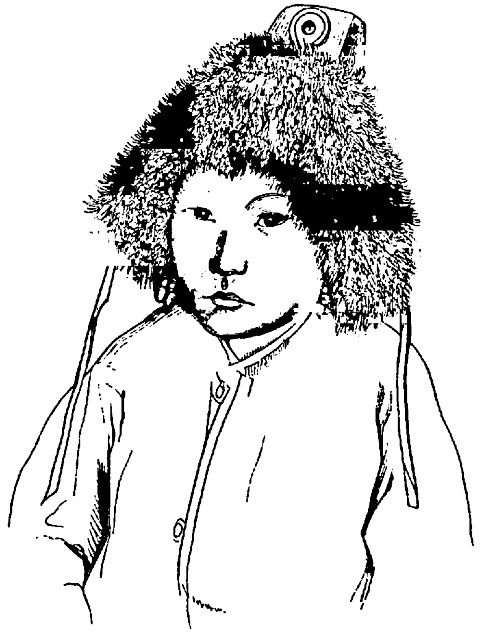
With the evidence of language, the evidence of physical confirmation is said to disagree. The Yakuts are essentially Mongolian in physiognomy. The value of the fact must be determined by what has been already said upon the subject.
The locality of the Yakuts is remarkable. It is that of a weak section of the human race, pressed into an inhospitable climate by a stronger one. Yet the Turks have ever been the people to displace others, rather than to be displaced themselves. On the other hand, the traditions of the country speak expressly to a southern origin.
In respect to the social development of the Yakut, Von Middendorf's distinctions are the most suggestive as well as the most critical. The southernmost Yakuts have the horse, the middlemost the rein-deer, the northernmost the dog. The manners of the southern ones are best known; and these are essentially pastoral. Besides the breeding of herds of horses, the Russian fur-trade has developed an industrial form of the hunter-state; so that, amongst the Yakuts, property accumulates, and we have a higher civilization than will be found elsewhere in the same latitude; Finland and Norway alone being excepted.
Other circumstances make the Yakuts an ethnological study. They are not only Turks who are not Mahometan, but their Christianity is still imperfect: hence they represent the Shamanism of the Turk before he became Moslemized. The details of the Yakut creed, sufficiently numerous to form, along with those of the still pagan Ugrians and Samöeids, an elaborate picture of an old religion, which, in its essential characters, was common to all the families of High Asia and Siberia, may be best found in Ermann.[30] The simple fact of its representing an early religion, is all that can here be noticed.
THE UGRIAN BRANCH OF THE TURANIAN STOCK.
1. Present distribution—continuous.—West and East—From Norway to the Yenisey. North and South (South-East)—From the North Cape to the Russian governments of Simbirsk, Saratof, and Astrakhan. The Volga south of its confluence with the Kama.
2. Isolated portion.—Hungary.
3. Ancient distribution.—Further southwards along the whole frontier, i.e., in Scandinavia, Russia, and Siberia. The Eastward extension probably less than at present.
4. As portions of a mixed population beyond their proper area—In Sweden and Norway.
Religion.—Lutheranism, Romanism, Greek Church, Imperfect Christianity, Shamanism.
Physical conformation.—Chief departure from the Mongol type, the frequency of blue eyes, and light (red) hair.
Conterminous with.—1. Goths of the Scandinavian group in Norway and Sweden; 2. Slavonians in Russia; 3. Lithuanians in Esthonia; 4, 5, 6. Turks, Yeniseians, and Tungús in Siberia. In Europe, in contact with the North Sea. East of Archangel, separated therefrom by the Samöeids.
- Divisions.—1. Trans-Uralian Ugrians.—Between the Ural Mountains and the Yenisey. Voguls and Ostiaks.
- 2. Permian Finns.—Permians, Siranians, Votiaks.
- 3. Finns of the Volga.—Morduins, Tcheremiss, Tshuvatsh.
- 4. Finlanders of Finland.
- 5. Esthonians of Esthonia.
- 6. Laplanders of Sweden and Finmark.
- 7. Majiars of Hungary.
1.
THE VOGULS.
Locality.—The northern part of the Uralian range, and the country to the east as far as the Irtish, and Tobol, and as far north as the Soswa a feeder of the Obi. Tradition says that they extended as far westward as the Dwina. Probability that they extended further south.
Name.—The Voguls call themselves and the Ostiaks Mansi. They are called by the Siranians Yograyess, and Vagol.
Conterminous with.—The Siranians on the west, the Obi Ostiaks on the east, the Bashkirs on the south.
Dialects.—The northern Vogul of the Sosva, the southern of the Tura, a tributary of the Tobol.
Population.—According to Schubert, one hundred thousand.
Religion.—Shamanism, or imperfect Christianity.
Physical appearance.—Stature small, complexion light, face broad and round, beard scanty, hair long, black, or brown, sometimes red. The Kalmuk (i.e. Mongolian) character of the Vogul physiognomy is noticed by Pallas.
The Voguls are very nearly on the low level of a tribe of fishers and hunters. Except towards the south, where they are partially Russianized, and where they have also partially adopted the manners of the Bashkirs, there is but little pasturage, and no agriculture. The horse is not in use amongst them—the rein-deer being the nearest approach to a domestic animal. Their tribute is paid in its skins.
THE OSTIAKS.
Locality.—Valley of the Obi—Eastwards to the Yenisey.
Name.—Russian, probably originally Bashkir. The native name—Kondycho, Tyakum, or Asyakh. Called by the Samöeids, Thahe; by the Voguls, Mansi.
Conterminous with.—The Voguls on the west, the Samöeids on the north, the Barabinsky and other Turkish tribes, and (probably) with the Yeniseians on the south.
Numbers.—About one hundred thousand.
Dialects.—Numerous.—The Southern mixed with the Vogul, the Northern with the Samöeid.
Physical appearance.—Stature short, bones small, muscular strength little; face flat, hair red, or reddish.
Religion.—Shamanism in the north, imperfect Christianity in the south.
The Ostiaks are almost wholly a nation of fishers.
That their limits originally extended farther south than at present is highly probable. A tradition concerning their migration from the west will be noticed in the section upon the Samöeids.
Notwithstanding the close affinity between the Ostiaks and the Voguls, the two nations were, at the time of the Russian conquest, in continual warfare against each other: the Ostiaks being under the government of petty hereditary chiefs.
In the pagan parts of the Ostiak country polygamy is the custom.
2.
THE PERMIANS.
Locality.—The government of Perm; of which they form less than a quarter, the rest being Russians or Russianized Finns.
Name.—-Russian, probably taken from the Scandinavian term Bjarma. The native term is Komi-uter, or Komi-murt.
Population.—According to Schubert, about thirty-five thousand.
THE SIRANIANS.
Locality.—North of the Permians, about the head-waters of the R. Kama, and R. Vytchegda, a feeder of the Dwina.
Native name.—Same as the Permian.
Population.—According to Schubert, thirty thousand.
Dialects.—Four. The Siranian, itself, however, is rather a dialect of the Permian than a substantive language.
THE VOTIAKS.
Locality.—The R. Viatka.
- Called by the Russians, Viatka.
- " " Turk tribes, Ari.
- " " themselves, Udy or Udmart
- " " the Tcheremiss, Oda.
Religion.—Imperfect Christianity. Probably some remains of Shamanism.
Of all the Finnic tribes the Votiaks are the most like the Finlanders of Finland; indeed Müller states that there is a tradition among them to the effect that their original country was Finland, and that they are immigrants from thence.
On the other hand, the extent to which they differ from their south-western neighbours, the Tcheremiss, is said to be remarkable.
In respect to the physical conformation of the Votiaks, the evidence of Ermann is favorable, that of Pallas less so. The latter describes them as slight and undersized: the former as strongly built. In no Finnic tribe—perhaps in no other tribe in the world,—is fiery red hair so common as amongst the Votiaks.
They are an agricultural population, not fishers and hunters.
They are also, most probably, an unmixed population; since none of their neighbours live so exclusively to themselves, (i.e. not in mixed villages, half Russian, or half Bashkir,) as the Votiaks.
The government under petty chiefs, or the heads of tribes, still continues; and it is a privilege of the Votiaks to elect their own village judges or arbiters.
Their population seems on the increase. At the end of the last century it was forty thousand: in 1837 it was one hundred thousand.
3.
THE TCHEREMISS.
Locality.—The left bank of the Middle Volga; fewer on the right. Governments of Kasan, Simbirsk, and Saratov. Recently, settlements in the Government of Astrakan, Conterminous with the Votiaks.
Name.—Russian. Native name, Mari=men.
Numbers.—According to Schubert, two hundred thousand.
Religion.—Imperfect Christianity. Greek Church.
Physical appearance.—Stature, middle; hair, light; beard, scanty; face, flat.
Habitations.—Small villages, smaller than those of the Votiaks, and Tchuvatch. Habits, agricultural; lately nomadic.
THE MORDUINS.
Locality.—The most South-Western of the Finnic tribes, on the right-bank of the Volga, between the R. Sura and R. Oka.
Name.—Native.
Divisions.—The Morduins of the Oka, are called Ersad; the Morduins of the Sura, Mokshad. A third division, called Karatai, inhabits the neighbourhood of Kasan.
Numbers.—In 1837, ninety-two thousand.
Dialects.—Two or more—the Ersad and the Mokshad.
Religion.—Imperfect Christianity; Greek Church; Shamanism.
Physical appearance.—Hair, brown and straight; beard, thin. More Slavonic than any other Finnic tribe. The Ersad oftener red-haired than the Mokshad.
THE TCHUVATCH.
Locality.—Right bank of the Volga, opposite the Tcheremiss, in the neighbourhood of Kasan, in the Government of Simbirsk and Saratov. Recent settlements in the Government of Astrakan.
Native Name.—Vereyal, and Khirdiyal, and Vyress:
- Called by the Russians, Vyress.
- " " Tcheremiss, Kurk-Mari=hill men.
- " " Morduins, Wjedke.
Numbers.—According to Schubert, three hundred and seventy thousand.
Religion.—Imperfect Christianity. Greek Church. Remains of Shamanism.
Physical Appearance.—Height, middle; complexion, light; face, flat; beard, thin; hair, black, and somewhat curled; eyes, grey; eyelids, narrow.
Habitations.—Like those of the Turk tribes in their neighbourhood.
Dialects.—Two: a. of the Vereyal of the Gornaya; b. of the Khirdiyal of the Lugovaya.
4.
FINLANDERS OF FINLAND.
Localities.—Finland; settlers in Sweden and Norway.
Native Name.—Suomolaiset.
Swedish.—Finn.
Norwegian.—Qwæn.
Dialects.—a. Finlandic Proper; b. Savolax, spoken in Savolax, and Carelia.
Religion.—Lutheranism.
Finnish words.—Kanguri=weaver, seppa=smith, wapa=freeman, orya, palvelya=slave, myyda, ostaa=buy and sell, yuoma=ale, kalya=beer, kandele, youhe-kandele=musical instruments, keria=book, raamattu=writing.
ENGLISH.
FINLANDIC.
SWEDISH.
King,
Kunengas,
Konung.
Prince,
Ruhtinas,
Thruhtin.
Judge,
Duomari,
Dömare.
Cheese,
Yuusto,
Ost.
Wine,
Saxan wiina,
[31]Viin.
[31] Rye,
Ruis,
Rug.
Oats,
Havra,
Haver.
Two lists, one of Finlandic, and one of Swedish, words have been placed at the head of the present section, for the sake of serving as an introduction to some of the questions contained in it. They are all taken from Rühs' work on Finland and its inhabitants, where the analysis of the language serves instead of historical testimony. By observing what terms are native, and what are Swedish, we separate the early native civilization of Finland, from the civilization introduced from Sweden. Thus, on looking over the preceding glosses, we find that the only terms applicable to a social or political constitution, are those for slave and freeman; king, ruler, judge, &c., being expressed by Swedish words. So also with the industrial trades; weaving was Finnic from the beginning, and so was smith's-work; but the carpenter, the builder, the ship-builder, are importations, and so on. There are native terms for buying and selling, for ale and beer, and for more than two musical instruments; but there are no native terms for wine, and none for dancing.
For the metals, and agriculture, the terms are almost always native. Cheese, however, on the one side, and gold, tin, and lead, on the other, have Swedish names. So have oats and rye.
Music, and songs, and a mythology belonged to the early Finlanders; the second being always accompanied by the first, and the three illustrating each other.
The great foreign influence that has affected the Finlanders of Finland, is the Swedish, and this may be considered to have been in steady and continuous operation, from the reign of Eric the Holy, in the A.D. 1156. This king, bent upon conquest and conversion, landed in South Finland, and founded what was then a new mission or colony, in the present province of Nyland (Newland). From this point, the power of Sweden gradually spread towards the inner portions of the country; northwards and eastwards: not unopposed, but opposed ineffectually, by the heathens of Tawastaland and Carelia.
5.
ESTHONIAN FINS.
Locality.—South of the Baltic, in Esthonia, Livonia, and part of Courland. Conterminous with the Russians, and the Courland Lithuanians.
Dialects.—Two: the common Esthonian, and the Esthonian of Dorpat.
Native Name.—Rahwas; of the country Marahwas.
6.
THE LAPLANDERS.
Habits.—Nomadic.
Religion.—Imperfect Christianity of the Greek Church with the Russian; imperfect Protestantism with the Swedish and Norwegian Laplanders.
Native Name.—Same, Sabome.
7.
HUNGARIANS.
Locality.—Hungary; mixed with German, Slavonic, and Wallachian tribes.
Native Name.—Majiar.
The Majiars are Ugrian, the country from which they descended being that of the Bashkirs, conterminous with the southern limits of the present Ugrian area, of which it was once a part. The date of their migration is about A.D. 900.
From extending farther than Hungary they were prevented by the two great victories of Henry the Fowler in 935 A.D.
Those who would connect the present Hungarians with the Huns of Attila, must also make the Huns Ugrian; since no fact is more undeniable than the Ugrian character of the Majiars. The reasons against this have been given already. They are, undoubtedly, scanty. Still they preponderate over those of the other view; which consist only in inferences from the term Hungary.
Lest these be over-rated, two facts should be remembered:—
1st.—That the name is Russian and not native.
2nd.—That the -n- is no original part of the word; the older Slavonic forms being Ugri, Uhri, and only in the later dialects, Ungri.
The Majiars must necessarily be a very mixed race; their country having been that of the old Pannonian population (probably Slavonic); of the Romans of both the eastern and western empire; of the Goths, the Huns, the Avars, the Gepidæ, and the Comanians.
This is what history suggests. To have assumed an intermixture, for the sake of accounting for the physical and moral difference between such extreme Ugrian forms as the Majiar and Laplander, would have been illegitimate.
In reality, however, the difference between the Majiar and Lap, is less remarkable than that between the Lap and Finlander; since, in this latter case, the contrast is nearly as great, whilst the climatologic conditions are less dissimilar.
The Majiar is the only member of the Ugrian family, which has effected, within the historical period, a permanent conquest over any portion of the Iapetidæ.
The Ugrians supply a good example of what may be called a receding frontier. Their area has at one time been greater than at present. Southwards and westwards it was once prolonged. Hence, the Ugrian has been displaced, or encroached upon by others. It is well to note this. It is better still to take it in conjunction (or contrast) with the Turk area. There the frontier has encroached. At an earlier period it was less extensive than at present.
In one quarter, perhaps in others, the Ugrian frontier has encroached, i.e. on that of the Majiars.
In one quarter, perhaps in others, the Turk frontier has receded, i.e. the Comani have become either extinct or a mixed breed in Hungary.
Nevertheless, as a rule, the Turks frontier has encroached; the Ugrian receded. The practical application of this distinction is wide. When we know whether a given family habitually extends, or habitually contracts its area, we know what will be the probable distribution of the unfixed ancient tribes on the frontier.
In the critical ethnology of the classical writers many problems must be worked in this way; the inferences in the two alternatives being diametrically the reverse of each other.
1. In a people with an habitually encroaching frontier, no tribe described by earlier writers as lying beyond its present geographical area, is to be considered as having formed part of it (i.e. the family with an encroaching frontier).
2. In a people with an habitually receding frontier, many tribes described by earlier writers as lying beyond its present geographical area may (and often must) be considered as so doing.
Hence, in the present pair of instances, many localities once other than Turk are now Turk;[32] whilst, on the other hand, many localities once Ugrian are now other than Ugrian.[33]
What, then, was the maximum extension southward of the Ugrian area before its frontier receded under the triple encroachments of the Turks of Russian Asia, the Russians of Russia, and the Norwegians and Swedes of Scandinavia? Possibly over the whole Scandinavian peninsula, possibly as far as the lower Don, Volga, and Dnieper. These, however, are geographical frontiers; frontiers less important, and less capable of solution than the ethnological ones. Were the Ugrians ever conterminous with other divisions of the human race than those which they come in contact with at present? There is no evidence that they were.
What ancient nations were Ugrian? Omitting, for the present, the tribes of Scythia, we may answer that the following were certainly so.
1. The Æstii.—Modern Esthonians.
2. The Finni and Skrithifinni.
3. The Sitones.—The Ugrians of the Baltic were known to the classical writers through the Germans. The names prove this. The Æstii were the people east of those who described them. The term Finn is known to no Ugrian, but to their Gothic neighbours only. The notice of Tacitus as to the Sitones is similarly capable of explanation.
The Finland word kainu=a low country. A portion of the Finlanders call themselves Kainulainen (Singular), Kainulaiset (plural).
Now this sectional name in Finland is the general name in Scandinavia; so that the Danes, Swedes, and Norwegians call the Finlanders Kwæn. In Scandinavian, however, Qvinde=women. Hence, Tacitus was persuaded by his direct or indirect German informants that the Sitones were subject to female government.—"Suionibus Sitonum gentes continuantur. Cætera similes, uno differunt, quod fœmina dominatur."[34] Lest any doubt should remain as to Tacitus having been told of a country of women, I may add that—
a. Alfred[35] speaks of a Cvenaland=land of Kwæns.
b. The Norse[35] Sagas of a Kænugard=home of Kwæns.
c. Adam[35] of Bremen of terra fœminarum, and Amazons.
The first two facts prove the name, the second the false interpretation of it.
Far more full, however, than the classical writers are the old Norse Sagas in respect to the Ugrians. Of these the Beormas, or Permians, were wealthy and commercial; men sometimes to be dealt with, sometimes to be robbed. The Laps, on the other hand, were feared as magicians, or as men skilled in metallurgy; and, according to those who have studied the philosophy of mythologies, they have supplied many supernatural elements in the way of dwarfs and goblins.
In the ethnology of Scandinavia—in the skilful and industrious hands of Retzius, Eschricht, Nilson, Kaiser, and others—Ugrian archæology, and Ugrian craniology, are preeminently prominent. The numerous barrows of Scandinavia are attentively studied; and observation has shown that the older the tomb, and the greater the proportion of instruments found within it not made of iron (but of greater antiquity than the art of forging that metal) the less dolikhokephalic, and the more brakhykephalic, (or Ugrian,) is the skull. Hence comes the inference that the southward extension of barrows, containing remains of the sort in question, is a measure of the southward extension of the Ugrian family.
Two other matters are of importance in Ugrian ethnology—the remains of their ancient Shamanism, and the Finland Runot.
In respect to the former, the Ugrians are the first people wherein we find the original Paganism in more tribes than one; so that it can be studied in its minute differences, as well as in its general character. Its essential identity, however, is remarkable. The Supreme Deity is Yumel, Yubmel, Yumala, or some slightly modified name; and that from the Morduin country to Lapland. Except this notice of the extent to which similarity of creed, as well as similarity of language, connects the Ugrians, no further remarks will be made at present.
The Runot is the name for the popular poems of Finlanders. In few nations are they more numerous. In none more carefully collected. I believe that the chief one partakes of the nature of an epic, and relates the wars between the Laps and Finlanders. Others are short, lyrical, and adapted to music. The term Runot (the plural form) is suspiciously similar to the Scandinavian word, Runa, with a not dissimilar meaning (furrow, carving, letter, spell, verse, poem). Finland archæologists, however, repudiate this, and claim it as an indigenous word, on the strength of certain derivative forms, like runionecka=poet. This is not conclusive. Nor is it necessary for the main fact, which is the existence of a home-grown poetical literature of more than average merit, and implying musical taste for the Finlandic portion of the Ugrian branch—of the Turanian group—of the Altaic Mongolidæ.
FOOTNOTES:
[9] In Greek, Rhæmata=words.
[10] Transactions of the Asiatic Society of Bengal.
[11] Transactions of the Asiatic Society of Bengal, vol. vi. part 2.
[12] Prichard, vol. iv.
[13] "The Chinese as they are," p. 319.
[14] Prichard, vol. iv.
[15] Prichard, vol. iv.
[16] Buchanan, Asiatic Researches.
[17] Journal of the Asiatic Society of Bengal, vol. iv. part 2.
[18] Such are the primitive habits, still in use from the Konki to the Monash and which are most worthy of study and record, as being primitive and as being common to two people, the Bodo and Dhimál, though abandoned by the Kámrúpian and most numerous branch of the Bodo.
[19] Ai or Aya is the goddess Kámákyá of Kanirup, vis genetrix naturæ, typed by the Bhaga or Yoni.
[20] Dhámi, in Bodo. Dom, in other allied dialects.
[21] Decline and Fall, vol. viii.
[22] Klaproth, Memoires relatifs à l'Asie, iii.
[23] Zeuss, v. Avari.
[24] Decline and Fall, vol. v.
[25] Lucian, Toxaris 31. From Zeuss, v. Alani.
[26] 1. The determination of the language to which the name of any nation mentioned in history belongs is of primary importance. Perhaps there is not one fourth of the tribes described by writers, either ancient or modern, whereof the name is native; e.g., the terms Welsh and German are unknown in Wales and Germany; whilst an Englishman is a Saxon in the Principality and in Ireland. For ascertaining whether a name be native or not the two following rules are useful.
Rule 1. When two different nations speak of a third by the same name the primâ facie evidence is in favour of that name being the native one.
Rule 2. When one nation speaks of two others under the same name, the primâ facie evidence is against that name being the native one.
Thus, according to Rule 1, if a Chinese and a Greek each call a tribe which invades their country, Hun, it is nearly certain that the invading tribe called itself Hun also. Of course, in cases, where the two nations using the common term might have borrowed it one of another, or from a third language, the probabilities are modified. Still the general rule holds good.
The second rule may be illustrated by the term Welsh. It is given by the nations of the Gothic stock to the Cambrians of Wales, the Italians of Italy, and the Wallachians of Wallachia. We know that with none of these it is native. I consider, however, that, given the geographical position of Germany, Wales, Italy, and Wallachia, the same might have been inferred.
[27] Wrangell, from Prichard, vol. iv.
[28] Transactions of the British Association for the Advancement of Science, 1846.
[29] Ermann, from Prichard, vol. iv.
[30] Reise um der Erde.
[31] Saxon (German) wine.
[32] Asia Minor and Thrace.
[33] Many parts of Russia.
[34] Germania, 45.
[35] Zeuss, v. Finni, and p. 157.
B.
DIOSCURIAN MONGOLIDÆ.
The term Dioscurian is taken from the ancient sea-port Dioscurias. Here it was that the chief commerce between the Greeks and Romans, and the natives of the Caucasian range took place. According to Pliny,[36] it was carried on by one hundred and thirty interpreters, so numerous were the languages. Without raising the number thus high, the great multiplicity of mutually unintelligible tongues is still one of the characteristics of the parts in question. And this fact has determined the application of the term. To have used the word Caucasian would have been correct, but inconvenient. It is already mis-applied in another sense, i.e., for the sake of denoting the so-called Caucasian race, consisting, or said to consist, of Jews, Greeks, Circassians, Scotchmen, ancient Romans, and other heterogeneous elements. In this sense it has been used in more than one celebrated work of fiction. In such, and in such only, it is otherwise than out of place.
DIOSCURIAN NATIONS AND TRIBES.
Physical Conformation.—Modified Mongol.
Languages.—Paurosyllabic,[37] agglutinate; of all the tongues not Seriform, the nearest approaching to an aptotic state.
Area.—The range of Mount Caucasus.
Chief Divisions.—1. The Georgians. 2. The Lesgians. 3. The Mizjeji. 4. The Irôn. 5. The Circassians.
In few, perhaps, in no part of the present volume, am I on more debateable ground than the present. So long has the term Caucasian been considered to denote a type of physical conformation closely akin to that of the Iapetidæ, (i.e., preeminently European,) that to place the Georgians and Circassians in the midst of the Mongolidæ, is a paradox. Again, the popular notions founded upon the physical beauty of the tribes under notice, are against such a juxtaposition; the typical Mongolians, in this respect, having never been mentioned by either poet or painter in the language of praise.
Lastly, it so happens that some of the latest researches in comparative philology have been undertaken with the special object of making the philological position of the Dioscurians coincide with their anatomical one, i.e., of proving that the languages of the Georgians and the Irôn are to be connected with that of the Greeks and Latins, just as was the case with their skeletons.
For the sake of laying before the reader the amount of fact and argument, in contradistinction to the amount of mere opinion, that is opposed by the position here assumed for the Dioscurians, I will analyse the grounds for the current belief under two heads:—
1. The connexion of the Dioscurian nations with those of Europe, as determined by the evidence of Physical Conformation.—The really scientific portion of these anatomical reasons consists in a single fact; which was as follows.—Blumenbach had a solitary Georgian skull; and that solitary Georgian skull was the finest in his collection: that of a Greek being the next. Hence it was taken as the type of the skull of the more organized divisions of our species. More than this, it gave its name to the type, and introduced the term Caucasian. Never has a single head done more harm to science than was done in the way of posthumous mischief, by the head of this well-shaped female from Georgia. I do not say that it was not a fair sample of all Georgian skulls. It might or might not be. I only lay before critics the amount of induction that they have gone upon.
2. The connexion of the Dioscurian nations with those of Europe as determined by the evidence of language.—Here I can only give a sample of the philology which would connect the Georgian with the Indo-European tongues. It consists in the proof that the Georgian numerals are the same as the Latin, Greek, Sanskrit, Gothic, Slavonic, and Lithuanic.
English.
Georgian.
Mingrelian.
[38]Suanic.
[38]Lazic.
[38]One
erthi
arthi
es`gu
ar.
Two
ori
shiri
jeru
dzur.
Three
sami
sumi
semi
dshumi.
Four
othchi
otchi
wors`tcho
atch.
Five
chuthi
chuthi
wochus`i
chut.
Six
ekhwssi
apchs'ui
usgwa
as`.
Seven
s'widi
'sqwithi
is`gwit
s`kit.
Eight
rwa
ruo
ara
ovro.
Nine
zehru
c`choro
c`chara
c`choro.
Ten
athi
withi
je`st
wit.
One=Es`gu, Suanic=êka, Sanskrit; jek, Persian, the ἑκα- in ἑκά-τερος, and ἕκ-αστος, Greek.
One=erthi, Georgian; arthi, Mingrelian; ar, Lazic. Here the forms are different from the Suanic esg`u, and have a different origin. Esgu is a true cardinal, just as one is a true cardinal. The Georgian, Mingrelian, and Suanic forms, are not originally cardinal, but derivative from the ordinal, just as would be the case in English, if, instead of saying one, two, &c., we said, first, second, &c. Now the root of the ordinal cardinal of the Georgian, Mingrelian, and Lazic ar, is the πρ- in the Greek, πρῶ-τος, the p-r- in the Lithuanic pir-mas, the fr- in the Mœso-Gothic, fr-ums, and the pr- in the Sanskrit pr-atamas; the initial p having been lost, just as the initial s in the Sanskrit sru,=to flow, is lost in the Greek ῥέω, and the Latin ruo. Hence, arti=, by rati metathesis, just as the Lithuanic pirmas=the Latin primus. The t is the τ of πρῶ-τ-ος.
Two=Ori, Georgian; dva, Sanskrit; δι-, Greek; duo, Latin, &c.
Three=sami, Georgian; dschumi, Lazic; tre, Sanskrit; τρία, Greek; tres, Latin; three, English, &c. Here t becomes s, r is ejected, and m is added, upon the assumption of reflected ordinal.[39]
Four=wors`tcho, Suanic. A transposition of tchowors=the Sanskrit ćatvâras.—Here, remember the Gothic and Welsh forms, fidvôr, and pedwar, respectively.
Five=wochus`i, Suanic. The wo- of this form is the pa- of the Sanskrit pa-nća, whilst the -chu- is the ća of the same word. The -t- is the t of the Slavonic forms, fya-tj=five; ses-tj=six; devja-ti=nine, and desja-ti=ten.
Six=ekhwssi, Georgian=sas, Sanskrit; csvas, Zend; achses, Trôn.
Seven=swidi, Georgian. A transposition of siwdi=supta, Sanskrit; septem, Latin; ἕπτα, Greek, &c. It is stated of the numbers six and seven that "their Indo-European origin is preeminently capable of proof."
Eight=rwa, ruo, &c.=as`ta, Sanskrit. Here the s is lost, as in Hindostani, and Bengali, ât`, and ât; t becomes d; and d is changed to r.
The numeral nine is let alone.
Ten=jest, Suanic=das`a, Sanskrit.
I do not say that there may not be letter-changes which make all this feasible. There may or may not be. I only lay before critics, the amount of change assumed.
In 1845, I announced, at the meeting of the British Association for the Advancement of Science, that the closest philological affinity of the Dioscurian languages was with the Aptotic ones. This I had brought myself to believe from a comparison of the words only. Soon afterwards, Mr. Norriss, of the Asiatic Society, instead of expressing surprise at my doctrine, said that, upon grammatical grounds, he held the same opinion.
How far these views are founded on fact, may be seen from the forthcoming samples of two Dioscurian grammars, and of a short Dioscurian vocabulary, compared with those of the Seriform tongues. The two together form but a small fraction of the evidence that can be adduced. It is as much, however, as is admissible in a work like the present.
Physiological objections, based upon the symmetry of shape, and delicacy of complexion, on the part of the Georgians and Circassians, I am, at present, unable to meet. I can only indicate our want of osteological data, and remind my reader of the peculiar climatologic conditions of the Caucasian range; which is at once temperate, mountainous, wooded, and in the neighbourhood of the sea—in other words, the reverse of all Mongol areas hitherto enumerated. Perhaps, too, I may limit the extent of such objections as a matter of fact. It is only amongst the chiefs where the personal beauty of the male portion of the population is at all remarkable. The tillers of the soil are, comparatively speaking, coarse and unshapely.
GEORGIANS.
[27] Wrangell, from Prichard, vol. iv.
[28] Transactions of the British Association for the Advancement of Science, 1846.
[29] Ermann, from Prichard, vol. iv.
[30] Reise um der Erde.
[31] Saxon (German) wine.
[32] Asia Minor and Thrace.
[33] Many parts of Russia.
[34] Germania, 45.
[35] Zeuss, v. Finni, and p. 157.
Mode of Writing.—Rhæmatographic, i.e. the written signs represent whole words;[9] not merely the parts of words, single articulate sounds or syllables.
Kunawer.(?) I have not examined how far the Kunawer tribes, located where the Sutlege breaks through the Himalayas, deserve to be classed as a separate division. At all events their language is monosyllabic (probably closely allied to the Ladakh), as may be seen in the Theburskud, Milchan, and Súmchú vocabularies of Gerard.[10]
The Khamti.—In the North Eastern corner of Assam, the Khamti are conterminous with the Singpho, Mishimi, and Miri, and are traditionally reported to have emigrated from the head-waters of the Irawaddi. In physical appearance they are middle-sized, more resembling the Chinese than any tribe on the frontier. Perhaps, a shade darker in complexion. Their alphabet is Siamese; and their language, far north as it is spoken, when compared with the Siamese of Bankok, closely resembles that dialect. In Brown's[11] Vocabularies the proportion of words, similar or identical, in Khamti and Siamese, is 92 per cent.
The word[12] Si means west, whilst Fan means stranger; so that Si-fan means western strangers. The term means one or more of the wilder tribes on the Tibetan or Mongolian frontier.
These are the so-called aborigines of China. It were, perhaps, more accurate to call them the Chinese in their most aboriginal form. The term means children of the soil. Their localities are the mountains of Southern and Central China. They seem to consist of a number of tribes rather than to constitute any particular people; so that it is possible that many varieties of the primitive Chinese may be comprised under the general appellation. Those of Ping-sha-hwang are divided into the white and black Miaou-tse; from the difference of their complexion. Both the Abbé Gosier and Tradescant Lay[13] speak to their indomitable courage, and to their spirit of independence, their subjection being still imperfect. Their weapons are the bow and cross-bow. Their employment agriculture. The following is an account of their religious rites from the author last named.
Lau[14]-pang-dun
Tribes, too, called Pa-y and Pa-pe,[15] are said to be Laos.
The Kariens, unless they are Siamese, have next to that nation the greatest extension, north and south. Ground down by the oppression of the Burmese, they are, with the exception of the red Kariens, who still preserve an imperfect independence, a decreasing race. Of their language we have specimens[16] in more than one dialect, viz., the Passuko, Maplu, and Play. They are agricultural tribes, clearing the land for the cultivation of rice, and then leaving it to migrate elsewhere.—Arva in annos mutant, et superest ager.
Besides the Manipur proper, the following eleven dialects are illustrated by his vocabularies,[17] and are said to be spoken within the limits of a very inconsiderable circle, of which Manipur is the centre.
"They never cultivate the same field beyond the second year, or remain in the same village beyond the fourth to sixth year. After the lapse of four or five years, they frequently return to their old fields, and resume their cultivation, if in the interim the jungle has grown well, and they have not been anticipated by others, for there is no pretence of appropriation other than possessory, and if, therefore, another party have preceded them, or, if the slow growth of the jungle give no sufficient promise of a good stratum of ashes for the land when cleared by fire, they move on to another site new or old. If old, they resume the identical fields they tilled before, but never the old houses or site of the old village, that being deemed unlucky. In general, however, they prefer new land to old, and having still abundance of unbroken forest around them, they are in constant movement, more especially as, should they find a new spot prove unfertile, they decamp after the first harvest is got in."[18]
"The great festivals of the year are three or four. The first is held in December-January, when the cotton crop is ready. It is called Shúrkhar by the Bodo, Haréjata by the Dhimáls. The second is held in February-March. It is named Wágalénó by the Bodo, who alone observe it. The Bodo name for the third, which is celebrated in July-August, when the rice comes into ear, is Phúlthépno. The Dhimáls call it Gávi púja. The fourth great festival is held in October, and is named Ai húnó by the Bodo—Pochima páká by the Dhimáls. The first three of these festivals are consecrated to the elemental gods and to the interests of agriculture. They are celebrated abroad, not at home (generally on the banks of a river), whence attendance on them is called Hagrou húdong or madai húdong, "going forth to worship" in contradistinction to the style of the fourth great festival, which is devoted to the household gods and is celebrated at home. The Wágalénó, or bamboo festival of the Bodo, I witnessed in the spring of this year, and will describe it as a sample of the whole. Proceeding from Siligori to Pankhabárí with Dr. Campbell, we came upon a party of Bodo in the bed of the river, within the Saul forest, or rather, were drawn off the road by the noise they made. It was a sort of chorus of a few syllables, solemnly and musically incanted, which, on reaching the spot was found to be uttered by thirteen Bodo men, who were drawn up in a circle facing inwards, and each carrying a lofty bamboo pole decked with several tiers of wearing apparel and crowned with a Chour or yak's tail. Within the circle were three men, one of whom with an instrument like this
in his hands danced to the music, waving his weapon downwards on one side and so over the head, and then downwards on the other side and again over the head. He moved round the margin of the circle in the centre of which stood two others, one a Déóshi or priest, and the other an attendant or servitor called Phantwál. The priest, clothed in red cotton but not tonsured or otherwise distinguished from the rest of the party, muttered an invocation, whereof the burden or chorus was taken up by the thirteen forming the ring above noticed. The servitor had a water-pot in one hand and a brush in the other, and from time to time, as the rite proceeded, this person moved out of the circle to sprinkle with the holy water another actor in this strange ceremony and a principal one too. This is the Déódá, or the possessed, who when filled with the god answers by inspiration to the questions of the priests as to the prospects of the coming season. When we first discerned him, he was sitting on the ground panting, and rolling his eyes so significantly that I at once conjectured his function. Shortly afterwards, the rite still proceeding, the Déódá got up, entered the circle and commenced dancing with the rest, but more wildly. He held a short staff in his hand, with which, from time to time, he struck the bedizened poles, one by one, and lowering it as he struck. The chief dancer with the odd-shaped instrument waxed more and more vehement in his dance; the inspired grew more and more maniacal; the music more and more rapid; the incantation more and more solemn and earnest; till at last, amid a general lowering of the heads of the decked bamboo poles, so that they met and formed a canopy over him, the Déódá went off in an affected fit, and the ceremony closed without any revelation—a circumstance which must be ascribed to the presence of the sceptical strangers; for it is faith alone that worketh miracles and only among and for the faithful. This ceremony is performed annually by the Rajah of Sikim's orders, or rather with his sanction of the usages of his subjects; is addressed to the sun, the moon, the elemental gods, and, above all, to the rivers; and is designed to ensure health and plenty in the coming year, as well as to ascertain, beforehand, its promise or prospect through the revelations of the Déódá. With regard to the festival sacred to the national or homebred (noöni) gods, called Aihuno[19] by the Bodo, and Pochima páká by the Dhimáls, it is to be observed that the rite, like the separate class of deities adored thereby, is more distinctively Bodo than Dhimál. With both people the pre-eminence of water among the elements is conspicuous; but whereas the river gods of the Dhimáls have nearly absorbed all the rest, elementary or other, the household gods of the Bodo stand conspicuously distinguished from the fluviatile deities. The Pochima and Timáng of the Dhimáls are one or both rivers: the Bátho and Mainang of the Bodo are neither of them rivers, and their interparietal rites are as clearly distinguished from the rites performed abroad to the fluviatile and other elemental gods. However, the rites of Báthó and Mainou are participated by deities of elementary and watery nature, and, on the other hand, the Dhimáls assert that Pochima and Timai have a twofold character, one of river gods (Dhorla and Tishta), and one of supreme gods; and they that are adored, separately, in these two characters, the Pochima páká, or home-rite of October, being appropriated to them in the latter capacity of that of supreme gods. I have not witnessed the Pochima páká, and therefore speak with hesitation. The Ai húnó is performed as follows. The friends and family being assembled, including as many persons as the master of the house can afford to feast, the Déóshi or priest enters the enclosure or yard of the house, in the centre of which is invariably planted a Sij or Euphorbia, as the representative of Bátho who is the family as well as national god of the Bodo. The Báthó, thus represented, the Déóshi offers prayers, and sacrifices a cock. He then proceeds into the house, adores Mainou, and sacrifices to her a hog. Next, the priest, the family, and all the friends proceed to some convenient and pleasant spot in the vicinity, previously selected, and at which a little temporary shed has been erected as an altar, and there, with due ceremonies, another hog is sacrificed to Agráng, a he-goat to Manásho and to Búli, and a fowl, duck, or pigeon (black, red, or white, according to the special and well known taste of each god) to each of the remaining nine of the Noöni madai. The blood of the sacrifice belongs to the gods—the flesh to his worshippers, and these now hold a high feast, at which beer and tobacco are freely used to animate the joyous conclave, but not spirits, nor opium, nor hemp. The goddess Mainou is represented in the interior of each house, by a bamboo post, about three feet high, fixed in the ground, and surmounted by a small earthen cup filled with rice. Before this symbol is the great annual sacrifice of the hog above noted, performed; and before this, the females of the family once a month, make offerings of eggs. For the males, due attention to the four annual festivals is deemed sufficient in prosperous and healthful seasons. But sickness or scarcity always begets special rites and ceremonies, suited to the circumstances of the calamity, and addressed more particularly to the elemental gods, if the calamity be drought, or blight, or devastations of wild animals—to the household gods, if it be sickness. Hunters, likewise, and fishers, when they go forth to the chase, sacrifice a fowl to the Sylvan gods, to promote their success; and lastly, those who have a petition to prefer to their superiors, conceive that a similar propitiation of Jishim and Mishim, or of the Chiris, will tend to the fulfilment of their requests. And this, I think, is nearly the whole amount of rites and ceremonies, which their religion prescribes to the Bodo and Dhimáls. And anxious as I am fully to illustrate the topic, I will not try the patience of my readers by describing all that variety of black victims and white, of red victims and blue, which each particular deity is alleged to prefer; first, because the subject is intrinsically trifling; and second because the diverse statements of my informants lead me to suspect, that the matter is optional or discretionary with each individual priest prescribing these minutiæ. I have mentioned the rude symbols proper to Báthó and Mainou. None of the other gods seem to have any at all, though a low line of kneaded clay attached to the Thalí that surrounds the sacred Euphorbia in the yards of the Bodo is said to stand for the rest of the divinities who, as I have already said, are wont to be worshipped collectively rather than individually; and thus the sun, the moon, and the earth, though adored by Bodo and by Dhimál, have no separate rites, but are included in those appropriated to the elemental gods. Witchcraft is universally dreaded by both Bodo and Dhimál. The names of the craft and of its professors, male and female, will be found in the vocabulary. Witches (Dain and Mháï) are supposed to owe their noxious power to their own wicked studies, or to the aid of preternatural beings. When any person is afflicted, the elders assemble and summon three Ojhás or exorcists, with whose aid and that of a cane freely used, the elders endeavour to extort from the witch a confession of the fact and the motives. By dint of questioning and of beating, the witch is generally brought to confession, when he or she is asked to remove the spell, and to heal the sufferer, means of propitiating preternatural allies (if their agency be alleged) being at the same time tendered to the witch, who is, however, forthwith expelled the district, and put across the next river, with the concurrence of the local authorities. No other sorcery or black art save that of witches is known; nor palmistry, augury, astrology, nor, in a word, any other supposed command of the future than that described in the 'Wa galéno' as the attribute (for the nonce) of the Déódá or vates. The evil eye causes some alarm to Bodo and to Dhimál who call it mogon nángo and mí nójó respectively, and who cautiously avoid the evil-eyed person, but cannot eject him from the community. The influence of the evil eye is sought to be neutralised by offerings of parched millet and eggs to Khoja Kajah and Mansha Rajah—Dii minores who find no place in my catalogue, ample as it is. Moïsh madai, I am told, likewise claims a place in the Bodo Pantheon, and a distinguished place, too, as the protector of this forest-dwelling people from beasts of prey, and especially the tiger.
1. The Magars.—Imperfectly Braminical in their religion, with a separate monosyllabic language, and remains of their old Paganism. Their priests were called Damis.[20]
It may now be well to examine the term conquerors of the world, and to limit it. By following Gibbon,[21] we may ascertain what the true Mongolians did conquer, and what they did not.
3. Hungary.—The proof of the Cumanian habitation of part of Hungary, is a matter of some literary interest. The last Cumanian[22] who knew even a few words of his original tongue, was an old man of Karczag, named Varro, who died A.D. 1770; and an incomplete Paternoster, preserved by Dugorics and Thunmann, is all that remains of this dialect. Of the Cumanian of Asia, we have a remarkable vocabulary, from a MS. belonging to the library of the celebrated Petrarch. This is the Turk of the parts between the Caspian and Aral.
The Avars.—A.D. 465 to about 900. In A.D. 465, the Saraguri,[23] the Onoguri, and the Urugi sent an embassy to Constantinople, to complain of the inroads of the Avars. We may guess beforehand the locality, and we may guess beforehand the cause. In the countries between the Mæotis and the Caspian, the Sabiri are pressed upon by the Abares, the Abares being pressed upon by some tribe from behind, and the primum mobile being probably in the centre of Asia. Such is the general history of these movements. We then learn from Gibbon,[24] how, in A.D. 558, these Avars themselves appear as suppliants to the Alani, requesting their good services at the Byzantine Court; and we learn, also, how they afterwards appeared before Justinian, more as sturdy beggars than as suppliants, requesting aid against the Turks; and how that monarch played fast and loose between the runaway slaves and the indignant masters. He turned them upon his enemies in the west; the Slavonians, and the Germans. And these they overran until checked on the Elbe, by a bloody victory gained over them by Sigisbert. The next victory, however, was the Avars', and peace followed. But the Avars remained like locusts in the land. This they had exhausted, or helped to exhaust; when either the intrigues of the King of the Lombards, or the pressure of famine, induced them to agree with Sigisbert upon the terms of their departure. These were a supply of meal and meat for their expedition. To the King of the Lombards, Alboin, whom they then turned eastwards to join, they proffered their assistance against the Gepidæ, on condition of Pannonia, if evacuated, being ceded to them. The destruction of the Gepidæ of Pannonia was followed by the bright period of Avar history, the reign of Baian. The pride of this barbarian inflamed the anger of the Emperor Maurice, who broke his power by the arms of his general Priscus,—broke, but not annihilated. On the 29th of June, A.D. 626, thirty thousand of the vanguard of the Avars insulted the patricians of Constantinople under their own walls, strong in their own barbarian valour, and strong in an even-handed alliance, against the common enemy, with the great king, Chosroes, then at war with Heraclius. "You see," was his answer to the standing patricians, "the proofs of my perfect union with the great king; and his lieutenant is ready to send into my camp a select band of three thousand warriors. Presume no longer to tempt your master with a partial and inadequate ransom; your wealth and your city are the only presents worthy of my acceptance. For yourself, I shall permit you to depart, each with an under-garment, and a shirt, and, at my entreaty, my friend Sarbar will not refuse a passage through his lines. Your absent prince, even now a captive or a fugitive, has left Constantinople to its fate; nor can you escape the arms of the Avars and Persians, unless you could soar into air like birds, or unless like fishes you could dive into the waves."
The Avars.—A.D. 465 to about 900. In A.D. 465, the Saraguri,[23] the Onoguri, and the Urugi sent an embassy to Constantinople, to complain of the inroads of the Avars. We may guess beforehand the locality, and we may guess beforehand the cause. In the countries between the Mæotis and the Caspian, the Sabiri are pressed upon by the Abares, the Abares being pressed upon by some tribe from behind, and the primum mobile being probably in the centre of Asia. Such is the general history of these movements. We then learn from Gibbon,[24] how, in A.D. 558, these Avars themselves appear as suppliants to the Alani, requesting their good services at the Byzantine Court; and we learn, also, how they afterwards appeared before Justinian, more as sturdy beggars than as suppliants, requesting aid against the Turks; and how that monarch played fast and loose between the runaway slaves and the indignant masters. He turned them upon his enemies in the west; the Slavonians, and the Germans. And these they overran until checked on the Elbe, by a bloody victory gained over them by Sigisbert. The next victory, however, was the Avars', and peace followed. But the Avars remained like locusts in the land. This they had exhausted, or helped to exhaust; when either the intrigues of the King of the Lombards, or the pressure of famine, induced them to agree with Sigisbert upon the terms of their departure. These were a supply of meal and meat for their expedition. To the King of the Lombards, Alboin, whom they then turned eastwards to join, they proffered their assistance against the Gepidæ, on condition of Pannonia, if evacuated, being ceded to them. The destruction of the Gepidæ of Pannonia was followed by the bright period of Avar history, the reign of Baian. The pride of this barbarian inflamed the anger of the Emperor Maurice, who broke his power by the arms of his general Priscus,—broke, but not annihilated. On the 29th of June, A.D. 626, thirty thousand of the vanguard of the Avars insulted the patricians of Constantinople under their own walls, strong in their own barbarian valour, and strong in an even-handed alliance, against the common enemy, with the great king, Chosroes, then at war with Heraclius. "You see," was his answer to the standing patricians, "the proofs of my perfect union with the great king; and his lieutenant is ready to send into my camp a select band of three thousand warriors. Presume no longer to tempt your master with a partial and inadequate ransom; your wealth and your city are the only presents worthy of my acceptance. For yourself, I shall permit you to depart, each with an under-garment, and a shirt, and, at my entreaty, my friend Sarbar will not refuse a passage through his lines. Your absent prince, even now a captive or a fugitive, has left Constantinople to its fate; nor can you escape the arms of the Avars and Persians, unless you could soar into air like birds, or unless like fishes you could dive into the waves."
Again, the Oseti, a limited mountain tribe of the Middle Caucasus, with all its supposed affinities in Media and Persia—since the same writers who identify the Alans with Oseti, identify the Oseti with the Medes—could never have passed as Scythians. Now the Alans did so pass, as is shown by a remarkable passage in Lucian:—"so said Makentæs, being the same in dress and the same in language as the Alani (ὁμόσκευος καὶ ὁμόγλωττος τοῖς Ἀλανοῖς ὤν); since these things are common to the Alani and the Skythæ; except that the Alani are not altogether so long-haired as the Skythæ. In this respect, however, Makentæs was like a Skythian, inasmuch as he had shaved himself to the extent to which an Alan head of hair falls short of a Skythian one."[25]
Moreover, if the Hiong-nou be the Huns, we may infer that the name Hun was a native name, in the way that Deutsche is the native name of what we call the Germans; since it is not likely that the Greeks and Chinese would use the same appellation, unless it were also the indigenous appellation of the people to which it was applied.[26]
The Yakuts.—The isolated Turks, or Yakuts, still stand over for notice. Their centre is the river Lena, whereon they extend at least as far southward as the Aldan. Eastward they are found on the[27] Kolyma, and westward as far as the Yenisey. Here the Yakut tribe is that of the Dolganen, an outlying portion of the section first noticed by Von Middendorf.[28]
The Yakuts.—The isolated Turks, or Yakuts, still stand over for notice. Their centre is the river Lena, whereon they extend at least as far southward as the Aldan. Eastward they are found on the[27] Kolyma, and westward as far as the Yenisey. Here the Yakut tribe is that of the Dolganen, an outlying portion of the section first noticed by Von Middendorf.[28]
2nd. That not less than one-third of the words (and some of them the names of very simple ideas) are other than Turk.[29]
Other circumstances make the Yakuts an ethnological study. They are not only Turks who are not Mahometan, but their Christianity is still imperfect: hence they represent the Shamanism of the Turk before he became Moslemized. The details of the Yakut creed, sufficiently numerous to form, along with those of the still pagan Ugrians and Samöeids, an elaborate picture of an old religion, which, in its essential characters, was common to all the families of High Asia and Siberia, may be best found in Ermann.[30] The simple fact of its representing an early religion, is all that can here be noticed.
Viin.[31]
Hence, in the present pair of instances, many localities once other than Turk are now Turk;[32] whilst, on the other hand, many localities once Ugrian are now other than Ugrian.[33]
Hence, in the present pair of instances, many localities once other than Turk are now Turk;[32] whilst, on the other hand, many localities once Ugrian are now other than Ugrian.[33]
Now this sectional name in Finland is the general name in Scandinavia; so that the Danes, Swedes, and Norwegians call the Finlanders Kwæn. In Scandinavian, however, Qvinde=women. Hence, Tacitus was persuaded by his direct or indirect German informants that the Sitones were subject to female government.—"Suionibus Sitonum gentes continuantur. Cætera similes, uno differunt, quod fœmina dominatur."[34] Lest any doubt should remain as to Tacitus having been told of a country of women, I may add that—
c. Adam[35] of Bremen of terra fœminarum, and Amazons.
"The clothes of the deceased are then divided among the relatives and friends; the garland is burned; another púja, commencing with, "Hong! áwigna mastúna ma sidam, hong! aráning," &c., is repeated; while the remains of the sacred water are sprinkled over the feast. The parties now sit down to the enjoyment of it, invoking a blessing from the Almighty on themselves, their houses, and their lands. No more solemnities are observed till the expiration of a thousand days; when, if the memory of the deceased is beloved and cherished, the ceremony and feast are repeated; if otherwise, no further notice is taken of him: and having thus obtained what the Romans call his justa, he is allowed to be forgotten.
[36] Gibbon, Decline and Fall, chap. 52.
[37] From pauros=few, and syllabæ=syllable.
[38] Dialects of the Georgian.
[39] It is a general accredited fact, that in some cardinals we have the sign of the ordinal. Thus the -m in dece-m, as compared with δέκα, is reasonably supposed to be the -m- in deci-m-us.
Divisions.—1. Eastern Georgians. 2. Western Georgians. 3. South-western Georgians. 4. Northern Georgians.
EASTERN GEORGIANS.
Locality.—The head-waters of the Kur.
Name.—Cartulinian, from the Province called Carthueli, the ancient Iberia. The Cartulinian dialect is the Georgian of Teflis, and the Georgian of the Georgian literature.
Alphabet.—Peculiar. Probably derived from the Armenian.
WESTERN GEORGIANS.
Localities.—Guriel, Imeretia, and Mingrelia, i.e., the valley of Phasis.
Name.—Mingrelian.
Language.—More like the Lazic than it is to either the Cartulinian or the Suanic.
SOUTH-WESTERN GEORGIANS.
Locality.—Lazistan.
Geographical Limits.—From the promontory of Kyemer-Burnu, east of Rizeh, east of Trebizond to the mouth of the Tchorok, south of Batoum. Not further than the Tchorok inland.
Political Relations.—Subject to Turkey.
Religion.—Mahometan; converted about 1580, A.D. Previously (at least in the reign of Justinian) Christians of the Greek Church.
Alphabet.—Arabic. Native literature none or scanty. Sub-dialects numerous, according to Rosen one for almost every valley. Greek words intermixed; some, probably, of considerable antiquity.
NORTHERN GEORGIANS.
Locality.—The head-waters of the Tzchenistoquali, or Lasch-churi; the Hippus of the ancients.
Name.—Suanic.
Conterminous with the Northern Mingrelian dialects of the Georgian, and the Absné dialect of the Circassian. Less like any of the other Georgian dialects than they are to each other. The Suanians call—
- Themselves, S`wan.
- The Caratschai Turks, Ows.
- The Absné, Mibchaz.
- The Irôn, Sawi-ar.
- The East Georgians, M`karts.
- The West Georgians, Mimrel.
- The Mingrelians, Mumgrel.
Descent.—As the Georgians may reasonably be considered to be the aborigines of the locality which they, at present, inhabit, they come before us as an ancient people. The Greek poet, who first sung of the Argonauts, knew, at least, enough of Colchis to make it a local habitation for his heroine—though that was not knowing much. The earliest navigator of the Euxine knew more; for, possibly, at a period anterior to the colonization of Asia Minor, he knew it as a real land. The Ægyptians, at the time of Herodotus, knew enough of it to claim it as a conquest of the great Sesostris. With this claim the question of purity of the Georgian race commences.
Two separate and definite immigrations have been supposed to have introduced into Colchis new ethnological elements.
1. The settlement from Ægypt under the reign of the Great Sesostris.
In §§ 103-105, of his Second Book, Herodotus writes thus:—Sesostris "overturned both the Scythians and the Thracians; and here, in my mind, the Ægyptian army reached its furthest point. Thus far the pillars in question appear; beyond, there are none. From these parts he turned back, and when he came to the river Phasis, I am unable to say truly, which of two things occurred; whether the King himself, having separated a portion of his army, left it as a settlement in the country, or whether some of his soldiers, harassed by their wanderings, stayed behind on that river. For the Colchians are evidently Ægyptians. I say this, having observed it myself, before I heard from any one else. And, whilst I was considering it, I asked both; and the Colchians remembered the Ægyptians better than Ægyptians the Colchians. The Ægyptians said, that they thought that the Colchians were from the army of Sesostris. This is what I guessed myself, from the fact of their being both black-skinned and curly-haired. This, however, goes for nothing. Others are so also. The main reason is that the Colchians, the Ægyptians, and the Æthiopians are the only men who originally practised circumcision: since the Phœnicians and the Syrians of Palestine confess that they learned it of the Ægyptians; whilst the Syrians about the rivers Thermodon and Parthenius, and the Macrones, who are their neighbours, say that they learned it recently, from the Colchians. Come, now, I must mention another fact concerning the Colchians, wherein they resemble the Ægyptians. They and the Ægyptians are the only ones who work flax in the same way. And the whole manner of life and language are mutually alike. The flax from Colchis is called by the Greeks, Sardonicon: that from Ægypt, Ægyptian."
As no external evidence will make it probable that the Georgians, as a nation, are of Ægyptian origin, and as, on the other hand, Herodotus speaks from personal observation, the exact truth is not easily attainable. Probably, there was an Ægyptian colony on the Black Sea. Possibly—though not probably—the Colchians were not Dioscurian aborigines, but immigrants.
2. The Orpelian settlement from China.—In the thirteenth century, according to those who are most willing to allow a comparatively high antiquity to Armenian literature, a work was composed in Armenian, by Stephen, Archbishop of Siounia. In this, it is stated that a noble family, called Ouhrbélêan, or Orpelian, entered Georgia, settled on the frontiers of Orpeth, and became the founders of one of the great families of Georgia; to which family the historian himself belonged. Finally, it is added, that this family came from Djenasdan or China. This is probably a mere tradition; one which, even if true, would denote an immigration wholly unconnected with the real ante-historical relations between Caucasus and the Seriform area.
The true elements of intermixture with the Georgian family have been Greek, Persian, Armenian, Turk, and Russian; as may be collected from the history of the country. The amount of Lesgian, Irôn, Mizjeji, and Circassian blood is uncertain.
The safest view to be taken of the history of Georgian civilization is to remember that, different as may be the languages of Georgia and Armenia, the political history and the local relations are alike, and have generally been so. The Christianity of Georgia was from Armenia; so was its literature; so also its alphabet—although in their present rounded form its letters are very unlike the square and angular characters of Armenia.
THE LESGIANS.
Locality.—Eastern Caucasus, or Daghestan.
Name.—No native general name. Called by the Circassians Hhannoatshe; by the Tshetshentsh, Suéli.
Dialects.—1. Avar, spoken by the tribe who call themselves Marulan,=mountaineers, from Marul=mountain. Falling into the Anzukh, Tshari, Andi, Kabutsh, Dido(?), Unso(?) sub-dialects. 2. Kasikumuk. 3. Akush—sub-dialect Kubitsh. 4. Kura of South Daghestan.
THE MIZJEJI.
Locality.—West and north-west of the Lesgians.
Name.—Not native.
Divisions.—1. Galgai, Halha, or Ingúsh. 2. Kharabulakh or Arshte. 3. Tshetshentsh. 4. Tushi.
THE IRÔN.
Locality.—Central Caucasus; conterminous with the Mizjeji on the East, the Georgians on the south, the Circassians on the north, and Imeretia on the west.
Name.—Called by themselves Irôn, by the Georgians, Osi (Plural Oseti).
As the single skull of the Georgian female did all the mischief in the physiological ethnography of Caucasus, an Irôn vocabulary has been the prime source of error in the way of its philology. Klaproth considered that the number of words common to the Irôn[40] and Persian languages was sufficient to place the former amongst the Indo-European languages. More than this, there were historical grounds for believing that the Irôn was the ancient language of Media[41]—also of the Alani of the later Roman empire. No man believed all this more than the present writer until the appearance of Rosen's sketch of the Irôn (Ossetic) grammar. He now believes that the Irôn is more Chinese than Indo-European.
Assuming, however, that Klaproth's position is correct, it follows that as the Georgian is undoubtedly akin to the Irôn, it may be Indo-European also. This is the view taken by Professor Bopp, from whose work, in favour of this position of the Georgian, the criticism relating to the numerals was taken. The method is as exceptionable as the result. If the Georgian be Indo-European, the Chinese is Indo-European also; and if the vaunted laws concerning the permutation and transition of letters lead to such philological leger-de-main as is to be found in more than one work of the German school, our scholarship is taking a retrograde direction.
However, the character of the Irôn grammar is as follows:—
The declension of nouns is simple; being limited to two numbers and four cases. Herein the inflection expressive of number can be separated from the inflection expressive of case—as fid-i=of a father, fid-t`-i=of fathers. Furthermore, the sign of case follows that of number. Such is the structure of case and number in Irôn, and such the sequence of the respective inflections expressive of each.
Singular.
Plural.
Nom.
fid
[42]fid-t`-a
Gen.
fid-i
fid-t`-i
Dat.
fid-én
fid-t`-am
Abl.
fid-éi
fid-t`-éi.
Nom.
moi
[43]moi-t`a
Gen.
moi-i
moi-t`i
Dat.
moi-én
moi-t-am
Abl.
moi-éi
moi-t`-éi.
The comparative degree is formed by the addition of -dar; as chorz=good, chorz-dar=better. This has an Indo-European look. Compare it with the -τερ of the Greek comparatives. No superlative inflection.
The true personal pronouns (i. e., those of the two first persons) are as follows;—
A.
1. Az=I. Defective in the oblique cases.
2. Man, or ma—Defective in the nominative singular.
A.
Sing.
Plural.
Nom.
——
mach
Gen.
man-i
mach-i
Dat.
man-an
mach-én
Accus.
man
mach
Abl.
man-éi
mach-éi.
B.
Nom.
di
si-mach
Gen.
daw-i
[44]si-mach-i
Dat.
daw-on
si-mach-én
Accus.
daw
si-mach
Abl.
da-wéi
si-mach-éi.
The signs of the persons are considered to be eminently Indo-Germanic. They are -in, -is, -i; -am, -ut`, -inc`; e. g.
Qus-
in= aud-
ioQus-
am= aud-
imusQus-
is= aud-
isQus-
ut`= aud-
itisQus-
i= aud-
itQus-
inc`= aud-
iunt.
I am as little prepared to deny as to affirm the likeness.
The addition of the sound of t helps to form the Irôn preterite. I say helps, because if we compare the form s-ko-t-on=I made, with the root kan, or the form fé-qus-t-on=I heard, with the root qus, we see, at once, that the addition of t is only a part of an inflection. Nevertheless, I am as little prepared to deny as to affirm its identity with the Persian d.
Beyond this, the tenses become complicated; and that because they are evidently formed by the agglutination of separate words; the so-called imperfect being undoubtedly formed by affixing the preterite form of the word to make; thus used as an auxiliary. The perfect and future seem similarly formed, from the auxiliary=be.
This may be collected from the following paradigms.
1.
- Root, u, &c., = be. (Auxiliar.)
- Plural—Present, st-am, st-ut, i-st-i = sumus, estis, sunt.
- Singular—Preterite, u-t-an, u-t-as, u-d-i = fui, fuisti, fuit.
- Singular—Future, u-gín-an, u-gín-as, u-gén-i = ero, eris, erit.
- Imperative fau = esto.
2.
- Root, k'an = make. (Auxiliar.)
- Preterite, = s-k`o-t-on,[45] s-k`o-t-ai, s-k`o-t-a = feci, fecisti, fecit.
3.
Root, kus = hear.
INDICATIVE.
Sing.
Plural.
Present,
1.
Qus-
inQus-
am.
2.
Qus-
isQus-
ut`3.
Qus-
iQus-
inc`.
Imperfect,
1.
Qus-
ga-
k`o-t-
onQus-
ga-
k`o-t-
am2.
Qus-
ga-
k`o-t-
aiQus-
ga-
k`o-t-
at`3.
Qus-
ga-
k`o-t-
aQus-
ga-
k`o-t-
oi Perfect,
1.
fé-
qus-t-
onfé-
qus-t-
am2.
fé-
qus-t-
aifé-
qus-t-
at`3.
fé-
qus-t-
afé-
qus-t-
oi Future,
1.
bai-
qus-
g'in-
anbai-
qus-
g'i-
stam2.
bai-
qus-
g'in-
asbai-
qus-
g'i-
stut`3.
bai-
qus-
g'én-
ibai-
qus-
g'i-
stiCONJUNCTIVE.
Present,
1.
qus-
onqus-
am2.
qus-
aiqus-
at`3.
qus-
aiqus-
oi Imperfect,
1.
qus-
ga-
k`an-
onqus-
ga-
k`an-
am2.
qus-
ga-
k`an-
aiqus-
ga-
k`an-
at`3.
qus-
ga-
k`an-
aqus-
ga-
k`an-
oiIMPERATIVE.
1.
——
bai-
qus-
am2.
bai-
qusbai-
qus-
ut`3.
bai-
qus-
abai-
qus-
oiInfinitive, qus-in.
Participles, Qus-ag, qus-gond, qus-in-ag.
It may safely be said, that no Dioscurian language is more Indo-European than the Irôn.
CIRCASSIANS.
Locality.—West Caucasus.
Divisions.—1. True Circassians, calling themselves Adigé. 2. Absné.
Sub-divisions of the Absné. 1. Absné. 2. Tepanta (or Altekesek).
It may safely be said that no Dioscurian language is less Indo-European than the Circassian. Such being the case, its grammar forms a proper complement to that of the Irôn.
In respect to its sounds, it has the credit, even in Caucasus, of being the most harsh and disagreeable language of the Caucasian area; consonants being accumulated, and hiatus being frequent.
The declensional inflections are preeminently scanty. In English substantives there is a sign for the possessive case, and for none other. In Absné there is not even this—ab=father, ácĕ=horse; ab ácĕ=father's horse, (verbally, father horse). In expressions like these, position does the work of an inflection.
Judging from Rosen's example, the use of prepositions is as limited as that of inflections, sara s-ab ácĕ ist`ap I my-father horse give, or giving am; abna amus`w izbit=wood bear see-did=I saw a bear in the wood; awinĕ wi as`wkĕ=(in) house two doors; ácĕ sis`lit=(on) horse mount-I-did.
Hence declension begins with the formation of the plural number. This consists in the addition of the syllable k`wa.
Acĕ
=
horse;
ácĕ-k`wa
=
horses.
Atsla
=
tree;
atsla-k`wa
=
trees.
Awinĕ
=
house;
awinĕ-k`wa
=
houses.
In the pronouns there is as little inflection as in the substantives and adjectives, i. e. there are no forms corresponding to mihi, nobis, &c.
1. When the pronoun signifies possession, it takes an inseparable form, is incorporated with the substantive that agrees with it, and is s- for the first, w- for the second, and i- for the third person singular. Then for the plural it is h- for the first person, s`- for the second, r- for the third: ab=father;
S-ab
=
my father;
h-ab
=
our father.
W-ab
=
thy father;
s`-ab
=
your father.
T-ab
=
his (her) father;
r-ab
=
their father.
2. When the pronoun is governed by a verb, it is inseparable also; and similarly incorporated.
3. Hence, the only inseparable form of the personal pronoun is, when it governs the verb. In this case the forms are:
Sa-ra
=
I
Ha-ra
=
we
Wa-ra
=
thou
S`a-ra
=
ye
Ui
=
he
U-bart`
=
they.
In sa-ra, wa-ra, ha-ra, s`a-ra, the -ra is non-radical. The word u-bart` is a compound.
The ordinal=first is achani. This seems formed from aka=one.
The ordinal=second is agi. This seems unconnected with the word wi-=two; just as in English, second has no etymological connection with two.
The remaining ordinals are formed regularly, by prefixing to the radical part of their respective cardinals, -a, and affixing -nto.
Cardinals.
Ordinals.
3,
Chi-
ba[46]A-chi-
nto4,
P`s`i-
baA-p`s`i-
nto5,
Chu-
baA-chu-
nto6,
F-
baF-
into7,
Bis`-
baBs-
into8,
Aa-
baA-a-
nto9,
S`-
baS`b-
into10,
S`wa-
baSw-
ento.
In the Absné verbs the distinction of time is the only distinction denoted by any approach to the character of an inflection; and here the change has so thoroughly the appearance of having been effected by the addition of some separate and independent words, that it is doubtful whether any of the following forms can be considered as true inflections. They are compounds; i. e. forms like can't, won't, I'll (=I will), rather than forms like speaks, spoke, τέ-τυφ-α, &c.
Root, C'wisl
=
ride(equit-o).
1.
Present,
C'wis`l-
ap=
I
ride[47](equit-o).
2.
Present,
C'wis`l-
oit=
I am riding.
Imperfect,
C'wis`l-
an=
equitabam.
Perfect,
C'wis`l-
it=
equitavi.
Plusquamperfect,
C'wis`l-
chén=
equitaveram.
Future,
C'wis`l-
as˙t=
equitabo.
The person and number is shown by the pronoun. And here must be noticed a complication. The pronoun appears in two forms:—
1st. In full, sara, wara, &c.
2nd. As an inseparable prefix; the radical letter being prefixed and incorporated with the verb. It cannot, however, be said that this is a true inflection.
1.
Sing.
1.
sara s-c'wisl-
oit=
I ride
2.
wara u-c'wisl-
oit=
thou ridest
3.
ui i-c'wisl-
oit=
he rides.
2.
Plur.
1.
hara ha-c'wisl-
oit=
we ride
2.
s`ara s`-c'wisl-
oit=
ye ride
3.
ubart r-c'wisl-
oit=
they ride.
Original area.—The northward extension of the present Circassian area is limited by the Russians and the Nogay Turks. Now, as each of these areas has encroached, it is reasonable to believe that, at an earlier period, Circassian tribes may have extended further northward than at present. At the same time we must be careful not to carry them too far; otherwise we infringe the area of the Scythians, Sarmatians, and other nations of antiquity; who, whatever else they were, were not very likely to have been Circassian. Some point between the Cuban and the Don is the likeliest limit for the most northern Circassians. The old line of frontier on the Caucasian side is incapable of determination.
Amongst the ancestors of the present Circassians are, most probably, the Zychi (Achæi), Abasgi, Heniochi, Cercetæ, Makropogones, Sindians, &c.
The question as to the original population of the country which now separates the nearest point of the Dioscurian area from the Seriform, will be considered in the section upon the distribution of the Iranian portion of the Indo-European division of the Iapetidæ. The following is a selection of words common to the Dioscurian and Aptotic languages:—
- [48]·English, sky
- ·Circassian, whapeh, wuafe
- ·Aka, aupa
- ·Khamti, fa
- English, sky
- ·Absné, kaukh
- Altekesek, hak
- ·Akush, kaka
- ·Burmese, kydukkhe
- English, sky
- ·Tshetshentsh, tulak
- ·Koreng, talo
- ·Khoibú, thullung
- English, sun
- Georgian, mse
- Mingrelian, bsha
- Suanic, mizh
- ·Kuanchua, zhi
- Sianlo, suu
- ·English, fire
- ·Absné, mza
- Circassian, mafa
- ·Khamti, fai
- Siam, fai
- Aka, umma
- Abor, eme
- Burmese, mi
- Karyen, me
- Manipur, mai
- Songphu, mai
- Kapwi, &c., mai
- ·English, day
- ·Tshetshentsh, dini
- Ingúsh, den
- Kasikumuk, kini
- ·Koreng, nin
- Jili, tana
- Singpho, sini
- English, day
- ·Andi, thyal
- ·Garo, salo
- English, moon
- Georgian, twai=month
- Suanic, twai
- ·Moitay, ta
- ·English, star
- ·Kasikumuk, zuka
- ·Garo, asake
- Jili, sakan
- Singpho, sagan
- ·English, hill
- ·Kasikumuk, suntu
- ·Chinese, shan
- ·English, earth
- ·Absné, tshullah
- Altekesek, tzula
- ·Kapwi, talai
- Khoibú, thalai
- English, earth
- ·Andi, zkhur
- ·Mishimi, tari
- English, earth
- ·Dido, tshedo
- ·Koreng, kadi
- ·English, snow
- ·Lesgian, asu
- Circassian, uas
- Abassian, asse
- ·Chinese, siwe
- ·English, salt
- ·Lesgian (3), zam
- ·Chinese, yan
- English, salt
- ·Kabutsh, tshea
- Dido, zio
- Kasikumuk, psu
- Akush, dze
- ·Tibetan, tsha
- English, dust
- ·Tshetshentsh, tshen
- ·Chinese, tshin
- ·English, sand
- ·Avar, tshimig
- ·Tibetan, bydzoma
- ·Circassian, pshakhoh
- ·Chinese, sha
- ·English, leaf
- ·Tshetshentsh, ga
- Ingúsh, ga
- ·Chinese, ye
- ·English, tree
- ·Mizjeji (3), che
- Circassian, dzeg
- ·Chinese, shu
- ·English, stone
- ·Andi, hinzo
- ·Siamese, hin
- English, sea
- Georgian, sgwa
- Chinese, shuy=water
- Tibetan, çi=do.
- Món, zhe=do.
- Ava, te=do. (5)
- ·English, river
- ·Anzukh, or kyare
- Avar, hor, khor
- ·Champhung, urai
- English, river
- ·Abassian, aji
- ·Tibetan, tshavo.
- English, river
- ·Altekesek, sedu
- Absné, dzedu
- ·Songphu, duidai
- ·English, water
- ·Avar, htlem, htli
- Anzukh, htlim
- Tshari, khim
- Kabutsh, htli
- Andi, ht`len
- Dido, tli
- English, water
- Kasikumuk, sin
- Akush, shen
- Kubitsh, tzun, sin
- ·Singpho, ntsin
- Jili, mchin
- Mainpur, ising
- English, water
- ·Absné, dzeh
- ·Songphu, dui
- Kapwi, tui
- Tankhul, tu
- English, water
- ·Mizjeji (3), chi
- ·Garo, chi
- ·English, rain
- ·Andi, za
- Ingúsh, du
- Abassian, kua
- ·Chinese, yu
- ·English, summer
- ·Tushi, chko
- Mizjeji, achke
- Chinese, chia
- ·English, winter
- ·Anzukh, tlin
- Andi, klinu
- Kasikumuk, kintul
- Akush, chani
- Absné, gene
- ·Tibetan, r gun
- Chinese, tung
- ·English, cow
- ·Circassian, bsa
- ·Tibetan, r shu
- ·English, dog
- ·Avar, choi
- Andi, choi
- Dido, gwai
- Kubitsh, koy
- Circassian, khhah
- ·Chinese, keu
- Tibetan, kyi
- ·English, horse
- ·Lesgian (5), tshu
- Circassian, tshe, shu
- ·Tibetan, r dda
- ·English, bird
- ·Avar, hedo
- ·Tankhul, ata
- English, bird
- ·Andi, purtie
- ·Abor, pettang
- Aka, put'ah
- ·English, fish
- ·Avar (3), tshua
- Circassian, bbzheh
- ·Khamti, pa
- Siamese, pla
- Aka, ngay
- Abor, engo
- Burmese, nga
- Karyen, nga
- Singpho, nga
- Songphu, kha
- Mishimi, ta
- Maram, khai
- Luhuppa, khai
- Tankhul, khi
- Anam, khi
- ·English, flesh
- ·Kabutsh, kho
- Abassian, zheh
- ·Chinese, shou
- Tibetan, zhsha
- ·English, egg.
- ·Tshetshentsh, khua
- ·Khamti, khai
- ·Siamese, khai
- English, egg
- ·Kabutsh, tshemuza
- ·Mishimi, mtiumaie
- English, egg
- ·Akush, dukhi
- ·Garo, to`ka
- ·English, son
- ·Mizjeji (3), ua, woe
- ·Tibetan, bu
- ·English, hair
- ·Kasikumuk, tshara
- ·Jili, kara
- ·Singpho, kara
- English, hair
- ·Avar, sab
- Anzukh, sab
- Tshari, sab
- ·Burmese, shaben
- Manipur, sam
- Songpho (6), sam
- English, hair
- ·Tshetshentsh, kazeresh
- ·Karyen, khosu
- ·Tankhul, kosen
- English, head
- Georgian, tawi
- Lazic, ti
- Tuanic, tchum
- Chinese, teu, seu
- Anam, tu d`u
- Ava, kang (5)
- English, head
- Andi, mier, maær
- Assam, mur
- English, head
- Absné, kah, aka
- Altekesek, zeka
- Karien, kho
- Manipur, kok
- Tankhul, akao
- ·English, mouth
- ·Lesgian, kall
- ·Chinese, keu
- Anamese, kau
- Tibetan, ka
- English, mouth
- ·Tushi, bak
- ·Teina, pak
- English, mouth
- ·Georgian, piri
- Mingrelian, pidehi
- Tuanic, pil
- ·Ava, parat (4)
- English, mouth
- ·Kubitsh, mole
- ·Khoibú, mur
- Maring, mur
- English, mouth
- ·Andi, kol, tkol
- Lesgian (3), kaal
- ·Manipur, chil
- ·English, eye
- ·Andi, puni
- ·Chinese, yan
- ·English, ear
- ·Avar, een, ain, en
- Anzukh, in
- Tshari, een, ein
- Andi, hanka, andika
- ·Burmese, na
- Karien, naku
- Singpho, na
- Songphu, anhukon
- Kapwi, kana
- Koreng, kon
- Maram, inkon
- Champhung, khunu
- Luhuppa, khana
- Tankhul, akhana
- Khoibú, khana
- ·English, tooth
- ·Lesgian (3), sibi
- Avar, zavi
- Circassian, dzeh
- ·Tibetan, so
- Chinese, tshi
- ·English, tongue
- ·Circassian, bbse
- Absné, ibs
- ·Tibetan, rdzhe
- Chinese, shi
- ·English, foot
- ·Kasikumuk, dzhan
- ·Khamti, tin
- English, foot
- ·Mizjeji (3), kog, koeg
- ·Manipur, khong
- Tankhul, akho
- English, foot
- ·Andi, tsheka
- Kubitsh, tag
- Jili, takkhyai
- Garo, jachok
- English, foot
- Georgian, pechi
- Maplu, pokâ=leg
- English, finger
- Mingrelian, kiti
- Moitay, khoit=hand
- Play, kozu=do.
- English, hand
- ·Georgian, chéli
- Lazic, ieh
- Mingrelian, ché
- Suanic, shi
- ·Chinese, sheu
- English, hand
- ·Andi, katshu
- Kabutsh, koda
- ·Khoibú, khut
- Manipur, khut
- ·English, blood
- ·Absné, tsha, sha
- Tshetshentsh, zi
- Ingúsh, zi
- ·Singpho, sai
- Songpho, zyai
- Kapwi, the
- Maram, azyi
- Champhung, azi
- Luhuppa, ashi
- Tankhul, asu
- English, blood
- ·Dido, é
- ·Manipur, i
- Khoibú, hi
- Maring, hi
- ·Mizjeji (3), zi
- English, blood
- Tshetshentsh, yioh
- Circassian, tlih
- Chinese, chiue
- English, skin
- ·English, skin
- ·Circassian, ſteh
- ·Chinese, pi`
- English, skin
- ·Dido, bik
- ·Tibetan, shbagsbba
- ·English, bone
- ·Tshetshentsh, dyackt
- Ingúsh, tekhh
- Akush, likka
- Tshari, rekka
- ·Khamti, nuk
- Siamese, kraduk
- English, great
- ·Georgian, didi
- Mingrelian, didi
- ·Canton, ta
- Kuanchua, ta, da
- Tonkin, drai
- Cochin-chinese, dai
- Tibetan, çe
- Ava, kyi (5)
- Play, du
- Teina, to
- English, bad
- Mingrelian, moglach
- Suanic, choya
- ·Chinese, go gok
- Môn, kah
- Ava, makaung (4)
- ---- gye (2)
- ·English, warm
- ·Ingúsh, tau
- ·Tibetan, dzho
- ·English, blue
- ·Mizjeji (3), siene
- ·Chinese, zing
- Tibetan, swongbba
- ·English, yellow
- ·Circassian, khozh
- Abassian, kha
- ·Chinese, chuang
- ·English, green
- ·Avar, ursheria
- Anzukh, ordjin
- Ingúsh, send
- ·Tibetan, shjanggu
- English, below
- Georgian, kwewrt, kwerno
- Ava, haukma (3)
- Yo, auk
- Passuko, hoko
- Kolaun, akoa
- ·English, one
- ·Lesgian, zo
- Akush, za
- Andi, sew
- Dido, zis
- Kasikumuk, zabá
- Mizjeji (3), tza
- Abassian, seka
- ·Tibetan, dzig
- English, three
- ·Georgian, sami
- Lazic, jum
- Mingrelian, sami
- Suanic, semi
- ·Canton Chinese, sam
- Kuanchua, san
- Tonkin, tam
- Tibetan, sum
- Môn, sum
- Ava (4), thaum
- Siam (6), sam
- English, four
- ·Abassian, pshi-ba
- ·Tibetan, bshi
- Chinese, szu
- English, five
- Georgian, chuthi
- Lazic, chut
- Mingrelian, chuthi
- Suanic, wochu´si
- Ava, yadu (4)
- ·English, six
- ·Tshetshentsh, yatsh
- Ingúsh, yatsh
- Tushi, itsh
- ·Tibetan, dzhug.
- ·English, nine
- ·Circassian, bgu
- ·Tibetan, rgu
- Chinese, kieu
- ·English, ten
- ·Circassian, pshe
- Abassian, zheba
- ·Tibetan, bdzhu
- Chinese, shi
FOOTNOTES:
[36] Gibbon, Decline and Fall, chap. 52.
[37] From pauros=few, and syllabæ=syllable.
[38] Dialects of the Georgian.
[39] It is a general accredited fact, that in some cardinals we have the sign of the ordinal. Thus the -m in dece-m, as compared with δέκα, is reasonably supposed to be the -m- in deci-m-us.
[40] Quoted under the name Ossetic.
[41] Asia Polyglotta, vox, Osseti.
[42] Fid=father.
[43] Moi=husband.
[44] Or dachi.
[45] Or fa-ko-t-on, &c.
[46] Non-radical.
[47] Or, am in the habit of riding.
[48] The different dots denote the different classes of languages—the first the English, the second the Dioscurian, the third the Aptotic dialects.
C.
THE OCEANIC MONGOLIDÆ.
[40] Quoted under the name Ossetic.
[41] Asia Polyglotta, vox, Osseti.
[42] Fid=father.
[43] Moi=husband.
[44] Or dachi.
[45] Or fa-ko-t-on, &c.
[46] Non-radical.
[47] Or, am in the habit of riding.
[48] The different dots denote the different classes of languages—the first the English, the second the Dioscurian, the third the Aptotic dialects.
The term Dioscurian is taken from the ancient sea-port Dioscurias. Here it was that the chief commerce between the Greeks and Romans, and the natives of the Caucasian range took place. According to Pliny,[36] it was carried on by one hundred and thirty interpreters, so numerous were the languages. Without raising the number thus high, the great multiplicity of mutually unintelligible tongues is still one of the characteristics of the parts in question. And this fact has determined the application of the term. To have used the word Caucasian would have been correct, but inconvenient. It is already mis-applied in another sense, i.e., for the sake of denoting the so-called Caucasian race, consisting, or said to consist, of Jews, Greeks, Circassians, Scotchmen, ancient Romans, and other heterogeneous elements. In this sense it has been used in more than one celebrated work of fiction. In such, and in such only, it is otherwise than out of place.
Languages.—Paurosyllabic,[37] agglutinate; of all the tongues not Seriform, the nearest approaching to an aptotic state.
Lazic.[38]
Three=sami, Georgian; dschumi, Lazic; tre, Sanskrit; τρία, Greek; tres, Latin; three, English, &c. Here t becomes s, r is ejected, and m is added, upon the assumption of reflected ordinal.[39]
As the single skull of the Georgian female did all the mischief in the physiological ethnography of Caucasus, an Irôn vocabulary has been the prime source of error in the way of its philology. Klaproth considered that the number of words common to the Irôn[40] and Persian languages was sufficient to place the former amongst the Indo-European languages. More than this, there were historical grounds for believing that the Irôn was the ancient language of Media[41]—also of the Alani of the later Roman empire. No man believed all this more than the present writer until the appearance of Rosen's sketch of the Irôn (Ossetic) grammar. He now believes that the Irôn is more Chinese than Indo-European.
As the single skull of the Georgian female did all the mischief in the physiological ethnography of Caucasus, an Irôn vocabulary has been the prime source of error in the way of its philology. Klaproth considered that the number of words common to the Irôn[40] and Persian languages was sufficient to place the former amongst the Indo-European languages. More than this, there were historical grounds for believing that the Irôn was the ancient language of Media[41]—also of the Alani of the later Roman empire. No man believed all this more than the present writer until the appearance of Rosen's sketch of the Irôn (Ossetic) grammar. He now believes that the Irôn is more Chinese than Indo-European.
fid[42]
moi[43]
daw-i[44]
Preterite, = s-k`o-t-on,[45] s-k`o-t-ai, s-k`o-t-a = feci, fecisti, fecit.
Chi-ba[46]
I ride[47] (equit-o).
[48]·English, sky
The epithet Oceanic is applied to this group because, with the exception of the Peninsula of Malacca, the tribes belonging to it are the inhabitants of islands exclusively.
DIVISIONS.
The ocean is the highway between tribe and tribe, or nation and nation, just in proportion as there is the skill, the experience, the courage and the necessary equipment for using it. As long as the mariner's compass was undiscovered the New World was isolated from the Old. To the Turk on the Hellespont, in the deficiency of even the rudest elements of water-transport, the narrow stream was an obstacle. Hence the unscientific character of all a priori generalizations respecting the influence of land or water as the means of national intercommunication, or as elements of ethnographical dispersions. The desert, the prairie, or the ocean, are boundaries that limit, or paths that extend, the diffusion of tribes and nations, just in proportion as there is the camel, the horse, or the ship to make them available.
How nations may effect an extension over continuous tracts of land, has been seen in the examination of the Great Turk area; how nations may effect an extension where the land is disconnected, and where the ocean alone is the means of communication, will be seen in the examination of the great Oceanic area. These two forms of extension stand in strong contrast to one another.
The best way to appreciate the magnitude of the great Oceanic area, is to state that with the exception of the Mauritius, the Isle of Bourbon, Ceylon, the Seychelles, the Maldives, and the Laccadives in the Indian Ocean, and the Japanese empire with the islands to the north thereof, in the Chinese Sea, every inhabited spot of land in the Indian and Pacific Oceans is inhabited by tribes of one and the same race.
Or taking the localities more in detail, we may say that from Madagascar, on the west, to Easter Island, half way between Asia and America, and from Formosa to the north, to New Zealand southwards, in the great islands of Borneo, Sumatra, and New Guinea, in the almost continental extent of Australia, in groups like the Philippines and the Moluccas, and in scattered clusters like the Mariannes or the other islands of the South Sea, the race is one and the same—and that race Oceanic.
Add to all this, that those tribes which are found so widely spread over the face of the ocean, are so spread almost exclusively. They are not only everywhere in the islands, but they are well-nigh nowhere on the continent. In the Peninsula of Malacca, and on no other part of the main land of Asia, is an Oceanic tribe to be detected.
In an ethnographical distribution such as this, so remarkable for both its negative and positive phænomena, there is ample ground for speculation; and of this there has been abundance. I prefer, however, at present, to suggest a distinction between the Oceanic area of dispersion and the Turk.
In respect to the former, the later the date we assign to it the more explicable are the phænomena; in other words, the more advanced the art of navigation the easier the extension from island to island.
The converse is the case with the latter. The earlier a land migration takes place, the less is the resistance of the nations around it, and, consequently, the greater the facilities of its propagation.
Divisions of the Oceanic Mongolidæ.—I think that if we base our primary divisions of the great Oceanic stock upon difference of physical form, they will not be more than two; although, by raising the value of certain sub-divisions, the number may be raised to three, four, five, or six.
Now as the value of the members of the Oceanic groups is a point upon which there is a variety of opinion, and as the opinion of the present writer as to its unity as a whole, is at variance with the systems of ethnologists, with whom he is diffident of disagreeing, it will be well to take more than usual pains to give prominence to the leading facts upon which the current opinions are based; and for the sake of fuller illustration to carry the reader over the subject by two ways.
A. One class of the Oceanic islanders is yellow, olive, brunette, or brown, rather than black, with long black and straight hair; and when any member of this division is compared with a native of the continental portions of the world, it is generally with the Mongol.
B. Another class of the Oceanic islanders is black rather than yellow, olive, brunette, or brown; and when any member of this division is compared with a native of the continental portions of the world, it is generally with the Negro. As to the hair of this latter group, it is always long, sometimes strong and straight; but, in other cases, crisp, curly, frizzy, or even woolly. Upon these differences, especially that of the hair, we shall see, in the sequel, that sub-divisional groups have been formed.
The social, moral, and intellectual difference between these two classes, in their typical form, is, certainly, not less than the physical—probably more. The continuous geographical area is,—for the black division, New Guinea, Australia, Tasmania, New Ireland, and the islands between it and New Caledonia. For the brown division, all the rest of the Oceanic area,—Sumatra, Borneo, Java, the Moluccas, the Philippines, the South Sea Islands, the Carolines, &c.
Now this is one way of viewing the subject, and it is the way which gives us the contrast in the most marked manner; the typical instances of each group being put forward.
But another point of view limits the breadth of difference.
It may have been noticed by the reader, that in speaking of the area occupied by the black and brown nations respectively, I used the word continuous. This was done for the sake of preparing the way for a new series of facts. In many of the countries proper and peculiar to the brown or straight-haired occupants, there are to be found, side by side with them, darker complexioned fellow-inhabitants; blackish and black tribes; tribes with crisp hair; tribes with woolly hair; and tribes with hair and hue of every intermediate variety. Furthermore, wherever the two varieties come in contact, the black and blackish tribes are the lower in civilization; generally inhabiting the more inaccessible parts of their respective countries, and, in the eyes of even cautious theorists, wearing the appearance of being aboriginal.
1. Names.—For the lighter-complexioned, straighter-haired type—Malay.
2. For the type that partakes of the character of the African Negro inhabiting New Guinea, Australia, and what may be called the continuous localities for the unmixed Black—Negrito.
3. The tribes with any or all of the Negrito characters, dwelling side by side with Malays in Malay localities, or in localities disconnected with the true Negrito area—the Blacks of the Malayan area.
I.
AMPHINESIANS.
Physical Conformation.—Modified Mongolian. Complexion, different shades of brown or olive; rarely black. Hair black, and straight; rarely woolly; oftener (but not often) wavy and curling. Stature from about five feet three, to, perhaps, five feet ten.
Languages.—Generally admitted to contain a certain proportion of Malay words.
Area.—The Malayan Peninsula, the Indian Archipelago, Polynesia, Madagascar. (?)
Chief Divisions.—1. The Protonesians. 2. The Polynesians. 3. The Malegasi.(?)
PROTONESIAN BRANCH.
Physical Conformation.—Colour—-different shades of brown and yellow. Face, flat; nose, short; eyes and hair, black and straight; beard, scanty; stature, short. Frontal profile, retiring; maxillary, prognathic; occipito-frontal, brackykephalic; orbits, angular.
Area.—Malayan Peninsula, Sumatra, Java, Timor, Borneo, Celebes, the Moluccas, the Philippines, &c.
Distribution.—With the exception of the Malayan Peninsula, insular. Islands, large as well as small.
Religion.—Paganism, Hinduism, and Mahometanism.
Social and Physical Development.—Maritime, commercial, and piratical; imperfect agriculture; never nomadic; partially industrial. Foreign Influences—Arabic and Hindu.
MALACCA.
Locality.—The extremity of the Indo-Chinese Peninsula.
Population.—Mahometan Malays; Blacks of the Malay area; tribes of intermediate character, both physically and morally.
Dates (real or supposed).—The foundation of Singhapura (Sincapore) 1160 A.D. The foundation of Malacca, 1252 or 1260 A.D. The introduction of Mahometanism, 1276 A.D.
Alphabet.—Arabic. Limited to the Mahometan Malays.
Respecting the Peninsula of Malacca, the most important point is the fact of its being the only continental occupation of any Malay nation. This so naturally suggests the notion of it also being the original country of the numerous and widely-dispersed Malay tribes, that any refinement upon the current doctrine seems, at the first view, out of place. Nevertheless, there is so much room for the question as to whether Sumatra was peopled from Malacca, or Malacca from Sumatra, the island from the peninsula, or the peninsula from the island, that the claims for Malacca to be considered as the birthplace of the Malays will stand over until the details of Sumatra have been considered.
Whatever, however, may be the case with the antiquity of the people, the language of the peninsula is the standard Malay. According to Leyden, it is spoken in the greatest purity in the states of Kedah, Perak, Salangore, Killung, Johore, Iringano, and Pahang. At Patani it becomes conterminous with the Siamese. The alphabet is Arabic: the literary influences are Arabic also; and the highest degree of antiquity that can be assigned to any proper Malay work is the epoch of the introduction of Mahometanism, i.e. the thirteenth century. In stating this, I by no means imply that any extant is thus old: I only imply that none is likely to be older.
The proper Malays themselves, however, are not only a new people in the peninsula, but they consider themselves as such. All the inhabitants older than themselves they call Orang Benua, or men of the soil.
I will first give the names of the particular tribes, and afterwards introduce the more general terms expressive of the class; premising that, as a general rule, the Orang Benua population live apart from the Malays, are found more in the interior than on the coast, are darker complexioned, and are wilder in their manners.
Halas.—Tattooed, inhabiting the interior of Perak.
Jokong, Belandas, Besisik.—Somewhat shorter than the Malays, although like them. Hair black, often with a rusty tinge; sometimes lank, generally matted and curly, but not woolly. Eye brighter and more active than that of the Malay, with the internal angle but little depressed. Forehead low, not receding. Beard scanty. Legs sturdy. Chest broad. Nostrils diverging.
The Benuas are divided into tribes, each under an elder, called Batin, there being under each Batin two subordinates, a Jennang and a Jurokra. The punishments are bloody, murder being punished by drowning, impaling, and exposure to the sun; adultery also being punishable, under certain circumstances, with death.
In the inheritance of property the custom of primogeniture prevails.
The sun, moon, and stars receive much of their regard; perhaps worship. The two superior spirits of whom they have the most definite conceptions, are named Dewas and Bilun.
A spirit has his abode in the loftiest mountains. The priests, whose power is proportionate to the superstition of the natives, are called Poyangs. The soul of a Poyang after death is believed to enter into the body of a tiger. They are adepts in the magic arts of Besawye, Chinderwye, and Tuju; this last enables them to kill their enemies by the force of spells, however distant. The Besawye consists in burning incense, muttering spells, and invoking, by night, the spirit of the mountains.
Their food is the product of the hunt, not of agriculture.
Udai.—The inhabitants of the forests of the northern part of the peninsula.
Semang.—The same. Complexion dark; hair curly and matted, but not frizzled. This is what Mr. Newbold relates; premising that he had no opportunity of personally judging. Mr. Anderson and Sir S. Raffles describe this darkness of complexion in stronger terms.
The Semang of Quedah has the woolly hair, protuberant belly, thick lips, black skin, flat nose, and receding forehead of the Papuan.
The Semang of Perak is somewhat less rude, and speaks a different dialect.
More than one Malay informed Mr. Newbold that the Semangs were essentially the same as the Jokong; having the same hair, but a somewhat blacker skin.
They live in rude moveable huts, constructed of leaves and branches, scantily clothed, and fed from the produce of the chase, at which they are expert. Their government is that of chiefs or elders. The Malays accuse them of only interring the head, and of eating the rest of the body, in cases of death.
They dip their weapons in blood when ratifying a solemn oath.
White is the favourite; perhaps, the holy colour.
They are fond of music, and have two native instruments—one like a violin, one like a flute.
They use the sumpitan, having three modes of preparing the poison.
Their dead are buried, sometimes in a sitting posture; generally with their arrows, sumpitan, and their most familiar utensils in the same grave.
The remaining aborigines belong to the southern parts of the peninsula.
Rayet Laut, or Orang Akkye.—Differing from the tribes last described, only in so far as they are residents of the sea-coast, not of the interior.
SUMATRA.
The divisions political rather than ethnological—the most important being the kingdom of Atchin, the Batta country, the kingdom of Menangkabaw, Rejang, Lampong, and Palembang.
ATCHIN.
Locality.—The Northern or North-Western parts of Sumatra; conterminal with the Batta country.
Religion.—Mahometan.
Alphabet.—Arabic.
The Atchin stand apart from the other Sumatrans, from the extent to which the Arabs have modified them. The Atchin kingdom, which was powerful when first visited by the Portuguese, was of Arabic foundation, and it was through Atchin that the Mahometanism of the Mahometan Malays was propagated.
THE BATTAS.
Locality.—South of the Atchin country, and nearly covering the northern third of Sumatra. Conterminous with the Atchin and Menangkabaw.
Religion.—Mahometan.
Alphabet.—Of Indian origin.
The Battas are somewhat shorter and fairer, than the other Sumatrans; polygamists; writing, according to Leyden, from the bottom of the page to the top; accredited cannibals.
MENANGKABAW.
Locality.—The centre of Sumatra; the kingdom being at one time extended over almost the whole island.
Religion.—Mahometan.
Alphabet.—Arabic.
Language.—Malay of Malacca, or nearly so.
In its widest extent, the kingdom of Menangkabaw is a political rather than an ethnographical division. To make it ethnographical, it must be limited. In this sense it is conterminous with Atchin and the Battas on the north, extended from east to west, across the whole island in (at least) some portions of it, in others, probably interrupted in certain mountain localities of the centre, and probably interrupted between the river Jambi and Palembang.
Politically speaking, the minor kingdoms of Indrapura, Anak-sungei, Siak, and Passamang, have grown out of the breaking up of the great Menangkabaw kingdom. At present, its pure and almost typical Malayan character—at least as far as resemblance in language to the Malay of Malacca is concerned—is all that will be noticed.
REJANG.—LAMPONG.
Locality.—South Sumatra; conterminal with the Menangkabaw country and Palembang.
Alphabets.—Of Indian origin.
Of all the Sumatrans, writes Marsden, the Lampongs have the strongest resemblance to the Chinese, particularly in the roundness of the face, and the form of the eye. They are the fairest people on the island, and the women are the tallest and best looking; they are also the most licentious. The Mahometanism of the Lampongs is imperfect; much of the old superstition remaining.
The native Sumatran alphabets.—The alphabets of the Batta, Rejang, and Lampong tribes, are generally called native, although really of Indian origin. It can scarcely be said that they embody a literature; still their existence is an important fact. A Sumatran manuscript is made of the inner bark of a tree, prepared and made smooth, and cut into long strips of several feet in length. These are folded up afterwards so as to be square, when each square answers to the page of a book. For commoner purposes the outer rind of the bamboo is scratched with a style; often in a remarkably neat manner. The lines run from left to right, like the lines of the Hindus, and unlike those of the Arabs.
The preparation of the bark is to shave it smooth and thin, and then rub it over with rice-water.
The style is used for scratching bamboos. The pen is used for the more important writings on bark; this is a delicate twig, or the middle of some leaf. The ink is the root of the dammar pine, mixed with the juice of the sugar cane.
PALEMBANG.
Locality.—North of Lampong, on the eastern side of the island.
Religion.—Mahometan.
Political relations.—Subject to Java; and in a great degree, a Javanese settlement.
The central parts of Sumatra are little known; the mountain chain, however, that runs from north to south in (about) 2° south latitude, has been visited by two Englishmen, Mr. C. Campbell and Lieutenant Dane. Their observations, which are to be found in Marsden's Sumatra,[50] apply to three elevated valleys—the Korinchi country, Serampei, and Sungei Tenang. I find in them no traces of any tribe different from those already mentioned in any important circumstance.
Just south of Sungei Tenang, and east of the Rejang country is Labun, a mountain district; whilst north of Palembang, and south of the River Jambi, on the eastern coast, is a flat country covered with wood and but thinly inhabited. Now, for those who look for the wildest varieties of the Sumatran tribes, these are the most likely localities. Accordingly, when Marsden made his inquiries as to the aborigines of the island, he heard of the Orang Gugu, and the Orang[51] Kubu.
Of these the Orang Gugu, from the parts about Labun, are the wildest and scarcest, being described as having their bodies covered with hair, and as being more orang utan than human beings.
The Orang Kubu are said to be pretty numerous, belonging to the other district; i.e. the parts between the Jambi and Palembang. The worst that is said of these is, that they have a peculiar and unintelligible language, and that they feed indifferently on elephants, rhinoceroses, snakes, and monkeys.
A few small islands on the further side of Sumatra require notice.
Enganho Island.—Natives described by Mr. Miller, in 1771, A.D., as taller and fairer than the Malays.
Poggi Islanders, or people of Si Porah and Si Biru.—The manners of these people are those of the Battas, except that they are more rude; and that their custom of disposing of the dead is different. The Poggi Islanders deposit the corpse on a sort of stage in a place appropriated for the purpose, and strewing a few leaves over it, leave it to decay. Tattooing is common.
The Pulo Batu, or Nias Islanders.—These are lighter in complexion and smaller in stature than the Malays. The custom of stretching the ears so as even to flap upon the shoulders, is general here. Every district, and there are upwards of fifty of them, is at war with its neighbour, and the export of slaves is the consequence.
Orang Maruwi.—The small islands of Pulo Nako, close upon the western side of Nias, also Pulo Babi, and Pulo Baniak.—These are merely noticed for the sake of saying that their dialect is said to be unintelligible to the Nias and Poggi people, and that a minute distinction between them has been recognized.
We may now consider some of the moral attributes of the Malay race; and in doing this there is no better a division of the different forms of their civilization than the one indicated and illustrated by Dr. Prichard. The two areas which we have just considered—the peninsula of Malacca, and the Island of Sumatra—have sufficiently shown that there are, at least, two degrees in the civilization of their occupants.
The civilization of the kingdom of Atchin, and of the proper Mahometan Malays in general, is a derived civilization, introduced by the conquerors, the traders, or the missionaries of Mahometan Arabia; in which we have a literature consisting, to a great extent, of annals, an Arabic alphabet, and no very prominent traces of any original paganism.
At any rate we have Mahometan culture as the result of Mahometan influence, the propagators having been Arabs.
The civilization of the Jokong, and of tribes still wilder, like those of Korinchi country, and other mountaineer districts both of the Peninsula and Sumatra, is the primitive civilization—such as it is—of the unmodified Malays. Without saying, that it is nowhere tinctured by Mahometan elements, it is still an indigenous, and an inferior culture. Hence, even without reckoning the Samangs as Malay, we have two types of moral character, and two types of social development—the Jokong type, or the type of the unmodified Malay, and the proper Malay type of the Mahometans of Malacca, Menangkabaw and Atchin.
But these two types are not the only ones. Savage as are the Battas, and nearly as they approach in this respect to the unmodified Malays, they exhibit signs of a second influence. Notwithstanding their imperfect Mahometanism, the influence alluded to is not Arabic. The same influence appears in the Rejang and Lampong Sumatrans as well. I allude to their alphabets. These are Indian in origin.
For Sumatra, then, and Malacca, we have in different degrees of development—
1st. The original Malay civilization, if so it can be called.
2nd. The same as modified by Indian influences.
3rd. The same as modified by Arabic influences, engrafted, in some cases, perhaps, on the original Malay rudeness; but more frequently upon an Indian modification of it.
This order is chronological; i.e. the primitive stage was (of course) earlier than the Indian, and the Indian earlier than the Arabic.
Another principle of arrangement is the relation which the three developments bear to each other. In Malacca and Sumatra the Indian development is the most insignificant, the Mahometan the most important.
To observe how far the ratio between these types varies in different portions of the Malay area, is one of the chief points in our future investigations.
Dr. Prichard would study the three forms of Malay development in Sumatra, in Java, and in the Philippines. In Sumatra for the Mahometan aspect, in Java for the Indian, and in the Philippines for the phenomena of indigenous growth and progress. In the main, this view is a right one. A Philippine language, of all the Malay language, is the richest in inflections, perhaps also in vocables; and the Philippine civilization, as found by the first Spanish missionaries, was on a level with that of any other non-Mahometan or non-Indianized tribe. It was also essentially Malay. Marsden remarks upon the great similarity between the few facts known of the early Philippine Mythology and that of the Battas. So that thus far the Philippines are Malay; and Malay in its most developed form; also in its more indigenous form. Still they are not wholly Malay; at least their development is not wholly independent of extraneous influences. Though there is little about them Mahometan, their alphabet is Indian in origin.
Borneo, perhaps, is the most unmodified Malay island of the Archipelago.
Hence, such remarks as require to be made upon the moral characteristics of the Malays in general, as well as the necessary notices of their manners and customs, must be taken from these two islands, as they are supplied by them respectively.
The primitive mythology of the Battas.—One of the few and fragmentary accounts which we possess of any of the primitive creeds, is the following one of the Batta theology:—
"The inhabitants of this country have many fabulous stories, which shall be briefly mentioned. They acknowledge three deities as rulers of the world, who are respectively named, Batara-guru, Sori-pada, and Mangalla-bulang. The first," say they, "bears rule in heaven, is the Father of all mankind, and partly, under the following circumstances, Creator of the earth; which from the beginning of time had been supported on the head of Naga-padoha; but growing weary at length, he shook his head, which occasioned the earth to sink, and nothing remained in the world excepting water. They do not pretend to a knowledge of the creation of this original earth and water; but say that at the period when the latter covered every thing, the chief deity, Batara-guru, had a daughter named Puti-orla-bulan, who requested permission to descend to these lower regions, and accordingly came down on a white owl, accompanied by a dog; but not being able, by reason of the waters, to continue there, her father let fall from heaven a lofty mountain, named Bakarra, now situated in the Batta country, as a dwelling for his child; and from this mountain all other land gradually proceeded. The Earth was once more supported on the three horns of Naga-padoha; and that he might never again suffer it to fall off, Batara-guru sent his son, named, Layanglayangmandi (literally "the dipping swallow"), to bind him hand and foot. But to his occasionally shaking his head they ascribe the effect of earthquakes. Puti-orla-bulan had afterwards, during her residence on earth, three sons and three daughters, from whom sprang the whole human race.
"The second of their deities has the rule of the air, betwixt earth and heaven; and the third that of the earth; but these two are considered as subordinate to the first. Besides these, they have as many inferior deities as there are sensible objects on earth, or circumstances in human society; of which some preside over the sea, others over rivers, over woods, over war, and the like. They believe, likewise, in four evil spirits, dwelling in four separate mountains; and whatever ill befalls them they attribute to the agency of one of these demons. On such occasions they apply to one of their cunning men, who has recourse to his art; and by cutting a lemon ascertains which of these has been the author of the mischief, and by what means the evil spirit may be propitiated; which always proves to be the sacrificing a buffalo, hog, goat, or whatever animal the wizard happens on that day to be most inclined to eat. When the address is made to any of the superior and beneficent deities for assistance, and the priest directs an offering of a horse, cow, dog, hog, or fowl, care must be taken that the animal to be sacrificed is entirely white.
"They have also a vague and confused idea of the immortality of the human soul, and of a future state of happiness or misery. They say that the soul of a dying person makes its escape through the nostrils, and is borne away by the wind; to heaven, if of a person who has led a good life; but if of an evil-doer, to a great cauldron, where it shall be exposed to fire until such time as Batara-guru shall judge it to have suffered punishment proportioned to its sins; and feeling compassion shall take it to himself in heaven: that finally the time shall come when the chains and bands of Naga-padoha shall be worn away, and he shall once more allow the earth to sink; that the sun will be then no more than a cubit's distance from it, and that the souls of those who, having lived well, shall remain alive at the last day, shall in like manner go to heaven, and those of the wicked be consigned to the before-mentioned cauldron, intensely heated by the near approach of the sun's rays, to be there tormented by a minister of Batara-guru, named Suraya-guru, until, having expiated their offences, they shall be thought worthy of reception into the heavenly regions."[52]
Cannibalism.—Of all the tribes of the old world those of the Oceanic stock have most generally, and, I fear, most justly, been accused of cannibalism. For the sake, however, of giving the full benefit of any modified form of this horrible habit to nations that have been improperly charged with feeding on the flesh and blood of their fellow-creatures, it must be remembered that the simple fact of human flesh being tasted, does not constitute cannibalism—i.e., habitual cannibalism. It has been tasted by savage tribes under three different influences.
1. As a mark of honour—Sir Walter Raleigh writes of the Arawaks, that this was showing posthumous respect.
2. Don Ruy de Guzman, writes of the Charruas, that they were not cannibals; and what Don Ruy de Guzman states has not been definitely contradicted. Nevertheless, it has not been denied that after their discoverer and enemy, Solis, had been killed in war, his body was tasted, if not eaten. This, however, was exceptional; and was done, not for the gratification of appetite, but in the way of revenge. Charles II. disinterred the judges of his father on the same principle; that is, he did a thing against his own nature and against the usage of his compatriots, under a violent stimulus.
3. Human flesh is eaten, as food, in some cases under incipient famine only; in others, from absolute appetite, and with other food to choose from. This last is true cannibalism.
Of cannibalism so gratuitous as to come under the last of these categories, I know of no authentic cases: that is, I know of no case where the victim has been other than a captured enemy; but then I believe that the feast is one of the certaminis gaudia.
The evidence is, in my mind, in favour of the Battas of Sumatra being cannibals in the most gratuitous form in which the custom exists.
Head-hunting.—No trophy is more honourable, either among the Battas of Sumatra, or the Dyaks of Borneo, than a human head; the head of a conquered enemy. These are preserved in the houses as tokens; so that the number of skulls is a measure of the prowess of the possessor. In tribes, where this feeling becomes morbid, no young man can marry before he has presented his future bride with a human head, cut off by himself. Hence, for a marriage to take place, an enemy must be either found or made. To this subject I shall return when treating of Borneo.
Running-a-muck.—A Malay (and with the exception of the old Berserks, of the heroic ages of Scandinavia, I know of no one else with whom the same is said to occur in an equal degree) is capable of so far working himself into fury, of so far yielding to some spontaneous impulse, or of so far exciting himself by stimulants, as to become totally regardless of what danger he exposes himself to. Hence, he rushes forth as an infuriated animal, and attacks all who fall in his way, until having expended his morbid fury he falls down exhausted. This is called running-a-muck. It is evidently, if real, a temporary form of maniacal excitement; but probably, so much under the control of the will, if strongly exerted, as to be capable of being either checked or guarded against; a so-called uncontrollable impulse, to which, if men yield in England, they are either hanged or locked up.
Gambling.—This habit, or rather passion, is shared by the Malays, the Indians, the Chinese, and the Indo-Chinese; quail-fighting and cock-fighting being the forms in which it shows itself. A Malay will lose all his property on a favourite bird; and, having lost that, stake his family; and after the loss of wife and children, his own personal liberty: being prepared to serve as a slave in case of losing.
Slavery.—Although recognised by the Mahometan religion, and part and parcel of a social system like that of even the most advanced Malays, this, in its worst forms, is less general than we are prepared to expect. Where there are savage tribes in the inland parts of large districts, and where there are small islands in the neighbourhood of large ones, where—in other words—the normal condition of society is a state of war, slavery exists, with a slave-trade superadded. In settled islands, however, like Celebes and Java, it is generally from debt, and the consequent forfeiture of personal liberty, that the supply arises. As such it is limited both in degree and severity.
Maritime Habits.—Nothing would be expected, a priori, more than that tribes like the Oceanic should be essentially nautical in their habits. Their insular position,—their wide dispersion equally indicate this. And such is the reality. With the exception of the Negrito portion, all the Oceanic islanders in contact with the ocean, are maritime in their tastes: many, indeed, of the Negritos are so. None, however, are more so than the natives of the Indian Archipelago; and, of these, the proper Malays are the most. The Phœnicians of the East is a term that has been applied to them; and it has been applied justly. The primitive vessel is a prahu; a long canoe, rowed sometimes by fifty rowers. In the pirate localities this takes the form of junk with sails, netting, and brass guns. Of the piracy, however, of the Indian Archipelago, more will be said hereafter.
Narcotic stimulants and masticatories.—Chewing the betel-nut is almost universal in some of the Malay countries; the use of opiates and tobacco being also common.
The nut of the Areca catechu, is wrapped in the leaf of the piper betel, the first being astringent, the second pungent. The addition of lime completes the preparation. This stimulates the salivary glands, tinges the saliva red, and discolours the teeth.
Bodily disfigurations under the idea of ornament.—Of the well-known stories of the little pinched-up feet of Chinese women I said nothing; waiting until I came to a ruder stage of society, before I noticed any of those numerous imaginary improvements upon the human form, which are almost invariably found amongst the lower tribes of our species. The Malay dress is becoming; but the Malay habit of permanently disfiguring parts of the body under the idea of ornament, is of sufficient prominence to take place amongst the characteristics of the branch.
a. Tattooing.—This is sometimes limited, sometimes general: sometimes over the whole body, sometimes confined to the arms only. In Africa the patterns vary with the tribe. In certain Malay districts, an approach to this distinction may be found; for instance, we hear in Borneo of some tribes that always tattoo, of others that partially tattoo, of others that do not tattoo at all. Nay more; the habit of tattooing seems in some cases to go along with certain other habits—by no means naturally connected with it. Thus certain of the Borneo non-tattooed tribes never use the Sumpitan, or blowpipe; whilst others are tattooed, and use it. So at least Sir J. Brooke was informed; although I think the careful peruser of his journal will find that the coincidence is not always complete.
b. Depilation.—Malay, but continental as well.—Depilation is effected either by quick-lime or tweezers. Generally, I believe, the parts of the body which are meant to be kept smooth are rubbed with quick-lime; and the isolated hairs that afterwards appear, are plucked out carefully by tweezers in detail.
c. Filing the teeth, dyeing the teeth.—A Malay habit. There are not less than three varieties of this operation.
1. Sometimes the enamel, and no more, is filed off. This enables the tooth to receive and retain its appropriate dye.
2. Sometimes the teeth are merely pointed.
3. Sometimes they are filed down to the gums. This is the case with many of the Sumatran women of Lampong.[53]
It may be doubted whether this last be wholly due to the process of filing down.
Dyeing may follow filing, or not, as the case may be.
In Sumatra, where a jetty blackness is aimed at, the empyreumatic oil of the cocoa-nut is used. Even, however, if no dyeing follow, the teeth will become black from the simple filing, if the chewing of the betel-nut be habitual.
d. Distension of the ears.—Many of the tribes that file their teeth, also distend their ears. Both are Malay habits. In some parts of Sumatra, when the child is young, the ear is bored, and rings are put in. Here the process stops in England, and the civilized world. In other parts, however, the rings are weighted, so as to pull down the lobe; or ornaments, gradually increased in diameter, are inserted; so that the perforation becomes enlarged.
Simple perforation may extend to a mere multiplication of the holes of the ear. In Borneo, the Sakarran tribes wear more earrings than one, and are distinguished accordingly; "when you meet a man with many rings distrust him" being one of their cautions. Mr. Brooke met a Sakarran with twelve rings in his ear.
e. Growth of the nails.—In Borneo, the right thumb-nail is encouraged to grow to a great length. So it is in parts of the Philippines.
Such are some of the more prominent Malay customs, others will present themselves, as other islands come under notice.
Was Sumatra or Malacca the original country of the Malays?—The primâ facie is in favour of the island having been peopled from the continent.
The traditions, perhaps, indeed, the histories of the Mahometan Malays complicate this view. According to the earliest accounts, Malacca and Singhapura were built by settlers from Menangkabaw. The two commonest accounts of the Mahometan Malaccan settlement, although disagreeing in certain details, agree in this. In one sense then, at least, Sumatra is probably the parent state: it is probably the quarter from which the more civilized Malays of the coast invaded Malacca; and, if so, is also the earlier civilized locality. But this may be the case, without invalidating the primâ facie evidence in favour of the continent being the birthplace of the stock. The Malays of the Jokong type have never been derived from Sumatra; on the contrary, it is very probable that the earliest Sumatrans were offsets from Malacca.
At any rate, the Malaccan origin of the earlier Sumatrans, and the Sumatran origin of the later Malaccans, are perfectly compatible doctrines.
As to the presumed date of the Malaccan settlements, it has already been placed in the thirteenth century. Whether this be an historical fact or not, it is certain that when Marco Polo, anterior to any Portuguese voyager, visited Sumatra, and described it under the name of Java Minor, the kingdom of Atchin, at least, was powerful, flourishing, and Mahometan.
JAVA.
Languages.—1. Sunda, spoken by one tenth of the population, and limited to the western side of the island.
2. Javan proper, falling into
- a. The Archaic dialect.
- b. The Court dialect.
- c. The popular dialect.
Culture of Indian origin; which, after attaining its full development, was replaced by Mahometanism, is the leading fact in the ethnography of Java.
Or—changing the expression—of the three forms of development the proper Malay, the Indian, and the Arabic, it is the second which is paramount in Java.
The details of its displacement by Mahometanism are historical rather than ethnological. Neither are they well ascertained even as historical facts. The date, however, is some part of the fifteenth century.
So exclusively have the Indian elements of the Javanese history and archæology riveted the attention of scholars, that the Mahometan influence on one side, and the remains of the primitive Malay development, have been thrown in the back ground.
The Indian elements still extant, are referable to the three following heads. 1. Language. 2. Literature. 3. Art.
1. Language.—Notice has been taken of the existence in Java of a court dialect, the Bhasa Krama or Bhasa Bhilem. This, perhaps, is a phenomenon more redolent of Hindostan, than of the proper Malay kingdoms. The Bhasa krama, however, is by no means the preeminently Indianized portion of the Javanese language. The Archaic Javanese is the famous Kawi language. The Kawi language was described by Sir Stamford Raffles as Sanskrit, that had taken a Javanese form in respect to its grammar; and it is from the notices of Raffles and Crawford that the details of the Kawi language were first made known. This view has been reversed by Wilhelm von Humboldt. His great work on the Kawi language supplies reasons for considering the Kawi, as ancient Javanese, loaded with Sanskrit vocables.
2. Literature.—The Kawi language, an Indianized archaic, or poetical dialect, is the vehicle for that portion of the older Javanese literature which is most based upon Sanskrit models. The great poem in Kawi is the Bhrata Yuddha, an imitation of the Mahabharata. The Javanese annals, whether in Kawi, or Javan, in all probability deserve the low opinion that Mr. Crawford entertains of them; as there is no department in literature where a Sanskrit model would be more out of place, than for historical composition.
3. Remains of ancient art.—Palaces, tombs, images of Hindu gods, are all numerous in Java, and all evidence of a previous Hinduism. Some of the inscriptions are not only Kawi, but Sanskrit.
To these may be added, the still living witnesses to the original Hindu worship. The Bédui of Bantam, and the people of the Teng'ger mountains still retain it, although in a corrupted form. Of the latter, the following is a description taken from Sir S. Raffles' History of Java.
"To the eastward of Surabáya, and on the range of hills connected with Gúnung Dasar, and lying partly in the district of Pasúruan, and partly in that of Probolingo, known by the name of the Teng'ger mountain, we find the remnant of a people still following the Hindu worship, who merit attention, not only on account of their being (if we except the Bédui of Bantam) the sole depositaries of the rites and doctrines of that religion existing at this day on Java, but as exhibiting an interesting singularity and simplicity of character.
"These people occupy about forty villages, scattered along this range of hills, in the neighbourhood of what is termed the Sandy Sea. The site of their villages, as well as the construction of their houses, is peculiar, and differ entirely from what is elsewhere observed on Java. They are not shaded by trees but built on spacious open terraces, rising one above the other, each house occupying a terrace, and being in length from thirty to seventy, and even eighty feet. The door is invariably in one corner, at the end of the building, opposite to that in which the fire-place is built. The building appears to be constructed with the ordinary roof, having along the front an enclosed veranda or gallery, about eight feet broad. The fire-place is built of brick, and is so highly venerated that it is considered a sacrilege for any stranger to touch it. Across the upper part of the building rafters are run, so as to form a kind of attic story, in which are deposited the most valuable property and implements of husbandry.
"The head of the village takes the title of Peting'gi, as in the low-lands, and is generally assisted by a Kabâyan, both elected by the people from their own village. There are four priests who are here termed Dúkuns (a term elsewhere only applied to doctors and midwives), having charge of the state records and the sacred books.
"These Dúkuns, who are in general intelligent men, can give no account of the era when they were first established on these hills; they can produce no traditional history of their origin, whence they came, or who entrusted them with the sacred books, to the faith contained in which they still adhere. These, they concur in stating, were handed down to them by their fathers, to whose hereditary office of preserving them they have succeeded. The sole duty required of them is again to hand them down in safety to their children, and to perform the púja (praisegiving), according to the directions they contain. These records consist of three compositions, written on the lontar-leaf detailing the origin of the world, disclosing the attributes of the Deity, and prescribing the forms of worship to be observed on different occasions. When a woman is delivered of her first child, the Dúkun takes a leaf of the alang grass, and scraping the skin of the hands of the mother and her infant, as well as the ground, pronounces a short benediction.
"When a marriage is agreed upon, the bride and bridegroom being brought before the Dúkun within the house, in the first place bow with respect towards the south, then to the fire-place, then to the earth, and lastly, on looking up to the upper story of the house where the implements of husbandry are placed. The parties then, submissively bowing to the Dúkun, he repeats a prayer, commencing with the words, 'Hong! kendága Bráma ang'-gas siwang'ga ána ma siwáha sangyang g'ni sira kang,' &c.; while the bride washes the feet of the bridegroom. At the conclusion of this ceremony, the friends and family of the parties make presents to each of krises, buffaloes, implements of husbandry, &c.; in return for which the bride and bridegroom respectfully present them with betel-leaf.
"At the marriage-feast which ensues, the Dúkun repeats two púja. The marriage is not, however, consummated till the fifth day after the above ceremony. This interval between the solemnities and the consummation of marriage is termed by them úndang mántu; and is in some cases still observed by the Javans in other parts of the island, under the name, únduh mántu.
"At the interment of an inhabitant of Teng'ger the corpse is lowered into the grave with the head placed towards the south (contrary to the direction observed by the Mahometans), and is guarded from the immediate contact of the earth by a covering of bambus and planks. When the grave is closed, two posts are planted over the body: one erected perpendicularly on the breast, the other on the lower part of the belly; and between them is placed a hollowed bambu in an inverted position, into which, during seven successive days, they daily pour a vessel of pure water, laying beside the bambu two dishes, also daily replenished with eatables. At the expiration of the seventh day, the feast of the dead is announced, and the relations and friends of the deceased assemble to be present at the ceremony, and to partake of entertainments conducted in the following manner:
"A figure of about half a cubit high, representing the human form, made of leaves and ornamented with variegated flowers, is prepared and placed in a conspicuous situation, supported round the body by the clothes of the deceased. The Dúkun then places in front of the garland an incense-pot with burning ashes, together with a vessel containing water, and repeats the two púja to fire and water; the former commencing with, 'Hong! Kendága Bráma gangsi wang'ga ya nama siwáha," &c.; the latter with, "Hong! hong gang'ga máha tirta ráta mejil saking háti, &c.; burning dúpa, or incense, at stated periods during the former; and occasionally sprinkling the water over the feast during the repetition of the latter.
"The clothes of the deceased are then divided among the relatives and friends; the garland is burned; another púja, commencing with, "Hong! áwigna mastúna ma sidam, hong! aráning," &c., is repeated; while the remains of the sacred water are sprinkled over the feast. The parties now sit down to the enjoyment of it, invoking a blessing from the Almighty on themselves, their houses, and their lands. No more solemnities are observed till the expiration of a thousand days; when, if the memory of the deceased is beloved and cherished, the ceremony and feast are repeated; if otherwise, no further notice is taken of him: and having thus obtained what the Romans call his justa, he is allowed to be forgotten.
"Being questioned regarding the tenets of their religion, they replied that they believed in a Déwa, who was all-powerful; that the name by which the Déwa was designated was Búmi Trúka Sáng'yáng Dewáta Bátur, and that the particulars of their worship were contained in a book called Pángláwu, which they presented to me.
"On being questioned regarding the ádat against adultery, theft, and other crimes, their reply was unanimous and ready—that crimes of this kind were unknown to them, and that consequently no punishment was fixed, either by law or custom; that if a man did wrong, the head of the village chid him for it, the reproach of which was always sufficient punishment for a man of Teng'ger. This account of their moral character is fully confirmed by the Regents of the districts, under whose authority they are placed, and also by the residents. They, in fact, seem to be almost without crime, and are universally peaceable, orderly, honest, industrious, and happy. They are unacquainted with the vice of gambling and the use of opium.
"The aggregate population is about twelve hundred souls; and they occupy, without exception, the most beautifully rich and romantic spots on Java; a region in which the thermometer is frequently as low as forty-two. The summits and slopes of the hills are covered with Alpine firs, and plants common to an European climate flourish in luxuriance.
"Their language does not differ much from the Javan of the present day, though more gutturally pronounced. Upon a comparison of about a hundred words with the Javan vernacular two only were found to differ. They do not marry or intermix with the people of the low-lands, priding themselves on their independence and purity in this respect."
BALI.
As in Java, the people of Bali took a civilization from India. Unlike the Javanese, they have retained it to the present day.
SUMBAWA, ENDÉ, OMBAY.
At Bali and Java, the type is unequivocally Malay. At Timor it is Malay also, but altered. The Timorians are considerably darker than the Javanese; their features are coarser, their lips are sometimes thick, and their hair often frizzy. In the islands between, occur numerous transitional forms; both in feature and language.
In respect to this last, the islands at the head of this section afford three remarkable vocabularies. 1. The Timbora, from a district of Sumbawa; 2. The Mangarei, from a part of Endé, or Floris; 3. The Ombay, from the island so called; the inhabitants of which are described by Arago as black cannibals with flattened noses and thickened lips.
In each of these vocabularies, Malay words form the greater proportion. In each of them, however, are also found Australian vocables.
The following, from the three very short vocabularies of these three languages, are what I published in the Appendix to Mr. Jukes' Voyage of the Fly.
1. Arm=ibarana, Ombay; porene, Pine Gorine dialect of Australia.
2. Hand=ouine, Ombay; hingue, New Caledonia.
3. Nose=imouni, Ombay; maninya, mandeg, mandeinne, New Caledonia; mena, Van Diemen's Land, western dialect: mini, Mangarei: meoun, muidge, mugui, Macquarie Harbour.
4. Head=imocila, Ombay; moos (= hair), Darnley Island; moochi (= hair), Massied; immoos (= beard), Darnley Islands; eeta moochi, (= beard) Massied.
5. Knee=icici-bouka, Ombay; bowka, boulkay (= forefinger), Darnley Islands.
6. Leg=iraka, Ombay; horag-nata, Jhongworong dialect of the Australian.
7. Bosom=ami, Ombay; naem, Darnley Island.
8. Thigh=itena, Ombay; tinna-mook (= foot), Wioutro dialect of Australian. The root, tin, is very general throughout Australia in the sense of foot.
9. Belly=te-kap-ana, Ombay; coopoi (= navel), Darnley Island.
10. Stars=ipi-berre, Mangarei; bering, birrong, Sydney.
11. Hand=tanaraga, Mangarei; taintu, Timbora; tamira, Sydney.
12. Head=jahé, Mangarei; chow, King George's Sound.
13. Stars=kingkong, Timbora; chindy, King George's Sound, Australia.
14. Moon=mang'ong, Timbora; meuc, King George's Sound.
15. Sun=ingkong, Timbora; coing, Sydney.
16. Blood=kero, Timbora; gnoorong, Cowagary dialect of Australia.
17. Head=kokore, Timbora; gogorrah, Cowagary.
18. Fish=appi, Mangarei; wapi, Darnley Island.
It is considered, that this list, short as it, is calculated to contract the broad line of demarcation, implied in the following extract from Marsden:—
"We have rarely met with any Negrito language, in which many corrupt Polynesian words might not be detected. In those of New Holland or Australia, such a mixture is not found. Among them no foreign terms that connect them with the languages, even of other Papua or Negrito countries, can be discovered; with regard to the physical qualities of the natives, it is nearly superfluous to state, that they are Negritos of the most decided class."
TIMOR.
The multiplicity of languages, or dialects, spoken on the island Timor, has been noticed by most voyagers. Some have put the mutually unintelligible forms of speech as high as thirty. Unfortunately the details of this variety are not known. Such Timor vocabularies as we possess, represent the language of Koepang; the locality where the contact with the trading world both of the East and West, is greatest, i.e., with the Dutch and with the Malays. This makes the language Malay—though less Malay than the Malay of Sumatra, Celebes, and Borneo; the points wherein it differs being, frequently, points wherein it agrees with the Bima, Savu, and Endé, and other intermediate islands. Nevertheless, it is highly probable that the Timor of Koepang no more exactly represents the languages of some of the wilder mountaineers of the interior, than the Malay of Kedah exactly represents the languages of the Samang or Jokong.
When the wilder inhabitants are represented at all, they are represented as approaching the character of the Negro.
On the other hand some are fairer than the generality. Both these are phenomena that we have either seen before, or shall see in the sequel—in the Samang of Malacca, and the Dyaks of Borneo, as well as in Durville's Arafuras of Celebes.
In one particular village, near the north-eastern extremity, Mr. Earle found red hair, a specimen of which was in the possession of Dr. Prichard. In noting this, we must also note the habit of colouring the hair, which will be shown in the sequel to be a Papua custom.
Curly hair also was met with by the same observer; and so was coarse bushy hair; those tribes where it was found being the tribes that suffered from the oppression of the others, and which supplied them with slaves.
TIMOR LAUT.
From an English sailor who lived sometime in Timor Laut as a prisoner and a slave, I had the opportunity of collecting a few facts concerning Timor Laut, or Timor of the Sea. The numerals, which was all he knew of the language, were Malay. The people he described as dark, but not so dark as some of the slaves, whom they were in the habit of either purchasing or stealing. He knew of no second race, nor of any second language in the island.
THE SERWATTY AND KI ISLANDS.
For the Serwatty and Ki Islands, the best, indeed, nearly the only information, is to be collected from the voyage of the Durga, and from subsequent observations by Mr. Earle, the translator of the Voyage, and himself an independent investigator. Here, with one exception, the personal appearance was that of the Javanese and Bugis.
The language throughout, which was particularly investigated, is Oceanic, i.e., approaching the Malay or the Polynesian. The Kissa dialect, the one best known in detail, exhibited some letter-changes, which will be found frequent in the Polynesian, viz., h for s, k for t, w for b, along with the ejection of the final ng.
ENGLISH.
KISSA.
BUGIS.
Stone
wahku
bahtu.
Heavy
werek
beret.
Heart
akin
ati.
Dead
maki
mati.
Slave
ahka
ata.
Yam
ubi
uwi.
Feather
huhu
bulu.
Milk
huhu
susu.
Hard
kereh
keres.
[54]MOA.
Moa is one of the Serwatty group; and it forms the exception just noticed. In Moa, and in Moa alone, did Mr. Earle find the coarse bushy hair, the dark complexion, and the muddy sclerotica that suggested the idea of a Papua[55] intermixture. The Moa people are oppressed and kidnapped by the natives of the neighbouring island of Letti.
Subsequent enquiry showed that they had migrated from the south side of Timor.
THE ARRU ISLES.
Like the last, the Arru Isles are known to us, from the voyage of the Durga, and Mr. Earle's notices. He especially excepts them from the category of the Ki and Serwatty groups. In the Arru Islands, he recognised Papua characters, and refers them to Papua intermixture. In the southern part of the group this is most conspicuous.
Timor, and the Arru Islands bring us to Australia, and New Guinea, parts of Kelænonesia, or true Negrito areas. How far the transition from the Oceanic tribes of the Protonesian to the Oceanic tribes of the Negrito type, both in the way of language and physical conformation, is abrupt or gradual, is to be studied in the islands last enumerated. At present we will return to Java, and follow the Malay population in a different direction, i.e. from south to north, rather than from east to west.
BORNEO.
Of all the portions of the Indian Archipelago, the vast island of Borneo, the greatest in the world after Australia, and lying under the Equator, presents us with the Malay development on the largest scale.
In the exceeding paucity of the elements of Indian culture it stands in remarkable opposition to Java, and even to Celebes and the Philippines, whilst the Mahometan influences are extended but little beyond the large towns and the coast. Hence the central parts are Malay in the most unmodified form; even as the Batta districts of Sumatra are Malay.
Our knowledge, however, has by no means been proportionate to the number and variety of facts capable of being elicited. Indeed, with the exception of New Guinea, Central Africa, and parts of South America, Borneo has been, to the ethnologist, the darkest area in the world. That there were Mahometan Malays in the towns, that there were pirates on the coast, and that there were Dyaks in the interior has, until lately, been the sum of our information. As far as it goes this is true. In addition, however, there has been (and continues to be) a belief in the existence of Blacks in the more inaccessible parts of the mountains, especially the Kenebalow range.
As to the vocabularies, scanty as they were (and are), they have always been sufficient to prove a Malay origin, for such tribes as they represented. Whether, however, the population was homogeneous throughout, or whether there was a second (so-called) race, analogous to the Samangs of Malacca was uncertain.
The publication of the observations of the Rajah of Sarawak, and of his visitors, has dispelled much darkness. Still the light is imperfect; or, rather, it is partial. What we now know we know in detail, and on authoritative evidence; our knowledge being, chiefly, for the north-western coast, from Pontianak, on the Equator, to the parts round the Kenebalow mountain on the northern extremity of the island.
I shall just give so much of Sir J. Brooke's observations as bear upon those points wherein the ethnology of Borneo either explains or differs from that of Sumatra.
The Borneo equivalents to the Battas of Sumatra are the Dyaks; a term applied by the Mahometan Malays to the non-Mahometan portion of the population. The utter absence of an alphabet is the first point of distinction. The comparative absence of a Hindoo mythology is the second. Fragmentary and distorted as is the Hindu Pantheon in Sumatra, it has had still less influence in Borneo. However, it exists in the terms Jowata and Battara (at least), and in certain real elements of the Dyak creed as well. These names are connected with the cosmogony—when Jowata took the earth in both hands, and the right handful became man, the left, woman. Below the earth is Sabyan; where the houses are fitted up with moskito curtains, and where there are other creature-comforts besides. Euhemeristic elements are superadded. The memory of great chieftains is held in superstitious reverence; Beadum being one of them. Numerous details in the way of superstitions, regarding charms and omens, and the ceremonies attendant upon births, deaths, and marriages, fill up the picture of the paganism of Borneo. I am not aware, however, that any of them, curious as they are, are of sufficient importance to indicate either new ethnological affinities in respect to the tribes that adopt them, or to induce us to refine upon old ones. Indeed, the customs, as between tribe and tribe, are far from being uniform; as, for instance, in regard to the burial of the dead. Some burn the corpse, but without any ceremonies. Others place it in a light coffin, suspended on the bough of a tree, and so leave it. In some cases the forms are few or none. In others they are preeminently elaborate.
As a mark of distinction between different tribes, two customs take a prominent place: the habit of tattooing, and the use of the sumpitan.
The first is either general, or limited to certain parts of the body. In some tribes it is not adopted at all.
The second is a pipe, about five feet long; with an arrow made of wood; thin, light, sharp-pointed, and dipped in the poison of the upas-tree. As this is fugacious, the points are generally dipped afresh when wanted. At least five arrows can be discharged in the time required for loading and firing a musket. For about twenty yards the aim is so true, that no two arrows shot at the same mark will be above an inch or two apart. The utmost range is one hundred yards. The poison is virulent, but not deadly.
In many cases the use of the sumpitan (which is by no means universal) and the habit of tattooing go together.
Numerous other differentiæ, equally important (or unimportant), may be collected from any of the recent works on Borneo.
Head-hunting.—This is one of the Malay habits, which is better studied in Borneo than elsewhere. The earliest writers describe the Dyaks as being cannibals, and something more; as being hunters of their kind, not merely for the sake of an unnatural feast, but simply for the sake of collecting heads as articles of virtù. Something of this sort, in the way of gratuitous bloodshed, we have seen in Sumatra, and something of the sort we shall find in the Philippines, and (I fear) elsewhere also.
In Borneo it is one of the essential elements of courtship. Before a youth can marry he must lay at the feet of his bride elect, the head of some one belonging to another tribe, killed by himself. According, then, to theory, every marriage involves a murder. I believe, however, that the practice is less general than the theory demands. Still a morbid passion for the possession of human heads is a trait of the Dyak character. Skulls are the commonest ornaments of a Dyak house, and the possession of them the best primâ facie evidence of manly courage.
There is, then, a continual cause of bloodshed on land, and there is piracy by sea; the northern parts of Borneo, and the Sulu Archipelago, being the chief seats of the latter. Indeed the corsairs that give a dangerous character to the Indian Archipelago are almost all from these parts.
These two forms of warfare, the chronic state of hostility for the parts inland, and the system of robbery on the high seas, supply some of the elements of an explanation of the system just noticed; to which may be added the division of the population into a multiplicity of distinct tribes. Still, it is so good a rule to receive with scepticism all accounts that violate the common feelings of human nature, that I allow myself to believe that causes, as yet imperfectly understood, modify and diminish a practice so horrible as the one in question. That it should be so general as the theory demands is incompatible with the proportions between the male and female population, which are much the same in Borneo as elsewhere. So it is, also, with the express statement of Sir J. Brooke, who says, that the passion for heads has much diminished amongst certain of the Sarawak tribes. In one case, an offer of some was refused; the reason alleged being that it would revive fresh sorrows. The parties who thus declined, gave a favourable account of some of the customs by which the horrors of a Dyak war were abated:—
[49] Terms applied to geographical distribution rather than to physical conformation; Malay and Negrito being terms expressive of physical conformation rather than of geographical distribution.
[50] History of Sumatra, p. 383.
[51] History of Sumatra, p. 41.
[52] Marsden's, History of Sumatra.
[53] History of Sumatra, p. 53.
[54] Prichard, vol. v.
[55] A division of the Kelænonesians.
"If one tribe claimed a debt of another, it was always demanded, and the claim discussed. If payment was refused, the claimants departed, telling the others to listen to their birds, as they might expect an attack. Even after this, it was often the case, that a tribe friendly to each mediated between them, and endeavoured to make a settlement of their contending claims. If they failed, the tribes were then at war. Recently, however, Parimban has attacked without due notice, and often by treachery, and the Sow Dyaks, as well as the Singè, practise the same treachery. The old custom likewise was, that no house should be set on fire, no paddy destroyed, and that a naked woman could not be killed, nor a woman with child. These laudable and praiseworthy customs have fallen into disuse, yet they give a pleasing picture of Dyak character, and relieve, by a touch of humanity, the otherwise barbarous nature of their warfare.
"Babukid, bubukkid, or mode of defiance.—I have before mentioned this practice of defiance, and I since find it is appealed to as a final judgment in disputes about property, and usually occurs in families when the right to land and fruit-trees comes to be discussed. Each party then sallies forth in search of a head; if one only succeed, his claim is acknowledged; if both succeed, the property continues common to both. It is on these occasions that the Dyaks are dangerous; and perhaps an European, whose inheritance depended on the issue, would not be very scrupulous as to the means of success. It must be understood, however, that the individuals do not go alone, but a party accompanies each, or they may send a party without being present. The loss of life is not heavy from this cause, and it is chiefly resorted to by the Singè and Sows, and is about as rational as our trials by combat."
This babukid must be a check of a permanent sort.
Houses.—With certain of the Dyak tribes the houses are not huts, nor yet mere dwelling-houses of ordinary dimensions. They hold from one hundred to two hundred persons each; and are raised above the ground on piles. This form of domestic architecture is important in itself; and it is also important, because it appears again in New Guinea, and has already been found in Java.
The conclusion which we come to from our present data in respect to Borneo is, that the whole population is Malay, in the way that the Sumatran population is Malay; i.e. within comparatively narrow limits.
a. There is no tribe so different from the Mahometan Malays as the Samang are from the Malays of Malacca.
b. Still less is there any representative of a lower form of humanity; such as the fabulous Orang Gugu and Orang Cúbu of Sumatra are said to be; although, as in Sumatra, there are reports of the kind.
The tribes described by Mr. Brooke are chiefly the Lundu, Sakarran, the Sarebas, the Suntah, Sow, Sibnow, Meri, Millanow, and Kayan; also the Bajow, or Sea-Gipsies, who live as wanderers (pilots or pirates, as the case may be) on the ocean, and are found on Borneo, the Sulu islands, Celebes, and elsewhere.
The vocabularies given by Sir J. Brooke are—1. the Suntah; 2. Sow; 3. Sibnow; 4. Sakarran; 5. Meri; 6. Millanow; 7. Malo; 8. Kayan. These last are extended very nearly to the centre of the island.
In the way of intermixture, the nations that are most in contact with the Borneans, especially the Mahometan Malays, are the Arabs and Chinese.
CELEBES.
Languages or dialects.—a. The Bugis.[56] b. The Macassar. c. The Mandhar. d. The Harafura of Durville (Qu. the Turaja of Crawfurd and Raffles).
Alphabet of the Bugis.—Like, but probably formed independently of the Tagala alphabet of the Philippines; Sanskrit in origin.
Although the Mandhar and Macassar languages, or dialects, are less developed as the instruments of literature than the Bugis, and although the area over which they are spoken is less, whilst their commercial importance is inconsiderable, there is no reason to believe that they represent a civilization different in kind from that of the Bugis.
This is not the case with the fourth dialect. I have called it the Harafura of Durville, because the only vocabulary known to me has been collected by that voyager. It is Malay, as truly as the Dyak of Borneo is Malay; whilst those who speak it, although called Harafuras, are Dyaks in frame and complexion. They were seen by Durville; and especially described as being fairer in complexion than the other inhabitants of the island. I have little doubt but that the Harafuras of Durville are the Turajas of Crawfurd and Raffles.
The Bugis, however, represent the learning, and the commercial activity of Celebes.
At present they are Mahometans. In A.D. 1504, when they were visited by the Portuguese, they were beginning to be so; their missionaries being the Mahometans of Sumatra and Malacca, and the religion, which was displaced, being Hinduism.
How far this came direct from India, or how far it came by way of Java, is uncertain. The results were the same for the two islands—in kind, but not in degree. An alphabet, and a literature, indicative of Indian influence, are common to both Java and Celebes. In the first island, however, they are the more developed. Inscriptions have hitherto been found in Java alone. The remains of temples have been attributed to Celebes, but they have not been described, and they have not been seen by Europeans.
The safe inference is, that the Hindu civilization extended itself somewhat later to Celebes than it did to Java; and that it took root less generally.
The Bugis are essentially maritime and commercial; and their name in the latter department is a good one; they being active, enterprising, and men who consider themselves bound by what they say.
Bugis approach to a constitutional government.—I am following, implicitly, both the facts and the deductions of Sir J. Brooke, who writes from personal knowledge of the island of Celebes, which he visited from his Rajahship of Sarawak, in giving prominence to what may be considered the nearest approach to a constitution, that is to be found in any Malay area.
One of the kingdoms into which the southern limb of Celebes is divided is the kingdom of Wajo. Beginning with the lowest ranks, the so-called constitution of Wajo is as follows:—
Servitude.—This is of a mild form, and of the domestic kind. Although so extensive in respect to its numerical dimensions, as for one freeman to have, sometimes, upwards of fifty slaves, an export or import trade is unknown. Debt creates the usual supply; since by incurring an amount which he cannot discharge by means of his property, the debtor forfeits his personal freedom. As this forfeiture extends to his family, bondsmanship becomes hereditary.
Freeman not of noble birth.—The lowest sort of political power exercised by a freeman not of noble birth, seems to be the power of holding meetings, where opinions may be stated, but where resolutions can not be passed. The practical bearing of this seems to be, that the higher magistrates have a means of knowing the feelings of the population at large upon any particular measure. Such meetings are convened by the special representatives of the people, i.e. of the not noble portion of the state—the Pangawas.
The Pangawas.—These are rude analogues of the tribunes of the Roman constitution. They are elected by the people. They, alone, can convene certain councils. They have a veto upon the appointment of the aru matoah, or sovereign magistrate. The details as to the state of the towns and villages, and the number of the population is in their hands. No summons to military service is valid without their consent. The number of pangawas is three.
The Council of Forty.—A council of forty arangs, or nobles of inferior rank, is appealed to in cases of importance and difficulty by the—
Six hereditary Rajahs.—Of these, three are civil, and three military. With these rests the election of the—
Aru Matoah, or chief magistrate.
Reversing the view here taken, and looking at the Wajo constitution from its highest elements downwards, the form becomes as follows:—
- Aru Matoah.
- The six Rajahs, of which the Aru Beting is chief.
- Council of Forty.
- Three Pangawas.
- General Council, or Meeting.
I must confess, that in the details both of the Wajo and Boni Constitutions, as given by Sir J. Brooke, I find several difficulties and inconsistencies. I presume, however, that each is accurate in the main points, and also that it is (so to say) more of a constitution than could easily be found in any Malay parts elsewhere.
The Boni Constitution, just mentioned, is that of another of the Bugis kingdoms. It is the same in principle as that of Wajo, but less attended to in practice.
I agree, too, in the comparison between these constitutions and those forms of European feudalism wherein the right of free citizens first began to be respected. I am also well prepared to believe that, however much the written constitution may have in it the elements of self-developed political freedom, the details of its working may be unsatisfactory; as we are especially informed is the case. When I find that each rajah is said to possess the power of life and death over his retainers, I find a statement that requires much explanation before it can be made compatible with the asserted freedom of the people at large. So also I observe, that the office as pangawa is, practically, hereditary—a great limitation to a true tribunicial authority.
An element of confusion, rather than a restraint upon individual freedom, is to be found in the principle upon which the aru matoah is elected. The six rajahs must be unanimous. Failing this, one of them, the aru beting, with the support of the pangawas, and the council of forty, may nominate. Furthermore, during the vacancy, the aru beting acts as the locum tenens, but only within certain limits. He is no aru matoah in the eyes of the other Bugis kingdoms, so that he is no aru matoah for any matters of what may be called foreign policy.
As unanimity is rare, and as the aru beting has an interest in keeping the tenure of supreme power in abeyance, disputed elections continually interfere with the peace of the Bugis states; from whence it follows, as a necessary consequence, that the powers of the six hereditary rajahs increase at the expense of the powers of the aru matoah; a process by which the government becomes a close oligarchy, rather than an elective monarchy.
As a foundation for a constitution like the preceding, tenacity of the purity of blood must, necessarily, be a leading element. It exists in Celebes to the fullest extent. Though men may marry in a caste below the one they belong to, women are limited to their own. The practice here is more equalizing than the rule.
In Bugis polygamy, separate wives have separate establishments, and years may elapse without husband or wife having any communication with one another. Still, unless a divorce—procurable on light grounds—be effected, the marriage continues.
To the highest offices of the state, even to that of aru matoah, women are eligible; so much so that, at the present moment, four out of six of the hereditary rajahs are females.
"The strangest custom I have observed (i.e. among the Bugis) is, that some men dress like women, and some women like men; not occasionally, but all their lives, devoting themselves to the occupations and pursuits of their adopted sex. In the case of males, it seems that the parents of a boy, upon perceiving in him certain peculiarities of habit and appearance, are induced thereby to present him to one of the rajahs, by whom he is received. These youths acquire much influence over their masters. It would appear, however, from all I could learn, that the practice leads among the Bugis to none of those vices that constitute the opprobrium of Western Europe."[57]
By allowing ourselves to argue from the sanctity attributed by many ancient nations (e.g. the Greeks and Germans) to the female character, and by comparing the form which this strange custom takes in Borneo, where it is connected with the sacerdotal office, we arrive at a plausible explanation. Among the Sea Dyaks "their doctor, or magician, or both combined, is a man set apart for that office, who is thereafter considered as a woman. She, or he marries a husband, adopts children, dresses as a female, and lives amongst the women, performing the domestic duties peculiar to the sex. The principal occupation is curing people by divers charms, driving away the devil and evil spirits. It must be allowed that the whole constitution of this office is an example of gross superstition; but the ceremonies attendant on it are in themselves inoffensive. A branch of a tree is fixed on the house; around it white cloth is wrapped; and near this spot the spathe of the betel or areca tree is placed (the spathe being indispensable); then the people assemble, and with unseemly noises rattling shells and beating gongs proclaim their joy and satisfaction.
"The office itself is called 'Manang;' and no particular age is specified, the 'Manang' being young or old, as chance may determine. The present occupier of this important post became so when quite a child, and he is now well stricken in years, and much respected by his tribe."[58]
THE MOLUCCAS.
First Group.—Ternati, Tidor, Mortay (or Morintay), Gilolo.
Second Group.—Banda, and other small islands.
Third Group.—Amboyna, Ceram, Buru, Saparua, &c.
The inhabitants of these groups, or clusters, fall under the three heads which we are now prepared to expect.
1. Mahometan Malays.—The influence of the Mahometan Malays had organized rajahships in the Moluccas anterior to their discovery, A.D. 1521. Of these, the most important was that of Ternati; the territory of which extends over Tidor, Gilolo, Mortay, and part of Celebes.
2. A population of the character of the Bugis, i.e. the population of the Archipelago, as developed by the influence of the sea-coast and the commerce that it evolved.
3. A population of the interior of the Dyak(?) type.—Respecting these last I have not the definite information I could wish for. Small as are some of the islands—Amboyna and Tidor—tribes inferior and subordinate to the natives of the coasts and town, have been ascribed to the interior. Forrest states that these are Papua. This they are likely enough to be. Still it would not be surprising if they were light-coloured, and of the Dyak type.
Since the publication of Sir Stamford Raffles' tabulated vocabularies for these parts, I have looked in vain for any vocabulary representing a language other than the Malay. The Guebé vocabulary of Durville is Malay, and the Amboyna and Ceram vocabularies of Roorda van Eysingen are Malay.
The European influences have been Portuguese in the first instance. Afterwards and, at present, Dutch. Chinese settlements also are numerous.
Eastward of the Molucca Islands we come to New Guinea and the islands in its immediate neighbourhood. These belong to another department of the subject. The division at present to be noticed is the Philippine portion of the Malay area. This lies northward to the parts already described, and may have received its population by any one (or more than one) of the following lines of connexion.
1. The Long island of Palawan.—Luçon, Mindoro, Busvagaon, Calamian, Palawan, Balabac, North-western Borneo.
2. The Sulu Archipelago.—Mindanao, Basilian, the Sulus, North-eastern Borneo.
3. Sangir and the islands to the north and south of it—Mindanao, Serangani, Sangir, Siao, the Guning Tellu country in the North-east of Celebes.
4. Mindanao, Serangani Salibabo, Gilolo: Gilolo being equidistant between Celebes and Papua.
The first of these lines is the most probable.
PALAWAN.
Palawan, or Paragoa, is mentioned more from its prominence as a continuity of Borneo than for the sake of description. It is little known: partially under the Spaniards, partially independent.
THE SÚLÚS.
These are also stepping-stones from Borneo. They are Malay; and the headquarters of a Malay power; the most piratical of these seas. The Sultan of Sulu is the terror of the Dyaks of Borneo. He is also the sovereign of part of that island, of part of Palawan, and of the Cayagan group. I only know the short Sulu vocabulary of Rienzi.
THE PHILIPPINES.
Divisions.—1. The southern island of Magindano, or Mindanao. 2. The northern island of Luçon, or Luçonia. 3. The Bissayan Archipelago between the two. Of this last, the most important islands are Mindoro, Samar, Leyte, Panay, and the Isola de Negros.
Population.—Malay and Negrito.
Although at the present moment the aboriginal population of the Philippines may be studied in detail, such detail will be avoided; and no more than four leading points will be noticed.
1. The Blacks of the Philippine group.—The existence of tribes darker coloured than the generality, is one of the earliest of the observations on these parts; and its confirmation one of the latest facts in modern ethnology.
Beginning at the island of Mindanao, we find, in Mallat,[59] the names of the following tribes—Dumagas, Malanaos, Manabos, and Tagabaloys. These are not described in detail, but are said to belong to the same type with the Negroes of the Bissayan Archipelago and Luçonia. They constitute the still savage tribes of the forests and mountains.
In the Archipelago our knowledge becomes more distinct, though still imperfect. The Blacks of Lasso were visited by Lafond Lurcy. They were nearly naked, with hair like cotton, very slim, and very undersized. Dr. Prichard makes these Negritos members of a group which he calls the puny Negroes of the Archipelago.
What Lafond Lurcy writes coincides with the statements of Mallat; who speaks of the Blacks of the type in question as being very Negro in feature, with the nose peu épaté, and with the hair crépu.
The Isola de Negros takes its name from the greater proportion of the population being of this character, i.e. black, after the manner of the African.
In Luçonia, however, a second type appears.
IGOROTS.
Taller than the southern Blacks; more copper-coloured than black; eyes oblique; frontal sinuses much developed; hair harsh, hard, lank, and bright-black. Painted; tattooed on their hands with a figure like the sun.
BUSIKS.
More agricultural than the Igorots. Tattooed.
BUSAOS.
Milder in temper than the Igorots; tattooed on the arms only; pierced and enlarged ears.
ITETEPANES.
Small, and short; black; flat-nosed; eyes less oblique than those of the Igorots; hair straight.
All this verifies the statement of the Abbate Bernardo del Fuente,[60] according to which there are two varieties of Philippine Blacks, one with long, fine, and glossy, and one with crisped hair.
2. The Philippine languages.—Of these the most important are the Tagala, the Bissayan, the Pampango, the Iloco, and the Abac. Of the Bissayan there are several dialects: the Mindanao, the Samar, the Iolo, the Bohol. The structure of the Tagala has been particularly studied by Humboldt. It represents the Malay in its most complex form; and is essentially agglutinate in respect to its inflection.
All the numerous Philippine dialects and languages are fundamentally Malay. Those of the Blacks are but little known. Still, as far as our knowledge extends, the philological phenomenon is the same as with the Samang of the Malayan Peninsula. The difference in language is less than the difference of form and colour.
3. The Extent of Hindu influences.—These are less in the Philippines than in Celebes, and much less than in Java and Bali. Still the Philippines have a native alphabet, and this native alphabet has the same origin with the alphabets of Sumatra, Java, and Celebes; viz. the Hindu Devanagari.
4. The remains of the original mythology.—I give what I know of this in the following note from Marsden's Sumatra,[61] where it is inserted from Thevenot, for the sake of illustrating that of Sumatra.
"The chief deity of the Tagalas is called Bathala mei Capal, and also Dinata; and their principal idolatry consists in adoring those of their ancestors who signalised themselves for courage or abilities; calling them Humalagar, i.e. manes. They make slaves of the people who do not keep silence at the tombs of their ancestors. They have great veneration for the crocodile, which they call nono, signifying grandfather, and make offerings to it. Every old tree they look upon as a superior being, and think it a crime to cut it down. They worship also stones, rocks, and points of land, shooting arrows at these last as they pass them. They have priests, who, at their sacrifices, make many contortions and grimaces, as if possessed with a devil. The first man and woman, they say, were produced from a bamboo, which burst in the island of Sumatra; and they quarrelled about their marriage. The people mark their bodies in various figures, and render them of the colour of ashes; have large holes in their ears; blacken and file their teeth, and make an opening, which they fill up with gold. They used to write from top to bottom, till the Spaniards taught them to write from left to right. Bamboos and palm-leaves serve them for paper. They cover their houses with straw, leaves of trees, or bamboos split in two, which serve for tiles. They hire people to sing and weep at their funerals; burn benzoin; bury their dead on the third day in strong coffins, and sometimes kill slaves to accompany their deceased masters. They held the caiman, or alligator, in great reverence, and when they saw him they called him nono, or grandfather, praying with great tenderness that he would do them no harm; and, to this end, offered him of whatever they had in their boats, throwing it into the water. There was not an old tree to which they did not offer divine worship, especially that called balete; and even at this time they have some respect for them. Beside these they had certain idols inherited from their ancestors, which the Tagalas called anito, and the Bissayans, divata. Some of these were for the mountains and plains, and they asked their leave when they would pass them. Others for the corn-fields; and to these they recommend them, that they might be fertile, placing meat and drink in the fields for the use of the anitos. There was one of the sea, who had care of their fishing and navigation; another of the house, whose favour they implored at the birth of a child, and under whose protection they placed it. They made anitos also of their deceased ancestors, and to these were their first invocations in all difficulties and dangers. They reckoned amongst these beings all those who were killed by lightning or alligators, or had any disastrous death, and believed that they were carried up to the happy state, by the rainbow, which they call balan-gao. In general, they endeavoured to attribute this kind of divinity to their fathers, when they died in years; and the old men, vain with this barbarous notion, affected in their sickness a gravity and composure of mind, as they conceived, more than human, because they thought themselves commencing anitos. They were to be interred at places marked out by themselves, that they might be discovered at a distance and worshipped. The missionaries have had great trouble in demolishing their tombs and idols; but the Indians, inland, still continue the custom of pasing tubi sa nono, or asking permission of their dead ancestors, when they enter any wood, mountain, or corn-field, for hunting or sowing; and if they omit this ceremony, imagine their nonos will punish them with bad fortune.
"Their notions of the creation of the world, and formation of mankind, had something ridiculously extravagant. They believed that the world at first consisted only of sky and water, and between these two, a glede; which, weary with flying about, and finding no place to rest, set the water at variance with the sky, which, in order to keep it in bounds, and that it should not get uppermost, loaded the water with a number of islands, in which the glede might settle and leave them at peace. Mankind, they said, sprang out of a large cane with two joints, that, floating about in the water, was at length thrown by the waves against the feet of the glede, as it stood on shore, which opened it with its bill, and the man came out of one joint, and the woman out of the other. These were soon after married by consent of their god, Bathala Meycapal, which caused the first trembling of the earth; and from thence are descended the different nations of the world."
THE BABYANIS.
Locality.—Due north of Luçon.
THE BASHIS.
Locality.—Due north of the Babyanis.
I have no details respecting the Babyanis and the Bashis. They have been noticed, however, as forming the tract from Luçon to—
FORMOSA.
Name.—Chinese Taï-ouan, originally Toung-fan.
Political Relations.—Western side, subject to China. Eastern side independent.
Languages.—Numerous dialects. The only known vocabulary, Malay.
Authority.—Klaproth. Description de Formose, Melanges Asiatiques, p. 195.
The knowledge of the island of Formosa on the part of the Chinese begins no earlier than the year 1430 A.D.; and its oldest name in Chinese, Toung-fan, means barbarians of the East. The later name means the Bay of Heights.
This term is explained by the geological structure of the island. It is bisected from north to south by a line of mountains, upon which snow lies during November and December. This range is a line of demarcation in ethnology as well as politics. West of it we have the district that pays tribute to the Chinese, and in which there is a standing Chinese army, and a number of Chinese immigrants—chiefly employed in the rice cultivation. In the mountains themselves, and to the east of them, are the Aborigines. These are said to approach the Negro type, and to differ from one another in language—a fact that we are now prepared to expect rather than to discredit. Their arms are the dart and bow; and their swiftness of foot is described by the Chinese as being equal to that of the swiftest dogs.
They are Malayan in stock, and apparently but little mixed. The Japanese, and the Lúchú on the northern part of the island, and the Dutch on the present Chinese locality seem to have been their chief visitors. Neither held their ground permanently.
That an island so near as Formosa should have been so long unknown to the Chinese, surprises Klaproth; who reasonably thinks that it was known at an earlier period, but known under a different name. The more so, as the Pescadores islands, half-way between, are within sight of the mainland.
It is safe to consider that the population of Formosa is a continuance of the population of Luçon, and the Bashi islands. Of the island Lang-khiao, at the southernmost end of Formosa, I find, in Klaproth, an express statement that it is inhabited, and that its inhabitants are great breeders of sheep.
Of the Pescadores the original population is unknown. From what I collect from Klaproth, the natives were removed in 1387, A.D., by the Chinese, and transplanted elsewhere. How far this was, partial or complete, is uncertain. At present they are inhabited—probably by the Chinese, who replaced the exiles of 1387.
There can be but little doubt that Formosa was peopled from the northern part of Luçonia; in which case its inhabitants represent the stock of the Igorots, Busiks, &c., as modified by a more northern position, and by Chinese rather than Malay elements.
With Formosa we reach the northernmost limits of the Malays in this direction. The Lúchú islands, north of Formosa, have their affinities with Japan, and Japan has its affinities with the North and West, rather than with the South and East.
THE POLYNESIANS.
Area.—From the small islands to the west of the Pelews to Easter Island, west and east. From the Mariannes and the Sandwich Islands north, to New Zealand south.
Physical Conformation.—Modified Protonesian. Stature, perhaps, taller; tendency to corpulence more common; colour oftener approaching that of the European; hair often waved or curling; nose frequently aquiline.
Nutrition.—But little azotized; saccharine and amylaceous.
Aliment.—Preeminently vegetable, the coco-nut, the taro, the banana. Fish.
Negative Characters.—Little, or no, use of the bow and arrow; considered to be a differential point between Polynesia and Kelænonesia.
Conditions of Social and Physical Development.—Absence of large animals, either as beasts of burden or as food. Nearly general absence of rice and pulse. Intercourse entirely by means of canoes. Between Polynesia and Protonesia little or none. Between the different portions of Polynesia limited or partial. Malay and Hindu influences obscure. Present influences European; of recent date.
Religion.—Paganism, apparently indigenous. Uniform in its general character over a great extent.
Languages.—Allied to each other, and mutually intelligible over large areas. Grammatical structure akin to the Tagala. Malay words numerous and evident.
Divisions.—1. Micronesian Branch. 2. Proper Polynesian Branch.
Reasons will now be given for drawing a distinction between the Micronesians and the Proper Polynesians, and also for taking the Micronesians first in order. In the former I follow Prichard. In the latter I believe my arrangement is singular.
1. MM. Dumont Durville and Lesson, to whose observations on this, as in many other portions of oceanic ethnology, much of our information is due, have agreed in disconnecting the natives of the Western Oceanic Islands from those of the Eastern; insisting upon a difference of language, and a difference in physical conformation. Nay more, they would connect them with the Mongols of the Continent. To give prominence to this difference of opinion on the part of judges so well qualified as the two investigators in question, was Pilchard's reason for thus separating the Archipelago of the Pacific into two sections.
For my own part I consider that the grounds of difference set forth by MM. Lesson and Dumont Durville, although insufficient to establish the double position of an affinity with the Mongolians, and of a no-affinity with the Polynesians, are sufficient to justify the sub-division of the kind in question. The absence, in Micronesia, of certain Polynesian customs, and the modified form of others are additional reasons.
2. The reason for taking the Micronesian branch before the Proper Polynesian, involves the following question—What was the line of population by which the innumerable islands of the Pacific, from the Pelews to Easter Island, and from the Sandwich Islands to New Zealand became inhabited by tribes, different from, but still allied to, the Protonesian Malays?—That line, whichever it be, where the continuity of successive islands is the greatest, and, whereon the fewest considerable interspaces of ocean are to be found.
This is the general answer, à priori; subject to modification from the counterbalancing phenomena of winds, or currents unfavourable to the supposed migration.
Now this answer, when applied to the geographical details regarding the distribution of land and sea in the great Oceanic area, indicates the following line—New Guinea, New Ireland, the New Hebrides, the Figis, and the Tonga group, &c. From hence the Navigators' Isles, the Isles of the Dangerous Archipelago, the Kingsmill, and other groups, carry the frequently-diverging streams of population over the Caroline Islands, the Ladrones, the Pelews, Easter Island, &c.
This view, however, so natural an inference from a mere land-and-sea survey, is complicated by the ethnological position of the New Guinea, New Ireland, and New Hebrides population. These are not Protonesian, and they are not Polynesian. Lastly, they are not intermediate to the two. They break rather than propagate the continuity of the human stream; a continuity which exists geographically but fails ethnologically.
The recognition of this conflict between the two probabilities, has determined me to consider the Micronesian Archipelago, as that part of Polynesia which is the part most likely to have been first peopled; and hence comes a reason for taking it first in order.
THE MICRONESIAN BRANCH OF THE POLYNESIAN STOCK.
Area.—The Pelew, Caroline, Marianne Islands. The Tarawan group. As far south as about 7° S. L.
Physical Conformation.—More Mongolian, in the limited sense of the term, than the proper Polynesian. Varieties both of hair and complexion.
Language.—Dialects, probably, mutually intelligible. Probably unintelligible to the Proper Polynesians.
Political relations.—Partly independent; partly subject to Spain.
Religion.—Paganism and Romanism.
European intermixture.—Chiefly Spanish.
Negative characters.—Absence of the tabu under the form in which it appears in Polynesia. Use of the drink called kava either restricted, or modified. Considered to be differential points between Micronesia and Polynesia.
In these negative characters (of which, however, it is doubtful whether the exact extent has been ascertained), superadded to the fact, of the Micronesian dialects forming a separate language unintelligible to the Polynesian, and to the difference—real or supposed—in their physical appearance, lie good and sufficient reasons for considering the Micronesians to form a separate division. To which may be added, considerable differences in the way of creed and mythology.
LORD NORTH'S ISLAND.
Locality.—Latitude 3° 2´ N. Longitude 131° 4´ E.
Population.—About three or four hundred.
Physical conformation.—Complexion, light copper, lighter than that of the Malays or Pelew islanders. Face broad, cheek-bones high, nose flattened.
Pantheon.—Chief deity Yaris. Progenitor Pita-kat.
The account of Horace Holden,[62] an American sailor, who, with eleven others, reached the island of Tobi, in a boat, and who was detained there two years, is our only source of information for this important locality—the nearest point of contact between Polynesia and Protonesia.
No tribes have a harder struggle for existence. During the whole of Holden's residence, only five turtle were taken; fish being also scanty. Hence coco-nuts and the taro formed the chief food. It is reasonable, as well as charitable, to refer the churlishness of their tempers to this state of indigence. Perhaps, also, it is the reason why the men, as compared with the women, take a fair share of the labour of cultivation—a custom rare in other parts of Polynesia.
The effects of hunger in reducing the population are seconded by those of war. And here, the only weapons are the spear and club—no bows and no arrows.
The houses "are built of small trees and rods, and thatched with leaves. They have two stories, a ground-floor, and a loft, which is entered by a hole or scuttle through the horizontal partition or upper floor.
"For ornament they sometimes wear in their ears, which are always bored, a folded leaf; and round their necks a necklace made of the shell of the coco-nut, and a small white sea-shell."
All this merely connects them with the Micronesians. The tradition respecting Pita-kat is more important. He "came many years ago from the island of Ternati, and gave them their religion, and such simple arts as they possessed."
SONSORAL.—JOHANNES ISLAND.
Locality.—West of the Pelews. Nearest point to the Philippines.
THE PELEW GROUP.
Synonym.—Palaos.
Chief Islands.—Corror, Babelthouap, Pelelion.
Native quadrupeds.—Rats.
Vegetable products.—Coco-nut, bread-fruit, yam, batata, taro, ebony, sugarcane, orange, banana, bamboo, paper-mulberry. Rice and pulse wanting.
The paucity of quadrupeds, and the abundance of tropical vegetables is common to the Pelew Islands, and the whole of Polynesia. Hence, it is mentioned once for all. The chief exception, however, is an important one. The hog will be found to be partially distributed; and the partial character of its distribution has been one of the instruments of ethnological criticism (especially in the hands of the French naturalists), by means of which the order of succession in which the different islands have been peopled has been investigated.
CLUSTER OF GOULOU.[63]
Direction.—North-east from the Pelews.
Locality.—Between the Pelews and the—
CLUSTER OF YAP. OULUTHY OR EGOY ISLANDS. THE MARIANNES.
Synonym.—Ladrones.
Name of Natives.—Chamorros.
Chief islands.—Guam, Rota, Tinian.
Physical appearance of Natives.—Stature higher than that of the other islanders, tendency to corpulence greater.
Intermixture.—Considerable, i.e. with Polynesians, Philippine islanders, Spaniards.
Rota and Tinian are remarkable for containing the remains of massive stone buildings; the original use of which is wholly unknown to the present natives. The same phenomenon will be repeated in Tonga-tabú and Easter Island.
The Mariannes form the most northern portion of Micronesia. The direction will now be due east from the cluster of Goulou; about mid-way between the Pelews and Yap.
OULUTHY GROUP.
Synonym.—Egoy Islands.
LAMOURSEK AND SATAWAL GROUPS.
Direction.—West to east.
Extent.—From 140° to 15° E. L. from Paris. Under 5° N. L.
Particular islands.—Lamoursek, Satawal, Faroilep (the most northern), Aurupig (the most southern).
PROPER CAROLINE GROUP.
Direction.—From the Lamoursek and Satawal group fifteen degrees westward.
Particular islands.—Hogoleu, Lougounor, Pounipet, Ualan.
A distinction which will often be applied in Polynesian ethnology may now be made. It is the difference between the geological structure of the different islands. Whether they are what is called high or low is important. In the high islands, where the structure is primitive, metamorphic, or volcanic, the conditions for social development are more favourable than in the low islands, of a coralline structure. In these last the food is less abundant, the sun more scorching, and, generally, the complexion of the inhabitants darker.
Again, the inhabitants of the low islands are generally at peace amongst themselves: those of the high islands at war.
In the ethnology of the Paumoto Archipelago, this distinction will be repeated. So it will elsewhere.
LOUGOUNOR.
[56] The g- pronounced as in get.
[57] Rajah Brooke's Journal, vol. i. p. 83.
[58] Brooke, vol. ii. p. 65.
[59] Description des Isles Philippines.
[60] From Prichard, vol. v. p. 220.
[61] Page 302, &c.
[62] United States' Exploring Expedition.
[63] According to the map and nomenclature of Dumont Durville.
Synonym.—Lougoullos. Mortlock island.
Physical conformation.—Stature, above the average; colour, chestnut, lips thick, beard long but thin, hair black, long, thick, slightly curling (un peu crépu), sometimes frizzy—Lütke, from Prichard.
Language.—Allied to, but different from, the Ualan.
POUNIPET.
Structure.—Volcanic.
Population.—About two thousand.
Physical Appearance.—Face broad and flat, nose flat, lips thick, hair crisp. Colour, between chesnut and olive. Height, average.—Lütke from Prichard.
UALAN.
The chief island of the Central Caroline group, or of the Caroline Islands in the more general sense of the term.
Structure.—Volcanic.
Physical conformation of the natives.—Stature average, hair black, beard scanty, only in some cases thick, forehead narrow, eyes oblique, nose somewhat flattened, face broad, complexion clear yellow (citron), lightest in the case of the chiefs.—Lesson.
As the succession of islands now becomes less regular, and as the interval of sea between Ualan and the Archipelagoes east of it is considerable, it is necessary to consider the lines of passage between the proper Carolines and the Ralik and Radak chains to the north-west. These are two.
1. From Pounipet to the Isles of Brown; with Providence Isles half-way between.
2. From Ualan to the Radak chain, or Mulgrave's Islands.
ISLES OF BROWN.—RALIK CHAIN.
Synonym.—Marshall's Islands.
RADACK CHAIN.
Synonym.—Mulgrave's Islands.
The Radack and Ralik people are dark.
The direction is now south, and south-west, to an Archipelago lying under the Equator.
KINGSMILL'S GROUP.
GILBERT ISLANDS.
SCARBOROUGH ISLANDS.
General name.—The Tarawan group.
Latitude.—North and south of the Equator.
Longitude.—Nearly that of the Fiji islands.
Population.—Perhaps sixty thousand. In Drummond's Island six thousand.
Physical appearance.—Complexion dark copper. More Protonesian than Polynesian. Cheek-bones projecting, nose slightly aquiline. Average height five feet eight inches.
In Pitt Island, the most northern of the group, the natives are lighter in colour than the other islanders, taller, stronger, and better-limbed; with smooth bodies, oval faces, and regular and delicate features.
THE PROPER POLYNESIAN BRANCH OF THE POLYNESIAN STOCK.
Area.—The Navigators, Society, Friendly, and other groups of the Pacific. The Marquesas; the Dangerous Archipelago; Easter Island; the Sandwich Isles; New Zealand, &c. With the exception of the Sandwich Isles and New Zealand, south and east of Micronesia. Nearer to Kelænonesia than to any part of Protonesia.
Physical conformation.—Maximum and, perhaps, average stature higher than in Micronesia. Aquiline nose commoner. Varieties both of hair and complexion. The former wavy and curled as well as straight; sometimes chestnut-coloured. Skin, often fairest in the parts nearest the Equator; becoming darker as the distance increases. Oftener, also, darker in the coralline than in the volcanic islands.
Face oval. Ears generally large.
Zygomatic development moderate. Occipito-frontal profiles truncated behind, elevated at the vertex.
Nostrils generally spreading.
Language.—Dialects mutually intelligible; probably unintelligible to the Micronesians.
Political relations.—Wholly independent, colonized, or protected.
Religion.—Paganism, Romanism, Protestantism, Imperfect Christianity.
European intermixture.—Chiefly English, American, and French.
Habits.—The superstition of the tabu; the use of kava as a drink. See the notice of Micronesia. Cannibalism, tattooing, circumcision, more or less, common.
With the view of saving repetition, a notice of the Polynesian mythology will precede the enumeration of the islands; for each and all of these the creed being, in its general principles, as truly one and the same as is the language, the same divinities appearing with the same functions and under similar, or but slightly-changed, denominations. Hence, sometimes the difference between two Pantheons is merely verbal. Generally, however, it is real. Even then, however, we find no new element; but one of two things. Either the same story appears in a varied form; or else some portion of the mythology which is but slightly prominent in one group of islands, takes unusual importance in another; the fundamental identity of character being manifest throughout.
Of the common elements of the general Polynesian creed the following are the most important; those which are most special, and least general or abstract, being taken first in order.
The supernatural spirits that interfere directly with human concerns.—Mischievous beings, imps or goblins, that play so prominent a part in the superstitions of all countries, play a prominent part in those of Polynesia. These may appear under any out of a multiplicity of forms. There may be the spirit protective to a certain family; the spirit protective to a certain pursuit; the god of the sailor, the fisherman, or the tiller of the soil. Good they may do and mischief they may do—either in a material or an immaterial form, in their own shape or in the shape of sharks, lizards, storks, snipes, or any other dumb animal. From a belief of this kind to the superstition of omens is but a single step, so that rats that squeak, and comets that show their beards, and noses that sneeze, and birds that fly the wrong way, all become the expositors from Powers beyond those of mortality. Then the rock, and glen, and above all the volcano and earthquake, become palpable objects to be connected with a presiding divinity.
To these and to the like of these all the islanders look. Some look beyond them.
Múoi (Mawi) is more man than God; the supporter, or rather the support, of the earth. This lies on the gigantic extension of his body; and earthquakes result from its movements. Where he is either more or less than the comparatively passive substructure of all things material, he is a wise wizard who foretells events; or else the maker rather than foundation-stone of the world. Just as Tangaloa did in the other parts of Polynesia, Mawi did in New Zealand. What this was will be soon seen.
The Cosmogony.—The Polynesian world—how much beyond it is uncertain—was fished up from sea by Tangaloa; Tahiti was the first part that appeared. Just as its rocks showed above water, the line broke. However, the rock in which the hook stuck can still be seen in the island of Hoonga; and the family of Tuitonga, until very lately, were in possession of the hook. There was enough land, however, to be worth filling with human beings and human food. And this was done by Tangaloa.[64]
Such is the Tonga account. In New Zealand, as already stated, the artificer is changed; and Mawi does the work of Tangaloa. In Tahiti, and Samoa, the workman is the same, but the work different. The Tahitian Tangaloa formed the ocean from the sweat of his brow—so hard did he work in making the land. The Samoan sent down his daughter Tali, in the shape of a snipe, to survey the world below. As she saw nothing but sea, her father rolled down a stone which became one island, and another which became a second, and so on. The first growth of such islands were wild vines. These were pulled out of the ground, and heaped up to rot, so that worms were produced. Out of these worms grew men and women.
The Happy Island.—In an island like their own, only more beautiful, live the higher gods, and the souls of chiefs, kings, and councillors. In Tonga this island is Bolotoo. It was once visited; but those who visited it died, having breathed its air.
The residents and visitors of the Happy Island.—First amongst these are the gods themselves and their servants; not, however, Mawi—
The souls of the chiefs after death—
The souls of the councillors after death—
Caste-system.—The list of the inhabitants of Bolotoo stops at a certain line of nobility. The people are the servants of the chiefs, and the servants of the chiefs have no share of enjoyment after death.
At this point, the mythology and the social constitution of the Polynesians act and react upon each other. Those who have no political rights in life, have no existence after death (or vice versâ); and the result is a system half caste, and half feudalism.
Whether the king or priest be paramount, depends upon their respective individual characters. There is room for the subtle brain as well as for the strong hand. So it is, as between king and chief. The vassalage is perfect or imperfect according to the strength of the parties. Whatever, however, may be the relative position of the king, the priest, or the chiefs, the people are sure of their thraldom; a thraldom to their immediate superior, the chief.
Add to these elements of social subordination and insubordination, the existence of tribes and the influence of descent. A family may be descended from some god that took an earthly island for his residence. This will give it a precedence even over the kings.
From the feeling of pedigree, and from the belief that the nobler families become spirits after death, we have the belief in ghosts, and the reverence for the dead. Whoever studies the details of the Polynesian creeds and traditions will find abundant instances of this; and in such detail they should be studied. To exhibit them (as has just been attempted) in a general point of view, can only be done by applying terms adapted to a different system, and, as such, only partially appropriate. It can only be done at the sacrifice of those special elements which give life and individuality to a description. Such, however, as it is, the previous sketch is the only one that could be admitted into a work like the present.
Beginning with the fourteenth degree S. L., the distribution of the Polynesian islands runs off in three different directions.
1. From west to east; i.e. from the Navigators' Islands to Easter Island.
2. North-east; to the Sandwich Islands in 20° N. L.
3. South-west; to New Zealand in 35° S. L.
NAVIGATORS' ISLANDS.
Synonym.—Archipelago of Samoa.
Islands.—Opoun, Leone, Sanfoue, Maouna, Oiolava, Pola.
Complexion.—Dark bronze.
Numbers.—According to Captain Wilkes, 56,000: of which 14,850 are Christians. Majority of the remainder attending the missionary schools.
Pantheon.—Tangaloa-lagi, Tamafaiga, Sinleo, Onafanna, Mafuie, Salefu, Merua Fuana, Tinitini, Lamanau, Tuli, &c.
Real or supposed peculiarities.—Use of the bow; which is used also in De Peyster's island. Rare elsewhere.
THE TONGA GROUP.
Synonym.—The Hapai Islands; the Friendly Islands.
ISLANDS.
POPULATION.
Eooa
200
Hapai
4,000
Vavao
4,000
Keppell's Islan
1,000
Boscawen's Islan
1,300
Tonga-tabú
8,000
Total
18,500
Said to be on the increase. Number of Christians, about 4,500.
Pantheon.—Múoi.—The Hotooas, Táli-y-tobú, Higooléo, Tooboo-toti, Alaivaloo, Ali-ali, Tangaloa—Tangaloa's sons, Toobó, and Váca-ácow-ooli, &c. Bolotoo=the Happy Island.
Term for
the Tonga
chiefs—
Egi.
"
"
councillors—
Mataboulai.
"
"
king—
How.
"
"
lower classes—
Mooa.
"
"
lowest—
Tooa.
Real or supposed peculiarities.—Infant sacrifices; the cutting off of a finger on the death of relatives; domestic architecture on a scale approaching that of Borneo. Remains of stone architecture; probably the tombs of the chiefs.
HERVEY ISLES.
Names.—Rarotonga, Atiu; Mangaia, Aitutaki, Mauke, Mitiaro, Manuai.
Population.—About fourteen thousand; of which one-half belongs to Rarotonga.
AUSTRAL ISLANDS.
Names.—Rimatara, Rurutu, Tupuai, Raivavai.
Population.—About one thousand. Decreasing.
RAPA.
Locality.—South of any island yet named, and isolated.
THE TAHITIAN GROUP.
Synonym.—The Society Islands.
Islands.—Ulietea, Otahá, Bolabola, Huaheine, Tabai, Maurua.
Pantheon.—The Tii Maaraauta=the spirit reaching toward the land. The Tii Maaraatai=the spirit reaching toward the sea. Eatooa=gods in general. Tii Hina, Taaroa (= Tangaloa). Maui Raiatea (the analogue of Bolotoo).
Terms for
the Tahiti
chiefs—Eree, or Tiara.
"
"
councillors—Manahounis.
"
"
lower classes—Toutous.
PAUMOTU.
Meaning.—Cloud of islands.
Synonym.—The Low Islands. Dangerous Archipelago.
Structure.—Generally coralline.
Particular islands and groups—
AURA.
Locality.—S. L. 15° 40´ W. L. 146° 30´ The most savage of all the islands of the Archipelago, and the one that has most rarely been visited with impunity.
CHAIN ISLAND.
Locality.—S. L. 17° 30´ W. L. 45° 30´ Described as being like Aura, to Captain Fitzroy, by Mr. Middleton, who had passed some time on the island. Cannibals. Conquerors of the rest of the Archipelago, except Aura. The first ship they had manned by a black crew.
GAMBIER ISLANDS.
Names.—Mangareva, Akena, Akamaru, Tarawari, &c.
Structure.—Volcanic.
Population.—About two thousand.
PITCAIRN ISLAND.
Locality.—South of the Gambier group.
DUCIE'S ISLAND.
Locality.—West of the Gambier group.
There is a great difference in physical conformation between the inhabitants of different members of the Paumotu group. Some are well-made, nearly on a level with the measurements of European, and with a "fine Asiatic countenance, with beards and mustaches, but no whiskers—men who might pass for Moors."[65] Others approach the character of the Negroes.
We know now the doctrine that this difference will engender; and we know the exception that it will call for. More than one writer have seen in Paumotu islanders specimens of a second race. More than one have seen only the same race under different conditions.
Now, Captain Beechey has found that this difference in the inhabitants coincides with the difference of the islands. The well-grown tribes of the Polynesian type are the tribes of the volcanic Islands, Pitcairn's and the Gambier group. The blacker variety is found on the low islands.
EASTER ISLAND.
Synonym.—Teape.
Locality.—The most eastern island of Polynesia. Solitary.
In Easter Island there stood in the year 1722, and there stand now, statues of colossal proportions, sometimes on the level ground, sometimes on platforms of hewn stone, representing (or misrepresenting) the upper half of the human figure, with enormous ears, shapen out of lavas, some soft, and some too hard for any tool known to the present natives, objects of wonder to them, but not objects of worship.
That they are not objects of worship is inferred from the extent to which they are neglected. When fallen, or broken they are not repaired; neither are they connected with the burial-places.
These seem to have an existence in another form, in that of cylindrical heaps of stone; the meaning of which a native explained to M. de Langle by laying himself down on the ground, and then lifting his hands towards the sky.
The mystery of these statues is increased by a remark of Captain Beechey's. He had seen the like of them elsewhere; but he had seen them on uninhabited islands.
The eastern extremity of the Paumotu Archipelago points towards Easter Island; the northern line is the nearest point to—
THE MARQUESAS.
Names.—Hivaoa, Tahuata, Fatuhiva, Easter=the south-eastern group. Nukahiva, Uahuka, Uapou=the north-western.
Population.—Perhaps two thousand.
The natives of the Marquesas are considered as the handsomest men of Polynesia.
The natives of the Marquesas are most at war with one another of all the Polynesians. Their chief island is intersected by a mountain-ridge; and the mountain-ridge (like most mountain-ridges) supplies a fierce body of quarrellers.
The natives of the Marquesas speak a greater variety of dialects (or sub-dialects) than the natives of any other group. This has engendered the doctrine that they were colonized from more quarters than one.
Distant though it be the Nukahiva group is the nearest point to—
THE SANDWICH ISLANDS.
Names of islands according to the dialect or orthography followed by Prichard.—Hawaii, Maui, Tahaurawe, Morokini, Ranai, Morokai, Oahu, Tauai, Niihau, Taura.
Names of the islands according to the dialect or orthography followed by Simpson.—Hawaii, Mowee, Kakoolawe, Lanai, Molokoi, Woahoo, Kanai, Niihau.
Structure.—Volcanic.
Physical appearance of the natives.—Height above the average. Mouth square and heavy.
Extract from M. Chloris: "Les enfans, en venant au monde, sont complêtement noirs; la jeune fille la plus jolie, et la plus delicate, qui s'expose le moins à l'action de l'air et du soleil, est noire; celles qui sont obligées de travailler constamment à l'ardeur du soleil, sont presque de couleur orangée." This orange tint is noticed by Mr. Simpson, who describes the Hawaiians as intermediate to the black Negro and the Red American—more, however, red than black.
The majority of the Polynesian islands present the phenomenon of an imperfect and recent civilization engrafted upon a state of comparative barbarism; and none more than the Hawaiian group. No area is, at once, so European and so Polynesian. Neither in any area are the influences more mixed. The population is mixed also. White and half-breeds constitute a large and increasing proportion of the population; the white being from England, from America, and from France.
This is the way in which the admixture of foreign blood takes place within the island itself. But it is not the only way. The Sandwich Islanders are themselves emigrants, and they are found upon the opposite coast of America; thus giving admixture to the Californian and Oregon Indians. They do the same in South America on the coast of Peru and Ecuador.
It is this determination of the Sandwich Islands to America, that gives us the phænomenon of the American and Oceanic admixture—a new and imperfectly studied form of union.
This dispersion of the Sandwich Islanders tells a story on more matters than one. It speaks to their enterprize, maritime capacity, and value as industrial assistants. This is what they are at home, and this is what they are abroad.
Since the discovery of the Sandwich Islands by Cook, the three great influences that have been at work, are—
- The wars, and policy of Kamehamehu.
- Missionary influences.
- Commercial and political influences.
1. At the accession of Kamehamehu, as now, the system of caste that determines the social state of New Zealand, Tahiti, and other parts of Polynesia, regulated that of the Sandwich group. The chiefs, however, held but nominally under the sovereign. Each in his own island, was practically an independent ruler. The wars of Kamehamehu coerced the chiefs of the smaller islands, and left him the sovereign of a consolidated empire. This he administered in the spirit of a Pagan, and a conqueror. Of the god of the volcano and earthquake that had helped him to his early victories, he lived and died the constant worshipper and support.
By the further favour of the same, he hoped to reduce the Tahitian group; an idea that raises his assemblage of canoes to the dignity of a fleet. At any rate, the force for land, and the force for sea underwent an incipient organization in the reign of Kamehamehu.
Then again, he was not only a great merchant, but the only great merchant in his dominions. The chief export was the sandal-wood, which, bearing a high price in the China market, and growing chiefly on the more inaccessible mountains, could only be collected at the expense of grinding labour, and fatal suffering as the portion of the helot population. This decimated the islands as much, or even more, than his wars.
At the death of Kamehamehu a weak tyranny succeeded a strong one. The monopoly of the sandal-wood was divided between the chiefs; and the multitude of masters increased the amount of suffering. I am writing from what I find in Sir G. Simpson, and add that the extremes of bloodshed and oppression brought with them their own remedy. The coercion was too successful to leave an enemy to fight against; and the sandal-wood became too nearly exhausted to command its previous price of life and labour.
In 1819, the great father of his dynasty died; and his idols died with him. Pagan as he was himself, his nation had outgrown Paganism; and there was a tabula rasa for any better creed.
2. With the reign of Liho-Liho began the influence of the missionaries—American, English, and French; the American and English with their respective forms of Protestantism, the French with Romanism. I have no inclination to meddle with the distasteful details of these mischievous contests. The ethnological result is the triple character of the influence now in operation. In politics, Hawaii is independent; independent and semi-constitutional; with its independence guaranteed by England, America, and France. In religion it is Protestant—with Romanism tolerated and something more; tolerated and making way amongst the people.
3. The improvement of the agriculture of the Sandwich Islands is going on steadily. Silk and sugar are beginning to be grown; and a healthier trade is replacing the sandal-wood monopolies.
I have admitted the previous notice of the character of Hawaiian civilization for the sake of comparing it with the present state and actual prospects of the islands. Cook, when he visited them, put the population at four hundred thousand—an exaggeration. Perhaps it came to half as much. In 1832 and 1836, there were censuses; of which the result was as follows:—
POPULATION.
NAME. AREA.1832.
1836.
Hawaii
4,600
45,792
39,364
Mowee
620
35,062
24,199
Lanai
100
1,600
1,200
Molokoi
190
6,600
6,000
Kakoolawe
60
80
80
Woahoo
530
29,755
27,809
Kanai
500
10,977
8,934
Niihau
90
1,047
995
Whole group
6,090
130,313
108,579
This gives us a reduction; a reduction which has increased by 1840. This, I suppose, is the one from which Prichard takes his numbers, for two of the islands—
For Maui
18,000
—— Woahoo
20,000
Emigration will not account for this decrease. This we may see at once, from the proportion in 1840—the figures and reasoning are Sir G. Simpson's—in the single island of Kanai, between that part of the population which was under, and that part which was above, eighteen years of age.
1ST DISTRICT. 2ND. DO. 3RD DO. 4TH DO.Under eighteen
706
309
372
685
Above eighteen
2,229
1,043
1,178
2,134
Total
2,935
1,352
1,550
2,819
"Here," Sir G. Simpson continues, "is an average of one person under eighteen, to rather more than three persons above it—a state of things which would carry depopulation written on its very face, unless every creature, without exception, were to attain the good old age of seventy-five." To this we add a remark upon the bearing of the early period of marriages throughout Polynesia. Not one—but two—generations are included in the population under eighteen years; since before that time boys and girls have begun to have boys and girls of their own.
This disproportion accounts for the decrease. But what accounts for the disproportion?
In 1824, Mr. Stuart wrote that—"in those parts of the islands where the influence of the mission had not extended, two-thirds of the infants born perish by the hands of their own parents before attaining the first or second year of their age."
In 1840, there were found in Kanai out of 5,541 adults, only sixty-eight, and sixty-five women who had more than two children each, and that with a bounty, in the shape of an exemption from certain taxes, upon a number to that amount; whilst in Woahoo the births were sixty-one, the deaths one hundred and thirty-two.
Distant though it be, the Tahitian group is the nearest point to—
NEW ZEALAND.
Native name of northern island.—Ikana, Mawi.
Native name of southern island.—Tavai, Punamu.
Native name of the language.—Maori.
CHATHAM ISLAND.
Locality.—Twelve degrees east of New Zealand.
Appearance of the natives.—Colour dark; so much so as to be called by the New Zealanders, Blafello=Black-fellow, a term adopted from the English.
Such are the larger islands and archipelagoes of Polynesia. To these must be added the following smaller groups.
UNION GROUP.
Locality.—Five degrees due north of the Navigators' Islands.
Names.—1. Bowditch Isle, or Fakaafo. 2. Duke of York's Island, or Oatafu. 3. Duke of Clarence's Island, or Nukunono.
Population.—About one thousand.
Structure.—Coralline.
Language.—Intelligible to the Samoans.
Food.—Coco-nuts, pandanus-nuts, fish.
Although so near the Equator, the Fakaafo people are the fairest of the Polynesians.
VAITUPU GROUP.
- Name.—1. De Peyster I., or Nukufetau.
- 2. Tracy's I., or Vaitupu.
- 3. Ellice's I., or Funafati.
Language.—Intelligible to the Samoans.
Real or supposed peculiarity.—The bow used in De Peyster's Island. Except in the Navigators' Isles; rare elsewhere.
These islands have importance as connecting Northern Polynesia with Southern Micronesia. The people are dark-coloured and bearded.
PENRHYNN ISLAND.
Locality.—Midway between the Marquesas and Union Isles. Inhabitants numerous as compared with the size of the island.
ROTUMA.
Synonym.—Granville Island.
Locality.—Lat. 12° 30´ N. Long. 177° 15´ E. Three hundred miles from any other land.
COCO ISLAND.
TRAITOR'S ISLAND.
Locality.—North of the Friendly Islands. Lat. 15° 50´ S. Long. 174° W. i.e., between the Tonga and Samoan groups.
HORN ISLAND.
WALLIS ISLAND.
Locality.—Between Rotuma and the Samoan Archipelago.
SAVAGE ISLAND.
Locality.—Four degrees east of the Friendly group; i.e., between the Tonga Isles and the Hervey and Austral groups.
TIKOPIA.
Locality.—-Lat. 12° 30´ S. Long. 169° E.
Population.—About five hundred.
In Tikopia the locality is nearly Kelænonesian; whilst the physiognomy and language are Amphinesian; and of the two Amphinesian branches, most probably Polynesian.
On the other hand, they use the bow and arrow, and raise cicatrices by burning—both of which habits are Kelænonesian.
FOTUNA.
Synonym.—Erronan. A few miles east from Tanna, a Kelænonesian Island.
IMMER.
Synonym.—Muia. Ditto.
The locality creates the interest for these two islets. They are not only isolated from the other parts of Polynesia, but are portions of another geographical area.
FREE-WILL ISLAND.
Locality.—Fifty minutes north of line, to the west (or north-west) of New Guinea.
Natives.—Copper-coloured, with long black hair.—Carteret from Prichard.
The natives of Free-will Island require further description. It is nearly certain that they are Amphinesian—but whether Protonesian or Micronesian is uncertain. Laying aside, for the present, Madagascar, and the Fiji Islands, we shall find that the more important questions connected with the ethnology of Polynesia are as follows—
1. The affinities with Protonesia.
2. The differences between Polynesia Proper and Micronesia.
3. The extent to which one of these last-named divisions is more Protonesian than the other.
4. The details of the dispersion within the limits of a single division; Micronesia or Polynesia, as the case may be.
5. The general dispersion and distribution.
6. The inferences arising from the existence of the darker coloured, and more Negrito-like population.
7. The date of the Polynesian dispersion.
1. The affinities with Protonesia.—Much has to be done in this department; especially in regard to the indication of similar habits and customs; and in respect to the explanation of undoubted and important points of difference. Indeed, at the present moment, the proof of the Protonesian affinities with Polynesia is almost wholly philological. Still, of its kind, it is satisfactory and scientific. That isolated Malay words were to be found far beyond the proper Malay area was known as early as the time of Reland. By Marsden, Crawfurd, and others, the list was enlarged. The evidence, however, that the grammatical structure of the South-Sea languages was equally Protonesian with the vocabularies, forms the most valuable part of a late publication—the posthumous dissertation of W. Von Humboldt on the Kawi language of Java. In this the Tagala of the Philippines is taken as the sample of a Protonesian grammar in its most elaborate and complex form; a starting-point which explains the structure of the Polynesian and Malagasi tongues in a manner far beyond any amount of elucidation that could have been drawn from the comparatively simple structure of the proper Malayan.
For all questions of this sort the great work just named is the thesaurus and repository. It is also the thesaurus and repository for all facts connected with the history of the Hindu influences on Protonesia.
The other ethnological phænomena, not philological, that naturally belong to this part of the subject, will be noticed under the third head.
2. The differences between Polynesia and Micronesia.—Some of these have been noticed. None, however, have been of equal importance with the difference of language. The exact appreciation of their import is difficult.
The fact of the bow and arrow being either not used at all, or used but little (according to the American explorers in their games, but not in their wars), must be taken as relative, rather than as a simple negative, fact.
a. It is used in Kelænonesia.
b. The parts of Polynesia where it is used (Samoa, De Peyster's Islands, and Tikopia) are the parts nearest to Kelænonesia.
The absence of the tabu in Micronesia is, probably, less of an unqualified fact than it seems to be. In the Proper Polynesian form, and with the Polynesian name, it has probably no existence. In more than one Micronesian island, however, certain objects are held sacred, certain objects are generally prohibited, and certain objects are prohibited under certain conditions.
The Polynesian custom of drinking kava not Micronesian.—What applies to the tabu applies here. Kava, under the name of kava, and prepared, as in Polynesia, from the fermentation of the root of the piper methusticon, is not drunk in Micronesia. Shiaka, however, is a beverage at Ualan (and probably elsewhere); and shiaka is a fermentation of the leaves of the piper methusticon.
The differentiæ, then, between Polynesia Proper and Micronesia are subject to criticism; so much so that instead of saying that a Polynesian custom is wanting in Micronesia (or vice versâ), we should rather say that the Polynesian habit takes a modified form. Above all, the criticism applicable to all negative statements is preeminently applicable here.
Facts of the same sort with the kava, and tabu observations, are to be found in other matters, e.g. the Micronesian sails by the stars, the Polynesian by the flight of birds. The Micronesian canoe is an amphisbæna, i.e. it can be paddled either way, and it is generally simple. The Polynesian, on the other hand, is often double, and almost always an outrigger: so much so that the appearance of Cook's vessels, on the discovery of Tahiti, was hailed by the natives as a fulfilment of one of the prophecies of Mawi; which was to this effect:—That a canoe such as never had been seen by any native before—a canoe without out-riggers, should at some future time visit the island. Now so impossible a thing was a canoe without out-riggers in the eyes of the Tahitians, that the prophecy was laughed to scorn. So in order to gain credence, Mawi launched his wooden dish upon the waters, which swam as he said the strange canoe should swim. Afterwards, when Cook sailed towards the islands, his ship was held to be the prophesied canoe; and at the present moment English vessels have been called Mawi's canoes.
The sum, perhaps, of all the distinctions of the sort already indicated, will give between Polynesia and Micronesia, the difference between a Dutchman and an Englishman; certainly not less—probably more. Probably more, because the very considerable difference in the details of the two mythologies has yet to be added. A brief notice of these may be found in Prichard's chapter on the Marianne Islanders; and this reference is all that our space allows. That the difference, however, of the superstitions is not less (probably greater) than the difference between the languages is a safe conclusion.
The differences in the general moral character of the two divisions lie within a small compass. Coldness of manner in general, less tendency to bloody warfare, less laxity amongst the female part of the population, and less cannibalism, are points wherein the Micronesian character has the advantage. The Micronesian domestic arts also, such as dyeing and weaving, are in advance of the Polynesians.
3. Distribution of Protonesian characteristics.—Which of the two divisions has the most of these? This is partially answered by some of the observations which have just preceded: two other facts answer it more fully.
a. The opinions of MM. Durville and Lesson, as to the connexion of the Micronesians with the Mongolians—without being evidence in favour of the Micronesian branch being the more Protonesian, of the two, this is, certainly, a fact in favour of its being the more continental.
b. The opinion of Le Gobien, one of the early Missionaries, "that the Caroline Islanders came from the Philippines."
4. Details of the distribution within the limits of a single division.—The question as to the particular part of Micronesia, or the particular part of Polynesia, from which the rest of the respective areas was peopled, is so much a part and parcel of the broader question as to the origin of the population en masse, that it belongs, in its entirety, to a latter stage of our inquiries. Still there are a few facts which may be noticed at once; and these apply to Polynesia Proper.
Assuming as a postulate, that the direction of the line of population is from east to west (or vice versâ), from north to south (or vice versâ), &c., it is reasonable to suppose that each isle has been peopled from the one nearest to it, and that exclusively. Hence no second source of population is to be assumed gratuitously. Upon reasonable grounds, however, it may be assumed; e.g. in the Marquesas, it is said, that the difference of dialects for the different islands is scarcely consistent with a population from the Paumoto group exclusively. So also, in the Sandwich Islands, although Nukahiva is the primâ facie source of the population, Tonga elements occur in a degree beyond that in which they are found in Nukahiva itself. Here, also, the inference of a second element is legitimate.
Missionaries and ethnologists, who have applied a sagacious criticism to the problem of the immediate population of Polynesia, have found good reasons for believing that the first archipelago of Polynesia Proper that received a population from some other quarter, and which transmitted it, in different streams elsewhere, was the Samoan or Navigators' Islands. This opinion, the grounds of which may be found in full in the ethnological portion of the United States Exploring Expedition, is, probably, the right one; at any rate it is the proper inference, from the facts known to the investigators.
The last three questions will be better considered after the notice of the Oceanic Negritos of the Kelænonesian area.
THE MALEGASI BRANCH(?).
[64] In Tahitian, Taaroa.
[65] Beechey.


