


автордың кітабын онлайн тегін оқу Studies in the History and Method of Science, vol. 1 (of 2)
Transcriber’s notes:
In this transcription a black dotted underline indicates a hyperlink to a page, illustration or footnote; hyperlinks are also indicated by aqua highlighting when the mouse pointer hovers over them. A red dashed
underline
indicates the presence of a concealed comment that can be revealed by hovering the mouse pointer over the underlined text. Page numbers are shown in the right margin. Footnotes are located at the end of the book.The cover image of the book was created by the transcriber and is placed in the public domain.
Potential problems:
The text contains numerous foreign and uncommon typographic characters. In addition to Greek, there are passages of Hebrew and Arabic text (which read from right-to-left and are normally right justified) that will not necessarily display correctly with all browsers. If some characters look abnormal, first ensure that the browser’s ‘character encoding’ is set to Unicode (UTF-8). You might also need to change the default font. Standard fonts such as Times New Roman, Georgia or Lucida Sans Unicode are sometimes adequate, but it might be necessary to use a less-common font such as Arial Unicode MS, DejaVu, Segoe UI Symbol or FreeSerif to see all characters correctly. Right alignment of the Hebrew and Arabic paragraphs will generally only be apparent with a monospaced font such as DejaVuSansMono.
Some diacritics don’t display consistently with all fonts and all browsers. For example, the Greek letter υ̑ occurs in several words and with some browsers and fonts the inverted breve is displaced towards the following letter (as might be the case here); the same anomaly occurs with macrons above letters in some old English words. The Hebrew passage contains several letters with single or double overhead dots (of uncertain significance) that can’t be replicated on screen – the passage is hyperlinked to an image of the original for anyone wishing to see it.
Roman numerals are widely used and often in archaic ways. Numerals followed by an italicised l, s, or d indicate monetary values in imperial pounds shillings and pence units, e.g. xxxiiil. vis. viiid. represents 33 pounds 6 shillings 8 pence (a space sometimes separates the numeral from the unit). The last ‘i’ (‘one’) in a roman numeral was often represented by the letter ‘j’; hence iiijd is equivalent to 4 pence, and ‘ij holownesses’ should be read as ‘two holownesses’.
Numerous portions of text enclosed within square brackets were inserted by the author (not the transcriber) for clarification or translation, as were several (sic) entries in the Hebrew and Arabic texts.
The index has many references to both page numbers and footnote numbers, e.g. 24 n. (a single unnumbered footnote on p. 24), 93 n. 3, 126 nn. 4, 5, (pages containing multiple footnotes), and also to numbered figures and plates. The original footnote numbering began afresh at 1. on each page, but in this transcription footnotes are numbered sequentially from the beginning of the book and the numbers no longer correspond to those shown in the index. Readers can locate a given indexed footnote by following the page hyperlink and counting through to the appropriate footnote marker on that page. Figure and plate references have been hyperlinked to the actual illustrations rather than to the original page numbers because many illustrations have been moved from their original position to be closer to the relevant text discussion.
Errors and inconsistencies:
Punctuation anomalies have been corrected silently (e.g. missing periods, commas and semicolons, incorrect or missing quotation marks, unpaired parentheses).
Unambiguous typographic errors such as the following, have been corrected silently:
Lexico nder-->Lexicon der
Aa-->As [a matter of fact]
Chiru gie-->Chirurgie
Weisbaden-->Wiesbaden
but inconsistent spellings such as those below have not been altered:
paniculi/panniculi
paniculo/panniculo
feçe/fece
Literatur/Litteratur
literae/litterae
aligati/alligati
cf./cp.
dilatare/dillatare
dilitano/dillitano
diuidendo/dividendo
judgement/judgment
Inconsistent capitalisation of Fig. and Plate has been standardised, as has inconsistent spacing of expressions such as A.D. i.e. and § 6 (a paragraph number).
STUDIES IN THE HISTORY AND METHOD OF SCIENCE
OXFORD UNIVERSITY PRESS
LONDON EDINBURGH GLASGOW NEW YORK
TORONTO MELBOURNE CAPE TOWN BOMBAY
HUMPHREY MILFORD
PUBLISHER TO THE UNIVERSITY
WIESBADEN CODEX B, fo. 1 r
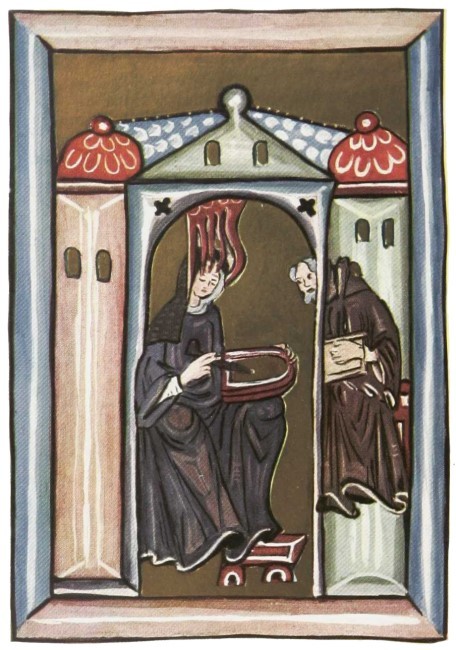
Plate I. HILDEGARD RECEIVING THE LIGHT FROM HEAVEN
STUDIES IN THE HISTORY AND METHOD OF SCIENCE EDITED BY CHARLES SINGER
OXFORD AT THE CLARENDON PRESS 1917
PRINTED IN ENGLAND
AT THE OXFORD UNIVERSITY PRESS
INTRODUCTION
The record of men and of movements, History teaches us the growth and development of ideas. Our civilization is the final expression of the two great master-thoughts of the race. Seeking an explanation of the pressing phenomena of life, man has peopled the world with spiritual beings to whom he has assigned benign or malign influences, to be invoked or propitiated. To the great ‘uncharted region’ (Gilbert Murray) with its mysteries, his religions offer a guide; and through ‘a belief in spiritual beings’ (Tylor’s definition of religion) he has built an altar of righteousness in his heart. The birth of the other dominant idea, long delayed, is comparatively recent. ‘The discovery of things as they really are’ (Plato) by a study of nature was the great gift of the Greeks. Knowledge, scientia, knowledge of things we see, patiently acquired by searching out the secrets of nature, is the basis of our material civilization. The true and lawful goal of the sciences, seen dimly and so expressed by Bacon, is the acquisition of new powers by new discoveries—that goal has been reached. Niagara has been harnessed, and man’s dominion has extended from earth and sea to the air. The progress of physics and of chemistry has revolutionized man’s ways and works, while the new biology has changed his mental outlook.
The greater part of this progress has taken place within the memory of those living, and the mass of scientific work has accumulated at such a rate that specialism has become inevitable. While this has the obvious advantage resulting from a division of labour, there is the penalty of a narrowed horizon, and groups of men work side by side whose language is unintelligible to each other.
Here is where the historian comes in, with two definite objects, teaching the method by which the knowledge has been gained, the evolution of the subject, and correlating the innumerable subdivisions in a philosophy at once, in Plato’s words, a science in itself as well as of other sciences. For example, the student of physics may know Crookes’s tubes and their relation to Röntgen, but he cannot have a true conception of the atomic theory without a knowledge of Democritus; and the exponent of Madame Curie and of Sir J. J. Thomson will find his happiest illustrations from the writings of Lucretius. It is unfortunate that the progress of science makes useless the very works that made progress possible; and the student is too apt to think that because useless now they have never been of value.
The need of a comprehensive study of the methods of science is now widely recognized, and to recognize this need important Journals have been started, notably Isis, published by our Belgian colleague George Sarton, interrupted, temporarily we hope, by the war; and Scientia, an International Review of Scientific Synthesis published by our Italian Allies. The numerous good histories of science issued within the past few years bear witness to a real demand for a wider knowledge of the methods by which the present status has been reached. Among works from which the student may get a proper outlook on the whole question may be mentioned Dannemann’s Die Naturwissenschaften in ihrer Entwicklung und in ihrem Zusammenhang, Bd. IV; De la Méthode dans les Sciences , edited by Félix Thomas (Paris: Alcan); Marvin’s Living Past , 3rd ed. (Clarendon Press, 1917); and Libby’s Introduction to the History of Science (Houghton Mifflin & Co., 1917).
This volume of Essays is the outcome of a quiet movement on the part of a few Oxford students to stimulate a study of the history of science. Shortly after his appointment to the Philip Walker Studentship, Dr. Charles Singer (of Magdalen College) obtained leave from Bodley’s Librarian and the Curators to have a bay in the Radcliffe Camera set apart for research work in the history of science and a safe installed to hold manuscripts; and (with Mrs. Singer) offered £100 a year for five years to provide the necessary fittings, and special books not already in the Library. The works relating to the subject have been collected in the room, the objects of which are:
First, to place at the disposal of the general student a collection that will enable him to acquire a knowledge of the development of science and scientific conceptions.
Secondly, to assist the special student in research: (a) by placing him in relationship with investigations already undertaken; (b) by collecting information on the sources and accessibility of his material; and (c) by providing him with facilities to work up his material.
In spite of the absence of Dr. Singer on military duty for the greater part of the time, the work has been carried on with conspicuous success, to use the words of Bodley’s Librarian. Ten special students have used the room. Professor Ramsay Wright has made a study of an interesting Persian medical manuscript. Professor William Libby, of Pittsburg, during the session of 1915–16, used the room in the preparation of his admirable History of Science just issued. Dr. E. T. Withington, the well-known medical historian, is making a special study of the old Greek writers for the new edition of Liddell and Scott’s Dictionary. Miss Mildred Westland has helped Dr. Singer with the Italian medical manuscripts. Mr. Reuben Levy has worked at the Arabic medical manuscripts of Moses Maimonides. Mrs. Jenkinson is engaged on a study of early medicine and magic. Dr. J. L. E. Dreyer, the distinguished historian of Astronomy, has used the room in connexion with the preparation of the Opera Omnia of Tycho Brahe. Miss Joan Evans is engaged upon a research on mediaeval lapidaries. Mrs. Singer has begun a study of the English medical manuscripts, with a view to a complete catalogue. How important this is may be judged from the first instalment of her work dealing with the plague manuscripts in the British Museum. With rare enthusiasm and energy Dr. Singer has himself done a great deal of valuable work, and has proved an intellectual ferment working far beyond the confines of Oxford. I have myself found the science history room of the greatest convenience, and it is most helpful to have easy access on the shelves to a large collection of works on the subject. Had the war not interfered, we had hoped to start a Journal of the History and Method of Science and to organize a summer school for special students—hopes we may perhaps see realized in happier days.
Meanwhile, this volume of essays (most of which were in course of preparation when war was declared) is issued as a ballon d’essai.
WILLIAM OSLER.
CONTENTS
PAGECHARLES SINGER
The Scientific Views and Visions of Saint Hildegard(1098–1180)
1J. W. JENKINSON
Vitalism 59CHARLES SINGER
A Study in Early Renaissance Anatomy, with a new text: The ANOTHOMIA of Hieronymo Manfredi, transcribed and translated by A. Mildred Westland 79RAYMOND CRAWFURD
The Blessing of Cramp-Rings; a Chapter in the History of the Treatment of Epilepsy 165E. T. WITHINGTON
Dr. John Weyer and the Witch Mania 189REUBEN LEVY
The ‘Tractatus de Causis et Indiciis Morborum’, attributed to Maimonides 225SCHILLER, F. C. S.
Scientific Discovery and Logical Proof 235INDEX
291LIST OF PLATES
PLATE FACING PAGEI.
Hildegard receiving the Light from Heaven (Wiesbaden Codex B, fo. 1
r)
FrontispieceII.
The Three Scripts of the Wiesbaden Codex B (fo. 17
r, col. b; fo. 32
v, col. b; fo. 205
r, col. b)
4III.
Title-page of the Heidelberg Codex of the
Scivias 5IV.
The Universe (from the Heidelberg Codex of the
Scivias)
12V.
(
a) Opening lines of the Copenhagen MS. of the
Causae et Curae. (
b) Opening lines of the Lucca MS. of the
Liber divinorum operum simplicis hominis 13VI.
Nous pervaded by the Godhead and controlling Hyle (Lucca MS., fo. 1
v)
20VII.
Nous pervaded by the Godhead embracing the Macrocosm with the Microcosm (Lucca MS., fo. 9
r)
21VIII.
The Macrocosm, the Microcosm, and the Winds (Lucca MS., fo. 27
v)
28IX.
Celestial Influences on Men, Animals, and Plants (Lucca MS., fo. 371)
28X.
A Crucifix in the Uffizi Gallery; about the middle of the thirteenth century
30XI.
The Structure of the Mundane Sphere (Lucca MS., fo. 86
v)
32XII.
(
a) Man’s Fall and the Disturbance of the Elemental Harmony (Wiesbaden Codex B, fo. 4
r). (
b) The New Heaven and the New Earth (Wiesbaden Codex B, fo. 224
v)
33XIII.
The Last Judgement and Fate of the Elements (Wiesbaden Codex B, fo. 224
r)
36XIV.
Diagram of the Relation of Human and Cosmic Phenomena: ninth century (Bibliothèque Nationale MS. lat. 5543, fo. 136
r)
37XV.
An Eleventh-century French Melothesia (Bibliothèque Nationale MS. lat. 7028, fo. 154
r)
40XVI.
A Melothesia of about 1400 (from Bibliothèque Nationale MS. lat. 11229, fo. 45
v)
Between 40 and41
XVII.
Facsimile from the
Symbolum Apostolicorum, a German Block Book of the first half of the Fifteenth Century(Heidelberg University Library)
Between 40 and41
XVIII.
An Anatomical Diagram of about 1298 (Bodleian MS.Ashmole 399, fo. 18
r)
41XIX.
Birth. The Arrival and Trials of the Soul (Wiesbaden Codex B, fo. 22
r)
44XX.
Death. The Departure and Fate of the Soul (Wiesbaden Codex B, fo. 25
r)
45XXI.
The Fall of the Angels (Wiesbaden Codex B, fo. 123
r)
46XXII.
The Days of Creation and the Fall of Man (Wiesbaden Codex B, fo. 41
v)
48XXIII.
The Vision of the Trinity (Wiesbaden Codex B, fo. 471)
50XXIV.
(
a) Sedens Lucidus (Wiesbaden Codex B, fo. 213
v). (
b) Zelus Dei (Wiesbaden Codex B, fo. 153
r)
52XXV.
The Heavenly City (Wiesbaden Codex B, fo. 30
r)
54XXVI.
John Wilfred Jenkinson
57XXVII.
Mundinus (?) lecturing on Anatomy (from the 1493 edition of ‘Ketham’)
78XXVIII.
(
a) Four Diagrams, to illustrate the Anatomy of Henri de Mondeville (Bibliothèque Nationale MS. fr. 2030, written in 1314). (
b) A Dissection Scene,
circa1298 (Bodleian MS. Ashmole 399, fo. 34
r)
79XXIX.
A Post-Mortem Examination: late fourteenth century to illustrate Guy de Chauliac (Montpellier, Bibliothèque de la Faculté de Médecine MS. fr. 184, fo. 14
r)
80XXX.
(
a) A Demonstration of Surface Markings: second half of fifteenth century (Vatican MS. Hispanice 4804, fo. 8
r). (
b) A Demonstration of the Bones to illustrate Guy de Chauliac: first half of fifteenth century (Bristol Reference Library MS., fo. 25
r)
81XXXI.
Anatomical Sketches from the MS. of Guy de Vigevano of 1345 at Chantilly
84XXXII.
Anatomical Sketches from the MS. of Guy de Vigevano of 1345 at Chantilly
85XXXIII.
The Five-Figure Series: Veins, &c., Arteries, Nerves, Bones, Muscles (Bodleian MS. Ashmole 399, fos. 18
r–22
r): about 1298
92XXXIV.
Demonstrations of Anatomy: second half of fifteenth century (Dresden Galen MS.)
93XXXV.
A View of the Internal Organs: Leonardo da Vinci (from a drawing in the Library, Windsor Castle)
96XXXVI.
Two Persons dissecting, traditionally said to represent Michelangelo and Antonio della Torre (from a drawing in the Ashmolean Museum, Oxford, attributed to Bartolomeo Manfredi (1574?–1602))
97XXXVII.
Portrait of Giovanni Bentivoglio II, from his tomb in the Church of S. Giacomo Maggiore at Bologna
102XXXVIII.
(
a) Roger Bacon’s Diagram of the Eye: thirteenth century (British Museum MS. Roy. 7 F.
VIII, fo. 50
v). (
b) Leonardo da Vinci’s Diagram of the Heart: early sixteenth century (from a drawing in Windsor Castle)
103XXXIX.
Miracles at the Tomb of Edward the Confessor, from Norman-French thirteenth-century MS. (University Library, Cambridge, MS. Ee. iii. 59)
166XL.
Queen Mary Tudor blessing Cramp-Rings (from Queen Mary’s Illuminated MS. Manual, in the Library of the Roman Catholic Cathedral at Westminster)
178XLI.
Facsimile of the
Tractatus de Causis et Indiciis Morborum, attributed to Maimonides (Bodleian MS., Marsh 379)
225ILLUSTRATIONS IN TEXT
SCIENTIFIC VIEWS AND VISIONS OF SAINT HILDEGARD
FIGURE PAGE1.
The Hildegard Country
32.
Hildegard’s First Scheme of the Universe (slightly simplified from the Wiesbaden Codex B, fo. 14
r)
93.
Hildegard’s Second Scheme of the Universe (reconstructed from her measurements)
294.
Dante’s Scheme of the Universe (slightly modified from Michelangelo Caetani, duca di Sermoneta,
La materia della Divina Commedia di Dante Allighieri dichiarata in VI tavole)
315.
Diagram of the Zones (from Herrade de Landsberg,
Hortus deliciarum)
406, 7.
Melothesiae (from R. Fludd,
Historia utriusque cosmi, 1619)
418.
The Microcosm (from R. Fludd,
Philosophia sacra seu astrologia cosmica, 1628)
429.
Diagram illustrating the relationship of the Planets to the Brain (from Herrade de Landsberg,
Hortus deliciarum)
48A STUDY IN EARLY RENAISSANCE ANATOMY
1.
The first printed picture of Dissection (from the French translation of Bartholomaeus Anglicus, 1482)
802.
Dissection Scene in the open air (Title-page of Mellerstadt’s edition of the
Anatomyof Mondino, 1493)
823.
Dissection Scene (from the 1495 edition of ‘Ketham’)
834.
The first picture of Dissection in an English-printed book (from the English translation of Bartholomaeus Anglicus, printed by Wynkyn de Worde, 1495)
855.
A Lecture on Anatomy (from the 1535 edition of Berengar of Carpi’s Commentary on Mondino)
856.
Diagrams of the Internal Organs (after Bodleian MS. Ashmole 399, of about 1298)
887.
A Female Figure laid open to show the Womb and other Organs (from the 1493 edition of ‘Ketham’)
918.
The Abdominal Muscles (from Berengar of Carpi’s Commentary on Mondino, 1521)
969.
The first printed Map of England (from the 1472(?) Bologna
Ptolemy, edited by Manfredi and others)
10010.
Facsimile of the last page of Manfredi’s
Prognosticon ad annum 1479 10211.
Diagram showing the ten Layers of the Head, the Cerebral Ventricles and Cranial Nerves, and the Relation of the Nerves to the Senses (from M. Hundt,
Antropologium, 1501)
11212.
The Layers of the Head (from the
Anatomiaof Johannes Dryander, 1537)
11213.
Diagram showing the Ventricles of the Brain (from
Illustrissimi philosophi et theologi domini Alberti magni compendiosum insigne ac perutile opus Philosophiae naturalis, 1496)
11414.
Diagram of the Senses, the Humours, the Cerebral Ventricles, and the Intellectual Faculties. To illustrate Roger Bacon,
De Scientia Perspectiva, (British Museum MS. Sloane 2156, fo. 11
r)
11615.
Diagram illustrating the general ideas on Anatomy current at the Renaissance (from K. Peyligk.
Philosophiae naturalis compendium, 1489)
11616.
Diagrams of the Cerebral Ventricles viewed from above and from the side (from K. Peyligk,
Philosophiae naturalis compendium, 1489)
11717.
The Localization of Cerebral Functions (from the 1493 edition of ‘Ketham’)
11718.
Diagram of the Ventricles and the Senses, with their relation to the intellectual processes, according to the doctrine of the Renaissance anatomists (from G. Reisch,
Margarita philosophiae, 1503)
11719.
The Anatomy of the Eye (from G. Reisch,
Margarita philosophiae, 1503)
12020.
The Anatomy of the Eye (from Vesalius,
De humani corporis fabrica, 1543)
12121.
The Heart (from the Roncioni MS., Pisa 99)
12722.
Diagram showing the two Lateral Ventricles and the ‘Central’ Ventricle, (from Johannes Adelphus,
Mundini de omnibus humani corporis interioribus menbris Anathomia, 1513)
12823.
The Heart (from Hans von Gersdorff,
Feldt- und Stattbüch bewerter Wundartznei, 1556)
129DR. JOHN WEYER AND THE WITCH MANIA
Portrait of Dr. John Weyer at the age of 60, 1576
189THE SCIENTIFIC VIEWS AND VISIONS OF SAINT HILDEGARD (1098–1180)
By Charles Singer
PAGEI.
Introduction
1II.
Life and Works
2III.
Bibliographical Note
6IV.
The Spurious Scientific Works of Hildegard
12V.
Sources of Hildegard’s Scientific Knowledge
15VI.
The Structure of the Material Universe
22VII.
Macrocosm and Microcosm
30VIII.
Anatomy and Physiology
43IX.
Birth and Death and the Nature of the Soul
49X.
The Visions and their Pathological Basis
51I. Introduction
In attempting to interpret the views of Hildegard on scientific subjects, certain special difficulties present themselves. First is the confusion arising from the writings to which her name has been erroneously attached. To obtain a true view of the scope of her work, it is necessary to discuss the authenticity of some of the material before us. A second difficulty is due to the receptivity of her mind, so that views and theories that she accepts in her earlier works become modified, altered, and developed in her later writings. A third difficulty, perhaps less real than the others, is the visionary and involved form in which her thoughts are cast.
But a fourth and more vital difficulty is the attitude that she adopts towards phenomena in general. To her mind there is no distinction between physical events, moral truths, and spiritual experiences. This view, which our children share with their mediaeval ancestors, was developed but not transformed by the virile power of her intellect. Her fusion of internal and external universe links Hildegard indeed to a whole series of mediaeval visionaries, culminating with Dante. In Hildegard, as in her fellow mystics, we find that ideas on Nature and Man, the Moral World and the Material Universe, the Spheres, the Winds, and the Humours, Birth and Death, and even on the Soul, the Resurrection of the Dead, and the Nature of God, are not only interdependent, but closely interwoven. Nowadays we are well accustomed to separate our ideas into categories, scientific, ethical, theological, philosophical, and so forth, and we even esteem it a virtue to retain and restrain our thoughts within limits that we deliberately set for them. To Hildegard such classification would have been impossible and probably incomprehensible. Nor do such terms as parallelism or allegory adequately cover her view of the relation of the material and spiritual. In her mind they are really interfused, or rather they have not yet been separated.
Therefore, although in the following pages an attempt is made to estimate her scientific views, yet the writer is conscious that such a method must needs interpret her thought in a partial manner. Hildegard, indeed, presents to us scientific thought as an undifferentiated factor, and an attempt is here made to separate it by the artificial but not unscientific process of dissection from the organic matrix in which it is embedded.
The extensive literature that has risen around the life and works of Hildegard has come from the hands of writers who have shown no interest in natural knowledge, while those who have occupied themselves with the history of science have, on their side, largely neglected the period to which Hildegard belongs, allured by the richer harvest of the full scholastic age which followed. This essay is an attempt to fill in a small part of the lacuna.
II. Life and Works
Hildegard of Bingen was born in 1098, of noble parentage, at Böckelheim, on the river Nahe, near Sponheim. Destined from an early age to a religious life, she passed nearly all her days within the walls of Benedictine houses. She was educated and commenced her career in the isolated convent of Disibodenberg, at the junction of the Nahe and the Glan, where she rose to be abbess. In 1147 she and some of her nuns migrated to a new convent on the Rupertsberg, a finely placed site, where the smoky railway junction of Bingerbrück now mars the landscape. Between the little settlement and the important mediaeval town of Bingen flowed the river Nahe, spanned by a bridge to which still clung the name of the pagan Drusus (see Fig. 1). At this spot, a place of ancient memories, secluded and yet linked to the world, our abbess passed the main portion of her life, and here she closed her eyes in the eighty-second year of her age on September 17, 1180.
Folio 17 r col. b Folio 32 v col. b Folio 205 r col. b
Plate II. THE THREE SCRIPTS OF THE WIESBADEN CODEX B
Plate III. TITLE PAGE OF THE HEIDELBERG CODEX OF THE SCIVIAS
From the HEIDELBERG CODEX OF THE SCIVIAS
Plate IV. THE UNIVERSE
Plate V a. OPENING LINES OF THE COPENHAGEN MS. OF THE CAUSAE ET CURAE
From the LUCCA MS. fo. 1 v
Plate VI. NOUS PERVADED BY THE GODHEAD AND CONTROLLING HYLE
From the LUCCA MS. fo. 9 r
Plate VII. NOUS PERVADED BY THE GODHEAD EMBRACING THE MACROCOSM WITH THE MICROCOSM
From the LUCCA MS. fo. 27 v
Plate VIII. THE MACROCOSM THE MICROCOSM AND THE WINDS
Plate IX. From THE LUCCA MS fo. 37 r
CELESTIAL INFLUENCES ON MEN ANIMALS AND PLANTS
Plate X. A CRUCIFIX IN THE UFFIZI GALLERY About the middle of the XIIIth Century.
From the LUCCA MS. fo. 86 v
Plate XI. THE STRUCTURE OF THE MUNDANE SPHERE
WIESB. COD. B. fo. 4 r
Plate XIIa. MAN’S FALL AND THE DISTURBANCE OF THE ELEMENTAL HARMONY
From WIESBADEN CODEX B fo. 224 r
Plate XIII. THE LAST JUDGEMENT AND FATE OF THE ELEMENTS
From BIBL. NAT. MS. LAT. 5543 fo. 136 r
Plate XIV. DIAGRAM OF THE RELATION OF HUMAN AND COSMIC PHENOMENA IXth Century
From BIBL. NAT. MS. LAT. 7028 fo. 154 r
Plate XV. AN XIth CENTURY FRENCH MELOTHESIA
From BIBL. NAT. MS. LAT. 11229 fo. 45 v
Plate XVI. A MELOTHESIA OF ABOUT 1400
From the SYMBOLUM APOSTOLICORUM
Plate XVII. A GERMAN BLOCK BOOK First Half of XVth Century. Heidelberg University Library
From BODLEIAN MS. ASHMOLE 399 fo. 18 r
Plate XVIII. AN ANATOMICAL DIAGRAM OF ABOUT 1298 From the Five-Figure Series. Cp. Plate XXXIII
From WIESBADEN CODEX B fo. 22 r
Plate XIX. BIRTH. THE ARRIVAL AND TRIALS OF THE SOUL
From WIESBADEN CODEX B fo. 25 r
Plate XX. DEATH. THE DEPARTURE AND FATE OF THE SOUL
From WIESBADEN CODEX B, fo. 123 r
Plate XXI. THE FALL OF THE ANGELS
From WIESBADEN CODEX B fo. 41 v
Plate XXII. THE DAYS OF CREATION AND THE FALL OF MAN
From WIESBADEN CODEX B. fo. 47 r
Plate XXIII. THE VISION OF THE TRINITY
WIESB. COD. B. fo. 213 v
SEDENS LUCIDUS
From THE WIESBADEN CODEX B fo. 30 r
Plate XXV. THE HEAVENLY CITY
From the Italian translation of ‘KETHAM’, VENICE 1493
Plate XXVII. MUNDINUS(?) LECTURING ON ANATOMY
BIBLIOTHÈQUE NATIONALE MS. fr. 2030 Written in 1314
TO ILLUSTRATE THE ANATOMY OF HENRI DE MONDEVILLE
MS. fr. 184 fo. 14 r
Plate XXIX. A POST-MORTEM EXAMINATION. Late XIVth Century
VATICAN MS. HISPANICE 4804 fo. 8 r
Plate XXX a. A DEMONSTRATION OF SURFACE MARKINGS
Plate XXXI. From the MS. of GUY DE VIGEVANO of 1345 at CHANTILLY
Plate XXXII. From the MS. of GUY DE VIGEVANO of 1345 at CHANTILLY
Plate XXXIII. The FIVE-FIGURE SERIES BODLEIAN MS. ASHMOLE 399, about 1292 Fos. 18 r–22 r
VEINS, &c. ARTERIES NERVES BONES MUSCLES
From the DRESDEN GALEN MS.
Plate XXXIV. DEMONSTRATIONS OF ANATOMY Second half of XVth Century
From a drawing in the Library, WINDSOR CASTLE
Plate XXXV. VIEW OF THE INTERNAL ORGANS LEONARDO DA VINCI
From a Drawing in the ASHMOLEAN MUSEUM, OXFORD, attributed to BARTOLOMEO MANFREDI (1574?–1602)
Plate XXXVI. THE TWO FIGURES DISSECTING ARE TRADITIONALLY SAID TO REPRESENT MICHELANGELO AND ANTONIO DELLA TORRE
From his tomb in the Church of S. Giacomo Maggiore at Bologna
Plate XXXVII. GIOVANNI BENTIVOGLIO II
BRIT. MUS. MS. ROY. 7 F VIII, fo. 50 v
Plate XXXVIII a. ROGER BACON’S DIAGRAM OF THE EYE. XIIIth Century
From CAMBRIDGE UNIVERSITY LIBRARY MS. Ec. iii. 59
Plate XXXIX. MIRACLES AT THE TOMB OF EDWARD THE CONFESSOR XIIIth Century
Plate XL. QUEEN MARY TUDOR BLESSING CRAMP-RINGS
From QUEEN MARY’S MS. MANUAL fo. iv Library of the Roman Catholic Cathedral at WESTMINSTER
Plate XLI. THE BODLEIAN MANUSCRIPT MS. MARSH 379 fo. 73
Fig. 1. THE HILDEGARD COUNTRY
Fig. 2. HILDEGARD’S FIRST SCHEME OF THE UNIVERSE
Slightly simplified from the Wiesbaden Codex B, folio 14 r.
Fig. 3. HILDEGARD’S SECOND SCHEME OF THE UNIVERSE
Reconstructed from her measurements. AB, CD, and EF are all equal to each other, as are also GH, HK, and KL. The clouds are situated in the outer part of the aer tenuis, and form a prolongation downwards from the aer aquosus towards the earth.
Fig. 4. DANTE’S SCHEME OF THE UNIVERSE
Slightly modified from Michelangelo Caetani, duca di Sermoneta, La materia della Divina Commedia di Dante Allighieri dichiarata in VI tavole, Monte Cassino, 1855.
Fig. 5. From Herrade de Landsberg’s Hortus deliciarum, after Straub and Keller.
Fig. 6.
Fig. 8. THE MICROCOSM
From R. Fludd, Philosophia sacra seu astrologia cosmica, Frankfurt, 1628, p. 52.
Fig. 9. From Herrade de Landsberg’s Hortus deliciarum, after Straub and Keller’s reproduction.107
Fig. 1. From the French translation of Bartholomaeus Anglicus, Lyons, 1482. The first printed picture of dissection.
Fig. 2. Title-page of Mellerstadt’s edition of the Anatomy of Mondino, Leipzig, 1493. The scene is laid in the open air.131
Fig. 3. A DISSECTION SCENE
From the Venice 1495 edition of ‘Ketham’ (compare Plate XXVII).
Fig. 4. From the English translation of Bartholomaeus Anglicus, printed by Wynkyn de Worde, 1495. The first picture of dissection in an English-printed book.
Fig. 5. A LECTURE ON ANATOMY
From the 1535 Venice edition of Berengar of Carpi’s Commentary on Mondino.
Fig. 6. DIAGRAMS OF THE INTERNAL ORGANS
After Bodleian Library MS. Ashmole 399 of about 1298, fos. 23 recto–24 recto.
Fig. 7. A FEMALE FIGURE LAID OPEN TO SHOW THE WOMB AND OTHER ORGANS
From the 1493 Venice edition of ‘Ketham’ translated into Italian. This is the first printed anatomical figure drawn from the object.
Fig. 8. THE ABDOMINAL MUSCLES
From Berengar of Carpi’s Commentary on Mondino, Bologna, 1521.
THE FIRST PRINTED MAP OF ENGLAND.
From the 1472 (?) Bologna Ptolemy, edited by Manfredi and others.
Fig. 10. The last page of Manfredi’s Prognosticon ad annum 1479, Bologna, 1478.
Fig. 11. From M. Hundt, Antropologium, de hominis dignitate natura et proprietatibus, Leipzig, 1501. The figure shows the ten layers of the head, the cerebral ventricles and cranial nerves, and the relation of the nerves to the senses.
Fig. 12. THE LAYERS OF THE HEAD
From the Anatomia of Johannes Dryander, Marburg, 1537.
Fig. 13. From Illustrissimi philosophi et theologi domini Alberti magni compendiosum insigne ac perutile opus Philosophiae naturalis, Venice, 1496, showing the ventricles of the brain.
Fig. 14. Diagram of the senses, the humours, the cerebral ventricles, and the intellectual faculties. MS. Sloane 2156, folio 11 recto, in the British Museum, being a copy written in 1428 of the De Scientia Perpectiva of Roger Bacon
Fig. 15. From K. Peyligk’s Philosophiae naturalis compendium, Leipzig, 1489. Illustrating the general ideas on anatomy current at the Renaissance.
Fig. 16. The cerebral ventricles from above and from the side. According to K. Peyligk, Philosophiae naturalis compendium, Leipzig, 1489.
Fig. 17. The localization of cerebral functions. From the Italian edition of ‘Ketham’, Fasciculus Medicinae, Venice, 1493.
Fig. 18. From G. Reisch, Margarita philosophiae, Leipzig,? 1503. Diagram of the ventricles and the senses with their relation to the intellectual processes according to the doctrine of the Renaissance anatomists.
Fig. 19. THE ANATOMY OF THE EYE
From G. Reisch, Margarita philosophiae, Leipzig,? 1503. Showing the seven tunics and three humours of the eye according to the doctrines of Renaissance anatomists.196
Fig. 20. THE ANATOMY OF THE EYE
From Vesalius, De humani corporis fabrica, Basel, 1543, p. 643. A, Crystalline humour; O, Albugineous humour; C, Vitreous humour; N, Cornea; Q, Conjunctiva; M, Sclerotica; G, Secundina; H, Uvea; K, Arachnoidea; E, Retina.
Fig. 21. THE HEART
From the Roncioni MS. (Pisa 99) after Sudhoff.
Fig. 22. From Johannes Adelphus, Mundini de omnibus humani corporis interioribus menbris Anathomia, Strassburg, 1513. The diagram shows the two lateral ventricles and the ‘central’ ventricle. By a printer’s error the letters c and d are transposed. The arteria adorti is the aorta, the arteria venalis the pulmonary vein, the vena chilis the vena cava, and the vena arterialis the pulmonary artery. The auricles are ignored, as is frequently the case in works of the period, and the pulmonary veins are represented as opening directly into the ventricles.
Fig. 23. From Hans von Gersdorff, Feldt und Stattbüch bewerter Wundartznei, Frankfurt, 1556. The trachea (d) is represented as opening directly into the heart.
Introduction
But a fourth and more vital difficulty is the attitude that she adopts towards phenomena in general. To her mind there is no distinction between physical events, moral truths, and spiritual experiences. This view, which our children share with their mediaeval ancestors, was developed but not transformed by the virile power of her intellect. Her fusion of internal and external universe links Hildegard indeed to a whole series of mediaeval visionaries, culminating with Dante. In Hildegard, as in her fellow mystics, we find that ideas on Nature and Man, the Moral World and the Material Universe, the Spheres, the Winds, and the Humours, Birth and Death, and even on the Soul, the Resurrection of the Dead, and the Nature of God, are not only interdependent, but closely interwoven. Nowadays we are well accustomed to separate our ideas into categories, scientific, ethical, theological, philosophical, and so forth, and we even esteem it a virtue to retain and restrain our thoughts within limits that we deliberately set for them. To Hildegard such classification would have been impossible and probably incomprehensible. Nor do such terms as parallelism or allegory adequately cover her view of the relation of the material and spiritual. In her mind they are really interfused, or rather they have not yet been separated.
Whatever the date of these miniatures, however, they reproduce the meaning of the text of the Liber divinorum operum with a convincing certainty and sureness of touch. This work is the most difficult of all Hildegard’s mystical writings. Without the clues provided by the miniatures, many passages in it are wholly incomprehensible. It appears to us therefore by no means improbable that the traditional interpretation of Hildegard’s works, thus preserved to our time by these miniatures and by them alone, may have had its origin from the mouth of the prophetess herself, perhaps through another set of miniatures that has disappeared or has not yet come to light.19
(f) Furthermore, although that spurious work has a chapter De elementis, it reveals none of Hildegard’s most peculiar and definite views as to their nature, origin, and fate,28 nor does it refer to the sphericity of the earth, to the vascular system of man, to the humours and their relation to the winds and the elements, or to a dozen other points on which, as we shall see, Hildegard had views of her own.
The contemporaries of Hildegard who provide the closest analogy to her are Elizabeth of Schönau (died 1165), whose visions are recounted in her life by Eckbertus;50 and Herrade de Landsberg, Abbess of Hohenburg in Alsace, the priceless MS. of whose Hortus Deliciarum was destroyed by the Germans in the siege of Strasbourg in 1870.51 With Elizabeth of Schönau, who lived in her neighbourhood, Hildegard was in frequent correspondence. With Herrade she had, so far as is known, no direct communication; but the two were contemporary, lived not very far apart, and under similar political and cultural conditions. Elizabeth’s visions present some striking analogies to those of Hildegard, while the figures of Herrade, of which copies have fortunately survived, often suggest the illustrations of the Wiesbaden or of the Lucca MSS.
These curious passages were written at some date after 1163, when Hildegard was at least 65 years old. They reveal our prophetess attempting to revise much of her earlier theory of the universe, and while seeking to justify her earlier views, endeavouring also to bring them into line with the new science that was now just beginning to reach her world. Note that (a) the universe has become round; (b) there is an attempt to arrange the zones according to their density, i.e. from without inwards, fire, air (ether), water, earth; (c) exact measurements are given; (d) the watery zone is continued earthward so as to mingle with the central circle. In all these and other respects she is joining the general current of mediaeval science then beginning to be moulded by works translated from the Arabic. Her knowledge of the movements of the heavenly bodies is entirely innocent of the doctrine of epicycles, but in other respects her views have come to resemble those, for instance, of Messahalah, one of the simplest and easiest writers on the sphere available in her day. Furthermore, her conceptions have developed so as to fit in with the macrocosm-microcosm scheme which she grasped about the year 1158. Even in her latest work, however, her theory of the universe exhibits differences from that adopted by the schoolmen, as may be seen by comparing her diagram with, for example, the scheme of Dante (Fig. 4).
Macrocosmic schemes of the type illustrated by the text of Hildegard and by the figures of the Lucca MS. had a great vogue in mediaeval times, and were passed on to later ages. Some passages in Hildegard’s work read curiously like Paracelsus (1491–1541),93 and it is not hard to find a link between these two difficult and mystical writers. Trithemius, the teacher of Paracelsus, was abbot of Sponheim, an important settlement almost within sight of Hildegard’s convents on the Rupertsberg and Disibodenberg. Trithemius studied Hildegard’s writings with great care and attached much importance to them, so that they may well have influenced his pupil. The influence of mediaeval theories of the relation of macrocosm and microcosm is encountered among numerous Renaissance writers besides Paracelsus, and is presented to us, for instance, by such a cautious, balanced, and scientifically-minded humanist as Fracastor. But as the years went on, the difficulty in applying the details of the theory became ever greater and greater. Facts were strained and mutilated more and more to make them fit the Procrustean bed of an outworn theory, which at length became untenable when the heliocentric system of Copernicus and Galileo replaced the geocentric and anthropocentric systems of an earlier age. The idea of a close parallelism between the structure of man and of the wider universe was gradually abandoned by the scientific, while among the unscientific it degenerated and became little better than an insane obsession. As such it appears in the ingenious ravings of the English follower of Paracelsus, the Rosicrucian, Robert Fludd, who reproduced, often with fidelity, the systems which had some novelty five centuries before his time (Figs. 6, 7, and 8). As a similar fantastic obsession this once fruitful hypothesis still occasionally appears even in modern works of learning and industry.94
When the body has thus taken shape there enters into it the soul which, though at first shapeless, gradually assumes the form of its host, the earthly tabernacle; and at death the soul departs through the mouth with the last breath, as a fully developed naked human shape, to be received by devils or angels as the case may be (Plate XX).
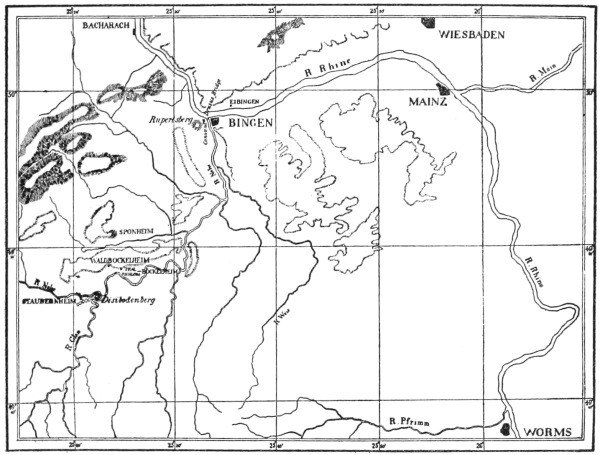
Fig. 1. THE HILDEGARD COUNTRY
Hildegard was a woman of extraordinarily active and independent mind. She was not only gifted with a thoroughly efficient intellect, but was possessed of great energy and considerable literary power, and her writings cover a wide range, betraying the most varied activities and remarkable imaginative faculty. The best known, and in a literary sense the most valuable of her works, are the books of visions. She was before all things an ecstatic, and both her Scivias (1141–50) and her Liber divinorum operum simplicis hominis (1163–70) contain passages of real power and beauty. Less valuable, perhaps, is her third long mystical work (the second in point of time), the Liber vitae meritorum (1158–62). She is credited with the authorship of an interesting mystery-play and of a collection of musical compositions, while her life of St. Disibode, the Irish missionary (594–674) to whom her part of the Rhineland owes its Christianity, and her account of St. Rupert, a local saint commemorated in the name ‘Rupertsberg’, both bear witness alike to her narrative powers, her capacity for systematic arrangement, and her historical interests. Her extensive correspondence demonstrates the influence that she wielded in her own day and country, while her Quaestionum solutiones triginta octo, her Explanatio regulae sancti Benedicti, and her Explanatio symboli sancti Athanasii ad congregationem sororum suorum give us glimpses of her activities as head of a religious house.
Her biographer, the monk Theodoric, records that she also busied herself with the treatment of the sick, and credits her with miraculous powers of healing.1 Some of the cited instances of this faculty, as the curing of a love-sick maid,2 are, however, but manifestations of personal ascendancy over weaker minds; notwithstanding her undoubted acquaintance with the science of her day, and the claims made for her as a pioneer of the hospital system, there is no serious evidence that her treatment extended beyond exorcism and prayer.
For her time and circumstance Hildegard had seen a fair amount of the world. Living on the Rhine, the highway of Western Germany, she was well placed for observing the traffic and activities of men. She had journeyed at least as far north as Cologne, and had traversed the eastern tributary of the great river to Frankfort on the Main and to Rothenburg on Taube.3 Her own country, the basin of the Nahe and the Glan, she knew intimately. She was, moreover, in constant communication with Mayence, the seat of the archbishopric in which Bingen was situated, and there has survived an extensive correspondence with the ecclesiastics of Cologne, Speyer, Hildesheim, Trèves, Bamberg, Prague, Nürnberg, Utrecht, and numerous other towns of Germany, the Low Countries, and Central Europe.
Folio 17 r col. b Folio 32 v col. b Folio 205 r col. b
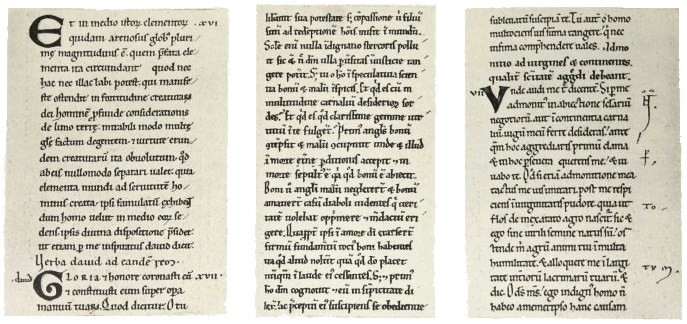
Plate II. THE THREE SCRIPTS OF THE WIESBADEN CODEX B
Hildegard’s journeys, undertaken with the object of stimulating spiritual revival, were of the nature of religious progresses, but, like those of her contemporary, Bernard of Clairvaux, they were in fact largely directed against the heretical and most cruelly persecuted Cathari, an Albigensian sect widely spread in the Rhine country of the twelfth century, whom Hildegard regarded as ‘worse than the Jews’.4 In justice to her memory it is to be recalled that she herself was ever against the shedding of blood, and had her less ferocious views prevailed, some more substantial relic than the groans and tears of this people had reached our time, while the annals of the Church had been spared the defilement of an inexpiable stain.
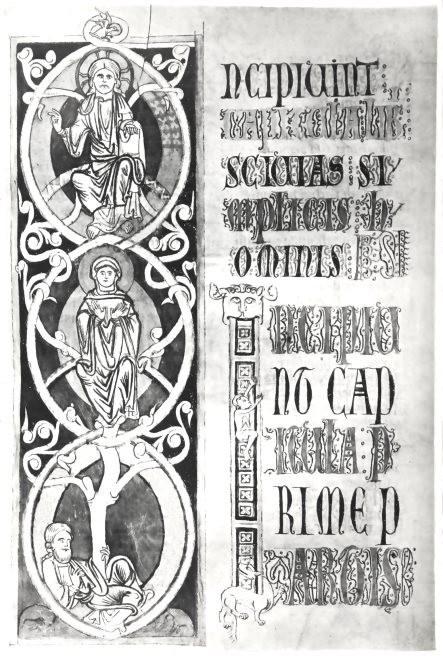
Plate III. TITLE PAGE OF THE HEIDELBERG CODEX OF THE SCIVIAS
Hildegard’s correspondence with St. Bernard, then preaching his crusade, with four popes, Eugenius III, Anastasius IV, Adrian IV, and Alexander III, and with the emperors Conrad and Frederic Barbarossa, brings her into the current of general European history, while she comes into some slight contact with the story of our own country by her hortatory letters to Henry II and to his consort Eleanor, the divorced wife of Louis VII.5
To complete a sketch of her literary activities, mention should perhaps be made of a secret script and language, the lingua ignota, attributed to her. It is a transparent and to modern eyes a foolishly empty device that hardly merits the dignity of the term ‘mystical’. It has, however, exercised the ingenuity of several writers, and has been honoured by analysis at the hands of Wilhelm Grimm.6
Ample material exists for a full biography of Hildegard, and a number of accounts of her have appeared in the vulgar tongue. Nearly all are marred by a lack of critical judgement that makes their perusal a weary task, and indeed it would need considerable skill to interest a detached reader in the minutiae of monastic disputes that undoubtedly absorbed a considerable part of her activities. Perhaps the best life of her is the earliest; it is certainly neither the least critical nor the most credulous, and is by her contemporaries, the monks Godefrid and Theodoric.7
The title of ‘saint’ is usually given to Hildegard, but she was not in fact canonized. Attempts towards that end were made under Gregory IX (1237), Innocent IV (1243), and John XXII (1317). Miraculous cures and other works of wonder were claimed for her, but either they were insufficiently miraculous or insufficiently attested.8 Those who have impartially traced her life in her documents will agree with the verdict of the Church. Hers was a fiery, a prophetic, in many ways a singularly noble spirit, but she was not a saint in any intelligible sense of the word.
III. Bibliographical Note
There is no complete edition of the works of Hildegard. For the majority of readers the most convenient collection will doubtless be vol. 197 of Migne, Patrologia Latina. This can be supplemented from Cardinal J. B. Pitra’s well-edited Analecta sacra, the eighth volume of which contains certain otherwise inaccessible works of Hildegard,9 and is the only available edition of the Liber vitae meritorum per simplicem hominem a vivente luce, revelatorum.
Manuscripts of the writings of our abbess are numerous and are widely scattered over Europe. Four of them are of special importance for our purpose, and are here briefly described.
(A) is a vast parchment of 480 folios in the Nassauische Landesbibliothek at Wiesbaden. This much-thumbed volume, still bearing the chain that once tethered it to some monastic desk, is written in a thirteenth-century script. There is evidence that it was prepared in the neighbourhood of Hildegard’s convent, if not in that convent itself. It is interesting as a collection of those works that the immediate local tradition attributed to her, and is thus useful as a standard of genuineness.10 Reference will be made to it in the following pages as the Wiesbaden Codex A. Its contents are as follows:
1. Liber Scivias.
2. Liber vitae meritorum.
3. Liber divinorum operum.
4. Ad praelatos moguntienses.
5. Vita sanctae Hildegardis. By Godefrid and Theodoric.
6. Liber epistolarum et orationum. This collection contains 292 items, and includes the Explanatio symboli Athanasii, the Exposition of the Rule of St. Benedict, and the Lives of St. Disibode and St. Rupert.
7. Expositiones evangeliorum.
8. Ignota lingua and Ignotae litterae.
9. Litterae villarenses.
10. Symphonia harmoniae celestum revelationum.
(B) is also at Wiesbaden, and will be cited here as the Wiesbaden Codex B. It contains the Scivias only, and is a truly noble volume of 235 folios, beautifully illuminated, in excellent preservation, and of the highest value for the history of mediaeval art. It has been thoroughly investigated by the late Dom Louis Baillet,11 who concluded that it was written in or near Bingen between the dates 1160 and 1180. Its miniatures help greatly in the interpretation of the visions, illustrating them often in the minutest and most unexpected details. In view of the great difficulty of visualizing much of her narrative, these miniatures afford to our mind strong evidence that the MS. was supervised by the prophetess herself, or was at least prepared under her immediate tradition. This view is confirmed by comparing the miniatures with those of the somewhat similar but inferior Heidelberg MS. (C).
Both the miniatures and the script of the Wiesbaden Codex B are the work of several hands. There are three distinct handwritings discernible (Plate II). The earliest is attributed by Baillet in his careful work to the twelfth century, while the later writing is in thirteenth-century hands.12 It thus appears to us that while Hildegard herself probably supervised the earlier stages of the preparation of this volume, its completion took place subsequent to her death. This view is sustained by the fact that some of the later miniatures are far less successful than the earlier figures in aiding the interpretation of her text.
The two Wiesbaden MSS. appear to have remained at the convent on the Rupertsberg opposite Bingen until the seventeenth century. They were studied there by Trithemius in the fifteenth century, and one of them at least was seen by the Mayence Commission of 1489. Later they were noted by the theologians Osiander (1527) and Wicelius (Weitzel, 1554), and by the antiquary Nicolaus Serarius (1604). In 1632, during the Thirty Years’ War, the Rupertsberg buildings were destroyed, the MSS. being removed to a place of safety in the neighbouring settlement at Eibingen, where they were again recorded in 1660 by the Jesuits Papenbroch and Henschen.13 At some unknown date they were transferred to Wiesbaden, where they were examined in 1814 by Goethe,14 and a few years later by Wilhelm Grimm,15 and where they have since remained.
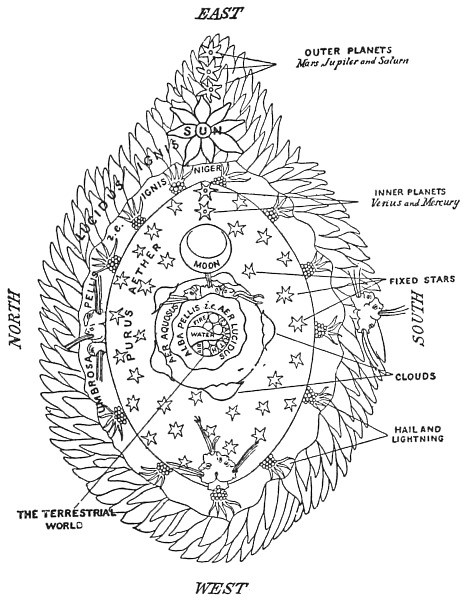
Fig. 2. HILDEGARD’S FIRST SCHEME OF THE UNIVERSE
Slightly simplified from the Wiesbaden Codex B, folio 14 r.
(C) This MS. is at the University Library at Heidelberg. It also contains only the Scivias, and it is the only known illuminated MS. of that work except the Wiesbaden Codex B. The Heidelberg MS. was prepared with great care in the early thirteenth century, only a little later than its fellow, but its figures afford little aid in the interpretation of the text. Thus, for instance, the Heidelberg diagram of the universe (Plate IV) is of a fairly conventional type which quite fails to illustrate the difficult description. The obscurities of the text are, however, at once explained by a figure in the Wiesbaden Codex B (Fig. 2): we thus obtain further indirect evidence of the personal influence of Hildegard in the preparation of that MS. The representation of Hildegard in the Heidelberg MS. (Plate III) shows no resemblance to those in the Wiesbaden Codex B (Plate I) or in the Lucca MS. (Plates VI to IX), which will now be described.
(D) is an illustrated codex of the Liber divinorum operum simplicis hominis at the Municipal Library at Lucca. It contains ten beautiful miniatures, some of which are here reproduced (Plates VI to IX and XI), as they are of special value for the interpretation of Hildegard’s theories on the relation of macrocosm and microcosm.
This Lucca MS. was described and its text printed in 1761 by Giovanni Domenico Mansi,16 a careful scholar, who was himself sometime Archbishop of Lucca. Mansi concluded that it was written at the end of the twelfth or the beginning of the thirteenth century. On palaeographical grounds a slightly later date would nowadays probably be preferred (Plate V b).
The work consists of ten visions, each illustrated by a figure. The date, character, and meaning of these miniatures raise special problems to which only very superficial reference can here be made. Unfortunately but little work has been done on early Italian schools of miniaturists, and it is not a subject on which any exact knowledge can yet be said to exist.17
Of these ten miniatures we may dismiss the last five in a few words. The sixth to the tenth visions are of purely theological interest, and the miniatures illustrating them are by a different hand to the rest. They are all relatively crude products, which appear to us to resemble other Italian work of the period at which the MS. was written. We shall concentrate our attention on the first five miniatures.
The first three miniatures of the Lucca MS. (Plates VI to VIII) may be attributed to the same hand on the following grounds:
1. All have a very similar inset figure of the prophetess below the main picture.
2. The character of the principal figure of the first miniature (Plate VI) is almost identical with the curious universe-embracing double-headed figure of the second miniature (Plate VII).
3. The features and draughtsmanship of the central figure of the second miniature (Plate VII) are identical with those of the third (Plate VIII).
4. The beasts’ heads arranged round the second miniature (Plate VII) are exactly reproduced in the third miniature (Plate VIII).
Now although these three miniatures are in some respects unique, they contain elements enabling us to date them with an approach to accuracy. These elements are to be found especially in the central figure of the second and third miniatures (Plates VII and VIII).
About the middle of the thirteenth century, as Venturi has shown,18 there was a well-marked change in Northern Italy in the traditional representation of the form on the Cross. This change was followed with almost slavish accuracy, and the new form is well represented by a painting in the Uffizi Gallery (Plate X). It is this figure of Christ which is reproduced by our miniaturist. The central figure of Plates VII and VIII resembles that of the Uffizi crucifix, for instance, in the general pose of the body, in the position of the legs and of the arms, in the treatment of the abdominal musculature, in the method of outlining the muscles of the legs and of the arms, and in a minute and very constant detail by which the outline of the left side is continued with the fold of the groin, thus giving an impression of the left thigh being advanced on the right. Furthermore, the somewhat Byzantine cast of countenance of the figure can be closely paralleled from Northern Italian work of the same period. We therefore regard these first three miniatures of the Lucca MS. as dating from about the middle of the thirteenth century.
The remaining two miniatures (Plates IX and XI) offer special difficulties. Plate XI (illustrating the fifth vision) presents us with no complete human figures, except the small and probably copied inset of the prophetess below the miniature. The faces bear some resemblance to those of the last five miniatures; the wings, on the other hand, to those of the first miniature (Plate VI). It is perhaps possible that this miniature was the work of an early thirteenth-century artist, and that the wings and some other details were added by a later hand. The abnormal orientation, east to the left and south above, suggests that we have here to do with some special influence.
The most anomalous of all is, however, the beautiful fourth miniature (Plate IX). This picture has a general feeling of the early Renaissance, though it is hard to find in it any definite humanistic element. The nude female figure in the upper left quadrant is especially striking. No parallel to it is to be found in the thirteenth-century Italian miniatures that have so far been reproduced, and it appears to us difficult to date the miniature anterior to the fourteenth century at the very earliest. It is, in any event, by a different hand to the others. The rashes on the patients in the two upper and the right lower quadrants are perhaps an attempt to render the fatal ‘God’s tokens’ of those waves of pestilence that devastated the Italian peninsula in the fourteenth century.
Whatever the date of these miniatures, however, they reproduce the meaning of the text of the Liber divinorum operum with a convincing certainty and sureness of touch. This work is the most difficult of all Hildegard’s mystical writings. Without the clues provided by the miniatures, many passages in it are wholly incomprehensible. It appears to us therefore by no means improbable that the traditional interpretation of Hildegard’s works, thus preserved to our time by these miniatures and by them alone, may have had its origin from the mouth of the prophetess herself, perhaps through another set of miniatures that has disappeared or has not yet come to light.19
IV. The Spurious Scientific Works of Hildegard
The scientific views of Hildegard are embedded in a theological setting, and are mainly encountered in the Scivias and the Liber divinorum operum simplicis hominis. To a less extent they appear occasionally in her Epistolae and in the Liber vitae meritorum.
From the HEIDELBERG CODEX OF THE SCIVIAS
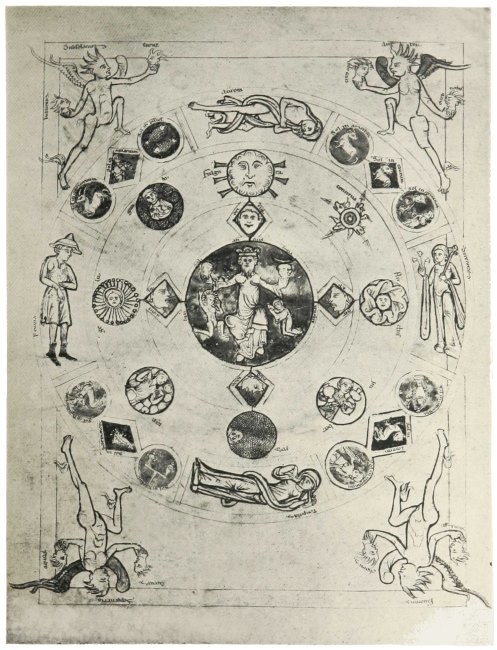
Plate IV. THE UNIVERSE
Two works of non-theological tone and definitely scientific character have been printed in her name. One of these was recently edited under the title Beatae Hildegardis causae et curae.20 A single MS. only of this work is known to exist, and is now deposited in the Royal Library of Copenhagen.21 It is an ill-written document of the thirteenth century, and the original work probably dates from this period. It has none of the characteristics of the acknowledged work of Hildegard, and indeed the only link with her name is the title, which is written in a hand different from that of the text (Plate V a). Nothing could be more unlike the ecstatic but well-ordered and systematic work of the prophetess of Bingen than the prosy disorder of the Causae et curae. Linguistically, also, it differs entirely from the typical writings of Hildegard, for it is full of Germanisms, which never interrupt the eloquence of her authentic works. Again, Hildegard’s tendency to theoretical speculation, as for instance on the nature of the elements or on the form of the Universe, finds no place in the scrappy paragraphs of this apocryphal compilation.
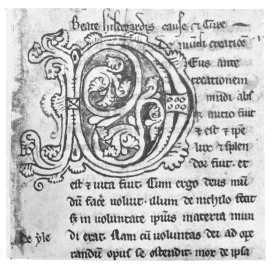
Plate V a. OPENING LINES OF THE COPENHAGEN MS. OF THE CAUSAE ET CURAE
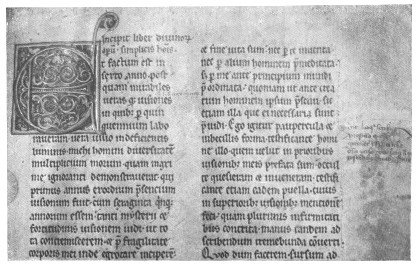
Plate V b. OPENING LINES OF THE LUCCA MS. OF THE LIBER DIVINORUM OPERUM SIMPLICIS HOMINIS
A second work, of somewhat similar character, is entitled Subtilitatum diversarumque creaturarum libri novem. This is clearly a compilation, and numerous passages in it can be traced to such sources as Pliny, Walafrid Strabus, Marbod, Macer, the Physiologus, Isidore Hispalensis, Constantine the African, and the Regimen Sanitatis Salerni, only the last three of which exerted a traceable influence on the genuine works of our authoress. Nevertheless this Liber subtilitatum was early printed as Hildegard’s work, along with a treatise attributed with as little justification to another woman writer, Trotula, one of the ladies of Salerno, whose name was also a household word in the Middle Ages, and was freely attached to medical writings with which she had little or nothing to do.22 It is true that Hildegard’s contemporary biographer, the monk Theodoric, assures us that she had written De natura hominis et elementorum, diversarumque creaturarum,23 but there is nothing to suggest that the Liber subtilitatum is intended thereby.
The modern scholars Daremberg and Reuss have edited the Liber subtilitatum as Hildegard’s composition,24 and the work attracted the attention of Virchow,25 but notwithstanding the authority of these names, the objections which apply to the genuineness of the Causae et curae are also valid here:
(a) The Liber subtilitatum is not included in the Wiesbaden Codex A.
(b) The phrase De natura hominis et elementorum diversarumque creaturarum, used by Theodoric as a description and by Reuss as a title,26 would lead one to expect great emphasis on the nature of the elements and their entry into the human frame. Such emphasis is not, in fact, discoverable in the Liber subtilitatum, which, moreover, does not treat of human anatomy or physiology.
(c) On the other hand, the genuine Liber divinorum operum simplicis hominis does lay stress on these points. This is possibly therefore the work to which Theodoric refers, and to it his description certainly applies well.
(d) As in the Causae et curae, there are linguistic difficulties that prevent us attributing the Liber subtilitatum to Hildegard. Such, for instance, is the number of Germanisms as well as the marked difference from the style and method of her acknowledged work.
(e) There are statements in the Liber subtilitatum that can scarcely be attributed to our authoress. Having largely explored the Rhine basin, and corresponding constantly with writers beyond the Alps, how could she possibly derive all rivers, Rhine and Danube, Meuse and Moselle, Nahe and Glan, from the same lake (of Constance) as does the author of the Liber subtilitatum?27
(f) Furthermore, although that spurious work has a chapter De elementis, it reveals none of Hildegard’s most peculiar and definite views as to their nature, origin, and fate,28 nor does it refer to the sphericity of the earth, to the vascular system of man, to the humours and their relation to the winds and the elements, or to a dozen other points on which, as we shall see, Hildegard had views of her own.
Before leaving the subject of Hildegard’s apocryphal works, brief reference may be made to the Speculum futurorum temporum, a spurious production to which her name is often attached. It exists in innumerable MSS., and has been frequently edited and translated. It is the work of Gebeno, prior of Eberbach, who wrote it in 1220, claiming that he extracted it from Hildegard’s writings. Another work erroneously attributed to Hildegard is entitled Revelatio de fratribus quatuor mendicantium ordinum, and is directed against the four mendicant orders—Franciscans, Dominicans, Carmelites, and Augustinians. It also has been printed, but is wholly spurious, and was probably composed towards the latter part of the thirteenth century.
V. Sources of Hildegard’s Scientific Knowledge
In the works of Hildegard we are dealing with the products of a peculiarly original intellect, and her imaginative power and mystical tendency make an exhaustive search into the origin of her ideas by no means an easy task. With her theological standpoint, as such, we are not here concerned, and unfortunately she does not herself refer to any of her sources other than the Biblical books; to have cited profane writers would indeed have involved the abandonment of her claim that her knowledge was derived by immediate inspiration from on high. Nevertheless it is possible to form some idea, on internal evidence, of the origin of many of her scientific conceptions.
The most striking point concerning the sources of Hildegard is negative. There is no German linguistic element distinguishable in her writings, and they show little or no trace of native German folk-lore.29 It is true that Trithemius of Sponheim (1462–1516), who is often a very inaccurate chronicler, tells us that Hildegard ‘composed works in German as well as in Latin, although she had neither learned nor used the latter tongue except for simple psalmody’.30 But with the testimony before us of the writings themselves and of her skilful use of Latin, the statement of Trithemius and even the hints of Hildegard31 may be safely discounted and set down to the wish to magnify the element of inspiration.32 So far from her having been illiterate, we shall show that the structure and details of her works betray a considerable degree of learning and much painstaking study of the works of others. Thus, for instance, she skilfully manipulates the Hippocratic doctrines of miasma and the humours, and elaborates a theory of the interrelation of the two which, though developed on a plan of her own, is yet clearly borrowed in its broad outline from such a writer as Isidore of Seville. Again, as we shall see, some of her ideas on anatomy seem to have been derived from Constantine the African, who belonged to the Benedictine monastery of Monte Cassino.33
Hildegard lived at rather too early a date to drink from the broad stream of new knowledge that was soon to flow into Europe through Paris from its reservoir in Moslem Spain. Such drops from that source as may have reached her must have trickled in either from the earlier Italian translators or from the Jews who had settled in the Upper Rhineland, for it is very unlikely that she was influenced by the earlier twelfth-century translations of Averroes, Avicenna, Avicebron, and Avempace, that passed into France from the Jews of Marseilles, Montpellier, and Andalusia.34 Her intellectual field was thus far more patristic than would have been the case had her life-course been even a quarter of a century later.
Her science is primarily of the usual degenerate Greek type, disintegrated fragments of Aristotle and Galen coloured and altered by the customary mediaeval attempts to bring theory into line with scriptural phraseology, though a high degree of independence is obtained by the visionary form in which her views are set. She exhibits, like all mediaeval writers on science, the Aristotelian theory of the elements, but her statement of the doctrine is illuminated by flashes of her own thoughts and is coloured by suggestions from St. Augustine, Isidore Hispalensis, Bernard Sylvestris of Tours, and perhaps from writings attributed to Boethius.
The translator Gerard of Cremona (1114–87) was her contemporary, and his labours made available for western readers a number of scientific works which had previously circulated only among Arabic-speaking peoples.35 Several of these works, notably Ptolemy’s Almagest, Messahalah’s De Orbe, and the Aristotelian De Caelo et Mundo, contain material on the form of the universe and on the nature of the elements, and some of them probably reached the Rhineland in time to be used by Hildegard. The Almagest, however, was not translated until 1175, and was thus inaccessible to Hildegard.36 Moreover, as she never uses an Arabic medical term, it is reasonably certain that she did not consult Gerard’s translation of Avicenna, which is crowded with Arabisms.
On the other hand, the influence of the Salernitan school may be discerned in several of her scientific ideas. The Regimen Sanitatis of Salerno, written about 1101, was rapidly diffused throughout Europe, and must have reached the Rhineland at least a generation before the Liber Divinorum Operum was composed. This cycle of verses may well have reinforced some of her microcosmic ideas,37 and suggested also her views on the generation of man,38 on the effects of wind on health,39 and on the influence of the stars.40
On the subject of the form of the earth Hildegard expressed herself definitely as a spherist,41 a point of view more widely accepted in the earlier Middle Ages than is perhaps generally supposed. She considers in the usual mediaeval fashion that this globe is surrounded by celestial spheres that influence terrestrial events.42 But while she claims that human affairs, and especially human diseases, are controlled, under God, by the heavenly cosmos, she yet commits herself to none of that more detailed astrological doctrine that was developing in her time, and came to efflorescence in the following centuries. In this respect she follows the earlier and somewhat more scientific spirit of such writers as Messahalah, rather than the wilder theories of her own age. The shortness and simplicity of Messahalah’s tract on the sphere made it very popular. It was probably one of the earliest to be translated into Latin; and its contents would account for the change which, as we shall see, came over Hildegard’s scientific views in her later years.
The general conception of the universe as a series of concentric elemental spheres had certainly penetrated to Western Europe centuries before Hildegard’s time. Nevertheless the prophetess presents it to her audience as a new and striking revelation. We may thus suppose that translations of Messahalah, or of whatever other work she drew upon for the purpose, did not reach the Upper Rhineland, or rather did not become accepted by the circles in which Hildegard moved, until about the decade 1141–50, during which she was occupied in the composition of her Scivias.
There is another cosmic theory, the advent of which to her country, or at least to her circle, can be approximately dated from her work. Hildegard exhibits in a pronounced but peculiar and original form the doctrine of the macrocosm and microcosm. Hardly distinguishable in the Scivias (1141–50), it appears definitely in the Liber Vitae Meritorum (1158–62),43 in which work, however, it takes no very prominent place, and is largely overlaid and concealed by other lines of thought. But in the Liber Divinorum Operum (1163–70) this belief is the main theme. The book is indeed an elaborate attempt to demonstrate a similarity and relationship between the nature of the Godhead, the constitution of the universe, and the structure of man, and it thus forms a valuable compendium of the science of the day viewed from the standpoint of this theory.
From whence did she derive the theory of macrocosm and microcosm? In outline its elements were easily accessible to her in Isidore’s De Rerum Natura as well as in the Salernitan poems. But the work of Bernard Sylvestris of Tours, De mundi universitate sive megacosmus et microcosmus,44 corresponds so closely both in form, in spirit, and sometimes even in phraseology, to the Liber Divinorum Operum that it appears to us certain that Hildegard must have had access to it also. Bernard’s work can be dated between the years 1145–53 from his reference to the papacy of Eugenius III. This would correspond well with the appearance of his doctrines in the Liber Vitae Meritorum (1158–62) and their full development in the Liber Divinorum Operum (1163–70).
Another contemporary writer with whom Hildegard presents points of contact is Hugh of St. Victor (1095–1141).45 In his writings the doctrine of the relation of macrocosm and microcosm is more veiled than with Bernard Sylvestris. Nevertheless, his symbolic universe is on the lines of Hildegard’s belief, and the plan of his De arca Noe mystica presents many parallels both to the Scivias and to the Liber Divinorum Operum. If these do not owe anything directly to Hugh, they are at least products of the same mystical movement as were his works.
We may also recall that at Hildegard’s date very complex cabalistic systems involving the doctrine of macrocosm and microcosm were being elaborated by the Jews, and that she lived in a district where Rabbinic mysticism specially flourished.46 Benjamin of Tudela, who visited Bingen during Hildegard’s lifetime, tells us that he found there a congregation of his people. Since we know, moreover, that she was familiar with the Jews,47 it is possible that she may have derived some of the very complex macrocosmic conceptions with which her last work is crowded from local Jewish students.
The Alsatian Herrade de Landsberg (died 1195), a contemporary of Hildegard, developed the microcosm theory along lines similar to those of our abbess, and it is probable that the theory, in the form in which these writers present it, reached the Upper Rhineland somewhere about the middle or latter half of the twelfth century.
1 Vita Sanctae Hildegardis auctoribus Godefrido et Theodorico monachis, lib. iii, cap. 1. The work has been frequently reprinted and is in Migne, Patrologia Latina, vol. 197, col. 91 ff. This volume will be quoted here simply as ‘Migne’.
2 Migne, col. 119.
3 The erroneous statement in some of her biographies that she journeyed to Paris is based on a misunderstanding.
4 Cardinal J. B. Pitra, Analecta sacra, vol. viii, p. 350, Paris, 1882. This volume will here be quoted simply as ‘Pitra’.
5 Pitra, p. 556.
6 Wilhelm Grimm, ‘Wiesbader Glossen’, in Moriz Haupt’s Zeitschrift für deutsches Alterthum, Leipzig, 1848, vol. vi, p. 321. The script is reproduced in the ill-arranged and irritating work of J. P. Schmelzeis, Das Leben und Wirken der heiligen Hildegardis, Freiburg im Breisgau, 1879; and in Pitra, p. 497. The subject has been summarized by F. W. E. Roth in his Lieder und unbekannte Sprache der h. Hildegardis, Wiesbaden, 1880.
7 A short sketch of her life of yet earlier date has survived. It is from the hand of the monk Guibert and was probably written in 1180: Pitra, p. 407. The best modern account of her is by F. W. E. Roth in the Zeitschrift für kirchliche Wissenschaft und kirchliches Leben, vol. ix, p. 453, Leipzig, 1888. Less critical but more readable is the essay by Albert Battandier, ‘Sainte Hildegarde, sa vie et ses œuvres’, in the Revue des questions historiques, vol. xxxiii, pp. 395–425, Paris, 1883.
8 The ‘Acta inquisitionis de virtutibus et miraculis sanctae Hildegardis’ are reprinted in Migne, col. 131.
9 This volume is supplemented by ‘Annotationes ad Nova S. Hildegardis Opera’ in Analecta Bollandiana, vol. i, p. 597, Brussels, 1882.
10 This Wiesbaden MS. has been fully described by Antonius van der Linde, Die Handschriften der Königlichen Landesbibliothek in Wiesbaden, Wiesbaden, 1877.
11 Louis Baillet, ‘Les Miniatures du Scivias de sainte Hildegarde’, in the Monuments et Mémoires publiés par l’Académie des Inscriptions et Belles-Lettres, Paris, 1912, especially pp. 139 and 145.
12 We are inclined to place the preparation of this remarkable MS. at a slightly later date than that attributed to it by Baillet. As Wiesbaden is at present inaccessible we have reproduced the facsimiles in Plate II from Baillet’s monograph.
13 For the history of these MSS. see A. van der Linde, loc. cit., pp. 30–6.
14 Goethe, ‘Am Rhein, Main und Neckar’, Cotta’s Jubiläums-Ausgabe, vol. xxix, p. 258.
15 Wilhelm Grimm in M. Haupt’s Zeitschrift für deutsches Alterthum, vi, p. 321, Leipzig, 1847.
16 In Étienne Baluze, Miscellanea novo ordine digesta et non paucis ineditis monumentis opportunisque animadversionibus aucta opera ac studio J. D. Mansi, 4 vols., Lucca, 1761–6; see vol. ii, p. 377.
17 Cf. J. A. Herbert, Illuminated Manuscripts, London, 1911, p. 160.
18 A. Venturi, Storia dell’ arte italiana, Milan, in progress, vol. v, p. 16.
19 We are unable to concur with Baillet, however, that there is enough evidence to suggest that the miniaturists of the Lucca MS. had consulted the Wiesbaden illuminations. Baillet, loc. cit., p. 147.
20 Hildegardis causae et curae edidit Paulus Kaiser, Leipzig, B. G. Teubner, 1903. The MS. was brought to light by C. Jessen in the Sitzungsberichte der kaiserl. Akademie der Wissenschaften, Mathematisch-naturwissenschaftliche Klasse, Band xlv, Heft 1, p. 97, Vienna, 1862. See also the same author in Botanik in kulturhistorischer Entwickelung, pp. 124–6, Leipzig, 1862, and in the Anzeiger für Kunde der deutschen Vorzeit, 1875, p. 175. An imperfect edition appeared in 1882 in Pitra, p. 468, under the title Liber compositae medicinae de aegritudinum causis signis atque curis.
21 Royal Library of Copenhagen, MS. Ny. Kgl. Saml., No. 90 b.
22 Experimentarius medicinae continens Trotulae curandarum Aegritudinum muliebrium ... item quatuor Hildegardis de elementorum, fluminum aliquot Germaniae, metallorum,... herbarum, piscium & animantium terrae, naturis et operationibus. Edited by G. Kraut, Strasbourg, J. Schott, 1544. The work often ascribed to Trotula is somewhat similar to the spurious medical works of Hildegard. Like them, it was probably written early in the thirteenth century. Trotula herself lived in the eleventh century, a generation or two before Hildegard. On Trotula see Salvatore de Renzi, Collectio Salernitana, vol. i, p. 149, Naples, 1852.
23 In the Vita, lib. ii, cap. 1; Migne, col. 101.
24 Migne, col. 1125. See also F. A. Reuss, De Libris physicis S. Hildegardis commentatio historico-medica, Würzburg, 1835, and ‘Der heiligen Hildegard Subtilitatum diversarum naturarum creaturarum libri novem, die werthvollste Urkunde deutscher Natur- und Heilkunde aus dem Mittelalter’ in the Annalen des Vereins für Nassauische Alterthumskunde und Geschichtsforschung, Band vi, Heft 1, Wiesbaden, 1859.
25 Rudolf Virchow, ‘Zur Geschichte des Aussatzes und der Spitäler, besonders in Deutschland’, in Virchow’s Archiv für Pathologie, vol. xviii, p. 285, &c., Berlin, 1860.
26 Reuss, in Migne, cols. 1121 and 1122, states on Theodoric’s authority that Hildegard had written a book on this subject: ‘Exstat inter libros virginis fatidicae superstites opus argumenti partim physici partim medici, “De natura hominis, elementorum diversarumque creaturarum” in quo, ut Theodoricus idem fusius exponit, secreta naturae prophetico spiritu manifestavit.’ But Theodoric does not in fact anywhere speak of a special work with this title or of this character. What he does write is as follows (Vita, lib. ii, cap. i, Migne, col. 101): ‘Igitur beata virgo ... librum visionum ... consummavit et quaedam de natura hominis et elementorum, diversarumque creaturarum, et quomodo homini ex his succurrendum sit, aliaque multa secreta prophetico spiritu manifestavit.’
27 Migne, cols. 1212 and 1213.
28 As detailed in the Liber vitae meritorum, Pitra, p. 228, and in many places in the Liber divinorum operum and Scivias.
29 An exception must be made for the lingua ignota, which is presumably hers. The absence of Germanisms in her other writings may be partly due to the work of an editor. See the Vita by Theodoric, Migne, col. 101. Also the birth scene (see chapter ix below) is perhaps adapted from a German folk-tale.
30 Johannes Trithemius, Chronicon insigne Monasterii Hirsaugensis, Ordinis St. Benedicti, Basel, 1559, p. 174.
31 Migne, col. 384.
32 It is not enough to suppose with some of her biographers that the visions were dictated by Hildegard and were latinized by a secretary. The visions imply a good deal of study and considerable book-learning. Among many reasons for believing that she had a very serviceable knowledge of Latin are the following:
33 See chapter viii.
34 It is, however, just possible that she had consulted the astrological work that had been translated from the Arabic by Hermann the Dalmatian for Bernard Sylvestris, and is represented in the Bodleian MSS. Digby 46 and Ashmole 304.
35 See Baldassare Boncompagni, Della vita e delle opere di Gherardo Cremonese, Traduttore del secolo duodecimo, e di Gherardo di Sabbionetta, Astronomo del secolo decimoterzo, Rome, 1851; also K. Sudhoff, ‘Die kurze “Vita” und das Verzeichnis der Arbeiten Gerhards von Cremona, von seinen Schülern und Studiengenossen kurz nach dem Tode des Meisters (1187) zu Toledo verabfasst’, in Archiv für Geschichte der Medizin, Bd. viii, p. 73, November 1914.
36 Another translation of the Almagest was made in Sicily in 1160, direct from the Greek. See C. H. Haskins and D. P. Lockwood, ‘The Sicilian Translators of the Twelfth Century and the First Latin Version of Ptolemy’s Almagest’, in Harvard Studies in Classical Philology, xi. 75, Cambridge, Mass., 1910. It is wholly improbable that Hildegard had access to this rendering, which is only known from a single MS. of the fourteenth century.
37 De Renzi, Collectio Salernitana, vol. i, p. 485, and vol. v, p. 50.
38 De Renzi, i. 486 and 495; v. 51 and 70.
39 De Renzi, i. 446; v. 3.
40 De Renzi, i. 485–6; v. 50–2.
41 Scivias, Migne, col. 403, and Liber Divinorum Operum, Migne, col. 868 and elsewhere.
42 Scivias, Migne, col. 404, and throughout the Liber Divinorum Operum.
43 Pitra, pp. 8, 114–16, 156, and 216.
44 The work of Bernard Sylvestris has been printed by C. S. Barach and J. Wrobel, Innsbruck, 1876. His identity, his sources, and his views are discussed by Charles Jourdain, Dissertation sur l’état de la philosophie naturelle ... pendant la première moitié du XIIe siècle; by A. Clerval, Les Écoles de Chartres au Moyen Âge, Paris, 1895, p. 259, &c.; by R. L. Poole, Illustrations of the History of Mediaeval Thought, London, 1884, p. 116, &c.; and by J. E. Sandys, History of Classical Scholarship, Cambridge, 1903, vol. i, p. 513, &c.
45 The works of Hugh of St. Victor are published in Migne, Patrologia Latina, clxxv-clxxvii.
46 The Kalonymos family furnished prominent examples.
47 Charles Singer, ‘Allegorical Representation of the Synagogue, in a Twelfth-Century Illuminated MS. of Hildegard of Bingen’, Jewish Quarterly Review, new series, vol. v, p. 268, Philadelphia, 1915. For further evidence of Hildegard’s acquaintance with the Jews see Pitra, p. 216; and Migne, cols. 967 and 1020–36.
From the LUCCA MS. fo. 1 v
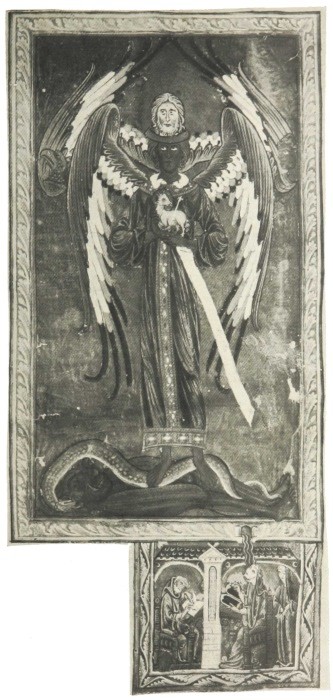
Plate VI. NOUS PERVADED BY THE GODHEAD AND CONTROLLING HYLE
Apart from the Biblical books, the work which made the deepest impression on Hildegard was probably Augustine’s De Civitate Dei, which seems to form the background of a large part of the Scivias. The books of Ezekiel and of Daniel, the Gospel of Nicodemus, the Shepherd of Hermas, and the Apocalypse, all contain a lurid type of vision which her own spiritual experiences would enable her to utilize, and which fit in well with her microcosmic doctrines. Ideas on the harmony and disharmony of the elements she may have picked up from such works as the Wisdom of Solomon and the Pauline writings, though it is obvious that Isidore of Seville and the Regimen Sanitatis Salerni were also drawn upon by her.
From the LUCCA MS. fo. 9 r
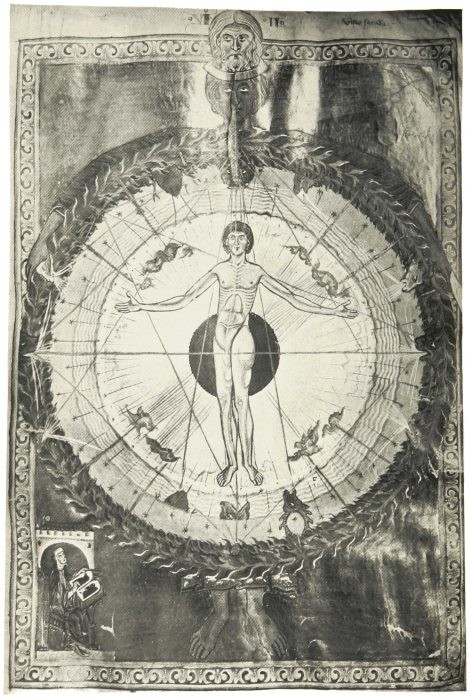
Plate VII. NOUS PERVADED BY THE GODHEAD EMBRACING THE MACROCOSM WITH THE MICROCOSM
Her figure of the Church in the Scivias reminds us irresistibly of Boethius’ vision of the gracious feminine form of Philosophy. Again, the visions of the punishments of Hell which Hildegard recounts in the Liber Vitae Meritorum48 bear resemblance to the work of her contemporary Benedictine, the monk Alberic the younger of Monte Cassino, to whom Dante also became indebted.49
Hildegard repeatedly assures us that most of her knowledge was revealed to her in waking visions. Some of these we shall seek to show had a pathological basis, probably of a migrainous character, and she was a sufferer from a condition that would nowadays probably be classified as hystero-epilepsy. Too much stress, however, can easily be laid on the ecstatic presentment of her scientific views. Visions, it must be remembered, were ‘the fashion’ at the period, and were a common literary device. Her contemporary Benedictine sister, Elizabeth of Schönau, as well as numerous successors, as for example Gertrude of Robersdorf, adopted the same mechanism. The use of the vision for this purpose remained popular for centuries, and we may say of these writers, as Ampère says of Dante, that ‘the visions gave not the genius nor the poetic inspiration, but the form merely in which they were realized’.
The contemporaries of Hildegard who provide the closest analogy to her are Elizabeth of Schönau (died 1165), whose visions are recounted in her life by Eckbertus;50 and Herrade de Landsberg, Abbess of Hohenburg in Alsace, the priceless MS. of whose Hortus Deliciarum was destroyed by the Germans in the siege of Strasbourg in 1870.51 With Elizabeth of Schönau, who lived in her neighbourhood, Hildegard was in frequent correspondence. With Herrade she had, so far as is known, no direct communication; but the two were contemporary, lived not very far apart, and under similar political and cultural conditions. Elizabeth’s visions present some striking analogies to those of Hildegard, while the figures of Herrade, of which copies have fortunately survived, often suggest the illustrations of the Wiesbaden or of the Lucca MSS.
VI. The Structure of the Material Universe
To the student of the history of science, Hildegard’s beliefs as to the nature and structure of the universe are among the most interesting that she has to impart. Her earlier theories are in some respects unique among mediaeval writers, and we possess in the Wiesbaden Codex B a diagram enabling us to interpret her views with a definiteness and certainty that would otherwise be impossible.
Hildegard’s universe is geocentric, and consists of a spherical earth,52 around which are arranged a number of concentric shells or zones. The inner zones are spherical, the outer oval, and the outermost of all egg-shaped, with one end prolonged and more pointed than the other Fig. (2). The concentric structure is a commonplace of mediaeval science, and is encountered, for instance, in the works of Bede, Isidore, Alexander of Neckam, Roger Bacon, Albertus Magnus, and Dante. To all these writers, however, the universe is spherical. The egg-shape is peculiar to Hildegard. Many of the Mappaemundi of the Beatus and other types exhibit the surface of the habitable earth itself as oval, and it was from such charts that Hildegard probably gained her conception of an oval universe. In her method of orientation also she follows these maps, placing the east at the top of the page where we are accustomed to place the north.53
It is unfortunate that she does not deal with geography in the restricted sense, and so we are not in full possession of her views on the antipodes, a subject of frequent derision to patristic and of misconception to scholastic writers. She does, however, vaguely refer to the inversion of seasons and climates in the opposite hemisphere,54 though she confuses the issue by the adoption of a theory widespread in the Middle Ages and reproduced in the Divina Commedia, that the antipodean surface of the earth is uninhabitable, since it is either beneath the ocean or in the mouth of the Dragon55 (Plate XI, cp. Fig. 4). The nature of the antipodean inversion of climates was clearly grasped by her contemporary, Herrade de Landsberg (Fig. 5).
Hildegard’s views as to the internal structure of the terrestrial sphere are also somewhat difficult to follow. Her obscure and confused doctrine of Purgatory and Hell has puzzled other writers besides ourselves,56 nor need we consider it here, but she held that the interior of the earth contained two vast spaces shaped like truncated cones, where punishment was meted out and whence many evil things had issue.57 Her whole scheme presents analogies as well as contrasts to that of her kindred spirit Dante.58 Hildegard, however, who died before the thirteenth century had dawned, presents us with a scheme far less definite and elaborated than that of her great successor, who had all the stores of the golden age of scholasticism on which to draw.
In Hildegard’s first diagram of the universe, which is of the nature of an ‘optical section’, the world, the sphaera elementorum of Johannes Sacro Bosco and other mediaeval writers, is diagrammatically represented as compounded of earth, air, fire, and water confusedly mixed in what her younger contemporary, Alexander of Neckam (1157–1217), calls ‘a certain concordant discord of the elements’. In the illustrations to the Wiesbaden Codex B the four elements have each a conventional method of representation, which appears again and again in the different miniatures (Fig. 2 and Plates XII and XIII).
Around this world with its four elements is spread the atmosphere, the aer lucidus or alba pellis, diagrammatically represented, like the earth which it enwraps, as circular. Through this alba pellis no creature of earth can penetrate. Beyond are ranged in order four further shells or zones. Each zone contains one of the cardinal winds, and each cardinal wind is accompanied by two accessory winds, represented in the traditional fashion by the breath of supernatural beings.
Of the four outer zones the first is the aer aquosus, also round, from which blows the east wind. In the outer part of the aer aquosus float the clouds, and according as they contract or expand or are blown aside, the heavenly bodies above are revealed or concealed.
Enwrapping the aer aquosus is the purus aether, the widest of all the zones. The long axis of this, as of the remaining outer shells, is in the direction from east to west, thus determining the path of movement of the heavenly bodies. Scattered through the purus aether are the constellations of the fixed stars, and arranged along the long axis are the moon and the two inner planets. From this zone blows the west wind. The position and constitution of this purus aether is evidently the result of some misinterpretation of Aristotelian writings.
The next zone, the umbrosa pellis or ignis niger, is a narrow dark shell, whence proceed the more dramatic meteorological events. Here, following on the hints of the Wisdom of Solomon (chap. v) and the Book of Job (chap. xxxviii), are situated the diagrammatically portrayed treasuries of lightning and of hail. From here the tempestuous north wind bursts forth. This ignis niger is clearly comparable to the dry earthy exhalation that works of the Peripatetic school regard as given off by the outer fiery zone. The presence of the ignis niger thus suggests some contact on the part of the authoress with the teaching of the Meteorologica of Aristotle.59
The outermost layer of all is a mass of flames, the lucidus ignis. Here are the sun and the three outer planets, and from here the south wind pours its scorching breath (Fig. 2).
The movements of the four outer zones around each other, carrying the heavenly bodies with them, are attributed to the winds in each zone. The seasonal variations in the movements of the heavenly bodies, along with the recurring seasons themselves, are also determined by the prevalent winds, which, acting as the motive power upon the various zones, form a celestial parallelogram of forces. In this way is ingeniously explained also why in spring the days lengthen and in autumn they shorten until in either case an equinox is reached (Fig. 2).
‘I looked and behold the east and the south wind with their collaterals, moving the firmament by the power of their breath, caused it to revolve over the earth from east to west; and in the same way the west and north winds and their collaterals, receiving the impulse and projecting their blast, thrust it back again from west to east....
‘I saw also that as the days began to lengthen, the south wind and his collaterals gradually raised the firmament in the southern zone upwards towards the north, until the days ceased to grow longer. Then when the days began to shorten, the north wind with his collaterals, shrinking from the brightness of the sun, drove the firmament back gradually southward until by reason of the lengthening days the south wind began yet again to raise it up’60 (Plates VII and VIII).
Intimately bound up not only with her theory of the nature and structure of the universe but also with her eschatological beliefs is Hildegard’s doctrine of the elements. Before the fall of man these were arranged in a harmony,61 which was disturbed by that catastrophe (Plate XII a),62 so that they have since remained in the state of mingled confusion in which we always encounter them on the terrestrial globe. This mistio, to use the mediaeval Aristotelian term, is symbolized by the irregular manner in which the elements are represented in the central sphere of the diagram of the universe (Fig. 2). Thus mingled they will remain until subjected to the melting-pot of the Last Judgement (Plate XIII),63 when they will emerge in a new and eternal harmony, no longer mixed as matter, but separate and pure, parts of the new heaven and the new earth (Plate XII b).64
‘But the heavens and the earth, which are now,... are kept in store and reserved unto fire against the day of judgment and perdition of ungodly men.... But the day of the Lord will come ... in the which the heavens shall pass away with a great noise, and the elements shall melt with fervent heat, the earth also and the works that are therein shall be burned up.... Nevertheless we, according to his promise, look for new heavens and a new earth, wherein dwelleth righteousness’ (2 Peter iii. 7, 10, and 13).
So Hildegard, acting on a scriptural hint, is enabled to dematerialize her doctrine of the after-things.
But although since man’s fall the elements have lost their order and their harmony on this terrestrial orb, yet is that harmony still in part preserved in the celestial spheres that encircle and surround our globe; and water, air, earth, and fire have each their respective representatives in the four concentric zones, the aer aquosus, the purus aether, the umbrosa pellis, and the lucidus ignis (Fig. 2). These are the ‘superior elements’ which still retain some at least of their individuality and primal purity. From each of their spheres blows, as we have seen, one of the cardinal winds, and each wind partakes of the elemental character of the zone whence it issues, and has a corresponding influence on man’s body, since each of the four humours is specifically affected by the element to which it corresponds.
‘Then I saw that by the diverse quality of the winds, and of the atmosphere as they in turn sweep through it, the humours in man are agitated and altered. For in each of the superior elements there is a breath of corresponding quality by which, through the power of the winds, the corresponding element [below] is forced to revolve in the atmosphere, and in no other way is it moved. And by one of those winds, with the agency of sun, moon, and stars, the atmosphere which tempers the world is breathed forth’65 (Plate VII).
This doctrine of the relation of the various winds to the four elements and through them to the four humours is found in the De Rerum Natura of Isidore of Seville, and is occasionally illustrated in European MSS. from the ninth century onward,66 but we meet it set forth with special definiteness in the twelfth century in the translations from Messahalah. It is encountered also in the work of Herrade de Landsberg. In and after the thirteenth century it had become a commonplace.
The description we have given of the universe was in the main set forth by Hildegard in her first work, the Scivias (1141–50).67 Subsequently she became dissatisfied with the account she had given, and while not withdrawing it, she sought in the Liber Divinorum Operum (1163–70) so to modify the original presentment as to bring it more into line with accepted views. Thus she writes: ‘There appeared to me in vision a disk very like that object which I saw twenty-eight years ago of the form of an egg, in the third vision of my book Scivias. In the outer part of the disk there was as it were the lucidus ignis, and beneath it the circle of the ignis niger was portrayed ... and these two circles were so joined as to be one circle.’ There was thus one outer zone representing the fire. ‘Under the circle of the ignis niger there was another circle in the likeness of the purus aether which was of the same width as the two conjoined [outer] fiery circles. And below this circle again was the circle of the aer aquosus as wide as the lucidus ignis. And below this circle was yet another circle, the fortis et albus lucidusque aer ... the width whereof was as the width of the ignis niger, and these circles were joined to make one circle which was thus again of width equal to the outer two. Again, under this last circle yet another circle, the aer tenuis, was distinguishable, which could be seen to raise itself as a cloud, sometimes high and light, sometimes depressed and dark, and to diffuse itself as it were throughout the whole disk.... The outermost fiery circle perfuses the other circles with its fire, while the watery circle saturates them with its moisture, [cp. Wisdom of Solomon, xix. 18–20]. And from the extreme eastern part of the disk to the extreme west a line is stretched out [i.e. the equator] which separates the northern zones from the others’68 (see Fig. 3 and Plates VII and VIII).
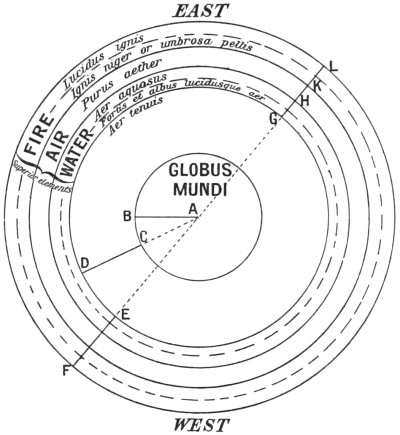
Fig. 3. HILDEGARD’S SECOND SCHEME OF THE UNIVERSE
Reconstructed from her measurements. AB, CD, and EF are all equal to each other, as are also GH, HK, and KL. The clouds are situated in the outer part of the aer tenuis, and form a prolongation downwards from the aer aquosus towards the earth.
The earth lies concentrically with the aer tenuis, and its measurements are given thus: ‘In the midst of the aer tenuis a globe was indicated, the circumference of which was everywhere equidistant from the fortis et albus lucidusque aer, and it was as far across as the depth of the space from the top of the highest circle to the extremity of the clouds, or from the extremity of the clouds to the circumference of the inner globe’68 (Fig. 3).
In her earlier work, the Scivias, Hildegard had not apparently realized the need of accounting for the independent movements of the planets other than the sun and moon. She had thus placed the moon and two of the moving stars in the purus aether, and the sun and the three remaining moving stars in the lucidus ignis. Since these spheres were moved by the winds, their contained planets would be subject to the same influences. In the Liber Divinorum Operum, however, she has come to realize how independent the movements of the planets really are, and she invokes a special cause for their vagaries. ‘I looked and behold in the outer fire (lucidus ignis) there appeared a circle which girt about the whole firmament from the east westward. From it a blast produced a movement from west to east in the opposite direction to the movement of the firmament. But this blast did not give forth his breath earthward as did the other winds, but instead thereof it governed the course of the planets.’69 The source of the blast is represented in the Lucca MS. as the head of a supernatural being with a human face (Plate VIII).
From the LUCCA MS. fo. 27 v
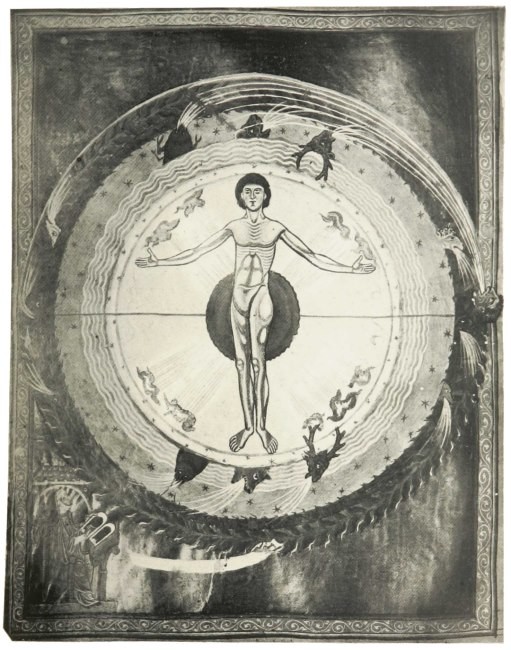
Plate VIII. THE MACROCOSM THE MICROCOSM AND THE WINDS
Plate IX. From THE LUCCA MS fo. 37 r
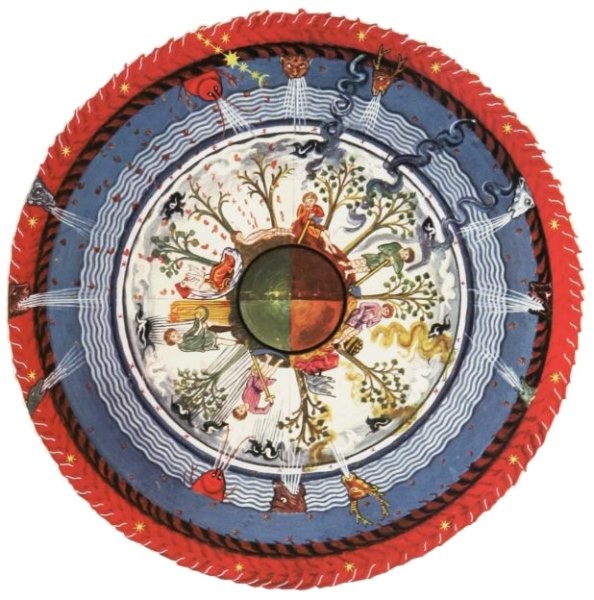
CELESTIAL INFLUENCES ON MEN ANIMALS AND PLANTS
These curious passages were written at some date after 1163, when Hildegard was at least 65 years old. They reveal our prophetess attempting to revise much of her earlier theory of the universe, and while seeking to justify her earlier views, endeavouring also to bring them into line with the new science that was now just beginning to reach her world. Note that (a) the universe has become round; (b) there is an attempt to arrange the zones according to their density, i.e. from without inwards, fire, air (ether), water, earth; (c) exact measurements are given; (d) the watery zone is continued earthward so as to mingle with the central circle. In all these and other respects she is joining the general current of mediaeval science then beginning to be moulded by works translated from the Arabic. Her knowledge of the movements of the heavenly bodies is entirely innocent of the doctrine of epicycles, but in other respects her views have come to resemble those, for instance, of Messahalah, one of the simplest and easiest writers on the sphere available in her day. Furthermore, her conceptions have developed so as to fit in with the macrocosm-microcosm scheme which she grasped about the year 1158. Even in her latest work, however, her theory of the universe exhibits differences from that adopted by the schoolmen, as may be seen by comparing her diagram with, for example, the scheme of Dante (Fig. 4).
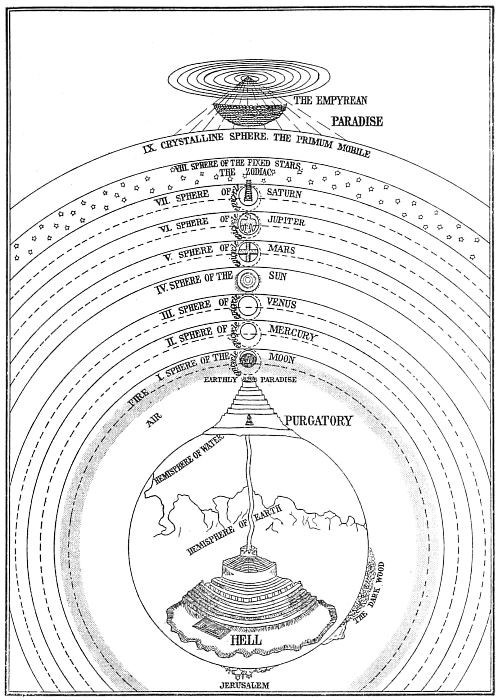
Fig. 4. DANTE’S SCHEME OF THE UNIVERSE
Slightly modified from Michelangelo Caetani, duca di Sermoneta, La materia della Divina Commedia di Dante Allighieri dichiarata in VI tavole, Monte Cassino, 1855.
Like many mediaeval writers, Hildegard would have liked to imagine an ideal state of the elemental spheres in which the rarest, fire, was uppermost, and the densest, earth, undermost. Such a scheme was, in fact, purveyed by Bernard Sylvestris and by Messahalah. Her conceptions were however disturbed by the awkward facts that water penetrated below the earth, and indeed sought the lowest level, while air and not water lay immediately above the earth’s surface. Mediaeval writers adopted various devices and expended a great amount of ingenuity in dealing with this discrepancy, which was a constant source of obscurity and confusion. Hildegard devotes much space and some highly involved allegory both in the Scivias and in the Liber Divinorum Operum to the explanation of the difficulty, while Dante himself wrote a treatise in high scholastic style on this very subject.70
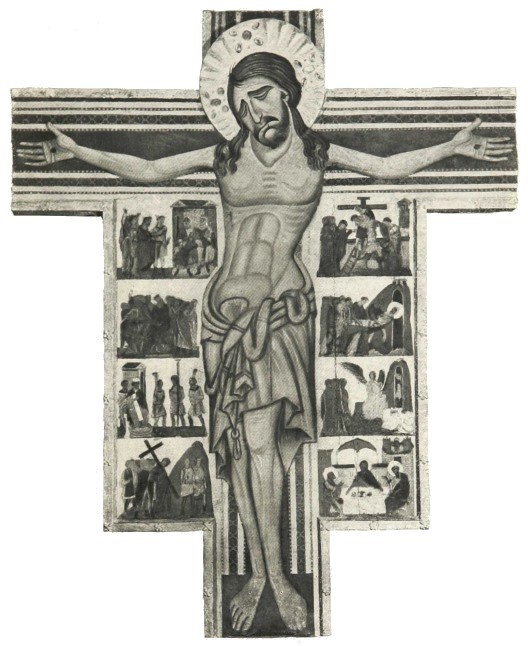
Plate X. A CRUCIFIX IN THE UFFIZI GALLERY About the middle of the XIIIth Century.
VII. Macrocosm and Microcosm
The winds and elements of the outer universe, the macrocosm, become in Hildegard’s later schemes intimately related to structures and events within the body of man himself, the microcosm, the being around whom the universe centres. The terms macrocosm and microcosm are not employed by her, but in her last great work, the Liber Divinorum Operum, she succeeds in most eloquent and able fashion in synthesizing into one great whole, centred around this doctrine, her theological beliefs and her physiological knowledge, together with her conceptions of the working of the human mind and of the structure of the universe. The work is thus an epitome of the science of the time viewed through the distorting medium of this theory. In studying it the modern reader is necessarily hampered by the bizarre and visionary form into which the whole subject is cast. Nevertheless the scheme, though complex and difficult, is neither incoherent nor insane, as at first sight it may seem. On the contrary, it is a highly systematic and skilful presentment of a cosmic theory which for centuries dominated scientific thought.
As an explanation of the complexity of existence which thinkers of all ages have sought to bring within the range of some simple formula, this theory of the essential similarity of macrocosm and microcosm held in the Middle Ages, during the Renaissance, and even into quite modern times, a position comparable to that of the theory of evolution in our own age. If at times it passed into folly and fantasy, it should be remembered that it also fulfilled a high purpose. It gave a meaning to the facts of nature and a formula to the naturalist, it unified philosophic systems, it exercised the ingenuity of theologians, and gave a convenient framework to prophecy, while it seemed to illumine history and to provide a key and meaning to life itself. Even now it is not perhaps wholly devoid of message, but as a phenomenon in the history of human thought, a theory which appealed to such diverse scientific writers as Seneca, Albertus Magnus, Paracelsus, Gilbert, Harvey, Boyle, and Leibnitz, is surely worthy of attention.
In essaying to interpret the views of our authoress on this difficult subject, we rely mainly on the text of the Liber Divinorum Operum, supplemented by the beautiful illuminations of that work which adorn the Lucca MS. The book opens with a truly remarkable vision (Plate VI):
‘I saw a fair human form and the countenance thereof was of such beauty and brightness that it had been easier to gaze upon the sun. The head thereof was girt with a golden circlet through which appeared another face as of an aged man. From the neck of the figure on either side sprang a pinion which swept upward above the circlet and joined its fellow on high. And where on the right the wing turned upward, was portrayed an eagle’s head with eyes of flame, wherein appeared as in a mirror the lightning of the angels, while from a man’s head in the other wing the lightning of the stars did radiate. From either shoulder another wing reached to the knees. The figure was robed in brightness as of the sun, while the hands held a lamb shining with light. Beneath, the feet trampled a horrible black monster of revolting shape, upon the right ear of which a writhing serpent fixed itself.’71
From the LUCCA MS. fo. 86 v
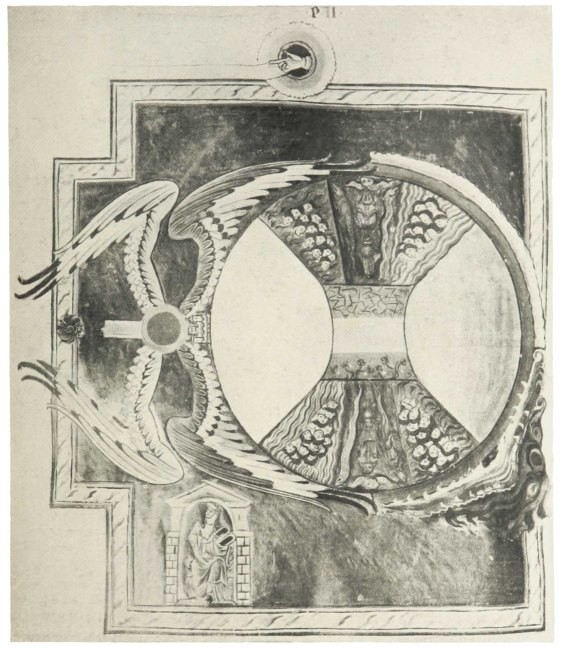
Plate XI. THE STRUCTURE OF THE MUNDANE SPHERE
The image declares its identity in words reminiscent of the Wisdom literature or of passages in the hermetic writings, but which seem in fact to be partly borrowed from Bernard Sylvestris.
‘I am that supreme and fiery force that sends forth all the sparks of life. Death hath no part in me, yet do I allot it, wherefore I am girt about with wisdom as with wings. I am that living and fiery essence of the divine substance that glows in the beauty of the fields. I shine in the water, I burn in the sun and the moon and the stars. Mine is that mysterious force of the invisible wind. I sustain the breath of all living. I breathe in the verdure and in the flowers, and when the waters flow like living things, it is I. I formed those columns that support the whole earth.... I am the force that lies hid in the winds, from me they take their source, and as a man may move because he breathes so doth a fire burn but by my blast. All these live because I am in them and am of their life. I am wisdom. Mine is the blast of the thundered word by which all things were made. I permeate all things that they may not die. I am life.’72
WIESB. COD. B. fo. 4 r
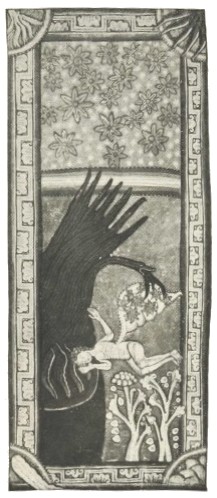
Plate XIIa. MAN’S FALL AND THE DISTURBANCE OF THE ELEMENTAL HARMONY
WIESB. COD. B. fo. 224 v
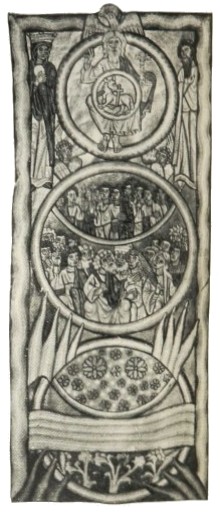
Plate XIIb. THE NEW HEAVEN AND THE NEW EARTH
Hildegard thus supposes that the whole universe is permeated by a single living spirit, the figure of the vision. This spirit of the macrocosm, the Nous or ‘world spirit’ of the hermetic and Neoplatonic literature, the impersonated Nature, as we may perhaps render it, is in its turn controlled by the Godhead that pervades the form and is represented rising from its vertex as a second human face. Nature, the spirit of the cosmic order, controls and holds in subjection the hideous monster, the principle of death and dissolution, the Hyle or primordial matter of the Neoplatonists, whose chaotic and anarchic force would shatter and destroy this fair world unless fettered by a higher power.
With the details of the visionary figure we need not delay,73 but we pass to the description of the structure of the macrocosm itself, to which the second vision is devoted (Plate VII). Here appears the same figure of the macrocosmic spirit. But now the head and feet only are visible, and the arms are outstretched to enclose the disk of the universe which conceals the body. Although the macrocosm now described is considerably altered from Hildegard’s original scheme of the universe, she yet declares, ‘I saw in the bosom of the form the appearance of a disk of like sort to that which twenty-eight years before I had seen in the third vision, set forth in my book of Scivias’.74 The zones of this disk are then described (Plates VII, VIII, and XI and Fig. 2). They are from without inwards:
(a) The lucidus ignis, containing the three outer planets, the sixteen principal fixed stars, and the south wind.
(b) The ignis niger, containing the sun, the north wind, and the materials of thunder, lightning, and hail.
(c) The purus aether, containing the west wind, the moon, the two inner planets, and certain fixed stars.
(d) The aer aquosus, containing the east wind.
(e) The fortis et albus lucidusque aer, where certain other fixed stars are placed.
(f) The aer tenuis, or atmosphere, in the outer part of which is the zone of the clouds.
From all these objects, from the spheres of the elements, from the sun, moon, and other planets, from the four winds each with their two collaterals, from the fixed stars, and from the clouds, descend influences, indicated by lines, towards the figure of the macrocosm.
The microcosm is then introduced.
‘And again I heard the voice from heaven saying, “God, who created all things, wrought also man in his own image and similitude, and in him he traced [signavit] all created things, and he held him in such love that he destined him for the place from which the fallen angel had been cast.”’75
The various characters of the winds are expounded in a set of curious passages in which the doctrine of the macrocosm and microcosm is further mystically elaborated. An endeavour is made to attribute to the winds derived from the different quarters of heaven qualities associated with a number of animals.76 The conception is illustrated and made comprehensible by the miniatures in the Lucca MS. (Plates VII and VIII).
‘In the middle of the disk [of the universe] there appeared the form of a man, the crown of whose head and the soles of whose feet extended to the fortis et albus lucidusque aer, and his hands were outstretched right and left to the same circle.... Towards these parts was an appearance as of four heads; a leopard, a wolf, a lion, and a bear. Above the head of the figure in the zone of the purus aether, I saw the head of the leopard emitting a blast from its mouth, and on the right side of the mouth the blast, curving itself somewhat backwards, was formed into a crab’s head ... with two chelae; while on the left side of the mouth a blast similarly curved ended in a stag’s head. From the mouth of the crab’s head, another blast went to the middle of the space between the leopard and the lion; and from the stag’s head a similar blast to the middle of the space between the leopard and the bear ... and all the heads were breathing towards the figure of the man. Under his feet in the aer aquosus there appeared as it were the head of a wolf, sending forth to the right a blast extending to the middle of the half space between its head and that of the bear, where it assumed the form of the stag’s head; and from the stag’s mouth there came, as it were, another breath which ended in the middle line. From the left of the wolf’s mouth arose a breath which went to the midst of the half space between the wolf and the lion, where was depicted another crab’s head ... from whose mouth another breath ended in the same middle line.... And the breath of all the heads extended sideways from one to another.... Moreover on the right hand of the figure in the lucidus ignis, from the head of the lion, issued a breath which passed laterally on the right into a serpent’s head and on the left into a lamb’s head ... similarly on the figure’s left in the ignis niger there issued a breath from the bear’s head ending on its right in the head of [another] lamb, and on its left in another serpent’s head.... And above the head of the figure the seven planets were ranged in order, three in the lucidus ignis, one projecting into the ignis niger and three into the purus aether.... And in the circumference of the circle of the lucidus ignis there appeared the sixteen principal stars, four in each quadrant between the heads.... Also the purus aether and the fortis et albus lucidusque aer seemed to be full of stars which sent forth their rays towards the clouds, whence ... tongues like rivers descended to the disk and towards the figure, which was thus surrounded and influenced by these signs.’77
The third vision is devoted to an account of the human body, the microcosm (Plate VIII), with a comparison of its organs to the parts of the macrocosmic scheme, together with a detailed account of the effects of the heavenly bodies on the humours in man, the whole brought into a strongly theological setting. Some of these views are set forth below in the chapter on anatomy and physiology.
The fourth vision explains the influence of the heavenly bodies and of the superior elements on the power of nature as exhibited on the surface of the earth. It is illustrated by a charming miniature in the Lucca MS. (Plate IX).
‘I saw that the upper fiery firmament was stirred, so that as it were ashes were cast therefrom to earth, and they produced rashes and ulcers in men and animals and fruits.’ These effects are shown in the left upper quadrant of Plate IX, where the ashes are seen proceeding from the lucidus ignis, the ‘upper fiery firmament’. Two figures are seen, a female semi-recumbent, who lifts a fruit to her mouth, and a male figure fully recumbent, on whose legs a rash is displayed. The trees also in this quadrant show the effects of the ashes, two of them being denuded of fruit and foliage.
‘Then I saw that from the ignis niger certain vapours (nebulae) descended, which withered the verdure and dried up the moisture of the fields. The purus aether, however, resisted these ashes and vapours, seeking to hold back these plagues.’ These vapours may be seen in the right upper quadrant of Plate IX. They descend from the ignis niger, attenuate for a space in the purus aether, and then descend through the other zones on to an arid and parched land. Here are two husbandmen; one sits forlornly clasping his axe, while the other leans disconsolately upon his hoe. On the legs of the latter a rash may be distinguished.
‘And looking again I saw that from the fortis et albus lucidusque aer certain other clouds reached the earth and infected men and beasts with sore pestilence, so that they were subjected to many ills even to the death, but the aer aquosus opposed that influence so that they were not hurt beyond measure.’ This scene is portrayed in the right lower quadrant of Plate IX. Here is a husbandman in mortal anguish. He has gathered his basket of fruit and now lies stricken with the pestilence. His left hand is laid on his heart, while his right hangs listless on his thigh, pointing to tokens of plague upon his legs. Beyond lies the dead body of a beast on which a carrion bird has settled.
‘Again I saw that the moisture in the aer tenuis was as it were boiling above the surface of the earth, awakening the force of the earth and making fruits to grow.’78 This happier scene is represented in the left lower quadrant of Plate IX. Here the beneficent fertilizing influence is falling on trees and herbs and the happy husbandmen are reaping its results.
48 Pitra, p. 51 et seq.
49 Catello de Vivo, La Visione di Alberico, ristampata, tradotta e comparata con la Divina Commedia, Ariano, 1899. For a comparison of Dante’s visions and those of Hildegard see Albert Battandier in the Revue des questions historiques, vol. xxxiii, p. 422, Paris, 1883.
50 Reprinted in Migne, vol. 195.
51 Herrade de Landsberg, Hortus Deliciarum, by A. Straub and G. Keller, Strasbourg, 1901, with two supplements.
52 For sphericity of earth see especially Migne, cols. 868 and 903.
Fig. 2. HILDEGARD’S FIRST SCHEME OF THE UNIVERSE
Slightly simplified from the Wiesbaden Codex B, folio 14 r.
53 In her later Liber Divinorum Simplicis Hominis this method of orientation is varied both in the text and also in the Lucca illustrations.
54 Migne, col. 906.
55 Migne, cols. 903–4.
Fig. 4. DANTE’S SCHEME OF THE UNIVERSE
Slightly modified from Michelangelo Caetani, duca di Sermoneta, La materia della Divina Commedia di Dante Allighieri dichiarata in VI tavole, Monte Cassino, 1855.
Fig. 5. From Herrade de Landsberg’s Hortus deliciarum, after Straub and Keller.
56 See H. Osborn Taylor, The Mediaeval Mind, vol. i, p. 472, London, 1911.
57 Migne, cols. 904–6.
58 H. Osborn Taylor, The Mediaeval Mind, i. 468, 471; ii. 569. See also A. Battandier, Revue des questions historiques, vol. xxxiii, p. 422, Paris, 1883.
59 The Meteorologica had been translated about 1150 by Aristippus, the minister of William the Bad of Sicily. The version of Aristippus passed quickly into circulation (Valentine Rose, ‘Die Lücke im Diogenes Laërtus und der alte Übersetzer’ in Hermes, i. 376, Berlin, 1866), but hardly soon enough for Hildegard’s Scivias, which was completed about 1150. It is, of course, possible that the references to the ignis niger are later interpolations, but this is very unlikely in view of the way in which she speaks of this vision in the Liber Divinorum Operum.
60 Migne, cols. 789–91.
61 Migne, col. 389.
62 Plate XII a. The elements are represented in their original order undisturbed by the Fall. Uppermost is the purus aether or aer lucidus containing the stars and representing the element air in Hildegard’s cosmic system. Next comes water. Below, and to the left, is a dark mass separating into tongues, one of which is formed into a serpent’s head. These tongues are flames of fire. Below, and to the right, are plants and flowers emblematical of earth. The serpent, the enemy, vomits over a cloud of stars (signifying the fallen angels) that are borne downward by the falling Adam. In the four corners of the miniature the symbols of the elements are again displayed.
63 Plate XIII. Above, in a circle, sits the Heavenly Judge. He is flanked on either side by groups of angels bearing the cross and other symbols. The lower circle exhibits the final destruction of the elemental Universe. The four winds and their collaterals are here subjecting the elements to the crucible heat of their combined blasts. Strewn among the elements can be seen men, plants, and animals. Between the circles is an angel sounding the last trump, and holding the recording roll of good and evil deeds. He faces the throng of the righteous who are rising from their bones, while he turns his back on the weeping crowd of those doomed to torment. Below these latter crouches Satan, now enchained.
64 Plate XII b. In the highest circle is the Trinity flanked to the left by the Virgin and to the right by the Baptist, with Cherubim below. In the middle circle are two groups, the Saints above and the Prophets and Apostles below. In the lowest circle are the elements, now rearranged in their eternal harmony; uppermost of these is the purus aether now separated from the aer lucidus and containing the stars; on either side are light-coloured flame-like processes representing the air; below the aether is water, indicated by a zone of undulating lines; then comes the earth symbolized, as usual, by a group of plants. Below and to the side of earth are dark-coloured flames of fire, now controlled and confined to this lowest rung.
65 Migne, col. 791.
66 See Ernest Wickersheimer, ‘Figures médico-astrologiques des neuvième, dixième et onzième siècles’, in the Transactions of the Seventeenth International Congress of Medicine, Section XXIII, History of Medicine, p. 313, London, 1913.
67 Migne, cols. 403–14.
68 Migne, col. 751.
1 Vita Sanctae Hildegardis auctoribus Godefrido et Theodorico monachis, lib. iii, cap. 1. The work has been frequently reprinted and is in Migne, Patrologia Latina, vol. 197, col. 91 ff. This volume will be quoted here simply as ‘Migne’.
69 Migne, col. 791.
70 The Quaestio de Aqua et Terra is doubtless a genuine, albeit the least pleasing, production of the great poet. The genuineness is established by Vincenzo Balgi in his edition, Modena, 1907.
71 Migne, col. 741.
72 Migne, col. 743.
73 It is outside our purpose to attempt a full elucidation of Hildegard’s allegory. The eagle in the right wing signifies the power of divine grace, while the human head in the left wing indicates the powers of the natural man. To the bosom of the figure is clasped the Lamb of God.
74 Migne, col. 751.
75 Migne, col. 744.
76 Liber Divinorum Operum, part i, visions 2 and 3.
77 Migne, cols. 752–5.
78 Migne, col. 807.
From WIESBADEN CODEX B fo. 224 r
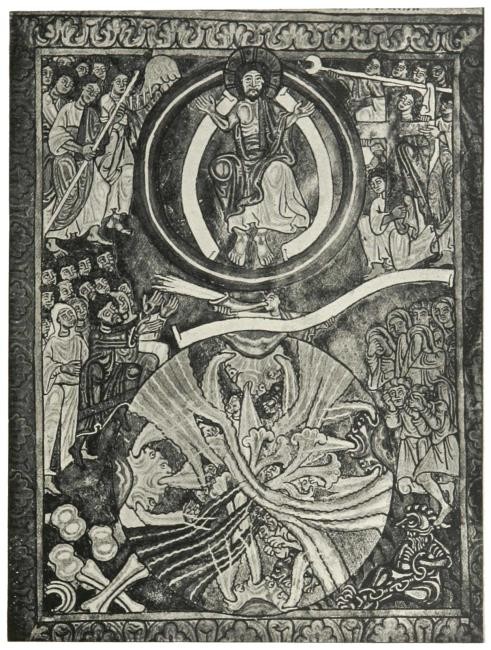
Plate XIII. THE LAST JUDGEMENT AND FATE OF THE ELEMENTS
The main outline of the Liber Divinorum Operum is, we believe, borrowed from the work of Bernard Sylvestris of Tours, De mundi universitate libri duo sive megacosmus et microcosmus.79 In this composition by a teacher at the cathedral school of Chartres,80 the gods and goddesses of the classical pantheon flit across the stage, for all the world as though the writer were a pagan, and the work might be thought to be the last one from which our pious authoress would borrow. The De mundi universitate is alternately in prose and verse and betrays an acquaintance with the classics very rare at its date. ‘The rhythm of the hexameters is clearly that of Lucan, while the vocabulary is mainly of Ovid.’81 The mythology is founded mainly on the Timaeus. The eternal seminaria of created things are mentioned, and it has been conjectured that the work exhibits traces of the influence of Lucretius,82 but the general line of thought is clearly related to Neoplatonic literature. Thus the anima universalis of Neoplatonic writings can be identified with the Nous or Noys of Bernard. This principle is contrasted with primordial matter or Hyle. The parallel character of the Liber Divinorum Operum and the De mundi universitate can be illustrated by a few extracts from the latter. It will be seen that although the general setting is changed, yet Hildegard’s figure of the spirit of the macrocosm is to be identified with Bernard’s Noys. Hyle, on the other hand, becomes in Hildegard’s plan the monstrous form, the emblem of brute matter, on which the spirit of the universe tramples.
From BIBL. NAT. MS. LAT. 5543 fo. 136 r
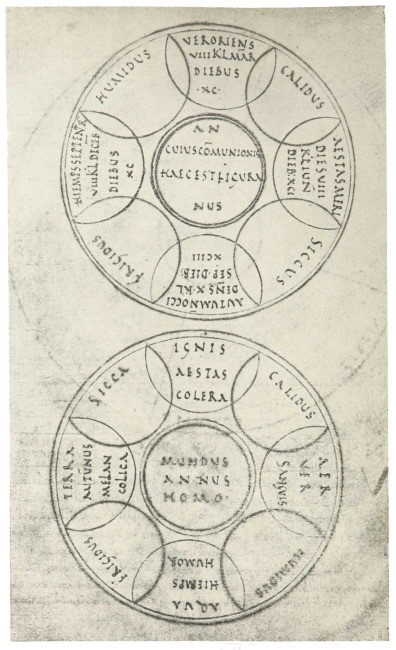
Plate XIV. DIAGRAM OF THE RELATION OF HUMAN AND COSMIC PHENOMENA IXth Century
‘In huius operis primo libro qui Megacosmus dicitur, id est maior mundus, Natura ad Noym, id est Dei providentiam, de primae materiae, id est hyles, confusione querimoniam quasi cum lacrimis agit et ut mundus pulchrius petit. Noys igitur eius mota precibus petitioni libenter annuit et ita quatuor elementa ab invicem seiungit. Novem ierarchias angelorum in coelo ponit. stellas in firmamento figit. signa disponit. sub signis orbes septem planetarum currere facit. quatuor ventos cardinales sibi invicem opponit. Sequitur genesis animantium et terrae situs medius....
‘In secundo libro qui Microcosmus dicitur, id est minor mundus, Noys ad Naturam loquitur et de mundi expolitione gloriatur et in operis sui completione se hominem plasmaturam pollicetur. Iubet igitur Uraniam, quae siderum regina est, et Physin, quae rerum omnium est peritissima, sollicite perquirat. Natura protinus iubenti obsequitur et per caelestes circulos Uraniam quaeritans eam sideribus inhiantem reperit. eiusque itineris causa praecognita se operis et itineris comitem Urania pollicetur.... Subitoque ibi Noys affuit suoque velle eis ostenso trinas speculationes tribus assignando tribuit & ad hominis plasmationem eas impellit. Physis igitur de quatuor elementorum reliquiis hominem format et a capite incipiens membratim operando opus suum in pedibus consummat....
‘Noys ego scientia et divinae voluntatis arbitraria ad dispositionem rerum, quem ad modum de consensu eius accipio, sic meae administrationis officia circumduco....
‘(Noys) erat fons luminis, seminarium vitae, bonum bonitatis divinae, plenitude scientiae quae mens altissimi nominatur. Ea igitur noys summi & exsuperantissimi Dei est intellectus et ex eius divinitate nata natura.... Erat igitur videre velut in speculo tersiore quicquid generationi quicquid operi Dei secretior destinarat affectus.’83
Hildegard’s conception of macrocosm and microcosm, which was thus probably borrowed from Bernard Sylvestris, has analogies also to those well-known figures illustrating the supposed influence of the signs of the zodiac on the different parts of the body.84 Such figures, with the zodiacal symbols arranged around a figure of Christ, may be seen in certain MSS. anterior to Hildegard,85 while the influence of the ‘Melothesia’, to give it the name assigned by Porphyry, has been traced through its period of efflorescence at the Renaissance (Plates XV,86 XVI,87 and XVII,88 compare with Plates VII and VIII) right down to our own age and country, where it still appeals to the ignorant and foolish.89
Hildegard often interprets natural events by means of a peculiarly crude form of the doctrine, as when she describes how ‘if the excess of waters below are drawn up to the clouds (by the just judgment of God in the requital of sinners), then the moisture from the aer aquosus transudes through the fortis et albus lucidusque aer as a draught drunk into the urinary bladder; and the same waters descend in an inundation’.90
Again, events in the body of man are most naively explained on the basis of the nature of the external world as she has pictured it.
‘The humours at times rage fiercely as a leopard and again they are softened, going backwards as a crab;91 or they may show their diversity by leaping and goring as a stag, or they may be as a wolf in their ravening, and yet again they may invade the body of man after the manner of both wolf and crab. Or else they may show forth their strength unceasingly as a lion, or as a serpent they may go now softly, now violently, and at times they may be gentle as a lamb and at times again they may growl as an angered bear, and at times they may partake of the nature of the lamb and of the serpent.’92
Having completed her general survey of the macrocosm (Vision II), and having investigated in detail the structure of man’s body, the microcosm, in terms of the greater universe (Vision III), and discussed the influence of the heavenly bodies on terrestrial events (Vision IV), Hildegard turns to the internal structure of the terrestrial sphere (Vision V). This vision is illustrated by the figure in the Lucca MS. reproduced in Plate XI.
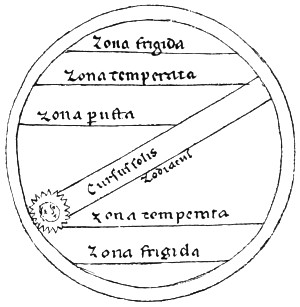
Fig. 5. From Herrade de Landsberg’s Hortus deliciarum, after Straub and Keller.
Upon the surface of the earth towards the east stands the building which symbolizes the aedificium of the church, a favourite conception of our authoress. This church is surmounted by a halo, whence proceed a pair of pinions which extend their shelter over a full half of the earth’s circumference. As for the rest of the earth’s surface, part is within the wide-opened jaws of a monster, the Destroyer, and the remainder is beneath the surface of the ocean. Within the earth are five parts analogous, as she would have us believe, to the five senses. An eastern clear arc and a western clouded one signify respectively the excellence of the orient where Zion is situated, and the Cimmerian darkness of the occidental regions over which the shadow of the dragon is cast. Centrally is a quadrate area divided into three zones where the qualities of heat and cold and of a third intermediate ‘temperateness’ (temperies) are stored. North and south of this are two areas where purgatory is situate. Each is shaped like a truncated cone and composed also of three sectors. Souls are seen suffering in one sector the torment of flame, in another the torment of water, while in the third or intermediate sector lurk monsters and creeping things which add to the miseries of purgatory or at times come forth to earth’s surface to plague mankind. These northern and southern sections exhibit dimly by their identically reversed arrangement the belief in the antipodean inversion of climate, an idea hinted several times in Hildegard’s writings, but more definitely illustrated by a figure of Herrade de Landsberg (Fig. 5).
From BIBL. NAT. MS. LAT. 7028 fo. 154 r
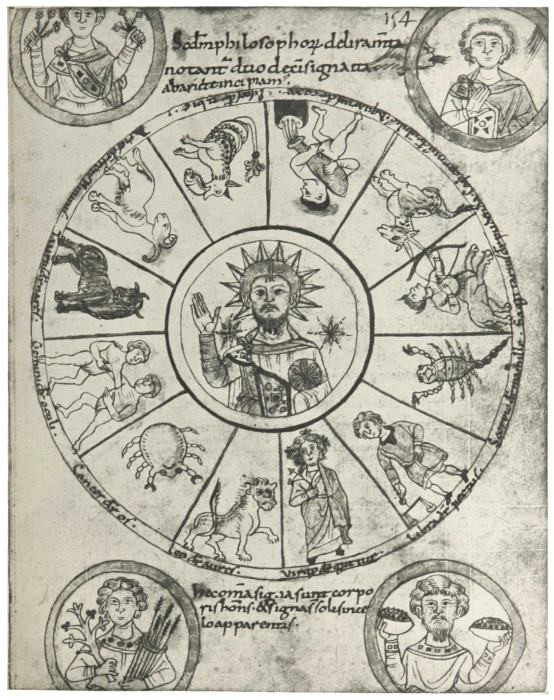
Plate XV. AN XIth CENTURY FRENCH MELOTHESIA
From BIBL. NAT. MS. LAT. 11229 fo. 45 v
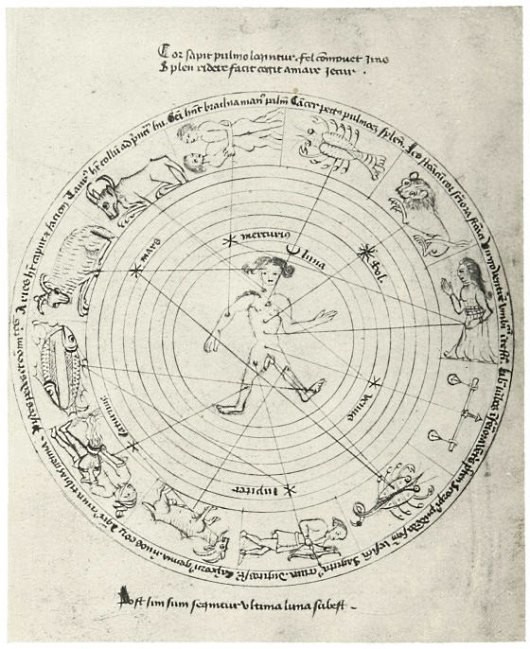
Plate XVI. A MELOTHESIA OF ABOUT 1400
From the SYMBOLUM APOSTOLICORUM
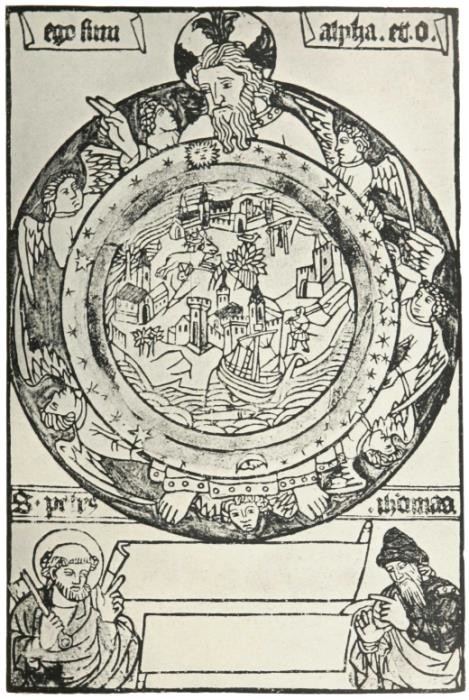
Plate XVII. A GERMAN BLOCK BOOK First Half of XVth Century. Heidelberg University Library
From BODLEIAN MS. ASHMOLE 399 fo. 18 r
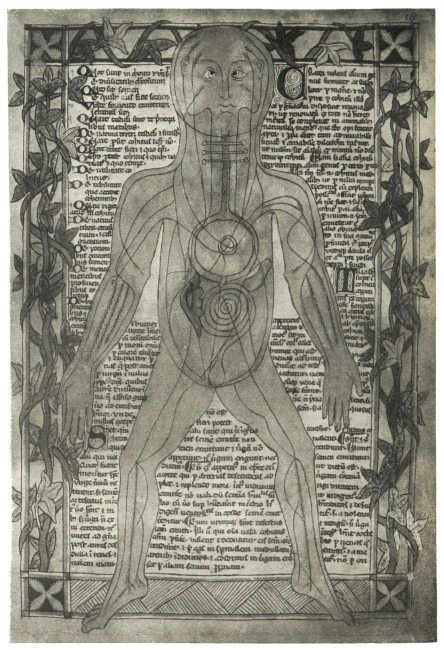
Plate XVIII. AN ANATOMICAL DIAGRAM OF ABOUT 1298 From the Five-Figure Series. Cp. Plate XXXIII
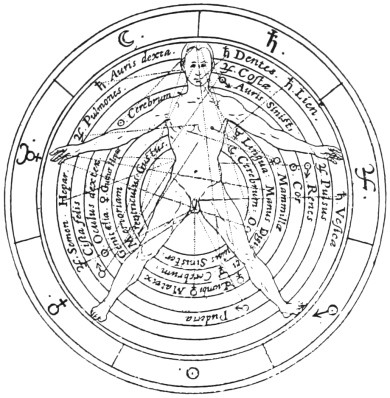
Fig. 6.
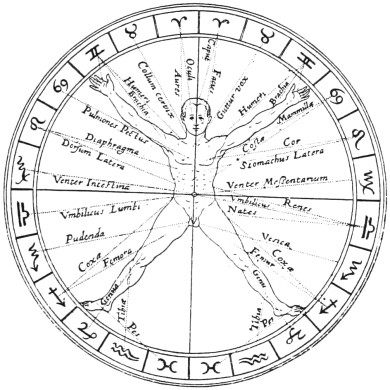
Fig. 7.
MELOTHESIAE
From R. Fludd, Historia utriusque cosmi, Oppenheim, 1619, pp. 112 and 113.
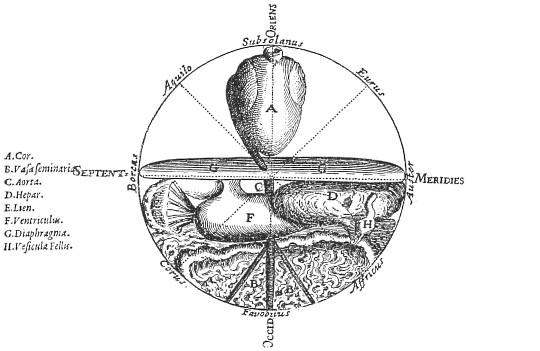
Fig. 8. THE MICROCOSM
From R. Fludd, Philosophia sacra seu astrologia cosmica, Frankfurt, 1628, p. 52.
Macrocosmic schemes of the type illustrated by the text of Hildegard and by the figures of the Lucca MS. had a great vogue in mediaeval times, and were passed on to later ages. Some passages in Hildegard’s work read curiously like Paracelsus (1491–1541),93 and it is not hard to find a link between these two difficult and mystical writers. Trithemius, the teacher of Paracelsus, was abbot of Sponheim, an important settlement almost within sight of Hildegard’s convents on the Rupertsberg and Disibodenberg. Trithemius studied Hildegard’s writings with great care and attached much importance to them, so that they may well have influenced his pupil. The influence of mediaeval theories of the relation of macrocosm and microcosm is encountered among numerous Renaissance writers besides Paracelsus, and is presented to us, for instance, by such a cautious, balanced, and scientifically-minded humanist as Fracastor. But as the years went on, the difficulty in applying the details of the theory became ever greater and greater. Facts were strained and mutilated more and more to make them fit the Procrustean bed of an outworn theory, which at length became untenable when the heliocentric system of Copernicus and Galileo replaced the geocentric and anthropocentric systems of an earlier age. The idea of a close parallelism between the structure of man and of the wider universe was gradually abandoned by the scientific, while among the unscientific it degenerated and became little better than an insane obsession. As such it appears in the ingenious ravings of the English follower of Paracelsus, the Rosicrucian, Robert Fludd, who reproduced, often with fidelity, the systems which had some novelty five centuries before his time (Figs. 6, 7, and 8). As a similar fantastic obsession this once fruitful hypothesis still occasionally appears even in modern works of learning and industry.94
VIII. Anatomy and Physiology
Hildegard’s ideas on these subjects are set out in the fourth vision of the Liber Divinorum Operum, which is devoted to a description of man’s body according to the macrocosmic scheme. This setting makes her account by no means easy to read, while it increases the difficulty of tracing the origin of her views.
The list of works containing anatomical descriptions available to a German writer in the early Middle Ages is not long. Avicenna was hardly yet accessible, and only such scraps of Galen as appear in Constantine and the Salernitans. The available works may be enumerated thus:
(
a)
The short
Anatomia porciof Copho of Salerno, dating from about
1085.95(
b)
An anonymous Salernitan
anatomy,96written about 1100 and largely based on Copho and Constantine.
(
c)
The
Liber de humana naturaof Constantine the African, written probably between 1070 and 1085 at Monte
Cassino.97(
d)
Constantine’s
De communibus medico cognitu necessariis locis, written about the same time as the
above.98This work is in four books, of which the second, third, and fourth are devoted to anatomy and physiology.
(
e)
Here may be placed also Constantine’s translation of the
Viaticumof Isaac Judeus. Both these latter works of Constantine are long and technical, and designed for the use of the trained physician.
In addition to these there was in the Middle Ages a definite anatomic tradition, which expressed itself constantly in:
(
f)
A series of five anatomical diagrams representing respectively the arteries, veins, bones, nerves, and
muscles99(see Plate
XXXIII, opposite page 92 of the present volume). These diagrams were copied in the most servile fashion for centuries, and something very like them has remained in use to this day in
Tibet.100The versions, whether in Persia or England, in Germany or Italy, were remarkably uniform.
(
g)
In several MSS. there has been found attached to these remarkable diagrams a short text describing the five systems, arteries, veins, nerves, bones, and muscles. This text, however, purporting to be from Galen, has little relation to the figures, which it does not really explain, and it should therefore be regarded as a separate
work.101From WIESBADEN CODEX B fo. 22 r
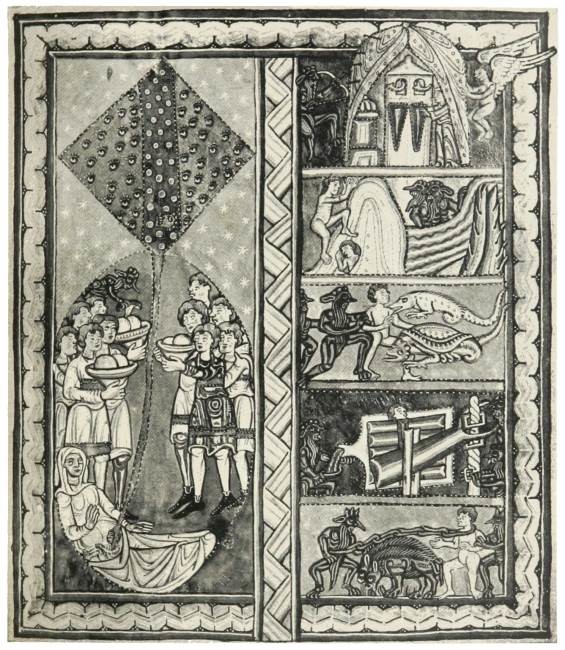
Plate XIX. BIRTH. THE ARRIVAL AND TRIALS OF THE SOUL
From WIESBADEN CODEX B fo. 25 r
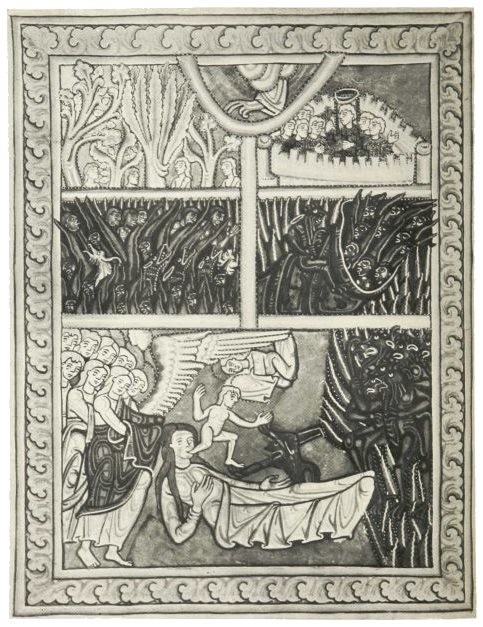
Plate XX. DEATH. THE DEPARTURE AND FATE OF THE SOUL
Of these seven sources it appears to us that (c) and (f)—the short De humana natura of Constantine, and the five-figure series—are those on which Hildegard drew. The absence of Arabisms and the scarcity of technical anatomical terms in her writings, her failure to distinguish between veins and arteries, the absence of anything of the nature of myology or osteology, together with the neglect of the spinal marrow as an important organ, make it very unlikely that she consulted Constantine’s longer works or the Salernitan authorities or the text of the five-figure series. Her anatomical descriptions resemble those of Constantine’s shorter work, on the other hand, in the description of the three vesicles of the brain and their relations to the faculties of the mind, in the treatment of the five senses, in the view of the influence of the planets on the child and the emphasis laid on epilepsy, as well as in the absence of any distinction between arteries and veins, and in the loose doctrines of the humours and of the causes of deformities and monstrosities. In some of these respects also her account of the human body presents points of resemblance to the De hominis membris ac partibus of Hugh of St. Victor,102 with whom, however, her contact appears to be less close than with Constantine.
We may infer that Hildegard had consulted anatomical diagrams and was accustomed to this method of representing the organs from a passage descriptive of the microcosm, in which she says that ‘in the mouth of the figure in whose body was the disk, I saw a light brighter than the light of day, in the form of threads, some circular, some in other geometrical forms, and some shaped like human members belonging to the figure, which was clearly portrayed on the disk upright and accurately limned’.103 These ‘circles and geometrical figures’ fairly describe the highly diagrammatic manner in which the five-figure series represents the internal organs, and several points suggest that she does indeed refer to this series. Her description of the abdominal muscles (umbilicus) ‘covering the viscera like a cap’, her general descriptions of the vessels (venae) and the muscles, and especially her account of the vessels of the leg and of the intimate relations of the main venae to the organ of hearing, fits in perfectly with the form of these remarkable diagrams (Plate XVIII).
We here render some of the most important of her general anatomical descriptions:
‘The humours may pass to the liver, where wisdom is tested, having been already tempered in the brain by the strength of the spirit, and having absorbed its moisture so that now it is plump, strong, and healthy.
‘In the right of man is the liver and its great heat, so that the right is swift to act and to work;104 but towards the left are heart and lung, which fortify the body for its task and receive their heat from the liver as from a furnace. But the vessels of the liver, affected by the agitation of the humours, trouble the venules of the ear of man and sometimes confound the organ of hearing....
‘I saw also that sometimes the humours seek the navel, which covers the viscera as a cap, and holds them in, lest they be dissipated, and maintains their course and preserves the heat both of them and of the veins.... But sometimes the humours seek the loins (lumbos),105 which mock, deceive, and endanger the virile powers and which are held in place by nerves and other vessels; in which, nevertheless, reason nourishes so that man may know what to do and what to avoid....
‘And the same humours go to the vessels of the reins and of other members, and pass in their turn to the vessels of the spleen, and then to the lungs and to the heart; and they meet the viscera on the left where they are warmed by the lungs, but the liver warms the right-hand side of the body. And the vessels of the brain, heart, lung, liver, and other parts carry strength to the reins, whose vessels descend to the legs, strengthening them; and returning along with the leg vessels, they unite with the virile organ or with the womb as the case may be.
‘And as the stomach absorbs food, or as iron is sharpened on a stone, so do they bring the reproductive power to those parts.
From WIESBADEN CODEX B, fo. 123 r
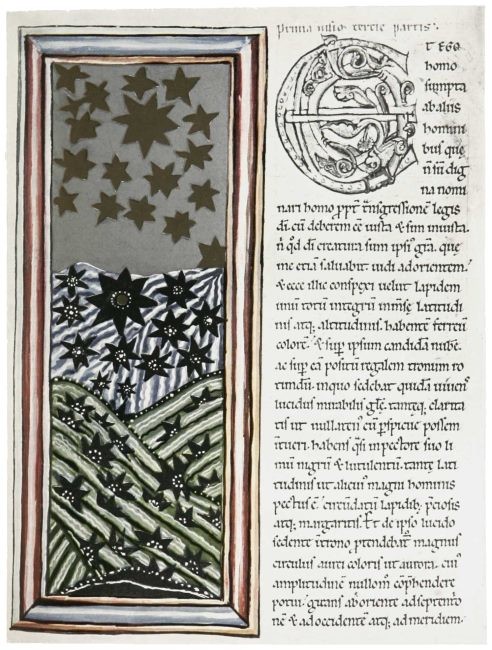
Plate XXI. THE FALL OF THE ANGELS
‘Again, the muscles of the arms, legs, and thighs contain vessels full of humours; and just as the belly has within it viscera containing nourishment, so the muscles of arms, legs, and thighs have both vessels and the [contained] humours which preserve man’s strength.... But when a man runs or walks quickly, the nerves about the knees and the venules in the knees become distended. And since they are united with the vessels of the legs, which are numerous and intercommunicate in a net-like manner, they conduct the fatigue to the vessels of the liver, and thus they reach the vessels of the brain, and so send the fatigue throughout the body. But the vessels from the reins pass rather to the left leg than to the right, because the right leg gets its strength more from the heat of the liver. And the vessels of the right leg ascend as far as the renal and kindred vessels, and these latter vessels unite with those of the kidney. And the liver warms the reins which lie in the fatness derived from the humours....
‘The humours in man are distributed in just measure. But when they affect the veins of the liver, his humidity is decreased and also the humidity of the chest is attenuated; so that thus dried, he falls into disease of such a nature that the phlegm is dry and toxic and ascends to the brain. There it produces headache and pain in the eyes and wasting of the marrow, and thus if the moon is in default he may develop the falling evil [epilepsy].
‘The humidity also which is in the umbilicus is dispersed by the same humours, and turned into dryness and hardness, so that the flesh becomes ulcerated and scabby as though he were leprous, if indeed he do not actually become so. And the vessels of his testicles, being adversely affected by these humours, similarly disturb the other vessels, so that the proper humidity is dried up within them; and thus, the humours being withdrawn, impetigos may arise ... and the marrow of the bones and the vessels of the flesh are dried up, and so the man becomes chronically ill, dragging out his days in languor.
‘But sometimes the humours affect breast and liver ... so that various foolish thoughts arise ... and they ascend to the brain and infect it and again descend to the stomach and generate fevers there, so that the man is long sick. Yet again they vex the minor vessels of the ear with superfluity of phlegm; or with the same phlegm they infect the vessels of the lung, so that he coughs and can scarce breathe; and the phlegm may pass thence into the vessels of the heart and give him pain there, or the pain may pass into the side, exciting pleurisy; under such circumstances also, the moon being in defect, the man may lapse into the falling sickness.’106
Sometimes Hildegard’s anatomical ideas can be paralleled among her contemporaries. Thus the following passage on the relationship of the planets to the brain is well illustrated by a diagram of Herrade de Landsberg.
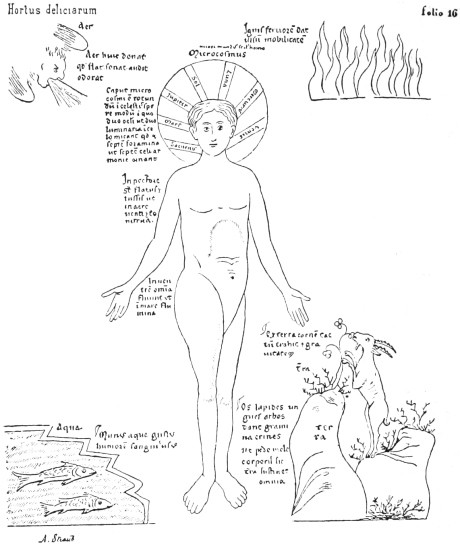
Fig. 9. From Herrade de Landsberg’s Hortus deliciarum, after Straub and Keller’s reproduction.107
‘From the summit of the vessel of the brain to the extremity of the forehead seven equal spaces can be distinguished. Here the seven planets are designated, the uppermost planet in the highest part, the moon in front, the sun in the middle and the other planets distributed among the other spaces’ (Fig. 9).
From WIESBADEN CODEX B fo. 41 v
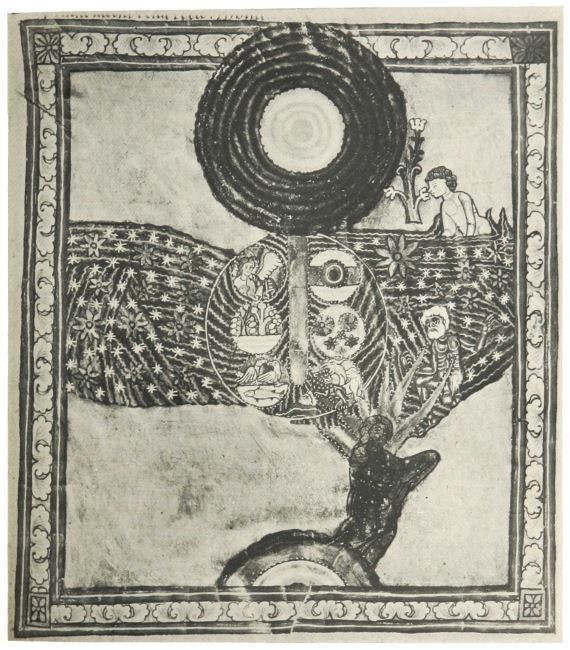
Plate XXII. THE DAYS OF CREATION AND THE FALL OF MAN
IX. Birth and Death and the Nature of the Soul
The method by which the soul enters the body is set forth in a very striking vision in the Scivias and is illustrated in the Wiesbaden Codex B by a no less remarkable miniature (Plate XIX). The soul, which contains the element of wisdom, passes into the infant’s body while yet within the mother’s womb. The Wisdom of God is represented as a four-square object, with its angles set to the four quarters of the earth, this form being the symbol of stability. From it a long tube-like process descends into the mother’s womb. Down this there passes into the child a bright object, described variously as ‘spherical’ and as ‘shapeless’, which ‘illumines the whole body’ and becomes or develops into the soul.
The birth scene is strikingly portrayed. In the foreground lies the mother with the head and shoulders supported and the right arm raised. In her womb is the infant in the position known to obstetricians as a ‘transverse presentation’. Around the child may be distinguished clear traces of the uterine membranes. Near the couch are ranged a group of ten figures who carry vessels containing the various qualities of the child. Above and to the left the Evil One may be seen pouring some noxious substance into one of these vessels, or perhaps abstracting some element of good. The whole scene suggests the familiar fairy tale in which, while all bring pleasant gifts to the child’s birth, there comes at last the old witch or the ill-used relative who adds a quota of spitefulness.
The scene is described and expounded as follows:
‘Behold, I saw upon earth men carrying milk in earthen vessels and making cheeses therefrom. Some was of the thick kind from which firm cheese is made, some of the thinner sort from which more porous [tenuis] cheese is made, and some was mixed with corruption [tabes] and of the sort from which bitter cheese is made. And I saw the likeness of a woman having a complete human form within her womb. And then, by a secret disposition of the Most High Craftsman, a fiery sphere having none of the lineaments of a human body possessed the heart of the form, and reached the brain and transfused itself through all the members.... And I saw that many circling eddies possessed the sphere and brought it earthward, but with ever renewed force it returned upward and with wailing asked, “I, wanderer that I am, where am I?” “In death’s shadow.” “And where go I?” “In the way of sinners.” “And what is my hope?” “That of all wanderers.”’108 The vision is explained as follows: ‘Those whom thou seest carrying milk in earthen vessels are in the world, men and women alike, having in their bodies the seed of mankind from which are procreated the various kinds of human beings. Part is thickened because the seed in its strength is well and truly concocted, and this produces forceful men to whom are allotted gifts both spiritual and carnal.... And some had cheeses less firmly curdled, for they in their feebleness have seed imperfectly tempered, and they raise offspring mostly stupid, feeble, and useless.... And some was mixed with corruption ... for the seed in that brew cannot be rightly raised, it is invalid and makes misshapen men who are bitter, distressed, and oppressed of heart, so that they may not lift their gaze to higher things....109 And often in forgetfulness of God and by the mocking devil, a mistio is made of the man and of the woman and the thing born therefrom is deformed, for parents who have sinned against me return to me crucified in their children.’110 (Compare Constantine De humana natura, sections ‘De perfectione’ and ‘De impeditione’.)
Hildegard thus supposes that the qualities and form of a child are inherited from its parents, but that two factors, the formless soul from the Almighty and the corrupt fluid instilled by the devil, also contribute to the character of offspring. This is the usual mediaeval view and is broadly portrayed in the figure.
The strange conception of the body being formed from the seed, as cheese is precipitated and curdled from milk, is doubtless derived from a passage in the Book of Job:
‘Hast thou not poured me out as milk, And curdled me like cheese? Thou hast clothed me with skin and flesh, And knit me together with bones and sinews’ (Job x. 10, 11).111
When the body has thus taken shape there enters into it the soul which, though at first shapeless, gradually assumes the form of its host, the earthly tabernacle; and at death the soul departs through the mouth with the last breath, as a fully developed naked human shape, to be received by devils or angels as the case may be (Plate XX).
From WIESBADEN CODEX B. fo. 47 r
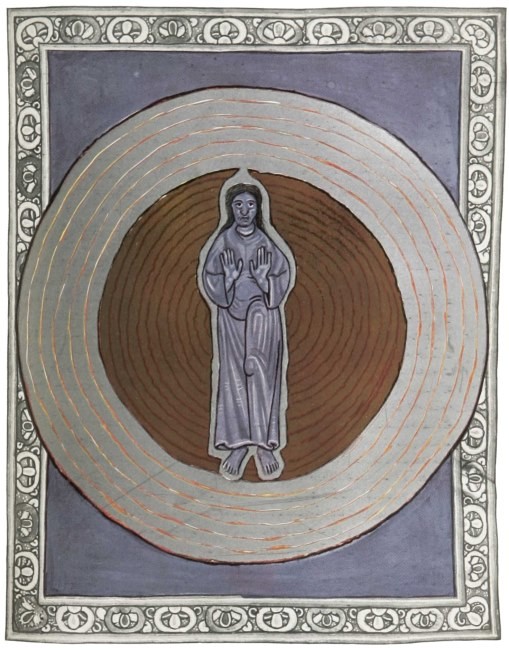
Plate XXIII. THE VISION OF THE TRINITY
During its residence in the body the soul plays the part usually assigned to it in the earlier mediaeval psychology, before the ideas of Nemesius and Ibn Ghazali had been elaborated and systematized by Albert and Aquinas. Hildegard regards the brain as having three chambers or divisions, corresponding to the three parts of man’s nature, an idea encountered in the writings of St. Augustine. Parallel to these there are, she tells us,
‘three elements in man by which he shows life; to wit, soul (anima), body (corpus), and sense (sensus). The soul vivifies the body and inspires the senses; the body attracts the soul and reveals the senses; the senses affect the soul and allure the body. For the soul rules the body as a flame throws light into darkness, and it has two principal powers or limbs, the intellect (intellectus) and the will (voluntas); not indeed that the soul has limbs to move itself, but that it manifests itself thereby as the sun declares himself by his brightness.... For the intellect is attached to the soul as the arms to the body: for as the body is prolonged into arms with fingers and hands attached, so the intellect is produced from the soul by the operation of its various powers.’112
We need follow Hildegard no further into her maze of micro-cosmology, in which an essential similarity and relationship is discovered between the qualities of the soul, the constitution of the external cosmos, and the structure of the body, a thought which appears as the culmination of her entire system and provides the clue to the otherwise incomprehensible whole.113
X. The Visions and their Pathological Basis
For the physical accompaniments and phenomena of Hildegard’s visions we have three separate lines of evidence: her own account; the statements of her contemporary biographers, Theodoric and Godefrid; and the miniatures of the Wiesbaden Codex B, probably prepared under her supervision.
It is clear that despite the length and activity of her life, Hildegard did not enjoy normal health. From a very early age she was the subject of trances and visions, and from time to time she was prostrated with protracted illness.
‘God punished me for a time by laying me on a bed of sickness so that the blood was dried in my veins, the moisture in my flesh and the marrow in my bones, as though the spirit were about to depart from my body. In this affliction I lay thirty days while my body burned as with fever, and it was thought that this sickness was laid upon me for a punishment. And my spirit also was ailing, and yet was pinned to my flesh, so that while I did not die, yet did I not altogether live. And throughout those days I watched a procession of angels innumerable who fought with Michael and against the dragon and won the victory.... And one of them called out to me, “Eagle! Eagle!114 why sleepest thou?... All the eagles are watching thee.... Arise! for it is dawn, and eat and drink.” And then the whole troop cried out with a mighty voice,... “Is not the time for passing come? Arise, maiden, arise!” Instantly my body and my senses came back into the world; and seeing this, my daughters who were weeping around me lifted me from the ground and placed me on my bed, and thus I began to get back my strength.
‘But the affliction laid upon me did not fully cease; yet was my spirit daily strengthened.... I was yet weak of flesh, timid of mind, and fearful of pain ... but in my soul I said, “Lord! Lord! all that Thou puttest upon me I know to be good ... for have I not earned these things from my youth up?” Yet was I assured He would not permit my soul to be thus tortured in the future life....115 Thus was my body seethed as in a pot ... yet gave I thanks to God, for if this affliction had not been from Him I had surely not lived so long. But although I was thus tortured, yet did I, in supernal vision, often repeat, cry aloud, and write those things which the Holy Spirit willed to put before me.
‘Three years were thus passed during which the Cherubim pursued me with a flaming sword ... and at length my spirit revived within me and my body was restored again as to its veins and marrows, and thus I was healed.’116
This illness of Hildegard was the longest and the most typical, but by no means the only one through which she passed. She describes her affliction as continuing for long periods, but there can be little doubt, from her history, that during much of the time she was able to carry on some at least of her functions as head of a religious house.
79 The work is printed by C. S. Barach and J. Wrobel, Innsbruck, 1876. The writers, however, confuse Bernard Sylvestris of Tours with his somewhat older contemporary, Bernard of Chartres.
80 A. Clerval, Les Écoles de Chartres au Moyen Âge, Paris, 1895.
81 J. E. Sandys, History of Classical Scholarship, Cambridge, 1903, vol. i, p. 515.
82 R. Lane Poole, Illustrations of the History of Mediaeval Thought in the Departments of Theology and Ecclesiastical Politics, Oxford, 1884, pp. 118, 219.
83 Barach and Wrobel, loc. cit., pp. 5–6, 9 and 13.
84 For a general consideration of these figures see K. Sudhoff, Archiv für Geschichte der Medizin, i. 157, 219; ii. 84.
85 E. Wickersheimer, ‘Figures médico-astrologiques des neuvième, dixième et onzième siècles’, Transactions of the Seventeenth International Congress of Medicine, Section XXIII, History of Medicine, p. 313, London, 1913.
86 The MS. from which Plate XV is taken (Paris, Bibl. nat., Latin 7028) is entitled Scholium de duodecim zodiaci signis et de ventis. It was once the property of St. Hilaire the Great of Poitiers. The legend above our figure reads, ‘Secundum philosophorum deliramenta notantur duodecim signa ita ab ariete incipiamus’. The relation of the signs to the parts of the body is different in this eleventh-century MS. from that which was widely accepted in the astrology of the thirteenth and fourteenth centuries as illustrated in Plate XVI.
87 The MS. from which Plate XVI is taken (Paris, Bibl. nat., Latin 11229) was written about the end of the fourteenth century. It has been described by K. Sudhoff, Arch. f. Gesch. d. Med., ii. 84, Leipzig, 1910. The relation of the central figure to the signs of the zodiac in this plate bears a manifest resemblance to the relation of the central figure to the beasts’ heads in Plate vii. The lines which cross and recross the figure in Plate VII are analogous also to the lines of influence of Plate XVI. The verse above the figure in Plate XVI is taken from the Flos medicinae scholae Salerni; cp. de Renzi, loc. cit., i. 486. This Melothesia and that of the next figure is identical with that propounded in Manilius, ii. 453 (edition of H. W. Garrod, Oxford, 1911).
88 Plate XVII is from an early German block book. It exhibits a scheme closely parallel to Plate VII. The universe in Plate XVII is represented as a series of concentric spheres, earth innermost, followed by water, air, and fire. In the outermost zone hover the angels who have replaced the beast’s head of Hildegard’s scheme. The whole world is embraced by the figure of the Almighty, much as in Plate VII.
89 See E. Wickersheimer, ‘La médecine astrologique dans les almanachs populaires du xxe siècle’, Bulletin de la Société française d’histoire de la médecine, x (1911), pp. 26–39.
90 Migne, col. 757. This phrase is reproduced in a mediaeval Irish version of the work of Messahalah. See Maura Power, An Irish Astronomical Text, Irish Text Society, London, 1912.
91 The word cancer is here used, but the crab goes sideways, not backwards. By cancer Hildegard, who had never seen the sea, probably means the crayfish, an animal fairly common in the Rhine basin. It is the head of a crayfish or lobster that is figured in the miniatures of the vision of the macrocosm in the Lucca MS., and a similar organism frequently serves for the sign Cancer in the mediaeval zodiacal medical figures, as in Plate XV of this essay.
92 Migne, cols. 3, 791–2.
93 An illustration of this parallelism between Paracelsus and Hildegard is afforded by certain passages in the Labyrinthus medicorum errantium and the Scivias, lib. i, vis. 4. Especially compare p. 279 et seq. of Huser’s edition of the Opera, Strasbourg, 1603, with Migne, col. 428.
Fig. 6.
Fig. 7.
MELOTHESIAE
From R. Fludd, Historia utriusque cosmi, Oppenheim, 1619, pp. 112 and 113.
94 A good example is furnished by a work of Isaac Myer, Qabbalah. The philosophical writings of Solomon ben Yehudah ibn Gebirol or Avicebron and their connection with the Hebrew Qabbalah and Sepher ha-Zohar, Philadelphia, 1888.
95 The most accessible edition is in S. de Renzi’s Collectio Salernitana, vol. ii, p. 388.
96 Printed in de Renzi, vol. ii, p. 391.
97 Printed in Methodus medendi certa clara et brevis, Basel, Henricus Petrus, 1541, p. 313.
98 Printed in Summi in omni philosophia viri constantini africani medici operum reliqua, Basel, Henricus Petrus, 1539, p. 24.
99 Karl Sudhoff, Tradition und Naturbeobachtung, Leipzig, 1907; Ein Beitrag zur Geschichte der Anatomie im Mittelalter, Leipzig, 1908; ‘Drei weitere anatomische Fünfbilderserien aus Abendland und Morgenland’ (with Ernst Seidel) and ‘Abermals eine neue Handschrift der anatomischen Fünfbilderserie’ in Archiv für Geschichte der Medizin, Leipzig, 1910 and 1914.
100 E. H. C. Walsh, ‘The Tibetan Anatomical System’, in the Journal of the Royal Asiatic Society, London, October 1910, p. 1215; Berthold Laufer, Beiträge zur Kenntnis der Tibetanischen Medizin, Berlin, 1900; and K. Sudhoff, ‘Weitere Beiträge zur Geschichte der Anatomie im Mittelalter’, in the Archiv für Geschichte der Medizin, vol. viii, p. 143, Leipzig, 1914.
101 This text, critically treated, has been printed by K. Sudhoff, who, however, regards it as related to the figures: Archiv für Geschichte der Medizin, vol. iii, p. 361, Leipzig, 1910.
102 Hugh of St. Victor, De bestiis et aliis rebus, iii. 60.
103 Migne, col. 755.
104 An idea that occurs in Aristotle, Parts of Animals, ii, c. 2, but is rejected by Galen.
105 Early mediaeval writers held that the lumbus, which we have rendered loin, was intimately connected with the sexual faculties. Thus Hugh of St. Victor (1095–1141), De bestiis et aliis rebus, iii. 60 ‘Lumbi a libidinis lascivia dicti, quia in viris causa corporeae voluptatis in ipsis est, sicut in umbilico feminis. Unde et ab Iob in exordio sermonis dictum est, accinge sicut vir lumbos tuos, ut in his esset resistendi praeparatio, in quibus est libidinis usitata dominandi occasio.’
106 Migne, cols. 792–3.
107 The legend reads as follows: ‘Minor mundus scilicet homo. Microcosmus. [Then on the head the names of the seven planets.] Caput microcosmi est rotundum in celestis spere modum in quo duo oculi ut duo luminaria in celo micant quod & septem foramina ut septem celi armonie ornant. In pectore sunt flatus & tussis ut in aere uenti & tonitrua. In uentrem omnia fluunt ut in mare flumina. Os lapides ungues arbos dant gramina crines Ut pede mole[m] corporis sic terra sustinet omnia. [At the four corners the following legends:] Aer huic donat quod flat. sonat. audit. odorat. Ignis feruorem dat uisum mobilitatem. Aqua. Munus aque gustus humorem sanguinis usus. Ex terra carnem tactum trahit & gravitatem.’
108 Migne, col. 415.
109 Migne, col. 421.
110 Migne, col. 424.
111 The Aristotelian writings also compare the transformation of the material humours into the child’s body with the solidification of milk in the formation of cheese.
112 Migne, col. 425.
113 Especially in the Liber Divinorum Operum, pars 1. vis. iv.
114 The eagle is frequently in mediaeval writings a symbol of the power of divine grace.
115 Migne, col. 110.
116 Migne, col. 111.
WIESB. COD. B. fo. 213 v
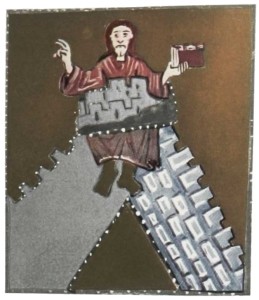
SEDENS LUCIDUS
From WIESBADEN CODEX B fo. 153 r
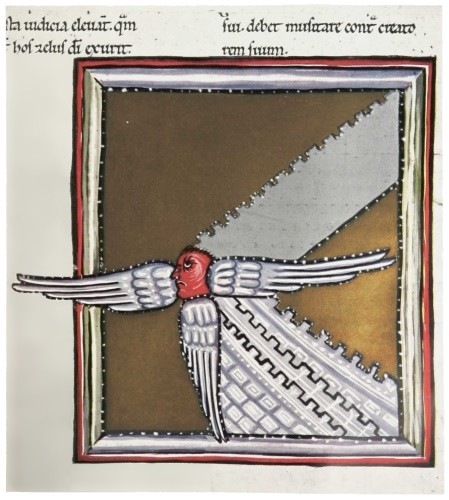
Plate XXIV. ZELUS DEI
The condition from which she was suffering was clearly a functional nervous disorder; this is sufficiently demonstrated by her repeated complete recoveries, her activity between the attacks, and the great age to which she lived. At first sight, the long procession of figures and visions suggests that she might have been the victim of a condition similar to that of which Jerome Cardan has left us so complete a personal record. But on reading the books of visions, the reader will easily convince himself that we are not here dealing with a dream-state. The visions are indeed essentially vivid. ‘These visions which I saw’, she repeatedly assures us, ‘I beheld neither in sleep, nor in dream, nor in madness, nor with my carnal eyes, nor with the ears of the flesh, nor in hidden places; but wakeful, alert, with the eyes of the spirit and with the inward ears I perceived them in open view and according to the will of God. And how this was compassed is hard indeed for human flesh to search out.’117
Nevertheless, though the visions exhibit great originality and creative power—the reader will often be reminded of William Blake—all or nearly all present certain characters in common. In all a prominent feature is a point or a group of points of light, which shimmer and move, usually in a wavelike manner, and are most often interpreted as stars or flaming eyes. In quite a number of cases one light, larger than the rest, exhibits a series of concentric circular figures of wavering form; and often definite fortification figures are described, radiating in some cases from a coloured area. Often the lights gave that impression of working, boiling or fermenting, described by so many visionaries, from Ezekiel onwards.
This outline of the visions the saint herself variously interpreted. We give examples from the more typical of these visions, in which the medical reader or the sufferer from migraine will, we think, easily recognize the symptoms of scintillating scotoma. Some of the illuminations, here reproduced in their original colours, will confirm this interpretation.
‘I saw a great star most splendid and beautiful, and with it an exceeding multitude of falling sparks which with the star followed southward. And they examined Him upon His throne almost as something hostile, and turning from Him, they sought rather the north. And suddenly they were all annihilated, being turned into black coals ... and cast into the abyss that I could see them no more’118 (Plate XXI).
This vision, illustrated by the beautiful figure of stars falling into the waves, is interpreted by her as signifying the Fall of the Angels.
The concentric circles appear in numerous visions, and notably in that of the Days of the Creation of the World and the Fall of Man, illustrated by what is perhaps the most beautiful of all the miniatures of the Wiesbaden Codex B (lib. ii, vis. 1, Plate XXII). It is in this concentric form that Hildegard most frequently pictures the Almighty, and the idea again appears in the eleventh miniature, here reproduced in its original colours, which she describes as ‘a most shining light and within it the appearance of a human form of a sapphire colour which glittered with a gentle but sparkling glow’ (lib. ii, vis. 2, Plate XXIII). Appearances of this type are recorded again and again.
The type with fortification figures is encountered in a whole series of visions, of which we reproduce the account and illumination of the Zelus Dei (lib. iii, vis. 5, Plate XXIV, lower section).
‘I looked and behold a head of marvellous form ... of the colour of flame and red as fire, and it had a terrible human face gazing northward in great wrath. From the neck downward I could see no further form, for the body was altogether concealed ... but the head itself I saw, like the bare form of a human head. Nor was it hairy like a man, nor indeed after the manner of a woman, but it was more like to a man than a woman, and very awful to look upon.
‘It had three wings of marvellous length and breadth, white as a dazzling cloud. They were not raised erect but spread apart one from the other and the head rose slightly above them ... and at times they would beat terribly and again would be still. No word uttered the head, but remained altogether still, yet now and again beating with its extended wings.’
From the head extended a series of fortification lines, and this peculiar form of vision is reproduced on several occasions and variously interpreted (Plate XXIV, upper section). It is united with similar visions in what we regard as a reconstructed conception of exceedingly complex structure. This she claims to see separately, and she interprets it as the aedificium of the city of God (Plate XXV). Such reconstructed visions are clearly of a different type and origin to the simple group in which a shining light or group of lights is encountered and interpreted as a speaking figure.
From THE WIESBADEN CODEX B fo. 30 r
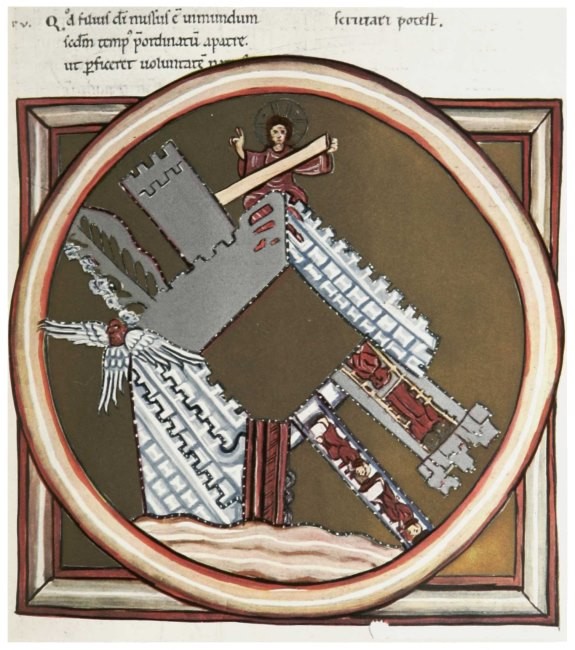
Plate XXV. THE HEAVENLY CITY
Hildegard’s visions, perhaps without exception, contain this element of a blinding or glittering light, which she interprets in a more or less spiritual manner. We terminate our account with the passage in which she sums up her experiences of it.
‘From my infancy’, she says, ‘up to the present time, I being now more than seventy years of age, I have always seen this light in my spirit and not with external eyes, nor with any thoughts of my heart nor with help from the senses. But my outward eyes remain open and the other corporeal senses retain their activity. The light which I see is not located but yet is more brilliant than the sun, nor can I examine its height, length, or breadth, and I name it the “cloud of the living light”. And as sun, moon, and stars are reflected in water, so the writings, sayings, virtues, and works of men shine in it before me. And whatever I thus see in vision the memory thereof remains long with me. Likewise I see, hear, and understand almost in a moment and I set down what I thus learn....
‘But sometimes I behold within this light another light which I name “the Living Light itself”.... And when I look upon it every sadness and pain vanishes from my memory, so that I am again as a simple maid and not as an old woman....119
‘And now that I am over seventy years old my spirit according to the will of God soars upward in vision to the highest heaven and to the farthest stretch of the air and spreads itself among different peoples to regions exceeding far from me here, and thence I can behold the changing clouds and the mutations of all created things; for all these I see not with the outward eye or ear, nor do I create them from the cogitations of my heart ... but within my spirit, my eyes being open, so that I have never suffered any terror when they left me.’120
Note.—The author’s thanks are due to the Rev. H. A. Wilson, Mr. C. C. J. Webb, and Mr. R. R. Steele, who have read the proofs of this article and have made valuable suggestions; to Mr. J. A. Herbert of the MS. Department of the British Museum, who drew his attention to the work of Herrade de Landsberg; and to Mr. M. H. Spielmann, who brought to his notice the crucifix figured in Plate X. He owes a special debt of gratitude to the late Dom Louis Baillet of Oosterhoot for his courtesy and generosity in lending him reproductions of the illuminations of the Wiesbaden Codex. Baillet was a young scholar of great promise, whose early death is a severe loss to the knowledge of mediaeval science.
The author has also to thank Professor Henrici of the Nassauische Landesbibliothek at Wiesbaden, Professor Wille and Professor Sillib of the Universitätsbibliothek at Heidelberg, and Signor Boselli of the R. Bibliotica Governativa at Lucca, who have all given him exceptional facilities for the study of the treasures under their charge.
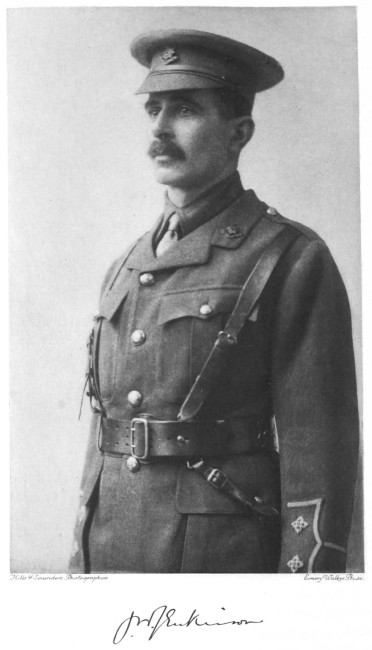
JOHN WILFRED JENKINSON
John Wilfred Jenkinson was born in 1871, and came from Bradfield to Exeter College, Oxford, with a classical scholarship in 1890. After taking his degree in Literae Humaniores he came, in 1894, to University College, London, where he devoted himself with extraordinary and never-flagging energy to biological studies.
Without having had the usual preliminary scientific teaching, he brought, on the other hand, a well-trained mind to bear on his new work, and the rapidity and completeness with which he acquired his scientific equipment was one of the most striking and interesting points in his career. Jenkinson very soon turned to original investigation, and from the first he showed a predilection for Embryology.
For a short time he held a post at one of the great London hospitals, but he soon returned to Oxford to join the teaching staff of the Department of Comparative Anatomy. He used the opportunity of University vacations to work in the laboratory of the late Professor A. A. W. Hubrecht at Utrecht, where part of his first published research was written. During the fifteen years of life that remained to him, he established himself as the foremost English writer on Embryology, devoting himself especially to its experimental aspect, a line of work in which he will rank as one of the pioneers.
Jenkinson became Doctor of Science in 1905, and in the same year he married Constance Stephenson. In 1906 he was appointed University Lecturer in Embryology, and in 1909 he was elected to a Research Fellowship at Exeter College.
Jenkinson’s mind was not of the type that matures early, but one felt in him a power of solid intellect that gained in force from year to year. The gap in the ranks of British Science caused by his death has been generally recognized, but his loss seems greatest to those personally acquainted with him, who know that he had by no means reached the zenith of his powers.
Jenkinson led a single-minded and unselfish life, wholly free from worldly and ignoble ambitions. Of simple and winning humour, happy in his domestic life and absorbed in his studies, he represented the very best type of scientific worker.
He was gifted with a powerful physique, and on the outbreak of war he became an ardent member of the Oxford Volunteer Training Corps. His qualities of calm courage and high sense of duty marked him out as a valuable officer. Although forty-three years of age, he took a commission in the 12th Worcester Regiment in January, 1915, and was promoted Captain in the following April. On May 10 he left for the Dardanelles, having been selected for service with the 2nd Royal Fusiliers. He was killed in action on June 4, only ten days after his arrival at the Gallipoli peninsula.
BOOKS AND PAPERS BY J. W. JENKINSON
1. ‘A Re-investigation of the Early Stages of the Development of the Mouse.’ Quart. Jour. Micr. Science, xliii. 1900.
2. ‘Observations on the Histology and Physiology of the Placenta of the Mouse.’ Tijdschr. Nederland. Dierkund. Vereen., vii (2). 1902.
3. ‘Observations on the Maturation and Fertilization of the Egg of the Axolotl.’ Quart. Jour. Micr. Science, xlviii. 1905.
4. ‘Remarks on the Germinal Layers of Vertebrates and on the Significance of Germinal Layers in general.’ Mem. and Proc. Manchester Lit. and Phil. Soc., 1906.
5. ‘Notes on the Histology and Physiology of the Placenta in Ungulata.’ Proc. Zool. Soc. 1906.
6. ‘On the Effects of certain Solutions upon the Development of the Frog’s Egg.’ Arch. Ent.-Mech., xxi. 1906.
7. ‘On the Relation between the Symmetry of the Egg and the Symmetry of the Embryo in the Frog (Rana temporaria).’ Biometrika, v. 1906.
8. Experimental Embryology. Oxford, 1909.
9. ‘On the Relation between the Symmetry of the Egg, the Symmetry of Segmentation, and the Symmetry of the Embryo in the Frog.’ Biometrika, vii. 1909.
10. ‘The Effects of Sodium Chloride on the Growth and Variability of the Tadpole of the Frog.’ Arch. Ent.-Mech., xxx (2). 1910.
11. ‘Vitalism.’ Hibbert Journal. 1911.
12. ‘On the Development of Isolated Pieces of the Gastrulae of the Sea-Urchin Strongylocentrotus lividus.’ Arch. Ent.-Mech., xxxii. 1911.
13. ‘On the Effect of certain Isotonic Solutions on the Development of the Frog.’ Arch. Ent.-Mech., xxxii. 1911.
14. ‘On the Origin of the Polar and Bilateral Structure of the Egg of the Sea-Urchin.’ Arch. Ent.-Mech., xxxii. 1911.
15. ‘The Development of the Ear-Bones in the Mouse.’ Jour. Anat. and Phys., vi (3). 1911.
16. ‘Growth, Variability, and Correlation in Young Trout.’ Biometrika, viii. 1912.
17. Vertebrate Embryology. Oxford, 1913.
18. ‘The Effect of Centrifugal Force on the Structure and Development of the Egg of the Frog.’ Quart. Jour. Micr. Science. 1914.
19. ‘The Placenta of a Lemur.’ Quart. Jour. Micr. Science. July 1915.
20. Three Lectures on Experimental Embryology. Oxford, 1917.
VITALISM
By J. W. Jenkinson
In one of the oldest biological treatises in the world, the soul or life of an organism is defined in the most general way as an activity of a natural organic living body—ἐντελέχεια σώματος φυσικου̑ ὀργανικου̑ δυνάμει ζωὴν ἔχοντος—life being autonomous nutrition and growth and decay. The activity may, however, be latent or patent, passive or active, sleeping or waking, without losing its peculiar characters. It is substance (οὐσία), but substance as ‘form’ as opposed to the material substance of the body, and the living body is therefore also a substance in a double sense.
It is not identical with the body; but as form, proportion (λόγος), activity (ἐνέργεια), essence (τὸ τί ἠν εἰναι), it is related to the body, mere matter (ὕλη), and potentiality (δύναμις) in just the same way as the seal is related to the wax; and the body is the instrument whereby it effects its purposes; though subsequent in time, it is prior in thought to the body, as all activities are to the materials with which they operate.
At the same time neither it nor its parts are separable from the body, with the exception, possibly, of mind (νου̑ς); it is indeed the actual or possible functioning of the body, like the seeing of the eye or the cutting of the axe, and with the disappearance of the capacity of this functioning the soul itself also perishes. Lastly, it is a cause (ἀρχὴ καὶ αἰτία) in a triple sense: first, as the source of motion; secondly, as that for the sake of which the body exists; and thirdly, as its essence (οὐσία) or formal cause. The soul or life is of several kinds, which form together an ascending series each member of which is necessarily involved in those above it.
The lowest is the nutritive soul (θρεπτική), found in all living things, and the only soul possessed by plants. It is defined as motion in respect of nutrition, decay, and growth, processes which involve alteration (ἀλλοίωσις) in the body; and its functions (ἔργα) are to utilize food for the maintenance and reproduction of the form of the body, and to control and limit growth.
The second is the perceptive soul (αἰσθητική), the possession of which distinguishes animals from plants. This also is a kind of alteration (ἀλλοίωσις τίς) and consists in being moved and affected. The fundamental and indispensable perception is touch (ἁφή), for it is concerned in the acquisition of the food. It is invariably present: the others may or may not, some or all, coexist with it.
Thirdly, some animals are possessed of a capacity for locomotion, and the performance of this function requires again a special kind of soul.
Lastly, there is the reasoning soul (διανοητικά) or mind (νου̑ς). This is found in man alone, unless there be other beings similar to him, or even nobler than he. Mind alone is eternal and separable from the body.
Though the observation and experiment of modern science would doubtless find much to alter in the details of these simple definitions, yet it must be conceded that, by what is certainly a most fortunate guess if it is not the most wonderful insight, Aristotle has laid his finger on the cardinal point of modern physiological doctrine. For, putting aside for the moment the mental faculties, it is here laid down in the clearest manner that not only the functions of growth and decay, nutrition, and reproduction, but also the capacity of responding to stimuli are to be ultimately resolved into some kind of movement of the particles of which the body is composed. Life, in short, as we might say with Virchow, is a mode of motion.
The biology of to-day distinguishes living from inanimate bodies by the possession and exercise of the three principal properties or functions of metabolism, irritability, and reproduction; and further, the body which performs these functions is not only composed of chemically complex substances—proteids—which are not found in things that are not alive, but possesses a structure. In no case, even the simplest, is the organism a mere homogeneous lump of protoplasm, but it has parts or organs, visibly different from one another, and obviously correlated with the activities appropriated to each; and it is the preservation of that structure, in the individual and in the race, which is the end towards which the collective performance of all these functions, or the life of the organism, is apparently directed.
Some of these peculiarities are shared by certain things that are not commonly regarded as alive. Crystals have of course a definite structure; they can divide, and when broken they can make good the missing part, but they do not assimilate to the substance of their own bodies a food-material which is less complex than it, and they are not irritable.
The differences, indeed, between the living and the lifeless are so profound, that it is not to be wondered at that there should have been in all ages natural philosophers who have held that living activities are phenomena sui generis, differing toto caelo from the properties exhibited by lifeless bodies, and never by any conceivability to be expressed in terms of these.
This doctrine is vitalism.
It exists in several varieties, but one at least is of very ancient lineage and can be traced back through mediaeval times to the biological speculations of the Greeks.
Whether Aristotle really held the vitalistic views which have since been attributed to him is a matter we shall have to discuss later on, but it is certain that in the writings of Galen there is to be found a theory of life which bears the stamp of Aristotelian influence, and was destined to hand that influence on to future generations. Galen admits the sensitive soul of Aristotle as the peculiarity of animals, and the rational soul for man, but substitutes for the nutritive soul certain works of nature—attraction, repulsion, retention, alteration. And further, the rational soul is no longer immortal, but perishable, and is dependent on the body, where its seat is in the brain; it is material or quasi-material, a πνευ̑μα, most efficient when dry.
After a long interval this doctrine reappears in the sixteenth century in the writings of Vesalius, who tells us that the heart has a vital soul, the liver a natural soul, while there is elaborated in the ventricles of the brain an animal spirit or principal soul.
Meanwhile, however, the conception of life as something material had been discarded by Paracelsus for the belief that the soul, or as he called it, the ‘Archaeus’, by which the chemical processes of the body are governed, is not a material but a spiritual force, a view restated by Stahl more than a hundred years afterwards. ‘The events of the body’, says this author, ‘may be rough-hewn by chemical and physical forces, but the soul will shape them to its own ends, and will do that by its instrument, motion.’
This, of course, is vitalism, and vitalism in its extreme or ‘animistic’ form. The idea recurs later on in the biology of Treviranus. To be living is to have a soul, he tells us, and the conscious Lebenskraft employs the forces of the material world to form the organism. ‘Das Weitzenkorn hat allerdings Bewusstsein dessen, was in ihm ist und aus ihm werden kann, und träumt wirklich davon.’ Though he adds quaintly enough, ‘Sein Bewusstsein und seine Träume mögen dunkel genug sein’. It is curious to observe the revival, at the beginning of the twentieth century, of this mediaeval mysticism in the speculative writings of so accomplished an experimentalist as Hans Driesch.
Driesch is an embryologist who in his earlier days had enunciated an invaluable analytical theory of development, a theory which suggests that while the formation of the first or elementary organs that appear in the embryo or larva—such structures as the larval gut or sense-organ, or the germ-layers—depends upon the presence in the germ of certain specific organ-forming substances (and this is a fact which has since been abundantly demonstrated by experiment), the origin of parts that appear later in development may be accounted for by the action of the first-formed structures upon one another, these actions being in the nature of physiological responses to stimuli; and for this also some evidence has been produced. On this view differentiation is a mechanical process, set in motion by fertilization or some other cause, and, given a certain initial structure of the germ or ovum, given the presence in it of a certain number of parts or substances capable of acting upon one another with a fixed co-ordination or harmony of the stimuli and the responses, given further a proper constitution of the external environment, then a definite result must follow, the production of an organism which is like the parents that gave it birth.
But in his later treatises this hypothesis has been repudiated, and, by a remarkable volte-face, replaced by a dogma of a wholly different kind. For now it is urged that no merely material factors can possibly account either for the harmony of development—the due co-ordination of mutually reacting parts; or for the secondary harmony of composition—the formation of complex organs by the union of tissues; or for the functional harmony seen in the activities of the adult.
For example, it is asserted that any fragment of an egg of a sea-urchin, if not too small (not less than 1/32 of the egg), can give rise to a whole and normal larva. We are told that the cells of the segmented ovum may be disarranged to any extent by various means, such as raising the temperature, diluting the sea-water, removing the calcium from the sea-water, or by shaking, without prejudice to the ultimate normality of development. Each part of the ovum can therefore, according to the needs of the case, give rise to any part of the resulting organism. ‘Jeder Teil kann nach Bedürfniss jedes.’
And thirdly, when the gastrula of a sea-urchin is transversely divided into two, each half, it is stated, develops into a diminished whole larva in which the gut becomes divided into the characteristic three regions, and all the other organs are formed in correct proportion.
For each of these acts of development in the whole uninjured larva an explanation may conceivably be given in terms of formative stimuli exerted by the originally distinct parts of the egg and calling forth responses in other parts. A mechanism may be thought of which, when set in motion, will achieve a certain end in accordance with its own pre-established harmony; but a mechanism which can be subdivided ad libitum, or almost ad libitum, and the parts of which will still achieve the same end, will still behave as wholes with their parts co-ordinated in the same ratio, temporally and spatially! Such a mechanism is inconceivable; for to ensure the uniform result, the relative amounts and positions of the necessary substances must be imagined as identical in every possible fragment of the egg that is not too small. Something is therefore required to superintend, to co-ordinate the causes of development in the case not only of the part but of the whole egg as well; and this something is not material. A corroborative proof of the inadequacy of the purely material explanation—the causal explanation in the ordinary sense of the phrase—may be derived from a consideration of certain other vital processes. The facts of acclimatization and immunity betray an extraordinary adaptability of the organism to a change in its environment; an organ will adapt itself structurally to an alteration, quantitative or qualitative, of function [Roux’s ‘Functional Adaptation’]; lost parts can be regenerated; and then there is the physiology of the nervous system.
In all these cases of ‘regulation’—and indeed in all other responses to stimuli—the same element, inexplicable in chemical and physical terms, exists and must exist in development. This entity is not a form of energy, but a vital constant, analogous to the constants or ultimate conceptions of mechanics and physics and chemistry and crystallography, but not reducible to these, just as these cannot be translated into one another.
Driesch describes it as a rudimentary feeling and willing, a ‘psychoid’, ‘morphaesthetic’ or perceptive of that form which is the desired end towards which it controls and directs all the material elements of differentiation, like the grain of wheat of Treviranus, dreaming dimly of its destiny. It is thus a vera causa—an unconditional and invariable antecedent—a psychical factor which can intervene in the purely physical series of causes and effects, and for it he revives the Aristotelian term ‘Entelechy’.
Such is the ‘vitalism’ introduced by Hans Driesch, a teleological theory clearly, but no mere metaphysical doctrine of final causes: rather a dynamic teleology which not only sees an end in every organic process, but postulates an immaterial entity to guide the merely mechanical forces towards the realization of that end.
Such a theory is open to very serious criticism from both the scientific and the philosophical side. But before we pass to that criticism let us turn aside to examine some of the other aspects under which the Proteus of Vitalism presents himself.
Thus the modern physiologist Bunge, while owning that it would be a lack of intelligence to expect to make with our senses discoveries in living nature of a different order to those revealed to us in inorganic nature, yet insists that we must transfer to the objects of our sensory perception, to the organs, to the tissue elements, and to every minute cell, something which we have acquired from our own consciousness, something, that is to say, which is not motion, and is not in space, but is in time only.
The essence of vitalism, so Bunge would have it, lies in starting from what we know, the internal world, to explain what we do not know, the external world. We can only remark that this position appears to rest upon an epistemological confusion, for Bunge has evidently failed to distinguish between the idealism which teaches that the world of nature, including our own bodies, only exists in so far as it is an object of knowledge, that reality is ultimately ideal, and the ‘animism’ which, as we have seen, gives every object, at least every living object, in nature a directive consciousness of its own. The former does not lie immediately within the scope of the present inquiry; the latter we shall have occasion to discuss again.
How far the tenets of animism are to be attributed to Johannes Müller is not very clear. For while Müller maintained that an organism is due to an idea which regulates its structure, is the cause of its harmony, and is in action in the organism itself, exerting on it a formative power, yet he held that the process was unconscious. Müller indeed distinguished explicitly between the vital and the mental or conscious principle, for in the operations of the former the manifestation of design is the result of necessity, not of choice. At the same time the two resemble one another in being homogeneous, in existing throughout the mass of the organism which they animate, and in being divided together with the organism (as in regeneration) without suffering any diminution or change of their powers.
In this conception of the unconscious idea there may possibly be some confusion between the formal and the final cause, between the idea of the end to be realized, present at the beginning in the mind of the artificer, and the end itself. The former is animism: the latter is sound enough as metaphysics, but is not science at all.
There is still another school of vitalists which, while not going so far as to commit itself to a belief in a ‘psychoid’, yet proclaims in no uncertain voice the autonomy of the organism, and not content with the assertion that at present we have not succeeded in reducing the activities of the organism to chemical, physical, and mechanical processes, maintains the utter futility of such endeavour, and pronounces over the hidden mysteries of life an eternal Ignorabimus.
Some such view as this we must, I think, attribute to Dr. Haldane. ‘In biology’, he says, ‘the phenomena which are or ought to be observed from the very beginning are not physical and chemical phenomena as self-existent events, but these phenomena as expressions of the activity of living organisms. It is the living organism, and not the physical phenomenon, which is the reality for biology.’ His belief in organic autonomy is based on the physiology of metabolism, secretion and absorption, the circulation of the blood, and the nervous system. Thus in discussing the blood, after pointing to the constancy in its volume and composition, he proceeds: ‘Neither starvation nor ingestion of food and drink materially affect it: liquid injected into it is got rid of with remarkable rapidity; and any loss of blood by bleeding is soon replaced. This vital metabolism of the circulatory system is doubtless due chiefly to the activity of its lining endothelium, which most certainly does not play the mere mechanical part which has often been attributed to it. The other so-called “mechanisms” can likewise be shown to have all the characteristics of the living body, inasmuch as they actively maintain their structure, just as the organism as a whole does so. There is thus no warrant for calling them mechanisms, and thus ignoring what is one of their essential characteristics.’ In passages such as these we seem to catch an echo of Müller’s unconscious idea, and again we ask ourselves, Are we dealing with a final or a formal cause? Indeed, Dr. Haldane insists that his ground conception is teleological.
There is still one other vitalistic theory to which we must allude, although its interest is now merely historical. This is the belief in a special vital material, unlike the material of which lifeless bodies are composed, and endowed with a special vital force, different from but co-ordinate with the forces of mechanics and physics.
In his Histoire Générale des Animaux Buffon, after referring to the obvious peculiarities of animals and vegetables—that their actions are directed to an end, the conservation of a durable species—proceeds to elaborate a thesis in which it is held that they are composed of organic germs, and that germs of the same kind are distributed throughout nature, lifeless as well as living. When an animal or plant dies, its body is dissolved into these germs, which are then scattered abroad; when it assimilates, it is by separating these ubiquitous particles from the brute inorganic portion of the food. The former is utilized for its own growth, the latter it gets rid of by evacuation and excretion. Lifeless matter is therefore never converted into living material.
Another advocate of the doctrine of a vital force, a property of the tissues of the body, and at perpetual war with those inorganic forms which tend to their destruction, was the physiologist Bichat, Such a conception as this could not of course survive the rise of modern chemistry. Its death-knell was sounded when Lavoisier and Laplace showed that the bodies of organisms were composed of the same elements as are found in inanimate nature, and it has long since passed into the limbo of discredited speculations.
Apart from this, vitalistic theories would appear to be in the main of two kinds.
First, there is the metaphysical vitalism which tells us we can never explain the living in terms of the lifeless, insists on the permanent separation of the sciences of biology on the one hand from chemistry and physics on the other, and preaches the autonomy of the organism without venturing to tell us in what that autonomy consists.
Secondly, there is the psychological theory of animism which posits an autonomous psychical entity to preside over the chemical and mechanical operations of the body, whether already formed or in process of development, and to direct them towards its own ends, the conservation and reproduction of that body’s specific form.
A third party, halting between two opinions, suggests an unconscious idea, without, however, clearly explaining whether this is to be taken in a metaphysical or a psychological sense. Frankly opposed to vitalism in all its forms is the conception of the living body as a mechanism. This has also an honourable ancestry behind it. How far the biology of Aristotle is to be looked upon as mechanistic we shall presently have to inquire, but in Galen the soul is certainly material, or quasi-material, as we have already observed. It is, however, in the physiology of Descartes that mechanism first appears unmistakably in its modern guise.
For Descartes the body is simply an earthly machine. The nerves are tubes up which—in sensation—the animal spirits flow to the brain only to be reflected (whence our term reflex action) down other tubes to the muscles.
‘All the functions of the body’, he tells us, ‘follow naturally from the sole disposition of its organs, just in the same way that the movements of a clock or other self-acting machine or automaton follow from the arrangement of its weights and wheels. So that there is no reason on account of its functions to conceive that there exists in the body any soul, whether vegetative or sensitive, or any principle of movement other than the blood and its animal spirits agitated by the heat of the fire which burns continually in the heart and does not differ in nature from any of the other fires which are met with in inanimate bodies.’
The rational soul, the soul which thinks, that is, understands, wishes, imagines, remembers, and feels, is not material. Yet it always acts through the machine, though that machine can go on perfectly well without the soul. ‘When the body has all its organs properly arranged for a particular movement it has no need of the soul to carry them out. All movements, even those which we call voluntary, depend principally on the same disposition of the organs. One and the same cause renders the dead body unfit to produce the movements and leads the soul to quit the body.’
The biology of Descartes appears to have been accepted by contemporary physiologists like van Helmont and Borelli, and certainly commended itself to another philosopher of eminence, Leibnitz. Like Descartes, Leibnitz also affirms that the body is a machine or natural automaton; unlike Descartes, however, he refuses to believe that the mind directs the machine in any way. Rather there is a complete series of psychical parallel to a complete series of physical events, and between the two a pre-established harmony.
Although the details of Cartesian physiology have long since been exploded, yet the mechanical principle which that philosophy enunciated so clearly has persisted and has indeed proved to be the rock on which modern physiological science has been built. For, when once the chemists had discovered animal and plant structure to be composed of elements found in lifeless bodies, and had proved that compounds found only in the organism could yet be synthesized in vitro, there was no longer any reason why the properties of the compounds should be considered as of a different order to the properties of their component elements. A method applicable to one was applicable to the other, and as Claude Bernard has put it, mechanical, physical, and chemical forces are the only effective agents in the living body, and they are the only agencies of which the physiologist has to take account.
The substances of which the living body is made up are no doubt extremely complex, yet none the less—to quote a more recent writer, Verworn—‘physiology is in the last resort the chemistry of the proteids’. This is the principle that has now for nearly a century guided and stimulated research into the functions of the organism: to this principle physiologists, too numerous to name, have not been ashamed to subscribe: under its banner some of the proudest triumphs of the science have been won. Yet it is precisely this which modern or neo-vitalism has challenged and asks us to relinquish in favour of a theory of psychoids or a pseudo-metaphysical view of life.
The vitalistic position may be assailed from two points, the scientific and the philosophical.
In the first place the vitalist asserts that mechanism is inadequate to explain the phenomena of metabolism, of transmission of nervous stimuli, or of development. It is upon the last of these that Driesch lays special stress.
He has urged, as we have seen, that although a mechanical explanation might be given (such an explanation has indeed been put forward by himself) of the specific differentiation of the organism by supposing the first-formed elementary organs, developed out of the substances given in the initial structure of the germ, to act and react upon one another in accordance with a certain harmony, provided for by the same structure; yet a mechanism which can be subdivided ad libitum or almost ad libitum, and each part of which will still give rise to a complete organism, is not to be conceived. The answer to this objection has, however, been supplied by the experiments of Driesch himself and of many others. For though it is true that each of the first two, four, eight, or even in some cases each of the first sixteen cells into which the fertilized ovum becomes segmented, can, when separated from its fellows, give rise to a complete organism, yet in all cases there comes a time when the parts cease to be totipotent and produce not whole but partial structures.
This invariable restriction of potentialities, which occurs earlier in some cases than in others, and is not due to mere deficiency of substance, is not hard to account for.
Those substances on the presence of which in the ovum, as experiment has taught us, the formation of the elementary organs of the embryo or larva depends, are arranged in different cases in different ways: and they certainly may be, and very frequently are, so distributed that while each of the first four cells contains a like quantity of each of these specific substances, arranged in it exactly as they were in the whole ovum, the next division will sunder these materials in such a way that of the resulting eight blastomeres four will have more of one of the primary egg-substances, less of another; the amounts apportioned to the other four being in just the inverse ratio of this: and the result will be a difference in the fate of the cells when they are isolated from one another. In those of the one group the proportions of the organs developed out of these substances will not be the same as they are in the other. This is precisely the result which experiment has revealed; it is exactly this result which Driesch has ignored, or rather attempted to explain away.
It is evident, then, that to some extent the parts of this mechanism are interchangeable, that it can be subdivided, and that each part, brought now under new conditions, will still possess the potentialities of the whole, just as such a mechanism as a rocket, out of which, under the appropriate stimulus, a certain pattern of stars is developed, might be subdivided into two or more rockets of half size or less. There is, however, a limit to this interchangeability, while if the subdivision be carried beyond a certain point the totipotence of the parts is lost.
If the number of these organ-forming substances given in the germ were very large, as large, let us suppose, as the total number of separately inheritable characters, it might indeed be difficult to imagine a mechanism divisible into even two totipotent parts. But from the need for this assumption we are saved by the second part of Driesch’s own Analytische Theorie, which accounts for subsequent processes of differentiation by attributing the production of new parts to the mutual interactions of those that are the first to appear. For this also experimental evidence, though meagre, is not lacking, while a close parallel is found in the dependence of certain bodily functions upon substances—the hormones of Professor Starling—secreted by other organs.
In the second place the vitalist maintains that the processes of metabolism defy, nay more, always will defy, chemical and physical analysis. The first part of this statement may be a true description of the knowledge of to-day, but the existence in the living body of the same elements as are met with elsewhere, the synthesis of complex organic substances, the establishment of the equivalence of the energy which leaves the body as mechanical work or heat to that which enters it in chemical form in the food, should surely make us hesitate before abandoning all hope of attaining to a chemistry of life.
And thirdly, there are physiologists who believe that the complex phenomena presented to us in the activities of the nervous system are susceptible of a purely mechanical explanation.
‘A feature’, says Gotch, ‘which more particularly suggests spontaneous cellular activity is the well-known fact that centrifugal discharges may continue after the obvious centripetal ones have ceased. This is pre-eminently the case when the central mass is rendered extremely unstable by certain chemical compounds, such as strychnine, &c. There are, however, suggestive indications in connexion with such persistent discharges. The more completely all the centripetal paths are blocked by severance and other means, the less perceptible is such persistent discharge, and since nervous impulses are continually streaming into the central mass from all parts, even from those in apparent repose, it would seem that could we completely isolate nerve-cells, their discharge would probably altogether cease.’ Even in the hyper-excitable condition produced by strychnine the spinal motor nerve cells do not discharge centrifugal impulses when cut off from the centripetal connexions. The physiologist, therefore, has ‘definite grounds for believing that, as far as present knowledge goes, both the production and cessation of central nervous discharges are the expression of propagated changes and that these changes reveal themselves as physico-chemical alterations of an electrolytic character. The nervous process, which rightly seems to us so recondite, does not, in the light of this conception, owe its physiological mystery to a new form of energy, but to the circumstance that a mode of energy displayed in the non-living world occurs in colloidal electrolytic structures of great chemical complexity.’
To all these considerations we must add the fact that life did once originate upon this planet from matter which was not alive, and that even now some inorganic phenomena present at least remote analogies with certain vital processes. Such are the structure, the spontaneous division, and the regeneration of crystals.
We turn now to the philosophical objections that may be raised to vitalistic speculations; and here we must be careful to distinguish what we may term the psychological from the metaphysical form of the theory.
Driesch has maintained that the belief in a morphaesthetic psychoid finds support in the philosophies of Kant and Aristotle. Let us examine the merits of this claim.
Like the scientists of to-day, Kant, in his Critique of the Teleological Judgement, lays it down as a rule that the mechanical method, by which natural phenomena are brought under general laws of causation and so explained, should in all cases be pushed as far as it will go, for this is a principle of the determinant judgement. There are cases, however, in which this alone does not suffice. The possibility of the growth and nutrition, above all of the reproduction and regeneration of organisms, is only fully intelligible through another quite distinct kind of causality, their purposiveness. Organisms are not mere machines, for these have simply moving power. Organisms possess in themselves formative power of a self-propagating kind, which they communicate to their materials. They are, in fact, natural purposes, both cause and effect of themselves, in which the parts so combine that they are reciprocally both end and means, existing not only by means of one another but for the sake of one another and the whole. The whole is thus an end which determines the process, a final cause which brings together the required matter, modifies it, forms it, and puts it in its appropriate place. Such purposiveness is internal, for the organism is at once its own cause and an end to itself, not merely a means to other ends, like a machine whose purposiveness is relative and whose cause is external.
Such is the principle of the teleological judgement. It is a heuristic principle rightly brought to bear, at least problematically, upon the investigation of organic nature, by a distant analogy with our own causality according to purposes generally, and indispensable to us, as anatomists, as a guiding thread if we wish to learn how to cognize the constitution of organisms without aspiring to an investigation into their first origin.
Could our cognitive faculties rest content with this maxim of the reflective judgement it would be impossible for them to conceive of the production of these things in any other fashion than by attributing them to a cause working by design, to a Being which would be productive in a way analogous to the causality of intelligence. Natural science, however, needs not merely reflective but determinant principles which alone can inform us of the possibility of finding the ultimate explanation of the world of organisms in a causal combination for which an understanding is not explicitly assumed, since the principle of purposes does not make the mode of origination of organic beings any more comprehensible. And then, in a passage remarkable for its prophetic insight, Kant proceeds to show how this might be. This ‘analogy of forms’, he says, ‘which with all their difference seem to have been produced according to a common original type, strengthens our suspicion of an actual relationship between them in their production from a common parent, through the gradual approximation of one genus to another—from those in which the principle of purposes seems to be best authenticated, that is from man down to the polype, and again from this down to mosses and lichens, and finally to the lowest stage of nature noticeable by us, namely, crude matter’. And so the whole technic of nature, which is so incomprehensible to us in organized beings that we believe ourselves compelled to think a different principle for it, seems to be derived from matter and its powers according to mechanical laws like those by which it operates in the formation of crystals. A purposiveness must, however, be attributed even to the crude matter, otherwise it would not be possible to think the purposive form of animals and plants.
Although there are doubtless in the Critique many obscurities and inconsistencies, to which we cannot allude now, the general meaning of Kant’s reflections upon organisms is perfectly clear. He who would ‘complete the perfect round’ of his knowledge must think not only in beginnings but in ends. The end in the case of a living being is apparently plain—it is the maintenance and reproduction of its form; the end in the case of the cosmic process is to be sought in the ethical, or, in Kantian phraseology, the ‘practical’ concept of the freedom of the moral consciousness of man.
Such a position is quite intelligible, philosophically, but the testimony it brings to the theory of the psychoid is of very doubtful value, as Driesch is well aware. He complains indeed that Kant’s teleology is descriptive or ‘static’, rather than ‘dynamic’, as is perfectly true, except in the case of man, a point of which Driesch naturally makes the most. There are, no doubt, passages where Kant speaks of ‘a cause which brings together the required matter, modifies it, forms it and puts it in its appropriate place’; but against these must be set the explicit statement ‘that if the body has an alien principle (the soul) in communion with it, the body must either be the instrument of the soul—which does not make the soul a whit more comprehensible—or be made by the soul, in which case it would not be corporeal at all.’ Vitalism can glean small comfort from this. Let us turn, then, to the second authority.
As we have seen already, the souls or functions of nutrition and perception are, in the Aristotelian biology, ultimately to be expressed as alterations or movements of the particles of the body; mind alone is separable from body and eternal.
In the development of the individual organism the mind comes in from outside, but the two souls of lower order are present in the σπέρμα, or κύημα, as Aristotle calls it, which results from the commingling of the male and female elements, or, as we should say, the fertilized ovum. The material and efficient causes of development are not, however, both contributed by each of the parents.
The teaching of Aristotle is that the matter is provided by the female and the female alone. The egg (or catamenia in mammals) is described as being mere matter (ὕλη), body (σω̑μα), potentiality (δύναμις), passive (παθητικόν) and merely quantitative, although it is true that a sort of soul, the nutritive, is somewhat grudgingly conceded to it, since unfertilized eggs appear in some sense to be alive. The male element, on the other hand, provides the principle of motion (ἀρχὴ τη̑ς κινήσεως) and the form (εἰδος); it is qualitative, it is activity, it produces the perceptive soul, if it is not itself that soul, and it is responsible for the ‘correct proportionality’ (λόγος) of the organization. The male element contributes only motion, but no matter; it acts upon the female element as rennet acts when it coagulates milk, except that the analogy is incomplete, since the γονή brings about a qualitative and not merely a quantitative change in the material on which it operates. To this it imparts the same kind of motion which itself possesses, the motion which was present in the particles of the food in its final form from which it was itself derived. The communication of this motion is enough to set going the machinery (αὐτόματον); the rest then follows of itself in proper order.
Lastly, the sperm of the male acts like a cunning workman who makes a work of art, using heat and cold as the workman uses his tools: for this heat and this cold could never of themselves—by coagulations and condensations—produce the form of the body as the older naturalists had supposed, regarding only the efficient and ignoring the formal and the final cause: for the organic body is not what it is because it is produced in such and such a fashion, rather it is because it is to be such and such that it must be developed as it is.
And here lies the kernel of the whole matter. For while Aristotle has made it perfectly plain that, according to his idea, the soul, at least its nutritive and perceptive faculties, is to be regarded as a function of matter and that this function may be ultimately expressed in terms of movement, and further that development is a mechanism which is set going by the communication of motion proceeding from the ‘soul’ of the male element and derivable eventually from the motions into which the ‘functions’ or ‘soul’ of the parent can be resolved to the mere matter which the female provides, it is equally evident that he does not regard this mechanical explanation—in terms of material and efficient causes—as satisfactory or complete. But when we inquire why, he gives us no certain nor consistent answer. On the one hand, there are passages in which he tells us that there must be something which controls the material forces and imposes on them a limit and proportionality of growth; that the soul makes use of them as the artist makes use of his implements, and such passages are naturally interpreted by Driesch in the sense of a ‘dynamic’ teleology; it is the ψυχή which superintends and controls, and the ψυχή is ‘entelechy’.
Elsewhere, however, we are informed that even the proportionality of the developing parts is simply the outcome of the motion imparted by the male, which is actu what the female element only is potentia.
Moreover, it may be questioned whether Aristotle ever intended to imply more than an ‘analogy with the causality of purpose’ when he uses the figure of the workman and his implements to illustrate his meaning of the formal cause. The formal cause of a work of art is an intelligible vera causa; it is the idea in the mind of the artist antecedent to the execution of the work; but the formal or final cause of an organism, the end which it apparently strives to attain, can only be said by a metaphor to be prior in time to the existence of the organism itself. Prior in thought, however, it certainly is, for it is only the performance of its functions (ἐντελέχεια) by the organism complete in all its parts that makes the mere mechanism of development comprehensible to us; the process, therefore, exists for the sake of the end. Only as efficient cause is the soul prior in time; only so far as it is prior in thought can it be said to be a final cause.
Such a teleology is, it is obvious, indistinguishable in principle from the position in which Kant leaves us. It is the position adopted by Driesch himself in his earlier Analytische Theorie, but abandoned in the Vitalismus in favour of a theory of ‘psychoids’.
Now quite apart from the meaning which Aristotle may or may not have intended to convey, there are grave objections to this belief. This ‘psychoid’, to which the name ‘entelechy’ is surely misapplied, this rudimentary feeling and willing, which is aware of the form it desires to produce, must be psychically at least as complex as the phenomena it is designed to account for, and stands, therefore, as much in need of explanation as they; as Kant has observed, this will involve us at once in an infinite series of such entities. In fact it is only a photograph of the problem, and not a solution at all.
Again, when we ask what the modus operandi of this cause is, we get no reply either from Driesch or from any other neovitalist. The objection that the intervention of a psychical cause in a physical process is unintelligible, an objection which would probably appeal to many, may be waived, for in the last resort the connexion between any—even simple mechanical—causes and effects is equally hard to understand.
It may, however, be doubted whether these entities are not being multiplied beyond necessity, and whether the progress of science would not be better served by an adherence to a simpler philosophy. But even when it has discarded the psychoid we find vitalism still denying the possibility of mechanical explanation, still preaching the autonomy of the organism. The ‘dynamic’ teleology of Driesch has only disappeared to be replaced by the metaphysical doctrine of the final cause.
We may point out, perhaps, in passing, that the organism is by no means as autonomous as might be desired. The end towards which the creature strives, the maintenance and reproduction of its own specific form, is not a constant terminus ad quem, for species are as mortal as individuals: nor is it always achieved; the autonomy of a worm, which, bisected in a certain way, regenerates a tail instead of a head, or of a frog, which, after a particular injury, develops six legs instead of two, has surely renounced its rights. But, setting this aside, it must be seriously questioned whether any good purpose is served in biological discussion by decrying the value of mechanical conceptions or by confounding two distinct orders of thought. The questions are grave ones: for the issue at stake is no less than the existence of physiology as the science of the causes of living activities.
‘Recte ponitur’, said Francis Bacon, ‘vere scire esse per causas scire.’ The maxim of the great founder of modern inductive science has been the lode-star of biology in the past, and is still its watchword to-day. By exact observation and crucial experiment, utilizing every canon of induction, the activities of the living organism are to be brought under wide general laws of causation, which will be, in the first instance, physiological laws—of response to stimuli, of metabolism, and of growth: by means of these laws predictions can be made, and verified as often as we please. But no bar can legitimately be set to the scope of human inquiry; the thought process will not rest here, and ultimately it may be possible to state the widest generalizations of biology in chemical and physical, and these again in purely mechanical terms. The maintenance and evolution of form in the individual, as well as the larger evolution of form in the race, become but the final terms in a far vaster cosmic process, from ‘homogeneity to heterogeneity’.
The idea is, of course, perfectly familiar: it is the analysis of purely physical causes, carried to its extreme limit. Phenomena are thought out in terms not of origins merely, but of one origin, and that one origin is the only mystery that remains. This unification of the sciences has always been and must still remain the dream and the faith and the inspiration of the scientific man, and could such an edifice of the intellect ever be realized, the task of science would have been completed. Only when this purely deterministic method has been pushed as far as it will go does science leave off; only where science leaves off does philosophy begin.
There is an order of time, and there is an order of thought. Science works in the order of time, and necessarily so: for although science can never say what constitutes the invariable link between antecedent and consequent which it terms causal, yet it rightly speaks of the first as cause, determining the second as effect, since it is its function to predict from the past which is known to the future which is not.
But the outlook of philosophy is different. Dissatisfied with the endless regress of cause and effect, sceptical of first causes and original homogeneities, out of which by no conceivability could any heterogeneity have ever been developed, philosophy looks to the end.
The activities of living organisms at least appear to be directed to an end; they are apparently purposive, and it is this purposiveness which lends to biology, though built on the fundamental conceptions of chemistry and physics, peculiar features of its own, and is, of course, answerable for the teleological language which biologists so frequently employ. And by a knowledge of the end, the view of science, to which qua science it cannot too rigidly confine itself, will doubtless be supplemented and enlarged.
But, plain and definite though the end of an individual life may be, the end of the race—of the human or any other race—the end of the universe, are things only to be guessed at, and all we are left with is an indefinite series of evolving systems emerging out of an infinite past and fading into an infinite future.
In the final issue, indeed, the last effect is as delusive an ignis fatuus as the first cause. The philosophy which has rejected one must divest itself of the other, and seek its end, if anywhere, in the logical prius of the mind, which, though last in time, is yet first in thought, since through it alone can that ordered knowledge of nature which we call science be born and brought to perfection.
117 Migne, col. 384.
118 Scivias, lib. iii, vis. 1; Migne, col. 565.
119 Migne, col. 18.
120 Migne, col. 18.
From the Italian translation of ‘KETHAM’, VENICE 1493
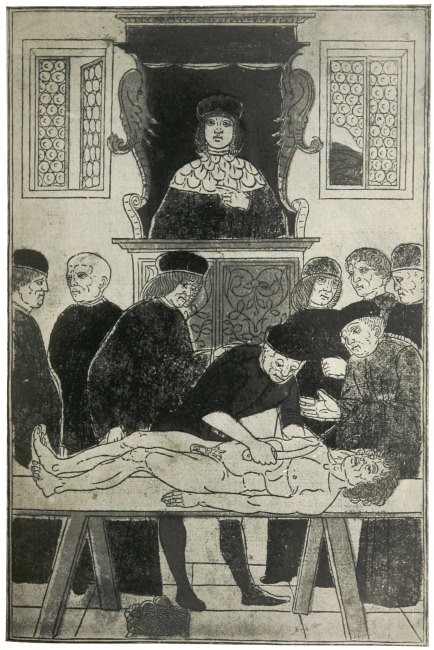
Plate XXVII. MUNDINUS(?) LECTURING ON ANATOMY
BIBLIOTHÈQUE NATIONALE MS. fr. 2030 Written in 1314
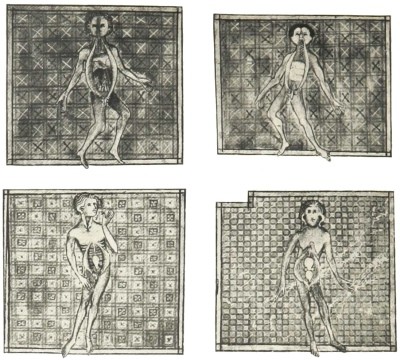
TO ILLUSTRATE THE ANATOMY OF HENRI DE MONDEVILLE
BODLEIAN MS. ASHMOLE 399 fo. 34 r
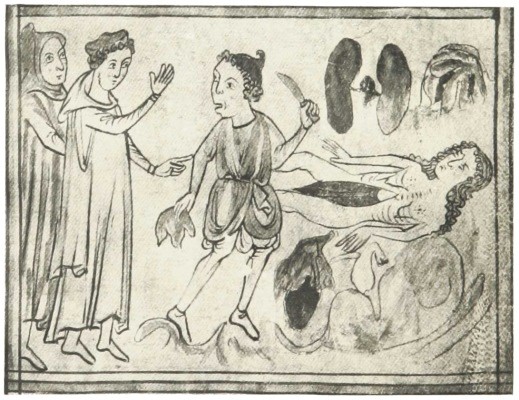
Plate XXVIII. A DISSECTION SCENE circa 1298
A STUDY IN EARLY RENAISSANCE ANATOMY,
WITH A NEW TEXT:
THE ANOTHOMIA OF HIERONYMO MANFREDI (1490)
By Charles Singer
TEXT TRANSCRIBED AND TRANSLATED BY A. MILDRED WESTLAND
I.
Anatomy in the Fourteenth and Fifteenth Centuries
79II.
Bolognese Works on Anatomy
92III.
Hieronymo Manfredi, Professor at Bologna, 1463–93
97IV.
The Manuscript
Anatomyof Manfredi
103V.
Translation of Selected Passages from the
Anothomia, with Commentary
106(a) The Brain, Cranial Nerves, &c.
106(b) The Eye
118(c) The Heart
122Italian Text of the
Anothomia 130I. Anatomy in the Fourteenth and Fifteenth Centuries
There was little or no progress in the knowledge of anatomy between the death of Mondino in 1327 and the sixteenth century. This appears the more remarkable when we recall how widespread was the practice of dissection during the period. In France, at the University of Montpellier, public dissections were decreed in the year 1377,121 and Catalonian Lerida followed suit in 1391.122 At Bologna, where dissection had long been customary, it received official recognition in the University Statutes in 1405,123 and the same event took place at Padua in 1429. Public anatomies were instituted at the University of Prague in 1460, of Paris in 1478, and of Tübingen in 1485.124 For these ‘Anatomies’ the bodies of executed criminals were usually employed, and therefore the number of subjects available varied greatly in different localities.125 In addition to these regular dissections, there was certainly a considerable amount of post-mortem examination, surreptitious (Plate XXVIII b126), or even open (Plate XXIX127), long before Benivieni published his memorable list of cases.128
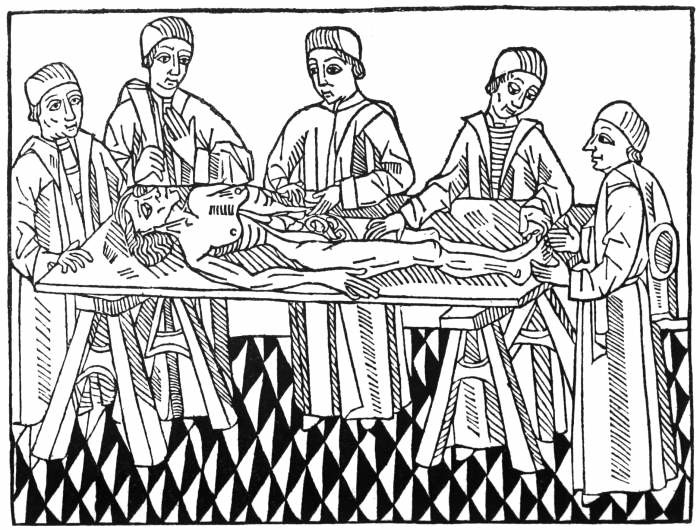
Fig. 1. From the French translation of Bartholomaeus Anglicus, Lyons, 1482. The first printed picture of dissection.
MS. fr. 184 fo. 14 r
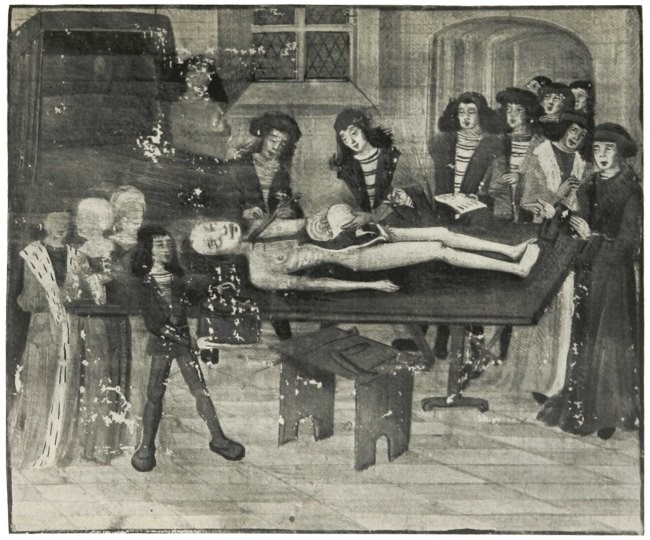
Plate XXIX. A POST-MORTEM EXAMINATION. Late XIVth Century
VATICAN MS. HISPANICE 4804 fo. 8 r
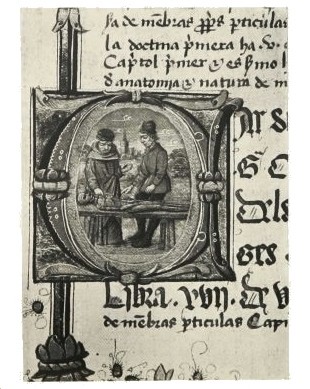
Plate XXX a. A DEMONSTRATION OF SURFACE MARKINGS
BRISTOL REFERENCE LIBRARY MS. fo. 25 r
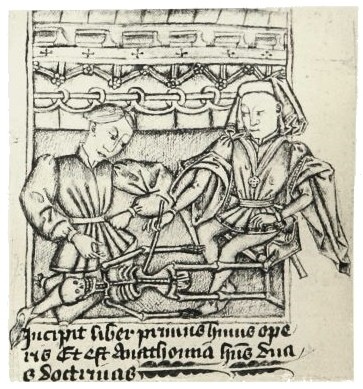
Plate XXX b. A DEMONSTRATION OF THE BONES TO ILLUSTRATE GUY DE CHAULIAC
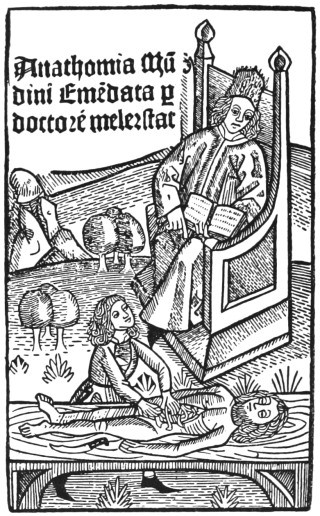
Fig. 2. Title-page of Mellerstadt’s edition of the Anatomy of Mondino, Leipzig, 1493. The scene is laid in the open air.131
That so much industry was rewarded by so small an increase in knowledge may probably be attributed to the method adopted. The so-called ‘anatomies’ were conducted in the most formal manner. Bertuccio, for example, who succeeded Mondino as professor of Surgery at Bologna, was accustomed, as we learn from his pupil Guy de Chauliac, to give short systematic anatomical demonstrations on a fixed and rigid method.129 The occupant of the chair at this period was indeed no professor in the modern sense of the word. To expound the tradition of anatomy as it had reached him was regarded as the limit of his duty. Of any attempt to extend the bounds of knowledge, of any systematic endeavour to correct or improve the anatomical views of his predecessors, we find little or no trace. Indeed, at Padua it was expressly laid down in the statutes that the exposition of anatomy should follow the very words of Mondino.130
Early figures portraying the teaching of anatomy (Plate XXVII and Figs. 1–3, 5) usually show us a medical doctor sitting at a desk, well removed from the subject of dissection, and reading from his text-book the description of the part. Meanwhile an assistant, who is usually also a doctor, performs the actual work of dissection. The professor of Surgery, to whom the teaching of anatomy was entrusted, stands by with a pointer to indicate the different organs.
Sometimes the professor changes places with the reader at the desk. In some later MSS. the teacher is figured as himself handling the body and demonstrating to his pupil (Plate XXX a132 and b133), but there is evidence that the miniatures portraying this are the work of artists unfamiliar with dissection and with the teaching of anatomy.
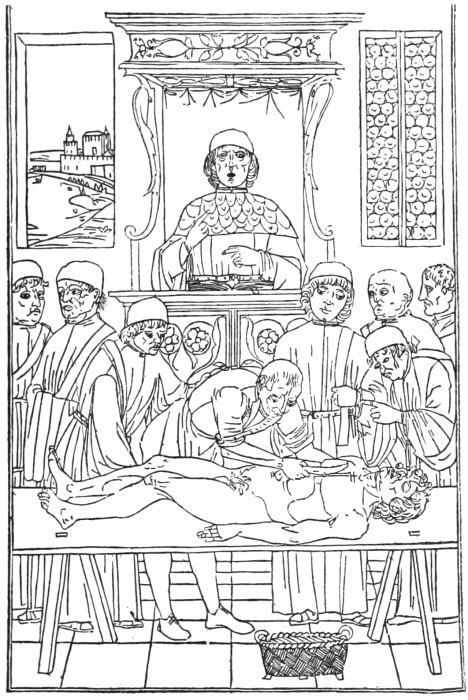
Fig. 3. A DISSECTION SCENE
From the Venice 1495 edition of ‘Ketham’ (compare Plate XXVII).
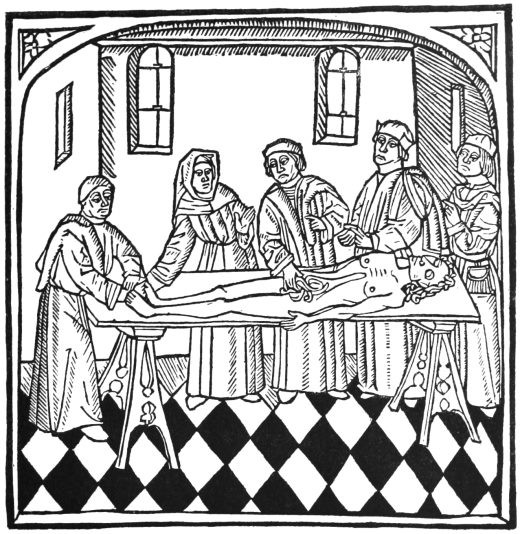
Fig. 4. From the English translation of Bartholomaeus Anglicus, printed by Wynkyn de Worde, 1495. The first picture of dissection in an English-printed book.
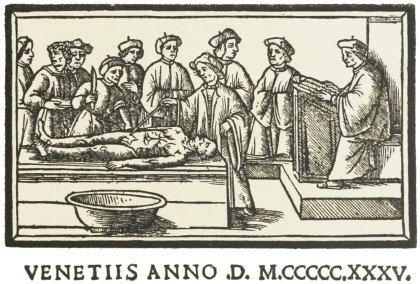
Fig. 5. A LECTURE ON ANATOMY
From the 1535 Venice edition of Berengar of Carpi’s Commentary on Mondino.
The study of anatomy had to contend with two great difficulties, want of subjects for dissection, and faith in the written word.
Thus, at Bologna, where it was arranged that every medical student of over two years’ standing should attend an Anatomy once a year, no less than twenty students were admitted to see the anatomy of each man, and thirty to the anatomy of each woman.134 This was all the practical instruction received. Some other Universities had to be content with the cadaver of a single criminal per annum for the whole body of students.
In the first period during which the human body was dissected in Europe, the thirteenth century, a certain amount of progress was certainly made, despite the rarity of subjects. The rebirth of learning in the thirteenth century was not, however, as favourable to anatomical progress as might have been hoped. Galen, indeed, ceased to be a mere name, and the Latin translations of his text, or of its adumbra in the writings of the Arabians, became ever more familiar. On the other hand, with more authoritative texts in their hands, men were but the more inclined to follow the evil scholastic way, and to trust rather to the written words of the master than to the evidence of their own senses. Thus it came about that the second period, which covers the fourteenth and most of the fifteenth century, was really stationary so far as the first-hand knowledge of anatomy was concerned. With the last decade of the fifteenth century, however, there opens a new and third period in the history of our subject. From that time dates the true era of anatomical renaissance, which may be regarded as continuing until the commencement of modern anatomy with the great work of Vesalius in 1543.
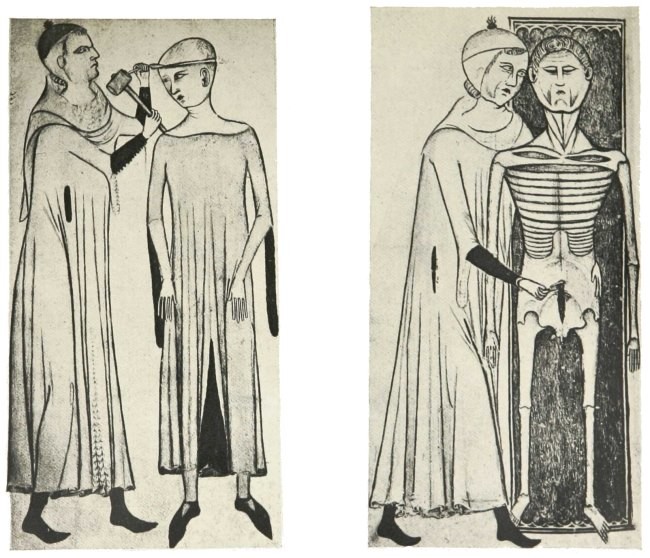
Plate XXXI. From the MS. of GUY DE VIGEVANO of 1345 at CHANTILLY
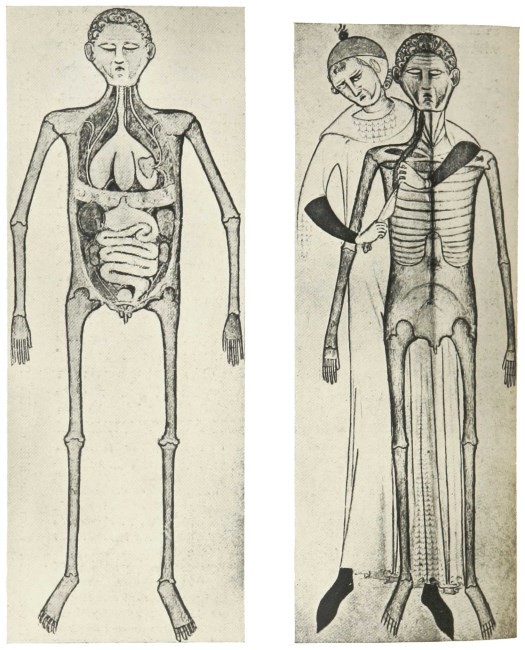
Plate XXXII. From the MS. of GUY DE VIGEVANO of 1345 at CHANTILLY
We have said that throughout the second period, the formal demonstrations based on the declaimed text of Galen or Avicenna or Mondino were practically the sole opportunities afforded to either teacher or pupil for the investigation of the minuter details of the human frame. But in making this statement concerning the arrest of anatomical progress, we must expressly exclude the products of the mighty genius of Leonardo da Vinci (1452–1519), whose anatomical researches were without influence, and remained long unnoticed.135 We must also omit evidence gathered from the work of such early Renaissance painters as Antonio Pollaiuolo (1429–98) or Andrea del Verrocchio (1435–88), for these pursued the study of anatomy in a special field and with a special object.136 Furthermore, there are a number of artists of similar date of whose anatomical studies we have no direct evidence, but who yet outlined the muscles of the nude human figure in such a way as leads us to suppose that they had investigated the superficial structures at least of flayed parts. Such is the suggestion of some of the work of Luca Signorelli (c. 1442–c. 1524), and of Andrea Mantegna (died 1506). With such reservations, however, it is probably true that no evidence is forthcoming until the last decade of the fifteenth century of any advance from the standpoint of Mondino.137
But if descriptive anatomy developed slowly in the hands of the physicians, the art of graphic representation of anatomical structures was still more backward. Several groups of anatomical drawings of mediaeval date have come down to our time, but examination of them shows that they have been drawn without direct reference to the human frame. Some of these figures are of the crude type known as the ‘five-figure series’ (Plate XXXIII), mere traditional diagrammatic sketches.138 Hardly better or more instructive are the series of dissections which illustrate certain MS. works of Henri de Mondeville (Plate XXVIII a)139 and Guido de Vigevano (Plates XXXI and XXXII), 1345.140 A few sketches representing the separate organs have also survived (Fig. 6),141 but these never suggest that the draughtsman had before him the structure which he seeks to depict, and the drawings appear to have been made in order to illustrate contemporary physiological theory rather than observed anatomical fact. Even the magnificent illuminated Dresden Codex of Galen, prepared in France or Flanders as late as the second half of the fifteenth century, betrays not the slightest first-hand knowledge of anatomy.142 Although the illustrations of this MS. are prepared with the utmost technical skill, they yet show us a teacher exhibiting to his pupils a heart of the form found on playing-cards, and other anatomical figures scarcely more faithful to the facts (Plate XXXIV).
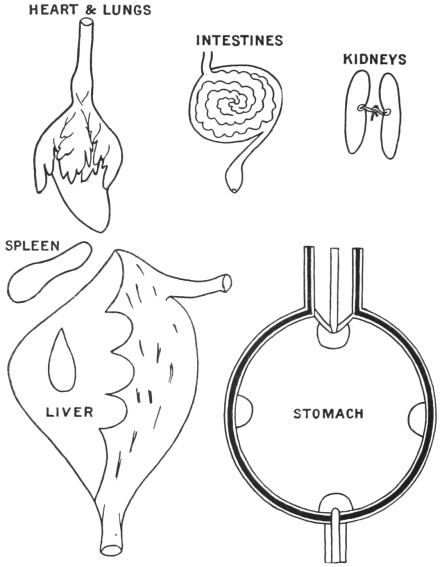
Fig. 6. DIAGRAMS OF THE INTERNAL ORGANS
After Bodleian Library MS. Ashmole 399 of about 1298, fos. 23 recto–24 recto.
The spirit of investigation of the artist who perforce went direct to nature, dissecting with his own hands and observing with his own eyes (Plate XXXVI), showed itself indeed far more fruitful than the tedious ex cathedra methodization of the professor.143 Yet the system of the schools needed to be combined with the freedom of the artist for the production of an effective anatomical work. What the projected treatise of Marcantonio della Torre (1473–1506) might have been we may guess from the anatomical sketches of Leonardo da Vinci (Plate XXXV), who was to have been associated with him in the work.144 In the event, however, the medical schools had to wait yet another generation before the subject was placed on a sound basis by André Vesale.
The Mondino pamphlet—for it is little more—used since its author’s death in 1327 as a text-book in the schools of northern Italy, was first printed in 1478. Not until the last decade of the fifteenth century did there appear another work bearing evidence of the hand of a practical anatomist. This was an Italian translation of Ketham’s Fasciculus medicinae, impressed at Venice in the year 1493.145 The volume comprises Mondino’s pamphlet and a collection of other medical tracts that were probably put together by Giorgio di Monteferrato from the work of a writer of the previous century, for their contents are traceable to a fourteenth-century MS.146 The text is neither original nor remarkable, but the Venice volume derives its importance from certain figures which appear in it for the first time.
Two of these plates are of great interest both intrinsically and also in relation to the history of anatomy. One of them is the magnificent representation of a dissection scene, which is regarded as perhaps the finest example of book illustration produced during the first century of typography147 (Plate XXVII). This work of the ‘maître aux dauphins’, as the unknown artist is called by critics,148 is doubly interesting, for it is the subject of an experiment in colour printing, no less than four pigments being laid on by means of stencils. As early as 1457 the method of stencilling was employed for colouring the initials of a Psalter, and in 1485 Erhard Ratdolt in an astronomical work added yellow to the earlier red and black. The figure from which our plate is taken represents, however, the first attempt at a complex colour scheme and leads up to the work of Hugo da Carpi.149
In this picture the professor, a youthful figure perhaps intended to represent Mondino himself, is shown standing at a desk which hides his book. Around a corpse, laid on a trestle table before him, there cluster a number of men in doctor’s robes. Their valid faces are sufficient to convince us that the artist is here presenting us with portraits. One of the listeners has removed his robe and stands with upturned sleeves and knife in hand, ready to make the first incision on the direction of the doctor, who points to the part with a wand held in the left hand. In the impression of 1495 and in those of later date, the book appears above the desk, the attitudes of the students are somewhat changed, and many other details are altered. In all these, however, the blocks have been recut and the result is artistically inferior150 (Fig. 3).
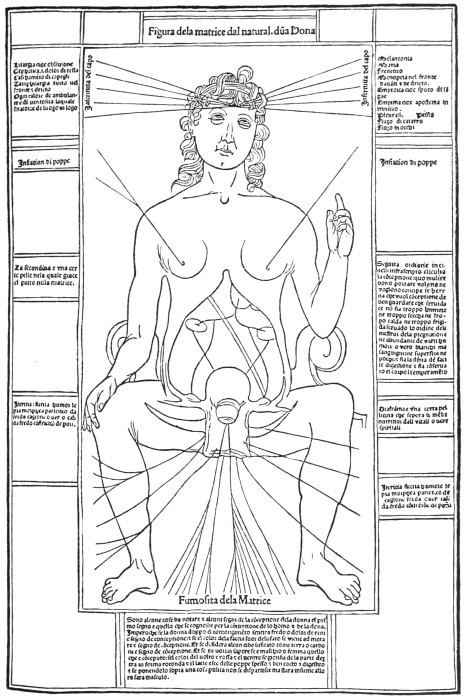
Fig. 7. A FEMALE FIGURE LAID OPEN TO SHOW THE WOMB AND OTHER ORGANS
From the 1493 Venice edition of ‘Ketham’ translated into Italian. This is the first printed anatomical figure drawn from the object.
The second plate from the 1493 Ketham with which we are here concerned is the outline of a female body, in a traditional pose,151 laid open to exhibit some of the internal organs (Fig. 7). These had clearly been sketched from the object, and therefore this drawing, the first printed figure of its kind, may be said to introduce the new era for the investigation of the human frame. The anatomical renaissance had begun. Into a discussion of the full development of that age we cannot now enter. But the MS. of Manfredi, with which we have here to deal, was written at the very dawn of the new era and is itself one of its earliest documents.
II. Bolognese Works on Anatomy
An organized Medical Faculty existed at Bologna at least as early as 1156,152 though the first record of dissection there is of considerably later date. In February 1302 a certain Azzolino died under suspicious circumstances. Poison was suspected, an inquest was held and a post-mortem examination ordered. The investigation was conducted by two physicians and three surgeons, who unanimously agreed ‘that the said Azzolino assuredly met his death by no poison, but on the contrary, we assert that the quantity of blood collected in the great vein known as the vena chilis [vena cava]153 and in the veins of the liver adjacent thereunto, has prevented the due movement of the spiritus throughout the body, and has thus produced the diminution or rather extinction of the innate heat and thereby induced a rapid post-mortem discoloration. Of this condition we have assured ourselves by the evidence of our own senses and by the anatomization of the parts.’154
The first anatomical document emanating from the University of Bologna is, however, of still earlier date, and is the work of William of Saliceto (1210?–80). This writer was educated at Bologna, and it is claimed that he was the first to dissect the human body there.155 His Cyrurgia, which was completed in 1275 (editio princeps, Piacenza, 1476), is divided into five books, of which the fourth and shortest is devoted to anatomy. Its descriptions are brief and concise. They are often clearly the result of actual observation, and they show hardly any trace of the absurd and irritating teleology that the influence of the Arabians and of Galen made customary in early anatomical literature. The anatomy of Saliceto appears to us very sensible and so far as it goes practical. It betrays the method rather of the Salernitan than of the Arabian anatomical writings, and is on the whole the best European work of the kind before the Renaissance. It was, however, soon replaced by the text-book of Mondino di Luzzi (1285–1327),156 which, though inferior to that of Saliceto, held the field until the subject was revolutionized by Vesalius.
Plate XXXIII. The FIVE-FIGURE SERIES BODLEIAN MS. ASHMOLE 399, about 1292 Fos. 18 r–22 r
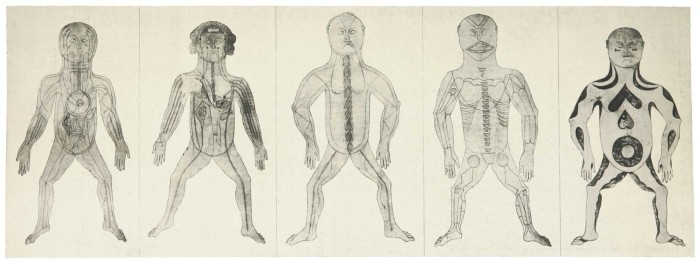
VEINS, &c. ARTERIES NERVES BONES MUSCLES
From the DRESDEN GALEN MS.
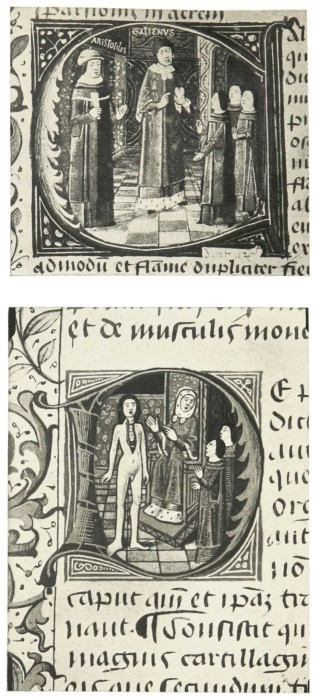
Plate XXXIV. DEMONSTRATIONS OF ANATOMY Second half of XVth Century
Mondino was professor at Bologna till his death in 1327. His work, easily accessible in one of its many editions, ‘is corrupted by the barbarous leaven of the Arabian schools, and his Latin defaced by the exotic nomenclature of Avicenna and Rhazes’.157 But it is not the language alone that has suffered. The schoolman’s attitude, well fitted for the classification of ideas, is an ill instrument for the investigation of Nature, and in the scholastic Mondino the very basis of scientific judgement is undermined, so that he readily accepts the views of the ancients against what must often have been the evidence of his own senses. The work, however useful to the contemporary student, was thus essentially reactionary as against the efforts of the earlier Salernitan anatomists and of William of Saliceto. This is the more remarkable because it is quite clear that he was accustomed to demonstrate on the actual body—a privilege denied to the early Salernitan school,—and he was, moreover, a popular and successful teacher. His work is a manual of dissection rather than a treatise on anatomy. This, added to its conciseness and brevity, strengthened its appeal to the ‘practical’ man—an epithet claimed then, as now, by the majority of stupid and unpractical people. The personal influence and enthusiasm of its author no doubt helped also towards the phenomenal success of this work, which for two hundred years held a position without rival as the text-book of the medical schools of Italy, where even as late as the sixteenth century Mondino ‘was still worshipped by all the students as a very god’.158
Mondino was succeeded in the chair of Surgery at Bologna by his pupil, the Lombard Bertuccio, who died in the Black Death of 1347. Bertuccio’s surviving work is unnoteworthy, but he was the anatomical teacher of Guy de Chauliac, whose Surgery159 is of great value and was very influential in standardizing practice, especially in the north and west of Europe. Nevertheless it appears to us that the anatomical section is the weakest part of Guy’s great work. The teleology that is a blot in Mondino has here become a perfect plague, and Guy’s anatomy consists of one-third description and two-thirds wearisomely reiterated reasons for the existence of imperfectly described structures. Through Guy de Chauliac the anatomical tradition of Mondino passed over into the University of Montpellier.
A later fourteenth-century Bolognese writer was Tommaso di Garbo (died 1370), who did little but comment on Avicenna. A surgeon of the next generation, however, Pietro d’Argellata, deserves to be remembered for his description of the examination of the body of Pope Alexander V, who died suddenly at Bologna on May 4, 1410. His account throws light on the customary procedure and may be rendered here.160
‘I ordered the attendants’, he says, ‘first to cut the abdomen from the pomegranate [i.e. the Adam’s apple or laryngeal cartilage161] to the os pectinis [i.e. the symphysis pubis]. Then, so that they should not rupture the intestines, I myself sought the rectum and ligatured it in two places and then cut it between. Next I removed all the intestines as far as the duodenum and dealt with them as with the rectum, and so I had the intestines clean and without fetor. After this I extracted the liver, seizing its ligaments; then the spleen and then the kidneys, and these were all placed together in a jar. I now passed to the spiritual members [i.e. the thorax] and removed lung and heart and all their ligaments. Then I ligatured the meri [the Arabian term for oesophagus] and removed the stomach. When this had been done there were some who wished to remove the tongue but knew not how. I however cut under the chin and extracted the tongue through that hole, together with trachea arteria [trachea] and meri. Then I passed to the arteria adorti [aorta] and vena chilis [vena cava]. Lastly I removed the ligatured remnant of the intestines as far as the anal margin.’
Giovanni da Concoreggio (died 1438), who was lector in Surgery at Bologna in the early part of the fifteenth century, left a few anatomical observations of little note,162 and not very much more can be said for his successors and Manfredi’s contemporaries Gabriele Gerbi (de Zerbis, died 1505) and Alessandro Achillini (1463–1512). Gerbi163 does little but repeat in the most verbose fashion the work of Mondino and of Avicenna, some of whose errors, however—e.g. the three ventricles of the heart—he omits. He wrote also an anatomy of the infant, or rather of the foetus,164 and a treatise taken mainly from Avicenna’s De generatione embryonis. Like all his work, these are in the full scholastic style of a professor of Logic, a position to which, in fact, he ultimately attained.
Achillini’s work165 is but a slight advance on that of Gerbi. It is really little else than a note-book for students, and gives the baldest directions for dissection, accompanied by a few comments taken from Avicenna. Achillini occasionally ventures to criticize Mondino, and his work has at least the advantage of brevity. He has a claim to be remembered in that he was the first to describe the duct of Wharton and is said to have been the first to describe the ear ossicles, malleus and incus. Achillini, like Gerbi, was a windy and very ‘scholastic’ disputator. He was best known to his contemporaries as a supporter of the philosophy of Averroes. In 1506, when driven from Bologna with the other supporters of Bentivoglio, he became professor of Philosophy at Padua.
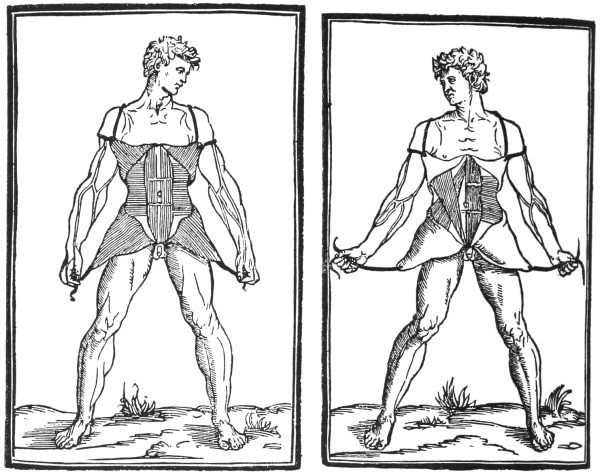
Fig. 8. THE ABDOMINAL MUSCLES
From Berengar of Carpi’s Commentary on Mondino, Bologna, 1521.
With Giacomo Berengario da Carpi we come at length to one who definitely advanced the science, and who may be regarded as the first modern anatomist, so far as printed works are concerned. He was professor of Surgery from 1502 to 1527, and during that period published his great anatomical work.166 This volume, though modestly put forward as a commentary on Mondino, is in reality an original contribution of great value. It is the earliest anatomical treatise that can properly be described as having figures illustrating the text (Fig. 8).167 Carpi does not hesitate to criticize the work on which he comments—as for instance when he denies the existence of the ‘rete mirabile’ below the brain, though descriptions of the ‘rete mirabile’ had been based on the statement of no less an authority than Galen. Furthermore he was the first to describe the vermiform appendix, and he gave the earliest correct account of several other organs, e.g. the choroid plexus and the olfactory nerves. He was an industrious dissector, and he tells us that he had examined more than a hundred bodies.
With Carpi we close our series of Bolognese anatomists. Into that group we now proceed to fit the writer with whom we are here specially concerned, Hieronymo Manfredi.
From a drawing in the Library, WINDSOR CASTLE
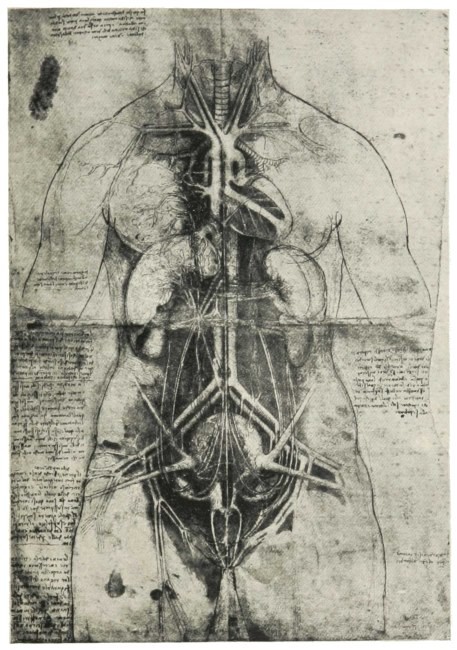
Plate XXXV. VIEW OF THE INTERNAL ORGANS LEONARDO DA VINCI
From a Drawing in the ASHMOLEAN MUSEUM, OXFORD, attributed to BARTOLOMEO MANFREDI (1574?–1602)
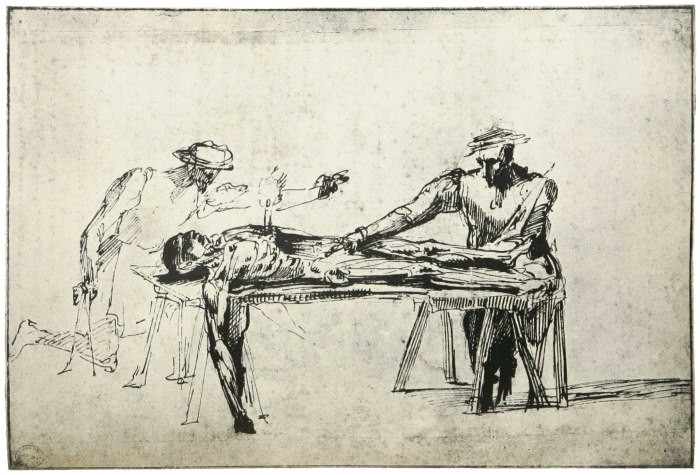
Plate XXXVI. THE TWO FIGURES DISSECTING ARE TRADITIONALLY SAID TO REPRESENT MICHELANGELO AND ANTONIO DELLA TORRE
III. Hieronymo Manfredi
Hieronymo Manfredi was a member of a family that had already for more than two centuries provided distinguished citizens, and especially physicians, to the city of Bologna.168 He was born about the year 1430 and was educated at the University of Bologna. Here in 1455 he was laureatus in Philosophy and Medicine, and here he became professor of the latter subject in 1463.169
During the second half of the fifteenth century, a perfect mania for the study of astrology infected Italy and penetrated equally into the Court, the Church, and the Academy. The profession of Medicine was far from immune, and at the University of Bologna, where a chair of Astrology had long been established,170 the study was pursued with ardour and enthusiasm. Here Manfredi early devoted himself to that will-o’-the-wisp, the pursuit of which absorbed and sterilized many of the best intellects of his day. By the year 1469 he was already regarded as an authority on the vainest of studies,171 and as the years went on he seems to have devoted himself to it ever more and more. The generally credulous character of Manfredi’s astrological ideas may be gathered from the page of his Prognosticon ad annum 1479 which we here reproduce (Fig. 10).
The history of Manfredi’s connexion with the University of Bologna may be briefly told. He appears for the first time on the professorial roll in 1462, when we find him giving the ‘extraordinary’ lectures on Philosophy, a subject then regarded as under especial charge of the physicians. In 1465 he was conducting the ‘ordinary’ course in Philosophy, and at the same time giving occasional lectures on Medicine. In the following year he was called to the chair of Theoretical Medicine, and in 1469 he helped the Faculty out of a difficulty by giving lectures on ‘Astronomia’ in place of the aged professor Giovanni de Fundis. The latter died in 1474, and from that date onward Manfredi assumed responsibility for the course on ‘Astronomia’. Among the colleagues who joined him were Gabriele de Gerbi, who became lecturer on Logic in 1476, Filippo Beroaldo, who became lecturer on Rhetoric and Poetry in 1479, and Alessandro Achillini, who became lecturer on Logic in 1484.172
Such was the regard for Manfredi’s powers of astrological prediction that to all the University announcements of his course of lectures on Astronomy is added ‘cum hoc quod faciat iudicium et tachuinum’.173 In spite of his proficiency in the science, however, he was unable to foretell his own death. Giovanni Pico della Mirandola writes of him thus derisively:
With Giacomo Berengario da Carpi we come at length to one who definitely advanced the science, and who may be regarded as the first modern anatomist, so far as printed works are concerned. He was professor of Surgery from 1502 to 1527, and during that period published his great anatomical work.166 This volume, though modestly put forward as a commentary on Mondino, is in reality an original contribution of great value. It is the earliest anatomical treatise that can properly be described as having figures illustrating the text (Fig. 8).167 Carpi does not hesitate to criticize the work on which he comments—as for instance when he denies the existence of the ‘rete mirabile’ below the brain, though descriptions of the ‘rete mirabile’ had been based on the statement of no less an authority than Galen. Furthermore he was the first to describe the vermiform appendix, and he gave the earliest correct account of several other organs, e.g. the choroid plexus and the olfactory nerves. He was an industrious dissector, and he tells us that he had examined more than a hundred bodies.
Manfredi’s work, however, if not original is at least eclectic, and the variety of its sources indicates a dawning consciousness of the unwisdom of trusting to the infallibility of any one writer. The work is thus in a sense intermediate between the early printed versions of Mondino, such as that of 1478, and the edition published in 1528 by Berengario da Carpi with its frank commentary of the master. All represent stages towards the freedom of the later Renaissance investigators.
Manfredi’s description of the anatomy of the eye is that generally accepted at the end of the fifteenth and the beginning of the sixteenth centuries, and is unusually clear for its date. It represents a considerable advance on such writers as Henri de Mondeville (1260–1320)199 or the pseudo Richardus Anglicus, and is far superior to the descriptions of the eye dating from the fourteenth and fifteenth centuries recently brought to light by Sudhoff.200 We reproduce as illustrating Manfredi a diagram taken from the Margarita philosophica of Gregorius Reisch (died 1525). This represents the earliest printed figure of any value of the anatomy of the eye (Fig. 19).201 We give for comparison the figure from a thirteenth-century MS. of Roger Bacon (Plate XXXVIII a), representing the rival tradition of Avicenna and Alhazen that influenced Leonardo da Vinci and other contemporaries of Manfredi. These figures may be compared with that of Vesalius (1543, Fig. 20), whose description of the eye is less free from traditional bias than are most parts of his epoch-making work.
In order to understand why all these authors invoked the existence of the third ventricle, regarded by some of them as a passage between the other two, we must turn to the physiological beliefs of the age. It must be recalled that before the demonstration of the circulatory movement of the blood a certain amount of communication was believed to exist between right and left ventricles. The complicated nature of the ventricular cavities and the intricacy of the columnae carneae promoted the idea of the presence of minute passages in the interventricular septum. Even so astute an observer as Leonardo da Vinci considered that ‘the ventricles are separated by a porous wall, through which the blood of the right ventricle penetrates into the left ventricle, and when the right ventricle shuts, the left opens and draws in the blood which the right one gives forth’ (Plate XXXVIII b).215
121 Cartulaire de l’Université de Montpellier (1180–1518), Montpellier, 1894, p. 21.
122 Dates of the institution of dissection at this and other Universities are given by F. Baker in Bulletin of the Johns Hopkins Hospital, vol. xx, p. 331, Baltimore, 1909.
123 Statuti dell’ Università di Medicina e di Arti del 1405, Rubr. lxxxxvi (‘De anothomia quolibet anno fienda’) in the Statuti delle Università e dei collegi dello Studio bolognese, edited by Carlo Malagola, Bologna, 1888, p. 289.
124 J. Säxinger, Ueber die Entwickelung des medizinischen Unterrichts an der Tübinger Hochschule, Tübingen, 1884, pp. 5 and 10.
125 How rarely dissections were conducted in some of the Universities may be gathered from the first statutes of the medical faculty of Tübingen, dated 1497. These ordain a dissection every three or four years. Not till 1601 was an anatomy held at Tübingen even once a year (see Säxinger, loc. cit.). Even at Montpellier in the sixteenth century the scarcity was so great that Rondelet (1507–66) was on one occasion reduced to dissect the body of his son. For this terrible incident see A. Portal, Histoire de l’Anatomie et Chirurgie, Paris, 1770, vol. i, p. 522; A. Haller, Bibliotheca anatomica, Lib. iv, § clxxxiv, Leyden, 1774, vol. i, p. 205; and A. O. Goelicke, Introductio in historiam litterariam anatomes, Frankfurt, 1738, p. 136. There was, however, a relatively plentiful supply of subjects in the Italian Universities and especially at Bologna and Padua in the fourteenth, fifteenth, and sixteenth centuries (cp. A. Haller, Bibliotheca anatomica, introduction to Lib. v, p. 218). This was perhaps due to the utterly depraved state of public and private morals to which the peoples of the peninsula had been reduced by the excesses of the tyrants and the condottieri.
126 Plate XXVIII b is perhaps the earliest representation of the practice of dissection yet brought to light. It is described in Charles Singer, ‘Thirteenth-Century Miniatures illustrating Medical Practice’, Proceedings of the Royal Society of Medicine, Section of the History of Medicine, 1916, vol. ix, pp. 29–42.
127 Plate XXIX: a post-mortem scene in the late fourteenth century, from a French MS. of the Grande Chirurgie of Guy de Chauliac, Bibliothèque de la Faculté de Médecine de Montpellier, MS. 184 français, folio 14 recto. The scene is laid in the bedroom of the deceased. In the left-hand top corner is the bed, by the side of which a female figure, partly obliterated, is praying. Below and to the left are two other female figures, and a man richly dressed in an ermine-trimmed robe. These are presumably the relatives of the dead. The corpse, that of a woman, has been placed on a bare table and is opened from the larynx to the symphysis pubis. In front stands a lad holding a round wooden vessel for the reception of the viscera, and farther to the right is a stool on which are placed two or three instruments. The physician, in full canonicals, is at the extreme right of the picture. The actual process of examination is being made by three of his assistants. To the left the first of these deepens, with a knife, the incision that has already been made over the sternum, the second is grasping with his two hands and rolling up the great omentum so as to display the viscera beneath, and the third holds a wand in his right hand, with which he points to the abdomen, while in his left he carries a book. Five others throng into the room from a passage which opens into it.
128 Antonio Benivieni, De abditis nonnullis ac mirandis morborum et sanationum causis, Florence, 1506. In the description of Case 32, Benivieni expresses surprise at having been refused permission to perform a post-mortem examination, as though it were unusual for him to meet rebuffs of the kind. ‘Experimento comprobare volentes, corpus incidere tentavimus sed nescio qua superstitione negantibus cognatis, voti compotes fieri nequivimus.’
131 Martin von Mellerstadt, also called Pollich or Polich.
129 See E. Nicaise, La Grande Chirurgie de Guy de Chauliac, p. 30, Paris, 1890.
130 ‘Ut Anatomici explicationem ipsius Mundini sequantur’, Francesco Maria Colle, Storia scientifico-letteraria dello Studio di Padova, 4 vols., Padua, 1824–5, vol. iii, p. 108.
Fig. 1. From the French translation of Bartholomaeus Anglicus, Lyons, 1482. The first printed picture of dissection.
Fig. 3. A DISSECTION SCENE
From the Venice 1495 edition of ‘Ketham’ (compare Plate XXVII).
Fig. 5. A LECTURE ON ANATOMY
From the 1535 Venice edition of Berengar of Carpi’s Commentary on Mondino.
132 Plate XXX a, from a late fifteenth-century Provençal translation of the Grande Chirurgie of Guy de Chauliac. Vatican Library, MS. hispanice 4804, folio 8 recto. A professor and pupil are examining a wasted corpse placed on a trestle in the open air. The teacher is pointing out the surface markings.
133 Plate XXX b, from the French Guy de Chauliac MS. in the Bristol Reference Library, folio 25 recto. The MS. dates from between the years 1420 and 1435; cp. Norris Mathews, Early Printed Books and MSS. in the Bristol Reference Library, Bristol, 1899, p. 70; J. A. Nixon, ‘A New Guy de Chauliac MS.’, in Transactions of the XVIIth Internal. Cong. of Med., Sect. of Hist. of Med., London, 1914, p. 419; and Charles Singer, ‘The Figures of the Bristol Guy de Chauliac MS. circa 1430’, Proceedings of the Royal Society of Medicine, Section of the History of Medicine, 1917, vol. x, pp. 71–91. The figure shows a professor and pupil. The former is demonstrating the bones of a skeleton.
134 The number of female criminals being less than the number of male criminals, Ludovico Frati states (La vita privata di Bologna dal secolo XIII al XVII, Bologna, 1900, pp. 116–18) that only two anatomies in all were held each year, and thirty students admitted to the female and twenty to the male dissection. This would mean far less than two dissections a year for each student of over two years’ standing.
135 The anatomical works of Leonardo have now been rendered accessible in Tredici Foglie delta Royal Library di Windsor. Leonardo da Vinci, Quaderni d’anatomia ... Pubblicati da O. C. L. Vangensten, A. Fonahm, H. Hopstock, Christiania, 1911, &c.
136 Pollaiuolo and Verrocchio only studied surface anatomy, so far as is known. For a summary of the anatomical work of these painters see M. Duval and E. Cuyer, Histoire de l’Anatomie plastique, p. 20, Paris, 1898.
137 It has been suggested that Giammatteo Ferrari da Grado (Matthaeus de Gradibus), who was professor of Medicine at Pavia 1432–72, made original contributions to anatomy. He wrote no separate work on anatomy, but his observations on the ovaries (which he was perhaps the first to call by that name) appear in his Practica, Milan, 1471, and in his Expositiones super vigesimam secundam Fen tertii canonis Avicennae, Milan, 1494. An interesting account of Ferrari’s life and work is given by his descendant, H. M. Ferrari, in Une Chaire de Médecine au XVe siècle; Un professeur a l’université de Pavie de 1432 à 1472, Paris, 1899. In this work the claim that De Gradibus was an original and independent observer is effectively disposed of.
138 At least six Western copies of this series, besides three or more of oriental origin, have now been detected. The Western MSS. and their dates are as follows:
139 Cp. K. Sudhoff in Ein Beitrag zur Gesch. der Anatomie im Mittelalter, Leipzig, 1908.
140 E. Wickersheimer, ‘L’Anatomie de Guido de Vigevano, médecin de la reine Jeanne de Bourgogne (1345)’, in Archiv für Geschichte der Med., vii. 1, Leipzig, 1914. M. Wickersheimer has kindly given permission for the reproduction of the figures in Plates XXXI and XXXII.
Fig. 6. DIAGRAMS OF THE INTERNAL ORGANS
After Bodleian Library MS. Ashmole 399 of about 1298, fos. 23 recto–24 recto.
141 Notably the MS. Roncioni 99, dating from the first half of the twelfth century, in the University Library of Pisa, reproduced by K. Sudhoff in the Archiv für Gesch. der Med., vii, Tafel xiv, 1914. Also separate organs are depicted in the Bodleian MS. Ashmole 399, dating from the end of the thirteenth century, reproduced in Fig. 6.
142 The miniatures of the Dresden Codex have been studied by L. Choulant, Geschichte und Bibliographie der anatomischen Abbildung nach ihrer Beziehung auf anatomische Wissenschaft und bildende Kunst, Leipzig, 1852, and in the Archiv für die zeichnenden Künste, II. Jahrgang, Leipzig, 1856, p. 264. More recently the MS. has been most carefully described and its miniatures reproduced by E. C. van Leersum and W. Martin, Miniaturen der lateinischen Galenos-Handschrift der kgl. öffentl. Bibliothek in Dresden, in phototypischer Reproduktion, Leyden, 1910. We have to thank Dr. Van Leersum of Leyden for kind permission to reproduce the figures of Plate XXXIV.
143 Cp. P. Triaire, Les leçons d’anatomie et les peintres hollandais aux XVIe et XVIIe siècles, Paris, 1887.
144 For della Torre and his projected work on anatomy, see G. Cervetto, Di alcuni illustri anatomici italiani del decimoquinto secolo, p. 46, Verona, 1842; also L. Choulant, Geschichte der anatomischen Abbildung, p. 5, Leipzig, 1852.
145 The first edition appeared in Venice in 1491 and is in Latin. It is of less typographical interest.
146 K. Sudhoff, ‘Eine Pariser “Ketham” Handschrift aus der Zeit König Karls VI (1380–1422)’, in Archiv für Geschichte der Medizin, vol. ii, p. 84, Leipzig, 1909; ‘Neue Beiträge zur Vorgeschichte des Ketham’, in Archiv für Geschichte der Medizin, vol. v, p. 280, Leipzig, 1912.
147 Prince d’Essling, Les livres à figures vénitiens de la fin du XVe siècle et du commencement du XVIe, part i, vol. ii, p. 56, Florence and Paris, 1908.
148 Eugène Piot, Le Cabinet de l’amateur, nouv. série, Paris, 1861, ‘Le maître aux dauphins’, p. 354 et seq. The dolphins are seen on either side of the chair in Plate XXVII.
149 Duc de Rivoli, Bibliographie des livres à figures vénétiens, p. 110, Paris, 1893.
150 Cp. G. Albertotti, Nuove osservazioni sul ‘Fasciculus medicinae’ del Ketham, Padua, 1910.
151 See K. Sudhoff, ‘Weibliche Situsbilder von ca. 1400–1543’, in Tradition und Naturbeobachtung, p. 79, Leipzig, 1907. The number and character of the indication lines attached to this figure suggest that the block from which the impression has been taken had previously been used for some other publication. This work, however, if it exists, has not yet come to light.
152 Michele Medici, Della vita e degli scritti degli anatomici e medici fioriti in Bologna dal comincio del secolo XIII, Bologna, 1853; Compendio storico della scuola anatomica di Bologna dal Rinascimento delle Scienze e delle Lettere a tutto il Secolo XVIII, Bologna, 1857.
153 The mediaeval term, ‘vena chilis’, lasted in anatomy until the end of the sixteenth century and probably later. ‘Chilis’ is a corruption of the Greek κοίλη. This hybrid name was abandoned by Vesalius (Fabrica, 1543 Basle edition, p. 376) in favour of the title ‘vena cava’.
154 The passage is translated from Michele Medici, Compendio storico, pp. 10–11.
155 See A. Laboulbène, ‘Les anatomistes anciens’, in Revue scientifique pour la France et pour l’Étranger, vol. xxxviii, p. 641, Paris, 1886; Robert Ritter von Töply in Puschmann, Pagel, and Neuburger, Handbuch der Geschichte der Medizin, vol. ii, p. 197, Jena, 1903; G. Martinotti, ‘L’insegnamento dell’ Anatomia in Bologna prima del secolo xix’, in Studi e Memorie per la storia dell’ università di Bologna, vol. ii, p. 51, Bologna, 1911.
156 An intermediate anatomist was Gulielmo Varignana, who was professor of Medicine in Bologna, and is recorded as having opened for judicial purposes, on February 15, 1302, the corpse of one alleged to have been poisoned. See Michele Medici, op. cit. The investigation is referred to above.
157 Dr. Craigie in his excellent account of the History of Anatomy, in the ninth and subsequent editions of the Encyclopaedia Britannica.
158 ‘Mundinus quem omnis studentium universitas colit ut deum’, J. Adelphus in his edition of Mondino, Strassburg, 1513.
159 Editio princeps, Lyons, 1478.
160 Pietro de Argellata, Cirurgia, ‘Incipit liber primus cirurgie magistri Petri de la Cerlata’ (!), Venice, 1492. Quotation from lib. v, tract. 12, chap. 3. An earlier edition which we have not seen was printed in Venice in 1480.
161 The ‘pomegranate’ sometimes also means the xiphisternum. It is not clear which is implied here.
162 Giovanni da Concoreggio, Lucidarium et Flos Medicinae, Giunta, Florence, 1521. It contains a few scattered anatomical points.
163 De Zerbis, Liber Anatomiae corporis humani et singulorum membrorum illius, Venice, 1502.
164 Reprinted in the Anatomia of Johannes Dryander, Marburg, 1537.
165 Alessandro Achillini, Annotationes anatomiae, Bologna, 1520. This work is also included in the 1502 edition of De Zerbis’ Liber Anatomiae.
166 Carpi commentaria cum amplissimis additionibus super anatomia mundini una cum textu eiusdem in pristinum et verum nitorem redacto, Bologna, 1521. An earlier and less important edition of Carpi was the Anathomia Mundini noviter impressa ac per Carpum castigata that appeared at Bologna in 1514.
167 The figures in Ketham and in the wretched productions of Johannes Adelphus (J. A. Muelich), of Hundt, and of Peyligk can hardly be said to illustrate the text of anatomical treatises.
168 Albano Sorbelli, Le Croniche Bolognesi del Secolo XIV, Bologna, 1900; La Signoria di Giovanni Visconti a Bologna, Bologna, 1901; Michele Medici, loc. cit., p. 4.
169 Giovanni Fantuzzi, Notizie degli scrittori bolognesi, Tom. v, p. 196, Bologna, 1786.
170 Hastings Rashdall, The Universities of Europe in the Middle Ages, 3 vols., Oxford, 1895, vol. i, p. 244.
171 He is mentioned in this capacity by Niccolò Burzio, Bononia illustrata, Bologna, 1494. We have been unable to consult this work, which is quoted by Fantuzzi, loc. cit. See also Ferdinando Gabotto, Bartolomeo Manfredi e l’Astrologia alla Corte di Mantova, Torino, 1891, p. 19.
Fig. 10. The last page of Manfredi’s Prognosticon ad annum 1479, Bologna, 1478.
172 Manfredi’s University career is extracted from Umberto Dallari, I rotuli dei lettori legisti e artisti dello studio bolognese dal 1384 al 1799, Bologna, vol. i, 1888, and Luigi Nardi and Emilio Orioli, Chartularium Studii Bononiensis, Imola, vol. i, 1907.
173 See also P. A. Orlandi, Notizie degli scrittori bolognesi, Bologna, 1714.
‘quo anno [1493] obiit omnimoda[m] uite incolumitate[m] fuerat pollicitus Hieronymus manfredus astrologus nostra aetate singularis: a quo tamen nihil mirandum minus praeuisam aliorum mortem: qui nec suam ipse praeuiderit: nam cum proxima estate uita sit functus: in istius tame[n] anni publico uaticinio qui s[cilicet] ei fuit fatalis: multa & mira sequenti anno dicturum se non semel pollicebatur. Qui nescio oppignoratam fidem quomodo reluet: nisi forte de caelo uerius nunc terrena despiciat q[uam] de terra oli[m] caelestia suspiciebat.’174
Manfredi died in 1493 and was buried in the church of Santa Margarita in Bologna. This church no longer exists, but it contained in the eighteenth century a tomb bearing the inscription:
HIERON. MANFREDO BONON. PHILOSOPHO AC MEDICO SVAE AETATIS NEMINI SECVNDO ASTRONOMORVMQVE CITRA INVIDIAM FACILE PRIMARIO. POSVIT SVPERSTES IOAN. FILIVS SVISQVE POSTERIS. VALE ATQVE ILLVM VALERE OPTA.175
Manfredi left a widow, Anna, who was still living in 1496 with a household of ten persons in the Via S. Margarita.176 The houses on one side of this street backed on the very walls of the buildings belonging to the ‘University of Medicine’,177 and we may suppose that Hieronymo Manfredi had resided here on that account. His surviving son, Giovanni, lived hard by in the Via S. Antonio di Padoa.
It cannot be said that Manfredi’s printed works suggest great scientific attainments. All are permeated by the same astrological obsession. They comprise the following:
(a) The editio princeps of Ptolemy’s Cosmographia and Tabulae Cosmographiae, the best-known printed work to which Manfredi’s name is attached. He was associated in its production with the famous scholar Filippo Beroaldo, and the finely produced volume was published at Bologna in 1472 (?),178 and dedicated to the memory of Pope Alexander V (died 1410). It is interesting as containing the first printed map of England (Fig. 9). At the end of the work we read:
‘Accedit mirifica imprimendi tales tabulas ratio. Cuius inuentoris laus nihil illorum laude inferior. Qui primi litterarum imprimendarum artem pepererunt in admirationem sui studiosissimum quemque facillime conuertere potest. Opus utrumque summa adhibita diligentia duo Astrologiae peritissimi castigaueru[n]t Hieronimus Mamfredus & Petrus bonus. Nec minus curiose correxerunt summa eruditione prediti Galeottus Martius & Colla montanus. Extremam emendationis manum imposuit philippus b[e]roaldus.’
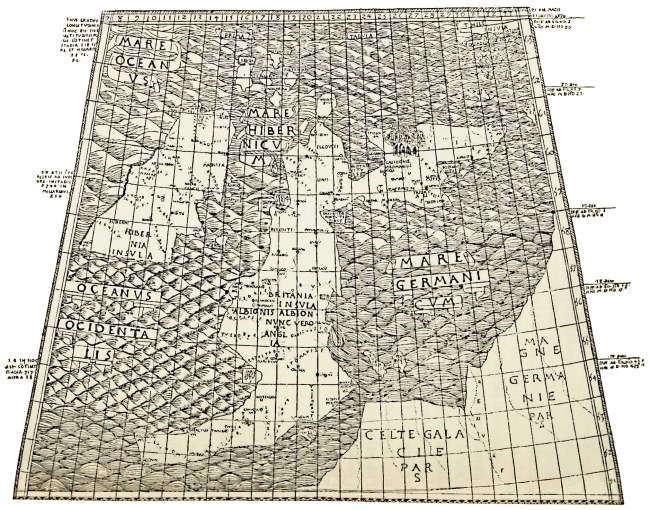
THE FIRST PRINTED MAP OF ENGLAND.
From the 1472 (?) Bologna Ptolemy, edited by Manfredi and others.
(b) Liber de homine: cuius su[n]t libri duo. Primus liber de conservatione sanitatis.... [Liber secundus de causis in homine circa compositione[m] eius], Bologna, 1474. The work is in Italian, and consists of a number of paragraphs, each beginning with the word ‘perchè’. There is a servile dedicatory epistle in Latin addressed to Giovanni Bentivoglio. The first book is concerned with diet, and occupies two-thirds of the volume. The second book answers questions on the subject of physiognomy and bears resemblance in many passages to the Anatomy. It is taken in the main from the pseudo-Aristotelian Problemata. The book is without pagination or figures. It is well printed, and illuminated examples are not infrequently encountered.
This work was very popular. In 1478, during the lifetime of its author, it was audaciously pirated at Naples with the following incipit: ‘Incomenza el Libro chiamato della uita costumi natura & om[n]e altra cosa pertine[n]te tanto alla conservatione della sanita dellomo quanto alle cause et cose humane. Co[m]posto per Alberto Magno filosofo excellentissimo.’
In 1497, after Manfredi’s death, the work appeared in black-letter folio at Bologna, with its author’s original dedication slightly altered. The text in this edition commences, ‘Perchel sophio nele cose che noi viuemo: & lo indebito modo del viuere nostro: induce in noi egritudine’.
In 1507 it appeared at Venice in small black-letter quarto as Opera noua intitulata Il perche utilissima ad intendere la cagione de molte cose. By this title, Il Perchè, the work, which ran through numerous editions, has usually been known. It continued to be reprinted as late as 1668.
(c) A treatise on the Plague: Tractate degno & utile de la pestile[n]tia co[m]posto p[er] el famosissimo philosopho medico & astrologo maestro Hieronymo di manfredi da Bologna, Bologna, 1478. This was translated into Latin by the author himself in the same year. The work owes much to Avicenna, but contains some original clinical observations, and shows a certain independence of the prevailing spirit of the age by quoting opinions of contemporary as well as of ancient physicians. The remedies are similar to those recommended by John of Bourdeaux in his widely distributed tract on the plague, and are probably derived ultimately from the Regimen Sanitatis Salerni.
(d) Prognosticon ad annum 1479, Bologna, 1478. We reproduce the terminal page of this work (Fig. 10).
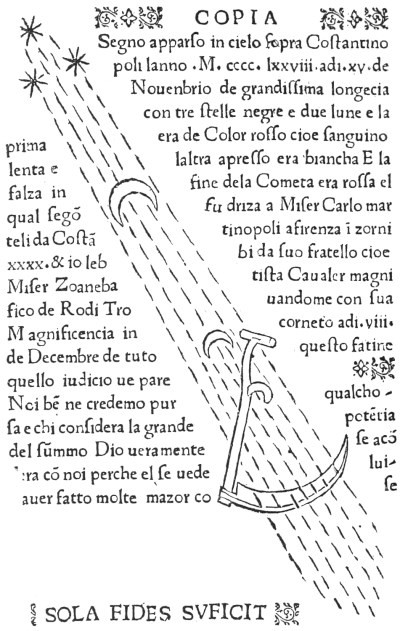
Fig. 10. The last page of Manfredi’s Prognosticon ad annum 1479, Bologna, 1478.
From his tomb in the Church of S. Giacomo Maggiore at Bologna
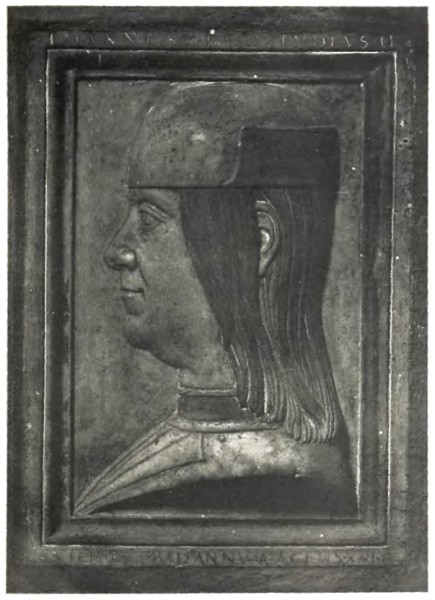
Plate XXXVII. GIOVANNI BENTIVOGLIO II
BRIT. MUS. MS. ROY. 7 F VIII, fo. 50 v
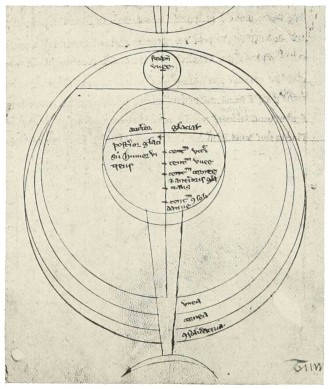
Plate XXXVIII a. ROGER BACON’S DIAGRAM OF THE EYE. XIIIth Century
From a drawing in WINDSOR CASTLE
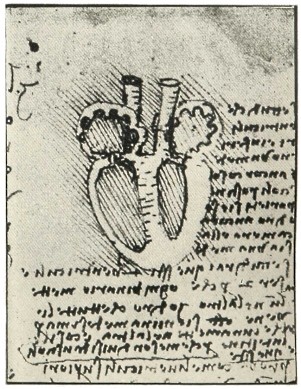
Plate XXXVIII b. LEONARDO DA VINCI’S DIAGRAM OF THE HEART Early XVIth Century
(e) Prognosticon anni 1481, in which is embodied Oratio contra turcos & hostes Christianorum, s. 1. Jan. 1481.
(f) Centilogium de medicis et infirmis, Bologna, 1488. With a dedication to Bentivoglio. This short work is wholly astrological, and consists of one hundred precepts concerning the relationship of the stars to various diseases and conditions. Reprinted Venice, 1500, and Nuremberg, 1530.
The following three works are attributed to Manfredi, but are not mentioned in Hain, Copinger, or Reichling’s lists of Incunabula; we have not seen any of them and their existence is doubtful.
(g) Ephemerides astrologicae operationes medicas spectantes, mentioned in the Biographisches Lexikon der hervorragenden Aerzte of E. Gurlt and A. Hirsch. Possibly it represents another edition of (e).
(h) Quaestiones subtilissimae super librum aphorismorum, Bologna, 1480 (?), mentioned by Haller.179 Possibly it represents another edition of (b).
(i) Chiromantia secundum naturae vires ad extra, Padua, 1484, mentioned by Haller.179
IV. The Manuscript Anatomy of Manfredi
The MS. of Manfredi’s Anatomy is in the Bodleian Library at Oxford (Canon. Ital. 237, Western 20287). It is a fairly preserved small quarto parchment, originally of forty-nine folios, of which the third and fourth are missing. The writing is in the fine Italian hand that the printed type of the period was accustomed to imitate. There are no figures or illuminations, but the titles are rubricated in burnished gold or in colours.
There is no reference to this work in any account of Manfredi, and the volume itself appears to be quite unknown. Neither the man nor his work is mentioned in Medici’s detailed history of the anatomical school at Bologna180 nor in Martinotti’s recent study on the same topic,181 nor is any MS. of Manfredi included in Mazzatinti’s monumental catalogue of the MSS. in the Italian libraries.182
Manfredi’s MS. is written in the involved Italian of the day, with sentences of inordinate length. These general characters of style are encountered also in his published works. The dedication is in Latin, of the same unpleasing quality, and is couched in the usual subservient manner. It is addressed to Giovanni Bentivoglio, and in it Manfredi relates that
‘Your illustrious lordship Johannes Bentivolus in this present year 1490 with your usual humanity condescended on one occasion to watch the dissection of a corpse.... It was then that you saw the wonderful works of Nature in the anatomy ... and you parentally urged me, Hieronymo Manfredi, to inscribe to your most noble name this work on anatomy.... I therefore extracted this work as best I might from various works of antiquity and abbreviated it. I have not followed their order, but I have so composed it that the work should be pleasing to your lordship.
‘Accept then, O great and powerful lord, this work on the anatomy of the human body inscribed to your noble name! Accept it with your customary benevolence and humanity and in a kindly and gracious spirit, for it will be pleasing to you and will delight you greatly, for it is a worthy work!’
The Giovanni Bentivoglio (Plate XXXVII), with adulation of whom Manfredi was thus accustomed to plaster his works, was the second of the name and was the son of Annibale Bentivoglio. In the year 1462 he became head of the republic of Bologna, and played there much the same rôle as did Lorenzo de’ Medici at Florence. He adorned Bologna with numerous buildings,183 and acted as patron of the arts and the sciences. The Palazzo dei Bentivogli still stands as a memorial to him and his family. A stern and high-handed tyrant, he held his position until 1506, when he was expelled and the city reverted to the papacy. He died two years later.
It is remarkable to find a man of Bentivoglio’s eminence and position taking an interest in the practical study of anatomy. Other Italian rulers, Lorenzo de’ Medici among them, encouraged and legalized the practice of dissection, but probably Bentivoglio is the only one recorded as having patronized an ‘anatomy’ in person. The interest taken in the subject by the heads of states must have been of great value to the artists whose patrons they were.
The MS. is a unique copy, and was doubtless written for presentation to Bentivoglio. That it was never printed is perhaps due to the fact that Manfredi died within a comparatively short time of its composition. It represents the most satisfactory post-mediaeval account of the human frame until the appearance of the work of Berengario da Carpi in 1521. It is more complete than the work of William of Saliceto or of Mondino or the anatomy erroneously attributed to Richardus Anglicus; it is more natural than the book of Gabriele de Gerbi, and is far superior to the crude contemporary sketches of Hundt, Peyligk, and Achillini, while it wastes less space than Guy de Chauliac on teleology, though it has none of the charm of the work of that great surgeon. In one respect at least, viz. the spirit in which it is written, Manfredi’s Anatomy is original and probably unique for its age. There is no reason to doubt the assurance of the dedication that it was composed for the edification of the tyrant of Bologna, and for the simple purpose of setting forth the wonderful structure of man’s body without thought of any medical application.
The sources of the MS. are obvious. It is in the main a rearranged and on the whole improved Mondino, but amplified by reference to translations from Galen, Rhazes, Haly Abbas, and Avicenna. Guy de Chauliac has perhaps also been used. The work gives a general impression of being the product of a practical dissector, and it provides us with a good example of early Renaissance anatomy as taught in the Italian schools before the reforms of Vesalius. It is perhaps the first complete treatise on its subject written originally in the vernacular.184 It exhibits, however, no other original features nor any considerable departures from its sources, and it may be taken to represent, with but little modification, the tradition of Mondino as developed at his own University of Bologna at the end of the fifteenth century.
Manfredi’s work, however, if not original is at least eclectic, and the variety of its sources indicates a dawning consciousness of the unwisdom of trusting to the infallibility of any one writer. The work is thus in a sense intermediate between the early printed versions of Mondino, such as that of 1478, and the edition published in 1528 by Berengario da Carpi with its frank commentary of the master. All represent stages towards the freedom of the later Renaissance investigators.
We reproduce the text in full, and the passages on the head, on the eye, and on the heart, are rendered into English. All are similar to the accounts of Mondino. We are able to illustrate them by figures from contemporary works, and thus to give an idea of the limits of the anatomical knowledge of the day.
V. Translation of Selected Passages from the Anatomy, with Commentary
(a) THE HEAD
Tractate i, Chapter 2
(folio 5 verso) There are ten layers of the head.
The first is the hair made by nature for the better protection of the head from external things, and also for beauty.
The second part is the skin, which has here to be very thick, so that the hair may be firmly embedded, having its roots thick and long; and also to be a better shield and covering for the bone and brain, since there is no muscular part here.
The third part is the flesh, developed only on the face, the temples, and about the jaws, not on the other parts.
The fourth part is an external membrane called almochatim [Arabian term for cranial periosteum] which, when the skin is raised, appears to be continuous and covers the whole cranium. And nature made this membrane firstly so that the skin which is soft should not come into contact with the hard bone, secondly that the bone of the head should have sensation through it, and thirdly that the internal membrane of the head, called dura mater, should, by means of this membrane, be attached to the bone of the cranium by certain nerves and ligaments. These, issuing through the commissures of the bones, have thus their origin in the aforesaid internal membrane, while on emerging through the bone, they weave themselves into or rather compose the external membrane called almochatim.
The fifth part is the skull. This is a bone like a cap, inside the cavity of which is located the brain. In the skull are four bones sutured together. Nature made the skull not of one but of many pieces, firstly, so that if harm should fall on one part it might not spread to the others; secondly, so that by their joints or rather sutures [Italian cusiture=sewings], the humours of the brain might be the better exhaled; and thirdly, so that when there is need of applying medicines, these might the better penetrate to the parts within.
Hence it is that four pieces of bone are sutured and joined together by nature in a denticulate fashion, so that they might be the firmer and stronger. Nor are they bound with ligaments as are the joints, for these would not have been so strong, and furthermore the bones of the head do not need to move.
These sutures are five in number, three being true and two false. The true sutures are those which pass right through the bone, while the false do not. Of the true sutures one is in the anterior part and is called coronal; it is made like the letter C, and stretches from right to left of the head, the two wings of the C being directed towards the forehead. The second true suture extends along the length of the head, beginning from the coronal and reaching the back part of the head. It is like a shaft or rather arrow that goes backwards from the brow, wherefore it is called sagittal ——(. The third true suture is in the posterior part and is called laudal, for it is made like a Λ, the letter called by the Greeks lauda. The sagittal suture extends from the coronal to the lauda 〉——(.
The false sutures are two, one on each side. They are called cortical because they do not penetrate.
Now if we consider these five sutures we shall see that there are four bones articulated together. One is the forehead bone [frontal] which begins at the coronal and ends below at another suture, which itself begins as a branch of the coronal suture and proceeds by way of the eyebrow to the corresponding branch [of the other side] Ɑ.
A second bone is behind and terminates at the laudal suture. There are two other bones which form the temples. These terminate at the false sutures which themselves begin at the laudal and end at the coronal suture.
The sixth part [of the head] consists of two membranes. One of these is called dura mater, and lies in contact with the cranium. The other is called pia mater and is in contact with and covers the brain. And nature contrived it thus, having great solicitude for this latter member, that while close to the bone, it should yet not be touched by it. Wherefore, taking due precautions, she made the one [membrane] harder than the other. Furthermore she made two membranes, so that if harm befell one of them, it might not be communicated to the underlying brain.
In the pia mater are woven certain veins by which the brain is nourished. [The brain is] everywhere covered by it except on the posterior part; because this part being dry, it has no need of this membrane, as have the anterior and middle parts. The two membranes in many places penetrate the substance of the brain, dividing it into a right and a left, a front and a back section. By this division, divers cells or rather small chambers are made therein, in which the soul (anima) performs its divers operations, for which reason it is necessary that these parts should be of different structure.
When the two membranes are raised, the seventh part of the head, namely the brain itself, appears. The brain is wrought by nature so that the vital spirit from the torrid heart should be tempered by its cold, for here it is converted into animal spirit, which is the beginning of the perceptive (cognoscitiue) and motive processes.
The brain is of a substance like marrow, white, soft, and viscous, and from it the nerves arise. The anterior part is moister, softer, and less cold than the posterior because the senses [sentimenti = senses + mental processes], which are themselves moist and soft, have here their origin. In the posterior part the motor nerves arise, and it is therefore drier and firmer.
The brain is divided into three parts or ventricles. The first ventricle or anterior part is itself divided into two, right and left, and is moreover larger than any of the other ventricles, for in this first ventricle nature has placed the two faculties subservient to perception (al cognoscere). One of these is called common sensation (senso comune); in it the external senses terminate as at a centre and deliver the images or rather species of sensible things, so that this faculty may perceive and distinguish between one sensible thing and another, and also comprehend the operations of particular senses; which two things none of these [senses of themselves can do]. The other faculty of the first ventricle is called fantasia and by some imagination; it retains and preserves the species of sensible things in the absence of the material objects themselves.
When thou examinest the first ventricle thou wilt see three things before thou comest to the second ventricle.
[a] The first is itself double, and is formed of the very substance of the brain, so that it forms the base of the anterior ventricle both right and left [= corpora striata].
[b] To the side of this is another thing like a subterranean worm, red as blood, yet tethered by certain ligaments and nervelets [= choroid plexus and taenia semicircularis]. And this worm when it lengthens itself closes these passages, and thus blocks the path between the first ventricle and the second. Nature has wrought it thus, so that when a man wills he may cease from cogitation and thought; and similarly when, on the other hand, he would think and contemplate, this worm contracts itself again and opens these passages and thus frees the way between one ventricle and another.
[c] The third structure is a little lower and is a lacuna or rounded concavity [= infundibulum]. In the middle of this is a hole which passes down towards the palate, and this lacuna provides also a direct passage which descends from the middle ventricle to its colature [= sieve-like structure, i.e. certain parts of the sphenoid bone]. And this lacuna has around it certain large round eminences which support the veins and arteries that ascend to the ventricle. This passage is wide above and narrow below, and by it the first and second ventricles purge themselves of their superfluities, but the anterior part [of the first ventricle] purges itself more by the colature of the nose [= cribriform plate]. Thus nature has made two passages to cleanse the superfluities of the brain.
When thou hast seen these three structures there will appear the second or middle ventricle which is as a passage and transit from the anterior to the posterior ventricle. Here are two faculties. One, the estimative, deduces [Italian elicere] the insensible from the sensible. The other, called the cognitive, comprehends both things sensible and things insensible, synthesizing and analysing them (componendo e dividendo). These [two] faculties in the middle ventricle minister to the intellect. Now all the other faculties described, and even the power of memory, are found in brute animals, but this [intellectual power] is encountered in man alone.
Now will appear the third ventricle in the posterior part; and it is hard, for it gives rise to the greater part of the motive nerves which are of a strong and firm nature. This ventricle is pyramidal in shape, and culminates in an apex directed upwards where images of visible things (spetie) are conserved, for these are better stored in a strait than in an ample space; but the part below is wide to receive these images, which are better received in an ample than in a strait place. This ventricle has two functions: it gives rise to the spinal cord [nucha, an Arabian term] and motor nerves; and it is also the storehouse of the memorative faculties.
From what [has been said] it will be apparent that when the back of the head is injured, the memory immediately suffers; when the middle part is injured, the estimative and cognitive faculties suffer; and when the anterior part is injured, the faculties of common sensation and of imagination (fantasia) suffer. And thus it is that the doctors have become aware of the location of these powers.
This being disposed of, thou wilt next raise the brain carefully so as not to break the nerves. Commencing now with the part in front, there will first appear two small fleshy protuberances like two nipples, of like substance to the brain in which they originate, and covered by a thin membrane, the pia mater. These are the olfactory organs, wherein is the sense of smell.
From the brain arise seven pairs of nerves. Proceed therefore farther with the anterior part, and thou wilt see the first pair of these nerves, which are large, and called the nervi optici. These have their origin in the front ventricle of the brain and proceed towards the eyes. But before they pass through the pia mater, they join together, and at their place of union there is a perforated spot. Galen maintains that these nerves only join or rather unite, but do not intersect, so that the nerve that comes from the right after union returns again towards the right, and similarly with the nerve coming from the left, which after the union returns towards the left eye.185 But Rhazes maintains the contrary,186 although the opinion of Galen is the more common. These nerves are subservient to sight, and they are united so that the images of the things received by the two eyes and conveyed by the two nerves should return in unity; so that one thing should not appear as two.
After these two nerves, raise the brain towards its middle and thou wilt see another pair of nerves, thin and firm, which also go to the eyes, to give them voluntary movement, controlling certain muscles.
Farther on thou wilt see the third pair of nerves, one part of which goes to the face to give it sensation and voluntary movement, while another part goes to give taste to the tongue. Yet a third part of these nerves mingles with the fourth187 pair of nerves, and together they descend to give sensation to the diaphragm, stomach, and other viscera. A certain part also of the fourth187 pair of nerves goes to give sensation to the palate.
Then there is the fifth pair of nerves [which] go to the petrous bone around the ear; and of these nerves there are framed in the ear-holes certain membranes, which are the organs of hearing.
Next there is the sixth pair of nerves, which divides into three parts. One part goes to the muscles of the throat, the second to the muscles of the shoulders, and the third and largest descends to the epiglottis and to the diaphragm, and spreads into the chest, the heart, and the lungs, accompanying the nerves of the third pair. From the nerves of this sixth pair which go to the epiglottis arise the nerves of the voice, called reversive.
The seventh pair of nerves arise at the back of the brain and give voluntary movement to the tongue.
Of these seven pairs of nerves, the first two pairs originate in the anterior part of the brain, the third pair originates between the anterior and posterior parts, while the remaining four pairs originate in the posterior part.
Proceeding still farther, the brain may be completely raised, and the eighth part of the head will appear, that is, the two membranes situated below the brain. When these in turn are raised there will appear the ninth part, which is a certain net called rethe mirabile, because it is composed of exceedingly strong and marvellous texture, augmented by certain very fine arteries which are branches of arteries that ascend from the heart, and are called the apoplectic arteries. In these arteries of this net is contained the vital spirit, sent from the heart to be changed to animal spirit. That the spirit may be the better modified and distributed, nature made these arteries very fine, and separated them into very small branches so that the spirit should be minutely divided. Nature placed the rethe mirabile under the brain because it was necessary to guard its site carefully, and also that the moist vapours of the brain which fall upon the net, obstructing it, should induce natural sleep.
After all these things thou wilt see the basal bone which is the tenth and last part of the head, and called basilar, because it is the base and foundation of the whole head; and it was made hard so that the superfluities which descend to it should not putrefy it. This bone can be seen to be formed of many other bones articulated together. It is divisible into the petrous bones and the bones of the nose and eyes and two other lateral bones which can only be seen by means of disarticulation. [Folio 10 verso, line 22.]
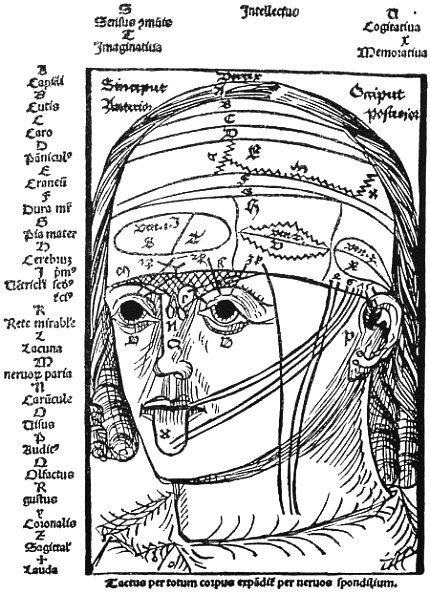
Fig. 11. From M. Hundt, Antropologium, de hominis dignitate natura et proprietatibus, Leipzig, 1501. The figure shows the ten layers of the head, the cerebral ventricles and cranial nerves, and the relation of the nerves to the senses.
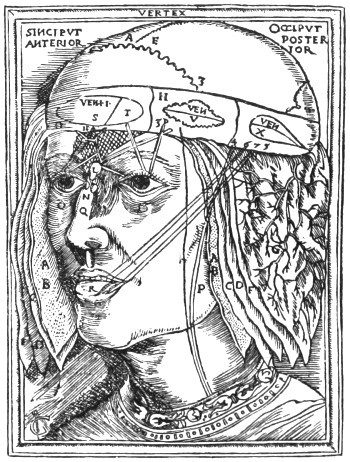
Fig. 12. THE LAYERS OF THE HEAD
From the Anatomia of Johannes Dryander, Marburg, 1537.
The ten parts or layers of the head are a commonplace of the anatomy of the period, taken from Avicenna. We may illustrate the division by the crude contemporary diagram of Fig. 11, which is improved in the later drawing reproduced in Fig. 12.
Manfredi’s account of the brain itself is amplified from Mondino. The division of this organ into three ventricles, each associated with a corresponding division of the mental functions, was very familiar to medical writers of the fifteenth century. The idea is found among Western writers as early as St. Augustine (354–430), and is encountered in the writings of Roger Bacon (1214–94). It had long been popularized in mediaeval psychology by the writings of Albertus Magnus (1206–80). The anatomical distinction is found in Haly Abbas, Avicenna, and Rhazes, and in some of the best MSS. of the latter writer a rough diagram of the ventricles is given.188 These writers are all clearly indebted to the anatomy of Galen,189 but on the psychological side Albertus Magnus probably drew mainly either from Ghazali190 (1059–1111), who in turn derived his inspiration from Nemesius (fourth century) and Johannes Damascenus (died 756), or else from early writers of the Salernitan tradition, such as Constantine191 (eleventh century), or Petrocello192 (twelfth century), who drew largely on Theophilus (seventh century).193
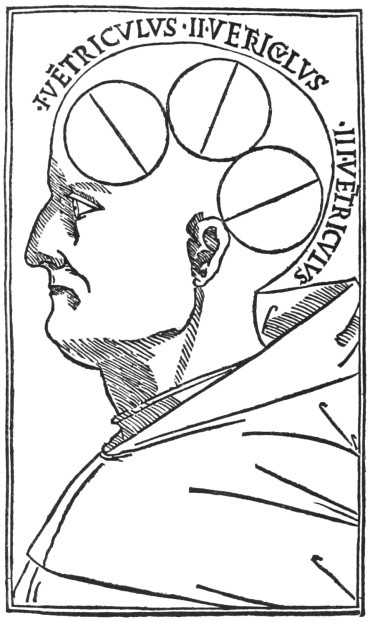
Fig. 13. From Illustrissimi philosophi et theologi domini Alberti magni compendiosum insigne ac perutile opus Philosophiae naturalis, Venice, 1496, showing the ventricles of the brain.
This outline of a tripartite division of the brain and its cavities was closely followed throughout the Middle Ages, as was also the curiously naïve and excessively ‘materialistic’ psychology to which it gave rise, and which Manfredi adopts. We illustrate his views of the relationship of the different parts of the brain and their parallelism in mental processes, from a series of diagrams extracted from contemporary works (Figs. 13–18).
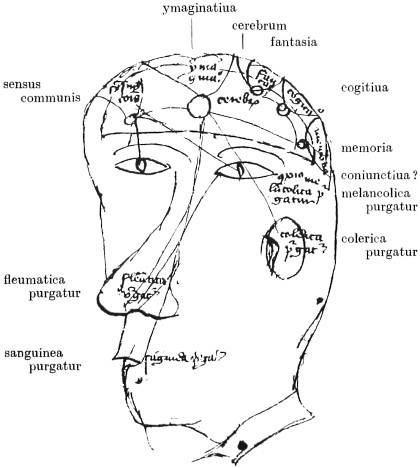
Fig. 14. Diagram of the senses, the humours, the cerebral ventricles, and the intellectual faculties. MS. Sloane 2156, folio 11 recto, in the British Museum, being a copy written in 1428 of the De Scientia Perpectiva of Roger Bacon
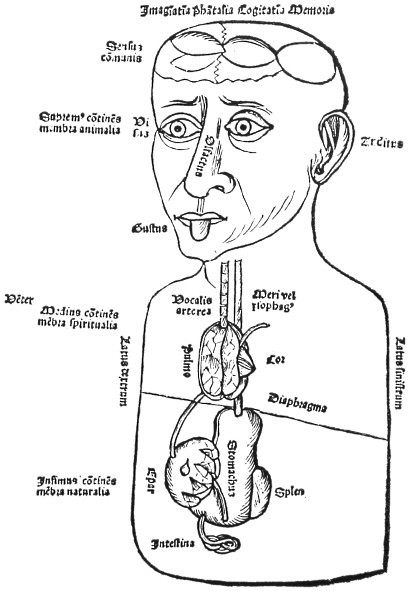
Fig. 15. From K. Peyligk’s Philosophiae naturalis compendium, Leipzig, 1489. Illustrating the general ideas on anatomy current at the Renaissance.
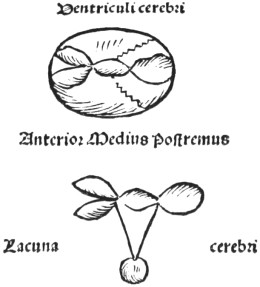
Fig. 16. The cerebral ventricles from above and from the side. According to K. Peyligk, Philosophiae naturalis compendium, Leipzig, 1489.
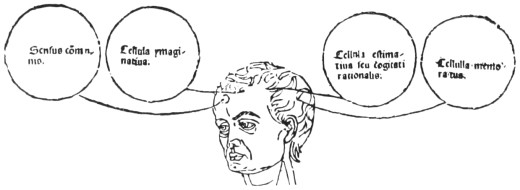
Fig. 17. The localization of cerebral functions. From the Italian edition of ‘Ketham’, Fasciculus Medicinae, Venice, 1493.
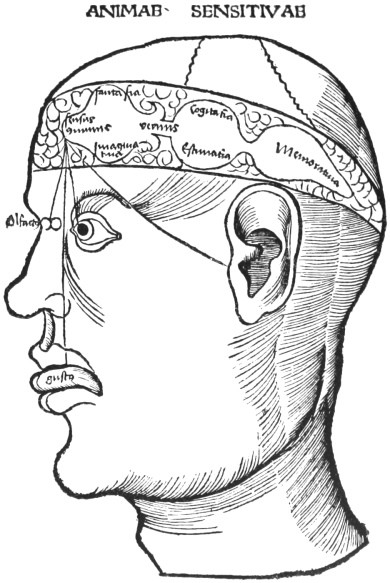
Fig. 18. From G. Reisch, Margarita philosophiae, Leipzig,? 1503. Diagram of the ventricles and the senses with their relation to the intellectual processes according to the doctrine of the Renaissance anatomists.
The brain was regarded by mediaeval and early Renaissance anatomists as having two channels of discharge through which the phlegm, the especial product of this organ, could be evacuated when in excess. One of these channels communicated with the anterior ventricle of the brain and poured its secretion into the nose. It may be identified with the anterior colature or cribriform plate. The second, the lacuna, led down from the second ventricle and poured its secretion into the pharynx. It may be identified with the infundibulum, pituitary body, and ‘cella turcica’. The term ‘pituitary’ which we still use is derived from its supposed association with the ‘pituita’ or phlegm. At an early date this process was connected with the four humours (Fig. 14). The rest of the description of the brain can be easily followed. The comparison of the choroid plexus to a worm is very common. The suggestion originated with Galen and was developed by the Arabians.
Comparative Table of Ancient and Modern Nomenclature of Cranial Nerves.
Mondino and Manfredi following Galen, especially in theπερὶ χρείας τω̑ν ἐν ἀνθρώπου σώματι μορίων.
De usu partium corporis humani.Modern usage.
Not regarded as separate nerves.
I.
Olfactory nerves.
I.
τὰ μαλακὰ νευ̑ρα τω̑ν ὀφθαλμω̑ν.
II.
Optic nerves.
II.
τὰ κινητικὰ τω̑ν ἀμφ᾽ αὐτοὺς μυω̑ν.
III.
Oculomotor nerves.
Not mentioned.
IV.
Trochlear nerves.
III.
τρίτη συζυγία.

V.
Trigeminal nerves.
IV.
τετάρτη συζυγία.
Mondino and Manfredi confuse Galen’s fourth pair and Galen’s sixth pair.
Not mentioned by Manfredi. By Galen probably united with II.
VI.
Abducent nerves.
V.
πέμπτη συζυγία.

VII.
Facial nerves.
VIII.
Auditory nerves.
VI.
ἕκτη συζυγία.

IX.
Glossopharyngeal nerves.
X.
Vagi.
XI.
Accessory nerves of Willis.
VII.
ἑβδόμη συζυγία.
XII.
Hypoglossal nerves.
The nomenclature of the cranial nerves adopted by Manfredi is taken from Mondino and is almost identical with that of Galen, whose classification is summarized above.194 Manfredi’s description of Galen’s fourth pair is confused and inadequate, but his account of Galen’s sixth pair is an improvement upon Mondino.
The ‘rete mirabile’ is an interesting survival of Galenic anatomy. This structure is hardly present in man, but is developed in the lower animals, and especially in calves, upon whose bodies Galen worked. The father of physiology regarded the ‘rete mirabile’ as the place where the psychic pneuma was elaborated.195 Galen’s findings in the lower animals were assiduously transferred to the human body, to which his descriptions are much less applicable, while his views on the pneuma lasted in more or less misunderstood form well into the seventeenth century.
(b) THE EYE
Tractate i, Chapter 3
(folio 11 recto) The socket of the eye is not over-depressed, for it has to receive the images (spetie) of visible things. Nor does it project greatly, lest it should be liable to injury from exterior violence. For the eyes of man being very soft and susceptible, nature provided eyebrows as a shield above, and eyelids as protectors in front, and made moreover the projections of the maxillae and the nose, so that the eyes should be guarded on every side. So great was the solicitude of nature for these members.
Seven are the tunics of the eye and three its humours. Three front coatings join with three coatings at the back like six shields, the edges of every pair joining each to each, the outer being larger and containing the others. The seventh tunic is largest of all, and encloses the whole eye, and therefore it is called conjunctiva because it joins and surrounds the whole eye except the place where the pupil is, and that small part [is covered] by the cornea. Now this first tunic where it covers the outside part is seen to be white.
The second tunic in its front part is called cornea because it resembles horn in its substance and colour; and this covering is transparent, so that the images of visible things may penetrate through it. And it is also solid and large and composed of four membranes, so that being near external things it should not receive hurt. With this [corneal tunic] is united posteriorly another tunic [the third] called sclerotic, i.e. hard. These two coverings have their origin in the membrane about the brain, that is in the dura mater, just as the first tunic arises from the membrane over the skull, called almochatim.
The fourth tunic as to its front part is called uvea [because] it is like a seed of a black grape, and in its midst is a hole called the pupil. Nature made this tunic opaque so that the visual spirit should be conserved and not dissipated by the light outside. Moreover nature made the opening in the tunic that the image might penetrate freely; while it is narrow, so that the visual spirit should be concentrated. Thus when the said pupil, or rather hole, dilates more than usual, either naturally or accidentally, the sight becomes imperfect. [The uveal tunic] joins posteriorly the fifth tunic, called secundina because it is made like the after-birth, i.e. the membrane in which the child is enveloped in its mother’s womb, and it arises from the pia mater.
The sixth coating in front is called arachnoid because it is formed after the manner of a spider’s web, and posteriorly it joins the seventh coating, called retina, because it is made like a net.
Between the uvea and the arachnoid anteriorly there is a humour called albugineus, like the white of an egg, to moisten the eye and to preserve the convexity of the cornea. In a dead man this humour dries up, and the cornea falls and is flattened, and then the vulgar say that there appears a curtain before the eyes which is an infallible sign of death. Also this humour holds the pupil open; therefore when it dries up the pupil contracts.
Between the two last tunics, i.e. the arachnoid and the retina, which have their origin from the optic nerve, there are two humours. These are the vitreous humour, so called from its likeness to liquified glass, and the crystalline humour, from its likeness to a crystal. This is also called the grandid, because it is like a hailstone; and it is somewhat hard and round, but flattened anteriorly where it receives the images of visible things, and posteriorly pyramidal shape and pointed. And here is completed the act of seeing. In the posterior part it is surrounded by the vitreous humours by which it is nourished. The crystalline humour is convex anteriorly and the vitreous posteriorly. And the optic nerves come to the eyes and convey the images seen by the eyes to [the seat of] common sensation and to the other internal faculties. [Folio 12 verso, line 7.]
174 Johannes Franciscus Picus Mirandula, Disputationes adversus astrologos, Lib. ii, cap. 9, Bologna, 1495. Our quotation is from the original 1495 edition, not from the slightly variant édition contrefaite.
175 G. Fantuzzi, loc. cit., p. 197.
176 U. Santini, ‘Cenni statistici sulla Popolazione del Quartiere di S. Proclo in Bologna’, in Atti e Memorie della R. Deputazione di Storia Patria per le Provincie di Romagna, series 3, vol. xxxiv, pp. 366 and 367, Bologna, 1906.
177 See map of the old University buildings of Bologna prefixed to Francesco Cavazza, Le Scuole dell’ antico studio bolognese, Milan, 1896.
178 The date 1462, clearly printed on this edition, is certainly erroneous, since there was no printing-press at Bologna till 1471. A. E. Nordenskiöld (Facsimile Atlas till Kartografiens äldesta Historia, Stockholm, 1889, p. 12) consider that 1472 is the true date, but the point is not yet finally settled. See J. A. J. de Villiers, ‘Famous Maps in the British Museum’, in Geographical Journal, vol. liv, London, August 1914, p. 173. Albano Sorbelli, in his authoritative I Primordi della Stampa in Bologna, Bologna, 1908, does not mention Manfredi’s edition of Ptolemy among the earliest printed Bolognese works (1471–5).
THE FIRST PRINTED MAP OF ENGLAND.
From the 1472 (?) Bologna Ptolemy, edited by Manfredi and others.
179 Albrecht von Haller, Bibliotheca anatomica, Zürich, 1774–7, vol. ii, p. 738.
180 Michele Medici, Compendio storico della Scuola anatomica di Bologna dal Rinascimento delle Scienze e delle Lettere a tutto il Secolo XVIII, Bologna, 1857, folio.
181 G. Martinotti, ‘L’insegnamento dell’ anatomia in Bologna prima del secolo XIX’, in Studi e Memorie per la Storia dell’ Università di Bologna, vol. ii. Bologna, 1911.
182 Mazzatinti, Inventari dei Manoscritti delle Biblioteche d’Italia, Forli & Firenze, 1890–1915, vols. i to xxiii, in progress.
183 Lino Sighinolfi, L’Architettura Bentivolesca in Bologna e il Palazzo del Podestà, Bologna, 1909.
184 Several short sketches or tractates on anatomy in the vernacular are however known. Thus a Provençal anatomical tractate of the thirteenth century has been published by K. Sudhoff in his Beitrag zur Gesch. der Anatomie im Mittelalter, Leipzig, 1908.
185 Cf. Galen, De usu partium corporis humani, Lib. x, chap. 12.
186 Cf. Rhazes, Almansur, i. 4.
187 Manfredi here follows Mondino, who confuses Galen’s fourth pair with Galen’s sixth pair of nerves.
Fig. 11. From M. Hundt, Antropologium, de hominis dignitate natura et proprietatibus, Leipzig, 1501. The figure shows the ten layers of the head, the cerebral ventricles and cranial nerves, and the relation of the nerves to the senses.
188 See P. de Koning, Trois Traités d’Anatomie arabes, Leyden, 1903, p. 47.
189 See J. Wiberg, ‘The Anatomy of the Brain in the Works of Galen and ‘Ali ‘Abbas; a comparative historical-anatomical study’, Janus, vol. xix, p. 17 and p. 84, Leyden, January and March, 1914.
190 See A. Schneider, ‘Die Psychologie Alberts des Grossen’, p. 160, in Beiträge zur Geschichte der Philosophie des Mittelalters, Band iv, Heft 5, Munich, 1903.
191 Constantine Africanus, De communibus medico cognitu necessariis locis, Lib. iii, cap. 11, Edition Henricus Petrus, Basel, 1541.
192 Practica Petrocelli Salernitani. Epistola. Quot annis latuit medicina. S. de Renzi, Collectio Salernitana. Naples, 1852–9, vol. iv, p. 189.
193 A very elaborate study of the doctrine of the three vesicles of the brain has recently been made by Walther Sudhoff, ‘Die Lehre von den Hirnventrikeln’, in the Archiv für Gesch. der Med., Leipzig, 1914, vol. vii, p. 149.
Fig. 14. Diagram of the senses, the humours, the cerebral ventricles, and the intellectual faculties. MS. Sloane 2156, folio 11 recto, in the British Museum, being a copy written in 1428 of the De Scientia Perpectiva of Roger Bacon
194 See F. G. A. Stumpff, Historia nervorum cerebralium ab antiquissimis temporibus usque ad Willisium nec non Vieussensium. Dissertatio inauguralis, Berlin, 1841; C. Daremberg, Œuvres anatomiques, physiologiques et médicales de Galien, Paris, 1854, p. 583, &c.; G. Helmreich, ΓΑΛΗΝΟΥ, περὶ χρείας μορίων, Leipzig, 1909; and Theodor Beck, ‘Die Galenischen Hirnnerven in moderner Beleuchtung’, in Arch. für Gesch. der Med., vol. iii, p. 110, Leipzig, 1910.
195 Galen, De usu partium, ix. 4; De Hippocratis et Platonis decretis, vii. 3.
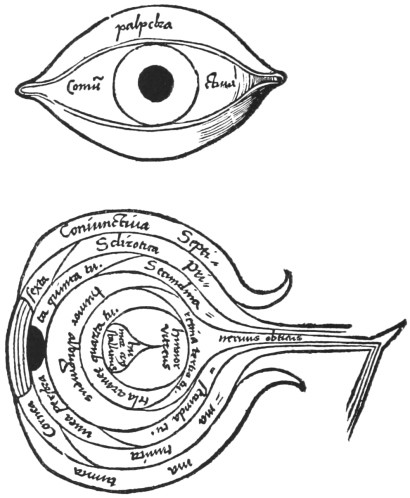
Fig. 19. THE ANATOMY OF THE EYE
From G. Reisch, Margarita philosophiae, Leipzig,? 1503. Showing the seven tunics and three humours of the eye according to the doctrines of Renaissance anatomists.196
A great deal of attention was paid by the Arabians to the diseases and the structure of the eye, and the essentials of Manfredi’s description are to be found in Rhazes, Hunain ben Ishak, and Haly Abbas. The tradition presented by these writers passed early into Western science, and is reproduced, for example, in the works of Constantine Africanus and in the well-known anatomy to which the name of Richardus Anglicus (Richard of Wendover) has become attached197 (cp. Fig. 19). Avicenna’s description of the eye is somewhat different, and gave rise to the tradition reproduced in the works of John of Peckham and of Roger Bacon (Plate XXXVIII a), and it influenced the views of Leonardo and even perhaps of Vesalius (Fig. 20). The views on the anatomy of the eye expressed by Rhazes, Hunain ben Ishak, and Haly Abbas were, on the whole, more widely accepted than those of Avicenna.
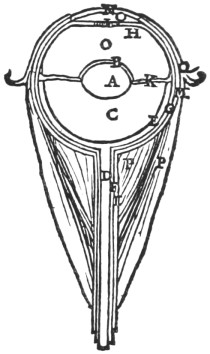
Fig. 20. THE ANATOMY OF THE EYE
From Vesalius, De humani corporis fabrica, Basel, 1543, p. 643. A, Crystalline humour; O, Albugineous humour; C, Vitreous humour; N, Cornea; Q, Conjunctiva; M, Sclerotica; G, Secundina; H, Uvea; K, Arachnoidea; E, Retina.
The treatment of the eye was always felt to be hardly within the range of the ordinary practitioner of surgery, and its structure, as we learn from Guy de Chauliac,198 was not usually treated in the general course of anatomy. The custom was rather to refer the student to special works such as those of Jesu Aly or of Alcoatim.
Manfredi’s description of the anatomy of the eye is that generally accepted at the end of the fifteenth and the beginning of the sixteenth centuries, and is unusually clear for its date. It represents a considerable advance on such writers as Henri de Mondeville (1260–1320)199 or the pseudo Richardus Anglicus, and is far superior to the descriptions of the eye dating from the fourteenth and fifteenth centuries recently brought to light by Sudhoff.200 We reproduce as illustrating Manfredi a diagram taken from the Margarita philosophica of Gregorius Reisch (died 1525). This represents the earliest printed figure of any value of the anatomy of the eye (Fig. 19).201 We give for comparison the figure from a thirteenth-century MS. of Roger Bacon (Plate XXXVIII a), representing the rival tradition of Avicenna and Alhazen that influenced Leonardo da Vinci and other contemporaries of Manfredi. These figures may be compared with that of Vesalius (1543, Fig. 20), whose description of the eye is less free from traditional bias than are most parts of his epoch-making work.
In reading any early description of the eye, it is to be remembered that until the nineteenth century the ‘emanation theory’ prevailed. Light was regarded as of the nature of a stream of particles emitted from the object seen, and the act of vision was considered as a collision of this emanation with an emission of something from the eye itself, called in mediaeval writings the ‘visual spirit’.
(c) THE HEART
Tractate ii, Chapter 3
(folio 19 verso) Then you will see in the midst of the lung the heart, covered by its membranes. [It is thus situated] that the air attracted by this lung should cool it, and that thus the heat and spirit of the heart be tempered. This member is the most important of the four [principal members], because it is the first to live and the last to die. It is of medium size compared with the other members of man, but compared with the hearts of other animals it is very large, because man, in a quantitative and not an intensive sense, has more natural heat than other animals. It is pyramidal, that is in the form of a flame; because it is of excellent warmth, therefore it is necessary that it should be of a shape resembling a flame. Its figure is also called ‘pine-shaped’, because it is wide below and narrow above, being thus formed that distinction could better be made between its cavities or ventricles; moreover, had it been made of a shape all uniform as is the lower part, it would be too heavy and ponderous.
This member is situated in the middle of the entire body, measured in every direction; that is, in the middle between the upper and lower parts: in the middle also between front and back and right and left, like a king standing in the midst of his kingdom, and this was done that it might give the strength of life equally to all the members; and although the heart as regards its foundation and base be in the middle, yet its point declines to the left below the left breast, so that it warms the left side as the liver warms the right.
This member is sustained and strengthened by a certain cartilaginous bone. For since it is continually moving, it needs some point of purchase to support it in its movements. Moreover, it has a certain fatty layer on the outside which prevents the heart from drying and keeps it moist: and there are certain veins and arteries dispersed through its substance: and it is formed also of a kind of hard flesh so that it may sustain many and forceful movements; also it is formed of longitudinal, latitudinal, and transverse fibres, so that it may have the power to attract, retain, and expel.
This member has three ventricles or chambers, like the brain. One ventricle is on the right side, the second on the left, and the third in between. The right ventricle towards the liver has two orifices. One is towards the liver and is very large. Into this there enters a vein called vena chilis, which arises in the convexity of the liver and brings the blood from the liver to the heart. In that right ventricle the blood is purified, and then sent by the heart to all the other members.
Now since the heart attracts by this orifice of the vena chilis more than it expels, therefore nature ordains that in the moment of contraction when the blood is expelled this orifice closes, and when the heart dilates it opens.
Moreover there are three little valves (hostiolitti) or doors opening from without inward, and these valves are not very depressed; so that by this same orifice only part of the purified blood is expelled to the other members, because part goes to the lungs and the remainder forms the vital spirit; therefore nature ordains that these valves do not entirely close. From the vena chilis, before it enters the cavity of the heart, there arises another vein, which surrounds the root of the heart; and from it are given off branches which disperse themselves through the substance of the heart, and from the blood of that vein the heart nourishes itself.
The right ventricle towards the lung has another orifice into which opens the arterial vein, bringing the blood from the heart to nourish the lung: in this orifice also are three valves (hostioli) opening from within outward and closing from without inward, in the opposite way to the valves of the other orifice; and this is so that they should entirely close. Hence by this orifice the heart during the period of contraction can expel, and yet during the period of its dilatation cannot attract anything through it as was done in the first orifice.
The left ventricle of the heart has its sides denser and thicker than the sides or walls of the right ventricle; and this for three reasons: Firstly, because in the right ventricle is contained the blood, which is heavy, while in the left ventricle there is spirit, which is very light; therefore in order that the heart should not be heavier and more ponderous on one side than on the other, it was necessary to compensate in this manner, that is, that the left ventricle should be thicker in its walls than the right. In the second place, the spirit being more subtil and more volatile (resolubile) than blood, it needs a stronger habitation and better supports. Thirdly, the left ventricle is much warmer than the right, because in it is generated the spirit from the blood, by a great heat which makes that blood more subtil; and heat is better preserved in a substance that is dense and thick.
In the cavity of this ventricle near its root are two orifices: one is the orifice of an artery called artharia adorti [= aorta], because it has immediate origin in the heart and because it is the source of all the others: by this artery the heart sends the generated spirit to all the members; and the very subtil blood is mixed with the spirit when the heart contracts. For which reason there are at the entrance of this orifice three valves, which close entirely from the outside inwards; and they open from the inside outwards, and this orifice is very deep.
The other orifice is that of the venal artery which conveys the air from the lung to cool the heart and transports warm vapours from the heart to the lung as has been said above; and in this orifice are two valves which do not entirely close: and they are well raised so that they can better apply themselves to the sides [edges] of the heart when it sends out the spirit: these are marvellous works of nature, as is also the central ventricle of the heart, for this ventricle has not one cavity but many; these are small but wide, and more numerous on the right than on the left; and nature contrived thus, so that the blood which goes from the right ventricle to the left to be converted continually into spirit becomes thin in these cavities.
And by this thou canst see that four things have birth in the heart. The first is the artery called adorti, the second is the vena chilis, the third is the arterial vein, and the fourth the venal artery.
Also thou wilt see in the heart certain membranous parts like auricles, or rather like small ears, able to dilate or contract: these are contrived by nature in order that when overmuch blood or spirit is generated the heart can dilate so as to contain it; and also that the heart may contract when there is no such abundance.
And it is here that Galen asks, Why did not nature make the heart so large that it could contain every increase of blood or spirit without the addition of these membranes? Galen replies that this was first because the heart would have been too large and therefore too heavy; secondly, because as it is not always generating a great quantity of blood and spirit, if the heart had been too large, its cavity would usually have been empty: but these auricles dilate with the accumulation of blood or spirit, and contract with its decrease.
The heart is surrounded by a firm and nervous membrane, like a little house in which it is placed as in a tabernacle to defend it from accidents. This capsule is very dilated, that the heart in its dilations and movement may not be impeded thereby, and therefore nature made this capsule so that it should contain a certain dewy moisture with which the heart is bathed and moistened so that in its continual movement it should not become dry. For when this water be dried up, then the heart itself is desiccated, and emaciates and dries up all the body.
The description of the heart follows Mondino closely. Occasionally a phrase or two is reminiscent of Mondeville. The trite conception of the heart as a king in its necessarily central position was very frequently repeated by writers in the Middle Ages. To Harvey, who had a certain mediaeval element in his mentality, it seems to have appealed, and he used it in his Prelectiones Anatomiae,202 and chose it to introduce his great work on the circulation of the blood.203 The heart was similarly described as ‘flame-shaped’, because it was regarded as the source of animal heat. The idea that it is the first to live and the last to die comes from Aristotle.204 The bone in the heart also comes from Aristotle.205 The idea was quite familiar to mediaeval anatomists, who frequently endeavoured to identify the bone with the firm tissue around the orifices of the aorta and pulmonary artery. The reader may be reminded that a true ‘os cordis’ is in fact to be found in some mammalia.
Mondino, followed by Manfredi, describes the action of the heart and blood-vessels mainly according to the views of Galen, but without any very clear or connected statement. The ‘third ventricle’ especially has its origin in a misunderstanding.
This mythical structure is an attempt to combine the views of Aristotle and of Galen. Aristotle, who probably never dissected a human body, derived his anatomical conceptions largely from cold-blooded animals, in some of which the heart is provided with three cavities. He considered that the heart had three chambers, the largest being on the right, the smallest on the left, and one of intermediate size between the two. As far as they can be identified, the largest was the right ventricle plus the right auricle, the smallest or left chamber was the left auricle, while the intermediate cavity appears to have been the left ventricle.206
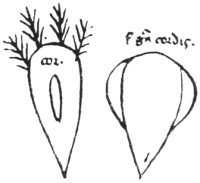
Fig. 21. THE HEART
From the Roncioni MS. (Pisa 99) after Sudhoff.
Galen’s description differed altogether from that of Aristotle. He tells us expressly and somewhat contemptuously that ‘it is no marvel if Aristotle erred in many anatomical matters, a man who thought forsooth that the heart in the larger animals had three chambers’.207 Galen always describes the heart as having but two chambers, the right and left ventricles, a wholly subordinate part being assigned to the auricles. These latter were regarded as safety-valves, expanding to hold superfluous blood when the chambers of the heart to which they correspond become overfilled.
No third ventricle is described by Rhazes or Haly Abbas,208 but Avicenna, in his Canon, makes an effort to combine the views of Aristotle and Galen. Speaking of the anatomy of the heart (lib. iii, fen. xi, chap. 1) he describes the ventricular portion as follows: ‘In the heart are three cavities, two large, and a third as it were central in position. So that the heart has [a] a receptacle [the right ventricle] for the nutriment with which it nourishes itself—this nutriment is thick and firm like the substance of the heart; [b] a place where the pneuma is formed [the left ventricle], being engendered of the subtil blood; and [c], thirdly, a canal between the two.’209 A somewhat similar account is given in Constantine’s translation of Isaac.210 The idea soon crept into European medicine, for in a Pisan MS. dating from the first half of the thirteenth century211 a crude figure of a three-chambered heart is to be found (Fig. 21).
The first translator of the Canon of Avicenna, Gerard of Cremona, whose work appeared towards the end of the twelfth century, improved on his original. ‘In it [the heart] are three ventricles; two are large, and the third as it were between, which Galen called the fovea or non-ventricular meatus, so that there may be a receptaculum for the thick and strong nourishment, like to the substance of the heart, with which it is nourished, and also a storehouse for the pneuma (spiritus) generated in it from the subtil blood. And between the two are channels or meatuses.’212 Henri de Mondeville (died about 1320), by going direct to Galen, avoided some of the errors of Avicenna, with whom, however, he still describes three ventricles.213 Mondino does little but copy the Arabian, whom Manfredi also follows.
We may terminate our description of the mythical third ventricle by quoting from Bartholomew the Englishman. His encyclopaedia written about 1260 was translated into English in 1397, and printed by Thomas Berthelet214 in the 27th year of the reign of Henry VIII (1535), when Bartholomew’s work was still extremely popular. Berthelet’s rendering runs as follows:
‘And the hert hath ij holownesses, one in the left syde, that cometh sharpe: and one in the ryght side, that is within: And these two holownesses ben called the wombes of the hart. And betwene these two wombes is one hole, that some men call a veyne, other an holowe way. And this hole is brode afore the ryghte syde, and streyte afore the left syde. And that is nedefulle to make the bloode subtyll, that commeth from the ryght wombe to the lefte, and so the spirite of lyfe may be bredde the easelyer in the lefte wombe.’
In order to understand why all these authors invoked the existence of the third ventricle, regarded by some of them as a passage between the other two, we must turn to the physiological beliefs of the age. It must be recalled that before the demonstration of the circulatory movement of the blood a certain amount of communication was believed to exist between right and left ventricles. The complicated nature of the ventricular cavities and the intricacy of the columnae carneae promoted the idea of the presence of minute passages in the interventricular septum. Even so astute an observer as Leonardo da Vinci considered that ‘the ventricles are separated by a porous wall, through which the blood of the right ventricle penetrates into the left ventricle, and when the right ventricle shuts, the left opens and draws in the blood which the right one gives forth’ (Plate XXXVIII b).215
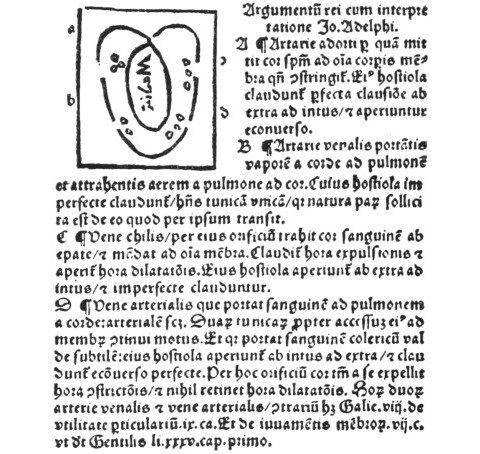
Fig. 22. From Johannes Adelphus, Mundini de omnibus humani corporis interioribus menbris Anathomia, Strassburg, 1513. The diagram shows the two lateral ventricles and the ‘central’ ventricle. By a printer’s error the letters c and d are transposed. The arteria adorti is the aorta, the arteria venalis the pulmonary vein, the vena chilis the vena cava, and the vena arterialis the pulmonary artery. The auricles are ignored, as is frequently the case in works of the period, and the pulmonary veins are represented as opening directly into the ventricles.
Although the third ventricle is described in all the twenty-five editions of Mondino, many of which are illustrated, they present no drawing of it except the wretched little diagram of J. A. Muelich (Johannes Adelphus) in 1513, which we here reproduce (Fig. 22). The confusion, however, to which the idea of a third ventricle gave rise influenced anatomy almost as late as the seventeenth century, and is illustrated in the anatomical figures of a late edition of Hans von Gersdorff (1556),216 where the trachea is actually shown opening into the left ventricle (Fig. 23). It was Vesalius who took the first great step towards the discovery of the circulation of the blood, by firmly maintaining that the interventricular septum was solid and contained neither passages nor intermediate ventricle.217
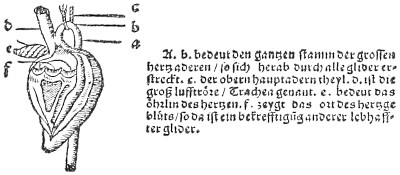
Fig. 23. From Hans von Gersdorff, Feldt und Stattbüch bewerter Wundartznei, Frankfurt, 1556. The trachea (d) is represented as opening directly into the heart.
VI. Italian Text
MS. Canonici Ital. 237
Hyeronimi manfredi ad Magnificum & potentem dominum ac militem Iohannem Bentiuolum insequens opus de corporis humani anothomia exordium.
[folio 1 verso] Opportet de sapientia admirari creatoris ut XVº de utilitate particularum scribitur a Galieno. Cum enim membrorum nostri corporis admirabilem Galienus aspiceret Armoniam predictum sermonem explicauit: ut nos ad dei sublimis et gloriosi admiranda opera commoueret: Quamuis nostra cognitio a dei compraehensione deficiat: unde et Seneca XLª epistola ad Lucillum ait quid deus sit incertum est habitat in nobis: Sed deum mouemur inuocare eius sapientiam mirabiliter contemplantes. Quanta enim fuerit summi opificis in producendo res sapientia quanta eius solicitudo et prudentia opera profecto nature declarant: unde et psalmista mirabilia sunt opera tua deus, et alibi celi enarrant gloriam dei et opera manuum eius annuntiat firmamentum. Quis enim talia et tanta inspitiens creatorem suum abneget et eius potentiam? Inscipiens quidem erit hic iuxta illud psalmiste dixit inscipiens in corde suo non est deus. Sublimis autem dei multiplitia et diuersa fuere opera. Creauit enim duplitia entium genera scilicet corruptibilia et incorruptibilia; et in utrisque suam admirabilem sapientiam, suamque [folio 2 recto] infinitam potentiam ostendit. Totam enim entis latitudinem nihil prorsus de spetiebus, quas ab aeterno in mente sua retinuit obmittens perfulciuit, et eas quas ab aeterno in sua habebat essentia ad aliud esse procreauit, ut in indiuiduis esse haberent: quae in suae maiestatis lumine existebant: et uniuscuiusque spetiei modo perfecit ac uarietates per esse quod in singularibus habent (natura mediante & cum lege) imposuit. Admirantur angelorum caetus obstupent hominum intellectus tantae maiestatis opera mirabilia: ut hoc summo bono: hoc perfectissimo ente nihil melius excogitari possit. O admirabilem maiestatem, O deitatem incompraehensibilem, O inefabilem potentiam: Quis te negliget? Quis te non insequetur? Quis in operibus tuis non delectabitur?
Omnis igitur qui in operum dei gloriosi intuitu delectatur, hic prudens et non inscipiens est: hic dignus homo: hic intellectu non caret. Cum igitur tua illustris Dominatio Iohannes bentiuole magnanimis praesenti anno ex sui qua solet humanitate ad cuiusdam hominis defuncti anothomiam uno semel uidere non fuerit dedignata ob sui intellectus dignitatem qui semper alta intelligere concupiscit, cumque tu opera tam naturae miranda in anothomizato incaepisti uidere corpore tunc haec intelligendi creuit animus tua digna [folio 2 verso] creuit uoluntas: Et me hyeronimum Manfredum ad hoc opus de anothomia intitulatum materno sermone tuo dignissimo nomini inscribere concitasti: (ut omnino sicut debeor) rem gratam tuae faciam dominationi: In hoc enim tui agnoui dignitatem intellectus, tui ingenii solertiam quod in rebus naturae mirandis tuum peruoluas intellectum. Hoc enim opusculum quantum melius potui ex uariis antiquorum uoluminibus exserpsi ac id abreuiaui: nec eumdem forte tenui ordinem ut illi: et ipsum materno composui sermone ut opus hoc delectabilius tuae sit magnificentie.
Accipe igitur magnifice et potens domine hoc opus de corporis humani anothomia tuo dignisimo nomini intitulatum, ea benignitate et humanitate, qua soles: et animo illari ac gratioso id accepta: qui satis tibi erit delectabile et perplacebit quia dignum est opus: Vale miles magnanimis, et solito ama.
Finis prohemii.
[Here a folio is missing.]
[folio 3 recto] a li nerui lequale hano origine da le extremita di musculi: Unde e da sapere che li musculi sono compositi de nerui, corde, e ligamenti e carne facti da la natura a dare el moto uoluntario, Impero da le soe extrimita escono queste tale corde e uadono a membri che se debano mouere: e quando se retraheno li dicti musculi consequenter se se retraheno le lor corde: & finaliter i membri: et similiter quando se dilatano i musculi se dilatano etiam le corde & consequenter i membri.
Li ligamenti sono etiam simili a nerui facti a ligare le iuncture de le osse e non li dette la natura sentimento como fece a li nerui & a le corde acio che per el molto mouimento e fricatione de le iuncture non doleseno.
Le Artarie sono de substantia neruosa & ligamentale in longo extense o concaue: ne le quale se contene el sangue sutilissimo & depurato et el spirito uitale el quale e mandato dal core a dare uita a tuti i membri: et hano origine da esso core: & impero hebeno doe tuniche acio chel sangue sutile & el spirito uitale non usisseno fuora.
Le vene sono simile a lartarie ma sono quiete e non se moueno, ma hano origine dal figato et in esse se contene el sangue grosso cum li altri humuri che non e cusi depurato ne [folio 3 verso] cusi sutile como e el sangue de le artarie: impero non li fece senon una tunicha: per che quelo sangue non era cosi sutile chel potesse penetrare fuora ne anche non bisognandose mouere non era suspitione de rompersi como ne le artarie che era neccessario a mouerse per refrigerare el core atrahendo laiere frigido & expellendo fuora li fumi caldi da esso.
Li panniculi sono composti e texuti de fili neruosi sutilissimi che non se posseno uedere e sono questi paniculi spissi e sutili e sono de molte manerie: Alcuni forno facti a continere o coprire a Alcuni membri e custodirli ne la sua figura e substantia como sono li paniculi che copreno el cerebro e molti altri di li quali poi diremo: Alcuni altri panniculi sono facti a suspendere uno membro a laltro como li rognoni sono aligati a laschina mediante uno certo paniculo: Alcuni altri paniculi sono facti acio che alcuni membri che non hano sentimento recceuano qualche sentimento per el panniculo: nel quale sono inuolti como sono el pulmone el figato la milza & i rognoni li quali sono priuati de sentimento impero la natura aciascuno di loro li fece uno panniculo doue fusseuo inuolti per la casone dicta.
Da poi tuti questi membra hauendo la natura ordito el corpo de lhomo de [folio 4 recto] li predicti bisogno reimpire le uacuita e reimpille de carne: Fece aduncha la natura la carne per reimpire le uacuita che rimangono da lorditura de nerui uene & altri membri dicti.
Praeterea e da sapere che la natura ha dato aciascuno di li predicti membri quatro uirtu. Una e uirtu atratiua per laquale ha ad atrahere el nutrimento suo a se del quale el membro se ha a nutricare: La seconda uirtu e digegtiua per laquale el nutrimento atrato se digerisse & conuertese ne la sustantia del membro: La terza uirtu si e retentiua per laquale el nutrimento atrato se retiene debito tempo acio che la uirtu digestiua possa perficere la sua operatione circha quello: La quarta uirtu e expulsiua laquale ha expellere le superfluita che se generano dal nutrimento ne la digestione.
Anche e da sapere che la natura nel corpo de lhuomo ha facto quatro membri principali como quatro signori et aciascuno di loro li ha dato una casa o uero uno palazo a sua custodia doue habite cum certe camare o uero stantie che hano aseruirli al suo bisogno: El primo membro principale e signore e el cerebro al quale li fece la natura el capo cum le sue circumstantie per suo habitaculo e dette a questo membro che lui fusse principio e radice de tuto el sentimento e moto de tuto el [folio 4 verso] corpo: dal quale tuti li altri membri recceueno el sentire: e el mouere, & a questo membri li dette etiam cinque uirtu cognoscitiue exteriore cio e li cinque sentimenti e cinque altre uirtu cognoscitiue interiore che deserueno a lo intellecto.
El secondo membro principale e signore si e el Core alquale la natura ha dato la sua casa cio e el pecto cum le sue adiacentie: et aquesto membro li ha dato la uirtu de la uita dal quale proceda la uita in tuti li altri membri como da uno primo principio.
El terzo membro principale e signore e el Figato alquale dette la natura per suo domicilio el uentre inferiore cum li altri membri circumstanti che sono neccessarii a la sua operatione e dette a questo membro la uirtu nutritiua chel fusse principio e radice del nutricare de tuti li membri.
El quarto membro principale fu li testiculi e la sua casa e la bursa laquale li contene et aquilli deserueno piu altri membri como poi se uedera et a questi testiculi ha dato la natura la uirtu generatiua cio e de generare el sperma o uero seme el quale habia una uirtu generatiua che possa produre una cosa simile a colui dal quale se decide tale sperma: et questo fu facto per conseruare lhuomo in spetie non se possendo conseruare in indiuiduo.
Ultra questi quatro membri principali e suoi domicilii [folio 5 recto] ha facto la natura alcuni altri membri cio e el collo cum la gola che fusse uia e transito dal primo membro principale cio e cerebro ali altri membri principali et etiam a tute laltre parte & per altre utilita quale noi da poi diremo.
Item ha facto la natura le braza e le mane che hauesseno a pigliare el cibo e mandarlo al luoco conueniente et etiam per che lhuomo solo uiue per arte lequale non se possono perficere senza le braza e mano.
Item fece le cosse, gambe e piedi acio se potesse mouere da luocho a luocho secondo li soi bisogni.
Noi aduncha poneremo la Anothomia de tuti li membri e parte dicte: Comenciando per ordine dal cerebro e da la sua casa et consequenter descendendo per insino apiedi.
Capitulum secundum, tractatus primi de anothomia capitis et omnium contentorum in eo.
Fece la natura el capo ossuoso per magiore tutela del cerebro: el quale essendo inmobile non li bisogno hauere musculi: Et per che el cerebro ne lhuomo e magiore che ne li altri animali secondo la sua grandeza impero bisogno chel capo de lhuomo fusse etiamdio grande per rispecto de li altri animali: Et etiam bisogno li meati del capo ne lhuomo essere piu distincti essendo piu dedito al cognoscere.
La figura [folio 5 verso] del capo naturale e rotonda compressa da dui canti como sel fusse una cera rotonda compressa cum le mano da la parte drita e da la stancha faria doe eminentie una dinanzi e laltra de drieto e la parte drita e stancha rimaneriano piane: Bisogno fusse rotondo acio fusse pin capace et etiam che fusse piu securo e risguardato da nocumenti exteriori a li quali e molto exposito: Bisogno etiam essere facto cum quelle eminentie acio che li meati del cerebro hauesseno megliore distinctione et acio che li cinque sentimenti exteriori hauesseno origine da la eminentia anteriore.
Diece sono le parte del capo: La prima e li capilli quasi capitis pili facti da la natura a magiore tutela del capo da le cose exteriore et etiam per belleza: La seconda parte del capo e la cute la quale bisogno essere molto grossa acio che li capilli fusseno ben firmi hauendo le radice sue molte grosse e longhe et etiam che fusse megliore scuto e cooperimento de losso et del cerebro non li essendo parte musculose: La terza parte si e la carne laquale solo e ne la fronte e ne le tempie e circha le masselle e non in le altre parte: La quarta parte e uno panniculo exteriore chiamato almochatim elquale appare in continenti como e liuata su la cute e copre tuto losso del craneo de fuora: Et fece la natura questo panniculo [folio 6 recto] acio che lacute che e molle non tochasse incontinenti losso che e duro: Et etiam acio che losso del capo hauesse sentimento per questo panniculo: Et tertio anche acio che el paniculo interiore del capo chiamato Duramater mediante questo panniculo stesse suspeso a losso del craneo cum certi nerui e ligamenti che escono per le comissure del dicto osso et hano origine dal dicto panniculo interiore & uscendo fuora de losso texono o uero componeno quello panniculo exteriore dicto Almochatim: La quinta parte e el craneo cioe osso facto como uno capello nela concauita del quale glie locato el cerebro: & in questo craneo furno quatro ossa cusite insieme e la natura non fece questo osso uno ma de piu pezi acio che achadando nocumento in una parte non comunicasse a laltre parte: Et etiam acio che per quelle comissure o uero cusiture potesseno meglio exhalare fuora le fumusitade dal cerebro: Et tertio acio che bisognando la uirtu de le medicine applicate potesseno meglio penetrare ale parte dentro quisti aduncha quatro pezi de osso furno da la natura cusiti et insieme ionti in modo de denti acio fusse piu fermi e forti et non furno facti in modo che se potesseno uincare como fano le iunture per che non seriano state cusi forte: et etiam [folio 6 verso] per che non bisognaua a losso del capo mouerse: Et queste comissure sono cinque cio e tre uere e doe mendose: Le comissure uere sono quelle che passano tuto losso et le mendose non passano: De le uere comissure una si e ne la parte anteriore chiamata coronale et e facta a modo de uno C e protende da la parte drita a la stancha del capo et ha li branchi uerso la fronte. La secunda comissura uera si protende per la longheza del capo comencianda da la comissura coronale ala parte posteriore como una friza o uero sagitta che uene da larcho, impero e chiamata sagitale ——(. La terza comissura e ne la parte posteriore chiamata laudale facta a modo de uno A, per abacho chiamato dal greco lauda: e la comissura sagittale protende da la coronale a la laudale 〉——(.
Le comissure mendose sono due da ciascaduno lato una cio e dal drito e dal stanco e sono dicte corticate per che non passano.
Et se noi consideremo per queste cinque comissure hauemo quatro ossi cusiti insieme: Uno si e losso de la fronte che comenza dala comissura coronale e termina uerso la parte inferiore a una altra comissura la quale comenza da uno brancho de la comissura coronale e procede a presso le ciglie de li ochii a laltro brancho Ɑ. Laltro osso si e de drieto el [folio 7 recto] quale se termina a la comissura laudale e dui altri ossi da le tempie che se terminano da le comissure mendose le quale comenzano da la comissura laudale a la comissura coronale.
La sexta parte sono doi paniculi uno chiamato Dura mater el quale e in continenti de poi el craneo: e laltro se chiama pia mater el quale incontinente copre el cerebro e questo fece la natura hauendo grande solicitudine di questo membro acio che in continenti non fusse tocho da losso ma processe per piu mezi che uno fusse piu duro che laltro: Et anche fece dui panniculi acio che se la cadesse nocumento in uno de loro non comunicasse al cerebro in continente. Ne la pia matre sono texute certe uene per le quale se nutrisse el cerebro e si lo copre per tuto excepto la parte posteriore per che essendo quella parte sicca non bisogno di questo paniculo como la parte anteriore e meza. Questi dui panniculi in piu luochi penetrano la sustantia del cerebro et se lo diuide in parte drita e parte sinistra et in parte anteriore & parte posteriore: et per queste tale diuisione furno fabrichate nel capo diuerse celule o uero camerette ne le quale produce lanima diuerse operatione per che bisognaua che queste tale parte fuseno de diuerse complexione.
E leuati adoncha questi dui panniculi apparera La [folio 7 verso] Septima parte del capo: et e esso cerebro facta da la natura acio che el spirito uitale mandato dal core calidissimo sia contemperato da la frigidita de esso cerebro: et iue douenti spirito animale elquale e principio de le operatione cognoscitiue & motiue: e questo cerebro e una sustantia medulare biancha molle e uiscosa a cio che da essa hauesseno origine li nerui: ma la parte dinanci fu generata piu humida e molle & mancho frigida che la parte posteriore per che da la parte anteriore hano origine li sentimenti li quali sono molli & humidi ma da la parte posteriore hano origine li nerui motiui li quali bisognano essere piu sicci e forti: Questo cerebro aduncha se diuide in tri uintriculi oucro tre parte: El primo uentriculo o parte anteriore e diuisa in doe, cio e dextra e sinistra: et e magiore che nesuno de li altri uentriculi: et in questo primo uentriculo li pose la natura doe uirtu deseruente al cognoscere una se chiama senso comune doue se terminano li altri sensi exteriori como al suo centro et deferiscono le imagine o uero spetie de le cose sensiue a quello luocho acio che quella uirtu cognosca e distingua tra una cosa sensibile e laltra et etiam cognosca le operatione di li sentimenti particulari lequale doe cose non puo fare nesuno de quilli.
Laltra uirtu de questo primo uentriculo se [folio 8 recto] chiama fantasia et apresso alcuni se chiama imaginatiua laquale ha a retinere et conseruare le spetie de le cose sensibile ne la absentia de le cose sensibile. Quando tu harai ueduto el uentriculo primo tu uederai tre cose inanzi che uegni al uentriculo secondo. La prima si e doe anche cio e una cosa facta de la sustantia del cerebro in modo de doe anche che sono fundamento del uentriculo anteriore cusi da la dextra como da la sinistra parte: et dal lato di ciascuna ancha glie una altra cosa facta a modo de uno uerme subterraneo rosa se sanguinea ligata de certi ligamenti e neruitti el quale uerme quando se alonga chiude quelle anche et consequenter chiude la uia tra el primo uentriculo et el secondo et questo fece la natura acio che lhuomo quando uole posse cessare da le cogitatione e dal considerare et similiter quando uole considerare e pensare questo uerme se contrahe et contrahendosi apre quelle anche et consequenter apre la uia che e tra uno uentriculo e laltro: La terza cosa che tu uederai un poco piu de sotta e una lacuna cio e una certa conchauita rotonda che tra allongo nel mezio de laquale glie uno bucho che ua gioso al palato et a questo bucho li occorre una uia drita laquale descende dal uentriculo di mezo al colatorio e questa lacuna ha circumquaque eminentie grande rotonde facte a sustentare [folio 8 verso] le uene et artharie che ascendeno a dicti uentriculi: e quello bucho e lato di sopra e stretto in fonde e per questa lacuna el primo e secondo uentriculo purgano le sue superfluitade benche la parte anteriore piu se purghi per li colatorii del naso: Unde queste doe uie fece la natura ad expurgare le superfluita del cerebro.
Quando adoncha tu hauerai ueduto queste tre cose incontinente te apparera el secondo uentriculo del mezo el quale e como una uia et uno transito dal primo uentriculo al posteriore: in questo uentriculo sono doe uirtu una chiamata extimatiua, laquale ha elicere cose insensate da le cose sensate. Laltra uirtu se chiama cogitatiua laquale cognosce cusi le cose sensate como le cose insensate componendo e diuidendo: e questa uirtu in mediate deserue a lo intellecto: et tute le altre uirtu dicte et anche la uirtu memoratiua se ritrouano ne li animali bruti, ma questa solo se retruoua ne lhuomo.
Dapoi te occorrera el terzo uentriculo situato ne la parte posteriore duro per che e principio de la piu parte di nerui motiui liquali bisogno essere piu forti e duri: Questo uentriculo e de figura pyramidale cio e facto in ponta e la ponta si e ne la parte superiore doue ha aconseruare le spetie per che meglio se riserua la cosa [folio 9 recto] in stretto luocho che in amplo: e la parte di sotto e lata per che ha a receuere le spetie e meglio se receue in luocho amplo che stretto: Due adoncha utilita se ha da questo uentriculo una che e principio de la nucha e di li nerui mottiui. Laltra si e che e camera de la uirtu memoratiua.
E per questo appare che quando e offesa la parte posteriore del capo in continenti se offende la memoria e quando se offende la parte de mezo se offende la uirtu extimatiua & cogitatiua & offesa la parte dinanzi se offende el senso comune e la fantasia et in questo modo ueneno in cognitione li medici de li luochi de le dicte uirtu.
Facto questo tu leuarai el cerebro ligieramente chel non si rompa alcuno neruo e comezarai da la parte di nanzi & incontinenti te apparerano doe carne picole in modo de doi capi de mamille simile ala sustantia de cerebro per che nascono da quello et sono coperte dal paniculo subtile cio e da la pia matre e queste sono lorgano de lo oderato doue e la uirtu olphatiua.
Dal cerebro nascono septe para de nerui: procedi adoncha piu oltra ne la parte dinanci e uederai el primo paro de dicti nerui liquali sono grandi chiamasi nerui obtitii de li quali la origine e dal cerebro ne li uentriculi anteriori e procedeno uerso li ochii ma nanci che escano la pia matre se coniongeno [folio 9 verso] et in luocho de la sua unione sono perforati: Uolse Galieno che dicti nerui solo se coniongeseno o uero se unisseno e non se incrutiasseno ma quello neruo che uiene dala parte drita da poi la unione ritorna pure dala parte drita et similiter quello che uiene da la parte sinestra da poi la unione ritorna uerso lochio sinistro: Ma Rasis uolse el contrario benche la opinione de Galieno sia piu comune: questi nerui deserueno al uedere e fu necessario che se uniseno acio che le spetie de la cosa che se uede receuuta in doi ochii e portata per doi nerui ritorni a unita acio che una cosa non appara doe.
Dapoi li dicti nerui leua el cerebro secondo la sua medieta e uederai uno altro pare de nerui subtili et duri li quali uengono similiter a li ochii a darli el mouimento uoluntario componendo certi musculi.
Da poi tu uederai el terzo pare de nerui di quali una parte se ne ua ala faza a darli el sentire e el mouere uoluntario et anche una parte de quisti ua a dare el gusto a la lengua: Un altra parte de dicti nerui se mescola insieme cum el quarto218 pare de nerui et descendeno insieme gioso a dare sentimento al Diafragma et al stomaco et alaltre uiscera: Una certa parte de li nerui del quarto218 pare se ne ua a dare el sentimento al palato.
Da poi e el quinto pare de nerui se ne ua a li ossi petrosi liquali sono apresso [folio 10 recto] le orechie e de questi nerui ne li buchi de lorechie se componeno certi panniculi liquali sono organo de lo audire.
Da poi e el sexto pare de nerui che se diuide in tre parte una parte ua ali musculi de la gola: Laltra parte ua ali musculi de le spalle la terza parte che e magiore de le altre descende gio a lo epyglotto e nel diafragma se sparge nel pecto nel core e nel polmone a compagnandosi insieme cum li nerui del terzo pare dicti: Et anche da li nerui di questo sexto pare quali uadeno gio a lo epyglotto se generano li nerui de la uoce chiamati reuersiui dili quali piu disotto se uedera.
Dapoi e el septimo pare de nerui ha origine da la parte posteriore del cerebro e uadeno a dare el mouimento a la lingua uoluntario: De questi septe para de nerui li primi doi pari hano origine da la anteriore parte del cerebro: el terzo pare ha origine dal mezo de lanteriore e posteriore parte: li altri quatro para de nerui hano origine da la parte posteriore.
E dapoi quisti procedendo piu oltre leua tuto el cerebro & apparera la octaua parte del capo cioe doi panniculi posti sotto el cerebro li quali leuati apparerati la nona parte che e una certa rethe laquale se chiama rethe mirabile per che e contexta de una tessetura fortissima et miraculosa multiplicata de certe artharie sutilissime: lequale sono [folio 10 verso] rami de alcune artharie che ascendeno dal core chiamate artharie apopletice: & in queste artharie di questa rethe se contiene el spirito uitale mandate dal core acio che douenti animale: et acio che questo spirito meglio se alterasse e disponesse fece la natura quelle artharie sutilissime diuise per minime parte acio che questo spirito fusse diuiso anche in minime parte: et pose la natura questa rethe mirabile sotto el cerebro perche bisogno hauere de molta custodia onde lo situo in luoco tutissimo et etiam acio che le humidita uaporese del cerebro che cadeno sopra questa rethe opilandola inducesse el somno naturale.
Da poi tute queste cose uederai losso basilare che e la decima et ultima parte del capo e chiamasi basilare per che e base e fondamento de tuto el capo e fu facto duro acio che le superfluita che descendono a lui non lo putrefesse: e questo osso e diuiso in molti altri ossi como se puo uedere cociandelo. Onde se diuide ne le osse petrose e ne li ossi del naso e ne le ossi de li ochii & in doi altri ossi laterali li quali non se possono uedere se non per uia de decocione.
Capitulum tertium de anothomia oculorum et membrorum deseruientium uisui.
196 The first edition of the work appeared in 1496.
197 The so-called Anatomia Richardi Anglici, which has been printed by Robert Ritter von Töply (Vienna, 1902), is really the same as the pseudo-Galenic Anatomia vivorum, to which Richard’s name was not attached until the fourteenth century. See Christoph Ferckel, Archiv für die Gesch. der Naturwissenschaften und der Technik, vol. vi, p. 78, Leipzig, 1912, and K. Sudhoff, Archiv für Gesch. der Medizin, vol. viii, p. 71, Leipzig, 1915.
198 E. Nicaise, La Grande Chirurgie de Guy de Chauliac, p. 45, Paris, 1890.
199 J. Pagel, Die Anatomie des Heinrich von Mondeville, Berlin, 1889, p. 37.
200 For the whole question of early figures of the eye consult K. Sudhoff, ‘Augenanatomiebilder im 15. und 16. Jahrhundert’ in his Illustrationen medizinischer Handschriften und Frühdrucke. Leipzig, 1907; and the same writer’s recent article on ‘Augendurchschnittsbilder aus Abendland und Morgenland’ in Archiv für Gesch. der Medizin, vol. viii, p. 1, Leipzig, 1915.
201 Our figure from the Margarita philosophiae has been taken from the 1503 edition, the earliest to which we have had access. A figure in the Philosophiae naturalis compendium of K. Peyligk, dated Leipzig, 1489, is so inferior as to be negligible in this connexion.
202 W. Harvey, Prelectiones anatomiae universalis, reproduced in facsimile from the author’s MS. notes, London, 1886, folio 72 recto.
203 W. Harvey, Exercitatio anatomica de motu cordis et sanguinis, Frankfort, 1628. The opening passage of the dedication to Charles I may be translated as follows: ‘Most serene king, the heart of animals is the basis of their life, the sun of their microcosm, that from which all strength proceeds. The king is in like manner the basis of his kingdom, the sun of his world, the heart of the commonwealth, whence all power derives, all grace appears.’
204 Historia animalium, vi. 3.
205 Historia animalium, ii. 11; De Partibus animalium, iii. 4.
206 Historia animalium, i. 14 and iii. 3; De Partibus animalium, iii. 4. The question of the identity of these chambers is a difficult one. We have followed T. E. Lones, Aristotle’s Researches in Natural Science, London, 1912, p. 137, where the conflicting views are summarized.
207 Galen, Περὶ ἀνατομικω̑ν ἐγχειρήσεων, Book 7 (157); καὶ θαυμαστὸν οὐδέν, ἄλλα τε πολλὰ κατὰ τὰς ἀνατομὰς ᾽Αριστοτέλη διαμαρτει̑ν, καὶ ἡγει̑σθαι τρει̑ς ἔχειν κοιλίας ἐπὶ τω̑ν μεγάλων ζώων τὴν καρδίαν, Kühn, ii. 62.
208 Haly Abbas expressly denies its existence, chap. 21.
209 P. Koning, Trois traités d’anatomie arabes, Leyden, 1903, 687, renders the passage as follows: ‘Dans le cœur il y a trois cavités, deux grandes et une autre qui se trouve pour ainsi dire au milieu, afin que le cœur ait un dépôt pour la nourriture avec laquelle il se nourrit, nourriture épaisse et forte, semblable à la substance du cœur, ensuite un endroit où se forme un pneuma qui y est engendré d’un sang subtil et enfin un canal entre ces deux.’
210 Pantechni, Theorice, lib. iii, cap. 22. Here, however, only two concauitates are described and between them a foramen: quod a quibusdam vocatur tertia concauitas: sed non est ita.
211 The MS. Roncioni 99, reproduced by K. Sudhoff in Archiv für Gesch. der Med., vol. vii, Tafel XIV, Leipzig, 1914.
212 The passage in the Editio princeps of Gerard of Cremona’s translation runs as follows (folio 96 recto): ‘Et in ipso sunt tres ventres, scilicet duo ventres magni et venter quasi medius quem Galienus nominavit foveam aut meatum non ventrem, ut sit ei receptaculum nutrimenti quo nutriatur spissum forte simile substantiae ipsius & minera spiritus generati in ipso a sanguine subtili. Et inter ambos sunt viae ut meatus.’
213 J. L. Pagel, Die Chirurgie des Heinrich von Mondeville, Berlin, 1892, p. 45.
214 Bartholomaeus Anglicus, De Proprietatibus Rerum, London, 1535, Our quotation is from p. liiii.
215 Leonardo da Vinci, Quaderni d’anatomia ... Pubblicati da O. C. L. Vangensten, A. Fonahn, H. Hopstock, Christiania, 1911.
216 Hans von Gersdorff, Feldt und Stattbüch bewerter Wundartznei, edition Frankfurt, 1556.
217 Ancient views on the cardiac system, including those of Mondino, are admirably reviewed by J. C. Dalton in his Doctrines of the Circulation, Philadelphia, 1884.
218 Manfredi here follows Mondino, who confuses Galen’s fourth pair with Galen’s sixth pair of nerves.
Le ossa del naso forno cauernose e porrose acio che le superfluita del cerebro possano meglio de [folio 11 recto] scendere e lo odore ascendere.
Dapoi scinde tuti doi li ossi de gliochii e uederai la colligantia loro cum li nerui obtitii e cum li nerui motiui: e el loco de li ochii non fu molto in profondo per che douca receuere le spetie de le cose uisibile: ne anche fu tropo eminente acio non receuesse lesione da le cose exteriore: Et essendo li ochii molto molli e passibili ne lhuomo fece la natura li supercilii acio fusseno custoditi da le cose che descendeno de su in gioso e fece le palpebre che fuseno custoditi da le cose che uengono da fuora dentro: e fece le eminentie de le maxille et anche el naso in mezo che da ogne lato e per ogne uerso fusseno custoditi: tanto fu la solicitudine che hebe la natura di questo membro.
Septe sono le tuniche e tri humori di liquali e composto lochio tre tuniche anteriore se coiongeno cum tre altre posteriore como se fusseno sei scutelle che cum la bocha ogne doe se coniongesseno e che doe fussene magiore che contineseno le altre doe e poi li e la septima tunica che e magiore de tute e contene tuto lochio: e pero se chiama coniontiua per che congionge e circunda tuto lochio excepto el luocho de la pupilla e quello pocho de la cornea che appare e questa e la prima tunicha comenzando da le parte de fuora et e biancha.
La seconda tunicha ne la parte dinanci se si chiama cornea, [folio 11 verso] per che se asomiglia al corno quanto ala substantia e quanto al colore: e fu questa tunicha transparente acio che le spetie de le cose uisibile potesseno penetrare per essa e fu etiam sollida e grossa composita de quatro pellicule e questo fu per che e propinqua a le cose exteriore non receuesse nocumento da esse e cum questa tunicha ne la parte posteriore se conionge un altra tunica dicta scliroticha cio e dura e queste doe tuniche hano origine dal paniculo di sotto el craneo cio e da la dura matre cusi como la prima tunicha ha origine dal panniculo disopra el craneo dicto almochatim.
La quarta tunicha ne la parte dinanzi se chiama uuea a similitudine de uno grano de uua negra et in el mezo di quella glie uno buco che se chiama la pupilla: fece la natura questa tunica obscura acio chel spirito uisiuo se confortasse e che non si resoluesse dal lume exteriore: e fece quello buco in questa tunica acio che le spetie potesseno penetrare senza impedimento e fecelo stretto acio chel spirito uisiue fusse unito: Onde quando dicta pupilla o uero buco se alargha oltra el debito o per natura o per accidente se impedisse el uedere: e ne la parte de drieto se li coniongne la quinta tunica dicta secundina per che e facta a similitudine de la secondina cio e paniculo nel quale se inuoltano li putti nel uentre [folio 12 recto] de la matre et hano origine de la pia matre.
La sexta tunicha se chiama ne la parte dinanzi aranea per che e facta in modo de una tela de ragno a la quale ne la parte posteriore se li coniongne la septima tunicha chiamata arethina per che e facta in modo de una rethe: et in mezo de la tunicha uuea et de la aranea da la parte dinanzi glie uno humore dicto albugineo facto a similitudine de uno albumo de ouo facto per humettare lochio et acio che la tunicha cornea stia suleuata impero in li homini che moreno quando questo humore se desicca cade la cornea e se si spiana et a lhora dice el uulgo che appare una tela dinanzi da gliochii et e signo infalibile de la morte: Et anche questo humore tiene la pupilla apperta impero quando se sicca se stringe la pupilla: Nel meze de le due ultime tuniche cio e aranea et arethina lequale hano origine da nerui obtitii li sono dui humuri cio e uno humore uitreo a similitudine de uno uetro liquefacto: Laltro humore e dicto cristallino a similitudine del cristallo: dicto etiam grandineo a similitudine de una grandine et e alquanto duro e rotondo cum una certa planitie ne la parte anteriore doue se receueno le spetie de le cose uisibile: e ne la parte posteriore e de figura pyramidale cio e che e facta in ponta: et iue se conpisse [folio 12 verso] lacto del uedere: e ne la parte posteriore e circumdato da lhumore uitreo dal quale se nutrisse: e questo humore cristalino declina piu uerso la parte anteriore e lhumore uitreo uerso la parte posteriore. Et a li ochii uengono li nerui obtitii per li quali se de portano le spetie uisibile da gliochii al senso comune et ali altri sensi interiori.
Capitulum quartum de anothomia aurium et membrorum deseruientium auditui.
Expedito questo tu uederai le orechie poste da doi lati del capo in mezo de lanteriore parte e posteriore acio che la uoce o uero sono se potesse audire da ogne canto cio e da la parte drita e stancha dinanzi e de drieto de sopra e disotto: non furno situate da la parte dinanzi per che iue li sono gliochii el gusto e lolphato: non furno poste de drieto per che seriano state tropo distante dal senso comune: forno poste sotto la tonsura di capilli per che se piu sopra fusene stato poste seriano state uelate da cepilli e da quelle cose che se portano in capo.
Furno le orechie rotonde acio fusseno piu capace de laere sonoro: non furno ossuose acio che per qualche percussione o caso non se rompeseno: forno adoncha carthilaginose acio che fusseno piu sonore: non furno etiamdio carnose ne paniculare per che non hauerebeno seruata la figura e compositione [folio 13 recto] debita.
Hebbe uno buco ritorto e non dritto como quello de le limache acio che se facesse megliore reuerberatione de laiere sonoro in esse: et anche ne aiere disproportionato ne sono si tropo forte senza misura peruenisse a lorgano de laudito: e questo buco e uelato de uno paniculo duro texuto de fili neruosi che hano origine dal quinto pare de nerui del cerebro et de fili ligamentali che hano origine da losso petroso al quale se termina el dicto buco: ne la concauita del quale li e el neruo auditiuo cio e nel quale se compisse laudito et e texuto in modo de uno panniculo: et e continuo a la dura matre nel quale se contiene uno certo spirito auditiuo dal principio de la generatione iue complantato: et apresso di quello li e una certa uisichetta ne laquale e posto un certo aiere connaturale el quale deserue a laudito.
Capitulum quintum de anothomia nasi et aliorum membrorum deseruientium olphatui.
Le osse de le maxille comenzano da la comissura che e tra el craneo e losso basilare in luocho che e ne la fine del sopracilio e de la fronte et procede uerso la parte posteriore a presso losso petroso doue se termina lorechia e terminano ne la parte di sotto a li denti: de liquali poi uederemo la nothomia.
El naso e composito de doi ossi figurati [folio 13 verso] secondo la forma de doi trianguli che hano le ponte in su uerso el collatorio: et sono lati ne la parte de sotto. Onde el naso e piu largo di sotto che di sopra e queste ossa furno sutile acio che fusseno ligiere e non graue: ne anche furno tropo dure per che non li bisognaua in quello luocho grande forteza.
Fu etiam el naso composto de tre carthilagine cio e doe ne lextremita de doi ossi acio che le parte molle cio e la cute e li musculi inmediate non fusseno tochi da le osse dure e che le nare stesseno aperte e se potesseno dilatare e constringere secondo la neccessita de laiere atrato & expulso e questo non se harebe potuto fare se solo fusse stato ossuoso.
La terza carthilagine diuide el naso per mezo per el longo et e piu dura ne la parte superiore che ne la inferiore: Onde furno facti doi meati e buchi acio che uscendo le superfluita per uno laltro deseruisse a laiere atrahato et expulso: Onde essendo uno meato solo ne lexito de le superfluita harebbe impedito el transito de laiere: questi doe meati peruengono al collatorio cio [e] uno buco che e ne losso basilare et similiter iue sono perforati li dui panniculi che copriuano el cerebro per insino a le caronchole mamillare: lequale sono ne lextremita de le due parte del uentriculo anteriore del cerebro como e stato dicto.
El naso etiam fu composto de doi musculi [folio 14 recto] picoli acio che essendo grandi non impedisseno glialtri musculi de la faza cio e quilli che sono ne le maxille che moueno i labri: et similiter glialtri musculi.
El naso fu composto per molte rasone: prima per euentare el cerebro: Secundo ad atrahere laiere: nel quale sono le spetie de le cose odorabile: e cusi deserue a lolphato: Tertio acio che le littere prolate meglio se distinguano come el buco grande de la fistola o uero zalamella deserue ala distinctione di soni: Quarto acio che per questo meato se expurgaseno le superfluita del cerebro.
Capitulum sextum de anothomia oris palati dentium uuulae faucum et linguae.
Ne la bocha sono doi labri uno disotto e laltro si e disopra composti de nerui carne cute e panniculo de una mirabile comixtione in modo che la cute e la carne e li nerui et el panniculo non se posseno seperare insieme: e questo fu facto acio che hauendo bisogno quisti labri di mouerse per ognie uerso bisogno che fusseno cusi composti per che non se posse fare in quello luocho musculi per la graueza grande che seria stata: el paniculo che copre i labri nasce da la tunicha intrinsecha del meri cio e de la uia che ua a lo stomaco: et consequenter se continua per questo modo cum la tunicha interiore del stomaco cusi como etiam dio tute le altre parte de la bocha se [folio 14 verso] continuano acio chel sentimento del stomaco se conformi al sentimento de la bocha et per questo appare che quando el de uenire uomito a qualche uno trema lo labro inferiore.
Da poi li labri sono trentadoi denti sedeci superiori et sedici inferiori: de li inferiori doi sono dicti duali: doi altri incisiui: doi altri canini: quatro maxillari: et sei molari che sono in tuto sedici: & altratanti superiori. Forno facti li denti: prima per masticare el cibo acio che meglio si digesta: secundo per la uoce et distinctione de la eloquela cusi como furno facti li labri. Onde quilli che manchano de denti o de labri non proferiscono bene.
Da poi tu uederai el palato el quale ha una certa concauita ne la sumittade acio che la uoce habbia el suo tono: et etiam chel cibo quando se masticha meglio si possa reuolgere per bocha:
Ne la fine del palato tu uederai una carne pendente in modo de uno grano duua: impero si chiama uuula: et e de substantia rara e spongiosa per che fu facta principalmente a receuere la humidita che descende dal capo acio non descenda a membri inferiori impero spesso se tumefa dicta uuula: fu facta etiamdio acio che temperasse et modulasse la uoce refrangendo laiere che uiene dal polmone: et etiam che lo aiere atrahato al polmone lo ritenga al quanto repercutiendolo acio che cusi frigido non peruenga al polmone [folio 15 recto] ma alquanto alterato: e per questa rasone appare che quilli che hano tagliata la uuula sono molto catarosi impero comandano i medici che non se taglie quando e apostomata: ma che se cauterige cum fuoco.
Dapoi la uuula sono le fauce: e sono li luochi ampli glandosi disposti a receuere le superfluitade del cerebro impero facilmente se apostemano.
Dapoi e la lingua laquale e fabricata et ligata a losso posteriore del capo dicto lauda facto a modo de uno A per abacho e fu composta di carne, panniculo, uene, artharie, et noue musculi: e forno facti tanti musculi in essa per che se douea molto mouere per ogne uerso secondo el bisogno de la loquela: Et fu in essa piu uene artharie e nerui che in qualoncha altro membro rispetto de la sua grandeza: et fu facta la lingua acio che fusse organo del gusto per nerui che uengono dal terzo pare di nerui gia dicto circa la sua radice: et sono de due facta nerui che uengono a la lingua cio e uno paro di nerui motiui a darli el moto: et uno altro paro di nerui sensitiui a darli el gusto: et tu uederai che li nerui motiui piu se profondano ne la lingua per darli el mouere: et li nerui sensitiui sono piu expansi ne la superficie: et nel suo panniculo a darli el gusto e el tacto: Fu etiam facto la lingua che deseruisse al proferire de le parole: et etiam a reuolgere el cibo per bocha quando se masticha.
Circa [folio 15 verso] la radice de la lingua da ciascuno lato sono carne glandose facte acio che generasseno la humidita saliuale che hauesse a humetare la lengua acio che non se siccase per tanti mouimenti che ha in se: et in queste carne glandose sono dui buchi che poria intrare uno stile e per quilli buchi se distilla la humidita saliuale. Sotto la lingua sono doe uene grande uiride da le quale poi procedeno piu altre uene.
Et nota che la megliore lingua quanto al deseruire al parlare e la lingua che e mediocre ne la longitudine e sua latitudine cio e che non sia tropo longa ne tropo larga: e che apresso de la ponta et extremita sua exteriore sia sutile per che la lingua che e longa larga e grossa o uero tropo picola non e conueniente al parlare.
Nota etiam che la lingua ha colligantia cum el cerebro mediante li nerui che uengono ad essa et cum el figato mediante le uene: et cum el core mediante le artharie et cum el stomaco mediante el meri: et cum el polmono mediante la cana de esso polmone: impero in ciascuna infirmita i signi de la lengua sono molti efficaci a iudicare di tale infirmita: e quiue se finisse la anothomia del primo membro principale cio e [el] cerebro e del suo habitaculo.
Tractatus secundus de anothomia membrorum spiritualium et secundi membri principalis: capitulum primum de anothomia gule et colli.
[folio 16 recto] Finito el primo membro principale e ueduta la anothomia del suo habitaculo e de le altre camare deseruente a quello resta a uedere la anothomia di gli altri membri principali: E prima uederemo la nothomia del collo e de la gola che e condutto e meato dal primo membro principale a glialtri. Diciamo adoncha che la gola si e uno certo spatio nel quale sono doe uie una che mena el cibo al stomaco: e questa se chiama meri: Laltra uia mena laiere al pulmone a rifrigerare el core: & etiam mena fuora laiere e uapori caldi da esso core: Onde se tu scarni el collo e la gola tu uederai certi musculi longitudinali sopra liquali nota le uene da tuti doi li canti: et eleuati quilli musculi tu uederai doe carne ala forma de doe mandole ne la radice de la lingua: una da ciascuno lato: de le quale habiamo dicto parte disopra: et anche noi dicemo che sono como doe orechiette picole, e sono neruose acio [che] siano forte et aiuteno a fare penetrare laiere a la canna del polmone: et etiam queste tale amigdale hano a congregare una certa humidita per humettare la lingua como e stato dicto et per humetare etiam la canna del polmone acio [che] non se dessiccasse: et anche acio che reimpisseno i luochi uacui de la gola: et anche acio che fusseno scuto e tutella de le uene & artharie che ascendeno al capo: Onde per questo collo e gola passano le uene dal figato ascendendo al cerebro a darli el nutrimento [folio 16 verso] per esso anche passano le artharie che ascendeno dal core al cerebro a darli la uita: et acio chel spirito uitale per esse uada al rethe mirabile delquale e stato dicto douenti animale e chiamase queste artharie apopletice per che quando se opillano generano la poplesia cio e el male de la gozola prohibendo el transito del spirito. Per questo etiam collo passano i nerui che descendeno dal capo ai membri inferiore a darli el sentire et el mouere: e tute queste parte potrai uedere escarnando e tagliando el collo e la gola per lo longo.
Capitulum secundum de anothomia pulmonis et tracheae artharie; id est cane pulmonis.
Vediamo hora la anothomia del core el quale e laltro membro principale: e del suo domicilio nel quale e anche collocato el polmone como quello che serue ad esso core.
Volse Aristotile chel core fusse el primo principio e cagione de tute le operatione del corpo: e che fusse principio del sentire e del mouere e del nutrire e del uiuere e che li era solo uno membro principale: e che el cerebro e el figato erano suoi ministri: ma questo non piaque a Galieno ne a li altri medici liquali per hora noi seguitemo.
El domicilio adoncha del core si e el luocho del pecto circundato da le coste dala parte dinanzi e da la parte de drieto [folio 17 recto] da uno certo panniculo chiamato mediastino e da la parte di sopra el comenza dal principio de la canna del polmone et terminase ale parte di sotto a uno paniculo chiamato diafragma. Comentiamo aduncha ala parte disopra cio e dal principio de la canna del polmone e diciamo che el meri cio e la uia del cibo et la trachea artharia cioe la canna del polmone che e uia de lo hanelito comentiano in uno medesimo luocho: Et impero fece la natura uno coopertorio al principio de la canna del polmone de una carne carthilaginosa e panniculosa anexa al palato sotto luuula e questa carne copre lorificio de essa canna del polmone el quale orificio si chiama epiglotto: acio che ne lhora del transglutire niente del cibo e del poto descendesce a la uia del polmone per che indurebbe suffocatione: Impero aduiene che se uno ridendo transglutisse qualche cosa ua al polmone et appare che lhuomo se soffochi per che ne lhora del ridere se apre lo epiglotto: Lieua adoncha el meri da la trachea artharia acio che tu uidi la compositione sua: ma sapii che el meri e la trachea facilmente se seperano per insino al epyglotto cio e al orificio de essa trachea ma circa lo epyglotto cum dificulta se seperano per che la tunica del meri si e dispersa ne lo epyglotto: e questo fece la natura sagacemente acio che ne lhora del transglutire del cibo quando [folio 17 verso] el meri se lieua uerso la bocha ad atrahere el cibo anche lo epyglotto se lieua acio che remanendo gioso per la sua dureza non impedisse el transito del cibo.
La trachea artharia o uero canna del polmone e composita de anuli carthilaginosi e panniculosi e de ligamenti che continuano quilli anuli insieme facta da la natura a transportare laiere al polmone per auentare el core: & a transportare fuora i uapori caldi da esso et etiam fu facta a formare la uoce ne la sua extremita cio e ne lo epyglotto: Questa canna bisogno che fusse carthilaginosa et alquanto dura et non pelliculare e molle perche bisognaua stare aperta essendo uia de laiere: e non fu etiam ossuosa per che douea essere flexibile per la formatione de la uoce: et anche se fusse ossuosa impediria el transito del cibo per el meri quando fusse tropo: Et per questa ragione la carthilagine di questa canna non fu una ma furno piu continuate per certe pellicole insieme: e queste sono facte como certi semicirculi in modo de uno C per che se fusse una carthilagine seria dura e comprimirebbe el meri et impediria el transito del cibo. Onde questa cana ne la parte anteriore e carthilaginosa per che uerso quella parte non tocha el meri et anche acio che sia piu difesa da le cose exteriore ma uerso la parte posteriore e pelliculare per insino a lo epyglotto: La quale poi tuta e carthilaginosa [folio 18 recto] per la ragione dicta: e questa canna del pulmone non descende se non insino a la furcula sotto laquale e incontinenti situato el pulmone: et el sito de essa e ne la parte dinanzi: et dritamente procede e non storta acio che laiere habbia piu libero ingresso: et lo epyglotto che e principio di questa canna si e tuto carthilaginoso acio che sia piu sonoro: et e apresso la bocha acio che sia instrumento dela uoce: laquale poi ne la bocha douenta locutione per che la uoce finalmente ne lhuomo se ordina al parlare. Questo epyglotto e composto de tre carthilagine e uinti musculi: Una carthilagine si e ne la parte anteriore e chiamasi clipeale a modo de uno capello: Laltra si e ne la parte posteriore uerso el meri e questa non ha nome: La terza si e in mezo di queste doe et in essa e una lenguetta in modo de una lingua de zalamella e chiamasi questa carthilagine fistula de lo epyglotto per che como la fistula se ordina nel sono cusi questa carthilagine si e ordinata al canto e la melodia: Questo epyglotto etiam e composto de uinti musculi a dare el moto uoluntario secondo el bisogno de formare la uoce: e dodeci di quisti sono da la parte di dentro e octo dala parte de fuori et a quisti musculi uengono dui nerui che hano origine dal sexto pare de nerui del cerebro dicti: di quali una parte descende per insino al core e poi comenza a reascendere per insino a lo epyglotto impero [folio 18 verso] sono dicti nerui reuersiui li quali sono nerui de la uoce e quando sono alo epyglotto se spargeno inquisti uinti musculi a darli el sentire e el mouere. Questi nerui forno reuersiui e non directi per molte cagione: prima acio [che] fusseno piu forti per che quanto el neruo e piu remoto dal cerebro tanto e piu sicco e forte: La seconda acio [che] fuseno facti a modo de uno freno da cauallo acio chel cerebro meglio mouesse lo epyglotto secondo lo imperio de la sua uolunta mediante questi nerui como lhuomo moue el cauallo al suo libito mediante el freno: La terza cagione e per che la uoce non solo depende dal cerebro como dal principio del moto uoluntario ma etiam depende dal core como da quello nel quale se formano i concepti del cerebro et consequenter i concepti de la uoce: bisogno adoncha che dicti nerui comunicasseno al core: La quarta cagione e per che quisti nerui douendo uegnire ali musculi predicti bisogno che uigniseno al principio de dicti musculi e non a la fine: et el principio di quisti musculi de lo epyglotto e ne la parte inferiore.
Da poi la trachea artharia tu uederai el pulmone ala compositione del quale concorreno piu parte ramificate como fili sutili ad ordire la sua substantia: La prima parte che entra ne la substantia del polmone si e la trachea artharia laquale [folio 19 recto] como gionge a la furcula del pecto se diuide in doe parte: una ua al dritto e laltra al sinistro del pulmone e ciascuna di quelle se diuide in doe altre parte cio e superiore et inferiore: e ciascuno de quilli rami: se diuide etiam in rami minori e cusi diuidendosi peruengono a rami minimi como fili e circundano tuta la substantia del pulmone. Una altra parte che ordisse la substantia del pulmone si e una certa uena che ha origine dal uentriculo dritto del core laquale porta el sangue sutile dal core a nutrire el pulmone: e chiamasi uena arthariale Vena per che non pichia arthariale per che e composta de doe tuniche como sono le artharie: e questa uena se ramifica ne la substantia del pulmone como la trachea artaria.
La terza parte che compone el pulmone si e una certa artharia che nasce dal sinistro uentriculo del core dicta artharia uenale: Artharia per che pichia Venale per che e composta de una tunica como le altre uene et per questa artharia se transporta dal pulmone al core laiere che uiene da la trachea artharia a refrigerare esso core: Et perquesta artharia etiam se manda dal core al pulmone laiere e uapori caldi e dal polmone poi escono fuori per essa trachea e questa artharia similiter se ramifica como le altre doe parte predicte: Onde li rami de la trachea [folio 19 verso] e de lartharia uenale e uena arthariale compongono tuto el pulmone in modo de una rethe: et i buchi de questa rethe reimpisse una certe carne molle spongiosa laquale proprio e substantia de esso pulmone: Et tute queste quatro parte predicte sono inuolute da uno certo panniculo che ha origine da uno panniculo che e sotto le coste chiamato pleura del quale poi se dira per questo panniculo ha el pulmone el sentimento per che el pulmone non sente secondo la sua substantia.
Et nota che li rami de la trachea artharia sono magiori che li rami de la uena arthariale, et de la artharia uenale per che nascono da magiore troncho et etiam nota che el pulmone e magiore ne la parte dritta che ne la stancha per che dal lato stancho glie el core che occupa quello luocho: Similiter e magiore ne la parte posteriore che ne la parte anteriore: Questo membro sie como flabello del core a refrigerarlo et etiam a mondificarlo da li uapuri che continue se generano in esso: impero e seruo e ministro del core.
Capitulum tertium de anothomia cordis quod est secundum membrum principale.
Dapoi te apparera el core nel mezo del pulmone cooperto da le sue penole acio che laiere atrahatto da esso pulmone lo refrigere, e del suo caldo e spirito se tempri: Questo membro tra lialtri quatro e principalissimo per che e el primo che ne la generatione [folio 20 recto] uiue et e lultimo che more. Questo membro e de mediocre quantita per rispecto di li altri membri de lhuomo: ma per rispecti di li cori de lialtri animali e molto grande perche lhuomo ha piu del caldo naturale che glialtri animali quantitatiue et non intensiue: Et e di figura pyramidale cio e de la forma del fuocho per che esso e de excellente calidita impero bisogno che fusse de una figura che asomigliasse a la figura del fuocho: e questa tale figura se chiama pigneale cio e simile ala figura de una pigna laquale e lata disotto e strecta di sopra et di tale figura fu facto acio che meglio se facessono distinctione de le sue cellule o uentriculi: et etiam se fusse stato de una figura tuta uniforme como e la parte disotto seria stato tropo graue e ponderoso. Questo membro e situato nel mezo de tuto el corpo tolti uia glie extremi cio e nel mezo de le parte superiore et inferiore: nel mezo de le parte dinanzi e de drieto, e nel mezo de la parte dritta e sinistra como uno re che sta nel mezo del suo regname e questo fu facto acio [che] potesse equalmente dare la uirtu de la uita a tuti membri: E benche el core sia quanto al suo fondamento et ala sua base nel mezo tamen secondo la sua ponta declina al lato stancho sotto la mamilla sinistra acio che riscaldasse la parte sinistra como el figato riscalda la parte dritta: e questo [folio 20 verso] membro se sustenta e ferma de uno certo osso cartilaginoso per che e in continuo mouimento: bisogno aduncha che hauesse uno apogiamento alquale se fermasse nel suo mouimento: Et e etiam composto de una certa pinguedine ne la parte exteriore acio che prohibisca chel core non se desichi tenendolo humectato: Et e composto di certe uene et artharie disperse per la sua substantia: et e composto etiamdio de una certa carne dura per che haueua a sustignire de molti e forti mouimenti: Et etiam fu composto de uili longitudinali latitudinali e transuersali per che bisognaua che hauesse uirtu de atrahere retignire et expellere: E questo membro ha tri uentriculi o uero tre cellule como ha el cerebro. Uno uentriculo e dal lato dritto e laltro dal lato stancho e el terzo e in mezo: el uentriculo dritto uerso el figato: el quale ha doi orificii: uno e uerso el figato et e molto grande nel quale entra una uena chiamata uena chilis laquale nasce dal gibbo del figato e porta el sangue dal figato al core: Et in questo uentriculo dextro del core se puriffica quello sangue e cusi purificato poi lo manda el core a tuti li altri membri: e per che per questo orificio ha el core piu ad atrahere che ad expellere impero ordino la natura che ne lhora de la constrictione quando de expellere che questo orificio se chiudesse: e che [folio 21 recto] quando el core se dilatta se aprisse: Et iui sono tre hostiolitti o uero usitti liquali se apreno da fuora adentro: e questi hostioli non sono molto depressi e per che per questo medesimo orificio se expelle el sangue depurato aglialtri membri ma non tuto per che una parte ua al polmone e de laltra parte se ne fa spirito uitale: impero ordino la natura che quisti hostioli non se chiudesseno in tuto: E da questa uena chilis inanzi che entri la concauita del core nasce un altra uena laquale circunda la radice del core e da quella nascono alcuni rami che se disparghono per la substantia del core: E del sangue de questa uena se nutrisse esso core.
Uno altro orificio ha questo uentriculo destro uerso el pulmone nel quale entra la uena arthariale che porta el sangue dal core a nutrire el pulmone: Et in questo orificio li sono etiam tri hostioli liquali se apreno de la parte dentro a la parte difuori e se chiudeno da la parte difuori a la parte di dentro per el contrario di li hostioli de laltro orificio: e questo e per che in tuto se chiudeno: Onde per questo orificio el core ne lhora de la constrictione solo ha ad expellere: e ne lhora de la sua dilatatione non ha ad atrahere alcuna cosa como faceua nel primo orificio.
El uentriculo sinistro del core ha i lati piu densi e piu spissi che li lati o uero parieti del uentriculo dextro: e questo [folio 21 verso] fu per tre ragione: La prima per che nel uentriculo dextro se de contenere el sangue el quale e graue. E nel uentriculo sinistro se de continere el spirito el quale e molto ligiero: acio aduncha chel core non fusse piu graue e ponderoso da una parte che da laltra bisogno recompensare in questo modo cio e che lo uentriculo stancho hauesse piu groseza ne li suoi parieti che el dextro: La seconda cagione e che essendo el spirito piu suttile e piu resolubile chal sangue bisogno adoncha che el suo habitaculo hauesse piu grosso e de megliore sponde: La terza cagione si e per che el uentriculo sinistro e molto piu caldo cha el dextro per che iui se genera el spirito dal sangue per una grande calidita che suttiglia quello sangue e la calidita meglio se conserua nel subiecto denso e grosso:
Ne la concauita di questo uentriculo circa la sua radice li sono dui orificii: uno si e lorificio de una artharia chiamata artharia adorti per che inmediate ha origine dal core e per che e principio de la origine de tute le altre: per laquale artharia manda el core el spirito generato a tuti i membri: et etiam el sangue molto suttile insieme cum el spirito e questo fa quando el core se constringe: Onde nel principio di questo orificio li sono tri hostioli liquali in tuto se chiudeno da la parte difuori a quella dentro: e se se apreno da la parte dentro a la parte difuori e questo [folio 22 recto] orificio e molto profundo.
Laltro orificio si e de lartharia uenale laquale transporta laiere dal polmone a refrigerare el core e transporta i uapori caldi dal core al polmone como e stato dicto disopra: Et in questo orificio li sono doi hostioli che non se chiudeno altuto: Et sono molto eleuati acio che se apogiono melglio a la sponda del core quando el manda el spirito: Queste sono mirabile opere de la natura como anche mirabile opera fu nel uentriculo mezo del core per che questo uentriculo non ha una concauita ma piu lequale sono picole ma larghe e piu nela drita parte che la sinistra: E questo fece la natura acio chel sangue che ua dal drito uentriculo al sinistro per conuertersi in spirito continuamente se uegna suttigliando per quelle concauita.
Et per questo tu poi uedere che dal core nascono quatro cose cio e lartharia chiamata adhorti: Laltra si e la uena chilis: la terza si e la uena arthariale: e la quarta si e artharia uenale.
Anche uederai nel core certe parte pelliculare & in modo de auricule o uero orechiette apte a dillatarsi e constringersi facte da la natura acio che quando nel core se genera molto sangue o molto spirito se potesse el core dilatare a contenire quello sangue o quello spirito multiplicato et anche se constrinza quando non glie tanta habundantia di sangue o de spirito.
E qui adimanda Galieno [folio 22 verso] per che non fece la natura el core si grande che potesse continere ogne multitudine di sangue e de spirito senza quilli adittamenti di quelle pellicule. Risponde Galieno che questo fu: prima perche el core seria stato tropo grande: et consequenter tropo ponderoso: Secundario per che non se generando sempre molta quantita de sangue o de spirito sel core fusse stato tropo grande per la piu parte de le uolte la concauita del core seria stata uacua: ma queste tale auricule se dillatano ne lo aduenimento del sangue o del spirito e cusi se stringono ne la paucita soa.
Questo core e circumdato da uno panniculo duro neruoso o uero pelliculare facto in modo de una cassetta nel quale e posto el core como in uno suo tabernaculo a diffensarlo da le cose occurrente: Et e questa capsula molto dilatata acio chel core ne la sua dillatatione e mouimento non fusse agrauato da essa: Et etiam fece la natura questa capsula acio che continesse una certa aquosita rorida de laquale se bagnasse et humetasse el core acio che per el suo continuo mouimento non se sichasse: Onde quando questa aqua che e ne la capsula del core sie desiccata etiam se desicca esso cuore et consequenter se demacra e desicca tuto el corpo.
Capitulum quartum de anothomia trium panniculorum interiorum scilicet mediastine, pleure, & diafragmatis.
[folio 23 recto] Tri sono li panniculi interiori diquesto domicilio del core: Uno che se chiama mediastino che diuide la concauita del pecto per mezo cio e la parte dinanzi da la parte de drieto et consequenter diuide el polmone per mezo: e questo panniculo non e neruoso ne anche e ueramente uno continuo como li altri paniculi: e questo ha facto la natura per alcune utilita: prima acio che se una parte del polmone receuesse nocumento di qualchi superflui humuri che se agregasseno in quella non peruegnisse el nocumento e non regurgitasse quella materia a laltra parte; Secundario acio che tenesse suspeso e ligato el polmone al pecto.
El secondo panniculo chiamato pleura e uno panniculo duro e neruoso e molto grande: el quale copre tute le coste da la parte dentro: impero ha colligantia cum tuti li membri liquali se contengono ne la concauita del pecto e questo panniculo fece la natura acio che cuprisse tuti quilli membri a sua tutela; et acio che li paniculi dili membri tuti del pecto hauesseno principio et origine da quello.
El terzo panniculo se chiama Diafragma e da Aristotile e chiamato diazona per che e como una cintura che cinge per mezo: Questo panniculo e musculoso cio e carnoso e neruoso et e situato ne la fine del pecto e de le coste e ne la parte dinanzi quanto a la parte sua [folio 23 verso] carnosa e continuato cum le carthilagine de le coste mendose, e ne la parte posteriore e continuato cum la duodecima spondile doue sono le rene: De le coste e di li spondili poi noi diremo.
La utilita de questo panniculo prima fu acio chel seperasse li membri spirituali da li membri naturali cio e el secondo domicilio dal terzo acio che li fumi leuati da le feze non peruegniseno a li membri spirituali: Secundario per che ha a mouere el pulmone al mouimento de lo hanelito: e questo panniculo benche cingha per mezo oblique tamen et non ex directo: e la cagione di questa obliquita sie che da questo panniculo insieme cum el myrach del quale poi noi diremo se comprimino le feze che sono ne lintestini ne lhora de la egestione como se fusseno tra doe asse de uno torchio: E quanto a la parte meza di questo panniculo laquale e neruosa e panniculosa e colligato cum el pulmone per darli el mouimento como e stato dicto mediante i nerui quali uengono ad esso dal cerebro e da la nucha e per questo appare la cagione de la diuersita de el Diafragma e de li altri musculi per che li altri musculi nel luocho doue se congiongeno cum el membro quale debeno mouere sono como corde e ne li altri luochi sono carnosi per che sono facti principaliter a mouere le osse: ma nel diafragma e tuto el contrario per che fu instituito principalmente [folio 24 recto] a mouere el pulmone e non le ossa, e per questo appare chel diafragma sie rotondo cum una certa longitudine e che la sua substantia e musculosa e cordosa e che le utilitade sue sono tre: Prima acio che sia principio del moto de lo hanelito: Secundo acio che diuida tra membri spirituali e naturali: Tertio acio che aiuti el mirach ad expellere le superfluita quale sono ne lintestini.
Capitulum quintum de anothomia pectoris seu toracis continentis membra spiritualia.
Dicto di li membri che sono contenuti dentro dal pecto: poniamo adesso la anothomia de esso pecto: e disopra habiamo dicto che glie uno paniculo chiamato pleura quale copre tute le coste da la parte di dentro: Da poi quello panniculo tu uederai le ossa le quale sono di doe maniere cio e le coste e li spondili che sono como sponde doue se apogiano le coste lequale sono dodece da ciascuno lato cio e septe uere e cinque mendose: Le coste uere sono continuate cum li spondili a coprire et perficere el pecto: ma le mendose non: et una costa non attinge laltra ne la extremita acio che meglio se possa dilatare e constringere el pecto: Li spondili sono septe che se coniungono cum le septe coste uere mediante certe cartilagine lequale sono tra luno e laltro: e da queste carthilagine cum le sue ossa [folio 24 verso] se compone uno membro chiamato la furcula del pecto facta a modo de una furcula bifurchata; e ne la extremita sua li e una certa carthilagine facta a modo de uno scuto a custodire la bocha del stomaco e chiamasi pomo granato: Da li lati de le coste mendose sono certe carthilagine.
Da poi uenendo a le parte de fuora: sono alcuni musculi di li quali alcuni sono a dillatare el pecto e sono dui musculi del Diafragma posti ne le parte inferiore del pecto: et hano a dillatare el Diafragma et consequenter el pecto ne la parte inferiore doue e una grande spaciosita: Item li sono dui altri musculi liquali sono nel collo et hano a dillatare la concauita superiore del pecto la quale e picola. Item sono altri musculi ne la schina doue e la origine de le coste, e comenzano apresso la origine de la prima costa: Item sono molti altri musculi picoli liquali cum difficulta se possono uedere ne la anothomia: e tuti quisti musculi predicti sono solo a dillatare.
Alcuni altri musculi sono a dilatare e constringere e sono situati tra le coste perche tra ciascune doe coste li sono doi musculi di liquali uno ha li uili latitudinali a dillatare, e laltro ha li uili transuersali a constringere.
Oltra questi musculi appare la pinguedine le mamille e la cute: La cute e la pinguedine e asai manifesta [folio 25 recto] impero solo noi direme de la anothomia de le mamille e haueremo fornito la anothomia del secondo domicilio e del secondo membro principale.
Capitulum sextum de anothomomia mamillarum et de utilitatibus earum.
La figura de le mamille si e in modo de una cucha rotonda per che bisognaua essere capace del sangue che se ha a connetere in lacte e la figura rotonda e piu capace cha le altre: et etiam per che le mamille sono como scuto del core impero doueano hauere una figura piu secura da li nocumenti: e questa tale figura e la rotonda.
Le mamille hebbeno doi capi picoli acio che la creatura potesse suciare el lacte: E la substantia sua si e certe carne glandose le quale de sua natura sono frigide acio che el sangue douenti biancho in esse e questo non se fa senon per infrigidatione del dicto sangue.
La quantita de le mamille ne la dona e magiore che nel maschio per che bisognaua generare el lacte ne la dona e non nel maschio. Et etiam essendo la femina piu frigida chel maschio bisogno essere magiore le mamille in esse acio che facesseno magiore reuerberatione del caldo al core et per questa reuerberatione lo fortifficaseno.
Le mamille ne lhuomo forno facte due como in tuti li altri animali che generano una o doe creature: ma ne [folio 25 verso] glialtri animali che generano piu figlioli sono facte piu mamille.
Ne lhuomo forno situate nel pecto e ne li altri animali nel uentre: e questo fu per molte casone: La prima secondo Galieno e chel sangue del quale se genera el lacte deba essere ben digesto impero bisogno essere propinque al core ne lhuomo per la cui calidita quello sangue fusse meglio digesto: ma ne li altri animali molta quantita de tale sangue superfluo ua a conuertirse in corni o in altri membri.
La seconda cagione asegna Aristotile che li altri animali hano le gambe dinanzi molto strette et impero hano el pecto molto stretto: ma ne lhuomo el pecto e amplo: onde non potete la natura situare le mamille ne glialtri animali como ne lhuomo.
La terza cagione si e chel core de lhuomo hebbe bisogno de essere piu deffensato che el core de li altri animali li quali li hano pili disopra impero fece la natura le mamille como defensaculo ne lhuomo che non ha pili inquelle parte.
Le mamille hano colligantia cum el core e cum el figato per una certa uena che ascende dal figato ad esse mamille: ha etiam dio colligantia cum la matrice mediante certe uene che uengono da la matrice ad esse e procedeno quelle uene tortuose acio che continuamente se asuttiglie el sangue e meglio se digesta a conuertirse in lacte.
[folio 26 recto] Tractatus tertius de anothomia tertii membri principalis scilicet epatis et eidem deseruientibus: capitulum primum de anothomia stomaci.
Veduto de doi membri principali et di li suoi ministri et etiam de li suoi domicilii vediamo mo la anothomia do doi altri membri principali cio e figato e testiculi et di li membri che sono suoi ministri et etiam de li suoi domicilii: E noi determinaremo de tuti dui quisti inquesto tractato per che li membri che deserueno a la generatione non hanno distincto domicilio da li membri nutritiui: E questo domicilio comenza dal pomo granato che copre la bocha del stomaco del quale habiamo dicto e dura per insino al petenechio inclusiue includendoli la uirga e li testiculi: et questo e quanto per lo longo, ma quanto per el largo dura da uno fiancho a laltro e per el profondo dura da la cute de lombelico che copre el corpo dinanzi dale coste ingioso per insino a laschina de drieto:
Inquesto domicilio li sono contenuti di molti membri cio e stomaco, intestini, figato, fele, milza misinterii, girbo, rognoni, vesica, testiculi, vasi spermatici, matrice ne la femina, e la uirga ne lhuomo de liquali membri solo dui sono principali cio e el figato et li testiculi secondo Galieno, o uasi spermatici secondo Aristotile.
Noi adoncha sequitaremo secondo el nostro ordine consueto comentiando a li membri superiori e descendendo a linferiori. Comentiaremo [folio 26 verso] adoncha dal stomaco e dal meri che e uia del cibo ad esso stomaco, E noi habiamo dicto di sopra che como la cana del pulmone era conducto de laiere cusi el meri era conducto del cibo e del poto: E che la bocha de la cana del pulmone e la bocha del meri erano congionte insieme per la rasone iue dicta.
La sustantia di questo meri sie pelliculare e molle como la cana del pulmone e pelliculare e carthilaginosa e bisogno chel meri fusse molle acio potesse dilatarsi quando lhuomo piglia tropo cibo, et anche questo meri non sta aperta como fa la cana del pulmone ma per la sua mollitie una parte cade sopra laltra.
La subatantia del meri e composta de doe tuniche una intrinsecha che ha certi uili o neruetti longitudinale che sono facti ad atrahere el cibo: e laltra sie exteriore lie laquale sono uili latitudinali facti ad expellere quello che e stato atratto da la tunicha interiore: benche la prima tunicha sie piu principale che la seconda.
La quantita del meri e magiore che non e la quantita de la cana del pulmone per che el meri ua piu longo che non fa essa cana: Onde el meri ua per insino al diafragma e desotto da esso se continua cum la bocha del stomaco onde el stomaco e incontinenti sotto el diafragma: Et anche el meri e magiore in largheza per che hauea a passare per esso cosa piu grosa che non e [folio 27 recto] laiere.
Questo etiam Meri e posto piu nel profondo uerso le parte posteriore cio e uerso la schina doue ua a ritrouare la bocha del stomaco laquale bocha e uerso le parte posteriore: per che la bocha del stomaco e ligata ala schina ex directo in el principio de la sua ligatura cio e a la decima terza spondile sotto el diafragma: el quele se termina ala duodecima spondile e poi consequenter procede el stomaco aligandosi ali spondili de le rene.
Questo stomaco sie cella del cibo et e quasi in mezo de tuto el corpo como e stato dicto del core: per che essendo como lauezo doue se ha a cocere el cibo bisogno essere in mezo acio chel receuesse calore da tute le parte e da tuti li membri circumstanti: et non fu posto el stomaco apresso de la bocha per la rasone dicta: Tu uederai adoncha el stomaco hauere sopra si el core e el diafragma e desotto el misinterio e lintestini: da la parte dritta el figato el quale lo abraza cum cinque sue penole: da la parte sinistra la milza laquale li rende calore mediante le sue artharie: da la parte dinanzi ha una rethe chiamata el Girbo: da la parte de drieto li musculi de la schina e una uena grande e una artharia che passa per la schina como poi se uedera: da tuti quisti membri receue calore el stomaco acio che coza bene el cibo.
E ben chel stomaco sia situato sopra de la Schina niente di meno la parte sua superiore declina al [folio 27 verso] lato stancho, e la parte inferiore al lato drito: e questo fu per che ne la parte dritta li e el figato molto eleuato ne le parte superiore, e la milza ne la parte stancha e piu de pressa: impero la parte superiore del stomaco non se potete locare ne la parte dritta per che el figato occupaua quello luocho ma ben se potete locare ne la sinistra cio e disopra dala milza doue li era uacuita. Item per che disotto dal figato li sono glintestini suttili e gracili liquali occupano pocho luocho et iue remane una grande concanita impero fu locata la parte inferiore del stomaco iue a reimpire quella concauita: Et per che etiam ne la parte stancha disotto da la milza apresse de le rene glie uno intestino molto grosso chiamato colon el quale occupa uno grande luocho impero non se potete locare dicta parte inferiore nel lato stancho.
Una altra cagione per laquale el stomaco non fu posto a presso de la bocha e perche apresso de la bocha bisognorno essere i membri de lo hanelito ad atrahere laiere: Et anche per che el bisognaua che glintestini fusseno continuati cum el stomaco, e bisognaua che glintestini fusseno disotto dal diafragma.
Et per questo appare che per molte cagione el stomac non fu locate per el dritto ma per lo storto e per lo obliquo: la prima si e gia dicta acio reimpisse la uacuita de la parte dritta e stancha: La seconda per che essendo lhuomo de statura dritta non retigniria bene el cibo [folio 28 recto] ma subito uscirebe fuori per la bocha disotto: La terza cagione per che bisognaua chel stomaco receuesse da la milza quanto a la bocha superiore lhumore melenconico a darli lapetito: et quanto a la bocha disotto bisono che receuesse lhumore collerico dal figato: et impero bisogno che la bocha superiore del stomaco fusse dal lato stanco doue e la milza e la bocha inferiore fusse dal lato dritto doue e el figato.
E per questo appare chel stomaco ha colligantia cum la milza per certe nene che portano lhumore melenconico ad esso: et ha similiter colligantia cum el figato per molte altre uene che li portano el nutrimento dal figato: et ha colligantia cum el core mediante una grande artharia che e posta sotto esso: et ha colligantia cum el cerebro mediante uno certo neruo el quale ua ala bocha del stomaco et iue se sparge e diuidese circa la superiore parte de esso stomaco.
La figura del stomaco fu rotonda acio che fusse piu tuta da li nocumenti extrinseci et acio anche che fusse piu capace per che bisognaua continere di molto cibo: Ma non fu perfectamente rotonda per la rasone dicta per che bisognaua che una parte declinasse al lato dritto e laltra al lato stanco impero e di figura arcuale in modo de una cucha ritorta e fu molto grande el stomaco acio potesse receuere grande quantita de cibo.
El stomaco e composto de due tuniche: Una interiore laquale e neruosa e laltra [folio 28 verso] exteriore e carnosa: Et la prima tunica neruosa e piu grossa e spessa che la seconda per che hauea a tochare el cibo acio che non receuesse nocumento da esso e per che se potesse dilatare e constringere secondo el bisogno de la quantita del cibo: ma la tunicha exteriore fu piu suttile onde e da notare che la tunicha interiore bisogno essere neruosa per molte rasone: prima per che in essa & de essere lapetito e el sentimento e non e dubio che meglio se sente la cosa quando senza mezo ocorre al sentimento: ma la exteriore fu carnosa facta a digerire et alterare el cibo: la alteratione e digestione se puo ben fare per mezo e non occorrendo in mediate a la cosa: Questa tunicha adoncha exteriore e piu suttile che la interiore per che e aiutata dai membri circumstanti a digerere: non bisogno essere adoncha tropo grossa.
La tunicha interiore e deputata ad atrahere el cibo et a retignirlo debito tempo per insino che se digestisse: impero ha alcuni uili longitudinali ne la superficie interiore mediante li quali atrahe a se el cibo: e ne la superficie exteriore ha alcuni uili transuersali per liquali ritiene el cibo: Et la tunicha exteriore ha a digerire el cibo et consequenter ha ad expelerlo quando e digesto: impero in essa certi uili latitudinali sono posti per liquali ha ad expellere el cibo digesto:
La bocha del stomaco superiore e piu lata che non e la inferiore per che [folio 29 recto] per la bocha disopra hauea intrare el cibo grosso indigesto e per la bocha disotto hauea uscire el cibo suttile e digesto: E quisti doi orificii non sono facti molto eminenti ma la parte inferiore del stomaco e piu disotto che la bocha inferiore acio chel cibo se retegna et similiter la parte superiore del stomaco e piu eminente e piu insuso che non e la bocha superiore acio che essendo el stomaco pieno de cibo inclinandosi lhuomo cum la bocha in giu non ritornasse el cibo fuora.
Doe adoncha sono le utilita del stomaco: Una ad appetere el cibo necessario per tuto el corpo: e questo fa per la tunicha neruosa interiore e laltra e a digerere el cibo e questo fa per la tunica exteriore carnosa.
Capitulum secundum tractatus tertii de anothomia intestinorum et misinterii.