



автордың кітабын онлайн тегін оқу Portuguese Architecture
The Project Gutenberg EBook of Portuguese Architecture, by Walter Crum Watson
This eBook is for the use of anyone anywhere at no cost and with
almost no restrictions whatsoever. You may copy it, give it away or
re-use it under the terms of the Project Gutenberg License included
with this eBook or online at www.gutenberg.net
Title: Portuguese Architecture
Author: Walter Crum Watson
Release Date: July 10, 2009 [EBook #29370]
Language: English
*** START OF THIS PROJECT GUTENBERG EBOOK PORTUGUESE ARCHITECTURE ***
Produced by Chuck Greif and the Online Distributed
Proofreading Team at http://www.pgdp.net (This file was
produced from images generously made available by the
Digital & Multimedia Center, Michigan State University
Libraries.)
Note from the producer of this etext:
A larger version of any of the images may be viewed by clicking directly on the image.
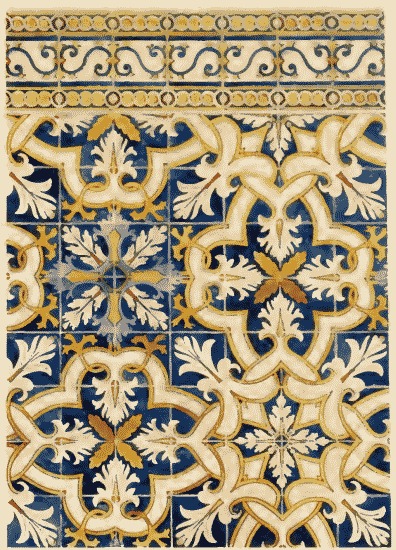
From the Marvilla, Santarem.
PORTUGUESE
ARCHITECTURE
by
WALTER CRUM WATSON
ILLUSTRATED
LONDON
ARCHIBALD CONSTABLE AND COMPANY
LIMITED
1908
Edinburgh: T. and A. Constable, Printers to His Majesty
AOS MEUS QUERIDOS PARENTES E AMIGOS A ILLMA E EXMA SNRA
M. L. DOS PRADOS LARGOS
E OS ILLMOS E EXMOS SNRES
BARONEZA E BARÃO DE SOUTELLINHO
COMO RECONHECIMENTO PELAS AMABILIDADES E ATTENÇÕES QUE ME DISPENSARAM NOS BELLOS DIAS QUE PASSEI NA SUA COMPANHIA COMO HOMENAGEM RESPEITOSA O.D.C. O AUCTOR
PREFACE
CONTENTS
LIST OF ILLUSTRATIONS
INTRODUCTION
BOOKS CONSULTED
INDEX
PREFACE
The buildings of Portugal, with one or two exceptions, cannot be said to excel or even to come up to those of other countries. To a large extent the churches are without the splendid furniture which makes those of Spain the most romantic in the world, nor are they in themselves so large or so beautiful. Some apology, then, may seem wanted for imposing on the public a book whose subject-matter is not of first-class importance.
The present book is the outcome of visits to Portugal in April or May of three successive years; and during these visits the writer became so fond of the country and of its people, so deeply interested in the history of its glorious achievements in the past, and in the buildings which commemorate these great deeds, that it seemed worth while to try and interest others in them. Another reason for writing about Portugal instead of about Spain is that the country is so much smaller that it is no very difficult task to visit every part and see the various buildings with one's own eyes: besides, in no language does there exist any book dealing with the architecture of the country as a whole. There are some interesting monographs in Portuguese about such buildings as the palace at Cintra, or Batalha, while the Renaissance has been fully treated by Albrecht Haupt, but no one deals at all adequately with what came before the time of Dom Manoel.
Most of the plans in the book were drawn from rough measurements taken on the spot and do not pretend to minute accuracy.
For the use of that of the Palace at Cintra the thanks of the writer are due to Conde de Sabugosa, who allowed it to be copied from his book, while the plan of Mafra was found in an old magazine.
Thanks are also due to Senhor Joaquim de Vasconcellos for much valuable information, to his wife, Senhora Michaelis de Vasconcellos, for her paper about the puzzling inscriptions at Batalha, and above all the Baron and the Baroneza de Soutellinho, for their repeated welcome to Oporto and for the trouble they have taken in getting books and photographs.
That the book may be more complete there has been added a short account of some of the church plate and paintings which still survive, as well as of the tile work which is so universal and so characteristic.
As for the buildings, hardly any of any consequence have escaped notice.
Edinburgh, 1907.
CONTENTS
INTRODUCTION
PAGE
Portugal separated from Spain by no natural division geographical or linguistic; does not correspond with Roman Lusitania, nor with the later Suevic kingdom—Traces of early Celtic inhabitants; Citania, Sabrosa—Roman Occupation; Temple at Evora—Barbarian Invasions—Arab Conquest—Beginnings of Christian re-conquest—Sesnando, first Count of Oporto—Christians defeated at Zalaca—Count Henry of Burgundy and Dona Theresa—Beginnings of Portuguese Independence—Affonso Henriques, King of Portugal—Growth of Portugal—Victory of Aljubarrota—Prince Henry the Navigator—The Spanish Usurpation—The Great Earthquake—The Peninsular War—The Miguelite War—The suppression of the Monasteries—Differences between Portugal and Spain, etc.
1-10 Painting in PortugalNot very many examples of Portuguese paintings left—Early connection with Burgundy; and with Antwerp—Great influence of Flemish school—The myth of Grão Vasco—Pictures at Evora, at Thomar, at Setubal, in Santa Cruz, Coimbra—'The Fountain of Mercy' at Oporto—The pictures at Vizeu: 'St. Peter'—Antonio de Hollanda
10-17 Church PlateMuch plate lost during the Peninsular War—Treasuries of Braga, Coimbra, and Evora, and of Guimarães—Early chalices, etc., at Braga, Coimbra, and Guimarães—Crosses at Guimarães and at Coimbra—Relics of St. Isabel—Flemish influence seen in later work—Tomb of St. Isabel, and coffins of sainted abbesses of Lorvão
17-20 TilesDue to Arab influence—The word
azulejoand its origin—The different stages in the development of tile making—Early tiles at Cintra Moorish in pattern and in technique—Tiles at Bacalhôa Moorish in technique but Renaissance in pattern—Later tiles without Moorish technique,
e.g.at Santarem and elsewhere—Della Robbia ware at Bacalhôa—Pictures in blue and white tiles very common
20-28 CHAPTER IEARLY BUILDINGS IN THE NORTH
The oldest buildings are in the North—Very rude and simple—Three types—Villarinho—São Miguel, Guimarães—Cedo Feita, Oporto—Gandara, Boelhe, etc., are examples of the simplest—Aguas Santas, Rio Mau, etc., of the second; and of the third Villar de Frades, etc.—Legend of Villar—Sé, Braga—Sé, Oporto—Paço de Souza—Method of roofing—Tomb of Egas Moniz—Pombeiro—Castle and Church, Guimarães
29-43 CHAPTER IIEARLY BUILDINGS IN THE SOUTH
Growth of Christian kingdom under Affonso Henriques—His vow—Capture of Santarem, of Lisbon—Cathedral, Lisbon, related to Church of S. Sernin, Toulouse—Ruined by Great Earthquake, and badly restored—Sé Velha, Coimbra, general scheme copied from Santiago and so from S. Sernin, Toulouse—Other churches at Coimbra—Evora, its capture—Cathedral founded—Similar in scheme to Lisbon, but with pointed arches; central lantern; cloister—Thomar founded by Gualdim Paes; besieged by Moors—Templar Church—Santarem, Church of São João de Alporão—Alcobaça; great wealth of Abbey—Designed by French monks—Same plan as Clairvaux—Has but little influence on later buildings
44-63 CHAPTER IIITHIRTEENTH AND FOURTEENTH CENTURIES DOWN TO
THE BATTLE OF ALJUBARROTA
The thirteenth century poor in buildings—The Franciscans—São Francisco Guimarães—Santarem—Santa Maria dos Olivaes at Thomar—
Cf.aisle windows at Leça do Balio—Inactivity and deposition of Dom Sancho
ii. by Dom Affonso
iii.—Conquest of Algarve—Sé, Silves—Dom Diniz and the castles at Beja and at Leiria—Cloisters, Cellas, Coimbra, Alcobaça, Lisbon, and Oporto—St. Isabel and Sta. Clara at Coimbra—Leça do Balio—The choir of the cathedral, Lisbon, with tombs—Alcobaça, royal tombs—Dom Pedro
i. and Inez de Castro; her murder, his sorrow—Their tombs
64-78 CHAPTER IVAND THE DELIVERANCE OF PORTUGAL
Dom Fernando and Dona Leonor Telles—Her wickedness and unpopularity—Their daughter, Dona Brites, wife of Don Juan of Castile, rejected—Dom João
i. elected king—Battle of Aljubarrota—Dom João's vow—Marriage of Dom João and Philippa of Lancaster—Batalha founded; its plan national, not foreign; some details seem English, some French, some even German—Huguet the builder did not copy York or Canterbury—Tracery very curious—Inside very plain—Capella do Fundador, with the royal tombs—Capellas Imperfeitas
79-92 CHAPTER VEARLIER FIFTEENTH CENTURY
Nossa Senhora da Oliveira Guimarães rebuilt as a thankoffering—Silver reredos captured at Aljubarrota—The cathedral, Guarda—Its likeness to Batalha—Nave later—Nuno Alvarez Pereira, the Grand Constable, and the Carmo, Lisbon—João Vicente and Villar de Frades—Alvito, Matriz—Capture of Ceuta—Tombs in the Graça, Santarem—Dom Pedro de Menezes and his 'Aleo'—Tomb of Dom Duarte de Menezes in São João de Alporão—Tombs at Abrantes cloister—Thomar
93-103 CHAPTER VIGOTHIC
Graça, Santarem—Parish churches, Thomar, Villa do Conde, Azurara and Caminha, all similar in plan—Cathedrals: Funchal, Lamego, and Vizeu—Porch and chancel of cathedral, Braga—Conceição, Braga
104-115 CHAPTER VIIINFLUENCE OF THE MOORS
Few buildings older than the re-conquest—But many built for Christians by Moors—The Palace, Cintra—Originally country house of the Walis—Rebuilt by Dom João
i.—Plan and details Moorish—Entrance court—Sala dos Cysnes, why so called, its windows; Sala do Conselho; Sala das Pegas, its name, chimney-piece; Sala das Sereias; dining-room; Pateo, baths; Sala dos Arabes; Pateo de Diana; chapel; kitchen—Castles at Guimarães and at Barcellos—Villa de Feira
116-128 CHAPTER VIIIMOORISH BUILDINGS
Commoner in Alemtejo—Castle, Alvito—Not Sansovino's Palace—Evora, Paços Reaes, Cordovis, Sempre Nova, São João Evangelista, São Francisco, São Braz
129-135 CHAPTER IXCARPENTRY
Examples found all over the country—At Aguas Santas, Azurara, Caminha and Funchal—Cintra, Sala dos Cysnes, Sala dos Escudos—Coimbra, Misericordia, hall of University—Ville do Conde Santa Clara, Aveiro convent
136-142 CHAPTER XMANOELINO
João
ii. continues the policy of Prince Henry the Navigator—Bartholomeu Diaz, Vasco da Gama—Accession of Dom Manoel—Discovery of route to India, and of Brazil—Great wealth of King—Fails to unite all the kingdoms of the Peninsula—Characteristic features of Manoelino—House of Garcia de Resende, Evora—Caldas da Rainha—Setubal, Jesus—Beja, Conceição, Castle, etc.—Cintra, Palace—Gollegã, Church—Elvas, Cathedral—Santarem, Marvilla—Lisbon, Madre de Deus—Coimbra, University Chapel—Setubal, São Julião
143-156 CHAPTER XIAND THE CONQUEST OF INDIA
Vasco da Gama's successful voyage to Calicut, 1497—Other expeditions lead to discovery of Brazil—Titles conferred on Dom Manoel by Pope Alexander
vi.—Ormuz taken—Strange forms at Thomar not Indian—Templars suppressed and Order of Christ founded instead—Prince Henry Grand Master—Spiritual supremacy of Thomar over all conquests, made or to be made—Templar church added to by Prince Henry, and more extensively by Dom Manoel—João de Castilho builds Coro—Stalls burnt by French—South door, chapter-house and its windows—Much of the detail emblematic of the discoveries, etc., made in the East and in the West
157-170 CHAPTER XIIADDITIONS TO BATALHA
Dom Duarte's tomb-house unfinished—Work resumed by Dom Manoel—The two Matheus Fernandes, architects—The Pateo—The great entrance—Meaning of 'Tanyas Erey'—Piers in Octagon—How was the Octagon to be roofed?—The great Cloister, with its tracery—Whence derived
171-180 CHAPTER XIIIBELEM
Torre de São Viente built to defend Lisbon—Turrets and balconies not Indian—Vasco da Gama sails from Belem—The great monastery built as a thankoffering for the success of his voyage—Begun by Boutaca, succeeded by Lourenço Fernandes, and then by João de Castilho—Plan due to Boutaca—Master Nicolas, the Frenchman, the first renaissance artist in Portugal—Plan: exterior; interior superior to exterior; stalls; cloister, lower and upper—Lisbon, Conceição Velha, also by João de Castilho
181-195 CHAPTER XIVCOMING OF THE FOREIGN ARTISTS
Coimbra, Sta. Cruz, founded by Dom Affonso Henriques, rebuilt by Dom Manoel, first architect Marcos Pires—Gregorio Lourenço clerk of the works—Diogo de Castilho succeeds Marcos Pires—West front, Master Nicolas—Cloister, inferior to that of Belem—Royal tombs—Other French carvers—Pulpit, reredoses in cloister, stalls—Sé Velha reredos, doors—Chapel of São Pedro
196-210 CHAPTER XVINFLUENCE OF THE FOREIGNERS
Tomb at Thomar of the Bishop of Funchal—Tomb in Graça, Santarem—São Marcos, founded by Dona Brites de Menezes—Tomb of Fernão Telles—Rebuilt by Ayres da Silva, her grandson—Tombs in chancel—Reredos, by Master Nicolas—Reredos at Cintra—Pena Chapel by same—São Marcos, Chapel of the Reyes Magos—Sansovino's door, Cintra—Evora, São Domingos—Portalegre, Tavira, Lagos, Goes, Trofa, Caminha, Moncorvo
211-221 CHAPTER XVIWORK OF JOÃO DE CASTILHO AND EARLIER CLASSIC
João
iii. cared more for the Church than for anything else—Decay begins—Later additions to Alcobaça—Batalha, Sta. Cruz—Thomar, Order of Christ reformed—Knights become regulars—Great additions, cloisters, dormitory, etc., by João de Castilho—His difficulties, letters to the King—His addition to Batalha—Builds Conceição at Thomar like Milagre, Santarem—Marvilla,
ibid.; Elvas, São Domingos—Cintra, Penha Longa and Penha Verde—Vizeu, Cloister—Lamego, Cloister—Coimbra, São Thomaz—Carmo—Faro—Lorvão—Amarante—Santarem, Santa Clara, and Guarda, reredos
222-239 CHAPTER XVIILATER RENAISSANCE AND THE SPANISH USURPATION
Diogo de Torralva and Claustro dos Filippes, Thomar—Miranda de Douro—Reigns of Dom Sebastião and of the Cardinal King Henry not noted for much building—Evora, Graça and University—Fatal expedition by Dom Sebastião to Morocco—His death and defeat—Feeble reign of his grand-uncle—Election of Philip—Union with Spain and consequent loss of trade—Lisbon, São Roque; coming of Terzi—Lisbon, São Vicente de Fora; first use of very long Doric pilasters—Santo Antão, Santa Maria do Desterro, and Torreão do Paço—Sé Nova, Coimbra, like Santo Antão—Oporto, Collegio Novo—Coimbra, Misericordia, Bishop's palace; Sacristy of Sé Velha, São Domingos, Carmo, Graça, São Bento by Alvares—Lisbon, São Bento—Oporto, São Bento
240-253 CHAPTER XVIIIBUILDINGS OF THE LATER RENAISSANCE, TILL THE
EXPULSION OF THE SPANIARDS
Vianna do Castello, Misericordia—Beja, São Thiago—Azeitão, São Simão—Evora, Cartuxa—Beja, Misericordia—Oporto, Nossa Senhora da Serra do Pilar—Sheltered Wellington before he crossed the Douro—Besieged by Dom Miguel—Very original plan—Coimbra, Sacristy of Santa Cruz—Lisbon, Santa Engracia never finished—Doric pilasters too tall—Coimbra, Santa Clara, great abuse of Doric pilasters
254-260 CHAPTER XIXRESTORATION AND THE EIGHTEENTH CENTURY
The expulsion of the Spaniards—Long war: final success of Portugal and recovered prosperity—Mafra founded by Dom João
v.—Compared with the Escorial—Designed by a German—Palace, church, library, etc.—Evora, Capella Mor—Great Earthquake—The Marques de Pombal—Lisbon, Estrella—Oporto, Torre dos Clerigos—Oporto, Quinta do Freixo—Queluz—Quinta at Guimarães—Oporto, hospital and factory—Defeat of Dom Miguel and suppression of monasteries
261-271BOOKS CONSULTED
272INDEX
273LIST OF ILLUSTRATIONS
To face page
1.
Guimarães, House from Sabrosa
} 4 2.
Evora, Temple of 'Diana'
3.
Oporto, Fountain of Mercy
14 4.
Vizeu, St. Peter, in Sacristy of Cathedral
} 16 5.
Coimbra, Cross in Cathedral Treasury
6.
" Chalice " "
} 20 7.
" Monstrance " "
8.
Cintra, Palace, Sala dos Arabes
} 24 9.
" " Dining-room
10.
Santarem, Marvilla, coloured wall tiles
} frontispiece. 11.
" "
12.
Vallarinho, Parish Church
} 32 13.
Villar de Frades, West Door
14.
Paço de Souza, Interior of Church
} 40 15.
" " Tomb of Egas Moniz
16.
Guimarães, N. S. da Oliveira, Chapter-house Entrance
} 42 17.
Leça do Balio, Cloister
18.
Coimbra, Sé Velha, Interior
} 50 19.
" " West Front
20.
Evora, Cathedral, Interior
} 54 21.
" " Central Lantern
22.
Evora, Cloister
} 56 23.
Thomar, Templar Church
24.
Santarem, São João de Alporão
} 58 25.
Alcobaça, South Transept
26.
Santarem, São Francisco, West Door
} 66 27.
Silves, Cathedral, Interior
28.
Alcobaça Cloister
} 72 29.
Lisbon, Cathedral Cloister
30.
Coimbra, Sta. Clar
74 31.
Alcobaça, Chapel with Royal Tombs
} 78 32.
" Tomb of Dom Pedro
i.
33.
Batalha, West Fron
86 34.
Batalha, Interior
} 88 35.
" Capella do Fundador
36.
Batalha, Capellas Imperfeita
92 37.
Guimarães, Capella of D. Juan
i. of Castile
} 94 38.
Guarda, North Side of Cathedral
39.
Santarem, Tomb of Dom Pedro de Menezes
} 102 40.
" Tomb of Dom Duarte de Menezes
41.
Villa do Conde, West Front of Parish Churc
108 42.
Vizeu, Interior of Cathedral
} 112 43.
Braga, Cathedral Porch
44.
Cintra, Palace, Main Front
} 120 45.
" " Window in 'Sala das Sereias'
46.
Cintra, Palace, Ceiling of Chape
126 47.
Alvito, Castle
} 132 48.
Evora, São João Evangelista, Door to Chapter-house
49.
Caminha, Roof of Matriz
} 138 50.
Cintra, Palace, Ceiling of Sala dos Cysnes
51.
Coimbra, University, Ceiling of Sala dos Capello
142 52.
Cintra, Palace, additions by D. Manoe
152 53.
Santarem, Marvilla, West Door
} 154 54.
Coimbra, University Chapel Door
55.
Thomar, Convent of Christ, South Door
} 166 56.
" " " Chapter-house Window
57.
Batalha, Entrance to Capellas Imperfeita
174 58.
Batalha, Window of Pateo
} 178 59.
" Upper part of Capellas Imperfeitas
60.
Batalha, Claustro Real
} 180 61.
Batalha, Lavatory in Claustro Real
62.
Belem, Torre de São Vicente
} 184 63.
Belem, Sacristy
64.
Belem, South side of Nave
} 190 65.
" Interior, looking west
66.
Belem, Cloister
} 194 67.
" Interior of Lower Cloister
68.
Lisbon, Conceição Velh
196 69.
Coimbra, Sta. Cruz, West Front
} 200 70.
" " Cloister
71.
Coimbra, Sta. Cruz, Tomb of D. Sancho
i.
} 202 72.
" " Pulpit
73.
Coimbra, Sta. Cruz, Reredos in Cloister
} 206 74.
" " Choir Stalls
75.
Coimbra, Sé Velha, Reredos
} 209 76.
" " Reredos in Chapel of São Pedro
77.
Thomar, Sta. Maria dos Olivaes, Tomb of the Bishop of Funchal
} 212 78.
São Marcos, Tomb of D. João da Silva
79.
São Marcos, Chancel
} 218 80.
" Chapel of the 'Reyes Magos'
81.
Cintra, Palace, Door by Sansovino
} 220 82.
Caminha, West Door of Church
83.
Alcobaça, Sacristy Door
} 224 84.
Batalha, Door of Sta. Cruz
85.
Thomar, Claustro da Hospedaria
} 228 86.
" Chapel in Dormitory Passage
87.
Thomar, Stair in Claustro dos Filippes
} 230 88.
" Chapel of the Conceição
89.
Santarem, Marvilla, Interior
} 236 90.
Vizeu, Cathedral Cloister
91.
Guarda, Cathedral Reredos
} 240 92.
Thomar, Claustro dos Filippes
93.
Lisbon, São Vicente de Fora
} 246 94.
" " " Interior
95.
Coimbra, Sé Nova
} 250 96.
" Misericordia
97.
Vianna do Castello, Misericordi
254 98.
Oporto, N. S. da Serra do Pilar, Cloister
} 258 99.
Coimbra, Sta. Cruz, Sacristy
100.
Mafra, West Front
} 266 101.
" Interior of Church
INTRODUCTION
No one can look at a map of the Iberian Peninsula without being struck by the curious way in which it is unequally divided between two independent countries. Spain occupies by far the larger part of the Peninsula, leaving to Portugal only a narrow strip on the western seaboard some one hundred miles wide and three hundred and forty long. Besides, the two countries are separated the one from the other by merely artificial boundaries. The two largest rivers of the Peninsula, the Douro and the Tagus, rise in Spain, but finish their course in Portugal, and the Guadiana runs for some eighty miles through Portuguese territory before acting for a second time as a boundary between the two countries. The same, to a lesser degree, is true of the mountains. The Gerez and the Marão are only offshoots of the Cantabrian mountains, and the Serra da Estrella in Beira is but a continuation of the Sierra de Gata which separates Leon from Spanish Estremadura. Indeed the only natural frontiers are formed by the last thirty miles of the Minho in the north, by about eighty miles of the Douro, which in its deep and narrow gorge really separates Traz os Montes from Leon; by a few miles of the Tagus, and by the Guadiana both before and after it runs through a part of Alemtejo.
If the languages of the two countries were radically unlike this curious division would be more easy to understand, but in reality Castilian differs from Portuguese rather in pronunciation than in anything else; indeed differs less from Portuguese than it does from Cataluñan.[1]
During the Roman dominion none of the divisions of the Peninsula corresponded exactly with Portugal. Lusitania, which the poets of the Renaissance took to be the Roman name of their country, only reached up to the Douro, and took in a large part of Leon and the whole of Spanish Estremadura.
In the time of the Visigoths, a Suevic kingdom occupied most of Portugal to the north of the Tagus, but included also all Galicia and part of Leon; and during the Moorish occupation there was nothing which at all corresponded with the modern divisions.
It was, indeed, only by the gradual Christian re-conquest of the country from the Moors that Portugal came into existence, and only owing to the repeated failure of the attempt to unite the two crowns of Portugal and Castile by marriage that they have remained separated to the present day.
Of the original inhabitants of what is now Portugal little is known, but that they were more Celtic than Iberian seems probable from a few Celtic words which have survived, such as Mor meaning great as applied to the Capella Mor of a church or to the title of a court official. The name too of the Douro has probably nothing to do with gold but is connected with a Celtic word for water. The Tua may mean the 'gushing' river, and the Ave recalls the many Avons. Ebora, now Evora, is very like the Roman name of York, Eboracum. Briga, too, the common termination of town names in Roman times as in Conimbriga—Condeixa a Velha—or Cetobriga, near Setubal—in Celtic means height or fortification. All over the country great rude stone monuments are to be found, like those erected by primitive peoples in almost every part of Europe, and the most interesting, the curious buildings found at various places near Guimarães, seem to belong to a purely Celtic civilisation.
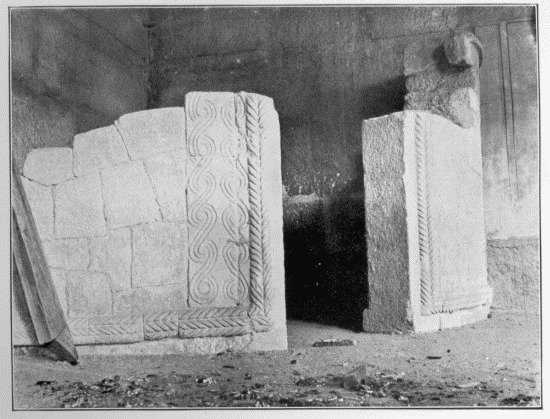
The best-known of these places, now called Citania—from a name of a native town mentioned by ancient writers—occupies the summit of a hill about nine hundred feet above the road and nearly half-way between Guimarães and Braga. The top of this hill is covered with a number of structures, some round from fifteen to twenty feet across, and some square, carefully built of well-cut blocks of granite. The only opening is a door which is often surrounded by an architrave adorned with rough carving; the roofs seem to have been of wood and tiles.
Some, not noticing the three encircling walls and the well-cut water-channels, and thinking that the round buildings far exceeded the rectangular in number, have thought that they might have been intended for granaries where corn might be stored against a time of war. But it seems far more likely that Citania was a town placed on this high hill for safety. Though the remains show no other trace of Roman civilisation, one or two of the houses are inscribed with their owner's names in Roman character, and from coins found there they seem to have been inhabited long after the surrounding valleys had been subdued by the Roman arms, perhaps even after the great baths had been built not far off at the hot springs of Taipas. Uninfluenced by Rome, Citania was also untouched by Christianity, though it may have been inhabited after St. James—if indeed he ever preached in Bracara Augusta, now Braga—and his disciple São Pedro de Rates had begun their mission.
But if Citania knew nothing of Christianity there still remains one remarkable monument of the native religion. Among the ruins there long lay a huge thin slab of granite, now in the museum of Guimarães, which certainly has the appearance of having been a sacrificial stone. It is a rough pentagon with each side measuring about five feet. On one side, in the middle, a semicircular hollow has been cut out as if to leave room for the sacrificing priest, while on the surface of the stone a series of grooves has been cut, all draining to a hole near this hollow and arranged as if for a human body with outstretched legs and arms. The rest of the surface is covered with an intricate pattern like what may often be found on Celtic stones in Scotland. Besides this so-called Citania similar buildings have been found elsewhere, as at Sabrosa, also near Guimarães, but there the Roman influence seems usually to have been greater. (Fig. 1.)
The Romans began to occupy the Peninsula after the second Punic war, but the conquest of the west and north was not completed till the reign of Augustus more than two hundred years later. The Roman dominion over what is now Portugal lasted for over four hundred years, and the chief monument of their occupation is found in the language. More material memorials are the milestones which still stand in the Gerez, some tombstones, and some pavements and other remains at Condeixa a Velha, once Conimbriga, near Coimbra and at the place now called Troya, perhaps the original Cetobriga, on a sandbank opposite Setubal, a town whose founders were probably Phœnicians.
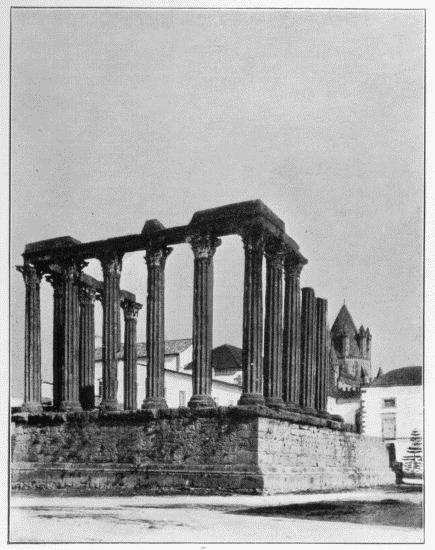
But more important than any of these is the temple at Evora, now without any reason called the temple of Diana. During the middle ages, crowned with battlements, with the spaces between the columns built up, it was later degraded by being turned into a slaughter-house, and was only cleared of such additions a few years since. Situated near the cathedral, almost on the highest part of the town, it stands on a terrace whose great retaining wall still shows the massiveness of Roman work.
Of the temple itself there remains about half of the podium, some eleven feet high, fourteen granite columns, twelve of which still retain their beautiful Corinthian capitals, and the architrave and part of the frieze resting on these twelve capitals. Everything is of granite except the capitals and bases which are of white marble; but instead of the orthodox twenty-four flutes each column has only twelve, with a distinctly unpleasing result. The temple seems to have been hexastyle peripteral, but all trace of the cella has disappeared. Nothing is known of the temple or who it was that built it, but in Roman times Evora was one of the chief cities of Lusitania; nothing else is left but the temple, for the aqueduct has been rebuilt and the so-called Tower of Sertorius was mediæval. Yet, although it may have less to show than Merida, once Augusta Emerita and the capital of the province, this temple is the best-preserved in the whole peninsula. (Fig. 2.)
Before the Roman dominion came to an end, in the first quarter of the fifth century, Christianity had been for some time firmly established. Religious intolerance also, which nearly a thousand years later made Spain the first home of the Inquisition, had already made itself manifest in the burning of the heretical Priscillianists by Idacius, whose see was at or near Lamego.
Soon, however, the orthodox were themselves to suffer, for the Vandals, the Goths, and the Suevi, who swept across the country from 417 A.D., were Arians, and it was only after many years had passed that the ruling Goths and Suevi were converted to the Catholic faith.
The Vandals soon passed on to Africa, leaving their name in Andalucia and the whole land to the Goths and Suevi, the
Suevi at first occupying the whole of Portugal north of the Tagus as well as Galicia and part of Leon. Later they were expelled from the southern part of their dominion, but they as well as the Goths have left practically no mark on the country, for the church built at Oporto by the Suevic king, Theodomir, on his conversion to orthodoxy in 559, has been rebuilt in the eleventh or twelfth century.
These Germanic rulers seem never to have been popular with those they governed, so that when the great Moslem invasion crossed from Morocco in 711 and, defeating King Roderick at Guadalete near Cadiz, swept in an incredibly short time right up to the northern mountains, the whole country submitted with scarcely a struggle.
A few only of the Gothic nobles took refuge on the seaward slopes of the Cantabrian mountains in the Asturias and there made a successful stand, electing Don Pelayo as their king.
As time went on, Pelayo's descendants crossed the mountains, and taking Leon gradually extended their small kingdom southwards.
Meanwhile other independent counties or principalities further east were gradually spreading downwards. The nearest was Castile, so called from its border castles, then Navarre, then Aragon, and lastly the county of Barcelona or Cataluña.
Galicia, in the north-west corner, never having been thoroughly conquered by the invaders, was soon united with the Asturias and then with Leon. So all these Christian realms, Leon—including Galicia and Asturias—Castile, and Aragon, which was soon united to Cataluña, spread southwards, faster when the Moslems were weakened by division, slower when they had been united and strengthened by a fresh wave of fanaticism from Africa. Navarre alone was unable to grow, for the lower Ebro valley was won by the kings of Aragon, while Castile as she grew barred the way to the south-west.
At last in 1037 Fernando i. united Castile and Leon into one kingdom, extending from the sea in the north to the lower course of the Douro and to the mountains dividing the upper Douro from the Tagus valley in the south. Before Fernando died in 1065 he had extended his frontier on the west as far south as the Mondego, making Sesnando, a converted Moslem, count of this important marchland. Then followed a new division, for Castile went to King Sancho, Leon to Alfonso vi., and Galicia, including the two counties of Porto and of Coimbra, to Garcia.
Before long, however, Alfonso turned out his brothers and also extended his borders even to the Tagus by taking Toledo in 1085. But his successes roused the Moslem powers to fresh fanaticism. A new and stricter dynasty, the Almoravides,[2] arose in Africa and crossing the straits inflicted a crushing defeat on the Christians at Zalaca. In despair at this disaster and at the loss of Santarem and of Lisbon, Alfonso appealed to Christendom for help. Among those who came were Count Raymond of Toulouse, who was rewarded with the kingdom of Galicia and the hand of his daughter and heiress Urraca, and Count Henry of Burgundy, who was granted the counties of Porto and of Coimbra and who married another daughter of Alfonso's, Theresa.
This was really the first beginning of Portugal as an independent state; for Portugal, derived from two towns Portus and Cales, which lie opposite each other near the mouth of the Douro, was the name given to Henry's county. Henry did but little to make himself independent as he was usually away fighting elsewhere, but his widow Theresa refused to acknowledge her sister Urraca, now queen of Castile, Leon and Galicia, as her superior, called herself Infanta and behaved as if she was no one's vassal. Fortunately for her and her aims, Urraca was far too busy fighting with her second husband, the king of Aragon, to pay much attention to what was happening in the west, so that she had time to consolidate her power and to accustom her people to think of themselves as being not Galicians but Portuguese.
The breach with Galicia was increased by the favour which Theresa, after a time, began to show to her lover, Don Fernando Peres de Trava, a Galician noble, and by the grants of lands and of honours she made to him. This made her so unpopular that when Alfonso Raimundes, Urraca's son, attacked Theresa in 1127, made her acknowledge him as suzerain, and give up Tuy and Orense, Galician towns she had taken, the people rose against her and declared her son Affonso Henriques old enough to reign.
Then took place the famous submission of Egas Moniz, Affonso's governor, who induced the king to retire from the siege of Guimarães by promising that his pupil would agree to the terms forced on his mother. This, though but seventeen, Affonso refused to do, and next year raising an army he expelled his mother and Don Fernando, and after four wars with his cousin of Castile finally succeeded in maintaining his independence, and even in assuming the title of King.
These wars with Castile taught him at last that the true way to increase his realm was to leave Christian territory alone and to direct his energies southwards, gaining land only at the expense of the Moors.
So did the kingdom of Portugal come into existence, almost accidentally and without there being any division of race or of language between its inhabitants and those of Galicia.
The youngest of all the Peninsular kingdoms, it is the only one which still remains separate from the rest of the Spains, for when in 1580 union was forced on her by Philip ii., Portugal had had too glorious a past, and had become too different in language and in custom easily to submit to so undesired a union, while Spain, already suffering from coming weakness and decay, was not able long to hold her in such hated bondage.
It is not necessary here to tell the story of each of Affonso Henriques' descendants. He himself permanently extended the borders of his kingdom as far as the Tagus, and even raided the Moslem lands of the south as far as Ourique, beyond Beja. His son, Sancho i., finding the Moors too strong to make any permanent conquests beyond the Tagus, devoted himself chiefly—when not fighting with the king of Castile and Leon—to rebuilding and restoring the towns in Beira, and it was not till the reign of his grandson, Affonso iii., that the southern sea was reached by the taking of the Algarve in the middle of the thirteenth century.
Dom Diniz, Affonso iii.'s son, carried on the work of settling the country, building castles and planting pine-trees to stay the blowing sands along the west coast.
From that time on Portugal was able to hold her own, and was strong enough in 1387 to defeat the king of Castile at Aljubarrota when he tried to seize the throne in right of his wife, only child of the late Portuguese king, Fernando.
Under the House of Aviz, whose first king, João i., had been elected to repel this invasion, Portugal rose to the greatest heights of power and of wealth to which the country was ever to attain. The ceaseless efforts of Dom Henrique, the Navigator, the third son of Dom João, were crowned with success when Vasco da Gama landed at Calicut in May 1498, and when Pedro Alvares Cabral first saw the coasts of Brazil in 1500.
To-day one is too ready to forget that Portugal was the pioneer in geographical discovery, that the Portuguese were the first Westerns to reach Japan, and that, had João ii. listened to Columbus, it would have been to Portugal and not to Spain that he would have given a new world.
It was, too, under the House of Aviz that the greatest development in architecture took place, and that the only original and distinctive style of architecture was formed. That was also the time when the few good pictures which the country possesses were painted, and when much of the splendid church plate which still exists was wrought.
The sixty years of the Spanish captivity, as it was called, from 1580 to 1640, were naturally comparatively barren of all good work. After the restoration of peace and a revival of the Brazilian trade had brought back some of the wealth which the country had lost, the art of building had fallen so low that of the many churches rebuilt or altered during the eighteenth century there is scarcely one possessed of the slightest merit.
The most important events of the eighteenth century were the great earthquakes of 1755 and the ministry of the Marques de Pombal.
Soon after the beginning of the nineteenth century came the invasion led by Junot, 1807, the flight of the royal family to Brazil, and the Peninsular War. Terrible damage was done by the invaders, cart-loads of church plate were carried off, and many a monastery was sacked and burned. Peace had not long been restored when the struggle broke out between the constitutional party under Pedro of Brazil, who had resigned the throne of Portugal in favour of his daughter, Maria da Gloria, and the absolutists under Dom Miguel, his brother.
The civil war lasted for several years, from May 1828, when Dom Miguel, then regent for his niece, summoned the Cortes and caused himself to be elected king, till May 1834, when he was finally defeated at Evora Monte and forced to leave the country. The chief events of his usurpation were the siege of Oporto and the defeat of his fleet off Cape St. Vincent in 1833 by Captain Charles Napier, who fought for Dona Maria under the name of Carlos de Ponza.
One of the first acts of the constitutional Cortes was to suppress all the monasteries in the kingdom in 1834. At the same time the nunneries were forbidden to receive any new nuns, with the result that in many places the buildings have gradually fallen into decay, till the last surviving sister has died, solitary and old, and so at length set free her home to be turned to some public use.[3]
Since then the history of Portugal has been quiet and uneventful. Good roads have been made—but not always well kept up—railways have been built, and Lisbon, once known as the dirtiest of towns, has become one of the cleanest, with fine streets, electric lighting, a splendidly managed system of electric tramways, and with funiculars and lifts to connect the higher parts of the town with its busy centre.
It is not uninteresting to notice in how many small matters Portugal now differs from Spain. Portugal drinks tea, Spain chocolate or coffee; it lunches and dines early, Spain very late; its beds and pillows are very hard, in Spain they are much softer. Travelling too in Portugal is much pleasanter; as the country is so much smaller, trains leave at much more reasonable hours, run more frequently, and go more quickly. The inns also, even in small places, are, if not luxurious, usually quite clean with good food, and the landlord treats his guests with something more pleasing than that lofty condescension which is so noticeable in Spain.
Of the more distant countries of Europe, Portugal is now one of the easiest to reach. Forty-eight hours from Southampton in a boat bound for South America lands the traveller at Vigo, or three days at Lisbon, where the brilliant sun and blue sky, the judas-trees in the Avenida, the roses, the palms, and the sheets of bougainvillia, are such an unimaginable change from the cold March winds and pinched buds of England.
There is perhaps no country in Europe which has so interesting a flora, especially in spring. In March in the granite north the ground under the pine-trees is covered with the exquisite flowers of the narcissus triandrus,[4] while the wet water meadows are yellow with petticoat daffodils. Other daffodils too abound, but these are the commonest.
Later the granite rocks are hidden by great trees of white broom, while from north to south every wild piece of land is starred with the brilliant blue flowers of the lithospermum. There are also endless varieties of cistus, from the small yellow annual with rich brown heart to the large gum cistus that covers so much of the poor soil in the Alemtejo. These plains of the Alemtejo are supposed to be the least beautiful part of the country, but no one can cross them in April without being almost overcome with the beauty of the flowers, cistus, white, yellow, or red, tall white heaths, red heaths, blue lithospermum, yellow whin, and most brilliant of all the large pimpernel, whose blue flowers almost surpass the gentian. A little further on where there is less heath and cistus, tall yellow and blue Spanish irises stand up out of the grass, or there may be great heads of blue scilla peruviana or sheets of small iris of the brightest blue.
Indeed, sheets of brilliant colour are everywhere most wonderful. There may be acres of rich purple where the bugloss hides the grass, or of brilliant yellow where the large golden daisies grow thickly together, or of sky-blue where the convolvulus has smothered a field of oats.
Painting in Portugal.[5]
From various causes Portugal is far less rich in buildings of interest than is Spain. The earthquake has destroyed many, but more have perished through tasteless rebuilding during the eighteenth century when the country again regained a small part of the trade and wealth lost during the Spanish usurpation.
But if this is true of architecture, it is far more true of painting. During the most flourishing period of Spanish painting, the age of Velasquez and of Murillo, Portugal was, before 1640, a despised part of the kingdom, treated as a conquered province, while after the rebellion the long struggle, which lasted for twenty-eight years, was enough to prevent any of the arts from flourishing. Besides, many good pictures which once adorned the royal palaces of Portugal were carried off to Madrid by Philip or his successors.
And yet there are scattered about the country not a few paintings of considerable merit. Most of them have been terribly neglected, are very dirty, or hang where they can scarcely be seen, while little is really known about their painters.
From the time of Dom João i., whose daughter, Isabel, married Duke Philip early in the fifteenth century, the two courts of Portugal and of Burgundy had been closely united. Isabel sent an alabaster monument for the tomb of her father's great friend and companion, the Holy Constable, and one of bronze for that of her eldest brother; while as a member of the embassy which came to demand her hand, was J. van Eyck himself. However, if he painted anything in Portugal, it has now vanished.
There was also a great deal of trade with Antwerp where the Portuguese merchants had a lonja or exchange as early as 1386, and where a factory was established in 1503. With the heads of this factory, Francisco Brandão and Rodrigo Ruy de Almada, Albert Dürer was on friendly terms, sending them etchings and paintings in return for wine and southern rarities. He also drew the portrait of Damião de Goes, Dom Manoel's friend and chronicler.
It is natural enough, therefore, that Flanders should have had a great influence on Portuguese painting, and indeed practically all the pictures in the country are either by Netherland masters, painted at home and imported, or painted in Portugal by artists who had been attracted there by the fame of Dom Manoel's wealth and generosity, or else by Portuguese pupils sent to study in Flanders.
During the seventeenth century all memory of these painters had vanished. Looking at their work, the writers of that date were struck by what seemed to them, in their natural ignorance of Flemish art, a strange and peculiar style, and so attributed them all to a certain half-mythical painter of Vizeu called Vasco, or Grão Vasco, who is first mentioned in 1630.
Raczynski,[6] in his letters to the Berlin Academy, says that he had found Grão Vasco's birth in a register of Vizeu; but Vasco is not an uncommon name, and besides this child, Vasco Fernandes, was born in 1552—far too late to have painted any of the so-called Grão Vasco's pictures.
It is of course possible that some of the pictures now at Vizeu were the work of a man called Vasco, and one of those at Coimbra, in the sacristy of Santa Cruz, is signed Velascus—which is only the Spanish form of Vasco—so that the legendary personage may have been evolved from either or both of these, for it is scarcely possible that they can have been the same.
Turning now to some of the pictures themselves, there are thirteen representing scenes from the life of the Virgin in the archbishop's palace at Evora, which are said by Justi, a German critic, to be by Gerhard David. Twelve of these are in a very bad state of preservation, but one is still worthy of some admiration. In the centre sits the Virgin with the Child on her knee: four angels are in the air above her holding a wreath. On her right three angels are singing, and on her left one plays an organ while another behind blows the bellows. Below there are six other angels, three on each side with a lily between them, playing, those on the right on a violin, a flute, and a zither, those on the left on a harp, a triangle, and a guitar. Once part of the cathedral reredos, it was taken down when the new Capella Mor was built in the eighteenth century.
Another Netherlander who painted at Evora was Frey Carlos, who came to Espinheiro close by in 1507. Several of his works are in the Museum at Lisbon.[7]
When Dom Manoel was enriching the old Templar church at Thomar with gilding and with statues of saints, he also caused large paintings to be placed round the outer wall. Several still remain, but most have perished, either during the French invasion or during the eleven years after the expulsion of the monks in 1834 when the church stood open for any one to go in and do what harm he liked. Some also, including the 'Raising of Lazarus,' the 'Entry into Jerusalem,' the 'Resurrection,' and the 'Centurion,' are now in Lisbon. Four—the 'Nativity,' the 'Visit of the Magi,' the 'Annunciation,' and a 'Virgin and Child'—are known to have been given by Dom Manoel; twenty others, including the four now at Lisbon, are spoken of by Raczynski in 1843,[8] and some at least of these, as well as the angels holding the emblems of the Passion, who stand above the small arches of the inner octagon, may have been painted by Johannes Dralia of Bruges, who died and was buried at Thomar in 1504.[9]
Also at Thomar, but in the parish church of São João Baptista, are some pictures ascribed by Justi to a pupil of Quentin Matsys. Now it is known that a Portuguese called Eduard became a pupil of Matsys in 1504, and four years later a Vrejmeester of the guild. So perhaps they may be by this Eduard or by some fellow-pupil.
The Jesus Church at Setubal, built by Justa Rodrigues, Dom Manoel's nurse, has fifteen paintings in incongruous gilt frames and hung high up on the north wall of the church, which also have something of the same style.[10]
More interesting than these are two pictures in the sacristy of Santa Cruz at Coimbra, an 'Ecce Homo' and the 'Day of Pentecost.' It is the 'Pentecost' which is signed Velascus, and in it the Apostles in an inner room are seen through an arcade of three arches like a chapter-house entrance. Perhaps once part of the great reredos, this picture has suffered terribly from neglect; but it must once have been a fine work, and the way in which the Apostles in the inner room are separated by the arcade from the two spectators is particularly successful.
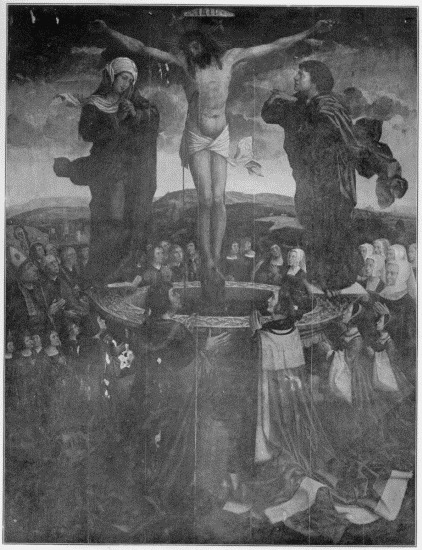
In Oporto there exists at least one good picture, 'The Fountain of Mercy,' now in the board-room of the Misericordia,[11] but painted to be the reredos of the chapel of São Thiago in the Sé where the brotherhood was founded by Dom Manoel in 1499. (Fig. 3.)
In the centre above, between St. John and the Virgin, stands a crucifix from which blood flows down to fill a white marble well.
Below, on one side there kneels Dom Manoel with his six sons—João, afterwards king; Luis, duke of Beja; Fernando, duke of Guarda; Affonso, afterwards archbishop of Lisbon, with his cardinal's hat; Henrique, later cardinal archbishop of Evora, and then king; and Duarte, duke of Guimarães and ancestor of the present ruling house of Braganza.
On the other side are Queen Dona Leonor,[12] granddaughter of Ferdinand and Isabella, Dom Manoel's third wife[13] and her two stepdaughters, Dona Isabel, the wife of Charles v. and mother of Philip ii., who through her claimed and won the throne of Portugal when his uncle, the cardinal king, died in 1580, and Dona Beatriz, who married Charles iii.. of Savoy.
The date of the picture is fixed as between 1518 when Dom Affonso, then aged nine, received his cardinal's hat, and 1521 when Dom Manoel died.[14]
Unfortunately the picture has been somewhat spoiled by restoration, but it is undoubtedly a very fine piece of work—especially the portraits below—and would be worthy of admiration anywhere, even in a country much richer in works of art.
It has of course been attributed to Grão Vasco, but it is quite different from either the Velascus pictures at Coimbra or the paintings at Vizeu; besides, some of the beautifully painted flowers, such as the columbines, which enrich the grass on which the royal persons kneel, are not Portuguese flowers, so that it is much more likely to have been the work of some one from Flanders.
Equally Flemish are the pictures at Vizeu, whether any of them be by the Grão Vasco or not. Tradition has it that he was born at a mill not far off, still called Moinho do Pintor, the Painter's Mill, and that Dom Manoel sent him to study in Italy. Now, wherever the painter of the Vizeu pictures had studied it can scarcely have been in Italy, as they are all surely much nearer to the Flemish than to any Italian school.
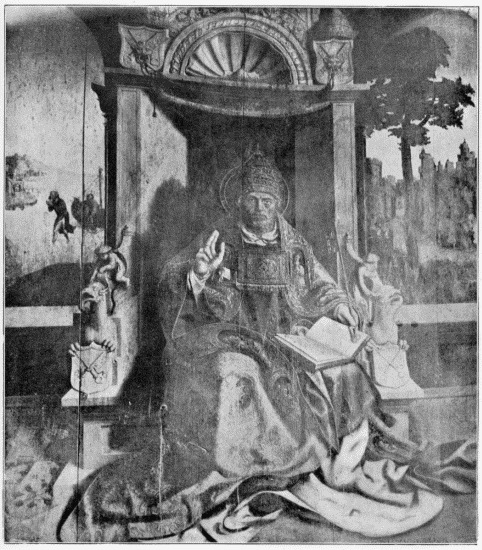
There are still in the precincts of the cathedral some thirty-one pictures of very varied merit, and not all by the same hand. Of these there are fourteen in the chapter-house, a room opening off the upper cloister. They are all scenes from the life of Our Lord from the Annunciation to the day of Pentecost. Larger than any of these is a damaged 'Crucifixion' in the Jesus Chapel under the chapter-house. The painting is full, perhaps too full, of movement and of figures. Besides the scenes usually portrayed in a picture of the Crucifixion, others are shown in the background, Judas hanging himself on one side, and Joseph of Arimathea and Nicodemus on the other, coming out from Jerusalem with their spices. Lastly, in the sacristy there are twelve small paintings of the Apostles and other saints of no great merit, and four large pictures, 'St. Sebastian,' the 'Day of Pentecost,' where the room is divided by three arches, with the Virgin and another saint in the centre, and six of the Apostles on each side; the 'Baptism of Our Lord,' and lastly 'St. Peter.' The first three are not very remarkable, but the 'St. Peter' is certainly one of the finest pictures in the country, and is indeed worthy of ranking among the great pictures of the world.[15] (Fig. 4.)
As in the 'Day of Pentecost' there is a triple division; St. Peter's throne being in the middle with an arch on each side open to show distant scenes. The throne seems to be of stone, with small boys and griffins holding shields charged with the Cross Keys on the arms. On the canopy two other shields supporting triple crowns flank an arch whose classic ornaments and large shell are more Italian than is any other part of the painting. On the throne sits St. Peter pontifically robed, and with the triple crown on his head. His right hand is raised in blessing, and in his left he holds one very long key while he keeps a book open upon his knee.
The cope is of splendid gold brocade of a fine Gothic pattern, with orfreys or borders richly embroidered with figures of saints, and is fastened in front by a great square gold and jewelled morse. All the draperies are very finely modelled and richly coloured, but finest of all is St. Peter's face, solemn and stern and yet kindly, without any of that pride and arrogance which would seem but natural to the wearer of such vestments; it is, with its grey hair and short grey beard, rather the face of the fisherman of Galilee than that of a Pope.
Through the arches to the right and left above a low wall are seen the beginning and the end of his ministry. On the one side he is leaving his boat and his nets to become a fisher of men, and on the other he kneels before the vision of Our Lord, when fleeing from Rome he met Him at the place now called 'Quo Vadis' on the Appian way, and so was turned back to meet his martyrdom.
Fortunately this painting has suffered from no restoration, and is still wonderfully clean, but the wood on which it is painted has split rather badly in places, one large crack running from top to bottom just beyond the throne on St. Peter's right.
This 'St. Peter,' then, is entirely Flemish in the painting of the drapery and of the scenes behind; especially of the turreted Gothic walls of Rome. The details of the throne may be classic, but French renaissance forms were first introduced into the country at Belem in 1517, just the time when the cathedral here was being built by Bishop Dom Diogo Ortiz de Vilhegas. This, and the other pictures in the sacristy, were doubtless once parts of the great reredos, which would not be put up till the church was quite finished, and so may not have been painted till some time after 1520, or even later. Already in 1522 much renaissance work was being done at Coimbra, not far off, so it is possible that the painter of these pictures may have adopted his classic detail from what he may have seen there.
It is worth noting, too, that preserved in the sacristy at Vizeu there is, or was,[16] a cope so like that worn by St. Peter, that the painting must almost certainly have been copied from it.
We may therefore conclude that these pictures are the work of some one who had indeed studied abroad, probably at Antwerp, but who worked at home.
Not only to paint religious pictures and portraits did Flemish artists come to Portugal. One at least, Antonio de
Hollanda, was famous for his illuminations. He lived and worked at Evora, and is said by his son Francisco to have been the first in Portugal 'to make known a pleasing manner of painting in black and white, superior to all processes known in other countries.'[17]
When the convent of Thomar was being finished by Dom João iii., some large books were in November 1533 sent on a mule to Antonio at Evora to be illuminated. Two of these books were finished and paid for in February 1535, when he received 63

By the end of the next year a Psalter was finished which cost 54
Church Plate.
A very great part of the church plate of Portugal has long since disappeared, for few chapters had the foresight to hide all that was most valuable when Soult began his devastating march from the north, and so he and his men were able to encumber their retreat with cart-loads of the most beautiful gold and silver ornaments.
Yet a good deal has survived, either because it was hidden away as at Guimarães or at Coimbra—where it is said to have been only found lately—or because, as at Evora, it lay apart from the course of this famous plunderer.
The richest treasuries at the present day are those of Nossa Senhora da Oliveira at Guimarães, and of the Sés at Braga, at Coimbra, and at Evora.
A silver-gilt chalice and a pastoral staff of the twelfth century in the sacristy at Braga are among the oldest pieces of plate in the country. The chalice is about five inches high. The cup, ornamented with animals and leaves, stands on a plain base inscribed, 'In nme Dmi Menendus Gundisaluis de Tuda domna sum.' It is called the chalice of São Giraldo, and is supposed to have belonged to that saint, who as archbishop of Braga baptized Affonso Henriques.
The staff of copper-gilt is in the form of a snake with a cross in its mouth, and though almost certainly of the twelfth century is said to have been found in the tomb of Santo Ovidio, the third archbishop of the see.
Another very fine chalice of the same date is in the treasury at Coimbra. Here the round cup is enriched by an arcade, under each arch of which stands a saint, while on the base are leaves and medallions with angels. It is inscribed, 'Geda Menendis me fecit in onore sci. Michaelis e. mclxxxx.', that is A.D. 1152.
It was no doubt given by Dom Miguel, who ruled the see from 1162 to 1176 and who spent so much on the old cathedral and on its furniture. For him Master Ptolomeu made silver altar fronts, and the goldsmith Felix a jug and basin for the service of the altar. He also had a gold chalice made weighing 4 marks, probably the one made by Geda Menendis, and a gold cross to enclose some pieces of the Holy Sepulchre and two pieces of the True Cross.
At Guimarães the chalice of São Torquato is of the thirteenth century. The cup is quite plain and small, but on the wide-spreading base are eight enamels of Our Lady and of seven of the Apostles.
The finest of all the objects in the Guimarães treasury is the reredos, taken by Dom João i. from the Spanish king's tent after the victory of Aljubarrota, and one of the angels which once went with it.
The same king also gave to the small church of São Miguel a silver processional cross, all embossed with oak leaves, and ending in fleurs-de-lys, which rises from two superimposed octagons, covered with Gothic ornament.
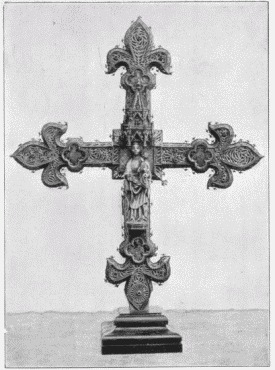
Another beautiful cross now at Coimbra has a 'Virgin and Child' in the centre under a rich canopy, and enamels of the four Evangelists on the arms, while the rest of the surface including the foliated ends is covered with exquisitely pierced flowing tracery. (Fig. 5.)
Earlier are the treasures which once belonged the Queen St. Isabel who died in 1327, and which are still preserved at Coimbra. These include a beautiful and simple cross of agate and silver, a curious reliquary made of a branch of coral with silver mountings, her staff as abbess of St. Clara, shaped like the cross of an Eastern bishop, and with heads of animals at the ends of the arms, and a small ark-shaped reliquary of silver and coral now set on a high renaissance base.
But nearly all the surviving church plate dates from the time of Dom Manoel or his son.
To Braga Archbishop Diogo de Souza gave a splendid silver-gilt chalice in 1509. Here the cup is adorned above by six angels holding emblems of the Passion, and below by six others holding bells. Above them runs an inscription, Hic est calix sanguinis mei novi et eter. The stem is entirely covered with most elaborate canopy work, with six Apostles in niches, while on the base are five other Apostles in relief, the archbishop's arms, and six pieces of enamel.
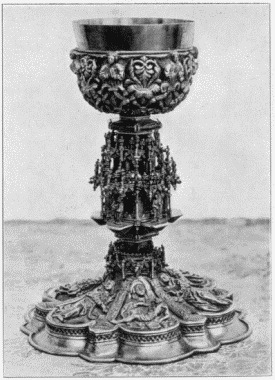
Very similar is a splendid chalice in the Misericordia at Oporto, probably of about the same date, and two at Coimbra. In both of these the cup is embossed with angels and leafage—in one the angels hold bells—and the stem is covered with tabernacle work. On the base of the one is a pietà with mourning angels and other emblems of the Passion in relief, while that of the other is enriched with filigree work. (Fig. 6.)
Another at Guimarães given by Fernando Alvares is less well proportioned and less beautiful.
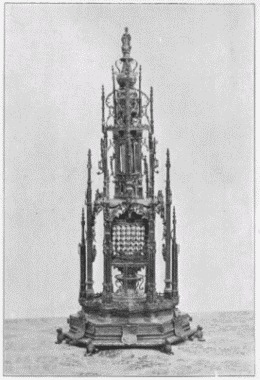
So far the architectural details of the chalices mentioned have been entirely national, but there is a custodia at Evora, whose interlacing canopy work seems to betray the influence of the Netherlands. The base of this custodia[20] or monstrance, in the shape of a chalice seems later than the upper part, which is surmounted by a rounded canopy whose hanging cusps and traceried panels strongly recall the Flemish work of the great reredos in the old cathedral at Coimbra.
Even more Flemish are a pastoral staff made for Cardinal Henrique, son of Dom Manoel and afterwards king, a monstrance or reliquary at Coimbra,[21] and another at Guimarães.[22]
Much splendid plate was also given to Santa Cruz at Coimbra by Dom Manoel, but all—candlesticks, lamps, crosses and a monstrance—have since vanished, sent to Gôa in India when the canons in the eighteenth century wanted something more fashionable.
Belem also possessed splendid treasures, among them a cross of silver filigree and jewels which is still preserved.
Much filigree work is still done in the north, where the young women invest their savings in great golden hearts or in beautiful earrings, though now bunches of coloured flowers on huge lockets of coppery gold are much more sought after.
Curiously, many of the most famous goldsmiths of the sixteenth century were Jews. Among them was the Vicente family, a member of which made a fine monstrance for Belem in 1505, and which, like other families, was expelled from Coimbra to Guimarães between the years 1532 and 1537, and doubtless wrought some of the beautiful plate for which the treasury of Nossa Senhora is famous.
The seventeenth century, besides smaller works, has left the great silver tomb of the Holy Queen St. Isabel in the new church of Santa Clara. Made by order of Bishop Dom Affonso de Castello Branco in 1614, it weighs over 170 lbs., has at the sides and ends Corinthian columns, leaving panels between them with beautifully chased framing, and a sloping top.
Later and less worthy of notice are the coffins of the two first sainted abbesses of the convent of Lorvão, near Coimbra, in which elaborate acanthus scrolls in silver are laid over red velvet.
Tile Work or Azulejos.
The Moors occupied most of what is now Portugal for a considerable length of time. The extreme north they held for rather less than two hundred years, the extreme south for more than five hundred. This occupation by a governing class, so different in religion, in race, and in customs from
those they ruled, has naturally had a strong influence, not only on the language of Portugal, but also on the art. Though there survive no important Moorish buildings dating from before the re-conquest—for the so-called mosque at Cintra is certainly a small Christian church—many were built after it for Christians by Moorish workmen.
These, as well as the Arab ceilings, or those derived therefrom, will be described later, but here must be mentioned the tilework, the most universally distributed legacy of the Eastern people who once held the land. There is scarcely a church, certainly scarcely one of any size or importance which even in the far north has not some lining or dado of tiles, while others are entirely covered with them from floor to ceiling or vault.
The word azulejo applied to these tiles is derived from the Arabic azzallaja or azulaich, meaning smooth, or else through the Arabic from a Low Latin word azuroticus used by a Gaulish writer of the fifth century to describe mosaic[23] and not from the word azul or blue. At first each different piece or colour in a geometric pattern was cut before firing to the shape required, and the many different pieces when coloured and fired were put together so as to form a regular mosaic. This method of making tiles, though soon given up in most places as being too troublesome, is still employed at Tetuan in Morocco, where in caves near the town the whole process may still be seen; for there the mixing of the clay, the cutting out of the small pieces, the colouring and the firing are still carried on in the old primitive and traditional manner.[24]
Elsewhere, though similar designs long continued to be used in Spain and Portugal, and are still used in Morocco, the tiles were all made square, each tile usually forming one quarter of the pattern. In them the pattern was formed by lines slightly raised above the surface of the tile so that there was no danger during the firing of the colour running beyond the place it was intended to occupy.
For a long time, indeed right up to the end of the fifteenth century, scarcely anything but Moorish geometric patterns seem to have been used. Then with the renaissance their place was taken by other patterns of infinite variety; some have octagons with classic mouldings represented in colour, surrounding radiating green and blue leaves;[25] some more strictly classical are not unlike Italian patterns; some again are more naturalistic, while in others the pattern, though not of the old geometric form, is still Moorish in design.
Together with the older tiles of Moorish pattern plain tiles were often made in which each separate tile, usually square, but at times rhomboidal or oblong, was of one colour, and such tiles were often used from quite early times down at least to the end of the seventeenth century.
More restricted in use were the beautiful embossed tiles found in the palace at Cintra, in which each has on it a raised green vine-leaf and tendril, or more rarely a dark bunch of grapes.
Towards the middle of the sixteenth century the Moorish technique of tilemaking, with its patterns marked off by raised edges, began to go out of fashion, and instead the patterns were outlined in dark blue and painted on to flat tiles. About the same time large pictures painted on tiles came into use, at first, as in the work of Francisco de Mattos, with scenes more or less in their natural colours, and later in the second half of the seventeenth century, and in the beginning of the eighteenth in blue on a white ground.
Towards the end of the eighteenth century blue seems to have usurped the place of all other colours, and from that time, especially in or near Oporto, tiles were used to mask all the exterior rubble walls of houses and churches, even spires or bulbous domes being sometimes so covered.
Now in Oporto nearly all the houses are so covered, usually with blue-and-white tiles, though on the more modern they may be embossed and pale green or yellow, sometimes even brown. But all the tiles from the beginning of the nineteenth century to the present day are marked by the poverty of the colour and of the pattern, and still more by the hard shiny glaze, which may be technically more perfect, but is infinitely inferior in beauty to the duller and softer glaze of the previous centuries.
When square tiles were used they were throughout singularly uniform in size, being a little below or a little above five inches square. The ground is always white with a slightly blueish tinge. In the earlier tiles of Arab pattern the colours are blue, green, and brown; very rarely, and that in some of the oldest tiles, the pattern may be in black; yellow is scarcely ever seen. In those of Moorish technique but Western pattern, the most usual colours are blue, green, yellow and, more rarely, brown.
Later still in the flat tiles scarcely anything but blue and yellow are used, though the blue and the yellow may be of two shades, light and dark, golden and orange. Brown and green have almost disappeared, and, as was said above, so did yellow at last, leaving nothing but blue and white.
Although there are few buildings which do not possess some tiles, the oldest, those of Moorish design, are rare, and, the best collection is to be found in the old palace at Cintra, of which the greater part was built by Dom João i. towards the end of the fourteenth and the beginning of the fifteenth century.
Formerly all the piers of the old cathedral of Coimbra were covered with such tiles, but they have lately been swept away, and only those left which line the aisle walls.
At Cintra there are a few which it is supposed may have belonged to the palace of the Walis, or perhaps it would be safer to say to the palace before it was rebuilt by Dom João. These are found round a door leading out of a small room, called from the mermaids on the ceiling the Sala das Sereias. The pointed door is enclosed in a square frame by a band of narrow dark and light tiles with white squares between, arranged in checks, while in the spandrels is a very beautiful arabesque pattern in black on a white ground.
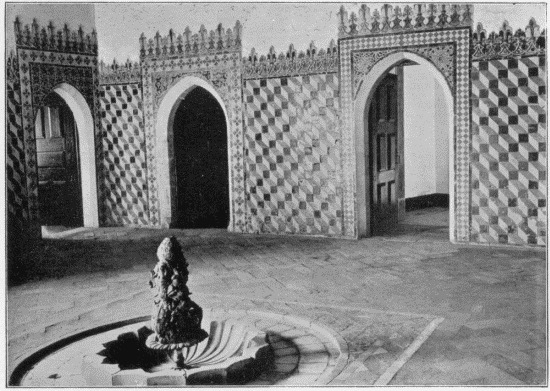
Of slightly later date are the azulejos of the so-called Sala dos Arabes, where the walls to a height of about six feet are lined with blue, green, and white tiles, the green being square and the other rhomboidal. Over the doors, which are pointed, a square framing is carried up, with tiles of various patterns in the spandrels, and above these frames, as round the whole walls, runs a very beautiful cresting two tiles high. On the lower row are interlacing semicircles in high relief forming foliated cusps and painted blue. In the spandrels formed by the interlacing of the semicircles are three green leaves growing out from a brown flower; in short the design is exactly like a Gothic corbel table such as was used on Dom João's church at Batalha turned upside down, and so probably dates from his time. On the second row of tiles there are alternately a tall blue fleur-de-lys with a yellow centre, and a lower bunch of leaves, three blue at the top and one yellow on each side; the ground throughout is white. (Fig. 8.)
Also of Dom João's time are the tiles in the Sala das Pegas, where they are of the regular Moorish pattern—blue, green and brown on a white ground, and where four go to make up the pattern. The cresting of green scrolls and vases is much later.
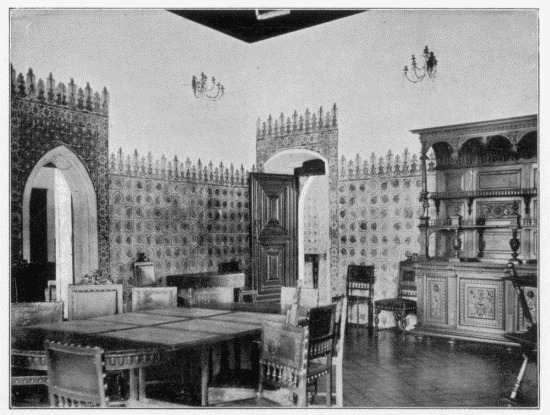
Judging from the cresting in the dining-room or Sala de Jantar, where, except that the ground is brown relieved by large white stars, and that the cusps are green and not blue, the design is exactly the same as in the Sala dos Arabes, the tiles there must be at least as old as these crestings; for though older tiles might be given a more modern cresting, the reverse is hardly likely to occur, and if as old as the crestings they may possibly belong to Dom João's time, or at least to the middle of the fifteenth century. (Fig. 9.)
These dining-room tiles, and also those in the neighbouring Sala das Sereias, are among the most beautiful in the palace. The ground is as usual white, and on each is embossed a beautiful green vine-leaf with branches and tendril. Tiles similar, but with a bunch of grapes added, line part of the stair in the picturesque little Pateo de Diana near at hand, and form the top of the back of the tiled bench and throne in the Sala do Conselho, once an open veranda. Most of this bench is covered with tiles of Moorish design, but on the front each is stamped with an armillary sphere in which the axis is yellow, the lines of the equator and tropics green, and the rest blue. These one would certainly take to be of Dom Manoel's time, for the armillary sphere was his emblem, but they are said to be older.
Most of the floor tiles are of unglazed red, except some in the chapel, which are supposed to have formed the paving of the original mosque, and some in an upper room, worn smooth by the feet of Dom Affonso vi., who was imprisoned there for many a year in the seventeenth century.
When Dom Manoel was making his great addition to the palace in the early years of the sixteenth century he lined the walls of the Sala dos Cysnes with tiles forming a check of green and white. These are carried up over the doors and windows, and in places have a curious cresting of green cones like Moorish battlements, and of castles.
Much older are the tiles in the central Pateo, also green and white, but forming a very curious pattern.
Of later tiles the palace also has some good examples, such as the hunting scenes with which the walls of the Sala dos Brazões were covered probably at the end of the seventeenth century, during the reign of Dom Pedro ii.
The palace at Cintra may possess the finest collection of tiles, Moorish both in technique and in pattern, but it has few or none of the second class where the technique remains Moorish but the design is Western. To see such tiles in their greatest quantity and variety one must cross the Tagus and visit the Quinta de Bacalhôa not far from Setubal.
There a country house had been built in the last quarter of the fifteenth century by Dona Brites, the mother of Dom Manoel.[26] The house, with melon-roofed corner turrets, simple square windows and two loggias, has an almost classic appearance, and if built in its present shape in the time of Dona Brites, must be one of the earliest examples of the renaissance in the country. It has therefore been thought that Bacalhôa may be the mysterious palace built for Dom João ii. by Andrea da Sansovino, which is mentioned by Vasari, but of which all trace has been lost. However, it seems more likely that it owes its classic windows to the younger Affonso de Albuquerque, son of the great Indian Viceroy, who bought the property in 1528. The house occupies one corner of a square garden enclosure, while opposite it is a large square tank with a long pavilion at its southern side. A path runs along the southern wall of the garden leading from the house to the tank, and all the way along this wall are tiled seats and tubs for orange-trees. It is on these tubs and seats that the greatest variety of tiles are found.
It would be quite impossible to give any detailed description of these tiles, the patterns are so numerous and so varied. In some the pattern is quite classical, in others it still shows traces of Moorish influence, while in some again the design is entirely naturalistic. This is especially the case in a pattern used in the lake pavilion, where eight large green leaves are arranged pointing to one centre, and four smaller brown ones to another, and in a still more beautiful pattern used on an orange tub in the garden, where yellow and dark flowers, green and blue leaves are arranged in a circle round eight beautiful fruits shaped like golden pomegranates with blue seeds set among green leaves and stalks.
But these thirty or more patterns do not exhaust the interest of the Quinta. There are also some very fine tile pictures, especially one of 'Susanna and the Elders,' and a fragment of the 'Quarrel of the Lapithæ and Centaurs' in the pavilion overlooking the tank. 'Susanna and the Elders' is particularly good, and is interesting in that on a small temple in the background is the date 1565.[27] Rather later seem the five river gods in the garden loggia of the house, for their strapwork frames of blue and yellow can hardly be as early as 1565; besides, a fragment with similar details has on it the letters TOS, no doubt the end of the signature 'Francisco Mattos,' who also signed some beautiful tiles in the church of São Roque at Lisbon in 1584.
It is known that the entrance to the convent of the Madre de Deus at Lisbon was ornamented by Dom Manoel with some della Robbia reliefs, two of which are now in the Museum.
On the west side of the tank at Bacalhôa is a wall nearly a hundred feet long, and framed with tiles. In the centre the water flows into the tank from a dolphin above which is an empty niche. There are two other empty niches, one inscribed Tempora labuntur more fluentis aquae, and the other Vivite victuri moneo mors omnibus instat. These niches stand between four medallions of della Robbia ware, some eighteen inches across. Two are heads of men and two of women, only one of each being glazed. The glazed woman's head is white, with yellow hair, a sky-blue veil, and a loose reddish garment all on a blue ground. All are beautifully modelled and are surrounded by glazed wreaths of fruit and leaves. These four must certainly have come from the della Robbia factory in Florence, for they, and especially the surrounding wreaths, are exactly like what may be seen so often in North Italy.
Much less good are six smaller medallions, four of which are much destroyed, on the wall leading north from the tank to a pavilion named the Casa da India, so called from the beautiful Indian hangings with which its walls were covered by Albuquerque. In them the modelling is less good and the wreaths are more conventional.
Lastly, between the tank and the house are twelve others, one under each of the globes, which, flanked by obelisks, crown the wall. They are all of the same size, but in some the head and the blue backing are not in one place. The wreaths also are inferior even to those of the last six, though the actual heads are rather better. They all represent famous men of old, from Alexander the Great to Nero. Two are broken; that of Augustus is signed with what may perhaps be read Doñus Vilhelmus, 'Master William,' who unfortunately is otherwise unknown.
It seems impossible now to tell where these were made, but they were certainly inspired by the four genuine Florentine medallions on the tank wall, and if by a native artist are of great interest as showing how men so skilled in making beautiful tiles could also copy the work of a great Italian school with considerable success.
Of the third class of tiles, those where the patterns are merely painted and not raised, there are few examples at Bacalhôa—except when some restoration has been done—for this manner of tile-painting did not become common till the next century, but there are a few with very good patterns in the house itself, and close by, the walls of the church of São Simão are covered with excellent examples. These were put up by the heads of a brotherhood in 1648, and are almost exactly the same as those in the church of Alvito; even the small saintly figures over the arches occur in both. The pattern of Alvito is one of the finest, and is found again at Santarem in the church of the Marvilla, where the lower tiles are all of singular beauty and splendid colouring, blue and yellow on a white ground. Other beautiful tiled interiors are those of the Matriz at Caldas da Rainha, and at Caminha on the Minho. Without seeing these tiled churches it is impossible to realise how beautiful they really are, and how different are these tiles from all modern ones, whose hard smooth glaze and mechanical perfection make them cold and anything but pleasing. (Figs. 10 and 11, frontispiece.)
Besides the picture-tiles at Bacalhôa there are some very good examples of similar work in the semicircular porch which surrounds the small round chapel of Sant' Amaro at Alcantara close to Lisbon. The chapel was built in 1549, and the tiles added about thirty years later. Here, as in the Dominican nunnery at Elvas, and in some exquisite framings and steps at Bacalhôa, the pattern and architectural details are spread all over the tiles, often making a rich framing to a bishop or saint. Some are not at all unlike Francisco Mattos' work in São Roque, which is also well worthy of notice.
Of the latest pictorial tiles, the finest are perhaps those in the church of São João Evangelista at Evora, which tell of the life of San Lorenzo Giustiniani, Venetian Patriarch, and which are signed and dated 'Antoninus ab Oliva fecit 1711.'[28] But these blue picture-tiles are almost the commonest of all, and were made and used up to the end of the century.[29]
Now although some of the patterns used are found also in Spain, as at Seville or at Valencia, and although tiles from Seville were used at Thomar by João de Castilho, still it is certain that many were of home manufacture.
As might be expected from the patterns and technique of the oldest tiles, the first mentioned tilers are Moors.[30] Later there were as many as thirteen tilemakers in Lisbon, and many were made in the twenty-eight ovens of louça de Veneza, 'Venetian faience.' The tiles used by Dom Manoel at Cintra came from Belem, while as for the picture tiles the novices of the order of São Thiago at Palmella formed a school famous for such work.
Indeed it may be said that tilework is the most characteristic feature of Portuguese buildings, and that to it many a church, otherwise poor and even mean, owes whatever interest or beauty it possesses. Without tiles, rooms like the Sala das Sereias or the Sala dos Arabes would be plain whitewashed featureless apartments, with them they have a charm and a romance not easy to find anywhere but in the East.
CHAPTER I
THE EARLY BUILDINGS IN THE NORTH
Portugal, like all the other Christian kingdoms of the Peninsula, having begun in the north, first as a county or march land subject to the king of Galicia or of Leon, and later, since 1139, as an independent kingdom, it is but natural to find nearly all the oldest buildings in those parts of the country which, earliest freed from the Moslem dominion, formed the original county. The province of Entre Minho-e-Douro has always been held by the Portuguese to be the most beautiful part of their country, and it would be difficult to find anywhere valleys more beautiful than those of the Lima, the Cavado, or the Ave. Except the mountain range of the Marão which divides this province from the wilder and drier Tras-os-Montes, or the Gerez which separates the upper waters of the Cavado and of the Lima, and at the same time forms part of the northern frontier of Portugal, the hills are nowhere of great height. They are all well covered with woods, mostly of pine, and wherever a piece of tolerably level ground can be found they are cultivated with the care of a garden. All along the valleys, and even high up the hillsides among the huge granite boulders, there is a continuous succession of small villages. Many of these, lying far from railway or highroad, can only be reached by narrow and uneven paths, along which no carriage can pass except the heavy creaking carts drawn by the beautiful large long-horned oxen whose broad and splendidly carved yokes are so remarkable a feature of the country lying between the Vouga and the Cavado.[31] In many of these villages may still be seen churches built soon after the expulsion of the Moors, and long before the establishment of the Monarchy. Many of them originally belonged to some monastic body. Of these the larger part have been altered and spoiled during the seventeenth or eighteenth centuries, when, after the expulsion of the Spaniards, the country began again to grow rich from trade with the recovered colony of Brazil. Still enough remains to show that these old romanesque churches differed in no very striking way from the general romanesque introduced into Northern Spain from France, except that as a rule they were smaller and ruder, and were but seldom vaulted.
That these early churches should be rude is not surprising. They are built of hard grey granite. When they were built the land was still liable to incursions, and raids from the south, such as the famous foray of Almansor, who harried and burned the whole land not sparing even the shrine of Santiago far north in Galicia. Their builders were still little more than a race of hardy soldiers with no great skill in the working of stone. Only towards the end of the twelfth century, long after the border had been advanced beyond the Mondego and after Coimbra had become the capital of a new county, did the greater security as well as the very fine limestone of the lower Mondego valley make it possible for churches to be built at Coimbra which show a marked advance in construction as well as in elaboration of detail. Between the Mondego and the Tagus there are only four or five churches which can be called romanesque, and south of the Tagus only the cathedral of Evora, begun about 1186 and consecrated some eighteen years later, is romanesque, constructively at least, though all its arches have become pointed.
But to return north to Entre Minho-e-Douro, where the oldest and most numerous romanesque churches exist and where three types may be seen. Of these the simplest and probably the oldest is that of an aisleless nave with simple square chancel. In the second the nave has one or two aisles, and at the end of these aisles a semicircular apse, but with the chancel still square: while in the third and latest the plan has been further developed and enlarged, though even here the main chancel generally still remains square.
Villarinho.
There yet exist, not far from Oporto, a considerable number of examples of the first type, though several by their pointed doorways show that they actually belong, in part at least, to the period of the Transition. One of the best-preserved is the small church of Villarinho, not far from Vizella in the valley of the Ave. Originally the church of a small monastery, it has long been the parish church of a mountain hamlet, and till it was lately whitewashed inside had scarcely been touched since the day it was finished some time before the end of the twelfth century. It consists of a rather high and narrow nave, a square-ended chancel, and to the west a lower narthex nearly as large as the chancel. The church is lit by very small windows which are indeed mere slits, and by a small round opening in the gable above the narthex.[32] The narthex is entered by a perfectly plain round-headed door with strong impost and drip-mould, while above the corbels which once carried the roof of a lean-to porch, a small circle enclosing a rude unglazed quatrefoil serves as the only window. The door leading from the narthex to the nave is much more elaborate; of four orders of mouldings, the two inner are plain, the two outer have a big roll at the angle, and all are slightly pointed. Except the outermost, which springs from square jambs, they all stand on the good romanesque capitals of six shafts, four round and two octagonal. (Fig. 12.)
São Miguel, Guimarães.
Exactly similar in plan but without a narthex is the church of São Miguel at Guimarães, famous as being the church in which Affonso Henriques, the first king of Portugal, was baptized in 1111. It claims to have been the Primaz or chief church of the whole archdiocese of Braga. It is, like Villarinho, a small and very plain church built of great blocks of granite, with a nave and square chancel lit by narrow window slits. On the north side there are a plain square-headed doorway and two bold round arches let into the outer wall over the graves of some great men of these distant times. The drip-mould of one of these arches is carved with a shallow zigzag ornament which is repeated on the western door, a door whose slightly pointed arch may mean a rather later date than the rest of the church. The wooden roof, as at Villarinho, has a very gentle slope with eaves of considerable projection resting on very large plain corbels, while other corbels lower down the wall seem to show that at one time a veranda or cloister ran round three sides of the building. The whole is even ruder and simpler than Villarinho, but has a certain amount of dignity due to the great size of the stones of which it is built and to the severe plainness of the walling.
Cedo Feita, Oporto.
Only one other church of this type need be described, and that because it is the only one which is vaulted throughout. This is the small church of São Martim de Cedo Feita or 'Early made' at Oporto itself. It is so called because it claims, wrongly indeed, to be the very church which Theodomir, king of the Suevi, who then occupied the north-west of the Peninsula, hurriedly built in 559 A.D. This he did in order that, having been converted from the Arian beliefs he shared with all the Germanic invaders of the Empire, he might there be baptized into the Catholic faith, and also that he might provide a suitable resting-place for some relic of St. Martin of Tours which had been sent to him as a mark of Orthodox approval. This story[33] is set forth in a long inscription on the tympanum of the west door stating that it was put there in 1767, a copy taken in 1557 from an old stone having then been found in the archives of the church. As a matter of fact no part of the church can be older than the twelfth century, and it has been much altered, probably at the date when the inscription was cut. It is a small building, a barrel-vaulted nave and chancel, with a door on the north side and a larger one to the west now covered by a large porch. The six capitals of this door are very like those at Villarinho, but the moulded arches are round and not as there pointed.
Other churches of this type are Gandara and Boelhe near Penafiel, and Eja not far off—a building of rather later date with a fine pointed chancel arch elaborately carved with foliage—São Thiago d'Antas, near Familicão, a slightly larger church with good capitals to the chancel arch, a good south door and another later west door with traceried round window above; and São Torquato, near Guimarães, rather larger, having once had transepts of which one survives, with square chancel and square chapels to the east; one of the simplest of all having no ornament beyond the corbel table and the small slitlike windows.
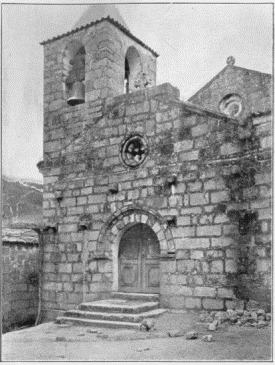
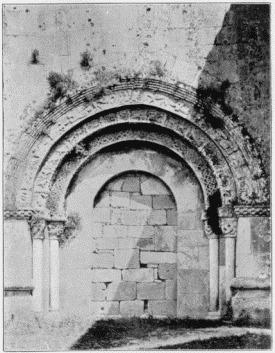
South of the Douro, but still built of granite, are a group of three or four small churches at Trancoso. Another close to Guarda has a much richer corbel table with a large ball ornament on the cornice and a round window filled with curiously built-up tracery above the plain, round-arched west door, while further south on the castle hill at Leiria are the ruins of the small church of São Pedro built of fine limestone with a good west door.
Aguas Santas.
Of the second and rather larger type there are fewer examples still remaining, and of these perhaps the best is the church of Aguas Santas some seven miles north-east of Oporto. Originally the church consisted of a nave with rectangular chancel and a north aisle with an eastern apse roofed with a semi-dome. Later a tower with battlemented top and low square spire was built at the west end of the aisle, and some thirty years ago another aisle was added on the south side. As in most of the smaller churches the chancel is lower than the nave, leaving room above its roof for a large round window, now filled up except for a small traceried circle in the centre. The most highly decorated part is the chancel, which like all the rest of the church has a good corbel table, and about two-thirds of the way up a string course richly covered with billet moulding. Interrupting this on the south side are two round-headed windows, still small but much larger than the slits found in the older churches. In each case, in a round-headed opening there stand two small shafts with bases and elaborately carved capitals but without any abaci, supporting a large roll moulding, and these are all repeated inside at the inner face of a deep splay. In one of these windows not only are the capitals covered with intertwined ribbon-work, but each shaft is covered with interknotted circles enclosing flowers, and there is a band of interlacing work round the head of the actual window opening. Inside the church has been more altered. Formerly the aisle was separated from the nave by two arches, but when the south aisle was built the central pier was taken out and the two arches thrown into one large and elliptical arch, but the capitals of the chancel arch and the few others that remain are all well wrought and well designed. The west door is a good simple example of the first pointed period, with plain moulded arches and shafts which bear simple French-looking capitals. Other churches of the same class are those of São Christovão do Rio Mau not far from Villo do Conde, and São Pedro de Rates, a little further up the Ave at the birthplace of the first bishop of Braga and earliest martyr of Portugal. São Pedro is a little later, as the aisle arches are all pointed, and is a small basilica of nave and aisles with short transepts, chancel and eastern chapels.
Villar de Frades.
The two earliest examples of the third and most highly developed type, the church of Villar de Frades and the cathedral of Braga, have unfortunately both suffered so terribly, the one from destruction and the other from rebuilding, that not much has been left to show what they were originally like—barely enough to make it clear that they were much more elaborately decorated, and that their carved work was much better wrought than in any of the smaller churches already mentioned. A short distance to the south of the river Cavado and about half-way between Braga and Barcellos, in a well-watered and well-wooded region, there existed from very early Christian times a monastery called Villar, and later Villar de Frades. During the troubles and disorders which followed the Moslem invasion, this Benedictine monastery had fallen into complete decay and so remained till it was restored in 1070 by Godinho Viegas. Although again deserted some centuries later and refounded in 1425 as the mother house of a new order—the Loyos—the fifteenth-century church was so built as to leave at least a part of the front of the old ruined church standing between itself and the monastic building, as well as the ruins of an apse behind. Probably this old west front was the last part of Godinho's church to be built, but it is certainly more or less contemporary with some portions of the cathedral of Braga.
At some period, which the legend leaves quite uncertain, one of the monks of this monastery was one day in the choir at matins, when they came to that Psalm where it is said that 'a thousand years in the sight of God are but as yesterday when it is gone,' and the old monk wondered greatly and began to think what that could mean. When matins were over he remained praying as was his wont, and begged Our Lord to give him some understanding of that verse. Then there appeared to him a little bird which, singing most sweetly, flew this way and that, and so little by little drew him towards a wood which grew near the monastery, and there rested on a tree while the servant of God stood below to listen. After what seemed to the monk a short time it took flight, to the great sorrow of God's servant, who said, 'Bird of my Soul, where art thou gone so soon?' He waited, and when he saw that it did not return he went back to the monastery thinking it still that same morning on which he had come out after matins. When he arrived he found the door, through which he had come, built up and a new one opened in another place. The porter asked who he was and what he wanted, and he answered, 'I am the sacristan who a few hours ago went out, and now returning find all changed.' He gave too the names of the Abbot and of the Prior, and wondered much that the porter still would not let him in, and seemed not to remember these names. At last he was led to the Abbot, but they did not know one another, so that the good monk was all confused and amazed at so strange an event. Then the Abbot, enlightened of God, sent for the annals and histories of the order, found there the names the old man had given, so making it clear that more than three hundred years had passed since he had gone out. He told them all that had happened to him, was received as a brother; and after praising God for the great marvel which had befallen him, asked for the sacraments and soon passed from this life in great peace.[34]
Whether the ruined west front of the older church be that which existed when the bird flew out through the door or not, it is or has been of very considerable beauty. Built, like everything else in the north, of granite, all that is now left is a high wall of carefully wrought stone. Below is a fine round arched door of considerable size, now roughly blocked up. It has three square orders covered with carving and a plain inner one. First is a wide drip-mould carved on the outer side with a zigzag threefold ribbon, and on the inner with three rows of what looks like a rude attempt to copy the classic bead-moulding; then the first order, of thirteen voussoirs, each with the curious figure of a strangely dressed man or with a distorted monster. This with the drip-mould springs from a billet-moulded abacus resting on broad square piers. Of the two inner carved orders, the outer is covered on both faces with innumerable animals and birds, and the other with a delicate pattern of interlacing bands. These two spring from strange square abaci resting on the carved capitals of round shafts, two on each side. A few feet above the door runs a billet-moulded string course, and two or three feet higher another and slighter course. On this stands a large window of two orders. Of these the outer covered with animals springs from shafts and capitals very like those of the doorway, and the inner has a billet-moulded edge and an almost Celtic ornament on the face. Now whether Villar be older than the smaller buildings in the neighbourhood or not, it is undoubtedly quite different not only in style but in execution. It is not only much larger and higher, but it is better built and the carving is finer and more carefully wrought. (Fig. 13.)
It is known that the great cathedral of Santiago in Galicia was begun in 1078, just about the time Villar must have been building, and Santiago is an almost exact copy in granite of what the great abbey church of S. Sernin at Toulouse was intended to be, so that it may be assumed that Bernardo who built the cathedral was, if not a native of Toulouse, at any rate very well acquainted with what was being done there. If, then, a native of Languedoc was called in to plan so important a church in Galicia, it is not unlikely that other foreigners were also employed in the county of Portugal—at that time still a part of Galicia; and in fact many churches in the south-west of what is now France have doorways and windows whose general design is very like that at Villar de Frades, if allowance be made for the difference of material, granite here, fine limestone there, and for a comparative want of skill in the workmen.[35]
FOOTNOTES:
[1] The most noticeable difference in pronunciation, the Castilian guttural soft G and J, and the lisping of the Z or soft C seems to be of comparatively modern origin. However different such words as 'chave' and 'llave,' 'filho' and 'hijo,' 'mão' and 'mano' may seem they are really the same in origin and derived from clavis, filius, and manus.
[2] From the name of this dynasty Moabitin, which means fanatic, is derived the word Maravedi or Morabitino, long given in the Peninsula to a coin which was first struck in Morocco.
[3] The last nun in a convent at Evora only died in 1903, which must have been at least seventy years after she had taken the veil.
[4] A narcissus triandrus with a white perianth and yellow cup is found near Lamego and at Louzã, not far from Coimbra.
[5] See article by C. Justi, 'Die Portugesische Malerei des xvi. Jahrhunderts,' in vol. ix. of the Jahrbuch der K. Preussischen Kunstsammlungen.
[6] Raczynski, Les Arts en Portugal.
[7] These are the 'Annunciation,' the 'Risen Lord appearing to His Mother,' the 'Ascension,' the 'Assumption,' the 'Good Shepherd,' and perhaps a 'Pentecost' and a 'Nativity.'
[8] V. Guimarães, A Ordem de Christo, p. 155.
[9] A. Hapt, Die Baukunst, etc., in Portugal, vol. ii. p. 36.
[10] These may perhaps be by the so-called Master of São Bento, to whom are attributed a 'Visitation'—in which Chastity, Poverty, and Humility follow the Virgin—and a 'Presentation,' both now in Lisbon. Some paintings in São Francisco Evora seem to be by the same hand.
[11] Misericordia=the corporation that owns and manages all the hospitals, asylums, and other charitable institutions in the town. There is one in almost every town in the country.
[12] She seems almost too old to be Dona Leonor and may be Dona Maria.
[13] His first wife was Dona Isabel, eldest daughter and heiress to the Catholic Kings. She died in 1498 leaving an infant son Dom Miguel, heir to Castile and Aragon as well as to Portugal. He died two years later when Dom Manoel married his first wife's sister, Dona Maria, by whom he had six sons and two daughters. She died in 1517, and next year he married her niece Dona Leonor, sister of Charles v. and daughter of Mad Juana. She had at first been betrothed to his eldest son Dom João. All these marriages were made in the hope of succeeding to the Spanish throne.
[14] Some authorities doubt the identification of the king and queen. But there is a distinct likeness between the figures of Dom Manoel and his queen which adorn the west door of the church at Belem, and the portrait of the king and queen in this picture.
[15] It has been reproduced by the Arundel Society, but the copyist has entirely missed the splendid solemnity of St. Peter's face.
[16] See 'Portuguese School of Painting,' by J. C. Robinson, in the Fine Arts Quarterly of 1866.
[17] Vieira Guimarães, A Ordem de Christo, p. 150.
[18] Ibid., p. 157.
[19] Carriage hire is still cheap in Portugal, for in 1904 only 6000 was paid for a carriage from Thomar to Leiria, a distance of over thirty-five miles, though the driver and horses had to stay at Leiria all night and return next day. 6000 was then barely over twenty shillings.
[20] It was the gift of Bishop Affonso of Portugal who held the see from 1485 to 1522.
[21] This monstrance was given by Bishop Dom Jorge d'Almeida who died in 1543, having governed the see for sixty-two years. (Fig. 7.)
[22] Presented by Canon Gonçalo Annes in 1534.
[23] D. Francisco Simonet, professor of Arabic at Granada. Note in Paço de Cintra, p. 206.
[24] See Miss i. Savory, In the Tail of the Peacock.
[25] A common pattern found at Bacalhôa, near Setubal, in the Museum at Oporto, and in the Corporation Galleries of Glasgow, where it is said to have come from Valencia in Spain.
[26] Joaquim Rasteiro, Palacio e Quinta de Bacalhôa em Azeitão. Lisbon, 1895.
[27] Columns with corbel capitals support a house on the right. Such capitals were common in Spain, so it is just possible that these tiles may have been made in Spain.
[28] Antonio ab Oliva=Antonio de Oliveira Bernardes, who also painted the tiles in São Pedro de Rates.
[29] E.g. in the church of the Misericordia Vianna do Castello, the cloister at Oporto, the Graça Santarem, Sta. Cruz Coimbra, the Sé, Lisbon, and in many other places.
[30] Paço de Cintra, Cond. de Sabugosa. Lisbon, 1903.
[31] These yokes are about 4 or 5 feet long by 18 inches or 2 feet broad, are made of walnut, and covered with the most intricate pierced patterns. Each parish or district, though no two are ever exactly alike, has its own design. The most elaborate, which are also often painted bright red, green, and yellow are found south of the Douro near Espinho. Further north at Villa do Conde they are much less elaborate, the piercings being fewer and larger. Nor do they extend far up the Douro as in the wine country in Tras-os-Montes the oxen, darker and with shorter horns, pull not from the shoulder but from the forehead, to which are fastened large black leather cushions trimmed with red wool.
[32] Originally there was a bell-gable above the narthex door, since replaced by a low square tower resting on the north-west corner of the narthex and capped by a plastered spire.
[33]
Theodomir rex gloriosus
v. erex. & contrux. hoc. monast. can. B. Aug.
ad. Gl. D. et V.M.G.D. & B. Martini et fecit ita so:
lemnit: sacrari ab Lucrec. ep. Brac. et alliis sub.
J. iii. P. M. Prid. Idus. Nov. an. D. dlix. Post id. rex
in hac eccl. ab. eod. ep. palam bapt. et fil. Ariamir
cum magnat. suis. omnes conversi ad fid. ob. v. reg. &
mirab. in fil. ex sacr. reliq. B.M. a Galiis eo. reg. postul
translatis & hic asservatis Kal. Jan. An. D. dlx.[34] From M. Bernardes, Tratados Varios, vol. ii. p. 4. The same story is told of the monastery of San Salvador de Leyre in Navarre, whose abbot, Virila, wondering how it could be possible to listen to the heavenly choirs for ever without weariness, sat down to rest by a spring which may still be seen, and there listened, enchanted, to the singing of a bird for three hundred years.
[35] E.g. the west door of Ste. Croix, Bordeaux, though it is of course very much more elaborate.
[36] Namely, to give back some Galician towns which had been captured.
[37] Bayona is one of the most curious and unusual churches in the north of Spain. Unfortunately, during a restoration made a few years ago a plaster groined vault was added hiding the old wooden roof.
[38]
The tomb is inscribed: Hic requiescit Fys:
Dei: Egas: Monis: Vir:
Inclitus: era: millesima:
centesima: lxxxii
i.e. Era of Caesar 1182, A.D. 1144.[39] He died soon after at Medinaceli, and a Christian contemporary writer records the fact saying: 'This day died Al-Mansor. He desecrated Santiago, and destroyed Pampluna, Leon and Barcelona. He was buried in Hell.'
[40] Another cloister-like building of even earlier date is to be found behind the fourteenth-century church of Leça de Balio: it was built probably after the decayed church had been granted to the Knights of St. John of Jerusalem. (Fig. 17.)
[41] A careful restoration is now being carried out under the direction of Senhor Fuschini.
[42] The inscription is mutilated at both ends and seems to read, 'Ahmed-ben-Ishmael built it strongly by order of ...'
[43] It is a pity that the difference in date makes it impossible to identify this Bernardo with the Bernardo who built Santiago. For the work Dom Miguel gave 500 morabitinos, besides a yoke of oxen worth 12, also silver altar fronts made by Master Ptolomeu. Besides the money Bernardo received a suit of clothes worth 3 morabitinos and food at the episcopal table, while Soeiro his successor got a suit of clothes, a quintal of wine, and a mora of bread. The bishop also gave a great deal of church plate showing that the cathedral was practically finished before his death.
[44] Compare the doorlike window of Nossa Senhora da Oliveira at Guimarães.
[45] The small church of São Salvador has also an old door, plainer and smaller than São Thiago.
[46] The five small shields with the Wounds of Christ on the Portuguese coat are supposed to have been adopted because on the eve of this battle Christ crucified appeared to Affonso and promised him victory, and because five kings were defeated.
[47] Andre de Rezende, a fifteenth-century antiquary, says, quoting from an old 'book of anniversaries': 'Each year an anniversary is held in memory of Bishop D. Payo on St. Mark's Day, that is May 21st, on which day he laid the first stone for the foundation of this cathedral, on the spot where now is St. Mark's Altar, and he lies behind the said place and altar in the Chapel of St. John. This church was founded Era 1224,' i.e. 1186 A.D. D. Payo became bishop in 1181. Another stone in the chancel records the death, in era 1321, i.e. 1283 A.D., of Bishop D. Durando, 'who built and enriched this cathedral with his alms,' but probably he only made some additions, perhaps the central lantern.
[48] It was built 1718-1746 by Ludovici or Ludwig the architect of Mafra and cost 160:000000 or about £30,000.
[49] The whole inscription, the first part occurring also on a stone in the castle, runs thus:—
E (i.e. Era) mc : lx. viii. regnant : Afonso : illustrisimo rege Portugalis : magister : galdinus
: Portugalensium : Militum Templi : cum fratribus suis Primo : die : Marcii : cepit
edificari : hoc : castellu : nme Thomar : qod : prefatus rex obtulit : Deo : et militibus : Templi
: e. m. cc. xx. viii : iii. mens. : Julii : venit rex de maroqis ducens : cccc milia equitu :
et quingenta milia : peditum : et obsedit castrum istud : per sex Dies : et delevit : quantum extra : murum invenit :
castellu : et prefatus : magister : cu : fratribus suis liberavit Deus : de manibus : suis
Idem : rex : remeavit : in patria : sua : cu : innumerabili : detrimento : hominu et bestiarum.[50] Cf. Templar church at Segovia, Old Castile, where, however, the interior octagon is nearly solid with very small openings, and a vault over the lower story; it has also three eastern apses.
[51] There is a corbel table like it but more elaborate at Vezelay in Burgundy.
[52] E.g. in S. Martino al Cimino near Viterbo.
[53] So says Murray. Vilhena Barbosa says 1676. 1770 seems the more probable.
[54] Indeed to the end the native builders have been very chary of building churches with a high-groined vault and a well-developed clerestory. The nave of Batalha and of the cathedral of Guarda seem to be almost the only examples which have survived, for Lisbon choir was destroyed by the great earthquake of 1755, as was also the church of the Carmo in the same city, which perhaps shows that they were right in rejecting such a method of construction in a country so liable to be shaken.
[55] Cf. similar corbel capitals in the nave of the cathedral of Orense in Galicia.
[56] Before the Black Death, which reduced the number to eight, there are said to have sometimes been as many as 999 monks!
[57] It was a monk of Alcobaça who came to General Wellesley on the night of 16th August 1808, and told him that if he wished to catch the French he must be quick as they meant to retire early in the morning, thus enabling him to win the battle of Roliça, the first fight of the Peninsular War.
[58] Cf. the clerestory windows of Burgos Cathedral, or those at Dunblane, where as at Guimarães the circle merely rests on the lights below without being properly united with them.
[59] From the north-east corner of the narthex a door leads to the cloisters, which have a row of coupled shafts and small pointed arches. From the east walk a good doorway of Dom Manoel's time led into the chapter-house, now the barrack kitchen, the smoke from which has entirely blackened alike the doorway and the cloister near.
[60] Compare the horseshoe moulding on the south door of the cathedral of Orense, Galicia, begun 1120, where, however, each horseshoe is separated from the next by a deep groove.
[61] The town having much decayed owing to fevers and to the gradual shallowing of the river the see was transferred to Faro in 1579. The cathedral there, sacked by Essex in 1596, and shattered by the earthquake of 1755, has little left of its original work except the stump of a west tower standing on a porch open on three sides with plain pointed arches, and leading to the church on the fourth by a door only remarkable for the dog-tooth of its hood-mould.
[62] The towers stand quite separate from the walls and are united to them by wide round arches.
[63] In the dilapidated courtyard of the castle there is one very picturesque window of Dom Manoel's time (his father the duke of Beja is buried in the church of the Conceição in the town).
[64] An inscription says:—
'Era 1362 [i.e. A.D. 1324] anos foi
esta tore co (meçad) a (aos) 8
dias demaio. é mandou a faze (r
o muito) nobre Dom Diniz
rei de P...'[65] Just outside the castle there is a good romanesque door belonging to a now desecrated church.
[66] Some of the distinctive features of Norman such as cushion capitals seem to be unknown in Normandy and not to be found any nearer than Lombardy.
[67] Sub Era mcccxlviii. idus Aprilis, Dnus Nuni Abbas monasterij de Alcobatie posuit primam lapidem in fundamento Claustri ejusdem loci. presente Dominico Dominici magistro operis dicti Claustri. Era 1348 = A.D. 1310.
[68] It is interesting to notice that the master builder was called Domingo Domingues, who, if Domingues was already a proper name and not still merely a patronymic, may have been the ancestor of Affonso Domingues who built Batalha some eighty years later and died 1402.
[69] In this cloister are kept in a cage some unhappy ravens in memory of their ancestors having guided the boat which miraculously brought St. Vincent's body to the Tagus.
[70] Cf. the aisle windows of Sta. Maria dos Olivaes at Thomar.
[71] It was at Leça that Dom Fernando in 1372 announced his marriage with Dona Leonor Telles de Menezes, the wife of João Lourenço da Cunha, whom he had seen at his sister's wedding, and whom he married though he was himself betrothed to a daughter of the Castilian king, and though Dona Leonor's husband was still alive: a marriage which nearly ruined Portugal, and caused the extinction of the legitimate branch of the house of Burgundy.
[72] Opening off the north-west corner of the cathedral is an apsidal chapel of about the same period, entered by a fine pointed door, one of whose mouldings is enriched by an early-looking chevron, but whose real date is shown by the leaf-carving of its capitals.
[73] A note in Sir H. Maxwell's Life of Wellington, vol. i. p. 215, says of Alcobaça: 'They had burned what they could and destroyed the remainder with an immense deal of trouble. The embalmed kings and queens were taken out of their tombs, and I saw them lying in as great preservation as the day they were interred. The fine tesselated pavement, from the entrance to the Altar, was picked up, the facings of the stone pillars were destroyed nearly to the top, scaffolding having been erected for that purpose. An orderly book found near the place showed that regular parties had been ordered for the purpose' (Tomkinson, 77).
[74] There is in the Carmo Museum at Lisbon a fine tomb to Dom Fernando, Dom Pedro's unfortunate successor. It was brought from São Francisco at Santarem, but is very much less elaborate, having three panels on each side filled with variously shaped cuspings, enclosing shields, all beautifully wrought.
[75] Another trophy is now at Alcobaça in the shape of a huge copper caldron some four feet in diameter.
[76] This site at Pinhal was bought from one Egas Coelho.
[77] Though a good deal larger than most Portuguese churches, except of course Alcobaça, the church is not really very large. Its total length is about 265 feet with a transept of about 109 feet long. The central aisle is about 25 feet wide by 106 high—an unusual proportion anywhere.
[78] Albrecht Haupt, Die Baukunst der Renaissance in Portugal, says that 'Der Plan durchaus englisch ist (Lang-und Querschiff fast ganz identisch mit dener der Kathedral zu Canterbury, nur thurmlos).'
[79] This spire has been rebuilt since the earthquake of 1755, and so may be quite different from that originally intended.
[80] In his book on Batalha, Murphy, who stayed in the abbey for some months towards the end of the eighteenth century, gives an engraving of an open-work spire on this chapel, saying it had been destroyed in 1755.
[81] Huguet witnessed a document dated December 7, 1402, concerning a piece of land belonging to Margarida Annes, servant to Affonso Domingues, master of the works, and his name also occurs in a document of 1450 as having had a house granted to him by Dom Duarte, but he must have been dead some time before that as his successor as master of the works, Master Vasquez, was already dead before 1448. Probably Huguet died about 1440.
[82] Caspar Estaço, writing in the sixteenth century, says that this triptych was made of the silver against which King João weighed himself, but the story of its capture at Aljubarrota seems the older tradition.
[83] These capitals have the distinctive Manoelino feature of the moulding just under the eight-sided abacus, being twisted like a rope or like two interlacing branches.
[84] The church was about 236 feet long with a transept of over 100 feet, which is about the length of the Batalha transept.
[85] She also sent the beautiful bronze tomb in which her eldest brother Affonso, who died young, lies in the cathedral, Braga. The bronze effigy lies on the top of an altar-tomb under a canopy upheld by two slender bronze shafts. Unfortunately it is much damaged and stands in so dark a corner that it can scarcely be seen.
[86] In one transept there is a very large blue tile picture.
[87] The Aleo is still at Ceuta. In the cathedral Our Lady of Africa holds it in her hand, and it is given to each new governor on his arrival as a symbol of office.
[88] The inscription is:—
Memoria de D. Duarte de Menezes
Terceiro conde de Viana, Tronco
dos condes de Tarouca. Primeiro
Capitão de Alcacer-Seguer, em Africa,
que com quinhentos soldados defendeu
esta praça contra cemmil
Mouros, com os quaes teve
muitos encontros, ficando n'elles
com grande honra e gloria. Morreu na
serra de Bonacofú per salvar a
vida do seu rei D. Affonso o Quinto.[89] When the tomb was moved from São Francisco, only one tooth, not a finger, was found inside.
[90] Besides the church there is in Caminha a street in which most of the houses have charming doors and windows of about the same date as the church.
[91] 1524 seems too early by some forty years.
[92] The rest of the west front was rebuilt and the inside altered by Archbishop Dom José de Braganza, a son of Dom Pedro ii., about two hundred years ago.
[93] A chapel was added at the back, and at a higher level some time during the seventeenth century to cover in one of the statues, that of St. Anthony of Padua, who was then becoming very popular.
[94] This winding stair was built by Dom Manoel: cf. some stairs at Thomar.
[95] A 'pelourinho' is a market cross.
[96] The kitchens in the houses at Marrakesh and elsewhere in Morocco have somewhat similar chimneys. See B. Meakin, The Land of the Moors.
[97] 'Esta fortaleza se começou a xiij dagosto de mil cccc.l. P[N. of T. horizonal line through it] iiij por mãdado del Rey dõ Joam o segundo nosso sõr e acabouse em tpõ del Rey dom Manoel o primeiro nosso Sñor fela per seus mãdados dom Diogo Lobo baram dalvito.'
[98] The house of the duke of Cadaval called 'Agua de Peixes,' not very far off, has several windows in the same Moorish style.
[99] Vilhena Barbosa, Monumentos de Portugal, p. 324.
[100] Though the grammar seems a little doubtful this seems to mean
Since these by service were
And loyal efforts gained,
By these and others like to them
They ought to be maintained.[101] One blank space in one of the corners is pointed out as having contained the arms of the Duque d'Aveiro beheaded for conspiracy in 1758. In reality it was painted with the arms of the Coelhos, but the old boarding fell out and has never been replaced.
[102] Affonso de Albuquerque took Ormuz in 1509 and Gôa next year.
[103] Sumatra was visited in 1509.
[104] Fernão Peres de Andrade established himself at Canton in 1517 and reached Pekin in 1521.
[105] Compare the elaborate outlines of some Arab arches at the Alhambra or in Morocco.
[106] Some have supposed that Boutaca was a foreigner, but there is a place called Boutaca near Batalha, so he probably came from there.
[107] Once the Madre de Deus was adorned with several della Robbia placques. They are now all gone.
[108] Danver's Portuguese in India, vol. i.
[109] See in Oliveira Martims' Historia de Portugal, vol. ii. ch. i., the account of the Embassy sent to Pope Leo ix. by Dom Manoel in 1514. No such procession had been seen since the days of the Roman Empire. There were besides endless wealth, leopards from India, also an elephant which, on reaching the Castle of S. Angelo, filled its trunk with scented water and 'asperged' first the Pope and then the people. These with a horse from Ormuz represented the East. Unfortunately the representative of Africa, a rhinoceros, died on the way.
[110] Danver's Portuguese in India, vol. i.
[111] Unfortunately Fernandes was one of the commonest of names. In his list of Portuguese artists, Count Raczynski mentions an enormous number.
[112] In the year 1512 Olivel was paid 25000. He had previously received 12000 a month. He died soon after and his widow undertook to finish his work with the help of his assistant Muñoz.
[113] See the drawing in A Ordem de Christo by Vieira Guimarães.
[114] The last two figures look like 15 but the first two are scarcely legible; it may not be a date at all.
[115] All the statues are rather Northern in appearance, not unlike those on the royal tombs in Santa Cruz, Coimbra, and may be the work of the two Flemings mentioned among those employed at Thomar, Antonio and Gabriel.
[116] The door—notwithstanding the supposed date, 1515—was probably finished by João after 1523.
[117] Cf. the carving on the jambs of the Allah-ud-din gate at Delhi.
[118] Such heads of many curves may have been derived from such elaborate Moorish arches as may be seen in the Alhambra, or, for example, in the Hasan tower at Rabat in Morocco, and it is worth noticing that there were men with Moorish names among the workmen at Thomar—Omar, Mafamede, Bugimaa, and Bebedim.
[119] Esp(h)era=sphere; Espera=hope, present imperative.
[120] The inscription says: 'Aqui jaz Matheus Fernandes mestre que foi destas obras, e sua mulher Izabel Guilherme e levou-o nosso Senhor a dez dias de Abril de 1515. Ella levou-a a....'
[121] Fig. 57.
[122] As Capellas Imperfeitas e a lenda das devisas Gregas. Por Caroline Michaëlis de Vasconcellos. Porto, 1905.
[123] The frieze is now filled up and plastered, but not long ago was empty and recessed as if prepared for letting in reliefs. Can these have been of terra cotta of the della Robbia school? Dom Manoel imported many which are now all gone but one in the Museum at Lisbon. There are also some della Robbia medallions at the Quinta de Bacalhôa at Azeitão near Setubal.
[124] J. Murphy, History of the Royal Convent of Batalha. London, 1792.
[125] One of the first was probably the chapel dos Reys Magos at São Marcos near Coimbra.
[126] A conto = 1.000000.
[127] It is no use telling a tramway conductor to stop near the Torre de São Vicente. He has never heard of it, but if one says 'Fabrica de Gas' the car will stop at the right place.
[128] Similar roofs cap the larger angle turrets in the house of the Quinta de Bacalhôa near Setubal, built by Dona Brites, mother of Dom Manoel, about 1490, and rebuilt or altered by the younger Albuquerque after 1528 when he bought the Quinta.
[129] Raczynski says 1517, Haupt 1522.
[130] According to Raczynski, João de Castilho in 1517 undertook to carry on the work for 140000 per month, at the rate of 50 per day per man. 140000=now about £31.
[131] Nicolas was the first of the French renaissance artists to come to Portugal.
[132] E.g. on the Hotel Bourgthéroulde, Rouen.
[133] Cf. the top of a turret at St. Wulfram, Abbeville.
[134] Haupt.
[135] The university was first accommodated in Sta. Cruz, till Dom João gave up the palace where it still is. It was after the return of the university to Coimbra that George Buchanan was for a time professor. He got into difficulties with the Inquisition and had to leave.
[136] Nicolas the Frenchman is first mentioned in 1517 as working at Belem. He therefore was probably the first to introduce the renaissance into Portugal, for Sansovino had no lasting influence.
[137] 'To give room and licence to Dioguo de Castylho, master of the work of my palace at Coimbra, to ride on a mule and a nag seeing that he has no horse, and notwithstanding my decrees to the contrary.'—Sept. 18, 1526.
[138] Vilhena Barbosa Monumentes de Portugal, p. 411.
[139] Other men from Rouen are also mentioned, Jeronymo and Simão.
[140] The stone used at Batalha and at Alcobaça is of similar fineness, but seems better able to stand exposure, as the front of Santa Cruz at Coimbra is much more decayed than are any parts of the buildings at either Batalha or Alcobaça. The stone resembles Caen stone, but is even finer.
[141] João de Ruão also made some bookcases for the monastery library.
[142] 'Aqui jas o muito honrado Pero Rodrigues Porto Carreiro, ayo que foy do Conde D. Henrique, Cavalleiro da Ordem de San Tiago, e o muyto honrado Gonzalo Gil Barbosa seu genro, Cavalleiro da Ordem deto, e assim o muito honrado seu filho Francisco Barbosa: os quaes forão trasladados a esta sepultura no anno de 1532.'—Fr. Historia de Santarem edificada. By Ignacio da Piedade e Vasconcellos. Lisboa Occidental, mdccxxxx.
[143] The date 1522 is found on a tablet on Ayres' tomb, so the three must have been worked while the chancel was being built.
[144] Les Arts en Portugal: letters to the Berlin Academy of Arts. Paris, 1846.
[145] São Marcos: E. Biel. Porto, in A arte e a natureza em Portugal: text by J. de Vasconcellos.
[146] There is also a fine reredos of somewhat later date in the church of Varziella near Cantanhede not far off: but it belongs rather to the school of the chapel dos Reis Magos; there is another in the Matriz of Cantanhede itself.
[147] Johannis iii. Emanuelis filius, Ferdinandi nep. Eduardi pronep. Johannis i. abnep. Portugal. et Alg. rex. Affric. Aethiop. arabic. persic. Indi. ob felicem partum Catherinae reginae conjugis incomparabilis suscepto Emanuele filio principi, aram cum signis pos. dedicavitque anno mdxxxii. Divae Mariae Virgini et Matri sac.
[148] The only other object of any interest in the São Marcos is a small early renaissance pulpit on the north side of the nave, not unlike that at Caminha.
[149] During the French invasion much church plate was hidden on the top of capitals and so escaped discovery.
[150] João then bought a house in the Rua de Corredoura for 80000 or nearly £18.—Vieira Guimarães, A Ordem de Christo, p. 167.
[151] There is preserved in the Torre do Tombo at Lisbon a long account of the trial of a 'new Christian' of Thomar, Jorge Manuel, begun on July 15, 1543, in the office of the Holy Inquisition within the convent of Thomar.—Vieira Guimarães, p. 179.
[152] From book 34 of João iii.'s Chancery a 'quitaçã' or discharge given to João de Castilho for all the work done for Dom João or for his father, viz.—'In Monastery of Belem; in palace by the sea—swallowed up by the earthquake in 1755—balconies in hall, stair, chapel, and rooms of Queen Catherine, chapel of monastery of São Francisco in Lisbon, foundation of Arsenal Chapel; a balcony at Santos, and divers other lesser works. Then a door, window, well balustrade, garden repairs; work in pest house; stone buildings at the arsenal for a dry dock for the Indian ships; the work he has executed at Thomar, as well as the work he has done at Alcobaça and Batalha; besides he made a bastion at Mazagão so strong,' etc.—Raczynski's Les Artistes Portugais.
[153] Vieira Guimarães, A Ordem de Christo, pp. 184, 185.
[154] Foi erecta esta cap. No A.D. 1572 sed prof. E. 1810 foi restaur E. 1848 por L. L. d'Abreu Monis. Serrão, E. Po. D Roure, Pietra concra. Muitas Pessoas ds. cideç.
[155] Ferguson (History of Modern Architecture, vol. ii. p. 287) says that some of the cloisters at Gôa reminded him of Lupiana, so no doubt they are not unlike those here mentioned.
[156] An inscription over a door outside says:
DNS. EMANVEL
NORONHA EPVS
LAMACEN. 1557.[157] One chapel, that of São Martin, has an iron screen like a poor Spanish reja.
[158] It has been pulled down quite lately. Lorvão, in a beautiful valley some fifteen miles from Coimbra, was a very famous nunnery. The church was rebuilt in the eighteenth century, has a dome, a nuns' choir to the west full of stalls, but in style, except the ruined cloister, which was older, all is very rococo.
[159] This reredos is in the chapel on the south of the Capella Mor.
[160] This aqueduct begun by Terzi in 1593 was finished in 1613 by Pedro Fernandes de Torres, who also designed the fountain in the centre of the cloister.
[161] It was here that Wellington was slung across the river in a basket on his way to confer with the Portuguese general during the advance on Salamanca.
[162] Terzi was taken prisoner at Alcacer-Quebir in 1578 and ransomed by King Henry, who made him court architect, a position he held till his death in 1598.
[163] Some of the most elaborate dated 1584 are by Francisco de Mattos.
[164] It was handed over to the cathedral chapter on the expulsion of the Jesuits in 1772.
[165] São Bento is now used as a store for drain-pipes.
[166] The Matriz at Vianna has a fifteenth-century pointed door, with half figures on the voussoirs arranged as are the four-and-twenty elders on the great door at Santiago, a curious arrangement found also at Orense and at Noya.
[167] There was only one other house of this order in Portugal, at Laveiras.
[168] Not of course the famous son of Charles v., but a son of Philip iv.
[169] In that year from June to October 45,000 men are inscribed as working on the building, and 1266 oxen were bought to haul stones!
[170] The area of the Escorial, excluding the many patios and cloisters, is over 300,000 square feet; that of Mafra, also excluding all open spaces, is nearly 290,000.
[171] Compare also the front of the Misericordia in Oporto.
Probably the best of such attempts to copy the art of Portugal's greatest age is found at Bussaco, where the hotel, with its arcaded galleries and its great sphere-bearing spire, is not unworthy of the sixteenth century, and where the carving, usually the spontaneous work of uninstructed men, shows that some of the mediæval skill, as well as some of the mediæval methods, have survived till the present century.
FIG. 1. House from Sabrosa. Now in Museum, Guimarães.
original Cetobriga, on a sandbank opposite Setubal, a town whose founders were probably Phœnicians.
FIG. 2. Evora. Temple of "Diana."
FIG. 3. The Fountain of Mercy. Misericordia, Oporto. From a photograph by E. Biel & Co., Oporto.
six sons—João, afterwards king; Luis, duke of Beja; Fernando, duke of Guarda; Affonso, afterwards archbishop of Lisbon, with his cardinal's hat; Henrique, later cardinal archbishop of Evora, and then king; and Duarte, duke of Guimarães and ancestor of the present ruling house of Braganza.
FIG. 4. St. Peter. In the Cathedral Sacristy. Vizeu.
face, solemn and stern and yet kindly, without any of that pride and arrogance which would seem but natural to the wearer of such vestments; it is, with its grey hair and short grey beard, rather the face of the fisherman of Galilee than that of a Pope.
FIG. 5. Chalice at Coimbra.
FIG. 5. Cross at Coimbra.
Henrique, son of Dom Manoel and afterwards king, a monstrance or reliquary at Coimbra,
FIG. 7. Monstrance at Coimbra.
FIG. 8. Sala dos Arabes. Palace, Cintra. From a photograph by L. Oram, Cintra.
design is exactly like a Gothic corbel table such as was used on Dom João's church at Batalha turned upside down, and so probably dates from his time. On the second row of tiles there are alternately a tall blue fleur-de-lys with a yellow centre, and a lower bunch of leaves, three blue at the top and one yellow on each side; the ground throughout is white. (
FIG. 9. Dining-room, Old Palace. Cintra. From a photograph by L. Oram, Cintra.
From the Marvilla, Santarem.
FIG. 12. Church at Villarinho.
resting on very large plain corbels, while other corbels lower down the wall seem to show that at one time a veranda or cloister ran round three sides of the building. The whole is even ruder and simpler than Villarinho, but has a certain amount of dignity due to the great size of the stones of which it is built and to the severe plainness of the walling.
FIG. 13. Villar de Frades.W. Door.
FIG. 14. Church, Paço de Souza. Nave.
which rests on corbels supported on one side by the head of an ox and on the other by that of a man, are a large circle enclosing a modern inscription, and two smaller circles in which are the symbols of the Sun and Moon upheld by curious little half-figures. The two apses east of the transept are of the pattern universal in Southern Europe, being divided into three equal parts by half-shafts with capitals and crowned with an overhanging corbel table.
FIG. 15. Paço de Souza. Tomb of Egas Moniz.
FIG. 16. Door of Chapter House, N.S. da Oliveira. Guimarães.
Thirteen years after Count Henry's death, in 1127, the castle was the scene of the famous submission of Egas Moniz to the Spanish king, and this, together with the fact that Affonso Henriques was born there, has given it a place in the romantic history of Portugal which is rather higher than what would seem due to a not very important building. The castle stands to the north of the town on a height which commands all the surrounding country. Its walls, defended at intervals by square towers, are built among and on the top of enormous granite boulders, and enclose an irregular space in which stands the keep. The inhabited part of the castle ran along the north-western wall where it stood highest above the land below, but it has mostly perished, leaving only a few windows which are too large to date from the beginning of the twelfth century. The square keep stands within a few feet of the western wall, rises high above it, and was reached by a drawbridge from the walk on the top of the castle walls. Its wooden floors are gone, its windows are mere slits, and like the rest of the castle it owes its distinctive appearance to the battlements which crown the whole building, and whose merlons are plain blocks of stone brought to a sharp point at the top. This feature, which is found in all the oldest Portuguese castles such as that of Almourol on an island in the Tagus near Abrantes, and even on some churches such as the old cathedral at Coimbra and the later church at Leça de Balio, is one of the most distinct legacies left by the Moors: here the front of each merlon is perpendicular to the top, but more usually it is finished in a small sharp pyramid.
FIG. 17. Cloister. Leça do Balio.
FIG. 18. Coimbra. Sé Velha.
a mediæval church has been so preserved, and it is worth noticing that the west door at Lisbon has on it exactly the same ball ornament as that with which Master Robert and his four helpers enriched the archway here. Above the door runs an arched corbel table on which stands the one large window which the church possesses. This window,
FIG. 19. Coimbra. West Front of Sé Velha.
FIG. 20. Evora.Sé. Interior.
southern plain buttresses run up to the belfry stage which has round-headed openings, and above it is a low octagonal spire set diagonally and surrounded by eight pinnacles.
FIG. 21. Evora.Sé. from Cloisters. Shewing Central Lantern.
FIG. 22. Evora.Sé. Cloister.
and five hundred thousand foot and besieged this castle for six days, destroying everything he found outside the walls. God delivered from his hands the castle, the aforesaid Master and his brethren. The same king returned to his country with innumerable loss of men and of animals.'
FIG. 23. Thomar. Templars' Church.
FIG. 24. SantaremApse, São João de Alporão.
of Castro de Avelans near Braganza, nearly all the early buildings in the country. Castro de Avelans is interesting and unique as having on the outside brick arcades, like those on the many Mozarabic churches at Toledo, a form of decoration not found elsewhere in Portugal. The church of Alcobaça is
FIG. 25. TranseptAlcobaça.
FIG. 26. Santarem W. Door, São Francisco.
porch or narthex. The narthex itself has central and side aisles, all of the same height, is two bays in length and is covered by a fine strong vault resting on short clustered piers.
FIG. 27. Sé Silves.
FIG 28. Alcobaça. Cloister of Dom Diniz, or do Silencio.
slabs, some of which have ordinary quatrefoils and some much more intricate patterns, though in no case do they show the Moorish influence which is so noticeable at Evora. On the north side projects the lavatory, an apsidal building with two stories of windows and with what in France would be regarded as details of the thirteenth century and not, as is really the case, of the fourteenth. A few bays on the west walk seem rather later than the rest, as the arches of the arcade are trefoil-headed, while the upper part of a small projection on the south side which now contains a stair, as well as the upper cloister to which it leads, were added by João de Castilho for Cardinal Prince Henry, son of Dom Manoel, and commendator of the abbey in 1518. (
FIG. 29. Lisbon Cathedral Cloister.
FIG. 30. Coimbra Sta. Clara.
the south-west corner a square tower. Like many Portuguese buildings Sta. Maria de Leça do Balio looks at first sight a good deal earlier than is really the case. The west and the south doors, which are almost exactly alike, except that the south door is surmounted by a gable, have three shafts on each side with early-looking capitals and plain moulded archivolts, and within these, jambs moulded at the angles bearing an inner order whose flat face is carved with a series of circles enclosing four and five-leaved flowers. Above the west door runs a projecting gallery whose parapet, like all the other parapets of the church, is defended by a close-set row of pointed battlements. Above the gallery is a large rose-window in which twelve spokes radiate from a cusped circle in the middle to the circumference, where the lights so formed are further enriched by cusped semicircles. The aisle and clerestory windows show an unusual attempt to include two lancets into one window by carrying on the outer framing of the window till it meets above the mullion in a kind of pendant arch.
FIG. 31. Alcobaça. Chapel with Royal Tombs. (Dom Pedro and Dona Beatriz.)
tectural detail, had Gothic tracery and ornament yet been sufficiently developed for a native workman to have invented the elaborate cuspings, mouldings, and other enrichments which make both tombs so pre-eminent above all that came before them.
FIG. 32. Alcobaça. Tomb of Dom Pedro i.
FIG. 33. Batalha West Front of Church. From a photograph by E. Biel & Co., Oporto.
As for the west front itself, which has actually been compared to that of York Minster, the ends of the aisles are much like the sides, with similar buttresses, pinnacles and parapet, but with the windows not set back quite so far. On each side of the large central door are square buttresses, running up to above the level of the aisle roof in six stories, the four upper of which are panelled with what looks like English decorated tracery, and ending in large square crocketed and gabled pinnacles. The door itself between these buttresses is another strange mixture. In general design and in size it is entirely French: on either side six large statues stand on corbels and under elaborate many-sided canopies, while on the arches themselves is the usual French arrangement of different canopied figures: the tympanum is upheld by a richly cusped segmental arch, and has on it a curiously archaistic carving of Our Lord under a canopy surrounded by the four Evangelists. Above, the crocketed drip-mould is carried up in an ogee leaving room for the coronation of the Virgin over the apex of the arch. So far all might be French, but on examining the detail, a great deal of it is found to be not French but English: the half octagonal corbels with their panelled and traceried sides, and still more the strips of panelling on the jambs with their arched heads, are quite English and might be found in almost any early perpendicular reredos or tomb, nor are the larger canopies quite French. (Fig. 33.)
FIG. 34. Church, Batalha. Interior.
The inside of the church is in singular contrast to the floridness of the outside. The clustered piers are exceptionally large and tall; there is no triforium, and the side windows are set so far back as to be scarcely seen. The capitals have elaborate Gothic foliage, but are so square as to look at a distance almost romanesque. In front of each pier triple vaulting shafts run up, but instead of the side shafts carrying the diagonal ribs as they should have done, all three carry bold transverse arches, leaving the vaulting ribs to spring as best they can. Each bay has horizontal ridge ribs, though their effect is lost by the too great strength of the transverse arches. The chancel, a little lower than the nave and transepts, is entered by an acutely pointed and richly cusped arch, and has a regular Welsh groined vault, with a well-developed ridge rib. Unfortunately almost all the church furniture was destroyed during the French retreat, and of the stained glass only that in the windows of the main apse survives, save in the three-light window of the chapter-house, a window which can be exactly dated as it displays the arms of Portugal and Castile quartered. This could only have been done during the life of Dom Manoel's first wife, Isabel, eldest daughter and heir of Ferdinand and Isabella. Dom Manoel married her in 1497, and she died in 1498 leaving a son who, had he lived, would have inherited the whole Peninsula and so saved Spain from the fatal connection with the Netherlands inherited by Charles v. from his own father. (Fig. 34.)
FIG. 35. Batalha Capella Do Fundador and Tomb of Dom João i and Dona Filippa.
FIG. 36. Batalha Capellas Imperfeitas. From a photograph by E. Biel & Co., Oporto.
The tracery of the chief windows too is not unlike that of the lantern windows of the founder's chapel except that there is a well-marked transome half-way up—a feature which has been attributed to English influence—while the single windows of the tomb chambers are completely filled with geometric tracery. Inside, the capitals of the chapel arches as well as their rich cuspings are very like those of the founder's chapel; the capitals having octagonal abaci and stiff vine-leaves, and the trefoiled cusps ending in square vine-leaves, while the arch mouldings are, as in King João's chapel, more English than French in section. There is nothing now to show how the great central octagon was to be roofed—for the eight great piers which now rise high above the chapel were not built till the time of Dom Manoel—but it seems likely that the vault was meant to be low, and not to rise much above the chapel roofs, finishing, as everywhere else in the church, in a flat, paved terrace.
FIG. 37. Capella of D. Juan of Castille. Taken at the Battle of Aljubarrota by João I, 1385, and now in the Treasury of N.S. da Oliveira Guimarães.
Of the other things taken from the defeated king's tent, only one silver angel now remains of the twelve which were sent to Guimarães.
FIG. 38. Guarda N. Side of Cathedral.
FIG. 39. Santarem Church of the Graça.Tomb of D. Pedro de Menezes.
minority, and who fell in battle defending himself against the charge of treason, led several expeditions to Morocco, taking first Alcazar es Seghir or Alcacer Seguer, and later Tangier and Arzilla, thereby uselessly exhausting the strength of the people, and hindering the spread of maritime exploration which Dom Henrique had done so much to extend.
FIG. 40. Santarem Tomb of Dom Duarte de Menezes in S. João de Alporão.
FIG. 41. Villa do Conde. São João Baptista.
very picturesque. It is of four stories: of these the lowest has rusticated masonry; the second, on its western face, a square-headed window opening beneath a small curly and broken pediment on to a balcony with very fine balusters all upheld by three large corbels. The third story has only a clock, and the fourth two plain round-headed belfry windows on each face. The whole—above a shallow cornice which is no bigger than the mouldings dividing the different stories—ends in a low stone dome, with a bell gable in front, square below, and arched above, holding two bells.
FIG. 42. Sé, Vizeu.
in construction it is quite unique. Instead of there being a wooden roof as is usual in churches of this period, the whole is vaulted, and that too in a very unusual and original manner. Throughout the piers consist of twelve rounded shafts set together. Of these the five towards the central aisle are several feet higher than the other seven from which spring the aisle arches as well as the ribs of the aisle vault. Consequently the vault of the central aisle is considerably lower at the sides than it is in the middle, and in this ingenious way its thrust is counteracted by the vaults of the side aisles; and at the same time these side vaults are not highly stilted as they would of necessity have been, had the three aisles been of exactly the same height. All the ribs are of considerable projection and well moulded, and of all, except the diagonal ribs, the lowest moulding is twisted like a rope. This rope-moulding is repeated on all the ridge ribs, and in each it is tied in a knot half-way along, a knot which is so much admired that the whole vault is called 'a abobada dos nós' or vault of the knots.
FIG. 43. Braga. W. Porch of Cathedral.
FIG. 44. Palace, Cintra. Entrance Court.
building ambassadors came to the king from the duke of Burgundy asking for the hand of his daughter Isabel. Among other presents they brought some swans, which so pleased the young princess that she made them collars of red velvet and persuaded her father to build for them a long narrow tank in the central court just under the north windows of this hall. Here she used to feed them till she went away to Flanders, and from love of his daughter King João had the swans with their collars painted on the ceiling of the hall. The swans may still be seen, but not those painted for Dom João, for all the mouldings clearly show that the present ceiling was reconstructed some centuries later. The hall is lit by five windows looking south across the entrance court to the Moorish castle on the hill beyond, and by three looking over the swan tank into the central pateo.
FIG. 45. Palace, Cintra. Window of Sala Das Sereias.
FIG. 46. Palace Chapel Roof. Cintra.
elaborate; a broad border of diagonal checks surrounding a narrow oblong in which the checks are crossed by darker lines so as to form octagons, and between the outer border and the octagons a band of lighter ground down which in the middle runs a coloured line having on each side cones of the common Arab pattern exactly like the palace battlements.
FIG. 47. Castle, Alvito. Courtyard.
in an ogee moulding. Half-way along the north-west wall, outside it, stands the keep, which curiously is not Arab at all. It is a large square tower of no great height, absolutely plain, and built of unplastered stone or marble. It has scarcely any windows, and walls of great thickness which, like those of the smaller round towers, have a slight batter. It seems to be older than the rest, and now its chief ornament is a large fig-tree growing near the top on the south side.
FIG. 48. Evora Chapter House Door of São João, Evangelista.
FIG. 49. Caminha. Roof of Matriz.
seem even later, but may of course have been added afterwards, though it is not very unlike some of the carving on the roof at Caminha, an undoubted work of Dom Manoel's time.
FIG. 50. Palace, Cintra. Sala dos Cysnes.
FIG. 51. Coimbra. Hall of University.
Before finally leaving wood ceilings it were better to speak of another form or style which was sometimes used for their decoration although they are even freer from Moorish detail than are those at Coimbra, though probably like them ultimately derived from the same source. One of the finest of these ceilings is found in the upper Nuns' Choir in the church of Santa Clara at Villa do Conde. The church consists of a short nave with transepts and chancel all roofed with panelled wooden ceilings, painted grey as is often the case, and in no way remarkable. The church was founded in 1318, but the ceilings and stalls of both Nuns' Choirs, which,
FIG. 52. Palace, Cintra. Parts added by D. Manoel.
a different level. That of the shaft at the side begins highest, and of the shaft in front lowest, and both becoming eight-sided, envelop the base of the square centre. These eight-sided bases interpenetrate with the mouldings of a lower round base, and all stand on a large splayed octagon, formed from a square by curious ogee curves at the corners. The nave is roofed in wood, but the chancel is vaulted, having ribs enriched like the chancel arch with cable moulding. The west front has a plain tower at the end of the south aisle, buttresses with Gothic pinnacles, a large door below and a round window above. The doorhead is a depressed trefoil, or quatrefoil, as the central leaf is of two curves. Between the inner and outer round moulding is as usual a hollow filled with branches. The outer moulding, on its upper side, throws out the most fantastic curves and cusps, which with their finials nearly encircle two little round windows, and then in wilder curves push up through the square framing at the top to a finial just below the window. At the sides two large twisted shafts standing on very elaborate bases end in twisted pinnacles. The round window is surrounded by large rope moulding, out of which grow two little arms, to support armillary spheres.
FIG. 53. Santarem. W. Door, Marvilla.
detail is smaller and all the proportions better. The door is double with a triple shaft in the middle; the two openings have very flat trefoil heads with a small ogee curve to the central leaf. The jambs have on each side two slender shafts between which there is a delicate twisted branch, and beyond them is a band of finely carved foliage and then another shaft. From these side shafts there springs a large trefoil, encompassing both openings. It is crocketed on the outside and has the two usual ogee cusps or projections on the outer side; but, instead of a large curved pentagon in the middle, the mouldings of the projections and of the trefoil then intertwine and rise up to some height forming a kind of wide-spreading cross with hollow curves between the arms. The arms of the cross end in finials, as do the ogee projections; there is a shield on each side below the cross arms, another crowned and charged with the royal arms above the central shaft, and on one side of it the Cross of the Order of Christ, and on the other an armillary sphere. On either side, as usual, on an octagonal base are tall twisted shafts, with a crown round the base of the twisted pinnacles which rise just to the level of the spreading arms of the cross. Like the door at Santarem the whole would be sprawling and ill-composed but that here the white-wash of the wall comes down only to the arms of the cross, so as to give it—built as it is of grey limestone—a simple square outline, broken only by the upper arm and finial of the cross.
FIG. 54. Coimbra. University Chapel.
FIG. 55. Thomar. Convent of Christ. S. Door.
So far the design has shown nothing very abnormal; but for one or two renaissance details it is all of good late Gothic, with scarcely any Manoelino features. It is also more pleasing than any other contemporary building in Portugal, and the detail, though very rich, is more restrained. This may be due to the nationality of João de Castilho, for some of the work is almost Spanish, for example the buttresses, the pinnacles, and the door with its trefoiled drip-mould.
FIG. 56. Thomar. Outside of W. Window of Chapter House under high Choir in Nave.
Fig. 57. Batalha Entrance to Capellas Inperfeitas. From a photograph by E. Biel & Co., Oporto
undercut as on the chapel side, but still beautiful, and interesting as the ivy forms many double circles, two hundred and four in all, in each of which are written the words 'Tãyas Erey' or 'Tãya Serey,' Dom Manoel's motto. For years this was a great puzzle. In the seventeenth century the writer of the history of the Dominican Order in Portugal, Frei Luis de Souza, boldly said they were Greek, and in this opinion he was supported by 'persons of great judgment, for "Tanyas" is the accusative of a Greek word "Tanya," which is the same as region, and "erey" is the imperative of the verb "ereo", which signifies to seek, inquire, investigate, so that the meaning is, addressed to Dom Manoel, seek for new regions, new climes.' Of course whatever the meaning may be it is not Greek, indeed at that time in Portugal there was hardly any one who could speak Greek, and Senhora de Vasconcellos—than whom no one has done more for the collecting of inscriptions in Portugal—has come to the very probable conclusion that the words are Portuguese. She holds that 'Tãyas erey' or 'Tãya serey' should be read 'Tanaz serey,' 'I shall be tenacious'—for Tanaz is old Portuguese for Tenaz—and that the Y is nothing but a rebus or picture of a tenaz or pair of pincers, and indeed the Y's are very like pincers. In this opinion she is upheld by the carving of the tenacious ivy round each word, and the fact that Dom Manoel was not really tenacious at all, but rather changeable, makes it all the more likely that he would adopt such a motto.
FIG. 58. Batalha Window of Pateo.
of Huguet's work agrees with and even enhances the richness of the detail which Fernandes drew from so many sources, late Gothic, early renaissance, and naturalistic, and which he knew so well how to combine into a beautiful whole.
FIG. 59. Batalha Capellas Imperfeitas. Upper Part.From a photograph by E. Biel & Co., Oporto.
FIG. 60. Batalha Cloister. From a photograph by E. Biel & Co., Oporto.
go to see real reticulated panelling, for the church is covered with it; but an even more likely source of this reticulation might be found in the beautiful Moorish panelling which exists on such buildings as the Giralda or the tower at Rabat, and if we find Moors among the workmen at Thomar there may well have been some at Batalha as well. As for the naturalistic tracery, it is clearly only an improvement on such windows as those of the Pateo behind the church, and there is no need to go to Ahmedabad and find there pierced screens to which they have a certain resemblance.
FIG. 61. Batalha Lavatory in Claustro Real.
FIG. 62. Torre de São Vicente. Belem.
Two years later he landed again in the Tagus, with a wonderful story of the difficulties overcome and of the vast wealth which he had seen in the East. As a thankoffering Dom Manoel at once determined to found a great monastery for the Order of St. Jerome on the spot where stood Prince Henry's chapel. Little time was lost, and the first stone was laid on April 1 of the next year.
FIG. 63. Belem Sacristy.
FIG. 64. Belem South Side of Church of Jeronymos.
as they do of larger niches, one on each side of the Holy Family above, which contain the Annunciation and the Visit of the Wise Men.
FIG. 65. Belem Nave of Church looking West.
FIG. 66. Belem Cloister.
top mouldings of the fluted part; further, the fluted part runs up rather awkwardly into the vault, so that it seems reasonable to conjecture that these square renaissance pilasters and the arches may be an after-thought, added because it was found that the original buttresses were not quite strong enough for their work, and this too would account for the purely renaissance character of the carving on them, while the rest is almost entirely Gothic or Manoelino. The arches are carried diagonally across the corners, in a very picturesque manner, and they all help to keep out the direct sunlight and to throw most effective shadows.
FIG. 67. Belem Lower Cloister.
FIG. 68. Lisbon Conceição Velha.
As it now stands the front is not pleasing. It is too wide, and the great spreading pediment is very ugly. Of course it ought not to be judged by its present appearance, and yet it must be admitted that the windows are too large and come too near the ground, and that much of the detail is coarse. Still it is of interest if only because it is the only surviving building closely related to the church of Belem. Built perhaps to commemorate the expulsion of the Jews, it shared the fate of the Jesuits who instigated the expulsion, and was destroyed only a few years before they were driven from the country by the Marques de Pombal.
FIG. 69. Coimbra West Front of Sta. Cruz.
and parapet; a line in no way improved by the tall rustic cross or the four broken pinnacles which rise above it. Straight crested parapets also crown the wall where it is set back, but at the sides the two corners grow into eight-sided turrets ending in low crocketed stone roofs. Of course the whole front has suffered much from the raising of the street level, but it can never have been beautiful, for the setting back of part of the wall looks meaningless, and the turrets are too small for towers and yet far too large for angle pinnacles. (
FIG. 70. Coimbra Cloister of Sta. Cruz.
FIG. 71. Coimbra, Sta. Cruz. Tomb of D. Sancho i.
Lourenço was probably a Portuguese, but the skill shown in modelling the figures and the renaissance details are something quite new. (
FIG. 72. Coimbra Sta. Cruz. Pulpit.
FIG. 73. Coimbra Sta. Cruz. Reredos in Cloister.
cities, forests, ships, separated
