Chapter I. Fuel and Currency
Planets, in performing their cosmic ballet, help a galaxy maintain its form and evolve. It is known that one out of nine planets in a galaxy teems with life. But what of the other worlds? Do they harbor secrets of their own?
When a galaxy embraces Hen’s philosophy, it automatically becomes a member of Hen’s realm. This new status obliges the galaxy to forge connections between its living planet and those of other galaxies. However, trade, diplomacy, and the exchange of knowledge – these pillars of intergalactic communication – cannot flourish without the means of transport. Interstellar travel, in turn, requires a special fuel: emerald jelly. This highly efficient propellant is derived from soft emeralds – precious stones found only in the bowels of lifeless planets. Therein lies the secret of eight-ninths of all worlds.
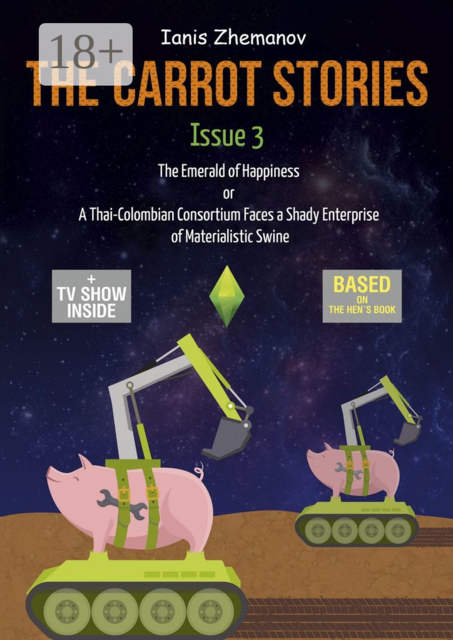
According to the Intergalactic Charter, each galaxy joining Hen’s community must immediately begin extracting soft emeralds and refining them into jelly. However, if a galaxy lacks this capability, it must turn to existing enterprises. One such operation was the Thai-Colombian consortium, with offices, workshops, and warehouses scattered across Bogota and Bangkok.
As Thailand’s main airport served as the sole space hub for galaxy N3111, and Thai carriers monopolized intergalactic transport, it was only natural that several Colombian mining and emerald processing companies decided to join forces with Thailand’s largest intergalactic freight organization.
It’s worth noting that soft emeralds became the foundation not only for space travel but also for the monetary system. To make the henso (the official currency of Hen’s world) effective, it was decided to back it with soft emeralds. This solution created a peculiar situation in the global economy: the distance that could be covered using a particular amount of soft emeralds as fuel became equivalent to the denomination of banknotes. Thus, 100 hensos equaled 0.01 grams of soft emeralds or 100,000 km of travel. Moreover, this green fuel dependence made soft emerald mining the most crucial industry. Competition was fierce, which is why the Thai-Colombian consortium had to introduce principles of mystical production into its operations.
In practice, it worked like this: before each workday began, consortium employees divided their souls into three parts – intelligence, emotions, and power. Each part was then placed into an apple. Through this process, workers temporarily “transformed” into sentient apples.
To outpace its competitors, the consortium significantly advanced its mystical production technology. The innovation came in the form of superworkers (red superapples). There were three types. Superworker A consisted of twelve apples, each containing the intelligence of twelve people. Superworker B comprised twelve apples housing people’s power. Finally, superworker C consisted of twelve apples filled with people’s emotions.
Unlike ordinary green apples, red superworkers were more adaptable and efficient. They could survive without oxygen – a tremendous advantage when working on dead planets. Furthermore, this new approach to labor uncovered a novel source to bolster Earth’s budget.
Why was this possible? As mentioned earlier, red apples were remarkably economical. They required very little sustenance. The significance of this feature was paramount, especially considering that red workers could only consume soft emeralds – the very product they dealt with. This explains why no superworker contained all eighteen green apples. Fully loaded red workers would demand more food. By reducing productive capacity, the Thai-Colombian consortium saved 31,000 kilograms of soft emeralds annually. All conserv