



автордың кітабын онлайн тегін оқу The Works of Daniel Webster, Volume 1
THE
WORKS
OF
DANIEL WEBSTER.
VOLUME I.
EIGHTH EDITION
BOSTON:
LITTLE, BROWN AND COMPANY.
1854.
Entered according to Act of Congress, in the year 1851, by
George W. Gordon and James W. Paige,
in the Clerk’s Office of the District Court of the District of Massachusetts.
CAMBRIDGE:
STEREOTYPED BY METCALF AND COMPANY,
PRINTERS TO THE UNIVERSITY.
PRINTED AT HOUGHTON AND HAYWOOD

DEDICATION
OF THE FIRST VOLUME.
TO MY NIECES,
MRS. ALICE BRIDGE WHIPPLE,
AND
MRS. MARY ANN SANBORN:
Many of the Speeches contained in this volume were delivered and printed in the lifetime of your father whose fraternal affection led him to speak of them with approbation.
His death, which happened when he had only just past the middle period of life, left you without a father, and me without a brother.
I dedicate this volume to you, not only for the love I have for yourselves, but also as a tribute of affection to his memory, and from a desire that the name of my brother,
EZEKIEL WEBSTER,
may be associated with mine, so long as any thing written or spoken by me shall be regarded or read.
DANIEL WEBSTER.
CONTENTS OF THE FIRST VOLUME.
PAGEBIOGRAPHICAL MEMOIR.
Chapter I. xiiiFormer Editions of the Works of Mr. Webster, and Plan of this Edition.—Parentage and Birth.—First Settlements in the Interior of New Hampshire.—Establishment of his Father at Salisbury.—Scanty Opportunities of Early Education.—First Teachers, and recent Letter to Master Tappan.—Placed at Exeter Academy.—Anecdotes while there.—Dartmouth College.—Study of the Law at Salisbury.—Residence at Fryeburg in Maine, and Occupations there.—Continuance of the Study of the Law at Boston, in the Office of Hon. Christopher Gore.—Admission to the Bar of Suffolk, Massachusetts.—Commencement of Practice at Boscawen, New Hampshire.—Removal to Portsmouth.—Contemporaries in the Profession.—Increasing Practice.
Chapter II. xxxiiiEntrance on Public Life.—State of Parties in 1812.—Election to Congress.—Extra Session of 1813.—Foreign Relations of the Country.—Resolutions relative to the Berlin and Milan Decrees.—Naval Defence.—Reelected to Congress in 1814.—Peace with England.—Projects for a National Bank.—Mr. Webster's Course on that Question.—Battle of New Orleans.—New Questions arising on the Return of Peace.—Course of Prominent Men of Different Parties.—Mr. Webster's Opinions on the Constitutionality of the Tariff Policy.—The Resolution to restore Specie Payments moved by Mr. Webster.—Removal to Boston.
Chapter III. xlviiiProfessional Character particularly in Reference to Constitutional Law.—The Dartmouth College Case argued at Washington in 1818.—Mr. Ticknor's Description of that Argument.—The Case of Gibbons and Ogden in 1824.—Mr. Justice Wayne's Allusion to that Case in 1847.—The Case of Ogden and Saunders in 1827.—The Case of the Proprietors of the Charles River Bridge.—The Alabama Bank Case.—The Case relative to the Boundary between Massachusetts and Rhode Island.—The Girard Will Case.—The Case of the Constitution of Rhode Island.—General Remarks on Mr. Webster's Practice in the Supreme Court of the United States.—Practice in the State Courts.—The Case of Goodridge,—and the Case of Knapp.
Chapter IV. lxThe Convention to revise the Constitution of Massachusetts.—John Adams a Delegate.—Mr. Webster's Share in its Proceedings.—Speeches on Oaths of Office, Basis of Senatorial Representation, and Independence of the Judiciary.—Centennial Anniversary at Plymouth on the 22d of December, 1820.—Discourse delivered by Mr. Webster.—Bunker Hill Monument, and Address by Mr. Webster on the Laying of the Corner-Stone, 17th of June, 1825.—Discourse on the Completion of the Monument, 17th of June, 1843.—Simultaneous Decease of Adams and Jefferson on the 4th of July, 1826.—Eulogy by Mr. Webster in Faneuil Hall.—Address at the Laying of the Corner-Stone of the New Wing of the Capitol.—Remarks on the Patriotic Discourses of Mr. Webster, and on the Character of his Eloquence in Efforts of this Class.
Chapter V. lxxiiElection to Congress from Boston.—State of Parties.—Meeting of the Eighteenth Congress.—Mr. Webster's Resolution and Speech in favor of the Greeks.—Argument in the Supreme Court in the Case of Gibbons and Ogden.—Circumstances under which it was made.—Speech on the Tariff Law of 1824.—A complete Revision of the Law for the Punishment of Crimes against the United States reported by Mr. Webster, and enacted.—The Election of Mr. Adams as President of the United States.—Meeting of the Nineteenth Congress, and State of Parties.—Congress of Panama, and Mr. Webster's Speech on that Subject.—Election as a Senator of the United States.—Revision of the Tariff Law by the Twentieth Congress.—Embarrassments of the Question.—Mr. Webster's Course and Speech on this Subject.
Chapter VI. lxxxviiElection of General Jackson.—Debate on Foot's Resolution.—Subject of the Resolution, and Objects of its Mover.—Mr. Hayne's First Speech.—Mr. Webster's original Participation in the Debate unpremeditated.—His First Speech.—Reply of Mr. Hayne with increased Asperity.—Mr. Webster's Great Speech.—Its Threefold Object.—Description of the Manner of Mr. Webster in the Delivery of this Speech, from Mr. March's "Reminiscences of Congress."—Reception of his Speech throughout the Country.—The Dinner at New York.—Chancellor Kent's Remarks.—Final Disposal of Foot's Resolution.—Report of Mr. Webster's Speech.—Mr. Healey's Painting.
Chapter VII. ciGeneral Character of President Jackson's Administrations.—Speedy Discord among the Parties which had united for his Elevation.—Mr. Webster's Relations to the Administration.—Veto of the Bank.—Rise and Progress of Nullification in South Carolina.—The Force Bill, and the Reliance of General Jackson's Administration on Mr. Webster's Aid.—His Speech in Defence of the Bill, and in Opposition to Mr. Calhoun's Resolutions.—Mr. Madison's Letter on Secession.—The Removal of the Deposits.—Motives for that Measure.—The Resolution of the Senate disapproving it.—The President's Protest.—Mr. Webster's Speech on the Subject of the Protest.—Opinions of Chancellor Kent and Mr. Tazewell.—The Expunging Resolution.—Mr. Webster's Protest against it.—Mr. Van Buren's Election.—The Financial Crisis and the Extra Session of Congress.—The Government Plan of Finance supported by Mr. Calhoun and opposed by Mr. Webster.—Personalities.—Mr. Webster's Visit to Europe and distinguished Reception.—The Presidential Canvass of 1840.—Election of General Harrison.
Chapter VIII. cxixCritical State of Foreign Affairs on the Accession of General Harrison.—Mr. Webster appointed to the State Department.—Death of General Harrison.—Embarrassed Relations with England.—Formation of Sir Robert Peel's Ministry, and Appointment of Lord Ashburton as Special Minister to the United States.—Course pursued by Mr. Webster in the Negotiations.—The Northeastern Boundary.—Peculiar Difficulties in its Settlement happily overcome.—Other Subjects of Negotiation.—Extradition of Fugitives from Justice.—Suppression of the Slave-Trade on the Coast of Africa.—History of that Question.—Affair of the Caroline.—Impressment.—Other Subjects connected with the Foreign Relations of the Government.—Intercourse with China.—Independence of the Sandwich Islands.—Correspondence with Mexico.—Sound Duties and the Zoll-Verein.—Importance of Mr. Webster's Services as Secretary of State.
Chapter IX. cxliiiMr. Webster resigns his Place in Mr. Tyler's Cabinet.—Attempts to draw public Attention to the projected Annexation of Texas.—Supports Mr. Clay's Nomination for the Presidency.—Causes of the Failure of that Nomination.—Mr. Webster returns to the Senate of the United States.—Admission of Texas to the Union.—The War with Mexico.—Mr. Webster's Course in Reference to the War.—Death of Major Webster in Mexico.—Mr. Webster's unfavorable Opinion of the Mexican Government.—Settlement of the Oregon Controversy.—Mr. Webster's Agency in effecting the Adjustment.—Revival of the Sub-Treasury System and Repeal of the Tariff Law of 1842.—Southern Tour.—Success of the Mexican War and Acquisition of the Mexican Provinces.—Efforts in Congress to organize a Territorial Government for these Provinces.—Great Exertions of Mr. Webster on the last Night of the Session.—Nomination of General Taylor, and Course of Mr. Webster in Reference to it.—A Constitution of State Government adopted by California prohibiting Slavery.—Increase of Antislavery Agitation.—Alarming State of Affairs.—Mr. Webster's Speech for the Union.—Circumstances under which it was made, and Motives by which he was influenced.—General Taylor's Death, and the Accession of Mr. Fillmore to the Presidency.—Mr. Webster called to the Department of State.
SPEECHES DELIVERED ON VARIOUS PUBLIC OCCASIONS.
First Settlement of New England 1 The Bunker Hill Monument 55 The Completion of the Bunker Hill Monument 79 Adams and Jefferson 109 The Election of 1825 151 Dinner at Faneuil Hall 161 The Boston Mechanics’ Institution 175 Public Dinner at New York 191 The Character of Washington. 217 National Republican Convention at Worcester 235 Reception at Buffalo 279 Reception at Pittsburg 285 Reception at Bangor 307 Presentation of a Vase 317 Reception at New York 337 Reception at Wheeling 381 Reception at Madison 395 Public Dinner in Faneuil Hall 411 Royal Agricultural Society 433 The Agriculture of England 441BIOGRAPHICAL MEMOIR OF THE PUBLIC LIFE OF DANIEL WEBSTER.
BY
EDWARD EVERETT.
CHAPTER I.
Former Editions of the Works of Mr. Webster, and Plan of this Edition.—Parentage and Birth.—First Settlements in the Interior of New Hampshire.—Establishment of his Father at Salisbury.—Scanty Opportunities of Early Education.—First Teachers, and recent Letter to Master Tappan.—Placed at Exeter Academy.—Anecdotes while there.—Dartmouth College.—Study of the Law at Salisbury.—Residence at Fryeburg in Maine, and Occupations there.—Continuance of the Study of the Law at Boston, in the Office of Hon. Christopher Gore.—Admission to the Bar of Suffolk, Massachusetts.—Commencement of Practice at Boscawen, New Hampshire.—Removal to Portsmouth.—Contemporaries in the Profession.—Increasing Practice.
The first collection of Mr. Webster’s speeches in the Congress of the United States and on various public occasions was published in Boston, in one volume octavo, in 1830. This volume was more than once reprinted, and in 1835 a second volume was published, containing the speeches made up to that time, and not included in the first collection. Several impressions of these two volumes were called for by the public. In 1843 a third volume was prepared, containing a selection from the speeches of Mr. Webster from the year 1835 till his entrance into the cabinet of General Harrison. In the year 1848 appeared a fourth volume of diplomatic papers, containing a portion of Mr. Webster’s official correspondence as Secretary of State.
The great favor with which these volumes have been received throughout the country, and the importance of the subjects discussed in the Senate of the United States after Mr. Webster’s return to that body in 1845, have led his friends to think that a valuable service would be rendered to the community xiv by bringing together his speeches of a later date than those contained in the third volume of the former collection, and on political subjects arising since that time. Few periods of our history will be entitled to be remembered by events of greater moment, such as the admission of Texas to the Union, the settlement of the Oregon controversy, the Mexican war, the acquisition of California and other Mexican provinces, and the exciting questions which have grown out of the sudden extension of the territory of the United States. Rarely have public discussions been carried on with greater earnestness, with more important consequences visibly at stake, or with greater ability. The speeches made by Mr. Webster in the Senate, and on public occasions of various kinds, during the progress of these controversies, are more than sufficient to fill two new volumes. The opportunity of their collection has been taken by the enterprising publishers, in compliance with opinions often expressed by the most respectable individuals, and with a manifest public demand, to bring out a new edition of Mr. Webster’s speeches in uniform style. Such is the object of the present publication. The first two volumes contain the speeches delivered by him on a great variety of public occasions, commencing with his discourse at Plymouth in December, 1820. Three succeeding volumes embrace the greater part of the speeches delivered in the Massachusetts Convention and in the two houses of Congress, beginning with the speech on the Bank of the United States in 1816. The sixth and last volume contains the legal arguments and addresses to the jury, the diplomatic papers, and letters addressed to various persons on important political questions.
The collection does not embrace the entire series of Mr. Webster’s writings. Such a series would have required a larger number of volumes than was deemed advisable with reference to the general circulation of the work. A few juvenile performances have accordingly been omitted, as not of sufficient importance or maturity to be included in the collection. Of the earlier speeches in Congress, some were either not reported at all, or in a manner too imperfect to be preserved without doing injustice to the author. No attempt has been made to collect from the contemporaneous newspapers or Congressional registers the short conversational speeches and remarks made by xv Mr. Webster, as by other prominent members of Congress, in the progress of debate, and sometimes exercising greater influence on the result than the set speeches. Of the addresses to public meetings it has been found impossible to embrace more than a selection, without swelling the work to an unreasonable size. It is believed, however, that the contents of these volumes furnish a fair specimen of Mr. Webster’s opinions and sentiments on all the subjects treated, and of his manner of discussing them. The responsibility of deciding what should be omitted and what included has been left by Mr. Webster to the friends having the charge of the publication, and his own opinion on details of this kind has rarely been taken.
In addition to such introductory notices as were deemed expedient relative to the occasions and subjects of the various speeches, it has been thought advisable that the collection should be accompanied with a Biographical Memoir, presenting a condensed view of Mr. Webster’s public career, with a few observations by way of commentary on the principal speeches. Many things which might otherwise fitly be said in such an essay must, it is true, be excluded by that delicacy which qualifies the eulogy to be awarded even to the most eminent living worth. Much may be safely omitted, as too well known to need repetition in this community, though otherwise pertaining to a full survey of Mr. Webster’s career. In preparing the following notice, free use has been made by the writer of the biographical sketches already before the public. Justice, however, requires that a specific acknowledgment should be made to an article in the American Quarterly Review for June, 1831, written, with equal accuracy and elegance, by Mr. George Ticknor, and containing a discriminating estimate of the speeches embraced in the first collection; and also to the highly spirited and vigorous work entitled “Reminiscences of Congress,” by Mr. Charles W. March. To this work the present sketch is largely indebted for the account of the parentage and early life of Mr. Webster; as well as for a very graphic description of the debate on Foot’s resolution.
The family of Daniel Webster has been established in America from a very early period. It was of Scottish origin, but passed some time in England before the final emigration. xvi Thomas Webster, the remotest ancestor who can be traced, was settled at Hampton, on the coast of New Hampshire, as early as 1636, sixteen years after the landing at Plymouth, and six years from the arrival of Governor Winthrop in Massachusetts Bay. The descent from Thomas Webster to Daniel can be traced in the church and town records of Hampton, Kingston (now East Kingston), and Salisbury. These records and the mouldering headstones of village grave-yards are the herald’s office of the fathers of New England. Noah Webster, the learned author of the American Dictionary of the English Language, was of a collateral branch of the family.
Ebenezer Webster, the father of Daniel, is still recollected in Kingston and Salisbury. His personal appearance was striking. He was erect, of athletic stature, six feet high, broad and full in the chest. Long service in the wars had given him a military air and carriage. He belonged to that intrepid border race, which lined the whole frontier of the Anglo-American colonies, by turns farmers, huntsmen, and soldiers, and passing their lives in one long struggle with the hardships of an infant settlement, on the skirts of a primeval forest. Ebenezer Webster enlisted early in life as a common soldier, in one of those formidable companies of rangers, which rendered such important services under Sir Jeffrey Amherst and Wolfe in the Seven Years’ War. He followed the former distinguished leader in the invasion of Canada, attracted the attention and gained the good-will of his superior officers by his brave and faithful conduct, and rose to the rank of a captain before the end of the war.
For the first half of the last century the settlements of New Hampshire had made but little progress into the interior. Every war between France and Great Britain in Europe was the signal of an irruption of the Canadian French and their Indian allies into New England. As late as 1755 they sacked villages on the Connecticut River, and John Stark, while hunting on Baker’s River, three years before, was taken a prisoner and sold as a slave into Canada. One can scarcely believe that it is not yet a hundred years since occurrences like these took place. The cession of Canada to England by the treaty of 1763 entirely changed this state of things. It opened the pathways of the forest and the gates of the Western hills. The royal governor xvii of New Hampshire, Benning Wentworth, began to make grants of land in the central parts of the State. Colonel Stevens of Kingston, with some of his neighbors, mostly retired officers and soldiers, obtained a grant of the town of Salisbury, which was at first called Stevenstown, from the principal grantee. This town is situated exactly at the point where the Merrimack River is formed by the confluence of the Pemigewasset and Winnipiseogee. Captain Webster was one of the settlers of the newly granted township, and received an allotment in its northerly portion. More adventurous than others of the company, he cut his way deeper into the wilderness, and made the path he could not find. At this time his nearest civilized neighbors on the northwest were at Montreal.
The following allusion of Mr. Webster to his birthplace will be read with interest. It is from a speech delivered before a great public assembly at Saratoga, in the year 1840.
“It did not happen to me to be born in a log cabin; but my elder brothers and sisters were born in a log cabin, raised amid the snowdrifts of New Hampshire, at a period so early that, when the smoke first rose from its rude chimney, and curled over the frozen hills, there was no similar evidence of a white man’s habitation between it and the settlements on the rivers of Canada. Its remains still exist. I make to it an annual visit. I carry my children to it to teach them the hardships endured by the generations which have gone before them. I love to dwell on the tender recollections, the kindred ties, the early affections, and the touching narratives and incidents, which mingle with all I know of this primitive family abode. I weep to think that none of those who inhabited it are now among the living; and if ever I am ashamed of it, or if I ever fail in affectionate veneration for HIM who reared and defended it against savage violence and destruction, cherished all the domestic virtues beneath its roof, and, through the fire and blood of seven years’ revolutionary war, shrunk from no danger, no toil, no sacrifice, to serve his country, and to raise his children to a condition better than his own, may my name and the name of my posterity be blotted for ever from the memory of mankind!”
Soon after his settlement in Salisbury, the first wife of Ebenezer Webster having deceased, he married Abigail Eastman, who became the mother of Ezekiel and Daniel Webster, the only sons of the second marriage. Like the mothers of so many men of eminence, she was a woman of more than ordinary intellect, and possessed a force of character which was felt throughout xviii the humble circle in which she moved. She was proud of her sons and ambitious that they should excel. Her anticipations went beyond the narrow sphere in which their lot seemed to be cast, and the distinction attained by both, and especially by the younger, may well be traced in part to her early promptings and judicious guidance.
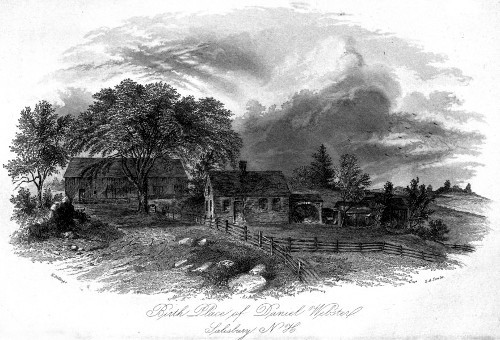
About the time of his second marriage, Captain Ebenezer Webster erected a frame house hard by the log cabin. He dug a well near it and planted an elm sapling. In this house Daniel Webster was born. It has long since disappeared, but the spot where it stood is well known, and is covered by a house since built. The cellar of the log cabin is still visible, though partly filled with the accumulations of seventy years. “The well still remains,” says Mr. March, “with water as pure, as cool, and as limpid as when first brought to light, and will remain in all probability for ages, to refresh hereafter the votaries of genius who make their pilgrimage hither, to visit the cradle of one of her greatest sons. The elm that shaded the boy still flourishes in vigorous leaf, and may have an existence beyond its perishable nature. Like
‘The witch-elm that guards St. Fillan’s spring,’
it may live in story long after leaf, and branch, and root have disappeared for ever.”
The interval between the peace of 1763 and the breaking out of the war of the Revolution was one of excitement and anxiety throughout the Colonies. The great political questions of the day were not only discussed in the towns and cities, but in the villages and hamlets. Captain Webster took a deep interest in those discussions. Like so many of the officers and soldiers of the former war, he obeyed the first call to arms in the new struggle. He commanded a company, chiefly composed of his own townspeople, friends, and kindred, who followed him through the greater portion of the war. He was at the battle of White Plains, and was at West Point when the treason of Arnold was discovered. He acted as a Major under Stark at Bennington, and contributed his share to the success of that eventful day.
In the last year of the Revolutionary war, on the 18th of January, 1782, Daniel Webster was born, in the home which his xix father had established on the outskirts of civilization. If the character and situation of the place, and the circumstances under which he passed the first years of his life, might seem adverse to the early cultivation of his extraordinary talent, it still cannot be doubted that they possessed influences favorable to elevation and strength of character. The hardships of an infant settlement and border life, the traditions of a long series of Indian wars, and of two mighty national contests, in which an honored parent had borne his part, the anecdotes of Fort William Henry, of Quebec, of Bennington, of West Point, of Wolfe and Stark and Washington, the great Iliad and Odyssey of American Independence,—this was the fireside entertainment of the long winter evenings of the secluded village home. Abroad, the uninviting landscape, the harsh and craggy outline of the hills broken and relieved only by the funereal hemlock and the “cloud seeking” pine, the lowlands traversed in every direction by unbridged streams, the tall, charred trunks in the cornfields, that told how stern had been the struggle with the boundless woods, and, at the close of the year, the dismal scene which presents itself in high latitudes in a thinly settled region, when
“the snows descend; and, foul and fierce,
All winter drives along the darkened air”;—
these are circumstances to leave an abiding impression on the mind of a thoughtful child, and induce an early maturity of character.
Mr. March has described an incident of Mr. Webster’s earliest youth in a manner so graphical, that we are tempted to repeat it in his own words:—
“In Mr. Webster’s earliest youth an
occurrence
of such a nature took place, which affected him deeply at the time, and has dwelt in his memory ever since. There was a sudden and extraordinary rise in the Merrimack River, in a spring thaw. A deluge of rain for two whole days poured down upon the houses. A mass of mingled water and snow rushed madly from the hills, inundating the fields far and wide. The highways were broken up, and rendered undistinguishable. There was no way for neighbors to interchange visits of condolence or necessity, save by boats, which came up to the very door-steps of the houses.“Many things of value were swept away, even things of bulk. A large barn, full fifty feet by twenty, crowded with hay and grain, sheep, xx chickens, and turkeys, sailed majestically down the river, before the eyes of the astonished inhabitants; who, no little frightened, got ready to fly to the mountains, or construct another ark.
“The roar of waters, as they rushed over precipices, casting the foam and spray far above, the crashing of the forest-trees as the storm broke through them, the immense sea everywhere in range of the eye, the sublimity, even danger, of the scene, made an indelible impression upon the mind of the youthful observer.
“Occurrences and scenes like these excite the imaginative faculty, furnish material for proper thought, call into existence new emotions, give decision to character, and a purpose to action.”—pp. 7, 8.
It may well be supposed that Mr. Webster’s early opportunities for education were very scanty. It is indeed correctly remarked by Mr. Ticknor, in reference to this point, that “in New England, ever since the first free school was established amidst the woods that covered the peninsula of Boston in 1636, the schoolmaster has been found on the border line between savage and civilized life, often indeed with an axe to open his own path, but always looked up to with respect, and always carrying with him a valuable and preponderating influence.” Still, however, compared with any thing that would be called a good school in this region and at the present time, the schools which existed on the frontier sixty years ago were sadly defective. Many of our district schools even now are below their reputation. The Swedish Chancellor’s exclamation of wonder at the little wisdom with which the world is governed, might well be repeated at the little learning and skill with which the scholastic world in too many parts of our country is still taught. In Mr. Webster’s boyhood it was much worse. Something that was called a school was kept for two or three months in the winter, frequently by an itinerant, too often a pretender, claiming only to teach a little reading, writing, and ciphering, and wholly incompetent to give any valuable assistance to a clever youth in learning either.
Such as the village school was, Mr. Webster enjoyed its advantages, if they could be called by that name. It was, however, of a migratory character. When it was near his father’s residence it was easy to attend; but it was sometimes in a distant part of the town, and sometimes in another town. While he was quite young, he was daily sent two miles and a xxi half or three miles to school in mid-winter and on foot. If the school-house lay in the same direction with the miller or the blacksmith, an occasional ride might be hoped for. If the school was removed to a still greater distance, he was boarded at a neighbor’s. Poor as these opportunities of education were, they were bestowed on Mr. Webster more liberally than on his brothers. He showed a greater eagerness for learning; and he was thought of too frail a constitution for any robust pursuit. An older half-brother good-humoredly said, that “Dan was sent to school that he might get to know as much as the other boys.” It is probable that the best part of his education was derived from the judicious and experienced father, and the strong-minded, affectionate, and ambitious mother.
Mr. Webster’s first master was Thomas Chase. He could read tolerably well, and wrote a fair hand; but spelling was not his forte. His second master was James Tappan, now living at an advanced age in Gloucester, Massachusetts. His qualifications as a teacher far exceeded those of Master Chase. The worthy veteran, now dignified with the title of Colonel, feels a pride, it may well be supposed, in the fame of his quondam pupil. He lately addressed a letter to him, recounting some of the incidents of his own life since he taught school at Salisbury. This unexpected communication from his aged teacher drew from Mr. Webster the following answer, in which a handsome gratuity was inclosed, more, probably, than the old gentleman ever received for a winter’s teaching at “New Salisbury.”[1]
“Washington, February 26, 1851.
“Master Tappan,—I thank you for your letter, and am rejoiced to know that you are among the living. I remember you perfectly well as a teacher of my infant years. I suppose my mother must have taught me to read very early, as I have never been able to recollect the time when I could not read the Bible. I think Master Chase was my earliest schoolmaster, probably when I was three or four years old. Then came Master Tappan. You boarded at our house, and sometimes, I think, in the family of Mr. Benjamin Sanborn, our neighbor, the lame man. Most of those whom you knew in ‘New Salisbury’ have gone to their graves. Mr. John Sanborn, the son of Benjamin, is yet living, and is xxii about your age. Mr. John Colby, who married my oldest sister, Susannah, is also living. On the ‘North Road’ is Mr. Benjamin Hunton, and on the ‘South Road’ is Mr. Benjamin Pettengil. I think of none else among the living whom you would probably remember.
“You have indeed lived a checkered life. I hope you have been able to bear prosperity with meekness, and adversity with patience. These things are all ordered for us far better than we could order them for ourselves. We may pray for our daily bread; we may pray for the forgiveness of sins; we may pray to be kept from temptation, and that the kingdom of God may come, in us, and in all men, and his will everywhere be done. Beyond this, we hardly know for what good to supplicate the Divine Mercy. Our Heavenly Father knoweth what we have need of better than we know ourselves, and we are sure that his eye and his loving-kindness are upon us and around us every moment.
“I thank you again my good old schoolmaster, for your kind letter, which has awakened many sleeping recollections; and, with all good wishes, I remain your friend and pupil,
“Daniel Webster.
To “Mr. James Tappan.”
He derived, also, no small benefit from the little social library, which, chiefly by the exertions of Mr. Thompson (the intelligent lawyer of the place), the clergyman, and Mr. Webster’s father, had been founded in Salisbury. The attention of the people of New Hampshire had been called to this mode of promoting general and popular education by Dr. Belknap. In the patriotic address to the people of New Hampshire, at the close of his excellent History, he says:—
“This (the establishment of social libraries) is the easiest, the cheapest, and the most effectual mode of diffusing knowledge among the people. For the sum of six or eight dollars at once, and a small annual payment besides, a man may be supplied with the means of literary improvement during his life, and his children may inherit the blessing.”[2]
From the village library at Salisbury, founded on recommendations like these, Mr. Webster was able to obtain a moderate supply of good reading. It is quite worth noticing, that his attention, like that of Franklin, was in early boyhood attracted to the Spectator. Franklin, as is well known, studiously formed his style on that of Addison;—and a considerable resemblance may be traced between them. There is no such resemblance xxiii between Mr. Webster’s style and that of Addison, unless it be the negative merit of freedom from balanced sentences, hard words, and inversions. It may, no doubt, have been partly owing to his early familiarity with the Spectator, that he escaped in youth from the turgidity and pomp of the Johnsonian school, and grew up to the mastery of that direct and forcible, but not harsh and affected sententiousness, that masculine simplicity, with which his speeches and writings are so strongly marked.
The year before Mr. Webster was born was rendered memorable in New Hampshire by the foundation of the Academy at Exeter, through the munificence of the Honorable John Phillips. His original endowment is estimated by Dr. Belknap at nearly ten thousand pounds, which, in the comparative scarcity of money in 1781, cannot be considered as less than three times that amount at the present day. Few events are more likely to be regarded as eras in the history of that State. In the year 1788, Dr. Benjamin Abbot, soon afterwards its principal, became connected with the Academy as an instructor, and from that time it assumed the rank which it still maintains among the schools of the country. To this Academy Mr. Webster was taken by his father in May, 1796. He enjoyed the advantage of only a few months’ instruction in this excellent school; but, short as the period was, his mind appears to have received an impulse of a most genial and quickening character. Nothing could be more graceful or honorable to both parties than the tribute paid by Mr. Webster to his ancient instructor, at the festival at Exeter, in 1838, in honor of Dr. Abbot’s jubilee. While at the Academy, his studies were aided and his efforts encouraged by a pupil younger than himself, but who, having enjoyed better advantages of education in boyhood, was now in the senior class at Exeter, the early celebrated and lamented Joseph Stevens Buckminster. The following anecdote from Mr. March’s work will not be thought out of place in this connection:—
“It may appear somewhat singular that the greatest orator of modern times should have evinced in his boyhood the strongest antipathy to public declamation. This fact, however, is established by his own words, which have recently appeared in print. ‘I believe,’ says Mr. Webster, ‘I made tolerable progress in most branches which I attended to while in this school; but there was one thing I could not do. I could not make a declamation. I could not speak before the school. The xxiv kind and excellent Buckminster sought especially to persuade me to perform the exercise of declamation, like other boys, but I could not do it. Many a piece did I commit to memory, and recite and rehearse in my own room, over and over again; yet when the day came, when the school collected to hear declamations, when my name was called, and I saw all eyes turned to my seat, I could not raise myself from it. Sometimes the instructors frowned, sometimes they smiled. Mr. Buckminster always pressed and entreated, most winningly, that I would venture. But I never could command sufficient resolution.’ Such diffidence of its own powers may be natural to genius, nervously fearful of being unable to reach that ideal which it proposes as the only full consummation of its wishes. It is fortunate, however, for the age, fortunate for all ages, that Mr. Webster by determined will and frequent trial overcame this moral incapacity, as his great prototype, the Grecian orator, subdued his physical defect.”—pp. 12, 13.
The effect produced, even at that early period of Mr. Webster’s life, on the mind of a close observer of his mental powers, is strikingly illustrated by the following anecdote. Mr. Nicholas Emery, afterwards a distinguished lawyer and judge, and now living in Portland, was temporarily employed, at that time, as an usher in the Academy. On entering the Academy, Mr. Webster was placed in the lowest class, which consisted of half a dozen boys, of no remarkable brightness of intellect. Mr. Emery was the instructor of this class, among others. At the end of a month, after morning recitations, “Webster,” said Mr. Emery, “you will pass into the other room and join a higher class”; and added, “Boys, you will take your final leave of Webster, you will never see him again.”
After a few months well spent at Exeter, Mr. Webster returned home, and in February, 1797, was placed by his father under the Rev. Samuel Wood, the minister of the neighboring town of Boscawen. He lived in Mr. Wood’s family, and for board and instruction the entire charge was one dollar per week.
On their way to Mr. Wood’s, Mr. Webster’s father first opened to his son, now fifteen years old, the design of sending him to college, the thought of which had never before entered his mind. The advantages of a college education were a privilege to which he had never aspired in his most ambitious dreams. “I remember,” says Mr. Webster, in an autobiographical memorandum of his boyhood, “the very hill which we xxv were ascending, through deep snows, in a New England sleigh, when my father made known this purpose to me. I could not speak. How could he, I thought, with so large a family and in such narrow circumstances, think of incurring so great an expense for me. A warm glow ran all over me, and I laid my head on my father’s shoulder and wept.”
In truth, a college education was a far different affair fifty years ago from what it has since become, by the multiplication of collegiate institutions, and the establishment of public funds in aid of those who need assistance. It constituted a person at once a member of an intellectual aristocracy. In many cases it really conferred qualifications, and in all was supposed to do so, without which professional and public life could not be entered upon with any hope of success. In New England, at that time, it was not a common occurrence that any one attained a respectable position in either of the professions without this advantage. In selecting the member of the family who should enjoy this privilege, the choice not unfrequently fell upon the son whose slender frame and early indications of disease unfitted him for the laborious life of our New England yeomanry.
From February till August, 1797, Mr. Webster remained under the instruction of Mr. Wood, at Boscawen, and completed his preparation for college. It is hardly necessary to say, that the preparation was imperfect. There is probably no period in the history of the country at which the standard of classical literature stood lower than it did at the close of the last century. The knowledge of Greek and Latin brought by our forefathers from England had almost run out in the lapse of nearly two centuries, and the signal revival which has taken place within the last thirty years had not yet begun. Still, however, when we hear of a youth of fifteen preparing himself for college by a year’s study of Greek and Latin, we must recollect that the attainments which may be made in that time by a young man of distinguished talent, at the period of life when the faculties develop themselves with the greatest energy, studying night and day, summer and winter, under the master influence of hope, ambition, and necessity, are not to be measured by the tardy progress of the thoughtless or languid children of prosperity, sent to school from the time they are able to go alone, and carried along by routine and discipline from year to xxvi year, in the majority of cases without strong personal motives to diligence. Besides this, it is to be considered that the studies which occupy this usually prolonged novitiate are those which are required for the acquisition of grammatical and metrical niceties, the elegancies and the luxuries of scholarship. Short as was his period of preparation, it enabled Mr. Webster to lay the foundation of a knowledge of the classical writers, especially the Latin, which was greatly increased in college, and which has been kept up by constant recurrence to the great models of antiquity, during the busiest periods of active life. The happiness of Mr. Webster’s occasional citations from the Latin classics is a striking feature of his oratory.
Mr. Webster entered college in 1797, and passed the four academic years in assiduous study. He was not only distinguished for his attention to the prescribed studies, but devoted himself to general reading, especially to English history and literature. He took part in the publication of a little weekly newspaper, furnishing selections from books and magazines, with an occasional article from his own pen. He delivered addresses, also, before the college societies, some of which were published. The winter vacations brought no relaxation. Like those of so many of the meritorious students at our places of education, they were employed in teaching school, for the purpose of eking out his own frugal means and aiding his brother to prepare himself for college. The attachment between the two brothers was of the most affectionate kind, and it was by the persuasion of Daniel that the father had been induced to extend to Ezekiel also the benefits of a college education.
The genial and companionable spirit of Mr. Webster is still remembered by his classmates, and by the close of his first college year he had given proof of powers and aspirations which placed him far above rivalry among his associates. “It is known,” says Mr. Ticknor, “in many ways, that, by those who were acquainted with him at this period of life, he was already regarded as a marked man, and that to the more sagacious of them the honors of his subsequent career have not been unexpected.”
Mr. Webster completed his college course in August, 1801, and immediately entered the office of Mr. Thompson, the next-door neighbor of his father, as a student of law. Mr. Thompson xxvii was a gentleman of education and intelligence, and, at a later period, a respectable member, successively, of the House of Representatives and Senate of the United States. He maintained a high character till his death. Mr. Webster remained in his office as a student till, in the words of Mr. March, “he felt it necessary to go somewhere and do something to earn a little money.” In this emergency, application was made to him to take charge of an academy at Fryeburg in Maine, upon a salary of about one dollar per diem, being what is now paid for the coarsest kind of unskilled manual labor. As he was able, besides, to earn enough to pay for his board and to defray his other expenses by acting as assistant to the register of deeds for the county, his salary was all saved,—a fund for his own professional education and to help his brother through college.
Mr. Webster’s son and one of his friends have lately visited Fryeburg and examined these records of deeds. They are still preserved in two huge folio volumes, in Mr. Webster’s handwriting, exciting wonder how so much work could be done in the evening, after days of close confinement to the business of the school. They looked also at the records of the trustees of the academy and found in them a most respectful and affectionate vote of thanks and good-will to Mr. Webster when he took leave of the employment.[3]
These humble details need no apology. They relate to trials, hardships, and efforts which constitute no small part of the discipline by which a great character is formed. During his residence at Fryeburg, Mr. Webster borrowed (he was too poor to buy) Blackstone’s Commentaries, and read them for the first time. “Among other mental exercises,” says Mr. March, “he committed to memory Mr. Ames’s celebrated speech on the British treaty.” In after life he has been heard to say, that few things moved him more than the perusal and reperusal of this celebrated speech.
In September, 1802, Mr. Webster returned to Salisbury, and resumed his studies under Mr. Thompson, in whose office he xxviii remained for eighteen months. Mr. Thompson, though, as we have said, a person of excellent character and a good lawyer, yet seems not to have kept pace in his profession with the progress of improvement. Although Blackstone’s Commentaries had been known in this country for a full generation, Mr. Thompson still directed the reading of his pupils on the principle of the hardest book first. Coke’s Littleton was still the work with which his students were broken into the study of the profession. Mr. Webster has condemned this practice. “A boy of twenty,” says he, “with no previous knowledge of such subjects, cannot understand Coke. It is folly to set him upon such an author. There are propositions in Coke so abstract, and distinctions so nice, and doctrines embracing so many distinctions and qualifications, that it requires an effort not only of a mature mind, but of a mind both strong and mature, to understand him. Why disgust and discourage a young man by telling him he must break into his profession through such a wall as this?” Acting upon these views, even in his youth, Mr. Webster gave his attention to more intelligible authors, and to titles of law of greater importance in this country than the curious learning of tenures, many of which are antiquated, even in England. He also gave a good deal of time to general reading, and especially the study of the Latin classics, English history, and the volumes of Shakespeare. In order to obtain a wider compass of knowledge, and to learn something of the language not to be gained from the classics, he read through attentively Puffendorff’s Latin History of England.
In July, 1804, he took up his residence in Boston. Before entering upon the practice of his profession, he enjoyed the advantage of pursuing his legal studies for six or eight months in the office of the Hon. Christopher Gore. This was a fortunate event for Mr. Webster. Mr. Gore, afterwards Governor of Massachusetts, was a lawyer of eminence, a statesman and a civilian, a gentleman of the old school of manners, and a rare example of distinguished intellectual qualities, united with practical good sense and judgment. He had passed several years in England as a commissioner, under Jay’s treaty, for liquidating the claims of citizens of the United States for seizures by British cruisers in the early wars of the French Revolution. xxix His library, amply furnished with works of professional and general literature, his large experience of men and things at home and abroad, and his uncommon amenity of temper, combined to make the period passed by Mr. Webster in his office one of the pleasantest in his life. These advantages, it hardly need be said, were not thrown away. He diligently attended the sessions of the courts and reported their decisions. He read with care the leading elementary works of the common and municipal law, with the best authors on the law of nations, some of them for a second and third time; diversifying these professional studies with a great amount and variety of general reading. His chief study, however, was the common law, and more especially that part of it which relates to the now unfashionable science of special pleading. He regarded this, not only as a most refined and ingenious, but a highly instructive and useful branch of the law. Besides mastering all that could be derived from more obvious sources, he waded through Saunders’s Reports in the original edition, and abstracted and translated into English from the Latin and Norman French all the pleadings contained in the two folio volumes. This manuscript still remains.
Just as he was about to be admitted to practise in the Suffolk Court of Common Pleas in Massachusetts, an incident occurred which came near affecting his career for life. The place of clerk in the Court of Common Pleas for the county of Hillsborough, in New Hampshire, became vacant. Of this court Mr. Webster’s father had been made one of the judges, in conformity with a very common practice at that time, of placing on the side bench of the lower courts men of intelligence and respectability, though not lawyers. From regard to Judge Webster, the vacant clerkship was offered by his colleagues to his son. It was what the father had for some time looked forward to and desired. The fees of the office were about fifteen hundred dollars per annum, which in those days and in that region was not so much a competence as a fortune. Mr. Webster himself was disposed to accept the office. It promised an immediate provision in lieu of a distant and doubtful prospect. It enabled him at once to bring comfort into his father’s family, while to refuse it was to condemn himself and them to an uncertain and probably harassing future. He was willing to sacrifice xxx his hopes of professional eminence to the welfare of those whom he held most dear. But the earnest dissuasions of Mr. Gore, who saw in this step the certain postponement, perhaps the final defeat, of all hopes of professional advancement, prevented his accepting the office. His aged father was, in a personal interview with his son, if not reconciled to the refusal, at least induced to bury his regrets in his own bosom. The subject was never mentioned by him again. In the spring of the same year (1805), Mr. Webster was admitted to the practice of the law in the Court of Common Pleas for Suffolk county, Boston. According to the custom of that day, Mr. Gore accompanied the motion for his admission with a brief speech in recommendation of the candidate. The remarks of Mr. Gore on this occasion are well remembered by those present. He dwelt with emphasis on the remarkable attainments and uncommon promise of his pupil, and closed with a prediction of his future eminence.
Immediately on his admission to the bar, Mr. Webster went to Amherst, in New Hampshire, where his father’s court was in session; from that place he went home with his father. He had intended to establish himself at Portsmouth, which, as the largest town and the seat of the foreign commerce of the State, opened the widest field for practice. But filial duty kept him nearer home. His father was now infirm from the advance of years, and had no other son at home. Under these circumstances Mr. Webster opened an office at Boscawen, not far from his father’s residence, and commenced the practice of the law in this retired spot. Judge Webster lived but a year after his son’s entrance upon the practice of his profession; long enough, however, to hear his first argument in court, and to be gratified with the confident predictions of his future success.
In May, 1807, Mr. Webster was admitted as an attorney and counsellor of the Superior Court in New Hampshire, and in September of that year, relinquishing his office in Boscawen to his brother Ezekiel, he removed to Portsmouth, in conformity with his original intention. Here he remained in the practice of his profession for nine successive years. They were years of assiduous labor, and of unremitted devotion to the study and practice of the law. He was associated with several persons xxxi of great eminence, citizens of New Hampshire or of Massachusetts occasionally practising at the Portsmouth bar. Among the latter were Samuel Dexter and Joseph Story; of the residents of New Hampshire, Jeremiah Mason was the most distinguished. Often opposed to each other as lawyers, a strong personal friendship grew up between them, which ended only with the death of Mr. Mason. Mr. Webster’s eulogy on Mr. Mason will be found in one of the volumes of this collection, and will descend to posterity an enduring monument of both. Had a more active temperament led Mr. Mason to embark earlier and continue longer in public life, he would have achieved a distinction shared by few of his contemporaries. Mr. Webster, in the lapse of time, was called to perform the same melancholy office for Judge Story.
During the greater part of Mr. Webster’s practice of the law in New Hampshire, Jeremiah Smith was Chief Justice of the State, a learned and excellent judge, whose biography has been written by the Rev. John H. Morison, and will well repay perusal. Judge Smith was an early and warm friend of Judge Webster, and this friendship descended to the son, and glowed in his breast with fervor till he went to his grave.
Although dividing with Mr. Mason the best of the business of Portsmouth, and indeed of all the eastern portion of the State, Mr. Webster’s practice was mostly on the circuit. He followed the Superior Court through the principal counties of the State, and was retained in nearly every important cause. It is mentioned by Mr. March, as a somewhat singular fact in his professional life, that, with the exception of the occasions on which he has been associated with the Attorney-General of the United States for the time being, he has hardly appeared ten times as junior counsel. Within the sphere in which he was placed, he may be said to have risen at once to the head of his profession; not, however, like Erskine and some other celebrated British lawyers, by one and the same bound, at once to fame and fortune. The American bar holds forth no such golden prizes, certainly not in the smaller States. Mr. Webster’s practice in New Hampshire, though probably as good as that of any of his contemporaries, was never lucrative. Clients were not very rich, nor the concerns litigated such as would carry heavy fees. Although xxxii exclusively devoted to his profession, it afforded him no more than a bare livelihood.
But the time for which he practised at the New Hampshire bar was probably not lost with reference to his future professional and political eminence. His own standard of legal attainment was high. He was associated with professional brethren fully competent to put his powers to their best proof, and to prevent him from settling down in early life into an easy routine of ordinary professional practice. It was no disadvantage, under these circumstances, (except in reference to immediate pecuniary benefit,) to enjoy some portion of that leisure for general reading, which is almost wholly denied to the lawyer of commanding talents, who steps immediately into full practice in a large city.
FOOTNOTES
1
FIRST SETTLEMENT OF NEW ENGLAND.
55
THE BUNKER HILL MONUMENT.
79
THE COMPLETION
OF
THE BUNKER HILL MONUMENT.
109
ADAMS AND JEFFERSON.
151
THE ELECTION OF 1825.
161
DINNER AT FANEUIL HALL.
175
THE BOSTON MECHANICS’ INSTITUTION.[88]
191
PUBLIC DINNER AT NEW YORK.
217
THE CHARACTER OF WASHINGTON.[94]
235
NATIONAL REPUBLICAN CONVENTION AT WORCESTER.[96]
279
RECEPTION AT BUFFALO.[101]
285
RECEPTION AT PITTSBURG.
307
RECEPTION AT BANGOR.[103]
317
PRESENTATION OF A VASE.
337
RECEPTION AT NEW YORK.
381
RECEPTION AT WHEELING.[108]
395
RECEPTION AT MADISON.
411
PUBLIC DINNER IN FANEUIL HALL.
433
ROYAL AGRICULTURAL SOCIETY.[117]
441
THE AGRICULTURE OF ENGLAND.[118]
[1]
Fifty dollars. The knowledge of this fact is derived from the “Gloucester News,” to which it was no doubt communicated by Master Tappan.
[2]
Belknap’s History of New Hampshire, Vol. III. p. 328.
[3]
The old school-house was burned down many years ago. The spot on which it stood belongs to Mr. Robert J. Bradley, who has inherited from his father a devoted friendship for Mr. Webster, and who would never suffer any other building to be erected on the spot, and says that none shall be during his life.
Fifty dollars. The knowledge of this fact is derived from the “Gloucester News,” to which it was no doubt communicated by Master Tappan.
Belknap’s History of New Hampshire, Vol. III. p. 328.
The old school-house was burned down many years ago. The spot on which it stood belongs to Mr. Robert J. Bradley, who has inherited from his father a devoted friendship for Mr. Webster, and who would never suffer any other building to be erected on the spot, and says that none shall be during his life.
xxxiii
CHAPTER II.
Entrance on Public Life.—State of Parties in 1812.—Election to Congress.—Extra Session of 1813.—Foreign Relations of the Country.—Resolutions relative to the Berlin and Milan Decrees.—Naval Defence.—Reelected to Congress in 1814.—Peace with England.—Projects for a National Bank.—Mr. Webster’s Course on that Question.—Battle of New Orleans.—New Questions arising on the Return of Peace.—Course of Prominent Men of Different Parties.—Mr. Webster’s Opinions on the Constitutionality of the Tariff Policy.—The Resolution to restore Specie Payments moved by Mr. Webster.—Removal to Boston.
Mr. Webster had hitherto taken less interest in politics than has been usual with the young men of talent, at least with the young lawyers, of America. In fact, at the time to which the preceding narrative refers, the politics of the country were in such a state, that there was scarce any course which could be pursued with entire satisfaction by a patriotic young man sagacious enough to penetrate behind mere party names, and to view public questions in their true light. Party spirit ran high; errors had been committed by ardent men on both sides; and extreme opinions had been advanced on most questions, which no wise and well-informed person at the present day would probably be willing to espouse. The United States, although not actually drawn to any great depth into the vortex of the French Revolution, were powerfully affected by it. The deadly struggle of the two great European belligerents, in which the neutral rights of this country were grossly violated by both, gave a complexion to our domestic politics. A change of administration, mainly resulting from difference of opinion in respect to our foreign relations, had taken place in 1801. If we may consider President Jefferson’s inaugural address as the indication of the principles on which he intended to conduct his administration, it was his purpose to take a new departure, and to disregard the former party divisions. “We have,” said he, in that eloquent state paper, “called by different names brethren of the same principle. We are all republicans, we are all federalists.”
At the time these significant expressions were uttered, Mr. Webster, at the age of nineteen, was just leaving college and preparing to embark on the voyage of life. A sentiment so xxxiv liberal was not only in accordance with the generous temper of youth, but highly congenial with the spirit of enlarged patriotism which has ever guided his public course. There is certainly no individual who has filled a prominent place in our political history who has shown himself more devoted to principle and less to party. While no man has clung with greater tenacity to the friendships which spring from agreement in political opinion (the idem sentire de republica), no man has been less disposed to find in these associations an instrument of monopoly or exclusion in favor of individuals, interests, or sections of the country.
But however catholic may have been the intentions and wishes of Mr. Jefferson, events both at home and abroad were too strong for him, and defeated that policy of blending the great parties into one, which has always been a favorite, perhaps we must add, a visionary project, with statesmen of elevated and generous characters. The aggressions of the belligerents on our neutral commerce still continued, and, by the joint effect of the Berlin and Milan Decrees and the Orders in Council, it was all but swept from the ocean. In this state of things two courses were open to the United States, as a growing neutral power: one, that of prompt resistance to the aggressive policy of the belligerents; the other, that which was called “the restrictive system,” which consisted in an embargo on our own vessels, with a view to withdraw them from the grasp of foreign cruisers, and in laws inhibiting commercial intercourse with England and France. There was a division of opinion in the cabinet of Mr. Jefferson and in the country at large. The latter policy was finally adopted. It fell in with the general views of Mr. Jefferson against committing the country to the risks of foreign war. His administration was also strongly pledged to retrenchment and economy, in the pursuit of which a portion of our little navy had been brought to the hammer, and a species of shore defence substituted, which can now be thought of only with mortification and astonishment.
Although the discipline of party was sufficiently strong to cause this system of measures to be adopted and pursued for years, it was never cordially approved by the people of the United States of any party. Leading Republicans both at the South and at the North denounced it. With Mr. Jefferson’s xxxv retirement from office it fell rapidly into disrepute. It continued, however, to form the basis of our party divisions till the war of 1812. In these divisions, as has been intimated, both parties were in a false position; the one supporting and forcing upon the country a system of measures not cordially approved, even by themselves; the other, a powerless minority, zealously opposing those measures, but liable for that reason to be thought backward in asserting the neutral rights of the country. A few men of well-balanced minds, true patriotism, and sound statesmanship, in all sections of the country, were able to unite fidelity to their party associations with a comprehensive view to the good of the country. Among these, mature beyond his years, was Mr. Webster. As early as 1806 he had, in a public oration, presented an impartial view of the foreign relations of the country in reference to both belligerents, of the importance of our commercial interests and the duty of protecting them. “Nothing is plainer,” said he, “than this: if we will have commerce, we must protect it. This country is commercial as well as agricultural. Indissoluble bonds connect him who ploughs the land with him who ploughs the sea. Nature has placed us in a situation favorable to commercial pursuits, and no government can alter the destination. Habits confirmed by two centuries are not to be changed. An immense portion of our property is on the waves. Sixty or eighty thousand of our most useful citizens are there, and are entitled to such protection from the government as their case requires.”
At length the foreign belligerents themselves perceived the folly and injustice of their measures. In the strife which should inflict the greatest injury on the other, they had paralyzed the commerce of the world and embittered the minds of all the neutral powers. The Berlin and Milan Decrees were revoked, but in a manner so unsatisfactory as in a great degree to impair the pacific tendency of the measure. The Orders in Council were also rescinded in the summer of 1812. War, however, justly provoked by each and both of the parties, had meantime been declared by Congress against England, and active hostilities had been commenced on the frontier. At the elections next ensuing, Mr. Webster was brought forward as a candidate for Congress of the Federal party of that day, and, having been chosen in the month of November, 1812, he xxxvi took his seat at the first session of the Thirteenth Congress, which was an extra session called in May, 1813. Although his course of life hitherto had been in what may be called a provincial sphere, and he had never been a member even of the legislature of his native State, a presentiment of his ability seems to have gone before him to Washington. He was, in the organization of the House, placed by Mr. Clay, its Speaker, upon the Committee of Foreign Affairs, a select committee at that time, and of necessity the leading committee in a state of war.
There were many men of uncommon ability in the Thirteenth Congress. Rarely has so much talent been found at any one time in the House of Representatives. It contained Clay, Calhoun, Lowndes, Pickering, Gaston, Forsyth, in the front rank; Macon, Benson, J. W. Taylor, Oakley, Grundy, Grosvenor, W. R. King, Kent of Maryland, C. J. Ingersoll of Pennsylvania, Pitkin of Connecticut, and others of scarcely inferior note. Although among the youngest and least experienced members of the body, Mr. Webster rose, from the first, to a position of undisputed equality with the most distinguished. The times were critical. The immediate business to be attended to was the financial and military conduct of the war, a subject of difficulty and importance. The position of Mr. Webster was not such as to require or permit him to take a lead; but it was his steady aim, without the sacrifice of his principles, to pursue such a course as would tend most effectually to extricate the country from the embarrassments of her present position, and to lead to peace upon honorable terms.
As the repeal of the Orders in Council was nearly simultaneous with the declaration of war, the delay of a few weeks might have led to an amicable adjustment. Whatever regret on the score of humanity this circumstance may now inspire, the war must be looked upon, in reviewing the past, as a great chapter in the progress of the country, which could not be passed over. When we reflect on the influence of the conflict, in its general results, upon the national character; its importance as a demonstration to the belligerent powers of the world that the rights of neutrals must be respected; and more especially, when we consider the position among the nations of the earth which the United States have been enabled to take, in consequence of the capacity for naval achievement which the war displayed, xxxvii we shall readily acknowledge it to be a part of that great training, by which the country was prepared to take the station which she now occupies.
Mr. Webster was not a member of Congress when war was declared, nor in any other public station. He was too deeply read in the law of nations, and regarded that august code with too much respect, not to contemplate with indignation its infraction by both the belligerents. With respect to the Orders in Council, the highest judicial magistrate in England (Lord Chief Justice Campbell) has lately admitted that they were contrary to the law of nations.[4] As little doubt can exist that the French decrees were equally at variance with the public law. But however strong his convictions of this truth, Mr. Webster’s sagacity and practical sense pointed out the inadequacy, and what may be called the political irrelevancy, of the restrictive system, as a measure of defence or retaliation. He could not but feel that it was a policy which tended at once to cripple the national resources, and abase the public sentiment, with an effect upon the foreign powers doubtful and at best indirect. In the state of the military resources of the country at that time, he discerned, in common with many independent men of all parties, that less was to be hoped from the attempted conquest of foreign territory, than from a gallant assault upon the fancied supremacy of the enemy at sea. It is unnecessary to state, that the whole course of the war confirmed the justice of these views. They furnish the key to Mr. Webster’s course in the Thirteenth Congress.
Early in the session, he moved a series of resolutions of inquiry, relative to the repeal of the Berlin and Milan Decrees. The object of these resolutions was to elicit a communication on this subject from the executive, which would unfold the proximate causes of the war, as far as they were to be sought in those famous Decrees, and in the Orders in Council. On the 10th of June, 1813, Mr. Webster delivered his maiden speech on these resolutions. No full report of this speech has been preserved. It is known only from extremely imperfect sketches, contained in the contemporaneous newspaper accounts of the proceedings of Congress, from the recollection of those who heard xxxviii it, and from general tradition. It was a calm and statesmanlike exposition of the objects of the resolutions; and was listened to with profound attention by the House. It was marked by all the characteristics of Mr. Webster’s maturest parliamentary efforts,—moderation of tone, precision of statement, force of reasoning, absence of ambitious rhetoric and high-flown language, occasional bursts of true eloquence, and, pervading the whole, a genuine and fervid patriotism. We have reason to believe that its effect upon the House is accurately described in the following extract from Mr. March’s work.
“The speech took the House by surprise, not so much from its eloquence as from the vast amount of historical knowledge and illustrative ability displayed in it. How a person, untrained to forensic contests and unused to public affairs, could exhibit so much parliamentary tact, such nice appreciation of the difficulties of a difficult question, and such quiet facility in surmounting them, puzzled the mind. The age and inexperience of the speaker had prepared the House for no such display, and astonishment for a time subdued the expression of its admiration.
“‘No member before,’ says a person then in the House, ‘ever riveted the attention of the House so closely, in his first speech. Members left their seats, where they could not see the speaker face to face, and sat down, or stood on the floor, fronting him. All listened attentively and silently, during the whole speech; and when it was over, many went up and warmly congratulated the orator; among whom were some, not the most niggard of their compliments, who most dissented from the views he had expressed.’
“Chief Justice Marshall, writing to a friend some time after this speech, says: ‘At the time when this speech was delivered, I did not know Mr. Webster, but I was so much struck with it, that I did not hesitate then to state, that Mr. Webster was a very able man, and would become one of the very first statesmen in America, and perhaps the very first.’”—pp. 35, 36.[5]
The resolutions moved by Mr. Webster prevailed by a large majority, and drew forth from Mr. Monroe, then Secretary of State, an elaborate and instructive report upon the subject to which they referred.
xxxix
We have already observed, that, as early as 1806, Mr. Webster had expressed himself in favor of the protection of our commerce against the aggressions of both the belligerents. Some years later, before the war was declared, but when it was visibly impending, he had put forth some vigorous articles to the same effect. In an oration delivered in 1812, he had said: “A navy sufficient for the defence of our coasts and harbors, for the convoy of important branches of our trade, and sufficient also to give our enemies to understand, when they injure us, that they too are vulnerable, and that we have the power of retaliation as well as of defence, seems to be the plain, necessary, indispensable policy of the nation. It is the dictate of nature and common sense, that means of defence shall have relation to the danger.” In accordance with these views, first announced by Mr. Webster a considerable time before Hull, Decatur, and Bainbridge had broken the spell of British naval supremacy, he used the following language in his speech on encouraging enlistments in 1814:—
“The humble aid which it would be in my power to render to measures of government shall be given cheerfully, if government will pursue measures which I can conscientiously support. If even now, failing in an honest and sincere attempt to procure an honorable peace, it will return to measures of defence and protection, such as reason and common sense and the public opinion all call for, my vote shall not be withholden from the means. Give up your futile projects of invasion. Extinguish the fires which blaze on your inland frontiers. Establish perfect safety and defence there by adequate force. Let every man that sleeps on your soil sleep in security. Stop the blood that flows from the veins of unarmed yeomanry, and women and children. Give to the living time to bury and lament their dead, in the quietness of private sorrow. Having performed this work of beneficence and mercy on your inland border, turn and look with the eye of justice and compassion on your vast population along the coast. Unclench the iron grasp of your embargo. Take measures for that end before another sun sets upon you. With all the war of the enemy on your commerce, if you would cease to make war upon it yourselves, you would still have some commerce. That commerce would give you some revenue. Apply that revenue to the augmentation of your navy. That navy in turn will protect your commerce. Let it no longer be said, that not one ship of force, built by your hands since the war, yet floats upon the ocean. Turn the current of your efforts into the channel which national xl sentiment has already worn broad and deep to receive it. A naval force competent to defend your coasts against considerable armaments, to convoy your trade, and perhaps raise the blockade of your rivers, is not a chimera. It may be realized. If then the war must continue, go to the ocean. If you are seriously contending for maritime rights, go to the theatre where alone those rights can be defended. Thither every indication of your fortune points you. There the united wishes and exertions of the nation will go with you. Even our party divisions, acrimonious as they are, cease at the water’s edge. They are lost in attachment to the national character, on the element where that character is made respectable. In protecting naval interests by naval means, you will arm yourselves with the whole power of national sentiment, and may command the whole abundance of the national resources. In time you may be able to redress injuries in the place where they may be offered; and, if need be, to accompany your own flag throughout the world with the protection of your own cannon.”
The principal subjects on which Mr. Webster addressed the House during the Thirteenth Congress were his own resolutions, the increase of the navy, the repeal of the embargo, and an appeal from the decision of the chair on a motion for the previous question. His speeches on those questions raised him to the front rank of debaters. He manifested upon his entrance into public life that variety of knowledge, familiarity with the history and traditions of the government, and self-possession on the floor, which in most cases are acquired by time and long experience. They gained for him the reputation indicated by the well-known remark of Mr. Lowndes, that “the North had not his equal, nor the South his superior.” It was not the least conspicuous of the strongly marked qualities of his character as a public man, disclosed at this early period, and uniformly preserved throughout his career, that, at a time when party spirit went to great lengths, he never permitted himself to be infected with its contagion. His opinions were firmly maintained and boldly expressed; but without bitterness toward those who differed from him. He cultivated friendly relations on both sides of the House, and gained the personal respect even of those with whom he most differed.
In August, 1814, Mr. Webster was reëlected to Congress. The treaty of Ghent, as is well known, was signed in December, 1814, and the prospect of peace, universally welcomed by the country, opened on the Thirteenth Congress toward the close xli of its third session. Earlier in the season a project for a Bank of the United States was introduced into the House of Representatives on the recommendation of Mr. Dallas, Secretary of the Treasury. The charter of the first incorporated bank of the United States had expired in 1811. No general complaints of mismanagement or abuse had been raised against this institution; but the opinions entertained by what has been called the “Virginia School” of politicians, against the constitutionality of a national bank, prevented the renewal of the charter. The want of such an institution was severely felt in the war of 1812, although it is probable that the amount of assistance which it could have afforded the financial operations of the government was greatly overrated. Be this as it may, both the Treasury Department and Congress were now strongly disposed to create a bank. Its capital was to consist of forty-five millions of the public stocks and five millions of specie, and it was to be under obligation to lend the government thirty millions of dollars on demand. To enable it to exist under these conditions, it was relieved from the necessity of redeeming its notes in specie. In other words, it was an arrangement for the issue of an irredeemable paper currency. It was opposed mainly on this ground by Mr. Calhoun, Mr. Webster, Mr. Lowndes, and others of the ablest men on both sides of the House, as a project not only unsound in its principles, but sure to increase the derangement of the currency already existing. The speech of Mr. Webster against the bill will be found in one of these volumes, and it will be generally admitted to display a mastery of the somewhat difficult subjects of banking and finance, rarely to be found in the debates in Congress. The project was supported as an administration measure, but the leading members from South Carolina and their friends united with the regular opposition against it, and it was lost by the casting vote of the Speaker, Mr. Cheves. It was revived by reconsideration, on motion of Mr. Webster, and such amendments introduced that it passed the House by a large majority. It was carried through the Senate in this amended form with difficulty, but it was negatived by Mr. Madison, being one of the two cases in which he exercised the veto power during his eight years’ administration.
On the 8th of January of the year 1815, the victory at xlii New Orleans was gained by General Jackson. No occurrence on land, in the course of the war, was of equal immediate interest, or destined to have so abiding an influence on the future. Besides averting the indescribable calamity of the sack of a populous and flourishing city, it showed the immense military power of the volunteer force of the country, when commanded with energy and skill. The praises of General Jackson were on every tongue throughout the land, and Congress responded to the grateful feelings of the country. A vote of thanks was unanimously passed by the Senate and House of Representatives.
In the interval between the Thirteenth and Fourteenth Congresses (March-December, 1815), Mr. Webster was busily engaged at home in the practice of the law. He had begun at this time to consider the expediency of removing his residence to a wider professional field. Though receiving a full share of the best business of New Hampshire, it ceased to yield an adequate support for his increasing family, and still more failed to afford any thing like the just reward of his legal attainment and labors. The destruction of his house, furniture, library, and many important manuscript collections, in “the great fire” at Portsmouth, in December, 1813, had entailed upon him the loss of the entire fruits of his professional industry up to that time, and made it necessary for him to look around him for the means of a considerably increased income. He hesitated between Albany and Boston; and, in consequence of this indecision, the execution of his purpose was for the present postponed.
The Fourteenth Congress assembled in December, 1815. An order of things in a great degree new presented itself. After a momentary pause, the country rose with an elastic bound from the pressure of the war. Old party dissensions had lost much of their interest. The condition of Europe had undergone a great change. The power of the French emperor was annihilated; and with the return of general peace, all occasions for belligerent encroachments on neutral rights had ceased. Two thirds of our domestic feuds had turned on foreign questions, and there was a spontaneous feeling throughout the country in favor of healing the wounds which these feuds had inflicted upon its social and political harmony. Nor was this all. New xliii relations and interests had arisen. The public debt had been swelled by the war expenditure to a large amount, and its interest was to be paid. Domestic manufactures had, in some of the States, grown up into importance through the operation of the restrictive system and the war, and asked for protection. The West began to fill up with unexampled rapidity, and required new facilities of communication with the Atlantic coast. The navy had fought itself into favor, and the war with Algiers, in 1816, forbade its reduction below the recent war establishment. The necessity of a system of coast defences had made itself felt. With all these loud calls for increased expenditure, the public finances were embarrassed and the currency was in extreme disorder. In a word, there were new and great wants and interests at home and abroad, throwing former topics of dissension into the shade, and calling for the highest efforts of statesmanship and a patriotism embracing the whole country.
Among those who responded with the greatest cordiality and promptness to the new demand were the distinguished statesmen of the preceding Congress, and conspicuous among them Clay, Calhoun, Webster, Lowndes, and Cheves. It will excite some surprise at the present day, in consideration of the political history of the last thirty years, to find how little difference as to leading measures existed in 1816 between these distinguished statesmen. No line of general party difference separated the members of the first Congress after the peace. The great measures brought forward were a national bank, internal improvement, and a protective tariff. On these various subjects members divided, not in accordance with any party organization, but from individual convictions, supposed sectional interests, and general public grounds. On the two first-named subjects no systematic difference of views disclosed itself between the great Northern and Southern leaders; on the third alone there was diversity of opinion. In the Northern States considerable advances had been made in manufacturing industry, in different places, especially at Waltham (Mass.); but a great manufacturing interest had not yet grown up. The strength of this interest as yet lay mainly in Pennsylvania. Navigation and foreign trade were the leading pursuits of the North; and these interests, it was feared, would suffer from the attempt to build up manufactures by a protective tariff. It is accordingly a xliv well-known fact, which may teach all to entertain opinions on public questions with some distrust of their own judgment, that the tariff of 1816, containing the minimum duty on coarse cotton fabrics, the corner-stone of the protective system, was supported by Mr. Calhoun and a few other Southern members, and carried by their influence against the opposition of the New England members generally, including Mr. Webster. It has been stated, that, during the pendency of this law before Congress, he denied the constitutionality of a tariff for protection. This statement is inaccurate; although, had it been true, it would have placed him only in the same relation to the question with Mr. Calhoun and other Southern members, who at that time admitted the principle of protection, but lived to reject it as the grossest and most pernicious constitutional heresy. It would have shown only that, in a long political career, he had, on the first discussion of a new question, expressed an opinion which, in the lapse of time and under a change of circumstances, he had seen occasion to alter. This is no ground of just reproach. It has happened to every public man in every free country, who has been of importance enough to have his early opinions remembered. It has happened to a large portion of the prominent men at the South, in reference to almost every great question agitated within the last generation. The bank, internal improvements, a navy, the Colonization Society, the annexation of Texas, the power of Congress over the territories, this very question of the tariff, the doctrine of State rights generally, are subjects on which many prominent statesmen of the South, living or recently deceased, have in the course of their career entertained opposite views.
But it is not true that Mr. Webster in 1816 denied the constitutionality of a tariff for protection. In 1820, in discussing the subject in Faneuil Hall, he argued that, if the right of laying duties for protection were derived from the revenue power, it was of necessity incidental; and on that assumption, as the incident cannot go beyond that to which it is incidental, duties avowedly for protection, and not having any reference to revenue, could not be constitutionally laid. The hypothetical form of the statement shows a degree of indecision; while the proposition itself is not to be gainsaid. At a later period, and after it had been confidently stated, and satisfactorily shown by Mr. xlv Madison, that the Federal Convention intended, under the provision for regulating commerce, to clothe Congress with the power of laying duties for the protection of manufactures; and after Congress had, by repeated laws, passed against the wishes of the navigating and strictly commercial interests, practically settled this constitutional question, and turned a vast amount of the capital of the country into the channel of manufactures; Mr. Webster considered a moderate degree of protection (such as would keep the home market steady under the occasional gluts in the foreign market, and shield the domestic manufacturer from the wholesale frauds of foreign importation) as the established policy of the United States; and he accordingly supported it. It is unnecessary to state, that this course has been pursued with the approbation of his constituents, and to the manifest good of the country. No change has taken place in Mr. Webster’s opinions on the subject of protection which has not been generally shared and sanctioned by the intelligence of the manufacturing States. There are strong indications, even, that in the Southern States the superiority of the home market over the foreign is beginning to be felt.
Mr. Webster took an active and efficient part, at the first session of the Fourteenth Congress, in the debates on the charter of the Bank of the United States, which passed Congress in April, 1816. While the bill was before the House, he moved and carried several amendments similar to those which he had caused to be introduced into the bill of the former year. He exerted himself in vain, however, against the participation of the government in its management, and, in common with several independent members usually supporting the administration, he voted against it on its passage. Among the amendments to the bill, of which Mr. Webster procured the adoption, was one which required deposits, as well as the notes of the bank, to be paid on demand in specie.
But the great service rendered by Mr. Webster to the currency of the country in the Fourteenth Congress was in procuring the adoption of the specie resolution, in virtue of which, from and after the 20th of February, 1817, all debts due to the treasury were required to be paid in the legal currency of the country (gold or silver), in treasury notes, or the notes of the Bank of the United States, or in notes of banks which are payable xlvi and paid on demand in the same legal currency. This service can hardly be appreciated at the present day by those too young to recollect the state of things existing in this respect during the war and after its close. This resolution passed the two houses, and was approved by the President on the 30th of April, 1816. It completely accomplished its object; and that object was to restore to a sound basis the currency of the country, and to give the people a uniform circulating medium. Of this they were destitute at the close of the war. All the banks, except those of the New England States, had suspended specie payments; but their depreciated bills were permitted by general consent, and within certain limits, to circulate as money. They were received of each other by the different banks; they passed from hand to hand; and even the public revenue was collected at par in this degraded paper. The rate of depreciation was different in different States, and with different banks in the same States, according as greater or less advantage had been taken of the suspension of the specie obligation.
What was not less harassing than this diversity was the uncertainty everywhere prevailing, how far the reputed rate of depreciation in any particular case might represent justly the real condition of a bank or set of banks. In other words, men were obliged to make and receive payments in a currency of which, at the time, the value was not certainly known to them, and which might vary as it was passing through their hands. The enormous injustice suffered by the citizens of different States, in being obliged to pay their dues at the custom-houses in as many different currencies as there were States, varying at least twenty-five per cent. between Boston and Richmond, need not be pointed out. For all these mischiefs the resolution of Mr. Webster afforded a remedy as efficient as simple; and what chiefly moves our astonishment at the present day is, that a measure of this kind, demanded by the first principles of finance, overlooked by the executive and its leading friends in Congress, should be left to be brought forward by one of its youngest members, and he not belonging to the supporters of the administration. But commanding talent and profound knowledge of the subjects to be treated vindicate to themselves a position in public bodies, which official relations can neither confer nor take
away.
It would not be easy to name a political xlvii measure, in the history of the government, which has accomplished its design with greater simplicity and directness; and that design one of paramount importance to the country, and coming home to the business of every individual.In all the other public measures brought forward in this Congress for meeting the new conditions of the country, Mr. Webster bore an active part, but they furnish no topic requiring illustration. At the close of the first session, in August, 1816, he executed the project to which we have already alluded of removing to a wider professional field. After some hesitation he decided on Boston, in which and its vicinity he has ever since made his home. He had established friendly relations here at an early period of life. In no part of the Union was his national reputation more cordially recognized than in the metropolis of New England. He took at once the place in his profession which belonged to his commanding talent and legal eminence, and was welcomed into every circle of social life.
FOOTNOTES
Lives of the Chancellors, Vol. VII. p. 218; see also p. 301.
The friend to whom the letter referred to by Mr. March was written, was Mr. Justice Story, who adds: “Such praise from such a man ought to be very gratifying. Consider that he is now seventy-five years old, and that he speaks of his recollections of some eighteen years ago with a freshness which shows how deeply your reasoning impressed itself upon his mind. Keep this in memoriam rei.”
xlviii
CHAPTER III.
Professional Character particularly in Reference to Constitutional Law.—The Dartmouth College Case argued at Washington in 1818.—Mr. Ticknor’s Description of that Argument.—The Case of Gibbons and Ogden in 1824.—Mr. Justice Wayne’s Allusion to that Case in 1847.—The Case of Ogden and Saunders in 1827.—The Case of the Proprietors of the Charles River Bridge.—The Alabama Bank Case.—The Case relative to the Boundary between Massachusetts and Rhode Island.—The Girard Will Case.—The Case of the Constitution of Rhode Island.—General Remarks on Mr. Webster’s Practice in the Supreme Court of the United States.—Practice in the State Courts.—The Case of Goodridge,—and the Case of Knapp.
With Mr. Webster’s removal to Boston commenced a period of five or six years’ retirement from active political life, during which time, with a single exception which will be hereafter alluded to, he filled no public office, and devoted himself exclusively to the duties of his profession. It was accordingly within this period that his reputation as a lawyer was fixed and established. The promise of his youth, and the expectations of those who had known him as a student, were more than fulfilled. He took a position as a counsellor and an advocate, above which no one has ever risen in the country. A large share of the best business of New England passed into his hands; and the veterans of the Boston bar admitted him to an entire equality of standing, repute, and influence.
Besides the reputation which he acquired in the ordinary routine of practice, Mr. Webster, shortly after his removal to Boston, took the lead in establishing what might almost be called a new school of constitutional law. It fell to his lot to perform a prominent part in unfolding a most important class of constitutional doctrines, which, either because occasion had not drawn them forth, or the jurists of a former period had failed to deduce and apply them, had not yet grown into a system. It was reserved for Mr. Webster to distinguish himself before most, if not all, of his contemporaries, in this branch of his profession. It may be mentioned as a somewhat curious coincidence, that the case in which he made his first great effort in this direction arose in his native State, and concerned the College in which he had been educated.
In the months of June and December, 1816, the legislature of xlix New Hampshire passed acts altering the charter of Dartmouth College (of which the name was changed to Dartmouth University), enlarging the number of the trustees, and generally reorganizing the corporation. These acts, although passed without the consent and against the protest of the Trustees of the College, went into operation. The newly created body took possession of the corporate property, and assumed the administration of the institution. The old board were all named as members of the new corporation, but declined acting as such, and brought an action against the treasurer of the new board for the books of record, the original charter, the common seal, and other corporate property of the College.
The action was commenced in the Court of Common Pleas for Grafton County, in February, 1817, and carried immediately to the Superior Court, in May of the same year. The general issue was pleaded by the defendants and joined by the plaintiffs. The case turned upon the point, whether the acts of the legislature above referred to were binding upon the corporation without their assent, and not repugnant to the Constitution of the United States. It was first argued by Messrs. Jeremiah Mason and Jeremiah Smith for the plaintiffs, and by the Attorney-General of New Hampshire for the defendants; and subsequently by Messrs. Mason, Smith, and Webster for the plaintiffs, and the Attorney-General and Mr. L Bartlett for the defendants. At the November term it was decided by the Superior Court of New Hampshire, in an opinion delivered by Chief Justice Richardson, that the acts of the New Hampshire legislature were valid and constitutional. In giving his opinion on the case, the Chief Justice said: “The cause has been argued on both sides with uncommon learning and ability, and we have witnessed a display of talents and eloquence upon this occasion in the highest degree honorable to the profession of the law in this State.”[6]
The case thus decided in the Superior Court of New Hampshire in favor of the validity of the State laws, was carried by writ of error to the Supreme Court of the United States, where, on the 10th of March, 1818, it came on for argument before all the judges, Mr. Webster and Mr. (afterwards Judge) Hopkinson for the plaintiffs, and Mr. J. Holmes of Maine and the Attorney-General, l Wirt, for the defendants in error. This was perhaps the first occasion in this country on which a question precisely of this kind had come up, and it is stated that, when one of the court had run his eye cursorily over the record, he said that he did not see how any thing important could be urged by the plaintiffs in error.
It devolved upon Mr. Webster, as junior counsel, to open the case, and it is scarcely necessary to say to any one who has read the report of his argument, that, if such an impression as that just alluded to existed in the mind of any of the court, it must have been immediately dispelled. The ground was broadly taken, that the acts in question were not only against common right and the constitution of New Hampshire, but also, and this was the leading principle, against the provision of the Constitution of the United States which forbids the individual States from passing laws that impair the obligation of contracts. Under the first head, the entire English law relative to educational foundations was unfolded by Mr. Webster, and it was shown that colleges, unless otherwise specifically constituted by their charters, were private eleemosynary corporations, over whose property, members, and franchises the crown has no control, except by due process of law, for acts inconsistent with their charters. The whole learning of the subject was brought to bear with overwhelming weight on this point.
The second main point required to be less elaborately argued; namely, that such a charter is a contract which it is not competent for a State to annul. The argument throughout was pursued with a closeness and vigor which have been rarely witnessed in our courts. The topics were beyond the usual range of forensic investigation in this country. The constitutional principles sought to be applied were of commanding importance. Great public expectation was awakened by the novelty and magnitude of the case. The personal connection of Mr. Webster with Dartmouth College as the place of his education gave a fervor to his manner, which added, no doubt, to the effect of the reasoning. On this point Mr. Ticknor expresses himself as follows:—
“Mr. Webster’s argument is given in this volume [the first collection of his works], that is, we have there the technical outline; the dry skeleton of it. But those who heard him when it was originally delivered li still wonder how such dry bones could ever have lived with the power they there witnessed and felt. He opened his cause, as he always does, with perfect simplicity in the general statement of its facts, and then went on to unfold the topics of his argument in a lucid order, which made each position sustain every other. The logic and the law were rendered irresistible. But as he advanced, his heart warmed to the subject and the occasion. Thoughts and feelings that had grown old with his best affections rose unbidden to his lips. He remembered that the institution he was defending was the one where his own youth had been nurtured; and the moral tenderness and beauty this gave to the grandeur of his thoughts, the sort of religious sensibility it imparted to his urgent appeals and demands for the stern fulfilment of what law and justice required, wrought up the whole audience to an extraordinary state of excitement. Many betrayed strong agitation, many were dissolved in tears. Prominent among them was that eminent lawyer and statesman, Robert Goodloe Harper, who came to him when he resumed his seat, evincing emotions of the highest gratification. When he ceased to speak, there was a perceptible interval before any one was willing to break the silence; and when that vast crowd separated, not one person of the whole number doubted that the man who had that day so moved, astonished, and controlled them, had vindicated for himself a place at the side of the first jurists of the country.”[7]
The opinion of the court, unanimous; with the exception of Justice Duvall, was pronounced by Chief Justice Marshall in the term for 1819, declaring the acts of the legislature of New Hampshire to be unconstitutional and invalid, and reversing the opinion of the court below. By this opinion the law of the land in reference to collegiate charters was firmly established. Henceforward our colleges and universities and their trustees, unless provision to the contrary is made in their acts of incorporation, stand upon the broad basis of common right and justice; holding in like manner as individuals their property and franchises by a firm legal tenure, and not subject to control or interference on the part of the local legislatures on the vague ground that public institutions are at the mercy of the government. That such is the recognized law of the land is owing in no small degree to the ability with which the Dartmouth College case was argued by Mr. Webster. The battle fought and the victory gained in this case were sought and gained for every lii college and university, for every academy and school, in the United States, endowed with property or possessed of chartered rights. It ought to be mentioned, to the credit of the State of New Hampshire, that she readily acquiesced in the decision of the Supreme Court of the United States, and made no attempt to sustain her recent legislation.
This celebrated cause, argued with such success before the highest tribunal in the country, established Mr. Webster’s position in the profession. It placed him at once with Emmett and Pinkney and Wirt, in the front rank of the American bar, and, though considerably the youngest of this illustrious group, on an equality with the most distinguished of them. He was henceforward retained in almost every considerable cause argued at Washington. No counsel in the United States has probably been engaged in a larger portion of the business brought before that tribunal. While Mr. Webster as a politician and a statesman has performed an amount of intellectual labor, as is abundantly shown in these volumes, sufficient to form the sole occupation of an active life, there is no doubt that his arguments to the court and his addresses to the jury in important suits at law would, if they had been reported like his political speeches, have filled a much greater space.
It would exceed the limits of this sketch to allude in detail to all the cases argued by Mr. Webster in the Supreme Court of the United States; still less would it be practicable to trace him through his labors in the State courts. We can barely mention a few of the more considerable causes. The case of Gibbons and Ogden, in 1824, is one of great celebrity. In this case the grant by the State of New York to the assignees of Fulton, of an exclusive right to navigate the rivers, harbors, and bays of New York by steam, was called in question, and was decided to be unconstitutional, after having been maintained by all the tribunals of that great and respectable State. The decision of this great case turned upon the principle, that the grant of such a monopoly of the right to enter a portion of the navigable waters of the Union was an encroachment, by the State, upon the power “to regulate commerce,”——a power reserved by the Constitution to Congress, and in its nature exclusive. The cause was argued by Messrs. Webster and Wirt for the plaintiffs, and by Messrs. Oakley and Emmett liii for the defendants in error,—an array of talent worthy the magnitude of the interests at stake. The decision of the court was against the monopoly. Few cases in the annals of federal jurisprudence are of equal importance; none, perhaps, was ever argued with greater ability. In the course of his discussion, Mr. Webster said, with great felicity of illustration, that, by the establishment of the Constitution, the commerce of this whole country had become a unit, a form of expression used with approbation by Chief Justice Marshall in delivering the opinion of the court.
A very distinguished compliment was paid to Mr. Webster’s argument in this case, a quarter of a century after its delivery, by Mr. Justice Wayne of the Supreme Court of the United States. On the occasion of Mr. Webster’s visit to the South, in the spring of 1847, he was received with public honors, among other places, at Savannah. He was there addressed by Judge Wayne on behalf of his fellow-citizens. In the course of his remarks on that occasion, Judge Wayne alluded to Mr. Webster’s line of argument in this case in the following manner:—
“From one of your constitutional suggestions, every man in the land has been more or less benefited. We allude to it with the greater pleasure, because it was in a controversy begun by a Georgian in behalf of the constitutional rights of the citizen. When the late Mr. Thomas Gibbons determined to put to hazard a large part of his fortune in testing the constitutionality of the laws of New York limiting the navigation of the waters of that State to steamers belonging to a company, his own interest was not so much concerned as the right of every citizen to use a coasting license upon the waters of the United States, in whatever way their vessels might be propelled. It was a sound view of the law, but not broad enough for the occasion. It is not unlikely that the case would have been decided upon it, if you had not insisted that it should be put upon the broader constitutional ground of commerce and navigation. The court felt the application and force of your reasoning, and it made a decision releasing every creek, and river, lake, bay, and harbor in our country from the interference of monopolies, which had already provoked unfriendly legislation between some of the States, and which would have been as little favorable to the interest of Fulton, as they were unworthy his genius.”
The case of Ogden and Saunders, in 1827, brought in question liv the right of a State to pass an insolvent law. It was of course a case of high constitutional law, belonging to the same general class with those just mentioned, and relating to the limit of the powers of the several States, in reference to matters confided by the Constitution to the general government. This cause was argued by Mr. Clay and Mr. David B. Ogden of New York for the plaintiffs, and by Mr. Webster and Mr. Henry Wheaton for the defendants in error. In his argument in this case, Mr. Webster maintained the entire unconstitutionality of State bankrupt laws. This was a step in advance of the doctrines laid down by the Supreme Court of the United States in the case of Sturges and Crowninshield, nor did the court on the present occasion incline to go further than they had done in that case. They were divided in opinion, but a majority of the judges held, that, although it was not competent to a State to pass a law discharging a debtor from the obligation of payment, they might pass a law to discharge him from imprisonment on personal execution. The Chief Justice and Judge Story were the minority of the court, and the opinion of the Chief Justice sustained the principle of Mr. Webster’s argument, which is, in fact, usually regarded as not falling below his most successful forensic efforts. The manner in which he meets the argument in favor of a prospective State insolvent law, namely, that such a law cannot impair the obligation of a contract because it is a part of the contract, may be quoted as a specimen of the acutest dialectics brought in aid of the broadest views of constitutional law.
In the year 1836, Mr. Webster argued at Washington the great cause of the proprietors of Charles River Bridge. This well-remembered case was a suit in chancery commenced in the Supreme Court of Massachusetts, where the bill was dismissed by a decree pro forma, the members of that court being equally divided in opinion. A writ of error was taken to the Supreme Court of the United States, on the ground that the rights of the proprietors of Charles River Bridge under their charter had been violated by the legislature, in authorizing the erection of Warren Bridge. The cause was argued at Washington, in 1836, and, having been then held under advisement by the court for a year, was, upon difference of opinion among the judges, ordered to be again argued, which was done in lv 1837. This was another of the great constitutional cases argued by Mr. Webster before the Supreme Court of the United States. The abstract principles of the case were perhaps as clear as in those to which we have alluded; but there were practical difficulties, no doubt, in their application to restrain the right of a legislature to grant an act of incorporation, in the usual form, for the construction of a new bridge, on the ground of interference with some prior similar franchise. The opinion of the court, adverse to the complainants, was delivered by Chief Justice Taney. Mr. Justice McLean was clearly of opinion that the merits of the case were with the complainants, but that the Supreme Court of the United States had no jurisdiction over it. Mr. Justice Story dissented from the majority, and sustained the doctrines advanced by Mr. Webster in a very learned and powerfully reasoned opinion.
In 1839 the constitutional rights of the Bank of the United States (so called), which was incorporated by the State of Pennsylvania after the termination of the Congressional charter, were drawn in question by a case from the State of Alabama, in which the right of a corporation or a citizen in one State to perform any legal act in another was asserted by Mr. Webster, and his argument was sustained by the court. Not long afterwards the controversy between Massachusetts and Rhode Island relative to their boundary, a controversy running back to the earliest periods of their colonial history, was brought before the Supreme Court, at Washington, and argued by Mr. Webster for the Commonwealth of Massachusetts.
In 1844 the important case relative to the validity of Mr. Girard’s bequest of the greater part of his estate to the city of Philadelphia, for the foundation of a college for orphans, was argued by Mr. Webster before the Supreme Court, at Washington, for the heirs at law. One of the grounds on which the bequest was impeached by them was, the exclusion by the will of all ecclesiastics, missionaries, or ministers, of whatever sect, from all offices in the college, and even from admission within the premises as visitors. So impressive was Mr. Webster’s argument upon the importance of making provision for religious instruction in all institutions for education, that a meeting of the citizens of Washington belonging to different religious denominations was held, at which a resolution lvi was passed expressing the opinion entertained by the meeting of the great value of Mr. Webster’s argument, “in demonstrating the vital importance of Christianity to the success of our free institutions, and that the general diffusion of that argument among the people of the United States is a matter of deep public interest.” A committee of eight gentlemen of the different denominations of Christians in the city was appointed to wait upon Mr. Webster, and request him to prepare for the press the report of that portion of his argument in which this important topic is treated.
In the month of January, 1848, the great Rhode Island case was brought before the Supreme Court of the United States, and argued by Mr. Webster for the chartered government of the State, and against the insurrectionary government, to which an abortive attempt had been made to give the form of a constitution, by a pretended act of the popular will. The true principles of popular and constitutional government are explored with unsurpassed sagacity in this argument. Some copies of the report of it in a pamphlet form reached Europe during the memorable year of 1848, when the Continent was convulsed with revolutionary struggles from one end to the other. It was there regarded as a most seasonable and instructive commentary on the nature of constitutional obligations, and of the rights of the people to modify their institutions of government.
A large portion of the causes argued by Mr. Webster belong to the province of constitutional law, and have their origin in that partition of powers which exists between the State governments and the government of the United States, each clothed with sovereignty in its appropriate sphere, each subject to limitations resulting from its relations to the other, each possessing its legislative bodies, its judicial tribunals, its executive authorities, and consequently armed with the means of asserting its rights, and both combined into one great political system. In such a system it cannot but happen that questions of conflicting jurisdiction should arise. When we consider that the powers of these two orders of government are defined in written constitutions of recent date, and that all the direct precedents of administration must of necessity, at the oldest, be still more recent, we cannot but wonder lvii at the small number of disputed cases which have arisen, and at the sagacity, forethought, and practical wisdom of the founders of our government, who made such admirable provision for the harmonious operation of the system.
Still, however, it was impossible that the class of cases provided for by the appellate jurisdiction of the Supreme Court of the United States should not present themselves, and no small portion of Mr. Webster’s forensic life has been devoted to their investigation. It is unnecessary to state that they are questions of an elevated character. They often involve the validity of the legislative acts and judicial decisions of governments substantially independent, as they may in fact the constitutionality of the acts of Congress itself. No court in England will allow any thing, not even a treaty with a foreign government, or the most undoubted principles of the law of nations, to be pleaded against an act of Parliament. The Supreme Court of the United States entertains the question not only of the constitutionality of the acts of the legislatures of States possessing most of the attributes of sovereignty, but also of the constitutionality of the acts of the national legislature, which possesses those attributes of sovereignty which are denied to the States. These circumstances give great dignity to its deliberations, and tend materially to elevate the character of a constitutional lawyer in the United States.[8] Professional training in England has not been deemed the best school of statesmanship; but it will be readily perceived, that in this country a great class of questions, and those of the highest importance, belong alike to the senate and the court. Every one must feel that, in the case of Mr. Webster, the lawyer and the statesman have contributed materially to form each other.
Before quite quitting this subject, it may be proper to allude to Mr. Webster’s professional labors of another class, in the ordinary State tribunals. Employed as counsel in all the most important cases during a long professional life, it is hardly necessary to say, that his investigations have extended to every department of the law, and that his speeches to the jury and arguments to the court have evinced a mastery of the learning lviii and a control of the logic belonging to it, which are in most cases to be attained only by the exclusive study and practice of a life. The jurist and the advocate are so mingled in Mr. Webster’s professional character, that it is not easy to say which predominates. His fervid spirit and glowing imagination place at his control all the resources of an overwhelming rhetoric, and make him all-powerful with a jury; while the ablest court is guided by his severe logic, and instructed by the choice which he lays before them of the most appropriate learning of the cases which he argues. It happens, unfortunately, that forensic efforts of this kind are rarely reported at length. A brief sketch of an important law argument finds a place in the history of the case, but distinguished counsel rarely have time or bestow the labor required to reproduce in writing an elaborate address either to court or jury. There is probably no species of intellectual labor of the highest order, which perishes for want of a contemporary record to the same extent as that which is daily exerted in the courts of law.
The present collection contains two speeches addressed to the jury by Mr. Webster in criminal trials. One was delivered in the case of Goodridge, and in defence of the persons whom he accused of having robbed him on the highway. This cause was tried in 1817, shortly after the establishment of Mr. Webster at Boston. Rarely has a case, in itself of no greater importance, produced a stronger impression of the ability of the counsel. The cross-examination of Goodridge, who pretended to have been robbed, and who had previously been considered a person of some degree of respectability, is still remembered at the bar of Massachusetts as terrific beyond example, and the speech to the jury in which his artfully contrived tale was stripped of its disguises may be studied as a model of this species of exposition.
Mr. Webster’s speech to the jury in the memorable case of John F. Knapp is of a higher interest. The great importance of this case, as well on account of the legal principles involved, as of the depth of the tragedy in real life with which it was connected, has given it a painful celebrity. A detailed history of the case and of the trial, from the pen of the late ingenious and learned Mr. Merrill, will be found prefixed to Mr. Webster’s speech, as contained in the fifth volume of this collection. The lix record of the causes célèbres of no country or age will furnish either a more thrilling narrative, or a forensic effort of greater ability. A passage on the power of conscience will arrest the attention of the reader. There is nothing in the language superior to it. It was unquestionably owing to the legal skill and moral courage with which the case was conducted by Mr. Webster, that one of the foulest crimes ever committed was brought to condign punishment; and the nicest refinements of the law of evidence were made the means of working out the most important practical results. But it is time to return to the chronological series of events.
FOOTNOTES
Mr. Webster’s first master was Thomas Chase. He could read tolerably well, and wrote a fair hand; but spelling was not his forte. His second master was James Tappan, now living at an advanced age in Gloucester, Massachusetts. His qualifications as a teacher far exceeded those of Master Chase. The worthy veteran, now dignified with the title of Colonel, feels a pride, it may well be supposed, in the fame of his quondam pupil. He lately addressed a letter to him, recounting some of the incidents of his own life since he taught school at Salisbury. This unexpected communication from his aged teacher drew from Mr. Webster the following answer, in which a handsome gratuity was inclosed, more, probably, than the old gentleman ever received for a winter’s teaching at “New Salisbury.”[1]
“This (the establishment of social libraries) is the easiest, the cheapest, and the most effectual mode of diffusing knowledge among the people. For the sum of six or eight dollars at once, and a small annual payment besides, a man may be supplied with the means of literary improvement during his life, and his children may inherit the blessing.”[2]
Mr. Webster’s son and one of his friends have lately visited Fryeburg and examined these records of deeds. They are still preserved in two huge folio volumes, in Mr. Webster’s handwriting, exciting wonder how so much work could be done in the evening, after days of close confinement to the business of the school. They looked also at the records of the trustees of the academy and found in them a most respectful and affectionate vote of thanks and good-will to Mr. Webster when he took leave of the employment.[3]
[4]
Lives of the Chancellors, Vol. VII. p. 218; see also p. 301.
[5]
The friend to whom the letter referred to by Mr. March was written, was Mr. Justice Story, who adds: “Such praise from such a man ought to be very gratifying. Consider that he is now seventy-five years old, and that he speaks of his recollections of some eighteen years ago with a freshness which shows how deeply your reasoning impressed itself upon his mind. Keep this in memoriam rei.”
Mr. Webster was not a member of Congress when war was declared, nor in any other public station. He was too deeply read in the law of nations, and regarded that august code with too much respect, not to contemplate with indignation its infraction by both the belligerents. With respect to the Orders in Council, the highest judicial magistrate in England (Lord Chief Justice Campbell) has lately admitted that they were contrary to the law of nations.[4] As little doubt can exist that the French decrees were equally at variance with the public law. But however strong his convictions of this truth, Mr. Webster’s sagacity and practical sense pointed out the inadequacy, and what may be called the political irrelevancy, of the restrictive system, as a measure of defence or retaliation. He could not but feel that it was a policy which tended at once to cripple the national resources, and abase the public sentiment, with an effect upon the foreign powers doubtful and at best indirect. In the state of the military resources of the country at that time, he discerned, in common with many independent men of all parties, that less was to be hoped from the attempted conquest of foreign territory, than from a gallant assault upon the fancied supremacy of the enemy at sea. It is unnecessary to state, that the whole course of the war confirmed the justice of these views. They furnish the key to Mr. Webster’s course in the Thirteenth Congress.
“Chief Justice Marshall, writing to a friend some time after this speech, says: ‘At the time when this speech was delivered, I did not know Mr. Webster, but I was so much struck with it, that I did not hesitate then to state, that Mr. Webster was a very able man, and would become one of the very first statesmen in America, and perhaps the very first.’”—pp. 35, 36.[5]
[6]
1 New Hampshire Reports, p. 113.
[7]
American Review, Vol. IX. p. 434.
[8]
“Crescit enim cum amplitudine rerum vis ingenii, nec quisquam claram et inlustrem orationem efficere potest, nisi qui causam parem invenit.” The dialogue De Oratoribus, § 37, usually printed with the works of Tacitus.
1 New Hampshire Reports, p. 113.
American Review, Vol. IX. p. 434.
“Crescit enim cum amplitudine rerum vis ingenii, nec quisquam claram et inlustrem orationem efficere potest, nisi qui causam parem invenit.” The dialogue De Oratoribus, § 37, usually printed with the works of Tacitus.
lx
CHAPTER IV.
The Convention to revise the Constitution of Massachusetts.—John Adams a Delegate.—Mr. Webster’s Share in its Proceedings.—Speeches on Oaths of Office, Basis of Senatorial Representation, and Independence of the Judiciary.—Centennial Anniversary at Plymouth on the 22d of December, 1820.—Discourse delivered by Mr. Webster.—Bunker Hill Monument, and Address by Mr. Webster on the Laying of the Corner-Stone, 17th of June, 1825.—Discourse on the Completion of the Monument, 17th of June, 1843.—Simultaneous Decease of Adams and Jefferson on the 4th of July, 1826.—Eulogy by Mr. Webster in Faneuil Hall.—Address at the Laying of the Corner-Stone of the New Wing of the Capitol.—Remarks on the Patriotic Discourses of Mr. Webster, and on the Character of his Eloquence in Efforts of this Class.
In 1820, on the separation of Maine, a convention became necessary in Massachusetts to readjust the Senate; and the occasion was deemed a favorable one for a general revision of the constitution. The various towns in the Commonwealth were authorized by law to choose as many delegates as they were entitled to elect members to the House of Representatives; and a body was constituted containing much of the talent, political experience, and weight of character of the State. Mr. Webster was chosen one of the delegates from Boston; and, with the exception of a few days’ service, two or three years afterwards, in the Massachusetts House of Representatives;[9] this is the only occasion on which he ever filled any political office under the State government either of Massachusetts or New Hampshire.
The venerable John Adams, second President of the United States, was a delegate to this convention from Quincy. He was the author of the original draft of the State constitution in 1780, and although his advanced age (he was now eighty-six lxi years old) made it impossible for him to take an active part in the proceedings of the convention, he received the honor of a unanimous election as president. He declined the appointment; and Chief Justice Parker was chosen in his place.
The convention of 1820 was no doubt as respectable a political body as ever assembled in Massachusetts; and it is no more than justice to Mr. Webster to say, that, although he had been but a few years a citizen of the Commonwealth, and was personally a stranger to most of his associates, he was among the most efficient members of the body. He was named chairman of the committee to whom the important subject of oaths and qualifications for office was referred, and of the special committee on that chapter of the constitution which relates to the “University at Cambridge.” Besides taking a leading part in the discussion of most of the important subjects which were agitated in the convention, he was the authority most deferred to on questions of order, and in that way exercised a steady and powerful influence over the general course of its proceedings. It is believed that on this occasion the practice of considering business in committee of the whole body was for the first time adopted in Massachusetts; that mode of procedure never having obtained in the legislature of the State. The dignified and efficient manner in which the duties of the chair were performed by Mr. Webster, whenever he was called to occupy it, was matter of general remark. It has often been a subject of regret with those who witnessed the uncommon aptitude evinced by him on these, as on similar occasions at Washington, for the discharge of the duties of presiding officer of a deliberative assembly, that he was never, during his Congressional career, called to the important office of Speaker of the House of Representatives. Considering the relation of the House to the political condition of the country, there is no position under the government which bears more directly upon the general character of the public counsels. The place has occasionally, both in former times and recently, been filled with great ability; but it has more frequently happened that speakers have been chosen from considerations of political expediency, and without regard to personal qualifications and fitness for the office. The effect lxii has been highly prejudicial to the tone of the House, and its consequent estimation in the country. It has frequently happened that the decisions of the Speaker, as such, have commanded no respect. An appeal has been taken from them almost as a matter of course. The state of things is very different in the body most nearly resembling the houses of Congress. Such a thing as an appeal from the decision of the Speaker on a point of order is hardly known in the British House of Commons, and the disposition of all parties to acquiesce in, if not to support, the decisions of the chair, is one of the characteristic features of that assembly.
The proceedings of the Massachusetts convention were ably reported, from day to day, in the Boston Daily Advertiser; but a contemporary report usually implies much abridgment of the speeches. Much that was said by Mr. Webster, as by other prominent speakers, appeared but in a condensed form; and it is believed, that, even when reported at greatest length and with most care, it was without the advantage of personal revision by the speakers. The third volume of the present collection contains Mr. Webster’s remarks on those provisions of the constitution which related to oaths of office and formed a kind of religious test, which Mr. Webster was disposed to abolish; a speech upon the basis of senatorial representation; and another upon the independence of the judiciary.
In the speech on the basis of the Senate, Mr. Webster defended the principle, which was incorporated into the original constitution, and is recognized by the liberal writers of greatest authority on government, that due regard should be had to property in establishing a basis of representation. He showed the connection between the security of republican liberty and this principle. He first called attention in this country to the fact, that this important principle was originally developed in Harrington’s Oceana, a work much studied by our Revolutionary fathers. The practical consequence which Mr. Webster deduced from the principle was, that constitutional and legal provision ought to be made to produce the utmost possible diffusion and equality of property.
It is a melancholy instance of the injustice of party, that these views of Mr. Webster, which contain the philosophy of constitutional republicanism as distinct from a mere democracy of lxiii numbers, have, even down to the present day, served as the basis of a charge against him of anti-popular principles. Having observed in the speech referred to, “that it would seem to be the part of political wisdom to found government on property, and to establish such a distribution of property by the laws which regulate its transmission and alienation, as to interest the great majority of society in the protection of the government,” the former part of this sentence has often been quoted as a substantive rule in favor of a moneyed aristocracy, and the latter uncandidly suppressed. It is hardly necessary to observe, that the point at issue was the constitution of the senatorial districts on the basis of the valuation; and that it was never proposed by Mr. Webster, or by any body else, to apply the principle to individuals. The poor man in the rich senatorial district possessed as much political power as his wealthy neighbor. The principle, in fact, is but another form of that which gave the first impulse to the American Revolution, namely, that representation and taxation ought to go hand in hand.
While the Massachusetts convention was in session, Mr. Webster appeared before the public in another department of intellectual effort, and with the most distinguished success. It is hazardous for a person of great professional eminence to venture out of his sphere; perhaps the experiment has never before been so triumphantly made. In 1820, Mr. Webster was invited by the Pilgrim Society at Plymouth to deliver a discourse on the great anniversary of New England, the ever-memorable 22d of December. Several circumstances contributed on this occasion to the interest of the day. The peaceful surrender by Massachusetts of a portion of her territory, greatly exceeding in magnitude that which she retained, in order to form the new State of Maine, was a pleasing exemplification of that prosperous multiplication of independent commonwealths within the limits of the Union, which forms one of the most distinctive features in our history. It was as much an alienation of territory from the local jurisdiction of Massachusetts, as if it had been ceded to Great Britain, and yet the alienation was cordially made. At this very time a controversy existed between the United States and England, relative to the conflicting title of the two governments to a very lxiv small portion, and that the least valuable part, of the same territory, which, after the aggravations and irritations of forty years of controversy, was in 1842 adjusted by Mr. Webster and Lord Ashburton, at a moment when war seemed all but inevitable. In any other country or age of the world, Maine could have been severed from Massachusetts only by a bloody revolution. Their amicable separation by mutual consent, although neither the first nor the second similar event in the United States, was still an occurrence which carried back the reflections of thoughtful men to the cradle of New England.
These reflections gathered interest from the convention then in session. It was impossible not to feel with unusual force the contrast between the circumstances under which the first simple compact of government, the germ of the American constitutions, was drawn up on board the Mayflower, and those under which the assembled experience, wisdom, and patriotism of the State were now engaged in reorganizing the government. Several of the topics which presented themselves to Mr. Webster’s mind, and were discussed by him at Plymouth, had entered into the debates of the convention a few days before. Still more, the close of the second century from the landing of the Fathers, with all its mighty series of events in the social, political, and moral world, gave the highest interest to the occasion. Six New England generations were to pass in review. It was an anniversary which could be celebrated nowhere else as it could be at Plymouth. It was such an anniversary, with its store of traditions, comparisons, and anticipations, as none then living could witness again. The Pilgrim Society gave utterance to the unanimous feeling of the community, in calling upon Mr. Webster to speak for the whole people of New England, at home and abroad, on this great occasion.
The discourse delivered by him in pursuance of their invitation, in some respects the most remarkable of his performances, begins the series of his works contained in the present collection. The felicity and spirit with which its descriptive portions are executed; the affecting tribute which it pays to the memory of the Pilgrims; the moving picture of their sufferings on both sides of the water; the masterly exposition and analysis of those institutions to which the prosperity of New England under Providence is owing; the eloquent inculcation of those lxv great principles of republicanism on which our American commonwealths are founded; the instructive survey of the past, the sublime anticipations of the future of America,—have long since given this discourse a classical celebrity. Several of its soul-stirring passages have become as household words throughout the country. They are among the most favorite of the extracts contained in the school-books. An entire generation of young men have derived from this noble performance some of their first lessons in the true principles of American republicanism. It obtained at once a wide circulation throughout the country, and gave to Mr. Webster a position among the popular writers and speakers of the United States scarcely below that which he had already attained as a lawyer and a statesman. It is doubtful whether any extra-professional literary effort by a public man has attained equal celebrity.
In the course of a few years, when the corner-stone of the Bunker Hill Monument was to be laid, on the fiftieth anniversary of the battle, the general expectation again pointed to Mr. Webster as the orator of the day. This, too, was a great national and patriotic anniversary. For the first time, and after the lapse of a half-century, the commencement of the war of the American Revolution was to be publicly celebrated under novel, significant, and highly affecting circumstances. Fifty years had extinguished all the unkindly associations of the day, and raised it from the narrow sphere of local history to a high place in the annals of the world. A great confederacy had sprung from the blood of Bunker Hill. This was too important an event in the history of the world to be surrendered to hostile and party feeling. No friend of representative government in England had reason to deplore the foundation of the American republics. No one can doubt that the development of the representative principle in this country has contributed greatly to promote the cause of Parliamentary reform in Great Britain. Other considerations gave great interest to the festival of the 17th of June, 1825. Fifty years of national life, fortune, and experience, not exhibiting in their detail an unvarying series of prosperity, (for it was fifty years in the history, not of angels, but of men,) but assuredly not surpassed in the grand aggregate by any half-century in the annals of the world, lxvi were now brought to a close. Vast as the contrast was in the condition of the country at the beginning and close of the period, there were still living venerable men who had acted prominent and efficient parts in the opening scenes of the drama. Men who had shared the perils of 1775 shared the triumph of the jubilee. More than a hundred of the heroes of the battle were among the joyous participators in this great festival. Not the least affecting incident of the celebration was the presence of Lafayette, who had hastened from his more than royal progress through the Union to take a part in the ceremonial.
It is unnecessary to say, that on such an occasion, with all these circumstances addressed to the imaginations and the thoughts of men, in the presence of a vast multitude of the intelligent population of Massachusetts and the other New England States, with no inconsiderable attendance of kindred and descendants from every part of the Union, an address from such an orator as Mr. Webster, on such a platform, on such a theme, in the flower of his age and the maturity of his faculties, discoursing upon an occasion of transcendent interest, and kindling with the enthusiasm of the day and the spot, may well be regarded as an intellectual treat of the highest order. Happy the eyes that saw that most glorious gathering! Happy the ears that heard the heart-stirring strain!
Scarcely inferior in interest was the anniversary celebration, when the Bunker Hill Monument was finally completed, in 1843, and Mr. Webster again consented to address the immense multitude which the ceremonial could not fail to bring together. In addition to all the other sources of public interest belonging to the occasion, the completion itself of the structure was one to which the community attached great importance. It had been an object steadily pursued, under circumstances of considerable discouragement, by a large number of liberal and patriotic individuals, for nearly a quarter of a century. The great work was now finished; and the most important event in the history of New England was henceforward commemorated by a monument destined, in all human probability, to last as long as any work erected by the hands of man. The thrill of admiration which ran through the assembled thousands, when, at the commencement of his discourse on that occasion, Mr. Webster apostrophized the monument lxvii itself as the mute orator of the day, has been spoken of by those who had the good fortune to be present as an emotion beyond the power of language to describe. The gesture, the look, the tone of the speaker, as he turned to the majestic shaft, seemed to invest it with a mysterious life; and men held their breath as if a solemn voice was about to come down from its towering summit. This address does not appear to have had the advantage possessed by those of Plymouth in 1820, and of Bunker Hill in 1825, in having been written out for the press by Mr. Webster. It seems to have been prepared for publication from the reporter’s notes, with some hasty revision, perhaps, by the author.
On the 4th of July, 1826, occurred the extraordinary coincidence of the deaths of Adams and Jefferson, within a few hours of each other, on the fiftieth anniversary of the Declaration of Independence; an event with which they were both so closely connected, as members of the committee by which the ever-memorable state paper was prepared and brought into the Continental Congress. The public mind was already predisposed for patriotic emotions and sentiments of every kind by many conspiring causes. The recency of the Revolutionary contest, sufficiently illustrated by the fact that many of those engaged in it were still alive and had been the subjects of liberal provision by Congress; the complete, though temporary, fusion of parties, producing for a few years a political lull, never witnessed to the same extent before or since; the close of the half-century from the commencement of the Revolutionary War, and the commemoration of its early conflicts on many of the spots where they occurred; the foundation of the Bunker Hill Monument, and of a similar work on a smaller scale at Concord; the visit of Lafayette; abroad, the varying scenes of the Greek revolution and the popular movement in many other parts of Europe,—united in exciting the public mind in this country. They kindled to new fervor the susceptible and impulsive American temperament. The simultaneous decease of the illustrious patriarchs of the Revolution, under these circumstances of coincidence, fell upon a community already prepared to be deeply affected. It touched a tender chord, which vibrated from one end of the Union to the other. The affecting event was noticed throughout the country. Cities and States lxviii vied with each other in demonstrations of respect for the memory of the departed. The heart of the country poured itself forth in one general utterance of reverential feeling. Nowhere was the wonderful event noticed with greater earnestness and solemnity of public sentiment than in Boston. Faneuil Hall was shrouded in black. Perhaps for the first time since its erection an organ was placed in the gallery, and a sublime funeral service was performed. It is unnecessary to dwell upon the effect of preparations like these upon an intelligent audience, assembled under highly wrought feeling. They produced a tone of mind in unison with the magnificent effort of thought which was to follow.
It has, perhaps, never been the fortune of an orator to treat a subject in all respects so extraordinary as that which called forth the eulogy on Adams and Jefferson; a subject in which the characters commemorated, the field of action, the magnitude of the events, and the peculiar personal relations, were so important and unusual. Certainly it is not extravagant to add, that no similar effort of oratory was ever more completely successful. The speech ascribed to John Adams in the Continental Congress, on the subject of declaring the independence of the Colonies,—a speech of which the topics of course present themselves on the most superficial consideration of the subject, but of which a few hints only of what was actually said are supplied by the letters and diaries of Mr. Adams,—is not excelled by any thing of the kind in our language. Few things have taken so strong a hold of the public mind. It thrills and delights alike the student of history, who recognizes it at once as the creation of the orator, and the common reader, who takes it to be the composition, not of Mr. Webster, but of Mr. Adams. From the time the eulogy was delivered to the present day, the inquiry has been often made and repeated, sometimes even in letters addressed to Mr. Webster himself, whether this exquisite appeal is his or Mr. Adams’s. An answer to a letter of this kind will be found appended to the eulogy in the present edition.
These discourses, with the exception of the second Bunker Hill Address, were delivered within about five years of each other; the first on the 22d of December, 1820, the last on the 2d of August, 1826. With the exception named, Mr. Webster lxix has excused himself from the delivery of public addresses of this class, though continually invited from almost every part of the country and upon occasions of every kind. Within the last twelvemonth, however, he has yielded himself to the peculiar and urgent condition of public affairs, and has addressed his fellow-citizens on several occasions not immediately connected with senatorial or professional duty, and with the power and felicity which mark his earlier efforts. The most remarkable of these recent addresses is his speech delivered at Washington on the 4th of July, 1851, at the ceremonial of the laying of the corner-stone of the addition to the Capitol. This ceremonial, itself of no ordinary interest, and the aspect of public affairs under which it was performed, gave a peculiar fervor and solemnity to Mr. Webster’s treatment of the subject. Never, perhaps, were the principles to which the great day is consecrated unfolded in a few paragraphs with greater precision and comprehensiveness; or the auspicious influence of these principles on the progress of the country more happily set forth. The contrast between the United States of 1793, when the corner-stone of the original Capitol was laid by President Washington, and the United States of 1851, when this enlargement became necessary, is brought out with great skill and discrimination. The appeal to the Southern States, whether the government under which the Union has grown and prospered is a blessing or a curse to the country, is a burst of the highest eloquence. The allusion and apostrophe to Washington will be rehearsed by the generous youth of America as long as the English language is spoken on this side of the Atlantic Ocean.
This great oration, perhaps not premeditated so carefully, as far as the mere language is concerned, as those of an earlier date with which we have classed it, is not inferior to either of them in the essentials of patriotic eloquence. It belongs, in common with them, to a species of oratory neither forensic, nor parliamentary, nor academical; and which might perhaps conveniently enough be described by the epithet which we have just applied to it,—the patriotic. These addresses are strongly discriminated from the forensic and the parliamentary class of speeches, in being from the nature of the case more elaborately prepared. The public taste in a highly cultivated community would not admit, in a performance of this kind, those marks of lxx extemporaneous execution, which it not only tolerates, but admires, in the unpremeditated efforts of the senate and the bar. The latter shines to greatest advantage in happy impromptu strokes, whether of illustration or argument; the former admits, and therefore demands, the graceful finish of a mature preparation.[10]
It is not, indeed, to be supposed, that an orator like Mr. Webster is slavishly tied down, on any occasion, to his manuscript notes, or to a memoriter repetition of their contents. It may be presumed that in many cases the noblest and the boldest flights, the last and warmest tints thrown upon the canvas, in discourses of this kind, were the unpremeditated inspiration of the moment of delivery. The opposite view would be absurd, because it would imply that the mind, under the high excitement of delivery, was less fertile and creative than in the repose of the closet. A speaker could not, if he attempted it, anticipate in his study the earnestness and fervor of spirit induced by actual contact with the audience; he could not by any possibility forestall the sympathetic influence upon his imagination and intellect of the listening and applauding throng. However severe the method required by the nature of the occasion, or dictated by his own taste, a speaker like Mr. Webster will not often confine himself “to pouring out fervors a week old.”
The orator who would do justice to a great theme or a great occasion must thoroughly study and understand the subject; he must accurately, and if possible minutely, digest in writing beforehand the substance, and even the form, of his address; otherwise, though he may speak ably, he will be apt not to make in all respects an able speech. He must entirely possess himself beforehand of the main things which he wishes to say, and then throw himself upon the excitement of the moment and the sympathy of the audience. In those portions of his discourse which are didactic or narrative, he will not be likely to wander, in any direction, far from his notes; although even in those portions new facts, illustrations, and suggestions will be apt to spring up before him as he proceeds. But when the topic rises, when the mind kindles from within, and the strain becomes loftier, or lxxi bolder, or more pathetic, when the sacred fountain of tears is ready to overflow, and audience and speaker are moved by one kindred sympathetic passion, then the thick-coming fancies cannot be kept down, the storehouse of the memory is unlocked, images start up from the slumber of years, and all that the orator has seen, read, heard, or felt returns in distinct shape and vivid colors. The cold and premeditated text will no longer suffice for the glowing thought. The stately, balanced phrase gives place to some abrupt, graphic expression, that rushes unbidden to his lips. The unforeseen incident or locality furnishes an apt and speaking image; and the discourse instinctively transposes itself into a higher key.
Many illustrations of these remarks may be found in the following volumes. We may refer particularly to the address to the survivors of the Revolution and the apostrophe to Warren in the first discourse on Bunker Hill. These were topics too obvious and essential, in an address on laying the corner-stone of the monument, to have been omitted in the orator’s notes prepared beforehand. But no one will think that the entire apostrophe to Warren, as it stands in the reported speech, was elaborated in the closet and committed to memory. In fact there is a slight grammatical inaccuracy, caused by passing from the third person to the second in the same sentence, which is at once the natural consequence and the proof of an unpremeditated expansion or elevation of the preconceived idea. We see the process. When the sentence commenced, “But, ah! him!” it was evidently in the mind of the orator to close it by saying, “How shall I speak of him?” But in the progress of the sentence, forgetful, unconscious, of the grammatical form, but melting with the thought, beholding, as he stood upon the spot where the hero fell, his beloved and beautiful image rising from the ground, he can no longer speak of him. Willing subject of his own witchery, he clothes his conception with sensible forms, and speaks to the glorious being whom he has called back to life. He no longer attempts to discourse of Warren to the audience, but passing, after a few intervening clauses, from the third person to the second, he exclaims, “How shall I struggle with the emotions that stifle the utterance of thy name! Our poor work may perish, but thine shall endure! This monument may moulder away; the solid ground it rests upon may sink down to a level with the sea; but thy memory shall not fail!”
FOOTNOTES
Mr. Webster makes the following playful allusion to this circumstance in a speech at a public dinner in Syracuse (New York), in the month of May of the present year:—
“It has so happened that all the public services which I have rendered in the world, in my day and generation, have been connected with the general government. I think I ought to make an exception. I was ten days a member of the Massachusetts legislature, and I turned my thoughts to the search for some good object in which I could be useful in that position; and, after much reflection, I introduced a bill which, with the general consent of both houses of the Massachusetts legislature, passed into a law, and is now a law of the State, which enacts that no man in the State shall catch trout in any other manner than in the old way, with an ordinary hook and line.”
The leading ideas in this and the following paragraph may be found in a review of Mr. Webster’s Speeches, in the North American Review, Vol. XLI. p. 241, written by the author of this Memoir.
lxxii
CHAPTER V.
Election to Congress from Boston.—State of Parties.—Meeting of the Eighteenth Congress.—Mr. Webster’s Resolution and Speech in favor of the Greeks.—Argument in the Supreme Court in the Case of Gibbons and Ogden.—Circumstances under which it was made.—Speech on the Tariff Law of 1824.—A complete Revision of the Law for the Punishment of Crimes against the United States reported by Mr. Webster, and enacted.—The Election of Mr. Adams as President of the United States.—Meeting of the Nineteenth Congress, and State of Parties.—Congress of Panama, and Mr. Webster’s Speech on that Subject.—Election as a Senator of the United States.—Revision of the Tariff Law by the Twentieth Congress.—Embarrassments of the Question.—Mr. Webster’s Course and Speech on this Subject.
In the autumn of 1822, Mr. Webster consented to be a candidate for Congress for the city (then town) of Boston, and was chosen by a very large majority over his opponent, Mr. Jesse Putnam. The former party distinctions, as has been already observed, had nearly lost their significance in Massachusetts, as in some other parts of the country. As a necessary, or at least a natural consequence of this state of things, four candidates had already been brought forward for the Presidential election of November, 1824; namely, Mr. John Quincy Adams of Massachusetts, Mr. Clay of Kentucky, General Jackson of Tennessee, and Mr. Crawford of Georgia. Mr. Calhoun of South Carolina and Mr. Lowndes of the same State had also both been nominated by their friends at an early period of the canvass; but the latter was soon removed by death, and Mr. Calhoun withdrew his pretensions in favor of General Jackson. All the candidates named had either originally belonged to the old Democratic party (or Republican party as it was then more usually called), or had for many years attached themselves to it; but no one of them was supported on that ground. Mr. Crawford alone had attempted to avail himself of the ancient party machinery, so far as to accept a nomination by a Congressional caucus of his friends. They formed, however, but a minority of the Republican members of Congress, and the signal failure of the nomination contributed to the final abandonment of that mode of procedure. No Presidential candidate has since been nominated by a Congressional caucus. In the canvass of 1824, it was the main effort of the friends of all the candidates, by holding out the prospect of a liberal basis lxxiii of administration, to draw to themselves as many as possible of the old Federal party. In Massachusetts, and generally in New England, the fusion of parties was complete, and Mr. Adams received their united support. In the Middle States the union was less perfect, and the votes of a large proportion of the old Federal party were given to General Jackson and Mr. Crawford.
The Congressional elections in Massachusetts are held a year in advance. It was not till December, 1823, that Mr. Webster took his seat as a member of the Eighteenth Congress. It has rarely happened to an individual, by engaging in public life, to make an equal sacrifice of personal interest. Born to an inheritance of poverty, struggling through youth and early manhood against all the difficulties of straitened means and a narrow sphere, he had risen above them all, and was now in an advantageous position, at the height of his reputation, receiving as great a professional income as any lawyer in the United States, and rapidly laying the foundation of an ample independence. All this was to be put at risk for the hazardous uncertainties, and the scarcely less hazardous certainties, of public life. It was not till after repeated refusals of a nomination to both houses of Congress, that Mr. Webster was at last called upon, in a manner which seemed to him imperative, to make the great sacrifice. In fact, it may truly be said, that, to an individual of his commanding talent and familiarity with political affairs, and consequent ability to take a lead in the public business, the question whether he shall do so is hardly submitted to his option. It is one of the great privileges of second-rate men, that they are permitted in some degree to follow the bent of their inclinations. It was the main inducement of Mr. Webster in returning to political life, that the cessation of the coarse conflicts of party warfare seemed to hold out some hope that statesmanship of a higher order, an impartial study of the great interests of the country, and a policy aiming to promote the development of its vast natural resources, might be called into action.
Although the domestic politics of the United States were in a condition of repose, the politics of Europe at this time were disturbed and anxious. Revolutions had within a few years broken out in Naples, Piedmont, and Spain; while in Greece a highly interesting struggle was in progress, between the Christian lxxiv population of that country and the government of their Ottoman oppressors. At an early period of this contest, it had attracted much notice in the United States. A correspondence had been opened between an accredited committee of the Grecian patriots sitting at Paris, with the celebrated Koray at their head, and friends of the cause of Greece in this country;[11] and a formal appeal had been made to the people of the United States, by the Messenian Senate of Kalamata, the first revolutionary congress which assembled in Greece. President Monroe, both in his annual message of December, 1822, and in that of 1823, had expressed respect and sympathy for their cause. The attention of Congress being thus called to the subject, Mr. Webster thought it a favorable opportunity to speak an emphatic word, from a quarter whence it would be respected, in favor of those principles of rational liberty and enlightened progress which were seeking to extend themselves in Europe. As the great strength of the Grecian patriots was to be derived, not from the aid of the governments of Christendom, but from the public opinion and the sympathy of the civilized world, he felt that they had a peculiar right to expect some demonstration of friendly feeling from the only powerful republican state. He was also evidently willing to embrace the opportunity of entering an American protest against the doctrines which had been promulgated in the manifestoes of the recent congresses of the European sovereigns.
Till the administration of Mr. Jefferson, it had been the custom of the two houses to return answers to the annual messages of the President. These answers furnished Congress with the means of responding to the executive suggestions. As much time was often consumed in debating these answers, (a consumption of time not directly leading to any legislative result,) and as differences in opinion between Congress and the executive, if they existed, were thus prematurely developed, it was thought a matter of convenience, when Mr. Jefferson came into power, to depart from the usage. But though attended with evils, it had its advantages. The opportunity of general political debate, under a government like ours, if not furnished, will be taken. The constituencies look to their representatives to discuss public lxxv questions. It will perhaps be found, on comparing the proceedings of Congress at the present day with what they were fifty years ago, that, although the general debate on the answer to the President’s message has been retrenched, there is in the course of the session quite as much discussion of topics incidentally brought in, and often to the serious obstruction of the public business, at the advanced stages of the session.
Whatever may be thought of this as a general principle, President Monroe, as we have seen, having in two successive annual messages called the attention of Congress to this subject, Mr. Webster, by way of response to these allusions, at an early period of the session offered the following resolution in the House of Representatives:—
“Resolved, That provision ought to be made by law for defraying the expense incident to the appointment of an agent or commissioner to Greece, whenever the President shall deem it expedient to make such appointment.”
His speech in support of this resolution was delivered on the 19th of January, 1824, in the presence of an immense audience, brought together by the interesting nature of the subject and by the fame of the speaker, now returned, after six years’ absence, to the field where he had gathered early laurels, and to which he had now come back with greatly augmented reputation. The public expectation was highly excited; and it is but little to say, that it was entirely fulfilled. The speech was conceived and executed with rare felicity; and was as remarkable for what it did not, as for what it did contain. To a subject on which it was almost impossible to avoid a certain strain of classical sentiment, Mr. Webster brought a chastened taste and a severe logic. He indulged in no ad captandum reference to the topics which lay most obviously in his way. A single allusion to Greece, as the mistress of the world in letters and arts, found an appropriate place in the exordium. But he neither rhapsodized about the ancients, nor denounced the Turks, nor overflowed with Americanism. He treated, in a statesmanlike manner, what he justly called “the great political question of the age,” the question “between absolute and regulated governments,” and the duty of the United States on fitting occasions to let their voice be heard on this question. He concisely reviewed lxxvi the doctrines of the Continental sovereigns, as set forth in what has been called “the Holy Alliance,” and in the manifestoes of several successive congresses. He pointed out the inconsistency of these principles with those of self-government and national independence, and the duty of the United States to declare their sentiments in support of the latter. He showed that such a declaration was inconsistent with no principle of public law, and forbidden by no prudential consideration. He briefly sketched the history of the Greek revolution; and having shown that his proposal was a pacific measure, both as regards the Turkish government and the European allies, he took leave of the subject with a few manly words of sympathy for the Greeks.
He was supported by several leading members of the House,—by Mr. Clay, Mr. Stevenson of Virginia, afterwards Speaker of the House and Minister to England, and by General Houston of Tennessee; but the subject lay too far beyond the ordinary range of legislation; it gained no strength from the calculations of any of the Presidential candidates; it enlisted none of the great local interests of the country; and it was not of a nature to be pushed against opposition or indifference. It was probably with little or no expectation of carrying it, that the resolution was moved by Mr. Webster. His object was gained in the opportunity of expressing himself upon the great political question of the day. His words of encouragement were soon read in every capital and at every court of Europe, and in every Continental language; they were received with grateful emotion in Greece. At home the speech fully sustained Mr. Webster’s reputation, not merely for parliamentary talent, but for an acquaintance with general politics, which few public men in the United States give themselves the trouble to acquire,—even among those who are selected to represent the country abroad. In a letter from Mr. Jeremiah Mason, a person whose judgment on a matter of this kind was entitled to as much respect as that of any man in the community, this speech is pronounced “the best sample of parliamentary eloquence and statesmanlike reasoning which our country can show.”
It was during this session, that Mr. Webster made his great argument in the Supreme Court of the United States in the case of Gibbons and Ogden, to which we have already alluded. It lxxvii must increase the admiration with which this great constitutional effort is read, to know that the case came on in court a week or ten days earlier than Mr. Webster expected, and that it was late in the afternoon, after a severe debate in the House of Representatives on some of the details of the tariff bill, that he received the intimation that he must be ready to go into court and argue the cause the next morning. At this time his brief was not drawn out; and the statement of the argument, the selecting of the authorities, and the final digest of his materials, whether of reasoning or fact, were to be the work of the few intervening hours. It is superfluous to say that there was no long space for rest or sleep; though it seems hardly credible that the only specific premeditation of such an argument before such a tribunal should have been in the stolen watches of one night.
In the course of this session Mr. Webster, besides taking a leading part in the discussion of the details of the tariff law of 1824, made a carefully prepared speech, in reply to Mr. Clay, on some of the principles upon which he had supported it. His exposition of the popular errors on the subject of the balance of trade may be referred to as a very happy specimen of philosophical reasoning applied to commercial questions. Mr. Webster did not contest the constitutional right of Congress to lay duties for the protection of manufactures. He opposed the bill on grounds of expediency, drawn from the condition of the country at the time, and from the unfriendly bearing of some of its provisions on the navigating interests. He was the representative of the principal commercial city of New England. The great majority of his constituents were opposed to the bill; one member only from Massachusetts voted in its favor. The last sentence of the speech shows the general view which he took of the provisions of the act as a whole: “There are some parts of this bill which I highly approve; there are others in which I should acquiesce; but those to which I have now stated my objections appear to me so destitute of all justice, so burdensome and so dangerous to that interest which has steadily enriched, gallantly defended, and proudly distinguished us, that nothing can prevail upon me to give it my support.” This sentence sufficiently shows with how little justice it was asserted, in 1828, that Mr. Webster had, in 1824, declared an uncompromising lxxviii hostility to all legislative provision for the encouragement and protection of manufactures.
No subject of great popular interest came up for debate in the second session of the Eighteenth Congress, but the attention of Mr. Webster, as chairman of the Judiciary Committee, was assiduously devoted to a subject of great practical importance; brought forward entirely without ostentation or display, but inferior in interest to scarce any act of legislation since the first organization of the government. We refer to the act of the 3d of March, 1825, “more effectually to provide for the punishment of certain crimes against the United States, and for other purposes.” This chapter in the legislation of the United States had been comparatively overlooked. The original act of the 30th of April, 1790, “for the punishment of certain crimes against the United States,” deserves, in common with much of the legislation of the First Congress, the praise of great sagacity and foresight in anticipating the wants and the operation of the new system of government. Still, however, there was a class of cases, arising out of the complex nature of our system, and the twofold jurisdiction existing in the United States, which, being entirely novel in the history of other governments, was scarcely to be provided for in advance. The analysis of the English constitution here failed the able men upon whom it devolved to put the new system of government in operation. It is to be wondered at, not that some things were overlooked, but that so many were provided for.
Of the cases left thus unprovided for, more perhaps were to be found in the judiciary department than in any other. Many crimes committed on shipboard, beyond the jurisdiction of any State, or in places within the Union excepted from State jurisdiction, were unprovided for. Statutes had been enacted from time to time to supply these deficiencies; but the subject does not appear at any time to have attracted the special attention of any one whose professional knowledge and weight of character qualified him to propose a remedy. It was at length taken up by Mr. Webster, in the second session of the Eighteenth Congress. It fell appropriately within the sphere of the Committee on the Judiciary, of which he was chairman; and his own extensive practice in the courts both of the United States and of the separate States had made him well acquainted with lxxix the defects of the existing laws. He accordingly drew up what finally passed the two houses, as the sixty-fifth chapter of the laws of the second session of the Eighteenth Congress, and procured the assent of the Committee on the Judiciary to report it to the House. Some amendments of no great moment were made to it on its passage, partly on the motion of Mr. Webster himself; and partly on the suggestion of other members of the House. As it finally passed, in twenty-six sections, it covered all the cases which had occurred in the thirty-five years which had elapsed since the law of 1790 was enacted; and it amounted to a brief, but comprehensive, code of the criminal jurisprudence of the United States, as distinct from that of the separate States.
It was Mr. Webster’s object in this statute, not to enact theoretical reforms, but to remedy practical evils; to make provision for crimes which, for want of jurisdiction, had hitherto gone unpunished. It was objected to the bill, on its passage through the House, that it created a considerable number of capital offences. But these were already, in every case, capital offences either at common law or by the criminal law of the States, whenever the State tribunals were competent to take cognizance of them. It was the effect of Mr. Webster’s act, not to create new offences, but to bring within the reach of a proper tribunal crimes recognized as such by all the codes of law, but which had hitherto escaped with impunity between separate jurisdictions. The bill was received with great favor by the House. Mr. Buchanan said that he highly approved its general features. “It was a disgrace,” he added, “to our system of laws, that no provision had ever been made for the punishment of the crimes which it embraced, when committed in places within the jurisdiction of the United States.” An eloquent argument was made by Mr. Livingston of Louisiana in favor of substituting lower penalties for capital punishment, but he failed to satisfy the House of the expediency of so great a revolution in our criminal jurisprudence. Some slight modifications of the bill were conceded to the sensitiveness of those who apprehended encroachment on State jurisdiction; but it passed substantially in the form in which it was reported by Mr. Webster. Twenty-seven years’ experience have shown it to be one of the most valuable laws in the statute-book.
The action was commenced in the Court of Common Pleas for Grafton County, in February, 1817, and carried immediately to the Superior Court, in May of the same year. The general issue was pleaded by the defendants and joined by the plaintiffs. The case turned upon the point, whether the acts of the legislature above referred to were binding upon the corporation without their assent, and not repugnant to the Constitution of the United States. It was first argued by Messrs. Jeremiah Mason and Jeremiah Smith for the plaintiffs, and by the Attorney-General of New Hampshire for the defendants; and subsequently by Messrs. Mason, Smith, and Webster for the plaintiffs, and the Attorney-General and Mr. L Bartlett for the defendants. At the November term it was decided by the Superior Court of New Hampshire, in an opinion delivered by Chief Justice Richardson, that the acts of the New Hampshire legislature were valid and constitutional. In giving his opinion on the case, the Chief Justice said: “The cause has been argued on both sides with uncommon learning and ability, and we have witnessed a display of talents and eloquence upon this occasion in the highest degree honorable to the profession of the law in this State.”[6]
“Mr. Webster’s argument is given in this volume [the first collection of his works], that is, we have there the technical outline; the dry skeleton of it. But those who heard him when it was originally delivered li still wonder how such dry bones could ever have lived with the power they there witnessed and felt. He opened his cause, as he always does, with perfect simplicity in the general statement of its facts, and then went on to unfold the topics of his argument in a lucid order, which made each position sustain every other. The logic and the law were rendered irresistible. But as he advanced, his heart warmed to the subject and the occasion. Thoughts and feelings that had grown old with his best affections rose unbidden to his lips. He remembered that the institution he was defending was the one where his own youth had been nurtured; and the moral tenderness and beauty this gave to the grandeur of his thoughts, the sort of religious sensibility it imparted to his urgent appeals and demands for the stern fulfilment of what law and justice required, wrought up the whole audience to an extraordinary state of excitement. Many betrayed strong agitation, many were dissolved in tears. Prominent among them was that eminent lawyer and statesman, Robert Goodloe Harper, who came to him when he resumed his seat, evincing emotions of the highest gratification. When he ceased to speak, there was a perceptible interval before any one was willing to break the silence; and when that vast crowd separated, not one person of the whole number doubted that the man who had that day so moved, astonished, and controlled them, had vindicated for himself a place at the side of the first jurists of the country.”[7]
Still, however, it was impossible that the class of cases provided for by the appellate jurisdiction of the Supreme Court of the United States should not present themselves, and no small portion of Mr. Webster’s forensic life has been devoted to their investigation. It is unnecessary to state that they are questions of an elevated character. They often involve the validity of the legislative acts and judicial decisions of governments substantially independent, as they may in fact the constitutionality of the acts of Congress itself. No court in England will allow any thing, not even a treaty with a foreign government, or the most undoubted principles of the law of nations, to be pleaded against an act of Parliament. The Supreme Court of the United States entertains the question not only of the constitutionality of the acts of the legislatures of States possessing most of the attributes of sovereignty, but also of the constitutionality of the acts of the national legislature, which possesses those attributes of sovereignty which are denied to the States. These circumstances give great dignity to its deliberations, and tend materially to elevate the character of a constitutional lawyer in the United States.[8] Professional training in England has not been deemed the best school of statesmanship; but it will be readily perceived, that in this country a great class of questions, and those of the highest importance, belong alike to the senate and the court. Every one must feel that, in the case of Mr. Webster, the lawyer and the statesman have contributed materially to form each other.
[9]
Mr. Webster makes the following playful allusion to this circumstance in a speech at a public dinner in Syracuse (New York), in the month of May of the present year:—
“It has so happened that all the public services which I have rendered in the world, in my day and generation, have been connected with the general government. I think I ought to make an exception. I was ten days a member of the Massachusetts legislature, and I turned my thoughts to the search for some good object in which I could be useful in that position; and, after much reflection, I introduced a bill which, with the general consent of both houses of the Massachusetts legislature, passed into a law, and is now a law of the State, which enacts that no man in the State shall catch trout in any other manner than in the old way, with an ordinary hook and line.”
[10]
The leading ideas in this and the following paragraph may be found in a review of Mr. Webster’s Speeches, in the North American Review, Vol. XLI. p. 241, written by the author of this Memoir.
In 1820, on the separation of Maine, a convention became necessary in Massachusetts to readjust the Senate; and the occasion was deemed a favorable one for a general revision of the constitution. The various towns in the Commonwealth were authorized by law to choose as many delegates as they were entitled to elect members to the House of Representatives; and a body was constituted containing much of the talent, political experience, and weight of character of the State. Mr. Webster was chosen one of the delegates from Boston; and, with the exception of a few days’ service, two or three years afterwards, in the Massachusetts House of Representatives;[9] this is the only occasion on which he ever filled any political office under the State government either of Massachusetts or New Hampshire.
This great oration, perhaps not premeditated so carefully, as far as the mere language is concerned, as those of an earlier date with which we have classed it, is not inferior to either of them in the essentials of patriotic eloquence. It belongs, in common with them, to a species of oratory neither forensic, nor parliamentary, nor academical; and which might perhaps conveniently enough be described by the epithet which we have just applied to it,—the patriotic. These addresses are strongly discriminated from the forensic and the parliamentary class of speeches, in being from the nature of the case more elaborately prepared. The public taste in a highly cultivated community would not admit, in a performance of this kind, those marks of lxx extemporaneous execution, which it not only tolerates, but admires, in the unpremeditated efforts of the senate and the bar. The latter shines to greatest advantage in happy impromptu strokes, whether of illustration or argument; the former admits, and therefore demands, the graceful finish of a mature preparation.[10]
[11]
See North American Review, Vol. XVII. p. 414.
lxxx
At this session of Congress the election of a President of the United States devolved upon the House of Representatives, in default of a popular choice. The votes of the electoral colleges were ninety-nine for General Jackson, eighty-four for Mr. Adams, forty-one for Mr. Crawford, and thirty-seven for Mr. Clay. This was the second time since the adoption of the Constitution, in 1789, that such an event had occurred. The other case was in 1801, and under the Constitution in its original form, which required the electoral colleges to vote for two persons, without designating which of the two was to be President, and which Vice-President, the choice between the two to be decided by plurality. The Republican candidates, Thomas Jefferson and Aaron Burr, having received each an equal number of votes, it devolved upon the House of Representatives to designate one of them as President. The Constitution was immediately amended so as to require the candidates for the two offices to be designated as such in the electoral colleges; so that precisely such a case as that of 1801 can never recur. In 1824, however, no person having received a majority of all the votes, it became necessary for the House to choose a President from among the three candidates having the highest number. On these occasions the House votes, not per capita, but by States, the delegation of each State choosing its teller. Mr. Webster was appointed teller for the Massachusetts delegation. The number of States was twenty-four, and the tellers were seated in parties of twelve at two tables. Mr. Webster was appointed by the tellers at one of the tables to announce the result of the balloting; Mr. Randolph was appointed to the same service at the other table. The result was declared to be, for Mr. Adams thirteen votes, for General Jackson seven, and for Mr. Crawford four. The votes of most of the States were matters of confident calculation beforehand; those of Maryland and New York were in some degree doubtful. The former was supposed to depend upon the decision of Mr. Warfield; the latter on that of General Van Rensselaer. Mr. Webster possessed the political confidence of both these gentlemen; and is believed to have exerted a decisive influence in leading them to vote for Mr. Adams.
Mr. Webster had been elected to the Nineteenth Congress in the autumn of 1824, by a vote of four thousand nine hundred lxxxi and ninety out of five thousand votes cast, the nearest approach to unanimity in a Congressional election, perhaps, that ever took place. The session which began in December, 1825, was of course the first session under Mr. Adams’s administration. The brief armistice in party warfare which existed under Mr. Monroe was over. The friends of General Jackson en masse, most of the friends of Mr. Crawford, and a portion of those of Mr. Clay, joined in a violent opposition to the new administration. It would be impossible in this place to unfold the griefs, the interests, the projects, the jealousies, and the mutual struggles, of the leaders and the factions, who, with no community of political principle, entered into this warfare. The absence of any well-defined division of parties, like that which had formerly existed, gave wide scope to personal intrigue and sectional preference. Although, estimated in reference to individual suffrages, Mr. Adams had received a popular majority; and although he was selected from the three highest candidates by an absolute majority of the States voting in the House of Representatives, and by a very large plurality over both his competitors, yet, as General Jackson had received a small plurality of votes in the electoral colleges (but a little more, however, than a third part of the entire electoral vote), he stood before the masses as a candidate wrongfully deprived of the place to which he was designated by the popular choice. Great sensibility was evinced at this defeat of the “Will of the People”; and none seemed to feel the wrong more than a portion of the friends of that one of the three candidates who had received the smallest vote, but whom there had been, nevertheless, a confident hope of electing in the House. The prejudice against Mr. Adams arising from this source derived strength from the widely circulated calumny of a corrupt understanding between him and Mr. Clay. The bare suspicion of an arrangement between party leaders to help each other into office, however groundless in point of fact, and however disproved by all the testimony which could be brought to bear on a negative proposition, was sufficient seriously to affect the popularity of both parties.
Great talent, the amplest civil experience, and the purest patriotism are an inadequate basis of strength for an administration. If the capricious and ill-defined element of what is called popularity is wanting, all else is of little avail. Mr. Adams’s lxxxii administration was conducted with the highest ability; it was incorruptible; it was frugal; it was tolerant of opponents to its own injury. With the exception of half a dozen editors of newspapers warmly opposed to the administration, from whom the trifling privilege of printing the laws was withdrawn, no one was removed from office for political opinion. But the administration was unpopular, and was doomed from its formation. It was supported by very able men in both houses of Congress, and of these Mr. Webster was by all acknowledgment the chief. But it failed to command the confidence of a numerical majority of the people.
The leading measure of the first session of the Nineteenth Congress was the Congress of Panama. Mr. Adams had announced in his message at the commencement of the session, that an invitation to the congress had been accepted, and that “ministers on the part of the United States would be commissioned to attend its deliberations.” In announcing this purpose, it is probable that the President regarded himself as within the ordinary limits of executive discretion. The power of nominating ambassadors and other public ministers is given by the Constitution to the President alone. No laws for the establishment of any particular missions have ever been passed, nor has any control been exercised over them by Congress beyond determining the salaries of the ministers of different ranks, and making the annual appropriations for their payment. The executive is manifestly the sole depositary of the knowledge of the foreign relations of the country which is necessary to determine what missions ought to be established. Notwithstanding these obvious considerations and constitutional principles, the novel and anomalous character of the proposed Congress afforded a temptation to the opposition too strong to be resisted. The President’s announcement formed the great point of attack during the first session of the new Congress. The confirmation of the ministers was vigorously resisted in the Senate, and the resolution declaring the expediency of making the requisite appropriations as strenuously opposed in the House. The mischiefs likely to result from the public discussion of the measure showed the wisdom of those constitutional provisions on which the President had acted. The opposition, in denying that the executive control of foreign relations is exclusive, showed at any lxxxiii rate that it ought to be, at least as far as it is made so by the Constitution. After a lapse of twenty-six years, we can scarcely believe that any doubt should have existed, on the part of men of judgment and discretion, that sound policy required that the United States should be present at such a general conference of the American powers; if for no other reason, to observe their movements. But all the motives for such a course could not be avowed, and of those that could, a part of the force was weakened by the avowal. The influence of the United States was impaired in order that the administration might be distressed.
The subject was discussed with great ability in both houses. The greater portion of the senatorial debate was with closed doors. Mr. Webster’s speech in the House is far the ablest of those published. It raised the question from the wretched level of party politics to the elevation of real statesmanship. It discussed the constitutional question with a clearness and power which make us wonder that it was ever raised; and it unfolded the true nature of the proposed congress, as viewed in the light of the public law. A very important topic of the speech was an explanation of the declaration of President Monroe, in his annual message of 1823, against the interposition of the governments of Europe for the purpose of enabling Spain to resubjugate her former colonial possessions on this continent. Mr. Webster pointed out the circumstances which warranted at the time the opinion that such interposition might be attempted; and he stated the important fact, not before known, that the purpose on the part of the United States to resist it was deliberately and unanimously formed by Mr. Monroe’s cabinet, consisting at that time of Messrs. Adams, Crawford, Calhoun, Southard, and Wirt. The principles assumed in the debate on the Panama mission by the friends of Messrs. Crawford and Calhoun were greatly at variance with the spirit and tendency of the declaration, as they were with what has more recently been regarded as the true Democratic doctrine in reference to the relations of the United States to her sister republics on this continent.
The speech on the Panama question was the most considerable effort made by Mr. Webster in the Nineteenth Congress. In the interval of the two sessions, in November, 1826, he was lxxxiv reëlected with but a show of opposition. The eulogy upon Adams and Jefferson, of which we have already spoken, was delivered in the month of August of this year. In the month of June, 1827, Mr. Webster was elected to the Senate of the United States by a large majority of the votes of the two houses of the legislature of Massachusetts, the Hon. Mr. Mills of Northampton, who had filled that station with great ability, having declined being a candidate for reëlection in consequence of ill health.
The principal measure which occupied the attention of the two houses during the first session of the Twentieth Congress was the revision of the tariff. This measure had its origin in the distressed condition of the woollen interest, which found itself deprived (partly by the effect of the repeal of the duty on wool imported into Great Britain) of that measure of protection which the tariff law of 1824 was designed to afford. An unsuccessful attempt had been made at the last session of Congress, to pass a law exclusively for the relief of the woollen manufacturers; but no law having in view the protection of any one great interest is likely to be enacted by Congress, however called for by the particular circumstances of the case. At the present session an entire revision of the tariff was attempted. Political considerations unfortunately could not be excluded from the arrangements of the bill. A majority of the two houses was in favor of protection; but in a country so extensive as the United States, and embracing such a variety of interests, there were different views among the friends of the policy as to the articles to be protected and the amount of protection. This diversity of opinions and supposed diversity of interests enabled those wholly opposed to the principle and policy of protection, by uniting their votes on questions of detail with members who represented local interests, to render the bill objectionable in many parts to several of its friends, and to reduce them to the alternative of either voting against it, or tolerating more or less which they deemed inexpedient, and even highly injurious. Hence it received the name of the “Bill of Abominations.”
The political motives alluded to caused the bill to be made as acceptable as possible to Pennsylvania and the other Middle States, and as unfavorable as possible to the leading interests lxxxv of New England. The depression of the woollen manufactures had originally caused the revision of the tariff at this session. A heavy duty on the raw material was one of the features of the bill. But this was represented as due to the agricultural interest. The East, although it had now become eminently a manufacturing region, was still the seat of an active commerce, and largely concerned in the fisheries. The duty on molasses, a great article of consumption with the mariners and fishermen of the East, both in its natural form and that of cheap spirits, was doubled; but this, it was said, was required for the benefit of the grain-growers of the Middle States. Other provisions of this kind were introduced into the bill, in all cases with the assistance of the votes of its opponents, given in such a way as to render the bill as unpalatable as possible to the Northeastern manufacturers. Mr. Webster addressed the Senate, while the bill was before that body, exposing the objectionable features to which we have alluded. Believing, however, that the great article of woollens required the protection given it by the bill, and regarding the general system of protection as the established policy of the country and of the government, and feeling that the capital which had been invited into manufactures by former acts of legislation was now entitled to be sustained against the glut of foreign markets, fraudulent invoices, and the competition of foreign labor working at starvation wages, he gave his vote for the bill, and has ever since supported the policy of moderate protection. He has been accused of inconsistency in this respect; and by none more earnestly than by the friends of Mr. Calhoun, who was one of those influential statesmen of the South by whom, in the Fourteenth Congress, the foundation of a protective tariff was laid on the corner-stone of the square-yard duty on domestic cotton fabrics. But he has been sustained by the great majority of his constituents and of the people of the Northern, Middle, and Northwestern States; and should the prospects of success be fulfilled with which manufactures have been attempted at the South, there is little doubt that she will at length perceive that her own interest would be promoted by upholding the same policy.
When the speech of Mr. Webster of 1824, in which he assigned his reasons for voting against the tariff law of that year, lxxxvi is carefully compared with his speech of 1828, just referred to, it will be found that there is no other diversity than that which was induced by the change in the state of the country itself in reference to its manufacturing interests, and by the course pursued in reference to the details of the bill by those opposed to protection in toto. It is the best proof of this, that, in the former edition of Mr. Webster’s works, the two speeches were, for more easy comparison, placed side by side.
FOOTNOTES
See North American Review, Vol. XVII. p. 414.
lxxxvii
CHAPTER VI.
Election of General Jackson.—Debate on Foot’s Resolution.—Subject of the Resolution, and Objects of its Mover.—Mr. Hayne’s First Speech.—Mr. Webster’s original Participation in the Debate unpremeditated.—His First Speech.—Reply of Mr. Hayne with increased Asperity.—Mr. Webster’s Great Speech.—Its Threefold Object.—Description of the Manner of Mr. Webster in the Delivery of this Speech, from Mr. March’s “Reminiscences of Congress.”—Reception of his Speech throughout the Country.—The Dinner at New York.—Chancellor Kent’s Remarks.—Final Disposal of Foot’s Resolution.—Report of Mr. Webster’s Speech.—Mr. Healey’s Painting.
In the interval between the two sessions of the Twentieth Congress, the Presidential election was decided. Mr. Adams and General Jackson were the opposing candidates; and the latter was chosen by a large popular majority. This result was brought about by the active coöperation with General Jackson’s original supporters of the friends of Mr. Calhoun, and many of the friends of the other candidates of 1824. This coöperation implied the combination of the most discordant materials, which did not, however, prevent its members during the canvass from heaping the bitterest reproaches upon Mr. Adams’s administration for receiving the support of Mr. Clay. That there was no cordiality among the component elements of the party by which General Jackson was elevated to the chair was soon quite apparent.
The first session of the Twenty-first Congress, that of 1829-30, is rendered memorable in the history of Mr. Webster, as well as in the parliamentary history of the country, by what has been called the debate on Foot’s resolution, in which Mr. Webster delivered the speech which is usually regarded as his ablest, and which may probably with truth be pronounced the most celebrated speech ever delivered in Congress. The great importance of this effort will no doubt be considered as a sufficient reason for relating somewhat in detail the circumstances under which it was made.
The debate arose in the following manner.
On the 29th of December, 1829, Mr. Foot, one of the Senators from Connecticut, moved the following resolution:—
lxxxviii
“Resolved, That the Committee on Public Lands be instructed to inquire and report the quantity of public lands remaining unsold within each State and Territory, and whether it be expedient to limit for a certain period the sales of the public lands to such lands only as have heretofore been offered for sale, and are now subject to entry at the minimum price. And, also, whether the office of Surveyor-General, and some of the land offices, may not be abolished without detriment to the public interest.”
There is no reason to believe that, in bringing forward this resolution, Mr. Foot acted in concert with any other member of the Senate. When it came up for consideration the next day, the mover stated that he had been induced to offer the resolution from having at the last session examined the report of the Commissioner of the Land Office, from which it appeared that the quantity of land remaining unsold at the minimum price of one dollar and twenty-five cents per acre exceeded seventy-two millions of acres; while it appeared from the commissioner’s report at this session, that the annual demand was not likely to exceed a million of acres at present, although of course it might be expected somewhat to increase with the growth of the population.
This resolution, though one of inquiry only, was resisted. It was represented by Mr. Benton of Missouri as a resolution to inquire into the expediency of committing a great injury upon the new States of the West. Mr. Holmes of Maine supported the resolution, as one of inquiry into an important subject. Mr. Foot disclaimed every purpose unfriendly to the West, and at the close of the conversation (in which Mr. Webster took no part), it was agreed that the consideration of the resolution should be postponed to the 11th of January, and made the special order of the day for that day. In this manner, it often happens that a resolution of inquiry on a business question of no urgent importance, intended to have no political bearing, and brought forward without concert with others by an individual, becomes by delay the theme of impassioned debates for weeks and months, to the serious obstruction of the real business of Congress. In the present case, it must be admitted that the loss of the public time thus occasioned was amply made up, by the importance of the speech which has given celebrity to the debate.
The consideration of Mr. Foot’s resolution was not resumed till Wednesday, the 13th of January, when it was opposed by several Western gentlemen. It was next taken up on Monday, lxxxix the 18th, when Mr. Benton of Missouri spoke at length against it. On Tuesday, the 19th, Mr. Holmes of Maine replied at no great length to Mr. Benton. Other members took some part in the debate, and then Mr. Hayne of South Carolina commenced a speech, which occupied the rest of the day. Mr. Hayne was one of the younger members of the Senate. He came forward in his native State in 1814, when hardly of age, with great éclat, filled in rapid succession responsible offices, and came to the Senate of the United States in 1823, with a reputation already brilliant, and rapidly increasing. He was active and diligent in business, fluent, graceful, and persuasive as a debater; of a sanguine and self-relying temper; shrinking from no antagonist, and disposed to take the part of a champion.
Mr. Webster, up to this time, had not participated in the debate, which had in fact been rather a pointless affair, and was dragging its slow length through the Senate, no one knew exactly to what purpose. It had as yet assumed no character in which it invited or required his attention. He was much engaged at the time in the Supreme Court of the United States. The important case of John Jacob Astor and the State of New York, in which he was of counsel, was to come on for argument on the 20th of January; and on that day the argument of the case was in fact commenced.[12] Leaving the court-room when the court adjourned on Tuesday, the 19th, Mr. Webster came into the Senate in season to hear the greater part of Mr. Hayne’s speech; and it was suggested to him by several friends, and among others by Mr. Bell of New Hampshire, Mr. Chambers of Maryland, and his colleague, Mr. Silsbee, that an immediate answer to Mr. Hayne was due from him. The line of discussion pursued by the Senator from South Carolina was such as to require, if not to provoke, an immediate answer from the North. Mr. Webster accordingly rose when Mr. Hayne took his seat, but gave way to a motion for adjournment from Mr. Benton. These circumstances will sufficiently show how entirely without premeditation, and with what preoccupation by other trains of thought, Mr. Webster was led into this great intellectual conflict.
He appeared in the Senate the next morning, Wednesday, xc January 20th, and Mr. Foot’s resolution, being called up, was modified, on the suggestion of Messrs. Sprague of Maine and Woodbury of New Hampshire, by adding the following clause:—
“Or whether it be expedient to adopt measures to hasten the sales and extend more rapidly the surveys of the public lands.”
Mr. Webster immediately proceeded with the debate. No elaborate preparation, of course, could have been made by him, as the speech of Mr. Hayne, to which his reply was mainly directed, was delivered the day before. He vindicated the government, under its successive administrations, from the general charge of having managed the public lands in a spirit of hostility to the Western States. He particularly defended New England against the accusation of hostility to the West. A passage in this part of his speech, contrasting Ohio as she was in 1794 with the Ohio of 1830, will compare advantageously with any thing in these volumes. In speaking of the settlement of the West, Mr. Webster introduced with just commendation the honored name of Nathan Dane, as the author of the Ordinance of 1787, for the organization and government of the territory northwest of the Ohio. He maintained that every measure of legislation beneficial to the West had been carried in Congress by the aid of New England votes, and he closed by an allusion to his own course as uniformly friendly to that part of the Union. Mr. Benton followed Mr. Webster, and commenced a speech in reply.
The next day, Thursday, the 21st, the subject again came up, and it was now evident that the debate had put on a new character. Its real interest and importance were felt to be commencing. Mr. Chambers expressed the hope that the Senate would consent to postpone the further consideration of the resolution till the next Monday, as Mr. Webster, who had engaged in the discussion and wished to be present when it should be resumed, had pressing engagements out of the house, and could not conveniently give his attendance in the Senate before Monday.[13] Mr. Hayne said “he saw the gentleman from Massachusetts in his seat, and presumed he could make an arrangement which would enable him to be present here, during the xci discussion to-day. He was unwilling that this subject should be postponed before he had an opportunity of replying to some of the observations which had fallen from that gentleman yesterday. He would not deny that some things had fallen from him which rankled[14] here (touching his breast), from which he would desire at once to relieve himself. The gentleman had discharged his fire in the presence of the Senate. He hoped he would now afford him an opportunity of returning the shot.”
The manner in which this was said was not such as to soften the harshness of the sentiment. It will be difficult, in reverting to Mr. Webster’s speech, to find either in its substance or spirit any adequate grounds for the feeling manifested by Mr. Hayne. Nor would it probably be easy in the history of Congress to find another case in which a similar act of accommodation in the way of postponing a subject has been refused, at least on such a ground. Mr. Webster, in reply to Mr. Hayne’s remark, that he wished without delay to return his shot, said, “Let the discussion proceed; I am ready now to receive the gentleman’s fire.”
Mr. Benton then addressed the Senate for about an hour, in conclusion of the speech which he had commenced the day before. At the close of Mr. Benton’s argument, Mr. Bell of New Hampshire moved that the further consideration of the subject should be postponed till Monday, but the motion was negatived. Mr. Hayne then took the floor, and spoke for about an hour in reply to Mr. Webster’s remarks of the preceding day. Before he had concluded his argument, the Senate adjourned till Monday. On that day, January the 25th, he spoke for two hours and a half, and completed his speech. Mr. Webster immediately rose to reply, but the day was far advanced, and he yielded to a motion for adjournment.
The second speech of Mr. Hayne, to which Mr. Webster was now called upon to reply, was still more strongly characterized than the first with severity, not to say bitterness, towards the Eastern States. The tone toward Mr. Webster personally was not courteous. It bordered on the offensive. It was difficult not to find in both of the speeches of the Senator from South Carolina the indication of a preconceived purpose to hold up xcii New England, and Mr. Webster as her most distinguished representative, to public odium. In his second speech, Mr. Hayne reaffirmed and urged those constitutional opinions which are usually known as the doctrines of Nullification; that is to say, the assumed right of a State, when she deems herself oppressed by an unconstitutional act of Congress, to declare by State ordinance the act of Congress null and void, and discharge the citizens of the State from the duty of obedience.
Such being the character of Mr. Hayne’s speech, Mr. Webster had three objects to accomplish in his answer. The first was to repel the personalities toward himself, which formed one of the most prominent features of Mr. Hayne’s speech. This object was accomplished by a few retaliatory strokes, in which the severest sarcasm was so mingled with unaffected good humor and manly expostulation, as to carry captive the sympathy of the audience. The vindication of the Eastern States generally, and of Massachusetts in particular, was the second object, and was pursued in a still higher strain. When it was finished, no one probably regretted more keenly than the accomplished antagonist the easy credence which he had lent to the purveyors of forgotten scandal, some of whom were present, and felt grateful for their obscurity.
The third and far the more important object with Mr. Webster was the constitutional argument, in which he asserted the character of our political system as a government established by the people of the United States, in contradistinction to a compact between the separate States; and exposed the fallacy of attempting to turn the natural right of revolution against the government into a right reserved under the Constitution to overturn the government itself.
Several chapters of the interesting work of Mr. March, already referred to,[15] are devoted to the subject of this debate; and we have thought that we could in no way convey to the reader so just and distinct an impression of the effect of Mr. Webster’s speech at the time of its delivery, as by borrowing largely from his animated pages.
“It was on Tuesday, January the 26th, 1830,—a day to be hereafter for ever memorable in Senatorial annals,—that the Senate resumed the xciii consideration of Foot’s resolution. There never was before, in the city, an occasion of so much excitement. To witness this great intellectual contest, multitudes of strangers had for two or three days previous been rushing into the city, and the hotels overflowed. As early as 9 o’clock of this morning, crowds poured into the Capitol, in hot haste; at 12 o’clock, the hour of meeting, the Senate-chamber—its galleries, floor, and even lobbies—was filled to its utmost capacity. The very stairways were dark with men, who clung to one another, like bees in a swarm.
“The House of Representatives was early deserted. An adjournment would have hardly made it emptier. The Speaker, it is true, retained his chair, but no business of moment was, or could be, attended to. Members all rushed in to hear Mr. Webster, and no call of the House or other parliamentary proceedings could compel them back. The floor of the Senate was so densely crowded, that persons once in could not get out, nor change their position; in the rear of the Vice-Presidential chair, the crowd was particularly intense. Dixon H. Lewis, then a Representative from Alabama, became wedged in here. From his enormous size, it was impossible for him to move without displacing a vast portion of the multitude. Unfortunately, too, for him, he was jammed in directly behind the chair of the Vice-President, where he could not see, and hardly hear, the speaker. By slow and laborious effort, pausing occasionally to breathe, he gained one of the windows, which, constructed of painted glass, flank the chair of the Vice-President on either side. Here he paused, unable to make more headway. But determined to see Mr. Webster as he spoke, with his knife he made a large hole in one of the panes of the glass; which is still visible as he made it. Many were so placed as not to be able to see the speaker at all.
“The courtesy of Senators accorded to the fairer sex room on the floor—the most gallant of them, their own seats. The gay bonnets and brilliant dresses threw a varied and picturesque beauty over the scene, softening and embellishing it.
“Seldom, if ever, has speaker in this or any other country had more powerful incentives to exertion; a subject, the determination of which involved the most important interests, and even duration, of the republic; competitors, unequalled in reputation, ability, or position; a name to make still more glorious, or lose for ever; and an audience, comprising not only persons of this country most eminent in intellectual greatness, but representatives of other nations, where the art of eloquence had flourished for ages. All the soldier seeks in opportunity was here.
“Mr. Webster perceived, and felt equal to, the destinies of the moment. The very greatness of the hazard exhilarated him. His spirits rose with the occasion. He awaited the time of onset with a stern and impatient xciv joy. He felt like the war-horse of the Scriptures, who ‘paweth in the valley, and rejoiceth in his strength: who goeth on to meet the armed men,—who saith among the trumpets, Ha, ha! and who smelleth the battle afar off, the thunder of the captains and the shouting.’
“A confidence in his own resources, springing from no vain estimate of his power, but the legitimate offspring of previous severe mental discipline, sustained and excited him. He had gauged his opponents, his subject, and himself.
“He was, too, at this period, in the very prime of manhood. He had reached middle age,—an era in the life of man when the faculties, physical or intellectual, may be supposed to attain their fullest organization and most perfect development. Whatever there was in him of intellectual energy and vitality, the occasion, his full life, and high ambition might well bring forth.
“He never rose on an ordinary occasion to address an ordinary audience more self-possessed. There was no tremulousness in his voice nor manner; nothing hurried, nothing simulated. The calmness of superior strength was visible everywhere; in countenance, voice, and bearing. A deep-seated conviction of the extraordinary character of the emergency, and of his ability to control it, seemed to possess him wholly. If an observer, more than ordinarily keen-sighted, detected at times something like exultation in his eye, he presumed it sprang from the excitement of the moment, and the anticipation of victory.
“The anxiety to hear the speech was so intense, irrepressible, and universal, that no sooner had the Vice-President assumed the chair, than a motion was made, and unanimously carried, to postpone the ordinary preliminaries of Senatorial action, and to take up immediately the consideration of the resolution.
“Mr. Webster rose and addressed the Senate. His exordium is known by heart everywhere: ‘Mr. President, when the mariner has been tossed, for many days, in thick weather, and on an unknown sea, he naturally avails himself of the first pause in the storm, the earliest glance of the sun, to take his latitude, and ascertain how far the elements have driven him from his true course. Let us imitate this prudence, and, before we float farther on the waves of this debate, refer to the point from which we departed, that we may at least be able to conjecture where we now are. I ask for the reading of the resolution before the Senate.’
“There wanted no more to enchain the attention. There was a spontaneous, though silent, expression of eager approbation, as the orator concluded these opening remarks. And while the clerk read the resolution, many attempted the impossibility of getting nearer the speaker. Every head was inclined closer towards him, every ear turned in the direction of his voice, and that deep, sudden, mysterious silence followed, which xcv always attends fulness of emotion. From the sea of upturned faces before him, the orator beheld his thoughts reflected as from a mirror. The varying countenance, the suffused eye, the earnest smile, the ever-attentive look, assured him of his audience’s entire sympathy. If among his hearers there were those who affected at first an indifference to his glowing thoughts and fervent periods, the difficult mask was soon laid aside, and profound, undisguised, devoted attention followed. In the earlier part of his speech, one of his principal opponents seemed deeply engrossed in the careful perusal of a newspaper he held before his face; but this, on nearer approach, proved to be upside down. In truth, all, sooner or later, voluntarily, or in spite of themselves, were wholly carried away by the eloquence of the orator.
“Those who had doubted Mr. Webster’s ability to cope with and overcome his opponents were fully satisfied of their error before he had proceeded far in his speech. Their fears soon took another direction. When they heard his sentences of powerful thought, towering in accumulative grandeur, one above the other, as if the orator strove, Titan-like, to reach the very heavens themselves, they were giddy with an apprehension that he would break down in his flight. They dared not believe that genius, learning, and intellectual endowment however uncommon, that was simply mortal, could sustain itself long in a career seemingly so perilous. They feared an Icarian fall.
“What New England heart was there but throbbed with vehement, tumultuous, irrepressible emotion, as he dwelt upon New England sufferings, New England struggles, and New England triumphs during the war of the Revolution? There was scarcely a dry eye in the Senate; all hearts were overcome; grave judges and men grown old in dignified life turned aside their heads, to conceal the evidences of their emotion.
“In one corner of the gallery was clustered a group of Massachusetts men. They had hung from the first moment upon the words of the speaker, with feelings variously but always warmly excited, deepening in intensity as he proceeded. At first, while the orator was going through his exordium, they held their breath and hid their faces, mindful of the savage attack upon him and New England, and the fearful odds against him, her champion;—as he went deeper into his speech, they felt easier; when he turned Hayne’s flank on Banquo’s ghost, they breathed freer and deeper. But now, as he alluded to Massachusetts, their feelings were strained to the highest tension; and when the orator, concluding his encomium of the land of their birth, turned, intentionally or otherwise, his burning eye full upon them, they shed tears like girls!
xcvi
“No one who was not present can understand the excitement of the scene. No one who was, can give an adequate description of it. No word-painting can convey the deep, intense enthusiasm, the reverential attention, of that vast assembly, nor limner transfer to canvas their earnest, eager, awe-struck countenances. Though language were as subtile and flexible as thought, it still would be impossible to represent the full idea of the scene. There is something intangible in an emotion, which cannot be transferred. The nicer shades of feeling elude pursuit. Every description, therefore, of the occasion, seems to the narrator himself most tame, spiritless, unjust.
“Much of the instantaneous effect of the speech arose, of course, from the orator’s delivery,—the tones of his voice, his countenance, and manner. These die mostly with the occasion that calls them forth; the impression is lost in the attempt at transmission from one mind to another. They can only be described in general terms. ‘Of the effectiveness of Mr. Webster’s manner in many parts,’ says Mr. Everett, ‘it would be in vain to attempt to give any one not present the faintest idea. It has been my fortune to hear some of the ablest speeches of the greatest living orators on both sides of the water, but I must confess I never heard any thing which so completely realized my conception of what Demosthenes was when he delivered the Oration for the Crown.’
“The variety of incident during the speech, and the rapid fluctuation of passions, kept the audience in continual expectation and ceaseless agitation. There was no chord of the heart the orator did not strike, as with a master-hand. The speech was a complete drama of comic and pathetic scenes; one varied excitement; laughter and tears gaining alternate victory.
“A great portion of the speech is strictly argumentative; an exposition of constitutional law. But grave as such portion necessarily is, severely logical, abounding in no fancy or episode, it engrossed throughout the undivided attention of every intelligent hearer. Abstractions, under the glowing genius of the orator, acquired a beauty, a vitality, a power to thrill the blood and enkindle the affections, awakening into earnest activity many a dormant faculty. His ponderous syllables had an energy, a vehemence of meaning in them, that fascinated, while they startled. His thoughts in their statuesque beauty merely would have gained all critical judgment; but he realized the antique fable, and warmed the marble into life. There was a sense of power in his language,—of power withheld and suggestive of still greater power,—that subdued, as by a spell of mystery, the hearts of all. For power, whether intellectual or physical, produces in its earnest development a feeling closely allied to awe. It was never more felt than on this occasion. It xcvii had entire mastery. The sex which is said to love it best, and abuse it most, seemed as much or more carried away than the sterner one. Many who had entered the hall with light, gay thoughts, anticipating at most a pleasurable excitement, soon became deeply interested in the speaker and his subject; surrendered him their entire heart; and when the speech was over, and they left the hall, it was with sadder, perhaps, but surely with far more elevated and ennobling emotions.
“The exulting rush of feeling with which he went through the peroration threw a glow over his countenance, like inspiration. Eye, brow, each feature, every line of the face, seemed touched, as with a celestial fire.
“The swell and roll of his voice struck upon the ears of the spellbound audience, in deep and melodious cadence, as waves upon the shore of the ‘far-resounding’ sea. The Miltonic grandeur of his words was the fit expression of his thought, and raised his hearers up to his theme. His voice, exerted to its utmost power, penetrated every recess or corner of the Senate,—penetrated even the ante-rooms and stairways, as he pronounced in deepest tones of pathos these words of solemn significance: ‘When my eyes shall be turned to behold, for the last time, the sun in heaven, may I not see him shining on the broken and dishonored fragments of a once glorious Union; on States dissevered, discordant, belligerent; on a land rent with civil feuds, or drenched, it may be, in fraternal blood! Let their last feeble and lingering glance rather behold the gorgeous ensign of the republic, now known and honored throughout the earth, still full high advanced, its arms and trophies streaming in their original lustre, not a stripe erased or polluted, nor a single star obscured, bearing for its motto, no such miserable interrogatory as, “What is all this worth?” nor those other words of delusion and folly, “Liberty first and Union afterwards”; but everywhere, spread all over in characters of living light, blazing on all its ample folds, as they float over the sea and over the land, and in every wind under the whole heavens, that other sentiment, dear to every American heart,—Liberty and Union, now and for ever, one and inseparable!’
“The speech was over, but the tones of the orator still lingered upon the ear, and the audience, unconscious of the close, retained their positions. The agitated countenance, the heaving breast, the suffused eye, attested the continued influence of the spell upon them. Hands that, in the excitement of the moment, had sought each other, still remained closed in an unconscious grasp. Eye still turned to eye, to receive and repay mutual sympathy; and everywhere around seemed forgetfulness of all but the orator’s presence and words.”—pp. 132-148.
xcviii
After having spoken about three hours on the 26th of January, Mr. Webster gave way for an adjournment. He resumed and concluded the speech on the following day. During most of the time that he was speaking, Mr. Hayne occupied himself in taking notes, and rose to reply at the conclusion of Mr. Webster’s argument. An adjournment was proposed by one of Mr. Hayne’s friends, but he wisely determined to terminate all that he intended to say on the subject upon the spot. He accordingly addressed the Senate for about half an hour upon the constitutional question which formed the most important portion of Mr. Webster’s speech. These remarks of Mr. Hayne were, in the newspaper report, expanded into an elaborate argument, which occupies nineteen pages in the register of Congressional debates. When Mr. Hayne sat down, Mr. Webster, in turn, rose to make a brief rejoinder. “The gentleman,” said he, “has in vain attempted to reconstruct his shattered argument”; and this formidable exordium was followed up by a brief restatement of his own argument, which, for condensation, precision, and force, may be referred to as a specimen of parliamentary logic never surpassed. The art of reasoning on moral questions can go no further.
Thus terminated the day’s great work. In the evening the Senatorial champions met at a friend’s house, and exchanged those courteous salutations which mitigate the asperity of political collision, and prevent the conflicts of party from embittering social life.
The sensation produced by the great debate on those who heard it was but the earnest of its effect on the country at large. The length of Mr. Webster’s speech did not prevent its being copied into the leading newspapers throughout the country. It was the universal theme of conversation. Letters of acknowledgment and congratulation from the most distinguished individuals, from politicians retired from active life, from entire strangers, from persons not sympathizing with all Mr. Webster’s views, from distant parts of the Union, were addressed to him by every mail. Immense editions of the speech in a pamphlet form were called for. A proposal was made to the friends of Mr. Hayne to unite in the publication of a joint edition of the two speeches for general circulation throughout the country, but this offer was declined. Mr. Webster’s xcix friends in Boston published a pamphlet edition of the speeches of Mr. Hayne and Mr. Webster. It is no exaggeration to say, that throughout the country Mr. Webster’s speech was regarded, not only as a brilliant and successful personal defence and a triumphant vindication of New England, but as a complete overthrow of the dangerous constitutional heresies which had menaced the stability of the Union.
In this light it was looked upon by a large number of the most distinguished citizens of New York, who took occasion to offer Mr. Webster the compliment of a public dinner the following winter. Circumstances delayed the execution of their purpose till some time had elapsed from the delivery of the speech, but the recollection of it was vivid, and it was referred to by Chancellor Kent, the president of the day, as the service especially demanding the grateful recognition of the country. After alluding to the debate on Foot’s resolution and to the character of Mr. Webster’s speech, the venerable Chancellor added:—
“The consequences of that discussion have been extremely beneficial. It turned the attention of the public to the great doctrines of national rights and national union. Constitutional law ceased to remain wrapped up in the breasts, and taught only by the responses, of the living oracles of the law. Socrates was said to have drawn down philosophy from the skies, and scattered it among the schools. It may with equal truth be said that constitutional law, by means of those senatorial discussions and the master genius that guided them, was rescued from the archives of our tribunals and the libraries of our lawyers, and placed under the eye and submitted to the judgment of the American people. Their verdict is with us, and from it there lies no appeal.”[16]
With respect to Mr. Foot’s resolution it may be observed, that it continued before the Senate a long time, a standing subject of discussion. One half at least of the members of the Senate took part in the debate, which daily assumed a wider range and wandered farther from the starting-point. Many speeches were made which, under other circumstances, would have attracted notice, but the interest of the controversy expired with the great effort of the 26th and 27th of January. At length, on the 21st of May, a motion for indefinite postponement, c submitted by Mr. Webster at the close of his first speech, prevailed, and thus the whole discussion ended.
It may be worthy of remark, that Mr. Webster’s speech was taken in short-hand by Mr. Gales, the veteran editor of the National Intelligencer, a stenographer of great experience and skill. It was written out in common hand by a member of his family, and sent to Mr. Webster for correction. It remained in his hands for that purpose a part of one day, and then went to the press.
A young and gifted American artist,[17] whose talents had been largely put in requisition by King Louis Philippe to adorn the walls of Versailles, conceived a few years ago the happy idea of a grand historical picture of this debate. On a canvas of the largest size he has nobly delineated the person of the principal individual in the act of replying to Mr. Hayne, with those of his colleagues in the Senate. The passages and galleries of the Senate-Chamber are filled with attentive listeners of both sexes. Above a hundred accurate studies from life give authenticity to a work in which posterity will find the sensible presentment of this great intellectual effort.
FOOTNOTES
Although the domestic politics of the United States were in a condition of repose, the politics of Europe at this time were disturbed and anxious. Revolutions had within a few years broken out in Naples, Piedmont, and Spain; while in Greece a highly interesting struggle was in progress, between the Christian lxxiv population of that country and the government of their Ottoman oppressors. At an early period of this contest, it had attracted much notice in the United States. A correspondence had been opened between an accredited committee of the Grecian patriots sitting at Paris, with the celebrated Koray at their head, and friends of the cause of Greece in this country;[11] and a formal appeal had been made to the people of the United States, by the Messenian Senate of Kalamata, the first revolutionary congress which assembled in Greece. President Monroe, both in his annual message of December, 1822, and in that of 1823, had expressed respect and sympathy for their cause. The attention of Congress being thus called to the subject, Mr. Webster thought it a favorable opportunity to speak an emphatic word, from a quarter whence it would be respected, in favor of those principles of rational liberty and enlightened progress which were seeking to extend themselves in Europe. As the great strength of the Grecian patriots was to be derived, not from the aid of the governments of Christendom, but from the public opinion and the sympathy of the civilized world, he felt that they had a peculiar right to expect some demonstration of friendly feeling from the only powerful republican state. He was also evidently willing to embrace the opportunity of entering an American protest against the doctrines which had been promulgated in the manifestoes of the recent congresses of the European sovereigns.
[12]
This case is known as that of Carver’s Lessees against John Jacob Astor, and is reported in 4 Peters, I.
[13]
Mr. Chambers referred to the case in court just mentioned, in which Mr. Webster was engaged, and in which the argument had already begun.
[14]
Mr. Hayne subsequently disclaimed having used this word.
[15]
Reminiscences of Congress.
[16]
Chancellor Kent’s remarks are given entire in the introduction to Mr. Webster’s Speech at the New York Dinner, Vol. I. p. 194.
[17]
Mr. Geo. P. A. Healey.
This case is known as that of Carver’s Lessees against John Jacob Astor, and is reported in 4 Peters, I.
Mr. Chambers referred to the case in court just mentioned, in which Mr. Webster was engaged, and in which the argument had already begun.
Mr. Hayne subsequently disclaimed having used this word.
Reminiscences of Congress.
Chancellor Kent’s remarks are given entire in the introduction to Mr. Webster’s Speech at the New York Dinner, Vol. I. p. 194.
Mr. Geo. P. A. Healey.
ci
CHAPTER VII.
General Character of President Jackson’s Administrations.—Speedy Discord among the Parties which had united for his Elevation.—Mr. Webster’s Relations to the Administration.—Veto of the Bank.—Rise and Progress of Nullification in South Carolina.—The Force Bill, and the Reliance of General Jackson’s Administration on Mr. Webster’s Aid.—His Speech in Defence of the Bill, and in Opposition to Mr. Calhoun’s Resolutions.—Mr. Madison’s Letter on Secession.—The Removal of the Deposits.—Motives for that Measure.—The Resolution of the Senate disapproving it.—The President’s Protest.—Mr. Webster’s Speech on the Subject of the Protest.—Opinions of Chancellor Kent and Mr. Tazewell.—The Expunging Resolution.—Mr. Webster’s Protest against it.—Mr. Van Buren’s Election.—The Financial Crisis and the Extra Session of Congress.—The Government Plan of Finance supported by Mr. Calhoun and opposed by Mr. Webster.—Personalities.—Mr. Webster’s Visit to Europe and distinguished Reception.—The Presidential Canvass of 1840.—Election of General Harrison.
It would require a volume of ample dimensions to relate the history of Mr. Webster’s Senatorial career from this time till the accession of General Harrison to the Presidency, in 1841. In this interval the government was administered for two successive terms by General Jackson, and for a single term by Mr. Van Buren. It was a period filled with incidents of great importance in various departments of the government, often of a startling character at the time, and not less frequently exerting a permanent influence on the condition of the country. It may be stated as the general characteristic of the political tendencies of this period, that there was a decided weakening of respect for constitutional restraint. Vague ideas of executive discretion prevailed on the one hand in the interpretation of the Constitution, and of popular sovereignty on the other, as represented by a President elevated to office by overwhelming majorities of the people. The expulsion of the Indian tribes from the Southern States, in violation of the faith of treaties and in open disregard of the opinion of the Supreme Court of the United States as to their obligation; the claim of a right on the part of a State to nullify an act of the general government; the violation of the charter of the bank, and the Presidential veto of the act of Congress rechartering it; the deposit of the public money in the selected State banks with a view to its safe keeping and for the greater encouragement of trade by the cii loan of the public funds; the explosion of this system, and the adoption of one directly opposed to it, which rejected wholly the aid of the banks and denied the right of the government to employ the public funds for any but fiscal purposes; the executive menaces of war against France; the unsuccessful attempt of Mr. Van Buren’s administration to carry on the government upon General Jackson’s system; the panic of 1837, succeeded by the general uprising of the country and the universal demand for a change of men and measures,—these are the leading incidents in the chronicle of the period in question. Most of the events referred to are discussed in the following volumes. On some of them Mr. Webster put forth all his power. The questions pertaining to the construction of the Constitution, to the bank, to the veto power, to the currency, to the constitutionality of the tariff, to the right of removal from office, and to the finances, were discussed in almost every conceivable form, and with every variety of argument and illustration.
It has already been observed, that General Jackson was brought into power by a somewhat ill-compacted alliance between his original friends and a portion of the friends of the other candidates of 1824. As far as Mr. Calhoun and his followers were concerned, the cordiality of the union was gone before the inauguration of the new President. There was not only on the list of the cabinet to be appointed no adequate representative of the Vice-President, but his rival candidate for the succession (Mr. Van Buren) was placed at the head of the administration. There is reason to suppose that General Jackson, who, though his policy tended greatly to impair the strength of the Union, was in feeling a warm Unionist, witnessed with no dissatisfaction the result of the great constitutional debate and its influence upon the country.
But the effect of this debate on the friendly relations of Mr. Webster with the administration was in some degree neutralized by the incidents of the second session of the Twenty-first Congress. Mr. Van Buren had retreated before the embarrassments of the position in which he found himself in the Department of State, and had accepted the mission to England. The instructions which he had given to Mr. McLane in 1829, in reference to the adjustment of the question relative to the colonial trade, were deemed highly objectionable by a majority ciii of the Senate, as bringing the relations of our domestic parties to the notice of a foreign government, and founding upon a change of administration an argument for the concession of what was deemed and called “a boon” by the British government. In order to mark the spirit of these instructions with the disapprobation of the Senate, the nomination of Mr. Van Buren as Minister to England was negatived by a majority of that body. While the subject was under discussion, Mr. Clay, Mr. Webster, and Mr. Calhoun took the same view of this delicate question. It will be found treated in the speech of Mr. Webster of the 24th of January, 1832, with all the gravity, temper, and moderation which its importance demanded.
In the Twenty-second Congress (the second of General Jackson’s administration) the bank question became prominent. General Jackson had in his first message called the attention of Congress to the subject of the bank. No doubt of its constitutionality was then intimated by him. In the course of a year or two an attempt was made, on the part of the executive, to control the appointment of the officers of one of the Eastern branches. This attempt was resisted by the bank, and from that time forward a state of warfare, at first partially disguised, but finally open and flagrant, existed between the government and the directors of the institution. In the first session of the Twenty-second Congress (1831-32), a bill was introduced by Mr. Dallas, and passed the two houses, to renew the charter of the bank. This measure was supported by Mr. Webster, on the ground of the importance of a national bank to the fiscal operations of the government, and to the currency, exchange, and general business of the country. No specific complaints of mismanagement had then been made, nor were any abuses alleged to exist. The bank was, almost without exception, popular at that time with the business interests of the country, and particularly at the South and West. Its credit in England was solid; its bills and drafts on London took the place of specie for remittances to India and China. Its convenience and usefulness were recognized in the report of the Secretary of the Treasury (Mr. McLane), at the same time that its constitutionality was questioned and its existence threatened by the President. So completely, however, was the policy of General Jackson’s administration the impulse of his civ own feelings and individual impressions, and so imperfectly had these been disclosed on the present occasion, that the fate of the bill for rechartering the bank was a matter of uncertainty on the part both of adherents and opponents. Many persons on both sides of the two houses were taken by surprise by the veto. When the same question was to be decided by General Washington, he took the opinion in writing of every member of the Cabinet.
But events of a different complexion soon occurred, and gave a new direction to the thoughts of men throughout the country. The opposition of South Carolina to the protective policy had been pushed to a point of excitement at which it was beyond the control of party leaders. Although, as we have seen, that policy had in 1816 been established by the aid of distinguished statesmen of South Carolina, who saw in the success of American cotton manufactures a new market for the staple of the South, in which it would take the place of the cotton of India, the protective policy at a later period had come to be generally considered unconstitutional at the South. A change of opinion somewhat similar had taken place in New England, which had been originally opposed to this policy, as adverse to the commercial and navigating interests. Experience gradually showed that such was not the case. The enactment of the law of 1824 was considered as establishing the general principle of protection as the policy of the country. It was known to be the policy of the great central States. The capital of the North was to some extent forced into new channels. Some branches of manufactures flourished, as skill was acquired and improvements in machinery made. The coarse cotton fabrics which had enjoyed the protection of the minimum duty prospered, manufacturing villages grew up, the price of the fabric fell, and as competition increased the tariff did little more than protect the domestic manufacturer from fraudulent invoices and the fluctuation of foreign markets. Thus all parties were benefited, not excepting the South, which gained a new customer for her staple. These changes in the condition of things led Mr. Webster, as we have remarked in a former chapter, to modify his course on the tariff question.
Unfortunately, no manufactures had been established at the South. The vast quantities of new and fertile land opened in the west of Georgia, in Alabama, and Mississippi, injured the cv value of the old and partly exhausted lands of the Atlantic States. Labor was drawn off to found plantations in the new States, and the injurious consequences were ascribed to the tariff. Considerations of a political nature had entirely changed the tolerant feeling which, up to a certain period, had been shown by one class of Southern politicians toward the protective policy. With the exception of Louisiana, and one or two votes in Virginia, the whole South was united against the tariff. South Carolina had suffered most by the inability of her worn lands to sustain the competition with the lands of the Yazoo and the Red River, and to her the most active opposition, under the lead of Mr. Calhoun, was confined. The modern doctrine of nullification was broached by her accomplished statesmen, and an unsuccessful attempt made to deduce it from the Virginia resolutions of 1798. Mr. Madison, in a letter addressed to the writer of these pages,[18] in August, 1830, firmly resisted this attempt; and, as a theory, the whole doctrine of nullification was overthrown by Mr. Webster, in his speech of the 26th of January, 1830. But public sentiment had gone too far in South Carolina to be checked; party leaders were too deeply committed to retreat; and at the close of 1832 the ordinance of nullification was adopted by a State convention.
This decisive act roused the hero of New Orleans from the vigilant repose with which he had watched the coming storm. Confidential orders to hold themselves in readiness for active service were sent in every direction to the officers of the army and the navy. Prudent and resolute men were quietly stationed at the proper posts. Arms and munitions in abundance were held in readiness, and a chain of expresses in advance of the mail was established from the Capitol to Charleston. These preparations made, the Presidential proclamation of the 11th of December, 1832, was issued. It was written by Mr. Edward Livingston, then Secretary of State, from notes furnished by General Jackson himself; but there is not an idea of importance in it which may not be found in Mr. Webster’s speech on Foot’s resolution.
The proclamation of the President was met by the counter-proclamation of Governor Hayne; and the State of South Carolina cvi proceeded to pass laws for carrying the ordinance of nullification into effect, and for putting the State into a condition to carry on war with the general government. In this posture of affairs the President of the United States laid the matter before Congress, in his message of the 16th of January, 1833, and the bill “further to provide for the collection of duties on imports” was introduced into the Senate, in pursuance of his recommendations. Mr. Calhoun was at this time a member of that body, having been chosen to succeed Governor Hayne, and having of course resigned the office of Vice-President. Thus called, for the first time, to sustain in person before the Senate and the country the policy of nullification, which had been adopted by South Carolina mainly under his influence, and which was now threatening the Union, it hardly need be said that he exerted all his ability, and put forth all his resources, in defence of the doctrine which had brought his State to the verge of revolution. It is but justice to add, that he met the occasion with equal courage and vigor. The bill “to make further provision for the collection of the revenue,” or “Force Bill,” as it was called, was reported by Mr. Wilkins from the Committee on the Judiciary on the 21st of January, and on the following day Mr. Calhoun moved a series of resolutions, affirming the right of a State to annul, as far as her citizens are concerned, any act of Congress which she may deem oppressive and unconstitutional. On the 15th and 16th of February, he spoke at length in opposition to the bill, and in development and support of his resolutions. On this occasion the doctrine of nullification was sustained by him with far greater ability than it had been by General Hayne, and in a speech which we believe is regarded as Mr. Calhoun’s most powerful effort. In closing his speech, Mr. Calhoun challenged the opponents of his doctrines to disprove them, and warned them, in the concluding sentence, that the principles they might advance would be subjected to the revision of posterity.[19]
Mr. Webster, before Mr. Calhoun had resumed his seat, or he had risen from his own, accepted the challenge, and commenced his reply. He began to speak as he was rising, and continued to address the Senate with great force and effect, for about cvii two hours. The Senate then took a recess, and after it came together Mr. Webster spoke again, from five o’clock till eight in the evening. The speech was more purely a constitutional argument than that of the 26th of January, 1830. It was mainly devoted to an examination of Mr. Calhoun’s resolutions; to a review of the adoption and ratification of the Constitution of the United States, by way of elucidating the question whether the system provided by the Constitution is a government of the people or a compact between the States; and to a discussion of the constitutionality of the tariff. It was less various and discursive in its matter than the speech on Foot’s resolution, but more condensed and systematic. Inferior, perhaps, in interest for a mixed audience, from the absence of personal allusions, which at all times give the greatest piquancy to debate, a severe judgment might pronounce it a finer piece of parliamentary logic. Nor must it be inferred from this description that it was destitute of present interest. The Senate-chamber was thronged to its utmost capacity, both before and after the recess, although the streets of Washington, owing to the state of the weather at the time, were nearly impassable.
The opinion entertained of this speech by the individual who, of all the people of America, was the best qualified to estimate its value, may be seen from the following letter of Mr. Madison, which has never before been published.
“Montpellier, March 15th, 1833.
“My dear Sir:—I return my thanks for the copy of your late very powerful speech in the Senate of the United States. It crushes ‘nullification,’ and must hasten an abandonment of ‘secession.’ But this dodges the blow, by confounding the claim to secede at will with the right of seceding from intolerable oppression. The former answers itself, being a violation without cause of a faith solemnly pledged. The latter is another name only for revolution, about which there is no theoretic controversy. Its double aspect, nevertheless, with the countenance received from certain quarters, is giving it a popular currency here, which may influence the approaching elections both for Congress and for the State legislature. It has gained some advantage also by mixing itself with the question, whether the Constitution of the United States was formed by the people or by the States, now under a theoretic discussion by animated partisans.
“It is fortunate when disputed theories can be decided by undisputed cviii facts, and here the undisputed fact is, that the Constitution was made by the people, but as embodied into the several States who were parties to it, and therefore made by the States in their highest authoritative capacity. They might, by the same authority and by the same process, have converted the confederacy into a mere league or treaty, or continued it with enlarged or abridged powers; or have embodied the people of their respective States into one people, nation, or sovereignty; or, as they did, by a mixed form, make them one people, nation, or sovereignty for certain purposes, and not so for others.
“The Constitution of the United States, being established by a competent authority, by that of the sovereign people of the several States who were parties to it, it remains only to inquire what the Constitution is; and here it speaks for itself. It organizes a government into the usual legislative, executive, and judiciary departments; invests it with specified powers, leaving others to the parties to the Constitution. It makes the government like other governments to operate directly on the people; places at its command the needful physical means of executing its powers; and finally proclaims its supremacy, and that of the laws made in pursuance of it, over the constitutions and laws of the States, the powers of the government being exercised, as in other elective and responsible governments, under the control of its constituents, the people and the legislatures of the States, and subject to the revolutionary rights of the people, in extreme cases.
“Such is the Constitution of the United States de jure and de facto, and the name, whatever it be, that may be given to it can make it nothing more or less than what it is.
“Pardon this hasty effusion, which, whether precisely according or not with your ideas, presents, I am aware, none that will be new to you.
“With great esteem and cordial salutations,
“James Madison.”
To “Mr. Webster.”
It may be observed, in reference to the closing remark in the above important letter, that the view which it presents of the nature of the government established by the Constitution is precisely that taken by Mr. Webster in the various speeches in which the subject is discussed by him.
The President of the United States felt the importance of Mr. Webster’s aid in the great constitutional struggle of the session. There were men of great ability enlisted in support of his administration, Messrs Forsyth, Grundy, Dallas, Rives, and others, but no one competent to assume the post of antagonist cix to the great Southern leader. The general political position of Mr. Webster made it in no degree his duty to sustain the administration in any party measure, but the reverse. But his whole course as a public man, and all his principles, forbade him to act from party motives in a great crisis of the country’s fortunes. The administration was now engaged in a fearful struggle for the preservation of the Union, and the integrity of the Constitution. The doctrines of the proclamation were the doctrines of his speech on Foot’s resolution almost to the words. He would have been unjust to his most cherished principles and his views of public duty had he not come to the rescue, not of the administration, but of the country, in this hour of her peril. His aid was personally solicited in the great debate on the “Force Bill” by a member of the Cabinet, but it was not granted till the bill had undergone important amendments suggested by him, when it was given cordially, without stint and without condition.[20]
In the recess of Congress in the year 1833, Mr. Webster made a short journey to the Middle States and the West. He was everywhere the object of the most distinguished and respectful attentions. Public receptions took place at Buffalo and Pittsburg, where, under the auspices of committees of the highest respectability, he addressed immense assemblages convened without distinction of party. Invitations to similar meetings reached him from many quarters, which he was obliged by want of leisure to decline.
The friendly relations into which Mr. Webster had been drawn with the President, and the enthusiastic welcome given to the President on his tour to the East, in the summer of 1833, awakened jealousy in certain quarters. It was believed at the time, by well-informed persons, that among the motives which actuated some persons in General Jackson’s confidence, in fanning his hostility to the Bank of the United States, was that of bringing forward a question of great interest both to the cx public and the President, on which he would be sure to encounter Mr. Webster’s opposition.
Such a subject was the removal of the deposits of the public moneys from the Bank of the United States, a measure productive of more immediate distress to the community and a larger train of evil consequences than perhaps any similar measure in our political history. It was finally determined upon while the President was on his Northern tour, in the summer of 1833, receiving in every part of New England those warm demonstrations of respect which his patriotic course in the great nullification struggle had inspired. It is proper to state, that up to this period, in the judgment of more than one committee of Congress appointed to investigate its affairs, in the opinion of both houses of Congress, who in 1832 had passed a bill to renew the charter, and of the House of Representatives, which had resolved that the deposits were safe in its custody, the affairs of the bank had been conducted with prudence, integrity, and remarkable skill. It was not the least evil consequence of the warfare waged upon the bank, that it was finally drawn into a position (though not till its Congressional charter expired, and it accepted very unwisely a charter as a State institution) in which, in its desperate struggle to sustain itself, it finally forfeited the confidence of its friends and the public, and made a deplorable and shameful shipwreck at once of its interests and honor, involving hundreds, at home and abroad, in its own deserved ruin.
The second administration of General Jackson, which commenced in March, 1833, was principally employed in carrying on this war against the bank, and in the effort to build up the league of the associated banks into an efficient fiscal agent of the government. The dangerous crisis of affairs in South Carolina had, for the time, passed. The passage of the “Force Bill” had vindicated the authority of the Constitution as the supreme law of the land, and had armed the President with the needed powers to maintain it. On the other hand, the Compromise Bill of Mr. Clay, providing for the gradual reduction of all duties to one uniform rate of twenty per cent., was accepted by Mr. Calhoun and his friends as a practical concession, and furnished them the opportunity of making what they deemed a not discreditable retreat from the attitude of military resistance in cxi which they had placed the State. Regarding this bill in the light of a concession to unconstitutional menace, as tending to the eventual prostration of all the interests which had grown up under the system so long pursued by the government, Mr. Webster felt himself compelled to withhold from it his support. He rejoiced, however, in the concurrence of events which had averted the dread appeal to arms that seemed at one time unavoidable.
It would occupy an unreasonable space to dwell upon every public measure before Congress at this session; but there is one which cannot with propriety be passed over, as it drew forth from Mr. Webster an argument not inferior to his speech on the “Force Bill.” A resolution, originally moved by Mr. Clay, expressing disapprobation of the removal of the deposits from the bank, was, after material amendments, adopted by the Senate. This resolution led to a formal protest from the President, communicated to the Senate on the 15th of April, 1834. Looking upon the resolution referred to as one of expediency, it is probable that Mr. Webster did not warmly favor, though, with Mr. Calhoun, he concurred in, its passage. The protest of the President, however, placed the subject on new ground. Mr. Webster considered it as an encroachment on the constitutional rights of the Senate, and as a denial to that body of the freedom of action which the executive claimed so earnestly for itself. He accordingly addressed the Senate on the 7th of May, in a speech of the highest ability, in which the doctrines of the protest were subjected to the severest scrutiny, and the constitutional rights and duties of the Senate asserted with a force and spirit worthy of the important position occupied by that body in the frame of the government. This speech will be ever memorable for that sublime passage on the extent of the power of England, which will be quoted with admiration wherever our language is spoken and while England retains her place in the family of nations.
This speech was received throughout the country with the highest favor; by the most distinguished jurists and statesmen as well as by the mass of the people. Chancellor Kent’s language of praise passes the limits of moderation. “You never,” said he, “equalled this effort. It surpasses every thing in logic, in simplicity and beauty and energy of diction, in clearness, in cxii rebuke, in sarcasm, in patriotic and glowing feeling, in just and profound constitutional views, in critical severity, and matchless strength. It is worth millions to our liberties.” Not less decided was the approbation of a gentleman of great sagacity and experience as a statesman, Governor Tazewell of Virginia. In writing to Mr. Tyler he uses this language: “Tell Webster from me that I have read his speech in the National Intelligencer with more pleasure than any I have lately seen. If the approbation of one who has not been used to coincide with him in opinion can be grateful to him, he has mine in extenso. I agree with him perfectly, and thank him cordially for his many excellent illustrations of what I always thought. If it is published in a pamphlet form, beg him to send me one. I will have it bound in good Russia leather, and leave it as a special legacy to my children.”[21]
At the same session of Congress, Mr. Webster spoke frequently on the presentation of memorials, which were poured in upon him from every part of the country, in reference to the existing distress. These speeches were of necessity made, in almost every case, with little or no preparation, but many of them contain expositions of the operation of the financial experiment instituted by General Jackson, which will retain a permanent value in our political history. Some of them are marked by bursts of the highest eloquence. The entire subject of the currency was also treated with great ability by Mr. Webster, in a report made at this session of Congress from the committee of the Senate on finance, of which he was chairman. Few documents more skilfully digested or powerfully reasoned have proceeded from his pen.
The same topics substantially occupied the attention of the Senate at the Twenty-fourth as at the Twenty-third Congress. The principal subjects discussed pertained to the currency. The specie circular and the distribution of the surplus revenue were among the prominent measures. A motion made in the Senate to expunge from its records the resolution of March, 1834, by which the Senate expressed its disapprobation of the removal of the deposits, drew forth from Mr. Webster, on behalf of himself and his colleague, a protest against that measure, of cxiii singular earnestness and power. Committed to writing, and read with unusual solemnity, it produced upon the Senate an effect which is still remembered and spoken of. Every word in it is weighed as in a balance.
The administration of General Jackson was drawing to a close; Mr. Van Buren had been chosen to succeed him in November, 1836. In the month of February following, upon an invitation from a large committee of merchants, professional men, and citizens generally of New York, given some months previous, Mr. Webster attended one of those great public meetings which he has been so often called to address. His speech on this occasion, delivered in Niblo’s Saloon on the 15th of March, 1837, is one of the most important in this collection. It embraced a comprehensive review of the entire course of General Jackson’s policy, and closed with a prediction of the impending catastrophe. After the adjournment of Congress, Mr. Webster made a hasty tour to the West, in the course of which he addressed large public meetings at Wheeling in Virginia, at Madison in Indiana, and at other places. The coincidence of passing events with all his anticipations of the certain effects of the administration policy gave peculiar force to these addresses. It is to be regretted that these speeches appear from inadequate reports; of some of the speeches made by him on this tour, no notes were taken.
Such was the financial embarrassment induced by the explosion of the system of the late administration, that President Van Buren’s first official act was a proclamation for an extra session of Congress, to be held in September, 1837. At this session the new government plan of finance, usually called “the Sub-treasury system,” was brought forward. It was the opinion of Mr. Webster, that the rigid enforcement by the government of a system of specie payments in all its public receipts and expenditures was an actual impossibility, in the present state of things in this country and the other commercial countries of the civilized world. The attempt to reject altogether the aid of convertible paper, of bills of exchange, of drafts, and other substitutes for the use and transportation of the precious metals, must fail in practice in a commercial country, where the great mass of the business affairs of the community are transacted with their aid. If the attempt could cxiv be forced through, it would be like an attempt on the part of the government to make use of the ancient modes of travel and conveyance, while every citizen in his private affairs enjoyed the benefit of steam navigation and railways. Mr. Webster accordingly opposed the sub-treasury project from its inception; and it failed to become a law at the extra session of Congress in 1837.
Somewhat to the surprise of the country generally, it received the support of Mr. Calhoun. In common with most of his friends, he had sustained the Bank of the United States, and denounced the financial policy of General Jackson at every stage. But at the extra session of Congress he expressed opinions favorable to the sub-treasury, and followed them up in a remarkable letter to his constituents, published after the adjournment. At the winter session of 1837-38 he defended the government plan in an elaborate speech. This speech drew from Mr. Webster a very able reply. He had, earlier in the session, delivered his sentiments in opposition to the government measure, and Mr. Calhoun, in his speech of the 15th of February, 1838, had animadverted upon them, and represented the sub-treasury system as little more than an attempt to carry out the joint resolution of the 30th of April, 1816, which, as we have seen above, was introduced by Mr. Webster, and was the immediate means of restoring specie payments after the war.
This reference, as well as the whole tenor of Mr. Calhoun’s remarks, called upon Mr. Webster for a rejoinder, which was made by him on the 12th of March. It is the most elaborate and effective of Mr. Webster’s speeches on the subject of the currency.[22] The constitutional right of the general government to employ a convertible paper in its fiscal transactions, and to make use of banks in the custody and transmission of its funds, is argued in this speech with much ability, from the necessity cxv of the case, from the contemporaneous expositions of the Constitution, from the practice of the government under every administration, from the expressed views and opinions of every President of the United States, including General Jackson, and from the often-declared opinions of all the leading statesmen of the country, not excepting Mr. Calhoun himself, whose course in this respect was reviewed by Mr. Webster somewhat at length, and in such a way as unavoidably to suggest the idea of inconsistency, although no such charge was made.
To some portions of this speech Mr. Calhoun replied a few weeks afterwards, and sought to ward off the comments upon his own course in reference to this class of questions, by some severe strictures on that of Mr. Webster. This drew from him a prompt and spirited rejoinder. The following passage may be extracted as a specimen:—
“But, Sir, before attempting that, he [Mr. Calhoun] has something else to say. He had prepared, it seems, to draw comparisons himself. He had intended to say something, if time had allowed, upon our respective opinions and conduct in regard to the war. If time had allowed! Sir, time does allow, time must allow. A general remark of that kind ought not to be, cannot be, left to produce its effect, when that effect is obviously intended to be unfavorable. Why did the gentleman allude to my votes or my opinions respecting the war at all, unless he had something to say? Does he wish to leave an undefined impression that something was done, or something said, by me, not now capable of defence or justification? something not reconcilable with true patriotism? He means that, or nothing. And now, Sir, let him bring the matter forth; let him take the responsibility of the accusation; let him state his facts. I am here to answer; I am here, this day, to answer. Now is the time, and now the hour. I think we read, Sir, that one of the good spirits would not bring against the Arch-enemy of mankind a railing accusation; and what is railing but general reproach, an imputation without fact, time, or circumstance? Sir, I call for particulars. The gentleman knows my whole conduct well; indeed, the journals show it all, from the moment I came into Congress till the peace. If I have done, then, Sir, any thing unpatriotic, any thing which, as far as love to country goes, will not bear comparison with his or any man’s conduct, let it now be stated. Give me the fact, the time, the manner. He speaks of the war; that which we call the late war, though it is now twenty-five years since it terminated. He would leave an impression that I opposed it. How? I was not in Congress when war was declared, nor in public life anywhere. cxvi I was pursuing my profession, keeping company with judges and jurors, and plaintiffs and defendants. If I had been in Congress, and had enjoyed the benefit of hearing the honorable gentleman’s speeches, for aught I can say, I might have concurred with him. But I was not in public life. I never had been for a single hour; and was in no situation, therefore, to oppose or to support the declaration of war. I am speaking to the fact, Sir; and if the gentleman has any fact, let us know it.
“Well, Sir, I came into Congress during the war. I found it waged, and raging. And what did I do here to oppose it? Look to the journals. Let the honorable gentleman tax his memory. Bring up any thing, if there be any thing to bring up, not showing error of opinion, but showing want of loyalty or fidelity to the country. I did not agree to all that was proposed, nor did the honorable member. I did not approve of every measure, nor did he. The war had been preceded by the restrictive system and the embargo. As a private individual, I certainly did not think well of these measures. It appeared to me that the embargo annoyed ourselves as much as our enemies, while it destroyed the business and cramped the spirits of the people. In this opinion I may have been right or wrong, but the gentleman was himself of the same opinion. He told us the other day, as a proof of his independence of party on great questions, that he differed with his friends on the subject of the embargo. He was decidedly and unalterably opposed to it. It furnishes in his judgment, therefore, no imputation either on my patriotism, or on the soundness of my political opinions, that I was opposed to it also. I mean opposed in opinion; for I was not in Congress, and had nothing to do with the act creating the embargo. And as to opposition to measures for carrying on the war, after I came into Congress, I again say, let the gentleman specify; let him lay his finger on any thing calling for an answer, and he shall have an answer.
“Mr. President, you were yourself in the House during a considerable part of this time. The honorable gentleman may make a witness of you. He may make a witness of any body else. He may be his own witness. Give us but some fact, some charge, something capable in itself either of being proved or disproved. Prove any thing, state any thing, not consistent with honorable and patriotic conduct, and I am ready to answer it. Sir, I am glad this subject has been alluded to in a manner which justifies me in taking public notice of it; because I am well aware that, for ten years past, infinite pains has been taken to find something, in the range of these topics, which might create prejudice against me in the country. The journals have all been pored over, and the reports ransacked, and scraps of paragraphs and half-sentences have been collected, fraudulently put together, and then made to flare out as if there had been some discovery. But all this failed. The next resort was to supposed cxvii correspondence. My letters were sought for, to learn if, in the confidence of private friendship, I had ever said any thing which an enemy could make use of. With this view, the vicinity of my former residence has been searched, as with a lighted candle. New Hampshire has been explored from the mouth of the Merrimack to the White Hills. In one instance, a gentleman had left the State, gone five hundred miles off, and died. His papers were examined; a letter was found, and, I have understood, it was brought to Washington; a conclave was held to consider it, and the result was, that, if there was nothing else against Mr. Webster, the matter had better be let alone. Sir, I hope to make every body of that opinion who brings against me a charge of want of patriotism. Errors of opinion can be found, doubtless, on many subjects; but as conduct flows from the feelings which animate the heart, I know that no act of my life has had its origin in the want of ardent love of country.”
This is the only occasion during the long political lives of these distinguished statesmen, begun nearly at the same time, and continued through a Congressional career which brought them of necessity much in contact with each other, in which there was any approach to personality in their keen encounters. In fact, of all the highly eminent public men of the day, they are the individuals who have made the least use of the favorite weapon of ordinary politicians, personality toward opponents. On the decease of Mr. Calhoun at Washington, in the spring of 1850, their uninterrupted friendly relations were alluded to by Mr. Webster in cordial and affecting terms. He regarded Mr. Calhoun as decidedly the ablest of the public men to whom he had been opposed in the course of his political life.
These kindly feelings on Mr. Webster’s part were fully reciprocated by Mr. Calhoun. He is known to have declared on his death-bed, that, of all the public men of the day, there was no one whose political course had been more strongly marked by a strict regard to truth and honor than Mr. Webster’s.
In the spring of 1839, Mr. Webster crossed the Atlantic for the first time in his life, making a hasty tour through England, Scotland, and France. His attention was particularly drawn to the agriculture of England and Scotland; to the great subjects of currency and exchange; to the condition of the laboring classes; and to the practical effect on the politics of Europe of the system of the Continental alliance. No traveller from this country has probably ever been received with equal attention cxviii in the highest quarters in England. Courtesies usually paid only to ambassadors and foreign ministers were extended to him. His table was covered with invitations to the seats of the nobility and gentry; and his company was eagerly sought at the public entertainments which took place while he was in the country. Among the distinguished individuals with whom he contracted intimate relations of friendship, the late Lord Ashburton may be particularly mentioned. A mutual regard of more than usual warmth arose between them. This circumstance was well understood in the higher circles of English society, and when, two years later, a change of administration in both countries brought the parties to which they were respectively attached into power, the friendly relations well known to exist between them were no doubt among the motives which led to the appointment of Lord Ashburton as special minister to the United States.
Toward that great political change which was consummated in 1840, by which General Harrison was raised to the Presidency, no individual probably in the country had contributed more largely than Mr. Webster; and this by powerful appeals to the reason of the people. His speeches had been for years a public armory, from which weapons both of attack and defence were furnished to his political friends throughout the Union. The financial policy of the two preceding administrations was the chief cause of the general discontent which prevailed; and it is doing no injustice to the other eminent leaders of opposition in the several States to say, that by none of them had the vices of this system from the first been so laboriously and effectively exposed as by Mr. Webster. During the canvass of 1840, the most strenuous ever witnessed in the United States, he gave himself up for months to what may literally be called the arduous labor of the field. These volumes exhibit the proof, that not only in Massachusetts, but in distant places, from Albany to Richmond, his voice of encouragement and exhortation was heard.
The event corresponded to the effort, and General Harrison was triumphantly elected.
FOOTNOTES
North American Review, Vol. XXXI. p. 537.
This passage does not appear in the report preserved in the volume containing his Select Speeches.
Mr. Webster, up to this time, had not participated in the debate, which had in fact been rather a pointless affair, and was dragging its slow length through the Senate, no one knew exactly to what purpose. It had as yet assumed no character in which it invited or required his attention. He was much engaged at the time in the Supreme Court of the United States. The important case of John Jacob Astor and the State of New York, in which he was of counsel, was to come on for argument on the 20th of January; and on that day the argument of the case was in fact commenced.[12] Leaving the court-room when the court adjourned on Tuesday, the 19th, Mr. Webster came into the Senate in season to hear the greater part of Mr. Hayne’s speech; and it was suggested to him by several friends, and among others by Mr. Bell of New Hampshire, Mr. Chambers of Maryland, and his colleague, Mr. Silsbee, that an immediate answer to Mr. Hayne was due from him. The line of discussion pursued by the Senator from South Carolina was such as to require, if not to provoke, an immediate answer from the North. Mr. Webster accordingly rose when Mr. Hayne took his seat, but gave way to a motion for adjournment from Mr. Benton. These circumstances will sufficiently show how entirely without premeditation, and with what preoccupation by other trains of thought, Mr. Webster was led into this great intellectual conflict.
The next day, Thursday, the 21st, the subject again came up, and it was now evident that the debate had put on a new character. Its real interest and importance were felt to be commencing. Mr. Chambers expressed the hope that the Senate would consent to postpone the further consideration of the resolution till the next Monday, as Mr. Webster, who had engaged in the discussion and wished to be present when it should be resumed, had pressing engagements out of the house, and could not conveniently give his attendance in the Senate before Monday.[13] Mr. Hayne said “he saw the gentleman from Massachusetts in his seat, and presumed he could make an arrangement which would enable him to be present here, during the xci discussion to-day. He was unwilling that this subject should be postponed before he had an opportunity of replying to some of the observations which had fallen from that gentleman yesterday. He would not deny that some things had fallen from him which rankled[14] here (touching his breast), from which he would desire at once to relieve himself. The gentleman had discharged his fire in the presence of the Senate. He hoped he would now afford him an opportunity of returning the shot.”
The next day, Thursday, the 21st, the subject again came up, and it was now evident that the debate had put on a new character. Its real interest and importance were felt to be commencing. Mr. Chambers expressed the hope that the Senate would consent to postpone the further consideration of the resolution till the next Monday, as Mr. Webster, who had engaged in the discussion and wished to be present when it should be resumed, had pressing engagements out of the house, and could not conveniently give his attendance in the Senate before Monday.[13] Mr. Hayne said “he saw the gentleman from Massachusetts in his seat, and presumed he could make an arrangement which would enable him to be present here, during the xci discussion to-day. He was unwilling that this subject should be postponed before he had an opportunity of replying to some of the observations which had fallen from that gentleman yesterday. He would not deny that some things had fallen from him which rankled[14] here (touching his breast), from which he would desire at once to relieve himself. The gentleman had discharged his fire in the presence of the Senate. He hoped he would now afford him an opportunity of returning the shot.”
Several chapters of the interesting work of Mr. March, already referred to,[15] are devoted to the subject of this debate; and we have thought that we could in no way convey to the reader so just and distinct an impression of the effect of Mr. Webster’s speech at the time of its delivery, as by borrowing largely from his animated pages.
“The consequences of that discussion have been extremely beneficial. It turned the attention of the public to the great doctrines of national rights and national union. Constitutional law ceased to remain wrapped up in the breasts, and taught only by the responses, of the living oracles of the law. Socrates was said to have drawn down philosophy from the skies, and scattered it among the schools. It may with equal truth be said that constitutional law, by means of those senatorial discussions and the master genius that guided them, was rescued from the archives of our tribunals and the libraries of our lawyers, and placed under the eye and submitted to the judgment of the American people. Their verdict is with us, and from it there lies no appeal.”[16]
A young and gifted American artist,[17] whose talents had been largely put in requisition by King Louis Philippe to adorn the walls of Versailles, conceived a few years ago the happy idea of a grand historical picture of this debate. On a canvas of the largest size he has nobly delineated the person of the principal individual in the act of replying to Mr. Hayne, with those of his colleagues in the Senate. The passages and galleries of the Senate-Chamber are filled with attentive listeners of both sexes. Above a hundred accurate studies from life give authenticity to a work in which posterity will find the sensible presentment of this great intellectual effort.
[18]
North American Review, Vol. XXXI. p. 537.
[19]
This passage does not appear in the report preserved in the volume containing his Select Speeches.
[20]
It is not wholly unworthy of remark in this place, as illustrating the dependence on Mr. Webster’s aid which was felt at the White House, that, on the day of his reply to Mr. Calhoun, the President’s carriage was sent to Mr. Webster’s lodgings, as was supposed with a message borne by the President’s private secretary. Happening to be still at the door when Mr. Webster was about to go to the Capitol, it conveyed him to the Senate-chamber.
[21]
March’s Reminiscences of Congress, pp. 291, 292.
[22]
Not long after the publication of this speech, the present Lord Overstone, then Mr. S. Jones Lloyd, one of the highest authorities upon financial subjects in England, was examined upon the subject of banks and currency before a committee of the House of Commons. He produced a copy of the speech of Mr. Webster before the committee, and pronounced it one of the ablest and most satisfactory discussions of these subjects which he had seen. In writing afterwards to Mr. Webster, he spoke of him as a master who had instructed him on these subjects.
Unfortunately, no manufactures had been established at the South. The vast quantities of new and fertile land opened in the west of Georgia, in Alabama, and Mississippi, injured the cv value of the old and partly exhausted lands of the Atlantic States. Labor was drawn off to found plantations in the new States, and the injurious consequences were ascribed to the tariff. Considerations of a political nature had entirely changed the tolerant feeling which, up to a certain period, had been shown by one class of Southern politicians toward the protective policy. With the exception of Louisiana, and one or two votes in Virginia, the whole South was united against the tariff. South Carolina had suffered most by the inability of her worn lands to sustain the competition with the lands of the Yazoo and the Red River, and to her the most active opposition, under the lead of Mr. Calhoun, was confined. The modern doctrine of nullification was broached by her accomplished statesmen, and an unsuccessful attempt made to deduce it from the Virginia resolutions of 1798. Mr. Madison, in a letter addressed to the writer of these pages,[18] in August, 1830, firmly resisted this attempt; and, as a theory, the whole doctrine of nullification was overthrown by Mr. Webster, in his speech of the 26th of January, 1830. But public sentiment had gone too far in South Carolina to be checked; party leaders were too deeply committed to retreat; and at the close of 1832 the ordinance of nullification was adopted by a State convention.
The proclamation of the President was met by the counter-proclamation of Governor Hayne; and the State of South Carolina cvi proceeded to pass laws for carrying the ordinance of nullification into effect, and for putting the State into a condition to carry on war with the general government. In this posture of affairs the President of the United States laid the matter before Congress, in his message of the 16th of January, 1833, and the bill “further to provide for the collection of duties on imports” was introduced into the Senate, in pursuance of his recommendations. Mr. Calhoun was at this time a member of that body, having been chosen to succeed Governor Hayne, and having of course resigned the office of Vice-President. Thus called, for the first time, to sustain in person before the Senate and the country the policy of nullification, which had been adopted by South Carolina mainly under his influence, and which was now threatening the Union, it hardly need be said that he exerted all his ability, and put forth all his resources, in defence of the doctrine which had brought his State to the verge of revolution. It is but justice to add, that he met the occasion with equal courage and vigor. The bill “to make further provision for the collection of the revenue,” or “Force Bill,” as it was called, was reported by Mr. Wilkins from the Committee on the Judiciary on the 21st of January, and on the following day Mr. Calhoun moved a series of resolutions, affirming the right of a State to annul, as far as her citizens are concerned, any act of Congress which she may deem oppressive and unconstitutional. On the 15th and 16th of February, he spoke at length in opposition to the bill, and in development and support of his resolutions. On this occasion the doctrine of nullification was sustained by him with far greater ability than it had been by General Hayne, and in a speech which we believe is regarded as Mr. Calhoun’s most powerful effort. In closing his speech, Mr. Calhoun challenged the opponents of his doctrines to disprove them, and warned them, in the concluding sentence, that the principles they might advance would be subjected to the revision of posterity.[19]
It is not wholly unworthy of remark in this place, as illustrating the dependence on Mr. Webster’s aid which was felt at the White House, that, on the day of his reply to Mr. Calhoun, the President’s carriage was sent to Mr. Webster’s lodgings, as was supposed with a message borne by the President’s private secretary. Happening to be still at the door when Mr. Webster was about to go to the Capitol, it conveyed him to the Senate-chamber.
March’s Reminiscences of Congress, pp. 291, 292.
Not long after the publication of this speech, the present Lord Overstone, then Mr. S. Jones Lloyd, one of the highest authorities upon financial subjects in England, was examined upon the subject of banks and currency before a committee of the House of Commons. He produced a copy of the speech of Mr. Webster before the committee, and pronounced it one of the ablest and most satisfactory discussions of these subjects which he had seen. In writing afterwards to Mr. Webster, he spoke of him as a master who had instructed him on these subjects.
cxix
CHAPTER VIII.[23]
Critical State of Foreign Affairs on the Accession of General Harrison.—Mr. Webster appointed to the State Department.—Death of General Harrison.—Embarrassed Relations with England.—Formation of Sir Robert Peel’s Ministry, and Appointment of Lord Ashburton as Special Minister to the United States.—Course pursued by Mr. Webster in the Negotiations.—The Northeastern Boundary.—Peculiar Difficulties in its Settlement happily overcome.—Other Subjects of Negotiation.—Extradition of Fugitives from Justice.—Suppression of the Slave-Trade on the Coast of Africa.—History of that Question.—Affair of the Caroline.—Impressment.—Other Subjects connected with the Foreign Relations of the Government.—Intercourse with China.—Independence of the Sandwich Islands.—Correspondence with Mexico.—Sound Duties and the Zoll-Verein.—Importance of Mr. Webster’s Services as Secretary of State.
The condition of affairs in the United States, on the accession of President Harrison to office, in the spring of 1841, was difficult and critical, especially as far as the foreign relations of the country were concerned. Ancient and modern controversies existed with England, which seemed to defy adjustment. The great question of the northeastern boundary had been the subject of negotiation almost ever since the peace of 1783. Every effort to settle it had but increased the difficulties with which it was beset, by exhausting the expedients of diplomacy. The Oregon question was rapidly assuming a formidable aspect, as emigrants began to move into the country in dispute. Not less serious was the state of affairs on the southwestern frontier, where, although a collision with Mexico might not in itself be an event to be viewed with great anxiety, it was probable, as things then stood, that it would have brought a war with Great Britain in its train.
To the uneasiness necessarily growing out of these boundary questions, no little bitterness was added by more recent occurrences. The interruption of our vessels on the coast of Africa was a frequently recurring source of irritation. Great cause of complaint was sometimes given by boarding officers, acting on frivolous pretences or in a vexatious manner. At other times cxx the public feeling in the United States was excited by the exaggerations and misstatements of unworthy American citizens, who abused the flag of the country to cover a detestable traffic, which is made a capital felony by its laws. The affair of the “Caroline,” followed by the arrest of McLeod, created a degree of discontent on both sides, which discussion had done nothing to remove, but much to exasperate. A crisis had arisen, which the Minister of the United States in London[24] deemed so serious, as to make it his duty to communicate with the commander of the American squadron in the Mediterranean.[25]
Such was the state of things when General Harrison acceded to the Presidency, after perhaps the most strenuously contested election ever known, and by a larger popular vote than had ever before been given in the United States. As soon as the result was known, the President elect addressed a letter to Mr. Webster, offering him any place he might choose in his Cabinet, and asking his advice as to the other members of which it should be composed. The wants and wishes of the country in reference to currency and finance having brought about the political revolution which placed General Harrison in the chair, he was rather desirous that the Department of the Treasury should be assumed by Mr. Webster, who had studied those subjects profoundly, and whose opinions were in full concurrence with his own. Averse to the daily drudgery of the Treasury, Mr. Webster gave his preference to the Department of State, without concealing from himself that it might be the post of greater care and responsibility. In this anticipation he was not disappointed. Although the whole of the danger did not at once appear, it was evident from the outset that the moment was extremely critical. Still, however, the circumstances under which General Harrison was elected were such as to give to his administration a moral power and a freedom of action, as to pre-existing controversies, favorable to their settlement on honorable terms.
But the death of the new President, when just entering upon the discharge of his duties, changed the state of affairs in this respect. The great national party which had called him to the helm was struck with astonishment. No rallying-point presented cxxi itself. A position of things existed, not overlooked, indeed, by the sagacious men who framed the Constitution, but which, from its very nature, can never enter practically into the calculations of the enthusiastic multitudes by which, in times of difficulty and excitement, a favorite candidate is borne to the chair. How much of the control which it would otherwise have possessed over public opinion could be retained by an administration thus unexpectedly deprived of its head, was a question which time alone could settle. Happily, as far as our foreign relations were concerned, a character had been assumed by the administration, from the very formation of General Harrison’s Cabinet, which was steadily maintained, till the adjustment of the most difficult points in controversy was effected by the treaty of Washington. President Harrison, as is well known, lived but one month after his inauguration, but all the members of his Cabinet remained in office under Mr. Tyler, who succeeded to the Presidency. With him, of course, rested the general authority of regulating and directing the negotiations with foreign powers, in which the government might be engaged. But the active management of these negotiations was in the hands of the Secretary of State, and it is believed that no difference of views in regard to important matters arose between him and Mr. Tyler. For the result of the principal negotiation, Mr. Tyler manifested great anxiety; and Mr. Webster has not failed, in public or private, to bear witness to the intelligent and earnest attention which was bestowed by him on the proceedings, through all their stages, and to express his sense of the confidence reposed in himself by the head of the administration, from the beginning to the end of the transactions.
If the position of things was difficult here, it was not less so on the other side of the Atlantic; indeed, many of the causes of embarrassment were common to the two countries. There, as here, the correspondence, whether conducted at Washington or London, had of late years done nothing toward an amicable settlement of the great questions at issue. It had degenerated into an exercise of diplomatic logic, with the effect, in England as well as in America, of strengthening each party in the belief of its own rights, and of working up the public mind to a reluctant feeling that the time was at hand when those rights cxxii must be maintained by force. That the British and American governments, during a considerable part of the administrations of General Jackson and Mr. Van Buren, should, with the fate of the reference to the King of the Netherlands before their eyes, have exerted themselves with melancholy ingenuity in arranging the impossible details of another convention of exploration and arbitration, shows of itself that neither party had any real hope of actually settling the controversy, but that both were willing to unite in a decent pretext for procrastination.
The report of Mr. Featherstonhaugh, erroneously believed, in England, to rest upon the results of actual exploration, had been sanctioned by the ministry, and seemed to extinguish the last hope that England would agree to any terms of settlement which the United States would deem reasonable. The danger of collision on the frontier became daily more imminent, and troops to the amount of seventeen regiments had been poured into the British Provinces. The arrest of McLeod, as we have already observed, had brought matters to a point at which the public sensibility of England would not have allowed a minister to blink the question. Lord Palmerston is known to have written to Mr. Fox, that the arrest of McLeod, under the authority of the State of New York, was universally regarded in England as a direct affront to the British government, and that such was the excitement caused by it, that, if McLeod should be condemned and executed, it would not be in the power either of ministers or opposition, or of the leading men of both parties, to prevent immediate war.
While this was the state of affairs with reference to the immediate relations of the two countries, Lord Palmerston was urging France into a coöperation with the four other leading powers of Europe in the adoption of a policy, by the negotiation of the quintuple treaty, which would have left the United States in a position of dangerous insulation on the subject of the great maritime question of the day.
At this juncture, a change of administration occurred in England, subsequent but by a few months to that which had taken place in the government of the United States. Lord Melbourne’s government gave way to that of Sir Robert Peel in the summer of 1841; it remained to be seen with what influence on the relations of the two countries. Some circumstances cxxiii occurred to put at risk the tendency toward an accommodation, which might naturally be hoped for from a change of administration nearly simultaneous on both sides of the water. A note of a very uncompromising character, on the subject of the search of American vessels on the coast of Africa, had been addressed to Mr. Stevenson by Lord Palmerston on the 27th of August, 1841, a day only before the expiration of Lord Melbourne’s ministry. To this note Mr. Stevenson replied in the same strain. The answer of Lord Aberdeen, who had succeeded Lord Palmerston as Secretary of State for Foreign Affairs, bears date the 10th of October, 1841, and an elaborate rejoinder was returned by Mr. Stevenson on the very day of his departure from London. Lord Aberdeen’s reply to this note was of necessity addressed to Mr. Everett, who had succeeded Mr. Stevenson. It was dated on the 20th of December, the day on which the quintuple treaty was signed at London by the representatives of the five powers, and it contained an announcement of that fact.
Happily, however, affairs were already taking a turn auspicious of better results. From his first entrance on office as Secretary of State, Mr. Webster, long familiar with the perplexed history of the negotiation relative to the boundary, had perceived the necessity of taking a “new departure.” The negotiation had broken down under its own weight. It was like one of those lawsuits which, to the opprobrium of tribunals, descend from age to age; a disease of the body politic not merely chronic, but hereditary. Early in the summer of 1841, Mr. Webster had intimated to Mr. Fox, the British Minister at Washington, that the American government was prepared to consider, and, if practicable, adopt, a conventional line, as the only mode of cutting the Gordian knot of the controversy. This overture was, of course, conveyed to London. Though not leading to any result on the part of the ministry just going out of office, it was embraced by their successors in the same wise and conciliatory spirit in which it had been made. On the 26th of December, 1841, a note was addressed by Lord Aberdeen to Mr. Everett, inviting him to an interview on the following day, when he communicated the purpose of the British government to send a special mission to the United States, Lord Ashburton being the person selected as minister, and furnished with full powers to settle every question in controversy.
cxxiv
This step on the part of the British government was as bold as it was wise. It met the difficulty in the face. It justly assumed the existence of a corresponding spirit of conciliation on the part of the United States, and of a desire to bring matters to a practical result. It was bold, because it was the last expedient for an amicable adjustment, and because its failure must necessarily lead to very serious and immediate consequences.
In his choice of a minister, Lord Aberdeen was not less fortunate than he had been wise in proposing the measure. Lord Ashburton was above the reach of the motives which influence politicians of an ordinary stamp, and unencumbered by the habits of routine which belong to men regularly trained in a career. He possessed a weight of character at home which made him independent of the vulgar resorts of popularity. He was animated by a kindly feeling, and bound by kindly associations to this country. There was certainly no public man in England who united in an equal degree the confidence of his own government and country with those claims to the good-will of the opposite party, which were scarcely less essential to success. The relations of personal friendship contracted by Mr. Webster with Lord Ashburton in 1839 have already been alluded to, as influencing the selection. They decided Lord Ashburton in accepting the appointment. The writer was informed by Lord Ashburton himself, that he should have despaired of bringing matters to a settlement advantageous to both countries, but for his reliance on the upright and honorable character of the American Secretary.
With the appointment of Lord Ashburton, the discussion of the main questions in controversy between the two countries, as far as it had been carried on in London, was transferred to Washington. But as an earnest of the conciliatory spirit which bore sway in the British counsels, Lord Aberdeen had announced to Mr. Everett, in the interval which elapsed between Lord Ashburton’s appointment and his arrival at his place of destination, that the Queen’s government admitted the wrong done by the detention of the “Tigris” and “Seamew” in the African waters, and was prepared to indemnify their owners for the losses sustained.
Notwithstanding the favorable circumstances under which cxxv the mission of Lord Ashburton was instituted, the great difficulties to be overcome soon disclosed themselves. The points in dispute in reference to the boundary had for years been the subject of discussion, more or less, throughout the country, but especially in Massachusetts and Maine (the States having an immediate territorial interest in its decision), and, above all, in the last-named State. Parties differing on all other great questions emulated each other in the zeal with which they asserted the American side of this dispute. So strong and unanimous was the feeling, that, when the award of the King of the Netherlands arrived, the firm purpose of General Jackson to accept it was subdued. The writer of these pages was informed by the late Mr. Forsyth, while Secretary of State, that, when the award reached this country, General Jackson regarded it as definitive, and was disposed, without consulting the Senate, to issue his proclamation announcing it as such; and that he was driven from this course by the representations of his friends in Maine, that it would change the politics of the State. He was accustomed to add, in reference to the inconveniences caused by the rejection of the award, and the still more serious evils to be anticipated, that “it was somewhat singular that the only occasion of importance in his life in which he had allowed himself to be overruled by his friends, was one of all others in which he ought to have adhered to his own opinions.”
From the diplomatic papers contained in the sixth volume of the present edition of Mr. Webster’s works it appears that the first step taken by Mr. Webster, after receiving the directions of the President in reference to the negotiation, was to invite the coöperation of Massachusetts and Maine, the territory in dispute being the property of the two States, and under the jurisdiction of the latter. The extent of the treaty-making power of the United States, in a matter of such delicacy as the cession of territory claimed by a State to be within its limits, belongs to the more difficult class of constitutional doctrines. We have just seen both the theory and practice of General Jackson on this point. The administration of Mr. Tyler took for granted that the full consent of Massachusetts and Maine was necessary to any adjustment of this great dispute on the principle of mutual cession and equivalents, or any other principle than that of the ascertainment of the true, original line of boundary by cxxvi agreement, mutual commission, or arbitration. Communications were accordingly addressed to the governors of the two States. Massachusetts had anticipated the necessity of the measure, and made provision for the appointment of commissioners. The legislature of Maine was promptly convened for the same purpose by the late Governor Fairfield. Four parties were thus in presence at Washington for the management of the negotiation: the United States and Great Britain, Massachusetts and Maine. Recollecting that the question to be settled was one which had defied all the arts of diplomacy for half a century, it seemed to a distant, and especially a European observer, as if the last experiment, exceeding every former step in its necessary complication, was destined to a failure proportionably signal and ignominious. The course pursued by the American Secretary, in making the result of the negotiation relative to the boundary contingent upon the approval of the State commissioners, was regarded in Europe as decidedly ominous of its failure.
It undoubtedly required a high degree of political courage thus to put the absolute control of the subject, to a certain extent, out of the hands of the national government; but it was a courage fully warranted by the event. It is now evident that this mode of procedure was the only one which could have been adopted with any hope of success. Though complicated in appearance, it was in reality the simplest mode in which the coöperation of the States could have been secured. The commissions were, upon the whole, happily constituted; they were framed in each State without reference to party views. By their presence in Washington, it was in the power of the Secretary of State to avail himself, at every difficult conjuncture, of their counsel. Limited in number, they yet represented the public opinion of the two States, as fully as it could have been done by the entire body of their legislatures; while it is quite evident that any attempt to refer to large deliberative bodies at home the discussion of the separate points which arose in the negotiation, would have been physically impossible and politically absurd. The commissioners were, on the part of Maine, Messrs. Edward Kavanagh, Edward Kent, William P. Preble, and John Otis; and on the part of Massachusetts, Messrs. Abbott Lawrence, John Mills, and Charles Allen.
cxxvii
While we name with honor the gentlemen forming the commissions, a tribute of respect is also due to the patriotism of the States immediately concerned, and especially of Maine. To devolve on any individuals, however high in the public regard, a power of transferring, without ratification or appeal, a portion of the territory of the State, for such consideration as those individuals might judge to be adequate, was a measure to be expected only in a case of clear necessity and high confidence. Mr. Webster is known to have regarded this with the utmost concern and anxiety, as the turning-point of the whole attempt. His letter to Governor Fairfield states the case with equal strength and fairness, and puts the course there recommended in striking contrast with that of proceeding to agree to another arbitration, as had been offered by the preceding administration, and assented to by England. The fate of the negotiation might be considered as involved in the success of this appeal to the chief magistrate of Maine, and through him to his constituents. It is said that, when Mr. Webster heard that the legislature of Maine had adopted the resolutions for the commission, he went to President Tyler and said, with evident satisfaction and some animation, “The crisis is past!”
A considerable portion, though not the whole, of the official correspondence between the Secretary of State and the other parties to the negotiation is contained in the sixth volume of this collection. The documents published exhibit full proof of the ability with which the argument was conducted. They probably furnish but an inadequate specimen of the judgment, tact, and moral power required to conduct such a negotiation to a successful result. National, State, and individual susceptibilities were to be respected and soothed; adverse interests, real or imaginary, to be consulted; the ordeal of the Senate to be passed through, after every other difficulty had been overcome; and all this in an atmosphere as little favorable to such an operation as can well be imagined. What neither Mr. Monroe in the “era of good feelings,” nor the ability and experience of Messrs. Adams, Clay, and Gallatin, nor General Jackson’s overwhelming popularity, had been able to bring about, was effected under the administration of Mr. Tyler, though that administration seemed already crumbling for want of harmony between some of the members and the head, and between that cxxviii head and the party which had brought him into power. No higher tribute can be paid to the ability and temper which were brought to the work.
It was, however, in truth, an adjustment equally honorable and advantageous to all parties. There is not an individual of common sense or common conscience in Maine or Massachusetts, in the United States or Great Britain, who would now wish it disturbed. It took from Maine a tract of land northwest of the St. John, which the people of Maine believed to belong to them under the treaty of 1783. But it is not enough that we think ourselves right; the other party thinks the same; and when there is no common tribunal which both acknowledge, there must be compromise. The tract of land in question, for any purpose of cultivation or settlement, was without value; and had it been otherwise, it would not have been worth the cost of a naval armament or one military expedition, to say nothing of the abomination of shedding blood on such an issue. But the disputed title to the worthless tract of morass, heath, and rock, covered with snow or fog throughout a great part of the year, was not ceded gratuitously. We obtained the navigation of the St. John, the natural outlet of the whole country, without which the territory watered by it would have been of comparatively little value; we obtained a good natural boundary as far as the course of the river was followed; and we established the line which we claimed at the head of the Connecticut, on Lake Champlain, and on the upper lakes; territorial objects of considerable interest. Great Britain had equal reason to be satisfied with the result. For her the territory northwest of the St. John, worthless to us, had a geographical and political value; it gave her a convenient connection between her provinces, which was all she desired. Both sides gained the only object which really was of importance to either, a settlement by creditable means of a wearisome national controversy; an honorable escape from the scourge and curse of war.
Both governments appear to have been fortunate in the constitution of the joint commission to survey, run, and mark the long line of boundary. Mr. Albert Smith, of Maine, was appointed commissioner on the part of the United States, with Major James D. Graham, of the United States Topographical cxxix Engineers as head of a scientific corps, and Mr. Edward Webster[26] as his secretary. On the part of Great Britain, Lieutenant-Colonel J. B. B. Estcourt, of her Majesty’s service, was appointed commissioner, with Captain W. H. Robinson, of the Royal Engineers, as principal astronomer, and J. Scott, Esq., as secretary. Other professional gentlemen were also employed on both sides. Great harmony characterized all the proceedings and results of the commission. The lines were accurately run, and that part of them not designated by rivers was marked all the way by substantial cast-iron monuments, with suitable inscriptions, at every mile, and at most of the principal angles; and wherever the lines extended through forests, the trees were cut down and cleared to the width of thirty feet. All the islands in the St. John were also designated with iron monuments, with inscriptions indicating the government to which they belonged; and upon that and all other streams forming portions of the boundary, monuments were erected at the junction of every branch with the main river.
But it is time to advert to the other great and difficult questions included in this adjustment. The extradition of fugitives from justice is regarded by Grotius and other respectable authorities as the duty of states, by the law of nations. Other authorities reject this doctrine;[27] and if it be the law of nations, it requires for its execution so much administrative machinery as to be of no practical value without treaty stipulations. The treaty of 1794 with Great Britain (Jay’s treaty) made provision for a mutual extradition of fugitives, in cases of murder and forgery; and the case of Jonathan Robbins, memorable for the argument of Chief Justice Marshall in defence of his surrender, gave a political notoriety to that feature of the treaty not favorable to its renewal in subsequent negotiations. This treaty stipulation expired by its own limitation in 1806.
Besides the convenience of such an understanding on the part of the two great commercial countries, from which language, personal appearance, and manners render mutual escape so easy, the condition of the frontier of the United States and cxxx Canada was such as to make this provision all but necessary for the preservation of the peace of the two countries. An extensive secret organization existed in the border States, the object of which was, under the delusive name of “sympathy,” to foment and aid rebellion in the British Provinces. Although an agreement for mutual extradition of necessity left untouched a great deal of political agitation unfriendly to border peace, murder and arson were, of course, within its provisions. It appears from the testimony of the parties best informed on the subject, that the happiest consequences flowed from this article of the treaty of Washington. No more was heard of border forays, “Hunters’ Lodges,” “Associations for the Liberty of Canada,” or violences offered or retaliated across the line. The mild, but certain influence of law imposed a restraint, which even costly and formidable military means had not been found entirely adequate to produce.
The stipulations for extradition in the treaty of Washington appear to have served as a model for those since entered into between the most considerable European powers. A convention for the same purpose was concluded between England and France on the 13th of February, 1843, and other similar compacts have still more recently been negotiated. Between the United States and Great Britain the operation of this part of the treaty has, in all ordinary cases, been entirely satisfactory. Persons charged with the crimes to which its provisions extend have been mutually surrendered; and the cause of public justice, and in many cases important private interests, have been materially served on both sides of the water.
Not inferior in importance and delicacy to the other subjects provided for by the treaty was that which concerned the measures for the suppression of “the slave-trade” on the coast of Africa. In order to understand the difficulties with which Mr. Webster had to contend on this subject, a brief history of the question must be given. The law of nations, as understood and expounded by the most respectable authorities and tribunals, European and American, recognizes the right of search of neutral vessels in time of war, by the public ships of the belligerents. It recognizes no right of search in time of peace. It makes no distinction between a right of visitation and a right of search. To compel a trading-vessel, against the will of her cxxxi commander, to come to and be boarded, for any purpose whatsoever, is an exercise of the right of search which the law of nations concedes to belligerents for certain purposes. To do this in time of peace, under whatever name it may be excused or justified, is to perform an act of mere power, for which the law of nations affords no warrant. The moral quality of the action, and the estimate formed of it, will of course depend upon circumstances, motives, and manner. If an armed ship board a vessel under reasonable suspicion that she is a pirate, and when there is no other convenient mode of ascertaining that point, there would be no cause of blame, although the suspicion turned out to be groundless.
The British government, for the praiseworthy purpose of putting a stop to the traffic in slaves, has at different times entered into conventions with several of the states of Europe authorizing a mutual right of search of the trading-vessels of each contracting party by the armed cruisers of the other party. These treaties give no right to search the vessels of nations not parties to them. But if an armed ship of either party should search a vessel of a third power under a reasonable suspicion that she belonged to the other contracting party, and was pursuing the slave-trade in contravention of the treaty, this act of power, performed by mistake, and with requisite moderation and circumspection in the manner, would not be just ground of offence. It would, however, authorize a reasonable expectation of indemnification on behalf of the private individuals who might suffer by the detention, as in other cases of injury inflicted on innocent persons by public functionaries acting with good intentions, but at their peril.
The government of the United States, both in its executive and legislative branches, has at almost all times manifested an extreme repugnance to enter into conventions for a mutual right of search. It has not yielded to any other power in its aversion to the slave-trade, which it was the first government to denounce as piracy. The reluctance in question grew principally out of the injuries inflicted upon the American commerce, and still more out of the personal outrages in the impressment of American seamen, which took place during the wars of Napoleon, and incidentally to the belligerent right of search and the enforcement of the Orders in Council and the Berlin cxxxii and Milan Decrees. Besides a wholesale confiscation of American property, hundreds of American seamen were impressed into the ships of war of Great Britain. So deeply had the public sensibility been wounded on both points, that any extension of the right of search by the consent of the United States was for a long time nearly hopeless.
But this feeling, strong and general as it was, yielded at last to the detestation of the slave-trade. Toward the close of the second administration of Mr. Monroe the executive had been induced, acting under the sanction of resolutions of the two houses of Congress, to agree to a convention with Great Britain for a mutual right of search of vessels suspected of being engaged in the traffic. This convention was negotiated in London by Mr. Rush on the part of the United States, Mr. Canning being the British Secretary of State for Foreign Affairs.
In defining the limits within which this right should be exercised, the coasts of America were included. The Senate were of opinion that such a provision might be regarded as an admission that the slave-trade was carried on between the coasts of Africa and the United States, contrary to the known fact, and to the reproach either of the will or power of the United States to enforce their laws, by which it was declared to be piracy. It also placed the whole coast of the Union under the surveillance of the cruisers of a foreign power. The Senate, accordingly, ratified the treaty, with an amendment exempting the coasts of the United States from the operation of the article. They also introduced other amendments of less importance.
On the return of the treaty to London thus amended, Mr. Canning gave way to a feeling of dissatisfaction at the course pursued by the Senate, not so much on account of any decided objection to the amendment in itself considered, as to the claim of the Senate to introduce any change into a treaty negotiated according to instructions. Under the influence of this feeling, Mr. Canning refused to ratify the treaty as amended, and no further attempt was at that time made to renew the negotiation.
It will probably be admitted on all hands, at the present day, that Mr. Canning’s scruple was without foundation. The cxxxiii treaty had been negotiated by this accomplished statesman, under the full knowledge that the Constitution of the United States reserves this power to the Senate. That it should be exercised was, therefore, no more matter of complaint, than that the treaty should be referred at all to the ratification of the Senate. The course pursued by Mr. Canning was greatly to be regretted, as it postponed the amicable adjustment of this matter for eighteen years, not without risk of serious misunderstanding in the interval.
Attempts were made on the part of England, during the ministry of Lord Melbourne, to renew the negotiation with the United States, but without success. Conventions between France and England, for a mutual right of search within certain limits, were concluded in 1831 and 1833, under the ministry of the Duc de Broglie, without awakening the public sensibility in the former country. As these treaties multiplied, the activity of the English cruisers increased. After the treaty with Portugal, in 1838, the vessels of that country, which, with those of Spain, were most largely engaged in the traffic, began to assume the flag of the United States as a protection; and in many cases, also, although the property of vessels and cargo had, by collusive transfers on the African coast, become Spanish or Portuguese, the vessels had been built and fitted out in the United States, and too often, it may be feared, with American capital. Vessels of this description were provided with two sets of papers, to be used as occasion might require.
Had nothing further been done by British cruisers than to board and search these vessels, whether before or after a transfer of this kind, no complaint would probably have been made by the government of the United States. But, as many American vessels were engaged in lawful commerce on the coast of Africa, it frequently happened that they were boarded by British cruisers, not always under the command of discreet officers. Some voyages were broken up, officers and men occasionally ill-treated, and vessels sent to the United States or Sierra Leone for adjudication.
In 1840 an agreement was made between the officers in command of the British and American squadrons respectively, sanctioning a reciprocal right of search on the coast of Africa. It will be found among the papers pertaining to this subject, in the cxxxiv sixth volume of this collection. It was a well-meant, but unauthorized step, and was promptly disavowed by the administration of Mr. Van Buren. Its operation, while it lasted, was but to increase the existing difficulty. Reports of the interruptions experienced by our commerce in the African waters began greatly to multiply; and there was a strong interest on the part of those surreptitiously engaged in the traffic to give them currency. A deep feeling began to be manifested in the country; and the correspondence between the American Minister in London and Lord Palmerston, in the last days of the Melbourne ministry, was such as to show that the controversy had reached a critical point. Such was the state of the question when Mr. Webster entered the Department of State.
The controversy was transmitted, as we have seen, to the new administrations on both sides of the water, but soon assumed a somewhat modified character. The quintuple treaty, as it was called, was concluded at London, on the 20th of December, 1841, by England, France, Austria, Prussia, and Russia; and information of that fact, as we have seen above, was given by Lord Aberdeen to Mr. Everett the same day. A strong desire was intimated that the United States would join this association of the great powers, but no formal invitation for that purpose was addressed to them. But the recent occurrences on the coast of Africa, and the tone of the correspondence above alluded to, had increased the standing repugnance of the United States to the recognition of a right of search in time of peace.
In the mean time, the same complaints, sometimes just, sometimes exaggerated, sometimes groundless, had reached France from the coast of Africa, and a strong feeling against the right of search was produced in that country. The incidents connected with the adjustment of the Syrian question, in 1840, had greatly irritated the French ministry and people, and the present was deemed a favorable moment for retaliation. On the assembling of the Chambers, an amendment was moved by M. Lefebvre to the address in reply to the king’s speech in the following terms: “We have also the confidence, that, in granting its concurrence to the suppression of a criminal traffic, your government will know how to preserve from every attack the interest of our commerce and the independence of our flag.” cxxxv This amendment was adopted by the unanimous vote of the Chambers.
This was well understood to be a blow aimed at the quintuple treaty. It was the most formidable parliamentary check ever encountered by M. Guizot’s administration. It excited profound sensation throughout Europe. It compelled the French ministry to make the painful sacrifice of a convention negotiated agreeably to instructions, and not differing in principle from those of 1831 and 1833, which were consequently liable to be involved in its fate. The ratification of the quintuple treaty was felt to be out of the question. Although it soon appeared that the king was determined to sustain M. Guizot, it was by no means apparent in what manner his administration was to be rescued from the present embarrassment.
The public feeling in France was considerably heightened by various documents which appeared at this juncture, in connection with the controversy between the United States and Great Britain. The President’s message and its accompanying papers reached Europe about the period of the opening of the session. A very sew days after the adoption of M. Lefebvre’s amendment, a pamphlet, written by General Cass, was published in Paris, and, being soon after translated into French and widely circulated, contributed to strengthen the current of public feeling. A more elaborate essay was, in the course of the season, published by Mr. Wheaton, the Minister of the United States at Berlin, in which the theory of a right of search in time of peace was vigorously assailed.
The preceding sketch of the history of the question will show the difficulty of the position in reference to this most important interest, at the time Lord Ashburton’s mission was instituted. With what practical good sense and high statesmanship the controversy was terminated is well known to the country. It is unnecessary here to retrace the steps of the correspondence, to comment on the eighth article of the treaty of Washington, or to analyze the parliamentary and diplomatic discussions to which in the following year it gave rise. It is enough to say, that, under circumstances of some embarrassment to the Department of State, a course of procedure was happily devised by Mr. Webster, and incorporated into the treaty, which, leaving untouched the metaphysics of the question, furnished a satisfactory cxxxvi practical solution of the difficulty. Circumstances having made a restatement expedient of the principles maintained by the United States on this most important subject, a letter was addressed by Mr. Webster to Mr. Everett, on the 28th of March, 1843, to be read to the British Secretary of State for Foreign Affairs, in which the law of nations applicable to the subject was expounded by the American Secretary with a clearness and power which will render any further discussion of the subject, under its present aspects, entirely superfluous. Nor will it be thought out of place to acknowledge the fairness, good temper, and ability with which the doctrine and practice of the English government were sustained by the Earl of Aberdeen.
The wisdom with which the eighth article of the treaty was drawn up was soon seen in its consequences. Its effect was decisive. It put a stop to all discontent at home in reference to the interruption of our lawful commerce on the coast of Africa. Abroad, it raised the jealousy already existing in France on this subject to the point of uncontrollable repugnance. The ratification of the quintuple treaty had long been abandoned. It was soon evident that the conventions of 1831 and 1833 must be given up. In the course of the year 1844, the Duc de Broglie, the honorable and accomplished minister by whom they had been negotiated, accepted a special mission to London, for the purpose of coming to some satisfactory arrangement by way of substitute, and a convention was soon concluded with the British government on precisely the same principles with those of the treaty of Washington.
It may be hoped that the important suggestion of Mr. Webster will be borne in mind, in any future discussions of this and other maritime questions, that the policy of the United States is not that of a feeble naval power interested in exaggerating the doctrine of neutral inviolability. A respect for every independent flag is a common interest of all civilized states, powerful or weak; but the rank of the United States among naval powers, and their position as the great maritime power on the western coasts of the Atlantic and the eastern coasts of the Pacific, may lead them to doubt the expediency of pressing too far the views they have hitherto held, and moderate their anxiety to construe with extreme strictness the rights which the law of nations concedes to public vessels.
cxxxvii
The three subjects on which we have dwelt, namely, the northeastern boundary, the extradition of fugitives, and the suppression of the slave-trade, were the only ones which required to be provided for by treaty stipulation. Other subjects, scarcely less important and fully as difficult were happily disposed of in the correspondence of the plenipotentiaries. These were the affair of the “Caroline,” that of the “Creole,” and the question of impressment. Our limits do not permit us to dwell at length on these topics; but we shall be pardoned for one or two reflections.
So urgent is the pressure on the public mind of the successive events which demand attention each as it presents itself, that the formidable difficulties growing out of the destruction of the “Caroline” and the arrest of McLeod are already fading from recollection. They formed, in reality, a crisis of a most serious and delicate character. A glance at the correspondence of the two governments at Washington and London sufficiently shows this to be the case. The violation of the territory of the United States in the destruction of the “Caroline,” however unwarrantable the conduct of the “sympathizers” which provoked it, became, from the moment the British government assumed the responsibility of the act, an incident of the gravest character. On the other hand, the inability of the government of the United States to extricate McLeod from the risks of a capital trial in a State court, although the government of England demanded his liberation on the ground that he was acting under the legal orders of his superior, presented a difficulty in the working of our system equally novel and important. Other cases had arisen in which important constitutional principles had failed to take effect, for want of the requisite legislative provisions. It is believed that this was the first time in which a difficulty of this kind had presented itself in our foreign relations. A more threatening one can scarcely be imagined. In addition to the embarrassment occasioned by the refusal of the executive and judiciary of New York to yield to the representations of the general government, the violent interference of the mob presented new difficulties of the most deplorable character. If McLeod had been executed, it is not too much to say, that war would at once have ensued. His acquittal averted this impending danger. The conciliatory cxxxviii spirit cannot be too warmly commended with which, on the one hand, the proper reparation was made by Lord Ashburton for the violation of the American territory, and, on the other hand, Congress, by the passage of an appropriate law, provided an effectual legislative remedy for any future similar case. They show with what simplicity and ease the greatest evils may be averted, and the most desirable ends achieved, by statesmen and governments animated by a sincere desire to promote the welfare of those who have placed power in their hands, not for selfish, party purposes, but for the public good.
There is, perhaps, no one of the papers written by Mr. Webster as Secretary of State, in which so much force of statement and power of argument are displayed as in the letter on “impressment.” To incorporate a stipulation on this subject into a treaty was, regarding the antecedents of the question, impracticable. But the reply of Lord Ashburton to Mr. Webster’s announcement of the American principle must be considered as acquiescence on the part of his government. It may be doubted whether this odious and essentially illegal practice will ever again be systematically resorted to, even in England.[28] Considering the advance made by public sentiment an all questions connected with personal liberty, “a hot-press on the Thames” would hardly stand the ordeal of an investigation in Parliament at the present day. It is certain that the right of impressing seamen from American vessels could never be practically asserted in a future war with any other effect than that of adding the United States to the parties in the contest. No refinements in the doctrine of natural allegiance, although cxxxix their theoretical soundness might equal their subtilty, would be of the least avail here. To force seamen from the deck of a peaceful neutral vessel, pursuing a lawful commerce, and compel them to serve for an indefinite and hopeless period on board a foreign man-of-war, is an act of power and violence to which no nation will submit that is able to resist it. In the case of the United States and Great Britain, that community of language and resemblance in general appearance which may have been considered as palliating the most deplorable results of the exercise of this power, in reality constitute the strongest reason for its abandonment. The unquestionable danger that, with the best intentions, the boarding officer may mistake an American for an Englishman; the certainty that a reckless lieutenant, unmindful of consequences, but bent upon recruiting his ship on a remote foreign station, will pretend to believe that he is seizing the subjects of his own government, whatever may be the evidence to the contrary, are reasons of themselves for denying on the threshold the existence of a right exposed to such inevitable and intolerable abuse.
These and other views of the subject are presented in Mr. Webster’s letter to Lord Ashburton of the 8th of August, 1842, with a strength of reasoning and force of illustration not often equalled in a state paper. That letter was spoken of, in the hearing of the writer of this memoir, by one whose name, if it could be mentioned with propriety, would give the highest authority to the remark, as a composition not surpassed by any thing in the language. The principles laid down in it may be considered as incorporated into the public law of the United States, and will have their influence beyond our own territorial limits and beyond our own time.
Some disappointment was probably felt, when the treaty of Washington was published, that a settlement of the Oregon question was not included among its provisions. It need not be said that a subject of such magnitude did not escape the attention of the negotiators. It was, however, speedily inferred by Mr. Webster, from the purport of his informal conferences with Lord Ashburton on this point, that an arrangement of this question was not then practicable, and that to attempt it would be to put the entire negotiation to great risk of failure. On the other hand, it was not less certain that, by closing up cxl the other matters in controversy, the best preparation was made for bringing the Oregon dispute to an amicable issue, whenever circumstances should favor that undertaking. Considerable firmness was no doubt required to act upon this policy, and to forego the attempt, at least, to settle a question rapidly growing into the most formidable magnitude. It is unnecessary to say how completely the course adopted has been justified by the event.
We have in the preceding remarks confined ourselves to the topics connected with the treaty of Washington. But other subjects of great importance connected with the foreign affairs of the country engaged the attention of Mr. Webster as Secretary of State.
The first of these pertained to our controversies with Mexico, and was treated in a letter to M. de Bocanegra, the Mexican Secretary of State and Foreign Relations. The great and unexpected changes which have taken place in that quarter since the date of this correspondence will not impair the interest with which it will be read. It throws important light on the earlier stages of our controversy with that ill-advised and infatuated government. Among the papers in this part of the volume are those which relate to the Santa Fé prisoners and Captain Jones’s attack on Monterey.
Under the head of “Relations with Spain” will be found a correspondence of great interest between the Chevalier d’Argaïz, the representative of that government, and Mr. Webster, on the subject of the “Amistad.” The pertinacity with which this matter was pursued by Spain, after its adjudication by the Supreme Court of the United States, furnishes an instructive commentary upon the sincerity of that government in its measures for the abolition of the slave-trade. The entire merits of this important and extraordinary case are condensed in Mr. Webster’s letters of the 1st of September, 1841, and 21st of June, 1842.
Of still greater interest are the institution of the mission to China, and the steps which led to the establishment of the independence of the Sandwich Islands. The sixth volume of this collection contains the instructions given to Mr. Cushing as commissioner to China, and the correspondence between Mr. cxli Webster and Messrs. Richards and Haalilio on behalf of the Sandwich Islands. At any period less crowded with important events the opening of diplomatic relations with China, and the conclusion of a treaty of commerce with that power, would have been deemed occurrences of unusual importance. It certainly reflects great credit on the administration, that it acted with such promptitude and efficiency in seizing this opportunity of multiplying avenues of commercial intercourse. Nor is less praise due to the energy and skill of the negotiator,[29] to whom this novel and important undertaking was confided, and who was able to embark from China, on his return homeward, in six months after his arrival, having in the mean time satisfactorily concluded the treaty.
The application of the representatives of the Sandwich Islands to the government of the United States, and the countenance extended to them at Washington, exercised a most salutary and seasonable influence over the destiny of those islands. The British government was promptly made aware of the course pursued by the United States, and was no doubt led, in a considerable degree, by this circumstance, to promise the Hawaiian delegates, on the part of England, to respect the independent neutrality of their government. In the mean time, the British admiral on that station had taken provisional possession of them on behalf of his government, in anticipation of a similar movement which was expected on the part of France. If intelligence of this occurrence had been received in London before the promise above alluded to was given by Lord Aberdeen to Messrs. Richards and Haalilio, it is not impossible that Great Britain might have felt herself warranted in retaining the protectorate of the Hawaiian Islands as an offset for the occupation of Tahiti by the French. As it was, the temporary arrangement of the British admiral was disavowed, and the government restored to the native chief.
Among the papers contained in the sixth volume will be found a correspondence between Mr. Webster and the Portuguese Minister, on the subject of duties on Portuguese wines, and a report of great importance on the Sound duties and the Zoll-Verein, topics to which the recent changes in the Germanic system will henceforward impart a greatly increased importance.
The President of the United States felt the importance of Mr. Webster’s aid in the great constitutional struggle of the session. There were men of great ability enlisted in support of his administration, Messrs Forsyth, Grundy, Dallas, Rives, and others, but no one competent to assume the post of antagonist cix to the great Southern leader. The general political position of Mr. Webster made it in no degree his duty to sustain the administration in any party measure, but the reverse. But his whole course as a public man, and all his principles, forbade him to act from party motives in a great crisis of the country’s fortunes. The administration was now engaged in a fearful struggle for the preservation of the Union, and the integrity of the Constitution. The doctrines of the proclamation were the doctrines of his speech on Foot’s resolution almost to the words. He would have been unjust to his most cherished principles and his views of public duty had he not come to the rescue, not of the administration, but of the country, in this hour of her peril. His aid was personally solicited in the great debate on the “Force Bill” by a member of the Cabinet, but it was not granted till the bill had undergone important amendments suggested by him, when it was given cordially, without stint and without condition.[20]
This speech was received throughout the country with the highest favor; by the most distinguished jurists and statesmen as well as by the mass of the people. Chancellor Kent’s language of praise passes the limits of moderation. “You never,” said he, “equalled this effort. It surpasses every thing in logic, in simplicity and beauty and energy of diction, in clearness, in cxii rebuke, in sarcasm, in patriotic and glowing feeling, in just and profound constitutional views, in critical severity, and matchless strength. It is worth millions to our liberties.” Not less decided was the approbation of a gentleman of great sagacity and experience as a statesman, Governor Tazewell of Virginia. In writing to Mr. Tyler he uses this language: “Tell Webster from me that I have read his speech in the National Intelligencer with more pleasure than any I have lately seen. If the approbation of one who has not been used to coincide with him in opinion can be grateful to him, he has mine in extenso. I agree with him perfectly, and thank him cordially for his many excellent illustrations of what I always thought. If it is published in a pamphlet form, beg him to send me one. I will have it bound in good Russia leather, and leave it as a special legacy to my children.”[21]
This reference, as well as the whole tenor of Mr. Calhoun’s remarks, called upon Mr. Webster for a rejoinder, which was made by him on the 12th of March. It is the most elaborate and effective of Mr. Webster’s speeches on the subject of the currency.[22] The constitutional right of the general government to employ a convertible paper in its fiscal transactions, and to make use of banks in the custody and transmission of its funds, is argued in this speech with much ability, from the necessity cxv of the case, from the contemporaneous expositions of the Constitution, from the practice of the government under every administration, from the expressed views and opinions of every President of the United States, including General Jackson, and from the often-declared opinions of all the leading statesmen of the country, not excepting Mr. Calhoun himself, whose course in this respect was reviewed by Mr. Webster somewhat at length, and in such a way as unavoidably to suggest the idea of inconsistency, although no such charge was made.
[23]
This chapter is republished, with but slight modifications, from the volume of Mr. Webster’s Diplomatic and Official Papers which appeared in 1848, to which it served as the Introduction.
[24]
Mr. Stevenson.
[25]
Senate Papers, Twenty-seventh Congress, First Session, No. 33.
[26]
Younger son of Mr. Webster, who died in Mexico, in 1848, being a major in the regiment of Massachusetts Volunteers.
[27]
The authorities are given in Story’s Commentaries Vol. III. pp. 675, 676; Conflict of Laws, pp. 520, 522; and in Kent’s Commentaries, Vol. I. pp. 36, 37.
[28]
The following passage from a letter of Robert Walsh, Esq., to the editors of the National Intelligencer, dated Paris, 28th October, 1842, furnishes confirmation of the remark in the text:—
“The former journal [The Times], of the 18th instant, acknowledges that Mr. Webster ‘has not exaggerated the hardships and evils which the practice of impressment occasioned in the last war.’ It ratifies his ideas of the probable aggravation of them, if the practice should be ever renewed; it would even dispense with press-warrants at home, as adverse to the general principles of British liberty and law: it advises some general measure for the entire abolition of arbitrary impressment both at home and abroad, and it expresses its belief of a very strong probability, that, in the event of a war, no instructions for the impressment of British seamen found in American merchant-vessels will be issued to her Majesty’s cruisers. The Standard chimes with the great oracle, and concludes in this strain: ‘We may infer that, whatever may be the plan hereafter for managing our navy, impressment will never again be resorted to; this is beyond a doubt: the practice complained of by Mr. Webster will be abandoned.’”
[29]
Mr. Cushing.
cxlii
This brief enumeration will of itself sufficiently show the extensive range of the subjects to which the attention of Mr. Webster was called, during the two years for which he filled the Department of State.
The published correspondence probably forms but a small portion of the official labors of the Department of State for the period during which it was filled by Mr. Webster. They constitute, nevertheless, the most important part of the documentary record of a period of official service, brief, indeed, but as beneficial to the country as any of which the memory is preserved in her annals. The administration of General Harrison found the United States, in the spring of 1841, on the verge of a war, not with a feeble Spanish province, scarcely capable of a respectable resistance, but with the most powerful government on earth. The conduct of our foreign relations was intrusted to Mr. Webster, as Secretary of State, and in the two years during which he filled that office controversies of fifty years’ standing were terminated, new causes of quarrel that sprung up like hydra’s heads were settled, and peace was preserved upon honorable terms. The British government, fresh from the conquest of China, perhaps never felt itself stronger than in the year 1842, and a full share of credit is due to the spirit of conciliation which swayed its counsels. Much is due to the wise and amiable minister who was despatched from England on the holy errand of peace; much to the patriotism of the Senate of the United States, who confirmed the treaty of Washington by a larger majority than ever before sustained a measure of this kind which divided public opinion; but the first meed of praise is unquestionably due to the American negotiator. Let the just measure of that praise be estimated, by reflecting what would have been our condition during the last few years, if, instead of, or in addition to, the war with Mexico, we had been involved in a war with Great Britain.
FOOTNOTES
This chapter is republished, with but slight modifications, from the volume of Mr. Webster’s Diplomatic and Official Papers which appeared in 1848, to which it served as the Introduction.
Mr. Stevenson.
Senate Papers, Twenty-seventh Congress, First Session, No. 33.
Younger son of Mr. Webster, who died in Mexico, in 1848, being a major in the regiment of Massachusetts Volunteers.
The authorities are given in Story’s Commentaries Vol. III. pp. 675, 676; Conflict of Laws, pp. 520, 522; and in Kent’s Commentaries, Vol. I. pp. 36, 37.
The following passage from a letter of Robert Walsh, Esq., to the editors of the National Intelligencer, dated Paris, 28th October, 1842, furnishes confirmation of the remark in the text:—
“The former journal [The Times], of the 18th instant, acknowledges that Mr. Webster ‘has not exaggerated the hardships and evils which the practice of impressment occasioned in the last war.’ It ratifies his ideas of the probable aggravation of them, if the practice should be ever renewed; it would even dispense with press-warrants at home, as adverse to the general principles of British liberty and law: it advises some general measure for the entire abolition of arbitrary impressment both at home and abroad, and it expresses its belief of a very strong probability, that, in the event of a war, no instructions for the impressment of British seamen found in American merchant-vessels will be issued to her Majesty’s cruisers. The Standard chimes with the great oracle, and concludes in this strain: ‘We may infer that, whatever may be the plan hereafter for managing our navy, impressment will never again be resorted to; this is beyond a doubt: the practice complained of by Mr. Webster will be abandoned.’”
Mr. Cushing.
cxliii
CHAPTER IX.
Mr. Webster resigns his Place in Mr. Tyler’s Cabinet.—Attempts to draw public Attention to the projected Annexation of Texas.—Supports Mr. Clay’s Nomination for the Presidency.—Causes of the Failure of that Nomination.—Mr. Webster returns to the Senate of the United States.—Admission of Texas to the Union.—The War with Mexico.—Mr. Webster’s Course in Reference to the War.—Death of Major Webster in Mexico.—Mr. Webster’s unfavorable Opinion of the Mexican Government.—Settlement of the Oregon Controversy.—Mr. Webster’s Agency in effecting the Adjustment.—Revival of the Sub-Treasury System and Repeal of the Tariff Law of 1842.—Southern Tour.—Success of the Mexican War and Acquisition of the Mexican Provinces.—Efforts in Congress to organize a Territorial Government for these Provinces.—Great Exertions of Mr. Webster on the last Night of the Session.—Nomination of General Taylor, and Course of Mr. Webster in Reference to it.—A Constitution of State Government adopted by California prohibiting Slavery.—Increase of Antislavery Agitation.—Alarming State of Affairs.—Mr. Webster’s Speech for the Union.—Circumstances under which it was made, and Motives by which he was influenced.—General Taylor’s Death, and the Accession of Mr. Fillmore to the Presidency.—Mr. Webster called to the Department of State.
Mr. Webster remained in the Department of State but a little over two years. His last act was the preparation of the instructions of Mr. Cushing, who had been appointed Commissioner to China. Difficulties had occurred the summer before, between President Tyler and some of the members of his Cabinet, and all of those gentlemen, with the exception of Mr. Webster, tendered their resignations, which were accepted. Hard thoughts were entertained of Mr. Webster in some quarters for continuing to hold his seat after the resignation of his colleagues. President Tyler, however, had in no degree withdrawn his confidence from Mr. Webster in reference to the foreign affairs of the country, nor interfered with the administration of his department, and Mr. Webster conceived that the interests involved in his remaining at his post were far too important to be sacrificed to punctilio. His own sense of duty in this respect was confirmed by the unanimous counsel of the Massachusetts delegation in Congress, and by judicious friends in all parts of the country. In fact, it will be remembered that when difficulties sprung up between Mr. Tyler and the Whig party in Congress, in 1842, the Whig press generally throughout the country called upon the members of the Cabinet cxliv appointed by General Harrison to retain their places till they should be removed by Mr. Tyler.
Mr. Webster remained in private life during the residue of President Tyler’s administration, occupied as usual with professional pursuits, and enjoying in the appropriate seasons the retirement of his farm. He endeavored by private communications to arouse the feeling of the North to the projects which he perceived to be in agitation for the annexation of Texas but the danger was regarded at that time as too remote to be contended against. A short time only elapsed before the fulfilment of his anticipations was forced upon the country, with fearful urgency, and a train of consequences of which it will be left to a late posterity to witness the full development. Between the years 1843 and 1845 the fortunes of the United States were subjected to an influence, for good or for evil, not to be exhausted for centuries.
The nomination of Mr. Clay to the Presidency in 1844 was cordially supported by Mr. Webster. He took the field, as in the summer of 1840 in favor of General Harrison. The proofs of the untiring zeal with which he entered into the canvass, and of the great power and fertility with which he discussed the various topics of the day, will be seen in the second volume of the present collection. It has, however, been found impossible to insert more than a selection of the speeches made by him during the campaign. Others not inferior in merit and interest were made by him in the course of the summer and autumn of 1844.
It is well known that the result of this election was decisive of the question of the annexation of Texas. The opinions expressed by Mr. Van Buren against the immediate consummation of that project had prevented his receiving the nomination of the Baltimore Convention. Mr. Clay was pledged against the measure, and Mr. Polk was selected as its sure friend. If in 1844 the friends of Mr. Van Buren, instead of giving in their adhesion to the Baltimore nomination (which was in fact turning the scale in favor of Texas), had been prepared, as in 1848, to support a separate nomination, or even if the few thousand votes cast by the “Liberty party” against Mr. Clay had been given in his favor, he would have been chosen President of the United States, to the indefinite postponement of the annexation cxlv of Texas and the Mexican war, with all their consequences. But in great things as in small, men throw away the substance while they grasp at the shadow.
At the first session of the Twenty-ninth Congress (1845-46), Mr. Webster took his seat as the successor of Mr. Choate in the Senate of the United States. The question of the admission of Texas was decided at the very commencement of the session. It was opposed by Mr. Webster. To all the other objections to the measure in his mind was added that of unconstitutionality. The annexation was now brought about simply by a joint resolution of the two houses, after it had been found impossible to effect it by treaty, the only form known to the Constitution by which a compact can be entered into with a foreign power. Mr. Jefferson was of opinion in 1803, that even a treaty with France was not sufficient for the annexation of Louisiana, but that an amendment of the Constitution was necessary for that purpose. In 1845 the executive and a majority of Congress, having failed to carry the ratification of a treaty of annexation by the constitutional majority, scrupled not to accomplish their purpose by a joint resolution of the two houses; and this measure was effected under the lead of statesmen who claim to construe the Constitution with literal strictness. Events like these furnish a painful illustration of the frailty of constitutional restraints as a barrier against the consummation of the favorite measures of a dominant party.
The great event of the administration of President Polk was the war with Mexico. The time has not yet arrived when the counsels under which this war was brought about can be fully unfolded. On the 2d of December, 1845, in his first annual message, having communicated to Congress the acceptance by Texas of the terms of annexation offered by the joint resolution, President Polk thus expressed himself:—
“This accession to our territory has been a bloodless achievement. No arm of force has been raised to produce the result. The sword has had no part in the victory. We have not sought to extend our territorial possessions by conquest, or our republican institutions over a reluctant people. It was the deliberate homage of each people to the great principle of our federative Union.”
The proffered annexation of Texas had been declined both cxlvi by General Jackson and Mr. Van Buren, on the ground that, unless made with the consent of Mexico, it would involve a war with that power. That this would be the effect was not less certain on the 2d of December, 1845, when Congress were congratulated on the “bloodless” acquisition, than it was when, on the 13th of January following, General Taylor was instructed to occupy the left bank of the Rio del Norte. In fact, in the very message in which President Polk remarks to Congress “that the sword had had no part in the victory,” he gives them also the significant information, that, upon the earnest appeal both of the Congress and convention of Texas, he had ordered “an efficient military force to take a position between the Nueces and the Del Norte.”
This force, however efficient in proportion to its numbers and in virtue of the gallantry and skill of its commander, was found to be inadequate to sustain the brunt of the Mexican arms. Rapid movements on the part of Generals Ampudia and Arista, commanding on the frontier, seriously endangered the safety of General Taylor’s force, and it became necessary for Congress to strengthen it by prompt reinforcements. In this way the war was commenced. No formal declaration had taken place, nor had it been in the power of Congress to make known its will on the subject, till an absolute necessity arose of reinforcing General Taylor, and the subject had ceased to be one for legislative discretion.
Under these circumstances it was of course impossible for Mr. Webster to approve the war. It had been brought on by the executive will, and without the concurrence of Congress till Congress had ceased to have an option, and its well-known ulterior objects were such as he could not but contemplate with equal disapprobation and alarm. Still, however, in common with the body of his political friends, in and out of Congress, he abstained from all factious opposition, and all measures calculated to embarrass the government. The supplies were voted for by him, but he never ceased to urge upon the President to pursue a magnanimous policy toward the distracted and misgoverned country with which we had been brought in collision. Nor did his opinions of the character of the war lead him to discourage the inclination of his younger son, Mr. Edward Webster, to accept a commission in the regiment of Massachusetts cxlvii Volunteers. This young gentleman had evinced an energy beyond his years, and practical talent of a high order, as a member of the commission for marking the boundary line between Maine and the British Provinces under the treaty of Washington. His friends looked forward with confidence to his running a brilliant military career. These hopes, like those which accompanied so many other gallant and patriotic spirits to the scene of action, were destined to be early blasted. Major Webster fell a victim to the labors and exposures of the service, and to the climate of the country, under the walls of Mexico.
To avoid all misconception, it may be proper to state that Mr. Webster has at all times entertained an unfavorable opinion of the various administrations by which Mexico, almost ever since her revolution, has been successively misgoverned. He has felt constrained to regard the greater part of them as military factions, bent more upon supplanting each other than upon promoting the welfare of their country. He was fully aware of the justice of many of the complaints of citizens of the United States for wrongs inflicted and justice withheld. Both while in the executive government himself, and as a member of Congress, he had uniformly expressed himself in terms of severe condemnation of the conduct of the Mexican government in withholding or delaying redress; and he foresaw and foretold that, in obstinately refusing to recognize the independence of Texas, she was laying up for herself a store of consequences the most humiliating and disastrous. Nothing but the most deplorable infatuation could have led the government of Mexico to suppose, that, after the independence of Texas had been recognized by the United States, Great Britain, France, and Belgium, it would be possible for a power as feeble as that of Mexico to reduce the rebellious province to submission. If any confirmation of these statements is needed, it may be found in Mr. Webster’s letter to Mr. de Bocanegra, in the sixth volume of this collection.
The settlement of the controversy with England relative to the boundary of Oregon was effected in the first year of Mr. Polk’s administration. The foundations for this adjustment had long been laid; in fact, as long ago as the administration of Mr. Monroe, the United States had offered to England the obvious basis of the extension of the forty-ninth degree of latitude cxlviii to the Pacific. Great Britain allowed herself to be influenced by the Hudson’s Bay Company so far, as to insist upon following the course of the Columbia down to the sea. She even took the extravagant ground that, although the United States, by the Louisiana and Florida treaties, combined the Spanish and the French titles with that of actual contiguity and prior discovery of the Columbia River, they had no exclusive title to any portion of the territory, but that it was all subject to her own joint and rival claim. This unreasonable pretension brought the two countries to the verge of war. The Baltimore Convention, in the year 1844, set up a claim, equally unreasonable, to the whole of the territory. President Polk in his inaugural message, quoting the words of the resolution of the Baltimore Convention, pronounced our title to the territory to be “clear and unquestionable.”
The assertion of these opposite extremes of pretension happily resulted in the final adjustment on the forty-ninth degree. Mr. Webster had uniformly been of opinion that this was the fair basis of settlement. Had he supposed that an arrangement could have been effected on this basis with Lord Ashburton, he would gladly have included it in the treaty of Washington. After Mr. Webster’s retirement from the Department of State, it is stated by President Polk that Mr. Upshur instructed Mr. Everett to offer that line to the British government; but the negotiation had in the mean time, by the appointment of Mr. Pakenham, been transferred to Washington. The offer of the forty-ninth degree of latitude was renewed to Mr. Pakenham, but accompanied with conditions which led him to decline it, and to express the hope that the United States would make “some further proposal for the settlement of the Oregon question more consistent with fairness and equity, and with the reasonable expectations of the British government.” The offer thus injudiciously rejected was withdrawn by the administration. In this dangerous juncture of affairs, the following incidents occurred, which we give in the words of the “London Examiner”:
“In reply to a question put to him in reference to the present war establishments of this country, and the propriety of applying the principle of arbitration in the settlement of disputes arising among nations, Mr. McGregor, one of the candidates for the representation of Glasgow, cxlix took occasion to narrate the following very important and remarkable anecdote in connection with our recent, but now happily terminated differences with the United States on the Oregon question. At the time our ambassador at Washington, the Hon. Mr. Pakenham, refused to negotiate on the forty-ninth parallel of north latitude as the basis of a treaty, and when by that refusal the danger of a rupture between Great Britain and America became really imminent, Mr. Daniel Webster, formerly Secretary of State to the American government, wrote a letter to Mr. McGregor, in which he strongly deprecated Mr. Pakenham’s conduct, which, if persisted in and adopted at home, would, to a certainty, embroil the two countries, and suggested an equitable compromise, taking the forty-ninth parallel as the basis of an adjustment. Mr. McGregor agreeing entirely with Mr. Webster in the propriety of a mutual giving and taking to avoid a rupture, and the more especially as the whole territory in dispute was not worth £20,000 to either power, while the preparations alone for a war would cost a great deal more before the parties could come into actual conflict, communicated the contents of Mr. Webster’s letter to Lord John Russell, who at the time was living in the neighborhood of Edinburgh, and, in reply, received a letter from Lord John, in which he stated his entire accordance with the proposal recommended by Mr. Webster, and approved of by Mr. McGregor, and requested the latter, as he (Lord John) was not in a position to do it himself, to intimate his opinion to Lord Aberdeen. Mr. McGregor, through Lord Canning, Under-Secretary for the Foreign Department, did so, and the result was, that the first packet that left England carried out to America the proposal, in accordance with the communication already referred to, on which the treaty of Oregon was happily concluded. Mr. McGregor may, therefore, be very justly said to have been the instrument of preserving the peace of the world; and for that alone, even if he had no other services to appeal to, he has justly earned the applause and admiration, not of his own countrymen only, but of all men who desire to promote the best interests of the human race.”
Without wishing to detract in any degree from the praise due to Mr. McGregor for his judicious and liberal conduct on this occasion, the credit of the main result is exclusively due to his American correspondent. A powerful influence was ascribed also to an able article in the Edinburgh Review for April, 1845, in which the reasonableness of this basis of settlement was set forth with great ability.
The first session of the Twenty-ninth Congress was signalized by the revival of the sub-treasury system, and the overthrow cl of the tariff of 1842. At a moment when the public finances were, in reference to the means of collection, custody, and transfer, in a sound and healthy condition, the administration deemed it expedient to subject the country and the treasury to the hazard and inconvenience of a change. Mr. Webster spoke with equal earnestness and power against the renewal of experiments which had already proved so disastrous; but the bill was carried by a party vote. The same success attended the President’s recommendation of an entire change in the revenue system, by which, instead of specific duties, ad valorem duties were to be assessed on the foreign valuation. Various other changes were made in the tariff established in 1842, equally tending to depress our own manufactures, and to give a preference to foreign over native labor, and this even in cases where no benefit could be expected to accrue to the treasury from the change. Mr. Webster made a truly Herculean effort against the government project, in his speech of the 25th and 26th of July, 1846, but the decree had gone forth. The scale was turned by the Senators from the new State of Texas, which had been brought into the Union by the votes of members of Congress whose constituents had the deepest interest in sustaining the tariff of 1842.
In the spring of 1847, after the adjournment of Congress, Mr. Webster undertook a tour to the South. His object was to pass by the way of the Atlantic States to New Orleans, and to ascend the Mississippi. He had never seen that part of the Union, and promised himself equal gratification and instruction from an opportunity, however brief, of personal inspection. He was ever of opinion that higher motives than those of curiosity and recreation should lead the citizens of different parts of the country to the interchange of visits of this kind. That they had become so much less frequent than they were in former years he regarded as one of the inauspicious features of the times. He was accompanied on this excursion by his family. They passed hastily through Virginia and North Carolina to South Carolina. At Charleston he was received with the most distinguished attention and cordiality. He was welcomed on his arrival by an assemblage of the most respectable citizens. Entertainments were given him by the New England Society of Charleston and by the Charleston Bar. At these festivals the cli sentiments and speeches were of the most cordial description. Similar hospitalities and honors were paid him at Columbia, Augusta, and Savannah. No trace of sectional or party feeling detracted from the warmth of his reception. His visit was everywhere regarded as an interesting public event. Unhappily, his health failed him on his arrival at Savannah; and the advance of the season made it impossible for him to execute the original project of a journey to New Orleans. He was compelled to hasten back to the North.
Meantime events of higher importance were in progress. Success crowned our arms in the Mexican war. The military skill, gallantry, and indomitable resolution of the great captains to whom the chief command of the war had been committed, (though not by the first choice of the administration,) aided by the spirit and discipline of the troops, achieved the conquest of Mexico. Peace was dictated to her from Washington, and a treaty concluded, by which extensive portions of her territory, comprising the province of New Mexico and a considerable part of California, were ceded to the United States. Mr. Webster, foreseeing that these cessions would prove a Pandora’s box of discord and strife between the different sections of the Union, voted against the ratification of the treaty. He was sustained in this course by some Southern Whig Senators, but the constitutional majority deemed any treaty better than the continuation of the war.
With the restoration of peace, the question what should be done with the territories presented itself with alarming prominence. Formidable under any circumstances, it became doubly so in consequence of the discovery of gold in California, and the prodigious rush to that quarter of adventurers from every part of the world. Population flocked into and took possession of the country, its ancient political organization, feeble at best, was subverted, and the immediate action of Congress was necessary to prevent a state of anarchy. The House of Representatives passed a bill providing for the organization of a territorial government for the provinces newly acquired from Mexico, with the antislavery proviso, borrowed from the Ordinance of 1787. This bill failed to pass the Senate, and nothing was done at the first session of the Thirtieth Congress to meet the existing emergency in California.
clii
At the second session, bills were introduced into the Senate for erecting California and New Mexico into States; the question of slavery to be left to the people of the States respectively. These bills, however, did not pass the Senate. A few days before the close of the session, Mr. Walker of Wisconsin moved an amendment to the general appropriation bill for the support of government, providing for the extension of the revenue laws of the United States over California and New Mexico; to extend the provisions of the Constitution of the United States to these territories, together with all the laws applicable to them; and granting authority to the President to appoint the officers necessary to carry these provisions into effect. This amendment prevailed in the Senate, but was further amended in the House, by adding to it the “Wilmot Proviso.” The Senate refused to accede to this amendment of their amendment, and the two houses were brought to the verge of a disagreement, which would have prevented the passage of the general appropriation bill, and stopped the wheels of government. The debates in the Senate were of the most impassioned kind, and were protracted till five o’clock of Sunday morning, the 4th of March; when the Senate, on the suggestion of Mr. Webster, disagreed to the amendment of the House relative to California, and at the same time receded from their own amendment, and thus passed the general appropriation bill, as it originally came from the House. All provision for the territories was necessarily sacrificed by this course; but a bill which had previously passed the House, extending the revenue laws of the United States to California, was passed by the Senate, and rescued the people of California from an entire destitution of government on behalf of the United States. The Senate on this occasion was, for the first time since the adoption of the Constitution, on the verge of disorganization; and it was felt throughout the day and night, that it was saved from falling into that condition mainly by the parliamentary tact and personal influence of Mr. Webster. This tribute was paid to Mr. Webster’s arduous exertions on that occasion by a member of Congress warmly opposed to him.
Not the least important consequence of the Mexican war was the political revolution in the United States of which it was the cause. When the policy of invading and conquering Mexico cliii was determined upon, it was probably regarded by the administration as a measure calculated to strengthen their party. Opponents were likely to expose themselves to odium by disapproving the war. The commanding generals were both Whigs, and one of them had been named as a candidate for the Presidency. It was probably thought that, if they succeeded, the glory would accrue to the administration; if they failed, the discredit would fall upon themselves.
If anticipations like these were formed, they were signally disappointed. A series of the most brilliant triumphs crowned the arms both of General Taylor and General Scott. Those of General Taylor were first in time; and as they had been preceded by doubts, anxieties, and, in the case of Buena Vista, by rumors of disaster, they took the stronger hold of the public mind. The nomination for the Presidency was not reserved for the Whig convention. It was in effect made at Palto Alto and Monterey, and was confirmed at Buena Vista. It was a movement of the people to which resistance was in vain.
Statesmen and civilians, however, might well pause for a moment. The late experience of the country, under a President elected in consequence of military popularity, was not favorable to a repetition of the experiment; and General Taylor was wholly unknown in political life. At the Whig convention in Philadelphia other distinguished Whigs, General Scott, Mr. Clay, and Mr. Webster, had divided the votes with General Taylor. He was, however, selected by a great majority as the candidate of the party. Mr. Webster took the view of this nomination which might have been expected from a veteran statesman and a civilian of forty years’ experience in the service of the country. He had, in common with the whole Whig party, in General Jackson’s case, opposed the nomination of a military chieftain. How many Whigs who hailed General Taylor’s nomination with enthusiasm had as good reasons for so doing as Mr. Webster had for the moderation and reserve with which he spoke of it in his Marshfield speech? Few persons, at the present day, will find in that speech any thing, with respect to General Taylor’s nomination, from which a candid and impartial judgment would dissent; and it is well known, that, in the progress of the canvass, that nomination found no firmer supporter than Mr. Webster. On his accession to the cliv Presidency, General Taylor found Mr. Webster disposed and prepared to give his administration a cordial and efficient support.
In the summer and autumn of 1849 events of the utmost importance occurred in California. The people of that region, left almost entirely without a government by Congress, met in convention to form a constitution; and although nearly half of the members who were new-comers were from the Southern States, they unanimously agreed to the prohibition of slavery. The constitution prepared by the convention was accepted by the people, and with it they applied for admission to the Union. General Riley, who had been appointed by the President to command the forces in that territory, was instructed to facilitate, as far as it was in his power, the assembling of a convention; and the course pursued by the convention and the people in the formation of the constitution was understood to be in all respects approved by President Taylor.
Other occurrences, however, had in the mean time taken place, which materially increased the difficulties attending the territorial question. The subject of slavery had for fifteen or twenty years been agitated with steadily increasing warmth, and for the latter portion of the period with growing violence. On the acquisition of the Mexican provinces, the representatives of the non-slaveholding States generally deemed it their duty to introduce into the acts passed for their government a restriction analogous to the antislavery proviso of the Ordinance of 1787. A motion to this effect having been made by Mr. Wilmot of Pennsylvania, by way of amendment to one of the appropriation bills passed during the war, the restriction has obtained the name of the “Wilmot Proviso.” This motion in the House of Representatives was extensively seconded by the press, by popular assemblies, and by legislative resolutions throughout the non-slaveholding States, and caused a considerable increase of antislavery agitation.
The South, of course, took an interest in the question not inferior to that of the North. The extension of the United States on the southwestern frontier has long been a cardinal point in the policy of most Southern statesmen. The application of an antislavery proviso to territories acquired by conquest in that quarter came into direct conflict with this policy. Meetings clv were accordingly held at Washington during the first session of the Thirtieth Congress, attended by a majority of the members from the slaveholding States, to take into consideration the measures proper to be adopted. At one of these meetings a sub-committee was appointed, of which Mr. Calhoun was chairman, to prepare an address “of the Southern delegates to their constituents.” At a subsequent meeting a substitute for this address was submitted by Mr. Berrien of Georgia, under the title of an address “to the people of the United States.” The original paper was, however, adopted in preference, and received the signatures of forty-eight of the members of Congress from the slaveholding States. Of these all but two were of the Democratic party.[30]
These proceedings contributed materially to increase the discontents existing at the South. Nor was the progress of excitement less rapid at the North. The nomination of General Taylor by the Whig convention, accompanied by the refusal of that convention to countenance the Wilmot Proviso, led to the organization of the Free Soil party in the non-slaveholding States. In the summer of 1848, a convention of delegates of this party assembled at Buffalo in New York, at which an antislavery platform was adopted, and Mr. Van Buren was nominated as a candidate for the Presidency.
These occurrences and the state of feeling which they created, or indicated, appeared to Mr. Webster to constitute a crisis in the condition of the country of a most formidable description. Opinion at the North and South had, in his judgment, either reached, or was rapidly reaching, a point at which the coöperation of the two sections of the country in carrying on the government as coequal members of the Federal Union would cease to be practicable. The constitutional opinions and the views on the subject of slavery set forth in Mr. Calhoun’s address he deemed to be such as could never be acquiesced in by the non-slaveholding States. On the other hand, the organization of a party on the basis of antislavery agitation at the North appeared to him equally menacing to the Union. The professions of attachment to the Union and the Constitution made on both sides, and often, no doubt, in clvi entire good faith, did but increase the danger, by their tendency to produce misapprehension and self-deception as to the really irreconcilable nature of the opposite extremes of opinion.
It was his profound and anxious sense of the dangers of the Union, in this crisis of affairs, which reconciled Mr. Webster to the nomination of General Taylor. He saw in his position as a citizen of a Southern State and a slaveholder the basis of support to his administration from that quarter of the Union; while his connection with the Whig party, the known moderation of his views, with his declared sentiments on the subject of the Presidential veto, were a sufficient ground for the confidence of the North. In fact, in the existing state of things, it was soon apparent that there was no other candidate of either party so well calculated to allay sectional differences, and guide the vessel of state over the stormy sea of excitement and agitation.
But whatever reliance might justly have been placed upon the character and disposition of General Taylor, the prospect of affairs was sufficiently dark and inauspicious. Thoughtful persons looked forward to a struggle on the territorial question, at the first session of the Thirty-first Congress, which would convulse the country. In this state of things the event which we have already alluded to took place, and California presented herself for admission as a State, with a constitution prohibiting slavery. As California was the only portion of the Mexican territory in reference to which the question was of practical importance, Mr. Webster derived from this unexpected and seasonable occurrence a gleam of hope. It removed a topic of controversy in reference to which it had seemed hopeless to propose any terms of compromise; and it opened, as it were providentially, the door for an understanding on other points, on the basis of carrying into execution existing compacts and constitutional provisions on the one hand, and not strenuously insisting, on the other hand, upon applying the antislavery proviso where, as in Utah and New Mexico, he was persuaded it could be of no practical importance.
On these principles, and with this object in view, Mr. Webster made his great speech of the 7th of March, 1850.
It would be too much to expect, in reference to a subject of so much difficulty, and one on which the public mind has clvii been so greatly excited, that a speech of this description should find universal favor in any part of the country. It is believed, however, that by the majority of patriotic and reflecting citizens in every part of the United States, while on single topics there may be differences of opinion, it has been regarded as holding out a practical basis for the adjustment of controversies, which had already gone far to dissolve the Union, and could not be much longer pursued without producing that result. If those who have most strongly expressed their dissent from the doctrines of the speech (we do not, of course, allude to the mere clamor of political or personal enemies) will pause from the work of denunciation, and make the attempt themselves to lay down a practicable platform on which this great controversy can in fact be settled, and the union of the States perpetuated, they will not find it so hard to censure what is done by others as to do better themselves. It is quite easy to construct a Southern platform or a Northern platform; the difficulty is to find a basis on which South and North will be able and willing to stand together. Of all those who have condemned the views of Mr. Webster, who has gone further than he, in the speech of the 7th of March, 1850, to furnish such a basis? Or rather, we may ask, who of those that have been loudest in condemnation of his course has taken a single step towards effecting this paramount object?
Mr. Webster’s thoughts are known to have been earnestly and profoundly employed on this subject from the commencement of the session. He saw beforehand the difficulties and the dangers incident to the step which he adopted, but he believed that, unless some such step was taken in the North, the separation of the States was inevitable. The known state of opinion of leading members of Congress led him to look for little support from them. He opened the matter to some of his political friends, but they did not encourage him in the course he felt bound to pursue. He found that he could not expect the coöperation of the members of Congress from his own State, nor that of many of the members from the other Northern States. He gave up all attempt to rally beforehand a party which would sustain him. His own description of his feelings at the time was, “that he had made up his mind to embark alone on what he was aware would prove a stormy sea, because, in that case, should final disaster ensue, there would clviii be but one life lost.” But he believed that the step which he was about to take would be sanctioned by the mass of the people, and in that reliance he went forward.
While the compromise measures were still undecided before Congress, about midsummer of 1850, President Taylor was removed from his high office by death. In the reorganization of the executive occasioned by this event, Mr. Webster, to the general satisfaction of the country, was placed by President Fillmore at the head of the administration. Subsequent events are too recent to need to be described. The correspondence with the Austrian Chargé d’Affaires is the worthy complement, after an interval of a quarter of a century, to the profound discussion of international politics contained in the speech of January, 1824, on the revolution in Greece, and that of 1826, on the Congress of Panama. We have before us a translation of this correspondence furtively published in Germany, and circulated throughout the Austrian empire. The fervid appeals to the patriotism of the people, with which Mr. Webster has electrified the Union on various occasions during the last nine months, have contributed materially to the great work of sectional conciliation; and his last noble effort, on laying the corner-stone of the Capitol, will be read with admiration as long as the Capitol itself shall last.
Such, in a brief and imperfect narrative, is the public life of Mr. Webster, extending over a period of forty years, marked by the occurrence of events of great importance. It has been the aim of the writer to prevent the pen of the biographer from being too much influenced by the partiality of the friend. Should he seem to the candid not wholly to have escaped that error, (which, however, he trusts will not be the case,) he ventures to hope that it will be forgiven to an intimacy which commenced in the youth of one of the parties and the boyhood of the other, and which has subsisted for nearly half a century. It will be admitted, he thinks, by every one, that this career, however inadequately delineated, has been one of singular eminence and brilliancy. Entering upon public life at the close of the first epoch in the political history of the United States under the present Constitution, Mr. Webster has stood below none of the distinguished men who have impressed their character on the second.
clix
There is a class of public questions in reference to which the opinions of most men are greatly influenced by prejudices founded in natural temperament, early association, and real or supposed local interest. As far as such questions are concerned, it is too much to hope that, in times of high party excitement, full justice will be done to prominent statesmen by those of their contemporaries who differ from them. We greatly err, however, if candid men of all parties, and in all parts of the country, do not accord to Mr. Webster the praise of having formed to himself a large and generous view of the character of an American statesman, and of having adopted the loftiest standard of public conduct. They will agree that he has conceived, in all its importance, the position of the country as a member of the great family of nations, and as the leading republican government. In reference to domestic politics it will be as generally conceded, that, reposing less than most public men on a party basis, it has been the main object of his life to confirm and perpetuate the great work of the constitutional fathers of the last generation.
By their wisdom and patriotic forethought we are blessed with a system in which the several States are brought into a union so admirably composed and balanced,—both complicated and kept distinct with such skill,—as to seem less a work of human prudence than of Providential interposition.[31] Mr. Webster has at all times been fully aware of the evils of anarchy, discord, and civil war at home, and of utter national insignificance abroad, from which the formation of the Union saved us. He has been not less sensible to the obstacles to be overcome the perils to be encountered, and the sufferings to be borne, before this wonderful framework of government could be established. And he has been firmly persuaded that, if once destroyed, it can never be reconstructed. With these views, his political life has been consecrated to the maintenance in all their clx strength of the principles on which the Constitution rests, and to the support of the system of government created by it.
The key to his whole political course is the belief that, when the Union is dissolved, the internal peace, the vigorous growth, and the prosperity of the States, and the welfare of their inhabitants, are blighted for ever, and that, while the Union endures, all else of trial and calamity which can befall a nation may be remedied or borne. So believing, he has pursued a course which has earned for him an honored name among those who have discharged the duty of good citizens with the most distinguished ability, zeal, and benefit to the country. In the relations of civilized life, there is no higher service which man can render to man, than thus to preserve a wise constitution of government in healthful action. Nor does the most eloquent of the statesmen of antiquity content himself with pronouncing this the highest human merit. In that admirable treatise on the Republic, of which some precious chapters have been restored to us after having been lost for ages, he does not hesitate to affirm, that there is nothing in which human virtue approaches nearer the divine, than in establishing and preserving states: “neque enim ulla res est, in qua propius ad deorum numen virtus accedat humana, quam civitates aut condere novas aut conservare jam conditas.”[32]
FOOTNOTES
CHAPTER VIII.[23]
To the uneasiness necessarily growing out of these boundary questions, no little bitterness was added by more recent occurrences. The interruption of our vessels on the coast of Africa was a frequently recurring source of irritation. Great cause of complaint was sometimes given by boarding officers, acting on frivolous pretences or in a vexatious manner. At other times cxx the public feeling in the United States was excited by the exaggerations and misstatements of unworthy American citizens, who abused the flag of the country to cover a detestable traffic, which is made a capital felony by its laws. The affair of the “Caroline,” followed by the arrest of McLeod, created a degree of discontent on both sides, which discussion had done nothing to remove, but much to exasperate. A crisis had arisen, which the Minister of the United States in London[24] deemed so serious, as to make it his duty to communicate with the commander of the American squadron in the Mediterranean.[25]
To the uneasiness necessarily growing out of these boundary questions, no little bitterness was added by more recent occurrences. The interruption of our vessels on the coast of Africa was a frequently recurring source of irritation. Great cause of complaint was sometimes given by boarding officers, acting on frivolous pretences or in a vexatious manner. At other times cxx the public feeling in the United States was excited by the exaggerations and misstatements of unworthy American citizens, who abused the flag of the country to cover a detestable traffic, which is made a capital felony by its laws. The affair of the “Caroline,” followed by the arrest of McLeod, created a degree of discontent on both sides, which discussion had done nothing to remove, but much to exasperate. A crisis had arisen, which the Minister of the United States in London[24] deemed so serious, as to make it his duty to communicate with the commander of the American squadron in the Mediterranean.[25]
Both governments appear to have been fortunate in the constitution of the joint commission to survey, run, and mark the long line of boundary. Mr. Albert Smith, of Maine, was appointed commissioner on the part of the United States, with Major James D. Graham, of the United States Topographical cxxix Engineers as head of a scientific corps, and Mr. Edward Webster[26] as his secretary. On the part of Great Britain, Lieutenant-Colonel J. B. B. Estcourt, of her Majesty’s service, was appointed commissioner, with Captain W. H. Robinson, of the Royal Engineers, as principal astronomer, and J. Scott, Esq., as secretary. Other professional gentlemen were also employed on both sides. Great harmony characterized all the proceedings and results of the commission. The lines were accurately run, and that part of them not designated by rivers was marked all the way by substantial cast-iron monuments, with suitable inscriptions, at every mile, and at most of the principal angles; and wherever the lines extended through forests, the trees were cut down and cleared to the width of thirty feet. All the islands in the St. John were also designated with iron monuments, with inscriptions indicating the government to which they belonged; and upon that and all other streams forming portions of the boundary, monuments were erected at the junction of every branch with the main river.
But it is time to advert to the other great and difficult questions included in this adjustment. The extradition of fugitives from justice is regarded by Grotius and other respectable authorities as the duty of states, by the law of nations. Other authorities reject this doctrine;[27] and if it be the law of nations, it requires for its execution so much administrative machinery as to be of no practical value without treaty stipulations. The treaty of 1794 with Great Britain (Jay’s treaty) made provision for a mutual extradition of fugitives, in cases of murder and forgery; and the case of Jonathan Robbins, memorable for the argument of Chief Justice Marshall in defence of his surrender, gave a political notoriety to that feature of the treaty not favorable to its renewal in subsequent negotiations. This treaty stipulation expired by its own limitation in 1806.
There is, perhaps, no one of the papers written by Mr. Webster as Secretary of State, in which so much force of statement and power of argument are displayed as in the letter on “impressment.” To incorporate a stipulation on this subject into a treaty was, regarding the antecedents of the question, impracticable. But the reply of Lord Ashburton to Mr. Webster’s announcement of the American principle must be considered as acquiescence on the part of his government. It may be doubted whether this odious and essentially illegal practice will ever again be systematically resorted to, even in England.[28] Considering the advance made by public sentiment an all questions connected with personal liberty, “a hot-press on the Thames” would hardly stand the ordeal of an investigation in Parliament at the present day. It is certain that the right of impressing seamen from American vessels could never be practically asserted in a future war with any other effect than that of adding the United States to the parties in the contest. No refinements in the doctrine of natural allegiance, although cxxxix their theoretical soundness might equal their subtilty, would be of the least avail here. To force seamen from the deck of a peaceful neutral vessel, pursuing a lawful commerce, and compel them to serve for an indefinite and hopeless period on board a foreign man-of-war, is an act of power and violence to which no nation will submit that is able to resist it. In the case of the United States and Great Britain, that community of language and resemblance in general appearance which may have been considered as palliating the most deplorable results of the exercise of this power, in reality constitute the strongest reason for its abandonment. The unquestionable danger that, with the best intentions, the boarding officer may mistake an American for an Englishman; the certainty that a reckless lieutenant, unmindful of consequences, but bent upon recruiting his ship on a remote foreign station, will pretend to believe that he is seizing the subjects of his own government, whatever may be the evidence to the contrary, are reasons of themselves for denying on the threshold the existence of a right exposed to such inevitable and intolerable abuse.
Of still greater interest are the institution of the mission to China, and the steps which led to the establishment of the independence of the Sandwich Islands. The sixth volume of this collection contains the instructions given to Mr. Cushing as commissioner to China, and the correspondence between Mr. cxli Webster and Messrs. Richards and Haalilio on behalf of the Sandwich Islands. At any period less crowded with important events the opening of diplomatic relations with China, and the conclusion of a treaty of commerce with that power, would have been deemed occurrences of unusual importance. It certainly reflects great credit on the administration, that it acted with such promptitude and efficiency in seizing this opportunity of multiplying avenues of commercial intercourse. Nor is less praise due to the energy and skill of the negotiator,[29] to whom this novel and important undertaking was confided, and who was able to embark from China, on his return homeward, in six months after his arrival, having in the mean time satisfactorily concluded the treaty.
[30]
In compiling this narrative much use has been made of the third volume of the work entitled “The Statesman’s Manual,” a most useful work of reference.
[31]
This idea is beautifully expressed in the following passage of a late letter from Mr. Webster, in reply to an invitation from the citizens of Macon, Georgia:—
“The States are united, not consolidated;
‘Not, chaos-like, together crashed and bruised,
But, like the world, harmoniously confused,
Where order in variety we see;
And where, though all things differ, all
agree.’”
[32]
M. Tulli Ciceronis de Re Publica quæ supersunt, edente Angelo Maio. Lib. I. § 7.
In compiling this narrative much use has been made of the third volume of the work entitled “The Statesman’s Manual,” a most useful work of reference.
This idea is beautifully expressed in the following passage of a late letter from Mr. Webster, in reply to an invitation from the citizens of Macon, Georgia:—
“The States are united, not consolidated;
‘Not, chaos-like, together crashed and bruised,
But, like the world, harmoniously confused,
Where order in variety we see;
And where, though all things differ, all
agree.’”
M. Tulli Ciceronis de Re Publica quæ supersunt, edente Angelo Maio. Lib. I. § 7.
1
FIRST SETTLEMENT OF NEW ENGLAND.
3
INTRODUCTORY NOTE.
The first public anniversary celebration of the landing of the Pilgrims at Plymouth took place under the auspices of the “Old Colony Club,” of whose formation an account may be found in the interesting little work of William S. Russell, Esq., entitled “Guide to Plymouth and Recollections of the Pilgrims.”
This club was formed for general purposes of social intercourse, in 1769; but its members determined, by a vote passed on Monday the 18th of December of that year, “to keep” Friday, the 22d, in commemoration of the landing of the fathers. A particular account of the simple festivities of this first public celebration of the landing of the Pilgrims will be found at page 220 of Mr. Russell’s work.
The following year, the anniversary was celebrated much in the same manner as in 1769, with the addition of a short address, pronounced “with modest and decent firmness, by a member of the club, Edward Winslow, Jr., Esq.,” being the first address ever delivered on this occasion.
In 1771, it was suggested by Rev. Chandler Robbins, pastor of the First Church at Plymouth, in a letter addressed to the club, “whether it would not be agreeable, for the entertainment and instruction of the rising generation on these anniversaries, to have a sermon in public, some part of the day, peculiarly adapted to the occasion.” This recommendation prevailed, and an appropriate discourse was delivered the following year by the Rev. Dr. Robbins.
In 1773 the Old Colony Club was dissolved, in consequence of the conflicting opinions of its members on the great political questions then agitated. Notwithstanding this event, the anniversary celebrations of the 22d of December continued without interruption till 1780, when they were suspended. After an interval of fourteen years, a public discourse was again delivered by the Rev. Dr. Robbins. Private celebrations took place the four following years, and from that time till the year 1819, with one or two exceptions, the day was annually commemorated, and public 4 addresses were delivered by distinguished clergymen and laymen of Massachusetts.
In 1820 the “Pilgrim Society” was formed by the citizens of Plymouth and the descendants of the Pilgrims in other places, desirous of uniting “to commemorate the landing, and to honor the memory of the intrepid men who first set foot on Plymouth rock.” The foundation of this society gave a new impulse to the anniversary celebrations of this great event. The Hon. Daniel Webster was requested to deliver the public address on the 22d of December of that year, and the following discourse was pronounced by him on the ever-memorable occasion. Great public expectation was awakened by the fame of the orator; an immense concourse assembled at Plymouth to unite in the celebration; and it may be safely anticipated, that some portion of the powerful effect of the following address on the minds of those who were so fortunate as to hear it, will be perpetuated by the press to the latest posterity.
From 1820 to the present day, with occasional interruptions, the 22d of December has been celebrated by the Pilgrim Society. A list of all those by whom anniversary discourses have been delivered since the first organization of the Old Colony Club, in 1769, may be found in Mr. Russell’s work.
Nor has the notice of the day been confined to New England. Public celebrations of the landing of the Pilgrims have been frequent in other parts of the country, particularly in New York. The New England Society of that city has rarely permitted the day to pass without appropriate honors. Similar societies have been formed at Philadelphia, Charleston, S. C., and Cincinnati, and the day has been publicly commemorated in several other parts of the country.
5
FIRST SETTLEMENT OF NEW ENGLAND.[33]
Let us rejoice that we behold this day. Let us be thankful that we have lived to see the bright and happy breaking of the auspicious morn, which commences the third century of the history of New England. Auspicious, indeed,—bringing a happiness beyond the common allotment of Providence to men,—full of present joy, and gilding with bright beams the prospect of futurity, is the dawn that awakens us to the commemoration of the landing of the Pilgrims.
Living at an epoch which naturally marks the progress of the history of our native land, we have come hither to celebrate the great event with which that history commenced. For ever honored be this, the place of our fathers’ refuge! For ever remembered the day which saw them, weary and distressed, broken in every thing but spirit, poor in all but faith and courage, at last secure from the dangers of wintry seas, and impressing this shore with the first footsteps of civilized man!
It is a noble faculty of our nature which enables us to connect our thoughts, our sympathies, and our happiness with what is distant in place or time; and, looking before and after, to hold communion at once with our ancestors and our posterity. Human and mortal although we are, we are nevertheless not mere insulated beings, without relation to the past or the future. Neither the point of time, nor the spot of earth, in which we physically live, bounds our rational and intellectual enjoyments. We live in the past by a knowledge of its history; and in the future by hope and anticipation. By ascending to an association with our ancestors; by contemplating their example and 6 studying their character; by partaking their sentiments, and imbibing their spirit; by accompanying them in their toils, by sympathizing in their sufferings, and rejoicing in their successes and their triumphs; we seem to belong to their age, and to mingle our own existence with theirs. We become their contemporaries, live the lives which they lived, endure what they endured, and partake in the rewards which they enjoyed. And in like manner, by running along the line of future time, by contemplating the probable fortunes of those who are coming after us, by attempting something which may promote their happiness, and leave some not dishonorable memorial of ourselves for their regard, when we shall sleep with the fathers, we protract our own earthly being, and seem to crowd whatever is future, as well as all that is past, into the narrow compass of our earthly existence. As it is not a vain and false, but an exalted and religious imagination, which leads us to raise our thoughts from the orb, which, amidst this universe of worlds, the Creator has given us to inhabit, and to send them with something of the feeling which nature prompts, and teaches to be proper among children of the same Eternal Parent, to the contemplation of the myriads of fellow-beings, with which his goodness has peopled the infinite of space; so neither is it false or vain to consider ourselves as interested and connected with our whole race, through all time; allied to our ancestors; allied to our posterity; closely compacted on all sides with others; ourselves being but links in the great chain of being, which begins with the origin of our race, runs onward through its successive generations, binding together the past, the present, and the future, and terminating at last, with the consummation of all things earthly, at the throne of God.
There may be, and there often is, indeed, a regard for ancestry, which nourishes only a weak pride; as there is also a care for posterity, which only disguises an habitual avarice, or hides the workings of a low and grovelling vanity. But there is also a moral and philosophical respect for our ancestors, which elevates the character and improves the heart. Next to the sense of religious duty and moral feeling, I hardly know what should bear with stronger obligation on a liberal and enlightened mind, than a consciousness of alliance with excellence which is departed; and a consciousness, too, that in its acts and conduct, 7 and even in its sentiments and thoughts, it may be actively operating on the happiness of those who come after it. Poetry is found to have few stronger conceptions, by which it would affect or overwhelm the mind, than those in which it presents the moving and speaking image of the departed dead to the senses of the living. This belongs to poetry, only because it is congenial to our nature. Poetry is, in this respect, but the handmaid of true philosophy and morality; it deals with us as human beings, naturally reverencing those whose visible connection with this state of existence is severed, and who may yet exercise we know not what sympathy with ourselves; and when it carries us forward, also, and shows us the long continued result of all the good we do, in the prosperity of those who follow us, till it bears us from ourselves, and absorbs us in an intense interest for what shall happen to the generations after us, it speaks only in the language of our nature, and affects us with sentiments which belong to us as human beings.
Standing in this relation to our ancestors and our posterity, we are assembled on this memorable spot, to perform the duties which that relation and the present occasion impose upon us. We have come to this Rock, to record here our homage for our Pilgrim Fathers; our sympathy in their sufferings; our gratitude for their labors; our admiration of their virtues; our veneration for their piety; and our attachment to those principles of civil and religious liberty, which they encountered the dangers of the ocean, the storms of heaven, the violence of savages, disease, exile, and famine, to enjoy and to establish. And we would leave here, also, for the generations which are rising up rapidly to fill our places, some proof that we have endeavored to transmit the great inheritance unimpaired; that in our estimate of public principles and private virtue, in our veneration of religion and piety, in our devotion to civil and religious liberty, in our regard for whatever advances human knowledge or improves human happiness, we are not altogether unworthy of our origin.
There is a local feeling connected with this occasion, too strong to be resisted; a sort of genius of the place, which inspires and awes us. We feel that we are on the spot where the first scene of our history was laid; where the hearths and altars of New England were first placed; where Christianity, and civilization, and letters made their first lodgement in a vast 8 extent of country, covered with a wilderness, and peopled by roving barbarians. We are here, at the season of the year at which the event took place. The imagination irresistibly and rapidly draws around us the principal features and the leading characters in the original scene. We cast our eyes abroad on the ocean, and we see where the little bark, with the interesting group upon its deck, made its slow progress to the shore. We look around us, and behold the hills and promontories where the anxious eyes of our fathers first saw the places of habitation and of rest. We feel the cold which benumbed, and listen to the winds which pierced them. Beneath us is the Rock,[34] on which New England received the feet of the Pilgrims. We seem even to behold them, as they struggle with the elements, and, with toilsome efforts, gain the shore. We listen to the chiefs in council; we see the unexampled exhibition of female fortitude and resignation; we hear the whisperings of youthful impatience, and we see, what a painter of our own has also represented by his pencil,[35] chilled and shivering childhood, houseless, but for a mother’s arms, couchless, but for a mother’s breast, till our own blood almost freezes. The mild dignity of Carver and of Bradford; the decisive and soldierlike air and manner of Standish; the devout Brewster; the enterprising Allerton;[36] the general firmness and thoughtfulness of the whole band; their conscious joy for dangers escaped; their deep solicitude about dangers to come; their trust in Heaven; their high religious faith, full of confidence and anticipation; all of these seem to belong to this place, and to be present upon this occasion, to fill us with reverence and admiration.
The settlement of New England by the colony which landed here[37] on the twenty-second[38] of December, sixteen hundred and twenty, although not the first European establishment in what 9 now constitutes the United States, was yet so peculiar in its causes and character, and has been followed and must still be followed by such consequences, as to give it a high claim to lasting commemoration. On these causes and consequences, more than on its immediately attendant circumstances, its importance, as an historical event, depends. Great actions and striking occurrences, having excited a temporary admiration, often pass away and are forgotten, because they leave no lasting results, affecting the prosperity and happiness of communities. Such is frequently the fortune of the most brilliant military achievements. Of the ten thousand battles which have been fought, of all the fields fertilized with carnage, of the banners which have been bathed in blood, of the warriors who have hoped that they had risen from the field of conquest to a glory as bright and as durable as the stars, how few that continue long to interest mankind! The victory of yesterday is reversed by the defeat of to-day; the star of military glory, rising like a meteor, like a meteor has fallen; disgrace and disaster hang on the heels of conquest and renown; victor and vanquished presently pass away to oblivion, and the world goes on in its course, with the loss only of so many lives and so much treasure.
But if this be frequently, or generally, the fortune of military achievements, it is not always so. There are enterprises, military as well as civil, which sometimes check the current of events, give a new turn to human affairs, and transmit their consequences through ages. We see their importance in their results, and call them great, because great things follow. There have been battles which have fixed the fate of nations. These come down to us in history with a solid and permanent interest, not created by a display of glittering armor, the rush of adverse battalions, the sinking and rising of pennons, the flight, the pursuit, and the victory; but by their effect in advancing or retarding human knowledge, in overthrowing or establishing despotism, in extending or destroying human happiness. When the traveller pauses on the plain of Marathon, what are the emotions which most strongly agitate his breast? What is that glorious recollection, which thrills through his frame, and suffuses his eyes? Not, I imagine, that Grecian skill and Grecian valor were here most signally displayed; but that Greece herself was saved. It is because to this spot, and to the event 10 which has rendered it immortal, he refers all the succeeding glories of the republic. It is because, if that day had gone otherwise, Greece had perished. It is because he perceives that her philosophers and orators, her poets and painters, her sculptors and architects, her governments and free institutions, point backward to Marathon, and that their future existence seems to have been suspended on the contingency, whether the Persian or the Grecian banner should wave victorious in the beams of that day’s setting sun. And, as his imagination kindles at the retrospect, he is transported back to the interesting moment; he counts the fearful odds of the contending hosts; his interest for the result overwhelms him; he trembles, as if it were still uncertain, and seems to doubt whether he may consider Socrates and Plato, Demosthenes, Sophocles, and Phidias, as secure, yet, to himself and to the world.
“If we conquer,” said the Athenian commander on the approach of that decisive day, “if we conquer, we shall make Athens the greatest city of Greece.”[39] A prophecy, how well fulfilled! “If God prosper us,” might have been the more appropriate language of our fathers, when they landed upon this Rock, “if God prosper us, we shall here begin a work which shall last for ages; we shall plant here a new society, in the principles of the fullest liberty and the purest religion; we shall subdue this wilderness which is before us; we shall fill this region of the great continent, which stretches almost from pole to pole, with civilization and Christianity; the temples of the true God shall rise, where now ascends the smoke of idolatrous sacrifice; fields and gardens, the flowers of summer, and the waving and golden harvest of autumn, shall spread over a thousand hills, and stretch along a thousand valleys, never yet, since the creation, reclaimed to the use of civilized man. We shall whiten this coast with the canvas of a prosperous commerce; we shall stud the long and winding shore with a hundred cities. That which we sow in weakness shall be raised in strength. From our sincere, but houseless worship, there shall spring splendid temples to record God’s goodness; from the simplicity of our social union, there shall arise wise and politic constitutions of government, full of the liberty which we ourselves bring and 11 breathe; from our zeal for learning, institutions shall spring which shall scatter the light of knowledge throughout the land, and, in time, paying back where they have borrowed, shall contribute their part to the great aggregate of human knowledge; and our descendants, through all generations, shall look back to this spot, and to this hour, with unabated affection and regard.”
A brief remembrance of the causes which led to the settlement of this place; some account of the peculiarities and characteristic qualities of that settlement, as distinguished from other instances of colonization; a short notice of the progress of New England in the great interests of society, during the century which is now elapsed; with a few observations on the principles upon which society and government are established in this country; comprise all that can be attempted, and much more than can be satisfactorily performed, on the present occasion.
Of the motives which influenced the first settlers to a voluntary exile, induced them to relinquish their native country, and to seek an asylum in this then unexplored wilderness, the first and principal, no doubt, were connected with religion. They sought to enjoy a higher degree of religious freedom, and what they esteemed a purer form of religious worship, than was allowed to their choice, or presented to their imitation, in the Old World. The love of religious liberty is a stronger sentiment, when fully excited, than an attachment to civil or political freedom. That freedom which the conscience demands, and which men feel bound by their hope of salvation to contend for, can hardly fail to be attained. Conscience, in the cause of religion and the worship of the Deity, prepares the mind to act and to suffer beyond almost all other causes. It sometimes gives an impulse so irresistible, that no fetters of power or of opinion can withstand it. History instructs us that this love of religious liberty, a compound sentiment in the breast of man, made up of the clearest sense of right and the highest conviction of duty, is able to look the sternest despotism in the face, and, with means apparently most inadequate, to shake principalities and powers. There is a boldness, a spirit of daring, in religious reformers, not to be measured by the general rules which control men’s purposes and actions. If the hand of power be laid upon it, 12 this only seems to augment its force and its elasticity, and to cause its action to be more formidable and violent. Human invention has devised nothing, human power has compassed nothing, that can forcibly restrain it, when it breaks forth. Nothing can stop it, but to give way to it; nothing can check it, but indulgence. It loses its power only when it has gained its object. The principle of toleration, to which the world has come so slowly, is at once the most just and the most wise of all principles. Even when religious feeling takes a character of extravagance and enthusiasm, and seems to threaten the order of society and shake the columns of the social edifice, its principal danger is in its restraint. If it be allowed indulgence and expansion, like the elemental fires, it only agitates, and perhaps purifies, the atmosphere; while its efforts to throw off restraint would burst the world asunder.
It is certain, that, although many of them were republicans in principle, we have no evidence that our New England ancestors would have emigrated, as they did, from their own native country, would have become wanderers in Europe, and finally would have undertaken the establishment of a colony here, merely from their dislike of the political systems of Europe. They fled not so much from the civil government, as from the hierarchy, and the laws which enforced conformity to the church establishment. Mr. Robinson had left England as early as 1608, on account of the persecutions for nonconformity, and had retired to Holland. He left England, from no disappointed ambition in affairs of state, from no regrets at the want of preferment in the church, nor from any motive of distinction or of gain. Uniformity in matters of religion was pressed with such extreme rigor, that a voluntary exile seemed the most eligible mode of escaping from the penalties of noncompliance. The accession of Elizabeth had, it is true, quenched the fires of Smithfield, and put an end to the easy acquisition of the crown of martyrdom. Her long reign had established the Reformation, but toleration was a virtue beyond her conception, and beyond the age. She left no example of it to her successor; and he was not of a character which rendered it probable that a sentiment either so wise or so liberal would originate with him. At the present period it seems incredible, that the learned, accomplished, unassuming, and inoffensive Robinson should neither be tolerated in his 13 peaceable mode of worship in his own country, nor suffered quietly to depart from it. Yet such was the fact. He left his country by stealth, that he might elsewhere enjoy those rights which ought to belong to men in all countries. The departure of the Pilgrims for Holland is deeply interesting, from its circumstances, and also as it marks the character of the times, independently of its connection with names now incorporated with the history of empire. The embarkation was intended to be made in such a manner, that it might escape the notice of the officers of government. Great pains had been taken to secure boats, which should come undiscovered to the shore, and receive the fugitives; and frequent disappointments had been experienced in this respect.
At length the appointed time came, bringing with it unusual severity of cold and rain. An unfrequented and barren heath, on the shores of Lincolnshire, was the selected spot, where the feet of the Pilgrims were to tread, for the last time, the land of their fathers. The vessel which was to receive them did not come until the next day, and in the mean time the little band was collected, and men and women and children and baggage were crowded together, in melancholy and distressed confusion. The sea was rough, and the women and children were already sick, from their passage down the river to the place of embarkation on the sea. At length the wished-for boat silently and fearfully approaches the shore, and men and women and children, shaking with fear and with cold, as many as the small vessel could bear, venture off on a dangerous sea. Immediately the advance of horses is heard from behind, armed men appear, and those not yet embarked are seized, and taken into custody. In the hurry of the moment, the first parties had been sent on board without any attempt to keep members of the same family together, and on account of the appearance of the horsemen, the boat never returned for the residue. Those who had got away, and those who had not, were in equal distress. A storm, of great violence, and long duration, arose at sea, which not only protracted the voyage, rendered distressing by the want of all those accommodations which the interruption of the embarkation had occasioned, but also forced the vessel out of her course, and menaced immediate shipwreck; while those on shore, when they were dismissed from the custody of the officers of justice, having no longer 14 homes or houses to retire to, and their friends and protectors being already gone, became objects of necessary charity, as well as of deep commiseration.
As this scene passes before us, we can hardly forbear asking, whether this be a band of malefactors and felons flying from justice. What are their crimes, that they hide themselves in darkness? To what punishment are they exposed, that, to avoid it, men, and women, and children, thus encounter the surf of the North Sea, and the terrors of a night storm? What induces this armed pursuit, and this arrest of fugitives, of all ages and both sexes? Truth does not allow us to answer these inquiries in a manner that does credit to the wisdom or the justice of the times. This was not the flight of guilt, but of virtue. It was an humble and peaceable religion, flying from causeless oppression. It was conscience, attempting to escape from the arbitrary rule of the Stuarts. It was Robinson and Brewster, leading off their little band from their native soil, at first to find shelter on the shore of the neighboring continent, but ultimately to come hither; and having surmounted all difficulties and braved a thousand dangers, to find here a place of refuge and of rest. Thanks be to God, that this spot was honored as the asylum of religious liberty! May its standard, reared here, remain for ever! May it rise up as high as heaven, till its banner shall fan the air of both continents, and wave as a glorious ensign of peace and security to the nations!
The peculiar character, condition, and circumstances of the colonies which introduced civilization and an English race into New England, afford a most interesting and extensive topic of discussion. On these, much of our subsequent character and fortune has depended. Their influence has essentially affected our whole history, through the two centuries which have elapsed; and as they have become intimately connected with government, laws, and property, as well as with our opinions on the subjects of religion and civil liberty, that influence is likely to continue to be felt through the centuries which shall succeed. Emigration from one region to another, and the emission of colonies to people countries more or less distant from the residence of the parent stock, are common incidents in the history of mankind; but it has not often, perhaps never, happened, that 15 the establishment of colonies should be attempted under circumstances, however beset with present difficulties and dangers, yet so favorable to ultimate success, and so conducive to magnificent results, as those which attended the first settlements on this part of the American continent. In other instances, emigration has proceeded from a less exalted purpose, in periods of less general intelligence, or more without plan and by accident; or under circumstances, physical and moral, less favorable to the expectation of laying a foundation for great public prosperity and future empire.
A great resemblance exists, obviously, between all the English colonies established within the present limits of the United States; but the occasion attracts our attention more immediately to those which took possession of New England, and the peculiarities of these furnish a strong contrast with most other instances of colonization.
Among the ancient nations, the Greeks, no doubt, sent forth from their territories the greatest number of colonies. So numerous, indeed, were they, and so great the extent of space over which they were spread, that the parent country fondly and naturally persuaded herself, that by means of them she had laid a sure foundation for the universal civilization of the world. These establishments, from obvious causes, were most numerous in places most contiguous; yet they were found on the coasts of France, on the shores of the Euxine Sea, in Africa, and even, as is alleged, on the borders of India. These emigrations appear to have been sometimes voluntary and sometimes compulsory; arising from the spontaneous enterprise of individuals, or the order and regulation of government. It was a common opinion with ancient writers, that they were undertaken in religious obedience to the commands of oracles, and it is probable that impressions of this sort might have had more or less influence; but it is probable, also, that on these occasions the oracles did not speak a language dissonant from the views and purposes of the state.
Political science among the Greeks seems never to have extended to the comprehension of a system, which should be adequate to the government of a great nation upon principles of liberty. They were accustomed only to the contemplation of small republics, and were led to consider an augmented population 16 as incompatible with free institutions. The desire of a remedy for this supposed evil, and the wish to establish marts for trade, led the governments often to undertake the establishment of colonies as an affair of state expediency. Colonization and commerce, indeed, would naturally become objects of interest to an ingenious and enterprising people, inhabiting a territory closely circumscribed in its limits, and in no small part mountainous and sterile; while the islands of the adjacent seas, and the promontories and coasts of the neighboring continents, by their mere proximity, strongly solicited the excited spirit of emigration. Such was this proximity, in many instances, that the new settlements appeared rather to be the mere extension of population over contiguous territory, than the establishment of distant colonies. In proportion as they were near to the parent state, they would be under its authority, and partake of its fortunes. The colony at Marseilles might perceive lightly, or not at all, the sway of Phocis; while the islands in the Ægean Sea could hardly attain to independence of their Athenian
origin.
Many of these establishments took place at an early age; and if there were defects in the governments of the parent states, the colonists did not possess philosophy or experience sufficient to correct such evils in their own institutions, even if they had not been, by other causes, deprived of the power. An immediate necessity, connected with the support of life, was the main and direct inducement to these undertakings, and there could hardly exist more than the hope of a successful imitation of institutions with which they were already acquainted, and of holding an equality with their neighbors in the course of improvement. The laws and customs, both political and municipal, as well as the religious worship of the parent city, were transferred to the colony; and the parent city herself, with all such of her colonies as were not too far remote for frequent intercourse and common sentiments, would appear like a family of cities, more or less dependent, and more or less connected. We know how imperfect this system was, as a system of general politics, and what scope it gave to those mutual dissensions and conflicts which proved so fatal to Greece.But it is more pertinent to our present purpose to observe, that nothing existed in the character of Grecian emigrations, or in the spirit and intelligence of the emigrants, likely to give a 17 new and important direction to human affairs, or a new impulse to the human mind. Their motives were not high enough, their views were not sufficiently large and prospective. They went not forth, like our ancestors, to erect systems of more perfect civil liberty, or to enjoy a higher degree of religious freedom. Above all, there was nothing in the religion and learning of the age, that could either inspire high purposes, or give the ability to execute them. Whatever restraints on civil liberty, or whatever abuses in religious worship, existed at the time of our fathers’ emigration, yet even then all was light in the moral and mental world, in comparison with its condition in most periods of the ancient states. The settlement of a new continent, in an age of progressive knowledge and improvement, could not but do more than merely enlarge the natural boundaries of the habitable world. It could not but do much more even than extend commerce and increase wealth among the human race. We see how this event has acted, how it must have acted, and wonder only why it did not act sooner, in the production of moral effects, on the state of human knowledge, the general tone of human sentiments, and the prospects of human happiness. It gave to civilized man not only a new continent to be inhabited and cultivated, and new seas to be explored; but it gave him also a new range for his thoughts, new objects for curiosity, and new excitements to knowledge and improvement.
Roman colonization resembled, far less than that of the Greeks, the original settlements of this country. Power and dominion were the objects of Rome, even in her colonial establishments. Her whole exterior aspect was for centuries hostile and terrific She grasped at dominion, from India to Britain, and her measures of colonization partook of the character of her general system. Her policy was military, because her objects were power, ascendency, and subjugation. Detachments of emigrants from Rome incorporated themselves with, and governed, the original inhabitants of conquered countries. She sent citizens where she had first sent soldiers; her law followed her sword. Her colonies were a sort of military establishment; so many advanced posts in the career of her dominion. A governor from Rome ruled the new colony with absolute sway, and often with unbounded rapacity. In Sicily, in Gaul, in Spain, and in Asia, the power of Rome prevailed, not nominally only, but really and 18 effectually. Those who immediately exercised it were Roman; the tone and tendency of its administration, Roman. Rome herself continued to be the heart and centre of the great system which she had established. Extortion and rapacity, finding a wide and often rich field of action in the provinces, looked nevertheless to the banks of the Tiber, as the scene in which their ill-gotten treasures should be displayed; or, if a spirit of more honest acquisition prevailed, the object, nevertheless, was ultimate enjoyment in Rome itself. If our own history and our own times did not sufficiently expose the inherent and incurable evils of provincial government, we might see them portrayed, to our amazement, in the desolated and ruined provinces of the Roman empire. We might hear them, in a voice that terrifies us, in those strains of complaint and accusation, which the advocates of the provinces poured forth in the Roman Forum:—“Quas res luxuries in flagitiis, crudelitas in suppliciis, avaritia in rapinis, superbia in contumeliis, efficere potuisset, eas omnes sese pertulisse.”
As was to be expected, the Roman Provinces partook of the fortunes, as well as of the sentiments and general character, of the seat of empire. They lived together with her, they flourished with her, and fell with her. The branches were lopped away even before the vast and venerable trunk itself fell prostrate to the earth. Nothing had proceeded from her which could support itself; and bear up the name of its origin, when her own sustaining arm should be enfeebled or withdrawn. It was not given to Rome to see, either at her zenith or in her decline, a child of her own, distant, indeed, and independent of her control, yet speaking her language and inheriting her blood, springing forward to a competition with her own power, and a comparison with her own great renown. She saw not a vast region of the earth peopled from her stock, full of states and political communities, improving upon the models of her institutions, and breathing in fuller measure the spirit which she had breathed in the best periods of her existence; enjoying and extending her arts and her literature; rising rapidly from political childhood to manly strength and independence; her offspring, yet now her equal; unconnected with the causes which might affect the duration of her own power and greatness; of common origin, but not linked to a common fate; giving ample pledge, that her name should 19 not be forgotten, that her language should not cease to be used among men; that whatsoever she had done for human knowledge and human happiness should be treasured up and preserved; that the record of her existence and her achievements should not be obscured, although, in the inscrutable purposes of Providence, it might be her destiny to fall from opulence and splendor; although the time might come, when darkness should settle on all her hills; when foreign or domestic violence should overturn her altars and her temples; when ignorance and despotism should fill the places where Laws, and Arts, and Liberty had flourished; when the feet of barbarism should trample on the tombs of her consuls, and the walls of her senate-house and forum echo only to the voice of savage triumph. She saw not this glorious vision, to inspire and fortify her against the possible decay or downfall of her power. Happy are they who in our day may behold it, if they shall contemplate it with the sentiments which it ought to inspire!
The New England Colonies differ quite as widely from the Asiatic establishments of the modern European nations, as from the models of the ancient states. The sole object of those establishments was originally trade; although we have seen, in one of them, the anomaly of a mere trading company attaining a political character, disbursing revenues, and maintaining armies and fortresses, until it has extended its control over seventy millions of people. Differing from these, and still more from the New England and North American Colonies, are the European settlements in the West India Islands. It is not strange, that, when men’s minds were turned to the settlement of America, different objects should be proposed by those who emigrated to the different regions of so vast a country. Climate, soil, and condition were not all equally favorable to all pursuits. In the West Indies, the purpose of those who went thither was to engage in that species of agriculture, suited to the soil and climate, which seems to bear more resemblance to commerce, than to the hard and plain tillage of New England. The great staples of these countries, being partly an agricultural and partly a manufactured product, and not being of the necessaries of life, become the object of calculation, with respect to a profitable investment of capital, like any other enterprise of trade or manufacture. The more especially, as, requiring, by necessity or habit, slave 20 labor for their production, the capital necessary to carry on the work of this production is very considerable. The West Indies are resorted to, therefore, rather for the investment of capital, than for the purpose of sustaining life by personal labor. Such as possess a considerable amount of capital, or such as choose to adventure in commercial speculations without capital, can alone be fitted to be emigrants to the islands. The agriculture of these regions, as before observed, is a sort of commerce; and it is a species of employment in which labor seems to form as inconsiderable ingredient in the productive causes, since the portion of white labor is exceedingly small, and slave labor is rather more like profit on stock or capital, than labor properly so called. The individual who undertakes an establishment of this kind takes into the account the cost of the necessary number of slaves, in the same manner as he calculates the cost of the land. The uncertainty, too, of this species of employment, affords another ground of resemblance to commerce. Although gainful on the whole, and in a series of years, it is often very disastrous for a single year, and, as the capital is not readily invested in other pursuits, bad crops or bad markets not only affect the profits, but the capital itself. Hence the sudden depressions which take place in the value of such estates.
But the great and leading observation, relative to these establishments, remains to be made. It is, that the owners of the soil and of the capital seldom consider themselves at home in the colony. A very great portion of the soil itself is usually owned in the mother country; a still greater is mortgaged for capital obtained there; and, in general, those who are to derive an interest from the products look to the parent country as the place for enjoyment of their wealth. The population is therefore constantly fluctuating. Nobody comes but to return. A constant succession of owners, agents, and factors takes place. Whatsoever the soil, forced by the unmitigated toil of slavery, can yield, is sent home to defray rents, and interest, and agencies, or to give the means of living in a better society. In such a state, it is evident that no spirit of permanent improvement is likely to spring up. Profits will not be invested with a distant view of benefiting posterity. Roads and canals will hardly be built; schools will not be founded; colleges will not be endowed. There will be few fixtures in society; no principles of utility or 21 of elegance, planted now, with the hope of being developed and expanded hereafter. Profit, immediate profit, must be the principal active spring in the social system. There may be many particular exceptions to these general remarks, but the outline of the whole is such as is here drawn.
Another most important consequence of such a state of things is, that no idea of independence of the parent country is likely to arise; unless, indeed, it should spring up in a form that would threaten universal desolation. The inhabitants have no strong attachment to the place which they inhabit. The hope of a great portion of them is to leave it; and their great desire, to leave it soon. However useful they may be to the parent state, how much soever they may add to the conveniences and luxuries of life, these colonies are not favored spots for the expansion of the human mind, for the progress of permanent improvement, or for sowing the seeds of future independent empire.
Different, indeed, most widely different, from all these instances of emigration and plantation, were the condition, the purposes, and the prospects of our fathers, when they established their infant colony upon this spot. They came hither to a land from which they were never to return. Hither they had brought, and here they were to fix, their hopes, their attachments, and their objects in life. Some natural tears they shed, as they left the pleasant abodes of their fathers, and some emotions they suppressed, when the white cliffs of their native country, now seen for the last time, grew dim to their sight. They were acting, however, upon a resolution not to be daunted. With whatever stifled regrets, with whatever occasional hesitation, with whatever appalling apprehensions, which might sometimes arise with force to shake the firmest purpose, they had yet committed themselves to Heaven and the elements; and a thousand leagues of water soon interposed to separate them for ever from the region which gave them birth. A new existence awaited them here; and when they saw these shores, rough, cold, barbarous, and barren, as then they were, they beheld their country. That mixed and strong feeling, which we call love of country, and which is, in general, never extinguished in the heart of man, grasped and embraced its proper object here. Whatever constitutes country, except the earth and the sun, all the moral causes of affection and attachment which operate upon the heart, they had brought with 22 them to their new abode. Here were now their families and friends, their homes, and their property. Before they reached the shore, they had established the elements of a social system,[40] and at a much earlier period had settled their forms of religions worship. At the moment of their landing, therefore, they possessed institutions of government, and institutions of religion: and friends and families, and social and religious institutions, framed by consent, founded on choice and preference, how nearly do these fill up our whole idea of country! The morning that beamed on the first night of their repose saw the Pilgrims already at home in their country. There were political institutions, and civil liberty, and religious worship. Poetry has fancied nothing, in the wanderings of heroes, so distinct and characteristic. Here was man, indeed, unprotected, and unprovided for, on the shore of a rude and fearful wilderness; but it was politic, intelligent, and educated man. Every thing was civilized but the physical world. Institutions, containing in substance all that ages had done for human government, were organized in a forest Cultivated mind was to act on uncultivated nature; and, more than all, a government and a country were to commence, with the very first foundations laid under the divine light of the Christian religion. Happy auspices of a happy futurity! Who would wish that his country’s existence had otherwise begun? Who would desire the power of going back to the ages of fable? Who would wish for an origin obscured in the darkness of antiquity? Who would wish for other emblazoning of his country’s heraldry, or other ornaments of her genealogy, than to be able to say, that her first existence was with intelligence, her first breath the inspiration of liberty, her first principle the truth of divine religion?
Local attachments and sympathies would ere long spring up in the breasts of our ancestors, endearing to them the place of their refuge. Whatever natural objects are associated with interesting scenes and high efforts obtain a hold on human feeling, and demand from the heart a sort of recognition and regard. This Rock soon became hallowed in the esteem of the Pilgrims,[41] 23 and these hills grateful to their sight. Neither they nor their children were again to till the soil of England, nor again to traverse the seas which surround her.[42] But here was a new sea, now open to their enterprise, and a new soil, which had not failed to respond gratefully to their laborious industry, and which was already assuming a robe of verdure. Hardly had they provided shelter for the living, ere they were summoned to erect sepulchres for the dead. The ground had become sacred, by inclosing the remains of some of their companions and connections. A parent, a child, a husband, or a wife, had gone the way of all flesh, and mingled with the dust of New England. We naturally look with strong emotions to the spot, though it be a wilderness, where the ashes of those we have loved repose. Where the heart has laid down what it loved most, there it is desirous of laying itself down. No sculptured marble, no enduring monument, no honorable inscription, no ever-burning taper that would drive away the darkness of the tomb, can soften our sense of the reality of death, and hallow to our feelings the ground which is to cover us, like the consciousness that we shall sleep, dust to dust, with the objects of our affections.
In a short time other causes sprung up to bind the Pilgrims with new cords to their chosen land. Children were born, and the hopes of future generations arose, in the spot of their new habitation. The second generation found this the land of their nativity, and saw that they were bound to its fortunes. They beheld their fathers’ graves around them, and while they read the memorials of their toils and labors, they rejoiced in the inheritance which they found bequeathed to them.
Under the influence of these causes, it was to be expected, that an interest and a feeling should arise here, entirely different from the interest and feeling of mere Englishmen; and all the subsequent history of the Colonies proves this to have actually and gradually taken place. With a general acknowledgment 24 of the supremacy of the British crown, there was, from the first a repugnance to an entire submission to the control of British legislation. The Colonies stood upon their charters, which, as they contended, exempted them from the ordinary power of the British Parliament, and authorized them to conduct their own concerns by their own counsels. They utterly resisted the notion that they were to be ruled by the mere authority of the government at home, and would not endure even that their own charter governments should be established on the other side of the Atlantic. It was not a controlling or protecting board in England, but a government of their own, and existing immediately within their limits, which could satisfy their wishes. It was easy to foresee, what we know also to have happened, that the first great cause of collision and jealousy would be, under the notion of political economy then and still prevalent in Europe, an attempt on the part of the mother country to monopolize the trade of the Colonies. Whoever has looked deeply into the causes which produced our Revolution has found, if I mistake not, the original principle far back in this claim, on the part of England, to monopolize our trade, and a continued effort on the part of the Colonies to resist or evade that monopoly; if, indeed, it be not still more just and philosophical to go farther back, and to consider it decided, that an independent government must arise here, the moment it was ascertained that an English colony, such as landed in this place, could sustain itself against the dangers which surrounded it, and, with other similar establishments, overspread the land with an English population. Accidental causes retarded at times, and at times accelerated, the progress of the controversy. The Colonies wanted strength, and time gave it to them. They required measures of strong and palpable injustice, on the part of the mother country, to justify resistance; the early part of the late king’s reign furnished them. They needed spirits of high order, of great daring, of long foresight, and of commanding power, to seize the favoring occasion to strike a blow, which should sever, for all time, the tic of colonial dependence; and these spirits were found, in all the extent which that or any crisis could demand, in Otis, Adams, Hancock, and the other immediate authors of our independence.
Still, it is true that, for a century, causes had been in operation tending to prepare things for this great result. In the year 25 1660 the English Act of Navigation was passed; the first and grand object of which seems to have been, to secure to England the whole trade with her plantations.[43] It was provided by that act, that none but English ships should transport American produce over the ocean, and that the principal articles of that produce should be allowed to be sold only in the markets of the mother country. Three years afterwards another law was passed, which enacted, that such commodities as the Colonies might wish to purchase should be bought only in the markets of the mother country. Severe rules were prescribed to enforce the provisions of these laws, and heavy penalties imposed on all who should violate them. In the subsequent years of the same reign, other statutes were enacted to reënforce these statutes, and other rules prescribed to secure a compliance with these rules. In this manner was the trade to and from the Colonies restricted, almost to the exclusive advantage of the parent country. But laws, which rendered the interest of a whole people subordinate to that of another people, were not likely to execute themselves; nor was it easy to find many on the spot, who could be depended upon for carrying them into execution. In fact, these laws were more or less evaded or resisted, in all the Colonies. To enforce them was the constant endeavor of the government at home; to prevent or elude their operation, the perpetual object here. “The laws of navigation,” says a living British writer, “were nowhere so openly disobeyed and contemned as in New England.” “The people of Massachusetts Bay,” he adds, “were from the first disposed to act as if independent of the mother country, and having a governor and magistrates of their own choice, it was difficult to enforce any regulation which came from the English Parliament, adverse to their interests.” To provide more effectually for the execution of these laws, we know that courts of admiralty were afterwards established by the crown, with power to try revenue causes, as questions of admiralty, upon the construction given by the crown lawyers to an act of Parliament; a great departure from the ordinary principles of English jurisprudence, but which has been maintained, nevertheless, 26 by the force of habit and precedent, and is adopted in our own existing systems of government.
“There lie,” says another English writer, whose connection with the Board of Trade has enabled him to ascertain many facts connected with Colonial history, “There lie among the documents in the board of trade and state-paper office, the most satisfactory proofs, from the epoch of the English Revolution in 1688, throughout every reign, and during every administration, of the settled purpose of the Colonies to acquire direct independence and positive sovereignty.” Perhaps this may be stated somewhat too strongly; but it cannot be denied, that, from the very nature of the establishments here, and from the general character of the measures respecting their concerns early adopted and steadily pursued by the English government, a division of the empire was the natural and necessary result to which every thing tended.[44]
I have dwelt on this topic, because it seems to me, that the peculiar original character of the New England Colonies, and certain causes coeval with their existence, have had a strong and decided influence on all their subsequent history, and especially on the great event of the Revolution. Whoever would write our history, and would understand and explain early transactions, should comprehend the nature and force of the feeling which I have endeavored to describe. As a son, leaving the house of his father for his own, finds, by the order of nature, and the very law of his being, nearer and dearer objects around which his affections circle, while his attachment to the parental roof becomes moderated, by degrees, to a composed regard and an affectionate remembrance; so our ancestors, leaving their native land, not without some violence to the feelings of nature and affection, yet, in time, found here a new circle of engagements, interests, and affections; a feeling, which more and more encroached upon the old, till an undivided sentiment, that this was their country, occupied the heart; and patriotism, shutting out from its embraces the parent realm, became local to America.
Some retrospect of the century which has now elapsed is 27 among the duties of the occasion. It must, however, necessarily be imperfect, to be compressed within the limits of a single discourse. I shall content myself; therefore, with taking notice of a few of the leading and most important occurrences which have distinguished the period.
When the first century closed, the progress of the country appeared to have been considerable; notwithstanding that, in comparison with its subsequent advancement, it now seems otherwise. A broad and lasting foundation had been laid; excellent institutions had been established; many of the prejudices of former times had been removed; a more liberal and catholic spirit on subjects of religious concern had begun to extend itself; and many things conspired to give promise of increasing future prosperity. Great men had arisen in public life, and the liberal professions. The Mathers, father and son, were then sinking low in the western horizon; Leverett, the learned, the accomplished, the excellent Leverett, was about to withdraw his brilliant and useful light. In Pemberton great hopes had been suddenly extinguished, but Prince and Colman were in our sky; and along the east had began to flash the crepuscular light of a great luminary which was about to appear, and which was to stamp the age with his own name, as the age of Franklin.
The bloody Indian wars, which harassed the people for a part of the first century; the restrictions on the trade of the Colonies, added to the discouragements inherently belonging to all forms of colonial government; the distance from Europe, and the small hope of immediate profit to adventurers, are among the causes which had contributed to retard the progress of population. Perhaps it may be added, also, that during the period of the civil wars in England, and the reign of Cromwell, many persons, whose religious opinions and religious temper might, under other circumstances, have induced them to join the New England colonists, found reasons to remain in England; either on account of active occupation in the scenes which were passing, or of an anticipation of the enjoyment, in their own country, of a form of government, civil and religious, accommodated to their views and principles. The violent measures, too, pursued against the Colonies in the reign of Charles the Second, the mockery of a trial, and the forfeiture of the charters, were serious evils. And during the open violences 28 of the short reign of James the Second, and the tyranny of Andros, as the venerable historian of Connecticut observes, “All the motives to great actions, to industry, economy, enterprise, wealth, and population, were in a manner annihilated. A general inactivity and languishment pervaded the public body. Liberty, property, and every thing which ought to be dear to men, every day grew more and more insecure.”
With the Revolution in England, a better prospect had opened on this country, as well as on that. The joy had been as great at that event, and far more universal, in New than in Old England. A new charter had been granted to Massachusetts, which, although it did not confirm to her inhabitants all their former privileges, yet relieved them from great evils and embarrassments, and promised future security. More than all, perhaps, the Revolution in England had done good to the general cause of liberty and justice. A blow had been struck in favor of the rights and liberties, not of England alone, but of descendants and kinsmen of England all over the world. Great political truths had been established. The champions of liberty had been successful in a fearful and perilous conflict. Somers, and Cavendish, and Jekyl, and Howard, had triumphed in one of the most noble causes ever undertaken by men. A revolution had been made upon principle. A monarch had been dethroned for violating the original compact between king and people. The rights of the people to partake in the government, and to limit the monarch by fundamental rules of government, had been maintained; and however unjust the government of England might afterwards be towards other governments or towards her colonies, she had ceased to be governed herself by the arbitrary maxims of the Stuarts.
New England had submitted to the violence of James the Second not longer than Old England. Not only was it reserved to Massachusetts, that on her soil should be acted the first scene of that great revolutionary drama, which was to take place near a century afterwards, but the English Revolution itself, as far as the Colonies were concerned, commenced in Boston. The seizure and imprisonment of Andros, in April, 1689, were acts of direct and forcible resistance to the authority of James the Second. The pulse of liberty beat as high in the extremities as at the heart. The vigorous feeling of the Colony burst out 29 before it was known how the parent country would finally conduct herself. The king’s representative, Sir Edmund Andros, was a prisoner in the castle at Boston, before it was or could be known that the king himself had ceased to exercise his full dominion on the English throne.
Before it was known here whether the invasion of the Prince of Orange would or could prove successful, as soon as it was known that it had been undertaken, the people of Massachusetts, at the imminent hazard of their lives and fortunes, had accomplished the Revolution as far as respected themselves. It is probable that, reasoning on general principles and the known attachment of the English people to their constitution and liberties, and their deep and fixed dislike of the king’s religion and politics, the people of New England expected a catastrophe fatal to the power of the reigning prince. Yet it was neither certain enough, nor near enough, to come to their aid against the authority of the crown, in that crisis which had arrived, and in which they trusted to put themselves, relying on God and their own courage. There were spirits in Massachusetts congenial with the spirits of the distinguished friends of the Revolution in England. There were those who were fit to associate with the boldest asserters of civil liberty; and Mather himself, then in England, was not unworthy to be ranked with those sons of the Church, whose firmness and spirit in resisting kingly encroachments in matters of religion, entitled them to the gratitude of their own and succeeding ages.
The second century opened upon New England under circumstances which evinced that much had already been accomplished, and that still better prospects and brighter hopes were before her. She had laid, deep and strong, the foundations of her society. Her religious principles were firm, and her moral habits exemplary. Her public schools had began to diffuse widely the elements of knowledge; and the College, under the excellent and acceptable administration of Leverett, had been raised to a high degree of credit and usefulness.
The commercial character of the country, notwithstanding all discouragements, had begun to display itself, and five hundred vessels, then belonging to Massachusetts, placed her, in relation to commerce, thus early at the head of the Colonies. An author who wrote very near the close of the first century says:—“New 30 England is almost deserving that noble name, so mightily hath it increased; and from a small settlement at first, is now become a very populous and flourishing government. The capital city, Boston, is a place of great wealth and trade; and by much the largest of any in the English empire of America; and not exceeded but by few cities, perhaps two or three, in all the American world.”
But if our ancestors at the close of the first century could look back with joy, and even admiration, at the progress of the country, what emotions must we not feel, when, from the point on which we stand, we also look back and run along the events of the century which has now closed! The country which then, as we have seen, was thought deserving of a “noble name,”—which then had “mightily increased,” and become “very populous,”—what was it, in comparison with what our eyes behold it? At that period, a very great proportion of its inhabitants lived in the eastern section of Massachusetts proper, and in Plymouth Colony. In Connecticut, there were towns along the coast, some of them respectable, but in the interior all was a wilderness beyond Hartford. On Connecticut River, settlements had proceeded as far up as Deerfield, and Fort Dummer had been built near where is now the south line of New Hampshire. In New Hampshire no settlement was then begun thirty miles from the mouth of Piscataqua River, and in what is now Maine, the inhabitants were confined to the coast. The aggregate of the whole population of New England did not exceed one hundred and sixty thousand. Its present amount (1820) is probably one million seven hundred thousand. Instead of being confined to its former limits, her population has rolled backward, and filled up the spaces included within her actual local boundaries. Not this only, but it has overflowed those boundaries, and the waves of emigration have pressed farther and farther toward the West. The Alleghany has not checked it; the banks of the Ohio have been covered with it. New England farms, houses, villages, and churches spread over and adorn the immense extent from the Ohio to Lake Erie, and stretch along from the Alleghany onwards, beyond the Miamis, and toward the Falls of St. Anthony. Two thousand miles westward from the rock where their fathers landed, may now be found the sons of the Pilgrims, cultivating smiling fields, rearing towns and villages, and 31 cherishing, we trust, the patrimonial blessings of wise institutions, of liberty, and religion. The world has seen nothing like this. Regions large enough to be empires, and which, half a century ago, were known only as remote and unexplored wildernesses, are now teeming with population, and prosperous in all the great concerns of life; in good governments, the means of subsistence, and social happiness. It may be safely asserted, that there are now more than a million of people, descendants of New England ancestry, living, free and happy, in regions which scarce sixty years ago were tracts of unpenetrated forest. Nor do rivers, or mountains, or seas resist the progress of industry and enterprise. Ere long, the sons of the Pilgrims will be on the shores of the Pacific.[45] The imagination hardly keeps pace with the progress of population, improvement, and civilization.
It is now five-and-forty years since the growth and rising glory of America were portrayed in the English Parliament, with inimitable beauty, by the most consummate orator of modern times. Going back somewhat more than half a century, and describing our progress as foreseen from that point by his amiable friend Lord Bathurst, then living, he spoke of the wonderful progress which America had made during the period of a single human life. There is no American heart, I imagine, that does not glow, both with conscious, patriotic pride, and admiration for one of the happiest efforts of eloquence, so often as the vision of “that little speck, scarce visible in the mass of national interest, a small seminal principle, rather than a formed body,” and the progress of its astonishing development and growth, are recalled to the recollection. But a stronger feeling might be produced, if we were able to take up this prophetic description where he left it, and, placing ourselves at the point of time in which he was speaking, to set forth with equal felicity the subsequent progress of the country. There is yet among the living a most distinguished and venerable name, a descendant of the Pilgrims; one who has been attended through life by a great and fortunate genius; a man illustrious by his own great merits, and favored of Heaven in the long continuation of his years.[46] The time when the English orator 32 was thus speaking of America preceded but by a few days the actual opening of the revolutionary drama at Lexington. He to whom I have alluded, then at the age of forty, was among the most zealous and able defenders of the violated rights of his country. He seemed already to have filled a full measure of public service, and attained an honorable fame. The moment was full of difficulty and danger, and big with events of immeasurable importance. The country was on the very brink of a civil war, of which no man could foretell the duration or the result. Something more than a courageous hope, or characteristic ardor, would have been necessary to impress the glorious prospect on his belief, if, at that moment, before the sound of the first shock of actual war had reached his ears, some attendant spirit had opened to him the vision of the future;—if it had said to him, “The blow is struck, and America is severed from England for ever!”—if it had informed him, that he himself, during the next annual revolution of the sun, should put his own hand to the great instrument of independence, and write his name where all nations should behold it and all time should not efface it; that ere long he himself should maintain the interests and represent the sovereignty of his new-born country in the proudest courts of Europe; that he should one day exercise her supreme magistracy; that he should yet live to behold ten millions of fellow-citizens paying him the homage of their deepest gratitude and kindest affections; that he should see distinguished talent and high public trust resting where his name rested; that he should even see with his own unclouded eyes the close of the second century of New England, who had begun life almost with its commencement, and lived through nearly half the whole history of his country; and that on the morning of this auspicious day he should be found in the political councils of his native State, revising, by the light of experience, that system of government which forty years before he had assisted to frame and establish; and, great and happy as he should then behold his country, there should be nothing in prospect to cloud the scene, nothing to check the ardor of that confident and patriotic hope which should glow in his bosom to the end of his long protracted and happy life.
It would far exceed the limits of this discourse even to mention the principal events in the civil and political history of New 33 England during the century; the more so, as for the last half of the period that history has, most happily, been closely interwoven with the general history of the United States. New England bore an honorable part in the wars which took place between England and France. The capture of Louisburg gave her a character for military achievement; and in the war which terminated with the peace of 1763, her exertions on the frontiers were of most essential service, as well to the mother country as to all the Colonies.
In New England the war of the Revolution commenced. I address those who remember the memorable 19th of April, 1775; who shortly after saw the burning spires of Charlestown; who beheld the deeds of Prescott, and heard the voice of Putnam amidst the storm of war, and saw the generous Warren fall, the first distinguished victim in the cause of liberty. It would be superfluous to say, that no portion of the country did more than the States of New England to bring the Revolutionary struggle to a successful issue. It is scarcely less to her credit, that she saw early the necessity of a closer union of the States, and gave an efficient and indispensable aid to the establishment and organization of the federal government.
Perhaps we might safely say, that a new spirit and a new excitement began to exist here about the middle of the last century. To whatever causes it may be imputed, there seems then to have commenced a more rapid improvement. The Colonies had attracted more of the attention of the mother country, and some renown in arms had been acquired. Lord Chatham was the first English minister who attached high importance to these possessions of the crown, and who foresaw any thing of their future growth and extension. His opinion was, that the great rival of England was chiefly to be feared as a maritime and commercial power, and to drive her out of North America and deprive her of her West Indian possessions was a leading object in his policy. He dwelt often on the fisheries, as nurseries for British seamen, and the colonial trade, as furnishing them employment. The war, conducted by him with so much vigor, terminated in a peace, by which Canada was ceded to England. The effect of this was immediately visible in the New England Colonies; for, the fear of Indian hostilities on the frontiers being now happily removed, settlements went on with 34 an activity before that time altogether unprecedented, and public affairs wore a new and encouraging aspect. Shortly after this fortunate termination of the French war, the interesting topics connected with the taxation of America by the British Parliament began to be discussed, and the attention and all the faculties of the people drawn towards them. There is perhaps no portion of our history more full of interest than the period from 1760 to the actual commencement of the war. The progress of opinion in this period, though less known, is not less important than the progress of arms afterwards. Nothing deserves more consideration than those events and discussions which affected the public sentiment and settled the revolution in men’s minds, before hostilities openly broke out.
The South, of course, took an interest in the question not inferior to that of the North. The extension of the United States on the southwestern frontier has long been a cardinal point in the policy of most Southern statesmen. The application of an antislavery proviso to territories acquired by conquest in that quarter came into direct conflict with this policy. Meetings clv were accordingly held at Washington during the first session of the Thirtieth Congress, attended by a majority of the members from the slaveholding States, to take into consideration the measures proper to be adopted. At one of these meetings a sub-committee was appointed, of which Mr. Calhoun was chairman, to prepare an address “of the Southern delegates to their constituents.” At a subsequent meeting a substitute for this address was submitted by Mr. Berrien of Georgia, under the title of an address “to the people of the United States.” The original paper was, however, adopted in preference, and received the signatures of forty-eight of the members of Congress from the slaveholding States. Of these all but two were of the Democratic party.[30]
By their wisdom and patriotic forethought we are blessed with a system in which the several States are brought into a union so admirably composed and balanced,—both complicated and kept distinct with such skill,—as to seem less a work of human prudence than of Providential interposition.[31] Mr. Webster has at all times been fully aware of the evils of anarchy, discord, and civil war at home, and of utter national insignificance abroad, from which the formation of the Union saved us. He has been not less sensible to the obstacles to be overcome the perils to be encountered, and the sufferings to be borne, before this wonderful framework of government could be established. And he has been firmly persuaded that, if once destroyed, it can never be reconstructed. With these views, his political life has been consecrated to the maintenance in all their clx strength of the principles on which the Constitution rests, and to the support of the system of government created by it.
The key to his whole political course is the belief that, when the Union is dissolved, the internal peace, the vigorous growth, and the prosperity of the States, and the welfare of their inhabitants, are blighted for ever, and that, while the Union endures, all else of trial and calamity which can befall a nation may be remedied or borne. So believing, he has pursued a course which has earned for him an honored name among those who have discharged the duty of good citizens with the most distinguished ability, zeal, and benefit to the country. In the relations of civilized life, there is no higher service which man can render to man, than thus to preserve a wise constitution of government in healthful action. Nor does the most eloquent of the statesmen of antiquity content himself with pronouncing this the highest human merit. In that admirable treatise on the Republic, of which some precious chapters have been restored to us after having been lost for ages, he does not hesitate to affirm, that there is nothing in which human virtue approaches nearer the divine, than in establishing and preserving states: “neque enim ulla res est, in qua propius ad deorum numen virtus accedat humana, quam civitates aut condere novas aut conservare jam conditas.”[32]
[33]
A Discourse delivered at Plymouth, on the 22d of December, 1820.
[34]
An interesting account of the Rock may be found in Dr. Thacher’s History of the Town of Plymouth, pp. 29, 198, 199.
[35]
See Note A, at the end of the Discourse.
[36]
For notices of Carver, Bradford, Standish, Brewster, and Allerton, see Young’s Chronicles of Plymouth and Massachusetts; Morton’s Memorial, p. 126; Belknap’s American Biography, Vol. II.; Hutchinson’s History, Vol. II., App., pp. 456 et seq.; Collections of the Massachusetts Historical Society; Winthrop’s Journal; and Thacher’s History.
[37]
For the original name of what is now Plymouth, see Lives of American Governors, p. 38, note, a work prepared with great care by J. B. Moore, Esq.
[38]
The twenty-first is now acknowledged to be the true anniversary. See the Report of the Pilgrim Society on the subject.
[39]
Herodot. VI. § 109.
[40]
For the compact to which reference is made in the text, signed on board the Mayflower, see Hutchinson’s History, Vol. II., Appendix, No. I. For an eloquent description of the manner in which the first Christian Sabbath was passed on board the Mayflower, at Plymouth, see Barnes’s Discourse at Worcester.
[41]
The names of the passengers in the Mayflower, with some account of them, may be found in the New England Genealogical Register, Vol. I. p. 47, and a narration of some of the incidents of the voyage, Vol. II. p. 188. For an account of Mrs. White the mother of the first child born in New England, see Baylies’s History of Plymouth, Vol. II. p. 18, and for a notice of her son Peregrine, see Moore’s Lives of American Governors, Vol. I. p. 31, note.
[42]
See the admirable letter written on board the Arbella, in Hutchinson’s History, Vol. I., Appendix, No. I.
[43]
In reference to the British policy respecting Colonial manufactures, see Representations of the Board of Trade to the House of Lords, 23d Jan., 1734; also, 8th June, 1749. For an able vindication of the British Colonial policy, see “Political Essays concerning the Present State of the British Empire.” London, 1772.
[44]
Many interesting papers, illustrating the early history of the Colony, may be found in Hutchinson’s “Collection of Original Papers relating to the History of the Colony of Massachusetts Bay.”
[45]
In reference to the fulfilment of this prediction, see Mr. Webster’s Address at the Celebration of the New England Society of New York, on the 23d of December, 1850.
[46]
John Adams, second President of the United States.
Internal improvement followed the establishment and prosperous commencement of the present government. More has been done for roads, canals, and other public works, within the last thirty years, than in all our former history. In the first of these particulars, few countries excel the New England States. The astonishing increase of their navigation and trade is known to every one, and now belongs to the history of our national wealth.
We may flatter ourselves, too, that literature and taste have not been stationary, and that some advancement has been made in the elegant, as well as in the useful arts.
The nature and constitution of society and government in this country are interesting topics, to which I would devote what remains of the time allowed to this occasion. Of our system of government the first thing to be said is, that it is really and practically a free system. It originates entirely with the people, and rests on no other foundation than their assent. To judge of its actual operation, it is not enough to look merely at the form of its construction. The practical character of government depends often on a variety of considerations, besides the abstract frame of its constitutional organization. Among these are the condition and tenure of property; the laws regulating its alienation and descent; the presence or absence of a military power; an armed or unarmed yeomanry; the spirit of the age, and the degree of general intelligence. In these respects it cannot be denied that the circumstances of this country are most favorable to the hope of maintaining the government 35 of a great nation on principles entirely popular. In the absence of military power, the nature of government must essentially depend on the manner in which property is holden and distributed. There is a natural influence belonging to property, whether it exists in many hands or few; and it is on the rights of property that both despotism and unrestrained popular violence ordinarily commence their attacks. Our ancestors began their system of government here under a condition of comparative equality in regard to wealth, and their early laws were of a nature to favor and continue this equality.
A republican form of government rests not more on political constitutions, than on those laws which regulate the descent and transmission of property. Governments like ours could not have been maintained, where property was holden according to the principles of the feudal system; nor, on the other hand, could the feudal constitution possibly exist with us. Our New England ancestors brought hither no great capitals from Europe; and if they had, there was nothing productive in which they could have been invested. They left behind them the whole feudal policy of the other continent. They broke away at once from the system of military service established in the Dark Ages, and which continues, down even to the present time, more or less to affect the condition of property all over Europe. They came to a new country. There were, as yet, no lands yielding rent, and no tenants rendering service. The whole soil was unreclaimed from barbarism. They were themselves, either from their original condition, or from the necessity of their common interest, nearly on a general level in respect to property. Their situation demanded a parcelling out and division of the lands, and it may be fairly said, that this necessary act fixed the future frame and form of their government. The character of their political institutions was determined by the fundamental laws respecting property. The laws rendered estates divisible among sons and daughters. The right of primogeniture, at first limited and curtailed, was afterwards abolished. The property was all freehold. The entailment of estates, long trusts, and the other processes for fettering and tying up inheritances, were not applicable to the condition of society, and seldom made use of. On the contrary, alienation of the land was every way facilitated, even to the subjecting of 36 it to every species of debt. The establishment of public registries, and the simplicity of our forms of conveyance, have greatly facilitated the change of real estate from one proprietor to another. The consequence of all these causes has been, a great subdivision of the soil, and a great equality of condition; the true basis, most certainly, of a popular government. “If the people,” says Harrington, “hold three parts in four of the territory, it is plain there can neither be any single person nor nobility able to dispute the government with them; in this case, therefore, except force be interposed, they govern themselves.”
The history of other nations may teach us how favorable to public liberty are the division of the soil into small freeholds, and a system of laws, of which the tendency is, without violence or injustice, to produce and to preserve a degree of equality of property. It has been estimated, if I mistake not, that about the time of Henry the Seventh four fifths of the land in England was holden by the great barons and ecclesiastics. The effects of a growing commerce soon afterwards began to break in on this state of things, and before the Revolution, in 1688, a vast change had been wrought. It may be thought probable, that, for the last half-century, the process of subdivision in England has been retarded, if not reversed; that the great weight of taxation has compelled many of the lesser freeholders to dispose of their estates, and to seek employment in the army and navy, in the professions of civil life, in commerce, or in the colonies. The effect of this on the British constitution cannot but be most unfavorable. A few large estates grow larger; but the number of those who have no estates also increases; and there may be danger, lest the inequality of property become so great, that those who possess it may be dispossessed by force; in other words, that the government may be overturned.
A most interesting experiment of the effect of a subdivision of property on government is now making in France. It is understood, that the law regulating the transmission of property in that country, now divides it, real and personal, among all the children equally, both sons and daughters; and that there is, also, a very great restraint on the power of making dispositions of property by will. It has been supposed, that the effects of this might probably be, in time, to break up the soil into such small 37 subdivisions, that the proprietors would be too poor to resist the encroachments of executive power. I think far otherwise. What is lost in individual wealth will be more than gained in numbers, in intelligence, and in a sympathy of sentiment. If, indeed, only one or a few landholders were to resist the crown, like the barons of England, they must, of course, be great and powerful landholders, with multitudes of retainers, to promise success. But if the proprietors of a given extent of territory are summoned to resistance, there is no reason to believe that such resistance would be less forcible, or less successful, because the number of such proprietors happened to be great. Each would perceive his own importance, and his own interest, and would feel that natural elevation of character which the consciousness of property inspires. A common sentiment would unite all, and numbers would not only add strength, but excite enthusiasm. It is true, that France possesses a vast military force, under the direction of an hereditary executive government; and military power, it is possible, may overthrow any government. It is in vain, however, in this period of the world, to look for security against military power to the arm of the great landholders. That notion is derived from a state of things long since past; a state in which a feudal baron, with his retainers, might stand against the sovereign and his retainers, himself but the greatest baron. But at present, what could the richest landholder do, against one regiment of disciplined troops? Other securities, therefore, against the prevalence of military power must be provided. Happily for us, we are not so situated as that any purpose of national defence requires, ordinarily and constantly, such a military force as might seriously endanger our liberties.
In respect, however, to the recent law of succession in France, to which I have alluded, I would, presumptously perhaps, hazard a conjecture, that, if the government do not change the law, the law in half a century will change the government; and that this change will be, not in favor of the power of the crown, as some European writers have supposed, but against it. Those writers only reason upon what they think correct general principles, in relation to this subject. They acknowledge a want of experience. Here we have had that experience; and we know that a multitude of small proprietors, acting with intelligence, 38 and that enthusiasm which a common cause inspires, constitute not only a formidable, but an invincible power.[47]
The true principle of a free and popular government would seem to be, so to construct it as to give to all, or at least to a very great majority, an interest in its preservation; to found it, as other things are founded, on men’s interest. The stability of government demands that those who desire its continuance should be more powerful than those who desire its dissolution. This power, of course, is not always to be measured by mere numbers. Education, wealth, talents, are all parts and elements of the general aggregate of power; but numbers, nevertheless, constitute ordinarily the most important consideration, unless, indeed, there be a military force in the hands of the few, by which they can control the many. In this country we have actually existing systems of government, in the maintenance of which, it should seem, a great majority, both in numbers and in other means of power and influence, must see their interest. But this state of things is not brought about solely by written political constitutions, or the mere manner of organizing the government; but also by the laws which regulate the descent and transmission of property. The freest government, if it could exist, would not be long acceptable, if the tendency of the laws were to create a rapid accumulation of property in few hands, and to render the great mass of the population dependent and penniless. In such a case, the popular power would be likely to break in upon the rights of property, or else the influence of property to limit and control the exercise of popular power. Universal suffrage, for example, could not long exist in a community where there was great inequality of property. The holders of estates would be obliged, in such case, in some way to restrain the right of suffrage, or else such right of suffrage would, before long, divide the property. In the nature of things, those who have not property, and see their neighbors possess much more than they think them to need, cannot be favorable to laws made for the protection of property. When this class becomes numerous, it grows clamorous. It looks on property as its prey and plunder, and is naturally ready, at all times, for violence and revolution.
39
It would seem, then, to be the part of political wisdom to found government on property; and to establish such distribution of property, by the laws which regulate its transmission and alienation, as to interest the great majority of society in the support of the government. This is, I imagine, the true theory and the actual practice of our republican institutions. With property divided as we have it, no other government than that of a republic could be maintained, even were we foolish enough to desire it. There is reason, therefore, to expect a long continuance of our system. Party and passion, doubtless, may prevail at times, and much temporary mischief be done. Even modes and forms may be changed, and perhaps for the worse. But a great revolution in regard to property must take place, before our governments can be moved from their republican basis, unless they be violently struck off by military power. The people possess the property, more emphatically than it could ever be said of the people of any other country, and they can have no interest to overturn a government which protects that property by equal laws.
Let it not be supposed, that this state of things possesses too strong tendencies towards the production of a dead and uninteresting level in society. Such tendencies are sufficiently counteracted by the infinite diversities in the characters and fortunes of individuals. Talent, activity, industry, and enterprise tend at all times to produce inequality and distinction; and there is room still for the accumulation of wealth, with its great advantages, to all reasonable and useful extent. It has been often urged against the state of society in America, that it furnishes no class of men of fortune and leisure. This may be partly true, but it is not entirely so, and the evil, if it be one, would affect rather the progress of taste and literature, than the general prosperity of the people. But the promotion of taste and literature cannot be primary objects of political institutions; and if they could, it might be doubted whether, in the long course of things, as much is not gained by a wide diffusion of general knowledge, as is lost by diminishing the number of those who are enabled by fortune and leisure to devote themselves exclusively to scientific and literary pursuits. However this may be, it is to be considered that it is the spirit of our system to be equal and general, and if there be particular disadvantages 40 incident to this, they are far more than counterbalanced by the benefits which weigh against them. The important concerns of society are generally conducted, in all countries, by the men of business and practical ability; and even in matters of taste and literature, the advantages of mere leisure are liable to be overrated. If there exist adequate means of education and a love of letters be excited, that love will find its way to the object of its desire, through the crowd and pressure of the most busy society.
Connected with this division of property, and the consequent participation of the great mass of people in its possession and enjoyments, is the system of representation, which is admirably accommodated to our condition, better understood among us, and more familiarly and extensively practised, in the higher and in the lower departments of government, than it has been by any other people. Great facility has been given to this in New England by the early division of the country into townships or small districts, in which all concerns of local police are regulated, and in which representatives to the legislature are elected. Nothing can exceed the utility of these little bodies. They are so many councils or parliaments, in which common interests are discussed, and useful knowledge acquired and communicated.
The division of governments into departments, and the division, again, of the legislative department into two chambers, are essential provisions in our system. This last, although not new in itself, yet seems to be new in its application to governments wholly popular. The Grecian republics, it is plain, knew nothing of it; and in Rome, the check and balance of legislative power, such as it was, lay between the people and the senate. Indeed, few things are more difficult than to ascertain accurately the true nature and construction of the Roman commonwealth. The relative power of the senate and the people, of the consuls and the tribunes, appears not to have been at all times the same, nor at any time accurately defined or strictly observed. Cicero, indeed, describes to us an admirable arrangement of political power, and a balance of the constitution, in that beautiful passage, in which he compares the democracies of Greece with the Roman commonwealth. “O morem preclarum, disciplinamque, quam a majoribus accepimus, si quidem 41 teneremus! sed nescio quo pacto jam de manibus elabitur. Nullam enim illi nostri sapientissimi et sanctissimi viri vim concionis esse voluerunt, quæ scisseret plebs, aut quæ populus juberet; summota concione, distributis partibus, tributim et centuriatim descriptis ordinibus, classibus, ætatibus, auditis auctoribus, re multos dies promulgata et cognita, juberi vetarique voluerunt. Græcorum autem totæ respublicæ sedentis concionis temeritate administrantur.”[48]
But at what time this wise system existed in this perfection at Rome, no proofs remain to show. Her constitution, originally framed for a monarchy, never seemed to be adjusted in its several parts after the expulsion of the kings. Liberty there was, but it was a disputatious, an uncertain, an ill-secured liberty. The patrician and plebeian orders, instead of being matched and joined, each in its just place and proportion, to sustain the fabric of the state, were rather like hostile powers, in perpetual conflict. With us, an attempt has been made, and so far not without success, to divide representation into chambers, and, by difference of age, character, qualification, or mode of election, to establish salutary checks, in governments altogether elective.
Having detained you so long with these observations, I must yet advert to another most interesting topic,—the Free Schools. In this particular, New England may be allowed to claim, I think, a merit of a peculiar character. She early adopted, and has constantly maintained the principle, that it is the undoubted right and the bounden duty of government to provide for the instruction of all youth. That which is elsewhere left to chance or to charity, we secure by law.[49] For the purpose of public instruction, we hold every man subject to taxation in proportion to his property, and we look not to the question, whether he himself have, or have not, children to be benefited by the education for which he pays. We regard it as a wise and liberal 42 system of police, by which property, and life, and the peace of society are secured. We seek to prevent in some measure the extension of the penal code, by inspiring a salutary and conservative principle of virtue and of knowledge in an early age. We strive to excite a feeling of respectability, and a sense of character, by enlarging the capacity and increasing the sphere of intellectual enjoyment. By general instruction, we seek, as far as possible, to purify the whole moral atmosphere; to keep good sentiments uppermost, and to turn the strong current of feeling and opinion, as well as the censures of the law and the denunciations of religion, against immorality and crime. We hope for a security beyond the law, and above the law, in the prevalence of an enlightened and well-principled moral sentiment. We hope to continue and prolong the time, when, in the villages and farm-houses of New England, there may be undisturbed sleep within unbarred doors. And knowing that our government rests directly on the public will, in order that we may preserve it we endeavor to give a safe and proper direction to that public will. We do not, indeed, expect all men to be philosophers or statesmen; but we confidently trust, and our expectation of the duration of our system of government rests on that trust, that, by the diffusion of general knowledge and good and virtuous sentiments, the political fabric may be secure, as well against open violence and overthrow, as against the slow, but sure, undermining of licentiousness.
We know that, at the present time, an attempt is making in the English Parliament to provide by law for the education of the poor, and that a gentleman of distinguished character (Mr. Brougham) has taken the lead in presenting a plan to government for carrying that purpose into effect. And yet, although the representatives of the three kingdoms listened to him with astonishment as well as delight, we hear no principles with which we ourselves have not been familiar from youth; we see nothing in the plan but an approach towards that system which has been established in New England for more than a century and a half. It is said that in England not more than one child in fifteen possesses the means of being taught to read and write; in Wales, one in twenty; in France, until lately, when some improvement was made, not more than one in thirty-five. Now, it is hardly too strong to say, that in New England every child 43 possesses such means. It would be difficult to find an instance to the contrary, unless where it should be owing to the negligence of the parent; and, in truth, the means are actually used and enjoyed by nearly every one. A youth of fifteen, of either sex, who cannot both read and write, is very seldom to be found. Who can make this comparison, or contemplate this spectacle, without delight and a feeling of just pride? Does any history show property more beneficently applied? Did any government ever subject the property of those who have estates to a burden, for a purpose more favorable to the poor, or more useful to the whole community?
A conviction of the importance of public instruction was one of the earliest sentiments of our ancestors. No lawgiver of ancient or modern times has expressed more just opinions, or adopted wiser measures, than the early records of the Colony of Plymouth show to have prevailed here. Assembled on this very spot, a hundred and fifty-three years ago, the legislature of this Colony declared, “Forasmuch as the maintenance of good literature doth much tend to the advancement of the weal and flourishing state of societies and republics, this Court doth therefore order, that in whatever township in this government, consisting of fifty families or upwards, any meet man shall be obtained to teach a grammar school, such township shall allow at least twelve pounds, to be raised by rate on all the inhabitants.”
Having provided that all youth should be instructed in the elements of learning by the institution of free schools, our ancestors had yet another duty to perform. Men were to be educated for the professions and the public. For this purpose they founded the University, and with incredible zeal and perseverance they cherished and supported it, through all trials and discouragements.[50] On the subject of the University, it is not possible for a son of New England to think without pleasure, or to speak without emotion. Nothing confers more honor on the State where it is established, or more utility on the country at large. A respectable university is an establishment which must 44 be the work of time. If pecuniary means were not wanting, no new institution could possess character and respectability at once. We owe deep obligation to our ancestors, who began, almost on the moment of their arrival, the work of building up this institution.
Although established in a different government, the Colony of Plymouth manifested warm friendship for Harvard College. At an early period, its government took measures to promote a general subscription throughout all the towns in this Colony, in aid of its small funds. Other colleges were subsequently founded and endowed, in other places, as the ability of the people allowed; and we may flatter ourselves, that the means of education at present enjoyed in New England are not only adequate to the diffusion of the elements of knowledge among all classes, but sufficient also for respectable attainments in literature and the sciences.
Lastly, our ancestors established their system of government on morality and religious sentiment. Moral habits, they believed, cannot safely be trusted on any other foundation than religious principle, nor any government be secure which is not supported by moral habits. Living under the heavenly light of revelation, they hoped to find all the social dispositions, all the duties which men owe to each other and to society, enforced and performed. Whatever makes men good Christians, makes them good citizens. Our fathers came here to enjoy their religion free and unmolested; and, at the end of two centuries, there is nothing upon which we can pronounce more confidently, nothing of which we can express a more deep and earnest conviction, than of the inestimable importance of that religion to man, both in regard to this life and that which is to come.
If the blessings of our political and social condition have not been too highly estimated, we cannot well overrate the responsibility and duty which they impose upon us. We hold these institutions of government, religion, and learning, to be transmitted, as well as enjoyed. We are in the line of conveyance, through which whatever has been obtained by the spirit and efforts of our ancestors is to be communicated to our children.
We are bound to maintain public liberty, and, by the example 45 of our own systems, to convince the world that order and law, religion and morality, the rights of conscience, the rights of persons, and the rights of property, may all be preserved and secured, in the most perfect manner, by a government entirely and purely elective. If we fail in this, our disaster will be signal, and will furnish an argument, stronger than has yet been found, in support of those opinions which maintain that government can rest safely on nothing but power and coercion. As far as experience may show errors in our establishments, we are bound to correct them; and if any practices exist contrary to the principles of justice and humanity within the reach of our laws or our influence, we are inexcusable if we do not exert ourselves to restrain and abolish them.
I deem it my duty on this occasion to suggest, that the land is not yet wholly free from the contamination of a traffic, at which every feeling of humanity must for ever revolt,—I mean the African slave-trade.[51] Neither public sentiment, nor the law, has hitherto been able entirely to put an end to this odious and abominable trade. At the moment when God in his mercy has blessed the Christian world with a universal peace, there is reason to fear, that, to the disgrace of the Christian name and character, new efforts are making for the extension of this trade by subjects and citizens of Christian states, in whose hearts there dwell no sentiments of humanity or of justice, and over whom neither the fear of God nor the fear of man exercises a control. In the sight of our law, the African slave-trader is a pirate and a felon; and in the sight of Heaven, an offender far beyond the ordinary depth of human guilt. There is no brighter page of our history, than that which records the measures which have been adopted by the government at an early day, and at different times since, for the suppression of this traffic; and I would call on all the true sons of New England to coöperate with the laws of man, and the justice of Heaven. If there be, within the extent of our knowledge or influence, any participation in this traffic, let us pledge ourselves here, upon the rock of Plymouth, to extirpate and destroy it. It is not fit that the land of the Pilgrims should bear the shame longer. I hear the sound of the hammer, I see 46 the smoke of the furnaces where manacles and fetters are still forged for human limbs. I see the visages of those who by stealth and at midnight labor in this work of hell, foul and dark, as may become the artificers of such instruments of misery and torture. Let that spot be purified, or let it cease to be of New England. Let it be purified, or let it be set aside from the Christian world; let it be put out of the circle of human sympathies and human regards, and let civilized man henceforth have no communion with it.
I would invoke those who fill the seats of justice, and all who minister at her altar, that they execute the wholesome and necessary severity of the law. I invoke the ministers of our religion, that they proclaim its denunciation of these crimes, and add its solemn sanctions to the authority of human laws. If the pulpit be silent whenever or wherever there may be a sinner bloody with this guilt within the hearing of its voice, the pulpit is false to its trust. I call on the fair merchant, who has reaped his harvest upon the seas, that he assist in scourging from those seas the worst pirates that ever infested them. That ocean, which seems to wave with a gentle magnificence to waft the burden of an honest commerce, and to roll along its treasures with a conscious pride,—that ocean, which hardy industry regards, even when the winds have ruffled its surface, as a field of grateful toil,—what is it to the victim of this oppression, when he is brought to its shores, and looks forth upon it, for the first time, loaded with chains, and bleeding with stripes? What is it to him but a wide-spread prospect of suffering, anguish, and death? Nor do the skies smile longer, nor is the air longer fragrant to him. The sun is cast down from heaven. An inhuman and accursed traffic has cut him off in his manhood, or in his youth, from every enjoyment belonging to his being, and every blessing which his Creator intended for him.
The Christian communities send forth their emissaries of religion and letters, who stop, here and there, along the coast of the vast continent of Africa, and with painful and tedious efforts make some almost imperceptible progress in the communication of knowledge, and in the general improvement of the natives who are immediately about them. Not thus slow and imperceptible is the transmission of the vices and bad passions which the subjects of Christian states carry to the land. The slave-trade 47 having touched the coast, its influence and its evils spread, like a pestilence, over the whole continent, making savage wars more savage and more frequent, and adding new and fierce passions to the contests of barbarians.
I pursue this topic no further, except again to say, that all Christendom, being now blessed with peace, is bound by every thing which belongs to its character, and to the character of the present age, to put a stop to this inhuman and disgraceful traffic.
We are bound, not only to maintain the general principles of public liberty, but to support also those existing forms of government which have so well secured its enjoyment, and so highly promoted the public prosperity. It is now more than thirty years that these States have been united under the Federal Constitution, and whatever fortune may await them hereafter, it is impossible that this period of their history should not be regarded as distinguished by signal prosperity and success. They must be sanguine indeed, who can hope for benefit from change. Whatever division of the public judgment may have existed in relation to particular measures of the government, all must agree, one should think, in the opinion, that in its general course it has been eminently productive of public happiness. Its most ardent friends could not well have hoped from it more than it has accomplished; and those who disbelieved or doubted ought to feel less concern about predictions which the event has not verified, than pleasure in the good which has been obtained. Whoever shall hereafter write this part of our history, although he may see occasional errors or defects, will be able to record no great failure in the ends and objects of government. Still less will he be able to record any series of lawless and despotic acts, or any successful usurpation. His page will contain no exhibition of provinces depopulated, of civil authority habitually trampled down by military power, or of a community crushed by the burden of taxation. He will speak, rather, of public liberty protected, and public happiness advanced; of increased revenue, and population augmented beyond all example; of the growth of commerce, manufactures, and the arts; and of that happy condition, in which the restraint and coercion of government are almost invisible and imperceptible, and its influence felt only in the benefits which it confers. We can 48 entertain no better wish for our country, than that this government may be preserved; nor have a clearer duty than to maintain and support it in the full exercise of all its just constitutional powers.
The cause of science and literature also imposes upon us an important and delicate trust. The wealth and population of the country are now so far advanced, as to authorize the expectation of a correct literature and a well formed taste, as well as respectable progress in the abstruse sciences. The country has risen from a state of colonial subjection; it has established an independent government, and is now in the undisturbed enjoyment of peace and political security. The elements of knowledge are universally diffused, and the reading portion of the community is large. Let us hope that the present may be an auspicious era of literature. If, almost on the day of their landing, our ancestors founded schools and endowed colleges, what obligations do not rest upon us, living under circumstances so much more favorable both for providing and for using the means of education? Literature becomes free institutions. It is the graceful ornament of civil liberty, and a happy restraint on the asperities which political controversies sometimes occasion. Just taste is not only an embellishment of society, but it rises almost to the rank of the virtues, and diffuses positive good throughout the whole extent of its influence. There is a connection between right feeling and right principles, and truth in taste is allied with truth in morality. With nothing in our past history to discourage us, and with something in our present condition and prospects to animate us, let us hope, that, as it is our fortune to live in an age when we may behold a wonderful advancement of the country in all its other great interests, we may see also equal progress and success attend the cause of letters.
Finally, let us not forget the religious character of our origin. Our fathers were brought hither by their high veneration for the Christian religion. They journeyed by its light, and labored in its hope. They sought to incorporate its principles with the elements of their society, and to diffuse its influence through all their institutions, civil, political, or literary. Let us cherish these sentiments, and extend this influence still more widely; in the full conviction, that that is the happiest society which partakes 49 in the highest degree of the mild and peaceful spirit of Christianity.
The hours of this day are rapidly flying, and this occasion will soon be passed. Neither we nor our children can expect to behold its return. They are in the distant regions of futurity, they exist only in the all-creating power of God, who shall stand here a hundred years hence, to trace, through us, their descent from the Pilgrims, and to survey, as we have now surveyed, the progress of their country, during the lapse of a century. We would anticipate their concurrence with us in our sentiments of deep regard for our common ancestors. We would anticipate and partake the pleasure with which they will then recount the steps of New England’s advancement. On the morning of that day, although it will not disturb us in our repose, the voice of acclamation and gratitude, commencing on the Rock of Plymouth, shall be transmitted through millions of the sons of the Pilgrims, till it lose itself in the murmurs of the Pacific seas.
We would leave for the consideration of those who shall then occupy our places, some proof that we hold the blessings transmitted from our fathers in just estimation; some proof of our attachment to the cause of good government, and of civil and religious liberty; some proof of a sincere and ardent desire to promote every thing which may enlarge the understandings and improve the hearts of men. And when, from the long distance of a hundred years, they shall look back upon us, they shall know, at least, that we possessed affections, which, running backward and warming with gratitude for what our ancestors have done for our happiness, run forward also to our posterity, and meet them with cordial salutation, ere yet they have arrived on the shore of being.
Advance, then, ye future generations! We would hail you, as you rise in your long succession, to fill the places which we now fill, and to taste the blessings of existence where we are passing, and soon shall have passed, our own human duration. We bid you welcome to this pleasant land of the fathers. We bid you welcome to the healthful skies and the verdant fields of New England. We greet your accession to the great inheritance which we have enjoyed. We welcome you to the blessings of good government and religious liberty. We welcome 50 you to the treasures of science and the delights of learning. We welcome you to the transcendent sweets of domestic life, to the happiness of kindred, and parents, and children. We welcome you to the immeasurable blessings of rational existence, the immortal hope of Christianity, and the light of everlasting truth!
FOOTNOTES
A Discourse delivered at Plymouth, on the 22d of December, 1820.
An interesting account of the Rock may be found in Dr. Thacher’s History of the Town of Plymouth, pp. 29, 198, 199.
See Note A, at the end of the Discourse.
For notices of Carver, Bradford, Standish, Brewster, and Allerton, see Young’s Chronicles of Plymouth and Massachusetts; Morton’s Memorial, p. 126; Belknap’s American Biography, Vol. II.; Hutchinson’s History, Vol. II., App., pp. 456 et seq.; Collections of the Massachusetts Historical Society; Winthrop’s Journal; and Thacher’s History.
For the original name of what is now Plymouth, see Lives of American Governors, p. 38, note, a work prepared with great care by J. B. Moore, Esq.
The twenty-first is now acknowledged to be the true anniversary. See the Report of the Pilgrim Society on the subject.
Herodot. VI. § 109.
For the compact to which reference is made in the text, signed on board the Mayflower, see Hutchinson’s History, Vol. II., Appendix, No. I. For an eloquent description of the manner in which the first Christian Sabbath was passed on board the Mayflower, at Plymouth, see Barnes’s Discourse at Worcester.
The names of the passengers in the Mayflower, with some account of them, may be found in the New England Genealogical Register, Vol. I. p. 47, and a narration of some of the incidents of the voyage, Vol. II. p. 188. For an account of Mrs. White the mother of the first child born in New England, see Baylies’s History of Plymouth, Vol. II. p. 18, and for a notice of her son Peregrine, see Moore’s Lives of American Governors, Vol. I. p. 31, note.
See the admirable letter written on board the Arbella, in Hutchinson’s History, Vol. I., Appendix, No. I.
In reference to the British policy respecting Colonial manufactures, see Representations of the Board of Trade to the House of Lords, 23d Jan., 1734; also, 8th June, 1749. For an able vindication of the British Colonial policy, see “Political Essays concerning the Present State of the British Empire.” London, 1772.
Many interesting papers, illustrating the early history of the Colony, may be found in Hutchinson’s “Collection of Original Papers relating to the History of the Colony of Massachusetts Bay.”
In reference to the fulfilment of this prediction, see Mr. Webster’s Address at the Celebration of the New England Society of New York, on the 23d of December, 1850.
John Adams, second President of the United States.
See Note B, at the end of the Discourse.
Oratio pro Flacco, § 7.
The first free school established by law in the Plymouth Colony was in 1670-72. One of the early teachers in Boston taught school more than seventy years. See Cotton Mather’s “Funeral Sermon upon Mr. Ezekiel Cheever, the ancient and honorable Master of the Free School in Boston.”
For the impression made upon the mind of an intelligent foreigner by the general attention to popular education, as characteristic of the American polity, see Mackay’s Western World, Vol. III. p. 225 et seq. Also, Edinburgh Review, No. 186.
By a law of the Colony of Massachusetts Bay, passed as early as 1647, it was ordered, that, “when any town shall increase to the number of one hundred families or householders, they shall set up a grammar school, the master thereof being able to instruct youth so far as they may be fitted for the University.”
In reference to the opposition of the Colonies to the slave-trade, see a representation of the Board of Trade to the House of Lords, 23d January, 1733-4.
51
NOTES.
NOTE A. Page 8.
The allusion in the Discourse is to the large historical painting of the Landing of the Pilgrims at Plymouth, executed by Henry Sargent, Esq., of Boston, and, with great liberality, presented by him to the Pilgrim Society. It appeared in their hall (of which it forms the chief ornament) for the first time at the celebration of 1824. It represents the principal personages of the company at the moment of landing, with the Indian Samoset, who approaches them with a friendly welcome. A very competent judge, himself a distinguished artist, the late venerable Colonel Trumbull, has pronounced that this painting has great merit. An interesting account of it will be found in Dr. Thacher’s History of Plymouth, pp. 249 and 257.
An historical painting, by Robert N. Weir, Esq., of the largest size, representing the embarkation of the Pilgrims from Delft-Haven, in Holland, and executed by order of Congress, fills one of the panels of the Rotunda of the Capitol at Washington. The moment chosen by the artist for the action of the picture is that in which the venerable pastor Robinson, with tears, and benedictions, and prayers to Heaven, dismisses the beloved members of his little flock to the perils and the hopes of their great enterprise. The characters of the personages introduced are indicated with discrimination and power, and the accessories of the work marked with much taste and skill. It is a painting of distinguished historical interest and of great artistic merit.
The “Landing of the Pilgrims” has also been made the subject of a very interesting painting by Mr. Flagg, intended to represent the deep religious feeling which so strikingly characterized the first settlers of New England. With this object in view, the central figure is that of Elder Brewster. It is a picture of cabinet size, and is in possession of a gentleman of New Haven, descended from Elder Brewster, and of that name.
NOTE B. Page 38.
As the opinion of contemporaneous thinkers on this important subject cannot fail to interest the general reader, it is deemed proper to insert 52 here the following extract from a letter, written in 1849, to show how powerfully the truths uttered in 1820, in the spirit of prophecy, as it were, impressed themselves upon certain minds, and how closely the verification of the prediction has been watched.
“I do not remember any political prophecy, founded on the spirit of a wide and far-reaching statesmanship, that has been so remarkably fulfilled as the one made by Mr. Webster, in his Discourse delivered at Plymouth in 1820, on the effect which the laws of succession to property in France, then in operation, would be likely to produce on the forms and working of the French government. But to understand what he said, and what he foresaw, I must explain a little what had been the course of legislation in France on which his predictions were founded.
“Before the Revolution of 1789, there had been a great accumulation of the landed property of the country, and, indeed, of all its property,—by means of laws of entail, majorats, and other legal contrivances,—in the hands of the privileged classes; chiefly in those of the nobility and the clergy. The injury and injustice done by long continued legislation in this direction were obviously great; and it was not, perhaps, unnatural, that the opposite course to that which had brought on the mischief should be deemed the best one to cure it. At any rate, such was the course taken.
“In 1791 a law was passed, preventing any man from having any interest beyond the period of his own life in any of his property, real, personal, or mixed, and distributing all his possessions for him, immediately after his death, among his children, in equal shares, or if he left no children, then among his next of kin, on the same principle. This law, with a slight modification, made under the influence of Robespierre, was in force till 1800. But the period was entirely revolutionary, and probably quite as much property changed hands from violence and the consequences of violence, during the nine years it continued, as was transmitted by the laws that directly controlled its succession.
“With the coming in of Bonaparte, however, there was established a new order of things, which has continued, with little modification, ever since, and has had its full share in working out the great changes in French society which we now witness. A few experiments were first made, and then the great Civil Code, often called the Code Napoleon, was adopted. This was in 1804. By this remarkable code, which is still in force, a man, if he has but one child, can give away by his last will, as he pleases, half of his property,—the law insuring the other half to the child; if he has two children, then he can so give away only one third,—the law requiring the other two thirds to be given equally to the two children; if three, then only one fourth, under similar conditions; but 53 if he has a greater number, it restricts the rights of the parent more and more, and makes it more and more difficult for him to distribute his property according to his own judgment; the restrictions embarrassing him even in his lifetime.
“The consequences of such laws are, from their nature, very slowly developed. When Mr. Webster spoke in 1820, the French code had been in operation sixteen years, and similar principles had prevailed for nearly a generation. But still its wide results were not even suspected. Those who had treated the subject at all supposed that the tendency was to break up the great estates in France, and make the larger number of the holders of small estates more accessible to the influence of the government, then a limited monarchy, and so render it stronger and more despotic.
“Mr. Webster held a different opinion. He said, ‘In respect, however, to the recent law of succession in France, to which I have alluded, I would, presumptuously perhaps, hazard a conjecture, that, if the government do not change the law, the law in half a century will change the government; and that this change will be, not in favor of the power of the crown, as some European writers have supposed, but against it. Those writers only reason upon what they think correct general principles, in relation to this subject. They acknowledge a want of experience. Here we have had that experience; and we know that a multitude of small proprietors, acting with intelligence, and that enthusiasm which a common cause inspires, constitute not only a formidable, but an invincible power.’
“In less than six years after Mr. Webster uttered this remarkable prediction, the king of France himself, at the opening of the Legislative Chambers, thus strangely echoed it:—‘Legislation ought to provide, by successive improvements, for all the wants of society. The progressive partitioning of landed estates, essentially contrary to the spirit of a monarchical government, would enfeeble the guaranties which the charter has given to my throne and to my subjects. Measures will be proposed to you, gentlemen, to establish the consistency which ought to exist between the political law and the civil law, and to preserve the patrimony of families, without restricting the liberty of disposing of one’s property. The preservation of families is connected with, and affords a guaranty to, political stability, which is the first want of states, and which is especially that of France, after so many vicissitudes.’
“Still, the results to which such subdivision and comminution of property tended were not foreseen even in France. The Revolution of 1830 came, and revealed a part of them; for that revolution was made by the influence of men possessing very moderate estates, who believed that the guaranties of a government like that of the elder branch of the Bourbons 54 were not sufficient for their safety. But when the revolution was made, and the younger branch of the Bourbons reigned instead of the elder, the laws for the descent of property continued to be the same, and the subdivision went on as if it were an admitted benefit to society.
“In consequence of this, in 1844 it was found that there were in France at least five millions and a half of families, or about twenty-seven millions of souls, who were proprietary families, and that of these about four millions of families had each less than nine English acres to the family on the average. Of course, a vast majority of these twenty-seven millions of persons, though they might be interested in some small portion of the soil, were really poor, and multitudes of them were dependent.
“Now, therefore, the results began to appear in a practical form. One third of all the rental of France was discovered to be absolutely mortgaged, and another third was swallowed up by other encumbrances, leaving but one third free for the use and benefit of its owners. In other words, a great proportion of the people of France were embarrassed and poor, and a great proportion of the remainder were fast becoming so.
“Such a state of things produced, of course, a wide-spread social uneasiness. Part of this uneasiness was directed against the existing government; another and more formidable portion was directed against all government, and against the very institution of property. The convulsion of 1848 followed; France is still unsettled; and Mr. Webster’s prophecy seems still to be in the course of a portentous fulfilment.”
In the London Quarterly Review for 1846 there is an interesting discussion on so much of the matter as relates to the subdivision of real estate for agricultural purposes in France, as far as it had then advanced, and from which many of the facts here alluded to are taken.
[47]
See Note B, at the end of the Discourse.
[48]
Oratio pro Flacco, § 7.
[49]
The first free school established by law in the Plymouth Colony was in 1670-72. One of the early teachers in Boston taught school more than seventy years. See Cotton Mather’s “Funeral Sermon upon Mr. Ezekiel Cheever, the ancient and honorable Master of the Free School in Boston.”
For the impression made upon the mind of an intelligent foreigner by the general attention to popular education, as characteristic of the American polity, see Mackay’s Western World, Vol. III. p. 225 et seq. Also, Edinburgh Review, No. 186.
[50]
By a law of the Colony of Massachusetts Bay, passed as early as 1647, it was ordered, that, “when any town shall increase to the number of one hundred families or householders, they shall set up a grammar school, the master thereof being able to instruct youth so far as they may be fitted for the University.”
[51]
In reference to the opposition of the Colonies to the slave-trade, see a representation of the Board of Trade to the House of Lords, 23d January, 1733-4.
FIRST SETTLEMENT OF NEW ENGLAND.[33]
There is a local feeling connected with this occasion, too strong to be resisted; a sort of genius of the place, which inspires and awes us. We feel that we are on the spot where the first scene of our history was laid; where the hearths and altars of New England were first placed; where Christianity, and civilization, and letters made their first lodgement in a vast 8 extent of country, covered with a wilderness, and peopled by roving barbarians. We are here, at the season of the year at which the event took place. The imagination irresistibly and rapidly draws around us the principal features and the leading characters in the original scene. We cast our eyes abroad on the ocean, and we see where the little bark, with the interesting group upon its deck, made its slow progress to the shore. We look around us, and behold the hills and promontories where the anxious eyes of our fathers first saw the places of habitation and of rest. We feel the cold which benumbed, and listen to the winds which pierced them. Beneath us is the Rock,[34] on which New England received the feet of the Pilgrims. We seem even to behold them, as they struggle with the elements, and, with toilsome efforts, gain the shore. We listen to the chiefs in council; we see the unexampled exhibition of female fortitude and resignation; we hear the whisperings of youthful impatience, and we see, what a painter of our own has also represented by his pencil,[35] chilled and shivering childhood, houseless, but for a mother’s arms, couchless, but for a mother’s breast, till our own blood almost freezes. The mild dignity of Carver and of Bradford; the decisive and soldierlike air and manner of Standish; the devout Brewster; the enterprising Allerton;[36] the general firmness and thoughtfulness of the whole band; their conscious joy for dangers escaped; their deep solicitude about dangers to come; their trust in Heaven; their high religious faith, full of confidence and anticipation; all of these seem to belong to this place, and to be present upon this occasion, to fill us with reverence and admiration.
There is a local feeling connected with this occasion, too strong to be resisted; a sort of genius of the place, which inspires and awes us. We feel that we are on the spot where the first scene of our history was laid; where the hearths and altars of New England were first placed; where Christianity, and civilization, and letters made their first lodgement in a vast 8 extent of country, covered with a wilderness, and peopled by roving barbarians. We are here, at the season of the year at which the event took place. The imagination irresistibly and rapidly draws around us the principal features and the leading characters in the original scene. We cast our eyes abroad on the ocean, and we see where the little bark, with the interesting group upon its deck, made its slow progress to the shore. We look around us, and behold the hills and promontories where the anxious eyes of our fathers first saw the places of habitation and of rest. We feel the cold which benumbed, and listen to the winds which pierced them. Beneath us is the Rock,[34] on which New England received the feet of the Pilgrims. We seem even to behold them, as they struggle with the elements, and, with toilsome efforts, gain the shore. We listen to the chiefs in council; we see the unexampled exhibition of female fortitude and resignation; we hear the whisperings of youthful impatience, and we see, what a painter of our own has also represented by his pencil,[35] chilled and shivering childhood, houseless, but for a mother’s arms, couchless, but for a mother’s breast, till our own blood almost freezes. The mild dignity of Carver and of Bradford; the decisive and soldierlike air and manner of Standish; the devout Brewster; the enterprising Allerton;[36] the general firmness and thoughtfulness of the whole band; their conscious joy for dangers escaped; their deep solicitude about dangers to come; their trust in Heaven; their high religious faith, full of confidence and anticipation; all of these seem to belong to this place, and to be present upon this occasion, to fill us with reverence and admiration.
NOTE A. Page 8.
There is a local feeling connected with this occasion, too strong to be resisted; a sort of genius of the place, which inspires and awes us. We feel that we are on the spot where the first scene of our history was laid; where the hearths and altars of New England were first placed; where Christianity, and civilization, and letters made their first lodgement in a vast 8 extent of country, covered with a wilderness, and peopled by roving barbarians. We are here, at the season of the year at which the event took place. The imagination irresistibly and rapidly draws around us the principal features and the leading characters in the original scene. We cast our eyes abroad on the ocean, and we see where the little bark, with the interesting group upon its deck, made its slow progress to the shore. We look around us, and behold the hills and promontories where the anxious eyes of our fathers first saw the places of habitation and of rest. We feel the cold which benumbed, and listen to the winds which pierced them. Beneath us is the Rock,[34] on which New England received the feet of the Pilgrims. We seem even to behold them, as they struggle with the elements, and, with toilsome efforts, gain the shore. We listen to the chiefs in council; we see the unexampled exhibition of female fortitude and resignation; we hear the whisperings of youthful impatience, and we see, what a painter of our own has also represented by his pencil,[35] chilled and shivering childhood, houseless, but for a mother’s arms, couchless, but for a mother’s breast, till our own blood almost freezes. The mild dignity of Carver and of Bradford; the decisive and soldierlike air and manner of Standish; the devout Brewster; the enterprising Allerton;[36] the general firmness and thoughtfulness of the whole band; their conscious joy for dangers escaped; their deep solicitude about dangers to come; their trust in Heaven; their high religious faith, full of confidence and anticipation; all of these seem to belong to this place, and to be present upon this occasion, to fill us with reverence and admiration.
The settlement of New England by the colony which landed here[37] on the twenty-second[38] of December, sixteen hundred and twenty, although not the first European establishment in what 9 now constitutes the United States, was yet so peculiar in its causes and character, and has been followed and must still be followed by such consequences, as to give it a high claim to lasting commemoration. On these causes and consequences, more than on its immediately attendant circumstances, its importance, as an historical event, depends. Great actions and striking occurrences, having excited a temporary admiration, often pass away and are forgotten, because they leave no lasting results, affecting the prosperity and happiness of communities. Such is frequently the fortune of the most brilliant military achievements. Of the ten thousand battles which have been fought, of all the fields fertilized with carnage, of the banners which have been bathed in blood, of the warriors who have hoped that they had risen from the field of conquest to a glory as bright and as durable as the stars, how few that continue long to interest mankind! The victory of yesterday is reversed by the defeat of to-day; the star of military glory, rising like a meteor, like a meteor has fallen; disgrace and disaster hang on the heels of conquest and renown; victor and vanquished presently pass away to oblivion, and the world goes on in its course, with the loss only of so many lives and so much treasure.
The settlement of New England by the colony which landed here[37] on the twenty-second[38] of December, sixteen hundred and twenty, although not the first European establishment in what 9 now constitutes the United States, was yet so peculiar in its causes and character, and has been followed and must still be followed by such consequences, as to give it a high claim to lasting commemoration. On these causes and consequences, more than on its immediately attendant circumstances, its importance, as an historical event, depends. Great actions and striking occurrences, having excited a temporary admiration, often pass away and are forgotten, because they leave no lasting results, affecting the prosperity and happiness of communities. Such is frequently the fortune of the most brilliant military achievements. Of the ten thousand battles which have been fought, of all the fields fertilized with carnage, of the banners which have been bathed in blood, of the warriors who have hoped that they had risen from the field of conquest to a glory as bright and as durable as the stars, how few that continue long to interest mankind! The victory of yesterday is reversed by the defeat of to-day; the star of military glory, rising like a meteor, like a meteor has fallen; disgrace and disaster hang on the heels of conquest and renown; victor and vanquished presently pass away to oblivion, and the world goes on in its course, with the loss only of so many lives and so much treasure.
“If we conquer,” said the Athenian commander on the approach of that decisive day, “if we conquer, we shall make Athens the greatest city of Greece.”[39] A prophecy, how well fulfilled! “If God prosper us,” might have been the more appropriate language of our fathers, when they landed upon this Rock, “if God prosper us, we shall here begin a work which shall last for ages; we shall plant here a new society, in the principles of the fullest liberty and the purest religion; we shall subdue this wilderness which is before us; we shall fill this region of the great continent, which stretches almost from pole to pole, with civilization and Christianity; the temples of the true God shall rise, where now ascends the smoke of idolatrous sacrifice; fields and gardens, the flowers of summer, and the waving and golden harvest of autumn, shall spread over a thousand hills, and stretch along a thousand valleys, never yet, since the creation, reclaimed to the use of civilized man. We shall whiten this coast with the canvas of a prosperous commerce; we shall stud the long and winding shore with a hundred cities. That which we sow in weakness shall be raised in strength. From our sincere, but houseless worship, there shall spring splendid temples to record God’s goodness; from the simplicity of our social union, there shall arise wise and politic constitutions of government, full of the liberty which we ourselves bring and 11 breathe; from our zeal for learning, institutions shall spring which shall scatter the light of knowledge throughout the land, and, in time, paying back where they have borrowed, shall contribute their part to the great aggregate of human knowledge; and our descendants, through all generations, shall look back to this spot, and to this hour, with unabated affection and regard.”
Different, indeed, most widely different, from all these instances of emigration and plantation, were the condition, the purposes, and the prospects of our fathers, when they established their infant colony upon this spot. They came hither to a land from which they were never to return. Hither they had brought, and here they were to fix, their hopes, their attachments, and their objects in life. Some natural tears they shed, as they left the pleasant abodes of their fathers, and some emotions they suppressed, when the white cliffs of their native country, now seen for the last time, grew dim to their sight. They were acting, however, upon a resolution not to be daunted. With whatever stifled regrets, with whatever occasional hesitation, with whatever appalling apprehensions, which might sometimes arise with force to shake the firmest purpose, they had yet committed themselves to Heaven and the elements; and a thousand leagues of water soon interposed to separate them for ever from the region which gave them birth. A new existence awaited them here; and when they saw these shores, rough, cold, barbarous, and barren, as then they were, they beheld their country. That mixed and strong feeling, which we call love of country, and which is, in general, never extinguished in the heart of man, grasped and embraced its proper object here. Whatever constitutes country, except the earth and the sun, all the moral causes of affection and attachment which operate upon the heart, they had brought with 22 them to their new abode. Here were now their families and friends, their homes, and their property. Before they reached the shore, they had established the elements of a social system,[40] and at a much earlier period had settled their forms of religions worship. At the moment of their landing, therefore, they possessed institutions of government, and institutions of religion: and friends and families, and social and religious institutions, framed by consent, founded on choice and preference, how nearly do these fill up our whole idea of country! The morning that beamed on the first night of their repose saw the Pilgrims already at home in their country. There were political institutions, and civil liberty, and religious worship. Poetry has fancied nothing, in the wanderings of heroes, so distinct and characteristic. Here was man, indeed, unprotected, and unprovided for, on the shore of a rude and fearful wilderness; but it was politic, intelligent, and educated man. Every thing was civilized but the physical world. Institutions, containing in substance all that ages had done for human government, were organized in a forest Cultivated mind was to act on uncultivated nature; and, more than all, a government and a country were to commence, with the very first foundations laid under the divine light of the Christian religion. Happy auspices of a happy futurity! Who would wish that his country’s existence had otherwise begun? Who would desire the power of going back to the ages of fable? Who would wish for an origin obscured in the darkness of antiquity? Who would wish for other emblazoning of his country’s heraldry, or other ornaments of her genealogy, than to be able to say, that her first existence was with intelligence, her first breath the inspiration of liberty, her first principle the truth of divine religion?
Local attachments and sympathies would ere long spring up in the breasts of our ancestors, endearing to them the place of their refuge. Whatever natural objects are associated with interesting scenes and high efforts obtain a hold on human feeling, and demand from the heart a sort of recognition and regard. This Rock soon became hallowed in the esteem of the Pilgrims,[41] 23 and these hills grateful to their sight. Neither they nor their children were again to till the soil of England, nor again to traverse the seas which surround her.[42] But here was a new sea, now open to their enterprise, and a new soil, which had not failed to respond gratefully to their laborious industry, and which was already assuming a robe of verdure. Hardly had they provided shelter for the living, ere they were summoned to erect sepulchres for the dead. The ground had become sacred, by inclosing the remains of some of their companions and connections. A parent, a child, a husband, or a wife, had gone the way of all flesh, and mingled with the dust of New England. We naturally look with strong emotions to the spot, though it be a wilderness, where the ashes of those we have loved repose. Where the heart has laid down what it loved most, there it is desirous of laying itself down. No sculptured marble, no enduring monument, no honorable inscription, no ever-burning taper that would drive away the darkness of the tomb, can soften our sense of the reality of death, and hallow to our feelings the ground which is to cover us, like the consciousness that we shall sleep, dust to dust, with the objects of our affections.
Local attachments and sympathies would ere long spring up in the breasts of our ancestors, endearing to them the place of their refuge. Whatever natural objects are associated with interesting scenes and high efforts obtain a hold on human feeling, and demand from the heart a sort of recognition and regard. This Rock soon became hallowed in the esteem of the Pilgrims,[41] 23 and these hills grateful to their sight. Neither they nor their children were again to till the soil of England, nor again to traverse the seas which surround her.[42] But here was a new sea, now open to their enterprise, and a new soil, which had not failed to respond gratefully to their laborious industry, and which was already assuming a robe of verdure. Hardly had they provided shelter for the living, ere they were summoned to erect sepulchres for the dead. The ground had become sacred, by inclosing the remains of some of their companions and connections. A parent, a child, a husband, or a wife, had gone the way of all flesh, and mingled with the dust of New England. We naturally look with strong emotions to the spot, though it be a wilderness, where the ashes of those we have loved repose. Where the heart has laid down what it loved most, there it is desirous of laying itself down. No sculptured marble, no enduring monument, no honorable inscription, no ever-burning taper that would drive away the darkness of the tomb, can soften our sense of the reality of death, and hallow to our feelings the ground which is to cover us, like the consciousness that we shall sleep, dust to dust, with the objects of our affections.
Still, it is true that, for a century, causes had been in operation tending to prepare things for this great result. In the year 25 1660 the English Act of Navigation was passed; the first and grand object of which seems to have been, to secure to England the whole trade with her plantations.[43] It was provided by that act, that none but English ships should transport American produce over the ocean, and that the principal articles of that produce should be allowed to be sold only in the markets of the mother country. Three years afterwards another law was passed, which enacted, that such commodities as the Colonies might wish to purchase should be bought only in the markets of the mother country. Severe rules were prescribed to enforce the provisions of these laws, and heavy penalties imposed on all who should violate them. In the subsequent years of the same reign, other statutes were enacted to reënforce these statutes, and other rules prescribed to secure a compliance with these rules. In this manner was the trade to and from the Colonies restricted, almost to the exclusive advantage of the parent country. But laws, which rendered the interest of a whole people subordinate to that of another people, were not likely to execute themselves; nor was it easy to find many on the spot, who could be depended upon for carrying them into execution. In fact, these laws were more or less evaded or resisted, in all the Colonies. To enforce them was the constant endeavor of the government at home; to prevent or elude their operation, the perpetual object here. “The laws of navigation,” says a living British writer, “were nowhere so openly disobeyed and contemned as in New England.” “The people of Massachusetts Bay,” he adds, “were from the first disposed to act as if independent of the mother country, and having a governor and magistrates of their own choice, it was difficult to enforce any regulation which came from the English Parliament, adverse to their interests.” To provide more effectually for the execution of these laws, we know that courts of admiralty were afterwards established by the crown, with power to try revenue causes, as questions of admiralty, upon the construction given by the crown lawyers to an act of Parliament; a great departure from the ordinary principles of English jurisprudence, but which has been maintained, nevertheless, 26 by the force of habit and precedent, and is adopted in our own existing systems of government.
“There lie,” says another English writer, whose connection with the Board of Trade has enabled him to ascertain many facts connected with Colonial history, “There lie among the documents in the board of trade and state-paper office, the most satisfactory proofs, from the epoch of the English Revolution in 1688, throughout every reign, and during every administration, of the settled purpose of the Colonies to acquire direct independence and positive sovereignty.” Perhaps this may be stated somewhat too strongly; but it cannot be denied, that, from the very nature of the establishments here, and from the general character of the measures respecting their concerns early adopted and steadily pursued by the English government, a division of the empire was the natural and necessary result to which every thing tended.[44]
But if our ancestors at the close of the first century could look back with joy, and even admiration, at the progress of the country, what emotions must we not feel, when, from the point on which we stand, we also look back and run along the events of the century which has now closed! The country which then, as we have seen, was thought deserving of a “noble name,”—which then had “mightily increased,” and become “very populous,”—what was it, in comparison with what our eyes behold it? At that period, a very great proportion of its inhabitants lived in the eastern section of Massachusetts proper, and in Plymouth Colony. In Connecticut, there were towns along the coast, some of them respectable, but in the interior all was a wilderness beyond Hartford. On Connecticut River, settlements had proceeded as far up as Deerfield, and Fort Dummer had been built near where is now the south line of New Hampshire. In New Hampshire no settlement was then begun thirty miles from the mouth of Piscataqua River, and in what is now Maine, the inhabitants were confined to the coast. The aggregate of the whole population of New England did not exceed one hundred and sixty thousand. Its present amount (1820) is probably one million seven hundred thousand. Instead of being confined to its former limits, her population has rolled backward, and filled up the spaces included within her actual local boundaries. Not this only, but it has overflowed those boundaries, and the waves of emigration have pressed farther and farther toward the West. The Alleghany has not checked it; the banks of the Ohio have been covered with it. New England farms, houses, villages, and churches spread over and adorn the immense extent from the Ohio to Lake Erie, and stretch along from the Alleghany onwards, beyond the Miamis, and toward the Falls of St. Anthony. Two thousand miles westward from the rock where their fathers landed, may now be found the sons of the Pilgrims, cultivating smiling fields, rearing towns and villages, and 31 cherishing, we trust, the patrimonial blessings of wise institutions, of liberty, and religion. The world has seen nothing like this. Regions large enough to be empires, and which, half a century ago, were known only as remote and unexplored wildernesses, are now teeming with population, and prosperous in all the great concerns of life; in good governments, the means of subsistence, and social happiness. It may be safely asserted, that there are now more than a million of people, descendants of New England ancestry, living, free and happy, in regions which scarce sixty years ago were tracts of unpenetrated forest. Nor do rivers, or mountains, or seas resist the progress of industry and enterprise. Ere long, the sons of the Pilgrims will be on the shores of the Pacific.[45] The imagination hardly keeps pace with the progress of population, improvement, and civilization.
It is now five-and-forty years since the growth and rising glory of America were portrayed in the English Parliament, with inimitable beauty, by the most consummate orator of modern times. Going back somewhat more than half a century, and describing our progress as foreseen from that point by his amiable friend Lord Bathurst, then living, he spoke of the wonderful progress which America had made during the period of a single human life. There is no American heart, I imagine, that does not glow, both with conscious, patriotic pride, and admiration for one of the happiest efforts of eloquence, so often as the vision of “that little speck, scarce visible in the mass of national interest, a small seminal principle, rather than a formed body,” and the progress of its astonishing development and growth, are recalled to the recollection. But a stronger feeling might be produced, if we were able to take up this prophetic description where he left it, and, placing ourselves at the point of time in which he was speaking, to set forth with equal felicity the subsequent progress of the country. There is yet among the living a most distinguished and venerable name, a descendant of the Pilgrims; one who has been attended through life by a great and fortunate genius; a man illustrious by his own great merits, and favored of Heaven in the long continuation of his years.[46] The time when the English orator 32 was thus speaking of America preceded but by a few days the actual opening of the revolutionary drama at Lexington. He to whom I have alluded, then at the age of forty, was among the most zealous and able defenders of the violated rights of his country. He seemed already to have filled a full measure of public service, and attained an honorable fame. The moment was full of difficulty and danger, and big with events of immeasurable importance. The country was on the very brink of a civil war, of which no man could foretell the duration or the result. Something more than a courageous hope, or characteristic ardor, would have been necessary to impress the glorious prospect on his belief, if, at that moment, before the sound of the first shock of actual war had reached his ears, some attendant spirit had opened to him the vision of the future;—if it had said to him, “The blow is struck, and America is severed from England for ever!”—if it had informed him, that he himself, during the next annual revolution of the sun, should put his own hand to the great instrument of independence, and write his name where all nations should behold it and all time should not efface it; that ere long he himself should maintain the interests and represent the sovereignty of his new-born country in the proudest courts of Europe; that he should one day exercise her supreme magistracy; that he should yet live to behold ten millions of fellow-citizens paying him the homage of their deepest gratitude and kindest affections; that he should see distinguished talent and high public trust resting where his name rested; that he should even see with his own unclouded eyes the close of the second century of New England, who had begun life almost with its commencement, and lived through nearly half the whole history of his country; and that on the morning of this auspicious day he should be found in the political councils of his native State, revising, by the light of experience, that system of government which forty years before he had assisted to frame and establish; and, great and happy as he should then behold his country, there should be nothing in prospect to cloud the scene, nothing to check the ardor of that confident and patriotic hope which should glow in his bosom to the end of his long protracted and happy life.
In respect, however, to the recent law of succession in France, to which I have alluded, I would, presumptously perhaps, hazard a conjecture, that, if the government do not change the law, the law in half a century will change the government; and that this change will be, not in favor of the power of the crown, as some European writers have supposed, but against it. Those writers only reason upon what they think correct general principles, in relation to this subject. They acknowledge a want of experience. Here we have had that experience; and we know that a multitude of small proprietors, acting with intelligence, 38 and that enthusiasm which a common cause inspires, constitute not only a formidable, but an invincible power.[47]
NOTE B. Page 38.
The division of governments into departments, and the division, again, of the legislative department into two chambers, are essential provisions in our system. This last, although not new in itself, yet seems to be new in its application to governments wholly popular. The Grecian republics, it is plain, knew nothing of it; and in Rome, the check and balance of legislative power, such as it was, lay between the people and the senate. Indeed, few things are more difficult than to ascertain accurately the true nature and construction of the Roman commonwealth. The relative power of the senate and the people, of the consuls and the tribunes, appears not to have been at all times the same, nor at any time accurately defined or strictly observed. Cicero, indeed, describes to us an admirable arrangement of political power, and a balance of the constitution, in that beautiful passage, in which he compares the democracies of Greece with the Roman commonwealth. “O morem preclarum, disciplinamque, quam a majoribus accepimus, si quidem 41 teneremus! sed nescio quo pacto jam de manibus elabitur. Nullam enim illi nostri sapientissimi et sanctissimi viri vim concionis esse voluerunt, quæ scisseret plebs, aut quæ populus juberet; summota concione, distributis partibus, tributim et centuriatim descriptis ordinibus, classibus, ætatibus, auditis auctoribus, re multos dies promulgata et cognita, juberi vetarique voluerunt. Græcorum autem totæ respublicæ sedentis concionis temeritate administrantur.”[48]
Having detained you so long with these observations, I must yet advert to another most interesting topic,—the Free Schools. In this particular, New England may be allowed to claim, I think, a merit of a peculiar character. She early adopted, and has constantly maintained the principle, that it is the undoubted right and the bounden duty of government to provide for the instruction of all youth. That which is elsewhere left to chance or to charity, we secure by law.[49] For the purpose of public instruction, we hold every man subject to taxation in proportion to his property, and we look not to the question, whether he himself have, or have not, children to be benefited by the education for which he pays. We regard it as a wise and liberal 42 system of police, by which property, and life, and the peace of society are secured. We seek to prevent in some measure the extension of the penal code, by inspiring a salutary and conservative principle of virtue and of knowledge in an early age. We strive to excite a feeling of respectability, and a sense of character, by enlarging the capacity and increasing the sphere of intellectual enjoyment. By general instruction, we seek, as far as possible, to purify the whole moral atmosphere; to keep good sentiments uppermost, and to turn the strong current of feeling and opinion, as well as the censures of the law and the denunciations of religion, against immorality and crime. We hope for a security beyond the law, and above the law, in the prevalence of an enlightened and well-principled moral sentiment. We hope to continue and prolong the time, when, in the villages and farm-houses of New England, there may be undisturbed sleep within unbarred doors. And knowing that our government rests directly on the public will, in order that we may preserve it we endeavor to give a safe and proper direction to that public will. We do not, indeed, expect all men to be philosophers or statesmen; but we confidently trust, and our expectation of the duration of our system of government rests on that trust, that, by the diffusion of general knowledge and good and virtuous sentiments, the political fabric may be secure, as well against open violence and overthrow, as against the slow, but sure, undermining of licentiousness.
Having provided that all youth should be instructed in the elements of learning by the institution of free schools, our ancestors had yet another duty to perform. Men were to be educated for the professions and the public. For this purpose they founded the University, and with incredible zeal and perseverance they cherished and supported it, through all trials and discouragements.[50] On the subject of the University, it is not possible for a son of New England to think without pleasure, or to speak without emotion. Nothing confers more honor on the State where it is established, or more utility on the country at large. A respectable university is an establishment which must 44 be the work of time. If pecuniary means were not wanting, no new institution could possess character and respectability at once. We owe deep obligation to our ancestors, who began, almost on the moment of their arrival, the work of building up this institution.
I deem it my duty on this occasion to suggest, that the land is not yet wholly free from the contamination of a traffic, at which every feeling of humanity must for ever revolt,—I mean the African slave-trade.[51] Neither public sentiment, nor the law, has hitherto been able entirely to put an end to this odious and abominable trade. At the moment when God in his mercy has blessed the Christian world with a universal peace, there is reason to fear, that, to the disgrace of the Christian name and character, new efforts are making for the extension of this trade by subjects and citizens of Christian states, in whose hearts there dwell no sentiments of humanity or of justice, and over whom neither the fear of God nor the fear of man exercises a control. In the sight of our law, the African slave-trader is a pirate and a felon; and in the sight of Heaven, an offender far beyond the ordinary depth of human guilt. There is no brighter page of our history, than that which records the measures which have been adopted by the government at an early day, and at different times since, for the suppression of this traffic; and I would call on all the true sons of New England to coöperate with the laws of man, and the justice of Heaven. If there be, within the extent of our knowledge or influence, any participation in this traffic, let us pledge ourselves here, upon the rock of Plymouth, to extirpate and destroy it. It is not fit that the land of the Pilgrims should bear the shame longer. I hear the sound of the hammer, I see 46 the smoke of the furnaces where manacles and fetters are still forged for human limbs. I see the visages of those who by stealth and at midnight labor in this work of hell, foul and dark, as may become the artificers of such instruments of misery and torture. Let that spot be purified, or let it cease to be of New England. Let it be purified, or let it be set aside from the Christian world; let it be put out of the circle of human sympathies and human regards, and let civilized man henceforth have no communion with it.
