автордың кітабын онлайн тегін оқу Osceola the Seminole / The Red Fawn of the Flower Land
The Project Gutenberg EBook of Osceola the Seminole, by Mayne Reid
This eBook is for the use of anyone anywhere at no cost and with
almost no restrictions whatsoever. You may copy it, give it away or
re-use it under the terms of the Project Gutenberg License included
with this eBook or online at www.gutenberg.org
Title: Osceola the Seminole
The Red Fawn of the Flower Land
Author: Mayne Reid
Illustrator: N. Orr, (Engraver)
Release Date: March 20, 2011 [EBook #35620]
Language: English
*** START OF THIS PROJECT GUTENBERG EBOOK OSCEOLA THE SEMINOLE ***
Produced by Nick Hodson of London, England
Captain Mayne Reid
"Osceola the Seminole"
"The Red Fawn of the Flower Land"
Preface.
The Historical Novel has ever maintained a high rank—perhaps the highest—among works of fiction, for the reason that while it enchants the senses, it improves the mind, conveying, under a most pleasing form, much information which, perhaps, the reader would never have sought for amid the dry records of the purely historic narrative.
This fact being conceded, it needs but little argument to prove that those works are most interesting which treat of the facts and incidents pertaining to our own history, and of a date which is yet fresh in the memory of the reader.
To this class of books pre-eminently belongs the volume which is here submitted to the American reader, from the pen of a writer who has proved himself unsurpassed in the field which he has, by his various works, made peculiarly his own.
The brief but heroic struggle of the celebrated Chief, Osceola, forms the groundwork of a narrative which is equal, if not superior, to any of Mr Reid’s former productions; and while the reader’s patriotism cannot fail to be gratified at the result, his sympathy is, at the same time, awakened for the manly struggles and untimely fate of the gallant spirit, who fought so nobly for the freedom of his red brethren and the preservation of their cherished hunting-grounds.
Chapter One.
The Flowery Land.
Linda Florida! fair land of flowers!
Thus hailed thee the bold Spanish adventurer, as standing upon the prow of his caravel, he first caught sight of thy shores.
It was upon the Sunday of Palms—the festival of the flowers—and the devout Castilian beheld in thee a fit emblem of the day. Under the influence of a pious thought, he gave thee its name, and well deservedst thou the proud appellation.
That was three hundred years ago. Three full cycles have rolled past, since the hour of thy baptismal ceremony; but the title becomes thee as ever. Thy floral bloom is as bright at this hour as when Leon landed upon thy shores—ay, bright as when the breath of God first called thee into being.
Thy forests are still virgin and inviolate; verdant thy savannas; thy groves as fragrant as ever—those perfumed groves of aniseed and orange, of myrtle and magnolia. Still sparkles upon thy plains the cerulean ixia; still gleam in thy waters the golden nymphae; above thy swamps yet tower the colossal cypress, the gigantic cedar, the gum, and the bay-tree; still over thy gentle slopes of silvery sand wave long-leaved pines, mingling their acetalous foliage with the frondage of the palm. Strange anomaly of vegetation; the tree of the north, and the tree of the south—the types of the frigid and torrid—in this thy mild mid region, standing side by side, and blending their branches together!
Linda Florida! who can behold thee without peculiar emotion? without conviction that thou art a favoured land? Gazing upon thee, one ceases to wonder at the faith—the wild faith of the early adventurers—that from thy bosom gushed forth the fountain of youth, the waters of eternal life!
No wonder the sweet fancy found favour and credence; no wonder so delightful an idea had its crowds of devotees. Thousands came from afar, to find rejuvenescence by bathing in thy crystal streams—thousands sought it, with far more eagerness than the white metal of Mexico, or the yellow gold of Peru; in the search thousands grew older instead of younger, or perished in pursuit of the vain illusion; but who could wonder?
Even at this hour, one can scarcely think it an illusion; and in that age of romance, it was still easier of belief. A new world had been discovered, why not a new theory of life? Men looked upon a land where the leaves never fell, and the flowers never faded. The bloom was eternal—eternal the music of the birds. There was no winter—no signs of death or decay. Natural, then, the fancy, and easy the faith, that in such fair land man too might be immortal.
The delusion has long since died away, but not the beauty that gave birth to it. Thou, Florida, art still the same—still art thou emphatically the land of flowers. Thy groves are as green, thy skies as bright, thy waters as diaphanous as ever. There is no change in the loveliness of thy aspect.
And yet I observe a change. The scene is the same, but not the characters! Where are they of that red race who were born of thee, and nurtured on thy bosom? I see them not. In thy fields, I behold white and black, but not red—European and African, but not Indian—not one of that ancient people who were once thine own. Where are they?
Gone! all gone! No longer tread they thy flowery paths—no longer are thy crystal streams cleft by the keels of their canoes—no more upon thy spicy gale is borne the sound of their voices—the twang of their bowstrings is heard no more amid the trees of thy forest: they have parted from thee far and for ever.
But not willing went they away—for who could leave thee with a willing heart? No, fair Florida; thy red children were true to thee, and parted only in sore unwillingness. Long did they cling to the loved scenes of their youth; long continued they the conflict of despair, that has made them famous for ever. Whole armies, and many a hard straggle, it cost the pale-face to dispossess them; and then they went not willingly—they were torn from thy bosom like wolf-cubs from their dam, and forced to a far western land. Sad their hearts, and slow their steps, as they faced toward the setting sun. Silent or weeping, they moved onward. In all that band, there was not one voluntary exile.
No wonder they disliked to leave thee. I can well comprehend the poignancy of their grief. I too have enjoyed the sweets of thy flowery land, and parted from thee with like reluctance. I have walked under the shadows of thy majestic forests, and bathed my body in thy limpid streams—not with the hope of rejuvenescence, but the certainty of health and joy. Oft have I made my couch under the canopy of thy spreading palms and magnolias, or stretched myself along the greensward of thy savannas; and, with eyes bent upon the blue ether of thy heavens, have listened to my heart repeating the words of the eastern poet:
“Oh! if there can be an Elysium on earth,
It is this - it is this!”
Chapter Two.
The Indigo Plantation.
My father was an indigo planter; his name was Randolph. I bear his name in full—George Randolph.
There is Indian blood in my veins. My father was of the Randolphs of Roanoke—hence descended from the Princess Pocahontas. He was proud of his Indian ancestry—almost vain of it.
It may sound paradoxical, especially to European ears; but it is true, that white men in America, who have Indian blood in them, are proud of the taint. Even to be a “half-breed” is no badge of shame—particularly where the sang mêlé has been gifted with fortune. Not all the volumes that have been written bear such strong testimony to the grandeur of the Indian character as this one fact—we are not ashamed to acknowledge them as ancestry!
Hundreds of white families lay claim to descent from the Virginian princess. If their claims be just, then must the fair Pocahontas have been a blessing to her lord.
I think my father was of the true lineage; at all events, he belonged to a proud family in the “Old Dominion;” and during his early life had been surrounded by sable slaves in hundreds. But his rich patrimonial lands became at length worn-out—profuse hospitality well-nigh ruined him; and not brooking an inferior station, he gathered up the fragments of his fortune, and “moved” southward—there to begin the world anew.
I was born before this removal, and am therefore a native of Virginia; but my earliest impressions of a home were formed upon the banks of the beautiful Suwanee in Florida. That was the scene of my boyhood’s life—the spot consecrated to me by the joys of youth and the charms of early love.
I would paint the picture of my boyhood’s home. Well do I remember it: so fair a scene is not easily effaced from the memory.
A handsome “frame”-house, coloured white, with green Venetians over the windows, and a wide verandah extending all round. Carved wooden porticoes support the roof of this verandah, and a low balustrade with light railing separates it from the adjoining grounds—from the flower parterre in front, the orangery on the right flank and a large garden on the left. From the outer edge of the parterre, a smooth lawn slopes gently to the bank of the river—here expanding to the dimensions of a noble lake, with distant wooded shores, islets that seem suspended in the air, wild-fowl upon the wing, and wild-fowl in the water.
Upon the lawn, behold tall tapering palms, with pinnatifid leaves—a species of oreodoxia—others with broad fan-shaped fronds—the palmettoes of the south; behold magnolias, clumps of the fragrant illicium, and radiating crowns of the yucca gloriosa—all indigenous to the soil. Another native presents itself to the eye—a huge live-oak extending its long horizontal boughs, covered thickly with evergreen coriaceous leaves, and broadly shadowing the grass beneath. Under its shade behold a beautiful girl, in light summer robes—her hair loosely coifed with a white kerchief, from the folds of which have escaped long tresses glittering with the hues of gold. That is my sister Virginia, my only sister, still younger than myself. Her golden hair bespeaks not her Indian descent, but in that she takes after our mother. She is playing with her pets, the doe of the fallow deer, and its pretty spotted fawn. She is feeding them with the pulp of the sweet orange, of which they are immoderately fond. Another favourite is by her side, led by its tiny chain. It is the black fox-squirrel, with glossy coat and quivering tail. Its eccentric gambols frighten the fawn, causing the timid creature to start over the ground, and press closer to its mother, and sometimes to my sister, for protection.
The scene has its accompaniment of music. The golden oriole, whose nest is among the orange-trees, gives out its liquid song; the mock-bird, caged in the verandah, repeats the strain with variations. The gay mimic echoes the red cardinal and the blue jay, both fluttering among the flowers of the magnolia; it mocks the chatter of the green paroquets, that are busy with the berries of the tall cypresses down by the water’s edge; at intervals it repeats the wild scream of the Spanish curlews that wave their silver wings overhead, or the cry of the tantalus heard from the far islets of the lake. The bark of the dog, the mewing of the cat, the hinny of mules, the neighing of horses, even the tones of the human voice, are all imitated by this versatile and incomparable songster.
The rear of the dwelling presents a different aspect—perhaps not so bright, though not less cheerful. Here is exhibited a scene of active life—a picture of the industry of an indigo plantation.
A spacious enclosure, with its “post-and-rail” fence, adjoins the house. Near the centre of this stands the pièce de résistance—a grand shed that covers half an acre of ground, supported upon strong pillars of wood. Underneath are seen huge oblong vats, hewn from the great trunks of the cypress. They are ranged in threes, one above the other, and communicate by means of spigots placed in their ends. In these the precious plant is macerated, and its cerulean colour extracted.
Beyond are rows of pretty little cottages, uniform in size and shape, each embowered in its grove of orange-trees, whose ripening fruit and white wax-like flowers fill the air with perfume. These are the negro-cabins. Here and there, towering above their roofs in upright attitude, or bending gently over, is the same noble palm-tree that ornaments the lawn in front. Other houses appear within the enclosure, rude structures of hewn logs, with “clap-board” roofs: they are the stable, the corn-crib, the kitchen—this last communicating with the main dwelling by a long open gallery, with shingle roof, supported upon posts of the fragrant red cedar.
Beyond the enclosure stretch wild fields, backed by a dark belt of cypress forest that shuts out the view of the horizon. These fields exhibit the staple of cultivation, the precious dye-plant, though other vegetation appears upon them. There are maize-plants and sweet potatoes (Convolvulus batatas) some rice, and sugar-cane. These are not intended for commerce, but to provision the establishment.
The indigo is sown in straight rows, with intervals between. The plants are of different ages, some just bursting through the glebe with leaves like young trefoil; others full-grown, above two feet in height, resemble ferns, and exhibit the light-green pinnated leaves which distinguish most of the leguminosa—for the indigo belongs to this tribe. Some shew their papilionaceous flowers just on the eve of bursting; but rarely are they permitted to exhibit their full bloom. Another destiny awaits them; and the hand of the reaper rudely checks their purple inflorescence.
In the inclosure, and over the indigo-fields, a hundred human forms are moving; with one or two exceptions, they are all of the African race—all slaves. They are not all of black skin—scarcely the majority of them are negroes. There are mulattoes, samboes, and quadroons. Even some who are of pure African blood are not black, only bronze-coloured; but with the exception of the “overseer” and the owner of the plantation, all are slaves. Some are hideously ugly, with thick lips, low retreating foreheads, flat noses, and ill-formed bodies! others are well proportioned; and among them are some that might be accounted good-looking. There are women nearly white—quadroons. Of the latter are several that are more than good-looking—some even beautiful.
The men are in their work-dresses: loose cotton trousers, with coarse coloured shirts, and hats of palmetto-leaf. A few display dandyism in their attire. Some are naked from the waist upwards, their black skins glistening under the sun like ebony. The women are more gaily arrayed in striped prints, and heads “toqued” with Madras kerchiefs of brilliant check. The dresses of some are tasteful and pretty. The turban-like coiffure renders them picturesque.
Both men and women are alike employed in the business of the plantation—the manufacture of the indigo. Some cut down the plants with reaping-hooks, and tie them in bundles; others carry the bundles in from the fields to the great shed; a few are employed in throwing them into the upper trough, the “steeper;” while another few are drawing off and “beating.” Some shovel the sediment into the draining-bags, while others superintend the drying and cutting out. All have their respective tasks, and all seem alike cheerful in the performance of them. They laugh, and chatter, and sing; they give back jest for jest; and scarcely a moment passes that merry voices are not ringing upon the ear.
And yet these are all slaves—the slaves of my father. He treats them well; seldom is the lash uplifted: hence the happy mood and cheerful aspect.
Such pleasant pictures are graven on my memory, sweetly and deeply impressed. They formed the mise-en-scène of my early life.
Chapter Three.
The Two Jakes.
Every plantation has its “bad fellow”—often more than one, but always one who holds pre-eminence in evil. “Yellow Jake” was the fiend of ours.
He was a young mulatto, in person not ill-looking, but of sullen habit and morose disposition. On occasions he had shewn himself capable of fierce resentment and cruelty.
Instances of such character are more common among mulattoes than negroes. Pride of colour on the part of the yellow man—confidence in a higher organism, both intellectual and physical, and consequently a keener sense of the injustice of his degraded position, explain this psychological difference.
As for the pure negro, he rarely enacts the unfeeling savage. In the drama of human life, he is the victim, not the villain. No matter where lies the scene—in his own land, or elsewhere—he has been used to play the rôle of the sufferer; yet his soul is still free from resentment or ferocity. In all the world, there is no kinder heart than that which beats within the bosom of the African black.
Yellow Jake was wicked without provocation. Cruelty was innate in his disposition—no doubt inherited. He was a Spanish mulatto; that is, paternally of Spanish blood—maternally, negro. His father had sold him to mine!
A slave-mother, a slave-son. The father’s freedom affects not the offspring. Among the black and red races of America, the child fellows the fortunes of the mother. Only she of Caucasian race can be the mother of white men.
There was another “Jacob” upon the plantation—hence the distinctive sobriquet of “Yellow Jake.” This other was “Black Jake;” and only in age and size was there any similarity between the two. In disposition they differed even more than in complexion. If Yellow Jake had the brighter skin, Black Jake had the lighter heart. Their countenances exhibited a complete contrast—the contrast between a sullen frown and a cheerful smile. The white teeth of the latter were ever set in smiles: the former smiled only when under the influence of some malicious prompting.
Black Jake was a Virginian. He was one of those belonging to the old plantation—had “moved” along with his master; and felt those ties of attachment which in many cases exist strongly between master and slave. He regarded himself as one of our family, and gloried in bearing our name. Like all negroes born in the “Old Dominion,” he was proud of his nativity. In caste, a “Vaginny nigger” takes precedence of all others.
Apart from his complexion, Black Jake was not ill-looking. His features were as good as those of the mulatto. He had neither the thick lips, flat nose, nor retreating forehead of his race—for these characteristics are not universal. I have known negroes of pure African blood with features perfectly regular, and such a one was Black Jake. In form, he might have passed for the Ethiopian Apollo.
There was one who thought him handsome—handsomer than his yellow namesake. This was the quadroon Viola, the belle of the plantation. For Viola’s hand, the two Jakes had long time been rival suitors. Both had assiduously courted her smiles—somewhat capricious they were, for Viola was not without coquetry—but she had at length exhibited a marked preference for the black. I need not add that there was jealousy between the negro and mulatto—on the part of the latter, rank hatred of his rival—which Viola’s preference had kindled into fierce resentment.
More than once had the two measured their strength, and on each occasion had the black been victorious. Perhaps to this cause, more than to his personal appearance, was he indebted for the smiles of Viola. Throughout all the world, throughout all time, beauty has bowed down before courage and strength.
Yellow Jake was our woodman; Black Jake, the curator of the horses, the driver of “white massa’s” barouche.
The story of the two Jakes—their loves and their jealousies—is but a common affair in the petite politique of plantation-life. I have singled it out, not from any separate interest it may possess, but as leading to a series of events that exercised an important influence on my own subsequent history.
The first of these events was as follows; Yellow Jake, burning with jealousy at the success of his rival, had grown spiteful with Viola. Meeting her by some chance in the woods, and far from the house, he had offered her a dire insult. Resentment had rendered him reckless. The opportune arrival of my sister had prevented him from using violence, but the intent could not be overlooked; and chiefly through my sister’s influence, the mulatto was brought to punishment.
It was the first time that Yellow Jake had received chastisement, though not the first time he had deserved it. My father had been indulgent with him; too indulgent, all said. He had often pardoned him when guilty of faults—of crimes. My father was of an easy temper, and had an exceeding dislike to proceed to the extremity of the lash; but in this case my sister had urged, with some spirit, the necessity of the punishment. Viola was her maid; and the wicked conduct of the mulatto could not be overlooked.
The castigation did not cure him of his propensity to evil. An event occurred shortly after, that proved he was vindictive. My sister’s pretty fawn was found dead by the shore of the lake. It could not have died from any natural cause—for it was seen alive, and skipping over the lawn but the hour before. No alligator could have done it, nor yet a wolf. There was neither scratch nor tear upon it; no signs of blood! It must have been strangled.
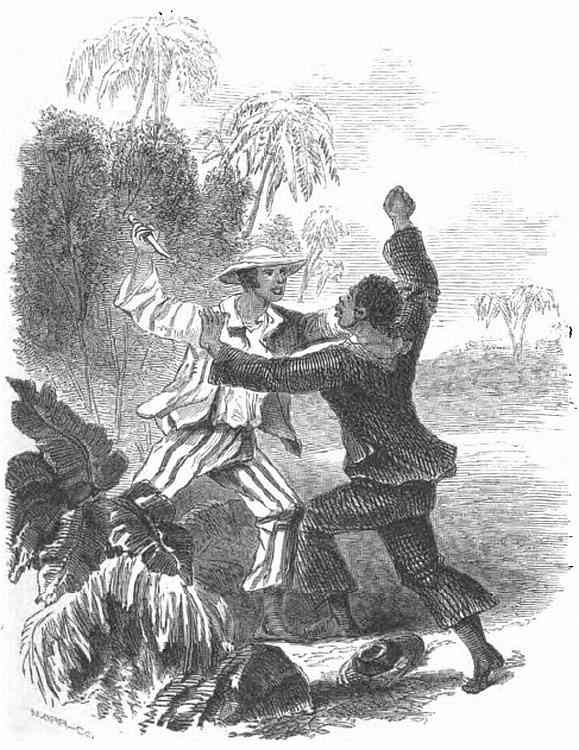
It was strangled, as proved in the sequel. Yellow Jake had done it, and Black Jake had seen him. From the orange grove, where the latter chanced to be at work, he had been witness of the tragic scene; and his testimony procured a second flogging for the mulatto.
A third event followed close upon the heels of this—a quarrel between negro and mulatto, that came to blows. It had been sought by the latter to revenge himself, at once upon his rival in love, and the witness of his late crime.
The conflict did not end in mere blows. Yellow Jake, with an instinct derived from his Spanish paternity, drew his knife, and inflicted a severe wound upon his unarmed antagonist.
This time his punishment was more severe. I was myself enraged, for Black Jake was my “body guard” and favourite. Though his skin was black, and his intellect but little cultivated, his cheerful disposition rendered him a pleasant companion; he was, in fact, the chosen associate of my boyish days—my comrade upon the water, and in the woods.
Justice required satisfaction, and Yellow Jake caught it in earnest.
The punishment proved of no avail. He was incorrigible. The demon spirit was too strong within him: it was part of his nature.
Chapter Four.
The Hommock.
Just outside the orangery was one of those singular formations—peculiar, I believe, to Florida.
A circular basin, like a vast sugar-pan, opens into the earth, to the depth of many feet, and having a diameter of forty yards or more. In the bottom of this, several cavities are seen, about the size and of the appearance of dug wells, regularly cylindrical—except where their sides have fallen in, or the rocky partition between them has given way, in which case they resemble a vast honeycomb with broken cells.
The wells are sometimes found dry; but more commonly there is water in the bottom, and often filling the great tank itself.
Such natural reservoirs, although occurring in the midst of level plains, are always partially surrounded by eminences—knolls, and detached masses of testaceous rocks; all of which are covered by an evergreen thicket of native trees, as magnolia grandiflora, red bay, zanthoxylon, live-oak, mulberry, and several species of fan-palms (palmettoes). Sometimes these shadowy coverts are found among the trees of the pine-forests, and sometimes they appear in the midst of green savannas, like islets in the ocean.
They constitute the “hommocks” of Florida—famed in the story of its Indian wars.
One of these, then, was situated just outside the orangery; with groups of testaceous rocks forming a half-circle around its edge; and draped with the dark foliage of evergreen trees, of the species already mentioned. The water contained in the basin was sweet and limpid; and far down in its crystal depths might be seen gold and red fish, with yellow bream, spotted bass, and many other beautiful varieties of the finny tribe, disporting themselves all day long. The tank was in reality a natural fishpond; and, moreover, it was used as the family bathing-place—for, under the hot sun of Florida, the bath is a necessity as well as a luxury.
From the house, it was approached by a sanded walk that led across the orangery, and some large stone-flags enabled the bather to descend conveniently into the water. Of course, only the white members of the family were allowed the freedom of this charming sanctuary.
Outside the hommock extended the fields under cultivation, until bounded in the distance by tall forests of cypress and white cedar—a sort of impenetrable morass that covered the country for miles beyond.
On one side of the plantation-fields was a wide plain, covered with grassy turf, and without enclosure of any kind. This was the savanna, a natural meadow where the horses and cattle of the plantation were freely pastured. Deer often appeared upon this plain, and flocks of the wild turkey.
I was just of that age to be enamoured of the chase. Like most youth of the southern states who have little else to do, hunting was my chief occupation; and I was passionately fond of it. My father had procured for me a brace of splendid greyhounds; and it was a favourite pastime with me to conceal myself in the hommock, wait for the deer and turkeys as they approached, and then course them across the savanna. In this manner I made many a capture of both species of game; for the wild turkey can easily be run down with fleet dogs.
The hour at which I was accustomed to enjoy this amusement was early in the morning, before any of the family were astir. That was the best time to find the game upon the savanna.
One morning, as usual, I repaired to my stand in the covert. I climbed upon a rock, whose flat top afforded footing both to myself and my dogs. From this elevated position I had the whole plain under view, and could observe any object that might be moving upon it, while I was myself secure from observation. The broad leaves of the magnolia formed a bower around me, leaving a break in the foliage, through which I could make my reconnoissance.
On this particular morning I had arrived before sunrise. The horses were still in their stables, and the cattle in the enclosure. Even by the deer, the savanna was untenanted, as I could perceive at the first glance. Over all its wide extent not an antler was to be seen.
I was somewhat disappointed on observing this. My mother expected a party upon that day. She had expressed a wish to have venison at dinner: I had promised her she should have it; and on seeing the savanna empty, I felt disappointment.
I was a little surprised, too; the sight was unusual. Almost every morning, there were deer upon this wide pasture, at one point or another.
Had some early stalker been before me? Probable enough. Perhaps young Ringgold from the next plantation; or maybe one of the Indian hunters, who seemed never to sleep? Certainly, some one had been over the ground, and frightened off the game?
The savanna was a free range, and all who chose might hunt or pasture upon it. It was a tract of common ground, belonging to no one of the plantations—government land not yet purchased.
Certainly Ringgold had been there? or old Hickman, the alligator-hunter, who lived upon the skirt of our plantation? or it might be an Indian from the other side of the swamp?
With such conjectures did I account for the absence of the game.
I felt chagrin. I should not be able to keep my promise; there would be no venison for dinner. A turkey I might obtain; the hour for chasing them had not yet arrived. I could hear them calling from the tall tree-tops—their loud “gobbling” borne far and clear upon the still air of the morning. I did not care for these—the larder was already stocked with them; I had killed a brace on the preceding day. I did not want more—I wanted venison.
To procure it, I must needs try some other mode than coursing. I had my rifle with me; I could try a “still-hunt” in the woods. Better still, I would go in the direction of old Hickman’s cabin; he might help me in my dilemma. Perhaps he had been out already? if so, he would be sure to bring home venison. I could procure a supply from him, and keep my promise.—The sun was just shewing his disc above the horizon; his rays were tingeing the tops of the distant cypresses, whose light-green leaves shone with the lines of gold.
I gave one more glance over the savanna, before descending from my elevated position; in that glance I saw what caused me to change my resolution, and remain upon the rock.
A herd of deer was trooping out from the edge of the cypress woods—at that corner where the rail-fence separated the savanna from the cultivated fields.
“Ha!” thought I, “they have been poaching upon the young maize-plants.”
I bent my eyes towards the point whence, as I supposed, they had issued from the fields. I knew there was a gap near the corner, with movable bars. I could see it from where I stood, but I now perceived that the bars were in their places! The deer could not have been in the fields then? It was not likely they had leaped either the bars or the fence. It was a high rail-fence, with “stakes and riders.” The bars were as high as the fence. The deer must have come out of the woods?
This observation was instantly followed by another. The animals were running rapidly, as if alarmed by the presence of some enemy.
A hunter is behind them? Old Hickman? Ringgold? Who?
I gazed eagerly, sweeping my eyes along the edge of the timber, but for a while saw no one.
“A lynx or a bear may have startled them? If so, they will not go far; I shall have a chance with my greyhounds yet. Perhaps—”
My reflections were brought to a sudden termination, on perceiving what had caused the stampede of the deer. It was neither bear nor lynx, but a human being.
A man was just emerging from out the dark shadow of the cypresses. The sun as yet only touched the tops of the trees; but there was light enough below to enable me to make out the figure of a man—still more, to recognise the individual. It was neither Ringgold nor Hickman, nor yet an Indian. The dress I knew well—the blue cottonade trousers, the striped shirt, and palmetto hat. The dress was that worn by our woodman. The man was Yellow Jake.
Chapter Five.
Yellow Jake.
Not without some surprise did I make this discovery. What was the mulatto doing in the woods at such an hour? It was not his habit to be so thrifty; on the contrary, it was difficult to rouse him to his daily work. He was not a hunter—had no taste for it. I never saw him go after game—though, from being always in the woods, he was well acquainted with the haunts and habits of every animal that dwelt there. What was he doing abroad on this particular morning?
I remained on my perch to watch him, at the same time keeping an eye upon the deer.
It soon became evident that the mulatto was not after these; for, on coming out of the timber, he turned along its edge, in a direction opposite to that in which the deer had gone. He went straight towards the gap that fed into the maize-field.
I noticed that he moved slowly and in a crouching attitude. I thought there was some object near his feet: it appeared to be a dog, but a very small one. Perhaps an opossum, thought I. It was of whitish colour, as these creatures are; but in the distance I could not distinguish between an opossum and a puppy. I fancied, however, that it was the pouched animal; that he had caught it in the woods, and was leading it along in a string.
There was nothing remarkable or improbable in all this behaviour. The mulatto may have discovered an opossum-cave the day before, and set a trap for the animal. It may have been caught in the night, and he was now on his way home with it. The only point that surprised me was, that the fellow had turned hunter; but I explained this upon another hypothesis. I remembered how fond the negroes are of the flesh of the opossum, and Yellow Jake was no exception to the rule. Perhaps he had seen, the day before, that this one could be easily obtained, and had resolved upon having a roast?
But why was he not carrying it in a proper manner? He appeared to be leading, or dragging it rather—for I knew the creature would not be led—and every now and then I observed him stoop towards it, as if caressing it.
I was puzzled; it could not be an opossum.
I watched the man narrowly till he arrived opposite the gap in the fence. I expected to see him step over the bars—since through the maize-field was the nearest way to the house. Certainly he entered the field; but, to my astonishment, instead of climbing over in the usual manner, I saw him take out bar after bar, down to the very lowest. I observed, moreover, that he flung the bars to one side, leaving the gap quite open!
He then passed through, and entering among the corn, in the same crouching attitude, disappeared behind the broad blades of the young maize-plants—
For a while I saw no more of him, or the white object that he “toated” along with him in such a singular fashion.
I turned my attention to the deer: they had got over their alarm, and had halted near the middle of the savanna, where they were now quietly browsing.
But I could not help pondering upon the eccentric manoeuvres I had just been witness of; and once more I bent my eyes toward the place, where I had last seen the mulatto.
He was still among the maize-plants. I could see nothing of him; but at that moment my eyes rested upon an object that filled me with fresh surprise.
Just at the point where Yellow Jake had emerged from the woods, something else appeared in motion—also coming out into the open savanna. It was a dark object, and from its prostrate attitude, resembled a man crawling forward upon his hands, and dragging his limbs after him.
For a moment or two, I believed it to be a man—not a white man—but a negro or an Indian. The tactics were Indian, but we were at peace with these people, and why should one of them be thus trailing the mulatto? I say “trailing” for the attitude and motions, of whatever creature I saw, plainly indicated that it was following upon the track which Yellow Jake had just passed over.
Was it Black Jake who was after him?
This idea came suddenly into my mind: I remembered the vendetta that existed between them; I remembered the conflict in which Yellow Jake had used his knife. True, he had been punished, but not by Black Jake himself. Was the latter now seeking to revenge himself in person?
This might have appeared the easiest explanation of the scene that was mystifying me; had it not been for the improbability of the black acting in such a manner. I could not think that the noble fellow would seek any mean mode of retaliation, however revengeful he might feel against one who had so basely attacked him. It was not in keeping with his character. No. It could not be he who was crawling out of the bushes.
Nor he, nor any one.
At that moment, the golden sun flashed over the savanna. His beams glanced along the greensward, lighting the trees to their bases. The dark form emerged from out of the shadow, and turned head towards the maize-field. The long prostrate body glittered under the sun with a sheen like scaled armour. It was easily recognised. It was not negro—not Indian—not human: it was the hideous form of an alligator!
Chapter Six.
The Alligator.
To one brought up—born, I might almost say—upon the banks of a Floridian river, there is nothing remarkable in the sight of an alligator. Nothing very terrible either; for ugly as is the great saurian—certainly the most repulsive form in the animal kingdom—it is least dreaded by those who know it best. For all that, it is seldom approached without some feeling of fear. The stranger to its haunts and habits, abhors and flees from it; and even the native—be he red, white, or black—whose home borders the swamp and the lagoon, approaches this gigantic lizard with caution.
Some closet naturalists have asserted that the alligator will not attack man, and yet they admit that it will destroy horses and horned cattle. A like allegation is made of the jaguar and vampire bat. Strange assertions, in the teeth of a thousand testimonies to the contrary.
It is true the alligator does not always attack man when an opportunity offers—nor does the lion, nor yet the tiger—but even the false Buffon would scarcely be bold enough to declare that the alligator is innocuous. If a list could be furnished of human beings who have fallen victims to the voracity of this creature, since the days of Columbus, it would be found to be something enormous—quite equal to the havoc made in the same period of time by the Indian tiger or the African lion. Humboldt, during his short stay in South America, was well informed of many instances; and for my part, I know of more than one case of actual death, and many of lacerated limbs, received at the jaws of the American alligator.
There are many species, both of the caïman or alligator, and of the true crocodile, in the waters of tropical America. They are more or less fierce, and hence the difference of “travellers’ tales” in relation to them. Even the same species in two different rivers is not always of like disposition. The individuals are affected by outward circumstances, as other animals are. Size, climate, colonisation, all produce their effect; and, what may appear still more singular, their disposition is influenced by the character of the race of men that chances to dwell near them!
On some of the South-American rivers—whose banks are the home of the ill-armed apathetic Indian—the caimans are exceedingly bold, and dangerous to approach. Just so were their congeners, the alligators of the north, till the stalwart backwoodsman, with his axe in one hand, and his rifle in the other, taught them to fear the upright form—a proof that these crawling creatures possess the powers of reason. Even to this hour, in many of the swamps and streams of Florida, full-grown alligators cannot be approached without peril; this is especially the case daring the season of the sexes, and still more where these reptiles are encountered remote from the habitations of man. In Florida are rivers and lagoons where a swimmer would have no more chance of life, than if he had plunged into a sea of sharks.
Notwithstanding all this, use brings one to look lightly even upon real danger—particularly when that danger is almost continuous; and the denizen of the cyprière and the white cedar swamp is accustomed to regard without much emotion the menace of the ugly alligator. To the native of Florida, its presence is no novelty, and its going or coming excites but little interest—except perhaps in the bosom of the black man who feeds upon its tail; or the alligator-hunter, who makes a living out of its leather.
The appearance of one on the edge of the savanna would not have caused me a second thought, had it not been for its peculiar movements, as well as those I had just observed on the part of the mulatto. I could not help fancying that there was some connexion between them; at all events it appeared certain, that the reptile was following the man!
Whether it had him in view, or whether trailing him by the scent, I could not tell. The latter I fancied to be the case; for the mulatto had entered under cover of the maize-plants, before the other appeared outside the timber; and it could hardly have seen him as it turned towards the gap. It might, but I fancied not. More like, it was trailing him by the scent; but whether the creature was capable of doing so, I did not stay to inquire.
On it crawled over the sward—crossing the corner of the meadow, and directly upon the track which the man had taken. At intervals, it paused, flattened its breast against the earth, and remained for some seconds in this attitude, as if resting itself. Then it would raise its body to nearly a yard in height, and move forward with apparent eagerness—as if in obedience to some attractive power in advance of it? The alligator progresses but slowly upon dry ground—not faster than a duck or goose. The water is its true element, where it makes way almost with the rapidity of a fish.
At length it approached the gap; and, after another pause, it drew its long dark body within the enclosure. I saw it enter among the maize-plants, at the exact point where the mulatto had disappeared! Of course, it was now also hidden from my view.
I no longer doubted that the monster was following the man; and equally certain was I that the latter knew that he was followed! How could I doubt either of these facts? To the former, I was an eye-witness; of the latter, I had circumstantial proofs. The singular attitudes and actions of the mulatto; his taking out the bars and leaving the gap free; his occasional glances backward—which I had observed as he was crossing the open ground—these were my proofs that he knew what was coming behind him—undoubtedly he knew.
But my conviction upon these two points in nowise helped to elucidate the mystery—for a mystery it had become. Beyond a doubt, the reptile was drawn after by some attraction, which it appeared unable to resist—its eagerness in advancing was evidence of this, and proved that the man was exercising some influence over it that lured it forward.
What influence? Was he beguiling it by some charm of Obeah?
A superstitious shudder came over me, as I asked myself the question. I really had such fancies at the moment. Brought up, as I had been, among Africans, dandled in the arms—perhaps nourished from the bosom—of many a sable nurse, it is not to be wondered at that my young mind was tainted with the superstitions of Bonny and Benin. I knew there were alligators in the cypress swamp—in its more remote recesses, some of enormous size—but how Yellow Jake had contrived to lure one out, and cause it to follow him over the dry cultivated ground, was a puzzle I could not explain to myself. I could think of no natural cause; I was therefore forced into the regions of the weird and supernatural.
I stood for a long while watching and wondering. The deer had passed out of my mind. They fed unnoticed: I was too much absorbed in the mysterious movements of the half-breed and his amphibious follower.
Chapter Seven.
The Turtle-Crawl.
So long as they remained in the maize-field, I saw nothing of either. The direction of my view was slightly oblique to the rows of the plants. The corn was at full growth, and its tall culms and broad lanceolate leaves would have overtopped the head of a man on horseback. A thicket of evergreen trees would not have been more impenetrable to the eye.
By going a little to the right, I should have become aligned with the rows, and could have seen far down the avenues between them; but this would have carried me out of the cover, and the mulatto might then have seen me. For certain reasons, I did not desire he should; and I remained where I had hitherto been standing.
I was satisfied that the man was still making his way up the field, and would in due time discover himself in the open ground.
An indigo flat lay between the hommock and the maize. To approach the house, it would be necessary for him to pass through the indigo; and, as the plants were but a little over two feet in height, I could not fail to observe him as he came through. I waited, therefore, with a feeling of curious anticipation—my thoughts still wearing a tinge of the weird!
He came on slowly—very slowly; but I knew that he was advancing. I could trace his progress by an occasional movement which I observed among the leaves and tassels of the maize. The morning was still—not a breath of air stirred; and consequently the motion must have been caused by some one passing among the plants—of course by the mulatto himself. The oscillation observed farther off, told that the alligator was still following.
Again and again I observed this movement among the maize-blades. It was evident the man was not following the direction of the rows, but crossing diagonally through them! For what purpose? I could not guess. Any one of the intervals would have conducted him in a direct line towards the house—whither I supposed him to be moving. Why, then, should he adopt a more difficult course, by crossing them? It was not till afterwards that I discovered his object in this zigzag movement.
He had now advanced almost to the nether edge of the cornfield. The indigo flat was of no great breadth, and he was already so near, that I could hear the rustling of the cornstalks as they switched against each other.
Another sound I could now hear; it resembled the howling of a dog. I heard it again, and, after an interval, again. It was not the voice of a full-grown dog, but rather the weak whimper of a puppy.
At first, I fancied that the sounds came from the alligator: for these reptiles make exactly such a noise—but only when young. The one following the mulatto was full-grown; the cries could not proceed from it. Moreover, the sounds came from a point nearer me—from the place where the man himself was moving.
I now remembered the white object I had observed as the man was crossing the corner of the savanna. It was not an opossum, then, but a young dog.
Yes. I heard the cry again: it was the whining of a whelp—nothing else.
If I could have doubted the evidence of my ears, my eyes would soon have convinced me; for, just then, I saw the man emerge from out the maize with a dog by his side—a small white cur, and apparently a young one. He was leading the creature upon a string, half-dragging it after him. I had now a full view of the individual, and saw to a certainty that he was our woodman, Yellow Jake.
Before coming out from the cover of the corn, he halted for a moment—as if to reconnoitre the ground before him. He was upon his feet, and in an erect attitude. Whatever motive he had for concealment, he needed not to crouch amid the tall plants of maize; but the indigo did not promise so good a shelter, and he was evidently considering how to advance through it without being perceived. Plainly, he had a motive for concealing himself—his every movement proved this—but with what object I could not divine.
The indigo was of the kind known as the “false Guatemala.” There were several species cultivated upon the plantation; but this grew tallest; and some of the plants, now in their full purple bloom, stood nearly three feet from the surface of the soil. A man passing through them in an erect attitude, could, of coarse, have been seen from any part of the field; but it was possible for one to crouch down, and move, between the rows unobserved. This possibility seemed to occur to the woodman; for, after a short pause, he dropped to his hands and knees, and commenced crawling forward among the indigo.
There was no fence for him to cross—the cultivated ground was all under one enclosure—and an open ridge alone formed the dividing-line between the two kinds of crop.
Had I been upon the same level with the field, the skulker would have been now hidden from my sight; but my elevated position enabled me to command a view of the intervals between the rows, and I could note every movement he was making.
Every now and then he paused, caught up the cur, and held it for a few seconds in his hands—during which the animal continued to howl as if in pain!
As he drew nearer, and repeated this operation, I saw that he was pinching its ears!
Fifty paces in his rear, the great lizard appeared coming out of the corn. It scarcely made pause in the open ground, but still following the track, entered among the indigo.
At this moment, a light broke upon me; I no longer speculated on the power of Obeah. The mystery was dissolved: the alligator was lured forward by the cries of the dog!
I might have thought of the thing before, for I had heard of it before. I had heard from good authority—the alligator-hunter himself, who had often captured them by such a decoy—that these reptiles will follow a howling dog for miles through the forest, and that the old males especially are addicted to this habit. Hickman’s belief was that they mistake the voice of the dog for that of their own offspring, which these unnatural parents eagerly devour.
But, independently of this monstrous propensity, it is well-known that dogs are the favourite prey of the alligator; and the unfortunate beagle that, in the heat of the chase, ventures across creek or lagoon, is certain to be attacked by these ugly amphibia.
The huge reptile, then, was being lured forward by the voice of the puppy; and this accounted for the grand overland journey he was making.
There was no longer a mystery—at least, about the mode in which the alligator was attracted onward; the only thing that remained for explanation was, what motive had the mulatto in carrying out this singular manoeuvre?
When I saw him take to his hands and knees, I had been under the impression that he did so to approach the house, without being observed. But as I continued to watch him, I changed my mind. I noticed that he looked oftener, and with more anxiety behind him, as if he was only desirous of being concealed from the eyes of the alligator. I observed, too, that he changed frequently from place to place, as if he aimed at keeping a screen of the plants between himself and his follower. This would also account for his having crossed the rows of the maize-plants, as already noticed.
After all, it was only some freak that had entered the fellow’s brain. He had learned this curious mode of coaxing the alligator from its haunts—perhaps old Hickman had shown him how—or he may have gathered it from his own observation, while wood-chopping in the swamps. He was taking the reptile to the house from some eccentric motive?—to make exhibition of it among his fellows?—to have a “lark” with it? or a combat between it and the house-dogs? or for some like purpose?
I could not divine his intention, and would have thought no more of it, had it not been that one or two little circumstances had made an impression upon me. I was struck by the peculiar pains which the fellow was taking to accomplish his purpose with success. He was sparing neither trouble nor time. True, it was not to be a work-day upon the plantation; it was a holiday, and the time was his own; but it was not the habit of Yellow Jake to be abroad at so early an hour, and the trouble he was taking was not in consonance with his character of habitual insouciance and idleness. Some strong motive, then, must have been urging him to the act. What motive?
I pondered upon it, but could not make it out.
And yet I felt uneasiness, as I watched him. It was an undefined feeling, and I could assign no reason for it—beyond the fact that the mulatto was a bad fellow, and I knew him to be capable of almost any wickedness. But if his design was a wicked one, what evil could he effect with the alligator? No one would fear the reptile upon dry ground?—it could hurt no one?
Thus I reflected, and still did I feel some indefinite apprehensions.
But for this feeling I should have given over observing his movements, and turned my attention to the herd of deer—which I now perceived approaching up the savanna, and coming close to my place of concealment.
I resisted the temptation, and continued to watch the mulatto a little longer.
I was not kept much longer in suspense. He had now arrived upon the outer edge of the hommock, which he did not enter. I saw him turn round the thicket, and keep on towards the orangery. There was a wicket at this corner which he passed through, leaving the gate open behind him. At short intervals, he still caused the dog to utter its involuntary howlings.
It no longer needed to cry loudly, for the alligator was now close in the rear.
I obtained a full view of the monster as it passed under my position. It was not one of the largest, though it was several yards in length. There are some that measure more than a statute pole. This one was full twelve feet, from its snout to the extremity of its tail. It clutched the ground with its broad webbed feet as it crawled forward. Its corrugated skin of bluish brown colour was coated with slippery mucus, that glittered under the sun as it moved; and large masses of the swamp-slime rested in the concavities between its rhomboid scales. It seemed greatly excited; and whenever it heard the voice of the dog, exhibited fresh symptoms of rage. It would erect itself upon its muscular arms, raise its head aloft—as if to get a view of the prey—lash its plaited tail into the air, and swell its body almost to double its natural dimensions. At the same time, it emitted loud noises from its throat and nostrils, that resembled the rumbling of distant thunder, and its musky smell filled the air with a sickening effluvium. A more monstrous creature it would be impossible to conceive. Even the fabled dragon could not have been more horrible to behold.
Without stopping, it dragged its long body through the gate, still following the direction of the noise. The leaves of the evergreens intervened, and hid the hideous reptile from my sight.
I turned my face in the opposite direction—towards the house—to watch the further movements of the mulatto. From my position, I commanded a view of the tank, and could see nearly all around it. The inner side was especially under my view, as it lay opposite, and could only be approached through the orangery.
Between the grove and the edge of the great basin, was an open space. Here there was an artificial pond only a few yards in width, and with a little water at the bottom, which was supplied by means of a pump, from the main reservoir. This pond, or rather enclosure, was the “turtle-crawl,” a place in which turtle were fed and kept, to be ready at all times for the table. My father still continued his habits of Virginian hospitality; and in Florida these aldermanic delicacies are easily obtained.
The embankment of this turtle-crawl formed the direct path to the water-basin; and as I turned, I saw Yellow Jake upon it, and just approaching the pond. He still carried the cur in his arms; I saw that he was causing it to utter a continuous howling.
On reaching the steps, that led down, he paused a moment, and looked back. I noticed that he looked back in both ways—first towards the house, and then, with a satisfied air, in the direction whence he had come. No doubt he saw the alligator close at hand; for, without further hesitation, he flung the puppy far out into the water; and then, retreating along the embankment of the turtle-crawl, he entered among the orange-trees, and was out of sight.
The whelp, thus suddenly plunged into the cool tank, kept up a constant howling, at the same time beating the water violently with its feet, in the endeavour to keep itself afloat.
Its struggles were of short duration. The alligator, now guided by the well-known noise of moving water, as well as the cries of the dog, advanced rapidly to the edge; and without hesitating a moment, sprang forward into the pond. With the rapidity of an arrow, it darted out to the centre; and, seizing the victim between its bony jaws, dived instantaneously under the surface.
I could for some time trace its monstrous form far down in the diaphanous water; but guided by instinct, it soon entered one of the deep wells, amidst the darkness of which it sank out of sight.
Chapter Eight.
The King Vultures.
“So, then, my yellow friend, that is the intention!—a bit of revenge after all. I’ll make you pay for it, you spiteful ruffian! You little thought you were observed. Ha! you shall rue this cunning deviltry before night.”
Some such soliloquy escaped my lips, as soon as I comprehended the design of the mulatto’s manoeuvre—for I now understood it—at least I thought so. The tank was full of beautiful fish. There were gold fish and silver fish, hyodons, and red trout. They were my sister’s especial pets. She was very fond of them. It was her custom to visit them daily, give them food, and watch their gambols. Many an aquatic cotillon had she superintended. They knew her person, would follow her around the tank, and take food out of her fingers. She delighted in thus serving them.
The revenge lay in this. The mulatto well knew that the alligator lives upon fish—they are his natural food; and that those in the tank, pent up as they were, would soon become his prey. So strong a tyrant would soon ravage the preserve, killing the helpless creatures by scores—of course to the chagrin and grief of their fond mistress, and the joy of Yellow Jake.
I knew that the fellow disliked my little sister. The spirited part she had played, in having him punished for the affair with Viola, had kindled his resentment against her; but since then, there had been other little incidents to increase it. She had favoured the suit of his rival with the quadroon, and had forbidden the woodman to approach Viola in her presence. These circumstances had certainly rendered the fellow hostile to her; and although there was no outward show of this feeling—there dared not be—I was nevertheless aware of the fact. His killing the fawn had proved it, and the present was a fresh instance of the implacable spirit of the man.
He calculated upon the alligator soon making havoc among the fish. Of course he knew it would in time be discovered and killed; but likely not before many of the finest should be destroyed.
No one would ever dream that the creature had been brought there—for on more than one occasion, alligators had found their way into the tank—having strayed from the river, or the neighbouring lagoons—or rather having been guided thither by an unexplained instinct, which enables these creatures to travel straight in the direction of water.
Such, thought I, were the designs and conjectures of Yellow Jake.
It proved afterwards that I had fathomed but half his plan. I was too young, too innocent of wickedness, even to guess at the intense malice of which the human heart is capable.
My first impulse was to follow the mulatto to the house—make known what he had done—have him punished; and then return with a party to destroy the alligator, before he could do any damage among the fish.
At this crisis, the deer claimed my attention. The herd—an antlered buck with several does—had browsed close up to the hommock. They were within two hundred yards of where I stood. The sight was too tempting. I remembered the promise to my mother; it must be kept; venison must be obtained at all hazards!
But there was no hazard. The alligator had already eaten his breakfast. With a whole dog in his maw, it was not likely he would disturb the finny denizens of the tank for some hours to come; and as for Yellow Jake, I saw he had proceeded on to the house; he could be found at any moment; his chastisement could stand over till my return.
With these reflections passing through my mind, I abandoned my first design, and turned my attention exclusively to the game.
They were too distant for the range of my rifle; and I waited a while in the hope that they would move nearer.
But I waited in vain. The deer is shy of the hommock. It regards the evergreen islet as dangerous ground, and habitually keeps aloof from it. Natural enough, since there the creature is oft saluted by the twang of the Indian bow, or the whip-like crack of the hunter’s rifle. Thence often reaches it the deadly missile.
Perceiving that the game was getting no nearer, but the contrary, I resolved to course them; and, gliding down from the rock, I descended through the copsewood to the edge of plain.
On reaching the open ground, I rushed forward—at the same time unleashing the dogs, and crying the “view hilloo.”
It was a splendid chase—led on by the old buck—the dogs following tail-on-end. I thought I never saw deer run so fleetly; it appeared as if scarcely a score of seconds had transpired while they were crossing the savanna—more than a mile in width. I had a full and perfect view of the whole; there was no obstruction either to run of the animals or the eye of the observer; the grass had been browsed short by the cattle, and not a bush grew upon the green plain; so that it was a trial of pure speed between dogs and deer. So swiftly ran the deer, I began to feel apprehensive about the venison.
My apprehensions were speedily at an end. Just on the farther edge of the savanna, the chase ended—so far at least as the dogs were concerned, and one of the deer. I saw that they had flung a doe, and were standing over her, one of them holding her by the throat.
I hurried forward. Ten minutes brought me to the spot; and after a short struggle, the quarry was killed, and bled.
I was satisfied with my dogs, with the sport, with my own exploits. I was happy at the prospect of being able to redeem my promise; and with the carcass across my shoulders, I turned triumphantly homeward.
As I faced round, I saw the shadow of wings moving over the sunlit savanna. I looked upward. Two large birds were above me in the air; they were at no great height, nor were they endeavouring to mount higher. On the contrary, they were wheeling in spiral rings, that seemed to incline downward at each successive circuit they made around me.
At first glance, the sun’s beams were in my eyes, and I could not tell what birds were flapping above me. On facing round, I had the sun in my favour; and his rays, glancing full upon the soft cream-coloured plumage, enabled me to recognise the species—they were king vultures—the most beautiful birds of their tribe, I am almost tempted to say the most beautiful birds in creation; certainly they take rank, among those most distinguished in the world of ornithology.
These birds are natives of the flowery land, but stray no farther north. Their haunt is on the green “everglades” and wide savannas of Florida, on the llanos of the Orinoco, and the plains of the Apure. In Florida they are rare, though not in all parts of it; but their appearance in the neighbourhood of the plantations excites an interest similar to that which is occasioned by the flight of an eagle. Not so with the other vultures—Cathartes aura and atratus—both of which are as common as crows.
In proof that the king vultures are rare, I may state that my sister had never seen one—except at a great distance off; yet this young lady was twelve years of age, and a native of the land. True, she had not gone much abroad—seldom beyond the bounds of the plantation. I remembered her expressing an ardent desire to view more closely one of these beautiful birds. I remembered it that moment; and at once formed the design of gratifying her wish.
The birds were near enough—so near that I could distinguish the deep yellow colour of their throats, the coral red upon their crowns, and the orange lappets that drooped along their beaks. They were near enough—within half reach of my rifle—but moving about as they were, it would have required a better marksman than I to have brought one of them down with a bullet.
I did not think of trying it in that way. Another idea was in my mind; and without farther pause, I proceeded to carry it out.
I saw that the vultures had espied the body of the doe, where it lay across my shoulders. That was why they were hovering above me. My plan was simple enough. I laid the carcass upon the earth; and, taking my rifle, walked away towards the timber.
Trees grew at fifty yards’ distance from where I had placed the doe; and behind the nearest of these I took my stand.
I had not long to wait. The unconscious birds wheeled lower and lower, and at length one alighted on the earth. Its companion had not time to join it before the rifle cracked, and laid the beautiful creature lifeless upon the grass.
The other, frighted by the sound, rose higher and higher, and then flew away over the tops of the cypresses.
Again I shouldered my venison; and carrying the bird in my hand started homeward.
My heart was full of exultation. I anticipated a double pleasure—from the double pleasure I was to create. I should make happy the two beings that, of all on earth, were dearest to me—my fond mother, my beautiful sister.
I soon recrossed the savanna, and entered the orangery. I did not stay to go round by the wicket, but climbed over the fence at its lower end. So happy was I that my load felt light as a feather. Exultingly I strode forward, dashing the loaded boughs from my path. I sent their golden globes rolling hither and thither. What mattered a bushel of oranges?
I reached the parterre. My mother was in the verandah; she saw me as I approached, and uttered an exclamation of joy. I flung the spoils of the chase at her feet. I had kept my promise.
“What is that?—a bird?”
“Yes the king vulture—a present for Virgine. Where is she? Not up yet? Ha! the little sluggard—I shall soon arouse her. Still abed and on such a beautiful morning!”
“You wrong her, George; she has been up on hour or more. She has been playing; and has just this moment left off.”
“But where is she now? In the drawing-room?”
“No; she has gone to the bath.”
“To the bath!”
“Yes, she and Viola. What—”
“O mother—mother—”
“Tell me, George—”
“O heavens—the alligator!”
Chapter Nine.
The Bath.
“Yellow Jake! the alligator!”
They were all the words I could utter. My mother entreated an explanation; I could not stay to give it. Frantic with apprehension, I tore myself away, leaving her in a state of terror that rivalled my own.
I ran towards the hommock—the bath. I wait not to follow the devious route of the walk, but keep straight on, leaping over such obstacles as present themselves. I spring across the paling, and rush through the orangery, causing the branches to crackle and the fruit to fall. My ears are keenly bent to catch every sound.
Behind are sounds enough: I hear my mother’s voice uttered in accents of terror. Already have her cries alarmed the house, and are echoed and answered by the domestics, both females and men. Dogs, startled by the sudden excitement, are baying within the enclosure, and fowls and caged birds screech in concert.
From behind come all these noises. It is not for them my ears are bent; I am listening before me.
In this direction I now hear sounds. The plashing of water is in my ears, and mingling with the tones of a clear silvery voice—it is the voice of my sister! “Ha, ha, ha!” The ring of laughter! Thank Heaven, she is safe!
I stay my step under the influence of a delicate thought; I call aloud:
“Virgine! Virgine!”
Impatiently I wait the reply. None reaches me; the noise of the water has drowned my voice!
I call again, and louder: “Virgine! sister! Virgine!”
I am heard, and hear:
“Who calls? You, Georgy?”
“Yes; it is I, Virgine.”
“And pray, what want you, brother?”
“O sister! come out of the bath.”
“For what reason should I? Our friends come? They are early: let them wait, my Georgy. Go you and entertain them. I mean to enjoy myself this most beautiful of mornings; the water’s just right—delightful! Isn’t it, Viola? Ho! I shall have a swim round the pond: here goes?”
And then there was a fresh plashing in the water, mingled with a cheerful abandon of laughter in the voices of my sister and her maid.
I shouted at the top of my voice:
“Hear me, Virgine, dear sister! For Heaven’s sake, come out! come—”
There was a sudden cessation of the merry tones; then came a short sharp ejaculation, followed almost instantaneously by a wild scream. I perceived that neither was a reply to my appeal. I had called out in a tone of entreaty sufficient to have raised apprehension; but the voices that now reached me were uttered in accents of terror. In my sister’s voice I heard the words:
“See, Viola! O mercy—the monster! Ha! he is coming this way! O mercy! Help, George, help! Save—save me!”
Well knew I the meaning of the summons; too well could I comprehend the half-coherent words, and the continued screaming that succeeded them.
“Sister, I come, I come!”
Quick as thought, I dashed forward, breaking through the boughs that still intercepted my view.
“Oh, perhaps I shall be too late! She screams in agony; she is already in the grasp of the alligator?”
A dozen bounds carried me clear of the grove; and, gliding along the embankment of the turtle-crawl, I stood by the edge of the tank. A fearful tableau was before me.
My sister was near the centre of the basin, swimming towards the edge. There stood the quadroon—knee deep—screeching and flinging her arms frantically in the air. Beyond, appeared the gigantic lizard; his whole body, arms, hands, and claws clearly traceable in the pellucid water, above the surface of which rose the scaly serrature of his back and shoulders. His snout and tail projected still higher; and with the latter he was lashing the water into white froth, that already mottled the surface of the pond. He was not ten feet from his intended victim. His gaunt jaws almost touched the green baize skirt that floated train-like behind her. At any moment, he might have darted forward and seized her.
My sister was swimming with all her might. She was a capital swimmer; but what could it avail? Her bathing-dress was impeding her; but what mattered that? The alligator might have seized her at any moment; with a single effort, could have caught her, and yet he had not made it.
I wondered why he had not; I wondered that he still held back. I wonder to this hour, for it is not yet explained. I can account for it only on one supposition: that he felt that his victim was perfectly within his power; and as the cat cajoles with the mouse, so was he indulging in the plenitude of his tyrant strength.
These observations were made in a single second of time—while I was cocking my rifle.
I aimed, and fired. There were but two places where the shot could have proved fatal—the eye or behind the forearm. I aimed for the eye. I hit the shoulder; but from that hard corrugated skin, my bullet glinted as from a granite rock. Among the rhomboid protuberances it made a whitish score, and that was all.
The play of the monster was brought to a termination. The shot appeared to have given him pain. At all events, it roused him to more earnest action, and perhaps impelled him to the final spring. He made it the instant after.
Lashing the water with his broad tail—as if to gain impetus—he darted forward; his huge jaw hinged vertically upward, till the red throat showed wide agape; and the next moment the floating skirt—and oh! the limbs of my sister, were in his horrid gripe!
I plunged in, and swam towards them. The gun I still carried in my grasp. It hindered me. I dropped it to the bottom, and swam on.
I caught Virgine in my arms. I was just in time, for the alligator was dragging her below.
With all my strength, I held her up. It needed all to keep us above the surface. I had no weapon; and if I had been armed, I could not have spared a hand to strike.
I shouted with all my voice, in the hope of intimidating the assailant, and causing him to let go his hold. It was to no purpose: he still held on.
O Heavens! we shall both be dragged under—drowned—devoured—
A plunge, as of one leaping from a high elevation into the pond—a quick, bold swimmer from the shore—a dark-skinned face, with long black hair that floats behind it on the water—a breast gleaming with bright spangles—a body clad in bead-embroidered garments—a man? a boy!
Who is this strange youth that rushes to our rescue?
He is already by our side—by the side of our terrible antagonist. With all the earnest energy of his look, he utters not a word. He rests one hand upon the shoulder of the huge lizard, and with a sudden spring places himself upon its back. A rider could not have leaped more adroitly to the saddle.

A knife gleams in his uplifted hand. It descends—its blade is buried in the eye of the alligator!
The roar of the saurian betokens its pain. The earth vibrates with the sound; the froth flies up under the lashings of its tail, and a cloud of spray is flung over us. But the monster has now relaxed its gripe, and I am swimming with my sister to the shore.
A glance backward reveals to me a strange sight—I see the alligator diving to the bottom with the bold rider upon its back! He is lost—he is lost!
With painful thoughts, I swim on. I climb out, and place my fainting sister upon the bank. I again look back.
Joy, joy! the strange youth is once more above the surface, and swimming freely to the shore. Upon the further side of the pond, the hideous form is also above water, struggling by the edge—frantic and furious with the agony of its wounds.
Joy, joy! my sister is unharmed. The floating skirt has saved her; scarcely a scratch shows upon her delicate limbs; and now in tender arms, amidst sweet words and looks of kind sympathy, she is borne away from the scene of her peril.
Chapter Ten.
The “Half-Blood.”
The alligator was soon clubbed to death, and dragged to the shore—a work of delight to the blacks of the plantation.
No one suspected how the reptile had got to the pond—for I had not said a word to any one. The belief was that it had wandered there from the river, or the lagoons—as others had done before; and Yellow Jake, the most active of all in its destruction, was heard several times repeating this hypothesis! Little did the villain suspect that his secret was known. I thought that besides himself I was the only one privy to it; in this, however, I was mistaken.
The domestics had gone back to the house, “toating” the huge carcass with ropes, and uttering shouts of triumph. I was alone with our gallant preserver. I stayed behind purposely to thank him.
Mother, father, all had given expression to their gratitude; all had signified their admiration of his gallant conduct: even my sister, who had recovered consciousness before being carried away, had thanked him with kind words.
He made no reply, further than to acknowledge the compliments paid him; and this he did either by a smile or a simple inclination of the head. With the years of a boy, he seemed to possess the gravity of a man.
He appeared about my own age and size. His figure was perfectly proportioned, and his face handsome. The complexion was not that of a pure Indian, though the style of his dress was so. His skin was nearer brunette than bronze: he was evidently a “half-blood.”
His nose was slightly aquiline, which gave him that fine eagle-look peculiar to some of the North American tribes; and his eye, though mild in common mood, was easily lighted up. Under excitement, as I had just witnessed, it shone with the brilliancy of fire.
The admixture of Caucasian blood had tamed down the prominence of Indian features to a perfect regularity, without robbing them of their heroic grandeur of expression; and the black hair was finer than that of the pure native, though equally shining and luxuriant. In short, the tout ensemble of this strange youth was that of a noble and handsome boy that another brace of summers would develop into a splendid-looking man. Even as a boy, there was an individuality about him, that, when once seen, was not to be forgotten.
I have said that his costume was Indian. So was it—purely Indian—not made up altogether of the spoils of the chase, for the buckskin has long, ceased to be the wear of the aborigines of Florida. His moccasins alone were of dressed deer’s hide; his leggings were of scarlet cloth; and his tunic of figured cotton stuff—all three elaborately beaded and embroidered. With these he wore a wampum belt, and a fillet encircled his head, above which rose erect three plumes from the tail of the king vulture—which among Indians is an eagle. Around his neck were strings of party-coloured beads, and upon his breast three demi-lunes of silver, suspended one above the other.
Thus was the youth attired, and, despite the soaking which his garments had received, he presented an aspect as once noble and picturesque.
“You are sure you have received no injury?” I inquired for the second time.
“Quite sure—not the slightest injury.”
“But you are wet through and through; let me offer you a change of clothes: mine, I think, would about fit you.”
“Thank you. I should not know how to wear them. The sun is strong: my own will soon be dry again.”
“You will come up to the house, and eat something?”
“I have eaten but a short while ago. I thank you. I am not in need.”
“Some wine?”
“Again I thank you—water is my only drink.”
I scarcely knew what to say to my new acquaintance. He refused all my offers of hospitality, and yet he remained by me. He would not accompany me to the house; and still he showed no signs of taking his departure.
Was he expecting something else? A reward for his services? Something more substantial than complimentary phrases?
The thought was not unnatural. Handsome as was the youth, he was but an Indian. Of compliments he had had enough. Indians care little for idle words. It might be that he waited for something more; it was but natural for one in his condition to do so, and equally natural for one in mine to think so.
In an instant my purse was out; in the next it was in his hands—and in the next it was at the bottom of the pond!
“I did not ask you for money,” said he, as he flung the dollars indignantly into the water.
I felt pique and shame; the latter predominated. I plunged into the pond, and dived under the surface. It was not after my purse, but my rifle, which I saw lying upon the rocks at the bottom. I gained the piece, and, carrying it ashore, handed it to him.
The peculiar smile with which he received it, told me that I had well corrected my error, and subdued the capricious pride of the singular youth.
“It is my turn to make reparation,” said he. “Permit me to restore you your purse, and to ask pardon for my rudeness.”
Before I could interpose, he sprang into the water, and dived below the surface. He soon recovered the shining object, and returning to the bank, placed it in my hands.
“This is a splendid gift,” he said, handling the rifle, and examining it—“a splendid gift; and I must return home before I can offer you aught in return. We Indians have not much that the white man values—only our lands, I have been told,”—he uttered this phrase with peculiar emphasis. “Our rude manufactures,” continued he, “are worthless things when put in comparison with those of your people—they are but curiosities to you at best. But stay—you are a hunter? Will you accept a pair of moccasins and a bullet-pouch? Maümee makes them well—”
“Maümee?”
“My sister. You will find the moccasin better for hunting than those heavy shoes you wear: the tread is more silent.”
“Above all things, I should like to have a pair of your moccasins.”
“I am rejoiced that it will gratify you. Maümee shall make them, and the pouch too.”
“Maümee!” I mentally echoed. “Strange, sweet name! Can it be she?”
I was thinking of a bright being that had crossed my path—a dream—a heavenly vision—for it seemed too lovely to be of the earth.
While wandering in the woods, amid perfumed groves, had this vision appeared to me in the form of an Indian maiden. In a flowery glade, I saw her—one of those spots in the southern forest which nature adorns so profusely. She appeared to form part of the picture.
One glance had I, and she was gone. I pursued, but to no purpose. Like a spirit she glided through the daedalian aisles of the grove, and I saw her no more. But though gone from my sight, she passed not out of my memory; ever since had I been dreaming of that lovely apparition. “Was it Maümee?”
“Your name?” I inquired, as I saw the youth was about to depart.
“I am called Powell by the whites: my father’s name—he was white—he is dead. My mother still lives; I need not say she is an Indian.”
“I must be gone, sir,” continued he after a pause. “Before I leave you, permit me to put a question. It may appear impertinent, but I have good reason for asking it. Have you among your slaves one who is very bad, one who is hostile to your family?”
“There is such a one. I have reason to believe it.”
“Would you know his tracks?”
“I should.”
“Then follow me!”
“It is not necessary. I can guess where you would lead me. I know all: he lured the alligator hither to destroy my sister.”
“Ugh!” exclaimed the young Indian, in some surprise. “How learned you this, sir?”
“From yonder rock, I was a witness of the whole transaction. But how did you come to know of it?” I asked in turn.
“Only by following the trail—the man—the dog—the alligator. I was hunting by the swamp. I saw the tracks. I suspected something, and crossed the fields. I had reached the thicket when I heard cries. I was just in time. Ugh!”
“You were in good time, else the villain would have succeeded in his intent. Fear not, friend, he shall be punished.”
“Good—he should be punished. I hope you and I may meet again.”
A few words more were exchanged between us, and then we shook hands, and parted.
Chapter Eleven.
The Chase.
About the guilt of the mulatto, I had no longer any doubt. The mere destruction of the fish could not have been his design; he would never have taken such pains to accomplish so trifling a purpose. No; his intent was far more horrid; it comprehended a deeper scheme of cruelty and vengeance; its aim was my sister’s life!—Viola’s!—perhaps both?
Awful as was such a belief, there was no room left to doubt it; every circumstance confirmed it. Even the young Indian had formed the opinion that such was the design. At this season, my sister was in the habit of bathing almost every day; and that this was her custom was known to all upon the plantation. I had not thought of it when I went in pursuit of the deer, else I should in all probability have acted in a different manner. But who could have suspected such dire villainy?
The cunning of the act quite equalled its malice. By the merest accident, there were witnesses; but had there been none, it is probable the event would have answered the intention, and my sister’s life been sacrificed.
Who could have told the author of the crime? The reptile would have been alone responsible. Even suspicion would not have rested upon the mulatto—how could it? The yellow villain had shown a fiendish craft in his calculation.
I was burning with indignation. My poor innocent sister! Little did she know the foul means that had been made use of to put her in such peril. She was aware that the mulatto liked her not, but never dreamed she that she was the object of such a demoniac spite as this.
The very thoughts of it fired me as I dwelt upon them. I could restrain myself no longer. The criminal must be brought to punishment, and at once. Some severe castigation must be inflicted upon him—something that would place it beyond his power to repeat such dangerous attempts.
How he would be dealt with, I could not tell—that must be left to my elders to determine. The lash had proved of no avail; perhaps the chain-gang would cure him—at all events, he must be banished the plantation.
In my own mind, I had not doomed him to death, though truly he deserved it. Indignant as I felt, I did not contemplate this ultimate punishment of crime; used to my father’s mild rule, I did not. The lash—the county prison—the chain-gang at Saint Marks or San Augustine: some of these would likely be his reward.
I knew it would not be left to the lenient disposition of my father to decide. The whole community of planters was interested in a matter of this kind. An improvised jury would soon assemble. No doubt harsher judges than his own master would deal with the guilty man.
I stayed not longer to reflect; I was determined his trial should be immediate. I ran towards the house with the intention of declaring his guilt.
In my haste, as before, I did not follow the usual path, which was somewhat circumambient: I made direct through the grove.
I had advanced only a few paces, when I heard a rustling of the leaves near me. I could see no one, but felt sure that the noise was caused by some person skulking among the trees. Perhaps one of the field-hands, taking advantage of the confusion of the hour, and helping himself to a few oranges.
Compared with my purpose, such slight dereliction was a matter of no importance, and I did not think worth while to stay and hinder it. I only shouted out; but no one made answer, and I kept on.
On arriving at the rear of the house, I found my father in the enclosure by the grand shed—the overseer too. Old Hickman, the alligator-hunter, was there, and one or two other white men, who had casually come upon business.
In the presence of all, I made the disclosure; and, with as much minuteness as the time would permit, described the strange transaction I had witnessed in the morning.
All were thunderstruck. Hickman at once declared the probability of such a manoeuvre, though no one doubted my words. The only doubt was as to the mulatto’s intent. Could it have been human lives he designed to sacrifice? It seemed too great a wickedness to be believed. It was too horrible even to be imagined!
At that moment all doubts were set at rest. Another testimony was added to mine, which supplied the link of proof that was wanting. Black Jake had a tale to tell, and told it.
That morning—but half an hour before—he had seen Yellow Jake climb up into a live-oak that stood in one corner of the enclosure. The top of this commanded a view of the pond. It was just at the time that “white missa” and Viola went to the bath. He was quite sure that about that time they must have been going into the water, and that Yellow Jake must have seen them.
Indignant at his indecorous conduct, the black had shouted to the mulatto to come down from the tree, and threatened to complain upon him. The latter made answer that he was only gathering acorns—the acorns of the live-oak are sweet food, and much sought after by the plantation-people. Black Jake, however, was positive that this could not be Yellow Jake’s purpose; for the former still continuing to threaten, the latter at length came down, and Black Jake saw no acorns—not one!
“Twan’t acorn he war arter, Massa Randoff: daat yaller loafa wan’t arter no good—daat he wan’t sure sartin.”
So concluded the testimony of the groom.
The tale produced conviction in the minds of all. It was no longer possible to doubt of the mulatto’s intention, horrible as it was. He had ascended the tree to be witness of the foul deed; he had seen them enter the basin; he knew the danger that was lurking in its waters; and yet he had made no movement to give the alarm. On the contrary, he was among the last who had hastened towards the pond, when the screaming of the girls was summoning all the household to their assistance. This was shown by the evidence of others. The case was clear against him.
The tale produced a wild excitement. White men and black men, masters and slaves, were equally indignant at the horrid crime; and the cry went round the yard for “Yellow Jake!”
Some ran one way, some another, in search of him—black, white, and yellow ran together—all eager in the pursuit—all desirous that such a monster should be brought to punishment.
Where was he? His name was called aloud, over and over again, with commands, with threats; but no answer came back. Where was he?
The stables were searched, the shed, the kitchen, the cabins—even the corn-crib was ransacked—but to no purpose. Where had he gone?
He had been observed but the moment before—he had assisted in dragging the alligator. The men had brought it into the enclosure, and thrown it to the hogs to be devoured. Yellow Jake had been with them, active as any at the work. It was but the moment before he had gone away; but where? No one could tell!
At this moment, I remembered the rustling among the orange-trees. It might have been he! If so, he may have overheard the conversation between the young Indian and myself—or the last part of it—and if so, he would now be far away.
I led the pursuit through the orangery: its recesses were searched; he was not there.
The hommock thickets were next entered, and beaten from one end to the other; still no signs of the missing mulatto.
It occurred to me to climb up to the rock, my former place of observation. I ascended at once to its summit, and was rewarded for my trouble. At the first glance over the fields, I saw the fugitive. He was down between the rows of the indigo plants, crawling upon hands and knees, evidently making for the maize.
I did not stay to observe further, but springing back to the ground, I ran after him. My father, Hickman, and others followed me.
The chase was not conducted in silence—no stratagem was used, and by our shouts the mulatto soon learned that he was seen and pursued. Concealment was no longer possible; and rising to his feet, he ran forward with all his speed. He soon entered the maize-field, with the hue and cry close upon his heels.
Though still but a boy, I was the fastest runner of the party. I knew that I could run faster than Yellow Jake, and if I could only keep him in sight, I should soon overtake him. His hopes were to get into the swamp, under cover of the palmetto thickets; once there, he might easily escape by hiding—at all events, he might get off for the time.
To prevent this, I ran at my utmost speed, and with success; for just upon the edge of the woods, I came up with the runaway, and caught hold of the loose flap of his jacket.
It was altogether a foolish attempt upon my part. I had not reflected upon anything beyond getting up with him. I had never thought of resistance, though I might have expected it from a desperate man. Accustomed to be obeyed, I was under the hallucination that, as soon as I should come up, the fellow would yield to me; but I was mistaken.
He at once jerked himself free of my hold, and easily enough. My breath was gone, my strength exhausted—I could not have held a cat.
I expected him to run on as before; but instead of doing so, he stopped in his tracks, turned fiercely upon me, and drawing his knife, he plunged it through my arm. It was my heart he had aimed at; but by suddenly throwing up my arm, I had warded off the fatal thrust.
A second time his knife was upraised—and I should have had a second stab from it—but, just then, another face showed itself in the fray; and before the dangerous blade could descend, the strong arms of Black Jake were around my antagonist.
The fiend struggled fiercely to free himself; but the muscular grasp of his old rival never became relaxed until Hickman and others arrived upon the ground; and then a fast binding of thongs rendered him at once harmless and secure.
Chapter Twelve.
A Severe Sentence.
Such a series of violent incidents of course created excitement beyond our own boundaries. There was a group of plantations upon the river lying side by side, and all having a frontage upon the water; they formed the “settlement.” Through these ran the report, spreading like wildfire; and within the hour, white men could be seen coming from every direction. Some were on foot—poor hunters who dwelt on the skirts of the large plantations; others—the planters themselves, or their overseers—on horseback. All carried weapons—rifles and pistols. A stranger might have supposed it the rendezvous of a militia “muster,” but the serious looks of those who assembled gave it a different aspect: it more resembled the gathering of the frontier men upon the report of some Indian invasion.
In one hour, more than fifty white men were upon the ground—nearly all who belonged to the settlement.
A jury was quickly formed, and Yellow Jake put upon his trial. There was no law in the proceedings, though legal formality was followed in a certain rude way. These jurors were themselves sovereign—they were the lords of the land, and, in cases like this, could easily improvise a judge. They soon found one in planter Ringgold, our adjoining neighbour. My father declined to take part in the proceedings.
The trial was rapidly gone through with. The facts were fresh and clear; I was before their eyes with my arm in a sling, badly cut. The other circumstances which led to this result were all detailed. The chain of guilt was complete. The mulatto had attempted the lives of white people. Of course, death was the decree.
What mode of death? Some voted for hanging; but by most of these men, hanging was deemed too mild. Burning met the approbation of the majority. The judge himself cast his vote for the severer sentence.
My father plead mercy—at least so far as to spare the torture—but the stern jurors would not listen to him. They had all lost slaves of late—many runaways had been reported—the proximity of the Indians gave encouragement to defection. They charged my father with too much leniency—the settlement needed an example—they would make one of Yellow Jake, that would deter all who were disposed to imitate him. His sentence was, that he should be burnt alive!
Thus did they reason, and thus did they pronounce.
It is a grand error to suppose that the Indians of North America have been peculiar in the habit of torturing their captive foes. In most well-authenticated cases, where cruelty has been practised by them, there has been a provocative deed of anterior date—some grievous wrong—and the torture was but a retaliation. Human nature has yielded to the temptings of revenge in all ages—and ferocity can be charged with as much justice against white skin as against red skin. Had the Indians written the story of border warfare, the world might have modified its belief in their so called cruelty.
It is doubtful if, in all their history, instances of ferocity can be found that will parallel those often perpetrated by white men upon blacks—many of whom have suffered mutilation—torture—death—for the mere offence of a word! certainly often for a blow, since such is a written law!
Where the Indians have practised cruelty, it has almost always been in retaliation; but civilised tyrants have put men to the torture without even the palliating apology of vengeance. If there was revenge, it was not of that natural kind to which the human heart gives way, when it conceives deep wrong has been done; but rather a mean spite, such as is often exhibited by the dastard despot towards some weak individual within his power.
No doubt, Yellow Jake deserved death. His crimes were capital ones; but to torture him was the will of his judges.
My father opposed it, and a few others. They were outvoted and overruled. The awful sentence was passed; and they who had decreed it at once set about carrying it into execution.
It was not a fit scene to be enacted upon a gentleman’s premises; and a spot was selected at some distance from the house, further down the lake-edge. To this place the criminal was conducted—the crowd of course following.
Some two hundred yards from the bank, a tree was chosen as the place of execution. To this tree the condemned was to be bound, and a log-fire kindled around him.
My father would not witness the execution; I alone of oor family followed to the scene. The mulatto saw me, and accosted me with words of rage. He even taunted me about the wound he had given, glorying in the deed. He was no doubt under the belief that I was one of his greatest foes. I had certainly been the innocent witness of his crime, and chiefly through my testimony, he had been condemned; but I was not revengeful. I would have spared him the terrible fate he was about to undergo—at least its tortures.
We arrived upon the ground. Men were already before us, collecting the logs, and piling them up around the trunk of the tree; others were striking a fire. Some joked and laughed; a few were heard giving utterance to expressions of hate for the whole coloured race.
Young Ringgold was especially active. This was a wild youth—on the eve of manhood, of somewhat fierce, harsh temper—a family characteristic.
I knew that the young fellow affected my sister Virginia; I had often noticed his partiality for her; and he could scarcely conceal his jealousy of others who came near her. His father was the richest planter in the settlement; and the son, proud of this superiority, believed himself welcome everywhere. I did not think he was very welcome with Virgine, though I could not tell. It was too delicate a point upon which to question her, for the little dame already esteemed herself a woman.
Ringgold was neither handsome nor graceful. He was sufficiently intelligent, but overbearing to those beneath him in station—not an uncommon fault among the sons of rich men. He had already gained the character of being resentful. In addition to all, he was dissipated—too often found with low company in the forest cock-pit.
For my part, I did not like him. I never cared to be with him as a companion; he was older than myself, but it was not that—I did not like his disposition. Not so my father and mother. By both was he encouraged to frequent our house. Both probably desired him for a future son-in-law. They saw no faults in him. The glitter of gold has a blinding influence upon the moral eye.
This young man, then, was one of the most eager for the punishment of the mulatto, and active in the preparations. His activity arose partly from a natural disposition to be cruel. Both he and his father were noted as hard task-masters, and to be “sold to Mass’ Ringgold” was a fate dreaded by every slave in the settlement.
But young Ringgold had another motive for his conspicuous behaviour: he fancied he was playing the knight-errant, by this show of friendship for our family—for Virginia. He was mistaken. Such unnecessary cruelty to the criminal met the approbation of none of us. It was not likely to purchase a smile from my good sister.
The young half-blood, Powell, was also present. On hearing the hue and cry, he had returned, and now stood in the crowd looking on, but taking no part in the proceedings.
Just then the eye of Ringgold rested upon the Indian boy, and I could perceive that it was instantly lit up by a strange expression. He was already in possession of all the details. He saw in the dark-skinned youth, the gallant preserver of Virginia’s life, but it was not with gratitude that he viewed him. Another feeling was working in his breast, as could plainly be perceived by the scornful curl that played upon his lips.
More plainly still by the rude speech that followed:
“Hilloa! redskin!” he cried out, addressing himself to the young Indian, “you’re sure you had no hand in this business? eh, redskin?”
“Redskin!” exclaimed the half-blood in a tone of indignation, at the same time fronting proudly to his insulter—“Redskin you call me? My skin is of better colour than yours, you white-livered lout!”
Ringgold was rather of a sallow complexion. The blow hit home. Not quicker is the flash of powder than was its effect; but his astonishment at being thus accosted by an Indian, combined with his rage, hindered him for some moments from making reply.
Others were before him and cried out:
“O Lordy! such talk from an Injun!”
“Say that again!” cried Ringgold, as soon as he had recovered himself.
“Again if you wish—white-livered lout!” cried the half-blood, giving full emphasis to the phrase.
The words were scarcely out before Ringgold’s pistol cracked; but the bullet missed its aim; and next moment the two clinched, seizing each other by the throats.
Both came to the ground, but the half-blood had the advantage. He was uppermost, and no doubt would quickly have despatched his white antagonist—for the ready blade was gleaming in his grasp—but the knife was struck out of his hand; and a crowd of men rushing to the spot, pulled the combatants apart.
Some were loud against the Indian lad, and called for his life; but there were others with finer ideas of fair play, who had witnessed the provocation, and despite the power of the Ringgolds, would not suffer him to be sacrificed. I had resolved to protect him as far as I was able.
What would have been the result, it is difficult to guess; but, at that crisis, a sudden diversion was produced by the cry—that Yellow Jake had escaped!
Chapter Thirteen.
The Chase.
I looked around. Sure enough the mulatto was making off.
The rencontre between Ringgold and the Indian monopolised attention, and the criminal was for the moment forgotten. The knife knocked out of Powell’s hand had fallen at the feet of Yellow Jake. Unobserved in the confusion he had snatched it up, cut the fastenings from his limbs, and glided off before any one could intercept him. Several clutched at him as he passed through the straggled groups; but, being naked, he was able to glide out of their grasp, and in a dozen bounds he had cleared the crowd, and was running towards the shore of the lake.
It seemed a mad attempt—he would be shot down or overtaken. Even so; it was not madness to fly from certain death—and such a death.
Shots were ringing; at first they were the reports of pistols. The guns had been laid aside, and were leaning against trees and the adjacent fence.
Their owners now ran to seize them. One after another was levelled; and then followed a sharp rapid cracking, like file-firing from a corps of riflemen.
There may have been good marksmen among the party—there were some of the best—but a man running for his life, and bounding from side to side, to avoid the stumps and bushes, offers but a very uncertain mark; and the best shot may miss.
So it appeared on this occasion. After the last rifle rang, the runaway was still seen keeping his onward course, apparently unscathed.
The moment after, he plunged into the water, and swam boldly out from the shore.
Some set to reloading their guns; others, despairing of the time, flung them away; and hastily pulling off hats, coats, boots, rushed down to the lake, and plunged in after the fugitive.
In less than three minutes from the time that the mulatto started off, a new tableau was formed. The spot that was to have been the scene of execution was completely deserted. One half the crowd was down by the shore, shouting and gesticulating; the other half—full twenty in all—had taken to the water, and were swimming in perfect silence—their heads alone showing above the surface. Away beyond—full fifty paces in advance of the foremost—appeared that solitary swimmer—the object of pursuit; his head of black tangled curls conspicuous above the water, and now and then the yellow neck and shoulder, as he forged forward in the desperate struggle for life.
Strange tableau it was; and bore strong resemblance to a deer-hunt—when the stag, close-pressed, takes to the water; and the hounds, in full cry, plunge boldly after—but in this chase were the elements of a still grander excitement—both the quarry and the pack were human.
Not all human—there were dogs as well—hounds and mastiffs mingled among the men—side by side with their masters in the eager purpose of pursuit. A strange tableau indeed!
Stray shots were still fired from the shore. Rifles had been reloaded by those who remained; and now and then the plash of the tiny pellet could be seen, where it struck the water far short of the distant swimmer. He needed no longer have a dread of danger from that source; he was beyond the range of the rifles.
The whole scene had the semblance of a dream. So sudden had been the change of events, I could scarcely give credit to my senses, and believe it a reality. But the moment before, the criminal lay bound and helpless, beside him the pile upon which he was to be burnt—now was he swimming far and free, his executioners a hopeless distance behind him. Rapid had been the transformation—it hardly appeared real. Nevertheless, it was real—it was before the eyes.
A long time, too, before our eyes. A chase in the water is a very different affair from a pursuit on dry land; and, notwithstanding there was life and death on the issue, slow was the progress both of pursuers and pursued. For nearly half an hour we who remained upon the shore continued spectators of this singular contest.
The frenzy of the first moments had passed away; but there was sufficient interest to sustain a strong excitement to the last; and some continued to shout and gesticulate, though neither their cries nor actions could in anywise influence the result. No words of encouragement could have increased the speed of the pursuers; no threats were needed to urge forward the fugitive.
We who remained inactive had time enough to reflect; and upon reflection, it became apparent why the runaway had taken to the water. Had he attempted to escape by the fields, he would have been pulled down by the dogs, or else overtaken by swift runners, for there were many swifter than he. There were few better swimmers, however, and he knew it. For this reason, then, had he preferred the water to the woods, and certainly his chances of escape seemed better.
After all, he could not escape. The island for which he was making was about half a mile from the shore; but beyond was a stretch of clear water of more than a mile in width. He would arrive at the island before any of his pursuers; but what then? Did he purpose to remain there, in hopes of concealing himself among the bushes? Its surface of several acres was covered with a thick growth of large trees. Some stood close by the shore, their branches draped with silvery tillandsia, overhanging the water. But what of this? There might have been cover enough to have given shelter to a bear or a hunted wolf, but not to a hunted man—not to a slave who had drawn the knife upon his master. No, no. Every inch of the thicket would be searched: to escape by concealing himself he might not.
Perhaps he only meant to use the island as a resting-place; and, after breathing himself, take once more to the water, and swim for the opposite shore. It was possible for a strong swimmer to reach it; but it would not be possible for him. There were skiffs and pirogues upon the river, both up and down. Men had already gone after them; and, long before he could work his way across that wide reach, half-a-dozen keels would be cutting after him. No, no—he could not escape: either upon the island, or in the water beyond, he would be captured.
Thus reasoned the spectators, as they stood watching the pursuit.
The excitement rose higher as the swimmers neared the island. It is always so at the approach of a crisis; and a crisis was near, though not such a one as the spectators anticipated. They looked to see the runaway reach the island, mount up the bank, and disappear among the trees. They looked to see his pursuers climb out close upon his heels, and perhaps hear of his capture before he could cross through the timber, and take to the water on the other side.
Some such crisis were they expecting; and it could not be distant, for the mulatto was now close into the edge of the island; a few strokes would bring him to the shore; he was swimming under the black shadows of the trees—it seemed as if the branches were over his head—as if he might have thrown up his hands and clutched them.
The main body of his pursuers was still fifty yards in his rear; but some, who had forged ahead of the rest, were within half that distance. From where we viewed them, they seemed far nearer; in fact, it was easy to fancy that they were swimming alongside, and could have laid hands on him at any moment.
The crisis was approaching, but not that which was looked for. The pursuit was destined to a far different ending from that anticipated either by spectators or pursuers. The pursued himself little dreamed of the doom that was so near—a doom awfully appropriate.
The swimmer was cleaving his way across the belt of black shadow; we expected next moment to see him enter among the trees, when all at once he was seen to turn side towards us, and direct his course along the edge of the island!
We observed this manoeuvre with some astonishment—we could not account for it; it was clearly to the advantage of his pursuers, who now swam in a diagonal line to intercept him.
What could be his motive? Had he failed to find a landing-place? Even so, he might have clutched the branches, and by that means drawn himself ashore.
Ha! our conjectures are answered; yonder is the answer; yonder brown log that floats on the black water is not the trunk of a dead tree. It is not dead; it has life and motion. See! it assumes a form—the form of the great saurian—the hideous alligator!
Its gaunt jaws are thrown up, its scolloped tail is erect, its breast alone rests upon the water. On this as a pivot it spins round and round, brandishing its tail in the air, and at intervals lashing the spray aloft. Its bellowing is echoed back from the distant shores; the lake vibrates under the hoarse baritone, the wood-birds flutter and cry, and the white crane mounts screaming into the air.
The spectators stand aghast; the pursuers have poised themselves in the water, and advance no farther. One solitary swimmer is seen struggling on; it is he who swims for his life.
It is upon him the eyes of the alligator are fixed. Why upon him more than the others! They are all equally near. Is it the hand of God who takes vengeance?
Another revolution, another sweep of its strong tail, and the huge reptile rushes upon its victim.
I have forgotten his crimes—I almost sympathise with him. Is there no hope of his escape?
See! he has grasped the branch of a live-oak; he is endeavouring to lift himself up—above the water—above the danger. Heaven strengthen his arms!
Ah! he will be too late; already the jaws—That crash?
The branch has broken!
He sinks back to the surface—below it. He is out of sight—he has gone to the bottom! and after him, open-mouthed and eager, darts the gigantic lizard. Both have disappeared from our view.
The froth floats like a blanket upon the waves, clouting the leaves on the broken branch.
We watch with eager eyes. Not a ripple escapes unnoted; but no new movement stirs the surface, no motion is observed, no form comes up; and the waves soon flatten over the spot.
Beyond a doubt the reptile has finished its work.
Whose work? Was it the hand of God who took vengeance?
So they are saying round me.
The pursuers have faced back, and are swimming towards us. None cares to trust himself under the black shadows of those island oaks. They will have a long swim before they can reach the shore, and some of them will scarcely accomplish it. They are in danger; but no—yonder come the skiffs and pirogues that will soon pick them up.
They have seen the boats, and swim slowly, or float upon the water, waiting their approach.
They are taken in, one after another; and all—both dogs and men—are now carried to the island.
They go to continue the search—for there is still some doubt as to the fate of the runaway.
They land—the dogs are sent through the bushes, while the men glide round the edge to the scene of the struggle. They find no track or trace upon the shore.
But there is one upon the water. Some froth still floats—there is a tinge of carmine upon it—beyond a doubt it is the blood of the mulatto.
“All right, boys!” cries a rough fellow; “that’s blueskin’s blood, I’ll sartify. He’s gone under an’ no mistake. Darn the varmint! it’s clean spoilt our sport.”
The jest is received with shouts of boisterous laughter.
In such a spirit talked the man-hunters, as they returned from the chase.
Chapter Fourteen.
Ringgold’s Revenge.
Only the ruder spirits indulged in this ill-timed levity; others of more refined nature regarded the incident with due solemnity—some even with a feeling of awe.
Certainly it seemed as if the hand of God had interposed, so appropriate had been the punishment—almost as if the criminal had perished by his own contrivance.
It was an awful death, but far less hard to endure than that which had been decreed by man. The Almighty had been more merciful: and in thus mitigating the punishment of the guilty wretch, had rebuked his human judges.
I looked around for the young Indian: I was gratified to find he was no longer among the crowd. His quarrel with Ringgold had been broken off abruptly. I had fears that it was not yet ended. His words had irritated some of the white men, and it was through his being there, the criminal had found the opportunity to get off. No doubt, had the latter finally escaped, there would have been more of it: and even as matters stood, I was not without apprehensions about the safety of the bold half-blood. He was not upon his own ground—the other side of the river was the Indian territory; and, therefore, he might be deemed an intruder. True, we were at peace with the Indians; but for all that, there was enough of hostile feeling between the two races. Old wounds received in the war of 1818 still rankled.
I knew Ringgold’s resentful character—he had been humiliated in the eyes of his companions; for, during the short scuffle, the half-blood had the best of it. Ringgold would not be content to let it drop—he would seek revenge.
I was glad, therefore, on perceiving that the Indian had gone away from the ground. Perhaps he had himself become apprehensive of danger, and recrossed the river. There he would be safe from pursuit. Even Ringgold dare not follow him to the other side, for the treaty laws could not have been outraged with impunity. The most reckless of the squatters knew this. An Indian war would have been provoked, and the supreme government, though not over scrupulous, had other views at the time.
I was turning to proceed homeward, when it occurred to me that I would accost Ringgold, and signify to him my disapproval of his conduct. I was indignant at the manner in which he had acted—just angry enough to speak my mind. Ringgold was older than myself, and bigger; but I was not afraid of him. On the contrary, I knew that he was rather afraid of me. The insult he had offered to one who, but the hour before, had risked his life for us, had sufficiently roused my blood, and I was determined to reproach him for it. With this intention, I turned back to look for him. He was not there.
“Have you seen Arens Ringgold?” I inquired of old Hickman.
“Yes—jest gone,” was the reply.
“In what direction?”
“Up-river. See ’im gallop off wi’ Bill Williams an’ Ned Spence—desprit keen upon somethin’ they ’peered.”
A painful suspicion flashed across my mind.
“Hickman,” I asked, “will you lend me your horse for an hour?”
“My old critter? Sartin sure will I: a day, if you wants him. But, Geordy, boy, you can’t ride wi’ your arm that way?”
“O yes; only help me into the saddle.”
The old hunter did as desired; and after exchanging another word or two, I rode off in the up-river direction.
Up the river was a ferry; and at its landing it was most likely the young Indian had left his canoe. In that direction, therefore, he should go to get back to his home, and in that direction Ringgold should not go to return to his, for the path to the Ringgold plantation led in a course altogether opposite. Hence the suspicion that occurred to me on hearing that the latter had gone up the river. At such a time it did not look well, and in such company, still worse; for I recognised in the names that Hickman had mentioned, two of the most worthless boys in the settlement. I knew them to be associates, or rather creatures, of Ringgold.
My suspicion was that they had gone after the Indian, and of course with an ill intent. It was hardly a conjecture; I was almost sure of it; and as I advanced along the river road, I became confirmed in the belief. I saw the tracks of their horses along the path that led to the ferry, and now and again I could make out the print of the Indian moccasin where it left its wet mark in the dust. I knew that his dress had not yet dried upon him, and the moccasins would still be saturated with water.
I put the old horse to his speed. As I approached the landing, I could see no one, for there were trees all around it; but the conflict of angry voices proved that I had conjectured aright.
I did not stop to listen; but urging my horse afresh, I rode on. At a bend of the road, I saw three horses tied to the trees. I knew they were those of Ringgold and his companions, but I could not tell why they had left them.
I stayed not to speculate, but galloped forward upon the ground. Just as I had anticipated, the three were there—the half-blood was in their hands!
They had crept upon him unawares—that was why their horses had been left behind—and caught him just as he was about stepping into his canoe. He was unarmed—for the rifle I had given him was still wet, and the mulatto had made away with his knife—he could offer no resistance, and was therefore secured at once.
They had been quick about it, for they had already stripped off his hunting-shirt, and tied him to a tree. They were just about to vent their spite on him—by flogging him on the bare back with cowhides which they carried in their hands. No doubt they would have laid them on heavily, had I not arrived in time.
“Shame, Arens Ringgold! shame!” I cried as I rode up. “This is cowardly, and I shall report it to the whole settlement.”
Ringgold stammered out some excuse, but was evidently staggered at my sudden appearance.
“The darned Injun desarves it,” growled Williams.
“For what, Master Williams?” I inquired.
“For waggin his jaw so imperent to white men.”
“He’s got no business over here,” chimed in Spence; “he has got no right to come this side of the river.”
“And you have no right to flog him, whether on this side or the other—no more than you have to flog me.”
“Ho, ho! That might be done, too,” said Spence, in a sneering tone, that set my blood in a boil.
“Not so easily,” I cried, leaping from the old horse, and running forward upon the ground.
My right arm was still sound. Apprehensive of an awkward affair, I had borrowed old Hickman’s pistol, and I held it in my hand.
“Now, gentlemen,” said I, taking my stand beside the captive, “go on with the flogging; but take my word for it, I shall send a bullet through the first who strikes!”
Though they were but boys, all three were armed with knife and pistol, as was the custom of the time. Of the three, Spence seemed most inclined to carry out his threat; but he and Williams saw that Ringgold, their leader, had already backed out, for the latter had something to lose, which his companions had not. Besides, he had other thoughts, as well as fears for his personal safety.
The result was, that all three, after remonstrating with me for my uncalled-for interference in a quarrel that did not concern me, made an angry and somewhat awkward exit from the scene.
The young Indian was soon released from his unpleasant situation. He uttered few words, but his looks amply expressed his gratitude. As he pressed my hand at parting, he said:
“Come to the other side to hunt whenever you please—no Indian will harm you—in the land of the red men you will be welcome.”
Chapter Fifteen.
Maümee.
An acquaintance thus acquired could not be lightly dropped. Should it end otherwise than in friendship? This half-blood was a noble youth, the germ of a gentleman. I resolved to accept his invitation, and visit him in his forest home.
His mother’s cabin, he said, was on the other side of the lake, not far off. I should find it on the bank of a little stream that emptied into the main river, above where the latter expands itself.
I felt a secret gratification as I listened to these directions. I knew the stream of which he was speaking; lately, I had sailed up it in my skiff. It was upon its banks I had seen that fair vision—the wood-nymph whose beauty haunted my imagination. Was it Maümee?
I longed to be satisfied. I waited only for the healing of my wound—till my arm should be strong enough for the oar. I chafed at the delay; but time passed, and I was well.
I chose a beautiful morning for the promised visit, and was prepared to start forth. I had no companion—only my dogs and gun.
I had reached my skiff, and was about stepping in, when a voice accosted me; on turning, I beheld my sister.
Poor little Virgine! she had lost somewhat of her habitual gaiety, and appeared much changed of late. She was not yet over the terrible fright—its consequences were apparent in her more thoughtful demeanour.
“Whither goest thou, Georgy?” she inquired as she came near.
“Must I tell, Virgine?”
“Either that or take me with you.”
“What! to the woods?”
“And why not? I long for a ramble in the woods. Wicked brother! you never indulge me.”
“Why, sister, you never asked me before.”
“Even so, you might know that I desired it. Who would not wish to go wandering in the woods? Oh! I wish I were a wild bird, or a butterfly, or some other creature with wings; I should wander all over those beautiful woods, without asking you to guide me, selfish brother.”
“Any other day, Virgine, but to-day—”
“Why, but? Why not this very day? Surely it is fine—it is lovely!”
“The truth, then, sister—I am not exactly bound for the woods to-day.”
“And whither bound? whither bound, Georgy?—that’s what they say in ships.”
“I am going to visit young Powell at his mother’s cabin. I promised him I should.”
“Ha!” exclaimed my sister, suddenly changing colour, and remaining for a moment in a reflective attitude.
The name had recalled that horrid scene. I was sorry I had mentioned it.
“Now, brother,” continued she, after a pause; “there is nothing I more desire to see than an Indian cabin—you know I have never seen one. Good Georgy! good Georgy! pray take me along with you!”
There was an earnestness in the appeal I could not resist, though I would rather have gone alone. I had a secret that I would not have trusted even to my fond sister. I had an indefinite feeling, besides, that I ought not to take her with me, so far from home, into a part of the country with which I was so little acquainted.
She appealed a second time.
“If mother will give her consent—”
“Nonsense, Georgy—mamma will not be angry. Why return to the house? You see I am prepared; I have my sun-bonnet. We can be back before we are missed—you’ve told me it was not far.”
“Step in, sis! Sit down in the stern. There—yo ho! we are off!”
There was not much strength in the current, and half an hour’s rowing brought the skiff to the mouth of the creek. We entered it, and continued upward. It was a narrow stream, but sufficiently deep to float either skiff or canoe. The sun was hot, but his beams could not reach us; they were intercepted by the tupelo trees that grew upon the banks—their leafy branches almost meeting across the water.
Half a mile from the mouth of the creek, we approached a clearing. We saw fields under cultivation. We noticed crops of maize, and sweet potatoes, with capsicums, melons, and calabashes. There was a dwelling-house of considerable size near the bank, surrounded by an enclosure, with smaller houses in the rear. It was a log structure—somewhat antique in its appearance, with a portico, the pillars of which exhibited a rude carving. There were slaves at work in the field—that is, there were black men, and some red men too—Indians!
It could not be the plantation of a white man—there were none on that side the river. Some wealthy Indian, we conjectured, who is the owner of land and slaves. We were not surprised at this—we knew there were many such.
But where was the cabin of our friend? He had told me it stood upon the bank of the stream not more than half a mile from its mouth. Had we passed without seeing it? or was it still higher up?
“Shall we stop, and inquire, Virgine?”
“Who is it standing in the porch?”
“Ha! your eyes are better than mine, sis—it is the young Indian himself. Surely he does not live there? That is not a cabin. Perhaps he is on a visit? But see! he is coming this way.”
As I spoke, the Indian stepped out from the house, and walked rapidly towards us. In a few seconds, he stood upon the bank, and beckoned us to a landing. As when seen before, he was gaily dressed, with plumed “toque” upon his head, and garments richly embroidered. As he stood upon the bank above us, his fine form outlined against the sky, he presented the appearance of a miniature warrior. Though but a boy, he looked splendid and picturesque. I almost envied him his wild attire.
My sister seemed to look on him with admiration, though I thought I could trace some terror in her glance. From the manner in which her colour came and went, I fancied that his presence recalled that scene, and again I regretted that she had accompanied me.
He appeared unembarrassed by our arrival. I have known it otherwise among whites; and those, too, making pretensions to haut ton. This young Indian was as cool and collected as though he had been expecting us, which he was not. He could not have expected both.
There was no show of coldness in our reception. As soon as we approached near enough, he caught the stem of the skiff, drew her close up to the landing, and with the politeness of an accomplished gentleman, assisted us to debark.
“You are welcome,” said he—“welcome!” and then turning to Virginia with an inquiring look, he added:
“I hope the health of the señorita is quite restored. As for yours, sir, I need not inquire: that you have rowed your skiff so far against the current, is a proof you have got over your mishap.”
The word “señorita” betrayed a trace of the Spaniards—a remnant of those relations that had erewhile existed between the Seminole Indians and the Iberian race. Even in the costume of our new acquaintance could be observed objects of Andalusian origin—the silver cross hanging from his neck, the sash of scarlet silk around his waist, and the bright triangular blade that was sheathed behind it. The scene, too, had Spanish touches. There were exotic plants, the China orange, the splendid papaya, the capsicums (chilés), and love-apples (tomatoes); almost characteristics of the home of the Spanish colonist. The house itself exhibited traces of Castilian workmanship. The carving was not Indian.
“Is this your home?” I inquired with a little embarrassment.
He had bid us welcome, but I saw no cabin; I might be wrong.
His answer set me at rest. It was his home—his mother’s house—his father was long since dead—there were but the three—his mother, his sister, himself.
“And these?” I inquired, pointing to the labourers.
“Our slaves,” he replied, with a smile. “You perceive we Indians are getting into the customs of civilisation.”
“But these are not all negroes? There are red men; are they slaves?”
“Slaves like the others. I see you are astonished. They are not of our tribe—they are Yamassees. Our people conquered them long ago; and many of them still remain slaves.”
We had arrived at the house. His mother met us by the door—a woman of pure Indian race—who had evidently once possessed beauty. She was still agreeable to look upon—well-dressed, though in Indian costume—maternal—intelligent.
We entered—furniture—trophies of the chase—horse accoutrements in the Spanish style—a guitar—ha! books!
My sister and I were not a little surprised to find, under an Indian roof, these symbols of civilisation.
“Ah!” cried the youth, as if suddenly recollecting himself, “I am glad you are come. Your moccasins are finished. Where are they, mother? Where is she? Where is Maümee?”
He had given words to my thoughts—their very echo.
“Who is Maümee?” whispered Virgine.
“An Indian girl—his sister, I believe.”
“Yonder—she comes!”
A foot scarce a span in length; an ankle that, from the broidered flap of the moccasin, exhibits two lines widely diverging upward; a waist of that pleasing flexure that sweeps abruptly inward and out again; a bosom whose prominence could be detected under the coarsest draping; a face of rich golden brown; skin diaphanous; cheeks coral red; lips of like hue; dark eyes and brows; long crescent lashes; hair of deepest black, in wantonness of profusion!
Fancy such a form—fancy it robed in all the picturesque finery that Indian ingenuity can devise—fancy it approaching you with a step that rivals the steed of Arabia, and you may fancy—no, you may not fancy Maümee.
My poor heart—it was she, my wood-nymph!
I could have tarried long under the roof of that hospitable home; but my sister seemed ill at ease—as if there came always recurring to her the memory of that unhappy adventure.
We stayed but an hour; it seemed not half so long—but short as was the time, it transformed me into a man. As I rowed back home, I felt that my boy’s heart had been left behind me.
Chapter Sixteen.
The Island.
I longed to revisit the Indian home; and was not slow to gratify my wish. There was no restraint upon my actions. Neither father nor mother interfered with my daily wanderings: I came and went at will; and was rarely questioned as to the direction I had taken. Hunting was supposed to be the purpose of my absence. My dogs and gun, which I always took with me, and the game I usually brought back, answered all curiosity.
My hunting excursions were always in one direction—I need hardly have said so—always across the river. Again and again did the keel of my skiff cleave the waters of the creek—again and again, till I knew every tree upon its banks.
My acquaintance with young Powell soon ripened into a firm friendship. Almost daily were we together—either upon the lake or in the woods, companions in the chase; and many a deer and wild turkey did we slaughter in concert. The Indian boy was already a skilled hunter; and I learned many a secret of woodcraft in his company.
I well remember that hunting less delighted me than before. I preferred that hour when the chase was over, and I halted at the Indian house on my way home—when I drank the honey-sweetened conti out of the carved calabash—far sweeter from the hands out of which I received the cup—far sweeter from the smiles of her who gave it—Maümee.
For weeks—short weeks they seemed—I revelled in this young dream of love. Ah! it is true there is no joy in afterlife that equals this. Glory and power are but gratifications—love alone is bliss—purest and sweetest in its virgin bloom.
Often was Virginia my companion in these wild wood excursions. She had grown fond of the forest—she said so—and willingly went along. There were times when I should have preferred going alone; but I could not gainsay her. She had become attached to Maümee. I did not wonder.
Maümee, too, liked my sister—not from any resemblance of character. Physically, they were unlike as two young girls could well be. Virginia was all blonde and gold; Maümee, damask and dark. Intellectually they approached no nearer. The former was timid as the dove; the latter possessed a spirit bold as the falcon. Perhaps the contrast drew closer the ties of friendship that had sprung up between them. It is not an anomaly.
Far more like an anomaly was my feeling in relation to the two. I loved my sister for the very softness of her nature. I loved Maümee for the opposite; but, true, these loves were very distinct in kind—unlike as the objects that called them forth.
While young Powell and I hunted, our sisters stayed at home. They strolled about the fields, the groves, the garden. They played and sang and read, for Maümee—despite her costume—was no savage. She had books, a guitar, or rather a bandolin—a Spanish relic—and had been instructed in both. So far as mental cultivation went, she was fit society even for the daughter of a proud Randolph. Young Powell, too; was as well, or better educated than myself. Their father had not neglected his duty.
Neither Virginia nor I ever dreamed of an inequality. The association was by us desired and sought. We were both too young to know aught of caste. In our friendships we followed only the prompting of innocent nature; and it never occurred to us that we were going astray.
The girls frequently accompanied us into the forest; and to this we, the hunters, made no objection. We did not always go in quest of the wide-ranging stag. Squirrels and other small game were oftener the objects of our pursuit; and in following these we needed not to stray far from our delicate companions.
As for Maümee, she was a huntress—a bold equestrian, and could have ridden in the “drive.” As yet, my sister had scarcely been on horseback.
I grew to like the squirrel-shooting the best; my dogs were often left behind; and it became a rare thing for me to bring home venison.
Our excursions were not confined to the woods. The water-fowl upon the lake, the ibises, egrets, and white cranes, were often the victims of our hunting ardour.
In the lake, there was a beautiful island—not that which had been the scene of the tragedy, but one higher up—near the widening of the river. Its surface was of large extent, and rose to a summit in the centre. For the most part, it was clad with timber, nearly all evergreen—as the live-oak, magnolia, illicium, and the wild orage—indigenous to Florida. There was zanthoxylon trees, with their conspicuous yellow blossoms; the perfumed flowering dogwood, and sweet-scented plants and shrubs—the princely palm towering high over all, and forming, with its wide-spread umbels, a double canopy of verdure.
The timber, though standing thickly, did not form a thicket. Here and there, the path was tangled with epiphytes or parasites—with enormous gnarled vines of the fox-grape—with bignonias—with china and sarsaparilla briers—with bromilias and sweet-scented orchids; but the larger trees stood well apart; and at intervals there were openings—pretty glades, carpeted with grass, and enamelled with flowers.
The fair island lay about half-way between the two homes; and often young Powell and I met upon it, and made it the scene of our sport. There were squirrels among the trees, and turkeys—sometimes deer were found in the glades—and from its covered shores we could do execution among the water-fowl that sported upon the lake.
Several times had we met on this neutral ground, and always accompanied by our sisters. Both delighted in the lovely spot. They used to ascend the slope, and seat themselves under the shade of some tall palms that grew on the summit; while we, the hunters, remained in the game-frequented ground below, causing the woods to ring with the reports of our rifles. Then it was our custom, when satiated with the sport, also to ascend the hill, and deliver up our spoils, particularly when we had been fortunate enough to procure some rare and richly plumed bird—an object of curiosity or admiration.
For my part, whether successful or not, I always left off sooner than my companion. I was not so keen a hunter as he; I far more delighted to recline along the grass where the two maidens were seated: far sweeter than the sound of the rifle was it to listen to the tones of Maümee’s voice; far fairer than the sight of game was it to gaze into the eyes of Maümee.
And beyond this, beyond listening and looking, my love had never gone. No love-words had ever passed between us; I even knew not whether I was beloved.
My hours were not all blissful; the sky was not always of rose colour. The doubts that my youthful passion was returned were its clouds; and these often arose to trouble me.
About this time, I became unhappy from another cause. I perceived, or fancied, that Virginia took a deep interest in the brother of Maümee, and that this was reciprocated. The thought gave me surprise and pain. Yet why I should have experienced either, I could not tell. I have said that my sister and I were too young to know ought of the prejudices of rank or caste; but this was not strictly true. I must have had some instinct, that in this free association with our dark-skinned neighbours we were doing wrong, else how could it have made me unhappy? I fancied that Virginia shared this feeling with me. We were both ill at ease, and yet we were not confidants of each other. I dreaded to make known my thoughts even to my sister, and she no doubt felt a like reluctance to the disclosing of her secret.
What would be the result of these young loves if left to themselves? Would they in due time die out? Would there arrive an hour of satiety and change? or, without interruption would they become perpetual? Who knows what might be their fate, if permitted to advance to perfect development. But it is never so—they are always interrupted.
So were ours—the crisis came—and the sweet companionship in which we had been indulging was brought to a sudden close. We had never disclosed it to our father or mother, though we had used no craft to conceal it. We had not been questioned, else should we certainly have avowed it; for we had been taught strictly to regard truth. But no questions had been asked—no surprise had been expressed at our frequent absences. Mine, as a hunter, were but natural; the only wonderment was that Virginia had grown so found of the forest, and so often bore me company; but this slight surprise on the part of my mother soon wore off, and we went freely forth, and as freely returned, without challenge of our motives.
I have said that we used no art to conceal who were our associates in these wild wanderings. That again is not strictly true. Our very silence was craft. We must both have had some secret perception that we were acting wrongly—that our conduct would not meet the approval of our parents—else why should we have cared for concealment.
It was destined that this repose should not be of long continuance. It ended abruptly—somewhat harshly.
One day we were upon the island, all four as usual. The hunt was over, and Powell and I had rejoined our sisters upon the hill. We had stretched ourselves under the shade, and were indulging in trivial conversation, but I far more in the mute language of love. My eyes rested upon the object of my thoughts, too happy that my glances were returned. I saw little besides: I did not notice that there was a similar exchange of ardent looks between the young Indian and my sister. At that moment I cared not; I was indifferent to everything but the smiles of Maümee.
There were those who did observe the exchange of glances, who saw all that was passing. Anxious eyes were bent upon the tableau formed by the four of us, and our words, looks, and gestures were noted.
The dogs rose with a growl, and ran outward among the trees. The rustling branches, and garments shining through the foliage, warned us that there were people there. The dogs had ceased to give tongue, and were wagging their tails. They were friends, then, who were near.
The leaves sheltered them no longer from our view: behold my father—my mother!
Virginia and I were startled by their appearance. We felt some apprehension of evil—arising no doubt, from our own convictions that we had not been acting aright. We observed that the brows of both were clouded. They appeared vexed and angry.
My mother approached first. There was scorn upon her lips. She was proud of her ancestry, even more than the descendant of the Randolphs.
“What!” exclaimed she—“what, my children, these your companions? Indians?”
Young Powell rose to his feet, but said nothing in reply. His looks betrayed what he felt; and that he perfectly understood the slight.
With a haughty glance towards my father and mother, he beckoned to his sister to follow him, and walked proudly away.
Virginia and I were alarmed and speechless. We dared not say adieu.
We were hurried from the spot; and homeward Virginia went with my father and mother. There were others in the boat that had brought them to the island. There were blacks who rowed; but I saw white men there too. The Ringgolds—both father and son—were of the party.
I returned alone in the skiff. While crossing the lake, I looked up. The canoe was just entering the creek. I could see that the faces of the half-blood and his sister were turned towards us. I was watched, and dared not wave an adieu, although there was a sad feeling upon my heart—a presentiment that we were parting for long—perhaps for ever!
Alas! the presentiment proved a just one. In three days from that time I was on my way to the far north, where I was entered as a cadet in the military academy of West Point. My sister, too, was sent to one of those seminaries, in which the cities of the Puritan people abound. It was long, long before either of us again set eyes upon the flowery land.
Chapter Seventeen.
West Point.
The military college of West Point is the finest school in the world. Princes and priests have there no power; true knowledge is taught, and must be learned, under penalty of banishment from the place. The graduate comes forth a scholar, not, as from Oxford and Cambridge, the pert parrot of a dead language, smooth prosodian, mechanic rhymster of Idyllic verse; but a linguist of living tongues—one who has studied science, and not neglected art—a botanist, draughtsman, geologist, astronomer, engineer, soldier—all; in short, a man fitted for the higher duties of social life—capable of supervision and command—equally so of obedience and execution.
Had I been ever so much disinclined to books, in this institution I could not have indulged in idleness. There is no “dunce” in West Point. There is no favour to family and fortune: the son of the President would be ejected, if not able to dress up with the rank; and under the dread of disgrace, I became, perforce, a diligent student—in time a creditable scholar.
The details of a cadet’s experience possess but little interest—a routine of monotonous duties—only at West Point a little harder than elsewhere—at times but slightly differing from the slave-life of a common soldier. I bore them bravely—not that I was inspired by any great military ambition, but simply from a feeling of rivalry: I scorned to be the laggard of my class.
There were times, however, when I felt weariness from so much restraint. It contrasted unfavourably with the free life I had been accustomed to; and often did I feel a longing for home—for the forest and the savanna—and far more, for the associates I had left behind.
Long lingered in my heart the love of Maümee—long time unaffected by absence. I thought the void caused by that sad parting would never be filled up. No other object could replace in my mind, or banish from my memory the sweet souvenirs of my youthful love. Morning, noon, and night, was that image of picturesque beauty outlined upon the retina of my mental eye—by day in thoughts, by night in dreams.
Thus was it for a long while—I thought it would never be otherwise! No other could ever interest me, as she had done. No new joy could win me to wander—no Lethe could bring oblivion. Had I been told so by an angel, I would not, I could not, have believed it.
Ah! it was a misconception of human nature. I was but sharing it in common with others, for most mortals have, at some period of life, laboured under a similar mistake. Alas! it is too true—love is affected by time and absence. It will not live upon memory alone. The capricious soul, however delighting in the ideal, prefers the real and positive. Though there are but few lovely women in the world, there is no one lovelier than all the rest—no man handsomer than all his fellows. Of two pictures equally beautiful, that is the more beautiful upon which the eye is gazing. It is not without reason that lovers dread the parting hour.
Was it books that spoke of lines and angles, of bastions and embrasures—was it drill, drill, drill by day, or the hard couch and harder guard tour by night—was it any or all of these that began to infringe upon the exclusivism of that one idea, and at intervals drive it from my thoughts? Or was it the pretty faces that now and then made their appearance at the “Point”—the excursionary belles from Saratoga and Ballston, who came to visit us—or the blonde daughters of the patroons, our nearer neighbours—who came more frequently, and who saw in each coarse-clad cadet the chrysalis of a hero—the embryo of a general?
Which of all these was driving Maümee out of my mind?
It imports little what cause—such was the effect. The impression of my young love became less vivid on the page of memory. Each day it grew fainter and fainter, until it was attenuated to a slim retrospect.
Ah! Maümee! in truth it was long before this came to pass. Those bright smiling faces danced long before my eyes ere thine became eclipsed. Long while withstood I the flattery of those siren tongues; but my nature was human, and my heart yielded too easily to the seduction of sweet blandishments.
It would not be true to say that my first love was altogether gone: it was cold, but not dead. Despite the fashionable flirtations of the hour, it had its seasons of remembrance and return. Oft upon the still night’s guard, home-scenes came flitting before me; and then the brightest object in the vision-picture was Maümee. My love for her was cold, not dead. Her presence would have re-kindled it—I am sure it would. Even to have heard from her—of her—would have produced a certain effect. To have heard that she had forgotten me, and given her heart to another, would have restored my boyish passion in its full vigour and entirety; I am sure it would.
I could not have been indifferent then? I must still have been in love with Maümee.
One key pushes out the other; but the fair daughters of the north had not yet obliterated from my heart this dark-skinned damsel of the south.
During all my cadetship, I never saw her—never even heard of her. For five years I was an exile from home—and so was my sister. At intervals during that time we were visited by our father and mother, who made an annual trip to the fashionable resorts of the north—Ballston Spa, Saratoga, and Newport. There, during our holidays, we joined them; and though I longed to spend a vacation at home—I believe so did Virginia—the “mother was steel and the father was stone,” and our desires were not gratified.
I suspected the cause of this stern denial. Our proud parents dreaded the danger of a mésalliance. They had not forgotten the tableau on the island.
The Ringgolds met us at the watering-places; and Arens was still assiduous in his attentions to Virginia. He had become a fashionable exquisite, and spent his gold freely—not to be outdone by the ci-devant tailors and stock-brokers, who constitute the “upper ten” of New York. I liked him no better than ever, though my mother was still his backer.
How he sped with Virginia, I could not tell. My sister was now quite a woman—a fashionable dame, a belle—and had learnt much of the world, among other things, how to conceal her emotions—one of the distinguished accomplishments of the day. She was at times merry to an extreme degree; though her mirth appeared to me a little artificial, and often ended abruptly. Sometimes she was thoughtful—not unfrequently cold and disdainful. I fancied that in gaining so many graces, she had lost much of what was in my eyes more valuable than all, her gentleness of heart. Perhaps I was wronging her.
There were many questions I would have asked her, but our childish confidence was at an end, and delicacy forbade me to probe her heart. Of the past we never spoke: I mean of that past—those wild wanderings in the woods, the sailings over the lake, the scenes in the palm-shaded island.
I often wondered whether she had cause to remember them, whether her souvenirs bore any resemblance to mine!
On these points, I had never felt a definite conviction. Though suspicious, at one time even apprehensive—I had been but a blind watcher, a too careless guardian.
Surely my conjectures had been just, else why was she now silent upon themes and scenes that had so delighted us both? was her tongue tied by the after-knowledge that we had been doing wrong—only known to us by the disapproval of our parents? Or, was it that in her present sphere of fashion, she disdained to remember the humble associates of earlier days?
Often did I conjecture whether there had ever existed such a sentiment in her bosom; and, if so, whether it still lingered there? These were points about which I might never be satisfied. The time for such confidences had gone past.
“It is not likely,” reasoned I; “or, if there ever was a feeling of tender regard for the young Indian, it is now forgotten—obliterated from her heart, perhaps from her memory. It is not likely it should survive in the midst of her present associations—in the midst of that entourage of perfumed beaux who are hourly pouring into her ears the incense of flattery. Far less probable she would remember than I; and have not I forgotten?”
Strange, that of the four hearts I knew only my own. Whether young Powell had ever looked upon my sister with admiring eyes, or she on him, I was still ignorant, or rather unconvinced. All I knew was by mere conjecture—suspicion—apprehension. What may appear stranger, I never knew the sentiment of that other heart, the one which interested me more than all. It is true, I had chosen to fancy it in my own favour. Trusting to glances, to gestures, to slight actions, never to words, I had hoped fondly; but often too had I been the victim of doubt. Perhaps, after all, Maümee had never loved me!
Many a sore heart had I suffered from this reflection. I could now bear it with more complacency; and yet, singular to say, it was this very reflection that awakened the memory of Maümee; and, whenever I dwelt upon it, produced the strongest revulsions of my own spasmodic love!
Wounded vanity! powerful as passion itself! thy throes are as strong as love. Under their influence, the chandeliers grow dim, and the fair forms flitting beneath lose half their brilliant beauty. My thoughts go back to the flowery land—to the lake—to the island—to Maümee.
Five years soon flitted past, and the period of my cadetship was fulfilled. With some credit, I went through the ordeal of the final examination. A high number rewarded my application, and gave me the choice of whatever arm of the service was most to my liking. I had a penchant for the rifles, though I might have pitched higher into the artillery, the cavalry, or engineers. I chose the first, however, and was gazetted brevet-lieutenant, and appointed to a rifle regiment, with leave of absence to revisit my native home.
At this time, my sister had also “graduated” at the Ladies’ Academy, and carried off her “diploma” with credit; and together we journeyed home.
There was no father to greet us on our return: a weeping and widowed mother alone spoke the melancholy welcome.
Chapter Eighteen.
The Seminoles.
On my return to Florida, I found that the cloud of war was gathering over my native land. It would soon burst, and my first essay in military life would be made in the defence of hearth and home. I was not unprepared for the news. War is always the theme of interest within the walls of a military college; and in no place are its probabilities and prospects so folly discussed or with so much earnestness.
For a period of ten years had the United States been at peace with all the world. The iron hand of “Old Hickory” had awed the savage foe of the frontiers. For more than ten years had the latter desisted from his chronic system of retaliation, and remained silent and still. But the pacific status quo came to an end. Once more the red man rose to assert his rights, and in a quarter most unexpected. Not on the frontier of the “far west,” but in the heart of the flowery land. Yes, Florida was to be the theatre of operations—the stage on which this new drama was to be enacted.
A word historical of Florida, for this writing is, in truth, a history.
In 1821, the Spanish flag disappeared from the ramparts of San Augustine and Saint Marks, and Spain yielded up possession of this fair province—one of her last footholds upon the continent of America. Literally, it was but a foothold the Spaniards held in Florida—a mere nominal possession. Long before the cession, the Indians had driven them from the field into the fortress. Their haciendas lay in ruins—their horses and cattle ran wild upon the savannas; and rank weeds usurped the sites of their once prosperous plantations. During the century of dominion, they had made many a fair settlement, and the ruins of buildings—far more massive than aught yet attempted by their Saxon successors—attest the former glory and power of the Spanish nation.
It was not destined that the Indians should long hold the country they had thus conquered. Another race of white men—their equals in courage and strength—were moving down from the north; and it was easy prophecy to say that the red conquerors must in turn yield possession.
Once already had they met in conflict with the pale-faced usurpers, led on by that stern soldier who now sat in the chair of the president. They were defeated, and forced further south, into the heart of the land—the centre of the peninsula. There, however, they were secured by treaty. A covenant solemnly made, and solemnly sworn to, guaranteed their right to the soil, and the Seminole was satisfied.
Alas! the covenants between the strong and the weak are things of convenience, to be broken whenever the former wills it—in this case, shamefully broken.
White adventurers settled along the Indian border; they wandered over Indian ground—not wandered, but went; they looked upon the land; they saw that it was good—it would grow rice and cotton, and cane and indigo, the olive and orange; they desired to possess it, more than desired—they resolved it should be theirs.
There was a treaty, but what cared they for treaties? Adventurers—ruined planters from Georgia and the Carolinas, “negro traders” from all parts of the south; what were covenants in their eyes, especially when made with redskins? The treaty must be got rid of.
The “Great Father,” scarcely more scrupulous than they, approved their plan.
“Yes,” said he, “it is good—the Seminoles must be dispossessed; they must remove to another land; we shall find them a home in the west, on the great plains; there they will have wide hunting-grounds, their own for ever.”
“No,” responded the Seminoles; “we do not wish to move; we are contented here: we love our native land; we do not wish to leave it; we shall stay.”
“Then you will not go willingly? Be it so. We are strong, you are weak; we shall force you.”
Though not the letter, this is the very spirit of the reply which Jackson made to the Seminoles!
The world has an eye, and that eye requires to be satisfied. Even tyrants dislike the open breach of treaties. In this case, political party was more thought of than the world, and a show of justice became necessary.
The Indians remained obstinate—they liked their own land, they were reluctant to leave it—no wonder.
Some pretext must be found to dispossess them. The old excuse, that they were mere idle hunters, and made no profitable use of the soil, would scarcely avail. It was not true. The Seminole was not exclusively a hunter; he was a husbandman as well, and tilled the land—rudely, it may be, but was this a reason for dispossessing him?
Without this, others were easily found. That cunning commissioner which their “Great Father” sent them could soon invent pretexts. He was one who well knew the art of muddying the stream upwards, and well did he practise it.
The country was soon filled with rumours of Indians—of horses and cattle stolen, of plantations plundered, of white travellers robbed and murdered—all the work of those savage Seminoles.
A vile frontier press, ever ready to give tongue to the popular furor, did not fail in its duty of exaggeration.
But who was to gazette the provocations, the retaliations, the wrongs and cruelties inflicted by the other side? All these were carefully concealed.
A sentiment was soon created throughout the country—a sentiment of bitter hostility towards the Seminole.
“Kill the savage! Hunt him down! Drive him out! Away with him to the west!” Thus was the sentiment expressed. These became the popular cries.
When the people of the United States have a wish, it is likely soon to seek gratification, particularly when that wish coincides with the views of its government; in this case, it did so, the government itself having created it.
It would be easy, all supposed, to accomplish the popular will, to dispossess the savage, hunt him, drive him out. Still there was a treaty. The world had an eye, and there was a thinking minority not to be despised who opposed this clamorous desire. The treaty could not be broken under the light of day; how then, was this obstructive covenant to be got rid of?
Call the head men together, cajole them out of it; the chiefs are human, they are poor, some of them drunkards—bribes will go far, fire-water still farther; make a new treaty with a double construction—the ignorant savages will not understand it; obtain their signatures—the thing is done!
Crafty commissioner! yours is the very plan, and you the man to execute it.
It was done. On the 9th of May, 1832, on the banks of the Oclawaha, the chiefs of the Seminole nation in full council assembled bartered away the land of their fathers!
Such was the report given to the world.
It was not true.
It was not a full council of chiefs; it was an assembly of traitors bribed and suborned, of weak men flattered and intimidated. No wonder the nation refused to accede to this surreptitious covenant; no wonder they heeded not its terms; but had to be summoned to still another council, for a freer and fuller signification of their consent.
It soon became evident that the great body of the Seminole nation repudiated the treaty. Many of the chiefs denied having signed it. The head chief, Onopa, denied it. Some confessed the act, but declared they had been drawn into it by the influence and advice of others. It was only the more powerful leaders of clans—as the brothers Omatla, Black Clay, and Big Warrior—who openly acknowledged the signing.
These last became objects of jealousy throughout the tribes; they were regarded as traitors, and justly so. Their lives were in danger; even their own retainers disapproved of what they had done.
To understand the position, it is necessary to say a word of the political status of the Seminoles. Their government was purely republican—a thorough democracy. Perhaps in no other community in the world did there exist so perfect a condition of freedom; I might add happiness, for the latter is but the natural offspring of the former. Their state has been compared to that of the clans of Highland Scotland. The parallel is true only in one respect. Like the Gael, the Seminoles were without any common organisation. They lived in “tribes” far apart, each politically independent of the other; and although in friendly relationship, there was no power of coercion between them. There was a “head chief”—king he could not be called—for “Mico,” his Indian title, has not that signification. The proud spirit of the Seminole had never sold itself to so absurd a condition; they had not yet surrendered up the natural rights of man. It is only after the state of nature has been perverted and abased, that the “kingly” element becomes strong among a people.
The head “mico” of the Seminoles was only a head in name. His authority was purely personal: he had no power over life or property. Though occasionally the wealthiest, he was often one of the poorest of his people. He was more open than any of the others to the calls of philanthropy, and ever ready to disburse with free hand, what was in reality, not his people’s, but his own. Hence he rarely grew rich.
He was surrounded by no retinue, girt in by no barbarian pomp or splendour, flattered by no flunkey courtiers, like the rajahs of the east, or, on a still more costly scale, the crowned monarchs of the west. On the contrary, his dress was scarcely conspicuous, often meaner than those around him. Many a common warrior was far more gaillard than he.
As with the head chief, so with the chieftains of tribes; they possessed no power over life or property; they could not decree punishment. A jury alone can do this; and I make bold to affirm, that the punishments among these people were in juster proportion to the crimes than those decreed in the highest courts of civilisation.
It was a system of the purest republican freedom, without one idea of the levelling principle; for merit produced distinction and authority. Property was not in common, though labour was partially so; but this community of toil was a mutual arrangement, agreeable to all. The ties of family were as sacred and strong as ever existed on earth.

And these were savages forsooth—red savages, to be dispossessed of their rights—to be driven from hearth and home—to be banished from their beautiful land to a desert wild—to be shot down and hunted like beasts of the field! The last in its most literal sense, for dogs were to be employed in the pursuit!
Chapter Nineteen.
An Indian Hero.
There were several reasons why the treaty of the Oclawaha could not be considered binding on the Seminole nation. First, it was not signed by a majority of the chiefs. Sixteen chiefs and sub-chiefs appended their names to it. There were five times this number in the nation.
Second, it was, after all, no treaty, but a mere conditional contract—the conditions being that a deputation of Seminoles should first proceed to the lands allotted in the west (upon White River), examine these lands, and bring back a report to their people. The very nature of this condition proves that no contract for removal could have been completed, until the exploration had been first accomplished.
The examination was made. Seven chiefs, accompanied by an agent, journeyed to the far west, and made a survey of the lands.
Now, mark the craft of the commissioner! These seven chiefs are nearly all taken from those friendly to the removal. We find among them both the Omatlas, and Black Clay. True, there is Hoitle-mattee (jumper), a patriot, but this brave warrior is stricken with the Indian curse—he loves the fire-water; and his propensity is well-known to Phagan, the agent, who accompanies them.
A ruse is contemplated, and is put in practice. The deputation is hospitably entertained at Fort Gibson, on the Arkansas. Hoitle-mattee is made merry—the contract for removal is spread before the seven chiefs—they all sign it: and the juggle is complete.
But even this was no fulfilment of the terms of the Oclawaha covenant. The deputation was to return with their report, and ask the will of the nation. That was yet to be given; and, in order to obtain it, a new council of all the chiefs and warriors must be summoned.
It was to be a mere formality. It was well-known that the nation as a body disapproved of the facile conduct of the seven chiefs, and would not endorse it. They were not going to “move.”
This was the more evident, since other conditions of the treaty were daily broken. One of these was the restoration of runaway slaves, which the signers of the Oclawaha treaty had promised to send back to their owner. No blacks were sent back; on the contrary, they now found refuge among the Indians more secure than ever.
The commissioner knew all this. He was calling the new council out of mere formality. Perhaps he might persuade them to sign—if not, he intended to awe them into the measure, or force them at the point of the bayonet. He had said as much. Troops were concentrating at the agency—Fort King—and others were daily arriving at Tampa Bay. The government had taken its measures; and coercion was resolved upon.
I was not ignorant of what was going on, nor of all that had happened during my long years of absence. My comrades, the cadets, were well versed in Indian affairs, and took a lively interest in them—especially those who expected soon to escape from the college walls. “Black Hawk’s war,” just terminated in the west, had already given some a chance of service and distinction, and young ambition was now bending its eyes upon Florida.
The idea, however, of obtaining glory in such a war was ridiculed by all. “It would be too easy a war—the foe was not worth considering. A mere handful of savages,” asserted they; “scarcely enough of them to stand before a single company. They would be either killed or captured in the first skirmish, one and all of them—there was not the slightest chance of their making any protracted resistance—unfortunately, there was not.”
Such was the belief of my college companions; and, indeed, the common belief of the whole country, at that time. The army, too, shared it. One officer was heard to boast that he could march through the whole Indian territory with only a corporal’s guard at his back; and another, with like bravado, wished that the government would give him a charter of the war, on his own account. He would finish it for 10,000 dollars!
These only expressed the sentiments of the day. No one believed that the Indians would or could sustain a conflict with us for any length of time; indeed, there were few who could be brought to think that they would resist at all: they were only holding out for better terms, and would yield before coming to blows.
For my part, I thought otherwise. I knew the Seminoles better than most of those who talked—I knew their country better; and, notwithstanding the odds against them—the apparent hopelessness of the struggle—I had my belief that they would neither yield to disgraceful terms, nor yet be so easily conquered. Still, it was but a conjecture; and I might be wrong. I might be deserving the ridicule which my opposition to the belief of my comrades often brought upon me.
The newspapers made us acquainted with every circumstance. Letters, too, were constantly received at the “Point” from old graduates now serving in Florida. Every detail reached us, and we had become acquainted with the names of many of the Indian chieftains, as well as the internal politique of the tribe. It appeared they were not united. There was a party in favour of yielding to the demands of our government, headed by one Omatla. This was the traitor party, and a minority. The patriots were more numerous, including the head “mico” himself, and the powerful chiefs Holata, Coa hajo, and the negro Abram.
Among the patriots there was one name that, upon the wings of rumour, began to take precedence of all others. It appeared frequently in the daily prints, and in the letters of our friends. It was that of a young warrior, or sub-chief, as he was styled, who by some means or other had gained a remarkable ascendency in the tribe. He was one of the most violent opponents of the “removal;” in fact, the leading spirit that opposed it; and chiefs much older and more powerful were swayed by his counsel.
We cadets much admired this young man. He was described as possessing all the attributes of a hero—of noble aspect, bold, handsome, intelligent. Both his physical and intellectual qualities were spoken of in terms of praise—almost approaching to hyperbole. His form was that of an Apollo, his features Adonis or Endymion. He was first in everything—the best shot in his nation, the most expert swimmer and rider—the swiftest runner, and most successful hunter—alike eminent in peace or war—in short, a Cyrus.
There were Xenophons enough to record his fame. The people of the United States had been long at peace with the red men. The romantic savage was far away from their borders. It was rare to see an Indian within the settlements, or hear aught of them. There had been no late deputations from the tribes to gratify the eyes of gazing citizens; and a real curiosity had grown up in regard to these children of the forest. An Indian hero was wanted, and this young chief appeared to be the man.
His name was Osceola.
Chapter Twenty.
Frontier Justice.
I was not allowed long to enjoy the sweets of home. A few days after my arrival, I received an order to repair to Fort King, the Seminole agency, and head-quarters of the army of Florida. General Clinch there commanded. I was summoned upon his staff.
Not without chagrin, I prepared to obey the order. It was hard to part so soon from those who dearly loved me, and from whom I had been so long separated. Both mother and sister were overwhelmed with grief at my going. Indeed they urged me to resign my commission, and remain at home.
Not unwillingly did I listen to their counsel: I had no heart in the cause in which I was called forth; but at such a crisis I dared not follow their advice: I should have been branded as a traitor—a coward. My country had commissioned me to carry a sword. I must wield it, whether the cause be just or unjust—whether to my liking or not. This is called patriotism!
There was yet another reason for my reluctance to part from home. I need hardly declare it. Since my return, my eyes had often wandered over the lake—often rested on that fair island. Oh, I had not forgotten her!
I can scarcely analyse my feelings. They were mingled emotions. Young love triumphant over older passions—ready to burst forth from the ashes that had long shrouded it—young love penitent and remorseful—doubt, jealousy, apprehension. All these were active within me.
Since my arrival, I had not dared to go forth. I observed that my mother was still distrustful. I had not dared even to question those who might have satisfied me. I passed those few days in doubt, and at intervals under a painful presentiment that all was not well.
Did Maümee still live? Was she true? True! Had she reason? Had she ever loved me?
There were those near who could have answered the first question; but I feared to breathe her name, even to the most intimate.
Bidding adieu to my mother and sister, I took the route. These were not left alone: my maternal uncle—their guardian—resided upon the plantation. The parting moments were less bitter, from the belief that I should soon return. Even if the anticipated campaign should last for any considerable length of time, the scene of my duties would lie near, and I should find frequent opportunities of revisiting them.
My uncle scouted the idea of a campaign, as so did every one. “The Indians,” he said, “would yield to the demands of the commissioner. Fools, if they didn’t!”
Fort King was not distant; it stood upon Indian ground—fourteen miles within the border, though further than that from our plantation. A day’s journey would bring me to it; and in company of my cheerful “squire,” Black Jake, the road would not seem long. We bestrode a pair of the best steeds the stables afforded, and were both armed cap-à-pié.
We crossed the ferry at the upper landing, and rode within the “reserve” (Note 1). The path—it was only a path—ran parallel to the creek, though not near its banks. It passed through the woods, some distance to the rear of Madame Powell’s plantation.
When opposite to the clearing, my eyes fell upon the diverging track. I knew it well: I had oft trodden it with swelling heart.
I hesitated—halted. Strange thoughts careered through my bosom; resolves half-made, and suddenly abandoned. The rein grew slack, and then tightened. The spur threatened the ribs of my horse, but failed to strike.
“Shall I go? Once more behold her. Once more renew those sweet joys of tender love? Once more—Ha, perhaps it is too late! I might be no longer welcome—if my reception should be hostile? Perhaps—”
“Wha’ you doin’ dar, Massr George? Daat’s not tha’ road to tha fort.”
“I know that, Jake; I was thinking of making a call at Madame Powell’s plantation.”
“Mar’m Powell plantayshun! Gollys! Massr George—daat all you knows ’bout it?”
“About what?” I inquired with anxious heart.
“Dar’s no Mar’m Powell da no more; nor hain’t a been, since better’n two year—all gone clar ’way.”
“Gone away? Where?”
“Daat dis chile know nuffin ’bout. S’pose da gone some other lokayshun in da rezav; made new clarin somewha else.”
“And who lives here now?”
“Dar ain’t neery one lib tha now: tha ole house am desarted.”
“But why did Madame Powell leave it?”
“Ah—daat am a quaw story. Gollys! you nebber hear um, Massr George?”
“No—never.”
“Den I tell um. But s’pose, massr, we ride on. I am a gettin’ a little lateish, an’ ’twont do nohow to be cotch arter night in tha woods.”
I turned my horse’s head and advanced along the main road, Jake riding by my side. With aching heart, I listened to his narrative.
“You see, Massr George, ’twar all o’ Massr Ringgol—tha ole boss (Note 2) daat am—an’ I blieve tha young ’un had ’im hand in dat pie, all same, like tha ole ’un. Waal, you see Mar’m Pow’ll she loss some niggas dat war ha slaves. Dey war stole from ha, an’ wuss dan stole. Dey war tuk, an’ by white men, massr. Tha be folks who say dat Mass’ Ringgol—he know’d more ’n anybody else ’bout tha whole bizness. But da rubb’ry war blamed on Ned Spence an’ Bill William. Waal, Mar’m, Powell she go to da law wi’ dis yar Ned an’ Bill; an’ she ’ploy Massr Grubb tha big lawyer dat lib down tha ribba. Now Massr Grubb, he great friend o’ Massr Ringgol, an’ folks do say dat boaf de two put tha heads together to cheat dat ar Indyen ’ooman.”
“How?”
“Dis chile don’t say for troof, Massr George; he hear um only from da black folks: tha white folks say diffrent. But I hear um from Mass’ Ringgol’s own nigga woodman—Pomp, you know Massr, George? an’ he say that them ar two bosses did put tha heads together to cheat dat poor Indyen ’ooman.”
“In what way, Jake?” I asked impatiently.
“Waal, you see, Massr George, da lawya he want da Indyen sign ha name to some paper—power ob ’turney, tha call am, I believe. She sign; she no read tha writin. Whuch! daat paper war no power ob ’turney: it war what tha lawyas call a ‘bill ob sale’.”
“Ha!”
“Yes, Massr George, dat’s what um war; an’ by dat same bill ob sale all Mar’m Pow’ll’s niggas an’ all ha plantation-clarin war made ober to Massr Grubb.”
“Atrocious scoundrel?”
“Massr Grubb he swar he bought ’em all, an’ paid for ’em in cash dollar. Mar’m Pow’ll she swar de berry contr’y. Da judge he decide for Massr Grubb, ’kase great Massr Ringgoh he witness; an’ folks do say Massr Ringgol now got dat paper in um own safe keeping an’ war at tha bottom ob tha whole bizness.”
“Atrocious scoundrels! oh, villains! But tell me, Jake, what became of Madame Powell?”
“Shortly arter, tha all gone ’way—nob’dy know wha. Da mar’m haself an’ dat fine young fellur you know, an’ da young Indyen gal dat ebbery body say war so good-lookin’—yes, Massr George, tha all gone ’way.”
At that moment an opening in the woods enabled me to catch a glimpse of the old house. There it stood in all its grey grandeur, still embowered in the midst of beautiful groves of orange and olive. But the broken fence—the tall weeds standing up against the walls—the shingles here and there missing from the roof—all told the tale of ruin.
There was ruin in my heart, as I turned sorrowing away.
Note 1. That portion of Florida reserved for the Seminoles by the treaty of Moultrie Creek made in 1823. It was a large tract, and occupied the central part of the peninsula.
Note 2. Master or proprietor; universally in use throughout the Southern States. From the Dutch “baas.”
Chapter Twenty One.
Indian Slaves.
It never occurred to me to question the genuineness of Jake’s story. What the “black folks” said was true; I had no doubt of it. The whole transaction was redolent of the Ringgolds and lawyer Grubbs—the latter a half planter, half legal practitioner of indifferent reputation.
Jake further informed me that Spence and Williams had disappeared during the progress of the trial. Both afterwards returned to the settlement, but no ulterior steps were taken against them, as there was no one to prosecute!
As for the stolen negroes, they were never seen again in that part of the country. The robbers had no doubt carried them to the slave-markets of Mobile or New Orleans, where a sufficient price would be obtained to remunerate Grubbs for his professional services, as also Williams and Spence for theirs. The land would become Ringgold’s, as soon as the Indians could be got out of the country—and this was the object of the “bill of sale.”
A transaction of like nature between white man and white man would have been regarded as a grave swindle, an atrocious crime. The whites affected not to believe it; but there were some who knew it to be true, and viewed it only in the light of a clever ruse!
That it was true, I could not doubt. Jake gave me reasons that left no room for doubt; in fact it was only in keeping with the general conduct of the border adventures towards the unfortunate natives with whom they came in contact.
Border adventures did I say? Government agents, members of the Florida legislature, generals, planters, rich as Ringgold, all took part in similar speculations. I could give names. I am writing truth, and do not fear contradiction.
It was easy enough, therefore, to credit the tale. It was only one of twenty similar cases of which I had heard. The acts of Colonel Gad Humphreys, the Indian agent—of Major Phagan, another Indian agent—of Dexter, the notorious negro-stealer—of Floyd—of Douglass—of Robinson and Millburn, are all historic—all telling of outrages committed upon the suffering Seminole. A volume might be filled detailing such swindles as that of Grubbs and Ringgold. In the mutual relations between white man and red man, it requires no skillful advocate to shew on which side must lie the wrongs unrepaired and unavenged. Beyond all doubt, the Indian has ever been the victim.
It is needless to add that there were retaliations: how could it be otherwise?
One remarkable fact discloses itself in these episodes of Floridian life. It is well-known that slaves thus stolen from the Indians always returned to their owners whenever they could! To secure them from finding their way back, the Dexters and Douglasses were under the necessity of taking them to some distant market, to the far “coasts” of the Mississippi—to Natchez or New Orleans.
There is but one explanation of this social phenomenon; and that is, that the slaves of the Seminole were not slaves. In truth they were treated with an indulgence to which the helot of other lands is a stranger. They were the agriculturists of the country, and their Indian master was content if they raised him a little corn—just sufficient for his need—with such other vegetable products as his simple cuisine required. They lived far apart from the dwellings of their owners. Their hours of labour were few, and scarcely compulsory. Surplus product was their own; and in most cases they became rich—far richer than their own masters, who were less skilled in economy. Emancipation was easily purchased, and the majority were actually free—though from such claims it was scarcely worth while to escape. If slavery it could be called, it was the mildest form ever known upon earth—far differing from the abject bondage of Ham under either Shem or Japheth.
It may be asked how the Seminoles became possessed of these black slaves? Were they “runaways” from the States—from Georgia and the Carolinas, Alabama, and the plantations of Florida? Doubtless a few were from this source; but most of the runaways were not claimed as property; and, arriving among the Indians, became free. There was a time when by the stern conditions of the Camp Moultrie Covenant these “absconding” slaves were given up to their white owners; but it is no discredit to the Seminoles, that they were always remiss in the observance of this disgraceful stipulation. In fact, it was not always possible to surrender back the fugitive negro. Black communities had concentrated themselves in different parts of the Reserve, who under their own leaders were socially free, and strong enough for self-defence. It was with these that the runaways usually found refuge and welcome. Such a community was that of “Harry” amidst the morasses of Pease Creek—of “Abram” at Micosauky—of “Charles” and the “mulatto king.”
No; the negro slaves of the Seminoles were not runaways from the plantations; though the whites would wish to make it appear so. Very few were of this class. The greater number was the “genuine property” of their Indian owners, so far as a slave can be called property. At all events, they were legally obtained—some of them from the Spaniards, the original settlers, and some by fair purchase from the American planters themselves.
How purchased? you will ask. What could a tribe of savages give in exchange for such a costly commodity? The answer is easy. Horses and horned cattle. Of both of these the Seminoles possessed vast herds. On the evacuation by the Spaniards the savannas swarmed with cattle, of Andalusian race—half-wild. The Indians caught and reclaimed them—became their owners.
This, then, was the quid pro quo—quadrupeds in exchange for bipeds!
The chief of the crimes charged against the Indians was the stealing of cattle—for the white men had their herds as well. The Seminoles did not deny that there were bad men amongst them—lawless fellows difficult to restrain. Where is the community without scamps?
One thing was very certain. The Indian chiefs, when fairly appealed to, have always evinced an earnest desire to make restoration: and exhibited an energy in the cause of justice, entirely unknown upon the opposite side of their border.
It differed little how they acted, so far as regarded their character among their white neighbours. These had made up their mind that the dog should be hanged; and it was necessary to give him a bad name. Every robbery, committed upon the frontier was of course the act of an Indian. White burglars had but to give their faces a coat of Spanish brown, and justice could not see through the paint.
Chapter Twenty Two.
A Circuitous Transaction.
Such were my reflections as I journeyed on—suggested by the sad tale to which I had been listening.
As if to confirm their correctness, an incident at that moment occurred exactly to the point.
We had not ridden far along the path, when we came upon the tracks of cattle. Some twenty head must have passed over the ground going in the same direction as ourselves—towards the Indian “Reserve.”
The tracks were fresh—almost quite fresh. I was tracker enough to know that they must have passed within the hour. Though cloistered so long within college walls, I had not forgotten all the forest craft taught me by young Powell.
The circumstance of thus coming upon a cattle-trail, fresh or old, would have made no impression upon me. There was nothing remarkable about it. Some Indian herdsmen had been driving home their flock; and that the drivers were Indians, I could perceive by the moccasin prints in the mud. It is true, some frontiersmen wear the moccasin; but these were not the foot-prints of white men. The turned-in toes, (Note 1) the high instep, other trifling signs which, from early training, I knew how to translate, proved that the tracks were Indian.
So were they agreed my groom, and Jake was no “slouch” in the ways of the woods. He had all his life been a keen ’coon-hunter—a trapper of the swamp-hare, the “possum,” and the “gobbler.” Moreover, he had been my companion upon many a deer-hunt—many a chase after the grey fox, and the rufous “cat.” During my absence he had added greatly to his experiences. He had succeeded his former rival in the post of woodman, which brought him daily in contact with the denizens of the forest, and constant observation of their habits had increased his skill.
It is a mistake to suppose that the negro brain is incapable of that acute reasoning which constitutes a cunning hunter. I have known black men who could read “sign” and lift a trail with as much intuitive quickness as either red or white. Black Jake could have done it.
I soon found that in this kind of knowledge he was now my master; and almost on the instant I had cause to be astonished at his acuteness.
I have said that the sight of the cattle-tracks created no surprise in either of us. At first it did not; but we had not ridden twenty paces further, when I saw my companion suddenly rein up, at the same instant giving utterance to one of those ejaculations peculiar to the negro thorax, and closely resembling the “wugh” of a startled hog.
I looked in his face. I saw by its expression that he had some revelation to make.
“What is it, Jake?”
“Golly! Massr George, d’you see daat?”
“What?”
“Daat down dar.”
“I see a ruck of cow-tracks—nothing more.”
“Doant you see dat big ’un?”
“Yes—there is one larger than the rest.”
“By Gosh! it am de big ox Ballface—I know um track anywha—many’s tha load o’ cypress log dat ar ox hab toated for ole massr.”
“What? I remember Baldface. You think the cattle are ours?”
“No, Massr George—I ’spect tha be da lawya Grubb’s cattle. Ole massr sell Ballface to Massr Grubb more’n a year ’go. Daat am Bally’s track for sartin.”
“But why should Mr Grubb’s cattle be here in Indian ground, and so far from his plantation?—and with Indian drivers, too?”
“Dat ere’s just what dis chile can’t clarly make out, Massr George.”
There was a singularity in the circumstance that induced reflection. The cattle could not have strayed so far of themselves. The voluntary swimming of the river was against such a supposition. But they were not straying. They were evidently concluded—and by Indians. Was it a raid?—were the beeves being stolen?
It had the look of a bit of thievery, and yet it was not crafty enough. The animals had been driven along a frequented path, certain to be taken by those in quest of them; and the robbers—if they were such—had used no precaution to conceal their tracks.
It looked like a theft, and it did not; and it was just this dubious aspect that stimulated the curiosity of my companion and myself—so much so that we made up our minds to follow the trail, and if possible ascertain the truth.
For a mile or more the trail coincided with our own route; and then turning abruptly to the left, it struck off towards a track of “hommock” woods.
We were determined not to give up our intention lightly. The tracks were so fresh, that we knew the herd must have passed within the hour—within the quarter—they could not be distant. We could gallop back to the main road, through some thin pine timber we saw stretching away to the right; and with these reflections, we turned head along the cattle-trail.
Shortly after entering the dense forest, we heard voices of men in conversation, and at intervals the routing of oxen.
We alit, tied our horses to a tree, and moved forward afoot.
We walked stealthily and in silence, guiding ourselves by the sounds of the voices, that kept up an almost continual clatter. Beyond a doubt, the cattle whose bellowing we heard were those whose tracks we had been tracing; but equally certain was it, that the voices we now listened to were not the voices of those who had driven them!
It is easy to distinguish between the intonation of an Indian and a white man. The men whose conversation reached our ears were whites—their language was our own, with all its coarse embellishments. My companion’s discernment went beyond this—he recognised the individuals.
“Golly! Massr George, it ar tha two dam ruffins—Spence and Bill William!”
Jake’s conjecture proved correct. We drew closer to the spot. The evergreen trees concealed us perfectly. We got up to the edge of an opening; and there saw the herd of beeves, the two Indians who had driven them, and the brace of worthies already named.
We stood under cover watching and listening; and in a very short while, with the help of a few hints from my companion, I comprehended the whole affair.
Each of the Indians—worthless outcasts of their tribe—was presented with a bottle of whisky and a few trifling trinkets. This was in payment for their night’s work—the plunder of lawyer Grubb’s pastures.
Their share of the business was now over; and they were just in the act of delivering up their charge as we arrived upon the ground. Their employers, whose droving bout was here to begin, had just handed over their rewards. The Indians might go home and get drunk: they were no longer needed. The cattle would be taken to some distant part of the country—where a market would be readily found—or, what was of equal probability, they would find their way back to lawyer Grubb’s own plantation, having been rescued by the gallant fellows Spence and Williams from a band of Indian rievers! This would be a fine tale for the plantation fireside—a rare chance for a representation to the police and the powers.
Oh, those savage Seminole robbers! they must be got rid of—they must be “moved” out.
As the cattle chanced to belong to lawyer Grubbs, I did not choose to interfere. I could tell my tale elsewhere; and, without making our presence known, my companion and I turned silently upon our heels, regained our horses, and went our way reflecting.
I entertained no doubt about the justness of our surmise—no doubt that Williams and Spence had employed the drunken Indians—no more that lawyer Grubbs had employed Williams and Spence, in this circuitous transaction.
The stream must be muddied upward—the poor Indian must be driven to desperation.
Note 1. It is art, not nature, that causes this peculiarity; it is done in the cradle.
Chapter Twenty Three.
Reflections by the Way.
At college, as elsewhere, I had been jeered for taking the Indian side of the question. Not unfrequently was I “twitted” with the blood of poor old Powhatan, which, after two hundred years of “whitening,” must have circulated very sparsely in my veins. It was said I was not patriotic, since I did not join in the vulgar clamour, so congenial to nations when they talk of an enemy.
Nations are like individuals. To please them, you must be as wicked as they—feel the same sentiment, or speak it—which will serve as well—affect like loves and hates; in short, yield up independence of thought, and cry “crucify” with the majority.
This is the world’s man—the patriot of the times.
He who draws his deductions from the fountain of truth, and would try to stem the senseless current of a people’s prejudgments, will never be popular during life. Posthumously he may, but not this side the grave. Such need not seek the “living Fame” for which yearned the conqueror of Peru: he will not find it. If the true patriot desire the reward of glory, he must look for it only from posterity—long after his “mouldering bones” have rattled in the tomb.
Happily there is another reward. The mens conscia recti is not an idle phrase. There are those who esteem it—who have experienced both sustenance and comfort from its sweet whisperings.
Though sadly pained at the conclusions to which I was compelled—not only by the incident I had witnessed, but by a host of others lately heard of—I congratulated myself on the course I had pursued. Neither by word nor act, had I thrown one feather into the scale of injustice. I had no cause for self-accusation. My conscience cleared me of all ill-will towards the unfortunate people, who were soon to stand before me in the attitude of enemies.
My thoughts dwelt not long on the general question—scarcely a moment. That was driven out of my mind by reflections of a more painful nature—by the sympathies of friendship, of love. I thought only of the ruined widow, of her children, of Maümee. It were but truth to confess that I thought only of the last; but this thought comprehended all that belonged to her. All of hers were endeared, though she was the centre of the endearment.
And for all I now felt sympathy, sorrow—ay, a far more poignant bitterness than grief—the ruin of sweet hopes. I scarcely hoped ever to see them again.
Where were they now? Whither had they gone? Conjectures, apprehensions, fears, floated upon my fancy. I could not avoid giving way to dark imaginings. The men who had committed that crime were capable of any other, even the highest known to the calendar of justice. What had become of these friends of my youth?
My companion could throw no light on their history after that day of wrong. He “’sposed tha had move off to some oder clarin in da Indyen rezav, for folks nebba heern o’ um nebber no more arterward.”
Even this was a conjecture. A little relief to the heaviness of my thoughts was imparted by the changing scene.
Hitherto we had been travelling through a pine forest. About noon we passed from it into a large tract of hommock, that stretched right and left of our course. The road or path we followed ran directly across it.
The scene became suddenly changed as if by a magic transformation. The soil under our feet was different, as also the foliage over our heads. The pines were no longer around us. Our view was interrupted on all sides by a thick frondage of evergreen trees—some with broad shining coriaceous leaves, as the magnolia, that here grew to its full stature. Alongside it stood the live-oak, the red mulberry, the Bourbon laurel, iron-wood, Halesia and Callicarpa, while towering above all rose the cabbage-palm, proudly waving its plumed crest in the breeze, as if saluting with supercilious nod its humbler companions beneath.
For a long while we travelled under deep shadow—not formed by the trees alone, but by their parasites as well—the large grape-vine loaded with leaves—the coiling creepers of smilax and hedera—the silvery tufts of tillandsia shrouded the sky from our sight. The path was winding and intricate. Prostrate trunks often carried it in a circuitous course, and often was it obstructed by the matted trellis of the muscadine, whose gnarled limbs stretched from tree to tree like the great stay-cables of a ship.
The scene was somewhat gloomy, yet grand and impressive. It chimed with my feelings at the moment; and soothed me even more than the airy open of the pine-woods.
Having crossed this belt of dark forest, near its opposite edge we came upon one of these singular ponds already described—a circular basin surrounded by hillocks and rocks of testaceous formation—an extinct water volcano. In the barbarous jargon of the Saxon settler, these are termed sinks, though most inappropriately, for where they contain water, it is always of crystalline brightness and purity.
The one at which we had arrived was nearly full of the clear liquid. Our horses wanted drink—so did we. It was the hottest hour of the day. The woods beyond looked thinner and less shady. It was just the time and place to make a halt; and, dismounting, we prepared to rest and refresh ourselves.
Jake carried a capacious haversack, whose distended sides—with the necks of a couple of bottles protruding from the pouch—gave proof of the tender solicitude we had left behind us.
The ride had given me an appetite, the heat had caused thirst; but the contents of the haversack soon satisfied the one, and a cup of claret, mingled with water from the cool calcareous fountain, gave luxurious relief to the other.
A cigar was the natural finish to this al fresco repast; and, having lighted one, I lay down upon my back, canopied by the spreading branches of an umbrageous magnolia.
I watched the blue smoke as it curled upward among the shining leaves, causing the tiny insects to flutter away from their perch.
My emotions grew still—thought became lull within my bosom—the powerful odour from the coral cones and large wax-like blossoms added its narcotic influences; and I fell asleep.
Chapter Twenty Four.
A Strange Apparition.
I had been but a few minutes in this state of unconsciousness, when I was awakened by a plunge, as of some one leaping into the pond. I was not startled sufficiently to look around, or even to open my eyes.
“Jake is having a dip,” thought I; “an excellent idea—I shall take one myself presently.”
It was a wrong conjecture. The black had not leaped into the water, but was still upon the bank near me, where he also had been asleep. Like myself, awakened by the noise, he had started to his feet; and I heard his voice, crying out:
“Lor, Massr George! lookee dar!—ain’t he a big un? Whugh!”
I raised my head and looked towards the pond. It was not Jake who was causing the commotion in the water—it was a large alligator.
It had approached close to the bank where we were lying; and, balanced upon its broad breast, with muscular arms and webbed feet spread to their full extent, it was resting upon the water, and eyeing us with evident curiosity. With head erect above the surface, and tail stiffly “cocked” upward, it presented a comic, yet hideous aspect.
“Bring me my rifle, Jake!” I said, in a half whisper. “Tread gently, and don’t alarm it!”
Jake stole off to fetch the gun; but the reptile appeared to comprehend our intentions—for, before I could lay hands upon the weapon, it revolved suddenly on the water, shot off with the velocity of an arrow, and dived into the dark recesses of the pool.
Rifle in hand, I waited for some time for its re-appearance; but it did not again come to the surface. Likely enough, it had been shot at before, or otherwise attacked; and now recognised in the upright form a dangerous enemy. The proximity of the pond to a frequented road rendered probable the supposition.
Neither my companion nor I would have thought more about it, but for the similarity of the scene to one well-known to us. In truth, the resemblance was remarkable—the pond, the rocks, the trees that grew around, all bore a likeness to those with which our eyes were familiar. Even the reptile we had just seen—in form, in size, in fierce ugly aspect—appeared the exact counterpart to that one whose story was now a legend of the plantation.
The wild scenes of that day were recalled; the details starting fresh into our recollection, as if they had been things of yesterday—the luring of the amphibious monster—the perilous encounter in the tank—the chase—the capture—the trial and fiery sentence—the escape—the long lingering pursuit across the lake, and the abrupt awful ending—all were remembered at the moment with vivid distinctness. I could almost fancy I heard that cry of agony—that half-drowned ejaculation, uttered by the victim as he sank below the surface of the water. They were not pleasant memories either to my companion or myself, and we soon ceased to discourse of them.
As if to bring more agreeable reflections, the cheerful “gobble” of a wild turkey at that moment sounded in our ears; and Jake asked my permission to go in search of the game. No objection being made, he took up the rifle, and left me.
I re-lit my “havanna”—stretched myself as before along the soft sward, watched the circling eddies of the purple smoke, inhaled the narcotic fragrance of the flowers, and once more fell asleep.
This time I dreamed, and my dreams appeared to be only the continuation of the thoughts that had been so recently in my mind. They were visions of that eventful day; and once more its events passed in review before me, just as they had occurred.
In one thing, however, my dream differed from the reality. I dreamt that I saw the mulatto rising back to the surface of the water, and climbing out upon the shore of the island. I dreamt that he had escaped unscathed, unhurt—that he had returned to revenge himself—that by some means he had got me in his power, and was about to kill me!
At this crisis in my dream, I was again suddenly awakened—this time not by the plashing of water, but by the sharp “spang” of a rifle that had been fired near.
“Jake has found the turkeys,” thought I. “I hope he has taken good aim. I should like to carry one to the fort. It might be welcome at the mess-table, since I hear that the larder is not overstocked. Jake is a good shot, and not likely to miss. If—”
My reflections were suddenly interrupted by a second report, which, from its sharp detonation, I knew to be also that of a rifle.
“My God! what can it mean? Jake has but one gun, and but one barrel—he cannot have reloaded since? he has not had time. Was the first only a fancy of my dream? Surely I heard a report? surely it was that which awoke me? There were two shots—I could not be mistaken.”
In surprise, I sprang to my feet. I was alarmed as well. I was alarmed for the safety of my companion. Certainly I had heard two reports. Two rifles must have been fired, and by two men. Jake may have been one, but who was the other? We were upon dangerous ground. Was it an enemy?
I shouted out, calling the black by name.
I was relieved on hearing his voice. I heard it at some distance off in the woods; but I drew fresh alarm from it as I listened. It was uttered, not in reply to my call, but in accents of terror.
Mystified, as well as alarmed, I seized my pistols, and ran forward to meet him. I could tell that he was coming towards me, and was near; but under the dark shadow of the trees his black body was not yet visible. He still continued to cry out, and I could now distinguish what he was saying.
“Gorramighty! gorramighty!” he exclaimed in a tone of extreme terror. “Lor! Massa George, are you hurt?”
“Hurt! what the deuce should hurt me?”
But for the two reports, I should have fancied that he had fired the rifle in my direction, and was under the impression he might have hit me.
“You are not shot? Gorramighty be thank you are not shot, Massr George.”
“Why, Jake, what does it all mean?”
At this moment he emerged from the heavy timber, and in the open ground I had a clear view of him.
His aspect did not relieve me from the apprehension that something strange had occurred.
He was the very picture of terror, as exhibited in a negro. His eyes were rolling in their sockets—the whites oftener visible than either pupil or iris. His lips were white and bloodless; the black skin upon his face was blanched to an ashy paleness; and his teeth chattered as he spoke. His attitudes and gestures confirmed my belief that he was in a state of extreme terror.
As soon as he saw me, he ran hurriedly up, and grasped me by the arm—at the same time casting fearful glances in the direction whence he had come, as if some dread danger was behind him!
I knew that under ordinary circumstances Jake was no coward—Quite the contrary. There must have been peril then—what was it?
I looked back; but in the dark depths of the forest shade, I could distinguish no other object than the brown trunks of the trees.
I again appealed to him for an explanation.
“O Lor! it wa-wa-war him; I’se sure it war him.”
“Him? who?”
“O Massr George; you—you—you shure you not hurt. He fire at you. I see him t-t-t-take aim; I fire at him—I fire after; I mi-mi-miss; he run away—way—way.”
“Who fired? who ran away?”
“O Gor! it wa-wa-war him; him or him go-go-ghost.”
“For heaven’s sake, explain! what him? what ghost? Was it the devil you have seen?”
“Troof, Massr George; dat am the troof. It wa-wa-war de debbel I see; it war Yell’ Jake!”
“Yellow Jake?”
Chapter Twenty Five.
Who Fired the Shot?
“Yellow Jake?” I repeated in the usual style of involuntary interrogative—of course without the slightest faith in my companion’s statement. “Saw Yellow Jake, you say?”
“Yes, Massr George,” replied the groom, getting a little over his fright: “sure as the sun, I see ’im—eytha ’im or ’im ghost.”
“Oh, nonsense! there are no ghosts: your eyes deceived you under the shadow of a tree. It must have been an illusion.”
“By Gor! Massr George,” rejoined the black with emphatic earnestness, “I swar I see ’im—’twant no daloosyun, I see—’twar eytha Yell’ Jake or ’im ghost.”
“Impossible!”
“Den, massr, ef’t be impossible, it am de troof. Sure as da gospel, I see Yell’ Jake; he fire at you from ahind tha gum tree. Den I fire at ’im. Sure, Massr George, you hear boaf de two shot?”
“True; I heard two shots, or fancied I did.”
“Gollys! massr, da wa’nt no fancy ’bout ’em. Whugh! no—da dam raskel he fire, sure. Lookee da, Massr George! What I say? Lookee da!”
We had been advancing towards the pond, and were now close to the magnolia under whose shade I had slept. I observed Jake in a stooping attitude under the tree, and pointing to its trunk. I looked in the direction indicated. Low down, on the smooth bark, I saw the score of a bullet. It had creased the tree, and passed onward. The wound was green and fresh, the sap still flowing. Beyond doubt, I had been fired at by some one, and missed only by an inch. The leaden missile must have passed close to my head where it rested upon the valise—close to my ears, too, for I now remembered that almost simultaneously with the first report, I had heard the “wheep” of a bullet.
“Now, you b’lieve um, Massr George?” interposed the black, with an air of confident interrogation. “Now you b’lieve dat dis chile see no daloosyun?”
“Certainly I believe that I have been shot at by some one—”
“Yell’ Jake, Massr George! Yell’ Jake, by Gor!” earnestly asseverated my companion. “I seed da yaller raskel plain’s I see dat log afore me.”
“Yellow skin or red skin, we can’t shift our quarters too soon. Give me the rifle: I shall keep watch while you are saddling. Haste, and let us be gone!”
I speedily reloaded the piece; and placing myself behind the trunk of a tree, turned my eyes in that direction whence the shot must have come. The black brought the horses to the rear of my position, and proceeded with all despatch to saddle them, and buckle on our impedimenta.
I need not say that I watched with anxiety—with fear. Such a deadly attempt proved that a deadly enemy was near, whoever he might be. The supposition that it was Yellow Jake was too preposterous, I of course, ridiculed the idea. I had been an eye-witness of his certain and awful doom; and it would have required stronger testimony than even the solemn declaration of my companion, to have given me faith either in a ghost or a resurrection. I had been fired at—that fact could not be questioned—and by some one, whom my follower—under the uncertain light of the gloomy forest, and blinded by his fears—had taken for Yellow Jake. Of course this was a fancy—a mistake as to the personal identity of our unknown enemy. There could be no other explanation.
Ha! why was I at that moment dreaming of him—of the mulatto? And why such a dream? If I were to believe the statement of the black, it was the very realisation of that unpleasant vision that had just passed before me in my sleep.
A cold shuddering came over me—my blood grew chill within my veins—my flesh crawled, as I thought over this most singular coincidence. There was something awful in it—something so damnably probable, that I began to think there was truth in the solemn allegation of the black; and the more I pondered upon it, the less power felt I to impeach his veracity.
Why should an Indian, thus unprovoked, have singled me out for his deadly aim? True, there was hostility between red and white, but not war. Surely it had not yet come to this? The council of chiefs had not met—the meeting was fixed for the following day; and, until its result should be known, it was not likely that hostilities would be practised on either side. Such would materially influence the determinations of the projected assembly. The Indians were as much interested in keeping the peace as their white adversaries—ay, far more indeed—and they could not help knowing that an ill-timed demonstration of this kind would be to their disadvantage—just the very pretext which the “removal” party would have wished for.
Could it, then, have been an Indian who aimed at my life? And if not, who in the world besides had a motive for killing me? I could think of no one whom I had offended—at least no one that I had provoked to such deadly retribution.
The drunken drovers came into my mind. Little would they care for treaties or the result of the council. A horse, a saddle, a gun, a trinket, would weigh more in their eyes than the safety of their whole tribe. Both were evidently true bandits—for there are robbers among red skins as well as white ones.
But no; it could not have been they? They had not seen us as we passed, or, even if they had, they could hardly have been upon the ground so soon? We had ridden briskly, after leaving them; and they were afoot.
Spence and Williams were mounted; and from what Jake had told me as we rode along in regard to the past history of these two “rowdies,” I could believe them capable of anything—even of that.
But it was scarcely probable either; they had not seen us: and besides they had their hands full.
Ha! I guessed it. At last; at all events I had hit upon the most probable conjecture. The villain was some runaway from the settlements, some absconding slave—perhaps ill-treated—who had sworn eternal hostility to the whites; and who was thus wreaking his vengeance on the first who had crossed his path. A mulatto, no doubt; and maybe bearing some resemblance to Yellow Jake—for there is a general similarity among men of yellow complexion, as among blacks.
This would explain the delusion under which my companion was labouring! at all events, it rendered his mistake more natural; and with this supposition, whether true or false, I was forced to content myself.
Jake had now got everything in readiness; and, without staying to seek any further solution of the mystery we leaped to our saddles, and galloped away from the ground.
We rode for some time with the “beard on the shoulder;” and, as our path now lay through thin woods, we could see for a long distance behind us.
No enemy, white or black, red or yellow, made his appearance, either on our front, flank, or rear. We encountered not a living creature till we rode up to the stockade of Fort King (Note); which we entered just as the sun was sinking behind the dark line of the forest horizon.
Note. Called after a distinguished officer in the American army. Such is the fashion in naming the frontier posts.
Chapter Twenty Six.
A Frontier Fort.
The word “fort” calls up before the mind a massive structure, with angles and embrasures, bastions and battlements, curtains, casemates, and glacis—a place of great strength, for this is its essential signification. Such structures have the Spaniards raised in Florida as elsewhere—some of which (Note 1) are still standing, while others, even in their ruins, bear witness to the grandeur and glory that enveloped them at that time, when the leopard flag waved proudly above their walls.
There is a remarkable dissimilarity between the colonial architecture of Spain and that of other European nations. In America the Spaniards built without regard to pains or expense, as if they believed that their tenure would be eternal. Even in Florida, they could have no idea their lease would be so short—no forecast of so early an ejectment.
After all, these great fortresses served them a purpose. But for their protection, the dark Yamassee, and, after him, the conquering Seminole, would have driven them from the flowery peninsula long before the period of their actual rendition.
The United States has its great stone fortresses; but far different from these are the “forts” of frontier phraseology, which figure in the story of border wars, and which, at this hour, gird the territory of the United States as with a gigantic chain. In these are no grand battlements of cut rock, no costly casemates, no idle ornaments of engineering. They are rude erections of hewn logs, of temporary intent, put up at little expense, to be abandoned with as little loss—ready to follow the ever-flitting frontier in its rapid recession.
Such structures are admirably adapted to the purpose which they are required to serve. They are types of the utilitarian spirit of a republican government, not permitted to squander national wealth on such costly toys as Thames Tunnels and Britannia Bridges, at the expense of an overtaxed people. To fortify against an Indian enemy, proceed as follows:
Obtain a few hundred trees; cut them into lengths of eighteen feet; split them up the middle; set them in a quadrangle, side by side, flat faces inward; batten them together; point them at the tops; loophole eight feet from the ground; place a staging under the loopholes; dig a ditch outside; build a pair of bastions at alternate corners, in which plant your cannon; hang a strong gate and you have a “frontier fort.”
It may be a triangle, a quadrangle, or any other polygon best suited to the ground.
You need quarters for your troops and stores. Build strong blockhouses within the enclosure—some at the angles, if you please; loophole them also—against the contingency of the stockade being carried; and, this done, your fort is finished.
Pine trees serve well. Their tall, branchless stems are readily cut and split to the proper lengths; but in Florida is found a timber still better for the purpose—in the trunk of the “cabbage-palm” (Chamaerops palmetto). These, from the peculiarity of their endogenous texture, are less liable to be shattered by shot, and the bullet buries itself harmlessly in the wood. Of such materials was Fort King.
Fancy, then, such a stockade fort. People it with a few hundred soldiers—some in jacket uniforms of faded sky-colour, with white facings, sadly dimmed with dirt (the infantry); some in darker blue, bestriped with red (artillery); a few adorned with the more showy yellow (the dragoons); and still another few in the sombre green of the rifles. Fancy these men lounging about or standing in groups, in slouched attitudes, and slouchingly attired—a few of tidier aspect, with pipe-clayed belts and bayonets by their sides, on sentry, or forming the daily guard—some half-score of slattern women, their laundress-wives, mingling with a like number of brown-skinned squaws—a sprinkling of squalling brats—here and there an officer hurrying along, distinguished by his dark-blue undress frock (Note 2)—half-a-dozen gentlemen in civilian garb—visitors, or non-military attachés of the fort—a score less gentle-looking—sutlers, beef-contractors, drovers, butchers, guides, hunters, gamblers, and idlers—some negro servants and friendly Indians—perhaps the pompous commissioner himself—fancy all these before you, with the star-spangled flag waving above your head, and you have the coup d’oeil that presented itself as I rode into the gateway of Fort King.
Of late not much used to the saddle, the ride had fatigued me. I heard the reveille, but not yet being ordered on duty, I disregarded the call, and kept my bed till a later hour.
The notes of a bugle bursting through the open window, and the quick rolling of drums, once more awoke me. I recognised the parade music, and sprang from my couch. Jake at this moment entered to assist me in my toilet.
“Golly, Massr George!” he exclaimed, pointing out by the window; “lookee dar! darts tha whole Indyen ob tha Seminole nayshun—ebbery red skin dar be in ole Floridy. Whugh!”
I looked forth. The scene was picturesque and impressive. Inside the stockade, soldiers were hurrying to and fro—the different companies forming for parade. They were no longer, as on the evening before, slouched and loosely attired; but, with jackets close buttoned, caps jauntily cocked, belts pipe-clayed to a snowy whiteness, guns, bayonets, and buttons gleaming under the sunlight, they presented a fine military aspect. Officers were moving among them, distinguished by their more splendid uniforms and shining epaulets; and a little apart stood the general himself, surrounded by his staff, conspicuous under large black chapeaus with nodding plumes of cock’s feathers, white and scarlet. Alongside the general was the commissioner—himself a general—in full government uniform.
This grand display was intended for effect on the minds of the Indians.
There were several well-dressed civilians within the enclosure, planters from the neighbourhood, among whom I recognised the Ringgolds.
So far the impressive. The picturesque lay beyond the stockade.
On the level plain that stretched to a distance of several hundred yards in front, were groups of tall Indian warriors, attired in their savage finery—turbaned, painted, and plumed. No two were dressed exactly alike, and yet there was a similarity in the style of all. Some wore hunting-shirts of buckskin, with leggings and moccasins of like material—all profusely fringed, beaded, and tasselled; others were clad in tunics of printed cotton stuff, checked or flowered, with leggings of cloth, blue, green, or scarlet, reaching from hip to ankle, and girt below the knee with bead-embroidered gaiters, whose tagged and tasselled ends hung down the outside of the leg. The gorgeous wampum belt encircled their waists, behind which were stuck their long knives, tomahawks, and, in some instances, pistols, glittering with a rich inlay of silver—relics left them by the Spaniards. Some, instead of the Indian wampum, encircled their waists with the Spanish scarf of scarlet silk, its fringed extremities hanging square with the skirt of the tunic, adding gracefulness to the garment. A picturesque head-dress was not wanting to complete the striking costume; and in this the variety was still greater. Some wore the beautiful coronet of plumes—the feathers stained to a variety of brilliant hues; some the “toque” of checked “bandanna;” while others wore shako-like caps of fur—of the black squirrel, the bay lynx, or raccoon—the face of the animal often fantastically set to the front. The heads of many were covered with broad fillets of embroidered wampum, out of which stood the wing plumes of the king vulture, or the gossamer feathers of the sand-hill crane. A few were still further distinguished by the nodding plumes of the great bird of Afric.
All carried guns—the long rifle of the backwoods hunter, with horns and pouches slung from their shoulders. Neither bow nor arrow was to be seen, except in the hands of the youth—many of whom were upon the ground, mingling with the warriors.
Further off, I could see tents, where the Indians had pitched their camp. They were not together, but scattered along the edge of the wood, here and there, in clusters, with banners floating in front—denoting the different clans or sub-tribes to which each belonged.
Women in their long frocks could be seen moving among the tents, and little dark-skinned “papooses” were playing over the grassy sward in front of them.
When I first saw them, the warriors were assembling in front of the stockade. Some had already arrived, and stood in little crowds, conversing, while others strode over the ground, passing from group to group, as if bearing words of council from one to the other.
I could not help observing the upright carriage of these magnificent men. I could not help admiring their full, free port, and contrasting it with the gingerly step of the drilled soldier! No eye could have looked upon them without acknowledging this superiority of the savage.
As I glanced along the line of Saxon and Celtic soldiery—starched and stiff as they stood, shoulder to shoulder, and heel to heel—and then looked upon the plumed warriors without, as they proudly strode over the sward of their native soil, I could not help the reflection, that to conquer these men we must needs outnumber them!
I should have been laughed at had I given expression to the thought. It was contrary to all experience—contrary to the burden of many a boasting legend of the borders. The Indian had always succumbed; but was it to the superior strength and courage of his white antagonist? No: the inequality lay in numbers—oftener in arms. This was the secret of our superiority. What could avail the wet bowstring and ill-aimed shaft against the death-dealing bullet of the rifle?
There was no inequality now. Those hunter warriors carried the fire-weapon, and could handle it as skillfully as we.
The Indians now formed into a half-circle in front of the fort. The chiefs, having aligned themselves so as to form the concave side of the curve, sat down upon the grass. Behind them the sub-chiefs and more noted warriors took their places, and still further back, in rank after rank, stood the common men of the tribes. Even the women and boys drew near, clustering thickly behind, and regarding the movements of the men with quiet but eager interest.
Contrary to their usual habits, they were grave and silent. It is not their character to be so; for the Seminole is as free of speech and laughter as the clown of the circus ring; even the light-hearted negro scarcely equals him in jovialty.
It was not so now, but the very reverse. Chiefs, warriors and women—even the boys who had just forsaken their play—all wore an aspect of solemnity.
No wonder. That was no ordinary assemblage—no meeting upon a trivial matter—but a council at which was to be decided one of the dearest interests of their lives—a council whose decree might part them forever from their native land. No wonder they did not exhibit their habitual gaiety.
It is not correct to say that all looked grave. In that semi-circle of chiefs were men of opposite views. There were those who wished for the removal—who had private reasons to desire it—men bribed, suborned, or tampered with—traitors to their tribe and nation.
These were neither weak nor few. Some of the most powerful chiefs had been bought over, and had agreed to sell the rights of their people. Their treason was known or suspected, and this it was that was causing the anxiety of the others. Had it been otherwise—had there been no division in the ranks—the patriot party might easily have obtained a triumphant decision; but they feared the defection of traitors.
The band had struck up a march—the troops were in motion, and filing through the gate.
Hurrying on my uniform, I hastened out; and took my place among the staff of the general.
A few minutes after we were on the ground, face to face with the assembled chiefs.
The troops formed in line, the general taking his stand in front of the colours, with the commissioner by his side. Behind these were grouped the officers of the staff with clerks, interpreters, and some civilians of note—the Ringgolds, and others—who by courtesy were to take part in the proceedings.
Hands were shaken between the officers and chiefs; the friendly calumet was passed round; and the council at length inaugurated.
Note 1. Forts Piscolata on the Saint Johns, Fort San Augustine, and others, at Pensacola, Saint Marks, and elsewhere.
Note 2. An American officer is rarely to be seen in full uniform—still more rarely when on campaigning service, as in Florida.
Chapter Twenty Seven.
The Council.
First came the speech of the commissioner.
It is too voluminous to be given in detail. Its chief points were, an appeal to the Indians to conform peaceably to the terms of the Oclawaha treaty—to yield up their lands in Florida—to move to the west—to the country assigned them upon the White River of Arkansas—in short, to accept all the terms which the government had commissioned him to require.
He took pains to specify the advantages which would accrue from the removal. He painted the new home as a perfect paradise—prairies covered with game, elk, antelopes, and buffalo—rivers teeming with fish—crystal waters and unclouded skies. Could he have found credence for his words, the Seminole might have fancied that the happy hunting-grounds of his fancied heaven existed in reality upon the earth.
On the other hand, he pointed out to the Indians the consequences of their non-compliance. White men would be settling thickly along their borders. Bad white men would enter upon their lands; there would be strife and the spilling of blood; the red man would be tried in the court of the white man, where, according to law, his oath would be of no avail; and therefore he must suffer injustice!
Such were in reality the sentiments of Mr Commissioner Wiley Thompson (historically true), uttered in the council of Fort King, in April, 1835. I shall give them in his own words; they are worthy of record, as a specimen of fair dealing between white and red. Thus spoke he:
“Suppose—what is, however impossible—that you could be permitted to remain here for a few years longer, what would be your condition? This land will soon be surveyed, sold to, and settled by the whites. There is now a surveyor in the country. The jurisdiction of the government will soon be extended over you. Your laws will be set aside—your chiefs will cease to be chiefs. Claims for debt and for your negroes would be set up against you by bad white men; or you would perhaps be charged with crimes affecting life. You would be haled before the white man’s court. The claims and charges would be decided by the white man’s law. White men would be witnesses against you. Indians would not be permitted to give evidence. Your condition in a few years would be hopeless wretchedness. You would be reduced to abject poverty, and when urged by hunger to ask—perhaps from the man who had thus ruined you—for a crust of bread, you might be called an Indian dog, and spurned from his presence. For this reason it is that your ‘Great Father’ (!) wishes to remove you to the west—to save you from all these evils.”
And this language in the face of a former treaty—that of Camp Moultrie—which guaranteed to the Seminoles their right to remain in Florida, and the third article of which runs thus:
“The United States will take the Florida Indians under their care and patronage; and will afford them protection against all persons whatsoever.”
O tempora, O mores!
The speech was a mixture of sophistry and implied menace—now uttered in the tones of a petitioner, anon assuming the bold air of the bully. It was by no means clever—both characters being overdone.
The commissioner felt no positive hostility towards the Seminoles. He was indignant only with those chiefs who had already raised opposition to his designs, and one, in particular, he hated; but the principal animus by which he was inspired, was a desire to do the work for which he had been delegated—an ambition to carry out the wish of his government and nation and thus gain for himself credit and glory. At this shrine he was ready—as most officials are—to sacrifice his personal independence of thought, with every principle of morality and honour. What matters the cause so long as it is the king’s? Make it “congress” instead of “king’s” and you have the motto of our Indian agent.
Shallow as was the speech, it was not without its effects. The weak and wavering were influenced by it. The flattering sketch of their new home, with the contrasted awful picture of what might be their future condition, affected the minds of many. During that spring the Seminoles had planted but little corn. The summons of war had been sounding in their ears; and they had neglected seed time: there would be no harvest—no maize, nor rice, nor yams. Already were they suffering from their improvidence. Even then were they collecting the roots of the China briar (Note 1), and the acorns of the live-oak. How much worse would be their condition in the winter?
It is not to be wondered at that they gave way to apprehension; and I noticed many whose countenances bore an expression of awe. Even the patriot chiefs appeared to evince some apprehension for the result.
They were not dismayed, however. After a short interval, Hoitle-mattee, one of the strongest opponents of the removal, rose to reply. There is no order of precedence in such matters. The tribes have their acknowledged orators, who are usually permitted to express the sentiments of the rest. The head chief was present, seated in the middle of the ring, with a British crown upon his head—a relic of the American Revolution. But “Onopa” was no orator, and waived his right to reply in favour of Hoitle-mattee—his son-in-law.
The latter had the double reputation of being a wise councillor and brave warrior; he was, furthermore, one of the most eloquent speakers in the nation. He was the “prime-minister” of Onopa, and, to carry the comparison into classic times, he might be styled the Ulysses of his people. He was a tall, spare man, of dark complexion, sharp aquiline features, and somewhat sinister aspect. He was not of the Seminole race, but, as he stated himself, a descendant of one of the ancient tribes who peopled Florida in the days of the early Spaniards. Perhaps he was a Yamassee, and his dark skin would favour this supposition.
His powers of oratory may be gathered from his speech:
“At the treaty of Moultrie, it was engaged that we should rest in peace upon the land allotted to us for twenty years. All difficulties were buried, and we were assured that if we died, it should not be by the violence of the white man, but in the course of nature. The lightning should not rive and blast the tree, but the cold of old age should dry up the sap, and the leaves should wither and fall, and the branches drop, and the trunk decay and die.
“The deputation stipulated at the talk on the Oclawaha to be sent on the part of the nation, was only authorised to examine the country to which it was proposed to remove us, and bring back its report to the nation. We went according to agreement, and saw the land. It is no doubt good land, and the fruit of the soil may smell sweet, and taste well, and be healthy, but it is surrounded with bad and hostile neighbours, and the fruit of bad neighbourhood is blood that spoils the land, and fire that dries up the brook. Even of the horses we carried with us, some were stolen by the Pawnees, and the riders obliged to carry their packs on their backs. You would send us among bad Indians, with whom we could never be at rest.
“When we saw the land, we said nothing; but the agents of the United States made us sign our hands to a paper which you say signified our consent to remove, but we considered we did no more than say we liked the land, and when we returned, the nation would decide. We had no authority to do more.
“Your talk is a good one, but my people cannot say they will go. The people differ in their opinions, and must be indulged with time to reflect. They cannot consent now; they are not willing to go. If their tongues say yes, their hearts cry no, and call them liars. We are not hungry for other lands—why should we go and hunt for them? We like our own land, we are happy here. If suddenly we tear our hearts from the homes round which they are twined, our heart-strings will snap. We cannot consent to go—we will not go!”
A chief of the removal party spoke next. He was “Omatla,” one of the most powerful of the tribe, and suspected of an “alliance” with the agent. His speech was of a pacific character, recommending his red-brothers not to make any difficulty, but act as honourable men, and comply with the treaty of the Oclawaha.
It was evident this chief spoke under restraint. He feared to show too openly his partiality for the plans of the commissioner, dreading the vengeance of the patriot warriors. These frowned upon him as he stood up, and he was frequently interrupted by Arpiucki, Coa Hajo, and others.
A bolder speech, expressing similar views, was delivered by Lusta Hajo (the Black Clay). He added little to the argument; but by his superior daring, restored the confidence of the traitorous party and the equanimity of the commissioner, who was beginning to exhibit signs of impatience and excitement.
“Holata Mico” next rose on the opposite side—a mild and gentlemanly Indian, and one of the most regarded of the chiefs. He was in ill health, as his appearance indicated; and in consequence of this, his speech was of a more pacific character than it might otherwise have been; for he was well-known to be a firm opponent of the removal.
“We come to deliver our talk to-day. We are all made by the same Great Father; and are all alike his children. We all came from the same mother; and were suckled at the same breast. Therefore, we are brothers; and, as brothers, should not quarrel, and let our blood rise up against each other. If the blood of one of us, by each other’s blow, should fall upon the earth, it would stain it, and cry aloud for vengeance from the land wherever it had sunk, and call down the frown and the thunder of the Great Spirit. I am not well. Let others who are stronger speak, and declare their minds.”
Several chiefs rose successively and delivered their opinions. Those for removal followed the strain of Omatla and the Black Clay. They were “Obala” (the big warrior), the brothers Itolasse and Charles Omatla, and a few others of less note.
In opposition to those, spoke the patriots “Acola,” “Yaha Hajo” (mad wolf), “Echa Matta” (the water-serpent), “Poshalla” (the dwarf), and the negro “Abram.” The last was an old “refugee,” from Pensacola; but now chief of the blacks living with the Micosauc tribe (Note 2), and one of the counsellors of Onopa, over whom he held supreme influence. He spoke English fluently; and at the council—as also that of the Oclawaha—he was the principal interpreter on the part of the Indians. He was a pure negro, with the thick lips, prominent cheek-bones, and other physical peculiarities of his race. He was brave, cool, and sagacious; and though only an adopted chief, he proved to the last the true friend of the people who had honoured him by their confidence. His speech was brief and moderate; nevertheless it evinced a firm determination to resist the will of the agent.
As yet, the “king” had not declared himself, and to him the commissioner now appealed. Onopa was a large, stout man, of somewhat dull aspect, but not without a considerable expression of dignity. He was not a man of great intellect, nor yet an orator; and although the head “mico” of the nation, his influence with the warriors was not equal to that of several chiefs of inferior rank. His decision, therefore, would by no means be regarded as definitive, or binding upon the others; but being nominally “mico-mico,” or chief-chief, and actually head of the largest clan—the Micosaucs—his vote would be likely to turn the scale, one way or the other. If he declared for the removal, the patriots might despair.
There was an interval of breathless silence. The eyes of the whole assemblage, of both red men and white men, rested upon the king. There were only a few who were in the secret of his sentiments; and how he would decide, was to most of those present a matter of uncertainty. Hence the anxiety with which they awaited his words.
At this crisis, a movement was observed among the people who stood behind the king. They were making way for some one who was passing through their midst. It was evidently one of authority, for the crowd readily yielded him passage.
The moment after, he appeared in front—a young warrior, proudly caparisoned, and of noble aspect. He wore the insignia of a chief; but it needed not this to tell that he was one; there was that in his look and bearing which at once pronounced him a leader of men.
His dress was rich, without being frivolous or gay. His tunic, embraced by the bright wampum sash, hung well and gracefully; and the close-fitting leggings of scarlet cloth displayed the perfect sweep of his limbs. His form was a model of strength—terse, well-knit, symmetrical. His head was turbaned with a shawl of brilliant hues; and from the front rose three black ostrich-plumes, that drooped backward over the crown till their tips almost touched his shoulders. Various ornaments were suspended from his neck; but one upon his breast was conspicuous. It was a circular plate of gold, with lines radiating from a common centre. It was a representation of the Rising Sun.
His face was stained of a uniform vermilion red: but despite the levelling effect of the dye, the lineaments of noble features could be traced. A well-formed mouth and chin, thin lips, a jawbone expressive of firmness, a nose slightly aquiline, a high, broad forehead, with eyes that, like the eagle’s, seemed strong enough to gaze against the sun.
The appearance of this remarkable man produced an electric effect upon all present. It was similar to that exhibited by the audience in a theatre on the entrée of the great tragedian for whom they have been waiting.
Not from the behaviour of the young chief himself—withal right modest—but from the action of the others, I perceived that he was in reality the hero of the hour. The dramatis personae, who had already performed their parts, were evidently but secondary characters; and this was the man for whom all had been waiting.
There followed a movement—a murmur of voices—an excited tremor among the crowd—and then, simultaneously, as if from one throat, was shouted the name, “Osceola!”
Note 1. Smilax pseudo-China. From its roots the Seminoles make the conti, a species of jelly—a sweet and nourishing food.
Note 2. The Micosauc (Micosaukee) or tribe of the “redstick,” was the largest and most warlike of the nation. It was under the immediate government of the head chief Onopa—usually called “Miconopa.”
Chapter Twenty Eight.
The Rising Sun.
Yes, it was Osceola, “the Rising Sun” (Note 1)—he whose fame had already reached to the farthest corner of the land—whose name had excited such an interest among the cadets at college—outside the college—in the streets—in the fashionable drawing-room—everywhere; he it was who had thus unexpectedly shown himself in the circle of chiefs.
A word about this extraordinary young man.
Suddenly emerging from the condition of a common warrior—a sub-chief, with scarcely any following—he had gained at once, and as if by magic, the confidence of the nation. He was at this moment the hope of the patriot party—the spirit that was animating them to resistance, and every day saw his influence increasing. Scarcely more appropriate could have been his native appellation.
One might have fancied him less indebted to accident than design for the name, had it not been that which he had always borne among his own people. There was a sort of prophetic or typical adaptation in it, for at this time he was in reality the Rising Sun of the Seminoles. He was so regarded by them.
I noticed that his arrival produced a marked effect upon the warriors. He may have been present upon the ground all the day, but up to that moment he had not shown himself in the front circle of the chiefs. The timid and wavering became reassured by his appearance, and the traitorous chiefs evidently cowered under his glance. I noticed that the Omatlas, and even the fierce Lusta Hajo regarded him with uneasy looks.
There were others besides the red men who were affected by his sudden advent. From the position in which I stood, I had a view of the commissioner’s face; I noticed that his countenance suddenly paled, and there passed over it a marked expression of chagrin. It was clear that with him the “Rising Sun” was anything but welcome. His hurried words to Clinch reached my ears—for I stood close to the general, and could not help overhearing them.
“How unfortunate!” he muttered in a tone of vexation. “But for him, we should have succeeded. I was in hopes of nailing them before he should arrive. I told him a wrong hour, but it seems to no purpose. Deuce take the fellow! he will undo all. See! he is earwigging Onopa, and the old fool listens to him like a child. Bah!—he will obey him like a great baby, as he is. It’s all up, general; we must come to blows.”
On hearing this half-whispered harangue, I turned my eyes once more upon him who was the subject of it, and regarded him more attentively. He was still standing behind the king, but in a stooping attitude, and whispering in the ear of the latter—scarcely whispering, but speaking audibly in their native language. Only the interpreters could have understood what he was saying, and they were too distant to make it out. His earnest tone, however—his firm yet somewhat excited manner—the defiant flash of his eye, as he glanced toward the commissioner—all told that he himself had no intention to yield; and that he was counselling his superior to like bold opposition and resistance.
For some moments there was silence, broken only by the whisperings of the commissioner on one side, and the muttered words passing between Osceola and the mico on the other. After a while even these sounds were hushed, and a breathless stillness succeeded.
It was a moment of intense expectation, and one of peculiar interest. On the words which Onopa was about to utter, hung events of high import—important to almost every one upon the ground. Peace or war, and therefore life or death, was suspended over the heads of all present. Even the soldiers in the lines were observed with outstretched necks in the attitude of listening; and upon the other side, the Indian boys, and the women with babes in their arms, clustered behind the circle of warriors, their anxious looks betraying the interest they felt in the issue.
The commissioner grew impatient; his face reddened again. I saw that he was excited and angry—at the same time he was doing his utmost to appear calm. As yet he had taken no notice of the presence of Osceola, but was making pretence to ignore it, although it was evident that Osceola was at that moment the main subject of his thoughts. He only looked at the young chief by side-glances, now and again turning to resume his conversation with the general.
This by-play was of short duration. Thompson could endure the suspense no longer.
“Tell Onopa,” said he to the interpreter, “that the council awaits his answer.”
The interpreter did as commanded.
“I have but one answer to make,” replied the taciturn king, without deigning to rise from his seat; “I am content with my present home; I am not going to leave it.”
A burst of applause from the patriots followed this declaration. Perhaps these were the most popular words that old Onopa had ever uttered. From that moment he was possessed of real kingly power, and might command in his nation.
I looked round the circle of the chiefs. A smile lit up the gentlemanly features of Holata Mico; the grim face of Hoitle-mattee gleamed with joy: the “Alligator,” “Cloud,” and Arpiucki exhibited more frantic signs of their delight; and even the thick lips of Abram were drawn flat over his gums, displaying his double tier of ivories in a grin of triumphant satisfaction.
On the other hand, the Omatlas and their party wore black looks. Their gloomy glances betokened their discontent; and from their gestures and attitudes, it was evident that one and all of them were suffering under serious apprehension.
They had cause. They were no longer suspected, no longer traitors only attainted; their treason was now patent—it had been declared.
It was fortunate for them that Fort King was so near—well that they stood in the presence of that embattled line. They might need its bayonets to protect them.
The commissioner had by this time lost command of his temper. Even official dignity gave way, and he now descended to angry exclamations, threats, and bitter invective.
In the last he was personal, calling the chiefs by name, and charging them with faithlessness and falsehood. He accused Onopa of having already signed the treaty of the Oclawaha; and when the latter denied having done so, the commissioner told him he lied. (Again historically true—the very word used!) Even the savage did not reciprocate the vulgar accusation, but treated it with silent disdain.
After spending a portion of his spleen upon various chiefs of the council, he turned towards the front and in a loud, angry tone cried out: “It is you who have done this—you, Powell!”
I started at the word. I looked to see who was addressed—who it was that bore that well-known name.
The commissioner guided my glance both by look and gesture. He was standing with arm outstretched, and finger pointed in menace. His eye was bent upon the young war-chief—upon Osceola!
All at once a light broke upon me. Already strange memories had been playing with my fancy; I thought that through the vermilion paint I saw features I had seen before.
Now I recognised them. In the young Indian hero, I beheld the friend of my boyhood—the preserver of my life—the brother of Maümee.
Note 1. Osceola—written Oçeola, Asseola, Assula, Hasseola, and in a dozen other forms of orthography—in the Seminole language, signifies the Rising Sun.
Chapter Twenty Nine.
The Ultimatum.
Yes—Powell and Osceola were one; the boy, as I had predicted, now developed into the splendid man—a hero.
Under the impulsive influences of former friendship and present admiration, I could have rushed forward and flung my arms around him; but it was neither time nor place for the display of such childish enthusiasm. Etiquette—duty forbade it; I kept my ground, and, as well as I could, the composure of my countenance, though I was unable to withdraw my eyes from what had now become doubly an object of admiration.
There was little time for reflection. The pause created by the rude speech of the commissioner had passed; the silence was again broken—this time by Osceola himself.
The young chief, perceiving that it was he who had been singled out, stepped forth a pace or two, and stood confronting the commissioner, his eye fixed upon him, in a glance, mild, yet firm and searching.
“Are you addressing me?” he inquired in a tone that evinced not the slightest anger or excitement.
“Who else than you?” replied the commissioner abruptly. “I called you by name—Powell.”
“My name is not Powell.”
“Not Powell?”
“No!” answered the Indian, raising his voice to its loudest pitch, and looking with proud defiance at the commissioner. “You may call me Powell, if you please, you, General Wiley Thompson,”—slowly and with a sarcastic sneer, he pronounced the full titles of the agent; “but know, sir, that I scorn the white man’s baptism. I am an Indian; I am the child of my mother (Note 1); my name is Osceola.”
The commissioner struggled to control his passion. The sneer at his plebeian cognomen stung him to the quick, for Powell understood enough of English nomenclature to know that “Thompson” was not an aristocratic appellation; and the sarcasm cut keenly.
He was angry enough to have ordered the instant execution of Osceola, had it been in his power; but it was not. Three hundred warriors trod the ground, each grasping his ready rifle, quite a match for the troops at the post; besides the commissioner knew that such rash indulgence of spleen might not be relished by his government. Even the Ringgolds—his dear friends and ready advisers—with all the wicked interest they might have in the downfall of the Rising Sun, were wiser than to counsel a proceeding like that.
Instead of replying, therefore to the taunt of the young chief, the commissioner addressed himself once more to the council.
“I want no more talking,” said he with the air of a man speaking to inferiors; “we have had enough already. Your talk has been that of children, of men without wisdom or faith: I will no longer listen to it.
“Hear, then, what your Great Father says, and what he has sent me to say to you. He has told me to place before you this paper.” The speaker produced a fold of parchment, opening it as he proceeded: “It is the treaty of Oclawaha. Most of you have already signed it. I ask you now to step forward and confirm your signatures.”
“I have not signed it,” said Onopa, urged to the declaration by Osceola, who stood by behind him. “I shall not sign it now. Others may act as they please; I shall not go from my home. I shall not leave Florida.”
“Nor I,” added Hoitle-mattee, in a determined tone. “I have fifty kegs of powder: so long as a grain of it remains unburned, I shall not be parted from my native land.”
“His sentiments are mine,” added Holata.
“And mine!” exclaimed Arpiucki.
“And mine?” echoed Poshalla (the dwarf), Coa Hajo, Cloud, and the negro Abram.
The patriots alone spoke; the traitors said not a word. The signing was a test too severe for them. They had all signed it before at the Oclawaha; but now, in the presence of the nation, they dared not confirm it. They feared even to advocate what they had done. They remained silent.
“Enough!” said Osceola, who had not yet publicly expressed his opinion, but who was now expected to speak, and was attentively regarded by all. “The chiefs have declared themselves; they refuse to sign. It is the voice of the nation that speaks through its chiefs, and the people will stand by their word. The agent has called us children and fools; it is easy to give names. We know that there are fools among us, and children too, and worse than both—traitors. But there are men, and some as true and brave as the agent himself. He wants no more talk with us—be it so; we have no more for him—he has our answer. He may stay or go.
“Brothers!” continued the speaker, facing to the chiefs and warriors, and as if disregarding the presence of the whites, “you have done right; you have spoken the will of the nation, and the people applaud. It is false that we wish to leave our homes and go west. They who say so are deceivers, and do not speak our mind. We have no desire for this fine land to which they would send us. It is not as fair as our own. It is a wild desert, where in summer the springs dry up and water is hard to find. From thirst the hunter often dies by the way. In winter, the leaves fall from the trees, snow covers the ground, frost stiffens the clay, and chills the bodies of men, till they shiver in pain—the whole country looks as though the earth were dead. Brothers! we want no cold country like that; we like our own land better. If it be too hot, we have the shade of the live-oak, the big laurel (Note 2), and the noble palm-tree. Shall we forsake the land of the palm? No! Under its shadow have we lived: under its shadow let us die!”
Up to this point the interest had been increasing. Indeed, ever since the appearance of Osceola, the scene had been deeply impressive—never to be effaced from the memory, though difficult to be described in words. A painter, and he alone, might have done justice to such a picture.
It was full of points, thoroughly and thrillingly dramatic; the excited agent on one side, the calm chiefs on the other; the contrast of emotions; the very women who had left their unclad little ones to gambol on the grass and dally with the flowers, while they themselves, with the warriors pressed closely around the council, under the most intense, yet subdued, interest; catching every look as it gleamed from the countenance, and hanging on every word as it fell from the lips of Osceola. The latter—his eye calm, serious, fixed—his attitude manly, graceful, erect—his thin, close-pressed lip, indicative of the “mind made up”—his firm, yet restrained, tread, free from all stride or swagger—his dignified and composed bearing—his perfect and solemn silence, except during his sententious talk—the head thrown backward, the arms firmly folded on the protruding chest—all, all instantaneously changing, as if by an electric shock, whenever the commissioner stated a proposition that he knew to be false or sophistic. At such times the fire-flash of his indignant eye—the withering scorn upon his upcurled lip—the violent and oft repeated stamping of his foot—his clenched hand, and the rapid gesticulation of his uplifted arm—the short, quick breathing and heaving of his agitated bosom, like the rushing wind and swelling wave of the tempest-tossed ocean, and these again subsiding into the stillness of melancholy, and presenting only that aspect and attitude of repose wherewith the ancient statuary loved to invest the gods and heroes of Greece.
The speech of Osceola brought matters to a crisis. The commissioner’s patience was exhausted. The time was ripe to deliver the dire threat—the ultimatum—with which the president had armed him; and, not bating one jot of his rude manner, he pronounced the infamous menace:
“You will not sign?—you will not consent to go? I say, then you must. War will be declared against you—troops will enter your land—you will be forced from it at the point of the bayonet.”
“Indeed!” exclaimed Osceola, with a derisive laugh. “Then be it so!” he continued. “Let war be declared! Though we love peace, we fear not war. We know your strength: your people outnumber us by millions; but were there as many more of them, they will not compel us to submit to injustice. We have made up our minds to endure death before dishonour. Let war be declared! Send your troops into our land; perhaps they will not force us from it so easily as you imagine. To your muskets we will oppose our rifles, to your bayonets, our tomahawks; and your starched soldiers will be met, face to face, by the warriors of the Seminole. Let war be declared! We are ready for its tempest. The hail may rattle, and the flowers be crushed; but the strong oak of the forest will lift its head to the sky and the storm, towering and unscathed.”
A yell of defiance burst from the Indian warriors at the conclusion of this stirring speech; and the disturbed council threatened a disruption. Several of the chiefs, excited by the appeal, had risen to their feet, and stood with lowering looks, and arms stretched forth in firm, angry menace.
The officers of the line had glided to their places, and in an undertone ordered the troops into an attitude of readiness; while the artillerists on the bastions of the fort were seen by their guns, while the tiny wreath of blue smoke told that the fuse had been kindled.
For all this, there was no danger of an outbreak. Neither party was prepared for a collision at that moment. The Indians had come to the council with no hostile designs, else they would have left their wives and children at home. With them by their sides, they would not dream of making an attack; and their white adversaries dared not, without better pretext. The demonstration was only the result of a momentary excitement, and soon subsided to a calm.
The commissioner had stretched his influence to its utmost. His threats were now disregarded as had been his wheedling appeal; and he saw that he had no longer the power to effect his cherished purpose.
But there was still hope in time. There were wiser heads than his upon the ground, who saw this: the sagacious veteran Clinch and the crafty Ringgolds saw it.
These now gathered around the agent, and counselled him to the adoption of a different course.
“Give them time to consider,” suggested they. “Appoint to-morrow for another meeting. Let the chiefs discuss the matter among themselves in private council, and not as now, in presence of the people. On calmer reflection, and when not intimidated by the crowd of warriors, they may decide differently, particularly now that they know the alternative; and perhaps,” added Arens Ringgold—who, to other bad qualities, added that of a crafty diplomatist—“perhaps the more hostile of them will not stay for the council of to-morrow: you do not want all their signatures.”
“Right,” replied the commissioner, catching at the idea. “Right—it shall be done;” and with this laconic promise, he faced once more to the council of chiefs.
“Brothers!” he said, resuming the tone in which he had first addressed them, “for, as the brave chief Holata has said, we are all brothers. Why, then, should we separate in anger? Your Great Father would be sad to hear that we had so parted from one another. I do not wish you hastily to decide upon this important matter. Return to your tents—hold your own councils—discuss the matter freely and fairly among yourselves, and let us meet again to-morrow; the loss of a day will not signify to either of us. To-morrow will be time enough to give your decision; till then, let us be friends and brothers.”
To this harangue, several of the chiefs replied. They said it was “good talk,” and they would agree to it; and then all arose to depart from the ground.
I noticed that there was some confusion in the replies. The chiefs were not unanimous in their assent. Those who agreed were principally of the Omatla party; but I could hear some of the hostile warriors, as they strode away from the ground, declare aloud their intention to return no more.
Note 1. The child follows the fortunes of the mother. The usage is not Seminole only, but the same with all the Indians of America.
Note 2. Magnolia grandiflora. So styled in the language of the Indians.
Chapter Thirty.
Talk over the Table.
Over the mess-table I gathered much knowledge. Men talk freely while the wine is flowing, and under the influence of champagne, the wisest grow voluble.
The commissioner made little secret either of his own designs or the views of the President, but most already guessed them.
He was somewhat gloomed at the manner in which the day’s proceedings had ended, and by the reflection that his diplomatic fame would suffer—a fame ardently aspired to by all agents of the United States government. Personal slights, too, had he received from Osceola and others—for the calm cold Indian holds in scorn the man of hasty temper; and this weakness had he displayed to their derision throughout the day. He felt defeated, humiliated, resentful against the men of red skin. On the morrow, he flattered himself that he would make them feel the power of his resentment—teach them that, if passionate, he was also firm and daring.
As the wine warmed him, he said as much in a half boasting way; he became more reckless and jovial.
As for the military officers, they cared little for the civil points of the case, and took not much part in the discussion of its merits. Their speculations ran upon the probability of strife—war, or no war? That was the question of absorbing interest to the men of the sword. I heard much boasting of our superiority, and decrying of the strength and the courage of the prospective enemy. But to this, there were dissentient opinions expressed by a few old “Indian fighters” who were of the mess.
It is needless to say that Oceola’s character was commented upon; and about the young chief, opinions were as different as vice from virtue. With some, he was the “noble savage” he seemed; but I was astonished to find the majority dissent from this view. “Drunken savage,” “cattle thief,” “impostor,” and such-like appellations were freely bestowed upon him.
I grew irate; I could not credit these accusations. I observed that most of those who made them were comparative strangers—new comers—to the country, who could not know much of the past life of him with whose name they were making so free.
The Ringgolds joined in the calumny, and they must have known him well; but I comprehended their motives.
I felt that I owed the subject of the conversation a word of defence; for two reasons: he was absent—he had saved my life. Despite the grandeur of the company, I could not restrain my tongue.
“Gentlemen,” I said, speaking loud enough to call the attention of the talkers, “can any of you prove these accusations against Osceola?”
The challenge produced an awkward silence. No one could exactly prove either the drunkenness, the cattle-stealing, or the imposture.
“Ha?” at length ejaculated Arens Ringgold, in his shrill squeaky voice, “you are his defender, are you, Lieutenant Randolph?”
“Until I hear better evidence than mere assertion, that he is not worthy of defence.”
“Oh! that may be easily obtained,” cried one; “everybody knows what the fellow is, and has been—a regular cow-stealer for years.”
“You are mistaken there,” I replied to this confident speaker; “I do not know it—do you, sir?”
“Not from personal experience, I admit,” said the accuser, somewhat taken aback by the sudden interrogation.
“Since you are upon the subject of cattle-stealing, gentlemen, I may inform you that I met with a rare incident only yesterday, connected with the matter. If you will permit me, I shall relate it.”
“Oh! certainly—by all means, let us have it.”
Being a stranger, I was indulged with a patient hearing. I related the episode of lawyer Grubb’s cattle, omitting names. It created some sensation. I saw that the commander-in-chief was impressed with it, while the commissioner looked vexed, as if he would rather I had held my tongue. But the strongest effect was produced upon the Ringgolds—father and son. Both appeared pale and uneasy; perhaps no one noticed this except myself, but I observed it with sufficient distinctness to be left under the full impression, that both knew more of the matter than I myself!
The conversation next turned upon “runaways”—upon the number of negroes there might be among the tribes—upon the influence they would exert against us in case of a conflict.
These were topics of serious importance. It was well-known there were large numbers of black and yellow men “located,” in the reserve: some as agriculturists—some graziers—not a few wandering through the savannas and forests, rifle in hand—having adopted the true style of Indian hunter-life.
The speakers estimated their numbers variously: the lowest put them at 500, while some raised their figure to a 1000.
All these would be against us to a man. There was no dissent to that proposition.
Some alleged they would fight badly; others, bravely; and these spoke with more reason. All agreed that they would greatly aid the enemy, and give us trouble, and a few went so far as to say, that we had more to fear from the “black runaways” than the “red runaways.” In this expression, there was a latent jest.
(The Seminoles were originally of the great tribe of Muscogees (Creeks). Seceding from these, for reasons not known, the Seminoles passed southward into Florida; and obtained from their former kindred the name they now bear, which in their own tongue has the signification of “runaway.”)
There could be no doubt that the negroes would take up arms in the pending struggle; and no more, that they would act with efficiency against us. Their knowledge of the white man’s “ways” would enable them to do so. Besides, the negro is no coward; their courage has been ofttimes proved. Place him in front of a natural enemy—a thing of flesh, bone, and blood, armed with gun and bayonet—and the negro is not the man to flinch. It is otherwise if the foe be not physical, but belonging to the world of Obeah. In the soul of the unenlightened child of Afric, superstition is strong indeed; he lives in a world of ghosts, ghouls, and goblins, and his dread of these supernatural spirits is real cowardice.
As the conversation continued on the subject of the blacks, I could not help noticing the strong animus that actuated the speakers—especially the planters in the civilian garb. Some waxed indignant—even wroth to vulgarity—threatening all sorts of punishment to such runaways as might be captured. They gloated over the prospect of restoration, but as much at the idea of a not distant revenge. Shooting, hanging, burning, barbecuing, were all spoken of, besides a variety of other tortures peculiar to this southern land. Rare punishments—no lack of them—were promised in a breath to the unfortunate absconder who should chance to get caught.
You who live far away from such sentiments can but ill comprehend the moral relations of caste and colour. Under ordinary circumstances, there exists between white and black no feeling of hostility—quite the contrary. The white man is rather kindly disposed towards his coloured brother; but only so long as the latter opposes not his will. Let the black but offer resistance—even in the slightest degree—and then hostility is quickly kindled, justice and mercy are alike disregarded—vengeance is only felt.
This is a general truth; it will apply to every one who owns a slave.
Exceptionally, the relation is worse. There are white my in the southern States who hold the life of a black at but slight value—just the value of his market price. An incident in the history of young Ringgold helps me to an illustration. But the day before, my “squire,” Black Jake had given me the story.
This youth, with some other boys of his acquaintance, and of like dissolute character, was hunting in the forest. The hounds had passed beyond hearing, and no one could tell the direction they had taken. It was useless riding further, and the party halted, leaped from their saddles, and tied their horses to the trees.
For a long time the baying of the beagles was not heard, and the time hung heavily on the hands of the hunters. How were they to pass it?
A negro boy chanced to be near “chopping” wood. They knew the boy well enough—one of the slaves on a neighbouring plantation.
“Let’s us have some sport with the darkie,” suggested one.
“What sport?”
“Let us hang him for sport.”
The proposal of course produced a general laugh.
“Joking apart,” said the first speaker, “I should really like to try how much hanging a nigger could bear without being killed outright.”
“So should I,” rejoined a second.
“And so I, too,” added a third.
The idea took; the experiment promised to amuse them.
“Well, then, let us make trial; that’s the best way to settle the point.”
The trial was made—I am relating a fact—the unfortunate boy was seized upon, a noose was adjusted round his neck, and he was triced up to the branch of a tree.
Just at that instant, a stag broke past with the hounds in full cry. The hunters ran to their horses, and in the excitement, forgot to cut down the victim of their deviltry. One left the duty to another, and all neglected it!
When the chase was ended, they returned to the spot; the negro was still hanging from the branch—he was dead!
There was a trial—the mere mockery of a trial. Both judge and jury were the relatives of the criminals; and the sentence was, that the negro should be paid for! The owner of the slave was contented with the price; justice was satisfied, or supposed to be; and Jake had heard hundreds of white Christians, who knew the tale to be true, laughing at it as a capital joke. As such, Arens Ringgold was often in the habit of detailing it!
You on the other side of the Atlantic hold up your hands and cry “Horror!” You live in the fancy you have no slaves—no cruelties like this. You are sadly in error. I have detailed an exceptional case—an individual victim. Land of the workhouse and the jail! your victims are legion.
Smiling Christian! you parade your compassion, but you have made the misery that calls it forth. You abet with easy concurrence the system that begets all this suffering; and although you may soothe your spirit by assigning crime and poverty to natural causes, nature will not be impugned with impunity. In vain may you endeavour to shirk your individual responsibility. For every cry and canker, you will be held responsible in the sight of God.
The conversation about runaways naturally guided my thoughts to the other and more mysterious adventure of yesterday; having dropped a hint about this incident, I was called upon to relate it in detail. I did so—of course scouting the idea that my intended assassin could have been Yellow Jake. A good many of those present knew the story of the mulatto, and the circumstances connected with his death.
Why was it, when I mentioned his name, coupled with the solemn declaration of my sable groom—why was it that Arens Ringgold started, turned pale, and whispered some words in the ear of his father?
Chapter Thirty One.
The Traitor Chiefs.
Soon after, I retired from the mess-table, and strolled out into the stockade.
It was now after sunset. Orders had been issued for no one to leave the fort; but translating these as only applicable to the common soldier, I resolved to sally forth.
I was guided by an impulse of the heart. In the Indian camp were the wives of the chiefs and warriors—their sisters and children—why not she among the rest?
I had a belief that she was there—although, during all that day, my eyes had been wandering in vain search. She was not among those who had crowded around the council: not a face had escaped my scrutiny.
I resolved to seek the Seminole camp—to go among the tents of the Micosaucs—there, in all likelihood, I should find Powell—there I should meet with Maümee.
There would be no danger in entering the Indian camp—even the hostile chiefs were yet in relations of friendship with us; and surely Powell was still my friend? He could protect me from peril or insults.
I felt a longing to grasp the hand of the young warrior, that of itself would have influenced me to seek the interview. I yearned to renew the friendly confidence of the past—to talk over those pleasant times—to recall those scenes of halcyon brightness. Surely the sterner duties of the chief and war-leader had not yet indurated a heart, once mild and amiable? No doubt the spirit of my former friend was embittered by the white man’s injustice; no doubt I should find him rancorous against our race; he had reason—still I had no fears that I myself was not an exception to this wholesale resentment.
Whatever the result, I resolved to seek him, and once more extend to him the hand of friendship.
I was on the eve of setting forth, when a summons from the commander-in-chief called me to his quarters. With some chagrin, I obeyed the order.
I found the commissioner there, with the officers of higher rank—the Ringgolds and several other civilians of distinction.
On entering, I perceived that they were in “caucus,” and had just ended the discussion of some plan of procedure.
“The design is excellent,” observed General Clinch, addressing himself to the others; “but how are Omatla and ‘Black Dirt’ (Note 1) to be met? If we summon them hither, it may create suspicion; they could not enter the fort without being observed.”
“General Clinch,” said the elder Ringgold—the most cunning diplomatist of the party—“if you and General Thompson were to meet the friendly chiefs outside?”
“Exactly so,” interrupted the commissioner. “I have been thinking of that. I have sent a messenger to Omatla, to inquire if he can give us a secret meeting. It will be best to see them outside. The man has returned—I hear him.”
At this moment, a person entered the room, whom I recognised as one of the interpreters who had officiated at the council. He whispered something to the commissioner, and then withdrew.
“All right, gentlemen!” exclaimed the latter, as the interpreter went out; “Omatla will meet us within the hour. Black Dirt will be with him. They have named the ‘Sink’ as the place. It lies to the north of the fort. We can reach it without passing the camp, and there will be no risk of our being observed. Shall we go, General?”
“I am ready,” replied Clinch, taking up his cloak, and throwing it over his shoulders; “but, General Thompson,” said he, turning to the commissioner, “how about your interpreters? Can they be intrusted with a secret of so much importance?”
The commissioner appeared to hesitate. “It might be imprudent,” he replied at length, in a half soliloquy.
“Never mind, then—never mind,” said Clinch; “I think we can do without them. Lieutenant Randolph,” continued he, turning to me, “you speak the Seminole tongue fluently?”
“Not fluently, General; I speak it, however.”
“You could interpret it fairly.”
“Yes, General; I believe so.”
“Very well, then; that will do. Come with us!”
Smothering my vexation, at being thus diverted from my design, I followed in silence—the commissioner leading the way, while the General, disguised in cloak and plain forage cap, walked by his side.
We passed out of the gate, and turned northward around the stockade. The tents of the Indians were upon the southwest, placed irregularly along the edge of a broad belt of “hommocky” woods that extended in that direction. Another tract of hommock lay to the north, separated from the larger one by savannas and open forests of pine timber. Here was the “Sink.” It was nearly half a mile distant from the stockade; but in the darkness we could easily reach it without being observed from any part of the Seminole camp.
We soon arrived upon the ground. The chiefs were before us. We found them standing under the shadows of the trees by the edge of the pond.
My duty now began. I had little anticipation that it was to have been so disagreeable.
“Ask Omatla what is the number of his people—also those of Black Dirt, and the other chiefs who are for us.”
I put the question as commanded.
“One-third of the whole Seminole nation,” was the ready reply.
“Tell them that ten thousand dollars shall be given to the friendly chiefs, on their arrival in the west, to be shared among them as they deem best—that this sum is independent of the appropriation to the whole tribe.”
“It is good,” simultaneously grunted the chiefs, when the proposition was explained to them.
“Does Omatla and his friends think that all the chiefs will be present to-morrow?”
“No—not all.”
“Which of them are likely to be absent?”
“The mico-mico will not be there.”
“Ha! Is Omatla sure of that?”
“Sure. Onopa’s tents are struck: he has already left the ground.”
“Whither has he gone?”
“Back to his town.”
“And his people?”
“Most of them gone with him.”
For some moments the two generals communicated together in a half whisper. They were apart from me: I did not not hear what they said. The information just acquired was of great importance, and seemed not to discontent them.
“Any other chief likely to be absent to-morrow?” they asked, after a pause.
“Only those of the tribe of ‘redsticks.’” (Note 2.)
“Hoitle-mattee?”
“No—he is here—he will remain.”
“Ask them if they think Osceola will be at the council to-morrow.”
From the eagerness with which the answer was expected, I could perceive that this was the most interesting question of all. I put it directly.
“What!” exclaimed the chiefs, as if astonished at the interrogatory. “The Rising Sun! He is sure to be present: he will see it out!”
“Good!” involuntarily ejaculated the commissioner, and then turning to the General, he once more addressed him in a low tone. This time, I overheard what passed between them.
“It seems, General, as if Providence was playing into our hands. My plan is almost sure to succeed. A word will provoke the impudent rascal to some rudeness—perhaps worse—at all events, I shall easily fix a pretext for shutting him up. Now that Onopa has drawn off his following, we will be strong enough for any contingency. The hostiles will scarcely outnumber the friendly, so that there will no chance of the rascals making resistance.”
“Oh! that we need not fear.”
“Well—with him once in our power the opposition will be crushed—the rest will yield easily—for, beyond doubt, it is he that now intimidates and hinders them from signing.”
“True,” replied Clinch in a reflective tone; “but how about the government, eh? Will it endorse the act, think you?”
“It will—it must—my latest dispatch from the President almost suggests as much. If you agree to act, I shall take the risk.”
“Oh, I place myself under your orders,” replied the commander-in-chief, evidently inclined to the commissioner’s views, but still not willing to share the responsibility. “It is but my duty to carry out the will of the executive. I am ready to coöperate with you.”
“Enough then—it shall be done as we have designed it. Ask the chiefs,” continued the speaker, addressing himself to me, “ask them, if they have any fear of signing to-morrow.”
“No—not of the signing, but afterwards.”
“And what afterwards?”
“They dread an attack from the hostile party—their lives will be in danger.”
“What would they have us do?”
“Omatla says, if you will permit him and the other head chiefs to go on a visit to their friends at Tallahassee, it will keep them out of danger. They can stay there till the removal is about to take place. They give their promise that they will meet you at Tampa, or elsewhere, whenever you summon them.”
The two generals consulted together—once more in whispers. This unexpected proposal required consideration.
Omatla added:
“If we are not allowed to go to Tallahassee, we cannot, we dare not, stay at home; we must come under the protection of the fort.”
“About your going to Tallahassee,” replied the commissioner, “we shall consider it, and give you an answer to-morrow. Meanwhile, you need not be under any apprehension. This is the war-chief of the whites; he will protect you.”
“Yes,” said Clinch, drawing himself proudly up. “My warriors are numerous and strong. There are many in the fort, and many more on the way. You have nothing to fear.”
“It is good!” rejoined the chiefs. “If troubles arise, we shall seek your protection; you have promised it—it is good.”
“Ask the chiefs,” said the commissioner, to whom a new question had suggested itself—“ask them if they know whether Holata Mico will remain for the council of to-morrow.”
“We cannot tell now. Holata Mico has not declared his intention. We shall soon know it. If he designs to stay his tents will stand till the rising of the sun; if not, they will be struck before the moon goes down. The moon is sinking—we shall soon know whether Holata Mico will go or stay.”
“The tents of this chief are not within sight of the fort?”
“No—they are back among the trees.”
“Can you send word to us?”
“Yes, but only to this place; our messenger would be seen entering the fort. We can come back here ourselves, and meet one from you.”
“True—it is better so,” replied the commissioner, apparently pleased with the arrangement.
A few minutes passed, during which the two generals communicated with each other in while whispers, the chiefs stood apart, silent and immobile as a pair of statues.
The commander-in-chief at length broke the silence:
“Lieutenant! you will remain upon the ground till the chiefs return. Get their report, and bring it direct to my quarters.”
Salutations were exchanged; the two generals walked off on the path that led to the fort, while the chiefs glided silently away in the opposite direction. I was left alone.
Note 1. So Lusta Hajo was called by the Americans. His full name was Fuchta-Lusta-Hajo, which signifies “Black Crazy Clay.”
Note 2. A name given to the Micosaucs, from their custom of setting up red poles in front of their houses when going to war. A similar custom exists among other tribes; hence the name “Baton Rouge,” applied by the French colonists.
Chapter Thirty Two.
Shadows in the Water.
Alone with my thoughts, and these tainted with considerable acerbity. More than one cause contributed to their bitterness. My pleasant purpose thwarted—my heart aching for knowledge—for a renewal of tender ties—distracted with doubts—wearied with protracted suspense.
In addition to these, my mind was harassed by other emotions I experienced disgust at the part I had been playing. I had been made the mouth-piece of chicanery and wrong; aiding conspiracy had been the first act of my warlike career; and although it was not the act of my own will, I felt the disagreeableness of the duty—a sheer disgust in its performance.
Even the loveliness of the night failed to soothe me. Its effect was contrary; a storm would have been more congenial to my spirit.
And it was a lovely night. Both the earth and the air were at peace.
Here and there the sky was fleeced with white cirrhi, but so thinly, that the moon’s disk, passing behind them, appeared to move under a transparent gauze-work of silver, without losing one ray of her effulgence. Her light was resplendent in the extreme; and, glancing from the glabrous leaves of the great laurels, caused the forests to sparkle, as though beset with a million of mirrors. To add to the effect, fire-flies swarmed under the shadows of the trees, their bodies lighting up the dark aisles with a mingled coruscation of red, blue and gold—now flitting in a direct line, now curving, or waving upward and downward, as though moving through the mazes of some intricate cotillon.
In the midst of all this glittering array, lay the little tarn, shining, too, but with the gleam of plated glass—a mirror in its framework of fretted gild.
The atmosphere was redolent of the most agreeable perfumes. The night was cool enough for human comfort, but not chill. Many of the flowers refused to close their corollas—for not all of them were brides of the sun. The moon had its share of the sweets. The sassafras and bay-trees were in blossom, and dispensed their odours around, that, mingling with the aroma of the aniseed and the orange, created a delicious fragrance in the air.
There was a stillness in the atmosphere, but not silence. It is never silent in the southern forests by night. Tree-frogs and cicadas utter their shrillest notes after the sun has gone out of sight, and there is a bird that makes choice melody during the moonlight hours—the famed mimic of the American woods. One, perched upon a tall tree that grew over the edge of the pond, appeared trying to soothe my chafed spirit with his sweet notes.
I heard other sounds—the hum of the soldiery in the fort, mingling with the more distant noises from the Indian camp, now and then some voice louder than the rest, in oath, exclamation, or laughter, broke forth to interrupt the monotonous murmur.
How long should I have to wait the return of the chiefs? It might be an hour, or two hours, or more? I had a partial guide in the moon. They said that Holata would depart before the shining orb went down, or not at all. About two hours, then, would decide the point, and set me free.
I had been standing for half the day. I cared not to keep my feet any longer; and choosing a fragment of rock near the water’s edge, I sat down upon it:
My eyes wandered over the pond. Half of its surface lay in shadow; the other half was silvered by the moonbeams, that, penetrating the pellucid water, rendered visible the white shells and shining pebbles at the bottom. Along the line where the light and darkness met, were outlined several noble palms, whose tall stems and crested crowns appeared stretching towards the nadir of the earth—as though they belonged to another and a brighter firmament beneath my feet. The trees, of which these were but the illusory images, grew upon the summit of a ridge, which, trending along the western side of the pond, intercepted the rays of the moon.
I sat for some time gazing into this counterpart of heaven’s canopy, with my eyes mechanically tracing the great fan-like fronds.
All at once, I was startled at perceiving a new image upon the aqueous reflector. A form, or rather the shadow of one, suddenly appeared among the trunks of the palms. It was upright, and evidently human, though of magnified proportions—beyond a doubt, a human figure, yet not that of a man.
The small head, apparently uncovered, the gentle rounding of the shoulders, the soft undulation of the waist, and the long, loose draping which reached nearly to the ground, convinced me that the shadow was that of a woman.
When I first observed it, it was moving among the stems of the palm-trees; presently it stopped, and for some seconds remained in a fixed attitude. It was then I noted the peculiarities that distinguish the sex.
My first impulse was to turn round, and, if possible, get a sight of the figure that cast this interesting shadow. I was myself on the western edge of the pond, and the ridge was behind me. Facing round I could not see the summit nor yet the palms. Rising to my feet, I still could not see them: a large live-oak, under which I had seated myself, intercepting my view.
I stepped hastily to one side, and then both the outline of the ridge and the palm-trees were before my eyes; but I could see no figure, neither of man nor woman.
I scanned the summit carefully, but no living thing was there; some fronds of the saw-palmetta, standing along the crest, were the only forms I could perceive.
I returned to where I had been seated; and, placing myself as before, again looked upon the water. The palm shadows were there, just as I had left them; but the image was gone.
There was nothing to be astonished at. I did not for a moment believe myself under any delusion. Some one had been upon the ridge—a woman, I supposed—and had passed down under the cover of the trees. This was the natural explanation of what I had seen, and of course contented me.
At the same time, the silent apparition could not fail to arouse my curiosity; and instead of remaining seated, and giving way to dreamy reflections, I rose to my feet, and stood looking and listening with eager expectation.
Who could the woman be? An Indian, of course. It was not probable that a white woman should be in such a place, and at such an hour. Even the peculiar outlines of the shadow were not those that would have been cast by one habited in a garb of civilisation: beyond a doubt, the woman was an Indian.
What was she doing in that solitary place, and alone?
These questions were not so easily answered; and yet there was nothing so remarkable about her presence upon the spot. To the children of the forest, time is not as with us. The hours of the night are as those of the day—often the hours of action or enjoyment. She might have many a purpose in being there. She might be on her way to the pond for water—to take a bath; or it might be some impassioned maiden, who, under the secret shadows of this secluded grove, was keeping assignation with her lover.
A pang, like a poisoned arrow, passed through my heart: “might it be Maümee?”
The unpleasantness which this conjecture caused me is indescribable. I had been all day the victim of dire suspicions, arising from some half-dozen words, casually dropped from the lips of a young officer, and which I had chanced to overhear. They had reference to a beautiful girl among the Indians, apparently well-known at the fort; and I noticed that the tone of the young fellow was that of one either triumphant or boasting. I listened attentively to every word, and watched not only the countenance of the speaker, but those of his auditory—to make out in which of the two categories I should place him. His vanity appeared to have had some sacrifice made to it—at least by his own statement; and his listeners, or most of them, agreed to concede to him the happiness of a bonne fortune. There was no name given—no hint that would enable me to connect the subject of the conversation with that of my own thoughts; but that the girl was an Indian, and a “beauty,” were points, that my jealous heart almost accepted as sufficient for identification.
I might easily have become satisfied. A word, a simple question, would have procured me the knowledge I longed for; and yet I dared not say that word. I preferred passing long hours—a whole day—upon the rack of uncertainty and suspicion.
Thus, then, was I prepared for the painful conjectures that sprang into my thoughts on beholding that mirrored form.
The pain was of short duration; almost instantaneous was the relief. A shadowy figure was seen gliding around the edge of the pond; it emerged into the open moonlight, not six paces from where I stood. I had a full and distinct view of it. It was a woman—an Indian woman. It was not Maümee.
Chapter Thirty Three.
Haj-Ewa.
I saw before me a woman of middle age—somewhere between thirty and forty—a large woman, who once possessed beauty—beauty that had been abused. She was the wreck of a grand loveliness, whose outlines could not be effaced—like the statue of some Grecian goddess, broken by Vandal hands, but whose very fragments are things of priceless value.
Not that her charms had departed. There are men who affect to admire this ripe maturity; to them, she would have been a thing of peerless splendour. Time had made no inroad upon those large rounded arms, none upon the elliptical outlines of that noble bust. I could judge of this—for it was before my eyes, in the bright moonlight, nude, from neck to waist, as in the hour of infancy. Alone the black hair, hanging in wild dishevelment over the shoulders, formed a partial shrouding. Nor had time laid a finger upon this: amidst all that profusion of rich raven clusters, not a strand of silver could be detected.
Time could not affect, nor had it, that fine facial outline. The moulding of the chin; the oval of those lips; the aquiline nose, with its delicate spirally curved nostril; the high, smooth front; the eye—the eye—what is it? why that unearthly flash? that wild unmeaning glance? Ha! that eye—Merciful heavens! the woman is mad!
Alas! it was true—she was mad. Her glance would have satisfied even a casual observer, that reason was no longer upon its throne. But I needed not to look at her eye; I knew the story of her misfortunes, of her wrongs. It was not the first time I had looked upon that womanly form—more than once I had stood face to face with Haj-Ewa (Note 1), the mad queen of the Micosaucs.
Beautiful as she was, I might have felt fear at her presence—still worse than fear, I might have been terrified or awed—the more so on perceiving that her necklace was a green serpent; that the girdle around her waist, that glittered so conspicuously in the light of the moon, was the body of an enormous rattlesnake, living and writhing!
Yes, both were alive—the smaller serpent wound about her neck, with its head resting upon her bosom; the more dangerous reptile knotted around her waist, its vertebrated tail hanging by her side, while its head, held in her hand, protruding through her fingers, exhibited a pair of eyes that scintillated like diamonds.
On the head of Haj-Ewa was no other covering than that which nature had provided for it; but those thick black clusters afforded ample protection against sun and storm. On her feet she wore moccasins, but those were hidden by the long “hunna,” that reached to the ground. This was the only garment she wore. It was profusely adorned with beads and embroidery—with the bright plumage of the green parroquet—the skin of the summer-duck, and the for of various wild animals. It was fastened round her waist, though not by the girdle already described.
Truly, I might have felt terror, had this singular appearance been new to me. But I had seen all before—the green snake, and the crotalus, the long hanging tresses, the wild flash of that maniac eye—all before, all harmless, all innocuous—at least to me. I knew it, and had no fear.
“Haj-Ewa!” I called out, as she advanced to where I was standing.
“I-e-ela!” (an expression of astonishment, usually lengthened out into a sort of drawl) exclaimed she with a show of surprise.
“Young Randolph! war-chief among the pale-faces! You have not then forgotten poor Haj-Ewa?”
“No, Ewa, I have not. What seek you here?”
“Yourself, little mico.”
“Seek me?”
“No—I have found you.”
“And what want you with me?”
“Only to save your life, your young of life, pretty mico—your fair life—your precious life—ah! precious to her, poor bird of the forest! Ah! there was one precious to me—long, long ago. Ho, ho, ho!
“O why did I trust in a pale-faced lover?
Ho, ho, ho! (Literally, Yes, yes, yes!)
Why did I meet him in the wild woods’ cover?
Ho, ho, ho!
Why did I list to his lying tongue,
That poisoned my heart when my life was young?
Ho, ho, ho!
“Down, chitta mico!” (Note 1) she cried, interrupting the strain, and addressing herself to the rattlesnake, that at my presence had protruded his head, and was making demonstrations of rage—“down, great king of the serpents! ’tis a friend, though in the garb of an enemy—quiet, or I crush your head!”
“I-e-ela!” she exclaimed again, as if struck by some new thought; “I waste time with my old songs; he is gone, he is gone! they cannot bring him back. Now, young mico, what came I for? what came I for?”
As she uttered these interrogatives, she raised her hand to her head, as if to assist her memory.
“Oh! now I remember. Hulwak (it is bad). I lose time. You may be killed, young mico—you may be killed, and then—Go! begone, begone, begone! back to the topekee (fort). Shut yourself up; keep among your people: do not stray from your blue soldiers; do not wander in the woods! Your life is in danger.”
All this was spoken in a tone of earnestness that astonished me. More than astonished, I began to feel some slight alarm, since I had not forgotten the attempted assassination of yesterday. Moreover, I knew that there were periods when this singular woman was not positively insane. She had her lucid intervals, during which she both talked and acted rationally, and often with extraordinary intelligence. This might be one of those intervals. She might be privy to some scheme against my life, and had come, as she alleged, to defeat it.
But who was my enemy or enemies? and how could she have known of their design?
In order to ascertain this, I said to her:
“I have no enemy, Ewa; why should my life be in danger?”
“I tell you, pretty mico, it is—you have enemies. I-e-ela! you do not know it?”
“I never wronged a red man in my life.”
“Red—did I say red man? Cooree (boy), pretty Randolph, there is not a red man in all the land of the Seminoles that would pluck a hair from your head. Oh! if they did, what would say the Rising Sun? He would consume them like a forest fire. Fear not the red men—your enemies are not of that colour.”
“Ha! not red men? What, then?”
“Some white—some yellow.”
“Nonsense, Ewa! I have never given a white man cause to be my enemy.”
“Chepawnee (fawn) you are but a young fawn, whose mother has not told it of the savage beasts that roam the forest. There are wicked men who are enemies without a cause. There are some who seek your life, though you never did them wrong.”
“But who are they? And for what reason?”
“Do not ask, chepawnee! There is not time. Enough if I tell you, you are owner of a rich plantation, where black men make the blue dye. You have a fair sister—very fair. Is she not like a beam from yonder moon? And I was fair once—so he said. Ah! it is bad to be beautiful Ho, ho, ho!
“Why did I trust in a pale-faced lover?
Ho, ho, ho! Why did I meet him—
“Hulwak!” she exclaimed, again suddenly breaking off the strain: “I am mad; but I remember. Go! begone! I tell you, go: you are but an echochee (fawn), and the hunters are upon your trail. Back to the topekee—go! go!”
“I cannot, Ewa; I am here for a purpose; I must remain till some one comes.”
“Till some one comes! hulwak! they will come soon.”
“Who?”
“Your enemies—they who would kill you; and then the pretty doe will bleed—her poor heart will bleed: she will go mad—she will be like Haj-Ewa.”
“Whom do you speak of?”
“Of—Hush! hush! hush! It is too late—they come—they come! see their shadows upon the water!”
I looked, as Haj-Ewa pointed. Sure enough there were shadows upon the pond, just where I had seen hers. They were the figures of men—four of them. They were moving among the palm-trees, and along the ridge.
In a few seconds the shadows disappeared. They who had been causing them had descended the slope, and entered among the timber.
“It is too late now,” whispered the maniac, evidently at that moment in full possession of her intellect. “You dare not go out into the open woods. They would see you—you must stay in the thicket. There!” continued she, grasping me by the wrist, and, with a powerful jerk, bringing me close to the trunk of the live-oak: “this is your only chance. Quick—ascend! Conceal yourself among the moss. Be silent—stir not till I return. Hinklas!” (It is good—it is well.)
And so saying, my strange counsellor stepped back under the shadow of the tree; and, gliding into the umbrageous covert of the grove, disappeared from my sight.
I had followed her directions, and was now ensconced upon one of the great limbs of the live-oak—perfectly hidden from the eyes of any one below by festoons of the silvery tillandsia. These, hanging from branches still higher up, draped around me like a set of gauze curtains, and completely enveloped my whole body; while I myself had a view of the pond—at least, that side of it on which the moon was shining—by means of a small opening between the leaves.
At first I fancied I was playing a very ridiculous rôle. The story about enemies, and my life being in danger, might, after all, be nothing more than some crazy fancy of the poor maniac’s brain. The men, whose shadows I had seen, might be the chiefs on their return. They would reach the ground where I had appointed to meet them, and not finding me there, would go back. What kind of report should I carry to head-quarters? The thing was ridiculous enough—and for me, the result might be worse than ridiculous.
Under these reflections, I felt strongly inclined to descend, and meet the men—whoever they might be—face to face.
Other reflections, however, hindered me. The chiefs were only two—there were four shadows. True, the chiefs might be accompanied by some of their followers—for better security to themselves on such a traitorous mission—but I had noticed, as the shadows were passing over the pond—and notwithstanding the rapidity with which they moved—that the figures were not those of Indians. I observed no hanging drapery, nor plumes. On the contrary, I fancied there were hats upon their heads, such as are worn only by white men. It was the observation of this peculiarity that made me so ready to yield obedience to the solicitations of Haj-ewa.
Other circumstances had not failed to impress me: the strange assertions made by the Indian woman—her knowledge of events, and the odd allusions to well-known persons—the affair of yesterday: all these, commingling in my mind, had the effect of determining me to remain upon my perch, at least for some minutes longer. I might be relieved from my unpleasant position sooner than I expected.
Without motion, almost without breathing, I kept my seat, my eyes carefully watching, and ears keenly bent to catch every sound.
My suspense was brief. The acuteness of my eyes was rewarded by a sight, and my ears by a tale, that caused my flesh to creep, and the blood to run cold in my veins. In five minutes’ time, I was inducted into a belief in the wickedness of the human heart, exceeding in enormity all that I had ever read or heard of.
Four demons filed before me—demons, beyond a doubt: their looks, which I noted well—their words, which I heard—their gestures, which I saw—their designs, with which I in that hour became acquainted—fully entitled them to the appellation.
They were passing around the pond. I saw their faces, one after another, as they emerged into the moonlight.
Foremost appeared the pale, thin visage of Arens Ringgold; next, the sinister aquiline features of Spence; and, after him, the broad brutal face of the bully Williams.
There were four—who was the fourth?
“Am I dreaming?—Do my eyes deceive me? Is it real? Is it an illusion? Are my senses gone astray—or is it only a resemblance, a counterpart? No—no—no! It is no counterpart, but the man himself!—that black curling hair, that tawny skin, the form, the gait—all, all are his. O God! it is Yellow Jake!”
Note 1. Literally, “crazy wife,” from Haja, crazy, and Ewa or Awa, wife. Philologists have remarked the resemblance of this Muscogee word to the Hebraic name of the mother of mankind.
Note 2. “Chief of the snakes”—the rattlesnake is so styled by the Seminoles, being the most remarkable serpent in their country. They have a superstitions dread of this reptile.
Chapter Thirty Four.
A Pretty Plot.
To dispute the identity was to doubt the evidence of my senses. The mulatto was before me—just as I remembered him—though with changed apparel, and perhaps grown a little bigger in body. But the features were the same—that tout ensemble the same as that presented by Yellow Jake, the ci-devant woodman of our plantation.
And yet how could it possibly be he? And in the company of Arens Ringgold too, one of the most active of his intended executioners? No, no, no! altogether improbable—utterly impossible! Then must I be deluded—my eyes deceiving me—for as certain as I looked upon man, I was looking upon Jake the mulatto! He was not twenty feet from where I lay hidden; his face was full towards me; the moon was shining upon it with a brilliancy scarcely inferior to the light of day. I could note the old expression of evil in his eyes, and mark the play of his features. It was Yellow Jake.
To confirm the impression, I remembered that, notwithstanding all remonstrance and ridicule, the black pertinaciously adhered to his story. He would listen to no compromise, no hypothesis founded upon resemblance. He had seen Yellow Jake, or his ghost. This was his firm belief, and I had been unable to shake it.
Another circumstance I now remember: the strange behaviour of the Ringgolds during the postprandial conversation—the action of Arens when I mentioned the mulatto’s name. It had attracted my attention at the time, but what was I to think now? Here was a man supposed to be dead, in company of three others who had been active in assisting at his death—one of them the very keenest of his executioners, and all four now apparently as thick as thieves! How was I to explain, in one moment, this wonderful resurrection and reconciliation?
I could not explain it—it was too complicated a mystery to be unravelled by a moment’s reflection; and I should have failed, had not the parties themselves soon after aided me to an elucidation.
I had arrived at the only natural conclusion, and this was, that the mulatto, notwithstanding the perfect resemblance, could not be Yellow Jake. This, of course, would account for everything, after a manner; and had the four men gone away without parley, I should have contented myself with this hypothesis.
But they went not, until after affording me an opportunity of overhearing a conversation, which gave me to know, that, not only was Yellow Jake still in the land of the living, but that Haj-Ewa had spoken the truth, when she told me my life was in danger.
“Damn! he’s not here, and yet where can he have gone?”
The ejaculation and interrogative were in the voice of Arens Ringgold, uttered in a tone of peevish surprise. Some one was sought for by the party who could not be found. Who that was, the next speaker made manifest.
There was a pause, and then reached my ears the voice of Bill Williams—which I easily recognised, from having heard it but the day before.
“You are sartint, Master Arens, he didn’t sneak back to the fort ’long wi’ the ginral?”
“Sure of it,” replied Master Arens; “I was by the gate as they came in. There were only the two—the general and the commissioner. But the question is, did he leave the hommock along with them? There’s where we played devil’s fool with the business—in not getting here in time, and watching them as they left. But who’d have thought he was going to stay behind them; if I had only known that—You say,” he continued, turning to the mulatto—“you say, Jake, you came direct from the Indian camp? He couldn’t have passed you on the path.”
“Carajo! Señor Aren! No?”
The voice, the old Spanish expression of profanity, just as I had heard them in my youth. If there had been doubt of the identity, it was gone. The testimony of my ears confirmed that of my eyes. The speaker was Yellow Jake.
“Straight from Seminole come. Cat no pass me on the road; I see her. Two chiefs me meet. I hide under the palmettoes; they no me see. Carrambo! no.”
“Deuce take it! where can he have gone! There’s no signs of him here. I know he might have a reason for paying a visit to the Indians—that I know; but how has he got round there without Jake seeing him!”
“What’s to hinder him to hev goed round the tother road?”
“By the open plain?”
“Yes—that away.”
“No—he would not be likely. There’s only one way I can explain it: he must have come as far as the gate along with the general, and then kept down the stockade, and past the sutler’s house—that’s likely enough.”
This was said by Ringgold in a sort of half soliloquy.
“Devils?” he exclaimed in an impatient tone, “we’ll not get such a chance soon again.”
“Ne’er a fear, Master Arens,” said Williams—“ne’er a fear. Plenty o’ chances, I kalkerlate—gobs o’ chances sech times as these.”
“We’ll make chances,” pithily added Spence, who now spoke for the first time in my hearing.
“Ay, but here was a chance for Jake—he must do it, boys; neither of you must have a hand in it. It might leak out; and then we’d all be in a pretty pickle. Jake can do it, and not harm himself, for he’s dead, you know, and the law can’t reach him! Isn’t it so, my yellow boy?”
“Carrambo! si, señor. No fear have, Don Aren Ringgol; ’for long, I opportunity find. Jake you get rid of enemy—never hear more of him; soon Yellow Jake good chance have. Yesterday miss. She bad gun, Don Aren—not worth shuck gun.”
“He has not yet returned inside the fort,” remarked Ringgold, again speaking in a half soliloquy. “I think he has not. If no, then he should be at the camp. He must go back to-night. It may be after the moon goes down. He must cross the open ground in the darkness. You hear, Jake, what I am saying?”
“Si, señor; Jake hear all.”
“And you know how to profit by the hint, eh?”
“Carrambo! si, señor. Jake know.”
“Well, then, we must return. Hear me, Jake—if—”
Here the voice of the speaker fell into a half whisper, and I could not hear what was said. Occasionally there were phrases muttered so loudly that I could catch their sound, and from what had already transpired, was enabled to apprehend something of their signification. I heard frequently pronounced the names of Viola the quadroon, and that of my own sister; the phrases—“only one that stands in our way,”—“mother easily consent,”—“when I am master of the plantation,”—“pay you two hundred dollars.”
These, with others of like import, satisfied me that between the two fiends some contract for the taking of my life had already been formed; and that this muttered dialogue was only a repetition of the terms of the hideous bargain!
No wonder that the cold sweat was oozing from my temples, and standing in bead-like drops upon my brow. No wonder that I sat upon my perch shaking like an aspen—far less with fear than with horror at the contemplated crime—absolute horror. I might have trembled in a greater degree, but that my nerves were to some extent stayed by the terrible indignation that was swelling up within my bosom.
I had sufficient command of my temper to remain silent; it was prudent I did so; had I discovered myself at that moment, I should never have left the ground alive. I felt certain of this, and took care to make no noise that might betray my presence.
And yet it was hard to hear four men coolly conspiring against one’s life—plotting and bargaining it away like a piece of merchandise—each expecting some profit from the speculation!
My wrath was as powerful as my fears—almost too strong for prudence. There were four of them, all armed. I had sword and pistols; but this would not have made me a match for four desperadoes such as they. Had there been only two of them—only Ringgold and the mulatto—so desperate was my indignation, at that moment, I should have leaped from the tree and risked the encounter coûte qui coûte.
But I disobeyed the promptings of passion, and remained silent till they had moved away.
I observed that Ringgold and his brace of bullies went towards the fort, while the mulatto took the direction of the Indian camp.
Chapter Thirty Five.
Light after Darkness.
I stirred not till they were gone—till long after. In fact, my mind was in a state of bewilderment, that for some moments hindered me either from acting or thinking; and I sat as if glued to the branch. Reflection came at length, and I began to speculate upon what I had just heard and seen.
Was it a farce to frighten me? No, no—they were not the characters of a farce—not one of the four; and the re-appearance of Yellow Jake, partaking as it did of the wild and supernatural, was too dramatic, too serious to form an episode in comedy.
On the contrary, I had just listened to the prologue of an intended tragedy, of which I was myself to be the victim. Beyond doubt, these men had a design upon my life!
Four men, too, not one of whom could charge me with ever having done him a serious injury. I knew that all four disliked me, and ever had—though Spence and Williams could have no other cause of offence than what might spring from boyish grudge—long-forgotten by me; but doubtless their motive was Ringgold’s. As for the mulatto, I could understand his hostility; though mistaken, it was of the deadliest kind.
But what was I to think of Arens Ringgold, the leader in this designed assassination? A man of some education—my equal in social rank—a gentleman!
O Arens Ringgold—Arens Ringgold! How was I to explain it? How account for conduct so atrocious, so fiendish?
I knew that this young man liked me but little—of late less than ever. I knew the cause too. I stood in the way of his relations with my sister—at least so thought he. And he had reason; for, since my father’s death, I had spoken more freely of family affairs. I had openly declared that, with my consent, he should never be my brother; and this declaration had reached him. I could easily believe, therefore, that he was angry with me; but anger that would impel a man to such demoniac purpose, I could not comprehend.
And what meant those half-heard phrases—“one that stands in our way,” “mother easily consent,” “master of the plantation,” coupled with the names of Viola and my sister? What meant they?
I could give them but one, and that a terrible interpretation—too fearful to dwell upon.
I could scarcely credit my senses, scarcely believe that I was not labouring under some horrid hallucination, some confusion of the brain produced by my having been en rapport with the maniac!
But no; the moon had been over them—my eyes open upon them—my ears open, and could not have deceived me. I saw what they did—I heard what they said. They designed to kill me!
“Ho, ho, young mico, you may come down. The honowaw-hulwa (bad men) are gone. Hinklas! Come down, pretty mico—down, down, down!”
I hastened to obey, and stood once more in the presence of the mad queen.
“Now you believe Haj-Ewa? Have an enemy, young mico? Ho—four enemies. Your life in danger? Ho? ho?”
“Ewa, you have saved my life; how am I to thank you for the service you have done me?”
“Be true to her—true—true—true.”
“To whom?”
“Great Spirit! he has forgotten her! False young mico! false pale-face! Why did I save him? Why did I not let his blood fall to the ground?”
“Ewa!”
“Hulwak, hulwak! Poor forest-bird! the beauty-bird of all; her heart will sicken and die, her head will go mad.”
“Ewa, explain.”
“Hulwak! better he should die than desert her. Ho, ho! false pale-face, would that he had died before he broke poor Ewa’s heart; then Ewa would have lost only her heart; but her head—her head, that is worse. Ho, ho, ho!
“Why did I trust in a pale-faced lover?
Ho, ho, ho!
Why did I meet him—”
“Ewa,” I exclaimed with an earnestness that caused the woman to leave off her wild song, “tell me! of whom do you speak?”
“Great Spirit, hear what he asks! Of whom?—of whom? there is more than one. Ho, ho! there is more than one, and the true one forgotten. Hulwak, hulwak! what shall Ewa say? What tale can Ewa tell? Poor bird! her heart will bleed, and her brain be crushed. Ho, ho! There will be two Haj-Ewas—two mad queens of the Micosaucs.”
“For Heaven’s sake! keep me not in suspense. Tell me, Ewa, good Ewa, of whom are you speaking? Is it—”
The name trembled upon my tongue; I hesitated to pronounce it. Notwithstanding that my heart was full of delightful hope, from the confidence I felt of receiving an affirmative answer, I dreaded to put the question.
Not a great while did I hesitate; I had gone too far to recede. I had long waited to satisfy the wish of a yearning heart; I could wait no longer. Ewa might give me the satisfaction. I pronounced the words:
“Is it—Maümee?”
The maniac gazed upon me for some moments without speaking. The expression of her eye I could not read; for the last few minutes, it had been one of reproach and scorn. As I uttered the name, it changed to a look of bewilderment; and then her glance became fixed upon me, as if searching my thoughts.
“If it be Maümee,” I continued, without awaiting her reply—for I was now carried away by the ardour of my resuscitated passion—“if it be she, know, Ewa, that her I love—Maümee I love.”
“You love Maümee? You still love Maümee?” interrogated the maniac with startling quickness.
“Ay, Ewa—by my life—by my—”
“Cooree, cooree! swear not—his very oath. Hulwak! and he was false. Speak again, young mico? say you love Maümee—say you are true, but do not swear.”
“True—true?”
“Hinklas!” cried the woman in a loud and apparently joyful tone—“Hinklas! the mico is true—the pretty pale-faced mico is true, and the haintclitz (the pretty one) will be happy.”
Ho, ho!
Now for the love, the sweet young love
Under the tala tree (Palm, Chamaerops palmetto).
Who would not be like yonder dove—
The wild little dove—
The soft little dove—
Sitting close by his mate in the shade of the grove—
Co-cooing to his mate in the shade of the grove,
With none to hear or see?
“Down, chitta mico!” she exclaimed, once more addressing the rattlesnake; “and you, ocola chitta! (Green snake.) Be quiet both. It is not an enemy. Quiet, or I crush your heads!”
“Good Ewa—”
“Ho! you call me good Ewa. Some day, you may call me bad Ewa. Hear me!” she continued, raising her voice, and speaking with increased earnestness—“hear me, George Randolph! If ever you are bad—false like him, like him, then Haj-Ewa will be your enemy; chitta mico will destroy you. You will, my king of serpents? you will? Ho, ho, ho!”
As she spoke the reptile appeared to comprehend her, for its head was suddenly raised aloft, its bright basilisk eyes gleamed as though emitting sparks of fire—its forked, glittering tongue was protruded from its mouth, and the “skirr-rr” of the rattles could be heard for some moments sounding continuously.
“Quiet! now quiet!” said she, with a motion of her fingers, causing the serpent to resume its attitude of repose. “Not he, chitta! not he, thou king of the crawlers! Quiet, I say!”
“Why do you threaten me, Ewa? You have no cause.”
“Hinklas! I believe it, fair mico, gallant mico; true, I believe it.”
“But, good Ewa, explain to me—tell me of—”
“Cooree, cooree! not now, not to-night. There is no time, chepawnee! See! look yonder to the west! Netle-hasse (the night sun—the moon) is going to bed. You must be gone. You dare not walk in the darkness. You must get back to the topekee before the moon is hid—go, go, go!”
“But I told you, Ewa, I had business here. I dare not leave till it is done.”
“Hulwak! there is danger then. What business, mico! Ah! I guess. See! they come for whom you wait?”
“True—it is they, I believe.”
I said this, as I perceived the tall shadows of the two chiefs flitting along the further edge of the pond.
“Be quick, then: do what you must, but waste not time. In the darkness you will meet danger. Haj-Ewa must be gone. Good night, young mico: good night.”
I returned the salutation; and facing round to await the arrival of the chiefs, lost sight of my strange companion.
The Indians soon came upon the ground, and briefly delivered their report.
Holata Mico had struck his tents, and was moving away from the encampment.
I was too much disgusted with these traitorous men to spend a moment in their company; and, as soon as I had gained the required information, I hurried away from their presence.
Warned by Haj-Ewa, as well as by the words of Arens Ringgold, I lost no time in returning to the fort. The moon was still above the horizon; and I had the advantage of her light to protect me from being surprised by any sudden onset.
I walked hastily, taking the precaution to keep in the open ground, and giving a wide berth to any covert that might shelter an assassin.
I saw no one on the way, nor around the back of the stockade. On arriving opposite the gate of the fort, however, I perceived the figure of a man—not far from the sutler’s store—apparently skulking behind some logs. I fancied I knew the man; I fancied he was the mulatto.
I would have gone after him, and satisfied myself; but I had already hailed the sentinel, and given the countersign; and I did not desire to cause a flurry among the guard—particularly as I had received injunctions to pass in as privately as possible.
Another time, I should likely encounter this Jacob redivivus; when I should be less embarrassed, and perhaps have a better opportunity of calling him and his diabolical associates to an account. With this reflection, I passed through the gate, and carried my report to the quarters of the commander-in-chief.
Chapter Thirty Six.
In Need of a Friend.
To pass the night under the same roof with a man who intends to murder you is anything but pleasant, and repose under the circumstance, is next to impossible. I slept but little, and the little sleep I did obtain was not tranquil.
Before retiring for the night, I had seen nothing of the Ringgolds, neither father nor son; but I knew they were still in the fort, where they were to remain as guests a day or two longer. They had either gone to bed before my return, or were entertained in the quarters of some friendly officer. At all events, they did not appear to me during the remainder of the night.
Neither saw I aught of Spence and Williams. These worthies, if in the fort, would find a lodgment among the soldiers, but I did not seek them.
Most of the night I lay awake, pondering on the strange incidents of the day, or rather upon that one episode that had made me acquainted with such deadly enemies.
I was in a state of sad perplexity as to what course I should pursue—uncertain all night long; and when daylight shone through the shutters, still uncertain.
My first impulse had been to disclose the whole affair at head-quarters, and demand an investigation—a punishment.
On reflection, this course would not do. What proofs could I offer of so grave an accusation? Only my own assertions, unbacked by any other evidence—unsustained even by probability—for who would have given credence to crime so unparalleled in atrocity?
Though certain the assassins referred to me, I could not assert that they had even mentioned my name. My story would be treated with ridicule, myself perhaps with something worse. The Ringgolds were mighty men—personal friends both of the general and commissioner—and though known to be a little scoundrelly and unscrupulous in worldly affairs, still holding the rank of gentlemen. It would need better evidence than I could offer to prove Arens Ringgold a would-be murderer.
I saw the difficulty, and kept my secret.
Another plan appeared more feasible—to accuse Arens Ringgold openly before all, and challenge him to mortal combat. This, at least, would prove that I was sincere in my allegations.
But duelling was against the laws of the service. It would require some management to keep clear of an arrest—which of course would frustrate the scheme before satisfaction could be obtained. I had my own thoughts about Master Arens Ringgold. I knew his courage was but slippery. He would be likely enough to play the poltroon; but whether so or not, the charge and challenge would go some way towards exposing him.
I had almost decided on adopting this course, though it was morning before I had come to any determination.
I stood sadly in need of a friend; not merely a second—for this I could easily procure—but a companion in whom I could confide, and who might aid me by his counsel. As ill luck would have it, every officer in the fort was a perfect stranger to me. With the Ringgolds alone had I any previous acquaintance.
In my dilemma, I thought of one whose advice might stand me in good stead, and I determined to seek it. Black Jake was the man—he should be my counsellor.
Shortly after daylight the brave fellow was by my side. I told him all. He appeared very little surprised. Some suspicion of such a plot had already taken possession of his mind, and it was his intention to have revealed it to me that very morning. Least of all did he express surprise about Yellow Jake. That was but the confirmation of a belief, which he entertained already, without the shadow of a doubt. He knew positively that the mulatto was living—still more, he had ascertained the mode by which the latter had made his almost miraculous escape.
And yet it was simple enough. The alligator had seized him, as was supposed; but the fellow had the adroitness to “job” its eyes with the knife, and thus cause it to let go its hold. He had followed the example of the young Indian, using the same weapon!
This occurred under water, for the mulatto was a good diver. His limbs were lacerated—hence the blood—but the wounds did not signify, nor did they hinder him from making further efforts to escape.
He took care not to rise to the surface until after swimming under the bank; there, concealed by the drooping branches, he had glided out, and climbed up into a live-oak—where the moss sheltered him from the eyes of his vengeful pursuers. Being entirely naked, there was no sign left by dripping garments, to betray him; besides, the blood upon the water had proved his friend. On seeing that, the hunters were under the full belief that he had “gone under,” and therefore took but little pains to search further.
Such was Black Jake’s account of this affair. He had obtained it the evening before from one of the friendly Indians at the fort, who professed to have the narration from the mulatto’s own lips.
There was nothing improbable in the story, but the contrary. In all likelihood, it was strictly true; and it at once dispersed the half-dozen mysteries that had gathered in my mind.
The black had received other information. The runaway had taken refuge with one of the half-negro tribes established amid the swamps that envelop the head-waters of the Amazura. He had found favour among his new associates, had risen to be a chief, and now passed under the cognomen of the “Mulatto-mica.”
There was still a little mystery: how came he and Arens Ringgold in “cahoot?”
After all, there was not much puzzle in the matter. The planter had no particular cause for hating the runaway. His activity during the scene of the baffled execution was all a sham. The mulatto had more reason for resentment; but the loves or hates of such men are easily set aside—where self-interest interferes—and can, at any time, be commuted for gold.
No doubt, the white villain had found the yellow one of service in some base undertaking, and vice versâ. At all events, it was evident that the “hatchet had been buried” between them, and their present relations were upon the most friendly footing.
“Jake!” said I, coming to the point on which I desired to hear his opinion, “what about Arens Ringgold—shall I call him out?”
“Golly, Massr George, he am out long ’go—I see um ’bout, dis two hour an’ more—dat ar bossy doant sleep berry sound—he hant got de good conscience, I reck’n.”
“Oh! that is not what I mean, my man.”
“Wha—what massr mean?”
“To call him out—challenge him to fight me.”
“Whaugh! massr, d’you mean to say a dewel ob sword an’ pistol?”
“Swords, pistols, or rifles—I care not which weapon he may choose.”
“Gorramity! Massr George, don’t talk ob such a thing. O Lordy! no—you hab moder—you hab sister. ’Spose you get kill—who know—tha bullock he sometime kill tha butcha—den, Massr George, no one lef—who lef take care on ya moder?—who be guardium ob ya sister Vagin? who ’tect Viola—who ’tect all ob us from dese bad bad men? Gorramity! massr, let um lone—doant call ’im out!”
At that moment, I was myself called out. The earnest appeal was interrupted by the braying of bugles and the rolling of drums, announcing the assembling of the council; and without waiting to reply to the disinterested remonstrance of my companion, I hastened to the scene of my duties.
Chapter Thirty Seven.
The Final Assembly.
The spectacle of yesterday was repeated: the troops in serried lines of blue and steel—the officers in full uniform with shining epaulettes—in the centre the staff grouped around the general, close buttoned and of brilliant sheen; fronting these the half-circle of chiefs, backed by concentric lines of warriors, plumed, painted, and picturesque—horses standing near, some neighing under ready saddles, some picketed and quietly browsing—Indian women in their long hunnas, hurrying to and fro—boys and babes at play upon the grass—flags waring above the soldiers—banners and pennons floating over the heads of the red warriors—drums beating—bugles braying; such was the array.
Again the spectacle was imposing, yet scarcely so much as that of the preceding day. The eye at once detected a deficiency in the circle of the chiefs, and nearly half of the warriors were wanting. The assemblage no longer impressed you with the idea of a multitude—it was only a respectable crowd, with room enough for all to gather close around the council.
The absence of many chiefs was at once perceived. King Onopa was not there. The coronet of British brass—lacquered symbol of royalty, yesterday conspicuous in the centre—was no longer to be seen. Holato Mico was missing, with other leaders of less note; and the thinness in the ranks of the common warriors showed that these chiefs had taken their followers along with them. Most of the Indians on the ground appeared to be of the clans of Omatla, “Black Dirt,” and Ohala.
Notwithstanding the fewness of their following, I saw that Hoitle-mattee, Arpiucki, negro Abram, and the dwarf were present. Surely these stayed not to sign?
I looked for Osceola. It was not difficult to discover one so conspicuous, both in figure and feature. He formed the last link in the now contracted curve of the chiefs. He was lowest in rank, but this did not signify, as regarded his position. Perhaps he had placed himself there from a feeling of modesty—a well-known characteristic of the man. He was in truth the very youngest of the chiefs, and by birthright entitled to a smaller command than any present; but, viewing him as he stood—even at the bottom of the rank—one could not help fancying that he was the head of all.
As upon the preceding day, there was no appearance of bravado about him. His attitude, though stately and statuesque, was one of perfect ease. His arms were folded over his full chest—his weight resting on one limb, the other slightly retired—his features in repose, or now and then lit up by an expression rather of gentleness. He seemed the impersonation of an Apollo—or, to speak less mythologically, a well-behaved gentleman waiting for some ceremony, of which he was to be a simple spectator. As yet, nothing had transpired to excite him; no words had been uttered to rouse a spirit that only seemed to slumber.
Ere long, that attitude of repose would pass away—that soft smile would change to the harsh frown of passion.
Gazing upon his face, one could hardly fancy such a transformation possible, and yet a close observer might. It was like the placid sky that precedes the storm—the calm ocean that in a moment may be convulsed by the squall—the couchant lion that on the slightest provocation may be roused to ungovernable rage.
During the moments that preceded the inauguration of the council, I kept my eyes upon the young chief. Other eyes were regarding him as well; he was the cynosure of many, but mine was a gaze of peculiar interest.
I looked for some token of recognition, but received none—neither nod nor glance. Once or twice, his eye fell upon me, but passed on to some one else, as though I was but one among the crowd of his pale-faced adversaries. He appeared not to remember me. Was this really so? or was it, that his mind, preoccupied with great thoughts, hindered him from taking notice?
I did not fail to cast my eyes abroad—over the plain—to the tents—towards the groups of loitering women. I scanned their forms, one after another.
I fancied I saw the mad queen in their midst—a centre of interest. I had hopes that her protégée might be near, but no. None of the figures satisfied my eye: they were all too squaw-like—too short or too tall—too corpulent or too maigre. She was not there. Even under the loose hunna I should have recognised her splendid form—if still unchanged.
If—the hypothesis excites your surprise. Why changed, you ask? Growth?—development?—maturity? Rapid in this southern clime is the passage from maiden’s form to that of matron.
No; not that, not that. Though still so young, the undulating outlines had already shown themselves. When I last looked upon her, her stature had reached its limits; her form exhibited the bold curve of Hogarth, so characteristic of womanhood complete. Not that did I fear.
And what then? The contrary? Change from attenuation—from illness or grief? Nor this.
I cannot explain the suspicions that racked me—sprung from a stray speech. That jay bird, that yestreen chattered so gaily, had poured poison into my heart. But no; it could not be Maümee? She was too innocent. Ah! why do I rave? There is no guilt in love. If true—if she—hers was not crime; he alone was the guilty one.
I have ill described the torture I experienced, consequent upon my unlucky “eaves-dropping.” During the whole of the preceding days it had been a source of real suffering. I was in the predicament of one who had, heard too much, and to little.
You will scarcely wonder that the words of Haj-Ewa cheered me; they drove the unworthy suspicion out of my mind, and inspired me with fresh hopes. True, she had mentioned no name till I myself had pronounced it; but to whom could her speech refer? “Poor bird of the forest—her heart will bleed and break.” She spoke of the “Rising Sun:” that was Osceola, who could the “haintclitz” be? who but Maümee?
It might be but a tale of bygone days—a glimpse of the past deeply impressed upon the brain of the maniac, and still living in her memory. This was possible. Haj-Ewa had known us in these days, had often met us in our wild wood rambles, had even been with us upon the island—for the mad queen could paddle her canoe with skill, could ride her wild steed, could go anywhere, went everywhere.
It might only be a souvenir of these happy days that caused her to speak as she had done—in the chaos of her intellect, mistaking the past for the present. Heaven forbid!
The thought troubled me, but not long; for I did not long entertain it. I clung to the pleasanter belief. Her words were sweet as honey, and formed a pleasing counterpoise to the fear I might otherwise have felt, on discovering the plot against my life. With the knowledge that Maümee once loved—still loved me—I could brave dangers a hundred-fold greater than that. It is but a weak heart that would not be gallant under the influence of love. Encouraged by the smiles of a beautiful mistress, even cowards can be brave. Arens Ringgold was standing by my side. Entrained in the crowd, our garments touched; we conversed together!
He was even more polite to me than was his wont—more friendly! His speech scarcely betrayed the habitual cynicism of his nature; though, whenever I looked him in the face, his eye quailed, and his glance sought the ground.
For all that, he had no suspicion—not the slightest—that I knew I was side by side with the man who designed to murder me.
Chapter Thirty Eight.
Cashiering the Chiefs.
To-day the commissioner showed a bolder front. A bold part had he resolved to play, but he felt sure of success; and consequently there was an air of triumph in his looks. He regarded the chiefs with the imperious glance of one determined to command them; confident they would yield obedience to his wishes.
At intervals his eye rested upon Osceola with a look of peculiar significance, at once sinister and triumphant. I was in the secret of that glance: I guessed its import; I knew that it boded no good to the young Seminole chief. Could I have approached him at that moment, I should have held duty but lightly, and whimpered in his ear a word of warning.
I was angry with myself that I had not thought of this before. Haj-Ewa could have borne a message on the previous night; why did I not send it? My mind had been too full. Occupied with my own thoughts, I had not thought of the danger that threatened my friend—for in this light I still regarded Powell.
I had no exact knowledge of what was meant; though, from the conversation I had overheard, I more than half divined the commissioner’s purpose. Upon some plea, Osceola was to be arrested.
A plea was needed; the outrage could not be perpetrated without one. Even the reckless agent might not venture upon such a stretch of power without plausible pretext; and how was this pretext to be obtained?
The withdrawal of Onopa and the “hostiles,” while Omatla with the “friendlies” remained, had given the agent the opportunity. Osceola himself was to furnish the plea.
Would that I could have whispered in his ear one word of caution!
It was too late: the toils had been laid—the trap set; and the noble game was about to enter it. It was too late for me to warn him. I must stand idly by—spectator to an act of injustice—a gross violation of right.
A table was placed in front of the ground occupied by the general and staff; the commissioner stood immediately behind it. Upon this table was an inkstand with pens; while a broad parchment, exhibiting the creases of many folds, was spread out till it occupied nearly the whole surface. This parchment was the treaty of the Oclawaha.
“Yesterday,” began the commissioner, without further preamble, “we did nothing but talk—to-day we are met to act. This,” said he, pointing to the parchment, “is the treaty of Payne’s Landing. I hope you have all considered what I said yesterday, and are ready to sign it?”
“We have considered,” replied Omatla for himself and those of his party. “We are ready to sign.”
“Onopa is head chief,” suggested the commissioner; “let him sign first. Where is Miconopa?” he added, looking around the circle with feigned surprise.
“The mico-mico is not here.”
“And why not here? He should have been here. Why is he absent?”
“He is sick—he is not able to attend the council.”
“That is a lie, Jumper. Miconopa is shamming—you know he is.”
The dark brow of Hoitle-mattee grew darker at the insult, while his body quivered with rage. A grunt of disdain was all the reply he made, and folding his arms, he drew back into his former attitude.
“Abram! you are Miconopa’s private counsellor—you know his intentions. Why has he absented himself?”
“O Massr Ginral!” replied the black in broken English, and speaking without much show of respect for his interrogator, “how shed ole Abe know the ’tention of King Nopy? The mico no tell me ebberting—he go he please—he come he please—he great chief; he no tell nobody his ’tention.”
“Does he intend to sign? Say yes or no.”
“No, den!” responded the interpreter, in a firm voice, as if forced to the answer. “That much ob his mind Abe do know. He no ’tend to sign that ar dockament. He say no, no.”
“Enough!” cried the commissioner in a loud voice—“enough! Now hear me, chiefs and warriors of the Seminole nation! I appear before you armed with a power from your Great Father the President—he who is chief of us all. That power enables me to punish for disloyalty and disobedience; and I now exercise that right upon Miconopa. He is no longer king of the Seminoles!”
This unexpected announcement produced an effect upon the audience similar to that of an electric shock. It started the chiefs and warriors into new attitudes, and all stood looking eagerly at the speaker. But the expression upon their faces was not of like import—it varied much. Some showed signs of anger as well as surprise. A few appeared pleased, while the majority evidently received the announcement with incredulity.
Surely the commissioner was jesting? How could he make or unmake a king of the Seminoles? How could the Great Father himself do this? The Seminoles were a free nation; they were not even tributary to the whites—under no political connection whatever. They themselves could alone elect their king—they only could depose him. Surely the commissioner was jesting?
Not at all. In another moment, they perceived he was in earnest. Foolish as was the project of deposing King Onopa, he entertained it seriously. He had resolved to carry it into execution; and as far as decrees went, he did so without further delay.
“Omatla! you have been faithful to your word and your honour; you are worthy to head a brave nation. From this time forth, you are King of the Seminoles. Our Great Father, and the people of the United States, hail you as such; they will acknowledge no other. Now—let the signing proceed.”
At a gesture from the commissioner, Omatla stepped forward to the table, and taking the pen in his hand, wrote his name upon the parchment.
The act was done in perfect silence. But one voice broke the deep stillness—one word only was heard uttered with angry aspirate; it was the word “traitor.”
I looked round to discover who had pronounced it; the hiss was still quivering upon the lips of Osceola; while his eye was fixed on Omatla with a glance of ineffable scorn.
“Black Crazy Clay” next took the pen, and affixed his signature, which was done by simply making his “mark.”
After him follower Ohala, Itolasse Omatla, and about a dozen—all of whom were known as the chiefs that favoured the scheme of removal.
The hostile chiefs—whether by accident or design I know not—stood together, forming the left wing of the semi-circle. It was now their turn to declare themselves.
Hoitle-mattee was the first about whose signing the commissioner entertained any doubt. There was a pause, significant of apprehension.
“It is your turn, Jumper,” said the latter at length, addressing the chief by his English name.
“You may jump me, then,” replied the eloquent and witty chief, making a jest of what he meant for earnest as well.
“How? you refuse to sign?”
“Hoitle-mattee does not write.”
“It is not necessary; your name is already written; you have only to place your finger upon it.”
“I might put my finger on the wrong place.”
“You can sign by making a cross,” continued the agent, still in hopes that the chief would consent.
“We Seminoles have but little liking for the cross; we had enough of it in the days of the Spaniards. Hulwak!”
“Then you positively refuse to sign?”
“Ho! Mister Commissioner does it surprise you?”
“Be it so, then. Now hear what I have to say to you.”
“Hoitle-mattee’s ears are as open as the commissioner’s mouth,” was the sneering rejoinder.
“I depose Hoitle-mattee from the chieftainship of his clan. The Great Father will no longer recognise him as chief of the Seminoles.”
“Ha, ha, ha!” came the scornful laugh in reply. “Indeed—indeed! And tell me,” he asked, still continuing to laugh, and treating with derision the solemn enunciation of the commissioner, “of whom am I to be chief, General Thompson.”
“I have pronounced,” said the agent, evidently confused and nettled by the ironical manner of the Indian; “you are no more a chief—we will not acknowledge you as one.”
“But my people?—what of them?” asked the other in a fine tone of irony; “have they nothing to say in this matter?”
“Your people will act with reason. They will listen to their Great Father’s advice. They will no longer obey a leader who has acted without faith.”
“You say truly, agent,” replied the chief, now speaking seriously. “My people will act with reason, but they will also act with patriotism and fidelity. Do not flatter yourself on the potency of our Great Father’s advice. If it be given as a father’s counsel, they will listen to it; if not, they will shut their ears against it. As to your disposal of myself, I only laugh at the absurdity of the act. I treat both act and agent with scorn. I have no dread of your power. I have no fear of the loyalty of my people. Sow dissension among them as you please; you have been successful elsewhere in making traitors,”—here the speaker glared towards Omatla and his warriors—“but I disregard your machinations. There is not a man in my tribe that will turn his back upon Hoitle-mattee—not one.”
The orator ceased speaking, and, folding his arms, fell back into an attitude of silent defiance. He saw that the commissioner had done with him, for the latter was now appealing to Abram for his signature.
The black’s first answer was a decided negative—simply “No.” When urged to repeat his refusal, he added:
“No—by Jovah! I nebber sign the damned paper—nebber. Dat’s enuf—aint it, Bossy Thompson?”
Of course, this put an end to the appeal, and Abram was “scratched” from the list of chiefs.
Arpiucki followed next, and “Cloud” and the “Alligator,” and then the dwarf Poshalla. All these refused their signatures, and were in turn formally deposed from their dignities. So, likewise, were Holata Mico and others who were absent.
Most of the chiefs only laughed as they listened to the wholesale cashiering. It was ludicrous enough to hear this puny office holder of an hour pronounce edicts with all the easy freedom of an emperor! (Note 1.)
Poshala, the last who had been disgraced, laughed like the others; but the dwarf had a bitter tongue, and could not refrain from a rejoinder.
“Tell the fat agent,” cried he to the interpreter—“tell him that I shall be chief of the Seminoles when the rank weeds are growing over his great carcass—ha, ha!”
The rough speech was not carried to the ears of the commissioner. He did not even hear the scornful cachinnation that followed it, for his attention was now entirely occupied with one individual—the youngest of the chiefs—the last in the line—Osceola.
Note 1. The United States government afterwards disapproved of this absurd dethronement of the chiefs; but there is no doubt that Thompson acted under secret instructions from the President.
Chapter Thirty Nine.
The Signature of Osceola.
Up to this moment the young chief had scarcely spoken; only when Charles Omatla took hold of the pen he had hissed out the word traitor.
He had not remained all the time in the same attitude, neither had his countenance shown him indifferent to what was passing. There was no constraint either in his gestures or looks—no air of affected stoicism—for this was not his character. He had laughed at the wit of Jumper, and applauded the patriotism of Abram and the others, as heartily as he had frowned disapproval of the conduct of the traitors.
It was now his turn to declare himself, and he stood, with modest mien, in the expectation of being asked. All the others had been appealed to by name—for the names of all were well-known to the agent and his interpreters.
I need hardly state that at this crisis silence was on tiptoe. Throughout the ranks of the soldiery—throughout the crowd of warriors—everywhere—there was a moment of breathless expectancy, as if every individual upon the ground was imbued with the presentiment of a scene.
For my part I felt satisfied that an explosion was about to take place; and, like the rest, I stood spell-bound with expectation.
The commissioner broke the silence with the words:
“At last we have come to you, Powell. Before proceeding further, let me ask—Are you acknowledged as a chief?”
There was insult in the tone, the manner, the words. It was direct and intended, as the countenance of the speaker clearly showed. There was malice in his eye—malice mingled with the confidence of prospective triumph.
The interrogation was irrelevant, superfluous. Thompson knew well that Powell was a chief—a sub-chief, it is true, but still a chief—a war-chief of the Redsticks, the most warlike tribe of the nation. The question was put for mere provocation. The agent tempted an outburst of that temper that all knew to be none of the gentlest.
Strange to say, the insult failed in its effect, or it seemed so. They who expected an angry answer were doomed to disappointment. Osceola made no reply. Only a peculiar smile was observed upon his features. It was not of anger, nor yet of scorn: it was rather a smile of silent, lordly contempt—the look which a gentleman would bestow upon a blackguard who is abusing him. Those who witnessed it were left under the impression that the young chief regarded his insulter as beneath the dignity of a reply, and the insult too gross, as it really was, to be answered. Such impression had I, in common with others around me.
Osceola’s look, might have silenced the commissioner, or, at least, have caused him to have changed his tactics, had he been at all sensitive to derision. But no—the vulgar soul of the plebeian official was closed against shame, as against justice; and without regarding the repulse, he pressed on with his plan.
“I ask, are you a chief?” continued he, repeating the interrogatory in a still more insulting tone. “Have you the right to sign?”
This time his questions were answered, and by a dozen voices at once. Chieftains in the ring, and warriors who stood behind it; shouted in reply:
“The Rising Sun?—a chief! He is a chief. He has the right to sign.”
“Why call his right in question?” inquired Jumper, with a sneering laugh. “Time enough when he wishes to exercise it. He is not likely to do that now.”
“But I am,” said Osceola, addressing himself to the orator, and speaking with marked emphasis. “I have the right to sign—I shall sign.”
It is difficult to describe the effect produced by this unexpected avowal. The entire audience—white men as well as red men—was taken by surprise; and for some moments there was a vibratory movement throughout the assembly, accompanied by a confused murmur of voices. Exclamations were heard on all sides—cries of varied import, according to the political bias of those who uttered them. All, however, betokened astonishment; with some, in tones of joy; with others, in the accents of chagrin or anger. Was it Osceola who had spoken? Had they heard aright? Was the “Rising Sun” so soon to sink behind the clouds? After all that had transpired—after all he had promised—was he going to turn traitor?
Such questions passed rapidly among the hostile chiefs and warriors; while those of the opposite party could scarcely conceal their delight. All knew that the signing of Osceola would end the affair; and the removal become a matter of coarse. The Omatlas would have nothing more to fear; the hostile warriors, who had sworn it might still resist; but there was no leader among them who could bind the patriots together as Osceola had done. With this defection the spirit of resistance would become a feeble thing; the patriots might despair.
Jumper, Cloud, Coa Hajo, and Abram, Arpiucki and the dwarf, seemed all equally stricken with astonishment. Osceola—he on whom they had reposed their fullest confidence—the bold designer of the opposition—the open foe to all who had hitherto advocated the removal—he, the pure patriot in whom all had believed—whom all had trusted, was now going to desert them—now, in the eleventh hour, when his defection would be fatal to their cause.
“He has been bribed,” said they. “His patriotism has been all a sham: his resistance a cheat. He has been bought by the agent! He has been acting for him all along. Holy-waugus! Iste-hulwa-stchay. (bad man—villain). ’Tis a treason blacker than Omatla’s!”
Thus muttered the chiefs to one another, at the same time eyeing Osceola with the fierce look of tigers.
With regard to Powell’s defection, I did not myself know what to make of it. He had declared his resolution to sign the treaty; what more was needed? That he was ready to do so was evident from his attitude; he seemed only to wait for the agent to invite him.
As to the commissioner being a party to this intention, I knew he was nothing of the kind. Any one who looked in his face, at that moment, would have acquitted him of all privity to the act. He was evidently as much astonished by Osceola’s declaration as any one upon the ground, or even more so; in fact, he seemed bewildered by the unexpected avowal; so much so, that it was some time before he could make rejoinder.
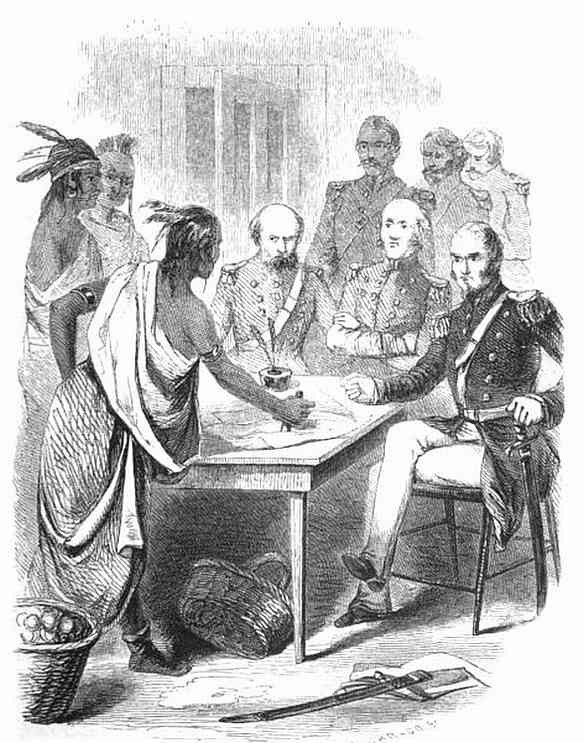
He at length stammered out:
“Very well, Osceola! Step forward here, and sign then.”
Thompson’s tone was changed; he spoke soothingly. A new prospect was before him. Osceola would sign, and thus agree to the removal. The business upon which the supreme government had deputed him would thus be accomplished, and with a dexterity that would redound to his own credit. “Old Hickory” would be satisfied; and then what next? what next? Not a mission to a mere tribe of savages, but an embassy to some high court of civilisation. He might yet be ambassador? perhaps to Spain?
Ah! Wiley Thompson! thy castles in the air (châteaux en Espagne) were soon dissipated. They fell as suddenly as they had been built; they broke down like a house of cards.
Osceola stepped forward to the table, and bent over it, as if to scan the words of the document. His eyes ran rapidly across the parchment; he seemed to be searching for some particular place.
He found it—it was a name—he read it aloud: “Charles Omatla.”
Raising himself erect, he faced the commissioner; and, in a tone of irony, asked the latter if he still desired him to sign.
“You have promised, Osceola.”
“Then will I keep my promise.”
As he spoke the words, he drew his long Spanish knife from its sheath, and raising it aloft, struck the blade through the parchment till its point was deep buried in the wood.
“That is my signature!” cried he, as he drew forth the steel. “See, Omatla! it is through your name. Beware, traitor! Undo what you have done, or its blade may yet pass through your heart!”
“Oh! that is what he meant,” cried the commissioner, rising in rage. “Good. I was prepared for this insolence—this outrage. General Clinch!—I appeal to you—your soldiers—seize upon him—arrest him!”
These broken speeches I heard amidst the confusion of voices. I heard Clinch issue some hurried orders to an officer who stood near. I saw half a dozen files separate from the ranks, and rush forward; I saw them cluster around Osceola—who the next moment was in their grasp.
Not till several of the blue-coated soldiers were sent sprawling over the ground; not till guns had been thrown aside, and a dozen strong men had fixed their gripe upon him, did the young chief give over his desperate struggles to escape; and then apparently yielding, he stood rigid and immobile, as if his frame had been iron.
It was an unexpected dénouement—alike unlooked for by either white men or Indians. It was a violent proceeding, and altogether unjustifiable. This was no court whose judge had the right to arrest for contempt. It was a council, and even the insolence of an individual could not be punished without the concurrence of both parties. General Thompson had exceeded his duty—he had exercised a power arbitrary as illegal.
The scene that followed was so confused as to defy description. The air was rent with loud ejaculations; the shouts of men, the screams of the women, the cries of children, the yells of the Indian warriors, fell simultaneously upon the ear. There was no attempt at rescue—that would have been impossible in the presence of so many troops—so many traitors; but the patriot chiefs, as they hurried away from the ground, gave out their wild ‘Yo-ho-ehee’—the gathering war-word of the Seminole nation—that in every utterance promised retaliation and revenge.
The soldiers commenced dragging Osceola inside the fort.
“Tyrant!” cried he, fixing his eye upon the commissioner, “you have triumphed by treachery; but fancy not that this is the end of it. You may imprison Osceola—hang him, if you will—but think not that his spirit will die. No; it will live, and cry aloud for vengeance. It speaks! Hear ye yonder sounds? Know ye the ‘war-cry’ of the Redsticks? Mark it well; for it is not the last time it will ring in your ears. Ho—yo-ho-ehee! yo-ho-ehee! Listen to it, tyrant! it is your death-knell—it is your death-knell!”
While giving utterance to these wild threats, the young chief was drawn through the gate, and hurried off to the guard-house within the stockade.
As I followed amid the crowd, some one touched me on the arm, as if to draw my attention. Turning, I beheld Haj-Ewa.
“To-night, by the we-wa,” (spring, pond, water) said she, speaking so as not to be heard by those around. “There will be shadows—more shadows upon the water. Perhaps—”
I did not hear more; the crowd pressed us apart; and when I looked again, the mad queen had moved away from the spot.
Chapter Forty.
“Fighting Gallagher.”
The prisoner was confined in a strong, windowless blockhouse. Access to him would be easy enough, especially to those who wore epaulets. It was my design to visit him; but, for certain reasons, I forbore putting it in execution, so long as daylight lasted. I was desirous that my interview should be as private as possible and therefore waited for the night.
I was influenced by other reasons; my hands were full of business; I had not yet done with Arens Ringgold.
I had a difficulty in deciding how to act. My mind was a chaos of emotions; hatred for the conspirators—indignation at the unjust behaviour of the agent towards Osceola—love for Maümee—now fond and trusting—anon doubting and jealous. Amid such confusion, how could I think with clearness?
Withal, one of these emotions had precedence—anger against the villain who intended to take my life was at that moment the strongest passion in my breast.
Hostility so heartless, so causeless, so deadly, had not failed to imbue me with a keen desire for vengeance; and I resolved to punish my enemy at all hazards.
He only, whose life has been aimed at by an assassin, can understand the deadly antipathy I felt towards Arens Ringgold. An open enemy, who acts under the impulse of anger, jealousy, or fancied wrong, you may respect. Even the two white wretches, and the yellow runaway, I regarded only with contempt, as tools pliant for any purpose; but the arch-conspirator himself I now both hated and despised. So acute was my sense of injury, that I could not permit it to pass without some act of retaliation, some effort to punish my wronger.
But how? Therein lay the uncertainty! How? A duel?
I could think of no other way. The criminal was still inside the law. I could not reach him, otherwise than by my own arm.
I well weighed the words of my sable counsellor; but the faithful fellow had spoken in vain, and I resolved to act contrary to his advice, let the hazard fall as it might. I made up my mind to the challenge.
One consideration still caused me to hesitate: I must give Ringgold my reasons.
He should have been welcome to them as a dying souvenir; but if I succeeded in only half-killing him, or he in half-killing me, how about the future? I should be showing my hand to him, by which he would profit; whereas, unknown to him, I now knew his, and might easily foil his designs.
Such calculations ran rapidly through my mind, though I considered them with a coolness that in after-thought surprises me. The incidents that I had lately encountered—combined with angry hatred of this plausible villain—had made me fierce, cold and cruel. I was no longer myself; and, wicked as it may appear, I could not control my longings for vengeance.
I needed a friend to advise me. Who could I make the confidant of my terrible secret?
Surely my ears were not deceiving me? No; it was the voice of my old school-fellow, Charley Gallagher. I heard it outside, and recognised the ring of his merry laugh. A detachment of rifles had just entered the fort with Charley at their head. In another instant we had “embraced.”
What could have been more opportune? Charley had been my “chum” at college—my bosom companion. He deserved my confidence, and almost upon the instant, I made known to him the situation of affairs.
It required much explanation to remove his incredulity; he was disposed to treat the whole thing as a joke—that is, the conspiracy against my life. But the rifle shot was real, and Black Jake was by to confirm my account of it: so that my friend was at length induced to take a serious view of the matter.
“Bad luck to me!” said he, in Irish accent: “it’s the quarest case that ever came accrast your humble frind’s experience. Mother o’ Moses! the fellow must be the divil incarnate. Geordie, my boy, have ye looked under his instip?”
Despite the name and “brogue,” Charley was not a Hibernian—only the son of one. He was a New-Yorker by birth, and could speak good English when he pleased; but from some freak of eccentricity or affectation, he had taken to the brogue, and used it habitually, when among friends, with all the rich garniture of a true Milesian, fresh from the “sod.”
He was altogether an odd fellow, but with a soul of honour, and a heart true as steel. He was no dunce either, and the man above all others upon whose coat tail it would not have been safe to “trid.” He was already notorious for having been engaged in two or three “affairs,” in which he had played both principal and second, and had earned the bellicose appellation of “Fighting Gallagher.” I knew what his advice would be before asking it—“Call the schoundrel out by all manes.”
I stated the difficulty as to my reasons for challenging Ringgold.
“Thrue, ma bohill! You’re right there; but there need be no throuble about the matther.”
“How?”
“Make the spalpeen challenge you. That’s betther—besides, it gives you the choice of waypons.”
“In what way can I do this?”
“Och! my innocent gossoon! Shure that’s as asy as tumblin’ from a haycock. Call him a liar; an’ if that’s not sufficiently disagraable, twake his nose, or squirt your tobacco in his ugly countenance. That’ll fetch him out, I’ll be bail for ye.
“Come along, my boy!” continued my ready counsellor, moving towards the door. “Where is this Mister Ringgowld to be sarched for? Find me the gint, and I’ll shew you how to scratch his buttons. Come along wid ye!”
Not much liking the plan of procedure, but without the moral strength to resist, I followed this impetuous son of a Celt through the doorway.
Chapter Forty One.
Provoking a Duel.
We were scarcely outside before we saw him for whom we were searching. He was standing at a short distance from the porch, conversing with a group of officers, among whom was the dandy already alluded to, and who passed under the appropriate appellation of “Beau Scott.” The latter was aide-de-camp to the commander-in-chief, of whom he was also a relative.
I pointed Ringgold out to my companion.
“He in the civilian dress,” I said.
“Och! man, ye needn’t be so purticular in your idintification. That sarpint-look spakes for itself. Be my sowl! it’s an unwholesome look altogither. That fellow needn’t fear wather—the say’ll niver drown him. Now, look here, Geordy, boy,” continued Gallagher, facing towards me and speaking in a more earnest tone: “Follow my advice to the letther! First trid upon his toes, an’ see how he takes it. The fellow’s got corns; don’t ye see, he wears a tight boot? Give him a good scrouge; make him sing out. Ov course, he’ll ask you to apologise—he must—you won’t. Shurely that’ll do the bizness without farther ceremony? If it don’t, then, by Jabus! hit him a kick in the latter end.”
“No, Gallagher,” said I, disliking the programme, “it will never do.”
“Bad luck to it, an’ why not? You’re not going to back out, are ye? Think man! a villain who would murdher you! an’ maybe will some day, if you let him escape.”
“True—but—”
“Bah! no buts. Move up, an’ let’s see what they’re talking about, anyhow. I’ll find ye a chance, or my name’s not Gallagher.”
Undetermined how to act, I walked after my companion, and joined the group of officers.
Of course, I had no thoughts of following Gallagher’s advice. I was in hopes that some turn in the conversation might give me the opportunity I desired, without proceeding to such rude extremes.
My hopes did not deceive me. Arens Ringgold seemed to tempt his fate, for I had scarcely entered among the crowd, before I found cause sufficient for my purpose.
“Talking of Indian beauties,” said he, “no one has been so successful among them as Scott here. He has been playing Don Giovanni ever since he came to the fort.”
“Oh,” exclaimed one of the newly arrived officers, “that does not surprise us. He has been a lady-killer ever since I knew him. The man who is irresistible among the belles of Saratoga, will surely find little difficulty in carrying the heart of an Indian maiden.”
“Don’t be so confident about that, Captain Roberts. Sometimes these forest damsels are very shy of us pale-faced lovers. Lieutenant Scott’s present sweetheart cost him a long siege before he could conquer her. Is it not so, lieutenant?”
“Nonsense,” replied the dandy with a conceited smirk.
“But she yielded at last?” said Roberts, turning interrogatively towards Scott.
The dandy made no reply, but his simpering smile was evidently intended to be taken in the affirmative.
“Oh yes,” rejoined Ringgold, “she yielded at last: and is now the ‘favourite,’ it is said.”
“Her name—her name?”
“Powell—Miss Powell.”
“What! That name is not Indian?”
“No, gentlemen; the lady is no savage, I assure you; she can play and sing, and read and write too—such pretty billets-doux. Is it not so, lieutenant?”
Before the latter could make reply, another spoke:
“Is not that the name of the young chief who has just been arrested?”
“True,” answered Ringgold; “it is the fellow’s name. I had forgotten to say that she is his sister.”
“What! the sister of Osceola?”
“Neither more nor less—half-blood like him too. Among the whites they are known by the name of Powell, since that was the cognomen of the worthy old gentleman who begot them. Osceola, which signifies ‘the Rising Sun,’ is the name by which he is known among the Seminoles; and her native appellation—ah, that is a very pretty name indeed.”
“What is it? Let us hear it; let us judge for ourselves.”
“Maümee.”
“Very pretty indeed!”
“Beautiful! If the damsel be only as sweet as her name, then Scott is a fortunate fellow.”
“Oh, she is a very wonder of beauty; eyes liquid and full of fiery love—long lashes: lips luscious as honeycombs; figure tall; bust full and firm; limbs like those of the Cyprian goddess; feet like Cinderella’s—in short, perfection.”
“Wonderful. Why, Scott, you are the luckiest mortal alive. But say, Ringgold! are you speaking in seriousness. Has he really conquered this Indian divinity? Honour bright—has he succeeded? You understand what I mean?”
“Most certainly,” was the prompt reply.
Up to this moment I had not interfered. The first words of the conversation had bound me like a spell, and I stood as if glued to the ground. My brain was giddy, and my heart felt as if the blood passing through it was molten lead. The bold enunciations had so staggered me, that it was some time before I could draw my breath; and more than one of the bystanders noticed the effect which the dialogue was producing on me.
After a little, I grew calmer, or rather more resolute. The very despair that had passed into my bosom had the effect of steeling my nerves; and just as Ringgold uttered the flippant affirmative, I was ready for him.
“Liar!” I exclaimed; and before the red could mount into his cheek, I gave it a slap with the back of my hand, that no doubt helped to heighten the colour.
“Nately done!” cried Gallagher; “there can be no mistake about the maynin of that.”
Nor was there. My antagonist accepted the act for what it was meant—a deadly insult. In such company, he could not do otherwise; and, muttering some indistinct threats, he walked away from the ground, attended by his especial friend, the lady-killer, and two or three others.
The incident, instead of gathering a crowd, had the contrary effect; it scattered the little group who had witnessed it; the officers retiring in-doors to discuss the motives, and speculate as as to when and where “the affair would come off.”
Gallagher and I also left the ground; and, closeted in my quarters, commenced preparing for the event.
Chapter Forty Two.
The Challenge.
At the time of which I write duelling was not uncommon in the United States army. In war-time, it is not uncommon yet, as I can testify from late experience. It is contrary to the regulations of the American service—as I believe it is of every other in the civilised world. Notwithstanding, an infringement of the code militaire in this regard, is usually looked upon with leniency—more often “winked at” than punished. This much I can affirm—that any officer in the American army who has received the “lie direct,” will find more honour in the breach of this military rule than in its observance.
After all that has been said and written about duelling, the outcry against it is a sad sham, at least in the United States of America—nothing less than a piece of superb hypocrisy. Universal as has been this condemnation, I should not like to take shelter under it. I well know that it would not protect me from being called by that ugly appellation, “poltroon.” I have noticed over and over again, that the newspapers loudest in their declamations against duelling, are the first to fling “coward” in the teeth of him who refuses to fight.
It is even so. In America, moral courage, though much be-praised, does not find ready credence. A refusal to meet the man who may challenge you is not thus explained. It is called “backing out,” “shewing the white feather;” and he who does this, need look no more upon his ladye-love; she would “flog him with her garters.”
More than once have I heard this threat, spoken by pretty lips, and in the centre of a brilliant circle. His moral courage must be great who would provoke such chastisement. With such a sentiment over the land, then, I had nailed Arens Ringgold for a meeting; and I joyed to think I had done so without compromising my secret.
But ah! it was a painful provocation he had given me; and if he had been the greatest coward in the world, he could not have been more wretched than I, as I returned to my quarters.
My jovial companion could no longer cheer me, though it was not fear for the coming fight that clouded my spirits. Far from it—far otherwise. I scarcely thought of that. My thoughts were of Maümee—of what I had just heard. She was false—false—betraying, herself betrayed—lost—lost forever!
In truth was I wretched. One thing alone could have rendered me more so—an obstacle to the anticipated meeting—anything to hinder my revenge. On the duel now rested my hopes. It might enable me to disembarrass my heart of the hot blood that was burning it. Not all—unless he too stood before me—he, the seducer who had made this misery. Would I could find pretext for challenging him. I should do so yet. Why had I not? Why did I not strike him for that smile? I could have fought them both at the same time, one after the other.
Thus I raved, with Gallagher by my side. My friend knew not all my secret. He asked what I had got “aginst the aide-de-cong.”
“Say the word, Geordie, boy, an’ we’ll make a four-handed game ov it. Be Saint Pathrick! I’d like mightily to take the shine out of that purty paycock!”
“No, Gallagher, no. It’s not your affair; you could not give me satisfaction for that. Let us wait till we know more. I cannot believe it—I cannot believe it.”
“Believe what?”
“Not now, my friend. When it is over I shall explain.”
“All right, my boy! Charley Gallagher’s not the man to disturb your saycrets. Now let’s look to the bull-dogs, an’ make shure they’re in barking condition. I hope the scamps won’t blab at head-quarters, an’ disappoint us after all.”
It was my only fear. I knew that arrest was possible—probable—certain, if my adversary wished it. Arrest would put an end to the affair; and I should be left in a worse position than ever. Ringgold’s father was gone—I had ascertained this favourable circumstance; but no matter. The commander-in-chief was the friend of the family—a word in his ear would be sufficient. I feared that the aide-de-camp Scott, instructed by Arens, might whisper that word.
“After all, he daren’t,” said Gallagher; “you driv the nail home, an’ clinched it. He daren’t do the dhirty thing—not a bit of it; it might get wind, an’ thin he’d have the kettle to his tail; besides, ma bohill, he wants to kill you anyhow; so he ought to be glad of the fine handy chance you’ve given him. He’s not a bad shot, they say. Never fear, Geordie, boy! he won’t back out this time; he must fight—he will fight. Ha! I told you so. See, yonder comes Apollo Belvidare! Holy Moses! how Phoebus shines!”
A knock—“Come in,”—the door was opened, and the aide-de-camp appeared in full uniform.
“To arrest me,” thought I, and my heart fell.
But no; the freshly written note spoke a different purpose, and I was relieved. It was the challenge.
“Lieutenant Randolph, I believe,” said the gentleman, advancing towards me.
I pointed to Gallagher, but made no reply.
“I am to understand that Captain Gallagher is your friend.”
I nodded assent.
The two faced each other, and the next instant were en rapport; talking the matter over as cool as cucumbers and sweet as sugar-plums.
From observation, I hazard this remark—that the politeness exhibited between the seconds in a duel cannot be surpassed by that of the most accomplished courtiers in the world.
The time occupied in the business was brief. Gallagher well knew the routine, and I saw that the other was not entirely unacquainted with it. In five minutes, everything was arranged—place, weapons, and distance.
I nodded; Gallagher made a sweeping salaam; the aide-de-camp bowed stiffly and withdrew.
I shall not trouble you with my reflections previous to the duel, nor yet with many details of the affair itself. Accounts of these deadly encounters are common enough in books, and their sameness will serve as my excuse for not describing one.
Ours differed only from the ordinary kind in the weapon used. We fought with rifles, instead of swords or pistols. It was my choice—as the challenged party, I had the right—but it was equally agreeable to my adversary, who was as well skilled in the use of the rifle as I. I chose this weapon because it was the deadliest.
The time arranged was an hour before sunset. I had urged this early meeting in fear of interruption; the place, a spot of level ground near the edge of the little pond where I had met Haj-Ewa; the distance, ten paces.
We met—took our places, back to back—waited for the ominous signal, “one, two, three,”—received it—faced rapidly round—and fired at each other.
I heard the “hist” of the leaden pellet as it passed my ear, but felt no stroke.
The smoke puffed upward. I saw my antagonist upon the ground: he was not dead; he was writhing and groaning.
The seconds, and several spectators who were present, ran up to him, but I kept my ground.
“Well, Gallagher?” I asked, as my friend came back to me.
“Winged, by japers! You’ve spoilt the use ov his dexter arm—bone broke above the ilbow-joint.”
“That all?”
“Arrah, sowl! aren’t it enough? Hear how the hound whimpers!”
I felt as the tiger is said to feel after tasting blood, though I cannot now account for my ferocity. The man had sought my life—I thirsted for his. This combined with the other thought had nigh driven me mad.
I was not satisfied, and would make no apology; but my antagonist had had enough; he was eager to be taken from the ground on any terms, and thus the affair ended.
It was my first duel, but not my last.
Chapter Forty Three.
The Assignation.
Our opponents passed silently away—the spectators along with them—leaving my second and myself upon the ground.
It was my intention to stay by the pond. I remembered the invitation of Haj-Ewa. By remaining, I should avoid the double journey. Better to await her coming.
A glance to the western horizon shewed me that the sun had already sunk below the tree-tops. The twilight would be short. The young moon was already in the heavens. It might be only a few minutes before Haj-Ewa should come. I resolved to stay.
I desired not that Gallagher should be with me; and I expressed the wish to be left alone.
My companion was a little surprised and puzzled at the request; but he was too well bred not to yield instant compliance.
“Why, Geordie, boy!” said he, about to retire, “shurely there’s something the matther wid ye? It isn’t this thrifling spurt we’ve been engaged in? Didn’t it ind intirely to your satisfaction? Arrah, man! are ye sorry you didn’t kill him dead? Be my trath, you look as milancholic and down-hearted as if he had killed you!”
“Dear friend, leave me alone. On my return to quarters, you shall know the cause of my melancholy, and why I now desire to part from your pleasant company.”
“Oh, that part I can guess,” rejoined he with a significant laugh; “always a petticoat where there’s shots exchanged. Niver mind, my boy, no saycrets for Charley Gallagher; I’m bad at keepin’ them. Ov coorse, you’re going to meet betther company than mine; but laste you might fall in with worse—an’ by my sowl! from what ye’ve towld me, that same isn’t beyond the bounds of probability—take this little cheeper. I’m a great dog-braker, you know.” Here the speaker handed me a silver call, which he had plucked from his button. “If any thing inconvenient or disagraable should turn up, put that between your lips, an’ Charley Gallagher will be at your side in the mention of Jack Robison’s name. Cupid spade ye with your lady-love. I’ll go an’ kill time over a tumbler ov nagus till ye come.”
So saying, my warm-hearted friend left me to myself.
I ceased to think of him ere he was gone out of sight—even the bloody strife, in which I had been so recently engaged, glided out of my mind. Maümee—her falsehood and her fall—alone occupied my thoughts.
For a long while, I made no doubt of what I had heard. How could I, with proofs so circumstantial?—the testimony of those cognisant of the scandal—of the chief actor in it, whose silent smile spoke stronger than words. That smile of insolent triumph—why had I permitted it to pass without challenge, without rebuke? It was not too late—I should call upon him to speak plainly and point blank—yes or no. If yes, then for a second duel more deadly than the first.
Notwithstanding these resolves to make my rival declare himself, I doubted not the damning truth; I endeavoured to resign myself to its torture.
For a long while was my soul upon the rack—more than an hour. Then, as my blood grew more cool, reflections of a calmer nature entered my mind; and at intervals, I experienced the soothing influence of hope; this especially when I recalled the words of Haj-Ewa, spoken on the preceding night. Surely the maniac had not been mocking me? Surely it was not a dream of her delirious brain? a distorted mirage of memory—the memory of some far-away, long-forgotten scene, by her only remembered? No, no; her tale was not distorted—her thoughts were not delirious—her words were not mockeries!
How sweet it was to think so!
Yes—I began to experience intervals of placid thought: more than placid—pleasant.
Alas! they were evanescent. The memory of those bold meretricious phrases, those smiling innuendoes, dissipated or darkened them, as cumuli darken the sun. “He had succeeded.” She was now his favourite. “Most certainly”—words worse than death. Withal it was a foul testimony on which to build a faith.
I longed for light, that true light—the evidence of the senses—that leaves nought uncertain. I should seek it with rash directness, reckless of the result, till it illumined her whole history, proving the past a disgrace, the future a chaos of utter despair. I longed for light; I longed for the coming of Haj-Ewa.
I knew not what the maniac wanted—something, I supposed, concerning the captive. Since noon, I had little thought of him. The mad queen went everywhere, knew every one; she must know all, understand all—ay, well understand; she, too, had been betrayed.
I repaired to our place of meeting on the preceding night; there I might expect her. I crossed the little ridge among the stems of the palmettoes; it was the direct route to the shadowy side of the tank. I descended the slope, and stood as before under the spreading arms of the live-oak.
Haj-Ewa was before me. A single moonbeam slanting athwart the leaves, shone upon her majestic figure. Under its light the two serpents glittered with a metallic lustre, as though her neck and waist were encircled with precious gems.
“Hinklas! pretty mico! you are come. Gallant mico! where was thine eye and thine arm that thou didst not kill the Iste-hulwa?” (Literally bad man—villain.)
“Ah! the hunter of the deer—
He was stricken so with fear
When he stood before the wolf,
The gaunt wicked wolf,
When he saw the snarling wolf,
He trembled so with fear,
That unharmed the fierce wolf ran away.
“Ha, ha, ha! was it not so, brave mico?”
“It was not fear that hindered me, Ewa. Besides, the wolf did not go unscathed.”
“Ho! the wolf has a wounded leg—he will lick himself well again; he will soon be strong as ever. Hulwak! you should have killed him, fair mico, ere he bring the pack upon you.”
“I could not help my ill luck. I am unfortunate every way.”
“Cooree, cooree—no. You shall be happy, young mico; you shall be happy, friend of the red Seminole. Wait till you see—”
“See what?”
“Patience, chepawnee! To-night under this very tree, you will see what is fair—you will hear what is sweet—and perchance Haj-Ewa will be revenged.”
This last phrase was spoken with an earnest emphasis, and in a tone that shewed a strong feeling of resentment against some one unknown. I could not comprehend the nature of the expected vengeance.
“His son—yes,” continued the maniac, now in soliloquy, “it must be—it must: his eyes, his hair, his form, his gait, his name; his son and hers. Oh, Haj-Ewa will have revenge.”
Was I myself the object of this menace? Such a thought entered my mind.
“Good Ewa! of whom are you speaking?”
Roused by my voice, she looked upon me with a bewildered stare, and then broke out into her habitual chant:
“Why did I trust to a pale-faced lover?
Ho, ho, ho!” etc.
Suddenly stopping, she seemed once more to remember herself, and essayed a reply to my question.
“Whom, young mico? Of him the fair one—the wicked one—the Wykomé hulwa (the spirit of evil). See! he comes, he comes! Behold him in the water. Ho, ho! it is he. Up, young mico! up into thy leafy bower; stay till Ewa comes! Hear what you may hear—see what you may see; but, for your life, stir not till I give you the signal. Up, up, up!”
Just as on the preceding night, half lifting me into the live-oak, the maniac glided away amidst the shadows.
I lost no time in getting into my former position, where I sat silent and expecting.
The shadow had grown shorter, but there was still enough to shew me that it was the form of a man. In another moment, it vanished.
Scarcely an instant had elapsed, ere a second was flung upon the water, advancing over the ridge, and as if following the track of the former one, though the two persons did not appear to be in company.
That which followed I could trace in full outline. It was the figure of a woman, one whose upright bearing and free port proved her to be young.
Even the shadow exhibited a certain symmetry of form and gracefulness of motion, incompatible with age. Was it still Haj-Ewa? Had she gone round through the thicket, and was now following the footsteps of the man?
For a moment I fancied so; but I soon perceived that my fancy was astray.
The man advanced under the tree. The same moonbeam, that but a moment before had shone upon Haj-Ewa, now fell upon him, and I saw him with sufficient distinctness; he was the aide-de-camp.
He stopped, took out his watch, held it up to the light, and appeared to be inquiring the hour.
But I heeded him no further. Another face appeared under that silvery ray—false and shining as itself: it was the face that to me seemed the loveliest in the world—the face of Maümee.
Chapter Forty Four.
An Eclaircissement.
These were the shadows upon the water promised by Haj-Ewa—black shadows upon my heart.
Mad queen of the Micosaucs! what have I done to deserve this torture? Thou too my enemy! Had I been thy deadliest foe, thou couldst scarcely have contrived a keener sting for thy vengeance.
Face to face stood Maümee and her lover—seduced and seducer. I had no doubt as to the identity of either. The moonbeam fell upon both—no longer with soft silvery light, but gleaming rude and red, like the chandeliers of a bagnio. It may have been but a seeming—the reflection of an inflamed imagination that influenced me from within; but my belief in her innocence was gone—hopelessly gone; the very air seemed tainted with her guilt—the world appeared a chaos of debauchery and ruin.
I had no other thought than that I was present at a scene of assignation. How could I think otherwise? No signs of surprise were exhibited by either, as they came together. They met as those who have promised to come—who have often met before.
Evidently each expected the other. Though other emotions declared themselves, there was not the slightest sign of novelty in the encounter.
For me, it was a terrible crisis. The anguish of a whole life compressed into the space of a single moment could not have been more unendurable. The blood seemed to scald my heart as it gushed through. So acute was the pang, I could scarcely restrain myself from crying aloud.
An effort—a stern determined effort—and the throe was over. Firmly bracing my nerves—firmly grasping the branches—I clung to my seat, resolved to know more.
That was a fortunate resolution. Had I at that moment given way to the wild impulse of passion, and sought a reckless revenge, I should in all likelihood have carved out for myself a long lifetime of sorrow. Patience proved my guardian angel, and the end was otherwise.
Not a word—not a motion—not a breath. What will they say?—what do?
My situation was like his of the suspended sword. On second thoughts, the simile is both trite and untrue: the sword had already fallen; it could wound me no more. I was as one paralysed both in body and soul—impervious to further pain.
Not a word—not a motion—not a breath. What will they say?—what do?
The light is full upon Maümee; I can see her from head to foot. How large she has grown—a woman in all her outlines, perfect, entire. And her loveliness has kept pace with her growth. Larger, she is lovelier than ever. Demon of jealousy! art thou not content with what thou hast already done? Have I not suffered enough? Why hast thou presented her in such witching guise? O that she were scarred, hideous, hag-like—as she shall yet become! Even thus to see her, would be some satisfaction—an anodyne to my chafed soul.
But it is not so. Her face is sweetly beautiful—never so beautiful before. Soft and innocent as ever—not a line of guilt can be traced on those placid features—not a gleam of evil in that round, rolling eye! The angels of heaven are beautiful; but they are good. Oh, who could believe in crime concealed under such loveliness as hers?
I expected a more meretricious mien. There was a scintillation of cheer in the disappointment.
Do not suppose that these reflections occupied time. In a few seconds they passed through my mind, for thought is quicker than the magnetic shock. They passed while I was waiting to hear the first words that, to my surprise, were for some moments unspoken. To my surprise; I could not have met her in such fashion. My heart would have been upon my tongue, and lips—
I see it now. The hot burst of passion is past—the springs tide of love has subsided—such an interview is no longer a novelty—perhaps he grows tired of her, foul libertine that he is! See! they meet with some shyness. Coldness has risen between them—a love quarrel—fool is he as villain—fool not to rush into those arms, and at once reconcile it. Would that his opportunities were mine!—not all the world could restrain me from seeking that sweet embrace.
Bitter as were my thoughts, they were less bitter on observing this attitude of the lovers. I fancied it was half-hostile.
Not a word—not a motion—not a breath. What will they say;—what do.
My suspense came to an end. The aide-de-camp at length found his tongue.
“Lovely Maümee, you have kept your promise.”
“But you, sir, have not yours? No—I read it in your looks. You have yet done nothing for us?”
“Be assured, Maümee, I have not had an opportunity. The general has been so busy, I have had no chance to press the matter upon him. But do not be impatient. I shall be certain to persuade him; and your property shall be restored to you in due time. Tell your mother not to feel uneasy: for your sake, beautiful Maümee, I shall spare no exertion. Believe me, I am as anxious as yourself; but you must know the stern disposition of my uncle; and, moreover, that he is on the ’most friendly terms with the Ringgold family. In this will lie the main difficulty, but I fear not that I shall be able to surmount it.”
“O sir, your words are fine, but they have little worth with us now. We have waited long upon your promise to befriend us. We only wished for an investigation; and you might easily have obtained it ere this. We no longer care for our lands, for greater wrongs make us forget the less. I should not have been here to-night, had we not been in sad grief at the misfortune—I should rather say outrage—that has fallen upon my poor brother. You have professed friendship to our family. I come to seek it now, for now may you give proof of it. Obtain my brother’s freedom, and we shall then believe in the fair words you have so often spoken. Do not say it is impossible; it cannot even be difficult for you who hold so much authority among the white chiefs. My brother may have been rude; but he has committed no crime that should entail severe punishment. A word to the great war-chief, and he would be set free. Go, then, and speak that word.”
“Lovely Maümee! you do not know the nature of the errand upon which you send me. Your brother is a prisoner by orders of the agent, and by the act of the commander-in-chief. It is not with us as among your people. I am only a subordinate in rank, and were I to offer the counsel you propose, I should be rebuked—perhaps punished.”
“Oh, you fear rebuke for doing an act of justice?—to say naught of your much offered friendship? Good, sir! I have no more to say, except this—we believe you no longer. You need come to our humble dwelling no more.”
She was turning away with a scornful smile. How beautiful seemed that scorn!
“Stay, Maümee!—fair Maümee, do not part from me thus—doubt not that I will do all in my power—”
“Do what I have asked you. Set my brother free—let him return to his home.”
“And if I should—”
“Well, sir.”
“Know, Maümee, that for me to do so would be to risk everything. I might be degraded from my rank—reduced to the condition of a common soldier—disgraced in the eyes of my country—ay, punished, perhaps, by imprisonment worse than that which your brother is likely to endure. All this would I risk by the act.”
The girl paused in her step, but made no reply. “And yet all these chances shall I undergo—ay, the danger of death itself—if you, fair Maümee,”—here the speaker waxed passionate and insinuating—“if you will only consent.”
“Consent—to what, sir?”
“Lovely Maümee, need I tell you? Surely you understand my meaning. You cannot be blind to the love—to the passion—to the deep devotion with which your beauty has inspired me—”
“Consent to what, sir?” demanded she, repeating her former words, and in a soft tone, that seemed to promise compliance. “Only to love me, fair Maümee—to become my mistress.” For some moments, there was no reply. The grand woman seemed immobile as a statue. She did not even start on hearing the foul proposal, but, on the contrary, stood as if turned to stone.
Her silence had an encouraging effect upon the ardent lover; he appeared to take it for assent. He could not have looked into her eye, or he would there have read an expression that would have hindered him from pressing his suit farther. No—he could not have observed that glance, or he would hardly have made such a mistake.
“Only promise it, fair Maümee; your brother shall be free before the morning, and you shall have everything—”
“Villain, villain, villain! Ha, ha! ha, ha! Ha, ha! ha, ha, ha!”
In all my life, I never heard aught so delightful as that laugh. It was the sweetest sound that ever fell upon my ears. Not all the wedding-bells that ever rang—not all the lutes that ever played—not all the harps and hautboys—the clarions and trumpets—in the world, could have produced such melodious music for me.
The moon seemed to pour silver from the sky—the stars had grown bigger and brighter—the breeze became filled with delicious odours, as if a perfumed censer had been spilled from heaven, and the whole scene appeared suddenly transformed into an Elysium.
Chapter Forty Five.
Two Duels in One Day.
The crisis might have been my cue to come down; but I was overpowered with a sense of delightful happiness, and could not stir from my seat. The arrow had been drawn out of my breast, leaving not a taint of its poison—the blood coursed pleasantly through my veins—my pulse throbbed firm and free—my soul was triumphant. I could have cried out for very joy.
With an effort, I held my peace, and waited for the dénouement—for I saw that the scene was not yet at an end.
“Mistress, indeed!” exclaimed the bold beauty in scornful accent. “And this is the motive of your proffered friendship. Vile wretch! for what do you mistake me? a camp-wench, or a facile squaw of the Yamassee? Know, sir, that I am your equal in blood and race; and though your pale-faced friends have robbed me of my inheritance, there is that which neither they nor you can take from me—the honour of my name. Mistress, indeed! Silly fellow! No—not even your wife. Sooner than sell myself to such base love as yours, I should wander naked through the wild woods, and live upon the acorns of the oak. Rather than redeem him at such a price, my brave brother would spend his lifetime in your chains. Oh, that he were here! Oh, that he were witness of this foul insult! Wretch! he would smite thee like a reed to the earth.”
The eye, the attitude, the foot firmly planted, the fearless determined bearing—all reminded me of Osceola while delivering himself before the council. Maümee was undoubtedly his sister.
The soi-disant lover quailed before the withering reproach, and for some time stood shrinking and abashed.
He had more than one cause for abasement. He might feel regret at having made a proposal so ill received; but far more at the disappointment of his hopes, and the utter discomfiture of his designs.
Perhaps, the moment before, he would have smothered his chagrin, and permitted the girl to depart without molestation; but the scornful apostrophe had roused him to a sort of frenzied recklessness; and probably it was only at that moment that he formed the resolve to carry his rudeness still further, and effect his purpose by force.
I could not think that he had held such design, anterior to his coming on the ground. Professed libertine though he was, he was not the man for such perilous emprise. He was but a speck of vain conceit, and lacked the reckless daring of the ravisher. It was only when stung by the reproaches of the Indian maiden, that he resolved upon proceeding to extremes.
She had turned her back upon him, and was moving away.
“Not so fast!” cried he, rushing after, and grasping her by the wrist; “not so fast, my brown-skinned charmer! Do you think you can cast me off so lightly? I have followed you for months, and, by the god of Phoebus, I shall make you pay for the false smiles you have treated me to. You needn’t struggle; we are alone here; and ere we part, I shall—”
I heard no more of this hurried speech—I had risen from my perch, and was hurrying down to the rescue; but before I could reach the spot, another was before me.
Haj-Ewa—her eyes glaring fiercely—with a wild maniac laugh upon her lips—was rushing forward. She held the body of the rattlesnake in her extended hands, its head projected in front, while its long neck was oscillating from side to side, showing that the reptile was angry, and eager to make an attack. Its hiss, and the harsh “skirr-rr” of its rattles could be heard sounding at intervals as it was carried forward.
In another instant, the maniac was face to face with the would-be ravisher—who, startled by her approach, had released his hold of the girl, and falling back a pace, stood gazing with amazement at this singular intruder.
“Ho, ho!” screamed the maniac, as she glided up to the spot. “His son, his son! Ho! I am sure of it, just like his false father—just as he on the day he wronged the trusting Ewa. Hulwak! It is the hour—the very hour—the moon in the same quarter, horned and wicked—smiling upon the guilt. Ho, ho! the hour of the deed—the hour of vengeance! The father’s crime shall be atoned by the son. Great Spirit! give me revenge! Chitta mico! give me revenge!”
As she uttered these apostrophic appeals, she sprang forward, holding the snake far outstretched—as if to give it the opportunity of striking the now terrified man.
The latter mechanically drew his sword, and then, as if inspired by the necessity of defending himself, cried out:
“Hellish sorceress! if you come a step nearer, I shall run you through the body. Back, now! Keep off, or, by — I shall do it!”
The resolution expressed by his tone proved that the speaker was in earnest; but the appeal was unheeded. The maniac continued to advance despite the shining blade that menaced her, and within reach of whose point she had already arrived.
I was now close to the spot; I had drawn my own blade, and was hurrying forward to ward off the fatal blow which I expected every moment would be struck. It was my design to save Haj-Ewa, who seemed recklessly rushing upon her destruction.
In all probability, I should have been too late, had the thrust been given; but it was not.
Whether from terror at the wild unearthly aspect of his assailants, or, what is more likely, fearing that she was about to fling the snake upon him, the man appeared struck with a sudden panic, and retreated backward.
A step or two brought him to the edge of the water. There were loose stones strewed thickly along the shore; among these his feet became entangled; and, balancing backward, he fell with a plash upon the pond!
The water deepened abruptly, and he sank out of sight. Perhaps the sudden immersion was the means of saving his life; but the moment after, he rose above the surface, and clambered hastily up on the bank.
He was now furious, and with his drawn sword, which he had managed to retain hold of, he rushed towards the spot where Haj-Ewa still stood. His angry oaths told his determination to slay her.
It was not the soft, yielding body of a woman, nor yet of a reptile, that his blade was to encounter. It struck against steel, hard and shining as his own.
I had thrown myself between him and his victims, and had succeeded in restraining Haj-Ewa from carrying out her vengeful design. As the assailant approached, his rage, but more, the water half-blinding him, hindered him from seeing me; and it was not till our blades had rasped together, that he seemed aware of my presence.
There was a momentary pause, accompanied by silence.
“You, Randolph!” at length he exclaimed in a tone of surprise.
“Ay, Lieutenant Scott—Randolph it is. Pardon my intrusion, but your pretty love-scene changing so suddenly to a quarrel, I deemed it my duty to interfere.”
“You have been listening?—you have heard?—and pray, sir, what business have you either to play the spy on my actions, or interfere in my affairs?”
“Business—right—duty—the duty which all men have to protect weak innocence from the designs of such a terrible Blue Beard as you appear to be.”
“By —, you shall rue this.”
“Now?—or when?”
“Whenever you please.”
“No time like the present. Come on.”
Not another word was spoken between us; but, the instant after, our blades were clinking in the fierce game of thrust and parry.
The affair was short. At the third or fourth lunge, I ran my antagonist through the right shoulder, disabling his arm. His sword fell jingling among the pebbles.
“You have wounded me!” cried he; “I am disarmed,” he added, pointing to the fallen blade. “Enough, sir; I am satisfied.”
“But not I—not till you have knelt upon these stones, and asked pardon from her whom you have so grossly insulted.”
“Never!” cried he; “never!”—and as he uttered these words, giving, as I presumed, a proof of determined courage, he turned suddenly; and, to my utter astonishment, commenced running away from the ground!
I ran after, and soon overtook him. I could have thrust him in the back, had I been sanguinarily inclined; but instead, I contented myself with giving him a foot-salute, in what Gallagher would have termed his “postayriors,” and with no other adieu, left him to continue his shameful flight.
Chapter Forty Six.
A Silent Declaration.
“Now for the love, the sweet young love,
Under the tala tree,” etc.
It was the voice of Haj-Ewa, chanting one of her favourite melodies. Far sweeter the tones of another voice pronouncing my own name:
“George Randolph!”
“Maümee!”
“Ho, ho! you both remember?—still remember? Hinklas! The island—that fair island—fair to you, but dark in the memory of Haj-Ewa. Hulwak! I’ll think of’t no more—no, no, no!
“Now for the love, the sweet young love,
Under—
“It was once mine—it is now yours, mico! yours, haintclitz! Pretty creatures! enjoy it alone; you wish not the mad queen for a companion? Ha, ha! Cooree, cooree! I go; fear not the rustling wind, fear not the whispering trees; none can approach while Haj-Ewa watches. She will be your guardian. Chitta mico, too. Ho, chitta mico!
“Now for the love, the sweet young love.”
And again renewing her chant, the strange woman glided from the spot, leaving me alone with Maümee.
The moment was not without embarrassment to me—perhaps to both of us. No profession had ever passed between us, no assurance, not a word of love. Although I loved Maümee with all my heart’s strength, although I now felt certain that she loved me, there had been no mutual declaration of our passion. The situation was a peculiar one, and the tongue felt restraint.
But words would have been superfluous in that hour. There was an electricity passing between us—our souls were en rapport, our hearts in happy communion, and each understood the thoughts of the other. Not all the words in the world could have given me surer satisfaction that the heart of Maümee was mine.
It was scarcely possible that she could misconceive. With but slight variation, my thoughts were hers. In all likelihood, Haj-Ewa had carried to her ears my earnest declaration. Her look was joyful—assured. She did not doubt me.
I extended my arms, opening them widely. Nature prompted me, or perhaps passion—all the same. The silent signal was instantly understood, and the moment after, the head of my beloved was nestling upon my bosom.
Not a word was spoken. A low fond cry alone escaped her lips as she fell upon my breast, and twined her arms in rapturous compression around me.
For some moments we exchanged not speech; our hearts alone held converse.
Soon the embarrassment vanished, as a light cloud before the summer sun: not a trace of shyness remained; and we conversed in the confidence of mutual love.
I am spared the writing of our love-speeches. You have yourself heard or uttered them. If too common-place to be repeated, so also are they too sacred. I forbear to detail them.
We had other thoughts to occupy us. After a while, the transport of our mutual joys, though still sweet, assumed a more sober tinge; and, half-forgetting the present, we talked of the past and the future.
I questioned Maümee much. Without guile, she gave me the history of that long interval of absence. She confessed, or rather declared—for there was no coquettish hesitation in her manner—that she had loved me from the first—even from that hour when I first saw and loved her: through the long silent years, by night as by day, had the one thought held possession of her bosom. In her simplicity, she wondered I had not known of it!
I reminded her that her love had never been declared. It was true, she said; but she had never dreamt of concealing it. She thought I might have perceived it. Her instincts were keener: she had been conscious of mine!
So declared she, with a freedom that put me off my guard.
If not stronger, her passion was nobler than my own.
She had never doubted me during the years of separation. Only of late; but the cause of this doubt was explained: the pseudo-lover had poured poison into her ears. Hence the errand of Haj-Ewa.
Alas! my story was not so guileless. Only part of the truth could I reveal; and my conscience smote me as I passed over many an episode that would have given pain.
But the past was past, and could not be re-enacted. A more righteous future was opening before me; and silently in my heart did I register vows of atonement. Never more should I have cause to reproach myself—never would my love—never could it wander away from the beautiful being I held in my embrace.
Proudly my bosom swelled as I listened to the ingenuous confession of her love, but sadly when other themes became the subject of our converse. The story of family trials, of wrongs endured, of insults put upon them—and more especially by their white neighbours, the Ringgolds—caused my blood to boil afresh.
The tale corresponded generally with what I had already learned; but there were other circumstances unknown to public rumour. He, too—the wretched hypocrite—had made love to her. He had of late desisted from his importunities, through fear of her brother, and dared no longer come near.
The other, Scott, had made his approaches under the guise of friendship. He had learned, what was known to many, the position of affairs with regard to the Indian widow’s plantation. From his relationship in high quarters, he possessed influence, and had promised to exert it in obtaining restitution. It was a mere pretence—a promise made without any intention of being kept; but, backed by fair words, it had deceived the generous, trusting heart of Osceola. Hence the admission of this heartless cur into the confidence of a family intimacy.
For months had the correspondence existed, though the opportunities were but occasional. During all this time had the soi-disant seducer been pressing his suit—though not very boldly, since he too dreaded the frown of that terrible brother—neither successfully: he had not succeeded.
Ringgold well knew this when he affirmed the contrary. His declaration had but one design—to sting me. For such purpose, it could not have been made in better time.
There was one thing I longed to know. Surely Maümee, with her keen quick perception, from the girlish confidence that had existed between them—surely she could inform me. I longed to know the relations that had existed between my sister and her brother.
Much as I desired the information, I refrained from asking it.
And yet we talked of both—of Virginia especially, for Maümee remembered my sister with affection, and made many inquiries in relation to her. Virginia was more beautiful than ever, she had heard, and accomplished beyond all others. She wondered if my sister would remember those walks and girlish amusements—those happy hours upon the island.
“Perhaps,” thought I, “too well.”
It was a theme that gave me pain.
The future claimed our attention; the past was now bright as heaven, but there were clouds in the sky of the future.
We talked of that nearest and darkest—the imprisonment of Osceola. How long would it last? What could be done to render it as brief as possible?
I promised to do everything in my power; and I purposed as I promised. It was my firm resolve to leave no stone unturned to effect the liberation of the captive chief. If right should not prevail, I was determined to try stratagem. Even with the sacrifice of my commission—even though personal disgrace should await me—the risk of life itself—I resolved he should be free.
I needed not to add to my declaration the emphasis of an oath; I was believed without that. A flood of gratitude was beaming from those liquid orbs; and the silent pressure of love-burning lips was sweeter thanks than words could have uttered.
It was time for parting; the moon told the hour of midnight.
On the crest of the hill, like a bronze statue outlined against the pale sky, stood the mad queen. A signal brought her to our side; and after another embrace, one more fervid pressure of sweet lips, Maümee and I parted.
Her strange but faithful guardian led her away by some secret path, and I was left alone.
I could scarcely take myself away from that consecrated ground; and I remained for some minutes longer, giving full play to triumphant and rapturous reflections.
The declining moon again warned me; and, crossing the crest of the hill, I hastened back to the Fort.
Chapter Forty Seven.
The Captive.
Late as was the hour, I determined to visit the captive before going to rest. My design would not admit of delay; besides, I had a suspicion that, before another day passed, my own liberty might be curtailed. Two duels in one day—two antagonists wounded, and both friends to the commander-in-chief—myself comparatively friendless—it was hardly probable I should escape “scot free.” Arrest I expected as certain—perhaps a trial by court-martial, with a fair chance of being cashiered the service.
Despite my lukewarmness in the cause in which we had become engaged, I could not contemplate this result without uneasiness. Little did I care for my commission: I could live without it; but whether right or wrong, few men are indifferent to the censure of their fellows, and no man likes to bear the brand of official disgrace. Reckless as one may be of self, kindred and family have a concern in the matter not to be lightly ignored.
Gallagher’s views were different.
“Let them arrist and cashear, an’ be hanged! What need you care? Divil a bit, my boy. Sowl, man, if I were in your boots, with a fine plantation and a whole regiment of black nagers, I’d snap my fingers at the sarvice, and go to raisin’ shugar and tobaccay. Be Saint Pathrick! that’s what I’d do.”
My friend’s consolatory speech failed to cheer me; and, in no very joyous mood, I walked towards the quarters of the captive, to add still further to my chances of “cashierment.”
Like an eagle freshly caught and caged—like a panther in a pentrap—furious, restless, at intervals uttering words of wild menace, I found the young chief of the Baton Rouge.
The apartment was quite dark; there was no window to admit even the grey lustre of the night; and the corporal who guided me in carried neither torch nor candle. He went back to the guard-house to procure one, leaving me in darkness.
I heard the footfall of a man. It was the sound of a moccasined foot, and soft as the tread of a tiger; but mingling with this was the sharp clanking of a chain. I heard the breathing of one evidently in a state of excitement, and now and then an exclamation of fierce anger. Without light, I could perceive that the prisoner was pacing the apartment in rapid, irregular strides. At least his limbs were free.
I had entered silently, and stood near the door, I had already ascertained that the prisoner was alone; but waited for the light before addressing him. Preoccupied as he appeared to be, I fancied that he was not conscious of my presence.
My fancy was at fault. I heard him stop suddenly in his tracks—as if turning towards me—and the next moment his voice fell upon my ear. To my surprise, it pronounced my name. He must have seen through the darkness.
“You, Randolph!” he said, in a tone that expressed reproach; “you, too, in the ranks of our enemies? Armed—uniformed—equipped—ready to aid in driving us from our homes!”
“Powell!”
“Not Powell, sir; my name is Osceola.”
“To me, still Edward Powell—the friend of my youth, the preserver of my life. By that name alone do I remember you.”
There was a momentary pause. The speech had evidently produced a conciliating effect; perhaps memories of the past had come over him.
He replied:
“Your errand? Come you as a friend? or only like others, to torment me with idle words? I have had visitors already; gay, gibbering fools, with forked tongues, who would counsel me to dishonour. Have you been sent upon a like mission?”
From this speech I concluded that Scott—the pseudo-friend—had already been with the captive—likely on some errand from the agent.
“I come of my own accord—as a friend.”
“George Randolph, I believe you. As a boy, you possessed a soul of honour. The straight sapling rarely grows to a crooked tree. I will not believe that you are changed, though enemies have spoken against you. No—no; your hand, Randolph—your hand! forgive me for doubting you.”
I reached through the darkness to accept the proffered salute. Instead of one, I grasped both hands of the prisoner. I felt that they were manacled together: for all that, the pressure was firm and true; nor did I return it with less warmth.
Enemies had spoken against me. I needed not to ask who these were: that had been already told me; but I felt it necessary to give the captive assurance of my friendship. I needed his full confidence to insure the success of the plan which I had conceived for his liberation; and to secure this, I detailed to him what had transpired by the pond—only a portion of what had passed. There was a portion of it I could not intrust even to the ears of a brother.
I anticipated a fresh paroxysm of fury, but was agreeably disappointed. The young chief had been accustomed to harsh developments, and could outwardly control himself; but I saw that my tale produced an impression that told deeply, if not loudly, upon him. In the darkness, I could not see his face; but the grinding teeth and hissing ejaculations were expressive of the strong passions stirring within.
“Fool!” he exclaimed at length—“blind fool that I have been! And yet I suspected this smooth-tongued villain from the first. Thanks, noble Randolph! I can never repay this act of chivalric friendship; henceforth you may command Osceola!”
“Say no more, Powell; you have nothing to repay; it was I who was the debtor. But come, we lose time. My purpose in coming here is to counsel you to a plan for procuring your release from this awkward confinement. We must be brief, else my intentions may be suspected.”
“What plan, Randolph?”
“You must sign the treaty of the Oclawaha.”
Chapter Forty Eight.
The War-Cry.
A single “Ugh!” expressive of contemptuous surprise, was all the reply; and then a deep silence succeeded.
I broke the silence by repeating my demand.
“You must sign it.”
“Never!” came the response, in a tone of emphatic determination. “Never! Sooner than do that, I will linger among these logs till decay has worn the flesh from my bones, and dried up the blood in my veins. Sooner than turn traitor to my tribe, I will rush against the bayonets of my jailers, and perish upon the spot. Never!”
“Patience, Powell, patience! You do not understand me—you, in common with other chiefs, appear to misconceive the terms of this treaty. Remember, it binds you to a mere conditional promise—to surrender your lands and move west, only in case a majority of your nation agree to it. Now, to-day a majority has not agreed, nor will the addition of your name make the number a majority.”
“True, true,” interrupted the chief, beginning to comprehend my meaning.
“Well, then, you may sign, and not feel bound by your signature, since the most essential condition still remains unfulfilled. And why should you not adopt this ruse? Ill-used as you certainly have been, no one could pronounce it dishonourable in you. For my part, I believe you would be justified in any expedient that would free you from so wrongful an imprisonment.”
Perhaps my principles were scarcely according to the rules of moral rectitude; but at that moment they took their tone from strong emotions; and to the eyes of friendship and love the wrong was not apparent.
Osceola was silent. I observed that he was meditating on what I had urged.
“Why, Randolph,” said he, after a pause, “you must have dwelt in Philadelphia, that famed city of lawyers. I never took this view before. You are right; signing would not bind me—it is true. But think you that the agent would be satisfied with my signature? He hates me; I know it, and his reasons. I hate him, for many reasons; for this is not the first outrage I have suffered at his hands. Will he be satisfied if I sign?”
“I am almost certain of it. Simulate submission, if you can. Write your name to the treaty, and you will be at once set free.”
I had no doubt of this. From what I had learned since Osceola’s arrest, I had reason to believe that Thompson repented his conduct. It was the opinion of others that he had acted rashly, and that his act was likely to provoke evil consequences. Whispers of this nature had reached him; and from what the captive told me of the visit of the aide-de-camp, I could perceive that it was nothing else than a mission from the agent himself. Beyond doubt, the latter was tired of his prisoner, and would release him on the easiest terms.
“Friend! I shall act as you advise. I shall sign. You may inform the commissioner of my intention.”
“I shall do so at the earliest hour I can see him. It is late: shall I say good night?”
“Ah, Randolph! it is hard to part with a friend—the only one with a white skin now left me. I could have wished to talk over other days, but, alas! this is neither the place nor the time.”
The haughty mien of the proud chief was thrown aside, and his voice had assumed the melting tenderness of early years.
“Yes,” he continued, “the only white friend left—the only one I have any regard for—one other whom I—”
He stopped suddenly, and with an embarrassed air, as if he had found himself on the eve of disclosing some secret, which on reflection he deemed it imprudent to reveal.
I awaited the disclosure with some uneasiness, but it came not. When he spoke again, his tone and manner were completely changed.
“The whites have done us much wrong,” he continued, once more rousing himself into an angry attitude—“wrongs too numerous to be told; but, by the Great Spirit! I shall seek revenge. Never till now have I sworn it; but the deeds of this day have turned my blood into fire. Ere you came, I had vowed to take the lives of two, who have been our especial enemies. You have not changed my resolution, only strengthened it; you have added a third to the list of my deadly foes: and once more I swear—by Wykomé, I swear—that I shall take no rest till the blood of these three men has reddened the leaves of the forest—three white villains, and one red traitor. Ay, Omatla! triumph in your treason—it will not be for long—soon shalt thou feel the Vengeance of a patriot—soon shalt thou shrink under the steel of Osceola!”
I made no reply, but waited in silence till this outburst of passion had passed.
In a few moments the young chief became calm, and again addressed me in the language of friendship.
“One word,” said he, “before we part. Circumstances may hinder us—it may be long ere we meet again. Alas! our next meeting may be as foes in the field of fight—for I will not attempt to conceal from you that I have no intention to make peace. No—never! I wish to make a request; I know, Randolph, you will accede to it without asking an explanation. Accept this token, and if you esteem the friendship of the giver, and would honour him, wear it conspicuously upon your breast. That is all.”
As he spoke, he took from around his neck a chain, upon which was suspended the image of the Rising Sun—already alluded to. He passed the chain over my head, until the glistening symbol hung down upon my breast.
I made no resistance to this offering of friendship, but promising to comply with his request, presented my watch in return, and, after another cordial pressure of hands, we parted.
As I had anticipated, there was but little difficulty in obtaining the release of the Seminole chief. Though the commissioner entertained a personal hatred against Osceola—for causes to me unknown—he dared not indulge his private spite in an official capacity. He had placed himself in a serious dilemma by what he had already done; and as I communicated the purposed submission of the prisoner, I saw that Thompson was but too eager to adopt a solution of his difficulty, easy as unexpected. He therefore lost no time in seeking an interview with the captive chief.
The latter played his part with admirable tact; the fierce, angry attitude of yesterday had given place to one of mild resignation. A night in the guard-house, hungered and manacled, had tamed down his proud spirit, and he was now ready to accept any conditions that would restore him to liberty. So fancied the commissioner.
The treaty was produced. Osceola signed it without saying a word. His chains were taken off—his prison-door thrown open—and he was permitted to depart without further molestation. Thompson had triumphed, or fancied so.
It was but fancy. Had he noticed, as I did, the fine satirical smile that played upon the lips of Osceola as he stepped forth from the gate, he would scarcely have felt confidence in his triumph.
He was not allowed to exult long in the pleasant hallucination.
Followed by the eyes of all, the young chief walked off with a proud step towards the woods.
On arriving near the edge of the timber, he faced round to the fort, drew the shining blade from his belt, waved it above his head, and in defiant tones shouted back the war-cry, “Yo-ho-ehee!”
Three times the wild signal pealed upon our ears; and at the third repetition, he who had uttered it turned again, sprang forward into the timber, and was instantly lost to our view.
There was no mistaking the intent of that demonstration; even the self-glorifying commissioner was convinced that it meant “war to the knife,” and men were hurriedly ordered in pursuit.
An armed crowd rushed forth from the gate, and flung themselves on the path that had been taken by the ci-devant captive.
The chase proved bootless and fruitless; and after more than an hour spent in vein search, the soldiers came straggling back to the fort.
Gallagher and I had stayed all the morning in my quarters, expecting the order that would confine me there. To our astonishment it came not: there was no arrest.
In time, we obtained the explanation. Of my two duelling antagonists, the first had not returned to the fort after his defeat, but had been carried to the house of a friend—several miles distant. This partially covered the scandal of that affair. The other appeared with his arm in a sling; but it was the impression, as Gallagher learned outside, that his horse had carried him against a tree. For manifest reasons the interesting invalid had not disclosed the true cause of his being “crippled,” and I applauded his silence. Except to my friend, I made no disclosure of what had occurred, and it was long before the affair got wind.
Upon duty, the aide-de-camp and I often met afterwards, and were frequently compelled to exchange speech; but it was always of an official character, and, I need not add, was spoken in the severest reserve.
It was not long before circumstances arose to separate us; and I was glad to part company with a man for whom I felt a profound contempt.
Chapter Forty Nine.
War to the Knife.
For some weeks following the council at Fort King, there appeared to be tranquillity over the land. The hour of negotiation had passed—that for action was nigh; and among the white settlers the leading topic of conversation was how the Indians would act? Would they fight, or give in? The majority believed they would submit.
Some time was granted them to prepare for the removal—runners were sent to all the tribes, appointing a day for them to bring in their horses and cattle to the fort. These were to be sold by auction, under the superintendence of the agent; and their owners were to receive a fair value for them on their arrival at their new home in the west. Their plantations or “improvements” were to be disposed of in a similar manner.
The day of auction came round; but, to the chagrin of the commissioner, the expected flocks did not make their appearance, and the sale had to be postponed.
The failure on the part of the Indians to bring in their cattle was a hint of what might be expected; though others, of a still more palpable nature, were soon afforded.
The tranquillity that had reigned for some weeks was but the ominous silence that precedes the storm. Like the low mutterings of the distant thunder, events now began to occur, the sure harbingers of an approaching conflict.
As usual, the white man was the aggressor. Three Indians were found hunting outside the boundary of the “reserve.” They were made captives by a party of white men, and, fast bound with raw-hide ropes, were confined in a log-stable belonging to one of the party. In this situation they were kept three days and nights, until a band of their own tribe hearing of their confinement, hastened to their rescue. There was a skirmish, in which some Indians were wounded; but the white men fled, and the captives were released.
“On bringing them forth to the light, their friends beheld a most pitiable sight,”—I am quoting from a faithful history—“the rope with which these poor fellows were tied had worn through the flesh: they had temporarily lost the use of their limbs, being unable to stand or walk. They had bled profusely, and had received no food during their confinement; so it may readily be imagined that they presented a horrible picture of suffering.”
Again: “Six Indians were at their camp near Kanapaha Pond, when a party of whites came upon them, took their guns from them, examined their packs, and commenced whipping them. While in the act, two other Indians approached, and seeing what was going on, fired upon the whites. The latter returned the fire, killed one of the Indians, and severely wounded the other.”
Exasperation was natural—retaliation certain. On the other side, read:
“On the 11th of August, Dalton, the mail-carrier between Fort King and Fort Brooke, was met within six miles of the latter place by a party of Indians, who seized the reins of his horse, and dragging him from the saddle, shot him dead. The mangled body was discovered some days afterwards concealed in the woods.”
“A party of fourteen mounted men proceeded on a scout towards Wacahonta—the plantation of Captain Gabriel Priest—and when within one mile of the place, they came upon a small hommock, through which some of the party declined passing. Four of them, however, dashed into it, when the Indians suddenly arose from ambush, and fired upon them. The two in advance were wounded. A Mr Foulke received a bullet in his neck, but was picked up by those in his rear, and borne off. The other, a son of Captain Priest, had his arm broken, and his horse shot dead under him. He fled, and sinking his body in a swamp, succeeded in eluding the search of the pursuers.”
“About the same time, a party of Indians attacked a number of men who were employed cutting live-oak timber on an island in Lake George. The men escaped by taking to their boats, though two of their number were wounded.”
“At New River, on the south-east side of the peninsula, the Indians attacked the house of a Mr Cooley—murdered his wife, children, and a tutor engaged in the family. They carried off twelve barrels of provisions, thirty hogs, three horses, one keg of powder, over two hundred pounds of lead, seven hundred dollars in silver, and two negroes. Mr Cooley was absent at the time. On his return, he found his wife shot through the heart with her infant child in her arms, and his two oldest children also shot in the same place. The girl still held her book in her hands, and the boy’s lay by his side. The house was in flames.”
“At Spring Garden, on the Saint Johns, the extensive plantation of Colonel Rees was laid waste, and his buildings burnt to the ground. Sugar-cane, sufficient to manufacture ninety hogsheads, was destroyed; besides thirty hogsheads of sugar, and one hundred and sixty-two negroes were carried off. The mules and horses were also taken. The same Indians destroyed the buildings of M. Depeyster, with whose negroes they formed a league; and being supplied with a boat, they crossed the river and fired the establishment of Captain Dummett. Major Heriot’s plantation was laid waste, and eighty of his negroes moved off with the Indians. Then on towards San Augustine, where the extensive plantations of General Hernandez were reduced to a ruin; next, Bulow’s, Dupont’s of Buen Retiro, Dunham’s, McRae’s of Tomoka Creek, the plantations of Bayas, General Herring, and Bartalone Solano, with nearly every other from San Augustine southward.”
Simple historic facts. I quote them as illustrating the events that ushered in the Seminole war. Barbarous though they be, they were but acts of retaliation—the wild outburst of a vengeance long pent up—a return for wrongs and insults patiently endured.
As yet, no general engagement had taken place; but marauding parties sprang up simultaneously in different places. Many of those who had inflicted outrage upon the Indians were forthwith repaid; and many barely escaped with their lives. Conflagration succeeded conflagration, until the whole country was on fire. Those who lived in the interior, or upon the borders of the Indian reserve, were compelled to abandon their crops, their stock, their implements of husbandly, their furniture, and indeed every article of value, and seek shelter within the forts, or concentrate themselves in the neighbouring villages, around which stockades were erected for their better security.
The friendly chiefs—the Omatlas and others—with about four hundred followers, abandoned their towns, and fled to Fort Brooke for protection.
The strife was no longer hypothetical, no longer doubtful; it was declared in the wild Yo-ho-ehee! that night and day was heard ringing in the woods.