автордың кітабын онлайн тегін оқу Trails of the Pathfinders
E-text prepared by Larry B. Harrison, Charlie Howard,
and the Online Distributed Proofreading Team
(http://www.pgdp.net)
from page images generously made available by
Internet Archive
(https://archive.org)
Note:
Images of the original pages are available through Internet Archive. See
https://archive.org/details/trailsofpathfind00grinrichIN THE SAME SERIES
Published by CHARLES SCRIBNER’S SONS
The Boy’s Catlin. My Life Among the Indians, by George Catlin. Edited by Mary Gay Humphreys. Illustrated. 12mo. net $1.50
The Boy’s Hakluyt. English Voyages of Adventure and Discovery, retold from Hakluyt by Edwin M. Bacon. Illustrated. 12mo. net $1.50
The Boy’s Drake. By Edwin M. Bacon. Illustrated. 12mo. net $1.50
Trails of the Pathfinders. By George Bird Grinnell. Illustrated. 12mo. net $1.50
TRAILS OF THE PATHFINDERS
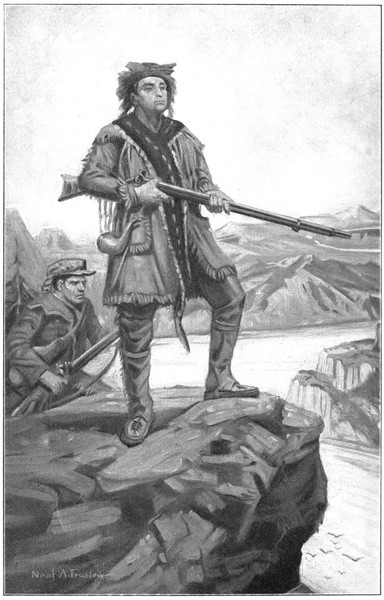
CAPTAINS LEWIS AND CLARK WERE MUCH PUZZLED AT THIS POINT TO KNOW WHICH OF THE RIVERS BEFORE THEM WAS THE MAIN MISSOURI.
TRAILS OF
THE PATHFINDERS
BY
GEORGE BIRD GRINNELL
AUTHOR OF “BLACKFOOT LODGE TALES,” “PAWNEE HERO STORIES AND FOLK TALES,” “THE STORY OF THE INDIAN,” “INDIANS OF TODAY,” ETC.
ILLUSTRATED
NEW YORK
CHARLES SCRIBNER’S SONS
1911
Copyright, 1911, by
CHARLES SCRIBNER’S SONS
Published April, 1911

PREFACE
The chapters in this book appeared first as part of a series of articles under the same title contributed to Forest and Stream several years ago. At the time they aroused much interest and there was a demand that they should be put into book form.
The books from which these accounts have been drawn are good reading for all Americans. They are at once history and adventure. They deal with a time when half the continent was unknown; when the West—distant and full of romance—held for the young, the brave and the hardy, possibilities that were limitless.
The legend of the kingdom of El Dorado did not pass with the passing of the Spaniards. All through the eighteenth and a part of the nineteenth century it was recalled in another sense by the fur trader, and with the discovery of gold in California it was heard again by a great multitude—and almost with its old meaning.
Besides these old books on the West, there are many others which every American should read. They treat of that same romantic period, and describe the adventures of explorers, Indian fighters, fur hunters and fur traders. They are a part of the history of the continent.
New York, April, 1911.
CONTENTS
CHAPTER
PAGE
I.
Introduction 3II.
Alexander Henry—I
13III.
Alexander Henry—II
36IV.
Jonathan Carver 57V.
Alexander Mackenzie—I
84VI.
Alexander Mackenzie—II
102VII.
Alexander Mackenzie—III
121VIII.
Lewis and Clark—I
138IX.
Lewis and Clark—II
154X.
Lewis and Clark—III
169XI.
Lewis and Clark—IV
179XII.
Lewis and Clark—V
190XIII.
Zebulon M. Pike—I
207XIV.
Zebulon M. Pike—II
226XV.
Zebulon M. Pike—III
238XVI.
Alexander Henry(
The Younger)—I
253XVII.
Alexander Henry(
The Younger)—II
271XVIII.
Alexander Henry(
The Younger)—III
287XIX.
Ross Cox—I
301XX.
Ross Cox—II
319XXI.
The Commerce of the Prairies—I
330XXII.
The Commerce of the Prairies—II
341XXIII.
Samuel Parker 359XXIV.
Thomas J. Farnham—I
372XXV.
Thomas J. Farnham—II
382XXVI.
Fremont—I
393XXVII.
Fremont—II
405XXVIII.
Fremont—III
415XXIX.
Fremont—IV
428XXX.
Fremont—V
435CHAPTER I
INTRODUCTION
CHAPTER II
ALEXANDER HENRY I
CHAPTER III
ALEXANDER HENRY II
CHAPTER IV
JONATHAN CARVER
CHAPTER V
ALEXANDER MACKENZIE I
CHAPTER VI
ALEXANDER MACKENZIE II
CHAPTER VII
ALEXANDER MACKENZIE III
CHAPTER VIII
LEWIS AND CLARK I
CHAPTER IX
LEWIS AND CLARK II
CHAPTER X
LEWIS AND CLARK III
CHAPTER XI
LEWIS AND CLARK IV
CHAPTER XII
LEWIS AND CLARK V
CHAPTER XIII
ZEBULON M. PIKE I
CHAPTER XIV
ZEBULON M. PIKE II
CHAPTER XV
ZEBULON M. PIKE III
CHAPTER XVI
ALEXANDER HENRY (THE YOUNGER) I
CHAPTER XVII
ALEXANDER HENRY (THE YOUNGER) II
CHAPTER XVIII
ALEXANDER HENRY (THE YOUNGER) III
CHAPTER XIX
ROSS COX I
CHAPTER XX
ROSS COX II
CHAPTER XXI
THE COMMERCE OF THE PRAIRIES I
CHAPTER XXII
THE COMMERCE OF THE PRAIRIES II
CHAPTER XXIII
SAMUEL PARKER
CHAPTER XXIV
THOMAS J. FARNHAM I
CHAPTER XXV
THOMAS J. FARNHAM II
CHAPTER XXVI
FREMONT I
CHAPTER XXVII
FREMONT II
CHAPTER XXVIII
FREMONT III
CHAPTER XXIX
FREMONT IV
CHAPTER XXX
FREMONT V
ILLUSTRATIONS
Captains Lewis and Clark Were Much Puzzled at This Point to Know Which of the Rivers Before Them Was the Main Missouri FrontispieceFACING PAGE
“
I Now Resigned Myself to the Fate with Which I Was Menaced”
28 A Man of the NaudowessieFrom
Travels Through the Interior Parts of North America, by Jonathan Carver
62 A Man of the OttigaumiesFrom
Travels Through the Interior Parts of North America, by Jonathan Carver
62 Alexander MackenzieFrom Mackenzie’s
Voyages from Montreal Through the Continent of North America, etc.
84 Mackenzie and the Men Jumped Overboard 118 Lieutenant Zebulon Montgomery Pike, Monument at Colorado Springs, Colorado 208 Buffalo on the Southern PlainsFrom Kendall’s
Narrative of the Texas Santa Fé Expedition 236 Two Men Mounted on Her Back, but She Was as Active with This Load as Before 270 Fur Traders of the North 280 Astoria in 1813From Franchere’s
Narrative of a Voyage to the Northwest Coast of America 302 Caravan on the MarchFrom Gregg’s
Commerce of the Prairies 334 Wagons Parked for the NightFrom Gregg’s
Commerce of the Prairies 340 Trappers Attacked by IndiansFrom an old print by A. Tait
360 Train Stampeded by Wild HorsesFrom Bartlett’s
Texas, New Mexico, California, etc.
372 Major-General John C. Fremont 394 An Oto CouncilFrom James’s
An Expedition from Pittsburgh to the Rocky Mountains by Major Stephen H. Long.
414MAP
PAGE
Routes of Some of the Pathfinders 2“I NOW RESIGNED MYSELF TO THE FATE WITH WHICH I WAS MENACED.”
A MAN OF THE NAUDOWESSIE.
A MAN OF THE OTTIGAUMIES.
From Travels Through the Interior Parts of North America, by Jonathan Carver.
ALEXANDER MACKENZIE.
From Mackenzie’s Voyages from Montreal Through the Continent of North America, etc.
MACKENZIE AND THE MEN JUMPED OVERBOARD.
LIEUTENANT ZEBULON MONTGOMERY PIKE, MONUMENT AT COLORADO SPRINGS, COLORADO.
BUFFALO ON THE SOUTHERN PLAINS.
From Kendall’s Narrative of the Texas Santa Fé Expedition.
TWO MEN MOUNTED ON HER BACK, BUT SHE WAS AS ACTIVE WITH THIS LOAD AS BEFORE.
FUR TRADERS OF THE NORTH.
ASTORIA IN 1813.
From Franchere’s Narrative of a Voyage to the Northwest Coast of America.
CARAVAN ON THE MARCH.
From Gregg’s Commerce of the Prairies.
WAGONS PARKED FOR THE NIGHT.
From Gregg’s Commerce of the Prairies.
TRAPPERS ATTACKED BY INDIANS.
From an old print by A. Tait.
TRAIN STAMPEDED BY WILD HORSES.
From Bartlett’s Texas, New Mexico, California, etc.
MAJOR-GENERAL JOHN C. FREMONT.
AN OTO COUNCIL.
From James’s An Expedition from Pittsburgh to the Rocky Mountains by Major Stephen H. Long.
ROUTES OF SOME OF THE PATHFINDERS
TRAILS OF THE PATHFINDERS
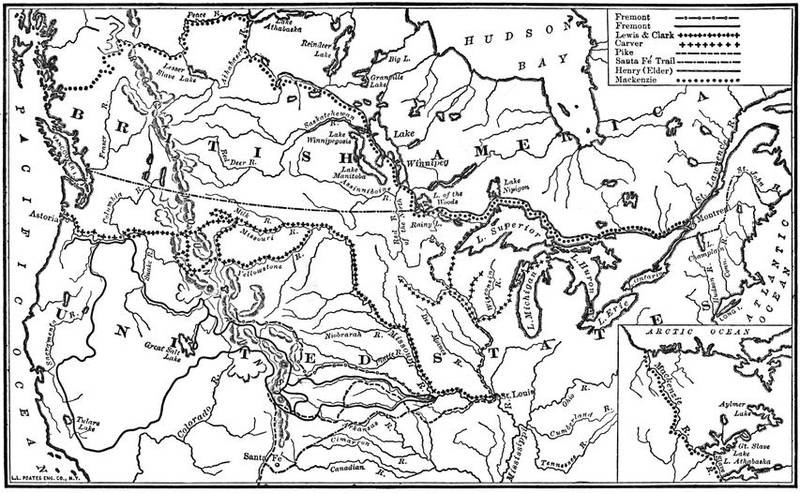
ROUTES OF SOME OF THE PATHFINDERS
TRAILS OF THE PATHFINDERS
CHAPTER I
INTRODUCTION
Three centuries ago half a dozen tiny hamlets, peopled by white men, were scattered along the western shores of the North Atlantic Ocean. These little settlements owed allegiance to different nations of Europe, each of which had thrust out a hand to grasp some share of the wealth which might lie in the unknown wilderness which stretched away from the seashore toward the west.
The “Indies” had been discovered more than a hundred years before, but though ships had sailed north and ships had sailed south, little was known of the land, through which men were seeking a passage to share the trade which the Portuguese, long before, had opened up with the mysterious East. That passage had not been found. To the north lay ice and snow, to the south—vaguely known—lay the South Sea. What that South Sea was, what its limits, what its relations to lands already visited, were still secrets.
St. Augustine had been founded in 1565; and forty years later the French made their first settlement at Port Royal in what is now Nova Scotia. In 1607 Jamestown was settled; and a year later the French established Quebec. The Pilgrims landed in Massachusetts in 1620 and the first settlement of the Dutch on the island of Manhattan was in 1623. All these settlers establishing themselves in a new country found enough to do in the struggle to procure subsistence, to protect themselves from the elements and from the attacks of enemies, without attempting to discover what lay inland—beyond the sound of the salt waves which beat upon the coast. Not until later was any effort made to learn what lay in the vast interior.
Time went on. The settlements increased. Gradually men pushed farther and farther inland. There were wars; and one nation after another was crowded from its possessions, until, at length, the British owned all the settlements in eastern temperate America. The white men still clung chiefly to the sea-coast, and it was in western Pennsylvania that the French and Indians defeated Braddock in 1755, George Washington being an officer under his command.
A little later came the war of the Revolution, and a new people sprang into being in a land a little more than two hundred and fifty years known. This people, teeming with energy, kept reaching out in all directions for new things. As they increased in numbers they spread chiefly in the direction of least resistance. The native tribes were easier to displace than the French, who held forts to the north, and the Spanish, who possessed territory to the south; and the temperate climate toward the west attracted them more than the cold of the north or the heat of the south. So the Americans pushed on always to the setting sun, and their early movements gave truth to Bishop Berkeley’s famous line, written long before and in an altogether different connection, “Westward the course of empire takes its way.” The Mississippi was reached, and little villages, occupied by Frenchmen and their half-breed children, began to change, to be transformed into American towns. Yet in 1790, ninety-five per cent. of the population of the United States was on the Atlantic seaboard.
Now came the Louisiana Purchase, and immediately after that the expedition across the continent by Meriwether Lewis and William Clark. The trip took two years’ time, and the reports brought back by the intrepid explorers, telling the wonderful story of what lay in the unknown beyond, greatly stimulated the imagination of the western people. Long before this it had become known that the western ocean—the South Sea of an earlier day—extended north along the continent, and that there was no connection here with India. It was known, too, that the Spaniards occupied the west coast. In 1790, Umfreville said: “That there are European traders settled among the Indians from the other side of the continent is without doubt. I, myself, have seen horses with Roman capitals burnt in their flanks with a hot iron. I likewise once saw a hanger with Spanish words engraved on the blade. Many other proofs have been obtained to convince us that the Spaniards on the opposite side of the continent make their inland peregrinations as well as ourselves.”
Western travel and exploration, within the United States, began soon after the return of Lewis and Clark. The trapper, seeking for peltry—the rich furs so much in demand in Europe—was the first to penetrate the unknown wilds; but close upon his heels followed the Indian trader, who used trapper and Indian alike to fill his purse. With the trapper and the trader, naturalists began to push out into the west, studying the fauna and flora of the new lands. About the same time the possibilities of trade with the Mexicans induced the beginnings of the Santa Fé trade, that Commerce of the Prairies which has been so fully written of by the intrepid spirits who took part in it. Meantime the government continued to send out expeditions, poorly provided in many ways, scarcely armed, barely furnished with provisions, without means of making their way through the unknown and dangerous regions to which they were sent, but led by heroes.
For forty years this work of investigation went on; for forty years there took place a peopling of the new West by men who were in very deed the bravest and most adventurous of our brave and hardy border population. They scattered over the plains and through the mountains; they trapped the beaver and fought the Indian and guided the explorers; and took to themselves wives from among their very enemies, and raised up broods of hardy offspring, some of whom we may yet meet as we journey through the cattle and the farming country which used to be the far West.
If ever any set of men played their part in subduing the wilderness, and in ploughing the ground to receive its seed of settlement, and to rear the crop of civilization which is now being harvested, these men did that work, and did it well. It is inconceivable that they should have had the foresight to know what they were doing; to imagine what it was that should come after them. They did not think of that. Like the bold, brave, hardy men of all times and of all countries, they did the work that lay before them, bravely, faithfully, and well, without any special thought of a distant future; surely without any regrets for the past. As the years rolled by, sickness, battle, the wild beast, starvation, murder, death in some form, whether sudden or lingering, struck them down singly or by scores; and that a man had been “rubbed out,” was cause for a sigh of regret or a word of sorrow from his companions, who forthwith saddled up and started on some journey of peril, where their fate might be what his had been.
At the end of forty years the first series of these exploratory journeys came to an end. Gold was discovered in California. The Mexican War took place. This was not unexpected, for in the Southwest, about the pueblos of Taos and Santa Fé, skirmishings and quarrels between the Spanish-Indian inhabitants and the rough mountaineers and teamsters from the States had already given warning of a conflict soon to come.
Now, well travelled wagon roads crossed the continent, and a stream of westward immigration that seemed to have no end. Before long there came Indian wars. The immigrants imposed upon the savages, ill-treated their wives, and were truculent and over-bearing to their men. The Indians stole from the immigrants, and drove off their horses. Then began a season of conflict which, by one tribe and another, yet with many intermissions, lasted almost down to our own day. For the most part, these Indian wars are well within the memory of living men. They have been told of by those who saw them and were a part of them.
Of the travellers who marched westward over the arid plains, during the period which intervened between the return of Lewis and Clark and the establishment of the old California trail, and of the earlier northmen who trafficked for the beaver in Canada, a few left records of their journeys; and of these records many are most interesting reading, for they are simple, faithful narratives of the every-day life of travellers through unknown regions. To Americans they are of especial interest, for they tell of a time when one-half of the continent which now teems with population had no inhabitants. The acres which now contribute freely of food that supplies the world; the mountains which now echo to the rattle of machinery, and the shot of the blasts which lay bare millions worth of precious metal; the waters which are churned by propeller blades, transporting all the varied products of the land to their markets; the forests, which, alas! in too many sections, no longer rustle to the breeze, but have been swept away to make room for farms and town sites—all these were then undisturbed and natural, as they had been for a thousand years. Of the travellers who passed over the vast stretches of prairie or mountain or woodland, many saw the possibilities of this vast land, and prophesied as to what might be wrought here, when, in the dim and distant future, which none could yet foresee, settlements should have pushed out from the east and occupied the land. Other travellers declared that these barren wastes would ever prove a barrier to westward settlement.
The books that were written concerning this new land are mostly long out of print, or difficult of access; yet each one of them is worth perusal. Of their authors, some bear names still familiar, even though their works have been lost sight of. Some of them made discoveries of great interest in one branch or other of science. At a later day some attained fame. Parkman’s first essay in literature was his story of The California and Oregon Trail, a fitting introduction to the many fascinating volumes that he contributed later to the early history of America; while in Washington Irving, historian and essayist, was found a narrator who should first tell connectedly of the fur trade of the Northwest, and the adventures of Bonneville.
Besides the books that were published in those times, there were also written accounts, usually in the form of diaries, or of notes kept from day to day of the happenings in the life of this or that individual, which are full of interest, because they give us pictures of one or another phase of early travel, or hunting adventures, or of trading with the Indians. Such private and personal accounts, never intended for the public eye, are to-day of extreme interest; and it is fortunate that an American student, the late Dr. Elliott Coues, has given us volumes which tell the stories of Lewis and Clark, Pike and Garces, of Jacob Fowler, of Alexander Henry the younger, and of Charles Larpenteur—contributions to the history of the winning of the greater West whose value is only now beginning to be appreciated.
The chapters that follow contain much of history which is old, but which, to the average American, will prove absolutely new. One may imagine himself very much interested in the old West, familiar with its history and devoted to its study, but it is not until he has gone through volume after volume of this ancient literature that he realizes how greatly his knowledge lacks precision and how much he still has to learn concerning the country he inhabits.
The work that the early travellers did, and the books they published, showed to the people of their day the conditions which existed in the far West, caused its settlement, and led to the slow discovery of its mineral treasures, and the slower appreciation of its possibilities to the farmer and stock-raiser. Each of these volumes had its readers, and of the readers of each we may be sure that a few, or many, attracted by the graphic descriptions of the new land, determined that they, too, would push out into it; they, too, would share in the wealth which it spread out with lavish hand.
It is all so long ago that we who are busy with a thousand modern interests care little about who contributed to the greatness of the country which we inhabit and the prosperity which we enjoy. But there was a day, which men alive may still remember, a day of strong men, of brave women, hardy pioneers, and true hearts, who ventured forth into the wilderness, braving many dangers that were real, and many more that were imaginary and yet to them seemed very real, occupied the land, broke up the virgin soil, and peopled a wilderness.
How can the men and women of this generation—dwellers in cities, or in peaceful villages, or on smiling farms—realize what those pioneers did—how they lived? He must have possessed stern resolution and firm courage, who, to better the condition of those dearest to him, risked their comfort—their very lives—on the hazard of a settlement in the unknown wilderness. The woman who accompanied this man bore an equal part in the struggle, with devoted helpfulness encouraging him in his strife with nature or cheering him in defeat. If the school of self-reliance and hardihood in which their children were reared gave them little of the lore of books, it built strong characters and made them worthy successors of courageous parents. We may not comprehend how long and fierce was the struggle with the elements, with the bristling forest, with the unbroken soil; how hard and wearing the annoyance of wild beasts, the anxiety as to climate, the fear of the prowling savage. Yet the work was done, and to-day, from the Alleghanies to the Pacific, we behold its results.
Through hard experience these pioneers had come to understand life. They possessed a due sense of proportion. They saw the things which were essential; they scorned those which were trivial. If, judged by certain standards, they were rough and uncouth, if they spoke a strange tongue, wore odd apparel, and lived narrow lives, they were yet practising—albeit unconsciously—the virtues—unflinching courage, sturdy independence and helpfulness to their neighbors—which have made America what it is.
In the work of travel and exploration in that far West of which we used to read, the figure which stands out boldest and most heroic of all is unnamed. Bearded, buckskin-clad, with rough fur cap, or kerchief tied about his head, wearing powder-horn and ball-pouch, and scalping-knife, and carrying his trusty Hawkins rifle, the trapper—the coureur des bois—was the man who did the first work in subduing the wild West, the man who laid the foundations on which its present civilization is built.
All honor to this nameless hero. We shall meet him often as we follow the westward trail.
CHAPTER II
ALEXANDER HENRY I
The fur trade, which occupied many worthy men during the eighteenth and first half of the nineteenth century, forms a romantic and interesting part of the early history of our country.
The traders, usually of English and American parentage, associated themselves with the French voyageurs, or coureurs des bois, whom Masson describes as “those heroes of the prairie and forest, regular mixtures of good and evil, extravagant by nature, at the same time grave and gay, cruel and compassionate; as credulous as superstitious, and always irreligious.” Traders and voyageurs alike suffered every privation, the cold of winter, the heat of summer, and finally, by incredible persistence, beat out the path of discovery during all seasons, until it became a well-worn trail; all to penetrate the great unknown, which might contain everything that the trader desired. The man who lived in those times and under those conditions was brave and enduring without trying to be; he was alert and quick to act, and unwearying in overcoming obstacles. Viewing him from the present day, we might call him cruel and without feeling; but in those times men were taught not to show their feelings. Their lives were given in great part to surmounting enormous difficulties of travel in unknown regions, and to establishing trade relations with unknown tribes of Indians, who often times were not disposed to be friendly. The fur trader was in constant danger, not only from hostile Indians, but often from starvation.
Alexander Henry was one of these fur traders. He came upon the scene just at the close of the French régime. At twenty-one he had joined Amherst’s army, not as a soldier, but in “a premature attempt to share in the fur trade of Canada, directly on the conquest of the country.” Wolfe’s victory at Quebec in the previous year had aroused the English traders to the opportunity presented of taking over the fur trade which the French had opened up, and Amherst’s large army was watched with great interest as it swept away the last remnant of French control. Henry was well fitted for the life that he intended to pursue, for he seems to have had knowledge of the trading posts of Albany and New York.
On the 3d day of August, 1761, Henry despatched his canoes from Montreal to Lachine on an expedition to the regions west of the Great Lakes. Little did he realize then that he should be gone from civilization for sixteen years; that he should suffer and want but survive; should see new and strange peoples, discover rivers and lakes, build forts, to be used by others who were to follow him, trade with the natives, and finally return to hear of the capture of Quebec by the Americans, and then go to France to tell of his adventures.
The route of the expedition was the usual one. Almost immediately after leaving Lachine they came to the broad stretch of Lake Saint Louis. At St. Anne’s the men used to go to confession, as the voyageurs were almost all Catholics, and at the same time offered up their vows; “for the saint from which this parish derives its name, and to whom its church is dedicated, is the patroness of the Canadians in all their travels by water.” “There is still a further custom to be observed on arriving at Saint-Anne’s,” Henry relates, “which is that of distributing eight gallons of rum to each canoe for consumption during the voyage; nor is it less according to custom to drink the whole of this liquor upon the spot. The saint, therefore, and the priest were no sooner dismissed than a scene of intoxication began in which my men surpassed, if possible, the drunken Indian in singing, fighting, and the display of savage gesture and conceit.”
Continuing up the river, and carrying over many portages, they at last reached the Ottawa, and soon ascended the Mattawa. Hitherto the French were the only white men that had been known in this region. Their relations with the Indians were friendly, and the Indians were well aware of the enmity existing between the French and the English. In the Lac des Chats Henry met several canoes of Indians returning from their winter hunt. They recognized him as an Englishman, and cautioned him, declaring that the upper Indians would kill him when they saw him, and said that the Englishmen were crazy to go so far after beaver. The expedition came at last to Lake Huron, which “lay stretched across our horizon like an ocean.” It was, perhaps, the largest water Henry had yet seen, and the prospect was alarming, but the canoes rode with the ease of a sea-bird, and his fears subsided. Coming to the island called La Cloche, because “there is here a rock standing on a plain, which, being struck, rings like a bell,” he found Indians, with whom he traded, and to whom he gave some rum, and who, recognizing him as an Englishman, told his men that the Indians at Michilimackinac would certainly kill him. On the advice of his friend Campion, Henry changed his garb, assuming the dress usually worn by the Canadians, and, smearing his face with dirt and grease, believed himself thoroughly disguised.
Passing the mouth of the river Missisaki, he found the Indians inhabiting the north side of Lake Superior cultivating corn in small quantities.
As he went on, the lake before him to the westward seemed to become less and less broad, and at last he could see the high back of the island of Michilimackinac, commonly interpreted to mean the great turtle. He found here a large village of Chippewas, and leaving as soon as possible, pushed on about two leagues farther to the fort, where there was a stockade of thirty houses and a church.
For years now Fort Michilimackinac had been a scene of great activity. Established by Father Marquette, and kept up by succeeding missionaries, the first men to brave the unknown terrors of the interior, it was from here in 1731 that the brave and adventurous Verendryes set out on their long journey to the Forks of the Saskatchewan, and to the Missouri River.
This was the half-way house for all the westward pushing and eastward coming traders, and a meeting place for all the tribes living on the Great Lakes. Here were fur traders, trappers, voyageurs, and Indians, hurrying to and fro, dressed in motley and picturesque attire. Some were bringing in furs from long and perilous journeys from the west, while others were on the eve of departure westward, and others still were leaving for Montreal. The scene must have been gay and active almost beyond our powers to imagine. Henry was in the midst of all this when the word came to him that a band of Chippewas wished to speak with him; and, however unwillingly, he was obliged to meet them, sixty in number, headed by Minavavana, their chief. “They walked in single file, each with a tomahawk in one hand and scalping-knife in the other. Their bodies were naked from the waist upward, except in a few examples, where blankets were thrown loosely over the shoulders.” Their faces were painted with charcoal, their bodies with white clay, and feathers were tied in the heads of some, and thrust through the noses of others. Before the opening of the council, the chief held a conference with Campion, asking how long it was since Henry had left Montreal, and observing that the English must be brave men and not afraid of death, since they thus ventured to come fearlessly among their enemies. After the pipe had been smoked, while Henry “inwardly endured the tortures of suspense,” the chief addressed him, saying:
“Englishman, our father, the King of France, employed our young men to make war upon your nation. In this warfare many of them have been killed; and it is our custom to retaliate, until such time as the spirits of the slain are satisfied. But the spirits of the slain are to be satisfied in either of two ways: the first is by the spilling of the blood of the nation by which they fell; the other, by covering the bodies of the dead, and thus allaying the resentment of their relations. This is done by making presents.
“Englishman, your King has never sent us any presents, nor entered into any treaty with us, wherefore he and we are still at war; and, until he does these things, we must consider that we have no other father nor friend among the white men than the King of France; but, for you, we have taken into consideration that you have ventured your life among us, in the expectation that we should not molest you. You do not come armed, with an intention to make war; you come in peace, to trade with us, and supply us with necessaries, of which we are in much want. We shall regard you, therefore, as a brother, and you may sleep tranquilly, without fear of the Chippewas. As a token of our friendship, we present you with this pipe to smoke.”
In reply, Henry told them that their late father, the King of France, had surrendered Canada to the King of England, whom they should now regard as their father, and that he, Henry, had come to furnish them with what they needed. Things were thus very satisfactory, and when the Chippewas went away they were given a small quantity of rum.
Henry was now busily at work assorting his goods, preparatory to starting on his expedition, when two hundred Ottawas entered the fort and demanded speech with him. They insisted that he should give credit to every one of their young men to the amount of fifty beaver skins, but as this demand would have stripped him of all his merchandise, he refused to comply with the request. What the Ottawas might have done is uncertain. They did nothing, because that very day word was brought that a detachment of English soldiers, sent to garrison the fort, was distant only five miles, and would be there the next day. At daybreak the Ottawas were seen preparing to depart, and by sunrise not one of them was left in the fort.
Although it was now the middle of September, the traders sent off their canoes on the different trading expeditions. These canoes were victualled largely with Indian corn at the neighboring village of L’Arbre Croche, occupied by the Ottawas. This corn was prepared for use by boiling it in a strong lye which removed the husk, after which it was pounded and dried, making a meal. “The allowance for each man on the voyage is a quart a day, and a bushel, with two pounds of prepared fat, is reckoned to be a month’s subsistence. No other allowance is made of any kind, not even of salt, and bread is never thought of. The men, nevertheless, are healthy, and capable of performing their heavy labor. This mode of victualling is essential to the trade, which, being pursued at great distances, and in vessels so small as canoes, will not admit of the use of other food. If the men were to be supplied with bread and pork, the canoes could not carry a sufficiency for six months; and the ordinary duration of the voyage is not less than fourteen.”
The food of the garrison consisted largely of small game, partridges and hares, and of fish, especially trout, whitefish, and sturgeon. Trout were caught with set lines and bait, and whitefish with nets under the ice. Should this fishery fail, it was necessary to purchase grain, which, however, was very expensive, costing forty livres, or forty shillings, Canadian currency; though there was no money in Michilimackinac, and the circulating medium consisted solely of furs. A pound of beaver was worth about sixty cents, an otter skin six shillings Canadian, and marten skins about thirty cents each.
Having wintered at Michilimackinac, Henry set out in May for the Sault de Sainte-Marie. Here there was a stockaded fort, with four houses, one of which was occupied by Monsieur Cadotte, the interpreter, and his Chippewa wife. The Indians had an important whitefish fishery at the rapids, taking the fish in dip nets. In the autumn Henry and the other whites did much fishing; and in the winter they hunted, and took large trout with the spear through the ice in this way: “In order to spear trout under the ice, holes being first cut of two yards in circumference, cabins of about two feet in height are built over them of small branches of trees; and these are further covered with skins so as to wholly exclude the light. The design and result of this contrivance is to render it practicable to discern objects in the water at a very considerable depth; for the reflection of light from the water gives that element an opaque appearance, and hides all objects from the eye at a small distance beneath its surface. A spear head of iron is fastened on a pole of about ten feet in length. This instrument is lowered into the water, and the fisherman, lying upon his belly, with his head under the cabin or cover, and therefore over the hole, lets down the figure of a fish in wood and filled with lead. Round the middle of the fish is tied a small pack thread, and, when at the depth of ten fathoms, where it is intended to be employed, it is made, by drawing the string and by the simultaneous pressure of the water, to move forward, after the manner of a real fish. Trout and other large fish, deceived by its resemblance, spring toward it to seize it, but, by a dexterous jerk of the string, it is instantly taken out of their reach. The decoy is now drawn nearer to the surface, and the fish takes some time to renew the attack, during which the spear is raised and held conveniently for striking. On the return of the fish, the spear is plunged into its back, and, the spear being barbed, it is easily drawn out of the water. So completely do the rays of the light pervade the element that in three-fathom water I have often seen the shadows of the fish on the bottom, following them as they moved; and this when the ice itself was two feet in thickness.”
The burning of the post at the Sault forced all hands to return next winter to Michilimackinac, where the early spring was devoted to the manufacture of maple sugar, an important article of diet in the northern country.
That spring Indians gathered about the fort in such large numbers as to make Henry fearful that something unusual lay behind the concourse. He spoke about it to the commanding officer, who laughed at him for his timidity. The Indians seemed to be passing to and fro in the most friendly manner, selling their fur and attending to their business altogether in a natural way.
About a year before an Indian named Wawatam had come into Henry’s house, expressed a strong liking for him, and, having explained that years before, after a fast, he had dreamed of adopting an Englishman as his son, brother, and friend, told Henry that in him he recognized the person whom the Great Spirit had pointed out to him for a brother, and that he hoped Henry would become one of his family, and at the same time he made him a large present. Henry accepted these friendly overtures, and made a handsome present in return, and the two parted for the time.
Henry had almost forgotten his brother, when, on the second day of June, twelve months later, Wawatam again came to his house and expressed great regret that Henry had returned from the Sault. Wawatam stated that he intended to go there at once, and begged Henry to accompany him. He asked, also, whether the commandant had heard bad news, saying that during the winter he himself had been much disturbed by the noises of evil birds, and that there were many Indians around the fort who had never shown themselves within it. Both the chief and his wife strove earnestly to persuade Henry to accompany them at once, but he paid little attention to their requests, and they finally took their departure, very much depressed—in fact, even weeping. The next day Henry received from a Chippewa an invitation to come out and see the great game of baggatiway, or lacrosse, which his people were going to play that day with the Sacs. But as a canoe was about to start for Montreal, Henry was busy writing letters, and although urged by a friend to go out and meet another canoe just arrived from Detroit, he nevertheless remained in his room, writing. Suddenly he heard the Indian war-cry, and, looking out of the window, saw a crowd of Indians within the fort furiously cutting down and scalping every Englishman they found. He noticed, too, many of the Canadian inhabitants of the fort quietly looking on, neither trying to stop the Indians nor suffering injury from them; and from the fact that these people were not being attacked, he conceived the hope of finding security in one of their houses. This is as he tells it:
“Between the yard-door of my own house and that of M. Langlade, my next neighbor, there was only a low fence, over which I easily climbed. At my entrance I found the whole family at the windows, gazing at the scene of blood before them. I addressed myself immediately to M. Langlade, begging that he would put me into some place of safety until the heat of the affair should be over, an act of charity by which he might perhaps preserve me from the general massacre; but, while I uttered my petition, M. Langlade, who had looked for a moment at me, turned again to the window, shrugging his shoulders and intimating that he could do nothing for me—‘Que voudriez-vous que j’en ferais?’
“This was a moment for despair; but the next a Pani woman, a slave of M. Langlade’s, beckoned to me to follow her. She brought me to a door, which she opened, desiring me to enter, and telling me that it led to the garret, where I must go and conceal myself. I joyfully obeyed her directions and she, having followed me up to the garret door, locked it after me, and with great presence of mind took away the key.
“This shelter obtained, if shelter I could hope to find it, I was naturally anxious to know what might still be passing without. Through an aperture which afforded me a view of the area of the fort, I beheld, in shapes the foulest and most terrible, the ferocious triumphs of barbarian conquerors. The dead were scalped and mangled; the dying were writhing and shrieking under the unsatiated knife and tomahawk, and, from the bodies of some ripped open, their butchers were drinking the blood, scooped up in the hollow of joined hands and quaffed amid shouts of rage and victory. I was shaken, not only with horror, but with fear. The sufferings which I witnessed, I seemed on the point of experiencing. No long time elapsed before every one being destroyed who could be found, there was a general cry of ‘All is finished!’ At the same instant I heard some of the Indians enter the house in which I was.
“The garret was separated from the room below only by a layer of single boards, at once the flooring of the one and the ceiling of the other. I could therefore hear everything that passed; and, the Indians no sooner in than they inquired whether or not any Englishmen were in the house? M. Langlade replied that ‘He could not say—he did not know of any’—answers in which he did not exceed the truth, for the Pani woman had not only hidden me by stealth, but had kept my secret and her own; M. Langlade was therefore, as I presume, as far from a wish to destroy me as he was careless about saving me, when he added to these answers that ‘They might examine for themselves, and would soon be satisfied as to the object of their question.’ Saying this, he brought them to the garret door.
“The state of my mind will be imagined. Arrived at the door, some delay was occasioned by the absence of the key, and a few moments were thus allowed me in which to look around for a hiding place. In one corner of the garret was a heap of vessels of birch-bark, used in maple-sugar making.
“The door was unlocked, and opening, and the Indians ascending the stairs, before I had completely crept into a small opening which presented itself at one end of the heap. An instant after four Indians entered the room, all armed with tomahawks, and all besmeared with blood upon every part of their bodies.
“The die appeared to be cast. I could scarcely breathe: but I thought that the throbbing of my heart occasioned a noise loud enough to betray me. The Indians walked in every direction about the garret, and one of them approached me so closely that at a particular moment, had he put forth his hand, he must have touched me. Still, I remained undiscovered, a circumstance to which the dark color of my clothes and the want of light, in a room which had no window, and in the corner in which I was, must have contributed. In a word, after taking several turns in the room, during which they told M. Langlade how many they had killed and how many scalps they had taken, they returned down-stairs, and I with sensations not to be expressed heard the door, which was the barrier between me and fate, locked for the second time.
“There was a feather bed on the floor, and on this, exhausted as I was by the agitation of my mind, I threw myself down and fell asleep. In this state I remained till the dusk of the evening, when I was awakened by a second opening of the door. The person that now entered was M. Langlade’s wife, who was much surprised at finding me, but advised me not to be uneasy, observing that the Indians had killed most of the English, but that she hoped I might myself escape. A shower of rain having begun to fall, she had come to stop a hole in the roof. On her going away, I begged her to send me a little water to drink, which she did.
“As night was now advancing, I continued to lie on the bed, ruminating on my condition but unable to discover a resource from which I could hope for life. A flight to Detroit had no probable chance of success. The distance from Michilimackinac was four hundred miles; I was without provisions, and the whole length of the road lay through Indian countries, countries of an enemy in arms, where the first man whom I should meet would kill me. To stay where I was threatened nearly the same issue. As before, fatigue of mind and not tranquillity, suspended my cares and procured me further sleep....
“The respite which sleep afforded me during the night was put an end to by the return of morning. I was again on the rack of apprehension. At sunrise I heard the family stirring, and, presently after, Indian voices, informing M. Langlade that they had not found my hapless self among the dead, and that they supposed me to be somewhere concealed. M. Langlade appeared, from what followed, to be by this time acquainted with the place of my retreat, of which, no doubt, he had been informed by his wife. The poor woman, as soon as the Indians mentioned me, declared to her husband, in the French tongue, that he should no longer keep me in his house, but deliver me up to my pursuers; giving as a reason for this measure that should the Indians discover his instrumentality in my concealment they might revenge it on her children, and that it was better that I should die than they. M. Langlade resisted at first this sentence of his wife’s; but soon suffered her to prevail, informing the Indians that he had been told I was in his house; that I had come there without his knowledge, and that he would put me into their hands. This was no sooner expressed than he began to ascend the stairs, the Indians following upon his heels.
“I now resigned myself to the fate with which I was menaced; and regarding every attempt at concealment as vain, I arose from the bed and presented myself full in view to the Indians who were entering the room. They were all in a state of intoxication, and entirely naked, except about the middle. One of them, named Wenniway, whom I had previously known and who was upward of six feet in height, had his entire face and body covered with charcoal and grease, only that a white spot of two inches in diameter encircled either eye. This man, walking up to me, seized me with one hand by the collar of the coat, while in the other he held a large carving knife, as if to plunge it into my breast; his eyes, meanwhile, were fixed steadfastly on mine. At length, after some seconds of the most anxious suspense he dropped his arm, saying, ‘I won’t kill you!’ To this he added that he had been frequently engaged in wars against the English, and had brought away many scalps; that, on a certain occasion, he had lost a brother, whose name was Musingon, and that I should be called after him.”
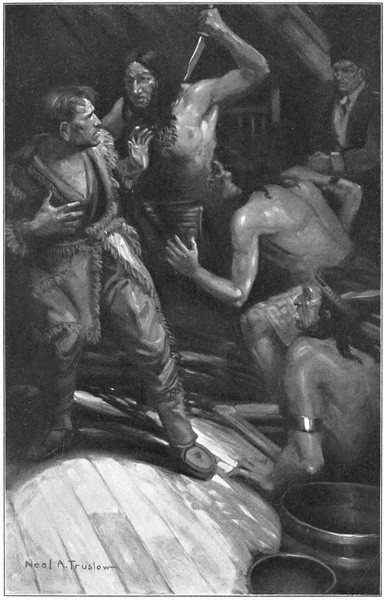
“I NOW RESIGNED MYSELF TO THE FATE WITH WHICH I WAS MENACED.”
Several times within the next two or three days Henry had narrow escapes from death at the hands of drunken Indians; but finally his captors, having stripped him of all his clothing save an old shirt, took him, with other prisoners, and set out for the Isles du Castor, in Lake Michigan.
At the village of L’Arbre Croche, the Ottawas forcibly took away their prisoners from the Chippewas, but the Chippewas made violent complaint, while the Ottawas explained to the prisoners that they had taken them from the Chippewas to save their lives, it being the practice of the Chippewas to eat their enemies, in order to give them courage in battle. A council was held between the Chippewas and Ottawas, the result of which was that the prisoners were handed over to their original captors. But before they had left this place, while Henry was sitting in the lodge with his captor, his friend and brother, Wawatam, suddenly entered. As he passed Henry he shook hands with him, but went toward the great chief, by whom he sat down, and after smoking, rose again and left the lodge, saying to Henry as he passed him, “Take courage.”
A little later, Wawatam and his wife entered the lodge, bringing large presents, which they threw down before the chiefs. Wawatam explained that Henry was his brother, and therefore a relative to the whole tribe, and asked that he be turned over to him, which was done.
Henry now went with Wawatam to his lodge, and thereafter lived with him. The Indians were very much afraid that the English would send to revenge the killing of their troops, and they shortly moved to the Island of Michilimackinac. A little later a brigade of canoes, containing goods and abundant liquor, was captured: and Wawatam, fearing the results of the drink on the Indians, took Henry away and concealed him in a cave, where he remained for two days.
The head chief of the village of Michilimackinac now recommended to Wawatam and Henry that, on account of the frequent arrival of Indians from Montreal, some of whom had lost relatives or friends in the war, Henry should be dressed like an Indian, and the wisdom of this advice was recognized. His hair was cut off, his head shaved, except for a scalp-lock, his face painted, and Indian clothing given him. Wawatam helped him to visit Michilimackinac, where Henry found one of his clerks, but none of his property. Soon after this they moved away to Wawatam’s wintering ground, which Henry was very willing to visit, because in the main camp he was constantly subjected to insults from the Indians who knew of his race.
Henry writes fully of the customs of the Indians, of the habits of many of the animals which they pursued, and of the life he led. He says that during this winter “Raccoon hunting was my more particular and daily employ. I usually went out at the first dawn of day, and seldom returned till sunset, or till I had laden myself with as many animals as I could carry. By degrees I became familiarized with this kind of life; and had it not been for the idea, of which I could not divest my mind, that I was living among savages, and for the whispers of a lingering hope that I should one day be released from it, or if I could have forgotten that I had ever been otherwise than as I then was, I could have enjoyed as much happiness in this as in any other situation.”
Among the interesting hunting occurrences narrated is one of the killing of a bear, and of the ceremonies subsequent to this killing performed by the Indians. He says:
“In the course of the month of January I happened to observe that the trunk of a very large pine tree was much torn by the claws of a bear, made both in going up and down. On further examination, I saw that there was a large opening in the upper part, near which the smaller branches were broken. From these marks, and from the additional circumstance that there were no tracks in the snow, there was reason to believe that a bear lay concealed in the tree.
“On returning to the lodge, I communicated my discovery, and it was agreed that all the family should go together in the morning to assist in cutting down the tree, the girth of which was not less than three fathom. Accordingly, in the morning we surrounded the tree, both men and women, as many at a time as could conveniently work at it, and here we toiled like beaver till the sun went down. This day’s work carried us about half way through the trunk; and the next morning we renewed the attack, continuing it till about two o’clock in the afternoon, when the tree fell to the ground. For a few minutes everything remained quiet, and I feared that all our expectations were disappointed; but, as I advanced to the opening, there came out, to the great satisfaction of all our party, a bear of extraordinary size, which, before she had proceeded many yards, I shot.
“The bear being dead, all my assistants approached, and all, but more particularly my old mother (as I was wont to call her), took her head in their hands, stroking and kissing it several times, begging a thousand pardons for taking away her life; calling her their relation and grandmother, and requesting her not to lay the fault upon them, since it was truly an Englishman that had put her to death.
“This ceremony was not of long duration, and if it was I that killed their grandmother, they were not themselves behindhand in what remained to be performed. The skin being taken off, we found the fat in several places six inches deep. This, being divided into two parts, loaded two persons, and the flesh parts were as much as four persons could carry. In all, the carcass must have exceeded five hundredweight.
“As soon as we reached the lodge, the bear’s head was adorned with all the trinkets in the possession of the family, such as silver arm-bands and wrist-bands, and belts of wampum, and then laid upon a scaffold set up for its reception within the lodge. Near the nose was placed a large quantity of tobacco.
“The next morning no sooner appeared than preparations were made for a feast to the manes. The lodge was cleaned and swept, and the head of the bear lifted up and a new stroud blanket, which had never been used before, spread under it. The pipes were now lit, and Wawatam blew tobacco smoke into the nostrils of the bear, telling me to do the same, and thus appease the anger of the bear on account of my having killed her. I endeavored to persuade my benefactor and friendly adviser that she no longer had any life, and assured him that I was under no apprehension from her displeasure; but the first proposition obtained no credit, and the second gave but little satisfaction.
“At length, the feast being ready, Wawatam commenced a speech, resembling, in many things, his address to the manes of his relations and departed companions, but having this peculiarity, that he here deplored the necessity under which men labored thus to destroy their friends. He represented, however, that the misfortune was unavoidable, since without doing so they could by no means subsist. The speech ended, we all ate heartily of the bear’s flesh, and even the head itself, after remaining three days on the scaffold, was put into the kettle.
“It is only the female bear that makes her winter lodging in the upper parts of trees, a practice by which her young are secured from the attacks of wolves and other animals. She brings forth in the winter season, and remains in her lodge till the cubs have gained some strength.
“The male always lodges in the ground, under the roots of trees. He takes to this habitation as soon as the snow falls, and remains there till it has disappeared. The Indians remark that the bear comes out in the spring with the same fat which he carried in in the autumn; but, after exercise of only a few days, becomes lean. Excepting for a short part of the season, the male lives constantly alone.
“The fat of our bear was melted down, and the oil filled six porcupine skins. A part of the meat was cut into strips and fire-dried, after which it was put into the vessels containing the oil, where it remained in perfect preservation until the middle of summer.”
When spring came, and they returned to the more travelled routes and met other Indians, it was seen that these people were all anxious lest the English should this summer avenge the outbreak of the Indians of the previous year. Henry was exceedingly anxious to escape from his present life, and his brother was willing that he should go, but this appeared difficult. At last, however, a Canadian canoe, carrying Madame Cadotte, came along, and this good woman was willing to assist Henry so far as she could. He and his brother parted rather sadly, and Henry, now under the guise of a Canadian, took a paddle in Madame Cadotte’s canoe. She took him safely to the Sault, where he was welcomed by Monsieur Cadotte, whose great influence among the Indians was easily sufficient to protect him. Soon after this there came an embassy from Sir William Johnson, calling the Indians to come to Niagara and make peace with the English; and after consulting the Great Turtle, who was the guardian spirit of the Chippewas, a number of young men volunteered to go to Niagara, and among them Henry.
After a long voyage they reached Niagara, where Henry was very kindly received by Sir William Johnson and subsequently was appointed by General Bradstreet, commander of an Indian battalion of ninety-six men, among whom were many of the Indians who, not long before, had been ready and eager to kill him. With this command he moved westward, and after peace had been made with Pontiac at Detroit, with a detachment of troops reached Michilimackinac, where he recovered a part of his property.
CHAPTER III
ALEXANDER HENRY II
The French Government had established regulations governing the fur trade in Canada, and in 1765, when Henry made his second expedition, some features of the old system were still preserved. No person was permitted to enter the countries lying north-west of Detroit unless furnished with a license, and military commanders had the privilege of granting to any individual the exclusive trade of particular districts.
At this time beaver were worth two shillings and sixpence per pound; otter skins, six shillings each; martens, one shilling and sixpence; all this in nominal Michilimackinac currency, although here fur was still the current coin. Henry loaded his four canoes with the value of ten thousand pounds’ weight of good and merchantable beaver. For provision he purchased fifty bushels of corn, at ten pounds of beaver per bushel. He took into partnership Monsieur Cadotte, and leaving Michilimackinac July 14, and Sault Sainte-Marie the 26th, he proceeded to his wintering ground at Chagouemig. On the 19th of August he reached the river Ontonagan, notable for its abundance of native copper, which the Indians used to manufacture into spoons and bracelets for themselves. This they did by the mere process of hammering it out. Not far beyond this river he met Indians, to whom he gave credit. “The prices were for a stroud blanket, ten beaver skins; for a white blanket, eight; a pound of powder, two; a pound of shot or of ball, one; a gun, twenty; an axe of one pound weight, two; a knife, one.” As the value of a skin was about one dollar, the prices to the Indians were fairly high.
Chagouemig, where Henry wintered, is now known as Chequamegon. It is in Wisconsin, a bay which partly divides Bayfield from Ashland county, and seems always to have been a great gathering place for Indians. There were now about fifty lodges here, making, with those who had followed Henry, about one hundred families. All were poor, their trade having been interfered with by the English invasion of Canada and by Pontiac’s war. Henry was obliged to distribute goods to them to the amount of three thousand beaver skins, and this done, the Indians separated to look for fur. Henry sent a clerk to Fond du Lac with two loaded canoes; Fond du Lac being, roughly, the site of the present city of Duluth. As soon as Henry was fairly settled, he built a house, and began to collect fish from the lake as food for the winter. Before long he had two thousand trout and whitefish, the former frequently weighing fifty pounds each, the latter from four to six. They were preserved by being hung up by the tail and did not thaw during the winter. When the bay froze over, Henry amused himself by spearing trout, and sometimes caught a hundred in a day, each weighing on an average twenty pounds.
He had some difficulty with the first hunting party which brought furs. The men crowded into his house and demanded rum, and when he refused it, they threatened to take all he had. His men were frightened and all abandoned him. He got hold of a gun, however, and on threatening to shoot the first who should lay hands on anything, the disturbance began to subside and was presently at an end. He now buried the liquor that he had, and when the Indians were finally persuaded that he had none to give them, they went and came very peaceably, paying their debts and purchasing goods.
The ice broke up in April, and by the middle of May the Indians began to come in with their furs, so that by the close of the spring Henry found himself with a hundred and fifty packs of beaver, weighing a hundred pounds each, besides twenty-five packs of otter and marten skins. These he took to Michilimackinac, accompanied by fifty canoes of Indians, who still had a hundred packs of beaver that they did not sell. It appears, therefore, that Henry’s ten thousand pounds of beaver brought him fifty per cent. profit in beaver, besides the otter and the marten skins which he had.
On his way back he went up the Ontonagan River to see the celebrated mass of copper there, which he estimated to weigh no less than five tons. So pure was it that with an axe he chopped off a piece weighing a hundred pounds. This great mass of copper, which had been worked at for no one knows how long by Indians and by early explorers, lay there for eighty years after Henry saw it; and finally, in 1843, was removed to the Smithsonian Institution at Washington. It was then estimated to weigh between three and four tons, and the cost of transporting it to the national capital was about $3,500.
The following winter was passed at Sault Sainte-Marie, and was rather an unhappy one, as the fishery failed, and there was great suffering from hunger. Canadians and Indians gathered there from the surrounding country, driven in by lack of food. Among the incidents of the winter was the arrival of a young man who had been guilty of cannibalism. He was killed by the Indians, not so much as punishment, as from the fear that he would kill and eat some of their children.
A journey to a neighboring bay resulted in no great catch of fish, and returning to the Sault, Henry started for Michilimackinac. At the first encampment, an hour’s fishing procured them seven trout, of from ten to twenty pounds’ weight. A little later they met a camp of Indians who had fish, and shared with them; and the following day Henry killed a caribou, by which they camped and on which they subsisted for two days.
The following winter Henry stopped at Michipicoten, on the north side of Lake Superior, and about a hundred and fifty miles from the Sault. Here there were a few people known as Gens des Terres, a tribe of Algonquins, living in middle Canada, and ranging from the Athabasca country east to Lake Temiscamingue. A few of them still live near the St. Maurice River, in the Province of Quebec. These people, though miserably poor, and occupying a country containing very few animals, had a high reputation for honesty and worth. Therefore, Henry gave to every man credit for one hundred beaver skins, and to every woman thirty—a very large credit.
There was some game in this country, a few caribou, and some hares and partridges. The hills were well wooded with sugar-maples, and from these, when spring came, Henry made sugar; and for a time this was their sole provision, each man consuming a pound a day, desiring no other food, and being visibly nourished by the sugar. Soon after this, wildfowl appeared in such abundance that subsistence for fifty could without difficulty be shot daily by one man, but this lasted only for a week, by which time the birds all departed. By the end of May all to whom Henry had advanced goods returned, and of the two thousand skins for which he had given them credit, not thirty remained unpaid. The small loss that he did suffer was occasioned by the death of one of the Indians, whose family brought all the skins of which he died possessed, and offered to contribute among themselves the balance.
The following winter was also to be passed at Michipicoten, and in the month of October, after all the Indians had received their goods and had gone away, Henry set out for the Sault on a visit. He took little provision, only a quart of corn for each person.
On the first night they camped on an island sacred to Nanibojou, one of the Chippewa gods, and failed to offer the tobacco which an Indian would always have presented to the spirit. In the night a violent storm arose which continued for three days. When it abated on the third day they went to examine the net which they had set for fish, and found it gone. The wind was ahead to return to Michipicoten, and they steered for the Sault; but that night the wind shifted and blew a gale for nine days following. They soon began to starve, and though Henry hunted faithfully, he killed nothing more than two snowbirds. One of his men informed him that the other two had proposed to kill and eat a young woman, whom they were taking to the Sault, and when taxed with the proposition, these two men had the hardihood to acknowledge it. The next morning, Henry, still searching for food, found on a rock the tripe de roche, a lichen, which, when cooked, yields a jelly which will support life. The discovery of this food, on which they supported themselves thereafter, undoubtedly saved the life of the poor woman. When they embarked on the evening of the ninth day they were weak and miserable; but, luckily, the next morning, meeting two canoes of Indians, they received a gift of fish, and at once landed to feast on them.
In the spring of 1769, and for some years afterward, Henry turned his attention more or less to mines. He visited the Ile de Maurepas, said to contain shining rocks and stones of rare description, but was much disappointed in the island, which seemed commonplace enough. A year later Mr. Baxter, with whom Henry had formed a partnership for copper mining, returned, and during the following winter, at Sault Sainte-Marie, they built vessels for navigating the lakes. Henry had heard of an island (Caribou Island) in Lake Superior described as covered with a heavy yellow sand like gold-dust, and guarded by enormous snakes. With Mr. Baxter he searched for this island and finally found it, but neither yellow sands nor snakes nor gold. Hawks there were in abundance, and one of them picked Henry’s cap from his head. There were also caribou, and they killed thirteen, and found many complete and undisturbed skeletons. Continuing their investigations into the mines about the lakes, they found abundant copper ore, and some supposed to contain silver. But their final conclusion was that the cost of carrying the copper ore to Montreal must exceed its marketable value.
In June, 1775, Henry left Sault Sainte-Marie with four large canoes and twelve small ones, carrying goods and provisions to the value of three thousand pounds sterling. He passed west, over the Grand Portage, entered Lac à la Pluie, passed down to the Lake of the Woods, and finally reached Lake Winipegon. Here there were Crees, variously known as Christinaux, Kinistineaux, Killistinoes, and Killistinaux. Lake Winipegon is sometimes called the Lake of the Crees. These people were primitive. Almost entirely naked, the whole body was painted with red ochre; the head was wholly shaved, or the hair was plucked out, except a spot on the crown, where it grew long and was rolled and gathered into a tuft; the ears were pierced, and filled with bones of fishes and land animals. The women, on the other hand, had long hair, which was gathered into a roll on either side of the head above the ear, and was covered with a piece of skin, painted or ornamented with beads of various colors. The traditions of the Cheyennes of to-day point back to precisely similar methods of dressing the hair of the women and of painting the men.
The Crees were friendly, and gave the traveller presents of wild rice and dried meat. He kept on along the lake and soon joined Peter Pond, a well-known trader of early days. A little later, in early September, the two Frobishers and Mr. Patterson overtook them. On the 1st of October they reached the River de Bourbon, now known as the Saskatchewan, and proceeded up it, using the tow-line to overcome the Great Rapids. They passed on into Lake de Bourbon, now Cedar Lake, and by old Fort Bourbon, built by the Sieur de Vérendrye. At the mouth of the Pasquayah River they found a village of Swampy Crees, the chief of whom expressed his gratification at their coming, but remarked that, as it would be possible for him to kill them all when they returned, he expected them to be extremely liberal with their presents. He then specified what it was that he desired, namely, three casks of gunpowder, four bags of shot and ball, two bales of tobacco, three kegs of rum, and three guns, together with many smaller articles. Finally he declared that he was a peaceable man, and always tried to get along without quarrels. The traders were obliged to submit to being thus robbed, and passed on up the river to Cumberland House. Here they separated, M. Cadotte going on with four canoes to the Fort des Prairies, a name given then and later to many of the trading posts built on the prairie. This one is probably that Fort des Prairies which was situated just below the junction of the north and south forks of the Saskatchewan River, and was known as Fort Nippewen. Mr. Pond, with two canoes, went to Fort Dauphin, on Lake Dauphin, while the Messrs. Frobisher and Henry agreed to winter together on Beaver Lake. Here they found a good place for a post, and were soon well lodged. Fish were abundant, and the post soon assumed the appearance of a settlement. Owing to the lateness of the season, their canoes could not be buried in the ground, as was the common practice, and they were therefore placed on scaffolds. The fishing here was very successful, and moose were killed. The Indians brought in beaver and bear’s meat, and some skins for sale.
In January, 1776, Henry left the fort on Beaver Lake, attended by two men, and provided with dried meat, frozen fish, and cornmeal, to make an excursion over the plains, “or, as the French denominate them, the Prairies, or Meadows.” There was snow on the ground, and the baggage was hauled by the men on sledges. The cold was bitter, but they were provided with “ox skins, which the traders call buffalo robes.”
Beaver Lake was in the wooded country, and, indeed, all Henry’s journeyings hitherto had been through a region that was timbered; but here, striking south and west, by way of Cumberland House, he says, “I was not far advanced before the country betrayed some approaches to the characteristic nakedness of the plains. The wood dwindled away, both in size and quantity, so that it was with difficulty we could collect sufficient for making a fire, and without fire we could not drink, for melted snow was our only resource, the ice on the river being too thick to be penetrated by the axe.” Moreover, the weather was bitterly cold, and after a time provisions grew scanty. No game was seen and no trace of anything human. The men began to starve and to grow weak, but as tracks of elk and moose were seen, Henry cheered them up by telling them that they would certainly kill something before long.
“On the twentieth, the last remains of our provisions were expended; but I had taken the precaution to conceal a cake of chocolate in reserve for an occasion like that which was now arrived. Toward evening my men, after walking the whole day, began to lose their strength, but we nevertheless kept on our feet till it was late, and when we encamped I informed them of the treasure which was still in store. I desired them to fill the kettle with snow, and argued with them the while that the chocolate would keep us alive for five days at least, an interval in which we should surely meet with some Indian at the chase. Their spirits revived at the suggestion, and, the kettle being filled with two gallons of water, I put into it one square of the chocolate. The quantity was scarcely sufficient to alter the color of the water, but each of us drank half a gallon of the warm liquor, by which we were much refreshed, and in its enjoyment felt no more of the fatigues of the day. In the morning we allowed ourselves a similar repast, after finishing which we marched vigorously for six hours. But now the spirits of my companions again deserted them, and they declared that they neither would, nor could, proceed any further. For myself, they advised me to leave them, and accomplish the journey as I could; but for themselves, they said, that they must die soon, and might as well die where they were as anywhere else.
“While things were in this melancholy posture, I filled the kettle and boiled another square of chocolate. When prepared I prevailed upon my desponding companions to return to their warm beverage. On taking it they recovered inconceivably, and, after smoking a pipe, consented to go forward. While their stomachs were comforted by the warm water they walked well, but as evening approached fatigue overcame them, and they relapsed into their former condition, and, the chocolate being now almost entirely consumed, I began to fear that I must really abandon them, for I was able to endure more hardship than they, and, had it not been for keeping company with them, I could have advanced double the distance within the time which had been spent. To my great joy, however, the usual quantity of warm water revived them.
“For breakfast the next morning I put the last square of chocolate into the kettle, and, our meal finished, we began our march in but very indifferent spirits. We were surrounded by large herds of wolves which sometimes came close upon us, and who knew, as we were prone to think, the extremity in which we were, and marked us for their prey; but I carried a gun, and this was our protection. I fired several times, but unfortunately missed at each, for a morsel of wolf’s flesh would have afforded us a banquet.
“Our misery, nevertheless, was still nearer its end than we imagined, and the event was such as to give one of the innumerable proofs that despair is not made for man. Before sunset we discovered on the ice some remains of the bones of an elk left there by the wolves. Having instantly gathered them, we encamped, and, filling our kettle, prepared ourselves a meal of strong and excellent soup. The greater part of the night was passed in boiling and regaling on our booty, and early in the morning we felt ourselves strong enough to proceed.
“This day, the twenty-fifth, we found the borders of the plains reaching to the very banks of the river, which were two hundred feet above the level of the ice. Water marks presented themselves at twenty feet above the actual level.
“Want had lost his dominion over us. At noon we saw the horns of a red deer [an elk or wapiti] standing in the snow on the river. On examination we found that the whole carcass was with them, the animal having broke through the ice in the beginning of the winter in attempting to cross the river too early in the season, while his horns, fastening themselves in the ice, had prevented him from sinking. By cutting away the ice we were enabled to lay bare a part of the back and shoulders, and thus procure a stock of food amply sufficient for the rest of our journey. We accordingly encamped and employed our kettle to good purpose, forgot all our misfortunes, and prepared to walk with cheerfulness the twenty leagues which, as we reckoned, still lay between ourselves and Fort des Prairies.
“Though the deer must have been in this situation ever since the month of November, yet its flesh was perfectly good. Its horns alone were five foot high or more, and it will therefore not appear extraordinary that they should be seen above the snow.
“On the twenty-seventh, in the morning, we discovered the print of snow-shoes, demonstrating that several persons had passed that way the day before. These were the first marks of other human feet than our own which we had seen since our leaving Cumberland House, and it was much to feel that we had fellow-creatures in the wide waste surrounding us. In the evening we reached the fort.”
At Fort des Prairies, Henry saw more provisions than he had ever before dreamed of. In one heap he saw fifty tons of buffalo meat, so fat that the men could hardly find meat lean enough to eat. Immediately south of this plains country, which he was on the edge of, was the land of the Osinipoilles [Assiniboines, a tribe of the Dakota or Sioux nation], and some of these people being at the fort, Henry determined to visit them at their village, and on the 5th of February set out to do so. The Indians whom they accompanied carried their baggage on dog travois. They used snow-shoes and travelled swiftly, and at night camped in the shelter of a little grove of wood. There were fourteen people in the tent in which Henry slept that night, but these were not enough to keep each other warm. They started each morning at daylight, and travelled as long as they could, and over snow that was often four feet deep. During the journey they saw buffalo, which Henry calls wild oxen, but did not disturb them, as they had no time to do so, and no means of carrying the flesh if they had killed any. One night they met two young men who had come out to meet the party. They had not known that there were white men with it, and announced that they must return to advise the chief of this; but before they could start, a storm came up which prevented their departure. All that night and part of the next day the wind blew fiercely, with drifting snow. “In the morning we were alarmed by the approach of a herd of oxen, who came from the open ground to shelter themselves in the wood. Their numbers were so great that we dreaded lest they should fairly trample down the camp; nor could it have happened otherwise but for the dogs, almost as numerous as they, who were able to keep them in check. The Indians killed several when close upon their tents, but neither the fire of the Indians nor the noise of the dogs could soon drive them away. Whatever were the terrors which filled the wood, they had no other escape from the terrors of the storm.”
Two days later they reached the neighborhood of the camp, which was situated in a woody island. Messengers came to welcome them, and a guard armed with bows and spears, evidently the soldiers, to escort them to the home which had been assigned them. They were quartered in a comfortable skin lodge, seated on buffalo robes; women brought them water for washing, and presently a man invited them to a feast, himself showing them the way to the head chief’s tent. The usual smoking, feasting, and speech-making followed.
These Osinipoilles seemed not before to have seen white men, for when walking about the camp, crowds of women and children followed them, very respectfully, but evidently devoured by insatiable curiosity. Water here was obtained by hanging a buffalo paunch kettle filled with snow in the smoke of the fire, and, as the snow melted, more and more was added, until the paunch was full of water. During their stay they never had occasion to cook in the lodge, being constantly invited to feasts. They had with them always the guard of soldiers, who were careful to allow no one to crowd upon or annoy the travellers. They had been here but a short time when the head chief sent them word that he was going to hunt buffalo the next day, and asked them to be of the party.
“In the morning we went to the hunt accordingly. The chief was followed by about forty men and a great number of women. We proceeded to a small island [of timber] on the plain, at the distance of five miles from the village. On our way we saw large herds of oxen at feed, but the hunters forebore to molest them lest they should take the alarm.
“Arrived at the island, the women pitched a few tents, while the chief led his hunters to its southern end, where there was a pound or inclosure. The fence was about four feet high, and formed of strong stakes of birch wood, wattled with smaller branches of the same. The day was spent in making repairs, and by the evening all was ready for the hunt.
“At daylight several of the more expert hunters were sent to decoy the animals into the pound. They were dressed in ox skins, with the hair and horns. Their faces were covered, and their gestures so closely resembled those of the animals themselves that, had I not been in the secret, I should have been as much deceived as the oxen.
“At ten o’clock one of the hunters returned, bringing information of the herd. Immediately all the dogs were muzzled; and, this done, the whole crowd of men and women surrounded the outside of the pound. The herd, of which the extent was so great that I cannot pretend to estimate the numbers, was distant half a mile, advancing slowly, and frequently stopping to feed. The part played by the decoyers was that of approaching them within hearing and then bellowing like themselves. On hearing the noise, the oxen did not fail to give it attention, and, whether from curiosity or sympathy, advanced to meet those from whom it proceeded. These, in the meantime, fell back deliberately toward the pound, always repeating the call whenever the oxen stopped. This was reiterated till the leaders of the herd had followed the decoyers into the jaws of the pound, which, though wide asunder toward the plain, terminated, like a funnel, in a small aperture or gateway, and within this was the pound itself. The Indians remark that in all herds of animals there are chiefs, or leaders, by whom the motions of the rest are determined.
“The decoyers now retired within the pound, and were followed by the oxen. But the former retired still further, withdrawing themselves at certain movable parts of the fence, while the latter were fallen upon by all the hunters and presently wounded and killed by showers of arrows. Amid the uproar which ensued the oxen made several attempts to force the fence, but the Indians stopped them and drove them back by shaking skins before their eyes. Skins were also made use of to stop the entrance, being let down by strings as soon as the oxen were inside. The slaughter was prolonged till the evening, when the hunters returned to their tents. Next morning all the tongues were presented to the chief, to the number of seventy-two.
“The women brought the meat to the village on sledges drawn by dogs. The lumps on the shoulders, and the hearts, as well as the tongues, were set apart for feasts, while the rest was consumed as ordinary food, or dried, for sale at the fort.”
Henry has much to say about the Assiniboines, their methods of hunting, religion, marriage, healing, and many other customs. He notes especially their cruelty to their slaves, and says that the Assiniboines seldom married captive women.
On the 19th of February the Assiniboine camp started to the Fort des Prairies, and on the 28th camped at a little distance from it; but Henry and his companions went on, and reached the post that evening. Henry declares that “The Osinipoilles at this period had had no acquaintance with any foreign nation sufficient to affect their ancient and pristine habits. Like the other Indians, they were cruel to their enemies; but, as far as the experience of myself and other Europeans authorizes me to speak, they were a harmless people with a large share of simplicity of manners and plain dealing. They lived in fear of the Cristinaux, by whom they were not only frequently imposed upon, but pillaged, when the latter met their bands in smaller numbers than their own.”
On the 22d of March Henry set out to return to Beaver Lake. They reached Cumberland House on the 5th of April, and Beaver Lake on the 9th. The lake was still covered with ice, and fish had grown scarce, so that it was necessary to keep fishing all the time in order to provide sustenance. Early in May, however, water-fowl made their appearance, and for some little time there was abundance. They left their post on the 21st of April, very short of provisions. They travelled slowly, finally coming to a large lake which, on the 6th of June, was still frozen over, but the ice was too weak to be crossed. The Indians killed some moose. On reaching Churchill River they set out for Lake Arabuthcow [Athabasca] with six Canadians and an Indian woman as guide. The river was sometimes broad and slow-flowing, and again narrow and very rapid. Fish were plenty. On January 24th they reached Isle à la Crosse Lake, and met a number of Indians, to whom they made presents and whom they invited to visit them at their fort. These Indians seem to have been Chipewyans, known to ethnologists as Athabascans. They accepted the white men’s invitation, and all started for the fort, continuing the journey day and night, stopping only to boil the kettle.
The discipline among these Athabasca Indians seemed exceedingly good, as, in fact, it usually was in primitive times. The orders given by the chief were conscientiously obeyed, and this under circumstances of much temptation, since, when liquor was being served out to the young men, a certain number were told off who were ordered not to drink at all, but to maintain a constant guard over the white men.
In the trade which followed, the Indians delivered their skins at a small window in the fort, made for that purpose, asking at the same time for the different articles they wished to purchase, of which the prices had been previously settled with the chiefs. The trade lasted for more than two days, and amounted to 12,000 beaver skins, besides large numbers of otter and marten skins. These Indians had come from Lake Arabuthcow, at which they had wintered. They reported that at the farther end of that lake was a river called Peace River, which descended from the Stony or Rocky Mountains, from which mountains the distance to the Salt Lake, meaning the Pacific Ocean, was not great. Other things the Indians told Henry which he did not then understand, but a few years later Alexander Mackenzie was to meet these problems and to solve many of them. These Indians dressed in beaver skins, and were orderly and unoffending. Mr. Joseph Frobisher and Henry now set out to return to the Grand Portage, leaving the remainder of their merchandise in the care of Thomas Frobisher, who was to go with them to Lake Athabasca.
When Henry reached the Lake of the Woods he found there some Indians, who told him that a strange nation had entered Montreal, taken Quebec, killed all the English, and would certainly be at the Grand Portage before they reached there. Henry remarked to his companion that he suspected the Bastonnais had been up to some mischief in Canada, and the Indians at once exclaimed, “Yes, that’s the name, Bastonnais.” Bastonnais or Bostonnais, that is, “Boston men,” was a name commonly used in the Northwest to distinguish the Americans from the English, or “King George men.”
Without further accident Henry reached the Grand Portage, from which place he continued to Montreal, which he reached the 15th of October. Here he found that the Americans had been driven out, and that the city was protected by the forces of General Burgoyne. The capture of Montreal took place in the fall of 1775, and Quebec was besieged during the winter of 1775–1776, and it was nearly a year later that Henry heard the news at the Lake of the Woods.
This ends the account of Henry’s travels, but he was still in the fur trade for many years later. In 1785 he was a leading merchant of Montreal, and in 1790 he returned to Michilimackinac.
His book was published in New York in 1809, and thus not until eight years after the publication of Alexander Mackenzie’s great work. Henry died in Montreal, April 4, 1824, in the 85th year of his age.
Besides himself being a fur trader, Henry was a father of fur traders. His son, William Henry, is constantly mentioned in the diary of Alexander Henry the younger. A second son, Alexander, was also in the fur trade, and was killed on the Liard River. Alexander Henry the younger, a nephew, is well known, and will be noticed hereafter. A Mr. Bethune, constantly spoken of by Alexander Henry, Jr., may, or may not, have been a relative. Certain it is that Alexander Henry had nephews named Bethune.
The narrative is remarkable from its simplicity and clearness of style, as well as for the keen powers of observation shown by the writer. It is one of the most interesting of the many interesting volumes on the fur trade of its own and later times.
CHAPTER IV
JONATHAN CARVER
At the close of the “late war with France,” when peace had been established by the treaty of Versailles, in the year 1763, Jonathan Carver, the captain of a company of provincial troops during the French and Indian War, began to consider how he might continue to do service to his country and contribute as much as lay in his power to make advantageous to Great Britain that vast territory which had been acquired by that war in North America. What this territory was, how far it extended, what were its products, who were its inhabitants, were some of the questions that suggested themselves to Carver. He was a good patriot, and felt that knowledge as to these points would be of the greatest importance to his country. With the natural suspicion that Englishmen of his time felt of the French, he believed that they, while they retained their power in North America, had taken every artful method to keep all other nations, particularly the English, ignorant of everything concerning the interior parts of the country. “To accomplish this design with the greatest certainty,” he says, “they had published inaccurate maps and false accounts; calling the different nations of the Indians by nicknames they had given them, and not by those really appertaining to them. Whether the intention of the French in doing this was to prevent these nations from being discovered and traded with, or to conceal their discourse, when they talked to each other of the Indian concerns, in their presence, I will not determine; but whatsoever was the cause from which it arose, it tended to mislead.”
Carver contemplated something more important and far-reaching than the mere investigation of the country, for he says: “What I chiefly had in view after gaining a knowledge of the manners, customs, languages, soil, and natural products of the different nations that inhabit the back of the Mississippi, was to ascertain the breadth of that vast continent from the Atlantic to the Pacific Ocean in its broadest part, between 43 and 46 degrees north latitude. Had I been able to accomplish this, I intended to have proposed to the government to establish a post in some of those parts about the Straits of Annian [Puget Sound] which, having been first discovered by Sir Francis Drake, of course belonged to the English. This, I am convinced, would greatly facilitate the discovery of the northwest passage, or a communication between Hudson’s Bay and the Pacific Ocean, an event so desirable, and which has been so often sought for, but without success. Besides this important end, a settlement on that extremity of America would answer many good purposes, and repay every expense the establishment of it might occasion. For it would not only disclose new sources of trade, and promote many useful discoveries, but would open a passage for conveying intelligence to China, and the English settlements in the East Indies, with greater expedition than a tedious voyage by the Cape of Good Hope or the Straits of Magellan would allow of.”
Carver’s projects for crossing the continent to the Pacific Ocean proved abortive; yet he travelled into the interior nearly as far as any one had hitherto advanced. True, the Verendryes and one or two of the Jesuit Fathers went beyond him on this parallel of latitude; yet the work which Carver published is almost the first that touches on a region lying well within the borders of the Louisiana Purchase, and now one of the most important sections of the United States.
In his introduction, Carver has a prophetic word to say about the unhappy relations existing, when he wrote, between Great Britain and America. “To what power or authority this new world will become dependent, after it has arisen from its present uncultivated state, time alone can discover. But as the seat of Empire, from time immemorial, has been gradually progressive toward the west, there is no doubt but that at some future period, mighty kingdoms will emerge from these wildernesses, and stately palaces and solemn temples, with gilded spires reaching the skies, supplant the Indians’ huts, whose only decorations are the barbarous trophies of their vanquished enemies.”
In June, 1766, Carver left Boston for the interior parts of North America. He has little to say about the country lying adjacent to the “back-settlements,” which, he observes, have often been described. He passed through the Great Lakes, mentioning as he goes various Indian tribes and some of the products of the country, stopped some little time at the great town of the Winnebagoes, at Lake Winnebago, in Wisconsin, where he was very civilly received. At this time these people had a queen, or woman chief. He discusses this tribe at some length, and incidentally repeats a curious story: “An elderly chief more particularly acquainted me that, about forty-six winters ago, he marched, at the head of fifty warriors, toward the south-west for three moons. That during this expedition, whilst they were crossing a plain, they discovered a body of men on horseback, who belonged to the Black People; for so they call the Spaniards. As soon as they perceived them, they proceeded with caution, and concealed themselves till night came on; when they drew so near as to be able to discern the number and situation of their enemies. Finding they were not able to cope with so great a superiority by daylight, they waited till they had retired to rest; when they rushed upon them, and after having killed the greatest part of the men, took eighty horses loaded with what they termed white stone. This I suppose to have been silver, as he told me the horses were shod with it, and that their bridles were ornamented with the same. When they had satiated their revenge, they carried off their spoil, and being got so far as to be out of reach of the Spaniards that had escaped their fury, they left the useless and ponderous burthen, with which the horses were loaded, in the woods, and mounting themselves, in this manner returned to their friends. The party they had thus defeated, I conclude to be the caravan that annually conveys to Mexico the silver which the Spaniards find in great quantities on the mountains lying near the heads of the Colorado River; and the plains where the attack was made, probably, some they were obliged to pass over in their way to the heads of the River St. Fee, or Rio del Nord, which falls into the Gulf of Mexico to the west of the Mississippi.”
From the Winnebago town, Carver proceeded up the Fox River, and then carried across a short distance to the Ouisconsin River, and proceeded down that. Here he found the great town of the Saukies, the largest and best built Indian town he ever saw. It consisted of “about ninety houses, each large enough for several families, built of hewn plank, neatly jointed, and covered with bark so compactly as to keep out the most penetrating rains.” The streets were regular and spacious; and it appeared more like a civilized town than the abode of savages. About the town lay the plantations of the Indians, in which they raised great quantities of corn, beans, and melons; and their annual product was so large that this place was esteemed the best market for traders to furnish themselves with provisions of any within eight hundred miles. Near the mouth of the Wisconsin River, on the banks of the Mississippi, the Ottigaumies—Outagami, i. e., “people of the other band,” that is the Foxes—had a large town, at a place called “La Prairie des Chiens [Carver writes this name in various ways], which signifies Dog Plains,” a great trading place.
About the first of November, Carver reached Lake Pepin, and speaks with the greatest enthusiasm of the beauty of the country, its apparent productiveness, and the extraordinary number of game and wild fowl seen near about it. “On the plains,” he says, “are the largest buffalo of any in America. In the groves are found great plenty of turkeys and partridges; while great numbers of fowl, such as storks, swans, geese, brants, and ducks frequent the lake.” A little below that lake he discovered, in a fine, level, open plain, what had once been a breastwork, about four feet in height, extending the best part of a mile, and sufficiently capacious to cover five thousand men; one of the famous mounds for which the Mississippi Valley has so long been celebrated.
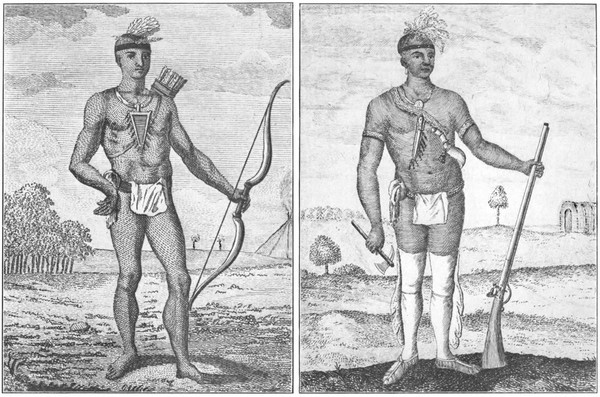
A MAN OF THE NAUDOWESSIE.
A MAN OF THE OTTIGAUMIES.
From Travels Through the Interior Parts of North America, by Jonathan Carver.
About thirty miles above Lake Pepin, near the St. Croix River, Carver met three bands of the Naudowessie—Sioux—Indians; and while he was there a war party of Chippewas approached the camp, and seemed to be preparing for an attack. The Sioux requested Carver to help them, to put himself at their head and lead them against their enemies. This the traveller was of course unwilling to do, for his work in the country made it important that he should be friendly with all people. He endeavored to persuade the Sioux to allow him to attempt to make peace with the Chippewas, and when at length they assented, he met the invaders and succeeded in inducing them to turn back without making an attack. He then persuaded the Sioux to move their camp to another part of the country, lest the Chippewas should change their mind and return to attack them. Carver declares that this diplomatic success gained him great credit with both Sioux and Chippewas; that to it he was indebted for the friendly reception that he afterward met with the Naudowessie of the Plains; and that when many months later he reached the village of the Chippewas, farther to the north, he was received with great cordiality by the chiefs, many of whom thanked him for having prevented the mischief.
About thirty miles below the Falls of St. Anthony, Carver was shown a remarkable cave of amazing depth, which the Indians called Wacon-teebe—Wakán tipi, mysterious or sacred dwelling—that is to say, “the Dwelling of the Great Spirit.” Within it is a lake, which “extends to an unsearchable distance; for the darkness of the cave prevents all attempts to acquire a knowledge of it.” The walls are covered with many Indian hieroglyphics, which seem to be very ancient, for time had nearly covered them with moss. The Falls of St. Anthony greatly impressed Carver, as they did the young Indian in his company.
At the mouth of the river St. Francis, Carver says, “I observed here many deer and carraboes—a record for the caribou unusually far south for the mid continent—some elk, with abundance of beavers, otters and other furs. Not far above this, to the north-east, are a number of small lakes called the Thousand Lakes; the parts about which though but little frequented, are the best within many miles for hunting, as the hunter never fails of returning loaded beyond his expectations.”
Above the St. Francis River, the Mississippi was new ground, for Hennepin, the river’s first explorer, had not passed up it farther than the St. Francis, and Carver remarks that, “As this river is not navigable from sea for vessels of any considerable burthen, much higher up than the forks of the Ohio, and even that is accomplished with great difficulty, owing to the rapidity of the current, and the windings of the river, those settlements which may be made on the interior branches of it must be indisputably secure from the attacks of any maritime power. But at the same time the settlers will have the advantage of being able to convey their produce to the sea-ports with great facility, the current of the river, from its source to its entrance into the Gulph of Mexico, being extremely favorable for doing this in small craft. This might also in time be facilitated by canals or shorter cuts; and a communication opened by water with New York, Canada, etc., by way of the lakes.”
Returning to the mouth of the river St. Pierre, now the Minnesota River, Carver ascended this about two hundred miles, to the country of the Naudowessie of the Plains. The northern branch of the river St. Pierre rises, he says, from a number of lakes near the Shining Mountains; and it is from some of these also that a capital branch of the river Bourbon—the York, now Nelson River—which runs into Hudson’s Bay, has its sources. All this geography comes from the accounts of Indians, and is clearly misunderstood as to distance and location, for Carver says, also, that the river Messorie, which enters the Mississippi far to the southward, also takes its rise at the head of the river St. Pierre. His distances were very far from right, for he makes the St. Lawrence, the Mississippi, the river Bourbon, and the Oregon, or River of the West (Columbia), head all together in these high mountains.
At the great Sioux camp, which he came to on this river, and which he estimated to contain a thousand people, most of whom had never seen a white man, he was most hospitably received. He spent the winter with them, studying their language, acquiring so far as possible a knowledge of the geography of the country, and at last, with a considerable portion of the camp, returning down the river to the Great Cave, and to the burial ground which lay near it. Before parting with the Sioux he held a council with them, at which long speeches were made by both Englishman and Indians, and finally Carver left them to return to La Prairie du Chien, where there were some traders from whom he purchased goods for his farther journey.
Among the places now well known which Carver visited, was what he calls the Red Mountain, from which the Indians get a sort of red stone out of which they hew the bowls of their pipes. This is, no doubt, the pipestone quarry, described by Catlin, and then owned by the Sioux Indians, which has been purchased by the government as a park. Carver says, also, that in some of these parts is found a black, hard clay, or rather stone, of which, the Indians make their family utensils.
Carver was much impressed by the beauties of the country through which the river St. Pierre [Minnesota River] flowed; of which he says: “Wild rice grows here in great abundance; and every part is filled with trees, bending under their loads of fruit, such as plums, grapes, and apples; the meadows are covered with hops, and many sorts of vegetables; whilst the ground is stored with useful roots, with angelica, spikenard, and ground-nuts as large as hen’s eggs. At a little distance from the sides of the river are eminences, from which you have views that cannot be exceeded even by the most beautiful of those I have already described; amidst these are delightful groves, and such amazing quantities of maples, that they would produce sugar sufficient for any number of inhabitants.”
Carver at length reached La Prairie du Chien, and after attending to various matters there, returned up the Mississippi to the place where the Chippewa River enters it, a little below Lake Pepin. Here he engaged an Indian pilot, and instructed him to steer toward the Ottowaw Lakes, which lie near the head of that river. About thirty miles from the mouth, Carver took the easternmost of the two branches and passed along through the wide, gently flowing stream. “The country adjoining to the river,” he says, “for about sixty miles, is very level, and on its banks lie fine meadows, where larger droves of buffaloes and elks were feeding, than I had observed in any other part of my travels. The track between the two branches of this river is termed the Road of War between the Chipeway and Naudowessie Indians.” Near the head of the stream he came upon a Chippewa town, the houses built after the Indian manner, and having neat plantations behind them. He then carried over to the head of the river St. Croix, descended one of the branches, and then ascended another; and on both streams he discovered several mines of virgin copper. Then carrying across a height of land and descending another stream, he found himself on Lake Superior, and coasted along its western shores until he reached the Grand Portage, between Lake Superior and Lac la Pluie, or Rainy Lake.
Here were met a large party of Killistinoe and Assinipoil Indians, “with their respective kings and their families.” They had come to this place to meet the traders from the east, who were accustomed to make this their road to the north-west. From these Indians Carver received considerable geographical information about the country to the westward, much of which, however, is too vague to be very valuable. Many of the great lakes to the westward were mentioned and described, and some of them are readily recognized. Such are Lake Winnepeek, Lac du Bois, and Lac la Pluye, or Rainy Lake. Of the country about Lake Bourbon and Lake Winnepeek it was said that there were found some buffalo of small size, which were fat and good in the latter part of the summer. This difference in size Carver attributes to their northerly situation; “just as the black cattle of the northern parts of Great Britain differ from English oxen.” But it is quite probable that these “small buffalo” may have been musk-oxen, and their location wrong.
“These Indians informed me that to the northwest of Lake Winnepeek lies another whose circumference vastly exceeded any they had given me an account of. They describe it as much larger than Lake Superior. But as it appears to be so far to the northwest, I should imagine that it was not a lake, but rather the Archipelago or broken waters that form the communication between Hudson’s Bay and the northern parts of the Pacific Ocean.”
As already stated, Carver believed that the headwaters of the Missouri were not far from the headwaters of his St. Pierre River. The Indians told him that they frequently crossed over from the head of that stream to the Missouri. The nearest water to the head of the Minnesota River is Big Sioux River in Dakota, which is, in fact, a tributary of the Missouri.
The ethnological information there gathered was as little trustworthy as that concerning the geography of the more distant parts. For example, it is said that in the country belonging to the Pawnees, and the Pawnawnees, nations inhabiting some branches of the Messorie River, mandrakes are frequently found, a species of root resembling human beings of both sexes; and that these are more perfect than such as are discovered about the Nile in Nether-Ethiopia.
“A little to the northwest of the heads of the Messorie and the St. Pierre, the Indians further told me, that there was a nation rather smaller and whiter than the neighboring tribes, who cultivate the ground, and (as far as I could gather from their expressions), in some measure, the arts. To this account they added that some of the nations who inhabit those parts that lie to the west of the Shining Mountains, have gold so plenty among them that they make their most common utensils of it. These mountains (which I shall describe more particularly hereafter) divide the waters that fall into the South Sea from those that run into the Atlantic.
“The people dwelling near them are supposed to be some of the different tribes that were tributary to the Mexican kings, and who fled from their native country to seek an asylum in these parts, about the time of the conquest of Mexico by the Spaniards, more than two centuries ago.” After a brief discussion of the reasons which may have led these supposed immigrants, and the Winnebagoes to leave their southern home for the north, Carver speaks at some length of the Shining or Rocky Mountains, just mentioned.
“That range of mountains, of which the Shining Mountains are a part, begin at Mexico, and continuing northward on the back or at the east of California, separate the waters of those numerous rivers that fall either into the Gulph of Mexico or the Gulph of California. From thence continuing their course still northward, between the sources of the Mississippi and the rivers that run into the South Sea, they appear to end in about forty-seven or forty-eight degrees of north latitude; where a number of rivers arise, and empty themselves either into the South Sea, into Hudson’s Bay, or into the waters that communicate between these two seas.
“Among these mountains, those that lie to the west of the river St. Pierre are called the Shining Mountains, from an infinite number of crystal stones, of an amazing size, with which they are covered, and which, when the sun shines full upon them, sparkle so as to be seen at a very great distance.
“This extraordinary range of mountains is calculated to be more than three thousand miles in length, without any very considerable intervals, which I believe surpasses anything of the kind in the other quarters of the globe. Probably in future ages they may be found to contain more riches in their bowels than those of Indostan and Malabar, or that are produced on the Golden Coast of Guinea; nor will I except even the Peruvian mines. To the west of these mountains, when explored by future Columbuses or Raleighs, may be found other lakes, rivers and countries, full fraught with all the necessaries or luxuries of life; and where future generations may find an asylum, whether driven from their country by the ravages of lawless tyrants, or by religious persecutions, or reluctantly leaving it to remedy the inconveniences arising from a superabundant increase of inhabitants; whether, I say, impelled by these, or allured by hopes of commercial advantages, there is little doubt but their expectations will be fully gratified by these rich and unexhausted climes.”
The pages which Carver devotes to a description of the unknown country to the west, are inserted in his account while he was sojourning with these Crees and Assiniboines, at the Grand Portage. There were more than three hundred people in the camp, and as they waited for the traders who did not come, their stock of provisions began to run low; and the coming of the traders was awaited with an impatience that increased day by day.
It was during this period of waiting that Carver had an opportunity to witness one of those prophecies by a priest, or medicine man, which even in modern times have puzzled many cool and clear heads; and though the story of what he saw is long, yet it is worth while to give his account of it in full. It appears that one day while all were expressing their hopes for the early arrival of the traders, and were sitting on the hill looking over the lake, in the hope that they might be seen, the chief priest of the Crees informed those who were with him that he would endeavor to obtain information from the Great Spirit as to when the traders would arrive. Carver gave little heed to the suggestion, supposing it to be merely a juggling trick; but the chief of the tribe advised him that the priest had made this offer chiefly for the purpose of allaying his anxiety, and at the same time to convince Carver of his ability to talk with the Great Spirit.
“The following evening was fixed upon for this spiritual conference. When everything had been properly prepared, the king came to me and led me to a capacious tent, the covering of which was drawn up, so as to render what was transacting within visible to those who stood without. We found the tent surrounded by a great number of the Indians, but we readily gained admission, and seated ourselves on skins laid on the ground for that purpose.
“In the centre I observed that there was a place of an oblong shape, which was composed of stakes stuck in the ground, with intervals between, so as to form a kind of chest or coffin, large enough to contain the body of a man. These were of a middle size, and placed at such a distance from each other, that whatever lay within them was readily to be discerned. The tent was perfectly illuminated by a great number of torches made of splinters cut from the pine or birch tree, which the Indians held in their hands.
“In a few minutes the priest entered; when an amazing large elk’s skin being spread on the ground, just at my feet, he laid himself down upon it, after having stript himself of every garment except that which he wore close about his middle. Being now prostrate upon his back, he first laid hold of one side of the skin, and folded it over him, and then the other; leaving only his head uncovered. This was no sooner done, than two of the young men who stood by took about forty yards of strong cord, made also of an elk’s hide, and rolled it tight around his body, so that he was completely swathed within the skin. Being thus bound up like an Egyptian mummy, one took him by the heels and the other by the head, and lifted him over the pales into the inclosure. I could now also discern him as plain as I had hitherto done, and I took care not to turn my eyes a moment from the object before me, that I might the more readily detect the artifice, for such I doubted not but that it would turn out to be.
“The priest had not lain in this situation more than a few seconds when he began to mutter. This he continued to do for some time, and then by degrees grew louder and louder, till at length he spoke articulately; however, what he uttered was in such a mixed jargon of the Chippeway, Ottawaw, and Killistinoe languages, that I could understand but very little of it. Having continued in this tone for a considerable while he at last exerted his voice to its utmost pitch, sometimes raving and sometimes praying, till he had worked himself into such an agitation that he foamed at his mouth.
“After having remained near three-quarters of an hour in the place and continued his vociferation with unabated vigor, he seemed to be quite exhausted, and remained speechless. But in an instant he sprung to his feet, notwithstanding at the time he was put in it appeared impossible for him to move either his legs or arms, and shaking off his covering, as quick as if the bands with which it had been bound were burned asunder, he began to address those who stood around, in a firm and audible voice. ‘My Brothers,’ said he, ‘the Great Spirit has deigned to hold a talk with his servant at my earnest request. He has not, indeed, told me when the persons we expect will be here, but to-morrow, soon after the sun has reached his highest point in the heavens, a canoe will arrive, and the people in that will inform us when the traders will come.’ Having said this, he stepped out of the inclosure, and after he had put on his robes, dismissed the assembly. I own I was greatly astonished at what I had seen, but as I observed that every eye in the company was fixed on me with a view to discover my sentiments, I carefully concealed every emotion.
“The next day the sun shone bright, and long before noon all the Indians were gathered together on the eminence that overlooked the lake. The old king came to me and asked me whether I had so much confidence in what the priest had foretold as to join his people on the hill and wait for the completion of it? I told him that I was at a loss what opinion to form of the prediction, but that I would readily attend him. On this we walked together to the place where the others were assembled. Every eye was again fixed by turns on me and on the lake; when just as the sun had reached his zenith, agreeable to what the priest had foretold, a canoe came round a point of land about a league distant. The Indians no sooner beheld it than they sent up an universal shout, and by their looks seemed to triumph in the interest their priest thus evidently had with the Great Spirit.
“In less than an hour the canoe reached the shore, when I attended the king and chiefs to receive those who were on board. As soon as the men were landed, we walked all together to the king’s tent, where according to their invariable custom we began to smoke; and this we did, notwithstanding our impatience to know the tidings they brought, without asking any questions; for the Indians are the most deliberate people in the world. However, after some trivial conversation, the king inquired of them whether they had seen anything of the traders? The men replied that they had parted from them a few days before, and that they proposed being here the second day from the present. They accordingly arrived at that time, greatly to our satisfaction, but more particularly to that of the Indians, who found by this event the importance both of their priest and of their nation greatly augmented in the sight of a stranger.
“This story I acknowledge appears to carry with it marks of great credulity in the relator. But no one is less tinctured with that weakness than myself. The circumstances of it I own are of a very extraordinary nature; however, as I can vouch for their being free from either exaggeration or misrepresentation, being myself a cool and dispassionate observer of them all, I thought it necessary to give them to the public. And this I do, without wishing to mislead the judgment of my readers, or to make any superstitious impressions on their minds, but leaving them to draw from it what conclusions they please.”
The arrival of the traders, so anxiously looked for, did not greatly help Carver, who found that he could not procure from them the goods that he desired, and shortly afterward he proceeded eastward, having coasted around the north and east shores of Lake Superior. He describes the lake, and the various peoples who inhabit its borders, most of whom are Chippewas. During his trip, he found native copper on a stream running into the lake on the south, and describes how large a trade might be made in this metal, which, as he says, “costs nothing on the spot, and requires but little expense to get it on board; could be conveyed in boats or canoes through the Falls of St. Marie to the Isle of St. Joseph, which lies at the bottom of the straits near the entrance into Lake Huron; from thence it might be put on board large vessels, and in them transported across that lake to the Falls of Niagara; there being carried by land across the Portage, it might be conveyed without much more obstruction to Quebec. The cheapness and ease with which any quantity of it may be procured will make up for the length of way that it is necessary to transport it before it reaches the sea-coast, and enable the proprietors to send it to foreign markets on as good terms as it can be exported from other countries.” Stockholders in the Calumet and Hecla and in other Lake Superior copper concerns are requested to take notice.
The fishing of Lake Superior impressed Carver as much as it has other travellers. Of these fish he says: “The principal and best are the trout and sturgeon, which may be caught at almost any season in the greatest abundance. The trout in general weigh about twelve pounds; but some are caught that exceed fifty. Besides these, a species of white fish is taken in great quantities here, that resemble a shad in their shape, but they are rather thicker, and less bony; they weigh about four pounds each, and are of a delicious taste. The best way of catching these fish is with a net; but the trout may be taken at all times with the hook. There are likewise many sorts of smaller fish in great plenty here, and which may be taken with ease; among these is a sort resembling a herring, which are generally made use of as a bait for the trout.” The foot of the Sault Ste. Marie, which Carver calls the Falls of St. Marie, is noted by him as “a most commodious station for catching the fish, which are to be found there in immense quantities. Persons standing on the rocks which lie adjacent to it may take with dipping nets, about the months of September and October, the white fish before-mentioned; at that season, together with several other species, they crowd up to this spot in such amazing shoals that enough may be taken to supply, when properly cured, thousands of inhabitants throughout the year.”
Passing now through the Straits into Lake Huron, this body of water is described, and attention called to the rise and fall of the waters, which Carver says is not diurnal, but occurs in periods of seven years and a half. Still going eastward, the town of Detroit was reached, and something given of its history in recent years, and especially of the conspiracy of Pontiac, and the death of that chief.
In Lake Erie, Carver noticed the islands near the west end, so infested with rattlesnakes that it is very dangerous to land on them; and also the great number of water-snakes, which lie in the sun on the leaves of the large pond-lilies floating on the water.
“The most remarkable of the different species that infest this lake is the hissing-snake [the innocent Heterodon platyrhinos], which is of the small, speckled kind, and about eighteen inches long. When anything approaches, it flattens itself in a moment, and its spots, which are of varied dyes, become visibly brighter through rage; at the same time it blows from its mouth with great force a subtile wind, that is reported to be of a nauseous smell; and if drawn in with the breath of the unwary traveller, will infallibly bring on a decline, that in a few months must prove mortal, there being no remedy yet discovered which can counteract its baneful influence.” Still proceeding eastward, the author continues to describe the country, mentioning many well-known lakes, and the peoples about them.
This concludes Carver’s journey, but by no means his book, of which the remaining two-thirds are devoted to the manners and customs of the Indians, with a chapter giving vocabularies of several languages, and other chapters treating of the fauna and flora of the vast region passed over. Like most writers about the Indians, he discusses their origin, quoting a great number of authors, from the discovery of America to the time of his writing; the last of these, Adair, who, as is well known, devoted a very considerable work to proving to his own satisfaction that the Indians were the lost tribes of Israel. Carver announces that he is of the opinion that “the North American continent received its first inhabitants from the islands which lie between the extremities of Asia and America, viz., Japon, Yeso, or Jedso, Gama’s Land, Behring’s Isle, with many others”; to which he adds a cluster of islands that reach as far as Siberia, which may possibly be the Aleutian Islands. To support this conclusion, he advances many cogent arguments, and announces that “that great and learned historian Doctor Robinson,” is of the same opinion with him.
Concerning the persons and dress of the Indians, Carver has much to say. He notices many things still well known, and speaks of certain others that are so long obsolete as to be almost forgotten. Thus he declares that: “It is also a common custom among them to bore their noses, and wear in them pendants of different sorts. I observed that sea-shells were much worn by those of the interior parts, and reckoned very ornamental; but how they procured them I could not learn: probably by their traffick with other nations nearer the sea.” Another custom noted, which has long been obsolete, but is still remembered by the most ancient persons of some of the Western tribes, is the woman’s fashion of dressing the hair. To the west of the Mississippi, he says, the Sioux and Assiniboine women “divide their hair in the middle of the head, and form it into two rolls, one against each ear. These rolls are about three inches long, and as large as their wrists. They hang in a perpendicular attitude at the front of each ear, and descend as far as the lower part of it.”
The characteristics of the Indians, their method of reckoning time, their government, division into tribes, their chiefs, food, dances, and many other matters, are described at great length; as is also their hunting, their manner of making war, and, incidentally, the defeat of Braddock, and the massacre of the people under Col. Monroe, at Fort William Henry. Carver himself appears to have been with the prisoners, of whom so many were massacred on that unhappy day; but he himself at length reached Fort Edward in safety. He tells something, also, of the way in which the Indians tortured their captives, and speaks of the Illinois Indian brought into the town of Ottigaumies, who was bound to a tree while all the small boys in the village were permitted to amuse themselves by shooting arrows at the victim. As none of the boys were more than twelve years old, and they were placed at a considerable distance, their arrows did little more than pierce the skin; so that the prisoner stood for more than two days pierced with these arrows. During all this time he sung his warlike exploits, told how much injury he had inflicted on his enemies, and endeavored with his last gasp to incite his tormentors to greater efforts, in order that he might give still greater proofs of his fortitude.
Following the chapter on war comes one on their methods of making peace; then one on games, marriage, religion, and character. The last hundred pages of the volume treats “Of the Beasts, Birds, Fishes, Reptiles, and Insects, which are found in the interior parts of North America.” Of the larger mammals a catalogue is given from which two or three descriptions may be taken.
“The Carrabou. This beast is not near so tall as the moose, however, it is something like it in shape, only rather more heavy, and inclining to the form of an ass. The horns of it are not flat as those of an elk are, but round like those of the deer; they also meet nearer together at the extremities, and bend more over the face than either those of the elk or moose. It partakes of the swiftness of the deer, and is with difficulty overtaken by its pursuers. The flesh of it likewise is equally as good, the tongue particularly is in high esteem. The skin being smooth and free from veins is as valuable as shamoy.”
“The Carcajou. This creature, which is of the cat kind, is a terrible enemy to the preceding four species of beasts. He either comes upon them from some concealment unperceived, or climbs up into a tree, and taking his station on some of the branches, waits till one of them, driven by an extreme of heat or cold, takes shelter under it; when he fastens upon his neck, and opening the jugular vein, soon brings his prey to the ground. This he is enabled to do by his long tail, with which he encircles the body of his adversary; and the only means they have to shun their fate is by flying immediately to the water, by this method, as the carcajou has a great dislike to that element, he is sometimes got rid of before he can effect his purpose.”
There is a very long description of the beaver, and its extraordinary intelligence.
The list of birds, too, is a long one; but that of the fishes is very short. To snakes, as might be imagined, much space is given; but to insects very little. Carver describes the lightning-bug, but adds: “Notwithstanding this effulgent appearance, these insects are perfectly harmless; you may permit them to crawl upon your hand, when five or six, if they freely exhibit their glow together, will enable you to read almost the finest print.”
Trees, plants, and shrubs are all described, and among them the wild rice, of which Carver says: “In future periods it will be of great service to the infant colonies, as it will afford them a present support until in the course of cultivation other supplies may be produced; whereas in those realms which are not furnished with this bounteous gift of nature, even if the climate is temperate and the soil good, the first settlers are often exposed to great hardships from the want of an immediate resource for necessary food.”
In his appendix, Carver sums up conclusions drawn from his extensive travels in, and wide knowledge of, the interior of the continent. He has faith in the discovery of a north-west passage, and believes that Hudson’s Bay would be a safe retreat for the adventurous navigators who might try, at first unsuccessfully, a north-west passage. He even names a certain Richard Whitworth, gentleman, of England, who had proposed pursuing nearly the same route as Carver, and having built a fort at Lake Pepin, to have proceeded up the river St. Pierre, crossed over the river Messorie, till, having discovered the source of the Oregon, or River of the West, he would have sailed down that river to the place where it is said to empty itself near the Straits of Annian. Carver was to have accompanied this Mr. Whitworth on his explorations, and many of the preparations had been made for the trip, “when the present troubles in America began, which put a stop to an enterprize that promised to be of inconceivable advantage to the British dominions.”
So the War of the Revolution put an end to Carver’s Western explorations.