


Онлайн кітапты тегін оқу The Poems of Madison Cawein, vol. 3
THE POEMS OF
MADISON CAWEIN
VOLUME III
NATURE POEMS
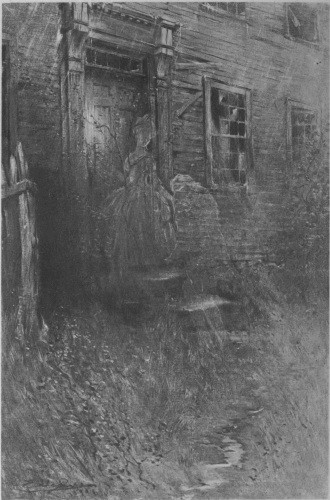
Undreamed of things that happened long ago Page 8
A House in the Hills
THE POEMS OF
M A D I S O N C A W E I N
Volume III
NATURE POEMS
Illustrated
WITH PHOTOGRAVURES AFTER PAINTINGS
BY ERIC PAPE
INDIANAPOLIS
THE BOBBS-MERRILL COMPANY
PUBLISHERS
Copyright 1887, 1888, 1889, 1890, 1892, 1893, 1896, 1898, 1899, 1901, 1902 and 1907, by Madison Cawein
Copyright 1896, by Copeland and Day; 1898, by R. H. Russell
PRESS OF
BRAUNWORTH & CO.
BOOKBINDERS AND PRINTERS
BROOKLYN, N. Y.
TO
DOCTOR HENRY A. COTTELL
WHOSE KIND WORDS OF FRIENDSHIP AND APPROVAL
HAVE ENCOURAGED ME WHEN I MOST
NEEDED ENCOURAGEMENT
CONTENTS
PAGE
IN THE SHADOW OF THE BEECHES
Along the Ohio 56 Among the Knobs 124 Autumn 53 Beneath the Beeches 99 Black Vesper’s Pageants 22 Boy Columbus, The 80 Bridle-Path, The 101 Brook, The 145 “Broken Rainbow on the Skies of May, A” 71 Coigne of the Forest, A 6 Dream, The 63 Dreams 143 Fall Fancies 134 Fallen Beech, A 3 Falls of the Ohio, The 127 Farmstead, The 74 Forest and Field 29 Grasshopper, The 27 Gray Day, A 113 Haunted House, The 49 Heart O’ Spring, The 69 Heat 16 Hollow of the Hills, A 97 House in the Hills, A 8 In the Shadow of the Beeches 1 In the Wildwood 96 Indian Summer 42 Late October 136 Log-Bridge, The 121 Mill-Water, The 60 Mood O’ the Earth, The 116 Night 47 Nooning 119 North Beach, Florida 82 November Walk, A 138 Old Farm, The 106 Old Inn, The 58 Old Swing, The 146 On the Jellico Spur of the Cumberlands 87 Orgie 73 Rain in the Woods 13 Sleet-Storm in May, A 67 Spring Twilight 65 Storm, The 84 Summer 38 To Autumn 148 To Sorrow 44 To Summer 110 Twilight Moth, A 24 Vintager, The 21 Whippoorwill, The 94 White Evening, The 141 Wind, The 10 Winter Dreams 149 Young September 19TANSY AND SWEET-ALYSSUM
Abandoned 233 After Long Grief and Pain 171 Airy Tongues 184 Ambition 243 Arcana 236 Autumn Sorrow 212 Baby Mary 197 Bare Boughs 191 Before the End 226 By the Trysting-Beech 170 Clearing 210 “Clouds of the Autumn Night” 167 Cold 228 Comradery 174 Comrades 161 Creek-Road, The 232 Covered Bridge, The 231 Dark Day of Summer, A 213 Days and Days 214 Despair 245 Despondency 244 Drouth in Autumn 215 Dusk in the Woods 159 Fen-Fire, The 199 Flower of the Fields, A 153 Fulfillment 237 Haunted Woodland, The 172 Hills of the West 204 Hillside Grave, The 230 Hoar-Frost 227 Home 158 Imperfection 235 In Summer 216 In Winter 218 Last Word, A 249 Music and Sleep 242 Occult 176 Old Song, An 196 Omens 234 On Stony-Run 156 On the Farm 219 Opium 241 Paths 221 Quatrains 246 Rain and Wind 186 Red-Bird, The 209 Rock, The 163 Snow 195 Somnambulist, The 240 Song in Season, A 224 Standing-Stone Creek 165 Sunset Fancy, A 198 Then and Now 169 Threnody, A 193 Too Late 238 Under Arcturus 188 Willow Bottom, The 207 Wind at Night, The 183 Wind of Spring, The 206 Winter Moon, The 229 Witch, The 239 Wood, The 200 Wood Notes 202 Wood Words 178WEEDS BY THE WALL
After Rain 308 Age of Gold, The 313 Along the Stream 275 Anthem of Dawn 331 Artist, The 347 At the Lane’s End 334 Beech Blooms 294 Before the Rain 306 Bluebird, The 363 Broken Drouth, The 286 Can Such Things Be 345 Caverns 364 Chipmunk, The 266 Cricket, The 259 Dreamer, The 355 Drouth 283 Enchantment 343 Feud 288 Foreword 253 Immortelles 320 In the Forest 344 Knight-Errant 346 Love of Loves, The 316 Lullaby, A 321 Message of the Lilies, The 329 Mid-winter 357 Musings 325 On Chenoweth’s Run 300 Path by the Creek, The 271 Pestilence 324 Poetry and Philosophy 348 Quatrains 351 Quest, The 304 “Quo Vadis” 349 Reincarnation 299 Requiescat 302 Response 360 Riches 312 Road Home, The 280 Screech-Owl, The 264 Simulacra 362 Song for Labor, A 314 Spring 358 Sunset and Storm 293 Sunset Clouds 311 Swashbuckler, The 361 Tree Toad, The 262 Three Things 318 To a Critic 350 Transformation 359 Unanointed 290 Unheard 298 Voices 278 Wild Iris, The 268 Winter 356 Worship 297A VOICE ON THE WIND
A. D. Nineteen Hundred 479 Adventurers 457 Afterword 483 Allurement 422 August 423 Bush-Sparrow, The 426 Content 443 Communicants 420 Dead Day, The 421 Death of Love, The 462 Discovery 447 Dream Shape, A 432 Dusk 473 Earth and Moon 472 End of Summer, The 475 Epiphany 408 Evening on the Farm 401 Fall 440 Forest Spring, The 450 Frost 456 Hills, The 452 In the Lane 406 Invocation 458 July 398 Land of Hearts Made Whole, The 372 Leaf-Cricket, The 384 Life 409 Light and Wind 469 Love Despised 465 Love, The Interpreter 464 Maid Who Died Old, A 418 May 438 Meeting in the Woods 413 Music 430 October 445 Of the Slums 468 Old Barn, The 434 Old Spring, The 448 Owlet, The 387 Passing Glory, The 476 Pearls 4661885.
IN THE SHADOW OF THE BEECHES
With lips that seem to moan “Alas!”
We’ll soon be out of the troubles!”
Come over! Come over!”
Hallo for home and a fire to warm!”
“To rest! to rest!”
WOOD NOTES
Of Christ our Lord and King!”
And flower clamor, “Come away!”
O my children, come home!”
These things are changed—but is her heart, her heart?”
Great golden melon—saying, “Fall has come.”
Poet, The 390 Proem 367 Prototypes 477 Quatrains 481 Quiet 429 Rain 439 Rose and Rue 415 September 474 Song of the Thrush, The 454 Summer Noontide 393 Sunset in Autumn 441 Superstition 478 To the Locust 396 Touches 471 Transmutation 455 Unanswered 463 Uncalled 480 Under the Hunter’s Moon 404 Voice on the Wind, A 369 Wind of Summer, The 378 Wind of Winter, The 382 Winds, The 470 Woman Speaks, The 467 Wood Witch, The 436
Who is it, who is it, who?”
She comes, the darling Duchess, Spring!”
LIST OF ILLUSTRATIONS
Undreamed of Things that Happened Long Ago(See
page 8)
Frontispiece
PAGE Ghostly and Windy White 168 My Spirit Saw Her Pass 432PROLOGUE
There is a poetry that speaks Through common things: the grasshopper, That in the hot weeds creaks and creaks, Says all of summer to my ear: And in the cricket’s cry I hear The fireside speak, and feel the frost Work mysteries of silver near On country casements, while, deep lost In snow, the gatepost seems a sheeted ghost.
And other things give rare delight: The guttural harps the green-frogs tune, Those minstrels of the falling night, That hail the sickle of the moon From grassy pools that glass her lune: Or,—all of August in its loud Dry cry,—the locust’s call at noon, That emphasizes heat, no cloud Of lazy white makes less with its cool shroud.
The rain,—whose cloud dark-lids the moon, That great white eyeball of the night,— Makes music for me; to its tune I hear the flowers unfolding white, The mushroom growing, and the slight Green sound of grass that dances near; The melon ripening with delight; And in the orchard, soft and clear, The apple redly rounding out its sphere.
The grigs make music as of old, To which the fairies whirl and shine Within the moonlight’s prodigal gold, On woodways wild with many a vine: When all the wilderness with wine Of stars is drunk, I hear it say— “Is God restricted to confine His wonders only to the day, That yields the abstract tangible to clay?”
And to my ear the wind of Morn,— When on her rubric forehead far One star burns big,—lifts a vast horn Of wonder where all murmurs are: In which I hear the waters war, The torrent and the blue abyss, And pines,—that terrace bar on bar The mountain side,—like lovers kiss, And whisper words where all of grandeur is.
The jutting crags,—dark, iron-veined With ore,—the peaks, where eagles scream, That pour their cataracts, rainbow-stained, Like hair, in many a mountain stream, Can lift my soul beyond the dream Of all religions; make me scan No mere external or extreme, But inward pierce the outward plan And learn that rocks have souls as well as man.
IN THE SHADOW OF THE BEECHES
In the shadow of the beeches, Where the fragile wildflowers bloom; Where the pensive silence pleaches Green a roof of cool perfume, Have you felt an awe imperious As when, in a church, mysterious Windows paint with God the gloom?
In the shadow of the beeches, Where the rock-ledged waters flow; Where the sun’s slant splendor bleaches Every wave to foaming snow, Have you felt a music solemn As when minster arch and column Echo organ worship low?
In the shadow of the beeches, Where the light and shade are blent; Where the forest-bird beseeches, And the breeze is brimmed with scent,— Is it joy or melancholy That o’erwhelms us partly, wholly, To our spirit’s betterment?
In the shadow of the beeches Lay me where no eye perceives; Where,—like some great arm that reaches Gently as a love that grieves,— One gnarled root may clasp me kindly While the long years, working blindly, Slowly change my dust to leaves.
A FALLEN BEECH
Nevermore at doorways that are barken Shall the madcap wind knock and the moonlight; Nor the circle which thou once didst darken, Shine with footsteps of the neighboring moonlight, Visitors for whom thou oft didst hearken.
Nevermore, gallooned with cloudy laces, Shall the morning, like a fair freebooter, Make thy leaves his richest treasure-places; Nor the sunset, like a royal suitor, Clothe thy limbs with his imperial graces.
And no more, between the savage wonder Of the sunset and the moon’s up-coming, Shall the storm, with boisterous hoof-beats, under Thy dark roof dance, Faun-like, to the humming Of the Pan-pipes of the rain and thunder.
Oft the Satyr-spirit, beauty-drunken, Of the Spring called; and the music measure Of thy sap made answer; and thy sunken Veins grew vehement with youth, whose pressure Swelled thy gnarly muscles, winter-shrunken.
And the germs, deep down in darkness rooted, Bubbled green from all thy million oilets, Where the spirits, rain and sunbeam suited, Of the April made their whispering toilets, Or within thy stately shadow footed.
Oft the hours of blonde Summer tinkled At the windows of thy twigs, and found thee Bird-blithe; or, with shapely bodies, twinkled Lissom feet of naked flowers around thee, Where thy mats of moss lay sunbeam-sprinkled.
And the Autumn with his gypsy-coated Troop of days beneath thy branches rested, Swarthy-faced and dark of eye; and throated Songs of hunting; or with red hand tested Every nut-burr that above him floated.
Then the Winter, barren-browed, but rich in Shaggy followers of frost and freezing, Made the floor of thy broad boughs his kitchen, Trapper-like, to camp in; grimly easing Limbs snow-furred and moccasined with lichen.
Now, alas! no more do these invest thee With the dignity of whilom gladness! They—unto whose hearts thou once confessed thee Of thy dreams—now know thee not! and sadness Sits beside thee where, forgot, dost rest thee.
A COIGNE OF THE FOREST
The hills hang woods around, where green, below Dark, breezy boughs of beech-trees, mats the moss, Crisp with the brittle hulls of last year’s nuts; The water hums one bar there; and a glow Of gold lies steady where the trailers toss Red, bugled blossoms and a rock abuts; In spots the wild-phlox and oxalis grow Where beech-roots bulge the loam, and welt across The grass-grown road and roll it into ruts.
And where the sumach brakes grow dusk and dense, Among the rocks, great yellow violets, Blue-bells and windflowers bloom; the agaric In dampness crowds; a fungus, thick, intense With gold and crimson and wax-white, that sets The May-apples along the terraced creek At bold defiance. Where the old rail-fence Divides the hollow, there the bee-bird whets His bill, and there the elder hedge is thick.
No one can miss it; for two cat-birds nest, Calling all morning, in the trumpet-vine; And there at noon the pewee sits and floats A woodland welcome; and his very best At eve the red-bird sings, as if to sign The record of its loveliness with notes. At night the moon stoops over it to rest, And unreluctant stars, in whose faint shine There runs a whisper as of wind-swept oats.
A HOUSE IN THE HILLS
Old hearts that hold the saddest memories Are the most beautiful; and such make sweet Light, happy moods of younger natures which Their sadness contacts and so sanctifies.
And such to me is an old gabled house, Deserted, and neglected, and unknown, Lost in the tangled hollow of its hills, Dark, cedared hills, and dreamy orchard-lands; With but its host of shrouded memories Haunting its ruined rooms and desolate halls,— Pathetic with their fallen finery,— And whispering through its cob-webbed crevices And roomy hearths, that sigh with ceaseless wind, Undreamed of things that happened long ago.
Here in gray afternoons I love to sit, And hear the running rain along the roof; The creak and crack of noises that are born Of silence or mysterious agencies; The fitful footfalls of the wind adown Grand, winding stairways, massy banistered; A clapping door and then a sudden hush As if the old house held its breath to see,— Invisible to me,—a presence pass, That brings a pleasant terror stiffening through The tingling veins and staring from the eyes. Then comes the rain again along the roof; And in rain-rotted room and rain-stained hall The drip and whisper of the wind and rain Seem viewless footsteps of the sometime lords And mistresses who lived here in the past. And could the state material but assume A state clairvoyant, then the dream-drugged eyes, Perhaps, might see, from room to dusty room, The ghosts of stately gentlemen glide by, And glimmering ladies, all beruffled, trail Long, haughty silks miraculously stiff.
THE WIND
“Wind of the East, if thou pass by the land where my loved ones dwell, I pray, The fullest of greetings bear to them from me, their lover, and say That I am the pledge of passion still.”— FROM THE ARABIC.
The ways of the wind are eerie, And I love them all: The blithe, the mad, and the dreary, Spring, winter, and fall.
When it tells to the waiting crocus Its beak to show; And hangs on the wayside locust Bloom-bunches of snow.
When it comes like a balmy blessing From the musky wood, The half-grown roses caressing Till their cheeks burn blood.
When it roars in the autumn season, And whines with rain, Or sleet, like a mind without reason, Or a soul in pain.
When the woodways, once so spicy With bud and bloom, Are desolate, dead and icy As the icy tomb.
When the puffed owl, crouched and frowsy, In the hollow tree, Sobs, dolorous, cold, and drowsy, Its shuddering melody.
Then I love to sit in December Where the big hearth sings, And, dreaming, forget and remember A host of things.
And the wind—I hear how it strangles, And wails and sighs On the roof’s sharp, shivering angles That front the skies.
How it shouts and romps and tumbles In attics o’erhead; In the great-throated chimney rumbles, Then all at once falls dead;
Then comes like the footsteps stealing Of a child on the stair, Or a bent, old gentleman feeling His slippered way with care.
And my soul grows anxious-hearted For those once dear— The long-lost loves, departed, In the wind draw near.
And I seem to see their faces— Not one estranged— In their old accustomed places Round the wide hearth ranged.
And the wind, that waits and poises Where the shadows sway, Seems their visionary voices Calling me far away.
Then I wake in tears and hear it Wailing outside my door,— Or is it some wandering spirit Weeping upon the moor?
RAIN IN THE WOODS
When on the leaves the rain persists, And every gust brings showers down; When copse and woodland smoke with mists, I take the old road out of town Into the hills through which it twists.
I find the vale where catnip grows, Where boneset blooms, with moisture bowed; The vale through which the red creek flows, Turbid with hill-washed clay, and loud As some wild horn a huntsman blows.
Around the root the beetle glides, A burnished beryl; and the ant, Large, agate-red, a garnet, slides Beneath the rock; and every plant Is roof for some frail thing that hides.
Like knots against the trunks of trees The lichen-colored moths are pressed; And, wedged in hollow blooms, the bees Hang pollen-clotted; in its nest The wasp has crawled and lies at ease.
The locust harsh, that sharply saws The silence of the summer noon; The katydid, that thinly draws Its fine file o’er the bars of moon; And grasshopper that drills each pause:
The mantis, long-clawed, furtive, lean— Fierce feline of the insect hordes— And dragonfly, gauze-winged and green, Beneath the wild-grape’s leaves and gourd’s, Have housed themselves and rest unseen.
The butterfly and forest-bird Are huddled on the same gnarled bough, From which, like some rain-voweled word That dampness hoarsely utters now, The tree-toad’s guttural voice is heard.
I crouch and listen: and again The woods are filled with phantom forms— With shapes, grotesque in cloudy train, That rise and reach to me cool arms Of mist: dim, wandering wraiths of rain.
I see them come; fantastic, fair; Chill, mushroom-colored: sky and earth Grow ghostly with their floating hair And trailing limbs, that have their birth In wetness—fungi of the air.
O wraiths of rain! O ghosts of mist! Still fold me, hold me, and pursue! Still let my lips by yours be kissed! Still draw me with your hands of dew Unto the tryst, the dripping tryst.
HEAT
I
Now is it as if Spring had never been, And Winter but a memory and a dream, Here where the Summer stands, her lap of green Heaped high with bloom and beam, Among her blackberry-lilies, low that lean To kiss her feet; or, freckle-browed, that stare Upon the dragonfly which, slimly seen, Like a blue jewel flickering in her hair, Sparkles above them there.
II
Knee-deep among the tepid pools the cows Chew a slow cud or switch a slower tail, Half-sunk in sleep beneath the beechen boughs, Where thin the wood-gnats ail. From bloom to bloom the languid butterflies drowse; The sleepy bees make hardly any sound; The only things the sun-rays can arouse, It seems, are two black beetles rolling round Upon the dusty ground.
III
Within its channel glares the creek and shrinks, Beneath whose rocks the furtive crawfish hides In stagnant places, where the green frog blinks, And water-strider glides. Far hotter seems it for the bird that drinks, The startled kingfisher that screams and flies; Hotter and lonelier for the purples and pinks Of weeds that bloom, whose sultry perfumes rise Stifling the swooning skies.
IV
From ragweed fallows, rye-fields, heaped with sheaves, From blistering rocks, no moss or lichens crust, And from the road, where every hoof-stroke heaves A cloud of burning dust, The hotness quivers, making limp the leaves, That loll like panting tongues. The pulsing heat Seems a wan wimple that the Summer weaves, A veil, in which she wraps,—as in a sheet,— The shriveling corn and wheat.
V
Furious, incessant in the weeds and briers The sawing weed bugs sing: and, heat-begot, The grasshoppers, so many strident wires, Staccato stinging hot: A lash of whirling sound that never tires, The locust flails the noon, where harnessed Thirst, Beside the road-spring, many a shod hoof mires, Into the trough thrusts his hot head; immersed, Round which cool bubbles burst.
VI
The sad, sweet voice of some wood-spirit who Laments while watching a loved oak-tree die, From the deep forest comes the wood-dove’s coo, A long, lost, lonely cry.— Oh, for a breeze! a mighty wind to woo The woods to stormy laughter; sow like grain The world with freshness of invisible dew, And pile above far, fevered hill and plain Cloud-bastions, black with rain.
YOUNG SEPTEMBER
I
With a look and a laugh where the stream was flowing, September led me along the land; Where the goldenrod and lobelia, glowing, Seemed burning torches within her hand. And faint as the thistle’s or milkweed’s feather I glimpsed her form in the sparkling weather.
II
Now ’twas her hand and now her hair That tossed me welcome everywhere; That lured me onward through the stately rooms Of forest, hung and carpeted with glooms, And windowed wide with azure, doored with green, Through which rich glimmers of her robe were seen— Now, like some deep marsh-mallow, rosy-gold; Now, like the great Joe-Pye-weed, fold on fold Of heavy mauve; and now, like the intense Massed ironweed, a purple opulence.
III
Along the bank in a wild procession Of gold and sapphire the blossoms blew; And borne on the breeze came their soft confession In syllabled musk and honey-dew; In words unheard that their lips kept saying, Sweet as the lips of children praying.
IV
And so, meseemed, I heard them tell How here her loving glance once fell Upon this bank, and from its azure grew The ageratum mist-flower’s happy hue; How from her kiss, as crimson as the dawn, The cardinal-flow’r drew its vermilion; And from her hair’s blond touch th’ elecampane Evolved the glory of its golden rain; While from her starry footsteps, redolent, The aster pearled its flowery firmament.
THE VINTAGER
Among the fragrant grapes she bows; Long violet clusters heap her hands: And, with bright brows, on him bestows Sweet looks, like soft commands.
And from her sunburnt throat, at times, As bubbles burst on new-made wine, A happy fit of merry rhymes Rings down the hills of vine.
And in his heart, remorseless, sweet, Grew big the red-grape, passion, there; His heart, that, ever at her feet, Was filled with love’s despair.
But she, who ne’er the honeyed must Of love had drained, a grown-up child, Saw in him—merely one to trust, And broke his heart, and smiled.
BLACK VESPER’S PAGEANTS
The day, all fierce with carmine, turns An Indian face towards Earth and dies; The west, like some gaunt vase, inurns Its ashes under smoldering skies; Athwart whose bowl one red cloud streams, Wild as some dream an Aztec dreams.
Now shadows mass above the world, And night comes on with wind and rain; The mulberry-colored leaves are hurled Like frantic hands against the pane. And through the forests, bending low, Night stalks like some gigantic Woe.
In hollows where the thistle shakes A hoar bloom like a witch’s light, From weed and flower the rain-wind rakes Dead sweetness—as a wildman might, From autumn leaves, the woods among, Dig some dead woman, fair and young.
Now let me walk the woodland ways, Alone! except for thoughts, that are Akin to such wild nights and days— A portion of the storm that far Fills Heaven and Earth tumultuously, And my own soul with ecstasy.
A TWILIGHT MOTH
Dusk is thy dawn; when Eve puts on her state Of gold and purple in the marbled west, Thou comest forth like some embodied trait, Or dim conceit, a lily-bud confessed; Or, of a rose, the visible wish; that, white, Goes softly messengering through the night, Whom each expectant flower makes its guest.
All day the primroses have thought of thee, Their golden heads close-haremed from the heat; All day the mystic moonflowers silkenly Veiled snowy faces,—that no bee might greet Or butterfly that, weighed with pollen, passed;— Keeping Sultana-charms for thee, at last, Their lord, who comest to salute each sweet.
Cool-throated flowers that avoid the day’s Too fervid kisses; every bud that drinks The tipsy dew and to the starlight plays Nocturnes of fragrance, thy wing’d shadow links In bonds of secret brotherhood and faith; O bearer of their order’s shibboleth, Like some pale symbol fluttering o’er these pinks.
What dost thou whisper in the balsam’s ear That sets it blushing, or the hollyhock’s,— A syllabled silence that no man may hear,— As dreamily upon its stem it rocks? What spell dost bear from listening plant to plant, Like some white witch, some ghostly ministrant, Some spectre of some perished flower of phlox?
O voyager of that universe which lies Between the four walls of this garden fair,— Whose constellations are the fireflies That wheel their instant courses everywhere,— ’Mid fairy firmaments wherein one sees Mimic Boötes and the Pleiades, Thou steerest like some fairy ship-of-air.
Gnome-wrought of moonbeam-fluff and gossamer, Silent as scent, perhaps thou chariotest Mab or King Oberon; or, haply, her His queen, Titania, on some midnight quest.— Oh for the herb, the magic euphrasy, That should unmask thee to mine eyes, ah me! And all that world at which my soul hath guessed!
THE GRASSHOPPER
I
What joy you take in making hotness hotter, In emphasizing dullness with your buzz, Making monotony more monotonous! When summer comes, and drouth hath dried the water In all the creeks, we hear your ragged rasp Filing the stillness. Or,—as urchins beat A stagnant pond whereon the bubbles gasp,— Your switch-like music whips the midday heat. O burr of sound caught in the Summer’s hair, We hear you everywhere.
II
We hear you in the vines and berry-brambles, Along the unkempt lanes, among the weeds, Amid the shadeless meadows, gray with seeds, And by the wood, round which the rail-fence rambles, Sawing the sunlight with your sultry saw. Or,—like to tomboy truants, at their play With noisy mirth among the barn’s deep straw,— You sing away the careless summer-day. O brier-like voice that clings in idleness To Summer’s drowsy dress.
III
You tramp of insects, vagrant and unheeding, Improvident, who of the summer make One long green meal-time, and for winter take No care, aye singing or just merely feeding! Happy-go-lucky vagabond,—though frost Shall pierce, ere long, your coat of green or brown, And pinch your body,—let no song be lost, But as you lived, into your grave go down— Like some small poet with his little rhyme, Forgotten of all time.
FOREST AND FIELD
I
Green, watery jets of light let through The rippling foliage drenched with dew; And golden glimmers, warm and dim, That in the vistaed distance swim; Where, round the wood-spring’s oozy urn, The limp, loose fronds of forest fern Trail like the tresses, green and wet, A wood-nymph binds with violet. O’er rocks that bulge and roots that knot The emerald-amber mosses clot; From matted walls of brier and brush The elder nods its plumes of plush; And, Argus-eyed with bloom on bloom, The wild-rose breathes its wild perfume; May-apples, ripening yellow, lean With oblong fruit, a lemon-green, Near Indian-turnips, long of stem, That bear an acorn-oval gem, As if some woodland Bacchus there,— While braiding locks of hyacinth hair With ivy-tod,—had idly tossed His thyrsus down and so had lost: And blood-root, that from scarlet wombs Puts forth, in spring, its milk-white blooms, That then like starry footsteps shine Of April under beech and pine; At which the gnarléd eyes of trees Stare, big as Fauns’, at Dryadës, That bend above a fountain’s spar, As white and naked as a star.
The stagnant stream flows sleepily Thick-paved with lily-pads; the bee,— Brown, honey-drunk, a Bassarid,— Booms past the mottled toad, that, hid In calamus and blue-eyed grass, Beside the water’s pooling glass, Silenus-like, eyes stolidly The Mænad-glittering dragonfly. And pennyroyal and peppermint Pour dry-hot odors without stint From fields and banks of many streams; And in their scent one almost seems To see Demeter pass, her breath Sweet with her triumph over death.— A haze of floating saffron; sound Of shy, crisp creepings o’er the ground; The dip and stir of twig and leaf; Tempestuous gusts of spices brief Borne over bosks of sassafras By winds that foot it on the grass; Sharp, sudden songs and whisperings, That hint at untold, hidden things— Pan and Sylvanus who of old Kept sacred each wild wood and wold. A wily light beneath the trees Quivers and dusks with every breeze— A Hamadryad, haply, who,— Culling her morning meal of dew From frail, accustomed cups of flowers,— Now sees some Satyr in the bowers, Or hears his goat-hoof snapping press A brittle branch, and in distress Shrinks back; her dark, dishevelled hair Veiling her limbs one instant there.
II
Down precipices of the dawn The rivers of the day are drawn, The soundless torrents, free and far, Of gold that deluge every star. There is a sound of winds and wings That fills the woods with carollings; And, dashed on moss and flower and fern, And leaves, that quiver, breathe and burn, Rose-radiance smites the solitudes, The dew-drenched hills, the dripping woods That twitter as with canticles Of bird and brook; and air that smells Of flowers, and buds, and boisterous bees, Delirious honey and wet trees.— Through briers that trip them, one by one, With swinging pails, that flash the sun, A troop of girls comes—berriers, Whose bare feet glitter where they pass Through dewdrop-trembling tufts of grass. And, oh! their laughter and their cheers Wake Echo on her shrubby rocks Who, answering, from her mountain mocks With rapid fairy horns—as if Each mossy vale and weedy cliff Had its imperial Oberon, Who, seeking his Titania, hid In coverts caverned from the sun, In kingly wrath had called and chid.
Cloud-feathers, oozing orange light, Make rich the Indian locks of Night; Her dusky waist with sultry gold Girdled and buckled fold on fold. One star. A sound of bleating flocks. Great shadows stretched along the rocks, Like giant curses overthrown By some Arthurian champion. Soft-swimming sorceries of mist That streak blue glens with amethyst. And, tinkling in the clover dells, The twilight sound of cattle-bells. And where the marsh in reed and grass Burns, angry as a shattered glass, The flies blur sudden gold, and shine Like drops of amber-scattered wine Spun high by reeling Bacchanals, When Bacchus wreathes his curling hair With vine-leaves, and from every lair His worshippers around him calls. They come, they come, a happy throng, The berriers with lilt and song; Their pails brimmed black to tin-bright eaves With luscious fruit, kept cool with leaves Of aromatic sassafras; ’Twixt which a berry often slips, Like laughter, from the purple mass, Wine-swollen as Silenus’ lips.
III
Clouds that the tempest steers!
The tanned and tired Noon climbs high Up burning reaches of the sky; Below the drowsy belts of pines The rock-ledged river leaps and shines; And over rainless hill and dell Is blown the harvest’s sultry smell: While, in the fields, one sees and hears The brawny-throated harvesters,— Their red brows beaded with the heat,— By twos and threes among the wheat Flash their hot scythes; behind them press The binders—men and maids who sing Like some mad troop of piping Pan;— While all the hillsides, echoing, ring Such sounds of Ariel airiness As haunted freckled Caliban.
“O ho! O ho! ’tis noon I say. The roses blow. Away, away, above the hay, To the song o’ the bees the roses sway; The love-lays that they hum all day, So low! so low! The roses’ Minnesingers they.”
Up velvet lawns of lilac skies The tawny moon begins to rise Behind low, blue-black hills of trees,— As rises up, in siren seas, To rock in purple deeps, hip-hid, A virgin-bosomed Oceanid.— Gaunt shadows crouch by tree and scaur, Dusk’s shaggy Satyrs waiting for The Nymphs of moon, the Dryads white, Who take with loveliness the night, And glorify it with their love. The sweet, far notes I hear, I hear, Beyond dim pines and mellow ways; The song of some fair harvester, The lovely Limnad of the grove, Whose singing charms me while it slays.
“O deep! O deep! the earth and air Are sunk in sleep. Adieu to care! Now everywhere Is rest; and by the old oak there The maiden with the nut-brown hair Doth keep, doth keep Tryst with her lover the young and fair.”
IV
Like Atalanta’s spheres of gold, Within the orchard, apples rolled From sudden hands of boughs that lay Their leaves, like palms, against the day; And near them pears of rusty brown Rolled bruised; and peaches, pink with down, And furry as the ears of Pan; Or, like Diana’s cheeks, a tan Beneath which burnt a tender fire; Or wan as Psyche’s with desire. And down the orchard vistas,—young, A hickory basket by him swung, A hat of straw against the sun Drawn shadowy o’er his face,—he strode; As if he looked to find some one, His eyes searched every bend of road. Before him, like a living burr, Rattled the noisy grasshopper. And where the cows’ melodious bells Trailed music up and down the dells, Beside the spring, that o’er the ground Went whimpering like a fretful hound, He saw her waiting, fair and slim, Her pail forgotten there, for him. Yellow as sunset skies and pale As fairy clouds that stay or sail Through azure vaults of summer, blue As summer heavens, the wildflowers grew; And blossoms on which spurts of light Fell laughing—like the lips one might Feign once were Hebe’s, or a girl’s That laughter lights with rows of pearls. Long ferns, in murmuring masses heaped; And mosses moist, in beryl steeped And musk aromas of the wood And silence of the solitude: And everything that near her blew The spring had showered thick with dew.— Across the rambling fence she leaned, Her fresh, round arms all white and bare; Her artless beauty, bonnet-screened, Simplicity from feet to hair. A wood-thrush gurgled in a vine— Ah! ’tis his step, ’tis he she hears; The wild-rose smelt like some rare wine— He comes, ah, yes! ’tis he who nears. And her brown eyes and happy face Said welcome. And with rustic grace He leant beside her; and they had Some talk with youthful laughter glad: I know not what: I know but this— Its final period was a kiss.
SUMMER
I
Hang out your loveliest star, O Night! O Night! Your richest rose, O Dawn! To greet sweet Summer, her, who, clothed in light, Leads Earth’s best hours on. Hark! how the wild birds of the woods Throat it within the dewy solitudes! The brook sings low and soft, The trees make song, As, from her heaven aloft, Comes blue-eyed Summer like a girl along.
II
And as the Day, her lover, leads her in, How bright his beauty glows! How red his lips, that ever try to win Her mouth’s delicious rose! And from the beating of his heart Warm winds arise and sighing thence depart: And from his eyes and hair The light and dew Fall round her everywhere, And heaven above her is an arch of blue.
III
Come to the forest, or the treeless meadows Deep with their hay or grain; Come where the hills lift high their thrones of shadows, And tawny orchards reign. Come where the reapers whet the scythe; Where golden sheaves are heaped; where berriers blithe, With willow-basket and with pail, Swarm knoll and plain; Where flowers freckle every vale, And Beauty goes with hands of berry-stain.
IV
Come where the dragonflies, a brassy blue, Flit round the wildwood streams, And, sucking at some horn of honey-dew, The wild-bee hums and dreams. Come where the butterfly waves wings of sleep, Gold-disked and mottled, over blossoms deep: Come where beneath the rustic bridge The creek-frog cries; Or in the shade the rainbowed midge, Above the emerald pools, with murmurings flies.
V
Come where the cattle browse within the brake, As red as oak and strong; Where cattle-bells the echoes faintly wake, And milkmaids sing their song. Come where the vine-trailed rocks, with waters hoary, Tell to the sun some legend old or story; Or where the sunset to the land Speaks words of gold; Where Ripeness walks, a wheaten band About her brow, making the buds unfold.
VI
Come where the woods lift up their stalwart arms Unto the star-sown skies; Knotted and gnarled, that to the winds and storms Fling mighty rhapsodies: Or to the moon repeat what they have seen, When Night upon their shoulders vast doth lean. Come where the dew’s clear syllable Slips from the rose; And where the fireflies fill The dark with golden music of their glows.
VII
Now while the dingles and the vine-roofed glens Whisper their flowery tale Unto the silence; and the lakes and fens Unto the moonlight pale Murmur their rapture, let us seek her out, Her of the honey throat and peach-sweet pout, Summer! and at her feet, The love of old Lay like a sheaf of wheat, And of our hearts the purest gold of gold.
INDIAN SUMMER
The dawn is a warp of fever, The eve is a woof of fire; And the month is a singing weaver Weaving a red desire.
With stars Dawn dices with Even For the rosy gold they heap On the blue of the day’s broad heaven, On the black of the night’s wide deep.
It’s—“Reins to the blood!” and “Marry!” The Season’s a prince who burns With the teasing lusts that harry His heart for a wench who spurns.
It’s—“Crown us a beaker with sherry, To drink to the doxy’s heels; A tankard of wine o’ the berry, To lips like a cloven peel’s.
“’S death! if a king be saddened, Right so let a fool laugh lies: But wine! when a king is gladdened, And a woman’s waist and her eyes.”
He hath shattered the loom of the weaver, And left but a leaf that flits, He hath seized heaven’s gold, and a fever Of mist and of frost is its.
He hath tippled the buxom beauty, And gotten her hug and her kiss— The wide world’s royal booty To pile at her feet for this.
TO SORROW
I
O dark-eyed spirit of the marble brow, Whose look is silence and whose touch is night, Who walkest lonely through the world, O thou, Who sittest lonely with Life’s blown-out light; Who in the hollow hours of night’s noon Criest like some lost child; Whose anguish-fevered eyeballs seek the moon To cool their pulses wild. Thou who dost bend to kiss Joy’s sister cheek, Turning its rose to alabaster; yea, Thou who art terrible and mad and meek, Why in my heart art thou enshrined to-day? Sorrow, O say! O say!
II
Now Spring is here and all the world is white, I will go forth, and where the forest robes Itself in green, and every hill and height Crowns its fair head with blossoms,—spirit globes Of hyacinth and crocus dashed with dew,— I will forget my grief, And thee, O Sorrow, gazing at the blue, Beneath a last year’s leaf, Of some brief violet the south-wind woos, Or bluet, whence the west-wind raked the snow; The baby eyes of love, the darling hues Of happiness, that thou canst never know, Mother of pain and woe.
III
On some hoar upland, hoar with clustered thorns, Hard by a river’s windy white of waves, I shall sit down with Spring,—whose eyes are morns Of light; whose cheeks the rose of health enslaves,— And so forget thee, braiding in Spring’s hair The snowdrop, tipped with green, The cool-eyed primrose and the trillium fair, And moony celandine. Contented so to lie within her arms, Forgetting all the sere and sad and wan, Remembering Love alone, who, o’er earth’s storms, High on the mountains of perpetual dawn, Leads the glad Hours on.
IV
Or in the peace that follows storm, when Even, Within the west, stands dreaming, lone and far, Clad on with green and silver, and the Heaven Is brightly brooched with one gold-glittering star, I will lie down beside a mountain lake, Round which the tall pines sigh, And, breathing musk of rain from boughs that shake Storm balsam, blowing by, Make friends of Dream and Contemplation high, And Music, listening to the mocking-bird,— Who through the hush sends its melodious cry,— And so forget a while that other word, That all loved things must die.
NIGHT
Out of the East, as from an unknown shore, Thou comest with thy children in thine arms,— Slumber and Dream,—whom mortals so adore,— Their flowing raiment sculptured to their charms: Soft on thy breast thy lovely children rest, Laid like two roses in one balmy nest. Silent thou comest, swiftly too and slow. There is no other presence like to thine, When thou approachest with thy babes divine, Thy shadowy face above them bending low, Blowing the ringlets from their brows of snow.
Oft have I taken Sleep from thy dark arms, And fondled her fair head, with poppies wreathed, Within my bosom’s depths, until its storms With her were hushed and I but faintly breathed: And then her sister, Dream, with frolic art Arose from rest, and in my sleeping heart Blew bubbles of dreams where elfin worlds were lost; Worlds where my stranger soul looked down at me, Or walked with spirits by a rainbowed sea, Or smiled, an unfamiliar shape of frost, Floating on gales of breathless melody.
Day comes to us in garish glory garbed; But thou, thou bringest to the tired heart Rest and sweet silence, wherein are absorbed All the vain tumults of the mind and mart. Whether thou comest with hands full of stars, Or clothed in storm and cloud, the lightning bars, Rolling the thunder like a mighty dress, God moves with thee; we seem to hear His feet, Wind-like, along the floors of Heaven beat; To see His face, revealed in awfulness, Through thee, O Night, to ban us or to bless.
THE HAUNTED HOUSE
I
The shadows sit and stand about its door Like uninvited guests and poor; And all the long, hot summer day The ceaseless locust dins its roundelay In one old sycamore. The squirrel leaves upon its rotting roof Its wandering tracks In empty hulls; and in its clapboard cracks The spider weaves a windy woof, And cells of clay the mud-wasp packs. The she-fox whelps upon its floor; And o’er its sun warped door The owlet roosts; and where the mosses run, The freckled snake basks in the sun.
II
The children of what fathers sleep Beneath those melancholy pines? The slow slugs slime their headstones there where creep The doddered poison-vines. The orchard, near the meadow deep, Lifts up decrepit arms, Black-lichened in a withering heap. No sap swells up to make it leap And shout against spring’s storms; No blossom lulls its age asleep; The winds bring sad alarms. Big, bell-round pears and pippins, russet-red, No maiden gathers now; The worm-bored trunks weep tears of gum instead, Oozing from each old bough.
III
The woodlands around it are solitary And fold it like gaunt hands; The sunlight is sad and the moonlight is dreary, The hum of the country is lonesome and weary, And the bees go by in bands To gladder and lovelier lands. The grasses are rotting in walk and in bower; The loneliness,—dank and rank As a chamber where lies for a lonely hour An old-man’s corpse with many a flower,— Is hushed and blank. And even the birds have passed it by, Gone with their songs to a happier sky, A happier sky and bank.
IV
In its desolate halls are lying, Gold, blood-red, and browned, Drifted leaves of autumn dying; And the winds, above them sighing, Turn them round and round, Make a ghostly sound As of footsteps falling, flying, Ghostly footsteps, faintly flying Through the haunted house.
V
Gazing down in her white shroud, Wov’n of windy cloud, Comes at night the phantom moon; Comes, and all the shadows soon, Crowding chambers of the house, Haunting whispering rooms, arouse;— Shadows, ghosts, her rays lead on, Till beneath the cloud Like a ghost she’s gone, In her gusty shroud, O’er the haunted house.
AUTUMN
I oft have met her slowly wandering Beside a leafy stream, her locks blown wild, Her cheeks a hectic flush, more fair than Spring, As if on her the scarlet copse had smiled: Or I have seen her sitting, dark and tall,— Her gentle eyes with foolish weeping dim,— Beneath a twisted oak from whose red leaves She wound great drowsy wreaths and let them fall; The west-wind in her hair, that made it swim Far out behind, brown as the rustling sheaves.
Or in the hill-lands I have often seen The marvel of her passage; glimpses faint Of glimmering woods that glanced the hills between, Like Indian faces, fierce with forest paint. Or I have met her ’twixt two beechen hills, Within a dingled valley near a fall, Held in her nut-brown hand one cardinal flower; Or wading dimly where the leaf-dammed rills Went babbling through the wildwood’s arrased hall, Where burned the beech and maples glared their power.
Or I have met her by a ruined mill, Where trailed the crimson creeper, serpentine, On fallen leaves that stirred and rustled, chill, And watched her swinging in the wildgrapevine. While Beauty, sad among the vales and mountains, More sad than death, or all that death can teach, Dreamed of decay and stretched appealing arms, Where splashed the murmur of the forest’s fountains: With all her loveliness did she beseech, And all the sorrow of her wildwood charms.
Once only in a hollow, girt with trees, A-dream amid wild asters filled with rain, I glimpsed her cheeks, red-berried by the breeze, In her dark eyes the night’s sidereal stain. And once upon an orchard’s tangled path, Where all the goldenrod had turned to brown, Where russets rolled and leaves lay sweet of breath, I did behold her ’mid her aftermath Of blossoms standing, in her gypsy gown, Within her gaze the dreams of life and death.
ALONG THE OHIO
Athwart a sky of brass long welts of gold; A river of flame the wide Ohio lies; Beneath the sunset, billowing manifold, The dark-blue hill-tops rise.
And, westering, dips the crescent of the moon Through great cloud-feathers, flushed with rosy ray, That close around the crystal of her lune The redbird wings of Day.
A little skiff slips o’er the burnished stream; A wake of flame, that broadens far behind, Follows in ripples; and the paddles gleam Against the evening wind.
Was it the boat, the solitude, and hush, That with dead Indians peopled all the glooms? That made each bank, meseemed, and every bush, Start into eagle-plumes?
That made me seem to hear the breaking brush, And, as the stag’s great antlers swelled in view, To hear the arrow twang from cane and rush, That dipped to the canoe?
To see the glimmering wigwams by the waves? And, wildly clad, around the camp-fires’ glow, The Shawnee chieftains with their painted braves, Each with his battle-bow?...
But now the vision like the sunset fades, The clouds of ribbéd gold have oozed their light; And from the west, like sombre sachem shades, Gallop the shades of night.
The broad Ohio glitters to the stars; And many murmurs wander through its woods— Is it the mourning of dead warriors For their lost solitudes?
The moon is set; but, like another moon, The crescent of the river shimmers there, Unchanged as when the eyes of Daniel Boone Beheld it flowing fair.
THE OLD INN
Red-winding from the sleepy town, One takes the lone, forgotten lane Straight through the hills. A brush-bird brown Bubbles in thorn-flowers sweet with rain, Where breezes bend the gleaming grain And cautious drip of higher leaves The lower dips that drip again, Above the tangled trees it heaves Its gables and its haunted eaves.
One creeper, gnarled and blossomless, O’erforests all its eastern wall; The sighing cedars rake and press Dark boughs along the panes they sprawl; While, where the sun beats, drone and drawl The mud-wasps; and one bushy bee, Gold-dusty, hurls along the hall To crowd into a crack.—To me The shadows seem too scared to flee.
Of ragged chimneys martins make Huge pipes of music; twittering, here They build and brood.—My footfalls wake Strange stealing echoes, till I fear I’ll see my pale self drawing near, My phantom self as in a glass; Or one, men murdered, buried—where?— Dim in gray, stealthy glimmer, pass With lips that seem to moan “Alas!”
THE MILL-WATER
The water-flag and wild cane grow Round banks whereon the sunbeams sow Ephemeral gold when, on its shores, The wind sighs through the sycamores.
In one green angle, just in reach, Between a willow-tree and beech, Moss-grown and leaky lies a boat The thick-grown lilies keep afloat.
And through its waters, half-awake, Slow swims the spotted water-snake; And near its edge, like some gray streak, Stands gaunt the still fly-up-the-creek.
Between the lily-pads and blooms The water-spirits set their looms, And weave the lace-like light that dims The glimmering leaves of under limbs.
Each lily is the hiding-place Of some dim wood-thing’s elvish face, That watches you with gold-green eyes Where bubbles of its breathing rise.
I fancy, when the waxing moon Leans through the trees and dreams of June; And when the black bat slants its wing, And lonelier the green-frogs sing;
I fancy, when the whippoorwill In some old tree sings wildly shrill, With glow-worm eyes that dot the dark,— Each holding high a firefly spark,
To torch its way,—the wood-imps come: And some float rocking here; and some Unmoor the lily-leaves and oar Around the old boat by the shore.
They climb through oozy weeds and moss; They swarm its rotting sides and toss Their firefly torches o’er its edge Or hang them in the tangled sedge.
The boat is loosed. The moon is pale. Around the dam they slowly sail. Upon its bow, to pilot it, A jack-o’-lantern flame doth sit.
Yes; I have seen it all in dreams: Naught is forgotten—naught, it seems— The strangled face, the matted hair, Drown’d, of the woman trailing there.
THE DREAM
Thus did I dream:
It seemed the afternoon Of some deep, tropic day; and yet the moon Hung, round and bright with golden alchemy, High in a heaven sapphire as the sea. Long, lawny lengths of perishable cloud Templed the west, o’er rolling forests bowed; Clouds raining colors, gold and violet, That, opening, seemed from inner worlds to let Down hints of Parian beauty and lost charms Of old romance, peopled with fairy forms. And all about me fruited orchards grew, Pear, quince, and peach, and plums of dusty blue; Rose-apricots, and apples streaked with fire, Kissed into ripeness by some sun’s desire, And big with juice. And on far, fading hills, Down which it seemed a hundred torrent rills Flashed silent silver, vines and vines and vines Terraced the world with vintage, cooling wines, Pleasant and fragrant as the heart of June, Their delicate tang drawn from the wine-white moon.
And from the clouds o’er this sweet world there dripped An odorous music, strange and feverish-lipped, That swung and swooned and panted as with sighs; Investing at each throb the air with eyes And forms of sensuous spirits, limpid white, Clad on with raiment as of starry night; Fair, frail embodiments of melody, From out whose hearts of crystal one could see The music stream like light through delicate hands Hollowing a lamp. And as on sounding sands The ocean murmur haunts the rosy shells,— Within whose convolutions beauty dwells,— My soul became a harp of vibrant love Reëchoing all the harmony above.
SPRING TWILIGHT
The sun set late; and left along the west A furious ruby; o’er which billowy snows Of clouds unrolled; each cloud a mighty breast Blooming with almond-rose.
The sun set late; and wafts of wind beat down, And cuffed the blossoms from the blossoming quince; Scattered the petals of the poppy’s crown, And made the clover wince.
By dusking forests, through whose fretful boughs In flying fragments shot the evening’s flame, Adown the tangled lane the quiet cows With dreamy tinklings came.
The sun set late; but scarcely had he gone When o’er the moon’s gold-litten crescent there, Bright Phosphor, polished as a precious stone, Burned in fair deeps of air.
As from faint stars the glory waned and waned, The crickets made the old-time garden shrill; Beyond the luminous pasture-lands complained The first far whippoorwill.
A SLEET-STORM IN MAY
On southern winds shot through with amber light, Breathing soft balm and clothed in cloudy white, The lily-fingered Spring came o’er the hills, Waking the crocus and the daffodils. O’er the cold Earth she breathed a tender sigh— The maples sang and flung their banners high, Their crimson tasselled pennons, and the elm Bound his dark brows with a green-crested helm. Beneath the musky rot of last year’s leaves, Under the forest’s myriad naked eaves, Life woke and rose in gold and green and blue, Robed in the starlight of the twinkling dew. With timid tread adown the barren wood Spring held her way, when, lo! before her stood White-mantled Winter nodding his white head, Stormy his brow and stormily he said: “The God of Terror, and the King of Storm, Must I remind thee how my iron arm Raised rebel standards ’mid these conquered bowers, Turning their green to crimson?—Thou, with flowers, Thou wouldst supplant me! nay! usurp my throne!— Audacious one!”—
And at her breast he tossed A glittering spear of ice and piercing frost, And struck her down, dead on th’ unfeeling mold. The fragile blossoms, gathered in the fold Of her young bosom, fell in desolate rows About her beauty; and, like fragrant snows, Covered her lovely hands and beautiful feet, Or on her lips lay like last kisses sweet That died there. Lilacs, musky of the May, And bluer violets and snowdrops lay Entombed in crystal, icy faint and fair, Like teardrops scattered through her heavenly hair.
Alas! sad heart, break not beneath the pain! Time changeth all; the Beautiful wakes again.— We should not question such; a higher power Knows best what bud is ripest, or what flower, Silently plucks it at the fittest hour.
THE HEART O’ SPRING
Whiten, oh, whiten, O clouds of lawn! Lily-like clouds that whiten above, Now like a dove, and now like a swan, But never, oh, never—pass on! pass on!— Never as white as the throat of my love.
Blue-black night on the mountain peaks— Oh, not so black as the locks o’ my love! Stars that shine through the evening’s streaks Over the torrent that flashes and breaks, Brighter the eyes of my love, my love!
Moon in a cloud, as white as snow, Mist in the vale where the rivulet bounds, Dropping from ledge to ledge below, Turning to gold in the sunset’s glow, Softer and sweeter her footstep sounds.
Sound o’ May winds in the blossoming trees, Oh, not so sweet as her laugh that rings; Song o’ wild birds on the morning breeze, Birds and brooks and murmur o’ bees, Sweeter her voice when she laughs or sings.
The rose o’ my heart is she; my dawn! My star o’ the east, my moon above! My soul takes ship for the Avalon Of her heart of hearts, and shall sail on Till it anchors safe in its haven of love.
“A BROKEN RAINBOW ON THE SKIES OF MAY”
A broken rainbow on the skies of May, Touching the dripping roses and low clouds, And in wet clouds like scattered jewels lost:— So in the sorrow of her soul the ghost Of one great love, of iridescent ray, Spanning the roses gray of memory, Against the tumult of life’s rushing crowds— A broken rainbow on the skies of May.
A flashing humming-bird among the flowers, Deep-colored blooms; its slender tongue and bill Sucking the calyxed and the honeyed myrrhs, Till, sick of sweets, to other flow’rs it whirrs:— Such was his love that won her heart’s full bowers To yield to him their all, their sweets in showers, The flower from which he drank his body’s fill— A flashing humming-bird among the flowers.
A moon, moth-white, that through far mists, like fleece, Moves amber-girt into a bulk of black, And, lost to sight, rims all the black with froth:— A love that swept its moon, like some great moth, Across the heaven of her soul’s young peace; And, smoothly passing, in the clouds did cease Of time, through which its burning light comes back— A moon, moth-white, that moves through mists like fleece.
A bolt of living thunder downward hurled, Momental blazing from the piled-up storm, That etches out the mountains and the ocean, The towering rocks, then blots the sight’s commotion:— Love, love that swiftly coming bared the world, The deeps of life, round which fate’s clouds are curled, And, ceasing, left all night and black alarm— A bolt of living thunder downward hurled.
ORGIE
On nights like this, when bayou and lagoon Swoon in the moonlight’s mystic radiance, I seem to walk like one deep in a trance With old-world myths born of the mist and moon.
Lascivious eyes and mouths of sensual rose Smile into mine: and breasts of luring light, And tresses streaming golden to the night, Persuade me onward where the forest glows.
And then it seems along the haunted hills There falls a flutter as of beautiful feet, As if tempestuous troops of Mænads meet To drain deep bowls and shout and have their wills.
And then I feel her limbs will be revealed Like some great snow-white moth among the trees; Her vampire beauty, waiting there to seize And drag me downward where my doom is sealed.
THE FARMSTEAD
Yes, I love the Farmstead. There In the spring the lilacs blew Plenteous perfume everywhere; There in summer gladioles drew Parallels of scarlet glare.
And the moon-hued primrose cool, Satin-soft and redolent; Honeysuckles beautiful, Filling all the air with scent; Roses red or white as wool.
Roses, glorious and lush, Rich in tender-tinted dyes, Like the gay tempestuous rush Of unnumbered butterflies, Clustering o’er each bending bush.
Here japonica and box, And the wayward violets; Clumps of star-enameled phlox, And the myriad flowery jets Of the twilight four-o’-clocks.
Ah, the beauty of the place! When the June made one great rose, Full of musk and mellow grace, In the garden’s humming close, Of her comely mother face!
Bubble-like the hollyhocks Budded, burst, and flaunted wide Gypsy beauty from their stocks; Morning-glories, bubble-dyed, Swung in honey-hearted flocks.
Tawny tiger-lilies flung Doublets slashed with crimson on; Graceful slave-girls, fair and young, Like Circassians, in the sun Alabaster lilies swung.
Ah, the droning of the bee; In his dusty pantaloons Tumbling in the fleurs-de-lis; In the drowsy afternoons Dreaming in the pink sweet-pea.
Ah, the moaning wildwood dove! With its throat of amethyst Rippled like a shining cove Which a wind to pearl hath kissed, Moaning, moaning of its love.
And the insects’ gossip thin— From the summer hotness hid— In lone, leafy deeps of green; Then at eve the katydid With its hard, unvaried din.
Often from the whispering hills, Borne from out the golden dusk,— Gold with gold of daffodils,— Thrilled into the garden’s musk The wild wail of whippoorwills.
From the purple-tangled trees, Like the white, full heart of night, Solemn with majestic peace, Swam the big moon, veined with light, Like some gorgeous golden-fleece.
She was there with me.—And who, In the magic of the hour, Had not sworn that they could view, Beading on each blade and flower Moony blisters of the dew?
And each fairy of our home,— Firefly,—its taper lit In the honey-scented gloam, Dashing down the dusk with it Like an instant-flaming foam.
And we heard the calling, calling, Of the brown owl in the brake; Where the trumpet-vine hung, crawling Down the ledge, into the lake Heard the sighing streamlet falling.
Then we wandered to the creek Where the water-lilies, growing Thick as stars, lay white and weak; Or against the brooklet’s flowing Stooped and bathed a bashful cheek.
And the moonlight, rippling golden, Fell in virgin aureoles On their bosoms, half-unfolden, Where, it seemed, the fairies’ souls Dreamed as perfume,—unbeholden;—
Lying sleeping, pearly-tented, Baby-cribbed within each bud, While the night-wind, pinewood-scented, Swooning over field and flood, Rocked them on the waters dented.
Then the low, melodious bell Of a sleeping heifer tinkled, In some berry-briered dell, As her satin dewlap wrinkled With the cud that made it swell.
And, returning home, we heard, In a beech-tree at the gate, Some brown, dream-behaunted bird, Singing of its absent mate, Of the mate that never heard.
And, you see, now I am gray, Why within the old, old place, With such memories, I stay: Fancy out her absent face Long since passed away.
She was mine—yes! still is mine: And my frosty memory Reels about her, as with wine Warmed into young eyes that see All the past that was divine.
Yes, I loved her, and have grown Melancholy in that love, And the memory alone Of her loveliness whereof She did sanctify each stone.
And where’er her flowers swing, There she walks,—as if a bee Fanned them with its airy wing,— Down her garden, shadowy In the hush the evenings bring.
THE BOY COLUMBUS
And he had mused on lands each bird,— That winged from realms of Falerina, O’er seas of the Enchanted Sword,— In romance sang him, till he heard Far foam on Islands of Alcina.
For rich Levant and old Castile Let other seamen freight their galleys; With Polo he and Mandeville Through stranger seas a dreamy keel Sailed into wonder-peopled valleys.
Far continents of flow’r and fruit, Of everlasting spring; where fountains ’Mid flow’rs, with human faces, shoot; Where races dwell, both man and brute, In cities under golden mountains.
Where cataracts their thunders hurl From heights the tempest has at mercy; Vast peaks that touch the moon, and whirl Wild torrents down of gold and pearl; And forests strange as those of Circe.
Let rapiered Love lute, in the shade Of royal gardens, to the Palace And Court, that haunt the balustrade Of terraces and still parade Their vanity and guile and malice.
Him something calls, diviner yet Than Love, more mighty than a lover; Heroic Truth, that will not let Deed lag; a purpose, westward set, In eyes far-seeing to discover.
NORTH BEACH, FLORIDA
Surge upon surge, the miles of surf uncurl Volutes of murmur; and the far shore foams; The thundering billows, boiling into pearl, The sea-wind clouds and combs.
Wave upon wave,—as when the Nereids pour, With streaming tresses, landward, when the arms Of Tritons reach them, racing towards the shore,— Bursts on the beach that storms.
Oh, thou primeval solitude! that rolled Out of creation when the world was young! That shall roll on when man is not, and old The ages yet unsung!
Time shall not flaw thy music!—thou hast heard God’s spirit on thy waters, and no night Annuls the memory of that one Word Which blossomed into light.
With such impression as upon thy face The soaring seagulls make, man comes and came; And countless myriads, race on warring race, Have found thee thus—the same.
Thy part is—to destroy, and still remain Immutable ’midst mutability: The symbol of all change, that clothes again Mystery in mystery.
THE STORM
Thor, Thor is out on the hills! The frown of his fierce brow showing; His breath through his red beard blowing, With rain, through his beard that it fills.
The forests are taken; The mightiest oaks Are twisted and shaken As by chariot-spokes, Where mountains awaken To th’ hoofs of his yokes, Reined sheer with the strength of his arm— Ride forth, O Spirit of Storm!
What hope for the sparrow, Or nest of the bird! Where fords were once narrow, What hope for the herd! When arrow on arrow He empties the third Of his quiver against their alarm— Descend, O Spirit of Storm!
You may measure the might that he brings By the welkin that echoes his felloes; By the fork of the lightning,—that yellows The darkness,—the hammer he swings.
The cattle are scattered And low from the shore; The roses are shattered That grew at the door; The swallows look tattered, And twitter and soar, Made glad with the force of his form— Rejoice, O Spirit of Storm!
On levels that sunder The roar of the main He ploughs with the thunder, And sows with the rain: No sunbeam shall blunder Through black till the plain Is planted with storm as a farm— Sweep on, O Spirit of Storm!
His path is the abysm, which heaps The wild wind behind him, and hovers A whirlwind before, that uncovers The hurricane-lair where he sleeps.
At night,—through the wrestle Of winds that contend,— To guard the good vessel From rocks that would rend, Like a star let it nestle, The light, to defend The seaman and his from all harm— From thee, O Spirit of Storm!
ON THE JELLICO SPUR OF THE CUMBERLANDS
To ...
You remember how the mist, When we climbed to Devil’s Den, Pearl-white in the mountain glen, And above us, amethyst,
Throbbed and circled? then away, Through the wildwoods opposite, Torn and scattered, morning-lit, Vanished into dewy gray?—
Vague as in romance we saw, From the fog one riven trunk, Talon-like with branches shrunk, Thrust a monster dragon claw.
And we climbed for hours through The dawn-dripping Jellicoes, To a wooded rock, whence those Undulating leagues of blue
Summits,—mountain-chains that lie Dark with forest, bar on bar,— Ranged their wild, irregular, Purple peaks beneath a sky
Ocean-azure. Range on range Billowed their enormous spines, Where the rocks and priestly pines Sat eternal, without change.
We were sons of Nature then: She had taken us to her, Drawn us, bound with brier and burr, Closer her than other men:
Intimates of all her moods, From her bloom-anointed looks, Wisdom of no man-made books Learned we in those solitudes:
How the seed contained the flower; How the acorn held the oak; How within the vine awoke The wild impulse still to tower:
How in fantasy or mirth, Springing when she summoned there, Sponge-like fungi everywhere Bulged, exuded from the earth:
Coral-vegetable things, That the underworld exhaled, Bulbous, fluted, ribbed, and scaled, Many colored and in rings,
Like the Indian-Pipe that grew Pink and white in loamy cracks, Flowers of a natural wax, She had turned her fancy to.—
On that laureled precipice, Where the chestnuts dropped their burrs, Warm with balsam of the firs, First we felt her mother-kiss
Full of heaven and the wind; While the forests, wood on wood, Murmured like a multitude Giving praise where none hath sinned.—
Freedom met us there; we saw Freedom giving audience; In her face the eloquence, Lightning-like, of love and law:
Round her, on majestic hips, Lounged the giant mountains, where Streaming cataracts tossed their hair, God and thunder on their lips.—
Oft an eagle, or a hawk, Or a scavenger, we knew Winged above us through the blue By its shadow on the rock.
Or a cloud of templed white Moved, a lazy berg of pearl, Through the sky’s pacific swirl, Shot with cool, cerulean light.
So we dreamed an hour upon That high rock the lichens mossed, While around us, glimmering, tossed Golden mintings of the sun:
Then arose; and a ravine, Which a torrent once had worn, Made our roadway to the corn In the valley, deep and green;
And the farm-house with its bees, Where old-fashioned flowers spun Gay rag-carpets in the sun, Gray among the apple-trees.
Here we watched the evening fall: O’er Wolf Mountain sunset made, Huge, a rhododendron, rayed Round the sun’s cloud-calyxed ball.
Then through scents of herb and soil, To the mining-camp we turned, In the twinkling dusk discerned With its white-washed homes of toil.
. . . . . . . . . .
Ah, those nights!—We wandered forth On some haunted mountain path, When the moon rose late; and rathe The large stars, sowed south and north,
Splashed with gold the purple skies; And the milky zodiac, Rolled athwart the belted black, Seemed a path to Paradise.
And we walked or tarried till, In the valley-land beneath, Like the vapor of a breath Breathed in frost, arose the still Architecture of the mist: And the moon-dawn’s necromance Touched the mist and made it glance Terraced pearl and amethyst.
Then around us, sharp and brusque, Night’s shrill insects strident strung Fairy viols that buzzed and sung, Pixy music of the dusk.
And we seemed to hear soft sighs, And hushed steps of ghostly things, Fluttered feet and rustled wings All around us. Fireflies,
Gleaming in the tangled glade, Seemed the eyes of warriors, Stealing under watching stars To some phantom ambuscade;
To the tepees there that gloomed, Wigwams of the mist, that slept By the woodland side, whence crept Shadowy Shawnees moonbeam-plumed.
When the moon rose, like a cup Lay the valley, brimming shine Of mesmeric mist, like wine, To the sky’s dim face held up.
As she rose from out the mines Of the nacreous darkness, Night Met her, clad in dewy light ’Mid Pine Mountain’s sachem pines.
As through fragmentary fleece Of the clouds her circle broke, Orey-seamed, about us woke Myths of Italy and Greece.
As, an orb of sparry quartz, Her serene circumference grew, Home we turned. And all night through Slept the sleep of happy hearts.
THE WHIPPOORWILL
I
Above lone woodland ways that led To dells the stealthy twilights tread The west was hot geranium red; And still, and still, Along old lanes the locusts sow With clustered pearls the Maytimes blow, Deep in the crimson afterglow, We heard the homeward cattle low, And then, far off, like some far woe, The whippoorwill, the whippoorwill.
II
Beneath the idle beechen boughs We heard the slow bells of the cows Come softly, jangling towards the house; And still, and still, Beyond the light that would not die Out of the scarlet-haunted sky, Beyond the evening-star’s white eye Of glittering chalcedony, Drained out of dusk the plaintive cry Of “whippoorwill,” of “whippoorwill.”
III
And in the city oft, when swims The pale moon o’er the smoke that dims Its disc, I dream of wildwood limbs, And still, and still, I seem to hear, where shadows grope ’Midst ferns and flowers that dewdrops rope,— Lost in faint deeps of heliotrope Above the clover-sweetened slope,— Retreat, despairing, past all hope, The whippoorwill, the whippoorwill.
IN THE WILDWOOD
I lie where silence sleeps, And twilight dreams and sighs; Where all heaven’s azure peeps Blue from one wildflower’s eyes; Where, in reflecting deeps, A world, inverted, lies, Of dimmer woods and skies:
Divining God from things Humble as weed and bee; From songs the wild bird sings Guessing at poetry; And from each flower that swings, Each star-familiar tree, Learning philosophy.
A HOLLOW OF THE HILLS
I
How oft the swallow darted Above its deeps of blue, Where leaves close clung or parted To let the sunlight through! Where roses, honey-hearted, Hung full of living dew!
II
How oft, from out the heaven, Upon me blew the balm Of soft winds, summer-driven From continents of calm! With rustlings as of riven, Sea-sounding pine and palm!
III
Oft from its leafy cover I watched the red-bird slip; And marked, like some rude lover, The bee, with robber lip, Bend down the snowy clover, Or make the wild-rose dip.
IV
Still darts the soaring swallow Above it; and the rose Still blooms within its hollow Where still the runnel flows; The brook,—that I shall follow No more,—that seaward goes.
V
There still the white moon shineth At night through rifted trees; Upon the stream that twineth Through blooms that no one sees; And on,—as I divineth,— My soul that sighs for these.
BENEATH THE BEECHES
I
I long, oh, long to lie ’Neath beechen branches, twisted, Green ’twixt the summer sky; The woodland shadows nigh Like dryads sunbeam-wristed: The livelong day to dream Beside a wildwood stream.
II
I long, oh, long to hear The claustral forest breathing, Sound soothing to the ear; To see the wild-vine near Its scarlet blooms unsheathing: The livelong day to cross Slow o’er the nut-strewn moss.
III
I long, oh, long to see The nesting red-bird singing Glad on the wood-rose tree: To watch the breezy bee, Half in the wildflower, swinging: God’s livelong day to pass Deep in cool forest grass.
IV
Oh, soul, so builded in With mart and booth and steeple, Brick alley-ways of sin, What hope for you to win Ways free of pelf and people! Ways of the leaf and root And soft Mygdonian flute!
THE BRIDLE-PATH
I
Through meadows of the ironweeds, Whose purple blooms hang, slipping The morning dew in twinkling beads, The thin path twists and, winding, leads Through woodland hollows dripping; Down to a creek of rocks and reeds; On to a lilied dam that feeds A mill, whose wheel through willow-bredes Winks, the white water whipping.
II
It wends through meads of mint and brush Where silvery seeds drift drowsy, Or swoon along the heatful hush; And where the bobwhite, in the bush, The elder, blooming frowsy, Keeps calling clear: then through a crush Of crowded saplings, low and lush; Then by a pool of flag and rush With brier-rose petaled blowsy.
III
Thence, o’er the ragweed fallow-lot, Whose low rail-fence encumbers The dense-packed berries ripening hot; Where, in the heaven, one far spot Of gray, the gray hawk slumbers; Then through the greenwood where the rot Of leaves and loam smells cool; and, shot With dotting dark, the touch-me-not Swings curling horns in numbers.
IV
It winds round rocks that bulge and lie Deep in damp ferns and mosses,— Each like a giant on his thigh Watching some forest quarry die;— And thence it frailly crosses A bramble-bridge; whence, whirring high, A partridge startles,—’thwart the sky A jarring light,—where, babbling by, The brook its diamonds tosses.
V
And here the cohosh swings its snow, Gaunt from the forest springing; There gold the sorrel blossoms blow; Here vari-colored toadstools sow, Or swell the soil; and, swinging, The trumpet-vine hangs red and low Near boughs,—on which the beech-burrs glow,— The woodland wind sways to and fro, O’er waters wildly ringing.
VI
It leads us deep into the cane Through spice-bush belts, where “tinkle” One stray bell sounds, and then again, Lost in some lone and leafy lane Where smooth the clay ruts wrinkle ... A cloud looms up,—a grayish stain Against the blue;—and wet with rain The wind blows, denting down the grain And leaves, the first drops sprinkle.
VII
The dust is drilled with raindrops.—One, Then two quick gleams, then thunder; And, scurrying with the dust, we run Into a whiff of hay and sun, Of cribs and barns; and under Low martin-builded eaves,—where dun The sparrows shelter,—watch the spun Blue rain sweep down, that seems to stun The world with wind and wonder.
VIII
A crashing wedge of stormy light, Vibrating, blinds, and dashes A monster elm to splinters white: Then roaring rain: then, blinding bright, A bolt again that crashes.... The storm is over. Left and right The clouds break; and, with green delight, Fresh rain scents blow from wood and height Where each blade drips and flashes.
IX
A ghostly gold burns slowly through The chasm’d clouds; and blended With rainy rose and rainy blue, The heavens, pearled with many a hue, Die like a dolphin splendid.... High-buoyed in wrack, now one or two Slight stars peep out—the pirate clue To night’s rich hoard.—In dusk and dew Here is our pathway ended.
THE OLD FARM
Dormered and verandaed, cool, Locust-girdled on the hill, Stained with weather-wear; at Yule And Midsummer every sill Thresholding the beautiful,
Still I see it standing there, Brown above the woodland deep, Wrapped in lights of lavender, And slow shadows, rocked asleep By the warm wind everywhere.
I remember how the spring, Liberal-lapped, bewildered its Acred orchards, murmuring, With the blossoms’ budded bits, Where the wood-thrush came to sing.
Barefoot Spring, at first who trod, Like a beggarmaid, adown The wet woodland, where the god, With the bright sun for a crown And the firmament for rod,
Met her; clothed her; wedded her; Her Cophetua: when, lo! All the hill, one breathing blur, Burst in blossom, gleam and glow, Peach and pearl and lavender.
Seckel, blackheart, palpitant, Rained their bleaching strays; and white Snowed the damson, bent aslant; Rambow-tree and romanite Seemed beneath deep drifts to pant.
And it stood there, brown and gray, In the bee-boom and the bloom, In the shadow and the ray, In the passion and perfume, Grave as age among the gay.
Sweet with laughter romped the clear Boyish voices round its walls; Rare wild-roses were the dear Girlish faces in its halls, Music-haunted all the year.
Far before it meadows full Of green pennyroyal sank; Clover-dotted as with wool Here and there; and now a bank Of wild color: and the cool
Dark blue shadows undefined Of the clouds rolled overhead; Clouds, from which the summer wind Blew with rain, and freshly shed Dew upon the flowerkind.
Where, through mint and gypsy-lily, Runs the rocky brook away, Musical among the hilly Solitudes,—its flashing spray Sunbeam-dashed or shadow-stilly,—
Buried in thick sassafras, Memory follows up the hill Still some cowbell’s mellow brass, Where the ruined water-mill Looms, half-hid in cane and grass.
Ah, the old farm! is it set On the hilltop still? ’mid musk Of the meads? where, violet, Deepens all the dreaming dusk, And the locust trees hang wet?
While the sunset, far and low, On its westward windows dashes Primrose or pomegranate glow? And above, in lilac splashes, Faint, first stars the heavens sow?
Sleeps it still among its roses, Yellow roses? while the choir Of the lonesome insects dozes? And the white moon, filled with fire, O’er its mossy roof reposes— Sleeps it still among its roses?
TO SUMMER
I
Thou sit’st among the sunny silences Of terraced hills and woodland galleries, Thou utterance of all calm melodies, Thou lutanist of Earth’s most fecund lute,— Where no false note intrudes To mar the silent music,—branch and root, Playing the fields ripe, orchards and deep woods, To song similitudes Of flower and seed and fruit.
II
Oft have I felt thee, in some sensuous air, Bewitch the wide wheat-acres everywhere To imitated gold of thy rich hair: The peach, by thy red lips’ delicious trouble, Blown into gradual dyes Of crimson, have I seen: have watched thee double— With interluded music of thine eyes— The grapes’ rotundities, Bubble by purple bubble.
III
Deliberate uttered into life intense, Out of thy song’s melodious eloquence Beauty evolves its just preëminence: The lily, from some pensive-smitten chord Drawing significance Of purity, a visible hush stands: starred With splendor, from thy passionate utterance, The rose tells its romance In blushing word on word.
IV
As star by star day harps in evening, The inspiration of all things that sing Is in thy hands and from their touch takes wing: All brooks, all birds,—whom song can never sate,— Even the wind and rain, And frogs and insects, singing soon and late, Thy sympathies inspire, thy heart’s refrain, Whose sounds invigorate With rest life’s weary brain.
V
And as the night, like some mysterious rune, Its beauty makes emphatic with the moon, Thou lutest us no immaterial tune: But where dim whispers haunt the cane and corn, By thy still strain made strong, Earth’s awful avatar,—in whom is born Thy own deep music,—labors all night long With growth, assuring morn Assumes like onward song.
A GRAY DAY
I
Long volleys of wind and of rain, And the rain on the drizzled pane, And the day ends chill and murk; But on yesterday’s eve, I trow, The new-moon’s thorn-thin bow Stabbed rosy through gold and through glow, Like a rich, barbaric dirk.
II
The throats of the snapdragons,— Cool-colored with gold like the dawns That come with spring o’er the hills,— Are filled with a sweet rain, fine, Of starry, scintillant shine, A faery vat of thin wine, That the rain for the elfins fills.
III
Dabbled the poppies shrink, And the coxcomb and the pink; And the candytuft’s damp crown Droops, dribbled, low bowed i’ the wet; And rows of the mignonette Little musk-sacks open set, Which the weight o’ the dew drags down.
IV
Stretched taunt ’twixt the blades of grass, A gossamer-fibered glass, That the garden-spider spun, The web, where the round rain clings In the sag o’ its middle, swings— A hammock for elfin things When the stars succeed the sun.
V
And, mark, where the pale gourd grows As high as the climbing rose, How the tiger-moth is pressed To that wide leaf’s under side.— And I know where the red wasps hide, And the brown bees,—that defied The first strong gusts,—distressed.
VI
Yet I feel that the gray will blow Aside for an afterglow; And the wind, on a sudden, toss Drenched boughs; a pattering shower Athwart the red dusk in a glower, Big drops heard hard on each flower, The grass and the flowering moss.
VII
And then for a minute, may be,— A pearl, hollow-worn, of the sea,— A glimmer of moon will smile, And a star, rinsed clean, through the dusk: And a freshness of moonlit musk O’er the showery lawns blow brusque As spice from an Indian Isle.
THE MOOD O’ THE EARTH
My heart is high as the day is clear, As the wind in the wood that blows; My heart is high with a mood that’s cheer, And glows like a sun-blown rose.
My heart is high, and up and away Like a bird in the skies’ deep blue; My heart goes singing through the day, As glad as a bee i’ the dew.
My heart, my heart is high; its beat Is wild as the scent o’ the wood, The wild sweet wind, with its pulse of heat, And its musk of blossom and bud.
My heart is high; and it leads my feet Where the sense of summer is full, To woods and waters where lovers meet To hills where the creeks run cool.
My heart is one, is one with the heart, With the joy o’ the bee that comes And sucks i’ the flowers, that dip apart For his dusty body that hums.
My heart is glad as the glad redstart, The flame-flecked bird, the spotted bird, Whose lilt my soul has got by heart, Fitting each note with a word.
God’s love! I tread the wind and air! Am one with the hoiden wind; And the stars that swim in the blue, I swear, Right soon in my hair I’ll find.
To live high up, a life o’ the mist, With the cloud-things in white skies,— With their limbs of pearl and of amethyst,— That laugh cerulean eyes!
To creep and to suck, like an elfin thing, In the aching heart of a rose; In the bluebell’s ear to cling and swing, And whisper what no one knows!
To live on wild-honey, as fresh, as thin As the rain that’s left in a flower! And roll forth, golden from feet to chin, In the pollen’s Danaë-shower!
Or free, bird-hearted, bend back the throat, With a vigorous look at the blue, And launch from my soul one wild, true note, Is the thing that my heart would do!
God’s life! the blood o’ the earth is mine! And the mood o’ the earth I’ll take, And brim my soul with her wonderful wine, And sing till my heart doth break!
NOONING
I
Weak winds that make the waters wink; White clouds that sail from lands of Fable To white Utopias, vague, that brink Sky-gulfs of blue unfathomable: Their rolling shadows, drifting O’er hills of forest, lifting Wild peaks of purple range, that loom and sink.
II
Warm knolls, whereon the Summer dreams; And droning dells, where all her brightness Lies, lulled with hymns of mountain-streams’ Far-foaming falls of windy whiteness: Where, from the glooming hollow, With cawing crows that follow, The hunted hawk wings wearily and screams.
III
Dry-buzzing heat and drought that shrills With one harsh locust’s lonesome whirring; No voice amid the answering hills Recedes in echoes far-recurring; As when, with twilight wimpled, The Morning, rosy dimpled, From dewy tops called o’er responding rills.
IV
Wan with sweet summer hangs the deep Hot heaven with the high sun hearted— A great, wide bluebell bloom asleep With golden-pistiled petals parted.— So lone, one would not startle If from yon wood should dartle Some wildwood Dream, some Myth the wildwoods keep.
THE LOG-BRIDGE
I
Last month, where the old log-bridge is laid O’er the woodland creek, in the belts o’ the shade, To the right and the left, pink-packed, was made A gloaming glory of scented tangle By the bramble roses there—that wade, High-heaped, from the banks—with many a braid That, wilting, powdered the ruts, and swayed, To the waters beneath, loose loops of spangle; Where the breeze that blew and the beam that rayed Were murmurous-soft with the bees awrangle.
II
This month—’tis August—the lane that leads To the bramble-bridge runs waste with weeds, That bloom bright saffron, or satin seeds Of thistle-fleece blow at you, hazy: Starry the lane with the thousand bredes Of the yellow daisy, and bud-like beads Of marigold eyes, around which speeds The butterfly, sumptuous with mottle and lazy; Whereunder the pewee picks and pleads, On the sumach’s tassel that dips to the daisy.
III
All golden the spot in the noon’s gold shine, Where the yellow-bird sits with eyes like wine And swings and whistles; where, line on line, In coils of warmth the sunbeams nestle; Where cool by the pool (where the crawfish, fine As a shadow’s shadow, darts dim) to mine The wet creek-clay with their peevish whine, Come mason-hornets; and roll and wrestle With balls of clay they carry, and twine In hollow nests on the joists o’ the trestle.
IV
Where the horsemint shoots through the grasses,—high On the root-thick rivage that roofs,—a dry Gray knob that bristles with pink, the sigh Of crickets is heard; and the leaves’ deep bosoms Are pierced, at dusk, with a bird’s quick cry, A passing bird that twitters by: And the frogs’ grave antiphons rise and die; And here, to drink, come the wild opossums: And here, to-night, will you and I Linger and lean while the great moon blossoms.
AMONG THE KNOBS
There is a place embanked with brush Three wooded knobs beyond, Lost, in a valley, where the lush Wild eglantine blows blond.
Where light the dogwoods earliest Their torches of white fires, And, bee-bewildered, east and west The red haws build their spires.
The wild crab-apples’ flowery sprays Blur through the pensive gloom A fragrant pink; and by lone ways The close blackberries bloom.
I love the spot: a shallow brook Slips from the forest, near A cane-brake and a violet nook; Its rustling depths so clear The minnows glimmer where they glide Above its rocky bed: A boyhood-haunted brook, not wide, That has its sparkling head
Among the rainy hills; and drops By five low waterfalls— Wild music of a hundred stops— Between the forests’ walls:
Down to a water-gate, that hangs Across the stream; a dull Portcullis rude, whose wooden fangs The moss makes beautiful.
The brass-bright dragonflies about Its seeding grasses swim; The streaked wasps, worrying in and out, Dart sleepily and slim.
Here in the moon-gold moss, that glows Like pools of moonlight, dies The pale anemone; and blows The bluet, blue as skies.
And, where in April tenderly The wild geranium made A thin, peculiar fragrance, we, Cool in pellucid shade,
Found wild strawberries just a-bud; Wild berries, tart and fresh,— Pale scarlet as a wood-bird’s blood,— That May’s low vines would mesh.
Once from that hill a farm-house ’mid Deep orchards—cozy brown,— In lilacs and old roses hid,— With picket-fence looked down.
O’er ruins now the roses guard; The plum and seckel-pear And apricot rot on the sward Their wasted ripeness there.
Again when huckleberries blow Their waxen bells I’ll tread That dear accustomed way; and go Adown that orchard; led
To that avoided spot, which seems The haunt of vanished springs; Lost as the hills in drowsy dreams Of visionary things.
THE FALLS OF THE OHIO
Here on this jutting headland, where the trees Spread a dusk carpet for the sun to cast And count his golden guineas on, we’ll rest. Behold th’ Ohio Falls: see how it seethes! Though hardly heard from this high, wooded point, Yet how it still confuses tongue and ear With its subdued and low monotonous roar! Not as it did, however, when we stood And marked it from the spanning of the bridge Rushing beneath, impetuous as a herd,— A tameless herd, with manes of flying spray,— Between the pillars towering above. No more does it confound us and confuse; Its clamor here is softened to a sound, Incessant and subdued, like that which haunts The groves of spring, when, like some dim surprise, A wind, precursor of the rain, rides down From a gray cloud and sets the leafy tongues Cool-gossiping of the approaching shower. There runs the dam; and where its dark line cuts The river’s sheen, already you may see The ripples glancing to the summer sun, As if a host had couched a thousand spears And tossed a thousand plumes of fleecy foam, In answer to the challenge of the Falls, Blown from his limestone battlements, and cried From his wave-builded city’s roaring walls. And there, you see, the waves like champions charge; Crowding, wild form on form, their foam-hoofs beat The ragged rocks that roll them on their way: Billowing they come; knight-like, to ringing lists, With shout on shout, tossing a thousand plumes, A thousand spears in sparkling tournament; Lifting, opposing each, a silvery shield Or shining pennon, now that sinks or soars, And many a glittering sword of twinkling foam, And many a helmet, shattered in flakes of froth, That, to the trumpeting wind, hisses away: While, o’er it all, swell out the rush and roar Of onset, as of battle borne afar.— On, on they come, a beautiful, mad troop! On, on, along the sandy banks that fling Red pebble-freckled arms far out to stay Their ruinous rush, the knightly strife of waves, Warring, and winding wild their watery horns.
Look, where a thousand oily eddies whirl, And turn and turn like wheels of liquid steel Below this headland! ’Tis a place that none Has bottomed yet with sounding lead and line. Like some huge kraken, coiling vast its length, The Eddy sleeps; and, bending from the shores, The spotted sycamores have gazed and gazed, Watching its slumber as gray giants might A dragon in the hollow of gaunt hills, Its serpent bulk wound round some magic hoard. So long they’ve watched, their ancient backs have grown Humped, gnarled, and bent, but still they gaze and gaze, Leaning above; and from the glassy waves Their images stare back their wonderment. Haply they see the guardian Genius lie At the dark bottom in an oozy cave Of coral; webbed, recumbent on his mace Of mineral; his locks of dripping green Circling a crown of ore; his fishy eyes Dull with the aqueous dullness of his realms. But when the storm’s abroad and whips the waves With stinging lashes of the myriad rain, Or scars with thunder some ancestral oak, Sire of a forest, then he wakes in wrath, And on the dark foundation of the stream Rises, a monarch, crowned with iron crown, And hurls his challenge upward at the storm, And rages through the waters; heaves and breaks Through the wild waves, whose round and murky bulks, Ribbed white with foam, wallow their monster way, Like giant herds, along yon edge of rock O’erstrewn with petrifactions of far time; Mollusk and trilobite and honeycomb Of whitest coral; and with mass on mass Of root-like reptiles; writhings turned to rock; Huge saurian bulks that, haply, sported there, Convolved; and, in a moment, when the change,— Which made and unmade continents and seas, That teemed and groaned with mammoth and plesiosaur,— Came, with upheaval of the universe, Thro’ all their monster spines were struck to stone.
There where uprises a wild knoll, o’erstrewn With wrecks of ancient forest, in mid-stream Once rose an island, green and beautiful With willow and beech, poplar and sycamore; A river-island where the woodman built,— Stream-guarded from the savage-haunted shore,— His rude log cabin. Here he sowed his maize; Here saw it tassel in the summer heat, And glance like ranks of feathered Indians through The glimmering vistas of the broken wood; Here reaped and sheaved its stalks, all ivory-eared, In shocks like wigwam rows, when like a maid, An Indian maid, ruddy in dogwood beads, The autumn came, soft o’er the sunset hills, That blushed for love, and underneath her feet Cast untold gold in leaves and yellow fruit. Here dwelt the pioneer and here he died, And mingled his rough dust with the raw earth And loam of what was once an island; now A bed of limestone rock and water pools,— Where, in the quarry, you may see the blast Spout heavenward the dust and dirt and stone, And flap and pound its echoes round the hills In giant strokes as of some Titan hammer;— A mound of stump-pierced soil where once an isle,— As rich and fair in forest and in field As any isle that rises to a sail In tropic seas,—arose to kiss the sun.
There lies the other half of what was once Corn Island: broad the channel beats between. Lower it lies, and mantled with dwarf brakes Of willow and of cottonwood and beech, Degenerate offsprings of the mighty boles That once o’erbrowed the stream in majesty Of tall primeval beauty. In the morn, Ere yet the east assumes its faintest blush, Here you may hear the melancholy snipe Piping, or see her paddling in the pools That splash the low bed of the rocky soil.
Here once the Indian stole in natural craft From wahoo-bush to bush, from tree to tree, His head plumes like a bird, below, above, Fluttering and nodding ’mid the undergrowth; In his brown hand the pliant, polished bow, And at his back his gaudy quiver filled With tufted arrows headed blue with flint. And while the deep flamingo-colored west Flamed on his ruddy cheek, and airy fire Struck rosy ’thwart the stream, he, swift as thought, Strung his quick bow and through the gray wild goose, That rose with clamor from the rushy pool, Sent a fleet arrow; crested with the quills Which yesterday, perhaps, its mate’s gray wing Made beautiful; and plucked to decorate The painted shaft that should to-day speed home And redden all their white with kindred blood: It falling, gasping at his moccasined feet, Breathed out its wild life, while the lonely brave Whooped to the sunset, and yon faint blue hills Answered his exultation with a whoop.
1885.
FALL FANCIES
Far off a wind blew, and I heard Wild echoes of the woods reply— The herald of some royal word, With bannered trumpet, blown on high, Meseemed, then passed me by:
Who summoned marvels there to meet, In pomp, upon a cloth of gold; Where berries of the bitter-sweet, That, splitting, showed the coals they hold, Sowed garnets through the wold:
Where, under tents of maples, seeds Of smooth carnelian, oval red, The spice-bush spangled: where, like beads, The dogwood’s rounded rubies—fed With fire—blazed and bled.
And there I saw amid the rout Of months, in richness cavalier, A minnesinger—lips apout; A gypsy face; straight as a spear; A rose stuck in his ear:
Eyes, sparkling like old German wine, All mirth and moonlight; naught to spare Of slender beard, that lent a line Unto his lip; October there, With chestnut curling hair.
His blue baretta swept its plume White through the leaves; his purple hose, Puffed at the thighs, made gleam of gloom; His tawny doublet, slashed with rose, And laced with crimson bows,
Outshone the wahoo’s scarlet pride, The haw, in rich vermilion dressed: A dagger dangling at his side, A slim lute, banded to his breast, Whereon his hands did rest,
I saw him come.... And, lo, to hear The lilt of his approaching lute, No wonder that the regnant Year Bent down her beauty, blushing mute, Her heart beneath his foot.
LATE OCTOBER
Bulged from its cup the dark brown acorn falls, And by its gnarly saucer, in the stream’s Clear puddles, swells; the sweet-gum’s spike-crowned balls Beside them lie; and, opening all their seams, Beneath the chestnut-tree the hurry hulls Split, and, within, each nut like copper gleams.
Burst silver white, nods,—an exploded husk Of snowy, woolly smoke,—the milk-weed’s puff Along the orchard’s fence; where in the dusk And ashen weeds,—as some grim Satyr’s rough Red, breezy cheeks burn through his beard,—the brusque Crab-apples glow, wind-tumbled from above.
And under withered leaves the crickets’ clicks Seem some dim dirge sighed into memory’s ears; One bird sits in the sumach, flits and picks Its sour seeds. Thro’ all the wood one hears The dropping hickories. Round the hay’s railed ricks, Among the fields, gather the lowing steers.
Some slim, bud-bound Leimoniad hath flocked, Like birds, the flowers, herding from their homes To warmer woods and skies. Where once were rocked Unnumbered bees within unnumbered blooms, One feeble bee clings to one bloom, or, locked Within it, dreams of summer’s oozing combs.
Winds shake the maples, and all suddenly A storm of leafy stars around you freaks,— Some Dryad’s tattered raiment. To her knee Wading, the Naiad haunts her stream that streaks Through woodland waifs. Hark! Pan for Helike Flutes in the forest, while he seeks and seeks.
A NOVEMBER WALK
I
Morning
The hoar frost crisps beneath the feet; And, sparkling in the morning’s strength, The fence, along its straggling length, Gleams as if wrought of virgin sleet.
On broom-sedge fields and sassafras Neglectfully the dim wind lifts The dead leaves; and around me drifts The milkweed, shaken from the grass.
Reluctantly and one by one The useless leaves drift slowly down; And, seen through woodland vistas, brown The nut-tree patters in the sun.
Where pools the brook beneath its fall With scales of ice its edge is bound; And on the pebbles scattered round The ooze is frozen; each a ball,
It seems, of crystal fallen there. And now the wind sweeps through the wood With sighings, and the solitude Seems shaken with a mighty care.
Decay and melancholy drape The near-by hills in mysteries Of mist, through which the rocks and trees Loom, hazy, each a phantom shape.
To sullenness the surly crow All his derisive being yields, And o’er the barren stubble-fields Flaps, cawless, wrapped in hungry woe.
II
Evening
As eve comes on the teasel stoops Its spike-crowned cone before the blast: The tattered leaves drive whirling past In frantic and fantastic troops.
The matted elder-copses sigh; Their broad, blue combs, with berries weighed, Like heavy pendulums are swayed With every gust that wanders by.
Through broken walls of tangled brier, That hedge the lane, the sumachs thrust Their scarlet torches, red as rust, Lit with the sunset’s stolid fire.
The eve is here: Cold, hard, and drear The cloudless west with livid white Of flaming silver walls the night Far as one star’s thin rays appear.
Wedged ’thwart the west’s white luridness The wild geese wing; from roseless domes The far “honk” of the leader comes Lonely and harsh and colorless.
The west dies down; and in its cup, Shadow on shadow, pours the night; The east glows with a mystic light; The stars are keen; the moon comes up.
THE WHITE EVENING
On hills, beneath the steely skies, The wind-tossed forests rock and roar: Along the river’s ringing shore Homeward the skimming skater flies.
On windy meads of icy brakes, Where, sheathed in sleet, the haw-tree stands, The moon looks down on glistening lands, Where with the cold each bramble shakes.
Last night the sleet made white the world: All day the wind moaned in the pines: Now like a wolf, that whines and whines, Like some wild wolf its hate is hurled
Against the hut upon the wold, And the one willow by the stream: Where, huddled, in the moon’s chill gleam, The houseless hare leaps through the cold.
The moon sinks low, the thin new-moon, And with it, like a bit of spar, Sinks down the large white evening-star, Beneath which earth seems crystal-hewn.
Slim o’er the tree-tops, weighed with white, The country church’s spire doth swell, A scintillating icicle; While fitfully the village light
Stabs, stains with sallow stars the dark: Homeward the creaking wagons strain: The smithy glares: the tavern’s vane Points northward in its ghostly sark.
And from the north, with stinging lash, Driving his herds of snow and sleet, Upon his steed of wind, whose feet Hurl through the iron woods and crash
Along the hills, with blow on blow, The tempest sweeps; before his shout The moon and stars are blotted out, And fold on fold rolls down the snow.
DREAMS
My thoughts have borne me far away To beauties of an older day, Where, crowned with roses, stands the Dawn, Striking her seven-stringed barbiton Of flame, whose chords give being to The seven colors, hue for hue; The music of the color-dream She builds the day from, beam by beam.
My thoughts have borne me far away To myths of a diviner day, Where, sitting on the mountain, Noon Sings to the pines a sun-soaked tune Of rest and shade and clouds and skies, Wherein her calm dreams idealize Light as a presence, heavenly fair, Sleeping with all her beauty bare.
My thoughts have borne me far away To visions of a wiser day, Where, stealing through the wilderness, Night walks, a sad-eyed votaress, And prays with mystic words she hears Behind the thunder of the spheres, The starry utterance that is hers With which she fills the universe.
THE BROOK
To it the forest tells The mystery that haunts its heart and folds Its form in cogitation deep, that holds The shadow of each myth that dwells In nature—be it Nymph or Fay or Faun— And whispering of them to the dales and dells, It wanders on and on.
To it the heaven shows The secret of its soul; true images Of dreams that form its aspect; and with these Reflected in its countenance it goes, With pictures of the skies, the dusk and dawn, Within its breast, as every blossom knows, For them to gaze upon.
Through it the world-soul sends Its heart’s creating pulse that beats and sings The music of maternity whence springs All life; and shaping earthly ends,— From the deep sources of the heavens drawn,— Planting its ways with beauty, on it wends, On and for ever on.
THE OLD SWING
Under the boughs of spring She swung in the old rope-swing.
Her cheeks, with their happy blood, Glowed pink as the apple-bud.
Her eyes, with their deep delight, Shone glad as the stars of night.
Her curls, with their romp and fun, Tossed hoiden to wind and sun.
Her lips, with their laughter shrill, Rippled like some wild rill.
Under the boughs of spring She swung in the old rope-swing.
And I,—who leaned on the fence, Watching her innocence,
As, under the boughs that bent, Now high, now low, she went,
In her soul the ecstasies Of the stars, the brooks, the breeze,—
Had given the rest of my years, With their, blessings, and hopes, and fears,
To have been as she was then; And, just for a moment, again
A boy in the old rope-swing Under the boughs of spring.
TO AUTUMN
I feel thee as one feels a flower’s, A dead flower’s fragrance in a room,— A dim, gray grief that haunts the hours With sad perfume.
Thou charm’st me as a ghostly lily Might charm a garden’s withered space, With the pale pathos and the chilly Hush of thy face.
I hearken in thy fogs; I hearken When, like the phantom of dead Night, With immaterial limbs they darken The day with white.
With wrecks of rain and mad winds, heaping Red ruins of riven rose and leaf, Make sad my heart, O Autumn! sweeping The world with grief.
WINTER DREAMS
How does it come that now I go Down ways made blue with bluets’ eyes? Along the creek-road as the crow With mocking laughter flies?
A wild bird beats a crippled wing To lure me from its brush-built nest; Then, like a brook, I hear it sing Its wildwood happiest.
Beyond the orchard hills are dells Of knee-deep huckleberries, white With little bell-blooms, May-time swells With sweetness and delight.
The faun wakes in me, wild and keen, And, with the joy the rathe months hold, Kicks happy heels in deeps of green And rolls in deeper gold.
My Shakespeare falls: I wake: and frost And ice seam every flower-bed: Where once each stalk, an Edgar, tossed, Poor Tom now shakes instead.
Where once th’ gladiole, gleaming, shook A wand of folly at the sun, The humped stock hath a withered look— The poor, pale Fool is done.
A great, gray beard the rose-bush hath,— An old king’s,—where hangs many a tear, Near the dead lily by the path— Cordelia and Lear.
TANSY AND SWEET-ALYSSUM
A FLOWER OF THE FIELDS
Bee-bitten in the orchard hung The peach; or, fallen in the weeds, Lay rotting, where still sucked and sung The gray bee, boring to the seed’s Pink pulp and honey blackly stung.
The orchard-path, which wound around The garden,—with its heat one twinge Of dinning locusts,—picket-bound And ragged, brought me where one hinge Held up the gate that scraped the ground.
All seemed the same: the martin-box— Sun-warped, with pygmy balconies— Still stood, with all its twittering flocks, Perched on its pole above the peas And silvery-seeded onion-stocks.
The clove-pink and the rose; the clump Of coppery sunflowers, with the heat Sick to the heart: the garden stump, Red with geranium-pots, and sweet With moss and ferns, this side the pump.
I rested with one hesitant hand Upon the gate. The lonesome day, Droning with insects, made the land One dry stagnation. Soaked with hay And scents of weeds the hot wind fanned.
I breathed the sultry scents, my eyes Parched as my lips. And yet I felt My limbs were ice.—As one who flies To some wild woe.—How sleepy smelt The hay-hot heat that soaked the skies!
Noon nodded; dreamier, lonesomer For one long, plaintive, forest-side Bird-quaver.—And I knew me near Some heartbreak anguish.... She had died. I felt it, and no need to hear.
I passed the quince-and pear-tree; where, All up the porch, a grape-vine trails.— How strange that fruit, whatever air Or earth it grows in, never fails To find its native flavor there!
And she was as a flower, too, That grows its proper bloom and scent No matter what the soil: she, who, Born better than her place, still lent Grace to the lowliness she knew....
They met me at the porch and were Gaunt-eyed with weeping.—Then the room Shut out the country’s heat and purr, And left light stricken into gloom— So love and I might look on her.
ON STONY-RUN
O cheerly, cheerly by the road, And merrily down the hillet, And where the bottom-lands are sowed With bristle-bearded millet;
Then o’er a pebbled path it goes Through woodland dale and dingle, Unto a farmstead’s windowed rose, And roof of moss and shingle.
Then darkly, darkly through the brush, And dimly round the boulder, Where cane and water-weeds grow lush, Its current clear flows colder.
Then by the cedared way that leads, Through burr and bramble-thickets, Unto a burial-ground of weeds Fenced in with broken pickets.
Then slowly, slowly down the vale, And wearily through the rushes, Where sunlight of the noon is pale, Its shadowy water hushes.
For oft her young face smiled upon Its deeps here, willow-shaded; And oft with bare feet in the sun Its shallows there she waded.
No more beneath the twinkling leaves Shall stand the farmer’s daughter!— softly past the cottage eaves, O memory-haunted water!
No more shall bend her laughing face Above it where the rose is!— Sigh softly past the burial-place Where all her youth reposes.
HOME
Among the fields the camomile Seems blown mist in the lightning’s glare: Cool, rainy odors drench the air; Night speaks above; the angry smile Of storm within her stare.
The way that I shall take to-night Is through the wood whose branches fill The road with double darkness, till, Between the boughs, a window’s light Shines out upon the hill.
The fence; and then the path that goes Around a trailer-tangled rock, Through puckered pink and hollyhock, Unto a latch-gate’s unkempt rose, And door whereat I knock.
Bright on the old-time flower-place The lamp streams through the foggy pane The door is opened to the rain: And in the door—her happy face And outstretched hands again.
DUSK IN THE WOODS
Three miles of trees it is: and I Came through the woods that waited, dumb, For the cool summer dusk to come; And lingered there to watch the sky Up which the gradual sunset clomb.
A tree-toad quavered in a tree; And then a sudden whippoorwill Called overhead, so wildly shrill The sleeping wood, it seemed to me, Cried out and then again was still.
Then through dark boughs its stealthy flight An owl took; and, at drowsy strife, The cricket tuned its fairy fife; And like a ghostflower, silent white, The wood-moth glimmered into life.
And in the punk-wood everywhere The insects ticked, or bored below The rotted bark; and, glow on glow, The lambent fireflies here and there Lit up their jack-o’-lantern show.
I heard a vesper-sparrow sing, Withdrawn, it seemed, into the far Slow sunset’s tranquil cinnabar; The crimson, softly smouldering Behind gaunt trunks, with its one star.
A dog barked: and down ways that gleamed, Through dew and clover, faint the noise Of cow-bells moved. And then a voice, That sang a-milking, so it seemed, Made glad my heart as some glad boy’s.
And then the lane: and, full in view, A farm-house with a rose-grown gate, And honeysuckle paths, await For night, the moon, and love and you— These are the things that made me late.
COMRADES
Down through the woods, along the way That fords the stream; by rock and tree, Where in the bramble-bell the bee Swings; and through twilights green and gray The red-bird flashes suddenly, My thoughts went wandering to-day.
I found the fields where, row on row, The blackberries hang black their fruit; Where, nesting at the elder’s root, The partridge whistles soft and low; The fields, that billow to the foot Of those old hills we used to know.
There lay the pond, still willow-bound, On whose bright surface, when the hot Noon burnt above, we chased the knot Of water-striders; while around Our heads, like bits of rainbow, shot The dragon-flies without a sound.
The pond, above which evening bent To gaze upon her gypsy face; Wherein the twinkling night would trace A vague, inverted firmament; In which the green frogs tuned their bass, And firefly sparkles came and went.
The old-time woods we often ranged, When we were playmates, you and I; The old-time fields, with boyhood’s sky Still blue above them!—Naught was changed! Nothing!—Alas! then tell me why Should we be? whom the years estranged.
THE ROCK
Here, at its base, in dingled deeps Of spice-bush, where the ivy creeps, The cold spring scoops its hollow; And there, three mossy stepping-stones Make ripple murmurs; undertones Of foam, whose low falls follow A voice far in the wood that drones.
The quail pipes here when noons are hot; And here, in coolness sunlight-shot, Beneath a roof of briers, The red fox skulks at close of day; And here, at night, the shadows gray Stand like Franciscan friars, With moonbeam beads whereon they pray.
Here yawns the woodchuck’s dark-dug hole; And there the tunnel of the mole Heaves under weed and flower; A sandy pit-fall here and there The ant-lion digs and lies a-lair And here, for sun and shower, The spider weaves a silvery snare.
The poison-oak’s rank tendrils twine The rock’s south side; the trumpet-vine, With crimson bugles sprinkled, Makes green its eastern side; the west Is rough with lichens; and, gray-pressed Into an angle wrinkled, The hornets hang an oblong nest.
The north is hid from sun and star, And here,—like an Inquisitor Of Faëry Inquisition, Who roots out Elfland heresy,— Deep in the rock, cowled shadowy And grave as his commission, The owl sits magisterially.
STANDING-STONE CREEK
A weed-grown slope, whereon the rain Has washed the brown rocks bare, Leads tangled from a lonely lane Down to a creek’s broad stair Of stone, that, through the solitude, Winds onward to a quiet wood.
An intermittent roof of shade The beech above it throws; Along its steps a balustrade Of beauty builds the rose; In which, a stately lamp of green, At intervals, the cedar’s seen.
The water, carpeting each ledge Of rock that runs across, Glints ’twixt a flow’r-embroidered edge Of ferns and grass and moss; And in its deeps the wood and sky Seem patterns of the softest dye.
Long corridors of pleasant dusk Within the house of leaves It reaches; where, on looms of musk, The ceaseless locust weaves A web of summer; and perfume Trails a sweet gown from room to room.
Green windows of the boughs, that swing, It passes, where the notes Of birds are glad thoughts entering, And butterflies are motes; And now a vista where the day Opens a door of wind and ray.
It is a stairway for all sounds That haunt the woodland sides; On which, boy-like, the Southwind bounds, Girl-like, the sunbeam glides; And, like fond parents, following these, The old-time dreams of rest and peace.
“CLOUDS OF THE AUTUMN NIGHT”
Clouds of the autumn night, Under the hunter’s-moon,— Ghostly and windy white,— Whither, like leaves wild strewn, Take ye your stormy flight?
Out of the west, where dusk, From her red window-sill, Leaned with a wand of tusk, Witch-like, and wood and hill Phantomed with mist and musk
Into the east, where morn Sleeps in a shadowy close, Shut with a gate of horn, Round which the dreams she knows Flutter with rose and thorn.
Blow from the west! oh, blow, Clouds that the tempest steers! And with your rain and snow Bear of my heart the tears, And of my soul the woe.
Into the east then pass, Clouds that the night-winds sweep! And on her grave’s sere grass, There where she lies asleep, There let them fall, alas!
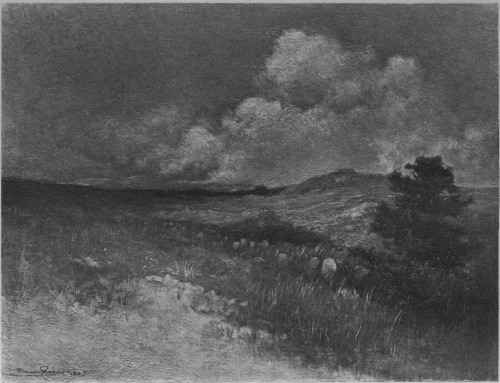
Ghostly and windy white Page 168 Clouds of the Autumn Night
THEN AND NOW
When my old heart was young, my dear, The earth and heaven were so near That in my dreams I oft could hear The steps of airy races; In woodlands, where bright waters ran, On hills, God’s rainbows used to span, I followed voices not of man, And smiled in spirit faces.
Now my old heart is old, my sweet, No longer earth and heaven meet; All life is grown to one dull street Where fact with fancy clashes; The voices now that speak to me Are prose instead of poetry; And in the faces now I see Is less of flame than ashes.
BY THE TRYSTING-BEECH
Deep in the west a berry-colored bar Of sunset gleams; against which one tall fir Stands outlined dark; above which—courier Of dew and dreams—burns dusk’s appointed star. And flash on flash, as when the elves wage war In Goblinland, the fireflies bombard The silence; and, like spirits, o’er the sward The twilight winds bring fragrance from afar. And now, withdrawn into the hill-wood belts, A whippoorwill; while, with attendant states Of pearl and silver, slow the great moon melts Into the night—to show me where she waits,— Like some slim moonbeam,—by the old beech-tree, Who keeps her lips, fresh as a flower, for me.
AFTER LONG GRIEF AND PAIN
There is a place hung o’er of summer boughs And dreamy skies wherein the gray hawk sleeps; Where waters flow, within whose lazy deeps, Like silvery prisms where the sunbeams drowse, The minnows twinkle; where the bells of cows Tinkle the stillness; and the bob-white keeps Calling from meadows where the reaper reaps, And children’s laughter haunts an old-time house: A place where life wears ever an honest smell Of hay and honey, sun and elder-bloom— Like some sweet, modest girl—within her hair; Where, with our love for comrade, we may dwell Far from the city’s strife, whose cares consume— Oh, take my hand and let me lead you there.
THE HAUNTED WOODLAND
Here in the golden darkness And green night of the woods, A flitting form I follow, A shadow that eludes— Or is it but the phantom Of former forest moods?
The phantom of some fancy I knew when I was young, And in my dreaming boyhood, The wildwood flow’rs among, Young face to face with Faëry Spoke in no unknown tongue.
Blue were her eyes, and golden The nimbus of her hair; And scarlet as a flower Her mouth that kissed me there; That kissed and bade me follow, And smiled away my care.
A magic and a marvel Lived in her word and look, As down among the blossoms She sate me by the brook, And read me wonder-legends In Nature’s Story Book.
Loved fairy-tales forgotten, She never reads again, Of beautiful enchantments That haunt the sun and rain, And, in the wind and water, Chant a mysterious strain.
And so I search the forest, Wherein my spirit feels, In stream, or tree, or flower Herself she still conceals— But now she flies who followed, Whom Earth no more reveals.
COMRADERY
With eyes hand-arched he looks into The morning’s face, then turns away With school-boy feet, all wet with dew, Out for a holiday.
The hill brook sings; incessant stars, Foam-fashioned, on its restless breast; And where he wades its water-bars Its song is happiest.
A comrade of the chinquapin, He looks into its knotty eyes And sees its heart; and, deep within, Its soul that makes him wise.
The wood-thrush knows and follows him, Who whistles up the birds and bees; And round him all the perfumes swim Of woodland loam and trees.
Where’er he pass the supple springs’ Foam-people sing the flowers awake; And sappy lips of bark-clad things Laugh ripe each fruited brake.
His touch is a companionship; His word, an old authority: He comes, a lyric on his lip, Unstudied Poesy.
OCCULT
Unto the soul’s companionship Of things that only seem to be, Earth points with magic finger-tip And bids thee see How Fancy keeps thee company.
For oft at dawn hast not beheld A spirit of prismatic hue Blow wide the buds, which night hath swelled? And stain them through With heav’n’s ethereal gold and blue?
While at her side another went With gleams of enigmatic white? A spirit who distributes scent, To vale and height, In footsteps of the rosy light?
And oft at dusk hast thou not seen The star-fays bring their caravans Of dew, and glitter all the green, Night’s shadow tans, With drops the rain-hung cobweb spans?
Nor watched with these the elfins go Who tune faint instruments—that sound Like that moon-music insects blow?— Then haunted ground Thou hast not trodden, never found!
WOOD-WORDS
I
The spirits of the forest, That to the winds give voice— I lie the livelong April day And wonder what it is they say That makes the leaves rejoice.
The spirits of the forest, That breathe in bud and bloom— I walk within the haw-tree brake And wonder how it is they make The bubbles of perfume.
The spirits of the forest, That dwell in every spring— I lean above the brook’s bright blue And wonder what it is they do That makes the water sing.
The spirits of the forest, That haunt the sun’s green glow— Down fungus ways of fern I steal And would surprise what they conceal, In dew, that twinkles so.
O spirits of the forest, Here are my heart and hand!— Oh, send a gleam or glow-worm ray To guide my soul the firefly way That leads to Fairyland.
II
The time when dog-tooth violets Hold up inverted horns of gold,— The elvish cups that Spring upsets With dripping feet, when April wets The sun-and-shadow-marbled wold,—
Is come. And by each leafing way The sorrel drops pale blots of pink; And, like an angled star a fay Sets on her forehead’s pallid day, The blossoms of the trillium wink.
Within the vale, by rock and stream,— A fragile, fairy porcelain,— Blue as a baby’s eyes a-dream, The bluets blow; and gleam in gleam The sun-shot dogwoods flash with rain.
It is the time to cast off care; To make glad intimates of these:— The frank-faced sunbeam laughing there: The great-heart wind, that bids us share The optimism of the trees.
III
The white ghosts of the flowers, The gray ghosts of the trees, Rise when the April showers, And haunt the wildwood bowers, And trail along the breeze: The white ghosts of the flowers, The gray ghosts of the trees.
Oft in the woodless places I feel their dim control; The wildflowers’ perished faces, The great trees’ vanished races, That meet me soul to soul: Oft in the woodless places I feel their dim control.
IV
Crab-apple buds, whose bells The mouth of April kissed; That hang,—like rosy shells Around a Naiad’s wrist,— Pink as dawn-tinted mist.
And paw-paw buds, whose dark Deep auburn blossoms shake On boughs,—as ’neath the bark A dryad’s eyes awake,— Brown as a midnight lake.
These, with symbolic blooms Of wind-flower and wild-phlox, I found among the glooms Of hill-lost woods and rocks, Lairs of the hare and fox.
The beetle in the brush, The bird about the creek, The bee within the hush, And I, whose love was meek, Stood still to hear these speak
The language that records, In flower-syllables, The hieroglyphic words Of beauty, who enspells The world and aye compels.
THE WIND AT NIGHT
I
Not till the wildman wind is shrill, Howling upon the hill In every wolfish tree, whose boisterous boughs, Like desperate arms, gesture and beat the night, And down huge clouds, in chasms of stormy white, The frightened moon hurries above the house, Shall I lie down; and, deep,— Letting the mad wind keep Its shouting revel round me,—fall asleep.
II
Not till its dark halloo is hushed, And where wild waters rushed,— Like some hoof’d terror underneath its whip And spur of foam,—remains A ghostly glass, hill-framed; whereover stains Of moony mists and rains, And stealthy starbeams, still as spectres, slip; Shall I—with thoughts that take Unto themselves the ache Of silence as a sound—from sleep awake.
AIRY TONGUES
I
There is a song the wet leaves lisp When Morn comes down the woodland way; And misty as a thistle-wisp Her gown gleams, windy gray: A song that seems to say, “Awake! ’tis day!”
There is a sigh when Day sits down Beside the sunlight-lulled lagoon; While on her glistening hair and gown The rose of rest is strew: A sigh, that seems to croon, “Come rest! ’tis noon!”
There is a whisper when the stars, Above an evening-purpled height, Crown the dead Day with nenuphars Of fire, gold and white: A voice, that seems t’ invite, “Come love! ’tis night!”
II
Before the rathe song-sparrow sings Among the haw-trees in the lane, And to the wind the locust flings Its early clusters fresh with rain; Beyond the morning-star, that swings Its rose of fire above the spire, Between the morning’s watchet wings, A wild voice rings o’er brooks and boughs— “Arouse! arouse!”
Before the first brown owlet cries Among the grape-vines on the hill, And in the dam with half-shut eyes The lilies rock above the mill; Beyond the oblong moon, that flies, A pearly flower, above the tower, Between the twilight’s primrose skies, A soft voice sighs, from east to west— “To rest! to rest!”
RAIN AND WIND
I hear the hoofs of horses Galloping over the hill, Galloping on and galloping on, When all the night is shrill With wind and rain that beats the pane— And my soul with awe is still.
For every dripping window Their headlong rush makes bound, Galloping up, and galloping by, Then back again and around, Till the gusty roofs ring with their hoofs, And the draughty cellars sound.
And then I hear black horsemen Hallooing in the night; Hallooing and hallooing, They ride o’er vale and height, And the branches snap and the shutters clap With the fury of their flight.
Then at each door a horseman,— With burly bearded lip Hallooing through the keyhole,— Pauses with cloak a-drip; And the door-knob shakes and the panel quakes ’Neath the anger of his whip.
All night I hear their gallop, And their wild halloo’s alarm; The tree-tops sound and the vanes go round In forest and on farm; But never a hair of a thing is there— Only the wind and storm.
UNDER ARCTURUS
I
“I belt the morn with ribboned mist; With baldricked blue I gird the noon, And dusk with purple, crimson-kissed, White-buckled with the hunter’s-moon.
“These follow me,” the Season says: “Mine is the frost-pale hand that packs Their scrips, and speeds them on their ways, With gipsy gold that weighs their backs.”
II
A daybreak horn the Autumn blows, As with a sun-tanned hand he parts Wet boughs whereon the berry glows; And at his feet the red fox starts.
The leafy leash that holds his hounds Is loosed; and all the noonday hush Is startled; and the hillside sounds Behind the fox’s bounding brush.
When red dusk makes the western sky A fire-lit window through the firs, He stoops to see the red fox die Among the chestnut’s broken burrs.
Then fanfaree and fanfaree, His bugle sounds; the world below Grows hushed to hear; and two or three Soft stars dream through the afterglow.
III
Like some black host the shadows fall, And blackness camps among the trees; Each wildwood road, a Goblin Hall, Grows populous with mysteries.
Night comes with brows of ragged storm, And limbs of writhen cloud and mist; The rain-wind hangs upon his arm Like some wild girl who cries unkissed.
By his gaunt hands the leaves are shed In headlong troops and nightmare herds; And, like a witch who calls the dead, The hill-stream whirls with foaming words.
Then all is sudden silence and Dark fear—like his who can not see, Yet hears, lost in a haunted land, Death rattling on a gallow’s-tree.
IV
The days approach again; the days Whose mantles stream, whose sandals drag When in the haze by puddled ways The gnarled thorn seems a crookéd hag.
When rotting orchards reek with rain; And woodlands crumble, leaf and log; And in the drizzling yard again The gourd is tagged with points of fog.
Now let me seat my soul among The woods’ dim dreams, and come in touch With melancholy, sad of tongue And sweet, who says so much, so much.
BARE BOUGHS
O heart,—that beat the bird’s blithe blood, The blithe bird’s strain, and understood The song it sang to leaf and bud,— What dost thou in the wood?
O soul,—that kept the brook’s glad flow, The glad brook’s word to sun and moon,— What dost thou here where song lies low, Dead as the dreams of June?
Where once was heard a voice of song, The hautboys of the mad winds sing; Where once a music flowed along, The rain’s wild bugles ring.
The weedy water frets and ails, And moans in many a sunless fall; And, o’er the melancholy, trails The black crow’s eldritch call.
Unhappy brook! O withered wood! O days, whom death makes comrades of! Where are the birds that thrilled the blood When Life struck hands with Love?
A song, one soared against the blue; A song, one bubbled in the leaves: A song, one threw where orchards grew Red-appled to the eaves.
The birds are flown; the flowers are dead; And sky and earth are bleak and gray; The wild winds hang i’ the boughs instead, And wild leaves strew the way.
A THRENODY
I
The rainy smell of a ferny dell, Whose shadow no sun-ray flaws, When Autumn sits in the wayside weeds Telling her beads Of haws.
II
The phantom mist, that is moonbeam-kissed, On hills where the trees are thinned, When Autumn leans at the oak-root’s scarp, Touching a harp Of wind.
III
The cricket’s chirr ’neath brier and burr, By leaf-strewn pools and streams, When Autumn stands ’mid the dropping nuts, With the book, she shuts, Of dreams.
IV
The gray “Alas” of the days that pass, And the hope that says “Adieu,” A parting sorrow, a shriveled flower, And one ghost’s hour With you.
SNOW
The moon, like a round device On a shadowy shield of war, Hangs white in a heaven of ice With a solitary star.
The wind is sunk to a sigh, And the waters are steeled with frost; And gray in the eastern sky The last snow-cloud is lost.
White fields, that are winter-starved; Black woods, that are winter-fraught; And Earth like a face death-carved With the iron of some black thought.
AN OLD SONG
I
It’s, Oh, for the hills, where the wind’s some one With a vagabond foot that follows! And a cheer-up hand that he claps upon Your arm with the hearty words, “Come on! We’ll soon be out of the hollows, My heart! We’ll soon be out of the hollows!”
II
It’s, Oh, for the songs, where the hope’s some one With a renegade foot that doubles! And a kindly look that he turns upon Your face with the friendly laugh, “Come on! We’ll soon be out of the troubles, My heart! We’ll soon be out of the troubles!”
BABY MARY
Deep in baby Mary’s eyes, Baby Mary’s sweet blue eyes, Dwell the golden memories Of the music once her ears Heard in far-off Paradise: So she has no time for tears,— Baby Mary,— Listening to the songs she hears.
Soft in baby Mary’s face, Baby Mary’s lovely face, If you watch, you, too, may trace Dreams her spirit-self hath seen In some far-off Eden-place, Whence her soul she can not wean,— Baby Mary,— Dreaming in a world between.
A SUNSET FANCY
Wide in the west a lake Of flame that seems to shake As if the Midgard snake Deep down did breathe: An isle of purple glow, Where rosy rivers flow Down peaks of cloudy snow With fire beneath.
And there the Tower-of-Night, With windows all a-light, Frowns on a burning height, Wherein she sleeps,— Young through the years of doom,— Veiled with her hair’s gold gloom, She, the Valkyrie, whom Enchantment keeps.
THE FEN-FIRE
The misty rain makes dim my face, The night’s black cloak is o’er me; I tread the dripping cypress-place, A flickering light before me.
Out of the death of leaves that rot And ooze and weedy water, My form was breathed to haunt this spot, Death’s immaterial daughter.
The owl that whoops upon the yew, The snake that lairs within it, Have seen my wild face flashing blue For one fantastic minute.
But should you follow where my eyes Like some pale lamp decoy you, Beware! lest suddenly I rise With love that shall destroy you.
THE WOOD
Witch-hazel, dogwood, and the maple here; And there the oak and hickory; Linn, poplar, and the beech-tree, far and near As the eased eye can see.
Wild-ginger; wahoo, with its flat balloons; And brakes of briers of a twilight green; And fox-grapes plumed with summer; and strung moons Of mandrake flowers between.
Deep gold-green ferns, and mosses green and gray,— Mats for what naked myth’s white feet?— And, cool and calm, a cascade far away With ever-even beat.
Old logs, made sweet with death; rough bits of bark; And tangled twig and knotted root; And sunshine splashes and great pools of dark; And many a wild-bird’s flute.
Here let me sit until the Indian, Dusk, With copper-colored face, comes down; Sowing the wildwood with star-fire and musk, And shadows blue and brown.
Then side by side with some magician Dream, I’ll take the owlet-haunted lane,— Half-roofed with vines,—led by a firefly gleam, That brings me home again.
WOOD NOTES
I
There is a flute that follows me From tree to tree: A water flute a spirit sets To silver lips in waterfalls, And through the breath of violets A sparkling music calls:— “Hither! halloo! Oh, follow! Down leafy hill and hollow, Where, through clear swirls, With feet like pearls, Wade down the blue-eyed country girls. Hither! halloo! Oh, follow!”
II
There is a pipe that plays to me From tree to tree: A bramble pipe an elfin holds To golden lips in berry brakes, And, swinging o’er the elder wolds, A flickering music makes:— “Come over! Come over The new-mown clover! Come over the fresh-cut hay! Where, there by the berries, With cheeks like cherries, And locks with which the warm wind merries, Brown girls are hilling the hay, All day! Come over the fields and away!— Come over! Come over!”
HILLS OF THE WEST
Hills of the west, that gird Forest and farm, Home of the nesting bird, Housing from harm, When, on your tops, is heard Storm.
Hills of the west, that bar Belts of the gloam, Under the twilight’s star, Where the mists roam, Take ye the wanderer Home.
Hills of the west, that dream Under the moon, Making of wind and stream, Late heard and soon, Parts of your lives that seem Tune.
Hills of the west, that take Silence to ye, Be it for sorrow’s sake Or memory, Part of such silence make Me.
THE WIND OF SPRING
The wind that breathes of columbines And celandines that crowd the rocks; That shakes the balsam of the pines With music from his airy locks, Stops at my city door and knocks.
He calls me far a-forest, where The twin-leaf and the blood-root bloom; And, circled by the amber air, Life sits with beauty and perfume Weaving the new web of her loom.
He calls me where the waters run Through fronding fern where wades the hern; And, sparkling in the equal sun, Song leans beside her brimming urn, And dreams the dreams that love shall learn.
The wind has summoned, and I go: To con God’s meaning in each line The wildflow’rs write; and, walking slow, God’s purpose, of which song is sign,— The wind’s great, gusty hand in mine.
THE WILLOW BOTTOM
Lush green the grass that grows between The willows of the bottom-land; Edged by the careless water, tall and green The brown-topped cat-tails stand.
The cows come gently here to browse, Slow through the great-leafed sycamores: You hear a dog bark from a low-roofed house With cedars round its doors.
Then all is quiet as the wings Of the one buzzard floating there: Anon a woman’s high-pitched voice that sings An old camp-meeting air.
A cock that flaps and crows; and then— Heard drowsy through the rustling corn— A flutter, and the cackling of a hen Within a hay-sweet barn.
How still again! no water stirs: No wind is heard: although the weeds Are waved a little: and from silk-filled burrs Drift by a few soft seeds.
So drugged with dreams the place, that you Expect to see her gliding by,— Hummed round of bees, through blossoms spilling dew,— The Spirit of July.
THE RED-BIRD
Red clouds and reddest flowers, And now two redder wings Swim through the rosy hours; Red wings among the flowers; And now the red-bird sings.
God makes the red clouds ripples Of flame that seem to split In rubies and in dripples Of rose where rills and ripples The singing flame that lit.
Red clouds of sundered splendor; God whispered one small word, Rich, sweet, and wild and tender— Straight, in the vibrant splendor, The word became a bird.
He flies beneath the garnet Of clouds that flame and float,— When summer hears the hornet Hum round the plum, turned garnet,— Heaven’s music in his throat.
CLEARING
Before the wind, with rain-drowned stocks, The pleated, crimson hollyhocks Are bending; And, smouldering in the breaking brown, Above the hills that rim the town, The day is ending.
The air is heavy with the damp; And, one by one, each cottage lamp Is lighted; Infrequent passers of the street Stroll on or stop to talk or greet, Benighted.
I look beyond my city yard, And watch the white moon struggling hard, Cloud-buried; The wind is driving toward the east, A wreck of pearl, all cracked and creased And serried.
At times the moon, erupting, streaks Some long cloud, raised in mountain peaks Of shadow,— That, seamed with silver, vein on vein, Grows to a far volcano chain Of Eldorado.
The wind, that blows from out the hills, Is like a woman’s touch that stills A sorrow: The moon sits high with many a star In the deep calm: and fair and far Abides to-morrow.
AUTUMN SORROW
Ah me! too soon the Autumn comes Among these purple-plaintive hills! Too soon among the forest gums Premonitory flame she spills, Bleak, melancholy flame that kills.
Her white fogs veil the morn, that rims With wet the moon-flow’r’s elfin moons; And, like exhausted starlight, dims The last slim lily-disk; and swoons With scents of hazy afternoons.
Her gray mists haunt the sunset skies, And build the west’s cadaverous fire, Where Sorrow sits with lonely eyes, And hands that wake her ancient lyre, Beside the ghost of dead Desire.
A DARK DAY OF SUMMER
Though Summer walks the world to-day With corn-crowned hours for her guard, Her thoughts have clad themselves in gray, And wait in Autumn’s weedy yard.
And where the larkspur and the phlox Spread carpets for her feet to pass, She stands with sombre, dripping locks Bound bleak with fog-washed zinnias.
Sad terra-cotta-colored flowers, Whose disks the trickling wet has tinged With dingy lustre, like the bowers, Flame-flecked with leaves, the frost has singed.
She, with slow feet,—’mid gaunt gold blooms Of marigolds her fingers twist,— Passes, dim-swathed in Fall’s perfumes And dreams of sullen rain and mist.
DAYS AND DAYS
The days that clothed white limbs with heat, And rocked the red rose on their breast, Have passed with amber-sandaled feet, Into the ruby-gated west.
These were the days that filled the heart With overflowing riches of Life; in whose soul no dream shall start But hath its origin in love.
Now come the days gray-huddled in The haze; whose foggy footsteps drip; Who pin beneath a gypsy chin The frosty marigold and hip.—
The days, whose forms fall shadowy Athwart the heart; whose misty breath Shapes saddest sweets of memory Out of the bitterness of death.
DROUTH IN AUTUMN
Gnarled acorn-oaks against a west Of copper, cavernous with fire; A wind of frost that gives no rest To such lean leaves as haunt the brier, And hide the cricket’s vibrant wire.
Sere, shivering shocks, and stubble blurred With bramble-blots of dull maroon; And creekless hills whereon no herd Finds pasture, and whereo’er the loon Flies, haggard as the rainless moon.
IN SUMMER
When in dry hollows, hilled with hay, The vesper-sparrow sings afar; And golden gray dusk dies away Beneath the amber evening-star: There, where a warm and shadowy arm The woodland lays around the farm, I’ll meet you at the tryst, the tryst! And kiss your lips no man hath kissed! I’ll meet you at the twilight tryst,— With a hey and a ho!— Sweetheart! I’ll kiss you at the tryst!
When clover fields smell cool with dew, And crickets cry, and roads are still; And faint and few the fireflies strew The dark where calls the whippoorwill; There, in the lane, where sweet again The petals of the wild-rose rain, I’ll take in mine your hand, your hand! And say the words you’ll understand! Your soft hand nestling in my hand,— With a hey and a ho!— Sweetheart! All loving hand in hand!
IN WINTER
I
When black frosts pluck the acorns down, And in the lane the waters freeze; And ’thwart red skies the wild-fowl flies, And death sits grimly in the trees; When home-lights glitter through the brown Of dusk like shaggy eyes,— Before the door his feet, sweetheart, And two white arms that greet, sweetheart, And two white arms that greet.
II
When ways are drifted with the leaves, And winds make music in the thorns; And lone and lost above the frost The new-moon shows its silver horns; When underneath the lamplit eaves The opened door is crossed,— A happy heart and light, sweetheart, And lips that kiss good night, sweetheart, And lips that kiss good night.
ON THE FARM
I
He sang a song as he sowed the field, Sowed the field at break of day: “When the pursed-up leaves are as lips that yield Balm and balsam, and Spring,—concealed In the odorous green,—is so revealed, Halloo and oh! Hallo for the woods and the far away!”
II
He trilled a song as he mowed the mead, Mowed the mead as noon begun: “When the hills are gold with the ripened seed, As the sunset stairs of the clouds that lead To the sky where Summer knows naught of need, Halloo and oh! Hallo for the hills and the harvest sun!”
III
He hummed a song as he swung the flail, Swung the flail in the afternoon: “When the idle fields are a wrecker’s tale, That the Autumn tells to the twilight pale, As the Year turns seaward a crimson sail, Halloo and oh! Hallo for the fields and the hunter’s-moon!”
IV
He whistled a song as he shouldered his axe, Shouldered his axe in the evening storm: “When the snow of the road shows the rabbit’s tracks, And the wind is a whip that the Winter cracks, With a herdsman’s cry, o’er the clouds black backs, Halloo and oh! Hallo for home and a fire to warm!”
PATHS
I
What words of mine can tell the spell Of garden ways I know so well?— The path that takes me, in the spring, Past quince-trees where the bluebirds sing, Where peonies are blossoming, Unto a porch, wistaria-hung, Around whose steps May-lilies blow, A fair girl reaches down among, Her arm more white than their sweet snow.
II
What words of mine can tell the spell Of garden ways I know so well?— Another path that leads me, when The summer-time is here again, Past hollyhocks that shame the west When the red sun has sunk to rest; To roses bowering a nest, A lattice, ’neath which mignonette And deep geraniums surge and sough, Where, in the twilight, starless yet, A fair girl’s eyes are stars enough.
III
What words of mine can tell the spell Of garden ways I know so well?— A path that takes me, when the days Of autumn wrap the hills in haze, Beneath the pippin-pelting tree, ’Mid flitting butterfly and bee; Unto a door where, fiery, The creeper climbs; and, garnet-hued, The cock’s-comb and the dahlia flare, And in the door, where shades intrude, Gleams bright a fair girl’s sunbeam hair.
IV
What words of mine can tell the spell Of garden ways I know so well?— A path that brings me through the frost Of winter, when the moon is tossed In clouds; beneath great cedars, weak With shaggy snow; past shrubs blown bleak With shivering leaves; to eaves that leak The tattered ice, whereunder is A fire-flickering window-space; And in the light, with lips to kiss, A fair girl’s welcome-giving face.
A SONG IN SEASON
I
When in the wind the vane turns round, And round, and round; And in his kennel whines the hound: When all the gable eaves are bound With icicles of ragged gray, A tattered gray; There is little to do, and much to say, And you hug your fire and pass the day With a thought of the springtime, dearie.
II
When late at night the owlet hoots, And hoots, and hoots; And wild winds make of keyholes flutes: When to the door the goodman’s boots Stamp through the snow the light strains red, The firelight’s red; There is nothing to do, and all is said, And you quaff your cider and go to bed And dream of the summer, dearie.