



Онлайн кітапты тегін оқу The Eternal City
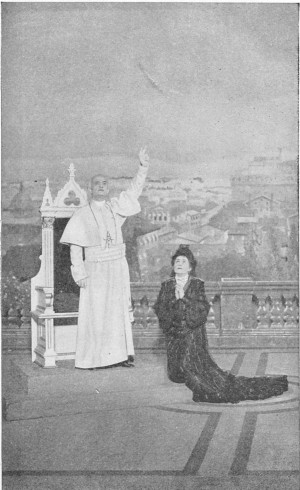
"WHAT YOU SAID SHALL BE SACRED."
The
ETERNAL CITY
By
HALL CAINE
Author of "The Christian," etc.
"He looked for a city which hath foundations
whose builder and maker is God."
GROSSET & DUNLAP
Publishers :: New York
Copyright, 1901, 1902
By HALL CAINE
Popular Edition
Published October, 1902
Table of Contents
PROLOGUE
1PART ONE—THE HOLY ROMAN EMPIRE
9PART TWO—THE REPUBLIC OF MAN
40PART THREE—ROMA
71PART FOUR—DAVID ROSSI
121PART FIVE—THE PRIME MINISTER
168PART SIX—THE ROMAN OF ROME
237PART SEVEN—THE POPE
298PART EIGHT—THE KING
375PART NINE—THE PEOPLE
414PREFACE TO THIS EDITION
Has a novelist a right to alter his novel after its publication, to condense it, to add to it, to modify or to heighten its situations, and otherwise so to change it that to all outward appearance it is practically a new book? I leave this point in literary ethics to the consideration of those whose business it is to discuss such questions, and content myself with telling the reader the history of the present story.
About ten years ago I went to Russia with some idea (afterwards abandoned) of writing a book that should deal with the racial struggle which culminated in the eviction of the Jews from the holy cities of that country, and the scenes of tyrannical administration which I witnessed there made a painful and lasting impression on my mind. The sights of the day often followed me through the night, and after a more than usually terrible revelation of official cruelty, I had a dream of a Jewish woman who was induced to denounce her husband to the Russian police under a promise that they would spare his life, which they said he had forfeited as the leader of a revolutionary movement. The husband came to know who his betrayer had been, and he cursed his wife as his worst enemy. She pleaded on her knees that fear for his safety had been the only motive for her conduct, and he cursed her again. His cause was lost, his hopes were dead, his people were in despair, because the one being whom heaven had given him for his support had delivered him up to his enemies out of the weakness of her womanly love. I awoke in the morning with a vivid memory of this new version of the old story of Samson and Delilah, and on my return to England I wrote the draft of a play with the incident of husband and wife as the central situation.
How from this germ came the novel which was published last year under the title of "The Eternal City" would be a long story to tell, a story of many personal experiences, of reading, of travel, of meetings in various countries with statesmen, priests, diplomats, police authorities, labour leaders, nihilists and anarchists, and of the consequent growth of my own political and religious convictions; but it will not be difficult to see where and in what way time and thought had little by little overlaid the humanities of the early sketch with many extra interests. That these interests were of the essence, clothing, and not crushing the human motive, I trust I may continue to believe, and certainly I have no reason to be dissatisfied with the reception of my book at the hands of that wide circle of general readers who care less for a contribution to a great social propaganda than for a simple tale of love.
But when the time came to return to my first draft of a play, the tale of love was the only thing to consider, and being now on the point of producing the drama in England, America, and elsewhere, and requested to prepare an edition of my story for the use of the audiences at the theatre, I have thought myself justified in eliminating the politics and religion from my book, leaving nothing but the human interests with which alone the drama is allowed to deal. This has not been an easy thing to do, and now that it is done I am by no means sure that I may not have alienated the friends whom the abstract problems won for me without conciliating the readers who called for the story only. But not to turn my back on the work of three laborious years, or to discredit that part of it which expressed, however imperfectly, my sympathy with the struggles of the poor, and my participation in the social problems with which the world is now astir, I have obtained the promise of my publisher that the original version of "The Eternal City" shall be kept in print as long as the public calls for it.
In this form of my book, the aim has been to rely solely on the humanities and to go back to the simple story of the woman who denounced her husband in order to save his life. That was the theme of the draft which was the original basis of my novel, it is the central incident of the drama which is about to be produced in New York, and the present abbreviated version of the story is intended to follow the lines of the play in all essential particulars down to the end of the last chapter but one.
H. C.
Isle of Man, Sept. 1902.
THE ETERNAL CITY
PROLOGUE
I
He was hardly fit to figure in the great review of life. A boy of ten or twelve, in tattered clothes, with an accordion in a case swung over one shoulder like a sack, and under the other arm a wooden cage containing a grey squirrel. It was a December night in London, and the Southern lad had nothing to shelter his little body from the Northern cold but his short velveteen jacket, red waistcoat, and knickerbockers. He was going home after a long day in Chelsea, and, conscious of something fantastic in his appearance, and of doubtful legality in his calling, he was dipping into side streets in order to escape the laughter of the London boys and the attentions of policemen.
Coming to the Italian quarter in Soho, he stopped at the door of a shop to see the time. It was eight o'clock. There was an hour to wait before he would be allowed to go indoors. The shop was a baker's, and the window was full of cakes and confectionery. From an iron grid on the pavement there came the warm breath of the oven underground, the red glow of the fire, and the scythe-like swish of the long shovels. The boy blocked the squirrel under his armpit, dived into his pocket, and brought out some copper coins and counted them. There was ninepence. Ninepence was the sum he had to take home every night, and there was not a halfpenny to spare. He knew that perfectly before he began to count, but his appetite had tempted him to try again if his arithmetic was not at fault.
The air grew warmer, and it began to snow. At first it was a fine sprinkle that made a snow-mist, and adhered wherever it fell. The traffic speedily became less, and things looked big in the thick air. The boy was wandering aimlessly through the streets, waiting for nine o'clock. When he thought the hour was near, he realised that he had lost his way. He screwed up his eyes to see if he knew the houses and shops and signs, but everything seemed strange.
The snow snowed on, and now it fell in large, corkscrew flakes. The boy brushed them from his face, but at the next moment they blinded him again. The few persons still in the streets loomed up on him out of the darkness, and passed in a moment like gigantic shadows. He tried to ask his way, but nobody would stand long enough to listen. One man who was putting up his shutters shouted some answer that was lost in the drumlike rumble of all voices in the falling snow.
The boy came up to a big porch with four pillars, and stepped in to rest and reflect. The long tunnels of smoking lights which had receded down the streets were not to be seen from there, and so he knew that he was in a square. It would be Soho Square, but whether he was on the south or east of it he could not tell, and consequently he was at a loss to know which way to turn. A great silence had fallen over everything, and only the sobbing nostrils of the cab-horses seemed to be audible in the hollow air.
He was very cold. The snow had got into his shoes, and through the rents in his cross-gartered stockings. His red waistcoat wanted buttons, and he could feel that his shirt was wet. He tried to shake the snow off by stamping, but it clung to his velveteens. His numbed fingers could scarcely hold the cage, which was also full of snow. By the light coming from a fanlight over the door in the porch he looked at his squirrel. The little thing was trembling pitifully in its icy bed, and he took it out and breathed on it to warm it, and then put it in his bosom. The sound of a child's voice laughing and singing came to him from within the house, muffled by the walls and the door. Across the white vapour cast outward from the fanlight he could see nothing but the crystal snowflakes falling wearily.
He grew dizzy, and sat down by one of the pillars. After a while a shiver passed along his spine, and then he became warm and felt sleepy. A church clock struck nine, and he started up with a guilty feeling, but his limbs were stiff and he sank back again, blew two or three breaths on to the squirrel inside his waistcoat, and fell into a doze. As he dropped off into unconsciousness he seemed to see the big, cheerless house, almost destitute of furniture, where he lived with thirty or forty other boys. They trooped in with their organs and accordions, counted out their coppers to a man with a clipped moustache, who was blowing whiffs of smoke from a long, black cigar, with a straw through it, and then sat down on forms to eat their plates of macaroni and cheese. The man was not in good temper to-night, and he was shouting at some who were coming in late and at others who were sharing their supper with the squirrels that nestled in their bosoms, or the monkeys, in red jacket and fez, that perched upon their shoulders. The boy was perfectly unconscious by this time, and the child within the house was singing away as if her little breast was a cage of song-birds.
As the church clock struck nine a class of Italian lads in an upper room in Old Compton Street was breaking up for the night, and the teacher, looking out of the window, said:
"While we have been telling the story of the great road to our country a snowstorm has come, and we shall have enough to do to find our road home."
The lads laughed by way of answer, and cried: "Good-night, doctor."
"Good-night, boys, and God bless you," said the teacher.
He was an elderly man, with a noble forehead and a long beard. His face, a sad one, was lighted up by a feeble smile; his voice was soft, and his manner gentle. When the boys were gone he swung over his shoulders a black cloak with a red lining, and followed them into the street.
He had not gone far into the snowy haze before he began to realise that his playful warning had not been amiss.
"Well, well," he thought, "only a few steps, and yet so difficult to find."
He found the right turnings at last, and coming to the porch of his house in Soho Square, he almost trod on a little black and white object lying huddled at the base of one of the pillars.
"A boy," he thought, "sleeping out on a night like this! Come, come," he said severely, "this is wrong," and he shook the little fellow to waken him.
The boy did not answer, but he began to mutter in a sleepy monotone, "Don't hit me, sir. It was snow. I'll not come home late again. Ninepence, sir, and Jinny is so cold."
The man paused a moment, then turned to the door rang the bell sharply.
II
Half-an-hour later the little musician was lying on a couch in the doctor's surgery, a cheerful room with a fire and a soft lamp under a shade. He was still unconscious, but his damp clothes had been taken off and he was wrapped in blankets. The doctor sat at the boy's head and moistened his lips with brandy, while a good woman, with the face of a saint, knelt at the end of the couch and rubbed his little feet and legs. After a little while there was a perceptible quivering of the eyelids and twitching of the mouth.
"He is coming to, mother," said the doctor.
"At last," said his wife.
The boy moaned and opened his eyes, the big helpless eyes of childhood, black as a sloe, and with long black lashes. He looked at the fire, the lamp, the carpet, the blankets, the figures at either end of the couch, and with a smothered cry he raised himself as though thinking to escape.
"Carino!" said the doctor, smoothing the boy's curly hair. "Lie still a little longer."
The voice was like a caress, and the boy sank back. But presently he raised himself again, and gazed around the room as if looking for something. The good mother understood him perfectly, and from a chair on which his clothes were lying she picked up his little grey squirrel. It was frozen stiff with the cold and now quite dead, but he grasped it tightly and kissed it passionately, while big teardrops rolled on to his cheeks.
"Carino!" said the doctor again, taking the dead squirrel away, and after a while the boy lay quiet and was comforted.
"Italiano—si?"
"Si, Signore."
"From which province?"
"Campagna Romana, Signore."
"Where does he say he comes from, doctor?"
"From the country district outside Rome. And now you are living at Maccari's in Greek Street—isn't that so?"
"Yes, sir."
"How long have you been in England—one year, two years?"
"Two years and a half, sir."
"And what is your name, my son?"
"David Leone."
"A beautiful name, carino! David Le-o-ne," repeated the doctor, smoothing the curly hair.
"A beautiful boy, too! What will you do with him, doctor?"
"Keep him here to-night at all events, and to-morrow we'll see if some institution will not receive him. David Leone! Where have I heard that name before, I wonder? Your father is a farmer?"
But the boy's face had clouded like a mirror that has been breathed upon, and he made no answer.
"Isn't your father a farmer in the Campagna Romana, David?"
"I have no father," said the boy.
"Carino! But your mother is alive—yes?"
"I have no mother."
"Caro mio! Caro mio! You shall not go to the institution to-morrow, my son," said the doctor, and then the mirror cleared in a moment as if the sun had shone on it.
"Listen, father!"
Two little feet were drumming on the floor above.
"Baby hasn't gone to bed yet. She wouldn't sleep until she had seen the boy, and I had to promise she might come down presently."
"Let her come down now," said the doctor.
The boy was supping a basin of broth when the door burst open with a bang, and like a tiny cascade which leaps and bubbles in the sunlight, a little maid of three, with violet eyes, golden complexion, and glossy black hair, came bounding into the room. She was trailing behind her a train of white nightdress, hobbling on the portion in front, and carrying under her arm a cat, which, being held out by the neck, was coiling its body and kicking its legs like a rabbit.
But having entered with so fearless a front, the little woman drew up suddenly at sight of the boy, and, entrenching herself behind the doctor, began to swing by his coat-tails, and to take furtive glances at the stranger in silence and aloofness.
"Bless their hearts! what funny things they are, to be sure," said the mother. "Somebody seems to have been telling her she might have a brother some day, and when nurse said to Susanna, 'The doctor has brought a boy home with him to-night,' nothing was so sure as that this was the brother they had promised her, and yet now ... Roma, you silly child, why don't you come and speak to the poor boy who was nearly frozen to death in the snow?"
But Roma's privateering fingers were now deep in her father's pocket, in search of a specimen of the sugar-stick which seemed to live and grow there. She found two sugar-sticks this time, and sight of a second suggested a bold adventure. Sidling up toward the couch, but still holding on to the doctor's coat-tails, like a craft that swings to anchor, she tossed one of the sugar-sticks on to the floor at the boy's side. The boy smiled and picked it up, and this being taken for sufficient masculine response, the little daughter of Eve proceeded to proper overtures.
"Oo a boy?"
The boy smiled again and assented.
"Oo me brodder?"
The boy's smile paled perceptibly.
"Oo lub me?"
The tide in the boy's eyes was rising rapidly.
"Oo lub me eber and eber?"
The tears were gathering fast, when the doctor, smoothing the boy's dark curls again, said:
"You have a little sister of your own far away in the Campagna Romana—yes?"
"No, sir."
"Perhaps it's a brother?"
"I ... I have nobody," said the boy, and his voice broke on the last word with a thud.
"You shall not go to the institution at all, David," said the doctor softly.
"Doctor Roselli!" exclaimed his wife. But something in the doctor's face smote her instantly and she said no more.
"Time for bed, baby."
But baby had many excuses. There were the sugar-sticks, and the pussy, and the boy-brother, and finally her prayers to say.
"Say them here, then, sweetheart," said her mother, and with her cat pinned up again under one arm and the sugar-stick held under the other, kneeling face to the fire, but screwing her half-closed eyes at intervals in the direction of the couch, the little maid put her little waif-and-stray hands together and said:
"Our Fader oo art in Heben, alud be dy name. Dy kingum tum. Dy will be done on eard as it is in Heben. Gib us dis day our dayey bread, and forgib us our trelspasses as we forgib dem dat trelspass ayenst us. And lee us not into temstashuns, but deliber us from ebil ... for eber and eber. Amen."
The house in Soho Square was perfectly silent an hour afterward. In the surgery the lamp was turned down, the cat was winking and yawning at the fire, and the doctor sat in a chair in front of the fading glow and listened to the measured breathing of the boy behind him. It dropped at length, like a pendulum that is about to stop, into the noiseless beat of innocent sleep, and then the good man got up and looked down at the little head on the pillow.
Even with the eyes closed it was a beautiful face; one of the type which great painters have loved to paint for their saints and angels—sweet, soft, wise, and wistful. And where did it come from? From the Campagna Romana, a scene of poverty, of squalor, of fever, and of death!
The doctor thought of his own little daughter, whose life had been a long holiday, and then of the boy whose days had been an unbroken bondage.
"Yet who knows but in the rough chance of life our little Roma may not some day ... God forbid!"
The boy moved in his sleep and laughed the laugh of a dream that is like the sound of a breeze in soft summer grass, and it broke the thread of painful reverie.
"Poor little man! he has forgotten all his troubles."
Perhaps he was back in his sunny Italy by this time, among the vines and the oranges and the flowers, running barefoot with other children on the dazzling whiteness of the roads!... Perhaps his mother in heaven was praying her heart out to the Blessed Virgin to watch over her fatherless darling cast adrift upon the world!
The train of thought was interrupted by voices in the street, and the doctor drew the curtain of the window aside and looked out. The snow had ceased to fall, and the moon was shining; the leafless trees were casting their delicate black shadows on the whitened ground, and the yellow light of a lantern on the opposite angle of the square showed where a group of lads were singing a Christmas carol.
"While shepherds watched their flocks by night, all seated on the ground,
The angel of the Lord came down, and glory shone around."
Doctor Roselli closed the curtain, put out the lamp, touched with his lips the forehead of the sleeping boy, and went to bed.
PART ONE—THE HOLY ROMAN EMPIRE
TWENTY YEARS LATER
I
It was the last day of the century. In a Bull proclaiming a Jubilee the Pope had called his faithful children to Rome, and they had come from all quarters of the globe. To salute the coming century, and to dedicate it, in pomp and solemn ceremony, to the return of the world to the Holy Church, one and universal, the people had gathered in the great Piazza of St. Peter.
Boys and women were climbing up every possible elevation, and a bright-faced girl who had conquered a high place on the base of the obelisk was chattering down at a group of her friends who were listening to their cicerone.
"Yes, that is the Vatican," said the guide, pointing to a square building at the back of the colonnade, "and the apartments of the Pope are those on the third floor, just on the level of the Loggia of Raphael. The Cardinal Secretary of State used to live in the rooms below, opening on the grand staircase that leads from the Court of Damasus. There's a private way up to the Pope's apartment, and a secret passage to the Castle of St. Angelo."
"Say, has the Pope got that secret passage still?"
"No, sir. When the Castle went over to the King the connection with the Vatican was cut off. Ah, everything is changed since those days! The Pope used to go to St. Peter's surrounded by his Cardinals and Bishops, to the roll of drums and the roar of cannon. All that is over now. The present Pope is trying to revive the old condition seemingly, but what can he do? Even the Bull proclaiming the Jubilee laments the loss of the temporal power which would have permitted him to renew the enchantments of the Holy City."
"Tell him it's just lovely as it is," said the girl on the obelisk, "and when the illuminations begin...."
"Say, friend," said her parent again, "Rome belonged to the Pope—yes? Then the Italians came in and took it and made it the capital of Italy—so?"
"Just so, and ever since then the Holy Father has been a prisoner in the Vatican, going into it as a cardinal and coming out of it as a corpse, and to-day will be the first time a Pope has set foot in the streets of Rome!"
"My! And shall we see him in his prison clothes?"
"Lilian Martha! Don't you know enough for that? Perhaps you expect to see his chains and a straw of his bed in the cell? The Pope is a king and has a court—that's the way I am figuring it."
"True, the Pope is a sovereign still, and he is surrounded by his officers of state—Cardinal Secretary, Majordomo, Master of Ceremonies, Steward, Chief of Police, Swiss Guards, Noble Guard and Palatine Guard, as well as the Papal Guard who live in the garden and patrol the precincts night and day."
"Then where the nation ... prisoner, you say?"
"Prisoner indeed! Not even able to look out of his windows on to this piazza on the 20th of September without the risk of insult and outrage—and Heaven knows what will happen when he ventures out to-day!"
"Well! this goes clear ahead of me!"
Beyond the outer cordon of troops many carriages were drawn up in positions likely to be favourable for a view of the procession. In one of these sat a Frenchman in a coat covered with medals, a florid, fiery-eyed old soldier with bristling white hair. Standing by his carriage door was a typical young Roman, fashionable, faultlessly dressed, pallid, with strong lower jaw, dark watchful eyes, twirled-up moustache and cropped black mane.
"Ah, yes," said the old Frenchman. "Much water has run under the bridge since then, sir. Changed since I was here? Rome? You're right, sir. 'When Rome falls, falls the world;' but it can alter for all that, and even this square has seen its transformations. Holy Office stands where it did, the yellow building behind there, but this palace, for instance—this one with the people in the balcony...."
The Frenchman pointed to the travertine walls of a prison-like house on the farther side of the piazza.
"Do you know whose palace that is?"
"Baron Bonelli's, President of the Council and Minister of the Interior."
"Precisely! But do you know whose palace it used to be?"
"Belonged to the English Wolsey, didn't it, in the days when he wanted the Papacy?"
"Belonged in my time to the father of the Pope, sir—old Baron Leone!"
"Leone! That's the family name of the Pope, isn't it?"
"Yes, sir, and the old Baron was a banker and a cripple. One foot in the grave, and all his hopes centred in his son. 'My son,' he used to say, 'will be the richest man in Rome some day—richer than all their Roman princes, and it will be his own fault if he doesn't make himself Pope.'"
"He has, apparently."
"Not that way, though. When his father died, he sold up everything, and having no relations looking to him, he gave away every penny to the poor. That's how the old banker's palace fell into the hands of the Prime Minister of Italy—an infidel, an Antichrist."
"So the Pope is a good man, is he?"
"Good man, sir? He's not a man at all, he's an angel! Only two aims in life—the glory of the Church and the welfare of the rising generation. Gave away half his inheritance founding homes all over the world for poor boys. Boys—that's the Pope's tender point, sir! Tell him anything tender about a boy and he breaks up like an old swordcut."
The eyes of the young Roman were straying away from the Frenchman to a rather shabby single-horse hackney carriage which had just come into the square and taken up its position in the shadow of the grim old palace. It had one occupant only—a man in a soft black hat. He was quite without a sign of a decoration, but his arrival had created a general commotion, and all faces were turning toward him.
"Do you happen to know who that is?" said the gay Roman. "That man in the cab under the balcony full of ladies? Can it be David Rossi?"
"David Rossi, the anarchist?"
"Some people call him so. Do you know him?"
"I know nothing about the man except that he is an enemy of his Holiness."
"He intends to present a petition to the Pope this morning, nevertheless."
"Impossible!"
"Haven't you heard of it? These are his followers with the banners and badges."
He pointed to the line of working-men who had ranged themselves about the cab, with banners inscribed variously, "Garibaldi Club," "Mazzini Club," "Republican Federation," and "Republic of Man."
"Your friend Antichrist," tipping a finger over his shoulder in the direction of the palace, "has been taxing bread to build more battleships, and Rossi has risen against him. But failing in the press, in Parliament and at the Quirinal, he is coming to the Pope to pray of him to let the Church play its old part of intermediary between the poor and the oppressed."
"Preposterous!"
"So?"
"To whom is the Pope to protest? To the King of Italy who robbed him of his Holy City? Pretty thing to go down on your knees to the brigand who has stripped you! And at whose bidding is he to protest? At the bidding of his bitterest enemy? Pshaw!"
"You persist that David Rossi is an enemy of the Pope?"
"The deadliest enemy the Pope has in the world."
II
The subject of the Frenchman's denunciation looked harmless enough as he sat in his hackney carriage under the shadow of old Baron Leone's gloomy palace. A first glance showed a man of thirty-odd years, tall, slightly built, inclined to stoop, with a long, clean-shaven face, large dark eyes, and dark hair which covered the head in short curls of almost African profusion. But a second glance revealed all the characteristics that give the hand-to-hand touch with the common people, without which no man can hope to lead a great movement.
From the moment of David Rossi's arrival there was a tingling movement in the air, and from time to time people approached and spoke to him, when the tired smile struggled through the jaded face and then slowly died away. After a while, as if to subdue the sense of personal observation, he took a pen and oblong notepaper and began to write on his knees.
Meantime the quick-eyed facile crowd around him beguiled the tedium of waiting with good-humoured chaff. One great creature with a shaggy mane and a sanguinary voice came up, bottle in hand, saluted the downcast head with a mixture of deference and familiarity, then climbed to the box-seat beside the driver, and in deepest bass began the rarest mimicry. He was a true son of the people, and under an appearance of ferocity he hid the heart of a child. To look at him you could hardly help laughing, and the laughter of the crowd at his daring dashes showed that he was the privileged pet of everybody. Only at intervals the downcast head was raised from its writing, and a quiet voice of warning said:
"Bruno!"
Then the shaggy head on the box-seat slewed round and bobbed downward with an apologetic gesture, and ten seconds afterwards plunged into wilder excesses.
"Pshaw!" mopping with one hand his forehead under his tipped-up billicock, and holding the bottle with the other. "It's hot! Dog of a Government, it's hot, I say! Never mind! here's to the exports of Italy, brother; and may the Government be the first of them."
"Bruno!"
"Excuse me, sir; the tongue breaks no bones, sir! All Governments are bad, and the worst Government is the best."
A feeble old man was at that moment crushing his way up to the cab. Seeing him approach, David Rossi rose and held out his hand. The old man took it, but did not speak.
"Did you wish to speak to me, father?"
"I can't yet," said the old man, and his voice shook and his eyes were moist.
David Rossi stepped out of the cab, and with gentle force, against many protests, put the old man in his place.
"I come from Carrara, sir, and when I go home and tell them I've seen David Rossi, and spoken to him, they won't believe me. 'He sees the future clear,' they say, 'as an almanack made by God.'"
Just then there was a commotion in the crowd, an imperious voice cried, "Clear out," and the next instant David Rossi, who was standing by the step of his cab, was all but run down by a magnificent equipage with two high-stepping horses and a fat English coachman in livery of scarlet and gold.
His face darkened for a moment with some powerful emotion, then resumed its kindly aspect, and he turned back to the old man without looking at the occupant of the carriage.
It was a lady. She was tall, with a bold sweep of fulness in figure, which was on a large scale of beauty. Her hair, which was abundant and worn full over the forehead, was raven black and glossy, and it threw off the sunshine that fell on her face. Her complexion had a golden tint, and her eyes, which were violet, had a slight recklessness of expression. Her carriage drew up at the entrance of the palace, and the porter, with the silver-headed staff, came running and bowing to receive her. She rose to her feet with a consciousness of many eyes upon her, and with an unabashed glance she looked around on the crowd.
There was a sulky silence among the people, almost a sense of antagonism, and if anybody had cheered there might have been a counter demonstration. At the same time, there was a certain daring in that marked brow and steadfast smile which seemed to say that if anybody had hissed she would have stood her ground.
She lifted from the blue silk cushions of the carriage a small half-clipped black poodle with a bow of blue ribbon on its forehead, tucked it under her arm, stepped down to the street, and passed into the courtyard, leaving an odour of ottar of roses behind her.
Only then did the people speak.
"Donna Roma!"
The name seemed to pass over the crowd in a breathless whisper, soundless, supernatural, like the flight of a bat in the dark.
III
The Baron Bonelli had invited certain of his friends to witness the Pope's procession from the windows and balconies of his palace overlooking the piazza, and they had begun to arrive as early as half-past nine.
In the green courtyard they were received by the porter in the cocked hat, on the dark stone staircase by lackeys in knee-breeches and yellow stockings, in the outer hall, intended for coats and hats, by more lackeys in powdered wigs, and in the first reception-room, gorgeously decorated in the yellow and gold of the middle ages, by Felice, in a dress coat, the Baron's solemn personal servant, who said, in sepulchral tones:
"The Baron's excuses, Excellency! Engaged in the Council-room with some of the Ministers, but expects to be out presently. Sit in the Loggia, Excellency?"
"So our host is holding a Cabinet Council, General?" said the English Ambassador.
"A sort of scratch council, seemingly. Something that concerns the day's doings, I guess, and is urgent and important."
"A great man, General, if half one hears about him is true."
"Great?" said the American. "Yes, and no, Sir Evelyn, according as you regard him. In the opinion of some of his followers the Baron Bonelli is the greatest man in the country—greater than the King himself—and a statesman too big for Italy. One of those commanding personages who carry everything before them, so that when they speak even monarchs are bound to obey. That's one view of his picture, Sir Evelyn."
"And the other view?"
General Potter glanced in the direction of a door hung with curtains, from which there came at intervals the deadened drumming of voices, and then he said:
"A man of implacable temper and imperious soul, an infidel of hard and cynical spirit, a sceptic and a tyrant."
"Which view do the people take?"
"Can you ask? The people hate him for the heavy burden of taxation with which he is destroying the nation in his attempt to build it up."
"And the clergy, and the Court, and the aristocracy?"
"The clergy fear him, the Court detests him, and the Roman aristocracy are rancorously hostile."
"Yet he rules them all, nevertheless?"
"Yes, sir, with a rod of iron—people, Court, princes, Parliament, King as well—and seems to have only one unsatisfied desire, to break up the last remaining rights of the Vatican and rule the old Pope himself."
"And yet he invites us to sit in his Loggia and look at the Pope's procession."
"Perhaps because he intends it shall be the last we may ever see of it."
"The Princess Bellini and Don Camillo Murelli," said Felice's sepulchral voice from the door.
An elderly aristocratic beauty wearing nodding white plumes came in with a pallid young Roman noble dressed in the English fashion.
"You come to church, Don Camillo?"
"Heard it was a service which happened only once in a hundred years, dear General, and thought it mightn't be convenient to come next time," said the young Roman.
"And you, Princess! Come now, confess, is it the perfume of the incense which brings you to the Pope's procession, or the perfume of the promenaders?"
"Nonsense, General!" said the little woman, tapping the American with the tip of her lorgnette. "Who comes to a ceremony like this to say her prayers? Nobody whatever, and if the Holy Father himself were to say...."
"Oh! oh!"
"Which reminds me," said the little lady, "where is Donna Roma?"
"Yes, indeed, where is Donna Roma?" said the young Roman.
"Who is Donna Roma?" said the Englishman.
"Santo Dio! the man doesn't know Donna Roma!"
The white plumes bobbed up, the powdered face fell back, the little twinkling eyes closed, and the company laughed and seated themselves in the Loggia.
"Donna Roma, dear sir," said the young Roman, "is a type of the fair lady who has appeared in the history of every nation since the days of Helen of Troy."
"Has a woman of this type, then, identified herself with the story of Rome at a moment like the present?" said the Englishman.
The young Roman smiled.
"Why did the Prime Minister appoint so-and-so?—Donna Roma! Why did he dismiss such-and-such?—Donna Roma! What feminine influence imposed upon the nation this or that?—Donna Roma! Through whom come titles, decorations, honours?—Donna Roma! Who pacifies intractable politicians and makes them the devoted followers of the Ministers?—Donna Roma! Who organises the great charitable committees, collects funds and distributes them?—Donna Roma! Always, always Donna Roma!"
"So the day of the petticoat politician is not over in Italy yet?"
"Over? It will only end with the last trump. But dear Donna Roma is hardly that. With her light play of grace and a whole artillery of love in her lovely eyes, she only intoxicates a great capital and"—with a glance towards the curtained door—"takes captive a great Minister."
"Just that," and the white plumes bobbed up and down.
"Hence she defies conventions, and no one dares to question her actions on her scene of gallantry."
"Drives a pair of thoroughbreds in the Corso every afternoon, and threatens to buy an automobile."
"Has debts enough to sink a ship, but floats through life as if she had never known what it was to be poor."
"And has she?"
The voices from behind the curtained door were louder than usual at that moment, and the young Roman drew his chair closer.
"Donna Roma, dear sir, was the only child of Prince Volonna. Nobody mentions him now, so speak of him in a whisper. The Volonnas were an old papal family, holding office in the Pope's household, but the young Prince of the house was a Liberal, and his youth was cast in the stormy days of the middle of the century. As a son of the revolution he was expelled from Rome for conspiracy against the papal Government, and when the Pope went out and the King came in, he was still a republican, conspiring against the reigning sovereign, and, as such, a rebel. Meanwhile he had wandered over Europe, going from Geneva to Berlin, from Berlin to Paris. Finally he took refuge in London, the home of all the homeless, and there he was lost and forgotten. Some say he practised as a doctor, passing under another name; others say that he spent his life as a poor man in your Italian quarter of Soho, nursing rebellion among the exiles from his own country. Only one thing is certain: late in life he came back to Italy as a conspirator—enticed back, his friends say—was arrested on a charge of attempted regicide, and deported to the island of Elba without a word of public report or trial."
"Domicilio Coatto—a devilish and insane device," said the American Ambassador.
"Was that the fate of Prince Volonna?"
"Just so," said the Roman. "But ten or twelve years after he disappeared from the scene a beautiful girl was brought to Rome and presented as his daughter."
"Donna Roma?"
"Yes. It turned out that the Baron was a kinsman of the refugee, and going to London he discovered that the Prince had married an English wife during the period of his exile, and left a friendless daughter. Out of pity for a great name he undertook the guardianship of the girl, sent her to school in France, finally brought her to Rome, and established her in an apartment on the Trinità de' Monti, under the care of an old aunt, poor as herself, and once a great coquette, but now a faded rose which has long since seen its June."
"And then?"
"Then? Ah, who shall say what then, dear friend? We can only judge by what appears—Donna Roma's elegant figure, dressed in silk by the best milliners Paris can provide, queening it over half the women of Rome."
"And now her aunt is conveniently bedridden," said the little Princess, "and she goes about alone like an Englishwoman; and to account for her extravagance, while everybody knows her father's estate was confiscated, she is by way of being a sculptor, and has set up a gorgeous studio, full of nymphs and cupids and limbs."
"And all by virtue of—what?" said the Englishman.
"By virtue of being—the good friend of the Baron Bonelli!"
"Meaning by that?"
"Nothing—and everything!" said the Princess with another trill of laughter.
"In Rome, dear friend," said Don Camillo, "a woman can do anything she likes as long as she can keep people from talking about her."
"Oh, you never do that apparently," said the Englishman. "But why doesn't the Baron make her a Baroness and have done with the danger?"
"Because the Baron has a Baroness already."
"A wife living?"
"Living and yet dead—an imbecile, a maniac, twenty years a prisoner in his castle in the Alban hills."
IV
The curtain parted over the inner doorway, and three gentlemen came out. The first was a tall, spare man, about fifty years of age, with an intellectual head, features cut clear and hard like granite, glittering eyes under overhanging brows, black moustaches turned up at the ends, and iron-grey hair cropped very short over a high forehead. It was the Baron Bonelli.
One of the two men with him had a face which looked as if it had been carved by a sword or an adze, good and honest but blunt and rugged; and the other had a long, narrow head, like the head of a hen—a lanky person with a certain mixture of arrogance and servility in his expression.
The company rose from their places in the Loggia, and there were greetings and introductions.
"Sir Evelyn Wise, gentlemen, the new British Ambassador—General Morra, our Minister of War; Commendatore Angelelli, our Chief of Police. A thousand apologies, ladies! A Minister of the Interior is one of the human atoms that live from minute to minute and are always at the mercy of events. You must excuse the Commendatore, gentlemen; he has urgent duties outside."
The Prime Minister spoke with the lucidity and emphasis of a man accustomed to command, and when Angelelli had bowed all round he crossed with him to the door.
"If there is any suspicion of commotion, arrest the ringleaders at once. Let there be no trifling with disorder, by whomsoever begun. The first to offend must be the first to be arrested, whether he wears cap or cassock."
"Good, your Excellency," and the Chief of Police went out.
"Commotion! Disorder! Madonna mia!" cried the little Princess.
"Calm yourselves, ladies. It's nothing! Only it came to the knowledge of the Government that the Pope's procession this morning might be made the excuse for a disorderly demonstration, and of course order must not be disturbed even under the pretext of liberty and religion."
"So that was the public business which deprived us of your society?" said the Princess.
"And left my womanless house the duty of receiving you in my absence," said the Baron.
The Baron bowed his guests to their seats, stood with his back to a wide ingle, and began to sketch the Pope's career.
"His father was a Roman banker—lived in this house, indeed—and the young Leone was brought up in the Jesuit schools and became a member of the Noble Guard: handsome, accomplished, fond of society and social admiration, a man of the world. This was a cause of disappointment to his father, who has intended him for a great career in the Church. They had their differences, and finally a mission was found for him and he lived a year abroad. The death of the old banker brought him back to Rome, and then, to the astonishment of society, he renounced the world and took holy orders. Why he gave up his life of gallantry did not appear...."
"Some affair of the heart, dear Baron," said the little Princess, with a melting look.
"No, there was no talk of that kind, Princess, and not a whisper of scandal. Some said the young soldier had married in England, and lost his wife there, but nobody knew for certain. There was less doubt about his religious vocation, and when by help of his princely inheritance he turned his mind to the difficult task of reforming vice and ministering to the lowest aspects of misery in the slums of Rome, society said he had turned Socialist. His popularity with the people was unbounded, but in the midst of it all he begged to be removed to London. There he set up the same enterprises, and tramped the streets in search of his waifs and outcasts, night and day, year in, year out, as if driven on by a consuming passion of pity for the lost and fallen. In the interests of his health he was called back to Rome—and returned here a white-haired man of forty."
"Ah! what did I say, dear Baron? The apple falls near the tree, you know!"
"By this time he had given away millions, and the Pope wished to make him President of his Academy of Noble Ecclesiastics, but he begged to be excused. Then Apostolic Delegate to the United States, and he prayed off. Then Nuncio to Spain, and he went on his knees to remain in the Campagna Romana, and do the work of a simple priest among a simple people. At last, without consulting him they made him Bishop, and afterwards Cardinal, and, on the death of the Pope, he was Scrutator to the Conclave, and fainted when he read out his own name as that of Sovereign Pontiff of the Church."
The little Princess was wiping her eyes.
"Then—all the world was changed. The priest of the future disappeared in a Pope who was the incarnation of the past. Authority was now his watchword. What was the highest authority on earth? The Holy See! Therefore, the greatest thing for the world was the domination of the Pope. If anybody should say that the power conferred by Christ on his Vicar was only spiritual, let him be accursed! In Christ's name the Pope was sovereign—supreme sovereign over the bodies and souls of men—acknowledging no superior, holding the right to make and depose kings, and claiming to be supreme judge over the consciences and crimes of all—the peasant that tills the soil, and the prince that sits on the throne!"
"Tre-men-jous!" said the American.
"But, dear Baron," said the little Princess, "don't you think there was an affair of the heart after all?" and the little plumes bobbed sideways.
The Baron laughed again. "The Pope seems to have half of humanity on his side already—he has the women apparently."
All this time there had risen from the piazza into the room a humming noise like the swarming of bees, but now a shrill voice came up from the crowd with the sudden swish of a rocket.
"Look out!"
The young Roman, who had been looking over the balcony, turned his head back and said:
"Donna Roma, Excellency."
But the Baron had gone from the room.
"He knew her carriage wheels apparently," said Don Camillo, and the lips of the little Princess closed tight as if from sudden pain.
V
The return of the Baron was announced by the faint rustle of a silk under-skirt and a light yet decided step keeping pace with his own. He came back with Donna Roma on his arm, and over his coolness and calm dignity he looked pleased and proud.
The lady herself was brilliantly animated and happy. A certain swing in her graceful carriage gave an instant impression of perfect health, and there was physical health also in the brightness of her eyes and the gaiety of her expression. Her face was lighted up by a smile which seemed to pervade her whole person and make it radiant with overflowing joy. A vivacity which was at the same time dignified and spontaneous appeared in every movement of her harmonious figure, and as she came into the room there was a glow of health and happiness that filled the air like the glow of sunlight through a veil of soft red gauze.
She saluted the Baron's guests with a smile that fascinated everybody. There was a modified air of freedom about her, as of one who has a right to make advances, a manner which captivates all women in a queen and all men in a lovely woman.
"Ah, it is you, General Potter? And my dear General Morra? Camillo mio!" (The Italian had rushed upon her and kissed her hand.) "Sir Evelyn Wise, from England, isn't it? I'm half an Englishwoman myself, and I'm very proud of it."
She had smiled frankly into Sir Evelyn's face, and he had smiled back without knowing it. There was something contagious about her smile. The rosy mouth with its pearly teeth seemed to smile of itself, and the lovely eyes had their separate art of smiling. Her lips parted of themselves, and then you felt your own lips parting.
"You were to have been busy with your fountain to-day...." began the Baron.
"So I expected," she said in a voice that was soft yet full, "and I did not think I should care to see any more spectacles in Rome, where the people are going in procession all the year through—but what do you think has brought me?"
"The artist's instinct, of course," said Don Camillo.
"No, just the woman's—to see a man!"
"Lucky fellow, whoever he is!" said the American. "He'll see something better than you will, though," and then the golden complexion gleamed up at him under a smile like sunshine.
"But who is he?" said the young Roman.
"I'll tell you. Bruno—you remember Bruno?"
"Bruno!" cried the Baron.
"Oh! Bruno is all right," she said, and, turning to the others, "Bruno is my man in the studio—my marble pointer, you know. Bruno Rocco, and nobody was ever so rightly named. A big, shaggy, good-natured bear, always singing or growling or laughing, and as true as steel. A terrible Liberal, though; a socialist, an anarchist, a nihilist, and everything that's shocking."
"Well?"
"Well, ever since I began my fountain ... I'm making a fountain for the Municipality—it is to be erected in the new part of the Piazza Colonna. I expect to finish it in a fortnight. You would like to see it? Yes? I'll send you cards—a little private view, you know."
"But Bruno?"
"Ah! yes, Bruno! Well, I've been at a loss for a model for one of my figures ... figures all round the dish, you know. They represent the Twelve Apostles, with Christ in the centre giving out the water of life."
"But Bruno! Bruno! Bruno!"
She laughed, and the merry ring of her laughter set them all laughing.
"Well, Bruno has sung the praises of one of his friends until I'm crazy ... crazy, that's English, isn't it? I told you I was half an Englishwoman. American? Thanks, General! I'm 'just crazy' to get him in."
"Simple enough—hire him to sit to you," said the Princess.
"Oh," with a mock solemnity, "he is far too grand a person for that! A member of Parliament, a leader of the Left, a prophet, a person with a mission, and I daren't even dream of it. But this morning, Bruno tells me, his friend, his idol, is to stop the Pope's procession, and present a petition, so I thought I would kill two birds with one stone—see my man and see the spectacle—and here I am to see them!"
"And who is this paragon of yours, my dear?"
"The great David Rossi!"
"That man!"
The white plumes were going like a fan.
"The man is a public nuisance and ought to be put down by the police," said the little Princess, beating her foot on the floor.
"He has a tongue like a sword and a pen like a dagger," said the young Roman.
Donna Roma's eyes began to flash with a new expression.
"Ah, yes, he is a journalist, isn't he, and libels people in his paper?"
"The creature has ruined more reputations than anybody else in Europe," said the little Princess.
"I remember now. He made a terrible attack on our young old women and our old young men. Declared they were meddling with everything—called them a museum of mummies, and said they were symbolical of the ruin that was coming on the country. Shameful, wasn't it? Nobody likes to be talked about, especially in Rome, where it's the end of everything. But what matter? The young man has perhaps learned freedom of speech in some free country. We can afford to forgive him, can't we? And then he is so interesting and so handsome!"
"An attempt to stop the Pope's procession might end in tumult," said the American General to the Italian General. "Was that the danger the Baron spoke about?"
"Yes," said General Morra. "The Government have been compelled to tax bread, and of course that has been a signal for the enemies of the national spirit to say that we are starving the people. This David Rossi is the worst Roman in Rome. He opposed us in Parliament and lost. Petitioned the King and lost again. Now he intends to petition the Pope—with what hope, Heaven knows."
"With the hope of playing on public opinion, of course," said the Baron cynically.
"Public opinion is a great force, your Excellency," said the Englishman.
"A great pestilence," said the Baron warmly.
"What is David Rossi?"
"An anarchist, a republican, a nihilist, anything as old as the hills, dear friend, only everything in a new way," said the young Roman.
"David Rossi is the politician who proposes to govern the world by the precepts of the Lord's Prayer," said the American.
"The Lord's Prayer!"
The Baron paraded on the hearthrug. "David Rossi," he said compassionately, "is a creature of his age. A man of generous impulses and wide sympathies, moved to indignation at the extremes of poverty and wealth, and carried away by the promptings of the eternal religion in the human soul. A dreamer, of course, a dreamer like the Holy Father himself, only his dream is different, and neither could succeed without destroying the other. In the millennium Rossi looks for, not only are kings and princes to disappear, but popes and prelates as well."
"And where does this unpractical politician come from?" said the Englishman.
"We must ask you to tell us that, Sir Evelyn, for though he is supposed to be a Roman, he seems to have lived most of his life in your country. As silent as an owl and as inscrutable as a sphinx. Nobody in Rome knows certainly who his father was, nobody knows certainly who his mother was. Some say his father was an Englishman, some say a Jew, and some say his mother was a gipsy. A self-centred man, who never talks about himself, and cannot be got to lift the veil which surrounds his birth and early life. Came back to Rome eight years ago, and made a vast noise by propounding his platonic scheme of politics—was called up for his term of military service, refused to serve, got himself imprisoned for six months and came out a mighty hero—was returned to Parliament for no fewer than three constituencies, sat for Rome, took his place on the Extreme Left, and attacked every Minister and every measure which favoured the interest of the army—encouraged the workmen not to pay their taxes and the farmers not to pay their rents—and thus became the leader of a noisy faction, and is now surrounded by the degenerate class throughout Italy which dreams of reconstructing society by burying it under ruins."
"Lived in England, you say?"
"Apparently, and if his early life could be traced it would probably be found that he was brought up in an atmosphere of conspiracy—perhaps under the influence of some vile revolutionary living in London under the protection of your too liberal laws."
Donna Roma sprang up with a movement full of grace and energy. "Anyhow," she said, "he is young and good-looking and romantic and mysterious, and I'm head over ears in love with him already."
"Well, every man is a world," said the American.
"And what about woman?" said Roma.
He threw up his hands, she smiled full into his face, and they laughed together.
VI
A fanfare of trumpets came from the piazza, and with a cry of delight Roma ran into the balcony, followed by all the women and most of the men.
"Only the signal that the cortège has started," said Don Camillo. "They'll be some minutes still."
"Santo Dio!" cried Roma. "What a sight! It dazzles me; it makes me dizzy!"
Her face beamed, her eyes danced, and she was all aglow from head to foot. The American Ambassador stood behind her, and, as permitted by his greater age, he tossed back the shuttlecock of her playful talk with chaff and laughter.
"How patient the people are! See the little groups on camp-stools munching biscuits and reading the journals. 'La Vera Roma!'" (mimicking the cry of the newspaper sellers). "Look at that pretty girl—the fair one with the young man in the Homburg hat! She has climbed up the obelisk, and is inviting him to sit on an inch and a half of corbel beside her."
"Ah, those who love take up little room!"
"Don't they? What a lovely world it is! I'll tell you what this makes me think about—a wedding! Glorious morning, beautiful sunshine, flowers, wreaths, bridesmaids ready; coachman all a posy, only waiting for the bride!"
"A wedding is what you women are always dreaming about—you begin dreaming about it in your cradles—it's in a woman's bones, I do believe," said the American.
"Must be the ones she got from Adam, then," said Roma.
Meantime the Baron was still parading the hearthrug inside and listening to the warnings of his Minister of War.
"You are resolved to arrest the man?"
"If he gives us an opportunity—yes."
"You do not forget that he is a Deputy?"
"It is because I remember it that my resolution is fixed. In Parliament he is a privileged person; let him make half as much disorder outside and you shall see where he will be."
"Anarchists!" said Roma. "That group below the balcony? Is David Rossi among them? Yes? Which of them? Which? Which? Which? The tall man in the black hat with his back to us? Oh! why doesn't he turn his face? Should I shout?"
"Roma!" from the little Princess.
"I know; I'll faint, and you'll catch me, and the Princess will cry 'Madonna mia!' and then he'll turn round and look up."
"My child!"
"He'll see through you, though, and then where will you be?"
"See through me, indeed!" and she laughed the laugh a man loves to hear, half-raillery, half-caress.
"Donna Roma Volonna, daughter of a line of princes, making love to a nameless nobody!"
"Shows what a heavenly character she is, then! See how good I am at throwing bouquets at myself?"
"Well, what is love, anyway? A certain boy and a certain girl agree to go for a row in the same boat to the same place, and if they pull together, what does it matter where they come from?"
"What, indeed?" she said, and a smile, partly serious, played about the parted mouth.
"Could you think like that?"
"I could! I could! I could!"
The clock struck eleven. Another fanfare of trumpets came from the direction of the Vatican, and then the confused noises in the square suddenly ceased and a broad "Ah!" passed over it, as of a vast living creature taking breath.
"They're coming!" cried Roma. "Baron, the cortège is coming."
"Presently," the Baron answered from within.
Roma's dog, which had slept on a chair through the tumult, was awakened by the lull and began to bark. She picked it up, tucked it under her arm and ran back to the balcony, where she stood by the parapet, in full view of the people below, with the young Roman on one side, the American on the other, and the ladies seated around.
By this time the procession had begun to appear, issuing from a bronze gate under the right arm of the colonnade, and passing down the channel which had been kept open by the cordon of infantry.
Roma abandoned herself to the fascinations of the scene, and her gaiety infected everybody.
"Camillo, you must tell me who they all are. There now—those men who come first in black and red?"
"Laymen," said the young Roman. "They're called the Apostolic Cursori. When a Cardinal is nominated they take him the news, and get two or three thousand francs for their trouble."
"And these little fat folk in white lace pinafores?"
"Singers of the Sistine Chapel. That's the Director, old Maestro Mustafa—used to be the greatest soprano of the century."
"And this dear old friar with the mittens and rosary and the comfortable linsey-woolsey sort of face?"
"That's Father Pifferi of San Lorenzo, confessor to the Pope. He knows all the Pope's sins."
PROLOGUE
PART ONE—THE HOLY ROMAN EMPIRE
PART TWO—THE REPUBLIC OF MAN
PART THREE—ROMA
PART FOUR—DAVID ROSSI
PART FIVE—THE PRIME MINISTER
PART SIX—THE ROMAN OF ROME
PART SEVEN—THE POPE
PART EIGHT—THE KING
PART NINE—THE PEOPLE
"Oh!" said Roma.
At that moment her dog barked furiously, and the old friar looked up at her, whereupon she smiled down on him, and then a half-smile played about his good-natured face.
"He is a Capuchin, and those Frati in different colours coming behind him...."
"I know them; see if I don't," she cried, as there passed under the balcony a double file of friars and monks. "The brown ones—Capuchins and Franciscans! Brown and white—Carmelites! Black—Augustinians and Benedictines! Black with a white cross—Passionists! And the monks all white are Trappists. I know the Trappists best, because I drive out to Tre Fontane to buy eucalyptus and flirt with Father John."
"Shocking!" said the American.
"Why not? What are their vows of celibacy but conspiracies against us poor women? Nearly every man a woman wants is either mated or has sworn off in some way. Oh, how I should love to meet one of those anchorites in real life and make him fly!"
"Well, I dare say the whisk of a petticoat would be more frightening than all his doctors of divinity."
"Listen!"
From a part of the procession which had passed the balcony there came the sound of harmonious voices.
"The singers of the Sistine Chapel! They're singing a hymn."
"I know it. 'Veni, Creator!' How splendid! How glorious! I feel as if I wanted to cry!"
All at once the singing stopped, the murmuring and speaking of the crowd ceased too, and there was a breathless moment, such as comes before the first blast of a storm. A nervous quiver, like the shudder that passes over the earth at sundown, swept across the piazza, and the people stood motionless, every neck stretched, and every eye turned in the direction of the bronze gate, as if God were about to reveal Himself from the Holy of Holies. Then in that grand silence there came the clear call of silver trumpets, and at the next instant the Presence itself.
"The Pope! Baron, the Pope!"
The atmosphere was charged with electricity. A great roar of cheering went up from below like the roaring of surf, and it was followed by a clapping of hands like the running of the sea off a shingly beach after the boom of a tremendous breaker.
An old man, dressed wholly in white, carried shoulder-high on a chair glittering with purple and crimson, and having a canopy of silver and gold above him. He wore a triple crown, which glistened in the sunlight, and but for the delicate white hand which he upraised to bless the people, he might have been mistaken for an image.
His face was beautiful, and had a ray of beatified light on it—a face of marvellous sweetness and great spirituality.
It was a thrilling moment, and Roma's excitement was intense. "There he is! All in white! He's on a gilded chair under the silken canopy! The canopy is held up by prelates, and the chairmen are in knee-breeches and red velvet. Look at the great waving plumes on either side!"
"Peacock's feathers!" said a voice behind her, but she paid no heed.
"Look at the acolytes swinging incense, and the golden cross coming before! What thunders of applause—I can hardly hear myself speak. It's like standing on a cliff while the sea below is running mountains high. No, it's like no other sound on earth; it's human—fifty thousand unloosed throats of men! That's the clapping of ladies—listen to the weak applause of their white-gloved fingers. Now they're waving their handkerchiefs. Look! Like the wings of ten thousand butterflies fluttering up from a meadow."
Roma's abandonment was by this time complete; she was waving her handkerchief and crying "Viva il Papa Re!"
"They're bearing him slowly along. He's coming this way. Look at the Noble Guard in their helmets and jackboots. And there are the Swiss Guard in Joseph's coat of many colours! We can see him plainly now. Do you smell the incense? It's like the ribbon of Bruges. The pluviale? That gold vestment? It's studded on his breast with precious stones. How they blaze in the sunshine! He is blessing the people, and they are falling on their knees before him."
"Like the grass before the scythe!"
"How tired he looks! How white his face is! No, not white—ivory! No, marble—Carrara marble! He might be Lazarus who was dead and has come back from the tomb! No humanity left in him! A saint! An angel!"
"The spiritual autocrat of the world!"
"Viva il Papa Re! He's going by! Viva il Papa Re! He has gone.... Well!"
She was rising from her knees and wiping her eyes, trying to cover up with laughter the confusion of her rapture.
"What is that?"
There was a sound of voices in the distance chanting dolorously.
"The cantors intoning Tu es Petrus," said Don Camillo.
"No, I mean the commotion down there. Somebody is pushing through the Guard."
"It's David Rossi," said the American.
"Is that David Rossi? Oh, dear me! I had forgotten all about him." She moved forward to see his face. "Why ... where have I ... I've seen him before somewhere."
A strange physical sensation tingled all over her at that moment, and she shuddered as if with sudden cold.
"What's amiss?"
"Nothing! But I like him. Do you know, I really like him."
"Women are funny things," said the American.
"They're nice, though, aren't they?" And two rows of pearly teeth between parted lips gleamed up at him with gay raillery.
Again she craned forward. "He is on his knees to the Pope! Now he'll present the petition. No ... yes ... the brutes! They're dragging him away! The procession is going on! Disgraceful!"
"Long live the Workmen's Pope!" came up from the piazza, and under the shrill shouts of the pilgrims were heard the monotonous voices of the monks as they passed through the open doors of the Basilica intoning the praises of God.
"They're lifting him on to a car," said the American.
"David Rossi?"
"Yes; he is going to speak."
"How delightful! Shall we hear him? Good! How glad I am that I came! He is facing this way! Oh, yes; those are his own people with the banners! Baron, the Holy Father has gone on to St. Peter's, and David Rossi is going to speak."
"Hush!"
A quivering, vibrating voice came up from below, and in a moment there was a dead silence.
VII
"Brothers, when Christ Himself was on the earth going up to Jerusalem, He rode on the colt of an ass, and the blind and the lame and the sick came to Him, and He healed them. Humanity is sick and blind and lame to-day, brothers, but the Vicar of Christ goes on."
At the words an audible murmur came from the crowd, such as goes before the clapping of hands in a Roman theatre, a great upheaval of the heart of the audience to the actor who has touched and stirred it.
"Brothers, in a little Eastern village a long time ago, there arose among the poor and lowly a great Teacher, and the only prayer He taught His followers was the prayer 'Our Father who art in Heaven.' It was the expression of man's utmost need, the expression of man's utmost hope. And not only did the Teacher teach that prayer—He lived according to the light of it. All men were His brothers, all women His sisters; He was poor, He had no home, no purse, and no second coat; when He was smitten He did not smite back, and when He was unjustly accused He did not defend Himself. Nineteen hundred years have passed since then, brothers, and the Teacher who arose among the poor and lowly is now a great Prophet. All the world knows and honours Him, and civilised nations have built themselves upon the religion He founded. A great Church calls itself by His name, and a mighty kingdom, known as Christendom, owes allegiance to His faith. But what of His teaching? He said: 'Resist not evil,' yet all Christian nations maintain standing armies. He said: 'Lay not up for yourselves treasures upon earth,' yet the wealthiest men are Christian men, and the richest organisation in the world is the Christian Church. He said: 'Our Father who art in Heaven,' yet men who ought to be brothers are divided into states, and hate each other as enemies. He said: 'Thy kingdom come, Thy will be done on earth as it is done in Heaven,' yet he who believes it ever will come is called a fanatic and a fool."
Some murmurs of dissent were drowned in cries of "Go on!" "Speak!" "Silence!"
"Foremost and grandest of the teachings of Christ are two inseparable truths—the fatherhood of God and the brotherhood of man. But in Italy, as elsewhere, the people are starved that king may contend with king, and when we appeal to the Pope to protest in the name of the Prince of Peace, he remembers his temporalities and passes on!"
At these words the emotion of the crowd broke into loud shouts of approval, with which some groans were mingled.
Roma had turned her face aside from the speaker, and her profile was changed—the gay, sprightly, airy, radiant look had given way to a serious, almost a melancholy expression.
"We have two sovereigns in Rome, brothers, a great State and a great Church, with a perishing people. We have soldiers enough to kill us, priests enough to tell us how to die, but no one to show us how to live."
"Corruption! Corruption!"
"Corruption indeed, brothers; and who is there among us to whom the corruptions of our rulers are unknown? Who cannot point to the wars made that should not have been made? to the banks broken that should not have broken? And who in Rome cannot point to the Ministers who allow their mistresses to meddle in public affairs and enrich themselves by the ruin of all around?"
The little Princess on the balcony was twisting about.
"What! Are you deserting us, Roma?"
And Roma answered from within the house, in a voice that sounded strange and muffled:
"It was cold on the balcony, I think."
The little Princess laughed a bitter laugh, and David Rossi heard it and misunderstood it, and his nostrils quivered like the nostrils of a horse, and when he spoke again his voice shook with passion.
"Who has not seen the splendid equipages of these privileged ones of fortune—their gorgeous liveries of scarlet and gold—emblems of the acid which is eating into the public organs? Has Providence raised this country from the dead only to be dizzied in a whirlpool of scandal, hypocrisy, and fraud—only to fall a prey to an infamous traffic without a name between high officials of low desires and women whose reputations are long since lost? It is men and women like these who destroy their country for their own selfish ends. Very well, let them destroy her; but before they do so, let them hear what one of her children says: The Government you are building up on the whitened bones of the people shall be overthrown—the King who countenances you, and the Pope who will not condemn you, shall be overthrown, and then—and not till then—will the nation be free."
At this there was a terrific clamour. The square resounded with confused voices. "Bravo!" "Dog!" "Dog's murderer!" "Traitor!" "Long live David Rossi!" "Down with the Vampire!"
The ladies had fled from the balcony back to the room with cries of alarm. "There will be a riot." "The man is inciting the people to rebellion!" "This house will be first to be attacked!"
"Calm yourselves, ladies. No harm shall come to you," said the Baron, and he rang the bell.
There came from below a babel of shouts and screams.
"Madonna mia! What is that?" cried the Princess, wringing her hands; and the American Ambassador, who had remained on the balcony, said:
"The Carabineers have charged the crowd and arrested David Rossi."
"Thank God!"
"They're going through the Borgo," said Don Camillo, "and kicking and cuffing and jostling and hustling all the way."
"Don't be alarmed! There's the Hospital of Santo Spirito round the corner, and stations of the Red Cross Society everywhere," said the Baron, and then Felice answered the bell.
"See our friends out by the street at the back, Felice. Good-bye, ladies! Have no fear! The Government does not mean to blunt the weapons it uses against the malefactors who insult the doctrines of the State."
"Excellent Minister!" said the Princess. "Such canaglia are not fit to have their liberty, and I would lock them all up in prison."
And then Don Camillo offered his arm to the little lady with the white plumes, and they came almost face to face with Roma, who was standing by the door hung with curtains, fanning herself with her handkerchief, and parting from the English Ambassador.
"Donna Roma," he was saying, "if I can ever be of use to you, either now or in the future, I beg of you to command me."
"Look at her!" whispered the Princess. "How agitated she is! A moment ago she was finding it cold in the Loggia! I'm so happy!"
At the next instant she ran up to Roma and kissed her. "Poor child! How sorry I am! You have my sympathy, my dear! But didn't I tell you the man was a public nuisance, and ought to be put down by the police?"
"Shameful, isn't it?" said Don Camillo. "Calumny is a little wind, but it raises such a terrible tempest."
"Nobody likes to be talked about," said the Princess, "especially in Rome, where it is the end of everything."
"But what matter? Perhaps the young man has learned freedom of speech in a free country!" said Don Camillo.
"And then he is so interesting and so handsome," said the Princess.
Roma made no answer. There was a slight drooping of the lovely eyes and a trembling of the lips and nostrils. For a moment she stood absolutely impassive, and then with a flash of disdain she flung round into the inner room.
VIII
Roma had taken refuge in the council-room. There had been much business that morning, and a copy of the constitutional statute lay open on a large table, which had a plate-glass top with photographs under the surface.
In this passionless atmosphere, so little accustomed to such scenes, Roma sat in her wounded pride and humiliation, with her head down, and her beautiful white hands over her face.
She heard measured footsteps approaching, and then a hand touched her on the shoulder. She looked up and drew back as if the touch stung her. Her lips closed sternly, and she got up and began to walk about the room, and then she burst into a torrent of anger.
"Did you hear them? The cats! How they loved to claw me, and still purr and purr! Before the sun is set the story will be all over Rome! It has run off already on the hoofs of that woman's English horses. To-morrow morning it will be in every newspaper in the kingdom. Olga and Lena and every woman of them all who lives in a glass house will throw stones. 'The new Pompadour! Who is she?' Oh, I could die of vexation and shame!"
The Baron leaned against the table and listened, twisting the ends of his moustache.
"The Court will turn its back on me now. They only wanted a good excuse to put their humiliations upon me. It's horrible! I can't bear it. I won't. I tell you, I won't!"
But the lips, compressed with scorn, began to quiver visibly, and she threw herself into a chair, took out her handkerchief, and hid her face on the table.
At that moment Felice came into the room to say that the Commendatore Angelelli had returned and wished to speak with his Excellency.
"I will see him presently," said the Baron, with an impassive expression, and Felice went out silently, as one who had seen nothing.
The Baron's calm dignity was wounded. "Be so good as to have some regard for me in the presence of my servants," he said. "I understand your feelings, but you are much too excited to see things in their proper light. You have been publicly insulted and degraded, but you must not talk to me as if it were my fault."
"Then whose is it? If it is not your fault, whose fault is it?" she said, and the Baron thought her red eyes flashed up at him with an expression of hate. He took the blow full in the face, but made no reply, and his silence broke her answer.
"No, no, that was too bad," she said, and she reached over to him, and he kissed her and then sat down beside her and took her hand and held it. At the next moment her brilliant eyes had filled with tears and her head was down and the hot drops were falling on to the back of his hand.
"I suppose it is all over," she said.
"Don't say that," he answered. "We don't know what a day may bring forth. Before long I may have it in my power to silence every slander and justify you in the eyes of all."
At that she raised her head with a smile and seemed to look beyond the Baron at something in the vague distance, while the glass top of the table, which had been clouded by her breath, cleared gradually, and revealed a large house almost hidden among trees. It was a photograph of the Baron's castle in the Alban hills.
"Only," continued the Baron, "you must get rid of that man Bruno."
"I will discharge him this very day—I will! I will! I will!"
There was an intense bitterness in the thought that what David Rossi had said must have come of what her own servant told him—that Bruno had watched her in her own house day by day, and that time after time the two men had discussed her between them.
"I could kill him," she said.
"Bruno Rocco?"
"No, David Rossi."
"Have patience; he shall be punished," said the Baron.
"How?"
"He shall be put on his trial."
"What for?"
"Sedition. The law allows a man to say what he will about a Prime Minister, but he must not foretell the overthrow of the King. The fellow has gone too far at last. He shall go to Santo Stefano."
"What good will that do?"
"He will be silenced—and crushed."
She looked at the Baron with a sidelong smile, and something in her heart, which she did not understand, made her laugh at him.
"Do you imagine you can crush a man like that by trying and condemning him?" she said. "He has insulted and humiliated me, but I'm not silly enough to deceive myself. Try him, condemn him, and he will be greater in his prison than the King on his throne."
The Baron twisted the ends of his moustache again.
"Besides," she said, "what benefit will it be to me if you put him on trial for inciting the people to rebellion against the King? The public will say it was for insulting yourself, and everybody will think he was punished for telling the truth."
The Baron continued to twist the ends of his moustache.
"Benefit!" She laughed ironically. "It will be a double injury. The insult will be repeated in public again and again. First the advocate for the crown will read it aloud, then the advocate for the defence will quote it, and then it will be discussed and dissected and telegraphed until everybody in court knows it by heart and all Europe has heard of it."
The Baron made no answer, but watched the beautiful face, now very pale, behind which conflicting thoughts seemed to wriggle like a knot of vipers. Suddenly she leaped up with a spring.
"I know!" she cried. "I know! I know! I know!"
"Well?"
"Give the man to me, and I will show you how to escape from this humiliating situation."
"Roma?" said the Baron, but he had read her thought already.
"If you punish him for this speech you will injure both of us and do no good to the King."
"It's true."
"Take him in a serious conspiracy, and you will be doing us no harm and the King some service."
"No doubt."
"You say there is a mystery about David Rossi, and you want to know who he is, who his father was, and where he spent the years he was away from Rome."
"I would certainly give a good deal to know."
"You want to know what vile refugee in London filled him with his fancies, what conspiracies he is hatching, what secret societies he belongs to, and, above all, what his plans and schemes are, and whether he is in league with the Vatican."
She spoke so rapidly that the words sputtered out of her quivering lips.
"Well?"
"Well, I will find it all out for you."
"My dear Roma!"
"Leave him to me, and within a month you shall know"—she laughed, a little ashamed—"the inmost secrets of his soul."
She was walking to and fro again, to prevent the Baron from looking into her face, which was now red over its white, like a rose moon in a stormy sky.
The Baron thought. "She is going to humble the man by her charms—to draw him on and then fling him away, and thus pay him back for what he has done to-day. So much the better for me if I may stand by and do nothing. A strong Minister should be unmoved by personal attacks. He should appear to regard them with contempt."
He looked at her, and the brilliancy of her eyes set his heart on fire. The terrible attraction of her face at that moment stirred in him the only love he had for her. At the same time it awakened the first spasm of jealousy.
"I understand you, Roma," he said. "You are splendid! You are irresistible! But remember—the man is one of the incorruptible."
She laughed.
"No woman who has yet crossed his path seems to have touched him, and it is the pride of all such men that no woman ever can."
"I've seen him," she said.
"Take care! As you say, he is young and handsome."
She tossed her head and laughed again.
The Baron thought: "Certainly he has wounded her in a way no woman can forgive."
"And what about Bruno?" he said.
"He shall stay," she answered. "Such men are easy enough to manage."
"You wish me to liberate David Rossi and leave you to deal with him?"
"I do! Oh, for the day when I can turn the laugh against him as he has turned the laugh against me! At the top of his hopes, at the height of his ambitions, at the moment when he says to himself, 'It is done'—he shall fall."
The Baron touched the bell. "Very well!" he said. "One can sometimes catch more flies with a spoonful of honey than with a hogshead of vinegar. We shall see."
A moment later the Chief of Police entered the room. "The Honourable Rossi is safely lodged in prison," he said.
"Commendatore," said the Baron, pointing to the book lying open on the table, "I have been looking again at the statute, and now I am satisfied that a Deputy can be arrested by the authorisation of Parliament alone."
"But, Excellency, if he is taken in the act, according to the forty-fifth article, the parliamentary immunity ceases."
"Commendatore, I have given you my opinion, and now it is my wish that the Honourable David Rossi should be set at liberty."
"Excellency!"
"Be so good as to liberate him instantly, and let your officers see him safely through the streets to his home in the Piazza Navona."
The little head like a hen's went down like a hatchet, and Commendatore Angelelli backed out of the room.
PART TWO—THE REPUBLIC OF MAN
I
The Piazza Navona is the heart and soul of old Rome. In other quarters of the living city you feel tempted to ask: "Is this London?" or, "Is this Paris?" or, "Is this New York or Berlin?" but in the Piazza Navona you can only tell yourself, "This is Rome!"
In an apartment-house of the Piazza Navona, David Rossi had lived during the seven years since he became Member of Parliament for Rome. The ground floor is a Trattoria, half eating-house and half wine-shop, with rude frescoes on its distempered walls, representing the Bay of Naples with Vesuvius in eruption. A passage running by the side of the Trattoria leads to the apartments overhead, and at the foot of the staircase there is a porter's lodge, a closet always lighted by a lamp, which burns down the dark passage day and night, like a bloodshot eye.
In this lodge lived a veteran Garibaldian, in his red shirt and pork-pie hat, with his old wife, wrinkled like a turkey, and wearing a red handkerchief over her head, fastened by a silver pin. David Rossi's apartments consisted of three rooms on the fourth floor, two to the front, the third to the back, and a lead flat opening out of them on to the roof.
In one of the front rooms on the afternoon of the Pope's Jubilee, a young woman sat knitting with an open book on her lap, while a boy of six knelt by her side, and pretended to learn his lesson. She was a comely but timid creature, with liquid eyes and a soft voice, and he was a shock-headed little giant, like the cub of a young lion.
"Go on, Joseph," said the woman, pointing with her knitting-needle to the line on the page. "'And it came to pass....'"
But Joseph's little eyes were peering first at the clock on the mantel-piece, and then out at the window and down the square.
"Didn't you say they were to be here at two, mamma?"
"Yes, dear. Mr. Rossi was to be set free immediately, and papa, who ran home with the good news, has gone back to fetch him."
"Oh! 'And it came to pass afterward that he loved a woman in the Valley of Sorek, whose name was Delilah. And the lords of the Philistines came unto her, and said unto her, Entice him and see wherein his great strength lieth....' But, mamma...."
"Go on with your lesson, Joseph. 'And she made him sleep....'"
"'And she made him sleep upon her knees, and she called for a man, and she caused him to shave off the seven locks of his head....'"
At that moment there came a knock at the door, whereupon the boy uttered a cry of delight, and with a radiant face went plunging and shouting out of the room.
"Uncle David! It's Uncle David!"
The tumultuous voice rolled like baby thunder through the apartment until it reached the door, and then it dropped to a dead silence.
"Who is it, Joseph?"
"A gentleman," said the boy.
II
It was the fashionable young Roman with the watchful eyes and twirled-up moustache, who had stood by the old Frenchman's carriage in the Piazza of St. Peter.
"I wish to speak with Mr. Rossi. I bring him an important message from abroad. He is coming along with the people, but to make sure of an interview I hurried ahead. May I wait?"
"Certainly! Come in, sir! You say he is coming? Yes? Then he is free?"
The woman's liquid eyes were glistening visibly, and the man's watchful ones seemed to notice everything.
"Yes, madam, he is free. I saw him arrested, and I also saw him set at liberty."
"Really? Then you can tell me all about it? That's good! I have heard so little of all that happened, and my boy and I have not been able to think of anything else. Sit down, sir!"
"As the police were taking him to the station-house in the Borgo," said the stranger, "the people made an attempt to rescue him, and it seemed as if they must certainly have succeeded if it had not been for his own intervention."
"He stopped them, didn't he? I'm sure he stopped them!"
"He did. The delegate had given his three warnings, and the Brigadier was on the point of ordering his men to fire, when the prisoner threw up his hands before the crowd."
"I knew it! Well?"
"'Brothers,' he said, 'let no blood be shed for my sake. We are in God's hands. Go home!'"
"How like him! And then, sir?"
"Then the crowd broke up like a bubble, and the officer who was in charge of him uncovered his head. 'Room for the Honourable Rossi!' he cried, and the prisoner went into the prison."
The liquid eyes were running over by this time, and the soft voice was trembling: "You say you saw him set at liberty?"
"Yes! I was in the public service myself until lately, so they allowed me to enter the police station, and when the order for release came I was present and heard all. 'Deputy,' said the officer, 'I have the honour to inform you that you are free.' 'But before I go I must say something,' said the Deputy. 'My only orders are that you are to be set at liberty,' said the officer. 'Nevertheless, I must see the Minister,' said Mr. Rossi. But the crowd had pressed in and surrounded him, and in a moment the flood had carried him out into the street, with shouts and the waving of hats and a whirlwind of enthusiasm. And now he is being drawn by force through the city in a mad, glad, wild procession."
"But he deserves it all, and more—far, far more!"
The stranger looked at the woman's beaming eyes, and said, "You are not his wife—no?"
"Oh, no! I'm only the wife of one of his friends," she answered.
"But you live here?"
"We live in the rooms on the roof."
"Perhaps you keep house for the Deputy?"
"Yes—that is to say—yes, we keep house for Mr. Rossi."
At that moment the room, which had been gloomy, was suddenly lighted by a shaft of sunshine, and there came from some unseen place a musical noise like the rippling of waters in a fountain.
"It's the birds," said the woman, and she threw open a window that was also a door and led to a flat roof on which some twenty or thirty canaries were piping and shrilling their little swollen throats in a gigantic bird-cage.
"Mr. Rossi's?"
"Yes, and he is fond of animals also—dogs and cats and rabbits and squirrels, especially squirrels."
"Squirrels?"
"He has a grey one in a cage on the roof now. But he is not like some people who love animals—he loves children, too. He loves all children, and as for Joseph...."
"The little boy who cried 'Uncle David' at the door?"
"Yes, sir. One day my husband said 'Uncle David' to Mr. Rossi, and he has been Uncle David to my little Joseph ever since."
"This is the dining-room, no doubt," said the stranger.
"Unfortunately, yes, sir."
"Why unfortunately?"
"Because here is the hall, and here is the table, and there's not even a curtain between, and the moment the door is opened he is exposed to everybody. People know it, too, and they take advantage. He would give the chicken off his plate if he hadn't anything else. I have to scold him a little sometimes—I can't help it. And as for father, he says he has doubled his days in purgatory by the lies he tells, turning people away."
"That will be his bedroom, I suppose," said the stranger, indicating a door which the boy had passed through.
"No, sir, his sitting-room. That is where he receives his colleagues in Parliament, and his fellow-journalists, and his electors and printers and so forth. Come in, sir."
The walls were covered with portraits of Mazzini, Garibaldi, Kossuth, Lincoln, Washington, and Cromwell, and the room, which had been furnished originally with chairs covered in chintz, was loaded with incongruous furniture.
"Joseph, you've been naughty again! My little boy is all for being a porter, sir. He has got the butt-end of his father's fishing-rod, you see, and torn his handkerchief into shreds to make a tassel for his mace." Then with a sweep of the arm, "All presents, sir. He gets presents from all parts of the world. The piano is from England, but nobody plays, so it is never opened; the books are from Germany, and the bronze is from France, but the strangest thing of all, sir, is this."
"A phonograph?"
"It was most extraordinary. A week ago a cylinder came from the island of Elba."
"Elba? From some prisoner, perhaps?"
"'A dying man's message,' Mr. Rossi called it. 'We must save up for an instrument to reproduce it, Sister,' he said. But, look you, the very next day the carriers brought the phonograph."
"And then he reproduced the message?"
"I don't know—I never asked. He often turns on a cylinder to amuse the boy, but I never knew him try that one. This is the bedroom, sir; you may come in."
It was a narrow room, very bright and lightsome, with its white counterpane, white bed curtains, and white veil over the looking-glass to keep it from the flies.
"How sweet!" said the stranger.
"It would be but for these," said the woman, and she pointed to the other end of the room, where a desk stood between two windows, amid heaps of unopened newspapers, which lay like fishes as they fall from the herring net.
"I presume this is a present also?" said the stranger. He had taken from the desk a dagger with a lapis-lazuli handle, and was trying its edge on his finger-nail.
"Yes, sir, and he has turned it to account as a paper-knife. A six-chamber revolver came yesterday, but he had no use for that, so he threw it aside, and it lies under the newspapers."
"And who is this?" said the stranger. He was looking at a faded picture in an ebony frame which hung by the side of the bed. It was the portrait of an old man with a beautiful forehead and a patriarchal face.
"Some friend of Mr. Rossi's in England, I think."
"An English photograph, certainly, but the face seems to me Roman for all that."
At that moment a thousand lusty voices burst on the air, as a great crowd came pouring out of the narrow lanes into the broad piazza. At the same instant the boy shouted from the adjoining room, and another voice that made the walls vibrate came from the direction of the door.
"They're coming! It's my husband! Bruno!" said the woman, and the ripple of her dress told the stranger she had gone.
III
Laughing, crying, cheering, chaffing, singing, David Rossi's people had brought him home in triumph, and now they were crowding upon him to kiss his hand, the big-hearted, baby-headed, beloved children of Italy.
The object of this aurora of worship stood with his back to the table in the dining-room, looking down and a little ashamed, while Bruno Rocco, six feet three in his stockings, hoisted the boy on to his shoulder, and shouted as from a tower to everybody as they entered by the door:
"Come in, sonny, come in! Don't stand there like the Pope between the devil and the deep sea. Come in among the people," and Bruno's laughter rocked through the room to where the crowd stood thick on the staircase.
"The Baron has had a lesson," said a man with a sheet of white paper in his hand. "He dreamed of getting the Collar of the Annunziata out of this."
"The pig dreamed of acorns," said Bruno.
"It's a lesson to the Church as well," said the man with the paper. "She wouldn't have anything to do with us. 'I alone strike the hour of the march,' says the Church."
"And then she stands still!" said Bruno.
"The mountains stand still, but men are made to walk," said the man with the paper, "and if the Pope doesn't advance with the people, the people must advance without the Pope."
"The Pope's all right, sonny," said Bruno, "but what does he know about the people? Only what his black-gowned beetles tell him!"
"The Pope has no wife and children," said the man with the paper.
"Old Vampire could find him a few," said Bruno, and then there was general laughter.
"Brothers," said David Rossi, "let us be temperate. There's nothing to be gained by playing battledore and shuttlecock with the name of an old man who has never done harm to any one. The Pope hasn't listened to us to-day, but he is a saint all the same, and his life has been a lesson in well-doing."
"Anybody can sail with a fair wind, sir," said Bruno.
"Let us be prudent. There's no need for violence, whether of the hand or of the tongue. You've found that out this morning. If you had rescued me from the police, I should have been in prison again by this time, and God knows what else might have happened. I'm proud of your patience and forbearance; and now go home, boys, and God bless you."
"Stop a minute!" said the man with the paper. "Something to read before we go. While the Carabineers kept Mr. Rossi in the Borgo, the Committee of Direction met in a café and drew up a proclamation."
"Read it, Luigi," said David Rossi, and the man opened his paper and read:
"Having appealed in vain to Parliament and to the King against the tyrannical tax which the Government has imposed upon bread in order that the army and navy may be increased, and having appealed in vain to the Pope to intercede with the civil authorities, and call back Italy to its duty, it now behoves us, as a suffering and perishing people, to act on our own behalf. Unless annulled by royal decree, the tax will come into operation on the 1st of February. On that day let every Roman remain indoors until an hour after Ave Maria. Let nobody buy so much as one loaf of bread, and let no bread be eaten, except such as you give to your children. Then, at the first hour of night, let us meet in the Coliseum, tens of thousands of fasting people, of one mind and heart, to determine what it is our duty to do next, that our bread may be sure and our water may not fail."
"Good!" "Beautiful!" "Splendid!"
"Only wants the signature of the president," said the reader, and Bruno called for pen and ink.
"Before I sign it," said Rossi, "let it be understood that none come armed. There is nothing our enemies would like better than to fix on us the names of rioters and rebels. We must defeat them. We must show the world that we alone are the people of law and order. Therefore I call on you to promise that none come armed."
"We promise," cried several voices.
"And now go home, boys, and God bless you."
After a moment there was only one man left in the room. It was the fashionable young Roman with the watchful eyes and twirled-up moustache.
"For you, sir!" said the young man, taking a letter from a pocket inside his waistcoat.
David Rossi opened the letter and read: "The bearer of this, Charles Minghelli, is one of ourselves. He has determined upon the accomplishment of a great act, and wishes to see you with respect to it."
"You come from London?"
"Yes, sir."
"You wish to speak to me?"
"I do."
"You may speak freely."
The young man glanced in the direction of Bruno and of Bruno's wife, who stood beside him.
"It is a delicate matter, sir," he said.
"Come this way," said David Rossi, and he took the stranger into his bedroom.
IV
David Rossi took his seat at the desk between the windows, and made a sign to the man to take a chair that stood near.
"Your name is Charles Minghelli?" said David Rossi.
"Yes. I have come to propose a dangerous enterprise."
"What is it?"
"That somebody on behalf of the people should take the law into his own hands."
The man had spoken with perfect calmness, and after a moment of silence David Rossi replied as calmly:
"I will ask you to explain what you mean."
The man smiled, made a deferential gesture, and answered, "You will permit me to speak plainly?"
"Certainly."
"Thanks! I have read your Creed and Charter. I have even signed my name to it. It is beautiful as a theory—most beautiful! And the Republic of Man is beautiful too. Beautiful!"
"Well?"
"But more beautiful than practical, dear sir, and the ideal thread that runs through your plan will break the moment the rough world begins to tug at it."
"I will ask you to be more precise," said David Rossi.
"With pleasure. You have called a meeting in the Coliseum to protest against the bread-tax. What if the Government prohibits it? Your principle of passive resistance will not permit you to rebel, and without the right of public meeting your association is powerless. Then where are you?"
David Rossi had taken up his paper-knife dagger and was drawing lines with the point of it on the letter of introduction which now lay open on the desk. The man saw the impression he had produced, and went on with more vigour.
"If the Governments of the world deny you the right of meeting, where are your weapons of warfare? On the one side armies on armies of men marshalled and equipped with all the arts and engines of war; on the other side a helpless multitude with their hands in their pockets, or paying a penny a week subscription to the great association that is to overcome by passive suffering the power of the combined treasuries of the world!"
David Rossi had risen from his seat, and was walking backward and forward with a step that was long and slow.
"Well, and what do you say we ought to do?" he said.
A flash came from the man's eyes, and he said in a thick voice:
"Remove the one man in Rome whose hand crushes the nation."
"The Prime Minister?"
"Yes."
There was silence.
"You expect me to do that?"
"No! I will do it for you.... Why not? If violence is wrong, it is right to resist violence."
David Rossi returned to his seat at the desk, touched the letter of introduction, and said:
"That is the great act referred to in this letter from London?"
"Yes."
"Why do you come to me?" he said.
"Because you can help me to accomplish this act. You are a Member of Parliament, and can give me cards to the Chamber. You can show me the way to the Prime Minister's room in Monte Citorio, and tell me the moment when he is to be found alone."
"I do not deny that the Prime Minister deserves death."
"A thousand deaths, sir, and everybody would hail them with delight."
"I do not deny that his death would be a relief to the people."
"On the day he dies, sir, the people will live."
"Or that crimes—great crimes—have been the means of bringing about great reforms."
"You are right, sir—but it would be no crime."
The stranger's face flushed up, his eyes seemed to burn, and he leaned over to the desk and took up the dagger.
"See! Give me this! It's exactly what I want. I'll put it in a bouquet of flowers, and pretend to offer them. Only a way to do it, sir! Say the word—may I take it?"
"But the man who assumes such a mission," said David Rossi, "must know himself free from every thought of personal vengeance."
The dagger trembled in the stranger's hand.
"He must be prepared to realise the futility of what he has done—to know that even when he succeeds he only changes the persons, not the things; the actors, not the parts."
The man stood like one who had been stunned, with his mouth partly open, and balancing the dagger on one hand.
"More than that," said David Rossi; "he must be prepared to be told by every true friend of freedom that the man who uses force is not worthy of liberty—that the conflict of intellects alone is human, and to fight otherwise is to be on the level of the brute."
The man threw the dagger back on the desk and laughed.
"I knew you talked like that to the people—statesmen do sometimes—that's all right—it's pretty, and it keeps the people quiet—but we...."
David Rossi rose with a sovereign dignity, but he only said:
"Mr. Minghelli, our interview is at an end."
"So you dismiss me?"
"I do," said David Rossi. "It is such men as you who put back the progress of the world and make it possible for the upholders of authority to describe our efforts as devilish machinations for the destruction of all order, human and divine. Besides that, you speak as one who has not only a perverted political sentiment, but a personal quarrel against an enemy."
The man faced round sharply, came back with a quick step, and said:
"You say I speak as one who has a personal quarrel with the Prime Minister. Perhaps I have! I heard your speech this morning about his mistress, with her livery of scarlet and gold. You meant the woman who is known as Donna Roma Volonna. What if I tell you she is not a Volonna at all, but a girl the Minister picked up in the streets of London, and has palmed off on Rome as the daughter of a noble house, because he is a liar and a cheat?"
David Rossi gave a start, as if an invisible hand had smitten him.
"Her name is Roma, certainly," said the man; "that was the first thing that helped me to seize the mysterious thread."
David Rossi's face grew pale, and he scarcely breathed.
"Oh, I'm not talking without proof," said the man. "I was at the Embassy in London ten years ago when the Ambassador was consulted by the police authorities about an Italian girl who had been found at night in Leicester Square. Mother dead, father gone back to Italy—she had been living with some people her father gave her to as a child, but had turned out badly and run away."
David Rossi had fixed his eyes on the stranger with a kind of glassy stare.
"I went with the Ambassador to Bow Street, and saw the girl in the magistrate's office. She pleaded that she had been ill-treated, but we didn't believe her story, and gave her back to her guardians. A month later we heard that she had run away once more and disappeared entirely."
David Rossi was breathing audibly, and shrinking like an old man into his shoulders.
"I never saw that girl again until a week ago, and where do you think I saw her?"
David Rossi swallowed his saliva, and said:
"Where?"
"In Rome. I had trouble at the Embassy, and came back to appeal to the Prime Minister. Everybody said I must reach him through Donna Roma, and one of my relatives took me to her rooms. The moment I set eyes on her I knew who she was. Donna Roma Volonna is the girl Roma Roselli, who was lost in the streets of London."
David Rossi seemed suddenly to grow taller.
"You scoundrel!" he said, in a voice that was hollow and choked.
The man staggered back and stammered:
"Why ... what...."
"I knew that girl. Until she was seven years of age she was my constant companion—she was the same as my sister—and her father was the same as my father—and if you tell me she is the mistress.... You infamous wretch! You calumniator! You villain! I could confound you with one word, but I won't. Out of my house this moment! And if ever you cross my path again I'll denounce you to the police as a cut-throat and an assassin."
Stunned and stupefied, the man opened the door and fled.
V
David Rossi came out with his long slow step, looking pale but calm, and tearing a letter into small pieces, which he threw into the fire.
"What was amiss, sir? They could hear you across the street," said Bruno.
"A man whose room was better than his company, that's all."
"What's his name?" said Bruno.
"Charles Minghelli."
"Why, that must be the secretary who was suspected of forgery at the Embassy in London, and got dismissed."
"I thought as much!" said David Rossi. "No doubt the man attributed his dismissal to the Prime Minister, and wanted to use me for his private revenge."
"That was his game, was it? Why didn't you let me know, sir? He would have gone downstairs like a falling star. Now that I remember, he's the nephew of old Polomba, the Mayor, and I've seen him at Donna Roma's."
A waiter in a white smock, with a large tin box on his head, entered the hall, and behind him came the old woman from the porter's lodge, with the wrinkled face and the red cotton handkerchief.
"Come in," cried Bruno. "I ordered the best dinner in the Trattoria, sir, and thought we might perhaps dine together for once."
"Good," said David Rossi.
"Here it is, a whole basketful of the grace of God, sir! Out with it, Riccardo," and while the women laid the table, Bruno took the dishes smoking hot from their temporary oven with its charcoal fire.
"Artichokes—good. Chicken—good again. I must be a fox—I was dreaming of chicken all last night! Gnocchi! (potatoes and flour baked). Agradolce! (sour and sweet). Fagioletti! (French beans boiled) and—a half-flask of Chianti! Who said the son of my mother couldn't order a dinner? All right, Riccardo; come back at Ave Maria."
The waiter went off, and the company sat down to their meal, Bruno and his wife at either end of the table, and David Rossi on the sofa, with the boy on his right, and the cat curled up into his side on the left, while the old woman stood in front, serving the food and removing the plates.
"Look at him!" said the old woman, who was deaf, pointing to David Rossi, with his two neighbours. "Now, why doesn't the Blessed Virgin give him a child of his own?"
"She has, mother, and here he is," said David Rossi.
"You'll let her give him a woman first, won't you?" said Bruno.
"Ah! that will never be," said David Rossi.
"What does he say?" said the old woman with her hand at her ear like a shell.
"He says he won't have any of you," bawled Bruno.
"What an idea! But I've heard men say that before, and they've been married sooner than you could say 'Hail Mary.'"
"It isn't an incident altogether unknown in the history of this planet, is it, mother?" said Bruno.
"A heart to share your sorrows and joys is something, and the man is not wise who wastes the chance of it," said the old woman. "Does he think parliaments will make up for it when he grows old and wants something to comfort him?"
"Hush, mother!" said Elena, but Bruno made mouths at her to let the old woman go on.
"As for me, I'll want somebody of my own about me to close my eyes when the time comes to put the sacred oil on them," said the old woman.
"If a man has dedicated his life to work for humanity," said David Rossi, "he must give up many things—father, mother, wife, child."
The corner of Elena's apron crept up to the corner of her eye, but the old woman, who thought the subject had changed, laughed and said:
"That's just what I say to Tommaso. 'Tommaso,' I say, 'if a man is going to be a policeman he must have no father, or mother, or wife, or child—no, nor bowels neither,' I say. And Tommaso says, 'Francesca,' he says, 'the whole tribe of gentry they call statesmen are just policemen in plain clothes, and I do believe they've only liberated Mr. Rossi as a trap to catch him again when he has done something.'"
"They won't catch you though, will they, mother?" shouted Bruno.
"That they won't! I'm deaf, praise the saints, and can't hear them."
A knock came to the door, and seizing his mace the boy ran and opened it. An old man stood on the threshold. He was one of David Rossi's pensioners. Ninety years of age, his children all dead, he lived with his grandchildren, and was one of the poor human rats who stay indoors all day and come out with a lantern at night to scour the gutters of the city for the refuse of cigar-ends.
"Come another night, John," said Bruno.
But David Rossi would not send him away empty, and he was going off with the sparkling eyes of a boy, when he said:
"I heard you in the piazza this morning, Excellency! Grand! Only sorry for one thing."
"And what was that, sonny?" asked Bruno.
"What his Excellency said about Donna Roma. She gave me a half-franc only yesterday—stopped the carriage to do it, sir."
"So that's your only reason...." began Bruno.
"Good reason, too. Good-night, John!" said David Rossi, and Joseph closed the door.
"Oh, she has her virtues, like every other kind of spider," said Bruno.
"I'm sorry I spoke of her," said David Rossi.
"You needn't be, though. She deserved all she got. I haven't been two years in her studio without knowing what she is."
"It was the man I was thinking of, and if I had remembered that the woman must suffer...."
"Tut! She'll have to make her Easter confession a little earlier, that's all."
"If she hadn't laughed when I was speaking...."
"You're on the wrong track now, sir. That wasn't Donna Roma. It was the little Princess Bellini. She is always stretching her neck and screeching like an old gandery goose."
Dinner was now over, and the boy called for the phonograph. David Rossi went into the sitting-room to fetch it, and Elena went in at the same time to light the fire. She was kneeling with her back to him, blowing on to the wood, when she said in a trembling voice:
"I'm a little sorry myself, sir, if I may say so. I can't believe what they say about the mistress, but even if it's true we don't know her story, do we?"
Then the phonograph was turned on, and Joseph marched to the tune of "Swannee River" and the strains of Sousa's band.
"Mr. Rossi," said Bruno, between a puff and a blow.
"Yes?"
"Have you tried the cylinder that came first?"
"Not yet."
"How's that, sir?"
"The man who brought it said the friend who had spoken into it was dead." And then with a shiver, "It would be like a voice from the grave—I doubt if I dare hear it."
"Like a ghost speaking to a man, certainly—especially if the friend was a close one."
"He was the closest friend I ever had, Bruno—he was my father."
"Father?"
"Foster-father, anyway. For four years he clothed and fed and educated me, and I was the same as his own son."
"Had he no children of his own?"
"One little daughter, no bigger than Joseph when I saw her last—Roma."
"Roma?"
"Yes, her father was a Liberal, and her name was Roma."
"What became of her?"
"When the doctor came to Italy on the errand which ended in his imprisonment he gave her into the keeping of some Italian friends in London. I was too young to take charge of her then. Besides, I left England shortly afterward and went to America."
"Where is she now?" said Elena.
"When I returned to England ... she was dead."
"Well, there's nothing new under the sun of Rome—Donna Roma came from London," said Bruno.
David Rossi felt the muscles of his face quiver.
"Her father was an exile in England, too, and when he came back on the errand that ended in Elba, he gave her away to some people who treated her badly—I've heard old Teapot, the Countess, say so when she's been nagging her poor niece."
David Rossi breathed painfully.
"Strange if it should be the same," said Bruno.
"But Mr. Rossi's Roma is dead," said Elena.
"Ah, of course, certainly! What a fool I am!" said Bruno.
David Rossi had a sense of suffocation, and he went out on to the lead flat.
VI
The Ave Maria was ringing from many church towers, and the golden day was going down with the sun behind the dark outline of the dome of St. Peter's, while the blue night was rising over the snow-capped Apennines in a premature twilight with one twinkling star.
David Rossi's ears buzzed as with the sound of a mighty wind rushing through trees at a distance. Bruno's last words on top of Charles Minghelli's had struck him like an alarum bell heard through the mists of sleep, and his head was stunned and his eyes were dizzy. He buttoned his coat about him, and walked quickly to and fro on the lead flat by the side of the cage, in which the birds were already bunched up and silent.
Before he was aware of the passing of time, the church bells were tolling the first hour of night. Presently he became aware of flares burning in the Piazza of St. Peter, and of the shadows of giant heads cast up on the walls of the vast Basilica. It was the crowd gathering for the last ceremonial of the Pope's Jubilee, and at the sound of a double rocket, which went up as with the crackle of musketry, little Joseph came running on to the roof, followed by his mother and Bruno.
David Rossi took the boy into his arms and tried to dispel the gloom of his own spirits in the child's joy at the illuminations.
"Ever see 'luminations before, Uncle David?" said Joseph.
"Once, dear, but that was long ago and far away. I was a boy myself in those days, and there was a little girl with me then who was no bigger than you are now. But it's growing cold, there's frost in the air, besides it's late, and little boys must go to bed."
"Well, God is God, and the Pope is His Prophet," said Bruno, when Elena and Joseph had gone indoors. "It was like day! You could see the lightning conductor over the Pope's apartment! Pshew!" blowing puffs of smoke from his twisted cigar. "Won't keep the lightning off, though."
"Bruno!"
"Yes, sir?"
"Donna Roma's father would be Prince Volonna?"
"Yes, the last prince of the old papal name. When the Volonna estates were confiscated, the title really lapsed, but old Vampire got the lands."
"Did you ever hear that he bore any other name during the time he was in exile?"
"Sure to, but there was no trial and nothing was known. They all changed their names, though."
"Why ... what...." said David Rossi in an unsteady voice.
"Why?" said Bruno. "Because they were all condemned in Italy, and the foreign countries were told to turn them out. But what am I talking about? You know all that better than I do, sir. Didn't your old friend go under a false name?"
"Very likely—I don't know," said David Rossi, in a voice that testified to jangled nerves.
"Did he ever tell you, sir?"
"I can't say that he ever.... Certainly the school of revolution has always had villains enough, and perhaps to prevent treachery...."
"You may say so! The devil has the run of the world, even in England. But I'm surprised your old friend, being like a father to you, didn't tell you—at the end anyway...."
"Perhaps he intended to—and then perhaps...."
David Rossi put his hand to his brow as if in pain and perplexity, and began again to walk backward and forward.
A screamer in the piazza below cried "Trib-un-a!" and Bruno said:
"That's early! What's up, I wonder? I'll go down and get a paper."
Darkness had by this time re-invaded the sky, and the stars looked down from their broad dome, clear, sweet, white, and serene, putting to shame by their immortal solemnity the poor little mimes, the paltry puppet-shows of the human jackstraws who had just been worshipping at their self-made shrine.
As David Rossi returned to the house, Elena, who was undressing the boy, saw a haggard look in his eyes, but Bruno, who was reading his evening journal, saw nothing, and cried out:
"Helloa! Listen to this, sir. It's Olga. She's got a pen, I can tell you. 'Madame de Pompadour. Hitherto we have had the pleasure of having Madame ——, whose pressure on the State and on Italy's wise counsellors was only incidental, but now that the fates have given us a Madame Pompadour....' Then there's a leading article on your speech in the piazza. Praises you up to the skies. Look! 'Thank God we have men like the Honourable Rossi, who at the risk of....'"
But with a clouded brow David Rossi turned away from him and passed into the sitting-room, and Bruno looked around in blank bewilderment.
"Shall you want the lamp, sir?" said Elena.
"Not yet, thank you," he answered through the open door.
The wood fire was glowing on the hearth, and in the acute state of his nerves he shuddered involuntarily as its reflection in the window opposite looked back at him like a fiery eye. He opened the case of the phonograph, which had been returned to its place on the piano, and then from a drawer in the bureau he took a small cardboard box. The wood in the fire flickered at that moment and started some ghastly shadows on the ceiling, but he drew a cylinder from the box and slid it on to the barrel of the phonograph. Then he stepped to the door, shut and locked it.
VII
"Well!" said Bruno. "If that isn't enough to make a man feel as small as a sardine!"
There was only one thing to do, but to conceal the nature of it Bruno flourished the newspaper and said:
"Elena, I must go down to the lodge and read these articles to your father. Poor Donna Roma, she'll have to fly, I'm afraid. Bye-bye, Garibaldi-Mazzini! Early to bed, early to rise, and time enough to grow old, you know!... As for Mr. Rossi, he might be a sinner and a criminal instead of the hero of the hour! It licks me to little bits." And Bruno carried his dark mystery down to the café to see if it might be dispelled by a litre of autumnal light from sunny vineyards.
Meantime, Joseph, being very tired, was shooting out a pettish lip because he had to go to bed without saying good-night to Uncle David; and his mother, making terms with this pretence, consented to bring down his nightdress, thinking Rossi might be out of the sitting-room by that time, and the boy be pacified. But when she returned to the dining-room the sitting-room door was still closed, and Joseph was pleading to be allowed to lie on the sofa until Uncle David carried him to bed.
"I'm not asleep, mamma," came in a drowsy voice from the sofa, but almost at the same moment the measured breath slowed down, the watch-lights blinked themselves out, and the little soul slid away into the darksome kingdom of unconsciousness.
Suddenly, in the silence of the room, Elena was startled by a voice. It came from the sitting-room. Was it Mr. Rossi's voice? No! The voice was older and feebler than Mr. Rossi's, and less clear and distinct. Could it be possible that somebody was with him? If so, the visitor must have arrived while she was in the bedroom above. But why had she not heard the knock? How did it occur that Joseph had not told her? And then the lamp was still on the dining-room table, and save for the firelight the sitting-room must be dark.
A chill began to run through her blood, and she tried to hear what was said, but the voice was muffled by its passage through the wall, and she could only catch a word or two. Presently the strange voice, without stopping, was broken in upon by a voice that was clear and familiar, but now faltering with the note of pain: "I swear to God I will!"
That was Mr. Rossi's voice, and Elena's head began to go round. Whom was he speaking to? Who was speaking to him? He went into the room alone, he was sitting in the dark, and yet there were two voices.
A light dawned on Elena, and she could have laughed. What had terrified her as a sort of supernatural thing was only the phonograph! But after a moment a fresh tremor struck upon her in the agony of the exclamations with which David Rossi broke in upon the voice that was being reproduced by the machine. She could hear his words distinctly, and he was in great trouble. Hardly knowing what she did, she crept up to the door and listened. Even then, she could only follow the strange voice in passages, which were broken and submerged by the whirring of the phonograph, like the flight of a sea-bird which dips at intervals and leaves nothing but the wash of the waves.
"David," said the voice, "when this shall come to your hands ... in my great distress of mind ... do not trifle with my request ... but whatever you decide to do ... be gentle with the child ... remember that ... Adieu, my son ... the end is near ... if death does not annihilate ... those who remain on earth ... a helper and advocate in heaven ... Adieu!" And interrupting these broken words were half-smothered cries and sobs from David Rossi, repeating again and again: "I will! I swear to God I will!"
Elena could bear the pain no longer, and mustering up her courage she tapped at the door. It was a gentle tap, and no answer was returned. She knocked louder, and then an angry voice said:
"Who's there?"
"It's I—Elena," she answered timidly. "Is anything the matter? Aren't you well, sir?"
"Ah, yes," came back in a calmer voice, and after a shuffling sound as of the closing of drawers, David Rossi opened the door and came out.
As he crossed the threshold he cast a backward glance into the dark room, as if he feared that some invisible hand would touch him on the shoulder. His face was pale and beads of perspiration stood on his forehead, but he smiled, and in a voice that was a little hoarse, yet fairly under control, he said:
"I'm afraid I've frightened you, Elena."
"You're not well, sir. Sit down, and let me run for some cognac."
"No! It's nothing! Only...."
"Take this glass of water, sir."
"That's good! I'm better now, and I'm ashamed. Elena, you mustn't think any more of this, and whatever I may do in the future that seems to you to be strange, you must promise me never to mention it."
"I needn't promise you that, sir," said Elena.
"Bruno is a brave, bright, loyal soul, Elena, but there are times...."
"I know—and I'll never mention it to anybody. But you've taken a chill on the roof at sunset looking at the illuminations—that's all it is! The nights are frosty now, and I was to blame that I didn't send out your cloak."
Then she tried to be cheerful, and turning to the sleeping boy, said:
"Look! He was naughty again and wouldn't go to bed until you came out to carry him."
"The dear little man!" said David Rossi. He stepped up to the couch, but his pale face was preoccupied, and he looked at Elena again and said:
"Where does Donna Roma live?"
"Trinità de' Monti—eighteen," said Elena.
"Is it late?"
"It must be half-past eight at least, sir."
"We'll take Joseph to bed then."
He was putting his arms about the boy to lift him when a slippery-sloppery step was heard on the stairs, followed by a hurried knock at the door.
It was the old Garibaldian porter, breathless, bareheaded, and in his slippers.
"Father!" cried Elena.
"It's she. She's coming up."
At the next moment a lady in evening dress was standing in the hall. It was Donna Roma. She had unclasped her ermine cloak, and her bosom was heaving with the exertion of the ascent.
"May I speak to Mr. Rossi?" she began, and then looking beyond Elena and seeing him, where he stood above the sleeping child, a qualm of faintness seemed to seize her, and she closed her eyes for a moment.
David Rossi's face flushed to the roots of his hair, but he stepped forward, bowed deeply, led the way to the sitting-room, and, with a certain incoherency in his speech, said:
"Come in! Elena will bring the lamp. I shall be back presently."
Then, lifting little Joseph in his arms, he carried him up to bed, tucked him in his cot, smoothed his pillow, made the sign of the cross over his forehead, and came back to the sitting-room with the air of a man walking in a dream.
VIII
Being left alone, Roma looked around, and at a glance she took in everything—the thin carpet, the plain chintz, the prints, the incongruous furniture. She saw the photograph on the piano, still standing open, with a cylinder exposed, and in the interval of waiting she felt almost tempted to touch the spring. She saw herself, too, in the mirror above the mantel-piece, with her glossy black hair rolled up like a tower, from which one curly lock escaped on to her forehead, and with the ermine cloak on her shoulders over the white silk muslin which clung to her full figure.
Then she heard David Rossi's footsteps returning, and though she was now completely self-possessed she was conscious of a certain shiver of fear, such as an actress feels in her dressing-room at the tuning-up of the orchestra. Her back was to the door and she heard the whirl of her skirt as he entered, and then he was before her, and they were alone.
He was looking at her out of large, pensive eyes, and she saw him pass his hand over them and then bow and motion her to a seat, and go to the mantel-piece and lean on it. She was tingling all over, and a certain glow was going up to her face, but when she spoke she was mistress of herself, and her voice was soft and natural.
"I am doing a very unusual thing in coming to see you," she said, "but you have forced me to it, and I am quite helpless."
A faint sound came from him, and she was aware that he was leaning forward to see her face, so she dropped her eyes, partly to let him look at her, and partly to avoid meeting his gaze.
"I heard your speech in the piazza this morning. It would be useless to disguise the fact that some of its references were meant for me."
He did not speak, and she played with the glove in her lap, and continued in the same soft voice:
"If I were a man, I suppose I should challenge you. Being a woman, I can only come to you and tell you that you are wrong."
"Wrong?"
"Cruelly, terribly, shamefully wrong."
"You mean to tell me...."
He was stammering in a husky voice, and she said quite calmly:
"I mean to tell you that in substance and in fact what you implied was false."
There was a dry glitter in her eyes which she tried to subdue, for she knew that he was looking at her still.
"If ... if...."—his voice was thick and indistinct—"if you tell me that I have done you an injury...."
"You have—a terrible injury."
She could hear his breathing, but she dared not look up, lest he should see something in her face.
"Perhaps you think it strange," she said, "that I should ask you to accept my assurance only. But though you have done me a great wrong I believe you will accept it."
"If ... if you give me your solemn word of honour that what I said—what I implied—was false, that rumour and report have slandered you, that it is all a cruel and baseless calumny...."
She raised her head, looked him full in the face.
"I do give it," she said.
"Then I believe you," he answered. "With all my heart and soul, I believe you."
She dropped her eyes again, and turning with her thumb an opal ring on her finger, she began to use the blandishments which had never failed with other men.
"I do not say that I am altogether without blame," she said. "I may have lived a thoughtless life amid scenes of poverty and sorrow. If so, perhaps it has been partly the fault of the men about me. When is a woman anything but what the men around have made her?"
She dropped her voice almost to a whisper, and added: "You are the first man who has not praised and flattered me."
"I was not thinking of you," he said. "I was thinking of another, and perhaps of the poor working women who, in a world of luxury, have to struggle and starve."
She looked up, and a half-smile crossed her face.
"I honour you for that," she said. "And perhaps if I had earlier met a man like you my life might have been different. I used to hope for such things long ago—that a man of high aims and noble purposes would come to meet me at the gate of life. Perhaps you have felt like that—that some woman, strong and true, would stand beside you for good or for ill, in your hour of danger and your hour of joy?"
Her voice was not quite steady—she hardly knew why.
"A dream! We all have our dreams," he said.
"A dream indeed! Men came—he was not among them. They pampered every wish, indulged every folly, loaded me with luxuries, but my dream was dispelled. I respected few of them, and reverenced none. They were my pastime, my playthings. And they have revenged themselves by saying in secret ... what you said in public this morning."
He was looking at her constantly with his wistful eyes, the eyes of a child, and through all the joy of her success she was conscious of a spasm of pain at the expression of his sad face and the sound of his tremulous voice.
"We men are much to blame," he said. "In the battle of man with man we deal out blows and think we are fighting fair, but we forget that behind our foe there is often a woman—a wife, a mother, a sister, a friend—and, God forgive us, we have struck her, too."
The half-smile that had gleamed on Roma's face was wiped out of it by these words, and an emotion she did not understand began to surge in her throat.
"You speak of poor women who struggle and starve," she said. "Would it surprise you to hear that I know what it is to do that? Yes, and to be friendless and alone—quite, quite alone in a cruel and wicked city."
She had lost herself for a moment, and the dry glitter in her eyes had given way to a moistness and a solemn expression. But at the next instant she had regained her self-control, and went on speaking to avoid a painful silence.
"I have never spoken of this to any other man," she said. "I don't know why I should mention it to you—to you of all men."
She had risen to her feet, and he stepped up to her, and looking straight into her eyes he said:
"Have you ever seen me before?"
"Never," she answered.
"Sit down," he said. "I have something to say to you."
She sat down, and a peculiar expression, almost a crafty one, came into her face.
"You have told me a little of your life," he said. "Let me tell you something of mine."
She smiled again. These big children called men were almost to be pitied. She had expected a fight, but the man had thrown up the sponge from the outset, and now he was going to give himself into her hands. Only for that pathetic look in his eyes and that searching tone in his voice she could have found it in her heart to laugh.
She let her cape drop back from her shoulders, revealing her round bust and swanlike arms, and crossing one leg over the other she displayed the edge of a lace skirt and the point of a red slipper. Then she coughed a little behind a perfumed lace handkerchief and prepared to listen.
"You are the daughter of an ancient family," he said, "older than the house it lived in, and prouder than a line of kings. And whatever sorrows you may have seen, you knew what it was to have a mother who nursed you and a father who loved you, and a home that was your own. Can you realise what it is to have known neither father nor mother, to be homeless, nameless, and alone?"
She looked up—a deep furrow had crossed his brow, which she had not seen there before.
"Happy the child," he said, "though shame stands beside his cradle, who has one heart beating for him in a cruel world. That was not my case. I never knew my mother."
The mocking fire had died out of Roma's face, and she uncrossed her knees.
"My mother was the victim of a heartless man and a cruel law. She tied to her baby's wrist a paper on which she had written its father's name, placed it in the rota at the Foundling of Santo Spirito, and flung herself into the Tiber."
Roma drew the cape over her shoulders.
"She lies in an unnamed pauper's grave in the Campo Verano."
"Your mother?"
"Yes. My earliest memory is of being put out to nurse at a farmstead in the Campagna. It was the time of revolution; the treasury of the Pope was not yet replaced by the treasury of the King, the nuns at Santo Spirito had no money with which to pay their pensions; and I was like a child forsaken by its own, a fledgling in a foreign nest."
"Oh!"
"Those were the days when scoundrels established abroad traded in the white slavery of poor Italian boys. They scoured the country, gathered them up, put them in railway trucks like cattle, and despatched them to foreign countries. My foster-parents parted with me for money, and I was sent to London."
Roma's bosom was heaving, and tears were gathering in her eyes.
"My next memory is of living in a large half-empty house in Soho—fifty foreign boys crowded together. The big ones were sent out into the streets with an organ, the little ones with a squirrel or a cage of white mice. We had a cup of tea and a piece of bread for breakfast, and were forbidden to return home until we had earned our supper. Then—then the winter days and nights in the cold northern climate, and the little southern boys with their organs and squirrels, shivering and starving in the darkness and the snow."
Roma's eyes were filling frankly, and she was allowing the tears to flow.
"Thank God, I have another memory," he continued. "It is of a good man, a saint among men, an Italian refugee, giving his life to the poor, especially to the poor of his own people."
Roma's labouring breath seemed to be arrested at that moment.
"On several occasions he brought their masters to justice in the English courts, until, finding they were watched, they gradually became less cruel. He opened his house to the poor little fellows, and they came for light and warmth between nine and ten at night, bringing their organs with them. He taught them to read, and on Sunday evenings he talked to them of the lives of the great men of their country. He is dead, but his spirit is alive—alive in the souls he made to live."
Roma's eyes were blinded with the tears that sprang to them, and her throat was choking, but she said:
"What was he?"
"A doctor."
"What was his name?"
David Rossi passed his hand over the furrow in his forehead, and answered:
"They called him Joseph Roselli."
Roma half rose from her seat, then sank back, and the lace handkerchief dropped from her hand.
"But I heard afterwards—long afterwards—that he was a Roman noble, one of the fearless few who had taken up poverty and exile and an unknown name for the sake of liberty and justice."
Roma's head had fallen into her bosom, which was heaving with an emotion she could not conceal.
"One day a letter came from Italy, telling him that a thousand men were waiting for him to lead them in an insurrection that was to dethrone an unrighteous king. It was the trick of a scoundrel who has since been paid the price of a hero's blood. I heard of this only lately—only to-night."
There was silence for a moment. David Rossi had put one arm over his eyes.
"Well?"
"He was enticed back from England to Italy; an English minister violated his correspondence with a friend, and communicated its contents to the Italian Government; he was betrayed into the hands of the police, and deported without trial."
"Was he never heard of again?"
"Once—only once—by the friend I speak about."
Roma felt dizzy, as if she were coming near to some deep places; but she could not stop—something compelled her to go on.
"Who was the friend?" she asked.
"One of his poor waifs—a boy who owed everything to him, and loved and revered him as a father—loves and reveres him still, and tries to follow in the path he trod."
"What—what was his name?"
"David Leone."
She looked at him for a moment without being able to speak. Then she said:
"What happened to him?"
"The Italian courts condemned him to death, and the English police drove him from England."
"Then he has never been able to return to his own country?"
"He has never been able to visit his mother's grave except by secret and at night, and as one who was perpetrating a crime."
"What became of him?"
"He went to America."
"Did he ever return?"
"Yes! Love of home in him, as in all homeless ones, was a consuming passion, and he came back to Italy."
"Where—where is he now?"
David Rossi stepped up to her, and said:
"In this room."
She rose:
"Then you are David Leone!"
He raised one hand:
"David Leone is dead!"
There was silence for a moment. She could hear the thumping of her heart. Then she said in an almost inaudible whisper:
"I understand. David Leone is dead, but David Rossi is alive."
He did not speak, but his head was held up and his face was shining.
"Are you not afraid to tell me this?"
"No."
Her eyes glistened and her lips quivered.
"You insulted and humiliated me in public this morning, yet you think I will keep your secret?"
"I know you will."
She felt a sensation of swelling in her throbbing heart, and with a slow and nervous gesture she held out her hand.
"May I ... may I shake hands with you?" she said.
There was a moment of hesitation, and then their hands seemed to leap at each other and clasp with a clasp of fire.
At the next instant he had lifted her hand to his lips and was kissing it again and again.
A sensation of triumphant joy flashed through her, and instantly died away. She wished to cry out, to confess, to say something, she knew not what. But David Leone is dead rang in her ears, and at the same moment she remembered what the impulse had been which brought her to that house.
Then her eyes began to swim and her heart to fail, and she wanted to fly away without uttering another word. She could not speak, he could not speak; they stood together on a precipice where only by silence could they hold their heads.
"Let me go home," she said in a breaking voice, and with downcast head and trembling limbs she stepped to the door.
IX
Reaching the door, she stopped, as if reluctant to leave, and said in a voice still soft, but coming more from within:
"I wished to meet you face to face, but now that I have met you, you are not the man I thought you were."
"Nor you," he said, "the woman I pictured you."
A light came into her eyes at that, and she looked up and said:
"Then you had never seen me before?"
And he answered after a moment:
"I had never seen Donna Roma Volonna until to-day."
"Forgive me for coming to you," she said.
"I thank you for doing so," he replied, "and if I have sinned against you, from this hour onward I am your friend and champion. Let me try to right the wrong I have done you. What I said was the result of a mistake—let me ask your forgiveness."
"You mean publicly?"
"Yes!"
"You are very good, very brave," she said; "but no, I will not ask you to do that."
"Ah! I understand. I know it is impossible to overtake a lie. Once started it goes on and on, like a stone rolling down-hill, and even the man who started can never stop it. Tell me what better I can do—tell me, tell me."
Her face was still down, but it had now a new expression of joy.
"There is one thing you can do, but it is difficult."
"No matter! Tell me what it is."

THEY STOOD TOGETHER ON A PRECIPICE.
"I thought when I came here ... but it is no matter."
"Tell me, I beg of you."
He was trying to look into her face again, and she was eluding his gaze as before, but now for another, a sweeter reason.
"I thought if—if you would come to my house when my friends are there, your presence as my guest, in the midst of those in whose eyes you have injured me, might be sufficient of itself to wipe out everything. But...."
"Is that all?" he said.
"Then you are not afraid?"
"Afraid?"
For one moment they looked at each other, and their eyes were shining.
"I have thought of something else," she said.
"What is it?"
"You have heard that I am a sculptor. I am making a fountain for the Municipality, and if I might carve your face into it...."
"It would be coals of fire on my head."
"You would need to sit to me."
"When shall it be?"
"To-morrow morning to begin with, if that is not too soon."
"It will be years on years till then," he said.
She bent her head and blushed. He tried again to look at her beaming eyes and golden complexion, and for sheer joy of being followed up she turned her face away.
"Forgive me if I have stayed too long," she said, making a feint of opening the door.
"I should have grudged every moment if you had gone sooner," he answered.
"I only wished that you should not think of me with hatred and bitterness."
"If I ever had such a feeling it is gone."
"Mine has gone too," she said softly, and again she prepared to go.
One hook of her cape had got entangled in the silk muslin at her shoulder, and while trying to free it she looked at him, and her look seemed to say, "Will you?" and his look replied, "May I?" and at the physical touch a certain impalpable bridge seemed in an instant to cross the space that had divided them.
"Let me see you to the door?" he said, and her eyes said openly, "Will you?"
They walked down the staircase side by side, going step by step, and almost touching.
"I forgot to give you my address—eighteen Trinità de' Monti," she said.
"Eighteen Trinità de' Monti," he repeated.
They had reached the second storey. "I am trying to remember," she said. "After all, I think I have seen you before somewhere."
"In a dream, perhaps," he answered.
"Yes," she said. "Perhaps in the dream I spoke about."
They had reached the street, and Roma's carriage, a hired coupé, stood waiting a few yards from the door.
They shook hands, and at the electric touch she raised her head and gave him in the darkness the look he had tried to take in the light.
"Until to-morrow then," she said.
"To-morrow morning," he replied.
"To-morrow morning," she repeated, and again in the eye-asking between them she seemed to say, "Come early, will you not?—there is still so much to say."
He looked at her with his shining eyes, and something of the boy came back to his world-worn face as he closed the carriage door.
"Adieu!"
"Adieu!"
She drew up the window, and as the carriage moved away she smiled and bowed through the glass.
PART THREE—ROMA
I
The Piazza of Trinità de' Monti takes its name from a church and convent which stand on the edge of the Pincian Hill.
A flight of travertine steps, twisted and curved to mask the height, goes down from the church to a diagonal piazza, the Piazza di Spagna, which is always bright with the roses of flower-sellers, who build their stalls around a fountain.
At the top of these steps there stands a house, four-square to all winds, and looking every way over Rome. The sun rises and sets on it, the odour of the flowers comes up to it from the piazza, and the music of the band comes down to it from the Pincio. Donna Roma occupied two floors of this house. One floor, the lower one, built on arches and entered from the side of the city, was used as a studio, the other was as a private apartment.
Donna Roma's home consisted of ten or twelve rooms on the second floor, opening chiefly out of a central drawing-room, which was furnished in red and yellow damask, papered with velvet wall-papers, and lighted by lamps of Venetian glass representing lilies in rose-colour and violet. Her bedroom, which looked to the Quirinal, was like the nest of a bird in its pale-blue satin, with its blue silk counterpane and its embroidered cushion at the foot of the bed; and her boudoir, which looked to the Vatican, was full of vases of malachite and the skins of wild animals, and had a bronze clock on the chimney-piece set in a statue of Mephistopheles. The only other occupant of her house, besides her servants, was a distant kinswoman, called her aunt, and known to familiars as the Countess Betsy; but in the studio below, which was connected with the living rooms by a circular staircase, and hung round with masks, busts, and weapons, there was Bruno Rocco, her marble-pointer, the friend and housemate of David Rossi.
On the morning after Donna Roma's visit to the Piazza Navona a letter came from the Baron. He was sending Felice to be her servant. "The man is a treasure and sees nothing," he wrote. And he added in a footnote: "Don't look at the newspapers this morning, my child; and if any of them send to you say nothing."
But Roma had scarcely finished her coffee and roll when a lady journalist was announced. It was Lena, the rival of Olga both in literature and love.
"I'm 'Penelope,'" she said. "'Penelope' of the Day, you know. Come to see if you have anything to say in answer to the Deputy Rossi's speech yesterday. Our editor is anxious to give you every opportunity; and if you would like to reply through me to Olga's shameful libels.... Haven't you seen her article? Here it is. Disgraceful insinuations. No lady could allow them to pass unnoticed."
"Nevertheless," said Roma, "that is what I intend to do. Good-morning!"
Lena had barely crossed the doorstep when a more important person drove up. This was the Senator Palomba, Mayor of Rome, a suave, oily man, with little twinkling eyes.
"Come to offer you my sympathy, my dear! Scandalous libels. Liberty of the press, indeed! Disgraceful! It's in all the newspapers—I've brought them with me. One journal actually points at you personally. See—'A lady sculptor who has recently secured a commission from the Municipality through the influence of a distinguished person.' Most damaging, isn't it? The elections so near, too! We must publicly deny the statement. Ah, don't be alarmed! Only way out of a nest of hornets. Nothing like diplomacy, you know. Of course the Municipality will buy your fountain just the same, but I thought I would come round and explain before publishing anything."
Roma said nothing, and the great man backed himself out with the air of one who had conferred a favour, but before going he had a favour to ask in return.
"It's rumoured this morning, my dear, that the Government is about to organise a system of secret police—and quite right, too. You remember my nephew, Charles Minghelli? I brought him here when he came from Paris. Well, Charles would like to be at the head of the new force. The very man! Finds out everything that happens, from the fall of a pin to an attempt at revolution, and if Donna Roma will only say a word for him.... Thanks!... What a beautiful bust! Yours, of course? A masterpiece! Fit to put beside the masterpieces of old Rome."
The Mayor was not yet out of the drawing-room when a third visitor was in the hall. It was Madame Sella, a fashionable modiste, with social pretensions, who contrived to live on terms of quasi-intimacy with her aristocratic customers.
"Trust I am not de trop! I knew you wouldn't mind my calling in the morning. What a scandalous speech of that agitator yesterday! Everybody is talking about it. In fact, people say you will go away. It isn't true, is it? No? So glad! So relieved!... By the way, my dear, don't trouble about those stupid bills of mine, but ... I'm giving a little reception next week, and if the Baron would only condescend ... you'll mention it? A thousand thanks! Good-morning!"
"Count Mario," announced Felice, and an effeminate old dandy came tripping into the room. He was Roma's landlord and the Italian Ambassador at St. Petersburg.
"So good of you to see me, Donna Roma. Such an uncanonical hour, too, but I do hope the Baron will not be driven to resign office on account of these malicious slanders. You think not? So pleased!"
Then stepping to the window, "What a lovely view! The finest in Rome, and that's the finest in Europe! I'm always saying if it wasn't Donna Roma I should certainly turn out my tenant and come to live here myself.... That reminds me of something. I'm ... well, I'm tired of Petersburg, and I've written to the Minister asking to be transferred to Paris, and if somebody will only whisper a word for me.... How sweet of you! Adieu!"
Roma was sick of all this insincerity, and feeling bitter against the person who had provoked it, when an unseen hand opened the door of a room on the Pincio side of the drawing-room, and the testy voice of her aunt called to her from within.
The old lady, who had just finished her morning toilet and was redolent of scented soap, reclined in a white robe on a bed-sofa with a gilded mirror on one side of her and a little shrine on the other. Her bony fingers were loaded with loose rings, and a rosary hung at her wrist. A cat was sitting at her feet, with a gold cross suspended from its ribbon.
"Ah, is it you at last? You come to me sometimes. Thanks!" she said in a withering whimper. "I thought you might have looked in last night, and I lay awake until after midnight."
"I had a headache and went to bed," said Roma.
"I never have anything else, but nobody thinks of me," said the old lady, and Roma went over to the window.
"I suppose you are as headstrong as ever, and still intend to invite that man in spite of all my protests?"
"He is to sit to me this morning, and may be here at any time."
"Just so! It's no use speaking. I don't know what girls are coming to. When I was young a man like that wouldn't have been allowed to cross the threshold of any decent house in Rome. He would have been locked up in prison instead of sitting for his bust to the ward of the Prime Minister."
"Aunt Betsy," said Roma, "I want to ask you a question."
"Be quick, then. My head is coming on as usual. Natalina! Where's Natalina?"
"Was there any quarrel between my father and his family before he left home and became an exile?"
"Certainly not! Who said there was? Quarrel indeed! His father was broken-hearted, and as for his mother, she closed the gate of the palace, and it was never opened again to the day of her death. Natalina, give me my smelling salts. And why haven't you brought the cushion for the cat?"
"Still, a man has to live his own life, and if my father thought it right...."
"Right? Do you call it right to break up a family, and, being an only son, to let a title be lost and estates go to the dogs?"
"I thought they went to the Baron, auntie."
"Roma, aren't you ashamed to sneer at me like that? At the Baron, too, in spite of all his goodness! As for your father, I'm out of patience. He wasted his wealth and his rank, and left his own flesh and blood to the mercy of others—and all for what?"
"For country, I suppose."
"For fiddlesticks! For conceit and vanity and vainglory. Go away! My head is fit to split. Natalina, why haven't you given me my smelling salts? And why will you always forget to...."
Roma left the room, but the voice of her aunt scolding the maid followed her down to the studio.
Her dog was below, and the black poodle received her with noisy demonstrations, but the humorous voice which usually saluted her with a cheery welcome she did not hear. Bruno was there, nevertheless, but silent and morose, and bending over his work with a sulky face.
She had no difficulty in understanding the change when she looked at her own work. It stood on an easel in a compartment of the studio shut off by a glass partition, and was a head of David Rossi which she had roughed out yesterday. Not yet feeling sure which of the twelve apostles around the dish of her fountain was the subject that Rossi should sit for, she had decided to experiment on a bust. It was only a sketch, but it was stamped with the emotions that had tortured her, and it showed her that unconsciously her choice had been made already. Her choice was Judas.
Last night she had laughed when looking at it, but this morning she saw that it was cruel, impossible, and treacherous. A touch or two at the clay obliterated the sinister expression, and, being unable to do more until the arrival of her sitter, she sat down to write a letter.
"My dear Baron,—Thanks for Cardinal Felice. He will be a great comfort in this household if only he can keep the peace with Monsignor Bruno, and live in amity with the Archbishop of Porter's Lodge. Senator Tom-tit has been here to suggest some astonishing arrangement about my fountain, and to ask me to mention his nephew, Charles Minghelli, as a fit and proper person to be chief of your new department of secret police. Madame de Trop and Count Signorina have also been, but of their modest messages more anon.
"As for D. R., my barometer is 'set fair,' but it is likely to be a stormier time than I expected. Last night I decked myself in my best bib and tucker, and, in defiance of all precedent, went down to his apartment. But the strange thing was that, whereas I had gone to find out all about him, I hadn't been ten minutes in his company before he told all about me—about my father, at all events, and his life in London. I believe he knew me in that connection and expected to appeal to my filial feelings. Did too, so strong is the force of nature, and then and thereafter, and all night long, I was like somebody who had been shaken in an earthquake and wanted to cry out and confess. It was not until I remembered what my father had been—or rather hadn't—and that he was no more to me than a name, representing exposure to the cruellest fate a girl ever passed through, that I recovered from the shock of D. R.'s dynamite.
"He has promised to sit to me for his bust, and is to come this morning!—Affectionately,
Roma.
"P. S.—My gentleman has good features, fine eyes, and a wonderful voice, and though I truly believe he trembles at the sight of a woman and has never been in love in his life, he has an astonishing way of getting at one. But I could laugh to think how little execution his fusillade will make in this direction."
"Honourable Rossi!" said Felice's sepulchral voice behind her, and at that moment David Rossi stepped into the studio.
II
In spite of her protestations, Roma was nervous and confused. Putting David Rossi to sit in the arm-chair on the platform for sitters, she rattled on about everything—her clay, her tools, her sponge, and the water they had forgotten to change for her. He must not mind if she stared at him—that wasn't nice, but it was necessary—and he must promise not to look at her work while it was unfinished—children and fools, you know—the proverb was musty.
And while she talked she told herself that Thomas was the apostle he must stand for. These anarchists were all doubters, and the chief of doubters was the figure that would represent them.
David Rossi did not speak much at first, and he did not join in Roma's nervous laughter. Sometimes he looked at her with a steadfast gaze, which would have been disconcerting if it had not been so simple and childlike. At length he looked out of the window to where the city lay basking in the sunshine, and birds were swirling in the clear blue sky, and began to talk of serious subjects.
"How beautiful!" he said. "No wonder the English and Americans who come to Italy for health and the pleasure of art think it a paradise where every one should be content. And yet...."
"Yes?"
"Under the smile of this God-blessed land there is suffering such as can hardly be found in any other country of the world. Sometimes I think I cannot bear it any longer, and must go away, as others do."
"A little more this way, please—thank you! That doesn't do much for them, does it?"
"For them? No! God comfort the poor exiles—their path is a bridge of sighs! Poor, friendless, forgotten, huddled together in some dingy quarter of a foreign city, one a music-master, another a teacher of languages, a third a supernumerary at a theatre, a fourth an organ-man or even a beggar in the streets, yet weapons in the hand of God and shaking the thrones of the world!"
"You have seen something of that, haven't you?"
"I have."
"In London?"
"Yes. There's an old quarter on the fringe of the fashionable district. It is called Soho. Densely populated, infested with vice, the very sewer of the city, yet an asylum of liberty for all that. The refugees of Europe fly to it. Its criminals, too, perhaps; for misery, like poverty, has many bedfellows."
"You lived there?"
"Yes."
Roma was wiping her fingers with the sponge, and looking sideways out of the window. "And your old friend, Doctor Roselli—he lived in Soho?"
"In Soho Square when I knew him first. The house faced to the north, and had a porch and trees in front of it."
The sponge had dropped to the floor, but Roma did not observe it. She took up a tooth-tool and began to work on the clay again.
"A little more that way, please—thanks! Do you think your friend had a right to renounce his rank and to break up his family in Italy? Think of his father—he would be broken-hearted."
"He was—I've heard my old friend say so. He cursed him at last and forbade him to call himself his son."
"There!"
"But he would never hear a word against the old man. 'He's my father—that's enough,' he would say."
The tooth-tool, like the sponge, dropped out of Roma's fingers.
"How stupid! But his mother...."
"That was sadder still. In the early years of his exile she would pray him to come home. 'You are the best of mothers,' he would answer, 'but I cannot do so.'"
"He never saw her again?"
"Never, but he worshipped her very name and she was a tower of strength to him. 'Mothers!' he used to say, 'if you only knew your power! God be merciful to the wayward one who has no mother!'"
Roma's throat was throbbing. "He ... he was married?"
"Yes. His wife was an Englishwoman, almost as friendless as himself."
"Eyes the other way, at the window—thank you!... Did she know who he was?"
"Nobody knew. He was only a poor Italian doctor to all of us in Soho."
"They ... they were ... happy?"
"As happy as love and friendship could make them. And even when poverty came...."
"He became poor—very poor?"
"Very! It got known that Doctor Roselli was a revolutionary, and then his English patients began to be afraid. The house in Soho Square had to be given up at last, and we went into a side street. Only two rooms now, one to the front, the other to the back, and four of us to live in them, but the misery of that woman's outward circumstances never dimmed the radiance of her sunny soul."
Roma's bosom was heaving and her voice was growing thick. "She ... died?"
David Rossi bent his head and spoke in short, jerky sentences. "Her death came at the bitterest moment of want. It was Christmas time. Very cold and raw. We hadn't too much at home to keep us warm. She caught a cold and it settled on her chest. Pneumonia! Only three or four days altogether. She lay in the back room; it was quieter. The doctor nursed her constantly. How she fought for life! She was thinking of her little daughter. Just six years of age at that time, and playing with her doll on the floor."
His voice had enough to do to control itself.
"When it was all over we went into the front room and made our beds on a blanket spread out on the bare boards. Only three of us now—the child with her father, weeping for the mother lying cold the other side of the wall."
His eyes were still looking out at the window. In Roma's eyes the tears were gathering.
"We were nearly penniless, but our good angel was buried somehow. Oh, the poor are the richest people in the world! I love them! I love them!"
Roma could not look at him any longer.
"It was in the cemetery of Kensal Green. There was a London fog and the grave-diggers worked by torches, which smoked in the thick air. But the doctor stood all the time with his head uncovered. The child was there too, and driving home she looked out of the window and sometimes laughed at the sights in the streets. Only six—and she had never been in a coach before!"
At that moment was heard the boom of the gun that is fired from the Castle of St. Angelo at mid-day, and Roma put down her tools.
"If you don't mind, I'll not try to do any more to-day," she said in a husky voice. "Somehow it isn't coming right this morning. It's like that sometimes. But if you can come at this time to-morrow...."
"With pleasure," said David Rossi, and a moment later he was gone.
She looked at her work and obliterated the expression again.
"Not Thomas," she thought. "John—the beloved disciple! That would fit him exactly."
As she went upstairs to dress for lunch, Felice gave her an envelope bearing the seal of the Prime Minister, and told her the dog was missing.
"He must have followed Mr. Rossi," said Roma, and without ado she read the letter.
"Dear Roma,—A thousand thanks for suggesting Charles Minghelli. I sent for him, saw him, and appointed him immediately. Thanks, too, for the clue about your father. Highly significant! I mentioned it to Minghelli, and the dark fire in his eyes shone out instantly. Adieu, my dear! You are on the right track! I will observe your request and not come near you.—Affectionately,
"Bonelli."
III
Next morning Roma found herself dressing with extraordinary care.
After coffee she went into the Countess's room as usual. The old lady had made her toilette, and her cat was purring on a cushion by her side.
"Aunt Betsy, is it true that my father was decoyed back to Italy by the police?"
"How do I know that? But if he was, it was no more than he might have expected. He had been breeding sedition at the safe distance of a thousand miles, and it was time he was brought to justice. Besides...."
"Well?"
"There were the estates, and naturally the law could not assign them to anybody else while there was no judgment against your father."
"So my father was enticed back to Italy in the interests of the next of kin."
"Roma! How dare you talk like that? About your best friend, too!"
"I didn't say anything against the Baron, did I?"
"You would be an ungrateful girl if you did. As for your father, I'm tired of talking. Only for his exile you would have had possession of your family estates at this moment, and been a princess in your own right."
"Only for this exile I shouldn't have been here at all, auntie, and somebody else would have been the princess, it seems to me."
The old lady dropped the perfumed handkerchief that was at her nose and said:
"What do you talk about downstairs all day long, miss? Pretty thing if you allow a man like that to fill you with his fictions. He is a nice person to take your opinions from, and you are a nice girl to stand up for a man who sold you into slavery, as I might say! Have you forgotten the baker's shop in London—or was it a pastry cook's, or what?—where they made you a drudge and a scullery-maid, after your father had given you away?"
"Don't speak so loud, Aunt Betsy."
"Then don't worry me by defending such conduct. Ah, how my head aches! Natalina, where are my smelling salts? Natalina!"
"I'm not defending my father, but still...."
"Should think not, indeed! If it hadn't been for the Baron, who went in search of you, and found you after you had run away and been forced to go back to your slave-master, and then sent you to school in Paris, and now permits you to enjoy half the revenue of your father's estates, and forbids us to say a word about his generosity, where would you be? Madonna mia! In the streets of London, perhaps, to which your father had consigned you!"
The Princess Bellini was waiting for Roma when she returned to the drawing-room. The little lady was as friendly as if nothing unusual had occurred.
"Just going for a walk in the Corso, my dear. You'll come? No? Ah, work, work, work!"
The little lady tapped Roma's arm with her pince-nez and laughed.
"Everybody has heard that he is sitting to you, and everybody understands. That reminds me—I've a box at the new opera to-morrow night:—'Samson' at the Costanzi, you know. Only Gi-gi and myself, but if you would like me to take you and to ask your own particular Samson...."
"Honourable Rossi," said Felice at the door, and David Rossi entered the room, with the black poodle bounding before him.
"I must apologise for not sending back the dog," he said. "It followed me home yesterday, but I thought as I was coming to-day...."
"Black has quite deserted me since Mr. Rossi appeared," said Roma, and then she introduced the deputy to the Princess.
The little lady was effusive. "I was just saying, Honourable Rossi, that if you would honour my box at the opera to-morrow night...."
David Rossi glanced at Roma.
"Oh yes, Donna Roma is coming, and if you will...."
"With pleasure, Princess."
"That's charming! After the opera we'll have supper at the Grand Hotel. Good-day!" said the Princess, and then in a low voice at the door, "I leave you to your delightful duties, my dear. You are not looking so well, though. Must be the scirocco. My poor dear husband used to suffer from it shockingly. Adieu!"
Roma was less confused but just as nervous when she settled to her work afresh.
"I've been thinking all night long of the story you told me yesterday," she said. "No, that way, please—eyes as before—thank you! About your old friend, I mean. He was a good man—I don't doubt that—but he made everybody suffer. Not only his father and mother, but his wife also. Has anybody a right to sacrifice his flesh and blood to a work for the world?"
"When a man has taken up a mission for humanity his kindred must reconcile themselves to that," said Rossi.
"Yes, but a child, one who cannot be consulted. Your friend's daughter, for example. She was to lose everything—her father himself at last. How could he love her? I suppose you would say he did love her."
"Love her? He lived for her. She was everything on earth to him, except the one thing to which he had dedicated his life."
A half-smile parted her lovely lips.
"When her mother was gone he was like a miser who had been robbed of all his jewels but one, and the love of father, mother, and wife seemed to gather itself up in the child."
The lovely lips had a doubtful curve.
"How bright she was, too! I can see her still in the dingy London house with her violet eyes and coal-black hair and happy ways—a gleam of the sun from our sunny Italy."
She looked at him. His face was calm and solemn. Did he really know her after all? She felt her cheeks flush and tingle.
"And yet he left her behind to come to Italy on a hopeless errand," she said.
"He did."
"How could he know what would happen?"
"He couldn't, and that troubled him most of all. He lived in constant fear of being taken away from his daughter before her little mind was stamped with the sense of how much he loved her. Delicious selfishness! Yet it was not altogether selfish. The world was uncharitable and cruel, and in the rough chance of life it might even happen that she would be led to believe that because her father gave her away, and left her, he did not love her."
Roma looked up again. His face was still calm and solemn.
"He gave her away, you say?"
"Yes. When the treacherous letter came from Italy he could not resist it. It was like a cry from the buried-alive calling upon him to break down the door of their tomb. But what could he do with the child? To take her with him was impossible. A neighbour came—a fellow-countryman—he kept a baker's shop in the Italian quarter. 'I'm only a poor man,' he said, 'but I've got a little daughter of the same age as yours, and two sticks will burn better than one. Give the child to me and do as your heart bids you!' It was like a light from heaven. He saw his way at last."
Roma listened with head aside.
"One day he took the child and washed her pretty face and combed her glossy hair, telling her she was going to see another little girl and would play with her always. And the child was in high glee and laughed and chattered and knew no difference. It was evening when we set out for the stranger's house, and in the twilight of the little streets happy-hearted mothers were calling to their children to come in to go to bed. The doctor sent me into a shop to buy a cake for the little one, and she ate it as she ran and skipped by her father's side."
Roma was holding her breath.
"The baker's shop was poor but clean, and his own little girl was playing on the hearthrug with her cups and saucers. And before we were aware of it two little tongues were cackling and gobbling together, and the little back-parlour was rippling over with a merry twitter. The doctor stood and looked down at the children, and his eyes shone with a glassy light. 'You are very good, sir,' he said, 'but she is good too, and she'll be a great comfort and joy to you always.' And the man said, 'She'll be as right as a trivet, doctor, and you'll be right too—you'll be made triumvir like Mazzini, when the republic is proclaimed, and then you'll send for the child, and for me too, I daresay.' But I could see that the doctor was not listening. 'Let us slip away now,' I said, and we stole out somehow."
Roma's eyes were moistening, and the little tool was trembling in her hand.
There was silence for some moments, and then from without, muffled by the walls it passed through, there came the sound of voices. The nuns and children of Trinità de' Monti were singing their Benediction—Ora pro nobis!
"I don't think I'll do any more to-day," said Roma. "The light is failing me, and my eyes...."
"The day after to-morrow, then," said Rossi, rising.
"But do you really wish to go to the opera to-morrow night?"
He looked steadfastly into her face and answered "Yes."
She understood him perfectly. He had sinned against her and he meant to atone. She could not trust herself to look at him, so she took the damp cloth and turned to cover up the clay. When she turned back he was gone.
After dinner she replied to the Baron's letter of the day before.
"Dear Baron,—I have misgivings about being on the right track, and feel sorry you have set Minghelli to work so soon. Do Prime Ministers appoint people at the mere mention of their names by wards, second cousins, and lady friends generally? Wouldn't it have been wise to make inquiries? What was the fault for which Minghelli was dismissed in London?
"As for D. R., I must have been mistaken about his knowing me. He doesn't seem to know me at all, and I believe his shot at me by way of my father was a fluke. At all events, I'm satisfied that it is going in the wrong direction to set Minghelli on his trail. Leave him to me alone.—Yours,
Roma.
"P.S.—Princess Potiphar and Don Saint Joseph are to take me to the new opera to-morrow night. D. R. is also to be there, so he will be seen with me in public!
"I have begun work on King David for a bust. He is not so wonderfully good-looking when you look at him closely."
IV
The little Princess called for Roma the following night, and they drove to the opera in her magnificent English carriage. Already the theatre was full and the orchestra was tuning up. With the movement of people arriving and recognising each other there was an electrical atmosphere which affected everybody. Don Camillo came, oiled and perfumed, and when he had removed the cloaks of the ladies and they took their places in the front of the box, there was a slight tingling all over the house. This pleased the little Princess immensely, and she began to sweep the place with her opera-glass.
"Crowded already!" she said. "And every face looking up at my box! That's what it is to have for your companion the most beautiful and the most envied girl in Rome. What a sensation! Nothing to what it will be, though, when your illustrious friend arrives."
At that moment David Rossi appeared at the back, and the Princess welcomed him effusively.
"So glad! So honoured! Gi-gi, let me introduce you—Honourable Rossi, Don Camillo Luigi Murelli."
Roma looked at him—he had an air of distinction in a dress coat such as comes to one man in a thousand. He looked at Roma—she wore a white gown with violets on one shoulder and two rows of pearls about her beautiful white throat. The Princess looked at both of them, and her little eyes twinkled.
"Never been here before, Mr. Rossi? Then you must allow me to explain everything. Take this chair between Roma and myself. No, you must not sit back. You can't mind observation—so used to it, you know."
Without further ado David Rossi took his place in front of the box, and then a faint commotion passed over the house. There were looks of surprise and whispered comments, and even some trills of laughter.
He bore it without flinching, as if he had come for it and expected it, and was taking it as a penance.
Roma dropped her head and felt ashamed, but the little Princess went on talking. "These boxes on the first tier are occupied by Roman society generally, those on the second tier mainly by the diplomatic corps, and the stalls are filled by all sorts and conditions of people—political people, literary people, even trades-people if they're rich enough or can pretend to be."
"And the upper circles?" asked Rossi.
"Oh," in a tired voice, "professional people, I think—Collegio Romano and University of Rome, you know."
"And the gallery?"
"Students, I suppose." Then eagerly, after bowing to somebody below, "Gi-gi, there's Lu-lu. Don't forget to ask him to supper.... All the beautiful young men of Rome are here to-night, Mr. Rossi, and presently they'll pay a round of calls on the ladies in the boxes."
The voice of the Princess was suddenly drowned by the sharp tap of the conductor, followed by the opening blast of the overture. Then the lights went down and the curtain rose, but still the audience kept up a constant movement in the lower regions of the house, and there was an almost unbroken chatter.
The curtain fell on the first act without anybody knowing what the opera had been about, except that Samson loved a woman named Delilah, and the lords of the Philistines were tempting her to betray him. Students in the gallery, recognisable by their thin beards, shouted across at each other for the joy of shouting, and spoke by gestures to their professors below. People all over the house talked gaily on social subjects, and there was much opening and shutting of the doors of boxes. The beautiful young man called Lu-lu came to pay his respects to the Princess, and there was a good deal of gossip and laughter.
The second act was more dramatic than the first, showing Samson in his character as a warrior, and when the curtain came down again, General Morra, the Minister of War, visited the Princess's box.
"So you're taking lessons in the art of war from the professor who slew an army with the jaw-bone of an ass?" said Don Camillo.
"Wish we could enlist a few thousands of him—jaw-bones as well," said the General. "The gentleman might be worth having at the War Office, if it was only as a jettatura." And then in a low voice to the Princess, with a glance at Roma, "Your beautiful young friend doesn't look so well to-night."
The Princess shrugged her shoulders. "Of the pains of love one suffers but does not die," she whispered.
"You surely cannot mean...."
The Princess put the tip of her fan to his lips and laughed.
Roma was conscious of a strange conflict of feelings. The triumph she had promised herself by David Rossi's presence with her in public—the triumph over the envious ones who would have rejoiced in her downfall—brought her no pleasure.
The third act dealt with the allurements of Delilah, and was received with a good deal of laughter.
"Ah, these sweet, round, soft things—they can do anything they like with the giants," said Don Camillo.
The Baron, who had dined with the King, came round at the end of the next act, wearing a sash diagonally across his breast, with crosses, stars, and other decorations. He bowed to David Rossi with ceremonious politeness, greeted Don Camillo familiarly, kissed the hand of the Princess, and offered his arm to Roma to take her into the corridor to cool—she was flushed and overheated.
"I see you are getting on, my child! Excellent idea to bring him here! Everybody is saying you cannot be the person he intended, so his trumpet has brayed to no purpose."
"You received my letters?" she said in a faltering voice.
"Yes, but don't be uneasy. I'm neither the prophet nor the son of a prophet if we are not on the right track. What a fortunate thought about the man Minghelli! An inspiration! You asked what his fault was in London—forgery, my dear!"
"That's serious enough, isn't it?"
"In a Secretary of Legation, yes, but in a police agent...."
He laughed significantly, and she felt her skin creep.
"Has he found out anything?" she asked.
"Not yet, but he is clearly on the track of great things. It is nearly certain that your King David is a person wanted by the law."
Her hand twitched at his arm, but they were turning at the end of the corridor and she pretended to trip over her train.
"Some clues missing still, however, and to find them we are sending Minghelli to London."
"London? Anything connected with my father?"
"Possibly! We shall see. But there's the orchestra and here's your box! You're wonderful, my dear! Already you've undone the mischief he did you, and one half of your task is accomplished. Diplomatists! Pshaw! We'll all have to go to school to a girl. Adieu!"
All through the next act Roma seemed to feel a sting on her arm where the Baron had touched it, and she was conscious of colouring up when the Princess said:
"Everybody is looking this way, my dear! See what it is to be the most talked-of girl in Rome!"
And then she felt David Rossi's hand on the back of her chair, and heard his soft voice saying:
"The light is in your eyes, Donna Roma. Let me change places with you for a while."
After that everything passed in a kind of confusion. She heard somebody say:
"He's putting a good deal of heart into it, poor thing!"
And somebody answered, "Yes, of broken heart apparently."
Then there was a crash and the opera was over, and she was going out in a crowd on David Rossi's arm, and feeling as if she would fall if she dropped it.
The magnificent English carriage drew up under the portico and all four of them got into it.
"Grand Hotel!" cried Don Camillo. Then dropping back to his place he laughed and chanted:
"And the dead he slew at his death were more than he slew in his life ... and he judged Israel twenty years."
V
A marshy air from the Campagna shrouded the city as with a fog, and pierced through the closed windows of the carriage, but there was warmth and glow in the Grand Hotel.
One woman after another came in clothed in diamonds under the fur cloak which hung over her bare arms and shoulders, until the room was a dazzling blaze of jewels.
People caught each other's eyes through lorgnettes and eye-glasses, and there were constant salutations. The men chattered, the women laughed, and there was an affectation of baby-talk at nearly every table. Then supper was served, glasses were held up as signals, and bright eyes began to play about the room, until the atmosphere was tingling with electric currents and heated by human passion.
Roma sat facing the Princess. She was still confused and preoccupied, but when rallied upon her silence she brightened up for a moment and tried to look buoyant and happy. David Rossi, who was on her left, was still quiet and collected, but bore the same air as before, of a man going through a penance.
This was observed by Don Camillo, who sat on the right of the Princess, and led to various little scenes.
"Very good company here, Mr. Rossi. Always sure of seeing some beautiful young women," said Don Camillo.
"And beautiful young men, apparently," said David Rossi.
The beautiful young man called Lu-lu was there, and reaching over to Don Camillo, and speaking in a whisper between the puff of a cigarette and a sip of coffee, he said:
"Why doesn't the Minister buy the man up? Easy enough to buy the press these days."
"He's doing better than that," said Don Camillo. "He's drawing him from opposition by the allurements of...."
"Office?"
"No, the lady," whispered Don Camillo, but Roma heard him.
She was ashamed. The innuendoes which belittled David Rossi were belittling herself as well, and she wanted to get up and fly.
Rossi himself seemed to be unconscious of anything hurtful. Although silent, he was calm and cheerful, and his manner was natural and polite. The wife of one of the royal aides-de-camp sat next to him, and talked constantly of the King.
Roma found herself listening to every word that was said to David Rossi, but she also heard a conversation that was going on at the other end of the table.
"Wants to be another Cola di Rienzi, doesn't he?" said Lu-lu.
"Another Christ," said Don Camillo. "He'll be asking for a crown of thorns by-and-by, and calling on the world to immolate him for the sake of humanity. Look! He's talking to the little Baroness, but he is fifteen thousand miles above the clouds at this moment."
"Where does he come from, I wonder?" said Lu-lu, and then the two hands of Don Camillo played the invisible accordion.
"Madame de Trop says his father was Master of the House to Prince Petrolium—vice-prince, you know, and brought up in the little palace," said the Princess.
"Don't believe a word of it," said Don Camillo, "and I'll wager he never supped at a decent hotel before."
"I'll ask him! Listen now! Some fun," said the Princess. "Honourable Rossi!"
"Yes, Princess," said David Rossi.
The eyes of the little Princess swept the table with a sparkling light.
"Beautiful room, isn't it?"
"Beautiful."
"Never been here before, I suppose?"
David Rossi looked steadfastly into her eyes and answered, "Oh yes, Princess. When I first returned to Italy eight years ago I was a waiter in this house for a month."
The sparkling face of the little Princess broke up like a snowball in the sun, and the two other men dropped their heads.
Roma hardly knew what her own feelings were. Humiliation, shame, confusion, but above all, pride—pride in David Rossi's courage and strength.
The white mist from the Campagna pierced to the bone as they came out by the glass-covered hall, and an old woman with an earthenware scaldino, crouching by the marble pillars in the street, held out a chill, damp hand and cried:
"A penny for God's sake! May I die unconfessed if I've eaten anything since yesterday!... God bless you, my daughter! and the Holy Virgin and all the saints!"
At the door of her house Roma parted from the Princess, and said to Rossi, as the carriage drove away, "Come early to-morrow. I've not yet been able to work properly somehow."
She was restless and feverish, and she would have gone to bed immediately, but crossing the drawing-room she heard the fretful voice of her aunt saying, "Is that you, Roma?" and she had no choice but to go into the Countess's bedroom.
A red lamp burned before the shrine, and the old lady was in an embroidered nightdress, but she was wide awake, and her eyes flashed and her lips trembled.
"Ah, it's you at last! Sit down! I want to speak to you. Natalina!" cried the Countess. "Oh, dear me, the girl has gone to bed. Give me the cognac. There it is—on the dressing-table."
She sipped the brandy, fidgeted with her cambric handkerchief, and said:
"Roma, I'm surprised at you! You hadn't used to be so stupid! How? Don't you see what that woman is doing? What woman? The Princess, of course. Inviting you to share her box at the opera so that you may be seen in public with that man. She hates him like poison, but she would swallow anything to throw you and this Rossi together. Do you expect the Baron to approve of that? His enemy, and you on such terms with the man? Here, take back this cognac. I feel as if I would choke—Natalina...."
"You're quite mistaken, Aunt Betsy," said Roma. "The Baron was at the opera and came into the box himself, and he approved of everything."
"Tut! Don't tell me! Because he has some respect for himself and keeps his own counsel you are simple enough to think he will not be offended."
The old lady's voice was dying down to a choking whisper, but she went on without a pause.
"If you've no thought for yourself, you might have some for me. You are young, and anything may come to you, but I'm old and I'm tied down to this mattress, and what is to happen if the Baron takes offence? The income he allows us from your father's estates is under his own control still. He can cut it off at any moment, and if he does, what is to become of me?"
Roma's bosom was swelling under her heavy breathing, her heart was beating violently and her head was dizzy. All the bitterness of the evening was boiling in her throat, and it burst out at length in a flood.
"So that is all your moral protestations come to, is it?" she said. "Because the Baron is necessary to you and you cannot exist without him, you expect me to buy and sell myself according to your necessities."
"Roma! What are you saying? Aren't you ashamed...."
"Aren't you ashamed? You've been trying to throw me into the arms of the Baron, and you haven't cared what would happen so long as I kept up appearances."
"Oh, dear! I see what it is. You want to be the death of me! You will, too, before you've done. Natalina! Where is...."
"More than that, you've poisoned my mind against my father, and because I couldn't remember him, you've brought me up to think of him as selfish and vain and indifferent to his own daughter. But my father wasn't that kind of man at all."
"Who told you that, miss?"
"Never mind who told me. My father was a saint and a martyr, and a great man, and he loved me with all his heart and soul."
"Oh, my head! My poor head!... A martyr indeed! A socialist, a republican, a rebel, an anarchist, you mean!"
"Never mind what his politics were. He was my father—that is enough—and you had no right to make me think ill of him, whatever the world might do."
Roma was superb at that moment, with her head thrown back, her eyes flaming, and her magnificent figure swelling and heaving under her clinging gown.
"You'll kill me, I tell you. The cognac ... Natalina...." cried the Countess, but Roma was gone.
Before going to bed Roma wrote to the Baron:
"Certain you are wrong. Why waste time sending Charles Minghelli to London? Why? Why? Why? The forger will find out nothing, and if he does, it will only be by exercise of his Israelitish art of making bricks without straw. Stop him at once if you wish to save public money and spare yourself personal disappointment. Stop him! Stop him! Stop him!
"P.S.—To show you how far astray your man has gone, D. R. mentioned to-night that he was once a waiter at the Grand Hotel!"
VI
Next morning David Rossi arrived early.
"Now we must get to work in earnest," said Roma. "I think I see my way at last."
It was not John the beloved disciple, John who lay in the bosom of his Lord. It was Peter, the devoted, stalwart, brave individual, human, erring but glorious Peter. "Thou art Peter, and on this rock I build my church."
"Same position as before. Eyes the other way. Thank you!... Afraid you didn't enjoy yourself last night—no?"
"At the theatre? I was interested. But the human spectacle was perhaps more to me than the artistic one. I am no artist, you see.... How did you become a sculptor?"
"Oh, I studied a little in the studios of Paris, where I went to school, you see."
"But you were born in London?"
"Yes."
"Why did you come to Rome?"
"Rome was the home of my people, you know. And then there was my name—Roma!"
"I knew a Roma long ago."
"Really? Another Roma?"
There was a tremor in her voice.
"It was the little daughter of the friend I've spoken about."
"How interest ... No, at the window, please—that will do."
Roma was choking with a sense of duplicity, but save for a turn of the head David Rossi gave no sign.
"She was only seven when I saw her last."
"That was long ago, you say?"
"Seventeen years ago."
"Then she will be the same age as...."
"The first time I saw her she was only three, and she was in her nightdress ready for bed."
Roma laughed a little, but she knew that every note in her voice was confused and false.
"She said her prayers with a little lisp at that time. 'Our Fader oo art in heben, alud be dy name.'"
He laughed a little now, as he mimicked the baby voice. They laughed together, then they looked at each other, and then with serious eyes they turned away.
"You'll think it strange, but I date my first conscious and definite aspiration to the memory of that hour."
"Really?"
"Ten years afterward, when I was in America, the words of that prayer came back to me in Roma's little lisp. 'Dy kingum tum. Dy will be done on eard as it is in heben.'"
For some time after that Roma worked on without speaking, feeling feverish and restless. But just as the silence was becoming painful, and she could bear it no longer, Felice came to announce lunch.
"You'll stay? I want so much to work on while I'm in the mood," she said.
"With pleasure," he replied.
She ate hardly at all, for she was troubled by many misgivings. Did he know her? He did; he must; every word, every tone seemed to tell her that. Then why did he not speak out plainly? Because, having revealed himself to her, he was waiting for her to reveal herself to him. And why had she not done so? Because she was enmeshed in the nets of the society she lived in; because she was ashamed of the errand that had brought them together; and most of all because she had not dared to lay bare that secret of his life which, like an escaped convict, dragged behind it the broken chain of the prison-house.
David Leone is dead! To uncover, even to their own eyes only, the fact that lay hidden behind those words was like personating the priest and listening at the grating of the confessional!
No matter! She must do it! She must reveal herself as her heart and instinct might direct. She must claim the parentage of the noblest soul that ever died for liberty, and David Rossi must trust his secret to the bond of blood which would make it impossible for her to betray the foster-son of her own father.
Having come to this conclusion, the light seemed to break in her heavy sky, but the clouds were charged with electricity. As they returned to the studio she was excited and a little hysterical, for she thought the time was near. At that moment a regiment of soldiers passed along under the ilex trees to the Pincio, with their band of music playing as they marched.
"Ah, the dear old days!" said David Rossi. "Everything reminds me of them! I remember that when she was six...."
"Roma?"
"Yes—a regiment of troops returned from a glorious campaign, and the doctor took us to see the illuminations and rejoicings. We came to a great piazza almost as large as the piazza of St. Peter's, with fountains and a tall column in the middle of it."
"I know—Trafalgar Square!"
"Dense crowds covered the square, but we found a place on the steps of a church."
"I remember—St. Martin's Church. You see, I know London."
"The soldiers came in by the big railway station close by...."
"Charing Cross, isn't it."
"And they marched to the tune of the 'British Grenadiers' and the thunder of fifty thousand throats. And as their general rode past, a beacon of electric lights in the centre of the square blazed out like an aureole about the statue of a great Englishman who had died long ago for the cause which had then conquered."
"Gordon!" she cried—she was losing herself every moment.
"'Look, darling!' said the doctor to little Roma. And Roma said, 'Papa, is it God?' I was a tall boy then, and stood beside him. 'She'll never forget that, David,' he said."
"And she didn't ... she couldn't ... I mean.... Have you ever told me what became of her?"
She would reveal herself in a moment—only a moment—after all, it was delicious to play with this sweet duplicity.
"Have you?" she said in a tremulous voice.
His head was down. "Dead!" he answered, and the tool dropped out of her hand on to the floor.
"I was five years in America after the police expelled me from London, and when I returned to England I went back to the little shop in Soho."
She was staring at him and holding her breath. He was looking out of the window.
"The same people were there, and their own daughter was a grown-up girl, but Roma was gone."
She could hear the breath in her nostrils.
"They told me she had been missing for a week, and then ... her body had been found in the river."
She felt like one struck dumb.
"The man took me to the grave. It was the grave of her mother in Kensal Green, and under her mother's name I read her own inscription—'Sacred also to the memory of Roma Roselli, found drowned in the Thames, aged twelve years.'"
The warm blood which had tingled through her veins was suddenly frozen with horror.
"Not to-day," she thought, and at that moment a faint sound of the band on the Pincio came floating in by the open window.
"I must go," said David Rossi, rising.
Then she recovered herself and began to talk on other subjects. When would he come again? He could not say. The parliamentary session opened soon. He would be very busy.
When David Rossi was gone Roma went upstairs, and Natalina met her carrying two letters. One of them was going to the post—it was from the Countess to the Baron. The other was from the Baron to herself.
"My dearest Roma,—A thousand thanks for the valuable clue about the Grand Hotel. Already we have followed up your lead, and we find that the only David Rossi who was ever a waiter there gave as reference the name of an Italian baker in Soho. Minghelli has gone to London, and I am sending him this further information. Already he is fishing in strange waters, and I am sure you are dying to know if he has caught anything. So am I, but we must possess our souls in patience.
"But, my dearest Roma, what is happening to your handwriting? It is so shaky nowadays that I can scarcely decipher some of it.—With love.
"B."
VII
"Dear Guardian,—But I'm not—I'm not! I'm not in the least anxious to hear of what Mr. Minghelli is doing in London, because I know he is doing nothing, and whatever he says, either through his own mouth or the mouth of his Italian baker in Soho, I shall never believe a word he utters. As to Mr. Rossi, I am now perfectly sure that he does not identify me at all. He believes my father's daughter is dead, and he has just been telling me a shocking story of how the body of a young girl was picked out of the Thames (about the time you took me away from London) and buried in the name of Roma Roselli. He actually saw the grave and the tombstone! Some scoundrel has been at work somewhere. Who is it, I wonder?—Yours,
"R. V."
Having written this letter in the heat and haste of the first moment after David Rossi's departure, she gave it to Bruno to post immediately.
"Just so!" said Bruno to himself, as he glanced at the superscription.
Next morning she dressed carefully, as if expecting David Rossi as usual, but when he did not come she told herself she was glad of it. Things had happened too hurriedly; she wanted time to breathe and to think.
All day long she worked on the bust. It was a new delight to model by memory, to remember an expression and then try to reproduce it. The greatest difficulty lay in the limitation of her beautiful art. There were so many memories, so many expressions, and the clay would take but one of them.
The next day after that she dressed herself as carefully as before, but still David Rossi did not come. No matter! It would give her time to think of all he had said, to go over his words and stories.
Did he know her? Certainly he knew her! He must have known from the first that she was her father's daughter, or he would never have put himself in her power. His belief in her was such a sweet thing. It was delicious.
Next day also David Rossi did not come, and she began to torture herself with misgivings. Was he indifferent? Had all her day-dreams been delusions? Little as she wished to speak to Bruno, she was compelled to do so.
Bruno hardly lifted his eyes from his chisel and soft iron hammer. "Parliament is to meet soon," he said, "and when a man is leader of a party he has enough to do, you know."
"Ask him to come to-morrow. Say I wish for one more sitting—only one."
"I'll tell him," said Bruno, with a bob of his head over the block of marble.
But David Rossi did not come the next day either, and Bruno had no better explanation.
"Busy with his new 'Republic' now, and no time to waste, I can tell you."
"He will never come again," she thought, and then everything around and within her grew dark and chill.
She was sleeping badly, and to tire herself at night she went out to walk in the moonlight along the path under the convent wall. She walked as far as the Pincio gates, where the path broadens to a circular space under a table of clipped ilexes, beneath which there is a fountain and a path going down to the Piazza di Spagna. The night was soft and very quiet, and standing under the deep shadows of the trees, with only the cruel stars shining through, and no sound in the air save the sobbing of the fountain, she heard a man's footstep on the gravel coming up from below.
It was David Rossi. He passed within a few yards, yet he did not see her. She wanted to call to him, but she could not do so. For a moment he stood by the deep wall that overlooks the city, and then turned down the path which she had come by. A trembling thought that was afraid to take shape held her back and kept her silent, but the stars beat kindly in an instant and the blood in her veins ran warm. She watched him from where she stood, and then with a light foot she followed him at a distance.
It was true! He stopped at the parapet before the church, and looked up at her windows. There was a light in one of them, and his eyes seemed to be steadfastly fixed on it. Then he turned to go down the steps. He went down slowly, sometimes stopping and looking up, then going on again. Once more she tried to call to him. "Mr. Rossi." But her voice seemed to die in her throat. After a moment he was gone, the houses had hidden him, and the church clock was striking twelve.
When she returned to her bedroom and looked at herself in the glass, her face was flushed and her eyes were sparkling. She did not want to sleep at all that night, for the beating of her heart was like music, and the moon and stars were singing a song.
"If I could only be quite, quite sure!" she thought, and next morning she tackled Bruno.
Bruno was no match for her now, but he put down his shaggy head, like a bull facing a stone fence.
"Tell you the honest truth, Donna Roma," he said, "Mr. Rossi is one of those who think that when a man has taken up a work for the world it is best if he has no ties of family."
"Really? Is that so?" she answered. "But I don't understand. He can't help having father and mother, can he?"
"He can help having a wife, though," said Bruno, "and Mr. Rossi thinks a public man should be like a priest, giving up home and love and so forth, that others may have them more abundantly."
"So for that reason...."
"For that reason he doesn't throw himself in the way of temptation."
"And you think that's why...."
"I think that's why he keeps out of the way of women."
"Perhaps he doesn't care for them—some men don't, you know."
"Care for them! Mr. Rossi is one of the men who think pearls and diamonds of women, and if he had to be cast on a desert island with anybody, he would rather have one woman than a hundred thousand men."
"Ah, yes, but perhaps there's no 'one woman' in the world for him yet, Bruno."
"Perhaps there is, perhaps there isn't," said Bruno, and his hammer fell on the chisel and the white sparks began to fly.
"You would soon see if there were, wouldn't you, Bruno?"
"Perhaps I would, perhaps I wouldn't," said Bruno, and then he wagged his wise head and growled, "In the battle of love he wins who flies."
"Does he say that, Bruno?"
"He does. One day our old woman was trying to lead him on a bit. 'A heart to share your joys and sorrows is something in this world,' says she."
"And what did Mr. Rossi say?"
"'A woman's love is the sweetest thing in the world,' he said; 'but if I found myself caring too much for anybody I should run away.'"
"Did Mr. Rossi really say that, Bruno?"
"He did—upon my life he did!"
Bruno had the air of a man who had achieved a moral victory, and Roma, whose eyes were dancing with delight, wanted to fall on his stupid, sulky face and kiss and kiss it.
During the afternoon of the day following, the Princess Bellini came in with Don Camillo. "Here's Gi-gi!" she cried. "He comes to say there's to be a meet of the foxhounds on the Campagna to-morrow. If you'd like to come I'll take you, and if you think Mr. Rossi will come too...."
"If he rides and has time to spare," said Roma.
"Precisely," said Don Camillo. "The worst of being a prophet is that it gives one so much trouble to agree with one's self, you know. Rumour says that our illustrious Deputy has been a little out of odour with his own people lately, and is now calling a meeting to tell the world what his 'Creed and Charter' doesn't mean. Still a flight into the country might do no harm even to the stormy petrel of politics, and if any one could prevail with him...."
"Leave that to Roma, and see to everything else yourself," said the Princess. "On the way to that tiresome tea-room in the Corso, my dear. 'Charity and Work,' you know. Committee for the protection of poor girls, or something. But we must see the old aunt first, I suppose. Come in, Gi-gi!"
Three minutes afterwards Roma was dressed for the street, and her dog was leaping and barking beside her.
"Carriage, Eccellenza?"
"Not to-day, thank you! Down, Black, down! Keep the dog from following me, Felice."
As she passed the lodge the porter handed her an envelope bearing the seal of the Minister, but she did not stop to open it. With a light step she tripped along the street, hailed a coupé, cried "Piazza Navona," and then composed herself to read her letter.
When the Princess and Don Camillo came out of the Countess's room Roma was gone, and the dog was scratching at the inside of the outer door.
"Now where can she have gone to so suddenly, I wonder? And there's her poor dog trying to follow her!"
"Is that the dog that goes to the Deputy's apartment?"
"Certainly it is! His name is Black. I'll hold him while you open the door, Felice. There! Good dog! Good Black! Oh, the brute, he has broken away from me."
"Black! Black! Black!"
"No use, Felice. He'll he half way through the streets by this time."
And going down the stairs the little Princess whispered to her companion: "Now, if Black comes home with his mistress this evening it will be easy to see where she has been."
Meantime Roma in her coupé was reading her letter—
"Dearest,—Been away from Rome for a few days, and hence the delay in answering your charming message. Don't trouble a moment about the dead-and-buried nightmare. If the story is true, so much the better. R. R. is dead, thank God, and her unhappy wraith will haunt your path no more. But if Dr. Roselli knew nothing about David Rossi, how comes it that David Rossi knows so much about Dr. Roselli? It looks like another clue. Thanks again. A thousand thanks!
"Still no news from London, but though I pretend neither to knowledge nor foreknowledge, I am still satisfied that we are on the right track.
"Dinner-party to-night, dearest, and I shall be obliged to you if I may borrow Felice. Your Princess Potiphar, your Don Saint Joseph, your Count Signorina, your Senator Tom-tit, and—will you believe it?—your Madame de Trop! I can deny you nothing, you see, but I am cruelly out of luck that my dark house must lack the light of all drawing-rooms, the sunshine of all Rome!
"How clever of you to throw dust in the eyes of your aunt herself! And these red-hot prophets in petticoats, how startled they will soon be! Adieu!
"Bonelli."
As the coupé turned into the Piazza Navona, Roma was tearing the letter into shreds and casting them out of the window.
VIII
While Roma climbed the last flight of stairs to David Rossi's apartment, with the slippery-sloppery footsteps of the old Garibaldian going before her, Bruno's thunderous voice was rocking through the rooms above.
"Look at him, Mr. Rossi! Republican, democrat, socialist, and rebel! Upsets the government of this house once a day regularly—dethrones the King and defies the Queen! Catch the piggy-wiggy, Uncle David! Here goes for it—one, two, three, and away!"
Then shrieks and squeals of childish laughter, mingled with another man's gentler tones, and a woman's frightened remonstrance. And then sudden silence and the voice of the Garibaldian in a panting whisper, saying, "She's here again, sir!"
"Donna Roma?"
"Yes."
"Come in," cried David Rossi, and from the threshold of the open hall she saw him, in the middle of the floor, with a little boy pitching and heaving like a young sea-lion in his arms.
He slipped the boy to his feet and said, "Run to the lady and kiss her hand, Joseph." But the boy stood off shyly, and, stepping into the room, Roma knelt to the child and put her arms about him.
"What a big little man, to be sure! His name is Joseph, is it? And what's his age? Six! Think of that! Have I seen him before, Mrs. Rocco? Yes? Perhaps he was here the day I called before? Was he? So? How stupid of me to forget! Ah, of course, now I remember, he was in his nightdress and asleep, and Mr. Rossi was carrying him to bed."
The mother's heart was captured in a moment. "Do you love children, Donna Roma?"
"Indeed, I do!"
During this passage between the women Bruno had grunted his way out of the room, and was now sidling down the staircase, being suddenly smitten by his conscience with the memory of a message he had omitted to deliver.
"Come, Joseph," said Elena. But Joseph, who had recovered from his bashfulness, was in no hurry to be off, and Roma said:
"No, no! I've only called for a moment. It is to say," turning to David Rossi, "that there's a meet of the foxhounds on the Campagna to-morrow, and to tell you from Don Camillo that if you ride and would care to go...."
"You are going?"
"With the Princess, yes! But there will be no necessity to follow the hounds all day long, and perhaps coming home...."
"I will be there."
"How charming! That's all I came to say, and so...."
She made a pretence of turning to go, but he said:
"Wait! Now that you are here I have something to show to you."
"To me?"
"Come in," he cried, and, blowing a kiss to the boy, Roma followed Rossi into the sitting-room.
"One moment," he said, and he left her to go into the bedroom.
When he came back he had a small parcel in his hands wrapped in a lace handkerchief.
"We have talked so much of my old friend Roselli that I thought you might like to see his portrait."
"His portrait? Have you really got his portrait?"
"Here it is," and he put into her hands the English photograph which used to hang by his bed.
She took it eagerly and looked at it steadfastly, while her lips trembled and her eyes grew moist. There was silence for a moment, and then she said, in a voice that struggled to control itself: "So this was the father of little Roma?"
"Yes."
"Is it very like him?"
"Very."
"What a beautiful face! What a reverend head! Did he look like that on the day ... the day he was at Kensal Green?"
"Exactly."
The excitement she laboured under could no longer be controlled, and she lifted the picture to her lips and kissed it. Then catching her breath, and looking up at him with swimming eyes, she laughed through her tears and said:
"That is because he was your friend, and because ... because he loved my little namesake."
David Rossi did not reply, and the silence was too audible, so she said with another nervous laugh:
"Not that I think she deserved such a father. He must have been the best father a girl ever had, but she...."
"She was a child," said David Rossi.
"Still, if she had been worthy of a father like that...."
"She was only seven, remember."
"Even so, but if she had not been a little selfish ... wasn't she a little selfish?"
"You mustn't abuse my friend Roma."
Her eyes beamed, her cheeks burned, her nerves tingled. It would be a sweet delight to egg him on, but she dare not go any farther.
"I beg your pardon," she said in a soft voice. "Of course you know best. And perhaps years afterward when she came to think of what her father had been to her ... that is to say if she lived..."
Their eyes met again, and now hers fell in confusion.
"I want to give you that portrait," he said.
"Me?"
"You would like to have it?"
"More than anything in the world. But you value it yourself?"
"Beyond anything I possess."
"Then how can I take it from you?"
"There is only one person in the world I would give it to. She has it, and I am contented."
It was impossible to hear the strain any longer without crying out, and to give physical expression to her feelings she lifted the portrait to her lips again and kissed and kissed it.
He smiled at her, she smiled back; the silence was hard to break, but just as they were on the edge of the precipice the big shock-head of the little boy looked in on them through the chink of the door and cried:
"You needn't ask me to come in, 'cause I won't!"
By the blessed instinct of the motherhood latent in her, Roma understood the boy in a moment. "If I were a gentleman, I would, though," she said.
"Would you?" said Joseph, and in he came, with a face shining all over.
"Hurrah! A piano!" said Roma, leaping up and seating herself at the instrument. "What shall I play for you, Joseph?"
Joseph was indifferent so long as it was a song, and with head aside, Roma touched the keys and pretended to think. After a moment of sweet duplicity she struck up the air she had come expressly to play.
It was the "British Grenadiers." She sang a verse of it. She sang in English and with the broken pronunciation of a child—
"Some talk of Allisander, and some of Hergoles;
Of Hector and Eyesander, and such gate names as these..."
Suddenly she became aware that David Rossi was looking at her through the glass on the mantel-piece, and to keep herself from crying she began to laugh, and the song came to an end.
At the same moment the door burst open with a bang, and the dog came bounding into the room. Behind it came Elena, who said:
"It was scratching at the staircase door, and I thought it must have followed you."
"Followed Mr. Rossi, you mean. He has stolen my dog's heart away from me," said Roma.
"That is what I say about my boy's," said Elena.
"But Joseph is going for a soldier, I see."
"It's a porter he wants to be."
"Then so he shall—he shall be my porter some day," said Roma, whereupon Joseph was frantic with delight, and Elena was saying to herself, "What wicked lies they tell of her—I wonder they are not ashamed!"
The fire was going down and the twilight was deepening.
"Shall I bring you the lamp, sir?" said Elena.
"Not for me," said Roma. "I am going immediately." But even when mother and child had gone she did not go. Unconsciously they drew nearer and nearer to each other in the gathering darkness, and as the daylight died their voices softened and there were quiet questions and low replies. The desire to speak out was struggling in the woman's heart with the delight of silence. But she would reveal herself at last.
"I have been thinking a great deal about the story they told you in London—of Roma's death and burial, I mean. Had you no reason to think it might be false?"
"None whatever."
"It never occurred to you that it might be to anybody's advantage to say that she was dead while she was still alive?"
"How could it? Who was to perpetrate a crime for the sake of the daughter of a poor doctor in Soho—a poor prisoner in Elba?"
"Then it was not until afterward that you heard that the poor doctor was a great prince?"
"Not until the night you were here before."
"And you had never heard anything of his daughter in the interval?"
"Once I had! It was on the same day, though. A man came here from London on an infamous errand..."
"What was his name?"
"Charles Minghelli."
"What did he say?"
"He said Roma Roselli was not dead at all, but worse than dead—that she had fallen into the hands of an evil man, and turned out badly."
"Did you ... did you believe that story?"
"Not one word of it! I called the man a liar, and flung him out of the house."
"Then you ... you think ... if she is still living...."
"My Roma is a good woman."
Her face burned up to the roots of her hair. She choked with joy, she choked with pain. His belief in her purity stifled her. She could not speak now—she could not reveal herself. There was a moment of silence, and then in a tremulous voice she said:
"Will you not call me Roma, and try to think I am your little friend?"
When she came to herself after that she was back in her own apartment, in her aunt's bedroom, and kissing the old lady's angular face. And the Countess was breaking up the stupefaction of her enchantment with sighs and tears and words of counsel.
"I only want you to preserve yourself for your proper destiny, Roma. You are the fiancée of the Baron, as one might say, and the poor maniac can't last long."
Before dressing for dinner Roma replied to the Minister:—
"Dear Baron Bonelli,—Didn't I tell you that Minghelli would find out nothing? I am now more than ever sure that the whole idea is an error. Take my advice and drop it. Drop it! Drop it! I shall, at all events!—Yours,
"Roma Volonna.
"Success to the dinner! Am sending Felice. He will give you this letter.—R. V."
IX
It was the sweetest morning of the Roman winter. The sun shone with a gentle radiance, and the motionless air was fragrant with the odour of herbs and flowers. Outside the gate which leads to the old Appian Way grooms were waiting with horses, blanketed and hooded, and huntsmen in red coats, white breeches, pink waistcoats, and black boots, were walking their mounts to the place appointed for the meet. In a line of carriages were many ladies, some in riding-habits, and on foot there was a string of beggars, most of them deformed, with here and there, at little villages, a group of rosy children watching the procession as it passed.
The American and English Ambassadors were riding side by side behind a magnificent carriage with coachman and tiger in livery of scarlet and gold.
"Who would think, to look on a scene like this, that the city is seething with dissatisfaction?" said the Englishman.
"Rome?" said the American. "Its aristocratic indifference will not allow it to believe that here, as everywhere else in the world, great and fatal changes are going on all the time. These lands, for example—to whom do they belong? Nominally to the old Roman nobility, but really to the merchants of the Campagna—a company of middlemen who grew rich by leasing them from the princes and subletting them to the poor."
"And the nobles themselves—how are they faring?"
"Badly! Already they are of no political significance, and the State knows them not."
"They don't appear to go into the army or navy—what do they go into?"
"Love!"
"And meantime the Italian people?"
"Meantime the great Italian people, like the great English people, the great German people, and the people of every country where the privileged classes still exist, are rising like a mighty wave to sweep all this sea-wrack high and dry on to the rocks."
"And this wave of the people," said the Englishman, inclining his head toward the carriage in front, "is represented by men like friend Rossi?"
"Would be, if he could keep himself straight," said the American.
"And where is the Tarpeian rock of friend Rossi's politics?"
The American slapped his glossy boot with his whip, lowered his voice, and said, "There!"
"Donna Roma?"
"A fortnight ago you heard his speech on the liveries of scarlet and gold, and look! He's under them himself already."
"You think there is no other inference?"
The American shook his head. "Always the way with these leaders of revolution. It's Samson's strength with Samson's weakness in every mother's son of them."
"Good-morning, General Potter!" said a cheerful voice from the carriage in front.
It was Roma herself. She sat by the side of the little Princess, with David Rossi on the seat before them. Her eyes were bright, there was a glow in her cheeks, and she looked lovelier than ever in her close-fitting riding-habit.
At the meeting-place there was a vast crowd of on-lookers, chiefly foreigners, in cabs and carriages and four-in-hand coaches from the principal hotels. The Master of the Hunt was ready, with his impatient hounds at his feet, and around him was a brilliant scene. Officers in blue, huntsmen in red, ladies in black, jockeys in jackets, a sea of feathers and flowers and sunshades, with the neighing of the horses and yapping of the dogs, the vast undulating country, the smell of earth and herbs, and the morning sunlight over all.
Don Camillo was waiting with horses for his party, and they mounted immediately. The horse for Roma was a quiet bay mare with limpid eyes. General Potter helped her to the saddle, and she went cantering through the long lush grass.
"What has your charming young charge been doing with herself, Princess?" said the American. "She was always beautiful, but to-day she's lovely."
"She's like Undine after she had found her soul," said the Englishman.
The little Princess laughed. "Love and a cough cannot be hidden, gentlemen," she whispered, with a look toward David Rossi.
"You don't mean...."
"Hush!"
Meantime Rossi, in ordinary walking dress, was approaching the horse he was intended to ride. It was a high strong-limbed sorrel with wild eyes and panting nostrils. The English groom who held it was regarding the rider with a doubtful expression, and a group of booted and spurred huntsmen were closing around.
To everybody's surprise, the deputy gathered up the reins and leaped lightly to the saddle, and at the next moment he was riding at Roma's side. Then the horn was sounded, the pack broke into music, the horses beat their hoofs on the turf and the hunt began.
There was a wall to jump first, and everybody cleared it easily until it came to David Rossi's turn, when the sorrel refused to jump. He patted the horse's neck and tried it again, but it shied and went off with its head between its legs. A third time he brought the sorrel up to the wall, and a third time it swerved aside.
The hunters had waited to watch the result, and as the horse came up for a fourth trial, with its wild eyes flashing, its nostrils quivering, and its forelock tossed over one ear, it was seen that the bridle had broken and Rossi was riding with one rein.
"He'll be lucky if he isn't hurt," said some one.
"Why doesn't he give it the whip over its quarters?" said another.
But David Rossi only patted his horse until it came to the spot where it had shied before. Then he reached over its neck on the side of the broken rein, and with open hand struck it sharply across the nose. The horse reared, snorted, and jumped, and at the next moment it was standing quietly on the other side of the wall.
Roma, on her bay mare, was ashen pale, and the American Ambassador turned to her and said:
"Never knew but one man to do a thing like that, Donna Roma."
Roma swallowed something in her throat and said: "Who was it, General Potter?"
"The present Pope when he was a Noble Guard."
"He can ride, by Jove!" said Don Camillo.
"That sort of stuff has to be in a man's blood. Born in him—must be!" said the Englishman.
And then David Rossi came up with a new bridle to his sorrel, and Sir Evelyn added: "You handle a horse like a man who began early, Mr. Rossi."
"Yes," said David Rossi; "I was a stable-boy two years in New York, your Excellency."
At that moment the huntsman who was leading with two English terriers gave the signal that the fox was started, whereupon the hounds yelped, the whips whistled, and the horses broke into a canter.
Two hours afterwards the poor little creature that had been the origin of the holiday was tracked to earth and killed. Its head and tail were cut off, and the rest of its body was thrown to the dogs. After that flasks were taken out, healths were drunk, cheers were given, and then the hunt broke up, and the hunters began to return at an easy trot.
Roma and David Rossi were riding side by side, and the Princess was a pace or two behind them.
"Roma!" cried the Princess, "what a stretch for a gallop!"
"Isn't it?" said Roma, and in a moment she was off.
"I believe her mare has mastered her," said the Princess, and at the next instant David Rossi was gone too.
"Peace be with them! They're a lovely pair!" said the Princess, laughing. "But we might as well go home. They are like Undine, and will return no more."
X
Meantime, with the light breeze in her ears, and the beat of her horse's hoofs echoing among the aqueducts and tombs, Roma galloped over the broad Campagna. After a moment she heard some one coming after her, and for joy of being pursued she whipped up and galloped faster. Without looking back she knew who was behind, and as her horse flew over the hillocks her heart leaped and sang. When the strong-limbed sorrel came up with the quiet bay mare, they were nearly two miles from their starting-place, and far out of the track of their fellow-hunters. Both were aglow from head to foot, and as they drew rein they looked at each other and laughed.
"Might as well go on now, and come out by the English cemetery," said Roma.
"Good!" said David Rossi.
"But it's half-past two," said Roma, looking at her little watch, "and I'm as hungry as a hunter."
"Naturally," said David Rossi, and they laughed again. There was an osteria somewhere in that neighbourhood. He had known it when he was a boy. They would dine on yellow beans and macaroni.
Presently they saw a house smoking under a scraggy clump of eucalyptus. It was the osteria, half farmstead and half inn. A timid lad took their horses, an evil-looking old man bowed them into the porch, and an elderly woman, with a frightened expression and a face wrinkled like the bark of a cedar, brought them a bill of fare.
They laughed at everything—at the unfamiliar menu, because it was soiled enough to have served for a year; at the food, because it was so simple; and at the prices, because they were so cheap.
Roma looked over David Rossi's shoulder as he read out the bill of fare, and they ordered the dinner together.
"Macaroni—threepence! Right! Trout—fourpence! Shall we have fourpennyworth of trout? Good! Lamb—sixpence! We'll take two lambs—I mean two sixpenny-worths," and then more laughter.
While the dinner was cooking they went out to walk among the eucalyptus, and came upon a beautiful dell surrounded by trees and carpeted with wild flowers.
"Carnival!" cried Roma. "Now if there was anybody here to throw a flower at one!"
He picked up a handful of violets and tossed them over her head.
"When I was a boy this was where men fought duels," said David Rossi.
"The brutes! What a lovely spot! Must be the place where Pharaoh's daughter found Moses in the bulrushes!"
"Or where Adam found Eve in the garden of Eden?"
They looked at each other and smiled.
"What a surprise that must have been to him," said Roma. "Whatever did he think she was, I wonder?"
"An angel who had come down in the moonlight and forgotten to go up in the morning!"
"Nonsense! He would know in a moment she was a woman."
"Think of it! She was the only woman in the world for him!"
"And fancy! He was the only man!"
The dinner was one long delight. Even its drawbacks were no disadvantage. The food was bad, and it was badly cooked and badly served, but nothing mattered.
"Only one fork for all these dishes?" asked David Rossi.
"That's the best of it," said Roma. "You only get one dirty one."
Suddenly she dropped knife and fork, and held up both hands. "I forgot!"
"What?"
"I was to be little Roma all day to-day."
"Why, so you are, and so you have been."
"That cannot be, or you would call her by her name, you know."
"I'll do so the moment she calls me by mine."
"That's not fair," said Roma, and her face flushed up, for the wine of life had risen to her eyes.
In a vineyard below a girl working among the orange trees was singing stornelli. It was a song of a mother to her son. He had gone away from the old roof-tree, but he would come back some day. His new home was bright and big, but the old hearthstone would draw him home. Beautiful ladies loved him, but the white-haired mother would kiss him again.
They listened for a short dreaming space, and their laughter ceased and their eyes grew moist. Then they called for the bill, and the old man with the evil face came up with a forced smile from a bank that had clearly no assets of that kind to draw upon.
"You've been a long time in this house, landlord," said David Rossi.
"Very long time, Excellency," said the man.
"You came from the Ciociaria."
"Why, yes, I did," said the man, with a look of surprise. "I was poor then, and later on I lived in the caves and grottoes of Monte Parioli."
"But you knew how to cure the phylloxera in the vines, and when your master died you married his daughter and came into his vineyard."
"Angelica! Here's a gentleman who knows all about us," said the old man, and then, grinning from ear to ear, he added:
"Perhaps your Excellency was the young gentleman who used to visit with his father at the Count's palace on the hill twenty to thirty years ago?"
David Rossi looked him steadfastly in the face and said: "Do you remember the poor boy who lived with you at that time?"
The forced smile was gone in a moment. "We had no boy then, Excellency."
"He came to you from Santo Spirito and you got a hundred francs with him at first, and then you built this pergola."
"If your Excellency is from the Foundling, you may tell them again, as I told the priest who came before, that we never took a boy from there, and we had no money from the people who sent him to London."
"You don't remember him, then?"
"Certainly not."
"Nor you?"
The old woman hesitated, and the old man made mouths at her.
"No, Excellency."
David Rossi took a long breath. "Here is the amount of your bill, and something over. Good-bye!"
The timid lad brought round the horses and the riders prepared to mount. Roma was looking at the boy with pitying eyes.
"How long have you been here?" she asked.
"Ten years, Excellency," he replied.
He was just twelve years of age and both his parents were dead.
"Poor little fellow!" said Roma, and before David Rossi could prevent her she was emptying her purse into the boy's hand.
They set off at a trot, and for some time they did not exchange a word. The sun was sinking and the golden day was dying down. Over the broad swell of the Campagna, treeless, houseless, a dull haze was creeping like a shroud, and the long knotted grass was swept by the chill breath of evening. Nothing broke the wide silence of the desolate space except the lowing of cattle, the bleat of sheep that were moving in masses like the woolly waves of a sea, the bark of big white dogs, the shouts of cowherds carrying long staves, and of shepherds riding on shaggy ponies. Here and there were wretched straw huts, with groups of fever-stricken people crouching over the embers of miserable fires, and here and there were dirty pothouses, which alternated with wooden crosses of the Christ and grass-covered shrines of the Madonna.
The rhythm of the saddles ceased and the horses walked.
"Was that the place where you were brought up?" said Roma.
"Yes."
"And those were the people who sold you into slavery, so to speak?"
"Yes."
"And you could have confounded them with one word, and did not!"
"What was the use? Besides, they were not the first offenders."
"No; your father was more to blame. Don't you feel sometimes as if you could hate him for what he has made you suffer?"
David Rossi shook his head. "I was saved from that bitterness by the saint who saved me from so much besides. 'Don't try to find out who your father is, David,' he said, 'and if by chance you ever do find out, don't return evil for evil, and don't avenge yourself on the world. By-and-bye the world will know you for what you are yourself, not for what your father is. Perhaps your father is a bad man, perhaps he isn't. Leave him to God!'"
"It's a terrible thing to think evil of one's own father, isn't it?" said Roma, but David Rossi did not reply.
"And then—who knows?—perhaps some day you may discover that your father deserved your love and pity after all."
"Perhaps!"
They had drawn up at another house under a thick clump of eucalyptus trees. It was the Trappist Monastery of Tre Fontane. Silence was everywhere in this home of silence.
They went up on to the roof. From that height the whole world around seemed to be invaded by silence.
It was the silence of all sacred things, the silence of the mass; and the undying paganism in the hearts of the two that stood there had its eloquent silence also.
Roma was leaning on the parapet with David Rossi behind her, when suddenly she began to weep. She wept violently and sobbed.
"What is it?" he asked, but she did not answer.
After a while she grew calm and dried her eyes, called herself foolish, and began to laugh. But the heart-beats were too audible without saying something, and at length she tried to speak.
"It was the poor boy at the inn," she said; "the sight of his sweet face brought back a scene I had quite forgotten," and then, in a faltering voice, turning her head away, she told him everything.
"It was in London, and my father had found a little Roman boy in the streets on a winter's night, carrying a squirrel and playing an accordion. He wore a tattered suit of velveteens, and that was all that sheltered his little body from the cold. His fingers were frozen stiff, and he fainted when they brought him into the house. After a while he opened his eyes, and gazed around at the fire and the faces about him, and seemed to be looking for something. It was his squirrel, and it was frozen dead. But he grasped it tight and big tears rolled on to his cheeks, and he raised himself as if to escape. He was too weak for that, and my father comforted him and he lay still. That was when I saw him first; and looking at the poor boy at the inn I thought ... I thought perhaps he was another ... perhaps my little friend of long ago...."
Her throat was throbbing, and her faltering voice was failing like a pendulum that is about to stop.
"Roma!" he cried over her shoulder.
"David!"
Their eyes met, their hands clasped, their pent-up secret was out, and in the dim-lit catacombs of love two souls stood face to face.
"How long have you known it?" she whispered.
"Since the night you came to the Piazza Navona. And you?"
"Since the moment I heard your voice." And then she shuddered and laughed.
When they left the house of silence a blessed hush had fallen on them, a great wonder which they had never known before, the wonder of the everlasting miracle of human hearts.
The sun was sitting behind Rome in a glorious blaze of crimson, with the domes of churches glistening in the horizontal rays, and the dark globe of St. Peter's hovering over all. The mortal melancholy which had been lying over the world seemed to be lifted away, and the earth smiled with flowers and the heavens shone with gold.
Only the rhythmic cadence of the saddles broke the silence as they swung to the movement of the horses. Sometimes they looked at each other, and then they smiled, but they did not speak.
The sun went down, and there was a far-off ringing of bells. It was Ava Maria. They drew up the horses for a moment and dropped their heads. Then they started again.
The night chills were coming, and they rode hard. Roma bent over the mane of her horse and looked proud and happy.
Grooms were waiting for them at the gate of St. Paul, and, giving up their horses, they got into a carriage. When they reached Trinità de' Monti the lamplighter was lighting the lamps on the steps of the piazza, and Roma said in a low voice, with a blush and a smile:
"Don't come in to-night—not to-night, you know."
She wanted to be alone.
XI
Felice met Roma at the door of her own apartment, and in more than usually sepulchral tones announced that the Countess had wished to see her as soon as she came home. Without waiting to change her riding-habit, Roma turned into her aunt's room.
The old lady was propped up with pillows, and Natalina was fussing about her. Her eyes glittered, her thin lips were compressed, and regardless of the presence of the maid, she straightway fell upon Roma with bitter reproaches.
"Did you wish to see me, aunt?" said Roma, and the old lady answered in a mocking falsetto:
"Did I wish to see you, miss? Certainly I wished to see you, although I'm a broken-hearted woman and sorry for the day I saw you first."
"What have I done now?" said Roma, and the radiant look in her face provoked the old lady to still louder denunciations.
"What have you done? Mercy me!... Give me my salts, Natalina!"
"Natalina," said Roma quietly, "lay out my studio things, and if Bruno has gone, tell Felice to light the lamps and see to the stove downstairs."
The old lady fanned herself with her embroidered handkerchief and began again.
"I thought you meant to mend your ways when you came in yesterday, miss—you were so meek and modest. But what was the fact? You had come to me straight from that man's apartments. You had! You know you had! Don't try to deny it."
"I don't deny it," said Roma.
"Holy Virgin! She doesn't deny it! Perhaps you admit it?"
"I do admit it."
"Madonna mia! She admits it! Perhaps you made an appointment?"
"No, I went without an appointment."
"Merciful heavens! She is on such terms with the man that she can go to his apartments without even an appointment! Perhaps you were alone with him, miss?"
"Yes, we were quite alone," said Roma.
The old lady, who was apparently about to faint right away, looked up at her little shrine, and said:
"Goodness! A girl! Not even a married woman! And without a maid, too!"
Trying not to lose control of herself, Roma stepped to the door, but her aunt followed her up.
"A man like that, too! Not even a gentleman! The hypocrite! The impostor! With his airs of purity and pretence!"
"Aunt Betsy," said Roma, "I was sorry I spoke to you as I did the other night, not because anything I said was wrong, but because you are weak and bedridden and suffering. Don't provoke me to speak again as I spoke before. I did go to Mr. Rossi's rooms yesterday, and if there is any fault in that, I alone am to blame."
"Are you indeed?" said the old lady, with a shrill, piping cry. "Holy Saints! she admits so much! Do you know what people will call you when they hear of it? A hussy! A shameless hussy!"
Roma was flaming up, but she controlled herself and put her hand on the door-handle.
"They will hear of it, depend on that," cried the Countess. "Last night at dinner the women were talking of nothing else. Felice heard all their chattering. That woman let the dog out to follow you, knowing it would go straight to the man's rooms. 'Whom did it come home with, Felice?' 'Donna Roma, your Excellency.' 'Then it's clear where Donna Roma had been.' Ugh! I could choke to think of it. My head is fit to split! Is there any cognac...?"
Roma's bosom was visibly stirred by her breathing, but she answered quietly:
"No matter! Why should I care what is thought of my conduct by people who have no morality of their own to judge me by?"
"Really now?" said the Countess, twisting the wrinkles of her old face into skeins of mock courtesy. "Upon my word, I didn't think you were so simple. Understand, miss, it isn't the opinion of the Princess Bellini I am thinking about, but that of the Baron Bonelli. He has his dignity to consider, and when the time comes and he is free to take a wife, he is not likely to marry a girl who has been talked of with another man. Don't you see what that woman is doing? She has been doing it all along, and like a simpleton you've been helping her. You've been flinging away your chances with this Rossi and making yourself impossible to the Minister."
Roma tossed her head and answered:
"I don't care if I have, Aunt Betsy. I'm not of the same mind as I used to be, and I think no longer that the holiest things are to be bought and sold like so much merchandise."
The old lady, who had been bending forward in her vehemence, fell back on the pillow.
"You'll kill me!" she cried. "Where did you learn such folly? Goodness knows I've done my best by you. I have tried to teach you your duty to the baron and to society. But all this comes of admitting these anarchists into the house. You can't help it, though. It's in your blood. Your father before you...."
Crimson and trembling from head to foot, Roma turned suddenly and left the room. Natalina and Felice were listening on the other side of the door.
But not even this jarring incident could break the spell of Roma's enchantment, and when dinner was over, and she had gone to the studio and closed the door, the whole world seemed to be shut out, and nothing was of the slightest consequence.
Taking the damp cloth from the bust, she looked at her work again. In the light of the aurora she now lived in, the head she had wrought with so much labour was poor and inadequate. It did not represent the original. It was weak and wrong.
She set to work again, and little by little the face in the clay began to change. Not Peter any longer, Peter the disciple, but Another. It was audacious, it was shocking, but no matter. She was not afraid.
Time passed, but she did not heed it. She was working at lightning speed, and with a power she had never felt before.
Night came on, and the old Rome, the Rome of the Popes, repossessed itself of the Eternal City. The silent streets, the dark patches, the luminous piazzas, the three lights on the loggia of the Vatican, the grey ghost of the great dome, the kind stars, the sweet moon, and the church bells striking one by one during the noiseless night.
At length she became aware of a streak of light on the floor. It was coming through the shutters of the window. She threw them open, and the breeze of morning came up from the orange trees in the garden below. The day was dawning over the sleepy city. Convent bells were ringing for matins, but all else was still, and the silence was sweet and deep.
She turned back to her work and looked at it again. It thrilled her now. She walked to and fro in the studio and felt as if she were walking on the stars. She was happy, happy, happy!
Then the city began to sound on every side. Cabs rattled, electric trams tinkled, vendors called their wares in the streets, and the new Rome, the Rome of the Kings, awoke.
Somebody was singing as he came upstairs. It was Bruno, coming to his work. He looked astonished, for the lamps were still burning, although the sunlight was streaming into the room.
"Been working all night, Donna Roma?"
"Fear I have, Bruno, but I'm going to bed now."
She had an impulse to call him up to her work and say, "Look! I did that, for I am a great artist." But no! Not yet! Not yet!
She had covered up the clay, and turned the key of her own compartment, when the bell rang on the floor above. It was the porter with the post, and Natalina, in curl papers, met her on the landing with the letters.
One of them was from the Mayor, thanking her for what she had done for Charles Minghelli; another was from her landlord, thanking her for his translation to Paris; a third was from the fashionable modiste, thanking her for an invitation from the Minister. A feeling of shame came over her as she glanced at these letters. They brought the implication of an immoral influence, the atmosphere of an evil life.
There was a fourth letter. It was from the Minister himself. She had seen it from the first, but a creepy sense of impending trouble had made her keep it to the last. Ought she to open it? She ought, she must!
"My darling Child,—News at last, too, and success within hail! Minghelli, the Grand Hotel, the reference in London, and the dead-and-buried nightmare have led up to and compassed everything! Prepare for a great surprise—David Rossi is not David Rossi, but a condemned man who has no right to live in Italy! Prepare for a still greater surprise—he has no right to live at all!
"So you are avenged! The man humiliated and degraded you. He insulted me also, and did his best to make me resign my portfolio and put my private life on its defence. You set out to undo the effects of his libel and to punish him for his outrage. You've done it! You have avenged yourself for both of us! It's all your work! You are magnificent! And now let us draw the net closer ... let us hold him fast ... let us go on as we have begun...."
Her sight grew dim. The letter seemed to be full of blotches. It dropped out of her helpless fingers. She sat a long time looking out on the sunlit city, and all the world grew dark and chill. Then she rose, and her face was pale and rigid.
"No, I will not go on!" she thought. "I will not betray him! I will save him! He insulted me, he humiliated me, he was my enemy, but ... I love him! I love him!"
PART FOUR—DAVID ROSSI
I
David Rossi was in his bedroom writing his leader for next morning's paper. A lamp with a dark shade burned on the desk, and the rest of the room was in shadow. It was late, and the house was quiet.
The door opened softly, and Bruno, in shirt-sleeves and slippered feet, came on tiptoe into the room. He brought a letter in a large violet envelope with a monogram on the front of it, and put it down on the desk by Rossi's side. It was from Roma.
"Dear David Rossi,—Without rhyme or reason I have been expecting to see you here to-day, having something to say which it is important that you should hear. May I expect you in the morning? Knowing how busy you are, I dare not bid you come, yet the matter is of great consequence and admits of no delay. It is not a subject on which it is safe or proper to write, and how to speak of it I am at a loss to decide. But you shall help me. Therefore come without delay! There! I have bidden you come in spite of myself. Judge from that how eager is my expectation.—In haste,
"Roma V.
"P.S.—I open my envelope, to wonder if you can ever forgive me the humiliations you have suffered for my sake. To think that I threw you into the way of them! And merely to wipe out an offence that is not worth considering! I am ashamed of myself. I am also ashamed of the people about me. You will remember that I told you they were pitiless and cruel. They are worse—they are heartless and without mercy. But how bravely you bore their insults and innuendoes! I almost cry to think of it, and if I were a good Catholic I should confess and do penance. See? I do confess, and if you want me to do penance you will come yourself and impose it."
It was the first letter that David Rossi had received from Roma, and as he read it the air seemed to him to be filled with the sweet girlish voice. He could see the play of her large, bright, violet eyes. The delicate fragrance of the scented paper rose to his nostrils, and without being conscious of what he was doing he raised the letter to his lips.
Then he became aware that Bruno was still in the room. The good fellow was in the shadow behind him, pushing things about under some pretext and trying to make a noise.
"Don't let me keep you up, Bruno."
"Sure you don't want anything, sir?" said Bruno with confusion.
David Rossi rose and walked about the room with his slow step.
"You have something to say to me?"
"Well, yes, sir—yes, I have."
"What is it?"
Bruno scratched his shock head and looked about as if for help. His eyes fell on the letter lying open in the light on the desk.
"It's about that, sir. I knew where it came from by the colour and the monogram."
"Well?"
Bruno began to look frightened, and then in a louder voice, that bubbled out of his mouth like water from the neck of a bottle, he said:
"Tell you the truth, sir, people are talking about you."
"What are they saying, Bruno?"
"Saying?... Ever heard the proverb, 'Sun in the eyes, the battle lost'? Sun in the eyes—that's what they're saying, sir."
"So they're saying that, are they?"
"They are. And doesn't it look like it, sir? You'll allow it looks like it, anyway. When you started the Republic, sir, the people had hopes of you. But a month is gone and you haven't done a thing."
David Rossi, with head down, continued to pace to and fro.
"'Patience,' I'm saying. 'Go slow and sure,' says I. That's all right, sir, but the Government is going fast enough. Forty thousand men called out to keep the people quiet, and when the bread-tax begins on the first of the month the blessed saints know what will happen. Next week we hold our meeting in the Coliseum. You called it yourself, sir, yet they're laying odds you won't be there. Where will you be? In the house of a bad woman?"
"Bruno!" cried Rossi in a stern voice, "what right have you to talk to me like this?"
Bruno was frightened at what he had said, but he tried to carry it off with a look of passion.
"Right? The right of a friend, sir, who can't stand by and see you betrayed. Yes, betrayed, that's the word for it. Betrayed! Betrayed! It's a plot to ruin the people through the weakness of their leader. A woman drawn across a man's trail. The trick is as old as the ages. Never heard what we say in Rome?—'The man is fire, the woman is tow; then comes the devil and puts them together.'"
David Rossi was standing face to face with Bruno, who was growing hot and trying to laugh bitterly.
"Oh, I know what I'm saying, sir. The Prime Minister is at the bottom of everything. David Rossi never goes to Donna Roma's house but the Baron Bonelli knows all about it. They write to each other every day, and I've posted her letters myself. Her house is his house. Carriages, horses, servants, liveries—how else could she support it? By her art, her sculpture?"
Bruno was frightened to the bottom of his soul, but he continued to talk and to laugh bitterly.
"She's deceiving you, sir. Isn't it as plain as daylight? You hit her hard, and old Vampire too, in your speech on the morning of the Pope's Jubilee, and she's paying you out for both of them."
"That's enough, Bruno."
"All Rome knows it, and everybody will be laughing at you soon."
"You've said enough, I tell you. Go to bed."
"Oh, I know! The heart has its reasons, but it listens to none."
"Go to bed, I tell you! Isn't it sufficient that by your tittle-tattle you caused me to wrong the lady?"
"I did?"
"You did."
"I did not."
"You did, and if it hadn't been for the tales you told me before I knew her, or had ever seen her, I should never have spoken of her as I did."
"She deserved all you said of her."
"She didn't deserve one word of it, and it was your lies that made me slander her."
Bruno's eyes flinched as if a blow had fallen on them. Then he tried to laugh.
"Hit me again. The skin of the ass is used to blows. Only don't go too far with me, David Rossi."
"Then don't you go too far with your falsehoods and suspicion."
"Suspicion! Holy Virgin! Is it suspicion that she has had you at her studio to make a Roman holiday for her friends and cronies? By the saints! Suspicion!"
"Go on, if it becomes you."
"If what becomes me?"
"To eat her bread and talk against her."
"That's a lie, David Rossi, and you know it. It's my own bread I'm eating. My labour belongs to me, and I sell it to my employer. But my conscience belongs to God, and she cannot buy it."
David Rossi's white and angry face broke up like a snow-flake in the sun.
"I was wrong when I said that, Bruno, and I ask your pardon."
"Do you say that, sir? And after I've insulted you?"
David Rossi held out his hand, and Bruno clasped it.
"I had no right to be angry with you, Bruno, but you are wrong about Donna Roma. Believe me, dear friend, cruelly, awfully, terribly wrong."
"You think she is a good woman."
"I know she is, and if I said otherwise, I take it back and am ashamed."
"Beautiful! If I could only believe in her as you do, sir. But I've known her for two years."
"And I've known her for twenty."
"You have?"
"I have. Shall I tell you who she is? She is the daughter of my old friend in England."
"The one who died in Elba?"
"Yes."
"The good man who found you and fed you, and educated you when you were a boy in London?"
"That was the father of Donna Roma."
"Then he was Prince Volonna, after all?"
"Yes, and they lied to me when they told me she was dead and buried."
Bruno was silent for a moment, and then in a choking voice he said:
"Why didn't you strike me dead when I said she was deceiving you? Forgive me, sir!"
"I do forgive you, Bruno, but not for myself—for her."
Bruno turned away with a dazed expression.
"Forget what I said about going to Donna Roma's, sir."
Rossi sat down and took up his pen.
"No, I cannot forget it," he said. "I will not forget it. I will go to her house no more."
Bruno was silent for a moment, and then he said in a thick voice:
"I understand! God help you, David Rossi. It's a lonely road you mean to travel."
Rossi drew a long breath and made ready to write.
"Good-night, Bruno."
"Good-night," said Bruno, and the good fellow went out with wet eyes.
II
The night was far gone, and the city lay still, while Rossi replied to Roma.
"My dear R.,—You have nothing to reproach yourself with in regard to my poor doings, or tryings-to-do. They were necessary, and if the penalties had been worse a hundredfold I should not chew the cud of my bargain now. Besides your wish, I had another motive, a secret motive, and perhaps, if I were a good Catholic, I should confess too, although not with a view to penance. Apparently, it has come out well, and now that it seems to be all over, both your scheme and mine, now that the wrong I did you is to some extent undone, and my own object is in some measure achieved, I find myself face to face with a position in which it is my duty to you as well as to myself to bring our intercourse to an end.
"The truth is that we cannot be friends any longer, for the reason that I love some one in whom you are, unhappily, too much interested, and because there are obstacles between that person and myself which are decisive and insurmountable. This alone puts it on me as a point of honour that you and I should never see each other again. Each of my visits adds to my embarrassment, to the feeling that I am doing wrong in paying them, and to the certainty that I must give them up altogether.
"Thank you again and again for the more than pleasant hours we have spent together. It is not your fault that I must bury the memory of them in oblivion. This does not mean that it is any part of the painful but unavoidable result of circumstances I cannot explain, that we should not write to each other as occasion may arise. Continue to think of me as your brother—your brother far away—to be called upon for counsel in your hour of need and necessity. And whenever you call, be sure I shall be there.
"What you say of an important matter suggests that something has come to your knowledge which concerns myself and the authorities; but when a man has spent all his life on the edge of a precipice, the most urgent perils are of little moment, and I beg of you not to be alarmed for my sake. Whatever it is, it is only a part of the atmosphere of danger I have always lived in—the glacier I have always walked upon—and 'if it is not now, it is to come; if it is not to come, it will be now—the readiness is all.' Good-bye!—Yours, dear R——,
D."
III
Next day brought Roma's reply.
"My dear D.,—Your letter has thrown me into the wildest state of excitement and confusion. I have done no work all day long, and when Black has leapt upon me and cried, 'Come out for a walk, you dear, dear dunce,' I have hardly known whether he barked or talked.
"I am sorry our charming intercourse is to be interrupted, but you can't mean that it is to be broken off altogether. You can't, you can't, or my eyes would be red with crying, instead of dancing with delight.
"Yet why they should dance I don't really know, seeing you are so indefinite, and I have no right to understand anything. If you cannot write by post, or even send messages by hand, if my man F. is your enemy, and your housemate B. is mine, isn't that precisely the best reason why you should come and talk matters over? Come at once. I bid you come! In a matter of such inconceivable importance, surely a sister has a right to command.
"In that character, I suppose, I ought to be glad of the news you give me. Well, I am glad! But being a daughter of Eve, I have a right to be curious. I want to ask questions. You say I know the lady, and am, unhappily, too deeply interested in her—who is she? Does she know of your love for her? Is she beautiful? Is she charming? Give me one initial of her name—only one—and I will be good. I am so much in the dark, and I cannot commit myself until I know more.
"You speak of obstacles, and say they are decisive and insurmountable. That's terrible, but perhaps you are only thinking of what the poets call the 'cruel madness' of love, as if its madness and cruelty were sufficient reason for flying away from it. Or perhaps the obstacles are those of circumstances; but in that case, if the woman is the right one, she will be willing to wait for such difficulties to be got over, or even to find her happiness in sharing them.
"See how I plead for my unknown sister! Which is sweet of me, considering that you don't tell me who she is, but leave me to find out if she is likely to suit me. But why not let me help you? Come at once and talk things over.
"Yet how vain I am! Even while I proffer assistance with so loud a voice, I am smitten cold with the fear of an impediment which you know a thousand times better than I do how to measure and to meet. Perhaps the woman you speak of is unworthy of your friendship and love. I can understand that to be an insurmountable obstacle. You stand so high, and have to think about your work, your aims, your people. And perhaps it is only a dream and a delusion, a mirage of the heart, that love lifts a woman up to the level of the man who loves her.
"Then there may be some fault—some grave fault. I can understand that too. We do not love because we should, but because we must, and there is nothing so cruel as the inequality of man and woman in the way the world regards their conduct. But I am like a bat in the dark, flying at gleams of light from closely-curtained windows. Will you not confide in me? Do! Do! Do!
"Besides, I have the other matter to talk about. You remember telling me how you kicked out the man M——? He turned spy as the consequence, and has been sent to England. You ought to know that he has been making inquiries about you, and appears to have found out various particulars. Any day may bring urgent news of him, and if you will not come to me I may have to go to you in spite of every protest.
"To-morrow is the day for your opening of Parliament, and I have a ticket for the Court tribune, so you may expect to see me floating somewhere above you in an atmosphere of lace and perfume. Good-night!—Your poor bewildered sister,
Roma."
IV
Next morning David Rossi put on evening dress, in obedience to the etiquette of the opening day of Parliament. Before going to the ceremony he answered Roma's letter of the night before.
"Dear R.,—If anything could add to the bitterness of my regret at ending an intercourse which has brought me the happiest moments of my life, it would be the tone of your sweet and charming letter. You ask me if the woman I love is beautiful. She is more than beautiful, she is lovely. You ask me if she knows that I love her. I have never dared to disclose my secret, and if I could have believed that she had ever so much as guessed at it, I should have found some consolation in a feeling which is too deep for the humiliations of pride. You ask me if she is worthy of my friendship and love. She is worthy of the love and friendship of a better man than I am or can ever hope to be.
"Yet even if she were not so, even if there were, as you say, a fault in her, who am I that I should judge her harshly? I am not one of those who think that a woman is fallen because circumstances and evil men have conspired against her. I reject the monstrous theory that while a man may redeem the past, a woman never can. I abhor the judgment of the world by which a woman may be punished because she is trying to be pure, and dragged down because she is rising from the dirt. And if she had sinned as I have sinned, and suffered as I have suffered, I would pray for strength enough to say, 'Because I love her we are one, and we stand or fall together.'
"But she is sweet, and pure, and true, and brave, and noble-hearted, and there is no fault in her, or she would not be the daughter of her father, who was the noblest man I ever knew or ever expect to know. No, the root of the separation is in myself, in myself only, in my circumstances and the personal situation I find myself in.
"And yet it is difficult for me to state the obstacle which divides us, or to say more about it than that it is permanent and insurmountable. I should deceive myself if I tried to believe that time would remove or lessen it, and I have contended in vain with feelings which have tempted me to hold on at any price to the only joy and happiness of my life.
"To go to her and open my heart is impossible, for personal intercourse is precisely the peril I am trying to avoid. How weak I am in her company! Even when her dress touches me at passing, I am thrilled with an emotion I cannot master; and when she lifts her large bright eyes to mine, I am the slave of a passion which conquers all my will.
"No, it is not lightly and without cause that I have taken a step which sacrifices love to duty. I love her, with all my heart and soul and strength I love her, and that is why she and I, for her sake more than mine, should never meet again.
"I note what you say about the man M——, but you must forgive me if I cannot be much concerned about it. There is nobody in London who knows me in the character I now bear, and can link it to the one you are thinking of. Good-bye, again! God be with you and keep you always!
D."
Having written this letter, David Rossi sealed it carefully and posted it with his own hand on his way to the opening of Parliament.
V
The day was fine, and the city was bright with many flags in honour of the King. All the streets leading from the royal palace to the Hall of the Deputies were lined with people. The square in front of the Parliament House was kept clear by a cordon of Carabineers, but the open windows of the hotels and houses round about were filled with faces.
David Rossi entered the house by the little private door for deputies in the side street. The chamber was already thronged, and as full of movement as a hive of bees. Ladies in light dresses, soldiers in uniform, diplomatists wearing decorations, senators and deputies in white cravats and gloves, were moving to their places and saluting each other with bows and smiles.
Rossi slipped into the place he usually occupied among the deputies. It was the corner seat by the door on the left of the royal canopy, immediately facing the section, which had been apportioned to the Court tribune. He did not lift his eyes as he entered, but he was conscious of a tall, well-rounded yet girlish figure in a grey dress that glistened in a ray of sunshine, with dark hair under a large black hat, and flashing eyes that seemed to pierce into his own like a shaft of light.
Beautiful ladies with big oriental eyes were about her, and young deputies were using their opera-glasses upon them with undisguised curiosity. There was much gossip, some laughter, and a good deal of gesticulation. The atmosphere was one of light spirits, approaching gaiety, the atmosphere of the theatre or the ballroom.
The clock over the reporters' gallery showed seven minutes after the hour appointed, when the walls of the chamber shook with the vibration of a cannon-shot. It was a gun fired at the Castle of St. Angelo to announce the King's arrival. At the same moment there came the muffled strains of the royal hymn played by the band in the piazza. The little gales of gossip died down in an instant, and in dead silence the assembly rose to its feet.
A minute afterwards the King entered amid a fanfare of trumpets, the shouts of many voices, and the clapping of hands. He was a young man, in the uniform of a general, with a face that was drawn into deep lines under the eyes by ill-health and anxiety. Two soldiers, carrying their brass helmets with waving plumes, walked by his side, and a line of his Ministers followed. His Queen, a tall and beautiful girl, came behind, surrounded by many ladies.
The King took his seat under the baldacchino, with his Ministers on his left. The Queen sat on his right hand, with her ladies beside her. They bowed to the plaudits of the assembly, and the drawn face of the young King wore a painful smile.
The Baron Bonelli, in court dress and decorations, stood at the King's elbow, calm, dignified, self-possessed—the one strong face and figure in the group under the canopy. After the cheering and the shouting had subsided he requested the assembly, at the command of His Majesty, to resume their seats. Then he handed a paper to the King.
It was the King's speech to his Parliament, and he read it nervously in a voice that had not learned to control itself. But the speech was sufficiently emphatic, and its words were grandiose and even florid.
It consisted of four clauses. In the first clause the King thanked God that his country was on terms of amity with all foreign countries, and invoked God's help in the preservation of peace. The second clause was about the increase of the army.
"The army," said the King, "is very dear to me, as it has always been dear to my family. My illustrious grandfather, who granted freedom to the kingdom, was a soldier; my honoured father was a soldier, and it is my pride that I am myself a soldier also. The army was the foundation of our liberty and it is now the security of our rights. On the strength and stability of the army rest the power of our nation abroad and the authority of our institutions at home. It is my firm resolve to maintain the army in the future as my illustrious ancestors have maintained it in the past, and therefore my Government will propose a bill which is intended to increase still further its numbers and its efficiency."
This was received with a great outburst of applause and the waving of many handkerchiefs. It was observed that some of the ladies shed tears.
The third clause was about the growth and spread of anarchism.
"My house," said the King, "gave liberty to the nation, and now it is my duty and my hope to give security and strength. It is known to Parliament that certain subversive elements, not in Italy alone, but throughout Europe, throughout the world, have been using the most devilish machinations for the destruction of all order, human and divine. Cold, calculating criminals have perpetrated crimes against the most innocent and the most highly placed, which have sent a thrill of horror into all humane hearts. My Government asks for an absolute power over such criminals, and if we are to bring security to the State, we must reinvigorate the authority to which society trusts the high mandate of protecting and governing."
A still greater outburst of cheering interrupted the young King, who raised his head amid the shouts, the clapping of hands, and the fluttering of handkerchiefs, and smiled his painful smile.
"More than that," continued the King, "I have to deplore the spread of associations, sodalities, and clubs, which, by an erroneous conception of liberty, are disseminating the germs of revolt against the State. Under the most noble propositions about the moral and economical redemption of the people is hidden a propaganda for the conquest of the public powers.
"My aim is to gain the affection of my people, and to interest them in the cause of order and public security, and therefore my Government will present an urgent bill, which is intended to stop the flowering of these parasitic organisations, by revising these laws of the press and of public meeting, in whose defects agitators find opportunity for their attacks on the doctrines of the State."
A prolonged outburst of applause followed this passage, mingled with a tumult of tongues, which went on after the King had begun to read again, rendering his last clause—an invocation of God's blessing on the deliberations of Parliament—almost inaudible.
The end of the speech was a signal for further cheering, and when the King left the hall, bowing as before, and smiling his painful smile, the shouts of "Long live the King," the clapping of hands, and the waving of handkerchiefs followed him to the street. The entire ceremony had occupied twelve minutes.
Then the clamour of voices drowned the sound of the royal hymn outside. Deputies were climbing about to join their friends among the ladies, whose light laughter was to be heard on every side.
David Rossi rose to go. Without lifting his head, he had been conscious that during the latter part of the King's speech many eyes were fixed upon him. Playing with his watch-chain, he had struggled to look calm and impassive. But his heart was sick, and he wished to get away quickly.
A partition, shielding the door of the corridor, stood near to his seat, and he was trying to get round it. He heard his name in the air around him, mingled with significant trills and unmistakable accents. All at once he was conscious of a perfume he knew, and of a girlish figure facing him.
"Good-day, Honourable," said a voice that thrilled him like the strings of a harp drawn tight.
He lifted his head and answered. It was Roma. Her face was lighted up with a fire he had never seen before. Only one glance he dared to take, but he could see that at the next instant those flashing eyes would burst into tears.
The tide was passing out by the front doors where the carriages and the reporters waited, but Rossi stepped round to the back. He was on the way to the office of his newspaper, and dipping into the Corso from a lane that crossed it, he came upon the King's carriage returning to the Quirinal. It was entirely surrounded by soldiers, the military commander of Rome on the right, the commander of the Carabineers on the left, and the Cuirassiers, riding two deep, before and behind, so that the King and Queen were scarcely visible to the cheering crowd. Last in the royal procession came an ordinary cab containing two detectives in plain clothes.
The office of the Sunrise was in a narrow lane out of the Corso. It was a dingy building of three floors, with the machine-rooms on the ground-level, the composing-rooms at the top, and the editorial rooms between. Rossi's office was a large apartment, with three desks, that were intended for the editor and his day and night assistants.
His day assistant received him with many bows and compliments. He was a small man with an insincere face.
Rossi drank a cup of coffee and settled to his work. It was an article on the day's doings, more fearless and outspoken than he had ever published before. Such a day as they had just gone through, with the flying of flags and the playing of royal hymns, was not really a day of joy and rejoicing, but of degradation and shame. If the people had known what they were doing, they would have hung their flags with crape and played funeral marches.
"Such a scene as we have witnessed to-day," he wrote, "like all such scenes throughout the world, whether in Germany, Russia, and England, or in China, Persia, and the darkest regions of Africa, is but proof of the melancholy fact that while man, as the individual, has been nineteen hundred years converted to Christianity, man, as the nation, remains to this day for the most part utterly pagan."
The assistant editor, who had glanced over the pages of manuscript as Rossi threw them aside, looked up at last and said:
"Are you sure, sir, that you wish to print this article?"
"Quite sure."
The man made a shrug of his shoulders, and took the copy upstairs.
The short day had closed in when Rossi was returning home. Screamers in the streets were crying early editions of the evening papers, and the cafés in the Corso were full of officers and civilians, sipping vermouth and reading glowing accounts of the King's enthusiastic reception. Pitiful! Most pitiful! And the man who dared to tell the truth must be prepared for any consequences.
David Rossi told himself that he was prepared. Henceforth he would devote himself to the people, without a thought of what might happen. Nothing should come between him and his work—nothing whatever—not even ... but, no, he could not think of it!
VI
Two letters were awaiting David Rossi in his rooms at home.
One was a circular from the President of the Chamber of Deputies summoning Parliament for the day after to-morrow to elect officials and reply to the speech of the King.
The other was from Roma, and the address was in a large, hurried hand. David Rossi broke the seal with nervous fingers.
"My dear Friend,—I know! I know! I know now what the obstacle is. B. gave me the hint of it on one of the days of last week, when I was so anxious to see you and you did not come. It is your unflinching devotion to your mission and to your public duties. You are one of those who think that when a man has dedicated his life to work for the world, he should give up everything else—father, mother, wife, child—and live like a priest, who puts away home, and love, and kindred, that others may have them more abundantly. I can understand that, and see a sort of nobility in it too, especially in days when the career of a statesman is only a path to vainglory of every kind. It is great, it is glorious, it thrills me to think of it.
"But I am losing faith in my unknown sister that is to be, in spite of all my pleading. You say she is beautiful—that's well enough, but it comes by nature. You say she is sweet, and true, and charming—and I am willing to take it all on trust. But when you say she is noble-hearted I respectfully refuse to believe it. If she were that, you would be sure that she would know that friendship is the surest part of love, and to be the friend of a great man is to be a help to him, and not an impediment.
"My gracious! What does she think you are? A cavaliere servente to dance attendance on her ladyship day and night? Give me the woman who wants her husband to be a man, with a man's work to do, a man's burdens to bear, and a man's triumphs to win.
"Yet perhaps I am too hard on my unknown sister that is to be, or ought to be, and it is only your own distrust that wrongs her. If she is the daughter of one brave man and really loves another, she knows her place and her duty. It is to be ready to follow her husband wherever he must go, to share his fate whatever it may be, and to live his life, because it is now her own.
"And since I am in the way of pleading for her again, let me tell you how simple you are to suppose that because you have never disclosed your secret she may never have guessed it. Goodness me! To think that men who can make women love them to madness itself can be so ignorant as not to know that a woman can always tell if a man loves her, and even fix the very day, and hour, and minute when he looked into her eyes and loved her first.
"And if my unknown sister that ought to be knows that you love her, be sure that she loves you in return. Then trust her. Take the counsel of a woman and go to her. Remember, that if you are suffering by this separation, perhaps she is suffering too, and if she is worthy of the love and friendship of a better man than you are, or ever hope to be (which, without disparaging her ladyship, I respectfully refuse to believe), let her at least have the refusal of one or both of them.
"Good-night! I go to the Chamber of Deputies again the day after to-morrow, being so immersed in public matters (and public men) that I can think of nothing else at present. Happily my bust is out of hand, and the caster (not B. this time) is hard at work on it.
"You won't hear anything about the M—— doings, yet I assure you they are a most serious matter. Unless I am much mistaken there is an effort on foot to connect you with my father, which is surely sufficiently alarming. M—— is returning to Rome, and I hear rumours of an intention to bring pressure on some one here in the hope of leading to identification. Think of it, I beg, I pray!—Your friend,
"R."
VII
Next day Rossi's editorial assistant came with a troubled face. There was bad news from the office. The morning's edition of the Sunrise had been confiscated by the police owing to the article on the King's speech and procession. The proprietors of the paper were angry with their editor, and demanded to see him immediately.
"Tell them I'll be at the office at four o'clock, as usual," said Rossi, and he sat down to write a letter.
It was to Roma. The moment he took up the pen to write to her the air of the room seemed to fill with a sweet feminine presence that banished everything else. It was like talking to her. She was beside him. He could hear her soft replies.
"If it were possible to heighten the pain of my feelings when I decided to sacrifice my best wishes to my sense of duty, a letter like your last would be more than I could bear. The obstacle you deal with is not the one which chiefly weighs with me, but it is a very real impediment, not altogether disposed of by the sweet and tender womanliness with which you put it aside. In that regard what troubles me most is the hideous inequality between what the man gives and what he gets, and the splendid devotion with which the woman merges her life in the life of the man she marries only quickens the sense of his selfishness in allowing himself to accept so great a prize.
"In my own case, the selfishness, if I yielded to it, would be greater far than anybody else could be guilty of, and of all men who have sacrificed women's lives to their own career, I should feel myself to be the most guilty and inexcusable. My dear and beloved girl is nobly born, and lives in wealth and luxury, while I am poor—poor by choice, and therefore poor for ever, brought up as a foundling, and without a name that I dare call my own.
"What then? Shall such a man as I am ask such a woman as she is to come into the circle of his life, to exchange her riches for his poverty, her comfort for his suffering? No.
"Besides, what woman could do it if I did? Women can be unselfish, they can be faithful, they can be true; but—don't ask me to say things I do not want to say—women love wealth and luxury and ease, and shrink from pain and poverty and the forced marches of a hunted life. And why shouldn't they? Heaven spare them all such sufferings as men alone should bear!
"Yet all this is still outside the greater obstacle which stands between me and the dear girl from whom I must separate myself now, whatever it may cost me, as an inexorable duty. I entreat you to spare me the pain of explaining further. Believe that for her sake my resolution, in spite of all your sweet and charming pleading, is strong and unalterable.
"Only one thing more. If it is as you say it may be, that she loves me, though I had no right to believe so, that will only add to my unhappiness in thinking of the wrench that she must suffer. But she is strong, she is brave, she is the daughter of her father, and I have faith in the natural power of her mind, in her youth and the chances of life for one so beautiful and so gifted, to remove the passing impression that may have been made.
"Good-bye yet again! And God bless you!
D.
"P. S.—I am not afraid of M——, and come when he may, I shall certainly stand my ground. There is only one person in Rome who could be used against me in the direction you indicate, and I could trust her with my heart's blood."
VIII
Before two o'clock next day the Chamber of Deputies was already full. The royal chair and baldacchino had been removed, and their place was occupied by the usual bench of the President.
When the Prime Minister took his place, cool, collected, smiling, faultlessly dressed and wearing a flower in his button-hole, he was greeted with some applause from the members, and the dry rustle of fans in the ladies' tribune was distinctly heard. The leader of the Opposition had a less marked reception, and when David Rossi glided round the partition to his place on the extreme Left, there was a momentary hush, followed by a buzz of voices.
Then the President of the Chamber entered, with his secretaries about him, and took his seat in a central chair under a bust of the young King. Ushers, wearing a linen band of red, white, and green on their arms, followed with portfolios, and with little trays containing water-bottles and glasses. Conversation ceased, and the President rang a hand-bell that stood by his side, and announced that the sitting was begun.
The first important business of the day was the reply to the speech of the King, and the President called on the member who had been appointed to undertake this duty. A young Deputy, a man of letters, then made his way to a bar behind the chairs of the Ministers and read from a printed paper a florid address to the sovereign.
Having read his printed document, the Deputy proceeded to move the adoption of the reply.
With the proposal of the King and the Government to increase the army he would not deal. It required no recommendation. The people were patriots. They loved their country, and would spend the last drop of their blood to defend it. The only persons who were not with the King in his desire to uphold the army were the secret foes of the nation and the dynasty—persons who were in league with their enemies.
"That," said the speaker, "brings us to the next clause of our reply to His Majesty's gracious speech. We know that there exists among the associations aimed at a compact between strangely varying forces—between the forces of socialism, republicanism, unbelief, and anarchy, and the forces of the Church and the Vatican."
At this statement there was a great commotion. Members on the Left protested with loud shouts of "It is not true," and in a moment the tongues and arms of the whole assembly were in motion. The President rang his bell, and the speaker concluded.
"Let us draw the teeth of both parties to this secret conspiracy, that they may never again use the forces of poverty and discontent to disturb public order."
When the speaker sat down, his friends thronged around him to shake hands with him and congratulate him.
Then the eyes of the House and of the audience in the gallery turned to David Rossi. He had sat with folded arms and head down while his followers screamed their protests. But passing a paper to the President, he now rose and said:
"I ask permission to propose an amendment to the reply to the King's speech."
"You have the word," said the President.
David Rossi read his amendment. At the feet of His Majesty it humbly expressed an opinion that the present was not a time at which fresh burdens should be laid upon the country for the support of the army, with any expectation that they could be borne. Misfortune and suffering had reached their climax. The cup of the people was full.
At this language some of the members laughed. There were cries of "Order" and "Shame," and then the laughter was resumed. The President rang his bell, and at length silence was secured. David Rossi began to speak, in a voice that was firm and resolute.
"If," he said, "the statement that members of this House are in alliance with the Pope and the Vatican is meant for me and mine, I give it a flat denial. And, in order to have done with this calumny once and for ever, permit me to say that between the Papacy and the people, as represented by us, there is not, and never can be, anything in common. In temporal affairs, the theory of the Papacy rejects the theory of the democracy. The theory of the democracy rejects the theory of the Papacy. The one claims a divine right to rule in the person of the Pope because he is Pope. The other denies all divine right except that of the people to rule themselves."
This was received with some applause mingled with laughter, and certain shouts flung out in a shrill hysterical voice. The President rang his bell again, and David Rossi continued.
"The proposal to increase the army," he said, "in a time of tranquillity abroad but of discord at home, is the gravest impeachment that could be made of the Government of a country. Under a right order of things Parliament would be the conscience of the people, Government would be the servant of that conscience, and rebellion would be impossible. But this Government is the master of the country and is keeping the people down by violence and oppression. Parliament is dead. For God's sake let us bury it!"
Loud shouts followed this outburst, and some of the Deputies rose from their seats, and crowding about the speaker in the open space in front, yelled and screamed at him like a pack of hounds. He stood calm, playing with his watch-chain, while the President rang his bell and called for silence. The interruptions died down at last, and the speaker went on:
"If you ask me what is the reason of the discontent which produces the crimes of anarchism, I say, first, the domination of a Government which is absolute, and the want of liberty of speech and meeting. In other countries the discontented are permitted to manifest their woes, and are not punished unless they commit deeds of violence; but in Italy alone, except Russia, a man may be placed outside the law, torn from his home, from the bedside of his nearest and dearest, and sent to domicilio coatto to live or die in a silence as deep as that of the grave. Oh, I know what I am saying. I have been in the midst of it. I have seen a father torn from his daughter, and the motherless child left to the mercy of his enemies."
This allusion quieted the House, and for a moment there was a dead silence. Then through the tense air there came a strange sound, and the President demanded silence from the galleries, whereupon the reporters rose and made a negative movement of the hand with two fingers upraised, pointing at the same time to the ladies' tribune.
One of the ladies had cried out. David Rossi heard the voice, and, when he began again, his own voice was softer and more tremulous.
"Next, I say that the cause of anarchism in Italy, as everywhere else, is poverty. Wait until the 1st of February, and you shall see such an army enter Rome as never before invaded it. I assert that within three miles of this place, at the gates of this capital of Christendom, human beings are living lives more abject than that of savage man.
"Housed in huts of straw, sleeping on mattresses of leaves, clothed in rags or nearly nude, fed on maize and chestnuts and acorns, worked eighteen hours a day, and sweated by the tyranny of the overseers, to whom landlords lease their lands while they idle their days in the salons of Rome and Paris, men and women and children are being treated worse than slaves, and beaten more than dogs."
At that there was a terrific uproar, shouts of "It's a lie!" and "Traitor!" followed by a loud outbreak of jeers and laughter. Then, for the first time, David Rossi lost control of himself, and, turning upon Parliament with flaming eyes and quivering voice, he cried:
"You take these statements lightly—you that don't know what it is to be hungry, you that have food enough to eat, and only want sleep to digest it. But I know these things by bitter knowledge—by experience. Don't talk to me, you who had fathers and mothers to care for you, and comfortable homes to live in. I had none of these. I was nursed in a poorhouse and brought up in a hut on the Campagna. Because of the miserable laws of your predecessors my mother drowned herself in the Tiber, and I knew what it was to starve. And I am only one of many. At the very door of Rome, under a Christian Government, the poor are living lives of moral anæmia and physical atrophy more terrible by far than those which made the pagan poet say two thousand years ago—Paucis vivit humanum genus—the human race exists for the benefit of the few."
The silence was breathless while the speaker made this personal reference, and when he sat down, after a denunciation of the militarism which was consuming the heart of the civilised world, the House was too dazed to make any manifestation.
In the dead hush that followed, the President put the necessary questions, but the amendment fell through without a vote being taken, and the printed reply was passed.
Then the Minister of War rose to give notice of his bill for increased military expenditure, and proposed to hand it over to the general committee of the budget.
The Baron Bonelli rose next as Minister of the Interior, and gave notice of his bill for the greater security of the public, and the remodelling of the laws of the press and of association.
He spoke incisively and bitterly, and he was obviously excited, but he affected his usual composure.
"After the language we have heard to-day," he said, "and the knowledge we possess of mass meetings projected, it will not surprise the House that I treat this measure as urgent, and propose that we consider it on the principle of the three readings, taking the first of them in four days."
At that there were some cries from the Left, but the Minister continued:
"It will also not surprise the House that, to prevent the obstruction of members who seem ready to sing their Miserere without end, I will ask the House to take the readings without debate."
Then in a moment the whole House was in an uproar and members were shaking their fists in each other's faces. In vain the President rang his bell for silence. At length he put on his hat and left the Chamber, and the sitting was at an end.
IX
The last post that night brought Rossi a letter from Roma.
"My dear, dear Friend,—It's all up! I'm done with her! My unknown and invisible sister that is to be, or rather isn't to be and oughtn't to be, is not worth thinking about any longer. You tell me that she is good and brave and noble-hearted, and yet you would have me believe that she loves wealth, and ease, and luxury, and that she could not give them up even for the sweetest thing that ever comes into a woman's life. Out on her! What does she think a wife is? A pet to be pampered, a doll to be dressed up and danced on your knee? If that's the sort of woman she is, I know what I should call her. A name is on the tip of my tongue, and the point of my finger, and the end of my pen, and I'm itching to have it out, but I suppose I must not write it. Only don't talk to me any more about the bravery of a woman like that.
"The wife I call brave is a man's friend, and if she knows what that means, to be the friend of her husband to all the limitless lengths of friendship, she thinks nothing about sacrifices between him and her, and differences of class do not exist for either of them. Her pride died the instant love looked out of her eyes at him, and if people taunt her with his poverty, or his birth, she answers and says: 'It's true he is poor, but his glory is, that he was a workhouse boy who hadn't father or mother to care for him, and now he is a great man, and I'm proud of him, and not all the wealth of the world shall take me away.'
"One thing I will say, though, for the sister that isn't to be, and that is, that you are deceiving yourself if you suppose that she is going to reconcile herself to your separation while she is kept in the dark as to the cause of it. It is all very well for you to pay compliments to her beauty and youth and the natural strength of her mind to remove passing impressions, but perhaps the impressions are the reverse of passing ones, and if you go out of her life, what is to become of her? Have you thought of that? Of course you haven't.
"No, no, no! My poor sister! you shall not be so hard on her! In my darkness I could almost fancy that I personate her, and I am she and she is I. Conceited, isn't it? But I told you it wasn't for nothing I was a daughter of Eve. Anyhow I have fought hard for her and beaten you out and out, and now I don't say: 'Will you go to her?' You will—I know you will.
"My bust is out of the caster's hand, and ought to be under mine, but I've done no work again to-day. Tried, but the glow of soul was not there, and I was injuring the face at every touch.
"No further news of M——, and my heart's blood is cold at the silence. But if you are fearless, why should I be afraid?—Your friend's friend,
R."
X
Before going to bed that night, Rossi replied to Roma.
"My Dearest,—Bruno will take this letter, and I will charge him on his soul to deliver it safely into your hands. When you have read it, you will destroy it immediately, both for your sake and my own.
"From this moment onward I throw away all disguises. The duplicities of love are sweet and touching, but I cannot play hide-and-seek with you any longer.
"You are right—it is you that I love, and little as I understand and deserve it, I see now that you love me with all your soul and strength. I cannot keep my pen from writing it, and yet it is madness to do so, for the obstacles to our union are just as insurmountable as before.
"It is not only my unflinching devotion to public work that separates us, though that is a serious impediment; it is not only the inequality of our birth and social conditions, though that is an honest difficulty. The barrier between us is not merely a barrier made by man, it is a barrier made by God—it is death.
"Think what that would be in the ordinary case of death by disease. A man is doomed to die by cancer or consumption, and even while he is engaged in a desperate struggle with the mightiest and most relentless conqueror, love comes to him with its dreams of life and happiness. What then? Every hour of joy is poisoned for him henceforth by visions of the end that is so near, in every embrace he feels the arms of death about him, and in every kiss the chill breath of the tomb.
"Terrible tragedy! Yet not without relief. Nature is kind. Her miracles are never-ending. Hope lives to the last. The balm of God's healing hand may come down from heaven and make all things well. Not so the death I speak of. It is pitiless and inevitable, without hope or dreams.
"Remember what I told you in this room on the night you came here first. Had you forgotten it? Your father, charged with an attempt at regicide, as part of a plan of insurrection, was deported without trial, and I, who shared his views, and had expressed them in letters that were violated, being outside the jurisdiction of the courts, was tried in contumacy and condemned to death.
"I am back in Italy for all that, under another name, my mother's name, which is my name too, thanks to the merciless marriage laws of my country, with other aims and other opinions, but I have never deceived myself for a moment. The same doom hangs over me still, and though the court which condemned me was a military court, and its sentence would be modified by a Court of Assize, I see no difference between death in a moment on the gallows, and in five, ten, twenty years in a cell.
"What am I to do? I love you, you love me. Shall I, like the poor consumptive, to whom gleams of happiness have come too late, conceal everything and go on deluding myself with hopes, indulging myself with dreams? It would be unpardonable, it would be cruel, it would be wrong and wicked.
"No, it is impossible. You cannot but be aware that my life or liberty is in serious jeopardy, and that my place in Parliament and in public life is in constant and hourly peril. Every letter that you have written to me shows plainly that you know it. And when you say your heart's blood runs cold at the thought of what may happen when Minghelli returns from England, you betray the weakness, the natural weakness, the tender and womanly weakness, which justifies me in saying that, as long as we love each other, you and I should never meet again.
"Don't think that I am a coward and tremble at the death that hangs over me. I neither fear the future nor regret the past. In every true cause some one is called to martyrdom. To die for the right, for humanity, to lay down all you hold most dear for the sake of the poor and the weak and the down-trodden and God's holy justice—it is a magnificent duty, a privilege! And I am ready. If my death is enough, let me give the last drop of my blood, and be dragged through the last degrees of infamy. Only don't let me drag another after me, and endanger a life that is a thousand times dearer to me than my own.
"I want you, dearest, I want you with my soul, but my doom is certain; it waits for me somewhere; it may be here, it may be there; it may come to me to-morrow, or next day, or next year, but it is coming, I feel it, I am sure of it, and I will not fly away. But if I go on until my beloved is my bride, and my name is stamped all over her, and she has taken up my fate, and we are one, and the world knows no difference, what then? Then death with its sure step will come in to separate us, and after death for me, danger, shame, poverty for you, all the penalties a woman pays for her devotion to a man who is down and done.
"I couldn't bear it. The very thought of it would unman me. It would turn heaven into hell. It would disturb the repose of the grave itself.
"Isn't it hard enough to do what is before me without tormenting myself with thoughts like these? It is true I have had my dreams like other men—dreams of the woman whom Heaven might give a man for his support—the anchor to which his soul might hold in storm and tempest, and in the very hour of death itself. But what woman is equal to a lot like that? Martyrdom is for man. God keep all women safe from it!
"Have I said sufficient? If this letter gives you half the pain on reading it that I have felt in writing it, you will be satisfied at last that the obstacles to our union are permanent and insuperable. The time is come when I am forced to tell you the secrets which I have never before revealed to any human soul. You know them now. They are in your keeping, and it is enough.
"Heaven be over you! And when you are reconciled to our separation, and both of us are strong, remember that if you want me I will come, and that as long as I live, as long as I am at liberty, I shall be always ready, always waiting, always near. God bless you, my dear one! Adieu!
"David Leone."
During the afternoon of the following day a letter came by a flying messenger on a bicycle. It was written in pencil in large and straggling characters.
"Dear Mr. Rossi,—Your letter has arrived and been read, and, yes, it has been destroyed, too, according to your wish, although the flames that burnt it burnt my hand also, and scorched my heart as well.
"No doubt you have done wisely. You know better than I do what is best for both of us, and I yield, I submit. Only—and therefore—I must see you immediately. There is a matter of some consequence on which I wish to speak. It has nothing to do with the subject of your letter—nothing directly, at all events—or yet is it in any way related to the Minghelli mischief-making. So you may receive me without fear. And you will find me with a heart at ease.
"Didn't I tell you that if you wouldn't come to me I must go to you? Expect me this evening about Ave Maria, and arrange it that I may see you alone.
Roma V."
XI
As Ave Maria approached, David Rossi became still more agitated. The sky had darkened, but there was no wind; the air was empty, and he listened with strained attention for every sound from the staircase and the street. At length he heard a cab stop at the door, and a moment afterwards a light hurrying footstep in the outer room seemed to beat upon his heart.
The door opened and Roma came in quickly, with a scarcely audible salutation. He saw her with her golden complexion and her large violet eyes, wearing a black hat and an astrachan coat, but his head was going round and his pulses were beating violently, and he could not control his eyes.
"I have come for a minute only," she said. "You received my letter?"
Rossi bent his head.
"David, I want the fulfilment of your promise."
"What promise?"
"The promise to come to me when I stand in need of you. I need you now. My fountain is practically finished, and to-morrow afternoon I am to have a reception to exhibit it. Everybody will be there, and I want you to be present also."
"Is that necessary?" he asked.
"For my purposes, yes. Don't ask me why. Don't question me at all. Only trust me and come."
She was speaking in a firm and rapid voice, and looking up he saw that her brows were contracted, her lips were set, her cheeks were slightly flushed, and her eyes were shining. He had never seen her like that before. "What is the secret of it?" he asked himself, but he only answered, after a brief pause:
"Very well, I will be there."
"That's all. I might have written, but I was afraid you might object, and I wished to make quite certain. Adieu!"
He had only bowed to her as she entered, and now she was going away without offering her hand.
"Roma," he said, in a voice that sounded choked.
She stopped but did not speak, and he felt himself growing hot all over.
"I'm relieved—so much relieved—to hear that you agree with what I said in my letter."
"The last—in which you wish me to forget you?"
"It is better so—far better. I am one of those who think that if either party to a marriage"—he was talking in a constrained way—"entertains beforehand any rational doubt about it, he is wiser to withdraw, even at the church door, rather than set out on a life-long voyage under doubtful auspices."
"Didn't we promise not to speak of this?" she said impatiently. Then their eyes met for a moment, and he knew that he was false to himself and that his talk of renunciation was a mockery.
"Roma," he said again, "if you want me in the future you must write."
Her face clouded over.
"For your own sake, you know...."
"Oh, that! That's nothing at all—nothing now."
"But people are insulting me about you, and...."
"Well—and you?"
The colour rushed to his cheeks and he smote the back of a chair with his clenched fist.
"I tell them...."
"I understand," she said, and her eyes began to shine again. But she only turned away, saying: "I'm sorry you are angry that I came."
"Angry!" he cried, and at the sound of his voice as he said the word their love for each other went thrilling through and through them.
The rain had begun to fall, and it was beating with smart strokes on the window panes.
"You can't go now," he said, "and since you are never to come here again there is something you ought to hear."
She took a seat immediately, unfastened her coat, and slipped it back on to her shoulders.
The thick-falling drops were drenching the piazza, and its pavement was bubbling like a lake.
"The rain will last for some time," said Rossi, looking out, "and the matter I speak of is one of some urgency, therefore it is better that you should hear it now."
Taking the pins out of her hat, Roma lifted it off and laid it in her lap, and began to pull off her gloves. The young head with its glossy hair and lovely face shone out with a new beauty.
Rossi hardly dared to look at her. He was afraid that if he allowed himself to do so he would fling himself at her feet. "How calm she is," he thought. "What is the meaning of it?"
He went to the bureau by the wall and took out a small round packet.
"Do you remember your father's voice?" he asked.
"That is all I do remember about my father. Why?"
"It is here in this cylinder."
She rose quickly and then slowly sat down again.
"Tell me," she said.
"When your father was deported to the Island of Elba, he was a prisoner at large, without personal restraint but under police supervision. The legal term of domicilio coatto is from one year to five, but excuses were found and his banishment was made perpetual. He saw prisoners come and go, and in the sealed chamber of his tomb he heard echoes of the world outside."
"Did he ever hear of me?"
"Yes, and of myself as well. A prisoner brought him news of one David Rossi, and under that name and the opinions attached to it he recognised David Leone, the boy he had brought up and educated. He wished to send me a message."
"Was it about...."
"Yes. The letters of prisoners are read and copied, and to smuggle out by hand a written document is difficult or impossible. But at length a way was discovered. Some one sent a phonograph and a box of cylinders to one of the prisoners, and the little colony of exiled ones used to meet at your father's house to hear the music. Among the cylinders were certain blank ones. Your father spoke on to one of them, and when the time came for the owner of the phonograph to leave Elba, he brought the cylinder back with him. This is the cylinder your father spoke on to."
With an involuntary shudder she took out of his hands a circular cardboard-box, marked in print on the outside: "Selections from Faust," and in pencil on the inside of the lid: "For the hands of D. L. only—to be destroyed if Deputy David Rossi does not know where to find him."
The heavy rain had darkened the room, but by the red light of a dying fire he could see that her face had turned white.
"And this contains my father's voice?" she said.
"His last message."
"He is dead—two years dead—and yet...."
"Can you bear to hear it?"
"Go on," she said, hardly audibly.
He took back the cylinder, put it on the phonograph, wound up the instrument, and touched the lever. Through the strokes of the rain, lashing the window like a hundred whips, the whizzing noise of the machine began.
He was standing by her side, and he felt her hand on his arm.
Then through the sound of the rain and of the phonograph there came a clear, full voice:
"David Leone—your old friend Doctor Roselli sends you his dying message...."
The hand on Rossi's arm clutched it convulsively, and, in a choking whisper, Roma said:
"Wait! Give me one moment."
She was looking around the darkening room as if almost expecting a ghostly presence.
She bowed her head. Her breath came quick and fast.
"I am better now. Go on," she said.
The whirring noise began again, and after a moment the clear voice came as before:
"My son, the promise I made when we parted in London I fulfilled faithfully, but the letter I wrote you never came to your hands. It was meant to tell you who I was, and why I changed my name. That is too long a story now, and I must be brief. I am Prospero Volonna. My father was the last prince of that name. Except the authorities and their spies, nobody in Italy knows me as Roselli and nobody in England as Volonna—nobody but one, my poor dear child, my daughter Roma."
The hand tightened on Rossi's arm, and his head began to swim.
"Little by little, in this grave of a living man, I have heard what has happened since I was banished from the world. The treacherous letter which called me back to Italy and decoyed me into the hands of the police was the work of a man who now holds my estates as the payment for his treachery."
"The Baron?"
Rossi had stopped the phonograph.
"Can you bear it?" he said.
The pale young face flushed with resolution.
"Go on," she said.
When the voice from the phonograph began again it was more tremulous and husky than before.
"After he had betrayed the father, what impulse of fear or humanity prompted him to take charge of the child, God alone, who reads all hearts, can say. He went to England to look for her, found her in the streets to which she had been abandoned by the faithlessness of the guardians to whom I left her, and shut their mouths by buying them to the perjury of burying the unknown body of an unfortunate being in the name of my beloved child."
The hand on Rossi's arm trembled feebly, and slipped down to his own hand. It was cold as ice. The voice from the phonograph was growing faint.
"She is now in Rome, living in the name that was mine in Italy, amid an atmosphere of danger and perhaps of shame. My son, save her from it. The man who betrayed the father may betray the daughter also. Take her from him. Rescue her. It is my dying prayer."
The hand in Rossi's hand was holding it tightly, and his blood was throbbing at his heart.
"David," the voice from the phonograph was failing rapidly, "when this shall come to your hands the darkness of the grave will be over me.... In my great distress of mind I torture myself with many terrors.... Do not trifle with my request. But whatever you decide to do ... be gentle with the child.... I dream of her every night, and send my heart's heart to her on the swelling tides of love.... Adieu, my son. The end is near. God be with you in all you do that I did ill or left undone. And if death's great sundering does not annihilate the memory of those who remain on earth, be sure you have a helper and an advocate in heaven."
The voice ceased, the whirring of the instrument came to an end, and an invisible spirit seemed to fade into the air. The pattering of the rain had stopped, and there was the crackle of cab wheels on the pavement below. Roma had dropped Rossi's hand, and was leaning forward on her knees with both hands over her face. After a moment, she wiped her eyes with her handkerchief and began to put on her hat.
"How long is it since you received this message?" she said.
"On the night you came here first."
"And when I asked you to come to my house on that ... that useless errand, you were thinking of ... of my father's request as well?"
"Yes."
"You have known all this about the Baron for a month, yet you have said nothing. Why have you said nothing?"
"You wouldn't have believed me at first, whatever I had said against him."
"But afterwards?"
"Afterwards I had another reason."
"Did it concern me?"
"Yes."
"And now?"
"Now that I have to part from you I am compelled to tell you what he is."
"But if you had known that all this time he has been trying to use somebody against you...."
"That would have made no difference."
She lifted her head, and a look of fire, almost of fierceness, came into her face, but she only said, with a little hysterical cry, as if her throat were swelling:
"Come to me to-morrow, David! Be sure you come! If you don't come I shall never, never forgive you! But you will come! You will! You will!"
And then, as if afraid of breaking out into sobs, she turned quickly and hurried away.
"She can never fall into that man's hands now," he thought. And then he lit his lamp and sat down to his work, but the light was gone, and the night had fallen on him.
XII
Next morning David Rossi had not yet risen when some one knocked at his door. It was Bruno. The great fellow looked nervous and troubled, and he spoke in a husky whisper.
"You're not going to Donna Roma's to-day, sir?"
"Why not, Bruno?"
"Have you seen her bust of yourself?"
"Hardly at all."
"Just so. My case, too. She has taken care of that—locking it up every night, and getting another caster to cast it. But I saw it the first morning after she began, and I know what it is."
"What is it, Bruno?"
"You'll be angry again, sir."
"What is it?"
"Judas—that's what it is, sir; the study for Judas in the fountain for the Municipality."
"Is that all?"
"All?... But it's a caricature, a spiteful caricature! And you sat four days and never even looked at it! I tell you it's disgusting, sir. Simply disgusting. It's been done on purpose, too. When I think of it I forget all you said, and I hate the woman as much as ever. And now she is to have a reception, and you are going to it, just to help her to have her laugh. Don't go, sir! Take the advice of a fool, and don't go!"
"Bruno," said Rossi, lying with his head on his arm, "understand me once for all. Donna Roma may have used my head as a study for Judas—I cannot deny that since you say it is so—but if she had used it as a study for Satan, I would believe in her the same as ever."
"You would?"
"Yes, by God! So now, like a good fellow, go away and leave her alone."
The streets were more than usually full of people when Rossi set out for the reception. Thick groups were standing about the hoardings, reading a yellow placard, which was still wet with the paste of the bill-sticker. It was a proclamation, signed by the Minister of the Interior, and it ran:
"Romans,—It having come to the knowledge of the Government that a set of misguided men, the enemies of the throne and of society, known to be in league with the republican, atheist, and anarchist associations of foreign countries, are inciting the people to resist the just laws made by their duly elected Parliament, and sanctioned by their King, thus trying to lead them into outbreaks that would be unworthy of a cultivated and generous race, and would disgrace us in the view of other nations—the Government hereby give notice that they will not allow the laws to be insulted with impunity, and therefore they warn the public against the holding of all such mass meetings in public buildings, squares, and streets, as may lead to the possibility of serious disturbances."
XIII
The little Piazza of Trinità de' Monti was full of carriages, and Roma's rooms were thronged. David Rossi entered with the calmness of a man who is accustomed to personal observation, but Roma met him with an almost extravagant salutation.
"Ah, you have come at last," she said in a voice that was intended to be heard by all. And then, in a low tone, she added, "Stay near me, and don't go until I say you may."
Her face had the expression that had puzzled him the day before, but with the flushed cheeks, the firm mouth and the shining eyes, there was now a strange look of excitement, almost of hysteria.
The company was divided into four main groups. The first of them consisted of Roma's aunt, powdered and perfumed, propped up with cushions on an invalid chair, and receiving the guests by the door, with the Baron Bonelli, silent and dignified, but smiling his icy smile, by her side. A second group consisted of Don Camillo and some ladies of fashion, who stood by the window and made little half-smothered trills of laughter. The third group included Lena and Olga, the journalists, with Madame Sella, the modiste; and the fourth group was made up of the English and American Ambassadors, Count Mario, and some other diplomatists.
The conversation was at first interrupted by the little pauses that follow fresh arrivals; and after it had settled down to the dull buzz of a beehive, when the old brood and her queen are being turned out, it consisted merely of hints, giving the impression of something in the air that was scandalous and amusing, but could not be talked about.
"Have you heard that" ... "Is it true that" ... "No?" "Can it be possible?" "How delicious!" and then inaudible questions and low replies, with tittering, tapping of fans, and insinuating glances.
But Roma seemed to hear everything that was said about her, and constantly broke in upon a whispered conversation with disconcerting openness.
"That man here!" said one of the journalists at Rossi's entrance. "In the same room with the Prime Minister!" said another. "After that disgraceful scene in the House, too!"
"I hear that he was abominably rude to the Baron the other day," said Madame Sella.
"Rude? He has blundered shockingly, and offended everybody. They tell me the Vatican is now up in arms against him, and is going to denounce him and all his ways."
"No wonder! He has made himself thoroughly disagreeable, and I'm only surprised that the Prime Minister...."
"Oh, leave the Prime Minister alone. He has something up his sleeve.... Haven't you heard why we are invited here to-day? No? Not heard that...."
"Really! So that explains ... I see, I see!" and then more tittering and tapping of fans.
"Certainly, he is an extraordinary man, and one of the first statesmen in Europe."
"It's so unselfish of you to say that," said Roma, flashing round suddenly, "for the Minister has never been a friend of journalists, and I've heard him say that there wasn't one of them who wouldn't sell his mother's honour if he thought he could make a sensation."
"Love?" said the voice of Don Camillo in the silence that followed Roma's remark. "What has marriage to do with love except to spoil it?" And then, amidst laughter, and the playful looks of the ladies by whom he was surrounded, he gave a gay picture of his own poverty, and the necessity of marrying to retrieve his fortunes.
"What would you have? Look at my position! A great name, as ancient as history, and no income. A gorgeous palace, as old as the pyramids, and no cook!"
"Don't be so conceited about your poverty, Gi-gi," said Roma. "Some of the Roman ladies are as poor as the men. As for me, Madame Sella could sell up every stick in my house to-morrow, and if the Municipality should throw up my fountain...."
"Senator Palomba," said Felice's sepulchral voice from the door.
The suave, oily little Mayor came in, twinkling his eyes and saying:
"Did I hear my name as I entered?"
"I was saying," said Roma, "that if the Municipality should throw up my fountain...."
The little man made an amusing gesture, and the constrained silence was broken by some awkward laughter.
"Roma," said the testy voice of the Countess, "I think I've done my duty by you, and now the Baron will take me back. Natalina! Where's Natalina?"
But half-a-dozen hands took hold of the invalid chair, and the Baron followed it into the bedroom.
"Wonderful man!" "Wonderful!" whispered various voices as the Minister's smile disappeared through the door.
The conversation had begun to languish when the Princess Bellini arrived, and then suddenly it became lively and general.
"I'm late, but do you know, my dear," she said, kissing Roma on both cheeks, "I've been nearly torn to pieces in coming. My carriage had to plough its way through crowds of people."
"Crowds?"
"Yes, indeed, and the streets are nearly impassable. Another demonstration, I suppose! The poor must always be demonstrating."
"Ah! yes," said Don Camillo. "Haven't you heard the news, Roma?"
"I've been working all night and all day, and I have heard nothing," said Roma.
"Well, to prevent a recurrence of the disgraceful scene of yesterday, the King has promulgated the Public Security Act by royal decree, and the wonderful crisis is at an end."
"And now?"
"Now the Prime Minister is master of the situation, and has begun by proclaiming the mass meeting which was to have been held in the Coliseum."
"Good thing too," said Count Mario. "We've heard enough of liberal institutions lately."
"And of the scandalous speeches of professional agitators," said Madame Sella.
"And of the liberty of the press," said Senator Palomba. And then the effeminate old dandy, the fashionable dressmaker, and the oily little Mayor exchanged significant nods.
"Wait! Only wait!" said Roma, in a low voice, to Rossi, who was standing in silence by her side.
"Unhappy Italy!" said the American Ambassador. "With the largest array of titled nobility and the largest army of beggars. The one class sipping iced drinks in the piazzas during the playing of music, and the other class marching through the streets and conspiring against society."
"You judge us from a foreign standpoint, dear friend," said Don Camillo, "and forget our love of a pageant. The Princess says our poor are always demonstrating. We are all always demonstrating. Our favourite demonstration is a funeral, with drums beating and banners waving. If we cannot have a funeral we have a wedding, with flowers and favours and floods of tears. And when we cannot have either, we put up with a revolution, and let our Radical orators tell us of the wickedness of taxing the people's bread."
"Always their bread," said the Princess, with a laugh.
"In America, dear General, you are so tragically sincere, but in Italy we are a race of actors. The King, the Parliament, the Pope himself...."
"Shocking!" said the little Princess. "But if you had said as much of our professional agitators...."
"Oh, they are the most accomplished and successful actors, Princess. But we are all actors in Italy, from the greatest to the least, and the 'curtain' is to him who can score off everybody else."
"So," began the American, "to be Prime Minister in Rome...."
"Is to be the chief actor in Europe, and his leading part is that in which he puts an end to his adversary amidst a burst of inextinguishable laughter."
"What is he driving at?" said the English to the American Ambassador.
"Don't you know? Haven't you heard what is coming?" And then some further whispering.
"Wait, only wait!" said Roma.
"Gi-gi," said the Princess, "how stupid you are! You're all wrong about Roma. Look at her now. To think that men can be so blind! And the Baron is no better than the rest of you. He's too proud to believe what I tell him, but he'll learn the truth some day. He is here, of course? In the Countess's room, isn't he?... How do you like my dress?"
"It's perfect."
"Really? The black and the blue make a charming effect, don't they? They are the Baron's favourite colours. How agitated our hostess is! She seems to have all the world here. When are we to see the wonderful work? What's she waiting for? Ah, there's the Baron coming out at last!"
"They're all here, aren't they?" said Roma, looking round with flushed cheeks and flaming eyes at the jangling, slandering crew, who had insulted and degraded David Rossi.
"Take care," he answered, but she only threw up her head and laughed.
Then the company went down the circular iron staircase to the studio. Roma walked first with her rapid step, talking nervously and laughing frequently.
The fountain stood in the middle of the floor, and the guests gathered about it.
"Superb!" they exclaimed one after another. "Superb!" "Superb!"
The little Mayor was especially enthusiastic. He stood near the Baron, and holding up both hands he cried:
"Marvellous! Miraculous! Fit to take its place beside the masterpieces of old Rome!"
"But surely this is 'Hamlet' without the prince," said the Baron. "You set out to make a fountain representing Christ and His twelve apostles, and the only figure you leave unfinished is Christ Himself."
He pointed to the central figure above the dish, which was merely shaped out and indicated.
"Not only one, your Excellency," said Don Camillo. "Here is another unfinished figure—intended for Judas, apparently."
"I left them to the last on purpose," said Roma. "They were so important, and so difficult. But I have studies for both of them in the boudoir, and you shall give me your advice and opinion."
"The saint and the satyr, the God and the devil, the betrayed and the betrayer—what subjects for the chisel of the artist!" said Don Camillo.
"Just so," said the Mayor. "She must do the one with all the emotions of love, and the other with all the faculties of hate."
"Not that art," said Don Camillo, "has anything to do with life—that is to say, real life...."
"Why not?" said Roma sharply. "The artist has to live in the world, and he isn't blind. Therefore, why shouldn't he describe what he sees around him?"
"But is that art? If so, the artist is at liberty to give his views on religion and politics, and by the medium of his art he may even express his private feelings—return insults and wreak revenge."
"Certainly he may," said Roma; "the greatest artists have often done so." Saying this, she led the way upstairs, and the others followed with a chorus of hypocritical approval.
"It's only human, to say the least." "Of course it is!" "If she's a woman and can't speak out, or fight duels, it's a lady-like way, at all events." And then further tittering, tapping of fans, and significant nods at Rossi when his back was turned.
Two busts stood on pedestals in the boudoir. One of them was covered with a damp cloth, the other with a muslin veil. Going up to the latter first, Roma said, with a slightly quavering voice:
"It was so difficult to do justice to the Christ that I am almost sorry I made the attempt. But it came easier when I began to think of some one who was being reviled and humiliated and degraded because he was poor and wasn't ashamed of it, and who was always standing up for the weak and the down-trodden, and never returning anybody's insult, however shameful and false and wicked, because he wasn't thinking of himself at all. So I got the best model I could in real life, and this is the result."
With that she pulled off the muslin veil and revealed the sculptured head of David Rossi, in a snow-white plaster cast. The features expressed pure nobility, and every touch was a touch of sympathy and love.
A moment of chilling silence was followed by an under-breath of gossip. "Who is it?" "Christ, of course." "Oh, certainly, but it reminds me of some one." "Who can it be?" "The Pope?" "Why, no; don't you see who it is?" "Is it really?" "How shameful!" "How blasphemous!"
Roma stood looking on with a face lighted up by two flaming eyes. "I'm afraid you don't think I've done justice to my model," she said. "That's quite true. But perhaps my Judas will please you better," and she stepped up to the bust that was covered by the wet cloth.
"I found this a difficult subject also, and it was not until yesterday evening that I felt able to begin on it."
Then, with a hand that trembled visibly, she took from the wall the portrait of her father, and offering it to the Minister, she said:
"Some one told me a story of duplicity and treachery—it was about this poor old gentleman, Baron—and then I knew what sort of person it was who betrayed his friend and master for thirty pieces of silver, and listened to the hypocrisy, and flattery, and lying of the miserable group of parasites who crowded round him because he was a traitor, and because he kept the purse."
With that she threw off the damp cloth, and revealed the clay model of a head. The face was unmistakable, but it expressed every baseness—cunning, arrogance, cruelty, and sensuality.
The silence was freezing, and the company began to turn away, and to mutter among themselves, in order to cover their confusion. "It's the Baron!" "No?" "Yes." "Disgraceful!" "Disgusting!" "Shocking!" "A scarecrow!"
Roma watched them for a moment, and then said: "You don't like my Judas? Neither do I. You're right—it is disgusting."
And taking up in both hands a piece of thin wire, she cut the clay across, and the upper part of it fell face downward with a thud on to the floor.
The Princess, who stood by the side of the Baron, offered him her sympathy, and he answered in his icy smile:
"But these artists are all slightly insane, you know. That is an evil which must be patiently endured, without noticing too much the ludicrous side of it."
Then, stepping up to Roma, and handing back the portrait, the Baron said, with a slight frown:
"I must thank you for a very amusing afternoon, and bid you good-day."
The others looked after him, and interpreted his departure according to their own feelings. "He is done with her," they whispered. "He'll pay her out for this." And without more ado they began to follow him.
Roma, flushed and excited, bowed to them as they went out one by one, with a politeness that was demonstrative to the point of caricature. She was saying farewell to them for ever, and her face was lighted up with a look of triumphant joy. They tried to bear themselves bravely as they passed her, but her blazing eyes and sweeping curtseys made them feel as if they were being turned out of the house.
When they were all gone, she shut the door with a bang, and then turning to David Rossi, who alone remained, she burst into a flood of hysterical tears, and threw herself on to her knees at his feet.
XIV
"David!" she cried.
"Don't do that. Get up," he answered.
His thoughts were in a whirl. He had been standing aside, trembling for Roma as he had never trembled for himself in the hottest moments of his public life. And now he was alone with her, and his blood was beating in his breast in stabs.
"Haven't I done enough?" she cried. "You taunted me with my wealth, but I am as poor as you are now. Every penny I had in the world came from the Baron. He allowed me to use part of the revenues of my father's estates, but the income was under his control, and now he will stop it altogether. I am in debt. I have always been in debt. That was my benefactor's way of reminding me of my dependence on his bounty. And now all I have will be sold to satisfy my creditors, and I shall be turned out homeless."
"Roma...." he began, but her tears and passion bore down everything.
"House, furniture, presents, carriages, horses, everything will go soon, and I shall have nothing whatever! No matter! You said a woman loved ease and wealth and luxury. Is that all a woman loves? Is there nothing else in the world for any of us? Aren't you satisfied with me at last?"
"Roma," he answered, breathing hard, "don't talk like that. I cannot bear it."
But she did not listen. "You taunted me with being a woman," she said through a fresh burst of tears. "A woman was incapable of friendship and sacrifices. She was intended to be a man's plaything. Do you think I want to be my husband's mistress? I want to be his wife, to share his fate, whatever it may be, for good or bad, for better or worse."
"For God's sake, Roma!" he cried. But she broke in on him again.
"You taunted me with the dangers you had to go through, as if a woman must needs be an impediment to her husband, and try to keep him back. Do you think I want my husband to do nothing? If he were content with that he would not be the man I had loved, and I should despise him and leave him."
"Roma!..."
"Then you taunted me with the death that hangs over you. When you were gone I should be left to the mercy of the world. But that can never happen. Never! Do you think a woman can outlive the man she loves as I love you?... There! I've said it. You've shamed me into it."
He could not speak now. His words were choking in his throat, and she went on in a torrent of tears:
"The death that threatens you comes from no fault of yours, but only from your fidelity to my father. Therefore I have a right to share it, and I will not live when you are dead."
"If I give way now," he thought, "all is over."
And clenching his hands behind his back to keep himself from throwing his arms around her, he began in a low voice:
"Roma, you have broken your promise to me."
"I don't care," she interrupted. "I would break ten thousand promises. I deceived you. I confess it. I pretended to be reconciled to your will, and I was not reconciled. I wanted you to see me strip myself of all I had, that you might have no answer and excuse. Well, you have seen me do it, and now ... what are you going to do now?"
"Roma," he began again, trembling all over, "there have been two men in me all this time, and one of them has been trying to protect you from the world and from yourself, while the other ... the other has been wanting you to despise all his objections, and trample them under your feet.... If I could only believe that you know all you are doing, all the risk you are running, and the fate you are willing to share ... but no, it is impossible."
"David," she cried, "you love me! If you didn't love me, I should know it now—at this moment. But I am braver than you are...."
"Let me go. I cannot answer for myself."
"I am braver than you are, for I have not only stripped myself of all my possessions, and of all my friends ... I have even compromised myself again and again, and been daring and audacious, and rude to everybody for your sake.... I, a woman ... while you, a man ... you are afraid ... yes, afraid ... you are a coward—that's it, a coward!... No, no, no! What am I saying?... David Leone!"
And with a cry of passion and remorse she flung both arms about his neck.
He had stood, during this fierce struggle of love and pain, holding himself in until his throbbing nerves could bear the strain no longer.
"Come to me, then—come to me," he cried, and at the moment when she threw herself upon him he stretched out his arms to receive her.
"You do love me?" she said.
"Indeed, yes! And you?"
"Yes, yes, yes!"
He clasped her in his arms with redoubled ardour, and pressed her to his breast and kissed her. The love so long pent up was bursting out like a liberated cataract that sweeps the snow and the ice before it.
All at once the girl who had been so brave in the great battle of her love became weak and womanish in the moment of her victory. Under the warmth of his tenderness she dropped her head on to his breast to conceal her face in her shame.
"You will never think the worse of me?" she faltered.
"The worse of you! For loving me?"
"For telling you so and forcing myself into your life?"
"My darling, no!"
She lifted her head, and he kissed away the tears that were shining in her eyes.
"But tell me," he said, "are you sure—quite sure? Do you know what is before you?"
"I only know I love you."
He folded her afresh in his strong embrace, and kissed her head as it lay on his breast.
"Think again," he said. "A man's enemies can be merciless. They may watch you and put pressure upon you, and even humiliate you for my sake."
"No matter, I am not afraid," she answered, and again he tightened his arms about her in a passionate embrace, and covered her hair and her neck and her hands and her finger-tips with kisses.
They did not speak for a long time after that. There was no need for words. He was conquered, yet he was conqueror, and she was happy and at peace. The long fight was over, and everything was well.
He put her to sit in a chair, and sat himself on the arm of it, with his face to her face, and her arms still round his neck. It was like a dream. She could scarcely believe it. He whom she had looked up to with adoration was caressing her. She was like a child in her joy, blushing and half afraid.
He ran his hand through her hair and kissed her forehead. She threw back her head that she might put her lips to his forehead in return, and he kissed her full, round throat.
Then they exchanged rings as the sign of their eternal union. When she put her diamond ring, set in gold, on to his finger, he looked grave and even sad; but when he put his plain silver one on to hers, she lifted up her glorified hand to the light, and kissed and kissed it.
They began to talk in low tones, as if some one had been listening. It was the whispering of their hearts, for the angel of happy love has no voice louder than a whisper. She asked him to say again that he loved her, but as soon as he began to say it she stopped his mouth with a kiss.
They talked of their love. She was sure she had loved him before he loved her, and when he said that he had loved her always, she protested in that case he did not love her at all.
They rose at length to close the windows, and side by side, his arm about her waist, her head leaning lightly on his shoulder, they stood for a moment looking out. The mother of cities lay below in its lightsome whiteness, and over the ridge of its encircling hills the glow of the departing sun was rising in vaporous tints of amber and crimson into the transparent blue, with the dome of St. Peter's, like a balloon ready to rise into a celestial sky.
"A storm is coming," he said, looking at the colours in the sunset.
"It has come and gone," she whispered, and then his arm folded closer about her waist.
It took him half-an-hour to say adieu. After the last kiss and the last handshake, their arms would stretch out to the utmost limit, and then close again for another and another and yet another embrace.
XV
When at length Rossi was gone, Roma ran into her bedroom to look at her face in the glass. The golden complexion was heightened by a bright spot on either cheek, and a teardrop was glistening in the corner of each of her eyes.
She went back to the boudoir. David Rossi was no longer there, but the room seemed to be full of his presence. She sat in the chair again, and again she stood by the window. At length she opened her desk and wrote a letter:—
"Dearest,—You are only half-an-hour gone, and here I am sending this letter after you, like a handkerchief you had forgotten. I have one or two things to say, quite matter-of-fact and simple things, but I cannot think of them sensibly for joy of the certainty that you love me. Of course I knew it all the time, but I couldn't be at ease until I had heard it from your own lips; and now I feel almost afraid of my great happiness. How wonderful it seems! And, like all events that are long expected, how suddenly it has happened in the end. To think that a month ago—only a little month—you and I were both in Rome, within a mile of each other, breathing the same air, enclosed by the same cloud, kissed by the same sunshine, and yet we didn't know it!
"Soberly, though, I want you to understand that I meant all I said so savagely about going on with your work, and not letting your anxiety about my welfare interfere with you. I am really one of the women who think that a wife should further a man's aims in life if she can; and if she can't do that, she should stand aside and not impede him. So go on, dear heart, without fear for me. I will take care of myself, whatever occurs. Don't let one hour or one act of your life be troubled by the thought of what would happen to me if you should fall. Dearest, I am your beloved, but I am your soldier also, ready and waiting to follow where my captain calls:
"'Teach me, only teach, Love!
As I ought
I will speak thy speech, Love!
Think thy thought.'
"And if I was not half afraid that you would think it bolder than is modest in your bride to be, I would go on with the next lines of my sweet quotation.
"Another thing. You went away without saying you forgive me for the wicked duplicity I practised upon you. It was very wrong, I suppose, and yet for my life I cannot get up any real contrition on the subject. There's always some duplicity in a woman. It is the badge of every daughter of Eve, and it must come out somewhere. In my case it came out in loving you to all the lengths and ends of love, and drawing you on to loving me. I ought to be ashamed, but I'm not—I'm glad.
"I did love first, and, of course, I knew you from the beginning, and when you wrote about being in love with some one else, I knew quite well you meant me. But it was so delicious to pretend not to know, to come near and then to sheer off again, to touch and then to fly, to tempt you and then to run away, until a strong tide rushed at me and overwhelmed me, and I was swooning in your arms at last.
"Dearest, don't think I made light of the obstacles you urged against our union. I knew all the time that the risks of marriage were serious, though perhaps I am not in a position even yet to realise how serious they may be. Only I knew also that the dangers were greater still if we kept apart, and that gave me courage to be bold and to defy conventions.
"Which brings me to my last point, and please prepare to be serious, and bend your brow to that terrible furrow which comes when you are fearfully in earnest. What you said of your enemies being merciless, and perhaps watching me and putting pressure upon me to injure you, is only too imminent a danger. The truth is that I have all along known more than I had courage to tell, but I was hoping you would understand, and now I tremble to think how I have suffered myself to be silent.
"The Minghelli matter is an alarming affair, for I have reason to believe that the man has lit on the name you bore in England, and that when he returns to Rome he will try to fix it upon you by means of me. This is fearful to contemplate, and my heart quakes to think of it. But happily there is a way to checkmate such a devilish design, and it is within your own power to save me from life-long remorse.
"I don't think the laws of any civilized country compel a man's wife to compromise him, and thinking of this gives me courage to be unmaidenly and say: Don't let it be long, dearest! I could die to bring it to pass in a moment. With all my great, great happiness, I shall have the heartache until it is done, and only when it is over shall I begin to live.
"There! You didn't know what a forward hussy I could be if I tried, and really I have been surprised at myself since I began to be in love with you. For weeks and weeks I have been thin and haggard and ugly, and only to-day I begin to be a little beautiful. I couldn't be anything but beautiful to-day, and I've been running to the glass to look at myself, as the only way to understand why you love me at all. And I'm glad—so glad for your sake.
"Good-bye, dearest! You cannot come to-morrow or the next day, and what a lot I shall have to live before I see you again! Shall I look older? No, for thinking of you makes me feel younger and younger every minute. How old are you? Thirty-four? I'm twenty-four and a half, and that is just right, but if you think I ought to be nearer your age I'll wear a bonnet and fasten it with a bow.
"Roma.
"P.S.—Don't delay the momentous matter. Don't! Don't! Don't!"
She dined alone that night that she might be undisturbed in her thoughts of Rossi. Ordinary existence had almost disappeared from her consciousness, and every time Felice spoke as he served the dishes his voice seemed to come from far away.
She went to bed early, but it was late before she slept. For a long time she lay awake to think over all that had happened, and, when the night was far gone, and she tried to fall asleep in order to dream of it also, she could not do so for sheer delight of the prospect. But at last amid the gathering clouds of sleep she said "Good-night," with the ghost of a kiss, and slept until morning.
When she awoke it was late, and the sun was shining into the room. She lay on her back and stretched out both arms for sheer sweetness of the sensation of health and love. Everything was well, and she was very happy. Thinking of yesterday, she was even sorry for the Baron, and told herself she had been too bold and daring.
But that thought was gone in a moment. Body and soul were suffused with joy, and she leapt out of bed with a spring.
A moment afterwards Natalina came with a letter. It was from the Baron himself, and it was dated the day before:—
"Minghelli has returned from London, and therefore I must see you to-morrow at eleven o'clock. Be so good as to be at home, and give orders that for half-an-hour at least we shall be quite undisturbed."
Then the sun went out, the air grew dull, and darkness fell over all the world.
PART FIVE—THE PRIME MINISTER
I
It was Sunday. The storm threatened by the sunset of the day before had not yet come, but the sun was struggling through a veil of clouds, and a black ridge lay over the horizon.
At eleven o'clock to the moment the Baron arrived. As usual, he was faultlessly dressed, and he looked cool and tranquil.
"I am to show you into this room, Excellency," said Felice, leading the way to the boudoir.
"Thanks!... Anything to tell me, Felice?"
"Nothing, Excellency," said Felice. Then, pointing to the plaster bust on its pedestal in the corner, he added in a lower tone, "He remained last night after the others had gone, and...."
But at that moment there was the rustle of a woman's dress outside, and, interrupting Felice, the Baron said in a high-pitched voice:
"Certainly; and please tell the Countess I shall not forget to look in upon her before I go."
Roma came into the room with a gloomy and firm-set face. The smile that seemed always to play about her mouth and eyes had given place to a slight frown and an air of defiance. But the Baron saw in a moment that behind the lips so sternly set, and the straight look of the eyes, there was a frightened expression which she was trying to conceal. He greeted her with his accustomed calm and naturalness, kissed her hand, offered her the flower from his button-hole, put her to sit in the arm-chair with its back to the window, took his own seat on the couch in front of it, and leisurely drew off his spotless gloves.
Not a word about the scene of yesterday, not a look of pain or reproof. Only a few casual pleasantries, and then a quiet gliding into the business of his visit.
"What an age since we were here alone before! And what changes you've made! Your pretty nest is like a cell! Well, I've obeyed your mandate, you see. I've stayed away for a month. It was hard to do—bitterly hard—and many a time I've told myself it was imprudent. But you were a woman. You were inexorable. I was forced to submit. And now, what have you got to tell me?"
"Nothing," she answered, looking straight before her.
"Nothing whatever?"
"Nothing whatever."
She did not move or turn her face, and he sat for a moment watching her. Then he rose, and began to walk about the room.
"Let us understand each other, my child," he said gently. "Will you forgive me if I recall facts that are familiar?"
She did not answer, but looked fixedly into the fire, while he leaned on the stove and stood face to face with her.
"A month ago, a certain Deputy, an obstructionist politician, who has for years made the task of government difficult, uttered a seditious speech, and brought himself within the power of the law. In that speech he also attacked me, and—shall I say?—grossly slandered you. Parliament was not in session, and I was able to order his arrest. In due course, he would have been punished, perhaps by imprisonment, perhaps by banishment, but you thought it prudent to intervene. You urged reasons of policy which were wise and far-seeing. I yielded, and, to the bewilderment of my officials, I ordered the Deputy's release. But he was not therefore to escape. You undertook his punishment. In a subtle and more effectual way, you were to wipe out the injury he had done, and requite him for his offence. The man was a mystery—you were to find out all about him. He was suspected of intrigue—you were to discover his conspiracies. Within a month, you were to deliver him into my hands, and I was to know the inmost secrets of his soul."
It was with difficulty that Roma maintained her calmness while the Baron was speaking, but she only shook a stray lock of hair from her forehead, and sat silent.
"Well, the month is over. I have given you every opportunity to deal with our friend as you thought best. Have you found out anything about him?"
She put on a bold front and answered, "No."
"So your effort has failed?"
"Absolutely."
"Then you are likely to give up your plan of punishing the man for defaming and degrading you?"
"I have given it up already."
"Strange! Very strange! Very unfortunate also, for we are at this moment at a crisis when it is doubly important to the Government to possess the information you set out to find. Still, your idea was a good one, and I can never be sufficiently grateful to you for suggesting it. And although your efforts have failed, you need not be uneasy. You have given us the clues by which our efforts are succeeding, and you shall yet punish the man who insulted you so publicly and so grossly."
"How is it possible for me to punish him?"
"By identifying David Rossi as one who was condemned in contumacy for high treason sixteen years ago."
"That is ridiculous," she said. "Sixteen months ago I had never heard the name of David Rossi."
The Baron stooped a little and said:
"Had you ever heard the name of David Leone?"
She dropped back in her chair, and again looked straight before her.
"Come, come, my child," said the Baron caressingly, and moving across the room to look out of the window, he tapped her lightly on the shoulder:
"I told you that Minghelli had returned from London."
"That forger!" she said hoarsely.
"No doubt! One who spends his life ferreting out crime is apt to have the soul of a criminal. But civilisation needs its scavengers, and it was a happy thought of yours to think of this one. Indeed, everything we've done has been done on your initiative, and when our friend is finally brought to justice, the deed will really be due to you, and you alone."
The defiant look was disappearing from her eyes, and she rose with an expression of pain.
"Why do you torture me like this?" she said. "After what has happened, isn't it quite plain that I am his friend, and not his enemy?"
"Perhaps," said the Baron. His face assumed a death-like rigidity. "Sit down and listen to me."
She sat down, and he returned to his place by the stove.
"I say you gave us the clues we have worked upon. Those clues were three. First, that David Rossi knew the life-story of Doctor Roselli in London. Second, that he knew the story of Doctor Roselli's daughter, Roma Roselli. Third, that he was for a time a waiter at the Grand Hotel in Rome. Two minor clues came independently, that David Rossi was once a stable-boy in New York, that his mother drowned herself in the Tiber, and he was brought up in a Foundling. By these five clues the authorities have discovered eight facts. Permit me to recite them."
Leaning his elbow on the stove and opening his hand, the Baron ticked off the facts one by one on his fingers.
"Fact one. Some thirty odd years ago a woman carrying a child presented herself at the office in Rome for the registry of births. She gave the name of Leonora Leone, and wished her child, a boy, to be registered as David Leone. But the officer in attendance discovered that the woman's name was Leonora Rossi, and that she had been married according to the religious rites of the Church, but not according to the civil regulations of the State. The child was therefore registered as David Rossi, son of Leonora Rossi and of a father unknown."
"Shameful!" cried Roma. "Shameful! shameful!"
"Fact two," said the Baron, without the change of a tone. "One night a little later the body of a woman found drowned in the Tiber was recognised as the body of Leonora Rossi, and buried in the pauper part of the Campo Verano under that name. The same night a child was placed by an unknown hand in the rota of Santo Spirito, with a paper attached to its wrist, giving particulars of its baptism and its name. The name given was David Leone."
The Baron ticked off the third of his fingers and continued:
"Fact three. Fourteen years afterwards a boy named David Leone, fourteen years of age, was living in the house of an Italian exile in London. The exile was a Roman prince under the incognito of Doctor Roselli; his family consisted of his wife and one child, a daughter named Roma, four years of age. David Leone had been adopted by Doctor Roselli, who had picked him up in the street."
Roma covered her face with her hands.
"Fact four. Four years later a conspiracy to assassinate the King of Italy was discovered at Milan. The chief conspirator turned out to be, unfortunately, the English exile known as Doctor Roselli. By the good offices of a kinsman, jealous of the honour of his true family name, he was not brought to public trial, but deported by one of the means adopted by all Governments when secrecy or safety is in question. But his confederates and correspondents were shown less favour, and one of them, still in England, being tried in contumacy by a military court which sat during a state of siege, was condemned for high treason to the military punishment of death. The name of that confederate and correspondent was David Leone."
Roma's slippered foot was beating the floor fast, but the Baron went on in his cool and tranquil tone.
"Fact five. Our extradition treaty excluded the delivery of political offenders, but after representations from Italy, David Leone left England. He went to America. There he was first employed in the stables of the Tramway Company in New York, and lived in the Italian quarter of the city, but afterwards he rose out of his poverty and low position and became a journalist. In that character he attracted attention by a new political and religious propaganda. Jesus Christ was lawgiver for the nation as well as for the individual, and the redemption of the world was to be brought to pass by a constitution based on the precepts of the Lord's Prayer. The creed was sufficiently sentimental to be seized upon by fanatics in that country of countless faiths, but it cut at the roots of order, of poverty, even of patriotism, and being interpreted into action, seemed likely to lead to riot."
The Baron twisted the ends of his moustache, and said, with a smile, "David Leone disappeared from New York. From that time forward no trace of him has yet been found. He was as much gone as if he had ceased to exist. David Leone was dead."
Roma's hands had come down from her face, and she was picking at the buttons of her blouse with twitching fingers.
"Fact six," said the Baron, ticking off the thumb of his other hand. "Twenty-five or six years after the registration of the child David Rossi in Rome, a man, apparently twenty-five or six years of age, giving the name of David Rossi, arrived in England from America. He called at a baker's shop in Soho to ask for Roma Roselli, the daughter of Doctor Roselli, left behind in London when the exile returned to Italy. They told him that Roma Roselli was dead and buried."
Roma's face, which had been pale until now, began to glow like a fire on a gloomy night, and her foot beat faster and faster.
"Fact seven. David Rossi appeared in Rome, first as a waiter at the Grand Hotel, but soon afterwards as a journalist and public lecturer, propounding precisely the same propaganda as that of David Leone in New York, and exciting the same interest."
"Well? What of it?" said Roma. "David Leone was David Leone, and David Rossi is David Rossi—there is no more in it than that."
The Baron clasped his hands so tight that his knuckles cracked, and said, in a slightly exalted tone:
"Eighth and last fact. About that time a man called at the office of the Campo Santo to know where he was to find the grave of Leonora Leone, the woman who had drowned herself in the Tiber twenty-six years before. The pauper trench had been dug up over and over again in the interval, but the officials gave him their record of the place where she had once been buried. He had the spot measured off for him, and he went down on his knees before it. Hours passed, and he was still kneeling there. At length night fell, and the officers had to warn him away."
Roma's foot had ceased to beat on the floor, and she was rising in her chair.
"That man," said the Baron, "the only human being who ever thought it worth while to look up the grave of the poor suicide, Leonora Rossi, the mother of David Leone, was David Rossi! Who was David Leone?—David Rossi! Who was David Rossi?—David Leone! The circle had closed around him—the evidence was complete."
"Oh! oh! oh!"
Roma had leapt up and was moving about the room. Her lips were compressed with scorn, her eyes were flashing, and she burst into a torrent of words, which spluttered out of her quivering lips.
"Oh, to think of it! To think of it! You are right! The man who spends his life looking for crime must have the soul of a criminal! He has no conscience, no humanity, no mercy, no pity. And when he has tracked and dogged a man to his mother's grave—his mother's grave—he can dine, he can laugh, he can go to the theatre! Oh, I hate you! There, I've told you! Now, do with me as you please!"
The death-like rigidity in the Baron's face decomposed into an expression of intense pain, but he only passed his hand over his brow, and said, after a moment of silence:
"My child, you are not only offending me, you are offending the theory and principle of Justice. Justice has nothing to do with pity. In the vocabulary of Justice there is but one word—duty. Duty called upon me to fix this man's name upon him, that his obstructions, his slanders, and his evil influence might be at an end. And now Justice calls upon you to do the same."
The Baron leaned against the stove, and spoke in a calm voice, while Roma in her agitation continued to walk about the room.
"Being a Deputy, and Parliament being in session, David Rossi can only be arrested by the authorisation of the Chamber. In order to obtain that authorisation, it is necessary that the Attorney-General should draw up a statement of the case. The statement must be presented by the Attorney-General to the Government, by the Government to the President, by the President to a Committee, and by the Committee to Parliament. Towards this statement the police have already obtained important testimony, and a complete chain of circumstantial evidence has been prepared. But they lack one link of positive proof, and until that link is obtained the Attorney-General is unable to proceed. It is the keystone of the arch, the central fact, without which all other facts fall to pieces—the testimony of somebody who can swear, if need be, that she knew both David Leone and David Rossi, and can identify the one with the other."
"Well?"
The Baron, who had stopped, continued in a calm voice: "My dear Roma, need I go on? Dead as a Minister is to all sensibility, I had hoped to spare you. There is only one person known to me who can supply that link. That person is yourself."
Roma's eyes were red with anger and terror, but she tried to laugh over her fear.
"How simple you are, after all!" she said. "It was Roma Roselli who knew David Leone, wasn't it? Well, Roma Roselli is dead and buried. Oh, I know all the story. You did that yourself, and now it cuts the ground from under you."
"My dear Roma," said the Baron, with a hard and angry face, "if I did anything in that matter, it was done for your welfare, but whatever it was, it need not disturb me now. Roma Roselli is not dead, and it would be easy to bring people from England to say so."
"You daren't! You know you daren't! It would expose them to persecution for perpetrating a crime."
"In England, not in Italy."
Roma's red eyes fell, and the Baron began to speak in a caressing voice:
"My child, don't fence with me. It is so painful to silence you.... It is perhaps natural that you should sympathise with the weaker side. That is the sweet and tender if illogical way of all women. But you must not imagine that when David Rossi has been arrested he will be walked off to his death. As a matter of fact, he must go through a new trial, he must be defended, his sentence would in any case be reduced to imprisonment, and it may even be wiped out altogether. That's all."
"All? And you ask me to help you to do that?"
"Certainly."
"I won't!"
"Then you could if you would?"
"I can't!"
"Your first word was the better one, my child."
"Very well, I won't! I won't! Aren't you ashamed to ask me to do such a thing? According to your own story, David Leone was my father's friend, yet you wish me to give him up to the law that he may be imprisoned, perhaps for life, and at least turned out of Parliament. Do you suppose I am capable of treachery like that? Do you judge of everybody by yourself?... Ah, I know that story too! For shame! For shame!"
The Baron was silent for a moment, and then said in an impassive voice:
"I will not discuss that subject with you now, my child—you are excited, and don't quite know what you are saying. I will only point out to you that even if David Leone was your father's friend, David Rossi was your own enemy."
"What of that? It's my own affair, isn't it? If I choose to forgive him, what matter is it to anybody else? I do forgive him! Now, whose business is it except my own?"
"My dear Roma, I might tell you that it's mine also, and that the insult that went through you was aimed at me. But I will not speak of myself.... That you should change your plans so entirely, and setting out a month ago to ... to ... shall I say betray ... this man Rossi, you are now striving to save him, is a problem which admits of only one explanation, and that is that ... that you...."
"That I love him—yes, that's the truth," said Roma boldly, but flushing up to the eyes and trembling with fear.
There was a death-like pause in the duel. Both dropped their heads, and the silent face in the bust seemed to be looking down on them. Then the Baron's icy cheeks quivered visibly, and he said in a low, hoarse voice:
"I'm sorry! Very sorry! For in that case I may be compelled to justify your conclusion that a Minister has no humanity and no pity. If David Rossi cannot be arrested by the authorisation of Parliament, he must be arrested when Parliament is not in session, and then his identity will have to be established in a public tribunal. In that event you will be forced to appear, and having refused to make a private statement in the secrecy of a magistrate's office, you will be compelled to testify in the Court of Assize."
"Ah, but you can't make me do that!" cried Roma excitedly, as if seized by a sudden thought.
"Why not?"
"Never mind why not. You can't do it, I tell you," she cried excitedly.
He looked at her as if trying to penetrate her meaning, and then said:
"We shall see."
At that moment the fretful voice of the Countess was heard calling to the Baron from the adjoining room.
II
Roma went to her bedroom when the Baron left her, and remained there until late in the afternoon. In spite of the bold front she had put on, she was quaking with terror and tortured by remorse. Never before had she realised David Rossi's peril with such awful vividness, and seen her own position in relation to him in its hideous nakedness.
Was it her duty to confess to David Rossi that at the beginning of their friendship she had set out to betray him? Only so could she be secure, only so could she be honest, only so could she be true to the love he gave her and the trust he reposed in her.
Yet why should she confess? The abominable impulse was gone. Something sweet and tender had taken its place. To confess to him now would be cruel. It would wound his beautiful faith in her.
And yet the seeds she had sown were beginning to fructify. They might spring up anywhere at any moment, and choke the life that was dearer to her than her own. Thank God, it was still impossible to injure him except by her will and assistance. But her will might be broken and her assistance might be forced, unless the law could be invoked to protect her against itself. It could and it should be invoked! When she was married to David Rossi no law in Italy would compel her to witness against him.
But if Rossi hesitated from any cause, if he delayed their marriage, if he replied unfavourably to the letter in which she had put aside all modesty and asked him to marry her soon—what then? How was she to explain his danger? How was she to tell him that he must marry her before Parliament rose, or she might be the means of expelling him from the Chamber, and perhaps casting him into prison for life? How was she to say: "I was Delilah; I set out to betray you, and unless you marry me the wicked work is done!"
The afternoon was far spent; she had eaten nothing since morning, and was lying face down on the bed, when a knock came to the door.
"The person in the studio to see you," said Felice.
It was Bruno in Sunday attire, with little Joseph in top-boots, and more than ever like the cub of a young lion.
"A letter from him," said Bruno.
It was from Rossi. She took it without a word of greeting, and went back to her bedroom. But when she returned a moment afterwards her face was transformed. The clouds had gone from it and the old radiance had returned. All the brightness and gaiety of her usual expression were there as she came swinging into the drawing-room and filling the air with the glow of health and happiness.
"That's all right," she said. "Tell Mr. Rossi I shall expect to see him soon ... or no, don't say that ... say that as he is over head and ears in work this week, he is not to think it necessary.... Oh, say anything you like," she said, and the pearly teeth and lovely eyes broke into an aurora of smiles.
Bruno, whose bushy face and shaggy head had never once been raised since he came into the room, said:
"He's busy enough, anyway—what with this big meeting coming off on Wednesday, and the stairs to his room as full of people as the Santa Scala."
"So you've brought little Joseph to see me at last?" said Roma.
"He has bothered my life out to bring him ever since you said he was to be your porter some day."
"And why not? Gentlemen ought to call on the ladies, oughtn't they, Joseph?"
And Joseph, whose curly poll had been hiding behind the leg of his father's trousers, showed half of a face that was shining all over.
"See! See here—do you know who this is? This gentleman in the bust?"
"Uncle David," said the boy.
"What a clever boy you are, Joseph!"
"Doesn't want much cleverness to know that, though," said Bruno. "It's wonderful! it's magnificent! And it will shut up all their damned ... excuse me, miss, excuse me."
"And Joseph still intends to be a porter?"
"Dead set on it, and says he wouldn't change his profession to be a king."
"Quite right, too! And now let us look at something a little birdie brought me the other day. Come along, Joseph. Here it is. Down on your knees, gentleman, and help me to drag it out. One—two—and away!"
From the knee-hole of the desk came a large cardboard box, and Joseph's eyes glistened like big black beads.
"Now, what do you think is in this box, Joseph? Can't guess? Give it up? Sure? Well, listen! Are you listening? Which do you think you would like best—a porter's cocked hat, or a porter's long coat, or a porter's mace with a gilt hat and a tassel?"
Joseph's face, which had gleamed at every item, clouded and cleared, cleared and clouded at the cruel difficulty of choice, and finally looked over at Bruno for help.
"Choose now—which?"
But Joseph only sidled over to his father, and whispered something which Roma could not hear.
"What does he say?"
"He says it is his birthday on Wednesday," said Bruno.
"Bless him! He shall have them all, then," said Roma, and Joseph's legs as well as his eyes began to dance.
The cords were cut, the box was opened, the wonderful hat and coat and mace were taken out, and Joseph was duly invested. In the midst of this ceremony Roma's black poodle came bounding into the room, and when Joseph strutted out of the boudoir into the drawing-room the dog went leaping and barking beside him.
"Dear little soul!" said Roma, looking after the child; but Bruno, who was sitting with his head down, only answered with a groan.
"What is the matter, Bruno?" she asked.
Bruno brushed his coat-sleeve across his eyes, set his teeth, and said with a savage fierceness:
"What's the matter? Treason's the matter, telling tales and taking away a good woman's character—that's what is the matter! A man who has been eating your bread for years has been lying about you, and he is a rascal and a sneak and a damned scoundrel, and I would like to kick him out of the house."
"And who has been doing all this, Bruno?"
"Myself! It was I who told Mr. Rossi the lies that made him speak against you on the day of the Pope's Jubilee, and when you asked him to come here, I warned him against you, and said you were only going to pay him back and ruin him."
"So you said that, did you?"
"Yes, I did."
"And what did Mr. Rossi say to you?"
"Say to me? 'She's a good woman,' says he, 'and if I have ever said otherwise, I take it all back, and am ashamed.'"
Roma, who had turned to the window, heaved a sigh and said: "It has all come out right in the end, Bruno. If you hadn't spoken against me to Mr. Rossi, he wouldn't have spoken against me in the piazza, and then he and I should never have met and known each other and been friends. All's well that ends well, you know."
"Perhaps so, but the miracle doesn't make the saint, and you oughtn't to keep me any longer."
"Do you mean that I ought to dismiss you?"
"Yes."
"Bruno," said Roma, "I am in trouble just now, and I may be in worse trouble by-and-by. I don't know how long I may be able to keep you as a servant, but I may want you as a friend, and if you leave me now...."
"Oh, put it like that, miss, and I'll never leave you, and as for your enemies...."
Bruno was doubling up the sleeve of his right arm, when Joseph and the poodle came back to the room. Roma received them with a merry cry, and there was much noise and laughter. At length the gorgeous garments were taken off, the cardboard box was corded, and Bruno and the boy prepared to go.
"You'll come again, won't you, Joseph?" said Roma, and the boy's face beamed.
"I suppose this little man means a good deal to his mother, Bruno?"
"Everything! I do believe she'd die, or disappear, or drown herself if anything happened to that boy."
"And Mr. Rossi?"
"He's been a second father to the boy ever since the young monkey was born."
"Well, Joseph must come here sometimes, and let me try and be a second mother to him too.... What is he saying now?"
Joseph had dragged down his father's head to whisper something in his ear.
"He says he's frightened of your big porter downstairs."
"Frightened of him! He is only a man, my precious! Tell him you are a little Roman boy, and he'll have to let you up. Will you remember? You will? That's right! By-bye!"
Before going to sleep that night, Roma switched on the light that hung above her head and read her letter again. She had been hoarding it up for that secret hour, and now she was alone with it, and all the world was still.
"Saturday Night.
"My Dear One,—Your sweet letter brought me the intoxication of delight, and the momentous matter you speak of is under way. It is my turn to be ashamed of all the great to-do I made about the obstacles to our union when I see how courageous you can be. Oh, how brave women are—every woman who ever marries a man! To take her heart into her hands, and face the unknown in the fate of another being, to trust her life into his keeping, knowing that if he falls she falls too, and will never be the same again! What man could do it? Not one who was ever born into the world. Yet some woman does it every day, promising some man that she will—let me finish your quotation—
"'Meet, if thou require it,
Both demands,
Laying flesh and spirit
In thy hands.'
"Don't think I am too much troubled about the Minghelli matter, and yet it is pitiful to think how merciless the world can be even in the matter of a man's name. A name is only a word, but it is everything to the man who bears it—honour or dishonour, poverty or wealth, a blessing or a curse. If it is a good name, everybody tries to take it away from him, but if it's a bad name and he has attempted to drop it, everybody tries to fix it on him afresh.
"The name I was compelled to leave behind me when I returned to Italy was a bad name in nothing except that it was the name of my father, and if the spies and ferrets of authority ever fix it upon me God only knows what mischief they may do. But one thing I know—that if they do fix my father's name upon me, and bring me to the penalties which the law has imposed on it, it will not be by help of my darling, my beloved, my brave, brave girl with the heart of gold.
"Dearest, I wrote to the Capitol immediately on receiving your letter, and to-morrow morning I will go down myself to see that everything is in train. I don't yet know how many days are necessary to the preparations, but earlier than Thursday it would not be wise to fix the event, seeing that Wednesday is the day of the great mass meeting in the Coliseum, and, although the police have proclaimed it, I have told the people they are to come. There is some risk at the outset, which it would be reckless to run, and in any case the time is short.
"Good-night! I can't take my pen off the paper. Writing to you is like talking to you, and every now and then I stop and shut my eyes, and hear your voice replying. Only it is myself who make the answers, and they are not half so sweet as they would be in reality. Ah, dear heart, if you only knew how my life was full of silence until you came into it, and now it is full of music! Good-night, again!
"D. R.
"Sunday Morning.
"Just returned from the Capitol. The legal notice for the celebration of a marriage is longer than I expected. It seems that the ordinary term must be twelve days at least, covering two successive Sundays (on which the act of publication is posted on the board outside the office) and three days over. Only twelve days more, my dear one, and you will be mine, mine, mine, and all the world will know!"
It took Roma a good three-quarters of an hour to read this letter, for nearly every word seemed to be written out of a lover's lexicon, which bore secret meanings of delicious import, and imperiously demanded their physical response from the reader's lips. At length she put it between the pillow and her cheek, to help the sweet delusion that she was cheek to cheek with some one and had his strong, protecting arms about her. Then she lay a long time, with eyes open and shining in the darkness, trying in vain to piece together the features of his face. But in the first dream of her first sleep she saw him plainly, and then she ran, she raced, she rushed to his embrace.
Next day brought a message from the Baron:
"Dear Roma,—Come to the Palazzo Braschi to-morrow (Tuesday) morning at eleven o'clock. Don't refuse, and don't hesitate. If you do not come, you will regret it as long as you live, and reproach yourself for ever afterwards.—Yours,
"Bonelli."
III
The Palazzo Braschi is a triangular palace, whereof one front faces to the Piazza Navona and the two other fronts to side streets. It is the official palace of the Minister of the Interior, usually the President of the Council and Prime Minister of Italy.
Roma arrived at eleven o'clock, and was taken to the Minister's room immediately, by way of an outer chamber, in which colleagues and secretaries were waiting their turn for an interview. The Baron was seated at a table covered with books and papers. There was a fur rug across his knees, and at his right hand lay a small ivory-handled revolver. He rose as Roma entered, and received her with his great but glacial politeness.
"How prompt! And how sweet you look to-day, my child! On a cheerless morning like this you bring the sun itself into a poor Minister's gloomy cabinet. Sit down."
"You wished to see me?" said Roma.
The Baron rested his elbow on the table, leaned his head on his hand, looked at her with his never-varying smile, and said:
"I hear you are to be congratulated, my dear."
She changed colour slightly.
"Are you surprised that I know?" he asked.
"Why should I be surprised?" she answered. "You know everything. Besides, this is published at the Capitol, and therefore common knowledge."
His smiling face remained perfectly impassive.
"Now I understand what you meant on Sunday. It is a fact that a wife cannot be called as a witness against her husband."
She knew he was watching her face as if looking into the inmost recesses of her soul.
"But isn't it a little courageous of you to think of marriage?"
"Why courageous?" she asked, but her eyes fell and the colour mounted to her cheek.
"Why courageous?" he repeated.
He allowed a short time to elapse, and then he said in a a low tone, "Considering the past, and all that has happened...."
Her eyelids trembled and she rose to her feet.
"If this is all you wish to say to me...."
"No, no! Sit down, my child. I sent for you in order to show you that the marriage you contemplate may be difficult, perhaps impossible."
"I am of age—there can be no impediment."
"There may be the greatest of all impediments, my dear."
"What do you mean?"
"I mean ... But wait! You are not in a hurry? A number of gentlemen are waiting to see me, and if you will permit me to ring for my secretary.... Don't move. Colleagues merely! They will not object to your presence. My ward, you know—almost a member of my own household. Ah, here is the secretary. Who now?"
"The Minister of War, the Prefect, Commendatore Angelelli, and one of his delegates," replied the secretary.
"Bring the Prefect first," said the Baron, and a severe-looking man of military bearing entered the room.
"Come in, Senator. You know Donna Roma. Our business is urgent—she will allow us to go on. I am anxious to hear how things stand and what you are doing."
The Prefect began on his report. Immediately the new law was promulgated by royal decree, he had sent out a circular to all the Mayors in his province, stating the powers it gave the police to dissolve associations and forbid public meetings.
"But what can we expect in the provincial towns, your Excellency, while in the capital we are doing nothing? The chief of all subversive societies is in Rome, and the directing mind is at large among ourselves. Listen to this, sir."
The Prefect took a newspaper from his pocket and began to read:
"Romans,—The new law is an attempt to deprive us of liberties which our fathers made revolutions to establish. It is, therefore, our duty to resist it, and to this end we must hold our meeting on the 1st of February according to our original intention. Only thus can we show the Government and the King what it is to oppose the public opinion of the world.... Meet in the Piazza del Popolo at sundown and walk to the Coliseum by way of the Corso. Be peaceful and orderly, and God put it into the hearts of your rulers to avert bloodshed."
"That is from the Sunrise?"
"Yes, sir, the last of many manifestoes. And what is the result? The people are flocking into Rome from every part of the province."
"And how many political pilgrims are here already?"
"Fifty thousand, sixty, perhaps a hundred thousand. It cannot be allowed to go on, your Excellency."
"It is a levée-en-masse certainly. What do you advise?"
"That the enemies of the Government and the State, whose erroneous conceptions of liberty have led to this burst of anarchist feelings, be left to the operation of the police laws."
The Baron glanced at Roma. Her face was flushed and her eyes were flashing.
"That," he said, "may be difficult, considering the number of the discontented. What is the strength of your police?"
"Seven hundred in uniform, four hundred in plain clothes, and five hundred and fifty municipal guards. Besides these, sir, there are three thousand Carabineers and eight thousand regular troops."
"Say twelve thousand five hundred armed men in all?"
"Precisely, and what is that against fifty, a hundred, perhaps a hundred and fifty thousand people?"
"You want the army at call?"
"Exactly! but above everything else we want the permission of the Government to deal with the greater delinquents, whether Deputies or not, according to the powers given us by the statute."
The Baron rose and held out his hand. "Thanks, Senator! The Government will consider your suggestions immediately. Be good enough to send in my colleague, the Minister of War."
When the Prefect left the room Roma rose to go.
"You cannot suppose this is very agreeable to me?" she said in an agitated voice.
"Wait! I shall not be long ... Ah, General Morra! Roma, you know the General, I think. Sit down, both of you.... Well, General, you hear of this levée-en-masse?"
"I do."
"The Prefect is satisfied that the people are moved by a revolutionary organisation, and he is anxious to know what force we can put at his service to control it."
The General detailed his resources. There were sixteen thousand men always under arms in Rome, and the War Office had called up the old-timers of two successive years—perhaps fifty thousand in all.
"As a Minister of State and your colleague," said the General, "I am at one with you in your desire to safeguard the cause of order and protect public institutions, but as a man and a Roman I cannot but hope that you will not call upon me to act without the conditions required by law."
"Indeed, no," said the Baron; "and in order to make sure that our instructions are carried out with wisdom and humanity, let these be the orders you issue to your staff: First, that in case of disturbance to-morrow night, whether at the Coliseum or elsewhere, the officers must wait for the proper signal from the delegate of police."
"Good!"
"Next, that on receiving the order to fire, the soldiers must be careful that their first volley goes over the heads of the people."
"Excellent!"
"If that does not disperse the crowds, if they throw stones at the soldiers or otherwise resist, the second volley—I see no help for it—the second volley, I say, must be fired at the persons who are leading on the ignorant and deluded mob."
"Ah!"
The General hesitated, and Roma, whose breathing came quick and short, gave him a look of tenderness and gratitude.
"You agree, General Morra?"
"I'm afraid I see no alternative. But if the blood of their leader only infuriates the people, is the third volley...."
"That," said the Baron, "is a contingency too terrible to contemplate. My prediction would be that when their leader falls, the poor, misguided people will fly. But in all human enterprises the last word has to be left to destiny. Let us leave it to destiny in the present instance. Adieu, dear General! Be good enough to tell my secretary to send in the Chief of Police."
The Minister of War left the room, and once more Roma rose to go.
"You cannot possibly imagine that a conversation like this...." she began, but the Baron only interrupted her again.
"Don't go yet. I shall be finished presently. Angelelli cannot keep me more than a moment. Ah, here is the Commendatore."
The Chief of Police came bowing and bobbing at every step, with the extravagant politeness which differentiates the vulgar man from the well-bred.
"About this meeting at the Coliseum, Commendatore—has any authorisation been asked for it?"
"None whatever, your Excellency."
"Then we may properly regard it as seditious?"
"Quite properly, your Excellency."
"Listen! You will put yourself into communication with the Minister of War immediately. He will place fifty thousand men at the disposition of your Prefect. Choose your delegates carefully. Instruct them well. At the first overt act of resistance, let them give the word to fire. After that, leave everything to the military."
"Quite so, your Excellency."
"Be careful to keep yourself in touch with me until midnight to-morrow. It may be necessary to declare a state of siege, and in that event the royal decree will have to be obtained without delay. Prepare your own staff for a general order. Ask for the use of the cannon of St. Angelo as a signal, and let it be understood that if the gun is fired to-morrow night, every gate of the city is to be closed, every outward train is to be stopped, and every telegraph office is to be put under control. You understand me?"
"Perfectly, Excellency."
"After the signal has been given let no one leave the city, and let no telegraphic message of any kind be despatched. In short, let Rome from that hour onward be entirely under the control of the Government."
"Entirely, your Excellency."
"The military have already received their orders. After the call of the delegate of police, the first volley is to be fired over the heads of the people, and the second at the ringleaders. But if any of these should escape...."
The Baron paused, and then repeated in a low tone with the utmost deliberation:
"I say, if any of these should escape, Commendatore...."
"They shall not escape, your Excellency."
There was a moment of profound silence, in which Roma felt herself to be suffocating, and could scarcely restrain the cry that was rising in her throat.
"Let me go," she said, when the Chief of Police had backed and bowed himself out; but again the Baron pretended to misunderstand her.
"Only one more visitor! I shall be finished in a few minutes," and then Charles Minghelli was shown into the room.
The man's watchful eyes blinked perceptibly as he came face to face with Roma, but he recovered himself in a moment, and began to brush with his fingers the breast of his frockcoat.
"Sit down, Minghelli. You may speak freely before Donna Roma. You owe your position to her generous influence, you may remember, and she is abreast of all our business. You know all about this meeting at the Coliseum?"
Minghelli bent his head.
"The delegates of police have received the strictest orders not to give the word to the military until an overt act of resistance has been committed. That is necessary as well for the safety of our poor deluded people as for our own credit in the eyes of the world. But an act of rebellion in such a case is a little thing, Mr. Minghelli."
Again Minghelli bent his head.
"A blow, a shot, a shower of stones, and the peace is broken and the delegate is justified."
A third time Minghelli bent his head.
"Unfortunately, in the sorrowful circumstances in which the city is placed, an overt act of resistance is quite sure to be committed."
Minghelli flecked a speck of dust from his spotless cuff and said:
"Quite sure, your Excellency."
There was another moment of profound silence, in which Roma felt her heart beat violently.
"Adieu, Mr. Minghelli. Tell my secretary as you pass out that I wish to dictate a letter."
The letter was to the Minister of Foreign Affairs.
"Dear colleague," dictated the Baron, "I entirely approve of the proposal you have made to the Governments of Europe and America to establish a basis on which anarchists should be suppressed by means of an international net, through which they can hardly escape. My suggestion would be the universal application of the Belgian clause in all existing extradition treaties, whereby persons guilty of regicide may be dealt with as common murderers. In any case please say that the Government of Italy intends to do its duty to the civilised world, and will look to the Governments of other countries to allow it to follow up and arrest the criminals who are attempting to reconstruct society by burying it under ruins."
Notwithstanding all her efforts to appear calm, Roma felt as if she must go out into the streets and scream. Now she knew why she had been sent for. It was in order that the Baron might talk to her in parables—in order that he might show her by means of an object lesson, as palpable as pitiless, what was the impediment which made her marriage with David Rossi impossible.
The marriage could not be celebrated until after eleven days, but the meeting at the Coliseum must take place to-morrow, and as surely as it did so it must result in riot and David Rossi must be shot.
The secretary gathered up his note-book and left the room, and then the Baron turned to Roma with beaming eyes and lips expanding to a smile.
"Finished at last! A thousand apologies, my dear! Twelve o'clock already! Let us go out and lunch somewhere."
"Let me go home," said Roma.
She was trembling violently, and as she rose to her feet she swayed a little.
"My dear child! you're not well. Take this glass of water."
"It's nothing. Let me go home."
The Baron walked with her to the head of the staircase.
"I understand you perfectly," she said in a choking voice, "but there is something you have not counted upon, and you are quite mistaken."
And making a great call on her resolution, she threw up her head and walked firmly down the stairs.
Immediately on reaching home she wrote to David Rossi:
"I must see you to-night. Where can it be? To-night! Mind, to-night. To-morrow will be too late.
Roma."
Bruno delivered the note by hand, and brought back an answer:
"Dearest,—Come to the office at nine o'clock. Sorry I cannot go to you. It is impossible.
D. R.
"P.S.—You have converted Bruno, and he would die for you. As for the 'little Roman boy,' he is in the seventh heaven over your presents, and says he must go up to Trinità de' Monti to begin work at once."
IV
The office of the Sunrise at nine o'clock that night tingled with excitement. A supplement had already gone to press, and the machines in the basement were working rapidly. In the business office on the first floor people were constantly coming and going, and the footsteps on the stairs of the composing-room sounded through the walls like the irregular beat of a hammer.
The door of the editor's room was frequently swinging open, as reporters with reports, messengers with telegrams, and boys with proofs came in and laid them on the desk at which the sub-editor sat at work.
David Rossi stood by his desk at the farther end of the room. This was the last night of his editorship of the Sunrise, and by various silent artifices the staff were showing their sympathy with the man who had made the paper and was forced to leave it.
The excitement within the office of the Sunrise corresponded to the commotion outside. The city was in a ferment, and from time to time unknown persons, the spontaneous reporters of tumultuous days, were brought in from the outer office to give the editor the latest news of the night. Another trainful of people had arrived from Milan! Still another from Bologna and Carrara! The storm was growing! Soon would be heard the crash of war! Their faces were eager and their tone was one of triumph. They pitched their voices high, so as to be heard above the reverberation of the machines, whose deep thud in the rooms below made the walls vibrate like the side of a ship at sea.
David Rossi did not catch the contagion of their joy. At every fresh announcement his face clouded. The unofficial head of the surging and straining democracy, which was filling itself hourly with hopes and dreams, was unhappy and perplexed. He was trying to write his last message to his people, and he could not get it clear because his own mind was confused.
"Romans," he wrote first, "your rulers are preparing to resist your right of meeting, and you will have nothing to oppose to the muskets and bayonets of their soldiers but the bare breasts of a brave but peaceful people. No matter. Fifty, a hundred, five hundred of you killed at the first volley, and the day is won! The reactionary Government of Italy—all the reactionary Governments of Europe—will be borne down lay the righteous indignation of the world."
It would not do! He had no right to lead the people to certain slaughter, and he tore up his manifesto and began again.
"Romans," he wrote the second time, "when reforms cannot be effected without the spilling of blood, the time for them has not yet come, and it is the duty of a brave and peaceful people to wait for the silent operation of natural law and the mighty help of moral forces. Therefore at the eleventh hour I call upon you, in the names of your wives and children...."
It was impossible! The people would think he was afraid, and the opportune moment would be lost.
One man in the office of the Sunrise was entirely outside the circle of its electric currents. This was the former day-editor, who had been appointed by the proprietors to take Rossi's place, and was now walking about with a silk hat on his head, taking note of everything and exercising a premature and gratuitous supervision.
David Rossi was tearing up the second of his manifestoes when this person came to say that a lady in the outer office was asking to see him.
"Show her into the private waiting-room," said Rossi.
"But may I suggest," said the man, "that considering who the lady is, it would perhaps be better to see her elsewhere?"
"Show her into the private room, sir," said Rossi, and the man shrugged his shoulders and disappeared.
As David Rossi opened the door of a small room at his right hand, something rustled lightly in the corridor outside, and a moment afterwards Roma glided into his arms. She was pale and nervous, and after a moment she began to cry.
"Dear one," said Rossi, pressing her head against his breast, "what has happened? Tell me! Something has frightened you. You look anxious."
"No wonder," she said, and then she told him of her summons to the Palazzo Braschi, and of the business she saw done there.
There was to be a riot at the meeting at the Coliseum, because, if need be, the Government itself would provoke violence. The object was to kill him, not the people, and if he stayed in Rome until to-morrow night there would be no possibility of escape.
"You must fly," she said. "You are the victim marked out by all these preparations—you, you, nobody but you."
"It is the best news I've heard for days," he said. "If I am the only one who runs a risk...."
"Risk! My dearest, don't you understand? Your life is aimed at, and you must fly before it is quite impossible."
"It is already impossible," he answered.
He drew off one of her white gloves and kissed her finger-tips. "My dear one," he said, "if there were nothing else to think of, do you suppose I could go away and leave you behind me? That is just what somebody expected me to do when he permitted you to witness his preparations. But he was mistaken. I cannot and I will not leave you."
Her pale face was suddenly overspread by a burning blush, and she threw both arms about his neck.
"Very well," she said, "I will go with you."
"Darling!" he cried, and he clasped her to his breast again. "But no! That is impossible also. Our marriage cannot take place for ten days."
"No matter! I'll go without it."
"My dear child, you don't know what you are saying. You are too good, too pure...."
"Hush! Our marriage is nothing to anybody but ourselves, and if we choose to go without it...."
"My dear girl!"
"I can't hear you," she said. Loosening her hands from his neck, she had covered her ears.
"Dearest, I know what you are thinking of, but it must not be."
"I can't hear a word you're saying," she said, beating her hands over her ears. "I'm ready to go now, this very minute—and if you don't take me, it is because you love other things better than you love me."
"My darling, don't tempt me. If you only knew what it costs me ... but I would rather die...."
"I don't want you to die. That's just it! I want you to live, and I am willing to risk everything—everything...."
Her warm and lovely form was quivering in his arms, and his heart was labouring wildly.
"Dearest," he whispered over her head, "you are so good, so pure, so noble, that you don't know how evil tongues can wag at a woman because she is brave and true. But I must remember my mother—and if your poor father is to rest in his grave...."
His voice broke and he stopped.
"See how much I love you," he whispered again, "when I would rather lose you than see you lower yourself in your own esteem.... And then think of my people! my poor people who trust me and look up to me so much more than I deserve. I called them and they have come. They are here now, tens of thousands of them. And they will be here to-morrow wherever I may be. Shall I desert them in their hour of need, thinking of my own safety, my own happiness? No! You cannot wish it! You do not wish it! I know you too well!"
She lifted her head from his breast. "You are right," she said. "You must stay."
"My sweet girl!"
"Can you ever forgive me for being frightened at the first note of danger and telling you to fly?"
"I will always love you for it."
"And you will never think the worse of me for offering to go with you?"
"I will love you for that too."
"I must be brave," she said, drawing herself up proudly, though her lips were trembling, her voice was breaking, and her eyes were wet. "Whether you are right or wrong in what you are doing it is not for me to decide, but if your heart tells you to do it you must do it, and I must be your soldier, ready and waiting for my captain's call."
"My brave girl!"
"It is not for nothing that I am my father's daughter. He risked everything and so will I, and if they come to me to-morrow night and say that ... that you ... that you are...."
The proud face had fallen on his breast again. But after a moment it was raised afresh, and then it was shining all over.
"That's right! How beautiful your face is when it smiles, Roma! Roma, do you know what I'm going to do when this is all over? I'm going to spend my life in making you smile all the time."
She gave him a sudden kiss, and then broke out of his arms.
"I must be going. I've stayed too long. I may not see you before the meeting, but I won't say 'good-bye.' I've thought of something, and now I know what I'm going to do."
"What is it?"
"Don't ask me."
She opened the door.
"Come to me to-morrow night—I shall expect you," she whispered, and waving her glove to him over her head she disappeared from the room.
He stood a moment where she had left him, trying to think what she intended to do, and then he returned to his desk in the outer office. His successor was there, looking sour and stubborn.
"Mr. Rossi," he said, "this afternoon I was told at the Press Club that the authorities were watching for a plausible excuse for suppressing the paper; and considering the relations of this lady to the Minister of the Interior, and the danger of spies...."
"Listen to this carefully, sir," interrupted Rossi. "When you come into possession of the chair I occupy, you may do as you think well, but to-night it is mine, and I shall conduct the paper as I please."
"Still, you will allow me to say...."
"Not one word."
"Permit me to protest...."
"Leave the room immediately."
When the man was gone, David Rossi wrote a third and last version of his manifesto:
"Romans.—Have no fear. Do not allow yourselves to be terrified by the military preparations of your Government. Believe a man who has never deceived you—the soldiers will not fire upon the people! Violate no law. Assail no enemy. Respect property. Above all, respect life. Do not allow yourself to be pushed into the doctrine of physical force. If any man tries to provoke violence, think him an agent of your enemies and pay no heed. Be brave, be strong, be patient, and to-morrow night you will send up such a cry as will ring throughout the world. Romans, remember your fathers and be great."
Rossi was handing his manuscript to the sub-editor, that it might be sent upstairs, when all at once the air seemed to become empty and the world to stand still. The machine in the basement had ceased to work. There was a momentary pause, such as comes on a steamship at sea when the engines are suddenly stopped, and then a sound of frightened voices and the noise of hurrying feet. Somebody ran along the corridor outside and rapped sharply at the door.
At the next moment the door opened and four men entered the room. One of them was an inspector, another was a delegate, and the others were policemen in plain clothes.
"The journal is sequestered," said the inspector to David Rossi. And turning to one of his men, he said, "Go up to the composing-room and superintend the distribution of the type."
"Allow no one to leave the building," said the delegate to the other policeman.
"Gentlemen," said the inspector, "we are charged to make a perquisition, and must ask you for the keys of your desks."
"What is this?" said the delegate, taking the manifesto out of Rossi's fingers, and proceeding to read it.
At that moment the editor-elect came rushing into the room with a face like the rising sun.
"I demand to see a list of the things sequestered," he cried.
"You shall do so at the police-office," said the inspector.
"Does that mean that we are all arrested?"
"Not all. The Honourable Rossi, being a Deputy, is at liberty to leave."
"Thought as much," said the new editor, with a contemptuous snort. And turning to Rossi, and showing his teeth in a bitter smile, he said: "What did I say would happen? Has it followed quickly enough to satisfy you?"
The inspector and the delegate opened the editors' desks and were rummaging among their papers when David Rossi put on his hat and went home.
At the door of the lodge the old Garibaldian was waiting in obvious excitement.
"Old John has been here, sir," he said. "Something to tell you. Wouldn't tell me. But Bruno got it out of him at last. Must be something serious, for the big booby has been drinking ever since. Hear him in the café, sir. I'll send him up."
Half-an-hour afterwards Bruno staggered into Rossi's room. He had a tearful look in his drink-deadened eyes, and was clearly struggling with a desire to put his arms about Rossi's neck and weep over him.
"D'ye know wha'?" he mumbled in a maudlin voice. "Ole Vampire is a villain! Ole John—'member ole John?—well, ole John heard his grandson, the d'ective, say that if you go to the Coliseum to-morrow night...."
"I know all about it, Bruno. You may go to bed."
"Stop a minute, sir," said Bruno, with a melancholy smile. "You don't unnerstand. They're going t' shoot you. See? Ole John—'member ole John? Well, ole John...."
"I know, Bruno. But I'm going nevertheless."
Bruno fought with the vapour in his brain, and said: "You don' mean t' say you inten' t' let yourself be a target...."
"That's what I do mean, Bruno."
Bruno burst into a loud laugh. "Well, I'll be ... wha' the devil.... But you sha'n't go. I'll ... I'll see you damned first!"
"You're drunk, Bruno. Go and put yourself to bed."
The drink-deadened eyes flashed, and to grief succeeded rage. "Pu' mysel t' bed! D'ye know wha' I'd like t' do t' you for t' nex' twenty-four hours? I'd jus' like—yes, by Bacchus—I'd jus' like to punch you in t' belly and put you t' bed."
And straightening himself up with drunken dignity, Bruno stalked out of the room.
The Baron Bonelli in the Piazza Leone was rising from his late and solitary dinner when Felice entered the shaded dining-room and handed him a letter from Roma. It ran:
"This is to let you know that I intend to be present at the meeting in the Coliseum to-morrow night. Therefore, if any shots are to be fired by the soldiers at the crowd or their leader, you will know beforehand that they must also be fired at me."
As the Baron held the letter under the red shade of the lamp, the usual immobility of his icy face gave way to a rapturous expression.
"The woman is magnificent! And worth fighting for to the bitter end."
Then, turning to Felice, he told the man to ring up the Commendatore Angelelli and tell him to send for Minghelli without delay.
V
Next day began with heavy clouds lying low over the city, a cold wind coming down from the mountains, and the rumbling of distant thunder. Nevertheless the people who had come to Rome for the demonstration at the Coliseum seemed to be in the streets the whole day long. From early morning they gathered in the Piazza Navona, inquired for David Rossi, stood by the fountains, and looked up at his windows.
As the day wore on the crowds increased.
All the public squares seemed to be full of motley, ill-clad, ill-nourished, but formidable multitudes. Towards evening the tradesmen began to shut up their shops, and a regiment of cavalry paraded the principal streets with a band that played the royal march.
Meantime, the leader, to whom thousands were looking up, was miserable and alone. He had cried "Peace," but the perils of protest were so many and so near. A blow, a push, a quarrel at a street corner, and God knows what might happen!
Elena came with his coffee. The timid creature kept looking at him out of her liquid eyes as if struggling with a desire to speak, but when she did so it was only on indifferent subjects.
Bruno had got up with a headache and gone off to work. Little Joseph was very trying this morning, and she had threatened to whip him.
Her father had been upstairs to say that countless people were asking for the Deputy, and he wished to know if anybody was to come up.
"Tell him I wish to be quite alone to-day," said Rossi, and then the soft voice ceased, and the timid creature went out with a guilty look.
Like a man who is going on a long and perilous journey, David Rossi spent the morning in arranging his affairs. He looked over his letters and destroyed most of them. The letters from Roma were hard to burn, but he read each of them again, as if trying to stamp their words and characters on his brain, and with a deep sigh he committed them to the flames.
It was twelve o'clock by this time, and Francesca, in her red cotton handkerchief, brought up his lunch. The good old thing looked at him with a comical expression of pity on her wrinkled face, and he knew that Bruno had told his story.
"Come now, my son! Put away your papers and get something on your stomach. People eat even if they're going to the gallows, you know."
After lunch Rossi called upstairs for Joseph, and the shock-headed little cub was brought down, with his wet eyes twinkling and his petted lip beginning to smile.
"Joseph has been naughty, Uncle David," said Elena. "He is crying for the clothes Donna Roma gave him, and he says he must go out because it is his birthday."
"Does a man cry when he is seven?" said Uncle David.
Thereupon Joseph, keeping his eyes upon his mother, whispered something in Uncle David's ear, and straightway the gorgeous garments were produced.
"Joseph will promise not to go out to-day; won't you, Joseph?"
And Joseph rolled his fists into his eyes and was understood to say "Yes."
At four o'clock Bruno came home, looking grim and resolute.
"I was pretty drunk last night, sir," he said, "but if there's shooting to be done this evening I'm going to be there."
The time came for the two men to go, and everybody saw them to the door.
"Adieu!" said Rossi. "Thank you for all you've done for me, and may God bless you! Take care of my little Roman boy. Kiss me, Joseph! Again! For the last time! Adieu!"
"Ah, God is a good old saint. He'll take care of you, my son," said the old woman.
"Adieu, Uncle David! Adieu, papa!" cried Joseph over the banisters, and the brave little voice, with its manly falsetto, was the last the men heard as they descended the stairs.
The Piazza del Popolo was densely crowded, and seemed to be twice as large as usual. Bruno elbowed a way through for himself and Rossi until they came to the obelisk in the centre of the great circle. On the steps of the obelisk a company of artillery was stationed with a piece of cannon which commanded the three principal thoroughfares of the city, the Corso, the Ripetta, and the Babunio, which branch off from that centre like the ribs from the handle of a fan. Without taking notice of the soldiers, the people ranged themselves in order and prepared for their procession. At the ringing of Ave Maria the great crowd linked in files and turned their faces towards the Corso.
Bruno walked first, carrying from his stalwart breast a standard, on which was inscribed, under the title of the "Republic of Man," the words, "Give us this day our daily bread." Rossi had meant to walk immediately behind Bruno, but he found himself encircled by a group of his followers. No sovereign was ever surrounded by more watchful guards.
By the spontaneous consent of the public, traffic in the street was suspended, and crowds of the people of the city had turned out to look on. The four tiers of the Pincian Hill were packed with spectators, and every window and balcony in the Corso was filled with faces. All the shops were shut, and many of them were barricaded within and without. A regiment of infantry was ranged along the edge of the pavement, and the people passed between two lines of rifles.
As the procession went on it was constantly augmented, and the column, which had been four abreast when it started from the Popolo, was eight abreast before it reached the end of the Corso. There were no bands of music, and there was no singing, but at intervals some one at the head of the procession would begin to clap, and then the clapping of hands would run down the street like the rattle of musketry.
Going up the narrow streets beyond the Venezia, the people passed into the Forum—out of the living city of the present into the dead city of the past, with its desolation and its silence, its chaos of broken columns and cornices, of corbels and capitals, of wells and watercourses, lying in the waste where they had been left by the earthquake which had passed over them, the earthquake of the ages—and so on through the arch of Titus to the meeting-place in the Coliseum.
All this time David Rossi's restless eyes had passed nervously from side to side. Coming down the Corso he had been dimly conscious of eyes looking at him from windows and balconies. He was struggling to be calm and firm, but he was in a furnace of dread, and beneath his breath he was praying from time to time that God would prevent accident and avert bloodshed. He was also praying for strength of spirit and feeling like a guilty coward. His face was deadly pale, the fire within seemed to consume the grosser senses, and he walked along like a man in a dream.
VI
Half-an-hour before Ave Maria, Roma had put on an inconspicuous cloak, a plain hat, and a dark veil, and walked down to the Coliseum. Soldiers were stationed on all the high ground about the circus, and large numbers of persons were already assembled inside. The people were poor and ill-clad, and they smelt of garlic and uncleanness. "His people, though," thought Roma, and so she conquered her repulsion.
Three tiers encircle the walls of the Coliseum, like the galleries of a great theatre, and the lowest of these was occupied by a regiment of Carabineers. There was some banter and chaff at the expense of the soldiers, but the people were serious for all that, and the excitement beneath their jesting was deep and strong.
The low cloud which had hung over the city from early morning seemed to lie like a roof over the topmost circle of the amphitheatre, and as night came on the pit below grew dark and chill. Then torches were lit and put in prominent places—long pitch sticks covered with rags or brown paper. The people were patient and good-humoured, but to beguile the tedium of waiting they sang songs. They were songs of labour chiefly, but one man started the Te Deum, and the rest joined in with one voice. It was like the noise the sea makes on a heavy day when it breaks on a bank of sand.
After a while there was a deep sound from outside. The procession was approaching. It came on like a great tidal wave and flowed into the vast place in the gathering darkness with the light of a hundred fresh torches.
In less than half-an-hour the ruined amphitheatre was a moving mass of heads from the ground to its upmost storey. Long sinuous trails of blue smoke swept across the people's faces, and the great brown mass of circular stones was lit up in fitful gleams.
Roma was lifted off her feet by the breaker of human beings that surged around. At one moment she was conscious of some one behind who was pressing the people back and making room for her. At the next moment she was aware that through the multitudinous murmur of voices that rumbled as in a vault somebody near her was trying to speak.
The speaking ceased and there was a sharp crackle of applause which had the effect of producing silence. In this silence another voice, a clear, loud, vibrating voice, said, "Romans and brothers," and then there was a prolonged shout of recognition from ten thousand throats.
In a moment a dozen torches were handed up, and the speaker was in a circle of light and could be seen by all. It was Rossi. He was standing bareheaded on a stone, with a face of unusual paleness. He was wearing the loose cloak of the common people of Rome, thrown across his breast and shoulder. Bruno stood by his left side holding a standard above their heads. At his right hand were two other men who partly concealed him from the crowd. Roma found herself immediately below them, and within two or three paces.
After a moment the shouting died down, and there was no sound in the vast place but a soft, quick, indrawn hiss that was like the palpitating breath of an immense flock of sheep. Then Rossi began again.
"First and foremost," he said, "let me call on you to preserve the peace. One false step to-night and all is lost. Our enemies would like to fix on us the name of rebels. Rebels against whom? There is no rebellion except rebellion against the people. The people are the true sovereigns, and the only rebels are the classes who oppress them."
A murmur of assent broke from the crowd. Rossi paused, and looked around at the soldiers.
"Romans," he said, "do not let the armed rebels of the State provoke you to violence. It is to their interest to do so. Defeat them. You have come here in the face of their rifles and bayonets to show that you are not afraid of death. But I ask you to be afraid of doing an unrighteous thing. It is on my responsibility that you are here, and it would be an undying remorse to me if through any fault of yours one drop of blood were shed.
"I call on you as earnestly as if my nearest and dearest were among you, liable to be shot down by the rifles of the military, not to give any excuse for violence."
Roma turned to look at the soldiers. As far as she could see in the uncertain light, they were standing passively in their circle, with their rifles by their sides.
"Romans," said Rossi again, "a month ago we protested against an iniquitous tax on the first necessary of life. The answer is sixty thousand men in arms around us. Therefore we are here to-night to appeal to the mightiest force on earth, mightier than any army, more powerful than any parliament, more absolute than any king—the force of moral sympathy and public opinion throughout the world."
At this there were shouts of "Bravo!" and some clapping of hands.
"Romans, if your bread is moistened by tears to-day, think of the power of suffering and be strong. Think of the history of these old walls. Think of the words of Christ, 'Which of the prophets have not your fathers stoned?' The prophets of humanity have all been martyrs, and God has marked you out to be the martyr nation of the world. Suffering is the sacred flame that sanctifies the human soul. Pray to God for strength to suffer, and He will bless you from the heights of Heaven."
People were weeping on every hand.
"Brothers, you are hungry, and I say these things to you with a beating heart. Your children are starving, and I swear before God that from this day forward I will starve with them. If I have eaten two meals a day hitherto, for the future I will eat but one. But leave it to the powers that are over you to do their worst. If they imprison you for resisting their tyrannies, others will take your place. If they kill your leader, God will raise up another who will be stronger than he. Swear to me in this old Coliseum, sacred to the martyrs, that, come what may, you will not yield to injustice and wrong."
There was something in Rossi's face at that last moment that seemed to transcend the natural man. He raised his right arm over his head and in a loud voice cried, "Swear!"
The people took the oath with uplifted hands and a great shout. It was terrible.
Rossi stepped down, and the excitement was overwhelming. The vast crowd seemed to toss to and fro under the smoking lights like a tumultuous sea. The simple-hearted Roman populace could not contain themselves.
The crowd began to break up, and the people went off singing. Rossi and his group of friends had disappeared when Roma turned to go. She found herself weeping and singing, too, but for another reason. The danger was passed, and all was over!
Going out by one of the arches, she was conscious of somebody walking beside her. Presently a voice said:
"You don't recognise me in the darkness, Donna Roma?"
It was Charles Minghelli. He had been told to take care of her. Could he offer her his escort home?
"No, thank you," she replied, and she was surprised at herself that she experienced no repulsion.
Her heart was light, a great weight had been lifted away, and she felt a large and generous charity. At the top of the hill she found a cab, and as it dipped down the broad avenue that leads out of the circle of the dead centuries into the world of living men, she turned and looked back at the Coliseum. It was like a dream. The moving lights—the shadows of great heads on the grim old walls—the surging crowds—the cheers from hoarse throats. But the tinkle of the electric tram brought her back to reality, and then she noticed that it had begun to snow.
Bruno ploughed a way for David Rossi, and they reached home at last.
Elena was standing at the door of David Rossi's rooms, with an agitated face.
"Have you seen anything of Joseph?" she asked.
"Joseph?"
"I opened the window to look if you were coming, and in a moment he was gone. On a night like this, too, when it isn't too safe for anybody to be in the streets."
"Has he still got the clothes on?" said Bruno.
"Yes, and the naughty boy has broken his promise and must be whipped."
The men looked into each other's faces.
"Donna Roma?" said Rossi.
"I'll go and see," said Bruno.
"I must have a rod, whatever you say. I really must!" said Elena.
VII
Roma reached home in a glow of joy. She told herself that Rossi would come to her in obedience to her command. He must dine with her to-night. Seven was now striking on all the clocks outside, and to give him time to arrive she put back the dinner until eight. Her aunt would dine in her own room, so they would be quite alone. The conventions of life had fallen absolutely away, and she considered them no more.
Meantime she must dress and perhaps take a bath. A certain sense of soiling which she could not conquer had followed her up from that glorious meeting. She felt a little ashamed of it, but it was there, and though she told herself "They were his people, poor things," she was glad to take off the clothes she had worn at the Coliseum.
She combed out the curls of her glossy black hair, put herself into a loose tea gown and red slippers, took one backward glance at herself in the glass, and then going into the drawing-room, she stood by the window to dream and wait. The snow still fell in thin flakes, but the city was humming on, and the piazza down below was full of people.
After a while the electric bell of the outer door was rung, and her heart beat against her breast. "It's he," she thought, and in the exquisite tumult of the moment she lifted her arms and turned to meet him.
But when the door was opened it was the Baron Bonelli who was shown into the room. He was in evening dress, with black tie and studs which had a chilling effect, and his manner was as cold and calm as usual.
"I regret," he said, "that we must enter on a painful interview."
"As you please," she answered, and sitting on a stool by the fire she rested her elbows on her knees, and looked straight before her.
"Your letter of last night, my dear, produced the result you desired. I sent for Commendatore Angelelli, invented some plausible excuses, and reversed my orders. I also sent for Minghelli and told him to take care of you on your reckless errand. The matter has thus far ended as you wished, and I trust you are satisfied."
She nodded her head without turning round, and bore herself with a certain air of defiance.
"But it is necessary that we should come to an understanding," he continued. "You have driven me hard, my child. With all the tenderness and sympathy possible, I am compelled to speak plainly. I wished to spare your feelings. You will not permit me to do so."
The incisiveness of his speech cut the air like ice dropping from a glacier, and Roma felt herself turning pale with a sense of something fearful whirling around her.
"According to your own plans, Rossi is to marry you within a week, although a month ago he spoke of you in public as an unworthy woman. Will you be good enough to tell me how this miracle has come to pass?"
She laughed, and tried to carry herself bravely.
"If it is a miracle, how can I explain it?" she said.
"Then permit me to do so. He is going to marry you because he no longer thinks as he thought a month ago; because he believes he was wrong in what he said, and would like to wipe it out entirely."
"He is going to marry me because he loves me," she answered hotly; "that's why he is going to marry me."
At the next moment a faintness came over her, and a misty vapour flashed before her sight. In her anger she had torn open a secret place in her own heart, and something in the past of her life seemed to escape as from a tomb.
"Then you have not told him?" said the Baron in so low a voice that he could scarcely be heard.
"Told him what?" she said.
"The truth—the fact."
She caught her breath and was silent.
"My child, you are doing wrong. There is a secret between you already. That is a bad basis to begin life upon, and the love that is raised on it will be a house built on the sand."
Her heart was beating violently, but she turned on him with a burning glance.
"What do you mean?" she said, while the colour increased in her cheeks and forehead. "I am a good woman. You know I am."
"To me, yes! The best woman in the world."
She had risen to her feet, and was standing by the chimney-piece.
"Understand me, my child," he said affectionately. "When I say you are doing wrong, it is only in keeping a secret from the man you intend to marry. Between you and me ... there is no secret."
She looked at him with haggard eyes.
"For me you are everything that is sweet and good, but for another who knows? When a man is about to marry a woman, there is one thing he can never forgive. Need I say what that is?"
The glow that had suffused her face changed to the pallor of marble, and she turned to the Baron and stood over him with the majesty of a statue.
"Is it you that tell me this?" she said. "You—you? Can a woman never be allowed to forget? Must the fault of another follow her all her life? Oh, it is cruel! It is merciless.... But no matter!" she said in another voice; and turning away from him she added, as if speaking to herself: "He believes everything I tell him. Why should I trouble?"
The Baron followed her with a look that pierced to the depths of her soul.
"Then you have told him a falsehood?" he said.
She pressed her lips together and made no answer.
"That was foolish. By-and-by somebody may come along who will tell him the truth."
"What can any one tell him that he has not heard already? He has heard everything, and put it all behind his back."
"Could nobody bring conviction to his mind? Nobody whatever? Not even one who had no interest in slandering you?"
"You don't mean that you...."
"Why not? He has come between us. What could be more natural than that I should tell him so?"
A look of dismay came over her face, and it was followed by an expression of terror.
"But you wouldn't do that," she stammered. "You couldn't do it. It is impossible. You are only trying me."
His face remained perfectly passive, and she seized him by the arm.
"Think! Only think! You would do no good for yourself. You might stop the marriage—yes! But you wouldn't carry out your political purpose. You couldn't! And while you would do no good for yourself, think of the harm you would do for me. He loves me, and you would hurt his beautiful faith in me, and I should die of grief and shame."
"You are cruel, my child," said the Baron, speaking with dignity. "You think I am hard and unrelenting, but you are selfish and cruel. You are so concerned about your own feelings that you don't even suspect that perhaps you are wounding mine."
"Ah, yes, it is too bad," she said, dropping to her knees at his feet. "After all, you have been very good to me thus far, and it was partly my own fault if matters ended as they did. Yes, I confess it. I was vain and proud. I wanted all the world. And when you gave me everything, being so tied yourself, I thought I might forgive you.... But I was wrong—I was to blame—nothing in the world could excuse you—I saw that the moment afterwards. I really hadn't thought at all until then—but then my soul awoke. And then...."
She turned her head aside that he might not see her face.
"And then love came, and I was like a woman who had married a man thirty years older than herself—married without love—just for the sake of her pride and vanity. But love, real love, drove all that away. It is gone now; I only wish to lead a good life, however simple and humble it may be. Let me do so!... Do not take him away from me! Do not...."
She stammered and stopped, with a sudden consciousness of what she was doing.
"What a fool I am!" she said, leaping to her feet. "What fresh story can you tell him that he is likely to believe?"
"I can tell him that, according to the law of nature and of reason, you belong to me," said the Baron.
"Very well! It will be your word against mine, will it not? Tell him, and he will fling your insult in your face."
The Baron rose and began to walk about the room, and there were some moments in which nothing could be heard but the slight creaking of his patent-leather boots. Then he said:
"In that case I should be compelled to challenge him."
"Challenge him!" She repeated the words with scorn. "Is it likely? Do you forget that duelling is a crime, that you are a Minister, that you would have to resign, and expose yourself to penalties?"
"If a man insults me grievously in my affections and my honour, I will challenge him," said the Baron.
"But he will not fight—it would be contrary to his principles," said Roma.
"In that event he will never be able to lift his head in Italy again. But make no mistake on that point, my child. The man who is told that the woman he is going to marry is secretly the wife of another must either believe it or he must not. If he believes it, he casts her off for ever. If he does not believe it, he fights for her name and his own honour. If he does neither, he is not a man."
Roma had returned to the stool, and was resting her elbows on her knees and gazing into the fire.
"Have you thought of that?" said the Baron. "If the man fights a duel, it will be in defence of what you have told him. In the blindness of his belief in your word he will be ready to risk his life for it. Are you going to stand by and see him fight for a lie?"
Roma hid her face in her hands.
"Say he is wounded—it will be for a lie! Say he wounds his adversary—that will be for a lie too! Say that David Rossi kills me—what then? He must fly from Italy, and his career is at an end. If he is alone, he is a miserable exile who has earned what he may not enjoy. If you are with him, you are both miserable, for a lie stands between you. Every hour of your life is poisoned by the secret you cannot share with him. You are afraid of blurting it out in your sleep. At last you go to him and confess everything. What then? The idol he worshipped has turned to clay. What he thought an act of retribution is a crime. The dead man had told the truth, and he committed murder on the word of a woman who was a deceiver—a drab."
Roma raised her hands to her head as if to avert a blow.
"Stop! stop!" she cried in a choking voice, and lifting her face, distorted with suffering, tears rose in her eyes. To see Roma cry touched the only tenderness of which his iron nature was capable. He patted the beautiful head at his feet, and said in a caressing tone:
"Why will you make me seem so hard, my child? There is really no need to talk of these things. They will not occur. How can I have any desire to degrade you since I must degrade myself at the same time? I have no wish to tell any one the secret which belongs only to you and me. In that matter you were not to blame either. It was all my doing. I was sweltering under the shameful law which tied me to a dead body, and I tried to attach you to me. And then your beauty—your loveliness...."
At that moment Felice announced Commendatore Angelelli. Roma walked over to the window and leaned her face against the glass. Snow was still falling, and there were some rumblings of thunder. Sheets of light shone here and there in the darkness, but the world outside was dark and drear. Would David Rossi come to-night? She almost hoped he would not.
VIII
Behind her the Prime Minister, who had apologised for turning her house into a temporary Ministry of the Interior, was talking to his Chief of Police.
"You were there yourself?"
"I was, Excellency. I went up into a high part and looked down. It was a strange and wild sight."
"How many would there be?"
"Impossible to guess. Inside and outside, Romans, country people, perhaps a hundred thousand."
"And Rossi's speech?"
"The usual appeal to the passions of the people, Excellency. An extraordinary exhibition of the art of flying between wind and water. We couldn't have found a word that was distinctly seditious, even if we hadn't had your Excellency's order to let the man go on."
"You have stopped the telegraph wires?"
"Yes."
"When the meeting was over, Rossi went home?"
"He did, Excellency."
"And the hundred thousand?"
"In their excitement they began to sing and to march through the streets. They are still doing so. After going down to the Piazza Navona, they are coming up by the Piazza del Popolo and along the Babuino with banners and torches."
"Men only?"
"Men, women, and children."
"You would say that their attitude is threatening?"
"Distinctly threatening, your Excellency."
"Let your delegates give the legal warning and say that the gathering of great mobs at this hour will be regarded as open rebellion. Allow three minutes' grace for the sake of the women and children, and then ... let the military do their duty."
"Quite so, your Excellency."
"After that you may carry out the instructions I gave you yesterday."
"Certainly, your Excellency."
"Keep in touch with all the leaders. Some of them will find that the air of Rome is a little dangerous to their health to-night, and may wish to fly to Switzerland or England, where it would be impossible to follow them."
Roma heard behind her the thin cackle as of a hen over her nest, which always came when Angelelli laughed.
"Their meeting itself was illegal, and our license has been abused."
"Grossly abused, your Excellency."
"The action of the Government was too conciliatory, and has rendered them audacious, but the new law is clear in prohibiting the carrying of seditious flags and emblems."
"We'll deal with them according to Articles 134 and 252 of the Penal Code, your Excellency."
"You can go. But come back immediately if anything happens. I must remain here for the present, and in case of riot I may have to send you to the King."
Angelelli's thin voice fell to a whisper of awe at the mention of Majesty, and after a moment he bowed and backed out of the room.
Roma did not turn round, and the Minister, who had touched the bell and called for pen and paper, spoke to her from behind.
"I daresay you thought I was hard and inhuman at the Palazzo Braschi yesterday, but I was really very merciful. In letting you see the preparations to enclose your friend as in a net, I merely wished you to warn him to fly from the country. He has not done so, and now he must take the consequences."
Felice brought the writing materials, and the Baron sat down at the table. There was a long silence in which nothing could be heard but the scratching of the Minister's pen, the snoring of the poodle, and the deadened sound through the wall of the Countess's testy voice scolding Natalina.
Roma stepped into the boudoir. The room was dark, and from its unlit windows she could see more plainly into the streets. Masses of shadow lay around, but the untrodden steps were white with thin snow, and the piazza were alive with black figures which moved on the damp ground like worms on an upturned sod.
She was leaning her hot forehead against the glass and looking out with haggard eyes, when a deep rumble as of a great multitude came from below. The noise quickly increased to a loud uproar, with shouts, songs, whistles, and shrill sounds blown out of door-keys. Before she was aware of his presence the Baron was standing behind her, between the window and the pedestal with the plaster bust of Rossi.
"Listen to them," he said. "The proletariat indeed!... And this is the flock of bipeds to whom men in their senses would have us throw the treasures of civilisation and hand over the delicate machinery of government."
He laughed bitterly, and drew back the curtain with an impatient hand.
"Democracy! Christian Democracy! Vox Populi vox Dei! The sovereignty and infallibility of the people! Pshaw! I would as soon believe in the infallibility of the Pope!"
The crowds increased in the piazza until the triangular space looked like the rapids of a swollen river, and the noise that came up from it was like the noise of falling cliffs and uprooted trees.
"Fools! Rabble! Too ignorant to know what you really want, and at the mercy of every rascal who sows the wind and leaves you to reap the whirlwind."
Roma crept away from the Baron with a sense of physical repulsion, and at the next moment, from the other window, she heard the blast of a trumpet. A dreadful silence followed the trumpet blast, and then a clear voice cried:
"In the name of the law I command you to disperse."
It was the voice of a delegate of the police. Roma could see the man on the lowest stage of the steps with his tricoloured scarf of office about him. A second blast came from the trumpet, and again the delegate cried:
"In the name of the law I command you to disperse."
At that moment somebody cried, "Long live the Republic of Man!" and there was great cheering. In the midst of the cheering the trumpet sounded a third time, and then a loud voice cried "Fire!"
At the next moment a volley was fired from somewhere, a cloud of white smoke was coiling in front of the window at which Roma stood, and women and children in the vagueness below were uttering acute cries.
"Oh! oh! oh!"
"Don't be afraid, my child. Nothing has happened yet. The police had orders to fire first over the people's heads."
In her fear and agitation Roma ran back to the outer room, and a moment afterwards Angelelli opened the door and stood face to face with her.
"What have you done?" she demanded.
"An unfortunate incident, Excellency," said Angelelli, as the Baron appeared. "After the warning of the delegate the mob laughed and threw stones, and the Carabineers fired. They were in the piazza and fired up the steps."
"Well?"
"Unluckily there were a few persons on the upper flights at the moment, and some of them are wounded, and a child is dead."
Roma muttered a low moan and sank on to the stool.
"Whose child is it?"
"We don't yet know, but the father is there, and he is raging like a madman, and unless he is arrested he will provoke the people to frenzy, and there will be riot and insurrection."
The Baron took from the table a letter he had written and sealed.
"Take this to the Quirinal instantly. Ask for an immediate audience with the King. When you receive his written reply, call up the Minister of War and say you have the royal decree to declare a state of siege."
Angelelli was going out hurriedly.
"Wait! Send to the Piazza Navona and arrest Rossi. Be careful! You will arrest the Deputy under Articles 134 and 252 on a charge of using the great influence he has acquired over the people to urge the masses by speeches and writings to resist public authority and to change violently the form of government and the constitution of the State."
"Good!"
Angelelli disappeared, the acute cries outside died away, the scurrying of flying feet was no more heard, and Roma was still on the stool before the fire, moaning behind the hands that covered her face. The Baron came near to her and touched her with a caressing gesture.
"I'm sorry, my child, very sorry. Rossi is a dreamer, not a statesman, but he is none the less troublesome on that account No wonder he has fascinated you, as he has fascinated the people, but time will wipe away an impression like that. The best thing that can happen for both of you is that he should be arrested to-night. It will save you so many ordeals and so much sorrow."
At that moment a cannon-shot boomed through the darkness outside, and its vibration rattled the windows and walls.
"The signal from St. Angelo," said the Baron. "The gates are closed and the city is under siege."
IX
When, in the commotion of the household caused by the near approach of the crowd which brought Rossi home from the Coliseum, little Joseph slipped down the stairs and made a dash for the street, he chuckled to himself as he thought how cleverly he had eluded his mother, who had been looking out of the bedroom window, and those two old watch-dogs, his grandfather and grandmother, who were nearly always at the door.
It was not until he was fairly plunged into the great sea of the city, and had begun to be a little dazed by more lights than he ever saw when he closed his eyes in bed, that he remembered that he had disobeyed orders and broken his promise not to go out. But even then, he told himself, he was not responsible. He was Donna Roma's porter now. Therefore, he couldn't be Joseph, could he?
So, with his magic mace in hand, the serious man of seven marched on, and reconciled himself to his disobedience by thinking nothing more about it. People looked at him and smiled as he passed through the Piazza Madama, where the Senate House stands, and that made him lift his head and walk on proudly, but as he went through the Piazza of the Pantheon a boy who was coming out of a cookshop with a tray on his head cried, "Helloa, kiddy! playing Pulcinello?" and that dashed his worshipful dignity for several minutes.
It began to snow, and the white flakes on his gold braid clouded his soul at first, but when he remembered that porters had to work in all weathers, he wagged his sturdy head and strode on. He was going to Donna Roma's according to her invitation, and he found his way by his recollection of what he had seen when he made the same journey on Sunday—here a tramcar coming round a corner, there a line of posts across a narrow thoroughfare, and there a fat man with a gruff voice shouting something at the door of a trattoria.
At the corner of a lane there was a shop window full of knives and revolvers. He didn't care for knives—they cut people's fingers—but he liked guns, and when he grew up to be a man he would buy one and kill somebody.
Coming to the Piazza Monte Citorio, he remembered the soldiers at the door of the House of Parliament, and the cellar full of long guns with knives (bayonets) stuck on the ends of their muzzles. One of the soldiers laughed, called him "Uncle," and asked him something about enlisting, but he only struck his mace firmly on the flags and marched on.
At the corner of the Piazza Colonna he had to wait some time before he could cross the Corso, for the crowds were coming both ways and the traffic frightened him. He had made various little sorties and had been driven back, when a soft hand was slipped into his fat palm and he was piloted across in safety. Then he looked up at his helper. It was a girl with big white feathers in her hat, and her face painted pink and white like the face of the little Jesus in the cradle in church at Christmas. She asked him what his name was, and he told her; also where he was going, and he told her that too. It was dark by this time, and the great little man was beginning to be glad of company.
"Aren't you tired of carrying that heavy stick?" she said.
It wasn't a stick, and he wasn't a bit tired of carrying it.
"But aren't you tired yourself?" she said, and he admitted that perhaps it was so.
So she picked him up, and carried him in her arms, while he carried the mace, and for some minutes both were satisfied. But presently some one in the Via Tritone cried out, "Helloa! here comes the Blessed Bambino," whereupon his worshipful dignity was again wounded, and he wriggled to the ground.
It began to thunder and there were some flashes of lightning, whereupon Joseph shuddered and crept closer to the girl's side.
"Are you afraid of lightning, Joseph?" she asked.
He wasn't. He often saw it at home when he went to bed. His mother held his hand and he covered up his head in the clothes, and then he liked it.
The girl took the wee, fat hand again, and the little feet toddled on.
After vain efforts to snatch a kiss, which were defeated by a proper withdrawal of the manly head in the cocked hat, the girl with the feathers and the doll's face left him in the Via due Macelli under a bright electric lamp that hung over the door of a café-chantant.
Joseph knew then that he was not far from Donna Roma's, and he began to think of what he would do when he got there. If the big porter at the door tried to stop him he would say, "I'm a little Roman boy," and the man would have to let him go up. Then he would take charge of the hall, and when he had not to open the door he would play with the dog, and sometimes with Donna Roma.
With sound practical sense he thought of his wages. Would it be a penny a week or twopence? He thought it would be twopence. Men didn't work for nothing nowadays. He had heard his father say so.
Then he remembered his mother, and his lip began to drop. But it rose again when he told himself that of course she would come every night to put him to bed as usual. "Good-night, mamma! See you in the morning," he would say, and when he opened his eyes it would be to-morrow.
He was feeling sleepy now, and do what he would he could hardly keep his eyes from closing. But he was in the Piazza di Spagna by this time, and his little feet in their top-boots began to patter up the snowy steps.
There are three principal landings to the Spanish Steps, and the great little man of seven had reached the second of them when a noise in the streets below made him stop and turn his head.
A great crowd, carrying hundreds of torches, was marching into the piazza. They were singing, shouting, and blowing whistles and trumpets. It was like Befana in the Piazza Navona, and when Joseph blinked his eyes he almost thought he was at home in bed.
All at once silence—then soldiers—then a jump all over his body like that which came to him when he was falling asleep—then a sense of something warm—then a buzzing noise—then a boom like that of the gun of St. Angelo at dinner-time ... then a deep, familiar voice calling and calling to him, and his eyes opened for a moment and saw his father's face.
"Good-night, papa! So sleepy! See you in the morning!"
And then nothing more.
While Elena waited for Bruno's return with little Joseph, she went up and downstairs between David Rossi's apartment and her own on all manner of invented errands. Meantime she tried to keep down her anxiety by keeping up her anger. Joseph was so worrisome. When he came home he would have to be whipped and sent to bed without his supper. It was true his verdura was already on the stove, but he must not be allowed to touch it. You really must be strict with children. They would like you all the better for it when they grew up to be men and women.
But every moment broke down this brave severity, until the desire to punish Joseph for his disobedience was all gone. She stood at the head of the stairs and listened for his voice and his little pattering feet. If she had heard them, her anxious expression would have given way to a cross look and she would have scolded both father and son all the way up to bed. But they did not come, and she turned to the dining-room with a downcast face.
"Where can the boy be? If I could only have him back! I will never let him out of my sight again. Never!"
David Rossi, who was walking in the sitting-room to calm his nerves after a trying time, tried to comfort her. It would be all right. Depend upon it, Joseph had gone up to Donna Roma's. She was to remember what Bruno told them on Sunday. "The little Roman boy." Joseph had thought of nothing else for three days, and this being his birthday....
"You think so? You really think...."
"I'm sure of it. Bruno will be back presently, carrying Joseph on his back. Or perhaps Donna Roma will send the boy home in the carriage, and the great little man will come upstairs like the Mayor. Meantime she has kept him to play with, and...."
"Yes, that must be it," said Elena, with shining eyes. "The Signorina must have kept him to play with! He must be playing now with the Signorina!"
At that moment through the open door there came the sound of a heavy tread on the stairs, mingled with various voices. Elena's shining face suddenly clouded, and Rossi, who read her thought, went out on to the landing. Bruno was coming up the staircase with something in his arms, and behind him were the Garibaldian and his old wife and a line of strangers.
Rossi ran down two flights of stairs and met them. He saw everything as by a flash of lightning. The boy lay in his father's arms. He was white and cold, with his head fallen back, and his hair matted with flakes of snow. His gay coat was open, and his little stained shirt was torn out at the breast. A stranger behind was carrying the cocked hat and mace.
Elena, who was at the head of the stairs by this time, was screaming.
"Keep her away, sir," said Bruno. The poor fellow was trying to be brave and strong, but his voice was like a voice from the other side of an abyss.
They took the boy into the dining-room, and laid him on a sofa. There was no keeping the mother back. She forced her way through and laid hold of the child.
"Get away, he's mine," she cried fiercely.
And then she dropped on her knees before the boy, threw her arms about him and called on him by his name.
"Joseph! Speak to me! Open your eyes and speak!... What have you been doing with my child? He is ill. Why don't you send for a doctor? Don't stand there like fools. Go for a doctor, I tell you ... Joseph! Only a word!... Have you carried him home without his hat on? And it's snowing too! He'll get his death of cold ... what's this? Blood on his shirt? And a wound? Look at this red spot. Have they shot him? No, no, it's impossible! A child! Joseph! Joseph! Speak to me!... Yes, his heart is beating." She was pressing her ear to the boy's breast. "Or is it only the beating in my head? Oh, where is the doctor? Why don't you send for him?"
They could not tell her that it was useless, that a doctor had seen the child already, and that all was over. All they could do was to stand round her with awe in their faces. She understood them without words. Her hair fell from its knot, and her eyes began to blaze like the eyes of a maniac.
"They've killed my child!" she cried. "He's dead! My little boy is dead! Only seven, and it was his birthday! O God! My child! What had he done that they should kill him?"
And then Bruno, who was standing by with a wild lustre in his eyes, said between his teeth, "Done? Done nothing but live under a Government of murderers and assassins."
The room filled with people. Neighbours who had never before set foot in the rooms came in without fear, for death was among them. They stood silent for the most part, only handing round the table the little cocked hat and the mace, with sighs and deep breathing. But some one speaking to Rossi told him what had happened. It was at the Spanish Steps. The delegate gave the word, and the Carabineers fired over the people's heads. But they hit the child and made him cold. His little heart had burst.
"And I was going to whip him," said Elena. "Not a minute before I was talking about the rod, and not giving him his supper. O God! I can never forgive myself."
And then the blessed tears came and she wept bitterly.
David Rossi put his arms about her, and her head fell on his breast. All barriers were broken down, and she clung to him and cried.
Just then cries came from the piazza—"Hurrah for the Revolution!" and "Down with the destroyers of the people!"—the woolly tones of voices shouting in the snow. Somebody on the stairs explained that a young man was going about waving a bloody handkerchief, and that the sight of it was exasperating the people to frenzy. Women were marching through the streets, and the entire city was on the point of insurrection.
In the dining-room the stricken ones still stood around the couch. Presently there was a sound of singing outside. A great crowd was coming into the piazza, singing the Garibaldi Hymn. Bruno heard it, and the wild lustre in his eyes gave place to a look of savage joy. An awful oath burst from his lips, and he ran out of the house. At the next moment he was heard in the street, singing in a thundering voice:
"The tombs are uncovered,
The dead arise,
The martyrs are rising
Before our eyes."
The old Garibaldian threw up his head like a warhorse at the call of battle, and his rickety limbs were going towards the door.
"Stay here, father," said Rossi, and the old man obeyed him.
Elena was quieter by this time. She was sitting by the child and stroking his little icy hand.
David Rossi, who had hardly spoken, went into his bedroom. His lips were tightly pressed together, his eyes were bloodshot, and his breath was labouring hard in his heaving breast.
He took up his dagger paper-knife, tried its point on his palm with two or three reckless thrusts and threw it back on the desk. Then he went down on his hands and knees and rummaged among the newspapers lying in heaps under the window. At last he found what he looked for. It was the six-chambered revolver which had been sent to him as a present. "I'll kill the man like a dog," he thought.
He loaded the revolver, put it in his breast-pocket, went back to the sitting-room, and made ready to go out.
X
Ten was striking on the different clocks of the city. Felice had lit the stove in the boudoir and the wood was burning in fitful blue and red flames. There was no other light in the room, and Roma lay with her body on the floor, and her face buried in the couch.
The world outside was full of fearful and unusual noises. Snow was still falling, and the voices heard through it had a peculiar sound of sobbing. The soft rolling of thunder came from a long way off, like the boom of a slow wave on a distant beach. At intervals there was the crackle of musketry, like the noise of rockets sent up in the night, and sometimes there were pitiful cries, smothered by the unreverberating snow, like the cries of a drowning man on a foundering ship at sea.
Roma, face downward, heard these sounds in the lapses of a terrible memory. She was seeing, as in a nightmare, the incidents of a night that was hardly six weeks past. One by one the facts flashed back upon her with a burning sense of shame, and she felt herself to be a sinner and a criminal.
It was the night of the royal ball at the Quirinal. The blaze of lights, the glitter of jewels, the brilliant throng of handsome men and lovely women, the clash of music, the whirl of dancing, and finally the smiles and compliments of the King. Then going home in the carriage in the early morning, swathed in furs over her thin white silk, with the Baron, in his decorations worn diagonally over his white breast, and through the glass the waning moon, the silent stars, the empty streets.
Then this room, this couch, sinking down on it, very tired, with eyes smiling and half closed, and nearly gone already into the mists of sleep. And then the Baron at her feet, pressing his lips to her wrist where the pulse was beating, kissing her arms and shoulders.... "Oh, dear! You are mad! I must not listen to you." And then burning words of love and passion: "My wife! My wife that is to be!" And then the call of her aunt from the adjoining chamber, "Roma!"
The sobbing sounds from outside broke in on Roma's nightmare, and when the chain of memory linked on again it was morning in her vision, and the Countess was comforting her in a whimpering voice:
"After all, God is merciful, and things that happen to everybody can be atoned for by prayer and penance. Besides, the Baron is a man of honour, and the poor maniac cannot last much longer."
The sobbing sounds in the snow, the cries far away, the crackle of the rifle-shots, the rumble of the thunder broke in again, and the elements outside seemed to whirl round her in the tempest of her trouble. For a moment she lifted her head and heard voices in the next room.
The Baron was still there, and from time to time, as he wrote his despatches, messengers came to take them away, to bring replies, and to deliver the latest news of the night. The populace had risen in all parts of the city, and the soldiers had charged them. There had been several misadventures and many arrests. The large house of detention by St. Andrea delle Frate was already full, but the people continued to hold out. They had disconnected the gas at the gasometer and cut the electric wires, and the city was plunged in darkness.
"Tell the electric light company to turn on the flashlight from Monte Mario," said the Baron.
And when the voices ceased in the drawing-room there came the deadened sound of the Countess's frightened treble behind the wall.
"O Holy Virgin, full of grace, save me! It would be a sin to let me die to-night! Holy Virgin, see! I have given thee two more candles. Art thou not satisfied? Save me from murder, Mother of God."
Roma saw another phase of her vision. It was filled with a new face, which made her at once happy and unhappy, proud and ashamed. Hitherto the only condition on which she had been able to live with the secret of her life was that she should think nothing about it. Now she was compelled to think, and she was asking herself if it was her duty to confess.
Before she married David Rossi she must tell him everything. She saw herself trying to do so. He was looking vacantly before him with the deep furrow that came to his forehead when he was strongly moved. She had sobbed out her story, telling all, excusing nothing, and now she was waiting for him to speak. He would take her side, he would tell her she had been more sinned against than sinning, that she had been young and alone at the mercy of an evil man, and that her will had not consented.
"No, no! It is impossible!" she cried aloud, and, startled by the sound of her voice, the Baron came into the room.
"My dear child!" he said, and he picked her up from the floor. "I shall never be able to forgive myself if you take things like this. Every tear you shed will burn my flesh like fire. Come now, dry these beautiful eyes and be calm."
She did not listen to him, but leaning on the stove and fingering with one hand the frame of her father's picture which hung above it, she said:
"I see now that happiness was not for me. There must be some punishment for every sin, however little one has been guilty of it, and perhaps this is God's way of asking for an expiation. It is very, very hard ... it seems more than I deserve ... and heavier than I can bear ... but there is no help for it."
The tears she brushed from her eyes seemed to be gathering in her throat.
"The bitterest part of it is that I must make others suffer for it also. He must suffer who has loved and trusted me. His love for me, my love for him, this has been dragging him down since the first day I knew him. Perhaps he is in prison by this time."
Sobs interrupted her for a moment, and in a caressing tone the Baron tried to comfort her. It was natural that she should feel troubled, very natural and very womanly. But time was the great remedy for human ills. It would heal everything.
"Roma, you have wounded and humiliated and insulted me, but you are the only woman in the world I would give one straw to have. I will make you the wife of the Dictator of Italy, and when all these troubles are over and you are great, and have forgotten what has taken place...."
"I can never forget and I don't want to be great. I only want to be good. Leave me!"
"You are good. You have always been good. What happened was my fault alone, and you have nothing to reproach yourself with. I found you growing up to be a great woman, and passing out of my legal control, while I was bound down to a poor, helpless, living corpse. Some day you would meet a younger, freer man, and you would be lost to me for good. Wasn't it human to try to hold you to me until the time came when I could claim you altogether? And if meanwhile this man has interposed...."
He pointed to the bust on the pedestal. She looked up at it, and then dropped her head.
"Put the man out of your mind, my dear, and all will be well. Probably he is in the hands of the authorities already. God grant it may be so! No trouble about his arrest this time! It cannot be complicated by the danger of scandal. Nobody else's name and character will be concerned in it. And if it serves to dispose of a dangerous man and a subversive politician, I am willing to let everything else sleep."
He paused a moment, and then added in his most incisive accents: "But if not, the law must take its course, and Roma Roselli must complete what Roma Volonna has begun."
At that moment Felice's dark form stood against the light in the open door.
"Commendatore Angelelli and Charles Minghelli, Excellency."
As the Baron went back to the drawing-room Roma returned to the window. Scales of snow adhered to the glass, and it was difficult to see anything outside. But the masses of shadow and sheets of light were gone, and the city lay in utter darkness. The sobbing sounds, the crackle of musketry and the rumble of thunder were all gone, and the air was empty and void.
At one moment there was a soft patter as of a flock of sheep passing under the window in the darkness. It was a company of riflemen going at a quick march over the snow, with torches and lanterns.
Voices came from the next room, and Roma found herself listening.
"Apparently the insurrection is suppressed, your Excellency."
"I congratulate you."
"The soldiers are patrolling the streets, and all is quiet."
"Good!"
"We have some hundreds of rioters in the house of detention, and the military courts will begin to sit to-morrow morning."
"Excellent!"
"The misadventures have been few and unimportant, the child I spoke of being the only one killed."
"You have discovered whose child it was?"
"Yes. Unluckily...."
Roma felt dizzy. A thought had flashed upon her.
"It is the child of Donna Roma's man, Bruno Rocco, and apparently...."
A choking cry rang through the room. Was it herself who made it?
"Go on, Commendatore. Apparently...."
"The child was dressed in some carnival costume, and apparently he was on his way to this house."
Roma's dizziness increased, and to save herself from falling she caught at a side-table that stood under the bust.
On this table were some sculptor's tools—a chisel and a small mallet, with which she had been working.
There was an interval in which the voices were deadened and confused. Then they became clear and sharp as before.
"But the most important fact you have not yet given me. I trust you are only saving it up for the last. The Deputy Rossi is arrested?"
"Unfortunately ... Excellency...."
"No?"
"He left home immediately after the outbreak and has not been seen since. Presently the flashlight will be turned on by a separate battery from Monte Mario, and every corner of the city shall be searched. But we fear he is gone."
"Gone?"
"Perhaps by the train that left just before the signal."
Roma felt a cry rising to her throat again, but she put up her hand to keep it down.
"No matter! Commendatore, send telegrams after the train to all stations up to the frontier, with orders that nobody is to alight until every carriage has been overhauled. Minghelli, go to the Consulta immediately, and ask the Minister of Foreign Affairs to despatch a portrait of Rossi to every foreign Government."
"But no portrait exists, Excellency. It was a difficulty I found in England."
"Yes, there is a portrait. Come this way."
Roma felt the room going round as the Baron came into it and switched on the light.
"There is the only portrait of the illustrious Deputy, and our hostess will lend it to be photographed."
"Never!" said Roma, and taking up the mallet she struck the bust a heavy blow, and it fell in fragments to the floor.
Half-an-hour afterwards Roma was sitting amid the wreck of her work when the Baron, wearing his fur-lined overcoat and pulling on his gloves, came into the boudoir.
"I am compelled," he said, "to inflict my presence upon you for a moment longer in order to tell you what my attitude in the future is to be, and what feelings are to guide you. I shall continue to think of you as my wife according to the law of nature, and of the man who has come between us as your lover. I will not give you up to him, whatever happens; and if he tries to take you away, or if you try to go to him, you must be prepared to find that I offer every resistance. Two passions are now engaged against the man, and I will not shrink from any course that seems necessary to subdue either him or you, or both."
A moment afterwards she heard the patrol challenging him on the piazza. Then "Pardon, Excellency," and the soft swish of carriage wheels in the snow.
XI
When Rossi left home he was like a raging madman. He made straight for the Palazzo Braschi at the other side of the piazza, and going up the marble staircase on limbs that could scarcely support him, his thoughts went back in a broken maze to the scene he had left behind.
"Our little boy dead! Dead in his mother's arms! O God! let me meet the man face to face!... Our innocent darling! The light of our eyes put out in a moment! Our sweet little Joseph!... Shall there be no retribution? God forbid! The man who has been the chief cause of this crime shall be the first to suffer punishment. No use wasting time on the hounds who executed his orders. They are only delegates of police, and over them is this Minister of the Interior. He alone is responsible, and he is here!"
When he reached the green baize door to the hall, he stopped to wipe away the perspiration which stood on his forehead although his face was flecked with snow. The messengers looked scared when he stepped inside, and they answered his questions with obvious hesitation. The Minister was not in his cabinet. He had not been there that night. It was possible the Honourable might find his Excellency at home.
Rossi turned on his heel instantly, and went hurriedly downstairs. He would go to the Palazzo Leone. There was no time to lose. Presently the man would hide himself in the darkness like a toad under a stone.
As he left the Ministry of the Interior he heard the singing of the Garibaldi Hymn in the distance, and turning into the Corso Victor Emmanuel, he came upon crowds of people and some noisy and tumultuous scenes.
One group had broken into a gun-shop and seized rifles and cartridges; another group had taken possession of two electric tram-cars, and tumbled them on their sides to make a barricade across the street; and a third group was tearing up the street itself to use the stones for missiles. "Our turn now," they were shouting, and there were screams of delirious laughter.
As Rossi crossed the bridge of St. Angelo the cannon was fired from the Castle, and he knew that it was meant for a signal. "No matter!" he thought. "It will be too late when the soldiers arrive."
Notwithstanding the tumult in the city the Piazza of St. Peter's was silent and deserted. Not the sound of a footfall, not the rattle of a carriage-wheel; only the swish-swish of the fountains, whose waters were playing in the lamplight through the falling snow, and the echoing hammer of the clock of the Basilica.
The porter of the Palazzo Leone was asleep in his lodge, and Rossi passed upstairs.
"I'll bring the man to justice now," he thought. "He imagined we were only tame cats and would submit to anything. He was wrong. We'll show him we know how to punish tyrants. Haven't we always done so, we Romans? He has a sharp tongue for the people, but I have a sharper one here for him."
And he felt for the revolver in his breast-pocket to make certain it was there.
The lackey in knee-breeches and yellow stockings who answered the inside bell was almost speechless at the sight of the white face which confronted him at the door. No, the Baron was not at home. He had not been there since early in the evening. Had he gone to the Prefettura? Possibly. Or the Consulta? Perhaps.
"Which, man, which?" said Rossi, and to say something the lackey stammered "The Consulta," and closed the door.
Rossi set his face towards the Foreign Office. There was a light in the stained-glass windows of the Pope's private chapel—the Holy Father was at his prayers. A canvas-covered barrow containing a man who had been injured by the soldiers was being wheeled into the Hospital of Santo Spirito, and a woman and a child were walking and crying beside it.
The streets were covered with broken tiles which had been thrown on to the heads of the cavalry as they galloped through the principal thoroughfares. Carabineers, with revolvers in hand, were dragging themselves on their stomachs along the roofs, trying to surprise the rioters who were hiding behind chimney-stacks. Some one shouted: "Cut the electric wires," and men were clambering up the tall posts and breaking the electric lamps.
The Consulta, the office of the Minister of Foreign Affairs, stands in the Piazza of the Quirinal, and when Rossi reached it the great square of the King was as silent as the great square of the Pope had been.
Two sentries were in boxes on either side of the royal gate, and one Carabineer was in the doorway. The gardens down the long corridor lay dark in the shadows, but the fountain with sculptured horses, the splashing water, and the front of the building were white under the electric lamps as if from a dazzling moon.
Before turning into the silent courtyard of the Consulta, Rossi paused and listened to the noises that came from the city. Men were singing and women were screaming. The rattle of musketry mingled with the cries of children. And over all were the steady downfall of the snow and the dull rumble of distant thunder.
Rossi held his head between his hands to prevent his senses from leaving him. His rage was ebbing away, and he was beginning to tremble. Nevertheless, he forced himself to go on. As he rang the bell at the Foreign Office, he was partly conscious of a secret desire that the Prime Minister might not be there.
The porter was not sure. The Baron's carriage had just gone. Let him ask on the telephone.... No, there had been a messenger from the Minister of the Interior, but the Minister himself had not been there that night.
Rossi took a long breath of relief and went away. He had returned to the bright side of the piazza when the lights seemed to be wiped out as though by an invisible wing, and the whole city was plunged in darkness. At the next moment a squadron of cavalry galloped up to the Quirinal, and the gates of the royal palace and of the Consulta were closed.
Midnight struck.
For two hours the soldiers had been charging the crowds by the light of lanterns and torches. They had arrested hundreds of persons. Chained together, two and two, the insurgents had been taken to the places of detention, amid the cries of their women and children. "Who knows whether we shall see each other again?" said the prisoners, as they passed into the "House of Pain." One old woman went on her knees to the soldiers and begged them to have pity on the people. "They are your brothers, my sons," she cried.
One o'clock struck.
The streets were still dark, but a searchlight from Monte Mario was sweeping over the city like a flash of a supernatural eye. With tottering limbs and his head on his breast, David Rossi was walking down the Via due Macelli towards the column of the Immaculate Conception, when a young girl spoke to him.
"Honourable," she said, "is it true that the little boy is dead?... It is? Oh, dear! I met him in the Corso, and brought him up as far as the Variétés, and if I had only taken him all the way.... Oh, I shall never forgive myself!"
The city was quiet and all was hushed on every side when Rossi found himself on a flight of steps at the back of Roma's apartment. From these steps a door opened into the studio. One panel of the door was glazed, and a light was shining from within. Going cautiously forward, Rossi looked into the room. Roma was seated on a stool with her hands clasped in her lap and her hair hanging loose. She was very pale. Her face expressed unutterable sadness.
Rossi listened for a moment, but there was not a sound to be heard except that of the different clocks chiming the quarter. Then he tapped lightly on the glass.
"Roma!" he said in a low tone. "Roma!"
She rose up and shrank back. Then coming to the door, and shielding her eyes from the light, she put her face close to the pane. At the next moment she threw the door open.
"Is it you?" she said in a tremulous voice, and taking his hand she drew him hurriedly into the house.
XII
After the Baron was gone, Roma had sat a long time in the dark among the ruins of the broken bust. When twelve o'clock struck she was feeling hot and feverish, and, in spite of the coldness of the night, she rose and opened the window. The snow had ceased to fall, the thunder was gone, and the city was quiet.
At that moment the revolving searchlight on Monte Mario passed over the room. The white flash lit up the broken fragments at her feet, and brought a new train of reflections. The bust she destroyed had been only the plaster cast; the piece-mould remained, and might be a cause of danger.
She closed the window, took a candle, and went down to the studio to put the mould out of the way. She had done so, and was sitting to rest and to think when Rossi's knock came at the door. In a moment all her dreams were gone. She was clasped in his arms and had put up her mouth to be kissed.
"Is it you?"
"Roma!"
It was not at first that she realised what was happening, but after a moment she recovered from her bewilderment, and extinguished the candle lest Rossi should be seen from outside.
They were in the dark, save at intervals when the revolving light in its circuit of the city swept across the studio, and lit up their faces as by a flash of lightning. He seemed to be dazed. His weary eyes looked as if their light were almost extinct.
"You are safe? You are well?" she asked.
"O God! what sights!" he said. "You have heard what has happened?"
"Yes, yes! But you are not injured?"
"The people were peaceful and meant no evil, but the soldiers were ordered to fire, and our little boy is dead."
"Don't let us speak of it.... The police were told to arrest you, but you have escaped thus far, and now...."
"Bruno is taken, and hundreds of others are in prison."
"But you are safe? You are well? You are uninjured?"
"Yes," he answered between his teeth, and then he covered his face with his hands. "God knows I did my best to prevent this bloodshed—I would have laid down my life to prevent it."
"God does know it."
"Take this."
He drew something from his breast-pocket and put it into her hands.
It was the revolver.
"I cannot trust myself any longer."
"You haven't used it?"
"No."
"Thank God!"
"I should have done so if I could have met the man face to face."
"The Baron?"
"I searched for him everywhere, and couldn't find him. God kept him out of my way to save me from sin and shame."
With a frightened cry she put down the revolver and clasped her hands about his neck. He began to recover his dazed senses and to smooth the hair on her damp forehead.
"My poor Roma! You didn't think we were to part like this?"
Her arms slackened, and she dropped her head on to his shoulder.
"Last night you told me to fly, and I wouldn't do so. There was no man in Rome I was afraid of then. But to-night there is some one I am afraid of. I am afraid of myself."
"You intend to go?"
"Yes! I shall feel like a captain who deserts his sinking ship. Would to God I could have gone down with her!... Yet no! She is not lost yet. Everything is in God's hands. Perhaps there is work for me abroad, now that the paths are closed to me at home. Let us wait and see."
They were both silent for a while.
"Then it's all over," she said, gulping down a sob.
"God forbid! This black night in Rome is only the beginning of the end. It will be the dawn of the resurrection everywhere."
"But it is all over between you and me."
"Indeed, no. No, no! I cannot take you with me. That is impossible. I couldn't see you suffer hunger and thirst and the privations of exile, but...."
"Our marriage cannot be celebrated now, and that being so...."
"The banns are good for half a year, Roma, and before that time I shall be back. Have no fear! The immortality stirring beneath the ruins of this old city will give us victory all over Italy. I will return and we shall be very happy. How happy we shall be!"
"Yes, yes," she brought out at intervals.
"Be brave, my girl, be brave!"
"Yes, yes."
The revolving searchlight flashed through the room at that moment, and she dropped her face again.
"Dearest," she said faintly, "if I should not be here when you come back...."
He started and seized her arm.
"Roma, you cannot intend to submit to the will of that man?"
She shook her head as it rested on his shoulder.
"The man is a monster. He may put pressure upon you."
"It is not that."
"He may even make you suffer for my sake."
"Nor that either."
"By-and-by he may require everybody to take an oath of allegiance to the King."
"I have taken mine already—to my king."
"Roma, if you wish me to stay I will do so in spite of everything."
"I wish you to go, dearest."
"Then what is it you fear?"
"Nothing—only...."
"But you are sad. Why is it?"
"A foreboding. I feel as if we were parting for ever."
He passed his hands through her hair. "It may be so. Only God can tell."
"It was too sweet dreaming. I was too happy for a little while."
"If it must be, it must be. But let us be brave, dear! We, who take up a life like this, must learn renunciation.... Crying, Roma?"
"No! Oh, no! But renunciation! That's it—renunciation." She could feel the beating of her heart against his breast. "Love comes to every one, but to some it comes too late, and then it comes in vain." She was striving to keep down her sobs. "They have only to conquer it and renounce it, and to pray God to unite them to their loved ones in another life." She was choking, but she struggled on. "Sometimes I think it must be my lot to be like that. Other women may dream of love and home and children...."
"Don't unman me, Roma."
"Dearest, promise me that whatever happens you will think the best of me."
"Roma!"
"Promise me that whoever says anything to the contrary you will always believe I loved you."
"Why should we talk of what can never happen?"
"If we are parting for ever ... if we are saying a long farewell to all earthly affections, promise me...."
"For God's sake, Roma!"
"Promise me!"
"I promise!" he said. "And you?"
"I promise too—I promise that as long as I live, and wherever I am and whatever becomes of me, I will ... yes, because I cannot help it ... I will love you to the last."
Saying this in passionate tones, she drew down his head and he met her kiss with his lips.
"It is our marriage, David. Others are married in church and by the hand, and with a ring. We are married in our spirits and our souls."
A long time passed, during which they did not speak. The searchlight flashed in on them again and again with its supernatural eye, and as often as it did so Rossi looked at her with strange looks of pity and of love.
Meantime, she cut a lock from her hair, tied it with a piece of ribbon, and put it in his pocket with his watch. Then she dried her eyes with her handkerchief and pushed it in his breast.
The night went on, and nothing was to be heard but the chiming of clocks outside. At length through the silence there came a muffled rumble from the streets.
"You must go now," she said, and when the next flash came round she looked up at him with a steadfast gaze, as if trying to gather into her eyes her last memories of his face.
"Adieu!"
"Not yet."
"It is still dark, but the streets are patrolled and every gate is closed, and how are you to escape?"
"If the soldiers had wished to take me they could have done so a hundred times."
"But the city is stirring. Be careful for my sake. Adieu!"
"Roma," said Rossi, "if I do not take you with me it is partly because I want your help in Rome. Think of the poor people I leave behind me in poverty and in prison. Think of Elena when she awakes in the morning, alone with her terrible grief. Some one should be here to represent me for a time at all events—to take the messages I must send, the instructions I shall have to give. It will be a dangerous task, Roma, a task that can only be undertaken by some one who loves me, some one who...."
"That is enough. Tell me what I can do," she said.
They arranged a channel of correspondence, and then Roma began her farewells afresh.
"Roma," said Rossi again, "since I must go away before our civil marriage can be celebrated, is it not best that our spiritual one should have the blessing of the Church?"
Roma looked at him and trembled.
"When I am gone God knows what may happen. The Baron may be a free man any day, and he may put pressure on you to marry him. In that case it will be strength and courage to you to know that in God's eyes you are married already. It will be happiness and comfort to me, too, when I am far away from you and alone."
"But it is impossible."
"Not so. A declaration before a parish priest is all that is necessary. 'Father, this is my wife.' 'This is my husband.' That is enough. It will have no value in the eye of the law, but it will be a religious marriage for all that."
"There is no time. You cannot wait...."
"Hush!" The clocks were striking three. "At three o'clock there is mass at St. Andrea delle Frate. That is your parish church, Roma. The priest and his acolytes are the only witnesses we require."
"If you think ... that is to say ... if it will make you happy, and be a strength to me also...."
"Run for your cloak and hat, dearest—in ten minutes it will be done."
"But think again." She was breathing audibly. "Who knows what may happen before you return? Will you never repent?"
"Never!"
"But ... but there is something ... something I ought to tell you—something painful. It is about the past."
"The past is past. Let us think of the future."
"You do not wish to hear it."
"If it is painful to you—no!"
"Will nothing and nobody divide us?"
"Nothing and nobody in the world."
She gulped down another choking sob and threw both arms about his neck.
"Take me, then. I am your wife before God and man."
XIII
It was still dark overhead, and the streets with their thin covering of snow were as silent as a catacomb. Through the door of the church, when the leather covering was lifted, there came the yellow light of the candles burning on the altar. The priest in his gold vestments stood with his face to the glistening shrine, and his acolytes knelt beside him. There was only one worshipper, an old woman who was kneeling before a chair in the gloom of a side chapel. The tinkle of the acolytes' bell and the faint murmur of the priest's voice were the only sounds that broke the stillness.
Rossi and Roma stepped up on tiptoe, and as the Father finished his mass and turned to go they made their declaration. The old man was startled and disturbed, but the priest commits no crime who listens to the voice of conscience, and he took their names and gave them his blessing. They parted at the church door.
"You will write when you cross the frontier?"
"Yes."
"Adieu then, until we meet again!"
"If I am long away from you, Roma...."
"You cannot be long away. You will be with me every day and always."
She was assuming a lively tone to keep up his courage, but there was a dry glitter in her eyes and a tremor in her voice.
He took her full, round form in his arms for a last embrace. "If the result of this night's work is that I am arrested and brought back and imprisoned...."
"I can wait for you," she said.
"If I am banished for life...."
"I can follow you."
"If the worst comes to the worst, and one way or another death itself should be the fate that falls to me...."
"I can follow you there, too."
"If we meet again we can laugh at all this, Roma."
"Yes, we can laugh at all this," she faltered.
"If not ... Adieu!"
"Adieu!"
She disengaged her clinging arms with one last caress; there was an instant of unconsciousness, and when she recovered herself he was gone.
At the next moment there came through the darkness the measured tramp, tramp, tramp of the patrol. With a quivering heart Roma stood and listened. There was a slight movement among the soldiers, a scarcely perceptible pause, and then the tramp, tramp, tramp as before. Rossi looked back as he turned the corner, and saw Roma, in her light cloak, gliding across the silent street like a ghost.
Three or four hundred yards inside the gate of St. John Lateran in one of the half-finished tenement houses on the outskirts of Rome, there is a cellar used as a resting-place and eating-house by the carriers from the country who bring wine into the city. This cellar was the only place that seemed to be awake when Rossi walked towards the city walls. Some eight or nine men, in the rude dress of wine-carriers, lay dozing or talking on the floor. They had been kept in Rome overnight by the closing of the gate, and were waiting for it to be opened in the morning.
Without a moment's hesitation David Rossi stepped down and spoke to the men.
"Gentlemen," he said, "you know who I am. I am Rossi. The police have orders to arrest me. Will you help me to get out of Rome?"
"What's that?" shouted a drowsy voice from the smoky shadows of the cellar.
"It's the Honourable Rossi," said a lad who had shambled up. "The oysters are after him, and will we help him to escape?"
"Will we? It's not will we; it's can we, Honourable," said a thick-set man, who lifted his head from an upturned horse-saddle.
In a moment the men were all on their feet, asking questions and discussing chances. The gate was to be opened at six, and the first train north was to go out at half-past nine. But the difficulty was that everybody in Rome knew Rossi. Even if he got through the gate he could not get on to the train within ten miles of the city without the certainty of recognition.
"I have it!" said the thick-set man with the drowsy voice. "There's young Carlo. He got a scratch in the leg last night from one of the wet nurses of the Government, and he'll have to lie upstairs for a week at least. Why can't he lend his clothes to the Honourable? And why can't the Honourable drive Carlo's cart back to Monte Rotondo, and then go where he likes when he gets there?"
"That will do," said Rossi, and so it was settled.
When the train which left Rome for Florence and Milan at 9.30 in the morning arrived at the country station of Monte Rotondo, eighteen miles out, a man in top-boots, blue trousers, a white waistband and a red-lined overcoat got into the people's compartment. The train was crowded with foreigners who were flying from the risks of insurrection, and even the third-class carriages were filled with well-dressed strangers. They were talking bitterly of their experiences the night before. Most of them had been compelled to barricade their bedroom doors at the hotels, and some had even passed the night at the railway station.
"It all comes of letting men like this Rossi go at large," said a young Englishman with the voice of a pea-hen. "For my part, I would put all these anarchists on an uninhabited island and leave them to fight it out among themselves."
"Say, Rossi isn't an anarchist," said a man with an American intonation.
"What is he?"
"A dreamer of dreams."
"Bad dreams, then," said the voice of the pea-hen, and there was general laughter.
PART SIX—THE ROMAN OF ROME
I
Roma awoke next morning with a feeling of joy. The dangers of last night were over and David Rossi had escaped. Where would he be by this time? She looked at her little round watch and reckoned the hours that had passed against the speed of the train.
Natalina came with the tea and the morning newspaper. The maid's tongue went faster than her hands as she rattled on about the terrors of the night and the news of the morning. Meantime Roma glanced eagerly over the columns of the paper for its references to Rossi. He was gone. The authorities were unable to say what had become of him.
With boundless relief Roma turned to the other items of intelligence. The journal was the organ of the Government, and it contained an extract from the Official Gazette and the text of a proclamation by the Prefect. The first announced that the riot was at an end and Rome was quiet; the second notified the public that by royal decree the city was declared to be in a state of siege, and that the King had nominated a Royal Commissioner with full powers.
Besides this news there was a general account of the insurrection. The ringleaders were anarchists, socialists, and professed atheists, determined on the destruction of both throne and altar by any means, however horrible. Their victims had been drawn, without seeing where they were going, into a vortex of disorder, and the soldiers had defended society and the law. Happily the casualties were few. The only fatal incident had been the death of a child, seven years of age, the son of a workman. The people of Rome had to congratulate themselves on the promptness of a Government which had reinstated authority with so small a loss of blood.
Roma remembered what Rossi had said about Elena—"Think of Elena when she awakes in the morning, alone with her terrible grief"—and putting on a plain dark cloth dress she set off for the Piazza Navona.
It was eleven o'clock, and the sun was shining on the melting snow. Rome was like a dead city. The breath of revolution had passed over it. Broken tiles lay on the pavement of the slushy streets, and here and there were the remains of abandoned barricades. The shops, which are the eyes of a city, were nearly all closed and asleep.
At a flower-shop, which was opened to her knock, Roma bought a wreath of white chrysanthemums. A group of men and women stood at the door in the Piazza Navona, and she received their kisses on her hands. The Garibaldian followed her up the stairs, and his old wife, who stood at the top, called her "Little Sister," and then burst into tears.
The boy lay on the couch, just where Roma had first seen him, when David Rossi was lifting him up asleep. He might have been asleep now, so peaceful was his expression under the mysterious seal of death. The blinds were drawn, and the sun came through them with a yellow light. Four candles were burning on chairs at the head and two at the feet. The little body was still dressed in the gay clothes of the festival, and the cocked hat and gilt-headed mace lay beside it. But the chubby hands were clasped over a tiny crucifix, and the hair of the shock head was brushed smooth and flat.
"There he is," said Elena, in a cracked voice, and she went down on her knees between the candles.
Roma, who could not speak, put the wreath of chrysanthemums on the brave little breast, and knelt by the mother's side. At that they all broke down together.
The old Garibaldian wiped his rheumy eyes and began to talk of David Rossi. He was as fond of Joseph as if the boy had been his own son. But what had become of the Honourable? Before daybreak the police had made a domiciliary perquisition in the apartment, carried off his papers and sealed up his rooms.
"Have no fear for him," said Roma, and then she asked about Bruno. All they knew was that Bruno had been arrested and locked up in the prison called Regina C[oe]li.
"Poor Bruno! He'll be dying to know what is happening here," said Elena.
"I'll see him," said Roma.
It was well she had come early. In the stupefaction of their sorrow the three poor souls were like helpless children and had done nothing. Roma sent the Garibaldian to the sanitary office for the doctor who was to verify the death, to the office of health to register it, and to the municipal office to arrange for the funeral. It was to be a funeral of the third category, with a funeral car of two horses and a coach with liveried coachmen. The grave was to be one of the little vaults, the Fornelli, set apart for children. The priest was to be instructed to buy many candles and order several Frati. The expense would be great, but Roma undertook to bear it, and when she left the house the old people kissed her hands again and loaded her with blessings.
II
The Roman prison with the extraordinary name, "The Queen of Heaven," is a vast yellow building on the Trastevere side of the river. Behind it rises the Janiculum, in front of it runs the Tiber, and on both sides of it are narrow lanes cut off by high walls.
On the morning after the insurrection a great many persons had gathered at the entrance of this prison. Old men, who were lame or sick or nearly blind, stood by a dead wall which divides the street from the Tiber, and looked on with dazed and vacant eyes. Younger men nearer the entrance read the proclamations posted up on the pilasters. One of these was the proclamation of the Prefect announcing the state of siege; another was the proclamation of the Royal Commissioner calling on citizens to consign all the arms in their possession to the Chief of Police under pain of imprisonment.
In the entrance-hall there was a crowd of women, each carrying a basket or a bundle in a handkerchief. They were young and old, dressed variously as if from different provinces, but nearly all poor, untidy, and unkempt.
An iron gate was opened, and an officer, two soldiers, and a warder came out to take the food which the women had brought for their relatives imprisoned within. Then there was a terrible tumult. "Mr. Officer, please!" "Please, Mr. Officer!" "Be kind to Giuseppe, and the saints bless you!" "My turn next!" "No, mine!" "Don't push!" "You're pushing yourself!" "You're knocking the basket out of my hands!" "Getaway!" "You cat! You...."
"Silence! Silence! Silence!" cried the officer, shouting the women down, and meantime the men in the street outside curled their lips and tried to laugh.
Into this wild scene, full of the acrid exhalations of human breath, and the nauseating odour of unclean bodies, but moved, nevertheless, by the finger of God Himself, the cab which brought Roma to see Bruno discharged her at the prison door.
The officer on the steps saw her over the heads of the women with their outstretched arms, and judging from her appearance that she came on other business, he called to a Carabineer to attend to her.
"I wish to see the Director," said Roma.
"Certainly, Excellency," said the Carabineer, and with a salute he led the way by a side door to the offices on the floor above.
The Governor of Regina C[oe]li was a middle-aged man with a kindly face, but under the new order he could do nothing.
"Everything relating to the political prisoners is in the hands of the Royal Commissioner," he said.
"Where can I see him, Cavaliere?"
"He is with the Minister of War to-day, arranging for the military tribunals, but perhaps to-morrow at his office in the Castle of St. Angelo...."
"Thanks! Meantime can I send a message into the prison?"
"Yes."
"And may I pay for a separate cell for a prisoner, with food and light, if necessary?"
"Undoubtedly."
Roma undertook the expense of these privileges and then scribbled a note to Bruno.
"Dear Friend,—Don't lose heart! Your dear ones shall be cared for and comforted. He whom you love is safe and your darling is in heaven. Sleep well! These days will pass.
"R. V."
III
That night Roma wrote the first part of a letter to David Rossi:
"David—my David! It is early days to call you by a dearer name, but the sweet word is on the tip of my pen, and I can hardly help myself from scribbling it. You wished me to tell you what is happening in Rome, and here I am beginning to write already, though when and how and where this letter is to reach you, I must leave it to Fate and to yourself to determine. Fancy! Only eighteen hours since we parted! It seems inconceivable! I feel as if I had lived a lifetime.
"Do you know, I did not go to bed when you left me. I had so many things to think about. And, tired as I was, I slept little, and was up early. The morning dawned beautifully. It was perfectly tragic. So bright and sunny after that night of slaughter. No rattle of cars, no tinkle of trams, no calls of the water-carriers and of the pedlars in the streets. It was for all the world like that awful quiet of the sea the morning after a tempest, with the sun on its placid surface and not a hint of the wrecks beneath.
"I remembered what you said about Elena, and went down to see her. The poor girl has just parted with her dead child. She did it with a brave heart, God pity her! taking comfort in the Blessed Virgin, as the mother in heaven who knows all our sorrows and asks God to heal them. Ah, what a sweet thing it must be to believe that! Do you believe it?"
Here she wanted to say something about her great secret. She tried, but she could not do it.
"I couldn't see Bruno to-day, but I hope to do so to-morrow, and meantime I have ordered food to be supplied to him. If I could only do something to some purpose! But five hundred of your friends are in Regina Cœli, and my poor little efforts are a drop of water in a mighty ocean.
"Rome is a deserted city to-day, and but for the soldiers, who are everywhere, it would look like a dead one! The steps of the Piazza di Spagna are empty, not a model is to be seen, not a flower is to be bought, and the fountain is bubbling in silence. After sunset a certain shiver passes over the world, and after an insurrection something of the same kind seems to pass over a city. The churches and the hospitals are the only places open, and the doctors and their messengers are the only people moving about.
"Just one of the newspapers has been published to-day, and it is full of proclamations. Everybody is to be indoors by nine o'clock and the cafés are to be closed at eight. Arms are to be consigned at the Questura, and meetings of more than four persons are strictly forbidden. Rewards of pardon are offered to all rioters who will inform on the ringleaders of the insurrection, and of money to all citizens who will denounce the conspirators. The military tribunals are to sit to-morrow and domiciliary visitations are already being made. Your own apartments have been searched and sealed and the police have carried off papers.
"Such are the doings of this evil day, and yet—selfish woman that I am—I cannot for my life think it is all evil. Has it not given me you? And if it has taken you away from me as well, I can wait, I can be patient. Where are you now, I wonder? And are you thinking of me while I am thinking of you? Oh, how splendid! Think of it! Though the train may be carrying you away from me every hour and every minute, before long we shall be together. In the first dream of the first sleep I shall join you, and we shall be cheek to cheek and heart to heart. Good-night, my dear one!"
Again she tried to say something about her secret. But no! "Not to-night," she thought, and after switching off the light and kissing her hand in the darkness to the stars that hung over the north, she laughed at her own foolishness and went to bed.
IV
Roma awoke next day with a sense of pain. Thus far she had beaten the Baron—yes! But David Rossi? Had she sinned against God and against her husband? She must confess. There was no help for it. And there must be no hesitation and no delay.
Natalina came into the bedroom and threw open the shutters. She was bringing a telegram, and Roma almost snatched it out of her hands. It was from Rossi and had been sent off from Chiasso. "Crossed frontier safe and well."
Roma made a cry of joy and leapt out of bed. All day long that telegram was like wings under her heels and made her walk with an elastic step.
While taking her coffee she remembered the responsibilities she had undertaken the day before—for the boy's funeral and Bruno's maintenance—and for the first time in her life she began to consider ways and means. Her ready money was getting low, and it was necessary to do something.
Then Felice came with a sheaf of papers. They were tradesmen's bills and required immediate payment. Some of the men were below and refused to go away without the cash.
There was no help for it. She opened her purse, discharged her debts, swept her debtors out of the house, and sat down to count what remained.
Very little remained. But what matter? The five words of that telegram were five bright stars which could light up a darker sky than had fallen on her yet.
In this high mood she went down to the studio—silent now in the absence of the humorous voice that usually rang in it, and with Bruno's chisels and mallet lying idle, with his sack on a block of half-hewn marble. Uncovering her fountain, she looked at it again. It was good work; she knew it was good; she could be certain it was good. It should justify her yet, and some day the stupid people who were sheering away from her now would come cringing to her feet afresh.
That suggested thoughts of the Mayor. She would write to him and get some money with which to meet the expenses of yesterday as well as the obligations which she might perhaps incur to-day or in the future.
"Dear Senator Palomba," she wrote, "no doubt you have often wondered why your much-valued commission has not been completed before. The fact is that it suffered a slight accident a few days ago, but a week or a fortnight ought to see it finished, and if you wish to make arrangements for its reception you may count on its delivery in that time. Meantime as I am pressed for funds at the moment, I shall be glad if you can instruct your treasurer at the Municipality to let me have something on account. The price mentioned, you remember, was 15,000 francs, and as I have not had anything hitherto, I trust it may not be unreasonable to ask for half now, leaving the remainder until the fountain is in its place."
Having despatched this challenge by Felice, not only to the Mayor, but also to herself, her pride, her poverty, and to the great world generally, she put on her cloak and hat and drove down to the Castle of St. Angelo.
When she returned, an hour afterwards, there was a dry glitter in her eyes, which increased to a look of fever when she opened the drawing-room door and saw who was waiting there. It was the Mayor himself. The little oily man in patent-leather boots, holding upright his glossy silk hat, was clearly nervous and confused. He complimented her on her appearance, looked out of the window, extolled the view, and finally, with his back to his hostess, began on his business.
"It is about your letter, you know," he said awkwardly. "There seems to be a little misunderstanding on your part. About the fountain, I mean."
"None whatever, Senator. You ordered it. I have executed it. Surely the matter is quite simple."
"Impossible, my dear. I may have encouraged you to an experimental trial. We all do that. Rome is eager to discover genius. But a simple member of a corporate body cannot undertake ... that is to say, on his own responsibility, you know...."
Roma's breath began to come quickly. "Do you mean that you didn't commission my fountain?"
"How could I, my child? Such matters must go through a regular form. The proper committee must sanction and resolve...."
"But everybody has known of this, and it has been generally understood from the first."
"Ah, understood! Possibly! Rumour and report perhaps."
"But I could bring witnesses—high witnesses—the very highest if needs be...."
The little man smiled benevolently.
"Surely there is no witness of any standing in the State who would go into a witness-box and say that, without a contract, and with only a few encouraging words...."
The dry glitter in Roma's eyes shot into a look of anger. "Do you call your letters to me a few encouraging words only?" she said.
"My letters?" the glossy hat was getting ruffled.
"Your letters alluding to this matter, and enumerating the favours you wished me to ask of the Prime Minister."
"My dear," said the Mayor after a moment, "I'm sorry if I have led you to build up hopes, and though I have no authority ... if it will end matters amicably ... I think I can promise ... I might perhaps promise a little money for your loss of time."
"Do you suppose I want charity?"
"Charity, my dear?"
"What else would it be? If I have no right to everything I will have nothing. I will take none of your money. You can leave me."
The little man shuffled his feet, and bowed himself out of the room, with many apologies and praises which Roma did not hear. For all her brave words her heart was breaking, and she was holding her breath to repress a sob. The great bulwark she had built up for herself lay wrecked at her feet. She had deceived herself into believing that she could be somebody for herself. Going down to the studio, she covered up the fountain. It had lost every quality which she had seen in it before. Art was gone from her. She was nobody. It was very, very cruel.
But that glorious telegram rustled in her breast like a captive song-bird, and before going to bed she wrote to David Rossi again.
"Your message arrived before I was up this morning, and not being entirely back from the world of dreams, I fancied that it was an angel's whisper. This is silly, but I wouldn't change it for the greatest wisdom, if, in order to be the most wise and wonderful among women, I had to love you less.
"Business first and other things afterwards. Most of the newspapers have been published to-day, and some of them are blowing themselves out of breath in abuse of you, and howling louder than the wolves of the Capitol before rain. The military courts began this morning, and they have already polished off fifty victims. Rewards for denunciations have now deepened to threats of imprisonment for non-denunciation. General Morra, Minister of War, has sent in his resignation, and there is bracing weather in the neighbourhood of the Palazzo Braschi. An editor has been arrested, many journals and societies have been suppressed, and twenty thousand of the contadini who came to Rome for the meeting in the Coliseum have been despatched to their own communes. Finally, the Royal Commissioner has written to the Pope, calling on him to assist in the work of pacifying the people, and it is rumoured that the Holy Office is to be petitioned by certain of the Bishops to denounce the 'Republic of Man' as a secret society (like the Freemasons) coming within the ban of the Pontifical constitutions.
"So much for general news, and now for more personal intelligence. I went down to the Castle of St. Angelo this morning, and was permitted to speak to the Royal Commissioner. Recognised him instantly as a regular old-timer at the heels of the Baron, and tackled him on our ancient terms. The wretch—he squints, and he smoked a cigarette all through the interview—couldn't allow me to see Bruno during the private preparation of the case against him, and when I asked if the instruction would take long he said, 'Probably, as it is complicated by the case of some one else who is not yet in custody.' Then I asked if I might employ separate counsel for the defence, and he shuffled and said it was unnecessary. This decided me, and I walked straight to the office of the great lawyer Napoleon Fuselli, promised him five hundred francs by to-morrow morning, and told him to go ahead without delay.
"But heigh-ho, nonny! Coming home I felt like the witches in 'Macbeth.' 'By the pricking of my thumbs, something wicked this way comes.' It was Senator Tom-tit, the little fat Mayor of Rome. His great ambition is to wear the green ribbon of St. Maurice and Lazarus, as none know better than myself. Wanting money on my fountain, I had written to the old wretch, but the moment we met I could see what was coming, so I braved it out, bustled about and made a noise. It was a mistake! There had been no commission at all! But if a little money would repay me for a loss of time....
"It wasn't so much that I cared about the loss of the fees, badly as I needed them. It was mainly that I had allowed the summer flies who buzzed about me for the Baron's sake to flatter me into the notion that I was an artist, when I was really nobody for myself at all.
"This humour lasted all afternoon, and spoiled my digestion for dinner, which was a pity, for there was some delicious wild asparagus. But then I thought of you and your work, and the future when you will come back with all Rome at your feet, and my vexation disappeared and I was content to be nothing and nobody except somebody whom you loved and who loved you, and that was to be everything and everybody in the world.
"I don't care a rush about the matter now, but what do you think I've done? Sold my carriage and horses! Actually! The little job-master, with his tight trousers, close-cropped head, and chamois-leather waistcoat, has just gone off after cheating me abominably. No matter! What do I want with a grand carriage while you are going about as an exile and an outcast? I want nothing you have not got, and all I have I wish you to have too, including my heart and my soul and everything that is in them...."
She stopped. This was the place to reveal her great secret. But she could not find her way to begin. "To-morrow will do," she thought, and so laid down the pen.
V
Early next morning Roma received a visit from the lawyer who conducted the business of her landlord. He was a middle-aged man in pepper-and-salt tweeds, and his manner was brusque and aggressive.
"Sorry to say, Excellency, that I've had a letter from Count Mario at Paris saying that he will require this apartment for his own use. He regrets to be compelled to disturb you, but having frequently apprised you of his intention to live here himself...."
"When does he want to come?" said Roma.
"At Easter."
"That will do. My aunt is ill, but if she is fit to be moved...."
"Thanks! And may I perhaps present...."
A paper in the shape of a bill came from the breast-pocket of the pepper-and-salt tweeds. Roma took it, and, without looking at it, replied:
"You will receive your rent in a day or two."
"Thanks again. I trust I may rely on that. And meantime...."
"Well?"
"As I am personally responsible to the Count for all moneys due to him, may I ask your Excellency to promise me that nothing shall be removed from this apartment until my arrears of rent have been paid?"
"I promise that you shall receive what is due from me in two days. Is not that enough?"
The pepper-and-salt tweeds bowed meekly before Roma's flashing eyes.
"Good-morning, sir."
"Good-morning, Excellency."
The man was hardly out of the house when a woman was shown in. It was Madame Sella, the fashionable modiste.
"So unlucky, my dear! I'm driven to my wits' end for money. The people I deal with in Paris are perfect demons, and are threatening all sorts of pains and penalties if I don't send them a great sum straight away. Of course if I could get my own money in, it wouldn't matter. But the dear ladies of society are so slow, and naturally I don't like to go to their gentlemen, although really I've waited so long for their debts that if...."
"Can you wait one day longer for mine?"
"Donna Roma! And we've always been such friends, too!"
"You'll excuse me this morning, won't you?" said Roma, rising.
"Certainly. I'm busy, too. So good of you to see me. Trust I've not been de trop. And if it hadn't been for those stupid bills of mine...."
Roma sat down and wrote a letter to one of the strozzini (stranglers), who lend money to ladies on the security of their jewels.
"I wish to sell my jewellery," she wrote, "and if you have any desire to buy it, I shall be glad if you can come to see me for this purpose at four o'clock to-morrow."
"Roma!" cried a fretful voice.
She was sitting in the boudoir, and her aunt was calling to her from the adjoining room. The old lady, who had just finished her toilet, and was redolent of perfume and scented soap, was propped up on pillows between the mirror and her Madonna, with her cat purring on the cushion at the foot of her bed.
"Ah, you do come to me sometimes, don't you?" she said, with her embroidered handkerchief at her lips. "What is this I hear about the carriage and horses? Sold them! It is incredible. I will not believe it unless you tell me so yourself."
"It is quite true, Aunt Betsy. I wanted money for various purposes, and among others to pay my debts," said Roma.
"Goodness! It's true! Give me my salts. There they are—on the card-table beside you.... So it's true! It's really true! You've done some extraordinary things already, miss, but this ... Mercy me! Selling her horses! And she isn't ashamed of it!... I suppose you'll sell your clothes next, or perhaps your jewels."
"That's just what I want to do, Aunt Betsy."
"Holy Virgin! What are you saying, girl? Have you lost all sense of decency? Sell your jewels! Goodness! Your ancestral jewels! You must have grown utterly heartless as well as indifferent to propriety, or you wouldn't dream of selling the treasures that have come down to you from your own mother's breast, as one might say."
"My mother never set eyes on any of them, auntie, and if some of them belonged to my grandmother, she must have been a good woman because she was the mother of my father, and she would rather see me sell them all than live in debt and disgrace."
"Go on! Go on with your English talk! Or perhaps it's American, is it? You want to kill me, that's what it is! You will, too, and sooner than you expect, and then you'll be sorry and ashamed ... Go away! Why do you come to worry me? Isn't it enough ... Natalina! Nat-a-lina!"
Late that night Roma resumed her letter to David Rossi:
"Dearest,—You are always the last person I speak to before I go to bed, and if only my words could sail away over Monte Mario in the darkness while I sleep, they would reach you on the wings of the morning.
"You want to know all that is happening, and here goes again. The tyrannies of military rule increase daily, and some of its enormities are past belief. Military court sat all day yesterday and polished off eighty-five poor victims. Ten of them got ten years, twenty got five years, and about fifty got periods of one month to twelve.
"Lawyer Napoleon F. was here this afternoon to say that he had seen Bruno and begun work in his defence. Strangely enough he finds a difficulty in a quarter from which it might least be expected. Bruno himself is holding off in some unaccountable way which gives Napoleon F. an idea that the poor soul is being got at. Apparently—you will hardly credit it—he is talking doubtfully about you, and asking incredible questions about his wife. Lawyer Napoleon actually inquired if there was 'anything in it,' and the thing struck me as so silly that I laughed out in his face. It was very wrong of me not to be jealous, wasn't it? Being a woman, I suppose I ought to have leapt at the idea, according to all the natural laws of love. I didn't, and my heart is still tranquil. But poor Bruno was more human, and Napoleon has an idea that something is going on inside the prison. He is to go there again to-morrow and to let me know.
"Such doings at home too! I've been two years in debt to my landlord, and at the end of every quarter I've always prayed like a modest woman to be allowed to pass by unnoticed. Celebrity has fallen on me at last, though, and I'm to go at Easter. Madame de Trop, too, has put the screw on, and everybody else is following suit. Yesterday, for example, I had the honour of a call from every one in the world to whom I owed twopence. Remembering how hard it used to be to get a bill out of these people, I find their sudden business ardour humorous. They do not deceive me nevertheless. I see the die is cast, the fact is known. I have fallen from my high estate of general debtor to everybody and become merely an honest woman.
"Do I suffer from these slings of fortune? Not an atom. When I was rich, or seemed to be so, I was often the most miserable woman in the world, and now I'm happy, happy, happy!
"There is only one thing makes me a little unhappy. Shall I tell you what it is? Yes, I will tell you because your heart is so true, and like all brave men you are so tender to all women. It is a girl friend of mine—a very close and dear friend, and she is in trouble. A little while ago she was married to a good man, and they love each other dearer than life, and there ought to be nothing between them. But there is, and it is a very serious thing too, although nobody knows about it but herself and me. How shall I tell you? Dearest, you are to think my head is on your breast and you cannot see my face while I tell you my poor friend's secret. Long ago—it seems long—she was the victim of another man. That is really the only word for it, because she did not consent. But all the same she feels that she has sinned and that nothing on earth can wash away the stain. The worst fact is that her husband knows nothing about it. This fills her with measureless regret and undying remorse. She feels that she ought to have told him, and so her heart is full of tears, and she doesn't know what it is her duty to.
"I thought I would ask you to tell me, dearest. You are kind, but you mustn't spare her. I didn't. She wanted to draw a veil over her frailty, but I wouldn't let her. I think she would like to confess to her husband, to pour out her heart to him, and begin again with a clean page, but she is afraid. Of course she hasn't really been faithless, and I could swear on my life she loves her husband only. And then her sorrow is so great, and she is beginning to look worn with lying awake at nights, though some people still think she is beautiful. I dare say you will say, serve her right for deceiving a good man. So do I sometimes, but I feel strangely inconsistent about my poor friend, and a woman has a right to be inconsistent, hasn't she? Tell me what I am to say to her, and please don't spare her because she is a friend of mine."
She lifted her pen from the paper. "He'll understand," she thought. "He'll remember our other letters and read between the lines. Well, so much the better, and God be good to me!"
"Good-night! Good-night! Good-night! I feel like a child—as if the years had gone back with me, or rather as if they had only just begun. You have awakened my soul and all the world is different. Nearly everything that seemed right to me before seems wrong to me now, and vice versa. Life? That wasn't life. It was only existence. I fancy it must have been some elder sister of mine who went through everything. Think of it! When you were twenty and I was only ten! I'm glad there isn't as much difference now. I'm catching up to you—metaphorically, I mean. If I could only do so physically! But what nonsense I'm talking! In spite of my poor friend's trouble I can't help talking nonsense to-night."
VI
Two days later Natalina, coming into Roma's bedroom, threw open the shutters and said:
"Letter with a foreign postmark, Excellency—'Sister Angelica, care of the Porter.' It was delivered at the Convent, and the porter sent it over here."
"Give it to me," said Roma eagerly. "It's quite right. I know whom it is for, and if any more letters come for the same person bring them to me immediately."
Almost before the maid had left the room Roma had torn the letter open. It was dated from a street in Soho.
"My dear Wife,—As you see, I have reached London, and now I am thinking of you always, wondering what sufferings are being inflicted upon you for my sake and how you meet and bear them. To think of you there, in the midst of our enemies, is a spur and an inspiration. Only wait! If my absence is cruel to you it is still more hard to me. I will see your lovely eyes again before long, and there will be an end of all our sadness. Meantime continue to love me, and that will work miracles. It will make all the slings and slurs of life seem to be a long way off and of no account. Only those who love can know this law of the human heart, but how true it is and how beautiful!
"We reached London in the early morning, when the grey old city was beginning to stir after its sleepless rest. I had telegraphed the time of my arrival to the committee of our association, and early as it was some hundreds of our people were at Charing Cross to meet me. They must have been surprised to see a man step out of the train in the disguise of driver of a wine-cart on the Campagna, but perhaps that helped them to understand the position better, and they formed into procession and marched to Trafalgar Square as if they had forgotten they were in a foreign country.
"To me it was a strange and moving spectacle. The mist like a shroud over the great city, some stars of leaden hue paling out overhead, the day dawning over the vast square, the wide silence with the far-off hum of awakening life, the English workmen stopping to look at us as they went by to their work, and our company of dark-bearded men, emigrants and exiles, sending their hearts out in sympathy to their brothers in the south. As I spoke from the base of the Gordon statue and turned towards St. Martin's Church, I could fancy I saw your white-haired father on the steps with his little daughter in his arms.
"I will write again in a day or two, telling you what we are doing. Meantime I enclose a Proclamation to the People, which I wish you to get printed and posted up. Take it to old Albert Pelegrino in the Stamperia by the Trevi. Tell him to mention the cost and the money shall follow. Call at the Piazza Navona and see what is happening to Elena. Poor girl! Poor Bruno! And my poor dear little darling!
"Take care of yourself, my dear one. I am always thinking of you. It is a fearful thing to have taken up the burden of one who is branded as an outcast and an outlaw. I cannot help but reproach myself. There was a time when I saw my duty to you in another way, but love came like a hurricane out of the skies and swept all sense of duty away. My wife! my Roma! You have hazarded everything for me, and some day I will give up everything for you.
D. R."
VII
"Dearest,—Your letter to Sister Angelica arrived safely, and worked more miracles in her cloistered heart than ever happened to the 'Blessed Bambino.' Before it came I was always thinking, 'Where is he now? Is he having his breakfast? Or is it dinner, according to the difference of time and longitude?' All I knew was that you had travelled north, and though the sun doesn't ordinarily set in that direction, the sky over Monte Mario used to glow for my special pleasure like the gates of the New Jerusalem.
"Your letters are so precious that I will ask you not to fill them with useless things. Don't tell me to love you. The idea! Didn't I say I should think of you always? I do! I think of you when I go to bed at night, and that is like opening a jewel-case in the moonlight. I think of you when I am asleep, and that is like an invisible bridge which unites us in our dreams; and I think of you when I wake in the morning, and that is like a cage of song-birds that sing in my breast the whole day long.
"But you are dying to hear what is really happening in Rome, so your own special envoy must send off her budget as a set-off against those official telegrams. 'Not a day with out a line,' so my letter will look like words shaken out of a literary pepper-box. Let me bring my despatches up to date.
"Military rule severer than ever, and poverty and misery on all sides. Families of reserve soldiers starving, and meetings of chief citizens to succour them. Donation from the King and from the 'Black' Charity Circle of St. Peter. Even the clergy are sending francs, so none can question their sincerity. Bureau of Labour besieged by men out of work, and offices occupied by Carabineers. People eating maize in polenta and granturco with the certainty of sickness to follow. Red Cross Society organised as in time of war, and many sick and wounded hidden in houses.
"And now for more personal matters. The proclamation is in hand, and paid for, and will be posted first thing in the morning. From the printer's I went on to the Piazza Navona and found a wilderness of woe. Elena has gone away, leaving an ambiguous letter behind her, saying that she wished her Madonna to be given to me, as she would have no need of it in the place she was going to. This led the old people to believe that for the loss of her son and husband she had become demented and had destroyed herself. I pretended to think differently, and warned them to say nothing of their daughter's disappearance, thinking that Bruno might hear of it, and find food for still further suspicions.
"Lawyer Napoleon F. has seen the poor soul again, and been here this evening to tell me the result. It will seem to you incredible. Bruno will do nothing to help in his own defence. Talks of 'treachery' and the 'King's pardon.' Napoleon F. thinks the Camorra is at work with him, and tells how criminals in the prisons of Italy have a league of crime, with captains, corporals, and cadets. My own reading of the mystery is different. I think the Camorra in this case is the Council, and the only design is to entrap by treachery one of the 'greater delinquents not in custody.' I want to find out where Charles Minghelli is at present. Nobody seems to know.
"As for me, what do you suppose is my last performance? I've sold my jewels! Yesterday I sent for one of the strozzini, and the old Shylock came this evening and cheated me unmercifully. No matter! What do I want with jewellery, or a fine house, and servants to follow me about as if I were a Cardinal? If you can do without them so can I. But you need not say you are anxious about what is happening to me. I'm as happy as the day is long. I am happy because I love you, and that is everything.
"Only one thing troubles me—the grief of the poor girl I told you of. She follows me about, and is here all the time, so that I feel as if I were possessed by her secret. In fact, I'm afraid I'll blab it out to somebody. I think you would be sorry to see her. She tries to persuade herself that because her soul did not consent she was really not to blame. That is the thing that women are always saying, isn't it? They draw this distinction when it is too late, and use it as a quibble to gloss over their fault. Oh, I gave it her! I told her she should have thought of that in time, and died rather than yield. It was all very fine to talk of a minute of weakness—mere weakness of bodily will, not of virtue, but the world splits no straws of that sort. If a woman has fallen she has fallen, and there is no question of body or soul.
"Oh dear, how she cried! When I caught sight of her red eyes, I felt she ought to get herself forgiven. And after all I'm not so sure that she should tell her husband, seeing that it would so shock and hurt him. She thinks that after one has done wrong the best thing to do next is to say nothing about it. There is something in that, isn't there?
"One thing I must say for the poor girl—she has been a different woman since this happened. It has converted her. That's a shocking thing to say, but it's true. I remember that when I was a girl in the convent, and didn't go to mass because I hadn't been baptized and it was agreed with the Baron that I shouldn't be, I used to read in the Lives of the Saints that the darkest moments of 'the drunkenness of sin' were the instants of salvation. Who knows? Perhaps the very fact by which the world usually stamps a woman as bad is in this case the fact of her conversion. As for my friend, she used to be the vainest young thing in Rome, and now she cares nothing for the world and its vanities.
"Two days hence my letter will fall into your hands—why can't I do so too? Love me always. That will lift me up to your own level, and prove that when you fell in love with me love wasn't quite blind. I'm not so old and ugly as I was yesterday, and at all events nobody could love you more. Good-night! I open my window to say my last good-night to the stars over Monte Mario, for that's where England is! How bright they are to-night! How beautiful!
Roma."
VIII
Next morning the Countess was very ill, and Roma went to her immediately.
"I must have a doctor," she said. "It's perfectly heartless to keep me without one all this time."
"Aunt Betsy," said Roma, "you know quite well that but for your own express prohibition you would have had a doctor all along."
"For mercy's sake, don't nag, but send for a doctor immediately. Let it be Dr. Fedi. Everybody has Dr. Fedi now."
Fedi was the Pope's physician, and therefore the most costly and fashionable doctor in Rome.
Dr. Fedi came with an assistant who carried a little case of instruments. He examined the Countess, her breast, her side, and the glands under her arms, shot out a solemn under-lip, put two fingers inside his collar, twisted his head from side to side, and announced that the patient must have a nurse immediately.
"Do you hear that, Roma? Doctor says that I must have a nurse. Of course I must have a nurse. I'll have one of the English nursing Sisters. Everybody has them now. They're foreigners, and if they talk they can't do much mischief."
The Sister was sent for. She was a mild and gentle creature, in blue and white, but she talked perpetually of her Mother Superior, who had been bedridden for fifteen years, yet smiled sweetly all day long. That exasperated the Countess and fretted her. When the doctor came again the patient was worse.
"Your aunt must have dainties to tempt her appetite and so keep up her strength."
"Do you hear, Roma?"
"You shall have everything you wish for, auntie."
"Well, I wish for strawberries. Everybody eats them who is ill at this season."
The strawberries were bought, but the Countess scarcely touched them, and they were finally consumed in the kitchen.
When the doctor came a third time the patient was much emaciated and her skin had become sallow and earthy.
"It would not be right to conceal from you the gravity of your condition, Countess," he said. "In such a case we always think it best to tell a patient to make her peace with God."
"Oh, don't say that, doctor," whimpered the poor withered creature on the bed.
"But while there's life there's hope, you know; and meantime I'll send you an opiate to relieve the pain."
When the doctor was gone, the Countess sent for Roma.
"That Fedi is a fool," she said. "I don't know what people see in him. I should like to try the Bambino of Ara Cœli. The Cardinal Vicar had it, and why shouldn't I? They say it has worked miracles. It may be dear, but if I die you will always reproach yourself. If you are short of money you can sign a bill at six months, and before that the poor maniac woman will be gone and you'll be the wife of the Baron."
"If you really think the Bambino will...."
"It will! I know it will."
"Very well, I will send for it."
Roma sent a letter to the Superior of the Franciscans at the Friary of Ara Cœli asking that the little figure of the infant Christ, which is said to restore the sick, should be sent to her aunt, who was near to death.
At the same time she wrote to an auctioneer in the Via due Macelli, requesting him to call upon her. The man came immediately. He had little beady eyes, which ranged round the dining-room and seemed to see everything except Roma herself.
"I wish to sell up my furniture," said Roma.
"All of it?"
"Except what is in my aunt's room and the room of her nurse, and such things in the kitchen, the servants' apartments, and my own bedroom as are absolutely necessary for present purposes."
"Quite right. When?"
"Within a week if possible."
The Bambino came in a carriage with two horses, and the people in the street went down on their knees as it passed. One of the friars in priest's surplice carried it in a box with the lid open, and two friars in brown habits walked before it with lifted candles. But as the painted image in its scarlet clothes and jewels entered the Countess's bedroom with its grim and ghostly procession, and was borne like a baby mummy to the foot of her bed, it terrified her, and she screamed.
"Take it away!" she shrieked. "Do you want to frighten me out of my life? Take it away!"
The grim and ghostly procession went out. Its visit had lasted thirty seconds and cost a hundred francs.
When the doctor came again the outline of the Countess's writhing form had shrunk to the lines of a skeleton under the ruffled counterpane.
"It's not the Bambino you want—it's the priest," he said, and then the poor mortal who was still afraid of dying began to whimper.
"And, Sister," said the doctor, "as the Countess suffers so much pain, you may increase the opiate from a dessert-spoonful to a tablespoonful, and give it twice as frequently."