



автордың кітабын онлайн тегін оқу Miss Leslie's New Cookery Book
MISS LESLIE'S
NEW
COOKERY BOOK.
One Volume, 652 pages, bound. Price $1.25.
T. B. Peterson, No. 102 Chestnut Street, Philadelphia, has just published MISS LESLIE'S "NEW COOKERY BOOK." It comprises new and approved methods of preparing all kinds of Soups, Fish, Oysters, Beef, Mutton, Veal, Pork, Venison, Ham and Bacon, Poultry and Game, Terrapins, Turtle, Vegetables, Sauces, Bread, Pickles, Sweetmeats, Plain Cakes, Fine Cakes, Pies, Plain Desserts, Fine Desserts, Preparations for the Sick, Puddings, Confectionery, Rice, Indian Meal Preparations of all kinds, Miscellaneous Receipts, etc. etc. Also, lists of all articles in season suited to go together for breakfasts, dinners, and suppers, to suit large or small families, and much useful information and many miscellaneous subjects connected with general housewifery.
This work will have a very extensive sale, and many thousand copies will be sold, as all persons that have had Miss Leslie's former works, should get this at once, as all the receipts in this book are new, and have been fully tried and tested by the author since the publication of her former books, and none of them whatever are contained in any other work but this. It is the most complete Cook Book published in the world; and also the latest and best, as in addition to Cookery of all kinds and descriptions, its receipts for making cakes and confectionery are unequalled by any other work extant.
This new, excellent, and valuable Cook Book is published by T. B. Peterson, under the title of "MISS LESLIE'S NEW COOKERY BOOK," and is entirely different from any other work on similar subjects, under any other names, by the same author. It is an elegantly printed duodecimo volume, of 652 pages; and in it there will be found hundreds of Receipts—all useful—some ornamental—and all invaluable to every lady, miss, or family in the world.
Read what the Editors of the Leading Newspapers say of it.
From the Philadelphia Dollar Newspaper.
"This is a large, well-bound volume of near seven hundred pages, and includes in it hundreds of receipts never before published in any of Miss Leslie's other works, accompanied by a well-arranged index, by which any desired receipt may be turned to at once. The receipts are for cooking all kinds of meats, poultry, game, pies, &c., with directions for confectionery, ices, and preserves. It is entirely different from any former work by Miss Leslie, and contains new and fresh accessions of useful knowledge. The merit of these receipts is, that they have all been tried, and therefore can be recommended conscientiously. Miss Leslie has acquired great reputation among housekeepers for the excellence of her works on cookery, and this volume will doubtless enhance it. It is the best book on cookery that we know of, and while it will be useful to matrons, to young housewives we should think it quite indispensable. By the aid of this book, the young and inexperienced are brought nearly on a footing with those who have seen service in the culinary department, and by having it at hand are rendered tolerably independent of help, which sometimes becomes very refractory. The best regulated families are sometimes taken a little by surprise by the untimely stepping in of a friend to dinner—to such, Miss Leslie is the friend indeed, ready as her book is with instructions for the hasty production of various substitutes for meals requiring timely and elaborate preparation."
From the Philadelphia Daily News.
"To the housekeeper, the name of Miss Leslie is a guaranty that what comes from her hand is not only orthodox, but good; and to the young wife about to enter upon the untried scenes of catering for a family, Miss Leslie's New Cookery Book may be termed a blessing. It presents receipts, (and practical ones too,) for preparing and cooking all kinds of soups, fish, oysters, meats, game, cakes, pastry, and indeed everything which enters into the economy of housekeeping. Their recommendations are that they are all practical, and the novice of the culinary art may enter upon her important duties with 'Miss Leslie's New Cookery Book' by her side, with perfect confidence that the 'soup' will not be spoiled, and that the dinner will be what is designed. How many disappointments could be avoided, how many domestic difficulties prevented, and how many husbands made happy, instead of miserable, by the use of this 'vade mecum,' we shall not pretend to say; but as we have a sincere regard for every lady who reads the News, our advice to them all is, by all means to buy Miss Leslie's New Cookery Book. Mr. Peterson has done admirably in getting up this work: it is handsomely and substantially bound in cloth, gilt, and does credit to his business skill; the low price at which the work is sold, when we take the size of it into consideration, One Dollar and Twenty-five cents only, will doubtless give it an immense sale."
From the Philadelphia Saturday Courier.
"With such a book as Miss Leslie's New Cookery Book, published by Mr. Peterson, it is inconceivable what a vast extent of palate is destined to be astonished, and what a gastronomic multitude is to be made happy, by the delicious delicacies and substantial dishes so abundantly provided. Miss Leslie has in previous works shown how great an adept she has been in all culinary matters, and in all that relates to the comforts and the social enjoyment of the table around which cluster the good things of life. Literature is very good in its way; but such dishes as Miss Leslie gives a foretaste of, come up to a more delicious standard. Her authorship is exquisite, and is destined to diffuse the very essence of good taste among the fortunate people who sit down to good dinners and suppers, not one of whom will rise from the table without a blessing on Miss Leslie's New Cookery Book. And every taste is sure to be pleased, for all the receipts in this book are new, and to be found nowhere else, and it is the best Cook Book ever published—one which, with its hundreds of receipts, ought to be in the hands of every woman who has the slightest appreciation of convenience, comfort and economy."
From the Philadelphia Daily Sun.
"About one thousand new receipts, never before printed, appear in this work, all of which have been tried before they are recommended by the author. All kinds of cooking and pastry; rules for the preparation of dinners, breakfasts, and suppers; appropriate dishes for every meal; and a vast quantity of other useful information, are embraced in the book. It is very comprehensive, and is furnished with an index for the use of the housewife. By the aid of Miss Leslie's peculiar happy talent in giving culinary directions, our girls can acquire a branch of useful information which is generally sadly neglected in their education, and thus become fitted for their duties as wives. One great advantage in Miss Leslie's New Cookery Book, is the economy which it teaches in the management of a household, as regards the preparations for the table. Peterson has done this book up in beautiful style, and it will be sent to any part of the Union, postage paid, upon the receipt of One Dollar and Twenty-five Cents. Those who know how much of the happiness of home depends upon well-cooked viands, neatly served up, will thank the accomplished authoress for this valuable contribution to domestic science."
From the Philadelphia Saturday Evening Gazette.
"Miss Leslie's 'New Receipts for Cooking' is perhaps better known than any similar collection of receipts. The very elegant volume before us, entitled 'Miss Leslie's New Cookery Book,' is designed as a sequel and continuation to it, and should be its companion in every family, as the receipts are all new, and in no instance the same, even when their titles are similar. It contains directions for plain and fancy cooking, preserving, pickling; and commencing with soups, gives entirely new receipts for every course of an excellent dinner, to the jellies and confectionery of the dessert. Our readers are not strangers to the accuracy and minuteness of Miss Leslie's receipts, as, since the first number of the Gazette, she has contributed to our housekeepers' department. The new receipts in this volume are admirable. Many of them are modified from French sources, though foreign terms and designations are avoided. The publisher has brought it out in an extremely tasteful style, and no family in the world should be without it."
From the Pennsylvania Inquirer.
"Mr. T. B. Peterson has just published 'Miss Leslie's New Cookery Book.' This will be a truly popular work. Thousands of copies will very soon be disposed of, and other thousands will be needed. It contains directions for cooking, preserving, pickling, and preparing almost every description of dish: also receipts for preparing farina, Indian meal, fancy tea-cakes, marmalades, etc. We know of a no more useful work for families."
From the Public Ledger.
"As every woman, whether wife or maid, should be qualified for the duties of a housekeeper, a work which gives the information which acquaints her with its most important duties, will no doubt be sought after by the fair sex. This work is 'Miss Leslie's New Cookery Book.' Get it by all means."
From the Boston Evening Traveler.
"We do not claim to be deeply versed in the art of cookery; but a lady, skilled in the art, to whom we have submitted this work, assures us that there is nothing like it within the circle of her knowledge; and that having this, a housekeeper would need no other written guide to the mysteries of housekeeping. It contains hundreds of new receipts, which the author has fully tried and tested; and they relate to almost every conceivable dish—flesh, fish, and fowl, soups, sauces, and sweetmeats; puddings, pies, and pickles; cakes and confectionery. There are, too, lists of articles suitable to go together for breakfasts, dinners and suppers, at different seasons of the year, for plain family meals, and elaborate company preparations; which must be of great convenience. Indeed, there appears to be, as our lady friend remarked, everything in this book that a housekeeper needs to know; and having this book she would seem to need no other to afford her instruction about housekeeping."
MISS LESLIE'S
NEW
COOKERY
BOOK.

"As every woman, whether wife or maid, should be qualified for the duties of a housekeeper, a work which gives the information which acquaints her with its most important duties will no doubt be sought after by the fair sex. This work is 'Miss Leslie's New Cookery Book.' Get it by all means."—Public Ledger.
PHILADELPHIA:
T. B. PETERSON NO. 102 CHESTNUT STREET.
1857.

Entered according to Act of Congress, in the year 1857, by
ELIZA LESLIE,
In the Clerk's Office of the District Court of the United States, in and for the
Eastern District of Pennsylvania.
PREFACE.

I have endeavored to render this work a complete manual of domestic cookery in all its branches. It comprises an unusual number of pages, and the receipts are all practical, and practicable—being so carefully and particularly explained as to be easily comprehended by the merest novice in the art. Also, I flatter myself that most of these preparations (if faithfully and liberally followed,) will be found very agreeable to the general taste; always, however, keeping in mind that every ingredient must be of unexceptionable quality, and that good cooking cannot be made out of bad marketing.
I hope those who consult this book will find themselves at no loss, whether required to prepare sumptuous viands "for company," or to furnish a daily supply of nice dishes for an excellent family table; or plain, yet wholesome and palatable food where economy is very expedient.
Eliza Leslie.
Philadelphia, March 28th, 1857.
WEIGHTS AND MEASURES.
Tested and Arranged by Miss Leslie.
Wheat flour
one pound of 16 ounces
is one quart.
Indian meal
one pound 2 ounces
is one quart.
Butter, when soft
one pound 1 ounce
is one quart.
Loaf sugar, broken up,
one pound
is one quart.
White sugar, powdered,
one pound 1 ounce
is one quart.
Best brown sugar,
one pound 2 ounces
is one quart.
Eggs
ten eggs
weigh one pound.
LIQUID MEASURE.
Four large table-spoonfuls
are
half a jill.
Eight large table-spoonfuls
are
one jill.
Two jills
are
half a pint.
A common-sized tumbler
holds
half a pint.
A common-sized wine-glass
holds about
half a jill.
Two pints
are
one quart.
Four quarts
are
one gallon.
About twenty-five drops of any thin liquid will fill a common-sized tea-spoon.
Four table-spoonfuls will generally fill a common-sized wine-glass.
Four wine-glasses will fill a half pint tumbler, or a large coffee-cup.
A quart black bottle holds in reality about a pint and a half; sometimes not so much.
A table-spoonful of salt is about one ounce.
DRY MEASURE.
Half a gallon
is
a quarter of a peck.
One gallon
is
half a peck.
Two gallons
are
one peck.
Four gallons
are
half a bushel.
Eight gallons
are
one bushel.
Throughout this book, the pound is avoirdupois weight—sixteen ounces.
GENERAL CONTENTS.
PAGE
Soups,33
Fish,77
Shell-Fish,108
Beef,138
Mutton,173
Veal,188
Pork,216
Ham and Bacon,235
Venison,252
Poultry and Game,265
Sauces,309
Vegetables,343
Bread, Plain Cakes, etc.,401
Plain Desserts,444
Fine Desserts,469
Fine Cakes,516
Sweetmeats,543
Pickles,568
Preparations for the Sick,581
Miscellaneous Receipts,595
Worth Knowing,645
ANIMALS
FIGURES EXPLANATORY OF THE PIECES INTO WHICH THE FIVE LARGE ANIMALS ARE DIVIDED BY THE BUTCHERS.
Beef.
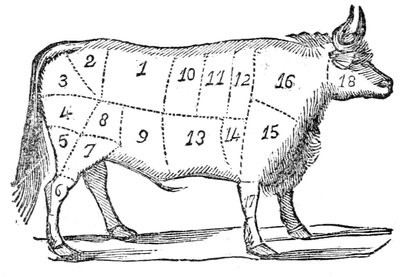
- 1. Sirloin.
- 2. Rump.
- 3. Edge Bone.
- 4. Buttock.
- 5. Mouse Buttock.
- 6. Leg.
- 7. Thick Flank.
- 8. Veiny Piece.
- 9. Thin Flank.
- 10. Fore Rib: 7 Ribs.
- 11. Middle Rib: 4 Ribs.
- 12. Chuck Rib: 2 Ribs.
- 13. Brisket.
- 14. Shoulder, or Leg of Mutton Piece.
- 15. Clod.
- 16. Neck, or Sticking Piece.
- 17. Shin.
- 18. Cheek.
Veal.
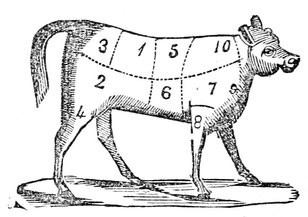
- 1. Loin, Best End.
- 2. Fillet.
- 3. Loin, Chump End.
- 4. Hind Knuckle.
- 5. Neck, Best End.
- 6. Breast, Best End.
- 7. Blade Bone.
- 8. Fore Knuckle.
- 9. Breast, Brisket End.
- 10. Neck, Scrag End.
Mutton.
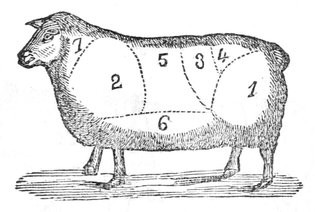
- 1. Leg.
- 2. Shoulder.
- 3. Loin, Best End.
- 4. Loin, Chump End.
- 5. Neck, Best End.
- 6. Breast.
- 7. Neck, Scrag End.
- Note.—A Chine is two Loins; and a Saddle is two Loins and two Necks of the Best End.
Pork.
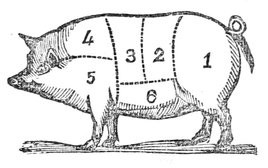
- 1. Leg.
- 2. Hind Loin.
- 3. Fore Loin.
- 4. Spare Rib.
- 5. Hand.
- 6. Spring.
Venison.
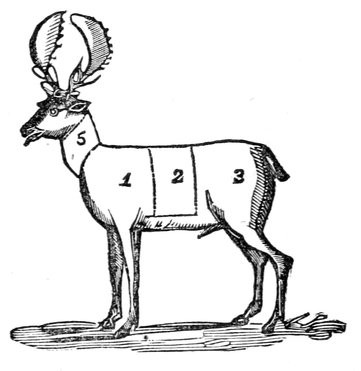
- 1. Shoulder.
- 2. Neck.
- 3. Haunch.
- 4. Breast.
- 5. Scrag.
MISS LESLIE'S
NEW
COOKERY BOOK.
SOUPS.
It is impossible to have good soup, without a sufficiency of good meat; thoroughly boiled, carefully skimmed, and moderately seasoned. Meat that is too bad for any thing else, is too bad for soup. Cold meat recooked, adds little to its taste or nourishment, and it is in vain to attempt to give poor soup a factitious flavor by the disguise of strong spices, or other substances which are disagreeable or unpalatable to at least one half the eaters, and frequently unwholesome. Rice and barley add to the insipidity of weak soups, having no taste of their own. And even if the meat is good, too large a proportion of water, and too small a quantity of animal substance will render it flat and vapid.
Every family has, or ought to have, some personal knowledge of certain poor people—people to whom their broken victuals would be acceptable. Let then the most of their cold, fresh meat be set apart for those who can ill afford to buy meat in market. To them it will be an important acquisition; while those who indulge in fine clothes, fine furniture, &c., had best be consistent, and allow themselves the nourishment and enjoyment of freshly cooked food for each meal. Therefore where there is no absolute necessity of doing otherwise, let the soup always be made of meat bought expressly for the purpose, and of one sort only, except when the flavor is to be improved by the introduction of ham.
In plain cooking, every dish should have a distinct taste of its natural flavor predominating. Let the soup, for instance, be of beef, mutton, or veal, but not of all three; and a chicken, being overpowered by the meat, adds nothing to the general flavor.
Soup-meat that has been boiled long enough to extract the juices thoroughly, becomes too tasteless to furnish, afterwards, a good dish for the table; with the exception of mutton, which may be eaten very well after it has done duty in the soup-pot, when it is much liked by many persons of simple tastes. Few who are accustomed to living at hotels, can relish hotel soups, which (even in houses where most other things are unexceptionable), is seldom such as can be approved by persons who are familiar with good tables. Hotel soups and hotel hashes, (particularly those that are dignified with French names), are notoriously made of cold scraps, leavings, and in some houses, are the absolute refuse of the kitchen. In most cases, the sight of a hotel stock-pot would cause those who saw it, to forswear soup, &c.
If the directions are exactly followed, the soups contained in the following pages will be found palatable, nutritious, and easily made; but they require plenty of good ingredients.
We have heard French cooks boast of their soup being "delicate." The English would call it "soup meagre." In such a country as America, where good things are abundant, there is no necessity of imbibing the flatulency of weak washy soups.
All soups should be boiled slowly at first, that the essence of the meat may be thoroughly drawn forth. The lid of the pot should be kept close, unless when it is necessary to remove it for taking off the scum, which should be done frequently and carefully. If this is neglected, the scum will boil back again into the soup, spoil it, and make it impure or muddled. When no more scum arises, and the meat is all in rags, dropping from the bones, it is time to put in the vegetables, seasoning, &c., and not till then; and if it should have boiled away too much, then is the time to add a little hot water from another kettle. Add also a large crust of bread or two. It may now be made to boil faster, and the thickening must be put in. This is a table-spoonful or more of flour mixed to a smooth paste with a little water, and enriched with a tea-spoonful of good butter, or beef-dripping. This thickening is indispensable to all soups. Let it be stirred in well. If making a rich soup that requires wine or catchup, let it be added the last thing, just before the soup is taken from the fire.
When all is quite done and thoroughly boiled, cover the bottom of a tureen with small squares of bread or toast, and dip or pour the soup into it, leaving all the bones and shreds of meat in the pot. To let any of the sediment get into the tureen is slovenly and vulgar. Not a particle of this should ever be found in a soup-plate. There are cooks who, if not prevented, will put all the refuse into the tureen; so that, when helped, the plates are half full of shreds of meat and scraps of bone, while all the best of the soup is kept back for the kitchen. This should be looked to. Servants who cannot reconcile it to their conscience to steal money or any very valuable articles, have frequently no hesitation in purloining or keeping to themselves whatever they like in the way of food.
Soup may be colored yellow with grated carrots, red with tomato juice, and green with the juice of pounded spinach—the coloring to be stirred in after the skimming is over. These colorings are improvements both to its look and flavor. It may be browned with scorched flour, kept ready always for the purpose. Never put cloves or allspice into soup—they give it a blackish ashy dirt color, and their taste is so strong as to overpower every thing else. Both these coarse spices are out of use at good tables, and none are introduced in nice cookery but mace, nutmeg, ginger, and cinnamon.
The meat boiled in soup gives out more of its essence, when cut off the bone, and divided into small pieces, always removing the fat. The bones, however, should go in, as they contain much glutinous substance, adding to the strength and thickness of the soup, which cannot be palatable or wholesome unless all the grease is carefully skimmed off. Kitchen grease is used chiefly for soap-fat.
In cold weather, good soup, if carefully covered and kept in a cool place, and boiled over again for half an hour without any additional water, will be better on the second day than on the first.
It is an excellent way in winter to boil the meat and bones on the first day, without any vegetables. Then, when very thick and rich, strain the liquid into a large pan; cover it, and set it away till next morning—it should then be found a thick jelly. Cut it in pieces, having scraped off the sediment from the bottom—then add the vegetables, and boil them in the soup.

MUSHROOM SOUP.—
Cut a knuckle of veal, or a neck of mutton, (or both, if they are small,) into large pieces, and remove the bones. Put it into a soup-pot with sufficient water to cover the whole, and season with a little salt and cayenne. Let it boil till the meat is in rags, skimming it well; then strain off the soup into another pot. Have ready a large quart, or a quart and a pint of freshly-gathered mushrooms—cut them into quarters, having removed the stalks. Put them into the soup, adding a quarter of a pound (or more) of fresh butter, divided into bits and rolled in flour. Boil the whole about half an hour longer—try if the mushrooms are tender, and do not take them up till they are perfectly so. Keep the pot lid closely covered, except when you remove the lid to try the mushrooms. Lay at the bottom of the tureen a large slice of buttered toast, (cut into small squares,) and pour the soup upon it. This is a company soup.
SWEET CORN SOUP.—
Take a knuckle of veal, and a set of calf's feet. Put them into a soup-pot with some cold boiled ham cut into pieces, and season them with pepper only. Having allowed a quart of water to each pound of meat, pour it on, and let it boil till the meat falls from the bone; strain it, and pour the liquid into a clean pot. If you live in the country, or where milk is plenty, make this soup of milk without any water. All white soups are best of milk. You may boil in this, with the veal and feet, an old fowl, (cut into pieces,) that is too tough for any other purpose. When the soup is well boiled, and the shreds all strained away, have ready (cooked by themselves in another pot) some ears of sweet corn, young and tender. Cut the grains from the cob, mix the corn with fresh butter, season it with pepper, and stir it in the strained soup. Give the whole a short boil, pour it into the tureen, and send it to table.
VENISON SOUP.—
Is excellent, made as above, with water instead of milk, and plenty of corn. And it is very convenient for a new settlement.
TOMATO SOUP.—
Take a shin or leg of beef, and cut off all the meat. Put it, with the bones, in a large soup-pot, and season it slightly with salt and pepper. Pour on a gallon of water. Boil and skim it well. Have ready half a peck of ripe tomatos, that have been quartered, and pressed or strained through a sieve, so as to be reduced to a pulp. Add half a dozen onions that have been sliced, and a table-spoonful of sugar to lessen a little the acid of the tomatos. When the meat is all to rags, and the whole thoroughly done, (which will not be in less than six hours from the commencement) strain it through a cullender, and thicken it a little with grated bread crumbs.
This soup will be much improved by the addition of a half peck of ochras, peeled, sliced thin, and boiled with the tomatos till quite dissolved.
Before it goes into the tureen, see that there are no shreds of meat or bits of bone left in the soup.
FAMILY TOMATO SOUP.—
Take four pounds of the lean of a good piece of fresh beef. The fat is of no use for soup, as it must be skimmed off when boiling. Cut the meat in pieces, season them with a little salt and pepper, and put them into a pot with three quarts of water. The tomatos will supply abundance of liquid. Of these you should have a large quarter of a peck. They should be full-grown, and quite ripe. Cut each tomato into four pieces, and put them into the soup; after it has come to a boil and been skimmed. It will be greatly improved by adding a quarter of a peck of ochras cut into thin round slices. Both tomatos and ochras require long and steady boiling with the meat. To lessen the extreme acid of the tomatos, stir in a heaped table-spoonful of sugar. Add also one large onion, peeled and minced small; and add two or three bits of fresh butter rolled in flour. The soup must boil till the meat is all to rags and the tomatos and ochras entirely dissolved, and their forms undistinguishable. Pour it off carefully from the sediment into the tureen, in the bottom of which have ready some toasted bread, cut into small squares.
FINE TOMATO SOUP.—
Take some nice fresh beef, and divest it of the bone and fat. Sprinkle it with a little salt and pepper, and pour on water, allowing to each pound of meat a pint and a half (not more) of water, and boil and skim it till it is very thick and clear, and all the essence seems to be drawn out of the meat. Scald and peel a large portion of ripe tomatos—cut them in quarters, and laying them in a stew-pan, let them cook in their own juice till they are entirely dissolved. When quite done, strain the tomato liquid, and stir into it a little sugar. In a third pan stew an equal quantity of sliced ochras with a very little water; they must be stewed till their shape can no longer be discerned. Strain separately the meat liquor, the tomatos, and the ochras. Mix butter and flour together into a lump; knead it a little, and when all the liquids are done and strained put them into a clean soup-pan, stir in the flour and butter, and give the soup one boil up. Transfer it to your tureen, and stir altogether. The soup made precisely as above will be perfectly smooth and nice. Have little rolls or milk biscuits to eat with it.
This is a tomato soup for dinner company.
GREEN PEA SOUP.—
Make a nice soup, in the usual way, of beef, mutton, or knuckle of veal, cutting off all the fat, and using only the lean and the bones, allowing a quart of water to each pound of meat. If the meat is veal, add four or six calf's feet, which will greatly improve the soup. Boil it slowly, (having slightly seasoned it with pepper and salt,) and when it has boiled, and been well skimmed, and no more scum appears, then put in a quart or more of freshly-shelled green peas, with none among them that are old, hard, and yellow; and also a sprig or two of green mint, and a little loaf sugar. Boil the peas till they are entirely dissolved. Then (having removed all the meat and bones) strain the soup through a sieve, and return it to the soup-pot, (which, in the mean time, should have been washed clean,) and stir into it a tea-cupful of green spinach juice, (obtained by pounding some spinach.) Have ready (boiled, or rather stewed in another pot) a quart of young fresh peas, enriched with a piece of fresh butter. These last peas should be boiled tender, but not to a mash. After they are in, give the soup another boil up, and then pour it off into a tureen, in the bottom of which has been laid some toast cut into square bits, with the crust removed. This soup should be of a fine green color, and very thick.
EXCELLENT BEAN SOUP.—
Early in the evening of the day before you make the soup, wash clean a large quart of dried white beans in a pan of cold water, and about bedtime pour off that water, and replace it with a fresh panful. Next morning, put on the beans to boil, with only water enough to cook them well, and keep them boiling slowly till they have all bursted, stirring them up frequently from the bottom, lest they should burn. Meantime, prepare in a larger pot, a good soup made of a shin of beef cut into pieces, and the hock of a cold ham, allowing a large quart of water to each pound of meat.
Season it with pepper only, (no salt,) and put in with it a head of celery, split and cut small. Boil the soup (skimming it well) till the meat is all in rags; then take it out, leaving not a morsel in the pot, and put in the boiled beans. Let them boil in the soup till they are undistinguishable, and the soup very thick. Put some small squares of toast in the bottom of a tureen, and pour the soup upon it.
There is said to be nothing better for making soup than the camp-kettle of the army. Many of the common soldiers make their bean soup of surpassing excellence.
SPLIT PEA SOUP.—
In buying dried or split peas, see that they are not old and worm-eaten. Wash two quarts of them over night in two or three waters. In the morning make a rich soup of the lean of beef or mutton, and the hock of a ham. Season it with pepper, but no salt. When it has boiled, and been thoroughly skimmed, put in the split peas, with a head of celery cut into small pieces, or else two table-spoonfuls of celery seed. Let it boil till the peas are entirely dissolved and undistinguishable. When it is finished strain the soup through a sieve, divesting it of the thin shreds of meat and bits of bone. Then transfer it to a tureen, in which has been laid some square bits of toast. Stir it up to the bottom directly before it goes to table.
You may boil in the soup (instead of the ham) a good piece (a rib piece, or a fillet) of corned pork, more lean than fat. When it is done, take the pork out of the soup, put it on a dish, and have ready to eat with it a pease pudding boiled by itself, cut in thick slices and laid round the pork. This pudding is made of a quart of split peas, soaked all night, mixed with four beaten eggs and a piece of fresh butter, and tied in a cloth and boiled three or four hours, or till the peas have become a mass.
ASPARAGUS SOUP.—
Make in the usual way a nice rich soup of beef or mutton, seasoned with salt and pepper. After it has been well boiled and skimmed, and the meat is all to pieces, strain the soup into another pot, or wash out the same, and return to it the liquid. Have ready a large quantity of fine fresh asparagus, with the stalks cut off close to the green tops or blossoms. It should have been lying in cold water all the time the meat was boiling. Put into the soup half of the asparagus tops, and boil them in it till entirely dissolved, adding a tea-cupful of spinach juice, obtained by pounding fresh spinach in a mortar. Stir the juice well in and it will give a fine green color. Then add the remaining half of the asparagus; having previously boiled them in a small pan by themselves, till they are quite tender, but not till they lose their shape. Give the whole one boil up together. Make some nice slices of toast, (having cut off the crust.) Dip them a minute in hot water. Butter them, lay them in the bottom of the tureen, and pour the soup upon them. This (like green peas) will do for company soup.
CABBAGE SOUP.—
Remove the fat and bone from a good piece of fresh beef, or mutton—season it with a little salt and pepper, put it into a soup-pot, with a quart of water allowed to each pound of meat. Boil, and skim it till no more scum is seen on the surface. Then strain it, and thicken it with flour and butter mixed. Have ready a fine fresh cabbage, (a young summer one is best) and after it is well washed through two cold waters, and all the leaves examined to see if any insects have crept between, quarter the cabbage, (removing the stalk) and with a cabbage-cutter, or a strong sharp knife, cut it into shreds. Or you may begin the cabbage whole and cut it into shreds, spirally, going round and round it with the knife. Put the cabbage into the clear soup, and boil it till, upon trial, by taking up a little on a fork, you find it quite tender and perfectly well cooked. Then serve it up in the tureen. This is a family soup.
RED CABBAGE SOUP.—
Red cabbages for soup should either be quartered, or cut into shreds; it is made as above, of beef or mutton, and seasoned with salt, pepper, and a jill of strong tarragon vinegar, or a table-spoonful of mixed tarragon leaves, if in summer.
FINE CABBAGE SOUP.—
Remove the outside leaves from a fine, fresh, large cabbage. Cut the stalk short, and split it half-way down so as to divide the cabbage into quarters, but do not separate it quite to the bottom. Wash the cabbage, and lay it in cold water for half an hour or more. Then set it over the fire in a pot full of water, adding a little salt, and let it boil slowly for an hour and a half, or more—skimming it well. Then take it out, drain it, and laying it in a deep pan, pour on cold water, and let it remain till the cabbage is cold all through. Next, having drained it from the cold water, cut the cabbage in shreds, (as for cold-slaw,) and put it into a clean pot containing a quart and a pint of boiling milk into which you have stirred a quarter of a pound of nice fresh butter, divided into four bits and rolled in flour, adding a little pepper and a very little salt. Boil it in the milk till thoroughly done and quite tender. Then make some nice toast, cut it into squares, lay it in the bottom of a tureen, and pour the soup on it. This being made without meat is a good soup for Lent. It will be improved by stirring in, towards the last, two or three beaten eggs.
CAULIFLOWER SOUP.—
Put into a soup-pot a knuckle of veal, and allow to each pound a quart of water. Add a set of calf's feet that have been singed and scraped, but not skinned; and the hock of a cold boiled ham. Boil it till all the meat is in rags, and the soup very thick, seasoning with cayenne and a few blades of mace, and adding, towards the last, some bits of fresh butter rolled in flour. Boil in another pot, one or two fine cauliflowers. They are best boiled in milk. When quite done and very tender, drain them, cut off the largest stalks, and divide the blossoms into small pieces; put them into a deep covered dish, lay some fresh butter among them, and keep them hot till the veal soup is boiled to its utmost thickness. Then strain it into a soup-tureen, and put into it the cauliflower, grating some nutmeg upon it. This soup will be found very fine, and is an excellent white soup for company.
For Lent this soup may be made without meat, substituting milk, butter, and flour, and eggs, as in the receipt for fine cabbage soup. Season it with mace and nutmeg. If made with milk, &c., put no water on it, but boil the cauliflower in milk from the beginning. This can easily be done where milk is plenty.
FINE ONION SOUP.—
Take a fine fresh neck of mutton, and to make a large tureen of soup, you must have a breast of mutton also. Let the meat be divided into chops, season it with a little salt, and put it in a soup-pot—allow a quart of water to each pound of mutton. Boil, and skim it till no more scum arises, and the meat drops in rags from the bones. In a small pot boil in milk a dozen large onions, (or more,) adding pepper, mace, nutmeg, and some bits of fresh butter rolled in flour. The onions should previously be peeled and sliced. When they are quite soft, transfer them to the soup, with the milk, &c., in which they were cooked. Give them one boil in the soup. Then pour it off, or strain it into the tureen, omitting all the sediment, and bones, and shreds of meat. Make some nice slices of toast, dipping each in boiling water, and trimming off all the crust. Cut the toast into small squares, lay them in the bottom of the tureen, and pour the soup upon them. Where there is no objection to onions it will be much liked.
If milk is plenty use it instead of water for onion soup. White soups are always best when made with milk.
TURNIP SOUP.—
For a very small family take a neck of mutton, and divide it into steaks, omitting all the fat. For a family of moderate size, take a breast as well as a neck. Put them into a soup-pot with sufficient water to cover them, and let them stew till well browned. Skim them carefully. Then pour on more water, in the proportion of a pint to each pound of meat, and add eight or ten turnips pared and sliced thin, with a very little pepper and salt. Let the soup boil till the turnips are all dissolved, and the meat in rags. Add, towards the last, some bits of butter rolled in flour, and in five minutes afterwards the soup will be done. Carefully remove all the bits of meat and bone before you send the soup to table. It will be found very good, and highly flavored with the turnips.
Onion soup may be made in the same manner. Parsnip soup also, cutting the parsnips into small bits. Or all three—turnips, onions and parsnips, may be used together.
PARSNIP SOUP.—
The meat for this soup may either be fresh beef, mutton, or fresh venison. Remove the fat, cut the meat into pieces, add a little salt, and put it into a soup-pot, with an allowance of rather less than a quart of water to each pound. Prepare some fine large parsnips, by first scraping and splitting them, and cutting them into pieces; then putting them into a frying pan, and frying them brown, in fresh butter or nice drippings. When the soup has been boiled till the meat is all in rags, and well skimmed—put into it the fried parsnips and let them boil about ten minutes, but not till they break or go to pieces. Just before you put in the parsnips, stir in a table-spoonful of thickening made with butter and flour, mixed to a smooth paste. When you put it into the tureen to go to table, be sure to leave in the pot all the shreds of meat and bits of bone.
CARROT SOUP.—
Take a good piece of fresh beef that has not been previously cooked. Remove the fat. It is of no use in making soup; and as it must all be skimmed off when boiling, it is better to clear it away before the meat goes into the pot. Season the beef with a very little salt and pepper, and allow a small quart of water to each pound. Grate half a dozen or more large carrots on a coarse grater, and put them to boil in the soup with some other carrots; cut them into pieces about two inches long. When all the meat is boiled to rags, and has left the bone, pour off the soup from the sediment, transferring it to a tureen, and sending it to table with bread cut into it.
POTATO SOUP.—
Pare and slice thin half a dozen fine potatos and a small onion. Boil them in three large pints of water, till so soft that you can pulp them through a cullender. When returned to the pot add a very little salt and cayenne, and a quarter of a pound of fresh butter, divided into bits, and boil it ten minutes longer. When you put it into the tureen, stir in two table-spoonfuls or more of good cream. This is a soup for fast-days, or for invalids.
CHESTNUT SOUP.—
Make, in the best manner, a soup of the lean of fresh beef, mutton, or venison, (seasoned with cayenne and a little salt,) allowing rather less than a quart of water to each pound of meat, skimming and boiling it well, till the meat is all in rags, and drops from the bone. Strain it, and put it into a clean pot. Have ready a quart or more of large chestnuts, boiled and peeled. If roasted, they will be still better. They should be the large Spanish chestnuts. Put the chestnuts into the soup, with some small bits of fresh butter rolled in flour. Boil the soup ten minutes longer, before it goes to table.
PORTABLE SOUP.—
This is a very good and nutritious soup, made first into a jelly, and then congealed into hard cakes, resembling glue. If well made, it will keep for many months in a cool, dry place, and when dissolved in hot water or gravy, will afford a fine liquid soup, very convenient to carry in a box on a journey or sea voyage, or to use in a remote place, where fresh meat for soup is not to be had. A piece of this glue, the size of a large walnut, will, when melted in water, become a pint bowl of soup; or by using less water, you may have it much richer. If there is time and opportunity, boil with the piece of soup a seasoning of sliced onion, sweet marjoram, sweet basil, or any herbs you choose. Also, a bit of butter rolled in flour.
To make portable soup, take two shins or legs of beef, two knuckles of veal, and four unskinned calves' feet. Have the bones broken or cracked. Put the whole into a large clean pot that will hold four gallons of water. Pour in, at beginning, only as much water as will cover the meat well, and set it over the fire, to heat gradually till it almost boils. Watch and skim it carefully while any scum rises. Then pour in a quart of cold water to make it throw up all the remaining scum, and then let it come to a good boil, continuing to skim as long as the least scum appears. In this be particular. When the liquid appears perfectly clear and free from grease, pour in the remainder of the water, and let it boil very gently for eight hours. Strain it through a very clean hair sieve into a large stoneware pan, and set it where it will cool quickly. Next day, remove all the remaining grease, and pour the liquid, as quickly as possible, into a three-gallon stew-pan, taking care not to disturb the settlings at the bottom. Keep the pan uncovered, and let it boil as fast as possible over a quick fire. Next, transfer it to a three-quart stew-pan, and skim it again, if necessary. Watch it well, and see that it does not burn, as that would spoil the whole. Take out a little in a spoon, and hold it in the air, to see if it will jelly. If it will not, boil it a little longer. Till it jellies, it is not done.
Have ready some small white ware preserve pots, clean, and quite dry. Fill them with the soup, and let them stand undisturbed till next day. Set, over a slow fire, a large flat-bottomed stew-pan, one-third filled with boiling water. Place in it the pots of soup, seeing it does not reach within two inches of their rims. Let the pots stand uncovered in this water, hot, but without boiling, for six or seven hours. This will bring the soup to a proper thickness, which should be that of a stiff jelly, when hot; and when cold, it should be like hard glue. When finished turn out the moulds of soup, and wrap them up separately in new brownish paper, and put them up in boxes, breaking off a piece when wanted to dissolve the soup.
Portable soup may be improved by the addition of three pounds of nice lean beef, to the shins, knuckles, calves' feet, &c. The beef must be cut into bits.
If you have any friends going the overland journey to the Pacific, a box of portable soup may be a most useful present to them.
PEPPER-POT.—
Have ready a small half pound of very nice white tripe, that has been thoroughly boiled and skinned, in a pot by itself, till quite soft and tender. It should be cut into very small strips or mouthfuls. Put into another pot a neck of mutton, and a pound of lean ham, and pour on it a large gallon of water. Boil it slowly, and skim it. When the scum has ceased to rise, put in two large onions sliced, four potatos quartered, and four sliced turnips. Season with a very small piece of red pepper or capsicum, taking care not to make it too hot. Then add the boiled tripe. Make a quart bowlful of small dumplings of butter and flour, mixed with a very little water; and throw them into the pepper-pot, which should afterwards boil about an hour. Then take it up, and remove the meat before it is put into the tureen. Leave in the bits of tripe.
NOODLE SOUP.—
This soup may be made with either beef or mutton, but the meat must be fresh for the purpose, and not cold meat, re-cooked. Cut off all the fat, and break the bones. If boiled in the soup they improve it. To each pound of meat allow a small quart of water. Boil and skim it, till the meat drops from the bone. Put in with the meat, after the scum has ceased to rise, some turnips, carrots and onions, cut in slices, and boil them till all to pieces. Strain the soup, and return the liquid to a clean pot. Have ready a large quantity of noodles, (in French nouillés,) and put them into the strained soup; let them boil in it ten minutes. The noodles are composed of beaten eggs, made into a paste or dough, with flour and a very little fresh butter. This paste is rolled out thin into a square sheet. This sheet is then closely rolled up like a scroll or quire of thick paper, and then with a sharp knife cut round into shreds, or shavings, as cabbage is cut for slaw. These cuttings must be dredged with flour to prevent their sticking. Throw them into the soup while boiling the second time, and let it boil for ten minutes longer.
CHICKEN SOUP.—
Cut up two large fine fowls, as if carving them for the table, and wash the pieces in cold water. Take half a dozen thin slices of cold ham, and lay them in a soup-pot, mixed among the pieces of chicken. Season them with a very little cayenne, a little nutmeg, and a few blades of mace, but no salt, as the ham will make it salt enough. Add a head of celery, split and cut into long bits, a quarter of a pound of butter, divided in two, and rolled in flour. Pour on three quarts of milk. Set the soup-pot over the fire, and let it boil rather slowly, skimming it well. When it has boiled an hour, put in some small round dumplings, made of half a pound of flour mixed with a quarter of a pound of butter; divide this dough into equal portions, and roll them in your hands into little balls about the size of a large hickory nut. The soup must boil till the flesh of the fowls is loose on the bones, but not till it drops off. Stir in, at the last, the beaten yolks of three or four eggs; and let the soup remain about five minutes longer over the fire. Then take it up. Cut off from the bones the flesh of the fowls, and divide it into mouthfuls. Cut up the slices of ham in the same manner. Mince the livers and gizzards. Put the bits of fowl and ham in the bottom of a large tureen, and pour the soup upon it.
This soup will be found excellent, and may be made of large old fowls, that cannot be cooked in any other way. If they are so old that when the soup is finished they still continue tough, remove them entirely, and do not serve them up at all.
Similar soup may be made of a large old turkey. Also, of four rabbits.
DUCK SOUP.—
Half roast a pair of fine large tame ducks, keeping them half an hour at the fire, and saving the gravy, the fat of which must be carefully skimmed off. Then cut them up; season them with black pepper; and put them into a soup-pot with four or five small onions sliced thin, a small bunch of sage, a thin slice of cold ham cut into pieces, a grated nutmeg, and the yellow rind of a lemon grated. Add the gravy of the ducks. Pour on, slowly, three quarts of boiling water from a kettle. Cover the soup-pot, and set it over a moderate fire. Simmer it slowly (skimming it well) for about four hours, or till the flesh of the ducks is dissolved into small shreds. When done, strain it through a tureen, the bottom of which is covered with toasted bread, cut into square dice about two inches in size.
FRENCH WHITE SOUP.—
Boil a knuckle of veal and four calves' feet in five quarts of water, with three onions sliced, a bunch of sweet herbs, four heads of white celery cut small, a table-spoonful of whole pepper, and a small tea-spoonful of salt, adding five or six large blades of mace. Let it boil very slowly, till the meat is in rags and has dropped from the bone, and till the gristle has quite dissolved. Skim it well while boiling. When done, strain it through a sieve into a tureen, or a deep white-ware pan. Next day, take off all the fat, and put the jelly (for such it ought to be) into a clean soup-pot with two ounces of vermicelli, and set it over the fire. When the vermicelli is dissolved, stir in, gradually, a pint of thick cream, while the soup is quite hot; but do not let it come to a boil after the cream is in, lest it should curdle. Cut up one or two French rolls in the bottom of a tureen, pour in the soup, and send it to table.
COCOA-NUT SOUP.—
Take eight calves' feet (two sets) that have been scalded and scraped, but not skinned; and put them into a soup-kettle with six or seven blades of mace, and the yellow rind of a lemon grated. Pour on a gallon of water; cover the kettle, and let it boil very slowly (skimming it well) till the flesh is reduced to rags and has dropped entirely from the bones. Then strain it into a broad white-ware pan, and set it away to get cold. When it has congealed, scrape off the fat and sediment, cut up the cake of jelly, (or stock,) and put it into a clean porcelain or enameled kettle. Have ready half a pound of very finely grated cocoa-nut. Mix it with a pint of cream. If you cannot obtain cream, take rich unskimmed milk, and add to it three ounces of the best fresh butter divided into three parts, each bit rolled in arrow-root or rice-flour. Mix it, gradually, with the cocoa-nut, and add it to the calves-feet-stock in the kettle, seasoned with a small nutmeg grated. Set it over the fire, and boil it, slowly, about a quarter of an hour; stirring it well. Then transfer it to a tureen, and serve it up. Have ready small French rolls, or light milk biscuit to eat with it; also powdered sugar in case any of the company should wish to sweeten it.
ALMOND SOUP
is made in the above manner, substituting pounded almonds for the grated cocoa-nut. You must have half a pound of shelled sweet almonds, mixed with two ounces of shelled bitter almonds. After blanching them in hot water, they must be pounded to a smooth paste (one at a time) in a marble mortar; adding frequently a little rose-water to prevent their oiling, and becoming heavy. Or you may use peach-water for this purpose; in which case omit the bitter almonds, as the peach-water will give the desired flavor. When the pounded almonds are ready, mix them with the other ingredients, as above.
The calves' feet for these soups should be boiled either very early in the morning, or the day before.
SPRING SOUP.—
Unless your dinner hour is very late, the stock for this soup should be made the day before it is wanted, and set away in a stone pan, closely covered. To make the stock take a knuckle of veal, break the bones, and cut it into several pieces. Allow a quart of water to each pound of veal. Put it into a soup-pot, with a set of calves' feet,[A] and some bits of cold ham, cut off near the hock. If you have no ham, sprinkle in a tea-spoonful of salt, and a salt-spoon of cayenne. Place the pot over a moderate fire, and let it simmer slowly (skimming it well) for several hours, till the veal is all to rags and the flesh of the calves' feet has dropped in shreds from the bones. Then strain the soup; and if not wanted that day, set it away in a stone pan, as above mentioned.
Next day have, ready boiled, two quarts or more of green peas, (they must on no account be old,) and a pint of the green tops cut off from asparagus boiled for the purpose. Pound a handful of raw spinach till you have extracted a tea-cupful of the juice. Set the soup or stock over the fire; add the peas, asparagus, and spinach juice, stirring them well in; also a quarter of a pound of fresh butter, divided into four bits, and rolled in flour. Let the whole come to a boil; and then take it off and transfer it to a tureen. It will be found excellent.
In boiling the peas for this soup, you may put with them half a dozen sprigs of green mint, to be afterwards taken out.
Late in the spring you may add to the other vegetables two cucumbers, pared and sliced, and the whitest part or heart of a lettuce, boiled together; then well drained, and put into the soup with the peas and asparagus. It must be very thick with vegetables.
SUMMER SOUP.—
Take a large neck of mutton, and hack it so as nearly to cut it apart, but not quite. Allow a small quart of water to each pound of meat, and sprinkle on a tea-spoonful of salt and a very little black pepper. Put it into a soup-pot, and boil it slowly (skimming it well) till the meat is reduced to rags. Then strain the liquid, return it to the soup-pot, and carefully remove all the fat from the surface. Have ready half a dozen small turnips sliced thin, two young onions sliced, a table-spoonful of sweet marjoram leaves picked from the stalks, and a quart of shelled Lima beans. Put in the vegetables, and boil them in the soup till they are thoroughly done. You may add to them two table-spoonfuls of green nasturtion seeds, either fresh or pickled. Put in also some little dumplings, (made of flour and butter,) about ten minutes before the soup is done.
Instead of Lima beans, you may divide a cauliflower or two broccolis into sprigs, and boil them in the soup with the other vegetables.
This soup may be made of a shoulder of mutton, cut into pieces and the bones cracked. For a large potful add also the breast to the neck, cutting the bones apart.
AUTUMN SOUP.—
Begin this soup as early in the day as possible. Take six pounds of the lean of fine fresh beef; cut it into small pieces; sprinkle it with a tea-spoonful of salt, (not more); put it into a soup-pot, and pour on six quarts of water. The hock of a cold ham will greatly improve it. Set it over a moderate fire, and let it boil slowly. After it comes to a boil, skim it well. Have ready a quarter of a peck of ochras cut into very thin round slices, and a quarter of a peck of tomatos cut into pieces; also a quart of shelled Lima beans. Season them with pepper. Put them in; and after the whole has boiled three hours at least, take four ears of young Indian corn, and having grated off all the grains, add them to the soup and boil it an hour longer. Before you serve up the soup remove from it all the bits of meat, which, if the soup is sufficiently cooked, will be reduced to shreds.
You may put in with the ochras and tomatos one or two sliced onions. The soup, when done, should be as thick as a jelly.
Ochras for soup may be kept all winter, by tying them separately to a line stretched high across the store room.
WINTER SOUP.—
The day before you make the soup, get a leg or shin of beef. Have the bone sawed through in several places, and the meat notched or scored down to the bone. This will cause the juice or essence to come out more freely, when cooked. Rub it slightly with salt; cover it, and set it away. Next morning, early as possible, as soon as the fire is well made up, put the beef into a large soup-pot, allowing to each pound a small quart of water. Then taste the water, and if the salt that has been rubbed on the meat is not sufficient, add a very little more. Throw in also a tea-spoonful of whole pepper-corns; and you may add half a dozen blades of mace. Let it simmer slowly till it comes to a boil; then skim it well. After it boils, you may quicken the fire. At nine o'clock put in a large head of cabbage cut fine as for cold-slaw; six carrots grated; the leaves stripped from a bunch of sweet marjoram; and the leaves of a sprig of parsley. An hour afterwards, add six turnips, and three potatoes, all cut into four or eight pieces. Also two onions, which will be better if previously roasted brown, and then sliced. Keep the soup boiling steadily, but not hard, unless the dinner hour is very early. For a late dinner, there will be time to boil it slowly all the while; and all soups are the better for long and slow boiling. See that it is well skimmed, so that, when done, there will be not a particle of fat or scum on the surface. At dinner-time take it up with a large ladle, and transfer it to a tureen. In doing so, carefully avoid the shreds of meat and bone. Leave them all in the bottom of the pot, pressing them down with the ladle. A mass of shreds in the tureen or soup-plate looks slovenly and disgusting, and should never be seen at the table; also, they absorb too much of the liquid. Let the vegetables remain in the soup when it is served up, but pick out every shred of meat or bone that may be found in the tureen when ready to go to table.
In very cold weather, what is left of this soup will keep till the second day; when it must be simmered again over the fire, till it just comes to a boil. Put it away in a tin or stone vessel. The lead which is used in glazing earthen jars frequently communicates its poison to liquids that are kept in them.
VEGETABLE SOUP—
(very good.)—Soak all night, in cold water, either two quarts of yellow split peas, or two quarts of dried white beans. In the morning drain them, and season them with a very little salt and cayenne, and a head of minced celery, or else a heaped table-spoonful of celery seed. Put them into a soup-pot with four quarts of water, and boil them slowly till they are all dissolved and undistinguishable. Stir them frequently. Have ready a profuse quantity of fresh vegetables, such as turnips, carrots, parsnips, potatos, onions, and cauliflowers; also, salsify, and asparagus tops. Put in, first, the vegetables that require the longest boiling. They should all be cut into small pieces. Enrich the whole with some bits of fresh butter rolled in flour. Boil these vegetables in the soup till they are all quite tender. Then transfer it to a tureen, and serve it up hot.
The foundation being of dried peas or beans, makes it very thick and smooth, and the fresh vegetables improve its flavor. It is a good soup for Lent, or for any time, if properly and liberally made.
All vegetable soups can be made in Lent without meat, if milk is substituted for water, and with butter, beaten eggs and spice, to flavor and enrich it.
FRENCH POT AU FEU.—
This is one of the national dishes of France. The following is a genuine French receipt, and it would be found very palatable and very convenient if tried in our own land of plenty. The true French way to cook it is in an earthen pipkin, such as can be had in any pottery shop. The French vessel has a wide mouth, and close-fitting lid, with a handle at each side, in the form of circular ears. It is large and swelling in the middle, and narrows down towards the bottom. The American pipkin has a short thick spout at one side, and stands on three or four low feet. No kitchen should be without these vessels, which are cheap, very strong, and easily kept clean. They can sit on a stove, or in the corner of the fire, and are excellent for slow cooking.
The wife of a French artisan commences her pot au feu soon after breakfast, prepares the ingredients, puts them, by degrees, into the pot, attends to it during the day; and when her husband has done his work she has ready for him an excellent and substantial repast, far superior to what in our country is called a tea-dinner. Men frequently indemnify themselves for the poorness of a tea-dinner by taking a dram of whiskey afterwards. A Frenchman is satisfied with his excellent pot au feu and some fruit afterwards. The French are noted as a temperate nation. If they have eaten to their satisfaction they have little craving for drink. Yet there is no country in the world where so much good eating might be had as in America. But to live well, and wholesomely, there should also be good cooking, and the wives of our artisans must learn to think more of the comfort, health, and cheerfulness of him who in Scotland is called the bread-winner, than of their own finery, and their children's uncomfortable frippery.
Receipt.—For a large pot au feu, put into the pipkin six pounds of good fresh beef cut up, and pour on it four quarts of water. Set it near the fire, skim it when it simmers, and when nearly boiling, add a tea-spoonful of salt, half a pound of liver cut in pieces, and some black pepper. Then add two or three large carrots, sliced or grated on a coarse grater; four turnips, pared and quartered; eight young onions peeled and sliced thick, two of the onions roasted whole; a head of celery cut up; a parsnip split and cut up; and six potatos, pared, sliced, or quartered. In short any good vegetables now in season, including tomatos in summer and autumn. Also a bunch of sweet herbs, chopped small. Let the whole continue to boil slowly and steadily; remembering to skim well. Let it simmer slowly five or six hours. Then, having laid some large slices of bread in the bottom of a tureen, or a very large pan or bowl, pour the stew or soup upon it; all the meat, and all the vegetables. If you have any left, recook it the next morning for breakfast, and that day you may prepare something else for dinner.
For beef you may substitute mutton, or fresh venison, if you live in a venison country, and can get it newly killed.
WILD DUCK SOUP.—
This is a company soup. If you live where wild ducks are abundant, it will afford an agreeable variety occasionally to make soup of some of them. If you suspect them to be sedgy or fishy, (you can ascertain by the smell when drawing or cleaning them,) parboil each duck, with a carrot put into his body. Then take out the carrot and throw it away. You will find that the unpleasant flavor has left the ducks, and been entirely absorbed by the carrots. To make the soup—cut up the ducks, season the pieces with a little salt and pepper, and lay them in a soup-pot. For a good pot of soup you should have four wild ducks. Add two or three sliced onions, and a table-spoonful of minced sage. Also a quarter of a pound of butter divided into four, and each piece rolled in flour. Pour in water enough to make a rich soup, and let it boil slowly till all the flesh has left the bones,—skim it well. Thicken it with boiled or roasted chestnuts, peeled, and then mashed with a potato beetle. A glass of Madeira or sherry will be found an improvement, stirred in at the last, or the juice and grated peel of a lemon. In taking it up for the tureen, be careful to leave all the bones and bits of meat in the bottom of the pot.
VENISON SOUP.—
Take a large fine piece of freshly killed venison. It is best at the season when the deer are fat and juicy, from having plenty of wild berries to feed on. I do not consider winter-venison worth eating, when the meat is poor and hard, and affords no gravy, and also is black from being kept too long. When venison is fresh and in good order it yields a fine soup, allowing a small quart of water to each pound of meat. When it has boiled well, and been skimmed, put in some small dumplings made of flour and minced suet, or drippings. Also, boiled sweet potatos, cut into round thick slices. You may add boiled sweet corn cut off the cob; and, indeed, whatever vegetables are in season. The soup-meat should boil till all the flesh is loose on the bones, and the bits and shreds should not be served up.
The best pieces of buffalo make good soup.
GAME SOUP.—
Take partridges, pheasants, grouse, quails, or any of the birds considered as game. You may put in here as many different sorts as you can procure. They must all be fresh killed. When they are cleaned and plucked, cut them in pieces as for carving, and put them into a soup-pot, with four calves' feet and some slices of ham, two sticks of celery, and a bundle of sweet herbs chopped small, and water enough to cover the whole well. Boil and skim well, till all the flesh is loose from the bones. Strain the liquid through a sieve into a clean pot, then thicken it with fresh butter rolled in flour. Add some force-meat balls that have been already fried; or else some hard-boiled yolks of eggs; some currant jelly, or some good wine into which a half-nutmeg has been grated; the juice of two oranges or lemons, and the grated yellow peel of one lemon. Give the soup another boil up, and then send it to table, having bread rolls to eat with it.
This is a fine soup for company. Venison soup may be made in this manner. Hare soup also.
SQUATTER'S SOUP.—
Take plenty of fresh-killed venison, as fat and juicy as you can get it. Cut the meat off the bones and put it (with the bones) into a large pot. Season it with pepper and salt, and pour on sufficient water to make a good rich soup. Boil it slowly (remembering to skim it well) till the meat is all in rags. Have ready some ears of young sweet corn. Boil them in a pot by themselves till they are quite soft. Cut the grains off the cob into a deep dish. Having cleared the soup from shreds and bits of bone left at the bottom of the pot, stir in a thickening made of indian meal mixed to a paste with a little fresh lard, or venison gravy. And afterwards throw in, by degrees, the cut corn. Let all boil together, till the corn is soft, or for about half an hour. Then take it up in a large pan. It will be found very good by persons who never were squatters. This soup, with a wild turkey or a buffalo hump roasted, and stewed grapes sweetened well with maple sugar, will make a good backwoods dinner.
MOCK TURTLE SOUP.—
Boil together a knuckle of veal (cut up) and a set of calves' feet, split. Also the hock of a cold boiled ham. Season it with cayenne pepper; but the ham will render it salt enough. You may add a smoked tongue. Allow, to each pound of meat, a small quart of water. After the meat has come to a boil and been well skimmed, add half a dozen sliced parsnips, three sliced onions, and a head of celery cut small, with a large bunch of sweet marjoram, and two large carrots sliced. Boil all together till the vegetables are nearly dissolved and the meat falls from the bone. Then strain the whole through a cullender, and transfer the liquid to a clean pot. Have ready some fine large sweetbreads that have been soaked in warm water for an hour till all the blood was disgorged; then transferred to boiling water for ten minutes, and then taken out and laid in very cold water. This will blanch them, and all sweetbreads should look white. Take them out; and remove carefully all the pipe or gristle. Cut the sweetbreads in pieces or mouthfuls, and put them into the pot of strained soup. Have ready about two or three dozen (or more) of force-meat balls, made of cold minced veal and ham seasoned with nutmeg and mace, enriched with butter, and mixed with grated lemon-peel, bread-crumbs, chopped marjoram and beaten eggs, to make the whole into smooth balls about the size of a hickory nut. Throw the balls into the soup, and add a fresh lemon, sliced thin, and a pint of Madeira wine. Give it one more boil up; then put it into a tureen and send it to table.
This ought to be a rich soup, and is seldom made except for dinner company.
If the above method is exactly followed, there will be found no necessity for taking the trouble and enduring the disgust and tediousness of cleaning and preparing a calf's head for mock turtle soup—a very unpleasant process, which too much resembles the horrors of a dissecting room. And when all is done a calf's head is a very insipid article.
It will be found that the above is superior to any mock turtle. Made of shin beef, with all these ingredients, it is very rich and fine.
[A] In buying calves' feet always get those that are singed, not skinned. Much of the glutinous or jelly property resides in the skin.
FISH SOUP.—
All fish soups should be made with milk, (if unskimmed so much the better,) using no water whatever. The best fish for soup are the small sort of cat-fish; also tutaug, porgie, blue fish, white fish, black fish or sea-bass. Cut off their heads, tails, and fins, and remove the skin, and the backbone, and cut the fish into pieces. To each pound of fish allow a quart of rich milk. Put into the soup-pot some pieces of cold boiled ham. No salt will then be required; but season with cayenne pepper, and a few blades of mace and some grated nutmeg. Add a bunch of sweet marjoram, the leaves stripped from the stalks and chopped. Make some little dumplings of flour and butter, and put them in when the soup is about half done. Half an hour's steady boiling will be sufficient. Serve up in the tureen the pieces of fish and ham. Also some toast cut in dice.
Soup may be made in this manner, of chickens or rabbits, using always milk enriched with bits of butter rolled in flour and flavored with bits of cold ham.
LOBSTER SOUP.—
This is a fine soup for company. Take two or three fine fresh lobsters, (the middle sized are the best.) Heat a large pot of water, throwing in a large handful of salt. When it is boiling hard put in the lobsters, head foremost, that they may die immediately. They will require at least half an hour's fast boiling; if large, three quarters. When done, take them out, wipe off the scum that has collected on the shell, and drain the lobster. First break off the large claws, and crack them, then split the body, and extract all the white meat, and the red coral—nothing else—and cut it into small pieces. Mash the coral into smooth bits with the back of a large spoon, mixing with it plenty of sweet oil; and, gradually, adding it to the bits of chopped lobster. Put into a clear soup-pot two quarts, or more, of good milk, and thicken it with half a dozen crackers or butter-biscuit, pounded fine; or the grated crumbs of two or three small rolls, and stir in a quarter of a pound of fresh butter made into a paste with two spoonfuls of flour. Put in the chopped lobster, seasoned with nutmeg, a few blades of mace powdered, and a little cayenne. Let all boil together, slowly, for half an hour, keeping it closely covered. Towards the last, stir in two beaten eggs. Lay some very small soda biscuit in the bottom of a tureen, and pour the soup upon them. Nasturtion flowers strewed at the last thickly over the surface of this soup, when in the tureen, are an improvement both to its appearance and flavor. So is peppergrass.
CRAB SOUP.—
Take the meat of two dozen boiled crabs, cut it small, and give it a boil in two quarts of milk. Season it with powdered mace, nutmeg, and a little cayenne, and thicken it with butter mixed in flour; or, make the flour and butter into little dumplings. Have ready half a dozen yolks of hard-boiled eggs, and crumble them into the soup just before you take it from the fire. Add the heart of a fresh green lettuce, cut small and strewed over the surface of the soup, after it is poured into the tureen.
OYSTER SOUP.—
Strain the liquor from one hundred oysters, and carefully remove any bits of shell or particles of sea-weed. To every pint of oyster liquor allow an equal quantity of rich milk. Season it with whole pepper and some blades of mace. Add a head of celery, washed, scraped, and minced small. Put the whole into a soup-pot, and boil and skim it well. When it boils put in the oysters. Also, a quarter of a pound of fresh butter; divide into four pieces, each piece rolled in flour. If you can procure cream, add a half-pint, otherwise boil some six eggs hard, and crumble the yolks into the soup. After the oysters are in give them but one boil up, just sufficient to plump them. If boiled longer they will shrink and shrivel and lose their taste. Take them all out and set them away to cool. When the soup is done, place in the bottom of the tureen some small square pieces of nicely toasted bread cut into dice, and pour on the soup; grate in a nutmeg and then add the oysters. Serve it up very hot.
Another way is to chop or cut small the oysters, omitting the hard part. Make the soup as above, and put in the minced oysters at the last, letting them boil but five minutes. Mix the powdered nutmeg with them. This is a good way, if you make but a small quantity of soup.
CLAM SOUP.—
Having washed clean the outside shells of a hundred small sand clams, (or scrubbed them with a brush,) put them into a large pot of boiling water. When they open their shells take them out with a ladle, and as you do so, put them into a cullender to drain off the liquor. Then extract the clams from the shells with a knife. Save a quart of the liquor, putting the clams in a pitcher by themselves. Mix with the quart of liquor, in a clean pot, two quarts of rich milk. Put in the clams, and add some pepper-corns and some blades of mace. Also, a bunch of sweet marjoram, the leaves stripped off and minced. After all has boiled well for an hour, add half a pound, or more, of nice fresh butter, made into little dumplings with flour; also a pint of grated bread-crumbs. Let it boil a quarter of an hour longer. Then pour the soup off from the clams and leave them in the bottom of the pot. They will not now be worth eating. If you cannot obtain small clams, you may cut large ones in pieces, but they are very coarse and tough.
FAST-DAY SOUP.—
For winter.—Having soaked all night two quarts of split peas, put them into a soup-pot, adding a sliced onion, two heads of celery, the stalks split and cut small; a table-spoonful of chopped mint, another of marjoram, and two beets, that have been previously boiled and sliced. Mix all these with half a pound of fresh butter cut into pieces and dredged with flour. Season with a little salt and pepper. Pour on rather more than water enough to cover the whole. Let them boil till all the things are quite tender, and the peas dissolved. When done, cover the bottom of a tureen with small square bits of toast, and pour in the contents of the soup-pot.
It is a good way to boil the split peas in a pot by themselves, till they are quite dissolved, and then add them to the ingredients in the other pot.
Vegetable soups require a large portion of vegetables, and butter always, as a substitute for meat.
FRIDAY SOUP.—
For summer.—This is a fast-day soup. Pare and slice six cucumbers, and cut up the white part or heart of six lettuces; slice two onions, and cut small the leaves of six sprigs of fresh green mint, unless mint is disliked by the persons that are to eat the soup; in which case, substitute parsley. Add a quart of young green peas. Put the whole into a soup-pot, with as much water as will more than cover them well. Season slightly with salt and a little cayenne, and add half a pound of nice fresh butter, divided into six, each piece dredged well with flour. Boil the whole for an hour and a half. Then serve it up, without straining; having colored it green with a tea-cup of pounded spinach juice.
When green peas are out of season, you may substitute tomatos peeled and quartered.
This soup, having no meat, is chiefly for fast days, but will be found good at any time.
BAKED SOUP.—
On the days that you bake bread, you may have a dish of thick soup with very little trouble, by putting into a large earthen jug or pipkin, or covered pan, the following articles:—Two pounds of fresh beef, or mutton, cut into small slices, having first removed the fat; two sliced onions and four carrots, and four parsnips cut in four; also, four turnips, six potatos pared and cut up, and half a dozen tomatos, peeled and quartered. Season the whole with a little salt and pepper. A large beet, scraped and cut up, will be an improvement. To these things pour on three quarts of water. Cover the earthen vessel, and set it in the oven with the bread, and let the soup bake at the same time.
If the bread is done before the dinner hour, you must keep the soup still longer in the oven.
Do not use cold meat for this or any other soup, unless you are very poor.
FISH.
TO CLEAN FISH.—
This must always be done with the greatest care and nicety. If sent to table imperfectly cleaned, they are disgraceful to the cook, and disgusting to the sight and taste. Handle the fish lightly; not roughly so as to bruise it. Wash it well, but do not leave it in the water longer than is needful. It will lose its flavor, and become insipid, if soaked. To scale it, lay the fish flat upon one side, holding it firmly in the left hand, and with the right taking off the scales by means of a knife. When both sides are done, pour sufficient cold water over it to float off all the loose scales that may have escaped your notice. It is best to pump on it. Then proceed to open and empty the fish. Be sure that not the smallest particle of the entrails is left in. Scrape all carefully from the backbone. Wash out all the blood from the inside. A dexterous cook can draw a fish without splitting it entirely down, all the way from head to tail. Smelts and other small fish are drawn or emptied at the gills.
All fish should be cleaned or drawn as soon as they are brought in, and then kept on ice, till the moment for cooking.
TO BOIL FISH.—
No fish can be fit to eat unless the eyes are prominent and lively, the gills very red, and the body firm and stiff, springing back immediately when bent round to try them. Every scale must be carefully scraped off, and the entrails entirely extracted; not the smallest portion being carelessly left sticking to the backbone. Previous to cooking, fish of every kind should be laid in cold water, and the blood thoroughly washed from the inside. Few fish are not the better for being put on to boil in cold water, heating gradually with it till it comes to a boil. If you put it on in boiling water, the outside becomes boiling hot too soon; and is apt to break and come off in flakes, while the inside still remains hard and underdone: halibut, salmon, cod, and other large thick fish must be boiled slowly and thoroughly throughout, taking nearly as long as meat. Always put salt into the water at the commencement, and a little vinegar towards the last. In every kitchen should be a large oval kettle purposely for boiling fish. This kettle has a movable strainer inside. The fish lies on the strainer. To try if it is done, run a thin sharp knife in it, till it reaches the backbone; and see if the flesh will loosen or separate easily. If it adheres to the bone it requires more boiling. When quite done, leave it no longer in the kettle, or it will lose its flavor and get a woolly look. Take out the strainer with the fish upon it. Drain off the water through the strainer, cover the fish with a folded napkin or fine towel, doubled thick; transfer it to a heated dish, and keep it warm and dry till it goes to table, directly after the soup. In the mean time prepare the sauce to be served up along with the fish.
FRYING FISH.—
Fish should be fried in very good fresh butter, or nice beef drippings; or else in lard, which last, is the most usual method. A large allowance of lard should be put into the pan, and held over a clear fire, till it becomes so hot as to boil fast in the pan. Till the lard hisses and bubbles do not put in the fish. They must first be dried separately in a clean cloth, and then scored on the back in deep incisions, or gashes, and slightly dredged with flour. Unless the lard is amply sufficient in quantity to cover the fish well, and bear them up towards the surface, they will sink heavily to the bottom of the pan, and perhaps stick there and burn. Also, if there is not fat enough, the fish will absorb the whole of what there is, and become dark-colored and greasy.
BAKED FISH.—
This is a dish for company. You may bake in the same manner a shad, a fresh codfish, a sheep's head, a white fish, or a blue fish, or a pair of large black fish. Trout also are considered fish for baking. Cut off the head, and split the fish nearly down to the tail. For a stuffing, cut two slices of nice light wheat bread, of shape and size to fit easily into the inside of the fish, and spread them thickly with very new fresh butter. Season them with cayenne and powdered mace, and moisten them with port wine or sherry. Add the juice and yellow rind of a lemon, grated; and sufficient powdered white sugar to take off the extreme acid of the last. Fill the body of the fish with this stuffing, kept in by tying round the fish, carefully, a white cotton cord, or tape, so as to confine it in several places. Lay bits of fresh butter over the outside, at equal distances. Place the fish on a trivet, in a bake pan, and pour round it a pint of wine and water mixed. Baste it with this frequently while baking. It will require at least an hour in a quick oven. If the basting does not leave sufficient gravy, add half a pint more of wine mixed with a little hot water.
When you have taken up the fish, keep it hot while you are finishing the gravy, which you should thicken and enrich by stirring in smoothly a piece of butter mixed slightly into a paste with flour, and seasoned with grated nutmeg. Serve up the gravy in a sauce-boat, and lay slices of lemon along the back of the fish, having, of course, removed the string that was wound around it to confine the stuffing. Send to table with the baked fish, a dish of potatos mashed with milk and butter, and browned on the surface with a salamander, or a red hot shovel. Always remove the seeds of lemon slices. Fresh mackerel may be baked thus.
Fish may be baked plainly, with a stuffing of sweet marjoram, minced sage, and onion, (previously boiled and drained,) a little butter, or finely chopped beef suet, and plenty of grated bread crumbs, seasoned with a little black pepper. Or instead of crumbs you may put in slices of bread and butter soaked in milk, and secured as above from falling out while the fish is baking.
STEWED FISH.—
Take any nice fresh fish of moderate size, and when it is drawn and washed, cut it into three or four pieces, and put them into a stew-pan with amply sufficient hot water to keep them from burning. Season them with a little salt and cayenne. After it has simmered steadily for half an hour, and been skimmed, have ready a quarter of a pound of fresh butter, mixed into a smooth paste with a heaped table-spoonful of flour. Add this to the stew, with a bunch of sweet marjoram chopped fine, and a sprig of chopped parsley. If approved, add a small onion pared and sliced very thin. Cover it closely, and let it stew another half hour. Then send it to table. This is a family dish. Any fresh fish may be stewed thus.
SPICED FISH.—
Cold fish that has been left at dinner is very nice to put away for the supper table. It should be fresh salmon, fresh cod, rock-fish, halibut, or the remains of any other large fine fish. Take out the back bone, and cut the flesh into moderate sized pieces. Lay it in a deep dish that has a cover. Season the fish with cayenne pepper, a little salt, some grated nutmeg, and some blades of mace; also some whole black pepper-corns, and pour over it plenty of good cider vinegar. Tarragon vinegar will be an improvement. Cover it closely, and set it in a cold place till wanted. If in spring or summer, set it in ice.
We do not recommend cloves or allspice. The taste of those coarse spices is so overpowering, (and to many persons so unpleasant,) that they are now nearly out of use at good tables.
Nutmeg, mace and ginger, will be found much better, and with cinnamon occasionally, are sufficient for all spice seasonings. Nevertheless, for those who like them, a few cloves will relieve the insipidity of halibut.
FISH CAKES.—
Take codfish (either fresh or salt) that has been boiled the day before. Carefully remove the bones, and mince the flesh. Mix with it a quantity of warm mashed potatos, (mashed with butter and milk) in the proportion of one third codfish, and two thirds mashed potatos. Add sufficient beaten egg to make the whole into a smooth paste. Season it with cayenne; and, if the mixture seems dry, moisten and enrich it with a little butter. Make it into cakes about an inch thick, and as large round as the top of a common sized tea-cup. Or into round balls. Sprinkle them well with flour.
Fry them in lard, or beef-drippings. When one side is done turn them over. Drain them, and send them to the breakfast table. If approved, you may add to the mixture two or three onions boiled and minced. Any large cold fish may be dressed in this manner for next morning's breakfast.
ROCK-FISH.—
Rock-fish are generally plain boiled, (with the heads and tails left on,) and they are eaten with egg sauce, (hard boiled eggs chopped, and mixed with melted or drawn butter,) seasoned with a little cayenne. Put on the side of your plate, any nice fish sauce from the castors. Some serve up rock-fish with hard boiled eggs, cut into halves, and laid closely in a row along the back of the fish; half an egg being helped to each person. Cold butter is then eaten with it. We think this a very nice way.
Blue fish, white fish, and black fish, may be drest in this manner. Also, sea-bass.
BLACK FISH AND SEA-BASS—
Are all boiled in the same manner, having first carefully scaled, and drawn, and well washed them. In drawing fish take care that the whole of the inside is nicely scraped from the back-bone, all along. When ready, dredge a clean soft cloth with flour, wrap the fish in it; lay it on the strainer of a fish-kettle, and put it in plenty of water, into which has been thrown a small table-spoonful of salt. Keep it steadily boiling near half an hour. Take it carefully out of the cloth, drain it on the strainer, and keep it warm. Send to table with it egg-sauce.
Eat mashed potatos with it.
Frying.—To fry the above fish,—cut them in two or three pieces; wash them and wipe them dry; score them with deep cuts, and season with cayenne and a little salt—dredge them with flour, and fry them brown in a pan nearly full of boiling lard.
Any fish may be fried in this manner.
FRESH COD.—
A fine codfish should be very thick about the neck; the eyes lively; the gills red; and the flesh firm and white. If flabby, it is not good. It is in season from October till May. After scaling, emptying, washing, and drying, cover it, and let it rest for an hour. Then put it on in a fish-kettle of cold water, (hard water if you can procure it,) throw in a small handful of salt, and let the cod heat gradually, skimming it well. Boil it gently, but steadily, till thoroughly done. Then, take it out of the kettle, drain it, and keep it warm till ready to go to table. No fish should be allowed to remain in the water after the boiling is quite over. Serve it up with oyster or lobster sauce.
You may broil fresh cod in steaks, or fry it in cutlets. For frying fish, you may use beef or veal drippings, with the fat skimmed off carefully. Mutton fat (which is tallow) is unfit for all cookery.
TROUT.—
Trout is considered a very nice fish, and is in season in the summer. When fresh it is a fine flesh color, and its spots are very bright. To fry trout, dry them in a cloth. Score them deeply, and touch each incision or cut with a little cayenne. Dredge them with flour. Grate some bread-crumbs very fine, and in another pan beat some eggs very light and thick. Dip each fish twice in the egg, and twice in the crumbs, and fry them in plenty of boiling lard, or in a mixture of lard and fresh butter. When done, drain them, and send them to table with a dish of cucumbers sliced and dressed in the usual way, with vinegar, pepper and salt.
If boiled, serve them up with egg sauce. If broiled, eat them with cold butter and cayenne.
STEWED TROUT.—
This is a dish for company. Mix together as much cold water and sweet white wine, in equal quantities, as will well cover the fish. When done, take them out of the stew pan, drain them, and keep them hot while you prepare the gravy. For this, thicken the liquid with a piece of fresh butter divided into four, each bit rolled in flour; and add two or more well-beaten eggs, and season with powdered mace and nutmeg. Mix all this together, give it one boil up, and pour it over the trout, after they are dished for table.
BAKED TROUT.—
Having cleaned the trout, wrap each fish in a very thin slice of bacon, sprinkled with minced sweet marjoram, and seasoned with cayenne and mace. Inclose each fish in a white paper, cut larger than to fit exactly. Fasten the papers with strings or pins, to be removed before the fish goes to table. Lay the trout in a square tin pan, and bake them in the papers, which must be taken off when the fish are done; but serve them up with the bacon round them or not, as you please.
SALT COD.—
The afternoon before the fish is to be eaten, put it to soak in plenty of cold water. Cover it, and let it stand in a warm place all night. In the morning pour off that water, wash the fish clean, and scrub the outside with a brush. Put it into a kettle with cold water sufficient to cover it well; and let it boil fast till near dinner time, skimming it well. About half an hour before dinner, pour off this boiling water, and substitute a sufficiency of cold. In this last water give the fish one boil up. Send it to table with egg sauce, made with plenty of butter, and hard-boiled eggs cut in half, and laid closely along the back of the fish, to be helped with it. Accompany the cod with a plate of sliced beets drest with vinegar.
Next morning you may take what is left, and having removed all the bone, mince the fish, and mix it with an equal quantity of mashed potatos, adding some butter, pepper, and raw egg. Make the whole into balls or flat cakes, and fry them in drippings or lard. They are good at breakfast. On every one put a small spot of pepper.
FRIED SMELTS.—
The smelt is a very nice little fish, which has a peculiarly sweet and delicate flavor of its own, that requires, to be tasted in perfection, no other cooking than plain broiling or frying in fresh lard. Do not wash them, but wipe them dry in a clean cloth; having opened and drawn them, (they should be drawn through the gills,) and cut off the heads and tails, dredge them with flour. The frying-pan must be more than two-thirds full of boiling lard; boiling hard when the smelts are put in, so as to float them on the surface. If there is not sufficient lard, or if it is not boiling, the fish will sink and be dark colored, and greasy. About ten minutes are sufficient for the small ones, and fifteen for those of a larger size. When done, drain off the lard and send them to the breakfast table on a hot dish.
If you prefer retaining the heads and tails, dish them, alternately, with the heads up and tails down.
FRIED CAT-FISH.—
The best cat-fish are the small ones. If too large, they are generally coarse and strong. They must be cooked quite fresh; if possible, directly out of the water. They are very popular at fishing parties. Wash and clean them, cutting off their heads and tails, and removing the upper part of the back-bone, near the shoulders. Score them along the back, with deep gashes or incisions. Dredge them with flour, and fry them in plenty of lard, boiling fast when the cat-fish are put into the pan. Or, you may fry them in the drippings or gravy saved from roast beef, or veal. They are very nice dipped in a batter of beaten egg and grated bread-crumbs, or they may be done in a plain, though not so nice a way, with indian meal instead of bread-crumbs. Drain off the lard before you dish them. Touch each incision or cut, very slightly, with a little cayenne before they go to table.
Cat-fish are a breakfast dish, and are also eaten at supper. Porgie and tutaug are cooked in this manner.
Any fish may be fried as above, when not split open.
FINE CHOWDER.—
This is Commodore Stovens's receipt:—Take four table-spoonfuls of minced onions that have been fried with slices of salt pork; two pilot-biscuits broken up; one table-spoonful of minced sweet marjoram, and one of sweet basil; a quarter of a bottle of mushroom catchup; half a bottle of port wine; half a nutmeg grated; a few cloves, and mace, and pepper-corns; six pounds of fresh cod, and sea-bass, cut in slices. Put the whole into a pot, with water enough to cover it about an inch. Boil it steadily for an hour, carefully stirring it. Serve it up hot in a large deep dish.
Chowder may be made as above, substituting clams for the cod. The clams must be chopped small. You may, for variety, make chowder with oysters, or with boiled lobsters, or crabs; always beginning the mixture with pork fried with onions.
YANKEE CHOWDER.—
Having sliced very thin some salt fat pork, season it with pepper, lay it in the bottom of a large iron pot, set it over the fire, and let it fry. When done, take out the pork, leaving the liquid fat in the bottom. Next, peel and slice some onions, and lay them on the fat. Pour in sufficient clam or oyster liquor to stew the onions. Have ready a sufficient quantity of sea-bass, black fish, tutaug, porgie, haddock, or fresh cod. Cut the fish in small pieces, and put it into the pot. Add plenty of potatos pared and quartered. Then some clam liquor; and lastly, some crackers, (soaked and split,) or some soda biscuit; the crackers to cover the top. If you wish to fill a large pot, repeat all these ingredients, arranging them in layers. If there is not gravy enough, add some boiling milk, poured in at the last, and enriched with bits of butter mixed with flour. Cover the pot closely, and let it stew half an hour, or more, till all the contents are thoroughly done. You may bake the chowder in an iron oven, over a wood fire, heaping live coals on the oven lid.
CLAM CHOWDER.—
Put into boiling water from fifty to a hundred of the small sand clams; and when all their shells have opened, take them out, as they are then sufficiently boiled. Extract all the hard, or tough, uneatable part, and throw it away. Slice thin as much salt pork as, when fried in the bottom of a large pot, will produce half a pint of liquid or gravy. Take out all the pork, leaving the liquid in the pot. Add to it a layer of clams. Then a layer of biscuit soaked in milk or warm water. Next another layer of clams; then another layer of soaked biscuit; then more clams. Season it with pepper and mace. If there is no objection to onions, add three or four boiled and sliced, and some minced marjoram. Also, some potatos, boiled, peeled, and quartered. Let the last layer be clams, and then cover the whole with a good paste, and bake it in an iron oven, or boil it in an iron pot.
Chowder of fresh codfish, halibut, sea-bass, or any other good fish, is made as above. Halibut requires a much larger portion of seasoning, and a little more pork. Though very large and therefore very profitable, it is in itself the most tasteless of all fish. Plain boiled halibut is not worth eating.
SALMON.—
In choosing a salmon, see that the gills are a fine red, the eyes full, the scales clear, and the whole fish stiff; the flesh being of the peculiar red known as salmon-color. Between the flakes is a substance called the curd, which gives it firmness. By keeping, this substance melts down and the flesh becomes soft. A salmon can only be eaten in perfection on the sea-coast where it was caught, and on the same day. To transport it any distance, it must be enclosed in a box, and well packed in ice. In America, salmon is found in the greatest perfection on the coast of Maine, in the Kennebec. Very fine ones are brought to Boston market. They also abound on the coasts of California and Oregon. The American salmon is much larger than those of Europe. It is so fine a fish that its own flavor is better than any that can be communicated except by the most simple sauce. It requires as much boiling as meat, that is, a quarter of an hour for every pound. It is in season from May till August or September.
The lake salmon is good, but inferior to that of the ocean, in size, richness, and color.
In boiling a large fish, to judge if it is done, draw up the strainer or fish-plate, and with a thin knife try if the flesh separates easily from the bone. If you can loosen it immediately, it is cooked enough. It injures a fish to let it get cool in the water.
BOILED SALMON.—
After carefully emptying the salmon, wash it very clean from the blood inside, and remove the scales. To preserve the fine color of the salmon, or to set the curd or creamy substance between the flakes, it should be put into boiling water, allowing to a gallon of water a handful of salt. After the water has been boiling a few minutes, and has been skimmed, put in the fish, (laying it on the drainer,) and let it boil moderately fast, skimming it well. It must be thoroughly boiled. Underdone fish of every kind is disgusting and unwholesome. Before it is taken from the fish kettle ascertain if it is sufficiently cooked, by trying if the back-bone easily loosens from the flesh. A quarter of an hour may be allowed for each pound, for a large thick salmon requires as much cooking as meat. When you take it up, drain it well, and serve it up immediately. Have ready some lobster sauce, or shrimp, if more convenient. To make it, mince the meat of a boiled lobster, mashing the coral with it, and mix it with melted or drawn butter, made very thick, and having but a very small portion of water. For shrimp sauce, boil the shrimps, take off their heads, and squeeze out their bodies from the shells. Thicken with them the drawn butter. Nothing should go with salmon that will interfere with the flavor of this fine fish, or give it any taste that will overpower or weaken its own.
Many prefer salmon with nothing more than cold butter spread on after it is helped. We think, ourselves, that when the butter is very good, it is not improved (for salmon) by the addition of flour and water; and a very little is sufficient. You need use nothing from the castors except cayenne.
It is usual to eat cucumbers with salmon, and no other vegetables; the cucumbers to be pared, sliced, laid in cold water, and dressed, and served up by themselves, with a little plate for each person, that the vinegar, &c., of the cucumbers may not impart too much acid to the salmon.
In places remote from the sea, a whole salmon is seldom seen at table but at dinner parties, or at good hotels. In a very hot climate it should not be seen at all. When in season, it can be bought in any quantity by the pound, for a small family. For a small dinner company, from four to six pounds will suffice.
Cook salmon-trout in the same manner. Large fish should be helped with a silver fish trowel.
ROASTED SALMON.—
Take a large piece of fine fresh salmon, cut from the middle of the fish, well cleaned and carefully scaled. Wipe it dry in a clean coarse cloth. Then dredge it with flour, put it on the spit, and place it before a clear bright fire. Baste it with fresh butter, and roast it well; seeing that it is thoroughly done to the bone. Serve it up plain; garnishing the dish with slices of lemon, as many persons like a little lemon-juice with salmon. This mode of cooking salmon will be found excellent. A small one, or a salmon-trout, may be roasted whole.
BAKED SALMON.—
A small salmon may be baked whole. Stuff it with forcemeat made of bread-crumbs; chopped oysters, or minced lobster; butter, cayenne, a little salt, and powdered mace,—all mixed well, and moistened with beaten yolk of egg. Bend the salmon round, and put the tail into the mouth, fastening it with a skewer. Put it into a large deep dish; lay bits of butter on it at small intervals; and set it into the oven. While baking, look at it occasionally, and baste it with the butter. When one side is well browned, turn it carefully in the dish, and add more butter. Bake it till the other side is well browned. Then transfer it to another dish with the gravy that is about it, and send it to table.
If you bake salmon in slices, reserve the forcemeat for the outside. Dip each slice first in beaten yolk of egg, and then in the forcemeat, till it is well coated.
BROILED SALMON.—
Wash carefully all traces of blood from the inside of the fish. Cut it into rather thick slices, or fillets. Dry them in a clean cloth, and dredge them with flour. Chalk the bars of the gridiron, or grease them with lard or suet, or the dripping of beef or veal, to prevent the fish from sticking. Let the fire be a bed of clear bright hot coals. Broil the slices well on both sides; and when done, transfer them to a hot dish, and lay a bit of fresh butter on each, and season them a little with cayenne.
Fresh codfish may be cut into steaks, and broiled as above.
Also halibut, or any other large fish.
Serve up shrimp or lobster sauce, with all cutlets or steaks of large fish.
FRIED SALMON CUTLETS.—
Having washed, dried and floured the cutlets, put near a pound of fresh lard into a frying pan, set it over a clear brisk fire till it boils fast. Have ready a marinade or dressing made of grated bread-crumbs, chopped sweet-marjoram, beaten yolks of eggs, and powdered mace—all well mixed. Dip each cutlet into this marinade twice over, and fry them. There must be plenty of lard, so that the cutlets may float on its surface instead of sinking to the bottom, and becoming dark, heavy, and greasy. When they are done, take them up with a perforated skimmer, draining off the lard as you do so. Lay them on a hot dish, and keep them hot till wanted. Serve up with them mashed potatos made into flat cakes, and browned with a salamander or red hot shovel.
Fresh codfish cutlets may be fried in this manner.
You may broil halibut as above. Halibut is too insipid for boiling.
PICKLED SALMON.—
Clean a fine fresh salmon, and remove the bones. Cut off the head, fins, and tail. Fish, to be pickled, should (instead of washing) be wiped, and rubbed with a clean dry cloth. Cut it into steaks or cutlets. Put it into a stone-ware jar with a close cover. A broad low jar will be best. Sprinkle it with salt, and cayenne. Add some grains of whole black pepper, and some blades of mace, seasoning it highly to make it keep well. Fill up the jar with the best cider vinegar, set it in a moderate oven, and bake it till thoroughly done; adding more vinegar, if it seems too dry. Then cover the jar very closely, with the lid—if there is the smallest crack, paste all round a fillet of strong, white paper. Whenever you open the jar to take out some of the salmon for use, add some fresh vinegar. Keep the jar in a dry cool place. If properly done, and well seasoned, it will keep several months.
BROILED FRESH MACKEREL.—
Mackerel cannot be eaten too fresh, as no fish spoils so soon; for which reason in England mackerel is permitted to be sold on Sundays. We have heard in London the fishwomen crying it about the streets on Sunday morning before church time. And even then it is far inferior to mackerel taken immediately out of the sea, at the places on the coast. It is generally broiled, as no other cooking seems to suit it, and draw forth its true flavor. Split your mackerel, remove the bone, and cut off the heads and tails. Dredge them on both sides with flour, and sprinkle the inside with black pepper and a little salt. Have your gridiron very hot, over a clear fire, and grease the bars with lard, or chalk them to prevent the fish from sticking. Broil them well on both sides, and when they are done, and very hot, lay some bits of fresh butter upon them. Cover to keep them warm, and send them to table as soon as possible. They are a fine breakfast fish, and good at a plain dinner. For sauce, cold butter is all that is necessary, but you may mix with it, chopped parsley, or minced fennel. At the best English tables, stewed gooseberries, pulped through a sieve and sweetened, is the fashionable sauce for broiled mackerel, or lemon-juice is squeezed profusely over the fish. To this the lovers of fruit with every thing, will not object.
If a mackerel is fresh, the eyes will be full and lively, the gills very red, and the stripes or bars on the back a very dark color, (nearly black,) and strongly marked; and the body thick. If thin and flat below the shoulders, the eyes sunk, the gills pale, and the dark stripes dull and indistinct, the fish is unfit to eat.
FRIED MACKEREL.—
For frying, take small mackerel, as fresh as possible. Wash them, dry them in a clean cloth, and score them deeply in the back, making several deep cuts. Season them with a little salt and pepper. Go over them with beaten egg, and then cover them thickly with grated bread-crumbs; which, for this purpose, are superior to indian meal or pounded crackers. Fry them in boiling lard, and dish them hot. Send them to table with a dish of potatos sliced and fried in butter.
Any fish may be fried in this manner. If large, cut it into pieces.
FRIED HALIBUT.—
There is a great deal of eating in a halibut, as it is a fish of immense size, and has only the back bone. It is sold in pieces of any weight or quantity, and is exceedingly white and delicate in appearance. But it is so very insipid, that when boiled it has no taste at all. Therefore it is always broiled or fried, except at tables where economy is the chief consideration. If broiled, it is done in the same manner as any other large fish, but to make it palatable requires something to give it a little taste.
To fry halibut—take a piece from the middle of the fish, wash it very carefully, and dry it in a clean cloth. Then cut it into thick fillets, extracting the bone, which is easily done with a sharp knife, loosening the flesh from the bone, and raising it as you proceed. Remove the skin. You may also cut the fillets into slices about an inch thick. Season with cayenne, and a very little salt. Cover them slightly with nice butter. Have ready in one pan plenty of grated bread-crumbs; in another a sufficiency of beaten yolk of egg, seasoned with powdered mace and nutmeg. Dip the slices first into the egg, then into the pan of bread-crumbs. Do this twice over, to every slice. Have ready over the fire a hot frying pan full of boiling lard. Put in the slices and fry them well. When one side is done, turn the other. When all are done, take them from the frying pan with a perforated skimmer, and drain them. Keep them hot between two heated dishes.
Cooked in this manner, the halibut will be sufficiently flavored and is a profitable fish.
Instead of frying, the halibut steaks may be broiled over a clear fire, on a grooved gridiron. Having first buttered it, dip each steak, as above, in bread-crumbs and egg, and lay upon each steak a large tomato opened, and stuffed with a forcemeat of bread-crumbs seasoned with butter, pepper, and mace. This will be found a very nice way of cooking halibut. Fresh cod may be done in the same manner.
Cold halibut is sometimes drest as salad for the tea-table.
BOILED TURBOT OR SHEEP'S-HEAD FISH.—
Having cleaned and washed the fish, soak it an hour or two in salt and water to draw off the slime. Then let it lie half an hour or more in cold water. Afterwards drain, and wipe it dry. Score the back deeply with a knife. The whiteness of the fish will be improved by rubbing it over with a cut lemon. The fish kettle must be large, and nicely clean. Lay the fish with its back downward, on the strainer of the kettle. Cover it well with cold water, (milk and water in equal portions will be better still,) and add a small spoonful of salt. Do not let it come to a boil too fast, and skim it carefully. When the scum has ceased to rise, diminish the heat under the kettle, and let it simmer for about half an hour or more; not allowing it to boil hard. When the fish is done, take it up carefully with a fish-slice; and having prepared the sauce, pour it over the fish and send it to table hot.
For the sauce, mix together very smoothly, with a broad-bladed knife, a quarter of a pound of fresh butter, and two table-spoonfuls of flour. Put them into a clean sauce-pan, and hold it over the fire, and stir them till melted. Then add a large salt-spoonful of powdered mace, and as much cayenne as will lie on a sixpence. It will be much improved by the addition of some boiled lobster, chopped small. When the sauce has simmered five minutes, add very gradually half a pint of rich cream, and let it come almost to a boil, stirring all the time. After the fish is taken up, pour the sauce over it hot. Or you may send it to table in a sauce-boat. In this case ornament the fish with the coral of the lobster put on in a handsome figure.
Another way of dressing this fish is, after it has been boiled, to set it on ice to get cold; and then, having carefully removed the bones, cut the flesh into small squares, put it into a stew-pan, and having mixed the above sauce, add it to the fish, and let it stew slowly in the sauce; but do not let it come to a boil. When thoroughly hot, take it up, and send it to table in a deep dish.
BAKED TURBOT OR SHEEP'S-HEAD FISH.—
Having cleaned the fish, soak it an hour or two in salt and water, and afterwards wash it well through two or three fresh waters. Then dry it in a clean towel. Score it deeply across the back; and then lay it in a deep white baking-dish. Mix together a large tea-spoonful of powdered mace and nutmeg; add a salt-spoon of cayenne; a few sprigs of sweet marjoram and sweet basil, finely minced; two large table-spoonfuls of fresh butter; and two table-spoonfuls of grated bread-crumbs. Stir this mixture into a pint of rich cream. Pour this marinade over the fish, cover it, and let it stand half an hour. Then bake it in the marinade; and send it hot to table.
If the fish is too large to be baked whole, cut it into fillets, extracting the bone.
Salmon-trout may be baked in this manner.
SEA BASS WITH TOMATOS.—
Take three large fine sea-bass, or black-fish. Cut off their heads and tails, and fry the fish in plenty of lard till about half done. Have ready a pint of tomatos, that have been pickled cold in vinegar flavored with a muslin bag of mixed spices. Drain the tomatos well from the vinegar; skin them, and mash them in a pan; dredging them with about as much flour as would fill a large table-spoon heaped up. Pour the mixture over the fish while in the frying pan; and continue frying till they are thoroughly done.
Cutlets of halibut may be fried in this manner with tomatos: also, any other pan-fish.
Beef-steaks or lamb-chops are excellent fried thus with tomatos.
BAKED SALMON-TROUT.—
Having cleaned the fish, and laid it two hours in weak salt and water, dry it in a cloth, and then rub both the inside and outside with a seasoning of cayenne pepper, powdered mace, nutmeg, and a little salt, mixed well together. Then lay it in a deep baking-pan, turn the tail round into the mouth, and stick bits of fresh butter thickly over the fish. Put it into an oven, and bake it well; basting it frequently with the liquid that will soon surround it. When you suppose it to be nearly done, try it by sticking down to the backbone a thin-bladed knife. When you find that the flesh separates immediately from the bone, it is done sufficiently. Serve it up with lobster-sauce.
Any large fresh fish may be baked in this way.
CREAM TROUT.—
Having prepared the trout very nicely, and cut off the heads and tails, put the fish into boiling water that has been slightly salted, and simmer them for five minutes. Then take them out, and lay them to drain. Put them into a stew-pan, and season them well with powdered mace, nutmeg, and a little cayenne, all mixed together. Put in as much rich cream as will cover the fish, adding the fresh yellow rind of a small lemon, grated. Keep the pan covered, and let the fish stew for about ten minutes after it has begun to simmer. Then dish the fish, and keep them hot till you have finished the sauce. Mix, very smoothly, a small table-spoonful of arrow-root, the juice of the lemon, and two table-spoonfuls of sugar, and stir it into the cream. Pour the sauce over the fish, and then send them to table.
Turbot or sheep's-head fish may be dressed as above; of course it will require a larger proportion of seasoning, &c., and longer time to cook.
Carp is very nice stewed in this manner.
STEWED CODFISH.—
Take fine fresh cod, and cut it into slices an inch thick, separated from the bones. Lay the pieces of fish in the bottom of a stew-pan: season them with grated nutmeg; half a dozen blades of mace; a salt-spoonful of cayenne pepper; and a small saucer full of chopped celery; or a bunch of sweet herbs tied together. Add a pint of oyster liquor, and the juice of a lemon. Cover it close, and let it stew gently till the fish is almost done, shaking the pan frequently. Then take a piece of fresh butter the size of an egg; roll it in flour, and add it to the stew. Also, put in two dozen large fine oysters, with what liquor there is about them. Cover it again; quicken the fire a little, and let the whole continue to stew five minutes longer. Before you send it to table, remove the bunch of sweet herbs.
Rock-fish may be stewed in this manner. Fresh salmon also.
FRIED CODFISH.—
Take the middle or tail part of a fresh codfish, and cut it into slices not quite an inch thick, first removing the skin. Season them with a little salt and cayenne pepper. Have ready in one dish some beaten yolk of egg, and in another some grated bread-crumbs. Dip each slice of fish twice into the egg, and then twice into the crumbs. Fry them in fresh butter, and serve them up with the gravy about them.
Halibut may be fried as above.
STEWED HALIBUT.—
Cut the fish into pieces about four inches square, of course omitting the bone. Season it very slightly with salt, and let it rest for half an hour. Then take it out of the salt, put it into a large deep dish, and strew over it a mixture of cayenne pepper, ground white ginger, and grated nutmeg. Lay among it some small bits of fresh butter rolled in grated bread. Add half a pint of vinegar, (tarragon vinegar if you have it.) Place the dish in a slow oven, and let the halibut cook till thoroughly done, basting it very frequently with the liquid. When nearly done, add a large table-spoonful or more of capers, or pickled nasturtions.
Halibut is a very insipid fish; but this mode of cooking will give it taste.
STEWED ROCK-FISH.—
Take a large rock-fish, and cut it in slices near an inch thick. Sprinkle it very slightly with salt, and let it remain for half an hour. Slice very thin half a dozen large onions. Put them into a stew-pan with a quarter of a pound of fresh butter, cut into bits. Set them over a slow fire, and stir them continually till they are quite soft, taking care not to let them become brown. Then put in the sliced fish in layers; seasoning each layer with a mixture of white ground ginger, cayenne pepper, and grated nutmeg; add some chopped parsley, and some bits of butter rolled in flour. Pour in a pint of water, and, if you choose, a wine-glass of vinegar, (tarragon vinegar will be best.[B]) Set it over a good fire and let it cook about an hour. When done, take out the fish carefully, to avoid breaking the slices. Lay it in a deep dish that has been made hot, and cover it immediately. Have ready the beaten yolks of two eggs. Stir them into the gravy. Give it one boil up; and then either pour it over the fish, or serve it up in a sauce-boat.
Halibut, fresh cod, or any other large fish may be stewed in this manner.
TO KEEP A SHAD FRESH.—
By the following process, (which we can highly recommend from experience,) a shad may be kept twenty-four hours, or indeed longer, so as to be perfectly fresh in taste and appearance. For instance, if brought fresh from market on Saturday morning, it may be broiled for breakfast on Sunday, and will seem like a fresh shad just from the water. Immediately on bringing it in, let it be scaled, cleaned, washed, split, and wiped dry; cutting off the head and tail. Spread the shad open on a large flat dish. Mix well together in a cup, a heaped table-spoonful of brown sugar; a heaped tea-spoonful of cayenne pepper, and a tea-spoonful of fine salt; and then rub the mixture, thoroughly and evenly, all over the inside of the fish; which, of course, must be spread with the skin or outside downward. Cover it closely with a large tin cover or with another dish, and set it immediately on ice or in a very cold place, and let it rest till next morning, or till it is wanted for cooking. Immediately before you put it on the gridiron, take a clean towel and carefully wipe off the whole of the seasoning, not letting a particle of it remain round the edges, or anywhere else. Then put the shad on a previously heated gridiron, over hot coals, and broil it well. Butter it, and send it hot to table, where every one can season it again, according to their taste.
PLANKED SHAD.—
This is the best way of cooking shad when in perfection, just out of the river; and it is much in use at fishing party dinners. A board or plank, about three inches thick and two feet square, must be provided for the purpose. This plank should be of well-seasoned oak or hickory, and very clean. A pine board will very soon catch fire and burn; besides communicating to the fish a taste of turpentine or rosin. Take a very fine shad, and (having cut off the head and tail,) split it down the back, clean it, wash it well, and wipe it dry. Sprinkle it with salt, and cayenne. Stand up the board before the fire till it becomes very hot, and almost begins to char. Then nail to the hot board the spread-open shad, with the back or skin-side next to the plank, securing it with a few nails, not driven in so hard that they cannot easily be drawn out. Begin to roast it with the head downward. After a while turn the other end of the plank, so as to place the tail downward. Turn it frequently up or down, that the juices of the fish may be equally dispersed throughout. When done, butter it with fresh butter, and send it to table on the board; under which, place a large dish or tray. Help it to the company off the plank. This mode of cooking a shad will be found superior to all others; and is so generally liked, that two at least will be required, one at each end of the table. It is much enjoyed by parties who have dinners on the banks of the river, and bespeak of the fishermen shad just out of the water.
Lake salmon may be cooked in this manner on a plank. Also, blue fish, and the lake white fish.
At the principal household stores, shad-boards of oak are now to be purchased ready made. The cost is from a dollar to seventy-five cents. They are very strong and smooth, and furnished with thick wires crossing the board diagonally. Behind these the fish is to slip in without nailing. They are much used, and we advise every house-keeper to get one. We see very nice ones at Carryl's Furnishing Store, Chestnut street, Philadelphia.
SHELL FISH.
TO CHOOSE OYSTERS.—
Insert a knife, and if the shell instantly closes firmly on the knife, the oysters are fresh. If it shuts slowly and faintly, or not at all, they are dying, or dead. When the shells of raw oysters are found gaping open they are fit for nothing but to throw away, and should not have been seen in the market, as they are quite dead and decomposition has commenced. Clams the same.
TO FEED OYSTERS.—
When it is necessary to keep oysters a day or two before they are cooked, they must be kept clean and fed, otherwise they will die and spoil. Put them into a large tub of clean water; wash from them the mud and sand, and scrub them with a birch broom. Then pour off that water, and give them a clean tubful, placing the oysters with the deep or large side downward, and sprinkling them well, with salt mixed with it, allowing about a pint of salt to every two gallons of water. But if you have a very large quantity of oysters, add to the salt and water several handfuls of indian meal. Repeat this every twelve hours, with fresh water and meal. Always at the time of high water, oysters may be seen to open their shells, as if in expectation of their accustomed food. If this is carefully continued, they will remain plump and healthy for two days.
Terrapins also, and other shell fish, should have the salt and water changed every twelve hours, and be fed with corn meal.
Turtle must also be well fed, and allowed salted water to swim in.
STEWED OYSTERS.—
Get two hundred or more fine large fresh oysters. Drain them from their liquor, (saving it in a pitcher,) and put them into a stew-pan with a quarter of a pound of fresh butter, and set them over the fire. When they have simmered, and have almost come to a boil, remove them from the fire; and have ready a pan of very cold water. Take out the oysters, (one at a time, on a fork,) and put them into the cold water. This will plump them, and render them firm. Having saved about half their liquor, put it into the stew-pan, seasoned well with blades of mace, grated nutmeg, whole pepper-corns, and a little cayenne. Stir in half a pint or more of thick rich cream; and if you cannot procure cream, an equal quantity of nice fresh butter divided into bits, slightly dredged with a very little flour. Boil the liquor by itself, and when it comes to a boil, take the oysters out of the cold water, and put them into the boiling liquor. In five minutes remove the pan from the fire, (the oysters having simmered,) and transfer them to a tureen or deep dish, in the bottom of which has been laid a buttered toast, that has previously been dipped a minute in hot water or milk.
FRENCH STEWED OYSTERS.—
Wash fifty fine large oysters in their own liquor, then strain it into a stew-pan, putting the oysters in a pan of cold water. Season the liquor with a large glass or half a pint of white wine, (sherry or Madeira,) the juice of two lemons, six or seven blades of mace, and a small grated nutmeg. Boil the seasoned liquor; and skim, and stir it well. When it comes to a boil, put in the oysters. Give them one good stir, and then immediately take them from the fire, transfer them to a deep dish, and send them to table. They are not to boil.
Many persons consider this the finest way of cooking oysters for company. Try it. The oysters must be of the very best.
FRIED OYSTERS.—
For frying, take only the largest and finest oysters. They should be as fresh as you can get them. Salt oysters are not good for frying. Take them out of their liquor, carefully, with a fork, picking off whatever bits of shell may be about them. Dry them in a clean napkin. Prepare some grated bread-crumbs, or pounded cracker, or soda biscuit, seasoned with cayenne pepper. Have ready plenty of yolk of egg beaten till very light; and to each egg allow a large tea-spoonful of rich cream, or of the best fresh butter. Beat the egg and cream together. Dip each oyster first into the egg, &c., and then into the crumbs. Repeat this twice till the oysters are well-coated all over. Have ready boiling, in a frying-pan, an equal mixture of fresh butter and lard. It must come nearly to the edge or top of the frying-pan, and be boiling fast when the oysters go in; otherwise they will be heavy and greasy, and sink to the bottom. Fry them of a yellow brown on both sides. Send them to table very hot.
Oysters will be found much the best when fried in grated bread-crumbs. Cracker-crumbs form a hard, tough coating that is very indigestible, and also impairs the flavor. Use no salt in making the batter. Omit it entirely. It overpowers the taste of the oysters.
OYSTER FRITTERS.—
Allow to each egg a heaped table-spoonful of flour, and a jill or small tea-cupful of milk. Beat the eggs till very light and thick; then stir them, gradually, into the pan of milk, in turn with the flour, a little at a time. Beat the whole very hard. Have ready the oysters, that you may proceed immediately to baking the fritters. The oysters should be fresh, and of the largest size. Having drained them from their liquor, and dried them separately in a cloth, and dredged them with flour, set over the fire a frying-pan nearly full of lard. When it boils fast, put in a large spoonful of the batter. Then lay an oyster upon it, and cover the oyster with another spoonful of batter. Fry the fritters of a nice yellow. As they are done, take them up, drain off the lard from the oysters, and keep them hot till they go to table. This will be found a very fine receipt if exactly followed.
CLAM FRITTERS.—
Put a sufficient quantity of clams into a pot of boiling water. The small sand-clam will be best. When the shells open wide, take them out, extract the clams from the shells, and put them into a stew-pan. Strain their liquor, and pour about half of it over the clams; adding a little black pepper. They will require no salt. Let them stew, slowly, for half an hour; then take them out; drain off all the liquor; and mince the clams as fine as possible, omitting the hardest parts. You should have as many clams as will make a large pint when minced. Make a batter of seven eggs, beaten till very thick and light, and then mixed gradually with a quart of milk, and a pint of sifted flour, stirred in by degrees, and made perfectly smooth and free from lumps. Then, gradually, mix the minced clams with the batter, and stir the whole very hard. Have ready in a frying-pan over the fire, a sufficiency of boiling lard. Put in, with a spoon, the batter so as to form fritters, and fry them light brown. Drain them well when done and serve them up hot.
Oyster fritters may be made as above: except that the oysters must be minced raw, and mixed into the batter without having been stewed.
Soft-crab Fritters.—Use only the bodies of the crabs, and proceed as above.
SCOLLOPED CLAMS.—
Having boiled a quantity of small sand-clams till they open of themselves, remove them from the shells. Drain away the liquor, and chop them small, omitting the hardest parts. Season them with black pepper and powdered mace, and mix them with grated bread-crumbs and fresh butter. Get some large clean clam-shells, and fill them to the edge with the above mixture, moistened with a very little of the liquor. Cover the surface with grated crumbs, and add to each one a small bit of butter. Set them in an oven, and bake them light brown. Send them to table in the shells they were baked in, arranged on large dishes. They are eaten at breakfast and supper. Clams must always have the shells washed before they are boiled.
Oysters are frequently scolloped in this manner, minced, and served up in large clam shells.
Boiled crabs, also, are cooked, minced, and prepared in this way, and sent to table in the back-shell of the crab.
All these scollops are improved by mixing among them some hard-boiled eggs, minced or chopped; or some raw egg beaten.
ROASTED OYSTERS.—
The old-fashioned way of roasting oysters is to lay them on a hot hearth, and cover them in hot cinders or ashes, (taking them out with tongs when done,) or to put them into a moderate fire. When done, their shells will begin to open. The usual way now is to broil them on large gridirons of strong wire. Serve them up in their shells on large dishes, or on trays, at oyster suppers. At every plate lay an oyster knife and a clean coarse towel, and between every two chairs set a bucket to receive the empty shells. The gentlemen generally save the ladies the trouble of opening the oysters, by performing that office for them.
Have on the table, to eat with the oysters, bread-rolls, biscuits, butter, and glasses with sticks of celery scraped, and divested of the green leaves at the top. Have also ale or porter.
Or, you may take large oysters out of their shells, dredge them lightly with flour, lay them separately on a wire gridiron, and broil them. Serve them up on large dishes, with a morsel of fresh butter laid on each oyster.
SCOLLOPED OYSTERS.—
Drain the liquor from a sufficient quantity of fine fresh oysters; and season them with blades of mace, grated nutmeg, and a little cayenne. Lay about a dozen of them in the bottom of a deep dish. Cut some slices of wheat bread, and put them to soak in a pan of the oyster liquor (previously strained.)
Soak the bread till it is soft throughout, but not dissolved. Cover the oysters in the bottom of the dish, with some slices of the soaked bread, (drained from the liquor,) and lay upon the bread a few small bits of nice fresh butter. Then put in another layer of seasoned oysters; then another layer of soaked bread with bits of butter dispersed upon it. Repeat this with more layers of oysters, soaked bread, and bits of butter, till the dish is full, finishing with a close layer of bread on the top. Set this into a hot oven, and bake it, a short time only, or till it is well browned on the surface. Oysters require but little cooking, and this bread has had one baking already. The liquid that is about the bread is sufficient. It requires no more.
Scolloped oysters may be cooked in large, clean, clam-shells and served up on great dishes.
PICKLED OYSTERS.—
Take a hundred fine large oysters—set them over the fire in their own liquor—add two ounces of nice fresh butter, and simmer them slowly for ten minutes; skimming them well. If they boil fast and long, they will become hard and shrivelled. Take them off the fire and strain from them their liquor; spread the oysters out on large dishes, and place them in the air to cool fast, or lay them in a broad pan of cold water. This renders them firm. Strain the liquor, and then mix with it an equal quantity of the best and purest clear cider-vinegar. Season (if the oysters are fresh,) with a small tea-spoonful of salt, two dozen whole pepper-corns, and a table-spoonful of powdered mace and nutmeg, mixed. Let the liquor boil till it is reduced to little more than enough to cover the oysters well. Put the oysters into a tureen, or a broad stone jar. Pour the hot liquor over them, and let them grow quite cold before they are eaten. You may give them a fine tinge of pale pink color by adding to the liquor (while boiling,) a little prepared cochineal.
PICKLED OYSTERS.—
For keeping.—Have five or six hundred oysters of the finest sort and largest size. Proceed as in the foregoing receipt, but increase, proportionately, the quantity of spice and vinegar. Put them in stone-ware jars, securing the covers by pasting all round, bands or strips of thick white paper; and place on each jar, on the top of the liquor, a table-spoonful of salad oil.
Use no other than genuine cider-vinegar. Much that is sold for the best white-wine vinegar is in reality a deleterious compound of pernicious drugs, that will eat up or dissolve the oysters entirely, leaving nothing but a sickening whitish fluid. This vinegar is at first so overpoweringly sharp and pungent, as to destroy, entirely, the taste of the spices; and, while cooking, emits a disagreeable smell. The oysters immediately become ragged, and in less than an hour are entirely destroyed. This vinegar acts in the same manner on all other pickles, and the use of it should always be shunned.
Drugs should not be employed in any sort of cookery, though their introduction is now most lamentably frequent. They ruin the flavor and are injurious to health.
OYSTER PATTIES.—
Make sufficient puff-paste for at least a dozen small patties. Roll it out thick, and line with it twelve small tin patty-pans. Bake them brown in a brisk oven; and when done set them to cool. Have ready two or three dozen large, fine, fresh oysters. Wash and drain them, and put them into a stew-pan with no other liquid than just enough of their own liquor to keep them from burning. Season them with cayenne, nutmeg, and mace, and a few of the green tops or leaves of celery sprigs minced small. Add a quarter of a pound of fresh butter, divided into bits, and laid among the oysters. To enrich the gravy, stir in, at the last, the beaten yolks of three or four eggs, or some thick cream or butter. Let the oysters stew in this gravy about five minutes. When the patties are beginning to cool, fill each with one or two large oysters. If you choose, you can bake for every patty a small round lid of pastry, to be laid lightly on the top, so as to cover the oysters when they go to table. For company, make a large quantity of oyster patties, as they are much liked.
OYSTER LOAVES.—
Take some tall fresh rolls, or small loaves. Cut nicely a round or oval hole in the top of each, saving the pieces that come off. Then carefully scoop out most of the crumb from the inside, leaving the crust standing. Have ready a sufficient quantity of large fresh oysters. Put the oysters with one-fourth of their liquor into a stew-pan; adding the bread-crumbs, a large piece of fresh butter, some powdered nutmeg, and mace. Stew them about ten minutes. Then stir in two or three large table-spoonfuls of cream; take them off just as they are coming to a boil. If cooked too long the oysters will become tough and shriveled, and the cream will curdle. Fill the inside of your scooped loaves with the oysters, reserving as many large oysters as you have loaves. Place the bit of upper-crust carefully on the top of each, so as to cover the whole. Arrange them on a dish, and lay on each lid one of the large oysters kept out for the purpose. These ornamental oysters must be well drained from any liquid that is about them.
OYSTER OMELET.—
Having strained the liquor from twenty-five oysters of the largest size, mince them small; omitting the hard part or gristle. If you cannot get large oysters, you should have forty or fifty small ones. Break into a shallow pan six, seven, or eight eggs, according to the quantity of minced oysters. Omit half the whites, and, (having beaten the eggs till very light, thick, and smooth,) mix the oysters gradually into them, adding a little cayenne pepper, and some powdered nutmeg. Put three ounces or more of the best fresh butter into a small frying-pan, if you have no pan especially for omelets. Place it over a clear fire, and when the butter, (which should be previously cut up,) has come to a boil, put in the omelet-mixture; stir it till it begins to set; and fry it light brown, lifting the edge several times by slipping a knife under it, and taking care not to cook it too much or it will shrivel and become tough. When done, clap a large hot plate or dish on the top of the omelet, and turn it quickly and carefully out of the pan. Serve it up immediately. It is a fine breakfast dish. This quantity will make one large or two small omelets.
Clam omelets may be made as above.
An omelet pan should be smaller than a common frying-pan, and lined with tin. In a large pan the omelet will spread too much, and become thin like a pancake.
Never turn an omelet while frying, as that will make it heavy and tough. When done, brown it by holding a red-hot shovel or salamander close above the top.
Excellent omelets may be made of cold boiled ham, or smoked tongue; grated or minced small, mixed with a sufficiency of beaten eggs, and fried in butter.
BROILED OYSTERS.—
Take the largest and finest oysters. See that your gridiron is very clean. Rub the bars with fresh butter, and set it over a clear steady fire, entirely free from smoke; or on a bed of bright hot wood coals. Place the oysters on the gridiron, and when done on one side, take a fork and turn them on the other; being careful not to let them burn. Put some fresh butter in the bottom of a dish. Lay the oysters on it, and season them with pepper and grated nutmeg. Send them to table hot.
OYSTER PIE.—
Having buttered the inside of a deep dish, line it with puff-paste rolled out rather thick; and prepare another sheet of paste for the lid. Pat a clean towel into the dish (folded so as to support the lid) and then put on the lid; set it into the oven, and bake the paste well. When done, remove the lid, and take out the folded towel. While the paste is baking, prepare the oysters. Having picked off carefully any bits of shell that may be found about them, lay them in a sieve and drain off the liquor into a pan. Put the oysters into a skillet or stew-pan, with barely enough of the liquor to keep them from burning. Season them with whole pepper, blades of mace, some grated nutmeg, and some grated lemon-peel, (the yellow rind only,) and a little finely minced celery. Then add a large portion of fresh butter, divided into bits, and very slightly dredged with flour. Let the oysters simmer over the fire, but do not allow them to come to a boil, as that will shrivel them. Next beat the yolks only, of three, four, or five eggs, (in proportion to the size of the pie,) and stir the beaten egg into the stew a few minutes before you take it from the fire. Keep it warm till the paste is baked. Then carefully remove the lid of the pie; and replace it, after you have filled the dish with the oysters and gravy.
The lid of the pie may be ornamented with a wreath of leaves cut out of paste, and put on before baking. In the centre, place a paste-knot or flower.
Oyster pies are generally eaten warm; but they are very good cold.
CLAM PIE.—
Take a sufficient number of clams to fill a large pie-dish when opened. Make a nice paste in the proportion of a pound of fresh butter to two quarts of flour. Paste for shell fish, or meat, or chicken pies, should be rolled out double the thickness of that intended for fruit pies. Line the sides and bottom of your pie-dish with paste. Then cover the bottom with a thin beef steak, divested of bone and fat. Put in the clams, and season them with mace, nutmeg, and a few whole pepper-corns. No salt. Add a spoonful of butter rolled in flour, and some hard-boiled yolks of eggs crumbled fine. Then put in enough of the clam liquor to make sufficient gravy. Put on the lid of the pie, (which, like the bottom crust, should be rolled out thick,) notch it handsomely, and bake it well. It should be eaten warm.
[B] To make this vinegar—half fill a bottle with tarragon leaves, and fill it quite up with the best cider vinegar. Cork it tightly, and do not remove the tarragon, but let it remain always at the bottom. The flavor is very fine.
SOFT CRABS.—
These are crabs that, having cast their old shells, have not yet assumed the new ones. In this, the transition state, they are considered delicacies. Put them into fast-boiling water, and boil them for ten minutes. Then take them out, drain them, wipe them very clean, and prepare them for frying by removing the spongy part inside and the sand-bag. Put plenty of fresh lard into a pan; and when it boils fast, lay in the crabs, and fry them well, seasoning them with cayenne. As soon as they are done of a nice golden color, take them out, drain off the lard back into the pan, and lay them on a large hot dish. Cover them to keep warm while you fry, in the same lard, all the best part of a fresh lettuce, chopped small. Let it fry only long enough to become hot throughout. When you serve up the crabs cover them with the fried lettuce. Stir into the gravy some cream, or a piece of nice fresh butter rolled in flour; and send it to table in a sauce-boat, seasoned with a little cayenne.
Soft crabs require no other flavoring. They make a nice breakfast-dish for company. Only the large claws are eaten, therefore break off as useless the small ones.
Instead of lettuce, you may fry the crabs with parsley—removed from the pan before it becomes brown. Pepper-grass is still better.
TERRAPINS.—
In buying terrapins select the largest and thickest. Like all other delicacies, the best are the cheapest in the end. Small poor terrapins are not worth the cost of the seasoning. A poor terrapin, poorly dressed, is indeed a poor thing, and is always recognized as such, by those who are expected to eat it. Get fine terrapins only. Put them into a pot of water that is boiling very hard at the time, and let them boil for about ten minutes. Immediately on taking them out, proceed to rub, with a coarse clean cloth, all the skin from the head, neck, and claws—also, the thin shell, as it comes loose. Having washed them in warm water, put the terrapins into a clean pot with fresh water, and a table-spoonful of salt, and boil them again till they are thoroughly done, and the paws are perfectly soft. Remove the toe-nails. Some terrapins require three hours. When they are quite soft, open them carefully, remove the spongy part, the sand-bag, the gall, and the entrails—it being now the custom to throw away the whole of the disgusting garbage, always tasteless, tough, and disagreeable to look at. Be careful not to break the gall, as it will give an unpleasant bitter taste to the whole. Cut into small pieces all the meat of the terrapins, put them into a stew-pan, (adding the juice they have yielded in cutting up, but no water,) and proceed to season them, beginning with cayenne and black pepper, to your taste; also, a handful of flour for the thickening. Stir all well together, and in a short time add four table-spoonfuls of cream, or fresh butter, and a half pint of Madeira or sherry to every four terrapins. If they have no eggs, make up some artificially; crumbling the yolks of hard-boiled common eggs, mashed to a paste with a little nice butter, and then made into balls with beaten raw egg. Add plenty of these to the stew, and let the whole cook together for a quarter of an hour longer. Serve it up hot, in a well heated covered dish.
Four fine large terrapins generally make one dish; and the above is the usual quantity of seasoning for them.
NEW WAY OF DRESSING TERRAPINS.—
In buying terrapins, select those only that are large, fat, and thick-bodied. Put them whole into water that is boiling hard at the time, and (adding a little salt) boil them till thoroughly done throughout. Then, taking off the shell, extract the meat, and remove carefully the sand-bag and gall; also, all the entrails,—they are disgusting, unfit to eat, and are no longer served up in cooking terrapin for the best tables. Cut the meat into pieces, and put it into a stew-pan with its eggs, and sufficient fresh butter to stew it well. Let it stew till quite hot throughout, keeping the pan carefully covered that none of the flavor may escape; but shake it over the fire while stewing. In another pan, make a sauce of beaten yolk of egg, highly flavored with Madeira or sherry, and powdered nutmeg and mace, and enriched with a large lump of fresh butter. Stir this sauce well over the fire, and when it has almost come to a boil, take it off. Send the terrapin to table hot in a covered dish, and the sauce separately in a sauce-tureen, to be used by those who like it, and omitted by those who prefer the genuine flavor of the terrapin when simply stewed with butter.
This is now the usual mode of dressing terrapins in Maryland and Virginia, and will be found superior to any other.
No dish of terrapins can be good unless the terrapins themselves are of the best quality. It is mistaken economy to buy poor ones. Besides being insipid and tasteless, it takes more in number to fill a dish. The females are the best.
A TERRAPIN POT-PIE.—
Take several fine large terrapins, the fattest and thickest you can get. Put them into a large pot of water that is boiling hard; and boil them half an hour or more. Then take them out of the shell, pulling off the outer skin and the toe-nails. Remove the sand-bag and the gall, taking care not to break it, or it will render the whole too bitter to be eaten. Take out also the entrails, and throw them away; as the custom of cooking them is now, very properly, exploded. Then cut up all the meat of the terrapins, taking care to save all the liquid that exudes in cutting up, and also the eggs. Season the whole with pepper, mace, and nutmeg, adding a little salt; and lay among it pieces of fresh butter slightly rolled in flour.
Have ready an ample quantity of paste, made in the proportion of a pound of butter to two large quarts (or pounds) of flour, or a pound and a half of butter to three quarts of flour, and rolled out thick. Butter the inside of an iron pot, and line the sides with paste, till it reaches within one-third of the top. Then put in the pieces of terrapin, with the eggs, butter, &c., and with all the liquid. Lay among the terrapin, square pieces of paste. Then pour in sufficient water to stew the whole properly. Next, cover all with a circular lid, or top-crust of paste, but do not fit it so closely that the gravy cannot bubble up over the edges while cooking. Cut a small cross slit in the top crust. Place the pot, with the pie, over a good fire, and boil it till the whole is thoroughly done, which will be in from three quarters to an hour after it comes to a boil. Take care not to let it get too dry, but keep at hand a kettle of boiling water to replenish the pot when necessary. To ascertain if the pie is done, lift up with a fork a little of the paste, at one side, and try it low down in the pot.
It may be much improved, by mixing among the pieces of terrapins, (before putting them into the pie,) some yolks of hard-boiled eggs, grated or minced. They will enrich the gravy.
A pot-pie may be made, (a very fine one too,) of some of the best pieces of a green turtle.
A SEA-COAST PIE.—
Having boiled a sufficient number of crabs and lobsters, extract all the meat from the shells, and cut it into mouthfuls. Have ready some fine large oysters drained from the liquor. Cover the bottom and sides of a deep dish with puff-paste; and put in a thick layer of crab or lobster, seasoned with a little cayenne pepper, and a grated lemon-peel. Mix it with some hard-boiled yolk of egg, crumbled fine, and moistened with fresh butter. Next, put a close layer of oysters, seasoned with pounded mace and grated nutmeg. Put some bits of butter rolled in flour on the top of the layer. Proceed in this manner with alternate layers of crab or lobster, and of oysters, till the dish is nearly full. Then pour in, at the last, a tea-cupful or more of the oyster liquor, with an equal quantity of rich cream. Have ready a thick lid of puff-paste. Put it on the pie, pressing the edges closely, so as to unite them all round; and notch them handsomely. Make a wreath of leaves cut out of paste, and a flower or knot for the centre; place them on the top-crust; and bake the pie well. While it is baking, prepare some balls made of chopped oysters; grated bread-crumbs; powdered nutmeg, or mace; and grated lemon-peel; also, some hard-boiled yolks of eggs, grated. Having fried these balls in butter, drain them, and when the pie is baked, lay a circle of them round the top, between the border of paste-leaves and the centre-knot.
This pie will be found so fine that it ought to be baked in a dish which will contain a large quantity.
TO DRESS A TURTLE.—
The turtle should be taken out of water, and killed over night in winter, and early in the morning in summer. Hang it up by the hind fins, and before it has had time to draw in its neck, cut off its head with a very sharp knife, and leave the turtle suspended. It should bleed two or three hours or more, before you begin to cut it up. Then lay it on its back upon a table: have at hand several vessels of cold water, in which to throw the most important parts as you separate them; also a large boiler of hot water. Take off the fins at the joint, and lay them by themselves in cold water; next divide the back-shell from the under-shell. The upper part of the turtle is called the calipash—the under part the calipee. In cutting open the turtle, be very careful not to break the gall, which should be taken out and thrown away; if broken, its bitterness will spoil all around it. Take out the entrails and throw them away. The practice of cooking them is now obsolete. So it is with the entrails of terrapins. Using a sharp knife, cut off the fins carefully, also the liver, lungs, heart, kidneys, &c. Wash them well, and lay them in a pan of cold water, the liver in a pan by itself. If there are eggs, put them also into cold water. Having extracted the intestines, stand up the turtle on end, to let the blood run out. Afterwards cut out all the flesh from the upper and under shells, and remove the bones. Cut the calipee (or meat belonging to the under-shell) into pieces about as large as the palm of your hand, and break the shell. The calipash, or meat next the back-shell, may be cut smaller—the green fat into pieces about two inches square. Put all the meat into a large pan, sprinkle it slightly with salt, and cover it up. Lay the shells and fins in a tub of boiling water, and scald them till the scales can be scraped off with a knife, and all the meat that still adheres to the shells easily removed, as it is worth saving. Clean the fins nicely, (taking off the dark skin,) and lay them in cold water. Wipe the back-shell dry, and set it aside. Then proceed to make the soup. For this purpose, take the coarser pieces of flesh with the bone likewise. Put them into a pot with a pound of cold ham cut into pieces, and eight large calves'-feet (two sets) that have been singed and scraped, but not skinned. If you cannot conveniently obtain calves'-feet, substitute a large fore-leg or knuckle of veal. Add four onions, sliced thin; two tablespoonfuls of sweet-marjoram leaves; a large bunch of basil; a dozen blades of mace; and a salt-spoon of cayenne. The ham will make any other salt unnecessary. Pour on as much water as will completely cover the whole, and let it simmer slowly over a steady fire during five hours, skimming it well. If after a while the soup seems to be boiling away too much, replenish it with a little hot water from a kettle, kept boiling hard for the purpose. When it has simmered five hours, take up the whole, and strain the soup through a sieve into a deep pan. Wash out the soup-pot with hot water, and return the strained soup to it, with the liver, &c., cut in small pieces, and some of the best of the meat, and a portion of the green fat. Have ready two or three dozen force-meat balls, the size of a hickory nut, and made of the usual proportions of minced veal, bread-crumbs, butter, grated lemon-peel, mace, nutmeg, and beaten yolk of egg. Put them into the soup, and let it boil an hour longer; also the eggs of the turtle, or some hard-boiled yolks of eggs. After it has thus boiled another hour, add the juice and grated yellow rinds of two lemons, and a pint of Madeira. Boil the soup a quarter of an hour longer, and it will then be ready for the tureen. It must never boil hard.
In the mean time, stew in another pot the finest of the turtle-meat, seasoned with a little salt and cayenne, and a liberal allowance of sweet-marjoram leaves rubbed fine, and mixed with powdered mace and nutmeg. Add a pound of fresh butter, cut into pieces and rolled in flour. When the turtle-meat has stewed an hour, put in the green fat, and add the juice and grated yellow rinds of two lemons, and a pint or more of Madeira, and let the whole stew slowly an hour longer. While the meat is stewing, take the shell of the back; wash it clean, and wipe it dry; lay a band of puff-paste all round the inside of the shell, two inches below the edge, and two inches above it. Notch the paste handsomely, and fill the shell with the stewed turtle. Have ready the oven, heated as if for bread. Lay a large iron baking-sheet or a square pan upon four bricks (one at each corner) to elevate the turtle-shell from the floor of the oven. Place on it the shell with its contents, and let it bake till well browned on the surface. Send it to table with the shell placed on a large dish. At the other end set the tureen of soup. Have ready (on two side dishes) the fins stewed tender in a little of the soup, and the liver fried in butter.
This receipt is for a turtle of moderate size. A large one will, of course, require an increased proportion of all the articles used in seasoning it—more wine, &c. In serving up turtle at a dinner-party, let it constitute the first course, and have nothing else on the table while the turtle is there.
We have seen elegant silver turtle-dishes, representing the back-shell of the animal, superbly chased and engraved, the feet for it to stand on being paws of silver; and the fins having hollow places to hold the sauce. This was for the stew; making a dish separate from the soup, which is always sent to table in a tureen.
TURTLE PASTY.—
When the meat has been all extracted, scrape and wash the large back shell of the turtle till it is perfectly clean. Make a rich puff-paste. Roll it out thin, and line with it the bottom and sides, in fact the whole of the back-shell. Having prepared and seasoned the best pieces of the turtle-meat, as in the preceding receipt, stew them till thoroughly done, and very tender, and when cool, fill the shell with them. Have ready an upper lid of the same puff-paste, rolled out rather thick. Cover the pie with it. Unite the edges of the upper and under crusts, very neatly, wetting your fingers with water. Then notch them handsomely all round, and cut a cross slit in the centre of the top or cover. Set it directly into a rather quick oven. Bake the crust of a light brown, and send it to table hot.
LOBSTERS.—
If you buy a lobster ready boiled, see that his tail is stiff and elastic, so that when you bend it under, it springs back immediately; otherwise he is not fresh. If alive or unboiled, he will be lively and brisk in his motion when newly caught. The same with prawns, and crabs.
The heaviest lobsters are the best.
To boil a lobster, have ready a pot of fast-boiling water, very strongly salted. Put in the lobster head downward; and if the water is really hot (it is cruel to have it otherwise,) he will be dead in a moment. Crabs, of course, the same. A moderate sized lobster (and they are the best,) will be done in half an hour. A large one requires from three-quarters to an hour. Before it is sent to table, the large claws should be taken off, and laid beside it. The head also should be separated from the body, but laid so near it that the division is nearly imperceptible. The head is never eaten. Split the body, and lay it open all the way down, including the tail. If there is a good dresser of salads in the house, the lobster may be served up ready dressed, in a deep dish, seasoned with the proper condiments, after being cut small or minced, heaped up towards the centre of the dish, and decorated with the small claws laid across on the top, with the addition of green celery leaves, or parsley sprigs.
LOBSTER SALAD—
(plain.)—Take a well boiled lobster. Extract all the meat from the body and claws, cut it up small, and mash the coral with the back of a spoon or a broad knife. Wash the best part of a fresh lettuce, and cut that up also, omitting all the stalk. Mix together the chopped lobster and the lettuce, and put them into a salad bowl. Make the dressing in a deep plate, allowing for one lobster a salt-spoon of salt, half as much of cayenne, a tea-spoonful of made mustard, (tarragon mustard is best,) four table-spoonfuls (or more) of sweet oil, and three table-spoonfuls of the best cider vinegar. Mix all these together, with the yolks of three hard-boiled eggs, mashed to a soft moist paste with the other ingredients, adding the coral of the lobster. When they are all mixed smoothly, add them to the lobster and lettuce. If the mixture seems too dry, add more sweet oil. Toss and stir the salad with a box-wood fork. Also, the things should be mashed with a box-wood spoon. Cover, and set it in a cool place till wanted. It should be eaten as soon as possible after mixing, as it becomes flat by standing.
Plenty of sweet oil renders a lobster wholesome. Still, persons who are not in good health, had best abstain from lobster.
You may add to the dressing, one or two raw yolks of eggs, beaten well.
FINE LOBSTER SALAD—
(This is for company.)—Boil eight eggs for ten minutes, or till quite hard. Lay them in cold water, or cool them by laying bits of ice among them. When quite cold, cut each egg lengthways into four or six pieces, taking a bit off one end of each piece or slice. Cut up into long pieces the best part of a fresh lettuce, that has just been washed in a pan of cold water. Lay the lettuce in a dish, and surround it closely with the pieces of egg standing up on their blunted ends, with the yolk side outward, and forming a handsome wall all round the bed of lettuce. Upon this, pile neatly the bits of chopped lobster, finishing with the small claws stuck into the top. Have ready the dressing in a sauce-tureen. Make it of the beaten yolks of two raw eggs, and four table-spoonfuls of sweet oil, thickened with the mashed coral of the lobster, and the crumbled yolks of two hard-boiled eggs, and season slightly with a little salt, cayenne, and a spoonful of tarragon mustard. Finish with two table-spoonfuls of vinegar, and stir the whole hard with a box-wood spoon or fork. Send it to table with the sauce-tureen, along with the dish of lobster, &c. Pour on each plate of lobster a portion of this dressing. Or, if you can obtain no lettuce, mix this dressing at once with the chopped meat of the lobster. Smooth it in a pile on the dish, (keeping it towards the centre) and stand up the slips of hard egg handsomely surrounding it—the small claws decorating the top.
LOBSTER RISSOLES.—
Extract all the meat from the shells of one or two boiled lobsters. Mince it very fine; the coral also. Season it with a little salt and cayenne, and some powdered mace and nutmeg. Add about a fourth part of finely grated bread-crumbs; and with a sufficiency of fresh butter or a little finely-minced veal suet, or some sweet oil, make it up into balls or cones. Brush them over with yolk of egg, dredge them lightly with flour, and fry them in lard. Introduce them as a side dish at a dinner party, or as an accompaniment to salmon.
This mixture may be baked in puff-paste as little patties, or you may bake in a soup-plate an empty shell of paste, and when done, (having stewed the rissole mixture made moist) fill the cold paste with it, and serve it up as a lobster pie.
In buying lobsters, choose those that are the heaviest and liveliest, or quickest in their motions when touched. They are then fresh. The hen has the broadest tail and the softest fins.
LOBSTER PUDDING.—
Take the empty back shell of one large boiled lobster, and all the best meat of two. Clean out the shell very nicely; washing it, and wiping it dry. Mince the meat, and mash the coral with it; adding half a dozen yolks of hard-boiled eggs crumbled among it, and season it well with powdered mace and nutmeg, and a little cayenne. Moisten it all through with plenty of sweet oil, and the raw yolks of one or two eggs, well beaten. Fill the shell with this pudding, and cover the surface of the mixture with a coating of finely-grated bread-crumbs. Brown it by holding over it a salamander, or a red hot fire-shovel. Send it to table in the shell, laid on a china dish.
Small puddings may be made as above, of crab-meat put into several large crab-shells, and placed side by side on a dish.
They may be eaten either warm or cold; and they look well with green lettuce or pepper-grass, disposed fancifully among them.
CRABS.—
Crabs are seldom eaten except at the sea-shore, where there is a certainty of their being fresh from the water. They are very abundant, but so little is in them, that when better things are to be had, they are scarcely worth the trouble of boiling and picking out the shell. They are cooked like lobsters, in boiling salt and water, and brought to table piled on large dishes, and are eaten with salt, pepper, sweet oil, and vinegar. The meat of two dozen crabs, when all is extracted, will make but a small dish. Season it with cayenne, mustard, oil, vinegar, and eat it cold; or stew it with fresh butter, powdered mace, and nutmeg, and serve it up hot.
Prawns.—The same.
SHRIMPS.—
Of all fish belonging to the lobster species, shrimps are the smallest. In England, where they abound, they are sold by the quart, ready boiled. The way to eat them is to pull off the head, and squeeze the body out of the shell by pressing it between your fore-finger and thumb. At good tables they are only used as sauce for large fish, squeezed out of the shell, and stirred into melted butter.
LOBSTER SAUCE.—
Take a small hen lobster that has been well boiled. Extract all the meat, and chop it large. Take out the coral, and pound it smooth in a marble mortar, adding, as you proceed, sufficient sweet oil. Make some nice drawn butter, allowing half a pound of nice fresh butter to two heaped table-spoonfuls of flour, and a pint of hot water. Mix the butter and flour thoroughly, and then gradually add to them the coral, so as to give a fine color. Then mix this with a small pint of boiling water. Hold the saucepan over the fire, (shaking it about till it simmers) but do not let it quite boil. Put in the chopped lobster, and let that simmer in the sauce, till well heated. To allow it to boil will spoil the color, (which should be pale pink,) and may be improved by a little prepared cochineal. Or, you may tie, in a small bit of thin muslin, a few chips of alkanet, and put it into the sauce, (taking it out, of course, before it goes to table.) Alkanet communicates a beautiful pink color, and has no taste in itself.
This quantity of sauce is for a large fish—salmon, cod, turbot, or sheep's head. There should always be an ample supply of sauce. It is very awkward for the sauce to give out, before it has gone round the company.
BEEF.
ROASTING BEEF.—
The prime piece of beef for roasting is the sirloin; but being too large for a small family, the ribs are generally preferred, when there are but few persons to eat of it. So also is the baron, or double sirloin, undivided along the back. It is chiefly seen at great dinners. Except the sirloin and ribs, there are no very good roasting pieces, all the rest being generally used for stews, soups, &c., and for corning or salting. Unless the animal is a very fine one, the inferior pieces are apt to be tough, hard, and coarse. The round is the best piece for corning or salting, and for cooking, as beef a-la-mode, or converting into what, in England, is called rump-steaks. These steaks require a rolling-pin, before they can be made tender enough for good eating, or good digestion. The finest and tenderest steaks are those cut from the sirloin. The meat of a young well-fed heifer is very good; and that of an old ox, (that has done working, and afterwards been fattened well on plenty of wholesome food,) may be made of superior excellence. The lean of good fresh beef is of a bright red color, a fine close grain, and feels tender to the touch on pinching it between your thumb and finger. The fat is firm and very nearly white. The suet about the kidney, firm and quite white. If, on the contrary, the lean is coarse, tough, and of a dull color, and the fat scanty, yellow, and moist, do not buy that meat for any purpose. The same rules will apply to mutton. If the weather is so cold that the meat is frozen, thaw it by lying it all night or early in the morning in a tub of cold water. If thawed in water the least warm, the meat will spoil, and be rendered unfit to eat. Meat that has been frozen, requires a much longer time to cook, than if that accident had not happened. All frozen animals must be thawed in cold water previous to cooking. Cold roast-beef is much liked in England. In America, where meat is more abundant, and therefore less costly, it is not considered a proper dish to place before a visitor; therefore, in our country, a large piece is seldom cooked with a view to next day's dinner. We prefer smaller pieces, always served up fresh and hot. Beef for roasting, should be well washed in plenty of cold water; then dried with a clean cloth. Prepare the fire, in time to be burning well, when the meat is put down. It should have plenty of hot coals, and no part of the fire black, ashy, or smoky, and the hearth swept very clean: for no sweeping must go on while the meat (or any thing else) is cooking. The spit should always be kept perfectly clean, when not in use; and well washed, wiped, and rubbed immediately after using. Run it evenly into the meat, which will hang crooked if not well balanced. When first put down, take care not to set it at once too close to the fire, but place it rather more than two feet distant, that the meat may heat gradually. If too near the fire at first, the outside will scorch, and leave the inside red and bloody. Underdone meat (foolishly called rare) is getting quite out of fashion, being unwholesome and indigestible, and to most Americans its savour is disgusting. To ladies and children it is always so, and even the English have ceased to like it. It is now seldom seen but at those public tables, where they consider it an object to have as little meat as possible eaten on the first day, that more may be left for the second day, to be made into indescribable messes, with ridiculous French names, and passed off as French dishes, by the so-called French cook, who is frequently an Irishman.
At first, baste the meat as soon as it begins to roast, with a little fresh butter, or fresh dripping saved from yesterday's beef. Then, when its own fat begins to drip, baste it with that, all the while it is cooking. Gradually move it nearer to the fire, turning the spit round frequently, so that the meat may be cooked equally on all sides. When it is nearly done, sprinkle it slightly, with a little salt. When it is quite done, and you take it from the spit, put it on a large hot dish, and keep it warm while you skim the gravy, thoroughly, so as to remove all the fat. Then mix in the gravy a small tea-cup full of hot water, and thicken it with a very little browned flour. Send it to table very hot.
As a general rule, a sirloin, weighing fifteen pounds, will require about four hours (or more) before a good steady fire. If it has been frozen, it will take much longer. The fatter it is the more cooking it will require. When sent to table, place near it, a small sauce-shell of horse-radish, washed, scraped fine, and moistened with the best vinegar. Put a tea-spoon on the top to take it with. Pickles, and a bottle of French mustard, at good tables, are generally accompaniments to beef or mutton, whether roasted or boiled.
The dripping of roast beef, after all the fat has been removed, and the basting of the meat is over, should be strained into a pan, and kept in a cold place, with a cover; and next day, when it is congealed into a cake, scrape off whatever impurities may still adhere to the bottom, transfer it to a covered jar, and set it in the refrigerator, or where it will be cold. The dripping of roast beef is excellent for frying, for plain pie-crust, or for many other purposes. The dripping of mutton (being tallow) is only fit for soap-fat, and will spoil any dish whatever.
BROILED BEEF STEAKS.—
The best steaks are those from the tender-loin. Those from the round or rump require beating with a rolling-pin. A steak-mallet tears them and destroys the juices of the meat. Without beating they will generally be found too tough or hard for an American taste, though much liked in Europe, where tender-loin steaks are considered too expensive. But they are here so much preferred, that, on good tables, any others are seldom seen. Have all the steaks nearly of a size and shape, and about half an inch thick. Trim off the fat, and cut short the bone, or remove it altogether. Season them with black pepper, but sprinkle on no salt till they have done cooking; as salt, if put on at first, hardens them. Set your gridiron over a bed of bright clear coals, having first rubbed the bars with a very little beef suet, or dripping. Not mutton fat, as it will give the taste of tallow.
A beef steak cannot be cooked in perfection unless over wood coals. To cook them before an anthracite fire, on an upright gridiron, is more like toasting than broiling, and much impairs the true flavor. A gridiron of the usual shape, with grooved or hollow bars to catch the gravy, is best of all. Broil the steaks well; and when done on one side, turn each steak with steak tongs; or a knife and fork, and an inverted plate.
If onions are liked, peel and boil a few; drain and mince them, and sprinkle them thickly over the surface of each steak. When they are well done, take them off the gridiron, and transfer them to a heated dish, laying a small bit of butter upon it; and put another bit of butter on the surface of each steak, having first sprinkled them with a very little fine salt. What there is of their own gravy, pour round them on the dish. Send it to table as hot as possible.
The English custom of eating what is called rare or underdone beef or mutton, is now becoming obsolete. To ladies, especially, all food is disgusting that is red and bloody-looking—and physicians have discovered, that nothing is wholesome unless well cooked. The introduction of French cookery has done that much good.
The onions may be stewed in butter or gravy, and served up in a sauce-boat, seasoned with nutmeg. At the famous beef-steak club of London, each guest is furnished with a small raw onion, to take on his fork, and rub over his empty plate, just before the steaks are served up, which is done one at a time, and as hot as possible, being cooked in the room.
FRIED BEEF STEAKS.—
Sirloin steaks should be tender enough without beating. Rump steaks will require some; but do not beat them so much as to tear the meat and exhaust all its juices. We have seen them pounded almost into a mass of dry shreds, scarcely adhering together. Remove the fat and bone. Lay them in a frying-pan, with a little fresh butter dredged with flour, and season them with pepper. Fry them brown, turning them on both sides. Have ready some onions, peeled, washed, and sliced. After you have turned the steaks, cover them with the sliced onions, and then finish the frying, till all is thoroughly done, meat and onions, slightly sprinkling them with salt. The onions had best be boiled in a small sauce-pan by themselves, before they are sliced and fried.
Put the whole on one dish, the onions covering the meat.
Mutton chops, or veal cutlets, or pork steaks, may be fried in this manner with onions, adding to them some minced sweet marjoram, or if pork, some sage.
BEEF STEAK WITH OYSTERS.—
Take very fine tender sirloin steak, divested of fat and bone; cut them not larger than the palm of your hand; lay them in a stew-pan with some bits of fresh butter rolled in flour. Strain over them sufficient oyster-liquor to cook them well, and to keep them from burning, and to make a gravy so as to stew, but not to boil them. Season them with some blades of mace, some grated nutmeg, and a few whole pepper-corns. Let them cook till they are thoroughly done, and not the least red. Then put in some fine large oysters. Set the stew-pan again over the fire till the oysters are plump, which should be in about five or six minutes. If cooked too much, the oysters will toughen and shrink. When done, transfer the whole to a deep dish, mixing the oysters evenly among the meat. Before you take them up, make some sippet or thin toast, in triangular or pointed slices, with the crust cut off. Dip the slices (for a minute) in boiling water; then take them out, and stand them in a circle all round the inside of the dish, the points of the sippets upwards.
CORNED OR SALTED BEEF.—
For boiling, there is no piece of corned beef so good, and so profitable, as the round. A large round is always better and more tender than a small one, if the ox has been well fed. A small round of beef is generally tough. In buying it, see that it looks and smells well, as sometimes beef is not salted till it begins to taint; and then it is done, with a view of disguising its unwholesome and disgusting condition, which, however, will immediately be manifest as soon as it is put on to boil, if not before. Every sort of food, the least verging on decomposition, is unfit for any thing but to throw away or bury. It is not necessary to buy always a whole round of beef. You can have it cut into a half, third part, quarter, or into as many pounds as you want. If very salt, lay it to soak in cold water the night before, or early in the morning. Half a round (weighing about fifteen pounds) will require about four hours to boil sufficiently. A whole round, double that time. It must boil very slowly. If it boils too fast at first, nothing will afterwards make it tender. The fire must be steady, and moderate, that the heat may penetrate all through, slowly and equally. The pot must be kept closely covered, unless for a minute when the scum is taken off, and that must be done frequently. The beef should, while boiling, be turned several times in the pot. It is much the best way to boil it without any vegetables in the same pot; they imbibe too much of the fat, particularly cabbage. Boil the cabbage by itself in plenty of water, having first washed it well, laid it a while in cold water, with the head downwards, and examined it well to see if there are no insects between the leaves. The leaves on the very outside, should be removed, and the stalk cut short. Tie a string round the cabbage to keep it from falling apart. Put it into a pot with plenty of cold water, and boil it an hour. Then take it out, drain it, and lay it in a pan of cold water, or place it under the hydrant, for the hydrant water to run copiously upon it.
When the cabbage is perfectly cold, wash out the pot in which it was parboiled, or put it into another quite clean one, and boil it another hour. Then take it up, and keep it warm till wanted. Before you send it to table, lay some bits of nice fresh butter between the inside leaves, and sprinkle on a little pepper. This is much nicer than preparing what is called drawn or melted butter to pour over the cabbage, and far more wholesome. Drawn butter is seldom well made, being frequently little more than a small morsel of butter, deluged with greasy water; and sometimes it is nearly all flour and water. Cabbage cooked as above will be found excellent, and be divested of the cabbage smell which is to many persons disagreeable.
Carrots are also an usual accompaniment to corned beef. They should be washed, scraped, cut into pieces, and split, if very large; put into boiling water, and cooked, according to their size, from one hour to two hours. Before taking them up, try with a fork if they are tender throughout. When done, they are best cut into slices, a little cold butter mixed with them, and put into a deep dish, to be helped with a spoon.
Parsnips may be dressed in the same manner.
For a plain family dinner, corned beef, cabbage, and carrots, cooked exactly as above, with, of course, the addition of potatos, will, on trial, be found excellent.
Corned beef stewed very slowly, in a small quantity of water, (barely sufficient to cover the meat,) well skimmed, and with the vegetables done separately, is still better than when boiled. Mustard is a good condiment for corned beef—so is vinegar to the cabbage. Pickles, also; French mustard is very fine with it.
Next to the round, the edgebone is the best piece for boiling. The brisket or plate is too fat, and should only be eaten by persons in strong health, and who take a great deal of exercise. No fat meat should be given to children. Indeed there is generally great difficulty in making them eat it. They are right, as it is very unwholesome for them, unless the very leanest bits are selected from among the mass of fat.
Have tarragon vinegar on the table to eat with corned beef and cabbage.
FRIED CORNED BEEF.—
This is a very homely and economical dish, but it is liked by many persons. Cut thin slices from a cold round of beef, and season them with pepper. Fry them brown over a quick fire, and put them in a covered dish to keep hot. Then wash the frying-pan, cleaning it well from the fat, and put into it plenty of cold boiled cabbage, cut small, and some cold carrots, sliced thin, adding some thin sliced suet, or beef dripping to fry them in. When done, dish the meat with the vegetables laid around it; adding the gravy. This is the dish called in England, Bubble-and-Squeak, perhaps from the noise it makes when frying. It is only designed for strong healthy people with good appetites.
It is sometimes made of salt pork or bacon; sliced potatos being added to the cabbage.
DRIED AND SMOKED BEEF.—
For this purpose have as much as you want cut off from a fine round. Mix together two ounces of saltpetre, (finely pounded) rub it into the meat, cover it, and let it stand a day. Then mix together half a pound of bay-salt, an ounce of black pepper, half an ounce of ground ginger, and an ounce of pounded mace, and a quarter of an ounce of powdered cloves. Rub this mixture well into the beef, put it into a deep pan, and let it lie in this pickle two weeks, turning it every day. Then hang it up in a smoke-house, and smoke it over a fire made of corn-cobs, or maple chips. Never use pine for smoking.
It may be eaten chipped at tea, or what is much better, stewed and warmed in a skillet. Venison may be spiced, dried, and smoked in the same manner.
TO STEW SMOKED BEEF.—
Having chipped it thin, put it into a skillet, with fresh butter, pepper, and two or three beaten yolks of eggs. Let it stew till the beef is crisp and curled up.
Never allow yourself to be persuaded to use pyroligneous acid in curing dried beef or ham—instead of the real smoke of a wood fire. It communicates a taste and smell of kreosote, and is a detestable substitute, detected in a moment.
A SPICED ROUND OF BEEF.—
Take a large prime round of beef; extract the bone, and close the hole. Tie a tape all round it to keep it firm. Take four ounces of finely powdered saltpetre, and rub it well into the beef. Put the meat into a very clean pickling-tub that has a close-fitting cover, and let it rest for two days. Next rub it thoroughly with salt, and return it to the tub for eight days. Then take an ounce of powdered mace, a large nutmeg powdered, a half-ounce of pepper, and a quarter of an ounce of powdered cloves, (not more.) Mix these spices well together, and then mix them with a pound of fine brown sugar. Rub the spices and sugar thoroughly all over the beef, which will be ready to cook next day. Then fill the opening with minced sweet herbs, sweet basil, and sweet marjoram, laid in loosely and lightly. Take half a pound of nice beef-suet. Divide it in two, and flatten each half of the suet by beating it with a rolling-pin. Lay it in a broad earthen pan, with one sheet of suet under the meat, and the other pressed over it. Above this place a sheet of clean white paper, and over all put a large plate. Set it in a hot oven, and bake it five hours or more, till by probing it to the bottom, with a sharp knife, you find it thoroughly cooked. It is excellent as a cold standing dish, for a large family. When it is to be eaten cold, boil fresh cabbage to go with it. Also parsnips and carrots.
Cabbage.—For this beef, red cabbage is very nice, cut small, and stewed with butter and tarragon vinegar.
A-LA-MODE BEEF.—
Remove the bone from a fine round of fresh beef, and also take off the fat. For a round that weighs ten pounds, make seasoning or stuffing in the following proportions. Half a pound of beef suet; half a pound of grated bread-crumbs; the crumbled yolks of three hard-boiled eggs; a large bundle of sweet marjoram, the leaves chopped; another of sweet basil; four onions minced small, a large table-spoonful of mixed mace and nutmeg, powdered. Season slightly with salt and cayenne. Stuff this mixture into the place from whence you took out the bone. Make numerous deep cuts or incisions about the meat, and stuff them also. Skewer the meat into a proper shape, and secure its form by tying it round with tape. Put it into a clean iron oven or bake-pan, and pour over it a pint of port wine. Put on the lid, and bake the beef slowly for five or six hours, or till it is thoroughly done all through.
If the meat is to be eaten hot, skim all the fat from the gravy; into which, after it is taken off the fire, stir in the beaten yolks of two eggs.
If onions are disliked you can omit them, and substitute minced oysters.
BEEF A-LA-MODE—
(Another way.)—Take a fine round of fresh beef, extract the bone, and fill the place from whence it was taken with a stuffing made of bread soaked in milk and then mashed up, butter, and some yolks of hard-boiled eggs crumbled fine, the yellow rind and juice of a large grated lemon, sweet marjoram and sweet basil chopped small, with some powdered nutmeg and mace. Make deep cuts or incisions all over the outside of the meat, and in every cut stick firmly a slip of bacon or salt pork put in with a larding-pin. Bring round the flap and skewer to the side of the round, filling in between with some of the stuffing. And pour round it a pint or more of port wine. Lay it in an oven, and bake it slowly till it is well done all through, which will require some hours. Serve it up with its own gravy under it. It is more generally eaten cold, at a supper party. In this case, cover it thickly all over with double parsley or pepper grass, so as to resemble a green bank. In the centre place a bouquet of natural flowers, rising from the green bank.
French a-la-mode beef, or beef a-la-daube, is prepared as above, but stewed slowly all night in lard.
BEEF BOUILLI.—
Take from six to eight pounds of a fine round of fresh beef. Put it into a soup-pot, with the remains of a piece of cold roast beef (bones and all) to enrich the gravy, but use no other cold meat than beef. Season it slightly with salt and pepper, and pour on just sufficient water to cover it well. Boil it slowly, and skim it well. When the scum ceases to rise, have ready half a dozen large carrots, cut into pieces, and put them in first. Afterwards add six turnips, quartered; a head of celery, cut small; half a dozen parsnips, cut in pieces; and six whole onions. Let it boil slowly till all the vegetables are done, and very tender.
Send it to table with the beef in the middle of a large dish; the vegetables laid all around it; and the gravy (thickened with fine grated bread-crumbs) in a sauce-boat. Serve up with it, white potatos, boiled whole; and mashed pumpkin, or winter squash.
This is a good dinner for a plain family.
Those who like tarragon mustard, or tarragon vinegar, may add it on their plates.
Tomatos may be skinned and stewed with it.
TO STEW COLD CORNED BEEF.—
Cut about four pounds of lean from a cold round of beef, that tastes but little of the salt. Lay it in a stew-pan, with a quarter of a peck of tomatos quartered, and the same quantity of ochras sliced; also, two small onions peeled and sliced, and two ounces of fresh butter rolled in flour. Add a tea-spoonful of whole pepper-corns, (no salt,) and four or five blades of mace. Place it over a steady but moderate fire. Cover it closely, and let it stew three or four hours. The vegetables should be entirely dissolved. Serve it up hot.
This is an excellent way of using up the remains of a cold round of beef at the season of tomatos and ochras, particularly when the meat has been rather under-boiled the first day of cooking it.
A few pounds of the lean of a fresh round of beef, will be still better, cooked in this manner, increasing the quantity of ochras and tomatos, and stewing it six hours.
Cold fillet of veal is very good stewed with tomatos, ochras, and an onion or two. Also, the thick or upper part of a cold leg of mutton; or of pork, either fresh or corned.
TO STEW SMOKED BEEF.—
The dried beef, for this purpose, must be fresh and of the very best quality. Cut it (or rather shave it) into very thin, small slices, with as little fat as possible. Put the beef into a skillet, and fill up with boiling water. Cover it, and let it soak or steep till the water is cold. Then drain off that water, and pour on some more; but merely enough to cover the chipped beef, which you may season with a little pepper. Set it over the fire, and (keeping on the cover) let it stew for a quarter of an hour. Then roll a few bits of butter in a little flour, and add it to the beef, with the yolk of one or two beaten eggs. Let it stew five minutes longer. Take it up on a hot dish, and send it to the breakfast or tea-table.
Cold ham may be sliced thin, and stewed in the same manner. Dried venison also.
FRENCH BEEF.—
Take a circular piece from the round, (having removed the bone,) and trim it nicely from the fat, skin, &c. Then lard it all over with long slips of fat pork or bacon. The place from whence the bone was taken must be filled with a forcemeat, made of minced suet, grated bread-crumbs, sweet marjoram rubbed fine, and grated lemon-peel; add a little salt and pepper. Tie a tape closely round the outside of the beef, to keep it compact, and in shape. Put it into a broad earthen jar with a cover; or into an iron bake-oven. Add some whole pepper, a large onion, a bunch of sweet herbs, three bay-leaves, a quarter of a pound of butter, divided into small bits, (each piece rolled in flour,) and half a pint of claret, or port wine. Bake or stew it thus in its own liquor, for five, six, or seven hours, (in proportion to its size,) for it must be thoroughly done, quite tender, and brown all through the inside.
STEWED FRESH BEEF.—
Cut a square thick piece of beef from the round or sirloin, and trim off the fat. Put it into a stew-pan with just water enough to cover it, and season it slightly with salt and pepper. Let it stew slowly, till tender all through. Then add potatos pared and quartered, turnips the same; and also, parsnips split and cut short, and (if approved) a few sliced onions. Stew altogether till the vegetables are thoroughly cooked, and then serve up the whole on one large dish.
Mutton, veal, and fresh pork, may be stewed in the same manner. Sweet potatos, scraped and split, are excellent served with fresh meat. There should be a great plenty of vegetables, as they are much liked in stews. What is called an Irish stew is fresh beef stewed with potatos only—the potatos being first pared, and cut in quarters.
For economy, cold roast beef may be stewed next day with fresh potatos cut up, and as little water as possible. Cold potatos, if re-cooked, are always hard, tough, and unwholesome.
STEWED BEEFSTEAKS WITH OYSTERS.—
Take some fine tender beef-steaks cut from the sirloin. If they are taken from the round they should be beaten with a rolling-pin to make them tender. Put them into a close stew-pan, with barely sufficient water to prevent their burning, and set them over the fire to brown. When they are browned, add sufficient oyster-liquor to cook them, and some bits of fresh butter rolled in flour. Let them stew slowly for an hour, or till they are thoroughly done. Then add three or four dozen of fine large fresh oysters, in proportion to the quantity of meat, seasoning them well with nutmeg, a few blades of mace, and a little cayenne. Cover the pan, and simmer them till the oysters are well plumped, but not till they come to a boil. When all is properly cooked, transfer the whole to a deep dish, and send it to table hot.
The meat, when preparing, should be cut into pieces about as large as the palm of your hand, and an inch thick, omitting the fat. Small clams may be substituted for oysters.
TOMATO STEWED BEEF.—
Take large ripe tomatos, and scald them, to make the skins peel off easily. Pare, quarter them, and sprinkle them with a little salt and pepper. Lay in a stew-pan some thin tender beef-steaks, lamb, mutton-chops, or cutlets of fresh pork. Bury the meat in the tomatos, and add some bits of fresh butter rolled in flour and a little sugar to take off the extreme acid of the tomatos; also, an onion or two, very finely minced. Let the whole cook slowly till the meat is thoroughly done, and the tomatos dissolved to a pulp. Send it to table all on the same dish.
A rabbit or chicken, (cut apart as for carving,) is very good stewed with tomatos. Freshly killed venison is excellent for this stew.
Many persons mix grated bread with tomato stew. We think it weakens the taste—a thing not desirable in any cooking.
This stew must not have a drop of water in it; the tomatos will give out sufficient liquid to cook the meat. There is not a more wholesome dish.
BEEF STEWED WITH ONIONS.—
Take a square piece of beef from the sirloin, where there is no bone or fat. With a sharp knife make very deep incisions all over it, but not quite so deep as to cut it through to the bottom. Prepare a forcemeat by peeling and boiling some onions. Then drain and mince them. Mix in with the onions some fine bread-crumbs, and some chopped sweet-marjoram, (seasoning with powdered nutmeg and mace,) and fill tightly all the incisions. Put into the bottom of a stew-pan some drippings of roast-beef, or else a piece of fresh butter rolled in flour. Lay the seasoned meat upon it. Let it stew till completely cooked, and no redness to be found in any part of it. Serve it up hot, and send it to table in its own gravy.
A round or fillet of fresh pork may be cooked as above, putting into the incisions, or holes, powdered sage instead of sweet marjoram, with the onions and crumbs; and using lard instead of beef-drippings. Eat apple sauce with it.
BEEF STEWED WITH OYSTERS.—
Prepare two or three pounds of the best beef, by trimming off all the fat, and removing the bone. Lay in the bottom of the stew-pan a few bits of fresh butter rolled in flour. Then put in the meat, and sprinkle a little pepper over each piece. Have ready a quart of large fresh oysters. Strain the liquor to clear it from bits of the shell, and pour it over the meat in the stew-pan. Stew the meat in the oyster liquor till it is thoroughly cooked, skimming it well, and keeping it covered, except when skimming. Then add grated nutmeg, and a few blades of mace. Lastly, put in the oysters, and let them remain in just long enough to plump, which will be in a few minutes. If cooked too much oysters always shrivel, and become hard and tough. When all is done, serve up the whole in one dish.
In the same manner clams may be stewed with beef. Never put any salt where there are clams. They are quite salt enough in themselves.
FRENCH STEW.—
Cut into pieces two or three pounds of the lean of fresh tender beef, mutton, veal, or pork, and peel and slice a quarter of a peck or more of ripe tomatos. Season the whole with a little pepper and salt. Add, if you choose, a tea-spoonful of sugar to moderate the extreme acid of the tomatos. Put the whole together into a stew-pot, and cover it closely, opening it occasionally to see how it is doing. Put no water to this stew, the juice of the tomatos will cook it thoroughly. Add a large table-spoonful of minced tarragon leaves. When the tomatos are all dissolved, stir in a piece of fresh butter, dredged with flour. Let it stew about a quarter of an hour longer. When the meat is quite tender all through, and every thing well done, make some sippets of triangular shaped toast, with the crust trimmed off. Dip the toast, for a moment, in hot water; butter and stand it up all round the inside of a deep dish. Then fill it with the stew, and serve it hot. Any meat may be stewed thus with tomatos.
POTATO BEEF.—
This is an excellent family dish. Boil some potatos till well done, all through. Peel them, put them into a large pan, and mash them smoothly, adding, as you proceed, some milk, and one or more beaten eggs, well mixed into the potatos. Rub the bottom of a white ware pudding dish with nice butter, or some drippings of cold beef, and cover it with a thick layer of mashed potatos. Next, put in thin slices of beef, (omitting the fat,) enough to cover the potatos. Next, add another layer of mashed potatos, evenly and thickly spread. Then, more thin slices of beef, and then more potatos. Do this, till the dish is full; finishing it with potatos, on the top, heaping them up in the centre. Bake it in an oven. There must be plenty of potatos, as they will be much liked.
BEEF AND MUSHROOMS.—
Take three pounds of the best sirloin steaks. Season them with black pepper and a very little salt, having removed the fat and bone. Put a quarter of a pound of the best fresh butter into a frying-pan, and set it over the fire. When it is boiling hot, put in the steaks, and fry them brown. Have ready a quart of very fresh mushrooms, peeled and stemmed. If large, cut them in four. Season them with a little pepper and salt, and dredge them lightly with flour, and add a few bits of butter. Stew them in a separate pan kept closely covered. When the steaks are done, pour the mushrooms over them with all their juice. Put them all (steaks and mushrooms) into a dish with a cover, and serve them up hot.
This is a breakfast dish, or a side dish for dinner. Unless the company is very small, four pounds of beef steaks, at least, and three pints of mushrooms, (with butter in proportion) will be required at dinner, as it will be much liked.
BEEF'S HEART.—
Wash the heart well, and soak it in a pan of tepid water till all the blood is drawn out of the ventricles, and it is made very clean and dry. Next par-boil it a quarter of an hour. Then stuff the cavities with a forcemeat made of minced veal, bread-crumbs, butter or minced suet, and sweet herbs, seasoned with a little pepper and nutmeg; or it may be stuffed simply with sage and onions. Sew up the openings with coarse brown thread, lest the forcemeat should fall out. Put the heart on a spit, and roast it before a clear fire, for near two hours; basting it well with nice fresh butter. Thicken the gravy with a little flour, and stir into it a glass of port wine, or of tarragon vinegar. Have ready a hot dish and a heated cover. Serve up the heart as hot as possible, for it soon chills, and pour the gravy around it. The gravy should be heated to a boil in a small sauce-pan.
Calves' Hearts are cooked in the same manner. As they are small, it takes four calves' hearts to make a dish.
Hearts may be sliced and stewed with onions and sweet herbs, adding to the stew a little salad oil.
BEEF PATTIES.—
A nice way of disposing of underdone roast beef, is to mince fine all the lean, and a very little of the fat. Season it with cayenne, and powdered nutmeg, or mace, or else chopped sweet herbs. If you have any stewed mushroom-gravy, moisten the meat with that. Make a nice paste, and cut it into small circular sheets, rolled out not very thin. Cover one half of each sheet of paste with the minced beef (not too near the edge) and fold over the other half, so as to form a half moon. Wet your fingers with cold water, and pinch together the two edges of the half moon. Then crimp them with a sharp knife. Lay the patties in square baking pans, prick them with a fork, and bake them brown. Or you may fry them in lard. Serve them up hot, as side dishes.
Cold veal, minced with cold ham, or tongue, makes very nice patties; also cold chicken or turkey.
A BEEF STEAK PIE.—
Stew two pounds or more, of fine tender sirloin steaks, divested of fat and bone, and cut rather thin. Season them with a very little salt and pepper; and, when about half done, remove them from the fire, and keep them warm, saving all the gravy. Make a nice paste, allowing to two quarts of flour one pound and a quarter of fresh butter. Divide the butter into four quarters. Rub one half into the pan of flour, and make it into a dough with, a very little cold water. Roll it out into a large sheet, and with a broad knife stick over it, at equal distances, one of the remaining divisions of butter. Then sprinkle it with more flour, fold it, and roll it out again into a large sheet. Put on the remainder of the butter in bits, as before. Then fold it again. Cut the paste into equal halves, and roll them out into two sheets, trimmed into round or oval forms. With one sheet line a pie-dish, and fill it with your meat, adding, if convenient, some mushrooms, or some fresh oysters, or the soft part of a few clams, and some blades of mace. Use the other sheet of paste as a cover for the pie, uniting the edges with the under crust by crimping it nicely. Of the trimmings of the paste, make an ornament or tulip, and stick it into the slit at the top of the pie.
MEAT PIES—
May be made in the above manner of lamb, veal, or pork. Also of venison or any sort of fresh meat. Pie crust for baking should be shortened with butter, or with the dripping of roast beef, veal, or fresh pork. Mutton or lamb dripping are unfit for pie crust, as they make it taste of tallow. Suet will not do at all for baked paste, though very good if the paste is to be boiled. Butter and lard will make a nice plain paste for pies, if both are fresh and good; the butter to be rubbed into the flour, mixed with a little cold water, and rolled out; the lard to be spread evenly all over the sheet; then folded and rolled out again. Meat pies should always have a bottom crust, as the gravy it imbibes makes it very relishing. Veal pies are insipid without the addition of some cold ham.
Pies made of game should have a puff-paste, as they are generally for company.
On the shores of the Chesapeake, very fine pies are made of canvas-back, or red-neck ducks, when in season. They require puff-paste to be made in perfection. Pot-pies of these ducks are, of course, excellent.
A BEEF STEAK POT-PIE.—
Take two pounds or more of tender beef steaks, exclusive of the fat and bone, which must be omitted; the steaks from the sirloin end, cut less than an inch thick, and not larger than four or five inches square. Put them into a pot with enough water to cover them, and season them slightly with pepper and salt. Dredge them with a little flour, and lay on each a morsel of nice fresh butter. Stew the steaks for half an hour. Meanwhile make a large portion of paste; allowing to every quart or pound of flour, a small half pound of nice beef-suet, entirely freed from all its skin and strings, and minced with a chopper as finely as possible. To three pounds of beef allow four quarts of flour and not quite two pounds of suet. A pot-pie with but little paste in proportion to the meat, is no better than a stew. The paste, if good, is always much liked. Divide the minced suet into two halves. Rub or crumble one half the suet into the pan of flour; adding by degrees a little cold water, barely enough to make a stiff dough; first mixing in a small tea-spoonful of salt. Roll out the lump of dough into a large sheet, and spread it all over with the remainder of the minced suet, laid on with a broad knife. Then fold it up, and set it on a dish in a cool place, to get quite cold. Take a large iron pot, made very clean. Lay in the bottom the largest pieces of beef steak, and line round the sides with pieces of the paste, cut to fit. Next put in the remainder of the meat, interspersed with raw potatos sliced, (either white or sweet potatos,) and also pieces of the paste cut into squares, and laid among the meat, to which must be added the gravy saved from the stew. When the pot is nearly full, cover its contents with a large round or circular piece of paste. This must not fit quite closely, but a little space or crack must be left all around for the gravy to bubble up as it boils. Before you put on the lid pour in half a pint, or more, of water. Cut a cross-slit in the centre of the top-crust. Set the pot over a good fire, and let it boil steadily, till all is done, meat and paste. The upper-crust should be well-browned. When cooked, serve the whole upon one large dish, laying the brown upper-crust on the top of all. If there is too much gravy, send some of it to table in a sauce-boat, first skimming it.
It will be improved by adding to the seasoning some nutmeg or powdered mace. These are the only spices that accord well with meat or poultry.
POT-PIES.—
The preceding receipt is good for any sort of pot-pie. They are all on the same principle. The meat to be divested of the fat, and stewed first in a pot by itself, saving the gravy. The paste (of which there should always be an ample allowance) sufficient to line the sides of the pot all round, and reaching up nearly to the top, besides plenty of small square pieces to intersperse with the meat, and an upper crust to cover the whole. At the very bottom the meat and gravy only, as there the paste might burn. Pot-pies may be made of any sort of fresh meat, or of fowls or any sort of poultry (cut up, as if for carving,) and previously stewed. If made of chickens or pigeons or rabbits, add a few slices of cold ham and put no other salt. For want of suet you may make the paste with butter, but it must be fresh and good. Allow half a pound of butter to a large quart of flour. Potato paste is tolerable for shortening pot-pies, if you make it half mashed potato and half lard. We do not recommend bread dough or any thing raised with yeast or soda for boiled paste; when there is no shortening, boiled paste is always tough and unwholesome.
Pot-pies may be made of apples pared, cored, and quartered; of peaches quartered and stoned, or of any nice fruit. Fruit pot-pies should have butter paste, and be well sweetened with brown sugar.
All boiled dough should be eaten warm. It falls and becomes heavy as soon as cold.
BEEF-STEAK PUDDING.—
After clearing it from the skin and strings, mince as fine as possible three quarters of a pound of nice beef suet. Sift into a pan two small quarts of flour. Rub half the suet into the flour, and make it into a paste with a little cold water, (as little as possible.) Roll it out into a large sheet, and spread over it, evenly, the other half of the minced suet. Fold it, flour it, roll it again, and divide it unequally into two pieces, one nearly three times larger than the other. Roll them out, rather thick than thin. Have ready a large pound and a quarter of tender-loin beef steak, that has been cut into thin pieces (without fat or bone, seasoned with a very little salt and pepper, and some nutmeg) and half-stewed, saving its gravy. Lay this meat upon the large thick sheet of crust; pour the stewed gravy among it, and add some bits of fresh butter rolled in flour. Cover it with the small round of paste, cut to fit, only allowing the lid large enough to project a little over, so as to be joined firmly by pressing it all round with your fingers. Do it well and securely, that it may not come apart while boiling. Dip a large square pudding-cloth in hot water—shake it out—lay it in a deep pan, dredge it with flour, lay the pudding into it and tie it firmly, leaving room for swelling. Put it into a large pot of boiling water, and boil it till, on probing with a fork, you find the meat quite tender.
Or you may boil it in a large bowl with a rim, tying the cloth carefully all over the top. Set the bowl in a pot of boiling water.
TO BOIL TRIPE.—
Clean the tripe very carefully, giving it a thorough scraping, and washing in warm water, and trim off the superfluous fat. Lay it all night in weak salt and water. Then wash it again. Let it lie an hour or two in milk and water, and then boil it five hours or more, putting it on in cold water. It must be perfectly tender throughout. This should be done the day before it is to be cooked for dinner. On that day, cut it into strips or bands, roll them with the fat side inwards. Tie the rolls round with small white twine, and boil them two hours longer; or till they are perfectly tender throughout, and incline to look transparent near the edges. Have ready in a saucepan, some onions peeled; and boil in milk and water, till soft enough to mash. Then take them out; drain them; mix with the onion-water some nice fresh butter divided into pieces and rolled in flour. When this has come to a boil, return the onions to the liquor; season them with pepper, and give them one boil up. When the tripe is done, transfer it to a deep dish, and pour the onion sauce over it. When on your plate, add to it some tarragon vinegar or mustard. Take the strings off before the tripe goes to table.
TRIPE CURRY.—
Having boiled two pounds of double tripe, cut it into slips, peel two large onions, cut them also into dice, and put them into a stew-pan, with three ounces, or three table-spoonfuls of fresh butter. Let them stew till brown, stirring frequently, and mixing in a table-spoonful of curry-powder. Add a pint of milk, and the cut-up tripe. Let all stew together for an hour or more, skimming it well. Serve it up in a tureen or deep dish, with a dish of boiled rice to eat with it.
A good East India receipt for curry-powder, is to pound, very fine, in a marble mortar, (made very clean,) six ounces of coriander seed, three quarters of an ounce of cayenne, one ounce and a half of fœnugreek seed; one ounce of cummin seed, and three ounces of turmeric. These articles (all of which can be obtained at a druggist's,) being pounded extremely fine, must be sifted through clean thin muslin, and spread on a dish, and laid before the fire for three hours, stirring them frequently. Keep this powder in a bottle with a glass stopper. It is used for giving an East Indian flavor to stews. The turmeric communicates a fine yellow color.
Boiled rice is always eaten with curry dishes.
Curry balls for Mock Turtle, &c., are made of bread-crumbs, fresh butter, hard-boiled yolk of egg, chopped fine, a seasoning of curry powder, and some beaten raw egg, to make the mixture into balls, about the size of a hickory-nut.
FRIED TRIPE.—
Having boiled the tripe till perfectly tender all through; cut it into pieces three or four inches square. Make a batter of four beaten eggs, four table-spoonfuls of flour, and a pint of milk, seasoned with powdered nutmeg or mace. Have boiling in the frying-pan an ample quantity of the drippings of roast veal, or beef. Dip each piece of tripe twice into the batter; then lay it in the pan, and fry it brown. Send it to table hot.
Tripe was long considered very indigestible. This, it is now found, was a mistake; physicians having discovered that it is quite the contrary, the gastric juice that it contained, as the stomach of the animal, rendering it singularly fitted for digestion, provided that it is thoroughly cooked; so that on trial, a fork can easily penetrate every part of it.
TONGUES.—
Corned or salted tongues are very little in use now. They spoil so soon, that it is scarcely possible to obtain one that has not been salted too late; and when quite fresh, they have a faint, sickening, doubtful taste. It is best always to buy them dried and smoked. Choose the largest and plumpest, and with as smooth an outside or skin as you can. Put a tongue into soak the evening before it is to be cooked; changing the water at bed-time. In the morning wash it in fresh water. Trim off the root, which is an unsightly object, and never carved at table. But it may be cut into pieces, and added to pea-soup, or bean-soup, or pepper-pot. Put on the tongue in a large pot of cold water, and boil it steadily for five or six hours, till it is so tender that a straw, or a twig from a corn-broom, will easily penetrate it. When you find that it is thoroughly done (and not till then) take it up. A smoked tongue requires more boiling than a ham, and therefore is seldom sufficiently cooked. When quite done, peel it carefully, and keep it warm till dinner. If well-boiled, it will seem almost to melt in your mouth. When you dish it do not split it. The flavor is much injured by carving it lengthways, or in long pieces. It should be cut in round slices, not too thin.
For a large party we have seen two cold tongues on one dish. One of them whole—the root concealed entirely with double parsley, cut paper, or a bunch of flowers cut out of vegetables, very ingeniously, with a sharp penknife—the vegetables raw, of course not to be eaten. Red roses made of beets, white roses or camellias of turnips, marigolds of carrots, &c. The stems are short wooden skewers, stuck into the flowers, and concealed by double parsley. These vegetable bouquets can be made to look very well, as ornaments to cold tongue, or to the end of the shank of a ham, or to stick into the centre of a cold round of a-la-mode beef.
Where there are two cold tongues on one dish, it is usual to split one to be helped lengthways, and garnish it with the other, cut into circular pieces, and laid handsomely round.
Cold tongue sliced is a great improvement to a chicken pie, or to any bird pie.
BAKED TONGUE.—
Having soaked a fine large smoked tongue all night, in the morning trim it nicely, and if it still seems hard, soak it again in fresh cold water till it is time to cook it. Then put it into a deep dish, (having trimmed off the root,) and make a coarse paste of flour and water. Cut up the roots into little bits, and lay them round and about the tongue, to enrich the gravy. Lay all along the surface some bits of butter rolled in flour, and season with a little pepper—no salt. Pour in a very little water, and cover the dish with the coarse paste. Bake it till the tongue is very tender. This you may ascertain by raising up with a knife one corner of the paste and trying the tongue. When done, peel it, dish it, strain the gravy over the tongue, and send it to table. Garnish with baked tomatos, or mushrooms, or large roasted chestnuts peeled.
For a large company have two baked tongues, one at each end of the table. Eat them warm.
LARDED TONGUE.—
Take a large cold tongue, that has been well boiled. Trim off the roots. Have ready some slips of the fat of cold boiled ham, cut into long thin pieces, about as thick as straws. With a larding needle, draw them through the outside of the tongue, and leave them there. Arrange the borders in rows, or handsome regular forms, leaving about an inch standing up on the surface.
Cold meat or poultry is far better for larding than that which is yet to cook.
TONGUE TOAST.—
Make some slices of nice toast, not very thick, but browned evenly all over, on both sides. Trim off the whole of the crust. Butter the toast slightly. Grate, with a large grater plenty of cold tongue, and spread it thickly over the toast. Lay the slices side by side, on a large dish—not one slice on the top of another.
Serve them up at breakfast, luncheon, or supper.
HAM TOAST—
Is prepared in the same manner, of grated cold ham spread on slices of buttered toast.
SANDWICHES—
Are slices of cold ham, or tongue, cut very thin, and laid between thin slices of buttered bread. The meat may be seasoned with French mustard. Roll them up nicely. There are silver cases made to contain sandwiches to eat on the road when traveling.
Sandwiches for traveling may be made of the lean of cold beef, (roast or boiled,) cut very thin, seasoned with French mustard, and laid between two slices of bread and butter.
MUTTON.
MUTTON.—
If mutton is good it is of a fine grain; the lean is of a bright red color, and the fat firm and white. Unless there is plenty of fat the lean will not be good; and so it is with all meat. If the lean is of a very dark red, and coarse and hard, and the fat yellowish and spongy, the mutton is old, tough, and strong. Therefore, do not buy it. If there is any dark or blackish tint about the meat, it is tainted, and of course unwholesome. If kept till it acquires what the English call venison taste, Americans will very properly refuse to eat it.
We give no directions for disguising spoilt meat. It should be thrown away. Nothing is fit to eat in which decomposition is commencing.
BOILED LOIN OF MUTTON.—
A good loin of mutton is always very fat, so that in cooking it is well to remove or pare off a portion of the outside fat. Unlike most other meats, mutton is the better for being boiled in soup. Put it into a large pot; allow to every pound a quart of water. Boil it slowly and skim it well, adding the vegetables when the scum has done rising. The vegetables should be sliced turnips, potatos, and grated carrots. Have ready plenty of suet dumplings, in the proportion of half a pound of finely minced suet to a pound and a quarter of flour. Rub the suet into the pan of flour, and use as little water as possible in mixing the dough. Make it into thick dumplings, rather larger round than a dollar. Boil them in a pot by themselves, till thoroughly done. Serve up the meat with the dumplings round it. Or put the dumplings in a dish by themselves, and surround the meat with whole turnips. This is an excellent plain dish for a private family. Serve up pickles with it.
SAUCE FOR BOILED MUTTON.—
This particularly applies to mutton that has been boiled in soup, and which is so very generally liked, that it is served up on tables where soup-meat of beef and veal is considered inadmissible. To make a suitable sauce to eat with it—take two or three large boiled onions; slice them and put them into a sauce-pan, with a piece of fresh butter slightly rolled in flour, a table-spoonful of made mustard. French mustard will be best; or, for want of that, two table-spoonfuls of strong tarragon vinegar, and a half-salt-spoon of cayenne, and some pickled cucumbers chopped, but not minced. Green nasturtion seeds will be still better than cucumbers. Put these ingredients into a small sauce-pan, adding to them a little of the mutton soup. Set this sauce over the fire, and when it simmers well, take it off, put into a sauce-boat, and keep it hot till the mutton goes to table.
To keep nasturtions—take the full-grown green seeds, and put them into a large bottle of the best cider vinegar, corking them closely. They require nothing more, and are far superior to capers.
BOILED LEG OF MUTTON.—
After nicely trimming a middle-sized leg of mutton, wash, but do not soak it. Put it into a pot that will hold it well, and pour on rather more water than is sufficient to cover it. Set it over a good fire, and skim it as soon as it begins to boil, and continue till no more scum appears; having thrown in a small table-spoonful of salt after the first skimming. After the liquid is clear, put in some turnips, pared, and, if large, divided into four pieces. Afterwards it should boil slowly, or simmer gently for about two hours or more. Send to table with it caper sauce; or nasturtion, which is still better. Eat it with any sort of green pickles. Pickles and turnips seem indispensable to boiled mutton. Do not mash the turnips, but let them be well drained.
Setting boiled turnips in the sun will give them an unpleasant taste.
Tarragon sauce is excellent with boiled mutton.
MUTTON STEAKS STEWED.—
Take some tender mutton steaks, cut from the leg. Beat them a little with a rolling pin, and season them with pepper and salt. Put them into a stew-pan with sliced potatos, sliced turnips, sliced onions, sliced or grated carrots, and sweet marjoram leaves stripped from the stalks. Pour in just sufficient water to cover the stew, and let it cook slowly till it is tender and well done. Serve it up hot in a deep dish, with a cover. A table-spoonful of tarragon mustard will improve the stew.
When tomatos are in season, you can stew mutton or any other meat with tomatos only—no water. Having prepared the meat, and laid it in the stew-pan, cover it with tomatos, peeled and quartered. Add some sugar to take off a portion of their acid, and a chopped onion. No water, as the meat will cook in the liquid of the tomatos. They must stew till thoroughly dissolved.
Tender-loin beef steaks—or veal cutlets, may be stewed as above.
MUTTON CHOPS BROILED.—
The best steaks are those cut from the loin, about half an inch thick. Divest them of the bone, and remove the skin and fat. Then butter them slightly all over, before cooking. This will be found an improvement. The French go over them with salad oil, which is still better. Sprinkle on them a little pepper and salt. Having heated the gridiron well over a bed of very hot live coals, place it somewhat aslant, grease its bars with a little of the mutton suet, and lay on the steaks and broil them well; turning them three or four times, and seeing that they are not scorched or burnt on the outside, and red or raw when cut. Turn them with a knife and fork, or with steak-tongs, an instrument with which every kitchen should be furnished. To cook them well requires a clear glowing fire, without blaze or smoke. They should be done in about a quarter of an hour. When you take them up, turn them on a well-heated dish, and pour their gravy over them.
If onions are liked, mince one as fine as possible, and strew it over the steaks while broiling; or, boil and slice some onions, mix some butter among them, season them with pepper, and a little powdered mace or nutmeg, and serve them up with the meat on the same dish, or in a sauce-boat.
MUTTON CHOPS WITH TOMATOS.—
Broil some mutton steaks in the above manner, and have ready some baked tomatos. When the steaks are dished, lay on each a large baked tomato with the face downward, or cover each steak with stewed tomato sauce. For baking, take fine ripe tomatos of the largest size. Cut out a piece from the stem end, and extract the seeds. Then stuff each tomato with grated bread-crumbs, butter, and minced sweet marjoram, or finely minced onion. If you have any cold veal or chicken, add a little of that to the stuffing, mincing it, of course. Bake them in a dish by themselves.
Or, you may send the steaks to table with a slice of fried egg-plant laid upon each; buttered, and sprinkled with bread-crumbs.
MUTTON STEAKS FRIED.—
Make a nice batter of grated bread-crumbs, milk and beaten egg, and put it in a shallow pan. Prepare some fine steaks cut from the loin, divested of fat, and with the bone cut short. Have ready, in a hot frying-pan, some fresh butter or drippings. Dip each steak twice over in the batter, then fry them brown. Send them to table very hot.
You may fry mutton chops like beef steaks, covered with onions, boiled, drained, and sliced.
POTATO MUTTON CHOPS.—
Cut some nice chops or steaks from the best end of a neck of mutton. The loin will be still better. Trim off all the fat, but leave a small part of the bone visible, nicely scraped. Season them with pepper and salt, and fry them in butter or drippings. Have ready plenty of mashed potatos with which cover the chops all over separately, so as to wrap them up in the mashed potatos. Glaze them with beaten egg, and brown them with a salamander or a red-hot shovel. This is a nice breakfast dish.
KEBOBBED MUTTON.—
This is an Asiatic dish, much approved by those who have eaten it in Turkey or India, and it is certainly very good. Remove the skin from a loin of mutton, and also the whole of the fat. Divide it at every joint, cutting all the steaks apart, and making separate steaks of the whole loin. Make a mixture of grated bread-crumbs, minced sweet-herbs, a little salt and pepper, and some powdered nutmeg. Have ready some beaten yolk of egg. Dip each steak into the egg then; twice into the seasoning. Roll up each steak round a wooden skewer, and tie them on a spit with packthread. Roast them before a clear fire, with a dripping-pan under them to catch the gravy, which must be skimmed frequently. They must be roasted slowly and carefully, taking care to have them thoroughly cooked, even to the inmost of every roll. Baste them with just butter enough to keep them moist. When done, carefully take the kebobs from the skewers, and send them to table hot. Eat with them large Spanish chestnuts, roasted and peeled; or else sweet potatos, split, boiled, and cut into short pieces. Pour the gravy into the dish under the kebobs.
Instead of rolling up the kebobs, you may fasten them flat (after seasoning,) with the same spit going through them all, and roast them in that manner. They should all be of the same size and shape. To dish them, lay them one upon another in an even pile. Eat mushroom sauce with them, or any other sort that is very nice.
Venison steaks are very good kebobbed in this manner, at the season when venison can be had fresh, tender, and juicy. For sauce have stewed wild grapes, mashed and made very sweet with brown sugar, or grape jelly, which is still better; or, sauce made of fine cranberries, such as abound in the north-west.
AN IRISH STEW.—
Take three pounds of thick mutton cutlets from the loin, and remove the fat. Slice thick five pounds of fine potatos that have been previously pared. Place a layer of meat in the bottom of a stew-pan, or an iron pot, and lay some of the potatos upon it. Season all with salt and pepper. Upon this another layer of meat—then some potatos again, then meat, and so on till all is in, finishing with potatos at the top. Pour in a pint of cold water. Let it simmer gently for two hours or more, till the meat and potatos are thoroughly done. Serve it up very hot, meat and potatos, on the same dish. If approved, you may add, from the beginning, one or two sliced onions.
A similar stew may be made of beef steaks and potatos.
You may stew pork cutlets in the same manner, but with sweet potatos, split and cut in long pieces, or with yams. The seasoning for the pork should be minced sage.
This is a very plain, but very good dish, if made of nice fresh meat and good potatos, and well cooked.
LAMB.—
The vein in the neck of the fore-quarter should be blueish, and firm—otherwise do not buy it. If greenish or yellowish, it is tainted, and fit only for manure. Never buy any thing that has been kept too long. The worst may, by some process, be a little disguised, but nothing can render wholesome any article of food in which decomposition has commenced, even in the slightest degree. The fat should be quite white. If there is but little meat on the shoulder it has not been a good lamb. In America, where food is abundant, there is no occasion to eat any thing, that has the flavor in the least changed by keeping.
A fore-quarter of lamb comprises the shoulder, the neck, and the breast together. The hind-quarter is the loin and leg. Lamb comes in season in the beginning of April, if the spring is not unusually backward.
Jersey lamb is sometimes garlicky early in the season. Avoid buying it; you can easily tell it by the garlicky smell. It can only be rendered eatable by stewing, or frying it with plenty of onions. To plain roast or boil garlicky meat is in vain. Beef, also, is sometimes garlicky.
Lamb may be cooked in every way that is proper for mutton.
ROAST LAMB.—
The roasting pieces for lamb are the fore-quarter, and hind-quarter; and the saddle, or both hind-quarters together, not having been cut apart. If the saddle is cooked whole, it should be of a small delicate lamb, nice and fat, and is then a fashionable dish at company dinners. Like all other young meat lamb should always be thoroughly done, not the least redness being left perceptible any where about it. A hind-quarter of eight pounds will require at least two hours—a fore-quarter, rather longer. It should be placed before a clear brisk fire, but not very near at first. Put a little water in the dripping-pan, and baste it with that till it begins to cook, adding a little nice fresh butter. Then place it nearer the fire, and when the gravy begins to fall, baste it with that, and repeat the basting very frequently. When the lamb drops white gravy it is nearly done, and you may prepare for taking it up. Skim the gravy that is in the dripping-pan till all the fat is taken off. Then dredge over it a little flour, and send it to table in a gravy boat, having stirred in one or two table-spoonfuls of currant jelly. Lettuce is always an accompaniment to cold lamb.
In carving a fore-quarter of lamb it is usual to take off the shoulder from the ribs, put in a slice of fresh butter, sprinkle it with a little cayenne, and squeeze over the divided parts a fresh lemon cut in half; and put, for that purpose, on a small plate beside the carver.
The vegetables to be eaten with lamb are, new potatos, asparagus, green peas, and spinach. Mint sauce is indispensable. French cooks seldom understand how to make it. To do it properly, take a large bunch of fresh green mint, wash it, and when you have shaken the wet from them, mince the leaves very fine, omitting the stems. Put the leaves, when chopped, into a small tureen or sauce-boat, and pour on a sufficient quantity of the best cider vinegar to moisten the mint thoroughly, but not to render it the least liquid or thin. It should be as thick as horse-radish, prepared to eat with roast beef. Mix in sufficient sugar to make it very sweet. Good brown sugar will do. At table put a tea-spoonful on the side of your plate. Those who make mint sauce thin and weak, and pour it over the meat like gravy, know nothing about it.
LAMB STEAKS.—
Cut some nice cutlets or steaks (without any bone) from a hind-quarter of lamb. Lay them in a stew pan, and season them with a little salt and cayenne, adding some butter rolled in flour. Wash carefully two fine fresh lettuces. Remove the outside leaves, quarter the lettuces, and cut off all the stalks. Set the stew-pan, with the meat, over a clear fire; and let it stew slowly till about half done. Then put in the lettuce, covering the meat with it, and let them all stew about half an hour longer. When done, take out the lettuces first. Put them into a sieve or cullender, press out the water, and chop them large. See if the meat is done all through. If it is, return the stewed lettuce to the pot, season it with a little cayenne and some salad oil, and add to it two or three hard-boiled eggs, chopped large. Cover it, and let it stew five minutes longer. Serve it up on the same dish.
LAMB CUTLETS.—
Cut the cutlets from the loin and trim them nicely, removing the skin, and most of the fat. Scrape the bone, and cut it short. Grate plenty of stale bread, and mix it with some minced sweet marjoram, seasoned with salt and pepper. Have ready a small deep dish of light beaten egg, flavored with grated nutmeg and fresh lemon-peel, grated fine, the thin yellow rind only. Put some nice lard or beef-dripping into a hot frying-pan, and when the lard boils is the time to put in the cutlets. Dip every cutlet separately into the beaten egg. Then into the bread-crumbs, &c. Repeat this a second time both with the egg and bread. The cutlets will be found much better for the double immersion. Then lay them separately in the boiling lard, and fry them well. One cutlet must not be laid on the top of another. When done, dish them and send them to table very hot, with some currant jelly to mix with the gravy. This is a fine breakfast dish or for a small dinner.
Instead of frying, you may broil them. Dip each cutlet twice into the egg and twice into the crumbs, and cover each with clean writing paper, cut of a convenient shape, and secured with pins or packthread, the paper being twisted round the end of the bone. Broil them in the papers, which must be taken off before the cutlets go to table.
LAMB CHOPS, STEWED.—
Cut a loin of lamb into chops or steaks, removing the bone, or else sawing it very short. Trim off the skin and part of the fat. Season the chops with a little pepper and salt, and fry them in fresh butter till they are of a pale brown color. Then pour off the fat and transfer the steaks to a stew-pan. Add enough boiling water to cover them; and having seasoned them with some powdered nutmeg or some blades of mace, add a pint of shelled green peas that have been already parboiled, or a pint of the green tops of asparagus cut off after boiling, and a fresh lettuce stripped of its outside leaves and stalks and quartered. Finish with a small quarter of a pound of fresh butter cut in pieces and rolled in flour, and laid among the vegetables. Let them all stew together with the meat, for half an hour rather slowly. Serve up all upon one large dish. It will make an excellent plain dinner for a small family, with the addition of a dish or two of new potatos, if they are in season.
You may omit the lettuce, and add more peas and asparagus tops.
LARDED LAMB.—
Cut off the fillet or round from a nice hind-quarter of lamb, and remove the bone from the centre. Make a stuffing or forcemeat of bread-crumbs, fresh butter, sweet marjoram, and sweet basil, minced finely; the yellow rind of a fresh lemon, grated; and a tea-spoonful of mixed nutmeg and mace, powdered. Fill with this stuffing the hole from whence the bone was taken, and secure the flap round the side of the meat, putting plenty of stuffing between. Then proceed to lard it. Cut a number of long thin slips of the fat of ham, bacon, or corned pork. All these slips must be of the same size. Take one at a time between the points of the larding-needle, and draw it through the flat surface of the top, or upper side of the meat, so as to leave one end of the ham in, as you slip the other end out of the needle. Do this nicely, arranging the slips of ham in regular form, and very near together. Put the lamb into an iron oven, or bake-pan, with a small portion of lard or fresh butter under it, and bake it thoroughly. When the meat is about half done, put in a quart or more of nice green peas with sufficient butter to cook them well. Serve up the lamb with the peas round it, on the same dish.
This is a dish for company.
LAMB PIE.—
Remove the fat and bone from two pounds or more of nice lamb steaks, or take some cutlets from the upper end of a leg of lamb, and cut them into pieces about as large as the palm of your hand. Season them with pepper and salt very slightly. Put them into a stew pot with a very little water, and let them stew for half an hour or more. In the mean time, make a nice paste, allowing half a pound of fresh butter to a pound of flour. Mix with a broad knife half the butter with the flour, adding gradually enough of cold water to make a dough. Roll out the dough into a large thin sheet, and spread all over it with the knife the remainder of the butter. Fold it, sprinkle it with a little flour, and then divide it into two sheets, and roll out each of them. That intended for the upper crust to be the thickest. Line with the under crust the bottom and sides of a pie-dish. Put in the stewed lamb with its gravy. Intersperse some blades of mace. Add some potatos, sliced, and some sliced boiled turnips. Cover the meat thick with the green tops of boiled asparagus, and lay among it a few bits of fresh butter. For asparagus tops you may substitute boiled cauliflower seasoned with nutmeg. Put on the paste-lid, closing the edges with crimping them nicely. Cut a cross-slit on the top. Put the pie directly into the oven, and bake it of a light brown. Serve it up hot.
VEAL.
VEAL.—
Do not buy veal unless the vein in the shoulder looks blue or bright red. If of any other color, the veal is not fresh. A calf's head should have the eyes full and prominent. If they are dull and sunken, the head is stale. The kidney should be well covered with firm white fat. All the fat must be firm, dry, and white, and the lean fine in the grain, and light colored. If any part is found clammy or discolored, do not buy that veal. The best pieces of the calf are the loin and the fillet. The loin consists of the best and the chump end; the hind knuckle, and the fore knuckle. The inferior pieces are the neck, blade-bone, and breast. The brisket end of a breast of veal is very coarse, hard, and tough; the best end is rather better, having sweet-bread belonging to it.
Veal, like all other meat, should be well washed in cold water before cooking. Being naturally the most tasteless and insipid of all meat, it requires the assistance of certain articles to give it flavor. It is too weak to make rich soup without various additions. But well cooked, it is very nice as roasted loin, fillet, or fried cutlets.
ROAST LOIN OF VEAL.—
Wash the meat well in cold water, wipe it dry, and rub it slightly with mixed pepper and salt. Make a stuffing of bread soaked in milk, or grated bread-crumbs, cold ham minced, sweet marjoram minced, and the juice and yellow grated rind of a lemon; also, a little fresh butter. Loosen with a sharp knife the skin, and put the stuffing under it, skewering down the flap to keep it in. Put the veal to roast before a strong clear fire, and pour a little water in the bottom of the roaster. Baste it with this till the gravy begins to run. Then baste it with that. Set the spit at first not very close to the fire, but bring it nearer as the roasting proceeds.
Send it to table with its own gravy, well skimmed and slightly thickened with a little flour.
Always choose a fine fresh loin of veal with plenty of fat about the kidney. No meat spoils so soon.
The breast and shoulder are roasted in the same manner as the loin, of which two dishes may be made, the kidney end, and the chump end.
FILLET OF VEAL.—
When a fillet is to be roasted or baked, let it be well washed, and then dried in a clean towel. Take out the bone, fold the flap round, and skewer it to the meat. Make plenty of forcemeat or stuffing, of bread soaked in milk, or grated dry and mixed with plenty of fresh butter, or some of the fat or suet finely minced. Season with pepper, grated nutmeg, powdered mace, fresh lemon peel grated, and sweet marjoram and sweet basil minced fine. The hole that contained the bone must be stuffed full, and also the space between the flap and the side of the meat. This should be secured by three skewers. Dredge the meat all over lightly with flour before you put it down. At first, place the spit at a distance from the fire, which should be strong and clear. Then, as the meat begins to roast, set it nearer, and till the gravy begins to fall, baste it with fresh butter, or lard. Just before it is finished, (it will take about four hours,) dredge it with flour, and baste it well with its own gravy. When the meat is dished, skim the gravy, thicken it with a little flour, and pour it round the veal in the dish, or serve it in a sauce-boat.
A ham is the usual accompaniment to roast veal, whether fillet or loin.
ROAST VEAL HASHED.—
Take whatever cold roast veal was left from yesterday. To prepare it for a breakfast dish, cut it into small bits, and put it (without any water) into a stew-pan, adding to it the veal gravy that was left from yesterday, and a table-spoonful of fresh butter or lard, dredged with flour. Cover it, and after stewing it half an hour by itself, put in two large table-spoonfuls of well spiced tomato catchup, an article no family should be without. After the catchup is in, cover the hash again, and let it stew half an hour longer. If you have no catchup, put in with the cold veal at the beginning, two or three large ripe tomatos, peeled and quartered, or sliced, and seasoned with powdered mace, nutmeg, and ginger; and let all stew together in gravy or butter. Mushroom catchup is a good substitute for tomato in hashing cold meat. If you have neither, put in a large table-spoonful of tarragon or French mustard, to be bought in bottles at all the best groceries.
Cold roast venison is very good hashed as above.
VEAL A-LA-MODE.—
Remove the bone from a fillet of veal, and make a large quantity of forcemeat or stuffing of grated bread-crumbs; beef-suet or veal-suet minced fine, the grated yellow rind and juice of a ripe lemon or orange, or some chopped mushrooms that have been previously stewed, some grated yolk of hard-boiled eggs, and some sweet marjoram. Press in the stuffing, till the hole left by the bone is well filled; and also, put stuffing between the flap and the side of the meat, before you skewer the flap. Have ready some lardons or slips of cold ham, or tongue, and with a larding pin draw them all through the surface of the veal. Or else, make deep cuts or incisions throughout the meat, and press down into each a small thin square bit of bacon-fat, seasoning every one with a little of the stuffing. Lay the veal in a deep baking-pan, or iron bake-oven. Surround it with nice lard, and bake it till thoroughly done all through. Then take it out, skim the gravy, and transfer it to a small sauce-pan. Stir in a dessert-spoonful of flour; add a glass of white wine to the gravy, and give it one boil up. Send it to table in a sauce-tureen, accompanying the veal.
TERRAPIN VEAL.—
Take some nice veal, (from the fillet, or the loin) and cut it into very small mouthfuls. Put it into a stew-pan. Have ready a dressing made of six or seven hard-boiled eggs, minced fine, a small tea-spoonful of made mustard, (tarragon or French mustard will be best,) a salt-spoon of salt, and the same of cayenne; two glasses of sherry or Madeira, and half a pint of rich cream. If you cannot conveniently obtain cream, substitute a quarter of a pound of fresh butter, divided into four pieces, and each piece dredged with flour. All the ingredients for this dressing must be thoroughly mixed. Then, pour it over the veal, and give the whole a hard stir. Cover it, and let it stew over the fire for about ten minutes. Fresh venison is excellent, cooked in this manner. So, also, are ducks, pheasants, partridges, or grouse, making a fine side dish for company.
TO HASH COLD MEAT.—
The best way of re-cooking cold roast meat, (veal, beef, or pork,) is to hash it, cutting it into mouthfuls, and stewing it in its own gravy, without a drop of water. For this purpose, save as much as you can of the dripping or gravy that fell from it when roasting. When you have done basting the roast meat, skim off all the fat from the surface, and strain the gravy through a small sieve. What is left of it, should be carefully set away in a cold place. Next day, when it has congealed into a cake, scrape it with a knife on both sides. If not wanted for immediate use, cut it in pieces, and put it up in a jar well covered. Use it (instead of water) for stews and hashes; and if well seasoned the meat will be found nearly as good (for a breakfast dish,) as if not previously cooked. Whenever it is possible, make your hashes without any water; and if you have saved no gravy, substitute lard, or fresh butter. But gravy or drippings of the same meat is best. A hash of cold meat, stewed merely in water, and with no seasoning but salt and pepper, is a poor thing. Cold potatos, when re-cooked, always remain hard and indigestible. In all cookery it is best to use fresh vegetables, even if the meat has been previously drest. Cold meat is of no use for soups or pies. It is better to slice it, and eat it cold—or, better still to give it the poor. Roast beef or mutton, if very much underdone, may be sliced and broiled on a gridiron, and well seasoned with pepper. Cold roast pork is best sliced plain, and eaten cold. Ham also.
VEAL CUTLETS IN PAPERS (en papillotes.)—
Make a nice sauce of sweet herbs, bread-crumbs, powdered mace and nutmeg, butter and beaten egg. Lay the cutlets in a deep dish, (having first broiled them and saved the gravy,) pour the sauce over them, with the veal gravy added to it. Cover them, and let them rest till cold. Allow, for each cutlet, a sheet of foolscap paper, cut it into the shape of a heart, and go over it with sweet oil, or fresh butter or lard. Lay a cutlet with a little of the sauce upon it, on one-half of each sheet of paper; turn the other half over the meat. Fold a narrow rim all round, so as to unite both edges. Begin at the top of the heart, and pleat both edges together so as to form a good shape without puckering. When you come to the bottom, where the paper is to cover the bone, give it a few extra twists. Broil the cutlets slowly on a gridiron for half an hour, seeing that no blaze catches the papers—or put them in the oven for half an hour. If the papers are not too much burnt or disfigured, dish the cutlets still wrapped in them, to be removed by those who eat them. If the covers are scorched black, and ragged, take out the cutlets and lay them on a hot dish. Serve up with them a dish of mashed potatos or potatoe cake, browned on the surface with a salamander. Côtelettes à la Maintenon, are mutton or lamb steaks cooked in papers, in the above manner.
VEAL STEAKS.—
Cut the steaks from the neck, leaving the bone very short, and polishing what there is of it. Make a seasoning of boiled onions minced, and sage or sweet marjoram leaves, or of chopped parsley. Lay on each steak a bit of fresh butter, spread the seasoning thickly over each, and fry them in the gravy or drippings of cold roast veal or beef. They will be the better for beating them slightly with a rolling pin. Put into the frying-pan three or four table-spoonfuls of mushroom or tomato catchup; or, fry them with fresh mushrooms or fresh tomatos, sliced.
VEAL CUTLETS.—
Cut your veal cutlets from the fillet or round about half an inch thick. Season them slightly with a little salt and cayenne. Have ready a pan with grated bread-crumbs, and another with beaten egg. Have ready, in a frying pan, plenty of boiling lard, or drippings of cold veal. Dredge each cutlet slightly with flour; then dip it twice in the pan of beaten egg, and then twice also in the bread-crumbs. Fry them well, and send them to table in their own gravy. Saffron, scattered thickly over them while frying, is an improvement much relished by the eaters.
Veal is too insipid to be fried or broiled plain.
If you live where cream is plenty, add to this fry two or three spoonfuls.
Minced veal, cold, is an excellent ingredient for forcemeats.
KNUCKLE OF VEAL AND BACON.—
Unless your family is very small, get two knuckles of veal, and have them sawed into three pieces each. Put them into a pot with two pounds of ham or bacon; cover them with water, and stew them slowly, skimming them well. Season them with a little pepper, but no salt, as the bacon will be salt enough. When the scum ceases to rise, put in four onions and four turnips, and six potatos pared, and quartered; also, a carrot and two parsnips, scraped and cut into pieces. Let the whole boil till all the meat and all the vegetables are thoroughly done, and very tender. Drain them well, and serve up the whole on one large dish, having other vegetables served separately.
If you wish to have green vegetables, such as greens, young sprouts, poke, or string beans, flavored with bacon, put them to boil in a pot with the bacon only, and take another pot for the veal, and white vegetables, such as onions, turnips, &c. You may put the veal and bacon on the same dish.
SOUTHERN STEW (of veal.)—
Peel and boil a half dozen fresh spring onions, and then drain them well and slice them thin. Have ready two pounds or more of nice veal, sliced very thin, small, and evenly. Lay the veal in a stew-pan, and season it slightly with salt, and a very little cayenne. Cover the veal with the sliced onions, and lay upon them some bits of fresh butter rolled in flour. If you cannot obtain very excellent fresh butter, substitute lard, or cold gravy, or dripping of roast veal, which last will be best if you have enough of it. Finish with a flavoring of powdered nutmeg or mace, and the grated yellow rind of a fresh lemon.
This stew is very nice. It may be made with lamb or chicken, cut very small.
VEAL KEBOBBED, (or kibaubed.)—
Cut into small thin slices some lean veal from the loin, chump end, or fillet. Trim them into a round or circular form. Season them with pepper, salt, and turmeric or curry powder. If onions are liked, slice some large ones, and lay them on the pieces of veal. Cover them with slices of ham, cut round like the veal, but a little smaller. Roll up the slices, (the ham inside,) and tie them on skewers. Then roast or bake them. When done, take them off the skewers, and send them to table in the gravy that has fallen from them. This is a Turkish dish, and is much liked.
VEAL FRITTERS.—
Take some thin slices of cold roast veal, and trim them round or circular. Beat them with a rolling-pin, to make them very tender, and season them with a little salt and pepper and some powdered nutmeg. Also some grated fresh yellow rind of lemon-peel. Make a very light batter, of eggs, milk, and flour; in the proportion of four well-beaten eggs to a pint of milk; and a large half pint of sifted flour: the eggs beaten first, and then stirred gradually into the milk in turn with the flour. Have ready a frying-pan, nearly full of boiling lard. Drop into it two large spoonfuls of the batter. Then put in a slice of the veal, and cover it with two more large spoonfuls of the batter. As the fritters are fried, take them up with a perforated skimmer, and drain them.
VEAL PATTIES.—
Mince very fine, some cold roast veal, or some cold chicken, mixing with it some cold minced ham, or cold smoked tongue. Add some yolk of hard-boiled eggs, crumbled or minced. Season the mixture with powdered mace and nutmeg, moistened with cream or soft fresh butter. Have ready some nice puff-paste, rolled out thin, and cut into oval or circular pieces. Cover the half of each with the mixture, spread on evenly and thickly. Then, upon that, fold over the other half, (uniting both,) and crimp them together, in very small notches. Brush their outsides all over with some raw egg, slightly beaten, and lay them in large square tin pans to bake. Send them to table on china dishes.
These patties are excellent made of cold game. The green tops of boiled asparagus will improve the mixture.
FRIED LIVER.—
Put into a frying-pan some nice thin slices of ham or bacon, that have soaked all night, and fry them in their own fat. Have ready your calf's liver, cut into slices not too thin, as that will render them hard. Take out the ham as soon as it is done, put it into a hot dish, and cover it closely. Lay the slices of liver into the gravy of the bacon that is left in the frying-pan, sprinkling it well with chopped parsley. It must be thoroughly done. Then dish with the bacon.
To those who like them, some onions will be thought an improvement to fried liver. First parboil the onions: then slice them, season them with a little salt and pepper, and fry them with the liver.
If lettuces are in season, quarter a fresh one, and lay it under the liver when you dish it, having previously removed the thickest part of the stalk. The liver of beef or sheep is not seen at good tables. It is very inferior to that of calf's, being hard and coarse.
LARDED LIVER.—
Wash and drain a nice fat calf's liver. Liver of beef or mutton is never seen at a good table; they are hard, coarse, and tasteless, and only eaten by the poor, while the livers of veal and poultry are considered very nice. Divide it into equal portions. Lard them thickly with small slips of fat bacon, inserted at regular distances with a larding-needle, and very near each other. Season the liver with powdered nutmeg and mace. Put into a stew-pan, in the bottom of which you have laid a large slice or two of fat bacon. Let it stew gently, till thoroughly done and tender throughout. When you take the liver out of the stew-pan, stir into the gravy left at the bottom, some thick catchup, either mushroom or tomato. Do not send the slices of bacon to table with the liver.
If liked, surround the liver while cooking, with small button onions, (peeled and washed,) and see that they are well done. Serve them up on the same dish. It is best always to boil onions before frying them.
STEWED LIVER.—
Having soaked a fine calf's liver for two hours in cold water, cut it into thick slices, and then cut the slices into mouthfuls. Chop fine a small bunch of sweet marjoram, and sprinkle it among the liver, seasoning with pepper, salt, nutmeg, and powdered mace. Put it into a stew-pan, and cook it in lard or fresh butter. Make some nice toast, and dip it for a minute in hot water, having pared off all the crust. Lay the toast in the bottom of a deep dish, after covering it all over with the stewed liver.
LIVER RISSOLES.—
Take a calf's liver, and remove carefully all the veins. Weigh a pound of it, boil it, and when cold, mince it very finely with a quarter of a pound of suet, either of beef or veal. Add a quarter of a pound of finely grated bread-crumbs. Season it with cayenne, powdered mace, and nutmeg, and a very little salt. Mix in two well-beaten eggs. Shape them into oval forms, about the size of large walnuts, and fry them in plenty of boiling hot lard, draining them all on a perforated skimmer, before they go to table.
LIVER PIE.—
Prepare a fine fresh calf's liver. Split it in long pieces. Lay it in a pan of cold water for an hour or two. Afterwards take it out and wipe it dry, and boil it till tender. Drain it when done, and chop it large with a slice of cold ham. Season it with pepper and nutmeg, (no salt for any thing that has ham in it,) and add some minced sweet marjoram and sweet basil, and two yolks of hard-boiled eggs, grated or minced. The grated yellow rind of a fresh lemon will be an improvement. Make a very nice light paste, and line a pie dish with it. Then fill it high with the mixture, laying on the top several pieces of fine fresh butter. Cover it with a lid of paste, notching the edges handsomely, and cutting a cross-slit on the top. Bake it light brown, and serve it up, either hot or cold. It will be found very nice.
With the same mixture you may make liver dumplings, enclosing them in a nice paste, and boiling them; or a liver pudding, boiling the mixture in one large paste, and tying it in a cloth, leaving room for it to swell.
CHITTERLINGS OR CALF'S TRIPE.—
This is very delicate and digestible, and is nice at breakfast, or as a side dish at dinner. To prepare it for cooking, it should be cut open with scissors, emptied, and thoroughly cleaned, and then laid all night, or for several hours, in cold water, slightly salted. It can be bought of the veal butchers ready prepared, and run on a wooden skewer. Wash it again just before cooking. Cut it into small pieces, and boil it slowly till quite tender, in water enough to keep it well covered. When entirely done, take it up, drain it, and keep it warm. Have ready some onions boiled in milk till quite soft, and sliced thin. Melt some excellent fresh butter, in milk thickened with flour. Make a round of very nice toast, with the crust pared off. Dip it for a minute in hot water; lay it in the bottom of a deep dish. Cover it thickly with the onion sauce, and place the chitterlings upon it, seasoning them with pepper and vinegar. It will be an improvement to boil with them four or five blades of mace. Eat vinegar with it, always. Tarragon vinegar is best. This dish deserves to be more in use. Try it.
FRIED CHITTERLINGS.—
Get chitterlings ready prepared by the butcher. Wash them, and let them lie an hour or two in weak salt and water. Then drain them, cut them in pieces, and parboil them. Dry them in a clean cloth. Make a batter of two or three beaten eggs, and a pint of milk, with a heaped table-spoonful of flour. Put into a frying-pan an ample portion of the dripping of roast veal or pork, and when it boils, (having first dipped each piece of the chitterling into the batter,) fry them in the dripping. They must be thoroughly done. You may fry them in lard, or fresh butter.
This is a nice breakfast dish.
BAKED CHITTERLINGS.—
Having first parboiled the chitterlings, lay among them some bits of fresh butter, season them with powdered nutmeg, put them into a deep dish, set it into an oven, and bake them brown.
This is a side dish at dinner.
FINE VEAL PIE.—
Boil, in two quarts of water, two unskinned calf's feet, adding the yellow rind of a large lemon, pared as thin as possible, or grated, and its squeezed juice. Also, two broken-up sticks of cinnamon, half a dozen blades of mace, and two glasses of sweet wine. Boil all these together (skimming well,) till the calf's feet are in rags, and all their flesh has dropped from the bone. Then put the whole into a jelly-bag and let it drip into a broad bowl. Set it away closely covered. Have ready two pounds of the parboiled chump end of a loin of veal cut into square pieces. Make a nice puff paste, and line with it a deep pie-dish. Put the pieces of veal into it, (all the fat cut off,) and intersperse them with a dozen or more forcemeat balls, each about as large as an English walnut. The balls may be made of cold minced chicken and ham, minced suet, bread-crumbs, and hard-boiled yolk of egg grated or crumbled fine; seasoned with sweet herbs, and grated lemon rind. Or they may be sweet balls of bread-crumbs, butter, chopped sultana raisins, and chopped citron, seasoned with nutmeg. Having dispersed them among the pieces of veal, put in the jelly made from the calf's feet. Cover the pie with a lid of puff-paste, cut a cross slit in the centre; notch the edges, and bake it brown. This pie is for a company dish.
A PLAIN VEAL PIE.—
Cut the meat from an uncooked breast of veal, and stew it in a very little water. Have ready a pie dish lined with a nice paste. Put in a layer of stewed veal, with its gravy, and cover it with a layer of sausage meat; then veal again, and then sausage meat. Repeat this till the dish is full, finishing with the sausage. Cover it with a lid of paste, and bake it brown. This is a cheap and easy family pie.
VEAL LOAF.—
Take a cold fillet of veal, and (omitting the fat and skin) mince the meat as fine as possible. Mix with it a quarter of a pound of the fattest part of a cold ham, also chopped small. Add a tea-cupful of grated bread-crumbs; a grated nutmeg; half a dozen blades of mace, powdered; the grated yellow rind of a lemon; and two beaten eggs. Season with a salt-spoon of salt, and half a salt-spoon of cayenne. Mix the whole well together, and make it into the form of a loaf. Then glaze it over with beaten yolk of egg; and strew the surface evenly, all over, with bread raspings, or with pounded cracker. Set the dish into a dutch-oven, and bake it half an hour, or till hot all through. Have ready a gravy made of the trimmings of the veal, stewed in some of the gravy that was left when the fillet was roasted the day before. When sufficiently cooked, take out the meat, and thicken the gravy with beaten yolk of egg, stirred in about three minutes before you take it from the fire.
Send the veal loaf to table, in a deep dish, with the gravy poured round it.
Chicken loaf, or turkey loaf, may be made in this manner.
STEWED CALF'S HEAD.—
Take a fine, large calf's head; empty it; wash it clean, and boil it till it is quite tender, in just water enough to cover it. Then carefully take out the bones, without spoiling the appearance of the head. Season it with a little salt and cayenne, and a grated nutmeg. Pour over it the liquor in which it has been boiled, adding a jill of vinegar, and two table-spoonfuls of capers, or of green nasturtion seeds, that have been pickled. Let it stew very slowly for half an hour. Have ready some forcemeat balls made of minced veal-suet, grated bread-crumbs, grated lemon-peel, and sweet marjoram,—adding beaten yolk of egg to bind the other ingredients together. Put in the forcemeat balls, and stew it slowly a quarter of an hour longer, adding some bits of butter rolled in flour to enrich the gravy. Send it to table hot.
EXCELLENT MINCED VEAL.—
Take three or four pounds of the lean only of a fillet or loin of veal, and mince it very finely, adding a slice or two of cold ham, minced also. Add two or three small young onions, chopped small, a tea-spoonful of sweet marjoram leaves rubbed from the stalks, the yellow rind of a small lemon grated, and a tea-spoonful of mixed mace and nutmeg powdered. Mix all well together, and dredge it with a little flour. Put it into a stew-pan, with sufficient gravy of cold roast veal to moisten it, and a large table-spoonful or more of fresh butter. Stir it well, and let it stew till thoroughly done. If the veal has been previously cooked, a quarter of an hour will be sufficient. It will be much improved by adding a pint or more of small button mushrooms, cut from the stems, and then chopped small. Also, by stirring in two table-spoonfuls of cream about five minutes before it is taken from the fire.
VEAL WITH OYSTERS.—
Take two fine cutlets of about a pound each. Divide them into several pieces, cut thin. Put them into a frying-pan, with boiling lard, and let them fry awhile. When the veal is almost done, add to it a pint of large, fine oysters,—their liquor thickened with a few grated bread-crumbs, and seasoned with mace and nutmeg powdered. Continue the frying till the veal and oysters are thoroughly done. Send it to table in a covered dish.
TERRAPIN VEAL.—
Take some cold roast veal, (the fillet or the loin) and cut it into mouthfuls. Put it in a skillet or stew-pan. Have ready a dressing made of six or seven hard-boiled eggs, minced fine; a small tea-spoonful of tarragon mustard; a salt-spoonful of salt; and the same of cayenne pepper; a large tea-cupful (half a pint) of cream, and two glasses of sherry or Madeira wine. The dressing must be thoroughly mixed. Pour it over the veal, and then give the whole a hard stir. Cover it, and let it stew over the fire for ten minutes. Then transfer it to a deep dish, and send it to table hot.
Cold roast duck or fowl may be drest as above. Also, venison.
VEAL OLIVES.—
Take some cold fillet of veal and cold ham, and cut them into thin square slices of the same size and shape, trimming the edges evenly. Lay a slice of veal on every slice of ham, and spread some beaten yolk of egg over the veal. Have ready a thin forcemeat, made of grated bread-crumbs, sweet marjoram rubbed fine, fresh butter, and grated lemon-peel, seasoned with nutmeg and a little cayenne pepper. Spread this over the veal, and then roll up each slice tightly with the ham. Tie them round securely with coarse thread or fine twine; run a bird-spit through them, and roast them well. For sauce, simmer in a small sauce-pan, some cold veal gravy with two spoonfuls of cream, and some mushroom catchup.
VEAL RISSOLES.—
Take as much fine wheat bread as will weigh one pound, after all the crust is cut off. Slice it; put it into a pan and pour over it as much rich milk as will soak it thoroughly. After it has soaked a quarter of an hour, lay it in a sieve and press it dry. Mince as finely as possible a pound of veal cutlet with six ounces of veal suet; then mix in gradually the bread; adding a salt-spoonful of salt, a slight sprinkling of cayenne, and a small tea-spoonful of powdered mace and nutmeg mixed; also the yellow rind of a lemon grated. Beat two eggs, and moisten the mixture with them. Then divide it into equal portions, and with a little flour on your hands roll it into oval balls rather smaller than an egg. Strew over them some dry bread-crumbs; then fry them in lard or fresh butter—drain them well, and send them to table hot. For gravy (which should be commenced before the rissoles) put some bits and trimmings of veal into a small sauce-pan, with as much water as will cover them; a very little pepper and salt; and three or four blades of mace. Cover the sauce-pan closely, and let the meat stew till all the strength is extracted; skimming it well. Then strain it; return the liquor to the sauce-pan; add a bit of butter rolled in flour; and squeeze in the juice of a lemon. Give it a boil up, and then, at the last, stir in the beaten yolk of an egg. Serve up this gravy in a sauce-boat, to eat with the rissoles.
Instead of stewing meat for the purpose, you may make this gravy with the drippings of roast veal saved from the day before. You have then only to melt it over the fire; adding the seasoning; and giving it one boil.
Similar rissoles may be made of minced chicken or turkey.
TO PREPARE SWEETBREADS.—
The sweetbread belonging to the breast of the calf is far superior to that which is found about the throat, being larger, whiter, more tender, and more delicate. Always buy them in preference. They should be set immediately on ice, and prepared for cooking as speedily as possible, for they spoil very soon. Soak them in warm water till all the blood is discharged. Then put them into boiling water, and boil them five minutes. After this, lay them immediately in a pan of very cold water. This sudden transition from hot water to cold, will blanch or whiten them. Dark-colored sweetbreads make a very bad appearance. Four are generally sufficient for a small dish. But as, if well cooked, they are much liked, it is best to have six; or else eight upon two dishes. If the sweetbreads are to be cut up before cooking, remove and throw away the gristle or pipe that pervades every one. If they are to be cooked whole, you may leave the pipe in, to be taken out by the eaters.
For company, it is usual to lard sweetbreads with slips of fat ham or bacon, or of cold smoked tongue.
Sweetbreads are used as side-dishes at dinners, or at nice breakfasts.
SWEETBREAD CROQUETTES.—
Having trimmed some sweetbreads nicely, and removed the gristle, parboil them, and then mince them very fine. Add grated bread, and season with a very little salt and pepper; some powdered mace and nutmeg; and some grated lemon-rind. Moisten the whole with cream, and make them up into small cones or sugar-loaves; forming and smoothing them nicely. Have ready some beaten egg, mixed with grated bread-crumbs. Dip into it each croquette, and fry them slowly in fresh butter. Serve them hot; standing up on the dish, and with a sprig of parsley in the top of each.
Sweetbreads should never be used unless perfectly fresh. They spoil very rapidly. As soon as they are brought from market they should be split open, and laid in cold water. Never attempt to keep sweetbreads till next day, except in cold weather; and then on ice.
Similar croquettes may be made of cold boiled chicken; or cold roast veal; or of oysters, minced raw, and seasoned and mixed as above.
FRICASSEED SWEETBREADS.—
Take half a dozen sweetbreads; clean them thoroughly, and lay them for an hour or two in a pan of water, having first removed the strings and gristle. Then put them into a stew-pan with as much rich milk or cream as will cover them well, and a very little salt. Stew them slowly, till tender throughout, and thoroughly done, saving the liquid. Then take them up; cover them; and set them near the fire to keep warm. Prepare a quarter of a pound of butter, divided into four pieces, and rolled in flour. Put the butter into the milk in which the sweetbreads were boiled, and add a few sprigs of parsley cut small; five or six blades of mace; half a nutmeg grated; and a very little cayenne pepper. Have ready the yolks of three eggs well-beaten. Return the sweetbreads to the gravy; let it just come to a boil; and then stir in the beaten egg immediately before you take the fricassee from the fire, otherwise it will curdle. Serve it up in a deep dish with a cover.
Chickens, cut up, may be fricasseed in this manner.
TOMATO SWEETBREADS.—
Cut up a quarter of a peck (or more) of fine ripe tomatos; set them over the fire, and let them stew with nothing but their own juice, till they go entirely to pieces. Then press them through a sieve, to clear the liquid from the seeds and skins. Have ready four or five sweetbreads that have been trimmed nicely, cleared from the gristle, and laid open to soak in warm water. Put them into a stew-pan with the tomato-juice, seasoned with a little salt and cayenne. Add two or three table-spoonfuls of butter rolled in flour. Set the sauce-pan over the fire, and stew the sweetbreads in the tomato-juice till they are thoroughly done. A few minutes before you take them off, stir in two beaten yolks of eggs Serve up the sweetbreads in a deep dish, with the tomato poured over them.
SWEETBREADS AND CAULIFLOWERS.—
Take four large sweetbreads, and two fine cauliflowers. Split open the sweetbreads and remove the gristle. Soak them awhile in lukewarm water. Then put them into a sauce-pan of boiling water, and let them boil ten minutes over the fire. Afterwards, lay them in a pan of very cold water. The parboiling will render them white; and putting them directly from the hot water into the cold will give them firmness. Having washed and drained the cauliflowers, quarter them, and lay them in a broad stew-pan with the sweetbreads upon them, seasoned with a very little cayenne, four or five blades of mace, and some nutmeg. Add as much water as will cover them; put on closely the lid of the pan, and let the whole stew for about an hour. Then take a quarter of a pound of fresh butter, and roll it in two table-spoonfuls of flour. Add it to the stew with a tea-cupful of rich milk or cream, and give it one boil up, not more, or the milk may curdle. Serve it hot in a deep dish; the sweetbreads in the middle with the gravy poured over them, and the quartered cauliflowers laid handsomely round. This stew will be found delicious.
Broccoli may be thus stewed with sweetbreads.
SWEETBREAD OMELET.—
For an omelet of six or seven eggs, take two fine sweetbreads. Split them, take out the gristle, and soak them in two lukewarm waters, to extract all the blood. Then put them into very hot water, boil them ten minutes, take them out, set them away to cool, and afterwards mince them small, and season them with a very little salt and cayenne pepper, and some grated nutmeg. Beat the eggs (omitting the whites of two) till very light. Then mix in the chopped sweetbreads. Put three ounces or more of fresh butter into a small frying-pan, and place it over the fire. Stir the butter with a spoon, as it melts, and when it comes to a boil put in the mixture, stirring it awhile after it is all in. Fry it a rich brown. Heat the plate or dish in which you turn it out of the pan. An omelet should never be turned while frying. The top may be well browned by holding above it a salamander or red-hot shovel.
If you wish it very thick, have three sweetbreads.
While frying the omelet, lift the edge occasionally by slipping a knife-blade under it, that the butter may get well underneath.
If omelets are cooked too much they will become tough, and leather-like. Many persons prefer having them sent to table as soft omelets, before they have set, or taken the form of a cake. In this case, serve up the omelet in a deep dish, and help it with a spoon.
SWEETBREADS AND OYSTERS.—
Take four sweetbreads, and when they have been soaked and blanched, quarter them, and remove the pipe. Strain the liquor from three dozen large fresh oysters, season it with powdered nutmeg and mace, and a little cayenne. Put the quartered sweetbreads into a stew-pan, and pour over them enough of the oyster-liquor to cover them well, adding, if you have it, three large spoonfuls of the gravy of roast veal, and a quarter of a pound of fresh butter, cut into four bits; each bit rolled or dredged in flour. When the sweetbreads are done, put in the oysters, (first removing their gristle or hard part,) and take them out again as soon as they are plumped, which should be in five minutes. If allowed to boil, the oysters will shrivel, and become hard and tasteless. Add, at the last, two wine-glasses of cream, and shake the pan about, for a few minutes. Serve up in a deep dish.
SWEETBREAD PIES.—
Make shells of puff-paste, and bake them empty. When done, fill them to the top with the above mixture. Have ready a lid for each pie, baked on a flat plate, and lay it on the top of the filling.
STEWED SWEETBREADS.—
After blanching them, extract the pipe very carefully, and fill its place with a stuffing made of cold minced chicken or veal, minced ham or tongue sweet marjoram, nutmeg, grated lemon-peel, and the crumbled yolks of hard-boiled eggs. Fasten the openings with small wooden skewers, and put the sweetbreads into a broad stew-pan with a thin slice of ham under each, and another on the top of each, kept in place by a splinter-skewer. Stew the sweetbreads in the gravy of roast veal, and before you send them to table take out the skewers.
Or make a gravy of uncooked trimmings of veal or beef, stewed slowly in as much water as will cover them well, and seasoned with pepper and salt—or, stew with the fresh meat, as much ham or bacon as will flavor the gravy, (using no other salt.) When all the essence is extracted from the meat, stir in a bit of butter dredged with flour. The flour for gravies should be browned. Strain the gravy, and add any other flavoring you like.
To brown flour, spread it evenly on a large dish or flat tin, and place it before the fire, or in a rather cool oven. Scrape it up from the edges where it will get the brownest. Take care it burns or blackens nowhere. Keep it for use in a dry tin box.
BAKED SWEETBREADS.—
Parboil four large sweetbreads, having first blanched them. When cold, lard them all over the surface, with slips of bacon the size of small straws. Lay them in a shallow pan, putting under each sweetbread a piece of nice fresh butter with a very little flour mixed into it. Pour into the pan a glass of nice white wine, mixed with the juice and grated yellow rind of a lemon. Season also with grated nutmeg. Or for sauce, you may use mushroom catchup, with a little salad oil stirred into it.
If you do not live in a place where nice fresh butter is to be obtained, endeavor to do without butter at all, rather than use that which is strong, rancid, or too salt. Bad butter tastes through every thing—spoils every thing, and is also extremely unwholesome, as decomposition (or in plain terms putrefaction,) has already commenced. Rather than use what makes all your food taste worse instead of better, try to substitute something else—such as beef or fresh pork drippings, suet, lard, or olive oil; or, molasses, honey, or stewed fruit. We know that with these it is possible to live in health for years, without tasting butter. Nevertheless, good butter is a good thing, and an improvement to all sorts of cookery.
PORK.
PORK.—
Young pork has a thin rind or skin, easily indented by pressing with the finger, and the lean will break by pinching. If fresh, the meat is smooth and dry; but if damp and clammy, it is tainted. If the fat is rough with little kernels, the pig has had a disease resembling the measles, and to eat it is poisonous. Pigs that have short legs, and thick necks, are the best. Pigs fed entirely on slop make very bad pork. They should be kept up for at least two months, fed with corn, and not allowed during the time of fattening to eat any sort of trash. No animal tastes more of its food than a pig. If allowed to eat the garbage of fish, they will not only have a fishy taste, but a smell of fish so intolerable, when cooking, that such pork cannot be endured in the house. During the two months that they are kept up to fatten, all their food must be wholesome as well as abundant, and it does them much good to have soap-suds given to them occasionally. Let them have plenty of corn, and plenty of fresh water. They will thrive better and make finer pork, if their pens are not allowed to be dirty. No animal actually likes dirt, and even pigs would be clean if they knew how. It is very beneficial to young pigs to wash them well in soap and water. We have seen this often done with great care.
The pork in Spain and Portugal is delicious, from being fed chiefly on the large chestnuts, of which there is great abundance in those countries. These pigs are short-legged and thick-bodied—a profitable species. The best pieces of a pig are the hind-leg and loin; the next is the shoulder, or fore-leg. The spare-rib, (pronounced sparrib by the English,) affords so little meat, and the bones are so tedious to pick, that it is seldom seen on good American tables, nothing being popular with us that cannot be eaten fast or fastish.
Pork must be thoroughly cooked; done well, and completely to the very bone. Who ever asked for a slice of pork done rare? Who could eat pork with the blood appearing, when served? So it is with veal. Underdone veal, or underdone chicken, is not to be thought of without disgust.
Pork, for boiling, is always previously salted or corned. Fresh pork, however, is very good stewed or cooked slowly in a very little water, and with plenty of vegetables in the same pot. The vegetables should be potatos, (either sweet or white,) pared and cut into pieces—parsnips the same, or yams in thick slices. For corned pork cook the vegetables separately from the meat, or they will taste too salt and fat. They should be cabbage, or green sprouts, green beans or peas, green corn, young poke, squash, pumpkin, or cashaw, (winter squash,) boiled, mashed, and squeezed.
For salt pork, in winter, have dried beans or dried peas; first boiled, and then baked.
TO ROAST PORK.—
The roasting pieces are the loin, the leg, the saddle, the fillet, the shoulder and the spare-rib, (which last is found between the shoulder or fore-leg,) and the griskin or back-bone. All roast pork should be well seasoned; rubbed with pepper, salt, or powdered sage or marjoram. Score the skin with a sharp knife, making deep lines at regular distances, about an inch apart. Cross these lines with others, so as to form squares or diamonds. Make a stuffing of minced sage or marjoram leaves; bread-crumbs; if liked, a very little minced onion previously boiled; and some powdered mace. Introduce this stuffing profusely wherever it can be inserted, loosening a piece of the skin, and fastening it down again with a small skewer. In a leg or shoulder you can put in a great deal at the knuckle. In a fillet or large end of the leg, stuff the place from whence you have taken the bone. Put the pork down to roast not very close to the fire, but place it nearer when the skin begins to brown. You can soon baste it with its own gravy; and see that it is thoroughly cooked, before removing it from the spit. After taking up the meat, skim the fat from the gravy, and stir in a little flour to thicken it.
The crackling or skin will be much more crisp and tender if you go all over it with sweet oil, or lard, before you put it to the fire.
Always accompany roast pork with apple sauce, served in a deep dish or a sauce-tureen.
Cold roast pork is very good sliced at tea or breakfast.
SWEET POTATO PORK.—
Boil, peel, and mash a sufficiency of sweet potatos, moistened with butter and egg. Cover with them the bottom of a deep dish; then put on a layer of slices of fresh pork, sprinkled with minced sage or marjoram. Next, another thick layer of mashed sweet potatos; then another layer of pork cutlets, and so on till the dish is full, finishing with mashed sweet potatos. Bake it brown on the surface.
CHESTNUT PORK.—
Where the large Spanish chestnuts abound, a similar dish may be made of layers of chestnuts boiled, peeled, and mashed, and layers of fresh pork in thin slices.
ROASTED SPARE-RIB.—
This will do for a second dish at the table of a very small family. Rub it all over with powdered sage, pepper, and salt, and having put it on the spit, lay the thickest end to the fire. Dredge it with powdered sage and baste it with a little butter. When dished, have ready some mashed potatos made into flat cakes, and browned on the top, and laid all round the pork, with some in another dish. Send to table apple sauce also.
When apples are difficult to procure, substitute dried peaches, stewed very soft, and in no more water than remains about them after being washed. Sweeten them while hot, as soon as you take them from the fire, mashing them smoothly.
TO DRESS A YOUNG PIG.—
The pig should not be more than three weeks old. If not fat, it is unfit to eat. To be in perfection, a sucking pig should be eaten the day it is killed, or its goodness and tenderness is impaired every hour. It requires great care in roasting, and constant watching. The custom of roasting a very young pig has now gone much, into disuse, it being found that baking answers the purpose equally well or better, and is far less troublesome.
The pig should be washed perfectly clean, inside and out, and wiped very dry. Have ready a stuffing made of slices of bread, thickly buttered and soaked in milk, seasoned with powdered nutmeg and mace, and the grated yellow rind of a lemon, with the hard-boiled yolk of an egg, crumbled, and a large handful, or more, of fine bloom raisins, seeded and cut in half, mix all these ingredients well, and fill with them the body of the pig, sewing it up afterwards. Or you may make a plain stuffing of chopped sage and onions, boiled together, with marjoram; and mixed with bread-crumbs and butter. Having trussed the pig, with the fore-legs bent back, and the hind-legs forward, rub it all over with sweet oil, or with fresh butter tied in a rag. Lay it in a baking-pan, with a little water in the bottom. Then set it in an oven, not too hot, and bake it well, basting it frequently with butter. When done, dish it whole. Skim the gravy in the pan, and mix in some flour. Give it one boil up, having first put into it the chopped liver and heart of the pig, taken out after it was cooked, and stir in the beaten yolk of an egg.
The practice is now obsolete of dissecting a pig before it goes to table, splitting it down the back, and down the front, and laying the two halves in reverse positions, or back to back, with one half the split head at each side, and one ear at each end, the brains being taken out to enrich the gravy. All these disgusting things have been discarded by the better taste of modern epicures. And the pig is baked and comes to table whole. We have always thought it a most unfeminine fancy for a lady to enjoy eating the head of any thing, and the brain particularly.
PORK STEAKS, STEWED.—
Take some nice fresh pork steaks, cut either from the leg or the loin. Trim off the superfluous fat. Season them with a little salt and pepper, and plenty of minced sage. Put in with them, minced onions, sliced sweet potatos, parsnips, and white potatos cut into pieces, also some lima beans. Pour in barely sufficient water to cover them; or else stew the pork in a very little lard. Apples cored, pared, and baked whole; the core-place filled with sugar, moistened with a very little water, to put in the bottom of the baking-dish, are a very nice accompaniment to pork steaks.
PORK AND APPLES.—
Take nice steaks, or cutlets, of fresh pork. Season them with a little pepper, and a very little salt. Pare, core, and quarter some fine juicy apples. Flavor them with the grated yellow rind and the juice of one or two lemons, and strew among them plenty of sugar. Stew them with merely sufficient water to prevent their burning; or else a little lard without water. When thoroughly done, serve all up in the same dish. If you cannot procure lemons, flavor the apple with rose-water, or nutmeg, after it is cooked. Rose-water evaporates much in cooking.
PORK STEAKS, FRIED.—
Cut them thin, but do not trim off the fat. Sprinkle them well all over with finely minced sage or sweet marjoram. Lay them in a frying-pan, and fry them well on both sides, keeping them very hot after they are done. Wash out the frying-pan, (or have another one ready, which is better,) and put it over the fire with plenty of lard, or fresh butter. Have ready plenty of slices of large juicy apples, pared, cored, and cut into round pieces. Fry them well, and when done, take them up on a perforated skimmer, to drain the lard from them. Sprinkle them with powdered sugar, and pile them on a dish to eat with the pork.
Otherwise, send to table with the pork, a dish of apple sauce made in the usual manner, or a dish of dried peaches, stewed, mashed, and sweetened.
PORK APPLE POT-PIE.—
Make a plentiful quantity of nice paste. With some of it line the sides (but not the bottom) of a large pot. At the very bottom lay a slice of fresh pork, with most of the fat trimmed off. Season it with a very little salt and pepper, and add some pieces of paste. Next put in a thick layer of juicy apples, cut in slices, strewed with brown sugar. Add another layer of pork, and another of sliced apples. Proceed thus till the pot is nearly full, finishing with a lid of paste, not fitting quite closely. Cut a cross-slit in the top, through which pour in some sweet cider to moisten it, and set it to cooking. Keep the pot covered; set it at once over a good fire, but not so hot as to burn the pie. See that it is well done before you take it up. It is a convenient dish in the country at the season of apple picking, cider making, and pork killing.
Stewed or baked apples are always greatly improved by a flavoring of lemon, rose-water, or nutmeg.
APPLE PORK PIE.—
Core, peel, and quarter some fine juicy baking-apples. Make a nice paste with fresh butter and sifted flour, and line with it the bottom and sides of a deep dish. Put in the apples, and strew among them sufficient brown sugar to make them very sweet. If you can obtain a fresh lemon, pare off very thin the yellow rind, and squeeze the juice to flavor the apples. Prepare some fresh pork steaks, cut thin, and divested of all the fat except a little at the edge; removing the bone. Cover the apples with a layer of meat, and pour in a tea-cup of sweet cider. The contents of the pie should be heaped up in the centre. Have ready a nice lid of paste, and cover the pie with it, closing and crimping the edge. In the centre of the lid cut a cross-slit. Put it into a hot oven and bake it well. This is a farm-house dish, and very good. Try it.
Apples have always been considered a suitable accompaniment to fresh pork.
FILLET OF PORK.—
Cut a fillet or round, handsomely and evenly, from a fine leg of fresh pork. Remove the bone. Make a stuffing or forcemeat of grated bread-crumbs; butter; a tea-spoonful of sweet marjoram, or tarragon leaves; and sage leaves enough to make a small table-spoonful, when minced or rubbed fine; all well mixed, and slightly seasoned with pepper and salt. Then stuff it closely into the hole from whence the bone was taken. Score the skin of the pork in circles to go all round the fillet. These circles should be very close together, or about half an inch apart. Rub into them, slightly, a little powdered sage. Put it on the spit, and roast it well, till it is thoroughly done throughout; as pork, if the least underdone, is not fit to eat. Place it, for the first hour, not very close to the fire, that the meat may get well heated all through, before the skin begins to harden so as to prevent the heat from penetrating sufficiently. Then set it as near the fire as it can be placed without danger of scorching. Keep it roasting steadily with a bright, good, regular fire, for two or three hours, or longer still if it is a large fillet. It may require near four hours. Baste it at the beginning with sweet oil (which will make the skin very crisp) or with lard. Afterwards, baste it with its own gravy. When done, skim the fat from the gravy, and then dredge in a little flour to thicken it. Send the pork to table with the gravy in a boat; and a deep dish of apple sauce, made very thick, flavored with lemon, and sweetened well.
A fillet of pork is excellent stewed slowly in a very little water, having in the same stew-pot some sweet potatos, peeled, split, and cut into long pieces. If stewed, put no sage in the stuffing; and remove the skin of the pork. This is an excellent family dish in the autumn.
ITALIAN PORK.—
Take a nice leg of fresh pork; rub it well with fine salt and let it lie in the salt for a week or ten days. When you wish to cook it, put the pork into a large pot, with just sufficient water to cover it; and let it simmer, slowly, during four hours; skimming it well. Then take it out, and lay it on a large dish. Pour the water from the pot into an earthen pan; skim it, and let it cool while you are skinning the pork. Then put into a pot, a pint of good cider vinegar, mixed with half a pound of brown sugar, and a pint of the water in which the pork has been boiled, and from which all the fat has been carefully skimmed off. Put in the pork with the upper side towards the bottom of the pot. Set it again over the fire, (which must first be increased,) and heat the inside of the pot-lid by standing it upright against the front of the fire. Then cover the pot closely, and let the pork stew for an hour and a half longer; basting it frequently with the liquid around it, and keeping the pot-lid as hot as possible that the meat may be well browned. When done, the pork will have somewhat the appearance of being coated with molasses. Serve up the gravy with it. What is left of the meat may be sliced cold for breakfast or luncheon.
You may stew with it, when the pork is put into the pot a second time, some large chestnuts, previously boiled and peeled. Or, instead of chestnuts, sweet potatos, scraped, split, and cut into small pieces.
PORK OLIVES.—
Cut slices from a fillet or leg of cold fresh pork. Make a forcemeat in the usual manner, only substituting for sweet herbs some sage-leaves, chopped fine. When the slices are covered with the forcemeat, and rolled up and tied round, stew them slowly either in cold gravy left of the pork, or in fresh lard. Drain them well before they go to table. Serve them up on a bed of mashed turnips, or potatos, or of mashed sweet potatos, if in season.
PIGS' FEET, FRIED.—
Pigs' feet are frequently used for jelly, instead of calves' feet. They are very good for this purpose, but a larger number is required (from eight to ten or twelve) to make the jelly sufficiently firm. After they have been boiled for jelly, extract the bones, and put the meat into a deep dish: cover it with some good cider vinegar, seasoned with sugar and a little salt and cayenne. Then cover the dish, and set it away for the night. Next morning, take out the meat, and having drained it well from the vinegar, put it into a frying-pan, in which some lard has just come to a boil, and fry it for a breakfast dish.
PORK AND BEANS.—
Take a good piece of pickled pork, (not very fat,) and to each pound of pork allow a quart of dried white beans. The bone should be removed from the pork, and the beans well picked and washed. The evening before they are wanted for cooking, put the beans and pork to soak in separate pans; and just before bed-time, drain off the water, and replace it with fresh. Let them soak all night. Early in the morning, drain them well from the water, and wash first the beans, and then the pork in a cullender. Having scored the skin in stripes, or diamonds, put the pork into a pot with fresh cold water, and the beans into another pot with sufficient cold water to cook them well. Season the pork with a little pepper, but, of course, no salt. Boil them separately and slowly till the pork is thoroughly done (skimming it well) and till the beans have all burst open. Afterwards take them out, and drain them well from the water. Then lay the pork in the middle of a tin pan, (there must be no liquid fat about it) and the beans round it, and over it, so as nearly to bury it from sight. Pour in a very little water, and set the dish into a hot oven, to bake or brown for half an hour. If kept too long in the oven the beans will become dry and hard. If sufficiently boiled when separate, half an hour will be long enough for the pork and beans to bake together. Carefully skim off any liquid fat that may rise to the surface. Cover the dish, and send it to table hot.
For a small dish, two quarts of beans and two pounds of pork will be enough. To this quantity, when put to bake in the oven, you may allow a pint of water.
This is a good plain dish, very popular in New England, and generally liked in other parts of the country, if properly done.
PORK WITH CORN AND BEANS.—
Boil a nice small leg of corned pork, skim it well, and boil it thoroughly. Then have ready a quart, or more, of fresh string-beans, each bean cut into only three pieces. Boil the beans for an hour in a separate pot. In another pot boil four ears of young sweet corn, and when soft and tender, cut it down from the cob, with a sharp knife, and mix it with the boiled beans, having drained them, through a cullender, from all the water that is about them. Having mixed them well together, in a deep dish, season them with pepper, (no salt,) and add a large lump of fresh butter.
For green beans you may substitute dried white ones, boiled by themselves, well drained, and seasoned with pepper and butter, and mixed in the same dish before they are sent to table. Or the mixed corn and beans may be heaped round the pork upon the same dish.
To eat with them make some indian dumplings of corn meal and water, mixed into a stiff dough, formed into thick dumplings, about as large round as the top of a tea-cup, and boiled in a pot by themselves.
PORK WITH PEAS PUDDING.—
Boil a nice piece of pickled or corned pork, (the leg is the best,) and let it be well skinned, and thoroughly cooked. To make the pudding, pick over and wash through cold water, a quart of yellow split peas, and tie them in a square cloth, leaving barely sufficient room for them to swell; but if too much space is allowed for swelling, they will be weak and washy. When the peas are all dissolved into a mass, turn them out of the cloth, and rub them through a coarse sieve into a pan. Then add a quarter of a pound of fresh butter, mixed well into the peas, and a very little pepper. Beat light, three yolks and one whole egg, and stir them into the peas a little at a time. Then beat the whole very hard. Dip your pudding-cloth into hot water; spread it out in a pan, and pour the mixture into it. Tie up the cloth, and put the pudding into a pot of boiling water. Let it boil steadily for at least an hour. When done, send it to table, and eat it with the pork.
Next day, if there is much left, boil both the pork and the pudding over again, (the remains of the pudding tied in the cloth.) Let them boil till thoroughly warmed throughout. Cut them in slices. Place them on the same dish, the pork in the middle, with slices of pudding laid round, and send them to the breakfast table, for strong healthy eaters.
SAUSAGE-MEAT.—
To fifteen pounds of the lean of fresh pork, allow five pounds of the fat. Having removed the skin, sinews, and gristle, chop both the fat and lean as fine as possible, and mix them well together. Rub to a powder sufficient sage-leaves to make four ounces when done. Mix the sage with two ounces of fine salt, two ounces of brown sugar, an ounce of powdered black pepper, and a quarter of an ounce of cayenne. Add this seasoning to the chopped pork, and mix it thoroughly. Pack the sausage-meat down, hard and closely, into stone jars, which must be kept in a cool place, and well covered. When wanted for use, make some of it into small flat cakes, dredge them with flour, and fry them well. The fat that exudes from the sausage-cakes, while frying, will be sufficient to cook them in.
SAUSAGE DUMPLING.—
Make a good paste in the proportion of three mashed potatos, and a quarter of a pound of finely minced suet to a quart of flour. Roll it out into a thick sheet. Fill it with the best home-made sausage meat. Lay the sausage meat in an even heap on the sheet of dough, and close it up so as to form a large round dumpling. Dip a square cloth in boiling water, shake it out, dredge it with flour, and tie the dumpling in it, leaving room for it to swell. Put it into a pot of boiling water, and keep it boiling hard till thoroughly done. Do not turn it till immediately before it goes to table. It requires no sauce but a little cold butter. It may be made into several small dumplings.
VEAL AND SAUSAGE PIE.—
Line a deep oval dish with a very nice paste. Lay at the bottom a thin veal cutlet, seasoned with powdered mace. Place upon it some of the best sausage meat, spread thin; then another veal cutlet, and then more sausage. Repeat this till the dish is full, finishing with sausage meat on the top. Then cover the pie with a rather thick lid or upper crust, uniting the two edges at the rim, by crimping or notching them neatly. Make a cross slit in the centre of the lid. Bake the pie well, and serve it up hot.
Put no water into this pie, as the veal and the sausage will give out sufficient gravy. We recommend this pie.
If you live where veal cannot always be procured, substitute chicken or turkey, boiled and cut up, and covered with layers of sausage; or else thin slices of venison; or else, the best part of a pair of boiled or roasted rabbits.
BOLOGNA SAUSAGES.—
Take three pounds of the lean of a round of corned or salted beef, and three pounds of the lean of corned or salted pork. Boil them for an hour in separate pots. Take them up, let them grow cold, and chop them separately. Chop also, very fine, two pounds of the fat of bacon, and one pound of beef suet. When these things are all separately minced, mix them well together, seasoning them well with chopped sage, sweet marjoram, black pepper, and powdered mace. Also, if liked, two or three boiled onions minced very small. Have ready some of the large skins commonly used for these sausages. The skins must have been carefully emptied, washed, and scraped till quite transparent. Fill them with the above mixture, stuffing it in hard and evenly with a sausage-stuffer, sewing and tying both ends securely. Put the sausages into a brine or pickle, such as is made for ham, of salt, brown sugar, and molasses mixed with water, and strong enough to bear up an egg. Let the sausages remain a week in this pickle, turning them every day, and keeping it closely covered. Then take them out and hang them up to dry, tied in strings or links. Smoke them for a week over a fire of oak sticks or corn-cobs. Afterwards, rub them over with salad oil, which is much the better for being mixed with ashes of vine twigs.
Sausages made faithfully as above, will be found equal to the real Bologna, by the lovers of this sort of relish. When it is eaten they are sliced very thin. Few ladies eat them.
HOG'S HEAD CHEESE.—
Hog's head cheese is always made at what is called "killing time." To make four cheeses of moderate size, take two large hog's heads; two sets, (that is eight feet,) and the noses of all the pigs that have been killed that day. Clean all these things well, and then boil them to rags. Having drained off the liquid through a cullender, spread out the things in large dishes, and carefully remove all the bones, even to the smallest bits. With a chopper mince the meat as fine as possible, and season it well with pepper, salt, sage, and sweet marjoram, adding some powdered mace. Having divided the prepared meats into four equal parts, tie up each portion tightly in a clean coarse cloth, and press it into a compact cake, by putting on heavy weights. It will be fit for use next day. In a cool dry place it will keep all winter. It requires no farther cooking, and is eaten sliced at breakfast, luncheon, or supper. If well made, and well seasoned with the herbs and spices, it will be found very nice for a relish.
LIVER PUDDINGS.—
Boil some pigs' livers, and when cold mince them, adding some cold ham or bacon, in the proportion of a pound of liver to a quarter of a pound of fat bacon. Add also some boiled pigs' feet, allowing to each pound of liver four pigs' feet boiled, skinned, boned, and chopped. Season with pepper, powdered mace or nutmeg, and sweet herbs, (sweet basil and marjoram.) Put the mixture (packed hard,) into straight-sided tin or white ware pans, and cover them with a clean cloth. Put heavy weights on the top. Cover them also with folded brown paper, and set them in a cool dry place. They will be fit to eat next day. Slice them thick, and send them to the tea or breakfast table. Or you may fill with the mixture, some nicely cleaned and very transparent sausage skins, (of a large size,) and tie up the ends with coarse brown thread, to be removed before going to table.
You may cut them into large pieces, and broil them, or fry them in lard.
Calves' liver makes still nicer puddings.
Keep liver puddings in flat stone jars.
Never use newspaper to cover or wrap up any thing eatable. The black always rubs off, and the copperas in the printing ink is very poisonous.
HAM, etc.
BRINE FOR PICKLING MEAT.—
To every four gallons of water allow four pounds of fine salt, two ounces of saltpetre, three pounds of brown sugar, and two quarts of West India molasses. Boil the whole together, stirring it well, and skimming it after stirring. When clear, let it cool. The meat being clean and dry, rub it all over with ground red pepper. Then put as much meat into the pickling-tub as can be very well covered by the brine, which must be poured on cold. Let it remain six weeks in the pickle, (carefully taking off the scum,) and turning each piece every day. Afterwards, hang it till it is dry outside, and then smoke it well for a fortnight, hanging it high above the fire with the large end downward. The fire in the smoke-house should be steadily kept up all the time. Hickory or oak is the best wood for this purpose. On no account use pine, cedar, spruce, or hemlock. They will communicate to the meat a strong taste of turpentine, and render it uneatable. A fire made of corn-cobs is excellent for smoking meat, and they should be saved for that purpose. When the meat is smoked, rub it all over with ground pepper to prevent insects, and sew up all the pieces in new cotton cloths, coarse and thick, and then white-wash them. We have seen ham-covers, painted with flowers and gilded. Since California, gilding pervades the land.
This pickle will be found excellent for hams, bacon, tongues, or beef. Meat for pickling must be very fresh, and of excellent quality. Before sewing it up in covers see that it is free from insects. If to go to sea, pack in boxes of powdered charcoal for a long voyage. For a short one, barrels of wood-ashes will do.
TO CURE HAMS.—
To make good hams the pork must be of the best quality. No animal tastes so much of its food as the pig. In America, we consider a pig "killed off the slop" as unfit to eat; and so he is. All our pigs are kept up in a pen, and fattened with Indian corn, or corn meal, for several weeks previous to killing. A hundred pounds of corn meal, (mixed with water to about the consistency of very thick mush,) is said to be equal in fattening pigs to two hundred pounds of dry-shelled corn. They should be kept up, and well fed for eight weeks; and occasionally, in the country, where such fruits are superabundant, the pigs should have a regale of melons, peaches, &c. This we have seen, and the pork was, of course, very fine. The hams or hind-quarters are considered the most valuable part of the animal. They are cured in various modes. But the Newbold receipt has hitherto been the most popular. Mr. Newbold was a Pennsylvania farmer. The following directions, we believe, are authentic.
For one hundred pounds of fine pork, take seven pounds of coarse salt, five pounds of brown sugar, two ounces of saltpetre, half an ounce of pearlash, and four gallons of water. Boil all together, and skim the pickle when cold. Pour it on the meat. Let hams or tongues remain in the pickling-tub eight weeks. Before it is smoked, hang it up and dry it two or three days. Three weeks will be sufficient for pickling beef. Previous to sewing the hams in cases, rub them all over with ground black pepper.
Soap-suds given frequently to pigs, when kept up to fatten, will greatly promote their health.
BOILED HAM.—
Having soaked a fine ham from early in the evening till near bed-time, putting it into warm water, and changing that water about ten or eleven o'clock—wash and brush it well in the morning, and trim it so as to look nicely all over. Lay at the bottom of the ham-boiler a bed of nice fresh hay, which will greatly improve the flavor. Let the hock bone be sawed off short. A long shank bone looks very awkward. Place the ham upon the hay—pour in plenty of cold water, and keep it simmering very slowly an hour before you allow it to boil. Then increase the heat gradually, and keep the ham boiling steadily for four, five, or six hours, according to its size and age. An old ham requires more soaking and boiling than a new one. Skim it frequently after the boiling begins. It will be much improved by transferring it to a spit, (having taken off the whole skin,) and roasting the ham, for the last two or three hours, basting it with its own essence. Save the skin to cover the cold ham, and keep it fresh. Before it goes to table cover the ham with grated bread-crumbs, sifted on so as to form a slight crust.
If the ham is to be eaten cold, and is intended for company, brush it all over with beaten yolk of egg. Then dredge on sufficient grated crumbs to form a crust half an inch thick, and finish by going all over it with cream. Set it to brown in an oven, or put it on the spit of a roaster. When cold, this glazing will be found surpassingly fine. Decorate the hock with white paper, handsomely cut, or with a bunch of flowers cut out of vegetables.
Carve a ham in very thin slices—if cut thick, they have not the same taste, besides looking ungenteelly.
BAKED HAM.—
For baking, take a small ham, or part of a large one, trimmed and made of good shape, cutting away whatever looks unsightly. Have the bone sawed off at the knuckle, or end of the hock. The evening previous to cooking, lay the ham in soak in a large pan of hot water. At bed-time pour off the water, and renew it. Keep it closely covered all night. In the morning wash and brush it well. Make a coarse paste of coarse flour mixed with water only, and roll it out about an inch thick. Line a clean iron bake-oven with this, and put in the ham, reserving enough of paste to cover the top. Pour in a very little water, merely sufficient to keep the ham from burning. Put on the lid of paste, and having wet the edges slightly press them together, so as to unite closely the top and bottom crust. Bake it over a steady fire, from four to five or six hours, or more, according to its size. When done, skim the gravy, remove the paste, (which is of no farther use,) and take off the skin of the ham. Dredge it all over with finely grated bread-crumbs, before it goes to table. A ham can scarcely be cooked too much, and too slow. The general fault is in cooking them too little, and too fast. A ham of the smallest size will require at least four hours baking or boiling, even after it has been all night in soak. Save the skin whole, to cover the cold ham when it is put away in the pantry.
When a cooked ham is nearly all used up, take what remains, cut it all off from the bone, and stew the bits in a little water, till they are all to rags. You will find the essence an improvement to gravies, strained from the fragments.
MADEIRA HAM.—
This is a dish only seen at dinner parties. No one can believe, for a moment, that hams really cooked in Madeira wine are served up every week at hotels, particularly at those houses where there is no other superfluity, and where most of the great dishes exist only in the bill of fare. A genuine Madeira ham is cooked as follows:—Take a ham of the very finest sort; should be a Westphalia one. Lay it in hot water, and soak it all day and all night, changing the water several times, and every time washing out the pan. Early in the morning of the second day, put the ham into a large pot of cold water, and boil it slowly during four hours, skimming it well. Then take it out, remove the skin entirely, and put the ham into a clean boiler, with sufficient Madeira wine to cover it well. Boil, or rather stew it, an hour longer, keeping the pot covered except when you remove the lid to turn the ham. When well stewed take it up, drain it, and strain the liquor into a porcelain-lined saucepan. Have ready a sufficiency of powdered white sugar. Cover the ham all over with a thick coating of the sugar, and set it into a hot oven to bake for an hour.
Mix some orange or lemon-juice with the liquor adding plenty of sugar and nutmeg. Give it one boil up over the fire, and serve it up in a tureen, as sauce to the ham.
What is left of the ham may be cut next day into small pieces, put into a stew-pan, with the remains of the liquor or sauce poured over it, and stewed for a quarter of an hour or more. Serve it up all together in the same dish. While it is on the fire, add a little butter to the stew.
BROILED HAM.—
Ham for broiling or frying should be cut into thin slices the evening before, trimmed, and laid in a pan of boiling water, which, near bed-time, should be changed for cold water, and very early in the morning for boiling water, in which it should lie half an hour to soak still longer. If ham is not well soaked previously, it will, when broiled or fried, be disagreeably hard and salt; the salt frying out to the surface and forming a rough unpleasant crust, which will create thirst in the eaters for hours after. Much of the salt of a ham goes off in boiling, but if it is not boiled or soaked, the salt comes out to the surface and there it sticks. The slices being cut thin and nicely trimmed, they should be broiled on a very clean gridiron over a clear fire, and so well done that they incline to curl up at the edges. Dish them hot, and lay on every slice a very small bit of fresh butter, and sprinkle them with pepper.
FRIED HAM.—
Ham for frying need not be quite so thin as for broiling. Put but little butter in the frying-pan, as their own fat is generally sufficient to cook them. Break an egg over the middle of each slice, and let it cook till the white is set, and the yolk appears round and yellow through it. Before it goes to table trim off nicely the discolored and ragged edges of the fried eggs. They look disgusting when left on.
Cold ham is excellent for broiling or frying, and very nice without any further cooking. Send it to table strewed with either nasturtion flowers, pepper-grass, or parsley. All these things have a fine flavor of their own, especially nasturtions.
NICE FRIED HAM.—
Having scalded and soaked some nice ham, cut it into rather thick slices, and then cut these slices into mouthfuls or little narrow slips. Put them into a hot frying-pan, and fry them well. When done, season them with pepper and nutmeg, and serve them up in their own gravy. It will be an improvement to add a beaten egg just before they go to table.
You may add to the ham some bits of cold boiled chicken, pulled in little slips, from the breast, and fried with the ham, adding a little fresh butter.
SLICED HAM.—
Slice very thin some cold boiled ham, and let the slices be nearly of the same size and appearance, making them look as handsome as you can. Cover them with fresh green pepper-grass at a summer breakfast or tea-table; and decorate the pepper-grass by interspersing with it some nasturtion flowers, which are very nice to eat, having a taste agreeably and slightly pungent. Pepper-grass and nasturtions, are very appetizing accompaniments to nice bread and butter.
DISGUISED HAM.—
Scrape or grate a pound of cold boiled ham, twice as much lean as fat. Season it slightly with pepper and a little powdered mace or nutmeg. Beat the yolks only, of three eggs, and mix with them the ham. Spread the mixture thickly over slices of very nice toast, with the crust pared off, and the toast buttered while hot. Brush it slightly on the surface with white of egg, and then brown it with a red hot shovel or salamander. This is a nice breakfast dish.
HAM CAKE.—
This should be made the day before it is wanted. Take the remains of a cold ham. Cut it into small bits, and pound it well (fat and lean together) in a marble mortar, adding some butter and grated nutmeg; or a little cream, sufficient to moisten it throughout. Fill a mould with the mixture, and set it for half an hour into a moderate oven. When ready for use, set the mould for a few minutes into hot water, and then turn out the ham cake on a dish. Cover the surface all over with a coating of beaten white of egg. And before it is quite dry, decorate it with capers, or pickled nasturtion seeds, arranged in a pattern.
Send small bread rolls to the supper table with the ham cake.
HAM OMELET.—
Mince very fine some cold boiled ham, (twice as much lean as fat,) till you have a half pint. Break six eggs, and strain them into a shallow pan. Beat them till very light and thick, and then stir in gradually the minced ham. Have ready, in a hot omelet pan, three table-spoonfuls of lard. When the lard boils, put in the omelet mixture and fry it. Occasionally slip a knife under the edge to keep it loose from the pan. It should be near an inch thick, as a ham omelet is best not to fold over. Make it a good even shape; and when one side is done, turn the other and brown it. You can turn it easily with a knife and fork, holding carefully, close to the omelet, the hot dish on which it is to go to table. Dredge the surface with a little cayenne.
Omelets may be made in this manner, of smoked tongue, or oysters chopped, cold sweetbread, asparagus minced, boiled onions, mushrooms, &c. A good allowance for a small omelet is the above proportion of eggs and lard, or fresh butter; and a large tea-cup of the seasoning article, which must always have been previously cooked.
They are much lighter when served up of their full size, and not folded over in halfs. A large omelet must have from eight to ten, or a dozen eggs. It is best to bake all omelets of the six egg size, and have more in number if required.
HAM TOAST.—
Make some very nice slices of toast, with all the crust trimmed off; and dip each toast for an instant into a bowl of hot water, then butter it slightly. Have ready some grated cold ham, and spread it thick over each slice of toast. Tongue toast is made in the same manner.
SANDWICHES.—
Spread some thin slices of bread very thinly with nice fresh butter, and lay a thin slice of cold ham (the edges neatly trimmed) between every two slices of bread and butter. You may make them so thin, as to roll up—a number being piled on a plate.
BISCUIT SANDWICHES.—
This is a very nice and very pretty dish for a supper table. Have ready one or two dozen of fresh soft milk biscuit. Split them, and take a very little of the soft crumb out of each biscuit, so as to make a slight hollow. Butter the biscuits with very nice fresh butter, and fill them liberally with grated ham or tongue. Stick round the inside of the edges, full sprigs of pepper-grass, or curled parsley, or the green tops of celery. Arrange the sprigs closely and handsomely, so as to project out all round the sides, forming a green border or fringe. We highly recommend biscuit sandwiches.
POTTED HAM.—
Take some cold ham, slice it, and mince it small, fat and lean together. Then pound it in a mortar; seasoning it as you proceed with cayenne pepper, powdered mace, and powdered nutmeg. Then fill with it a large deep pan, and set it in an oven for half an hour. Afterwards pack it down hard in a stone jar, and fill up the jar with lard. Cover it closely, and paste down a thick paper over the jar. If sufficiently seasoned, it will keep well in winter; and is convenient for sandwiches, or on the tea-table. A jar of this will be found useful to travelers in remote places.
Tongue may be potted as above.
TO PREPARE BACON.—
All pieces of pork that, after pickling, are dried and smoked, come under the denomination of bacon; except the hind-quarters or legs, and they are always called ham, and are justly considered superior to any other part of the animal, and bring a higher price. The shoulders or fore-quarters, the sides or flitches, the jowl or head, and all the other parts, are designated as bacon; and in some places they erroneously give that name to the whole animal, if cured, or preserved by the process of smoking.
To prepare bacon for being cooked, examine it well, and scrape it carefully, and trim off all unsightly parts. If the fat is yellow, the meat is rusty or tainted, and not fit to eat. So, also, if on the lean there are brownish or blackish spots. All sorts of food, if kept too long, should be thrown away at once.
If perfectly good, prepare the bacon for cooking, by washing it well, and then soaking it for several hours in a pan full of cold water, removing the water once or twice during the process. If the bacon is salt and hard, soak it all night, changing the water at bed-time, and early in the morning.
Ham should also be soaked before cooking.
A dish of broiled ham is a nice accompaniment to one of calves' chitterlings, at breakfast.
TO BOIL BACON.—
Put two or three pounds of nice bacon into a pot with plenty of cold water, and let it simmer slowly for an hour before it begins to boil. Skim it well, and when no more scum rises, put in the vegetables which are usually eaten with bacon, and which taste better for boiling with the meat. These are young greens, or sprouts, very young roots and leaves of the poke plant, and green beans—strung and cut in half—not smaller. On no account should any other vegetables be boiled with bacon. When the bacon is so tender as to be easily pierced through with a fork, even in the thickest places, take it up and drain it well in a cullender or sieve. Remove the skin. Then take up the vegetables and drain them also, pressing out all the liquid. Season them with pepper only. Send the meat to table with the vegetables heaped round it, on the same large dish, (the cabbage being chopped, but not minced fine.) Potatos, squashes, peas, asparagus, &c., should never be boiled in the same pot, or served up in the same dish with bacon, which is too plain a dish for any but a country table; while a ham is a delicacy for the city, or for any place.
BACON AND BEANS.—
Scrape and trim a nice piece of bacon, (not too fat,) and see that no part of it looks yellow or rusty, or shows any appearance of being too old. If so, do not cook it, as it is unwholesome, unpalatable, and unfit to eat. A shoulder is a good piece to boil. The best of the animal, when smoked, is, of course, the ham or leg. We are now speaking of the other pieces that, when cured, are properly called bacon, and are eaten at plain tables only.
The meat, if very salt, is the better for being put in soak early in the morning, or the night before. Afterwards put it into a pot, and boil and skim it till tender. Have ready a quart or two of fresh green string beans, cut into three pieces, (not more); put them into the pot in which the bacon is boiling, and let them cook with the meat for an hour or more. When done, take them out, drain them well; season them well with pepper, and send them to table on a separate dish from the bacon.
Many persons like so well this bacon flavor, that they always, when boiling string-beans, put a small piece of bacon in the pot, removing it before the beans are sent to table.
With bacon and beans, serve up whole potatos boiled and peeled—and in the country, where cream is plenty, they boil some with butter, and pour it over the potatos, touching each one with pepper.