


Онлайн кітапты тегін оқу Days before history
Days Before History
UNIFORM WITH THIS BOOK
In Nature’s School
By LILIAN GASK
With Sixteen exquisite Full-page Illustrations and a Title-page Design
By DOROTHY HARDY
THIS STORY details the experiences of a sensitive boy who, in a moment of revolt, flees from the oppression of some cruel schoolfellows into the woods, where he meets Nature, who takes him round the world and shows to him her kingdom of fur and feather. The child is introduced to all manner of beasts and birds, and learns valuable lessons of kindness and toleration, while at the same time the facts of natural history are not distorted to serve the purpose of a story. Everything is true to facts, so far as they are known from observation and from the best authorities.
The Illustrations are of quite unusual merit, and will establish the claims of this talented artist to a place amongst the best English interpreters of animal life.
DAYS BEFORE
HISTORY
BY
H·R·HALL
WITH ILLUSTRATIONS BY
A·M·RANDALL
George·G·Harrap·&·Co
15 York Street·Covent Garden
London
FIRST EDITION
November 1906, 5000; December 1907, 5000.
SECOND EDITION
Revised, Enlarged, and Newly Illustrated, September 1908, 3000.
Letchworth; At the Arden Press
Preface to the New Edition
IN a book of this kind nothing more will be expected than an outline sketch of some phases of the life lived by the prehistoric dwellers in our land. The known facts are few; yet there must have been, even in those far-away times, well-defined differences of habit and custom due to local circumstances; so that details more or less true of one tribe or group would possibly be quite untrue of others.
But, for all that, there are various conclusions upon which the learned may be considered to be in agreement; and, working from these and from the descriptions of primitive life in our own times, there is brought within our reach the possibility of constructing a picture of man in early Britain which, without leaving the lines of reasonable conjecture, need be neither meagre nor misleading.
An attempt has been made here to introduce only descriptions which can in some degree be vouched for; and as much of such authenticated detail as possible has been included. Some licence has been taken in bringing together events which in nature were, no doubt, separated by long intervals of time and space; in suggesting, for instance, that a man of the newer stone age might have heard some vague tradition of the makers of the old stone weapons, and yet, in his lifetime, have witnessed the incoming of the first weapons of bronze: yet, for the sake of picturesqueness, such licence may be considered to be not only permissible but, in a book with the purpose of this, actually desirable.
When first it was suggested to the writer that he should undertake this task, there was only one detail of the necessary equipment which he could feel to be his own—a childhood’s interest in the subject, never forgotten. There was the recollection of a chapter in an old lesson-book, much pored over, with its two or three simple woodcuts showing the skin-clad “ancient Briton” hollowing out his log canoe, or shooting at the deer in the forest. There was the memory of a reputed “British village,” with its pits and mounds, situated on a distant hill in the neighbourhood of his old home, often talked about, but too remote to be visited. There were recollections of a village philosopher, an amateur bird-stuffer and collector of fossils and antiquities, who carried in his purse and would show a treasure beyond gold, a barbed flint arrow-head. One he was who did not resent the companionship of an inquisitive little boy, but took him fishing and taught him something of the old country lore.
The road into fairyland lay open before that boy in his childhood. With home-made bow and arrows he stalked the deer on the open hill-side, or, armed with the deadly besom-stake for spear, tracked the wild boar to his lair among the whins. A running stream bounding the distant fields was for him a river to be forded with caution; the woodland pool was a forest lake, deep and mysterious; the grove of oaks on the hill-side was a woodland, and the more distant woods a forest vast and impenetrable.
And the skin-clad hunters of the bygone time peopled those hills and woods. The rabbits became red-deer, the hovering kestrel a flapping eagle, a chance fox galloping over the hill a ravening wolf, and the shy badger (only that one could never get more than the hearsay of him) a fierce old wild-boar. Then there were huts to be built, fires kindled, and weapons fashioned, marksmanship to be practised, hunting expeditions to be carried out, and ruthless warfare waged with unfriendly tribes.
Thus when the writer began the welcome task of setting down something about the life of a time so remote that only the indestructible fragments of its framework are now to be recovered, he had for his guidance these memories of childish games and wonderings; games that were never played out, and wonderings that have never been satisfied. And it was his hope that others, whether or not situated as fortunately as he once was, might perhaps catch a hint of the joy of playing the old games and following the old ways of life out-of-doors, as our forefathers followed them in the days before history. We have not all forgotten them yet.
A glance at the Contents will show that the chapters fall into two groups; those headed The Story of Tig, which are meant to be a story and nothing more; and those headed Dick and his Friends, which aim at explaining parts of the story and giving further details and comments from the standpoint of a later time. For anyone who finds these chapters dull, nothing is easier than to skip them.
A longish list might be made of the various books which have been read or consulted in the preparation of these chapters. They are all well-known standard books, such as would be readily found by anyone who might wish to follow the subject further. This edition includes six chapters that are new—numbers six, nine, and fifteen to eighteen—besides various paragraphs and oddments scattered throughout the book; the chapter-headings have been altered in most instances, and the illustrations are nearly all new.
The author wishes to offer his sincere thanks to Professor W. Boyd Dawkins, F.R.S., who generously consented to look over the proofs of the original book; and to Professor J. J. Findlay and Miss Maria E. Findlay for their invaluable help and kindly encouragement.
The Contents of Chapters
Preface
page vI
How Dick and his Friends heard a Story
1II
The Story of Tig: Tig’s Birthday & his Home
11III
The Story of Tig: Tig’s Mother and the Lessons that she taught him
18IV
Dick & his Friends: The Hut that the Boys built
26V
The Story of Tig: How Garff provided Food for his Family
34VI
The Story of Tig: How Gofa sold some Meal to a Hungry Man
42VII
The Story of Tig: The Harvest of the Fields and of the Woods
48VIII
The Story of Tig: How Crubach became a Sower of Corn
54IX
The Story of Tig: The Story of the Wolf that hunted alone
57X
Dick & his Friends: A Talk about Food Supplies
64XI
The Story of Tig: How Tig got his first Bow and Arrows
72XII
The Story of Tig: How Tig visited Goba the Spearmaker
76XIII
The Story of Tig: Arsan’s Story about Grim the Hunter
86XIV
Dick & his Friends: A Talk about Stone Weapons
93XV
The Story of Tig: How the Pond of the Village went dry
99XVI
The Story of Tig: What Arsan said about the Old Pond
103XVII
The Story of Tig: How they made the Pond anew
108XVIII
Dick & his Friends: A Talk about Dew-Ponds
114XIX
The Story of Tig: How Gofa made Pottery
122XX
The Story of Tig: How Tig went hunting the Deer
129XXI
The Story of Tig: How Tig became a Man
137XXII
Dick & his Friends: Dick’s Pottery and how he made it
140XXIII
The Story of Tig: How Tig made Friends with the Lake People
146XXIV
The Story of Tig: How Tig saw the Lake People’s Village
153XXV
Dick & his Friends: A Talk about ancient Lake Dwellings
162XXVI
The Story of Tig: How the Old Chief died and was buried
168XXVII
The Story of Tig: How Tig chose a Wife from the Lake People
174XXVIII
Dick & his Friends: The Boys’ Bows and Arrows
180XXIX
The Story of Tig: How the Lake People brought Tidings of War
185XXX
The Story of Tig: How they fought the Battle in the Wood
192XXXI
Dick & his Friends: How they dug out the Barrow
201
List of Illustrations
Tig Shoots a Stag
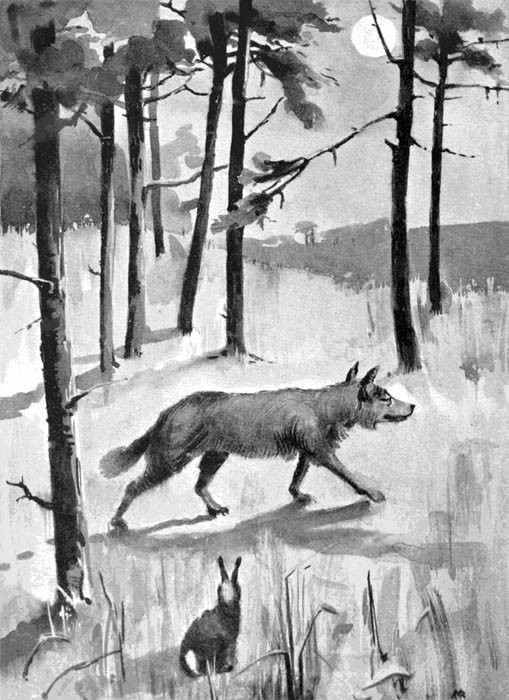
CoverThe Lone Wolf
FrontispieceDressing a Skin
page 18The Stags
34Gofa Alarmed
42Going to the Fields
48The Wild Boar
52The Wolf at the Beaver’s Hut
60The Spear-maker
80The Bear
88Making Pottery
124The Wild Ducks
130Making a Canoe
154Weaving at the Loom
160The Beacon
190The Warrior Chief
196It was splendid for Tig and the other boys—climbing into the oak trees, and getting as far out as they could upon the branches to shake down the ripe acorns. Sometimes they gathered a handful of fine ones and threw them at one another or pelted the women who were gathering underneath; and then Gofa, or some one else’s mother, would look up and say: “Have done now, little badling! or surely we will leave thee in the forest here to-night, and Arthas the She-bear will catch thee and carry thee to her den to make a supper morsel for her little ones!”
After three days of such marching and camping, they came to Goba’s village. Goba’s village was in the hill country and at the top of a low, rounded hill. There was a wall set with stakes all round the village, and the huts were mostly larger and better built than any Tig had seen before. Goba and his sons never went away from their village. When the people moved off in the summer and went camping with their cattle, Goba and his sons stayed at home, working at their trade. They were all busily working when Garff and his party arrived.
Having got the clay ready, Gofa took a lump of it in her hands and laid it on a stone slab which served her as a working bench. Then, with her fingers and a smooth stone, and a stick shaped into a kind of blade, she worked up the clay into a little bowl, building up the sides against the stick, and smoothing the inside with her pebble. But for the larger jars and pipkins she had another way. She took a round basket shaped like a basin and set it before her. Then she took a piece of clay and rolled it with the flat of her hand on the bench until she had made it like a very long, thin, clay sausage. Then she picked this up and began to coil it round from the bottom of the basket, inside, pinching and pressing it with her fingers and the pebble until it was flat and smooth. Then she rolled out another piece and coiled this round as before, gradually building up the sides of the pot and pinching the coils together as she went on. At length, by adding coil to coil, she raised the sides and neck of the pipkin, which she then smoothed and finished off outside with the wooden tool.
WHEN TIG was a boy and used to play at hunting, the chief of his friends was Berog. Berog and he were of the same age and equal in strength; and, though Tig was the better marksman with the bow and arrow, Berog had the greater skill with the sling. By this time they were both tall and strong lads. Each of them had been out hunting several times with the men, and sometimes they had made little expeditions by themselves. But once in the autumn, after the corn had been gathered in, they planned to have a real hunt of their own. They saved some food to take with them, but not much, because men always hunt best when they are hungry. Tig had a new, full-sized bow, that he had made himself, and his quiver full of flint-headed arrows, and his stone axe slung at his side. Berog had his sling and a bag full of smooth, round stones, and in his hand he carried a club. And so they set out together.
ON the next day, Gaithel took Tig and showed him the village; and Tig saw what he had taken to be an island was really a large and solid platform made of tree-trunks laid close together. There was a paling of stakes at the edge of the platform next the water, all round; and within the paling were the huts, built close together side by side in rows with narrow alleys in between, and sheds for the cattle, built of poles and wattled and daubed with clay like the huts. Besides their cattle the Lake People had some sheep, which they prized greatly on account of the wool, from which the women span yarn for weaving into cloth. At the place where the gangway joined the platform there was a gate of bars in the paling, and also a rough stairway going down to the canoes that were drawn up alongside. In an open place in the middle of the village was a fire burning on a large open hearthstone; and Gaithel said that nowhere else on the island was anyone allowed to have a fire, for fear of burning down the huts. In another place was a shoot for rubbish, to which the people had to bring their household refuse and tip it into the lake. Then Gaithel took Tig down to the landing stage, and showed him the canoes that were moored there; “I know someone who would like to see these canoes of yours,” said Tig. “He is a man in our village, called Crubach. He is lame. He makes troughs in the same way as you make canoes, by burning out a tree trunk, only of course they are much smaller; my mother has one to dip hides in when she is curing them.”
Dobran’s wife, who was sitting beside her husband, was busily spinning yarn; and when Dobran had finished speaking, she began to hum a song as she drew the thread. She had a big bunch of wool fastened to the end of a stick beside her, and she drew out some hair from the wool and twisted it into a thread between her thumb and finger. Then she tied the end of this to the spindle, which was a pointed stick loaded about the middle with a ball of dried clay, and started twirling it round with her other hand. As the spindle went spinning round in the air, and dropping towards the ground, it drew the thread out longer, twisting it all the time. As soon as the spindle reached the ground, Dobran’s wife picked it up, wound the thread round it and set it spinning again; and so she went on until she had spun a good ball of yarn.
Then Garff made an agreement with the Lake Men that they should return at once to their village, and set spies to watch the fords of the river and the village of the Warriors; and if an army should be seen to leave the village, then the Lake People were to light three beacon fires upon the top of the hill above their village, and he and his men would come to their aid.
Presently they heard voices and saw the figures of the leaders appear among the trees. The Warriors were sure of victory, and they had no thought of the Lake Men coming out to meet them; so they were marching carelessly along, thinking more of getting their canoes up the hill than of preparing to fight. They streamed out into the open, led by their chief who was carrying his axe on his shoulder. Garff waited till the band were well away from the shelter of the trees, and then he sprang to his feet with a great shout. At once his men leaped up, and sent a deadly shower of arrows at the enemy; and every man, as soon as he had shot, fitted another arrow and shot again. Many of the Warriors fell, and many were wounded, and they were thrown into great confusion. But their chief rushed down their ranks shouting to them not to give way, but to take their shields and advance. Then to gain time and to save his broken line, he dashed forward alone, holding up his arm. Garff signed to his men to cease shooting, and the chief of the Warriors came on shouting:
DAYS BEFORE HISTORY
Chapter the First
How Dick and his Friends heard a Story
I KNOW a boy called Dick. He is nine, and he lives near London. Last spring Dick’s father and mother moved house. All their furniture and things were taken in the vans, and Dick and his father and mother went in a cab.
When they got to the house, Dick ran in at once to explore. It was not really a new house, because people had lived in it before; but Dick was disappointed to find it very much the same as the house they had just left. There was the drawing-room on one side of the hall and the dining-room on the other, and all the rooms upstairs, and the bath-room, and the box-room, just the same as in their other house; and there was a garden with walls round the three sides, very like their last one. And Dick was sorry that there was nothing new to see. So he said to his father that he did not like the new house because it was just like the old one. But his father said: “You must not grumble at that. Lots of houses are very much alike, of course. There are so many people in these days who want the same sort of house built for them.”
That summer Dick went to pay a visit to his uncle, a long way off in the country. Dick’s uncle lived in a very old house; part of it was more than four hundred years old, and Dick had never been in such an old house in his life. His uncle took him all round it, and showed him many strange things. The oldest part of the house was a square tower with very thick walls and long, very narrow windows. Dick’s uncle told him that the windows were made like slits so that the men inside the tower could shoot their arrows out at their enemies; while the enemies would find it very hard to shoot their arrows in and hit the men inside. And he said, also, that in the old days before people could make glass for windows, it was better to have little windows than big ones in very cold weather.
And Dick’s uncle took him to the top of the tower and showed him the remains of an open fireplace, in which the men of the tower used to light a beacon fire to give the alarm to people in the villages and towns when enemies were coming.
And outside the tower he showed him part of a deep ditch, and told him that once this ditch went right round the house and was called a moat, only that now it was nearly all filled up with earth and stones. But at one time it was always full of water, so that no one could get at the tower without crossing the moat. And the people in the tower used to let down a bridge, called the drawbridge, because it was drawn up and down by means of chains. So that when they or their friends wanted to go out or come in, the drawbridge used to be let down for them, and pulled up afterwards.
And Dick’s uncle told him that all these things used to be done to make houses safe to live in, because once upon a time long ago there were a great many thieves and robbers in the land, and there were no policemen to keep them in order; also that the people used to fight among themselves a great deal; and his uncle showed him some old pieces of armour, and a helmet and a battle-axe and some swords, such as the knights and men-at-arms used in battle long ago.
Dick’s uncle’s name was Uncle John. He was very much pleased to see that Dick liked his old house and his old swords and armour; but he said: “I know where there are the remains of some houses a very great deal older than mine. If you would like to see them, we will go for a walk to-morrow and try to find them.”
The next day they set out for their walk—Dick and his uncle John and a collie and two terriers—and Uncle John said: “We will call for Joe first.”
“Is Joe a dog?” Dick asked.
“No,” said his uncle; “Joe is a boy. He is nine, like you, and he lives in the house with the green gate.”
But Joe said he was afraid he could not come for a walk, because his cousin David had come to spend the holidays with him, and they had made a plan to go fishing. So Uncle John invited David, too, and they all set off together.
After they had gone about a mile along the lane, they came to a heath. It was a large open heath on the top of a hill, looking down a slope into a valley. The slope of the hill was covered with bushes, and there were trees in little groups here and there. The hills beyond were mostly covered with woods, and there was a stream in the valley down below. Uncle John led the way until they came to a flattish place on the hill-side. Then he said:
“Now close to us here is a place where people lived long ago, before ever they could build towers or houses at all. Who can find where these old-time people lived?”
And the boys all searched round among the bushes and the rocks; and after a while Joe called out: “Was it here?”
Uncle John went to look, and he laughed at Joe. For what he had found was a little rough shed that the rabbit-catchers had put up.
Then Dick called out. He had gone further down the hill, and had come upon an old limekiln with a little opening, like a doorway, at the bottom of it.
But Uncle John said: “No, I don’t think that the limekiln is even half as old as my house. What we are looking for is something not built with stones and without walls of any sort.”
Then David ran away, and he shouted out; and when they went to where he was, they found him standing in a sort of pit dug in the ground, about the depth that David could stand in up to his shoulders, and about twice as wide across as Uncle John’s walking-stick could measure.
And Uncle John said: “Yes, that is one place; but, if you look about, you will find several more.”
So the boys hunted about, and they found nine or ten more of the pits; and then they came back to where Uncle John was sitting and asked him to tell them about these old dwellings. But he said they must wait a little while, because he had something else for them to see first.
As they walked homeward over the heath, they came to a place where the cart-tracks went down to the sand-pits, and the way was bare and rough. And Uncle John said: “Now which of you boys has got eyes in his head? Within a dozen yards of where we are standing I have dropped something which once belonged to one of the men of the pit-dwellings. Sixpence for the boy who finds it!”
Then they all began to hunt round, but no one could find anything. So Uncle John said: “It is something made of flint-stone. The man to whom it belonged used to shoot with it.” And he kept on saying, while they were looking about: “Dick is hot” or “Joe is warm,” just as if they were playing at Hide the Thimble.
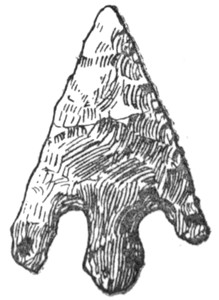
At last Joe called out, “I’ve got it!” and he came running up with an arrow-head chipped out of grey flint; and the others crowded round to look at it. And Uncle John showed them how carefully it had been chipped, and how sharp the point and edges were, although it was hundreds and hundreds of years old.
And he cut a strong little shoot off a hazel tree, and shortened it, and split it at the end, and showed them how he supposed the man who made the arrow all that long time ago had fixed it to its shaft.
Then he took out sixpence, and said to Joe, “If you might choose, which would you rather have? The sixpence or the arrow-head?”
And Joe said, “The arrow-head, ever so much rather!”
But Uncle John said, “You mayn’t choose now, so take your sixpence. But I’ll tell you what: if you three boys would like to know more about the pit-dwelling people, and about their houses, and how they hunted and all that, I have a book at home in which there is a lot about these things; and I think it would be a good way of filling up some of your spare time these holidays if we were to have some reading out of the book now and then. You might try your hands at building a hut, to see if you could do it as well as the pit-dwelling people did. And you might make some bows and arrows, and even have a try at chipping out flint arrow-heads. We might have a shooting match with the bows and arrows, with another sixpence for the prize. Or, better still, we might have for a prize this flint arrow-head of mine that Joe is so fond of; and give it to the boy who knows most about what we have been reading, when we come to the end of the holidays.”
They all agreed that that would be rather a good way of amusing themselves, if the book were interesting. But by the time they got home it was too late to begin; so the reading had to be put off until the next day.
On the next day Joe and David went up to Uncle John’s house. As it was a wet afternoon they sat indoors. On the table there was a large brown book; and as soon as they had settled themselves, Uncle John took up the book and began to read.
Chapter the Second
THE STORY OF TIG: Tig’s Birthday and his Home
ONCE upon a time, a very long time ago, there was a boy called Tig. When the story begins, Tig was only a baby; he was four, or nearly four. To tell the truth, he did not quite know when his birthday was. He did not have a proper birthday every year. Nobody kept birthdays when Tig was little, because people had not any names for the months, as we have now.
They talked about the hot-time and the cold-time, two times instead of four seasons; and if you could have spoken their language, and had asked Gofa, Tig’s mother, when Tig’s birthday was, she would have said, “One day in the cold-time.”
When Tig was born, he lived first of all in a little house which had only one room in it. It was rather like a cellar, because it was dug out of the ground.
There were no windows in the house. There was only one doorway, and it was a hole, like the mouth of a burrow; and Tig’s father and mother, and any of their friends who came to visit them, had to crawl in and out on all-fours. At night, when the family were all inside, Tig’s father used to set up a big stone against the entrance-hole. He used to say in fun that this was to keep out the wolves and the bears. But neither bears nor wolves had much chance to get in, because there was a high paling of posts that surrounded all the huts. The big door-stone was always kept inside the hut, so that it was handy if ever they wanted to block the doorway against anybody during the daytime.
The fireplace was in the middle of the floor, and there was a hole in the roof to let the smoke out. In the daytime the hole in the roof made a kind of window. The roof was made of branches of trees. These were supported on the ground by a foundation of thick flat stones and pieces of turf, and were overlaid with smaller branches and turves and a rough thatch of reeds.
Here Tig’s father, who was called Garff, and Gofa, Tig’s mother, lived nice and snug in the cold-time. They had no bedsteads nor tables nor chairs nor chests of drawers. But they had plenty of skins of wild horses and cows and deer, and wolf-skins and bear-skins, instead of beds and chairs; and Tig’s own sleeping-cot was a skin of a little bear that Garff had killed on purpose for him. Their other belongings were of a useful sort, not large and heavy like furniture, but such things as cooking pots, the mealing-stone for crushing corn, and the big wooden mortar in which grain or acorns could be pounded into flour.
In summer-time they used to find the dug-out hut too hot to live in, and besides, they had to take their cattle out to fresh pastures. So they, and their friends who lived in the other huts close by, used to pack up their skin rugs and all their other belongings, and travel to another part of the hill country. Some of the men used to march on in front, with their spears and bows and arrows ready, in case they were to meet any wild beasts. Then came the rest of the men and the boys with the dogs, driving the cattle along; and after them the old men and the women and children, with more armed men to bring up the rear. The women carried the skins and the cooking pots and the food; and almost every one had a baby bound on to her back. The food was carried in baskets, and the bigger children helped to carry the baskets. The smaller children had no loads to carry, except their dolls and playthings which they hugged in their arms as they walked along beside their mothers.
The people left the huts and marched down the hill. Then they crossed the river, wading into the water at a shallow place. But the little children had to be carried over; and Tig was carried over by his mother every time until after he was seven.
The tribe used to take a whole day in travelling to the camping-place; and when they got there at last, they used to make a new fire, and light bonfires in the open, and cook their supper, and sleep in tents and booths about the fires.
Up on the hill-side, at the edge of the forest, where the ground had been partly cleared, was the place of the first summer camp. The summer huts were built above ground, of branches of trees, wattled with withies and twigs, and daubed with clay. Sometimes a man had only to repair the hut that he had lived in the summer before. But even if he had to build a new one, it was not such hard work as to build a winter hut. Before a man began to build his summer hut, he picked out a tree with a straight trunk to act as the main support of his hut. He used the tree as a centre pillar to hold up his roof-beams. If he built his summer hut in the open, away from the trees, he set up a pole for a roof-tree. We still talk of living under our own roof-tree, just as those people did long ago.
The fireplaces were made out-of-doors. If they had been indoors, the huts would often have been burned down. Probably they often were burned down even then. So whatever cooking Tig’s mother wanted to do in the summer camps she did at a big fire outside the huts.
The winter village of dug-out huts was high up on the hillside at the upper end of a sheltered valley, and the summer camps were set up at different places upon the hills, as the people moved about with their cattle; and wherever they were, they always put up a stockade of posts around the huts, to keep themselves and their cattle safe from wolves and bears.
But besides their dwelling-places, the people had a fort, which was meant to be used only in time of war for the tribe to retire to, if their enemies should attack them. It was built at the top of a high hill, in the form of a ring, with a mound of earth and stones, and a stockade all round, and a deep ditch outside. The fort was big enough to take in all the people and their cattle in case of necessity; but when Tig was a baby, it had not been used for a long time and nobody lived in it.
Chapter the Third
Tig’s Mother, and the Lessons that she taught him
TIG’S mother was called Gofa. She was the mistress of the house and the housekeeper. She did not keep any servants, but did the work herself; she minded Tig and his little brothers and sisters, and cooked their meals and made clothes for Garff and all the family. Their clothes were mostly made of skins, and Gofa always prepared the skins for the clothes with her own hands. To make a suit out of a deerskin was a long business. The hide had to be dried in the open air, and then scraped all over with flint scrapers until all the hair was taken off. Then it was smeared with the animal’s brains and fat, and allowed to dry again; and then thoroughly washed in wooden tubs and tanned with the bark of oak-trees. When at last it was cured and dried, it was cut into pieces and the pieces sewn together with sinews. Gofa’s needles were made of bone, and they were not very sharp: she used to pierce holes in the leather with a little bodkin made of flint stone before she could put in the stitches. But once the stitches were made, they held firmer than any that are sewn with thread.
Whenever a deer was brought home or a cow killed, Gofa always kept the big sinews from the legs and dried them in the sun or under the roof of the hut indoors.
Then she took a flint knife and scraped the sinew and shredded it into threads, and drew the threads separately through her fingers, and put them away in a pouch made of deer-skin. This was her store of thread.
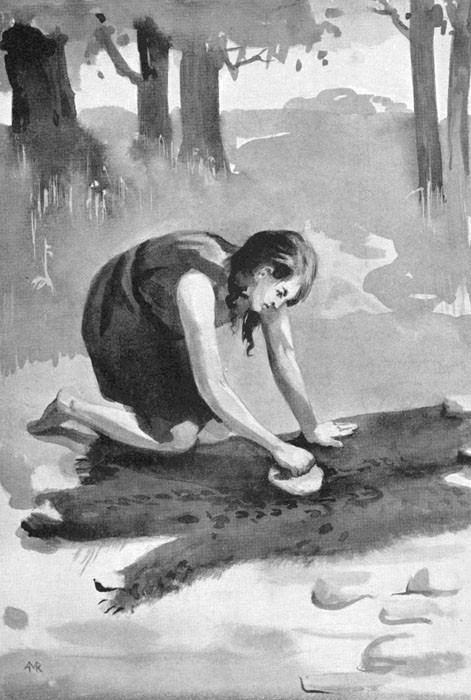
Dressing a Skin
The suit that most people wore was a sark; it was a sort of shirt which came down to the knees, and was girded with a belt at the waist. This was generally made of dressed hide; but almost every one had besides a thicker dress for cold weather, with the hair left on; and the richer people had these trimmed with different sorts of fur. Some wore cloaks besides, and caps made of skin with the hair on.
When the men went hunting they wore shoes made of hide, and leather bands wrapped round their legs for leggings. The people let their hair grow long; and they often used to spend much time combing and dressing it.
Most people, unless they were very poor, had also finer garments of cloth, which the women span and wove. But cloth was much scarcer than skins, besides being more easily worn out; and so the clothes for everyday wear were always of dressed hides. Men who spent a great part of their time hunting and creeping about in the thickets of the forest, wanted a suit which would turn the wet and not tear easily among the thorns and briars.
Tig had his first little sark and belt when he was seven years old—it was made of deer-skin; but he had neither cap nor leggings; for, like all the other children, he used to run about barefoot and bareheaded.
Gofa taught her children many things, but she did not teach them to read or to write: she could neither read nor write herself, nor could any of her neighbours.
People had no books and no writing in those times. Tig did not learn to do sums or to say the Multiplication Table; but he did learn to count, by saying the numbers on his fingers. However, as it is such a long time since he lived, and as no one ever wrote down exactly how people counted in those days, Tig’s names for the figures are not known for certain. But it is very likely that they were something like this. On the fingers of one hand, instead of One, Two, Three, Four, Five, he said what sounded like
Ahn, Da, Tree, Kethra, Kweeg:
and then on the fingers of the other hand,
Say, Sect, Oct, Noi, Dec,
for Six, Seven, Eight, Nine, Ten; and that was as far as he got in the way of counting at first.
But there were many things that Tig learned from his mother out-of-doors; for Gofa used to do a great deal of work with the other women, preparing the ground for corn and reaping the crops at harvest time; and Tig used to go with his mother to the fields, or to the river when she went to cut osiers for making baskets, or into the woods to gather firewood. He learned to be always on the look-out; always to listen for every sound—even so little a noise as the snapping of a twig; and always to bear in mind what he was going to do in case of sudden danger, and where he should run to for safety if he had to flee from a wild beast. Tig did not know many things that most boys and girls know in these times; but he could do one thing that hardly any boy or girl can do nowadays—he could move his ears backward and forward just as he wished, when he was listening very carefully to any slight sound in the woods.
Tig liked the summer-time best. It was much better fun playing in the forest near the huts and lying basking in the hot sun than crawling about in the dark, smoky winter pit-hut. He used to climb about in the trees, even when he was quite little. While his mother was busy with her work out-of-doors, she used to put him up into a tree and let him play about among the branches by himself; and sometimes she even made a sort of little crib for him with bands of hide, and left him to sleep safe and sound in a big oak tree. This was to keep him out of danger from wild animals. For in those days it was dangerous for children to be out in the open or in the woods away from the huts, because there were often wolves or other savage beasts prowling about.
But round Tig’s home there was less danger, because the wild beasts had learned to fear men and their weapons and their fires. But still, wolves and bears were seen sometimes close to the village; so the children were safer playing up in the trees than on the ground; and they all learned to be very good climbers.
From the boys with whom he played, when he grew older, Tig learned many other useful things. He learned to swing himself down from one branch of a tree to a lower branch, and catch hold with his feet; to dive without splashing, and swim under water right across to the opposite bank of the river; to save his breath when running, so as to last out on a long race. He and the other boys practised shooting with bows and arrows, which their fathers helped them to make. And they had stone-throwing matches, too; and no one was considered to be any good unless he could throw hard and straight with both hands. Tig and his friends all longed to become hunters, and their favourite game was to play at hunting; and as they grew older, they used to go out in parties into the woods to hunt and fish. But they did not often bring home any game.
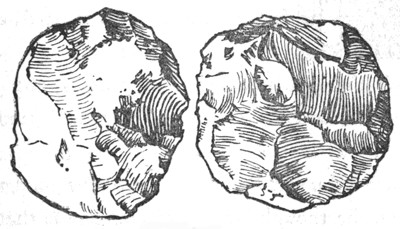
Flint Scrapers