


Онлайн кітапты тегін оқу The Poems of Madison Cawein, Volume 1 (of 5)
THE POEMS OF

MADISON CAWEIN
VOLUME I
LYRICS AND OLD WORLD
IDYLLS
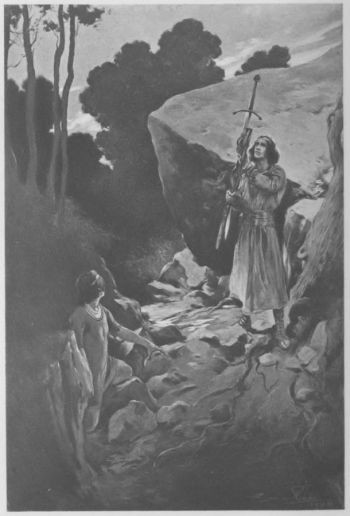
[See larger version]
"It shall go hard with him through thee, unconquerable blade" Page 270
Accolon of Gaul
THE POEMS OF
MADISON CAWEIN
Volume I
LYRICS AND OLD
WORLD IDYLLS
WITH AN INTRODUCTION BY
EDMUND GOSSE
Illustrated
WITH PHOTOGRAVURES AFTER PAINTINGS BY ERIC PAPE
INDIANAPOLIS
THE BOBBS-MERRILL COMPANY
PUBLISHERS
Copyright, 1887, 1888, 1889, 1890, 1891, 1892, 1893,
1898 and 1907, by Madison Cawein
PRESS OF
BRAUNWORTH & CO.
BOOKBINDERS AND PRINTERS
BROOKLYN, N. Y.
TO WILLIAM DEAN HOWELLS
WHO WAS THE FIRST TO RECOGNIZE AND ENCOURAGE MY ENDEAVORS, THIS VOLUME IS INSCRIBED WITH AFFECTION, ADMIRATION AND ESTEEM
PREFACE
This first collected edition of my poems contains all the verses I care to retain except the translations from the German, published in 1895 under the title of The White Snake, and some of the poems in Nature-Notes and Impressions, published in 1906.
Several of the poems which I probably would have omitted I have retained at the solicitation of friends, who have based their argument for their retention upon the generally admitted fact that a poet seldom knows his best work.
The new arrangement under new titles I found was necessary for the sake of convenience; and the poems in a manner grouped themselves in certain classes. In eliminating the old titles—some eighteen in number—I have disregarded entirely, except in the case of the first volume, the date of the appearance of each poem, placing every one, according to its subject matter, in its proper group under its corresponding title.
Most of the poems, especially the earlier ones, have been revised; many of them almost entirely rewritten and, I think, improved.
Madison Cawein.
Louisville, Kentucky.
INTRODUCTION
Since the disappearance of the latest survivors of that graceful and somewhat academic school of poets who ruled American literature so long from the shores of Massachusetts, serious poetry in the United States seems to have been passing through a crisis of languor. Perhaps there is no country on the civilized globe where, in theory, verse is treated with more respect and, in practice, with greater lack of grave consideration than in America. No conjecture as to the reason of this must be attempted here, further than to suggest that the extreme value set upon sharpness, ingenuity and rapid mobility is obviously calculated to depreciate and to condemn the quiet practice of the most meditative of the arts. Hence we find that it is what is called "humorous" verse which is mainly in fashion on the western side of the Atlantic. Those rhymes are most warmly welcomed which play the most preposterous tricks with language, which dazzle by the most mountebank swiftness of turn, and which depend most for their effect upon paradox and the negation of sober thought. It is probable that the diseased craving for what is "smart," "snappy," and wide-awake, and the impulse to see everything foreshortened and topsy-turvy, must wear themselves out before cooler and more graceful tastes again prevail in imaginative literature.
Whatever be the cause, it is certain that this is not a moment when serious poetry, of any species, is flourishing in the United States. The absence of anything like a common impulse among young writers, of any definite and intelligible, if excessive, parti pris, is immediately observable if we contrast the American, for instance, with the French poets of the last fifteen years. Where there is no school and no clear trend of executive ambition, the solitary artist, whose talent forces itself up into the light and air, suffers unusual difficulties, and runs a constant danger of being choked in the aimless mediocrity that surrounds him. We occasionally meet with a poet in the history of literature, of whom we are inclined to say: "Charming as he is, he would have developed his talent more evenly and conspicuously, if he had been accompanied from the first by other young men like-minded, who would have formed for him an atmosphere and cleared for him a space." This is the one regret I feel in contemplating, as I have done for years past, the ardent and beautiful talent of Mr. Madison Cawein. I deplore the fact that he seems to stand alone in his generation; I think his poetry would have been even better than it is, and its qualities would certainly have been more clearly perceived, and more intelligently appreciated, if he were less isolated. In his own country, at this particular moment, in this matter of serious nature-painting in lyric verse, Mr. Cawein possesses what Cowley would have called "a monopoly of wit." In one of his lyrics Mr. Cawein asks—
"The song-birds, are they flown away,
The song-birds of the summer-time,
That sang their souls into the day,
And set the laughing hours to rhyme?
No cat-bird scatters through the hush
The sparkling crystals of her song;
Within the woods no hermit-thrush
Trails an enchanted flute along."
To this inquiry, the answer is: the only hermit-thrush now audible seems to sing from Louisville, Kentucky. America will, we may be perfectly sure, calm herself into harmony again, and possess once more her school of singers. In those coming days, history may perceive in Mr. Cawein the golden link that bound the music of the past to the music of the future through an interval of comparative tunelessness.
The career of Mr. Madison Cawein is represented to me as being most uneventful. He seems to have enjoyed unusual advantages for the cultivation and protection of the poetical temperament. He was born on the 23rd of March, 1865, in the metropolis of Kentucky, the vigorous city of Louisville, on the southern side of the Ohio, in the midst of a country celebrated for tobacco and whisky and Indian corn. These are commodities which may be consumed in excess, but in moderation they make glad the heart of man. They represent a certain glow of the earth, they indicate the action of a serene and gentle climate upon a rich soil. It was in this delicate and voluptuous state of Kentucky that Mr. Cawein was born, that he was educated, that he became a poet, and that he has lived ever since. His blood is full of the color and odor of his native landscape. The solemn books of history tell us that Kentucky was discovered in 1769, by Daniel Boone, a hunter. But he first discovers a country who sees it first, and teaches the world to see it; no doubt some day the city of Louisville will erect, in one of its principal squares, a statue to "Madison Cawein, who discovered the Beauty of Kentucky." The genius of this poet is like one of those deep rivers of his native state, which cut paths through the forests of chestnut and hemlock as they hurry towards the south and west, brushing with the impulsive fringe of their currents the rhododendrons and calmias and azaleas that bend from the banks to be mirrored in their flashing waters.
Mr. Cawein's vocation to poetry was irresistible. I do not know that he even tried to resist it. I have even the idea that a little more resistance would have been salutary for a talent which nothing could have discouraged, and which opposition might have taught the arts of compression and selection. Mr. Cawein suffered at first, I think, from lack of criticism more than from lack of eulogy. From his early writings I seem to gather an impression of a Louisville more ready to praise what was second-rate than what was first-rate, and practically, indeed, without any scale of appreciation whatever. This may be a mistake of mine; at all events, Mr. Cawein has had more to gain from the passage of years in self-criticism than in inspiring enthusiasm. The fount was in him from the first; but it bubbled forth before he had digged a definite channel for it. Sometimes, to this very day, he sports with the principles of syntax, as Nature played games so long ago with the fantastic caverns of the valley of the Green River or with the coral-reefs of his own Ohio. He has bad rhymes, amazing in so delicate an ear; he has awkwardness of phrase not expected in one so plunged in contemplation of the eternal harmony of Nature. But these grow fewer and less obtrusive as the years pass by.
The virgin timber-forests of Kentucky, the woods of honey-locust and buckeye, of white oak and yellow poplar, with their clearings full of flowers unknown to us by sight or name, from which in the distance are visible the domes of the far-away Cumberland Mountains,—this seems to be the hunting-field of Mr. Cawein's imagination. Here all, it must be confessed, has hitherto been unfamiliar to the Muses. If Persephone "of our Cumnor cowslips never heard," how much less can her attention have been arrested by clusters of orchids from the Ocklawaha, or by the song of the whippoorwill, rung out when "the west was hot geranium-red" under the boughs of a black-jack on the slopes of Mount Kinnex. "Not here," one is inclined to exclaim, "not here, O Apollo, are haunts meet for thee," but the art of the poet is displayed by his skill in breaking down these prejudices of time and place. Mr. Cawein reconciles us to his strange landscape—the strangeness of which one has to admit is mainly one of nomenclature,—by the exercise of a delightful instinctive pantheism. He brings the ancient gods to Kentucky, and it is marvelous how quickly they learn to be at home there. Here is Bacchus, with a spicy fragment of calamus-root in his hand, trampling the blue-eyed grass, and skipping, with the air of a hunter born, into the hickory thicket, to escape Artemis, whose robes, as she passes swiftly with her dogs through the woods, startle the humming-birds, silence the green tree-frogs, and fill the hot still air with the perfumes of peppermint and pennyroyal. It is a queer landscape, but one of new natural beauties frankly and sympathetically discovered, and it forms a mise en scene which, I make bold to say, would have scandalized neither Keats nor Spenser.
It was Mr. Howells,—ever as generous in discovering new talent as he is unflinching in reproof of the effeteness of European taste,—who first drew attention to the originality and beauty of Mr. Cawein's poetry. The Kentucky poet had, at that time, published but one tentative volume, the Blooms of the Berry, of 1887. This was followed, in 1888, by The Triumph of Music, and since then hardly a year has passed without a slender sheaf of verse from Mr. Cawein's garden. Among these (if a single volume is to be indicated), the quality which distinguishes him from all other poets,—the Kentucky flavor, if we may call it so,—is perhaps to be most agreeably detected in Intimations of the Beautiful.
But it is time that I should leave the American lyrist to make his own appeal, with but one additional word of explanation, namely, that in this introduction Mr. Cawein's narrative poems on medieval themes, and in general his cosmopolitan writings, have been neglected of mention in favor of such nature lyrics as would present him most vividly in his own native landscape, no visitor in spirit to Europe, but at home in that bright and exuberant West—
"Where, in the hazy morning, runs
The stony branch that pools and drips,
Where red haws and the wild-rose hips
Are strewn like pebbles; where the sun's
Own gold seems captured by the weeds;
To see, through scintillating seeds,
The hunters steal with glimmering guns.
To stand within the dewy ring
Where pale death smites the boneset's blooms,
And everlasting's flowers, and plumes
Of mint, with aromatic wing!
And hear the creek,—whose sobbing seems
A wild man murmuring in his dreams,—
And insect violins that sing!"
So sweet a voice, so consonant with the music of the singers of past times, heard in a place so fresh and strange, will surely not pass without its welcome from lovers of genuine poetry.
Edmund Gosse.
London, England.
CONTENTS
BLOOMS OF THE BERRY PAGE At Rest 45 Avatars 61 Clouds 59 Dead Lily, A 40 Dead Oread, The 41 Deficiency 50 Distance 48 Diurnal 55 Dreamer of Dreams, A 24 Dryad, The 38 Family Burying Ground, The 57 Hepaticas 17 Heron, The 60 In Late Fall 72 In Middle Spring 12 In November 71 Lillita 63 Longings 9 Loveliness 4 Midsummer 52 Midwinter 79 Mirabile Dictu 22 Miriam 65 Moonrise at Sea 69 Old Byway, The 32 Pan 27 Pax Vobiscum 43 Sound of the Sap, The 36 Spirits of Spring 19 Spring Shower, A 14 Stormy Sunset, A 29 Sweet O' the Year, The 10 Two Days 67 Tyranny 76 Waiting 7 What You Will 77 With the Seasons 73 Wood God, The 1 Woodland Grave, A 30 Woodpath, The 34 IN THE GARDENS OF FALERINA Alcalde's Daughter, The 187 Amadis at Miraflores 108 An Antique 129 Blodeuwedd 101 Epic, The 183 Ermengarde 125 Eve of All-Saints, The 164 Face to Face 160 Gardens of Falerina, The 85 Guinevere, A 153 Hackelnberg 127 Hawking 117 In Mythic Seas 193 Ishmael 189 Jaafer the Barmecide 131 King, The 138 Loké and Sigyn 197 Love as It Was in the Time of Louis XIV 171 Mater Dolorosa 169 Melancholia 141 Minstrel and the Princess, The 185 My Romance 181 Orlando 119 Perle Des Jardins 156 Pre-Existence, A 134 Romance 87 To Gertrude 83 Troubadour, The 176 Urganda 112 Valley of Music, The 90 War-Song of Harald the Red 207 Woman of the World, A 150 Yolanda of the Towers 121 Yule 209 OLD WORLD IDYLLS Accolon of Gaul 219 After the Tournament 340 An Episode 440 Arabah 458 At the Corregidor's 437 Behram and Eddetma 476 Blind Harper, The 345 Childe Ronald 347 Dark Tower, The 342 Daughter of Merlin, The 363 Demon Lover, The 358 Dream of Sir Galahad, The 335 Forester, The 371 Geraldine 431 Isolt 329 Khalif and the Arab, The 450 Knight-Errant, The 368 Lady of the Hills, The 356 Mameluke, The 466 Moated Manse, The 391 Morgan Le Fay 353 My Lady of Verne 422 Norman Knight, The 448 Old Tale Retold, An 409 Peredur, The Son of Evrawc 307 Portrait, The 471 Princess of Thule, A 360 Romaunt of the Roses 468 Rosicrucian, The 445 Seven Devils, The 460 Slave, The 443 Thamus 462 To R. E. Lee Gibson 217 Torquemada 485 Tristram to Isolt 365LIST OF ILLUSTRATIONS
As one hath seen a green-gowned huntress fair,
Morn in her cheeks and midnight in her hair;
Keen eyes as gray as rain, young limbs as lithe
As the wild fawn's; and silvery voice as blithe
As is the wind that breathes of flowers and dews,
Breast through the bramble-tangled avenues;
Through brier and thorn, that pluck her gown of green,
And snag it here and there,—through which the sheen
Of her white skin gleams rosy;—eyes and face,
Ardent and flushed, fixed on the lordly chase:
So came the Evening to that shadowy wood,
Or so it seemed to Accolon, who stood
Watching the sunset through the solitude.
So Evening came; and shadows cowled the way
Like ghostly pilgrims who kneel down to pray
Before a wayside shrine: and, radiant-rolled,
Along the west, the battlemented gold
Of sunset walled the opal-tinted skies,
That seemed to open gates of Paradise
On soundless hinges of the winds, and blaze
A glory, far within, of chrysoprase,
Towering in topaz through the purple haze.
And from the sunset, down the roseate ways,
To Accolon, who, with his idle lute,
Reclined in revery against the root
Of a great oak, a fragment of the west,
A dwarf, in crimson satin tightly dressed,
Skipped like a leaf the early frosts have burned,
A red oak-leaf; and like a leaf he turned,
And danced and rustled. And it seemed he came
From Camelot; from his belovéd dame,
Morgane le Fay. He on his shoulder bore
A mighty blade, wrought strangely o'er and o'er
With mystic runes, drawn from a scabbard which
Glared venomous, with angry jewels rich.
He, louting to the knight, "Sir knight," said he,
"Your Lady, with all tenderest courtesy,
Assures you—ah, unworthy bearer I
Of her good message!—of her constancy."
Then, doffing the great baldric, with the sword,
To him he gave them, saying, "From my lord,
King Arthur: even his Excalibur,
The magic blade which Merlin gat of her,
The Ladyé of the Lake, who, as you wot,
Fostered in infanthood Sir Launcelot,
Upon some isle in Briogne's tangled lands
Of meres and mists; where filmy fairy bands,
By lazy moons of summer, dancing, fill
With rings of morrice every grassy hill.
Through her fair favor is this weapon sent,
Who begged it of the King with this intent:
That, for her honor, soon would be begun
A desperate battle with a champion,
Of wondrous prowess, by Sir Accolon:
And with the sword, Excalibur, more sure
Were she that he against him would endure.
Magic the blade, and magic, too, the sheath,
Which, while 'tis worn, wards from the wearer death."
He ceased: and Accolon held up the sword
Excalibur and said, "It shall go hard
With him through thee, unconquerable blade,
Whoe'er he be, who on my Queen hath laid
Insult or injury! And hours as slow
As palsied hours in Purgatory go
For those unmassed, till I have slain this foe!—
Here, page, my purse.—And now, to her who gave,
Despatch! and say: To all commands, her slave,
To death obedient, I!—In love or war
Her love to make me all the warrior.—
Bid her have mercy, nor too long delay
From him, who dies an hourly death each day
Till, her white hands kissed, he shall kiss her face,
Through which his life lives on, and still finds grace."
Thus he commanded. And, incontinent,
The dwarf departed, like a red shaft sent
Into the sunset's sea of scarlet light
Burning through wildwood glooms. And as the night
With votaress cypress veiled the dying strife
Sadly of day, and closed his book of life
And clasped with golden stars, in dreamy thought
Of what this fight was that must soon be fought,
Belting the blade about him, Accolon,
Through the dark woods tow'rds Chariot passed on.
"
It Shall go Hard With Him Through Thee, Unconquerable Blade"
Frontispiece PAGE She Raised Her Oblong Lute and Smote Some Chords(See page
230)
124 In Her Ecstasy a Lovely Devil(See page
303)
250 And Grasped of Both Wild Hands, Swung Trenchant(See page
285)
374LYRICS
Wine-warm winds that sigh and sing
Led me, wrapped in many moods,
Through the green, sonorous woods
Of belated spring.
Till I came where, glad with heat,
Waste and wild the fields were strewn,
Olden as the olden moon,
At my weary feet.
Wild and white with starry bloom,
One far milky-way that dashed,
When some mad wind down it flashed,
Into billowy foam.
I, bewildered, gazed around,
As one on whose heavy dreams
Comes a sudden burst of beams,
Like a mighty sound....
If the grander flowers I sought,
But these berry-blooms to you,
Evanescent as the dew,
Only these I brought.
BLOOMS OF THE BERRY.
THE WOOD GOD
I
What deity for dozing Laziness
Devised the lounging leafiness of this
Secluded nook?—And how!—did I distress
His musing ease that fled but now? or his
Communion with some forest-sister, fair
And shy as is the whippoorwill-flower there,
Did I disturb?—Still is the wild moss warm
And fragrant with late pressure,—as the palm
Of some hot Hamadryad, who, a-nap,
Props her hale cheek upon it, while her arm
Is wildflower-buried; in her hair the balm
Of a whole spring of blossoms and of sap.—
II
See, how the dented moss, that pads the hump
Of these distorted roots, elastic springs
From that god's late reclining! Lump by lump
Its points, impressed, rise in resilient rings,
As stars crowd, qualming through gray evening skies.—
Invisible presence, still I feel thy eyes
Regarding me, bringing dim dreams before
My half-closed gaze, here where great, green-veined leaves
Reach, waving at me, their innumerable hands,
Stretched towards this water where the sycamore
Stands burly guard; where every ripple weaves
A ceaseless, wavy quivering as of bands.
III
Of elfin chivalry, that, helmed with gold,
Invisible march, making a twinkling sound.—
What brought thee here?—this wind, that steals the old
Gray legends from the forests and around
Whispers them now? Or, in those purple weeds
The hermit brook so busy with his beads?—
Lulling the silence with his prayers all day,
Droning soft Aves on his rosary
Of bubbles.—Or, that butterfly didst mark
On yon hag-taper, towering by the way,
A witch's yellow torch?—Or didst, like me,
Watch, drifting by, these curled, brown bits of bark?
IV
Or con the slender gold of this dim, still
Unmoving minnow 'neath these twisted roots,
Thrust o'er the smoky topaz of this rill?—
Or, in this sunlight, did those insect flutes,
Sleepy with summer, drowsily forlorn,
Remind thee of Tithonos and the Morn?
Until thine eyes dropped dew, the dimpled stream
Crinkling with crystal o'er the winking grail?—
Or didst perplex thee with some poet plan
To drug this air with beauty to make dream,—
Presence unseen, still watching in yon vale!—
Me, wildwood-wandered from the haunts of man!
LOVELINESS
I
Now let us forth to find the young witch Spring,
Seated amid her bow'rs and birds and buds,
Busy with loveliness.—And, wandering
Among old forests that the sunlight floods,
Or vales of hermit-holy solitudes,
Dryads shall beckon us from where they cling,
Their limbs an oak-bark brown; their hair—wild woods
Have perfumed—wreathed with earliest leaves: and they,
Regarding us with a dew-sparkling eye,
Shall whispering greet us, as the rain the rye,
Or from wild lips melodious welcome fling,
Like hidden waterfalls with winds at play.
II
Let us surprise the Naiad ere she slips—
Nude at her toilette—in her fountain's glass;
With damp locks dewy and evasive hips,
Cool-dripping, but an instant seen, alas!
When from indented moss and plushy grass—
Fear in her great eyes' rainbow-blue—she dips,
Irised, the cloven water; as we pass
Making a rippled circle that shall hide,
From our exploring eyes, what watery path
She gleaming took; what crystal haunt she hath
In minnowy freshness, where her murmurous lips,
Bubbling, make merry 'neath the rocky tide.
III
Then we may meet the Oread, whose eyes
Are dewdrops where twin heavens shine confessed:
She, all the maiden modesty's surprise
Rosying her temples,—to slim loins and breast
Tempestuous, brown, bewildering tresses pressed,—
Shall stand a moment's moiety in wise
Of some delicious dream, then shrink, distressed,
Like some wild mist that, hardly seen, is gone,
Footing the ferny hillside without sound;
Or, like storm sunlight, her white limbs shall bound,
A thistle's instant, towards a woody rise,
A flying glimmer o'er the dew-drenched lawn.
IV
And we may see the Satyrs in the shades
Of drowsy dells pipe, and, goat-footed, dance;
And Pan himself reel rollicking through the glades;
Or, hidden in bosky bow'rs, the Lust, perchance,
Faun-like, that waits with heated, animal glance
The advent of the Loveliness that wades
Thigh-deep through flowers, naked as Romance,
All unsuspecting, till two hairy arms
Clasp her rebellious beauty, panting white,
Whose tearful terror, struggling into might,
Beats the brute brow resisting, but evades
Not him, for whom the gods designed her charms.
WAITING
Were it but May now, while
Our hearts are yearning,
How they would bound and smile,
The young blood burning!
Around the tedious dial
No slow hands turning.
Were it but May now!—say,
What joy to go,
Your hand in mine all day,
Where blossoms blow!
Your hand, more white than May,
May's flowers of snow.
Were it but May now!—think,
What wealth she has!
The bluet and wild-pink,
Wild flowers,—that mass
About the wood-brook's brink,—
And sassafras.
Nights, that the large stars strew,
Heaven on heaven rolled;
Nights, pearled with stars and dew,
Whose heavens hold
Aromas, and the new
Moon's curve of gold.
So mad, so wild is March!—
I long, oh, long
To see the redbud's torch
Flame far and strong;
Hear, on my vine-climbed porch,
The bluebird's song.
How slow the Hours creep,
Each with a crutch!—
Ah, could my spirit leap
Its bounds and touch
That day, no thing would keep—
Or matter much!
But now, with you away,
Time halts and crawls,
Feet clogged with winter clay,
That never falls,
While, distant still, that day
Of meeting calls.
LONGINGS
Now when the first wild violets peer
All rain-filled at blue April skies,
As on one smiles one's sweetheart dear
With the big teardrops in her eyes:
Now when the May-apples, I wis,
Bloom white along lone, greenwood creeks,
As bashful as the cheeks you kiss,
As waxen as your sweetheart's cheeks:
Within the soul what longings rise
To stamp the town-dust from the feet!
Fare forth to gaze in Spring's clean eyes,
And kiss her cheeks so cool and sweet!
THE SWEET O' THE YEAR
I
How can I help from laughing, while
The daffodillies at me smile?
The dancing dew winks tipsily
In clusters of the lilac-tree,
And crocus' mouths and hyacinths'
Storm through the grassy labyrinths
A mirth of pearl and violet;
While roses, bud by bud,
Laugh from each dainty-lacing net
Red lips of maidenhood.
II
How can I help from singing when
The swallow and the hawk again
Are noisy in the hyaline
Of happy heavens, clear as wine?
The robin, lustily and shrill,
Pipes on the timber-belted hill;
And o'er the fallow skim the bold,
Mad orioles that glow
Like shining shafts of ingot gold
Shot from the morning's bow.
III
How can I help from loving, dear,
Since love is of the sweetened year?—
The very insects feel his power,
And chirr and chirrup hour on hour;
The bee and beetle in the noon,
The cricket underneath the moon:—
What else to do but follow too,
Since youth is on the wing,
Lord Life who follows through the dew
Lord Love a-carolling.
IN MIDDLE SPRING
Now the fields are rolled into turbulent gold,
And a ripple of fire and pearl is blent
With the emerald surges of wood and of wold,
A flower-foam bursting redolent:
Now the dingles and deeps of the woodland old
Are glad with a sibilant life new sent,
Too rare to be told are the manifold,
Sweet fancies that quicken, eloquent,
In the heart that no longer is cold.
How it knows of the wings of the hawk ere it swings
From the drippled dew scintillant seen!
Where the redbird hides, ere it flies or sings,
In melodious quiverings of green!
How the sun to the dogwood such kisses brings
That it laughs into blossoms of wonderful sheen;
While the wind, to the strings of his lute that rings,
Makes love to apple and nectarine,
Till the sap in them rosily springs.
Go seek in the ray for a sworded fay,
The chestnut's buds into blooms that rips;
And look in the brook, that runs laughing gay,
For the Nymph with the laughing lips;
In the brake for the Dryad whose eyes are gray,
From whose bosom the perfume drips;
The Faun hid away, where the branches sway,
Thick ivy low down on his hips,
Pursed lips on a syrinx at play.
So, ho! for the rose, the Romeo rose,
And the lyric it hides in its heart!
And, oh, for the epic the oak-tree knows,
Sonorous as Homer in art!
And it's ho! for the prose of the weed that grows
Green-writing Earth's commonest part!—
What God may propose let us learn of those,
The songs and the dreams that start
In the heart of each blossom that blows.
A SPRING SHOWER
We stood where the fields were beryl,
The redolent woodland was warm;
And the heaven above us, now sterile,
Was alive with the pulse-winds of storm.
We had watched the green wheat brighten
And gloom as it winced at each gust;
And the turbulent maples whiten
As the lane blew gray with dust.
White flakes from the blossoming cherry,
Pink snows of the peaches were blown,
And star-bloom wrecks of the berry
And dogwood petals were sown.
Then instantly heaven was sullied,
And earth was thrilled with alarm,
As a cloud, that the thunder had gullied,
Thrust over the sunlight its arm.
The birds to dry coverts had hurried,
And hid in their leafy-built rooms;
And the bees and the hornets had buried
Themselves in the bells of the blooms.
Then down from the clouds, as from towers,
Rode slant the tall lancers of rain,
And charged the fair troops of the flowers,
And trampled the grass of the plain.
And the armies of blossoms were scattered;
Their standards hung draggled and lank;
And the rose and the lily were shattered,
And the iris lay crushed on its bank.
But high in the storm was the swallow,
And the rock-loud voice of the fall,
From its ramparts of forest, rang hollow
Defiance and challenge o'er all.
But the storm and its clouds passed over,
And left but one cloud in the west,
Wet wafts that were fragrant with clover,
And the sun slow-sinking to rest.
Rain-drippings and rain in the poppies,
And scents as of honey and bees;
A touch of wild light on the coppice,
That turned into flames the drenched trees.
Then the cloud in the sunset was riven,
And bubbled and rippled with gold,
And over the gorges of heaven,
Like a gonfalon vast was unrolled.
HEPATICAS
In the frail hepaticas—
That the early Springtide tossed,
Sapphire-like, along the ways
Of the woodlands that she crossed—
I behold, with other eyes,
Footprints of a dream that flies.
One who leads me; whom I seek:
In whose loveliness there is
All the glamour that the Greek
Knew as wind-borne Artemis.—
I am mortal. Woe is me!
Her sweet immortality!
Spirit, must I always fare,
Following thy averted looks?
Now thy white arm, now thy hair,
Glimpsed among the trees and brooks?
Thou who hauntest, whispering,
All the slopes and vales of Spring.
Cease to lure! or grant to me
All thy beauty! though it pain,
Slay with splendor utterly!
Flash revealment on my brain!
And one moment let me see
All thy immortality!
SPIRITS OF SPRING
I
Over the summer seas,
From the Hesperides,
Warm as the southern breeze,
Gather the Spirits,
Clad on with sun and rain,
Fire in each ardent vein,
Who, with a wild refrain,
Waken the germs that the Season inherits.
II
See, where they come, like mist,
Gleaming with amethyst,
Trailing the light that kissed
Vine-tangled mountains
Looming o'er tropic lakes,
Where every wind, that shakes
Tamarisk coverts, makes
Music that haunts like the falling of fountains.
III
You may behold the beat
Of their wild hearts of heat,
And their rose-flashing feet
Flying before us:
Hear them among the trees
Whispering like far-off seas,
Waking the drowsy bees,
Wild-birds and flowers and torrents sonorous.
IV
You may behold their eyes,
Star-like, that sapphire dyes,
To which the blossoms rise
Star-like; and shadows
Flee from: and, golden deep,
As through the woods they sweep,
See their wild curls that keep
Asphodel memories that kindle the meadows.
V
Music of forest-streams,
Fragrance and dewy gleams,
Daybreak and dawn and dreams,
High things and lowly,
Mix in their limbs of light,
Which, what they touch of blight,
Quicken to blossom white,
Raise to be beautiful, perfect, and holy.
VI
Come! do not sit and wait
Now that once desolate
Fields are intoxicate
With birds and flowers!
And all the woods are rife
With resurrected life,
Passion and purple strife
Of the warm winds and the turbulent showers.
VII
Come! let us lie and dream
Here by the wildwood stream,
Where many a twinkling gleam
Falls on the rooty
Banks; and the forest glooms
Rain down their redbud blooms,
Armfuls of wild perfumes—
Winds! or Auloniads busy with beauty.
MIRABILE DICTU
I
There dwells a goddess in the West,
An Island in death-lonesome seas;
No towered towns are hers confessed,
No castled forts or palaces;
Hers, simple worshipers at best,
The buds, the birds, the bees.
II
And she hath wonder-words of song,
So heavenly beautiful and shed
So sweetly from her honeyed tongue,
The savage creatures, it is said,
Hark, marble-still, their wilds among,
And nightingales fall dead.
III
I know her not, nor have I known:
I only feel that she is there:
For when my heart is most alone,
Her deep communion fills the air,—
Her influence calls me from my own,—
Miraculously fair.
IV
Then fain am I to sing and sing,
And then again to fly and fly,
Beyond the flight of cloud or wing,
Far under azure arcs of sky;
My love at her chaste feet to fling,
Behold her face and—die.
A DREAMER OF DREAMS
He lived beyond men, and so stood
Admitted to the brotherhood
Of beauty; dreams, with which he trod
Companioned as some sylvan god.
And oft men wondered, when his thought
Made all their knowledge seem as naught,
If he, like Uther's mystic son,
Had not been born for Avalon.
When wandering 'mid the whispering trees,
His soul communed with every breeze;
Heard voices calling from the glades,
Bloom-words of the Leimoniads;
Or Dryads of the ash and oak,
Who syllabled his name and spoke
With him of presences and powers
That glimpsed in sunbeams, gloomed in showers.
By every violet-hallowed brook,
Where every bramble-matted nook
Rippled and laughed with water sounds,
He walked like one on sainted grounds,
Fearing intrusion on the spell
That kept some fountain-spirit's well,
Or woodland genius, sitting where
Red, racy berries kissed his hair.
Once when the wind, far o'er the hill,
Had fall'n and left the wildwood still
For Dawn's dim feet to glide across,—
Beneath the gnarled boughs, on the moss,
The air around him golden ripe
With daybreak,—there, with oaten pipe,
His eyes beheld the wood-god, Pan,
Goat-bearded, and half-brute, half-man;
Who, shaggy-haunched, a savage rhyme
Blew in his reed to rudest time;
And swollen-jowled, with rolling eye—
Beneath the slowly silvering sky,
Whose light shone through the forest's roof—
Danced, while beneath his boisterous hoof
The branch was snapped, and, interfused
Between great roots, the moss was bruised.
And often when he wandered through
Old forests at the fall of dew—
A new Endymion who sought
A beauty higher than all thought—
Some night, men said, most surely he
Would favored be of deity:
That in the holy solitude
Her sudden presence, long pursued,
Unto his gaze would be confessed;
The awful moonlight of her breast
Come, high with majesty, and hold
His heart's blood till his heart were cold,
Unpulsed, unsinewed, and undone,
And snatch his soul to Avalon.
PAN
I
Haunter of green intricácies
Where the sunlight's amber laces
Deeps of darkest violet;
Where the shaggy Satyr chases
Nymphs and Dryads, fair as Graces,
Whose white limbs with dew are wet:
Piper in hid mountain places,
Where the blue-eyed Oread braces
Winds which in her sweet cheeks set
Of Aurora rosy traces;
While the Faun from myrtle mazes
Watches with an eye of jet:
What art thou and these dim races,
Thou, O Pan, of many faces,
Who art ruler yet?
II
Tell me, piper, have I ever
Heard thy hollow syrinx quiver
Trickling music in the trees?
Where the hazel copses shiver,
Have I heard its dronings sever
The warm silence, or the bees?
Ripple murmurings that never
Could be born of fall or river,
Or the whispering breeze.
III
Once in tempest it was given
Me to see thee,—where the leven
Lit the craggy wood with glare,—
Dancing, while,—like wedges driven,—
Thunder split the deeps of heaven,
And the wild rain swept thy hair.—
What art thou, whose presence, even
While with fear my heart was riven,
Healed it as with prayer?
A STORMY SUNSET
I
Soul of my body! what a death
For such a day of grief and gloom,
Unbroken sorrow of the sky!—
'Tis as if God's own loving breath
Had swept the piled-up thunder by,
And, bursting through the tempest's sheath,
Cleft from its pod a giant bloom.
II
See how the glory grows! unrolled,
Expanding length on radiant length
Of cloud-wrought petals.—Vast, a rose
The western heavens of flame unfold,
Where, sparkling thro' the splendor, glows
The evening star, fresh-faced with strength—
A raindrop in its heart of gold.
A WOODLAND GRAVE
White moons may come, white moons may go,
She sleeps where early blossoms blow;
Knows nothing of the leafy June,
That leans above her, night and noon,
Crowned now with sunbeam, now with moon,
Watching her roses grow.
The downy moth at evening comes
And flutters round their honeyed blooms:
Long, languid clouds, like ivory,
That isle the blue lagoons of sky,
Grow red as molten gold and dye
With flame the pine-dark glooms.
Dew, dripping from wet fern and leaf;
The wind, that shakes the blossom's sheaf;
The slender sound of water lone,
That makes a harp-string of some stone,
And now a wood-bird's twilight moan,
Seem whisp'rings there of grief.
Her garden, where the lilacs grew,
Where, on old walls, old roses blew,
Head-heavy with their mellow musk,
Where, when the beetle's drone was husk,
She lingered in the dying dusk,
No more shall know that knew.
Her orchard,—where the Spring and she
Stood listening to each bird and bee,—
That, from its fragrant firmament,
Snowed blossoms on her as she went,
(A blossom with their blossoms blent)
No more her face shall see.
White moons may come, white moons may go,
She sleeps where early blossoms blow;
Around her headstone many a seed
Shall sow itself; and briar and weed
Shall grow to hide it from men's heed,
And none will care or know.
THE OLD BYWAY
Its rotting fence one scarcely sees
Through sumac and wild blackberries.
Thick elder and the bramble-rose,
Big ox-eyed daisies where the bees
Hang droning in repose.
The little lizards lie all day
Gray on its rocks of lichen-gray;
And there, gay Ariels of the sun,
The butterflies make bright its way,
And paths where chipmunks run.
Its lyric there the redbird lifts,
While, overhead, the swallow drifts
'Neath sun-soaked clouds of palest cream,—
In which the wind makes azure rifts,—
And there the wood-doves dream.
The brown grasshoppers rasp and bound
'Mid weeds and briars that hedge it round;
And in its grass-grown ruts,—where stirs
The harmless snake,—mole-crickets sound;
O'erhead the locust whirs.
At evening, when the sad west turns
To lonely night a cheek that burns,
The tree-toads in the wild-plum sing;
And ghosts of long-dead flowers and ferns
The wind wakes, whispering.
THE WOODPATH
Here Spring her first frail violets blows;
Broadcast her whitest wind-flowers sows
Through starry mosses amber-fair,
And fronded ferns and briar-rose,
Hart's-tongue and maidenhair.
Here fungus life is beautiful;
Slim mushroom and the thick toadstool,—
As various colored as are blooms,—
Dot their damp cones through shadows cool,
And breathe forth rain perfumes.
Here stray the wandering cows to rest;
The calling cat-bird builds its nest
In spicewood bushes dark and deep;
Here raps the woodpecker its best,
And here young rabbits leap.
Beech, oak, and cedar; hickories;
The pawpaw and persimmon trees;
And tangled vines and sumac-brush,
Make dark the daylight, where the bees
Drone, and the wood-springs gush.
Here to pale melancholy moons,
In haunted nights of dreamy Junes,
Wails wildly the weird whippoorwill,
Whose strains, like those the owlet croons,
Wild woods with phantoms fill.
THE SOUND OF THE SAP
When the ice was thick on the flower-beds,
And the sleet was caked on the briar;
When the frost was down in the brown bulb's heads,
And the ways were clogged with mire:
When the snow on syringa and spiræa-tree
Seemed the ghosts of perished flowers;
And the days were sorry as sorry could be,
And Time limped, cursing his fardel of hours:
Heigh-ho! had I not a book and the logs,
That chirped with the sap in the burning?—
Or was it the frogs in the far-off bogs?
Or the bush-sparrow's song at the turning?
And I strolled by ways that the Springtime knows,
In her mossy dells, and her ferny passes;
Where the earth was holy with lily and rose,
And the myriad life of the grasses.
And I spoke with the Spring as a lover, who speaks
To his sweetheart; to whom he has given
A kiss that has kindled the rose of her cheeks,
And her eyes with the laughter of heaven.
The sound of the sap!—What a simple thing!—
But the sound of the sap had the power
To make the song-sparrow come and sing,
And the winter woodlands flower!
THE DRYAD
I have seen her limpid eyes,
Large with gradual laughter, rise
In the wild-rose nettles;
Slowly, like twin flowers, unfold,
Smiling,—when the wind, behold!
Whisked them into petals.
I have seen her hardy cheek,
Like a molten coral, leak
Through the leaves around it
Of thick Chickasaws; but so,
When I made more certain, lo!
A red plum I found it.
I have found her racy lips,
And her roguish finger-tips,
But a haw or berry;
Glimmers of her there and here,
Just, forsooth, enough to cheer,
And to make me merry.
Often from the ferny rocks
Dazzling rimples of her locks
At me she hath shaken;
And I've followed—but in vain!—
They had trickled into rain,
Sunlit, on the braken.
Once her full limbs flashed on me,
Naked, where a royal tree
Checkered mossy places
With soft sunlight and dim shade,—
Such a haunt as myths have made
For the Satyr races.
There, it seemed, hid amorous Pan;
For a sudden pleading ran
Through the thicket, wooing
Me to search and, suddenly,
From the swaying elder-tree,
Flew a wild-dove, cooing.
A DEAD LILY
With shadowy eyes long, long she gazed in his,
Then whispered dreamily the one word, "Bliss."
And like an echo on his sad mouth sate
The answer:—"Bliss?—deep have we drunk of late!
But death, I feel, some stealthy-footed death
Draws near! whose claws will clutch away—whose breath?...
I dreamed last night thou gather'dst flowers with me,
Fairer than those of earth. And I did see
How woolly gold they were, how woven through
With fluffy flame, and webby with spun dew:
And 'Asphodels' I murmured: then, 'These sure
Are Eden amaranths, so angel pure
That love alone may touch them.'—Thou didst lay
The flowers in my hands; alas! then gray
The world grew; and, meseemed, I passed away.
In some strange manner on a misty brook,
Between us flowing, striving still to look
Beyond it, while, around, the wild air shook
With torn farewells of pensive melody,
Aching with tears and hopeless utterly;
So merciless near, meseemed that I did hear
That music in those flowers, and yearned to tear
Their ingot-cored and gold-crowned hearts, and hush
Their voices into silence and to crush:
Yet o'er me was a something that restrained:
The melancholy presence of two pained
And awful, burning eyes that cowed and held
My spirit while that music died or swelled
Far out on shoreless waters, borne away—
Like some wild-bird, that, blinded with the ray
Of dawn it wings tow'rds, lifting high its crest,
The glory round it, sings its heavenliest,
When suddenly all's changed; with drooping head,
Daggered of thorns it plunged on, fluttering, dead,
Still, still it seems to sing, though wrapped in night,
The slow blood beading on its breast of white.—
And then I knew the flowers which thou hadst given
Were strays of parting grief and waifs of heaven
For tears and memories. Importunate
They spoke to me of loves that separate!—
But, God! ah God! my God! thus was I left!
And these were with me who was so bereft.
The haunting torment of that dream of grief
Weighs on my soul and gives me no relief."
And this is she God made
Of sunlight and of flowers
For love and kisses and fond caresses—
Yolanda of the Towers.
O'er his heart
The long blade paused and—then descended hard.
Unfleshed, she flung it by her murdered lord,
And watched the blood spread darkly through the sheet,
And drip, a horror, at impassive feet
Pooling the polished oak. Regretless she
Stood, and relentless; in her ecstasy
A lovely devil: demon crowned, that cried
For Accolon, with passion that defied
Control in all her senses; clamorous as
A torrent in a cavernous mountain pass
That sweeps to wreck and ruin; at that hour
So swept her longing tow'rds her paramour.
Him whom, King Arthur had commanded when
Borne from the lists, she should receive again;
Her lover, her dear Accolon, as was just,
As was but due her for her love—and lust.
And while she stood revolving if her deed's
Secret were safe, behold! a noise of steeds,
Arms, jingling stirrups, voices loud that cursed
Fierce in the northern court. To her, athirst
For him her lover, war and power it spoke,
Him victor and so king. And then awoke
Desire to see and greet him: and she fled,
Like some wild spectre, down the stairs; and, red,
Burst on a glare of links and glittering mail,
That shrunk her eyes and made her senses quail.
To her a bulk of iron, bearded fierce,
Down from a steaming steed into her ears,
"This from the King, O Queen!" laughed harsh and hoarse:
Two henchmen beckoned, who pitched sheer, with force,
Loud clanging at her feet, hacked, hewn, and red,
Crusted with blood, a knight in armor—dead:
Her Accolon, flung in his battered arms
By what to her seemed fiends and demon forms,
Wild-torched, who mocked; then, with the parting scoff,
"This from the King!" phantoms in fog, rode off.
Beyond, the hart a tangled labyrinth weaves
Through deeper boscage; and it seems the sun
Makes many shadowy stags of this wild one,
That lead in different trails the foresters:
And in the trees the ceaseless wind, that stirs,
Seems some strange witchcraft, that, with baffling mirth,
Mocks them the unbayed hart, and fills the earth
With rustling sounds of running.—Hastening thence,
Galloped King Arthur and King Urience,
With one small brachet-hound. Now far away
They heard their fellowship's faint horns; and day
Wore on to noon; yet, there before them, they
Still saw the hart plunge bravely through the brake,
Leaving the bracken shaking in his wake:
And on they followed; on, through many a copse,
Above whose brush, close on before, the tops
Of the great antlers swelled anon, then, lo,
Were gone where beat the heather to and fro.
But still they drave him hard; and ever near
Seemed that great hart unwearied, and 'twas clear
The chase would yet be long, when Arthur's horse
Gasped mightily and, lunging in his course,
Lay dead, a lordly bay; and Urience
Reined his gray hunter, laboring. And thence
King Arthur went afoot. When suddenly
He was aware of a wide waste of sea,
And, near the wood, the hart upon the sward,
Bayed, panting unto death and winded hard.
So with his sword he slew him; then the pryce
Wound loudly on his hunting-bugle thrice.
Then Arthur drew aside to rest upon
His falchion for a space. But Accolon,
As yet,—through virtue of that magic sheath,—
Fresh and almighty, and no nearer death
Now than when first the fight to death begun,
Chafed at delay. But Arthur, with the sun,
His heavy mail, his wounds, and loss of blood,
Made weary, ceased and for a moment stood
Leaning upon his sword. Then, "Dost thou tire?"
Sneered Accolon. And then, with fiercer fire,
"Defend thee! yield thee! or die recreant!"
And at the King aimed a wild blow, aslant,
That beat a flying fire from the steel.
Stunned by that blow, the King, with brain a-reel,
Sank on one knee; then rose, infuriate,
Nerved with new vigor; and with heat and hate
Gnarled all his strength into one blow of might,
And in both fists his huge blade knotted tight,
And swung, terrific, for a final stroke,—
And,—as the lightning flames upon an oak,—
Boomed on the burgonet his foeman wore;
Hacked through and through its crest, and cleanly shore,
With hollow clamor, from his head and ears,
The brag and boasting of that griffin fierce:
Then, in an instant, as if made of glass,
That brittle blade burst, shattered; and the grass
Shone, strewn with shards; as 'twere a broken ray,
It fell and bright in feverish fragments lay.
Then groaned the King, disarmed. And straight he knew
This sword was not Excalibur: too true
And perfect tempered, runed and mystical,
That weapon of old wars! and then withal,
Looking upon his foe, who still with stress
Fought on, untiring, and with no distress
Of wounds or heat, he thought, "I am betrayed!"
Then as the sunlight struck along that blade,
He knew it, by the hilt, for his own brand,
The true Excalibur, that high in hand
Now rose avenging. For Sir Accolon
In madness urged th' unequal battle on
His King defenseless; who, the hilted cross
Of that false weapon grasped, beneath the boss
Of his deep-dented shield crouched; and around,
Like some great beetle, labored o'er the ground,
Whereon the shards of shattered spears and bits
Of shivered steel and gold made sombre fits
Of flame, 'mid which, hard-pressed and cowering
Beneath his shield's defense, the dauntless King
Crawled still defiant. And, devising still
How to secure his sword and by what skill,
Him thus it fortuned when most desperate:
In that close chase they came where, shattered late,
Lay, tossed, the truncheon of a bursten lance,
Which, deftly seized, to Accolon's advance
He wielded with effect. Against the fist
Smote, where the gauntlet clasped the nervous wrist,
That heaved Excalibur for one last blow;
Sudden the palsied sinews of his foe
Relaxed in effort, and, the great sword seized,
Was wrenched away: and straight the wroth King eased
Himself of his huge shield, and hurled it far;
And clasping in both arms of wiry war
His foe, Sir Accolon,—as one hath seen
A strong wind take an ash tree, rocking green,
And swing its sappy bulk, then, trunk and boughs,
Crash down its thundering height in wild carouse
And wrath of tempest,—so King Arthur shook
And headlong flung Sir Accolon. Then took,
Tearing away, that scabbard from his side
And hurled it through the lists, that far and wide
Gulped in the battle breathless. Then, still wroth,
He seized Excalibur; and grasped of both
Wild hands, swung trenchant, and brought glittering down
On rising Accolon. Steel, bone and brawn
That blow hewed through. Unsettled every sense.
Bathed in a world of blood, his limbs lay tense
A moment, then grew limp, relaxed in death.
And bending o'er him, from the brow beneath,
The King unlaced the helm. When dark, uncasqued,
The knight's slow eyelids opened, Arthur asked:
"Say, ere thou diest, whence and who thou art!
What king, what court is thine? And from what part
Of Britain dost thou come? Speak!—for, methinks,
I have beheld thee—where? Some memory links
Me strangely with thy face, thy eyes ... thou art—
Who art thou?—speak!"—
And then his smile! a thrust-like thing that curled
His lips with heresy and incredible lore
When Christ's or th' Virgin's holy name was said,
Exclaimed in reverence or admonishment:
And once he sneered,—"What is this God you mouth,
Employ whose name to bless yourselves or damn?
A curse or blessing?—It hath passed my skill
T' interpret what He is. And then your faith—
What is this faith that helps you unto Him?
Distinguishment unseen, design unlawed.
Why, earth, air, fire, and water, heat and cold,
Hint not at Him: and man alone it is
Who needs must worship something. And for me—
No God like that whom man hath kinged and crowned!
Rather your Satan cramped in Hell—the Fiend!
God-countenanced as he is, and tricked with horns.
No God for me, bearded as Charlemagne,
Throned on a tinsel throne of gold and jade,
Earth's pygmy monarchs imitate in mien
And mind and tyranny and majesty,
Aping a God in a sonorous Heaven.
Give me the Devil in all mercy then,
Bad as he is! for I will none of such!"
And laughed an oily laugh of easy jest
To bow out God and let the Devil in.
The South saluted her mouth
Till her breath was sweet with the South.
The North in her ear breathed low,
Till her veins ran crystal and snow.
The West 'neath her eyelids blew,
Till her heart beat honey and dew.
And the East with his magic old
Changed her body to pearl and gold.
And she stood like a beautiful thought
That a godhead of love had wrought....
How strange that the Power begot it
Only to kill it and rot it!
THE DEAD OREAD
Her heart is still and leaps no more
With holy passion when the breeze,
Her whilom playmate, as before,
Comes with the language of the bees,
Sad songs her mountain cedars sing,
And water-music murmuring.
Her calm, white feet,—once fleet and fast
As Daphne's when a god pursued,—
No more will dance like sunlight past
The gold-green vistas of the wood,
Where every quailing floweret
Smiled into life where they were set.
Hers were the limbs of living light,
And breasts of snow, as virginal
As mountain drifts; and throat as white
As foam of mountain waterfall;
And hyacinthine curls, that streamed
Like mountain mists, and gloomed and gleamed.
Her presence breathed such scents as haunt
Deep mountain dells and solitudes,
Aromas wild,—like some wild plant
That fills with sweetness all the woods;—
And comradeship with stars and skies
Shone in the azure of her eyes.
Her grave be by a mossy rock
Upon the top of some high hill,
Removed, remote from men who mock
The myths, the dreams of life they kill;
Where all of love and naught of lust
May guard her solitary dust.
PAX VOBISCUM
I
I know that from thine eyes
The Spring her violets grew;
Those bits of April skies,
On which the green turf lies,
Whereon they blossom blue.
II
I know that Summer wrought
From thy sweet heart that rose,
With such faint fragrance fraught,—
Its pale, poetic thought
Of peace and deep repose.—
III
That Autumn, like some god,
From thy delicious hair,—
Lost sunlight 'neath the sod,—
Shot up this goldenrod
To toss it everywhere.
IV
That Winter from thy breast
The snowdrop's whiteness stole—
Much kinder than the rest—
Thy innocence confessed,
The pureness of thy soul.
AT REST
I heard the dead man, where he lay
Within the open coffin, say:—
"Why do they come to weep and cry
Around me now?—Because I lie
So silent, and my heart's at rest?
Because the pistons of my blood
No more in this machinery thud?
And on these eyes, that once were blessed
With magnetism and fire, are pressed
The soldered eyelids, like a sheath?
On which the icy hand of Death
Hath laid invisible coins of lead
Stamped with the image of his head?
"Why will they weep and not have done?
Why sorrow so? and all for one,
Who, they believe, hath found the best
God gives to us,—and that is rest.
Why grieve?—Yea, rather let them lift
The voice in thanks for such a gift,
That leaves the worn hands, long that wrought,
And weary feet, that sought and sought,
At peace; and makes what came to naught,
In life, more real now than all
The good men strive for here on Earth:
The love they seek; the things they call
Desirable and full of worth;
Yea, wisdom ev'n; and, like the South,
The dreams that dewed the soul's sick drouth,
And heart's sad barrenness.—God's rest,
With every sigh and every tear,
By them who weep above me here,
Despite their Faith and Hope, 's confessed
A doubt; a thing to dread and fear.
"Before them peacefully I lie.
But, haply, not for me they sigh,
But for themselves,—their loss. The round
Of daily labor still to do
For them, while for myself 'tis through;
And all the unknown, too, is found,
The bourn for which all hopes are bound,
Where dreams are all made manifest:
For this they grieve, perhaps. 'Tis well;
Since 'tis through grief the soul is blessed,
Not joy;—and yet, we can not tell,
We do not know, we can not prove,
We only feel that there is love,
And something we call Heaven and Hell.
"Howbeit, here, you see, I lie,
As all shall lie—for all must die—
A cast-off, useless, empty shell,
In which an essence once did dwell;
That once, like fruit, the spirit held,
And with its husk of flesh compelled:
The mask of mind, the world of will,
That laughed and wept and labored till
The thing within, that never slept,
The life essential, from it stept;
The ichor-veined inhabitant
Who made it all it was; in all
Its aims the thing original,
That held its course, like any star,
Among its fellows; or a plant,
Among its brother plants; 'mid whom,—
The same and yet dissimilar,—
Distinct and individual,
It grew to microcosmic bloom."
These were the words the dead man said
To me who stood beside the dead.
DISTANCE
I
I dreamed last night once more I stood
Knee-deep on purple clover leas;
Her old home glimmered through its wood
Of dark and melancholy trees:
And on my brow I felt the breeze
That blew from out the solitude,
With sounds of waters that pursued,
And sleepy hummings of the bees.
II
And ankle-deep in violet blooms
Methought I saw her standing there,
A lawny light among the glooms,
A crown of sunlight on her hair;
The wood-birds, warbling everywhere,
Above her head flashed happy plumes;
About her clung the wild perfumes,
And woodland gleams of shimmering air.
III
And then she called me: in my ears
Her voice was music; and it led
My sad soul back with all its fears;
Recalled my spirit that had fled.—
And in my dream it seemed she said,
"Our hearts keep true through all the years;"
And on my face I felt the tears,
The blinding tears of her long dead.
DEFICIENCY
Ah, God! were I away, away
By woodland-belted hills!
There might be more in this bright day
Than my poor spirit thrills.
The elder coppice, banks of blooms;
The spicewood brush; the field
Of tumbled clover, and perfumes
Hot, weedy pastures yield.
The old rail-fence, whose angles hold
Bright briar and sassafras;
Sweet, priceless wildflowers, blue and gold,
Starred through the moss and grass.
The ragged path that winds unto
Lone, bird-melodious nooks,
Through brambles to the shade and dew
Of rocks and woody brooks.
To see the minnows flash and gleam
Like sparkling prisms; all
Shoot in gray schools adown the stream
Let but a dead leaf fall!
To feel the buoyance and delight
Of floating, feathered seeds!
Capricious wisps of wandering white
Born of silk-bearing weeds.
Ah, God! were I away, away
Among wild woods and birds,
There were more soul in this bright day
Than one could bless with words.
MIDSUMMER
The red blood stings through her cheeks and clings
In their tan with a fever that lightens;
And the clearness of heaven-born mountain springs
In her dark eyes dusks and brightens:
Her limbs are the limbs of an Atalanta who swings
With the youths in the sinewy games,
When the hot wind sings through the hair it flings,
And the circus roars hoarse with their names,
As they fly to the goal that flames.
Her voice is as deep as the waters that sweep
Through the musical reeds of a river;
A voice as of reapers who bind and reap,
With the ring of curved scythes that quiver:
A voice, singing ripe the orchards that heap
With crimson and gold the ground;
That whispers like sleep, till the briars weep
Their berries, all ruby round,
And vineyards are purple-crowned.
Right sweet is the beat of her glowing feet,
And her smile, as Heaven's, is gracious;
The creating might of her hands of heat
As a god's or a goddess's spacious:
The odorous blood in her heart a-beat
Is rich with a perishless fire;
And her bosom, most sweet, is the ardent seat
Of a mother who never will tire,
While the world has a breath to suspire.
Wherever she fares her soft voice bears
Fecundity; powers that thicken
The fruits,—as the wind made Thessalian mares
Of old mysteriously quicken:—
The apricots' honey, the milk of the pears,
The wine, great grape-clusters hold,
These, these are her cares, and her wealth she declares
In the corn's long billows of gold,
And flowers that jewel the wold.
So, hail to her lips, and her sun-girt hips,
And the glory she wears in her tresses!
All hail to the balsam that dreams and drips
From her breasts that the light caresses!
Midsummer! whose fair arm lovingly slips
Round the Earth's great waist of green,
From whose mouth's aroma his hot mouth sips
The life that is love unseen,
And the beauty that God may mean.
DIURNAL
I
With molten ruby, clear as wine,
The East's great cup of daybreak brims;
The morning-glories swing and shine;
The night-dews bead their satin rims;
The bees are busy in flower and vine,
And load with gold their limbs.
Sweet Morn, the South
A loyal lover,
Kisses thy mouth,
Thy rosy mouth,
And over and over
Wooes thee with scents of wild-honey and clover.
II
Beside the wall the roses blow
That Noon's hot breezes scarcely shake;
Beside the wall the poppies glow,
So full of fire their deep hearts ache;
The drowsy butterflies fly slow,
Half sleeping, half awake.
Sweet Noontide, Rest,—
A reaper sleeping,—
His head on thy breast,
Thy redolent breast,
Dreams of the reaping,
While sounds of the scythes all around him are sweeping.
III
Along lone paths the cricket cries,
Where Night distils dim scent and dew;
One mad star 'thwart the heaven flies,
A glittering curve of molten blue;
Now grows the big moon in the skies;
The stars are faint and few.
Sweet Night, the vows
Of love long taken,
Against thy brows
Lay their pale brows,
Till thy soul is shaken
Of amorous dreams that make it awaken.
THE FAMILY BURYING GROUND
A wall of crumbling stones doth keep
Watch o'er long barrows where they sleep,
Old, chronicled grave-stones of its dead,
On which oblivion's mosses creep
And lichens gray as lead.
Warm days, the lost cows, as they pass,
Rest here and browse the juicy grass
That springs about its sun-scorched stones;
Afar one hears their bells' deep brass
Waft melancholy tones.
Here the wild morning-glory goes
A-rambling, and the myrtle grows;
Wild morning-glories, pale as pain,
With holy urns, that hint at woes,
The night hath filled with rain.
Here are the largest berries seen,
Rich, winey-dark, whereon the lean
Black hornet sucks; noons, sick with heat,
That bend not to the shadowed green
The heavy, bearded wheat.
At night, for its forgotten dead,
A requiem, of no known wind said,
Through ghostly cedars moans and throbs,
While to the starlight overhead
The shivering screech-owl sobs.
CLOUDS
All through the tepid summer night
The starless sky had poured a cool
Monotony of pleasant rain
In music beautiful.
And for an hour I sat to watch
Clouds moving on majestic feet;
And heard down avenues of night
Their hearts of thunder beat.
Prodigious limbs, far-veined with gold,
Pulsed fiery life o'er wood and plain,
While, scattered, fell from giant hands
The largess of the rain.
Beholding at each lightning flash
Their generous silver on the sod,
In meek devotion bowed, I thanked
These almoners of God.
THE HERON
I
EVENING
A vein of flame, the long creek crawls
Beneath dark brows of woodland walls,
Red where the sunset's crimson falls.
One wiry leg drawn to his breast,
Neck-shrunk, at solitary rest,
The heron stands among the bars.
II
NIGHT
The whimpering creek breaks on the stone,
Where for a while the new moon shone
With one white star and one alone.
Lank haunter of lone marshy lands
The melancholy heron stands,
Then, clamoring, dives into the stars.
AVATARS
I
When the moon hangs low
Over an afterglow,
Lilac and lily;
When the stars are high,
Wisps in a windless sky,
Silverly stilly:—
He, who will lean, his inner ear compelling,
May hear the spirit of the forest stream
Its story to a wildwood flower telling,
That is no flower but some ascended dream.
II
When the dawn's first lines
Show dimly through the pines
Along the mountain;
When the stars are few,
And starry lies the dew
Around the fountain:—
Who will, may hear, within her leafy dwelling,
The spirit of the oak-tree, great and strong,
Its romance to the wildwood streamlet telling,
That is no stream but some descended song.
LILLITA
Can I forget how, when you stood
'Mid orchards whence the bloom had fled,
Stars made the orchards seem a-bud,
And weighed the sighing boughs o'erhead
With shining ghosts of blossoms dead?
Or when you bowed, a lily tall,
Above your drowsy lilies, slim,
Transparent pale, that by the wall
Like cups of moonlight seemed to swim,
Brimmed with faint fragrance to the brim?
And in the cloud that lingered low—
A silent pallor in the west—
There stirred and beat a golden glow,
Like some great heart that could not rest,
A heart of gold within its breast.
Your heart, your soul were in the wild:
You loved to hear the whippoorwill
Lament its love, when, dewy mild,
The harvest scent made musk the hill.
You loved to walk, where oft had trod
The red deer, o'er the fallen hush
Of Fall's torn leaves, when th' ivy-tod
Hung frosty by each berried bush.
Still do the whippoorwills complain
Above your listless lilies, where
The moonlight their white faces stain;
Still flows the dreaming streamlet there,
Whispering of rest an easeful air....
O music of the falling rain,
At night unto her painless rest
Sound sweet not sad! and make her fain
To feel the wildflowers on her breast
Lift moist, pure faces up again
To breathe a prayer in fragrance blessed.
Thick-pleated beeches long have crossed
Old, gnarly arms above her tomb,
Where oft I sit and dream her ghost
Smiles, like a blossom, through the gloom;
Dim as a mist,—that summer lost,—
Of tangled starbeam and perfume.
MIRIAM
White clouds and buds and birds and bees,
Low wind-notes, piped down southern seas,
Brought thee, a rose-white offering,
A flower-like baby with the spring.
She, with her April, gave to thee
A soul of winsome witchery;
Large, heavenly eyes and sparkling whence
Shines the young mind's soft influence;
Where love's eternal innocence,
And smiles and tears of maidenhood,
Gleam with the dreams of hope and good.
She, with the dower of her May
Gave thee a nature strong to sway
Man's higher feelings; and a pride
Where all pride's smallness is denied.
Limbs wrought of lilies; and a face
Made of a rose-bloom; and the grace
Of water, that thy limbs express
In each chaste billow of thy dress.
She, with her dreamy June, brought down
Night-deeps of hair that are thy crown;
A voice like low winds musical,
Or streams that in the moonlight fall
O'er bars of pearl; and in thy heart,—
True gold,—she set Joy's counterpart,
A gem, that in thy fair face gleams,
All radiance, when it speaks or dreams;
And in thy soul the jewel Truth
Whose beauty is perpetual youth.
TWO DAYS
I
The slanted storm tossed at their feet
The frost-nipped autumn leaves;
The park's high pines were caked with sleet,
And ice-spears armed the eaves.
They strolled adown the pillared pines,
To part where wet and twisted vines
About the gate-posts blew and beat.
She watched him riding through the rain
Along the river's misty shore,
And turned with lips that laughed disdain:
"To meet no more!"
II
'Mid heavy roses weighed with dew
The chirping crickets hid;
I' the honeysuckle avenue
Sang the green katydid.
Soft southern stars smiled through the pines.
Through stately windows, draped with vines,
The drifting moonlight's silver blew.
She stared upon a face, now dead,
A soldier calm that wore;
Despair sobbed on the lips that said,
"To meet no more."
MOONRISE AT SEA
I
With lips that had hushed all their fury
Of foam and of winds that were strewn,
Of storm and of turbulent hurry,
The ocean sighed; heralding soon
A ship of miraculous glory,
Of pearl and of fire—the moon.
II
And up from the East, with a slipping
And shudder and clinging of light,
With a loos'ning of clouds and a dipping,
Outbound for the Havens of Night,
With a silence of sails and a dripping,
The vessel came, wonderful white.
III
Then heaven and ocean were sprinkled
With splendor; for every sheet
And spar, and its hollow hull twinkled
With mother-of-pearl. And the feet
Of spirits, that followed it, crinkled
The billows that under it beat.
IN NOVEMBER
No windy white of wind-blown clouds is thine!
No windy white, but low and sodden gray,
That holds the melancholy skies and kills
The wild song and the wild-bird. Yet, ah me!
Thy melancholy skies and mournful woods,
Brown, sighing forests dying that I love!
Thy long, dead leaves, deep, deep about my feet,
Slow, dragging feet that halt or wander on;
Thy deep, sweet, crimson leaves that burn and die
With silent fever of the sickened wood.
I love to hear in all thy wind-swept coignes,
Rain-wet and choked with bleached and ruined weeds,
The withered whisper of the many leaves,
That, fallen on barren ways—like fallen hopes—
Once held so high upon the Summer's heart
Of stalwart trees, now seem the desolate voice
Of Earth lamenting in hushed undertones
Her green departed glory vanished so.
IN LATE FALL
O days, that break the wild-bird's heart,
That slay the wild-bird and its songs!
Why should death play so sad a part
With you to whom such sweet belongs?
Why are your eyes so filled with tears,
As with the rain the frozen flowers?
Why are your hearts so swept with fears,
Like winds among the ruined bowers?
Farewell! farewell! for she is dead,
The old gray month; I saw her die:
Go, light your torches round her head,
The last red leaves, and let her lie.
WITH THE SEASONS
I
You will not love me, sweet,
When this brief year is past;
Or love, now at my feet,
At other feet you'll cast,
At fairer feet you'll cast.
You will not love me, sweet,
When this brief year is past.
II
Now 'tis the Springtime, dear,
And crocus-cups hold flame,
Brimmed to the pregnant year,
All bashful as with shame,
Who blushes as with shame.
Now 'tis the Springtime, dear,
And crocus-cups hold flame.
III
Soon Summer will be queen,
At her brown throat one rose,
And poppy-pod, and bean,
Will rustle as she goes,
As down the garth she goes.
Soon Summer will be queen,
At her brown throat one rose.
IV
Then Autumn come, a prince,
A gipsy crowned with gold;
Gold weight the fruited quince,
Gold strew the leafy wold,
The wild and wind-swept wold.
Then Autumn come, a prince,
A gipsy crowned with gold.
V
Then Winter will be king,
Snow-driven from feet to head;
No song-birds then will sing,
The winds will wail instead,
The wild winds weep instead.
Then Winter will be king,
Snow-driven from feet to head.
VI
Then shall I weep, who smiled,
And curse the coming years,
You and myself, and child,
Born unto shame and tears,
A mother's shame and tears.
Then shall I weep, who smiled,
And curse the coming years.
TYRANNY
What is there now more merciless
Than such fast lips that will not speak;
That stir not if one curse or bless
A God who made them weak?
More maddening to one there is naught
Than such white eyelids sealed on eyes,
Eyes vacant of the thing named thought,
An exile in the skies.
Ah, silent tongue! ah, dull, closed ear!
What angel utterances low
Have wooed you? so you may not hear
Our mortal words of woe!
WHAT YOU WILL
I
When the season was dry and the sun was hot,
And the hornet sucked, gaunt on the apricot,
And the ripe peach dropped, to its seed a-rot,
With a lean, red wasp that stung and clung:
When the hollyhocks, ranked in the garden plot,
More seed-pods had than blossoms, I wot,
Then all had been said and been sung,
And meseemed that my heart had forgot.
II
When the black grape bulged with the juice that burst
Through its thick blue skin that was cracked with thirst,
And the round, ripe pippins, that summer had nursed,
In the yellowing leaves o' the orchard hung:
When the farmer, his lips with whistling pursed,
To his sun-tanned brow in the corn was immersed,
Then something was said or was sung,
And I remembered as much as I durst.
III
Now the sky of December gray drips and drips,
And eaves of the barn the icicle tips,
And the cackling hen on the snow-path slips,
And the cattle shiver the fields among:
Now the ears of the milkmaid the north-wind nips,
And the red-chapped cheeks of the farm-boy whips,
What, what shall be said or be sung,
With my lips pressed warm to your lips!
MIDWINTER
The dewdrop from the rose that drips
Hath not the sparkle of her lips,
My lady's lips.
Than her long braids of yellow hold
The dandelion hath not more gold,
Her braids of gold.
The blue-bell hints not more of skies
Than do the flowers of her eyes,
My lady's eyes.
The sweet-pea bloom shows not more grace
Of delicate pink than doth her face,
My lady's face.
So, heigh-ho! then, though skies be gray,
Spring blossoms in my heart to-day,
This winter day!
IN THE GARDENS OF FALERINA
TO GERTRUDE
These are the flowers I bring to thee,
Heart's-ease, euphrasy and rue,
Grown in my Garden of Poetry;
Wear them, sweet, on thy breast for me:
The first for thoughts; and the other two
For spiritual vision, that's always true,
So thou with thy soul mayst ever see
The love in my heart I keep for thee.
THE GARDENS OF FALERINA
Her hills and vales are dimmer
Than sunset's shadowy shimmer;
Thin mists, that curl, of poppy and pearl,
Above her bowers glimmer;
And, silvered o'er with sails of faery galleys,
Far off the sea gleams, glimpsed through fountained valleys.
The moon floats never higher
Than one white peak of fire;
And in its beams pale Beauty dreams,
And Music tunes her lyre;
And, Siren-like, beside the moonlit waters,
Fair Fancy sits singing with Memory's daughters.
A cloud, above and under
The ocean, white with wonder,
Looms, starry steep; and, opening deep,
Grows gold with silent thunder;
Revealing far within, immeasurable,
Lost Avalons of old Romance and Fable.
Ah! could my spirit shatter
These bonds of flesh and matter,
And, at a word, mount like a bird
To her through mists that scatter;
And, raimented in love and inspiration,
Look down on Earth from that exalted station:
No mortal might inveigle
My soul, that, like an eagle,
Would soar and soar from shore to shore
Of her, the rare and regal;
And by her love made all a lyric rapture,
A wild desire, wing far beyond all capture.
ROMANCE
Thus have I pictured her:—In Arden old
A white-browed maiden with a falcon eye,
And rose-flushed face, and locks of wind-blown gold,
Teaching her hawks to fly.
Or, 'mid her boar-hounds, panting with the heat,
In huntsman green, she sounds the hunt's wild prize,
Plumed, dagger-belted, while beneath her feet
The spear-pierced monster dies.
Or in Brécèliand, on some high tower,
Clad soft in samite, last of her lost race,
I have beheld her, lovelier than a flower,
Turn from the world her face.
Or, robed in raiment of romantic lore,
Like Oriana, dark of eye and hair,
Riding through Realms of Legend evermore,
And ever young and fair.
Or now like Bradamant, as brave as just,
In complete steel, her pure face lit with scorn,
At heathen castles, dens of demon lust,
Winding her bugle-horn.
Another Una; and in chastity
A second Britomart; in beauty far
O'er her who led King Charles's chivalry
And Paynim lands to war....
Now she, from Avalon's deep-dingled bowers,—
'Mid which white stars and never-waning moons
Make marriage; and dim lips of musk-mouthed flowers
Sigh faint and fragrant tunes,—
Implores me follow; and, in shadowy shapes
Of sunset, shows me,—mile on misty mile
Of purple precipice,—all the haunted capes
Of her enchanted isle.
Where, bowered in bosks and overgrown with vine,
Upon a headland breasting violet seas,
Her castle towers, like a dream divine,
With stairs and galleries.
And at her casement, Circe-beautiful,
Above the surgeless reaches of the deep,
She sits, while, in her gardens, fountains lull
The perfumed wind to sleep.
Or, round her brow a diadem of spars,
She leans to hearken, from her raven height,
The nightingales that, choiring to the stars,
Haunt with wild song the night.
Or, where the moon is mirrored in the waves,
To mark, deep down, the Sea King's city rolled,
Wrought of huge shells and labyrinthine caves,
Ribbed pale with pearl and gold.
There doth she wait forever; and the kings
Of all the world have wooed her: but she cares
For none but him, the Heart, that dreams and sings,
That sings and dreams and dares.
THE VALLEY OF MUSIC
I
Oh, cool as the flutter of fountains,
And fresh as the fall of the dew,
Wet as the hues of the rain-arch,
In that vale, is the dawn, when, o'er mountains,
Pearl-peaked and hyaline blue,
Through the Memnonian blue,
Her spirit, like music, comes slowly,
A music of light and of fire,
Leaving her footsteps in roses
There on its summits, while holy,
Fair on her brow is her tire,
Gemmed with the morning-star's fire.
II
And still as the incense of altars,
And dim as the deeps of a cloud,
Mystic as winds of the woodlands,
In that vale, is the night when she falters
In the sorrowful folds of her shroud,
The far-blowing dusk of her shroud,
By the scarlet-strewn bier of her lover,
The day, lying faded and fair
In his chamber of purple and vair.—
When, above it, you see her uncover
Her star-girdled darkness of hair—
Gold-hooped with the gold of the even—
And for the day's burial prepare,
The spirit of night in the heaven,
O'er that vale, is most hauntingly fair;
So fair that you wish it were given
That you in the rays of her hair,
Might die! in her gold-girdled hair.
III
There lies in a valley, where mountains
Have walled it from all that is ours,
A garden entangled with flowers;
Where the whisper of echoing fountains
Makes song in the balm-breathing bowers:
Where torrents, plunged down from wild masses
Of granite, from cavern-pierced steeps,
With thunders sonorous cleave passes,
And madden the world with their leaps,
The clamorous foam of their leaps.
IV
And, oh! when the sunlight comes heaping
With glitter the mist of those chasms,
The foam of those musical chasms,
You may hear a lamenting and weeping,
And see in the vastness far sweeping,
In wild and æolian spasms,
Down, down in those voluble chasms,
The Spirits of Light and of Darkness.
And the wave from the gray-hearted granite
In rivers rolls rippling around;
Meanders through shade-haunted forests,
Where many rock-barriers can span it,
And dash it in froth and in sound;
Where the nights with their great moons can wan it,
Or star its dark stillness profound.
V
And here with her harp doth she wander,
That daughter of music, twice kissed
Of the Spirits of Love and of Sorrow:
Yea, here doth she wander and ponder,
That maiden of moonlight and mist,
With starlight on hair and on wrist;
Yea, here doth she ponder and wander
'Mid blossoms with loveliness whist,
'Mid moonlight with fragrances kissed.
And ever her being grows fonder
Of forests where phantoms keep tryst,
The people of moon and of mist:
And often they troop to her singing,
As she sits 'mid the undulant cedars—
All savage of wildness and scent—
Whose tops to her beauty are bent,
Like the pennons and plumes of fierce leaders,
In worship and testament:
Like the pennons and plumes of fierce leaders,
All ragged with battle and rent.
VI
And oft when the moon, like a palace
Of witchcraft, shines white overhead,
Making pearl of the foam of the torrent,
She wakes her wild harp in the valleys
Where the blossoms have built her a bed:
She sits where a fountain of flowers
Rains fragrance from branches around,
The blossomed lianas around,
Keeping time with their petal-sweet showers
To her harp; with its strain interwound;
Unfolding, it seems, to the sound:
While her song is as redolence round her,
And their fragrance as music, it seems,
Whose touch and enchantment have bound her
With shadows and whispers of dreams,
And she seems but a part of her dreams,
A creature created of dreams.
VII
One night as she whispered and wandered
In her garden of music and flowers,
She saw, in a ray of the moonlight,
A youth fast asleep 'mid the flowers;
A youth on a mantle of satin,
A poppy-red robe 'mid the flowers.
VIII
Love housed 'neath his eyelids, that, slender
As petals of roses, were pale:
She bent and she kissed them and, tender,
She murmured and bade them unveil,
The blossoms beneath them unveil.
And he woke and beheld her and panted:—
"At last I behold thee, O Song!
O beautiful, pitiless Song!
Thou, thou, who so wildly enchanted,
And led me, eluded me long!
Evaded and lured me so long!"
IX
Then she knelt on the mantle of satin,
And plunged a long look in his eyes:
She knelt on the mantle of scarlet,
And kissed him on mouth and on eyes,
And mingled her soul with his sighs.
And then in a moment she knew it,—
He deemed her a part of his dream;
And she smiled and she said, "I am Music!
And thy soul—'twas my spirit that drew it,
Thy soul, with a mystical gleam,
A brightness, a glimmer, a gleam."
X
And he gazed at her strangely; and, sobbing,
Cried out, "Yea; thy harp!—is it strung?
Thy harp of wild gold, is it strung?
With fingers of silver set throbbing
Its chords with that song thou hast sung,
So oft in my dreams thou hast sung."
XI
Then he ceased:—and his eyes—how they glistened!
His eyes, that were haunted with pain,
With longing and beauty and pain:
And again he cried out, "Oh, that music!
That proud and that perilous music!
O God! for that tyrannous strain,
To which in my dreams I have listened,
Ah, God! I have listened in vain!"
And he tossed on the mantle of satin
His deep raven darkness of hair;
And the song at her lips was ungathered,
And she sat there to marvel and stare;
Like marble, to wonder and stare.
XII
Then there welled from her lips all the glory
Of music delirious with words;
Of music that told the heart's story,
And trembled with God-given words,
And rang like the crossing of swords.
And it seemed that the spirit of Beauty
Swept through it with farewells and sighs;
The spirits of Beauty and Duty,
And Love with his beautiful eyes;
And Heaven, and Hell with its cries;
Sad Hell with a tempest of cries.
XIII
The rapture was there of all passion;
The heartache of all we have lost:
The sweetness was there that we fashion
From love we have won or have lost,
Its terror, its torment, and cost.
And over it all was a fury
Of wings that seemed beating above,
Of stars and of winds and the glory
Of God and the splendor of love,
The splendor and triumph of love.
XIV
And then, from her poppy wings, Slumber
Dropped petals of sleep on his eyes;
The Spirit of Slumber with pinions
Of vaporous silver, whose flutter
Had mixed with the music's wild number,
Lured down from the shadowy skies;
Lured down from her drowsy dominions,
To nest in his tired-out eyes.
XV
And in sleep he cried out to her,—stilling
A moment the rush of her song,
The rainbowing torrent of song,—
"Cease! cease! for the rapture is killing!
The glory of light is too strong!—
Oh, cease! make an end of thy song!"—
But she, with the frenzy o'erflowing,
Cried out in an anguish of passion,
"Thy soul shall be one with my song,
With me and the soul of my song.
Take my hand! let us walk in the glowing
Sweet heaven and hell of all song;
Where the torrents of music are flowing,
The rivers of music and song.
Take my hand! Dost thou hear? We are going!
We, too, to God's splendor belong!
Let us walk in the light of His song,
The thunder and flame of His song."
XVI
Then she flung in her song the emotion,
Triumphant, of heart and of soul;
Till the passion and pain were an ocean
That swept her with billowing roll,
As it seemed, to abysses of dole,
Abysses of infinite dole.
XVII
And paler than moonlight and marble
He lay on the red of that robe,
Lay white at her feet on the scarlet,
With silence-sealed lips and the glitter
Of tears in each violet globe
Of his eyes.—And she said: "It is bitter
To see him so still on this robe,
Like marble so still on this robe."
Then she knelt and cried out, "Art thou living?
Or dead?—Have I slain thee with song?—
I gave thee the best in my giving,
But all that I gave thee seems wrong!—
No blessing, a curse was my song!
A curse and a sorrow my song!"
XVIII
And she shattered her harp in her madness,
And rent at her breasts and her hair;
Then kissed him on mouth and on temples,
And spoke to him smoothing the sadness,
The calm of his brow that was fair,
Was perfect and hopelessly fair.
Then she wailed to the stars in the heaven,
And railed at her song as a thief,
Calling out, "For a curse wast thou given!
Yea, thou! for a curse and a grief!
A curse and an infinite grief!"
XIX
And the moon, it went down like a broken
Great dagger of gold in the west;
Like a dagger of gold that was broken,
Her dagger of song, that had spoken,
And pierced with its beauty his breast,
Had ravished his soul from his breast.
And she lay with her hair, deep and golden,
Thick showered and shaken on his;
Her arms around him were enfolden;
Her lips clave to his with a kiss,
The love and the grief of a kiss.
BLODEUWEDD
Not to that demon's son, whom Arthur erst,
For necromancy, at Caerleon, first
Graced greatly, Merlin,—not to him alone
Did those lost learnings of white magic, known
As sorcery and witchcraft, then belong.
Taliesin, now, hath told us in a song
Of one at Arvon, Math of Gwynedd; lord
Of some vague cantrevs of the North; whose sword
Beat back and slew a southern king, through wrath
And puissance of Gwydion, whose path
Thence on, with love, he honored.
Now this Math
Was learned in wondrous witchcraft: as he willed,
He wrought the invisible visible, and filled
The sight with seeming shapes, which it believed
Realities, nor knew it was deceived.
For, at his word, the winds were wan with tents,
And armies rose of airy elements;
And brassy blasts of war from bugles brayed,
And armored hosts in battle clanged and swayed,
And at a word were not. And at his nod,
Steeds, rich-accoutered, whinnying softly, trod
The dædal earth; and hounds, of greater worth,
And wirier, too, than dogs of mortal birth,
Rose up, like forest fungus, from the earth
Around th' astonished stag, or flying doe,
Let Math but wish it or his trumpet blow.
But only things that had their counterpart
On earth could he make real through his art.
Now, to his castle, Math, through Gwydion,—
The son of Don,—the daughter dark of Don,
The silver-circled Arianrod, had brought;
A southern rose of beauty, whom Math thought
To wed, in love and friendship, without blame,
And at Caer Dathyl. When the maiden came
Said Math, "Art thou a virgin?"—Like a flame
Mantling, her answer angered, "Verily,
I know not other, lord, than that I be!"—
So wrought he then through magic that the form
Of her boy baby seemed upon her arm,
White as a rose.
"A Mary!—Yea!" laughed Math;
"Forsooth, another Mary!" then in wrath
Laid harsh hands on the babe and fiercely flung
Far in the salt sea. But the strong winds clung
Fast to the Elfin and the lithe waves swept
Him safely shoreward dry; some fishers kept
Him thus unseaed and christened Dylan, fair
Son of the wave, and fostered him with care.
Nor was this really hers. But Gwydion,
Brother to Arianrod, before the sun
Had time to glimpse it with one golden glaive,
Swiftly,—as hoping the real babe to save,—
Some dim small body on the castle pave
In raven velvet seized; and, hiding, he
Stole this from court, to subtly raise to be
A comely youth. In time, to Arianrod
Came, swearing by the rood and blood of God
He brought her back her son.
Quoth she: "More shame
Dost thou disgrace thyself with, and more blame
Dost damn thyself with, thus to mix our name
With this dishonor, brother, than myself!"
Then, waxing wroth, cried Gwydion, "The Elf
Is thine then?—Tell me, wanton! is thy son
Dylan, the fisher, or this fair-haired one,
This youth?—God's curse!"—and daggered her with looks.
And she in turn waxed fiery, saying, "Books
Of magic I have read as well as Math!
And now I tell thee, keep from out my path!
Thou and thy bastard, he as well as thou!
Thou dog! And on thy folly, listen, now
I lay a threefold curse: behold! the first—
Until I name him, nameless be he! Cursed
Be they who give him arms!—the second:—nor
Shall he bear arms until I arm for war.
And, lastly, know, however high his birth,
He shall not wed a woman of the Earth!—
Malignity! to shame me with thy sin!"
Then passed into her tower and locked her in.
But Gwydion, departing with the youth,
Sware he would compass her; if not through truth,
Through wiles and learnéd magic. And he wrought
So that unbending Arianrod was brought
To name the lad. Again he managed that,
Though strange enchantments as of war, he gat
Her to give arms. But then, not for his life,
Howbeit, could he get the youth a wife.
Persisting, desperate, at last the thing
Wrought in him blusterous as a backward spring.
Now Llew the youth was named. And Gwydion
Made his complaint to Math, the mighty son
Of Mathonwy.
Said Math: "Despair not. We
With charms, illusions, and white sorcery
Will seek to make—for mine are wondrous powers—
A woman for him out of forest flowers."
And so they toiled together one wan night,
When the full moon hung low, and watched, a white
Wild wisp-like face behind a mist. They took
Blossoms of briars, blooming by a brook
Shed from the April hills; and phantom blooms
Of yellow broom that filtered faint perfumes;
And primrose blossoms, frail, of rainy smell,
Weak pink, dim-clustered in a glow-worm dell;
Wild-apple sprigs, that tipsied bells of blaze,
And in far, haunted hollows made a haze
Of ghostly, fugitive fragrance; and the blue
Of hollow harebells, hoary with the dew;
The gold of kingcups, golden as low stars;
And white of lilies,—rolled in limpid bars,
Like sleepy foam,—that swayed aslant and spilled
Slim nectar-cups of musk the rain had filled;
And paly, wildwood wind-flowers; and the gloss
And glow of celandine; and bulbs that boss
And dot the oak-roots bulging up the moss;
Last, on the elfin uplands, pulled the buds,
That burn like spurts of moonlight when it suds
The showering clouds, of blossomed meadow-sweet,
And made a woman fair; from head to feet
Complete in beauty. One far lovelier
Than Branwen, daughter of the gray King Llyr;
Or that dark daughter of Leodegrance,
The stately Gwenhwyvar. And young romance
Dreamed in the open Bibles of her eyes:
Music her motion; and her speech, like sighs
Of roses swinging in the wind and rain,
And lilies dancing on the sunlit plain:
And in her eyes and face there bloomed again
The bluebell and the poppy; and fern and bud
Gave grace and glory to her maidenhood:
And all the attributes of all the flowers
Were in her body, that was not like ours
And yet was like: but in her brow and face
Was love alone and beauty, and no trace,
No least suggestion of an earthly pain,
Or hate, or sorrow, or of worldly stain;
But hope, high heart, and happiness of life.
And Blodeuwedd they named her; and, for wife—
Baptizing her with light and dawn and dew—
Gave, that next morning, to the happy Llew.
AMADIS AT MIRAFLORES
I
MORNING
The quickening Day climbs to one star,
That, cradled, rocks itself in morn;
Whose airy opal, flaming far,
Makes fire of the mountain tarn.
The hosts of morning storm the sky
With streaming splendor, their bright lips
Blow laughter wild that shakes the rye,
And, from the bough, the dew that drips
On Oriana walking by.
The calling rooks swarm round the towers:
A heron sweeps through deeps of glare:
And Falconry among the bowers
Whistles his falcon down the air:
While in the woods the bugled Hunt,
With bearded cheeks, blows wild a-mort
As dies the boar; or, front to front,
Upon the baying hounds, the hart
Turns, antlering at the battle's brunt.
The heath-cock, stout amid his dames,
Upon the purple-heathered hill,
With glossy coat the morn enflames,
Sounds to his rivals challenge shrill.
Where, tossing white its plume of foam,
The fountain leaps and twinkles by,
Embodying dawn and all its bloom,
My Oriana draweth nigh,
Sweet as the heath-bell's wild perfume.
The mountain tarn is like a cloud
Of fallen and reflecting blue;
In azure deeps the larks are loud,
The larks that soar through dawn and dew.
A wild-swan, mirrored in the mere,
Moves with its image breast to breast—
As our two souls as one appear
When to my heart her heart is pressed,
The heart of Oriana here.
II
EVENING
O sunset, from the springs of stars,
Draw down thy cataracts of gold;
And belt their streams with burning bars,
Of ruby on which flame is rolled:
Drench dingles with laburnum light;
Drown every copse in violet blaze:
Rain rose-light down; and, poppy-bright,
Die downward o'er the hills of haze,
And bring at last the stars of night!
The stars and moon! that silver world,
That, like a spirit, faces west,
Her foam-white feet with light empearled,
Bearing white flame within her breast:
Earth's sister sphere of fire and snow,
Who shows to Earth her heart's pale heat,
And bids her see its pulses glow,
And hear their crystal currents beat
With beauty, lighting all below.
O cricket, with thy elfin pipe,
That tinkles in the grass and grain;
And dove-pale buds, that, dropping, stripe
The glen's blue night, and smell of rain;
O nightingale, that so dost wail
On yonder branch of blossoming snow,
Thrill, fill the wild hart-haunted dale,
Where Oriana, walking slow,
Approaches thro' the moonlight pale.
She comes to meet me! Earth and air
Grow radiant with another light.
In her dark eyes and her dark hair
Are all the stars and all the night.
She comes! I clasp her! and it is
As if no grief had ever been.
The world takes fire from our kiss.—
There are no other women or men
But Oriana and Amadis!
URGANDA
It is Sir Elid of the Sword,
Of whom his wife, Helis, hath heard
For three long years no wished-for word.
His armor dofft, he comes in fur
And velvet, all the warrior,
And takes her hand and kisses her.
"Thrice have I seen the summer die;
And thrice the autumn, fading, lie:
And heard the weary winter sigh,
"Since last, my lord, my own true heart,
From me, thy wife, with love, didst part,
And rode to war with Lisuarte:"—
So said Helis with many tears:—
"Still welcome, Elid! though long years
Of silence, what with doubts and fears,
"Have made me deem that thou wast dead.—
Why dost thou stare so overhead?—
What is it that thy soul doth dread?"
He said to her: "My own, my best,
To thee alone ... Witch! wilt thou wrest
This hour from me? ... shall be confessed
The thing that will not let me rest.
"It was at Hallowmas I spurred
Through woods wherein no wild thing stirred,
No sound of brook, no song of bird.
"When softly down a tangled way
A dim fair woman, white as day,
Rode on a palfrey misty gray.
"Upon her brow a circlet burned
Of jewels, and the fire, inurned
Within them, changed, and turned and turned.
"I stared like one, who, wild and pale,
Spurs, hag-led, through the night and hail:
When, lo! adown a forest vale
An angel with the Holy Grail.
"It vanishes; but, once beheld,
The longing heart is never quelled,
Its loveliness hath so enspelled.—
"She vanished. And I rode alone,
Save for a voice that did intone,
'Urganda is she, the Unknown.
"'And never shalt thou clasp the form
Of her who leads thee by a charm
To follow her through sun and storm.'
"I can not stay for weal or woe.
E'en now her magic bids me go,
Soft-summoning through wind and snow."
Helis with some old song beguiles
His hollow face until it smiles;
And with her lute shapes sweeter wiles:
Till kingly figures, woven in
The shadowy arras, seem to win
Strange, ghostly life, and slay and sin.
Until her deep hair's golden glow
Sweeps his dark curls as, praying low,
She kneels, a marble-sculptured woe.
And then she left him there to rest,
Aweary with his haggard quest,
All in gray fur and velvet dressed....
At midnight through the vaulted roof
She heard armed steps of ringing proof:
She heard a charger's iron hoof.
The leaded lattice glowed, a square
Of moonlight in the moonlit air:
She flung it wide: what saw she there?
Sir Elid in the moonlight's beam,
Stark, staring as if still a-dream
Rode downward towards the rushing stream.
His helm and corselet had he on,
And, in one gauntlet, silver-wan,
His bugle-horn was upward drawn.
Upon his horn he blew his best;
Then sang, it seemed, his merriest,
"I ride upon my love's last quest:
And on her breast at last shall rest."
Straight onward by some mighty will,
Into the stream below the hill
She saw him ride. Then all was still....
Not wider than her eyes are his
That stare, where icy eddies kiss
His lips. "Urganda's work is this!"
She cries, and where her warrior lies
With horror in his face and eyes,
She bends above his form and sighs.
And then she seems to hear a moan
Beside her;—but she leans alone:—
Then laughter; and a cloud seems blown
Before her eyes, that doth intone:
"Beware, Helis! beware! beware
My curse! my kiss, that is despair!
Kiss not his brow, lest unaware,
Helis, Helis, my curse be there!"
HAWKING
I
I see them still, when poring o'er
Old volumes of romantic lore,
Ride forth to hawk, in days of yore,
By woods and promontories:
Knights in gold-lace, plumes and gems,
Damsels crowned with anadems,—
Whose falcons perch on wrists, like milk,
In hoods and jesses of green silk,—
From bannered Miraflores.
II
The laughing earth is young with dew;
The deeps above are violet blue;
And in the East a cloud or two
Empearled with airy glories;
And with merriment and singing,
Silver bells of falcons ringing,
Beauty, rosy with the dawn,
Lightly rides o'er hill and lawn
From towered Miraflores.
III
The torrent glitters from the crags;
Down forest vistas browse the stags;
And from wet beds of reeds and flags
The frightened lapwing hurries:
And the brawny wild-boar peereth
At the cavalcade that neareth;
Oft his shaggy-throated grunt
Brings the king and court to hunt
At royal Miraflores.
IV
The May itself, in soft sea-green,
Is Oriana, Spring's high queen,
And Amadis beside her seen,
Some prince of Fairy stories:
Where her castle's ivied towers
Drowse above her woods and bowers,
Flaps the heron through the sky,
And the wild-swan gives a cry
By knightly Miraflores.
ORLANDO
SUGGESTED BY ARIOSTO'S "ORLANDO FURIOSO"
I
When southern winds sowed woods and skies,
Angelica!
With bloom-storms of the flowering May;
When hill and battle-field were gay
With peace and purity of flowers,
I sat to dream
Beside a stream amid the bowers,
Clear as the deeps of thy blue eyes:
And near the stream
I saw a grotto banked with flowers,
From which the streamlet fell in showers,
Cool-sparkling through the sunlit bowers,
Angelica!
II
My casque I dofft to scoop the fount,
Angelica!
With liquid pureness bubbling cool
It rose—then clashed into the pool ...
Thy name I saw, hewn in the rock!
And under it ...
Ah no! I dreamed! my eyes did mock
My senses!... Then I seemed to count,
All fire-lit,
The letters! deep, carved in the rock!
Medoro carved in every rock!—
My brain went round like some wild clock,
Angelica!
III
O treachery! O lust of blood!
Angelica!
That one so fair should be so vile!
No more for me again shall smile
The brows of Beauty! As of old,
With clarion call,
No more shall Battle make me bold!
Or Chivalry fire my soul!... The wood,—
Away from all,
From love and lust,—shall house and hold
My misery!... The dawn breaks cold!
And I lie naked on the wold,
Angelica!
YOLANDA OF THE TOWERS
Old forests belt and bar
Her towering battlements;
And all the west, with crest on crest,
The blue o' the hills indents.
Her garden's terrace cliffs
That soar above a sea
Dreamier and fuller of shadowy color
Than sunset's mystery.
And league on league of coast,
Sand-ribbed of wind and wave,
Rolls dim and far with reef and bar
And many an ocean cave.
The morning,—bright with beams
And sea-winds,—wakes the day;
Its breezy lutes and foamy flutes
Make music on the bay.
The deer are roused from rest;
The sea-birds breast the brine;
And from the steep wild torrents leap
Foaming 'neath rock and vine.
But she, in one tall tower,
High built above the tide,
In her heart a thorn, turns from the morn,
Wan-faced and weary-eyed.
Long, long she looks a-sea,
As one who seeks a sail:
But on her view the empty blue
Beats and her eyelids quail.
She turns and slowly goes
Down from her sea-gray towers,
To walk and weep, like one asleep,
Among the salt-slain flowers.
Until the sun is set,
And crocus heavens, grown cold,
Leave all their light to the new moon's white
And one star's point of gold.
Until a breeze from sea
Sets in, of balm and spice
And streams amid the stars, half-hid,
Thin mists as white as ice.
And then her eyes grow large
With hate or one last hope,
And again she bends her gaze where blends
The sea with heaven's slope.
But naught the night reveals,
The night that seems to weep
And shudder down two stars, that drown
Themselves within the deep.
Then to herself she says,
Softly, "Ah God! to know
No death or shame is his, or blame,
Who brought on me this woe!
"What though I know that Hell
At last will have its own;
It will not heal my soul, I feel,
Though there he wail and moan.
"Could I his carrion see,
On yonder crag's wild crest,
Hung up to rot, a traitor's lot,
My soul might find some rest!"...
And this is she God made
Of sunlight and of flowers
For love and kisses and fond caresses—
Yolanda of the Towers.
She raised her oblong lute and smote some chords. Page 230
Accolon of Gaul
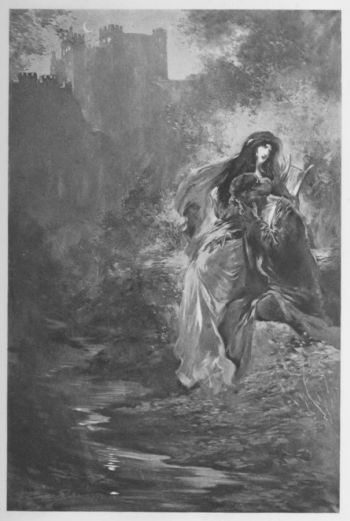
[See larger version]
ERMENGARDE
Queen of the Courts of Love, she sleeps; one arm
Pillowing her raven hair, as Dawn might Night,
Or Day kiss Dusk; or Darkness, starry warm,
Be gathered of her sister, rosy Light.
Pale from the purple of the damask cloth
One hand hangs, as a lily-bloom might, lone
Above a bed of poppies; or a moth
Might softly hover by a rose full-blown.
Heraldic, rich, the costly coverings
Sweep, fall'n in folds, pushed partly from her breast;
As through storm-broken clouds the full moon springs,
From these one orb of her pure bosom pressed.
She sleeps: and where the moteless moonbeams sink
Through blazoned panes—an immaterial snow—
In wide, white jets, the lion-fur seems to drink
With tawny jaws their wasted, winey glow.
Light-lidded sleep and holy dreams are hers,
Untouched of feverish sorrow or of care,
Soft as the wind whose fragrant breathing stirs
The moonbeam-tangled tresses of her hair.
HACKELNBERG
With shadowy eyes long, long she gazed in his,
Then whispered dreamily the one word, "Bliss."
And like an echo on his sad mouth sate
The answer:—"Bliss?—deep have we drunk of late!
But death, I feel, some stealthy-footed death
Draws near! whose claws will clutch away—whose breath?...
I dreamed last night thou gather'dst flowers with me,
Fairer than those of earth. And I did see
How woolly gold they were, how woven through
With fluffy flame, and webby with spun dew:
And 'Asphodels' I murmured: then, 'These sure
Are Eden amaranths, so angel pure
That love alone may touch them.'—Thou didst lay
The flowers in my hands; alas! then gray
The world grew; and, meseemed, I passed away.
In some strange manner on a misty brook,
Between us flowing, striving still to look
Beyond it, while, around, the wild air shook
With torn farewells of pensive melody,
Aching with tears and hopeless utterly;
So merciless near, meseemed that I did hear
That music in those flowers, and yearned to tear
Their ingot-cored and gold-crowned hearts, and hush
Their voices into silence and to crush:
Yet o'er me was a something that restrained:
The melancholy presence of two pained
And awful, burning eyes that cowed and held
My spirit while that music died or swelled
Far out on shoreless waters, borne away—
Like some wild-bird, that, blinded with the ray
Of dawn it wings tow'rds, lifting high its crest,
The glory round it, sings its heavenliest,
When suddenly all's changed; with drooping head,
Daggered of thorns it plunged on, fluttering, dead,
Still, still it seems to sing, though wrapped in night,
The slow blood beading on its breast of white.—
And then I knew the flowers which thou hadst given
Were strays of parting grief and waifs of heaven
For tears and memories. Importunate
They spoke to me of loves that separate!—
But, God! ah God! my God! thus was I left!
And these were with me who was so bereft.
The haunting torment of that dream of grief
Weighs on my soul and gives me no relief."
I
When down the Hartz the echoes swarm,
He rides beneath the mountain storm
With mad "halloo!" and wild alarm
Of hound and horn and thunder:
With his hunter, black as night,
Ban-dogs, eyed with lambent light;
And a stag, a spectral white,
Rushes on before, in flight
Glimmering through the boughs and under.
II
Long-howling, crouched in bracken black,
The werewolf shuns his ruinous track,
On every side the forests crack,
And mountain torrents tumble:
And the spirits of the air
Whistling whirl with scattered hair,
Teeth that flash and eyes that glare,
Round him as he gallops there,
In the rain and tempest's rumble.
III
Above the storm, the thunder's growl,
The torrent's roar, the forest's howl,
Is heard his hunting-horn—an owl,
That hoots and sweeps before him:
And beneath the blinding leven,
On wild crags, the Castle riven
Of the Dumburg towers to heaven,
Beckoning on the demon-driven,
Beckoning on and looming o'er him.
AN ANTIQUE
Mildewed and gray a marble stair
Leads to a balustrade of urns,
Beyond which two stone satyrs glare
From vines and close-clipped yews and ferns.
A path, that winds and labyrinths,
'Twixt parallels of verdant box,
Around a lodge whose mossy plinths
Are based on emerald-colored rocks.
A lodge, or ancient pleasure-house,
Built in a grove beside a lake,
Around whose edge the dun deer browse,
And swans their snowy pastime take.
And underneath and overhead,—
The breathings of a water-nymph
It seems,—the violets' scent is shed
Mixed with the music of the lymph.
And where,—upon its pedestal,—
The old sun-dial marks the hours,
Laburnum blossoms lightly fall,
And duchess roses rain their flowers.
The air is languid with perfume,
As if dead beauties—who of old
Intrigued it here in patch and plume—
Again the ancient terrace strolled
With gallants, on whose rapiers gems
Once sneered in haughtiness of hues,
While Touchstone wit and apothegms
Laughed down the long cool avenues:
And there, where bowers of woodbine pave,
All heavily with sultry musk,
Two fountains of pellucid wave,
In sunlight-tessellated dusk,
I seem to see the fountains twain
Of Hate and Love in Arden, where,
In times of regal Charlemagne,
Great Roland drank and Oliver.
Where, wandered from Montalban's towers,
The paladin, Rinaldo, slept,
While, leaning o'er him through the flowers,
Angelica above him wept.
JAAFER THE BARMECIDE
Scene, Baghdad: time of the Khalif Haroun er Reshid. Salih ben Tarif speaks.
With Imam Hassan I had reached the khan
Outside of Ambar. Jaafer at the door
Of his pavilion watched a caravan
Inbound from Yemen.—Ah, the bales it bore
Of richest stuffs and spices!—'Mid the rout
Of porters, camel-drivers, old and poor,
A singer stood,—a blindman, singing out
With luted preludes. Imam Hassan then:
"'Tis Zekkar; he, t' whom, with the blind about
The Mosque of Moons, I with our holy men
Scattered my silver at the hour of prayer,
When hearts are open unto Allah's ken.—
Danic or dirhem, though, were wasted there:
Yea, by the Prophet! had one sown dinars
He had not budged one finger or that stare.
And so the beggars and the scavengers
Got all."
Then I: "The very same whom I—
Guard at the Western Portal—'neath the stars
Some midnights past heard singing. Dim the dry
Hot night; and Baghdad only knew of us
Until, gray shadows shuffling slowly by,
Pilgrims for Mecca passed, all vaporous
In dust and darkness; them we challenged not.
—Slaves, with the tribute of Nicephorus
The Roman, from long shallops, as they shot
Along the moonlit Tigris far away,
Timing their oars, raised languid chanting.—
What
This blindman sang was sweeter than—let's say—
The songs of Ibrahim, the dulcet frets
Of Zulzul's lute. I listened till the day
Made gold of all the city's minarets,
And the muezzin summoned us to pray."
Now while we gossiped, lounging slow along
The packed bazaar, a fisher with his nets
Passed, singing Abou Newas' newest song:
A honey-merchant, then, his tinkling mule
All hanap-hung with sweetness: then a throng
Of scholars and their Sheikh from mosque or school:
A milk-white woman on a cream-white ass,
Black slaves attending.... And—I am no fool!—
I knew her of the Court, the noblest class,
By her gem-bangled bracelets.... Let Haroun
On the Euphrates with Zubeideh pass
A single day, at royal Rekkeh,—noon
And night his harem here, so it is said,
Is all intrigue.—Then drawling out his tune,
"Ten thousand pieces to be paid, be paid,
For Yehya's head, Er Reshid's late vizier,"
A crier passed us. Then the market's shade
Glittered with weapons; and we seemed to hear,
Sword of the Khalif, Mesrour, and commands
Naming the Khalif. One swart officer
Flamed forth the Sultan's signet. And harsh hands
Were laid on—whom?—I saw not! For my sight
Was dazzled by the scimitars,—from bands
Of jeweled belts that burned,—and, keen and bright,
Swift hedged us out. Then broad the red blood dyed
The ground around a body—and, hoar white,
Was raised a severed head.—And, stupefied,
Elbowing the rabble, "By my beard!" I cried,
Marking the face, "Jaafer the Barmecide!"
A PRE-EXISTENCE.
An intimation of some previous life?
Or dark dream—by my waking soul divined—
Of some uncertain sleep? in which the sin
Of some past life, a life that some one lived—
Not I, yet I,—long, long ago in Spain,
I live again.... Wherein again I see
From heathen battles to Toledo's gates,—
Damascened corselet broken, his camail
And armet shattered,—deep within the eve's
Anger of brass, that burned around his helm,
A hurrying flame,—a galloping glitter,—one
Ride arrow-wounded. And the city catch
Wild tumult from his coming, wilder fear—
A cry before him and a wail behind,
Of walls beleaguered; ravin; conquered kings:
Triumphant Taric; shackled Spain—revenge.
And I, a Moslem slave, a miser Jew's,
Housed near the Tagus—squalid and alone,
Save for his slave,—a dog he beat and starved,—
Leaner than my lank shadow when the moon,
A battle beacon, westerns; all my bones
A visible hunger; famished with the fear,
Soul-garb of slaves, I bore him—I, who held
Him, heart and soul, more hated than his God,
Stood silent. Fools had laughed. I saw my way.
War-times grow weapons, and the blade I found
Was hacked but pointed.—Well I knew his ways:
The nightly nuptials of his jars of gems
And bags of doublas.—Well I knew his ways.
No figure, woven in the hangings, where
He hugged his riches in that secret room,
Was half so still as I, who gauntly stole
Behind him, humped and stooping; and his heart
Clove to the center, stabbing from behind,
Thrice thro' his tattered tunic, murrey-dyed.
Forward he fell, his old face 'mid his gold,
Grayer and thinner than the moon of morn,
While slow the blood dripped, oozing through the cloth,
Black, and thick-clotting round the oblong wounds.
Great pearls of Oman, whiter than the moon;
Rubies of Badakhshân, whose bezels wept
Slim tears of poppy-purpled flame; and rich,
Rose, ember-pregnant carbuncles, wherein
Fevered a captive crimson, blurred with light
The table's raven cloth. Dim bugles wan
Of cat-eyed hyacinths; moon-emeralds
With starry greenness stabbed; in limpid stains
Of liquid lilac, Persian amethysts;
Fire-opals, savage and mesmeric with
Voluptuous flame, long, sweet and sensuous as
Deep eyes of Orient women; sapphires beamed
With talismanic violet, from tombs,
Deev-guarded, of primordial Solimans,
Scattered the velvet: and like gledes amid,—
Splintering the light from rainbow-arrowed orbs,—
Length-agonized with fire, diamonds of
Golconda.... (One a dervish once had borne
Seven days, beneath a red Arabian sun,
Seven nights, beneath a round Arabian moon,
Under his tongue; an Emeer's ransom, held
Of some wild tribe.—Bleached in the perishing waste,
A Bedouin Arab found sand-strangled bones,
A skeleton, vulture-torn, fierce in whose skull
One eyeball blazed—the diamond. At Aleppo
Bartered ... a bauble for his desert love.)
Jacinth and Indian pearl, gem heaped on gem,
Flashed, rutilating in the taper's light,—
Unearthly splinters of a rainbowed flame,—
A blaze of irised fire; and his face,
Long-haired, white-sunk among them. And I took
All! yea! all! all!—jewel and gold and gem!—
Although his curse burned in them! 'though, me-seemed,
Each burning jewel glared a separate curse.
Can dead men work us evil from the grave?
Can crime infest us so that fear will slay?...
Richer than all Castile and yet—not dare
Drink but from cups of Roman murra,—spar
Bowl-sprayed with fibrile gold,—spar sensitive
To poison! I, no fool! and yet—a fool
To fear a dead Jew's malice!... Yet, how else?
Feasting within the music of my halls,
While perfumed beauty danced in sinuous robes,
Diaphanous, more tenuous than those famed
Of loomed Amorgos or of silken Kos,
Draining the unflawed murrhine, Xeres-brimmed,
Had I reeled poisoned, dying wolf'sbane-slain!
THE KING
Up from the glimmering east the full moon swung,
A golden bubble buoyed zenithward
Above black hills. The white-eyed stars, that thronged,—
Hot with the drought,—the cloudless slopes of heaven,
Winked thirstily; no wind aroused the leaves,
That o'er the glaring road hung motionless,
Withered and whitened of the weary dust
From many hoofs of many a fellowship
Of knights who rode to'ards quest or tournament:
Among them those who brought the King disguised,
Whose mind was, "in the lists to joust and be
An equal 'mid unequals, man to man:"
Who from the towers of Edric passed, wherein
Some days he'd sojourned, waiting Launcelot:
That morn it was; ... for, with the morn, a horn
Sang at dim portals, musical with dew,
Wild echoes of wild woodlands and the hunt,
Clear herald of the stanchest of his knights.
And they, to the great tilt at Camelot,
Rode armored off, a noise of steel and steeds.
Thick in the stagnant moat the lilies lay,
Pale 'mid their pads; above them, huge with chains,
The drawbridge hung before the barbéd grate;
And far above, along lone battlements,
His armor moon-drenched, one lone sentinel
Clanked drowsily; and it was late in June.
She, at her lattice, loosely night-robed, leaned,
Thinking of one she loved: a pensive smile
Haunting her face; a face as fair as night's,
Night's when divinely beautiful with stars,
Two stars, at least, that dreamed beneath her brows.
Long, raven loops and coils of sensuous hair
Rolled turbulence round white-glimpsed neck and throat,
That shamed the moonlight with a rival sheen.
One stooped above her; and his nostrils breathed
Heavy perfumes that blossomed in her hair;
And round her waist hooped one strong arm and drew
Her mightily to him, soft crushing,—cool
With yielding freshness of her form,—her gown;
Then searched her eyes until his own seemed drunk
And mad with passion: then one hungry kiss
Bruised, hard as anger, on her breathless lips,
Fiercer than fire. Leaning lower, then
A whispered, "Lov'st but one? and he?"—And then,
She, with impatience, "Rough and rude thou art!
Why crush me, thou great bear, with such a hug!
Or kill me with such kisses!"—Then, as soft
As some rich rose syllabling musk and dew,
"And whom I love?—ah, Edric, need I say!"...
Then he, fierce-smiling, swiftly, without word,
His countenance harsh-writhen into hate's
Gnarled hideousness, haled back her marvelous head,
Back, back by all its braids of gathered hair,
Till her full bosom's clamorous loveliness
Stark on the moon burst bare. Low leaning then,
With mocking laughter, "Yea, by God's own blood!
The King, O thou adulteress!" and a blade
Glanced, thin as ice, plunged hard, hard in her heart.
MELANCHOLIA
"Jamque vale Soli cum diceret Ambrociotes,
In Stygios fertur desiluisse lacus,
Morte nihil dignum passus: sed forte Platonis
Divini eximum de nece legit opus."
—Callimachus.
I
Now there was wind that night, wild wind, and rain;
And frantic thorns, that huddled on the wold,
Seemed withered witches met in storm again
To keep their Sabbath and to curse and scold,
With gnarled, fantastic gestures, lame and old.
Deep in a hollow, where some cabin lay,
A lamplit window, like an eye of gold,
Glared, winked and closed—or was't an Elfin ray,
A jack-o'-lanthorn gleam, lost on a wild wood way?
II
Still I held onward through the ugly night;
Breast-deep in thistles, all their ghostly heads
Kinked close with wet; through the bedraggled plight
Of brakes of bramble, tousled into shreds,
And tangled wastes of briars—tumbling beds
For winds to toss on.—Once, across a farm,
Unsteadily, a lamp towards unseen sheds,—
Like the blurred glow of some ungainly worm,—
A watery wisp of light crawled trailing through the storm.
III
Then swallowing blackness of the night; and thin
The shrewd rain beat me and the rough limbs whipped
Of dwarfed, uneasy beeches. There within
Their savage circle battered tombstones tipped
Squat lengths to weeds the fighting winds had ripped
And chopped to tatters. And I heard before,
Rounding a headland, where the gaunt trees dripped,—
A shout borne deathward from night's ghastly shore,—
Hoarse as a thousand throats the river's sullen roar.
IV
Shuddering I stopped, for, with my feet so caked
With clay, damp-dragging, safer were the graves,
Crowding that vista of the wood,—which raked
My face with burrs,—than, walking towards the waves,
To feel earth slip away; the architraves
Of darkness plunge me downward to some pit
Of wallow and of water.—Madder knaves
Than I have stood thus in a fever-fit
Of heart and brain and shuddered from the brink of it.
V
Wooingly silence whispered to me there
Through boughs of dripping darkness sad with rain;
Darkness, that met my eyeballs everywhere,
Blind-packed and vacant as a madman's brain.
And so I stood and heard the dead leaves drain,
And through the leaves the haunted wind that hissed;
Then suddenly—perhaps it was the strain
Snapped in my temples—laughter seemed to twist,
With evil, night's dead mouth that bent to mine and kissed.
VI
Insanity! two leaves that dabbled down,
Touched me with drizzle; and that laugh—ah, well,
No laugh! an owlet hooting at the frown
Night's hag-face tortures while she works her spell.
Yet I had sworn, before those kisses fell
Like winter on me, black as broken jet,
An occult blackness like the Prince of Hell,
A woman's hand had brushed my face—and yet,
A bat it might have been made mad with wind and wet.
VII
And stark I stood among the sodden stones,
Icy with fever, hearing in each gale
Strange footsteps,—while within my soul were moans
For strength,—as powerless as I was pale.
Then I remembered that within a tale
Once I had read—a chronicle of ills
Cowled monks had written—how one shall not fail
To find, unsought, the Fiend, if so he wills,
Cloak, cap, and cock's crook'd plume among the lonely hills.
VIII
Was that his laugh? and that his vulture hand?—
No! no! for in the legend it was said,
"Though moonless midnight curse the barren land
Sathanas' shadow follows him as red
As Hell's red cauldron is."—My terror fled,
Remembering this.—How sad a fool was I
To dream Hell's wickedness would bow his head
By mine, and parley with me, lie for lie,
With cunning scrutiny of oblong eye by eye!
IX
Then, then I felt—her presence! all awake
Unto her power that could lift or sink;
And her straight eyes controlling, like an ache,
My brain that had no mastery to think,
Or to perform. And slowly, link on link,
She bound me helpless, like an inquisitor,
In vasty dungeons of the soul; no wink
Of light was there, but darkness, bar on bar,
Self-convoluted chaos strangling will's high star.
X
"I am the mother of uneaseful sleep,
The child of night and sister of dim death;
Who knoweth me, yea, he shall never weep,
Yet bless and ban me in a single breath:
Who knoweth me a coward is unneth:
And saddest hearts have sought me over glad
To find gray comfort where the preacher saith
There is no comfort. Melancholy mad,
Reach me thy hand and know me if thy heart be sad."
XI
Thus did she speak. Her voice was like a flame
Of burning blackness. Then I felt the throb
Of her still hand in mine. And so I came
Gladly unto her. Yea, I, too, would rob
Time of his triumphs.—Who would groan and sob
Beneath his fardels, hearing sad men sigh
When here is cure?—for Life, that, like a lob,
Rides us to death; for Love, a godless lie;
And Toil and Hunger.—Yea, what fool would fear to die?
XII
Then seemed I wrapped in rolling mists, and, oh,
Her arm was round me and her kisses dear
On eyes and lips, and words that none may know—
What words of promise said she in mine ear!
Drunk with her beauty still I felt no fear,
When, past the forest, like some bounding brute,
I heard the river roaring. Drawing near,
Again she whispered, and my soul grew mute
Before her voice that lulled like music of a lute:
XIII
"Within the webs of darkness and of day
The spider Hours spin about thy world,
Who now finds time to even laugh or pray,
Cramped in a term of years that are uncurled
Like coils of some huge monster, head uphurled
To fang when the last fold falls! Slope on slope
The night environs thee with space, empearled
With hopeless stars by which men symbol Hope,
Beneath whose light they breed and curse and pray and grope."
XIV
And so she brought me to the river's brink
To plunge me downward. All the night was mine;
And so, exulting, to Death's darker drink
I stooped and drank.—What better drink divine,
O man, hast thou? what wiser way is thine?
Who find'st me carrion on a hungry coast,
Sand in mine eyeballs, in my hair the brine,
And o'er my corpse with bitter lips dost boast—
"Poor fool! poor ghost! Alas! poor, melancholy ghost!"
A WOMAN OF THE WORLD
I
As to my soul—'tis pathos and passion.
As to my life—'t hath a flavor of sin.
What would you have when such is the fashion,
Was and will be of the world we are in?
Yes, I have loved. And have you?—Have you reckoned
The cost of all love?—I can tell you: as much
As a soul!—Is it worth it?—You'll know it that second
You know that you love; and God pity all such!
II
My lover dissembled that ardor's pure beauty.
I endured undeceived nor pretended; and gave
All that his passion demanded—my duty,
For I loved. And the world?—why, I was his slave!—
Should it worry I pleased him?—Propriety sorrowed,
Uprolling her eyes as occasion, and—well,
That lie, overglossed with a modesty borrowed,
Assisted my fall and the end was—I fell.
III
Through love? No; the woman! that visible woman
Men usually know.—None knows how we know
Of an innermore beauty! that part of the human
We designate character.—Look at the bow
Of the moon that is new; that bears in its crescent
A world.—So the flesh gleams the slenderest line
Of soul; that is love; the unevanescent,
Making the mortal immortal, divine.
IV
Yes; I know what I am. Have outlasted my season
Of pleasure and folly.—You think it is strange
That I let you, say—love me? But why not?—my reason
Requires illusions. They give me that change
Which quiets remembrance. You kiss me—I wonder.—
When you say, "You are beautiful,"—well, am I glad
If I laugh?—You declaim on my form, "How no blunder
Of nature discords,"—If I sigh, am I sad?
V
How you stare at my eyes!—Well! my lips!—must they languish
For kisses to redden?—"My eyes are as bright
As the jewel I drown in my hair, with its anguish
Of tortuous fire that quivers to-night"?
Tears may be.—This showy?—That silly white flower
Were better?—For me its simplicity? no!—
The gem I prefer to the lily.—The hour
Has struck: I am ready: my fan: let us go.
A GUINEVERE
Sullen gold down all the sky;
Roses and their sultry musk;
Whippoorwills deep in the dusk
Yonder sob and sigh.—
You are here; and I could weep,
Weep for joy and suffering....
"Where is he"?—He'd have me sing—
There he sits, asleep.
Think not of him! he is dead
For the moment to us twain—
Hold me in your arms again,
Rest on mine your head.
"Am I happy?" ask the fire
When it bursts its bounds and thrills
Some mad hours as it wills
If those hours tire.
He had gold. As for the rest—
Well you know how they were set,
Saying that I must forget
And 'twas for the best.
I forget?—But let it go!—
Kiss me as you used of old.
There; your kisses are not cold!
Can you love me so?
Knowing what I am to him,
To that gouty gray one there,
On the wide verandah, where
Fitful fireflies swim.
Is it tears? or what? that wets
Eyes and cheeks;—on brow and lip
Kisses! soft as bees that sip
Sweets from violets.
See! the moon has risen; white
As this open lily here,
Rocking on the dusky mere,
Like a silent light.
Let us walk... So soon to part!—
All too soon! But he may miss.
Give me but another kiss—
It will heat my heart
And the bitter winter there.—
So; we part, my Launcelot,
My true knight! and am I not
Your true Guinevere?
Oft they parted thus, they tell,
In that mystical romance...
Were they placed, think you, perchance,
For such love, in Hell?
No! it can not, can not be!
Love is God, and God is love:
And they live and love above,
Guinevere and he.
I must go now.—See! there fell,
Molten into purple light,
One wild star. Kiss me good night,
And once more. Farewell.
PERLE DES JARDINS
What am I, and what is he,
Who can take and break a heart,
As one might a rose, for sport,
In its royalty?
What am I that he has made
All this love a bitter foam
Blown about the wreck-filled gloam
Of a soul betrayed?
He who of my heart could make
Hollow crystal, where his face,
Like a passion, had its place,
Holy, and then break!
Shatter with neglect and sneers!—
But these weary eyes are dry,
Tearless clear; and if I die
They shall know no tears.
But my soul weeps. Let it weep!
Let it weep, and let the pain
In my heart and in my brain
Cry itself to sleep.—
Ah! the afternoon is warm;
And the fields are green and fair;
Many happy creatures there
Through the woodland swarm.
All the summer land is still,
And the woodland stream is dark
Where the lily rocks its barque
Just below the mill....
If they found me icy there
'Mid the lilies, and pale whorls
Of the cresses in my curls,
Wet, of raven hair!—
Poor Ophelia! are you such?
Would you have him thus to know
That you died of utter woe
And despair o'ermuch?
No!—such acts are obsolete:
Other things we now must learn:—
Though the broken heart will burn,
Let it show no heat.
So I'll write him as he wrote,
Coldly, with no word of scorn—
He shall never know a thorn
Rankles here!... Now note:—
"You'll forget," he says; "and I
Feel 'tis better for us twain:
It may give you some small pain,
But, 'twill soon be by.
"You are dark and Maud is light.
I am dark. And it is said
Opposites are better wed.—
So I think I'm right."
"You are dark and Maud is fair"!—
I could laugh at his excuse
If the bitter, mad abuse
Were not more than hair!
But I'll write him, as if glad,
Some few happy words—that might
Touch upon some past delight
That last year we had.
Not one line of broken vows,
Sighs or hurtful tears—unshed!
Faithless hearts—far better dead!
Nor a withered rose.
But a rose! this rose to wear,—
Perle des Jardins, all elate
With sweet life and delicate,—
When he weds her there.
So; 'tis finished. It is well—
Go, thou rose. I have no tear,
Word or kiss for thee to bear,
And no woe to tell.
Only be thus full of life,
Cold and proud, dispassionate,
Filled with neither love nor hate,
When he calls her wife.
FACE TO FACE
Dead! and all the haughty fate
Fair on throat and face of wax,
Calm on hands, crossed still and lax,
Cold, dispassionate.
Dead! and no word whispered low
At the dull ear now would wake
One responsive chord or make
One wan temple glow.
Dead! and no hot tear would stir
Aught of woman, sweet and fair,
Woman soul in feet and hair,
Once that smiled in her.
She is dead, oh God! and I—
I must live! though life be but
One long, hard, monotonous rut
For me till I die.
Creeds might help in such a case:
But no sermon could have wrought
More of faith than you have taught
With your pale dead face.
Now I see, oh, now I see
My mistake!—so very small,
Yet so great it bungled all,
All for you and me.
Oft I said, "I feel, I'm sure
She could never live that life!
She is still my own true wife,
She is good and pure!"
You were pure and I bemoiled!
That you loathed me, it was just;
Weak of soul and left of lust
Vulgar, low, and soiled....
Closed—the eyes once filled with dreams!
Great, proud eyes!... I see them yet,
Miniature nights of lucid jet
Filled with starry gleams.
Sealed—the lips; poor, faded lips!
Once as red as life could make—
Sweet wild roses, half awake,
Dewy to their tips.
Hair!—imperial still, and warm
As a Grace's; where one stone,
Jeweled, lay ensnared and shone
Like a star in storm.
Eyes!—at parting big with pain...
God! I see them still! the tear
In them!—big as eyes of deer
Led by lights and slain....
Woman true, I falsely blamed;
Whom I killed with scorn and pride;
Woman pure, of whom I lied;
With the nameless named:
All you said, Sweet, has come true!—
Ah! this life had woe enough
For the little dole of love
Giv'n to me and you.
Do you hear me? do you know
What I feel now? how it came?
You, beyond me like a flame,
You, before me like the snow....
Dead! and all my heart's a cup
Hollowed for repentant tears,
Bitter in the bitter years,
Slowly brimming up.
Peace! 'tis well! But might have been
Better.—Yes, God's time makes right!—
Better for me in His sight
With my soul washed clean.
Do you hear me? do you know
How my heart was all your own?
How my life is left alone
Now with naught but woe?
Peace! be still!—I kiss your hair.
Sweet, good-by. Upon your breast
Let this long white lily rest—
God will find it there:
There beyond the sad world and
Clouds and stars and silent skies,
Where your eyes shall meet His eyes,
And—He'll understand.
THE EVE OF ALL-SAINTS
I
This is the tale they tell
Of an Hallowe'en;
This is the thing that befell
Me and the village belle,
Beautiful Amy Dean.
II
Did I love her? God and she,
They know and I!
Ah, she was the life of me—
Whatever else may be
Would God that I could die!
III
That Hallowe'en was dim;
The frost lay white
Under strange stars and a slim
Moon in the graveyard grim,
Pale with its slender light.
IV
They told her: "Go alone,
With never a word,
To the burial-plot's unknown
Grave with the oldest stone,
When the clock on twelve is heard.
V
"Three times around it pass,
With never a sound;
Each time a wisp of grass
And myrtle pluck; then pass
Out of the ghostly ground.
VI
"And the bridegroom that's to be,
At smiling wait,
With a face like mist to see,
With graceful gallantry
Will bow you to the gate."
VII
She laughed at this and so
Bespoke us how
To the burial-place she'd go.—
And I was glad to know,
For I'd be there to bow.
VIII
An acre from the farm
The village dead
Lay walled from sun and storm;
Old cedars, of priestly form,
Waved darkly overhead.
IX
I loved; but never could say
The words to her;
And waited, day by day,
Nursing the hope that lay
Under the doubts that were.—
X
She passed 'neath the iron arch
Of the legended ground;—
And the moon, like a twisted torch,
Burned over one lonesome larch;—
She passed with never a sound.
XI
Three times the circle traced;
Three times she bent
To the grave that the myrtle graced;
Three times—then softly faced
Homeward and slowly went.
XII
Had the moonlight changed me so?
Or fear undone
Her stepping soft and slow?
Did she see and did not know?
Or loved she another one?
XIII
Who knows?—She turned to flee
With a face so white
It haunts and will haunt me:—
The wind blew gustily:
The graveyard gate clanged tight.
XIV
Did she think it I or—what,
Clutching her dress?
Her face so wild that not
A star in a stormy spot
Shows half so much distress.
XV
I spoke; but she answered naught.
"Amy," I said,
"'Tis I!"—as her form I caught...
Then laughed like one distraught,
For the beautiful girl was dead!...
XVI
This is the tale they tell
Of that Hallowe'en;
This is the thing that befell
Me and the village belle,
Beautiful Amy Dean.
MATER DOLOROSA
The nuns sing, "Ora pro nobis;"
The casements glitter above;
And the beautiful Virgin, whose robe is
Woven of infinite love,
Infinite love and sorrow,
Prays for them there on high—
Who has most need of her prayers,—to-morrow
Shall tell them!—they or I?
Up in the hills together
We loved, where the world was true;
Our world of the whin and heather,
Our skies of a nearer blue;
A blue from which one borrows
A faith that helps one die—
O Mother, thou Mother of Sorrows,
None needs such more than I!
We lived, we loved unwedded—
Love's sin and its shame that slays!—
No ill of the years we dreaded,
No day of their coming days;
Their coming days, their many
Trials by noon and night—
And I know no land, not any
Where the sun shines half so bright.
Was he false to me, my Mother!
Or I to him, my God!—
Who gave thee right, O brother!
To take God's right and rod!
God's rod of avenging morrows—
And the life here in my side!—
O Mother, sweet Mother of Sorrows,
Would that I, too, had died!
By the wall of the Chantry kneeling
I pray, and the organ rings,
"Gloria! gloria!" pealing,
"Sancta Maria!" sings.
They will find us dead to-morrow
By the wall of their nunnery—
O Mother, thou Mother of Sorrow,
His unborn babe and me.
LOVE AS IT WAS IN THE TIME OF LOUIS XIV
I
Thrice on the lips and twice on the eyes
I kiss you or ever I kiss your bosom.—
When love is young would you have it wise,
Wise as the world goes?—No! 'tis a blossom
Lovely and wise since it's lovely; content
To live or to die as its folly pleases:
Life is a rose and the rose's scent
Is love, that grows as the rose increases.
II
If I tell you the Marquis will die, will you smile?
And laugh when he's dead?—This powder, my lily,
That seems but an innocent sweet in this phial—
Do not touch it! breathe distant!—a poison Exili
Used a life to discover. Its formula left
To a pupil (well worthy the master!), the prudent
And pious Sainte Croix. Him, of teacher bereft,
The Devil, I deem, must have taken as student.
III
Quite a dealer in death. And ours was a case
That those difficult drugs of his laboratory
Demanded. I visited; found him; his face,
Bent over a sublimate,—safe from the hoary
Light particles,—masked with a mask of fine glass.
I told him your danger, Marie, and expounded
Our passion, despair, with many an "Alas!"
He smiled while a paste in a mortar he pounded.
IV
Three fistfuls of Louis!—"He'd do it," he said.—
A delicate dust, gum, liquid and metal
Crushed, crucibled.... "Stay! tie this mask on your head.
You see, but a grain on your rose's pink petal
Has shriveled and blasted it—look, how it dries!—
A perilous pulver ... could Satan make better?...
To mix with that present of perfumes—she dies,
And who is the wiser? Or, say in a letter
V
"To the husband of her who has smiled on you since
Another grows bald?"—And he poured in a bottle
The subtlety.—"Bah! be he beggar or prince,
If he kiss but the seal the venom will throttle."—
"Well," I thought, "I will test ere I risk." Slyly drew
My dagger; approached to the bandlet, that tightly
Supported his mask, its keen point.... It was true!—
When it cracked he fell dead; he but breathed of it lightly.
VI
Your letter is sealed and is sent. You are mine!—
By now he has broken the wax.... If there flutters
Some dust in his nostrils, who, who will divine
That thus it was poisoned?—Our alchemist utters
No word!—You are happy? and I?—Oh, I feel
That I love and am loved.—The tidings comes heavy
To-night to the King; you are there; you will reel—
Will faint!—Now away to the royal levee.
Note.—In this poem, which originally appeared in a volume of mine entitled Lyrics and Idylls, published in 1890, some hypercritical critic in the New York Nation accused me of imitating Browning's The Laboratory. The truth of the matter is that the poem was written ten months before I had ever read Browning's Dramatic Lyrics, and was suggested to me by the reading of the following passage in one of E. T. W. Hoffman's (the German Poe's) stories. The passage occurs in Mademoiselle De Scuderi and is as follows: "The poisons which Sainte Croix prepared were of so subtle a nature that if the powder (called by the Parisians Poudre de Succession, or Succession Powder) were prepared with the face exposed, a single inhalation of it might cause instantaneous death. Sainte Croix therefore, when engaged in its manufacture, always wore a mask of fine glass. One day, just as he was pouring a prepared powder into a phial, his mask fell off, and inhaling the fine particles of the poison, he fell dead on the spot."
THE TROUBADOUR
He stood where all the rare voluptuous west,
Like some mad Mænad, wine-stained to the breast,
Laughed with delirious lips of ruby must,
Wherein, it seemed, the fierceness of all lust
Burnt like a feverish wine, exultant whirled
High in a golden goblet, gem-impearled.
And all the west, and all the amorous west,
Caressed his beauty, dreamed upon his breast;
And there he bloomed, a thing of rose and snows,
A passion-flower of men of snowy rose,
Beneath the casement of her old red tower,
Whereat the lady sat, as fair a flower
As ever bloomed in Provence; and the lace
Mist-like about her hair, half-hid her face
And the emotions that his singing raised,
So that he knew not if she blamed or praised.
And where the white rose, climbing over and over
Up to her wide-flung lattice, like a lover,
And stalks of lavender and fleurs-de-lis
Held honey-cups up for the violent bee,
Within her garden by the ivied wall,
Where many a fountain, falling musical,
Flamed rubies in the eve against it flung,
Like some wild nightingale the minstrel sung:—
"The passion, oh, of gently smoothing through
Long locks of brown, soft hands as lovers do!
Thy dark, deep locks, rich-jeweled as the dusk
Is scintillant with stars! Oh, frenzy rare
Of clasping slender fingers round thy hair!—
What balm, what breath of winds from summer seas!
What silken softness and what sorceries
Doth it contain!—Ah God! ah God! to lie
Wrapped strand on strand deep in thy hair and die!
Ay me, oh, ay!
"Oh, happy madness and, oh, rapturous pain,
With white hands smoothing back thy locks, to drain
Into thine eyes my soul!—Oh, perilous eyes!
As agates polished; where the thoughts that rise,
Within thy heart are imaged; thoughts that pass
As magic pictures in a witch's glass.—
What siren sweetness, wailed to lyres of gold,
What naked beauty that the Greeks of old,
God-bosomed, through the bursting foam did see,
Could sway my soul with half their mastery!
Ay, ay, ay me!
"Far o'er the sea, of old time, once a witch,
The fair Ææan, Circe, dwelt; so rich
In marvellous magic, she was like a god,
And made or unmade mortals with a nod:
Turned all her lovers into bird or brute.—
More cruel thou, who mak'st my heart a lute,
That lies before thee, hushed and sadly mute!
Who let'st it lie, yet from its soul might draw
More magic music than Acrasia,
Or Circe knew, that filled them with its bliss,
Didst thou but take me to thine arms and kiss!
Ay, ay, I wis!"
Knee-deep amid the dews, the flowers there,
Beneath the stars that now were everywhere
Flung through the perfumed heavens of angel hands,
And, linked in tangled labyrinths and bands
Of soft rose-hearted flame and glimmer, rolled
One vast immensity of mazy gold,
He sang; like some hurt creature, desolate,
Heart-aching for the loss of some wild mate
Hounded and speared to death of heartless men
In old romantic Arden waste; and then
Turned to the moon that, like a polished stone
Of precious worth, low in the heaven shone,
A pale poetic face and passed away
From the urned terrace and the fountains' spray.
And that fair lady in dim drapery,
High in the old red tower—did she sigh
To see him fading through the purple night,
His lute faint-twinkling in th' uncertain light,
Then lost amid the rose-pleached avenues,
Dark walls of ivy, hedged with low-clipped yews?
And left alone with but the whispering rush
Of fountains and the evening's hyacinth hush,
Did she complain unto the stars above,
All the lone night, of that forbidden love?
Or down the rush-strewn stairs, where arras old
Waved with her mantled passage, fold on fold,
Beyond the tower's iron-studded gate,
That snarled with rust, did she steal forth and wait
Deep in the dingled lavender and rose
For him, her troubadour?... Who knows? who knows?
MY ROMANCE
If it so befalls that the midnight hovers
In mist no moonlight breaks,
The leagues of the years my spirit covers,
And my self myself forsakes.
And I live in a land of stars and flowers,
White cliffs by a silver sea;
And the pearly points of her opal towers
From the mountains beckon me.
And I think that I know that I hear her calling
From a casement bathed with light—
Thro' music of waters in waters falling
'Mid palms from a mountain height.
And I feel that I think my love's awaited
By the romance of her charms;
That her feet are early and mine belated
In a world that chains my arms.
But I break my chains and the rest is easy—
In the shadow of the rose,
Snow-white, that blooms in her garden breezy,
We meet and no one knows.
We dream sweet dreams and kiss sweet kisses;
The world—it may live or die!
The world that forgets; that never misses
The life that has long gone by.
We speak old vows that have long been spoken,
And weep a long-gone woe,—
For you must know our hearts were broken
Hundreds of years ago.
THE EPIC
"To arms!" the battle bugles blew.
The daughter of their Chief was she,—
Lord of a thousand spears and true;—
He but a squire of low degree.
The horns of war blew up to horse:
He kissed her mouth; her face was white:
"God grant they bear thee back no corse!"
"God give I win my spurs to-night!"
The watch-towers' blazing beacons scarred
With blood-red wounds the face of night:
She heard men gallop battleward;
She saw their armor gleam with light.
"My God, deliver me and mine!
My child! my love!"—all night she prayed:
She watched the battle beacons shine;
She watched the battle beacons fade....
They brought him on a bier of spears.—
For him, the death-won spurs and name;
For her, the grief of lonely years,
And donjon walls to hide her shame.
THE MINSTREL AND THE PRINCESS
I
He had no hope to win her hand,
A harper in a loveless land,
And yet he sang of love;
And marked the blue vein of her throat
Swell with mute rage at every note:
And when he ceased she spake him then,—
"Such whining slaves are less than men!"
And anger in her dark eyes wrote
Contempt thereof.
II
He had no hope to win her hand,
A harper in a hostile land,
And yet he sang of peace;
And marked how mock'ry curled her lip
With scorn as, 'neath each finger-tip,
The chords breathed pastoral content:
Till haughtiness, that beauty lent
To beauty, sneered, "Would'st feel the whip?—
O fool, surcease!"
III
He had no hope to win her hand,
A harper in a tyrant's land,
And so he sang of war—
"Oh, fling thy harp away!" she said.
"O war, thy singers are not dead!—
Seat thee beside me; now I see
Thou art for battle, and must be
Brave as thy song.—Well hast thou pled.
My warrior!"
THE ALCALDE'S DAUGHTER
The times they had kissed and parted
That night were over a score;
Each time that the cavalier started,
Each time she would swear him o'er:—
"Thou art going to Barcelona!—
To make Naxera thy bride!
Seduce the Lady Iona!—
And thy lips have lied! have lied!
"I love thee! I love thee, thou knowest!
And thou shalt not give away
The love to my life thou owest;
And my heart commands thee stay!
"I say thou hast lied and liest!—
For—where is there war in the State?—
Thou goest, by Heaven the highest!
To choose thee a fairer mate.
"Wilt thou go to Barcelona
When thy queen in Toledo is?—
To wait on the haughty Iona,
When thou hast these lips to kiss?"
And they stood in the balcony over
The old Toledo square;
And, weeping, she took for her lover
A red rose out of her hair.
And they kissed farewell; and, higher,
The moon made amber the air;—
And she drew, for the traitor and liar,
A stiletto out of her hair....
When the night-watch lounged through the quiet
With the stir of halberds and swords,
Not a bravo was there to defy it,
Not a gallant to brave with words.
One man, at the corner's turning,
Quite dead, in a moonlight band—
In his heart a dagger burning,
And a red rose crushed in his hand.
ISHMAEL
Ishmael, the Sultan, in the Ramadan,
Amid his guards, bristling with yataghan,
And kris,—his amins, viziers wisdom-gray,
Pachas and Marabouts, betook his way
Through Mekinez. For he had read the word
That in the Koran says, "Slay! praying the Lord!
Pray! slaying the victims!" so the Sultan went
Straight to the mosque, his mind on battle bent.
In white burnoose and sea-green caftan clad
He entered ere the last muezzin had
Summoned the faithful unto prayer and let
The "Allah Akbar" from the minaret
Invite to worship. 'Neath the lamps' lit gold
The many knelt and prayed.
Upon the old
Mosaics of the mosque—whose high vault steamed
With aloes' incense—lean ecstatics dreamed
Of Allah and his Prophet, and how great
Is God, and how unstable man's estate.
Conviction on him in this chanting low
Of Koran texts, the Caliph's passion so
Exalted soared—lamped by religious awe—
Himseemed he heard God's everlasting law
'Gainst unbelievers; and himself confessed
The Faith's anointed sword; and, so impressed,
Arose and spoke. The arabesques above—
The marvellous work of oriental love—
Seemed, with new splendors of Heaven's blue and gold,
Applauding all. And, ere the gates were rolled,
Ogival, back to let the many forth,
War was declared on all the Christian Earth.
Now had his army passed the closed bazaar,
Thro' narrow streets gorged with the streams of war:
Had passed the place of tombs and reached the wall
Of Mekinez, above which,—over all
Its merloned battlements,—in long array,
Seraglios and towers, his palace gray
Could still be seen when, girt with pomp and state,
The Sultan passed the city's scolloped gate.
Two dozing beggars, each one's face a sore,
Sprawl'd in the sun the city's gate before;
A leprous cripple and a thief, whose eyes—
Burnt out with burning iron—as supplies
The law for thieves—were wounds, fly-swarmed and raw,—
Lifted shrill voices as they heard or saw;
Praised God, and bowed into the dust each face,
With words of "victory and Allah's grace
Attend our Caliph, Mouley-Ishmael!
Even at the cost of ours his day be well!"
And grimly smiling as he grimly passed,
"While Allah's glory is and still shall last—
Now by Es Sirat!—will a leper's word
And thief's avail to help us?—By my sword!—
Yea, let us see. Whatever their intent
Even as 'tis offered let their necks be bent!
'Though words be pious, evil at the soul
The prayer is naught!—So let their prayer be whole.
Better than gold is death, meseems, for these:
So by the hands of you, my Soudanese,
They die," he said; and even as he said
Rolled in the dust each writhing, withered head.
And frowning westward, as the day grew late,
Two bleeding heads stared from the city gate
'Neath this inscription for the passer-by,
"There is no virtue but in God most high."
IN MYTHIC SEAS
Beneath great saffron stars and skies, dark-blue,
Among the Cyclades, a happy two,
We sailed; and from the Siren-haunted shore,
All mystic in its mist, the soft wind bore
The Siren's song; where, on the ghostly steeps,
Strange foliage grew, deeps folding upon deeps,
That hung and beamed with blossom and with bud,
Blue-petaled, pallid, or, like urns of blood,
Dripping; or blowing from wide mouths of blooms
On our hot brows cool gales of dim perfumes.
While from the yellow stars, that splashed the skies,
O'er our light shallop brooded mysteries
Of calm and sleep, until the yellower moon
Rose, full of fire, above a dark lagoon;
And, as she rose, the nightingales, on sprays
Of heavy, Persian roses, burst in praise
Of her wild loveliness; their boisterous pain
Heard through the pillars of a ruined fane.
And round our lazy keel, that dipped to swing,
The spirits of the foam came whispering;
And from gray Neptune's coral-columned caves
The wet Oceänids rose through the waves;
With naked limbs we saw them breast the spray,
Their pearl-white bodies tempesting the way;
Their sea-green hair, tossed streaming to the breeze,
Scattering with brightness all the tumbled seas.
'Mid columned aisles, seen vaguely through the trees,
We watched the Satyrs chase the Dryades;
Heard Pan's shrill trebles and the Triton's horn
Sound from the flying foam when ruddy Morn,
With dewy eyelids, opened azure eyes,
And, blushing, rose, and left her couch of skies.
We saw the Naiad, clothed with veiling mist,
Half hidden in a bay of amethyst,
With shell-like breasts, and at her hollow ear
A shell's pink labyrinth held up to hear
Circean echoes of the Siren's strains
Imprisoned in its chords of vermeil veins:
Then, stealing wily from a grove of pines,
The Oread, in cincture of green vines;
Her cautious feet, fragrant and twinkling wet,
Set in a bed of rainy serpolet;
Her flower-red lips half-parted in surprise,
And expectation in her wondering eyes,
As in the bosk a rustling noise she hears—
A Faun, sly-eyed, with furred and pointed ears,
Who leaps upon her, as upon a dove
A great hawk pinions from the skies above.
Diana sees, and on her wooded hills
Stays her fair band, the stag-hounds' clamor stills—
A senseless statue of cold, weeping stone
Fills his embrace; the Oread is gone.
The stag-hounds bay; again they urge the chase,
While the astonished Faun's bewildered face
Paints all his wonderment, and, wondering,
He bends above the sculpture of a spring.
And so we sailed; and many a morn of balm
Led on the hours of sunny song and calm:
And it was life, to her and me, and love,
With the fair myths below, our God above,
To sail in golden sunsets and emerge
In golden morns upon a fretless surge.
But, ah! alas! the stars, that pierce the blue,
Shine not for ever; clouds must gather, too.
I knew not how it came, but in a while
I found myself cast on a desert isle,
Alone with sorrow; wan with doubt and dread;
The seas in wrath and thunder overhead;
Deep down in coral caves the one I love—
No myths below; no God, it seemed, above.
LOKÉ AND SIGYN
A daughter of Winter, Skade, a giantess,
One twisting serpent hung above his head,
So that its blistering venom, roping down,
Beat on his upturned face and tortured him.
Him had the gods of Asgard, Odin and Thor,
Weary of all his wiles and evil ways,
Followed, and after many stormy moons,
Within the land of giants overcome,
In Jotunheim, and dragged beneath the world,
Into a cave the earthquake's hands had built,
A cavern vast and terrible as that,
They tell of Hel's, whose ceiling is of snakes,
That hang, a torrent torture, yawning slime,
In whose slow stream eternal anguish wades.
And for his crimes they chained him to a rock,
His lips still sneering and his eyes all scorn,
And left him with the serpent over him,
And, gathering round him from their larvæ lairs,
Monsters, huge-warted, eyed with wells of fire.
But Sigyn, Loké's wife, stole in to him,
And sate herself beside his writhen limbs,
And held a cup of gold against the mouth
Of ceaseless poison dripping in the gloom.
Was it her voice lamenting? or the sound
Of far abysmal waters falling, falling
Down tortured labyrinths of hollow rock?
Or was't the Strömkarl? he whose hoary harp
Is heard remote; who, syllabling strange runes,
Sits gray behind the crashing cataract,
Within a grotto dim with mist and foam;
His long thin beard, white as the flying spray,
Slow-swinging in the wind and keeping time
To his wild harp's notes, murmuring, whispering
Beneath the talons of his hands of foam.
Was it the voice of Sigyn? whose sad sound
Soft from the deathless hush detached itself,
As some pale star from darkness that reveals
The heavens in its fall; or but the deeps
Of silence speaking to the deeps of night?
Sad, sad, and slow, yea slower than sad tears
That fall from blinded eyes, her sad words fell:—
"O Love! O Loké! turn on me thine eyes!
Thy motionless eyes that woe has changed to stone;
That slumber will not seal nor any dream.
Yea, I will woo her down; woo Slumber down,
From her fair far-off skies, with some old song,
The croonéd syllables of some refrain,
Sung unto childhood by the mothers of men.
Or shall I soothe thine eyes shut with my hair,
The fluttered amber of deep curls, until
They shall forget their stone stolidity,
And sleep creep in between the linéd lids
And summon memory and pain away?
"Pale, pale thy face, that seems to stain the night
With pallor; hueless as the brows of death.
So pale, that knew we Death, as mortals know,
I'd say that he, mysterious, had laid hands
Of talons on thee and had left thee so.
So still! and all the night is in my heart.
So tired! and sleep is not for thee or me,
Never again for our o'erweary limbs!
Around, the shadows crouch; vague, obscene shapes,
In horrible attitudes; and all the night,
Above, below, seems so much choking fog,
That clogs my tongue, or with devouring maw
Swallows my words and makes them sound far off,
Remote, deep down, emboweled of the Earth.
And then again it hounds them from my tongue
To sound as wildly clamorous as the hills
Sound when Earth shakes with armies; men that meet
With Berserk fury, shouting, and the hurl
And shock of iron spears on iron shields,
And all the world is one wild wave of helms,
And all the air is one wild wind of swords,
On which the wild Valkyries ride and scream.
Dread cliffs, dread chasms of rocks howl back my words
While yet they touch the tongue to grasp the thought;
And all the vermin, huddled in their holes,
Creep forth to glare and hiss them back again.
"How long! how long ago since we beheld
The rose of morning and the lily of noon,
The great red rhododendron of the eve!
How long! how long ago since we beheld
Those thoughts of God, the stars, that set their flowers
Imperishably in the fields of heaven,
And the still changing yet unchanging moon!
So long, that I unto myself seem grown,
As thou, long since, to rock; in sympathy
With all the rock above us and around.
My countenance hath won, long since, with thee,
The reflex of an alabaster black
That builds vast walls around us, and whose frown
Makes stone thy brow as mine. O woe! O woe!
And now that Idun's apples are denied,
Are not for lips of thee nor lips of me,—
The apples of gold that still keep young the gods,—
The years shall cleave this beautiful brow of thine
With myriad wrinkles; and, in time, this hair,
Brown, brown, and softer than the fur of seals,
Shall lose its lustre and instead shall lie,
A drift of winter in a winter cave,
A feeble gray seen in the glimmering gloom.
But I shall age, too, even as thou dost age.
Yet, yet we can not die; the immortal gods
Can never die! what punishment to know!
What pain to know we age yet can not die!
Death will not come except with Ragnarok.—
That thought be near! take comfort from the word,
The dark word Ragnarok, which is thyself;
Thy vast revenge; thy monster synonym;
Thy banquet of destruction. Thou, whom fate,
The Norns, reserve to war and waste the worlds
Of gods and men, with thy two henchmen huge,
The wolf and snake, the Fenris, that devours,
The Midgard, that engulfs the universe.
O joy! O joy! then shall those stars, that glue
Their blinking scales unto old Ymer's skull,—
The dome of heaven,—shudder from their spheres,
A streaming fire; and thou, O Loké, thou,
Elected annihilation, shalt arise,
To devastate the Earth and Asaheim.
And as this darkness now, this heavy night,
Clings to and chokes us till we, strangling, strive
With purple lips for light, and feel the dark
Drag freezing down the throat to swell the weight
That houses in our hearts and peoples our veins,
So shall thy hate insufferably spread
In fires of Hel, in fogs of Niflheim,
Storm-like from pole to pole, o'erwhelming all.—
The Twilight of the Gods, behold, it comes!
The Twilight of the Gods!—The root-red cock
I seem to hear crow in the halls of Hel!
The blood-red cock, whose cry shall bid thee rise!
"But, oh! thy face! paler it seemeth now
Than icy marble; and the serpent writhes
Its rustling coils and twists its livid length,
Hissing, above thee, pouring eternal pain.—
Oh, could I kiss the lips o'er which he swings!
The lips that once touched living flame to mine!
At which sweet thought, as some sick flower of drought
At dreams of dew, my lips with longing ache!
—Oh, could I gaze once more into thine eyes
Whose starry depths outstarred the midnight heavens!
Or see them laugh as golden morning laughs,
Leaving her steps in roses on the hills,
The peaks that wall the world and pierce the clouds;
The hills, where once we stood, among the pines,
The melancholy pines that plume the crags,
And rock and sing unto the still fiords
Like gaunt wild-women lullabying their babes!
Then could I die e'en as the mortals die,
And smile in dying!—But the serpent baulks
Each effort to behold, or on loved lips
To ease the torture of my soul's desire.
Thy face alone is comfort to my gaze,
Like some dim moon silvering through night and mist.
—Now from their lairs again the monsters creep;
I feel their ghastly touches, and their eyes
Draw steadily nearer, wandering will-o'-the-wisps;
The serpent strives to fang me as he swings;
And in the cup's caked gold the venom swims,
Seethes upward horribly to the horrible edge."
She ceased. And then, heard through the echoing night,
The chained god spoke, tumultuous violence
And rage in every word. His utterance seemed
Large as the thunder when it, rolling, plants,—
Heavy with earthquake and impending ruin,—
Seismic feet on everlasting seas
And mountains silent with eternal ice.
His eyes in hideous labor; and his throat,
Corded and gnarled with veins of boisterous blood,
A crag of fury; and his foaming lips,
A maelstrom of rebellious agony,
Of thwarted rage and wild, arrested wrath.
Fierce vaunter of loud hate, one mighty fist,
Convulsed with clenchment, in its gyve of ore,
Headlong for battle-launching, at the gods
Clutched mad defiance, madder blasphemy;
Yet all unhurled and vain as mists of morn,
Or foam, wind-wasted on the sterile sands
Of rainy seas, when Ran, from whistling caves,
Watching the tempest-driven dragon wreck,
Already in her miser fingers feels
The viking gold that has not yet gone down.
Then all the cave again is dumb with night.
He sees the spotted serpent writhe above;
He sees the poison streaming towards his eyes.
And now her cup is brimmed; but one more drop
Will float the filth gray o'er the venomed edge.
Into the river slowly flowing by
Swiftly she pours the vitriol torture: scarce
A tithe of time it takes, but in that time
The reptile's vomit slimes his helpless face,
Burns to the bone.... All his fierce muscles twist,
Wrenching the knotted steel that locks his limbs,
And shriek on shriek divides the solitudes.
The ocean roars; and, under toppling skies,
The mountains avalanche from pine-pierced sides
Their centuries of snow. Then all the night
Once more is filled with silence and with sighs.
WAR-SONG OF HARALD THE RED
And this is the song of battle, they sang to the thrash of the oars,
As the prows of their shield-hung dragons were driven along the shores:—
On to the battle! Yo ho for the slaughter!
Hark to the grind of the oars that thunder!
Clash of the prows as they crash through the water,
Hurl through the foam of the seas they sunder!
Up with the axe! and drive through the bristling
Beaks of the foe that our iron has broken!
On through the sleet of the shafts that are whistling,
Arrows of ash, in a wedge that is oaken.
By the eye of Odin! whose frown is war,
Think of the vikings' daughters, who wear
Gold on their hips! to hale by the hair,
Gold-bound, red as the beard of Thor!
Virgins, whose bodies, white-bosomed, are
For rape and ransom!—A kingdom's ravish
Yours! for the sweat and the blood you lavish.
Hark! on the shore how his fierce fangs clamor!
Ocean's, whose rocks are hungry for carrion:—
Ho! 'tis a sound as of swords that hammer
Helms to the brazen snarl of the clarion....
On to the revel of war, my bullies,
Blades, that fury like fire to battle!
On to the banquet, through spray that gullies,
Bray of the beaks and the oars' wild rattle!
When prow grinds prow and the arrows hail,
Think! were it better with hollow-eyed Hel
To rot with cowards? or boast and yell
Hoarse toasts over skulls of the boisterous ale
High in Valhalla where heroes dwell?
In vast Valhalla, where life wends well!
The warrior vault of whose shields with curses
Rings to the roar of the Berserk verses!
YULE
Behold! in the night there was storm; and the rushing of snow and of sleet;
And the boom of the sea and the moaning of pines in its desolate beat.
And the hall of fierce Erick of Sogn with the clamor of wassail was filled,
With the clash of great beakers of gold and the reek of the ale that was spilled.
For the Yule was upon them, the Yule; and they quaffed as from skulls of the slain,
And shouted loud oaths in hoarse wit, and long quaffing swore laughing again.
Unharnessed from each shaggy throat, that was hot with brute lust and with drink,
Each burly wild skin and barbaric tossed, rent from the gold of its link.
For the Yule was upon them, the Yule, and the waesheils were shouted and roared
By the Berserks, the eaters of fire, and the Jarls round the ponderous board.
And huge on the hearth, that writhed, hissing, and bellied, an ingot of gold,
The Yule-log, the half of an oak from the mountains, was royally rolled.
And its warmth and its glory, that glared, smote red through the width of the hall,
And burnished the boar-skins and bucklers and war-axes hung on the wall.
And the maidens, who hurried big goblets, that bubbled, excessive with barm,
Blushed rose to the gold of thick curls as the shining steel mirrored each charm.
And Erick's one hundred gray skalds, at the nod and the beck of the king,
With the stormy-rolled music of an hundred wild harps made the castle reëchoing ring.
For the Yule, for the Yule was upon them, and battle and rapine were o'er;
And Harald, the viking, the red, and his brother lay dead on the shore.
For the harrier, Harald the red, and his merciless brother, black Ulf,
With their men on the shore of the wintery sea were carrion cold for the wolf.
Behold! for the battle was ended; the battle that clamored all day,
With the rumble of shields that were shocked and of spears that were splintered like spray:
With the hewing of swords that fierce-lightened like flames and that smoked with hot blood,
And the crush of the mace that was hammered through helm and through brain that withstood:
And the cursing and howling of men at their gods,—at their gods whom they cursed,
Till the caves of the ocean re-bellowed and storm on their battling burst.
And they fought; in the flying and drifting and silence of covering snow,
Till the wounded that lay with the dead, with the dead were stiff frozen in woe.
And they fought; and the mystical flakes that were clutched by the maniac wind
Drave sharp on the eyes of the kings, made the sight of their warriors blind.
Still they fought; and with leonine wrath were they met, till the battle-god, Thor,
In his thunder-wheeled chariot rolled, making end of destruction and war.
And they fell—like twin rocks of the mountains, or pines, that rush, hurricane-hurled,
From their world-rooted crags to the ocean below with the wreck of the world.
But, lo! not in vain their loud vows! on the black iron altars of War
Not in vain as victims, the warriors, their blood as libation to Thor!...
Lo! a glitter and splendor of arms through the snow and the foam of the seas
And the terrible ghosts of the vikings and the gauntleted Valkyries!...
Yea, the halls of fierce Erick of Sogn with the turmoil of wassail are filled,
With the steam of the flesh of the boar, and the reek of the ale that is spilled.
For the Yule and the victory are theirs, and the waesheils are shouted and roared
By the Berserks, the eaters of fire, and the Jarls round the ponderous board.
OLD WORLD IDYLLS
TO R. E. LEE GIBSON
And one, perchance, will read and sigh:
"What aimless songs! Why will he sing
Of nature that drags out her woe
Through wind and rain, and sun and snow,
From miserable spring to spring?"
Then put me by.
And one, perhaps, will read and say:
"Why write of things across the sea;
Of men and women, far and near,
When we of things at home would hear—
Well! who would call this poetry?"
Then toss away.
A hopeless task have we, meseems,
At this late day; whom fate hath made
Sad, bankrupt heirs of song; who, filled
With kindred yearnings, try to build
A tower like theirs, that will not fade,
Out of our dreams.
ACCOLON OF GAUL
Prelude
O wondrous legends from the storied wells
Of lost Baranton! where old Merlin dwells,
Nodding a white poll and a grave, gray beard,
As if some Lake Ladyé he, listening, heard,
Who spake like water, danced like careful showers
With blown gold curls through drifts of wild-thorn flowers;
Loose, lazy arms upon her bosom crossed,
An instant seen, and in an instant lost,
With one peculiar note, like that you hear
Dropped by a reed-bird when the night is near,
A vocal gold blown through the atmosphere.
Lo! dreams from dreams in dreams remembered. Naught
That matters much, save that it seemed I thought
I wandered dim with some one, but I knew
Not whom; most beautiful, and young, and true,
And pale through suffering: with curl-crowned brow
Soft eyes and voice, so strange, they haunt me now—
A dream, perhaps, in dreamland.
Seemed that she
Led me along a flower-showered lea
Trammeled with puckered pansy and the pea;
Where poppies spread great blood-red stain on stain,
So gorged with sunlight and the honeyed rain
Their hearts were weary; roses lavished beams;
Roses, wherein were huddled little dreams
That laughed coy, sidewise merriment, like dew,
Or from fair fingers fragrant kisses blew.
And suddenly a river cleft the sward;
And o'er it lay a mist: and it was hard
To see whence came it; whitherward it led;
Like some wild, frightened thing, it foamed and fled,
Sighing and murmuring, from its fountain-head.
And following it, at last I came upon
The Region of Romance,—from whence were drawn
Its wandering waters,—and the storied wells
Of lost Baranton, where old Merlin dwells,
Nodding a white poll and a great, gray beard.
And then, far off, a woman's voice I heard,
Wilder than water, laughing in the bowers,
Like some strange bird: and then, through wild-thorn flowers,
I saw her limbs glance, twinkling as spring showers;
And then, with blown gold curls, tempestuous tossed,
White as a wood-nymph, she a vista crossed,
Laughing that laugh wherein there was no cheer,
But soulless scorn. And so to me drew near
Her sweet lascivious brow's white wonderment,
And gray, great eyes, and hair which had the scent
Of all the wild Brécèliande's perfumes
Drowned in it; and, a flame in gold, one bloom's
Blood-point thrust deep. And, "Viviane! Viviane!"
The wild seemed crying, as if swept with rain;
And all the young leaves laughed; and surge on surge
Swept the witch-haunted forest to its verge,
That shook and sighed and stammered, as, in sleep,
A giant half-aroused: and, with a leap,
That samite-hazy creature, blossom-white,
Showered mocking kisses down; then, like a light
Beat into gusty flutterings by the dawn,
Then quenched, she glimmered and, behold, was gone;
And in Brécèliande I stood alone
Gazing at Merlin, sitting on a stone;
Old Merlin, charmed there, dreaming drowsy dreams;
A wondrous company; as many as gleams
That stab the moted mazes of a beech.
And each grave dream, behold, had power to reach
My mind through magic; each one following each
In dim procession; and their beauty drew
Tears down my cheeks, and Merlin's gray cheeks, too,—
One in his beard hung tangled, bright as dew.—
Long pageants seemed to pass me, brave and fair,
Of courts and tournaments, with silvery blare
Of immaterial trumpets high in air;
And blazoned banners, shields, and many a spear
Of Uther, waved an incorporeal fear:
And forms of Arthur rose and Guenevere,
Of Tristram and of Isoud and of Mark,
And many others; glimmering in the dark
Of Merlin's mind, they rose and glared and then,—
The instant's fostered phantoms,—passed again.
Then all around me seemed a rippling stir
Of silken something,—wilier, lovelier
Than that witch-mothered beauty, Viviane,—
Approaching with dead knights amid her train,
Pale through the vast Brécèliande. And then
A knight, steel-helmeted, a man of men,
Passed with a fool, King Arthur's Dagonet,
Who on his head a tinsel crown had set
In mockery. And as he went his way,
Behind the knight the leaves began to sway,
Then slightly parted—and Morgane le Fay,
With haughty, wicked eyes and lovely face,
Studied him steadily a little space.
I
"Again I hold thee to my heart, Morgane;
Here where the restless forest hears the main
Toss as in troubled sleep. Now hear me, sweet,
While I that dream of yesternight repeat."
"First let us find some rock or mossed retreat
Where we may sit at ease.—Why dost thou look
So serious? Nay! learn lightness from this brook,
And gladness from these flowers, my Accolon.
See the wild vista there! where purpling run
Long woodland shadows from the sinking sun;
Deeper the wood seems there, secluded as
The tame wild-deer that, in the moss and grass,
Gaze with their human eyes. Where grow those lines
Of pale-starred green; and where yon fountain shines,
Urned deep in tremulous ferns, let's rest upon
Yon oak-trunk by the tempest overthrown
Years, years ago. See, how 'tis rotted brown!
But here the red bark's firm and overgrown
Of trailing ivy darkly berried. Share
My throne with me. Come, cast away thy care!
Sit here and breathe with me this wildwood air,
Musk with the wood's decay that fills each way;
As if some shrub, while dreaming of the May,
In longing languor weakly tried to wake
Its perished blossoms and could only make
Ghosts of such dead aromas as it knew,
And shape a spectre of invisible dew
To haunt these sounding miles of solitude."
"Still, thou art troubled, Morgane! and the mood,
Deep in thy fathomless eyes, glows.—Canst not keep
Mine eyes from seeing!—Dark thy thought and deep
As that of some wild woman,—found asleep
By some lost knight upon a precipice,—
Whom he hath wakened with a sudden kiss:
As that of some frail elfin lady,—light
As are the foggy moonbeams,—filmy white,
Who waves diaphanous beauty on a cliff,
That, drowsing, purrs with moon-drenched pines; but if
The lone knight follow, foul fiends rise and drag
Him crashing down, while she, tall on the crag,
Triumphant, mocks him with glad sorcery
Till all the wildwood echoes shout with glee."
"Follow thy figure further, Accolon.
Right fair it is. Too soon, alas! art done,"
Said she; and tossing back her heavy hair,
Said smilingly, yet with a certain air
Of hurt impatience, "Why dost not compare
This dark expression of my eyes, ah me!
To something darker? say, it is to thee
As some bewildering mystery of a tarn,
A mountain water, that the mornings scorn
To anadem with fire and leave gray;
To which a champion cometh when the day
Hath tired of breding for the twilight's head
Flame-petaled blooms, and, golden-chapleted,
Sits waiting, rosy with deep love, for night,
Who cometh sandaled with the moon; the light
Of the auroras round her; her vast hair
Tortuous with stars,—that burn, as in a lair
The eyes of hunted wild things glare with rage,—
And on her bosom doth his love assuage."
"Yea, even so," said Accolon, his eyes
Searching her face: "the knight, as I surmise,
Who cometh heated to that haunted place,
Stoops down to lave his forehead, and his face
Meets fairy faces; elfins in a ring
That shadow upward, smiling, beckoning
Down, down to wonders, magic built of old
For some dim witch.—A city walled with gold,
With beryl battlements and paved with pearls;
Its lambent towers wrought of foamy swirls
Of alabaster; and that witch to love
More beautiful than any queen above.—
He pauses, troubled: but a wizard power,
In all his bronzen harness, that mad hour
Plunges him—whither? What if he should miss
Those cloudy beauties and that creature's kiss?—
Ah, Morgane, that same power Accolon
Found potent in thine eyes, and it hath drawn
And plunged him—whither? yea, to what far fate?
To what dim end? what veiled and future state?"
With shadowy eyes long, long she gazed in his,
Then whispered dreamily the one word, "Bliss."
And like an echo on his sad mouth sate
The answer:—"Bliss?—deep have we drunk of late!
But death, I feel, some stealthy-footed death
Draws near! whose claws will clutch away—whose breath?...
I dreamed last night thou gather'dst flowers with me,
Fairer than those of earth. And I did see
How woolly gold they were, how woven through
With fluffy flame, and webby with spun dew:
And 'Asphodels' I murmured: then, 'These sure
Are Eden amaranths, so angel pure
That love alone may touch them.'—Thou didst lay
The flowers in my hands; alas! then gray
The world grew; and, meseemed, I passed away.
In some strange manner on a misty brook,
Between us flowing, striving still to look
Beyond it, while, around, the wild air shook
With torn farewells of pensive melody,
Aching with tears and hopeless utterly;
So merciless near, meseemed that I did hear
That music in those flowers, and yearned to tear
Their ingot-cored and gold-crowned hearts, and hush
Their voices into silence and to crush:
Yet o'er me was a something that restrained:
The melancholy presence of two pained
And awful, burning eyes that cowed and held
My spirit while that music died or swelled
Far out on shoreless waters, borne away—
Like some wild-bird, that, blinded with the ray
Of dawn it wings tow'rds, lifting high its crest,
The glory round it, sings its heavenliest,
When suddenly all's changed; with drooping head,
Daggered of thorns it plunged on, fluttering, dead,
Still, still it seems to sing, though wrapped in night,
The slow blood beading on its breast of white.—
And then I knew the flowers which thou hadst given
Were strays of parting grief and waifs of heaven
For tears and memories. Importunate
They spoke to me of loves that separate!—
But, God! ah God! my God! thus was I left!
And these were with me who was so bereft.
The haunting torment of that dream of grief
Weighs on my soul and gives me no relief."
He bowed and wept into his hands; and she,
Sorrowing beheld. Then, resting at her knee,
Raised slow her oblong lute and smote some chords.
But ere the impulse saddened into words,
Said: "And didst love me as thy lips would prove,
No visions wrought of sleep might move thy love.
Firm is all love in firmness of his power;
With flame, reverberant, moated stands his tower;
So built as not to admit from fact a beam
Of doubt, and much less of a doubt from dream:
All such th' alchemic fire of love's desires,—
That moats its tower with flame,—turns to gold wires
To chord the old lyre new whereon he lyres."
She ceased; and then, sad softness in her eye,
Sang to his dream a questioning reply:—
"Will love be less, when dead the roguish Spring,
Who, with white hands, sowed violets, whispering?
When petals of her cheeks, wan-wasted through
Of withering grief, are laid beneath the dew,
Will love be less?
"Will love be less, when comes the Summer tall?
Her throat a lily, long and spiritual:
When like a poppied swath,—hushed haunt of bees,—
Her form is laid in slumber on the leas,
Will love be less?
"Will love be less, when Autumn, sighing there,
Droops with long frost streaks in her dark, dark hair?
When her grave eyes are closed to heaven above,
Deep, lost in memory's melancholy, love,
Will love be less?
"Will love be less, when Winter at the door
Shakes from gray locks th' icicles, long and hoar?
When Death's eyes, hollow o'er his shoulder, dart
Dark looks that wring with tears, then freeze the heart,
Will love be less?"
And in her hair wept softly, and her breast
Rose and was wet with tears—as when, distressed,
Night steals on day, rain sobbing through her curls.—
"Though tears become thee even as priceless pearls,
Weep not, Morgane.—Mine no gloom of doubt,
But grief for sweet love's death I dreamed about,"
He said. "May love, the flame-anointed, be
Lord of our hearts, and king eternally!
Love, ruler of our lives, whose power shall cease
No majesty when we are laid at peace;
But still shall reign, when souls have loved thus well,
Our god in Heaven or our god in Hell."
So they communed. Afar her castle stood,
Its slender towers glimmering through the wood:
A forest lodge rose, ivy-buried, near
A woodland vista where faint herds of deer
Stalked like soft shadows: where, with many a run,
Mavis and throstle caroled in the sun:
And where through trees was seen a surf-white shore.
For this was Morgane's realm, embowered Gore;
And that her castle, sea-built Chariot,
That rooky pile, where, she a while forgot
Urience, her husband, now at Camelot.
Hurt in that battle where King Arthur strove
With the Five Heathen Kings, and, slaying, drove
The Five before him, Accolon was borne
To a gray castle on his shield one morn;—
A castle like a dream, set high in scorn
Above the world and all its hungry herds,
Belted with woods melodious with birds,
Far from the rush of spears and roar of swords,
And the loud shields of battle-bloody lords,
And fields of silent slain where Havoc sprawled
Gorged to her eyes with carnage.—Dim, high-halled,
And hushed it rose; and through the granite-walled
Huge gate, and court, up stairs of marble sheen,
Six damsels bore him, tiremaids of a queen,
Stately and dark, who moved as if a flame
Of starlight shone around her; and who came
With healing herbs and searched his wounds. A dame,
So radiant in raiment silvery,
So white, that she attendant seemed to be
On that high Holy Grail, which evermore
The Table Round hath sought by wood and shore;
The angel-guarded cup of mystery,
That but the pure in body and soul may see;—
Thus not for him, a worldly one, to love,
Who loved her even to wonder; skied above
His worship as the moon above the main,
That strives and strives to reach her, pale with pain,
She with her peaceful, pitiless, virgin cheer
Watching his suffering year on weary year.—
To Accolon such seemed she: Then, too late,
His heart's ideal, merciless as fate!
For whom his soul must yearn till death; and wait
And dream of; evermore with sighs and tears,
Through the long waste of unavailing years,
Seeing her ever luminously stand
In luminous heavens, beckoning with her hand:
Before which vision heart and soul were weak,
And dumb with love, that would, yet could not speak.—
Her beauty filled him with divine despair.
Around his heart she seemed to wrap her hair,
Her raven hair, and drag him to his doom;
Her looks were splendid daggers in the gloom
Of his sick soul, his heart's invaded tower,
Stabbing, yet never slaying, every hour.
Thus worshiping that queen, Morgane le Fay,
For many a day within his room he lay,
Longing to live now, then again to die,
As now her face, or now her glancing eye,
Bade his heart hope, with smiled approval of
His passion; now despair, with scorn of love;
His love, that dragged itself before her feet,
Dog-like, to whom even a blow were sweet.
Ah, never dreamed he of what was to be,—
Nay, nay! how could he? while the agony
Of his unworth possessed his soul so much,
He never thought such loveliness and such
Perfection ever could stoop from its heaven,
Far as his world, and to his arms be given.
One night a tempest tore and tossed and lashed
The writhing forest, and deep thunders dashed
Sonorous shields together; and anon,
Vast in the thunder's pause, the sea would groan
Like some enormous curse a knight hath lured
From where it soared to maim it with his sword.
And Accolon, from where he lay, could see
The stormy, wide-wrenched night's immensity
Yawn hells of golden ghastliness, and sweep
Distending foam, tempestuous, up each steep
Of raucous iron. In a fever-fit,
He seemed to see, on crags the lightning lit,
With tangled hair wild-blown, nude mermaids sit,
Singing, and beckoning with foam-white arms
Some far ship struggling with the strangling storm's
Resistless exultation. And there came
One breaker, mountained heavenward, all aflame
With glow-worm green, that boomed against the cliff
Its bulkéd thunder—and there, pale and stiff,
Tumbled in eddies of the howling rocks,
His dead, drawn face, with lidless eyes, and locks
Oozed close with brine; hurled upward streamingly
To streaming mermaids. Then he seemed to see
The vampire echoes of the hoarse wood, who,
With hooting, sought him: down the casement drew
Wet, shuddering, hag-like fingers; and, at last,
Thronged up the turrets with an elfin blast
Of baffled mockery, and whirled wildly off,
Back to the forest with a maniac scoff.—
Then, far away, hoofs of a hundred gales,
As wave rams wave up windy bluffs of Wales,
Loosed from the battlemented hills, the loud
Herders of tempest drove their herds of cloud,
That down the rocking night rolled, with the glare
Of swimming eyeballs, and the hurl of hair,
Blown, black as rain, from misty-manéd brows,
And mouths of bellowing storm; in mad carouse,
With whips of wind, rolling and ruining by,
Headlong, along the wild and headlong sky.
Once when the lightning made the casement glare,
Squares touched to gold, athwart it swept her hair,
As if a raven's wing had cut the storm
Death-driven seaward. And the vague alarm
Of her swift coming filled his soul with hope
And wild surmise, that winged beyond the scope
Of all his dreams had dreamed of, when he saw
'Twas she, the all-adored. He felt no awe
When low she kneeled beside him, beautiful
As some lone star and white, and said, "To lull
Thy soul to sleep, lo, I have come to thee.—
Didst thou not call me?"—
"Yea;" he said. "Maybe
Thou heard'st my heart, that calls continually:
But with my lips I called thee not. But, stay!
The night is wild. Thou wilt not go away!
The night is wild, and it is long till day!
To see thee like a benediction near,
To hear thy voice, to have thy cool hand here
Smoothing my feverish brow and matted curls;
To see thy white throat, whiter than its pearls,
Lean o'er me breathing; feel the influence
Of thy large eyes, like stars, whose sole defence
Against all storm is beauty,—is to see
And feel a portion of divinity,
My heart's high dream come true, my dream of dreams!—"
Then paused and said, "See, how the tempest streams!
How sweeps the tumult! and the thunder gleams
As, when King Arthur charged on battle-fields
Of Humber, glared the fiery spears and shields
Of all his knights!—when the Five Kings went down!
In the wild hurl of onset overthrown....
But thy white presence, like the moon, has sown
This room with calm; and all the storm in me,
The tempest of my soul, dies utterly.
So let me feel thy hand upon my cheek.
And speak! I love thy voice: belovéd, speak."
"Thou lov'st a thing of air, fond Accolon!
Is thy love then so spiritual? Nay! anon
'Twill change, methinks. Whatever may befall,
Earth-love, thou'lt find, is better, after all."—
She smiled; and, sudden, through the moon-rent wall
Of storm, baptizing moonlight, foot and face,
Bathed and possessed her, as his soul the grace
And sweetness of her smile, whose life was brief,
But long enough to heal him of his grief.
"Now rest," she said; "I love thee with much love!—
Thou didst not know I loved: but God above,
He knew and had divinement.—Winds may blow!—
To lie by thee to-night my mind is. So,"—
She laughed,—"sleep well!—For me ... give me thy word
Of knighthood!—look thou!... and this naked sword
Laid here betwixt us!... Let it be a wall
Strong between love and lust an lov'st me all in all."
Then she unbound the gold that clasped her waist:
Undid her hair: and, like a flower faced,
Stood sweet an unswayed stem that ran to bud
In bloom and beauty of young womanhood.
And fragrance was to her as natural
As odor to the rose. And white and tall,
All ardor and all fervor, through the room
She moved, a presence as of pale perfume.
And all his eyes and lips and limbs were fire:
His tongue, delirious, babbled of desire;
Cried, "Thine is devil's kindness, which is even
Worse than fiend's fury, since the soul sees Heaven
Among eternal torments unforgiven.
Temptation neighbored, like a bloody rust
On a bright blade, leaves ugly stains; and lust
Is love's undoing when love's limbs are cast
Naked before desire. What love so chaste
But that such nearness of what should be hid
Makes it a lawless love?—But thou hast bid.
Rest thou. I love thee; love thee as dost know,
And all my love shall battle with love's foe."
"Thy word," she said. And pure as peaks that keep
Snow-drifted crowns, upon him seemed to sweep
An avalanche of virtue in one look.
And he, whose very soul within him shook,
Exclaimed, "'Tis thine!"—And hopes, that in his brain
Had risen with rainbow gleams, set sad as rain
At that high look she gave of chastest pain.
Then turned, his face deep in his hands: and she
Laid the broad blade between them instantly.
And so they lay its iron between them twain:
Unsleeping he, for all the brute disdain
Of passion in him struggled up and stood
A rebel wrangling with the brain and blood.
An hour stole by: she slept, or seemed to sleep.
The winds of night blew vigorous from the deep
With rain-scents of storm-watered wood and wold,
And breathed of ocean breakers moonlight-rolled.
He drowsed; and time passed stealing as for one
Whose life is but a dream in Avalon.
Vast bulks of black, wind-shattered rack went by
The casement's square of heaven,—a crystal dye,
A crown of moonlight, round each cloudy head,—
That seemed the ghosts of giant kings long-dead.
And then he thought she lightly laughed and sighed,
So soft a taper had not bent aside,
And leaned her warm face, seen through loosened hair,
Above him, whispering, soft as is a prayer,
"Behold! the sword! I take the sword away!"
It curved and clashed where the strewn rushes lay;
Shone glassy, glittering like a watery beam
Of moonlight, in the moonlight. He did deem
She moved in sleep and dreamed perverse nor wist
The thing she did, until two hot lips kissed
His wondering eyes to knowledge of her thought.
Then said he, "Love, my word! is it then naught?"
But now he felt fierce kisses over and over,
And laughter of "Thy word?—Art thou my lover?—
Kisses are more than words!—Come, give them me!—
As for thy word—I give it back to thee!"
Sleep is a spirit, who beside us sits,
Or through our frames like some dim glamour flits;
From out her form a pearly light is shed,
As, from a lily in a lily-bed,
A firefly's gleam. Her face is pale as stone,
Uncertain as a cloud that lies alone
In empty heaven; her diaphanous feet
Are easy as the dew or opaline heat
Of summer meads. With ears—aurora-pink
As dawn's—she leans and listens on the brink
Of being, dark with dreadfulness and doubt,
Wherein vague lights and shadows move about,
And palpitations beat—like some huge heart
Of Earth—the surging pulse of which we're part.
One hand, that hollows her divining eyes,
Glows like the curved moon over twilight skies;
And with her gaze she fathoms life and death—
Gulfs, where man's conscience, like a restless breath
Of wind, goes wandering; whispering low of things,
The irremediable, where sorrow clings.
Around her limbs a veil of woven mist
Wavers, and turns from fibered amethyst
To textured crystal; through which symboled bars
Of silver burn, and cabalistic stars
Of nebulous gold. Shrouding her feet and hair,
Within this woof, fantastic, everywhere,
Dreams come and go: the instant images
Of things she sees and thinks; realities,
Shadows, with which her heart and fancy swarm,
That in the veil take momentary form:
Now picturing heaven in celestial fire,
And now the hell of every soul's desire;
Hinting at worlds, God wraps in mystery,
Beyond the world we touch and know and see.
No, never,—no!—would they forget that night.—
Too soon the sleepy birds awoke the light!
Too soon, for them, trailing gray skirts of breeze,
The drowsy dawn came wandering through the trees.
"Too soon," she sighed; and he, "Alas! too soon!"
But at their scutcheoned casement, overstrewn
Of dew and dreams, the dim wind knocked and cried,
"Arise! come forth, O bridegroom, and O bride!"
II
Morn; and the Autumn, dreaming, sat among
His ancient hills; Autumn, who now was wrung
By crafty ministers, sun, rain, and frost,
To don imperial pomp at any cost.
On each wild hill he reared his tents of war,
Flaunting barbaric standards wide and far,
Around which camp-fires of the red leaves raged:
His tottering state by flattering zephyrs paged,
Who, in a little fretful while, would soon
Work red rebellion under some wan moon:
Pluck his old beard, deriding; shriek and tear
His royalty; and scatter through the air
His tattered majesty: then from his head
Dash down its golden crown; and in its stead
Set up a death's-head mockery of snow,
And leave him stripped, a beggar bowed with woe.
Blow, wood wind, blow! the day is fair and fine
As autumn skies can make it; brisk as brine
The air is, rustling in the underbrush,
'Mid which the stag-hounds leap, the huntsmen rush.
Hark to the horns! the music of the bows!
À mort! à mort!—The hunt is up and goes,
Beneath the acorn-dropping oaks, in green,—
Dark woodland green,—a boar-spear held between
His selle and hunter's head; and at his thigh
A good broad hanger; and one hand on high
To wind his horn, that startles many a wing,
And makes the forest echoes reel and ring.
Away, away they flash, a belted band
From Camelot, through the haze-haunted land:
With many a leamer leashed, and many a hound,
With mouths of bell-like music, now that bound,
Uncoupled, forward; for, behold! the hart,
A ten-tined buck, doth from the covert dart.
And the big stag-hounds swing into the chase,
The wild horns sing. The pryce seems but a pace
On ere 'tis wound. But, see! where interlace
The dense-briared thickets, now the hounds have lost
The slot, there where their woodland way is crossed
By intercepting waters full of leaves.
Beyond, the hart a tangled labyrinth weaves
Through deeper boscage; and it seems the sun
Makes many shadowy stags of this wild one,
That lead in different trails the foresters:
And in the trees the ceaseless wind, that stirs,
Seems some strange witchcraft, that, with baffling mirth,
Mocks them the unbayed hart, and fills the earth
With rustling sounds of running.—Hastening thence,
Galloped King Arthur and King Urience,
With one small brachet-hound. Now far away
They heard their fellowship's faint horns; and day
Wore on to noon; yet, there before them, they
Still saw the hart plunge bravely through the brake,
Leaving the bracken shaking in his wake:
And on they followed; on, through many a copse,
Above whose brush, close on before, the tops
Of the great antlers swelled anon, then, lo,
Were gone where beat the heather to and fro.
But still they drave him hard; and ever near
Seemed that great hart unwearied, and 'twas clear
The chase would yet be long, when Arthur's horse
Gasped mightily and, lunging in his course,
Lay dead, a lordly bay; and Urience
Reined his gray hunter, laboring. And thence
King Arthur went afoot. When suddenly
He was aware of a wide waste of sea,
And, near the wood, the hart upon the sward,
Bayed, panting unto death and winded hard.
So with his sword he slew him; then the pryce
Wound loudly on his hunting-bugle thrice.
In her ecstasy a lovely devil Page 303
Accolon of Gaul
O'er his heart
The long blade paused and—then descended hard.
Unfleshed, she flung it by her murdered lord,
And watched the blood spread darkly through the sheet,
And drip, a horror, at impassive feet
Pooling the polished oak. Regretless she
Stood, and relentless; in her ecstasy
A lovely devil: demon crowned, that cried
For Accolon, with passion that defied
Control in all her senses; clamorous as
A torrent in a cavernous mountain pass
That sweeps to wreck and ruin; at that hour
So swept her longing tow'rds her paramour.
Him whom, King Arthur had commanded when
Borne from the lists, she should receive again;
Her lover, her dear Accolon, as was just,
As was but due her for her love—and lust.
And while she stood revolving if her deed's
Secret were safe, behold! a noise of steeds,
Arms, jingling stirrups, voices loud that cursed
Fierce in the northern court. To her, athirst
For him her lover, war and power it spoke,
Him victor and so king. And then awoke
Desire to see and greet him: and she fled,
Like some wild spectre, down the stairs; and, red,
Burst on a glare of links and glittering mail,
That shrunk her eyes and made her senses quail.
To her a bulk of iron, bearded fierce,
Down from a steaming steed into her ears,
"This from the King, O Queen!" laughed harsh and hoarse:
Two henchmen beckoned, who pitched sheer, with force,
Loud clanging at her feet, hacked, hewn, and red,
Crusted with blood, a knight in armor—dead:
Her Accolon, flung in his battered arms
By what to her seemed fiends and demon forms,
Wild-torched, who mocked; then, with the parting scoff,
"This from the King!" phantoms in fog, rode off.
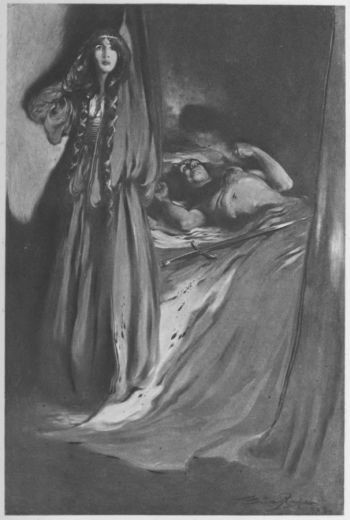
[See larger version]
As if each echo, which that wild horn's blast
Roused from its sleep,—the solitude had cast
For ages on it,—had, a silvery band
Of moving sounds of gladness, hand in hand
Arisen,—each a visible delight,—
Came three fair damsels, sunny in snowy white,
From the red woodland gliding. They the knight,—
For so they deemed the King, who came alone,—
Graced with obeisance. And, "Our lord," said one,
"Tenders you courtesy until the dawn,
The Earl, Sir Damas. For the day is gone,
And you are weary. Safe in his strong keep,
Led thither with due worship, you shall sleep."
And so he came, o'erwearied, to a hall,
An owlet-haunted pile, whose weedy wall
Towered, rock on rock; its turrets, crowding high,
Loomed, ancient as the crags, against a sky
Wherein the moon hung, owl-eyed, round and full:
An old, gaunt giant-castle, like a gull
Hung on the weedy cliffs, where broke the dull
Vast monotone of ocean, that uprolled
Its windy waters; and where all was old,
And sad, and swept of winds, and slain of salt,
And haunted grim of ruin: where the vault
Of heav'n bent ever, clamorous as the rout
Of the defiant headlands, stretching out
Into the night, with their voluminous shout
Of wreck and wrath forever. Arthur then,
Among the gaunt Earl's followers, swarthy men,
Ate in the wild hall. Then a damsel led,
With flaring torch, the tired King to bed,
Down lonely labyrinths of that corridored keep.
And soon he rested, sunk in heavy sleep.
Then suddenly he woke; it seemed, 'mid groans
And dolorous sighs: and round him lay the bones
Of many men, and bodies mouldering.
And he could hear the wind-swept ocean swing
Its sighing surge above. And so he thought,
"It is some nightmare weighing me, distraught
By that long hunt." And then he sought to shake
The horror off and to himself awake.
But still he heard sad groans and whispering sighs:
And gaunt, from iron-ribbéd cells, the eyes
Of pale, cadaverous knights regarded him,
Unhappy: and he felt his senses swim
With foulness of that dungeon.—"What are ye?
Ghosts? or chained champions? or a company
Of fiends?" he cried. Then, "Speak! if speak ye can!
Speak, in God's name! for I am here—a man!"
Then groaned the shaggy throat of one who lay,
A wasted nightmare, dying day by day,
Yet once a knight of comeliness, and strong
And great and young, but now, through hunger long,
A skeleton with hollow hands and cheeks:—
"Sir knight," said he, "know that the wretch who speaks
Is only one of twenty knights entombed
By Damas here; the Earl who so hath doomed
Us in this dungeon, where starvation lairs;
Around you lie the bones, whence famine stares,
Of many knights. And would to God that soon
My liberated ghost might see the moon
Freed from the horror of this prisonment!"
With that he sighed, and round the dungeon went
A rustling sigh, as of the damned; and so
Another dim, thin voice complained their woe:
"Know, he doth starve us to obtain this end:
Because not one of us his strength will lend
To battle for what still he calls his rights,
This castle and its lands. For, of all knights,
He is most base; lacks most in hardihood.
A younger brother, Ontzlake, hath he; good
And courteous; withal most noble; whom
This Damas hates—yea, even seeks his doom;
Denying him to his estate all right
Save that he holds by main of arms and might.
Through puissance hath Ontzlake some few fields
And one right sumptuous manor, where he deals
With knights as knights should, with an open hand,
Though ill he can afford it. Through the land
He is far-famed for hospitality.
Ontzlake is brave, but Damas cowardly.
For Ontzlake would decide with sword and lance,
Body to body, this inheritance:
But Damas, vile as he is courageless,
Doth on all knights, his guests, lay this duress,
To fight for him or starve. For you must know
That in this country he is hated so
There is no champion who will take the fight.
Thus fortunes it our plight is such a plight."
Quoth he and ceased. And, wondering at the tale,
The King lay silent, while each wasted, pale,
Poor countenance perused him; then he spake:
"And what reward if one this cause should take?"—
"Deliverance for all if of us one
Consent to be his party's champion.
But treachery and he are so close kin
We loathe the part as some misshapen sin;
And here would rather with the rats find death
Than, serving him, serve wrong, and save our breath,
And on our heads, perhaps, bring down God's curse."
"May God deliver you in mercy, sirs,
And help us all!" said Arthur. At which word
Straightway a groaning sound of iron was heard,
Of chains rushed loose and bolts jarred rusty back,
And hoarse the gate croaked open; and the black
Of that rank cell astonished was with light,
That danced fantastic with the frantic night.
One high torch, sidewise worried by the gust,
Sunned that dark den of hunger, death and dust;
And one tall damsel, vaguely vestured, fair,
With shadowy hair, poised on the rocky stair:
And laughing on the King, "What cheer?" said she.
"God's life! the keep stinks vilely! And to see
Such noble knights endungeoned, starving here,
Doth pain me sore with pity. But, what cheer?"
"Thou mockest us. For me, the sorriest
Since I was suckled; and of any quest
This is the most imperiling and strange.—
But what wouldst thou?" said Arthur. She, "A change
I offer thee; through thee to these with thee,
If thou wilt promise, in love's courtesy,
To fight for Damas and his brotherhood.
And if thou wilt not—look! behold this brood
Of lean and dwindled bellies, spectre-eyed,—
Keen knights once,—who refused me. So decide."
Then thought the King of the sweet sky, the breeze
That blew delirious over waves and trees;
Thick fields of grasses and the sunny Earth,
Whose beating heat filled the high heart with mirth,
And made the world one sovereign pleasure-house
Where king and serf might revel and carouse:
Then of the hunt on autumn-plaintive hills;
Lone forest lodges by their radiant rills;
His palace at Caerleon upon Usk,
And Camelot's loud halls that through the dusk
Blazed far and bloomed, a rose of revelry;
Or, in the misty morning, shadowy
Loomed, grave with audience. And then he thought
Of his Round Table, and the Grael wide sought
In haunted holds by many a haunted shore.
Then marveled of what wars would rise and roar
With dragon heads unconquered and devour
This realm of Britain and crush out that flower
Of chivalry whence ripened his renown:
And then the reign of some besotted crown,
Some bandit king of lust, idolatry—
And with that thought for tears he could not see.—
Then of his best-loved champions, King Ban's son,
And Galahad and Tristram, Accolon:
And then, ah God! of his loved Guenevere:
And with that thought—to starve 'mid horrors here!—
For, being unfriend to Arthur and his Court,
Well knew he this grim Earl would bless that sport
Of fortune which had fortuned him so well
As t' have his King to starve within a cell,
In the entombing rock beside the deep.—
And all the life, large in his limbs, did leap
Through eager veins and sinews, fierce and red,
Stung on to action; and he rose and said:
"That which thou askest is right hard, but, lo!
To rot here, harder. I will fight his foe.
But, mark, I have no weapons and no mail;
No steed against that other to avail."
She laughed again; "If we must beg or hire,
Fear not for that: these thou shalt lack not, sire."
And so she led the way; her torch's fire
Sprawling with spidery shadows at each stride
The cob-webbed coignes of scowling arches wide.
At length they reached an iron-studded door,
Which she unlocked with one harsh key she bore
'Mid many keys bunched at her girdle; thence
They issued on a terraced eminence.
Below, the sea broke sounding; and the King
Breathed open air again that had the sting
And scent of brine, the far, blue-billowed foam:
And in the east the second dawning's gloam,
Since that unlucky chase, was freaked with streaks
Red as the ripe stripes of an apple's cheeks.
And so, within that larger light of dawn
It seemed to Arthur now that he had known
This maiden at his Court, and so he asked.
But she, well tutored, her real person masked,
And answered falsely, "Nay, deceive thee not.
Thou saw'st me ne'er at Arthur's Court, I wot.
For here it likes me best to sing and spin,
And needle hangings, listening to the din
Of ocean, sitting some high tower within.
No courts or tournaments or hunts I crave,
No knights to flatter me! For me—the wave,
The cliffs, the sea and sky, in calm or storm;
My garth, wherein I walk at morn; the charm
Of ocean, redolent at bounteous noon,
And sprayed with sunlight; night's free stars and moon:
White ships that pass, some several every year;
These ancient towers; and those wild mews to hear."
"An owlet maid," the King laughed.—But untrue
Was she, and of false Morgane's treasonous crew,
Deep in intrigues, even for the slaying of
The King, her brother, whom she did not love.—
And presently she brought him where, in state,
This swarthy Damas, 'mid his wildmen sate.
And Accolon, at Castle Chariot still,
Had lost long weeks in love. Her husband ill,
Morgane, perforce, must leave her lover here
Among the hills of Gore. A lodge stood near
A cascade in the forest, where their wont
Was to sit listening the falling fount,
That, through sweet talks of many idle hours
On moss-banks, varied with the violet flowers,
Had learned the lovers' language,—sighed above,—
And seemed, in every fall, to whisper, "love";
That echoed through the lodge, her hands had draped
With curious hangings; where were worked and shaped
Remembered hours of pleasure, body and soul;
Imperishable passions, which made whole
The past again in pictures; and could mate
The heart with loves long dead; and re-create
The very kisses of those perished knights
With woven records of long-dead delights.
Below the lodge within an urnéd shell
The water pooled, and made a tinkling well,
Then, slipping thence, through dripping shadows fell
From rippling rock to rock. Here Accolon,
With Morgane's hollow lute, as eve drew on
Came all alone: not ev'n her brindled hound
To bound before him o'er the gleaming ground;
No handmaid lovely of his loveliest fair,
Or paging dwarf in purple with him there;
Only her lute, about which her perfume
Clung, odorous of memories, that made bloom
Her absent features, making them arise,
Like some rich flower, before his memory's eyes,
That seemed to see her lips and to surmise
The words they fashioned; then the smile that drank
Her soul's deep fire from eyes wherein it sank
And slowly waned away to deeper dreams,
Fathomless with thought, down in their dove-gray streams.
And so for her imagined eyes and lips,
Heart-fashioned features, all the music slips
Of all his soul, himseems, into his voice,
To sing her praises. And, with nervous poise,
His fleet, trained fingers waken in her lute
Such mellow riot as must make envy-mute
The nightingale that listens quivering.
And well he hopes that, winging thence, 'twill sing
A similar song;—whose passions burn and pain
Its anguished soul, now silent,—not in vain
Beneath her casement, in that garden old
Dingled with heavy roses; in the gold
Of Camelot's stars and pearl-encrusted moon:
And still he hopes the heartache of the tune
Will clamor secret memories in her ear,
Of life, less dear than death with her not near;
Of love, who longs for her, to have her here:
Till melt her eyes with tears; and sighs and sobs
O'erwhelm her soul, and separation throbs
Hard at her heart, that, longing, lifts to death
A prayerful pleading, crying, "But a breath,
One moment of real heaven, there! in his arms!
Close, close! And, for that moment, then these charms,
This body, hell, canst have forevermore!"
And sweet to know, perhaps its song will pour
Into the dull ear of her drowsy lord
A vague suspicion of some secret word,
Borne by the bird,—love's wingéd messenger,—
To her who lies beside him; even her,
His wife, whom still he loves; whom Accolon
Thus sings of where the woods of Gore grow wan:—
"The thought of thy white coming, like a song
Breathed soft of lovely lips and lute-like tongue,
Sways all my bosom with a sweet unrest;
Makes wild my heart that oft thy heart hath pressed.—
Come! press it once again, for it is strong
To bear that weight which never yet distressed.
"O come! and straight the woodland is stormed through
With wilder wings, and brighter with bright dew:
And every flow'r, where thy fair feet have passed,
Puts forth a fairer blossom than the last,
Thrilled of thine eyes, those arsenals of blue,
Wherein the arrows of all love are cast.
"O Love, she comes! O Love, I feel her breath,
Like the soft South, that idly wandereth
Through musical leaves of laughing laziness,
Page on before her, how sweet,—none can guess:
Sighing, 'She comes! thy heart's dear life and death;
In whom is all thy bliss and thy distress.'
"She comes! she comes! and all my mind doth rave
For words to tell her how she doth enslave
My soul with beauty: then o'erwhelm with love
That loveliness, no words can tell whereof;
Words, words, like roses, every path to pave,
Each path to strew, and no word sweet enough!
"She comes!—Thro' me a passion—as the moon
Works wonder in the sea—through me doth swoon
Ungovernable glory; and her soul
Seems blent with mine; and now, to some bright goal,
Compels me, throbbing like a tender tune,
Exhausting all my efforts of control.
"She comes! ah, God! ye little stars that grace
The fragmentary skies, and scatter space,
Brighter her steps that golden all my gloom!
Ah, wood-indulging, violet-vague perfume,
Sweeter the presence of her wild-flower face,
That fragrance-fills my life, and stars with bloom!
"Oh, boundless exultation of the blood!
That now compels me to some higher mood,
Diviner sense of something that outsoars
The Earth—her kiss! that all love's splendor pours
Into me; all delicious womanhood,
So all the heart that hesitates—adores.
"Sweet, my soul's victor! heart's triumphant Sweet!
Within thy bosom Love hath raised his seat;
There he sits crowned; and, from thy eyes and hair,
Shoots his soft arrows,—as the moonbeams fair,—
That long have laid me supine at thy feet,
And changed my clay to ardent fire and air.
"My love! my witch! whose kiss, like some wild wine,
Has subtly filled me with a flame divine,
An aspiration, whose fierce pulses urge
In all my veins, with rosy surge on surge,
To hurl me in that heaven, all which is mine,
Thine arms! from which I never would emerge."
His ecstasy the very foliage shook;
The wood seemed hushed to hear, and hushed the brook;
And even the heavens, wherein one star shone clear,
Seemed leaning nearer, his glad song to hear,
To which its wild star throbbed, all golden-pale:
And after which, deep in the purple vale,
Awoke the passion of the nightingale.
III
As one hath seen a green-gowned huntress fair,
Morn in her cheeks and midnight in her hair;
Keen eyes as gray as rain, young limbs as lithe
As the wild fawn's; and silvery voice as blithe
As is the wind that breathes of flowers and dews,
Breast through the bramble-tangled avenues;
Through brier and thorn, that pluck her gown of green,
And snag it here and there,—through which the sheen
Of her white skin gleams rosy;—eyes and face,
Ardent and flushed, fixed on the lordly chase:
So came the Evening to that shadowy wood,
Or so it seemed to Accolon, who stood
Watching the sunset through the solitude.
So Evening came; and shadows cowled the way
Like ghostly pilgrims who kneel down to pray
Before a wayside shrine: and, radiant-rolled,
Along the west, the battlemented gold
Of sunset walled the opal-tinted skies,
That seemed to open gates of Paradise
On soundless hinges of the winds, and blaze
A glory, far within, of chrysoprase,
Towering in topaz through the purple haze.
And from the sunset, down the roseate ways,
To Accolon, who, with his idle lute,
Reclined in revery against the root
Of a great oak, a fragment of the west,
A dwarf, in crimson satin tightly dressed,
Skipped like a leaf the early frosts have burned,
A red oak-leaf; and like a leaf he turned,
And danced and rustled. And it seemed he came
From Camelot; from his belovéd dame,
Morgane le Fay. He on his shoulder bore
A mighty blade, wrought strangely o'er and o'er
With mystic runes, drawn from a scabbard which
Glared venomous, with angry jewels rich.
He, louting to the knight, "Sir knight," said he,
"Your Lady, with all tenderest courtesy,
Assures you—ah, unworthy bearer I
Of her good message!—of her constancy."
Then, doffing the great baldric, with the sword,
To him he gave them, saying, "From my lord,
King Arthur: even his Excalibur,
The magic blade which Merlin gat of her,
The Ladyé of the Lake, who, as you wot,
Fostered in infanthood Sir Launcelot,
Upon some isle in Briogne's tangled lands
Of meres and mists; where filmy fairy bands,
By lazy moons of summer, dancing, fill
With rings of morrice every grassy hill.
Through her fair favor is this weapon sent,
Who begged it of the King with this intent:
That, for her honor, soon would be begun
A desperate battle with a champion,
Of wondrous prowess, by Sir Accolon:
And with the sword, Excalibur, more sure
Were she that he against him would endure.
Magic the blade, and magic, too, the sheath,
Which, while 'tis worn, wards from the wearer death."
He ceased: and Accolon held up the sword
Excalibur and said, "It shall go hard
With him through thee, unconquerable blade,
Whoe'er he be, who on my Queen hath laid
Insult or injury! And hours as slow
As palsied hours in Purgatory go
For those unmassed, till I have slain this foe!—
Here, page, my purse.—And now, to her who gave,
Despatch! and say: To all commands, her slave,
To death obedient, I!—In love or war
Her love to make me all the warrior.—
Bid her have mercy, nor too long delay
From him, who dies an hourly death each day
Till, her white hands kissed, he shall kiss her face,
Through which his life lives on, and still finds grace."
Thus he commanded. And, incontinent,
The dwarf departed, like a red shaft sent
Into the sunset's sea of scarlet light
Burning through wildwood glooms. And as the night
With votaress cypress veiled the dying strife
Sadly of day, and closed his book of life
And clasped with golden stars, in dreamy thought
Of what this fight was that must soon be fought,
Belting the blade about him, Accolon,
Through the dark woods tow'rds Chariot passed on.
And it befell him thus, the following dawn,
As he was wandering on a dew-drenched lawn,
Glad with the freshness and elastic health
Of sky and earth, that lavished all their wealth
Of heady winds and racy scents,—a knight
And gentle lady met him, gay bedight,
With following of six esquires; and they
Held on gloved wrists the hooded falcon gray,
And rode a-hawking o'er the leas of Gore
From Ontzlake's manor, where he languished; sore
Hurt in the lists, a spear wound in his thigh:
Who had besought—for much he feared to die—
This knight and his fair lady, as they rode
To hawk near Chariot, Morgane's abode,
That they would beg her in all charity
To come to him (for in chirurgery
Of all that land she was the greatest leach),
And her for his recovery beseech.
So, Accolon saluted, they drew rein,
And spake their message, for, right over fain
Were they toward their sport,—that he would bear
Petition to that lady. But, not there
Was Arthur's sister, as they well must wot;
But now a sennight lay at Camelot,
The guest of Guenevere; and with her there
Four other queens of Farther Britain were:
Isoud of Ireland, she of Cornwall Queen,
King Mark's wife,—who right rarely then was seen
At Court for jealousy of Mark, who knew
Her to that lance of Lyonesse how true
Since mutual quaffing of a philter; while
How guilty Guenevere on such could smile:—
She of Northgales and she of Eastland; and
She of the Out Isles Queen. A fairer band,
For sovereignty and love and loveliness,
Was not in any realm to grace and bless.
So Accolon informed them. In distress
Then quoth that knight: "Ay? see how fortune turns
And varies like an April day, that burns
Now welkins blue with calm; now scowls them down,
Revengeful, with a black storm's wrinkled frown.
For, look! this Damas, who so long hath lain
A hiding vermin, fearful of all pain,
Dark in his bandit towers by the deep,
Wakes from a five years' torpor and a sleep,
And sends despatch a courier to my lord,
Sir Ontzlake, with, 'To-morrow, with the sword,
Earl Damas and his knight, at point of lance,
Decides the issue of inheritance,
Body to body, or by champion.'—
Right hard to find such ere to-morrow dawn.
Though sore bestead lies Ontzlake, if he could,
He would arise and save his livelihood."
Then thought Sir Accolon: "One might suppose,
So soon this follows on her message, those
Same things befall through Morgane's arts—who knows?—
Howe'er it be, as 'twere for her own sake,
This battle I myself will undertake."
Then said to those, "I know the good Ontzlake.
If he be so conditioned, harried of
Estate and life,—in knighthood and for love
Of justice I his quarrel will assume.
My limbs are keen for armor. Let the groom
Prepare my steed. Right good 'twill be again
To feel him under me."—Then, of that train,
Asked that one gentleman with him remain,
And men to squire his horse and arms. And then,
When this was granted, mounted with his men
And thence departed. And, ere noontide, they
Came to a lone, dismantled priory
Hard by a castle 'gainst whose square, grey towers,
Machicolated, mossed, in forest bowers,
Full many a siege had beat and onset rushed:
A forest fortress, old and deep-imbushed
In wild and woody hills. And then one wound
A hoarse slug-horn, and at the savage sound
The drawbridge rumbled moatward, clanking, and
Into a paved court rode that little band.
When all the world was morning, gleam and glare
Of autumn glory; and the frost-touched air
Rang with the rooks as rings a silver lyre
Swept swift of minstrel fingers, wire on wire;
Ere that fixed hour of prime, came Arthur, armed
For battle royally. A black steed warmed
A keen impatience 'neath him, cased in mail
Of foreign make; accoutered head and tail
In costly sendal; rearward, wine-dark red,
Amber as sunlight to his fretful head.
Blue armor of linked steel had Arthur on,
Beneath a robe of honor made of drawn,
Ribbed satin, diapered and purfled deep
With lordly gold and purple; whence did sweep
Two acorn-tufted bangles of fine gold:
And at his thigh a falchion, battle-old
And triple-edged; its rune-stamped scabbard, of
Cordovan leather, baldric'd rich above
With new-cut deer-skin, that, laborious wrought,
And curiously, with slides of gold was fraught,
And buckled with a buckle white, that shone,
Tongued red with gold, and carved of walrus' bone.
And, sapphire-set, a burgonet of gold,—
Whereon a wyvern sprawled, whose jaws unrolled
A tongue of garnet agate, of great prize;
Its orbs of glaring ruby, great in size,—
Incased his head and visor-barred his eyes.
And in his hand a wiry lance of ash,
Lattened with sapphire silver, like a flash,
A splinter of sunlight, in the morning's zeal
Glittered, its point, as 'twere, a star of steel.—
A squire attended him; a youth, whose head
Waved many a jaunty curl; whereon a red
Cock-feathered cap shone brave: 'neath which, as keen
As some wild hawk's, his green-gray eyes were seen:
And parti-colored leather shoes he had
Upon his feet; his legs were silken clad
In hose of rarest Totness: and a spear,
Bannered and bronzen, dappled as a deer,
One hand upheld, like some bright beam of morn;
And round his neck was hung a bugle-horn.
So with his following, while, bar on bar,
The blue mist lay on woodside and on scar,
Through mist and dew, through shadow and through ray,
Joustward Earl Damas led the forest way.
Then to King Arthur, when arrived were these
Where bright the lists shone, bannered, through the trees,
A wimpled damsel with a falchion came,
Mounted upon a palfrey, all aflame
With sweat and heat of hurry; and, "From her,
Your sister, Morgane, your Excalibur!
With tender greeting. For you well may need
Its aid in this adventure. So, God speed!"
Said and departed suddenly: nor knew
The King that this was not his weapon true:
A brittle forgery, in likeness of
That blade, of baser metal;—in unlove
And treason made by her, of all his kin
The nearest, Morgane; who, her end to win,
Stopped at no thing; thinking, with Arthur dead,
The crown would grace her own and Accolon's head.
Then, heralded, into the lists he rode.
Opposed flashed Accolon, whose strength bestrode,
Exultant, strong in talisman of that sword,
A dun horse lofty as a haughty lord,
White-pasterned, and of small, impatient hoof:
Both knight and steed shone armed in mail of proof,
Of yellow-dappled, variegated plate
Of Spanish laton. And of sovereign state
His surcoat robe of honor,—white and black,
Of satin, crimson-orphreyed,—at his back
The wind made billow: and, from forth this robe,
Excalibur,—a throbbing golden globe
Of vicious jewels,—thrust its splendid hilt;
Its broad belt, tawny and with goldwork gilt,
An eyelid clasped, black, of the black sea-horse,
Tongued red with rosy gold. And pride and force
Sat on his wingéd helmet, plumed, of rich
Bronze-hammered laton; blazing upon which
A hundred brilliants glittered, thick as on
A silver web bright-studding dews of dawn:
Its crest, a taloned griffin, high that ramped;
In whose horned brow one blood-red gem was stamped.
A spear of ash, long-shafted, overlaid
With azure silver, whereon colors played,
Firm in his iron gauntlet lithely swayed.
Intense on either side the champions stood,
Shining as serpents that, with spring renewed,
In gleaming scales, meet on a wild-wood way,
Their angry tongues flickering at poisonous play.
Then clanged a herald's trumpet: and harsh heels,
Sharp-thrust, each courser felt; the roweled steels
Spurred forward; and the couched and fiery spears,
Flashed, as two bolts of storm the tempest steers
With adverse thunder; and, in middle course,
Crashed full the unpierced shields, and horse from horse
Lashed, madly pawing.—And a hoarse roar rang
From the loud lists, till far the echoes sang
Of hill and rock-hung forest and wild cliff.
Rigid the champions rode where, standing stiff,
Their esquires tendered them the spears they held.
Again the trumpet blew, and, firmly selled,
Forward they galloped, shield to savage shield,
And crest to angry crest: the wyvern reeled,
Towering, against the griffin: scorn and scath
Upon their fiery fronts and in the wrath
Of their gem-blazing eyes: each figure stood
A symbol of the heart beneath the hood.—
The lance of Accolon, as on a rock
The storm-launched foam breaks baffled, with the shock,
On Arthur's sounding shield burst splintered force;
But him resistless Arthur's,—high from horse
Uplifted,—headlong bore, and crashed him down;
A long sword's length unsaddled. Accolon
For one stunned moment lay. Then, rising, drew
The great sword at his hip that shone like dew
Smitten with morn. "Descend!" he grimly said,
"To proof of better weapons, head to head!
Enough of spears! to swords!"—And from his height
The King clanged down. And quick, like some swift light,
His moon-bright brand unsheathed. And, hollowed high,
Each covering shield gleamed, slantwise, to'ards the sky,
A blazoned eye of bronze: and underneath,
As 'neath two clouds, the lightning and the death
Of the fierce swords played. Now a shield descends—
A long blade leaps;—and now, a fang that rends,
Another blade, loud as a battle word,
Beats downward, trenchant; and, resounding heard,
A shield's fierce face replies: again a sword
Swings for a giant blow, and, balked again,
Burns crashing from a sword. Thus, o'er the plain,
Over and over, blade on baleful blade;
Teeth clenched; and eyes, behind their visors' shade,
Like wild beasts' eyes in caverns; shield to shield,
The champions strove, each scorning still to yield.
Then Arthur drew aside to rest upon
His falchion for a space. But Accolon,
As yet,—through virtue of that magic sheath,—
Fresh and almighty, and no nearer death
Now than when first the fight to death begun,
Chafed at delay. But Arthur, with the sun,
His heavy mail, his wounds, and loss of blood,
Made weary, ceased and for a moment stood
Leaning upon his sword. Then, "Dost thou tire?"
Sneered Accolon. And then, with fiercer fire,
"Defend thee! yield thee! or die recreant!"
And at the King aimed a wild blow, aslant,
That beat a flying fire from the steel.
Stunned by that blow, the King, with brain a-reel,
Sank on one knee; then rose, infuriate,
Nerved with new vigor; and with heat and hate
Gnarled all his strength into one blow of might,
And in both fists his huge blade knotted tight,
And swung, terrific, for a final stroke,—
And,—as the lightning flames upon an oak,—
Boomed on the burgonet his foeman wore;
Hacked through and through its crest, and cleanly shore,
With hollow clamor, from his head and ears,
The brag and boasting of that griffin fierce:
Then, in an instant, as if made of glass,
That brittle blade burst, shattered; and the grass
Shone, strewn with shards; as 'twere a broken ray,
It fell and bright in feverish fragments lay.
Then groaned the King, disarmed. And straight he knew
This sword was not Excalibur: too true
And perfect tempered, runed and mystical,
That weapon of old wars! and then withal,
Looking upon his foe, who still with stress
Fought on, untiring, and with no distress
Of wounds or heat, he thought, "I am betrayed!"
Then as the sunlight struck along that blade,
He knew it, by the hilt, for his own brand,
The true Excalibur, that high in hand
Now rose avenging. For Sir Accolon
In madness urged th' unequal battle on
His King defenseless; who, the hilted cross
Of that false weapon grasped, beneath the boss
Of his deep-dented shield crouched; and around,
Like some great beetle, labored o'er the ground,
Whereon the shards of shattered spears and bits
Of shivered steel and gold made sombre fits
Of flame, 'mid which, hard-pressed and cowering
Beneath his shield's defense, the dauntless King
Crawled still defiant. And, devising still
How to secure his sword and by what skill,
Him thus it fortuned when most desperate:
In that close chase they came where, shattered late,
Lay, tossed, the truncheon of a bursten lance,
Which, deftly seized, to Accolon's advance
He wielded with effect. Against the fist
Smote, where the gauntlet clasped the nervous wrist,
That heaved Excalibur for one last blow;
Sudden the palsied sinews of his foe
Relaxed in effort, and, the great sword seized,
Was wrenched away: and straight the wroth King eased
Himself of his huge shield, and hurled it far;
And clasping in both arms of wiry war
His foe, Sir Accolon,—as one hath seen
A strong wind take an ash tree, rocking green,
And swing its sappy bulk, then, trunk and boughs,
Crash down its thundering height in wild carouse
And wrath of tempest,—so King Arthur shook
And headlong flung Sir Accolon. Then took,
Tearing away, that scabbard from his side
And hurled it through the lists, that far and wide
Gulped in the battle breathless. Then, still wroth,
He seized Excalibur; and grasped of both
Wild hands, swung trenchant, and brought glittering down
On rising Accolon. Steel, bone and brawn
That blow hewed through. Unsettled every sense.
Bathed in a world of blood, his limbs lay tense
A moment, then grew limp, relaxed in death.
And bending o'er him, from the brow beneath,
The King unlaced the helm. When dark, uncasqued,
The knight's slow eyelids opened, Arthur asked:
"Say, ere thou diest, whence and who thou art!
What king, what court is thine? And from what part
Of Britain dost thou come? Speak!—for, methinks,
I have beheld thee—where? Some memory links
Me strangely with thy face, thy eyes ... thou art—
Who art thou?—speak!"—
He answered, slow, then short,
With labored breathing: "I?—one, Accolon,—
Of Gaul—a knight of Arthur's court—anon—
But to what end—yea, tell me—am I slain?"—
Then bent King Arthur nearer and again
Drew back: then, anguish in his utterance, sighed:
"One of my Table!"—Then asked softly, "Say,
Whence hadst thou this, my sword? say, in what way
Thou cam'st by it?"—But, wandering, that knight
Heard with dull ears, divining but by sight
The question asked; and answered, "Woe!—the sword!—
Woe worth the sword!—Lean down!—Canst hear my word?—
From Morgane! Arthur's sister, who had made
Me king of all this kingdom, so she said—
Hadst thou not 'risen, accurséd, like a fate,
To make our schemes miscarry!—Wait! nay, wait!—
A king! dost hear?—a gold and blood-crowned king,
I!—Arthur's sister, queen!—No bird can wing
Higher than her ambition! that resolved
Her brother's death was needed, and evolved
Plots that should ripen with the ripening year,
And here be reaped, perhaps—nay, nay! not here!—
Farewell, my Morgane!—Yea, 'twas she who schemed
While there at Chariot we loved and dreamed
Gone some six months.—There nothing gave us care.
Each morning was a liberal almoner
Prodigal of silver to the earth and air:
Each eve, a fiery dragon, cloud-enrolled,
Convulsive, dying overwhelmed with gold;
On such an eve it was, that, redolent,
She sat by me and said,—'My message sent,
Some night—within the forest—thou, my knight!
Thou and the king!—my men—the forest fight!—
Murder perhaps.—But, well?—who is to blame?'...
So with her blood-red thoughts to me she came.
To me! that woman, brighter than a flame,
And wooed my soul to hell, with love accurs'd;
With harlot lips, from which my being first
Drank hell and heaven. She, who was in sooth
My heaven and hell.—But now, behind her youth
She shrivels to a hag!—I see the truth!—
Harlot!—nay, spouse of Urience, King of Gore!—
Wanton!—nay, witch! sweet witch!—what wouldst thou more?—
Hast thou not had thy dream? and wilt thou grieve
That death so ruins it?—Thou dost perceive
How I still love thee! witness bear this field,
This field and he to whom I would not yield!—
Would thou wert here to kiss me ere I die!"—
Then anger in the good King's gloomy eye
Glowed, instant-embered, as one oft may see
A star blaze up in heaven, then cease to be.
Slow from his visage he his visor raised,
And on the dying knight a moment gazed;
Then grimly said, "Look on me, Accolon!
I am thy King!" He, with an awful groan,
Blade-battered as he was, beheld and knew;
Strained to his tottering knees; and, gasping, drew
Up full his armored height and hoarsely cried,
"The King!" and at his mailed feet crashed and died.
Then came a world of anxious faces, pressed
About King Arthur; who, though sore distressed,
Bespake that multitude: "While breath and power
Remain, judge we these brothers: This hard hour
Hath given to Damas all this rich estate:
So it is his; allotted his by fate
And force of arms. So let it be to him.
For, stood our oath on knighthood not so slim
But that it hath this strong conclusiön.
This much by us as errant knight is done.—
Now our decree, as King of Britain, hear:
We do command Earl Damas to appear
No more upon our shores, or any isles
Of farthest Britain in its many miles.
One week be his, no more! then will we come,
Even with an iron host, to seal his doom:
If he be not departed overseas,
With all his men and all his outlawries,
From his own towers, around which sea-birds clang,
Alive and naked shall he starve and hang
And rot! vile food for kites and carrion crows.
Thus much for him!... But all our favor goes
Toward Sir Ontzlake, whom it likes the King
To take into his knightly following
Of the Round Table. Bear to him our word.
But I am over weary. Take my sword.—
Unharness me, for more and more I tire;
And all my wounds are so much aching fire.
Yea; help me hence. To-morrow I would fain
To Glastonbury and with me the slain."
So bore they then the wounded King away,
The dead behind, as closed the autumn day.
But when, within that abbey, he waxed strong,
The King, remembering the marauder wrong
Which Damas had inflicted on that land,
Commanded Lionell, with a stanch band,
To stamp this weed out if still rooted there.
He, riding thither to that robber lair,
Led Arthur's hopefulest helms, when, thorn on thorn,
Reddened an hundred spears one winter morn:
And found—a ruin of fire-blackened rock,
Of tottering towers, that shook to every shock
Of the wild waves; and loomed above the bents
Turrets and cloudy-clustered battlements,
Wailing with wind that swept those clamorous lands:
Above the foam, that climbed with haling hands,
Desolate and gaunt; reflected in the flats;
Hollow and huge, the haunt of owls and bats.
IV
Hate, born of Wrath and mother red of Crime,
In Hell was whelped ere the hot hands of Time,
Artificer of God, had coined our world
Within the formless void, and round it furled
Its lordly raiment of the day and night,
And germed its womb with beauty and delight:
And Hell sent Hate to Earth, that it might use
And serve Hell's ends, filling with flame its cruse....
For her half-brother Morgane had conceived
Unnatural hatred; so much so, she grieved,
Envious and jealous, for the high renown
And might the King had gathered round his crown
Through truth and honor. And who was it said,
"Those nearest to the crown are those to dread"?—
Warm in your breast a serpent, it will sting
The breast that warms it: and albeit the King
Knew of his sister's hate, he passed it by,
Thinking that love and kindness gradually
Would win her heart to him. He little knew
The witch he dealt with, beautiful to view,
And all the poison she could stoop to brew.
She, who, well knowing how much mightier
The King than Accolon, rejoiced that her
Wits had secured from him Excalibur,
Without which, she was certain, in the joust
The King were as a foe unarmed. Her trust
Smiled, confident of conclusion: eloquent,
Within her, whispered of success, that lent
Her heart a lofty hope; and at large eyes
Piled up imperial dreams of power and prize.
And in her carven chamber, oaken-dark,
Traceried and arrased,—when the barren park
Dripped, drenched with autumn,—for November lay
Swathed frostily in fog on every spray,—
She at her tri-arched casement sate one night,
Ere yet came courier from that test of might.
Her lord in slumber and the castle full
Of drowsy silence and the rain's dull lull:
"The King removed?—my soul!—he is removed!
Ere now dog-dead he lies. His sword hath proved
Too much for him. Yet! let him lie in state,
The great king, Arthur!—But, regenerate,
Now crown our other monarch, Accolon!
And, with him, Love, the ermined! balmy son
Of gods, not men; and nobler hence to rule.
Love, Love almighty; beautiful to school
The hearts and souls of mortals!—Then this realm's
Iron-huskéd flower of war,—that overwhelms
The world with havoc,—will explode and bloom
The amaranth, peace, with love for its perfume.
And then, O Launcelots and Tristrams, vowed
To Gueneveres and Isouds,—now allowed
No pleasure but what hour by stolen hour,
In secret places, brings to flaming flower,—
You shall have feasts of passion evermore!
And out-thrust Love, now shivering at the door,
No more shalt stand neglected and cast off,
Insulted and derided; and the scoff
Of War, the bully, whose hands of insult fling
Off, for the iron of arms, thy hands that cling
About his brutal feet, that crush thy face,
Bleeding, into the dust.—Here, in War's place,
We will erect a shrine of sacrifice;
Love's sacrifice; a shrine of purest price;
Where each shall lay his heart and each his soul
For Love, for earthly Love! who shall control
The world, and make it as the Heaven whole;
Being to it its stars and moon and sun,
Its firmament and all its lights in one.
And if by such Love Heaven should be debarred,
Its God, its spheres, with spiritual love in-starred,
Hell will be Heaven, our Heaven, while Love shall thus
Remain earth Love, that God encouraged in us.
"And now for Urience, my gaunt old lord!—
There lies my worry.—Yet, hath he no sword
No dangerous dagger I, hid softly here,
Sharp as an adder's fang? or for his ear
No instant poison to insinuate
Ice in his pulses, and with death abate?"
So did she then determine; on that night
Of lonely autumn, when no haggard, white,
Wan, watery moon dreamed on the streaming pane;
But, on the leads, beat the incessant rain,
And the lamenting wind wailed wild among
The trees and turrets, like a phantom throng.
So grew her face severe as skies that take
Suggestions of far storm whose thunders shake
The distant hills with wrath, and cleave with fire
A pine the moaning forest mourns as sire—
So touched her countenance that dark intent:
And in still eyes her thoughts were evident,
As in dark waters, luminous and deep,
The heavens glass themselves when o'er them sweep
The clouds of storm and austere stars they keep,—
Ghostly and gray,—locked in their steadfast gloom.
Then, as if some great wind had swept the room,
Silent, intense, she rose up from her seat.
As if dim arms had made her a retreat,
Secret as thought to move in, like a ghost,
Noiseless as sleep and subtle as the frost,
Poised like a light and borne as carefully,
She trod the gusty hall where shadowy
The hangings rolled a dim Pendragon war.
And there the mail of Urience shone. A star,
Glimmering above, a dying cresset dropped
From the stone vault and flared. And here she stopped,
And took the sword, fresh-burnished by his page,
Long as a flame of pale, arrested rage.—
For she had thought that, when they found him dead,
His sword laid by him on the bloody bed
Would be convictive that his own hand had
Done him this violence when fever-mad.
The sword she took; and to the chamber, where
King Urience slept, she glided; like an air,
Smooth in seductive sendal; or a fit
Of faery song, a wicked charm in it,
That slays; an incantation full of guile.
She paused upon his threshold; for a while
Listened; and, sure he slept, stole in and stood
Crouched o'er his couch. About her heart the blood
Caught, strangling; then rose throbbing, thud on thud,
Up to her wide-stretched eyes, and up and up,
As wine might, whirling wildly in a cup.
Then came rare Recollection, with a mouth
Sweet as the honeyed sunbeams of the South
Trickling through perplexed ripples of the leaves;
To whose faint form a veil of starshine cleaves
Intricate gauze from memoried eyes to feet—
Feet softer than the sifted snows and fleet
To come and go and airy anxiously.
She, trembling to her, like a flower a bee
Nests in and makes an audible mouth of musk,
Lisping a downy message to the dusk,
Laid lips to ears and languaged memories of
Now hateful Urience:—How her maiden love
Had left Caerleon secretly for Gore,
With him, one day of autumn. How a boar,
Wild as the wildness of the solitude,
Raged at her from a cavern of the wood,
That, crimson-creepered, yawned the bristling curse
Murderous upon her. As her steed grew worse
And, terrified, fled snorting down the dell,
How she had flung herself from out the selle,
In fear, upon a bank of springy moss,
Where she lay swooning: in an utter loss
Of mind and limbs; wherein she seemed to see,
Or saw in horror, half unconsciously,—
As one who pants beneath an incubus
And strives to shriek or move, delirious,—
The monster-thing thrust tow'rds her, tusked and fanged,
And hideous snouted: how the whole wood clanged
And buzzed and boomed a hundred sounds and lights
Lawless about her brain,—like leaves wild nights
Of hurricane harvest, shouting.—Then it seemed
A fury thundered 'twixt them—and she screamed
As round her flew th' uprooted loam that held
Leaves, twigs and matted moss; and, clanging, swelled
Continual echoes with the thud of strife,
And groan of man and brute that warred for life:
How all the air, gone mad with foam and forms,
Spun froth and, 'twixt her, wrestled hair and arms,
And hoofs and feet that crushed the leaves and shred,
Whirling them wildly, brown, and yellow, and red.
And how she rose and leaned her throbbing head,
With all its uncoifed braids of raven hair
Disheveled, on one arm,—as white and fair
And smooth as milk,—and saw, as through a haze,
The brute thing throttled and the frowning face
Of Urience bent above it, browed with might;
One red swol'n arm, that pinned the hairy fright,
Strong as a god's, iron at the gullet's brawn:
Dug in its midriff, the close knees, updrawn,
Wedged, as with steel, the glutton sides that strove,—
A shaggy bulk,—with hoofs that drove and drove.
And then she saw how Urience swiftly slipped
One arm, the monster's tearing tusks had ripped
And ribboned redly, to the dagger's hilt,—
Which at his hip hung long, its haft gold-gilt;—
Flame-like it flashed; and then, as bright as ice,
Plunged, and replunged; again, now twice, now thrice;
And the huge boar, stretched out in sullen death,
Lay, bubbling blood, with harsh, laborious breath.
Then how he brought her water from a well,
That rustled freshly near them as it fell
From its full-mantled urn, in his deep casque,
And begged her drink; then bathed her brow, a task
That had accompanying tears of joy and vows
Of love, and intercourse of eyes and brows,
And many kisses: then, beneath the boughs,
His wound dressed, and her steed still violent
From fear, she mounted and behind him bent
And clasped him on the same steed; and they went
On through the gold wood tow'rds the golden west,
Till, on one low hill's forest-covered crest,
Gray from the gold, his castle's battlements pressed.
And then she felt she'd loved him till had come
Fame of the love of Isoud, whom, from home,
Tristram had brought across the Irish foam;
And Guenevere's for Launcelot of the Lake:
Then how her thought from these did seem to take
Reflex of longing; and within her wake
Desire for some great lover who should slake;
And such found Accolon.
And then she thought
How far she'd fallen, and how darkly fraught
With consequence was this. Then what distress
Were hers and his—her lover's—and success
How doubly difficult if, Arthur slain,
King Urience lived to assert his right to reign.
So she stood pondering with the sword; her lips
Breathless, and tight as were her finger-tips
About the weapon's hilt. And so she sighed,
"Nay, nay! too long hast lived who shouldst have died
Even in the womb, my sorrow! who for years
Hast leashed my life to thine, a bond of tears,
A weight of care, a knot that thus I part!
Thus harshly sever! Ugly that thou art
Into the elements naked!"
O'er his heart
The long blade paused and—then descended hard.
Unfleshed, she flung it by her murdered lord,
And watched the blood spread darkly through the sheet,
And drip, a horror, at impassive feet
Pooling the polished oak. Regretless she
Stood, and relentless; in her ecstasy
A lovely devil: demon crowned, that cried
For Accolon, with passion that defied
Control in all her senses; clamorous as
A torrent in a cavernous mountain pass
That sweeps to wreck and ruin; at that hour
So swept her longing tow'rds her paramour.
Him whom, King Arthur had commanded when
Borne from the lists, she should receive again;
Her lover, her dear Accolon, as was just,
As was but due her for her love—and lust.
And while she stood revolving if her deed's
Secret were safe, behold! a noise of steeds,
Arms, jingling stirrups, voices loud that cursed
Fierce in the northern court. To her, athirst
For him her lover, war and power it spoke,
Him victor and so king. And then awoke
Desire to see and greet him: and she fled,
Like some wild spectre, down the stairs; and, red,
Burst on a glare of links and glittering mail,
That shrunk her eyes and made her senses quail.
To her a bulk of iron, bearded fierce,
Down from a steaming steed into her ears,
"This from the King, O Queen!" laughed harsh and hoarse:
Two henchmen beckoned, who pitched sheer, with force,
Loud clanging at her feet, hacked, hewn, and red,
Crusted with blood, a knight in armor—dead:
Her Accolon, flung in his battered arms
By what to her seemed fiends and demon forms,
Wild-torched, who mocked; then, with the parting scoff,
"This from the King!" phantoms in fog, rode off.
And what remains?—From Camelot to Gore
That night she, wailing, fled; thence, to the shore,—
As old romances tell,—of Avalon;
Where she hath majesty gold-crowned and wan:
Clothed dark in cypress, still her lovely face
Is young and queenly; sweeter though in grace,
And softer for the sorrow there; the trace
Of immemorial tears as for some crime,
Attempted or committed at some time,
Some old, unhappy time of long ago,
That haunts her eyes and fills them with its woe:
Sad eyes, dark, future-fixed, expectant of
That far-off hour awaited of her love,
When the forgiving Arthur cometh and
Shall rule, dim King, o'er all that golden land,
That Isle of Avalon, where none grows old,
Where spring is ever, and never a wind blows cold;
That lifts its mountains from forgotten seas
Of surgeless turquoise deep with mysteries.—
And so was seen Morgana nevermore,
Save once, when from the Cornwall coast she bore
The wounded Arthur from that last fought fight
Of Camlan in a black barge into night.
But some may see her, with a palfried band
Of serge-stoled maidens, through the drowsy land
Of autumn glimmer,—when are sadly strewn
The red leaves, and, broad in the east, the moon
Hangs, full of frost, a lustrous globe of gleams,—
Faint on the mooning hills as shapes in dreams.
PEREDUR, THE SON OF EVRAWC
Beyond the walls, past wood and twilight field,
The Usk slipped onward under wharf and wall
Of old Caerleon, rolling down, it seemed,—
Incarnadined with splendor of the west,—
The heathen blood of all of Arthur's wars.
So she had left him; and he stood alone
Within the carven casement, where a ray
Of sunset laid a bleeding spear athwart
The dark oak hall, and, on the arras gaunt
A crimson blade of battle red that dripped.—
And now life's bitterness took Peredur
By all his heart's strings, smiting. He would go,
Equipped for quest, through all the savagery
Of mountain and of forest. And this girl?—
Forget her! and her game of shuttlecock,
Of battledore and shuttlecock with his heart,
This Angharad! this child the Court had spoiled!
Now he remembered how he once had ridd'n,
Spurring his piebald stallion down the square,
Upon the King's quest, and a girl had laughed
From some be-dragoned balcony of walls
That faced the gateway; and in passing he
Had glimpsed her beauty. It was she. And then
He thought how she had haunted him for days,
For weeks; and how, returning to Caerleon,
His long quest ended, how it thus befell:
Deep snow had fallen and the winter wood
Lay carpeted with silence. And he rode
Into a vista where a raven lay
Slain of a hawk; some blood-drops dyed the snow.
He lost himself in quaint comparisons
Of how the sifted drift was as her skin;
The raven's feathers as her heavy hair;
And in her cheeks the health of maidenhood
Red as the blood-drops. So he sat and dreamed:
When one rode up in angry steel and spoke
Thrice to no answer, and in anger dashed
A gauntlet in his face and made at him:
And how he slew him and rode over him,
Fiercer than fire; then how he returned
To find her fairer than their Gwenddolen,—
Who, ere the coming of this loveliness,
Divided all men's hearts with Gwenhwyvar:—
Crowned beauty of the beautiful at Court,
With Gwenhwyvar, and fair among the fair.
Thus while he mused he thought he heard her voice:
Or was it fancy? teasing him with sounds
Of music and of words: or did he hear
Her lute below the creepered walls? whose leaves,
Crimson with autumn, reddened all the court,
Burning continual sunset, where she sat
Beside the ceaseless whisper of the foam
Of one faint fountain. Sweeter mockery
Had never held him: and he heard her sing:—
"Ask me not now to sing to thee
Songs I have loved to sing before.
I love thee not; it can not be:
The dream is done; the song is o'er.
"Come, hold my hands: look deep into
The heartbreak of my eyes that bore
Glad welcome erst and now adieu;
Adieu, adieu forevermore!
"Once more shalt kiss my mouth and brow;
Once more my hair,—as oft of yore
When it was love and I and thou,—
Then nevermore! ah, nevermore!
"Thou must not weep; I can not weep:
I love thee not; should I regret?—
Nay! go; forget my face and sleep,
Sleep and forget! sleep and forget!"
"Aye! that I will! thy face, thy form, thy voice,
O bird of spring! whose beak is in my heart.
Take out thy beak, and sing me back my soul!
O bird of spring," he said, "when flowers are dead
Thy wing will winter underneath the pine,
And hunger, for the summer that is gone,
Will slay thy music with the memory.
God give thou find no winter in thy heart
Whenas dost find the frost invades thy voice!
Ah, lovelier than thy song, there's that in me
That harps and sings of thee; that troubadours
Thy beauty! ballades, sonnets it! and makes
A lyric of each heart-beat—all in vain:
Thou dost not heed, thou wilt not hear it sing.
Or, if thou dost, 'tis but in wantonness,
Indifference pretending interest: then praise,
A moiety, in mockery. And this
To one who'd love thee over all belief,
Above all women and beyond all men."
She strummed her lute. He listened, and then laughed,
"God's life! our Dagonet might teach me sense,
The folly that I am!—What? have I slept
A sennight in the taking of the moon,
Or danced, sleep-footed, with the forest fays?—
One would imagine.... No!... O silken Lust,
O Wantonness! whose soft, voluptuous skirts
Trail sweet contamination through these halls!
O lawless Love, whose evil influence
Haunts and parades Caerleon corridors!
O Vanity and Falsehood, throned within
The faithless Court, here is another soul,
Fresh, fragrant, like a wild-flower of the woods,
Ready and willing to be plucked and worn,
And placed among those soiled and hothouse flowers,
You long have worn, Isolt and Gwenhwyvar!
The forest flower, innocent as yet,—
The fairest, hence the more to be desired,
The quickest, too, to wither,—whose sweet name
Is Angharad!... Ho! page! my horse! my mail!—
God's wounds! my horse! my arms!—I will away!"
And many knights he passed, nor saw; who asked
What quest he rode. Inscrutable deeds behind
His visor, and along his sullen spear
Adventure bitter as a burning ray,
Into the night he galloped with the stars.
And one lone night, two years thereafter,—lost
Within a forest wilder than wild Dean;
Where neither wind nor water shook the leaves,
That hung as turned to stone above the moss
And grass, that wrapped the scaly rocks, death-dry,
And barren torrents; where he had not found
Or man or hut, or slot of boar or deer,
Through miles and miles of lamentable trees
And twisted thorns; beneath the autumn moon,—
(Pale as a nun's face seen in cloistered walks)—
Above dead tree-tops, like the rugged rock
Of melancholy cliffs, he saw wild walls
Of some vague castle thrust gray battlements
And hoary towers, like a wizard's dream.
Great greedy weeds and burrs and briers packed
Its moat and roadway: at the very gate
Weeds higher than a man; their ancient stalks
Devoured with the dust and spider-webs,
Or smothered with the slime where croaked the toad.
And Peredur against the portal rode,
And with his spear-point beat upon its bolts
A sounding minute. But no wolf-hound bayed;
Only dull echoes of interior walls
And hollow rock that arched the empty halls.
And once again his truncheon shook the gate
And roused a round-eyed owl that screamed and blinked,
Like some fierce gargoyle, on the bartizan;
And from a crevice, like an omen, hurled
A frantic bat. And then he heard a grate,
Concealed within the gloomy battlements,
Slide slowly; and a lean, gaunt, red-haired youth,
Lit with a link, addressed him. And he saw
That famine had sunk hollows in his cheeks,
And fixed gaunt misery in mouth and eyes.
"What knight art thou?" he asked. "And whence dost come?"—
And Peredur replied, "First let me in.
I am of Arthur's Court. Long have I ridd'n
Through miles and miles of melancholy woods.
The night begins to storm. And I would rest."
Then said the youth, sad mirth about his mouth,
"Rest shalt thou; yea: and since thou, haply, hast
Fasted all day, thou shalt break bread with us."—
Then he retired from the grated slide:
Undid harsh chains and shot back stubborn bolts;
And, stiff with rust, the snarling hinges swung.
And Peredur rode armed into a court,
Neglected, and pathetic with strewn leaves
And offal, where the weed and wire-grass
Creviced with wisps the loose and broken stones:
And overhead, around the mournful walls,
Huge oaks thrust ancient boughs of mistletoe
And withered leaves, whose twisted wildness seemed
The beckoning arms of hunger, and the hands,
Hooked and distorted, darkly threatening,
Of murder; enemies that, pitiless,
Had laid long siege to that old forest hold.
And he dismounted. And in clanking mail
Strode down the hall. And in the hall beheld
Youths, lean and auburn-haired, around the hearth;
Some eighteen of an equal height, and clad
Alike in dingy garments that looked worn
And old. And these were like to him who first
Had bid him welcome. And they greeted him
And took his arms; and bade him to a seat.
And then an inner door flung wide; and, lo,
Five maidens, like five forest flowers, came;
Dark-eyed, dark-haired. Behold, the queen of these
Was Angharad. Clad in a ragged robe
Of faded satin that had once been rich.
She looked at Peredur, and he at her:
And with glad eyes once more his soul beheld
The hair far blacker than the bird that wings
Athwart the milk-white moon: the matchless skin,
Inviolably white as wind-flowers blown
Among the mighty gospels of the trees:
And in her cheeks, the rose of maidenhood
Red as round berries winter bushes dot
The dimpled drift with under loaded boughs.
She knew him not, or seemed to; or forgot
To speak his name whenas she looked at him
And, blushing, welcomed.
And they sat and talked
Until the night waxed late. And as they talked
He marked that hunger had made hollow haunts
Of all their eyes; and so he longed to ask,
But courtesy forbade him. Late it grew,
And late and later; and at last there came
A knocking, and, as shadowy as two ghosts,
Two nuns came gliding; sandalled silence in
Frail footsteps, and pale caution on pale lips.
One brought a jar of wine, and one brought bread,
Six loaves of wheaten flour. And these said,
"God bear us witness, Lady, this is all!
Now is our Convent barren as thy board;"
And so departed. And they sat and ate.
The wind upon the forest and the rain
Upon the turrets. Had he heard a sigh
Or was it but the echo of his own,
Born of great weariness, that broke his rest?—
A dream! a dream!—The autumn storm is on,
And sows the wood with witchcraft, and the leaves
Are chased by imps of darkness through the hail
And hurling rain. The wind is wild with leaves.
Again he slept.
The rain among the trees,
The wind upon the turrets. Had he moaned,
Now that he lay awake and heard the wind
Hoot on the towers like a green-eyed owl?
The rain and wind. The night is black with rain.
Within the forest like a voice the wind;
And on the turrets, like swift feet, the rain.
Now was he sure 'twas weeping; and arose,
And found her at his door; and took her hand,
That like a soft persuasion lay in his.
He felt long sobbings shake it. And he said,
"Tell me, my sister, wherefore dost thou weep?"
And Angharad, "Yea; I will tell it thee.—
My name is Angharad. My father held
An Earldom under Arthur, yea, the first
In all his Kingdom: and this Castle, too,
Was his with cantrevs to the west and east.
When I was but a girl Earl Addanc met
And loved me. Once, when hunting, he came here
And sought my father and demanded me.
He said he loved me, and would have but me
To grace his bed and board, this Earl! But I—
I did not love him, being but a child,
My father's only child; I could not love.
And so my father said this should not be.
The Earl was wroth. I heard his furious stride
Beneath my casement; double demons pinched
His evil eyes and twenty gnarled his face.
He cursed us ere he rode beyond our walls
Then to Caerleon was I sent; and there
Became a woman of young Gwenhwyvar,
Until my father's death two years agone,
When I returned, a Countess, to find war
And Addanc here around beleaguered walls.
So hath he stripped me of my appanage;
Save this one keep, whose strength hath held out long,
Manned by my foster brothers, brave and young,
Strong to endure, but lacking still in arms;
No match for knights like Addanc. Thou hast met
The eighteen youths whose valor will not yield.
But what avail their valor and their will
Against hard hunger, now our larder lacks,
And lacks the Convent, too, whereon we leaned?
And Addanc comes to-morrow morn; the truce
For our one day's deliberation done.
If he prevail—the thought is like hot hands
Here on my brain!—his oath is 'that the night
Shall see me given over to his grooms.'"
She wept with tremblings. Then said Peredur:
"Go, dry thy tears, my sister. And this Earl—
If he be early, call me not too late.
Fear not. I will not go until my sword
Hath crossed the sword of so much wickedness,
And proved this base ambition. Go and sleep."
A morning gray with mist that gathered drops
Of drizzle on the ever dripping leaves.
And then the mist divided: ghostly mail,
Spears and limp pennons, and the shadowy steeds
Of shadowy knights and chieftains. And it seemed
A host of phantoms come to lay dim siege
To phantom walls whose warriors were ghosts.
Afar a bugle flourished in the fog,
Disconsolate; no echo of the wood
To bear its music burden. To the moat
Advanced a herald. And within the wall
The grate was opened; and the gaunt-eyed youth
Held parley with him: "How the Earl would make
End of the long dispute to-day, and leave,
'Twixt three a single combat to decide."
So Peredur bade arm him, and prepare
His horse for battle; and bade give the Earl
His answer for the Castle: "That one knight
Would try the hauberks of the banded three."
And he rode forth: and one rode up and scoffed,—
A knight in russet armor with loud words,—
"Small means to large results, forsooth! Thou boast!
A vicious palate hath thy appetite
That feasted long with hunger and must now
Conclude the banquet with three deaths!—Sir Death,
Here is thy death!" and hacked at Peredur
A heavy stroke that gashed his chain camail.
But, rising in stiff stirrups, ere he passed,
Two-handed swung the sword of Peredur,
And helm and head of him who fell were twain,
Halved like an apple. And the walls were glad.
Then came another, clad in silver mail,
As he were Galahad; and in the mist
Glimmered like moonlight. And with levelled spear
Demanded: "Whence and what art thou? this stroke
Was never fathered by long fasting."—Then
Quoth Peredur, "I am of Arthur's Court."—
Then sneered the other with a mocking laugh,
"A goodly service truly that of his,
Since all his knights, whom I have met, have died!"—
Quoth Peredur: "Thy falsehood choke thee dead!
Within thy throat thus do I nail thy lie!"
And at his gorget hurled his ponderous spear,
Ere that one met him, spurring at full speed,
Disdainful. And the desperate stroke of him
Who had wrought havoc with the Table Round,
Glanced shattering from the sloping shield, while he,
Bent backwards o'er his saddle, rolled—his tongue
Cleft at the root. And all the walls were glad.
Now came a third: a black knight and a black
Enormous steed. No words he wasted. But,
The fierce spears splintered, from the baldrics burned
Swift blades: and Battle held his breath a while
To see the great shields rock beneath great blows,
Oppose, deploy, as hilt to hilt they hewed
At heaume and gorget. While the conflict dripped
Between the splintered greaves from many wounds.
Then Peredur, his whole strength wrenching at
Unyielding shelter of his foeman's shield,
Beat down his guard and smote.—And Addanc lay
Beneath the son of Evrawc, whose swift hands
Razed off his casque and laid a blind blade bare
Across hot eyes, and set a heel of steel
Upon his throat and said: "Thou coward curse!
What woman wilt thou war with now?—'Tis well
Thy features are thus evil and might breed
Nightmares among the kestrels, kites, and crows,
Else hadst thou been, ere this,—so says my sword,—
A head the shorter! and that head hung high
Upon the highest battlement. What now!
What wilt thou do for thy vile life? what now!
Speak! or I smite! O thou base villainy,
Out on thy ugly mouth!—Speak!" Cursing, he,
A stricken bulk, growled, "Let me live! And I,
Upon my knighthood, swear that I will make
Unto this woman, Angharad, returns
For all her losses. Let me live."—And so
The sword slid from his eyes and from his neck
The heel. And he arose—to make in full
Due restitution of her lands to her
He had so robbed and harassed. And in time
This was fulfilled.
But Peredur remained,—
For, to be near her and to do for her
Was all his happiness,—until the land
Acknowledged her with all obedience.
Her rights established, what more now remained
To lend excuse unto his long delay?—
And so he went to her, and led her from
Amid her maidens, and bespoke her how
"He would ride hence and would but say farewell."
A while she gazed at him. And when she spoke
The springs of tears seemed starting in her throat,
Crystal and quivering. But with steady gaze,
"Dost thou, my knight, desire then to go?
Methought that thou wouldst tarry yet a while.—
A little while.—Well hast thou fought for me."
A moment was he silent; turning then,
Ground iron strides along the lofty hall,
And so returned with iron strides and said:
"Ay, by my God! Who knows I have not fought
For thee but still against thee. 'Tis my curse,
To love thee, love thee, love thee all these years!—
I came not here to woo. Thou wouldst but laugh.—
Haply thou hast forgotten me—thou hast!—
Yea, hast forgotten, aye long, long ago,
That son of Evrawc, Evrawc of the North,
Who wooed thee once!... Hast memory of him yet?...
Look in his eyes once more and say farewell."
"My soul, my soul!" she said; "O my true soul!
This shall not be, my soul!"—He heard her low
Voice pleading softly, and, deep in his heart,
New life leapt up, and sang in every pulse,
"She loves me! yea, she loves me!"—And it seemed
He heard her as men hear the voice of hope
Upon despair's black brink; and see one star
Bloom, like a lily with a heart of fire
Throbbing within it, slowly out of night.
Each syllable the petal of a flower,
A rose of music, welcome as the star,
The first the eve gives silvery utterance to;
Or as the firstling bud, the wildwood rose,
Dropped from the rosy lips of laughing Spring:—
"I have remembered. Think'st thou I have not?—
O son of Evrawc, thou who couldst not see,
'Neath bells of folly and a merry mask,
A girl's dear secret through her tinsel acts.—
Or was thy love but fancy?—Ah, too soon,
I heard the vapid ending of a tale
Coquetry had begun for other end.—
But, if thou wilt, we can resume the tale;
The beautiful story of true love.—Tell on!
Tell on, my heart! Or have we reached the end?
And is it wedlock?—Both were wrong. The one:
Because his love was blind, impetuous,
Nor saw the love that would have proved 'twas love,
Not lust, before surrender. The other: that
She sought for wisdom in the frivolous,
And so made falsehood of her dearest truth,
Deceived more than deceiving.—Wilt thou go?"
He had no rhetoric to make reply:
Only his arms about her, and his eyes
Upon her eyes, and kisses on her mouth.
Long time they stood.—Outside, the sunset flung
Barbaric glory on the autumn wood.—
And lifting up her face he said to her:
"Hast thou thy lute still? Then come sing to me;
That song again, that pleased me once so ill—
Two years ago at parting. If it please
No better now, straightway I will depart,
And—thou with me. Yea, on one steed, if needs,
We will ride forth together to the Queen,
To old Caerleon, and King Arthur's Court;
And Gwenhwyvar shall kiss thee and confess
Thou art her loveliest flower, my own wild rose,
And give thee to me who will wear thee here."
ISOLT
"But when the queen, La beale Isoude heard these tidings shee made such sorrow that shee was full nigh out of her minde, and so upon a day she thought to slay herselfe, and never for to live after Sir Tristram's death."—Le Morte d'Arthure.
I
The wild dawn flares o'er wood and vale,
O'er all the world she used to love:
Low on her couch it finds her pale,
The dawn that breaks with flame above.
Her lute, that once was all her care,
To which her love had often sung,
Upon a damask-covered chair
Now lies neglected and unstrung.
Back from her face her hair she throws,
Her heavy hair that falls and slips,
Then, rising, to the casement goes
With languid eyes and pallid lips.
II
With feverish face from morn till noon,
And noon to middle-night she stoops
From her high lattice; late and soon
In search for him among the troops
That come and go or loiter by.
For there had come a dame, in garb
Of pearls and samite, green of dye,
A stately woman on a barb,
From Camelot, who, looking round,
Had sneered, "'Mid herdsmen and such craft
This Tristram lives like any hound."
Then as she shook her curls and laughed,
And flashed on Isolt looks of scorn,
Trailing her glimmering jewels past,
"I met a madman yestermorn
Within the forest. Wild, aghast
He stood, all naked in the rain,
'Twas Tristram, he of Lyonesse,
A good knight once, but now—" Again
She laughed, then sneered.—And one might guess
The thing she hinted in disdain.
III
So Isolt watched now: long she leant
From her high tower that hapless dawn:
Above her bloomed the firmament,
Below, the world was dewy wan.
She saw a long lake where the stags
Came down to drink: and woods of pines
Beyond which mountains loomed, whose crags,—
Gaunt guardians of Mark's boundary lines,—
Gray watch-towers, hawk-like, overhung;
And 'mid the pines, wild, ivy-clung,
She saw a castle lift its old
Green walls of ruin, now a cave
For bandits, and a robber-hold
Of lust, beside a torrent's wave.
Then o'er a bridge, whose granite arched
The torrent's foam, she saw a knight,—
Behind whom spear-armed followers marched,—
Like Galahad, in glittering white,
Ride from the forest-covered height.
IV
High on a barb whose trappings shone
Inlaid with laton, gold of hue,
Star-bright amid the dawn and dew;
Proud on his lordly-stepping roan
He rode, and seemed of chivalry
The star, until he stood alone
Before the Court and spoke his lie,
And said,—(for him, too, heart and tongue,
Mark's gold had bought)—"I saw him die.
Alas! for one so brave and young!
But better so than still to be
A madman and a mockery!"—
Then smiled around the questioning Court
As one who brought no ill report....
And she believed. And front to front
With all her misery that eve,—
Which, sombre-visaged, o'er the mount,
Above Day's burning bier did grieve
And bow her melancholy star,—
With tearful eyes she watched the light
Streak all the heaven with blood afar;
And lingered far into the night,
Lamenting at her casement-bar.
V
"Oh, I'm like one who o'er her light,
Her lamp of love, bends down, when, lo!
All on a sudden, out of night,
Dashing it down, there comes a blow
That leaves all darkness; and she hears
A demon whispering in the gloom,
That shuts her in with all her fears,"
So thought she, lonely in her room.
Then took her lute and touched such airs
As Tristram loved, sad songs of Breön,
She once had heard, all unawares,
Sir Launcelot sing in old Caerleön,
To Guinevere upon the stairs,
The terrace stairs, beside the Usk,
Deep in the nightingale-haunted dusk.
Then ceased, and wept until the stars,
Seen through her tears, made heaven all tears,
On fire with tears, that left their scars
Upon its face; and all the years
Of grief and love seemed in their spheres:
And reaching out her arms she cried,
"O God! O God! that I had died!
O Tristram! Tristram! art thou near?
O love, be near me in this hour!
This hour of anguish and of fear!
Which,—(like yon fountain's ceaseless foam,
Unseen, beneath this starlit tower,
Deep in the shadow of its dome),—
Throbs on and on within my life,
The utter darkness of its woe.—
O hour of grief! O hour of strife!
Why must my young heart suffer so?
Why must my sick soul sigh and sigh,
And God not hear nor let me die?"
VI
When rose the moon, and far away
A nightingale beneath the tower,
Heard through the fountain's falling spray,
Made lonelier yet that lonely hour;
And 'twixt the nodding grove and lake
A glimmering fawn stalked through the night,
And snuffed the wind, then bent to slake
Its thirst; she veiled her face,—as white
As death's,—and said: "The way is clear!
There is no use in waiting here!
Come! let me cure this heart that bursts!
This pain is more than I can bear!—
Come! let me still this soul that thirsts!...
Upon the lake, as thick as stars
In heav'n, the lilies lie asleep.—
There lies a way beyond these bars,
These walls of flesh that hold and keep!
The nightingale shall find its mate,
The fawn its fellow, and must I,
The spouse of grief, the wife of hate,
Live on alone until I die?—
How long, how long, O God, to wait!"...
Far through the darkness went her cry.
THE DREAM OF SIR GALAHAD
With the knights Peredur and Gawain he sits, in a chapel in Lyonesse, speaking while the dawn slowly reddens on the sea, gray-seen through the open door.
I
Cast on sleep there came to me
Three great angels, o'er the sea
Moaning near the priory:
Cloudy clad in awful white,
Each one's face, a lucid light,
Rayed and blossomed out of night.
II
In my sleep I saw them rest,
Each, a long hand on her breast,
Like the new-moon in the west:
And their hair like sunset rolled
Down their shoulders, burning cold,
An insufferable gold.
III
Flaming round each high brow bent
Fourfold starry gold, that sent
Light before them as they went:
'Neath their burning crowns their eyes
Shone like awful stars the skies
Rock in shattered storm that flies.
IV
Dark their eyes were, lurid dark;
And within their eyes a spark
Like the opal's burned: my sark
Seemed to shrivel 'neath their gaze;
As, with marvel and amaze,
All my soul it seemed to raise.
V
And I saw their mouths were fire,
Ruby-red as the desire
Of the Sanc Graal: fair and dire
Were their lips, whereon the kiss
Of all Heaven lay; the bliss
Of all happiness that is.
VI
Calm as Beauty lying dead,
Tapers lit at feet and head,
Were they, round whom prayers seemed said:
Fragrant as that woman who,
Born of blossoms and of dew
And of magic, wedded Llew.
VII
And the first one said to me:—
"Thou hast slept thus holily
While seven sands ran shadowy;
Earth hath served thee like a slave,
Serving us who found thee brave,
Pure of life and great to save:
VIII
"Know!"—She touched my brow: a pain
As of arrows pierced my brain:
Ceased: and earth, both sea and plain,
Vanished: and I stood where thought
Stands, and worship, spirit-fraught,
Watching how the heavens are wrought.
IX
Then the second said to me:
"Thou hast come all sinlessly
Thro' life's sin-enveloped sea:
Know the things thou hast not seen:
Filling all the soul with sheen;
Meaning more than earth may mean:
X
"See!"—Her voice sang like a lyre,
Comprehending all desire
In its gamut's throbbing fire:—
And my inner eyelids,—which
Dimmed clairvoyance,—raised: and rich,
As one chord's vibrating pitch,
XI
Grew my soul with light: that saw
The embodiment of awe,
Love, divinity, and law,
Orbed and eöned: and the power,
Circumstance, like some vast flower;
From which time fell, hour on hour.
XII
'Neath the third one's mighty will
All my soul lay very still,
Feeling all its being thrill
As she, smiling, said to me:
"Thou dost know, and thou canst see:
What thou art arise and be!"
XIII
To my lips her lips she pressed;
And my new-born soul, thrice-blessed,
Clasped her radiance and caressed:
Mounted and, in glory clad,
Soared with them who chorused glad:
"Christ awaits thee, Galahad!"
AFTER THE TOURNAMENT
The good Knight, Sir Lionell de Ganis, wounded unto death, addresses his Lady, Evalott, in the Forest of Dean, whither he has been borne on his shield.
I
And shall it be, when white thorns flake
With blossoms all the Maytime brake,
The rustle of a flower or leaf
Will let thee know
That I am near thee, as thy grief,
As long ago?
II
Or shall it be, when blows and dies
The wood-anemone, two eyes
Will gaze in thine, as faint as frost?
And thou, in dreams,
Wilt hear the sigh of one long lost,
Who near thee seems.
III
Or shall it be, where waters soothe
The stillness, thou wilt hear the smooth
Dim notes of a familiar lute,
And in thine ears
Old Provence melodies, long mute,
Like falling tears?...
IV
Now doff my helm.—Loop thy white arm
Beneath my hair. So. Let thy warm
Blue eyes gaze in mine for a space,
A little while...
Love, it will rest me... And thy face—
Ah, let it smile.
V
Now art thou thou. Yet—let thy hair,
A golden wonder, fall; thy fair
Full throat bend low; thy kiss be hot
With love, not dry
With anguish.—Sweet, my Evalott!
Now let me die.
THE DARK TOWER
"Childe Rowland to the dark tower came."
—King Lear.
The hills around were iron,
The sky, a boundless black,
Where wells of the lightning opened
And boiled with blazing rack,
When he came to the giant castle,
The wild rain on his back.
Huge in the night and tempest,
Over the cataract's bed,
Its windows, ulcers of fire,
Its gate, a hell-lit red,
The Dark Tower loomed; and wildly
A voice sang overhead.
Thrice, under its warlock turrets,
Where the causeway of rock was laid;
Thrice, there at its owlet portal,
His scornful bugle brayed;
And the drawbridge clanged at his summons,
And he rode in unafraid.
The heavens were riven asunder,
One glare of blinding storm;
And the blackness, chasmed with thunder,
Blazed form on demon form,
As he rode in the court of the castle,
The shield upon his arm.
His sword unsheathed and open
The vizor of his casque,
Childe Rowland entered the donjon
His gauntlet should unmask:
But naught, save night and silence,
He found, and none to ask.
His heel on the stair crashed iron,
His hand on the door clashed steel—
In the hall, the roar of the torrent,
In the turret, the thunder's peal—
And there in the highest turret
She sat at a spinning-wheel.
She spun the flax of a spindle,
All in a magic space;
She spun with her head bent downward,
His Lady, fair of face;
She spun, all wildly singing,
All spellbound in that place.
Again, when he gazed on her beauty,
The heart in his breast was wax;
Again, when he heard her singing,
The thews of his limbs grew lax—
She spun, nor saw him, spinning
A spindle of blood-red flax.
And now the flax was fire,
That wrapped her, skein on skein;
And now a flaming serpent,
And now a blazing chain;
But he seized the enchanted spindle,
And all its spells were vain.
She looked upon Childe Rowland,
And never a word she said,
But kissed his mouth and forehead,
And leaned on his breast her head...
She smiled upon Childe Rowland,
And into the night they fled.