



автордың кітабын онлайн тегін оқу History of the Indians, of North and South America
E-text prepared by
Cindy Horton, WebRover, Adrian Mastronardi,
and the Online Distributed Proofreading Team
(http://www.pgdp.net)
from page images generously made available by
Internet Archive
(https://archive.org)
Note:
Images of the original pages are available through Internet Archive. See
https://archive.org/details/histindiansnorth00goodrichHISTORY
OF THE
INDIANS,
OF
NORTH AND SOUTH AMERICA.
BY THE AUTHOR OF
PETER PARLEY’S TALES.
BOSTON:
BRADBURY, SODEN & CO.
M DCCC XLIV.
Entered according to Act of Congress,
in the year 1844,
By S. G. GOODRICH,
In the Clerk’s Office of the District
Court of Massachusetts.
STEREOTYPED BY
METCALF, KEITH & NICHOLS, CAMBRIDGE.
WM. A. HALL & CO., PRINTERS,
12 Water Street.
CONTENTS.
PAGE Introduction 5 Origin of the Aborigines 10 Classification of the Indians 16 The Aborigines of the West Indies 22 The Caribs 34 Early Mexican History 41 Mexico, from the Arrival of Cortés 54 The Empire of the Incas 80 The Araucanians 98 Southern Indians of South America 112 Indians of Brazil 121 The Indians of Florida 129 The Indians of Virginia 147 The Southern Indians 160 Indians of New England 170 The Five Nations, &c.
192 The Six Nations 205 Western Indians east of the Mississippi 219 Western and Southern Indians 233 Various Tribes of Northern and Western Indians 241 The Indians west of the Mississippi 256 Present Condition of the Western Indians in The United States 287 The Prospects of the Western Tribes 297
When Velasquez set out to conquer Cuba, he had only three hundred men; and these were thought sufficient to subdue an island above seven hundred miles in length, and filled with inhabitants. From this circumstance we may understand how naturally mild and unwarlike was the character of the Indians. Indeed, they offered no opposition to the Spaniards, except in one district. Hatuey, a cacique who had fled from Hayti, had taken possession of the eastern extremity of Cuba. He stood upon the defensive, and endeavoured to drive the Spaniards back to their ships. He was soon defeated and taken prisoner.
HISTORY
OF THE
AMERICAN INDIANS.
INTRODUCTION.
When America was first discovered, it was found to be inhabited by a race of men different from any already known. They were called Indians, from the West Indies, where they were first seen, and which Columbus, according to the common opinion of that age, supposed to be a part of the East Indies. On exploring the coasts and the interior of the vast continent, the same singular people, in different varieties, were everywhere discovered. Their general conformation and features, character, habits, and customs were too evidently alike not to render it proper to class them under the same common name; and yet there were sufficient diversities, in these respects, to allow of grouping them in minor divisions, as families or tribes. These frequently took their names from the parts of the country where they lived.
The differences just mentioned were, indeed, no greater than might have been expected from the varieties of climate, modes of life, and degree of improvement which existed among them. Sometimes the Indians were found gathered in large numbers along the banks of rivers or lakes, or in the dense forest, their hunting-grounds; and not unfrequently also, scattered in little collections over the extended face of the country. As they were often engaged in wars with each other, a powerful tribe would occasionally subject to its sway numerous other lesser ones, whom it held as its vassals.
No accurate account can be given of their numbers. Some have estimated the whole amount in North and South America, at the time of the discovery of the continent, even as high as one hundred or one hundred and fifty millions. This estimate is unquestionably much too large. A more probable one would be from fifteen or twenty to twenty-five millions. But they have greatly diminished, and of all the ancient race not more than four or five millions, if so many, now remain. Pestilence, wars, hardships, and sufferings of various kinds have been their lot for nearly four hundred years; and they have melted away at the approach of the white man; so that even a lone Indian is now scarcely found beside the grave of his fathers, where once the war-whoop might have called a thousand or more valiant men to go forth to engage in the deadly fray. With them have perished, in many instances, their ancient traditions; and as they had no other means of handing down the records of their deeds, their history is lost, except here and there a fragment, which has been treasured up by some white man more curious than his fellows, in studying their present or former fates. Monuments, indeed, exist, widely scattered over the countries they once occupied; some rude and inartificial, marked by no skill or taste; and others evidently reared at not a little expense of time and labor, and characterized by all the indications of a people far in advance of their neighbours in the arts and in civilization.
By whom were these reared, when, and for what cause? How long have they been thus reposing in their undisturbed quiet, and crumbling in silent ruin? are questions that force themselves on the mind of the reflective traveller, as he stands beside or amid their strange forms, and pores over what seem the sepulchres of buried ages. But the tongue of history is mute, and they who could have answered his inquiries have long since passed away.
To give, therefore, a historical account of the American Indians is a task beset with not a few difficulties. The sources of information must be almost wholly derived from their conquerors and foes; and though the incidents related may be in the main correct, and the causes that lie on the surface be easily known, yet the more hidden ones, the secret springs of action, are beyond our reach. We have not the Indian himself recording for us the motives that have prompted his stern spirit, carefully veiling his designs from all around, nourishing the dark purpose, and maturing his plans. We are not admitted to the council of the warriors or wise men, and allowed to listen to their relation of the wrongs, real or fancied, they have suffered, or to see how one after another of the chiefs or counsellors utters his opinions, and the deep plot is laid which is to issue in wreaking a dire revenge, even to extermination, on the hated intruders.
All these various incentives to action, are nearly or quite beyond our inspection. Yet it is in the contemplation of such only, that Indian history can be truly estimated; for all these particulars throw their lights and shades across and into the portraiture of this most singular people. It could hardly be expected, that they, who suffered from the fearful revenge of the red man, who saw, as it were, the scalping-knife gleaming around the head of a beloved wife, or child, or friend, or who felt the arrow quivering in their own flesh, or who heard the war-whoop ringing terrifically on the domestic quiet of their habitation,—it could hardly, indeed, be expected, that such persons should be as truthful or impartial as if they had been called to record scenes of a more peaceful and grateful kind. Without, therefore, doing the early writers the injustice of supposing that they mean to misrepresent facts,—yet, in glancing over their descriptions of perfidy, plots, murders, cruelties, and revenge, we must remember that the red man had no one of his race to record for him his history, and be candid and just in our judgments, where there may often be not a little to extenuate, if not wholly to excuse from blame.
Let us also bear in mind one remarkable fact, that, in their first intercourse, the reception extended to the Europeans by the Americans was confiding and hospitable, and that this confidence and hospitality were generally repaid with treachery, rapine, and murder. This was the history of events for the first century, till at last the red men, over the whole continent, learned to regard the Europeans as their enemies, the plunderers of their wealth, the spoilers of their villages, the greedy usurpers of their liberty and lands. We are told of tribes of birds, in the interior of Africa, which at first permitted travellers to approach them, not having yet learned the lesson of fear; but after the fowler had scattered death among them, they discovered that man was a being to be dreaded, and fled at his approach. The natives of America had a similar lesson to learn; and though they did not always fly from the approach of their European enemy, it was not because they expected mercy at his hands.

ORIGIN OF THE ABORIGINES.
The origin of the aborigines of America is involved in mystery. Many have been the speculations indulged and the volumes written by learned and able men to establish, each one, his favorite theory. Conjecture, by a train of ingenious reasonings and comparisons, has grown into probability, and finally almost settled down into certainty. For a time, as in the case of the celebrated “Letters of Junius,” the question has seemed decided; so plausible have appeared the proofs, that it would have been deemed almost like incredulity to gainsay them. But another supposition, more likely, has been started, and has supplanted the former; each, in its turn, has passed away, and we are perhaps no nearer the truth than before. We will notice a few of the most prominent of these opinions.
1. The Indians have been supposed, by certain writers, to be of Jewish origin; either descended from a portion of the ten tribes, or from the Jews of a later date. This view has been maintained by Boudinot and many others; and Catlin, in his “Letters,” has recently advocated it, especially with respect to the Indians west of the Mississippi. In proof of this opinion, reference is made to similarities, more or less striking, in many of their customs, rites, and ceremonies, sacrifices, and traditions. Thus, he has found many of their modes of worship exceedingly like those of the Mosaic institutions. He mentions a variety of particulars respecting separation, purification, feasts, and fastings, which seem to him very decisive. “These,” he says, “carry in my mind conclusive proof, that these people are tinctured with Jewish blood.” Efforts have also been made, but with little success, to detect a resemblance of words in their language to the Hebrew, and some very able writers have adopted the opinion, that this fact is established. That there may be such resemblances as are supposed is very probable, yet they are perhaps accidental, or such only as are to be found among all languages. Besides, allowance must be made for the state of the observer’s mind, and his desire to find analogies, as also for his ignorance of the Indian language in its roots, and his liability to confound their traditions with his own fancies. Many of these similarities, moreover, belong rather to the general characteristics of the Patriarchal age, than to the peculiarities of the Jewish economy. Even admitting the analogies in manners and customs mentioned by Catlin and others, they are not so striking as are those of the Greeks, as depicted by Homer, to those of the Jews, as portrayed in the Bible. There are striking resemblances between the ideas and practices of our American Indians, and those of many Eastern nations, which show them to be of Asiatic origin, but yet they do not identify them more with the Jews than with the Tartars, or Egyptians, or even the Persians.
2. Some have supposed that the ancient Phœnicians, or the Carthaginians, in their navigation of the ocean, penetrated to this Western Continent, and founded colonies. As this is mere conjecture, and is sustained by no proof in history, though here also fancied resemblances have been detected in language and some minor things, it may be dismissed as unworthy of serious consideration.
3. Others again have imagined that the Eastern and Western Continents were once united by land occupying the space which is now filled by the Atlantic Ocean; and that previous to the great disruption an emigration took place. With respect to this view, it is embarrassed by greater difficulties than the former. There is not the remotest trace of such an event recorded in history. It is only, therefore, entitled to be considered as a possible mode by which the Western Continent might have been peopled.
4. The pretensions of the Welsh have been put forth with not a little zeal, and have been considered by some as having more plausibility. They assert, that, about the year 1170, on the death of Owen Gwyneth, a strife for the succession arose among his sons; that one of them, disgusted with the quarrel, embarked in ten ships with a number of people, and sailed westward till he discovered an unknown land; that, leaving part of his people as a colony, he returned to Wales, and after a time again sailed with new recruits, and was never heard of afterwards. Southey has built on this tradition his beautiful poem of “Madoc,” the name of the fancied chieftain who was at the head of the enterprise. The writer, by whom the story was first published, is said, however, to have lived at least 400 years after the events, and discredit is thus thrown over the whole. Mr. Catlin, in the appendix to his second volume, forgetful, apparently, that he had already attributed certain rites and ceremonies of the same people to Jewish origin, seems to suppose that the Mandans are undoubted descendants of Madoc and his Welshmen, who, he thinks, entered the Gulf of Mexico, and sailed up the Mississippi even to the Ohio River, whence they afterwards emigrated to the Far West. He furnishes some words of the Mandan language, which he compares with the Welsh, and which must be allowed to have considerable resemblance to each other, for the same ideas. Still, the theory must be regarded as wholly fanciful.
5. A supposition more plausible than any other is, that America was peopled from the northeastern part of Asia. This seems to correspond with the general view of the Indians themselves, who represent their ancestors as having been formerly residents in Northwestern America. It corresponds also with history in another respect. By successive emigrations, Asia furnished Europe and Africa with their population, and why not America? If it could supply other quarters of the globe with millions, and these of various physical and moral characteristics, why not also supply America with its first inhabitants? The identity of the aborigines with the nations of Northeastern Asia cannot, indeed, be fully established; but, while many causes may have contributed to destroy this resemblance, enough is shown, with other facts, to make this theory preponderate over all others.
If this supposition be true, it is not to be imagined that the emigration to this continent all took place at once. There were doubtless successive arrivals of persons from various parts of Asia; and thus the Indian traditions, which refer to the Northwest as the country of their ancestors, and to periods and intervals separating them, in which people of various character made their appearance, one after another, and left some traces of their residence, may be accounted for.

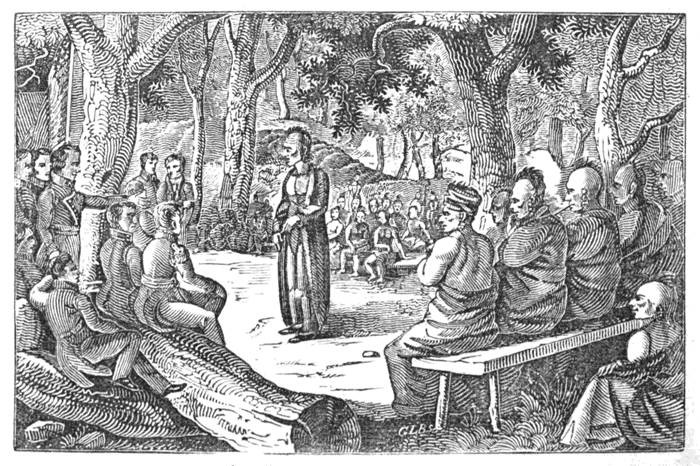
North American Indians in Council.
CLASSIFICATION OF THE INDIANS.
In respect to the general resemblance of the Indians, an able writer of a recent date, treating of this question, says,—“The testimony of all travellers goes to prove that the native Americans are possessed of certain physical characteristics which serve to identify them in places the most remote, while they assimilate not less in their moral character. There are also, in their multitudinous languages, some traces of a common origin; and it may be assumed as a fact, that no other race of men maintains so striking an analogy through all its subdivisions, and amidst all its varieties of physical circumstances,—while, at the same time, it is distinguished from all the other races by external peculiarities of form, but still more by the internal qualities of mind and intellect.”
M. Bory de St. Vincent attempted to show that the American race includes four species besides the Esquimaux; but he appears to have failed in establishing his theory.
Dr. Morton has paid great attention to the subject. He conducted his investigations by comparisons of the skulls of a vast number of different tribes, the results of which he has given to the public in his “Crania Americana.” He considers the most natural division to be into the Toltecan and American; the former being half-civilized, and including the Peruvians and Mexicans; the latter embracing all the barbarous nations except the Esquimaux, whom he regards as of Mongolian origin.
He divides each of these into subordinate groups, those of the American class being called the Appalachian, Brazilian, Patagonian, and Fuegian.
The Appalachian includes all those of North America except the Mexicans, together with those of South America north of the Amazon and east of the Andes. They are described thus. “The head is rounded, the nose large, salient, and aquiline, the eyes dark-brown, with little or no obliquity of position, the mouth large and straight, the teeth nearly vertical, and the whole face triangular. The neck is long, the chest broad, but rarely deep, the body and limbs muscular, seldom disposed to fatness.” In character, they “are warlike cruel, and unforgiving,” averse to the restraints of civilized life, and “have made but little progress in mental culture or the mechanic arts.”
Of the Brazilian it is said, that they are spread over a great part of South America east of the Andes, including the whole of Brazil and Paraguay between the River Amazon and 35 degrees of south latitude. In physical characteristics, they resemble the Appalachian; their nose is larger and more expanded, their mouth and lips also large. Their eyes are small, more or less oblique, and farther apart, the neck short and thick, body and limbs stout and full, to clumsiness. In mental character, it is said, that none of the American race are less susceptible of civilization, and what they are taught by compulsion seldom exceeds the humblest elements of knowledge.
The Patagonian branch comprises the nations south of the River La Plata to the Straits of Magellan, and also the mountain tribes of Chili. They are chiefly distinguished by their tall stature, handsome forms, and unconquerable courage.
The Fuegians, who call themselves Yacannacunnee, rove over the sterile wastes of Terra del Fuego. Their numbers are computed by Forster to be only about 2,000. Their physical aspect is most repulsive. They are of low stature, with large heads, broad faces, and small eyes, full chests, clumsy bodies, large knees, and ill-shaped legs. Their hair is lank, black, and coarse, and their complexion a decided brown, like that of the more northern tribes. They have a vacant expression of face, and are most stupid and slow in their mental operations, destitute of curiosity, and caring for little that does not minister to their present wants.
Long, black hair, indeed, is common to all the American tribes. Their real color is not copper, but brown, most resembling cinnamon. Dr. Morton and Dr. McCulloh agree, that no epithet is so proper as the brown race.
The diversity of complexion cannot be accounted for mainly by climate; for many near the equator are not darker than those in the mountainous parts of temperate regions. The Puelches, and other Magellanic tribes beyond 35 degrees south latitude, are darker than others many degrees nearer the equator; the Botecudos, but a little distance from the tropics, are nearly white; the Guayacas, under the line, are fair, while the Charruas, at 50 degrees south latitude, are almost black, and the Californians, at 25 degrees north latitude, are almost white.
The color seems also not to depend on local situation, and in the same individual the covered parts are not fairer than those exposed to the heat and moisture. Where the differences are slight, the cause may possibly be found in partial emigrations from other countries. The characteristic brown tint is said to be occasioned by a pigment beneath the lower skin, peculiar to them with the African family, but wanting in the European.
Another division of the American race has been suggested, into three great classes, according to the pursuits on which they depend for subsistence, namely, hunting, fishing, and agriculture. The American race are further said to be intellectually inferior to the Caucasian and Mongolian races. They seem incapable of a continued process of reasoning on abstract subjects. They seize easily and eagerly on simple truths, but reject those which require analysis or investigation. Their inventive faculties are small, and they generally have but little taste for the arts and sciences. A most remarkable defect is the difficulty they have of comprehending the relations of numbers. Mr. Schoolcraft assured Dr. Morton, that this was the cause of most of the misunderstandings in respect to treaties between the English and the native tribes.
The Toltecan family are considered as embracing all the semi-civilized nations of Mexico, Peru, and Bogota, reaching from the Rio Gila, in 33 degrees of north latitude, along the western shore of the continent, to the frontiers of Chili, and on the eastern coast along the Gulf of Mexico. In South America, however, they chiefly occupied a narrow strip of land between the Andes and the Pacific Ocean. The Bogotese in New Grenada were, in civilization, between the Peruvians and the Mexicans. The Toltecans were not the sole possessors of these regions, but the dominant race, while the American race composed the mass of the people.
The great difference between the Toltecan and the American races consisted in the intellectual faculties, as shown in their arts and sciences, architectural remains, pyramids, temples, grottos, bass-reliefs, and arabesques; their roads, aqueducts, fortifications, and mining operations.
With respect to the American languages, there is said to exist a remarkable similarity among them. From Cape Horn to the Arctic Sea, all the nations have languages which possess a distinctive character, but still apparently differing from all those of the Old World. This resemblance, too, is said not to be of an indefinite kind. It generally consists in the peculiar modes of conjugating the verbs by inserting syllables. Vater, a distinguished German writer on this subject, says, that this wonderful uniformity favors, in a singular manner, the supposition of a primitive people which formed the common stock of the American indigenous nations. According to M. Balbi, there are more than 438 different languages, embracing upwards of 2,000 dialects. He estimates the Indians of the brown race at 10,000,000, and the races produced by the intermixture of the pure races at 7,000,000.
We have thus given a general classification of the great American family, and the main points respecting the question of their origin. We must confess our inability wholly to lift the veil of obscurity in which their early history is involved, or answer, conclusively, the inquiry, whence they came, or when America was first peopled. We can only offer what we have already stated as the most plausible theory, that, ages ago, a great nation of Asia passed, at different times, by way of Behring’s Straits, into the American Continent, and in the course of centuries spread themselves over its surface. Here we suppose them to have become divided by the slow influences of climate, and other circumstances, into the several varieties which they display.

THE ABORIGINES OF THE WEST INDIES.
The authentic history of this remarkable and peculiar race of men opens with the morning of the 12th of October, 1492. Columbus, the discoverer of the New World, at that memorable date, landed upon the American soil, and, as if his first action was to be a type of the consequences about to follow in respect to the wondering natives who beheld him and his companions, he landed with a drawn sword in his hand. If the philanthropic spirit of the great discoverer could have shaped events, the fate of the aborigines of the new continent had been widely different; but who, that reads their history, can fail to see that the Christians of the Eastern Hemisphere have brought but the sword to the American race?
Nor were the first actions of the natives, upon beholding this advent of beings that seemed to them of heavenly birth, hardly less significant of their character and doom. They were at first filled with wonder and awe, and then, in conformity with their confiding nature, came forward and timidly welcomed the strangers. The following is Irving’s picturesque description of the scene.
“The natives of the island, when at the dawn of day they had beheld the ships hovering on the coast, had supposed them some monsters, which had issued from the deep during the night. When they beheld the boats approach the shore, and a number of strange beings, clad in glittering steel, or raiment of various colors, landing upon the beach, they fled in affright to the woods.
“Finding, however, that there was no attempt to pursue or molest them, they gradually recovered from their terror, and approached the Spaniards with great awe, frequently prostrating themselves, and making signs of adoration. During the ceremony of taking possession, they remained gazing, in timid admiration, at the complexion, the beards, the shining armor, and splendid dress of the Spaniards.
“The admiral particularly attracted their attention, from his commanding height, his air of authority, his scarlet dress, and the deference paid him by his companions; all which pointed him out to be the commander.
“When they had still further recovered from their fears, they approached the Spaniards, touched their beards, and examined their hands and faces, admiring their whiteness. Columbus was pleased with their simplicity, their gentleness, and the confidence they reposed in beings who must have appeared so strange and formidable, and he submitted to their scrutiny with perfect acquiescence.
“The wondering savages were won by this benignity. They now supposed that the ships had sailed out of the crystal firmament which bounded their horizon, or that they had descended from above on their ample wings, and that these marvellous beings were inhabitants of the skies.
“The natives of the island were no less objects of curiosity to the Spaniards, differing, as they did, from any race of men they had seen. They were entirely naked, and painted with a variety of colors and devices, so as to give them a wild and fantastic appearance. Their natural complexion was of a tawny or copper hue, and they had no beards. Their hair was straight and coarse; their features, though disfigured by paint, were agreeable; they had lofty foreheads, and remarkably fine eyes.
“They were of moderate stature, and well shaped. They appeared to be a simple and artless people, and of gentle and friendly dispositions. Their only arms were lances, hardened at the end by fire, or pointed with a flint or the bone of a fish. There was no iron among them, nor did they know its properties; for, when a drawn sword was presented to them, they unguardedly took it by the edge.
“Columbus distributed among them colored caps, glass beads, hawk’s bells, and other trifles, which they received as inestimable gifts, and, decorating themselves with them, were wonderfully delighted with their finery. In return, they brought cakes of a kind of bread called cassava, made from the yuca root, which constituted a principal part of their food.”
Thus kindly began the intercourse between the Old World and the New; but the demon of avarice soon disturbed their peace. The Spaniards perceived small ornaments of gold in the noses of some of the natives. On being asked where this precious metal was procured, they answered by signs, pointing to the south, and Columbus understood them to say, that a king resided in that quarter, of such wealth that he was served in great vessels of gold.
Columbus took seven of the Indians with him, to serve as interpreters and guides, and set sail to find the country of gold. He cruised among the beautiful islands, and stopped at three of them. These were green, fertile, and abounding with species and odoriferous trees. The inhabitants everywhere appeared the same,—simple, harmless, and happy, and totally unacquainted with civilized man.
Columbus was disappointed in his hopes of finding gold or spices in these islands; but the natives continued to point to the south, and then spoke of an island in that direction called Cuba, which the Spaniards understood them to say abounded in gold, pearls, and spices. People often believe what they earnestly wish; and Columbus sailed in search of Cuba, fully confident that he should find the land of riches. He arrived in sight of it on the 28th of October, 1492.
Here he found a most lovely country, and the houses of the Indians, neatly built of the branches of palm-trees, in the shape of pavilions, were scattered under the trees, like tents in a camp. But hearing of a province in the centre of the island, where, as he understood the Indians to say, a great prince ruled, Columbus determined to send a present to him, and one of his letters of recommendation from the king and queen of Spain.
For this purpose he chose two Spaniards, one of whom was a converted Jew, and knew Hebrew, Chaldaic, and Arabic. Columbus thought the prince must understand one or the other of these languages. Two Indians were sent with them as guides. They were furnished with strings of beads, and various trinkets, for their travelling expenses; and they were enjoined to ascertain the situation of the provinces and rivers of Asia,—for Columbus thought the West Indies were a part of the Eastern Continent.
The Jew found his Hebrew, Chaldaic, and Arabic of no avail, and the Indian interpreter was obliged to be the orator. He made a regular speech after the Indian manner, extolling the power, wealth, and generosity of the white men. When he had finished, the Indians crowded round the Spaniards, touched and examined their skin and raiment, and kissed their hands and feet in token of adoration. But they had no gold to give them.
It was here that tobacco was first discovered. When the envoys were on their return, they saw several of the natives going about with firebrands in their hands, and certain dried herbs which they rolled up in a leaf, and, lighting one end, put the other into their mouths, and continued inhaling and puffing out the smoke. A roll of this kind they called tobacco. The Spaniards were struck with astonishment at this smoking.
When Columbus became convinced that there was no gold of consequence to be found in Cuba, he sailed in quest of some richer lands, and soon discovered the island of Hispaniola, or Hayti. It was a beautiful island. The high mountains swept down into luxuriant plains and green savannas, while the appearance of cultivated fields, with the numerous fires at night, and the volumes of smoke which rose in various parts by day, all showed it to be populous. Columbus immediately stood in towards the land, to the great consternation of his Indian guides, who assured him by signs that the inhabitants had but one eye, and were fierce and cruel cannibals.
Columbus entered a harbour at the western end of the island of Hayti, on the evening of the 6th of December. He gave to the harbour the name of St. Nicholas, which it bears to this day. The inhabitants were frightened at the approach of the ships, and they all fled to the mountains. It was some time before any of the natives could be found. At last three sailors succeeded in overtaking a young and beautiful female, whom they carried to the ships.
She was treated with the greatest kindness, and dismissed finely clothed, and loaded with presents of beads, hawk’s bells, and other pretty bawbles. Columbus hoped by this conduct to conciliate the Indians; and he succeeded. The next day, when the Spaniards landed, the natives permitted them to enter their houses, and set before them bread, fish, roots, and fruits of various kinds, in the most kind and hospitable manner.
Columbus sailed along the coast, continuing his intercourse with the natives, some of whom had ornaments of gold, which they readily exchanged for the merest trifle of European manufacture. These poor, simple people little thought that to obtain gold these Christians would destroy all the Indians in the islands. No,—they believed the Spaniards were more than mortal, and that the country from which they came must exist somewhere in the skies.
The generous and kind feelings of the natives were shown to great advantage when Columbus was distressed by the loss of his ship. He was sailing to visit a grand cacique or chieftain named Guacanagari, who resided on the coast to the eastward, when his ship ran aground, and, the breakers beating against her, she was entirely wrecked. He immediately sent messengers to inform Guacanagari of this misfortune.
When the cacique heard of the distress of his guest, he was so much afflicted as to shed tears; and never in any civilized country were the vaunted rites of hospitality more scrupulously observed than by this uncultivated savage. He assembled his people and sent off all his canoes to the assistance of Columbus, assuring him, at the same time, that every thing he possessed was at his service. The effects were landed from the wreck and deposited near the dwelling of the cacique, and a guard set over them, until houses could be prepared, in which they could be stored.
There seemed, however, no disposition among the natives to take advantage of the misfortune of the strangers, or to plunder the treasures thus cast upon their shores, though they must have been inestimable in their eyes. On the contrary, they manifested as deep a concern at the disaster of the Spaniards as if it had happened to themselves, and their only study was, how they could administer relief and consolation.
Columbus was greatly affected by this unexpected goodness. “These people,” said he in his journal, “love their neighbours as themselves; their discourse is ever sweet and gentle, and accompanied by a smile. There is not in the world a better nation or a better land.”
When the cacique first met Columbus, the latter appeared dejected; and the good Indian, much moved, again offered Columbus every thing he possessed that could be of service to him. He invited him on shore, where a banquet was prepared for his entertainment, consisting of various kinds of fish and fruit. After the feast, Columbus was conducted to the beautiful groves which surrounded the dwelling of the cacique, where upwards of a thousand of the natives were assembled, all perfectly naked, who performed several of their national games and dances.
Thus did this generous Indian try, by every means in his power, to cheer the melancholy of his guest, showing a warmth of sympathy, a delicacy of attention, and an innate dignity and refinement, which could not have been expected from one in his savage state. He was treated with great deference by his subjects, and conducted himself towards them with a gracious and prince-like majesty.
Three houses were given to the shipwrecked crew for their residence. Here, living on shore, and mingling freely with the natives, they became fascinated by their easy and idle mode of life. They were governed by the caciques with an absolute, but patriarchal and easy rule, and existed in that state of primitive and savage simplicity which some philosophers have fondly pictured as the most enviable on earth.
The following is the opinion of old Peter Martyr: “It is certain that the land among these people (the Indians) is as common as the sun and water, and that ‘mine and thine,’ the seeds of all mischief, have no place with them. They are content with so little, that, in so large a country, they have rather superfluity than scarceness; so that they seem to live in a golden world, without toil, in open gardens, neither intrenched nor shut up by walls or hedges. They deal truly with one another, without laws, or books, or judges.”
In fact, these Indians seemed to be perfectly contented; their few fields, cultivated almost without labor, furnished roots and vegetables; their groves were laden with delicious fruit; and the coast and rivers abounded with fish. Softened by the indulgence of nature, a great part of the day was passed by them in indolent repose. In the evening they danced in their fragrant groves to their national songs, or the rude sound of their silver drums.
Such was the character of the natives of many of the West India islands, when first discovered. Simple and ignorant they were, and indolent also, but then they were kind-hearted, generous, and happy. And their sense of justice, and of the obligations of man to do right, are beautifully set forth in the following story.
It was a custom with Columbus to erect crosses in all remarkable places, to denote the discovery of the country, and its subjugation to the Catholic faith. He once performed this ceremony on the banks of a river in Cuba. It was on a Sunday morning. The cacique attended, and also a favorite of his, a venerable Indian, fourscore years of age.
While mass was performed in a stately grove, the natives looked on with awe and reverence. When it was ended, the old man made a speech to Columbus in the Indian manner. “I am told,” said he, “that thou hast lately come to these lands with a mighty force, and hast subdued many countries, spreading great fear among the people; but be not vainglorious.
“According to our belief, the souls of men have two journeys to perform, after they have departed from the body: one to a place dismal, foul, and covered with darkness, prepared for such men as have been unjust and cruel to their fellow-men; the other full of delight, for such as have promoted peace on earth. If, then, thou art mortal, and dost expect to die, beware that thou hurt no man wrongfully, neither do harm to those who have done no harm to thee.”
When this speech was explained to Columbus by his interpreter, he was greatly moved, and rejoiced to hear this doctrine of the future state of the soul, having supposed that no belief of the kind existed among the inhabitants of these countries. He assured the old man that he had been sent by his sovereigns, to teach them the true religion, to protect them from harm, and to subdue their enemies, the Caribs.
Alas for the simple Indians who believed such professions! Columbus, no doubt, was sincere; but the adventurers who accompanied him, and the tyrants who followed him, cared only for riches for themselves. They ground down the poor, harmless red men beneath a harsh system of labor, obliging them to furnish, month by month, so much gold. This gold was found in fine grains, and it was a severe task to search the mountain-pebbles and the sands of the plains for the shining dust.
Then the islands, after they were seized upon by the Christians, were parcelled out among the leaders, and the Indians were compelled to be their slaves. No wonder deep despair fell upon the natives. Weak and indolent by nature, and brought up in the untasked idleness of their soft climate and their fruitful groves, death itself seemed preferable to a life of toil and anxiety.
The pleasant life of the island was at an end: the dream in the shade by day; the slumber during the noontide heat by the fountain, or under the spreading palm; and the song, and the dance, and the game in the mellow evening, when summoned to their simple amusements by the rude Indian drum. They spoke of the times that were past, before the white men had introduced sorrow, and slavery, and weary labor among them; and their songs were mournful, and their dances slow.
They had flattered themselves, for a time, that the visit of the strangers would be but temporary, and that, spreading their ample sails, their ships would waft them back to their home in the sky. In their simplicity, they had frequently inquired of the Spaniards when they intended to return to Turey, or the heavens. But when all such hope was at an end, they became desperate, and resorted to a forlorn and terrible alternative.
They knew the Spaniards depended chiefly on the supplies raised in the islands for a subsistence; and these poor Indians endeavoured to produce a famine. For this purpose they destroyed their fields of maize, stripped the trees of their fruit, pulled up the yuca and other roots, and then fled to the mountains.
The Spaniards were reduced to much distress, but were partially relieved by supplies from Spain. To revenge themselves on the Indians, they pursued them to their mountain retreats, hunted them from one dreary fastness to another, like wild beasts, until thousands perished in dens and caverns, of famine and sickness, and the survivors, yielding themselves up in despair, submitted to the yoke of slavery. But they did not long bear the burden of life under their civilized masters. In 1504, only twelve years after the discovery of Hayti, when Columbus visited it, (under the administration of Ovando,) he thus wrote to his sovereigns: “Since I left the island, six parts out of seven of the natives are dead, all through ill-treatment and inhumanity; some by the sword, others by blows and cruel usage, or by hunger.”
No wonder these oppressed Indians considered the Christians the incarnation of all evil. Their feelings were often expressed in a manner that must have touched the heart of a real Christian, if there was such a one among their oppressors.
When Velasquez set out to conquer Cuba, he had only three hundred men; and these were thought sufficient to subdue an island above seven hundred miles in length, and filled with inhabitants. From this circumstance we may understand how naturally mild and unwarlike was the character of the Indians. Indeed, they offered no opposition to the Spaniards, except in one district. Hatuey, a cacique who had fled from Hayti, had taken possession of the eastern extremity of Cuba. He stood upon the defensive, and endeavoured to drive the Spaniards back to their ships. He was soon defeated and taken prisoner.
Velasquez considered him as a slave who had taken arms against his master, and condemned him to the flames. When Hatuey was tied to the stake, a friar came forward, and told him that if he would embrace the Christian faith, he should be immediately, on his death, admitted into heaven.
“Are there any Spaniards,” says Hatuey, after some pause, “in that region of bliss you describe?”
“Yes,” replied the monk, “but only such as are worthy and good.”
“The best of them,” returned the indignant Indian, “have neither worth nor goodness; I will not go to a place where I may meet with one of that cruel race.”
THE CARIBS.
Columbus discovered the islands of the Caribs or Charibs, now called the Caribbees, during his second voyage to America, in 1493. The first island he saw he named Dominica, because he discovered it on Sunday. As the ships gently moved onward, other islands rose to sight, one after another, covered with forests, and enlivened with flocks of parrots and other tropical birds, while the whole air was sweetened by the fragrance of the breezes which passed over them.
This beautiful cluster of islands is called the Antilles. They extend from the eastern end of Porto Rico to the coast of Paria on the southern continent, forming a kind of barrier between the main ocean and the Caribbean Sea. Here was the country of the Caribs.
Columbus had heard of the Caribs during his stay at Hayti and Cuba, at the time of his first voyage. The timid and indolent race of Indians in those pleasant islands were afraid of the Caribs, and had repeatedly besought Columbus to assist them in overcoming these their ferocious enemies. The Caribs were represented as terrible warriors, and cruel cannibals, who roasted and ate their captives. This the gentle Haytians thought, truly enough, was a good pretext for warning the Christians against such foes. Columbus did not at first imagine that the beautiful paradise he saw, as he sailed onward among these green and spicy islands, could be the residence of cruel men; but on landing at Guadaloupe, he soon became convinced he was truly in a Golgotha, a place of skulls. He there saw human limbs hanging in the houses, as if curing for provisions, and some even roasting at the fire for food. He knew then that he was in the country of the Caribs.
On touching at the island of Montserrat, Columbus was informed that the Caribs had eaten up all the inhabitants. If that had been true, it seems strange how he obtained his information.
It is probable many of these stories were exaggerations. The Caribs were a warlike people, in many respects essentially differing in character from the natives of the other West India islands. They were enterprising as well as ferocious, and frequently made roving expeditions in their canoes to the distance of one hundred and fifty leagues, invading the islands, ravaging the villages, making slaves of the youngest and handsomest females, and carrying off the men to be killed and eaten.
These things were bad enough, and it is not strange report should make them more terrible than the reality. The Caribs also gave the Spaniards more trouble than did the effeminate natives of the other islands. They fought their invaders desperately. In some cases the women showed as much bravery as the men. At Santa Cruz the females plied their bows with such vigor, that one of them sent an arrow through a Spanish buckler, and wounded the soldier who bore it.
There have been many speculations respecting the origin of the Caribs. That they were a different race from the inhabitants of the other islands is generally acknowledged. They also differed from the Indians of Mexico and Peru; though some writers think they were culprits banished either from the continent or the large islands, and thus a difference of situation might have produced a difference of manners. Others think they were descended from some civilized people of Europe or Africa, and imagine that there is no difficulty attending the belief, that a Carthaginian or Phœnician vessel might have been overtaken by a storm, and blown about by the gales, till it entered the current of the trade-winds, when it would have been easily carried to the West Indies.
The Caribs possessed as many of the arts as were necessary to live at ease in that luxurious climate. Some of these have excited the admiration of Europeans.[1] In their subsequent intercourse with the Europeans, they have, in some instances, proved faithless and treacherous. In 1708, the English entered into an agreement with the Caribs in St. Vincent to attack the French colonies in Martinico. The French governor heard of the treaty, and sent Major Coullet, who was a great favorite with the savages, to persuade them to break the treaty. Coullet took with him a number of officers and servants, and a good store of provisions and liquors. He reached St. Vincent, gave a grand entertainment to the principal Caribs, and, after circulating the brandy freely, he got himself painted red, and made them a flaming speech. He urged them to break their connection with the English. How could they refuse a man who gave them brandy, and who was red as themselves? They abandoned their English friends, and burned all the timber the English had cut on the island, and butchered the first Englishmen who arrived. But their crimes were no worse than those of their Christian advisers, who, on both sides, were inciting these savages to war.
But the Caribs are all gone, perished from the earth. Their race is no more, and their name is only a remembrance. The English and the French, chiefly the latter, have destroyed them. There is, however, one pleasant reflection attending their fate. Though destroyed, they were never enslaved. None of their conquerors could compel them to labor. Even those who have attempted to hire Caribs for servants have found it impossible to derive any benefit or profit from them; they would not be commanded or reprimanded.
This independence was called pride, indolence, and stubbornness, by their conquerors. If the Caribs had had historians to record their wrongs, and their resistance to an overwhelming tyranny, they would have set the matter in a very different light. They would have expressed the sentiment which the conduct of their countrymen so steadily exemplified,—that it was better to die free than to live slaves.
So determined was their resistance to all kinds of authority, that it became a proverb among the Europeans, that to show displeasure to a Carib was the same as beating him, and to beat him was the same as to kill him. If they did any thing, it was only what they chose, how they chose, and when they chose; and when they were most wanted, it often happened that they would not do what was required, nor any thing else.
The French missionaries made many attempts to convert the Caribs to Christianity, but without success. It is true that some were apparently converted; they learned the catechism and prayers, and were baptized; but they always returned to their old habits.
A man of family and fortune, named Chateau Dubois, settled in Guadaloupe, and devoted a great part of his life to the conversion of the Caribs, particularly those of Dominica. He constantly entertained a number of them, and taught them himself. He died in the exercise of these pious and charitable offices, without the consolation of having made one single convert.
As we have said, several had been baptized, and, as he hoped, they were well instructed, and apparently well grounded in the Christian religion; but after they returned to their own people, they soon resumed all the Indian customs, and their natural indifference to all religion.
Some years after the death of Dubois, one of these Carib apostates was at Martinico. He spoke French correctly, could read and write, had been baptized, and was then upwards of fifty years old. When reminded of the truths he had been taught, and reproached for his apostasy, he replied, “that if he had been born of Christian parents, or if he had continued to live among the French, he would still have professed Christianity; but that, having returned to his own country and his own people, he could not resolve to live in a manner differing from their way of life, and by so doing expose himself to the hatred and contempt of his relations.” Alas! it is small matter of wonder that the Carib thought the Christian religion was only a profession. Had those who bore that name always been Christians in reality, and treated the poor ignorant savages with the justice, truth, and mercy which the gospel enjoins, what a different tale the settlement of the New World would have furnished!
The Caribs, who spread themselves over the main land contiguous to their islands, were similar in characteristics to those of the West Indies, of whom they are supposed to have been the original stock. They formed an alliance with the English under Sir Walter Raleigh, in one of his romantic expeditions on that coast, in 1595, and for a long time preserved the English colors which were presented to them on that occasion. The Caribs of the continent are said to have been divided into the Maritimos and the Mediterraneos. The former lived in plains, and upon the coast of the Atlantic, and are said to have been the most hostile of any of the Indians who infest the settlements of the missions of the River Orinoco, and have been sometimes called the Galibis. The Mediterraneos inhabited the south side of the source of the River Caroni, and are described as of a more pacific nature, and began to receive the Jesuit missionaries and embrace the Christian faith in 1738.

[1] For an account of these, see “Manners and Customs of the Indians” in “The Cabinet Library.”
EARLY MEXICAN HISTORY.
According to the annals preserved by the Mexicans, the country embraced in the vale of Mexico was formerly called Anahuac. The rest of the territory contained the kingdoms of Mexico, Acolhuacan, Tlacopan, Michuacan, and the republics of Tlaxcallan or Tlascala, Cholollan, and Huexotzinco. The people who settled the country came from the north. The first inhabitants were called Toltecs or Toltecas, who came from a distant country at the northwest in the year 472. They migrated slowly, cultivating and settling as they proceeded, so that it was 104 years before they reached a place fifty miles east of the situation where Mexico was afterwards built; there they remained for twenty years, and built a city called Tollantzinco. Thence they removed forty miles to the westward, and built another city called Tollan or Tula.
When they first commenced their migration, they had a number of chiefs, who, by the time they reached Tollantzinco, were reduced to seven. This form of government was afterwards changed to a monarchy; why, we know not, but probably some one of the chiefs was more valiant or cunning than his associates, and supplanted them. This monarchy began A. D. 607, and lasted 384 years, in which time they are said to have had only eight princes. This fact, however, is accounted for by the custom which prevailed, of keeping up the name of each king for fifty-two years.
They remained prosperous for 400 years, when a famine succeeded, occasioned by a severe drought, which was followed by a pestilence that destroyed many of them. Tradition says, that a demon appeared once at a festival ball, and with giant arms embraced the people, and suffocated them; that he appeared again as a child with a putrid head, and brought the plague; and that, by his persuasion, they abandoned Tula, and scattered themselves among various nations, by whom they were well received.
A hundred years afterwards, succeeded a more barbarous people from Amaquemecan. Who or what they were is not known, as there is no trace of them among the American nations; nor is there any reason given why they left their own country. They are said to have been eight months on their way, led by a son of their monarch, called Xolotl, who sent his son to survey the country, which he took possession of by shooting four arrows to the four winds. He chose for his capital Tenayuca, six miles north of the site of Mexico; in which direction most of the people settled. It is asserted that their numbers amounted to 1,000,000; as ascertained by twelve piles of stones which were thrown up at a review of the people; but this is probably an exaggeration.
This barbarous people formed alliances with the relics of the Toltecan race, and their prince, Nopaltzin, married a descendant of the Toltecan royal family. The effect of these intermarriages on them was a happy one, as they were civilized by the Toltecas, who were much their superiors in a knowledge of the arts. Heretofore they had subsisted only on roots and fruits, and by hunting; sucking the blood of the animals they killed, and taking their skins for clothing; but now they began to dig up and sow the ground, to work metals, and attempt other useful arts. About eighteen years after their arrival, six persons made their appearance as an embassy from a people living near Amaquemecan; a place was assigned them, and in a few years three princes came with a large army of Acolhuans, who received three princesses in marriage. The two nations gradually coalesced in one, and took the name of the new comers; the name Chechemecas being left to the ruder and more barbarous tribes who lived by hunting and on roots. These latter joined the Otomies, a barbarous people who lived farther north, in the mountains.
Xolotl divided his dominions into three states, namely, Azcapozalco, eighteen miles west of Tezcuco, Xaltocan, and Coatlichan, which he conferred, in fief, on his three sons-in-law. As was natural, various civil wars afterwards occurred during the reigns of the sovereigns who succeeded Xolotl. Nopaltzin reigned thirty-two years, and is said to have died at the advanced age of ninety-two. After him came Tlotzin, who reigned thirty-six years, and was a good prince. He was succeeded by Quinatzin, a luxurious tyrant, who, on the removal of his court from Tenayuca to Tezcuco, caused himself to be borne thither in a litter by four lords, while a fifth held an umbrella over him to keep off the sun; he is said to have reigned sixty years. In his reign, there were many rebellions, and on his death he was succeeded by a prince named Techotlala.
In the year 1160, the Mexicans, Aztecas, or Aztecs made their appearance. They are said to have come from the region north of the Gulf of California, and were induced to migrate from the country where they lived by the persuasion of Huitziton, a man of great influence among them. He is said to have observed a little singing-bird, whose notes sounded like Tihui, which in their language meant, Let us go. He led another person, also a man of influence, to observe this, and they persuaded the people to obey the suggestion, as they said, of the secret divinity. This was no difficult matter in a partially civilized and superstitious community. They proceeded, as their tradition relates, to the River Gila, where they stopped for a time, and where, it is affirmed, remains have been found at a somewhat recent date.
They then removed to a place about 250 miles from Chihuahua, toward the north-northwest, now called in Spanish Casas Grandes, on account of a large building found there, on the plan of those in New Mexico, having three floors with a terrace above them, the door for entrance opening on the second floor, to which the ascent was by a ladder. Other remains, also, of a fortress, and various utensils, have been found there. From this spot they proceeded southward, crossed the mountains, and stopped at Culiacan, a place on the Gulf of California in Lat. 24° N. Here they made a wooden image, called Huitzilopochtli, which they carried on a chair of reeds, and appointed priests for its service. When they left their country, on their migration, they consisted of seven different tribes; but here the Mexicans were left with their god by the others, called the Xochimilcas, Tepanecas, Chalchese, Colhuas, Tlahuicas, and Tlascalans, who proceeded onwards. The reason of this separation is not mentioned, except that it was at the command of the god, from which it may be conjectured that some quarrel had arisen with respect to his worship.
On their way to Tula, the Mexicans became divided into two factions; yet they kept together, for the sake of the god, while they built altars, and left their sick in different places. They remained in Tula nine years, and spent eleven more in the countries adjoining. In 1216, they reached Tzompanco, a city in the vale of Mexico, and were hospitably received by the lord of the district; his son, named Ilhuitcatl, married among them. From him have descended all the Mexican monarchs. The people continued to migrate along the Lake Tezcuco during the reign of Xolotl, but in the reign of Nopaltzin they were persecuted, and obliged, in 1245, to go to Chapoltepec, a mountain two miles from Mexico. They then took refuge in the small islands Acocolco, at the southern extremity of the Lake of Mexico. Here they lived miserably for 52 years, till the year 1314, when they were reduced to slavery by a petty king of Colhuacan, by whom they were treacherously entrapped and cruelly oppressed.
Some years after, on the occasion of a war between the Colhuas and the Xochimilcas, in which the latter were victorious, the Colhuas were obliged to release their slaves, who fought with great bravery, cutting off the ears of the enemies they had killed, which they produced on being reproached with cowardice. The effect of this was to excite such a detestation of them, that they were desired to leave the country. They did so, and went north till they came to a place called Acatzitzintlan, and afterwards Mexicaltzinco; but not liking this, they went on to Iztacalco, still nearer to the site of Mexico. Here they remained two years, and then went to a place on the lake, where they found the nopal growing on a stone, and over it the foot of an eagle; this was the place marked out by the oracle. Here they ended their wanderings, and erected an altar to their god; one of them went for a victim, and found a Colhuan, whom they killed, and offered as a sacrifice to the idol. Here, too, they built their rush huts, and formed a city, which was called Tenochtitlan, and afterwards Mexico, or the place of Mexitli, their god of war.
This was in 1325; the city was situated on a small island in the middle of a great lake, without ground sufficient for cultivation, or even to build upon. It was necessary, therefore, to enlarge it; and for this purpose they drove down piles and palisades, and with stones, turf, &c., thus united the other small islands to the larger one. To procure stone and wood, they exchanged fish and water-fowl with some other nations, and made, with incredible industry, floating gardens, on which they raised vegetable products. They here remained thirteen years at peace, but afterwards quarrels ensued, and the factions separated; one of them went to a small island a little northward, named Xaltilolco, afterwards Tlatelolco.
These divided their city into four parts, each quarter having its tutelar deity. In the midst of the city, Mexitli was worshipped with horrible rites, and the sacrifice of prisoners. Under pretence of consecrating her to be the mother of their god, they sought the presence of a Colhuan princess at their rites; and when the request was granted, they put her to death, flayed her body, and dressed one of their brave men in her skin. The father was invited to be present and officiate as the priest. All was darkness, till, on lighting the copal in his censer to begin the rites of worship, he saw the horrible spectacle of his immolated daughter.
In 1352, the Mexicans changed their aristocracy of twenty lords for a monarchy, and elected as their king Acamapitzin, who married a daughter of the lord of Coatlichan. The Tlatelolcos also chose a king, who was a son of the king of the Tepanecas. The king of the Tepanecas was persuaded by them to double the tributes of the Mexicans, and oppress them. They were commanded to transport to his capital, Azcapozalco, a great floating garden, producing every kind of vegetable known in Anahuac; when this was done, the next year, another garden was required, with a duck and a swan in it sitting on their eggs, ready to hatch on arriving at Azcapozalco; and then again, a garden was exacted from them having a live stag, which they were obliged to hunt in the mountains, among their enemies.
Acamapitzin, the king of Mexico, reigned thirty-seven years, and died in 1389, and, after an interregnum of four months, his son Huitzilihuitl succeeded him. He requested, for a wife, one of the daughters of the king of Azcapozalco, on which occasion the ambassadors are said to have made the following speech: “We beseech you, with the most profound respect, to take compassion on our master and your servant, Huitzilihuitl. He is without a wife, and we are without a queen. Vouchsafe, Sire, to part with one of your jewels or most precious feathers. Give us one of your daughters, who may come and reign over us in a country which belongs to you.” This request was granted.
It will be recollected that the Acolhuans were under the government of Techotlala, son of Quinatzin. After a thirty years’ peace, a revolt was begun by a prince called Tzompan, a descendant of one of the three original Acolhuan princes. The rebel was defeated and put to death. The Mexicans, in this war, were the allies of Techotlala, and showed great valor.
The son of the king of the Tepanecas, Maxtlaton, fearing that his sister’s son by the Mexican king might obtain the Tepanecan crown, began to oppress the Mexicans, and sent assassins to murder his nephew. The Mexicans, however, were too weak to resent this baseness.
The rival Mexicans and Tlatelolcos advanced together in wealth and power. Techotlala, the Acolhuan king, was succeeded by Ixtlilxochitl in 1406. The king of Azcapozalco, his vassal, sought to stir up rebellion, but he was defeated, and compelled to sue for peace. The same year in which this occurred, the Mexican king died, and his son, Chimalpopoca, was chosen his successor.
The king of the Acolhuans, mentioned above, was driven from his kingdom, and both he and one of his grandsons were cut off by the treachery of the Tepanecas. The rebels, led on by their king, Tezozomoc, poured in, and conquered Acolhuacan. Tezozomoc then gave Tezcuco to the Mexican king, Chimalpopoca, and other portions to the king of Tlatelolco, and proclaimed his own capital, Azcapozalco, the metropolis of all the kingdoms of Acolhuacan. He was a great tyrant, and was tormented with dreams, that the son of the murdered king of the Acolhuans, Nezahualcoyotl, transformed into an eagle, had eaten out his heart, or, in the shape of a lion, had sucked his blood. He enjoined it, therefore, on his sons, to put the prince, of whom he had dreamed, to death. He survived his dreams but a year, and died in 1422.
He was succeeded by his son Tajatzin, but the throne was at once usurped by another son, Maxtlaton, and Tajatzin took refuge with Chimalpopoca, who advised him to invite his brother to a feast, and murder him. This being overheard and told to Maxtlaton, he pretended not to believe it, but took the same means to get rid of Tajatzin. The king of Mexico declined the invitation, and escaped for a time; but his wife having been ravished by Maxtlaton, he resolved not to survive his dishonor, but to offer himself in sacrifice to his god, Huitzilopochtli. In the midst of the ceremonies, Maxtlaton burst in, took him, carried him off, and caged him like a criminal.
This success excited afresh in the mind of Maxtlaton the desire to get the Acolhuan prince, Nezahualcoyotl, into his power. He, discovering the designs of the tyrant, went boldly to him and told him he had heard that he wished his life also, and he had therefore come to offer it. Maxtlaton, struck by his conduct, assured him he had no designs against him, nor was it his purpose to put the king of Mexico to death. He then gave orders that he should be hospitably entertained, and even allowed him to visit Chimalpopoca in prison. The Mexican king, however, soon after, hanged himself with his girdle; and Nezahualcoyotl, suspecting the sincerity of Maxtlaton’s professions, left the court. After wandering about for some time, exposed to various dangers from his inveterate foe, he finally took refuge among the Cholulans, who agreed to assist him with an army for the purpose of overthrowing Maxtlaton, and restoring him to the throne, which had been usurped by the father of the tyrant.
On the death of their king, the Mexicans raised to the throne Itzcoatl, a son of their first monarch, Acamapitzin, a brave, prudent, and just prince. This choice was offensive to Maxtlaton,—but to Nezahualcoyotl, on the contrary, it afforded the highest satisfaction. The new monarch, immediately on his elevation to the throne, resolved to unite all his forces with this prince against the tyrant Maxtlaton. On a certain occasion, he sent an ambassador to Nezahualcoyotl, named Montezuma, who, with another nobleman, was taken captive on the way, and carried to Chalco. They were then sent to the Huexotzincas to be sacrificed. This people, however, spurned the barbarous proposal. Maxtlaton was then informed of their capture; but he commanded the lord of Chalco, whom he called a double-minded traitor, to set them both at liberty. Before this, however, they had escaped, by the connivance of the man to whom they had been intrusted, and returned to Mexico. Maxtlaton then made war against Mexico. Montezuma offered to challenge him, which he did by presenting to him certain defensive weapons, anointing his head, and fixing feathers on it. Maxtlaton, in turn, commissioned him in like manner to bear a challenge from himself to the king of Mexico. A terrible battle ensued; the tyrant was defeated, his city taken, and himself killed, being beaten to death while attempting to escape. His people, the Tepanecas, were entirely subdued.
The Mexican king now replaced the Acolhuan prince on the throne of his ancestors, and carried on his conquests by his general, Montezuma. On his death in 1436, he was succeeded by Montezuma the First. This monarch was the greatest that ever sat on the throne of Mexico. He engaged in a war with Chalco, the king of which city had taken three Mexican lords, and two sons of the king of Tezcuco, put them to death, salted and dried their bodies, and placed them in his hall as supporters to torches! Montezuma took the city, and executed vengeance on the barbarous people. He then reduced Tlatelolco, whose king had conspired against the late king of Mexico. He also subdued the Mixtecas, and thus enlarged his dominions.
In 1457, he sent an expedition against the Cotastese, and took 6,200 prisoners, whom he sacrificed to his god. He also took signal vengeance again on the Chalchese, who had rebelled, and had sought to make one of his brothers king in his stead. The brother pretended to comply; but mounting a scaffold which he ordered to be erected, and taking a bunch of flowers in his hand, then urging his attendant Mexicans to be faithful to their king, he threw himself from the scaffold. This enraged the Chalchese so much that they put the Mexicans to death, for which Montezuma made war against them till he had almost exterminated them. He finally, however, proclaimed a general amnesty. He constructed a dike, nine miles long and eleven cubits broad, to prevent the recurrence of an inundation which had happened, and which was followed by a famine. He died in 1464.
Montezuma the First was succeeded by Axayacatl, who pursued the conquests so successfully begun by the late king. A war broke out between the Mexicans and Tlatelolcos, which ended in the final subjection of the latter. Their king was killed, and carried to the Mexican monarch, who, with his own hand, cut open his breast, and tore out his heart. He also fought the Otomies, and gained a complete victory, making 11,060 prisoners, among whom were three chiefs. He died in 1477, and was succeeded by his oldest brother, Tizoc, who was probably cut off by poison. Tizoc was succeeded by another brother, named Ahuitzotl, who finished the great temple begun by his predecessor, and, having reserved the prisoners taken in his wars for this purpose, he sacrificed, at its dedication, as Torquemada asserts, 72,344; others say, 64,060. This was in the year 1486. He carried on his conquests even as far as Guatemala, 900 miles south of Mexico. He was only once defeated; this was in 1496, by Toltecatl, a Huexotzincan chief. He died in 1502, in consequence of striking his head against a door. Two years previous to his death there was an inundation, which was followed by a famine, proceeding, it is said, from the decay of the grain.
Ahuitzotl was succeeded by Montezuma the Second, a man of great bravery, and also a priest, but excessively haughty. His coronation was attended with the greatest display and pomp. He lived in exceeding splendor; lords were his servants, and no one was permitted to enter his palace without putting off his shoes and stockings. Even the meanest utensils of his service were of gold plate and sea-shell. His dinner was carried in by 300 or 400 of his young nobles, and he pointed with a rod to such dishes as he chose. He was served with water for washing by four of his most beautiful women. The vast expenses necessary to support such luxury displeased his subjects. He was, however, munificent in rewarding his generals, by which means he retained their services, and still further secured the soldiery by appointing a hospital for invalids. Unsuccessful for a time in a war with the Tlascalans, he finally took captive a brave Tlascalan general, named Tlahuicol, and put him into a cage. When, however, he gave him his liberty to return home, Tlahuicol wished to sacrifice himself, and perished in a gladiatorial combat, after having killed eight men, and wounded twenty more.
In his reign, the conquest of Mexico was effected by Cortés. Previous to the arrival of the Spaniards, a vague apprehension seems to have troubled the minds of Montezuma and his people, respecting the downfall of their empire, an event which was supposed likewise to be portended by a comet. But the history of this catastrophe must be reserved for another chapter.
MEXICO, FROM THE ARRIVAL OF CORTÉS.
Mexico was first discovered by Juan de Grijalva. He, however, seems to have made no attempt to penetrate into the interior from the sea-coast. In 1518, when its conquest was undertaken by Cortés, the Mexican empire is said to have extended 230 leagues from east to west, and 140 from north to south. After arranging his expedition, on the 10th of February, 1519, Cortés set sail from Havana, in Cuba, and landed at the island of Cozumel, on the coast of Yucatan. His whole army consisted of but 553 soldiers, 16 horsemen, and 110 mechanics, pilots, and mariners. Having released some Spanish captives whom he found there, he proceeded to Tabasco. Here he was attacked by the natives, but defeated them, and then pursued his course north-west to San Juan de Ulua, where he arrived on the 20th of April.
Hardly had the Spaniards cast anchor, when they saw two canoes, filled with Indians, put off from the shore, and steer directly for the general’s ship. Cortés received his visiters courteously, and, in exchange for the presents of fruit, flowers, and little ornaments of gold which they brought, gave them a few trinkets, of European fabric, with which they seemed to be greatly pleased. Through the medium of an interpreter, whom he chanced to have on board, a Mexican female slave, the celebrated Marina, he learned from the Indians that they belonged to a neighbouring province which was subject to the emperor of Mexico, a mighty monarch who lived far in the interior, called Montezuma; and that they had been sent to ascertain who the strangers were, and what they wanted. Cortés replied, that he had come only with the most friendly purposes, and expressed a desire for an interview with the governor of their province. Their inquiries being satisfied, his guests shortly afterwards took their leave, and returned to the shore.
The next morning, Cortés landed with all his troops and munitions of war, and immediately set to work, with the assistance of the natives, in erecting barracks. One can scarcely help being reminded, on reading the account of the readiness with which the simple Indians engaged in this object, of the fatal alacrity with which the Trojans are said to have received within their walls the wooden horse that was so soon to prove their ruin.
Once on shore, Cortés informed the governor, Teuhtlile, that he must go to the capital. He said that he came as the ambassador of a great monarch, and must see Montezuma himself. To this the governor replied, that he would send couriers to the capital, to convey his request to the emperor, and so soon as he had learned Montezuma’s will he would communicate it to him. He then ordered his attendants to bring forward some presents which he had prepared, the richness and splendor of which only confirmed Cortés in the determination to prosecute his schemes. In the mean while, some Mexican painters who accompanied the governor were employed in depicting the appearance of the Spaniards, their ships and horses; and Cortés, to render the intelligence to be thus conveyed to the emperor more striking, arrayed his horsemen, commanded his trumpets to sound, and the guns to be fired, by which display the Mexicans were deeply impressed with the idea of the greatness of the Spaniards.
Couriers, stationed in relays along the whole line of the distance, in a day or two informed Montezuma of these things, though it was 180 miles to the capital. The monarch, who, in the midst of his fears, seems to have summoned somewhat more resolution, commanded Cortés to leave his dominions. He likewise sent him more presents; fine cotton stuffs resembling silk, pictures, gold and silver plates representing the sun and moon, bracelets, and other costly things. Cortés, however, still persisted in his purpose; on hearing which, the Mexican ambassadors turned away with surprise and resentment, and all the natives deserted the camp of the Spaniards, nor came any more to trade with them. Cortés, already threatened with a mutiny among his soldiers, evidently felt his situation to be critical, but he nevertheless went on to found a city, and establish a government for his colony.
In this juncture of his affairs, he was visited by some people from Cempoalla and Chiahuitztla, two small cities or villages tributary to Montezuma. With the caciques of these places he formed a treaty of alliance, and agreed to protect them against Montezuma. Encouraged by his promises, they went so far as to insult the Mexican power, of which they had before stood in the greatest dread. Having secured their submission, Cortés, to take away all hope of a return to Cuba, and inspire his soldiers with a desperate courage, burned his fleet; and, leaving a garrison in his new city, called Vera Cruz, he set out for the capital of the Mexican empire with 400 infantry, 15 horsemen, and seven field-pieces, having also been furnished by the Cempoallans with 1300 warriors and 1000 tamanes, or men of burden, to carry the baggage.
On the route to Mexico lay the little republic of Tlascala, and between these two powers there had existed for a long period an inextinguishable feud. On arriving near the confines of the republic, therefore, Cortés sent forward an embassy of Cempoallans inviting the Tlascalans to an alliance, and requesting, that, at least, he might be allowed to pass through their territories. The senate was immediately convened to decide upon this application. Maxicatzin, one of the oldest of the senators, alluded to a tradition respecting the coming of white men, and favored the request. He was opposed by Xicotencatl, who sought to prove that the Spaniards were magicians, and asserted, as they had pulled down the images in Cempoalla, that the gods would be against them. They resolved therefore on war; seized the ambassadors, and placed them in confinement.
Their plans were well laid. They prepared an ambush, allowed Cortés to pass the frontier, and then, after a little skirmishing, suddenly fell upon him with an overwhelming force, which to the astonished view of the Spaniards appeared to number 100,000 men. Notwithstanding the immense odds opposed to them, the Spaniards bravely maintained their ground; and at length, after a desperate conflict, the Tlascalans, daunted by the horses and the fire-arms of the Spaniards, to which they were unaccustomed, and disheartened by the havoc they sustained in this to them novel species of warfare, retreated. Among the slain were eight of their principal chiefs. On the side of the Spaniards the loss was inconsiderable.
Thinking that this experience of the prowess of the Spaniards might have wrought a change in the disposition of the Tlascalans towards him, Cortés now determined to send an embassy to their camp with overtures of peace. The proposals were promptly rejected, and a message of defiance was returned from the Tlascalan general. The next day another battle followed, the odds being even greater than in the former engagement; but Spanish prowess, aided by dissensions in the Tlascalan camp, again proved victorious.
The Tlascalans, thus repulsed, were assured by their priests, that their enemies, being children of the sun, received strength from his beams by day, and therefore must be attacked in the night; and that, being withdrawn from his rays, their vigor declined, and they faded and became like other men. A renewed trial, however, proved the falsity of this assertion, and, after desperate efforts against the invading foe, the Tlascalans were compelled to sue for peace. A treaty of alliance was formed for mutual protection, and Cortés and his troops were received, as beings of a superior order, into the city of Tlascala.
After recruiting himself for twenty days at Tlascala, during which time Cortés sought to gain all the information he could respecting the condition of the Mexican empire, he prepared to resume his march. During his stay, the Tlascalans yielded readily to all his requests and commands, except the one by which they were required to dethrone their own gods, and substitute the objects of the Spaniards’ worship. Cortés, indignant at their refusal, was going to effect his object by force, had he not been restrained by the prudence of his chaplain, Olmedo, who represented to him the danger of such an attempt. The Tlascalans, therefore, were left to their own religious rites and objects of worship.
Cortés, accompanied by 6,000 of them, now directed his course towards Cholula. This place was only six leagues distant from Tlascala, was formerly an independent state, and had been but lately subjected to the Mexican empire. It was considered by all the people around as a peculiarly holy place, the sanctuary or principal seat of their gods, to which pilgrimages were made, and in whose temple even more human victims were sacrificed than in that of Mexico. Montezuma professed now to be willing to receive Cortés in his capital. He had, however, laid a deep plot for the extermination of his enemies. They were to be received into Cholula under the mask of friendship, and, when not expecting it, a vigorous onset was to be made on them from every quarter, while, by means of pits dug, and barricades erected, and large collections of stones on the tops of the temples, their retreat would be cut off, and their ruin completed. Cortés was forewarned of the treachery, and took decisive measures to defeat the project. He arrested some of their chief priests, and thus obtained a confession of the meditated crime, drew up his troops, seized the magistrates and chief citizens, and, on a preconcerted signal, both the Spaniards and Tlascalans poured upon the multitude, who were so amazed, that they were unable to offer any resistance. The streets were filled with blood and carnage. The temples were set on fire, and many of the priests and chiefs perished in the flames. More than 6,000 Cholulans are said to have fallen in the massacre, without the loss of a single Spaniard. The magistrates were then released, and commanded to recall the people, who had, in the mean time, fled in every direction. After so terrible a lesson, they dared not disobey the command of one who seemed to them of a character something more than human, and the city was soon filled again with those who yielded their service to the very men who had so mercilessly butchered their friends and relatives.
Cholula was but twenty leagues from Mexico, and Cortés, on his march, was everywhere hailed as a deliverer, who came to free the people from the oppression of the Mexican yoke. Complaints were made of Montezuma and his governors, and Cortés was encouraged in the belief of the ultimate success of his enterprise against so mighty a monarchy. Without entering into the details of his march, it is enough to say, that, on crossing the Sierra of Ahualco, the valley of Mexico lay outstretched below, and the city, the object of his schemes, with its temples, and walls, and palaces, was in full view before him.
While the Spanish adventurer became more bold as he proceeded, the Mexican monarch, on the other hand, seems to have grown more irresolute and timid. The rapid march of the new enemy, the success which had crowned his arms, his sagacity in detecting the plans for his defeat,—all these things, combined with the traditions to which allusion has been made, seem to have withheld Montezuma from that wise and valiant course which might have been expected from the descendant of a long line of brave men. Had Montezuma the First been in his place, as the adversary with whom Cortés was to contend, the result might have been different.
As the Spaniards approached Mexico, they were met by 1,000 persons of high rank adorned with plumes and clothed in fine cotton mantles. These saluted Cortés after the manner of their country, and announced the approach of Montezuma. Next came two hundred persons dressed alike, with large plumes, marching two and two, in deep silence, and barefooted, with their eyes fixed on the ground. Then came a company of still higher rank in their most costly and splendid attire, in the midst of whom was Montezuma, borne on the shoulders of four of his principal favorites, while others supported a canopy of curious workmanship above his head. Before him marched three officers, bearing rods of gold, which they lifted up on high at certain intervals, as a signal for the people to bow and hide their faces, as unworthy to look on so glorious a monarch. As he drew near, Cortés dismounted, and respectfully advanced to meet him. Montezuma likewise alighted, the ground being covered with cotton cloths, and, leaning on the arm of an attendant, proceeded at a slow pace. For the first time, the invader and the monarch stood face to face. They made their salutations, Cortés after the European fashion, and the Mexican by touching the earth with his hand, and kissing it. This condescension in so mighty a monarch only tended to confirm his people in their belief, that the Spaniards belonged to a superior race; and, as they passed along, these latter heard themselves often called Teules, or gods.
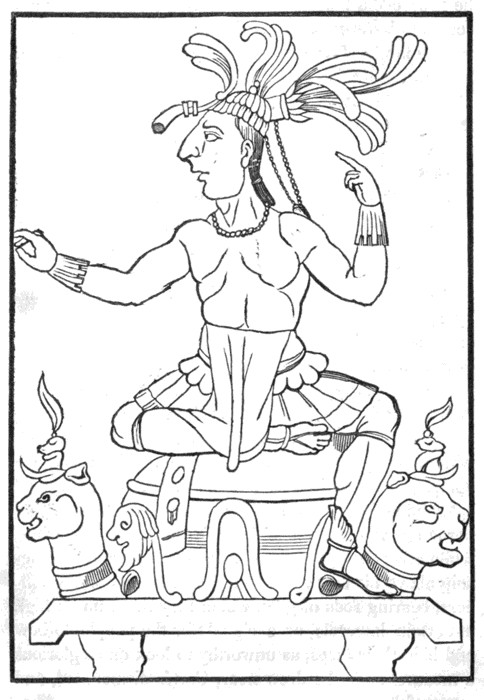
ANCIENT SCULPTURE, FROM PALENQUE.
This interview had no decisive results. Montezuma conducted Cortés to the quarters he had prepared for him, being a palace built by his father; he then left him, saying, “You are now with your brothers, in your own house; refresh yourself after your fatigue, and be happy till I return.” In the evening he returned, loaded with rich presents to all. Cortés was now informed that the Mexicans were convinced, from what they had seen and heard, that the Spaniards were the very persons predicted by the Mexican traditions, and therefore they were received, not as strangers, but as relations of the same blood and parentage. Montezuma also recognized him as entitled to command, and assured him that he and his subjects would be ready to comply with his will and to anticipate his wishes. This impression Cortés sought to confirm still more, while at the same time he treated him with the respect due to the dignity of the sovereign. He had also a public audience with the monarch, and then spent three days in viewing the city.
The city of Mexico was situated on a large plain surrounded by mountains, the moisture of which collected in several lakes. The two largest of these were sixty or seventy miles in circuit, and communicated with each other. Mexico was built, as has been before said, on some small islands in one of these lakes. The access to it was by causeways or dikes of stone and earth, forty feet broad. As the water overflowed the flat country, these causeways were somewhat long. That of Tacuba, on the west, extended a mile and a half; that of Tepejacac, on the north, three miles; and that of Iztapalapan on the south, seven miles. The east side of the city could only be approached by canoes. Each causeway had openings for the passage of the water, over which were thrown bridges of timber and earth. Many of the buildings, as the temples, palaces, and houses of the rich and the nobles, were large; but there was also a great number of poor huts. The great square, or market of Tlatelolco, was of vast extent, and would hold 40,000 or 50,000 persons. The city contained 300,000 inhabitants, at least, and some writers assert that there were many more.
The Spaniards soon began to feel uneasy, and to expect treachery on the part of Montezuma; which suspicions seemed to be confirmed by the information, that two soldiers belonging to the garrison at Vera Cruz had been treacherously murdered by Quauhpopoca, a Mexican chief, governor of a neighbouring province, instigated, it was believed, by Montezuma; and that, in an expedition subsequently undertaken by the commandant of the garrison for the purpose of avenging this act, this officer, with seven or eight soldiers, had been slain. One Spaniard had also been taken prisoner, and his head cut off and carried in triumph through different cities, to show that the invaders were not invincible. The charm was now broken, and Cortés felt that nothing but the most desperate measures would save his enterprise from ruin. He therefore seized Montezuma in his palace, and hurried him away to the Spanish quarters.
The manner in which this was effected shows the power he had gained over the monarch and his people. Admitted to his presence, the Mexicans having retired from respect, Cortés reproached the monarch with the conduct of Quauhpopoca, and demanded that Montezuma himself should become a hostage for the fulfilment of an order for his arrest. The haughty Mexican, surprised as he was, indignantly replied, that this was contrary to all custom, and that his subjects would never suffer such an affront to be offered to their sovereign; but, seized with dread at the threatening language and gestures of one of the cavaliers who attended Cortés, he finally yielded to the daring invader of his kingdom and authority. Conducted to the Spanish quarters, he received his officers, and issued his orders, as usual, but was carefully watched by the Spaniards.
Quauhpopoca, his son, and fifteen of his principal officers, were brought to the capital and delivered up to the Spaniards, and, not denying their guilt, they were condemned to be burnt alive. The Mexicans gazed in silence on these insults offered their monarch, who is said to have been even put in fetters by Cortés, as a punishment for his treachery. The daring adventurer had now so quelled the spirit of Montezuma, that he became himself the virtual sovereign of the realm. He displaced and appointed officers as he chose; sent out Spaniards to survey the country, and selected stations for colonies, and by various means sought to prepare the minds of this unfortunate people for the Spanish yoke.
To secure the command of the lake, he excited the curiosity of Montezuma to see some of those moving palaces which could pass through the water without oars. Naval equipments were brought from Vera Cruz by the aid of the Mexicans, and others of them were employed in cutting down timber for the construction of two brigantines. Cortés still further urged on Montezuma to own himself the vassal of the king of Castile, and to pay him an annual tribute. With tears and groans, broken in spirit, the Mexican monarch obeyed the humiliating requisition, while the indignant people by their murmurs showed how deeply they felt the degradation inflicted on the empire. Immense treasures were lavished on the Spaniards, and, when Montezuma refused utterly to change his religion, they became at last so daring, as to attempt to throw down the idols by force from the great temple. The priests then rallying to defend them, Cortés prudently desisted from his undertaking.
This insult to their deities roused at last the spirit of the people, who had hitherto submitted to the exactions of their conquerors and the indignities heaped on themselves and their monarch. They determined either to expel or destroy the Spaniards, and nothing but the captive condition of their monarch, and his danger, prevented an outbreak. After many consultations between Montezuma and his priests and officers, Cortés was decidedly told, that, as he had finished his embassy, the gods had signified it as their desire, that he and his band should leave the realm, or sudden destruction would fall on them. Temporizing and affecting to comply, the wily Spaniard informed Montezuma that he must have time to rebuild his vessels. To so reasonable a request no objection could be urged; and Mexicans were sent to Vera Cruz to aid in the prosecution of this labor, while the Spanish carpenters were to superintend the work.
In consequence of the arrival of an armament from Cuba against him, Cortés was forced to leave an officer with 150 men at Mexico, and hasten towards Vera Cruz. He met the advancing foe and defeated them, received the soldiery thus conquered into his own ranks, and hurried back again to the Mexican capital. During his absence, infuriated by a wanton massacre committed upon their nobles by the Spanish commandant, Alvarado, the Mexicans had risen, attacked the garrison, killed and wounded some of the men, and burned the brigantines, so that the Spaniards, now closely invested in their own quarters, were threatened with famine or by the fury of the people, by whom they were continually attacked. On his return, Cortés found that the disaffection was widely spread, and he was welcomed by none of the towns on his route, except Tlascala.
On his arrival in Mexico, Montezuma, who still remained a prisoner in the Spanish quarters, came to welcome him; but Cortés received him so coldly that the emperor soon retired. Earnestly desirous, however, of vindicating himself from the imputation of having been accessory to the assault on the garrison, he soon after sent some of his attendants to solicit an interview with the Spanish general. Irritated by the continued demonstrations of hostility on the part of the people, Cortés now threw off all restraint, and treated the message with the utmost contumely, exclaiming, “What have I to do with this dog of a king?” The nobles, swelling with indignation, withdrew.
Meanwhile the people of the city were busily engaged in preparing for a vigorous assault on the Spanish quarters. Cortés had just despatched a messenger to Vera Cruz, to announce his safe arrival in the capital, and his confident expectation of a speedy submission on the part of the rebels, as he termed them, when suddenly the din of war rose on the air, and his messenger, who had been gone scarcely half an hour, returned in breathless haste with the intelligence that the city was all in arms. The appalling tidings were speedily confirmed, by the appearance of the furious populace rushing on through every avenue towards the fortress, as if determined to carry it by storm. The conflict was fierce and obstinate. Nothing daunted by the storm of iron hail poured in upon their defenceless bodies from the Spanish ordnance, which stretched them on the ground by hundreds, they pressed on up to the very muzzles of the guns. Repulsed on one quarter, they turned with undiminished fury to another,—striving, now, to scale the parapet, now to force the gates, and now to undermine or open a breach in the walls,—and finally endeavouring to fire the edifice by shooting burning arrows into it. In this last they were partially successful; but the approach of night at length caused them to retire.
On the following day the Mexicans prepared to renew the attack; but Cortés resolved to anticipate it by a sortie. Accordingly he sallied out at the head of his cavalry, supported by the infantry and his Tlascalan allies. The Mexicans fled in disorder; but soon rallying behind a barricade which they had thrown up across the street, they began to pour in volleys of missiles upon the Spaniards, which served in a degree to check their career. With the aid of his field pieces, however, Cortés speedily cleared away the barricade, when the Mexicans again turned and fled. But now, as the Spaniards continued to advance, the enemy had recourse to a new mode of annoyance. Mounting to the roofs of the houses, they hurled down large stones upon the heads of the cavaliers with a force which would often tumble them from their saddles. Unable to protect themselves against this species of missiles, Cortés ordered the buildings to be set on fire, and in this manner several hundred houses were destroyed. The Spaniards were now victorious at every point; at length, sated with slaughter, and perceiving that the day was beginning to decline, Cortés withdrew his troops to their quarters.
The Mexicans, however, were determined to allow the hated strangers no rest. Although, conformably to the usage of their nation, they made no attempt to renew the combat during the night, they nevertheless bivouacked around the fortress, and disturbed the slumbers of their enemy by insulting taunts and menaces, which indicated but too clearly that their ferocity was in no degree subdued by the terrible havoc dealt out to them during the two preceding days.
In the hope of influencing the Mexicans, Cortés now brought out Montezuma to command them to cease from hostilities. At the sight of their venerated sovereign in his royal robes, they dropped their weapons, and silently bowed their heads in prostration to the ground. Obeying Cortés’s directions, he addressed them, and plied them with arguments to urge them to peace. When he ceased, sullen murmurs and indignant reproaches ran through the ranks, and, in a rage, deeming their sovereign only the supple instrument of their foe, flights of arrows and volleys of stones were poured forth on the ramparts where he stood, so that, before he could be protected, Montezuma fell, wounded by the hand of one of his own subjects. Horror-struck, the Mexicans fled; while Montezuma, disdaining to live after this degradation, died in the Spanish quarters.
Cortés, knowing that affairs had arrived at the greatest extremity, now prepared for his retreat, which he was not, however, suffered to effect, till after long and bloody conflicts, in one of which his own life was endangered by the devotion of two young Mexicans, who seized on him and hurried him to the edge of the platform of the temple, intending to cast him and themselves down, that they all might be dashed in pieces. Many of his soldiers were driven into the lake, and there perished; others were killed, and others still were taken prisoners. He lost, it is said, more than half his army, escaping with only about 400 foot soldiers and twenty horsemen, with which force he broke through the multitudes by whom he was everywhere hemmed in. He lost also his artillery, baggage, and ammunition; besides 4,000 Tlascalans who were killed and taken prisoners, which latter the Mexicans sacrificed to their gods.
The retreat continued for six days, during which time Cortés and his soldiers were forced to feed on berries, roots, and stalks of green maize. On the seventh day, they reached Otumba, on the route from Mexico to Tlascala, the point towards which he was directing his course. The Mexicans, as he advanced, hung on his rear, exclaiming, exultingly, “Go on, robbers! go where you shall quickly meet the vengeance due to your crimes!” On reaching the summit of the mountain range, they understood too well the meaning of this threat; for the whole wide plain below them in front was covered with a vast army, drawn up in battle array. The Mexicans, leaving the smaller portion of their force to pursue the flying enemy on one side of the lake, had gathered the main body of their army on the other side, and, marching forward, posted it in the plain of Otumba.
Cortés, without a moment’s hesitation, lest the sight of such vast numbers might strike his troops with dismay, led them on to the charge; and, notwithstanding the fortitude of the Mexicans, succeeded in penetrating their dense battalions. But, as one quarter gave way, the Mexicans rallied on another, and continued to pour upon the foe in such numbers, that, but for a fortunate event which turned the tide of battle, the Spaniards must have been overpowered from exhaustion. Cortés, availing himself of the knowledge which his stay at Mexico had enabled him to gain, directed his efforts against the quarter where the standard was carried before the Mexican general, assured, that, by the capture of this, he could throw the whole Mexican army into confusion.
The event justified his expectation; for when, in spite of the resistance of the nobles, he killed the Mexican general, and seized on the standard, the whole Mexican army, panic-struck, threw down their weapons and fled to the mountains. The spoils of the field in some degree compensated the Spaniards for the losses they had sustained in their retreat from the capital. Pursuing their march without further molestation from the enemy, they shortly afterwards reached Tlascala, where they were received with the greatest kindness by their faithful allies. Here Cortés remained, raising recruits, and forming new plans for the subjugation of the empire.
The Mexicans, on the death of Montezuma, had raised to the throne his brother, Cuitlahua, who showed himself worthy of the choice. After expelling Cortés from the capital, he repaired the fortifications, provided magazines, caused long spears to be made, headed with the swords and daggers taken from the Spaniards, gathered the people from the provinces, and exhorted them to prove faithful. He also sent embassies to Tlascala, to persuade that people to break off their alliance with men who were the avowed enemies of the gods, and who would assuredly impose on them the yoke of bondage. It was no easy matter for Cortés to withstand the influence of such reasonable suggestions on the minds of the Tlascalans; and had he not been on the spot, their fidelity might perhaps have wavered.
But, while Cuitlahua was thus planning the defence of his kingdom, and performing the part of a wise and valiant prince, he was attacked by the small-pox, a disease introduced, it is said, by the Spaniards, and fell a victim to this scourge of the natives of the New World. He was succeeded by his nephew, Guatemozin, a young man of great ability and valor.
In the mean time, Cortés was busily employed in making arrangements for the renewal of operations against Mexico. Reinforcements of troops, arms, and ammunition came in from various quarters. The strongholds on the Mexican frontier were reduced, and the people of the surrounding country, who had made demonstrations of hostility, were summarily chastised and subdued. Cortés likewise gave orders for the construction of thirteen brigantines at Tlascala, which, when finished, might be taken to pieces and transported to Mexico, to be employed in the siege of the city.
His arrangements being now completed, on the 24th of December, 1520, Cortés set forward on his march. On reëntering the Mexican territories, he found that various preparations had been made to oppose him. He, however, forced his way, and took possession of Tezcuco, the second city of the empire, situated on the lake about twenty miles from Mexico. Fixing his head-quarters here, he now occupied himself in the subjugation of the towns around bordering on the lake. By treating the inhabitants kindly, he won them to himself, and, as they had been originally independent, and were reduced by the Mexican power, he promised them a restoration to their former privileges, subject only to the sway of the king of Castile. In this manner, the Mexican monarch and those who remained faithful to him became more and more limited in their resources, while Cortés was gaining additional strength.
Having finally completed the preparation of the materials for his brigantines, he sent a strong convoy to transport them to Tezcuco. The Tlascalans furnished him 8,000 tamanes, or carriers, and appointed 15,000 warriors to accompany the Spanish troops. The materials were carried sixty miles across the mountains, and finally reached Tezcuco in safety.
A new reinforcement of soldiers, with horses, battering cannon, and ammunition, now also joined him from Hispaniola, whither he had sent to raise recruits. The brigantines were soon finished; for the purpose of floating them into the lake, a canal, two miles long, was made by deepening a small rivulet, and amid shouts, firing of cannon, and religious ceremonies, they were launched.
The force, destined for this final attack on Mexico, amounted to 86 horsemen and 818 foot-soldiers, of whom 118 were armed with muskets or crossbows; a train of artillery of three battering cannon, and fifteen field pieces. Each brigantine was manned by twenty-five Spaniards, and bore one of the small cannon. These Cortés commanded in person. The points selected for the attack were, from Tepejacac on the north side of the lake, from Tacuba on the west, and Cojohuacan towards the south, corresponding to the causeways which have been heretofore mentioned. By cutting off the aqueducts, the inhabitants were reduced to great distress; and the efforts of the Mexicans to destroy the fleet were entirely unsuccessful.
Cortés, now master of the lake, pushed on his attack from all points, broke down the barricades, forced his way over the trenches, and sought to penetrate into the heart of the city. The Mexicans, though losing ground every day, repaired the breaches by night, laboring with incredible effort to recover their posts. With his small force, the Spaniard dared not attempt a lodgment where he might be hemmed in by numbers, and thus defeated. Finally, however, his troops, by the most desperate assaults, penetrated into the city; a success which was shortly turned into a disastrous and nearly fatal defeat, in consequence of the commander of one of the divisions, Juan de Alderete, neglecting his instructions to fill up the canals and gaps in the causeways, as he proceeded, in order to secure the means of retreat.
Guatemozin, hearing of this, with great presence of mind, directed the Mexicans to retire, thus drawing forward the unwary Spaniards; while chosen bodies of troops were judiciously posted in various places to act when needed. The Spaniards eagerly pressed on, till, at the signal, a stroke of the great drum in the temple of the war-god, the Mexicans poured upon them with the utmost fury, and driving them on to the causeway, horsemen, foot, and Tlascalans plunged into the gap, and Cortés was unable to rally them. The rout became general, and he himself was wounded, and with difficulty saved from being led off captive by the Mexicans. Besides those who perished in the conflict, above sixty Spaniards fell into the hands of the victors. These, as night drew on, illuminated their city, and compelled their captives to dance before the image of the war-god. They then sacrificed them, their shrieks reaching the ears of their companions, who were unable to render them any assistance.
The priests now declared their god to be so propitiated by the sacrifices which had been offered upon his altar, that in eight days their enemies should be destroyed, and peace and prosperity restored. The effect of this confident prediction was such, that the Indian allies of Cortés abandoned him, and even the Tlascalans, hitherto faithful, also deserted him.
In this trying emergency, the Spaniards remained true to their commander. At length, the eight days, prescribed by the priests, having expired, and their prediction proving false, the superstitious allies of Cortés, believing that the gods, who had deceived the Mexicans, had abandoned them, returned. Cortés now prosecuted the siege with renewed vigor. The Mexicans, as before, disputed every inch of ground with incredible bravery. Still Cortés gradually advanced his lines in various quarters, and, giving up his former cherished purpose of sparing the city, as fast as any portion was gained, it was levelled to the ground, and the materials were used for filling up the canals.
This course hemmed in the Mexicans more and more closely. Famine and disease, too, made their appearance in the devoted city. Their provisions were exhausted, and their supplies of water were cut off. Still, Guatemozin remained firm, rejecting all the overtures of Cortés, and determined to die rather than to yield to the oppressors of his country. At length the Spaniards penetrated to the great square in the centre of the city. Three quarters of the whole place were now in ruins: and the remainder was so closely invested, that it could not long hold out.
The Mexicans finally prevailed upon Guatemozin to attempt an escape to the remoter provinces, where he might still be able to carry on a struggle with the invaders. To deceive Cortés, they proposed terms of submission. The general, however, became aware of their object, and gave strict injunctions to his officers to watch every motion of the enemy. The commander of one of the brigantines, perceiving at one time several canoes rowing across the lake with the greatest rapidity, gave the signal to make chase. On being overtaken, and seeing preparations making to fire on one of the canoes, all the rowers dropped their oars, threw down their arms, and besought the officer commanding the brigantine not to fire, as their king was among them.
Guatemozin immediately gave himself up, only requesting that no insult might be offered to his wife and children. When brought before Cortés, the Mexican chief, with great dignity, said: “I have done what became a monarch. I have defended my people to the last. I have nothing now to do but to die. Take this dagger,” laying his hand on one worn by Cortés, “plant it in my breast, and put an end to a life which can no longer be useful.”
As soon as the capture of Guatemozin was known, all resistance ceased, and the city, as much of it as remained, was taken possession of by the Spaniards. The Mexicans had endured the siege for nearly three months, during most of which time, attack and defence were carried on with almost uninterrupted effort. The fatal mistake of the Mexicans was in allowing Cortés a second time to enter their city, when the officer he had left in charge was so hemmed in, that he and his troops must soon have perished by famine. Still, the final conquest is, no doubt, in a great degree to be attributed to the great disparity of arms, and the wisdom of Cortés in enlisting the superstition of the Tlascalans and their enmity to the Mexicans on his side, and thus securing them as allies.
Guatemozin, while a captive, bore his sufferings with dignity, and when subjected with one of his ministers to torture, to make him reveal the place where his treasures were concealed, he said to his fellow-sufferer, who, overcome by anguish, was groaning aloud,—“Am I, then, taking my pleasure, or enjoying a bath?” The favorite, stung by the reproach, suffered in silence till he expired. The royal victim was taken by Cortés from this scene of torture and indignity only to be subjected to further sufferings.
The extensive provinces of the empire readily submitted, on learning the fall of the capital. Still, the Spaniards did not maintain their sway without effort. The Mexicans, from time to time, sought to assert their rights; and their oppressors, considering them as slaves, punished them in the most ignominious and cruel manner. In Panuco, a part of the ancient empire, 400 nobles, who were concerned in an insurrection, were burned to death. On the mere suspicion of a design to shake off the yoke and excite his former subjects to revolt, Cortés ordered Guatemozin to be hung, together with the cacique of Tacuba. The poor inhabitants were everywhere reduced to bondage, and forced to live under the galling yoke of their oppressors. The Spaniards revelled in the luxuries and splendors of this ancient empire, while the descendants of kings and caciques were their vassals and slaves.
The hardships the people endured, while following their conquerors in their various military expeditions, the attacks of disease, and other causes, swept off numbers of the original population. After mining was introduced, they were driven to the mines to procure treasures for their oppressors. Some of them have since intermarried with the whites, and thus a mixed race has been introduced. A portion have embraced the Roman Catholic religion, and have been indebted to the ecclesiastics for some amelioration of their sufferings.
At present, it is computed that of about 8,000,000 of inhabitants, of which the republic of Mexico is composed, nearly two fifths are of pure native blood. They are said to be grave and melancholy, having a taste for music, great talent for drawing, being skilful in modelling in wood or wax, and having a great passion for flowers. As a class, though gentle, they are poor and miserable, yet live to a great age, sometimes even to a hundred years. They are still much oppressed, and, though having the nominal rights of citizens, they are often kept as laborers for years against their will. By tempting their appetite, they are brought in debt, and then, when they have nothing to pay the creditor, he assumes the right of a master. They are allowed magistrates of their own race, but their caciques, degraded themselves, take every opportunity of oppressing those beneath them.
THE EMPIRE OF THE INCAS.
Not many years after the conquest of Mexico, a similar enterprise was undertaken, which resulted in the overthrow and subjugation of a people resembling the Mexicans, in their comparative advancement in civilization, and in the extent and riches of their empire. Peru is situated on the western coast of South America, and the empire of its sovereigns then extended, from north to south, above 1,500 miles on the Pacific Ocean. Its breadth was limited by the range of the mighty Andes, and therefore varied in different parts of its extent. This vast territory was originally peopled by independent tribes, characterized by different manners and forms of policy. According to the Peruvian traditions, their modes of life were not superior to those of the most uncivilized savages. They roamed naked through the forests, without any fixed habitations, living more like wild beasts than men.
For several ages, the tradition declares that they made little or no advances towards improvement, enduring hardships and privations of all kinds, till there suddenly appeared, on the banks of the Lake Titicaca, a man and woman of majestic form, and clothed in decent garments. These persons called themselves Children of the Sun, and asserted that they were sent by that benignant deity to instruct those who were the objects of his pity, and thus to improve their condition and render them happier. The names of these persons, as given, were Manco Capac and Mama Oello. The motives they addressed to the poor savages, to induce them to quit their barbarous mode of life, seem to have been effectual, and, by their persuasions, these scattered people were some of them united together, and obeying the supposed divine mandate, they followed the strangers to Cuzco, where they settled, and commenced the building of a city.
These extraordinary individuals thus laid the foundation of the great empire, over which their descendants afterwards reigned for several generations. Manco Capac taught the men how to till the ground, and various arts by which their comforts might be increased, while Mama Oello, at the same time, showed the women how to weave and spin. Having thus convinced them of their interest in their welfare, and provided them with food, clothing, and suitable abodes, Manco Capac enacted various laws, and introduced different institutions, by which the people might be cemented together as a nation of established character. He prescribed to them such regulations as might govern them both in public and private life; defined the relations of all, and constituted such offices, and appointed such persons to fill them, as comported with his design of founding a perpetual and well governed state.
This new kingdom was called the Empire of the Incas. At first, the territory of Manco Capac did not extend more than twenty or thirty miles round Cuzco. He exercised, however, absolute authority, to which the people rendered a willing obedience. His memory was not merely cherished in after ages as the founder of their nation, but as a true benefactor. If this tradition be admitted to be founded on the truth, it forms an interesting subject of inquiry, who these extraordinary personages were, and from what part of the world they probably came.[2]
The successors of Manco Capac followed his example, gradually extending their dominions, and, with this enlargement of territory, rendering their authority yet more and more absolute. In time, they were regarded, not only as sovereigns and descendants of the founder of the empire, but they were adored as divinities. Their blood was considered sacred, and by forbidding their posterity to intermarry with the people they continued to preserve their own race and rank pure from all others. This peculiar family, thus set apart as a royal or noble race, were also distinguished from all the rest of the nation by a certain garb and ornaments, which it was unlawful for any of the lower ranks to assume. The monarch himself appeared with the ensigns which he alone might wear, and was ever received by his subjects with a deferential homage scarcely short of adoration.
The character of the people was very different from that of the Mexicans, for while these latter, as we have seen, were warlike and ferocious, engaged almost constantly in bloody wars, and preserving cruel rites, the Peruvians or Quichuas, as they were also termed, were united in a peaceful subjection to a milder superstition. The Mexicans pushed forward their conquests by their valor, and, by force of arms, subdued those who opposed them; but the Peruvian Incas, in the capacity of legislators and benefactors, extended their sway, and induced numerous tribes to submit to them, and learn the arts and comforts of peace and good government. Not one, it is said, out of twelve monarchs, descendants of Manco Capac, varied from this character.
The empire, by degrees, became one of great extent, comprehending not only all that which is now called Peru, but also Ecuador, which is still covered with the monuments of the Incas. In this vast region, the most perfect order reigned; the fields were tilled; the rivers were employed in irrigating the soil; mountains were formed into terraces; canals were prepared, means being taken to preserve the water in its passage; and many large tracts, before mere deserts, were thus rendered productive, if not fertile. As a means of communication for the convenience of the people, a national road was constructed, with great labor, from Quito to Cuzco, 1,500 miles in length. This was a surprising work of art. It was not designed, indeed, for carriages, for no such vehicles were in use among the Peruvians, but for a great thoroughfare from one end of the empire to the other. Numerous flying bridges were thrown across the deep ravines, which often interposed obstacles to the progress of the work that required skill and patient industry to overcome.
The structures, too, of stone, either temples or palaces, were composed of immense blocks, inclosing vast spaces, and divided into numerous apartments, one of which at Caxamalca is said to have been capable of containing 5,000 men. Instead of the hieroglyphics, by which the Mexicans preserved the records of their nation, and conveyed from one to another the knowledge of passing events, the Peruvians used the quipos, or strings, which, by their colors, knots, &c., represented different parts of the record they wished to preserve. Vast treasures were accumulated by the Incas, from the rich silver mines in their dominions, and when they died, many of their vessels and other portions of their wealth were buried in the grave with them.
When the Spaniards first visited Peru, in 1526, the twelfth monarch, named Huayna Capac, was on the throne. He is said to have been a great prince, as much distinguished by his wisdom and benevolence as for his martial talents. He subdued Quito, and thus added to his dominions a country nearly as large in extent and resources as his own. This city became another capital of his realm, and here he often resided. Contrary to the law, which forbade the intermarriage of the Incas with others than their own race, he wedded a daughter of the King of Quito. He died in the year 1529, leaving Atahualpa, his son by the princess of Quito, heir to that kingdom. The rest of his dominions he left to Huascar, his eldest son by another wife of the race of the Incas.
This procedure was so contrary to all the laws and usages of the empire, that the Peruvians, though they revered in the highest degree their deceased monarch, who had added such lustre to his reign, could not contentedly submit to the division of the empire. They urged on Huascar, therefore, to require his brother to renounce his claim to the government of Quito, and acknowledge him as his liege lord. Atahualpa, however, had already gained a large body of Peruvian troops, who had followed his father to Quito, and who were the best portion of the army. He therefore not only refused to comply with his brother’s demand, but marched against him with a chosen army. A civil war ensued. Atahualpa, being superior in force, triumphed over Huascar, the rightful monarch; and, conscious that he was only partially descended from the Incas, he sought to confirm himself by utterly exterminating all the children of the sun, or the descendants of Manco Capac. To establish yet further his own authority, he kept his brother alive, in whose name he issued his own orders to the various parts of the empire.
The effect of this civil war was most disastrous to this hitherto prosperous empire. It rent it asunder at the very time when a crafty foe was preparing its subjugation, and when the force of united counsels and efforts were needed for the safety of the nation. Had the Spaniards entered Peru under the reign of Huayna Capac, they would have found a far different state of things, and possibly Peru might, for many succeeding years, have enjoyed prosperity under the sway of her own beneficent monarchs, instead of being trampled under the foot of a foreign invader.
When Pizarro, with Almagro and De Luque, first established a colony at the mouth of the River Piura, in 1532, he had already acquired some knowledge of the unnatural contest in which the brothers had been engaged. He had been advancing gradually, for three or four years, from Panama, till he had gained the very heart of the empire, without the contending parties apparently being aware that the common enemy was on his march for their ruin. Huascar, having finally learned of this event, sent messengers to Pizarro to entreat his aid against his usurping brother. The wily Spaniard at once saw the advantage he might derive from the intestine divisions of the empire, and hastened forward without waiting for the reinforcements he was expecting from Panama. He began his march from his new colony, called St. Michael, where he left a garrison, with only sixty-two horsemen and one hundred and two foot soldiers, of whom twenty were armed with cross-bows, and three with muskets. He marched for Caxamalca, a small town at the distance of twelve days’ march from St. Michael. Here Atahualpa was encamped with a considerable number of troops. While Pizarro was on his way, a messenger met him from that prince, offering his alliance, and an assurance of his friendly reception at Caxamalca. Pizarro, seizing upon the occasion, returned answer that he came from a powerful monarch, with the design of offering his aid to Atahualpa to sustain him against those who disputed his right to the throne.
The Peruvians were utterly at a loss how to account for the sudden appearance of the Spaniards. They viewed them as superior beings, but, as was the case with the inhabitants of Cholula, in respect to Cortés, they could not decide whether they were to be regarded as possessed of beneficent or cruel intentions. The conduct of the Spaniards did not apparently agree with their professions; for while they declared that their object was to enlighten the natives in the truth, and render them more happy, they were often guilty of flagrant outrage and cruelty. The Inca, however, satisfied by the message of Pizarro, was prepared to repose unbounded confidence in his expected visiter. The Spaniards were allowed to cross the desert, where they might have been easily checked on their march, and to pass in safety through the defiles of the mountains, which were so narrow and difficult of entrance, that a few men might have maintained their ground against a large force. They also took possession of a fortress erected there for the defence of the country, and then advanced to Caxamalca.
As they approached, Atahualpa sent them messengers with more costly presents than before. Pizarro entered the city with his troops, and took possession of a large court, having on one side of it the palace of the Inca, and on the other a temple of the sun. Around the whole was a strong rampart, or wall of earth. Atahualpa was in his camp about three miles from the city. Messengers, therefore, were despatched immediately to him by Pizarro, with the same declarations and assurances as before, to request an interview, that he might in person more fully inform him respecting his design in visiting his empire.
These messengers were astonished at the appearance of order and decency which reigned at the Peruvian court, and still more at the display of gold and silver which everywhere met their view. They were received with the utmost cordiality, and hospitably entertained. On their return to Pizarro, the account they gave of the splendor with which their eyes had been dazzled, led him to form the perfidious resolution of seizing the monarch, as Cortés had done Montezuma, in the very heart of his empire. He deliberately formed his plan, regardless of the character of ambassador which he had assumed, or of the confidence that Atahualpa reposed in his promises, and made all the requisite preparations for executing it at once. Dividing his horsemen into three small squadrons or companies, he selected from his infantry twenty men of the most tried courage, whom he retained as his body-guard and to aid him in his attempt, while he posted his artillery and cross-bowmen opposite the avenue by which Atahualpa was to make his approach.
Early on the morning of the 16th of November, Atahualpa made preparations for visiting the new comers. Desirous to impress on his visitors the strongest sense of his greatness and splendor, the day was far advanced before the procession began its march, and so slow was its progress, that Pizarro finally became apprehensive lest the monarch had penetrated his treacherous designs, and determined not to place himself within his reach. To quiet such fears, if any existed, the Spaniard sent him still another embassy to assure him of his friendship and kind intentions. Finally the Inca made his appearance with the pomp of a mighty monarch. He was preceded by 400 men in a uniform dress, to prepare his way, and sitting on a throne adorned with beautiful plumes, almost covered with plates of gold and silver, and enriched with precious stones, he was borne on the shoulders of a number of his principal attendants. After him followed his chief officers, carried in a similar manner; bands of singers and dancers also mingling in the procession, and troops to the number, it is said, of 30,000 men.
The Spanish priest, Valverde, met him, on his approach to Pizarro, with a crucifix in his hand, and, discoursing to him on various doctrines of the Catholic faith, demanded of him an acknowledgment of the Pope and the monarch of Castile as his spiritual and temporal liege lords, on penalty of war and vengeance. Atahualpa, even with the aid of interpretation, was unable to comprehend this harangue so entirely unexpected to himself, and when made acquainted with a portion of it, was most indignant at such an attack on his rights as an independent ruler of his realm. He calmly replied, however, that he was possessed of his dominions by hereditary succession; that no pope or priest could grant his realm to another without his consent; that he had no wish to renounce the worship of his country’s god, the sun, to embrace that of the Spaniards. As for what the priest had assured him of, he desired to know where these extraordinary matters were to be found.
“In this book,” replied Valverde, reaching out his breviary. The Inca, opening it, and turning over its leaves, applied it to his ear. “This,” said he, “is silent, it tells me nothing,” and threw it contemptuously to the ground. The monk, roused to the utmost pitch of indignation, ran towards the Spaniards, crying out, “To arms, to arms, Christians, the word of God is insulted; avenge the profanation of these impious heathen dogs.” Pizarro, who had hitherto restrained his soldiery, though inflamed with the desire of plundering the wealth which met their view, now gave the signal of assault. The sound of the martial music, the roar of the cannon and musketry, with the charge of horse, and the impetuosity of the attack, all combined at once, threw the Peruvians into confusion. They fled in dismay, without the slightest attempt at defence, while Pizarro, with his chosen band, at once pressed forward to the royal seat, and piercing the crowd of devoted nobles, who sacrificed themselves to protect him, seized on the Inca, dragged him to the ground, and led him off prisoner to the Spanish quarters. The flying troops were pursued with the most unrelenting fury, and they continued to fall victims to their merciless invaders till the day closed. More than 4,000 Peruvians are said to have perished; not a single Spaniard was killed, and but one was wounded.
The captive Inca was miserably dejected in spirit, though Pizarro affected to treat him with kindness and respect. Gradually becoming acquainted with the ruling passion of the invaders, he offered, on condition of his being liberated, to fill the room in which he was confined, which was twenty-two feet long and sixteen broad, with vessels of gold, as high as he could reach. Pizarro agreed to the proposal, and marked out the requisite height by a line on the walls. The Inca, accordingly, sent out orders for the ransom to be gathered from Quito and Cuzco, where the greatest quantities of gold and silver were amassed in the temples. The commands of the monarch were respected and obeyed, and persons were instantly employed in bringing together the needed treasure. While this was going on, Pizarro received information of the approach of a reinforcement. This was a new source of alarm to the captive sovereign, especially as he also learned that some Spaniards had visited his brother Huascar in his prison, who had promised them, if they would take his part, far greater wealth than Atahualpa had done. To prevent this, he determined to have his brother put to death, and his commands to that effect were executed accordingly.
The promised treasure was now collected, but Pizarro, with unexampled treachery, not only refused to release his prisoner, but determined to put him to death. To this he was instigated not only by the newly arrived Spaniards, but by an Indian, his interpreter, whom he had carried off some years before from beyond Panama, and who had conceived a passion for one of the wives of Atahualpa. He also alarmed the Spaniard with accounts of forces assembling in various parts of the empire, and imputed these preparations for war, to the commands of the captive monarch. Atahualpa himself, by his own imprudence, brought about the fatal result. Attaching himself especially to Ferdinand Pizarro and De Soto, persons superior, both in birth and education, to Pizarro himself, and who treated him with kindness and attention, he began gradually to regard Pizarro with contempt. He appears to have been a prince of no mean talents, and, observing the mode by which the Spaniards communicated their thoughts to each other by writing, he greatly admired the art, but was at a loss to determine whether it was a natural or an acquired one.
To satisfy himself on this point, he requested one of the soldiers to write the name of God on the nail of his thumb. This he showed to numbers of the Spaniards, asking its meaning, and, to his astonishment, they all told him the same thing. At length, when Pizarro came, he put the question to him, and the illiterate adventurer, blushing with shame, was compelled to acknowledge his ignorance. Ever after this, Atahualpa regarded the Spanish commander with a degree of contempt, and the consciousness of this fact, rankling in the breast of Pizarro, fixed his purpose of putting his royal captive to death.
To give some color to his injustice, a species of trial was instituted. The monarch was arraigned on the charges of usurping the throne, of putting his brother and sovereign to death, of having commanded human sacrifices, of maintaining many concubines or wives, and having wasted treasures since his captivity which belonged to the Spaniards. Beside all these charges, he was accused of having excited his subjects to rebellion against his conquerors. On such accusations as these, before the self-constituted tribunal who had already doomed their victim, the wretched Atahualpa was found guilty and condemned to be burned alive. He besought Pizarro to send him to Spain to be tried, and condemned, if he must be so, by a king. But this was not part of Pizarro’s plan, and he gave orders for his immediate execution. To save himself from the cruel death which was prepared for him, the miserable victim of perfidy and cruelty asked to be baptized; in consideration of which he was strangled at the stake, instead of being burned alive.
A son of the murdered Inca was then proclaimed by Pizarro as monarch of Peru, in the hope that he might thus control the empire as he pleased. But the people of Cuzco and the country in that vicinity chose Manco Capac, a brother of Huascar, as the Inca, and rightful successor to the supreme authority. Civil wars at once followed, and the government was rent in pieces. Usurpers and aspirants sprung up in various parts of the realm, claiming independent power; the general of the late sovereign at Quito, seized the brother and children of his master, put them to death, and claimed the throne for himself.
These intestine divisions, as they weakened the Peruvian power, prepared the way for Pizarro to advance to Cuzco. Several battles were fought, but the city was finally reached and taken without resistance. The son of Atahualpa died on the march, and the Peruvians seem generally to have admitted the claim of Manco Capac to the vacant throne. Quito also soon fell into the hands of another band of invaders, who were led on by the officer whom Pizarro had left as governor of St. Michael. The Spaniards, however, found to their disappointment, that the city was stripped of its treasures, the people having carried them away.
Once in possession of Peru, Pizarro devoted himself to the arranging of its districts, to the appointment of officers, the establishing of regulations for the administration of justice, the collection of revenue, and the working of the mines. Here the Peruvians, the former masters, were driven as slaves to toil for their oppressors. Multitudes of adventurers from Spain now flocked to the conquered country, and forming themselves into various small bands, each led by some adventurous officer, they set forth for the invasion of different provinces of the empire, which were yet unsubdued.
Manco Capac was not a listless observer of these proceedings. Perceiving that but a few troops remained in Cuzco, where he resided, jealously watched by the Spaniards, he secretly issued his commands for his subjects to assemble at a short distance from the capital, where he obtained leave to go to attend a solemn festival. As soon as he appeared, the banner was unfurled, and the war began. All the warriors were gathered, and the whole country from Quito to Chili was soon in arms. Many of the Spaniards, scattered over the country, and not expecting such an attack, were cut off. An army, according to the Spanish writers, of 200,000 men assaulted Cuzco, which was defended by only 170 Spaniards. At the same time, Pizarro’s new city of Lima was besieged, while he was obliged to remain within. All communication between the two cities was cut off; and the besieged in either place were in utter ignorance of the fate of each other.
The Inca commanded in person at Cuzco, and here it was that the Peruvians made their greatest efforts. For nine whole months, they carried on the siege, displaying great skill, and profiting by their observations on the discipline of their enemies. To render their efforts yet more successful, they armed some of their most valiant men with the swords, spears, and bucklers which they had taken from the Spaniards whom they had put to death throughout the country. Some even made trial of the Spanish muskets, and charged their foe, mounted on horses, and led by the Inca in person. In spite of the most active defence, Manco Capac gained possession of one half of his capital, and probably nothing but the sudden appearance of Almagro’s troops saved the dispirited Spaniards from quitting Cuzco, or perishing in battle.
The force of Almagro was regarded by both parties as the umpire of the contest, and both sought his aid. He and the Pizarros had been at variance, as the Peruvians knew, and Manco Capac at first sought his friendship; but at length, despairing of success in this way, he attacked him by surprise. This decided the question. The Peruvians unable to effect their purpose, were defeated with great slaughter, and their army was mostly dispersed.
Soon after this, Pizarro, having dispersed the Peruvians, who had held him shut up in Lima, and having received also reinforcements from Spain, advanced towards Cuzco. After fruitless negotiations, a terrible battle was fought between himself and his brothers, and Almagro, in which the latter was defeated and put to death. The Peruvians who seem at first to have resolved to profit by the divisions of the Spaniards, instead of falling on the exhausted troops of the victors, as they should have done, retired quietly after the battle, perhaps more than ever impressed with a sense of the superiority of their discipline. This bloody engagement took place on the 26th of April, 1538.
In the following ten or twelve years, there were a succession of contests for power between different parties of the Spaniards, during which time we lose sight of Manco Capac and the Peruvians, except that we know that these people, pressed by hard service, were rapidly wasting away. The representations of the benevolent Las Casas at length reached the Spanish monarch, and influenced him to avert some of the evils with which the natives were threatened, by the establishment of a more firm and equitable government. This was finally accomplished by the wisdom of the viceroy, Pedro de la Gasca, after the entire defeat and death of the last of the Pizarros, who had rebelled against the king’s appointment, in 1549. This officer made regulations concerning the treatment of the Indians, by which they might be protected from oppression, and be instructed in the principles of religion. Still they were obliged to labor for the Spaniards, being attached to the land itself, and apportioned out to the various persons who owned the estates.
Like almost all conquered and enslaved people, their numbers have lessened, while they have been subjected to the fluctuations of ages. They are now said to be feeble and depressed beyond any people of America, seeming scarcely capable of bold and manly exertion. Some whole districts, especially in the ancient kingdom of Quito, have continued to be occupied almost entirely by the Indians. In some places they exercise the mechanic arts, and belong to the lower class of the population. Some of them have become converts to the Roman Catholic priests; while some still remember and reverence the institutions of their fathers, and sometimes secretly assemble and engage in ancient idolatrous rites.
Robertson computed the number of native Indians in Peru at the time he wrote to be 2,449,120. They are said to have “small features, little feet, sleek, coarse, black hair, and scarcely any beard.” They have been represented as sunk in apathy and insensibility, but the shy, reserved, and gloomy, though tame aspect which they present, is the fruit of long oppression, and accumulated wrongs. They still retain the deepest and most mournful recollections of the Inca, and celebrate his death by a sort of rude drama, accompanied by the most melting strains of music.

[2] In the “Lives of Famous Indians,” we have offered a few suggestions on this subject. If the reader perceives some repetition of facts in this article, to be found in that just mentioned, he will consider that it is a part of our design to render each volume of the “Cabinet Library,” complete in itself.