



автордың кітабын онлайн тегін оқу A Visit to the Philippine Islands
A VISIT
TO
THE PHILIPPINE ISLANDS.
A VISIT
TO
THE PHILIPPINE ISLANDS.
BY
SIR JOHN BOWRING, LL.D., F.R.S.,
LATE GOVERNOR OF HONG KONG, H.R.M.’S PLENIPOTENTIARY IN CHINA,
HONORARY MEMBER OF THE SOCIEDAD ECONOMICA
DE LAS FILIPINAS, ETC. ETC.
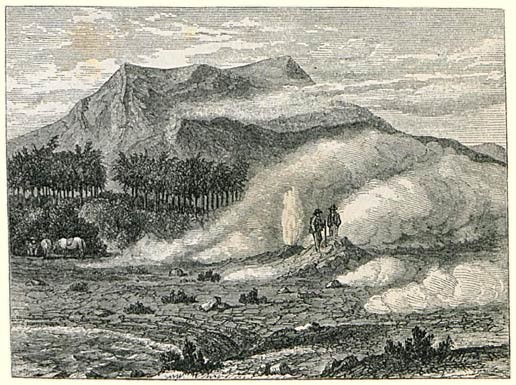
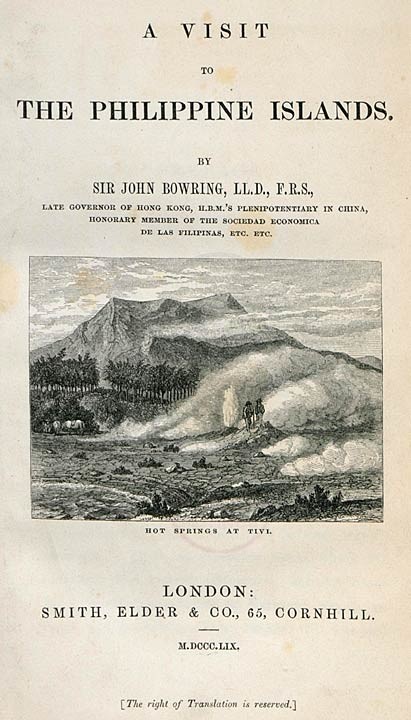
HOT SPRINGS AT TIVI.
LONDON:
SMITH, ELDER & CO., 65, CORNHILL.
M.DCCC.LIX.
[The right of Translation is reserved.]
PREFACE.
The Philippine Islands are but imperfectly known. Though my visit was a short one, I enjoyed many advantages, from immediate and constant intercourse with the various authorities and the most friendly reception by the natives of every class.
The information I sought was invariably communicated with courtesy and readiness; and by this publication something will, I hope, be contributed to the store of useful knowledge.
The mighty “tide of tendency” is giving more and more importance to the Oriental world. Its resources, as they become better known, will be more rapidly developed. They are promising fields, which will encourage and reward adventure; inviting receptacles for the superfluities of European wealth, activity, and intelligence, whose streams will flow back upon their sources with ever-augmenting contributions. Commerce will complete the work in peace and prosperity, which conquest began in perturbation and peril. Whatever clouds may hang over portions of the globe, there is a brighter dawning, a wider sunrise, over the whole; and the flights of time, and the explorings of space, are alike helping the “infinite progression” of good.
J. B.
CONTENTS.
CHAP.
PAGE
I.
Manila and Neighbourhood1
II.
Visit to La Laguna and Tayabas30
III.
History44
IV.
Geography, Climate, etc.71
V.
Government, Administration, etc.87
VI.
Population105
VII.
Manners and Superstitions of the People144
VIII.
Population—Races165
IX.
Administration of Justice186
X.
Army and Navy191
XI.
Public Instruction194
XII.
Ecclesiastical Authority199
XIII.
Languages215
XIV.
Native Produce234
XV.
Vegetables244
XVI.
Animals272
XVII.
Minerals277
XVIII.
Manufactures282
XIX.
Popular Proverbs286
XX.
Commerce292
XXI.
Finance, Taxation, etc.320
XXII.
Taxes326
XXIII.
Opening the New Ports of Iloilo, Sual and Zamboanga330
XXIV.
Zamboanga341
XXV.
Iloilo and Panay354
XXVI.
Sual425
LIST OF ILLUSTRATIONS.
- PAGE
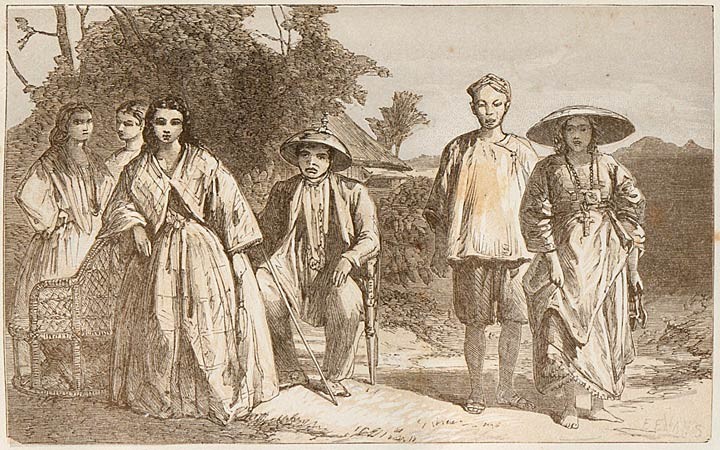
- Group of Natives (Frontispiece.)
- Hot Springs at Tivi (Title-page.)
- Plan of Manila 10
- View from my Window to face page 16
- Lavanderos, or Washerwomen ” 24
- Waterfall of the Botocan 30
- Village of Majajay to face page 36
- Travelling by Palkee ” 38
- Crater of the Volcano at Taal 71
- Indian Funeral to face page 122
- Girls Bathing 134
- A Gallera, or Cock-pit to face page 152
- Lake of Taal, with Volcano ” 164
- Chart of Zamboanga 341
- Chart
,,
of,,
Port Iloilo and Panay 354 - Chart
,,
of,,
Port of Sual 425 - Indian Song of the Philippines to face page 434
A VISIT
TO THE
PHILIPPINE ISLANDS.
CHAPTER I.
MANILA AND NEIGHBOURHOOD.
Three hundred and forty years ago, the Portuguese navigator Fernando de Magalhães, more generally known by his Spanish designation Magellanes, proposed to Carlos I. an expedition of discovery in the Eastern seas. The conditions of the contract were signed at Zaragoza, and, with a fleet of six vessels, the largest of which was only 130 tons burden, and the whole number of the crews two hundred and thirty-four men, Magalhães passed the straits which bear his name in November, 1520; in the middle of March of the following year he discovered the Mariana Islands, and a few days afterwards landed on the eastern coast of the island of Mindanao, where he was well received by the native population. He afterwards visited the island of Zebu, where, notwithstanding a menaced resistance from more than two thousand armed men, he succeeded in conciliating the king and his court, who were not only baptized into the Catholic faith, but recognised the supreme sovereignty of the crown of Spain, and took the oaths of subjection and vassalage. The king being engaged in hostilities with his neighbours, Magalhães took part therein, and died in Mactan, on the 26th April, 1521, in consequence of the wounds he received. This disaster was followed by the murder of all the leading persons of the expedition, who, being invited to a feast by their new ally, were treacherously assassinated. Guillen de Porceleto alone escaped of the twenty-six guests who formed the company. Three of the fleet had been lost before they reached the Philippines; one only returned to Spain—the Vitoria—the first that had ever made the voyage round the world, and the Spanish king conferred on her commander, Elcano, a Biscayan, an escutcheon bearing a globe, with the inscription, “Primus circumdedit me.” A second expedition, also composed of six vessels and a trader, left Spain in 1524. The whole fleet miserably perished in storms and contests with the Portuguese in the Moluccas, and the trader alone returned to the Spanish possessions in New Spain.
About one hundred and twenty of the expedition landed in Tidore, where they built themselves a fortress, and were relieved by a third fleet sent by Hernan Cortes, in 1528, to prosecute the discoveries of which Magalhães had had the initiative. This third adventure was as disastrous as those which had preceded it. It consisted of three ships and one hundred and ten men, bearing large supplies and costly presents. They took possession of the Marianas (Ladrone Islands) in the name of the king of Spain, reached Mindanao and other of the southern islands, failed twice in the attempt to reach New Spain, and finally were all victims of the climate and of the hostility of the Portuguese.
But the Spanish court determined to persevere, and the Viceroy (Mendoza) of New Spain was ordered to prepare a fourth expedition, which was to avoid the Molucca Islands, where so many misfortunes had attended the Spaniards. The fleet consisted of three ships and two traders, and the commander was Villalobos. He reached the Archipelago, and gave to the islands the name of the Philippines, in honour of the Prince of Asturias, afterwards Philip the Second. Contrary winds (in spite of the royal prohibition) drove them into the Moluccas, where they were ill received by the Portuguese, and ordered to return to Spain. Villalobos died in Amboyna, where he was attended by the famous missionary, St. Francisco Xavier. Death swept away many of the Spaniards, and the few who remained were removed from the Moluccas in Portuguese vessels.
A fifth expedition on a larger scale was ordered by Philip the Second to “conquer, pacify, and people” the islands which bore his name. They consisted of five ships and four hundred seamen and soldiers, and sailed from La Natividad (Mexico) in 1564, under the orders of Legaspi, who was nominated Governor of the Philippines, with ample powers. He reached Tandaya in February, 1565, proceeded to Cabalian, where the heir of the native king aided his views. In Bojol, he secured the aid and allegiance of the petty sovereigns of the island, and afterwards fixed himself on the island of Zebu, which for some time was the central seat of Spanish authority.1
Manila was founded in 1581.
Illness and the despotism of the doctors, who ordered me to throw off the cares of my colonial government and to undertake a sea voyage of six or seven weeks’ duration, induced me to avail myself of one of the many courtesies and kindnesses for which I am indebted to the naval commander-in-chief, Sir Michael Seymour, and to accept his friendly offer of a steamer to convey me whither I might desire. The relations of China with the Eastern Spanish Archipelago are not unimportant, and were likely to be extended in consequence of the stipulations of Lord Elgin’s Tientsin Treaty. Moreover, the slowly advancing commercial liberalism of the Spaniards has opened three additional ports to foreign trade, of which, till lately, Manila had the monopoly. I decided, therefore, after calling at the capital in order to obtain the facilities with which I doubted not the courtesy of my friend Don Francisco Norzagaray, the Captain-General of the Philippines, would favour me, to visit Zamboanga, Iloilo, and Sual. I had already experienced many attentions from him in connection with the government of Hong Kong. It will be seen that my anticipations were more than responded to by the Governor, and as I enjoyed rare advantages in obtaining the information I sought, I feel encouraged to record the impressions I received, and to give publicity to those facts which I gathered together in the course of my inquiries, assisted by such publications as have been accessible to me.
Sir Michael Seymour placed her Majesty’s ship Magicienne at my disposal. The selection was in all respects admirable. Nothing that foresight could suggest or care provide was wanting to my comfort, and I owe a great deal to Captain Vansittart, whose urbanities and attentions were followed up by all his officers and men. We left Hong Kong on the 29th of November, 1858. The China seas are, perhaps, the most tempestuous in the world, and the voyage to Manila is frequently a very disagreeable one. So it proved to us. The wild cross waves, breaking upon the bows, tossed us about with great violence; and damage to furniture, destruction of glass and earthenware, and much personal inconvenience, were among the varieties which accompanied us.
But on the fifth day we sighted the lighthouse at the entrance of the magnificent harbour of Manila, and some hours’ steaming brought us to an anchorage at about a mile distant from the city. There began the attentions which were associated with the whole of our visit to these beautiful regions. The Magicienne was visited by the various authorities, and arrangements were made for my landing and conveyance to the palace of the Governor-General. Through the capital runs a river (the Pasig), up which we rowed, till we reached, on the left bank, a handsome flight of steps, near the fortifications and close to the column which has been erected to the memory of Magellanes, the discoverer of, or, at all events, the founder of Spanish authority in, these islands. This illustrious name arrested our attention. The memorial is not worthy of that great reputation. It is a somewhat rude column of stone, crowned with a bronze armillary sphere, and decorated midway with golden dolphins and anchors wreathed in laurels: it stands upon a pedestal of marble, bearing the name of the honoured navigator, and is surrounded by an iron railing. It was originally intended to be erected in the island of Zebu, but, after a correspondence of several years with the Court of Madrid, the present site was chosen by royal authority in 1847. There was a very handsome display of cavalry and infantry, and a fine band of music played “God save the Queen.” Several carriages and four were in waiting to escort our party to the government palace, where I was most cordially received by the captain-general and the ladies of his family. A fine suite of apartments had been prepared for my occupation, and servants, under the orders of a major-domo, were ordered to attend to our requirements, while one of the Governor’s aides-de-camp was constantly at hand to aid us.
Though the name of Manila is given to the capital of the Philippine Islands, it is only the fort and garrison occupied by the authorities to which the designation was originally applied. Manila is on the left bank of the river, while, on the right, the district of Binondo is the site inhabited by almost all the merchants, and in which their business is conducted and their warehouses built. The palace fills one side of a public plaza in the fortress, the cathedral another of the same locality, resembling the squares of London, but with the advantage of having its centre adorned by the glorious vegetation of the tropics, whose leaves present all varieties of colour, from the brightest yellow to the deepest green, and whose flowers are remarkable for their splendour and beauty. There is a statue of Charles the Fourth in the centre of the garden.
The most populous and prosperous province of the Philippines takes its name from the fortification2 of Manila; and the port of Manila is among the best known and most frequented of the harbours of the Eastern world. The capital is renowned for the splendour of its religious processions; for the excellence of its cheroots, which, to the east of the Cape of Good Hope, are generally preferred to the cigars of the Havana; while the less honourable characteristics of the people are known to be a universal love of gambling, which is exhibited among the Indian races by a passion for cock-fighting, an amusement made a productive source of revenue to the State. Artists usually introduce a Philippine Indian with a game-cock under his arm, to which he seems as much attached as a Bedouin Arab to his horse. It is said that many a time an Indian has allowed his wife and children to perish in the flames when his house has taken fire, but never was known to fail in securing his favourite gallo from danger.
On anchoring off the city, Captain Vansittart despatched one of his lieutenants, accompanied by my private secretary, to the British consulate, in order to announce our arrival, and to offer any facilities for consular communication with the Magicienne. They had some difficulty in discovering the consulate, which has no flag-staff, nor flag, nor other designation. The Consul was gone to his ferme modèle, where he principally passes his time among outcast Indians, in an almost inaccessible place, at some distance from Manila. The Vice-Consul said it was too hot for him to come on board, though during a great part of the day we were receiving the representatives of the highest authorities of Manila. The Consul wrote (I am bound to do him this justice) that it would “put him out” of his routine of habit and economy if he were expected to fête and entertain with formality “his Excellency the Plenipotentiary and Governor of Hong Kong.” I hastened to assure the Consul that my presence should cause him no expense, but that the absence of anything which becomingly represented consular authority on the arrival of one of Her Majesty’s large ships of war could hardly be passed unnoticed by the commander of that vessel.
Crowds of visitors honoured our arrival; among them the archbishop and the principal ecclesiastical dignitaries; deputations from the civilians, army and navy, and the various heads of departments, who invited us to visit their establishments, exhibited in their personal attentions the characteristics of ancient Castilian courtesy. A report had spread among the officers that I was a veteran warrior who had served in the Peninsular campaign, and helped to liberate Spain from the yoke of the French invaders. I had to explain that, though witness to many of the events of that exciting time, and in that romantic land, I was a peaceful spectator, and not a busy actor there. The bay of Manila, one of the finest in the world, and the river Pasig which flows into it, were, no doubt, the great recommendations of the position chosen for the capital of the Philippines. During the four months of March, April, May, and June, the heat and dust are very oppressive, and the mosquitos a fearful annoyance. To these months succeed heavy rains, but on the whole the climate is good, and the general mortality not great. The average temperature through the year is 81° 97′ Fahrenheit.
The quarantine station is at Cavite, a town of considerable importance on the southern side of the harbour. It has a large manufacturing establishment of cigars, and gives its name to the surrounding province, which has about 57,000 inhabitants, among whom are about 7,000 mestizos (mixed race). From its adjacency to the capital, the numerical proportion of persons paying tribute is larger than in any other province.
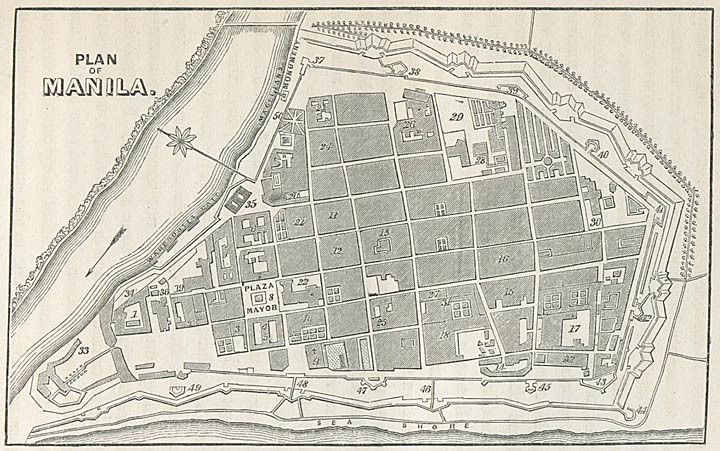
PLAN OF MANILA.
- 1 Artillery
- 2 Hall of Arms
- 3 Hall of Audience
- 4 Military Hospital
- 5 Custom House
- 6 Univ. of S. Thomas
- 7 Cabildo
- 8 Palace & Treasury
- 9 Archbishop’s Palace
- 10 Principal Accountancy
- 11 Intendance
- 12 Consulado
- 13 Bakery
- 14 Artillery Quarters
- 15 S. Potenciano’s College
- 16 Fortification Department
- 17 Barracks (Ligoros)
- 18 Barracks (Asia)
- 19 Nunnery of S. Clara
- 20 S. Domingo
- 21 Establishment of S. Rosa
- 22 Cathedral
- 23 S. John of Lateran
- 24 Establishment of S. Catherine
- 25 S. Isabella
- 26 S. Juan de Dios
- 27 S. Augustine
- 28 Orden Tercera
- 29 S. Francisco
- 30 Ricolets
- 31 S. Ignatius
- 32 Establishment of the Jesuits
- 33 Santiago Troops
- 34 Bulwark of the Torricos
- 35 Gate of S. Domingo
- 36 Custom-house Bulwark
- 37 S. Gabriel’s Bulwark
- 38 Parien Gate
- 39 Devil’s Bulwark
- 40 Postern of the Ricolets
- 41 S. Andrew’s Bulwark
- 42 Royal Gate
- 43 S. James’s Bulwark
- 44 S. Gregory’s Battery
- 45 S. Peter’s Redoubt
- 46 S. Luis Gate
- 47 Plane Bulwark
- 48 Gate of Sally-port
- 49 S. Domingo’s Redoubt
- 50 Gate of Isabella II.
The city, which is surrounded by ramparts, consists of seventeen streets, spacious and crossing at right angles. As there is little business in this part of the capital (the trade being carried on on the other side of the river), few people are seen in the streets, and the general character of the place is dull and monotonous, and forms a remarkable contrast to the activity and crowding of the commercial quarters. The cathedral, begun in 1654, and completed in 1672, is 240 feet in length and 60 in breadth. It boasts of its fourteen bells, which have little repose; and of the carvings of the fifty-two seats which are set apart for the aristocracy. The archiepiscopal palace, though sufficiently large, did not appear to me to have any architectural beauty. The apartments are furnished with simplicity, and though the archbishop is privileged, like the governor, to appear in some state, it was only on the occasion of religious ceremonies that I observed anything like display. His reception of me was that of a courteous old gentleman. He was dressed with great simplicity, and our conversation was confined to inquiries connected with ecclesiastical administration. He had been a barefooted Augustin friar (Recoleto), and was raised to the archiepiscopal dignity in 1846.
The palacio in which I was so kindly accommodated was originally built by an opulent but unfortunate protégé of one of the captains-general; it was reconstructed in 1690 by Governor Gongora. It fills a considerable space, and on the south-west side has a beautiful view of the bay and the surrounding headlands. There is a handsome Hall of Audience, and many of the departments of the government have their principal offices within its walls. The patio forms a pretty garden, and is crowded with tropical plants. It has two principal stone staircases, one leading to the private apartments, and the other to the public offices. Like all the houses at Manila, it has for windows sliding frames fitted with concha, or plates of semi-transparent oysters, which admit an imperfect light, but are impervious to the sunbeams. I do not recollect to have seen any glass windows in the Philippines. Many of the apartments are large and well furnished, but not, as often in England, over-crowded with superfluities. The courtesy of the Governor provided every day at his table seats for two officers of the Magicienne at dinner, after retiring from which there was a tertulia, or evening reception, where the notabilities of the capital afforded me many opportunities for enjoying that agreeable and lively conversation in which Spanish ladies excel. A few mestizos are among the visitors. Nothing, however, is seen but the Parisian costume; no vestiges of the recollections of my youth—the velo, the saya, and the basquiña; nor the tortoiseshell combs, high towering over the beautiful black cabellera; the fan alone remains, then, as now, the dexterously displayed weapon of womanhood. After a few complimentary salutations, most of the gentlemen gather round the card-tables.
The Calzada, a broad road a little beyond the walls of the fortress, is to Manila what Hyde Park is to London, the Champs Elysées to Paris, and the Meidan to Calcutta. It is the gathering place of the opulent classes, and from five o’clock P.M. to the nightfall is crowded with carriages, equestrians and pedestrians, whose mutual salutations seem principally to occupy their attention: the taking off hats and the responses to greetings and recognitions are sufficiently wearisome. Twice a week a band of music plays on a raised way near the extremity of the patio. Soon after sunset there is a sudden and general stoppage. Every one uncovers his head; it is the time of the oracion announced by the church bells: universal silence prevails for a few minutes, after which the promenades are resumed. There is a good deal of solemnity in the instant and accordant suspension of all locomotion, and it reminded me of the prostration of the Mussulmans when the voice of the Muezzim calls, “To prayer, to prayer.” A fine evening walk which is found on the esplanade of the fortifications, is only frequented on Sundays. It has an extensive view of the harbour and the river, and its freedom from the dust and dirt of the Calzada gives it an additional recommendation; but fashion despotically decides all such matters, and the crowds will assemble where everybody expects to meet with everybody. In visiting the fine scenery of the rivers, roads, and villages in the neighbourhood of Manila, we seldom met with a carriage, or a traveller seeking to enjoy these beauties. And in a harbour so magnificent as that of Manila one would expect to see skiffs and pleasure-boats without number, and yachts and other craft ministering to the enjoyment and adding to the variety of life; but there are none. Nobody seems to like sporting with the elements. There are no yacht regattas on the sea, as there are no horseraces on the shore. I have heard the life of Manila called intolerably monotonous; in my short stay it appeared to me full of interest and animation, but I was perhaps privileged. The city is certainly not lively, and the Spaniard is generally grave, but he is warm-hearted and hospitable, and must not be studied at a distance, nor condemned with precipitancy. He is, no doubt, susceptible and pundonoroso, but is rich in noble qualities. Confined as is the population of Manila within the fortification walls, the neighbouring country is full of attractions. To me the villages, the beautiful tropical vegetation, the banks of the rivers, and the streams adorned with scenery so picturesque and pleasing, were more inviting than the gaiety of the public parade. Every day afforded some variety, and most of the pueblos have their characteristic distinctions. Malate is filled with public offices, and women employed in ornamenting slippers with gold and silver embroidery. Santa Ana is a favourite Villagiatura for the merchants and opulent inhabitants. Near Paco is the cemetery, “where dwell the multitude,” in which are interred the remains of many of the once distinguished who have ceased to be. Guadalupe is illustrious for its miraculous image, and Paco for that of the Saviour. The Lake of Arroceros (as its name implies) is one of the principal gathering places for boats loaded with rice; near it, too, are large manufactories of paper cigars. Sampaloc is the paradise of washermen and washerwomen. La Ermita and other villages are remarkable for their bordadoras, who produce those exquisite piña handkerchiefs for which such large sums are paid. Pasay is renowned for its cultivation of the betel. Almost every house has a garden with its bamboos, plantains and cocoa-nut trees, and some with a greater variety of fruits. Nature has decorated them with spontaneous flowers, which hang from the branches or the fences, or creep up around the simple dwellings of the Indians. Edifices of superior construction are generally the abodes of the mestizos, or of the gobernadorcillos belonging to the different pueblos.
Philip the Third gave armorial bearings to the capital, and conferred on it the title of the “Very Noble City of Manila” (La mui noble Ciudad), and attached the dignity of Excellency to the Ayuntamiento (municipality).
During my stay at Manila, every afternoon, at five or six o’clock, the Governor-General called for me in my apartments, and escorted by cavalry lancers we were conveyed in a carriage and four to different parts of the neighbourhood, the rides lasting from one to two hours. We seldom took the same road, and thus visited not only nearly all the villages in the vicinity, but passed through much beautiful country in which the attention was constantly arrested by the groups of graceful bamboos, the tall cocoa-nut trees, the large-leafed plantains, the sugar-cane, the papaya, the green paddy fields (in which many people were fishing—and who knows, when the fields are dry, what becomes of the fish, for they never fail to appear again when irrigation has taken place?), and that wonderful variety and magnificence of tropical vegetation,—leaves and flowers so rich and gorgeous, on which one is never tired to gaze. Much of the river scenery is such as a Claude would revel in, and high indeed would be the artist’s merit who could give perpetuity to such colouring. And then the sunset skies—such as are never seen in temperate zones,—so grand, so glowing, and at times so awful! Almost every pueblo has some dwellings larger and better than the rest, occupied by the native authorities or the mixed races (mostly, however, of Chinese descent), who link the Indian to the European population. The first floor of the house is generally raised from the ground and reached by a ladder. Bamboos form the scaffolding, the floors, and principal wood-work; the nipa palm makes the walls and covers the roof. A few mats, a table, a rude chair or two, some pots and crockery, pictures of saints, a lamp, and some trifling utensils, comprise the domestic belongings, and while the children are crawling about the house or garden, and the women engaged in household cares, the master will most probably be seen with his game-cock under his arm, or meditating on the prowess of the gallo while in attendance on the gallinas.
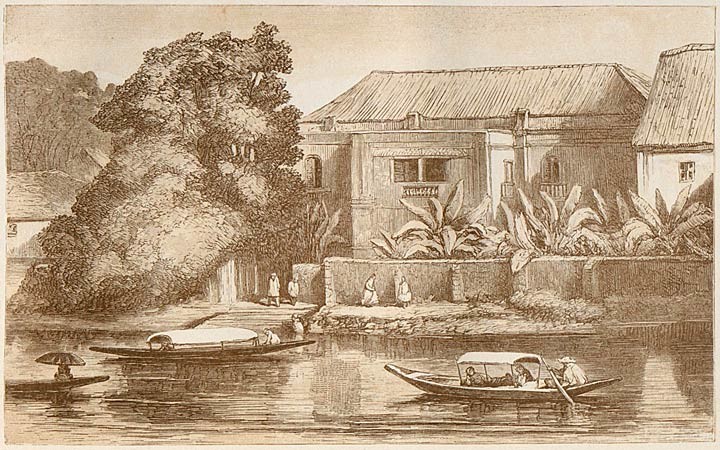
VIEW FROM MY WINDOW SAN MIGUEL.
The better class of houses in Manila are usually rectangular, having a court in the centre, round which are shops, warehouses, stables and other offices, the families occupying the first floor. Towards the street there is a corridor which communicates with the various apartments, and generally a gallery in the interior looking into the patio (court). The rooms have all sliding windows, whose small panes admit the light of day through semi-transparent oyster-shells: there are also Venetians, to help the ventilation and to exclude the sun. The kitchen is generally separated from the dwelling. A large cistern in the patio holds the water which is conveyed from the roofs in the rainy season, and the platform of the cistern is generally covered with jars of flowering plants or fruits. The first and only floor is built on piles, as the fear of earthquakes prevents the erection of elevated houses. The roofing is ordinarily of red tiles.
The apartments, as suited to a tropical climate, are large, and many European fashions have been introduced: the walls covered with painted paper, many lamps hung from the ceiling, Chinese screens, porcelain jars with natural or artificial flowers, mirrors, tables, sofas, chairs, such as are seen in European capitals; but the large rooms have not the appearance of being crowded with superfluous furniture. Carpets are rare—fire-places rarer.
Among Europeans the habits of European life are slightly modified by the climate; but it appeared to me among the Spaniards there were more of the characteristics of old Spain than would now be found in the Peninsula itself. In my youth I often heard it said—and it was said with truth—that neither Don Quixote nor Gil Blas were pictures of the past alone, but that they were faithful portraits of the Spain which I saw around me. Spain had then assuredly not been Europeanized; but fifty years—fifty years of increased and increasing intercourse with the rest of the world—have blotted out the ancient nationality, and European modes, usages and opinions, have pervaded and permeated all the upper and middling classes of Spanish society—nay, have descended deep and spread far among the people, except those of the remote and rural districts. There is little now to distinguish the aristocratical and high-bred Spaniard from his equals in other lands. In the somewhat lower grades, however, and among the whole body of clergy, the impress of the past is preserved with little change. Strangers of foreign nations, principally English and Americans, have brought with them conveniences and luxuries which have been to some extent adopted by the opulent Spaniards of Manila; and the honourable, hospitable and liberal spirit which is found among the great merchants of the East, has given them “name and fame” among Spanish colonists and native cultivators. Generally speaking, I found a kind and generous urbanity prevailing,—friendly intercourse where that intercourse had been sought,—the lines of demarcation and separation between ranks and classes less marked and impassable than in most Oriental countries. I have seen at the same table Spaniard, mestizo and Indian—priest, civilian and soldier. No doubt a common religion forms a common bond; but to him who has observed the alienations and repulsions of caste in many parts of the Eastern world—caste, the great social curse—the blending and free intercourse of man with man in the Philippines is a contrast well worth admiring. M. Mallat’s enthusiasm is unbounded in speaking of Manila. “Enchanting city!” he exclaims; “in thee are goodness, cordiality, a sweet, open, noble hospitality,—the generosity which makes our neighbour’s house our own;—in thee the difference of fortune and hierarchy disappears. Unknown to thee is etiquette. O Manila! a warm heart can never forget thy inhabitants, whose memory will be eternal for those who have known them.”
De Mas’ description of the Manila mode of life is this:—“They rise early, and take chocolate and tea (which is here called cha); breakfast composed of two or three dishes and a dessert at ten; dinner at from two to three; siesta (sleep) till five to six; horses harnessed, and an hour’s ride to the pasco; returning from which, tea, with bread and biscuits and sweets, sometimes homewards, sometimes in visit to a neighbour; the evening passes as it may (cards frequently); homewards for bed at 11 P.M.; the bed a fine mat, with mosquito curtains drawn around; one narrow and one long pillow, called an abrazador (embracer), which serves as a resting-place for the arms or the legs. It is a Chinese and a convenient appliance. No sheets—men sleep in their stockings, shirts, and loose trousers (pajamas); the ladies in garments something similar. They say ‘people must always be ready to escape into the street in case of an earthquake.’” I certainly know of an instance where a European lady was awfully perplexed when summoned to a sudden flight in the darkness, and felt that her toilette required adjustment before she could hurry forth.
Many of the pueblos which form the suburbs of Manila are very populous. Passing through Binondo we reach Tondo, which gives its name to the district, and has 31,000 inhabitants. These pueblos have their Indian gobernadorcillos. Their best houses are of European construction, occupied by Spaniards or mestizos, but these form a small proportion of the whole compared with the Indian Cabánas. Tondo is one of the principal sources for the supply of milk, butter, and cheese to the capital; it has a small manufacturing industry of silk and cotton tissues, but most of the women are engaged in the manipulation of cigars in the great establishments of Binondo. Santa Cruz has a population of about 11,000 inhabitants, many of them merchants, and there are a great number of mechanics in the pueblo. Near it is the burying-place of the Chinese, or, as they are called by the Spaniards, the Sangleyes infieles.
Santa Cruz is a favourite name in the Philippines. There are in the island of Luzon no less than four pueblos, each with a large population, called Santa Cruz, and several besides in others of the Philippines. It is the name of one of the islands, of several headlands, and of various other localities, and has been carried by the Spaniards into every region where they have established their dominion. So fond are they of the titles they find in their Calendar, that in the Philippines there are no less than sixteen places called St. John and twelve which bear the name of St. Joseph; Jesus, Santa Maria, Santa Ana, Santa Caterina, Santa Barbara, and many other saints, have given their titles to various localities, often superseding the ancient Indian names. Santa Ana is a pretty village, with about 5,500 souls. It is surrounded with cultivated lands, which, being irrigated by fertilizing streams, are productive, and give their wonted charm to the landscape—palms, mangoes, bamboos, sugar plantations, and various fruit and forest trees on every side. The district is principally devoted to agriculture. A few European houses, with their pretty gardens, contrast well with the huts of the Indian. Its climate has the reputation of salubrity.
There is a considerable demand for horses in the capital. The importation of the larger races from Australia has not been successful. They were less suited to the climate than the ponies which are now almost universally employed. The Filipinos never give pure water to their horses, but invariably mix it with miel (honey), the saccharine matter of the caña dulce, and I was informed that no horse would drink water unless it was so sweetened. This, of course, is the result of “education.” The value of horses, as compared with their cost in the remoter islands, is double or treble in the capital. In fact, nothing more distinctly proves the disadvantages of imperfect communication than the extraordinary difference of prices for the same articles in various parts of the Archipelago, even in parts which trade with one another. There have been examples of famine in a maritime district while there has been a superfluity of food in adjacent islands. No doubt the monsoons are a great impediment to regular intercourse, as they cannot be mastered by ordinary shipping; but steam has come to our aid, when commercial necessities demanded new powers and appliances, and no regions are likely to benefit by it more than those of the tropics.
The associations and recollections of my youth were revived in the hospitable entertainment of my most excellent host and the courteous and graceful ladies of his family. Nearly fifty years before I had been well acquainted with the Spanish peninsula—in the time of its sufferings for fidelity, and its struggles for freedom, and I found in Manila some of the veterans of the past, to whom the “Guerra de Independencia” was of all topics the dearest; and it was pleasant to compare the tablets of our various memories, as to persons, places and events. Of the actors we had known in those interesting scenes, scarcely any now remain—none, perhaps, of those who occupied the highest position, and played the most prominent parts; but their names still served as links to unite us in sympathizing thoughts and feelings, and having had the advantage of an early acquaintance with Spanish, all that I had forgotten was again remembered, and I found myself nearly as much at home as in former times when wandering among the mountains of Biscay, dancing on the banks of the Guadalquivir, or turning over the dusty tomes at Alcalá de Henares.3
There was a village festival at Sampaloc (the Indian name for tamarinds), to which we were invited. Bright illuminations adorned the houses, triumphal arches the streets; everywhere music and gaiety and bright faces. There were several balls at the houses of the more opulent mestizos or Indians, and we joined the joyous assemblies. The rooms were crowded with Indian youths and maidens. Parisian fashions have not invaded these villages—there were no crinolines—these are confined to the capital; but in their native garments there was no small variety—the many-coloured gowns of home manufacture—the richly embroidered kerchiefs of piña—earrings and necklaces, and other adornings; and then a vivacity strongly contrasted with the characteristic indolence of the Indian races. Tables were covered with refreshments—coffee, tea, wines, fruits, cakes and sweetmeats; and there seemed just as much of flirting and coquetry as ever marked the scenes of higher civilization. To the Europeans great attentions were paid, and their presence was deemed a great honour. Our young midshipmen were among the busiest and liveliest of the throng, and even made their way, without the aid of language, to the good graces of the Zagalas. Sampaloc, inhabited principally by Indians employed as washermen and women, is sometimes called the Pueblo de los Lavanderos. The festivities continued to the matinal hours.
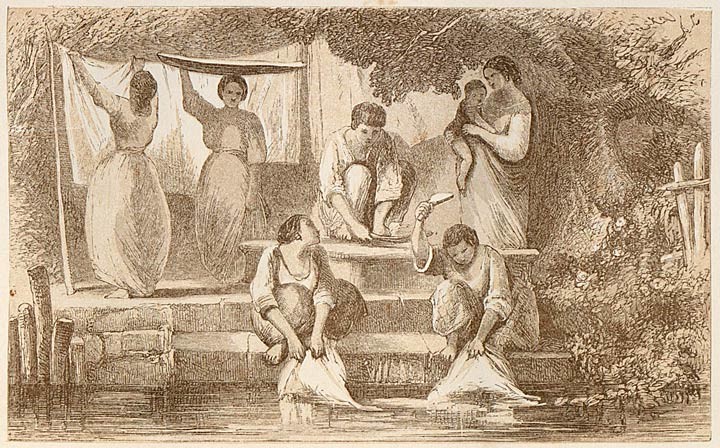
LAVANDEROS OR WASHERWOMEN
In 1855 the Captain-General (Crespo) caused sundry statistical returns to be published, which throw much light upon the social condition of the Philippine Islands, and afford such valuable materials for comparison with the official data of other countries, that I shall extract from them various results which appear worthy of attention.
The city of Manila contains 11 churches, with 3 convents, 363 private houses; and the other edifices, amounting in all to 88, consist of public buildings and premises appropriated to various objects. Of the private houses, 57 are occupied by their owners, and 189 are let to private tenants, while 117 are rented for corporate or public purposes. The population of the city in 1855 was 8,618 souls, as follows:—
——
Males.
Females.
Total.
European Spaniards
503
87
590
Native ditto
575
798
1,373
Indians and Mestizos
3,830
2,493
6,323
Chinese
525
7
4532
Total
5,433 3,385 8,818Far different are the proportions in another part of the capital, the Binondo district, on the other side of the river:—
——
Males.
Females.
Total.
European Spaniards
67
52
219
Native ditto
569
608
1,177
Foreigners
85
11
96
Indians and Mestizos
10,317
10,685
21,002
Chinese
5,055
8
55,063
Total
16,193 11,364 27,557Of these, one male and two females (Indian) were more than 100 years old.
The proportion of births and deaths in Manila is thus given:—
——
Spaniards.
Natives.
Total.
Births
4·38 per ct.
4·96 per ct.
4·83 per ct.
Deaths
1·68
per
,,
ct.
,,
2·72
per
,,
ct.
,,
2·48
per
,,
ct.
,,
Excess of Births over Deaths
2·70 per ct. 2·24 per ct. 2·35 per ct.In Binondo the returns are much less favourable:—
Births
5·12
Deaths
4·77
0·35The statistical commissioners state these discrepancies to be inexplicable; but attribute it in part to the stationary character of the population of the city, and the many fluctuations which take place in the commercial movements of Binondo.
Binondo is really the most important and most opulent pueblo of the Philippines, and is the real commercial capital: two-thirds of the houses are substantially built of stone, brick and tiles, and about one-third are Indian wooden houses covered with the nipa palm. The place is full of business and activity. An average was lately taken of the carriages daily passing the principal thoroughfares. Over the Puente Grande (great bridge) their number was 1,256; through the largest square, Plaza de S. Gabriel, 979; and through the main street, 915. On the Calzada, which is the great promenade of the capital, 499 carriages were counted—these represent the aristocracy of Manila. There are eight public bridges, and a suspension bridge has lately been constructed as a private speculation, on which a fee is levied for all passengers.
Binondo has some tolerably good wharfage on the bank of the Pasig, and is well supplied with warehouses for foreign commerce. That for the reception of tobacco is very extensive, and the size of the edifice where the state cigars are manufactured may be judged of from the fact that nine thousand females are therein habitually employed.
The Puente Grande (which unites Manila with Binondo) was originally built of wood upon foundations of masonry, with seven arches of different sizes, at various distances. Two of the arches were destroyed by the earthquake of 1824, since which period it has been repaired and restored. It is 457 feet in length and 24 feet in width. The views on all sides from the bridge are fine, whether of the wharves, warehouses, and busy population on the right bank of the river, or the fortifications, churches, convents, and public walks on the left.
The population of Manila and its suburbs is about 150,000.
The tobacco manufactories of Manila, being the most remarkable of the “public shows,” have been frequently described. The chattering and bustling of the thousands of women, which the constantly exerted authority of the female superintendents wholly failed to control, would have been distracting enough from the manipulation of the tobacco leaf, even had their tongues been tied, but their tongues were not tied, and they filled the place with noise. This was strangely contrasted with the absolute silence which prevailed in the rooms solely occupied by men. Most of the girls, whose numbers fluctuate from eight to ten thousand, are unmarried, and many seemed to be only ten or eleven years old. Some of them inhabit pueblos at a considerable distance from Manila, and form quite a procession either in proceeding to or returning from their employment. As we passed through the different apartments specimens were given us of the results of their labours, and on leaving the establishment beautiful bouquets of flowers were placed in our hands. We were accompanied throughout by the superior officers of the administration, explaining to us all the details with the most perfect Castilian courtesy. Of the working people I do not believe one in a hundred understood Spanish.
The river Pasig is the principal channel of communication with the interior. It passes between the commercial districts and the fortress of Manila. Its average breadth is about 350 feet, and it is navigable for about ten miles, with various depths of from 3 to 25 feet. It is crossed by three bridges, one of which is a suspension bridge. The daily average movement of boats, barges, and rafts passing with cargo under the principal bridge, was 277, escorted by 487 men and 121 women (not including passengers). The whole number of vessels belonging to the Philippines was, in 1852 (the last return I possess), 4,053, representing 81,752 tons, and navigated by 30,485 seamen. Of these, 1,532 vessels, of 74,148 tons, having 17,133 seamen, belong to the province of Manila alone, representing three-eighths of the ships, seven-eighths of the tonnage, and seventeen-thirtieths of the mercantile marine. The value of the coasting trade in 1852 is stated to have been about four and a-half millions of dollars, half this value being in abacá (Manila hemp), sugar and rice being the next articles in importance. The province of Albay, the most southern of Luzon, is represented by the largest money value, being about one-fourth of the whole. On an average of five years, from 1850 to 1854, the coasting trade is stated to have been of the value of 4,156,459 dollars, but the returns are very imperfect, and do not include all the provinces. The statistical commission reports that on an examination of all the documents and facts accessible to them, in 1855, the coasting trade might be fairly estimated at 7,200,459 dollars.
At a distance of about three miles from Binondo, on the right bank of the Pasig, is the country house of the captain-general, where he is accustomed to pass some weeks of the most oppressive season of the year: it has a nice garden, a convenient moveable bath, which is lowered into the river, an aviary, and a small collection of quadrupeds, among which I made acquaintance with a chimpanzee, who, soon after, died of a pulmonary complaint.
1 A recent History of the Conquest of the Islands, and of the Spanish rule, is given by Buzeta, vol. i., pp. 57–98. ↑
2 I visited some Cochin Chinese prisoners in the fortification. They had been taken at Turon, and one of them was a mandarin, who had exercised some authority there,—said to have been the commandant of the place. They wrote the Chinese characters, but were unable to understand the spoken language. ↑
3 Among my early literary efforts was an essay by which the strange story was utterly disproved of the destruction of the MSS. which had served Cardinal Ximenes in preparing his Polyglot Bible. ↑
4 One woman, six children. ↑
5 All children. ↑
1 A recent History of the Conquest of the Islands, and of the Spanish rule, is given by Buzeta, vol. i., pp. 57–98. ↑
2 I visited some Cochin Chinese prisoners in the fortification. They had been taken at Turon, and one of them was a mandarin, who had exercised some authority there,—said to have been the commandant of the place. They wrote the Chinese characters, but were unable to understand the spoken language. ↑
3 Among my early literary efforts was an essay by which the strange story was utterly disproved of the destruction of the MSS. which had served Cardinal Ximenes in preparing his Polyglot Bible. ↑
4 One woman, six children. ↑
5 All children. ↑
CHAPTER II.
VISIT TO LA LAGUNA AND TAYABAS.
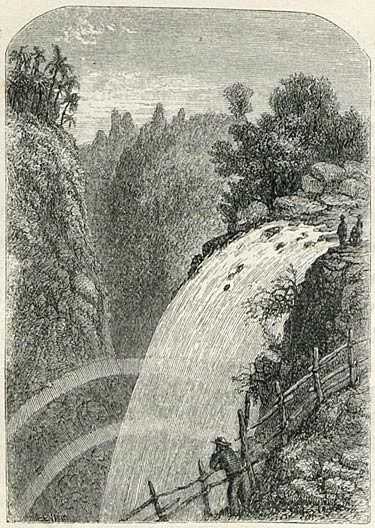
WATERFALL OF THE BOTOCAN.
Having arranged for a visit to the Laguna and the surrounding hills, whose beautiful scenery has given to the island of Luzon a widely-spread celebrity, we started accompanied by the Alcalde Mayor, De la Herran, Colonel Trasierra, an aide-de-camp of the Governor, appointed to be my special guide and guardian, my kind friend and gentlemanly companion Captain Vansittart, and some other gentlemen. The inhabitants of the Laguna are called by the Indians of Manila Tagasilañgan, or Orientals. As we reached the various villages, the Principalia, or native authorities, came out to meet us, and musical bands escorted us into and out of all the pueblos. We found the Indian villages decorated with coloured flags and embroidered kerchiefs, and the firing of guns announced our arrival. The roads were prettily decorated with bamboos and flowers, and everything proclaimed a hearty, however simple welcome. The thick and many-tinted foliage of the mango—the tall bamboos shaking their feathery heads aloft—the cocoa-nut loftier still—the areca and the nipa palms—the plantains, whose huge green leaves give such richness to a tropical landscape—the bread-fruit, the papaya, and the bright-coloured wild-flowers, which stray at will over banks and branches—the river every now and then visible, with its canoes and cottages, and Indian men, women, and children scattered along its banks. Over an excellent road, we passed through Santa Ana to Taguig, where a bamboo bridge had been somewhat precipitately erected to facilitate our passage over the stream: the first carriage got over in safety; with the second the bridge broke down, and some delay was experienced in repairing the disaster, and enabling the other carriages to come forward. Taguig is a pretty village, with thermal baths, and about 4,000 inhabitants; its fish is said to be particularly fine. Near it is Pateros, which no doubt takes its name from the enormous quantity of artificially hatched ducks (patos) which are bred there, and which are seen in incredible numbers on the banks of the river. They are fed by small shell-fish found abundantly in the neighbouring lake, and which are brought in boats to the paterias on the banks of the Pasig. This duck-raising is called Itig by the Indians. Each pateria is separated from its neighbour by a bamboo enclosure on the river, and at sunset the ducks withdraw from the water to adjacent buildings, where they deposit their eggs during the night, and in the morning return in long procession to the river. The eggs being collected are placed in large receptacles containing warm paddy husks, which are kept at the same temperature; the whole is covered with cloth, and they are removed by their owners as fast as they are hatched. We saw hundreds of the ducklings running about in shallow bamboo baskets, waiting to be transferred to the banks of the river. The friar at Pasig came out from his convent to receive us. It is a populous pueblo, containing more than 22,000 souls. There is a school for Indian women. It has stone quarries worked for consumption in Manila, but the stone is soft and brittle. The neighbourhood is adorned with gardens. Our host the friar had prepared for us in the convent a collation, which was served with much neatness and attention, and with cordial hospitality. Having reached the limits of his alcadia, the kind magistrate and his attendants left us, and we entered a falua (felucca) provided for us by the Intendente de Marina, with a goodly number of rowers, and furnished with a carpet, cushions, curtains, and other comfortable appliances. In this we started for the Laguna, heralded by a band of musicians. The rowers stand erect, and at every stroke of the oar fling themselves back upon their seats; they thus give a great impulse to the boat; the exertion appears very laborious, yet their work was done with admirable good-humour, and when they were drenched with rain there was not a murmur. In the lake (which is called Bay) is an island, between which and the main land is a deep and dangerous channel named Quinabatasan, through which we passed. The stream rushes by with great rapidity, and vessels are often lost in the passage. The banks are covered with fine fruit trees, and the hills rise grandly on all sides. Our destination was Santa Cruz, and long before we arrived a pilot boat had been despatched in order to herald our coming. The sun had set, but we perceived, as we approached, that the streets were illuminated, and we heard the wonted Indian music in the distance. Reaching the river, we were conducted to a gaily-lighted and decorated raft, which landed us,—and a suite of carriages, in one of which was the Alcalde, who had come from his Cabacera, or head quarters, to take charge of us,—conducted the party to a handsome house belonging to an opulent Indian, where we found, in the course of preparation, a very handsome dinner or supper, and all the notables of the locality, the priest, as a matter of course, among them, assembled to welcome the strangers. We passed a theatre, which appeared hastily erected and grotesquely adorned, where, as we were informed, it was intended to exhibit an Indian play in the Tagál language, for our edification and amusement. I was too unwell to attend, but I heard there was much talk on the stage (unintelligible, of course, to our party), and brandishing of swords, and frowns and fierce fighting, and genii hunting women into wild forests, and kings and queens gaily dressed. The stage was open from the street to the multitude, of whom many thousands were reported to be present, showing great interest and excitement. I was told that some of the actors had been imported from Manila. The hospitality of our host was super-abundant, and his table crowded not only with native but with many European luxuries. He was dressed as an Indian, and exhibited his wardrobe with some pride. He himself served us at his own table, and looked and moved about as if he were greatly honoured by the service. His name, which I gratefully record, is Valentin Valenzuela, and his brother has reached the distinction of being an ordained priest.
Santa Cruz has a population of about 10,000 souls. Many of its inhabitants are said to be opulent. The church is handsome; the roads in the neighbourhood broad and in good repair. There is much game in the adjacent forests, but there is not much devotion to the chase. Almost every variety of tropical produce grows in the vicinity. Wild honey is collected by the natives of the interior, and stuffs of cotton and abacá are woven for domestic use. The house to which we were invited was well furnished, but with the usual adornings of saints’ images and vessels for holy water. In the evening the Tagála ladies of the town and neighbourhood were invited to a ball, and the day was closed with the accustomed light-heartedness and festivity: the bolero and the jota seemed the favourite attractions. Dance and music are the Indians’ delight, and very many of the evenings we passed in the Philippines were devoted to these enjoyments. Next morning the carriages of the Alcalde, drawn by the pretty little ponies of Luzon, conducted us to the casa real at Pagsanjan, the seat of the government, or Cabacera, of the province, where we met with the usual warm reception from our escort Señor Tafalla, the Alcalde. Pagsanjan has about 5,000 inhabitants, being less populous than Biñan and other pueblos in the province. Hospitality was here, as everywhere, the order of the day and of the night, all the more to be valued as there are no inns out of the capital, and no places of reception for travellers; but he who is recommended to the authorities and patronized by the friars will find nothing wanting for his accommodation and comfort, and will rather be surprised at the superfluities of good living than struck with the absence of anything necessary. I have been sometimes amazed when the stores of the convent furnished wines which had been kept from twenty to twenty-five years; and to say that the cigars and chocolate provided by the good friars would satisfy the most critical of critics, is only to do justice to the gifts and the givers.
We made an excursion to the pretty village of Lumbang, having, as customary, been escorted to the banks of the river, which forms the limit of the pueblo, by the mounted principalia of Pagsanjan. The current was strong, but a barge awaited us and conveyed us to the front of the convent on the other side, where the principal ecclesiastic, a friar, conducted us to the reception rooms. We walked through the pueblo, whose inhabitants amount to 5,000 Indians, occupying one long broad street, where many coloured handkerchiefs and garments were hung out as flags from the windows, which were crowded with spectators. We returned to the Cabacera, where we slept. Early in the morning we took our departure from Pagsanjan.
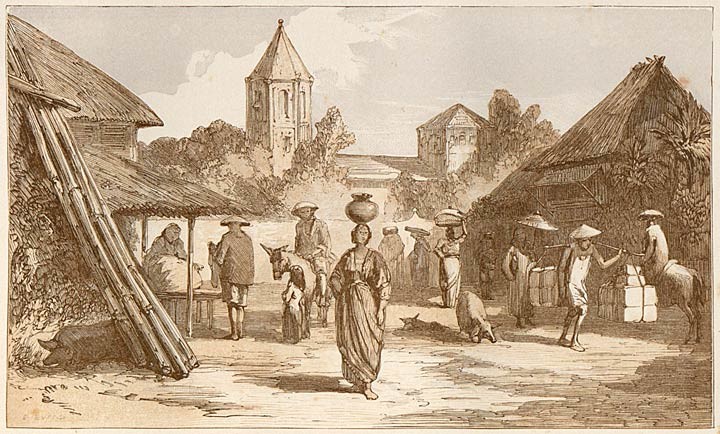
VILLAGE OF MAJAJAY
We next advanced into the more elevated regions, growing more wild and wonderful in their beauties. As we proceeded the roads became worse and worse, and our horses had some difficulty in dragging the carriages through the deep mud. We had often to ask for assistance from the Indians to extricate us from the ruts, and they came to our aid with patient and persevering cheerfulness. When the main road was absolutely impassable, we deviated into the forest, and the Indians, with large knives—their constant companions—chopped down the impeding bushes and branches, and made for us a practicable way. After some hours’ journey we arrived at Majayjay, and between files of Indians, with their flags and music, were escorted to the convent, whence the good Franciscan friar Maximo Rico came to meet us, and led us up the wide staircase to the vast apartments above. The pueblo has about 8,500 inhabitants; the climate is humid, and its effects are seen in the magnificent vegetation which surrounds the place. The church and convent are by far the most remarkable of its edifices. Here we are surrounded by mountain scenery, and the forest trees present beautiful and various pictures. In addition to leaves, flowers and fruits of novel shapes and colours, the grotesque forms which the trunks and branches of tropical trees assume, as if encouraged to indulge in a thousand odd caprices, are among the characteristics of these regions. The native population availed themselves of the rude and rugged character of the region to offer a long resistance to the Spaniards on their first invasion, and its traditional means of defence were reported to be so great that the treasures of Manila were ordered to be transported thither on the landing of the English in 1762. Fortunately, say the Spanish historians, the arrangement was not carried out, as the English had taken their measures for the seizure of the spoils, and it was found the locality could not have been defended against them.
We were now about to ascend the mountains, and were obliged to abandon our carriages. Palanquins, in which we had to stretch ourselves at full length, borne each by eight bearers, and relays of an equal number, were provided for our accommodation. The Alcalde of the adjacent province of Tayabas had come down to Majayjay to invite us into his district, where, he said, the people were on the tiptoe of expectation, had made arrangements for our reception, and would be sadly disappointed if we failed to visit Lucban. We could not resist the kind urgency of his representations, and deposited ourselves in the palanquins, which had been got ready for us, and were indeed well rewarded. The paths through the mountains are such as have been made by the torrents, and are frequently almost impassable from the masses of rock brought down by the rushing waters. Sometimes we had to turn back from the selected road, and choose another less impracticable. In some places the mud was so deep that our bearers were immersed far above their knees, and nothing but long practice and the assistance of their companions could have enabled them to extricate themselves or us from so disagreeable a condition. But cheerfulness and buoyancy of spirits, exclamations of encouragement, loud laughter, and a general and brotherly co-operation surmounted every difficulty. Around us all was solitude, all silence, but the hum of the bees and the shrieks of the birds; deep ravines below, covered with forest trees, which no axe of the woodman would ever disturb; heights above still more difficult to explore, crowned with arboreous glories; brooks and rivulets noisily descending to larger streams, and then making their quiet way to the ocean receptacle. At last we reached a plain on the top of a mountain, where two grandly adorned litters, with a great number of bearers, were waiting, and we were welcomed by a gathering of graceful young women, all on ponies, which they managed with admirable agility. They were clad in the gayest dresses. The Alcalde called them his Amazonas; and a pretty spokeswoman informed us, in very pure Castilian, that they were come to escort us to Lucban, which was about a league distant. The welcome was as novel as it was unexpected. I observed the Tagálas mounted indifferently on the off or near side of their horses. Excellent equestrians were they; and they galloped and caracolled to the right and the left, and flirted with their embellished whips. A band of music headed us; and the Indian houses which we passed bore the accustomed demonstrations of welcome. The roads had even a greater number of decorations—arches of ornamented bamboos on both sides of the way, and firing of guns announcing our approach. The Amazonas wore bonnets adorned with ribands and flowers,—all had kerchiefs of embroidered piña on their shoulders, and variously coloured skirts and gowns of native manufacture added to the picturesque effect. So they gambolled along—before, behind, or at our sides where the roads permitted it—and seemed quite at ease in all their movements. The convent was, as usual, our destination; the presiding friar—quite a man of the world—cordial, amusing, even witty in his colloquies. He had most hospitably provided for our advent. All the principal people were invited to dinner. Many a joke went round, to which the friar contributed more than his share. Talking of the fair (if Indian girls can be so called), Captain Vansittart said he had thirty unmarried officers on board the Magicienne.
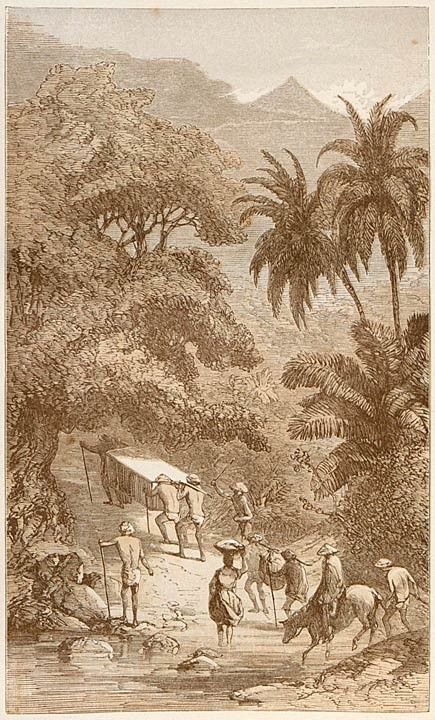
TRAVELLING BY PALKEE.
“A bargain,” exclaimed the friar; “send them hither,—I will find pretty wives for all of them.”
“But you must convert them first.”
“Ay! that is my part of the bargain.”
“And you will get the marriage fees.”
“Do you think I forgot that?”
After dinner, or supper, as it was called, the Amazonas who had escorted us in the morning, accompanied by many more, were introduced; the tables were cleared away; and when I left the hall for my bedroom, the dancing was going on in full energy.
Newspapers and books were lying about the rooms of the convent. The friar had more curiosity than most of his order: conversation with him was not without interest and instruction.
We returned by a different road to Majayjay, for the purpose of visiting a splendid waterfall, where the descent of the river is reported to be 300 feet. We approached on a ledge of rock as near as we could to the cataract, the roar of which was awful; but the quantity of mist and steam, which soon soaked our garments, obscured the vision and made it impossible for us to form any estimate of the depth of the fall. It is surrounded by characteristic scenery—mountains and woods—which we had no time to explore, and of which the natives could give us only an imperfect account: they knew there were deer, wild boars, buffaloes, and other game, but none had penetrated the wilder regions. A traveller now and then had scrambled over the rocks from the foot to the top of the waterfall
We returned to Majayjay again to be welcomed and entertained by our hosts at the convent with the wonted hospitality; and taking leave of our Alcalde, we proceeded to Santa Cruz, where, embarking in our felucca, we coasted along the lake and landed at Calamba, a pueblo of about 4,000 inhabitants; carriages were waiting to convey us to Biñan, stopping a short time at Santa Rosa, where the Dominican friars, who are the proprietors of large estates in the neighbourhood, invited us as usual to their convent. We tarried there but a short time. The roads are generally good on the borders of the Laguna, and we reached Biñan before sunset, the Indians having in the main street formed themselves in procession as we passed along. Flags, branches of flowering forest trees, and other devices, were displayed. First we passed between files of youths, then of maidens; and through a triumphal arch we reached the handsome dwelling of a rich mestizo, whom we found decorated with a Spanish order, which had been granted to his father before him. He spoke English, having been educated at Calcutta, and his house—a very large one—gave abundant evidence that he had not studied in vain the arts of domestic civilization. The furniture, the beds, the tables, the cookery, were all in good taste, and the obvious sincerity of the kind reception added to its agreeableness. Great crowds were gathered together in the square which fronts the house of Don José Alberto. Indians brought their game-cocks to be admired, but we did not encourage the display of their warlike virtues. There was much firing of guns, and a pyrotechnic display when the sun had gone down, and a large fire balloon, bearing the inscription, “The people of Biñan to their illustrious visitors,” was successfully inflated, and soaring aloft, was lost sight of in the distance, but was expected to tell the tale of our arrival to the Magicienne in Manila Bay. Biñan is a place of some importance. In it many rich mestizos and Indians dwell. It has more than 10,000 inhabitants. Large estates there are possessed by the Dominican friars, and the principal of them was among our earliest visitors. There, as elsewhere, the principalia, having conducted us to our head-quarters, came in a body to present their respects, the gobernadorcillo, who usually speaks Spanish, being the organ of the rest. Inquiries about the locality, thanks for the honours done us, were the commonplaces of our intercourse, but the natives were always pleased when “the strangers from afar” seemed to take an interest in their concerns. Nowhere did we see any marks of poverty; nowhere was there any crowding, or rudeness, or annoyance, in any shape. Actors and spectators seemed equally pleased; in fact, our presence only gave them another holiday, making but a small addition to their regular and appointed festivals. Biñan is divided by a river, and is about a mile from the Laguna. Its streets are of considerable width, and the neighbouring roads excellent. Generally the houses have gardens attached to them; some on a large scale. They are abundant in fruits of great variety. Rice is largely cultivated, as the river with its confluents affords ample means of irrigation. The lands are usually rented from the Dominicans, and the large extent of some of the properties assists economical cultivation. Until the lands are brought into productiveness, little rent is demanded, and when they become productive the friars have the reputation of being liberal landlords and allowing their tenants to reap large profits. It is said they are satisfied with one-tenth of the gross produce. A tenant is seldom disturbed in possession if his rent be regularly paid. Much land is held by associations or companies known by the title of Casamahanes. There is an active trade between Biñan and Manila.
Greatly gratified with all we had seen, we again embarked and crossed the Laguna to Pasig. Descending by that charming river, we reached Manila in the afternoon.
CHAPTER III.
HISTORY.
A few sketches of the personal history of some of the captains-general of Manila will be an apt illustration of the general character of the government, which, with some remarkable exceptions, appears to have been of a mild and paternal character; while the Indians exhibit, when not severely dealt with, much meekness and docility, and a generally willing obedience. The subjugation of the wild tribes of the interior has not made the progress which might have been fairly looked for; but the military and naval forces at the disposal of the captain-general have always been small when the extent of his authority is considered. In fact, many conquests have had to be abandoned from inadequacy of strength to maintain them. The ecclesiastical influences, which have been established among the idolatrous tribes, are weak when they come in contact with any of the forms of Mahomedanism, as in the island of Mindanao, where the fanaticism of Mussulman faith is quite as strong as that among the Catholics themselves. Misunderstandings between the Church and State could hardly be avoided where each has asserted a predominant power, and such misunderstandings have often led to the effusion of blood and the dislocation of government. Mutual jealousies exist to the present hour, and as the friars, in what they deem the interests of the people, are sometimes hostile to the views of the civil authority, that authority has frequently a right to complain of being thwarted, or feebly aided, by the local clergy.
While shortly recording the names of the captains-general to whom the government of the Philippines has been confided, I will select a few episodes from the history of the islands, which will show the character of the administration, and assist the better understanding of the position of the people.
Miguel Lope de Legaspi, a Biscayan, upon whom the title of Conqueror of the Philippines has been conferred, was the first governor, and was nominated in 1565. He took possession of Manila in 1571, and died, it is said, of disgust and disappointment the following year. The city was invaded by Chinese pirates during the government of his successor Guido de Lavezares, who repulsed them, and received high honours from his sovereign, Philip II. Francisco de Saude founded in Camarines the city of Nueva Caceres, to which he gave the name of the place of his birth. He was a man of great ambition, who deposed one and enthroned another sultan of Borneo, and modestly asked from the king of Spain authority to conquer China, but was recommended to be less ambitious, and to keep peace with surrounding nations. Rinquillo de Peñarosa rescued Cagayan from a Japanese pirate, and founded New Segovia and Arévalo in Panay; his nephew succeeded him, and in doing honour to his memory set the Church of St. Augustin on fire; it spread to the city, of which a large part was destroyed. In 1589, during the rule of Santiago de Vera, the only two ships which carried on the trade with New Spain were destroyed by a hurricane in the port of Cavite. The next governor, Gomez Perez Dasmariñas, sent to Japan the missionaries who were afterwards put to death; he headed an expedition to Moluco, but on leaving the port of Mariveles his galley was separated from the rest of the fleet; the Chinese crew rose, murdered him, and fled in his vessel to Cochin China. His son Luis followed him as governor. A Franciscan friar, who had accompanied the unfortunate expedition of his father, informed him that he would find, as he did, his patent of appointment in a box which the Chinese had landed in the province of Ilocos, and his title was in consequence recognised. Francisco Tello de Guzman, who entered upon the government in 1596, was unfortunate in his attempts to subdue the natives of Mindanao, as was one of his captains, who had been sent to drive away the Dutch from Mariveles.
In the year 1603 three mandarins arrived in Manila from China. They said that a Chinaman, whom they brought as a prisoner, had assured the Emperor that the island of Cavite was of gold, that the Chinaman had staked his life upon his veracity, and that they had come to learn the truth of his story. They soon after left, having been conducted by the governor to examine Cavite for themselves. A report speedily spread that an invasion of the Philippines by a Chinese army of 100,000 was in contemplation, and a Chinese called Eng Kang, who was supposed to be a great friend of the Europeans, was charged with a portion of the defences. A number of Japanese, the avowed enemies of the Chinese, were admitted to the confidence of the governor, and communicated to the Chinese the information that the government suspected a plot. A plot there was, and it was said the Chinese determined on a rising, and a general massacre of the Spaniards on the vespers of St. Francis’ day. A Philippine woman, who was living with a Chinaman, denounced the project to the curate of Quiapo, who advised the governor. A number of the conspirators were assembled at a half-league’s distance from Manila, and Eng Kang was sent with some Spaniards to put down the movement. The attempt failed, and Eng Kang was afterwards discovered to have been one of the principal promoters of the insurrection. In the evening the Chinese attacked Quiapo and Tondo, murdering many of the natives. They were met by a body of 130 Spaniards, nearly all of whom perished, and their heads were sent to Parian, which the insurgents captured, and besieged the city of Manila from Dilao. The danger led to great exertions on the part of the Spaniards, the ecclesiastics taking a very active part. The Chinese endeavoured to scale the walls, but were repulsed. The monks declared that St. Francis had appeared in person to encourage them. The Chinese withdrew to their positions, but the Spaniards sallied out from the citadel, burnt and destroyed Parian, and pursued the flying Chinese to Cabuyao. New reinforcements arrived, and the flight of the Chinese continued as far as the province of Batangas, where they were again attacked and dispersed. It is said that of 24,000 revolted Chinese only one hundred escaped, who were reserved for the galleys. About 2,000 Chinese were left, who had not involved themselves in the movement. Eng Kang was decapitated, and his head exposed in an iron cage. It was three years after this insurrection that the Court of Madrid had the first knowledge of its existence.
Pedro de Acuña, after the suppression of this revolt, conquered Ternate, and carried away the king, but died suddenly, in 1606, after governing four years. Cristobal Tellez, during his short rule, destroyed a settlement of the Japanese in Dilao. Juan de Silva brought with him, in 1609, reinforcements of European troops, and in the seventh year of his government, made great preparations for attacking the Dutch, but died after a short illness. In 1618, Alonzo Fajardo came to the Philippines, with conciliatory orders as regarded the natives, and was popular among them. He punished a revolt in Buhol, sent an unsuccessful mission to Japan, and in a fit of jealousy killed his wife. Suspecting her infidelity, he surprised her at night in a house, where she had been accustomed to give rendezvous to her paramour, and found her in a dress which left no doubt of her crime. The governor called in a priest, commanded him to administer the sacrament, and, spite of the prayers of the ecclesiastic, he put her to death by a stab from his own dagger. This was in 1622. Melancholy took possession of him, and he died in 1624. Two interim governors followed. Juan Niño de Tabera arrived in 1626. He brought with him 600 troops, drove the Dutch from their holds, and sent Olaso, a soldier, celebrated for his deeds in Flanders, against the Jolo Indians; but Olaso failed utterly, and returned to Manila upon his discomfiture.
A strange event took place in 1630. The holy sacrament had been stolen in a glass vase, from the cathedral. A general supplication (rogativa) was ordered; the archbishop issued from his palace barefooted, his head covered with ashes, and a rope round his neck, wandering about to discover where the vase was concealed. All attempts having failed, so heavy were the penitences, and so intolerable the grief of the holy man, that he sank under the calamity, and a fierce contest between the ecclesiastical and civil functionaries was the consequence of his death.
In 1635 there was a large arrival of rich converted Japanese, who fled from the fierce persecutions to which the Christians had been subjected in Japan; but a great many Catholic missionaries hastened to that country, in order to be honoured with the crown of martyrdom. Another remarkable ecclesiastical quarrel took place at this time. A commissary, lately arrived from Europe, ordered that all the friars with beards should be charged with the missions to China and Japan; and all the shorn friars should remain in the Philippines. The archbishop opposed this, as the Pope’s bulls had no regulations about beards. Fierce debates were also excited by the exercise of the right of asylum to criminals, having committed offences, either against the military or the civil authority. The archbishop excommunicated—the commandant of artillery rebelled. The archbishop fined him—the vicar apostolic confirmed the sentence. The Audiencia annulled the proceedings—the Bishop of Camarines was called on as the arbiter, and absolved the commandant. Appeals followed, and one of the parties was accused of slandering the Most Holy Father. The Jesuits took part against the archbishop, who called all the monks together, and they fined the Jesuits 4,000 dollars. The governor defended the Jesuits, and required the revocation of the sentence in six hours. The quarrel did not end here: but there was a final compromise, each party making some concessions to the other.
The disasters which followed the insurrection of Eng Kang did not prevent the influx of Chinese into the islands, and especially into the province of Laguna, where another outbreak, in which it is said 30,000 Chinese took part, occurred in 1639. They divided themselves into guerrillas, who devastated the country; but were subdued in the following year, seven thousand having surrendered at discretion. Spanish historians say that the hatred of the Indians to the Chinese awaked them from their habitual apathy, and that in the destruction of the intruders they exhibited infinite zeal and activity.
In the struggles between the natives and the Spaniards, even the missionaries were not always safe, and the Spaniards were often betrayed by those in whom they placed the greatest confidence. The heavy exactions and gabelles inflicted on the Indians under Fajardo led to a rising in Palopag, when the Jesuit curate was killed and the convent and church sacked. The movement spread through several of the islands, and many of the prisoners were delivered in Caraga to the keeping of an Indian, called Dabao, who so well fulfilled his mission, that when the governor came to the fortress, to claim the captives, Dabao seized and beheaded his Excellency, and, with the aid of the prisoners, destroyed most of the Spaniards in the neighbourhood, including the priests; so that only six, among whom was an Augustine barefooted friar, escaped, and fled to the capital. Reinforcements having arrived from Manila, the Indians surrendered, being promised a general pardon. “The promise,” says the Spanish historian, “was not kept; but the leaders of the insurrection were hanged, and multitudes of the Indians sent to prison.” The governor-general “did not approve of this violation of a promise made in the king’s name,” but ordered the punishment of the Spanish chiefs, and the release of such natives as remained in prison.
In 1645, for two months there was a succession of fearful earthquakes. In Cagayan a mountain was overturned, and a whole town engulfed at its foot. Torrents of water and mud burst forth in many places. All the public buildings in the capital were destroyed, except the convent and the church of the Augustines, and that of the Jesuits. Six hundred persons were buried in Manila under the ruins of their houses, and 3,000 altogether are said to have lost their lives.
De Lara was distinguished for his religious sentiments. On his arrival in 1653 he refused to land till the archbishop had preceded him and consecrated the ground on which he was to tread. He celebrated a jubilee under the authority of the Pope, by which the country was to be purified from “the crimes, censures, and excommunications” with which, for so many years, it had been afflicted. The archbishop, from an elevated platform in Manila, blessed the islands and their inhabitants in the presence of an immense concourse of people. Reconciliations, confessions, restitutions followed these “days of sanctity;” but the benedictions seem to have produced little benefit, as they were followed by earthquakes, tempests, insurrections, unpunished piracies, and, in the words of a Spanish writer, “a web of anxieties and calamities.” Missionaries were sent to convert the Mahomedans, but they were put to death, and many professed converts turned traitors. Kung Sing, the piratical chief, who had conquered Formosa, and who had 1,000 junks and 100,000 men under his orders, had sent an envoy to Manila demanding the subjection of the islands to his authority or threatening immediate invasion. The threat created a general alarm: the Chinese were all ordered to quit the country; they revolted, and almost all were murdered. “It is wonderful,” says De Mas, “that any Chinamen should have come to the Philippines after the repeated slaughters” of their countrymen at different periods, though it is certain they have often brought down the thunderbolt on their own heads. De Lara, having been accused of corruption, was fined 60,000 dollars, pardoned, and returned to Spain, where he became an ecclesiastic, and died in Malaga, his native city.
The “religiosity,” to use a Spanish word, of De Lara was followed by a very different temper in his successor, Salcedo, a Belgian by birth, nominated in 1663. He quarrelled with the priests, fined and condemned to banishment the archbishop, kept him standing while waiting for an audience, insulted him when he had obtained it; and on the death of the archbishop a few months afterwards, there were royal fiestas, while the services De Profundis, in honour of the dead, were prohibited as incompatible with the civil festivities. The Inquisition interfered in the progress of time, and its agents, assisted by an old woman servant, who held the keys, entered the palace, found the Governor asleep, put irons upon him, and carried him a prisoner to the Augustine convent. They next shipped him off to be tried by the Holy Office in Mexico, but he died on his way thither. The King of Spain cancelled and condemned the proceedings, confiscated the property of those who had been concerned in them, and directed all that had been seized belonging to Salcedo to be restored to his heirs.
Manuel de Leon, in 1669, obtained great reputation among the ecclesiastics. He governed for eight years and left all his property to obras pias. His predecessor, Manuel de la Peña Bonifaz (nominated provisionally), had refused to surrender his authority. He was declared an intruder, his goods were confiscated, and his arrest was ordered, but he sought refuge in the convent of the Recoletos, where he died. A quarrel took place between the competitors for the provisional government—the one appointed enjoyed his authority only for six months. He was, on his death, succeeded by his competitor, who was displaced by Juan de Vargas Hurtado in 1678. Great misunderstandings between the clergy and the civilians took place about this time. The governor was excommunicated, having been ordered on every holiday to appear in the cathedral and in the churches of Parcan and Binondo, barefooted and with a rope round his neck. Refusing to submit to such a degradation, he lived a solitary life, excluded from all intercourse, on the banks of the river, until he obtained permission to embark for New Spain; he died broken-hearted on the voyage.
It must be remembered, in looking over the ancient records of the Philippines, that the sole historians are the monks, and that their applause or condemnation can hardly be deemed a disinterested or equitable judgment. Hurtado is accused by them of many acts of despotism: they say that, in order to accomplish his objects, he menaced the friars with starvation, and by guards, prevented food reaching the convents; that he interfered with the election of ecclesiastics, persecuted and ordered the imprisonment of Bonifaz, his immediate predecessor (provisionally appointed), who fled to a convent of Recoletos (barefooted Augustines), and was protected by them. The Jesuits denied his claim to protection, but during the controversy Bonifaz died, and the records remain to exhibit another specimen of the bitterness of the odium theologicum and of the unity and harmony of which the Church of Rome sometimes boasts as the results of her infallibility. The archbishop was at this time quarrelling with the civil tribunals, to which he addressed his mandamus, and answered their recalcitrancy by reminding them that all secular authority was subordinate to ecclesiastical. The archbishop was placed under arrest and ordered to be banished by the Audiencia. He was conveyed by force in his pontifical robes to the vessel which transported him to Pangasinan. The Dominicans, to whose order the archbishop belonged, launched their excommunications and censures, and troops were sent to the convent to prevent the ringing of bells and the alarm and gathering of the people. The provincial, who had taken the active part in resistance, was, with other friars, ordered to be banished to Spain. When about to be removed, the dean commanded the soldiers present to kiss the provincial’s feet and do him all honour while he poured out his benedictions on the recalcitrant friars. In the midst of all this confusion a new governor (Curuzcalegui) arrived, in 1684, who took part with the clergy, and declared himself in favour of the banished archbishop, and condemned his judges to banishment. One of them fled to the Jesuit’s College, a sanctuary, but was seized by the troops. This by no means settled the quarrel, the following out of which is too complicated and too uninteresting to invite further scrutiny here.
In 1687 the King of Spain sent out a commissioner to inquire into the troubles that reigned in the Philippines. The Pope had taken up the cause of the more violent of the clergy, and Pardo (the archbishop), thus encouraged in his intemperance, declared the churches of the Jesuits desecrated in which the bodies of the civilians had been buried, who had adjudicated against the monks. Their remains were disinterred, but most of the judges who had defended the rights of the State against the ecclesiastical invasions were dead before the commissioner arrived; and, happily for the public peace, the turbulent prelate himself died in 1689. Curuzcalegui also died in 1689. After a short provisional interregnum (during which Valenzuela, the Spanish minister, who had been banished to the Philippines by Charles II., on his return homeward, was killed by the kick of a horse in Mexico), Fausto Cruzat y Gongora, was in 1690 invested with the government. His rule is most remarkable for its financial prosperity. It lasted for eleven years, for his successor, Domingo de Zubalburo, though nominated in 1694, did not arrive till 1701. He improved the harbour, but was dismissed by the King of Spain in consequence of his having admitted a Papal Legate à latere without requiring the presentation of his credentials. The Audiencia demanded them, and the Legate replied he was surprised at their venturing to question his powers. He frightened the people by this assumption, and proceeded to found a college in the name of St. Clement. The king was so exasperated that he ordered the college to be demolished, fined the Oidores (judges) a thousand dollars, and removed the dean from his office. Martin de Ursua y Arrimendi arrived in 1709, and died much regretted in 1715; he checked the influx of the Chinese, and thus conciliated popular prejudices. The interim governor, Jose Torralba, was accused of peculation to the amount of 700,000 dollars. He was called on by royal order to reimburse and find security for 40,000 dollars; but failing was sent to prison in fetters. He was ordered afterwards to be sent to Spain, but agreed to pay 120,000 dollars. He had not the money, and died a beggar. Fernando Bustillo (Bustamente) landed in 1717. He spent large sums in useless embassies, and lived ostentatiously and expensively. He set about financial reforms, and imprisoned many persons indebted to the State. He seized some of the principal inhabitants of the capital, menaced the judges, who fled to the convents for protection. The governor took Torralba into favour, releasing him from prison, and using him to undermine the authority of the Audiencia, by investing him with its powers. He ordered that on the discharge of a piece of artillery, all the Spaniards should repair to the palace: he arrested the archbishop, the chapter of the cathedral, several prelates and ecclesiastics, when a tumult followed; crowds rushed to the palace; they killed the governor and his son, who had hurried thither to defend his father. Francisco de la Cuesta was called upon to take charge of the government. The remaining children of Bustillo were sent to Mexico, and the Audiencia made a report of what had taken place to the king, who appointed Toribio José Cosio y Campo, and directed the punishment of those who had caused the former governor’s death; but under the influence of a Franciscan monk, Cosio was induced to consent to various delays, so that nothing was done in the matter, and the government in 1729 was transferred to Fernando Valdes y Tamon, who reformed the military exercises, sent an expedition to conquer the island of Palaos, failed in the attempt, and was succeeded by a Fleming, Gaspar de la Torre, in 1739. He dealt so severely with the fiscal Arroyo as to cause his death. He was disliked, became morose and solitary, and died in 1745. The bishop elect of Ilocos, father John Arrechedera, was the next governor, and the Sultan of Jolo, who desired to be baptized, visited him in Manila. The archbishop, to whom the matter was referred, declared that the Sultan had been received into the bosom of the Church by the Dominican friars of Panogui. The Marquis of Obando took possession of the government in 1750. The archbishop, whom he displaced, had received orders from the Spanish Cabinet to expel the Chinese from the islands; but whether from the honest conviction that the execution of the order would be pernicious to the permanent interests of the Philippines—in which judgment he was perfectly right—or (as the natives avow) from an unwarrantable affection for the Chinese, he, on various pretexts, delayed the publication of the royal mandate. Obando involved himself in quarrels with the Mussulman inhabitants of Mindanao, for which he had made no adequate preparation. He determined to restore the Sultan of Jolo, but on reaching Zamboanga he proceeded against the Sultan for unfaithfulness (infidencia), sent him to Manila, and caused him to be put into prison. The Mahomedans revolted. Obando desired to take the command against them. The Audiencia objected to the exposure of the person of the governor. The expedition failed, and disorders increased. He left the government in a most unsatisfactory state, and died on his way homewards. Pedro Manuel de Arandia assumed the government in 1754. He had some successes against the Mahomedans (or Moors, as they are generally called by Spanish writers). He intended to restore the Sultan of Jolo, but he involved himself in quarrels with the clergy, and his proceedings were disapproved by the Spanish Court. His unpopularity led to a fixed melancholy, under whose influences he died in 1759. Though he left his property for charitable purposes, the fact of its amounting to 250,000 dollars is urged as evidence of the corrupt character of his administration. The Bishop of Zebu, followed by the Archbishop of Manila, Manuel Royo, held the government provisionally on the death of Arandia. It was Royo who surrendered Manila, and transferred the island to the British in 1762.1 He was made a prisoner, and died in prison in 1764, of grief and shame it was said. Simon de Anda y Salazar, one of the judges of the Royal Audiencia, was charged with the government during the possession of the capital by the English, and established his authority in Pampanga, where he maintained himself till the arrival of Francisco de la Torre, who was provisionally appointed by the Crown, and who, through Anda, received back Manila from the British. José Raon took possession of the government in 1766.
The Sultan of Jolo, replaced on his throne by the English, caused great molestations to the island of Mindanao, against Raon, who was unable to protect his countrymen. The expulsion of the Jesuits having been determined on, the secret purpose was communicated to the Governor. He was accused of having divulged, and of concealing a writing-desk supposed to contain important documents. He was ordered to be imprisoned in his own house, where he died.
One of the monkish historians gives the following account of the manner in which the rebellious Indians were disposed of:—“Arza, with the efficacious aid of the Augustin fathers, and of the faithful (who were many), went to Vigan, and repeated what he had done in Cagallan; for he hanged more than a hundred, and among them Doña Gabriela, the wife of Silang, a mestiza of malas mañas (bad tricks), not less valiant than her husband, the notary, and a great many cabecillas (heads of groups of families), who fled to the mountains of Alva; as to the rest of the rabble of this revolted crew, he was satisfied with giving them each two hundred lashes, while exposed on the pillory. He sent 3,000 Ilocos triumphant and rich with booty to Pangasinan. This was in 1763.”2
After the capture of Manila by the British, they were naturally suspected and accused of fomenting and encouraging the many insurrections which followed that event. The impetuous and despotic character of Anda, who assumed the governorship of the islands, had made him many enemies, and he seems to have considered all opposition to his arbitrary measures as evidence of treacherous confederation with the English. No doubt their presence was welcomed, especially by the Mussulman population of the southern islands, as affording them some hopes of relief from Spanish oppression; but even the Philippine historians do justice to the British authorities, and state that they punished the piratical acts of their allies, without distinction of persons. The Spaniards, however, encouraged Tenteng, a Mahomedan dato (chieftain), to attack the British, whose garrison, in Balambangan, was reduced by sickness from 400 men to seventy-five infantry and twenty-eight artillery. But it was, says De Mas, “solely in expectation of booty.” From the woods in the night they stole down on the English while they were asleep, set fire to the houses, and murdered all but six of the garrison, who escaped in a boat with the English commandant; they then hoisted the white flag, and did not spare the life of a single Englishman left on shore. The Mahomedans seized much spoil in arms and money. The Sultan of Jolo and the datos, fearing the vengeance of the English, disclaimed all participation in the affair; but on Tenteng’s reaching Jolo, and delivering up his plunder to the authorities, they, “thinking there were now arms and money enough to resist both Spaniards and English,” declared Tenteng to be a hero, and well deserving of his country. A few months afterwards, a British ship of war appeared, and obtained such reparation as the case allowed.
Anda had won so much credit for resisting the English, that he was rewarded by his sovereign with many honours, made Councillor of Castile, and returned as governor to Manila, in 1770. He imprisoned his predecessor, many of the judges, the government secretary, a colonel, and other persons. He sent some to Spain, and banished others from the capital. He involved himself in ecclesiastical quarrels, met with many vexations, and retired to the estate of the Recoleto friars, where he died in 1766. De Mas says, in reference to this period:—“For more than two centuries, the Philippines had been for the crown of Spain a hotbed of so many disputes, anxieties, and expenses, that the abandonment of the colony was again and again proposed by the ministers; but the Catholic monarchs could never consent to the perdition of all the souls that had been conquered, and which it was still hoped to conquer, in these regions.” After a short interregnum temporarily filled by Pedro Sarrio, José Basco arrived in 1778. He established the tobacco monopoly, sent off to Europe three judges, and compelled other functionaries to quit the capital, but, after two years’ occupation of the gubernatorial seat, he returned to Spain, and obtained other employment from the crown. Pedro Sarrio was again invested with the temporary authority. Felix Berenguer de Marquina arrived in 1788, and ruled six years. He was accused of corruption, but absolved by the king. Rafael Maria de Aguilar was nominated in 1793.
In 1800 the governor-general having consulted the assessor on the conduct to be observed towards the Mussulman pirates who had entered the port of Manila, received a reply which is somewhat grandiloquent:—“It is time all the royal wishes should be fulfilled, and that these islands cease to be tributaries to a vile and despicable Mahomedan. Let him feel the direful visitations of a nation, whose reputation has been so often offended and outraged, but which has tolerated and concealed its wrongs the better to inflict its vengeance; let the crown be cleansed from the tarnish, which in this port, and in the sight of so many European nations, it has received from the low rabble (canalla). The repeated disasters of the Indians appear to have rendered Spaniards insensible; yet is there a man who, having witnessed the desolation, murders, ruin of families, has not his soul moved with a desire of revenge against the desolator and destroyer? Were they our wives, sons, fathers, brothers, with what clamour should we call on the authorities to punish the criminal, and to restore our freedom.... Justice, pity, the obligation of your consciences, upon which the royal conscience reposes, all plead together.... Eternal memory for him who shall release us from the yoke which has oppressed us for ages!”
A treaty was concluded between the government of Manila and the Sultan of Mindanao in 1805. The Sultan’s minister of state was a Mexican deserter; the ambassador of the Spaniards a Mexican convict. He was, in truth, hardly dealt with, for, after making the treaty, he was ordered to fulfil the term of his transportation.
In 1811, a conspiracy broke out in Ilocos, where a new god was proclaimed by the Indians, under the name of Lungao. There was a hierarchy of priests appointed in his honour. They made their first attempts to convert the idolaters in Cagayan, and to engage them to take part against the Spaniards. The Catholic missionaries were the special object of their dislike, but the information which these ecclesiastics gave to the authorities enabled them to suppress the rebellion and to punish the leaders.
The cholera invaded Manila in 1819. A massacre of foreigners and Chinese was the consequence, who were accused (especially the English) of poisoning the wells. Robberies and other excesses followed the murders. The Host was paraded in vain through the streets. The carnage ceased when no more victims were to be found, but Spanish persons and property were respected.
Under the government of Martinez, in 1823, a rising took, place, headed by Novales, a Manilaman in the Spanish service. As many as 800 of the troops joined the movement. They took possession of the palace, murdered the king’s lieutenant, and, according to all appearances, would have overthrown the government, had there been any organization or unity of purpose. But a few courageous men gathered around them numbers faithful to the king and the royalist party. Soldiers arrived; the insurgents faltered; the inconstant people began to distrust the revolutionary leaders, and Novales was left with one piece of artillery, and about 300 to 400 followers. Overpowered, he fled, but was compelled to surrender. He was brought to a drumhead court-martial, declared he had no accomplices, but was the sole seducer of the troops, and was shot with one of his sergeants the same day. Amnesty was proclaimed, after twenty non-commissioned officers had been executed.
A serious insurrection broke out in Tayabas during the short rule of Oraa (1841–43). The Spaniards say it was the work of a Tagál called Apolinano, lay-brother of the convent of Lucban, not twenty years old, who established a brotherhood (Cofradia) exclusively confined to the native Indians. The object does not seem to have been known, but the meetings of the Cofrades excited alarms and suspicions. The archbishop called on the captain-general to put down the assemblies, which in some places had sought legalization from the authorities. The arrest of Apolinano was ordered, upon which he fled to the mountains, where he was joined by 3,000 Indians, and it was reported in Manila that he had raised the cry of rebellion in Igsavan. On this the Alcalde mayor, accompanied by two Franciscan friars, a few troops, and two small pieces of artillery, marched upon the denounced rebels. They fired upon the Spaniards and killed the Alcalde. On the news reaching the capital, a force of about 800 men was collected. It is said the positions held by Apolinano were impregnable, but he had not kept the promises he had made to the Indians, that sundry miracles were to be wrought in their favour. Only a few advanced to meet the Spaniards, and many of these were killed and the rest took to flight. Almost without loss on their own side, the Spaniards left above 240 Indians dead on the field, and shot 200 whom they made prisoners. Apolinano, in endeavouring to cross a river, was seized by two of his own people, bound, and delivered over to the authorities. He was accused of aspiring to be King of the Tagálos. He averred that the objects of his Cofradia were purely and simply religious. He was shot on the 4th of November, 1841. De Mas says he knew him, and that he was a quiet, sober, unobtrusive young man, exhibiting nothing of the hero or the adventurer. He performed menial services at the convent of Lucban; and as far as I can discover, the main ground of suspicion was, that he admitted no Spaniards or Mestizos into his religious fraternity; but that so many lives should have been sacrificed to a mere suspicion is a sad story.’
Between 1806 and 1844 no less than fourteen governors followed one another. Among them Narciso Claveria (1844–49) is entitled to notice. He added the island of Balanguingui to the Spanish possessions. One of his declarations obtained for him great applause—that “he had left Spain torn by civil dissensions, but that he should make no distinctions between his countrymen on the ground of political differences, but forget all title except that of Español y Caballero (Spaniard and gentleman).” Since that time Ramon Montero has been their Governor ad interim, viz., in 1853, 1854, and 1856. The Marquis of Novaliches took possession of the government in 1854, but held it only for about eight months. Don Manuel Crespo arrived in November, 1854, and the present Governor-General, Don Fernando de Norzagaray, on the 9th of March, 1857.
It is worthy of note that during the period in which there have been seventy-eight governors, there have been only twenty-two archbishops; the average period of the civil holding being four years—that of the ecclesiastical, eleven and a-half years.
1 The account given by Spanish writers of the taking of Manila by the British forces, and here translated from Buzeta’s narrative, seems given with as much fairness as could be expected.
“In 1762, the city of Manila had reached to wonderful prosperity. Its commercial relations extended to the Moluccas, Borneo, many parts of India, Malacca, Siam, Cochin China, China, Japan—in a word, to all places between the Isthmus of Suez and Behring’s Straits. But at the end of this year a disaster visited the city which prostrated it for many years after. The English, then at war with Spain, presented themselves with considerable forces. The most illustrious Archbishop Don Manuel Royo, then temporarily in charge of the government, had received no notice of any declaration of war, and had made no preparations for defence. The enemy’s fleet was the bearer of the news. The garrison was composed of the regiment del rey, which ought to have numbered 2,000 men, but was reduced to 500, by detachments, desertion and disease. There were only 80 artillerymen, all Indians, who knew little about the management of guns. In this state of matters, the English fleet suddenly appeared on the 22nd September, 1762. It consisted of thirteen ships, with 6,830 excellent troops. In total ignorance of public affairs, the fleet was supposed to be one of Chinese sampans. Some defensive measures were adopted, and an officer was sent to inquire of the commander of the fleet what was his nation, and what the object of his unannounced visit. The messenger returned the following day, accompanied by two English officers, who stated that the conquest of the islands was the purpose of the expedition. They were answered that the islands would defend themselves. On the night of the 23rd/24th, the enemy effected their disembarkation at the redoubt of St. Anthony Abbot. An attempt was made to dislodge them; it failed. They were fired upon in the morning of the 24th, but with little effect, so well were they entrenched and protected by various buildings. In order to arrest their proceedings, it was determined to make a vigorous sally, whose arrangement was left to M. Fallu, a French officer in the service of Spain; but this valiant soldier soon found that the foreign troops were too numerous to be dealt with by his forces. He fought during the night, and did not return to the citadel till 9 A.M. of the following day. There was a suspension of hostilities, and the invaders sent a flag of truce to the city. The bombardment continued on the 25th, and our grape-shot did much damage to the enemy. On the 28th, in the morning, the English general asked for the head of an officer who, having been the bearer of a flag of truce two days before, had been decapitated by the Indians. He demanded also the delivery of the persons who had committed the crime, and, if refused, threatened horrible reprisals. The requirement was complied with; and the Archbishop, who was exercising the functions of government, and directing the defence of the city, showed himself on horseback to the camp of the enemy, but without result. On the 29th, the English squadron received a reinforcement of three ships, which bore 350 Frenchmen from Pondicherry, who sought an opportunity to turn upon the English, and nominated two of their confidants to arrange their desertion and the accomplishment of their purpose; but the two confederates were supposed by the Indians to be Englishmen, and, instead of being welcomed, were slain. The English, being informed of what had taken place, secured themselves against further treachery on the part of the French. On the 3rd of October, a large force of Pampangan Indians having arrived, a sally was resolved upon: it was very bloody, but of no benefit for the defence. The following day the besiegers made a breach in the Fundicion bulwarks. A council of war was held, and the military decided that a capitulation was imperative: the citizens were for continuing the defence. Unfortunately the Archbishop was carried away from this opinion, which led to so many disasters for Manila. On the 4th, there was a general conviction that this city would soon be compelled to surrender; and the title of the Lieutenant to the Government having been conferred on the judge (oidor) Simon de Anda y Salazar, in order that he might transfer the seat of Spanish authority to some other part of the island, and provide for its defence, he left the same evening at 10 P.M., in a launch with a few rowers, a Tagál servant, 500 dollars in silver, and forty sheets of official stamped paper. These were his resources against an enemy having sixteen vessels in the bay, and who were on the point of entering the city. Thus without an army or a fleet, a man of more than threescore years reached Bulacan, determined on pertinacious opposition to those conquerors who were about to enter the capital. They did enter on the following day, leaving their entrenchments and advancing in three columns to the breach, which was scarcely practicable. Forty Frenchmen of Pondicherry led and found no resistance. The fortress was compelled to surrender. The city was sacked for forty hours, neither the churches nor the palace of the Archbishop or Governor finding any mercy. The loss of the Spaniards during the siege was three officers, two sergeants, fifty troops of the line, and thirty civilians of the militia, without reckoning the wounded; the Indians had 300 killed and 400 wounded. The besiegers lost about 1,000 men, of whom 16 were officers. The fleet fired upon the city more than 5,000 bombs, and more than 20,000 balls. It might have been hoped that a sack of forty hours and the capitulation of the garrison would have satisfied the enemy; it was not so, for during the sackage the English commander informed the Archbishop that all the inhabitants would be massacred if two millions of dollars were not immediately paid in coin, and two millions more in drafts on the Spanish treasury. To this it was necessary to accede, and the charitable funds and the silver ornaments of the churches were devoted to the payment.
While the events of Manila had this tragic termination, Anda collected in Bulacan the Alcalde, the ecclesiastics, and other Spaniards, showed them his authority, which was recognised with enthusiasm. On the evening of the same day news of the fall of Manila was received, and Anda published a proclamation declaring himself Governor and Captain-General of the Philippine Islands, and chose for the seat of his government Bacalor in Pampanga. He thus for fifteen months carried on the war, notwithstanding the insurrections fomented by the English, especially among the Chinese, and notwithstanding the general disorganization of the provinces. In fact, he almost kept the English blockaded in Manila, from whose walls they scarcely dared to venture. In Malenta, a property of the Augustin friars, a French sergeant, named Bretagne, who deserted from the English, and induced some thirty of his countrymen to follow his example, was made captain, and directed operations against the invaders, to whom he appears to have given much trouble by intercepting provisions, and attacking stragglers from the city. The English offered 5,000 dollars for the delivery of Anda alive into their hands. But on the 3rd July, 1763, a British frigate arrived announcing an armistice between the belligerent powers, and directing the cessation of hostilities. In March, 1764, news arrived of the treaty of peace; the English evacuated Manila, and Spanish authority was re-established. The mischief done by the English was repaired by Governor Basco.” ↑
2 MS. of the Siege of Manila, by Fr. Juan de Santa Maria. ↑
1 The account given by Spanish writers of the taking of Manila by the British forces, and here translated from Buzeta’s narrative, seems given with as much fairness as could be expected.
2 MS. of the Siege of Manila, by Fr. Juan de Santa Maria. ↑
CHAPTER IV.
GEOGRAPHY—CLIMATE, ETC.
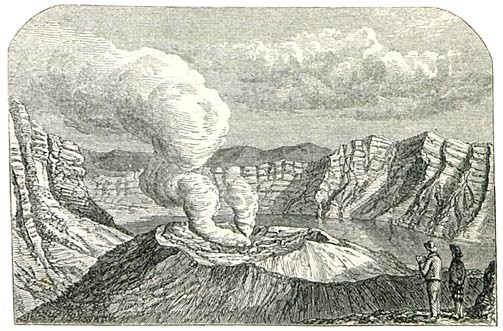
INTERIOR OF THE CRATER OF THE VOLCANO AT TAAL.
The generally accepted theory as to the formation of the Philippines is, that they all formed part of a vast primitive continent, which was broken up by some great convulsion of nature, and that these islands are the scattered fragments of that continent. Buzeta supposes that from Luzon the other islands were detached.1
The Indians have a tradition that the earth was borne on the shoulders of a giant, who, getting tired of his heavy burden, tumbled it into the ocean, leaving nothing above the waters but the mountains, which became islands for the salvation of the human race.
I do not propose to give a detailed geographical description of the Philippine Islands. Buzeta’s two octavo volumes will furnish the most accurate particulars with which I am acquainted as to the various localities. The facts which I collected in the course of my personal observation refer specially to the islands of Luzon, Panay, and Mindanao. The more general information has been derived from Spanish authorities on the spot, or has been found in Spanish books which I have consulted. I cannot presume to consider the present volume as complete or exhaustive, but it will contribute something to augment that knowledge which is already possessed.
The extent of the Philippine Archipelago is about 300 leagues from north to south, and 180 leagues from east to west. The islands of which it is composed are innumerable, most of the larger ones having some Spanish or mestizo population. A range of irregular mountains runs through the centre of the whole. Those known by the name of the Caraballos, in Luzon, are occupied by unsubdued races of idolatrous Indians, and extend for nearly sixty leagues. Several large rivers have their sources in the Caraballos. At the top of Mount Cabunian, whose ascent is very difficult, there is a tomb worshipped by the pagan Igorrotes. There are large lakes in several of the islands, and during the rainy season some of them become enormously extended. These inundations are naturally favourable to the vegetable productions by fertilizing vast tracts of land. Mindanao, which means “Men of the lake,” has its Indian name from the abundance of its inward waters, in the same way that La Laguna has been adopted by the Spaniards as the designation of the province bordering on the Lake of Bay. In this latter district are many mineral and thermal springs, which have given to one of its pueblos the name of Los Baños (the baths). One of them issues from the source at a temperature of 67° of Reaumur. They are much visited by the inhabitants of Manila. There are boiling springs in the pueblo of Mainit.
The climate of the Philippines is little distinguished from that which characterizes many other tropical regions of the East. It is described in a Spanish proverb as—
Seis meses de polvo,
Seis meses de lodo,
Seis meses de todo.
“Six months of dust, six months of mud, six months of everything;”—though it may generally be stated that the rainy season lasts one half, and the dry season the other half of the year. There are, however, as the distich says, many months of uncertainty, in which humidity invades the ordinary time of drought, and drought that of humidity. But from June to November the country is inundated, the roads are for the most part impassable, and travelling in the interior is difficult and disagreeable. Even in the month of December, in several districts of Luzon, we found, as before mentioned, places in which carriages are necessarily abandoned, the palanquin bearers being up to their thighs in mud; and other places in which we were compelled to open a new way through the woods. The heat is too oppressive to allow much active exertion in the middle of the day, and the siesta is generally resorted to from 1 to 3 o’clock P.M., before and after which time visits are paid and business transacted. The pleasant evening time is, however, that of social enjoyment, and the principal people have their tertulias, to which guests are welcomed from half-past 8 o’clock to about 11 o’clock P.M.
The variations of the thermometer rarely exceed 10° of Reaumur, the maximum heat being from 28° to 29°, the minimum 18° to 19°. Winter garments are scarcely ever required.
The difference between the longest and shortest day is 1h. 47m. 12s. On the 20th June, in Manila, the sun rises at 5h. 33m. 12s., and sets at 6h. 26m. 48s.; on the 20th December, it rises at 6h. 26m. 48s., and sets at 5h. 33m. 12s.
The minimum fall of rain in Manila is 84 inches, the maximum 114. Hailstorms are rare. There is no mountain sufficiently high to be “snow-capped;” the highest, Banaho, is between 6,000 and 7,000 feet above the level of the sea.
Like other tropical climates, the Philippines are visited by the usual calamities gathered by the wild elements round that line which is deemed the girdle of the world. Violent hurricanes produce fearful devastations; typhoons cover the coasts with wrecks; inundations of rivers and excessive rains destroy the earth’s produce, while long-continued droughts are equally fatal to the labours and the hopes of husbandry. Earthquakes shake the land, overturn the strongest edifices and sport destructively with the power of man; volcanic mountains inundate the earth with their torrents of burning lava. Clouds of locusts sometimes devour all that is green upon the surface of the ground; and epidemic diseases carry away multitudes of the human race. The ravages caused by accidental fires are often most calamitous, as the greater part of the houses are constructed of inflammable materials. When such a disaster occurs, it spreads with wonderful rapidity, and, there being no adequate means of extinction, a whole population is often rendered houseless.
During the change of the monsoons especially, the storms are often terrific, accompanied by very violent rains, fierce lightning and loud thunder. If in the night, the darkness thickens. Many lose their lives by lightning strokes, and houses are frequently carried away by the vehemence of the torrents.
Bagyo is the Indian name for hurricane. These violent outbreaks are generally announced in the morning by a light smoky mist which appears on the mountains; it gathers, and darkens, and thickens into heavy clouds, and before day closes breaks out with its fearful and destroying violence, raging from an hour and a half to two hours. M. de Gentil says that in the torrid zone the clouds which bring the most destructive tornadoes are at an elevation not exceeding 400 toises of perpendicular height.
The largest of the volcanoes is that of Mayon in Luzon. It is in the shape of a sugar-loaf, perfectly conical. Its base covers several leagues in the provinces of Albay and Camarines, and it is one of the most prominent objects and landmarks visible from the sea; there is a constant smoke, sometimes accompanied by flames; its subterranean sounds are often heard at a distance of many leagues. The country in the neighbourhood is covered with sand and stone, which on different occasions have been vomited forth from the crater. There is a description by the Alcalde of an eruption in 1767, which lasted ten days, during which a cone of flame, whose base was about forty feet in diameter, ascended, and a river of lava was poured out for two months, 120 feet in breadth. Great ruin was caused to the adjacent villages. The lava torrent was followed about a month afterwards by enormous outpourings of water, which either greatly widened the beds of the existing rivers, or formed new channels in their rush towards the sea. The town of Malinao was wholly destroyed, and a third part of that of Casana. Many other villages suffered; forests were buried in sand; which also overwhelmed houses and human beings. The ravages extended over a space of six leagues.
From an eruption at Buhayan, sixty leagues from Zamboanga, in the island of Mindanao, in 1640, large masses of stone were flung to a distance of two leagues. The ashes fell in the Moluccas and in Borneo. Dense darkness covered Zamboanga. Ships at sea lighted their lamps at 8 A.M., but the light could not be seen through the clouds of sand. The mountain whence the explosion originated disappeared, and a lake was formed and still remains in the locality as a record of the agitation. The waters of the lake were long white with ashes. The noise of the eruption was heard in Manila.
About twenty leagues from Manila is the province of Batanga. In one of the bays is an island called by the natives Binintiang Malagui, remarkable for its beauty, for the variety of its vegetation, and the number of animals which inhabit it. The eastern part of the island is a mountain, whose extinct volcano is seen in the form of a truncated cone of enormous extent, surrounded by desolation. The flanks of the mountain have been torn by vast channels, down which the lava-streams must have flowed. The sides are covered with ferruginous and sulphurous pyrites and scoriæ, which make the ascent difficult. It is most accessible on the southern side, by which we reach the mouth of the crater, whose circumference exceeds three miles, and whose deep and wild recesses exhibit astounding evidences of the throes and agitations which in former times must have shaken and convulsed this portion of the earth. A Spanish writer says it looked “like an execrable blasphemy launched by Satan against God.” There are still some signs of its past history in the smoke which rises from the abyss; but what characterizes the spot is the contrast between the gigantic wrecks and ruins of nature on one side, and the extreme loveliness and rich variety of other parts of the landscape. Descending into the crater by the help of cords round the body, a grand platform is reached at the depth of about 600 feet, in which are four smaller craters, one constantly and the others occasionally emitting a white smoke, but they cannot be approached on account of the softness and heat of the soil. To the east is a lake from which a stream runs round the craters over beds of sulphur, which assume the colour of emeralds. Formerly this lake was in a state of boiling ebullition, but is now scarcely above the natural temperature; it blackens silver immediately. Frequent earthquakes change the character of the crater and its neighbourhood, and every new detailed description differs from that which preceded it. The Indians have magnificent notions of the mineral riches buried in the bosom of the mountain, the sulphur mines of which were advantageously worked a few years ago, when a well-known naturalist (Lopez, now dead) offered to the Spanish government large sums for the monopoly of the right of mining the district of Taal.
On the 21st of September, 1716, sounds like those of heavy artillery proceeded from the Taal volcano, and the mountain seemed to be in a state of ignition over a space of three leagues towards Macolot. Gigantic towers of boiling water and ashes were thrown up, the earth shook on all sides, the waters of the lake were agitated and overran its banks: this lasted for three days. The water was blackened, and its sulphurous smell infested the whole district. In 1754 a yet more violent eruption, lasting eight days, took place, with terrible explosions, heavings of the earth, darkness, and such clouds of dust and ashes that all the roofs of the houses at Manila, at a distance of twenty leagues, were covered. Great masses of stones, fire and smoke were thrown from the mountain. The lake boiled in bubbles. Streams of bitumen and sulphur ran over the district of Bong-bong. The alligators, sharks, tunnies, and all the large fish, were destroyed in the river and flung upon the banks, impregnating the air with stench. It is said that subterranean and atmospheric thunders were heard at a distance of 300 leagues from the volcano, and that the winds carried the ashes to incredible distances. In Panay there was midday darkness. Many pueblos were wholly destroyed; among them Sala, Janavan, Lipa, and Taal: others bearing the same names have been since founded at a greater distance from the mountain.
Lopez gives a description of his descent into the crater. He employed 100 men for eight days to make a slope for his going down. He says the crater is oval, two miles in diameter; that the lake within the crater is surrounded by level and solid ground; that there was a deep chasm which had been recently ignited: there was sulphur enough to load many ships. He saw a cube of porphyry 20 to 25 feet square. The crater wall is perpendicular on all sides; that on the north 1,200 feet high, the lowest exceeding 900 feet. He says he believes the south sides to be of porphyry. At night, midway of the descent, he saw “thousands of millions” of jets, whose gas immediately inflamed on coming in contact with the atmosphere, and he heard many small detonations. The waters of the lake were impregnated with sulphuric acid, and 12 lbs. of the water, when distilled, left a mineral residuum weighing 2½ lbs.
There are many remarkable caves in the Philippines. I translate a description of one in the province of Tondo. Two stony mountains unite, and on their skirt is the road towards a branch of the main river. On the left is a cave whose entrance fronts the south. The mouth is almost covered with tangling vegetation, but it is arched, and, being all of marble, is, particularly in the sunshine, strikingly beautiful. You enter by a high, smooth, natural wall like the façade of a church, over which is a cavity roofed as a chapel. The interior pathway is flat, about four yards in breadth and six in height, though in some places it is much loftier. The roof presents a multitude of graceful figures, resembling pendent pineapples, which are formed by the constant filtration and petrifaction of the water. Some are nearly two yards in length, and seem sculptured into regular grooves; others are in the shape of pyramids whose bases are against the roof. Arches, which may be passed both from above and below, are among these wonderful works. Not far from the door is a natural staircase, mounting which you enter a large chamber, on whose right hand is another road, which, being followed, conducts to a second staircase, which opens on the principal communication. Suspended on one wing are immense numbers of bats, who occupy the recesses of the ceiling. Though there is mud in some of the paths, the ground is generally of stone, which, on being struck, gives a hollow sound as if there were passages below. Penetrating the cave for above 200 yards, a loud noise is perceived coming from a clear bright river, by the side of which the cave is continued under a semicircular roof. The great cave has many smaller vaults and projections of a grotesque and Gothic character. The course of the stream is from the north-west to the south-east.
The destructive ravages and changes produced by earthquakes are nowhere more remarkable than in the Philippines. They have overturned mountains, they have filled up valleys, they have desolated extensive plains; they have opened passages for the sea into the interior, and from the lakes into the sea There are many traditional stories of these territorial revolutions, but of late disasters the records are trustworthy. That of 1796 was sadly calamitous. In 1824 many churches in Manila were destroyed, together with the principal bridge, the barracks, great numbers of private houses; and a chasm opened of nearly four miles in length. The inhabitants all fled into the fields, and the six vessels in the port were wrecked. The number of victims was never ascertained. In 1828, during another earthquake, the vibration of the lamps was found to describe an arch of four and a half feet; the huge corner-stones of the principal gate of the city were displaced; the great bells were set ringing. It lasted between two and three minutes, rent the walls of several churches and other buildings, but was not accompanied by subterranean noises, as is usually the case.
There are too few occasions on which scientific observations have been made on the subject of earthquakes, which take men by surprise and ordinarily create so much alarm as to prevent accurate and authentic details. A gentleman who had established various pendulums in Manila for the purpose of measuring the inclination of the angles and the course of the agitation, states that, in the slight earthquakes of 20th and 23rd June, 1857, the thermometer being at 88°, the direction of the first shock was from N.N.E. to S.S.E., the duration 14 seconds, and the oscillation of the pendulum 1½ degrees; time, 2h. 0m. 40s. P.M.: 20th June. Second shock from N.E. to S.W.; duration, 26 seconds; oscillation of pendulum, 2 degrees; time, 2h. 47m. P.M.: 20th June. Third shock S.W. to N.; duration of the shock, 15 seconds; greatest oscillation, 6 degrees, but slight movements continued for a minute, and the oscillations were observed from 2 degrees to three-quarters of a degree; time, 5 P.M.: 23rd June.
Earthquakes have produced great changes in the geography of the Philippines. In that of 1627, one of the most elevated of the mountains of Cagayan disappeared. In 1675, in the island of Mindanao, a passage was opened to the sea, and a vast plain was emerged. Successive earthquakes have brought upon Luzon a series of calamities.
Endemic diseases are rare in the Philippines. Intermittent fevers and chronic dysentery are among the most dangerous disorders. There have been two invasions of cholera, in 1820 and 1842. Elephantiasis, leprosy, and St. Anthony’s fire are the scourges of the Indians; and the wilder races of the interior suffer from a variety of cutaneous complaints. The biri biri is common and fatal. Venereal diseases are widely spread, but easily cured. Among the Indians, vegetables alone are used as medicaments. Chinese quack-doctors have much influence. In the removal of some of the tropical pests, no European can compete with the natives. They cure the itch with great dexterity, and are said to have remedies for pulmonary phthisis. Their plasters are very efficacious in external applications. They never employ the lancet or the leech. Surgical science is, of course, unknown.
There have been generally in the Philippines a few successful medical practitioners from Europe. Foreigners are allowed to exercise their profession, having previously obtained the authority of the Spanish Government; but the natives seldom look beyond their own simple mode of dealing with the common diseases of the islands; and in those parts where there is little or no Spanish population, no one is to be found to whom a surgical operation could safely be intrusted. The vegetable world furnishes a great variety of medicinal herbs, which the instinct or the experience of the Indian has turned to account, and which are, probably, on the whole, as efficacious as the more potent mineral remedies employed by European science. Quinine, opium, mercury, and arsenic, are the wonder-workers in the field of Oriental disease, and their early and proper application generally arrests the progress of malady.
I found practising in the island of Panay Dr. Lefevre, whom I had known in Egypt more than twenty years before, and who was one of the courageous men who boldly grappled with the current superstitions respecting the contagious character of the Oriental plague, and the delusions as to the efficacy of quarantine regulations, so really useless, costly, and vexatious. He placed in my hand some observations which he had published at Bombay in 1840, where vessels from the Red Sea were subjected to sanatory visitations. He asserts that plague is only generated at particular seasons, in certain definable conditions of the atmosphere, and when miasma is created by the decomposition of decaying matter; that endemic plague is unknown in countries where proper attention is paid to hygienic precautions; that severe cold or intense heat equally arrests the progress of the plague; that the epoch of its ravages is always one when damp and exposed animal and vegetable substances emit the greatest amount of noxious gases; and that plague has never been known to originate or to spread where the air is in a state of purity. I was glad to rediscuss the matter with him after so long an added experience, and to find he had been more and more confirmed in his former conclusions by prolonged residence in the tropics, where endemic and epidemic diseases partake of the pestilential character, though they do not assume the forms, of the Levant plague. Dr. Lefevre affirms that quarantines have done nothing whatever to lessen the dangers or check the ravages of the plague, but much to encourage its propagation. He complains of the deafness and incredulity of those whom the examination of a “thousand indisputable facts” will not convince, and he thus concludes:—“If I had not with peculiar attention studied the plague in the midst of an epidemic, and without any more precautions than if the danger was nothing—if, subsequent to the terrible visitation of 1835 in Egypt, I had not been frequently a witness to the scourge—if, finally, since that epoch I had not given myself up, with all the warmth of passion, to the constant study of this malady, to the perusal of histories of the plagues which have ravaged the world, and to the examination of all sorts of objections—I should not have dared to emit such a decided opinion—an opinion respecting the soundness of which I do not entertain the slightest doubt.”
One cannot but be struck, in reference to the geographical character of these islands, with the awful serenity and magnificent beauty of their primeval forests, so seldom penetrated, and in their recesses hitherto inaccessible to the foot of man. There is nothing to disturb their silence but the hum of insects, the song of birds, the noises of wild animals, the rustling of the leaves, or the fall of decayed branches. It seems as if vegetation revelled in undisturbed and uncontrolled luxuriance. Creeping plants wander from tree to tree; lovely orchids hang themselves from trunks and boughs. One asks, why is so much sweetness, so much glory, wasted? But is it wasted? To the Creator the contemplation of his works, even where unmarked by human eye, must be complacent; and these half-concealed, half-developed treasures, are but reserved storehouses for man to explore; they will furnish supplies to awaken the curiosity and gratify the inquiry of successive ages. Rove where he may—explore as he will—tax his intellect with research, his imagination with inventions—there is, there will be, an infinite field around and above him, inexhaustible through countless generations.
1 Diccionario geográfico, estadístico, histórico de las Islas Filipinas. 2 vols. Madrid, 1850. ↑
1 Diccionario geográfico, estadístico, histórico de las Islas Filipinas. 2 vols. Madrid, 1850. ↑
CHAPTER V.
GOVERNMENT—ADMINISTRATION, ETC.
The Administration of the Philippine Archipelago has for its head and chief a captain and governor-general, who resides in Manila, the capital of the islands, and who is not permitted to quit them without the authority of the sovereign of Spain. Next to the government of Cuba, it is the most important and the most lucrative post at the disposal of the Cabinet of Madrid, and has unfortunately been generally one of the prizes wrested from the unsuccessful, and seized by the predominant, political party. It was rather a melancholy employment for me to look over the collection of portraits of captains-general, and many vacant frames waiting for future occupants, which ornament the walls of the handsome apartments in which I dwelt at the palace. Since 1835 there have been five provisional and eleven formal appointments to the governor-generalship. Some of these only held their authority for a few months, being superseded by ministerial changes at Madrid. Of other high functionaries, I observe that there have been only two archbishops since 1830, while it is understood that the service of heads of departments is assured for ten years. To the public interests the mischiefs which are the results of so uncertain a hold of the supreme authority are incalculable. The frequent and sudden removals and nominations are, indeed, little consistent with the principles of monarchical and hereditary government, however accordant with the republican institutions of the Western world; and among the causes of the slow development of the immense resources of these beautiful islands, the fluctuation of the superintending rule is assuredly one of the most prominent.
The titles of the captain-general occupy a page, and embrace the usual attributes of government, with the exception of authority over the fleet, which is subject to the Ministry of Marine in Spain, and a somewhat limited jurisdiction in ecclesiastical matters, which is a consequence of the exclusive establishment of the Roman Catholic faith.
The lieutenant-governor, who takes the place of the captain-general in case of his death, is called the Segundo Cabo, or second head.
The Philippine Islands are divided into provinces, subject either to politico-military governors or alcaldes mayores, who are generally civilians.
When the government is military, an assistant lieutenant-governor, who must have graduated as a lawyer, exercises the preliminary jurisdiction (de primera instancia), but the alcaldes hold that jurisdiction in their own persons. Both dispose in their provinces of the military authority, and have the controlling direction of the collection of the revenues, under responsibility to the General Administrator of Tributes.
The provinces are divided into pueblos (towns or villages), over each of which a native Indian or mestizo, called a gobernadorcillo (diminutive of governor) is placed. He is assisted in the discharge of his functions by native lieutenants and alguacils, whose number depends upon the extent of the population. This body, which, when gathered together, is called the principalia of the pueblo, settles all minor matters of police and civil questions between the natives as to rights of persons and property. In districts where the Chinese or their descendants are sufficiently numerous (they are known by the name of Sangleyes), they are allowed, under special authority of the government, to select principalia from their own body, independently of Indian jurisdiction. These principalia are really popularly chosen municipalities, and they are specially charged to assist the clergy in all matters connected with public worship and ecclesiastical authority. They determine questions up to the amount of two taels of gold, or forty-four silver dollars. They collect evidence in criminal cases, which is submitted to the provincial chief; they assist in the collection of the royal revenues, circulate the ordinances of the government among the people, and are authorized to levy a small but defined contribution in support of their dignity.
Besides these, there are in every pueblo certain functionaries who are called Cabezas (heads) de Barangay. A barangay is a collection of the chiefs of families, or persons paying tribute, generally amounting to forty or fifty. They are under the special charge of the cabeza, who must dwell among them, and, under bond, collect the tribute due to the State. He is required to settle misunderstandings and to maintain peace and order, to apportion the various charges among the members of the barangay, and to collect the taxes for payment to the gobernadorcillo, or to the functionary appointed for the purpose. The cabezas are also considered the procuradores, or law advisers, of these little communities.
In ancient times there is little doubt that the office was hereditary; and there are yet localities where the hereditary right is maintained; but it is generally elective: and when a vacancy occurs, the gobernadorcillo in council, with the other cabezas, presents a name for the approval of the superior authority, and the same steps are taken when the increase of population requires a new cabeza to be nominated. The cabezas, their wives and first-born, who are required to assist in the collection of the tribute, are exempted from its payment.
In some provinces the cabezas are only chosen for three years; after which they form part of the principalia, and take the title of Don. I remember, in one locality, that the principalia who came to pay their respects consisted of more than seventy persons. The government complains of the number who, under this state of things, are exempted from taxation, and I understand some measures are in contemplation for limiting the extent of the privileges.
The elections of the gobernadorcillo are annual, and take place on the 1st of April. An extraordinary excitement generally prevails, the post (a really important, popular, and influential one) being an object of much ambition. Three names are selected, one of whom must have already served as gobernadorcillo, for submission to the superior authority, on or before the 15th of May, and the chosen gobernadorcillo enters on his functions on the 1st of June. There is, however, some alteration of dates, where, as in the tobacco districts, the period of election interferes with harvest time.
The head of the province ordinarily presides over the elections, to which the principal ecclesiastic is also invited. In case of their absence, any native-born Spaniard may be nominated by the principal authority to preside.
There are thirteen electors for each pueblo—the gobernadorcillo and twelve inhabitants—half of whom must have been gobernadorcillos or cabezas, and the other half be in the actual exercise of those functions; they must also have some well-recognized means of existence: domestic servants to the authorities are excluded; as also those who have been punished as criminals.
It is further required that the gobernadorcillo be a native Indian or mestizo, an inhabitant of the locality where he serves, and above twenty-five years old; having passed the subordinate offices of lieutenant or cabeza, having his accounts in order, holding no land from the community, and no monopoly (estanco) from the government. Similar recommendations are insisted on for the first lieutenant and the principal (native) magistrates appointed for the settlement of questions regarding seed-sowing, police, and cattle. These magistrates must have enjoyed the rank of gobernadorcillo. As regards the minor officers of justice and their attendants, a list is to be made out by the gobernadorcillo before quitting office, which is to be presented to the authority presiding over the elections, and having heard the clergyman (cura) and the committee of election, the president approves the list for transmission to the supreme authority; but if he finds discordance and irreconcilable opinions between the parties before him, he is authorized himself to recommend the officers for nomination.
All the proceedings are the subjects of record, and to be signed by the president, the curate (if present), the electors, and the public notary, and to be remitted to the supreme authority, except in the provinces adjacent to the capital. The president may attach to the record any observations of his own connected with the returns. A decree of 1850 required the general adoption of the system which has been described, and which appears to me well worthy of note, showing how many valuable elements of good government are to be found in the popular institutions of the Philippine Indians.
The Chinese of the capital may elect Christian converts of their own body, under the presidency of the alcalde mayor of Manila, to the offices of gobernadorcillo, first lieutenant, and principal alguacil (bailiff). The dependent subordinate officers of justice are called bilangos, and are appointed by the gobernadorcillo on his election. The recovery of the tribute or taxes from the Chinese is not left to their principalia, but is effected by the alcalde mayor or superior chief. An officer is appointed to classify the Chinese, and apportion the quota of their contributions according to the wealth of the payer, who is charged for what is called a patente industrial.
The gobernadorcillos and officers of justice are entitled to sit in the presence of the provincial chiefs, who are to require the parochial clergy to treat them with due honour and regard.
M. Mallat, whose Geographical History of the Philippines was published in 1846, remarks that, of all colonies founded by Europeans, these regions are perhaps the least known, and the most worthy of being known. The number of islands which compose the archipelago,—their vast extent and boundless variety,—the teeming population of many of them,—the character of the climate,—the wonderful fertility of the soil,—the inexhaustible riches of hill, valley, and plain,—all offer to cultivation and its civilizing influences abundant rewards. But as regards the “industrious habits” of the natives, I cannot place that consideration, as M. Mallat does, among the elements of hope. It is the want of these “industrious habits,” among four or five millions of inhabitants, which has left the Philippines in a position so little advanced.
Java under the government of the Dutch, and Cuba subjected to the Spanish rule, present, no doubt, far more favourable pictures than do the Philippines; but many of the difficulties which surround the captain-general of Manila,—difficulties both religious and social,—do not embarrass the governor of Batavia; the island of Java, the most productive of Netherlands India, being peculiarly free from these difficulties; and it cannot be said that Sumatra and Borneo are even on a level with the more advanced of the Philippine Islands.
To the character of the original conquest and of the earlier government of the Philippines may be traced many of the impediments which now stand in the way of improvement. In America and the West Indies all the brutality of military conquerors was exhibited, and the possession and plunder of new territories were encouraged by the Spanish court, and were the main object of the Spanish invader. But far different was the policy adopted in the Philippines, where only a small body of soldiers was accompanied by zealous missionaries, whose purpose was rather to convert and christianize the Indians than to pillage and destroy them. These friars gradually obtained a paramount influence over the Indians. The interests of trade have ever been the predominant consideration among Dutch colonizers, and among British adventurers the commercial element has always been intimately associated with the desire for territorial occupation. To the Spaniards it must be conceded that the religious purpose—be its value what it may—has never been abandoned or forgotten. Ecclesiastical jurisdiction and authority are interwoven in the Philippines with the machinery of government and the daily concerns of life.
And such ecclesiastical action has been comparatively little interfered with in the Philippines. The development which mental emancipation has given to many Protestant countries and their dependencies has reached few Catholic colonies; nor is that emancipation, indeed, consistent with the more rigid discipline and doctrines of Rome. But in the case of the most prosperous instances of colonization by the British, the native races have either wholly disappeared or are in progress of extinction, while the infusion of Spanish and foreign blood into the colonies of Spain has not only allowed the increase of the indigenous population, but has been insufficient to change or do more than slightly modify their national characters. It has undoubtedly been the boast of the Catholics that Francis de Xavier and his followers won more for the Roman Church in the East than Luther or Calvin ever tore away from it in the West; but the value of the conquests, contrasted with that of the losses and sacrifices, if fairly estimated, would hardly be deemed unsatisfactory to the Protestant cause.
No doubt the great remoteness of the Philippines from Europe, the difficulties and infrequency of communication, gave to the local authorities more of independent action than would otherwise have been allowed to them; and in case of the death of the governor, the archbishop was generally the functionary who filled his place; his adjacency to the government, and frequent direction of it, naturally led to the strengthening of his own authority and that of all ecclesiastics dependent upon him.
In the earlier periods of Eastern colonization, too, the Portuguese, jealous of all European intercourse but their own with nations east of the Cape, did all in their power to prevent any other than the Lusitanian flag from being seen in Oriental waters. But as regards missionary objects their views were to some extent concurrent with those of the Spanish priests, and their proceedings were in harmony with those of the Spaniards, especially in so far as both received their direction from the Pontiff at Rome. It ought not, however, to be forgotten that whatever may have been the progress of Christianity in the Philippines, the persecutions, disasters, discomfiture, and death of so many professing Christians in Japan, are probably attributable to the ill-guided zeal of the Portuguese preachers of the Gospel in these still remoter regions. It is well for the interests of truth, as most assuredly it is for the interests of commerce and civilization, that a more temperate and tolerant spirit has for the last century been associated with the progress of European influence in the East.
The comparatively small number of Spanish settlers in the Philippines would not allow them, even if such had been their purpose, which it does not appear to have been, unnecessarily to interfere with the usages of the Indians, or their forms of administration and government, except in so far as their conversion to Christianity compelled the observance of the Christian rites; and the friars willingly accommodated their action to the social habits of the people, respecting, as to this hour are respected, most of the patriarchal forms of administration and government which had existed among them from immemorial time.
There have been speculations—and M. Mallat is among the sanguine anticipators of such an advent—that in process of time the Philippines may become the dominant political power of the Eastern world, subjecting to its paramount influence the Netherlands Archipelago, the Pacific, Australia, and even China and Japan, and that Manila is destined to be the great emporium for the eastern and south-eastern world. M. Mallat even goes further, and says: “Manila might easily become the centre of the exports and imports of the entire globe.” It must be contented with a less brilliant futurity. Certainly its commercial relations might be greatly extended, and the Spanish archipelago be much elevated in value and in influence; but in the vast development of commercial relations in the Oriental world, the Philippines must be contented with a moderate though a considerable share of benefit, even under the best administration and the adoption of the wisest policy.
Tropical regions fail to attract permanent settlers from the West. The foreign merchant comes to realize what he deems an adequate fortune, and to withdraw; the superior public functionary is among, or above, but never of, the people. What must be looked to is the popular element. Of what are the millions composed, and how can the millions be turned to account? There is no reason to apprehend that these millions will aspire to political power or sovereignty. Their pristine habits would permit of no general organization. The various races and clans would never unite in a national object, or recognize one native chief. All that is found of order and government among them is local; except through and for their masters, the different islands have little or no intercourse with one another. The Tagál and the Bisayan have no common sympathies. Dissatisfaction might produce disorder, which, if not controlled, would lead to anarchy, but not to good government.
The Philippines are free from the curse of slavery. Time will settle the controversy as to whether the labour of the freeman can, in the long run, be brought into competition with that of the slave, especially in the tropics; but that the great tide of tendency flows towards the abolition of slavery, that civilizing opinion and enlightened Christian legislation must sweep the ignominy away, is a conviction which possesses the minds of all who see “progress” in the world.
As it is, the Philippines have made, and continue to make, large contributions to the mother country, generally in excess of the stipulated amount which is called the situado. Spain, in her extreme embarrassment, has frequently called on the Philippines to come to her aid, and it is to the credit of the successive governors-general that, whatever may have been the financial disorders at home, the dependants upon the Manila treasury have had little motive for complaint, and while the Peninsula was engaged in perilous struggles for her independence, and even her existence as a nation, the public tranquillity of her island colonies was, on the whole, satisfactorily maintained, and interruptions to the ordinary march of affairs of short endurance.
There would seem to be no legislation defining the powers of the viceroy, or captain-general; but whenever any important matter is under discussion, it is found that reference must be made to Madrid, and that the supreme rule of this vast archipelago is in the leading strings of the Spanish Cabinet, impotent to correct any great abuses, or to introduce any important reforms. The captain-general should be invested with a large amount of power, subject, of course, to a personal responsibility as to its becoming exercise. As he must, if properly selected, know more, being present, than strangers who are absent, his government should be trusted on account of that superior knowledge. Well does the Castilian proverb say, “Mas sabe el loco en su casa que el cuerdo en la agena”—“The fool knows more about his own house than the sage about the house of another.” He should be liberally paid, that the motives for corruption be diminished. He should be surrounded by a council composed of the best qualified advisers. Many objects would necessarily occupy the attention of such a body, and it would naturally have to create becoming local machinery and to furnish the materials for improved administration, such as surveys and statistics of the land and population, which would lead to a more satisfactory distribution of provinces, districts and pueblos. A simple code of civil and criminal law would be a great blessing, and should be grounded, in so far as the real interests of justice will allow, upon the customs and habits of the people, while employing, when compatible with those interests, the administrative local machinery in use among the natives.
Nothing would be more beneficial to the interests of Manila than the establishment of an efficient board of works, with provincial ramifications, to whose attention the facilitating communications should be specially recommended. The cost and difficulty of transport are among the principal impediments to the development of the resources of the islands, and the tardy progress of the few works which are undertaken is discouraging to those who suggest, and disappointing to those who expect to benefit by them. In many of the provinces the bridges are in miserable condition, and the roads frequently impassable. Even in the populous island of Panay delays the most costly and annoying interfere with the transport of produce to the capital and naturally impede the development of commerce. There is, no doubt, a great want of directing talent and of that special knowledge which modern science is able to furnish. The construction of bridges being generally left to the rude artists who are employed by the Spanish functionaries, or to the direction of the friars, with whom the stare super antiquas vias is the generally received maxim, it is not wonderful that there should be so many examples of rude, unsafe and unsightly constructions. Moreover, estimates have to be sent to the capital of all the proposed outlay, and it is hardly to be expected but that sad evidence should be found—as elsewhere—of short-sighted and very costly economy. The expense, too, almost invariably exceeds the estimates—a pretty general scandal; then the work is arrested, and sometimes wholly abandoned. Funds there are none, and neither policy nor patriotism will provide them. Even when strongly impelled, the Indian moves slowly; self-action for the promotion of the public good he has none. There is no pressure from without to force improvements upon the authorities, and hence little is to be hoped for as to improvement except from direct administrative action.
I can hardly pass over unnoticed M. de la Gironière’s romantic book,1 as it was the subject of frequent conversations in the Philippines. No doubt he has dwelt there twenty years; but in the experience of those who have lived there more than twice twenty I found little confirmation of the strange stories which are crowded into his strange volume. He was a resident of the Philippines at the time of my visit, and I believe still lives on the property of which he was formerly—but I was told is no longer—the possessor.2 I did not visit his “Paradise,” but had some agreeable intercourse with a French gentleman who is now in charge. I did not find any of that extraordinary savagery with which M. de la Gironière represents himself to be surrounded; and the answer to the inquiries I made of the neighbouring authorities as to the correctness of his pictures of Indian character was generally a shrug and a smile and a reference to my own experience. But M. de la Gironière may have aspired to the honour of a Bernardin de St. Pierre or a Defoe, and have thought a few fanciful and tragic decorations would add to the interest of his personal drama. “All the world’s a stage,” and as a player thereon M. de la Gironière perhaps felt himself authorized in the indulgence of some latitude of description, especially when his chosen “stage” was one meant to exhibit the wonders of travel.
As to M. de la Gironière’s marvellous encounters and miraculous escapes from man and beast; his presence at feasts where among the delicacies were human brains, steeped by young girls in the juice of sugar-cane, of which he did not drink, but his servant did; his discoveries of native hands in “savory” pots prepared for food; his narratives where the rude Indians tell elaborate tales in the lackadaisy style of a fantastic novel; his vast possessions; his incredible influence over ferocious bandits and cruel savages;—all this must be taken at its value. I confess I have seen with some surprise, in M. de la Gironière’s book, two “testimonies” from M. Dumont d’Urville and Admiral La Place, in which, among other matters, they give an account of the hatching of eggs by men specially engaged for this purpose.3 They saw, as any one may, in the villages on the Pasig River, prodigious quantities of ducks and ducklings, and were “puzzled” to find how such multitudes could be produced; but they learnt the wonderful feat was accomplished by “lazy Tagál Indians,” who lay themselves down upon the eggs, which are placed in ashes. The patient incubators eat, drink, smoke, and chew their betel, and while they take care not to injure the fragile shells, they carefully remove the ducklings as they are brought into being (pp. 358 and 362). Now it may well be asked who takes care when the lazy Tagáls are asleep; and, if our worthy witnesses had reflected for a moment, they would have known that, if all the inhabitants were employed in no other office than that of egg-hatching, they would be hardly sufficient to incubate the “prodigious” numbers of ducklings which disport on the banks of the Pasig. The incubation is really produced by placing warm paddy husks under and over the eggs; they are deposited in frames; a canvas covering is spread over the husks; the art is to keep up the needful temperature; and one man is sufficient to the care of a large number of frames, from which he releases the ducklings as they are hatched, and conveys them in little flocks to the water-side. The communities are separated from one another by bamboo fences, but there is scarcely a cottage with a river frontage which has not its patero (or duckery).
1 There is an English translation—“Twenty Years in the Philippines.” Vizetelly. 1853. ↑
2 I learn from the Captain-General that Messrs. de la Gironière and Montblanc are now charged with “a scientific mission to the Philippines,” under the auspices of the French government. ↑
3 I find in Mr. Dixon’s book on Domestic Poultry the merits of this discovery in the science of incubation attributed to an ancient couple, whose goose having been killed while “sitting,” the old man transferred the “cooling” eggs to their common bed, and he and the old lady taking their turns, safely brought the goslings into being. I ought to mention that confirmatory proofs of M. de la Gironière’s narrative are added from Mr. H. Lindsay; but Mr. Lindsay guards himself against endorsing the “strange stories” with which M. de la Gironière’s book abounds. ↑
1 There is an English translation—“Twenty Years in the Philippines.” Vizetelly. 1853. ↑
2 I learn from the Captain-General that Messrs. de la Gironière and Montblanc are now charged with “a scientific mission to the Philippines,” under the auspices of the French government. ↑
3 I find in Mr. Dixon’s book on Domestic Poultry the merits of this discovery in the science of incubation attributed to an ancient couple, whose goose having been killed while “sitting,” the old man transferred the “cooling” eggs to their common bed, and he and the old lady taking their turns, safely brought the goslings into being. I ought to mention that confirmatory proofs of M. de la Gironière’s narrative are added from Mr. H. Lindsay; but Mr. Lindsay guards himself against endorsing the “strange stories” with which M. de la Gironière’s book abounds. ↑
CHAPTER VI.
POPULATION.
In the last generation a wonderful sensation was produced by the propagation of the great Malthusian discovery—the irresistible, indisputable, inexorable truth—that the productive powers of the soil were less and less able to compete with the consuming demands of the human race; that while population was increasing with the rapidity of a swift geometrical progression, the means of providing food lagged with the feebleness of a slow arithmetical advance more and more behind; that the seats at nature’s table—rich and abundant though it was—were being abundantly filled, and that there was no room for superfluous and uninvited guests; in a word, to use the adopted formula, that population was pressing more and more upon subsistence, and that the results must be increasing want, augmenting misery, and a train of calamities boundless as the catalogue of the infinite forms of mortal wretchedness.
How often, when threading through the thousand islands of the Philippine Archipelago, did the shadow of Malthus and the visions of his philosophy present themselves to my thoughts. Of those unnumbered, sea-surrounded regions, how many there are that have never been trodden by European foot, how few that have been thoroughly explored, and fewer still that are now inhabited by any civilized or foreign race! And yet they are covered with beautiful and spontaneous vegetable riches above, and bear countless treasures of mineral wealth below; their powers of production are boundless; they have the varieties of climate which mountains, valleys and plains afford—rains to water—suns to ripen—rivers to conduct—harbours for shipment—every recommendation to attract adventure and to reward industry; a population of only five or six millions, when ten times that number might be supplied to satiety, and enabled to provide for millions upon millions more out of the superfluities of their means.
To what a narrow field of observation must the mind have been confined that felt alarm at a discovery, in itself of so little importance, when brought into the vast sphere of the world’s geography! Though the human race has been increasing at a rapid and almost immeasurable rate, it will be probably found that famines, and plagues, and wars, and those calamitous visitations which were deemed the redressers of the balance—the restorers of the due proportions between man’s wants and man’s supplies—were far more disastrous in ancient than in modern times, if the smaller number of then existing human beings be taken into consideration.
The nobler and higher axiom is that “progress” is the law of Providence, which never fails, while the race of man proceeds in ever-augmenting numbers, to provide ample means for their maintenance and happiness. Neither land nor sea is exhausted nor in process of exhaustion. What myriads of acres, whether in cold, temperate, or tropical climes, remain to be appropriated! what still greater amount to be improved by cultivation! And while in the more densely peopled parts of the world outlets may be required for those who are ill at ease and born to no inheritance but labour, how wonderfully are locomotive facilities increased, so that the embarrassment to ambulatory man is less to discover a fit place for his domicile, than to select one amid the many which offer themselves to his choice! If the poverty-struck Irish could emigrate in such multitudes to American or Australian regions, far greater are the facilities possessed by those better conditioned labouring masses of Europe who are still heavily pressed by the competition of neighbours more fortunate than themselves.
It is a matter of surprise that the Spanish colonies should not have attracted a greater number of Spaniards to settle in them; but the national spirit of the Iberian peninsula has ceased to be ambulatory or adventurous. Spain itself is thinly peopled, and offers great resources to its satisfied peasantry. “God,” they say, “has given everything to Spain which He had to give. Our land is an Eden—why should we desert it?” Yet Spain, backward, inert and unenergetic, as she has proved herself to be in the rivalry of active nations, has taken her part in the proud history of human advancement. The more enterprising invaders of Gothic or Anglo-Saxon blood have frequently extirpated the indigenous races of the remote countries in which they have settled. One wave of emigration has followed another; commerce and cultivation have created a demand for, and provided a supply of, the intrusive visitors. But Spain has never furnished such numbers as to dislodge the aboriginal tribes. Her colonists have been always accompanied by large bodies of ecclesiastics, bent upon bringing “the heathen” into the Christian fold. These missionaries have no doubt often stood between the cupidity of the conqueror and the weakness of the conquered. They have preserved, by protecting the Indian clans, and it may be doubted whether ultimately the permanent interests of man will not have been served by influences, whose beneficial consequences may remain when the most prominent evils connected with those influences may be greatly modified or wholly pass away.
My observations and my reflections, then, lead to this conclusion—that, whatever exceptional cases there may be, the great tide of advancement rolls forward in ever-growing strength;—that the course of the Divine government is
From seeming evil still educing good,
And BETTER thence again, and BETTER still,
In infinite progression;—
that the human family, taken as a whole, is constantly improving;—that every generation is wiser and better than that which preceded it;—that the savage and least improvable races will continue to be supplanted or absorbed by those of a higher intelligence;—that the semi-civilized will only be perpetuated by contact with a greater civilization, which will raise them in the scale of humanity. A middle race, such as China contributes in the shape of emigrating millions, is wonderfully advancing the work of civilization. The process is everywhere visible in the remoter Eastern world. The mestizo descendants of Chinese fathers and Indian mothers form incomparably the most promising portion of the Philippine population. In Siam, Burmah, Cochin China, profitable employments are mainly absorbed by Chinese settlers. In Netherlands India they are almost invariably prosperous. To them Sumatra, Borneo, and the other islands, must look, and not to the indigenous peoples, for any considerable development of their resources. In our Straits Archipelago they have superseded the Klings in all the most beneficial fields of labour, as the Klings had previously superseded the less industrious Malays. The progress of the higher capabilities, and the depression of the lower, may be traced in the extinction of so many rude languages and the spread of those which represent civilization in its most advanced stages. It may be foretold, I think, without presumption, that in some future time the number of tongues spoken on the face of the globe will be reduced to a very small amount. In the course of a century many a local idiom utterly perishes, and is invariably replaced by one of more extensive range and greater utility. When it is remembered that the written language of China is understood by one-third of the human race; that probably more than one-tenth of mankind have an acquaintance with spoken English—the language which has far more widely planted roots, and more extensive ramifications, than any other; when the daily decay of the provincial dialects of France, Germany, Spain, and Italy is watched, good ground will be discovered for the anticipation that many of the existing instruments for oral communication will be extinguished, the number of dead languages will be much augmented, and of living proportionally decreased.
I know not on what authority M. Mallat estimated, in 1846, the population of the Philippines at 7,000,000,—an augmentation, he says, of more than 50 per cent from 1816, when he states the population to have been 4,600,000. He says that it quadrupled itself from 1774 to 1816. He attributes the enormous increase from the later period to the introduction of vaccination and the general tranquillity of the country; but the correctness of the data may well be doubted.
The Christian population of the Philippines is stated by Father Juan Fernandez to be—
——
Pueblos.
Souls.
Under the Archbishopric of Manila
185
135,000
Under
,,
the
,,
Bishopric of New Segovia
132
745,000
Under
,,
the
,,
Bishopric of New Caceres
104
480,000
Under
,,
the
,,
Bishopric of Zebu
306
1,200,000
In all
727 3,560,000The population of the Philippines is generally supposed to be about four millions; but, as the Indians who dwell in the interior of several of the islands—those especially who occupy the unexplored forest and mountainous districts—cannot be included in any official census, any calculations can only be deemed approximative. The returns furnished by the government to the Guia de Foresteros for the year 1858 give the following results:—
Provinces.
Natives paying tribute.
Mestizos and Chinese Tributaries.
Total Population.
Births.
Deaths.
Marriages.
Manila
86,250
25,418
276,059
11,346
9,251
1,956
Bulacan
91,551
12,119
214,261
8,789
5,172
1,542
Pampanga
79,912
9,631
170,849
9,101
4,407
2,237
Nueva Ecija
40,949
...
74,698
5,963
2,547
1,176
Bataan
17,473
3,176
42,332
1,941
1,171
347
Cavite
41,471
6,943
56,832
8,867
2,619
868
Batangas
115,359
3,063
247,676
11,133
6,270
1,956
Moron
20,288
1,964
43,010
1,900
1,508
553
La Laguna
65,177
1,866
132,264
5,935
4,295
1,553
Zambales
28,023
149
31,116
2,320
1,191
635
Mindoro
7,335
...
15,135
734
645
191
Pangasinan
97,786
1,551
272,427
9,172
6,368
2,756
La Union
39,044
117
45,657
3,894
1,526
1,165
Ilocos Sur
77,974
2,293
179,407
7,305
3,647
1,801
Ilocos Norte
70,305
16
140,226
6,189
3,695
1,536
Cagayan
27,784
71
54,457
2,443
1,489
638
Abra
8,009
200
36,737
782
354
407
Nueva Biscaya
6,116
...
19,754
452
387
131
La Isabela
14,112
...
26,372
1,040
757
265
Camarines
78,012
125
209,696
6,273
3,456
1,770
Albay
103,928
990
204,840
7,458
6,722
1,099
Tayabas
44,940
154
102,210
3,049
2,124
949
Burias
470
...
525
17
12
1
Masbate of Ticao
5,421
27
10,992
249
103
55
Zebu
81,457
4,267
267,540
12,653
3,740
2,374
Negros
24,522
394
113,379
4,499
2,688
804
Calamianes
4,003
...
17,964
730
279
172
Bohol
64,760
692
175,686
5,924
2,476
1,452
Samar
61,586
437
117,866
6,161
3,437
1,863
Leite
66,371
790
134,493
5,582
2,168
1,387
Antique
25,567
42
77,639
4,810
1,708
664
Iloilo
174,884
1,442
527,970
17,675
9,231
3,697
Capiz
66,614
8
143,713
9,810
4,199
1,187
Surigao13,801
148
18,848
944
525
181
Misamis
23,729
266
46,517
2,155
845
396
Zamboanga
3,871
16
10,191
429
956
55
Basilan
167
4
447
43
71
Bislig
4,686
21
12,718
394
143
112
Davao
304
...
800
21
9
18
Romblon
3,517
...
17,068
892
375
149
Totals
1,787,528
78,400
4,290,371
184,074
102,466
40,093
Proportion of natives to mixed races
96.00 per cent.
Proportion
,,
of
,,
,,
natives (paying tribute) to population
29.00
per
,,
cent.
,,
Proportion
,,
of
,,
,,
mixed races to population
1.75
per
,,
cent.
,,
Proportion
,,
of
,,
,,
births to population
4.00
per
,,
cent.
,,
Proportion
,,
of
,,
,,
deaths to population
2.33
per
,,
cent.
,,
Proportion
,,
of
,,
,,
marriages to population
.90
per
,,
cent.
,,
Proportion
,,
of
,,
,,
births to deaths
64.00 to 36.00
per
,,
cent.
,,
Proportion
,,
of
,,
,,
births to marriages
2.70
per
,,
cent.
,,
Imperfect returns are given from Corregidor and Pulo Caballo, 370 inhabitants in all: From Benguet, 6,803, of whom 4,639 are pagans, and 15 Christian tributaries: From Cayan, 17,035, the whole population, of which 10,861 tributaries.
The number of European Spaniards settled in the Philippines bears a very small proportion to that of the mixed races. There are 670 males and 119 females in the capital (Manila and Binondo). Of these there are 114 friars, all living in Manila, eight ecclesiastics, forty-six merchants, fourteen medical practitioners, and the majority of the others military and civil functionaries. But in none of the islands does the proportion of Spaniards approach that which is found in the capital. Probably the whole number of European Spaniards in the islands does not amount to two thousand.
There are ninety-six foreigners established in Binondo—eighty-five males and eleven females (none in Manila proper). Of these fifty are merchants or merchants’ assistants. There are twenty-two British subjects, fifteen French, fifteen South Americans, eleven citizens of the United States, nine Germans, and nine Swiss.
Independently of European Spaniards, there are many families which call themselves hijos del pays (children of the country), descendants of Spanish settlers, who avoid mingling with native Indian blood. They have the reputation of being more susceptible than are even the old Castilians in matters of etiquette, and among them are many who have received a European education. They are generally candidates for public employment, but are said to be less steady, and more addicted to play and to pleasure, than their progenitors; but they are eminently hospitable. They dress in European style when they appear in public, but at home both men and women use the loose and more convenient Indian costume. They complain, on their part, that barriers are raised between them and their countrymen from the Peninsula; in a word, that the spirit of caste exercises its separating and alienating influences in the Philippines, as elsewhere.
The mestizos, or mixed races, form a numerous and influential portion of the Filipinos; the number settled in the islands of women of European birth is small, and generally speaking they are the wives of the higher Spanish functionaries and of superior officers in the army and navy, whose term of service is generally limited. Though the daughters of families of pure Spanish blood generally marry in the colony and keep up a good deal of exclusiveness and caste, it is seldom that the highest society is without a large proportion of mestiza ladies, children of Spanish fathers and native mothers. The great majority of the merchants and landed proprietors belong to this class, and most of the subordinate offices of government are filled by them. There are very many descendants of Chinese by native women; but the paternal type seems so to absorb the maternal, that the children for whole generations bear the strongly marked character which distinguishes the genuine native of the flowery land, even through a succession of Indian mothers. I shall have occasion to speak of a visit I made to a district (Molo, near Iloilo), which in former times had been the seat of a large Chinese colony, where the Chinese race had disappeared centuries ago, but the Chinese physiognomy, and the Chinese character, had left their unmistakable traces in the whole population. I found nowhere among the natives a people so industrious, so persevering, so economical, and, generally, so prosperous. Almost every house had a loom, and it is the place where the best of the piña fabrics are woven. We were invited to a ball at which the principal native ladies were present, and I had to answer a discurso delivered in excellent Castilian by the leading personage. I was informed that the young women were remarkable for their chastity, and that an erring sister obtained no forgiveness among them. Their parents object to their learning Spanish lest it should be an instrument of seduction. Of the mestizos of Chinese or Mongolian descent, De Mas says:—“They are called Sangley, which means Chinese merchant or traveller. They inherit the industrious and speculative spirit of their forefathers. Most of them have acquired riches and lands, and the largest part of the retail trade is in their hands. They form the middle class of the Filipinos. Their prosperity and better education produce the natural results, and their moral and intellectual character is far superior to that of the Indians. They are luxuriously dressed, are more elegant and handsome than the Indians; some of their women are decidedly beautiful. But they preserve most of the habits of the Indians, whom they exceed in attention to religious duties because they are superior in intelligence. This race is likely to increase in numbers and in influence, and, in consequence of the large importation of Chinamen, to augment in the localities of their settlements at a greater rate than the Indian population.”1
There can be no doubt that the predominance of the characteristics of the father over those of the mother has improved, through successive generations, the general character of the race of mestizo Chinese. They are more active and enterprising, more prudent and persevering, more devoted to trade and commerce, than the Indios. They all preserve the black hair, which is characteristic of China, “the black-haired” being one of the national names by which the people of the “middle kingdom” are fond of designating themselves. The slanting position of the eyes, forming an angle over the nose, the beardless chin, the long and delicate fingers (in conformity with Chinese usage they frequently allow the middle nail of the left hand to grow to a great length), their fondness for dress and ornament, distinguish them. They exercise great influence over the Indians, who believe them to be masters of the art of money-getting. The children of a Spanish mestizo by a Chinese mestiza, are called Torna atras, “going back;” those of a Chinese mestizo by an Indian woman are considered as Chinese and not Indian half-castes. The mingling of Chinese blood is observable in all the town populations. The number of mestizos of European descent is trifling compared with those of Chinese origin. Their houses are invariably better furnished than those of the natives. Many of them adopt the European costume, but where they retain the native dress it is finer in quality, gayer in colours, and richer in ornament. Like the natives, they wear their shirts over the trousers, but the shirt is of piña or sinamay fastened with buttons of valuable stones; and a gold chain is seldom wanting, suspended round the neck. The men commonly wear European hats, shoes and stockings, and the sexes exhibit no small amount of dandyism and coquetry.
The great mass of the indigenous population of the Philippine Islands may be divided into two principal races—the Tagálos occupying the north, and the Bisáyos the south. Of these, all who inhabit the towns and villages profess Christianity, and are much under the influence of the regular clergy, who administer the religious ordinances in the various provinces, which are, for the most part, submitted to the ecclesiastical jurisdiction of different orders of brotherhood. There are a few instances of the Indians being invested with the full rights of priesthood, though they generally reach no higher post than that of assistants to the friars. At the great ceremony which I attended of the Purisima Conception at Manila, an Indian was chosen to deliver the sermon of the day; it was, as usual, redolent with laudations of the Virgin, and about equal to the average style of flowery Spanish preaching. But as we recede from the towns, religious ordinances are neglected, and in the centre and mountainous parts of the islands Christianity ceases to be the profession of the inhabitants; the friars deplore their ignorant and abandoned state, and occupy themselves in the endeavour to bring them into their fold, and to enforce the payment of that tributo from which they, as well as the government, derive their revenues. If this be paid, if the services of the Church be duly performed, confession made, fit co-operation given to the religious processions and festivals (which are the native holidays), matters go on well between the clergy and the people. I found many of the friars objects of affection and reverence, and deservedly so, as guardians and restorers of the family peace, encouragers of the children in their studies, and otherwise associating their efforts with the well-being of the community; but removed, as the ecclesiastics frequently are, from the control of public opinion, there is often scandal, and good ground for it.
Father Zuñiga opines that the Philippines were originally colonized by the inhabitants of America; but he fails altogether in the proofs he seeks in the analogy of languages. The number of Malayan words in Tagal and Bisayan is greater than any to be traced to American dialects; and here I may remark, by the way, that there is no topic on which so much absurdity has been committed to the press as on the derivation and affinity of languages—a subject in which Spanish authority is seldom of much value. El Señor Erro, for example, in his book on the antiquity of the Bascuence, gives a description and picture of a jar found in a well in Guipuscoa, which had on it the words “Gott erbarme dein armes Würmchen!” This he reports to be a Biscayan inscription in honour of the priestesses of the sun anterior to the introduction of Christianity, and he doubts not that the vase (a piece of coarse modern German pottery) was used in the sacred services of the temple!
De Mas supposes that the Indians employed alphabetical writing anterior to the arrival of the Spanish, and gives five alphabets as used in different provinces, but having some resemblance to one another. I doubt alike the antiquity and authenticity of the records; but give a specimen which he says is a contract upon Chinese paper for a sale of land in Bulacan, dated 1652.

My own inquiries led to no discoveries of old records, or written traditions, or inscriptions of remote times, associated with Indian history. There is sufficient evidence that some rude authority existed—that there were masters and slaves—that the land was partially cultivated and the sea explored by labourers and fishermen, leading necessarily to a recognition of some rights of property—that there were wars between hostile tribes, which had their leaders and their laws. The early records of the missionaries give the names of some of the chiefs, and detail the character of the authority exercised by the ruling few over the subject many. They say that gold would procure the emancipation of a slave and his reception among the Mahaldicas, or privileged class. Prisoners of war, debtors, and criminals, were held in bonds. The daughter of a Mahaldica could be obtained in marriage, where the lover was unable to pay her money value, by vassalage to her father for a certain number of years. If a man of one tribe married the woman of another, the children were equally, or as nearly as possible, divided among the two tribes to which the parents belonged. Property was partitioned among the sons at the father’s death, the elder enjoying no rights over the younger.
Local superstitions prevailed as to rocks, trees, and rivers. They worshipped the sun and moon; a blue bird called tigmamanoquin; a stag named meylupa, “lord of the soil;” and the crocodile, to which they gave the title of nono, or “grandfather.” A demon named Osuang was supposed to torment children, to cause pains in childbirth, to live on human flesh, and to have his presence announced by the tictic, a bird of evil augury. Naked men brandished swords from the roof and other parts of the choza to frighten the fiend away, or the pregnant woman was removed from the neighbourhood of the tictic. The Manacolam was a monster enveloped in flames, which could only be extinguished by the ordure of a human being, whose death would immediately follow. The Silagan seized and tore out the liver of persons clad in white. The Magtatangal deposited his head and entrails in the evening in some secret place, wandered about doing mischief in the night, and resumed his “deposit” at break of day. So strange and wild are the fancies of credulity! Sacrifices were offered in deprecation of menaced evils, or in compliment to visitors, by female priestesses called Catalona, who distributed pieces of the sacrificed animal. There were many witches and sorcerers, exercising various functions, one of whom, the Manyisalat, was the love inspirer and the confidant of youths and maidens.
On entering a forest the Indian supplicated the demons not to molest him. The crackling of wood, the sight of a snake in a cottage newly built, were deemed presages of evil. In the house of a fisherman it was deemed improper to speak of a forest, in that of a huntsman of the sea. A pregnant woman was not allowed to cut her hair, lest her child should he horn hairless.
The price paid for a woman given in marriage was regulated by the position of the parties. The mother had a claim, as well as the nurse who had had charge of the childhood of the bride. Whatever expense the daughter had caused to the father he was entitled to recover from the bridegroom. Among opulent families there was a traditional price, such as the father or grandfather had paid for their wives. If the bride had no living parents, her price was paid to herself. Three days before the marriage the roof of the parental dwelling was extended, and an apartment, called a palapala, added for the wedding festival; the guests brought their presents to the bride, and, whatever the value, it was expected that when, on future occasions, the relations of hosts and guests were changed, an offering of not less value should be given. Among the ceremonies it was required that the lovers should eat from the same plate and drink from the same cup. Mutual pledges and promises of affection were given, and the catalona pronounced a benediction. Sad scenes of drunkenness and scandal are said to have followed the ceremony in the after festivities, which lasted three days. In the northern islands only one wife was allowed, but any number of handmaids and slaves; in the south, where, no doubt, Islamism was not without its influence, any number of legitimate wives was permitted: circumcision was also practised.
Hired mourners, as well as the members of the family, were gathered round the corpse, and sang hymns proclaiming the virtues of the dead. The body was washed, perfumed, dressed and sometimes embalmed. The poor were speedily buried in the silong over which their huts were constructed. The rich were kept for several days, laid out in a coffin made of a solid trunk, the mouth covered with gold-leaf, and the place of sepulture any favourite spot which the deceased might have selected; if on the bank of a river, the passage of boats was interdicted for some time, lest the dead should interfere with the concerns of the living, and a guard had charge of the tomb, near which the garments, usual food and arms of the departed were placed in a separate box—in the case of a woman, her loom and instruments of labour. Where a chief of distinction was interred, a building was erected, in which two goats, two deer, and two pigs were imprisoned and a fettered slave belonging to the deceased, who was ordered to accompany his master to the other world, and died a miserable death of starvation. It was supposed on the third day after the interment that the dead man visited his family: a vase of water was placed at the door, that he might wash and free himself from the dirt of the grave; a wax light was left burning through the day; mats were spread and covered with ashes, that the footmarks of the dead might be traced; and the door was opened at the accustomed time of meals, and a splendid repast laid out for the expected visitor. No doubt it was disposed of by the attendants in the same way as other costly sacrifices. The Indians of the north put on black, those of the south white, mourning robes.
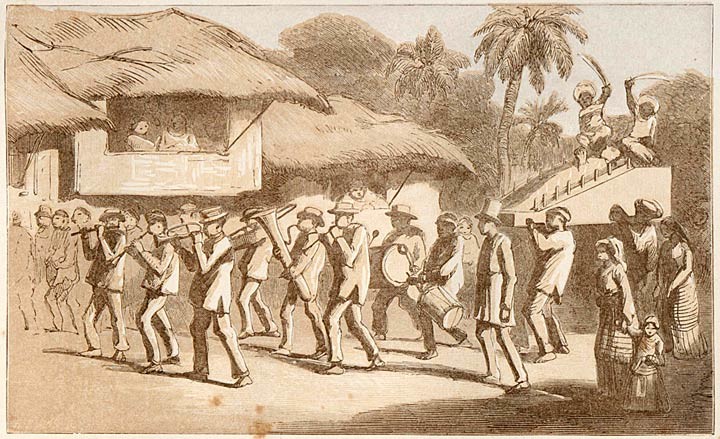
INDIAN FUNERAL.
In the administration of justice the elders were consulted, but there was no code of laws, and the missionaries affirm that the arbitrators of quarrels were generally but too well paid for their awards. Murder committed by a slave was punished with death—committed by a person of rank, was indemnified by payments to the injured family. When a robbery took place, all the suspected persons were ordered to bring a load of grass; these loads were mixed in a heap, and if the stolen article was found it was restored to the owner, and no inquiry made as to the bringer of the bundle in which it was concealed. If this method failed, they flung all the suspected into a river, and held him to be guilty who came first to the surface, on the theory that remorse would not allow him to keep his breath. Many are said to have been drowned in order to escape the ignominy of rising out of the water. They sometimes placed candles of equal length in the hands of all the accused, and he was held to be guilty whose candle first went out. Another mode was to gather the accused round a light, and he towards whom the flames turned was condemned as the criminal. Adultery was condoned for by fine to the wronged persons.
Gold was used by weight as the medium of exchange, but there was no coined or stamped currency. The largest weight was called a gael, but it represented a dollar and a quarter in silver, nearly corresponding to the Chinese ounce or tael; a gael consisted of two tinga, a tinga of two sapaha;2 a sapaha was divided into sangraga, a very small bean, which was the minimum weight. Accounts were kept by heaps of stones of different sizes. Their measures were the dipa (brace = 6 feet), the dancal (palm), tumuro (span), sangdamac (breadth of the hand), sangdati (breadth of the finger). Thus, as among many rude nations (the vestiges are still to be traced in the phraseology of civilization) every man carried with him his standard of mensuration.
Time was reckoned by suns and moons, in the Philippines as in China. In Chinese the same words designate day and sun, moon and month, harvest and year. The morning was called “cock-crowing,” the evening “sun-leaving.”
No Indian passed another without a salutation and a bending of the left knee. An inferior entering the house of a superior crouched down until ordered to rise. Earrings were worn by women and sometimes by men; the chiefs had coloured turbans, scarlet if they had killed an enemy, striped if they had killed seven or more. Peace was made by the mingling blood with wine, and each drank of the blood of the other. This was the most solemn of their oaths.
Chastity seems to have been unknown, though a price was always exacted for a woman’s favours.
Many Mahomedan superstitions and usages had found their way to the interior, and among them the rite of circumcision.
All the Indians are born with a circular dark spot on the buttock, of the size of a shilling; as their skins darken the mark extends, becomes lighter in colour, and in age is scarcely distinguishable.
There is a tradition that the Indians were formerly in the habit of punishing an unpopular person by a penalty which they called Cobacolo, and which was inflicted on any who had misled them by false counsels. The whole population assembled, went to the house of the offender, every one bearing a cudgel; some surrounded the house to prevent escape, and others entered and, by blows, drove the victim to the balcony, from whence he was compelled to leap, and he was then chased out of the neighbourhood, after which the house was razed to the ground, and all that it contained destroyed. The tradition is preserved in many popular proverbs and phrases, in which the Cobacolo is used as a menace to evil-doers.
Among the most celebrated books on the Philippines are the “Cronicas Franciscanas,” by Fr. Gaspar de S. Agustin, an Augustine monk of Madrid, who lived forty years among the Indians, and from whose descriptions I have made a few selections; but there are remarkable contrarieties of opinion among different writers. Their fields of observation are different, and natural temperament has much to do with the judgment formed. Our friar does not give the natives a favourable character. According to him they are generally “inconstant, distrustful, malicious, sleepy, idle, timid, and fond of travelling by rivers, lakes, and seas.”
“They are great consumers of fish, which are found in immense abundance. After rains the fields and marshes and ponds are filled with them. Fish two palms long are often pulled up from among the paddy. As the waters dry up, the fish retreat to any muddy recess, and the Indians catch them with their hands, or kill them with sticks.” I have seen many Indians fishing in the paddy grounds, and what becomes of the fish in the times of drought, when no “muddy recesses” are to be found, it is hard to say, but where there is water fish may invariably be sought for with success.
“They eat three meals a day, consisting principally of rice, the sweet potato, and a small quantity of fish or meat; the daily cost of the whole being half a rial” (= 3d. sterling). “As labourers they get half a rial in addition to their food. They willingly borrow money, which they do not repay, and he who will not encourage ingratitude must show them no favour; to exact a promise is to ensure a falsehood. They are the ingrates described in the 36th Psalm. They never shut the door they have opened; they return nothing to its place; they never do the work they have been paid for beforehand, yet they do not fail to ask for an advance: the carpenter must have money to buy wood; the washerman to get soap; and they even practise their devices upon the parish priest! They have the art of blundering about everything; they fold all garments the wrong way; turn a shirt inside out, always present the back where the front should be.” The father is somewhat severe, and of my own experience I can say there was at least about as much chance in such matters of the Indians doing right as wrong. Alava said of the Indians that their brains were in their hands.
The padre continues:—“They are envious, ill-bred, and impertinent. They will even ask a padre, ‘Whence do you come? where are you going?’ If you are reading a letter, they will look over your shoulders, though not able to read themselves; and if two people are talking in secret, the Indians will come near, though not understanding a word.” Grave charges these. “They enter houses, and even convents, without leave, and seem to make themselves at home in a manner to excite wonderment and anger; even when the padre is asleep, they make a great noise in trampling the floor, though in their own houses they walk with as much care as if treading among eggs. They use no chairs at home, but absolutely wear out those of the convents by sitting and lounging on them, particularly in the balconies, where they can get a look at the women.”
These extracts are as characteristic of the monk as of the Indian. “They care nothing for dog, cat, horse nor cow; the game-cock is their great concern; him they visit at dawn; him they caress through the day; they will contemplate him with eyes fixed for half an hour at a time: the passion never decays; many of them think of nothing else. The government patronizes cock-fights. Last year they produced 40,000 dollars” (in 1859, 86,000 dollars); “sad resource this for so many tears, crimes, and punishments! What quarrels, what lawsuits, what appeals! And in their gambling they pass the night till sunrise. The chief of the Barangay (clan) loses the tribute-money he has collected; his doom is the prison, or a flight to the mountains. They hate to live in houses or convents where they would be placed beyond even the odour of women. They take care of their own plates, and exhibit in their dwellings some possessed before the arrival of the Spaniards, but in convents and houses they break plates enough to ruin their masters. This is because of their stupidity, or that they are thinking of their beloved, or of anything but what ought to occupy their thoughts; and if they let fall a dish, it is passed over by the Spaniards, or they are only called ‘brute! animal! savage!’ In their own house, however, the breaking a piece of earthenware would be followed with a good number of cane blows, and this is of more efficacy than all Cicero’s Philippics (sic in orig.) They cannot be trusted with a sword, mirror, glass, gun, watch, nor any delicate thing; they are sure to spoil it. You may confide to them a bamboo, a stick, a piece of timber, a palm-branch, and to a few of them a ploughshare.
“They are bold and insolent in making unreasonable requests, careless of the when or the how. They remind me in their petitions of what happened to Sancho Panza in the island of Barataria, when troubled with that impertinent and intrusive rustic Michael Turra. For their four eggs they want a hundred dollars. I never see an Indian coming towards me with a gift—something worthless, of course, and of no use to himself—flowers or fruits, but I exclaim, in the words of Laocoon to the Trojans” (grandiloquent friar!) “‘Timeo Danaos dona ferentes.’ The Bishop of Troya, Don Francisco Gines Barrientes, a most circumspect prelate, told me that an Indian brought him a handkerchief of Guava fruit and asked him for the loan of fifty dollars. And when the Lord Marquis de Villasierra, Don Fernando de Valenzuela, was in the castle of Cavite, an Indian gave him a cock, for which the Marquis ordered him to be paid six times its value, and the Indian said he expected eighty cavans of rice, and this, too, was in the time of scarcity, when every cavan was worth two dollars. It matters little, however, for they are just as well pleased when they fail as when they succeed, for they do not value anything given them by a Spaniard, not even by a priest! In selling they will ask thirty and accept six; they take the chance of cheating, and, knowing the great goodness (la suma bondad) of the Spanish character, they do not apprehend any expression of anger in consequence of an absurd pretension.”
The friar thus describes a negotiation between an Indian peasant and a merchant:—“The peasant has two or three hundredweight of indigo for sale; he does not come alone, but with his relations, friends, and sometimes the women, for the indigo belongs to several who form the suite of the seller. Every offer has to be communicated to the party, who are crouched in a circle round the negotiator; the offer being discussed, they agree to the reduction of a dollar in the price—the buyer requires three; this matter being settled, another discussion begins; some of the indigo is damp and dirty, and an allowance must be made, and thus the negotiation goes on harassing and never-ending, so that very few Spaniards will tolerate such impertinence and importunity, and the conference ends by a dry inquiry, ‘Will you? yes! or no!’ If no, the Indians are angrily ordered into the street, but the more patient mestizos and Chinese make the Indians their guests, feed them and lodge them, and get these commodities on their own terms, in Chinese style, for the Indian is very stupid in trading matters.” And then the father gives abundant evidence of their simplicity. “In fine, the Indian prefers the rial of a Chinese to the dollar of a Spaniard.” Who can wonder, then, at the prosperous condition of the Chinese in the Philippines? “The Indians show great indifference to danger: they will not move out of the way of a restive horse, nor, if in a small boat, give place to a large one. In the river, if they see crocodiles approaching, they take no notice and adopt no precautions. The Koran says that every one has his fate written in the marks on his forehead; so think the Indians, not that they have read the Koran, but because of their own folly, which exposes them to daily misfortunes.” “They are very credulous among themselves, yet believe nothing but what is unfavourable about the Spaniards. It is evident that the act of faith is supernatural when they acknowledge the divine mysteries taught by the Spaniards. In other matters they believe in nothing which is adverse to their interests. They do not object to rob Spaniards, not even the ministers of religion. Of this we have irresistible evidence, so that there can be no doubt, and we can only regret that no remedy can be found.”
The Augustine provincial friar of Ilocos, reporting on the insurrection of 1807 in that province, says:—“Here, as elsewhere, there are abundance of robbers and pilferers; it is of no use to bring them to Manila, they should be punished in the locality; but they can be no more extirpated than can the rats and mice. Indeed there is an Indian proverb which says:—‘Robbers and rats will disappear together.’” I cannot endorse the friar’s indiscriminating censures, for I have heard extraordinary evidences of extraordinary integrity. The Alcalde of Cagayan told me that, though he had frequently left uncounted dollars in the care of the Indians, he had never discovered a single fraud.
One would suppose that the rich and potent friars were tolerably well protected against the Indians, yet one of them writes:—“The Indians do not now employ lances and arrows against our ministry, but papers, pens, tales, jokes and calumnies. So much have they been taught politics in Manila that now in all the pueblos are obscure scribblers, pettifoggers, pretenders, who are clever enough in writing memorials on stamped paper, to be presented to the Royal Audiencia. So if the parish priest reprove or punish them for their evil and scandalous lives, they meet together, drink wine, and fill a folio paper with their crosses, and march off to Manila, to the tribunal which they deem the most impressionable, from whence great vexations are caused to the poor parish priest. And much courage is required to bear this species of martyrdom, which is sufficiently common in the Indies.”—(Abbé Amodea.)
I do not know how lately there have been perquisitions against witches, but in the middle of the last century I find the record of a most diligent pursuit and rigorous punishment against the witches of Pampanga. The proceedings were superintended by a friar named Theodore of the Mother of God, who made a special report to the Mexican Inquisition. He says:—“There are witches in every pueblo, and in some they form a third part of the population. These slaves of the devil are divided into sundry classes: lamias, who suck the blood of infants; striges, who are wanderers on the face of the earth; sagas, who dwell in houses, and convey to the devil all the information he requires; larvas, who devote themselves to carnal delights; temures, who prepare love filtres; but all unite to do mischief to the human race.”
Of the credulity of the Indians there is no end of examples. In 1832, when the Santa Ana arrived with 250 soldiers, a report spread like wild-fire that the King of Spain had ordered all the children of the Indians to be collected, that their blood might be spilt upon the Spanish mines to make them more productive. The women fled to their homes, seized their children, and sought an asylum in the houses of the Spanish ladies in Manila. The men armed themselves with spears, and rushed tumultuously through the streets. The agitation was appeased with some difficulty. What any man reputed as a sage among the Indians avers, acquires immediate authority, and is not to be controlled by the influence of the priests; the words “Vica ng maruning,” meaning “The wise say so,” is the ready answer to all impugners. “God preserve us,” says the friar, “from Indian sages! for the Indians are proud, and will not obey the priest, nor the friar, nor the chaplain, unless obliged by fear, and they are not always afraid, though they feel thoroughly convinced of the superiority of the Spaniard, and are governed in spite of themselves. They imitate the Spaniard in all that is evil—his love of dress, his swearing habits, addiction to gaming, and all the vicious practices of the zaramullos (fops or busy-bodies); but Spanish courtesy and urbanity and good education they neither study nor copy; but revels and drunken bouts, and riotous weddings and burial excesses and tyrannical acts of all sorts they have inherited from their ancestors, and still preserve, so that they have Spanish vices added to their own.”
They show much deference to everything that is aristocratic among themselves. The jacket-wearing principalia are treated with great deference, and their rank religiously respected. First, the gobernadorcillo; then the ex-gobernadorcillos, who are called passed captains, in order of seniority; then the acting lieutenant, who must be the head of a barangay; then the heads of barangays according to age; then passed lieutenants, and so on; and their rank is recognized by the adjacent communities.
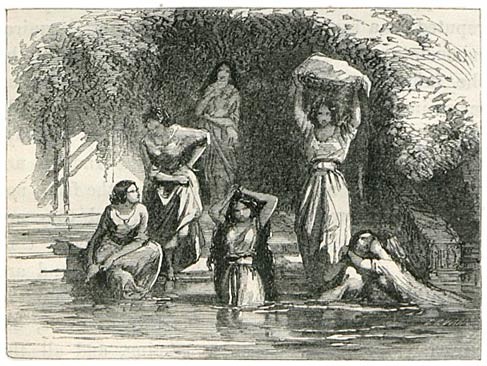
GIRLS BATHING.
Bathing is universal, men and women in the same place. The men wear pantaloons, the women cover themselves with a garment which they throw off when they enter the water. No scandal is caused by the habit, and several attempts of the Spanish authorities to interfere with the ancient usage have failed.
The Indians embrace by touching noses; but lip-kissing often accompanies the act. When the nostril is contracted (as in the act of smelling), and the Indian looks towards a person at a distance, it is deemed an invitation to a closer embrace. Strange stories are told of the exquisite sense of smell possessed by the Indians; that by it they can distinguish the dresses of their masters and mistresses, and lovers ascertain the state of each other’s affections. Inner garments are interchanged which are supposed to be impregnated with the passions of the owners. In disregard of the monks, the Indians secretly circumcise their children. The banian-tree (Balete, Ficus Indica) is held sacred. They burn incense under it, which they obtain from the friars under various pretences. How strangely are the rites of idolatry mingled with Christian observances! This is not the case alone in the Philippines. One of Dr. Gutzlaff’s renowned converts in Hong Kong used to say that to please the missionary he had added another god—the Christian’s God—to those he worshipped before; and I have known of secret visits to heathen temples on the part of Chinese professing Christians, when they were about to enter upon any important undertaking. “There is no driving out of them,” says the padre, “the cursed belief that the spirits of their ancestors are in the woods and among the roots of bamboos, and that they can bring good or evil upon them. They will offer sacrifices to them; and all our books and all our preachings have failed to remove the impressions left by any old man whom they choose to call ‘a sage.’” “The curates,” says De Mas, “profess to believe that these superstitions are passing away; no doubt the Indian conceals them as much as he can from his father confessor, but I have on many occasions convinced myself of their existence and influence.” Who, indeed, knowing anything of the credulity of the less instructed classes, and not these alone, among ourselves, can wonder at the state of “the religious mind” of the Philippine Indian? And so little are the priests themselves wholly free from infirmity, that a Philippine curate, Mallares, committed and caused to be committed no less than fifty-seven assassinations in the town of Magalan, believing that he should thus save his mother from being bewitched. Mallares was executed in 1840; and in his report the fiscal expresses his horror of “the incredible and barbarous prodigality of bloodshed by this monster.”
“The Indian knows no medium,” again to quote from the father. “Ask for tepid water, he will bring it boiling; say it is too hot, and you will get it quite cold. He lives in a circle of extremes. He rejoices if you lose patience and give him a beating, for he goes and boasts of having put his master into a passion. To irritate the Indian, you must take no notice of his short-comings. The sagacious men among them say that the Indian and the cane (for his correction) always grow together. They have another proverb: ‘The Spaniard is fire, and the Indian snow, and the snow puts out the fire.’” One of the padres reports that his servant-boy said to him: “You are a new comer, and are too indulgent: if I do amiss you ought to chastise me. Don’t you know the proverb, ‘The Indian and the cane grow together?’” “They blaspheme and abuse God when their prayers are not granted, and use language which would indeed be horrible were it not known how thoughtless they are, and how impossible it is for them to conform themselves to the Divine will.”
They are fond of religious dramas, especially of one in Tagál representing the passion and death of Christ; but these religious representations and gatherings give rise to scandal and abuse, and the birth of many illegitimate children. The priests have generally prohibited these exhibitions at night, and sometimes disperse them, whip in hand; at other times the singers are denounced, and get flogged for their pains—or pleasures.
It is amusing to read the contradictory opinions of the friars respecting their flocks. One says:—“Their confessions are false; they never own to any but three sins: first, that they have neglected church-going; second, that they eat meat during Lent; and third, that they have sworn profanely.” Another reports—“No Spaniard can be more devout and fervid than the Indians of Manila in their confessions. They obey the instructions they receive, and I have the same good account from many padres of many Indians in the provinces.” No doubt the ecclesiastical statistics would be curious, if obtainable. In Lilio, the curate reports that of 1,300 persons paying tribute in 1840, 600 never confessed, and “this pueblo is not of the most remiss.” In Vigan, of 30,000 inhabitants, the attendance at church did not exceed from 500 to 800 (De Mas), except on the yearly festival of the Virgin, patroness of the pueblo. Father Agustin’s indignation is vehemently expressed as regards confession:—“The infernal Macchiavel Satan has taught them a policy as good for their bodies as bad for their souls, which is that they own their errors and crimes to one another, and conceal them, however excessive, from the spiritual father, from the Spanish alcalde, notwithstanding their personal quarrels, and, as they call them, murder-enmities; so that there is among them no greater offence than to tell the padre or the alcalde what has happened in the pueblo, which they say is mabibig, the most abominable of sins; indeed, the only offence which they hold to be sin.”
The friars speak in general more favourably of the women than of the men. They are more devout, more submissive, more willing to listen to their ghostly fathers, one of whom says:—“Did all mankind hang upon a single peg, and that peg were wanted by an Indian for his hat, he would sacrifice all mankind. They have no fear of death, but this is an infinite mercy of the Divine Being, who knows how fragile they are; they talk about death, even in the presence of the dying, without any concern. If condemned to the scaffold, they exhibit equal indifference, and smoke their cigar with wonted tranquillity. Their answer to the attendant priest is invariably, ‘I know I am going to die. I cannot help it. I have been wicked—it was the will of God,—it was my fate,’ But the approach of death neither interferes with their sleep nor their meals.” “The tree must bear its fruit,” he continues. “God in his wisdom has made many races of men, as He has made many varieties of flowers, and at last I reconciled myself to seeing the Indians do everything differently from what we should do, and keeping this in view, I could mould them like wax to my purpose.”
As a general result I have not found among these Indian races any one distinguished for intellectual superiority. A few were not backward in their knowledge of the mechanical arts; one or two examples there were of genius as sculptors; a universal love and devotion to the musical art, and some appreciation even of the merits of European composers; but, it must be added, little or nothing is done to develop such capacities as the Indians possess; the field of public instruction is narrowed alike by religious and official influences, and the social tone of the opulent classes, to which alone the Indian can look up, is greatly below that of the Spanish peninsula. Literature is little cultivated: the public newspapers are more occupied with the lives of saints, and preparation for, or accounts of, religious fiestas, than with the most stirring events of the political world. The Spaniards have never been celebrated for very busy inquiries, or very active virtues; but it is to be hoped that the mañana, to which everything is referred, will at last become an hoy dia.
It has been said of the Indian that he is more of a quadruped than a biped. His hands are large, and the toes of his feet pliant, being exercised in climbing trees, and divers other active functions. He is almost amphibious, passing much of his time in the water. He is insensible alike to the burning sun and the drenching rain. The impressions made upon him are transitory, and he retains a feeble memory of passing or past events. Ask him his age, he will not be able to answer: who were his ancestors? he neither knows nor cares. He receives no favours and cannot, therefore, be ungrateful; has little ambition, and therefore little disquiet; few wants, and hence is neither jealous nor envious; does not concern himself with the affairs of his neighbour, nor indeed does he pay much regard to his own. His master vice is idleness, which is his felicity. The labour that necessity demands he gives grudgingly. His health is generally good, and when deranged he satisfies himself with the use of herbs, of whose astringent or laxative powers he has had experience. He uses no soap to wash, no razor to shave; the river is his bathing-place, and he pulls out the hairs in his face with the assistance of a sharp shell; he wants no clock to tell him of the flight of time—no table, nor chairs, nor plates, nor cutlery, to assist him at his meals; a hacha, or large knife, and bag are generally hung at his waist; he thinks no music equal to the crowing of his cock, and holds a shoe to be as superfluous as a glove or a neck-collar.
I certainly have not discovered among the Indians that enduring “à tout jamais” horror of foreigners upon which M. Mallat dwells, and which he represents as specially and properly directed against Englishmen. On the contrary, I found many Englishmen settled in the Philippines objects of great confidence and affection; and I have heard mestizos and Indians say that they put greater trust in English commercial probity than in that of any other nation. I have witnessed the cordiality with which the old Spanish proverb, “Paz con Ynglaterra y con todo el mundo guerra,” has been quoted in large assemblies of the Filipinos. And assuredly there is no nation which has contributed more than England to the prosperity of the Spanish archipelago. Evidence enough will be found in the course of this narrative of the kindness shown to Englishmen.
It has been said that the Spaniards have very discreetly and successfully used the “divide et impera” among the Indian races as a means of preserving their own authority. There is little sympathy, it is true, between the remoter races; but that their separation and aberration form a part of the Spanish policy may be disproved by the fact that in Binondo nearly one-third of the resident inhabitants are Indians from distant provinces.
The numerical power of the Spaniards is small, that of the armed natives great, were there among them a disposition to rebel against their rulers: I believe there is little of such disposition. Lately the Tagál soldiers have been called into active service in a foreign country (Cochin China), and involved in a quarrel where the Spanish interest is not very discernible. No complaints have been made of their conduct, though they have been exposed to much privation.
There is a pretty custom among the peasantry of the interior. Little bamboo frames are seen either supported by a post, or projecting from a window of the choza, on which is to be found, covered with plantain leaves, a supply of food, or fruits, provided from the Indian’s garden, which invariably surrounds his dwelling. Any passing traveller supplies himself, paying nothing if he be poor, but otherwise leaving such compensation as he may deem proper. No sort of reproach attaches to the person who, without the means of payment, partakes of the proffered bounty. These hospitable receptacles are most common in the least peopled localities, and reminded me of the water and the lamp which I have found in the tombs of sainted Mussulmans, who had themselves discharged, or required their followers thus to discharge, the claims of humanity, and in the arid desert provided these grateful, silent, and touching welcomes to the thirsty and weary traveller.
The tact or talent of imitation is strong among the Indians, and facilitated the efforts of the friars, but very various and contradictory reports are found of their aptitudes. Those of Pampanga, Cagayan, Pangasinan, Ilocos, and Zebu are reported to be valiant, generous, laborious, and frequently exhibiting artistical taste. I found the love and the practice of music universal, and saw some remarkable specimens of sculptural ability, but of painting nothing Indian was ever presented to my attention, and the examples of persevering dedication to any sort of labour were few indeed. As servants, the Tagáls are in all respects inferior to the Chinese; as soldiers, the officers generally reported of them favourably. The Indians settled in Manila are said to be the worst of their races: no doubt great cities are the recipients of the dregs of a people, but they attract at the same time the highest order of merit. The courtesies which we received as their guests seemed boundless; no effort too great to do us honour: something, indeed much, could not but be attributed to the guidance of the priests and the presence of the authorities, but there were a thousand marks of spontaneous kindness, such as no external influence could have commanded.
1 The Chinese seem everywhere to preserve the same characteristics. The British Consul-General of Borneo writes to me:—“Chinese settlers cannot flourish under Malay rule. We have a few hundreds, but the country would absorb hundreds of thousands. In the interior I found among the aborigines a lively remembrance of the former Chinese pepper-growers; they have been all destroyed or driven away by civil dissensions. There remain a few of their descendants, who speak the language of their fathers, but they are not distinguishable from the natives. A Chinese merchant was speaking disparagingly of one of the chiefs, who turned round, and, much to the astonishment of the Chinaman, accosted him in very tolerable Fokien. The little pepper-growing that remains is partly conducted by the mixed races. The produce is slightly increasing, and a few Chinese with native wives are beginning to try it again.” ↑
2 Both gael and sapaha are terms probably introduced by traders with China. Tael and sapeque are the names given by Europeans to the liang and tsien of the Chinese, the silver ounce and its thousandth part. ↑
1 The Chinese seem everywhere to preserve the same characteristics. The British Consul-General of Borneo writes to me:—“Chinese settlers cannot flourish under Malay rule. We have a few hundreds, but the country would absorb hundreds of thousands. In the interior I found among the aborigines a lively remembrance of the former Chinese pepper-growers; they have been all destroyed or driven away by civil dissensions. There remain a few of their descendants, who speak the language of their fathers, but they are not distinguishable from the natives. A Chinese merchant was speaking disparagingly of one of the chiefs, who turned round, and, much to the astonishment of the Chinaman, accosted him in very tolerable Fokien. The little pepper-growing that remains is partly conducted by the mixed races. The produce is slightly increasing, and a few Chinese with native wives are beginning to try it again.” ↑
2 Both gael and sapaha are terms probably introduced by traders with China. Tael and sapeque are the names given by Europeans to the liang and tsien of the Chinese, the silver ounce and its thousandth part. ↑
CHAPTER VII.
MANNERS AND SUPERSTITIONS OF THE PEOPLE.
Far more than the fair portion of domestic and social cares falls upon the Indian female, and she has far less than her becoming share of enjoyments. Barbarous practices are frequently associated with parturition. The Mabuting hilot, the good midwife, is called in. If the birth be delayed, witches are supposed to be the cause, and their dispersion is effected by the explosion of gunpowder from a bamboo cane close to the head of the sufferer. The new-born infant is laid on a mat or pillow and exposed to the air, to facilitate the escape of evil influences from the body, which is brought about by burning three wax tapers placed on the two cheeks and chin of the babe, often to its great peril. These practices are to some extent checked and controlled by the priests, who provide where they can for the baptism and registration of the infant.
The patriarchal custom of serving in the house of the father in order to obtain the hand and heart of the daughter, is by no means abolished in the Philippines; nor is the yet more intimate intercourse of plighted lovers, which is reported to be still in usage in the ruder parts of Wales, and with the same perilous consequences to the feebler sex. The domestication of the lover in the house of his intended father-in-law leads to the birth of great numbers of illegitimate children, to frequent violations of vows and promises, to domestic quarrels and much misery. The influence of the friars is generally employed for the protection of the frail one. They are opposed both by duty and interest to these irregularities, matrimonial fees being among the most productive contributions to their revenues.
I find one of the priests giving the following instructions to the Indians as to marriage:—“It is not right,” he says, “to marry heedlessly, nor to hurry the sacred ceremony as if it were to be got rid of as soon as possible. Let the parties consult the padre, who will learn if they are really disposed to marry. You Indians say the male naturally runs after the female and obtains her consent (an Indian proverb); but this is not decorous; the proper mode of courting is for the priest to say, ‘Will you be the spouse of ——, according to the arrangements of our holy mother Church?’ This is first to be asked of the woman, and then an inquiry is to be made of the man whether he will have the woman, and the ancient and immodest usages of past times must then be abandoned.” In the same spirit is the common saying of the Indians, “Savangmatovir ang ihinahatol nang mañga padre” (The counsels of the padre are always right). And again—“There is no Christian road but through the Roman Catholic Church.”
F. de los Santos says there is no instance of a Tagála woman making advances in the way of marriage, nor of a father or mother looking out a bridegroom for their daughter; that it would be a great affront were any girl to seek the favour of the person whom she wished to be her mother-in-law in order to win the son. No woman was ever heard to say, “Manciganguin mo aco” (Make me thy daughter-in-law).
The same friar asserts that the Indians have learnt the meaning which the Europeans attach to “horns,” and that the corresponding Tagál word sungayan (horned animal) cannot be used indiscreetly without giving great offence. He is very angry with the nonsense (boberias and disparates) which he says the natives address to their children. A mother will call her babe father, and mother, and aunt, and even king and queen, sir and madam, with other extravagant and unbecoming outbreaks of affection, which he reproves as altogether blameworthy and intolerable.
Though there is some variety in the houses of the Indians, according to their opulence, they preserve a common character, having bamboo floors, nipa roofs, and wooden pillars to support them. A speculation was entered into near Manila to provide more comfortable domestic accommodation for the natives by introducing imported improvements; but the houses were unoccupied, and the adventure proved a losing one. I have seen handsome lamps suspended from the roofs, and pictures hung upon the walls, of some of the Indian dwellings; while among the mestizos many aspire to all the decorations of Spanish luxury, competing with the richest among the European settlers. But religious ornaments are never forgotten, such as images and pictures of the Virgin and her child, vessels for holy water and crucifixes.
The beds of the Indians are merely mats on which the whole family repose indiscriminately. Here they smoke their cigars, chew their betel, and fall asleep. The domestic utensils are “a mortar for grinding rice, bamboos for all purposes, cup and spoons of the cocoa-nut shell, pots and kettles, a knife called a goloc, a bench against the wall, a stool which serves for a table, a Chinese basin for oil, a clay lamp, some cotton wicks, torches of the resin-cane, an image of the Virgin, a crucifix, mats, a jar of betel leaves, some areca nuts and lime ready for use, and sometimes a flute or guitar.”—(Buzeta.)
The Indians have a very vague idea of distance. Tahanan and Bitañgan are the names given to places of rest between different localities. Instead of the Spanish word league, they say “taval,” which is the distance an ordinary burthen can be carried without stoppage.
The forty days’ labour which is exacted every year from the Indians is called atag or bayani. This is in addition to the tributo of a dollar and one-third; but exemption from the atag may be obtained by the payment of three dollars. The tribute is called bovis or buvis. “Buvis aco sa balañgay ni covan’ (I am tributary to such and such a balangay).
A curious illustration of the passion for gaming, so general among the Filipinos, is given by the statistical commission, in the report on Binondo. Among the not prohibited games is that called by the natives Panguingui. It is played with six packs of cards, and five or six persons make a party. This game is most popular among all classes. The authorities prohibit its being played during the hours of labour, but it is permitted from twelve to two P.M., and from sunset to ten P.M., on ordinary days, and there is no restriction on festival days. The commission determined to visit without notice the different tables where the game was played; they found on an average 200 tables occupied, but there were 39 ready for play unoccupied.
Players
at the 200 tables,
867 men and
313 women.
Spectators
at
,,
the
,,
200
,,
tables,
,,
405
men
,,
and
,,
353
women.
,,
This did not include the tables in private houses, to which the commission had no access. It is to be presumed that these visits took place during the authorised hour of play, but this is not stated by the commission.
Though games of hazard are prohibited to the multitude, the great game of the lottery is monthly played for the profit of the government and the perdition of the people. Its existence and its temptations encourage that gambling passion which is one of the greatest plagues of the Filipinos. The newspapers are constantly occupied with long lists of persons condemned to heavy fines and imprisonments for indulging in what may be called the besetting sin of the Indians, from which, however, neither mestizos, Chinese nor Europeans are by any means free.
But the passion for play is most strikingly and universally exhibited in the cock-fights, so characteristic that I can scarcely avoid entering upon some details.
A writer on the Philippines, after showing the antiquity of cock-fighting, and tracing its history through most of the civilized nations of the world, thus concludes:—“In Spain there is a notable affection for cock-fights, and great is the care with which the birds are trained to the combat. In America this amusement is a dominant passion, and the Filipinos are not a whit behind the Americans. Nay, here the passion is a delirium, and no law can check the number or the duration of the fights, accompanied by slaughter of the combatants, which may be well called perfidious” (i.e. in violation of protecting regulations). “In other places they sharpen the spurs of the cocks. In the Philippines they are armed with razors, and chance more than skill decides the contest. Every day countless numbers perish, but the race is not diminished. There is hardly a locality which has not more cocks than human inhabitants. On the Puente Grande of Manila, at between four and five A.M., hundreds and hundreds of ‘the shrill clarions’ are heard on all sides, and from vast distances; it is a string of signals passed from mouth to mouth, from the port of Bangui, in North Ilocos, to Manog, the southernmost point of Albay. There are cocks in every house, at every corner, at the foot of every tree, along the quays and shores, on the prows of every coasting ship, and, as if the living were not enough, they are sculptured, they are painted and charcoaled (not artistically) on every wall for public admiration, and public admiration recognizes the portraiture, though the information is not placed there—as by the painter of old—to announce, ‘This is a cock.’”
The following is a translation of an advertisement from a Manila newspaper:—”Principal Cock-fight of Tondo.—The subscriber informs the public that on all cock-fighting days a great crowd from all parts, nearly half of them Chinese, attend, so that on a single day there are from 90 to 100 combats, and this not only from the convenience of the place, which is made of tiles, but because the doubloons (onzas) which circulate there are honest doubloons (son de recibo).—Dalmacio Oligario.”
It is considered a discourtesy to touch an Indian’s game-cock, and permission is always asked to examine a favourite bird. He is the object of many a caress; he eats, crows, and sleeps in the arms of his master; and, whatever else may be forgotten, the cock is in continual remembrance. I have found him celebrated in verse in terms the most affectionate. A cock that has been frequently victorious is subjected to the most minute criticism, in order to discover by external marks what may serve to characterize his merits. The scales of his legs are counted, their form and distribution, the bent of the rings on the spurs, and whether the two spurs resemble each other; the shape of the toes and their nails, the number and colours of the wing-feathers (eleven being the favourite quantity); white eyes are preferred to chesnut; a short comb falling over the eye and beak is a recommendation. Cocks of different colours bear different names—white, puti; red, pula; white with black spots, talisain; red body and black tail and wings, bulic or taguiguin; black, casilien, or maitin; black and white, binabay; ash-colour, abuen; black and white, having black legs, tagaguin; and many others. The wild cock is called labuyo.
Of cock-fighting I translate Buzeta’s description:—“The Indians have an inveterate passion for the sport, which occupies the first place in their amusements. The cock is the first object of their care, their general companion, which accompanies them even to the church-door, and is fastened to a bamboo plug outside, when they enter for the service of the mass. For no money will they dispose of a favourite bird. Some possess as many as half-a-dozen of these inappreciable treasures, for whose service they seem principally to live.
“Every pueblo has its gallera, or amphitheatre, for the cock-fights, from which the government draws a considerable revenue. The galleras are large buildings constructed of palm-trunks, bamboo, and nipa leaves, consisting of a hall, lighted from windows in the roof. In the centre is a stage, raised about five feet high, surrounded by bamboo galleries, which are reached by the spectators, who pay according to the adjacency and convenience of the seats. The gallera is generally crowded. The Indian enters with his cock under his arm; he caresses the favourite, places him on the ground, lifts him up again, smooths his feathers, talks to him, blows his cigar-smoke over him, and, pressing him to his breast, tells him to fight bravely. The cock generally crows aloud in defiance and in pride. His rival appears, a sharpened spur, or rather two-edged knife, or razor, is fastened to the natural spur of the bird, and after being for some time presented to each other the sign of combat is given, which is carried on with extraordinary excitement, until an alguacil announces that the betting is closed. The announcement is followed by universal silence. The owners of the cocks withdraw at another signal, and the combatants contemplate each other, their feathers agitated and erect; they bend their necks, shake their heads, and spring upon one another; the fight continues until one is mortally wounded and falls. The conqueror springs upon him, and crows in token of victory; but it is not unusual for the wounded cock to rise and turn upon his victor. If the victor should fly (as is sometimes the case), he is condemned to ignominious death; his feathers are plucked, and he is suspended almost naked on the outside of the gallera. The wounds of the living bird are staunched by an infusion of tobacco leaves in cocoa-nut wine. He becomes from that hour a favourite to be betted on, and if disabled for future frays, he is carefully provided for by his master. There are cock-doctors and receiving-houses devoted to the healing of their wounds.
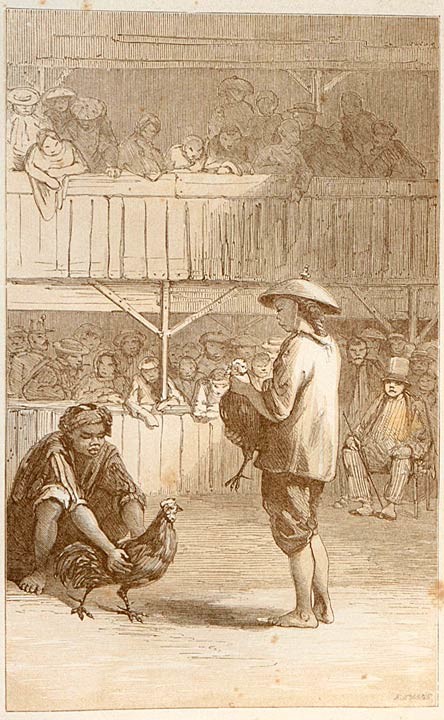
GALLERA, OR COCK-PIT.
“In the neighbourhood of the gallera are stalls, where wines, sweetmeats, chocolate, and other refreshments, are sold, prepared by Indians and Chinese. A whole day is devoted to the combat, and even the charms of the siesta are forgotten, and the Indian often returns to his home after sunset a wretched and a ruined man.”
The Indians were sometimes desirous that we should witness the exhibition, and brought their favourite cocks to be admired; but I had little curiosity to witness such a display, picturesque as it was no doubt—more picturesque than humane.
Don Ildefonso de Aragon passes this severe judgment upon the sport:—“Perpetual idlers,” the Indians, “they go from cockpit to cockpit, those universities of every vice, which the owners think themselves privileged to keep constantly open and accessible; hence they come forth consummate masters of roguery, jugglery, frauds, ready for acts of violence in private and in public, in town and in country.”
Kite-flying (introduced by the Chinese, among whom it is an amusement both for young and old, and who have made their kites musical by day and illuminated by night) is popular in the Philippines, as are fire-balloons and other pyrotechnic displays.
Except on suitable occasions, the Indian is sober and economical, but he makes great efforts at display when desirous of honouring his guests. On two or three occasions we sat down to meals, which a gastronomer would scarcely have ventured to criticise; a variety of wines, health-drinking, and even speech-making, music and firing of guns, accompanying the festivity. Smoking never fails to form a part of the entertainment; pure cigars of various sizes, and paper cigarritos, being always at hand. St. Andrew’s day, kept in celebration of the delivery of the Philippines from piratical Chinese, is one of great rejoicing.
In religious ceremonies the Indian takes a busy part, and lends a very active co-operation. When they take place after sunset, crowds attend with burning tapers. Gun-firing, music and illuminations are the general accompaniments of the great fiestas. I have more than once mentioned the universality of the musical passion, which is easily trained to excellent performances. An Indian, we heard, was not selected to the band unless he could play for eight hours without cessation. The national music of Spain is generally studied, and, in honour to us, in some places they learnt our “God save the Queen!” We were not hypercritical upon the first attempts, but such tributes from a race, that only sought to do our sovereign, our country, and ourselves all honour, could not but greatly gratify us.
When at Guimbal (Iloilo), we were waited on at table wholly by Indian female children, prettily dressed; whose bright eyes expressed extreme curiosity, and whose anxiety to understand and to administer to every wish was very charming. They were much pleased to exhibit the various garments they wore of the piña cloth. I remarked one who went to the friar, and whispered in his ear, “But where are the golden garments of the general?” meaning me, and the padre had to explain to the children that “golden garments” were only worn on State occasions, which did not seem satisfactory, as the occasion of our arrival in the pueblo was one of unprecedented excitement and display. They crowded round me, however, and looked into my face, and expressed admiration at my long soft hair. Their associating finery with rank reminded me of a visit once paid me by a young Abyssinian prince, who was taken up the narrow staircase by some mistake of the servants, and who (his interpreter told me) afterwards said to him, “You told me I was to see a great man—had ever a great man so small a staircase?” At his next visit, he was conducted through the principal portals up the wide marble steps of the house in which I lived, and he expressed extreme satisfaction, and said, “Ah! this is as it should be.”
A few of the Indians reach the dignity of the priesthood, but they are generally asistentes to the friars. I have heard from the lips of Indian priests as pure Castilian as that spoken in Madrid.
“I have observed,” says Father Diaz, “that the word of an Indian is more to be trusted when he uses one of the ancient forms of speech, such as ‘totoo nang totoo’ (it is as true as truth, or, it is truly true), than when called on to take a solemn oath in the name of God or of the cross.” A youth always seeks to get the promise of his sweetheart made according to the old Tagál usage, and it is held as the best security of veracity in all the relations of life.
Many of the padres complain that, notwithstanding all the religious instruction given, the taint of idolatry still exists among the converted Indians. There is a sort of worship of ancestors which is seen in many forms. They attach to the word nono (forefather) the same spiritual meaning which the Chinese give to Kwei. These nonos are often addressed in prayer, in order to bring down blessings or to avert calamities. If an Indian gather a flower or fruit, he silently asks leave of the nono. Certain spots, woods and rivers, he never passes without an invocation to these departed genii. Pardon is asked for short-comings or actions of doubtful character. There is a disease called pamoao which is attributed to the influence of the nonos, to whom petitions and sacrifices are offered to obtain relief. These idolatries, says one of the friars, are so deeply rooted and so widely spread as to demand the utmost vigilance for their extirpation.
So, again, they have their native devil, in the shape of a little black old man, a wild horse, or monster. As a protection against this fiend, however, they apply to their rosary, which certainly affords evidence that he is an orthodox demon of whom the padres cannot fairly complain.
Witches and witchery are called in to discover thieves and to unbewitch bewitched persons; but scapularies and saints, especially St. Anthony of Padua, are auxiliaries in undoing the mischiefs menaced or done. The cauldrons of the weird sisters in Macbeth would find counterparts among the people of the Philippine Islands, but there must be a mingling of Christian texts and Catholic superstitions to complete the identity. One author says these incantations are used for the attainment of riches, beautiful wives, success in battle, escape from justice, and other objects of desire. Father Ortiz will have it that the secrets of these supernatural influences are treasured up in various manuscript works “which ought to be burned.” Their preservation and publication (if they exist) would be more serviceable, because more instructive, to mankind.
Indian women are seldom seen without some religious ornaments. They have rosaries of corals or pearl beads, medals of copper or gold, having figures of Our Lady of Mexico or Guadalupe. The scapulary is generally found hanging by the rosary. Many of the Indians are associated in the Cofradias, whose different emblems they preserve with great veneration; such as St. Augustine’s string, St. Francis’ cord, St. Thomas’s belt; but they also hang upon their children’s necks crocodiles’ teeth as a preservative against disease.
The ancient Indian name for God was Bathala, to whom they attributed the creation of the world. Remnants of the old idolatry remain among the people, and the names of some of the idols are preserved. A few phrases are still retained, especially in the remoter parts, as, for example, “Magpabathala ca” (Let the will of Bathala be done), and the priests have been generally willing to recognize the name as not objectionable in substitution for Dios. The Tagál word adopted for idolatry is Pagaanito, but to the worship of images they give the term Anito. I find among the records reference to an idol called Lacambui, probably the god of eating, as the Spaniards call him Abogado de la Garganta (the throat-advocate). The idol Lacanpate was the god of the harvest, and was equally male and female; “an hermaphrodite devil,” he is called by one of the friars. Linga was the god who cured diseases. Lachan bacor protected the growing crops. Aman Sinaya was the fisherman’s god, and was appealed to when the nets were cast. Ama ni Caable was the protector of huntsmen. An ill-famed idol named Tumano was believed to wander about at night among human habitations; the Indians threw ashes upon him, and calling out, “Iri, iri,” he fled, being “a cowardly devil.” Mancucutor was the patron of a particular class of Indians, but the traditions are very obscure.
There is a bird called by the natives Tigmamanoquin, and if, when they are going to a festival, this bird flies from the right to the left, it is considered of auspicious augury, but disastrous if it fly from the left to the right. The bird (I know not its classical name) is never killed by the Indians, but if caught it is set free with the words, “Hayona tigmamanoquin, lunchan mo nang halinging” (Be gone, bird! and sing sweetly for me).
The Indians believe that a guardian angel is born at the birth of every Christian child, to whose special care through life the infant is confided. In some parts this angel is called Catotobo, in others Tagatanor. But the Tagáls habitually employ the Castilian words angel and angeles in the Catholic sense. I remember to have heard a clever Dutchman say that Java was well governed by knowing how to use properly two Arabic words—Islam (faith), which was never to be interfered with; and Kismet (fate), under whose influence Mussulmans cheerfully submit to their destiny. The Santa Iglesia madre is the charm by which the Philippines are ruled.
The Indian women are generally cleanly in their persons, using the bath very frequently, and constantly cleaning and brightening their black and abundant hair, which they are fond of perfuming and tying in a knot behind, called the pusód, which is kept together by a small comb and gilded needles, and is adorned with a fragrant flower. They are proud of their small foot, which the Chinese call golden lily, and which has a slipper, often embroidered with gold or silver, just supported by the toes. Their walk is graceful and somewhat coquettish; they smoke, eat betel, and are rather given to display a languid, liquid eye, for which they have an Indian expression, “Mapuñgay na mata.”
The dress of the Filipinos is simple enough. It consists of a shirt worn outside a pair of pantaloons; but the shirt is sometimes of considerable value, woven of the piña, handsomely embroidered, and of various colours, bright red being predominant. I asked an opulent Indian to show me his wardrobe, and he brought out twenty-five shirts, exhibiting them with great pride; there were among them some which may have been worth a hundred dollars each. It is difficult to fix a limit to the money value of the more exquisite specimens of weaving and embroidery. A small pocket handkerchief sent to the Queen of Spain is said to have cost five hundred dollars. One or two doubloons (onzas) of gold are asked for the pañuelos (kerchiefs) usually sold in the shops of the capital. The finest qualities are woven in the neighbourhood of Iloilo. The loom is of the rudest and simplest construction; one woman throws the shuttle, another looks after the threads. The cloth is sent to Manila to be embroidered. The women wear gowns of the fabrics of the country, into which, of late, the silks of China and the coloured yarns of Lancashire have been introduced. The better-conditioned wear an embroidered shawl or kerchief of piña. This is the representative of female vanity or ambition. When we passed through the towns and villages of the interior, a handsomely adorned piña handkerchief was the flag that often welcomed us from the windows of the native huts, and sometimes the children bore them about and waved them before us in the processions with which they were wont to show their pleasure at our presence.
The dress of the Indians is nearly the same throughout the islands; the pantaloons of cotton or silk, white or striped with various colours, girded round the waist with a kerchief, whose folds serve for pockets, and a shirt over the pantaloons of cotton. Sinamay (a native cloth), or piña for the more opulent, is universally employed. Straw hat or kerchief round the head; but the favourite covering is a huge circular cap like a large inverted punch-bowl, made generally of bamboo, but sometimes of tortoise-shell, and having a metal spike or other ornament at the top; it is fitted to the head by an internal frame, and fastened by a ribbon under the chin. This salacot is used by many as a protection against sun and rain; it appeared to me too heavy to be convenient.
Among the Indian women the opulent wear costly embroidered garments of piña, and many of them possess valuable jewels, and are decorated on occasions of festivity with earrings, necklaces and bracelets of pearls, diamonds and other precious stones. A few of them speak Spanish, and during our visits became the interpreters for the others, as the Indian women generally took a part in the graceful but simple ceremonials which marked our progress; sometimes forming a line through the towns and villages, and waving many-coloured flags over us as we passed, escorted by the native bands of music. In some families the garments which were worn a century ago are still preserved. Many of the petty authorities are the hereditary possessors of local rank, and on grand occasions make displays of the costumes of their forefathers. There is some variety in the mode of dressing the hair. The Tagálas clean it with lemon juice, and employ cocoa-nut oil made fragrant by infusions of odoriferous flowers. They clean their hands with pumice-stone. In many parts the thumbnail of the right hand is allowed by both sexes to grow to a great length, which assists playing on the guitar, and divers domestic operations. The under garments of the women are tightened at the waist, and their camisas have long and wide sleeves, which are turned back upon the arms, and embroidered in more or less costly taste. They all chew the areca, and, as age advances, they blacken their eyebrows and wear false hair like their patrician mistresses. They sometimes paint their nails with vermilion, and to be entitled a Castila, which means European, is recognized as a great compliment.
Rice is the ordinary food of the Indians. It is boiled for half an hour, and then called canin. The capsicum, or chile, is used for a condiment. They eat three meals a day, out of a large dish, helping themselves with their fingers, and sometimes using a plantain leaf for a plate. They also have sauces round the central dish, into which they dip the canin. They introduce the thumb first into the mouth, and very dexterously employ the fingers to push forward the food. The luxuries of the native are pretty nearly reduced to the cigar and the betel-nut. Indeed these can scarcely be called luxuries; they are more necessary to him than his simple food, which consists generally of boiled rice, sometimes flavoured with fish or vegetables, and his sweetmeat the sugar-cane. As he obtains his cigarritos at the estanco for less than two cuertos a dozen, and can make them, or buy them from a contrabandista, at not even half that price, and as the cost of the areca is extremely small, his wants and his enjoyments are easily and cheaply supplied. His garments are few and economical, and such as in most parts of the islands are supplied by the rude family loom; but the source of his ruin is in his gallo and his passion for play, to which nine-tenths of the miseries of the Indian are to be traced. Out of his embarrassments the Chinaman makes his profit, buying the labour of the indebted and extorting its maximum with coarse and often cruel tyranny. The Chinese have a proverb that the Indian must be led with rice in the left hand of his master and a bamboo in the right.
There is in some of the islands abundance of deer and wild boars; they are killed by arrows of two kinds—one barbed with a clove from the wild palm, shot direct; another with an iron head, shot upwards and falling down upon the animal. The Indians make a dry venison (called tapa) of the flesh and send it to the Manila market. Much wild fowl is found in the forest, especially of the gallinaceous species. The Bisayan caves are frequented by the swallows which produce the edible bird’s-nests, and which are collected by the natives for exportation to China.
Multitudes of Indians get their living by the fisheries. The fish most esteemed is the sabalo, which is only found in the Taal Lake, whose water is fresh and flows into the sea. In the centre of the lake is an island, with its always burning volcano. At the season when the sabalo quit the lake for the sea, an estocade of bamboos is erected across the river, the top of which does not reach the surface of the water; three or four yards below, another estocade is placed, raised five or six feet above the surface, and the two estocades are united by a bamboo platform. The fish leap over the first barrier, and fall on the platform, where they are caught: some of them are as large as salmon. The Bay Lake is celebrated for the curbina, an excellent fish. By the banks of the river enormous nets are seen, which are sunk and raised by a machinery of bamboo, and the devices employed for the capture of fish are various and singular. In the Bisayans the Indians make faggots, which they kindle, and, walking on the banks with a spear in their right hand, the fish approach the light and are harpooned and flung upon the shore. I understand the sea-slug, which the Indians call balate, is thus captured. It is a well-known delicacy among the Chinese. Turtle are caught by watching their approach (the watcher being concealed) and simply turning them on their backs when they are at a certain distance from the water. Native divers bring up the mother-of-pearl oyster, but the pearl fishery is not of much importance. These divers also discover the enormous shell-fish which serve as receptacles for holy water in the churches.
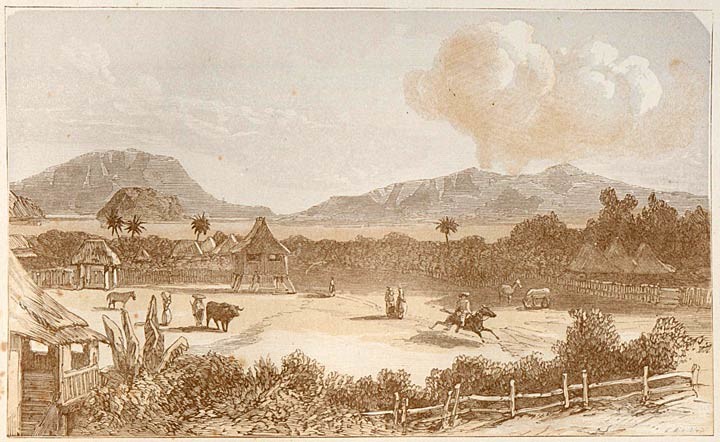
LAKE OF TAAL, AND VOLCANO.
CHAPTER VIII.
POPULATION—RACES.
Though the far greater number of the pagan Indians, as they are called by the Spaniards, belong to the same races as those who inhabit the towns, there are many exceptional cases. Independent and separated from the pagans, there are numerous Mahomedans, especially in the island of Mindanao, of which only a small tract along the coast has been subjected by the Spaniards; these, whom the Spaniards designate as Moros, a name to which traditional and national associations attach great abhorrence, are probably of Malayan descent. There, as in every region where missionaries have sought to undermine or depreciate the authority of the Koran, the attempt has wholly failed. I saw some of these people at Zamboanga, and found them familiar with the Arabic formula of Islamism, and that many of their names, such as Abdallah, Fatima, and others, were such as are common to the Mussulmans. They are understood to be in amity with the Spaniards, who have treaties with the reigning Sultan; but I found no evidence of their recognition of Spanish authority.
The enmity between the Mahomedan races (Moros) and the Spaniards may be deemed hereditary. The answer given by the Rajah Soliman of Tondo to Legaspi, the first governor of the Philippines, who solicited his friendship, is characteristic:—“Not until the sun is cut in two, not until I seek the hatred instead of the love of woman, will I be the friend of a Castila” (Spaniard).
Living in the remotest mountainous regions of Mindanao, never, I believe, explored by European adventurers, there is a race in the very lowest stages of barbarism, I cannot say of civilization, for of that they present no trace. They are said to wear no garments, to build no houses, to dress no food. They wander in the forest, whose wild fruits they gather by day, and sleep among the branches of the trees by night. They have no form of government, no chief, no religious rites or usages. I saw one of the race who was brought for sale as any wild animal might have been to the governor of Zamboanga. He refused to purchase, but retained the lad, who was apparently of about eight or nine years of age. At Iloilo, he was waiting, with other native servants, at table, and he appeared to me the most sprightly and intelligent of the whole—bright-eyed, and watching eagerly every sign and mandate of his master. He was very dark-coloured, almost black; his hair disposed to be woolly; he had neither the high cheeks nor the thick lips of the African negro, but resembled many specimens I have seen of the Madagascar people. I was informed that the whole tribe—but the word is not appropriate, for they are not gregarious—are of very small stature; that they avoid all intercourse with other races, collect nothing, barter nothing, and, in fact, want nothing. I had once occasion to examine in the prison of Kandy (Ceylon) one of the real “wild men of the woods” of that island, who had been convicted for murder; the moral sense was so unawakened, that it was obvious no idea of wrong was associated with the act, and the judge most properly did not consider, him a responsible being on whom he could inflict the penalties of the law. There was little resemblance between the Filipino and the Cingalese in any external characteristic. Ethnological science would be greatly advanced if directed to the special study of the barbarous aboriginal races of whom specimens yet remain, but of which so many have wholly disappeared, who can have had no intercourse with each other. I believe there are more varieties of the human family than have hitherto been recognized by physiologists, amongst whom no affinity of language will be found. The theories current as to the derivation of the many varieties of the human race from a few primitive types will not bear examination. Civilization and education will modify the character of the skull, and the differences between the crania of the same people are so great as to defy any general law of classification. The farther back we are enabled to go, the greater will be the distinction of types and tongues; and it will be seen that the progress of time and commerce and knowledge and colonization, has annihilated many an independent idiom, as it has destroyed many an aboriginal race.
Against the wilder savages who inhabit the forests and mountains of the interior, expeditions are not unfrequently directed by the government, especially when there has been any molestation to the native Christian population. Their chiefs are subjected to various punishments, and possession is taken of their villages and strongholds; but these are not always permanently held, from the insufficiency of military force to retain them. But it is clear that these rude tribes must ultimately be extinguished by the extension of cultivation and the pressure of a higher civilization.
De Mas lays down as a principle that the Igorrotes of Luzon are heathens of the same race as the converted Indians, but in a savage state. The Aetas, or Negritos, are a separate race, not indigenous, but the descendants of invaders and conquerors. He had many opportunities of intercourse with them, and speaks favourably of his reception among them. The men had no other covering than a belt of bark fibres, the women a sort of petticoat of the same texture. Unmarried girls wore a species of collar made from the leaves of a mountain palm, whose ends met between their naked breasts. The females played on a rude guitar, the case being a piece of bamboo, with three strings from the roots of a tree, and which they tuned by tightening or loosening with their left hand. When it rained, they covered themselves with large palm-leaves, which they also used as shelter from the sun. He says they resisted all attempts upon their chastity. They brought wax, honey and deer, and sought for tobacco and rice in exchange. For money they cared not. The mode of showing respect is to offer water to the superior—no son can accept it from, but must hand it to, his father. They exhibit much fear of the evil spirits that are in the forests, but all information they gave was at secondhand. They had not seen the spirits, but others had, and there was no doubt about that. The friars report them to be short lived—their age seldom exceeding forty years. Father Mozo says: “They have their localities, in which they group themselves and which they unwillingly leave: fixed abodes they have none, but shift from place to place within a circumference of four to five leagues. They drive four rough sticks into the ground, surround them with the flexible branches of the ylib, fling down some palm-leaves, bring in a piece of wood for a pillow, and have their house and bed ready. The game killed by one belongs to all—the head and neck being thrown to the dogs. The community ordinarily consists of twenty to twenty-five persons, who select the most courageous of their number as chief. In the summer they locate themselves on the banks of rivers, but during the rainy and windy seasons they confine themselves to their rude huts. If a death take place, they bury the corpse, but flee from the locality, lest others be summoned away. When they seek wild honey in the woods, the finder of a swarm marks the tree where the bees are, and the property is deemed his own until he has time to return and remove the comb. A fire is lighted at the foot of the tree—the smoke drives away the bees—the Indian mounts, bearing a broad palm-leaf folded in the shape of a vase, into which he turns the honey-comb, ties it over, and descends. All his wants are supplied when, in addition to his matches for fire, his bow and arrows, and his rude cutlass, he has a small supply of tobacco for his luxury. If food be scarce, he drinks hot water and ties a cord tightly round his body; he eats also of a root called sucbao, but in the warm weather indigenous fruits are never wanting.” After a string of quotations from the classics, illustrating the pains, penalties and passions of civilized existence, with the serenity, stupidity and satisfaction of these children of nature, the padre says: “Finally, in admiration of their manner of life, if they were but enlightened by our holy faith—if they only suffered what they suffer for the sake of God—I verily believe they would not be paralleled by the austerest monk of the Thebaïd. True it is they commit the sin of divorce—true it is that a slip before marriage is seldom heard of; but they are cruel, they are murderers!” Such is the consistency of ecclesiastical judgment.
There are many speculations as to the origin of the darker, or black races, who now occupy the northern and central mountainous and little visited regions, and from whom one of the islands, Negros, takes its name. They principally dwell in the wilder part of the provinces of Ilocos South, Pangasinan, Cagayan, and Nueva Ecija. They are of small stature, have somewhat flattened noses, curled hair, are agile, have no other dress than a covering of bark over their genitals, are dexterous hunters, have no fixed dwellings, but sleep wherever sunset finds them. Their whole property consists of their bow, a bamboo quiver and arrows, a strip of skin of the wild boar, and the girdle, which the Spaniards call the tapa rabo (tail cover). The Negritos are held to be the aboriginal inhabitants of the islands, which were invaded by those now called Indios, who much resemble, though they are a great improvement on, the Malayan race. The Negritos retired into the wilder districts as the Tagáls advanced, but between the two races there exists a great intensity of hatred. The Negritos are the savages of the Philippines, and are divided into many tribes, and it is said every grade between cannibalism and the civilization of the Indian is found among them. They generally live on the wild fruits and vegetables which grow spontaneously, though some cultivate rice, and attend to the irrigation of their fields. Some make iron weapons, and the Itaneg, according to the friars, only want conversion to be in all respects equal to the Indios. This race has a mixture of Chinese blood, the Ifugaos of that of the Japanese. The ruder savages ornament their cabins with the skulls of their enemies. The Apayos live in comfortable houses, and employ for floors polished planks instead of the interwoven bamboos of the Tagáls. They carry on a trade in wax, cocoa and tobacco, and deck their dwellings with China earthenware. The Isinay Negritos profess Christianity. In the island of Luzon there are estimated to be 200,000 heathens, in that of Mindanao 800,000 idolators and Mussulmans. But it is impossible to follow out the mixed races in all their ramifications and peculiarities. Among the characteristics of the wilder races is the separation of the toes, which enables them to pick up even minute objects, so if they let anything fall they use foot or hand with equal facility; they will descend head downwards the rigging of a ship, holding on with their feet; the great toe is much more separated from the others than in the white races. Their sense of smelling is exquisite, and they profess, without the aid of language, to discover the state of the affections from the breath.
Though they have a pantheon of gods and goddesses (for most of their divinities have wives), they have no temples, and no rites of public worship. They consult soothsayers (usually old women) in their diseases and difficulties; and there are sacrifices, outpouring and mingling of blood, libations of fermented liquors, violent gesticulations, and invocations to Cambunian (God), the moon, and the stars, and the ceremonials end with eating and drinking to excess. They sacrifice a pig to pacify the Deity when it thunders, and adore the rainbow after the storm. Before a journey they kindle a fire, and if the smoke do not blow in the direction they intend to take they delay their project. The flight of birds is watched as an important augury, and the appearance of a snake as a warning against some approaching calamity.
The mountain tribes are subject to no common ruler, but have their separate chieftains, called barnaas, to whom a certain number of dependants is assigned. On the death of a barnaas, the intestines are extracted, examined and burnt, for the purpose of ascertaining by the arts of divination the future destiny of the tribe. The body is placed in a chair, relations and friends are invited, and a great festivity of eating and drinking provided from the flocks and rice-fields of the deceased, with shouts and songs celebrating the virtues of departed barnaas. The banquet closes with all species of excesses, and both sexes remain drunk, exhausted or asleep on the ground about the corpse. It is said that the flesh of the departed is distributed among the guests, and Buzeta avers that such a case lately occurred at Tagudin (Ilocos South); but as he attributes it to the poverty of the deceased who had not left behind wherewithal to provide for the festival, the carnal distribution could hardly have been deemed an honour. The stories of the cannibalism of the natives must be received with distrust, there being a great disposition to represent them as worse savages than they really are. The arms of a warrior are gathered together after his death, and his family will not part with them. A vessel into which wine has been poured is placed at the foot of the trophies, in order that it may imbibe the virtue and valour of the departed, and obtain his auspices.
In case of the murder of an individual, the whole of the tribe unite to revenge his death. Prisoners taken in war are made slaves, and sell for from ten to twenty-five dollars each. Old men are bought, upon whom to try the poisonous powers or sharpness of their weapons. Adultery and the third offence of robbery are punished with death. Polygamy is not allowed, but there is no difficulty about divorce.
A great variety of languages is to be found among the wild people of the interior; not only are dialects of the various tribes unintelligible to each other, but sometimes a language is confined to a single family group. Where there has been no intercourse there is no similitude. Words are necessary to man, and language is created by that necessity. Hence the farther the study of idioms is pursued back into antiquity, the greater will their number be found. Civilization has destroyed hundreds, perhaps thousands, of idioms, and is still carrying on the work by diminishing the number of languages in which man holds intercourse with man. It is no bold prophecy to aver that in the course of centuries the number of separate tongues will be reduced to a small amount. In France, the French; in Italy, the Tuscan; in Spain, the Castilian; in Germany, the Saxon; in Great Britain, the English;—are becoming the predominant languages of the people, and have been gradually superseding the multitude of idioms which were used only a few generations ago. Adelung recorded the names of nearly 4,000 spoken and existing languages, but a list of those which time has extinguished would be far more extensive.
That such large portions of the islands should be held by independent tribes, whether heathen or Mahomedan, is not to be wondered at when the geographical character of the country is considered. Many of their retreats are inaccessible to beasts of burden; the valleys are intolerably hot; the mountains unsheltered and cold. There is also much ignorance as to the localities, and the Spaniards are subject to be surprised from unknown ambushes in passes and ravines. The forests, through which the natives glide like rabbits, are often impenetrable to Europeans. No attempts have succeeded in enticing the “idolaters” down to the plains from these woods and mountains, to be tutored, taxed and tormented. Yet it is a subject of complaint that these barbarians interfere, as no doubt they do, with the royal monopoly of tobacco, which they manage to smuggle into the provinces. “Fiscal officers and troops,” says De Mas, “are stationed to prevent these abuses, but these protectors practise so many extortions on the Indians, and cause so much of discontent, that commissions of inquiry become needful, and the difficulties remain unsolved.” In some places the idolaters molest “the peaceful Christian population,” and make the roads dangerous to travellers. De Mas has gathered information from various sources, and from him I shall select a few particulars; but it appears to me there is too much generalization as to the unsubjugated tribes, who are to be found in various stages of civilization and barbarism. The Tinguianes of Ilocos cultivate extensive rice-fields, have large herds of cattle and horses, and carry on a considerable trade with the adjacent Christian population. The Chinese type is said to be traceable in this race. The women wear a number of bracelets, covering the arm from the wrist to the elbow. The heaviest Tinguian curse is, “May you die while asleep,” which is equivalent to saying, “May your death-bed be uncelebrated.” It is a term of contempt for an Indian to say to another, “Malubha ang Caitiman mo”—Great is thy blackness (negregura, Sp.). The Indians call Africans Pogot.
There are many Albinos in the Philippines. They are called by the natives Sons of the Sun; some are white, some are spotted, and others have stripes on their skins. They are generally of small intellectual capacity.
Buzeta gives the following ethnological table, descriptive of the physical characteristics of the various races of the Philippines:—
Pure Indians.
Mestizos.
Negritos.
Size
Handsome, middle, sometimes tall.
The same.
Handsome, small and thin.
Skin
Copper or quince colour, fine.
Lighter, somewhat yellow.
Dark copper.
Body
Slight, well-formed, strong.
Heavy.
Slight and agile.
Hair
Black, even, thick, harsh.
Less thick.
Black, curly, but less so than the Africans.
Head
Medium or small, round, and flat behind.
Generally large.
Small and rounder.
Forehead
Open, often narrow.
Open.
Narrow.
Eyes
Black, brilliant.
Less uniform.
Large, penetrating, brilliant.
Eyebrows
Thick and arched.
Less arched.
Eyelids
Long.
Very long.
Nose
Medium, generally flat.
Thicker.
Medium, slightly flat.
Mouth
Large, medium sometimes.
Larger.
Medium.
Lips
Medium.
Thicker.
Medium, rounder.
Teeth
White, regular, strong.
Strong and large.
Long, very strong.
Upper Mandible
Ordinary size.
High, salient.
Ordinary.
Lower Mandible
Ordinary and strong.
Strong, open.
Well-formed.
Breast
Wide; woman’s hard and firm.
Firm but narrow.
Firm but narrow.
Carriage
Graceful, elegant.
Graceful.
Easy and careless.
Buttocks
Broad and hard.
Broad, hard.
Broad, hard.
Muscles
Small.
Small.
Small.
Thighs
Small.
Small.
Small.
Feet
Small.
Small.
Small and well-formed.
Flesh
Hard.
Hard.
Hard.
Hair (body)
Lightly spread.
None.
Little.
Beard
None.
Little.
Little.
Genitals
Small.
Small.
Small.
The Altaban Indians have an idol whom they call Cubiga, whose wife is Bujas. The Gaddans give the name of Amanolay, meaning Creator of Man, to the object of their worship, and his goddess is Dalingay. There are no temples nor public rites, but appeals to the superior spirits in cases of urgency are generally directed by the female priest or sorceress, who sprinkles the idol with the blood of a buffalo, fowl or guinea-pig, offers libations, while the Indians lift up their hands exclaiming, “Siggam Cabunian! Siggam Bulamaiag! Siggam aggen!” (O thou God! O thou beautiful moon! O thou star!) A brush is then dipped in palm wine, which is sprinkled over the attendants. (This is surely an imitation of Catholic aspersions.) A general carousing follows.
The priests give many examples of what they call Indian ignorance and stupidity, but these examples generally amount only to a disclaimer of all knowledge respecting the mysteries of creation, the origin and future destiny of man, the nature of religious obligations, and the dogmas of the Catholic faith. It may be doubted whether the mere habitual repetition of certain formulas affords more satisfactory evidence of Christian advancement than the openly avowed ignorance of these heathen races.
If an Indian is murdered by one of a neighbouring tribe, and the offence not condoned by some arranged payment, it is deemed an obligation on the part of the injured to retaliate by killing one of the offending tribe.
The popular amusement is dancing; they form themselves into a circle, stretching out their hands, using their feet alternately, leaping on one and lifting the other behind; so they move round and round with loud cries to the sounds of cylindrical drums struck by both hands.
The skulls of animals are frequently used for the decoration of the houses of the Indians. Galvey says he counted in one dwelling, in Capangar, 405 heads of buffaloes and bullocks, and more than a thousand of pigs, causing an intolerable stench.
They use the bark of the Uplay in cases of intermittent fever, and have much knowledge of the curative qualities of certain herbs; they apply hot iron to counteract severe local pain, so that the flesh becomes cauterized; but they almost invariably have recourse to amulets or charms, and sacrifice fowls and animals, which are distributed among the attendants on the sick persons.
Padre Mozo says of the Italons (Luzon) that he has seen them, after murdering an enemy, drink his blood, cut up the lungs, the back of the head, the entrails, and other parts of the body, which they eat raw, avowing that it gave them courage and spirit in war. The skulls are kept in their houses to be exhibited on great occasions. This custom is probably of Bornean origin, for Father Quarteron, the vicar apostolic of that island, told me that he once fell in with a large number of savages who were carrying in procession the human skulls with which their houses were generally adorned, and which they called “giving an airing to their enemies.” The teeth are inserted in the handles of their hangers. After enumerating many more of the barbarous customs of the islands, the good friar Mozo exclaims:—“Fancy our troubles and labours in rescuing such barbarians from the power of the devil!” They sacrifice as many victims as they find fingers opened after death. If the hand be closed, none. They suffer much from cutaneous diseases. The Busaos paint their arms with flowers, and to carry ornaments bore their ears, which are sometimes stretched down to their shoulders. The Ifugaos wear on a necklace pieces of cane denoting the number of enemies they have killed. Galvey says he counted twenty-three worn by one man who fell in an affray with Spanish troops. This tribe frequently attacks travellers in the mountains for the sake of their skulls. The missionaries represent them as the fiercest enemies of Christians. Some of the monks speak of horrible confessions made by Igorrote women after their conversion to Christianity, of their intercourse with monkeys in the woods, and the Padre Lorenzo indulges in long details on the subject, declaring, moreover, that a creature was once brought to him for baptism which “filled him with suspicion.” De Mas reports that a child with long arms, covered with soft hair, and much resembling a monkey, was exhibited by his mother in Viyan, and taught to ask for alms.
De Mas recommends that the Spanish Government should buy the saleable portion of the Mahomedan and pagan tribes, convert them, and employ them in the cultivation of land; and he gives statistics to show that there would be an accumulation of 120 per cent., while their removal would set the Indians together by the ears, who would destroy one another, and relieve the islands from the plague of their presence. This would seem a new chapter in the history of slave-trade experiments. He calculates that there are more than a million pagans and Mahomedans in the islands. Galvey’s “Diary of an Expedition to Benguet in January, 1829,” and another to Bacun in December, 1831, are histories of personal adventures, many of a perilous character, in which many lives were lost, and many habitations destroyed. They are interesting as exhibiting the difficulties of subjugating these mountain races. Galvey conducted several other expeditions, and died in 1839.
There are few facts of more interest, in connection with the changes that are going on in the Oriental world, than the outpouring of the surplus Chinese population into almost every region eastwards of Bengal; and in Calcutta itself there is now a considerable body of Chinese, mostly shoemakers, many of whom have acquired considerable wealth, and they are banded together in that strong gregarious bond of nationality which accompanies them wherever they go, and which is not broken, scarcely even influenced, by the circumstances that surround them. In the islands of the Philippines they have obtained almost a monopoly of the retail trade, and the indolent habits of the natives cannot at all compete with these industrious, frugal, and persevering intruders. Hence they are objects of great dislike to the natives; but, as their generally peaceful demeanour and obedience to the laws give no hold to their enemies, their numbers, their wealth, their importance increase from year to year. Yet they are but birds of passage, who return home to be succeeded by others of their race. They never bring their wives, but take to themselves wives or hand-maidens from the native tribes. Legitimate marriage, however, necessitates the profession of Christianity, and many of them care little for the public avowal of subjection to the Church of Rome. They are allowed no temple to celebrate Buddhist rites, but have cemeteries specially appropriated to them. They pay a fixed contribution, which is regulated by the rank they hold as merchants, traders, shopkeepers, artisans, servants, &c. Whole streets in Manila are occupied by them, and wherever we went we found them the most laborious, the most prosperous of the working classes. Thousands upon thousands of Chinamen arrive, and are scattered over the islands, but not a single Chinese woman accompanies them from their native country.
In the year 1857, 4,232 Chinamen landed in the port of Manila alone, and 2,592 left for China.
Of the extraordinary unwillingness of the women of China to emigrate, no more remarkable evidence can be found than in the statistics of the capital of the Philippines. In 1855, there were in the fortress of Manila 525 Chinamen, but of females only two women and five children. In Binondo, 5,055 Chinamen, but of females only eight, all of whom were children. Now, when it is remembered that the Philippines are, with a favourable monsoon, not more than three or four days’ sail from China, that there are abundance of opulent Chinese settled in the island, that the desire of having children and perpetuating a race is universal among the Chinese people, it may be easily conceived that there must be an intensely popular feeling opposed to the emigration of women.
And such is undoubtedly the fact, and it is a fact which must prove a great barrier to successful coolie emigration. No women have been obtainable either for the British or Spanish colonies, though the exportation of coolies had exceeded 60,000, and except by kidnapping and direct purchase from the procuresses or the brothels, it is certain no woman can be induced to emigrate. This certainty ought to be seriously weighed by the advocates of the importation of Chinese labourers into the colonies of Great Britain. In process of time, Hong Kong will probably furnish some voluntary female emigrants, and the late legalization of emigration by the Canton authorities will accelerate the advent of a result so desirable.
During five years, ending in 1855, there were for grave crimes only fourteen committals of Chinamen in the whole of the provinces, being an average of less than three per annum; no case of murder, none of robbery with violence, none for rape. There were nine cases of larceny, two of cattle-stealing, one forgery, one coining, one incendiarism. These facts are greatly creditable to the morality of the Chinese settlers. Petty offences are punished, as in the case of the Indians, by their own local principalia.
A great majority of the shoemakers in the Philippines are Chinese. Of 784 in the capital, 633 are Chinamen, and 151 natives. Great numbers are carpenters, blacksmiths, water-carriers, cooks, and daily labourers, but a retail shopkeeping trade is the favourite pursuit. Of late, however, many are merging into the rank of wholesale dealers and merchants, exporting and importing large quantities of goods on their own account, and having their subordinate agents scattered over most of the islands. Where will not a Chinaman penetrate—what risks will he not run—to what suffering will he not submit—what enterprises will he not engage in—what perseverance will he not display—if money is to be made? And, in truth, this constitutes his value as a settler: he is economical, patient, persistent, cunning; submissive to the laws, respectful to authority, and seeking only freedom from molestation while he adds dollar to dollar, and when the pile is sufficient for his wants or his ambition, he returns home, to be succeeded by others, exhibiting the same qualities, and in their turn to be rewarded by the same success.
When encouragement was first given to the Chinese to settle in the Philippines, it was as agricultural labourers, and they were not allowed to exercise any other calling. The Japanese were also invited, of whom scarcely any are now to be found in the islands. The reputation of the Chinese as cultivators of the land no doubt directed the attention of the Manila authorities towards them; but no Chinaman continues in any career if he can discover another more profitable. Besides this, they were no favourites among the rural population, and in their gregarious nature were far more willing to band themselves together in groups and hwey (associations) than to disperse themselves among the pastoral and agricultural races, who were jealous of them as rivals and hated them as heathens. They have created for themselves a position in the towns, and are now too numerous and too wealthy to be disregarded or seriously oppressed. They are mostly from the province of Fokien, and Amoy is the principal port of their embarkation. I did not find among them a single individual who spoke the classical language of China, though a large proportion read the Chinese character.
When a Chinese is examined on oath, the formula of cutting off the head of a white cock is performed by the witness, who is told that, if he do not utter the truth, the blood of his family will, like that of the cock, be spilt and perdition overtake them. My long experience of the Chinese compels me to say that I believe no oath whatever—nothing but the apprehension of punishment—affords any, the least security against perjury. In our courts in China various forms have at different times been used—cock beheading; the breaking of a piece of pottery; the witness repeating imprecations on himself, and inviting the breaking up of all his felicities if he lied; the burning of a piece of paper inscribed with a form of oath, and an engagement to be consumed in hell, as that paper on earth, if he spoke not the truth;—these and other ceremonies have utterly failed in obtaining any security for veracity. While I was governor of Hong Kong an ordinance was passed abolishing the oath-taking, as regards the Chinese, and punishing them severely as perjurers when they gave false testimony. The experiment has succeeded in greatly fortifying and encouraging the utterance of truth and in checking obscurity and mendacity. I inquired once of an influential person in Canton what were the ceremonies employed among themselves where they sought security for truthful evidence. He said there was one temple in which a promise made would be held more binding than if made in any other locality; but he acknowledged their tribunals had no real security for veracity. There is a Chinese proverb which says, “Puh tah, puh chaou,” meaning “Without blows, no truth;” and the torture is constantly applied to witnesses in judicial cases. The Chinese religiously respect their written, and generally their ceremonial, engagements—they “lose face” if these are dishonoured. But little disgrace attends lying, especially when undetected and unpunished, and the art of lying is one of the best understood arts of government. Lies to deceive barbarians are even recommended and encouraged in some of their classical books.