автордың кітабын онлайн тегін оқу The Story of the Great War, Volume VII (of VIII) / American Food and Ships; Palestine; Italy invaded; Great / German Offensive; Americans in Picardy; Americans on the / Marne; Foch's Counteroffensive
The Project Gutenberg EBook of The Story of the Great War, Volume VII (of
VIII), by Various
This eBook is for the use of anyone anywhere at no cost and with
almost no restrictions whatsoever. You may copy it, give it away or
re-use it under the terms of the Project Gutenberg License included
with this eBook or online at www.gutenberg.org
Title: The Story of the Great War, Volume VII (of VIII)
American Food and Ships; Palestine; Italy invaded; Great
German Offensive; Americans in Picardy; Americans on the
Marne; Foch's Counteroffensive.
Author: Various
Editor: Francis J. Reynolds
Allen L. Churchill
Francis T. Miller
Release Date: November 5, 2010 [EBook #34161]
Language: English
*** START OF THIS PROJECT GUTENBERG EBOOK THE STORY OF THE GREAT WAR ***
Produced by Charlene Taylor, Christine P. Travers and the
Online Distributed Proofreading Team at http://www.pgdp.net
(This file was produced from images generously made
available by The Internet Archive)
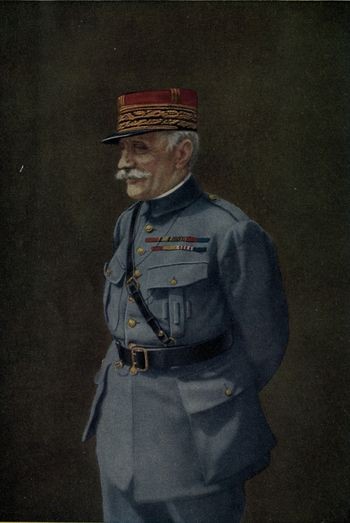
Marechal Ferdinand Foch
Generalissimo of the Armies of the Allies.
The
STORY OF THE
GREAT WAR
AMERICAN FOOD AND SHIPS
PALESTINE · ITALY INVADED
GREAT GERMAN OFFENSIVE
AMERICANS IN PICARDY
AMERICANS ON THE MARNE
FOCH'S COUNTEROFFENSIVE

VOLUME VII
P · F · COLLIER & SON · NEW YORK
Copyright 1919
By P. F. Collier & Son
CONTENTS
PART I.—THE WESTERN FRONT
CHAPTER
- Franco-British Forces Victorious at Ypres—Germans Lose Ground at Lens 9
- French Break the German Lines at Verdun—Canadians Gain at Lens 22
- Lens in Ruins—British Advance Near Ypres 33
- Haig Strikes Again at Ypres—The French Break the German Lines on the Aisne 42
- German Retreat from Chemin-des-Dames—British Advance Toward Cambrai 54
- Germans Gain in the Cambrai Area—Cold Weather Halts Important Operations 66
PART II.—THE UNITED STATES AS A BELLIGERENT
- The New Ally in Council 77
- On the Lorraine Front 83
- Pope and President 97
- America's War Aims 102
- Moving the Military Machine 111
- Fleets in the Making 119
- Food as a War Factor 124
- Transportation and Fuel 128
PART III.—REVOLUTIONARY RUSSIA
- The Last Days of Kerensky 134
- The Bolshevist Revolution 142
- The Siege of the Winter Palace 145
- The Bolsheviki and Their Leaders 147
- First Bolsheviki Peace Move 153
- The Peace Parleys Begin 156
- Publication of Secret Treaties 158
- The Peace Negotiations 162
- An Attempted Counter-Revolution 165
- Legislation by Decrees 169
PART IV.—ITALIAN FRONT
- The Capture of Monte Santo 186
- The Struggle on the Isonzo Front 193
- The Austro-German Offensive in Italy 200
- The Italians at Bay on the Piave 208
PART V.—CAMPAIGNS IN PALESTINE, ARABIA MESOPOTAMIA, AND AFRICA
PART VI.—THE BALKANS
PART VII.—NAVAL AND AIR WARFARE
PART VIII.—THE WESTERN FRONT
- Preparing for the Great Offensive—The Attack of March 21—First Phase of the Battle 269
- The Second Phase of the Great Offensive 284
- The German Offensive Renewed—Ypres Threatened—The Allies' Heavy Losses 298
- Dark Days for the Allies—The German Offensive Declines—French Gain in the Rheims Region—British Victory at Hamel 310
- The New German Drive Around Rheims—The New Battle of the Marne—The Allies Launch a New Offensive Movement 325
PART IX.—THE UNITED STATES AS A BELLIGERENT
- Force to the Utmost 389
- The American Legions 343
- Raiding the Foe 347
- America Over the Top 351
- At Seicheprey and Xivray 359
- On the Chemin-des-Dames 364
- Before Amiens 367
- Cantigny 373
- Around Château-Thierry 376
- A Drive by the Marines 381
- Belleau Wood 387
- Their Presence Felt 393
- Vaux and Hamel 396
- Across the Marne and Back 400
- Forward with Foch 406
- Fighting Through Forests 409
- Sergy and Seringes 413
PART X.—RUSSIA
- The Peace Without Treaty 417
- The Germans Renew Hostilities with Russia 422
- The Peace Treaty That Was Signed 426
- Continued German Aggression 429
- Japanese Take Action in the East 432
- German Policy of Aggression 437
- Germany's Appeal to Class Hatred 439
- Assassination of the German Ambassador 442
- The March of the Czecho-Slovaks Through Siberia 444
- Execution of ex-Czar Nicholas 447
PART XL—AUSTRO-ITALIAN CAMPAIGN
- Italy Revives 450
PART XII.—THE WAR ON THE SEA
- Naval Warfare 460
PART XIII.—THE WAR IN THE AIR
- Bombing and Reconnoissance 475
- Pronouncing Vocabulary 489
- Index 501
LIST OF ILLUSTRATIONS
- Marshal Ferdinand Foch, Generalissimo of the Armies of the Allies Colored Frontispiece
- Opposite Page
- The French Victory at Fort Malmaison 46
- General Diaz with French and Italian Officers 206
- The Surrender of Jerusalem 222
- Marshal Foch, King George, Field Marshal Haig, Generals Pétain, Fayolle, Debeney, and Rawlinson 286
- American Soldiers Storming Cantigny 366
- Château-Thierry with American Soldiers on Guard 398
- The Cruiser "Brooklyn" in the Harbor of Vladivostok 446
- The Cruiser "Vindictive" After the Fight at Zeebrugge 462
LIST OF MAPS
- Page
- The Western Battle Field, Showing the International Frontiers, the Important Railways, the Position of the Lines at the Culmination of Important Campaigns, and the Battle Front as it Existed in September, 1918 Colored Insert
- The Battle Fronts of the Great War—as the Lines Were Drawn in Belgium, France, the Balkans, Italy, Palestine, and Mesopotamia, September, 1918. The Russian Front Had Completely Disappeared Colored Insert
- The Western Front from Nancy to Calais (Colored Map) Front Insert
- The Western Front, 1917-1918 11
- The Taking of Malmaison and Chemin-des-Dames 49
- The Battle of Cambrai 68
- American Front in France Where the First Clashes Between Americans and Germans Occurred 87
- The Italian Advance in Istria 190
- Different Stages of the Italian Retreat 205
- The Campaign in Palestine 219
- The British Advance in Mesopotamia and Palestine 235
- Five Zeppelins Destroyed After the Air Raid on London, October 19-20, 1917 263
- German Offensive from Arras to the Oise, March-June, 1918 271
- Range of the German 80-Mile Gun 279
- German Advance Between Ypres and Arras, March-June, 1918 292
- German Drive Toward Paris, Which Began May 27, 1918. This Map Shows the Farthest Advance 309
- German Thrust South of Ypres and Where It was Stopped 316
- Where Foch Definitely Stopped the German Offensive, June 14, 1918 316
- Line-up at the Great German Offensive, March-June, 1918 323
- Allied Counteroffensive on the Marne 326
- Military Establishments in the United States 345
- Where American Marines Stopped the German Advance on the Marne 383
- Austrian Offensive and the Italian Counteroffensive, June-August, 1918 453
- The "Montello," Where the Austrian Offensive Broke Down 457
- Austro-Italian operations on the lower Piave river 457
- Raids of German Submarines on United States Shipping on the Atlantic Coast 465
- Italian Naval Exploits 469
- British Naval Attacks on the German Bases of Zeebrugge and Ostend 472
PART I—WESTERN FRONT
CHAPTER I
THE FRANCO-BRITISH FORCES VICTORIOUS AT YPRES—GERMANS LOSE GROUND AT LENS
On August 1, 1917, the second day of the Franco-British offensive in Flanders, Field Marshal Haig's troops delivered a counterattack at a late hour of the night against the Germans north of Frezenberg, and close to the Ypres-Roulers railway. The assault, made through heavy rain that transformed the battle field into a morass, was a complete success, the British winning back lost ground on a front of 300 yards, which Prince Rupprecht had captured in a dashing attack a few hours before. At every point in this sector the British succeeded in driving out the enemy and completely reestablished their former lines.
In the morning and again in the afternoon of August 2, 1917, persistent and violent efforts were made by the Germans to win back lost territory to the east of Ypres. In spite of heavy losses they continued to attack at short intervals British positions from the Ypres-Roulers railway to St. Julien. Every assault was shattered by the British artillery barrage or the concentrated rifle fire of the British infantry.
Although the constant falling rain made observation difficult the British aviators continued active. When not scouting for the infantry they carried out daring attacks on the German aerodromes and on transport and infantry bodies with bombs and machine-gun fire. Few German machines ventured above the lines in the unfavorable weather. The British airmen brought down six machines and lost three.
The number of German prisoners captured in this sector had now risen to 6,122, of whom 132 were officers. The captured material included eight field guns, fifty-three machine guns and thirty-two mortars.
The territory about the Ypres salient showed the devastating character of the British fire. In many places the German dead lay in piles, and from their position it was evident that they were in the act of falling back when struck down. Many had fallen victims to their own artillery, when the German gunners in frenzied efforts to stem the onslaught of the Entente troops dropped shells among their own men.
East and southeast of Rheims the Germans attempted two surprise attacks on the French positions in the night of August 1, 1917, which were crushed. On the left bank of the Meuse there was violent artillery action, the Germans renewing their attacks at 9 o'clock in the evening in the sector of Avocourt Wood. The assaults failed, and cost the Germans heavy losses. In the same region in the Apremont Forest, southeast of St. Mihiel, attempts made to surprise the French met with disaster.
August 3, 1917, the British continued to regain ground lost to the Germans earlier in the week. They established themselves again in St. Julien. North of the Ypres-Roulers railway large bodies of Germans massing for a fresh attack were scattered by the well-directed fire of British guns and were unable to deliver the assault.
In the course of the day (August 3) the British drove out the Germans from most of the positions they had gained during the previous night east of Monchy-le-Preux, and in a determined push won considerable ground south of Hollebeke.
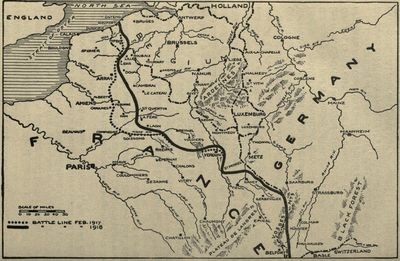
The Western Front, 1917-1918.
During the night of August 4, 1917, the Canadian troops to the southwest of Lens made a spirited dash and drove enemy patrols back 200 yards over a front of over 1,000 yards, sustaining very small losses in the operation. The majority of the Germans scurried back to Lens, but many were caught by the intense gunfire. The Canadians established themselves in the buildings and ruins between the Lens-Grenay railway and the Cité du Moulin.
This dashing advance further tightened the British lines around the city. The new position gained by the Canadians was now less than 1,000 yards from the center of Lens on the western front. On the south, at Avlon and Leauvitte, Canadian outposts were now about a mile from the center, while opposite St. Laurent in the northwest sector their line was about 1,500 yards from the heart of the city.
No attempt was made by the Germans to recapture their lost positions and the Canadians were enabled to complete their work of consolidation. By morning of August 5, 1917, they had linked up the new line with barbed wire and were prepared for any emergency.
After five days of almost continuous rain that had hindered observation and hampered military operations the sky cleared and the sun shone out. The Germans were the first to take advantage of the favorable weather and at 5 o'clock in the morning launched a heavy attack against Hollebeke and the British post just north of the Ypres-Commines Canal, hoping to regain the positions they had lost in the first day of the Flanders battle. The onslaught was preceded by a tremendous fire from the German batteries to which the British guns replied with equal vigor and for miles around the ground was shaken by the continued thunder of great guns.
After shelling British positions south and north of the Ypres-Commines Canal the Germans attacked on both sides of the waterway and succeeded in gaining temporary footing in Hollebeke. A spirited counterattack launched by the British drove the enemy out and a number of prisoners were taken. On the left front the British continued to make gains, pushing their posts forward to the east side of the Steenbeek River along a front of about a mile, beginning near St. Julien and running northwest.
In the morning of August 5, 1917, the Germans made a heavy attack on the French front to the northwest of Rheims south of Juvincourt. At only one point they succeeded in penetrating the French trenches and from this they were quickly ejected. North of the Aisne and at other points on the French front the Germans attacked again and again, but were unable to win a foot of ground.
The Canadians, who had been closing in on Lens, made a further advance during the night of August 5, 1917, that carried their outposts to the main line of the German defenses on the railway embankment to the left of the city. Two battalions in a hotly pressed attack captured a crater east of Cité du Moulin and another to the north on the Lens-Lieven road, which runs through the former place. These craters had been held in strong force by the Germans from which they could work great damage to the Canadians by rifle and grenade fire during the night. The Canadians bombed their way forward through the ruins of houses and fortified points and the Germans after feeble attempts to hold fast retreated to their main positions. Having incorporated the craters in their advanced lines the Canadians rushed forward and bombed two tunnels that were known to be occupied by the enemy.
On the same night the British beat off two new attacks made by Prince Rupprecht at Hollebeke southeast of Ypres and north of Arleux.
The British lines around Lens were farther advanced on August 6, 1917, when Canadian troops pushed forward 600 yards over a front of about the same depth, a substantial addition to their defenses south and west on the outskirts of the mining center.
That the Germans were worried over the continued advance made by the British, fearing the loss of Lens, was evidenced by their practice of throwing a curtain of fire on the British trenches at sunrise every day. In the morning of August 7, 1917, they directed a heavy machine-gun barrage and artillery fire on a crater recently captured by the Canadians. Under the protection of this shower of shells the German infantry pushed forward and the Canadians fighting stubbornly were forced to withdraw, without, however, suffering any casualties.
On the Champagne front French troops during the night of August 6, 1917, broke into the lines of the German Crown Prince at three points, inflicting severe losses on the enemy and bringing back prisoners. In the Verdun sector the Germans made futile attacks between Avocourt Wood and Hill 304. In Caurières Wood they gained a foothold for a time in the French first line, but were driven out by a counterattack on the following day (August 7).
The British front in Belgium to the north and east of Ypres was actively bombarded during the night of August 7, 1917. Near Lombaertzyde a British raiding party penetrated the German trenches and brought back prisoners and guns. In the early part of this same night the artillery on both sides was active over the Aisne front. Troops of the German Crown Prince attempted to reach the French lines to the east of Vauxaillon and west of the Californie Plateau but were driven back, their ranks shattered by the well-directed fire of the French guns. Other attempts at surprise attacks made by the Germans north of St. Mihiel and in upper Alsace were equally futile.
It was during the fighting at this time that the Germans introduced a curious device which they employed when withdrawing their batteries, and which would cause the opponents to believe that their guns were still in action. This was a mechanism with capsules filled with explosives which they placed on the site of the battery that had been, or was about to be, withdrawn. These capsules exploded at intervals of about half a minute, and heard at some distance would be mistaken for the reports of a field gun. Even an old campaigner would have been deceived by this device and led to believe that he was really facing artillery. By employing the mechanism the Germans were able to get their guns away unknown by their opponents, and it also prevented untimely attacks.
At an early hour in the morning of August 10, 1917, General Haig's troops by a dashing drive penetrated the German lines to a depth of several hundred yards, carrying completely the village of Westhoek and the remaining positions held by the enemy on Westhoek Ridge. Haig's successful stroke was delivered on a front of nearly two miles south of the Ypres-Roulers railway. Every forward position held by the Germans east of the town of Hooge on the fighting front between Frezenberg and the Ypres-Menin road was won. This section had been the scene of some of the fiercest fighting on the first day of the great Flanders battle. The terrain offered many obstacles in the way of attack. The wooded sections had been strongly fortified by the Germans, and south of Westhoek the ground was broken by marshes that made military operations difficult.
Such was the spirit of the British troops on the morning of the 10th that every objective was won in a short time despite the frenzied efforts of the Germans to defend their positions. There was very heavy fighting in Glencorse Wood, where the British established themselves after inflicting heavy casualties on the Germans and taking 240 prisoners.
The British airmen during the day hovered over the scene of battle and engaged the enemy machines whenever they appeared. In every aerial engagement the British were victorious. Five German machines were destroyed and five others driven out of control. In addition two German observation balloons were brought down in flames and four others sent to earth badly damaged.
Late in the day of August 10, 1917, the German troops made no less than six desperate attacks on the British position on Westhoek Ridge, but in each offensive were driven off, their ranks shattered, and with heavy losses. The last futile attack was made at 10 o'clock at night, and after it failed the Germans began a furious bombardment of the sector above the village of Westhoek, which was continued throughout the night.
In spite of the repeated failure of their counterattacks the Germans renewed their efforts to regain the lost positions on the morning of August 11, 1917. The British, who had been exposed to heavy fire during the night in Glencorse Wood, were forced to give ground, for their position was a salient and presented an easy mark for the German guns near Polygon Wood and east of it.
About noon the British, having established their positions on Westhoek Ridge, sent a call for the guns to hold back the enemy while they strengthened their defenses. British airmen above the German lines had noted great gatherings of enemy troops in Nun's and Polygon Woods. British guns, in groups stretching miles back into the country, began to speak in thunderous tones. The Germans among the shell craters in and about Nun's Wood were moving forward when the British bombardment began. A storm of shells from the 15-inch "heavies" to the small but deadly 6-inch and 4.2s swept over them, around them, and through them. British airmen observed that as a result of this withering fire the Germans lay in heaps over the terrain and the shell craters which they had been unable to leave were full of dead and wounded. Close fighting continued during the day, but only at one point on the right could the Germans make any progress.
About 6 o'clock word came to the British gunners that German troops were gathered in the valley of Hannebeke. Two battalions had advanced some distance toward the British lines before the British guns got the range. In the storm of fire that swept through them the Germans tried to escape by flinging themselves into shell craters, but very few found safety.
The failure of their counterattacks seemed to have completely unnerved the German troops. Reserves that had been brought forward to relieve shattered battalions lost their head completely and wandered aimlessly about in the open, where they were shot down or surrendered.
The number of prisoners taken by the British since August 10, 1917, had now risen to 454, including nine officers. In the same operations six guns were captured.
During the night of August 11, 1917, French troops resumed their counterattacks against the positions which the Germans had captured during the night of August 9-10, 1917, north of St. Quentin. They were successful in recovering all the trench elements lost in the previous fighting, and also took a considerable number of prisoners. In the sector of Noissy Farm and Laffaux Mill French scouting parties penetrated the German lines at a number of points and returned with prisoners. South of Ailles German troops made a determined effort to recover trenches which the French had occupied a few days before. Two attacks were made with strong forces, the Germans displaying a reckless disregard of life, but their determined efforts came to naught and the attackers were dispersed with heavy losses. The French not only maintained their positions but in the course of the night made further progress.
During the day there was violent cannonading in Belgium and along the Aisne and in the Verdun region. The Germans also directed a scattered artillery fire all over the city of Rheims, killing two civilians and wounding another.
In the night of August 12, 1917, Lens became the center of activity on the British front. The Germans were desperately anxious to maintain their hold on this valuable city, because of its important position in the Pas de Calais coal fields.
The Canadian troops occupying strong positions in the western outskirts of the city received special attention from the German guns. They were continuously harassed too by German snipers hidden among the ruined houses to the north of the Lieven road, and early in the night of August 13, 1917, their advanced posts were pushed out over a front of 600 yards and the ruins occupied, the enemy offering only a slight resistance.
This advance brought the Canadians within 800 yards of the center of the city on the west. From houses on the other side of a belt of open ground covered with the débris of shattered buildings the Germans directed a heavy machine-gun fire on the Canadian positions. In the violent artillery duel that raged through the night the Canadian gunners had far the best of it, eight explosions being noted in German gun positions and their gun pits entirely destroyed.
Throughout the night of August 14, 1917, the British big guns were sending a stream of high-explosive shells into the German positions east and south of Loos while preparations were going forward for a big offensive movement. The attack began at 4.25 when the first light of dawn was glimmering in the east. For a short space of time the British guns were silent, but ten minutes before the Canadians, crouching in their trenches, received the order to move forward every British gun within range poured a steady stream of fire on the German positions. The battle scene was wrapped in pink-tinted clouds, shot with streaks of crimson fire. Just when the time arrived for the Canadians to strike, and when a protecting barrage was dropped before their trenches, the clouds parted and a pale-yellow moon poured its mild rays over the scene. It was by this light that the Canadians advanced to attack. They mounted the famous Hill 70, where so much blood had been spilled in days gone by, expecting that heavy fighting awaited them on the crest, which was well manned with machine guns. They were agreeably disappointed, however, for the German resistance was not strong. It was only when the Canadians gained the first houses in the outskirts that really strenuous fighting began. There was one point where the enemy was strongly intrenched in concreted cellars where a struggle of the deadliest description developed.
Lens before the war had a population of 30,000, but was now a mass of ruins. The Germans had constructed strong subterranean defenses, undermining the whole place with tunnels and dugouts reenforced with concrete. Such bits of ruined buildings that remained standing had been used for gun emplacements. It was through this stronghold that the Canadians had to force their way. The tremendous bombardment that preceded the attack had quite unnerved the Germans, and numbers were seen to desert their posts and flee to the rear, but in many parts of the outer defenses north and west of the city the garrison fought fiercely. In an hour and a half the Canadians had pushed forward 1,500 yards, having gained most of the outward bastion of Lens formed by the separate colonies, or "cités," so called, consisting of blocks of miners' cottages and works united in one big mining district.
The most important operation during the day, however, was the capture of Hill 70, which the British had taken and lost two years before, for the hill commanded a wide territory and was the last dominating position in this section that had remained in German hands.
August 16, 1917, marked another important advance for the French and British. Early in the morning the Allies, striking together on a nine-mile front east and northeast of Flanders, carried all their objectives excepting those on the right flank. French troops on the left drove the Germans from the tongue of land between the Yser Canal and the Martjevaart and won the bridgehead at Dreigrachten. Langemarck, which had been strongly held by the Germans since the Allied attack early in the month, was captured by Haig's troops, who swept forward half a mile beyond. On the right the British tried to win the high ground almost directly east of Ypres, lying north of the Menin road, but the Germans in face of appalling losses attacked in such fury that the British were forced to abandon the attempt.
More than 1,800 prisoners, including thirty-eight officers and a number of guns, were captured by the Anglo-French forces in this advance.
On the Lens battle front there was continuous fighting, the Germans making desperate efforts to recover their lost positions. The Canadians still clung tenaciously to Hill 70, having beaten off ten furious attacks directed by Prince Rupprecht. The Prussian Guard, so active in the fighting, here lost heavily. A Canadian machine-gun officer stated that his men had killed more Germans than they had ever seen together at any one time since fighting began here, having had as a target for an hour and a quarter enemy reenforcements coming up in columns of fours for use in counterattacks. The Seventh Prussian Division was completely annihilated. The fire of the Canadian guns was so intense that German ration parties refused to go to the relief of their comrades on the hill, and the hundreds of prisoners taken were in a half-famished condition, all the fighting spirit gone out of them.
It was noted in the struggle here that many of the Germans were mere children. A large number of boys, not over seventeen were in the thick of the battle, and some were even younger, belonging evidently to the 1919 class.
The attitude of the civilians who had been living in the suburbs of Lens would have puzzled a master psychologist. In the midst of terrors they remained calm and undismayed. Some had lived there since the beginning of the war, in houses that were repeatedly shelled and often wrecked. Death stalked them day and night. Yet they continued their peaceful vocations in cellars, their children being protected by gas masks going to school. When the British soldiers appeared, and while the shells were bursting a few yards away, young girls and women, for the most part neatly dressed and generally in black, were there to greet with cheerful faces the welcome visitors.
On August 17, 1917, the French completed their conquest of enemy territory south of the St. Jansbeek River and the Breenbeek River by the capture of two strong German redoubts which had held out against all attacks since the beginning of the great offensive on the 16th. One redoubt, Les Lilas, was a large concrete and steel structure strongly armed with machine guns. It was impregnable against infantry attacks, and it was only when the French brought heavy guns to bear on the stronghold that the German garrison surrendered. Mondovi Farm, the other redoubt, lay in an angle formed by the St. Jansbeek and the Breenbeek Rivers. The French bombarded the redoubt during the night of the 17th, and after the concrete walls were shattered and crumbling the enemy surrendered. Attempts were made later by the Germans to shell the French out of the captured stronghold, but were not successful.
On this date the Germans counterattacked in force against the Canadian positions northwest of Lens. According to prisoners the German troops had been ordered to retake Hill 70 at any cost. In the afternoon of the 17th the first great attack was made, a fierce and determined onslaught accompanied by a storm of flaming projectiles and gas shells. The Canadians met the attack with cold steel, and the Germans were driven back in confusion with heavy losses. Another assault made in the evening against the suburb of St. Emilie and at Hugo Wood to the north failed with serious losses to the attackers.
At 1.30 in the morning of the 18th the Germans were again in action. Along the entire line north of Lens their infantry attacked, supported by a concentrated artillery fire. They fought with reckless bravery, hurling themselves again and again upon the Canadians in hand-to-hand conflicts of the fiercest description. The latter held their ground, though sorely beset by superior numbers. The Germans were loath to give ground, clinging to every foot, but were slowly forced back, their ranks shattered, leaving many dead and wounded on the field. This was the most sanguinary fighting in which the Canadians had engaged since the capture of Hill 70. Never before had they used the bayonet so freely or met the enemy in such a man-to-man grapple to the death.
During the day French and British aviators were engaged in many successful combats in the air. The British downed thirty German aeroplanes, twelve of which were known to have been destroyed. Twelve British machines were missing, two having collided during the fighting and fallen within the enemy lines. On this day, and during the night of August 17-18, 1917, French aviators shot down seven German airplanes and a captive balloon and forced down eight other machines, which, badly damaged, fell in the German lines. A bombing raid in which 111 French machines took part in various sorties dropped 13,000 kilograms (28,600 pounds) of projectiles on aviation grounds at Colmar, Friedrichshafen, and Habsheim. Aviation camps and railway stations at other points were showered with projectiles, producing fires and explosions.
British troops on the front northeast of Ypres made a further advance in an attack made in the morning of August 18, 1917, in the vicinity of the Ypres-Poelcappelle road east of Langemarck. By this operation the British advanced their lines 500 yards on a like front, winning all their objectives, including a series of strongly fortified farms. Southeast of Epihy a successful local operation was carried out by the British troops in the early morning of the following day, when German trenches in the neighborhood of Guillemont Farm were captured and a considerable number of prisoners.
It was in this the fourth year of the war that the Germans made some radical changes in their methods of defense, owing principally to the preponderance of British artillery, which reduced their front-line trenches to mere furrows of earth and made mantraps of the carefully constructed dugouts. The Germans now scattered their advanced forces over a greater depth. There was no longer an unbroken line of defenses for the British guns to shatter, but strongholds were constructed in isolated shell holes along the front, cunningly concealed from aviators. These stretched back from the first lines to a considerable depth. Along the front strong outposts were established at some distance apart, backed by fortified craters and connected by tunnels and often with dugouts. Back of these shell-hole nests were gun emplacements commanding the openings between the shell holes. Thus when enemy attackers had forced their way through the fortified shell craters they were met with torrents of machine-gun fire. Further back from these defenses there would be found a line of more or less connected trenches, or a series of connected fortified shell holes. The Germans also constructed strong concrete redoubts in every farm house for their machine guns. They built small forts of steel and concrete that were impervious to artillery fire. Many of these strongholds were constructed underground with a steel trapdoor as the only exit, by which the Germans came out to set up their machine guns.
CHAPTER II
THE FRENCH BREAK THE GERMAN LINES AT VERDUN—CANADIANS GAIN AT LENS
North of Verdun, in a region that had witnessed many of the most desperate struggles of the campaign in France during the previous year, the French won a great victory on August 20, 1917. After three days of almost continuous shelling of the German lines the French armies attacked simultaneously on both banks of the Meuse and carried their objectives at all points. On the west bank of the river they gained Avocourt Wood, the summit of the famous Dead Man Hill, and the Corbeaux and Cumières Woods. The French advance reached at some points a depth of a mile and a quarter. Over 4,000 unwounded Germans were made prisoner.
At 4.40 in the morning the French artillery preparations reached the final phase when vigorous attacks were made on Avocourt Wood and Bezonvaux. The first objective was won by 6 o'clock and German prisoners were on their way to the rear. The three days' artillery fire had so devastated Hill 304, Dead Man Hill, and Talou Ridge that the Germans were forced to abandon their first line. The French found less opposition from the enemy than they had expected, for the well-served French guns had taken much of the fighting spirit out of their opponents. At some points, however, where the French fire had been less felt there was hard fighting. The greatest advance made was on the right bank of the river to the north of Vacherauville. They occupied Talou Ridge, Mormont Farm, and Hills 240 and 344. To the east the Germans were driven out of parts of the Fosses and Chaume Woods.
During the advance the French army was greatly aided in its operations by the brilliant and daring work of its aviators. Hovering low they showered machine-gun bullets on the enemy lines, dispersing assemblies forming for counterattacks and bombing German gunners at close quarters. In a series of combats in the air the French flyers brought down eleven German machines on the Verdun front, while two others were destroyed by antiaircraft guns.
An interesting phase of the fighting on the French front at this time was the unusually large proportion of German officers captured, 201 being taken with about 6,700 men. This seemed to show that the German officer class had deteriorated, that the best trained had been killed or made prisoners, and that the new officers who replaced them were lacking in spirit or had not become steeled to war work.
In the fighting on this front certain German army formations had been badly smashed. Three regiments which formed the Sixth Reserve Division of Brandenburgers and the kaiser's favorite troops were literally annihilated as fighting units, losing sixty-nine officers and about 2,800 men as prisoners.
On the same day that the French were advancing in the Verdun sector the Canadians around Lens were winning fresh laurels. Northwest of the city they had by desperate fighting established strong posts among the trenches and railway cuttings that formed the last line of German defense in that quarter. This was the scene of much strenuous but indecisive fighting two days before.
From their new positions the Canadians had now command of the last bit of ground from which the defenders of the city could overlook the advance from the west. They were now in a hollow all around the front which swings about Lens in a semicircular form. As every eastern exit to the city was now subjected to a continuous and harassing fire from machine guns and artillery, the work of bringing up provisions and supplies of ammunition had become extremely hazardous.
The Canadians in their continued struggle around Lens had displayed such irresistible courage and resolution that their deeds will long be remembered in the pages of history. No soldiers during the war faced more difficulties or confronted more formidable defenses. They forced their way through streets entangled with hedges of steel and houses bristling with machine guns. They penetrated tunnels too strong to be touched by shell fire. They threw themselves against fortress positions amid a fiery hail of shells and explosives. They swept through the towns of St. Laurent, St. Théodore, and St. Emilie to the north and west of Lens where sunken roads and slag heaps were strongly fortified, and so on through the apparently endless and formidable defenses to the western streets of the inner city.
The Germans never let a day pass without at least one attack on the Canadian positions, and once within twenty-four hours they launched no less than seven strong assaults. Between the attacks the men of Canada were subjected to a heavy gunfire from a wide semicircle of strong batteries.
Between August 10 and August 20, 1917, they were attacked in turn by six German divisions, each being shattered by the Canadians' dogged courage and amazing fighting power. These were the Seventh, Eighth, the Eleventh Reserve, the 220th and the First Guards Reserve Division. Besides those five divisions it was known that portions at least of the 185th Division and of the Sixth Reserve Division had also been engaged.
It was conservatively estimated by military observers of the struggle here that the German strength used at Lens was upwards of 50,000 men, and their losses were estimated at between 12,000 and 15,000 men.
At an early hour in the morning of August 20, 1917, the Canadians made a trench raid on the German front northwest of Avlon, where heavy fighting ensued. This front was strongly fortified by the Germans as protection for an important mining suburb southeast of Lens, and it was here that they had set up the guns withdrawn after the Canadian advance two days before. Here the hand-to-hand fighting was fierce and deadly, the Germans fighting with desperate courage, but the Canadians got the upper hand by slow degrees, and after inflicting heavy casualties took some prisoners and retired to their positions.
Early in the morning of the following day the forces from Canada again struck hard, attacking German trenches west and northwest of Lens. The battle raged throughout the day and far into the night. The Canadians advanced against strong opposition, using bomb and bayonet freely, winning important enemy positions to the northwest and southwest of the center of the city. It appears that the Germans had massed strong forces for a counterattack at daybreak against the newly won Canadian positions, and had already begun their forward push when they encountered the Canadians rushing across no-man's-land. Owing to a dense mist that prevailed at the time, the Germans did not see them until the foe fell upon them with bomb and bayonet.
This dramatic surprise for the Germans seemed to have had a chilling effect on their fighting spirit. They retreated in wild haste to the trenches they had left, despite the frenzied attempts of their officers to rally them. Close on their heels dashed the Canadians, and mounting the parapets showered bombs among the other troops that had gathered for the attack. As the Germans fled for the communication trenches the Canadians leaped among them, and with bomb and bayonet killed a great number.
In the Verdun region on this date the French continued to make important gains. All day long the tide of battle ebbed and flowed in waves of fire. On the left bank of the Meuse the French captured the famous Côte de l'Oie and the village of Régneville. On the right bank of the river, sweeping through Samogneux, they seized an entire system of trenches between that village and Hill 344 which had been won on the previous day. The Germans delivered a number of strong and determined attacks on both sides of the river, but lost heavily in their attempts to check the French advance. Some idea of the French gains on the left bank of the Meuse may be gathered from the fact that when the Germans held the village of Fleury and menaced Verdun they were two and a half miles from the fortress. On August 21, 1917, when the French held the village of Samogneux, the Germans were seven miles from the fortifications.
Throughout the day's fighting the German counterattacks failed completely. The French maintained all their gains and organized captured positions. Nearly 7,000 prisoners were taken during the advance, of whom 116 were officers.
The capture of Dead Man Hill by the French troops was an especially notable achievement, for its system of underground defenses made it as nearly impregnable as human ingenuity could devise. That it could be captured in a single day was owing to the ceaseless activity of the French gunners, who had ravaged the stronghold with explosives so thoroughly that it seemed impossible that anything human could survive, however hidden underground. There were a hundred deserters to the French lines, and the Germans surrendered in squads with their noncommissioned officers. The whole garrison of Dead Man Tunnel, which included two battalion commanders, were also made prisoners. When it is considered that the Germans had 400 batteries in action back of their front lines during the two days' advance it will be understood that the French fighting man was heartened up and could look with confidence to the future.
The British resumed the offensive in the morning of August 22, 1917, east and northeast of Ypres along the Ypres-Menin road, capturing a series of fortified farms and strong points in front of their positions and gaining in the advance a third of a mile of territory.
Further to the north the British carried forward their lines about half a mile over a front of two and a half miles. Owing to the fierce character of the fighting encountered in the forward push the number of prisoners taken was out of all proportion to the total losses inflicted on the enemy. Since the offensive began in the morning of August 15, 1917, the British had taken 1,378 men, including officers. In the same period they captured thirty-one machine guns and twenty-one trench mortars.
South and southwest of Lens the Canadians continued to fight hard and to make important gains. They succeeded in getting a firm grip on a stronghold only 300 yards south of the main railway station of the town. This was a huge slag pile which had been tunneled by the Germans and was known as "Green Crassier." The odd position constituted a barrier between the Canadians and the defenses of the city proper. It was connected by tunnels with dugouts and defenses underneath Lens, and the Germans, appreciating its value, clung to it tenaciously. Preceded by a heavy bombardment the Canadians attacked at early dawn and were atop of the Germans before the latter had any warning of what was impending. The long series of counterattacks in which they had been engaged during the previous days had not entirely quenched the German fighting spirit, and the slag pile was such a network of defenses that the Canadians were from the start roughly handled, but they held on with dogged determination, though they had never faced more formidable conditions, and despite the desperate efforts of the Germans to oust them. Surrounding the slag pile or "crassier" many of the ruined buildings had been transformed into strong and most ingeniously constructed fortifications. The Canadians systematically bombed their way through these defenses and drove out the defenders, who sought refuge in the numerous tunnels under the city. Lens was crowded with German troops of the Fourth Guards Division and the First Guards Reserve. Forced to live among the dead and wounded in underground caves, their lot was hideous beyond description.
French troops operating in the Verdun sector gained an important victory on August 24, 1917. In the early morning they began a powerful offensive on the left bank of the Meuse between Avocourt Wood and Dead Man Hill. By a single charge they carried Hill 304 and Camard Wood to the west of it. All the German positions were captured and the defenders made prisoners. To make doubly secure their possession of Hill 304, the French pushed on beyond it for a distance of about a mile and a quarter. The loss of Hill 304 and Dead Man Hill, which commanded all the approaches and ravines as far as Douaumont, deprived the Germans of every observation point from which they could watch the operations of the French troops.
The Germans won some success against the British forces along the Ypres-Menin road on this date, while the Canadians were forced to retire from the crest of the "crassier," or slag-pile stronghold, and to take up positions adjoining it. The Germans had succeeded in bringing forward fresh troops against the Canadians, who were worn down but not discouraged by almost continuous fighting day and night. The enemy had the advantage of numberless underground retreats, tunnels, subterranean chambers, and a network of cellars connected by passages from which they could dash suddenly, and after striking a shrewd blow disappear mysteriously from sight. The Germans were in a precarious situation and showed a disposition to conserve their forces.
On the Verdun front the French continued their victorious progress, capturing north of Hill 304 three strongly fortified works near Bethincourt. Since the beginning of this offensive the French had taken over 8,000 prisoners. If they cherished any belief in the superiority of the Germans as fighters, they held it no longer. The German High Command had issued orders that every position must be held regardless of the cost, but except in isolated instances they had displayed no unusual fighting qualities, while the German officers often perpetrated amazing blunders.
The French renewed the offensive on August 25, 1917, when they delivered a smashing blow on the right bank of the Meuse in the Verdun sector, gaining two-thirds of a mile on a front of two and a half miles. This gave them possession of the Fosses and Beaumont Woods and brought them to the outskirts of Beaumont. Violent artillery fighting continued around Hill 304 during the day. The French continued the drive, pushing their advanced posts forward to the southern outskirts of the village of Bethincourt and Forges Brook. A violent counterattack made by the Germans from Wavrille Wood was caught by French artillery fire and driven back shattered and in disorder.
On the British front during the night of August 25, 1917, the Germans were driven out of a trench northeast of Guillemont Farm which they had captured earlier in the day. In the morning of August 26, 1917, British troops attacking east of Hargicourt on a front of over a mile won half a mile of ground, and carried by assault strong enemy positions at Cologne and Malakoff Farms. About the same hour of the morning when this advance was made the Germans under cover of a heavy bombardment attacked in the neighborhood of the Ypres-Menin road. In this assault flame projectors were freely used and they succeeded for a brief time in recovering positions in the northwest corner of Inverness Copse. Before they could organize their defenses the British rallied and in a hotly pressed counterattack drove them out and reestablished their positions.
The British did not undertake any infantry action on a large scale during the next few days, but their guns, which far outmatched the Germans', were not taking a rest. An eyewitness whose experience covered many battle fields said he had never seen so many guns great and small as on the wide stretch of country back of Ypres. For miles he walked through concentric lines of batteries and estimated that the British were able to fire a hundred shells to the Germans' one. It was probably with the hope of saving man power that the Germans now built concrete blockhouses in front-line positions capable of holding a score of men, while keeping their main forces far back for counterattacks. But notwithstanding their new methods of defense the Germans lost heavily, for the British guns in forward positions kept the enemy support lines under a constant and blasting fire.
Owing to the fine weather the German aviators were active. In the course of a number of aerial engagements the British brought down four German aeroplanes and drove three others out of control, losing two of their own machines.
It had been circulated throughout the German press that the kaiser's forces had abandoned Hill 304 to the French for strategical reasons. This was disproved by the discovery of an order signed by the German commander in this sector of the Verdun front addressed to his troops, who were urged to hold the hill at any cost and emphasized the importance of the position as a point of observation.
The new French line on the west of the Meuse, now supported by the commanding positions on Hill 304 and Dead Man Hill, ran a mile beyond these strongholds, facing Forges Brook. On the heights east of the Meuse and along the river the line of the French left was now extended at Samogneux and on Hill 344. From this point the front runs eastward down hill past Mormont Farm to the Vacherauville-Beaumont highroad, then along the ravine between the Louvemont and Beaumont Woods up to the plateau, including what remained of the larger wood of Les Fosses, and so across the north to the Chambrettes Farm.
A comparative calm reigned in the Verdun region during August 27-28, 1917. The Germans attempted a few feeble counterattacks, and there were times when their guns became vociferous, but no important operation was begun, and the French had ample time to consolidate their gains and strengthen the newly won positions.
In the midst of a driving rain British troops in Flanders launched an attack in the afternoon of August 27, 1917, along the St. Julien-Poelcappelle road. They had set out to seize some of the concrete fortifications, each of which held a score or so of Germans with machine guns and heaps of ammunition, who could sweep a wide field with fire and had caused the British many losses in men. The Steenbeke and Hannebeke Rivers had overflowed and transformed the region round into bogs. Into this marshland the men from Yorkshire and other English counties, drenched to the skin from being out all night, struggled forward to destroy the Germans' "pill boxes." There was violent fighting near the Springfield and Vancouver Farms northeast of St. Julien, which were strongly held by the Germans. The machine-gun fire was especially heavy at these places, but the British pushed forward and the Württembergers who had been sent up from Roulers to strengthen the German advance posts, were driven back. The British succeeded in capturing two of the concrete forts, making prisoners of the defenders.
On the Aisne front northwest of Hurtebise the Germans during the night of September 1, 1917, tried by desperate assaults to recover lost positions, but were driven off by gunfire. North of Hill 304, on the same date there was intermittent artillery activity, and on the heights above the river the French foiled two attempted surprise attacks.
Near Lens and La Bassée the Germans endeavored to raid British trenches, but were repulsed. Southwest of Havrincourt they achieved a temporary success, bombing their way into British advanced posts and forcing the defenders to fall back. But the British quickly rallied, and by a dashing counterattack forced out the invaders and reoccupied the posts, taking prisoners and leaving a considerable number of dead Germans on the field.
The reappearance of the sun and fair weather after days of rain made it possible to resume military operations. The Germans were the first to attack during the night of September 2, 1917, a British position southwest of Havrincourt. The assault was preceded by a heavy bombardment in which gas shells were freely used, but the British artillery and machine-gun fire was so intense that the attackers were driven back in disorder.
Southeast of Monchy on the same date the British carried out a successful raid on the German trenches that proved a complete surprise to the enemy. British troops were atop of the Germans before they could make a strong defense, but finding they were inferior in numbers the raiders, after destroying many of the enemy, withdrew with their prisoners.
At Lens, where the Canadians had been holding on with grim determination to portions of the famous "crassier," or slag pile, and among the ruins adjoining, surrounded by nests of Germans and subjected to almost continuous fire, there was renewed activity with the clearing weather. During the night of September 3, 1917, the "Kanucks" struck in upon the outer shell of Lens, gaining 250 yards on a 600-yard front. This was really an advance of importance, considering the nature of the ground fought over. For the neighborhood was packed with Germans, who had guns everywhere. This forward push brought the Canadians in some places to the north of Lens, where there was only an open space of about 300 yards between their positions and the buildings of the city proper.
Fair weather brought renewed fighting on the Champagne and Verdun fronts. No day passed without a German attack, but the French, occupying commanding positions, were successful in holding their own and slightly extended their gains.
In this first week of September the British air service carried on an extensive campaign of bombing German bases back of the lines of Belgium and northern France. Tons of bombs and explosives were dropped with good results on railway tracks at Ghent, on aerodromes near Cambrai, Courtrai, and Lille, and on billets around Douai. German air raids over the British lines one night killed thirty-seven German prisoners and wounded forty-eight.
Early in the morning of September 6, 1917, troops from British Columbia, operating on the edge of the city of Lens, captured a row of houses 300 yards long occupied by four companies of German troops. This important success served to further reduce the area within Lens that still remained in German hands.
an added advantage the Germans were well equipped with light and heavy machine guns, which were kept going all the time.
The day following the capture of Monte San Gabriele, September 4, 1917, the battle on the Julian front was violently renewed. On the Bainsizza Plateau the Italians obtained new advantages, capturing an important position southwest of Corogio.
PART IV—ITALIAN FRONT
Guard detachments, among them being many officers of the old army who, without sympathizing with Bolsheviki principles, joined them from pure patriotism.
subsequent efforts of the enemy to cross the river. Every attempt of the Germans to elude the vigilance of the Americans resulted in disaster to them. The upshot was that the Germans abandoned the occupation of the northern part of Château-Thierry, which American machine guns made untenable, and it became a part of no-man's-land. The Americans altogether made a brilliant defense of the town. A French staff officer described it as one of the finest feats of the war. There was little left of the town itself. It was shot to pieces and became a pile of bricks and stones.
of the marines' achievements. That the latter acquired a certain prominence was perhaps due to the fact that their daring and resourcefulness was never without an element of the picturesque. They were stationed at the point nearest to Paris to protect it; but they did not wait to be attacked. They chose to take their offensive, which continued on their own initiative, advancing beyond the object in view, and gained ground against determined opposition. Their bravery was tempered by judgment, and their steady progress and small losses showed that it was not marred by recklessness.
PART II—THE UNITED STATES AS A BELLIGERENT
PART V—CAMPAIGNS IN PALESTINE, ARABIA, MESOPOTAMIA, AND AFRICA
CHAPTER XXII
soldiers and tanks alike recoiled before the stone-wall resistance offered by the Americans, who did not budge an inch from the position they occupied on taking Cantigny. On the contrary, in face of continuous attempts to expel them, they consolidated their position, and finally came a quiet day, telling that the Germans had abandoned their efforts to retake the village. The attack and counterattacks yielded 242 prisoners to the Americans.
however, sank a few days later. Another severe loss was the sinking of the British armed boarding steamer Louvain in the Mediterranean with a loss of 224 lives on January 21, 1918.
CHAPTER IX
CHAPTER LVII
them as a protection against Bolshevism. Local militia was to take the place of the Rumanian troops of occupation, while military garrisons were to be occupied by Russian troops. Russia undertook to leave Rumania the surplus of Bessarabian grain remaining after the population and the Russian troops had been provided for. All these arrangements were now revoked through German intrigues.
PART XI—AUSTRO-ITALIAN CAMPAIGN
appalling. It was no longer a question of overrunning territory in France, but the destruction of man power that would count in the end.
The Minimalists immediately presented a motion proposing a working compromise with the Kerensky Government, but this was voted down.
along a front of forty kilometers to Soissons, the attack was made at 4.45 on the morning of July 18, 1918. The perspective is too long for its development to be described with clearness. Only glimpses can be obtained of the American participation at points where there were eyewitnesses.
number of daily executions in the town of Sveaborg that place has been renamed 'Golgotha.'"
CHAPTER XXXIII
of their war aims in order to bring about peace before that catastrophe came.
could be landed in France in 1918 if sufficient shipping was available. It was endowed with power of absolute control in the allocation of all tonnage on both sides of the Atlantic, and aimed to end the complications and delays that had hitherto prevented the fullest use of American shipping for war purposes.
The President saw in the proposed new war administration nothing but "long additional delays" and the turning of the Government's experience into "mere lost motion." He said as much to Senator Chamberlain, the author of the measure, in a letter which stoutly defended the Government's military preparations.
right of secession on the part of any distinct section of the people who may have special sectional interests, such as radical, religious or national interests.
CHAPTER XLV
lavish in the use of gas, some of it liquefied, in glass bottles which were hurled through the air apparently by means of a spring. On bursting they liberated heavy, white fumes that caused nausea, sneezing, and coughing, but did not otherwise harm the Americans. These missiles, thrown without any detonation, were a variant on the avalanche of "mustard" gas shells the Germans periodically showered. They appeared to be disconcerted by the unmoved bearing of the Americans before the gas assaults; instead of retreating from the clouds of fumes, the Americans countered by sending gas of twofold strength into the enemy's lines. In fact, the Americans always greeted every exhibition of German fire by returning it two to one. Their positions became daily more firmly established and those of the Germans more difficult to retain.
more noise the Americans make," the Cologne "Gazette" concluded, "the less they accomplish." That journal actually informed its readers that the Liberty Loan was a failure. Field Marshal von Hindenburg saw no importance in the raising of an American army, because if it were sent abroad Japan might "show a sudden inclination to square old accounts with America." The American call to arms suggested "advertising methods" to him. "The transport question would offer difficulties not less than supplies," and, of course, "the German U-boats would be a further obstacle."
PART X—RUSSIA
CHAPTER LVI
problem. The routes north of Wadi Hesi were found to be hard and good going, though there were some difficult Wadi crossings, but the main road through Gaza and as far as Beit Hanun was sandy and difficult.
treaty. On February 18, 1918, it was officially announced from Vienna that "an agreement has been reached between Germany and Austria-Hungary whereby, in the event of military action being necessary, the German troops will be confined to the frontier of Great Russia, and the Austrians to the Ukraine only."
PART VI—THE BALKANS
CHAPTER XXIV
American artillery responded with a like curtain of fire as soon as the German barrage was raised, and American machine guns sent streams of bullets into the advancing enemy. The fighting was brisk for about an hour; but the accurate machine-gun and rifle fire from the American front lines, coupled with the perfect American barrage, which prevented reenforcements from coming up, forced the Germans to withdraw after sustaining heavy casualties and without having set foot in the American trenches.
CHAPTER XLIV
a few members of the General Staff. The guards of honor marched in the rear. The procession turned to the right into Mount Zion and halted at Al Kala (the Citadel).
and the Temporary Council itself as being in the hands of the "bourgeoisie."
saving that much from the normal consumption of flour by the people. The Food Administration found a spokesman in President Wilson, who, in a proclamation, called on the people at large to observe more wheatless days, and on wheat traders to curtail their stocks and sales.
the Russian delegation had been suspended for seven days for the purpose of providing opportunity for informing the peoples and the governments of the Entente nations of the existence and the details of such negotiations and their tendency. The note added that the armistice would be signed only on condition that the Central Powers agreed not to transfer troops from the front affected by the armistice to the other fronts where fighting was still in progress, and that the German troops evacuated the islands around Moon Sound. The note concluded with:
and would listen to no peace terms except her own. Count Czernin's conciliatory tone was discounted by his declared fidelity to Austria's alliance to Germany. The two speeches were believed to have been concocted in collusion with the object of springing a combined diplomatic offensive against the Entente Allies.
PRONOUNCING VOCABULARY
she conceives it shall determine the destinies of mankind. There is, therefore, but one response possible from us:
and Selo, Carso, an Italian raid brought other prisoners. In the Brestovizza Valley large Austrian parties, protected by violent artillery and machine-gun fire, approached the Italian lines, but were driven back. Near Lokavac, southeast of Monfalcone, after a lavish artillery preparation extending from the west of Flondar to the sea, an Austrian attack was broken up.
CHAPTER XL
stretched back from the first lines to a considerable depth. Along the front strong outposts were established at some distance apart, backed by fortified craters and connected by tunnels and often with dugouts. Back of these shell-hole nests were gun emplacements commanding the openings between the shell holes. Thus when enemy attackers had forced their way through the fortified shell craters they were met with torrents of machine-gun fire. Further back from these defenses there would be found a line of more or less connected trenches, or a series of connected fortified shell holes. The Germans also constructed strong concrete redoubts in every farm house for their machine guns. They built small forts of steel and concrete that were impervious to artillery fire. Many of these strongholds were constructed underground with a steel trapdoor as the only exit, by which the Germans came out to set up their machine guns.
that had succeeded, and also expected them to make some of the old mistakes. Foch led the Ninth French Army at the Battle of the Marne, where, according to some military critics, he won first honors. In the spring of 1915 he led his army in the offensive between Armentières and Arras. After these operations he was surpassed in public opinion of the French army chiefs by Generals Pétain and Nivelle, whose wonderful leadership before Verdun made them famous throughout the world. When General Pétain succeeded Nivelle in May, 1917, as commander in chief in the field, General Foch took his place as chief of staff in Paris. President Wilson, who had been urging unify of command ever since the inter-Ally war conference at Paris in the winter of 1917, was among the first to congratulate General Foch on his appointment as generalissimo of all the Allied forces on the western front.
PART III—THE WAR IN THE AIR
CHAPTER LII
commander, the result of which was that the Cossacks joined the forces of the latter. General Krasnov joined them and made the following report regarding Kerensky:
PART I—WESTERN FRONT
the battleship Volga and the cruiser Pamyat Mercuria were in serviceable condition. The rest of the fleet consisted of the battleship Rostislav, the cruiser Potemkine, and a number of torpedo boats and submarines and twenty transports. The protected motor-boat flotilla had already been seized at Odessa, as had been the new war vessels still lying on the slips in the shipyards. The latter consisted of a dreadnought of 23,000 tons, two protected cruisers of 7,600 tons, and two unprotected cruisers.
200 to 400 yards on a front of one kilometer, routing the Germans out of several hidden gun nests, and the capture of five machine guns. The fighting was marked by certain features, described by Edwin L. James:
CHAPTER LI
PART VIII—THE WESTERN FRONT
CHAPTER XX
On the French front during these days, particularly in the Aisne sector, there was almost continuous fighting in which the Germans displayed dogged determination and reckless bravery, but every attack broke down. On the right bank of the Meuse they were partly successful in an assault on French outposts. Here they penetrated the French center, where they held on for a time, but the French returned in force, and after a struggle of the most sanguinary description in which the opponents fought murderously at close quarters the Germans were forced out and driven back to their lines.
PART XII—THE WAR ON THE SEA
were mainly workmen or other units of a noncombatant nature and that of the "more than 1,800 guns" the majority were machine guns.
CHAPTER LIV
Soviets takes advantage of President Wilson's communication to express to all peoples perishing and suffering from the horrors of imperialistic war its warm sympathy and firm belief that the happy time is not far distant when the laboring classes of all countries will throw off the yoke of capitalism and will establish a socialistic state of society, which alone is capable of securing just and lasting peace as well as the culture and well-being of all laboring people."
"Our army is struggling against the external foe. We are the guests of our brothers in Russia and we will not interfere in their internal affairs."
got the quick-firer going again. They held their ground to the end. Two other men, unable to get a sight at the Germans from their trench, climbed the parapet and stood there erect, firing their automatics from the shoulder.
PART III-REVOLUTIONARY RUSSIA
CHAPTER XXI
area, while from time to time clouds of gas were released which blotted out the scene of the battle, but not the intrepid Canadians, whose gas masks afforded perfect protection.
in numbers with those of the British and French, the mere presence of American soldiers at the forefront of one of the world's greatest battles stood out as a transcendent historical event. The forces of the New World had appeared to save liberty in Europe. They were there to establish a reorganization of the world on the American plan—not for the glory of the Stars and Stripes, but for a vindication of the ideas which the flag represented.
ground, and occupying the position, and also Gauche Wood, pushed on to the western edge of Gonnelieu.
were protecting the wheat-gathering expeditions. A dispatch dated in June, 1918, indicated that these disorders had taken on a more general and better organized aspect; that 40,000 peasants were assembled in an army and were entering the streets of the capital, where they were attacking the garrison and exploding artillery munitions. Later dispatches indicated that the revolt had spread into the Poltava and Chernigov districts, and ten days later the number of armed and officered insurgents was said to number 200,000. At the village of Krinichki, in the province of Ekaterinoslav, the peasants attacked the Germans in big force and a pitched battle took place, the Germans being driven back with a loss of over 1,000 men. In response to a call from the German commander in Kiev it was reported that Germany was obliged to send over a quarter of a million men to reenforce the German and Austrian forces in Ukrainia.
PART VII—NAVAL AND AIR WARFARE
CHAPTER V
CHAPTER LXII
North of Frezenberg the British carried some strong positions and dispersed a hostile counterattack launched against them later in the day. In the evening the Germans returned in strength to the attack and forced the British out.
The Canadians around Lens continued to be in the center of the storm. In the morning of September 7, 1917, the Germans counterattacked all along the front to the west of Lens. After repeated efforts of extreme violence the Canadians were bombed out of part of their positions, but in the area of the slag pile or "crassier" the men from overseas extended their holdings and the new front they established now became a serious menace to German positions along the north side of the Souchez River. This latest advance so enraged the enemy that their entire front was deluged with the heaviest shells that had ever been seen in this area, while from time to time clouds of gas were released which blotted out the scene of the battle, but not the intrepid Canadians, whose gas masks afforded perfect protection.
On the French front there was continuous activity. Every time that the German press gave notice to its public that the French military power was waning and had become a negligible factor in the war the indomitable Gauls by some dashing attack gave evidence that they were very much alive and had no thought of surrender.
For some days the French in the Verdun sector had been busy every day in beating off German attacks, but on September 8, 1917, they assumed the offensive on the right bank of the Aisne and occupied important positions on a front of a mile and a half, capturing during the advance over 800 prisoners. Assaults on the French lines east of Rheims and on the Aisne front resulted in crushing German defeats. At almost every point the French wall of defense held firm, and against it the seasoned troops of the kaiser, who lacked neither persistence nor bravery, dashed themselves in vain.
CHAPTER III
LENS IN RUINS—BRITISH ADVANCE NEAR YPRES
French positions on the right bank of the Meuse north of Verdun were attacked by strong German forces in the morning of September 9, 1917. The assault was delivered over a front of about two miles on both sides of Hill 344. In one section of the line the Germans succeeded in gaining a temporary foothold. By a vigorous counterattack made a little later the French drove them out and captured fifty prisoners. This smashing blow had cost the Germans dearly, for they left over 1,000 dead on the battle field.
On this date (September 9) the British forces carried out successful local operations southeast of Hargicourt, when Northumberland troops carried by storm 600 yards of German trenches and took fifty-two prisoners. East of Malakoff Farm the British attacked and won after heavy fighting a strip of hostile trenches which was much needed to round out their lines in that sector.
German prisoners captured around Lens spoke of the awful havoc wrought by the British gas cylinders and gas shells. The German First Guards Reserve Regiment lost twenty men when a gas shell exploded in the cellar where they lay asleep. Another company of this regiment had seventeen casualties from the same cause in one day. The failure of Germany to get a sufficient supply of rubber was a contributing cause of the gas fatalities. German masks were of poor quality and tore easily. Masks of soft leather were used by them at this time on some parts of the Lens front. The objection to masks of leather was that they could not be put on as easily as those made of rubber, a serious defect when a moment's delay might prove fatal.
Northumberland troops operating in the neighborhood of Villaret extended their gains southward 400 yards in an attack made on German trenches in the morning of September 11, 1917. During the day the Germans attempted three counterattacks with bombs on the new British positions but were driven off.
The French continued active in the Verdun region, where they had to defend themselves from frequent counterattacks. In the Champagne territory French troops struck a shrewd blow on September 11, 1917, when in successful raids they drove across the German trenches between St. Hilaire and St. Souplet and penetrated the second line. Here there was intense and deadly fighting. The German defenders were either killed or made prisoners, and the French captured large quantities of supplies.
North of Caurières Wood, northeast of Verdun, the French advanced line on a front of about 500 yards penetrated the German trenches and close fighting developed. This was the scene of continuous attacks and counterattacks for two days in which each side gained in turn a temporary ascendancy, but the result was indecisive. It was not until the night of September 14-15, 1917, that the French succeeded in ejecting the Germans from the greater part of the trench system here and took possession. In Champagne on September 14, 1917, a surprise attack made by the French in the region of Mont Haut was successfully carried out. A German observatory and a number of shelters and dugouts were destroyed and much damage wrought to the enemy defenses.
No important operation was attempted by the British troops around Lens for several days following, but bombardments were incessant. The Canadians, though constantly under fire and subjected day and night to strong attacks, firmly held their positions. The situation of the Germans in the center of Lens with an active enemy occupying high ground to the north and south was not a comfortable one. When they did fight it was with rage and despair. Prisoners taken told of the deadly effects of the British gas projectiles which wrought awful havoc among the troops herded in tunnels and dugouts. The constant bombardment of Lens had reduced the city to the same ruined condition as the suburbs. The subterranean caverns which the Germans had built by the forced labor of civilians two years and more before became death traps. Often they collapsed under a heavy bombardment, burying alive whole companies in the ruins. Again, as frequently happened, a shell would explode inside the caves with fatal results to the occupants.
The Germans had every reason to wish that they had never introduced poison gas in warfare, for as employed by the British it had become a far deadlier destructive weapon than in their own hands. Many times during these days the Canadians had flooded the city with gas which soaked down into the tunnels and dugouts and stifled men in their sleep, or they died with their masks on if they delayed a second too long.
After days of raids and counterattacks insignificant when considered as separate operations, but important in the aggregate, British troops under Field Marshal Haig delivered a powerful attack against the German lines east of Ypres on an eight-mile front on September 20, 1917. According to an eyewitness, the barrage that preceded the advance was the heaviest on record.
The British were successful in attaining all their objectives. The German center along the Ypres-Menin road was penetrated to the depth of a mile.
Rain had fallen steadily during the night preceding the assault, but the assembling of the regiments assigned to the operation was carried through without a mishap. North Country troops carried the Inverness Copse. Australian troops stormed Glencorse Wood and Nonneboschen (Nun's Wood); Scottish and South African brigades captured Potsdam, Vampire, and Borey Farms; West Lancashire Territorials carried Iberian Farm and the strong point known as Gallipoli. After making a swift "clean-up" of these places and positions the British forces advanced on the final objectives.
Troops from the counties who drove forward on the right encountered fierce opposition in the woods north of the Ypres-Commines Canal, and in the vicinity of the Tower Hamlets, but cut through with mighty thrusts and gained the desired goal with light casualties. In the center North Country and Australian battalions pierced German positions to a depth of over a mile and won all their objectives, which included the village of Veldhoek and the western part of Polygon Wood. Zevenkote, farther north, was won and the London and Highland Territorials made a clean sweep of the second line of farms, including Rose, Quebec, and Wurst Farms, all on the line of their final objectives.
Though the Germans were prepared, the British advance worked smoothly. Some of the hardest fighting was encountered south of Langemarck to the Ypres-Roulers railway, where there were numerous strong concrete and steel redoubts. Many positions like Rose and Quebec Farms were captured by the British in the face of deadly machine-gun fire, and over a terrain of heavy mud and through pools of water.
When the advance was begun and the Australians went over the top, a heavy barrage was dropped by the Germans just back of them, but many shells fell among the advancing men and caused a number of casualties. The Australians were in an unpleasant situation, but pressed cheerfully forward without pause and gained Anzac Farm, where their standard was raised in honor of the victory.
In the course of the evening the British in local attacks northeast of Langemarck drove the Germans out of the last strong points in that region, and like operations were successfully carried out on the rest of the front, the enemy offering only slight opposition.
The Germans lost heavily at every point, especially around the Anzac Ridge, where they counterattacked six times. This ridge was one of the key positions east of Ypres and the German command appreciated its importance.
There was little change in the situation on the day following the advance, though local fights occurred, where the Germans still held on to some small defense, or redoubt, which the British needed to consolidate with their new line.
The British captured during the push over 3,000 men of all ranks. German officers paid an unwilling tribute to the British artillery and machine-gun service, which had virtually shattered every attempted counterattack.
The new German method of holding lines by small garrisons in concrete blockhouses with large reserves behind for counterattacks had broken down completely.
Massed attacks were made by the Germans on September 22, 1917, against the positions captured by the British in the recent drive, but only at one advanced point on the line did they meet with success. There was every evidence that the Germans were making desperate efforts to stem the advancing tide of British troops, regardless of the cost. In the main their attacks broke down, and where they gained a little ground it hardly compensated them for the frightful loss of life incurred. The British were forced to yield ground south of the Ypres-Menin road, where they had not as yet consolidated their positions. The Germans attacked in waves from the height, and in the hand-to-hand fighting that developed, both sides pounding away with their heaviest guns, there ensued one of the fiercest struggles of the war.
East of St. Julien the Teutons pierced the British line, but were almost immediately thrust out by a spirited counterattack. Three times the Germans assaulted the front east of Langemarck, but after heavy losses and having failed to gain the slightest advantage they drew off, greatly reduced in numbers.
During these days of heavy fighting the British airmen were continually active. The weather favored observation and scout aeroplanes and balloons performed invaluable service in finding the range for Haig's guns and in locating centers of attack where a shower of shells was needed. Over the wide battle area British aircraft swept in flocks, raining down death and destruction in their flight. Ten tons of bombs were dropped, the stations at Roulers, Menin, and Ledeghem were squarely hit, an aerodrome bombarded, while masses of German troops moving along the Ypres-Menin road were showered with explosives. These offensive operations from the air cost the British in all a dozen machines. Ten German airships were brought down and eight others were driven out of control.
Though the battle of Menin road had practically ended, the British continued to add slightly to their gains, and to strengthen their positions. North of Langemarck in Flanders they won additional German defenses in the morning of September 23, 1917, and took a number of prisoners. Since the offensive began on the 20th, the British had captured 3,243 Germans, of whom eighty were officers.
It was in the course of the fighting in Flanders that the Germans employed a new kind of frightfulness in some attacks. British troops reported that they were fired on by "flaming bullets" that set the clothing afire. It was related that men struck by these bullets had to be rolled in the mud to extinguish the flames.
During these days of busy fighting on the British front in Flanders French troops along the Aisne and the Meuse Rivers were constantly engaged in local fights with the enemy, though no important operations were attempted. The French command was exceedingly careful not to waste men unless there was some highly important advantage to be gained, contented to act on the defensive until a master stroke could be delivered. The German troops were not spared in the same way, but were constantly driven forward by their inexorable masters and lost heavily in futile attacks.
On September 24, 1917, the Teutons took the offensive at an early hour in the morning. On the right bank of the Meuse four German battalions, supported by special assaulting troops, made a drive against French trenches north of Bois le Chaume, along a front of about a mile and a half. The French "75's" broke the front of the attack, but in the center some trench elements were pierced by the Germans and violent fighting ensued. It was a short, sharp struggle at close quarters, when the French forced out the invaders and reoccupied the positions. Two other German attacks on the same front were made in the afternoon in which they gained nothing, while the French took fifty prisoners.
A more ambitious attempt was made on the same day to force the French from their positions that extended from the northwest corner of Fosses Wood to the eastern fringe of Chaume Wood, in the Verdun area. The Germans began the assault with sprays of liquid flame, which was followed by a furious grenade attack and bombardment. The intrepid French troops dashed out to meet their assailants and with bayonet and hand grenade drove them in disorder back to their trenches. There were numerous hand-to-hand struggles between the lines. The Germans made extraordinary efforts to regain lost ground around Hill 352, which offered every advantage for observation, but they were unable to break through the steel wall of French resistance. At Bezonvaux, and to the south of Beaumont, attacks were made in the hope of distracting attention from the real objective, but here the French Colonial battalions were on guard, veterans known for their dash and daring, who hurled the enemy back to his own lines, leaving heaps of dead on the field.
While the French troops, fighting against overwhelming odds, continued to hold their lines inviolate, came the painful news that their most famous aviator, Captain George Guynemer, had been killed by the enemy.
Guynemer had won world-wide fame by his daring exploits. At the time he was reported missing he had a record of having destroyed fifty-two German machines. Two years before he was a simple soldier. He entered the army as a volunteer after having been rejected five times by the medical inspectors. One of his most striking achievements was the shooting down of three German aeroplanes in less than three minutes in September, 1916. Captain Guynemer operated his aeroplane alone, serving both as pilot and gunner. He was twenty-one years old.
At daybreak on September 26, 1917, Field Marshal Haig's troops made a heavy attack against the German positions east of Ypres on a six-mile front in which they won an advance ranging from half a mile to a mile in depth. The offensive was started along the major portion of the lines reached by the British on September 20, 1917, extending from east of St. Julien to southwest of Gheluvelt. The most important points involved in the new offensive were east of the city of Ypres, between the Ypres-Roulers railway and the Ypres-Menin highway, as was the case in the previous week. Here the Germans held elevated positions on ridges and in forests, the vital points of their defenses in Belgium.
The Australian, Scotch, and English troops engaged in this new offensive had a desperately hard road to travel, forcing their way over sodden and flooded ground among steel and concrete redoubts heavily manned with machine guns. On every elevated point and in every scrap of woods the Germans had established a vast number of rapid-firing guns.
The main British attack was directed against the German front in the Zonnebeke region. The village was stormed and the Germans were thrust back nearly a mile.
To the right of this sector and north of the Menin road, there was fierce fighting throughout the day when the British drove the enemy from all positions and made secure the flank of their principal advance.
Australian troops fighting farther south swept the Germans from Polygon Wood and won a trench position to the east of it. Near Tower Hamlets an important height that had been much fought over was won by British forces, who also occupied strong field works on the eastern slope. On the left of the main attack there was an advance of about half a mile along the road to Gravenstafel.
For days the Germans had been bringing up reenforcements in anticipation of the British offensive. The German command, appreciating the importance of the elevated positions, had given orders to their troops to hold fast at whatever loss of life. The British consequently encountered everywhere a desperate resistance, especially on the right of the offensive around Tower Hamlets Ridge west of Gheluvelt.
In the course of the afternoon and evening the Germans projected seven powerful counterattacks against positions the British had captured east of Ypres, but were unable to shake the victors' bulldog grip. Here and there the Germans were successful in capturing a redoubt, but were only able to hold it for a short time before being thrust out by a well-directed counterattack. In this offensive the British captured 1,614 Germans, of whom forty-eight were officers.
The result of this British drive was to remove almost the last cover for the Germans between their advanced line in Flanders and the Ostend-Lille railway, their principal means of communication and of supplies in this part of Belgium. Parts of this line could be clearly seen from Zonnebeke Heights and within easy reach of the British guns, six miles away.
While the British were gaining ground their naval aeroplanes were attacking this line from the sky, dropping tons of explosives on the Thourout and Roulers junctions and on the German base at Ostend. The last British advance of a mile had brought this important objective almost within reach. Its capture would result in the evacuation of Belgium as far as the Scheldt and free the French cities of Lille, Roubaix, and Tourcoing.
The Germans continued to counterattack and bombard British positions that had been won during the advance, but they were unable to score any permanent successes. The net result of the fighting in the Ypres area was the capture by the British of 5,296 prisoners, including 146 officers. They had also taken during the month eleven guns, including heavy pieces, 377 machine guns, and fifty-seven trench mortars.
On the French front during these days, particularly in the Aisne sector, there was almost continuous fighting in which the Germans displayed dogged determination and reckless bravery, but every attack broke down. On the right bank of the Meuse they were partly successful in an assault on French outposts. Here they penetrated the French center, where they held on for a time, but the French returned in force, and after a struggle of the most sanguinary description in which the opponents fought murderously at close quarters the Germans were forced out and driven back to their lines.
North of Verdun the German attacks were especially violent. Here they employed "flame throwers" freely, but were unable to overcome the French resistance or to gain any marked advantage.
Wastage of German man power was an outstanding feature of recent engagements on the French front. The combat front of Verdun was held by twelve German divisions, that along the Aisne in 1917 was held by fourteen divisions. During the same period of time from May to September, 1916 and 1917, respectively the Germans engaged along the Verdun front, twenty-five new divisions in 1916; along the Aisne thirty-five new divisions in 1917. The Allied armies had so improved their mechanical means and fighting methods that the Germans were forced to maintain a reserve of at least forty divisions for the safety of their battle line in the west.
CHAPTER IV
HAIG STRIKES AGAIN AT YPRES—THE FRENCH BREAK THE GERMAN LINES ON THE AISNE
The greatest gun duel of the war continued to rage in the region around Ypres in the last days of September, 1917. East of the city the Germans launched six attacks during the day and night on October 1, 1917, against the British lines. Every assault was smashed by the British artillery, rifle, and machine-gun fire. Not since fighting began in this area had such hurricanes of shells and explosives been seen. The Germans gambled against great odds and lost heavily. It was only in Polygon Wood that they obtained the slightest success. Here two small posts were won, but otherwise the British line remained intact.
On October 4, 1917, Field Marshal Haig delivered another mighty blow against the German lines east of the Ypres, gaining territory at the most advanced point to a depth of about a mile and a half on a front of more than eight miles.
The ground covered by the British assault was from north of Langemarck on the Ypres-Staden railway to a point south of Tower Hamlets, a height south of the Ypres-Menin highroad. The very important system of defenses along the Passchendaele-Gheluvelt road, which the Germans had held so long, was swept over by the victorious British troops.
On the northern wing they pushed on to within a short distance of Poelcappelle and gained a footing on Gravenstafel Ridge which projects from Passchendaele Ridge on the west, and broke through Zonnebeke-Broodseinde Ridge of bloody memory. The crest of the ridge was held against counterattacks which the Germans launched again and again with desperate daring and at the cost of frightful losses.
The British had begun the attack at 6 o'clock in the morning. The day was cloudy and promised rain. A mist hung over the battle field. The advance made into the enemy country was preceded by a heavy barrage, which, breaking in a fiery flood over the German lines, created such terror that in many places the enemy rushed out in groups with raised hands in sign of surrender.
The drive forward had forestalled a German attack which was in preparation near Zonnebeke on the same morning. Three German divisions here were ordered to take the line the British had captured the previous week. As they were pushing forward they were caught in the British barrage and met with appalling disaster.
The loss of the Passchendaele-Gheluvelt Ridge was a serious one for the Germans, as it constituted a barrier between the British and occupied Belgium. Many important positions had been torn from them during recent thrusts, and on the 4th the British by a dashing advance penetrated German lines to a depth of 2,500 yards, carrying important defenses. South of the Ypres-Roulers railway the British troops could now overlook the slopes of the main ridge, and in some places had pushed their way into the valley below. Along the Strombeek River, on the left, the advance was slow owing to the marshy condition of the ground. The troops were aided in the advance by a number of tanks which performed immense service in reducing strong redoubts and concrete "pill boxes." Poelcappelle, which the British reached by 10.30, though heavily garrisoned, did not offer very strong resistance.
Abraham Heights, near Gravenstafel, was the scene of brief cellar fighting, but a sharp struggle developed near the fort where the Germans had eight strong concrete redoubts. The fighting here was close and heavy, but in the end the German resistance broke down under rifle fire and bomb. In the course of the day's fighting the British took 4,446 prisoners, including 114 officers.
It was estimated by correspondents who visited the battle area after the fight that the Germans had lost more killed than the number of their wounded and prisoners combined. On one section of the Australian front a thousand bodies were counted. A little farther south there was another lot of over seven hundred.
The manner in which the German defense was conducted showed many flaws, and indicated faulty organization. In the attempts made to stem the advance there was a lack of cohesion among the various units that were thrown out promiscuously along the whole battle front. The German artillery work, too, was weak and showed imperfect planning. A great number of Germans were caught in British barrages, and their officers spoke of the terrifying effect of the British fire, which surpassed anything known on that front and so dazed their troops that it was difficult to get them to follow out orders.
The Germans had been punished so severely that no infantry attack was attempted by them on the following day, and the British were free to consolidate their gains and strengthen their new positions.
In the evening of October 7, 1917, a German attack in force was made east of Polygon Wood in the vicinity of Reutel on a front of about 500 yards. For all they had made great preparations and preceded the assault by a heavy barrage, it was quickly beaten off by British artillery and machine-gun fire. During the day a heavy rainfall had turned the battle ground into a morass; every shell hole became filled to the brim, and for the time any military operation of importance must be abandoned. After the hard fighting they had been through the British troops welcomed a rest, though soaked to the skin, but it was a difficult and painful task bringing in the wounded through the deep, clinging mud.
In the early morning of October 9, 1917, British and French forces in the Ypres area launched an attack north and northwest of that city and were successful in gaining all their objectives.
The French troops, driving forward on the left of the British line north of Ypres, cut through the German positions to a depth of a mile and a quarter on a front of more than a mile and a half. The villages of St. Jean de Mangelaer and Veldhoek and a system of blockhouses were captured, and the advance reached the southern edge of Houthulst Wood, seven miles to the north of Ypres. From the south the British pushed northeast from Gravenstafel Ridge to a point about 1,000 yards southwest of the village of Passchendaele to the heights of that name. Between the Ypres-Roulers railway and the village of Broodseinde, which they occupied, the British forced the Germans down the slopes of Broodseinde Ridge on the eastern side. In these notable advances the Allied troops gained possession of most of the observation points that commanded a view of the great plain of Flanders.
A heavy rain on the day preceding the attack had transformed the battle ground into a quagmire, and many formations of the Allied troops having been without shelter during the night were drenched to the skin when the order came to attack.
The French advance was fortunately timed. The Germans in the first line were in the act of changing troops. A division newly arrived from the Russian front was about to take possession. Before they could realize the situation the French had dashed in among them, and, killing a great many, dispersed the others in every direction. After a brief pause, to allow the British on the right to advance, the French proceeded to their next objective, the village of Mangelaer, which was quickly won.
The British had gained in the forward movement to the depth of half a mile on a front of about a mile, stretching from Draeibank to Wyndendreeft.
Every point was won which they had fixed on as their objective, and more than a thousand prisoners were captured during the push. The French had gained about 1,200 yards in the two stages of their advance, taking over 300 prisoners and a large number of guns.
On the day following the British were forced to relinquish a few of their advanced posts, but in the main the positions gained in the advance were securely held.
Recent rains had transformed the battle field into a vast swamp, in which men sank to their knees, and even waists. Despite the unfavorable conditions of the terrain, Field Marshal Haig began another offensive early in the morning of October 12, 1917, along the entire front in Flanders. In less than three hours his assaulting troops had gained ground to an average depth of 800 yards, which brought them within 500 yards of the village of Passchendaele. Further operations were brought to a standstill by a heavy fall of rain, and the British command decided to make no further attempts to attain their objectives that day.
The storm did not abate until the following morning, when the appearance of the sun cheered the much-bedraggled troops. But days of fair weather must pass before the boglands that constituted the battle area could dry up and admit of any important infantry operations. The Germans indeed ventured a few counterattacks in the hope of wresting from the British positions won in the last advance, but these were smashed by artillery fire.
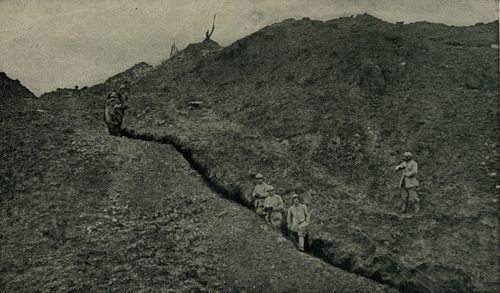
French soldiers are bringing German prisoners from Malmaison Fort, the dominating position on the Craonne Plateau, which was taken by the French October 26, 1917. The Germans overran the position again in their drive of May, 1918.
The British carried out night raids on enemy trenches in the Flanders front on October 15, 1917, and near Rœux, east of Arras. On the Aisne front the French were successful in repulsing German assaults and carried out daring attacks on enemy trenches in the Champagne and Argonne.
For a week quiet reigned on the western front. "Quiet" meaning in a military sense that no important infantry actions were attempted. But each day, and often through the night, the guns on both sides were seldom silent, and raids, counterattacks, and patrol encounters served to keep warm the fighting spirit of the German, French, and British forces.
October 22, 1917, was a day of intense activity on the Flanders front, when, operating in conjunction with the French troops, British forces in the neighborhood of Poelcappelle carried out a successful advance in the southern part of Houthulst Forest, north of Ypres. Southeast of Poelcappelle the British stormed and occupied valuable positions, and further north, aided by French troops, a series of fortified farms and defenses south of Houthulst Farm were won. The Germans in a spirited counterattack checked the advance in the vicinity of the Ypres-Staden railway, but at other points were unable to prevent the British from pushing forward.
For more than a week the French forces in the Verdun and Champagne areas had been inactive save for sporadic raids and gun duels, but early in the morning of October 23, 1917, operating over a six-mile front, they smashed the German lines north of the Aisne and seven miles northeast of Soissons. This swift and dashing attack, one of the most brilliant of the war, resulted in a gain of ground for the French of more than two miles at one point. Over 8,000 German prisoners, of whom 160 were officers, were captured, and seventy heavy field and eighty machine guns.
The morning of the attack was misty and rainy, and it was barely light when the French sprang out of their trenches, and, with a terrific barrage fire preceding them, swept over the first German positions, driving out or destroying the defenders. The front of the French attack was from the northeast of Laffaux, in the neighborhood of Vauxaillon, to La Royère Farm.
Six German infantry divisions tried to bar their way, but these were unable to check the spirited onslaught. The various stages of the French advance, which were carried out with precision and dispatch, were as follows: In the first dash the French captured the line indicated by the quarries of Fruty and Bohéry, and somewhat later Malmaison Fort was stormed and occupied. Montparnasse quarries, which had been previously damaged by big shells, was the scene of intensely hot fighting before the Germans were finally driven out.
The French center in its advance was opposed by fresh German reserves, and the fighting became bitter around the village of Chavignon, which the Germans only yielded after a violent struggle. It was in this area that the greatest advance of the day, two and a fifth miles, was made. On the right the French took the villages of Allemant and Vaudesson, and carried their line to the heights commanding Pargny-Filain.
Squadrons of tanks were active during the advance, while the French aviators distinguished themselves aloft by showering machine-gun bullets upon the German infantry from an altitude of not more than 100 yards.
The capture of the Malmaison plateau by the French was of the first importance, for it was the key of the ridge between the Aisne and Ailette Valleys; an unrivaled observation point commanding the Laon plain. In gaining it the French really "turned" the Chemin-des-Dames Ridge, to the northern slopes of which the Germans had clung so long.
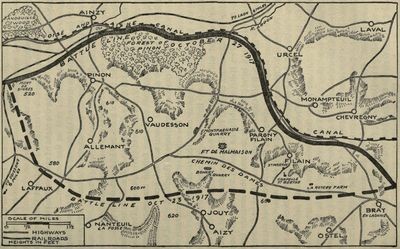
The taking of Malmaison and Chemin-des-Dames.
On October 25, 1917, the French forces on the Aisne resumed the offensive, a general push being made beyond the positions reached in the last advance, extending to the Oise-Aisne Canal. The village and forest of Pinon were captured, and the hamlet of Pargny-Filain. South of Filain the fortified farms of St. Martin and La Chapelle Ste. Berthe were occupied. On the front between Mont des Singes (Monkey Mountain) and Chavignon French troops made further progress and reached Rohay Farm. The Germans counterattacked at various points on the fighting front, but were unable to make any progress. The French held securely all the new positions gained during the advance, and the number of German prisoners had now increased to over 12,000, of whom 200 were officers. Among the spoils captured were 120 guns, many of the heaviest description.
On the British fronts in France and Flanders there were no important actions. During the night of October 24, 1917, British aviators made a successful raid on Saarbrücken. West of this place naval machines dropped three and one-half tons of explosives on the Burbach works, and other factories as well as railway communications were attacked with good results, many explosions being noted. A train proceeding from Saarbrücken received a direct hit from a big bomb and was destroyed.
On October 26, 1917, the British and French armies north, northeast, and east of Ypres renewed the offensive. The attacks began in a cold rain that had been falling for several hours. Haig's troops first advanced from a point near St. Janshoek westward through the southern fringe of Houthulst Forest to the neighborhood of Nieuemolen. The other assault was on both sides of the Ypres-Menin highway along the Gheluvelt Ridge toward the town of that name. Bellevue Spur, west of Passchendaele, was crowded with machine guns, but the British entered it an hour after the attack began. The Germans concentrated a heavy artillery fire on Bellevue, while the British were fighting arduously with rifle, bomb, and bayonet among the concrete fortifications. Through Wolf Copse, near Bellevue, that had been the scene of many sanguinary struggles, the British swept on, gaining Polderhoek Château, north of Gheluvelt, where there was close, intense fighting before the Germans were forced to yield.
On the same date the French continued their drive against the German positions along the Aisne. On the right of their attacking front they captured the village of Filain and pushed their lines forward north of Chevregny. In the Champagne area French trenches at Maisons de Champagne were heavily bombarded. Two surprise attacks attempted by the Germans were crushed. On the Flanders front, this day, the French captured the village of Draeibank, Papagoed Wood, and a number of fortified farms. Several hundred German prisoners were gathered in during these operations.
According to the reports made by French aviators scouting on the front, the Germans were preparing a retreat, for beyond the Ailette Valley fruit trees had been cut down and farms destroyed, just such destructive measures as the Germans had employed when they retired on the Somme in the spring of the year.
The French line now ran along the southern side of the Aisne-Oise Canal without a break, from westward of Vauxaillon to the town of Filain. French guns could now enfilade the German positions in three directions: northwestward of Anizey-le-Château, along the valley of Laon, and through the Ailette Valley, threatening the German lines on the Chemin-des-Dames Ridge.
German prisoners from the Empress Elizabeth's Guards Regiment captured during the recent French advance had been without food for three days and complained bitterly of their officers, who had slipped away and left them without commanders during the struggle.
The Germans had seven divisions in action during the first day's fighting here, and when it was evident that the tide of battle was running against them, fresh divisions were rushed up which had recently arrived from Galicia. The reenforcements reached the battle field only to fall under the murderous fire of French guns, or were taken prisoner, catastrophes which only added to the general confusion that seems to have reigned among the Teutonic forces.
French troops on the Flanders front began another dashing drive on October 27, 1917, capturing all the German positions on a front of two and a half miles. The advance was made on both sides of the road between Dixmude and Ypres. On the right the French gained the western outskirts of Houthulst Wood, capturing the villages of Verbrandesmis, Aschoop, Merckem, and Kippe, and also a system of strongly fortified farms. Again the French had to wade through morasses into which they sank waist deep, but there was no holding the brave "poilus" back. Soaked with mud and water they had to attack heavily defended hamlets and innumerable concrete blockhouses bristling with machine guns, but every objective was won.
West of Passchendaele the Canadians were improving the positions in this sector which they had captured in the first stages of the battle, across the neck of the Bellevue Spur. The Germans had endeavored by repeated counterattacks to force them out of this dominating height, and there were anxious moments for the Canadians, when, as the result of a struggle at close quarters, they were forced to yield ground. But they quickly rallied, and in a fierce onslaught drove out the Germans and recovered the position.
Northwest of Verdun, near Chaume Wood, the German Crown Prince's army made a strong assault on French positions on October 29, 1917. The attack was preceded by a bombardment of intense violence. The German infantry pressed forward impetuously in the face of a blasting fire from rifles and machine guns and penetrated French positions north of Courrières Wood. But they were only able to hold the ground for a short time, when the French struck back and forced them out, dispersing the invaders, who fled to their own lines.
On the Flanders front the Canadians continued to forge their way forward toward Passchendaele. In the morning of October 30, 1917, they attacked the outer defenses of that place. At Meetscheede village, a mass of ruins, there stood a number of concrete blockhouses, strongly manned, and the struggle that developed here was fierce and bloody. The place was only won by the individual cunning of the Canadians, who hid among the shell craters, dashing forward separately and in groups whenever there was a slight pause in the enemy's fire. It was slow, hard work, and costly, but they slogged away until the German guns were silent. Beyond Meetscheede stood another row of blockhouses, and more intense fighting ensued, but at length the Germans gave up and started to run, but very few were said to have escaped.
Another Canadian unit on the right, where the Passchendaele Ridge stands, was fighting its way up toward Crest Farm in the face of a heavy machine-gun fire. By dogged persistence they won the position, and quickly turning the captured German guns were enabled to smash up the counterattacks which followed quickly after the positions were occupied.
After these assaults that cost the Germans heavily the Canadians passed a quiet night in their newly won trenches only 400 yards from Passchendaele.
October 31, 1917, was warm and sunny and brought cheer to the Canadians, who had been lying out all night in the chilly air in their wet uniforms. The work of consolidating the newly won positions went forward rapidly. German gunfire, which continued during the day, was especially intense in the territory between Schaopbaillie and Poelcappelle north of the scene of the previous day's fighting. Here the Germans gained a small advantage: the British were shelled from two outposts in fortified farms.
On the French front artillery battles and local engagements were continued during October 30-31, 1917. North of the Aisne the guns thundered on the whole sector between Vauxaillon and Pinon, and along the new French positions in the region of Froidmont. German detachments, which attempted to storm French posts north of the Loivre and to the northwest of Rheims, were driven off with heavy losses. A surprise attack in the Argonne, in the region of Boureuilles, was defeated by the French after a sharp engagement in which the Germans were severely punished.
Since assuming the offensive on October 23, 1917, the French had captured over 12,000 prisoners, of whom 237 were officers. Large quantities of war material were also taken, including 180 cannon.
CHAPTER V
GERMAN RETREAT FROM CHEMIN-DES-DAMES—THE BRITISH ADVANCE TOWARD CAMBRAI
French victories resulted in the retreat of the Germans from the Chemin-des-Dames. It began during the night of November 1, 1917, and continued the day following. The stupendous efforts made by them to hold this important rampart had cost thousands of lives and had been in vain. They were forced to retire along a fifteen-mile front to the Ailette River, the prelude, perhaps, to the fall of Laon and La Fère.
The Germans had been in control of the Chemin-des-Dames since September, 1914, when Joffre turned back the Teuton armies in the Battle of the Marne. Since then they had clung desperately to this ridge, which dominates the valley of the Aisne and the Ailette Valley. The German Crown Prince lost the best elements of his armies and the best part of their effectives in the fighting here in October, 1917. Enfiladed day and night by French guns it was impossible for the Germans to keep their front lines supplied with food and ammunition, for the carriers had to pass through a storm of fire in crossing the valley of Ailette, where they were constantly under observation from the French positions. It was in anticipation of a new offensive that the Germans decided to retire from a position that had become untenable.
Possession of the Chemin-des-Dames greatly strengthened the French lines in the Aisne sector, giving them control of the St. Gobain region northwest of the highway. St. Gobain is between Laon and La Fère and dominates both those points.
On November 2, 1917, the French forces organized the new ground conquered from the Oise Canal to Corbeny. Lively artillery actions were continued in the different sectors of the Chemin-des-Dames. In the course of the night the French made progress between these two points and reached the south bank of the Ailette River, over the entire front. The Germans retired to the north bank of the stream, destroying bridges and footbridges on the way.
The French had received timely warning of the retreat, and an hour after it began swarmed down along the whole front in pursuit. It was evident that the Germans had determined hurriedly to abandon the ridge, for the first French troops to reach the positions found tins containing soup that was still hot. The advance was made slowly and cautiously, for it was well known that the Germans left dangerous traps behind them when forced to retire. In Cerny village a German helmet was found fixed to a pole so arranged that when it was lifted off it would cause the explosion of a mine. The Germans had passed out of sight, but they were still heard from, their guns being constantly active shelling the abandoned positions.
The French discovered trenches and dugouts and two large tunnels almost intact owing perhaps to the fact that the Germans feared to destroy them lest the explosions would give the alarm. The result was that the victors had little work to do in preparing defenses, and began their tenancy under good cover.
No important actions were fought on the British front in France during the first days of November, 1917. There was fierce shelling day and night on both sides across Passchendaele Ridge.
On November 6, 1917, the indomitable Canadians began a daring drive that resulted in the capture of Passchendaele village northeast of Ypres, a key position dominating the plain of Roulers. After taking the place they pushed forward and occupied positions 800 yards farther on. The German defense was far weaker than the men from overseas anticipated, nor did the enemy launch a counterattack immediately after the town was captured. This failure to counterattack was afterward explained by one of the two German battalion commanders, who were made prisoners with their staffs when Passchendaele fell. This officer commanded a reserve battalion brought up for the express purpose of counterattacking. He had gone with his staff to consult with the battalion chief commanding in the village, and when both commanders were captured their troops were left without a responsible head. The reserve battalion waited in a state of indecision for the officer's return and never ventured forward, thus giving the Canadians time to consolidate their gains. From the village it was possible to look far over occupied Belgium, and the possibilities for artillery work from this position were wide. Its loss threatened the retention by the Germans of their defenses for many miles.
In the course of the drive the Canadians took 400 prisoners, of whom twenty-one were officers. The total would have been much higher, but a number of the enemy were killed by the fire of their own guns when they were being brought back after the taking of Passchendaele, whether by accident or design was not learned.
Two days passed, and yet the Germans made no attempt to capture the lost village, thus giving the Canadians ample time to organize their defenses and secure a firm grip on the position. The enemy's heavy gunfire had slackened too, because the Canadians had observation of his old battery positions, so he relied mainly on lighter guns.
For months little activity had been reported on the upper Alsace sector of the western front, but on November 7, 1917, the French made an attack on the German positions at Schoenholz, capturing 121 prisoners including officers, and large quantities of war material and stores.
Haig's troops began a new push early in the morning of November 10, 1917, northward along Passchendaele Ridge, on a front of one and a half miles and piercing the German lines for half a mile. It had been raining most of the night and the storm still continued when the British forces went forward at 6.05 o'clock in the morning. The Germans immediately threw a heavy barrage along the front involved, and the advance was raked by machine-gun fire from numerous strong points. The fighting was especially intense at several fortified farms strongly held by the Germans. North of Goeberg there were several concreted positions whose defenders fought with daring and tenacity. Repeatedly the British stormed and penetrated these strongholds only to be driven out a little later by counterattacks, but "dogged does it!" and by 10 o'clock they had virtually gained all their objectives.
During the morning hours of November 11, 1917, the Germans bombarded heavily the new British positions, but no counterattack was attempted. Along the crest of Passchendaele Ridge, north of the village, the Canadians held their advanced line strongly. On the lower ground, to the west, the scene of bitter fighting on the previous day, the Germans counterattacked, and at a few points the British were forced back, though holding on to some of the newly won positions.
There were many local actions at various points on the French front, November 10-11, 1917. Surprise attacks were attempted by the Germans northwest of Rheims and north of Samogneux, which were shattered by the well-directed French artillery fire. On the front of Chaume Wood, in the Verdun sector, gun duels continued intermittently day and night.
In the Vosges the Germans after heavy artillery preparation made an attack on the French trenches at Hartmannsweilerkopf. A violent engagement developed in which the opponents fought at close quarters and the bayonet was used freely. It was a short, sharp struggle in which neither side was disposed to yield, but ultimately the Germans after gaining a foothold in the French observation line were driven off. On November 10-11, 1917, the Germans bombarded French advanced posts in the region of Ramscappelle and Pervyse as well as their trenches at Dixmude. The French guns replied with so destructive a fire that the enemy batteries were silenced. Then their "heavies" began a bombardment of German works at Woumen and positions on the outskirts of Dixmude.
After several days' intense shelling of British positions around Passchendaele the Germans made a determined effort on November 13, 1917, to recover the lost ground. They massed strong bodies of troops in the neighborhood of Westroosebeke, advancing from the cross roads north of Passchendaele under the protection of a violent barrage. The British were not caught napping and their gunners concentrated a destructive fire on the German assembly places and approaches. The first waves of the German advance were shattered by streams of bullets, and only small bodies struggled through the devastating fire to the British trenches, where after sharp fighting they were driven back.
Another section of the dominating Passchendaele Ridge was wrested by Haig's troops from the Germans during the night of November 16-17, 1917. The credit for this advance was due to the Highland, Berkshire, and Lancashire troops, who in the darkness left their shell holes and pushed forward over ground that was swept by machine-gun fire. The Germans were evidently taken by surprise, or were cowed by the impetuous dash of the British troops, for they did not attempt a strong defense. The struggle developed to the north of the ruins of Passchendaele village, and the British were easy winners. A heavily fortified redoubt known as Vocation Farm gave the attackers some trouble, but it was captured along with other strong points in the neighborhood. The Germans did not attempt an immediate counterattack, but increased their artillery fire on the sector.
On the following day the Germans made a strong raid on British lines in Flanders in the neighborhood of Guillemont Farm. At some points they were successful in piercing defenses, but the British counterattacked across the open, and after a short, sharp struggle, repulsed the invaders and took a number of prisoners. In the night of November 17-18, 1917, Lancashire and Highland troops made a successful raid on enemy trenches in the neighborhood of Monchy-le-Preux, where they killed or captured many Germans and escaped with light casualties before reserves could arrive.
These minor local actions were the prelude to a powerful offensive which Field Marshal Haig was preparing, one of the greatest operations of the war, and which broke the famous Hindenburg line. The attack was launched on November 20, 1917, and was a complete surprise to the Germans as it had not been preceded by any artillery preparations. The operation was carried out by the third army under General Sir Julian Byng, the advance being made along a thirty-two-mile front between St. Quentin and the Scarpe River. German defenses were penetrated for a distance of five miles at the deepest point, extending to the village of Cantaing, which lies less than three miles to the southwest of Cambrai.
As a substitute for the usual artillery preparation the British had secretly assembled a large number of tanks, which were sent forward under a screen of smoke, and broke down the German barbed-wire entanglements, opening the way for the infantry to make their forward rushes. The British troops were in high spirits, shouting and cheering as they pushed forward in the wake of the lumbering machines.
As the tanks rolled on, showering machine-gun bullets before them, the British guns in the rear sent hurricanes of shells screaming over the Hindenburg line. The surprise of the attack seemed to have dazed and bewildered the Germans; many of them hid in their dugouts and tunnels and then surrendered. The braver element got their machine guns in action or used their rifles to snipe the British.
The German artillery fire was feeble, their gun positions being smothered beneath the deluge of British shells. There were comparatively few batteries, and their infantry gained little help from them. It was well known to the British that they had removed many of their guns from this sector in the past few days, as this part of the battle line was considered "quiet."
During the night preceding the attack the British had massed large bodies of cavalry very close to the enemy lines, ready for a sweeping drive when the tanks had broken down the wire defenses. In hollows near the German lines were thousands of cavalry horses with their horse artillery limbered up ready for the dash forward. After the tanks had made clear the way to advance the cavalry sprang forward through the rain and mist. One squadron rode down a battery of German guns, and other bodies swept around machine-gun emplacements and through villages and captured many prisoners.
It was 6.20 in the morning when the tanks first pushed forward to break down the wire entanglements and clear the way for the advance of the British infantry. An hour later the troops were rushing through the gaps made in the German defenses. At 7.47 British troops operating west of Havrincourt had forced their way up and over the elevation known as Mount Vesuvius. It was fortunate that the movement was carried out with dispatch, for a few minutes later the knoll, which had been mined, was blown up by the Germans. Havrincourt was captured in less than an hour, the Germans evacuating the place in such haste that they had not time to inflict any serious damage. The West Riding Territorials, who captured Havrincourt, also occupied enemy trench systems to the north of the village, while Ulster battalions, covering their left flank, pressed on northward up the west bank of the Canal du Nord. La Vacquerie and the strong defenses known as Welsh Ridge were won by English rifle regiments and light infantry. In the course of the advance east, County troops took the hamlet of Bonavis and Laffaux Wood after a bitter struggle that resulted in heavy casualties to the Germans.
Later in the morning the British troops extended the advance at all points. Crossings were effected of the canal at Masnières and English, Scottish, Irish, and Welsh battalions fought together in the capture of Marcoing and Neuf Wood. East of the Canal du Nord the West Riding troops that took Havrincourt made important progress. They stormed and captured the villages of Graincourt and Anneux. In conjunction with Ulster men operating west of the canal they carried the whole German line northward to the Bapaume-Cambrai road.
Important points of the Hindenburg line were penetrated east of Epihy by the West Lancashire Territorials, while Irish troops won important sections of the line between Bullecourt and Fontaine-les-Croisilles.
In the morning of the second day of the advance the British were within three miles of Cambrai. After breaking through the German's last defense line at Anneux and Cantaing, British tanks, cavalry, and infantry were operating along a line running from west of Cambrai to the south of that town. On the left, in the region of Bullecourt, the German line had been pushed back, widening the salient which the British drove into enemy territory south and southwest of Cambrai. In the attack around Bullecourt the British took 700 prisoners.
The Germans had now recovered their fighting spirit, which suffered a decline during the first stages of the British advance, and everywhere opposed a stiff resistance. At Noyelles, Rumilly, and Bullecourt they made desperate counterattacks during the night, but were unable to overcome British resistance.
In the two days' fighting the British had captured more than 9,000 prisoners.
There was heavy fighting during the morning of November 22, 1917, near Bourlon Wood, Fontaine Wood, and the village of Fontaine Notre Dame east of it, less than three miles from Cambrai. When the British captured the last place named, they were able to release more than a hundred civilian prisoners, who hailed their rescuers with cheers and many wept for joy. At Masnières the same scene was enacted, where some hundreds of civilians were freed from the odious rule of their German oppressors. They had been kept from starving almost entirely by the American Relief Committee, and after America entered the war by the Spanish-Dutch Committee. The men had been forced by the Germans to work long hours in the fields and workshops, and the women had to sweep the roads, wash the soldiers' dirty linen, and scrub their quarters.
"For three years we lived in a nightmare," said the Mayor of Masnières, "and now we seem to be in a dream too good to be true!" One man had been living for three years in the cellar of his own house, where German officers were billeted, being fed by his wife out of the extra ration given to the baby born since the war began. Every week the house was searched and husband and wife would have been punished with death if the man had been found.
In the morning of November 23, 1917, the British drove back the Germans from an elevation known as Tadpole Copse west of Mœuvres, commanding a large section of the Canal du Nord, which runs east of that place and the village itself, still in German hands. At Fontaine Notre Dame, west of Cambrai, where the British had been pushed back, the fighting was renewed. In the eastern part of Crevecœur village the Germans had concentrated an intense machine-gun fire against the British in the western outskirts.
Heavy fighting continued throughout the day of November 23, 1917, at Bourlon Wood, and around Fontaine. The British held a line on the low ground about the southern edge of the wood, and from these positions had to charge up the slopes under the fire of many machine guns.
Assisted by the tanks the British infantry made a strong forward push, and hand-to-hand fighting ensued as soon as they had entered the forest. Every foot of the advance was fiercely contested, but the "men of the bulldog breed" were out to win, and by early afternoon had driven their way through half the wood. Later in the day they gained more ground, occupying a line through the center of the wood to the northwest of Fontaine. In hand-to-hand combats the Germans were slowly forced back toward the northern edge of the forest. A determined counterattack from the north was made by the Germans in an effort to oust the British, but they held firm. While this bloody struggle was going on in and around the wood Fontaine village, which the Germans held strongly, was the scene of fierce fighting. The place was heavily fortified, and the Germans with rifles and machine guns fired from the roofs and windows of the houses. Later in the afternoon the British tanks took a hand in the fighting here, but at the close of the day (November 23) the Germans were still in possession of the place, though sorely depleted in numbers.
The fighting was continued in the neighborhood of Bourlon during November 24-25, 1917, with varying fortunes to those engaged. The Germans about noon on the 25th succeeded in driving the British from the greater part of the village. In Bourlon Wood, where the British held strong points on the high ground, the Germans, though repeatedly attacking, failed to make any progress.
In the five days that had passed since the British began the offensive on November 20, 1917, they had captured 9,774 prisoners, including 182 officers.
The Hindenburg support line west of Mœuvres was attacked by British troops, some from London, during the night of November 25, 1917. The fighting that developed was close and sanguinary, the losses on both sides being considerable, but the British believed they had not paid too dearly for the 2,000 yards of support trenches which they won on this bitterly contested field.
At Bourlon Wood and Bourlon village the fighting still continued in one of the most bitterly contested and sanguinary struggles that had been fought up to that time on the British front in France. Bourlon Wood, to which the British clung so tenaciously, was of special value to the Germans if they were to hold their positions farther north, and for that reason they were making extraordinary efforts to regain that elevation. The British had established many guns in good working positions and were prepared to defend it.
Fighting was continued on the southern edge of Bourlon village in the night of November 26, 1917. The British broke the German line at one point and brought back a body of English troops that had been isolated for some time in the southern part of the hamlet. Having rescued their fellow soldiers they made no attempt to remain in the village, but dashed back through the gap they had made in the German lines.
At about 10 o'clock at night on the same date the Germans in a counterattack struck hard against British positions on the northeast corner of Bourlon Wood, but were driven back so decisively that they made no further attempts to recover the lost ground. The British artillery continued to pound the German lines effectively during the night, but no other infantry action was attempted by either side.
The villages of Fontaine Notre Dame and Bourlon continued to be the storm centers on the battle front. They were constantly deluged with shells by both sides, and attacks were made from time to time in which now the British and now the Germans gained some slight advantage. From their positions in Bourlon Wood the British were shelling Cambrai three and a half miles away.
On November 28, 1917, the British won a section of the ridge between Bourlon Wood and Mœuvres in the face of a heavy barrage and intense machine-gun fire from the direction of Bourlon village.
In the morning of the following day, under cover of a furious artillery fire, the Germans delivered an attack in force on the British positions between Bourlon Wood and Mœuvres on the west. In the first dash the Germans swept over the crest of the ridge west of the wood and as far as the vicinity of the Bapaume-Cambrai road north of Graincourt.
After the first shock of the assault the British organized a counterattack and fell upon the advancing Germans with such fury that the advance was checked. Fighting still continued, however, throughout the day in this region with varying fortunes to the combatants.
The Germans had been concentrating their heaviest guns in this area to replace those that had been captured by General Byng, and were using gas shells on a lavish scale.
In the morning of November 30, 1917, the Germans started an important offensive movement with the fixed purpose of driving the British from the territory they had won in the previous week. Two great attacks were made early in the day, one extending from Mœuvres to Bourlon Wood, the other along a 1,200 yard front southwest of Cambrai, between Vendhuile and Crevecœur.
The Germans employed strong forces, and were efficiently supported by newly concentrated guns that had been brought forward for the purpose.
Over the ridge between Mœuvres and Bourlon Wood the Germans poured in dense masses, coming under fire of the British artillery as they swept down the slope toward the Bapaume-Cambrai road. The Germans advanced in such close formation that they fell by the score under the intense fire from British rifles and machine guns. But where one fell a dozen seemed to rise up and take his place, and the hordes moved resistlessly forward like a tidal wave. British infantrymen were thrown into the battle line for a counterattack and a murderous struggle developed, but the Germans were too strong, nothing could hold them back as they pushed relentlessly on, and the rush was only checked when they reached a point in the vicinity of the Bapaume-Cambrai highway northwest of Graincourt.
Regardless of their heavy losses the Germans continued to pour over the ridge all day long in waves of massed formation, offering a splendid target for the British guns. Their ranks were torn and shattered in that storm of fiery hail, but there was hardly a pause in the advance and their numbers never seemed to diminish. Late in the day the British in counterattacks gained ground at some points, but the honors rested with the Germans, who by costly sacrifice of men won important defenses and advanced their lines. Around Bourlon Wood the British held firmly and the Germans, wearied at last of the slaughter that had decimated their ranks, gave up attacking for the day.
In the south the Germans began the attack with a force of ten divisions; six of them were on the front line. It was planned to make two turning movements on either side of the line, which were to converge toward a common point. German infantry supported by cavalry at the northern end of the line delivered an assault across the canal from Crevecœur toward Masnières. They succeeded in forcing their way into the suburbs of the last-named place, but were driven out before they could establish positions.
Farther to the south the Germans won important victories, when they broke through the British front, south of Villers-Guislain, and by an adroit turning movement to the north, surrounded Gauche Wood, Gouzeaucourt, Gonnelieu and La Vacquerie. In this operation the Germans advanced their lines at one point about 4,000 yards. This was at Gouzeaucourt, which they entered about 10 o'clock in the morning, and where fighting of the most violent description continued until the middle of the afternoon. The British had received reenforcements, but they were still heavily outnumbered. The fighting was at close quarters, a merciless hand-to-hand struggle that continued for hours without pause. The British troops, fearing the loss of their dearly bought ground, fought with desperation and about 3 in the afternoon succeeded in pushing the Germans out of the village and reoccupied it.
East of Gouzeaucourt the Germans occupied a ridge with strong forces. During the day the British repeatedly attacked, and finally forced them to withdraw from the height to the lower ground, and occupying the position, and also Gauche Wood, pushed on to the western edge of Gonnelieu.
The German line in the morning of December 1, 1917, was just west of Villers-Guislain, marking an advance of about 3,000 yards at the greatest depth. Other less important advances were won in the north and at Gonnelieu, and while the British regretted the loss of valuable territory, there was nothing in the situation to cause them uneasiness. There had been crucial periods in the fighting of the previous day, when it seemed that the Germans would win an overwhelming victory, and all the territory gained during General Byng's advance would be recovered, but British determination and dogged perseverance and unconquerable spirit prevailed, and the most ambitious plans of the enemy were frustrated.
Heavy losses had been sustained by both sides. The German attacks, made in massed formation, had caused a formidable death roll. They claimed to have taken 400 British prisoners.
CHAPTER VI
GERMANS GAIN IN THE CAMBRAI AREA—COLD WEATHER HALTS IMPORTANT OPERATIONS
All day long the waves of battle rolled around Masnières on December 1, 1917. The Germans made nine strong attacks, all of which were repulsed. It was declared by eyewitnesses that the British destroyed more Germans during the fight here between dawn and dark than in any similar period since the beginning of the war. From the first German assault there was no pause in the struggle.
Late in the day south and east of Masnières the German guns heavily bombarded the town. The British line formed a sharp salient around the place, which made the position difficult to hold, as it was dominated by the high ground held by the Germans. It was therefore decided by the British command to withdraw to the southeastern outskirts of the town and there establish the line to the great benefit of the entire front.
Gonnelieu, which the British captured during the day, though the Germans still clung to portions of the ruins, was completely "cleaned up" during the night, about 300 prisoners being taken here. After the recapture of Gauche Wood the British continued to push on up to the higher ground southwest of the wood. During the assault on Gauche Wood one British tank captured fifteen machine guns from the enemy.
December 2, 1917, the Germans continued their terrific attacks on the British front south and southwest of Cambrai. With a mighty concentration of artillery, and employing great forces of infantry, they tried to pierce the British defenses in the Gonnelieu sector, but General Byng's army had been strongly reenforced and held fast.
The battle began along a front that extended from La Vacquerie southward to Vendhuile. The Germans attacked British positions at La Vacquerie at 8:45 in the morning, and penetrated the village, but only won temporary foothold, when they were forced out. As the day wore on the fighting spread northward toward Masnières, which the British had evacuated on the previous day. During the night the town was an uncomfortable place to hold, as the British continued to deluge it with shells and the Germans were forced to find refuge in tunnels and dugouts. Southwest of Bourlon village General Byng's troops won back a trench system that the Germans had captured during the push of November 30, 1917. Bourlon Wood was again in possession of the British, though a few Germans still clung to some points on the outskirts. South of Marcoing the Germans continued their powerful attacks on the British lines, but were unable to cut through the defenses.
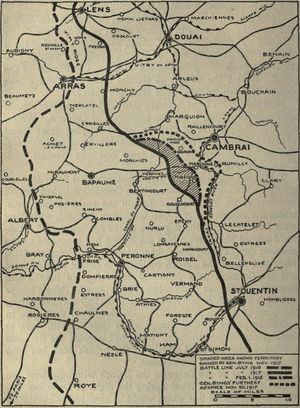
The battle of Cambrai.
Under cover of the darkness the British withdrew from the salient about Bourlon Wood during the night of December 4-5, 1917, to a prepared line which would be stronger and easier to hold. Not until some hours had passed did the Germans discover the retirement, when they swarmed into the vacant territory and dug themselves in. Bourlon Wood had been generally stripped of troops; only a rear guard being left when the British retired, and they were later withdrawn. The Germans continued, however, to bombard the wood, showing that they were all in the dark concerning British movements.
The devastated area which the British had abandoned, and which included the mined towns of Graincourt, Anneux, Cantaing, Noyelles, Marcoing, and Masnières, was gradually occupied by the Germans. They had no easy task before them, for the British guns dominated this desert with tons of explosives, and hundreds of shells were hurled into their advanced ranks as they went forward to prospect for desirable positions for defense. Meanwhile the British army had found exceptional quarters in the captured Hindenburg trenches with their wonderful dugouts and network of front-line and communication trenches, all ready for occupancy.
There was continued fighting during the 6th between advanced patrols of British and Germans. North of La Vacquerie Ulster troops won some important defenses that strengthened the British line.
Artillery duels and sporadic raids were the only military events in this fighting area during the several succeeding days. The British anticipated that this lull would be followed by renewed fighting, for it was known that the Germans had been bringing forward strong reenforcements, probably from the Russian front.
The German offensive began on December 12, 1917, but was far from being as formidable as the British feared. The first attack was made at dawn against an elbow in the bend of the British line between Bullecourt and Queant, about ten miles west of Cambrai. The Germans were in strong force, the troops, principally from Bavaria, advancing in waves and close formation, and by sheer weight of numbers won about 500 yards of front-line trenches before they could be checked. Other attacks were made from the east, and the third south of Riencourt, both of which were shattered by British rifle and machine-gun fire.
The Germans were evidently trying to discover weak spots in the British lines by a process of testing, for on December 14, 1917, they made an assault on the Ypres front in Flanders. The stroke was delivered on a front of about 300 yards southeast of Polygon Wood, against British positions near Polderhoek Château. They won a section of front-line trench, but were repulsed at all other points of attack.
East of Bullecourt, in the Cambrai area, German gunfire had increased in violence. During the night the British engaged in bomb fighting that was highly successful, and enabled them to improve their lines. North of Bullecourt in the afternoon of December 15, 1917, the British carried out a successful raid in which a number of prisoners were captured and enemy dugouts and defenses were destroyed.
Snow began to fall during the night on this date, and by morning the countryside was deeply covered, and the ugly scars of battle hidden from sight. The snow lay in heavy drifts on the roads and fields. No military operation was possible, and even the sinister-looking guns were silent.
This white truce was appreciated by the British as it must have been by the soldiers of the kaiser, for both armies had been under a severe strain since General Byng's advance on Cambrai, November 20, 1917.
It was estimated by conservative military observers that the German strength on the Franco-British front at this time was 154 divisions, one less than the great force amassed here in the previous July, when the German military effort against France was at its maximum.
During these momentous days on the British battle front the French had been nibbling away at the German positions around Verdun and along the Aisne and Meuse Rivers. The capture of the entire line of lights through which runs the famous Chemin-des-Dames had given them command of the strongest positions in that region. The Germans, forced to retire across the Ailette and to abandon the whole valley to the French, were so situated that it would be taking a gambler's chance to attempt an offensive on a large scale. Nor was a direct attack on Verdun probable, for they had lost all their gains on both sides of the Meuse, while every point of vantage in this sector was in possession of the soldiers of the Republic.
The Champagne front between Rheims and Verdun offered the most favorable field for the Germans to deliver a hard blow. By a strong offensive the French positions to the east, in the Argonne Forest, might be turned, compelling the French to draw their lines back; converting into a narrow-necked wedge the Verdun lines, which would be hemmed in on nearly every side.
On the Alsace and Lorraine fronts there was little to fear of any strong action on the part of the Germans, as every movement must be made through narrow passes, conditions that rendered large operations impossible.
Meanwhile the Germans were evidently testing the French fronts for a weak spot where they might strike a shrewd blow. Around Verdun and farther east the German guns thundered unceasingly, and German trench raids were of daily and nightly occurrence throughout the month of December. For "a worn-out army," as the French troops had been called by their enemies, they fought with astonishing spirit. The Germans made slight gains from time to time, but they were unable to retain them.
On the Cambrai front the fighting was confined to raids and minor actions of slight importance. On December 30, 1917, the Germans made strong local attacks on a front of over two miles against the British position on the spur known as Welsh Ridge south of Cambrai. The attackers were forced back in the center, but on the right, toward the north of La Vacquerie, and on the left to the south of Marcoing, they penetrated and occupied two small salients in the British lines. In the morning of the following day, after a short but heavy bombardment, the Germans renewed their attack against Welsh Ridge on a front of about 1,200 yards south of Marcoing. The southern portion was assaulted by strong forces, and assisted by liquid fire they succeeded in gaining a foothold in one of the British trenches. The gain was only temporary, for the British quickly rallied, and in a fierce counterattack drove out the invaders and reoccupied the entire trench system.
German artillery thundered unceasingly throughout the day on January 1, 1918, near La Vacquerie on the Cambrai front, and in the Lens, Armentières and Ypres sectors. In the evening, under cover of a heavy bombardment, three bodies of German troops attempted to raid British positions in the vicinity of Méricourt southeast of Lens. The assaulting troops came under the concentrated fire of the British artillery and were hurled back with heavy losses before they could reach their objectives. In no-man's-land these disorganized Germans ran into a British patrol, and again lost heavily, very few escaping from the field.
The British front was now in the icy grip of winter. Snow-drifts made the roads impassable for motor cars. The Germans, however, were not deterred by unfavorable weather conditions from making sporadic raids on British positions. On January 5, 1918, they had some success at Bullecourt, where they captured a British advance post—a dearly bought operation that cost them a heavy toll in casualties. In the afternoon the British came back in force, and, after a tense, close struggle, drove out the Germans and reoccupied the position.
On the French front, where a blizzard had been raging and the heaviest snowstorm in years made military operations on any large scale impossible, the Germans continued to be active, and the French were kept busy defending their costly won positions.
On January 8, 1918, French troops carried out an extensive and successful raid which was intrusted to foreign legionaries and sharpshooters. The attack was delivered along a front of a mile and to a depth of half a mile in front of Flirey and westward toward St. Mihiel. The French completely cleaned out the German defenses, capturing 178 men and officers and numbers of machine guns and trench mortars. The Germans were so completely taken by surprise that their artillery did not get into action until the French had finished the job. The attack was carried out with such dispatch and in so thorough a manner that the French suffered not more than a dozen casualties, while the German dead lay thick about the field and the snow was streaked with ominous stains.
On the same date (January 8) the spell of silence which had brooded for some days on the British front was broken by a hostile attack made by the Germans east of Bullecourt.
In the early dawn the British lines were bombarded with high explosives and gas, and about 6.35 three parties of Bavarian troops, who had been lying concealed during the night in no-man's-land, made a quick rush for the British defenses. The front line attacked had been weakened by the recent withdrawal of troops, as an enemy attack was not expected in a sector considered "quiet."
Two of the parties of Bavarians carried flame throwers of the most approved type, which darted a jet of fire thirty feet, and literally wiped out with a touch a man's life. This engine of destruction had a terrifying effect on troops who saw it in operation for the first time, but the British soldiers defending the trenches at Bullecourt were seasoned fighters and well acquainted with every type of German frightfulness.
The Bavarians in this attack succeeded in penetrating the British line and proceeded to make themselves at home in the position and to strengthen the defenses. A swift counterattack delivered by the British killed a number of them, but the others continued to hold on through the early morning hours. Shortly before noon the snow began to fall heavily, making observation difficult. Through the storm swept a body of British troops to assault for a second time. The Bavarians were taken by surprise and driven out of the position, leaving a score of prisoners and a number of wounded in British hands. Such minor operations and small raids made on both sides were the only interruptions of the quiet that prevailed on the entire front where General Winter ruled. The troops, who were enduring every discomfort in their snow-bound trenches, longed eagerly for clearing weather, when they might find release from deadly inaction.
The British were better off than the Germans, since they had won the ridges on the front. They could keep dry, while the kaiser's troops occupied trenches that were often in a fearful condition owing to lack of natural drainage, which in bad weather transformed them into bogs. The British took prisoners in dugouts that were filled with water. The miserable occupants of these holes seemed to be glad enough to fall into the hands of their enemy.
In these days there was considerable relaxation in the iron discipline of the German army—on the British front at least. It was learned that their officers were cautious about punishing the troops too severely even for grave offenses against discipline. Deserters were not shot, but sent back to Germany, where it was said the prisons were full of such offenders. To escape service in the front-line trenches the soldiers shammed gas-poisoning and resorted to other devices to avoid duty.
On the French front during these dreary winter days the Germans continued their raiding attacks in Chaume Wood in the Verdun sector, and at other points, in which every weapon of "frightfulness," including lavish use of liquid fire, was employed. But the French troops defeated every effort made by the enemy to oust them from the important positions that had been won by costly sacrifices. These futile assaults served to keep up their fighting spirit, which otherwise might have gone down with the mercury.
During the night of January 13, 1918, Canadian troops attacked the German trenches to the north of Lens. The Germans offered only a feeble resistance, and after damaging the defenses the Canadians withdrew, bringing with them a number of prisoners. The adventure was a success, and almost unique in its way, because the raiders had not lost a man or suffered a single casualty.
On January 13-14, 1918, during the night and the day following, the guns of the French and Germans were active at various points along the Champagne front and on the right bank of the Meuse. In the region north of Louvemont the Germans had concentrated for attack, when they came under fire of the French guns and were dispersed. This discouraged any further attempts of the enemy to launch an infantry action that day.
On the Alsatian front, between the Thur and Doller Rivers, an artillery duel was fought all day on January 15, 1918. In the region of Badonviller the French carried out a successful raid that led to the capture of forty prisoners including some officers.
During these days peace reigned in a military sense on the British front in France and Flanders. There was generally, however, enough going on to keep up interest among the soldiers, even if they were not called on to do any hard fighting.
German batteries in a fitful way continued to rain a deadly fire around the outer edge of the Ypres salient from Passchendaele downward, and scattered shells lavishly among the back areas across the Menin road and the old fighting grounds of Monchy and Fampoux. The British troops holding defenses in the suburbs of Lens, Bullecourt, and Havrincourt were not spared by these destructive visitants.
The British certainly did their part in keeping the Germans at attention, doing counterbattery work with the aid of aeroplanes whenever there was an hour or two of visibility, showering tons of bombs and explosives on German working parties, trenches, and roads.
Notwithstanding the boggy condition of the ground, when it was not deep with snow, a rumor arose, though it was impossible to trace the source, that the Germans contemplated a great offensive. They possessed inventive skill and perhaps they would find means to get their cannon through the swamps of no-man's-land and the roads where heavy guns would sink wheel deep.
During the night of January 21, 1918, British aviators raided towns in the occupied parts of Belgium and German Lorraine. Two tons of bombs were dropped on the steelworks at Thionville, on railway sidings at Bernstorf, thirty miles south of Metz, and on the Arneville railway junction.
There was considerable activity on the French front on this date when German lines west of the Navrain Farm in the Champagne were successfully raided. The French cut through the enemy defense as far as the third parallel, and after destroying a trench brought away a goodly number of dispirited and bedraggled prisoners.
In Belgium during the day there was violent gunfire in the Nieuport sector. To the east of that place the Germans after a heavy bombardment made a dashing attack and succeeded in penetrating the French first-line trenches. They had hardly gained a foothold when the French rushed a counterattack and drove out the intruders, who fled to their own lines after losing a considerable number in wounded and prisoners.
On the right bank of the Meuse the artillery on both sides was active during January 23, 1918, around that much-fought-over sector, Hill 344, and the front of Chaume Wood. Following up an intense bombardment, the Germans tried to penetrate the wood, but were scattered by the French artillery fire.
On the 25th a strong assault was delivered on the French positions west of St. Gobain Forest. The enemy struck in at the western edge, and at one time seemed to be in a fair way to succeed, for the attack lacked neither daring nor persistence, but the French guns, whose fire had been withheld for a time that the Germans might advance near enough to present a better target, now poured out such death-dealing volleys that the attackers were halted and then fled back to their lines in disorder, leaving many dead on the field.
French aviators were busy on this date as long as there was visibility. Four German machines were brought down in aerial combats. Enemy defenses were successfully bombed, and tons of explosives were dropped on German establishments. Much damage was wrought to the railway stations at Thionville, and on Freiburg in Breisgau, the aniline works at Ludwigshafen and the cantonments in the Longuyon region.
Owing to the military collapse of Russia Germany was enabled to transfer thirty-eight or forty divisions from east to west, which meant that the French and British had now facing them at least 3,000,000 enemy troops. A great German offensive was in preparation on a vaster scale than any before attempted, having for its main object the capture of Paris or Calais. The Allied command expected the threatened drive might begin early in February, and had made their plans accordingly. Confident in their strength, they waited eagerly the great battle that might end the war.
PART II—THE UNITED STATES AS A BELLIGERENT
CHAPTER VII
THE NEW ALLY IN COUNCIL
The weight of America's participation in the war did not begin to be felt until the autumn of 1917, when the aftermath of the Russian collapse, followed by the Italian disasters, made the Allies turn with more and more reliance to the new belligerent. Not alone in men, money, ships, and munitions did the Allies look for American aid, but for business counsel and administrative efficiency. The war had not been well conducted. Lloyd George frankly said so. The American mind was needed at the Allied conferences to contribute its share in remedying the defects of a division of command, from which had flowed a succession of costly errors. Hence the United States, being in the war to join hands with a unified Allied command, not to act independently, became an influential factor at the war parleys.
The presence of American representatives for the first time at an Allied war conference in Paris, which took place in November, 1917, was greeted in belligerent Europe as an event of deep significance. The United States since its belligerency had not shared in the Allied deliberations; but the need of unity—a single front, a single army, a single nation, as the French Premier, M. Painlevé, defined it—made its representation imperative. The delegation, which was headed by Colonel Edward M. House, and included Admiral Benson and General Bliss, set out on an avowed war mission while peace balloons floated in the air. As the President's reputed bosom confidant, who had been to Europe before on supposed peace missions, Colonel House was credited with bearing instructions to look over the ground for practicable peace formulas. His presence among the American representatives made this impression so general that the State Department had to deny that he was a Wilson peace envoy. He was heading a war mission pure and simple whose aim was to weld the United States firmly as a member of the Allied powers.
The purpose of the Allied conference was to form a more complete coordination of the activities of the various nations warring against Germany. A more comprehensive understanding of their respective needs, in order that their joint efforts attained the highest war efficiency, was also sought. A prime factor to this end was to avoid any conflict of interests among the participants.
"The United States," Secretary Lansing explained, "in the employment of its man power and material resources desires to use them to the greatest advantage against Germany. It has been no easy problem to determine how they can be used most effectively, since the independent presentation of requirements by the Allied Governments have been more or less conflicting on account of each Government's appreciation of its own wants, which are naturally given greater importance than the wants of other governments.
"Though the resources of this country are vast and though there is every purpose to devote them all, if need be, to winning the war, they are not without limit. But even if they were greater they should be used to the highest advantage in attaining the supreme object for which we are fighting.
"It is the earnest wish of this Government to employ its military and naval forces and its resources and energies where they will give the greatest returns in advancing the common cause."
The American Government accordingly was represented at the conference to determine how this object could be achieved. Primarily the conferees met to create in effect a great general staff to direct the energies of the cobelligerents and so motivate military strategy that entire nations would act merely as units in the operations. They endeavored to make the whole fighting forces of the Allies into one mighty war-making machine.
The United States projected as an indispensable bulwark in this scheme by being practically the treasury and storehouse of the Allies. It had already poured out money and supplies at their call with lavish hand. Each had sent a mission to the United States to present its case and needs. The Government heard them, and the resources of the United States were freely drawn upon to meet their necessities. Each mission, however, had confined its requests largely or solely to its own requirements. Each clamored for men, ships, money, food, munitions, or whatever other war essential it wanted. A lack of coordinated plans and predetermined objectives weakened the scope of America's assistance on account of the scattered and piecemeal methods by which it was obtained. Consequently the United States, while providing for its own war necessities, determined that it must have a voice in arbitrating on the further needs of the Allied nations by weighing them side by side at the war conference, so that its resources could be distributed among them in pursuance of a coordinated plan aiming at achieving collective, not individual, advantage. Germany had pointed the way in showing the success to be obtained by combined effort. Germany and her three partners were one. The Allies were many and, so far, had been disjointed. The entry of the United States became the occasion for making an endeavor to coalesce the Allies to a closely knit bloc on the Teutonic method.
Great Britain, momentarily disheartened by the checks the Allied cause had sustained owing to a division of command and organization, was braced by the appearance of the American mission at the Allied conference. Said the London "Times":
"In several points, of late, things have not been going too well for the Allies, but none of their reverses or disappointments matters if only the great war power of the United States, military and economic, is rightly directed to the common end."
"The gain to the Allied cause of the alert American intellect and American freedom from convention," the "Daily Graphic" said, "should be of priceless value. Seeing that the guiding principle of the American delegates is to discover how the resources of their country can give the greatest results in bringing about the defeat of Germany, the unanimity of the conference is assured."
"Americans," remarked J. L. Garvin in the London "Observer," "have less jaded brain cells and more open minds. They are not involved in any past mistakes or shortcomings. They are uncommitted to any set theory and are relatively free from local European feelings. Their moral compass, so to speak, is less exposed to magnetic aberrations and is more likely to point true. They are in Europe only to win the war in Europe. They want to get to the bottom of the problem. They will have all conceivable data for getting to the bottom of it."
The conference found it easier to enunciate a formula than work it out practically; but at least a beginning was made in forming an organization to prevent duplication. Leaks of energy were stopped as well as waste of material. The relations of the Allies one with another were humanized by personal contact and a good feeling established which promised a guaranty against future misunderstanding. The envoys of every nation concerned met with great expectations from America. On that one subject there was a remarkable unity. All their needs were generously met, the American resources available being allocated on the basis of war needs as a whole. But the calls upon the American barrel were so great that it was tilted at an angle which revealed that it was not like the purse of Fortunatus.
As to the results of the conference, Colonel House thus reported on his return to the United States:
"Our mission was a great success. When we left Paris the efforts of all the Allies were focused. Up to the time of the Allied conferences they were not focused. They were not working together. They are working together now, and the promises are that they will continue to do so."
The principal recommendations made by the American delegation were:
"That the United States exert all their influence to secure the entire unity of effort, military, naval, and economic, between themselves and the countries associated with them in the war.
"Inasmuch as the successful termination of the war by the United States and the Allies can be greatly hastened by the extension of the United States shipping program, that the Government and the people of the United States bend every effort toward accomplishing this result by systematic coordination of resources of men and materials.
"That the fighting forces of the United States be dispatched to Europe with the least possible delay incident to training and equipment."
Much foundation work was accomplished, covering the entire field of the war organization, diplomatic, naval, military, finance, shipping, war trade, war industries and food.
An Interallied Naval Council was formed to coordinate the naval forces of the United States and those of its associates as one. Embraced in this scheme were plans for a combined prosecution of the naval war against the German submarines and keeping the American fleet informed of the operations and policy of the British Admiralty.
In the military field the extent of the operations of the American army in Europe was determined, after lengthy conference with the chiefs of the Allied armies on the western front. All military resources of the Allied belligerents were to be pooled, the contribution of each, including the United States, being specified. The pooling arrangement, according to the State Department, guaranteed that full equipment would be available to all American troops sent to Europe during the year 1918. The United States was also to participate in the deliberations of a Supreme War Council which was created. The problem of effecting the expeditious debarkation of American troops and their transport, with the needful equipment, to the military bases, called for careful survey, and new arrangements to that end, as well as for the production of military instruments and supplies, were made.
Consideration of a vital question, that of shipping tonnage, covered a study of the loss of vessels since the war began, the estimated output of new tonnage in 1918, and the framing of a program whereby the importations of all the Allies were to be restricted in order to release a maximum amount of tonnage for the transportation of American troops.
The United States plainly was not to be a silent partner in the war. In every sphere of joint action it was to have a voice and a vote. America was to be represented at a Supreme War Council to determine the conduct of military operations, at an Interallied Naval Council, at financial, shipping, and food councils. All that was to be known of the Allied war situation the American delegates ascertained. They consulted with the British Cabinet, the British Admiralty, and with all the Allied Governments; they interviewed chiefs of staff and commanders in chief, they inspected the fronts. War preparations in the United States now proceeded with the fullest cognizance of the conditions they were designed to meet.
The need of American troops in Europe was more than hinted by the agreement of the Allies to sacrifice importations so that tonnage could be available to bring the troops across the Atlantic. "Hurry your men across," Lord Derby urged. Admiral Sir David Beatty and Sir Auckland Geddes were convinced that the growing American army was destined to strike the deciding blow of the war. Germany watched the American preparations with mingled feelings, which could only find expression in simulated doubt, derision, and scorn. The projects for raising a huge army, an armada of transport and freight ships, and a fleet of airships were ridiculed by her press writers as examples of American bluff and bluster. Americans thought in exaggerations and talked in superlatives. The United States could not conduct a war in Europe on any such unexampled scale. Neither troops nor transports—supposing the latter could be built, which was doubtful—would reach their destination. German submarines would interpose. Besides, the United States never really intended to make more than a demonstration. It was merely making a flourish. The American army was weak any way and that assured its futility as a factor in the war. It was no better than Rumania's army when that country entered the war. "The more noise the Americans make," the Cologne "Gazette" concluded, "the less they accomplish." That journal actually informed its readers that the Liberty Loan was a failure. Field Marshal von Hindenburg saw no importance in the raising of an American army, because if it were sent abroad Japan might "show a sudden inclination to square old accounts with America." The American call to arms suggested "advertising methods" to him. "The transport question would offer difficulties not less than supplies," and, of course, "the German U-boats would be a further obstacle."
The gradual on-coming of the American hosts was otherwise seen by John St. Loe Strachey, editor of the London "Spectator," who drew this picture:
"I see America entering upon the field of war as does the shadow in an eclipse. At first the orb of the moon seems barely touched. There is only a slight irregularity perceptible on the outline of the sphere, but gradually the inexorable shadow spreads and spreads till the crisis of totality is reached; in the words of the Chinese astrologers, the dragon has eaten the moon.
"What could be more soul-shaking or could bring home the sense of a force that cannot be denied than the advance of the shadow! Nothing can hurry it, nothing can delay it, nothing can avert it. The process is begun; the doom will be accomplished.
"So be it, so it must be, so it will be with America and Germany in 1918."
CHAPTER VIII
ON THE LORRAINE FRONT
The American expeditionary force in France were still in process of being "broken in" when the war entered upon its fourth year. They remained well behind the firing lines in their training camp, continuing their education in trench warfare. The manipulation of the hand grenade, rifle, bayonet, trench mortar, and machine gun under conditions to which the British and French had long been inured, and, most irksome and unpopular task of all, trench digging, formed the order of the day. Contingents gradually progressed toward the stage closely approximating real warfare by undergoing the ordeal of "gassing" in order to be equal to the quick adjustment of masks when gas shells were fired in action. Other companies found their way behind the British lines to drill their nerves to withstand scenes of ruin and desolation, the whine of high-explosive shells, and the rattle of shrapnel. All these preliminaries were directed toward a modest aim—storming a trench line. Formerly troops were trained for undertaking rapid marches and complicated maneuvers. In this war their endurance and fighting spirit became restricted to a narrow field—that of penetrating enemy lines on a front of ten kilometers, whose depth did not extend beyond one kilometer.
The American troops did not take kindly to "digging in." Their officers found great difficulty in impressing them with the importance of taking cover. They were like their Canadian brothers-in-arms, of whom it was said that they would die in the last ditch but never dig it. They were averse to submitting to the unheroic obligation of learning to fight in ambush; they clung to primitive ideas of warfare and wanted to spring upon and charge the enemy in the open. Only bitter losses finally persuaded the Canadians, French, and Australians that fighting the Germans from a hole in the ground was the only way of fighting them at all; but the Americans had yet to pay their toll for yielding to their natural antipathy to fighting underground. Their zeal for the pick and shovel, despite the war's terrible object lessons, remained lukewarm.
"It seems a shame to curb the fine fighting spirits of our troops," an American training officer said; "but they must be made to understand as far as possible that impetuosity must be subordinated to steadiness. This has become a time-clock war. The men must advance in given time and go no further. Every step of infantry advance must first be worked out with the artillery, and when the plan is arranged it must be strictly adhered to.
"We realize that it will be difficult to hold our men to this plan. If they see a battle going on, their favorite impulse will be to push on as fast as they can, and some are bound to do so, just as the Canadians did in the earlier stages. We will undoubtedly have big losses in this way, but the men who come through our first battles will be worth their weight in gold thereafter. They will learn quickly the value of steadiness and absolute discipline under fire, and they will be the steadying influence we can distribute through the newer units of our great army as they get their final preparation for trial by fire."
More to their taste was the training practice of charging dummy Germans in specially prepared trenches under the direction of an English sergeant major. At one camp three short lines of such trenches were constructed in a dip in the ground, ending at a rise some hundred yards off, with tin cans on sticks dotting them. The charge was thus undertaken:
"'Ready, gentlemen,' said the drill sergeant. 'Prepare for trench bayonet practice by half sections. You're to take these three line of trenches, lay out every boche in the lot, and then get to cover and fire six rounds at them 'ere tin 'ats. Don't waste a shot, gentlemen; every bullet a boche. Now, then, ready! Over the top and give 'em 'ell right in the stomach! Fritz likes his victuals, but not that sort. Get at 'em!'"
The men ran some ten yards and dug their bayonets savagely into dummy Germans made of sacks, which swung in the wind, and disappeared in the first trench. Their rifle butts rose and fell as they lunged desperately at the supposed foe. Then they reappeared and advanced farther, taking cover and lying spread-eagled behind a shallow trench, blazing at the cans, which fell rattling.
After some four months' training in camp, the long-looked-for tidings that American troops had taken their place beside the fighting forces of the Allies at length came from General Pershing's headquarters. On October 27, 1917, the first official announcement of war news from that source was issued in this form:
"In continuation of their training as a nucleus for instruction later, a contingent of some battalions of our first contingents, in association with veteran French battalions, are in the first-line trenches of a quiet sector on the French front. They are supported by some batteries of our artillery, in association with veteran French batteries.
"The sector remains normal. Our men have adapted themselves to actual trench conditions in the most satisfactory manner."
The "quiet sector" was occupied by helmeted infantry of the United States, without the knowledge of the enemy, by arriving at night through pouring rain and seas of mud. At six o'clock on the morning of that day, American artillery, already installed, fired the first American shot of the war at the German working party and shelled the German positions. The Germans gave shell for shell. The fusillades continued all day.
During the lull in the firing at dusk the first American machine guns appeared in a little deserted, shell-wrecked village well within hostile gun range and a few kilometers from the American trenches. The guns were hauled by Missouri mules, whose drivers were swathed in ponchos and helmeted to their eyes. The cavalcade moved in a long, silent line along a road margining a dark canal, followed by infantry rolling camp kitchens.
Other infantry followed through the cobble-paved streets. The darkness hid lines of men with packs on their backs, rifles slung on their shoulders, rain glistening on their helmets and coats, the wind whipping their coat skirts round limbs moving with machinelike precision. Only the tramp of many hobnailed boots disclosed their march through the village. They safely entered their trenches, unit by unit, and passed quickly to the places assigned them. The French welcomed them with ardor. Every American was shaken by the hand, some were hugged, and even kissed on both cheeks in the French custom. Quietness was essential, since the German trenches were not far away; but the fervor of the French troops overcame their precaution. It was too great a day for mute welcomes. The Americans had arrived!
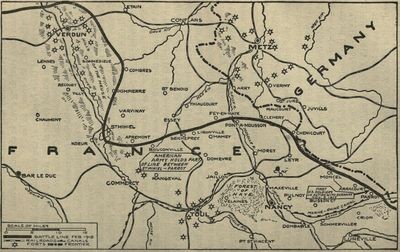
The American front in France where the first clashes between Americans and Germans occurred.
The trenches were found to be muddy but well constructed. The troops settled down in them, and at daylight, under low-hanging, dripping clouds, they obtained their first view of the German lines, stretching away in the rolling terrain. They were in contact with the enemy at last.
They received their baptism of fire mingled with showers of mud, their clothes soaked to the skin. American shells fell and exploded in German territory, and German projectiles broke near the American positions, sprinkling fragments, but doing no serious damage. They were merely establishing contact as a prelude to more serious operations. Gunners and infantrymen alike, the latter in first-line trenches, over which both American and German shells whizzed, were satisfied, though wet, feeling that the distinction of being the first Americans to be in action more than recompensed for weather discomforts.
Their first quarry was a stray German mail carrier who had lost his way in the dark and was taken prisoner near the American trenches. He encountered an American patrol in no-man's-land in company with another German, and was shot while running away after refusing to halt.
While waiting for a real attack sniping engaged the troops' attention, especially on clear days, when German snipers sought targets. Many bullets passed singing harmlessly overhead. Their frequency called for retorts, and a number of infantrymen were detailed to single out the snipers. Sniping the sniper became part of the preliminaries of settling down to trench warfare.
The troops realized by these activities, trifling though they were, that mimic charges and class-room demonstrations of the training camp were things of the past and that they faced the real foe. The Germans in fact, were not tardy in impressing them with their new situation. They discovered that Americans were facing them and set about making a raid. Berlin announced the result in a brief bulletin on November 3.
"At the Rhine-Marne Canal, as the result of a reconnoitering thrust, North American soldiers were brought in as prisoners."
The news brought the American people a step nearer to a realization of the actualities of the great struggle. It also disclosed that the Americans were established on a section of the front defended by the German Crown Prince's army and facing Lorraine. The so-called "quiet sector" stood revealed as the only front through which war could be carried into the heart of Germany. It lay before the gap in the French barrier forts, Verdun-Toul and Epinal-Belfort, flanked by the invulnerable Verdun on the northeast and the French positions in the Alsatian Vosges on the southeast. A quiet sector it might be, but more than 40,000 German dead lie buried there, the flower of the army of the Crown Prince of Bavaria. They fell in a twenty-eight day battle in August and September, 1914, when five French army corps under General Castelnau fought seven under the Crown Prince The Germans finally retired into Lorraine after vainly attempting to cross the Moselle. Both General Pétain—who attempted an offensive there in 1916, but was checked from proceeding with it by political high commands—and General Castelnau were convinced of the vulnerability of this sector as a roadway into Germany, and prophets were not wanting who saw in the presence of the Americans there a foretoken that an American army might essay what the two French Generals had not accomplished. At any rate, after an unbroken calm of three years, the sector was no longer quiet.
The Germans had scored by drawing first blood. The Berlin press was riotously gleeful over the event, one journal, the "Lokal-Anzeiger," gloating over it in these terms:
"Three cheers for the Americans! Clever chaps they are, it cannot be denied. Scarcely have they touched the soil of this putrefied Europe when they already are forcing their way into Germany.
"It is our good fortune that we are equipped to receive and entertain numerous guests and that we shall be able to provide quarters for these gentlemen. They will find comfort in the thought that they are rendering their almighty President, Mr. Wilson, valuable services, inasmuch as it is asserted he is anxious to obtain reliable information concerning conditions and sentiments in belligerent countries.
"As Americans are accustomed to travel in luxury and comfort, we assume that these advance arrivals merely represent couriers for larger numbers to come. We are sure the latter will come and be gathered in by us. At home they believe they possess the biggest and most colossal everything, but such establishments as we have here they have not seen.
"Look here, my boy, here is the big firm of Hindenburg & Co., with which you want to compete. Look at its accomplishments and consider whether it would not be better to haul down your sign and engage in some other line. Perhaps your boss, Wilson, will reconsider his newest line of business before we grab off more of his young people."
A salient of the American position occupied by a small detachment had been successfully raided by the Germans before daybreak, resulting in three Americans killed, several wounded, and a dozen captured or missing. The Teutons started a heavy barrage fire, which isolated the salient, so that help could not reach the troops, nor could they retire, and thus had the besieged men at the mercy of their superior force. The Americans fought obstinately until they were overwhelmed. They had only been in the trenches a few days and were part of the second contingent who had entered them for training under actual war conditions. They succeeded in capturing a German prisoner, and inflicting casualties; but the latter did not become known as the enemy, in fleeing the trench, took their dead and wounded with them.
After shelling the barbed-wire front of the trenches, dropping many high-explosive missiles of large caliber, the Germans directed a heavy artillery fire to cover all the adjacent territory, including the passage leading to the trenches, thereby effecting a complete barrage of the salient front and rear. Soon after the enemy, exceeding two hundred in number, rushed the breaches and wire entanglements on each side of the salient, lifting the barrage in the forefield to permit their passage.
It was an elaborate encircling bombardment to achieve a trifling object. An American platoon, numbering only nineteen men, were corraled by a heavy fire from 77's and 115's, which searched the whole line of trenches communicating with the salient where they were isolated. The French, who had only recently vacated the position to make way for the Americans, estimated that the German shells expended exceeded eight thousand.
With the raising of the frontal barrage, the German raiders advanced. They were composed of storm troops, volunteers, machine gunners, artillerymen, pioneers to destroy the wire entanglements, and stretcher bearers to carry off their casualties. They had gathered round a group of ruined farm buildings some seven hundred yards from the American trenches, armed with grenades, revolvers, trench knives, and rifles. They followed, in columns of fours, a tape across no-man's-land laid out by leaders who had previously been over the ground. Advancing across a swampy ravine toward the salient, they penetrated the gaps in the American wire entanglements, and a number reached the trenches at the rear of their barrage. The Americans were thus cut off from behind. Other raiders stayed outside the trenches to protect those who entered them and to shoot any Americans who appeared above the parapet. The trenches were stormed right and left of the salient, one party clearing them as they proceeded, the other invading the dugouts for prisoners.
The darkness of the trenches veiled what next happened. After the Germans had completed their work and retired, an American trooper, private Enright, was found with his throat cut from ear to ear on the top of the parapet. While fighting a German in front of him he appeared to have been attacked from behind by another armed with a trench knife. A second trooper, private Hay, lay dead in the trench, and outside a dugout was the body of Corporal Gresham.
In the confusion some of the American troops mistook the Germans for their own comrades, and paid for their error. Corporal Gresham, for example, was the sentry at a dugout door when three men advanced toward him. Supposing them to be Americans he shouted:
"Don't shoot! I'm an American."
"It's Americans we're looking for," answered one of the three, and shot him dead with a revolver.
It was a brief, ordinary affray, in nowise different from other happenings occurring nightly all along the front. But nineteen Americans were set upon by over 200 Germans, and it was the Americans' first taste of Teutonic warfare. They fought stoutly with pistols, knives, and bayonets until overcome, whereupon the Germans went off with an American sergeant, a corporal, and ten privates, all of whom were trapped in a dugout near the tip of the besieged salient.
The raid scarcely lasted five minutes and outside the salient no one in the American lines knew it was proceeding. The German communiqué dismissed it in three lines. From Berlin's viewpoint it was inconsequential; but to Americans it was of moment in being their first clash with the enemy. Young, inexperienced soldiers, cooped in a position they were not familiar with, encountering their baptism of fire under circumstances of surprise, uncertainty, and darkness, had acquitted themselves well against heavy odds, and prevented the enemy from penetrating beyond the first line of trenches.
The American dead were buried with due honors on French soil. The general commanding the French division in the section delivered an oration at their graves in the presence of French and American troops amid the roaring of guns and whistle of shells. His words belong to the record of America's part in the war:
"Men! These graves, first to be dug in our national soil, and but a short distance from the enemy, are as a mark of the mighty land we and our allies firmly cling to in the common task, confirming the will of the people and the army of the United States to fight with us to a finish, ready to sacrifice as long as is necessary until final victory for the most noble of causes, that of the liberty of nations, the weak as well as the mighty. Thus the deaths of these humble soldiers appear to us with extraordinary grandeur.
"We will, therefore, ask that the mortal remains of these young men be left here, left with us forever. We inscribe on the tombs, 'Here lie the first soldiers of the Republic of the United States to fall on the soil of France for liberty and justice.' The passer-by will stop and uncover his head. Travelers and men of heart will go out of their way to come here to pay their respective tributes.
"Private Enright, Private Gresham, Private Hay! In the name of France I thank you. God receive your souls. Farewell!"
After this foray shelling became of daily occurrence. The troops continued their training under fire, the first contingent giving place to the second contingent, and the second to the third in occupying the trenches, after each had undergone a spell of patrol work, sharpshooting, and accustoming their nerves to falling shrapnel. Trench conditions enabled them to acquire a better insight of the science of war than they could learn in months of instruction in training camps. While the infantry were thus engaged in their underground finishing school, the gunners, in addition to making progress in actual firing, acquired greater facility in observation work and in locating enemy batteries by the sound method. The heavy guns on both sides engaged in duels at long range, with the lighter pieces working at targets nearer the lines. This gun activity was not without its toll. German casualties due to American marksmanship, of course, could not be ascertained, but they were probably equal to the American killed and wounded.
The troops were eager for an opportunity to retaliate on the foe for trapping their comrades in the salient, and on November 14, 1917, a patrol succeeded in exacting a partial revenge. Assisted by some French troops they planned a night ambuscade near the German lines on a shell-ruined farm. It was a dreary vigil in the mud, where they lay throughout the small hours, until their patience was rewarded by the appearance of a large German patrol, in number more than double those of the Franco-Americans. They permitted the Germans to pass, and then attacked them on their flank. The fusillade of French and American bullets from shell craters and other shelters where the sharpshooters lay concealed took the Germans by surprise. They precipitately fled, taking their fallen with them. No French or American trooper was hit by the shots the Germans fired in their hurried retreat.
More notable than such skirmishes on the American front before Lorraine was the part a number of unarmed American engineers, in company with Canadians, took in the encircling movement the Germans made on the British positions before Cambrai on November 30, 1917. For some time past American engineers had not only been of yeoman service behind the French lines in hauling tons of ammunition and other equipment to supply the French forces, but had been engaged on the railroad in the rear of the British front. They did not belong to the fighting units, and no achievements were looked for from men whose sole arms were picks and shovels. But the ramifications of the German assault on Gouzeaucourt brought these workers in the rear to the forefront of the attack, and they distinguished themselves in a manner which drew tributes from both the French and British high commands. A staid official account of the rôle they played thus describes the situation:
"Two and one-half companies of railway engineers, with a strength of eight officers and 365 men, were encamped at Fins on November 30, 1917, having completed their work in the neighborhood. At 6.30 four officers and 280 men went to Gouzeaucourt, arriving at 7 and starting to work with Canadian engineers. The entire contingent was under a Canadian major and an American captain. The area was three miles in the rear of the line and none of the troops was armed.
"At 7.15 German barrage fire moved on Gouzeaucourt after heavy shelling to the east. At 7.30 a general retirement was ordered, and it was effected with some difficulty, due to the artillery, machine-gun and airplane fire.
"A number of losses were sustained at this time, and also among the men who, cut off by the German advance, had taken refuge in dugouts. Some of these men who had been cut off succeeded in joining British combatant units and fought with them during the day."
A story of American grit and pluck lay concealed in the last sentence. The American and Canadian engineers, cut off as described, were taken prisoners by the Germans. They were fifty in number, and accompanied by a German escort marched along the road leading from Gouzeaucourt to Cambrai. As they proceeded disconsolately toward the zone of the German prison cages, they encountered a small body of British troops who had been separated from their comrades and were wandering about aimlessly. The appearance of the Germans with the prisoners produced an immediate charge toward them by the British. The Germans sought to drive their captives toward La Vacquerie before the advancing British reached them. But the prisoners, seeing rescue at hand, turned upon their guards and fought them barehanded until the British troops interposed and vanquished the Germans. The American engineers and their comrades thereupon took possession of the German rifles and with their rescuers found their way back to the British lines.
A number of American engineers were killed and injured, presumably during the German attack on Gouzeaucourt, since no mention was made of casualties in the adventure on the highroad. Their losses were largely due to their being unarmed when the Germans came, a predicament which forced them to seize the guns of dead and wounded soldiers to protect themselves. The army commands afterward ordered that all engineers be armed to enable them to take their place with the troops in any future emergency which brought them again face to face with the foe. The French Government was so impressed with their performance that it sent the following communication to Washington:
"We must remark upon the conduct of certain American soldiers, pioneers and workmen on the military railroad in the sector of the German attack west of Cambrai on November 30, 1917. They exchanged their picks and shovels for rifles and cartridges and fought with the English. Many died thus bravely, arms in hand, before the invader. All helped to repulse the enemy. There is not a single person who saw them at work who does not render warm praise to the coolness, discipline, and courage of these improvised combatants."
Their exploit stirred the American camp to enthusiasm mingled with envy. The British front at Cambrai was a long step from the American trenches in the Lorraine sector, and tidings of the happenings at Gouzeaucourt impressed the troops with the fact that not on them only was the glory of the Stars and Stripes being upheld on the soil of France. An infantry sergeant voiced the general feeling of his comrades thus:
"We stay in the trenches for a spell and let Fritz shoot his artillery at us and have never really had a chance to use our rifles except to snipe and pot Fritz out in no-man's-land on dark nights. These railroaders managed to run their trains right into a good, thick scrap, and if this isn't luck, I don't know what it is."
Casualties continued to grow with the constant shelling. Sporadic raids over no-man's-land and visitations of German airships added to them. Bombs were dropped on a party of engineers, killing one of them, and two privates were victims of a German aviator's explosive over a wood in which they were camped.
Winter set in with a snowfall that impeded the training of the troops and communications. Roads became impassable by drifts, and many motor trucks, after crawling at a snail's pace over the hilly roads, became stranded in the snow. A thaw in January turned icy roads into river beds. Torrential streams flowed from melting snows in the hills, and together with a downpour of fine rain combined to make weather conditions on the American front the worst the troops had encountered since their arrival in France. The roads were cluttered in places with ditched motor trucks. Here and there mule-drawn vehicles were mired. Transport trains drawn by mules suffered most before the thaw, the animals slipping and falling on the icy roadbeds, and were unable to rise except by the aid of thick layers of branches and twigs placed under their hoofs. The beginning of 1918, in short, found the American army in France, like their allied comrades on the rest of the front, stalled by the weather, and little tidings came of their accustomed activities.
CHAPTER IX
POPE AND PRESIDENT
Peace efforts, assiduously pursued in Berlin, and culminating in the Reichstag resolution recorded in the previous volume, had meantime taken a new turn; but they encountered a new element in the United States as a resolute belligerent.
The Vatican interposed with an olive branch. The Pope tread cautiously, sensible of the delicacy of his task in seeking to effect world peace; but his proposals were hopelessly futile and died in the borning. Their only welcome came from the Central Powers, and even there dissentient voices were heard. The Allies' reception of his note was cold, unresponsive, suspicious, and resentful. "As you were," the Pope virtually proposed to the two groups of belligerents, running directly counter to the chief aim of the Allies, which was to overturn the status quo ante, and establish a European concert of nations on a new, safer, and enduring foundation.
The Papal note, communicated to the various belligerent powers on August 1, 1917, invited their governments to agree on the following points, which seemed to his Holiness, "to offer the basis of a just and lasting peace":
"First, the fundamental point must be that the material force of arms shall give way to the moral force of right, whence shall proceed a just agreement of all upon the simultaneous and reciprocal decrease of armaments, according to rules and guarantees to be established, in the necessary and sufficient measure for the maintenance of public order in every State; then, taking the place of arms, the institution of arbitration, with its high pacifying function, according to rules to be drawn in concert and under sanctions to be determined against any State which would decline either to refer international questions to arbitration or to accept its awards.
"When supremacy of right is thus established, let every obstacle to ways of communication of the peoples be removed by insuring, through rules to be also determined, the true freedom and community of the seas, which, on the one hand, would eliminate any causes of conflict, and on the other hand, would open to all new sources of prosperity and progress.
"As for the damages to be repaid and the cost of the war, we see no other way of solving the question than by setting up the general principle of entire and reciprocal conditions, which would be justified by the immense benefit to be derived from disarmament, all the more as one could not understand that such carnage could go on for mere economic reasons. If certain particular reasons stand against this in certain cases, let them be weighed in justice and equity.
"But these specific agreements, with the immense advantages that flow from them, are not possible unless territory now occupied is reciprocally restituted. Therefore, on the part of Germany, there should be total evacuation of Belgium, with guaranties of its entire political, military, and economic independence toward any power whatever; evacuation also of the French territory; on the part of the other belligerents, a similar restitution of the German colonies.
"As regards territorial questions, as, for instance, those that are disputed by Italy and Austria, by Germany and France, there is reason to hope that, in consideration of the immense advantages of durable peace with disarmament, the contending parties will examine them in a conciliatory spirit, taking into account, as far as is just and possible, as we have said formerly, the aspirations of the population, and, if occasion arises, adjusting private interests to the general good of the great human society.
"The same spirit of equity and justice must guide the examination of the other territorial and political questions, notably those relative to Armenia, the Balkan States, and the territories forming part of the old Kingdom of Poland, for which, in particular, its noble historical traditions and suffering, particularly undergone in the present war, must win with justice, the sympathies of the nations."
The deep esteem in which the Allies and the rest of the nations held the Pontiff assured an attentive and respectful hearing of his appeal. But his intervention was nevertheless denounced as an espousal of a German peace, in that it would enable Germany to take her place at the peace council table with all her lost colonies restored, exempt from every demand for reparation for the ruin she had wrought, secure in the possession of all her territory, and with the future of Alsace-Lorraine, Trent, Trieste, Poland, Rumania, and Serbia left for settlement by negotiation by the parties in conflict. The Papal proposals were also objected to in making no distinction between the combatants, but placed them all on the same footing as apparently "stricken by a universal madness."
It soon became apparent that the Allied Powers, including the United States, were a unit in agreeing that the Papal note, because it overlooked the issues for which the Entente was fighting, must be respectfully rejected. President Wilson became their spokesman in a note he addressed to the Pontiff on August 27, 1917. While recognizing the Pope's "moving appeal" and the "dignity and force of the humane motives which prompted it," the President considered it would be folly to take the path of peace the Pope pointed out if that path did not in fact lead to the goal proposed. As to the Pope's proposals generally, he said:
"It is manifest that no part of this program can be successfully carried out unless the restitution of the status quo ante furnishes a firm and satisfactory basis for it. The object of this war is to deliver the free peoples of the world from the menace and the actual power of a vast military establishment, controlled by an irresponsible Government, which, having secretly planned to dominate the world, proceeded to carry the plan out without regard either to the sacred obligations of treaty or the long-established practices and long-cherished principles of international action and honor; which chose its own time for the war; delivered its blow fiercely and suddenly; stopped at no barrier, either of law or of mercy; swept a whole continent within the tide of blood—not the blood of soldiers only, but the blood of innocent women and children also and of the helpless poor; and now stands balked, but not defeated, the enemy of four-fifths of the world.
"This power is not the German people. It is the ruthless master of the German people. It is no business of ours how that great people came under its control or submitted with temporary zest to the domination of its purpose; but it is our business to see to it that the history of the rest of the world is no longer left to its handling.
"To deal with such a power by way of peace upon the plan proposed by his Holiness, the Pope, would, so far as we can see, involve a recuperation of its strength and a renewal of its policy; would make it necessary to create a permanent hostile combination of nations against the German people, who are its instruments; and would result in abandoning the newborn Russia to the intrigue, the manifold subtle interference, and the certain counter-revolution which would be attempted by all the malign influences to which the German Government has of late accustomed the world.
"We cannot take the word of the present rulers of Germany as a guaranty of anything that is to endure unless explicitly supported by such conclusive evidence of the will and purpose of the German people themselves as the other peoples of the world would be justified in accepting. Without such guaranties treaties of settlement, agreements for disarmament, covenants to set up arbitration in the place of force, territorial adjustments, reconstitutions of small nations, if made with the German Government, no man, no nation, could now depend on.
"We must await some new evidence of the purposes of the great peoples of the Central Powers."
In other words, the Pope's proposals were regarded as untenable because the Allies could not trust the kaiser and his government to respect any covenants that might flow from them. There was no responsible person to negotiate with. The Vatican was disappointed, the German press greeted the President's answer with abuse, and the Allies found the American note so comprehensive and satisfying in expressing their views that they paid no further attention to the proposal.
Germany and Austria were more responsive; but the Allies' rejection through President Wilson of the papal suggestions imparted something of an anticlimax to the Teutonic replies when they were forthcoming a month later. Both reflected an earnest desire for peace; both gave whole-hearted support to the Vatican's efforts. Austria was especially eager to enter into negotiations on the basis the Pope proposed. But neither was specific. The Austrian emperor favored disarmament and arbitration in a cloud of platitudes. The kaiser accepted the Pope's general aims, but was mute on particularizing the German aims. Both suppressed whatever terms of peace they longed to offer. Sifted down to essentials, and extricating their meaning from a welter of unctuous verbiage, the Teutonic answers merely conveyed an eager desire to reach a peace conference, withholding terms for submission until such parleys could begin. As each evaded any suggestion of definite concessions on vital points, the absence of which constituted the principal obstacles to peace, and as the Allies had already refused to negotiate with the German Government in any event, the Teutonic answers lost all significance except as diplomatic courtesies in response to the Pope's well-meant mediation. That was probably their main purpose.
Germany proposed nothing except that the war be ended by a promise on her part to reduce her army reciprocally with other nations—a promise she would not fulfill; by a promise that Great Britain reduce her navy—a promise she would expect Great Britain faithfully to fulfill; and a promise of the nations to arbitrate in future—a promise Germany would ignore if conditions favored a new war. She saw "the freedom of the seas" as the issue of the war; but the seas were as free to Germany in time of peace as they were to Great Britain, their reputed mistress. The rest of the world saw the German Government as the real issue of the war.
The next peace manifestation, which caused a momentary disturbance in Allied circles, came from the Marquis of Lansdowne, a former British Foreign Secretary, who had also been Viceroy of India and Governor General of Canada. Fearing that the prolongation of the war might lead to "the ruin of the civilized world," he besought the Allies to make a restatement of their war aims in order to bring about peace before that catastrophe came.
The Lansdowne communication to the press looked like a plea for Germany, and coming as it did from a British noble of ingrained toryism, who had done his share as a Cabinet Minister to develop British imperialism, was startling enough. To forestall any suspicion that he was voicing unofficial sentiments of the British Government, Bonar Law and Lord Robert Cecil declared that Lord Lansdowne only spoke his own views. The Government repudiated them, as did the Unionist party. Lord Lansdowne himself was obliged to acknowledge that his proposals were solely his own and that he consulted no one in formulating them. It was realized that his note only encouraged the German war party, which construed it as evidence of divided counsels in Great Britain, and that the British were weakening in their determination to conquer. The air was quickly cleared and showed that no peace movement was possible in England while Germany remained impenitent and unbeaten.
CHAPTER X
AMERICA'S WAR AIMS
Nevertheless, the Papal and Lansdowne letters were not entirely fruitless. It brought the Allies a step nearer to restating their war aims through Lloyd-George and President Wilson. But their utterances pointed to a steadfast continuance of the war until those aims were achieved, not a slackening of hostilities to effect an inconclusive peace lenient to Germany.
Addressing a body of trades-union delegates at Westminster on January 5, 1918, the British Premier faced a situation—an apparent outgrowth of the Lansdowne letter—where national unity in the prosecution of the war was perceived to be in jeopardy. A suspicion was rife that the war was being pursued for objects which could not be openly avowed. Lloyd-George therefore saw the need of a restatement of war aims:
"We may begin by clearing away some misunderstandings and stating what we are not fighting for.
"We are not fighting a war of aggression against the German people. Their leaders have persuaded them that they are fighting a war of self-defense against a league of rival nations, bent on the destruction of Germany. That is not so. The destruction or disruption of Germany or the German people has never been a war aim with us from the first day of this war to this day.
"Nor did we enter this war merely to alter or destroy the imperial constitution of Germany, much as we consider that military and autocratic constitution a dangerous anachronism in the twentieth century. Our point of view is that the adoption of a really democratic constitution by Germany would be the most convincing evidence that her old spirit of military domination has, indeed, died in this war and would make it much easier for us to conclude a broad, democratic peace with her. But, after all, that is a question for the German people to decide.
"We are not fighting to destroy Austria-Hungary or to deprive Turkey of its capital or the rich lands of Asia Minor and Thrace, which are predominantly Turkish.
"The settlement of the new Europe must be based on such grounds of reason and justice as will give some promise of stability. Therefore, it is that we feel that government with the consent of the governed must be the basis of any territorial settlement in this war. For that reason also, unless treaties be upheld, unless every nation is prepared, at whatever sacrifices, to honor the national signature, it is obvious that no treaty of peace can be worth the paper on which it is written."
The British Premier then restated the Allies' specific war aims, which did not materially differ from the first declaration recorded in a previous volume of this history, except with regard to Russia, conditions in that country having called for a suspension of judgment on territorial questions affecting her.
Three days later (January 8, 1918), President Wilson gave to the world the peace terms of the United States in an address to Congress. His declaration was the most advanced doctrine of internationalism pronounced by any of the Allied statesmen. It definitely committed the United States not only to promoting and safeguarding the peace of Europe but the peace of the world. The frequent question: What was America fighting for? was answered. It was not merely to uphold American rights. The aims of the United States had developed far beyond nationalism. It was to uphold the rights of all the peoples menaced or outraged in the world war.
The purpose of the President's address appeared to be threefold:
To drive a wedge into the political structure of Germany by encouraging the Socialists and liberal elements, and exhibiting the military party as the single obstacle to democracy and world peace.
To expose the insincerity of Germany's pretensions of liberality in her peace offers to Russia and thus bring Russia back into partnership with the democracy of the Allies, which she showed symptoms of abandoning.
To show the agreement of the United States with the speech of Lloyd-George and to develop further the principles of world peace for which America stood.
The Entente Allies welcomed the President's pronouncement as putting the seal of American approval on their war aims, as reiterated by Lloyd-George, and as committing the United States to the Allied cause till it was won. The necessity for any restatement of war aims by the United States was regarded as a question for the President to determine, and he had done so at a time when the need was clearly urgent in Great Britain. Hence his address, echoing and, indeed, amplifying that of Lloyd-George, buttressed British solidarity on the war by definitely establishing an abiding Anglo-American Entente while the war lasted.
Far from opening a way to peace, the Papal and Lansdowne pleas produced a sequence of utterances which were in effect renewed war declarations from the spokesmen of the Allies. Lord Lansdowne sought a reiteration of war aims as a basis for peace negotiations. President Wilson's answer to that suggestion was not confined to a reassertion of America's war objects. While the dove of peace was fluttering a pair of weak wings he went to Congress (December 4, 1917) and called for war against Austria-Hungary to remove an "embarrassing obstacle" in the conduct of hostilities against Germany.
"Austria-Hungary," he told Congress, "is for the time being not her own mistress, but simply the vassal of the German Government. We must face the facts as they are and act upon them without sentiment in this stern business.
"The Government of Austria-Hungary is not acting upon its own initiative or in response to the wishes and feelings of its own peoples, but as the instrument of another nation. We must meet its force with our own and regard the Central Powers as but one. The war can be successfully conducted in no other way. The same logic would lead also to a declaration of war against Turkey and Bulgaria. They also are the tools of Germany. But they are mere tools and do not yet stand in the direct path of our necessary action."
Both branches of Congress responded by passing a joint war resolution with only one dissentient House vote, and on December 7, 1917, war with Austria-Hungary was declared.
Germany meditated. There was an answer to be made to Lloyd-George and President Wilson, but what? The military situation, as seen through German eyes, and the political situation in Germany, as dominated by the Junkers and annexationists, duly supplied it. Germany seemed to have become convinced that a German peace was certain. Her confidence was stated to be based on the war map, added to a belief that a lack of cohesion and community of spirit prevailed among the Allies, in contrast with her own unified will to victory, and that the United States was merely gesturing in entering the war. There was obvious camouflage in affecting to question the solidarity of the Allies and to asperse the sincerity of American intervention; but no posturing was perceived in Germany's reliance on the war map as a tangible basis for a German peace.
The kaiser's new chancellor, Count von Hertling, addressing the Reichstag main committee on January 22, 1918, emphasized this reliance in a speech which constituted a tardy response to the war aims reaffirmed by Lloyd-George and President Wilson. Demanding that the Entente Powers abandon their attitude that Germany was the guilty party who must do penance and promise improvement, he said:
"They may take it from me that our military position was never so favorable as it now is. Our highly gifted army leaders face the future with undiminished confidence in victory. Throughout the army, in the officers and the men, lives unbroken the joy of battle.
"Our repeatedly expressed willingness for peace and the spirit of reconciliation revealed by our proposals must not be regarded by the Entente as a license permitting the indefinite lengthening of the war.
"If the leaders of the enemy powers really are inclined toward peace let them revise their program once again. If they do that and come forward with fresh proposals, then we will examine them carefully."
This was by way of preface to answering President Wilson's fourteen requirements if the United States was to lay down its arms. The first four, in the chancellor's view, were susceptible to agreement. Germany accepted in principle the abolition of secret diplomacy and favored open covenants of peace. The chancellor saw no difference of opinion on the subject of freedom of navigation upon the seas; but it was "highly important for the freedom of shipping in future if strongly fortified naval bases on important international routes, such as England has at Gibraltar, Malta, Aden, Hongkong, the Falkland Islands, and many other places, were removed." Further, Germany was in accord with the President regarding the removal of economic barriers that interfered with international trade. She also affirmed that the limitation of armaments desired by President Wilson was "discussable."
The fifth clause of the Wilson peace aims, which called for self-determination by colonial peoples as to whose sovereignty they should recognize, was less easily disposed of. The chancellor evaded the issue by throwing the onus of putting the proposal in practice upon Great Britain:
"I believe that for the present it may be left for England, which has the greatest colonial empire, to make what she will of this proposal of her ally. This point of the program also will have to be discussed in due time, on the reconstitution of the world's colonial possessions."
Thus Germany submitted, as one of the foundations of peace, that England should not only abandon her naval bases but assent to the dismemberment of her colonial empire.
The President's demand for the evacuation of Russian territory was met by a refusal. The Entente Powers having declined to participate in the negotiations between the so-called Russian Government and the Teutonic Powers, the matter was one to be decided between the negotiators alone.
Belgium was not to be evacuated and restored as a condition insisted upon by the United States. The settlement of the Belgian question, the chancellor said, belonged to the peace conference:
"So long as our opponents have unreservedly taken the stand-point that the integrity of the Allies' territory can offer the only possible basis of peace discussion, I must adhere to the stand-point hitherto always adopted and refuse the removal in advance of the Belgian affair from the entire discussion."
The chancellor took the same attitude toward the question of freeing and restoring the invaded French territory and of the return of Alsace-Lorraine to France to right an old wrong. "The occupied parts of France are a valued pawn in our hands," said the chancellor. "The conditions and methods of procedure of the evacuation, which must take account of Germany's vital interest, are to be agreed upon between Germany and France. I can only again expressly accentuate the fact that there can never be a question of dismemberment of imperial territory."
The next four Wilson requirements (VIII to XI), relating to a readjustment of the frontiers of Italy, autonomy for the subjugated races of Austria-Hungary, the restoration and integrity of Rumania, Serbia and Montenegro were not Germany's immediate concern, and the chancellor airily relegated them to Austria-Hungary for consideration. As to Turkey, for whose subject races the President demanded self-government, as well as a free Dardanelles, the chancellor intimated that her integrity vitally concerned the German Empire, while the future of Poland was to rest entirely in the hands of Germany and Austria-Hungary. Finally, President Wilson's proposed league of nations admitted of basic consideration only when all other pending questions had been settled.
The chancellor's answer was a mere repetition of the defiant and arrogant presentations of the German position with which the Allies had become familiar. The war aims of the President to which Count von Hertling could assent were of trivial importance compared to the Allies' chief aim—the overthrow of Prussian militarism. Peace gropings had produced another declaration of war. Germany openly announced that she was engaged on a war of conquest. Chancellor von Hertling's address admitted of no other interpretation. The fate of Poland was to be decided by the kaisers, that is, annexed in substance, if not in form. The Baltic provinces of Russia were earmarked for Germany, and Russia, thus cut off from the western seas, was to have icebound Archangel and distant Vladivostok as her only ports. The disposition or division of Rumania, Serbia, and Montenegro was to be left to Austria-Hungary, with Germany pledged to support her decisions. Armenia, Palestine, and Arabia, were to be returned to the Turks, while as to Constantinople and the Dardanelles no settlement could be permitted that was not agreeable to German imperialism. As to Belgium, the conclusion was that it would receive the same status as Luxemburg had before the war, with railroads, ports, commerce, and army in German hands. Not even the return of northern France was promised, this being a question to be discussed, not with the Allies, but only between Germany and France, and Alsace-Lorraine was to be kept on the fraudulent claim that it was and always had been German territory. The question of Italia Irredenta was remitted to Austria-Hungary, and the German colonies were to be restored, regardless of the wishes of their inhabitants or the safety of their neighbors.
When this grandiose scheme of conquest was ratified and realized, then, and then only, would Germany consider entering into a league of peace, or discuss mutual disarmament, or other of the Allies' proposals for safeguarding peace when it came. Germany sought to be placed in possession of doubled power before she would even talk about creating conditions making for a durable peace. She must be able to reject flatly any scheme proposed, and then, snapping her fingers, defy the Allies to do what they would, for she in no wise bound herself to disarm a single soldier or spike a single gun.
The Austrian Reichsrat heard a speech of a different tenor by Count Czernin, Foreign Minister, on the subject of President Wilson's peace aims. The contrast in tone from that of Chancellor von Hertling was so marked and significant as to revive the preexisting belief that the road to peace negotiations would eventually be opened through Austria. Though Count Czernin's speech resolutely upheld the integrity of Austria-Hungary and the preservation and development of her neighboring interests without dictation from the Entente Powers, he held out an olive branch that seemed less of an imitation than those offered by Berlin.
"I think," he said, "there is no harm in stating that I regard the recent proposals of President Wilson as an appreciable approach to the Austro-Hungarian point of view, and that to some of them Austria-Hungary joyfully could give her approval.
"Our views are identical not only on the broad principles regarding a new organization of the world after the war, but also on several concrete questions, and differences which still exist do not appear to me to be so great that a conversation regarding them would not lead to enlightenment and a rapprochement.
"This situation, which doubtless arises from the fact that Austria-Hungary on the one side and the United States on the other are composed of States whose interests are least at variance with one another, tempts one to ask if an exchange of ideas between the two powers could not be the point of departure for a personal conversation among all States which have not yet joined in peace negotiations."
This conciliatory overture—significantly addressed, the Allies quickly noticed, only to the United States—was clearly governed by expediency. Count Czernin revealed a recognition of the critical condition of internal affairs in Austria-Hungary, and sought to make advances that would placate the restless and war-worn people of the dual monarchy without offending the autocratic rulers in Berlin. If peace could come by compromise, then let there be compromise, and approaches to the United States seemed to afford a line of least resistance.
Austria's sincerity, however, was questioned alike in Washington, Paris, and London. Count Czernin was suspected of dangling a familiar bait to split the Allies. The Administration view was that his endeavor to single out the United States as a party with whom to begin preliminary peace conversations was so naive as to be amusing if the situation were not so serious. His invitation was not acceptable. The American Government had thrown in its lot with Great Britain, France, and Italy, and was determined to stand or fall with them. His attempt to promote a separate peace between Austria and the United States was viewed as inspired by a hope that its consideration would either lessen the effectiveness of America's part in the war or provide an opportunity for the pacifists in the Allied countries to extend such a peace movement to the other powers before the war's purposes had been achieved.
The French view was that while the deliverances of Count von Hertling and Count Czernin disclosed that a real cleavage on peace sentiment existed in the two Central Empires, and that the Austrian minister was the first of their spokesmen to show breadth and detachment, the contrast between the two speeches indicated Germanesque stage play. Germany's move was not to show a conciliatory spirit; she left Austria to perform that rôle. The Allies could take their choice in measuring the negotiable value of the two outgivings.
The Allies decided that the war must proceed. Germany regarded herself as a conqueror, was determined upon aggression, and would listen to no peace terms except her own. Count Czernin's conciliatory tone was discounted by his declared fidelity to Austria's alliance to Germany. The two speeches were believed to have been concocted in collusion with the object of springing a combined diplomatic offensive against the Entente Allies.
"The attack," said the London "Times," "obviously was intended to shake the solidarity of our defense at several points, but President Wilson manifestly was the chief objective of the converging forces. Neither speech discloses the least readiness to make any concessions which the Allies declare to be indispensable."
The effect of the Austro-German pronouncements on Great Britain was to stiffen her resolution to continue hostilities. Little weight was attached to what Austria, the tool of Germany, had to say; the former's peace yearnings, set against the latter's aspirations, were impotent unless energized by a revolution in the dual monarchy. The British only took cognizance of Count von Hertling's words, which confirmed the prevalent belief that Prussian militarism considered itself more firmly seated in the saddle than ever, and that although the chancellor seemed to hold the reins, the team which drew the German car of state was at the mercy of Ludendorff's whip and Hindenburg's spur.
CHAPTER XI
MOVING THE MILITARY MACHINE
When Congress closed an epochal session on October 6, 1917, it had appropriated over twenty-one billion dollars. Except for $7,000,000,000 loaned to the Allies, and another billion for the normal expenses of the Government, the amount voted was placed at the service of the Administration as America's sinews of war for defeating the Central Powers. No nation had applied such a huge sum to war purposes in a like period.
The loans to the Allies were not considered as part of the American war outlays. The Allies gave their own bonds to the Government as collateral for the loans, bearing the same rate of interest, and a condition attached to the loans was that the money be spent in the United States for war equipment. Hence the loans were allocated for the purchase of material in this country and substantially aided American industries.
Included in the work of Congress was final agreement on a war revenue measure after six months of debate (with wide divergence of taxation plans between the House and Senate) estimated to produce $2,534,870,000, of which $851,000,000 was to be levied on incomes, and $1,000,000,000 on excess profits.
On October 1, 1917, the Government appealed for popular subscriptions to the second Liberty Loan for $3,000,000,000. As in the case of the first Liberty Loan the response at the outset flagged. Two weeks later only 14 per cent. of the maximum total had been subscribed and a daily subscription of $358,000,000 was needed to make the loan a success within the time allotted for receiving subscriptions. A period of apprehension and misgiving followed; but that had happened during the floatation of the first loan, and no European war loan had been asked without a similar experience. It was not an easy task to draw three billion dollars from the public purse, and the purse was leisurely, even lax, in loosening its strings. It needed a nationwide advertising propaganda to open it. The President entered the fray by naming a Liberty Day, fixed for October 24, on which he asked the American people to assemble in their respective communities and pledge to one another and to the Government the fullest measure of financial support.
"The might of the United States," he declared in his proclamation, "is being mobilized and organized to strike a mortal blow at autocracy in defense of outraged American rights and of the cause of liberty. Billions of dollars are required to arm, feed, and clothe the brave men who are going forth to fight our country's battles and to assist the nations with whom we are making common cause against a common foe. To subscribe to the Liberty Loan is to perform a service of patriotism.
"Let the result be so impressive and emphatic that it will echo throughout the empire of our enemy as an index of what America intends to do to bring this war to a victorious conclusion."
The Government's efforts to brace popular interest in the loan, aided by hundreds of thousands of voluntary workers throughout the country who formed Liberty Loan organizations, bankers, boy scouts, girl scouts, the newspapers and magazines, and patriotic, commercial, and fraternal bodies, produced a flood of subscriptions at the last moment which dissipated all fear of failure. The people needed driving, knew that their procrastination called for a dinning advertising campaign to translate intentions into deeds, and finally yielded good-humoredly to the impetus. They responded in such good measure that on October 27, 1917, when the loan closed, $4,617,532,300 had been subscribed, or $1,617,532,300 over the amount asked. The oversubscription exceeded that which the first loan yielded. Approximately 9,400,000 shared in applying for the loan. Of this number, it was estimated, 9,306,000, or 99 per cent., subscribed in amounts ranging from $50 to $50,000, the aggregate of such subscriptions being $2,488,469,350.
The loan proved to be popular in a degree of which the world afforded no equal. Never had there been a loan taken by 9,400,000 subscribers. It surpassed all previous experience of Government loans. The single offering was larger than the total takings in all subscriptions made in the four years of the Civil War. It far exceeded the response to any government loan of the other belligerents.
With an ample treasury to draw from, provided by Congress and the public, the Government proceeded with the war preparations, but in face of inevitable obstacles and friction. The American military establishment was not designed for making War on a huge scale, and, like the British War Office at the beginning of hostilities, was swamped and confused by an avalanche of new responsibilities. There were admitted shortages in clothing, artillery, and machine guns in the cantonments, and delays in the construction of new shipping also produced impatient criticism. Congress interposed by investigations into the general conduct of the war, with the result that the air was cleared and defects of organization located. The investigations appeared to have developed primarily not so much from ineffective and wrong decisions in meeting war needs as from delays due to indecision and procrastination. The result was a change of administrative methods aiming at a centralization of authority, which England and France had early found imperative in conducting the war, instead of depending on a bureaucratic system with its complicated channels of distributed authority. The friction which had arisen seemed to be substantially due to a clash between the methods of business men, whom the administration had requisitioned into war service, and the red tape of an established governmental system. The Administration recognized at length that an infusion into the Government ranks of capable business organizers, bent on conducting their share of the war with expedition, could not blend with departmental systems clogged by traditions, customs, rules, and regulations, written and unwritten. The whole Government became engaged in a process of introspection. The investigations compelled it to see itself as others saw it, and were salutary in that respect alone. In other directions the inquiries revealed, in spite of departmental shortcomings, that an enormous amount of work had been accomplished in a short time. When war was declared the country was wholly unprepared; it was working at full capacity in many war fields to maintain the largest foreign commerce reached in its history. Its industries being thus occupied on the outbreak of war, they could not readily digest a flood of orders, aggregating more than ten billion dollars in value, which the Government suddenly superimposed upon their capacities, with their equipments already driving at top speed under forced draft. On one point at least there was agreement—that the task so far accomplished could not have been done in the same period by any other nation.
In Secretary Baker's view, much of the criticism leveled at the War Department was due to a natural and praiseworthy impatience of the people at large to build a war machine worthy of their country's power. "Every one of us," he said, "wants to see our country hit like a man at the adversary." Answering the charge that the War Department had fallen down the Secretary set out to remove the impression prevalent in the country that the failures and delays were disproportionate to what had been achieved. He thereupon disclosed the results accomplished.
On April 1, 1917, a few days before the United States declared war on Germany, the army stood at 9,524 officers and 202,510 men. On December 31 of that year this force had grown to 110,856 officers and 1,428,650 men, composed of the regular army, the National Guard, and the National Army. In other respects the work accomplished by the War Department at the close of 1917 was summed up by Secretary Baker as under:
"1. A large army is in the field and in training; so large that further increments to it can be adequately equipped and trained as rapidly as those already in training can be transported.
"2. The army has been enlisted and selected without serious dislocation of the industries of the country.
"3. The training of the army is proceeding rapidly, and its spirit is high. The subsistence of the army has been above criticism; its initial clothing supply, temporarily inadequate, is now substantially complete, and reserves will rapidly accumulate. Arms of the most modern and effective kind—including artillery, machine guns, automatic rifles, and small arms—have been provided by manufacture or purchase for every soldier in France, and are available for every soldier who can be gotten to France in the year 1918.
"4. A substantial army is ready in France, where both men and officers have been additionally and specially trained and are ready for active service.
"5. Independent lines of communication and supply and vast storage and other facilities are in process of construction in France.
"6. Great programs for the manufacture of additional equipment and for the production of new instruments of war have been formulated."
An outcome of the investigation was the creation of a War Council within the War Department, composed of the Secretary of War, the Assistant Secretary of War, and five general officers. Its purpose was to supervise and coordinate the supplies of the field armies and the military relations of those armies with the War Department.
The National Army, composed of civilians enrolled under the selective draft law, was the most ambitious experiment in constructive military organization any country had ever attempted. It presented innumerable problems for which no solutions could be found in available textbooks, and the celerity with which it was converted into a real army rested wholly upon the skill with which the problems were grappled by the cantonment commanders and drill officers. Before the magnitude of a training organization could be considered and the drilling set in motion, much groundwork had to be covered in preparing the cantonments. There were sixteen of them, situated in various sections of the country, each roughly housing 40,000 men, and cost the Government at least $100,000,000. Their sites generally were in rugged, partially cleared country, marked by scrubby timber, dirt roads, wooden buildings, occasional patches of canvas, clouds of dust or acres of mud. They sprang up, in brief, out of wilderness tracts, usually some miles away from large centers of population. Their construction meant the creation out of the void of sixteen fully equipped cities, furnished with water supply, sewage systems, electric installations, governing organizations, police, and transportation. Standardization of construction was the only method by which the camps could be brought into being with dispatch. Each type of building, and every stick and board, ventilator and window sash used therein for all the cantonments were shaped to identical measurements, and produced by the enormous driving power of modern engineering, working under contract. Out of industrial plants, devising standardized material, came the camps. The number of buildings in the camps varied from 1,200 to 1,600, and included, besides the barracks proper, kitchens, shower baths and sanitary units, hospitals and administration offices, churches, schools, clubs and lodges, laundries, commissary stores, and even moving-picture theaters.
The first stage of training the men was confined largely to elementary military drill, which was a test of their physical capacity to withstand the driving routine of marching fifteen to twenty miles a day, burdened with a sixty-pound pack, ammunition, and rifle. The second stage embraced advanced military drill, involving several weeks of Swedish exercises, manipulating the army Springfield and marching and countermarching in close or extended order. The third phase was specialized warfare as taught abroad, with British and French trench instructors.
Military tactics having been revolutionized by modern trench warfare, no time was wasted in the open-country maneuvers formerly employed to accustom the troops to actual field service. The National Army was trained for the single purpose of effective trench fighting. On adjacent hillsides and plains extensive field fortifications were prepared, equipped with barbed-wire entanglements, artillery, and machine-gun emplacements, bomb-proof dugouts, communication trenches, support trenches, listening posts, and every other device which had been evolved from the war operations in Europe. The men were taught how to enter and leave a trench, to repel attacks, make raids in pursuit of information, surprise forays by day or night behind the protection of barrage fire, and how to take care of themselves, repair artillery damage, and reenforce the barbed-wire barriers.
The training was intensive and embraced a sixteen weeks' course crowded with manifold detail, which was vigorously observed. More attention was paid in the curriculum to drilling individual men, platoons, and companies than to conducting brigade, divisional, and regimental exercises, these latter being deferred until the smaller units were fit for advanced warfare. The platoon, commanded by a lieutenant, was the fighting unit in trench operations, and upon the lieutenants was therefore imposed the responsibility of training less than company units in order to effect an intimate and sympathetic cooperation between officers and men when they encountered the stern realities of warfare in Europe.
Camp conditions formed a chief subject of the Congressional investigation. The War Department had been confronted with the task of providing for a new army which had to be rushed into training, and had to depend upon congested railroad facilities to equip the camps. But everything had been done, Secretary Baker told the committee, to care for the men, and where defects had occurred they were quickly removed.
"And where, I want to know, in all history can you find an achievement comparable to that of America's in raising this great army from her citizenry in this period of time?" asked the Secretary of War. "It has never been done before, and it is to America's credit that she has accomplished it in the nine months we have been at war."
The outlook, as viewed by Secretary Baker, was that if adequate transport facilities were available, 1,500,000 men could be shipped to France during 1918. He indicated that a third of that number would be on the western front early in the year as a forerunner of the main body.
The country appeared satisfied by this prospect. The War Secretary had revealed much information regarding the military preparations to the Senate investigators; but he had to suppress much more to keep Germany—who was anxious to learn General Pershing's plans—in the dark, especially as to the number and disposition of American troops already there. The conclusions drawn from the progress of war preparations at the beginning of 1918 were that greater advances had been made than was expected. American troops would be in the thick of the fighting in the early spring and would be greatly reenforced just as soon as the Entente Allies pooled their tonnage resources.
The Administration's critics in Congress, nevertheless, were not pacified. A bill was proposed in the Senate creating a War Cabinet, the purpose of which was to divest the executives of Government departments of all authority in the conduct of the war. The new body was to be composed of "three distinguished citizens of demonstrated ability," to be named by the President and indorsed by the Senate. They were to control the administrative Cabinet officers and other department heads in the war's conduct, and adjust all differences, subject to the President's review.
The President saw in the proposed new war administration nothing but "long additional delays" and the turning of the Government's experience into "mere lost motion." He said as much to Senator Chamberlain, the author of the measure, in a letter which stoutly defended the Government's military preparations.
"The War Department," he wrote, "has performed a task of unparalleled magnitude and difficulty with extraordinary promptness and efficiency. There have been delays and disappointments and partial miscarriages of plan, all of which have been drawn into the foreground and exaggerated by the investigations which have been in progress since the Congress assembled.... But by comparison with what has been accomplished, these things, much as they were to be regretted, were insignificant, and no mistake has been made which has been repeated."
CHAPTER XII
FLEETS IN THE MAKING
The navy was not exempt from the searchlight Congress cast upon the manifold war preparations of the Government. But nothing was adduced before the investigating subcommittee to indicate that the Navy Department had not met the abnormal situation produced by American belligerency. The outstanding development disclosed was that the navy had more than 1,000 ships commissioned in the winter of 1917, as against 300 two years ago; that 425 vessels were under construction, exclusive of 350 submarine chasers; and that contracts had been let for building hundreds of other small craft.
The expansion of the navy occasioned by the war was notable in other directions. Since January 1, 1917, the naval force increased from 4,500 officers and 68,000 men to 15,000 officers and 254,000 men; the number of stations operated by the navy from 130 to 363; the number of civil employees from 35,000 to 60,000; the strength of the Naval Reserve from a few hundreds to 49,246 men; the average monthly expenditures from $8,000,000 to $60,000,000; the Hospital Corps from 1,600 to 7,000; the National Naval Volunteers from zero to 16,000 men; the Marine Corps from 344 officers and 9,921 men to 1,197 officers and 30,000 men.
The navy placed great reliance on destroyers to fulfill the part allotted to it in the sea warfare against German submarines. A formidable fleet of these vessels was planned at a cost of $350,000,000, and contracts for the construction were placed with five shipbuilding concerns in October, 1917. Their actual number was guarded as a military secret. It was the largest project the navy department had undertaken, and would probably give the United States a destroyer fleet exceeding those of all other countries. The expenditure embraced the expansion of existing shipbuilding plants and the building of additional engine and boiler factories, as the destroyer program taxed the full capacity of the shipbuilding industry.
The destroyer had proved to be the deadliest weapon utilized against the submarine, and was superior to the submarine chaser, even for harbor and in-shore patrol work, besides having better seagoing qualities. Submarine chasers were regarded as a necessity, but the navy evinced little enthusiasm for them as a weapon of permanent effectiveness, and rather pinned its faith to an overwhelming destroyer armada to combat the U-boats.
In aviation the Government made no less impressive strides. The building of 20,000 aeroplanes, for which Congress had voted $640,000,000, was undertaken for the creation of a great American aerial force to operate against Germany. Their types covered the whole range of training machines, light, high-speed fighting airships, and powerful battle and bombing planes of heavy design. The training of aviators, the building of motors, and the assembling and framing of the wings proceeded uniformly so that men and equipment would be ready for service simultaneously.
Numbers of American aviators were already abroad undergoing intensive training behind the battle fronts. The thousands in training at home were coached by a corps of Allied air experts of various nationalities, forming virtually an international aviation general staff for organizing the American aerial force.
The United States had set out resolutely to do its part in wresting the air spaces over the western front from Germany. The arrival in France in the autumn of 1917 of a group of American aviators with American-built airships brought an administration announcement which viewed the event as of signal importance. The opportunity rested with the United States to give its Allies such a great preponderance of airships that the enemy would be driven from the skies altogether, impotent either to give battle or defend himself. With this aim in view, Congress was asked for further funds for developing aviation during 1918 and 1919 to the amount of $1,138,000,000, of which it was proposed that $1,032,294,260 be expended on aviation: $553,219,120 on extra engines and spare parts, $235,866,000 for airplanes and hydroaeroplanes, $77,475,000 for machine guns, $8,050,000 for schools for military aeronautics, and the balance for stations, depots, equipment, upkeep, and pay for instructors, inspectors, mechanics, engineers, accountants, &c.
There was an army of aviators to meet all this development in equipment, numbering, at the beginning of 1918, 3,900 officers and 82,120 men.
Perhaps the shipping situation called most for legislative investigation. The paramount need of the Allies was for 6,000,000 tons annually, and the British Shipping Controller warned that if the United States could not produce this tonnage to replace the losses by submarines the Allies' military and naval efforts would be crippled. The construction of new tonnage in American shipyards had been beset by personal conflicts in the shipping administration, resulting in reversals of policy and retarded operations. Edward J. Hurley, chairman of the Shipping Board, told the Senate investigating committee that one obstacle to the expeditious pursuit of the vast program of ship construction was that it had been superimposed on an equally extensive naval program. When war was declared 70 per cent. of the eighteen prominent shipyards then in existence were overtaxed by the naval program, while only the remaining 30 per cent. of the yards could be utilized to proceed with the mercantile ship program. The task was to bring an adequate merchant marine into being to assist the Allies and he assured the committee (December, 1917) that it was being accomplished with the utmost dispatch despite past dissensions and many obstacles. The number of ships under construction or contract was 1,427, representing 8,573,108 dead-weight tons. Of this number 431 were ships embracing 3,056,000 tons which were in course of building in the yards for private and foreign owners and had been commandeered for war service under Government order. The rest were composed of 559 steel ships of 3,965,200 dead-weight tons, 379 wooden ships of 1,344,900 dead-weight tons, and 58 composite ships of 207,000 tons. The main need in proceeding with this huge program was shipyard space. New yards constructed and tonnage contracts awarded to each called for a constant expansion in the shipping organization, so that by the end of 1917 the Shipping Board controlled 132 yards, of which only 58 were old establishments, the remainder, 74, being new.
The burden imposed on American shipyards can be realized by contrasting their output in the prewar period with the total tonnage under construction for both the navy and the Shipping Board. The navy program was the equivalent in value, and therefore in shipbuilding effort, of 2,500,000 tons of merchant shipping. The mercantile marine program represented a tonnage of over 8,500,000. Here was 11,000,000 tons being produced by American shipyards whose greatest previous output in one year had only amounted to 615,000 tons according to Mr. Hurley. For 1918 he promised an output of 6,000,000 tons. Of the vessels under contract a good proportion were of 7,500 tons or more, classified as cargo steamers, and of these a number were designed specially for transports.
Tonnage being the immediate need, the Shipping Board did not wait for the completion of the new construction to supply it. As a war emergency measure it requisitioned all American ocean cargo and passenger-carrying vessels over 2,500 tons. This step was taken as a means to control freight rates as well as to enable the Government to command the tonnage it needed for war purposes. American merchant vessels for oversea traffic exceeded 2,000,000 tonnage. Some had already been requisitioned by the army and navy. With the exception of craft taken over for Government service, the vessels were left in their owners' hands for operation on Government account as the Shipping Board directed.
Between 600,000 and 700,000 tons of German shipping seized in American ports had already been utilized as troop transports and freighters for reenforcing the American army in France. These vessels included the Leviathan, formerly the Vaterland, which was capable of carrying 10,000 troops on a single voyage, but the number was limited to 8,000 to insure comfort. In January, 1918, it was disclosed that the Leviathan, with fifteen other former German ships, had safely reached Entente ports laden with men and supplies. The announcement was made from the American army headquarters in France to disprove false reports circulated in Germany belittling the assistance rendered the Entente cause by the use of these vessels. They had, on their first voyage, escaped the submarines, a feat which was not palatable to Germany, who sought to bolster up a waning popular confidence in the U-boat campaign. The German vessels which had run the gantlet, besides the Vaterland, were the Covington (ex-Cincinnati), America (ex-Amerika), President Grant, President Lincoln, Powhatan (ex-Hamburg), Madawaska (ex-König Wilhelm II), George Washington, Mount Vernon (ex-Kronprinzessin Cecilie), Agamemnon (ex-Kaiser Wilhelm II), Aeolus (ex-Grosser Kurfürst), Mercury (ex-Barbarossa), Pocahontas (ex-Princess Irene), Huron (ex-Friedrich der Grosse), Von Steuben (ex-Kronprinz Wilhelm), De Kalb (ex-Prinz Eitel Friedrich).
A further step to expedite the shipment of men and supplies to Europe was the formation of a Committee of Shipping Control, composed of American and Allied membership. Its chief object was to endeavor to fulfill Secretary Baker's expectation that 1,500,000 American troops and their requisite equipment could be landed in France in 1918 if sufficient shipping was available. It was endowed with power of absolute control in the allocation of all tonnage on both sides of the Atlantic, and aimed to end the complications and delays that had hitherto prevented the fullest use of American shipping for war purposes.
The Shipping Board had succeeded in turning over to the War Department over 1,000,000 tons of ships on the bare board basis for the transportation of soldiers, live stock, and munitions. Much of this tonnage was commandeered by the Government for that purpose, the shipyards not being sufficiently advanced in their work to provide much new construction. To facilitate the production of the enormous amount of new tonnage under way the Board sought a further appropriation of $800,000,000, increasing the amount Congress had authorized for the shipping program to $2,100,000,000.
CHAPTER XIII
FOOD AS A WAR FACTOR
Economic conditions generally had been shaped and dictated by the nation's entry into the war. The financial advantages which the country enjoyed in the two previous years through being neutral and not belligerent, disappeared with the war declaration; but the accumulated resources of the country's previous neutrality remained a continuing bulwark, and its distance from the theaters of war gave the country certain economic advantages of a neutral.
The situation greatly changed upon the United States throwing its entire resources into the common stock of the Entente Allies. The Government's enormous advances of credits to them took place when its own war requirements were even larger. Shipments to the Allies of maximum consignments of food and equipment proceeded in face of heavy home demands for the same products. The abnormal efforts with which the Shipping Board set about building new ships to repair the ravages of the submarines coincided with unexampled calls upon the mills for domestic needs. Such developments could not occur without profoundly affecting American finance and production; especially in view of the intensified economic strain on belligerent Europe by the continuance of the war through another year and the reliance of the Allies on American aid.
There came an immediate and violent rise in commodity prices, due largely to the Government's new demands, coming in the wake of the increased needs of the Allies. As a consequence maximum prices on many products were imposed either by imperative Government orders or by agreement between the Government and the producers. The wheat crop failed in volume, being barely eleven million bushels above the deficient yield of 1916, and except for that season was the smallest in half a dozen years. On the other hand, corn and oats yielded record-breaking crops, and there was such an excellent harvest of other cereals that the total out-turn of the five leading grains, including wheat, exceeded by 970,000,000 bushels that of 1916. Except for 1915 the general crops surpassed in yield that of any other year. The war, however, robbed the country of the fruit of its own fertility. The effect of full granaries was offset by a European wheat harvest worse even than that of 1916 and by the difficulty of sparing ships to bring Australia's wheat to Europe. The demand on American wheat for export became so urgent that the Government was compelled to place the wheat trade virtually in the hands of a paramount commission.
Governmental food control became a reality on November 1, 1917, when the manufacture, storage, importation, and distribution of practically all essential foodstuffs came under the jurisdiction of the Food Administration headed by Herbert C. Hoover, and could only be conducted under license from that body. Probably the Government had never before undertaken such a step in commercial regulation which came so close to the lives of the people. About twenty important and inclusive classes of food were brought under Federal control. Virtually the whole machinery of their manufacture and distribution became subject to Federal pressure. All food brokers, commission men, wholesalers, jobbers, warehousemen, importers, and grain elevator men not previously licensed were required to take out permits, in most cases without reference to the size of their business. Only meat packers, canners, millers, egg packers, ginners, etc., whose business was small, were exempted. All retailers whose gross sales of food exceeded $100,000 yearly were licensed. The control affected small retailers also, for it was expressly provided by Mr. Hoover that no licensee shall "knowingly sell any food commodity to any person who shall, after this regulation goes into effect, violate the provisions" of the Food Administration Act; and wholesalers and jobbers were to be furnished information concerning small retailers who hoarded or extorted. It also affected manufacturers and dealers whose merchandise was not included in the specified classes of food controlled.
The object, of course, was to keep food prices down to the minimum. The Food Administration Act forbade manipulation or speculation, excessive profits, discriminatory practices, and waste. The licensing system was simply a means of enforcing these prohibitions. Mr. Hoover looked for their successful operation not so much by formulating strict regulations as by awakening a spirit of public service among food traders.
The grocers undertook to concentrate their efforts upon selling substitutes for white flour and meat, in view of the Allies' calls on American produce and the consequent shortage for home purposes. Retailers promised to encourage the sale of "articles of food cheap but good in quality in place of high-priced staples." Wholesale grocers were urged to arrange with manufacturers for larger supplies of corn meal, rye, and oat products. Food distributing and selling organizations throughout the country began a campaign to induce retailers to stop soliciting orders, to reduce deliveries to one daily for a family or route, and to stimulate the sale of prunes, oats, corn meal, and rice in bulk and for cash. Mr. Hoover had laid down the principle that it was the delivered cost of food to jobber, wholesaler, and merchant that determined the price on resale, and not market conditions at the time of resale. No one was to profit by fluctuations upward while he held goods in stock.
The Food Administration's task was to awaken millions of families to recognize the necessity of food conservation, to educate millions of producers to maximum effort, and to banish greed from the business of thousands of distributors. The last presented the greatest difficulty. Yet the readiness of dealers to be content with living-profit margins and to increase efficiency, the eagerness of commission men to discourage all speculation and to help constructively in effecting adequate deliveries on full cars, and the assurances of most distributors that they would aid in bringing recalcitrants into subjection, promised that the problem was not impossible of solution. Profiteering had been one of the banes of the war in Europe, and the Government sought to check this rapacious method of using war conditions to acquire ill-gotten gains by traders who preyed upon public necessities.
Mr. Hoover thus presented the situation in the autumn of 1917:
"There is plenty of food in this country, and our problem is one of surplus and not a deficit. This does not mean that we can send to the Allies all they need, for there is not enough when considered from the war point of view. The wheat we export will be the direct amount that the people save out of their bread, for we have shipped our surplus and must keep the bread supply for the country. We will ship wheat or flour from month to month, but such shipments will not be allowed except our supply warrants them. Through conservation we are gaining a 20 per cent. surplus of wheat. This means literally that every one who saves a slice of bread is giving a slice of bread to our Allies. We are consuming 20 per cent. less wheat than last year."
According to Mr. Hoover, the Allies' wheat requirements from the United States amounted to 210,000,000 bushels. The country's production of wheat in 1916 was 670,000,000 bushels, of which 590,000,000 bushels was consumed at home, leaving only 80,000,000 bushels available for export. There were thus 130,000,000 bushels to be found to fulfill the Allies' needs, that is, by saving that much from the normal consumption of flour by the people. The Food Administration found a spokesman in President Wilson, who, in a proclamation, called on the people at large to observe more wheatless days, and on wheat traders to curtail their stocks and sales.
The application of the slogan, "Food will win the war," was extended to neutral countries contiguous to Germany. If food was to win the war, then victory would come by the weakening of Germany through being unable to obtain American food, since the United States had virtually become Europe's chief food source, and Germany could always obtain American supplies through the neutrals. The President stopped further trading in American food between the neutrals and Germany by a proclamation ordaining that after August 30, 1917, no exports from American ports could be shipped, except under a strict license of the Exports Council, to any country in the Eastern Hemisphere. The restraint, though made of universal application, was specifically aimed at the European neutrals which flourished upon trading with Germany.
A large number of Dutch and other neutral vessels lying in New York harbor were chartered by the American Government and added to the available merchant shipping.
CHAPTER XIV
TRANSPORTATION AND FUEL
The war was gradually being brought home to the nation, not by tidings of American troops taking their places side by side with their Allies in Europe, but by internal changes. The Government stretched forth an expropriating arm in all directions where public and private service could be utilized for war purposes, and it duly took charge of the railroads.
As a war measure, the President's intervention in assuming control of the country's transportation systems was the most sweeping step he had taken under the extraordinary powers vested in him by Congress. The railroad authorities themselves realized its need. The war had received many designations, but analyzing its conduct down to fundamentals, it was a railroad war. So Marshal Joffre had termed it in recalling how the railroad had enabled him to win the Battle of the Marne by rushing troops and munitions where they were critically needed.
The American railroads were already overtaxed when war was declared, and lacked facilities for proper repairs and new equipment. Early in 1915 and thenceforth they became swamped by a flood of traffic in munitions, food, and other supplies from the interior to the seaboard for transshipment overseas to the Allies. They needed more locomotives and cars for this huge traffic; but the day of reasonable prices had passed, labor was costly and uncertain, and engine and car builders were absorbed in producing for the Allies. When the war drew in the United States the railroad's burdens were swollen manifold by the transportation problem incident to the mobilizing of an army of 1,500,000 men. Troop trains had to be operated by the tens and hundreds and even thousands; for every troop train there were ten, fifteen, and twenty trains of camp equipment; ore and fuel had to be carried; more and more material called for transit to the seaboard for the Allies. The traffic grew 50 per cent. above that of 1914, the year the European war started, and it was operated with little more than 3 per cent. of additional equipment. The working forces of the railroads, in addition, were depleted, not only by numerous volunteer enlistments to the regular army, but by the selective draft, and by the creation of nine full regiments of railroad engineers for service in France.
Reviewing the situation in December, 1917, the Interstate Commerce Commission recommended immediate unification of the railroads into one system, operated under government control, as the only solution of the problem of conducting the war traffic.
The President by proclamation took over the railroads on December 28, 1917. He exercised this power both under the resolutions declaring war against Germany and Austria-Hungary, wherein he was authorized to employ the resources of the Government and of the country to bring the conflict to a successful termination, and under an army appropriation bill passed on August 29, 1916 (eight months before the United States entered the war), which provided:
"The President, in time of war, is empowered, through the Secretary of War, to take possession and assume control of any system or systems of transportation, or any part thereof, and to utilize the same, to the exclusion as far as may be necessary of all other traffic thereon, for the transfer or transportation of troops, war material and equipment, or for such other purposes connected with the emergency as may be needful or desirable."
The President, explaining his action in a supplementary statement, told the country:
"This is a war of resources no less than of men, perhaps even more than of men, and it is necessary for the complete mobilization of our resources that the transportation systems of the country should be organized and employed under a single authority and a simplified method of coordination which have not proved possible under private management and control.
"The Government of the United States is the only great government now engaged in the war which has not already assumed control of this sort. It was thought to be in the spirit of American institutions to attempt to do everything that was necessary through private management, and if zeal and ability and patriotic motive could have accomplished the necessary unification of administration, it would certainly have been accomplished; but no zeal or ability could overcome insuperable obstacles, and I have deemed it my duty to recognize that fact in all candor now that it is demonstrated and to use without reserve the great authority reposed in me. A great national necessity dictated the action, and I was therefore not at liberty to abstain from it."
The Government undertook to guarantee to each company such net earnings as would amount to the ascertained average of the three-year period ending with June, 1917. The rights of stockholders and bondholders and other creditors of the railroads were not to be impaired by the change in control, and the roads were to be kept in as good repair and equipment as when taken over. For their upkeep and betterment the President sought an appropriation of $500,000,000 from Congress.
The Secretary of the Treasury, William G. McAdoo, was appointed director general. His first act was to order that all terminals, ports, locomotives, rolling stock and other transportation facilities be utilized in the common cause of serving the country. By this course he ended all railroad compacts apportioning the distribution of traffic, and pooled the terminals for the common use of all carriers whose lines or cars could reach them.
Meantime a coal famine, due to freight congestion of unexampled proportions, had been gradually developing. At the beginning of December the country, except in the northwest, faced a serious shortage of fuel, not through lack of coal, but through lack of means to transport it. Dr. H. A. Garfield, the Federal Fuel Administrator, took steps to have coal and coke given the right of way over general freight, which in turn was subordinate to the transit of actual war supplies. Traffic priority of coal shipments was the remedy sought to loosen the congestion of coal cars at mines and terminals. But sufficient coal did not reach the various points of distribution for normal winter use, nor, what was as serious, for war purposes. It was solely a transportation problem, involving a general freight problem, and its solution would also solve the fuel problem. The navy and factories alone required 100,000,000 tons more than they needed before, and could get little above half that quantity. There came an imperative call for fuel economy from Dr. Garfield, who warned the country that unless it could save 50,000,000 tons by retrenchment, the Government would have to stop the operation of nonessential industries where coal was a big factor in order to apply the use of fuel so saved for essential war industries.
In the end Dr. Garfield resorted to heroic measures. Without prior notice he issued a closing order to the industries east of the Mississippi, which were thus made to feel the full force of the coal famine. The operation of all factories, except those engaged in the manufacture of foodstuffs, was suspended for five days (from January 18 to January 22, 1918), and they were also to close every Monday from January 28 to March 25 inclusive. Coal merchants were required in selling fuel to give preference to railroads, domestic, and public service consumers, ships for bunker purposes, Government departments, national and local, and manufacturers of perishable food. On the five days named and on the succeeding Mondays, no fuel was to be delivered to any other person or corporation for any purpose except for plants which must be operated seven days a week to avoid injury to their equipment, and printing establishments. The curtailment of the use of fuel was further prescribed on the Mondays named to an extent that virtually made them holidays. All private, business, and professional offices, except those of banks and trust companies, physicians and dentists, were forbidden to be heated or lighted at all except to avert the danger of damage from frozen apparatus. Wholesale and retail stores (except those selling food), business buildings, saloons, theaters, dance halls and all other places of amusement came under this ban.
The country was startled by the sweeping order. Protests poured into the White House; Congress was in a ferment; the Senate passed a resolution urging a postponement of such a drastic step. But Dr. Garfield remained firm. He insisted that the inadequacy of the coal supply and transportation facilities to meet the enormous war demands, coupled with unprecedented adverse weather, had made immediate restrictive measures imperative. The order, with a few modifications, was enforced in the face of a rising storm of indignation from a multitude of objectors who saw nothing but industrial chaos in its operation.
The protests subsided as quickly as they arose. Industry had received a violent shock; confusion and uncertainty followed; but the order was obeyed. It fell with stunning effect upon an unprepared public opinion which in some directions exploded with symptoms of a panic-stricken hysteria. But presently it began to dawn on the public mind that if a cessation of business for a few days helped the railroads to move coal and war freight, whereby ships could get fuel and cargoes to depart to Europe, and also removed the tantalizing spectacle (one of many like situations elsewhere) of a coalless New York while 350,000 tons were traffic-bound a few miles away, the fuel-curtailment order would be remembered as marking a decision of great courage and statesmanship. The congestion of the railroads and their terminals had produced a condition bordering on transportation immobility. The arteries of commerce, as it were, had become frozen. Factories and plants piled their daily output in railroad yards and near the docks in rising quantities. The accumulations of undelivered freight grew and grew and the panting railroads, working beyond the limits of what their traffic would bear, could only reduce the incubus piecemeal. The tardy recognition came that, even had there been no coal shortage, which was the primary cause of the shutdown, a temporary cessation of manufacture was necessary to clear the loaded tracks and empty the groaning storehouses before they were burdened with further accretions from the hives of industry.
The antagonism provoked by the closing order soon gave way to a cordial spirit of cooperation, and many industries affected undertook to assume in large part the financial burdens incident to enforced idleness. Manufacturing was halted and further merchandise was kept from cluttering the crowded railroads. Improved transportation conditions followed, due largely to milder weather. The way was rapidly cleared for a steady movement of coal to tidewater for bunkering ships loaded with supplies for the American oversea forces and for the Allies, as well as for supplying domestic fuel needs.
PART III-REVOLUTIONARY RUSSIA
CHAPTER XV
THE LAST DAYS OF KERENSKY
Viewed in the light of later events, there can now remain no doubt of that the overthrow of the Russian czar was as much a reaction against war as it was a revolution against autocracy. In July, 1917, Premier Kerensky, representing the radical intellectuals, rather than the people as a mass, had attempted to stimulate the enthusiasm of the armies for another general offensive against the Austro-German forces. The effort had failed disastrously, not through any tactical mistakes or through any great lack of equipment or material support, but because the stiffness had gone out of the backbone of the Russian soldier. The propaganda of the Bolsheviki had created this situation, it was said, but propaganda can only crystallize a sentiment: it can never create it. The rank and file of the Russian armies accepted the Bolshevist agitators and their doctrines only because their state of mind was in sympathy. Ivan was willing to face any alternative to further fighting.
This fact Kerensky evidently realized better than anyone after the collapse of the midsummer offensive. Either one of two things an army must possess to fight effectively: iron discipline or enthusiasm. The latter Kerensky had tried to awaken. He had failed. Hastily he tried to establish the other: a rule of "blood and iron," as he termed it. But Kerensky was not of the stuff of which dictators are made. Like Madero of Mexico, he possessed too abundantly the quality of mercy to play the rôle of the Prussian.
Kerensky, undoubtedly, knew of the growing antiwar sentiment in the rank and file of the army. This sentiment prevailed to a much less extent behind the lines, especially among the intellectuals of all shades of opinion, and among the commercial classes. Or, perhaps, it would be more correct to say that these elements saw the necessity of continuing the war more clearly than did the soldiers at the front and therefore feared the results of a premature, or separate, peace.
To give the prowar elements an opportunity to express themselves, to transmit their enthusiasm to the army, perhaps, Kerensky and his associates of the Provisional Government had called a national conference, to be held in Moscow in the latter part of August, 1917. All kinds of organizations and social bodies were invited to send delegates; the zemstvos, the cooperative societies, the Red Cross, the labor unions, the professional leagues and the army itself, through the councils and several of the commanding officers. It was, in fact, a sort of a provisional general assembly whose authority, Kerensky hoped, would be strong enough to impress the army.
The scene in the ancient capital on the gathering of this notable conference, on August 26, 1917, was a picturesque one, especially in the neighborhood of the Grand Opera House, where the sessions were being held. As demonstrations on the part of the Bolsheviki had been threatened, the building itself was surrounded by a chain of soldiers and picked officers were stationed at every few yards, the majority of the guards being cadets from the military academies, notable for their loyalty to the Provisional Government, as distinguished from the Soviets, or soldiers' councils.
The interior of the Opera House was elaborately decorated, the footbridge connecting the auditorium with the stage being hung with festoons of revolutionary red. Among the delegates present, numbering several hundreds, could be distinguished the various national types and costumes of Russia; Tartars in peaked caps, white-robed mullahs from the Volga, Georgians with their gorgeous cassocks and bearded priests with long hair and beards.
The most notable event of the three days' sessions of the conference, which, on the whole, accomplished nothing but an excited debate, was the appearance and speech of General Kornilov, the Cossack chief. As he mounted the platform, the great majority of the delegates in the auditorium rose en masse and cheered loudly. The delegates from the soldiers' councils remained stolidly seated, however, in the boxes where they were grouped together. Officers shouted at them indignantly.
"Rise to your feet and show respect!" they cried.
But the soldiers' delegates paid no heed, or some few shouted back:
"We are done with that! We are a free people now!"
General Kornilov made an impassioned plea for the reestablishment of the death penalty, as the basis for that discipline without which the army could no longer stem the Teutonic invasion.
"The old régime bequeathed to Russia," he said, "an army which, despite the defects in its organization, nevertheless was animated by a fighting spirit and was ready for sacrifices. The measures taken by those who are completely foreign to the spirit and the needs of the army have transformed it into a collection of individual groups which have lost all sense of duty and only tremble for their personal safety. If Russia wishes to be saved, the army must be regenerated at any cost."
Here again the general was cheered by all but the representatives of the army itself, who remained stolidly silent.
None of the elements hid its disappointment over the results of the conference. And the general disappointment was more or less centered on Kerensky. His position was, indeed, a difficult one. He realized the need of a united nation, if the war was to be continued. A radical himself, affiliated with the Socialist Revolutionary Party, at one time the most radical of all factions, he now felt drawn toward the comparatively conservative elements, represented by the Cadets, or Liberals, on account of their prowar attitude. Yet his human sympathies were all with the recalcitrant mujiks who, soldiers now at the front, no longer felt any desire for fighting. Endeavoring to draw these two greater elements together, he stood between and lost the support of each.
The last day of the Moscow Conference marked the beginning of Kerensky's downfall.
Throughout the rest of the month and during the beginning of September, 1917, there was ample evidence that Kerensky was keenly alive to the dangers about him; counter-revolutions from two directions. On the one hand were the conservatives, now thoroughly disgusted with the new régime and the disorganization which it seemed to them to represent. During the first week of September, 1917, it was reported that a plot to reestablish, if not the autocracy, at least a modified form of it, had been uncovered, and a number of titled personages were arrested, among them Grand Duke Michael Alexandrovitch, brother of the former czar, and Grand Duke Paul. General Gurko, too, was accused of writing compromising letters and was exiled from the country.
But more portentous, considering later events, was the reported results of a municipal election held in Petrograd, wherein the Bolsheviki polled an unusually large vote; 174,000, as compared to 182,000 by the more moderate Socialists and 101,000 by the Constitutional Democrats. It was from this quarter that the second counter-revolution threatened.
The conservative elements were to be heard from first. Whether they really attempted a genuine counter-revolution remains to this day somewhat of a mystery. The facts, as reported, bear very much the aspect of an intrigue against the conservatives themselves.
On September 10, 1917, it was announced that General Kornilov, commander in chief, had asked the Provisional Government to eliminate itself and hand over its power to him; that he proclaimed himself dictator. Kerensky himself supplied the first details in a personal proclamation.
Already the next day it was reported that Kornilov was moving troops on the capital and that he had even begun bombarding government positions with heavy guns. All the councils were issuing appeals to their constituents, the soldiers, to refuse support to Kornilov and to rally to the support of the Government, while this danger lasted, at least. And then, on the second day, Kerensky proclaimed himself commander in chief of the Russian military forces, with General Alexiev, chief of the General Staff, as his second in command.
Kornilov now issued a proclamation, or statement, from his headquarters at Mogilev, in which he declared that Kerensky's account of his interview with the emissary, Lvov, was a fabrication in that he, Kornilov, had not sent Lvov to Kerensky, but that Kerensky had sent Lvov to him, Kornilov, with the deliberate purpose of creating a misunderstanding.
"I, General Kornilov, the son of a peasant," added he, in a later proclamation, "declare to all that I require nothing personally; nothing, save the salvation of mighty Russia. I swear to lead the nation by the road of victory over the foe to a constituent assembly, through which the nation will decide its own fate and choose the organization of its own political life."
From later accounts it appears that no fighting of any sort ever took place, or even threatened. A body of Caucasians and other soldiers of other non-Slavic races, all Moslems and speaking no Russian, did indeed appear near Petrograd, and created considerable alarm among councils. Being met by a body of Government troops, a misunderstanding arose and threats of arrest were exchanged. Then came some Caucasians from Petrograd, loyal to the Provisional Government, and interpreted, whereupon it appeared that the supposed rebels had heard of no rebellion and had no intention of attacking. Nevertheless, much capital was made of the incident at the time.
On the 14th General Kornilov was arrested or, rather, he gave himself up to a commission of inquiry which arrived at Mogilev, and henceforward little is heard from him. On the following day Kerensky issued a proclamation definitely declaring Russia a republic, in the following terms:
"General Kornilov's rebellion has been quelled, but great is the confusion caused thereby and again great is the danger threatening the Fatherland and its freedom. Holding it necessary to put an end to the external indefiniteness of the state's organization, remembering the unanimous and rapturous approval of the republican idea expressed at the Moscow Conference, the Provisional Government declares that the constitutional organization, according to which the Russian state is ruled, is a republican organization, and it hereby proclaims the Russian Republic."
To this document Kerensky signed his name as "Minister and President," though the latter title may have referred to his presidency of the Ministry.
Meanwhile almost daily changes were taking place in the personnel of the Cabinet, members of which were resigning, withdrawing their resignations and again resigning. Finally this body was reduced to five members, with Kerensky still at the head, with practically plenary powers. Every official utterance, whether by the premier or any one of his associates, sounded one note: the need of stricter discipline. Evidently there was now a genuine effort being made to counteract the laxness which had been continually increasing since the July defeat.
It was at this time that the name of Kaledine, the hetman of the Don Cossacks, first began to appear prominently in the reports of events. Kaledine had evidently shown himself in sympathy with Kornilov, for an order was now sent to the Don Cossacks to arrest their chief and send him on to Petrograd. To this demand the Cossacks returned an evasive reply, saying that they were holding a congress at which the presence of Kaledine as presiding officer was necessary. One of the accusations against Kaledine was that he was attempting to organize a separate government among his people in southern Russia.
During these exciting days the soldiers' and workmen's councils had indeed given their full support to the Provisional Government against the Kornilov movement. But if Kerensky had hoped thereby to silence the voices of the extremists, the Bolsheviki, and to create solidarity among the radical groups, he was to be strongly disappointed. The effect was directly contrary; within the councils, and especially in the Petrograd Council, there was a strong reaction in favor of the extremists. For at a meeting of that latter body, held in the evening of the 13th, in which the policy of the Council was being discussed, the Bolsheviki for the first time gained a substantial majority, numbering 279 against 150. The resolution bringing out this vote demanded the absolute exclusion from participation in the government of all representatives of the propertied classes, with the usual invitation to all the warring states to come together at a general peace conference. Already the second counter-revolution was lifting. Nor was the developing situation any more reassuring when, on the 19th, Chiesde, Skobeliev, Tsertelli, Chernov and the rest of the Executive Committee of the Petrograd Council resigned on account of the majority vote polled by the Bolsheviki on the 13th.
Meanwhile, from Finland and from the Ukraine, or Little Russia, came rumors of secret conferences wherein was discussed the establishment of separate governments. In Kiev was held a congress of non-Slavic peoples inhabiting Russia, which declared for a "democratic federal republic," in which the separate nationalities should each enjoy a large measure of autonomy.
On September 28, 1917, there assembled in Petrograd what was known as the "Democratic Congress," a conference called by the councils to offset the Moscow Conference. About 1,200 delegates attended, representing, first of all, the various provincial councils, then the zemstvos, labor unions, cooperative societies, peasant organizations, etc.
Kerensky spoke from the platform during the opening session, though he made it plain that he did so in his private capacity, and not as the representative of the Government, which, he declared, would recognize no other authority than that of the Constituent Assembly, when that should have been created.
His tone was aggressive, as though he were facing an opposition, and, indeed, from the volume of the applause accorded him it was obvious that he had only a minority heartily with him. He expressed himself strongly in favor of a cabinet in which should be represented the Constitutional Democrats, and he denounced the local council of Helsingfors, which had refused to prevent the opening of the Finnish Diet, which had been forbidden by the Provisional Government, for it was known that the Finns contemplated the declaration of a separate state. At this point the speaker was hissed from the left.
"You may hiss, my friends," declared Kerensky, "but bear in mind that a German fleet is moving up the Baltic."
At a later session a resolution was passed demanding that there should be no change made in the Cabinet without consulting the Congress. In open defiance of this order Kerensky, on October 4, 1917, completely reorganized his Cabinet, appointing a number of Constitutional Democrats. Three days later there was another reorganization of the Cabinet, after a conference between representatives of the Democratic Congress, the Constitutional Democrats and Premier Kerensky, in which it seemed they had arrived at some sort of a compromise by which they could work together.
One definite result of the Democratic Congress was the organization of a sort of a makeshift constitutional assembly, called the "Temporary Council of the Russian Republic," in which "nondemocratic elements were to have 120 representatives."
At first the Congress insisted that the Cabinet should make itself responsible to this body. This suggestion Kerensky and his associates promptly refused to consider. Finally a compromise was effected by which it was agreed that the temporary council should work together with the Cabinet in an advisory capacity and should have certain initiative powers.
This body was then organized and finally held its first meeting on October 20, 1917.
Meanwhile the Soldiers' and Workmen's Council had held an election to fill the vacancies created by the resignation of most of its officers and executive committee. What political complexion the Council had now assumed may be judged from the fact that Leon Trotzky was elected to the chairmanship. He and several of his political associates had also been elected members of the Temporary Council, or Preliminary Assembly, as it was also called, but this election they utilized only as a means to making an effective demonstration, for at the first session of the body Trotzky made a fiery speech denouncing the Cabinet and the Temporary Council itself as being in the hands of the "bourgeoisie."
"We will have nothing to do with you!" he shouted. "We will go among the soldiers and the workers and the peasants and tell them that you are endangering the revolution." Having concluded, Trotzky and the other Bolshevist members walked out in a body.
Whatever else may be said against the Bolsheviki, they do most assuredly give their opponents sufficient warning of their intended acts. In fact, so continuously did they declare their intention of seizing the powers of government, even to fixing the date, that they gave the superficial impression of being mere boasters.
After being elected chairman of the Petrograd Soviet, Trotzky caused to be formed a military revolutionary committee. In the evening of Sunday, November 4, 1917, a delegation from this committee appeared at the Government staff offices and demanded the right of entry, control, and veto. This demand was flatly refused.
"What you will not concede voluntarily we will take by force," replied the delegates, and went. Thus the events beginning three days later could have been no surprise to the Kerensky Government.
CHAPTER XVI
THE BOLSHEVIST REVOLUTION
On November 7, 1917, the Bolsheviki took their first violent action. An armed naval detachment, under orders from the military revolutionary committee of the Soviet, which had established itself in the Smolny Institute building, occupied the offices of the official Petrograd Telegraph Agency and the Central Telegraph Office, the State Bank and the Marie Palace, where the Preliminary Assembly was holding its sessions. In a communication to the Municipal Duma, Trotzky stated that it was not the intention of the Soviet to seize full power, but only to assume control of the city.
Kerensky immediately took measures to oppose these overt acts, but within the next twenty-four hours it became obvious that he had little support among the soldiers in the capital. By next morning he had disappeared, fleeing, as was presently to develop, to the military forces at the front, which he believed might be loyal to the Government.
Meanwhile Trotzky declared the Preliminary Assembly dissolved and issued a proclamation that it was the intention of the new government, when established and in control, to open negotiations with the Germans for a "general democratic peace."
As yet the Bolsheviki had not met with any serious opposition. Orders issued by the Kerensky Government for the opening of the spans of the bridge across the Neva were not carried out. Bolshevist patrols paraded the streets and maintained order. A number of outbursts on the part of the criminal elements, having as their object robbery and looting, were severely suppressed and the ringleaders shot.
Late in the afternoon of the 8th the following proclamation was issued:
"To the Army Committees of the Active Army and to all Councils of Workmen's and Soldiers' Delegates and to the Garrison and Proletariat of Petrograd:
"We have deposed the Government of Kerensky, which rose against the revolution and the people. The change which resulted in the deposition of the Provisional Government was accomplished without bloodshed. The Petrograd Council of Workmen's and Soldiers' Delegates solemnly welcomes the accomplished change and proclaims the authority of the Military Revolutionary Committee until the creation of a government by the Workmen's and Soldiers' Delegates. Announcing this to the army at the front, the Revolutionary Committee calls upon the revolutionary soldiers to watch closely the conduct of the men in command. Officers who do not join the accomplished revolution immediately and openly must be arrested at once as enemies. The Petrograd Council of Workmen's and Soldiers' Delegates considers this to be the program of the new authority:
"First—The offer of an immediate democratic peace.
"Second—The immediate handing over of large proprietarial lands to the peasants.
"Third—The transmission of all authority to the Council of Workmen's and Soldiers' Delegates.
"Fourth—The convocation of an honest Constituent Assembly.
"The national revolutionary army must not permit uncertain military detachments to leave the front for Petrograd. They should use persuasion, but where this fails they must oppose any such action on the part of such detachments by force without mercy.
"The actual order must be read immediately to all military detachments in all arms. The suppression of this order from the rank and file by the army organizations is equivalent to a great crime against the revolution and will be punished by all the strength behind the revolutionary law.
"Soldiers! For peace, for bread, for land, and for the power of the people!
"The Military Revolutionary Committee."
Meanwhile, simultaneously with the uprising, a General Congress of the Soviets of all Russia convened. When Trotzky had stated that there was no intention to take over the powers of the government, he had spoken only for the Petrograd Soviet. This Congress was responsible for the more ambitious program.
Of the 560 members of the Congress, 250 were Bolsheviki, 150 Social Revolutionists, 60 were Minimalists, or Socialists of the Kerensky type, while the rest belonged to the various other minor radical groups.
The order of business for the Congress was:
First—Organization of Power.
Second—Peace and War.
Third—A Constituent Assembly.
Among the officers elected were Lenine and Trotzky.
The Minimalists immediately presented a motion proposing a working compromise with the Kerensky Government, but this was voted down.
The general result of the first session of the Congress was approval of the action of the Petrograd Soviet and the declaration of a new revolutionary government through the Congress. The Bolshevist element were triumphant, completely so.
CHAPTER XVII
THE SIEGE OF THE WINTER PALACE
The new government was not to gain control without some fighting, however. When the forces of the Soviet attempted to take possession of the Winter Palace, the headquarters of the Kerensky Government, they found the building in possession of a military force determined to give some resistance. Among the troops stationed here was the Women's Regiment, the Death Battalion, whose fame had been spread all over the world. The women immediately surrendered without firing a shot. It seems highly probable that this body was never intended for fighting, and that its surrender was with the full consent of the defenders within the building. The women were marched off and later disarmed; then the fighting began.
Within the square before the palace were stacked great quantities of firewood. Behind these woodpiles the Bolshevist forces immediately took shelter and opened up a steady fire at the windows of the palace.
Eventually, later in the night, the defenders of the Winter Palace surrendered.
Next day the bullet-spattered palace, the only visible sign of the revolution, drew vast throngs of the populace to the vicinity of the structure. On the Nevsky Prospect, where machine guns and armored cars and infantry had been massed were to be seen only the usual moving throng of pedestrians, among whom might be seen an occasional bandaged soldier or sailor, who had been wounded during the fight. Of the defenders of the Winter Palace about thirty had been killed or wounded, while the forces of the Soviet had lost only one sailor killed and several were wounded.
In spite of the fact that dispatches were announcing that the Bolsheviki were in a majority only in Petrograd, similar uprisings were taking place all over Russia, notably in Moscow. There the fighting seems to have been of a more determined nature, however, the casualties amounting to seven hundred on both sides. Eventually the Bolsheviki were triumphant.
After Kerensky left Petrograd, he managed, a few days later, to obtain the support of a small force of Cossacks, numbering three or four thousand, under General Krasnov, and with these he began an advance on Petrograd, reaching Gatchina, a few miles distant. Here he was joined by an additional force of military cadets, some light and heavy artillery, and an armored train.
Here he was attacked on Saturday, the 10th, and the fighting which then began lasted until Monday night. The Bolshevist forces included four of the famous Petrograd guard regiments, several battalions of sailors from the fleet, and a large number of armed workmen, known as the Red Guard.
"Our forces," reported a Bolshevist colonel, "were under a continuous shell fire, and many of our men were wounded, though few were killed. At one time a squadron of Kerensky's Cossacks attempted a charge near Tsarskoe Selo. They evidently were not familiar with the fact that officers of veteran regiments were with the Bolshevist forces, and, to their surprise, they were met by organized resistance. A heavy volley, which toppled over many of their horses, caused them severe losses. This was the last active attempt of the Kerensky forces to attack, and afterward they retreated."
Later reports seemed to indicate that the fighting had not been very severe and that the commander of the Kerensky forces, General Krasnov, was only half-hearted in his support of the former Premier. Or it may have been the attitude of his own soldiers which compelled him to begin parleying with the Bolshevist commander, the result of which was that the Cossacks joined the forces of the latter. General Krasnov joined them and made the following report regarding Kerensky:
"At 3 o'clock in the afternoon of November 1 (November 14, new style) I called at Kerensky's headquarters. He appeared nervous and excited.
"'General,' he said to me, 'you have betrayed me. Your Cossacks say they will arrest me and hand me over to the sailors.'
"'Yes,' I answered, 'such a discussion is now going on.'
"'Do the officers feel the same way?' he asked.
"'Yes.'
"'What shall I do? Will I have to commit suicide?'
"'If you are an honest man you will go to Petrograd under a white flag and appear before the Revolutionary Committee, where you will negotiate as head of the Government.'
"Kerensky agreed to this and he was promised a guard. He objected to a guard of sailors on the ground that he had enemies among them. He wanted to wait until night, but finally agreed to go in daytime. I ordered Colonel Kishkov, of the Tenth Don Cossacks, to appoint a guard of eight men. A half hour later the Cossacks told me that Kerensky could not be found. I raised the alarm, thinking he could not have left Gatchina."
It is evident that Kerensky could not trust himself to the Bolshevist leaders. There were rumors, but no authentic news came as to his whereabouts. Some reports placed him in Siberia; others with the Cossacks in southern Russia.
CHAPTER XVIII
THE BOLSHEVIKI AND THEIR LEADERS
But before the final defeat of the Kerensky forces the Bolsheviki had consolidated their hold on the political situation and had organized a government. Most of the ministers of the former Kerensky Cabinet had been arrested and were imprisoned in the St. Peter and St. Paul Fortress; they were with the forces which had defended the Winter Palace. On the occasion of their arrest Trotzky made the statement that they would be tried for complicity in the Kornilov revolution, or attempt at revolution, indicating that the Bolsheviki took the attitude that the affair had been the result of an intrigue of Kerensky's.
Nikolai Lenine, whose return to Russia at the beginning of the Revolution had been effected with the aid of Germany, headed the new cabinet as Premier. Leon Trotzky, who posed as an internationalist, was assigned the Department of Foreign Affairs. It may be well to discuss briefly the origin and aims of the political party which had suddenly achieved control.
The Bolsheviki are simply a faction of the Socialist party which may be found in every country where the Socialists are organized. In the United States they are known as the "Impossibilists," signifying that they will accept no compromise in their struggle against capitalism, as compared to their more moderate opponents, the "Opportunists," who are not averse to playing politics with the more conservative parties. In Russia the Bolsheviki are the "Impossibilists," the word Bolshevik being derived from "Bolsho," meaning large, or great. Literally the name indicates "all or nothing." The word was first coined in the summer of 1903, when the split in the Russian Social Democratic party occurred at a general convention, Lenine heading the secessionist movement. It is claimed that the Maximalists of the Social Revolutionists who, during the turbulent period that began in 1904, advocated violent expropriation and committed robberies against the Government to obtain funds, were a different faction.
Fundamentally the Bolsheviki are Marxian Socialists, believing that all history is simply a record of the varying phases of the eternal class struggle between the ruling classes and the oppressed proletariat. Compared to this struggle, between the rulers and the ruled, all other struggles, even the present war, are to them of no significance; they consider them simply quarrels between the capitalist groups of the various countries, while the soldiers forming the armies of the various belligerents are simply—so the Bolsheviki believe—dupes. From the same point of view, if these dupes, the working classes of all nations, were really "class-conscious," realizing their true interests, they would understand that nationalism and patriotism are only tricks of the ruling classes to keep them separated, so that they may be all the more easily controlled.
Theoretically all Socialists of the Marxian school believe this. But when the present war broke out, such Socialists as Kerensky and Tchernov and a great many more in this country, England and France were convinced that the situation was exceptional and that, though the Allied countries were, not, from their point of view, thoroughly democratic, in that the industries are controlled by private persons for private profit, they did, nevertheless, relatively speaking, represent democracy as against such rank autocracy as the German and Austrian Governments.
The Bolsheviki, true to their name, would grant no such concessions. All governments, in their eyes, were against the people, the difference between them being only a question of degree so slight as not to matter materially. The real fight, according to their opinion, is between the great masses of the workers on the one hand and the exploiting traders and other capitalists on the other. Therefore they called on the masses of all countries to unite in a great world-wide brotherhood and overthrow all the governments.
The intellect, the chief exponent, of the Russian Bolsheviki was and is Vladimir Illitch Ulyanov or, as he is more generally known, Nikolai Lenine. He was born in Simbirsk, central Russia, forty-eight years ago, being a scion of the minor landed nobility. His father was an official in the Department of Public Instruction and Lenine received his early education in his native city. After graduating from the local gymnasium he went to Petrograd where he continued his studies in the university, specializing in economics. The early and the picturesque phase of the Nihilist movement was past then, but its seed was sprouting and very many students were radicals and revolutionists, Lenine among them.
But what made Lenine more determined in his revolutionary activities was a tragedy which happened in the family when he was only seventeen years of age. It was then, in 1887, that his elder brother, also a student in the Petrograd University, was arrested for suspected complicity in a revolutionary plot and, after a secret trial, was condemned to death and hung.
Like all men of his type, Lenine was intensely emotional and this tragedy in his life made a deep impression on him and was probably one of the chief factors in determining him to devote his whole career to the revolutionary movement. By this time he had become a convert to the Socialist theories of Karl Marx, and thenceforth he spent all his spare time spreading the propaganda among the working people. At the same time he also continued his studies of economics and various kindred subjects. At the age of twenty-five he published his first essay, "The Economic Significance of the People's Movement." Four years later appeared a historical treatise, "The Development of Capitalism in Russia," just at the moment when two important factions in the general revolutionary movement were carrying on a controversy as to whether the economic development of Russia would be the same as in western Europe. Even as the result of mere research the work was a scholarly masterpiece and was regarded as one of the landmarks in the literature of Russian industrial development.
It was not long before Lenine's activities caused him to become involved with the police, and not only was he compelled to change his name often, as did all revolutionists, but he was finally forced to leave Russia and could only return on short visits on false passports. Most of his time abroad was spent in Switzerland, France, and Austria.
Naturally, he took an active part in the disturbances of 1905, but did not specially distinguish himself, as it was the Social Revolutionists with their program of terrorism who were the most energetic during that period. Then followed the reaction and little was heard of Lenine or his Bolsheviki for a while. But in 1911, when Russian revolutionary activities showed signs of reawakening, Lenine and his associates founded the prominent Socialist daily paper, "Pravda," and took up their propaganda work with renewed activity. In 1913 the Leninites had developed such strength that they were able to elect six representatives to the Duma.
When the war broke out Lenine was in Cracow. He was immediately arrested by the Austrians as a Russian subject, but it was a moment when his past career stood him in good turn, and he was easily able to prove himself an enemy of the Russian Government. Being released, he went to Switzerland, where he remained until March, 1917. On the outbreak of the revolution which resulted in the overthrow of the Czar he at once set out for Russia. The Germans were only too glad to offer him facilities for crossing over to Russian territory, for they were well acquainted with his antiwar theories and had every reason to hope that he would play their game in the Russian capital.
But if Lenine was the scholar, the theorist, of the Bolsheviki, the dynamic power was undoubtedly Leon Trotzky. His real name is Leber Braunstein, and as the name indicates, he is of Jewish origin. He was born in Kherson, a province bordering on the Black Sea, about forty-five years ago. Of well-to-do parents, he obtained an excellent university education and, like Lenine, became active among the university revolutionary societies.
During the disturbances in 1905 he was at the head of the Workmen's Council which directed the general strike, but after the attempted revolution had been suppressed he was arrested and exiled to Siberia. After a few years he escaped by way of Japan, thence to Europe, where he became a familiar figure in the Russian exile colonies in Switzerland and other European countries.
When the war broke out he was in Berlin. Not liking his brand of Socialism for home consumption, the German Government sent him across the frontier into Switzerland. But Switzerland proved too quiet for a man of his turbulent temperament, so he managed to find his way to Paris, where he began publishing a Socialist paper. Here he was allowed to remain until the Russian troops were sent to France. His paper fell into the hands of the Russian soldiers. Trotzky's doctrines were quite as uncompromising as were those of Lenine, so, at the suggestion of the Russian Government, he was requested to move on. He thereupon went to Spain. But the Spanish Government would not tolerate a man of his radical opinions, so he was put aboard a steamer bound for Cuba. From Havana he at once took passage to New York, where he received a cordial welcome from the radical Jewish elements, landing in January, 1917.
During the three months that Trotzky remained in New York he lived in the Bronx section of the city, his friends supplying him with the furniture for a small flat. As a means of livelihood he wrote editorials for the Socialist Jewish papers and was one of the editors of "Novy Mir," a Russian paper published in New York. He also wrote articles for the German Socialist paper, the "Volkszeitung."
Shortly after the news of the March revolution in Petrograd Trotzky, together with a number of other exiles, took passage for home. At Halifax he was taken off the ship by the British authorities, who knew his record. Here he was detained until, at the request of the Kerensky Government, he was released and allowed to proceed to his destination. In Petrograd he joined Lenine and was the executive head of the Bolsheviki.
Of the domestic, the internal, program of the Bolsheviki little need be said, for it could not be brought into effective application until the international problems should be solved. Like other Socialists, they stand for the collective ownership of all public industries and natural resources, including the land. It is part of their doctrine that the big estates of the church and the bigger landlords who live off their rents should be expropriated at once. They hold that all army officers should be elected; that once elected, they should be respected and obeyed so far as military organization is concerned, but they should be made subject to sudden recall, or ejection. Unlike many Socialists, the Bolsheviki do not believe in centralization, even in a democratic government. In other words, they are keen partisans of "states' rights," and believe in local autonomy, superimposed by loose federation. For this reason, they recognize the right of secession on the part of any distinct section of the people who may have special sectional interests, such as radical, religious or national interests.
These are the general principles underlying the Bolshevik movement, apart from the sinister leadership of Trotzky and Lenine, whose treacherous connection with Germany and German gold finally betrayed their party as well as their country and her Allies.
CHAPTER XIX
FIRST BOLSHEVIKI PEACE MOVE
The first informal notice of the peace negotiations which the Bolsheviki proposed to initiate was issued on November 20, 1917, when the following announcement was issued:
"By order of the All-Russian Workmen's and Soldiers' Congress, the 'Council of the People's Commissaries' had assumed power, with obligation to offer all the peoples and their respective governments an immediate armistice on all fronts, with the purpose of opening pourparlers immediately for the conclusion of a 'democratic peace.'
"When the power of the Council is firmly established throughout the country, the Council will, without delay, make a formal offer of an armistice to all the belligerents, enemy and ally. A draft message to this effect has been sent to all the people's commissaries for foreign affairs and to all the plenipotentiaries and representatives of Allied nations in Petrograd.
"The Council also has sent orders to the citizen commander in chief that, after receiving the present message, he shall approach the commanding authorities of the enemy armies with an offer of a cessation of hostilities for the purpose of opening peace pourparlers, and that he shall, first, keep the Council constantly informed by direct wire of pourparlers with the enemy armies and, second, that he shall sign the preliminary act only after approval by the Commissaries Council."
These instructions were, in fact, sent that same day to General Dukhonin, who had assumed command of the armies at the front since Kerensky's disappearance and seemed to be well inclined toward the new régime, since he had given out an order forbidding the movements of any troops toward Petrograd. But Dukhonin made no response to the above instructions. Finally, three days later, on the 23d, Lenine and Krylenko, the "Commissary of War," got into direct telephone communication with Dukhonin, and asked the meaning of his silence and whether he intended to obey the instructions.
"Before replying," returned Dukhonin, "I would like information on the following points: Has the Council of the People's Commissaries had an answer from the Powers to its appeal to belligerent nations regarding a peace decree? Is it intended to open negotiations regarding an armistice, and with whom—only with Germans or with Turks—or are negotiations to be opened for a general truce?"
"These are questions not to be decided by you," replied Lenine; "all that remains for you is to obey instructions."
"I can only understand," replied Dukhonin, "that immediate negotiations with the Powers are impossible for us; still less are they possible for me in your name. Only the central Government, supported by the army and the country, can have sufficient weight with our enemy to make such negotiations authoritative and to secure results. I, also, consider that it is to the interest of Russia that a general peace should be concluded as soon as possible. But I repeat that the peace necessary for Russia can only be concluded by the central Government."
The reply to this expression of opinion was:
"In the name of the Government of the Russian Republic and of the Council of the People's Commissaries, we dismiss you from your post for disobeying the Government's orders and for conduct that brings unheard-of calamities to the working classes of all countries, and especially to the armies. Krylenko is appointed commander in chief."
A proclamation was immediately issued, addressed to the army and the navy, authorizing regiments at the front to elect delegates to open negotiations with the enemy, though the power to sign an agreement for an armistice could only be exercised by the Council in Petrograd. The soldiers were urged not to allow their generals to stand between them and the attainment of their ends. Care should be taken, however, that they should be in no danger from unlawful violence. They were urged to maintain the strictest military discipline.
On the following day Trotzky sent a notification of the effort being made to open negotiations with the Germans to the ambassadors of the Allied nations, the text of which was as follows:
"I herewith have the honor to inform you, Monsieur Ambassador, that the All-Russian Congress of Soldiers' and Workmen's Delegates has organized a new Government in the form of a Council of National Commissioners. The head of this Government is Vladimir Illitch Lenine. The direction of the foreign policy has been intrusted to me in the capacity of National Commissioner of Foreign Affairs.
"Drawing your attention to the text of an offer of an armistice and a democratic peace on the basis of no annexations or indemnities and the self-determination of nations, approved by the All-Russian Congress of Soldiers' and Workmen's Delegates, I have the honor to beg you to regard the above document as a formal offer of an immediate armistice on all fronts and the immediate opening of peace negotiations—an offer with which the authoritative Government of the Russian Republic has addressed itself simultaneously to all the belligerent peoples and their governments.
"Accept my assurances, Monsieur Ambassador, of the profound respect of the Soldiers' and Workmen's Government for the people of France, which cannot help aiming at peace, as well as all the rest of the nations, exhausted and made bloodless by this unexampled slaughter."
CHAPTER XX
THE PEACE PARLEYS BEGIN
At four o'clock in the afternoon of November 28, 1917, a Russian delegation crossed over into the German lines under a flag of truce and asked the German commander of that sector to communicate their request for immediate negotiations for an armistice to German headquarters.
The official Russian report of this first parley was as follows:
"We crossed the line, preceded by a trumpeter carrying a white flag. Three hundred yards short of the German entanglements we were met by German officers. Our eyes were blindfolded and we were conducted to a battalion staff of the German army, where we handed over our credentials to two officers of the German General Staff, who had been sent to meet us.
"The conversation was in French. Our proposals to carry on negotiations for an armistice on all the fronts as a preliminary to a general peace were immediately handed over to the staff of the division, whence it was sent by direct wire to the staff commander of the eastern front and to the chief in command of the German armies.
"At 6.20 we were taken in a motor car to the Minister's house on the Dvinsk-Ponevyezh road, where we were received by the Divisional General von Hoffmeister, who informed us that our proposal had been handed to the highest commander, and that a reply would probably be received within twenty-four hours. But at 7.30 the first answer from the chief of the general command already had been received, announcing agreement to our proposals, and leaving the details of the next meeting to General von Hoffmeister and the parliamentarians. After an exchange of opinion and further communication by wire from the chief of the general command, at midnight a written answer to our proposal was given to us by Von Hoffmeister. In view of the fact that ours was written in Russian, the answer was given in German. The reply was:
"'The chief of the German eastern front is prepared to enter into negotiations with the Russian chief command. The chief of the German eastern front is authorized by the German commander in chief to carry on negotiations for an armistice. The chief of the Russian armies is requested to appoint a commission with written authority to be sent to the headquarters of the commander of the German eastern front. On his side the German commander likewise will name a commission with special authorization.
"'The day and the hour of the meeting are to be fixed by the Russian commander in chief. It is demanded that the German commander be warned in due time to prepare a special train for the purpose. Notice must be given at which part it is intended to cross the line. The commander of the German eastern front will place at the disposition of the Russian commission the necessary apparatus, so that it may keep in communication with its chief command.'
"The Russian parliamentarians decided to appoint as the place the junction of the Dvinsk-Vilna line, whence the Russian representatives will be conducted to the Brest-Litovsk headquarters of the German commander. The time appointed is midnight of December 2, 1917. At the same time we were informed that no firing would occur unless prompted, and that enemy fraternization would be stopped. We were blindfolded again and conducted to our lines."
Meanwhile the elections for the Constituent Assembly had been called, and on November 26, 1917, the returns for Petrograd were made public. It was announced that the Bolsheviki polled 272,000 votes, the Constitutional Democrats 211,000 and the Social Revolutionists 116,000. There was considerable discrepancy between this report and others which were issued through various press agencies, though in all the Bolsheviki were the leading party, but they still fell far short of a working majority. They obtained six seats, the Constitutional Democrats four and the Social Revolutionists two. Later reports covering the elections as a whole indicated that the Bolsheviki polled about 40 or 45 per cent. of the total vote.
CHAPTER XXI
PUBLICATION OF SECRET TREATIES
It was during this period, before the end of the month, that Trotsky carried out his threat to publish all the secret state documents, consisting largely of the treaties agreed to between the old Russian autocracy and the other Entente governments.
The first of these was an official communication from Russia to the Allies expressing the desire of the Russian Government to acquire the Dardanelles, Constantinople and the west shore of the Bosporus, also certain limited territories over in Asia Minor. In reply France and England demanded that Russia agree to the freedom of Constantinople for cargoes not to or from Russian ports, the independence of certain Mussulman territories in Arabia, and the right of England to include certain parts of Persia under her sphere of influence. The Russian sphere of influence was also defined, and an agreement regarding the northern boundary of Afghanistan was discussed.
In the second installment of published documents was a telegram from the Russian ambassador in France, Izvolsky, dated March 11, 1917, indicating France's recognition of Russia's right to define her own western frontiers. This was followed by a telegram from Sergius Sazonov, former Minister of Foreign Affairs, assuring Izvolsky of Russia's approval of the agreement with England and France regarding Constantinople and the Dardanelles, and also stated the willingness of Russia to give France and England the right to define the western frontiers of Germany, but insisted on the exclusion of the Polish question for international discussion. There was also reference to the future exclusion of Germany from the Chinese markets, which was held subject to further discussion with Japan.
Another series of documents, published December 1, 1917, related to the concessions which had been offered Greece to bring her into accord with the Allies. One of these offered Greece all of Albania south of Avlona; another defined concessions in Asia Minor at the expense of Turkey. Another document discussed the handing over of Kavala to the Bulgarians on condition that they join the Allies.
One document referred to a conference of financiers held in Switzerland, in which the German delegates insisted that the Baltic Russian provinces should be ceded to Germany, and Finland should become an independent state. Another telegram, sent by the Russian ambassador at Rome on October 31, 1917, expressed a desire on the part of the Italians to have the Russians relieve the pressure on the Italian front by creating a diversion on the Galician front.
There was also published the text of a treaty between France, Great Britain, Italy, and Russia, whereby Italy was promised certain territories for joining the Alliance; also, Italy was to disregard all attempts on the part of the Pope to bring about peace discussions. Italy, according to another agreement, was to have the active assistance of the British and French fleets in destroying the Austrians on the Adriatic. After peace Italy was to receive the Trentino or southern Tyrol to the Brenner Pass, Trieste, Istria, and Dalmatia. In case Albania should be granted independence, it should be under the protection of Italy, but Italy should not oppose should it be decided to apportion parts of Albania to Montenegro, Serbia, and Greece. The agreement also recognized the principle of Italian control of the balance of naval power in the Mediterranean. Italy was also to have rights in Libia enjoyed by the Sultan on the basis of the Treaty of Lausanne, but Italy agreed to recognize the right of independence of those Mussulman territories including sacred places. Should France and Great Britain increase their African colonial possessions, Italy should have the right to increase hers at the cost of Turkey. On the whole, it will be obvious that Trotzky's promise of sensational revelations fell rather flat. The main features of all these treaties and agreements had been common knowledge before.
During the last days of November, 1917, the press dispatches seemed to indicate the possibility of a counter-revolution against the Bolsheviki within a very brief time. It was reported that the more conservative elements were organizing and were preparing to assert themselves. Much significance especially was attached to the action of the Cossack General Kaledine, who had declared the territory of his people, in the south of Russia, an independent state with headquarters at Rostov. It was said that he controlled the coal fields of Russia and would be able to force the Bolsheviki to terms economically. But subsequent events seem to indicate that these dispatches pictured the hopes of their senders, rather than actual facts, for gradual recognition of the authority of the Lenine-Trotzky Government was spreading and deepening. By the first days of December, 1917, the Bolsheviki were in full control of army headquarters, at Mogilev. General Dukhonin did, indeed, protest their authority, but obviously he had no support from the rank and file of his men, for the Bolsheviki, under Abram Krylenko, their new military chief, took possession without bloodshed. General Dukhonin himself was killed, under circumstances described by Krylenko himself in his official report, as follows:
"I cannot be silent on the sad act of lynch law practiced upon the former highest commander in chief, General Dukhonin. Popular hatred surpassed the limits of reason, and in spite of all attempts to save him, he was thrown out of a railroad train at the Mogilev station and killed. The flight of General Kornilov, the day before the fall of headquarters, was the cause of this excess. I cannot allow the banner of the revolution to be stained, and it is necessary strongly to condemn such acts. A revolutionary people are fearful in a struggle, but they should be soft after victory."
The tendency of the old Russian Empire to break up into separate and independent territories, or nationalities, which had been manifesting itself even during the days of the Kerensky régime, now showed itself in its full course. As already stated, the Bolshevist program was favorable to this tendency as a matter of fundamental principle, therefore no effort was made to check it, other than to give support to the Bolshevist elements in the seceded territories.
On the outbreak of the revolution a committee had been elected by the Soviets in Kiev, the metropolis of Little Russia, or the Ukraine, to "safeguard the revolution." The military staff in Kiev attempted to suppress this organization, but troops arriving from the Galician front upheld the committee and the military staff was forced to flee. Thereupon all power, civil and military, was vested in this committee.
On November 26, 1917, the temporary popular assembly, which had meanwhile been called together, known as the Rada, proclaimed itself the supreme authority throughout Ukrainia, and elections were called for a legitimate constituent assembly. This new republic covered a vast territory, including some of the best agricultural sections of Russia; the governments of Kherson, Ekaterinoslav, Kharkov, Taurida, and parts of the governments of Voronesh and Kursk; it extended to the Black Sea, Odessa, and the Crimea, and eastward to the territory of the Don Cossacks, where Kaledine had organized his people. At least part of the Black Sea fleet attached itself to the Ukraine Government, recognizing its authority.
But the Ukraine Government, though revolutionary, was not Bolshevist. Here the Bolsheviki did not gain control, though they continued the same agitation which had been carried on up in Petrograd for so many months. Occasionally there were open attacks and violent fighting between the two factions, in which the Bolsheviki from the Great Russian sections assisted them, giving the general impression that the two republics were at war and raising the hope in the Allied countries that, through the triumph of the Ukrainians, assisted by the Cossacks, the Bolsheviki and their peace policy would yet be ousted. But, as subsequent events have since shown, there was no less danger of a separate peace on the part of the conservative Ukrainians than from the Bolsheviki.
CHAPTER XXII
THE PEACE NEGOTIATIONS
Meanwhile the Central Powers were responding to the Russian proposals for peace negotiations with poorly concealed avidity. On November 30, 1917, Czernin, the Austro-Hungarian Foreign Minister, replied to the Russian proposals as follows:
"The guiding principles announced by the Russian Government for negotiations for an armistice and a peace treaty, counterproposals to which are awaited by the Russian Government, are, in the opinion of the Austro-Hungarian Government, a suitable basis for entering upon these negotiations. The Austro-Hungarian Government therefore declares that it is ready to enter upon negotiations as proposed by the Russian Government regarding an immediate armistice and a general peace."
Thus Austria-Hungary was the first government to extend to the Lenine-Trotzky Cabinet official recognition.
The Allied representatives, in protesting against the peace negotiations which had already been initiated, had addressed themselves to the commander in chief at Mogilev. So much did Trotzky resent this attitude that he issued the following warning on November 30, 1917:
"The Government cannot permit Allied diplomatic and military agents to interfere in the internal affairs of our country and attempt to excite war. Further steps in this direction will result in the gravest complications, responsibility for which the Government now disclaims."
Nevertheless, Trotzky did not confine his attacks to Russia's allies. On the same day, while addressing the Soviet meeting, he made some extended remarks regarding the impending negotiations.
"We shall be on our guard in the negotiations," he said, "and will not permit distortion of those principles of universal peace for which the Russian revolution is fighting. We shall allow no evasions and will make most categorical demands, both to our allies and to our enemies.... In no case shall we allow a wrong interpretation of our principles for a general peace. We shall confront our enemies with questions which will admit of no ambiguous answers. Every word spoken by us or by them will be written down and sent by wireless to all nations, who will be the judges of our negotiations. Under the influence of the working classes the German and Austrian Governments have agreed to place themselves in the dock. Be assured, comrades, that the prosecuting attorney, in the persons of the Russian revolutionary delegation, will speak with thunderous accusation against the diplomacy of all imperialists. It is all the same to us how the Allied and enemy imperialists treat us. We will carry on our independent class policy whatever they do.... Our Allies and our enemies must learn once for all that the Czars, the Kerenskys and the Miliukovs have passed...."
On December 2, 1917, as agreed, the Russian peace delegates again crossed the lines and were escorted to Brest-Litovsk by the Germans, where the first session of the conference was opened. Three days later the Russian official version of the conference was issued from Petrograd:
"The conference opened in the presence of the representatives of Germany, Austria-Hungary, Turkey, and Bulgaria. Field Marshal von Hindenburg and Field Marshal Hoetzendorf charged Prince Leopold of Bavaria with the negotiations, and he in his turn nominated his chief of staff, General Hoffmann. Other delegates received similar authority from their highest commander in chief. The enemy declaration was exclusively military.
"Our delegates opened the conference with a declaration of our peace aims, in view of which an armistice was proposed. The enemy delegates replied that that was a question to be solved by the politicians. They said they were soldiers, having powers only to negotiate conditions of an armistice, and could add nothing to the declaration of Foreign Ministers Czernin and Von Kühlmann.
"Our delegates, taking note of this evasive declaration, proposed that they should immediately address all the countries involved in the war, including Germany and her allies, and all States not represented at the conference, with a proposal to take part in drawing up the terms of an armistice on all fronts.
"The enemy delegates again replied evasively that they did not possess such powers. Our delegation then proposed that they ask their governments for such authority. This proposal was accepted, but no reply had been communicated to the Russian delegation up to 2 o'clock, December 5, 1917.
"Our representatives submitted a project for an armistice on all fronts elaborated by our military experts. The principal points of this project were: first, an interdiction against sending forces on our fronts to the fronts of our allies, and, second, the retirement of German detachments from the islands around Moon Sound.
"The enemy delegation submitted a project for an armistice on the front from the Baltic to the Black Sea. This project is now being examined by our military experts. Negotiations will be continued to-morrow morning.
"The enemy delegation declared that our conditions for an armistice were unacceptable, and expressed the opinion that such demands should be addressed only to a conquered country."
On December 6, 1917, a slightly different version of the conference was issued by the German Government, as follows:
"Yesterday the authorized representatives of the chief army administrations of Germany, Austria-Hungary, Turkey, and Bulgaria concluded in writing with the authorized representatives of the Russian chief army administration a suspension of hostilities for ten days for the whole of the mutual fronts. The beginning is fixed for Friday noon. The ten days' period will be utilized for bringing to a conclusion negotiations for an armistice. For the purpose of reporting verbally regarding the present results, a portion of the members of the Russian deputation has returned home. The sittings of the commission continue."
On this same day, December 6, 1917, Trotzky sent to all the Allied embassies in Petrograd a note intimating that the armistice negotiations with the Central Powers and the initiative of the Russian delegation had been suspended for seven days for the purpose of providing opportunity for informing the peoples and the governments of the Entente nations of the existence and the details of such negotiations and their tendency. The note added that the armistice would be signed only on condition that the Central Powers agreed not to transfer troops from the front affected by the armistice to the other fronts where fighting was still in progress, and that the German troops evacuated the islands around Moon Sound. The note concluded with:
"The period of delay thus given, even in the existing disturbed condition of international communication, is amply sufficient to afford the Allied Governments opportunity to define their attitude toward the peace negotiations—that is, their willingness or refusal to participate in negotiations for an armistice and peace. In case of refusal they must declare clearly and definitely before all mankind the aims for which the peoples of Europe may be called to shed their blood during the fourth year of the war."
To this communication the Allied Governments made no official reply.
CHAPTER XXIII
AN ATTEMPTED COUNTER-REVOLUTION
It will be noted that one of the outstanding characteristics of the Bolshevist Government was the publicity with which it carried on all its business. A history of the Bolshevist régime might almost be compiled from the proclamations of Trotzky alone. Even facts and events which one might suppose would be advantageously suppressed are announced. It was this policy which gave significance to the rumors of an attempt on the part of the conservative elements, backed by the Cossacks, to overthrow the Bolsheviki, for on December 7, 1917, Trotzky issued a proclamation, or announcement, stating that "Generals Kaledine and Kornilov, assisted by the imperialists and Constitutional Democrats and bourgeoisie," were precipitating a counter-revolution and were "raising a revolt in the Don region against the people and the revolution."
"The Workmen's and Soldiers' Delegates," added the announcement, "have ordered the necessary movements of troops against the counter-revolution and issued decrees authorizing the local revolutionary garrisons to attack the enemies of the people without awaiting orders from the supreme authorities and forbidding any attempts at mediation."
Kornilov, according to previous reports, had escaped from his confinement at military headquarters at Mogilev the day before the surrender to Krylenko, together with an escort of four or five hundred Cossacks, and apparently he had succeeded in reaching the territory of the Don Cossacks, where Kaledine had established his authority.
Further details indicated that Kaledine and his forces were advancing against Ekatrinoslav, Kharkov, and Moscow. In the province of Orenburg the Bolsheviki were attacked by General Dutov, at the head of an army of Ural Cossacks, and he was now besieging Tcheliabinsk, an important railroad junction. In the Caucasus General Karaulov was reported to be attacking at two important points.
"While representatives of the Congress of Workmen's and Soldiers' Delegates," continued Trotzky's announcement, "and the Congress of Peasants' Deputies were negotiating to secure an honorable peace for the exhausted country, the enemies of the people, the imperialists, the bankers, the landowners, and their allies, the Cossack generals, have undertaken a final attempt to destroy the cause of peace, wrest the power from the hands of the soldiers and workmen and the land from the peasants, and to compel soldiers, sailors, and Cossacks to shed their blood for the benefit of the Russian and Allied imperialists.
"General Kaledine on the Don and General Dutov in the Ural province have raised the flag of revolt. The Constitutional Democratic party is supplying the necessary means to enable them to carry on the fight against the people. The Rodziankos, the Miliukovs, the Gutchkovs and the Konovalovs seek to regain power, and, with the aid of the Kaledines, the Kornilovs, and the Dutovs are endeavoring to turn the Cossack laborers into an instrument for achieving their criminal aims.
"General Kaledine has declared a state of war in the Don region, is hindering the supply of bread to the front, and collecting his forces. General Kornilov, who fled from prison, has arrived at his side—Kornilov who in July introduced the death penalty and conducted a campaign against the revolutionary power in Petrograd. In Orenburg General Dutov has arrested the executive and the military revolutionary committee, has disarmed the soldiers and is endeavoring to capture Tcheliabinsk, in order to cut off the supply of bread from Siberia to the front and the towns.... The bourgeois Central Committee of the Ukrainian Republic, which is waging a struggle against the Ukrainian Workmen's and Soldiers' Councils, is assisting General Kaledine in drawing troops to the Don region and is hindering the Workmen's and Soldiers' Councils from distributing the necessary military forces throughout the Ukraine for the suppression of the Kaledine rebellion.
"The Constitutional Democrats, the worst enemies of the people, who, together with the capitalists of all countries, prepared the present world war, are hoping that as members of the Constituent Assembly they may be able to come to the assistance of their generals, the Kaledines, the Kornilovs, and the Dutovs, in order to strangle the people with their aid."
The document then concluded with a decree declaring a state of siege in the Ural and Don regions, outlawing leaders of the rebellion, etc.
In typical Russian revolutionary fashion, the fighting, which now took place between the forces of the Cossack generals and the soldiers of the Soviets, seems to have been largely limited to mutual threats of arrest and general argument. The Cossack leaders retired and the Bolsheviki did not pursue them. One report stated that Kaledine had been wounded.
For some time the Rumanians had been very busy issuing official proclamations from their temporary capital, Jassy, denouncing the peace negotiations and declaring their intention of fighting the Central Powers, "to the last man." But in spite of the admiration these proclamations aroused, there was little hope that the small Balkan country could actually continue the struggle if Russia made peace. On December 7, 1917, the Rumanians consented to associate themselves with Russia in the proposed armistice. The Ukrainian Rada, also, agreed to a suspension of hostilities, by a vote of 29 to 8. On the Caucasus front, where the Russians were opposed by the Turks, it was the latter who took the initiative.
On December 11, 1917, the Constituent Assembly, on which the conservative elements had based so much hope, attempted to meet in Petrograd. But of the more than 600 delegates who had been elected only about fifty were present.
Meanwhile the negotiations for an armistice continued. The original deputation from Petrograd was now joined, on the side of the Russians, by delegations from the other fronts farther south, representing the Ukrainians and the Rumanians. The two points that created discussion and disagreement were the demands of the Russians that all movements of troops by the Germans from their eastern fronts should be suspended during negotiations and the right of the Russians to carry on unlimited fraternization with the German and Austrian soldiers. The Teutons were especially disinclined to allow the former; it was obvious that they wanted to reenforce the Italian and the western fronts with the soldiers they had to spare on the Russian fronts. But finally an agreement was reached, on December 16, 1917, and an armistice was signed by the two sides involved, the armistice to begin on noon, December 17, 1917, and last for four weeks, until January 14, 1918.
CHAPTER XXIV
LEGISLATION BY DECREES
So far, as already recorded, the Constituent Assembly had proved a fiasco; it could not gather together a quorum. Therefore the Lenine-Trotzky Cabinet really represented all the authority there was. Nor did they hesitate to exercise this power to promulgate certain laws which were in accordance with their program, or principles.
One of the first of these which they proclaimed, on November 26, 1917, was the abolition of all class titles, distinctions, or privileges; like the French revolution, every individual was resolved into the simple "citizen," whatever his position. The corporate properties of the nobles, large merchants and other "capitalists" were confiscated by the state.
On December 17, 1917, a similar decree was proclaimed against the church. This institution in Russia, it must be admitted, had played a sinister part in Russian politics in the earlier days of the czars and had been, if that were possible, more reactionary and despotic than the military or civil authorities. Now, according to the decree, the properties of the church, in land, money, and other treasure, was completely confiscated and its jurisdiction over the schools was ended.
Perhaps the most radical decree was that which was promulgated on December 16, 1917, in regard to army organization.
Henceforward all officers were to be elected by their men, and those which were not reelected automatically were degraded to the rank of privates, with corresponding pay. Nor did such officers have the relief of resignation, for, having become privates, they were now subject to the penalties for desertion during war time. In a sense this was only a natural reaction, for nowhere, perhaps not even in Germany, were the caste lines drawn so sharply between officers and private. In the days of the autocracy no soldier could hope to become an officer, for it was the law that officers must be of noble birth; they must be members of the aristocratic families. The natural result was that the common soldier was regarded as a degraded creature and his officers treated him as such. Now came the opportunity for revenge, and the reports of correspondents seem to indicate that this was taken full advantage of. Colonels exchanged places with their orderlies; captains and majors were forced to clean out the stables. And in not a few cases violence and lynch law were applied to officers who had been, in former days, hard taskmakers.
Meanwhile, throughout the passing days, there were continuous reports of passive resistance against the authority of the new government. It was especially among the employees of the administrative departments of the Government machinery that this resistance arose in the form of strikes. The officials of the state banks especially proved recalcitrant and refused to surrender Government moneys. Parties of drunken soldiers also created disorders, it was reported, breaking into wine shops and helping themselves to the merchandise. But when all these minor events are viewed in the retrospect of a month or two, summed up, it is remarkable how little disorder there really has been in Petrograd, comparatively speaking. Conditions certainly in no way approached those existing in France, or Paris, during the French Revolution.
It was in the Ukraine, not yet in the hands of the Bolsheviki, that disorder reigned, though they were, apparently, responsible for it in that they made efforts to gain control. In Odessa, during a few days around December 16, 1917, something very closely approaching a violent revolution broke out. Here the Rada had apparently established the capital of the republic. The Bolshevist element among the troops made a determined attack on the arsenal, where the Rada was in session. The officials of the Rada summoned loyal troops by telephone and a pitched battle ensued in the streets. Then the sailors from the Black Sea were summoned, but on arriving on the scene part of them went over to the Bolsheviki. The fighting spread from the arsenal, where the loyal troops had taken up a strong position, the Bolsheviki getting possession of the Municipal Theater, close at hand. Here some fierce hand-to-hand encounters took place, the theater building changing hands several times. Finally the Bolsheviki gained full possession of the water front, the shipping district, whereupon this section of the city was bombarded by the loyal artillery. The final outcome of the fighting was not reported, but apparently the Bolsheviki were suppressed, for the time being.
But this did not immediately concern the Petrograd Government. Under the direct supervision of Lenine and Trotzky vast quantities of Socialist literature were being published in German for the purpose of distribution along the front. Of one pamphlet it was said that a hundred thousand copies were carried to the German lines and distributed in one day. Special newspapers, printed in German, were issued for the sole purpose of propaganda among the German soldiers. According to the account of a prominent Belgian Socialist, who visited Russia, hoping as many Socialists had in other countries of the world that their principles were to receive a fair trial in the new Russia, the Bolshevik propaganda in German was hardly calculated to make converts among intelligent people, for it was written in schoolboy language, with trivial arguments. Meantime, German propaganda in Russia was couched in irreproachable Russian and calculated to appeal to the educated and the unlettered alike.
At 4 o'clock in the afternoon, on December 23, 1917, the peace negotiations were resumed at Brest-Litovsk. The meeting was attended by the following delegates:
Germany—Dr. Richard von Kühlmann, Foreign Minister; Herr von Rosenberg, Baron von Hock, General Hoffmann, and Major Brinckmann. Austria-Hungary—Count Czernin, Foreign Minister; Herr von Merey, Freiherr von Wisser, Count Colleredo, Count Osaky, Field Marshal von Chisceries, Lieutenant Polarny, and Major von Gluise. Bulgaria—Minister Popov, Former Secretary Kossev, Postmaster General Stoyanovitch, Colonel Gantchev, and Dr. Anastasov. Turkey—Former Minister of Foreign Affairs, Nessimy Bey, Ambassador Hakki, Under Foreign Secretary Hekmit Bey, and General Zekki Pasha. Russia—Citizens Jaffe, Kaminev, Bisenko, Pokrosky, Karaghan, Lubinski, Weltman Pawlowitch, Admiral Altvater, General Tumorri, Colonel Rokki, Colonel Zelpett, and Captain Lipsky.
Prince Leopold of Bavaria, as commander in chief of the German forces in the east, welcomed the delegates and invited Hakki Pasha, as the senior delegate, to open the conference. Hakki Pasha, after a speech, declared the conference formally open and proposed Dr. von Kühlmann as president. The German Foreign Minister was thereupon elected to the chair unanimously. In his opening speech he said:
"The purpose of this memorable meeting is to end the war between the Central Powers and Russia and reestablish a state of peace and friendship. In view of the situation it will be impossible in the course of these deliberations to prepare an instrument of peace elaborated in its smallest details. What I have in mind is to fix the most important principles and conditions on which peaceful and neighborly intercourse, especially in the cultural and economic sense, can be speedily resumed, and also to decide upon the best means to healing the wounds caused by the war.
"Our negotiations will be guided by the spirit of peaceable humanity and mutual esteem. They must take into account, on the one hand, what has become historical, in order that we may not lose our footing on the firm ground of facts, but, on the other hand, they must be inspired by the new and great leading motive which has brought us here together.
"It is an auspicious circumstance that the negotiations open within the sight of that festival which, for centuries past, has promised peace on earth and good will to men. I enter upon the negotiations with the desire that our work may make speedy and prosperous progress."
Having concluded his address, Dr. von Kühlmann proposed the following rules, which were adopted:
Questions of precedence will be decided according to the alphabetical list of the represented powers.
Plenary sittings will be presided over by the chief representative of each of the five powers in rotation.
The following languages may be used in debate: German, Bulgarian, Turkish, and Russian.
Questions interesting only part of the represented powers may be discussed separately.
Official reports of the proceedings will be drafted jointly.
At the President's invitation the Russian delegates now presented, in a long speech, the basic proposals for peace terms, already familiar in the forms of the various resolutions passed by the Workmen's and Soldiers' Delegates.
The Russian demands comprised fifteen paragraphs, or points, as follows:
1. Evacuation of all Russian territory now occupied by Germany, with autonomy for Poland and the Lithuanian and Lettish provinces.
2. Autonomy for Turkish Armenia.
3. Settlement of the Alsace-Lorraine problem by a free plebiscite.
4. The restoration of Belgium and indemnity through an international fund for damages.
5. Restoration of Serbia and Montenegro with a similar indemnity, Serbia gaining access to the Adriatic. Complete autonomy for Bosnia and Herzegovina.
6. Other contested Balkan territory to be temporarily autonomous pending plebiscites.
7. Restoration of Rumanian territory with autonomy for the Dobrudja; the Berlin convention concerning equality for Jews to be put into full force.
8. Autonomy for the Italian population of Trent and Trieste, pending a plebiscite.
9. Restoration of the German colonies.
10. Restoration of Persia and Greece.
11. Neutralization of all maritime straits leading to inland seas, including the Suez and Panama Canals.
12. All belligerents to renounce indemnities; contributions exacted during the war to be refunded.
13. All belligerents to renounce commercial boycotts after the war or the institution of special customs agreements.
14. Peace conditions to be settled at a congress composed of delegates chosen by a national representative body, the condition being stipulated by the respective parliaments that the diplomats shall sign no secret treaty; all such secret treaties to be declared null and void.
15. Gradual disarmament on land and sea and the establishment of militia to replace the standing armies.
At almost precisely the same moment that this conference was in session Trotzky was publicly delivering an address to the members of the Executive Committee of the Soviet, in Petrograd, in the following terms:
"We have called you here to ask your support. You must help us in our efforts to make peace with nations, and not with German militarism. If our delegation meets, eye to eye, representatives of the German emperor, without the people, then peace will be impossible. If dead silence should continue in Europe, if the German emperor should be enabled to offer offensive terms of peace, we should fight against it. I do not know to what extent we could fight, because of economic conditions, utter exhaustion, and the disorganized state of the army. But I think we would fight. We would release all elderly soldiers and call the youth of the country to fight to the last drop of their blood. The Allies must understand that we did not overthrow czarism to bend our knees before the kaiser. They know our game is not yet ended.
"If they should offer unacceptable terms directed against our basic principles, then we shall submit the question to the Constituent Assembly. But our party takes its position for a holy war against militarism in all countries. But if, exhausted as we are by this unprecedented slaughter, we must accept the terms of the German emperor, we would accept them only in order to rise together with the German people against German militarism, as we did against czarism."
Meanwhile during Christmas the peace conference was proceeding, the representatives of the Central Powers deliberating over the Russian proposals.
The German Socialist leaders, Haase, Ledebour, and Kautsky, had attempted to procure passports that they might go to Stockholm, there to meet representatives of the Russian Bolsheviki, to learn at first hand what conditions the latter demanded. But passports were refused them. Trotzky, hearing of this, telegraphed to the Russian delegates at Brest-Litovsk, stating that if this refusal were persisted in, the popular indignation in Petrograd would rise to such a pitch as to seriously hamper the prospects of success of the negotiations. Nevertheless, the passports were not granted.
On Christmas Day the Central Powers made their reply to the Russian peace proposals, and that reply was one which immediately attracted world-wide attention, for it took in all the Entente Powers.
Through Count Czernin the Central Powers offered a general peace based on the Russian demands; no annexations, no indemnities, etc. According to their interpretation, however, the question of the subjection of nationalities who have not independence, to another country, must not come under the scope of "self-determination"; such questions must be decided by each government and its people according to the constitution of each government.
In the event of mutual renunciation of claims for indemnities for war costs and war damages, Count Czernin continued, each belligerent would have to bear only the expense incurred by its subjects made prisoners, and to pay for damage caused in its territory to property of civilian subjects of an enemy country by violations of international law. The creation of a special fund for this purpose, as suggested by the Russians, could be discussed only in the event that the other belligerents joined in the peace negotiations within a certain time.
The chairman of the Russian delegation, Jaffe, while expressing his pleasure at the acceptance of the Russian basic proposals, demurred over the vagueness of the definition of self-determination of small nationalities; it was incomplete. He said that the war could not end without the reestablishment of the violated rights of small and oppressed nationalities, and Russia would insist on guaranties that their lawful rights would be protected in a general peace treaty.
"By renouncing the application of the right of the stronger nations with regard to territories occupied during the war," he continued, "the Central Powers at the same time give all their opponents an immediate peace ground. They affirm that the right of the stronger, after unprecedented bloodshed, shall be preserved with all its integrity within each of the countries with no regard for little and oppressed nationalities. The war cannot end without the violated rights of those nationalities being reestablished. The Russian delegation insists that those nationalities must in the very next peace treaty establishing a general peace among all nationalities receive, on the basis of international agreement, guaranties that their lawful rights shall be protected. The lapse of time in no case legalizes the violation of one people by another."
Germany also demanded the return of her overseas colonies, contending that the valor with which the natives of those colonies had fought for the German flag testified to their loyalty. While apparently not strongly impressed with this manifestation of loyalty, the Russians agreed that Germany had the right to make this demand. The Russian chairman then proposed that the next session of the conference be postponed until January 8, 1918, to allow ample time for the circulation of the German proposals among the Entente nations. At the end of that time the negotiations should be resumed, whether the Entente nations responded or not.
The terms of Germany, as submitted in detail to Petrograd several days later, were substantially as follows:
Article 1.—Russia and Germany are to declare the state of war at an end. Both nations are resolved to live together in the future in peace and friendship on conditions of complete reciprocity. Germany will be ready, as soon as peace is concluded with Russia, and the demobilization of the Russian armies has been completed, to evacuate her present positions in occupied Russian territory, in so far as no different inferences result from Article 2.
Article 2.—The Russian Government having, in accordance with its principles, proclaimed for all peoples, without exception, living within the Russian Empire the right of self-determination, including complete separation, takes cognizance of the decisions expressing the will of people demanding a full state of independence and separation from the Russian Empire for Poland, Lithuania, Courland, and portions of Esthonia and Livonia, the Russian Government recognizes that in the present circumstances these manifestations must be regarded as an expression of the will of the people, and is ready to draw conclusions therefrom. As in those districts to which the foregoing stipulations apply, the question of evacuation is not such as provided for in Article 1, a special commission shall discuss and fix the time and other details in conformity and in accordance with the Russian idea of the necessary ratification by a plebiscite on broad lines and without any military pressure whatever of the already existing proclamation of separation.
Article 3.—Treaties and agreements in force before the war are to become effective if not directly in conflict with changes resulting from the war. Each party obligates itself, within three months after the signing of the peace treaty, to inform the other which of the treaties and agreements will not again become effective.
Article 4.—Each of the contracting parties will not discriminate against the subjects, merchant ships, or goods of the other parties.
Article 5.—The parties agree that with the conclusion of peace economic war shall cease. During the time necessary for the restoration of relations there may be limitations upon trade, but the regulations as to imports are not to be of a too burdensome extent and high taxes or duties on imports shall not be levied. For the interchange of goods an organization shall be effected of mixed commissions, to be formed as soon as possible.
Article 6.—Instead of the commercial treaty of navigation of 1894-1904, which is abrogated, a new treaty will accord new conditions.
Article 7.—The parties will grant one another during at least twenty years the rights of the most favored nations in questions of commerce and navigation.
Article 8.—Russia agrees that the administration of the mouth of the Danube be intrusted to a European Danube commission, with a membership from the countries bordering upon the Danube and the Black Sea. Above Braila the administration is to be in the hands of the countries bordering on the Danube.
Article 9.—Military laws limiting the rights of Germans in Russia, or Russians in Germany, are to be abrogated.
Article 10.—The contracting parties are not to demand payment of war expenditures, nor for damages suffered during the war, this provision including requisitions.
Article 11.—Each party is to pay for damage done within its own limits during the war by acts against international law with regard to the subjects of other parties, in particular, their diplomatic and consular representatives, as affecting their life, health, or property. The amount is to be fixed by mixed commissions with neutral chairmen.
Article 12.—Prisoners of war who are invalids are to be immediately repatriated. The exchange of other prisoners is to be made as soon as possible, the time to be fixed by a Russian-German commission.
Article 13.—Civilian subjects, interned or exiled, are to be immediately released and sent home without cost to them.
Article 14.—Russian subjects, of German descent, particularly German colonists, may within ten years emigrate to Germany, with the right to liquidate or transfer their property.
Article 15.—Merchantmen of any of the contracting parties, which were in the ports of any of the other parties at the beginning of the war, and also vessels taken as prizes which have not yet been adjudged, are to be returned, or, if that be impossible, paid for.
Article 16.—Diplomatic and consular relations are to be resumed as soon as possible.
When these terms were read in Petrograd, the strongest indignation prevailed; it was Article 2 especially which the Russians were unwilling to accept.
The Russians had indeed emphasized the right of small nationalities to determine their own fates, even to separate from Russia, if so they desired. They also recognized their right to join any other national organization, if they chose.
Of this stand the Germans took full advantage, in rather a clumsy way. Germany insisted that those certain nationalities specified, Poland, Esthonia, Livonia, Lithuania, and the others, having declared their separation from Russia, could, and undoubtedly would, now declare themselves a part of the German Empire. At any rate, this was to be assumed.
The Germans had also explained, through General Hoffmann, that Germany would not evacuate Riga, Libau, and other occupied points until certain that all Russia sanctioned peace.
Germany's imperialistic schemes in the direction of Russia were very plainly revealed. Trotsky vaunted it as a signal success for his so-called diplomacy that he had forced Germany to make manifest her real purposes. But it was only in Russia that people hoped for any other attitude on the part of the Central Powers, with Russia's military power destroyed. Naturally, the peace offer made by Germany to the Allies was rejected with derision; or, at least, no official reply was made to it. But it did inspire a speech by President Wilson, on January 8, 1918, in which the war aims of the United States were definitely stated and the Russian peace deputation was given credit for at least the unmasking of German hypocrisy.
It was not until January 2, 1918, that the Russian Government made known its rejection of the German counterproposals for peace. This was done through a resolution passed by the Executive Committee of the Soviet, which was worded as follows:
"This assembly confirms the fact that the program proclaimed by the representatives of the Central Powers at Brest-Litovsk recognizes in principle the conclusion of a peace without annexations or indemnities. This recognition establishes the basis for further pourparlers, with the view of a general democratic peace.
"However, already in this declaration the representatives of the German Government have refused to admit the free right of oppressed nations and colonies seized before the beginning of the war in 1914 to dispose of their own destinies. This restriction, which was immediately reported by the Russian delegation, signifies that the dominant parties in Germany, compelled by a popular movement to grant concessions to the principle of a democratic peace, nevertheless are trying to distort this idea in the sense of their own annexationist policy.
"The Austro-German delegation, in setting forth the practical conditions of peace in the East, alters still further its idea of a just democratic peace. This declaration is made in view of the fact that the Austrian and German Governments refused to guarantee immediately and irrevocably the removal of their troops from the occupied countries of Poland, Lithuania, and Courland and parts of Livonia and Esthonia.
"In fact, the free affirmation of their will by the people of Poland, Lithuania, Courland, and all other countries occupied by the troops of other states is impossible until the moment of the return of the native population to the places they have evacuated. The allegation of the German delegation that the will of the people of the said countries has already been manifested is devoid of all foundation.
"Under martial law and under the yoke of the censorship the peoples of the occupied countries could not express their will. The documents on which the German Government could base its allegation at best only prove the manifestation of the will of a few privileged groups, and in no way the will of the masses in those territories.
"We now declare that the Russian revolution remains faithful to the policy of internationalism. We defend the right of Poland, Lithuania, and Courland to dispose of their own destinies actually and freely. Never will we recognize the justice of imposing the will of a foreign nation on any other nation whatsoever.
"This joint session insists that the peace pourparlers communicated later to the neutral states and instructs the Soldiers' and Workmen's Councils and the Commissioners to take measures to bring this about.
"We say to the people of Germany, Austria-Hungary, Bulgaria, and Turkey:
"Under your pressure your Governments have been obliged to accept the motto of no annexations and no indemnities, but recently they have been trying to carry on their old policy of evasion. Remember, that the conclusion of an immediate democratic peace will depend actually and above all on you. All the people of Europe look to you, exhausted and bled by such a war as there never was before, that you will not permit the Austro-German imperialists to make war against revolutionary Russia for the subjection of Poland, Lithuania, Courland, and Armenia."
Simultaneously with the issue of this declaration a pamphlet in German was prepared and published by the hundred thousand copies, wherein the trickery of the German peace parleys was set forth and their pretensions denounced as "unconscionable lies." After a description of the wholesale recruiting of labor forces from Poland and Lithuania carried on by the Germans, amounting to over 300,000 noncombatants, the pamphlet continued:
"The German Government only found support in Courland from the hated slave owners, the German barons, who have their prototypes in the Polish landowners."
The document further declared that the Germans only desired to free the peoples of those border countries that they might be exploited as laborers by German capital, impose an Austrian monarchy in Poland and make Lithuania and Courland German provinces. "On such a basis," added the pamphlet, "we shall never continue negotiations."
The Russian people themselves did not understand the manner in which they had been tricked and betrayed by Trotzky and Lenine and hoped much from the distribution of quantities of these pamphlets among German and Austrian soldiers. Indeed, the German and Austrian commanders are said to have endeavored to have this literature confiscated and destroyed, though it seemed to have little effect on the soldiers of their armies.
On the same date that the official rejection of the German proposals was issued, January 2, 1918, the chairman of the Russian peace delegation sent an official telegram to the German, Austrian, Turkish, and Bulgarian delegations stating that the Russian Government desired to continue the negotiations on foreign soil, in a neutral country, and therefore suggested that the next conference be held in Stockholm. A revision of Articles 1 and 2 of the German-Austrian terms must be discussed, these messages added.
The next session of the peace conference was held at Brest-Litovsk, on January 10, 1918. Trotzky himself now attended, as head of the Russian delegation, to assume direct charge of the deliberations. The Ukrainians were now, for the first time, represented by an independent deputation, their independence being recognized by both the Russians and the representatives of the Central Powers. Bolubovitch, the head of the Ukrainian delegation, said that he had been instructed to hand the following note to the members of the conference:
"The Ukrainian Republic brings the following to the knowledge of all belligerents and neutral states: The Central Rada, on November 20, 1917, proclaimed a People's Republic, and by this act acquired an international status. It has as its ideal the creation of a confederation of all the republics which have arisen in the territory of the former Russian Empire. The Ukrainian People's Republic, through its General Secretariat, proceeds to enter into independent relations pending the formation of a Federal Government in Russia."
The head of the Ukrainian deputation further added that Ukrainia also desired that the peace to be established be on a general democratic basis, in which the rights of the smallest nationalities be recognized.
At the session held on January 11, 1918, it was agreed to prolong the period of the armistice another month, until February 12. A German report dated January 14, 1918, stated that a subcommittee of Austrians, Germans, and Russians had held three sittings in order to arrange territorial adjustments. The one point of difference on which no agreement could be reached was the border provinces. These the Germans were obviously determined to hold, and here was the deadlock. On January 21, 1918, the conference adjourned, the Russian delegates refusing to accept the Teutonic proposals, yet willing to meet again within a week's time.
At Petrograd Trotzky delivered his report and made his recommendations before a Congress of the Workmen's and Soldiers' Delegates, on January 28, 1918, the day before returning to Brest-Litovsk to resume negotiations. He pretended opposition to accepting the German proposals, and the sentiment of the delegates supported him. Already Krylenko had been calling for volunteers to form a Russian army of "Red Guards" to carry on a "holy war" against the imperialism of the Central Powers.
Meanwhile, during the last two weeks of January, 1918, other important events had taken place, the most notable of which was the final dissolution of the Constituent Assembly.
This famous body was scheduled to hold its first meeting on January 18, 1918, about 500 delegates being now assembled in Petrograd, to judge from the voting. The Bolsheviki had almost a majority; they were, at any rate, the leading element, but they now contended that the delegates had been elected on issues now dead, or at least that the candidates had not yet been able to declare themselves before the election.
Tchernov, the former Minister of Agriculture in the Kerensky Cabinet, was elected chairman at the first session, by a vote of 244 against 151. Several others of Kerensky's old supporters, now in prison, were allowed to attend under guard. The first day's session was marked by considerable disorder, in the midst of which the Bolshevist members withdrew in a body.
On the following day the Executive Committee of the Soldiers' and Workmen's Council issued a decree dissolving the Constituent Assembly, which order was accordingly enforced by the necessary display of armed force. The explanation of the reason for this action was, as usual, couched in the phraseology of ultra-Socialism, but in this instance was absolutely unconvincing, even from the Socialist point of view.
During the latter part of January, 1918, the relations between Petrograd and Finland became extremely unpleasant. As far back as December 5, 1917, Finland had declared itself independent, and according to their principles, this declaration the Bolsheviki had acknowledged. But, as it was also the case in Ukrainia, there was a very strong Bolshevist element in Finland, which immediately precipitated a state of civil warfare against the conservative elements. The Baltic fleet, being in the hands of the Bolsheviki, naturally gave its support to the Finnish Bolsheviki, who were enabled to establish themselves in the capital, Helsingfors. The Conservatives immediately protested to other nations, including even Germany, that though Russia had recognized Finnish independence, she was still interfering in domestic affairs, and that with armed force. A call for active armed assistance was also made on Sweden, and at the end of the month Sweden seemed inclined to respond.
Similar trouble was experienced with Rumania, except that the Petrograd Government stood in a reversed position; the Rumanians were taking aggressive action against the Bolsheviki along the southern front. Rumania, whose military effort had been checkmated, not so much by the Teutons as by the treachery of pro-German Russian officials, distrusted the Bolsheviki and entered Bessarabia. The Bolshevist Russians in Bessarabia resisted this action, whereupon the Rumanians shot them. The Petrograd Government took immediate action; it arrested the Rumanian ambassador in Petrograd, Constantine Diamandi, and together with his staff threw them in prison, on January 14, 1918. Against this rather irregular procedure the whole diplomatic body in Petrograd protested to Lenine, and two days later Diamandi was released. On that same day, however, an ultimatum was sent to Rumania, demanding the release of certain Russians whom the Rumanians were holding. On January 20, 1918, the Russian forces, established at the southern extremity of the front, at Galatz, were cut off from communication with Russia, then attacked by the Rumanians. A pitched battle ensued, with the result that the Russians, much inferior in number, were hemmed in. On the 26th Rumanian troops attacked and captured Kishinev, the chief city in Bessarabia. In these maneuvers Rumania had the active assistance of General Dimitri Tcherbatchev, commanding a section of the adjacent front. On January 28, 1918, the Petrograd Government broke off relations with Rumania and declared General Tcherbatchev "an outlaw and an enemy of the revolution and of the Russian people." The Rumanian gold reserves, deposited in Moscow and amounting to 1,200,000,000 rubles, were seized, "to be returned to the Rumanian people when they shall assert their authority."
But in Ukrainia, during this same period, the Bolshevist elements were making rapid headway. On the same day that Rumania occupied Kishinev, the Black Sea fleet definitely swung over to the Bolsheviki and seized the Rumanian transport ships and other shipping belonging to the Rumanian Government, consisting of about forty steamers and several old warships. Then cooperating with the Bolshevist land forces, the city of Odessa was attacked, and on the last day of the month not only this city, but Kiev as well, were reported to be in the hands of the Bolshevist Soviets, thus placing them in control of affairs in Ukrainia.
Among the Cossacks of the Don region the partisans of the Soviets were also said to be gaining in general support. Here, too, a republic had declared itself, with Kaledine as president. One report had it that he had resigned on account of his unpopularity with his own men. At any rate, he had shown no further aggressive activity against the Petrograd Government; as the hoped-for regenerator of Russia he proved a decided failure.
On the first day of February, 1918, the peace parleys were again in session at Brest-Litovsk, with Trotzky at the head of the Russian deputation, strengthened now by the Bolshevist deputation from Ukrainia.
PART IV—ITALIAN FRONT
CHAPTER XXV
THE CAPTURE OF MONTE SANTO
During the first three weeks of August, 1917, little of importance happened on the Italian front. The comparative inactivity which had prevailed during most of July, 1917, continued, interrupted only occasionally by local engagements of no particular moment at various points in the different sectors of the entire front. There were plenty of rumors, though, concerning preparations that were being made on the Italian side for a resumption of activities, and on August 19, 1917, the first definite reports were received to the effect that the Italians had begun a new and powerful offensive movement in the Julian Alps along a front of some thirty-five miles.
It will be recalled that their successes in 1916, which gained for them Goritz, had left them still without possession of the heights, rising from 1,800 to 2,200 feet to the northeast and east of that town and had brought them to the edge of the mountains to the west of the Carso Plateau. In a twenty-five days' campaign, begun May 14, 1917, they had then improved this position by crossing the Isonzo to the north of Goritz, by capturing Monte Cucco on its east bank and by extending their positions along this bank so as to include the Vodice Ridge, bringing them right up against the slopes of Monte Santo. On the Carso, too, they had succeeded in advancing so that their artillery could reach the heights west of it, including the Hermada Hills.
Their line then, as constituted in August, 1917, began some miles southwest of Tolmino, ran for a little more than five miles along the west bank of the Isonzo, crossed it west of the village of Decla, ran along the east bank for about five more miles, then opposite a bend in the river turned south for about another five miles to the San Marco, running at a distance of about one and one-half miles east of Goritz, and then twisted in a general southern direction for some fifteen miles, crossing in its course the valley of the Vippacco River, down to the Gulf of Trieste where it ended about two miles southeast of Monfalcone.
It appears that in the new drive, now started, there were engaged: The Third Army, under General Cappello, in the north, on the Bainsizza Plateau, Monte Santo, Monte San Gabriele, and the approaches to San Daniele; the Second Army, under the Duke of Aosta, operating south to the sea, in the valleys of Vippacco and Brestovizza, on the Carso, and before Hermada; British and Italian monitors, which bombarded Hermada and the Austrian ships and arsenals at Trieste and Pola; the great Caproni aerial machines, which both on the battle line and over Trieste and Pola aided the work of the soldiers and warships.
Not until August 19, 1917, did it become known that for many weeks prior to the beginning of the offensive the Italians at sundown every night had by a great engineering feat diverted the water of the Isonzo above Anhovo, and had built in the shallow stream thus left 10-foot bridges, which were concealed from view when the water resumed its natural course each morning. On the eve of the crossing they supplemented these with four pontoon bridges laid while their searchlights blinded the eyes of the Austrians on the opposite cliffs. These bridges extended from Anhovo up to Loga, a distance of four miles. That night, August 18, 1917, the stream remained diverted and the army of Cappello crossed, while the Duke of Aosta performed a diversion on the Carso.
In the morning of August 19, 1917, after a twenty-four hours' bombardment, during which Italian artillery shelled the Austrian positions with ever-increasing intensity, the masses of Italian infantry commenced the advance toward their objectives.
From Plava, between Anhovo and Goritz, as far as the sea, after having crossed the Austrian first line, which was completely destroyed, Italian troops brought pressure to bear upon the Austrians, who, resisting strongly and being supported by considerable artillery and a large number of machine guns, offered a desperate resistance.
Altogether 208 Italian aeroplanes participated in the battle, attacking repeatedly with bombs and machine guns the troops assembled to the rear of Austrian positions.
The enemy's losses were very serious. The booty, even during the first day, was very considerable. Some guns and a large number of machine guns were taken by the Italians and more than 7,500 men and about 100 officers had passed into Italian collecting stations by the end of the first evening.
During the next few days severe fighting continued. By the evening of August 20, 1917, the number of Austrians taken by the Italians had increased to over 10,000 men and about 250 officers.
On the night of August 19-20, 1917, the Austrians attempted a diversion by concentrating fire and carrying out local attacks at various points on the Trentino and Carnia fronts. They were everywhere repulsed. One of their storming parties was destroyed in the Lagarina Valley, and another which had succeeded in gaining a foothold in one of the Italian advance posts southeast of Monte Maio was driven back by a prompt counterattack.
During August 19, 1917, cooperating with the advance of the army, floating batteries of the Italian navy and British and Italian monitors effectively bombarded the Austrian positions and communications on the lower Isonzo. Simultaneously Italian monitors were bombarding the Austrian dockyards south of Trieste. Austrian batteries replied vigorously, but the Allies' units were entirely unharmed. At nightfall they were attacked unsuccessfully by Austrian aeroplanes. One of these was brought down by antiaircraft guns and captured in the Grado Lagoon, mouth of the Isonzo.
During the continuation of the fighting in the northern part of the line, the Austrian lines on the Carso Plateau and on the coastal zone began to bend and give way at various points. Italian forces succeeded in carrying the well-organized Austrian defenses between Korite and Selo, near the strongly fortified position of Stari Lokva.
During the night of August 24, 1917, the Austrians evacuated Monte Santo, which, soon afterward, was occupied by Italian forces.
By August 25, 1917, the number of prisoners taken amounted to more than 600 officers and 23,000 men. The number of guns captured had risen to seventy-five, including two 305-millimeter, (twelve inches) mortars and many guns of medium caliber.
On August 26, 1917, on the Bainsizza Plateau, northeast of Goritz, the intensity of the struggle increased. With extreme desperation and a greater employment of forces, the Austrians sought to prevent the Italians from progressing toward the eastern edge of the plateau.
Not only did the Austrian resistance stiffen considerably, but the Italians also had to overcome great natural difficulties.
It must be remembered that the first part of their advance after the crossing of the Isonzo was a climb of 2,000 feet, and that the upland of Bainsizza is not flat but traversed by ridges which rise to a considerable height above the general level. One peak, for instance, northeast of Na Kobil, is over 3,100 feet above the sea, and the range that runs farther to the north along the eastern rim of the plateau above the upper Chiapovano Valley reaches a height of over 3,500 feet.
In spite of these conditions, however, fighting continued on the Bainsizza Plateau. After having overcome the Austrian rear guards, Italian troops on August 28, 1917, encountered a powerful line of resistance which had been previously organized and which the Austrians were defending with desperation. On the heights beyond Goritz the Italians made some gains. During the day they captured more than 1,000 prisoners and several machine guns. Altogether 247 airplanes participated in the battle.
A squadron of forty Caproni machines, which took part in the action east of Goritz, dropped many tons of projectiles on Austrian batteries in the Panovizza Wood.
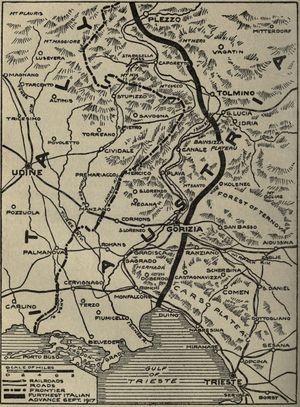
The Italian advance in Istria.
On the Carso only an artillery duel and patrol action occurred.
In the Stelvio region, on the Trentino front, the Austrians attacked one of the Italian advanced posts on the glaciers in the upper Zebru Valley and succeeded in penetrating it. The Italian forces, however, were able to occupy a higher summit, from which they kept their old position under fire.
The next day, August 29, 1917, the Austrians attempted on the Bainsizza Plateau and east of Goritz, by counterattacking in force, to retake positions recently captured. They were driven back everywhere. The Italian lines held firmly, and advanced at some points.
Italian aircraft successfully renewed bombardment of Austrian batteries in Panovizza Wood, on the Carso. An Austrian attack between Vippacco and Dosso Faiti broke down.
On the Trentino front, from Stelvio to Carnia, concentrated fire and numerous reconnoitering actions kept the Austrians busy. In the Tofane region the Austrians, after intense artillery preparation, attacked the Italian positions at the mouth of the Travenanzes Valley three times and with great violence, but were repulsed.
All this time the most determined struggle was going on for the possession of Monte San Gabriele, which changed hands a number of times. Both on August 30 and 31, 1917, very brisk fighting occurred on the northern slopes of Monte San Gabriele and east of Goritz, where the Austrians with repeated violent counterattacks attempted to drive back the Italians. They were repulsed with heavy losses. On the Carso, in the Brestovizza Valley, the Italians carried other elements of trenches.
The total number of prisoners taken from the beginning of the Italian offensive to the end of August, 1917, had risen to 720 officers and 26,582 men.
Trieste, too, was continuously a point of attraction to the Italians. Hardly a day passed without an attack being made on it by Italian airmen.
Throughout the next few days the fighting continued without abatement. Again Monte San Gabriele was the center of it. Following the Italian success of August 30, 1917, the Austrians had attempted a number of times to regain their positions there. But the Italians held on and continued their preparations for further attacks. The final storming of this important and desperately contested position was described by the London "Times" correspondent, attached to Italian headquarters, in part as follows:
"The attack came on the morning of September 3, 1917, when the Italians went forward in three columns. One column attacked straight along the crest, one worked along the northeastern slope, while the third advanced on the right, where the first precipitous fall of the ridge meets the steep slope that comes up from Salcano past the jutting spurs of Hill 343 and Santa Caterina. The left-hand column was held up southeast of Hill 552 by a rocky bastion that juts out eastward from the main massif, but it kept the Austrians in this sector very busy and diverted their attention from the flank and center columns. The right-hand column got well forward and performed the same service for the other flank of the main attack, which was brilliantly successful.
"Nothing could stop the center column, which was made up of volunteer storming troops. These broke down all resistance. They stormed the machine-gun positions, careless of loss, and reached the caverns, where the Austrian reserves were caught like rats. In less than an hour the Italians were in possession of the main peak.
"They had thrust a wedge into the enemy position on the mountain, but their own position was precarious. The enemy still lay round them east, south, southwest, on the lower grounds, indeed, but for that very reason they were half protected from the terrific hail of shells that had pounded the crest to fragments.
"Altogether the center column took nearly 1,500 prisoners—more than the whole number of the 'forlorn hope' that had stormed the peak. Think of what they had done. They had rushed a steep glacis that rises about 300 feet in 600 yards, a glacis not more than 200 or 300 yards wide. At the end of the last abrupt rise they had stormed trenches cut in the rock and full of machine guns."
The day following the capture of Monte San Gabriele, September 4, 1917, the battle on the Julian front was violently renewed. On the Bainsizza Plateau the Italians obtained new advantages, capturing an important position southwest of Corogio.
On the Carso Plateau the Austrians, after most violent bombardment, launched infantry forces against the Italian positions from Castagnevizza to the sea. On the northern section of the line, between Castagnevizza and Korite, the attack, after varying fortunes, was repulsed. In the center, between Korite and Celle, the Italian troops resisted seven furious assaults and maintained their positions.
To the south, between the Brestovizza Valley and the sea, the Austrians were able to gain an initial success between Hill 146, to the northeast of Flondar and the railway tunnel northeast of Lokavac, where the Italians were compelled to withdraw temporarily from a few advanced positions. In the afternoon, by energetic counterattacks, the Italian line was reestablished, with the capture of 402 prisoners, including fourteen officers.
Two hundred and sixty-one Italian airplanes participated in the battle, bombing the Austrian troops and their communication lines.
CHAPTER XXVI
THE STRUGGLE ON THE ISONZO FRONT
Immense quantities of booty had been captured by this time by the Italians as a result of their successful offensive movement. On the Bainsizza Plateau, near Santo Spirito and Laska, whole convoys of arms and munitions were abandoned by the Austrians in such haste that there was no time to destroy them. At one point thousands of boxes of projectiles, hand grenades, rockets, shoes, rifles, and helmets were strewn everywhere.
Mule paths and the adjacent side hills were littered with unexploded projectiles which the Austrians had thrown away, together with daggers, swords, and iron-studded maces used for dispatching the wounded. On Hill 652 the Italians captured three 105-millimeter cannon. Two of them were perfectly serviceable, and the Italians turned them on their former owners.
In an armored dugout near Ravena the Italians discovered the entire equipment of an Austrian staff of brigade. The extraordinary variety of objects found testified to the haste of the retreat. It included electric lights, official documents, toilet articles, kitchen utensils, ventilators, and even love letters. Ravena was the Austrian center of supplies for engineer troops, and near by were found stores of picks, shovels, hoes and wire cutters, entire outfits of electric equipments, miles of steel rails, and innumerable rolls of barbed wire.
During the next few days the fighting was chiefly done by the artillery on both the Bainsizza and the Carso Plateaus. The Austrians attempted a number of counterattacks, all of which, however, fell short of the desired results. During the period, devoted by the Italians to the consolidation of the newly conquered territory, they found time to count their prisoners and to list their booty. The result was the announcement that during the actual offensive there had been captured 30,671 Austrians, including 858 officers, and that the Austrians also had lost: 145 guns, including about eighty of medium caliber, ninety-four trench mortars and bomb throwers, 322 machine guns, 11,196 rifles.
Besides their attempts at counterattacking the Austrians also tried to relieve the Italian pressure on the Isonzo front, by launching a number of local attacks on some of the other fronts. In no case, however, were they successful. Thus on September 7, 1917, in the Concei Valley, west of Lake Garda, local attacks against two Italian advanced posts were repulsed.
Again on September 9, 1917, on the Trentino front Austrian reconnoitering parties were put to flight by Italian advanced posts in Cima di Cady, Tonale, in the Zurez region, east of Lake Garda and on Col di Lana. In the Carnia an attack against Italian positions of Monte Granuda and Cuel Tarond completely failed, though carried out in force after careful artillery preparation.
West of Lake Garda the Austrians, after intense artillery preparation, attacked Italian advanced posts on September 10, 1917, between the Concei Valley and the Lake of Ledro, succeeding in gaining a foothold in one of them, but were immediately driven out.
At the mouth of the Timavo, upper end of Gulf of Trieste, Austrian storming parties, which, with the support of infantry waves, moved against the Italian positions on the extreme right wing, were stopped and put to flight with severe losses caused especially by barrage fire.
The Austrians now began a series of most desperate counterattacks in the attempt to drive the Italians from Monte San Gabriele which they had gained after terrific fighting some days ago. Various attacks were launched on September 11, 1917, against the Italian lines on the Bainsizza Plateau, afterward concentrating their greatest efforts in the region northeast of Goritz.
After having kept under most violent fire for several hours the Italian positions occupied along the crest of Monte San Gabriele, and on the western slopes of the mountain descending toward Salcano, they attacked from the east and south. The bitter struggle, which began at dawn, became more pronounced around the western edge of the table-land of Santa Caterina. Finally toward midday the Austrians, beaten and repulsed, gave up their fruitless attempts.
The crest of Monte San Gabriele is distant about one and a half miles east by north from Salcano, and the western edge of the Santa Caterina table-land is about half a mile from Salcano, Santa Caterina being somewhat to the south of a line drawn between Monte San Gabriele and Salcano. It appears, therefore, that the Italian front must make a sharp salient at San Gabriele.
On the following day, September 12, 1917, northeast of Goritz, the Austrians employing units recently sent to the front, renewed with greater intensity and with a larger number of forces their attempts to dislodge the Italians from Monte San Gabriele. Their furious attacks were successful in a few advanced posts, but were stopped by the Italian main line of occupation, which could not be shaken or penetrated.
On September 13 and 14, 1917, the Italians succeeded in extending their previous gains on the Bainsizza Plateau. On the former date this was accomplished near Log, in the northern zone of the plateau, and on the latter date in the southeastern corner. During the night of September 15 to 16, 1917, the Austrians attempted, without success, by four successive counterattacks to regain this ground. Other counterattacks, made September 16, 1917, were equally unavailing. During this period there was also considerable artillery and aerial activity on the other sectors of the Isonzo front.
Local actions of limited extent also occurred on the Trentino front.
On September 15, 1917, greater activity of Austrian artillery provoked a brisk reaction on the part of the Italian artillery in the Upper But and Fella Valley in Carnia. On the Carso Plateau, too, there was considerable artillery action during all these days.
A comparative lull set in during the next week, September 16 to 23, 1917. Though the Austrians had gained some ground on the summit of Monte San Gabriele, this was of little import, because the position was so located that neither side could possibly hold it for any length of time. On the other hand the Italians had captured two more heights on the Bainsizza Plateau near Volnik, which they succeeded in holding against repeated Austrian attacks and heavy artillery fire.
In the Marmolada region, on the night of September 21-22, 1917, by exploding a mine which had been prepared with long tunneling work, Italian parties were enabled to penetrate two advanced Austrian positions and to establish themselves there.
In the neighborhood of Raccogliano and Selo in the Carso, on the same day, the Italians succeeded in making a slight advance.
During September 23, 1917, the railway line in the Bazza Valley, east of Tolmino, was the objective of Italian air forces. In the morning one of the Italian bombarding squadrons arrived over the railway station of Grahovo, about five or six miles eastsoutheast of Tolmino, at a moment when intense railway movements were going on, and four tons of bombs were dropped there. In the night an Italian airship, by dropping numerous high-explosive bombs, greatly damaged the establishments in the neighborhood of Podmelec, midway between Tolmino and Grahovo. At the same time another Italian airship once again bombarded the numerous Austrian troops in the Chiapovano Valley.
In the Monte Nero region, upper Isonzo, the Austrians exploded on September 24, 1917, a powerful mine under Italian positions, upon which they then concentrated violent artillery fire. Prompt and effective barrage fire, hindering the advance of the infantry, prevented the Austrians from gaining any advantage. The damage done was slight.
Another let-up set in for the next few days. However, on September 28, 1917, Italian storming troops made a surprise attack toward the southeastern edge of the Bainsizza Plateau, capturing some of the high ground south of Podlaka and southeast of Madoni, and forty-nine officers and 1,360 men. Subsequent violent enemy counterattacks accompanied by heavy bombardment were repulsed and the positions maintained.
On the night of September 28-29, 1917, and on the following day, fresh attempts on the part of the Austrians to dislodge the Italians from the positions occupied between Sella di Dol and the northern slopes of Monte San Gabriele failed. On the remainder of the front considerable artillery activity and numerous good patrol actions were reported.
Air fighting was very brisk along the whole Julian front. Italian air squadrons bombarded the enemy depots at Berje, northeast of Nabresina, Gulf of Trieste, and during the night the known military works of the fortress of Pola with excellent results. The response of the enemy was vigorous everywhere.
The following day, September 29, 1917, Italian troops, by means of another successful surprise attack, rectified their line between the Sella di Dol and the northern slopes of Monte San Gabriele. Eight officers, 216 men, and a few machine guns were captured. The position was maintained and strengthened, not withstanding that the Austrians repeatedly counterattacked.
Italian air attacks were concentrated on the military zone of Voiscizza, Carso, which was effectively bombarded, and on the fortified maritime center of Pola, where the submarine base and the arsenal were again bombed with numerous projectiles by a strong Italian bombardment squadron. During the night Austrian aircraft dropped incendiary bombs on the town of Palmanova, causing slight damage, but no casualties. Austrian aircraft also dropped bombs on Aquileja, Monfalcone, and other localities of the lower Isonzo, without doing much damage. During September 30, 1917, the Austrians renewed their attacks against the Italian positions, recently occupied by them on the Bainsizza Plateau, but were repulsed. On the other hand the Italians reported that they had taken prisoners, in their offensive actions during September 28-30, 1917, a total of 2,019 Austrians, including sixty-three officers.
In Val di Fumo, Adamello, Austrian parties attempting to reach Italian positions between the Passo della Porta and the Forcel Rosso Pass were repulsed and pursued by Italian patrols, who captured a quantity of ammunition and explosives.
The first three weeks in October, 1917, passed without any happenings of much significance. Weather conditions began to become unfavorable and it looked at this time as if affairs were about to settle down to the accustomed trench warfare of past winters. Only a few engagements are worthy of special mentioning.
At dawn of October 2, 1917, the Austrians once more attacked the Italian positions on the western slopes of Monte San Gabriele. The attack failed. An assault company was destroyed and the battalion following it, caught in its turn under the fire of Italian batteries and attacked by Italian troops, was dispersed. On the remainder of the Bainsizza Plateau front there were only patrol actions.
Air activity was very lively. During the day one of the Italian squadrons carried out a bombardment on the railway station of Grahovo, Bazza Valley, northeast of Goritz. During the previous night in two successive raids the military objectives of Pola were bombarded and damaged.
During the night of October 3-4, 1917, one of the Italian bombarding squadrons, composed of a large number of machines, flew over the naval base of Cattaro. The Austrians replied by a violent fire. The Italian airmen on several occasions, and with visibly good results, hit torpedo boats and submarines lying in the harbor.
On October 4, 1917, from the Giudicaria, as far as the Brenta, Italian patrols were operating, and captured some prisoners. Artillery bombardments were more frequent and more lively on the Asiago Plateau.
In the region of San Gabriele repeated attacks launched by the Austrians were repulsed. To the east of Goritz the Italians improved a point in our line by a coup de main, and held it, in spite of violent Austrian counterattacks. On the Carso intermittent artillery actions took place as well as attempts to attack on the part of Austrian patrols, which were repulsed.
Snowstorms and gales now began to prevail in the Trentino, while the Isonzo and Carso lines were inundated by rain, and the valleys transformed into lakes of mud. The torrents were so swollen and impetuous as often to be impassable.
During the night of October 11-12, 1917, in the Costabella region, San Pellegrino Valley, an attempted Austrian attack was crushed. On the Julian front Italian patrols effectively harassed Austrian working parties and brought in some prisoners. Artillery activity was considerable from the Rombon, upper Isonzo, to the sea.
During the next day, October 13, 1917, there was considerable artillery activity from the Stelvio to the Rombon, as well as on the Bainsizza Plateau and on the southern front of the Carso. At Vrhovec, west of Chiapovano, Austrian parties attempting to approach the Italian positions were repulsed.
Along the whole Julian front there were lively local actions of the infantry on October 14, 1916. On the southern slope of Monte Rombon, north of Piesso, by a successful coup de main the Italians captured some prisoners. Between Castagnavizza and Selo, Carso, an Italian raid brought other prisoners. In the Brestovizza Valley large Austrian parties, protected by violent artillery and machine-gun fire, approached the Italian lines, but were driven back. Near Lokavac, southeast of Monfalcone, after a lavish artillery preparation extending from the west of Flondar to the sea, an Austrian attack was broken up.
Throughout October 15, 1917, on the Trentino front there was moderate activity. North of Lenzumo, Lake Ledro, in an encounter of advanced posts, Austrian patrols were driven back. On the Carso and Julian fronts, from the Paralba, Carnia, to the Rombon, upper Isonzo, there was desultory artillery fighting, on the Bainsizza Plateau intense artillery duels, on the front lines and on the lines of communication of the Carso the usual destructive and harassing fire.
CHAPTER XXVII
THE AUSTRO-GERMAN OFFENSIVE IN ITALY
In the preceding chapters we have been told of the Italian successes gained in the summer of 1917 and the spasmodic fighting following them. The latter was frequently interrupted by periods of comparative quiet, and sometimes during the early fall of 1917 very vague rumors would be heard to the effect that they ought to be interpreted as the proverbial calm before the storm. However, as time passed and nothing of any import occurred, it began to look as if the Central Powers had decided to maintain the positions they occupied during the winter.
It will be recalled that the last fighting of any extent took place about October 15, 1917. This was followed by about a week of comparative quiet. Suddenly on October 21, 1917, reports came from Rome that Italian observers had noticed the removal of troops from the Trentino and Carso fronts to the Bainsizza Plateau, as well as the arrival of fresh contingents from the Russian front, where evidently the Germans apparently expected no further serious developments. Usually activity was also reported in the Austrian trenches.
On the preceding day, October 20, 1917, notwithstanding adverse atmospheric conditions on the Trentino front, brisk engagements with rifle fire took place here and there. Northeast of Laghi Pesinar Austrian parties were driven back and counterattacked by Italian patrols. In the Booche region in the Pellegrino Valley Austrian parties came in contact with the garrisons of the Italian advanced posts, but after a fierce struggle they were forced to withdraw to their positions. On the Julian front the Austrian artillery showed spasmodic activity. Italian batteries replied with well-directed bursts of fire and effective concentration.
The air continued to be full of rumors. On October 23, 1917, it was semiofficially reported that "General Cadorna is making preparations on an extensive scale for an important military movement, but that there could not be any disclosure, for military reasons, of the objective, extent, or character of the movement or when the Italian offensive will be resumed."
Another report had it "that British and French soldiers, guns, munitions were being sent by train to the Italian front."
Still another bit of gossip was that reports of an impending Austrian offensive had proved to be unfounded and that "General Cadorna desired to start a new offensive against Austria and as a consequence there had been an extreme enlivenment of trench, mortar, and artillery firing from the Tolmino to the southern Carso and over the entire area of the Bainsizza Plateau, which was still in progress. Although the firing was uninterrupted on the part of the Italians, it was declared not to be the prelude of a fresh attack."
The reports covering events at the front during the preceding day, October 22, 1917, showed that the Italian positions on Monte Piana, in the Cadore, were strongly attacked by Austro-German forces. After heavy fighting the enemy was driven back with severe loss. On the following morning, October 23, 1917, Italian storming parties recaptured a portion of their intrenchments which the Austrians had temporarily occupied.
On the remainder of the front there were lively local engagements. In the Cordevole Valley and at the head of the Padola Valley the Italians repulsed enemy detachments.
On the Julian front the artillery action continued intense the whole day. The weather conditions were favorable also to aerial activity.
From then on events as reported from the front made it clearer and clearer day by day that the Austrians, supported by strong German reenforcements, were about to launch an important offensive movement, the extent of which, of course, at that time could not be predicted. By October 23, 1917, the fighting activity had been perceptibly revived in the Tyrolean, Carnia, and Isonzo regions. German artillery took part in the artillery battle, and German and Austro-Hungarian infantrymen captured the foremost Italian positions near Flitsch and Tolmino and in the northern portion of the Bainsizza Plateau, taking some thousands of prisoners.
On October 24, 1917, after an interval of a few hours, the Austrians resumed the violent bombardment all along the front, with a specially destructive fire on that portion between the southern slopes of Monte Rombon and the northern edge of the Bainsizza Plateau, where afterward a strong infantry attack was launched. The Narrows of Saga resisted the hostile blow; but farther south, favored by a thick mist which rendered useless the Italian barrage fire, the Austrians succeeded in breaking through the Italian lines on the left bank of the Isonzo.
Taking advantage of the bridgehead of Santa Maria and Santa Lucia, they then brought the battle on to the slopes of the right bank of the river.
At the same time, powerful attacks were made to the west of Volnik, on the Bainsizza Plateau, and on the western slopes of Monte San Gabriele, but they were kept in check by the Italian troops, which in the course of successful counterattacks captured a few hundred prisoners.
On the Carso, a violent Austrian bombardment was effectively countered by Italian batteries. The Germans claimed that up to the end of the day more than 10,000 prisoners, including divisional and brigade staffs, and rich booty in guns and war material had been taken.
The offensive against the Italian left wing on the Julian front continued during the night and on October 25, 1917, conducted by powerful forces. From Montemaggiore to the west of Auzza the Italians were forced to withdraw to their boundary line, in consequence of which they had to provide for the evacuation of the Bainsizza Plateau. East of Goritz and on the Carso the situation remained unchanged.
This meant that the Germans, profiting by their success in breaking through the line near Flitsch and Tolmino, were advancing beyond Caporetto and Ronzina. They were already fighting at many places on Italian territory. The number of prisoners had increased to more than 30,000, of whom 700 were officers. The booty amounted to more than 300 guns, including many heavy ones.
The Austro-German offensive now began to gain more and more momentum almost every hour. It became known that Von Mackensen was in supreme command of the forces of the Central Powers. Favored by good weather, the German and Austro-Hungarian divisions pressed forward irresistibly over heights and through the valleys. The steep mountain ridge of Stol was captured and soon afterward the strongly fortified summit of Monte Matajur, 1,641 meters high, fell.
The Germans claimed that by now the number of prisoners had increased to 60,000 and the captured guns to 450 and that inestimable quantities of war materials were yet to be salved from the captured Italian positions.
After having crossed the boundary line between Monte Canin and the head of the Judrio Valley, the Austrians, by October 26, 1917, were attempting to reach an opening on the plains. On the Carso their effort was increasing. Strong offensive thrusts, however, were repulsed by the Italian troops.
The worst fears now began to be realized and with stunning swiftness the Austro-German forces forced back the Italians from territory which the latter had gained only by fighting most valiantly for months. In spite of determined resistance, which only in some instances was not all that might have reasonably been expected, the Italian forces were thrown back by powerful thrusts. In the evening of October 27, 1917, German troops forced their way into the burning town of Cividale, the first town in point of position in the plain. The Italian front as far as the Adriatic Sea was now wavering. The Austro-German troops were pressing forward on the whole line. Goritz, the much-disputed town in the Isonzo battles, was taken early on October 28, 1917, by Austro-Hungarian Divisions.
Cividale is a town of about 5,000 inhabitants, nine miles northeast of the important railroad center of Udine. It is near the entrance to the valley of the Natisone River, along which the Austro-German forces which broke the Italian line in the Tolmino region battered their way. Cividale is in the foothills of the Julian Alps, beyond which lie the plains of northern Italy.
Goritz was captured by the Italians on August 9, 1916. It is a town of 31,000 inhabitants on the Isonzo, halfway down the river from Tolmino to the sea. It is strongly situated among hills of great defensive value, in which there was heavy fighting before the Italians reached the city itself. Goritz is twenty-two miles northwest of Trieste, Austria's big seaport at the head of the Adriatic, the capture of which is one of the principal Italian aspirations in the war.
By October 28, 1917, the defeated second Italian army was retreating toward the Tagliamento. The third Italian army, it was claimed, offered only brief resistance to the attack against their positions from Wippach to the sea and hastily retreated along the Adriatic coast. North of the broad sector which had been pierced, the Italian front also was now yielding as far as the Ploecken Pass.
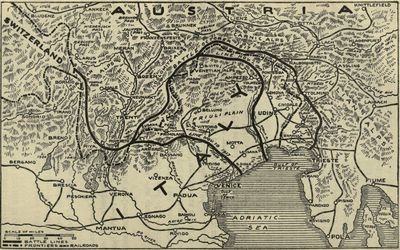
Different stages of the Italian retreat.
Italian rear guards vainly endeavored to stem the advance of the armies of the Central Powers. Austro-Hungarian troops were then standing before Udine, hitherto the grand Italian headquarters. Other Austro-Hungarian divisions captured Cormons, and were approaching the frontier in the coastal region.
All roads were covered with retreating columns and cars belonging to the Italian army and to the Italian population, who, overcome by the sudden disaster to their armies, were fleeing in a pathetic disorder, matched only by the flight of the Belgian civilians in the early part of the war.
The number of prisoners and the quantity of booty was reported as continually increasing. Violent tempests and heavy rains prevailed on the vast fighting area of the twelfth Isonzo battle, but seemed to have no influence on the furious onslaughts of the invading hordes.
On October 29, 1917, the fall of Udine was announced. It is sixty miles northeast of Venice, ten miles east of the frontier, sixteen miles west of the new Tagliamento line, and only 300 feet above sea level. It is situated on the Roia Canal, a branch of the Torre River. It is a quaint and prosperous town, chiefly interested in the manufacture of hemp, flax, and cotton goods, is the capital of the province, the seat of an archbishop, and has a population of 25,000. In the present war Udine had been the general headquarters of the second and third Italian armies. Five railways radiate from Udine west to link up with the Venetian-Quadrilateral system, by which the second and third armies have been supplied; north, across the frontier, to link up with the Vienna-Trentino line; northeast only as far as Cividale, whence the town was invested; southeast, via Goritz to Trieste; and due south, over the lower plains to a small steam tramway which skirts the marshes.
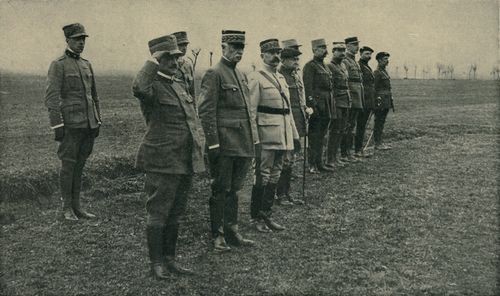
The officer responding to salutes is the Italian commander in chief, General Diaz, who succeeded General Cadorna in November, 1917. Next beside him is the French General Fayolle.
By then, too, the Italian Carnia front seemed to have collapsed on the most important sectors. During a snowstorm Austrian troops wrested from the Italians frontier positions which they had built up during two and a half years southwest of Tarvis, near Pontafel, in the Ploecken region, and on St. Pal. Advancing out of the Carnic Alps the invaders set foot on Venetian soil along the entire front, and were pressing forward against the upper course of the Tagliamento, even though the Italians destroyed, wherever possible, bridges and other means of communication in order to delay the hostile advance.
In spite of valiant efforts on the part of the Italians to stem the tide of invaders, the latter gained new successes on the last day of October, 1917. Portions of the Italian army made a stand at the Tagliamento. Austro-Hungarian forces, however, stormed the last Tagliamento bridgehead, near Latisana, on the lower reaches of the river, south of Codroipo. The bridgehead positions at the latter place and at Dignano were taken by storm by German troops. The Germans claimed that as a result of these operations more than 60,000 Italians, cut off and outflanked on both sides, laid down their arms, and that the number of prisoners taken by them had increased to more than 180,000 and that the number of guns captured had increased to more than 1,500. Late that day such Italian forces as were still maintaining themselves on the eastern bank of the Tagliamento near Pinzano and Latisana were either driven back or taken prisoners. In less than a week's fighting the troops of the Central Powers had pushed forward a thirty-mile front an average distance of thirty miles, making the total of the territory wrested from the Italians some 1,000 square miles.
On November 1, 1917, it was reported that Anglo-French reenforcements had reached the Italian front. Of course, these were comparatively small in number and were sent more for the moral effect their arrival would have than for any actual military value. The battle continued without let-up. Along the middle and lower Tagliamento the opposing armies were in continuous fighting contact. By evening the left bank of the river had been cleared of Italians from the Fella Valley to the Adriatic Sea. That the Italian armies were not totally annihilated was due solely to the efficient rear-guard actions which parts of them had fought against terrific odds.
During November 2 and 3, 1917, the fighting along the Tagliamento was chiefly done by the artillery of both armies. The Germans again claimed large increases in the number of prisoners and guns captured. On the other hand the Italians claimed that a great many of the 200,000 so-called prisoners were mainly workmen or other units of a noncombatant nature and that of the "more than 1,800 guns" the majority were machine guns.
CHAPTER XXVIII
THE ITALIANS AT BAY ON THE PIAVE
Ever since Udine had fallen into the hands of the Central Powers, there had, of course, been much speculation as to what the real German objective was and how and where the Italians were finally going to make a stand against the Austro-German onslaught. For some time it seemed as if the Central Powers were going to try to capture Venice and as if the Italians were going to attempt to prevent it by making a stand at the Tagliamento River. When, however, the fighting along that river, as described in the latter part of the last chapter, gradually but definitely went against the Italians, it soon became clear that the Tagliamento line could not be held for any length of time.
This assumption was proved to be correct very soon. On November 4, 1917, German and Austro-Hungarian divisions succeeded in crossing the middle course of the river and immediately began to press the advantage gained. General Cadorna's line now was broken again and a continued resistance in its present position had become too dangerous to be feasible. It was, therefore, not much of a surprise when news came that the Italians had begun a new retreat on November 5, 1917, especially in view of the fact that Austro-German pressure in the northern, mountainous section of the line had also become so strong that it resulted in evacuation of territory on the part of the Italians.
However, the few days' resistance offered on the Tagliamento had served its purpose. It enabled the Italians to rearrange their shattered armies to a certain extent, so that their withdrawal had been changed from a rout to an orderly retreat. It was made in the direction of the Livenza River, some fifteen miles west of the Tagliamento. The Livenza, however, did not offer the necessary natural defenses to make a determined and extended defense possible, and its only purpose was to delay the enemy sufficiently long to make it possible for the Italians to withdraw in good order behind the next line of defense, the Piave. The Livenza line was reached on November 6, 1917. But so close were the Austro-Germans that the Italians immediately proceeded to cross the Livenza. Indeed, by November 7, 1917, some Austro-German forces, too, had forced their way across the river at some points.
In spite of this, however, the Italians succeeded in extricating themselves from their dangerous position and in withdrawing the great bulk of their forces behind the next line of defense, the Piave River. There it had been determined to face the foe. The Italians, it is true, continued to lose a considerable number of men as prisoners. But compared with their losses of the two preceding weeks, the present losses were slight and showed a decided revival of the Italian resistance and a slowing up of the Austro-German advance.
It also became known now that General Cadorna, who had been in command of the Italian armies since the beginning of the war, had been relieved of this command and had been appointed as the chief military representative of Italy on the permanent interallied military committee. His successor in chief command of the Italian armies was General Diaz, and under him were to be Generals Badoglio and Giardino. The new commander in chief was fifty-six years old, eleven years the junior of General Cadorna. At the outbreak of the war, in 1914, he was a colonel. The second in command was only forty-six years old and had risen since the beginning of the war to his present rank from that of a major of artillery.
By November 9, 1917, the Italians had reached their more or less prepared positions on the lower Piave and frantically began digging themselves in. In the north, however, matters did not go well with the Italians. Austro-Hungarian troops succeeded in pressing forward in the Sugana Valley and in the upper Piave valley. After desperate fighting in the streets Asiago was captured by them. This town is some twenty miles west of the Piave and only a few miles across the Austro-Italian border. On the lower Piave the Italians crossed to the west bank, blowing up behind them all bridges and established themselves fairly firm behind the river from Susegana, in the foothills of the Alps, to the Adriatic, a line of some forty miles.
The Austrians extended their gains in the north on November 10, 1917. Belluno, on the upper Piave, was taken by them, and so was Vidor and its bridgehead, some twenty-five miles downstream, not, however, until the bridge itself had been blown up by the Italians. Fighting on the lower Piave was restricted to artillery and machine-gun firing.
As a result of their gains in the Belluno sector, the Austro-Germans claimed on November 12, 1917, to have captured about 14,000 prisoners and numerous guns and to have reached Feltre, a small town at a bend of the middle Piave.
Heavy fighting occurred on November 12, 1917, on the Asiago plateau. But the Italian line, established there from Monte Gallio-Longara-Meletta di Gallio, held. Between the Brenta and the Piave the Austro-Germans occupied territory previously evacuated by the Italians and reached contact with the Italian lines. On the lower Piave the Italian line held, except at one point, about twelve miles northwest of the mouth of the Piave. There, near Monte San Dona di Piave, about twenty-three miles northeast of Venice, enemy groups succeeded, with the aid of large boats, in crossing to the west bank of the Piave. Italian counterattacks, however, promptly drove them back and the Italian lines were reestablished without a break.
On November 13, 1917, the Central Powers again registered successes. They took Primolano on the upper Brenta and Feltre on the middle Piave. Near the Adriatic they crossed the lower Piave and gained a slight foothold on its western bank, which, however, they were unable to extend in width in spite of determined efforts. A surprise attack against the Italian rear from the north in the region of Lake Garda failed.
New attempts on the part of the Austro-German forces to cross the lower Piave, made repeatedly during November 14, 1917, were promptly repulsed by the Italians, whose power of resistance gradually seemed to stiffen. The same fate met renewed Teuton attacks along the entire front from Asiago to the Piave River, attempted on November 15, 1917. In this the Italians were assisted by opening the floodgates of the Piave River.
The following day, November 16, 1917, the forces of the Central Powers succeeded at two points in crossing the Piave, but were unable to maintain their gains against the fierce counterattacks of the Italians, though they captured Prassolan.
Again on November 17, 1917, the enemy attempted to get across the Piave. Everywhere however, the Italian line held like a wall of steel. Between the Brenta and the Piave the Austro-Germans were even forced to withdraw slightly.
The heaviest kind of fighting raged for the next four weeks in the Alps between Asiago and the Piave. From day to day the fortune of battle wavered. With admirable tenacity the Italians held every position to the very limit of their power and gave up only against overpowering strength, giving way occasionally almost foot by foot, only to come back with strong counterattacks as soon as they regained their breath. The difficulties under which this fighting was done beggars description. For not only were there the natural difficulties of the mountainous terrain, comparatively bare of means of communication, except the wonderful Italian mountain roads, but it must also be remembered that winter had set in long ago and that snow and gales added their share of hardships.
To recite in detail this tremendous struggle would cover page after page and, in a way, would involve much repetition. The complete story would read more like an ancient epic poem than the description of a modern battle. We must be satisfied with an outline of events as they happened day by day.
On November 18, 1917, the Austro-Germans captured Quero, a little town on the Piave, south of Feltre, Monte Cornelle and Monte Tomba. Four times they tried to storm Mt. Monfenera on the 19th, and four times the Italians drove them back. The following day, November 20, 1917, they were no more successful in their attacks against Monte Pertica, and again on November 21, 1917, they failed in their attempts, both against Monte Pertica and Monte Monfenera. However, on that day they succeeded in wresting from the Italians Monte Fontana Secca and Monte Spinoucia, farther to the north and east.
An encircling movement against Monte Meletta, northeast of Asiago, attempted by the Austrians on November 22, 1917, was thwarted by the Italians and numerous attacks against various points between the Brenta and Piave Rivers also failed.
The Italians did not restrict themselves to defending their positions. Whenever the chance offered they undertook offensive movements and as a result of one of these they recaptured, on November 23, 1917, both Monte Tomba and Monte Pertica. They also made some slight gains in the region of Monte Meletta during November 24, 1917. Between that date and December 3, 1917, the Austro-Germans made many attacks along the entire Asiago-Quero front. None of them succeeded in gaining their objectives.
On December 4 and 5, 1917, the Italians were driven from strong positions which they held between Monte Tondarecar and Monte Badenecche, some miles east of Monte Meletta. But when the enemy attempted to extend his operations still farther west he was checked. However, as a result of his success, he was able, on December 6, 1917, to take Monte Sisemol, farther south. Still farther south the Italian line held in spite of repeated attempts to break it.
For the next few days the fighting in the hills slowed down considerably. But on December 11, 1917, the Austro-Germans again began to pound away against the Italian positions. Attacks were launched that day against Col di Beretta and Col dell'Orso, and once more Monte Spinoucia was stormed. Three days later, December 14, 1917, Col Caprille, just southwest of Col di Beretta, was reached by the Austrians.
In the latter part or December, 1917, we hear from time to time of separate actions of the English and French forces which had been rushed to the assistance of the Italian armies. Thus an English attack was launched on December 16, 1917, against Monte Fontana Secca, but failed to accomplish the desired result. The French, supported by British and Italian artillery and airplanes, were more successful on December 30, 1917, when they took by storm some important positions on Monte Tomba.
In the meantime the Italians had continued their struggle to keep the Austro-Hungarians from breaking into the plains from the north, with varying success. On December 18, 1917, they lost their positions on Monte Asolone, south of Col Caprille. Strong counterattacks during December 20 and 21, 1917, promptly regained them. On December 23, 1917, the Teutons made some gains near Monte Valbella, and on the following day they took the hills as well as Col de Rosso. On December 25, 1917, the Italians recaptured both, but eventually had to give them up again and permit the enemy to pass even slightly farther toward the south.
During the first two weeks of January, 1918, the Italians at all times held their lines in the Asiago sector. On January 14 and 15, 1918, they registered some gains in the region of Monte Asolone. On January 23, 1918, the Austro-Germans were forced to evacuate positions in the Monte Tomba region and to move back to Monte Spinoucia. During the last week of January, 1918, the Italians succeeded in pushing back the enemy at many points between the Piave and Asiago and thus establish beyond all doubt that, for the time being at least, the way into the Italian plains was closed to the invaders from the north.
Things had been going even better for the Italians on the lower Piave, between November 15, 1917, and January 31, 1918. Some isolated attempts of the Austro-Germans to gain the west bank, it is true, were successful. But at no time did these successes last. Almost as soon as a position had been taken by them, the Italians threw themselves against it and drove the invaders back to the east bank. From all sides thus Venice and the Italian plains were held safely against all Austro-German attacks at the end of January, 1918, and confidence regained by the Italians through their success in stopping the Teutonic onslaught promised that the future, too, would keep the balance of Italy free from the enemy, if not, indeed, he should be thrown back once more beyond his own frontier.
PART V—CAMPAIGNS IN PALESTINE, ARABIA, MESOPOTAMIA, AND AFRICA
CHAPTER XXIX
THE PALESTINE CAMPAIGN
In midsummer, 1917, it will be remembered, a change had been made in the command of the British forces in Palestine, officially known as the Egyptian Expeditionary Force, and General Allenby was made commander in chief.
At that time the Turkish army in southern Palestine held a strong position extending from the sea at Gaza, roughly along the main Gaza-Beersheba road to Beersheba. Gaza had been made into a strong modern fortress, heavily intrenched and wired, offering every facility for protracted defense. The remainder of the enemy's line consisted of a series of strong localities, viz.: the Sihan group of works, the Atawinek group, the Baha group, the Abu Hareira-Arab el Teeaha trench system, and, finally, the works covering Beersheba. These groups of works were generally from 1,500 to 2,000 yards apart, except that the distance from the Hareira group to Beersheba was about four and one-half miles.
The enemy's force was on a wide front, the distance from Gaza to Beersheba being about thirty miles; but his lateral communications were good, and any threatened point of the line could be very quickly reenforced.
The British forces were extended on a front of twenty-two miles, from the sea, opposite Gaza, to Gamli.
Owing to lack of water the British were unable, without preparations which would require some considerable time, to approach within striking distance of the enemy, except in the small sector near the seacoast opposite Gaza.
According to official reports the British general had decided to strike the main blow against the left flank of the main Turkish position, Hareira and Sheria. The capture of Beersheba was a necessary preliminary to this operation, in order to secure the water supplies at that place and to give room for the deployment of the attacking force on the high ground to the north and northwest of Beersheba, from which direction the British intended to attack the Hareira-Sheria line.
The difficulties to be overcome in the operations against Beersheba and the Sheria-Hareira line were considerable, and careful preparations and training were necessary. The chief difficulties were those of water and transport, and arrangements had to be made to insure that the troops could be kept supplied with water while operating at considerable distances from their original water base for a period which might amount to a week or more; for, though it was known that an ample supply of water existed at Beersheba, it was uncertain how quickly it could be developed or to what extent the enemy would have damaged the wells before the British succeeded in occupying the town. Except at Beersheba, no large supply of water could be found till Sheria and Hareira had been captured.
The transport problem was no less difficult; there were no good roads south of the line Gaza-Beersheba, and no reliance could therefore be placed on the use of motor transport. Owing to the steep banks of many of the wadis which intersected the area of operations, the routes passable by wheeled transport were limited, and the going was heavy and difficult in many places. Practically the whole of the transport available in the British force, including 30,000 pack camels, had to be allotted to one portion of the eastern force to enable it to be kept supplied with food, water, and ammunition at a distance of fifteen to twenty miles in advance of the railhead. Arrangements were also made for the railhead to be pushed forward as rapidly as possible toward Karm, and for a line to be laid from Gamli toward Beersheba for the transport of ammunition.
A railway line was also laid from Deir el Belha to the Wadi Ghuzze, close behind the sector held by another portion of the eastern force.
Considerable strain was thrown on the military railway from Kantara to the front during the period of preparation. In addition to the normal requirements of the force, a number of siege and heavy batteries, besides other artillery and units, had to be moved to the front, and large depots of supplies, ammunition, and other stores accumulated at the various railheads.
During the period from July to October the Turkish force on the Palestine front had been increased. It was evident, from the arrival of these reenforcements and the construction of railway extensions from El Tine, on the Ramleh-Beersheba railway, to Deir Sincid and Belt Hanun, north of Gaza, and from Deir Sincid to Huj, and from reports of the transport of large supplies of ammunition and other stores to the Palestine front, that the Turks were determined to make every effort to maintain their position on the Gaza-Beersheba line.
The date of the attack on Beersheba, which was to commence the operations, was fixed as October 31, 1917.
On the morning of October 27, 1917, the Turks made a strong reconnoissance toward Karm from the direction of Kauwukah, two regiments of cavalry and two or three thousand infantry, with guns, being employed. They attacked a line of British outposts near El Girheir, covering railway construction. One small post was rushed and cut up, but not before inflicting heavy loss on the enemy; another post, though surrounded, held out all day, and also caused the enemy heavy loss. British reenforcements succeeded in coming up in time, and on their advance the Turks withdrew.
The bombardment of the Gaza defenses commenced on October 27, 1917, and on October 30, 1917, warships of the Royal Navy, assisted by a French battleship, began cooperating in this bombardment.
On the evening of October 30, 1917, the portion of the British eastern force, which was to make the attack on Beersheba, was concentrated in positions of readiness for the night march to its position of deployment. The night march to the positions of deployment was successfully carried out, all units reaching their appointed positions up to time.
The plan was to attack the Turkish works between the Khalasa road and the Wadi Saba with two divisions, masking the works north of the Wadi Saba with the Imperial Camel Corps and some infantry, while a portion of the 53d (Welsh) Division farther north covered the left of the corps. The right of the attack was covered by a cavalry regiment. Farther east, mounted troops took up a line opposite the southern defenses of Beersheba.
As a preliminary to the main attack, in order to enable field guns to be brought within effective range for wire cutting, the enemy's advanced works at 1,070 were to be taken. This was successfully accomplished in the early morning of October 31, 1917, after a short preliminary bombardment. By about 1 p. m. the whole of the works between the Khalasa road and the Wadi Saba were in British hands.
Meanwhile the British mounted troops, after a night march, had arrived early in the morning of October 31, 1917, about Khasim Zanna, in the hills some five miles east of Beersheba. From the hills the advance into Beersheba from the east and northeast had to be made over an open and almost flat plain, commanded by the rising ground north of the town and flanked by an underfeature in the Wadi Saba called Tel el Saba.
A British force was sent north to secure Bir es Sakaty, on the Hebron road, and protect the right flank; this force met with some opposition, and was engaged with hostile cavalry at Bir es Sakaty and to the north during the day. Tel el Saba was found strongly held by the enemy, and was not captured till late in the afternoon.
Meanwhile attempts to advance in small parties across the plain toward the town had made slow progress. In the evening, however, a mounted attack by Australian Light Horse, who rode straight at the town from the east, proved completely successful. They galloped over two deep trenches held by the enemy just outside the town, and entered the town at about 7 p. m., October 31, 1917.
About 2,000 prisoners and 13 guns were taken, and some 500 Turkish corpses were buried on the battle field. This success laid open the left flank of the main Turkish position for a decisive blow.
After the complete success of the Beersheba operations, the attack on Gaza was ordered to take place on the morning of November 2, 1917.
The objectives of this attack were the works from Umbrella Hill (2,000 yards southwest of the town) to Sheikh Hasan, on the sea (about 2,500 yards northwest of the town). The front of the attack was about 6,000 yards, and Sheikh Hasan, the farthest objective, was over 3,000 yards from the British front line. The ground over which the attack took place consisted of sand dunes, rising in places up to 150 feet in height. This sand is very deep and heavy-going. The Turkish defenses consisted of several lines of strongly built trenches and redoubts.
Umbrella Hill was attacked and captured during the night of November 1, 1917.
The main attack was successful in reaching all objectives, except for a section of trench on the left and some of the final objectives in the center. Four hundred and fifty prisoners were taken and many Turks killed. The enemy also suffered heavily from the preliminary bombardment.
Meanwhile on the British right flank the water and transport difficulties were found to be greater than anticipated, and the preparations for the second phase of the attack were somewhat delayed in consequence.
However, in the early morning of November 1, 1917, the 63d Division, with the Imperial Camel Corps on its right, had moved out into the hills north of Beersheba, with the object of securing the flank of the attack on Sheria. Mounted troops were also sent north along the Hebron road to secure Dhaheriyeh.
The 53d Division took up a position from Towall Abu Jerwal (six miles north of Beersheba) to Muweileh (four miles northeast of Abu Irgeig). Irish troops occupied Abu Irgeig the same day.
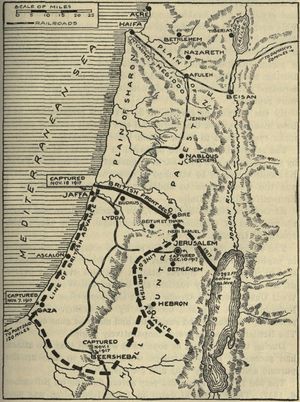
The campaign in Palestine.
On November 3, 1917, the British advanced north on Ain Kohleh and Tel Khuweilfeh, near which place the mounted troops had engaged considerable enemy forces on the previous day. This advance was strongly opposed, but was pushed on through difficult hill country to within a short distance of Ain Kohleh and Khuweilfeh. At these places the enemy was found holding a strong position with considerable and increasing forces. During November 4 and 5, 1917, the Turks made several determined attacks on the British mounted troops. These attacks were repulsed.
By the evening of November 5, 1917, all preparations had been made to attack the Kauwukah and Rushdi systems and to make every effort to reach Sheria before nightfall.
The mounted troops were prepared in the event of a success by the main force to push north in pursuit of the enemy. Tel el Khuweilfeh was to be attacked at dawn on November 6, 1917, and the troops were to endeavor to reach the line Tel el Khuweilfeh-Rijm el Dhib.
At dawn on November 6, 1917, the attacking force had taken up positions of readiness to the southeast of the Kauwukah system of trenches.
The attack progressed rapidly and was completely successful in capturing all its objectives, and the whole of the Rushdi system in addition. Sheria Station was also captured before dark. The Yeomanry reached the line of the Wadi Sheria to Wadi Union; and the troops on the left were close to Hareira Redoubt, which was still occupied by the enemy. Some 600 prisoners were taken and some guns and machine guns captured. The British casualties were comparatively slight.
During the afternoon, as soon as it was seen that the attack had succeeded, mounted troops were ordered to take up the pursuit and to occupy Huj and Jemmamah.
The 53d Division again did very severe fighting on November 6, 1917. Their attack at dawn on Tel el Khuweilfeh was successful, and, though they were driven off a hill by a counterattack, they retook it and captured another hill, which much improved their position.
The bombardment of Gaza had meanwhile continued, and another attack was ordered to take place on the night of November 6-7, 1917.
The objectives were, on the right, Outpost Hill and Middlesex Hill, and on the left the line Bellah Trench-Turtle Hill.
During November 6, 1917, a certain amount of movement on the roads north of Gaza had been observed by British airmen and fired on by British heavy artillery.
The attack on Outpost Hill and Middlesex Hill met with little opposition, and as soon, after they had been taken, as patrols could be pushed forward, the enemy was found to be gone. Other British troops on the left also found at dawn that the enemy had retired during the night, and early in the morning the main British force occupied the northern and eastern defenses of Gaza. Turkish rear guards were still occupying Beit Hanun and the Atawineh and Tank systems, from whence Turkish artillery continued to fire on Gaza and Ali Muntar till dusk.
As soon as it was seen that the Turks had evacuated Gaza a part of the British force pushed along the coast to the mouth of the Wadi Hesi, so as to turn the Wadi Hesi line and prevent the enemy making any stand there. British cavalry had already pushed on round the north of Gaza, and became engaged with an enemy rear guard at Beit Hanun, which maintained its position till nightfall. The force advancing along the coast reached the Wadi Hesi by evening, and succeeded in establishing itself on the north bank in the face of considerable opposition, a Turkish rear guard making several determined counterattacks.
On the extreme right the situation remained practically unchanged during November 7, 1917; the Turks made no further attempt to counterattack, but maintained their positions.
In the center the Hareira Tepe Redoubt was captured at dawn. The London troops, after a severe engagement at Tel el Sheria, which they captured by a bayonet charge at 4 a. m. on November 7, 1917, subsequently repulsing several counterattacks, pushed forward their line about a mile to the north of Tel el Sheria; the mounted troops on the right moved toward Jemmamah and Huj, but met with considerable opposition from hostile rear guards.
During November 8, 1917, the advance was continued. The Turkish rear guards fought stubbornly and offered considerable opposition. Near Huj a British charge captured twelve guns, and broke the resistance of a hostile rear guard. It soon became obvious that the Turks were retiring in considerable disorganization.
By November 9, 1917, operations had reached the stage of a direct pursuit by as many troops as could be supplied.
On the evening of November 9, 1917, there were indications that the Turks were organizing a counterattack toward Arak el Menshiye by all available units of the force which had retired toward Hebron, with the object of taking pressure off the main force, which was retiring along the coastal plain.
The British, however, decided to press the pursuit and to reach the Junction Station as early as possible, thus cutting off the Jerusalem Army, while the Imperial Camel Corps was ordered to move to the neighborhood of Tel el Nejile, where it would be on the flank of any counterstroke from the hills.
Operations on November 10 and 11, 1917, showed a stiffening of the enemy's resistance on the general line of the Wadi Sukereir, with center about El Kustineh; the Hebron group, after an ineffective demonstration in the direction of Arak el Menshiye on the 10th, retired northeast and prolonged the enemy's line toward Beit Jibrin. Royal Flying Corps reports indicated the total Turkish forces on this line at about 15,000.
British progress on November 10 and 11, 1917, was slow; the troops suffered considerably from thirst, as a hot, exhausting wind blew during these two days.
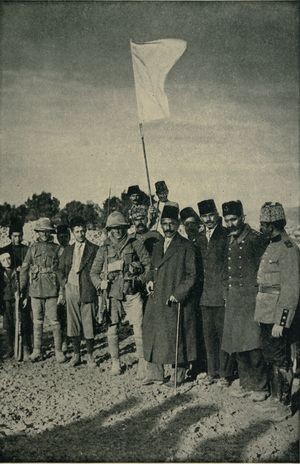
On December 9, 1917, a White Flag party came out of Jerusalem to meet the nearest British outposts and surrender the city. The Mayor of Jerusalem is the man with the walking cane and cigarette.
November 12, 1917, was spent in preparations for the attack on the enemy's position covering Junction Station. British forces were now operating at a distance of some thirty-five miles in advance of their railhead, and the bringing up and distribution of supplies and ammunition formed a difficult problem. The routes north of Wadi Hesi were found to be hard and good going, though there were some difficult Wadi crossings, but the main road through Gaza and as far as Beit Hanun was sandy and difficult.
CHAPTER XXX
THE FALL OF JERUSALEM
On the morning of November 13, 1917, the Turks had strung out their forces, amounting probably to more than 20,000 rifles, on a front of twenty miles, from El Kubeibeh on the north to about Beit Jibrin to the south. The right half of their line ran roughly parallel to and only about five miles in front of the Ramleh-Junction Station railway, their main line of supply from the north, and their right flank was already almost turned.
The advance guard of the 52d Division had forced its way almost to Burkah on November 11, 1917, on which day also some mounted troops pushed across the Nahr Sukereir at Jisr Esdud, where they held a bridgehead. During November 12, 1917, other British forces pushed north up the left bank of the Nahr Sukereir, and eventually seized Tel-el-Murreh on the right bank near the mouth.
The Australian mounted troops, extended over a wide front, secured the British flank and pressed forward on November 12, 1917, toward Balin, Berkusie, and Tel-es-Safi. Their advance troops were counterattacked and driven back a short distance, but the Turks made no effort to press farther forward. The British then decided to attack on November 13, 1917.
The country over which the attack took place is open and rolling, dotted with small villages surrounded by mud walls with plantations of trees outside the walls. The most prominent feature is the line of heights on which are the villages of Katrah and El Mughar, standing out above the low flat ground which separates them from the rising ground to the west, on which stands the village of Beshit, about 2,000 yards distant. This Katrah-El Mughar line forms a very strong position, and it was here that the Turks made their most determined resistance against the turning movement directed against their right flank. The 52d Division, assisted by a charge of mounted troops, who galloped across the plain under heavy fire and turned the Turkish position from the north, captured the position. Some 1,100 prisoners, three guns, and many machine guns were taken here. After this the Turkish resistance weakened, and by the evening the Turks were retiring east and north.
The British infantry, who were sent forward about dusk to occupy Junction Station, met with some resistance and halted, for the night, not much more than a mile west of the station. Early next morning (November 14, 1917) they occupied the station.
The Turkish army had now been broken into two separate parts, which retired north and east respectively.
In fifteen days the British force had advanced sixty miles on its right and about forty on its left. It had driven a Turkish army of nine infantry divisions and one cavalry division out of a position in which it had been intrenched for six months, and had pursued it, giving battle whenever it attempted to stand, and inflicting on it losses amounting probably to nearly two-thirds of its original effectives. Over 9,000 prisoners, about eighty guns, more than 100 machine guns, and very large quantities of ammunition and other stores had been captured.
After the capture of Junction Station on the morning of November 14, 1917, the British secured a position covering the station, while the mounted troops reached Kezaze that same evening.
The mounted troops pressed on toward Ramleh and Ludd. On the right Naaneh was attacked and captured in the morning, while on the left the New Zealand Mounted Rifles had an engagement at Ayun Kara (six miles south of Jaffa). Here the Turks made a determined counterattack and got to within fifteen yards of the British line. A bayonet attack drove them back with heavy loss.
Flanking the advance along the railway to Ramleh and covering the main road from Ramleh to Jerusalem, a ridge stands up prominently out of the low foothills surrounding it. This is the site of the ancient Gezer, near which the village of Abu Shusheh now stands. A Turkish rear guard had established itself on this feature. It was captured on the morning of November 15, 1917, by mounted troops, who galloped up the ridge from the south. A gun and 360 prisoners were taken in this affair.
By the evening of November 15, 1917, the mounted troops had occupied Ramleh and Ludd, and had pushed patrols to within a short distance of Jaffa. At Ludd 300 prisoners were taken, and five destroyed aeroplanes and a quantity of abandoned war material were found at Ramleh and Ludd.
Jaffa was occupied without opposition on the evening of November 16, 1917.
The following situation had now developed: The Turkish army, cut in two by the capture of Junction Station, had retired partly east into the mountains toward Jerusalem and partly north along the plain. The nearest line on which these two portions could reunite was the line Tul Keram-Nablus. Reports indicated that it was the probable intention of the Turks to evacuate Jerusalem and withdraw to reorganize on this line.
The British mounted troops had been marching and fighting continuously since October 31, 1917, and had advanced a distance of seventy-five miles, measured in a straight line from Asluj to Jaffa. Other troops, after heavy fighting at Gaza, had advanced in nine days a distance of about forty miles, with two severe engagements and continual advance-guard fighting. The 52d Division had covered sixty-nine miles in this period.
The railway was being pushed forward as rapidly as possible, and every opportunity was taken of landing stores at points along the coast. The landing of stores was dependent on a continuance of favorable weather, and might at any moment be stopped for several days together.
A pause was therefore necessary to await the progress of railway construction, but before the British position in the plain could be considered secure it was essential to obtain a hold of the one good road which traverses the Judean range from north to south, from Nablus to Jerusalem.
The west side of the Judean range consists of a series of spurs running east and west, and separated from one another by narrow valleys. These spurs are steep, bare, and stony for the most part, and in places precipitous. Between the foot of the spur of the main range and the coastal plain is the low range known as the Shephelah.
On the line intended for the British advance only one good road, the main Jaffa-Jerusalem road, traversed the hills from east to west. For nearly four miles, between Bab el Wad (two-and one-half miles east of Latron) and Saris, this road passes through a narrow defile, and it had been damaged by the Turks in several places. The other roads were mere tracks on the side of the hill or up the stony beds of wadis, and were impracticable for wheeled transport without improvement. Throughout these hills the water supply was scanty without development.
On November 17, 1917, the Yeomanry had commenced to move from Ramleh through the hills direct on Bireh by Annabeh, Berfilya, and Beit ur el Tahta (Lower Beth Horon). By the evening of November 18, 1917, one portion of the Yeomanry had reached the last-named place, while another portion had occupied Shilta. The route had been found impossible for wheels beyond Annabeh.
On November 19, 1917, the British infantry commenced its advance. One portion was to advance up the main road as far as Kuryet el Enab, with its right flank protected by Australian mounted troops. From that place, in order to avoid any fighting in the close vicinity of the Holy City, it was to strike north toward Bireh by a track leading through Biddu. The remainder of the infantry was to advance through Berfilya to Beir Likia and Beit Dukka, and thence support the movement of the other portion.
After capturing Latron and Amnas on the morning of November 19, 1917, the remainder of the day was spent in clearing the defile up to Saris, which was defended by hostile rear guards.
On November 20, 1917, Kuryet el Enab was captured with the bayonet in the face of organized opposition, while Beit Dukka was also captured. On the same day the Yeomanry got to within four miles of the Nablus-Jerusalem road, but were stopped by strong opposition about Beitunia.
On November 21, 1917, a body of infantry moved northeast by a track from Kuryet el Enab through Biddu and Kulundia toward Bireh. The track was found impassable for wheels, and was under hostile shell fire. Progress was slow, but by evening the ridge on which stands Neby Samwil was secured. A further body of troops was left at Kuryet el Enab to cover the flank and demonstrate along the main Jerusalem road. It drove hostile parties from Kustul two and one-half miles east of Kuryet el Enab, and secured this ridge.
By the afternoon of November 21, 1917, advanced parties of Yeomanry were within two miles of the road and an attack was being delivered on Beitunia by other mounted troops.
The positions reached on the evening of November 21, 1917, practically marked the limit of progress in this first attempt to gain the Nablus-Jerusalem road. The Yeomanry were heavily counterattacked and fell back, after bitter fighting, on Beit ur el Foka (Upper Beth Horon). During the following day the Turks made two counterattacks on the Neby Samwil ridge, which were repulsed. Determined attacks were made on November 23 and 24, 1917, on the strong positions to the west of the road held by the Turks, who had brought up reenforcements and numerous machine guns, and could support their infantry by artillery fire from guns placed in positions along the main road. British artillery, from lack of roads, could not be brought up to give adequate support to their infantry. Both attacks failed, and it was evident that a period of preparation and organization would be necessary before an attack could be delivered in sufficient strength to drive the Turk from his positions west of the road.
By December 4, 1917, all preparations had been completed and the British held a line from Kustul by the Neby Samwil ridge, Beit Izza, and Beit Dukka, to Beit ur el Tahta.
During this period of preparation attacks by the Turks along the whole line led to severe local fighting. On November 25, 1917, British advanced posts north of the river Auja were driven back across the river. From November 27 to 28, 1917, the Turks delivered a series of attacks directed especially against the high ground position in the hills from Beit ur el Foka to El Burj, and the Neby Samwil ridge. An attack on the night of November 29, 1917, succeeded in penetrating the British outpost line northeast of Jaffa, but next morning the whole Turkish detachment, numbering 150, was surrounded and captured by Australian Light Horse. On November 30, 1917, a similar fate befell a battalion which attacked near El Burj; a counterattack by Australian Light Horse took 200 prisoners and practically destroyed the attacking battalion. There was particularly heavy fighting between El Burj and Beit ur el Folka, but the British troops successfully resisted all attacks and inflicted severe losses on the enemy. At Beit ur el Foka one company took 300 prisoners. All efforts by the Turks to drive the British off the Neby Samwil ridge were completely repulsed. These attacks cost the Turks very dearly. The British took 750 prisoners between November 27 and 30, 1917, and the Turkish losses in killed and wounded were undoubtedly heavy.
Favored by a continuance of fine weather, preparations for a fresh advance against the Turkish positions west and south of Jerusalem proceeded rapidly. Existing roads and tracks were improved and new ones constructed to enable heavy and field artillery to be placed in position and ammunition and supplies brought up. The water supply was also developed.
The date for the attack was fixed as December 8, 1917. Welsh troops, with a cavalry regiment attached, had advanced from their positions north of Beersheba up the Hebron-Jerusalem road on December 4, 1917. No opposition was met, and by the evening of December 6, 1917, the head of this column was ten miles north of Hebron.
On December 7, 1917, the weather broke, and for three days rain was almost continuous. The hills were covered with mist at frequent intervals, rendering observation from the air and visual signaling impossible. A more serious effect of the rain was to jeopardize the supply arrangements by rendering the roads almost impassable.
In spite of these difficulties, the British troops moved into positions by night, and, assaulting at dawn on December 8, 1917, soon carried their first objectives. They then pressed steadily forward. The mere physical difficulty of climbing the steep and rocky hillsides and crossing the deep valleys would have sufficed to render progress slow, and the opposition encountered was considerable. Artillery support was soon difficult, owing to the length of the advance and the difficulty of moving guns forward. But by about noon some British troops had already advanced over two miles, and were swinging northeast to gain the Nablus-Jerusalem road, while others had captured the Beit Iksa spur, and were preparing for a further advance.
As the British right column had been delayed and was still some distance south of Jerusalem, it was necessary for the advanced British forces to throw back their right and form a defensive flank facing east toward Jerusalem, from the western outskirts of which considerable rifle and artillery fire was being experienced. This delayed the advance, and early in the afternoon it was decided to consolidate the line gained and resume the advance next day, when the right column would be in a position to exert its pressure. By nightfall the British line ran from Neby Samwil to the east of Beit Iksa, through Lifta to a point about one and one-half miles west of Jerusalem, whence it was thrown back facing east. All the Turkish prepared defenses west and northwest of Jerusalem had been captured, and the British troops were within a short distance of the Nablus-Jerusalem road.
During the day about 300 prisoners were taken and many Turks killed. British casualties were light.
Next morning the advance was resumed. The Turks had withdrawn during the night, and the British forces driving back rear guards, occupied a line across the Nablus-Jerusalem road four miles north of Jerusalem, while other troops occupied a position east of Jerusalem across the Jericho road. These operations isolated Jerusalem, and at about noon the enemy sent out a parlementaire and surrendered the city.
At noon on December 11, 1917, General Allenby made his official entry into Jerusalem.
In the operations from October 31 to December 9, 1917, over 12,000 prisoners were taken. The captures of material included about 100 guns of various calibers, many machine guns, more than 20,000,000 rounds of rifle ammunition, and 250,000 rounds of gun ammunition. More than twenty aeroplanes were destroyed by British airmen or burned by the Turks to avoid capture.
This ended four centuries of Turkish rule over the Holy City of Jews and Christians. General Allenby, after his entry, issued the following noteworthy proclamation:
"To the inhabitants of Jerusalem the Blessed and the people dwelling in the vicinity. The defeat inflicted upon the Turks by the troops under my command has resulted in the occupation of your city by my forces. I therefore here and now proclaim it to be under martial law, under which form of administration it will remain so long as military considerations make it necessary. However, lest any of you should be alarmed by reason of your experience at the hands of the enemy who has retired, I hereby inform you that it is my desire that every person should pursue his lawful business without fear of interruption.
"Furthermore, since your city is regarded with affection by the adherents of three of the great religions of mankind, and its soil has been consecrated by the prayers and pilgrimages of multitudes of devout people of these three religions for many centuries, therefore do I make known to you that every sacred building, monument, holy spot, shrine, traditional site, endowment, pious bequest, or customary place of prayer, of whatsoever form of the three religions, will be maintained and protected according to the existing customs and beliefs of those to whose faiths they are sacred."
An eyewitness of the memorable event, the special correspondent of the London "Times" with the British forces describes it in part as follows:
"It was a picturesque throng. From the outskirts of Jerusalem the Jaffa road was crowded with people who flocked westward to greet the conquering general. Somber-clad youths of all nationalities, including Armenians and Greeks, stood side by side with Moslems dressed in the brighter raiment of the East. The predominence of the tarboosh in the streets added to the brightness of the scene. Many of the Moslems joined aloud in the expression of welcome, and their faces lighted up with pleasure at the general's approach.
"Flat-topped roofs and balconies held many, crying out a genuine welcome; but it was in the streets, where the cosmopolitan crowd assembled, that one looked for and obtained the real feeling of all the peoples. What astonished me were the cries of 'Bravo' and 'Hurrah' uttered by men who could have hardly spoken the words before....
"General Allenby entered the city on foot. Outside of Jaffa gate he was received by the military governor and a guard of honor formed by men who have done their full share in the campaign. On the right of the gate were men from English, Scottish, Irish, and Welsh counties. Opposite them were fifty men afoot, representing the Australian and New Zealand horsemen who have been engaged in the Empire's work in the Sinai Desert and Palestine almost since the war broke out. Inside the walls were twenty French and twenty Italian troops from the detachments sent by their countries to take part in the Palestine operations.
"General Allenby entered by the ancient gate which is known to the Arabs as 'The Friend.' Inside the walls was a crowd more densely packed in the narrow streets than was the crowd outside.
"The commander in chief, preceded by his aids-de-camp, had on his right the commander of the French detachment, and on his left the commander of the Italian detachment. The Italian, French, and American military attachés followed, together with a few members of the General Staff. The guards of honor marched in the rear. The procession turned to the right into Mount Zion and halted at Al Kala (the Citadel).
"On the steps, at the base of the Tower of David, which was standing when Christ was in Jerusalem, the Proclamation of Military Law was read, in the presence of the commander in chief and of many notables of the city.
"Re-forming, the procession moved up Zion street to the barrack square, where General Allenby received the notables and the heads of the religious communities. The mayor and the mufti—the latter also a member of the Husseiny family—were presented, likewise the sheiks in charge of the mosques of Omar and Aksa, and Moslems belonging to the Khaldieh and Alamieeh families, which trace their descents through many centuries. The patriarchs of the Latin, Greek, Orthodox, and Armenian Churches, and the Coptic bishop, had been directed by the Turks to leave Jerusalem, but their representatives were introduced to General Allenby, as were also the heads of the Jewish committees, the Syrian Church, the Greek Catholic Church, the Abyssinian bishop, and a representative of the Anglican Church. The last presentation was that of the Spanish consul, who is in charge of the interests of almost all the countries at war, and is a busy man."
CHAPTER XXXI
PALESTINE—ARABIA—MESOPOTAMIA
Although the British had accomplished their main objective in Palestine with the capture of Jerusalem, they did not rest on their laurels. Within a few days after their occupation of the Holy City, by December 12, 1917, they had advanced their lines to the north and some detachments of Indian troops had carried positions as far north as the mouth of the Midieh.
During the night of December 20-21, 1917, British troops crossing the Nahr-el-Auja on rafts and light bridges, seized Khurbet Hadrah, Sheikh Muannis, Tel-er-Rekkeit, and later El Makhras.
These localities are near the mouth of the river, and include commanding ground two miles to the north of it. Three hundred and five prisoners, of whom eleven were officers, and ten machine guns were captured.
Other forces captured Ras-ez-Zamby, two miles northeast of Bethany, which itself is two miles east of Jerusalem, taking thirty prisoners and two machine guns and beating off three Turkish counterattacks.
By this time the booty captured by the British since the beginning of the operations had been counted and had been found to total ninety-nine guns and howitzers with carriages, about 400 limbers, wagons and other vehicles; 110 machine guns, more than 7,000 rifles, 18,500,000 rounds of small-arm ammunition, and over 58,000 rounds of gun and howitzer ammunition, besides various other stores.
On December 22, 1917, troops on the extreme left of the British forces, with naval cooperation, continued their advance north of the Nahr-el-Auja, reaching the line Sheik-el-Ballutah-El Jelil, some four miles north of the river. Pushing eastward south of the river Fejja and Mulebbis, center of a Jewish colony, were occupied. This was followed by the capture of Rantieh on the Turkish railway to the north, and Kh.-el-Beida, and Kh.-el-Bireh, four miles southeast of Rantieh.
The Turks, with German assistance, on December 27, 1917, made a determined attempt to retake Jerusalem. Repeated attacks were pressed with vigor and continued from two a. m. on the 27th for twenty-six hours. General Allenby at once launched a counterattack against the west flank of the Turkish attack.
On the 27th this attack progressed two and one-half miles over very difficult country. Seeing that the Turkish attack was spent, on December 28, 1917, the British made a general advance. British troops on the Nablus road advancing north and the troops on their left advancing east drove the Turks back before them. By the morning of December 29, 1917, General Allenby had secured the line Burkah, Ras-et-Tahunieh, Ram Allah, El Tireh, Wadi-el-Kelh.
On December 30, 1917, British troops occupied Beitin, or Bethel, two miles northeast of Bireh, El Balua, one mile north of Bireh, on the Nablus road, and Kh.-el-Burj, about one mile west of El Balua, Janiah and Ras Kerker, six and seven miles respectively northwest of Bireh.
In the coastal sector of the line a patrol reached Kuleh, twelve miles east of Jaffa, and there found a Turkish gun ammunition depot, which it destroyed. Kuleh is two miles east of Rantieh, on the Damascus Railway, which had recently been occupied by the British.
The Turks suffered heavily in killed and wounded, the killed alone being estimated at about 1,000. About 600 prisoners were taken and twenty machine guns.
The British line was now, at its nearest point, twelve miles north of Jerusalem. The right wing reached some four miles east of the Sheehem road; the center extended across that road north of Beeroth, Bireh, and along the Ram Allah Ridge and the Wadi-el-Kalb, which lies north of and parallel to the Jerusalem-Beth Horon-Joppa road. On the coast the left wing of the British was north of the Auja, in the plain of Sharon.
In describing the Turco-German attempt to regain Jerusalem the special correspondent of the London "Times" attached to the British forces in Palestine said in part:
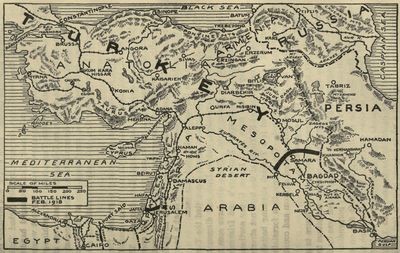
The British advance in Mesopotamia and Palestine.
"The first objective was Tell-el-Ful, a high conical-shaped hill just east of the Sheehem road dominating our lines east and west for a considerable distance. During daylight on Boxing Day the Turks made no movement, but just before midnight our post north of El Ful was driven in. At twenty minutes past one a. m. the first attack on El Ful was made, and at the same time an advance began against Beit Hannina, about a mile west of the road. This line was defended by London Territorials, who added to their grand record by meeting attack after attack with magnificent steadiness, standing like rocks against most furious onslaughts, and never once yielding an inch of ground. Two companies defending Hanbna were attacked four times by storming troops. Each attack was stronger than the last, and the fourth was delivered by 500 picked Turks, but all the attacks were beaten back after prolonged hand-to-hand fighting. The enemy dead showed many bayonet wounds, and the hillside was strewn with Turks killed by machine-gun fire. There were eight attacks on Tell-el-Ful. These were also made with great weight and determination. The strongest of them all was delivered with a reenforced line at dawn, and supported by heavy artillery fire. All were defeated with great loss to the enemy.
"Between 7 a. m. and noon the enemy organized for a last big effort, and about half-past 12 the Turks assaulted the whole of the Londoners' line except Nebi Samwil. This final attack was pressed right up to our positions, the enemy fighting with the bravery of desperation. He proved no match for the London Territorials, who, after raking the advancing waves with machine guns, cleared his breastworks at a bound, met the foe with the bayonet, and forced him back.
"General Allenby, realizing how deeply committed the Turks were to the attack on Jerusalem, put in Irish and dismounted Yeomanry against the enemy right. Those who have seen the terrain marvel at the dismounted Yeomanry's and Irishmen's achievement. They moved from Beth Horon Upper northeastward. The Yeomen attacked El Tireh, at the time not strongly held, but just as they secured it a Turkish storming battalion was advancing to the same spot. The enemy, thus forestalled, counterattacked, but the Yeomanry rushed at them and counted seventy Turks killed by the bayonet alone.
"The hill near by was so steep that it took two hours to get supplies up to the top. Another hillside was so precipitous that the only way troops could get up the terraced slopes was by the men standing on each other's shoulders. So nearly perpendicular was the hill that the Turks on the top could not fire on the climbers till they were at close quarters. While the Irish and Yeomen were advancing, men in reserve were making roads for the guns, which had to be hauled by hand, and when Yeomen captured Beitunia they had a whole brigade of guns just behind their front line, though it was sometimes necessary for a whole company of infantry to haul one gun, which at moments was dangling in the air.
"Welsh and Home Counties troops also took part in beating off the attack on Jerusalem. They had taken Zanby and White Hill, north of the Jericho road, and held White Hill against three counterattacks. On the 27th the Turks attacked all day, and White Hill became no-man's-land, but Zanby was held. Fighting was at bombing distance. At dusk the enemy tried to take White Hill, but the Welshmen charged with the bayonet and killed over a hundred Turks. Farther south a post at the village of Obeid was attacked by 700 of the enemy, who surrounded it and fired 400 shells into the monastery, but the Middlesex men, who were the garrison of the post, held out, their casualties being trifling."
Immediately following the defeat which the British inflicted on the Turks, the former succeeded in advancing their lines north of Jerusalem still another mile.
During January, 1918, there was little activity on the Palestine front. In the last week of the month there was, however, considerable aerial activity. On January 22, 1918, the Turkish camps and depots on the railway west of Sebustieh, Samaria, were raided.
On January 24, 1918, two Turkish aeroplanes were wrecked in aerial combats.
On January 25, 1918, British bombing squadrons surprised a body of some 2,000 Turkish troops in close formation near Hawara, on the Jerusalem-Nablus road four and one-half miles south of Nablus. Half a ton of bombs were dropped on the column before it could disperse. At the same time a camp of mounted troops was bombed and the animals were stampeded.
Twelve Turkish aeroplanes were destroyed during the month of January, 1918.
During the night of January 30, 1918, the British line was again advanced slightly in the vicinity of Arnutieh, a ruined site, on the Sheehem road, twelve miles north of Jerusalem.
On the morning of January 31, 1918, a British reconnoitering detachment penetrated the village of Mukhmas, eight miles north-northeast of Jerusalem, repulsed Turkish counterattacks, and withdrew during the following night, having accomplished its object. During the night of February 2, 1918, Turkish patrols were active between Arnutieh and Sheikh Abdulla, one mile east of Arnutieh. Attempts to penetrate the British lines at these points, however, were repulsed.
In the meantime the Arab revolt in the Hedjaz, that part of Arabia adjoining the Red Sea, was spreading. It will be recalled that it had been announced in July, 1917, that the Turks had been defeated at Maan and that the Arabs had occupied the enemy positions between Maan and Akaba, the latter place being at the head of the Red Sea gulf of the same name, and just east of the Egyptian frontier. The town of Maan, which is on the Hedjaz Railway, is about 120 miles southeast of Gaza.
Late in August, 1917, it became known that forces operating under the orders of the King of the Hedjaz, the Grand Sherif of Mecca, had carried out a series of extensive operations against Turkish detachments and posts in Arabia. According to the information available, the Arab forces had been working on a carefully thought out plan, resulting in the destruction of part of the railway line north of Medina, which is 230 miles north of Mecca, and in the capture of isolated Turkish posts.
In the Maan district alone, over 700 Turks were killed in action and a similar number taken prisoner, in addition to four guns.
The Arab movement, originating with the Sherif of Mecca, apparently was gaining the support of almost all the Arab tribes in the Hedjaz, and was spreading eastward.
During September, 1917, no news came from the Hedjaz. Early in October, 1917, it was reported that Arab forces had successfully raided the railway communications north of Medina on the Hedjaz Railway.
Not until late in December, 1917, did it become known that the Arabs had been quite active during the latter part of November, 1917, though definite news was lacking concerning their activities during October, 1917, and the early part of November, 1917.
Between November 8 and November 12, 1917, a section of Arabs attacked the railway from Deraa to Amman, that part of the Hedjaz line running parallel to the Jordan. Two locomotives, a number of coaches and trucks, and a bridge were destroyed, and traffic was interrupted for six days.
On November 11, 1917, a train in which Djemal Pasha was traveling to Jerusalem was blown up with a mine and destroyed. Djemal escaped, but his aid-de-camp and the staff officers accompanying him were killed. The Turkish casualties amounted to 120, while the Arabs lost seven killed and four wounded.
On November 22, 1917, a Turkish lancer patrol from Maan attacked some Arab tents in the neighborhood of Batra, fifteen miles southwest of Maan, but were driven off with losses. Arab forces later took the posts of Fuweila and Basta, southwest and west of Maan respectively. These points had been fortified by the Turks in August last in the hope of confining the Arabs in the Akaba area.
A few days later it was announced that an Arab force under Sherif Feisal, son of the King of Hedjaz, had destroyed a troop train south of Tebuk, on the Hedjaz Railway, some 350 miles north of Medina.
The whole of the Turkish detachment in the train were killed or captured, amongst the former being Suleiman Pasha Rifada, paramount chief of the Billi tribe. Three hundred rifles were captured as well as a large quantity of ammunition, also £24,000 Turkish in gold.
On January 11, 1918, it was announced that the Arab forces in Hedjaz had made a successful raid on the railway some twenty miles south of Maan, and that still farther to the south the entire Turkish garrison of an important post on the railway had fallen into the hands of the Arabs.
A few days later the Arabs occupied the Turkish post of Tafile, forty-five miles north-northeast of Maan and eighteen miles southeast of the Dead Sea, capturing the entire garrison. On January 26, 1918, a body of Turkish troops moving on Tafile from El Kerak, twenty miles northeast of the southern end of the Dead Sea, was routed on the Seil-el-Hesa, eleven miles north of Tafile, by the Arabs, and driven back in disorder with the loss of many prisoners, a mountain gun, and seven machine guns.
On the same day another Turkish force advancing westward from Maan was repulsed by Arab troops near Ain Uheid, seven miles west of Maan.
Still farther south, in the Aden sector of Arabia, little of importance transpired between August, 1917, and February, 1918, though the British troops near Aden continued to be in constant contact with the Turks, engaging in numerous outpost and patrol skirmishes.
On November 22, 1917, an action was fought on a larger scale than usual, in which British troops attacked and captured the Turkish post at Jabir, fifteen miles north of Aden, and its neighboring pickets. Losses were inflicted on the Turks and their defenses were destroyed.
On January 5, 1918, a strong reconnoissance was made toward Hatum and Jabir, the defenses of the former being destroyed by British troops. Aeroplanes cooperated with the British artillery, who inflicted considerable damage on the Turkish infantry.
In Mesopotamia there had been very little activity since the fall of Bagdad on March 11, 1917. Soon after that event a British column had been sent westward to Feluja on the Euphrates, a town almost on a line with Bagdad, but about thirty-five miles farther west. The Turks had offered no resistance and the town had been occupied by the British. The Turkish forces in the meantime had been withdrawn to Ramadie, about twenty-five miles northwest from Feluja and also on the Euphrates. In July 1917, a British column had successfully pushed forward about twelve miles in the direction of Ramadie, but after inflicting considerable losses on the Turks had to stop farther advance on account of the extreme heat.
Early in October, 1917, came the news that Ramadie had fallen on September 29, 1917. During the night of September 27, 1917, the British had moved in two columns from an advanced camp on the Euphrates, west of Feluja, one column on the right, the other on the left, and at dawn they attacked Mushaid Ridge, a low line of dunes running north and south from the Euphrates to Habbanie Canal.
At dawn they bombarded the main crest of the ridge, but the Turks had evacuated it, and they replied with a counterbombardment a few minutes afterward, expecting apparently that the British would follow up the barrage with an assault. The British, however, as soon as it became clear that the Turks were evacuating Mushaid Ridge, changed their line of attack. The right column was withdrawn and, swinging round west behind the left column, became the left wing of the force.
As soon as the infantry had carried Mushaid Ridge British cavalry made a wide sweeping movement across the desert round the right flank of the Turks. They left the battle area at 8 a. m. and by 4 p. m. they were established astride the Aleppo road on a regular line of hills running at right angles with the river five miles west of Ramadie.
By this move the Turks were cornered. The net which the British had flung round them was complete. They had no bridge behind them and were cut off from all hope of reenforcement or supplies. Their only chance was to drive in determined counterattacks, and to break through before the British drew the ring in closer and drove them out from their trenches with their artillery.
Meanwhile the British infantry were closing in. At 1 o'clock, after bombardment, one column attacked Ramadie Ridge, on the right, while the other was working round to Azizie Ridge, on the left. The capture and holding of Ramadie Ridge by British and Indian infantry was a difficult achievement. This low pebbly rise is perfectly smooth, a long and gentle gradient barely seventeen feet above the plain level. It offered no cover of any kind, and the British infantry became visible to the Turks a full 200 yards before they reached the top of the rise. As soon as they came into view the Turks opened concentrated rifle and machine-gun fire on the British front and right flank, while their guns opened intense enfilade fire from the batteries on the left. The British and Indian soldiers hung on to their positions and at night dug themselves in. Their action so occupied the Turks that the left column was able to work round and seize the Azizie Ridge before dusk with very little opposition.
At night British cavalry, who occupied strong points on a front of three miles along the ridge, prepared for a desperate struggle. The expected attack began the battle after 3 o'clock, when the Turks tried to break through between the cavalry and the river. The action continued for two hours till dawn, when it degenerated into casual sniping. The nearest Turkish dead were found within fifty yards of the cavalry trenches.
In the meantime the infantry soon after daybreak had taken up the attack again and in face of well-directed fire and against repeated counterattacks, had carried the last outlying defenses of the Turks on the British left, until 8 o'clock, September 29, 1917, they had seized and were holding the bridgehead of the Azizie Canal. After this new repulse an intense bombardment was opened on the Turkish trenches. The British line of cavalry, far away west, soon saw the dark masses of the enemy approaching and apparently prepared for bloody battle. They watched this advance, as they thought, for over an hour, but there came a moment when, to their astonishment, they saw the Turks turn and walk in mass formation toward the British. The Turkish guns were silent and white flags went up all along the line.
It was a general surrender. Ahmed Bey, the Turkish commander, who had been on the Euphrates all through the campaign from the battle of Shaiba, March, 1915, came out and surrendered with his whole force.
The British captured 3,455 prisoners, thirteen guns, ten machine guns, 1,061 rifles, a quantity of ammunition, some railway material, two steam launches and a large quantity of miscellaneous engineering material, equipment, and military stores. When the British entered Ramadie they found that such Turkish forces as had not surrendered had hurriedly fled.
To the north and east of Bagdad the British forces, too, succeeded in advancing in the direction of the Persian border. In this undertaking they had for some time the cooperation of Russian troops still fighting in this region.
On August 19, 1917, British columns attacked the Turks near Shahroban on the left bank of the Dialah, about fifty miles northeast from Bagdad. The Turks made little resistance and retreated hastily to the Hamrin Hills, and British troops remained in possession of Shahroban.
In an action fought on October 20, 1917, the British occupied Deli Abbas, about ten miles northwest from Shahroban, and established themselves on the Jebel Hamrin range on the left bank of the river Dialah. The Turks retreated across the Dialah River in the vicinity of Kizil Robat, burning the bridge behind them, and continued to hold a position in the hills on the right bank of that river, north of Deli Abbas, which is on the Bagdad-Kifri road.
This position was attacked on the morning of December 3, 1917, by converging columns, one of which successfully bridged the Dialah near Kizil Robat, sixty miles northeast of Bagdad, on the road to Khanikin.
The Turks attempted to delay the British advance by flooding the area between the Nahrin and Dialah Rivers close to their junction, six miles east of Deli Abbas, but by the morning of December 4, 1917, British troops had driven back the Turks and were in possession of the Sakaltutan Pass, eleven miles north of Deli Abbas, and between the Dialah and the Nahrin, a northern tributary of the Dialah, flowing through the Jebel Hamrin, and crossed on the main road between Deli Abbas and Kifri at an elevation of 600 feet above sea level. Through the Sakaltutan Pass the road from Deli Abbas leads to the north to Kifri and Mosul.
A force of Russians, under the command of Colonel Bicharakoff, operated on the British right flank and rendered valuable assistance.
Immediately after the capture of the pass, the Turks were pursued as far as the village of Kara Tepe, thirteen miles north of the pass and about twenty-five miles north of Deli Abbas, through which the Turks were driven on December 5, 1917, after a sharp engagement. The pursuit was carried out over difficult country containing bogs and intersected by numerous watercourses.
On the morning of December 7, 1917, British aeroplanes bombed Tuz Kurmatli, on the Mosul road, thirty-five miles north of Kara Tepe, with good results. It was reported that the Turks set fire to the Kifri coal mines on December 5, 1917, and the British observed that fires were burning there on the following day.
No further news came from the Mesopotamian theater of war during the balance of December, 1917, or during January and February, 1918.
On December 1, 1917, it was officially announced by the British authorities, that reconnoissances had definitely established the fact that German East Africa had been completely cleared of all German troops and that the German commander, General von Lettow-Vorbeck, with the force under his command, estimated at 2,000 rifles, had crossed the Rovuma River into Portuguese East Africa.
During December, 1917, after driving the Germans across the border into Portuguese territory, the British forces were busy in preparing for the new task of hunting out General Lettow-Vorbeck in Portuguese East Africa. British patrols by December 25, 1917, were forty miles south of the Rovuma River, which marks the frontier.
Von Lettow's force had been broken up into small foraging parties; and it was expected that they would be rounded up before the big rains set in.
However, during the last few days of December, 1917, the German forces in Mozambique, consisting of 2,000 men with two fieldpieces and ten machine guns, attacked the Portuguese positions on Mt. M'Kula, occupied by Captain Curado, with 250 men and five machine guns, and after three days' fighting succeeded in carrying the positions by assault.
This did not change the fact that the last vestige of the German Colonial Empire had fallen into the hands of the Allies.
PART VI—THE BALKANS
CHAPTER XXXII
THE BALKANS—GREECE AND MACEDONIA
On the Macedonian front the military situation has had all the appearance of a deadlock, not only since last summer, but for the past year. On November 24, 1917, the Austrians were reported to be making a general offensive attack on the Italian lines in southern Albania, between the Voyusa and Osum Rivers, which was followed by a strong Italian counterattack, but neither side was able to announce any gains of territory or any notable capture of prisoners or material. Again, barely two weeks later, on December 5, 1917, violent fighting was said to have begun for several miles along the front near the Struma, with the net result that "several Bulgarian patrols were captured." Compared to what we have come to regard as fighting in this war, therefore, these few sporadic efforts in Macedonia and Albania have been very little more than outpost affairs, mere raids.
On November 15, 1917, there was published in London a report on the military activities of the British by General G. F. Milne, commanding the British forces covering the past year, which seems in part to have a significant bearing on a later event.
In the latter part of February, 1917, a year ago, General Milne was instructed by General Sarrail to prepare for a forward push against the Bulgarians in the first week of April. A corps was, accordingly, sent forward shortly afterward to take a position on the high ridge between Lake Doiran and the River Vardar. By April 8, 1917, General Milne was ready, whereupon General Sarrail found it necessary to postpone action until the 24th. On that day the British were sent forward and succeeded in occupying the front-line trenches of the enemy almost along the entire front of the attack. The British were now in a commanding position, of which great advantage could have been taken, but at this juncture General Milne was instructed to retire, "on account of the unhealthful conditions of the terrain."
General Milne was next informed that the advance would begin over again on May 8, 1917. So another assault on the enemy lines was begun between Lake Doiran and the "Petite Couronne" Hill. In spite of the powerful opposition of the Bulgarians some progress was made, and twelve days later the new advance line was consolidated. A farther advance was in progress, with every prospect of success, when on May 24, 1917, General Milne received instructions from Sarrail to cease all offensive operations.
By itself this report might at least indicate unpleasant relations between the British and the French commanders, but further significance is added by the announcement made December 19, 1917, that General Sarrail had been recalled from his supreme command on the Macedonian front, to be succeeded by General Guillemet.
A serious charge, it will be remembered, had been made against Sarrail in France before his appointment to Saloniki, in July, 1915. This charge had been made by General Dubail and had been indorsed by General Joffre and Millerand, then Minister of War in the French Cabinet. It had to do with certain maneuvers against the German Crown Prince, directed by Sarrail under the command of Dubail. Subsequently these charges were dropped, and until his sudden appointment to the Saloniki command Sarrail dropped from view.
The specific reason for Sarrail's removal has not been officially stated, but there are rumors throwing doubt on his loyalty and suggesting his connection with the Caillaux scandal, which would imply that Sarrail had deliberately made no efforts to proceed seriously against the Bulgarians and the Austrians, even that he had secretly connived in the destruction of the Rumanians when he should have created a diversion by a general attack in Macedonia.
The double part played by Constantine, King of Greece, in the dealings with the Entente Powers, had always been a matter of grave suspicion, in spite of his repeated denials and protestations of friendship, published through his frequent newspaper interviews. Even after his removal from the throne by the Allies there still remained a doubt in the minds of many people that he had been justly treated. But then his duplicity has been conclusively proved beyond all question.
Early in November, 1917, there were discovered in Athens the records of a number of telegrams which had been exchanged between Constantine and Queen Sophia on the one hand and her brother, the kaiser, on the other. These telegrams were in a cipher code unknown to the Greek foreign office. The key was discovered later and the contents of the telegrams revealed clearly, exposing a series of plots which had been initiated by the Greek sovereigns against their supposed friends, the Allies.
Those sent early in 1916, by both the king and the queen, urgently requested the kaiser to institute an energetic military movement in the Balkans toward Greece, that Greece might be relieved from the presence of the Allied troops in the neighborhood. Then came the affair in which the Greek military authorities surrendered Fort Rupel to the Bulgarians, showing conclusively that the king had connived in the surrender.
At the time of the crisis, in the first days of December, 1916, when the Greek army attacked Entente representatives in Athens and caused an ultimatum to be delivered against the Greek Government, Queen Sophia, in a long telegram to her brother, described the "splendid victory" which the Greeks had achieved over "four great powers." In this telegram she demanded a strong German and Austrian offensive with the object of relieving Greece. In reply the kaiser urged Constantine to declare war against Sarrail's forces and begin active military operations against them. In reply the queen explained the impossibility of doing this on account of the lack of equipment and ammunition and again urged a German relief expedition. To this the German Emperor answered that this was impossible, but urged that Constantine take measures to organize guerrilla bands in the neighborhood of Lake Ochrida, to cooperate with the Austrian forces. This suggestion was complied with, no less a person than the Master of the King's Horse being intrusted with the supervision of this task. The following telegram, sent on January 10, 1917, is a notable example of this correspondence in general:
"For the Kaiser from Queen Sophia (through the Greek Minister in Berlin):
"I thank you for your telegram, but we are without sufficient food for the duration of such an undertaking, and the shortage of ammunition and many other things compel us unfortunately to abstain from such offensive action. You can realize my position. How I suffer. Thank you warmly for your welcome words. May the infamous swine receive the punishment they deserve. I embrace you heartily. Your exiled and unhappy sister, who hopes for better times. (Signed) Sophia."
Another telegram from Sophia, sent on this same day, stated to the kaiser "I am grateful and happy for having at any rate spoken to Von Falkenhausen at Larissa on the telephone, as well as having received direct news of you. I was afraid the ultimatum would have to be accepted. We were obliged to accept it, although we desired to enter the war on the side of Germany on account of the political advantages, in order to rid ourselves of our bitter enemies, and to respond to the sympathy already shown by the Greek people to the cause of Germany, but we lack food and ammunition for such a campaign.... Finally, the immediate menace to the capital and to our only means of communication by the British forces reported to be at Malta for the expedition against Greece obliged us to our great regret to abandon this project...."
On January 6, 1917, King Constantine sent a telegram to Von Hindenburg, in which the following passages occur:
"The present situation must be seriously considered, as it is probable that a declaration of war might come before mobilization could be effected. Probably the Entente desire to involve Greece in immediate war so as to destroy her before the German occupation could begin. Already Greece is faced with a fresh Entente note demanding her complete disarmament. The transport of the whole of the artillery and war material to the Peloponnesus is being maintained by the pressure of the blockade. The Government and the people are resisting with constancy, enduring all sorts of privations, but the situation is growing worse from day to day. It is urgent that we should be informed if a German attack on the Macedonian front is contemplated, and when it is likely to begin."
That these intrigues were not confined to Constantine and Sophia alone is obvious, from the following telegram, sent by Theotokis, the Greek Minister in Berlin, on December 10, 1916:
"Let Von Falkenhausen await at Berlin the decision which will be taken at Athens. In case it is neutrality he will proceed to Podgradetz; in case of rupture with the Entente he will go by aeroplane to Larissa. In any case, it is of the greatest importance to develop as quickly as possible the question of Caravitis's bands and matters relative thereto. Pray inform me with all speed what assistance in the way of munitions, money, and provisions you would want. The object of Caravitis should be to cut the railroad from Monastir to Saloniki, and harass Sarrail's rear. One should not lose sight of the fact that even this unofficial action by the bands will powerfully help Greece when the time for negotiations comes to put forward large territorial claims which, naturally, can be larger in case action is taken than in case of mere neutrality. Falkenhausen is awaiting instructions, upon which he will act immediately."
On December 2, 1916, Sophia telegraphed to General von Falkenhausen:
"Owing to the continuance of the blockade there is only bread left for a few days longer, and other foodstuffs are also growing scarcer. The idea of war against the Entente is now out of the question. Negotiations are now proceeding on the note. I consider the game lost. If the attack is not made immediately, it will be too late."
CHAPTER XXXIII
RUMANIA
For six months the Rumanian troops engaged in no important military operations. They held their lines against the Austrian forces, and these latter, apparently, made no strong efforts to advance. Indeed, the entire collapse of the military power of Russia made it practically certain that the Rumanians could not continue the war effectively. When the Bolsheviki came into power, their course toward Rumania was openly hostile, so that the Rumanians were compelled to guard themselves against their one-time allies as well as against the enemy.
Finally Rumania joined in the armistice initiated by the Petrograd Bolsheviki. There seemed to be no question of the desire of the Rumanians to remain loyal to their western allies; but the Balkan country was now surrounded by enemies, and there was apparently little hope that she could maintain her warfare against the Central Powers. Reports from Austrian sources stated that negotiations for a separate peace between Austria and Rumania were going on at Fokshani. Peace with Germany, Turkey, and Bulgaria would naturally follow to save the country from utter destruction.
On January 20, 1917, a Berlin dispatch announced that the Rumanian Premier, Bratiano, had resigned, and was to be succeeded by General Averescu, former Minister of War and commander in chief of the Rumanian forces which had operated in Dobrudja. This report has not since been verified.
That Bulgaria is not completely under German control and is a member of the Quadruple Alliance on terms peculiarly her own has been manifested in more than one way during recent months. As previously stated, in earlier editions of this work, there is a very strong popular opinion in Bulgaria against the alliance with Germany which at times has seemed on the point of manifesting itself in a material way. Occasionally rumors have come through of wholesale military executions, following attempts at mutiny on the part of the troops. Thus Bulgaria's position as an uncertain quantity in the Teutonic alliance is not due to any disloyalty on the part of the king, Ferdinand, but to the disposition of the people, who are interested only in a Macedonia free from Serbia or Greece, and not in the German plans for empire. Though successfully suppressed so far, these subterranean movements do limit the policy of the Bulgarian ruling clique, however loyal to German rule it may be in itself.
During the past November there were frequent rumors of proposal from Bulgaria to the Entente for separate peace, but nothing definite was known at the time. That definite negotiations were at least begun only became known in December, 1917, when the Petrograd Bolsheviki began the publication of secret treaties and correspondence found in the Government archives on their stepping into power. Among these many revelations appeared a telegram from the Russian embassy in Berne, Switzerland, which described a meeting in the embassy office in the latter part of September, 1917, between a Bulgarian representative, said to be the exarch of the Bulgarian church, and a British representative, whose name was not given. The latter asked for a statement of the Bulgarian terms.
The Bulgarian demanded, in return for severing the alliance with Germany and Austria, that Bulgaria be granted all of Dobrudja, an expanded Bulgaria down to the old Media-Rodosto line, with a western frontier along the Morava River, in Serbia, from the junction of that river with the Danube, down through Nish, Pristina, and Uskub; and Macedonia, including Monastir and Saloniki.
This demand the British representative refused to consider, but made the tentative counterproposal of an independent Macedonia, with Saloniki as the capital.
That Bulgaria should have refused this offer is only another illustration of the duplicity of Ferdinand and his governing clique. His one hold on the Bulgarian people has been his pretended espousal of the cause of the Macedonian Bulgars. For long years past the Macedonians strove for an independent Macedonia, but this was made impossible by the policies of the great powers interested. They were, however, on the verge of achieving this ideal after the First Balkan War, when the interference of Austria in Albania caused Serbia and Greece to demand a revision of the treaty which had provided for Macedonian freedom. Against this demand the Macedonians protested, and their leaders were largely instrumental in precipitating the Second Balkan War. The result was their defeat and the Treaty of Bucharest, which forced the Macedonian patriots under the wing of the Bulgarian Government, the only refuge left them.
That Bulgaria should now have refused terms including an independent Macedonia was, indeed, a matter to be kept secret. Ferdinand, naturally, desires Macedonia as an extension of his own territory, although the Macedonians are very little in sympathy with his Greater Bulgaria imperialism and would only accept it as an alternative between freedom on the one hand and subjection to Greece and Serbia on the other.
On October 12, 1917, Emperor William of Germany, accompanied by Prince August Wilhelm and Foreign Secretary Dr. von Kühlmann, paid an official visit to Ferdinand in Sofia. The streets and houses were profusely decorated and much festivity prevailed.
PART VII—NAVAL AND AIR WARFARE
CHAPTER XXXIV
ON THE SEA
As in the past, naval warfare during the six months' period, August, 1917, to February, 1918, consisted primarily of attacks by German submarines on units of the allied merchant marine. There was again a wide discrepancy between the figures published by the allied and German governments. An example of this are the respective totals of monthly tonnage losses for the year 1917.
German Claim
Allied Claim
January
439,500
February
781,000
812,000
March
885,000
600,000
April
1,091,000
788,000
May
869,000
549,000
June
1,016,000
758,000
July
811,000
463,000
August
808,000
591,000
September
673,000
455,000
October
674,000
470,000
November
607,000
435,000
December
816,000
514,000
————
————
9,470,500
6,435,000
Continuous detailed figures of losses are available only regarding the British and American merchant marines. Between August, 1917, and February, 1918, the British weekly losses were as follows:
Week ending
1,600 tons and over
Under 1,600 tons
Fishing vessels
August 5
21
2
0
August 12
14
2
3
August 19
15
3
2
August 26
18
5
0
September 2
20
3
0
September 9
12
6
4
September 16
8
20
1
September 23
13
2
2
September 30
11
2
0
October 7
14
2
3
October 14
12
6
1
October 21
17
8
0
October 28
14
4
0
November 4
8
4
0
November 11
1
5
1
November 18
10
7
0
November 25
14
7
0
December 1
16
1
4
December 8
14
7
0
December 15
14
3
1
December 22
11
1
1
December 29
18
3
0
January 6
18
3
4
January 13
6
2
2
January 20
6
2
0
January 27
9
6
1
——
——
——
334
116
30
On August 14, 1917, it was also officially stated in the House of Commons that since the beginning of the war and up to June 30, 1917, a total of 9,748 lives were lost on British merchantman as the result of U-boat attacks, mine and other explosions. Of these 3,828 were passengers of all nationalities and 5,920 officers and seamen.
During the same period the following twenty-six American vessels were sunk by submarines:
Gross tons
Lives lost
August 6.
Campana
3,695
4
August 7.
Christine
964
0
August 23.
Carl F. Cressy
898
0
August 29.
Laura C. Anderson
960
0
September 8.
William H. Clifford
1,593
0
September 12.
Wilmore
5,398
0
September 15.
Platuria
3,445
10
September 16.
Ann J. Trainer
426
0
September 23.
Henry Lippitt
895
0
September 25.
Paulina
1,337
0
October 3.
Annie F. Conlon
591
0
October 11.
Lewis Luckenbach
3,905
10
October 16.
Jennie E. Richter
647
0
October 16.
St. Helens
1,497
24
October 17.
Antilles
6,878
64
October 25.
Fannie Prescott
404
0
October 27.
D. N. Luckenbach
2,933
5
November 2.
Rochester
2,551
7
November 7.
Villemer
....
2
November 9.
Rizal
2,744
3
November 16.
Margeret L. Roberts
535
0
November 21.
Schuylkill
2,720
0
November 25.
Actaeon
4,999
37
December 10.
Owasco
4,630
2
December 20.
Suruga
4,374
1
January 6.
Harry Luckenbach
2,798
8
This meant a loss of about 61,000 tons and of 177 lives.
Unrestricted submarine warfare was initiated by the Germans, it will be remembered, on February 1, 1917. During the first twelve months of it, February, 1917, to February, 1918, a total of sixty-nine American ships, representing about 170,000 tons, were sunk by submarines, mines, and raiders. Over 300 lives were lost with these boats.
Figures in regard to the French and Italian losses are incomplete. From available sources, however, it appears that during the six months' period, August, 1917, to February, 1918, the French merchant marine lost by U-boat attacks seventy-three steamers of over 1,600 tons, fifty-two steamers of under 1,600 tons and thirty fishing boats. In the same period U-boats sank sixty-one Italian steamers and forty-six Italian sailing vessels.
Regarding neutral losses figures are even less definite. Only Norway, which again is by far the heaviest loser amongst neutral nations, has published official statements covering her losses. For six months, July to December, 1917, her losses were 127 boats of 216,000 tons. For the entire year 1917, they amounted to 434 boats of 686,800 tons and involved the death of 401 sailors, while 258 more were missing or unaccounted for.
Holland, amongst other losses, reported the sinking by a mine off the Dutch coast on August 3, 1917, of the steamer Moordam of 12,531 tons. Mines in one case, and an explosion in the other, were responsible for the sinking of two British steamers: City of Athens, of Cape Town, of 5,600 tons, on August 10, 1917, with the loss of nineteen lives, of which five were Americans; and Port Kembla, of 4,700 tons, on September 18, 1917, off Cape Farewell.
Regarding the German losses in U-boats, practically no definite information is available. Only occasionally has any news managed to get by the censors of the Allies, and the Germans, of course, are entirely silent on the subject. On November 24, 1917, one U-boat was sunk by the United States destroyers, Fanning and Nicholson, while on patrol service in European waters. Her crew were captured with the exception of a few members who were drowned. Two other U-boats were reported to have been sunk during December in the Ionian Sea by a French destroyer. This, of course, does not represent the total losses inflicted by the Allies on the German U-boat forces. Indeed, it has been stated officially that the average loss amounts to thirty-eight U-boats per month.
Naval engagements between units of the various belligerents were comparatively few and unimportant. As a result the losses incurred by the different navies, at least as far as they became known, were likewise comparatively slight.
During August, 1917, British monitors cooperated with the Italian navy in bombarding successfully Austrian positions in the Gulf of Trieste. On August 16, 1917, there was also a slight engagement between British and German destroyers in the North Sea without result.
On September 1, 1917, British destroyers destroyed four German armed mine-sweeping vessels off the coast of Jutland. Three days later, September 4, 1917, a German submarine bombarded Scarborough, killing three persons, wounding five, and doing some material damage.
During the successful German attack against Riga in the early part of September, 1917, German submarines appeared in the Gulf of Riga and bombarded the city.
In October it also became known that the German raider Seeadler had run ashore on Lord Howe Island (Society Islands) in the Pacific Ocean, leaving forty-seven prisoners on the island in a state of destitution. The crew of the raider afterward seized a motor sloop and a French schooner on which they carried out some further raids. It was later reported that the motor boat had been captured by an unarmed merchantman in one of the outlying islands of the Fiji group.
The armored British cruiser Drake was torpedoed on the morning of October 2, 1917, off the north coast of Ireland. Though she was able to make harbor, she sank later in shallow water. One officer and eighteen men were killed by the explosion of the torpedo. The Drake was a ship of 14,100 tons with a speed of 24.11 knots and had been launched in 1902. She was a sister ship of the Good Hope sunk off Coronel in November, 1914, during the battle with the German Pacific fleet.
Strong German naval forces participated in the fighting in the Gulf of Riga which took place in the middle of October 1917. They were prominent in enabling German troops to land on Oesel and Dagö Islands and later on Moon Island. It was reported that during an engagement between German and Russian naval forces the Germans lost two destroyers, not, however, before they had sunk a Russian destroyer. A few days later the Russian battleship Slava was also reported as having been sunk, while the balance of the Russian Baltic fleet was trapped in the Gulf of Riga.
Amongst the French losses during September, 1917, was the steamer Media of 4,770 tons, which was torpedoed late that month in the western Mediterranean in spite of the fact that she was being convoyed while in use as a transport. Of her crew of sixty-seven and of 559 soldiers on board 250 were reported missing.
Two fast German cruisers on October 17, 1917, attacked a convoy of merchantmen, escorted by two British destroyers, at a point about midway between the Shetland Islands and Norway. The two destroyers as well as nine of the merchantmen were sunk with a total loss of about 250 lives.
On November 1, 1917, a German warship was reported to have been sunk by a mine off the coast of Sweden. British naval forces, operating in the Cattegat, on November 3, 1917, sank a German auxiliary cruiser and ten German patrol vessels. On November 17, 1917, during an engagement off Helgoland one German light cruiser was sunk and another damaged.
A German submarine, during November, 1917, attacked British naval forces, cooperating with the British expeditionary force in Palestine and sank one destroyer and one monitor.
On November 22, 1917, it was announced that the German Government had included in its "barred zone" waters around the Azores and the channel hitherto left open in the Mediterranean to reach Greece, and had extended the limits of the zone around England.
On November 29, 1917, a German torpedo boat struck a mine off the coast of Belgium and sank, all of her crew with the exception of two being lost.
During the night of December 9-10, 1917, Italian naval forces entered the harbor of Trieste and successfully torpedoed the Austrian battleship Wien, which sank almost immediately.
A German submarine bombarded on December 12, 1917, for about twenty minutes Funchal on the island of Madeira, destroying many houses and killing and wounding many people.
On the same day German destroyers attacked a convoy of merchantmen in the North Sea and sank six of them as well as a British destroyer and four armed trawlers.
Two days later, December 14, 1917, the French cruiser Château Renault was sunk in the Mediterranean by a submarine which itself was destroyed later on.
During the night of December 22-23, 1917, three British destroyers were lost off the Dutch coast with a total loss of lives of 193 officers and men. On December 30, 1917, the British transport Aragon and a British destroyer, coming to her assistance, were torpedoed and sunk. The following day, December 31, 1917, the auxiliary Osmanieh struck a mine and sank. The total loss involved in these three sinkings was 809 lives, of which forty-three were members of the crew and officers, and 766 military officers and soldiers.
During the night of January 12, 1918, two British destroyers ran ashore off the coast of Scotland. All hands were lost. Yarmouth was bombarded on January 14, 1918, for five minutes by German naval forces and four persons were killed and eight injured.
British naval forces fought an action at the entrance to the Dardanelles on January 20, 1918. As a result the Turkish cruiser Midullu, formerly the German cruiser Breslau, was sunk and the battle cruiser Sultan Selim, formerly the Goeben, damaged and beached. The British lost two monitors and, a week later, a submarine which attempted to enter the Dardanelles in order to complete the destruction of the Goeben.
On January 28, 1918, the British torpedo gunboat Hazard was lost as the result of a collision. The day before the big Cunard liner Andania of 13,405 tons was attacked off the Ulster coast. Her passengers and crew were saved, the boat, however, sank a few days later. Another severe loss was the sinking of the British armed boarding steamer Louvain in the Mediterranean with a loss of 224 lives on January 21, 1918.
Two German destroyers sank off the coast of Jutland during the same week.
The United States Navy, during the six months' period covered in this chapter, fared comparatively well, in spite of the fact that large forces were engaged in patrol duty in European waters and many transports crossed from the States to Europe and vice versa. Of the latter only one was lost. On October 17, 1917, the Antilles while returning to the United States was torpedoed and sunk. Of those on board sixty-seven were drowned, including sixteen soldiers.
The United States destroyer Cassin had an encounter with a German submarine on October 16, 1917. Though struck by a torpedo, she was not seriously damaged and made port safely, after having first attempted, until night broke, to discover her attacker, without succeeding, however.
The patrol boat Alcedo, formerly a steam yacht, belonging to G. W. C. Drexel of Philadelphia, was torpedoed and sunk on November 5, 1917. She was the first fighting unit of the United States Navy to be lost since the war begun. Two weeks later, on November 19, 1917, the United States destroyer Chancey was sunk as a result of a collision, twenty-one lives being lost.
On December 6, 1917, the United States destroyer Jacob Jones was sunk by a U-boat and 60 lives were lost.
CHAPTER XXXV
THE WAR IN THE AIR
Aeroplanes, dirigible and other balloons are no longer considered freaks and curiosities, as they were at the beginning of the war. Their use has become an integral part of all military and most naval operations. On all fronts they are employed regularly and extensively, just as any other branch of the military and naval services. In considering, therefore, aerial operations at the various fronts during the six months' period—August 1, 1917, to February 1, 1918—in this chapter we shall treat only of such undertakings in the air which were carried out independent of the general military operations. Those events in the air which formed part of offensive or defensive actions have been mentioned in their proper place as part of the general narrative. In this direction it must suffice to state here that all forms of aerial activities were continuously carried on by all belligerents at all fronts to even a greater extent than before. Statistics as to losses of aeroplanes and of members of the various flying services are very incomplete and more or less unreliable, primarily because each side has been trying to keep the other in the dark as to actual increases or decreases in the effectives of their air service. Such figures as are available, however, will be given a little farther on. They must not be taken as final, even though it has been attempted to compile them with the utmost care.
As in the past, air warfare, independent of military operations, consisted, of course, of German and Austrian attacks on French, English, and Italian territory behind the actual front, and of similar operations on the part of the French, English, Italian, and American air services against German and Austrian territory.
As compared with previous performances, the Zeppelin attacks against English and French territory decreased considerably in number, though apparently not in effectiveness, except that the losses suffered by the attackers were much heavier as a result of improved conditions in aerial defense. There were only two raids over England and none over France. The first Zeppelin raid over England occurred on August 21, 1917. It was directed against the Yorkshire coast, caused little damage and killed one man. On the same day British aeroplanes brought down one of the monster airships off the Danish coast.
During the night of October 19-20, 1917, thirteen Zeppelins raided the eastern and northeastern counties of England. Thirty-four persons were killed and fifty-six injured. On their return journey they were attacked by French airmen and it was announced later that four were destroyed and three captured. Amongst the latter, one, the L-49, was brought down intact, the first one to be captured in this manner since the war had begun.
Figures regarding Germany's Zeppelin strength and losses are, of course, hard to obtain. From German sources there are none. But at the end of 1917, French and English authorities semiofficially published the following data:
Destroyed before the war
2
Destroyed in Germany
5
Destroyed in neutral countries
5
Destroyed in England or on the way home
15
Destroyed at sea
2
Out of use
5
In use at training schools
4
In use in the North Sea
9
Though Zeppelins apparently had practically reached the end of their usefulness, a considerable increase took place in the number and extent of aeroplane raids, especially over England.
A number of watering places on the southeast coast of England were raided on August 12, 1917. Twenty-five persons were killed, fifty-two injured, and two German machines were brought down. Dover, Margate, and Ramsgate were visited on August 22, 1917, killing eleven persons and injuring thirteen. Eight of the attacking machines failed to return home.
The east coast was again raided on September 2, 1917. The following day, September 3, 1917, an English naval station at Chatham, near London, was bombed. One hundred and eight persons were killed and ninety-two wounded, most of them members of the English naval service. The first moonlight raid of London was carried out during the night of September 4-5, 1917. It resulted in the death of eleven persons and in the wounding of sixty-two.
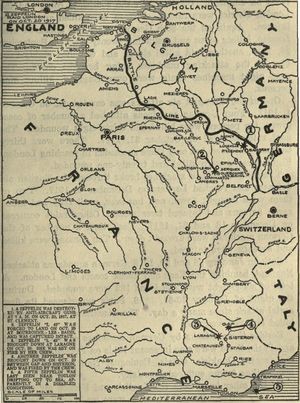
Five zeppelins destroyed after the air raid on London, October 19-20, 1917.
The end of September, 1917, brought a large number of raids on England. On the 24th the southeast coast and the London district were raided. Fifteen were killed and seventy injured. Again on the 25th German machines appeared over London, killing seven and wounding twenty-six. On September 29, 1917, another raid killed eleven and wounded eighty-two; two of the attacking machines being brought down. The next night machines again were over England, killing nine persons.
One of the strongest air attacks was carried out on October 1, 1917. Four German squadrons attacked a number of coast towns, ten persons were killed and thirty-eight wounded. The next raid occurred on October 31, 1917. There were thirty German machines, but only three succeeded in reaching London. Eight persons were killed and twenty-one wounded.
Twenty-five German machines broke through the English air defenses and reached London on December 6, 1917. Two of them were brought down, not, however, until they had killed seven persons and injured twenty-one. Other raids occurred on December 18 and 21, 1917. Each time a number of the German machines were brought down. Ten persons were killed and seventy were injured.
Both on January 28 and 29, 1918, German squadrons attacked England, bombing the Kent and Essex coasts and London. A total of sixty-eight were killed and 183 were wounded. During the night of January 30-31, 1918, Paris experienced its first aerial attack since many a day. The casualties were forty-five killed and 207 wounded.
Besides these attacks by German machines against England and Paris, there were also incessant raids on French cities near the front. Dunkirk, Calais, Boulogne, Nancy, Belfort, and many other towns suffered especially.
On the other hand both the English and French air service were very active. Frequent attacks were made on French and Belgian cities held by the Germans, especially on Lille, Bruges, Ostende, and Zeebrugge. Some of the near-by German cities, such as Metz, too, were frequently attacked. German airdromes also were subjected to continuous attacks, hampering German operations to a considerable extent.
In retaliation for the German attacks on English cities, both French and British air squadrons made many successful raids on German inland cities. Few details are available regarding these raids, however, the German Government having adopted a policy of more or less silence concerning the results achieved. Amongst the German cities attacked were especially: Colmar, Frankfort-on-Main, Freiburg, Stuttgart, Tübingen, Saarbrücken, Lahr, Mannheim, Rastatt, Ludwigshafen, Thionville, Trèves, Pirmasens, Kaiserslautern, Karlsruhe.
On the Italian front, too, there was greater aerial activity than ever. Pola, the Austrian naval base in the Adriatic, south of Trieste, was the chief aim of the Italian attacks, in which British airmen, having come to the support of the Italians, frequently participated. It was visited many times and much damage was done, both to ships and naval establishments. Trieste, too, was bombarded a number of times with good results.
The Austro-German air services made a number of attacks against Italian cities back of the front. Venice was one of the chief sufferers. The first attack occurred on August 14, 1917. Unfortunately many of these raids on Italian cities resulted in serious damages to churches, palaces, and other monuments of historic fame and value. Another attack against Venice was made on September 7, 1917. Again on November 25, 1917, Austrian or German airplanes bombed the ancient city of the Doges.
In December, 1917, Padua, not very far from the New Austro-Italian front, was the principal recipient of Austrian attentions. It was bombed on December 28, 30, and 31, 1917. About twenty persons were killed and some seventy wounded. Considerable damage was done to the cathedral, many other churches and numerous houses.
During the first few days of January, 1918, Vicenza, Bassano, Treviso, and Padua were bombed, almost continuously. About fifteen persons were killed, and fifty wounded and great damage was done to some of the wonderful old churches and palaces in these towns. During the night of January 26, 1918, Treviso and Mestre were bombed. In the latter city two Americans, William Platt and R. C. Fairfield, attached to the American Red Cross, were killed.
Figures regarding losses of the various air services were growing continuously more scarce and unreliable, a considerable amount of secrecy being imposed on all sides for military reasons.
In August the Germans claimed that during July, 1917, they had brought down 213 Allied aeroplanes and twenty-four balloons, but had lost only sixty machines themselves. From this source it was claimed that during August, 1917, the Germans lost sixty-four against 295 Allied machines, and that during December, 1917, the corresponding figures were eighty-two and 119.
The only official announcement regarding losses suffered by the German air services was made by the French authorities, who claimed that French airmen had accomplished the following results against the Germans:
1917
Brought down in French lines
Brought down in German lines
Seriously damaged
August
3
53
59
September
7
60
80
October
15
27
61
November
2
15
17
December (1-15)
16
21
28
—
——
——
43
176
245
For the period January to December 15, 1917, French airmen claimed the following figures, brought down in German and French lines: 586 machines; seriously damaged, 583. In practically the same period in 1916 (January-December 31) the corresponding figures had been only 417 and 185.
Some interesting figures also were published from combined English and French calculations regarding the strength of the German air service at the end of 1917. It was claimed that it consisted of more than 200 squadrons with a total of about 2,500 machines, divided as follows:
Bombing squadrons
23
Chaser
"40
Protecting
"30
Patrol
"80
Artillery
"100
There were also said to be numerous separate squadrons of aeroplanes and hydroplanes belonging to the German Navy, and about twelve squadrons each for garrison and training purposes.
Amongst other events in the various aerial services a number deserve especial mention. On September 7, 1917, German machines bombed a number of Allied hospitals on the French coast. As a result four Americans, belonging to a Harvard unit, were killed and ten wounded, and another American, a member of a St. Louis, Mo., unit, was killed.
On September 11, 1917, the famous French "ace," Captain Georges Guynemer, was killed in an air battle, after having brought down shortly before his 53d enemy plane.
On November 22, 1917, the British Admiralty announced that a successful air attack in the vicinity of Constantinople had been carried out by a large British bombing airplane, which flew from England to a British base in the Mediterranean in a series of eight flights. The stopping places included Lyons and Rome, and the total distance covered was nearly 2,000 miles. The machine was actually in the air thirty-one hours. This is believed to be a world's record for a cross-country journey and for the weight carried. During some parts of the flight strong winds and heavy rainstorms were experienced, and there was one stretch of 200 miles over a mountainous country where it would be impossible for any machine to land.
Another record long-distance flight was that made by Captain Laureati of the Italian air service in a S. T. A. machine with a 200 H. P. Fiat engine, from Turin to London, a distance of 650 miles. The distance was covered in seven hours, twenty-two minutes, and thirty seconds. No stops were made and one passenger, a mechanician, was carried.
In the latter part of January, 1918, the former German cruiser Goeben, then the Turkish Sultan Selim, having been beached after a fight with British naval forces at the entrance to the Dardanelles was bombed repeatedly by British naval aviators who also bombed Constantinople with success.
As a result of a raid, carried out during the latter part of August, 1917, a member of the famous Lafayette Squadron, Corporal H. B. Willis, Harvard '17, was captured by the Germans after his plane had been shot down behind the German lines.
Another member, Sergeant Douglas MacMonagle of San Francisco, who had joined the Lafayette Squadron in June, 1917, and had received the French war cross on August 9, 1917, was killed in a fight on September 24, 1917.
PART VIII—THE WESTERN FRONT
CHAPTER XXXVI
PREPARING FOR THE GREAT OFFENSIVE—THE ATTACK MARCH 21—FIRST PHASE OF THE BATTLE
With the coming of bright, springlike weather on the western front in the first weeks of February, 1918, the contending forces displayed a new activity. The sodden fields were drying out; the snow and mud which made roads impassable had disappeared. If the fine weather continued to hold, the much advertised German offensive could not be long delayed.
The Allies were constantly engaged in trench raids for the main purpose of gaining information from prisoners as to the movements of the enemy. It was learned that the Germans were making intense preparations for a big operation. Fresh troops and many guns were constantly arriving on the front. Certain back areas were being cleared for action. Every day large bodies of troops were practicing attacks under the tutelage of experts.
The Allies meanwhile awaited the promised blow hopefully if not calmly. As far as could be ascertained they had a preponderance of men and guns, and the most elaborate preparations had been made during the winter months for the anticipated offensive.
But the much heralded "great push" did not start in February. The Germans were cautiously "feeling out" the ground, by means of trench raids and bombardments, and gathering information through their aerial observers regarding the disposition of the Allied forces, while the intense activity which prevailed within their own lines foreshadowed the nearness of a mighty attack, and what might prove to be the most sanguinary period of the war.
During the first days of March the Germans were engaged daily in raids all along the French and British fronts, but in every attempt they were repulsed with considerable losses. Determined efforts were made by the enemy to obtain possession of Fort La Pompelle to the southeast of Rheims, which would give them a dominating position from which to complete the destruction of that martyred city. Along a front of nearly ten miles extending from Loivre to Sillery the German infantry advanced from five different points. Some troops succeeded in reaching Alger Farm, a fortified position fronting on Fort La Pompelle, but none was able to enter the fort itself.
The French regiment holding the position in a spirited counterattack drove the Germans back, and regained every inch of ground, though bombarded by thousands of gas shells which filled the air with poisonous fumes. It was during this bombardment that a number of French prisoners escaped their captors and sought refuge in a shell crater where they discovered a large supply of hand grenades. With these they were able to hold off the enemy who tried to capture them and after killing a number succeeded in regaining their own lines.
On March 6, 1918, the Germans made a strong attack on Belgian positions in the flooded zone northwest of Dixmude. At daybreak Beverdyk and Reigersvliet were bombarded by explosives and gas shells and an infantry attack in force followed.
The Belgian artillery replied with a heavy barrage and the fine work of their gunners and riflemen checked the German advance at Beverdyk and eventually drove them back to their own lines. At Reigersvliet the Germans won a footing at several points owing to the fact that the floods in some places had largely subsided, and made an advance comparatively easy.
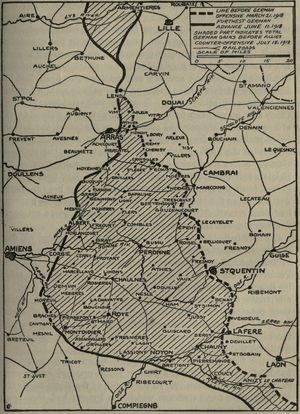
The German offensive from Arras to the Oise, March-June, 1918.
It was here that a Belgian commander with only nine men and a machine gun, and occupying a bridgehead, held back hundreds of Germans and twelve machine guns until a patrol arrived. With this slight reenforcement the Belgian officer took the offensive and by a dashing attack recaptured the position which the Germans had won in front of the bridgehead. Belgian chasseurs had meanwhile been organizing for a counterattack. To reach the German positions it was necessary to cross the flooded area by a single plank walk which was completely dominated by German artillery and machine-gun fire. But the Belgians went forward as coolly as if on parade amid a tempest of shells, and attacked the invaders with reckless bravery. Close and sanguinary fighting ensued, but by 1 o'clock in the afternoon the Belgians had succeeded in capturing the first of seven posts which lay in a semicircle in front of the bridgehead. For hours the fighting raged back and forth, but the stubborn German resistance broke down before the flaming fury of the Belgian spirit and late in the afternoon the last post was regained from the enemy. The German losses were heavy. Large numbers were found dead on the barbed wire. Belgian gunnery had been remarkably effective. The Germans lost as prisoners five officers, 111 men, and a dozen machine guns.
On March 8, 1918, after a bombardment that lasted all day, the Germans launched an attack on the British lines on a front of nearly a mile from south of the Menin road to north of the Polderhoek Château. The assault was vigorously pressed, aided by intense artillery fire, but the Germans were driven back at all points except in the neighborhood of Polderhoek, where they penetrated British advanced posts on a front of about 200 yards. Here the fighting continued for the greater part of the night, with the result that the British recaptured all the positions they had lost.
In the first ten days of March the Germans made twenty hard-driven raids along the French front, most of which were repulsed without difficulty. In the region of the Butte-du-Mesnil they regained some trenches which the French had won from them in February.
The British on their front continued to hold the initiative, carrying out successfully minor operations along the Ypres salient as well as at many points south.
The Germans continued to make swift dashes into the British lines at a number of points. As subsequently developed, the purpose of these continued raids was to search out the weak spots in the British defense. During two successive nights the Germans undertook no less than ten minor operations along the British front, some of which were of more importance than mere raids.
In the midst of this continued activity the great offensive was not forgotten. It was a period of great tension for the Allied forces, and more than once there were rumors that the great push had started, and no-man's-land was deluged with shells and the night was bright with star shells and illuminants, to be followed by comparative calm only broken by raids and minor operations.
As described in another place, the American troops took an active part in many of these minor engagements which tried their courage and served as excellent schooling in the art of active warfare.
At 8 a. m. on March 21, 1918, the Germans launched the great offensive on a front of over fifty miles extending from the river Oise in the neighborhood of La Fère to the Sensée River about Croisilles. When the attack was made the position of the Allied armies was as follows: The British Fifth Army under General Sir Hubert Gough held the front from the Oise at La Fère to a point north of the Omignon River, where the defense line was taken up by the Third Army under General Sir Julian Byng, whose left rested on the Scarpe River, joining here the First Army under General Sir Henry Horne. Sixteen divisions held this line of about 100,000 yards, which gave to each division (9,000 rifles) about 6,000 yards.
Facing the British were three German armies. The Seventh, under General Otto von Below, on the right held the front from north of the Scarpe to the Scheldt at Cambrai where General von der Marwitz with the Second Army prolonged the line down to north of St. Quentin. General von Hutier, commanding the Eighth Army, held the line on Marwitz's left between Omignon River and the Oise, where an army under General Böhm faced the Third French Army under General Humbert.
The German offensive had been prepared with the greatest care; every division had rehearsed the part it was to play when the hour of attack should come. Before the push the British lines were deluged with shells, and this was followed by showers of projectiles that liberated poisonous gases. The infantry now went forward in waves following each other closely. The first wave of troops would be swept almost away by the British gun and rifle fire, but those that remained alive hung on until joined by more waves of men, when using flame projectors they proceeded to drive the British out of the trenches.
The Germans were prodigal in the waste of man power, counting on weight of numbers to crush their opponents. After they had captured the first British line, the rear lines were deluged with fire from the machine guns, rifles, and every form of small artillery. This overpowering avalanche of death-dealing projectiles prevented the British in the rear from coming to the rescue of their fellow soldiers in the first line. Under the protection of this storm of bullets the Germans advancing in waves penetrated the British second line. After they had gone some distance the first ranks of infantry lay down, and permitted other waves of men to pass through their ranks. Great numbers of three-inch guns and small cannon on low carriages that could be swiftly moved were now brought up behind the infantry and the attack went on.
The German attack was directed against the center of the Allies' position. Their aim was to drive a great salient on a front of fifty or sixty miles through the occupied lines which would divide the French and British, after which they were to be dealt with separately.
The German objective was Amiens, which, situated astride the Somme, is on the main trunk-line railroad from Paris to the Channel ports of Boulogne and Calais, the most important strategical point in northern France.
If the Germans succeeded in gaining their objective, Sir Douglas Haig's troops separated from their French allies would be penned up in a northwestern corner of France with their backs to the sea, or they would be forced to retreat behind the lower Somme in order to cover their communications with Havre.
The Germans began their great offensive by an intense bombardment of both high explosives and gas shells, while a powerful infantry attack was launched on a front extending from Croisilles to La Fère. The misty weather that prevailed in the morning of March 21, 1918, was favorable for an assault, and the Germans were close to the British lines before they were discovered. In the course of the first onrush they broke through all the British outpost trenches and south of Cambrai penetrated some battle positions.
Forty German divisions were identified by the British as taking part in the first day's attack, but it was believed that at least fifty in all entered the battle before the day closed. At several points the British were heavily outnumbered. Nine German divisions were hurled against three British at one part of the line and eight against two at another.
The German storming troops, including the Guards, made a brave appearance in new uniforms. They advanced in solid ranks until their formation was broken by the intense British machine-gun fire.
Over the dead and wounded the supporting troops swept in countless waves and there was no faltering as the hurricanes of shells swept through their ranks. As hundreds fell others closed in and filled the gaps and the human tide rolled relentlessly on.
The Germans were exceedingly strong in guns. At some points in the line they had one to every twelve or fifteen yards. No less than a thousand confronted three British divisions. With heavy long-range guns they were also well provided and back areas to a distance of twenty-five miles and more were under shell fire.
Among the places against which the Germans first directed their efforts were Bullecourt, Lagnecourt, and Noreuil west of Cambrai, the St. Quentin Ridge on the right of the Cambrai salient, and Ronssoy and Hargicourt south of the Cambrai salient.
The Germans reported that they had captured the British first line between Arras and La Fère and 16,000 prisoners and 200 guns.
On the following day (March 22, 1918,) the fighting reached the greatest intensity in two sectors—one north of Cambrai and the other southwest. The fighting on the northern front was about Bullecourt, while Hargicourt was the southern center. Before attacking the sector between the Canal du Nord and Croisilles the Germans for four hours deluged the British with every kind of projectile and high explosive that a gun could throw.
The British were compelled to fight for hours with their gas masks on, but despite this drawback they were in high spirits because they were able to create such havoc when the Germans advanced in massed formation.
Around Mory on the northern end of the battle field the Germans attacked with superior numbers and the fighting was especially fierce. The British held on during the day, but toward evening the Germans gained a foothold in the village after close fighting that lasted some hours. The Germans advanced for this attack from Croisilles and for a long time were held back by a company of British gunners who were stationed on high ground, from which point of vantage they mowed down the enemy with a grilling fire.
The most critical period for the Allies since the offensive was launched was in the afternoon and the night of March 22-23, 1918, when the British lost important positions one after another as German divisions in successive masses carried everything before them, regardless of losses. General Gough's Fifth Army especially suffered, being hit by Von der Marwitz on the north, and Von Hutier on the east. Under these sustained hammer blows the entire front gave way and the British were forced to retire across the Somme, pursued by Generals Lüttwitz and Öttingen. Lower down Generals Webern and Von Conta, with troops of the Seventh Army under Von Gayl, captured Ham, and forced the French who had crossed the Oise back to Chauny.
This was the blackest hour for the Allies. Von Hutier had rolled up the British right wing. The road to Paris down the Oise was no longer a doubtful adventure. Unless the broken link between the French and British could be restored the Germans had accomplished what they set out to do.
In this crucial hour for the Allies, when the demoralization of the Fifth British Army was complete, General Carey with a scratch division kept it in touch with General Byng's Third Army on the north over an eight-mile gap, and the French General Fayolle saved it in the south over a thirty-mile gap between it and the Sixth French Army.
As the result of the first two days' fighting the Germans claimed to have captured 25,000 prisoners, 400 guns, and 300 machine guns. It was also claimed that between Fontaine-les-Croisilles and Mœuvers German forces had penetrated into the second British positions and captured Vaulx-Vraucourt and Morches, the former being about three and a half miles, and the latter two and a half miles, behind the former British front. It was further claimed by the Germans that the British after evacuating their positions in the bend southwest of Cambrai were pursued through Demicourt, Flesquières and Ribecourt. Between Gonnelieu and the Omignon stream the first two British positions were penetrated and the heights west of Gouzeaucourt, Heudicourt, and Villers-Faucon were captured.
The German official report stated that the battle of attack against the British front was under command of the kaiser.
The Germans sprung a new form of frightfulness on the Allies when at 8 o'clock in the morning of March 23, 1918, they bombarded Paris with long-range guns. At intervals of about twenty minutes shells of 240 millimeters (about 9.5 inches) reached the capital, killing ten persons and wounding others. The shortest distance from Paris to the front was over sixty-two miles. The first daylight aeroplane raid followed this bombardment, but did little damage. Public interest was centered on the mysterious gun that could drop shells on the city from such a great distance. Pieces of shells examined were found to bear rifling marks showing that they had not been dropped, but were fired from some kind of gun. Later the French located several of these "mystery guns," and some were destroyed. The only purpose they could serve was to terrify the people of Paris, otherwise they were of no military importance.
While the British front was being overrun by the German hordes the French front was subjected to violent artillery fire, especially south of the Oise in the Rheims region, in Lorraine, between Harracourt and the Vosges mountains and the heights of Alsace. The Germans made only one attack on the French lines in the region of Blemeray, where they were dispersed with considerable losses in dead and prisoners.
South and north of Péronne the Germans renewed their attacks on the British front throughout the day of March 24, 1918. South of the city they succeeded after heavy fighting in crossing the Somme at some points.
North of Péronne violent attacks were directed against the line of the Tortille River (a tributary of the Somme), where the British were finally forced to withdraw to new positions. Although fighting continued at different points during the night, the situation had not changed. British troops held the line of the Somme River to Péronne. German troops that attempted to cross the river at Pargny were driven back. The British right was now in touch with the French, and continued to hold their positions to the north of the Somme at Péronne after beating off a number of attacks made by the Germans on this front during the early hours of the night.
The Allies, despite considerable losses and the yielding of some miles of territory, were undismayed. The Germans had not attained their objectives at any point. Hard fighting was still in progress, but the British were holding strongly the whole front line to which they had withdrawn. The British had used only a few troops besides those that held the front lines. The brave defense maintained by these shock troops enabled the British main body to fall back on the positions they had established a long time before the German offensive was started.
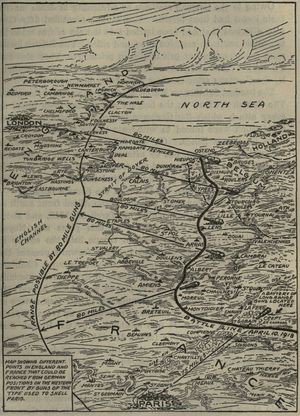
The range of the German 80-mile gun.
Owing to the German methods of advancing in dense masses their losses had been terrific. The British identified fifty German divisions that had been hurled into the sea of fire made by the Allied artillery, machine guns, and rifles. The British losses were considerable, but principally in prisoners. They also lost a number of guns, but very few pieces of artillery were captured by the Germans after the first day of the offensive.
The hardest fighting on March 25, 1918, was around Bapaume. The British artillery on the heights west of the town broke up every attack which the Germans launched. Later in the day the British were forced to withdraw to the west, leaving the town in enemy hands. On the following day the Germans renewed their attacks, but by afternoon these had ceased, and the British took advantage of the comparative calm to retire in good order to their old positions behind the Ancre which they held in July, 1916, when the battle of the Somme began.
The Germans began their attacks on the Allied front south of the Somme early in the morning of March 26, 1918, and about 10.30 had captured Roye. West of this place and Noyon the British, French, and American troops held the enemy in check. Fresh German divisions brought forward pressed the attack all along the Somme. The assaults around Chaulnes and on the front northward from there to Bray were especially violent. The German troops displayed a reckless bravery in these attacks and were heavily punished. Their losses were so considerable that reenforcements were brought up from all parts of the western front. It was established by the British that more than seventy divisions (about 840,000) men were engaged.
The net results to the Germans during the seven days' fighting may be briefly summed up as follows: They had won back most of the line they lost when retreating from the Somme line of 1916 on the fifty-mile front between the Oise and the Scarpe and this stretch of territory is from twenty to twenty-five miles wide along about forty miles of front. Though the Germans had failed to gain all their objectives and the offensive had not proved as successful as they hoped for, the Allies were not disposed to minimize the seriousness of the situation. They found comfort in the fact that in the seven days' fighting the British who had borne the brunt of the blows had lost in killed, wounded, and missing not more than 100,000 men while the German losses were nearly 600,000. It was also believed that at least one half of the remaining German troops had reached such a point of exhaustion that they could no longer do effective fighting. At the close of the seven days' struggle the battle line took in Fenchy, Boyelles, Hebuterne, Albert, Chapilly, Bray-sur-Somme, Avre, and Noyon.
After an all-day battle north and south of the Somme, with Arras as the chief center, the British forces beat off the Germans, inflicting heavy losses. The attack on this new sector, delivered on a wide front north and south of the river Scarpe, was opened with an intense bombardment, and under cover of smoke clouds. The Germans were unable to break or even bend the British front and they lost a large number in killed and prisoners. South of the Somme, the British, subjected to fierce assaults, maintained their positions throughout the day, but the Germans brought forward fresh troops, and by sheer weight of numbers forced the British about nightfall to fall back on Chapilly. North of the Somme the British maintained their line intact.
On the same day the French made substantial gains on the front from Lassigny to Noyon, advancing their line about ten kilometers (6.21 miles) to a depth of about a mile and a quarter. During the entire morning the Germans pressed vigorous assaults in the region of Montdidier in attempts to enlarge their gains west and south of the town. The French troops in spirited counterattacks drove the Germans out of the village of Courtemanche, Mesnil-St. Georges, and Assainvillers, and proceeded to occupy these places solidly.
On the following day fresh German troops were thrown against the French Army maintaining the junction between the French and British lines. The French made a determined stand, but the German pressure forced them to retire toward the west. The Germans broke through at Montdidier and occupied that place. In order to keep in touch with the British the French were pushing northward to relieve part of the line of their ally which had been thrown back. At the same time the Germans made a demonstration at the point where the British and French lines joined. Employing large forces, they were able to make a breach in the British line, but the French sent forward cavalry and infantry into the gap and closed it.
The salient which the Germans had now been pushing westward since the beginning of the offensive was now forty miles long at its farthest point, from Vimy Ridge, three miles south of Arras, to two miles south of Lassigny. Its greatest width was thirty miles, from the old line west of La Fère westward to Montdidier, the junction of the new western and southern fronts. On the north the territory was flanked by a semicircular ridge lying north and northeast of Arras, beginning with Notre-Dame-de-Lorette, six miles southwest of Lens, and ending at the much-fought-over Vimy Ridge.
The base of the German salient ran from Montdidier east and a little south, by way of Noyon, and linked up with the old line between St. Gobain and Anizy-le-Château, nine miles west of Laon, a distance of thirty-two miles in all. Just as the northern extremity of the German salient was flanked by the Arras ridges, so the southern extremity of thirty-two miles was flanked in the east by the watershed of the Oise and the Aisne, and eastward from the valley of the Oise, where it is joined by the ridge lying parallel to the Chiry-Lassigny highway.
The Allies holding the ridges north and south of the German salient were in a favorable position, and it seemed unlikely that the Germans would attempt to push farther westward without trying to capture the high approaches on their flanks.
It was known to the Allies through their aerial observers that the German armies, reenforced by new divisions that had been brought from Russia, were massing for another powerful attack.
On March 28, 1918, strong German forces drove back the British line south of the Somme to a line running west of Hamel, Marcelcave, and Demuin in the direction of Amiens. On the same date the Germans launched a terrific drive in the Scarpe sector with the purpose of capturing Arras and Vimy Ridge. Six German divisions were flung against the British positions, while four were held in reserve, but they failed to break through. To the south between Boiry and Serre eleven divisions attacked the British positions, but were forced back.
On the same date, in the Montdidier region, the French under Pétain not only held their ground but made gains. In the course of the evening and part of the night the Germans made violent attacks in the endeavor to eject the French from the villages of Courtemanche, Mesnil-St. Georges, and Assainvillers, which were won the day before, but in every instance were driven back with heavy losses. The French followed up their success by driving the enemy out of Monchel, which they occupied.
To the north of Montdidier Franco-British troops continued to hold the Germans on the Avre River and in front of Neuville, Mezières, Marcelcave, and Hamel.
It was evident that the great German offensive was losing force. The fighting was still intense at some points, but no operations were attempted on such a colossal scale as marked the fighting in the first week of the battle. At many places along the front of attack the Germans were being driven back and at others French and British were holding their positions firmly. Artillery battles had now taken the place of infantry fighting to a great extent, a sure sign that the German armies were in an exhausted condition and needed time to re-form and recuperate. As the Germans had been unable to drag much artillery with them during their advance the French had the advantage.
On March 28, 1918, the news that General Ferdinand Foch, chief of the French General Staff had been made generalissimo of all the Allied forces in the western theater of war was received with general satisfaction by the Allied nations. The Allies had long suffered from lack of coordination, while the Germans had not only profited by their own united direction, but were also advantaged by the frequently unrelated efforts of their enemies. General Foch, who was born in 1851, began mastering the strategy of war in 1870. He had studied German mentality. He counted on their repeating in future conflicts the maneuvers that had succeeded, and also expected them to make some of the old mistakes. Foch led the Ninth French Army at the Battle of the Marne, where, according to some military critics, he won first honors. In the spring of 1915 he led his army in the offensive between Armentières and Arras. After these operations he was surpassed in public opinion of the French army chiefs by Generals Pétain and Nivelle, whose wonderful leadership before Verdun made them famous throughout the world. When General Pétain succeeded Nivelle in May, 1917, as commander in chief in the field, General Foch took his place as chief of staff in Paris. President Wilson, who had been urging unify of command ever since the inter-Ally war conference at Paris in the winter of 1917, was among the first to congratulate General Foch on his appointment as generalissimo of all the Allied forces on the western front.
CHAPTER XXXVII
THE SECOND PHASE OF THE GREAT GERMAN OFFENSIVE
The full force of the great German offensive having spent itself, though fighting still continued, it may be of great interest to consider how far the Germans succeeded in carrying out their carefully laid plans.
It was evident that their main purpose was not to capture Paris or reach the Channel ports, though these objectives were considered, but to destroy either the French or the British army. The British being the most powerful of the Allies' armies, owing to conditions that developed after the offensive started, was made the object of the Germans' most determined destructive efforts. They planned to strike a mighty blow along the Oise between St. Quentin and La Fère, at the junction of the French and British troops. Their purpose was to break through at this point regardless of the cost. This accomplished, they would push on up the Oise valley, and by throwing large forces across the British right turn it and roll it up. To accomplish this it would be also necessary to destroy the British salient at Cambrai, for unless this was done an advance down the Somme would have left the whole German flank exposed to attack from the north.
The first German attack was launched against the Cambrai salient from the north and the east, and was successful as the British were driven back.
In this preliminary assault the Germans employed some ninety divisions or over 750,000 men on a front of about fifty miles. This was the heaviest concentration of men to the mile that had so far been used in campaigns on the western front. Against these forces the British had only about 5,000 men to the mile or less than a third of the number the Germans had in action. Having disposed of the Cambrai salient the Germans had opened the way for the real attack south which was made in the angle between the Oise Canal and the Somme. The assault was carried out with great masses of men in close formation, and the Allies' lines were overwhelmed in the first rush. But the British and French made an orderly if hurried retreat and their front remained unbroken. The Allies made the Germans pay heavily for every gain, fighting on steadily from point to point. The British during the retreat still clung to the southern bank of the Oise, but were finally forced across the river at Noyon which fell to the Germans.
Meanwhile in the north the British were slowly falling back on the old battle field of the Somme. It was wisely decided by the British High Command to retire rather than bring forward the strong armies they held in reserve back of the lines. The use of these armies would eliminate the possibility of a great counterattack. Having reached the old battle field and after the Ancre valley was passed, the British ceased to retreat and established themselves strongly on the west bank of the river.
South of the town of Albert the Germans made more important gains. They had reached and passed the Allies' old line as it existed before the fighting on the Somme. But in the last days of March they made little progress as their artillery had not kept pace with the forward rush and until the guns arrived no important advance could be made.
The French had halted behind the Avre River, an excellent position, for there were wide marsh belts lining either bank of the stream. Before the French ceased to retreat the Germans had pushed their advance westward and encircled Montdidier, producing by doing this a salient in their lines with the town as the apex. One German flank extended eastward through Lassigny to the Oise and the other along the Avre and behind it. This salient marked almost the extreme limit of the German push.
North of the Somme and south of Arras the German advance was checked, because the British held such strong positions on Vimy Ridge and the heights of Notre-Dame-de-Lorette. The Germans could not push on north of the river before they had reduced these strong and commanding positions. To clear the way they made a determined attack with 90,000 men on a small front of not more than five miles east of Arras. After an intense artillery fire that lasted all day the Germans repeatedly attacked, but met with repulse. They gained a few hundred yards at several points, but the British line remained practically intact.
The net results of the German offensive showed that they had overrun considerable territory and were some miles nearer Paris. But they had not succeeded in crushing either the French or the British armies, and the real question in the war was the destruction of forces. Territorial gains were only of value as far as they contributed to that end. There was not the least doubt that the Germans had lost a far greater number of men than the Allies and that they could not continue for long a campaign on such a costly scale. Unless they found some other way out they were heading straight for defeat even if they should succeed in overrunning the greater part of France.
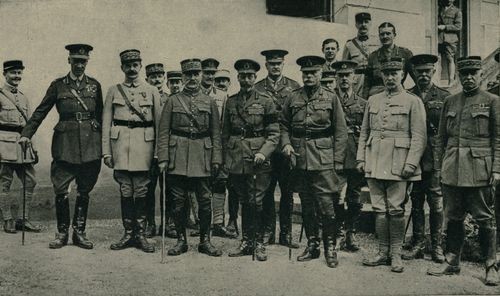
A remarkable group of British and French leaders photographed on the British front in 1918. King George is the center. At the king's right (left of picture) are Marechal Foch, General Debeney, and General Rawlinson. At the king's left (right of picture) are Field Marshal Haig, General Pétain, and General Fayolle.
In the last two days of March the Germans resumed heavy fighting in the region between the Somme and the Avre and southward to Montdidier. Six villages around Montdidier were wrested from the French—Ayencourt and Le Monchel south of the town, Mesnil-St. Georges, Cantigny, Aubevillers and Grivesnes. On the following evening the French recaptured Ayencourt and Le Monchel, a hundred prisoners, and fourteen machine guns.
On the Oise front German detachments, consisting of a battalion of storming troops, having succeeded in crossing the river at Chauny, attempted to establish a bridgehead on the left bank. The French launched a swift and vigorously pressed counterattack, with the result that the German battalion was completely annihilated, or taken prisoners.
Between Montdidier and Moreuil there was stiff fighting during the last two days of March. The Germans repeatedly attacked almost without ceasing. Moreuil, captured by them, was retaken by the French, again taken by the Germans, and finally carried in a brilliant bayonet charge by British and French troops. Between Moreuil and Lassigny the German check was complete. The French also advanced as far as the vicinity of Canny-sur-Matz. A division of picked French troops after a hot fight in which they took over 700 prisoners captured Plemon and held it firmly against repeated attempts made by the enemy to oust them.
On the British front the Germans were especially active. Attacks followed one another at different points unceasingly during March 30-31, 1918. All these assaults were costly and failed. The Germans' determined efforts were unsuccessful elsewhere, for they lost considerable ground near Feuchy, four miles east of Arras; and near Serre, seven miles north of Albert, the British made a notable advance, capturing 230 prisoners and forty machine guns. South of the Somme, by successful counterattacks, the British regained possession of the village of Demuin. There was heavy fighting in the sector to the south of the main highway leading from Péronne to Amiens, which proved costly to the Germans and brought no adequate returns.
At the close of the month it was the opinion of the French and British High Command that the offensive for the present was checked. The Germans were making strenuous efforts to rush forward their heavy artillery, and a formidable attack might be expected with all the reserves available, but the Allies viewed the future with confidence. At the same time they looked for a long struggle which might develop into such a contest as was fought at Verdun and the first battle of the Somme.
April 1, 1918, showed a slackening in the German pressure. There was brisk, and at times, violent fighting between the Germans and Allies around Moreuil and Hangard. Attacks and counterattacks followed each other in rapid succession, which resulted in the British gaining some ground. If it was the purpose of the Germans to make a drive on Amiens, this sector was of special importance, for it lay east of the city between the Somme and the Avre. What encouraged the Allies' High Command to believe that Amiens was the objective was the massing of great numbers of German troops in this area and in the district around Albert. In expectation of a heavy blow in these regions the Allies brought into the battle front as rapidly as possible a great number of guns. The Germans too were making artillery preparations, but their guns were arriving slowly and not in considerable numbers. All day long on April 1, 1918, they launched local attacks near Albert, but were unable to make any impression on the iron wall of British resistance.
On the same day the First German Guard Division, which had been severely punished by the French at Grivesnes, returned to the assault, but received such a warm reception that they were forced to seek shelter in their positions, leaving the French masters of the situation.
The British were active on the first of the month, carrying out some successful actions. German positions in a wood along the Luce River were stormed and after sharp fighting the enemy was forced to withdraw, leaving the field strewn with dead. The Germans shelled the wood after it was occupied by the British, and then organized two counterattacks with the purpose of retaking it. Both attacks were caught in the British artillery barrage and shattered. South of Hangard the British improved their position and smashed two German counterattacks which essayed to restore the situation.
Early in the morning of April 4, 1918, the Germans launched a new offensive. Amiens was evidently the objective toward which their forces moved from three directions. One attack was made from the northeast from the general direction of Albert, a second from the east along the line of the Amiens-Resières railroad, and the third along the Avre River where the French held the line. The Germans employed fifteen divisions against the French and fourteen divisions against the British, or nearly 350,000 men, attacking the Allies on a sixteen-mile front. All day long and through the night the French were assaulted with extreme violence. The Germans seemed determined to break through at whatever cost, their immediate aim being the Amiens-Paris railway. Despite their efforts, ten times repeated, the Germans, at the cost of heavy sacrifices, only succeeded in gaining a few hundred yards of territory, and occupied the villages of Mailly-Raineval and Morisel, while the French still controlled the heights in the neighborhood. Grivesnes was subjected to the fiercest attacks, but the French troops held it securely, and broke down every assault that was made by the enemy. The Germans were so badly battered in the fighting that raged all day and night in this region that they did not resume the offensive on the following day, and General Pétain took advantage of the lull to launch successful counterattacks, gaining ground notably in the region of Mailly-Raineval (south of Moreuil) and Cantigny.
The northern and western outskirts of Cantigny, which was captured by the Germans a few days before, were now in French hands.
While the French were stubbornly holding their own against superior numbers, the British front south of the Somme was the scene of heavy fighting. The battle raged all day and far into the night and the British were forced back to new positions east of Villers-Bretonneux, nine miles east of Amiens. North and south of Albert their lines were heavily attacked along a front of about 9,000 yards between Aveluy and Dernancourt. All that the Germans gained in the fighting in this region was a foothold on a small triangular bit of territory just southwest of Albert, which brought the attacking troops close to the Albert-Amiens railway.
The net results of the Germans during the two days' fighting were a decided check and a very costly one.
On April 5, 1918, German forces engaged in massed attacks against the British lines just east of Corbie on the Somme. South of Hangard Wood the British were pushed back a short distance, but elsewhere the Germans achieved only costly failures.
Despite trifling gains here and there by the enemy, the Allies had every reason for feeling confident that the offensive would fail. In the vital sector between Montdidier and the Luce River, where the Germans were nearest to Amiens, their position was far from satisfactory, and in the north, where they must advance their lines if they wished to escape extreme danger, the situation was very bad indeed. The British were holding fast to their positions above Albert with indomitable courage, while the Germans were making a slow advance here and there at the cost of heavy sacrifice.
In the course of the fighting during April 7-8, 1918, the Germans made gains south of the Oise. Advancing toward the Ailette River they captured Pierremande and Folembray, driving the French to the western bank of the stream. The heights to the east of Coucy-le-Château were captured, and another force advancing from Verneuil-Barisis occupied the town of Verneuil.
Attacks and counterattacks continued along the British battle front. The little village of Cucquoy, near Serre, continued to be the center of the most determined German assaults. The place itself was nothing, a mere mass of ruins torn by artillery fire, but the hills around were occupied by the British, and the German advance was held up until these positions could be captured or disposed of.
On April 9, 1918, after a heavy bombardment in which over 60,000 gas shells were used, the Germans attacked British and Portuguese lines from La Bassée Canal to the neighborhood of Armentières (a distance of eleven miles).
The Portuguese in the center and the British on the flanks of the river Lys between Estaires and Bac St. Maur were forced to retire under the German pressure. Heavy fighting continued throughout the day in this sector. In the vicinity of Givenchy and Fleurbaix the British maintained their position and repulsed strong assaults. Richebourg St. Vaast and Laventie were occupied by the enemy.
In the morning of April 10, 1918, the Germans launched a new attack, with strong forces, against the British positions between the Lys River and Armentières and the Ypres-Commines Canal. The British were driven back to the line running through Wytschaete along the Messines Ridge to Ploegsteert.
South of Armentières, after a prolonged struggle, the Germans crossed the river Lys and established themselves on the left bank at a number of points east of Estaires and near Bac St. Maur. Southward from Estaires—the southern limit of the German offensive—the British continued to hold their lines. Givenchy was recaptured from the Germans, and 750 prisoners. The possession of this place was important to the Allies, as it stands on high ground, and is a gateway on the road to Béthune.
In the course of the two days' fighting in this region the Germans advanced in the center to a depth of about 5,500 yards, the British and Portuguese losing a considerable number of prisoners and guns.
In the retirement of the French forces to the line of the Ailette River two French battalions were cut off and the Germans took 2,000 prisoners. The retirement of the French was made on account of an awkward corner in the line.
The fighting during these days showed that it was the Germans' purpose to exhaust the British army. Their first plan had been to cut off the British from the French, but that failed. Now they attacked the British wherever they saw a favorable chance, hoping to destroy such large numbers that they would be unable to take the offensive.
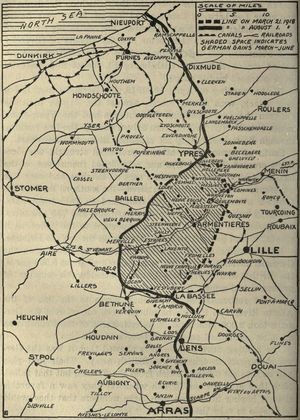
The German advance between Ypres and Arras, March-June, 1918.
During the night of April 9, 1918, the Germans made a strong assault on the French lines near Hangard-en-Santerre. The French retaliated with a counterblow that drove the enemy back in disorder. The village changed hands repeatedly, but early in the morning of April 10, 1918, the French gained possession of the place and of a cemetery near by, and established themselves strongly in the new positions.
All day long on April 11, 1918, the Germans were hurling great masses of troops against the British lines on the northern front, from La Bassée to the Ypres-Commines Canal southeast of Ypres. As the result of these heavy assaults Haig's troops were forced back north of Estaires and Steenwerck. The evacuation of Armentières followed. The German advance on the previous day between Warneton and the Lys on the north and their drive to the south of Armentières had subjected the place to attack from three sides. For the British to attempt holding the town under these conditions would have caused a useless sacrifice of troops. Armentières had no military importance, but the Messines-Wytschaete Ridge and the Passchendaele Ridge to the north of it were of great value. As long as these positions held out the British lines were safe. The Germans were confronted with the same situation that prevailed on the Somme front. The German push toward Amiens had been held up by the British possession of the Heights of Vimy and of the Notre-Dame-de-Lorette. These formed the hinge on which the whole British line swung as it moved westward. The same thing was happening in the north. The British center had given way under the fury of the German attacks, but the flanks held fast. On the north the Messines Ridge blocked the way of the German advance. For in case of a westward push both German flanks would be in great danger from this bastion which commanded the entire field of maneuver. Their front and rear as well as flanks would be subjected to destructive artillery fire from this ridge which therefore became the center of the fighting in the north.
The Germans recognizing the supreme importance of the ridge made determined and valiant efforts to capture the position. They launched one attack after another that were costly and brought no results. They entered the British lines in the village of Messines, but were promptly driven out in a brilliant counterattack and the important positions remained in British hands.
In the area west and northwest of Armentières the British troops were forced back in the fighting that continued throughout the day on April 12, 1918. The British retired to the neighborhood of the railway south of Bailleul, where the heaviest fighting continued without respite. The Germans captured Merville and drove the British forces operating near Ploegsteert to retire to new positions in the neighborhood of Neuve Église.
In the Hangard-en-Santerre sector of the French front to the southeast of Amiens the struggle was prolonged throughout the day. The Germans attacked with large forces, but the French held their own until late in the day, when the enemy, reenforced by fresh troops in considerable numbers, gained a portion of Hangard, while the French still held on to the western part of the town. In the Noyon sector the Germans were active with their artillery, but attempted no infantry attacks. Rheims, the martyred city, was again bombarded, with the result that a number of buildings were fired, especially in the vicinity of the cathedral.
During the night of April 12-13, 1918, the Germans made a determined drive for Neuve Église, three miles southwest of Messines, and after a prolonged struggle occupied the village. The British vigorously counterattacked in the morning and drove the enemy out, capturing a battalion commander and a number of prisoners. There was hard fighting at other points on the British front, the Germans losing ground at Festubert. On the French front all enemy attacks broke down. Northwest of Orvilles-Sorel French forces broke into the German line on a front of three quarters of a mile and won a strip of territory.
The Germans continued to bring up fresh divisions into the Messines sector, until twenty-three divisions were engaged. Neuve Église was wrested from the British during the night of April 14, 1918. Seven attacks were made on the British lines near Merville, only one of which pushed back the British line and was successful in gaining ground. The British in a dashing counterattack drove out the Germans and reoccupied the line. Bailleul and the neighborhood were the scene of violent fighting. The Germans seemed determined to carry the place at any cost. The town, which contained many handsome buildings, was reduced to a mass of ruins. The German pressure forced the British to evacuate the town in the night of April 15, 1918, after they had been driven from the heights to the south and southeast. The British troops fell back on the east and west line north of Wulverghem and Bailleul.
On this date (April 15, 1918) the Germans made other notable gains. Attacking the British on a nine-mile front, Haig's men were driven from Wytschaete and most of the Messines Ridge positions were taken. It will be recalled that this famous ridge was captured by the British from the Germans on June 7, 1917, after elaborate mining preparations had been made and 1,000,000 pounds of high explosives were used in blowing up the heights.
Intense fighting continued all day long on April 16-17, 1918, about the Messines Ridge and the Passchendaele Ridge to the north, forcing the British to retire to their lines east of Ypres.
In the Hangard sector on the French front, where since the beginning of the offensive the Germans had been hammering away in an effort to get astride the railway connecting Amiens with Clairmont, the British carried out a highly successful operation. At daybreak on April 17-18, 1918, along a front of about five miles between Thennes and Mailly-Renneval, the French launched a dashing assault that resulted in the capture of over 600 prisoners and the seizure of some important points which the enemy occupied. The ground over which the French had to charge had been transformed by recent rains into heavy mud into which the attackers sank at times up to their knees, but they pushed on undismayed. The commanding heights on the northern flank were carried amid victorious cheers. In the center bodies of infantry penetrated Senecat Wood and cleared up the gun emplacements which defended the approaches to Castel. Pressing forward, the French infantry established themselves on the outskirts of the town and prepared for an assault on the place.
Toward the south other French units captured dominating heights and advanced toward Anchin Farm on the road between Ailly-sur-Noye and Moreuil. The French advance met with the strongest opposition from the Germans, but their efforts were ineffective and their casualties heavy.
The main purpose of the Germans in their continued pounding of the French around Hangard was to prevent reenforcements being sent north. This they failed to accomplish. The French not only fought them off and gained ground, but were able to send a considerable force to the northern front.
The fighting around Hangard, which was prolonged for days, was of the most sanguinary description. Desperate hand-to-hand fighting took place in the streets of the town and inside the houses. Hangard changed hands again and again, but was finally occupied and strongly held by the French.
The fighting continued with undiminished fury on the northern front, but the Germans made no important gains. Attacks in the Mont Kemmel region were beaten off. At Givenchy, and at other points of the front, the Germans failed to gain ground, while great numbers were slaughtered by the British machine-gun and rifle fire. It was estimated that the Germans employed 137,000 men in their furious assaults on the Allied front extending from Givenchy, eleven miles northwest to the neighborhood of St. Venant. Important reenforcements of French troops strengthened the British resistance in the north, and German masses attempting to break through lost heavily.
During the week the Germans, employing picked troops, made violent attacks on the Belgian front between Kippe and Langemarck, but were unable to gain a foot of ground. The Belgians captured 714 prisoners, a 77-millimeter gun, and 42 machine guns. Documents found on captured German officers revealed the importance attached by the Germans to the operation. They had planned to capture Merckem, Luyghem, Aschoop, and neighboring towns, and after reaching the Ypres Canal purposed to push on in the direction of Poperinghe and envelop the left of the Allies.
At the close of the week (April 20, 1918) it was evident that the German offensive had broken down, and that no more important movement would be attempted for some time. In the Givenchy-Festubert region (west of La Bassée) the British forces expelled the Germans from some advanced points which they had occupied two days before.
A determined attack made by the Germans against the French lines north of Seicheprey, in which the American troops fought with valor and distinction, is described in another part of this work.
In summing up the operations of the week, it will be noted that the fighting in the Lys region absorbed most of the German energy, and that the British defense was strained at times nearly to the breaking point. The German advance from the south was diverted by indomitable British resistance encountered at Givenchy. Armentières was evacuated to avoid an encircling movement, after which the German armies on the north and south of the place joined hands. British divisions on the north and south flanks remained firm, but the attack in the center was pushed, and after the river Lawe was crossed Merville, Merris, and Neuve Église were captured, when the advance was checked. The struggle then narrowed down to Bailleul, Nieppe Forest, and Mont Kemmel, the main objective being the capture of Hazebrouck. In the course of the week's fighting these villages changed hands a number of times, but in the end Bailleul fell and the Germans occupied Meterne, Wulverghem, and Wytschaete, and an important section of Messines Ridge. This rendered the forward line eastward of Ypres untenable, and the British retired to new positions. The fighting at every point during the week was of the most desperate character. The Germans found it difficult to exploit their first successes in any direction but the most northern and northwestern sectors, where they discovered a weak point and concentrated a powerful attack. The Allied High Command had no reason to feel discouraged, for the situation, though serious, gave ground for confidence. The net result to the Germans was a small gain in territory, but their losses in men had been appalling. It was no longer a question of overrunning territory in France, but the destruction of man power that would count in the end.
CHAPTER XXXVIII
THE GERMAN OFFENSIVE RENEWED—YPRES THREATENED—THE ALLIES' HEAVY LOSSES
The comparative quiet which had reigned for some days in the battle area was broken on April 23, 1918, when the Germans, using two divisions, attacked the whole British front south of the Somme, as well as the French forces on the British right. Villers-Bretonneux, the Germans' objective, stands on a ridge southeast of Amiens, an important position in reference to that place. A preliminary bombardment started at 3 o'clock in the morning and continued for nearly four hours, when their infantry advanced upon Villers-Bretonneux and the village of Cahy, from Hangard Wood, Marcelcave, and from below Warfusee. Among the German troops engaged were the Fortieth Guards Division, which had been fighting recently on this front, and the Seventy-seventh Division, fresh from Russia and in action here for the first time. At the hour the attack was launched a third German division, the Thirteenth, of Westphalian troops, fell upon the French near Castel to the south of the British forces. The Germans, after a fierce struggle, succeeded in gaining a little ground, when the French troops pivoted from the right and threw them back.
On the British front the Germans used tanks for the first time in an offensive, three of them advancing with the German infantry down the road to Cahy and Domart.
German attacks on the northern and southern sectors of this front were repulsed by the Allied troops, but the enemy made progress at Villers-Bretonneux. The fighting here continued throughout the day with unabated intensity and did not cease when the Germans captured the village in the early evening.
Their attacks broke down on the northern bank of the Somme and north of Albert. The British carried out a successful local operation northwest of Festubert, where they recaptured a post which the Germans had won on April 22.
British positions east of Robecq now came under strong enemy fire and were subjected to several strong attacks. The British line remained unbroken after every assault and the Germans were forced back, losing eighty-four men as prisoners and a number of machine guns.
In the night British and Australian troops launched several counterattacks against the positions the Germans had newly won in and around Villers-Bretonneux.
The Germans had been long enough in possession of the town and the neighborhood to set up strong defenses, and countless machine guns had been placed wherever they could do the most harm. When the British were driven out of the village after a hard fight it was late in the day and the Germans evidently thought that they would not attempt a counterattack until the following morning. But the British did not purpose to give the enemy any time to bring up fresh troops, and prepared for a night attack. They recognized the importance of Villers-Bretonneux, as it gave the enemy full observation of the British positions on both sides of the Somme Valley beyond Amiens.
The job of recapturing the village was given to the Australians who had made a brilliant record in carrying out night attacks and rarely failed of success. About midnight they set out, unpreceded by any artillery preparation, feeling their way along in the dark and relying solely on the weapons they carried with them.
The Australians broke into the village before the enemy woke up, and supported by several British battalions spent the night in clearing the Germans out of the place. The Germans were not disposed to surrender such an important observation point and put up a stiff fight, and the struggle raged for hours in the streets. Finally the British and Australians gained the upper hand and the village proper was freed of the enemy, who fell back on positions in the neighborhood. Fighting in the outskirts of the village continued in the morning. There was no gunfire even then, for the British, Germans, and Australians were so closely engaged in the struggle and so mixed up that the gunners on both sides were afraid of killing their own men.
On the western side of the village German machine gunners, cut off from their lines by the sudden counterattack, were stoutly defending themselves here and there among the remains of ruined buildings and dealt the British some shrewd blows before they could be driven out, or made prisoner. The British had escaped without severe casualties, while the German toll of dead was costly, especially in officers. In this operation the British captured between 700 and 800 prisoners.
In the Lys salient the Germans, employing large forces and aiming at Mont Kemmel, launched a succession of violent attacks from Wytschaete to Bailleul. The Allies made a brave resistance, but were compelled to fall back on prepared positions toward the Locre River.
Mont Kemmel is a hill of great tactical importance. It is almost covered with woods and stands out somewhat in front of the range of heights extending westward to the Mont des Cats, and to some extent dominating its western neighbors.
In the course of the fighting in this region (April 25-26, 1918) nine German divisions (about 120,000 men) were engaged, and the Allies, borne down by overwhelming numbers, were forced to give up the village of Kemmel, the near-by summit of Kemmel, and the village of Dranoutre to the south.
In the Somme-Avre battle area the French had been pitilessly hammered by overpowering numbers of German troops. The fighting in and around Hangard Wood was especially intense.
On April 25, 1918, the French repulsed seven assaults made on their lines north of the wood and in Hangard, which changed hands several times during the day. South of the Luce River the Germans were driven out of important positions which the French occupied and held firmly against repeated attempts made by the enemy to drive them out.
The Germans had by this time advanced to within three miles of Ypres, which was now threatened. The struggle for Voormezeele, the point at which the Germans had pushed closest to Ypres from the south, was prolonged and intense. They made a costly and futile effort to capture the wood southwest of the town on the 26th. The attack was desperately pushed, but met with disaster. Not only were their losses heavy in dead, but several hundred prisoners were taken by the Allied troops. Meanwhile the French were successful on their front from La Clytte to Locre (two miles west of Kemmel). Strong bodies of German troops under General von Arnim after four violent assaults captured Locre, but the French organized a strong counterattack and regained the village. They also won Hospice and Locrehof Farm, both strong points lying southeast of the place.
Ypres now came under heavy fire of the German guns; high explosives and gas shells rained down upon the ruins of the city for the first time in some months. Fields and villages around hitherto untouched by fire were showered with shells. The purpose was to catch the traffic on the roads and destroy soldiers' camps, but the only result was a few women and children killed.
Throughout the night of April 28, 1918, German batteries were active from the Belgian front down through Flanders to the districts about Béthune. About 6 o'clock in the morning, on the 29th, an attack was made according to the plan of General von Arnim after gaining Kemmel Hill; this was the capture of the chain of hills running westward below Ypres to Poperinghe, among them such familiar landmarks as Mont Rouge and Mont Noir. These hills, held at the time by the French, were of great tactical importance, forming the central keep, as it were, in the Allies' defense lines south of Ypres.
It was the purpose of the Germans, in case their frontal attacks against the French failed, to break the British lines on the French left between Locre and Voormezeele and on the French right near Merris and Meteren, but all their efforts failed.
On April 28, 1918, British flyers discovered the Germans massing troops on the road between Zillebeke and Ypres. A dense fog prevailed at the time, and a surprise attack was evidently planned. This never developed, for the assembly was promptly shelled by the British gunners and dispersed. After a tremendous bombardment that shook the whole countryside the German troops again assembled in the misty dawn and were again dispersed by British guns. The fighting in this area was almost continuous throughout the following day.
Around the Scherpenberg and Mont Rouge the Germans fiercely assailed the French lines and succeeding in making a wedge for a time, captured the crossroads, but were counterattacked by General Pétain's men, who drove them out of most of the ground they had gained there.
A tremendous barrage was flung down by the German gunners from Ypres to Bailleul, and somewhat later they began the battle by launching an attack between Zillebeke Lake and Meteren. South of Ypres they crossed the Yser Canal near Voormezeele with the purpose of striking the British, while they tried to push past Locre against the French holding the three hills. As a result of the day's fighting the British lines remained intact, while General von Arnim's hosts were shattered and decimated. On the French front the Germans won a little ground, but it was unimportant in relation to the situation.
On April 29, 1918, French troops carried out a brilliant counterattack in the night, recovering ground on the slope of the Scherpenberg and advanced their line 1,500 yards astride the Dranoutre road. They alone drove the Germans out of positions around Locre and entered into full possession of the village itself.
The Germans still occupied Mont Kemmel, but their hold on the height was of little value, as the Allied artillery kept the summit smothered with shell fire, making it impossible for the enemy to maintain any considerable body of troops there.
The French and British were elated over the outcome, for the greatest effort made by the Germans in the Flanders offensive had failed. In addition to a large number of divisions in position at the beginning of the battle the Germans had employed about thirty fresh battalions of reserves. Von Armin's great thrust had been carefully planned and his troops fought with reckless bravery if not with distinction. The French and British had defeated him with relatively smaller forces and had shown that their men were more than equal to the best German soldiers. Owing to the close fighting and frequent hand-to-hand encounters, the Franco-British capture of prisoners (over 5,000) was less than might have been expected in a struggle of such magnitude.
While the Germans up to the first of May had failed to make any farther advance on the scale of the first days of the big offensive, they were still a menace to be reckoned with. It was estimated that they had already thrown 2,000,000 men into the line, but many fresh divisions were available for further efforts. They had enough men in their depots in the interior to fill all their gaps for some time; but reconstituted divisions, as is well known, never equal in fighting quality the original formation, as a large number of slightly wounded men after recuperation is included.
As the Germans did not publish their losses, no correct estimate could be formed. Conservative opinion placed the number as over 350,000 men. The Germans had 186 divisions on the western front when the offensive began, and reenforcements brought from Russia and other fronts raised the number to 210 divisions; a German division consisting of about 12,000 men.
For some time it was a mystery to the Allies as to how the Germans succeeded in bringing forward new divisions into the battle area and so often escaping the notice of the vigilant French and British observers. This the Germans accomplished by exercising the greatest precaution and cunning.
In the first place the territory occupied by each German army corps was divided into two zones, the first of which might be under observation of the Allies' lookouts, and the other only from captive balloons which had a wide radius of view. According to German army orders, infantry occupying the first zone were forbidden on clear days to move in any greater number than four men together, mounted men not more than two together, and vehicles not more than two at a time, with a minimum of 300 yards between groups. In heavy, misty weather, these restrictions were relaxed and the movement of groups of forty foot soldiers, twenty cavalrymen, and ten vehicles was permitted.
In the second zone it was permissible to form groups of the size allowed in the first zone, on days of poor visibility, but there must be intervals of 500 yards. It was in this manner that the Germans' military movements were often hidden from the Allies' observers. German divisions making forced marches in the night slept in the villages during the day, and were heavily punished if they showed themselves in the streets.
No infantry operations were attempted by the Germans on May 1-2, 1918, but German gunners continued at regular intervals to bombard the Franco-British lines. General Pétain took advantage of the lull in the fighting to advance his lines between Hailles and Castel (south of the Avre), meeting with little opposition, capturing Hill 82 and the wood near by bordering on the river.
The Germans became active again on May 3, 1918, when, after a heavy artillery barrage, they attacked British positions south of Locon (on the southern flank of the Lys salient). They were easily repulsed and made no further attempt that day to renew the attack. On May 4th, 1918, British and French troops carried out a successful operation between Locre and Dranoutre, gaining ground on a half-mile front to an average depth of 500 yards and capturing a number of prisoners. The Germans were driven from three ruined farms that were perfect strongholds, and high ground was won by the Allies near Koutkot (west of Dranoutre). All these local successes were of real value, for they strengthened the Allied defenses of the approach to Scherpenberg and Mont Rouge.
May 5, 1918, was a great day for those irrepressible fighters, the Australians, who gave the Germans a bad thrashing west and southwest of Morlancourt between the Ancre and the Somme Rivers.
The Australians' attack was made on a front of 2,500 yards unheralded by any preliminary bombardment, but the British guns became active after they were on their way, keeping roads and tracks under fire to prevent the enemy from bringing up supports.
The German garrison on this front did not occupy any definite trench system, but occupied scattered rifle pits and rifle trenches just large enough to afford shelter for small groups and machine-gun crews. These hornets' nests were dangerous things to tackle, but the Australians had dealt with such conditions before and went about their work in a cool and businesslike manner. With bombs and bayonets the Germans were killed or driven out of their holes, and as they were all picked men selected for their courage and long experience in warfare they made a gallant resistance. The Australian generally fights better when he has a desperate opponent, and the struggle became intense and at close quarters. In the end the men from overseas crushed all opposition, killing over 150 Germans and taking about 200 prisoners. The success of this minor operation was of some importance, as it enabled the Allies to advance their line 500 yards.
At this time, in the course of the offensive, the Germans introduced, as a new form of "frightfulness," a sneezing powder, that was fired by high explosive shells. The sneezing powder sifts down through the gas masks and causes sneezing when the wearer is forced to take off his mask and receives the full effect of the lethal gases which the Germans had spread abroad.
Preparations were now under way for a new offensive. It was known to the Allies that Ludendorff had already massed 70 divisions and that reenforcements of men and guns were daily brought into the fighting area. The Germans now sought for a basis for a new drive, feeling their way by making thrusts here and there on the Allies' front. On May 8, 1918, they made a drive at the British lines in the battle area north of Kemmel in the Lys salient, penetrating trenches between La Clytie and Voormezeele. About 25,000 German troops took part in this attack. In the night General Haig's men came back in force and drove them out, but the Germans contested the field again and again during the following day. They won a little ground here and there, but were eventually thrown back and the British remained in sole possession of the terrain.
North of Albert the Germans captured a small but important strip of trenches on high ground. Their temporary success was dearly won, for they suffered terrible slaughter from the rifle and machine-gun fire which poured into their ranks as they advanced up the slopes. By a brilliant counterassault the Germans were driven out of the position won before they could organize the defenses. East of Bouzincourt, where the British occupied positions on high ground, the enemy followed much the same tactics, but they were unable to gain even temporary foothold in the British defenses. The graycoats advanced, shouting in English "retire," in the hopes of confusing the British. The response of the defenders was such a fierce fire that the Germans acted on their cry and fell back in disorganized masses, leaving hosts of dead on the field.
Along the greater part of the front military operations were now confined to small enterprises. The Allies assumed a waiting attitude expecting that the enemy would show his hand. The Germans had brought a large number of divisions into the line facing Amiens, indicating an offensive in that direction. The attempts to "feel out" the Allies' strength had received so many setbacks that they hesitated to begin any new operation on a large scale.
Days passed and still the Germans failed to start a great offensive. It was a period officially called "quiet," though on many parts of the front the guns were active, and raids and minor operations were carried out every day and night. There was continued fighting between French and Germans for the possession of Mont Kemmel, which changed hands again and again. Its value lay in the fact that the hill dominates considerable territory, and for that reason was long a thorn in the flesh of the ambitious Germans.
The anticipated German offensive so long delayed was begun on May 27, 1918. At 1 a. m. a terrific bombardment in which gas shells predominated was opened along a forty-mile front between Noyon and Rheims. The hurricane of fire continued undiminished for three hours when the Germans launched an assault with about 325,000 men against the Franco-British lines.
The German objective was the famous plateau, the Chemin-des-Dames, a long, bare ridge whose widest part is on the west and narrowest above Craonne. It was against this narrowest point on the ridge that was held by a British division that the main blow was aimed. The German forces, which far exceeded in numbers the defenders of the ridge, included some of the specially trained units that had fought in Von Hutier's army in March, two divisions of the Prussian Guards, and other crack formations. Having gained the ridge at a heavy cost, the Germans pressed on westward. The Allies retreated toward the Aisne, inflicting, as they fell back, heavy losses on the Germans, who drove forward great masses of troops over their dead comrades' bodies. The Germans pushed on over an eighteen-mile front in pursuit of the Allies and crossed the river.
North of the Aisne the Germans carried by storm a number of towns and drove a wedge southward from the Aisne to Fismes on the River Vesle, which the Germans crossed at several points. In the sector northwest of Rheims the British troops were forced back toward Berry-au-Bac and across the Aisne-Marne Canal. As a result of the first day's fighting the Germans advanced 10 miles and claimed the capture of 15,000 prisoners.
On the second day of the offensive the Germans continued their attacks on the French troops on the right wing of the Aisne offensive, and forced them to evacuate Soissons except for the western outskirts. German forces of the center were now in possession of the territory between the Aisne and Vesle Rivers, and a considerable area to the south of the last-named stream, having extended their advance in this region four miles.
The fighting continued unabated all day on May 30, 1918, in the Aisne-Vesle area between Soissons and Rheims. The German flanks near these two cities being firmly held by the French, the Germans were throwing their entire strength southward evidently with the intention of establishing themselves on the Marne. This would enable them to direct their main efforts westward, counting on the river to protect their flank. On the whole southern front the fighting was of the most violent character, and it was here that the Allies had to give most ground. Fère-en-Tardenois, four or five miles south of the farthest point of the German advance on the 29th, was occupied by the Germans. They also captured Vezilly to the eastward. In the Rheims sector the crown prince's forces occupied the northern parts of La Neuvillette and Betheny, a mile nearer to Rheims on the northwest and northeast.
The most serious blow to the Allies in the German advance was not the loss of 35,000 men which the Germans claimed as prisoners, for that was a comparatively small number in an offensive of such magnitude, but the loss of artillery and stores which was enormous. The depth of the German advance had carried their lines beyond the positions of even the heaviest guns of the Allies. It is a slow process to move great cannon, as tractors are required, and so in the swift onrush, many were captured with ammunition dumps containing great stores of shells.
On May 31, 1918, the Germans extended their effort on the right as far as the Oise by heavy attacks in the region of the Ailette. The French were driven back, fighting, on positions to the north of the line of Blerancourt-Epagny. In the region of Soissons, and farther south, the German assault was shattered by the brilliant fighting of the French, who maintained their position on the western outskirts of the town, and along the road to Château-Thierry. In the center the Germans were advancing north of the Marne and gained positions south of Fère-en-Tardenois. This forward movement of about eight miles, which the Germans had carried out in the space of twenty-four hours against strong opposition, was indeed a notable military achievement. They also forced the withdrawal of French lines northwest of Soissons toward Noyon, thus linking up the Aisne operations with those on the Picardy front.