



автордың кітабын онлайн тегін оқу The Inhabitants of the Philippines
The Inhabitants of the Philippines

Frontispiece.

The Inhabitants of the Philippines
By
Frederic H. Sawyer
Memb. Inst. C.E., Memb. Inst. N.A.
London
Sampson Low, Marston and Company Limited
St. Dunstan’s House
Fetter Lane, Fleet Street, E.C.
1900
London:
Printed by William Clowes and Sons, Limited,
Stamford Street and Charing Cross.
Preface.
The writer feels that no English book does justice to the natives of the Philippines, and this conviction has impelled him to publish his own more favourable estimate of them. He arrived in Manila with a thorough command of the Spanish language, and soon acquired a knowledge of the Tagal dialect. His avocations brought him into contact with all classes of the community—officials, priests, land-owners, mechanics, and peasantry: giving him an unrivalled opportunity to learn their ideas and observe their manners and customs. He resided in Luzon for fourteen years, making trips either on business or for sport all over the Central and Southern Provinces, also visiting Cebú, Iloilo, and other ports in Visayas, as well as Calamianes, Cuyos, and Palawan.
Old Spanish chroniclers praise the good breeding of the natives, and remark the quick intelligence of the young.
Recent writers are less favourable; Cañamaque holds them up to ridicule, Monteverde denies them the possession of any good quality either of body or mind.
Foreman declares that a voluntary concession of justice is regarded by them as a sign of weakness; other writers judge them from a few days’ experience of some of the cross-bred corrupted denizens of Manila.
Mr. Whitelaw Reid denounces them as rebels, savages, and treacherous barbarians.
Mr. McKinley is struck by their ingratitude for American kindness and mercy.
Senator Beveridge declares that the inhabitants of Mindanao are incapable of civilisation.
It seems to have been left to French and German contemporary writers, such as Dr. Montano and Professor Blumentritt to show a more appreciative, and the author thinks, a fairer spirit, than those who have requited the hospitality of the Filipinos by painting them in the darkest colours. It will be only fair to exempt from this censure two American naval officers, Paymaster Wilcox and Mr. L. S. Sargent, who travelled in North Luzon and drew up a report of what they saw.
As regards the accusation of being savages, the Tagals can claim to have treated their prisoners of war, both Spaniards and Americans with humanity, and to be fairer fighters than the Boers.
The writer has endeavoured to describe the people as he found them. If his estimate of them is more favourable than that of others, it may be that he exercised more care in declining to do business with, or to admit to his service natives of doubtful reputation; for he found his clients punctual in their payments, and his employés, workmen and servants, skilful, industrious, and grateful for benefits bestowed.
If the natives fared badly at the hands of recent authors, the Spanish Administration fared worse, for it has been painted in the darkest tints, and unsparingly condemned.
It was indeed corrupt and defective, and what government is not? More than anything, it was behind the age, yet it was not without its good points.
Until an inept bureaucracy was substituted for the old paternal rule, and the revenue quadrupled by increased taxation, the Filipinos were as happy a community as could be found in any colony. The population greatly multiplied; they lived in competence, if not in affluence; cultivation was extended, and the exports steadily increased.
The natives were secured the perpetual usufruct of the land they tilled, they were protected against the usurer, that curse of East and West.
In guaranteeing the land to the husbandman, the “Laws of the Indies” compare favourably with the law of the United States regarding Indian land tenure. The Supreme Court in 1823 decided that “discovery gives the dominion of the land discovered to the States of which the discoverers were the subjects.”
It has been almost an axiom with some writers that no advance was made or could be made under Spanish rule.
There were difficulties indeed. The Colonial Minister, importuned on the one hand by doctrinaire liberals, whose crude schemes of reform would have set the Archipelago on fire, and confronted on the other by the serried phalanx of the Friars with their hired literary bravos, was very much in the position of being between the devil and the deep sea, or, as the Spaniards phrase it “entre la espada y la pared.”
Even thus the Administration could boast of some reforms and improvements.
The hateful slavery of the Cagayanes had been abolished; the forced cultivation of tobacco was a thing of the past, and in all the Archipelago the corvée had been reduced.
A telegraph cable connecting Manila with Hong Kong and the world’s telegraph system had been laid and subsidized. Telegraph wires were extended to all the principal towns of Luzon; lines of mail steamers to all the principal ports of the Archipelago were established and subsidized. A railway 120 miles long had been built from Manila to Dagupan under guarantee. A steam tramway had been laid to Malabon, and horse tramways through the suburbs of Manila. The Quay walls of the Pasig had been improved, and the river illuminated from its mouth to the bridge by powerful electric arc lights.
Several lighthouses had been built, others were in progress. A capacious harbour was in construction, although unfortunately defective in design and execution. The Manila waterworks had been completed and greatly reduced the mortality of the city. The schools were well attended, and a large proportion of the population could read and write. Technical schools had been established in Manila and Iloilo, and were eagerly attended. Credit appears to be due to the Administration for these measures, but it is rare to see any mention of them.
As regards the Religious Orders that have played so important a part scarcely a word has been said in their favour. Worcester declares his conviction that their influence is wholly bad. However they take a lot of killing and seem to have got round the Peace Commission and General Otis.
They are not wholly bad, and they have had a glorious history. They held the islands from 1570 to 1828, without any permanent garrison of Spanish regular troops, and from 1828 to 1883 with about 1500 artillerymen. They did not entirely rely upon brute force. They are certainly no longer suited to the circumstances of the Philippines having survived their utility. They are an anachronism. But they have brought the Philippines a long way on the path of civilisation. Let us be just; what British, French, or Dutch colony, populated by natives, can compare with the Philippines as they were till 1895?
And what about American rule? It has begun unfortunately, and has raised a feeling of hatred in the natives that will take a generation to efface. It will not be enough for the United States to beat down armed resistance. A huge army must be maintained to keep the natives down. As soon as the Americans are at war with one of the Great Powers, the natives will rise; whenever a land-tax is imposed there will be an insurrection.
The great difference between this war and former insurrections is that now for the first time the natives have rifles and ammunition, and have learned to use them. Not all the United States Navy can stop them from bringing in fresh supplies. Unless some arrangement is come to with the natives, there can be no lasting peace. Such an arrangement I believe quite possible, and that it could be brought about in a manner satisfactory to both parties.
This would not be, however, on the lines suggested in the National Review of September under the heading, “Will the United States withdraw from the Philippines?”
Three centuries of Spanish rule is not a fit preparation for undertaking the government of the Archipelago. But Central and Southern Luzon, with the adjacent islands, might be formed into a State whose inhabitants would be all Tagals and Vicols, and the northern part into another State whose most important peoples would be the Pampangos, the Pangasinanes, the Ilocanos, and the Cagayanes; the Igorrotes and other heathen having a special Protector to look after their interests.
Visayas might form a third State, all the inhabitants being of that race, whilst Mindanao and Southern Palawan should be entirely governed by Americans like a British Crown Colony.
The Sulu Sultanate could be a Protectorate similar to North Borneo or the Malay States. Manila could be a sort of Federal District, and the Consuls would be accredited to the President’s representative, the foreign relations being solely under his direction. There should be one tariff for all the islands, for revenue only, treating all nations alike, the custom houses, telegraphs, post offices, and lighthouse service being administered by United States officials, either native or American. With power thus limited, the Tagals, Pampangos, and Visayas might be entrusted with their own affairs, and no garrisons need be kept, except in certain selected healthy spots, always having transports at hand to convey them wherever they were wanted. If, as seems probable, Mr. McKinley should be re-elected, I hope he will attempt some such arrangement, and I heartily wish him success in pacifying this sorely troubled country, the scene of four years continuous massacre.
The Archipelago is at present in absolute anarchy, the exports have diminished by half, and whereas we used to travel and camp out in absolute security, now no white man dare show his face more than a mile from a garrison.
Notwithstanding this, some supporters of the Administration in the States are advising young men with capital that there is a great opening for them as planters in the Islands.
There may be when the Islands are pacified, but not before.
To all who contemplate proceeding to or doing any business, or taking stock in any company in the Philippines, I recommend a careful study of my book. They cannot fail to benefit by it.
Red Hill, Oct. 15th, 1900.
Salámat.
The author desires to express his hearty thanks to all those who have assisted him.
To Father Joaquin Sancho, S.J., Procurator of Colonial Missions, Madrid, for the books, maps and photographs relating to Mindanao, with permission to use them.
To Mr. H. W. B. Harrison of the British Embassy, Madrid, for his kindness in taking photographs and obtaining books.
To Don Francisco de P. Vigil, Director of the Colonial Museum, Madrid, for affording special facilities for photographing the Anitos and other curiosities of the Igorrotes.
To Messrs. J. Laurent and Co., Madrid, for permission to reproduce interesting photographs of savage and civilised natives.
To Mr. George Gilchrist of Manila, for photographs, and for the use of his diary with particulars of the Tagal insurrection, and for descriptions of some incidents of which he was an eye-witness.
To Mr. C. E. de Bertodano, C.E., of Victoria Street, Westminster, for the use of books of reference and for information afforded.
To Mr. William Harrison of Billiter Square, E.C., for the use of photographs of Vicols cleaning hemp.
To the late Mr. F. W. Campion of Trumpets Hill, Reigate, for the photograph of Salacot and Bolo taken from very fine specimens in his possession, and for the use of other photographs.
To Messrs. Smith, Bell and Co. of Manila, for the very complete table of exports which they most kindly supplied.
To Don Sixto Lopez of Balayan, for the loan of the Congressional Record, the Blue Book of the 55th Congress, 3rd Session, and other books.
To the Superintendent of the Reading Room and his Assistants for their courtesy and help when consulting the old Spanish histories in the noble library of the British Museum.
Alphabetical List of Works Cited, Referred to, or Studied whilst Preparing this Work.
Abella, Enrique—‘Informes’ (Reports).
Anonymous—‘Catálogo Oficial de la Exposicion de Filipinas’; ‘Filipinas: Problema Fundamental,’ 1887; ‘Relacion de las Yslas Filipinas,’ 1595; ‘Las Filipinas se pierden,’ a scurrilous Spanish pamphlet, Manila, 1841; ‘Aviso al publico,’ account of an attempt by the French to cause Joseph Bonaparte to be acknowledged King of the Philippines.
Barrantes Vicente—‘Guerras piraticas de Filipinas contra Mindanaos y Joloanos,’ Madrid, 1878, and other writings.
Becke, Louis—‘Wild Life in Southern Seas.’
Bent, Mrs. Theodore—‘Southern Arabia.’
Blanco, Padre—‘Flora Filipina.’
Blumentritt, Professor Ferdinand—‘Versuch einer Ethnographie der Philippinen’ (Petermann’s).
Brantôme, Abbé de—(In Motley’s ‘Rise of the Dutch Republic.’)
Cavada, Agustin de la—‘Historia, Geografica, Geologica, y estadistica de Filipinas,’ Manila, 1876, 1877.
Centeno, José—‘Informes’ (Reports).
Clifford, Hugh—‘Studies in Brown Humanity,’ ‘In Court and Kampong.’
Comyn, Tomas de.
Crawford, John—‘History of the Indian Archipelago,’ Edinburgh, 1820; ‘Descriptive Dictionary of the Indian Islands,’ London, 1856.
Cuming, E. D.—‘With the Jungle Folk.’
Dampier, William—(from Pinkerton).
De Guignes—‘Voyage to Pekin, Manila, and Isle of France.’
D’Urville, Dumont.
Foreman, John—‘The Philippine Islands,’ first and second editions.
Garcilasso, Inca de la Vega—‘Comentarios Réales.’
Gironière, Paul de la—‘Vingt ans aux Philippines.’
Jagor, F.—‘Travels in the Philippines.’
Jesuits, Society of—‘Cartas de los P.P. de la Cia de Jesus de la mision de Filipinas,’ Cuads ix y x (1891–95); ‘Estados Generales,’ Manila, 1896, 1897; ‘Mapa Politica Hidrografica’; ‘Plano de los Distritos 2o y 5o de Mindanao’; ‘Mapa de Basilan.’
Mas, Sinibaldo de—‘Informe sobre el estado de las Yslas Filipinas en 1842.’
Montano, Dr. J.—‘Voyage aux Philippines,’ Paris, 1886.
Monteverde, Colonel Federico de—‘La Division Lachambre.’
Morga, Antonio de—‘Sucesos de las Yslas Filipinas,’ Mejico, 1609.
Motley, John Lothrop—‘Rise of the Dutch Republic.’
Navarro, Fr. Eduardo—‘Filipinas. Estudio de Asuntos de momento,’ 1897.
Nieto José—‘Mindanao, su Historia y Geographia,’ 1894.
Palgrave, W. G.—‘Ulysses, or Scenes in Many Lands’; ‘Malay Life in the Philippines.’
Petermann—‘Petermanns Mitth.’, Ergänzungsheft Nr 67, Gotha, 1882.
Pigafetta—‘Voyage Round the World,’ Pinkerton, vol. ii.
Prescott—‘Conquest of Peru.’
Posewitz, Dr. Theodor—‘Borneo, its Geology and Mineral Resources.’
Rathbone—‘Camping and Tramping in Malaya.’
Reyes, Ysabelo de los—Pamphlet.
Rizal—‘Noli me Tangere.’
St. John, Spenser—‘Life in the Forests of the Far East.’
Torquemada, Fray Juan—‘Monarquia Indiana.’
Traill, H. D.—‘Lord Cromer.’
Vila, Francisco—‘Filipinas,’ 1880.
Wallace, Alfred R.—‘The Malay Archipelago.’
Wingfield, Hon. Lewis—‘Wanderings of a Globe-trotter.’
Worcester, Dean C.—‘The Philippine Islands and their People.’
Younghusband, Major—‘The Philippines and Round About.’
Magazine Articles.
Scribner (George F. Becker)—‘Are the Philippines Worth Having?’
Blackwood (Anonymous)—‘The Case of the Philippines.’
Tennie, G. Claflin (Lady Cook)—‘Virtue Defined’ (New York Herald).
Speeches.
President McKinley: To the 10th Pennsylvania Regiment, Pittsburgh.
Mr. Whitelaw Reid: To the Miami University, Ohio.
Senator Hoar, in the Senate.
Blue Book—55th Congress, 3rd Session, Doc. No. 62, Part I.
Contents.
Introductory and Descriptive.
Chapter I.
Extent, Beauty and Fertility. Pages
Extent, beauty and fertility of the Archipelago—Variety of landscape—Vegetation—Mango trees—Bamboos 1–6
Chapter II.
Spanish Government.
Slight sketch of organization—Distribution of population—Collection of taxes—The stick 7–13
Chapter III.
Six Governors-General.
Moriones—Primo de Rivera—Jovellar—Terreros—Weyler—Despujols 14–23
Chapter IV.
Courts of Justice.
Alcaldes—The Audiencia—The Guardia Civil—Do not hesitate to shoot—Talas 24–30
Chapter V.
Tagal Crime and Spanish Justice.
The murder of a Spaniard—Promptitude of the Courts—The case of Juan de la Cruz—Twelve years in prison waiting trial—Piratical outrage in Luzon—Culprits never tried; several die in prison 31–47
Historical.
Chapter VI.
Causes of Tagal Revolt.
Corrupt officials—“Laws of the Indies”—Philippines a dependency of Mexico, up to 1800—The opening of the Suez Canal—Hordes of useless officials—The Asimilistas—Discontent, but no disturbance—Absence of crime—Natives petition for the expulsion of the Friars—Many signatories of the petition punished 48–56
Chapter VII.
The Religious Orders.
The Augustinians—Their glorious founder—Austin Friars in England—Scotland—Mexico—They sail with Villalobos for the Islands of the Setting Sun—Their disastrous voyage—Fray Andres Urdaneta and his companions—Foundation of Cebú and Manila with two hundred and forty other towns—Missions to Japan and China—The Flora Filipina—The Franciscans—The Jesuits—The Dominicans—The Recollets—Statistics of the religious orders in the islands—Turbulence of the friars—Always ready to fight for their country—Furnish a war ship and command it—Refuse to exhibit the titles of their estates in 1689—The Augustinians take up arms against the British—Ten of them fall on the field of battle—Their rectories sacked and burnt—Bravery of the archbishop and friars in 1820—Father Ibañez raises a battalion—Leads it to the assault of a Moro Cotta—Execution of native priests in 1872—Small garrison in the islands—Influence of the friars—Their behaviour—Herr Jagor—Foreman—Worcester—Younghusband—Opinion of Pope Clement X.—Tennie C. Claflin—Equality of opportunity—Statesque figures of the girls—The author’s experience of the Friars—The Philippine clergy—Who shall cast the first stone!—Constitution of the orders—Life of a friar—May become an Archbishop—The Chapter 57–70
Chapter VIII.
Their Estates.
Malinta and Piedad—Mandaloyan—San Francisco de Malabon—Irrigation works—Imus—Calamba—Cabuyao—Santa Rosa Biñan—San Pedro Tunasan—Naic—Santa Cruz—Estates a bone of contention for centuries—Principal cause of revolt of Tagals—But the Peace Commission guarantee the Orders in possession—Pacification retarded—Summary—The Orders must go!—And be replaced by natives 71–78
Chapter IX.
Secret Societies.
Masonic Lodges—Execution or exile of Masons in 1872—The “Asociacion Hispano Filipina”—The “Liga Filipina”—The Katipunan—Its programme 79–83
Chapter X.
The Insurrection of 1896–97.
Combat at San Juan del Monte—Insurrection spreading—Arrival of reinforcements from Spain—Rebel entrenchments—Rebel arms and artillery—Spaniards repulsed from Binacáyan—and from Noveleta—Mutiny of Carabineros—Prisoners at Cavite attempt to escape—Iniquities of the Spanish War Office—Lachambre’s division—Rebel organization—Rank and badges—Lachambre advances—He captures Silang—Perez Dasmariñas—Salitran—Anabo II. 84–96
Chapter XI.
The Insurrection of 1896–97—continued.
The Division encamps at San Nicolas—Work of the native Engineer soldiers—The division marches to Salitran—Second action at Anabo II.—Crispulo Aguinaldo killed—Storming the entrenchments of Anabo I.—Burning of Imus by the rebels—Proclamation by General Polavieja—Occupation of Bacoor—Difficult march of the division—San Antonio taken by assault—Division in action with all its artillery—Capture of Noveleta—San Francisco taken by assault—Heavy loss of the Tagals—Losses of the division—The division broken up—Monteverde’s book—Polaveija returns to Spain—Primo de Rivera arrives to take his place—General Monet’s butcheries—The pact of Biak-na-Bato—The 74th Regiment joins the insurgents—The massacre of the Calle Camba—Amnesty for torturers—Torture in other countries 97–108
Chapter XII.
The Americans in the Philippines.
Manila Bay—The naval battle of Cavite—General Aguinaldo—Progress of the Tagals—The Tagal Republic—Who were the aggressors?—Requisites for a settlement—Scenes of drunkenness—The estates of the religious orders to be restored—Slow progress of the campaign—Colonel Funston’s gallant exploits—Colonel Stotsenburg’s heroic death—General Antonio Luna’s gallant rally of his troops at Macabebe—Reports manipulated—Imaginary hills and jungles—Want of co-operation between Army and Navy—Advice of Sir Andrew Clarke—Naval officers as administrators—Mr. Whitelaw Reid’s denunciations—Senator Hoar’s opinion—Mr. McKinley’s speech at Pittsburgh—The false prophets of the Philippines—Tagal opinion of American Rule—Señor Mabini’s manifesto—Don Macario Adriatico’s letter—Foreman’s prophecy—The administration misled—Racial antipathy—The curse of the Redskins—The recall of General Otis—McArthur calls for reinforcements—Sixty-five thousand men and forty ships of war—State of the islands—Aguinaldo on the Taft Commission 109–123
Chapter XIII.
Native Admiration for America.
Their fears of a corrupt government—The islands might be an earthly paradise—Wanted, the man—Rajah Brooke—Sir Andrew Clarke—Hugh Clifford—John Nicholson—Charles Gordon—Evelyn Baring—Mistakes of the Peace Commission—Government should be a Protectorate—Fighting men should be made governors—What might have been—The Malay race—Senator Hoar’s speech—Four years’ slaughter of the Tagals 124–128
Resources of the Philippines.
Chapter XIV.
Resources of the Philippines.
At the Spanish conquest—Rice—the lowest use the land can be put to—How the Americans are misled—Substitutes for rice—Wheat formerly grown—Tobacco—Compañia General de Tabacos—Abacá—Practically a monopoly of the Philippines—Sugar—Coffee—Cacao—Indigo—Cocoa-nut oil—Rafts of nuts—Copra—True localities for cocoa palm groves Summary—More sanguine forecasts—Common-sense view 129–138
Chapter XV.
Forestal.
Value exaggerated—Difficulties of labour and transport—Special sawing machinery required—Market for timber in the islands—Teak not found—Jungle produce—Warning to investors in companies—Gutta percha 139–142
Chapter XVI.
The Minerals.
Gold: Dampier—Pigafetta—De Comyn—Placers in Luzon—Gapan—River Agno—The Igorrotes—Auriferous quartz from Antaniac—Capunga—Pangutantan—Goldpits at Suyuc—Atimonan—Paracale—Mambulao—Mount Labo—Surigao River Siga—Gigaquil, Caninon-Binutong, and Cansostral Mountains—Misamis—Pighoulugan—Iponan—Pigtao—Dendritic gold from Misamis—Placer gold traded away surreptitiously—Cannot be taxed—Spanish mining laws—Pettifogging lawyers—Prospects for gold seekers. Copper: Native copper at Surigao and Torrijos (Mindoro)—Copper deposits at Mancayan worked by the Igorrotes—Spanish company—Insufficient data—Caution required. Iron: Rich ores found in the Cordillera of Luzon—Worked by natives—Some Europeans have attempted but failed—Red hematite in Cebú—Brown hematite in Paracale—Both red and brown in Capiz—Oxydised iron in Misamis—Magnetic iron in San Miguel de Mayumo—Possibilities. Coal (so called): Beds of lignite upheaved—Vertical seams at Sugud—Reason of failure—Analysis of Masbate lignite. Various minerals: Galena—Red lead—Graphite—Quicksilver—Sulphur Asbestos—Yellow ochre—Kaolin, Marble—Plastic clays—Mineral waters 143–157
Chapter XVII.
Manufactures and Industries.
Cigars and cigarettes—Textiles—Cotton—Abacá—Júsi—Rengue—Nipis—Saguran—Sinamáy—Guingon—Silk handkerchiefs—Piña—Cordage—Bayones—Esteras—Baskets—Lager beer—Alcohol—Wood oils and resins—Essence of Ylang-ilang—Salt—Bricks—Tiles—Cooking-pots—Pilones—Ollas—Embroidery—Goldsmiths’ and silversmiths’ work—Salacots—Cocoa-nut oil—Saddles and harness—Carromatas—Carriages—Schooners—Launches—Lorchas—Cascos—Pontines—Bangcas—Engines and boilers—Furniture—Fireworks—Lanterns—Brass Castings—Fish breeding—Drying sugar—Baling hemp—Repacking wet sugar—Oppressive tax on industries—Great future for manufactures—Abundant labour—Exceptional intelligence 158–163
Chapter XVIII.
Commercial and Industrial Prospects.
Philippines not a poor man’s country—Oscar F. Williams’ letter—No occupation for white mechanics—American merchants unsuccessful in the East—Difficulties of living amongst Malays—Inevitable quarrels—Unsuitable climate—The Mali-mali or Sakit-latah—The Traspaso de hambre—Chiflados—Wreck of the nervous system—Effects of abuse of alcohol—Capital the necessity—Banks—Advances to cultivators—To timber cutters—To gold miners—Central sugar factories—Paper-mills—Rice-mills—Cotton-mills—Saw-mills—Coasting steamers—Railway from Manila to Batangas—From Siniloan to the Pacific—Survey for ship canal—Bishop Gainzas’ project—Tramways for Luzon and Panay—Small steamers for Mindanao—Chief prospect is agriculture 164–172
Social.
Chapter XIX.
Life in Manila.
(A Chapter for the Ladies.)
Climate—Seasons—Terrible Month of May—Hot winds—Longing for rain—Burst of the monsoon—The Alimóom—Never sleep on the ground floor—Dress—Manila houses—Furniture—Mosquitoes—Baths—Gogo—Servants—Wages in 1892—The Maestro cook—The guild of cooks—The Mayordomo—Household budget, 1892—Diet—Drinks—Ponies—Carriage a necessity for a lady—The garden—Flowers—Shops—Pedlars—Amusements—Necessity of access to the hills—Good Friday in Manila 173–187
Chapter XX.
Sport.
(A Chapter for Men.)
The Jockey Club—Training—The races—An Archbishop presiding—The Totalisator or Pari Mutuel—The Manila Club—Boating club—Rifle clubs—Shooting—Snipe—Wild duck—Plover—Quail—Pigeons—Tabon—Labuyao, or jungle cock—Pheasants—Deer—Wild pig—No sport in fishing 188–191
Geographical.
Chapter XXI.
Brief Geographical Description of Luzon.
Irregular shape—Harbours—Bays—Mountain ranges—Blank spaces on maps—North-east coast unexplored—River and valley of Cagayan—Central valley from Bay of Lingayen to Bay of Manila—Rivers Agno, Chico, Grande—The Pinag of Candaba—Project for draining—River Pasig—Laguna de Bay—Lake of Taal—Scene of a cataclysm—Collapse of a volcanic cone 8000 feet high—Black and frowning island of Mindoro—Worcester’s pluck and endurance—Placers of Camarines—River Vicol—The wondrous purple cone of Mayon—Luxuriant vegetation 192–200
The Inhabitants of the Philippines.
Description of their appearance, dress, arms, religion, manners and customs, and the localities they inhabit, their agriculture, industries and pursuits, with suggestions as to how they can be utilised, commercially and politically. With many unpublished photographs of natives, their arms, ornaments, sepulchres and idols.
Aboriginal Inhabitants.
Scattered over the Islands.
Chapter XXII.
Aetas or Negritos.
Including Balúgas, Dumágas, Mamanúas, and Manguiánes 201–207
Part I.
Inhabitants of Luzon and Adjacent Islands.
Chapter XXIII.
Tagals (1) 208–221
Chapter XXIV.
Tagals as Soldiers and Sailors 222–237
Chapter XXV.
Pampangos (2) 238–245
Chapter XXVI.
Zambales (3)—Pangasinanes (4)—Ilocanos (5)—Ibanags or Cagayanes (6) 246–253
Chapter XXVII.
Igorrotes (7) 254–267
Chapter XXVIII.
Isinays (11)—Abacas (12)—Italones (13)—Ibilaos (14)—Ilongotes (15)—Mayoyaos and Silipanes (16)—Ifugaos (17)—Gaddanes (18)—Itetapanes (19)—Guinanes (20) 268–273
Chapter XXIX.
Caláuas or Itaves (21)—Camuangas and Bayabonanes (22)—Dadayags (23)—Nabayuganes (24)—Aripas (25)—Calingas (26)—Tinguianes (27)—Adangs (28)—Apayaos (29)—Catalanganes and Irayas (30–31) 274–282
Chapter XXX.
Catubanganes (32)—Vicols (33) 283–287
Chapter XXXI.
The Chinese in Luzon.
Mestizos or half-breeds 288–294
Part II.
The Visayas and Palawan.
Chapter XXXII.
The Visayas Islands.
Area and population—Panay—Negros—Cebú—Bohol—Leyte—Samar 295–299
Chapter XXXIII.
The Visayas Race.
Appearance—Dress—Look upon Tagals as foreigners—Favourable opinion of Tomas de Comyn—Old Christians—Constant wars with the Moro pirates and Sea Dayaks—Secret heathen rites—Accusation of indolence unfounded—Exports of hemp and sugar—Ilo-ilo sugar—Cebú sugar—Textiles—A promising race 300–306
Chapter XXXIV.
The Island of Palawan, or Paragua.
The Tagbanúas—Tandulanos—Manguianes—Negritos—Moros of southern Palawan—Tagbanúa alphabet 307–320
Part III.
Mindanao, Including Basilan.
Chapter XXXV.
Brief Geographical Description.
Configuration—Mountains—Rivers—Lakes—Division into districts—Administration—Productions—Basilan 321–330
Chapter XXXVI.
The Tribes of Mindanao.
Visayas (1) [Old Christians]—Mamanúas (2)—Manobos (3)—Mandayas (4)—Manguángas (5)—Montéses or Buquidnónes(6)—Atás or Ata-as (7)—Guiangas (8)—Bagobos (9) 331–351
Chapter XXXVII.
The Tribes of Mindanao—continued.
Calaganes (10)—Tagacaolos (11)—Dulanganes (12)—Tirurayes (13)—Tagabelies (14)—Samales (15)—Vilanes (16)—Subanos (17) 352–360
Chapter XXXVIII.
The Moros, or Mahometan Malays (18 to 23).
Illanos (18)—Sanguiles (19)—Lutangas (20)—Calibuganes (21) Yacanes (22)—Samales (23) 361–373
Chapter XXXIX.
Tagabáuas (24) 374–375
The Chinese in Mindanao.
N.B.—The territory occupied by each tribe is shown on the general map of Mindanao by the number on this list.
Chapter XL.
The Political Condition of Mindanao, 1899.
Relapse into savagery—Moros the great danger—Visayas the mainstay—Confederation of Lake Lanao—Recall of the Missionaries—Murder and pillage in Davao—Eastern Mindanao—Western Mindanao—The three courses—Orphanage of Tamontaca—Fugitive slaves—Polygamy an impediment to conversion—Labours of the Jesuits—American Roman Catholics should send them help 376–388
Appendix.
Chronological Table 389
Table of Exports for twelve Years 411
Estimate of Population 415
Philippine Budget of 1897 compared with Revenue of 1887 416, 417
Value of Land in several Provinces of Luzon 418
List of Spanish and Filipino Words used in the Work 419
Cardinal Numbers in Seven Malay Dialects 422
List of Illustrations.
- Portrait of the Author Frontispiece
- View on the Pasig with Bamboos and Canoe To face p. 6
- Facsimile of Cédula Personal To face p. 53
- Some of the rising generation in the Philippines To face p. 75
- Map of the Philippine Islands To face p. 150
- Group of women making Cigars To face p. 158
- Salacots and Women’s Hats To face p. 160
- Author’s office, Muelle Del Rey, ss. Salvadora, and Lighters called “Cascos” To face p. 161
- River Pasio showing Russell and Sturgis’s former office To face p. 166
- Tower of Manila Cathedral after the Earthquakes, 1880 Between pp. 168–9
- Suburb of Malate after a typhoon, October 1882, When thirteen ships were driven ashore
- Author’s house at Ermita To face p. 177
- Fernery at Ermita To face p. 185
- A Negrito from Negros Island To face p. 207
- A Manila Man Between pp. 208–9
- A Manila Girl
- Tagal Girl wearing Scapulary To face p. 216
- Carabao harnessed to native Plough; Ploughman, Village, and Church Between pp. 226–7
- Paddy Field recently planted
- Paulino Marillo, a Tagal of Laguna, Butler to the author To face p. 229
- A Farderia, or Sugar Drying and Packing Place To face p. 240
- Igorrote Spearmen and Negriot Archer To face p. 254
- Anitos of Northern Tribes To face p. 258
- Aitos of the Igorrotes To face p. 258
- Coffin of an Igorrote Noble, with his Coronets and other Ornaments To face p. 259
- Weapons of the Highlands of Luzon To face p. 261
- Igorrote Dresses and Ornaments, Water-Jar, Dripstones, Pipes, and Baskets To face p. 264
- Anitos, Highlands To face p. 266
- Anito of the Igorrotes To face p. 266
- Igorrote Drums To face p. 266
- Tinguianes, Aeta, and Igorrotes To face p. 276
- Vicols Preparing Hemp:— To face p. 287
- Cutting the Plant
- Separating the Petioles
- Adjusting under the Knife
- Drawing out the Fibre
- Visayas Women at a Loom To face p. 305
- Lieut. P. Garcia and Local Militia of Baganga, Caraga (East Coast) To face p. 333
- Atás from the Back Slopes of the Apo To face p. 347
- Heathen Guiangas, from the Slopes of the Apo To face p. 349
- Father Gisbert, S.J. exhorting a Bagobo Datto and his Followers to Abandon their custom of making Human Sacrifices Between pp. 350–1
- The Datto Manib, Principal Bagani of the Bagabos, with some Wives and Followers and Two Missionaries Between pp. 350–1
- The Moro Sword and Spear To face p. 363
- Moros of the Bay of Mayo To face p. 367
- Moro Lantacas and Coat of Mail To face p. 373
- Seat of the Moro Power, Lake Lanao To face p. 377
- Double-barrelled Lantaca of Artistic Design and Moro Arms To face p. 387
The Inhabitants of the Philippines.
Chapter I.
Extent, Beauty and Fertility.
Extent, beauty, and fertility of the Archipelago—Variety of landscape—Vegetation—Mango trees—Bamboos.
Extent.
The Philippine Archipelago, in which I include the Sulu group, lies entirely within the northern tropic; the southernmost island of the Tawi-tawi group called Sibutu reaches down to 4° 38′ N., whilst Yami, the northernmost islet of the Batanes group, lies in 21° 7′ N. This gives an extreme length of 1100 miles, whilst the extreme breadth is about 680 miles, measured a little below the 8th parallel from the Island of Balábac to the east coast of Mindanao.
Various authorities give the number of islands and islets at 1200 and upwards; many have probably never been visited by a white man. We need only concern ourselves with the principal islands and those adjacent to them.
From the hydrographic survey carried out by officers of the Spanish Navy, the following areas have been calculated and are considered official, except those marked with an asterisk, which are only estimated.
Sq. Miles.
Sq. Miles.
Luzon
42,458
Babuyanes Islands
272
Batanes Islands
104
Mindoro
4,153
Catanduanes
721
Marinduque
332
Polillo
300
Buriás
116
Ticao.
144
Masbate
1,642
——
7,784
——
Total Luzon and adjacent islands
50,242
Visayas, etc.
Panay
4,898
Negros
3,592
Cebú
2,285
Bohol
1,226
Leyte
3,706
Samar
5,182
——
20,889
Mindanao
34,456
Palawan and Balabac
5,963
Calamianes Islands
640
——
Area of principal islands
112,190
The Spanish official estimate of the area of the whole Archipelago is 114,214 square miles1 equivalent to 73,000,000 acres, so that the remaining islands ought to measure between them something over 2000 square miles.
Beauty and Fertility.
Lest I should be taxed with exaggeration when I record my impressions of the beauty and potential wealth of the Archipelago, so far as I have seen it; I shall commence by citing the opinions of some who, at different times, have visited the islands.
I think I cannot do better than give precedence to the impressions of two French gentlemen who seem to me to have done justice to the subject, then cite the calm judgment of a learned and sagacious Teuton, and lastly quote from the laboured paragraphs of a much-travelled cosmopolite, at one time Her Britannic Majesty’s Consul at Manila.
Monsieur Dumont D’Urville says: “The Philippines, and above all Luzon, have nothing in this world to equal them in climate, beauty of landscape, and fertility of soil. Luzon is the finest diamond that the Spanish adventurers have ever found.
“It has remained uncut in their hands; but deliver over Luzon to British activity and tolerance, or else to the laborious tenacity of the Dutch Creoles, and you will see what will come out of this marvellous gem.”
Monsieur de Guignes says: “Of the numerous colonies belonging to the Spaniards, as one of the most important must indisputably be reckoned the Philippines. Their position, their great fertility, and the nature of their productions, render them admirably adapted for active commerce, and if the Spaniards have not derived much benefit from them, to themselves and to their manner of training is the fault to be ascribed.”
Herr Jagor, speaking of the Province of Bulacan, says the roads were good and were continuously shaded by fruit trees, cocoa and areca palms, and the aspect of this fruitful province reminded him of the richest districts in Java, but he found the pueblos here exhibited more comfort than the desas there.
Mr. Gifford Palgrave says: “Not the Ægean, not the West Indian, not the Samoan, not any other of the fair island clusters by which our terraqueous planet half atones for her dreary expanses of grey ocean and monotonous desert elsewhere, can rival in manifold beauties of earth, sea, sky, the Philippine Archipelago; nor in all that Archipelago, lovely as it is through its entire extent, can any island vie with the glories of Luzon.”
Variety of Landscape.
If I may without presumption add my testimony to that of these illustrious travellers, I would say that, having been over a great part of South America, from Olinda Point to the Straits of Magellan, from Tierra del Fuego to Panama, not only on the coasts but in the interior, from the Pampas of the Argentine and the swamps of the Gran Chaco to where
“The roots of the Andes strike deep in the earth
As their summits to heaven shoot soaringly forth;”
having traversed the fairest gems of the Antilles and seen some of the loveliest landscapes in Japan, I know of no land more beautiful than Luzon, certainly of none possessing more varied features or offering more striking contrasts.
Limestone cliffs and pinnacles, cracked and hollowed into labyrinthine caves, sharp basalt peaks, great ranges of mountains, isolated volcanic cones, cool crystalline springs, jets of boiling water, cascades, rivers, lakes, swamps, narrow valleys and broad plains, rocky promontories and coral reefs, every feature is present, except the snow-clad peak and the glacier.
Vegetation.
Vegetation here runs riot, hardly checked by the devastating typhoon, or the fall of volcanic ashes. From the cocoa-nut palm growing on the coral strand, from the mangrove, building its pyramid of roots upon the ooze, to the giant bamboo on the banks of the streams, and the noble mango tree adorning the plains, every tropical species flourishes in endless variety, and forests of conifers2 clothe the summits of the Zambales and Ilocan mountains.
As for the forest wealth, the trees yielding indestructible timber for ships, houses or furniture, those giving valuable drugs and healing oils, gums and pigments, varnishes, pitch and resin, dyes, sap for fermenting or distilling, oil for burning, water, vinegar, milk, fibre, charcoal, pitch, fecula, edible fungi, tubers, bark and fruits, it would take a larger book than this to enumerate them in their incredible variety.
Mango Trees.
A notable feature of the Philippine landscape is the mango tree. This truly magnificent tree is often of perfect symmetry, and rears aloft on its massive trunk and wide-spreading branches a perfect dome of green and glistening leaves, adorned in season with countless strings of sweet-scented blossom and pendent clusters of green and golden fruit, incomparably luscious, unsurpassed, unequalled.
Beneath that shapely vault of verdure the feathered tribes find shelter. The restless mango bird3 displays his contrasted plumage of black and yellow as he flits from bough to bough, the crimson-breasted pigeon and the ring-dove rest secure.
These glorious trees are pleasing objects for the eye to rest on. All through the fertile valleys of Luzon they stand singly or in groups, and give a character to the landscape which would otherwise be lacking. Only the largest and finest English oaks can compare with the mango trees in appearance; but whilst the former yield nothing of value, one or two mango trees will keep a native family in comfort and even affluence with their generous crop.
Bamboos.
On the banks of the Philippine streams and rivers that giant grass, the thorny bamboo, grows and thrives. It grows in clumps of twenty, forty, fifty stems. Starting from the ground, some four to six inches in diameter, it shoots aloft for perhaps seventy feet, tapering to the thickness of a match at its extremity, putting forth from each joint slender and thorny branches, carrying small, thin, and pointed leaves, so delicately poised as to rustle with the least breath of air.
The canes naturally take a gradual curve which becomes more and more accentuated as their diameter diminishes, until they bend over at their tops and sway freely in the breeze.
I can only compare a fine clump of bamboos to a giant plume of green ostrich feathers. Nothing in the vegetable kingdom is more graceful, nothing can be more useful. Under the blast of a typhoon the bamboo bends so low that it defies all but the most sudden and violent gusts. If, however, it succumbs, it is generally the earth under it that gives way, and the whole clump falls, raising its interlaced roots and a thick wall of earth adhering to and embraced by them.
Piercing the hard earth, shoving aside the stones with irresistible force, comes the new bamboo, its head emerging like a giant artichoke.
Each flinty-headed shoot soars aloft with a rapidity astonishing to those who have only witnessed the tardy growth of vegetation in the temperate zone. I carefully measured a shoot of bamboo in my garden in Santa Ana and found that it grew two feet in three days, that is, eight inches a day, ⅓ inch per hour. I could see it grow. When I commenced to measure the shoot it was eighteen inches high and was four inches in diameter. This rapid growth, which, considering the extraordinary usefulness of the bamboo ought to excite man’s gratitude to Almighty Providence, has, to the shame of human nature, led the Malay and the Chinaman to utilise the bamboo to inflict death by hideous torture on his fellow men. (See Tûkang Bûrok’s story in Hugh Clifford’s ‘Studies of Brown Humanity.’)
Each joint is carefully enveloped by nature in a wrapper as tough as parchment, covered, especially round the edges, with millions of small spines. The wrapper, when dry, is brown, edged with black, but when fresh the colours are remarkable, pale yellow, dark yellow, orange, brown, black, pale green, dark green, black; all shaded or contrasted in a way to make a Parisian dress designer feel sick with envy.
This wrapper does not fall off till the joint has hardened and acquired its flinty armour so as to be safe from damage by any animal.
It would take a whole chapter to enumerate the many and varied uses of the bamboo.
Suffice it to say that I cannot conceive how the Philippine native could do without it.
Everlastingly renewing its youth, perpetually soaring to the sky, proudly overtopping all that grows, splendidly flourishing when meaner plants must fade from drought, this giant grass, which delights the eyes, takes rank as one of God’s noblest gifts to tropical man.
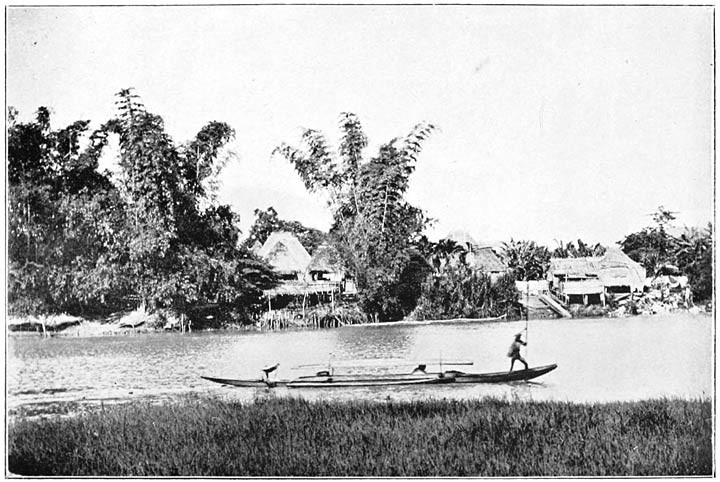
View on the Pasig with Bamboos and Canoe.
To face p. 6.
1 England has 51,000 square miles area; Wales, 7378; Ireland, 31,759; Scotland, nearly 30,000. Total, Great Britain and Ireland, etc., 121,000 square miles.
2 Worcester, p. 446, mentions Conifers at sea level in Sibuyan Island, province of Romblon.
3 Called in Spanish the oropéndola (Broderipus achrorchus).
1 England has 51,000 square miles area; Wales, 7378; Ireland, 31,759; Scotland, nearly 30,000. Total, Great Britain and Ireland, etc., 121,000 square miles.
2 Worcester, p. 446, mentions Conifers at sea level in Sibuyan Island, province of Romblon.
3 Called in Spanish the oropéndola (Broderipus achrorchus).
Chapter II.
Spanish Government.
Slight sketch of organization—Distribution of population—Collection of taxes—The stick.
The supreme head of the administration was a Governor-General or Captain-General of the Philippines. The British Colonial Office has preserved this Spanish title in Jamaica where the supreme authority is still styled Captain-General and Governor-in-Chief.
In recent years no civilian has been Governor-General of the Philippines, the appointment being given or sold to a Lieutenant-General, though in 1883 a Field-Marshal was sent out. But in 1874 Rear-Admiral Malcampo obtained the post, and a very weak and foolish Governor-General he turned out to be.
In former times military men did not have a monopoly of such posts, and civilians, judges, priests, and bishops have held this appointment.
The Governor-General had great powers. Practically, if not legally, he had the power of life and death, for he could proclaim martial law and try offenders by court-martial. He was ex officio president of every corporation or commission, and he could expel from the Islands any person, whether Spaniard, native, or foreigner, by a decree declaring that his presence was inconvenient.
Slight Sketch of Organization.
He could suspend or remove any official, and in fact was almost despotic. On the other hand he had to remember two important limitations. Unless he supported the religious orders against all comers he would have the Procurators of these wealthy corporations, who reside in Madrid, denouncing him to the Ministry as an anti-clerical, and a freemason, and perhaps offering a heavy bribe for his removal. If he made an attempt to put down corruption and embezzlement in the Administration, his endeavours would be thwarted in every possible way by the officials, and a formidable campaign of calumny and detraction would be inaugurated against him. The appointment was for a term of three years at a salary of $40,000 per annum, and certain very liberal travelling allowances.
Since the earthquake of 1863 the official residence of the Governors-General was at Malacañan, on the River Pasig in the ward of San Miguel. This is now the residence of the American Governor. He had a troop of native Lancers to escort him when he drove out, and a small corps of Halberdiers for duty within the palace and grounds. These latter wore a white uniform with red facings, and were armed with a long rapier and a halberd. They were also furnished with rifles and bayonets for use in case of an emergency.
When the Governor-General drove out, every man saluted him by raising his hat—and when he went to the Cathedral he was received by the clergy at the door, and, on account of being the Vice-Regal Patron, was conducted under a canopy along the nave to a seat of honour.
His position was in fact one of great power and dignity, and it was felt necessary to surround the representative of the king with much pomp and state in order to impress the natives with his importance and authority.
There was a Governor-General of Visayas who resided at Cebu, and was naturally subordinate to the Governor-General of the Philippines. He was usually a Brigadier-General.
In case of the death or absence of the Governor-General, the temporary command devolved upon the Segundo Cabo, a general officer in immediate command of the military forces. Failing him, the Acting Governor-Generalship passed to the Admiral commanding the station.
The two principal departments of the administration were the Intendencia or Treasury, and the Direction of Civil Administration.
The Archipelago is divided into fifty-one provinces or districts, according to the accompanying table and map.
Distribution of Population.
Provinces.
Males.
Females.
Total.Abra
21,631
21,016
42,647
Albay
127,413
130,120
257,533
Antique
60,193
63,910
124,103
Balábac
1,912
27
1,939
Bataán
25,603
24,396
49,999
Batangas
137,143
137,932
275,075
Benguet (district)
8,206
12,104
20,310
Bohol
109,472
117,074
226,546
Bontoc
40,515
41,914
82,429
Bulacán
127,455
124,694
252,149
Burías
84
44
128
Cagayán
37,157
35,540
72,697
Calamianes
8,227
8,814
17,041
Camarines Norte
15,931
14,730
30,661
Camarines Sur
78,545
77,852
156,400
Cápiz
114,827
128,417
243,244
Cavite
66,523
65,541
132,064
Cebú
201,066
202,230
403,296
Corregidor (island of)
216
203
419
Cottabato
788
494
1,282
Dávao
983
712
1,695
Ilocos Norte
76,913
79,802
156,715
Ilocos Sur
97,916
103,133
201,049
Ilo-Ilo
203,879
206,551
410,430
Infanta (district)
4,947
4,947
9,894
Isabela de Basilan
454
338
792
Isabela de Luzon
20,251
18,365
38,616
Islas Batanes
4,004
4,741
8,745
Isla de Negros
106,851
97,818
204,669
Laguna
66,332
66,172
132,504
Lepanto
8,255
16,219
24,474
Leyte
113,275
107,240
220,515
Manila
137,280
120,994
258,274
Masbate and Ticao
8,835
8,336
17,171
Mindoro
29,220
28,908
58,128
Misamis
46,020
42,356
88,376
Mórong
21,506
21,556
43,062
Nueva Ecija
63,456
60,315
123,771
Nueva Vizcaya
8,495
7,612
16,107
Pampanga
114,425
111,884
226,309
Pangasinán
149,141
144,150
293,291
Principe (district)
2,085
2,073
4,158
Puerto Princesa
350
228
578
Romblón
14,528
13,626
28,154
Samar
92,330
86,560
178,890
Surigao
28,371
27,875
56,246
Tarlac
42,432
40,325
82,757
Tayabas
27,886
25,782
53,668
Unión
55,802
57,568
113,370
Zambales
49,617
44,934
94,551
Zamboanga
7,683
6,461
14,144
2,794,876
2,762,743
5,557,619
The above figures are taken from the official census of 1877.
This is the latest I have been able to find.
In the Appendix is given an estimate of the population in 1890, the author puts the number at 8,000,000, and at this date there may well be 9,000,000 inhabitants in the Philippines and Sulus.
It will be seen that these provinces are of very different extent, and vary still more in population, for some have only a few hundred inhabitants, whilst others, for instance, Cebú and Ilo-Ilo have half-a-million.
Each province was under a Governor, either civil or military. Those provinces which were entirely pacified had Civil Governors, whilst those more liable to disturbance or attack from independent tribes or from the Moors had Military Governors. Up to 1886 the pacified provinces were governed by Alcaldes-Mayores, who were both governors and judges. An appeal from their decisions could be made to the Audiencia or High Court at Manila.
From the earliest times of their appointment, the Alcaldes were allowed to trade. Some appointments carried the right to trade, but most of the Alcaldes had to covenant to forego a large proportion of their very modest stipends in order to obtain this privilege. By trade and by the fees and squeezes of their law courts they usually managed to amass fortunes. In 1844 the Alcaldes were finally prohibited from trading.
This was a rude system of government, but it was cheap, and a populous province might only have to maintain half-a-dozen Spaniards.
Each town has its municipality consisting of twelve principales, all natives, six are chosen from those who have already been Gobernadorcillos. They are called past-captains, and correspond to aldermen who have passed the chair. The other six are chosen from amongst the Barangay headmen. From these twelve are elected all the officials, the Gobernadorcillo or Capitan, the 1st, 2nd and 3rd lieutenants, the alguaciles (constables), the judges of the fields, of cattle, and of police. The Capitan appoints and pays the directorcillo or town clerk, who attends to the routine business.
For the maintenance of order, and for protecting the town against attack, there is a body of local police called Cuadrilleros. These are armed with bolos and lances in the smaller and poorer towns, but in more important places they have fire-arms usually of obsolete pattern. But in towns exposed to Moro attack the cuadrilleros are more numerous, and carry Remington rifles.
The Gobernadorcillos of towns were directly responsible to the governor of the province, the governor in case of emergency reported direct to the Governor-General, but for routine business through the Director-General of Civil Administration, which embraced the departments of Public Works, Inspection of Mines and Forests, Public Instruction, Model Farms, etc.
The collection of taxes was under the governors of provinces assisted by delegates of the Intendant-General. It was directly effected by the Barangay headman each of whom was supposed to answer for fifty families, the individuals of which were spoken of as his sácopes. His eldest son was recognised as his chief assistant, and he, like his father, was exempt from the tribute or capitation tax.
The office was hereditary, and was not usually desired, but like the post of sheriff in an English county it had to be accepted nolens volens.
No doubt a great deal of latitude was allowed to the Barangay Chiefs in order that they might collect the tax, and the stick was often in requisition. In fact the chiefs had to pay the tax somehow, and it is not surprising that they took steps to oblige their sácopes to pay.
I, however, in my fourteen years’ experience, never came across such a case as that mentioned by Worcester, p. 295, where he states that in consequence of a deficiency of $7000, forty-four headmen of Siquijor were seized and exiled, their lands, houses and cattle confiscated, and those dependent on them left to shift for themselves. The amount owing by each headman was under $160 Mexican, equal to $80 gold, and it would not take much in the way of lands, houses, and cattle to pay off this sum. However, it is true that Siquijor is a poor island. But on page 284 he maintains that the inhabitants of Siquijor had plenty of money to back their fighting-cocks, and paid but little attention to the rule limiting each man’s bet on one fight to $50. From this we may infer that they could find money to bet with, but not to pay their taxes.
Collection of Taxes.
Natives of the gorgeous East very commonly require a little persuasion to make them pay their taxes, and I have read of American millionaires who, in the absence of this system, could not be got to pay at all. Not many years ago, there was an enquiry as to certain practices resorted to by native tax-collectors in British India to induce the poor Indian to pay up; anybody who is curious to know the particulars can hunt them up in the Blue Books—they are unsuitable for publication.
In Egypt, up to 1887, or thereabouts, the “courbash”1 was in use for this purpose. I quote from a speech by Lord Cromer delivered about that time (’Lord Cromer,’ by H. D. Traill): “The courbash used to be very frequently employed for two main objects, viz.: the collection of taxes, and the extortion of evidence. I think I may say with confidence that the use of the courbash as a general practice in connection either with collection of taxes or the extortion of evidence has ceased.”
But we need not go so far East for examples of collecting taxes by means of the stick. The headmen of the village communities in Russia freely apply the lash to recalcitrant defaulters.
It would seem, therefore, that the Spaniards erred in company with many other nations. It was by no means an invention of theirs, and it will be remembered that some of our early kings used to persuade the Jews to pay up by drawing their teeth.
Its Good Points.
The Government and the laws partook of a patriarchal character, and notwithstanding certain exactions, the Spanish officials and the natives got on very well together. The Alcaldes remained for many years in one province, and knew all the principal people intimately. I doubt if there was any colony in the world where as much intercourse took place between the governors and the natives, certainly not in any British colony, nor in British India, where the gulf ever widens. In this case, governors and governed professed the same religion, and no caste distinctions prevailed to raise a barrier between them. They could worship together, they could eat together, and marriages between Spaniards and the daughters of the native landowners were not unfrequent. These must be considered good points, and although the general corruption and ineptitude of the administration was undeniable, yet, bad as it was, it must be admitted that it was immeasurably superior to any government that any Malay community had ever established.
1 A whip made from hippopotamus hide.
1 A whip made from hippopotamus hide.
Chapter III.
Six Governors-General.
Moriones—Primo de Rivera—Jovellar—Terreros—Weyler—Despujols.
Moriones.
During my residence in the Islands—from 1877 to 1892—there were six Governors-General, and they differed very widely in character and ideas.
The first was Don Domingo Moriones y Murillo, Marquis of Oroquieto, an austere soldier, and a stern disciplinarian. He showed himself to be a man of undaunted courage, and of absolutely incorruptible honesty.
When he landed in Manila he found that, owing to the weakness of Admiral Malcampo, his predecessor, the Peninsular Regiment of Artillery had been in open mutiny, and that the matter had been hushed up. After taking the oath of office, and attending a Te Deum at the Cathedral, he mounted his horse, and, attended by his aides-de-camp, rode to the barracks, and ordered the regiment to parade under arms. He rode down the ranks, and recognised many soldiers who had served under him in the Carlist wars.
He then stationed himself in front of the regiment, and delivered a remarkable and most stirring oration. He said that it grieved him to the heart to think that Spanish soldiers, sent to the Philippines to maintain the authority of their king and country, many of whom had with him faced the awful fusillade of Somorrostro, and had bravely done their duty, could fall so low as to become callous mutineers, deaf to the calls of duty, and by their bad conduct tarnish the glory of the Spanish Army in the eyes of all the world. Such as they deserved no mercy; their lives were all forfeited. Still he was willing to believe that they were not entirely vicious, that repentance and reform were still possible to the great majority. He would, therefore, spare the lives of most of them in the hope that they might once more become worthy soldiers of Spain. But he would decimate them; every tenth man must die.
He then directed the lieutenant-colonel in command to number off the regiment by tens from the right.
Let the reader ponder upon the situation. Here was a mutinous veteran regiment that for months had been the terror of the city, and had frightened the Governor-General and all the authorities into condoning its crimes.
In front of it sat upon his horse one withered old man. But that man’s record was such that he seemed to those reckless mutineers to be transfigured into some awful avenging angel. His modest stature grew to a gigantic size in their eyes; the whole regiment seemed hypnotized. They commenced numbering. It was an impressive scene—the word ten meant death. The men on the extreme right felt happy; they were sure to escape. Confidently rang out their voices: one, two, three, four, five, six, seven, eight, nine—then a stop. The doomed wretch standing next would not say the fatal word. Moriones turned his glance upon the captain of the right company, and that officer perceived that the crisis of his life had arrived, and that the next few seconds would make or mar him; one instant’s hesitation would cost him his commission. Drawing and cocking his revolver, he held it in front of the forehead of the tenth man, and ordered him to call out ten. Placed thus between the alternative of instant death or obedience, the unhappy gunner complied, and the numbering of the whole line was accomplished. The number tens were ordered to step out of the ranks, were disarmed, placed under arrest, and notified that they would be shot next morning. As regards the others, all leave was stopped, and extra drills ordered. Great interest was exerted with Moriones to pardon the condemned men, and he did commute the death sentence on most of them, but the ring-leaders were shot the following morning, others imprisoned, and fifty were sent back to Spain in the same vessel as Admiral Malcampo, whose pampering of them had ruined their discipline. So much for the courage of Moriones. It was a wonderful example of the prestige of lawful authority, but of course the risk was great.
To him was due the construction of the Manila Waterworks. A sum of money had been left a century before by Don Francisco Carriedo, who had been general of a galleon, to accumulate until it was sufficient to pay for the waterworks, which ought to have been begun years before. However, the parties who held these funds, like certain Commissioners we know of at home, had little desire to part with the capital, and it was only the determination of General Moriones that triumphed over their reluctance.
Manila ought to be ever grateful to Moriones for this. He also tried to get some work out of the Obras Publicas Department, and, in fact, he did frighten them into exerting themselves for a time, by threatening to ship the Inspector-General of Public Works back to Spain, unless the Ayala bridges were completed on a certain day.
But the greatest thing that Moriones did for the Philippines was when he prevented the sale of the Government tobacco-culture monopoly to some Paris Jews. Whilst he was staying at the Convent of Guadalupe he received a letter from Cánovas, at the time Prime Minister of Spain. It informed him that a project was entertained of selling the Crown monopoly of the cultivation and manufacture of tobacco in the Philippines to a Franco-Spanish syndicate, and added, “The palace is very interested,” meaning that the King and the Infantas were in the affair. It announced that a Commission was about to be sent by the capitalists to enquire into the business, and wound up by requesting Moriones to report favourably on the affair, for which service he might ask any reward he liked. The carrying out of this project meant selling the inhabitants of Cagayan into slavery.
I had this information from a gentleman of unblemished truth and honour, who was present at the receipt of the letter, and it was confirmed by two friars of the Augustinian Order under circumstances that left no doubt upon my mind as to their accuracy.
Although Cánovas was at the time in the height of his power, and although the King was interested in the matter going through, Moriones indignantly refused to back up the proposal. He wrote or cabled to Cánovas not to send out the Commission, for if it came he would send it back by the same vessel. He reported dead against the concession, and told the Prime Minister that he was quite prepared to resign, and return to Spain, to explain his reasons from his seat in the Senate. What a contrast this brave soldier made to the general run of men; how few in any country would have behaved as he did!
This was not the only benefit Moriones conferred upon the tobacco cultivators of Cagayán, for he did what he could to pay off the debt owing to them by the Treasury.
Primo de Rivera.
The next Governor-General was Don Fernando Primo de Rivera, Marquis of Estella, and he was the only one with whom I was not personally acquainted. During the cholera epidemic of 1882, when 30,000 persons died in the city and province of Manila, he showed ability and firmness in the arrangements he made, and he deserves great credit for this. But corruption and embezzlement was rampant during his time. Gambling was tolerated in Manila and it was currently reported that twenty-five gambling houses were licensed and that each paid $50 per day, which was supposed to go to the Governor-General. Emissaries from these houses were stationed near the banks and mercantile offices, and whenever a collector was seen entering or leaving carrying a bag of dollars, an endeavour was made to entice him to the gambling table, and owing to the curious inability of the native to resist temptation, these overtures were too frequently successful.
The whole city became demoralised, servants and dependants stole from their employers and sold the articles to receivers for a tenth of their value in order to try their luck at the gaming table. A sum of $1250 per day was derived from the gambling-houses and was collected every evening.
Notwithstanding all these abuses, Primo de Rivera maintained good relations with the natives; he was not unpopular, and no disturbances occurred during his first government. He owed his appointment to King Alfonso XII., being granted three years’ pillage of the Philippine Islands as a reward for having made the pronunciamento in favour of that monarch, which greatly contributed to putting him upon the throne. He and his friends must have amassed an enormous sum of money, for scarcely a cent was expended on roads or bridges during his government, the provincial governors simply pocketed every dollar.
Jovellar.
He was succeeded by Field-Marshal Don Joaquim Jovellar, during whose time the tribute was abolished and the Cédulas Personales tax instituted. Jovellar appeared to me to be a strictly honourable man, he refused the customary presents from the Chinese, and bore himself with much dignity. His entourage was, however, deplorable, and he placed too much confidence in Ruiz Martinez, the Director of Civil Administration. The result was that things soon became as bad as in the previous governor’s time. Jovellar was well advanced in years, being nearly seventy. He had many family troubles, and the climate did not agree with him.
I remember one stifling night, when I was present at Malacañan at a ball and water fête, given to Prince Oscar, a son of the King of Sweden. The Governor-General had hardly recovered from an illness, and had that day received most distressing news about two of his sons, and his daughter Doña Rosita, who was married to Colonel Arsenio Linares, was laid up and in danger of losing her sight.
Yet in that oppressive heat, and buttoned up in the full dress uniform of a field-marshal, Jovellar went round the rooms and found a kind word or compliment for every lady present. I ventured to remark how fatigued he must be, to which he replied, “Yes, but make no mistake, a public man is like a public woman, and must smile on everybody.”
During his time, owing to symptoms of unrest amongst the natives, the garrison of Manila and Cavite was reinforced by two battalions of marines.
Terrero.
He was succeeded by Don Emilio Terrero y Perinat, a thorough soldier and a great martinet. I found him a kind and courteous gentleman, and deeply regretted the unfortunate and tragic end that befell him after his return to Spain. I saw a good deal of Field-Marshal Jovellar and of General Terrero, having been Acting British Consul at the end of Jovellar’s and the beginning of Terrero’s Government. I kept up my acquaintance with General Terrero all the time he was in the islands, and was favoured with frequent invitations to his table, where I met all the principal officials.
Things went on quietly in his time and there was little to record except successful expeditions to Joló and Mindanao, causing an extension of Spanish influence in both places.
Weyler.
Terrero was succeeded by Don Valeriano Weyler, Marquis of Ténérife, the son of a German doctor, born in Majorca, who brought with him a reputation for cruelties practised on the Cuban insurgents during the first war.
Weyler was said to have purchased the appointment from the wife of a great minister too honest to accept bribes himself, and the price was commonly reported to have been $30,000 paid down and an undertaking to pay the lady an equal sum every year of his term of office.
Weyler is a small man who does not look like a soldier. He is clever, but it is more the cleverness of a sharp attorney than of a general or statesman.
Curiously enough the Segundo Cabo at this time was an absolute contrast. Don Manuel Giron y Aragon, Marquis of Ahumada, is descended from the Kings of Aragon, and to that illustrious lineage he unites a noble presence and a charm of manner that render him instantly popular with all who have the good fortune to meet him. No more dignified representative of his country could be found, and I send him my cordial salutation wherever he is serving.
During Weyler’s term another expedition to Mindanao was made and some advantages secured. Some disturbances occurred which will be mentioned in another chapter, and secret societies were instituted amongst the natives. Otherwise the usual bribery and corruption continued unchecked.
There was a great increase in the smuggling of Mexican dollars from Hong Kong into Manila, where they were worth 10 per cent. more. The freight and charges amounted to 2 per cent., leaving 8 per cent. profit, and according to rumour 4 per cent. was paid to the authorities to insure against seizure, as the importation was prohibited under heavy penalties.
At this time I was Government Surveyor of Shipping, and one day received an order from the captain of the port to proceed on board the steamer España with the colonel of carbineers and point out to him all hollow places in the ship’s construction where anything could be concealed. This I did, but remembering Talleyrand’s injunction, and not liking the duty, showed no zeal, but contented myself with obeying orders. The carbineers having searched every part of the ship below, we came on deck where the captain’s cabin was. A corporal entered the cabin and pulled open one of the large drawers. I only took one glimpse at it and looked away. It was chock full of small canvas bags, and no doubt the other drawers and lockers were also full. Yet it did not seem to occur to any of the searchers that there might be dollars in the bags, and it was no business of mine. Nothing contraband had been found in the ship, and a report to that effect was sent in. I sent the colonel an account for my fee, which was duly paid from the funds of the corps.
Weyler returned to Spain with a large sum of money, a far larger sum than the whole of his emoluments. He had remitted large sums in bills, and having fallen out with one of his confederates who had handled some of the money, this man exhibited the seconds of exchange to certain parties inimical to Weyler, with the result that the latter was openly denounced as a thief in capital letters in a leading article of the Correspondencia Militar of Madrid. Weyler’s attorneys threatened to prosecute for libel, but the editor defied them and declared that he held the documents and was prepared to prove his statement. The matter was allowed to drop. Weyler was thought to have received large sums of money from the Augustinians and Dominicans for his armed support against their tenants. It was said that the Chinese furnished him with a first-rate cook, and provided food for his whole household gratis, besides making presents of diamonds to his wife. And for holding back certain laws which would have pressed very hardly upon them, it was asserted that the Celestials paid him no less than $80,000. This is the man who afterwards carried out the reconcentrado policy in Cuba at the cost of thousands of lives, and subsequently returning with a colossal fortune to Spain, posed as a patriot and as chief of the military party.
Despujols.
To Weyler succeeded a man very different in appearance and character, Don Emilio Despujols, Conde de Caspe.
Belonging to an ancient and noble family of Catalonia, holding his honour dear, endowed with a noble presence and possessed of an ample fortune, he came out to uplift and uphold the great charge committed to him, and rather to give lustre to his office by expending his own means than to economise from his pay, as so many colonial governors are accustomed to do. He established his household upon a splendid scale, and seconded by his distinguished countess, whose goodness and munificent charities will ever be remembered, he entertained on a scale worthy of a viceroy and in a manner never before seen in Manila.
Despujols rendered justice to all. Several Spaniards whose lives were an open scandal, were by his order put on board ship and sent back to Spain. Amongst these was one who bore the title of count, but who lived by gambling.
Another was a doctor who openly plundered the natives. Like a Mahometan Sultan of the old times, Despujols was accessible to the poorest who had a tale of injustice and oppression to relate.
The news that a native could obtain justice from a governor-general flew with incredible rapidity. At last a new era seemed to be opening. A trifling event aroused the enthusiasm of the people. Despujols and his countess drove to the Manila races with their postillions dressed in shirts of Júsi and wearing silver-mounted salacots instead of their usual livery. I was present on this occasion and was struck with the unwonted warmth of the governor-general’s reception from the usually phlegmatic natives. Despujols became popular to an extent never before reached. He could do anything with the natives. Whenever his splendid equipages appeared in public he received an ovation. Quite a different spirit now seemed to possess the natives. But not all the Spaniards viewed this with satisfaction; many whose career of corruption had been checked, who found their illicit gains decreased, and the victims of their extortion beginning to resist them, bitterly criticised the new governor-general.
The religious orders finding Despujols incorruptible and indisposed to place military forces at the disposal of the Augustinians and Dominicans to coerce or evict refractory tenants, then took action. Their procurators in Madrid made a combined attack on Despujols, both in the reptile press and by representations to the ministry. They succeeded, and Despujols was dismissed from office by cable. Rumour has it that the Orders paid $100,000 for Despujols’s recall. For my own part I think this very likely, and few who know Madrid will suppose that this decree could be obtained by any other means.
He laboured under a disadvantage, for he did not pay for his appointment as some others did. If he had been paying $30,000 a year to the wife of a powerful minister, he would not have been easily recalled. Or if, like another governor-general, he had been in debt up to the eyes to influential creditors, these would have kept him in power till he had amassed enough to pay them off.
I am of opinion that had Despujols been retained in Manila, and had he been given time to reform and purify the administration, the chain of events which has now torn the Philippines for ever from the grasp of Spain would never have been welded. Whoever received the priests’ money, whoever they were who divided that Judas-bribe, they deserve to be held in perpetual execration by their fellow-countrymen, and to have their names handed down to everlasting infamy.
Despujols left Manila under a manifestation of respect and devotion from the foreign residents, from the best Spaniards and from every class of the natives of the Philippines, that might well go far to console him for his unmerited dismissal. He must have bitterly felt the injustice with which he was treated, but still he left carrying with him a clear conscience and a harvest of love and admiration that no previous governor-general had ever inspired.
For if Moriones manifested courage, energy and incorruptible honesty under what would have been an irresistible temptation to many another man, that rude soldier was far from possessing those personal gifts, the fine presence and the sympathetic address of Despujols, and inspired fear rather than affection.
Yet both were worthy representatives of their country; both were men any land might be proud to send forth. Those two noble names are sufficient to redeem the Spanish Government of the Philippines from the accusation of being entirely corrupt, too frequently made against it. They deserve an abler pen than mine to extol their merits and to exalt them as they deserve above the swarm of pilferers, and sham patriots, who preceded and succeeded them. To use an Eastern image, they may be compared to two noble trees towering above the rank vegetation of some poisonous swamp. For the honour of Spain and of human nature in general, I have always felt grateful that I could say that amongst the governors-general of the Philippines whom I had known there were at least two entitled to the respect of every honest man.
Chapter IV.
Courts of Justice.
Alcaldes—The Audiencia—The Guardia Civil—Do not hesitate to shoot—Talas.
The foulest blot upon the Spanish Administration in all her former colonies was undoubtedly the thorough venality of her infamous Courts of Justice. Unfortunately, amongst the heterogeneous population of the Philippines, a low standard of morality prevails and has prevailed from the earliest times. The natives at the time of the conquest were partly civilised, so far as building houses and cultivating their lands by slave labour is concerned. But notwithstanding the assertions of the Filipinos, the late Dr. Rizal and others, a study of the ancient authors demonstrates that they were sunk in ignorance and superstition, and that their customs were those of semi-savages. When they came under the rule of the Spaniards, they might have made great advances if the administration of the laws had been confided to persons of honour capable of interpreting that wise code, the “Laws of the Indies,” in the noble and Christian spirit which had inspired their makers.
But what class of man was it that the Spaniards appointed to this office?
Thomas de Comyn, p. 134, says: “It is quite common to see a barber or footman of a governor, a sailor or a deserter, transformed into an Alcalde-Mayor, Sub-delegate, and War Captain of a populous province, without other counsel than his own rude intelligence (understanding) nor other guide than his passions.”
What could be expected from such men as these, living in such an atmosphere? And if some solitary alcalde might cherish in his heart some spark of honour, some lingering love of justice, there were two elements in the country to extinguish that spark, to smother that feeling.
Woe betide the alcalde who would decide a case, whatever its merits, adversely to any one of the religious orders. I personally knew an alcalde who (at a great price) had obtained the government of the province of Batangas, from whence his immediate predecessor, also well-known to me, had retired with a large fortune, but leaving everybody contented so far as could be seen. He had kept on good terms with the priests. His successor unfortunately forgot this cardinal rule and allowed himself to be identified with some anti-clerical Spaniards.
Every kind of trouble fell upon that man, and finally he was recalled to Manila and received a severe reprimand from General Primo de Rivera, who was said to have received $12,000 for turning him out.
He was removed from wealthy Batangas and sent to the fever-stricken capital of Tayabas, a wretchedly poor Government, affording few opportunities for peculation. He escaped with his life, but his wife, a very charming Spanish lady, succumbed to the malaria. Similar instances of the results of being, or being thought to be, an anti-clerical, will occur to old residents in the Philippines. The arm of the Church was long and its hand was a heavy one.
The second influence I referred to is the presence of the heathen Chinee in the islands. To a Chinaman the idea that a judge should take bribes seems as natural a thing as that a duck should take to the water. And yet the Chinaman will not, unless he knows he is on the right track, brutally push his bribe under the judge’s nose. Either he or one of his countrymen will from the judge’s arrival have rendered him good service. Does the judge want a gardener or cook? Ah-sin soon provides an excellent one who never asks for his wages. Have some visitors arrived at the Alcaldia Ah-sin sends in a dozen chickens, a turkey, and the best fruits. Is it the judge’s name-day? The wily Celestial presents a few cases of wine and boxes of fine cigars. Is the roof of the Alcaldia leaking—a couple of Chinese carpenters will set it right without sending a bill for it. Then, having prepared the way, should Ah-sin be summoned before the alcalde, he may confidently hope that his patron will not hurriedly give judgment against him, and that he will probably get a full opportunity to present substantial reasons why the suit should be decided in his favour. In fact, the practice of the alcalde’s courts was only a shade better than that of the Chinese Yamens, where the different cases are put up to auction amongst the magistrates and knocked down to the highest bidders, who then proceed on a course of extortion, by arrest and by the torture of witnesses, to make all they can out of them.
In an alcalde’s court, there would be several mestizo or native writers or auxiliaries. Some of them were what is called meritórios, that is, unpaid volunteers. Of course, they expect to receive gratuities from the suitors and would take care to mislay their documents if they were neglected. Sometimes the alcalde was so lazy that he left the whole matter in the hands of his subordinates and signed whatever they laid before him. I have been a witness of this, and have even remonstrated with a judge for so doing. He, however, said he had the greatest confidence in his subordinates and that they dare not deceive him.
Bad as the alcalde’s courts were, I think that the culminating point of corruption was the Audiencia of Manila. Escribano, abogado, júez, auditor, fiscál, vied with each other in showing that to them, honour and dignity were mere empty words. They set the vilest examples to the mestizos and natives, and, unfortunately, these have been only too apt pupils, and having little to lose, were often ready to go one better than the Spaniards, who after all had to keep up appearances. I cannot adequately express the loathing I feel for all this tribe. I look upon a highwayman as a gentleman compared to them, for he does risk his life, and you may get a shot at him, but these wretches ruin you in perfect safety.
They dress their wives, they nourish their children, upon the reward of roguery, the price of perjury, the fruits of forgery, the wages of some wicked judgment.
What can be expected of the spawn of these reptiles, what but by the process of evolution to be more envenomed than their progenitors? Is there not amongst all the multitudinous Philippines some desert island where the people trained in the Spanish courts and all their breed could be deported, where they might set up a court, and bring actions against each other and cheat and lie and forge till they die?
What a Godsend for the Philippines were this possible, if besides getting rid of the Spanish judges, they could now get rid of their aiders and abettors, their apt pupils and would-be successors.
Bribery is a fine art, and there were those in Manila who were well versed in its intricacies. We heard one day of a decree by a judge against the Hong Kong and Shanghai Banking Corporation. Club gossip asserted that the judge who issued the decree had lost some hundreds of dollars at the gambling table of the Casino the night before, and that the artistic corrupter had called on him in the morning with the means to pay the debt of honour and to try his luck again. The judge was known not to have the means of paying, yet he paid and simultaneously issued his decree. Old Manila hands drew their inference.
The record of these courts from the earliest times is one long-continued infamy. Thank God that is over and a new chapter has begun. I rejoice exceedingly that their sins have at last overtaken them, and I recognise that, though
“The mills of God grind slowly,
Yet they grind exceeding small.”
Owing to the demoralisation of the mestizo and native lawyers by these vile examples, it will be very difficult to break the traditions of venality and to find men worthy to occupy the bench.
These courts were not only corrupt, but they were inept. At a time when brigandage prevailed and many notorious criminals were apprehended almost red-handed, convictions could not be got, and the bandits were liberated on various pretexts.
So great was the scandal that Moriones issued a decree that all persons accused of gang-robbery should be tried by a military tribunal. And he appointed a permanent court-martial for this purpose, to the great disgust of all the lawyer element. These courts were abolished some years later after his return to Spain; then the Guardia Civil made their own arrangements, and the mortality amongst bandits was excessive. When some well-known robber was by any chance taken alive, he always, so they said, tried to escape by running away from his captors, and this obliged them to fire upon him. They never missed on these occasions, and it was thought that the range never exceeded ten paces and was often less.
However necessary this military action may be, it is, undoubtedly liable to abuse, and the power of life and death is a great one to put in the hands of a junior officer or non-commissioned officer of police. The Guardia Civil, an armed force with Spanish officers and native soldiers, was organised in 1867, and I must say that I looked upon it as an excellent institution, the terror of evil-doers and a protection to all law-abiding people. My native friends, however, are of a different opinion. They accuse the Guardia Civil, both Spaniards and natives, of behaving in an arbitrary and cruel manner, and with practising extortion upon defenceless natives. They are accused of torturing witnesses to extort evidence, and this charge was no doubt true in many cases.
On the other hand, the bandits or tulisanes were exterminated by this corps of picked men, and security to life and property was assured. At the formation of this corps the officers and men were very carefully selected. The Governor-General himself examined the records of every officer, and only Spanish gentlemen of the highest character were appointed. Similarly the soldiers were natives who had served their time in the army without having a crime noted against them. But in later years this precaution was relaxed, and colonels of regiments were allowed to dump their rubbish into this corps.
I knew of a case where a Filipino with Irish blood in him was posted as a lieutenant to this corps and behaved most abominably. I am glad to say, however, that he was sent out of the islands. This was only another instance of the fact that whatever the natives have to complain of the Spaniards, the mestizos, and their own rich people, treat them and have always treated them far worse.
Both officers and men were well paid and were dressed in a very smart and neat uniform, well suited to the climate, which they kept spick and span whatever service they were on. They were armed with Remington rifles and bayonets, and in addition carried a heavy chopping knife. They were posted at all the chief towns of Luzon and in some of the Visayas Islands. The greatest crime a native could commit was to kill a Guardia Civil, and such a matter never came before a Civil Court. If the slayer by any chance was not killed on the spot, he would probably be shot at sight. If apprehended, he would be tried by a court-martial composed of officers of the Guardia Civil, and, needless to say, there would be no monkeying with the verdict nor with the sentence, which would be promptly carried out.
Even to resist the Guardia Civil was so great a crime that the sentence of a court-martial in such a case was penal servitude for life (Cadéna Perpétua).
How surprised a London rough would be at this severity after being accustomed to expiate the most brutal assaults upon the police by a fine of a few shillings.
To sum up the Guardia Civil, I may say that their practice was comprised in five memorable words, addressed to a similar corps by Mr. A. J. Balfour in his energetic days, a most sensible order, that he may well be proud of: “Do not hesitate to shoot.”
Amongst other duties of the Guardia Civil in bygone years was the making of periodical expeditions against the remontados and the hill tribes, officially designated Talas, or cuttings down.
At certain favourable seasons of the year, especially before harvest time, the Guardias, accompanied by some Cuadrilleros, and on important occasions by a company of native infantry, marched up into the more accessible hills.
The hill-men obstructed the tracks in the most difficult places by cutting down trees and making abattis.
They also placed sharp bamboo spikes carefully concealed in the earth or mud of the footpaths, and these, if trodden on, inflicted most dangerous wounds that were apt to gangrene. Sometimes if they had much at stake, the hill-men or outlaws would venture an ambuscade, and hurl their javelins or send a flight of arrows amongst their enemies.
But even the boldest races rarely came to close quarters, for their weapons were no match against rifles and bayonets. So, led by their spies, the Spanish forces laboured upwards, and on arriving at the hamlets of the mountaineers or outlaws they burnt down the rude huts, reaped the crops, taking away what they could and burning the remainder.
They cut down every fruit tree and took special care to destroy every tobacco plant. They then retired, leaving a scene of devastation behind them.
If any of the hill-men fell into their hands their fate depended upon whether there were any murders to avenge or upon the humanity of the officer in command. This wanton destruction was committed chiefly in the interests of the tobacco monopoly, but also in order to force the hillmen to come down and reside in the towns. It had, however, an entirely contrary effect, for the savages either retired into more inaccessible regions, or perhaps abandoned cultivation and lived a roving, marauding life like the Itetapanes and Catubanganes.
Since the abolition of the tobacco monopoly the Talas have been less frequent, and there was a feeling amongst the authorities that these cruel and demoralising expeditions should be discontinued, unless in cases where the hill-men had given great provocation.
The Spaniards are, of course, not the only nation to make these forays. In the last campaign against the Afridis the British troops were employed, under orders, to blow up the houses, break the mill-stones, and cut down the trees of the enemy, not even sparing the shade trees round a mosque. It was probably the only way to inflict punishment on the Afridis.
The worst feature is that in all such cases a crop of bitter hatred is sown in the hearts of the sufferers, which matures later on, and which is handed down from one generation to another.
Chapter V.
Tagal Crime and Spanish Justice.
The murder of a Spaniard—Promptitude of the Courts—The case of Juan de la Cruz—Twelve years in prison waiting trial—Piratical outrage in Luzon—Culprits never tried; several die in prison.
The penal code of the Philippines, which came into force in 1884, declares it impossible to consider as an aggravation of an offence the circumstance of colour or race in the offender, for the criminal is to be punished for his crime and not for the condition of inferiority to which nature has condemned him.
It goes on to say that on the other hand his condition should not be allowed to attenuate the sentence, for that would constitute an odious privilege, an unbearable inequality.
It therefore proudly proclaims the equality of all races before the law. These are noble words; we shall see how they work out in practice.
The case of Juan de la Cruz shows us that a criminal investigation can drag on for twelve years without coming on for trial when the victims are natives and of lowly station. I could cite cases where the victims were British subjects, and the murderers were never punished, and another case where a Frenchman was the victim. The murderer in this case was to have been pardoned by the Governor-General, but the French consul threatened to haul down his flag and leave the islands unless the assassin was executed; and he was executed, the consul attending to see the sentence carried out
The British Foreign Office does not encourage its agents to such energetic acts. To obtain the good graces of the Foreign Office a consul should be devoid of talent or originality. Mediocrity is the condition sought for. It is never advisable for one of Her Britannic Majesty’s consuls to be active in protecting Her Britannic Majesty’s subjects. What he must aim at if he wishes for consideration and promotion is to give the Foreign Office no trouble. The ideal consul would be he who is only heard of once a quarter, when he certifies that he is alive, and asks that his salary may be paid.
I will relate a murder that made an impression on me at the time, where the victim was a Spaniard. In June of 1881, I was at Santa Cruz in the Laguna Province for several days, making experiments with some patent centrifugals, steaming and drying the fine Laguna sugar. Quite close to the camarin, where the machines were at work, lived an elderly Spaniard who was a government employé in some subordinate position. I think he was the Subdelegado de Hacienda, or sub-provincial treasurer. I had once or twice called upon the old gentleman, whose appearance and manners were above his official rank, and had been politely received by him. On completing my experiments, I called to take leave of him, and was sorry to find him suffering from fever, and very weak.
I returned to Manila, and next day was horrified to read in a newspaper that he had been murdered in the night by his two servants. This atrocious crime, committed on a helpless and infirm old man, with every circumstance of premeditation and barbarity, and with the object of robbery, roused the indignation of every European. The culprits were soon apprehended, and such expedition was used by the Promotor Fiscal and the court, that within a week from the perpetration of the murder the two servants were garrotted on a scaffold erected near the scene of their barbarous crime.
Such is the rapidity with which the Philippine courts could act when a Spaniard was the victim and when public opinion was deeply stirred by some shocking tragedy.
The case of Juan de la Cruz.
The following narrative of events, which occurred in 1886, will give the reader a good idea of the furious passions that may lurk under the inscrutable features of the Philippine Malay, and will also serve to illustrate the procedure of the Spanish criminal courts when the victims are natives and when nothing can be made out of the case. Four of the five actors or victims in the tragedy were well known to me, and I learned all the particulars at first hand and at the time, from those who took steps to deliver over the culprit to justice.
The decked steam launch Laguimanoc belonged to Gustav Brown, a ship carpenter, and was hired by the Varadero, or Slipway Company of Cañacao, near Cavite, to keep up communication with Manila, whilst the slip was being constructed.
I was consulting engineer to the company, and Mr. J. L. Houston was the resident engineer in charge of the work. Both of us made frequent voyages in this launch between Cañacao and Manila. The crew consisted of a patron (coxswain) named Juan de la Cruz, an engine-driver, a stoker, and a boy, all Tagals.
Juan de la Cruz was an elderly man with grey hair, and in figure thin and wiry. He was a good man at his duty, one of the silent Indians whom I have always found to be the best. A thorough sailor, he had served under many a flag, and sailed o’er many a sea, both in tropic and in northern climes.
The engine-driver and the stoker were brothers, strong and well-built young fellows, and smart at their work. The boy was an active lad, quite pleased to be employed on a steam-boat.
One day, the stoker, going through the blacksmith’s shop, saw a piece of square steel, which had been cut off a long bar, lying on the floor, and it struck him that it would be better than a hammer for breaking coal. So he annexed it without leave, and got one end drawn out and rounded so that he could easily hold it. This made a very efficient coal-breaker, the sharp edges divided the lumps with great ease. It was about eighteen inches long, and one and three-quarter inches square. The patron was married, and his wife lived in Manila, but, sailor-like, he had provided himself with a sweetheart, at the other end of his run, where he spent more time than in the Pasig, and had become intimate with a damsel of San Roque, a village between the Varadero and Cavite. Things went on apparently all right for some time; the launch making almost daily trips between Cañacao and Manila, and the elderly patron alternating between the conjugal domicile and the dwelling of his mistress. She was young, and, as native girls go, a pretty woman. Come of a strange and unknown mixture of races, and bred up amongst a community noted for its profligacy, she knew how to make the best use of her charms and was well fitted to captivate the weather-beaten seaman.
He, if not desirable in himself, held a well paid post, and was able to place her above want.
Already fifty years old, he was as susceptible as a youth and far more in earnest. Day by day, as he basked in her smiles, his infatuation increased till he became violently enamoured of his charmer.
What could be more natural than that the crew of the launch should become acquainted with the patron’s mistress? Soon the engine-driver and the stoker were her constant visitors. The damsel had a kind word and a smile for both, and doubtless contrasted their vigorous youth and shapely forms with the shrunken figure of her elderly protector, and their lively conversation with his glum silence.
In the end, no doubt, the damsel refused them nothing.
Trouble was now brewing. The grim sailor was not the man to let himself be wronged with impunity. All the elements of a tragedy were present. Things no longer went smoothly on board the Laguimanoc, and her voyages lost their regularity. Something was perpetually going wrong with the engines, pieces or fittings disappeared unaccountably, usually pieces of copper or brass. The engine-driver was blamed, but he succeeded in averting his impending discharge. Could he have foreseen the consequences of remaining, he would have promptly discharged himself.
On board the launch mutual distrust prevailed. The engine-driver must have known that it was the patron who had thrown overboard the fittings in his absence, hoping to get him discharged, but he held his peace.
The silent figure at the tiller made no sign; no trace of emotion could be seen on the Sphinx-like face, no reproaches passed his lips, not the slightest manifestation of resentment. But underneath that imperturbable calm there existed the steadfast determination to have a full and bloody revenge on all who had offended him. The Laguimanoc made a voyage to Manila one Saturday to take up the resident engineer who often spent his Sundays there, the launch remaining in the river. On Monday morning when he came down to the launch he found that the safety valve was missing from its seat, and was delayed till another could be procured.
No explanations of the loss of this piece could be got, and the Laguimanoc proceeded with the resident engineer to Cañacao and made fast to the jetty.
A crisis was now reached. The abstraction of the safety-valve could not be overlooked, and some one would have to go. An inquiry was to be made, but on Tuesday morning the patron walked up the jetty, and reported to Mr. Gustav Brown, who was the foreman of the works, that the engine-driver and stoker were absent. He stated that they had gone ashore in the night, and had not returned. Nothing could be learned about them; nobody had seen them; their kits were still on board. As the day wore on they did not come nor send any message; so a report of their disappearance was sent to the judge at Cavite.
An engine-fitter from the works was sent on board to take charge of the engine, and another stoker was engaged; the launch resuming her running. The work of the Varadero proceeded as usual; divers were preparing the foundations to receive the immense gridiron which was shortly to be launched and sunk in place. It was a busy scene of organised labour under a skilful resident engineer; every difficulty foreseen and provided for, materials delivered in good time, notwithstanding obstructions; not an unnecessary auger-hole bored, not a stroke of an adze thrown away.
From the Sleepy Hollow of the naval arsenal opposite jealous eyes watched the work proceed. Every art of vexation and obstruction that bitter envy could devise had for years been employed to prevent the building of this slip, and onerous and unfair conditions had been inserted in the concession. But Anglo-American persistence and industry had succeeded so far, and in the hands of Messrs. Peel, Hubbell & Co. and their advisers, the work was now well advanced.
The obsolete corvette Doña Maria Molina was moored off the coaling-wharf adjoining the Varadero, and when one of her boats was going on shore the sailors noticed two dead bodies floating in the water, and reported this to the officer of the watch, who ordered them to tow the bodies to the shore towards Punta Sangley, and drag them up on the sand above high-water mark. The bodies were lashed together with a piece of new rope having a blue strand in the centre, and had a good-sized piece of white granite attached as a sinker. On looking at the lashings no one could doubt that the work had been done by an able seaman. The bodies presented ghastly wounds, both had fractures of the skull, and gaping cuts on the throat and abdomen; they had also been gnawed by fishes. The swelling of the bodies had sufficed to bring them to the surface, stone and all.
The news of the finding of the corpses did not immediately reach the Varadero, and they were conveyed to Cavite, and buried just as they were found, tied together with the ropes and stone, without being identified. It seemed nobody’s business to trouble about them, notwithstanding the evident fact that they had been murdered. The Manila newspapers did not mention the circumstance.
But at this time other events happened. The patron of the launch disappeared without taking his kit with him. Then the boy disappeared, and I may as well at once say that, from that time to this, that boy has never been heard of by the Varadero Company, who were his employers. Next, that gay and lascivious damsel of San Roque, whose unbridled sensuality had wrought the trouble, also disappeared as mysteriously as the others.
Dr. Juan Perez, of Cavite, was the medical attendant to the staff of the Varadero, and used to call there every afternoon. On hearing from him about the discovery of the bodies, the resident engineer at once thought of his missing men, and the flight of the patron confirmed his suspicions. A minute examination of the launch was made, and revealed some stains of blood which had not been entirely removed by the usual washing down. Several small cuts such as might be made with the point of a bolo were found in the flat skylight of the cabin, and a deeper cut on the bulwark rail, starboard side forward, opposite the skylight. A working rope was missing from the launch. It had only recently been supplied to it, and had been cut off a whole coil purchased a few weeks before from a sailing-vessel, for the use of the Varadero. That rope had a blue strand in the centre. Gustav Brown put on a diving-dress, and went down at the head of the northern jetty, where the launch used to lie, and carefully examined the bottom. Presently his eye rested on an object that he recognised. It was the square steel coal-breaker used by the stoker, and he brought it up.
Meanwhile, a new coxswain had been found for the launch, and as the old patron had left his vessel illegally, there was ground for his arrest on that score, so orders were given to the new patron and to the engine-driver to give him into custody if he came to claim his kit. Next time the launch arrived in Manila, sure enough the old patron appeared to fetch his belongings, and was taken to the calaboose of the captain of the port. The resident engineer called on that official, and, as a result of their conversation, the prisoner was put on board the launch to be conveyed to Cavite.
With all the stoicism of the Malay, he sat quite still and silent; his impassive features betrayed no sign of anxiety or remorse.
But if the principal actor in this bloody tragedy could thus compose his mind, it was not so with others who knew more or less what had happened, but whose dread and hatred of the law and its myrmidons had kept their tongues quiet.
When the launch approached the Varadero near enough for the prisoner to be recognised, an unusual commotion occurred amongst the swarm of native workmen. A mysterious magnetism, an inexplicable vibration, pervaded the crowd. Unfelt by the senses, it acted on the mind, and seemed simultaneously to convey to each individual an identical idea.
The patron was a prisoner, therefore his crime was known; no good could be done by keeping silent. Before this nobody knew anything about the disappearance of the two men. Now it leaked out, but only in confidence to Gustav Brown, whom they trusted. The native divers had seen the bodies when at their work on the foundations, and had moved them farther off out of their way. Men working at the jetties had seen them when they floated, but had looked in another direction. In fact, the corpses had been recognised, and the crime was known to scores of native and Chinese workmen, but no word or hint ever reached the foreman or the engineer till the culprit was arrested.
Now there were sufficient details to reconstitute the tragic scene.
The amour of the brothers with the San Roque girl was known, and also the well-founded jealousy of the patron, who at first endeavoured to obtain the engine-driver’s discharge by the means already mentioned. This not succeeding, he determined to kill both of them, and without showing a sign of the deadly hatred that possessed him, calmly awaited his opportunity.
On the Monday night, 7th June, after the incident of the safety-valve, the launch was moored alongside the Varadero jetty, and the two brothers lay fast asleep on the flat top of the cabin skylight, each wrapped in his blanket.
A native sleeps hard, and is not easily awakened, nor when aroused does he quickly regain his faculties. It is an important point in the Malay code of manners never to awaken any person suddenly, for it is believed that, during sleep, the soul is absent from the body, wandering around, and must be given time to return, otherwise serious, even fatal consequences, may ensue. The awakened person may become an idiot, or some great harm may happen to the unmannerly one who awakened him. Many natives have as great a fear of the wandering soul of a sleeping person as of an evil spirit or ghost. The soul is said to return to the body in the form of a small black ball, which enters the mouth.
Moreover, one of the greatest, in fact, the most terrible, curse that can be uttered by many tribes, is, “May you die sleeping,” for it means death to body and soul. That, however, was the fate reserved for the brothers. Towards midnight, when the cooking-fires in the coolie quarters had burnt down, and the chatter of the Chinese had subsided, when the last lights in the Europeans’ houses had been extinguished, and not a sound broke the stillness of the night, the patron addressed himself to the performance of his bloody task. Slipping his sharpened bolo through his belt, he descended into the engine-room, and, seizing the coal-breaker, crept forward to where the doomed men slumbered, perhaps dreaming of the charms of that dark damsel, the enjoyment of whose embraces was to cost them so dear. Meanwhile, their fate approached; their time was come.
The patron was past his prime; privations at sea and dissipation on shore had sapped his strength. But bitter hatred nerving his arm, with lightning rapidity and terrific force he discharged a blow on each sleeper’s unprotected head. The sharp edge of the steel bar crashed deep into their skulls, driving in the splintered bone upon the brain. One agonised shudder from each, then all was still. A European murderer might have been satisfied with this. Not so a Tagal. A ceremony still remained to be accomplished. Their blood must flow; they must suffer mutilation. Seizing his bolo, the assassin now vented his rage in cutting and thrusting at the bodies. The heavy and keen-edged blade fell repeatedly, cutting great gashes on the throats and bellies of the victims, whilst streams of gore ran down the waterways, and trickled out at the scuppers, staining the white sides of the launch with crimson streaks.
His blood-thirst assuaged, his vengeance partly accomplished, and his spirit comforted by his desperate deed, the murderer probably paused for a time, and began to consider how he could conceal his crime. No sign of movement anywhere. Apparently the dull sounds of the blows had fallen on no mortal ear. Presently, taking up one of his working ropes, he mounted the jetty, and walked to the shore, where there lay a pile of stone ballast. It was white granite, discharged from a sailing-ship that had come from Hong Kong in ballast, and it had been purchased for the Varadero. Selecting a suitable piece, he carried it to the end of the jetty, and lowered it by the rope into the launch. Then, descending, he firmly lashed the two bodies together, and fastened the stone to them. Then he drew the bodies to the side, preparatory to launching them overboard. Now an incident occurred. It is thought that one of the two men was not quite dead, notwithstanding his dreadful wounds, and that recovering consciousness, and perceiving what awaited him, seized the rail in his death-grasp, and resisted the attempt to throw him over.
The patron must once again have had recourse to his murderous bolo, bringing it down on the clenched hand, for a deep cut was found on the rail with blood driven into the pores of the wood by that savage blow. The tendons severed, the hand unclasped, and next moment the bodies slid over the rail and down underneath the keel of the launch in some four fathoms of water. Throwing the steel coal-breaker after them, the patron’s next task was to wash away the traces of his crime, and this he did fairly well so that nothing was noticed, till, suspicion being aroused, a careful scrutiny was made, with the result already mentioned. It is not known whether the boy knew anything of the tragedy performed so near him, for he was never questioned, having apparently disappeared off the face of the earth as soon as the bodies were found. What the patron did afterwards can only be conjectured. Guilty of two atrocious murders, and of savage mutilation of the slain, could he have composed himself to a quiet and dreamless slumber? Or was his imagination fired to further revenge by dream-pictures of his once-loved mistress in the arms of her youthful lovers? All that is known is that he presented himself to the foreman early on the Tuesday morning, and reported the absence of the two men without showing on his dark visage the slightest sign of trouble or emotion.
We left the patron a prisoner on the launch. Now it became necessary to give him in charge to the judicial authorities, for it was getting late in the afternoon. They did not show any undue eagerness to receive him. The judge first applied to explained that he was only acting temporarily, that the judge had departed, having been transferred to another place, and that the new judge had not yet arrived, therefore he much regretted he could not take up the case. An appeal was then made to the Gobernador-Politico-Militar, who most courteously explained that a civil court was established in the province with full jurisdiction, both criminal and civil, so that he could not interfere. It was now nearly sunset, and the prisoner had been on the launch all day. The resident engineer then called on the Commandante of Cañacao—a naval officer who had a few marines at his disposal—and obtained as a personal favour that the prisoner should be temporarily secured in the guard-room. The next day the resident engineer proceeded to Cavite, and, accompanied by Dr. Juan Perez, visited the principal authorities, and eventually succeeded in getting the prisoner lodged in jail, and a charge of murder entered against him. The bodies of the victims were never exhumed for examination. The resident engineer made a declaration, which was taken down in writing, and on one of his busiest days he was peremptorily summoned to appear before the judge, and solemnly ratify his testimony.
About three days after Juan de la Cruz was lodged in Cavite jail, the dead body of the San Roque damsel, gashed by savage blows of the fatal bolo, was left by the ebb on the sands of Parañaque, a village just across the little Bay of Bacoor opposite to San Roque. She had paid with her life for her frailty as many another woman has done in every clime. From the appearance of the body it was thought it had been several days in the water.
No legal evidence was forthcoming to fix the crime on any one, although few of those who knew the story harboured a doubt that the assassin of the two brothers was the murderer of the girl also.
Juan de la Cruz remained in prison, and from time to time, but with increasing intervals, the resident engineer, the foreman and others were cited by the judge, interrogated, then cited again to ratify their declarations.
The espediente, a pile of stamped paper, grew thicker and thicker, but the trial seemed no nearer. Month after month rolled on, the Varadero was finished, ships were drawn up, repaired and launched, Juan continued in prison.
The resident engineer departed to other climes, and was soon expending his energy in building the great harbour at La Guayra. I was the means of obtaining an order for six gun-boats for the Varadero Company. They were built, launched, tried and delivered, and steamed away to overawe the piratical Moros. Still Juan continued in prison. Judges came and judges went, but the trial came no nearer. Year after year a judge of the Audiencia came in state to inspect the prisoners, and year after year Juan was set down as awaiting his trial.
In December, 1892, I left the Philippines for Cuba and Juan de la Cruz was still in Cavite jail.
Dr. Juan Perez, the surgeon who had examined the corpses, died, having wrongly diagnosed his own case, and Dr. Hugo Perez, a half caste, was appointed in his stead. Gustav Brown, the foreman, wearied of the monotony of ship repairing, became possessed by a longing to resume his nomadic life amongst the palm-clad islands of the Pacific. He purchased a schooner and embarked with his wife and family. First running down to Singapore to take in trade-goods for bartering with the natives, he sailed away for the Carolines where his wife’s home lay. He never reached them; for, soon after leaving Singapore, he came to a bloody end at the hands of his Chinese crew, who killed and decapitated him.
The insurrection broke out in Cavite Province, Colonel Mattone’s column was defeated by the insurgents with great slaughter. Dr. Hugo Perez, the successor of Dr. Juan Perez, was suspected of sympathising with the rebels, and, needless to say, he soon came to a bloody end. He did not have to wait long for his trial.
In 1896, Mr. George Gilchrist, the engineer at the Varadero, who was not in the Philippines when the murders were committed, was cited by the judge, and asked if he could identify the prisoner ten years after his arrest! Two years more passed, and in April, 1898, Mr. Gilchrist returned to Scotland for a well-earned holiday. When he left Cañacao, Juan de la Cruz was still in prison awaiting his trial.
He may have escaped when the rebels occupied Cavite after Admiral Dewey’s victory over the Spanish Squadron in the Bay of Bacoor.
For the murderer no pity need be felt, he certainly had nothing to gain and all to lose by a trial. A double murder, premeditated, accompanied by acts of great barbarity, and committed at night, constitutes by the Penal Code a capital offence with three aggravating circumstances which would forbid all hope of clemency.
But what can be thought of courts so remiss in their duty? How many innocent prisoners have waited years for their trial? How many have died in prison?
Piratical Outrage in Luzon.
At Laguimanóc, a port and village in the Province of Tayabas, there resided an Englishman, Mr. H. G. Brown, who had been many years in the Philippines. By the exercise of untiring industry, by braving the malaria of the primeval forests, and by his never-failing tact in dealing with the officials of the Woods and Forests on the one hand, and with the semi-barbarous and entirely lawless wood-cutters on the other, he had built up an extensive business in cutting timber in the state forests of Southern Luzon and the adjacent islands. He was owner of several sailing vessels, had a well-appointed saw-mill, and a comfortable residence at Languimanóc. He employed large numbers of wood-cutters; all under advances of pay, who were scattered about the Provinces of Tayabas, and Camarines Norte over a considerable area.
His business was so considerable that he paid the Government fully $30,000 per year as royalty on timber which was mostly shipped to Hong Kong and Shanghai.
In order to facilitate a business so profitable to them the Government placed a Custom House official at Atimónan, in the Bay of Lamon on the Pacific coast, to clear and despatch his timber vessels loaded at Atimónan, Gumacas, Lopez, Alabat Island, or other places. To show how little Mr. Brown spared himself, I may mention that not even the dreaded jungle-fever of Mindoro prevented him from personally superintending the loading of several vessels at different ports of that pestilential island. In persistence and pluck he was a worthy predecessor of Professor D. C. Worcester, who years afterwards showed his Anglo-Saxon determination in the same fearsome spot.
One day in December of 1884, Mr. Brown being absent in Hong Kong, and his manager, Mr. Anderson, busy on the Pacific coast, looking after the loading of a vessel, the out-door superintendent, a Swede named Alfred Olsen, was in charge of the house, office, and saw-mill at Laguimanóc, and was attending to the loading of the Tartar, one of Mr. Brown’s ships which was anchored in the bay taking in timber for China. She had a native crew who occasionally of an evening, when ashore to enjoy themselves, got up a disturbance with the villagers. On board this vessel there were, as is usual, two Carabineros or Custom House guards to prevent smuggling.
Although no one in the village suspected it, two large canoes full of armed men were lying concealed behind a point in Capuluan Cove on the opposite side of the Bay. At eight o’clock in the evening, it being quite dark, they came across, and in perfect order, according to a pre-arranged plan advanced in silence on the village. The assailants numbered twenty-eight men, and were variously armed with lances, bolos and daggers. Only the leader bore a revolver. A guard was left on the canoes, four of the gang were stationed at the door of Mr. Brown’s house, and others at strategic points, whilst the main body attacked the Tribunal close by which was also the estanco where there was some Government money, postage stamps and stamped paper. At all Tribunales there are a couple of cuadrilleros, or village constables on guard, armed usually with lance and bolo. These men did their duty and manfully resisted the pirates. In the combat which ensued, the sergeant of the Cuadrilleros was killed and some on both sides were wounded, but the pirates got the best of the fight, and plundered the estanco.
In the meantime, Olsen, having heard the uproar, may have thought that the crew of the Tartar were again making a disturbance. At all events he left the house unarmed and unsuspicious, thus walking into the trap laid for him. The Tagals have a great respect for fire-arms, more especially for the revolvers and repeating rifles of the foreigner, thus they did not venture to enter the house, but the moment Olsen stepped out into the darkness and before he could see round about him, he was attacked by two men on each side, who plunged their daggers into his body, piercing his lungs. Bleeding profusely and vomiting blood he rushed back into the house towards his bedroom to get his revolver which was under the bed. His assailants, however, followed him into the room and butchered him before he could grasp it. At least the revolver was afterwards found in its case with the perfect impress of his blood-stained hand upon the oaken lid. A native boy named Pablo, about eight years old, was in the house at the time, and in his terror squeezed himself into a narrow space behind the door and escaped discovery, although he was an eye-witness of the crime.
By this time the alarm had spread all over the little village, and the noise was heard on board the Tartar. The two Carabineros, taking their Remingtons and cartridge boxes, had themselves paddled on shore, and marching up the stairs which led to the rocky eminence on which the village stands, bravely advanced against the pirates although out-numbered by more than ten to one. They fired their rifles, but the gang rushed upon them and in a moment they were cut down, and according to Tagal custom, their bellies were ripped open. The pirates having now overcome all opposition and having plundered the estanco, and the inevitable Chinaman’s shop, transferred their attention to Mr. Brown’s house, which they ransacked, taking the contents of the safe, a collection of gold and silver coins, seven Martini-Henry rifles with ammunition, and two revolvers, as well as any other things they deemed of value. They burst open the desks, drawers, and wardrobes, cutting and hacking the furniture with their bolos in wanton mischief. Then embarking their spoil, they sailed away with the land breeze.
Information had been sent off to the nearest post of the Guardia Civil, and on its receipt, an officer with a force of that corps instantly set off and captured one party of the pirates red-handed as they beached their canoe. Within a week twenty-six had been captured and one shot dead whilst escaping. There only remained the leader. He, as it was afterwards discovered, was concealed in a secluded wood a few miles from Sariaya, and one night he was speared by the Captain of Cuadrilleros of that town, who is said to have had valid reasons for getting him out of the way.
This band of pirates were a mixed lot; some of them were principales or members of the town council of Sariaya, a picturesque little place on the southern slope of Mount Banajao, and some from San Juan de Boc-boc; others were ordinary inhabitants, a few were outlaws from the San Juan mountains, and four or five were fishermen whom the gang had met on their passage by sea and had invited to accompany them. This custom of Convites is explained in Chapter XXV. Of course the fishermen, when interrogated, declared they had been pressed into the service, but in fact very few natives have the moral courage to decline so pleasing an entertainment, as it appeals to a feeling deeply seated in their hearts, the love of rapine, only to be restrained by the heavy hand of a military police “who do not hesitate to shoot.” The provincial doctor arrived next morning with the judge who was to take the depositions of the villagers and draw up the sumario. Olsen was dead, the sergeant of Cuadrilleros also and one of the Carabineros, but strange to say, in spite of a dozen ghastly wounds, the other one was still alive, though his bowels were protruding, having fallen out through the gash which it is the Tagal custom to finish off with.
When the provincial doctor saw him, he said, “Nothing can possibly be done for him,” and departed. So, abandoned to his own resources, he replaced the bowels himself, and getting one of the villagers to bind him up, he eventually recovered. He was seen by Mr. Brown a year or two later, and is probably alive now. This seems extraordinary, but a similar case occurred to a man who had worked under me. An English bricklayer named John Heath had been employed building furnaces and kilns in Manila, and having completed his work, took to farming and rented some grass meadows (sacate lands) at Mandaloyan. One night he and another Englishman staying with him were attacked in his house by a party of Tagals with drawn bolos. The visitor, although wounded, leaped from the window and escaped, but Heath was cut down, then lifted on to the window sill, hacked about, and finally, according to Tagal custom, ripped open and left for dead. Yet this man also entirely recovered, and after a year seemed as strong as ever, although he was advised not to exert his strength. This outrage was clearly agrarian, and was, I feel sure, committed by those who had previously rented these lands and had been turned out. No one was ever punished for it.
To return to the gang of pirates; two had been killed, the rest were in prison. Year after year passed, still they remained in prison; judges came, stayed their term, were promoted and went, but still these men were never sentenced.
In 1889, I visited Laguimanóc to make a plan and valuation of the property, as the business was about to be taken over by a Limited Liability Company, established in Hong Kong. This was five years after the date of the murders, some of the prisoners had died in prison, the others were awaiting their sentence. But I found that the Government had established a sergeant’s post of the Guardia Civil in the village, which effectually prevented a repetition of the outrage.
A year later I again visited Laguimanóc, but the trial of the prisoners was no further advanced. No less than nine of them died in prison, still no sentence was pronounced. Even for a Philippine Court this was extraordinary, for the gang had committed the unpardonable crime “Resistencia a fuerza armada” (Resistance to an armed force), and could have been tried by Court-martial and summarily shot. They had also dared to lay their profane hands on the sacred money-box containing a portion of the “Real Haber” (Government money), so that it was not only a question of murder and robbery of private people. But the Civil Court, negligent, slothful, and corrupt, could not be got to convict, and a few years ago, Mr. Brown having left the islands, the surviving prisoners were pardoned by the Queen Regent on the occasion of the young King’s birthday.
The contrast between the military and civil elements in this case is very strong.
The military element performed its duties thoroughly well, under great difficulties, and promptly arrested the malefactors. In my experience this has been always the case, and I draw from it the conclusion that military Government is essential to the pacification of the Philippines and that authority must be backed up by a native force of constabulary under American officers who must be young and active.
Such offences as piracy or gang-robbery should never come before a Civil Court, but should be promptly settled by court-martial before which no technicalities or legal subtleties need be taken into account.
A firm, nay, a heavy hand over the Philippines is the most merciful in the long run.
I am sorry to have to relate that the Company which took over Mr. Brown’s business did not long prosper. Whilst he remained at the head of it, all went well, but as soon as he left to take a much-needed rest, it began to fail. The personality of the individual is everything in most Spanish countries and especially in the Philippines. No manager could be found who could keep on terms with the officials, control the wild wood-cutters or risk jungle-fever by entering the forests to personally inspect the work.
The organization decayed and the business went to pieces. Let intending investors take note.
Chapter VI.
Causes of Tagal Revolt.
Corrupt officials—“Laws of the Indies”—Philippines a dependency of Mexico up to 1800—The opening of the Suez Canal—Hordes of useless officials—The Asimilistas—Discontent, but no disturbance—Absence of crime—Natives petition for the expulsion of the Friars—Many signatories of the petition punished.
The Spanish Colonial system was based upon the simple and well-recognised principle of rewarding political services to the Government in power, by the pillage of a colony.
Sometimes special circumstances rendered it necessary for the Government to send out the man best fitted to cope with a critical situation, but in normal times the good old corrupt plan was followed.
The appointment of a Governor-General would be arranged by the Prime Minister and submitted for the approval of the monarch. The Colonial Minister, like the other subordinate ministers, counted for little in a Cabinet presided over by such commanding personalities as Cánovas, or Sagásta. They were, in fact, mere heads of departments.
In another chapter I have remarked that it was generally believed that General Weyler purchased his appointment as Governor-General of the Philippines, by a cash payment and an annual subsidy.
There were, however, certain officials whom it would be unjust to class with those who practically had to rob for their living, because they were subject to dismissal at any moment. These unfortunates knew perfectly well that integrity and ability would not ensure them a single day’s grace. Whenever the man in power wanted that place for his cousin or his uncle, out they would go. Similarly, if they had any interest, misbehaviour would not lose the appointment. Considering the system, the wonder was that some of them were honest, not that most of them were thieves.
Amongst those who had fixed appointments were the Inspector-General of Forests and his assistants. Every British and American resident in, or visitor to Manila, will remember a Catalan gentleman, Don Sebastian Vidal y Soler and his charming wife Dona Ella Paoli de Vidal, a lady from Philadelphia. Vidal was a man of great learning and equal modesty, a man of the strictest honour, kind-hearted and charitable in the extreme. He was well-known in America, in London, Paris, and Amsterdam, and wherever botanists congregate. His death in 1890 was universally regretted.
In the same branch of the service there was another gentleman whom I must name. Don José Sainz de Baranda, at one time acting Colonial Secretary, is a most courteous gentleman, whose high character and marked ability were well worthy of the confidence reposed in him by General Terrero. Any country might be proud to own Señor Sainz de Baranda. For my part I preserve the most agreeable remembrances of these two friends.
In the Department of Public Works there were men of considerable attainments as engineers—Don Eduardo Lopez Navarro, author of the project for the new harbour; Don Genaro Palacios, who designed and carried out the waterworks and designed the Church of Saint Sebastian, in both of which works I took part; and Señor Brockman, who constructed several lighthouses in different parts of the Archipelago. I feel bound to say that so far as my knowledge went, there was no corruption or underhand work in either the Inspection of Forests or the Public Works.
As to the patronage of other civil offices I have had the procedure explained to me by a Spaniard well up in the subject, and I give an imaginary instance to illustrate the system.
When a political party came into power and the question of forming the Cabinet was being debated, Señor M——, a leader of a group of deputies, might say, “I renounce the honour of entering the Cabinet, and instead will take the Presidency of the Chamber and the right to appoint the Collector of Customs at Havana, the Intendant General of Hacienda at Manila, and the Governor of Batangas, with a dozen second and third class governorships or judgeships.”
If this was agreed to, perhaps, after some haggling, Señor M—— distributed the nominations to the lower appointments amongst his supporters, who disposed of them for their own advantage.
The nominations to the higher offices remained the absolute private property of Señor M——, and he proceeded to pick out men up to the job, to undertake the appointments. Some of them paid him large sums in cash, and others entered into contracts binding themselves to remit him monthly a large proportion of their emoluments and pickings. In some cases it was stipulated that if a single payment was in default, the unfortunate employé would be instantly dismissed. I have personally known of this condition. Those he nominated referred to him as their padrino or godfather.
The actual holders of the offices referred to would then be summarily dismissed, however well they might have behaved whilst serving, and the new horde would be installed in their places and would use every means to fill their pockets and to pay their padrino.
Complaints against them were not likely to lead to their removal, for they were protected in Madrid by the powerful political interest of their padrino. If they kept within the criminal law, they had little to fear, however greedy they might be.
Some of the governors and other officials had the talent of filling their pockets without making enemies. I have already referred to a Governor of Batangas, as eminent in this line. It must not be supposed that the illicit gains of the officials were extorted from the individual native. They were principally drawn from the fallos, or local tax in redemption of polos or personal service. This money ought to have been employed in repairing roads, bridges, and public buildings. But as nearly the whole was diverted into the pockets of the officials and their padrinos, the roads became impassable in the wet season, the bridges, if of wood, rotted, if of stone, were thrown down by the earthquakes or carried away by floods, whilst the tribunales (town halls), fell into decay. I have known cases where a planter has been unable for months to send his sugar down to the port for shipment, as it was absolutely impossible for carts to pass along the road in the wet season. In a wealthy and populous province like Batangas, the fallos were sufficient to have paved all the main roads in the province with granite and to have bridged every stream.
I may mention here a characteristic trait of Spanish administration. When a river-bridge fell down, they not only did not repair or renew it, but they put up to auction the monopoly of ferrying vehicles and passengers across the stream. The purchaser of the right fastened a rattan across the river and provided a couple of canoes with a platform of cane laid over them, which served to ferry vehicles across by means of the rope; one or two at a time at a rather heavy charge. This truly Spanish method provided a revenue for the Administration, or pickings for an official, instead of requiring an outlay for a new bridge.
Still, the natives, never having known anything better, supported these drawbacks with remarkable equanimity. They were left very much to themselves, and were not interfered with nor worried. The army was small and the conscription did not press heavily upon them.
They lived under the “Leyes de Indias” (may their makers have found favour with God), a code of laws deserving of the greatest praise for wisdom and humanity. They protected the native against extortion, constituting him a perpetual minor as against the usurer. He could not be sued for more than five dollars. Compare this wise disposition with what has been going on in India ever since the British Government has administered it, where the principal occupation of the lower courts is to decree the foreclosure of mortgages on the ryot’s patches of land at the suit of the village usurer. The result has been that in some provinces the small landowner class who furnished fighting men for the Indian Army has almost disappeared. It is only now in 1900 that something is proposed to be done to remedy this evil, and knowing my countrymen, I quite expect some weak-kneed compromise will be arrived at.
The “Leyes de Indias” conferred upon the native the perpetual usufruct of any land that he kept under cultivation; and this right descended from father to son.
As a result of these laws, most of the arable land in Luzon, Cebú, and some other islands belongs to the natives to this day, although many of them have no other title than possession. The natives also had the privilege of cutting timber in the forests for house-building or repairing, or for making a canoe free of dues. They could also cut bamboos for their fences or roofs and collect firewood.
These privileges were restricted to natives, and were not extended to Spaniards or Chinese. The taxes paid by the natives were light and they could live and thrive.
Had these wise and admirable laws been carried out in the spirit in which they were made, the Philippines might have been Spanish to this day and the natives would have had little to complain of.
The Philippines were for nearly three centuries after their discovery by the Spaniards a mere dependency of Mexico, communication being kept up by an annual galleon or sometimes two sailing between Acapulco and Manila through the Strait of San Bernardino. The long and tedious voyage deterred all but priests and officials from proceeding to the Philippines.
When this route was given up, which happened some ten years before the Independence of Mexico, which was proclaimed in 1820, communication with the Peninsula was by sailing vessels via the Cape of Good Hope. That was a voyage that would not be lightly undertaken either going or returning. Spaniards who then came to the Archipelago often stayed there for the rest of their lives.
The opening of the Suez Canal in 1869 and the establishment of a line of steamers bringing Manila within thirty days of Barcelona was the most important event in the history of the Philippines since the conquest, and it had the gravest consequences. It greatly stimulated the trade of the Philippines, but it enormously increased the number of Spaniards in the Islands. Hordes of hungry-looking Iberians arrived by every steamer with nominations to posts for which most of them possessed no qualification. It seemed as if all the loafers of the Puerta del Sol and the Calle de Alcalá were to be dumped in the Philippines and fed by the Treasury.

Vicols Preparing Hemp.—Drawing Out the Fibre.
See p. 286.
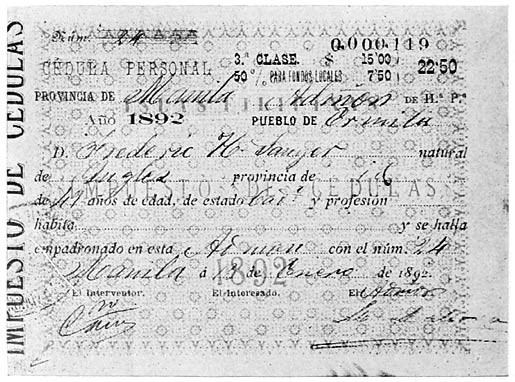
Reduced Fac-simile of the Document of Identity of the Author, Showing the Amount Paid Annually as Poll-tax, $22.50.
To face p. 53.
Places had to be found for them, and a bureaucratic administration partly copied from French practice, was rapidly substituted for the old paternal régime. New departments were organised or the old ones greatly extended. Far more money was spent on the salaries of engineers and assistant-engineers than on public works. The salaries of the officials of the Woods and Forests exceeded the revenue derived from dues on timber cut in the Crown forests, and their regulations seriously interfered with the privileges of the natives previously mentioned, and caused great discontent. The salaries of the Inspectors of Mines were almost a useless expense, for there was no revenue derived from mines, in fact there were no mines, only placers and washings. A medical service was organised at great cost and to little advantage. Doctors were appointed to reside at the hot springs, and one could not take a bath there without paying a fee. Model farms and Schools of Agriculture were started, to find places for more Spaniards, for the officials received their salaries, but no funds were forthcoming for material or establishment.
In 1886 there took place the separation of the executive and the judicial functions, and eighteen civil governors were appointed to the principal provinces. Later on, eighteen judges of first instance were nominated to these same provinces. After centuries of rule, the Alcaldes Mayores were abolished.
Then came a period when certain bureaucrats in Madrid conceived what they thought a vast and patriotic idea. They founded a school of politicians who called themselves Asimilistas. Their grand idea was to assimilate the administration of the Philippines to that of the Mother Country. They thought it wise to assimilate the institutions of a tropical dependency with eight millions of native inhabitants, of whom one-sixth part were independent heathen or Mahometans, to the gradually evolved institutions of Old Spain.
By way of a commencement they began to speak and write of the Philippines as “that beautiful province of Spain.” The Philippine army had always been distinct from the Peninsular army, but now by a paper reform it was embodied in it, and the regiments were re-numbered, the 1st Visayas Regiment becoming the 74th, etc. This was considered to be a strong link to bind together the Mother Country and the Colony.
The extra expense of these crowds of employés and of some expeditions to Mindanao and Joló was very heavy, accordingly every year saw some new and oppressive tax. In 1883 the “Tributo,” or tribute that had been paid by the natives since the conquest, was replaced by a tax on the Cédula Personal, or document of identity, and this was paid by all adults of both sexes, whether Spaniards, foreigners, or half-castes. In the Appendix will be found a facsimile of my cédula.
The Customs duties were several times raised, sometimes without much notice. A tax on all trades and professions, on horses and carriages, a heavy port tax, a vexatious tax on all animals slaughtered, even down to a sucking pig, taxes on the hand-looms used by the women in their spare time, taxes on sugar-mills, rice-mills, on boats and lighters, and on houses; all these and many more were collected.
There were also serious agrarian disputes between the Dominicans, the Augustinians, and the tenants on their estates, owing to excessive rents demanded by the friars. All these circumstances brought about a great change in the relations between the Spaniards and the natives. Whereas formerly the wealthy native kept open house on feast days, and received with pleasure the visits of Spaniards, generally elderly men used to the country and speaking the language of the people, he now found his house invaded by a crowd of young officials new to the country and its ways, who fell on the eatables like a swarm of famishing locusts, and soon devoured the turkeys and hams and other good things he had provided to entertain his friends. Besides, his women-folk would probably not be treated by the new-comers with the courtesy and consideration they had been used to.
An estrangement gradually made itself felt, and increased year by year, in direct proportion to the influx of Spaniards. Not one in a hundred of these did any useful work or added in any way to the wealth of the community. They were the drones of the hive, and were in fact directly harmful, for they had to be supported from the Treasury, and they irritated the natives by their illegal exactions and overbearing conduct whenever they came in contact with them.
Still year after year passed without disturbances. From 1877 to 1892, whilst I was in the country, I can testify that almost perfect order reigned. The fighting in Mindanao and Joló went on as a matter of course like the Acheen war in Sumatra, and an expedition was sent against the Igorrotes. But in the civilised districts of Luzon and Visayas good order was kept. The only outbreak I remember was the religious excitement in Samar, which closed when the false gods were shot down.
Crime was infrequent, and in those fourteen years I do not think half-a-dozen executions took place. There was less risk of burglary in Manila than in a London suburb. Whatever their faults I must give the Spanish Administration credit for the perfect order they kept. Manila, in this respect, compared favourably with Hong Kong, and still better with Singapore, where the authorities, perhaps remembering the fate of Governor Eyre of Jamaica, and in terror of Exeter Hall, tolerated the incredible insolence of the Chinese secret societies. These villainous organisations, which in Singapore successfully defied the law, never raised their heads in Manila, and Rajah Brooke showed how to treat them in Sarawak.
In pursuance of the Asimilista policy, in July 1887, the Penal Code was put in force in the Philippines by peremptory order from the Government at Madrid, and much against the opinion of experienced officials. In December of the same year the Civil Code was promulgated.
It cannot be said that these reforms, however well-intended, produced any beneficial effect on the natives. Combined with the great increase in taxation, they intensified the discontent that was always smouldering, more especially in the hearts of the native priests. Their grievances against the religious orders, and more particularly against the Recollets, who had been compensated for the handing over of their benefices in Mindanao to the Jesuits, at the expense of the secular clergy, were the cause of their bitter hatred of the Spanish friars.
In 1883 Field-Marshal Jovellar had thought it necessary to strengthen the small garrison by bringing out two battalions of Marine Infantry. However it was not till March 1st, 1888, that some natives and mestizos, emboldened by the fact that an anti-clerical, D. Jose Centeno, a mining engineer, was Acting Civil Governor of Manila, walked in procession to his official residence and presented a petition addressed to the Governor-General, demanding the immediate expulsion of the friars of the religious orders, and of the Archbishop, whom they declared unworthy to occupy the Primacy of the Islands. They further demanded the secularisation of the benefices and the confiscation of the estates of the Augustinians and the Dominicans.
To this petition there were 810 signatures, but when the signatories were summoned and examined, most of them (as is their custom) declared they did not know what they had signed, and denied that they wished the friars to be expelled.
The petition was said to have been written by Doroteo Cortes, a mestizo lawyer, but I am told he did not sign it.
This manifestation, sixteen years after the mutiny at Cavite, seems to have had some relation to that event, for the petition accused the friars of compassing the death of Father Burgos, by subornation of justice.
The result of this appeal of the natives was that the principal persons who took part in it were banished, or sent to reside at undesirable spots within the Archipelago.
There were some agrarian disturbances at Calamba and Santa Rosa, one of the estates of the Dominicans, in 1890.
I may say that only the Augustinians, the Dominicans, and the Recollets possess landed estates, and that I have had the opportunity of examining several of them. They are all situated in Tagal territory, and as they are the pick of the lands, their possession by the friars has caused great heart-burnings amongst the Tagals—there has been a smouldering agrarian discontent for years.
Little care, indeed, is required by the Musa textilis after the first planting, and the cleaning of the fibre is a simple matter, but very laborious.
Chapter VII.
The Religious Orders.
The Augustinians—Their glorious founder—Austin Friars in England—Scotland—Mexico—They sail with Villalobos for the Islands of the Setting Sun—Their disastrous voyage—Fray Andres Urdaneta and his companions—Foundation of Cebú and Manila with two hundred and forty other towns—Missions to Japan and China—The Flora Filipina—The Franciscans—The Jesuits—The Dominicans—The Recollets—Statistics of the religious orders in the islands—Turbulence of the friars—Always ready to fight for their country—Furnish a war ship and command it—Refuse to exhibit the titles of their estates in 1689—The Augustinians take up arms against the British—Ten of them fall on the field of battle—Their rectories sacked and burnt—Bravery of the archbishop and friars in 1820—Father Ibañez raises a battalion—Leads it to the assault of a Moro Cotta—Execution of native priests in 1872—Small garrison in the islands—Influence of the friars—Their behaviour—Herr Jagor—Foreman—Worcester—Younghusband—Opinion of Pope Clement X.—Tennie C. Claflin—Equality of opportunity—Statuesque figures of the girls—The author’s experience of the Friars—The Philippine clergy—Who shall cast the first stone?—Constitution of the orders—Life of a friar—May become an archbishop—The chapter—The estates—The Peace Commission—Pacification retarded—Who will collect the rents?
Before referring further to these estates it may be as well to give a brief sketch of the religious orders, whose existence is bound up with the history of the Philippines, to the conversion and civilisation of which they have so largely contributed. They won the islands for Spain, they held them for centuries, and now, having served their purpose, they have lost them, doubtless for ever.
The Augustinians were the pioneers in converting the inhabitants of the Philippines, and they have maintained their predominance ever since.
I therefore begin my description with this venerable order, and it will be proper to say something about its glorious founder.
The following data are taken from the ‘Encyclopædia Britannica’ and other sources.
Augustine (Aurelius Augustinus) one of the four great fathers of the Latin Church, and admittedly the greatest of the four, was born at Tagaste (Tajelt), a town of Numidia, North Africa, A.D. 354. His father, Patricius, was a burgess of this town, and was still a pagan at the time of his son’s birth.
His mother, Mónica, was not only a Christian, but a woman of the most elevated, tender, and devoted piety, whose affectionate and beautiful enthusiasm have passed into a touching type of womanly saintliness for all ages.
Augustine studied rhetoric at Madaura and Carthage, and visited Rome and Milan.
He passed many years in unrest of mind and doubt, but ultimately a passage from Romans xii. 13, 14 seemed to pour the light of peace into his heart. He became a Christian and was baptised in his thirty-third year. Patricius was also converted and baptised, and Monica found the desire of her life fulfilled and her dear ones united to her in faith.
After some years of retirement, Augustine made a journey to Hippo Regius, a Roman colony on the River Rubricatus in North Africa, and became a presbyter.
His principal writings are ‘The City of God,’ ‘Confessions,’ and ‘The Trinity.’
He died during the siege of Hippo by the Vandals at the age of 75.
The theological position and influence of Augustine may be said to be unrivalled. No single name has ever exercised such power over the Christian Church, and no one mind has ever made such an impression upon Christian thought.
The Augustinians look upon this great Christian moralist as their founder, and reverence his memory and that of his saintly mother.
Whether he personally drew up the rules they observe or not, they were his disciples, following in his foot-steps, and finding their inspiration in his writings and example.
Great indeed must have been the magnetic force of that vehement nature that it could give an impetus to his followers that carried them all over Europe, that made them the companions of the discoverers and conquerors of the New World, and that filled their hearts with zeal and courage to face the dangers of the great lone ocean in company with Villalobos and Legáspi.
The Order traces its inception to the town of Hippo, and fixes the date at A.D. 395. Many, doubtless, were its vicissitudes, but in the year 1061, and again in 1214, we find the Order remodelled and extended. The Augustinians were very numerous in England and Scotland. In 1105 they had settled at Colchester and at Nostell, near Pontefract. Later they had abbeys at Bristol, Llantony, Christchurch, Twynham, Bolton and London, where part of their church (Austin Friars) is still standing. Altogether they had 170 houses in England. Their first house in Scotland was at Scone in 1114, and they soon had 25 houses, including churches or abbeys at Inchcolm in the Firth of Forth, St Andrew’s, Holyrood, Cambuskenneth and Inchaffray.
The Austin Friars or Black Canons were then described as an order of regular clergy holding a middle position between monks and secular canons, almost resembling a community of parish priests living under rule, and they have retained these characteristics to the present day.
They were numerous in Spain, and some of the other Orders, such as the Dominicans or Preaching Friars, the Franciscans, and the Recollets, may almost be looked upon as offshoots of this venerable order, for they conformed to its general rule, with certain additions. Thus the Dominicans, founded by Saint Dominic de Guzman, were incorporated in 1216 by a Bull of Pope Honorius III. and adopted a rule of absolute poverty or mendicancy in addition to the usual vows of chastity and obedience.
This Order held its first chapter in 1220 at Bologna, under the presidency of its founder.
The vows of poverty of this powerful Order have not prevented it from holding large estates in the Philippines, from owning blocks of buildings in Manila and Hong Kong, and from having a huge sum invested in British and American securities. These however belong to the Corporation and not to the individual members.
From Spain the Augustinians spread to Mexico and assisted the Franciscans, who were the pioneers there under Father Bartolomé de Olmédo and Father Martin de Valencia, to gather in the abundant harvest. Father Toribio de Benavénte was one of twelve Franciscans sent out in 1523, and he has left records of the success of these missionaries. They opened schools and founded colleges, and in twenty years nine millions of converts had been admitted into the Christian fold.
By this time Magellan had passed the narrow straits, and sailing across the vast solitudes of the Pacific had reached the Visayas Islands to meet his fate, and Sebastian de Elcano had completed the circumnavigation of the globe and had arrived in Spain with accounts of the new lands which the expedition had discovered.
When, in 1542, Captain Ruy Lopez de Villalobos sailed from Natividad (Mexico) for the Islands of the Setting Sun, only to die of grief at Amboyna, there accompanied him a group of Augustinian Friars. After the loss of his vessels the survivors took ship for Goa and from thence returned to Europe, arriving at Lisbon in August 1549, seven years after leaving the port of Natividad.
The Order has carefully preserved the names of these early missionaries; they are, Frs. Jeronimo de San Esteban, Sebastian de Trasierra, Nicolas de Perea, Alonso Alvarado.
In the expedition under General Don Miguel Lopez de Legáspi, which sailed in 1564, Fray Andres Urdanéta, an Augustinian, went as chief navigator and cartographer, and the following friars accompanied him: Frs. Andres de Aiguirre, Martin de Rada, Diego Herrero, Pedro Gamboa.
Since founding the city of Cebú in 1570, and the city of Manila the following year, the Augustinians have continued to found town after town, and down to 1892 had founded no less than two hundred and forty-two, administered by two hundred and forty-seven priests of the Order as by the following table:—
Year 1892.
Summary of Towns founded by the Augustinians.
Handed over to other Orders
28
Amalgamated with other towns
11
Administered by Augustinians
203
Total
242
Population of the above 203 towns, 2,082,181.
The Augustinians in the Philippine Islands.
In Parish Ministry.
Parish Priests
188
Stewards
37
Coadjutors
7
Vicars (learning dialects)
3
Missionaries
12
247
Residing in the convents of Manila, Cebú, and Guadalupe.
Superiors or Office bearers
19
Conventual Priests
7
Students
14
Invalids
6
Lay Brethren
17
63
Total
310
In former years this Order had established missions in Japan, and they were very successful in making converts, but during the persecution many members of the Order lost their lives, or, as they phrase it, “attained the palm of martyrdom.”
At the present time they maintain seven missionaries in the province of Hun-nan in China. In Spain they support three colleges, Valladolid, La Vid, and La Escorial. They are also in charge of the magnificent church of that extraordinary palace, and of the priceless library of which they are editing a catalogue.
The Augustinians have published a great many works, such as grammars and vocabularies of the native dialects, and many books of devotion.
One of their leading men, Father Manuel Blanco, was a most learned and laborious botanist. He collected and classified so many of the Philippine plants that the Order decided to complete his work and publish it. Fray Andres Naves and Fray Celestino Fernandez Villar, both well-known to me, worked for years at this, and were assisted by my illustrious friend H. E. Don Sebastian Vidal Soler and others.
The result is a most sumptuous and magnificent work—published in Manila—there being four folio volumes enriched by many hundreds of coloured plates of the different trees, shrubs, orchids and lianas, most beautifully executed from water-colour paintings by D. Regino Garcia and others. This monumental book is called the ‘Flora Filipina.’ It received a diploma of honour at the International Colonial Exhibition of Amsterdam in 1883. The British Museum possesses a copy, but unfortunately most of the work was destroyed by fire in the bombardment of the Convent of Guadalupe during the war.
However, the widow of Señor Vidal, now Mrs. Amilon of Philadelphia, still has some copies to dispose of.
I hope that what I have said about the Augustinians will show that they are not the lazy and unprofitable persons they are sometimes represented. The same may be said of the Dominicans.
The Augustinians were followed, after an interval of seven years, by the Franciscans, four years after that by the Jesuits, six years after the Jesuits came the Dominicans.
Last of all came the Recollets, or bare-footed Augustinians.
The following Table gives the numbers of friars of the five religious orders in the Philippines, at the dates mentioned, taken from their own returns. The first column gives the dates of the first foundation of the Order, the second the date of its arrival in the Archipelago. The other columns give the statistics of baptisms, marriages and deaths, taken from the parish registers.
Statement of the Population Administered by the Religious Corporations and Secular Clergy in the Philippines, 1896.
Year of Foundation or Revival.
Year of Arrival.
Corporation.
Towns.
Provinces.
Friars.
Baptisms.
Marriages.
Burials.
Souls.
395
1061
1570
Augustinians
203
16
310
98,731
20,355
83,051
2,082,131
1532
1606
Recollets
194
20
192
56,259
11,439
40,008
1,175,156
1208
1577
Franciscans
153
15
455
38,858
11,927
35,737
1,010,753
1216
1587
Dominicans
69
10
206
27,576
7,307
32,336
699,851
1534
1581
Jesuits
133
6
167
15,302
22,017
4,937
191,493
Secular Clergy
..
..
..
..
..
..
967,294
Total
1,330
6,126,678
N.B.—
The population of the Islands according to the census of 1877
5,995,160
Probable Christian population, 1899
8,000,000
These holy men have, since very early times, shown themselves rather turbulent, and then and always endeavoured to carry matters with a high hand. Thus in 1582 we find them refusing to admit the diocesan visit of the Bishop of Manila, and that old dispute has cropped up on and off many times since then. At the same time we find them taking the part of the natives against the Encomenderos. They have always been ready to fight for their country and to subscribe money for its defence. When Acting Governor Guido de Lavezares headed the column which attacked the pirate Li-ma-Hon, he was accompanied by the Provincial of the Augustinians. In 1603 all the friars in Manila took up arms against the revolted Chinese, and three years later the Augustinians not only furnished a war ship to fight the Portuguese, but provided a captain for it in the person of one of their Order, Fray Antonio Flores. It appears that the estates of the Augustinians and the Dominicans were very early a bone of contention, for in 1689 a judge arrived in Manila, and, in virtue of a special commission he had brought from Madrid, he required them to present their titles. This they refused to do, and the judge was sent back to Mexico, and a friend of the friars was appointed as Commissioner in his place. Then the friars condescended to unofficially exhibit their titles. Now more than two centuries after the first abortive attempt, the question of the ownership of these lands is still under discussion.
During the British occupation of Manila in 1763 the friars took up arms in defence of their flag, and gave their church bells to be cast into cannon. No less than ten Augustinians fell on the field of battle. The British treated them with great severity, sacking and destroying their rectories and estate houses, and selling everything of theirs they could lay hands on. I have visited the ruins of the old estate house of Malinta which was burnt by the British.
In 1820, when the massacre of foreigners by the Manila mob took place, owing the cowardice of General Folgueras, the archbishop and friars marched out in procession to the scene of the disturbance and succeeded in saving many lives. In 1851 a Recollet, Father Ibañez, raised a battalion from his congregation, trained and commanded it. He took the field at Mindanao and with the most undaunted bravery led his men to the assault of a Moro Cotta, or fort, dying like our General Wolfe at the moment of victory. Not one man of this battalion ever deserted or hung back from the combats, for the worthy priest had all their wives under a solemn vow never to receive them again unless they returned victorious from the campaign.
The religious orders have frequently interfered to protect the natives against the civil authorities, and were often on very good terms with the mass of their parishioners. The greatest jealousy of them was felt by the native clergy.
The military revolt which broke out in Cavite in 1872, was doubtless inspired by this class, who saw that a policy had been adopted of filling vacancies in all benefices except the poorest, with Spanish friars instead of natives. The condemnation of Burgos, Gomez, and Zamora, three native priests who were executed at Manila soon after the suppression of the revolt, is ascribed by the natives and mestizos to the subornation of justice to the friars, who are said to have paid a large sum for their condemnation.
However this may be, there is no doubt that since that date the feeling against the friars has become intensified.
The friars were the chief outposts and even bulwarks of the government against rebellions. Almost every rising has been detected by them, many plots being revealed by women under the seal of confession. It was only by the assistance of the friars that the islands were held by Spain for so many centuries almost without any military force.
The islands were not conquered by force of arms—the people were converted almost without firing a shot.
The greater part of the fighting was to protect the natives against Chinese pirates, Japanese corsairs, Dutch rovers, or the predatory heathen.
The defensive forces consisted of local troops and companies of Mexican and Peruvian Infantry. It is only since 1828 that Manila has been garrisoned by regular troops from the Peninsula.
During my residence in the islands I do not think there were more than 1500 Spanish troops in garrison in the whole islands, except when some marines were sent out. These troops belonged to the Peninsular Regiment of Artillery, and were a very fine looking set of men.
That this small force could be sufficient is evidently due to the influence of the friars in keeping the people quiet.
Yet the feeling of a great majority of Spanish civilians was against the friars, and I think many of those who supported them, only did so from interested motives.
The consequence was that as the number of Spaniards increased, the influence of the friars diminished, for the Spanish anti-clericals had no scruples in criticising the priests and in speaking plainly to the natives to their prejudice.
The friars have fared badly at the hands of several writers on the Philippines; but it will be noticed that those who know the least about them speak the worst of them.
Herr Jagor, who was much amongst them, bears witness to the strict decorum of their households, whilst he very justly says that the behaviour of the native clergy leaves something to be desired.
Foreman hints at horrors, and with questionable taste relates how he found amongst a priest’s baggage some very obscene pictures.
Worcester thinks the priests’ influence wholly bad. From what he states in his book, he must have come across some very bad specimens amongst the smaller islands where he wandered.
Younghusband, who perhaps got his information at the bar of the Manila Club, describes them as “monsters of lechery.”
There is a tradition that when the conclusions of a tribunal favourable to the canonisation of Santa Rosa de Lima, Patroness of the Indies, were laid before Pope Clement X., that Pontiff manifested his incredulity that a tropical climate could produce a saint. He is even credited with the saying that bananas and saints are not grown together.
The tradition may be erroneous, but there is something in the opinion that deserves to be remembered.
Temperature does have something to do with sexual morality, and in comparing one country with another an allowance must be made for the height of the thermometer.
The friars in the Philippines are but men, and men exposed to great temptations. We should remember the tedium of life in a provincial town, where, perhaps, the parish priest is the only European, and is surfeited with the conversation of his native curates, of the half-caste apothecary and the Chinese store-keeper. He has neither society nor amusement.
I have previously remarked upon the position of women in the Philippines. I may repeat that their position, both by law and custom, is at least as good as in the most advanced countries.
I remember reading with great interest, and, perhaps, some sympathy, a remarkable article in the New York Herald, of January 10th, 1894, headed “Virtue Defined,” signed by Tennie C. Claflin (Lady Cook), and it seemed to me a plea for “equality of opportunity” between the sexes, if I may borrow the phrase from diplomacy. Well, that equality exists in the Philippines. Whilst unmarried, the girls enjoy great freedom. In that tolerant land a little ante-nuptial incontinence is not an unpardonable crime in a girl any more than in a youth, nor does it bar the way to marriage.
The girls whilst young possess exceedingly statuesque figures, and what charms they have are nature’s own, for they owe nothing to art. Their dress is modest, yet as they do not wear a superfluity of garments, at times, as when bathing, their figures are revealed to view.
Bearing in mind the above condition of things and that the priest is the principal man in the town and able to do many favours to his friends, it is not surprising if some of the young women, impelled by the desire of obtaining his good graces, make a dead set at him, such as we sometimes see made at a bachelor curate in our own so-very-much-more frigid and, therefore, moral country. The priest, should he forget his vows of celibacy, is a sinner, and deserving of blame for failing to keep the high standard of virtue which his Church demands. But I do not see in that a justification for calling him a monster. Have we never heard of a backslider in Brooklyn, or of a clerical co-respondent at home, that we should expect perfection in the Philippines? As for the statements that the priests take married women by force, that is an absurdity. The Tagals are not men to suffer such an outrage.
The toleration enjoyed by the girls, above referred to, is a heritage from heathen times, which three centuries of Christianity have failed to extirpate. In fact, this is a characteristic of the Malay race.
During the many years I was in the islands I had frequent occasion to avail myself of the hospitality of the priests on my journeys. This was usually amongst the Augustinians, the Dominicans and the Recollets. I declare that on none of those many occasions did I ever witness anything scandalous, or indecorous in their convents, and I arrived at all hours and without notice.
As to Younghusband’s denouncement of them as “monsters of lechery,” I would say that they were notoriously the most healthy and the longest-lived people in the islands, and if that most unjust accusation was true, this could hardly be the case. It should be remembered that the priest of any large town would be a man advanced in years and therefore less likely to misconduct himself.
There was also the certainty that any open scandal would be followed by punishment from the provincial and council of the order. I have known a priest to be practically banished to a wretched hamlet amongst savages for two years for causing scandal.
Some late writers speak of the native clergy as if they were of superior morality and better behaved than the Spanish priests. That appreciation does not commend itself to those who have had some experience of the Philippine clergy.
Some of those I have known were of very relaxed morals, not to say scandalous in their behaviour. The Philippine Islands, in short, are not the chosen abode of chastity: but I do not know why the Spanish friars should be singled out for special censure in this respect.
I can truly say that I was not acquainted with any class out there entitled to cast the first stone.
Each of the orders (except the Jesuits) is a little republic governed or administered by officers and functionaries elected by the suffrages of the members. The head of the order is a Superior or General, who resides in Rome, but the head in the Philippines is called the Provincial.
The brethren render him the greatest respect and obedience, kneeling down to kiss his hand.
There is a council to assist the provincial, they are called definidores or padres graves, the exact nomenclature varies in the different orders.
There is a Procurator or Commissary in Madrid, a Procurator-General in Manila, a Prior or Guardian to each convent not being a rectory, an Orator or preacher, lay-brethren in charge of estates or of works, parish priests, missionaries, and coadjutors, learning the native dialects.
The members of the order were appointed to benefices according to their standing and popularity amongst their brethren. The neophytes are trained in one of the seminaries of the order in Spain; for instance, the Augustinians have colleges at Valladolid, La Vid, and La Escorial, with more than 300 students.
When a young priest first arrived in the Philippines, he was sent as a coadjutor to some parish priest to learn the dialect of the people he is to work amongst. Then he would be appointed a missionary to the heathen, where he lived on scanty pay, amongst savages, either in the highlands of Luzon or in some remote island, remaining there for two or three years. His first promotion would be to a parish consisting of a village of thatched houses (nipa) and, perhaps, the church and convent would be of the same material. This meant a constant and imminent dread of the almost instantaneous destruction of his dwelling by fire. Perhaps there is communication with Manila once a month, when, by sending to the nearest port, he may get letters and newspapers and receive some provisions, an occasional cask of Spanish red wine, some tins of chorizos (Estremeño smoked sausages), a sack of garbanzos, or frijóles, a box of turron de Alicante, and some cigars from the procuration of the convent in Manila. These would be charged to his account, and frugally as he might live, many a year might pass over his head before he would be out of debt to his Order. And poor as he might be, he would never refuse his house or his table to any European who might call upon him. Later on, if his conduct had satisfied his superiors, the time would come when he would get nominated to a more accessible and more profitable parish, that would quickly enable him to pay off the debt due to the procuration. He would have a church and convent of stone, keep a carriage and pair of ponies, and begin to have a surplus, and to contribute a little to the funds of his Order.
Soon he would become Padre Grave, and begin to have influence with his colleagues. He would be removed to a richer town and nominated Vicario Foráneo, equivalent to an archdeacon in England. Later on, he might be elected a Definidor, or councillor. Then, perhaps, one of the great prizes of the order fell to his lot. He might be appointed parish priest of Taal or Biñan, worth at least ten thousand dollars a year, or of rich Lipa, high amongst its coffee groves (now, alas! withered), which used to be worth twenty thousand dollars in a good year. He would treat himself well, and liberally entertain all who visited him, and governors of provinces, judges, officers of the Guardia Civil, would often be seen at his table.
He would make large contributions to the funds of the Order, with the surplus revenue of his parish.
If, however, the priest whose career we have been following, had shown sufficient character for a champion, and had become popular in the Order, he might, perhaps, be elected Provincial, and then, disposing of the influence of his Order, some day get himself made a Bishop or even Archbishop of Manila, should a vacancy occur, and so become a prince of the Church.
Whatever talents a friar had, a sphere could always be found for their exercise. If he had a gift for preaching, he could be appointed Orator of the Order. If he was good at Latin and Greek, he could be made a professor at the university. If he was a good business man, he could be chosen procurator. If he had diplomatic talents, he could be made commissary of the order at Madrid. In any case he was sure to be taken care of to the end of his days.
As for the Orders in themselves, I have already said that, excepting the Society of Jesus, they are little republics, and that office-holders are elected by the votes of the members. When a general Chapter of the Order is held for this purpose, the members come from all parts and assemble in their convent in Manila.
I am sorry to say that there has sometimes been so much feeling aroused over the question of the distribution of the loaves and fishes, that the opposing parties have broken up the chairs and benches to serve as clubs, and furiously attacked each other in the battle royal, and with deplorable results.
In consequence of this, when the chapter or general assembly was to be held, the governor-general nominated a royal commissary, often a colonel in the army, to be present at these meetings, but only to interfere to keep the peace. It was something of an anomaly to see a son of Mars deputed to keep the peace in an assembly of the clergy. The meeting commenced with prayer, then one by one all the dignitaries laid down their offices and became private members of the Order, so that at the end of this ceremony every one was absolutely equal.
Then the eldest rose and solemnly adjured any one present who held a Bull of the Holy Father, to produce it then and there under pain of major excommunication. Three times was this solemn warning delivered.
It owes its origin, perhaps, to some surprise sprung on a brotherhood in former days, yet it is to be noted that one of the privileges of their Catholic majesties the kings of Spain was, that no Bull should run in their dominions without their approval.
Then free from outside interference, and all present being on an equal footing the election takes place. Amidst great excitement the Provincial, the Procurator, the Orator, the Definidores, or Councillors, are chosen according to their popularity, or as they are deemed best fitted to advance the interests of the voter or the Order.
The selection of office-holders is a matter of the greatest importance to the members, as those in power distribute the benefices and are apt to be more alive to the merits of their supporters, than to the pretensions of those who have voted for others.
But, however divided they may be on these occasions, they unite against any outsider, and unless the question is evidently personal, he who offends a member finds the Order ranged against him, and, perhaps, the other Orders also, for in matters affecting their interests the Orders act in unison, and as has been said, have succeeded in removing not only governors of provinces, but governors-general also when these have failed to do their bidding.
1 Expelled in 1768. Readmitted, 1852, for charge of schools and missions.
2 Of these 4102 were baptisms of heathen in 1896.
1 Expelled in 1768. Readmitted, 1852, for charge of schools and missions.
2 Of these 4102 were baptisms of heathen in 1896.
Chapter VIII.
Their Estates.
Malinta and Piedad—Mandaloyan—San Francisco de Malabon—Irrigation works—Imus—Calamba—Cabuyao—Santa Rosa—Biñan—San Pedro Tunasan—Naic—Santa Cruz—Estates a bone of contention for centuries—Principal cause of revolt of Tagals—But the Peace Commission guarantee the Orders in possession—Pacification retarded—Summary—The Orders must go!—And be replaced by natives.
The Augustinians own some fine estates near Manila. In 1877 I visited Malinta and Piedad, which, according to an old plan exhibited to me, drawn by some ancient navigator, measured over 14,000 acres in extent, a good part of which was cultivated and under paddy; still a large expanse was rocky, and grew only cogon (elephant grass). The lay-brother in charge, Aureliano Garcia, confided to me that he went about in fear, and expected to end his life under the bolos of the tenants. I was then new to the country, and saw no signs of discontent. I afterwards visited Mandaloyan, another estate nearer Manila. This was nearly all arable land. The house was large and commodious, and was used as a convalescent home for the friars. I have not a note of the extent of this estate, but it occupies a great part of the space between the rivers Maibonga and San Juan, to the north of the Pasig. The lay-brother in charge, Julian Ibeas, did not seem at all anxious about his safety. The land here was more fertile than that of Malinta, and there was water carriage to a market for the crops.
In view of my report, which was not, however, unduly optimistic, my clients deputed me to ask the Augustinians for a lease of the above three estates for twenty-five years, the rent to be $40,0001 per year for three years, and each year after that an addition of a thousand dollars, so that the ultimate rent would be $62,000 per annum. However, after taking some time to consider, the procurator declined the offer.
On the above estates there was little or nothing done by the owners to improve the land. They had limited themselves to building large and convenient houses and granaries for their own accommodation, and to entertain their friends.
In 1884 I constructed a pumping station on the River Tuliajan in this estate, and laid a pipe line right through the property to supply fresh water to the sugar refinery at Malabon, five miles distant. I had no difficulty in obtaining permission, indeed, Fray Arsenio Campo (now Bishop of Nueva Cáceres) facilitated the work in every way. The only protest was by Doroteo Cortes, a half-caste lawyer, who interposed as the pipe had to pass between two fish-ponds belonging to him, and he extorted a blackmail $800 to withdraw his opposition. Let the reader contrast the behaviour of the Spaniard and the half-caste, now posing as an “Americanista.”
San Francisco de Malabon, another possession of theirs, is a magnificent property, situated on the fertile, well-watered land that slopes from the summits of the Tagaytay range, north of the vast crater-lake of Bombon, to the shores of the ever-famous Bay of Bacoor, the scene of Spain’s naval collapse.
Through the volcanic soil three rivers, the Ilang-ilang, the Camanchíle, and the Jálan, have cut deep gashes down to the bed-rock, on the surface of which the rapid waters rush downwards to the sea.
A nobly-proportioned house of stone, almost a fortress, was planted where it commanded a grand, a stately view. From its windows the spectator looked over fields of waving grain, over fruit trees, and town and hamlets, down to the sea shore, and across the vast expanse of placid bay to where in the far north solitary Arayat rears his head. The thick walls and lofty roof excluded the solar heat, and the green-painted Venetians saved the inmate from the glare. Very welcome was that hostel, furnished in severe ecclesiastical almost mediæval style, to me, after the dusty up-hill drive of eight miles from Cavite.
I visited this estate in 1879, and found that extensive irrigation works had been carried out. A new dam on one of the rivers, about fifty feet high, was approaching completion. Unfortunately, the work had been executed by a lay-brother, a stone mason, without professional supervision. He was ignorant of the necessity of taking special precautions when preparing the seat for the dam. Although he had a bed of volcanic tuff to build upon he would not go to the trouble to cut into and stop all faults and crevices in the rock before laying his first course of masonry, and he hurried on the job to save expense as he supposed. For the same reason he did not attempt to follow the correct profile of the dam. When the pressure came on, the water spouted up in little fountains, and gradually increased as it cut away the soft stone. I advised them what to do, and after a good deal of work, Portland cement and puddled clay got them out of their difficulty.
About four miles to the eastward of San Francisco de Malabon, and on the same volcanic soil, is the great estate of Imus belonging to the Recollets, or unshod Augustinians. It is about five miles from the landing-place at Bacoor. Here again three rivers run through the property, and the view from the house is the same.
The house itself was a grim fortress and served the rebels well in 1896, for they found arms and ammunition in it, and successfully defended it against General Aiguirre who had to retire, being unable to take it without artillery.
In 1897 the army of General Lachambre advanced against Imus, and on the 24th March took the outer defences of the town, notwithstanding the determined resistance of the Tagals, of whom three hundred were killed in a hand-to-hand combat. Next day the estate house, which adjoins the town and had been for six months the stronghold of the Katipunan, was bombarded and burnt, only the ruins remain.
There are extensive works of irrigation at this place also, and formerly a large sugar works was built here by the owners, but it failed, as there was no one fit to take charge of it.
I have not visited this Hacienda, and cannot give its extent or value.
Of all the Orders the greatest land-owners are the Dominicans. They have vast estates in Calamba, Cabuyáo, Santa Rosa, Biñan, and San Pedro Tunasán, all on the Lake of Bay, also at Naic and Santa Cruz on the Bay of Manila. I have several times visited their estates at the first two places, and can affirm that they have expended considerable sums in building dams for irrigating the lands, and I supplied them with some very large cast-iron pipes for the purpose of making a syphon across a ravine or narrow valley to convey water for irrigating the opposite plain. They have consequently very largely increased the value of these lands.
The house at Calamba, solidly built of stone, with a strong and high encircling wall, served as a fortified camp and headquarters for the Spanish army in operation against the rebels in 1897.
This estate of Calamba has earned a sad notoriety in the Philippines, for the disputes which constantly arose between the administration and their tenants.
It is hardly too much to say that the possession of estates has been fatal to the Orders. They claim to have always been good and indulgent landlords, but the fact remains that all these estates are in Tagal territory, that only the Tagals revolted, and that the revolt was directed against the Orders because of their tyranny and extortions, and because they were landlords and rack renters.
It was, is now, and ever will be an Agrarian question that will continue to give trouble and be the cause of crime and outrage until settled in a broad-minded and statesman-like manner.
These estates have been a bone of contention for centuries, and were a principal cause of the last revolt of the Tagals. Yet the Peace Commission at Paris appears to have given the three Orders a new title to their disputed possessions by guaranteeing to the Church the enjoyment of its property, which, if the Spaniards had continued to rule the islands, must ultimately have been taken from it in the natural course of events, as has happened in every other Catholic country.
I have no doubt that the pacification of the Philippines by the American forces has been greatly retarded, and is now rendered more difficult, by this clause, which must have been accepted by the American commissioners under a misapprehension of its import, and from imperfect information as to the status quo. This difficult matter can still be arranged, but it will require the outlay of a considerable sum of money, which, however, would eventually be recouped.
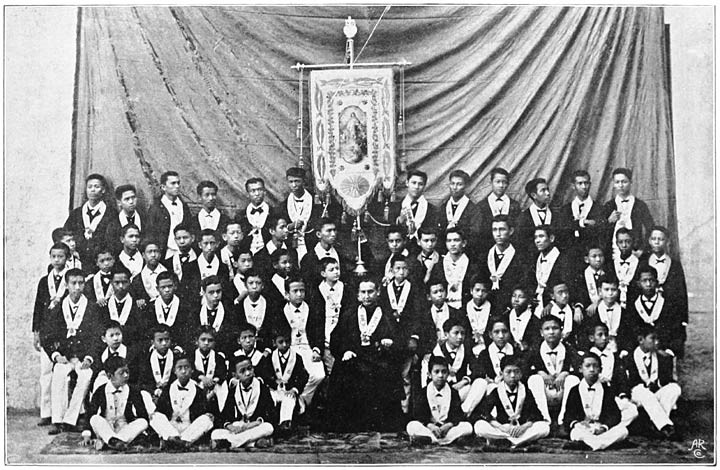
Some of the Rising Generation in the Philippines. Scholars of the Manila Athenæum, Belonging to the Congregation of the Virgin.
To face p. 75.
In present circumstances I venture to say that a garrison would be needed at each estate to protect an administrator or collector, for the Tagal tenants are as averse to paying rent for land as any bog-trotter in Tipperary. I do not envy anybody who purchases these estates, nor would I consider the life of such a one a good risk for an insurance company, if he intended to press the tenants for rents or arrears.
To sum up the Religious Orders, they were hardy and adventurous pioneers of Christianity, and in the evangelisation of the Philippines, by persuasion and teaching, they did more for Christianity and civilisation than any other missionaries of modern times.
Of undaunted courage they have ever been to the front when calamities threatened their flocks; they have witnessed and recorded some of the most dreadful convulsions of nature, volcanic eruptions, earthquakes, and destructive typhoons. In epidemics of plague and cholera they have not been dismayed, nor have they ever in such cases abandoned their flocks.
When an enemy has attacked the islands they have been the first to face the shot. Only fervent faith could enable these men to endure the hardships, and overcome the dangers that encompassed them.
They have done much for education, having founded schools for both sexes, training colleges for teachers, the university of St. Thomas in Manila, and other institutions.
Hospitals and asylums attest their charity. They were formerly, and even lately, the protectors of the poor against the rich, and of the native against the Spaniard. They have consistently resisted the enslavement of the natives.
They restrained the constant inclination of the natives to wander away into the woods and return to primitive savagery by keeping them in the towns, or, as they said, “Under the bells.”
On the other hand, peace and plenty (those blessings for which we pray), have corrupted and demoralised the Orders. No longer liable at any moment to be called upon to fight for their lives, the sterner virtues have decayed. Increased production and export enriched the people, a gold coinage was introduced, and the friars allowed avarice to possess their souls.
In those lands of perpetual summer no death duties have to be paid to a Chancellor of the Exchequer, as in this island of fog and mist.
But the friars have a system of charges for performing the funeral ceremonies, which comes to much the same in the end. I call it a system; it is a very simple system, and consists in extorting as much as they can get, taking into consideration the wealth of the family. To give an instance, I have been assured by a son of Capitan Natalio Lopez, of Balayan, a native gentleman well known to me, that the parish priest charged the family six hundred dollars for performing their father’s funeral ceremony. The same rule applies to baptisms and marriages, and this abuse calls for redress, and for the establishment of fixed fees according to the position of the parties.
Each friar, as a parish priest, was an outpost of the central government, watching for symptoms of revolt. Only thus could the Spaniards hold the archipelago with fifteen hundred Peninsular troops, and a small squadron of warships.
The greatest, and the best-founded, complaint of the natives against the priests, was that whoever displeased them, either in personal or money matters, was liable to be denounced to the authorities as a filibuster, and to be torn from home and family and deported to some distant and probably unhealthy spot, there to reside, at his own cost, for an indefinite time, by arbitrary authority, without process of law. Such a punishment, euphoniously termed “forced residence,” sometimes involved the death of the exile, and always caused heavy expense, as a pardon could not be obtained without bribing some one.
Ysabelo de los Reyes, and other natives, accuse the friars of extorting evidence from suspected persons by torture. I fear there can be no doubt that many victims, including a number of the native clerics, suffered flagellation and other tortures at the hands of the friars for the above purpose. The convents of Nueva-Cáceres and of Vigan, amongst other places, were the scenes of these abominable practices, and Augustinians, Dominicans and Franciscans, have taken part in them. This is referred to at greater length in another part of this work under the heading, “The Insurrection of 1896.”
Individual friars were sometimes, nay, often, very worthy parish priests. I have known many such. But a community is often worse than the individuals of which it is composed. One might say with the Italian musician who had served for many years in a cathedral, and had obtained the promise of every individual canon to support his application for a pension, when he was told that the chapter had unanimously refused his request:
“The canons are good, but the chapter is bad.”
A board will jointly do a meaner action than the shadiest director amongst them, and should it comprise one or two members of obtrusive piety, that circumstance enables it to disregard the ordinary standard of right and wrong with more assurance.
There is a law in metallurgy which has a curious analogy to this law of human nature. It is this: An alloy composed of several metals of different melting-points, will fuse at a lower temperature than that of its lowest fusing constituent.
The Orders, then, have been of the greatest service in the past; they have brought the Philippines and their inhabitants to a certain pitch of civilisation, and credit is due to them for this much, even if they could go no farther. For years their influence over the natives has been decreasing, and year by year the natives have become more and more antagonistic to priestly rule.
A considerable intellectual development has taken place of late years in the Philippines. The natives are no longer content to continue upon the old lines; they aspire to a freer life. Many even harbour a sentiment of nationality such as was never thought of before.
But if the Orders had lost ground with the natives and with many Spaniards, their influence still preponderated. Owners of vast estates, possessors of fabulous riches, armed with spiritual authority, knowing the secrets of every family, holding the venal courts of justice as in the hollow of their hand, dominating the local government, standing above the law, and purchasing the downfall of their enemies from the corrupt ministries in Madrid, these giant trusts, jealous of each other, yet standing firmly shoulder to shoulder in the common cause, constitute a barrier to progress that can have no place nor use under an American Protectorate. They are an anachronism in the twentieth century, and they must disappear as corporations from the Philippines.
They should not, however, be buried under an avalanche of contumely and slander; their long and glorious past should be remembered, and in winding up their estates due regard should be paid to the interests of every member. I cannot here intimate how this is to be done, for it is an intricate subject, rendered more complex by the reluctance of the American Government to interfere in religious matters, even though they are so bound up with the politics of the Philippines that no pacification can be effected without following popular sentiment upon this point.
So far as the landed estates are concerned, the settlement could be arrived at by a commission with ample powers. In the meantime, no sale of these estates should be recognised.
The benefices held by the friars should be gradually bestowed upon the secular clergy, as suitable men can be found. The native clergy have always been badly used by the friars; they have had to suffer abuse and ignominious treatment. They have not been in a position to develop their dignity and self-respect.
I have spoken of them in general as leaving something to be desired as to decorous conduct, but they will doubtless improve when placed in positions of consideration and responsibility.
Amongst them are men of considerable learning; some have passed brilliant examinations in theology and canon law.
As regards piety, Malays, whether heathen, Mahometan or Christian, take their religion lightly, and we must not expect too much. I daresay they are pious enough for the country and the climate.
1 Exchange was then at 4s. 2d.
1 Exchange was then at 4s. 2d.