



автордың кітабын онлайн тегін оқу Giovanni Boccaccio, a Biographical Study
TRANSCRIBER'S NOTE
Obvious typographical errors and punctuation errors have been corrected after careful comparison with other occurrences within the text and consultation of external sources.
Modern practice in Italian texts contracts (removes the space from) vowel elisions, for example l'anno not l' anno, ch'io not ch' io. This book, in common with some similar English books of the time, has a space in these elisions in the original text. This space has been retained in the etext. The only exceptions, in both the text and etext, are in French names and phrases, such as d'Aquino and d'Anjou.
More details can be found at the end of the book.
GIOVANNI BOCCACCIO
BY THE SAME AUTHOR
FREDERIC UVEDALE. A Romance. 1901.
STUDIES IN THE LIVES OF THE SAINTS. 1902.
ITALY AND THE ITALIANS. Second Edition. 1902.
THE CITIES OF UMBRIA. Third Edition. 1905.
THE CITIES OF SPAIN. Third Edition. 1906.
SIGISMONDO MALATESTA. 1906.
FLORENCE AND NORTHERN TUSCANY. Second Edition. 1907.
COUNTRY WALKS ABOUT FLORENCE. 1908.
IN UNKNOWN TUSCANY. 1909.
EDITED BY EDWARD HUTTON
MEMOIRS OF THE DUKES OF URBINO.
By James Dennistoun of Dennistoun. Illustrating the Arms, Arts, and Literature of Italy, from 1440 to 1630. New Edition, with upwards of 100 Illustrations. 3 vols. Demy 8vo. 1908.
CROWE AND CAVALCASELLE'S A NEW HISTORY OF PAINTING IN ITALY.
3 vols. 8vo. 1908-9.
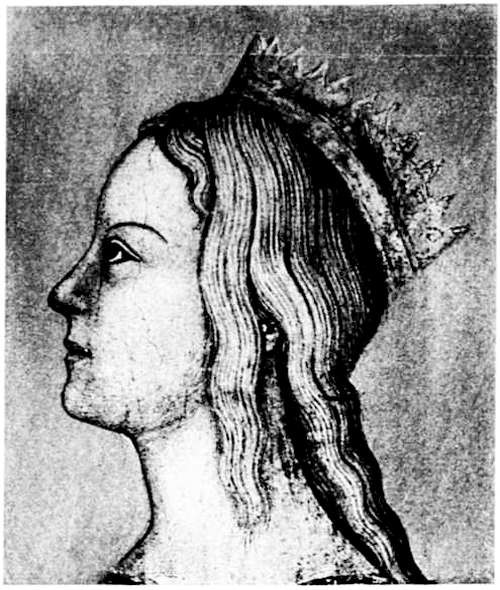
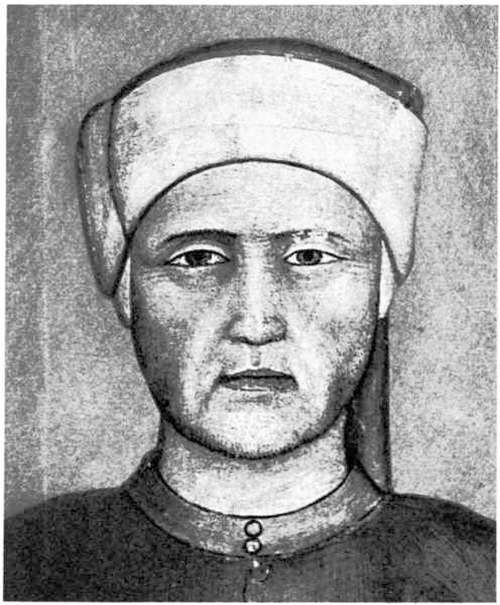
Traditional Portraits of Boccaccio & Fiammetta (Maria d'Aquino)
From the Frescoes in the Spanish Chapel of S. Maria Novella, Florence.
GIOVANNI
BOCCACCIO
A BIOGRAPHICAL STUDY
BY EDWARD HUTTON
WITH PHOTOGRAVURE FRONTISPIECE
& NUMEROUS OTHER ILLUSTRATIONS
But if the love that hath and still doth burn me
No love at length return me,
Out of my thoughts I'll set her:
Heart let her go, O heart I pray thee let her!
Say shall she go?
O no, no, no, no, no!
Fix'd in the heart, how can the heart forget her.
LONDON: JOHN LANE THE BODLEY HEAD
NEW YORK: JOHN LANE COMPANY MCMX
PLYMOUTH: WM. BRENDON AND SON, LTD., PRINTERS
TO MY FRIEND
J. L. GARVIN
THIS STUDY OF AN HEROIC LIFE
PREFACE
It might seem proper, in England at least, to preface any book dealing frankly with the author of the Decameron with an apology for, and perhaps a defence of, its subject. I shall do nothing of the kind. Indeed, this is not the place, if any be, to undertake the defence of Boccaccio. His life, the facts of his life, his love, his humanity, and his labours, plentifully set forth in this work, will defend him with the simple of heart more eloquently than I could hope to do. And it might seem that one who exhausted his little patrimony in the acquirement of learning, who gave Homer back to us, who founded or certainly fixed Italian prose, who was the friend of Petrarch, the passionate defender of Dante, and who died in the pursuit of knowledge, should need no defence anywhere from any one.
This book, on which I have been at work from time to time for some years, is the result of an endeavour to set out quite frankly and in order all that may be known of Boccaccio, his life, his love for Fiammetta, and his work, so splendid in the Tuscan, the fruit of such an enthusiastic and heroic labour in the Latin. It is an attempt at a biographical and critical study of one of the greatest creative writers of Europe, of one of the earliest humanists, in which, for the first time, in England certainly, all the facts are placed before the reader, and the sources and authority for these facts quoted, cited, and named. Yet while I have tried to be as scrupulous as possible in this respect, I hope the book will be read too by those for whom notes have no attraction; for it was written first for delight.
Among other things I have dealt with, the reader will find a study of Boccaccio's attitude to Woman, and in some sort this may be said to be the true subject of the book.
I have dealt too with Boccaccio's relation to both Dante and Petrarch; and it was my intention to have written a chapter on Boccaccio and Chaucer, but interesting as that subject is—and one of the greatest desiderata in the study of Chaucer—a chapter in a long book seemed too small for it; and again, it belongs rather to a book on Chaucer than to one about Boccaccio. I have left it, then, for another opportunity, or for another and a better student than myself.
In regard to the illustrations, I may say that I hoped to make them, as it were, a chapter on Boccaccio and his work in relation to the fine arts; but I found at last that it would be impossible to carry this out. To begin with, I was unable to get permission to reproduce M. Spiridon's and Mr. V. Watney's panels by Alunno di Domenico[1] illustrating the story of Nastagio degli Onesti (Decameron, V, 8), which are perhaps the most beautiful paintings ever made in illustration of one of Boccaccio's tales. In the second place, the subject was too big to treat of in the space at my command. I wish now that I had dealt only with the Decameron; but in spite of a certain want of completeness, the examples I have been able to reproduce will give the reader a very good idea of the large and exquisite mass of material of the fourteenth, fifteenth, and sixteenth centuries in Italy, France, Germany, and even in England which in its relation to Boccaccio has still to be dealt with. Nothing on this subject has yet been published, though something of the sort with regard to Petrarch has been attempted. Beyond the early part of the seventeenth century I have not sought to go, but an examination of the work of the eighteenth century in France at any rate should repay the student in this untouched field.
I have to thank a host of people who in many and various ways have given me their assistance in the writing of this book. It has been a labour of love for them as for me, and let us hope that Boccaccio "in the third heaven with his own Fiammetta" is as grateful for their kindness as I am.
Especially I wish to thank Mrs. Ross, of Poggio Gherardo, Mr. A. E. Benn, of Villa Ciliegio, Professor Guido Biagi, of Florence, Mr. Edmund Gardner, Professor Henri Hauvette, of Paris, Mr. William Heywood, Dr. Paget Toynbee, and Mr. Charles Whibley. And I must also express my gratitude to Messrs. J. and J. Leighton, of Brewer Street, London, W., for so kindly placing at my disposal many of the blocks which will be found in these pages.
EDWARD HUTTON.
Casa di Boccaccio,
Corbignano,
September, 1909.
INTRODUCTION
Of the three great writers who open the literature of the modern world, Dante, Petrarch, and Boccaccio, it is perhaps the last who has the greatest significance in the history of culture, of civilisation. Without the profound mysticism of Dante or the extraordinary sweetness and perfection of Petrarch, he was more complete than either of them, full at once of laughter and humility and love—that humanism which in him alone in his day was really a part of life. For him the centre of things was not to be found in the next world but in this. To the Divine Comedy he seems to oppose the Human Comedy, the Decameron, in which he not only created for Italy a classic prose, but gave the world an ever-living book full of men and women and the courtesy, generosity, and humanity of life, which was to be one of the greater literary influences in Europe during some three hundred years.
In England certainly, and indeed almost everywhere to-day, the name of Boccaccio stands for this book, the Decameron. Yet the volumes he wrote during a laborious and really uneventful life are very numerous both in verse and prose, in Latin and in Tuscan. He began to write before he was twenty years old, and he scarcely stayed his hand till he lay dying alone in Certaldo in 1375. That the Decameron, his greatest and most various work, should be that by which he is most widely known, is not remarkable; it is strange, however, that of all his works it should be the only one that is quite impersonal. His earlier romances are without exception romans à clef; under a transparent veil of allegory he tells us eagerly, even passionately, of himself, his love, his sufferings, his agony and delight. He too has confessed himself with the same intensity as St. Augustine; but we refuse to hear him. Over and over again he tells his story. One may follow it exactly from point to point, divide it into periods, name the beginning and the ending of his love, his enthusiasms, his youth and ripeness; yet we mark him not, but perhaps wisely reach down the Decameron from our shelves and silence him with his own words; for in the Decameron he is almost as completely hidden from us as is Shakespeare in his plays. And yet for all this, there is a profound unity in his work, which, if we can but see it, makes of all his books just the acts of a drama, the drama of his life. The Decameron is already to be found in essence in the Filocolo, as is the bitter melancholy of the Corbaccio, its mad folly too, and the sweetness of the songs. For the truth about Boccaccio can be summed up in one statement almost, he was a poet before all things, not only because he could express himself in perfect verse, nor even because of the grace and beauty of all his writing, his gifts of sentiment and sensibility, but because he is an interpreter of nature and of man, who knows that poetry is holy and sacred, and that one must accept it thankfully in fear and humility.
He was the most human writer the Renaissance produced in Italy; and since his life was so full and eager in its desire for knowledge, it is strange that nothing of any serious account has been written concerning him in English,[2] and this is even unaccountable when we remember how eagerly many among our greater poets have been his debtors. Though for no other cause yet for this it will be well to try here with what success the allegory of his life may be solved, the facts set in order, and the significance of his work expressed.
But no study of Boccaccio can be successful, or in any sense complete, without a glance at the period which produced him, and especially at those eight-and-forty years so confused in Italy, and not in Italy alone, which lie between the death of Frederic II and the birth of Dante in 1265 and the death of Henry VII and the birth of Boccaccio in 1313. This period, not less significant in the general history of Italy than in the history of her literature, begins with the fall of the Empire, its failure, that is, as the sum or at least the head, of Christendom; it includes the fall of the medieval Papacy in 1303 and the abandonment of the Eternal City, the exile of the Popes. These were years of immense disaster in which we see the passing of a whole civilisation and the birth of the modern world.
The Papacy had destroyed the Empire but had failed to establish itself in its place. It threatened a new tyranny, but already weapons were being forged to combat it, and little by little the Papal view of the world, of government, was to be met by an appeal to history, to the criticism of history, and to those political principles which were to be the result of that criticism. In this work both Petrarch and Boccaccio bear a noble part.
If we turn to the history of Florence we shall find that the last thirty-five years of the thirteenth century had been, perhaps, the happiest in her history. From the triumph of the Guelfs at Benevento to the quarrel of Neri and Bianchi she was at least at peace with herself, while in her relations with her sister cities she became the greatest power in Tuscany. Art and Poetry flourished within her walls. Dante, Cavalcanti, Giotto, the Pisani, and Arnolfo di Cambio were busy with their work, and the great churches we know so well, the beautiful palaces of the officers of the Republic were then built with pride and enthusiasm. In 1289, the last sparks, as it was thought, of Tuscan Ghibellinism had been stamped out at Campaldino. There followed the old quarrel and Dante's exile.
The Ghibellines were no more, but the Grandi, those Guelf magnates who had done so well at Campaldino, hating the burgher rule as bitterly as the old nobility had done, began to exert themselves. In the very year of the great battle we find that the peasants of the contrada were enfranchised to combat them. In 1293 the famous Ordinances of Justice which excluded them from office were passed, and the Gonfaloniere was appointed to enforce these laws against them. A temporary alliance of burghers and Grandi in 1295 drove Giano della Bella, the hero of these reforms, into exile, and the government remained in the hands of the Grandi. That year saw Dante's entrance into public life.
The quarrel thus begun came to crisis in 1300, the famous year of the jubilee, when Boniface VIII seemed to hold the whole world in his hands. The dissensions in Florence had not been lost upon the Pope, who, apparently hoping to repress the Republic altogether and win the obedience of the city, intrigued with the Neri, those among the magnates who, unlike their fellows of the Bianchi faction, among whom Dante is the most conspicuous figure, refused to admit the Ordinances of Justice, even in their revised form, and wished for the tyrannical rule of the old Parte Guelfa. Already, as was well known, the Pope was pressing Albert of Austria for a renunciation of the Imperial claim over Tuscany in favour of the Holy See; and Florence, finally distracted now by the quarrels of Neri and Bianchi, seemed to be in imminent danger of losing her liberty. It became necessary to redress the balance of power, destroyed at Benevento, by an attempt to recreate the Empire. This was the real work of the Bianchi—their solution of the greatest question of their time. The actual solution was to come, however, from their opponents: not from the leaders of the Neri it is true, but from the people themselves. These leaders were but tyrants in disguise: they served any cause to establish their own lordship. Corso Donati, for instance, the head and front of the Neri, was of an old Ghibelline stock, yet he trafficked with the Pope, not for the Church, we may be sure, nor to give Florence to the Holy See, but that he might himself rule the city. Nor did the Pope disdain to use him. Alarmed even in Rome by the republican sentiments of the populace, who wished to rule themselves even as the Florentines, he desired above all things to bring Florence into his power. On May 15, 1300, the Pope despatched a letter to the Bishop of Florence, in which he asked: "Is not the Pontiff supreme lord over all, and particularly over Florence, which for especial reasons is bound to be subject to him? Do not emperors and kings of the Romans yield submission to us, yet are they not superior to Florence? During the vacancy of the Imperial throne, did not the Holy See appoint King Charles of Anjou Vicar-General of Tuscany?" Thus as Villari says, "in a rising crescendo," he threatened the Florentines that he would "not only launch his interdict and excommunication against them, but inflict the utmost injury on their citizens and merchants, cause their property to be pillaged and confiscated in all parts of the world, and release all their debtors from the duty of payment." The Neri, fearing the people might, with that impudent claim before them, side with the Bianchi, induced the Pope to send the Cardinal of Acquasparta to arrange a pacification. But though the city gave him many promises, she would not invest him with the Balia.
Meanwhile the Pope, set on the subjection of Florence, without counting the cost, urged Charles of Valois, the brother of Philip IV of France, to march into Tuscany. Nor was Charles of Anjou, King of Naples, less eager to have his aid against the Sicilians. Joined by the exiles in November, 1301, he entered Florence with some 1200 horse, part French, part Italian. His mission was to crush the Bianchi and the people, and to uplift the Neri. He came at the request of the Pope, and, so far as he himself was interested, for booty; yet he swore in S. Maria Novella to keep the peace. On that same day, November 5, Corso Donati entered the city with an armed force. The French joined in the riot, the Priors were driven from their new palace, and the city sacked by the soldiers with the help of the Neri. The Pope had succeeded in substituting black for white, that was all. A new "peace-maker" failed altogether. The proscription, already begun, continued, and before January 27, 1302, Dante went into exile.
But if the Pope had failed to do more than establish the Neri in the government of Florence, Corso Donati had failed also; he had not won the lordship of the city. He tried again, splitting the Neri into two factions, and Florence was not to possess herself in peace till his death in a last attempt in 1308. It was during these years so full of disaster that Petrarch was born at Arezzo on July 20, 1304.
The medieval idea of the Papacy has been expressed once and for all by S. Thomas Aquinas. In his mind so profoundly theological, abhorring variety, the world was to be governed, if at all, by a constitutional monarchy, strong enough to enforce order, but not to establish a tyranny. The first object of every Christian society, the salvation of the soul, was to be achieved by the priest under the absolute rule of the Pope. Under the old dispensation, as he admitted, the priest had been subject to the king, but under the new dispensation the king was subject to the priest in matters touching the law of Christ. Thus if the king were careless of religion or schismatic or heretical, the Church might deprive him of his power and by excommunication release his subjects from their allegiance. This supreme authority is vested in the Pope, who is infallible, and from whom there can be no appeal at any time as to what is to be believed or what condemned.
Before these claims the Empire had fallen in 1266; but a reaction, the result of the success of Boniface, soon set in, and we find the most perfect expression of the revived and reformed claims of the Empire in the De Monarchia, which Dante Alighieri wrote in exile. Dante's Empire was by no means merely a revival of what the Imperial idea had become in its conflicts with the Holy See. It was nevertheless as hopeless an anachronism as the dream of S. Thomas Aquinas, and even less clairvoyant of the future, for it disregarded altogether the spirit to which the future belonged, the spirit of nationalism. With a mind as theological as S. Thomas's, Dante hated variety not less than he, and rather than tolerate the confusion of the innumerable cities and communes into which Italy was divided, where there was life, he would have thrust the world back into Feudalism and the Middle Age from which it was already emerging, he would have established over all Italy a German king. He was dreaming of the Roman Empire. The end for which we must strive, he would seem to say in the De Monarchia, that epitaph of the Empire, is unity; let that
be granted
. And since that is the end of all society, how shall we obtain it but by obedience to one head—the Emperor. And this Empire—so easy is it to mistake the past for the future—belongs of right to the Roman people who won it long ago. And what they won Christ sanctioned, for He was born within its confines. And yet again He recognised it, for He received at the hands of a Roman judge the sentence under which He bore our sorrows. Nor does the Empire derive from the Pope or through the Pope, but from God immediately; for the foundation of the Church is Christ, but the Empire was before the Church. Yet let Cæsar be reverent to Peter, as the first-born should be reverent to his father.So much for the philosophical defence of the reaction. It is rarely, after all, that a rigidly logical conception of society, of the State, has any existence in reality. The future, as we know, lay with quite another theory. Yet which of us to-day but in his secret heart dreams ever more hopefully of a new unity, that is indeed no stranger to the old, but in fact the resurrection of the Empire, of Christendom, in which alone we can be one? After all, is it not now as then, the noblest hope that can inspire our lives?
Already, before the death of Boniface VIII, the last Pope to die in Rome for nearly a hundred years, Philip IV of France had asserted the rights of the State against the claims of the Papal monarchy. The future was his, and his success was to be so great that for more than seventy years the Papacy was altogether under the influence of France, the first of the great nations of the Continent to become self-conscious. Thus when Boniface died broken-hearted in 1303, it was the medieval Papacy which lay in state beside him. Two years later, after the pathetic and ineffectual nine months' reign of Benedict XI, Clement V, Bertrand de Goth, an Aquitanian, was elected, and, like his predecessor, fearful before the turbulent Romans and the confusion of Italy, in 1305 fled away to Avignon, which King Charles II of Naples held as Count of Anjou on the borders of the French kingdom. The Papacy had abandoned the Eternal City and had come under the influence of the French king. Yet in spite of every disaster the Pope and the Emperor remained the opposed centres of European affairs. No one as yet realised the possibility of doing without them, but each power sought rather to use them for its own end. In this political struggle France held the best position; the Pope was a Frenchman and so her son; there remained as spoil, the Empire.
On May 1, 1308, Albert of Hapsburg had been murdered by his nephew; the election of a new King of the Romans, the future Emperor, fell pat to Philip's ambitions. He immediately supported the candidature of his brother, Charles of Valois; but in this he reckoned without the Pope, who with the Angevins in Naples and himself in Avignon had no wish to see the Empire also in the hands of France. His position forbade him openly to oppose Philip, but secretly he gave his support to Henry of Luxemburg, who was elected as Henry VII on 27 November, 1308.
A German educated in France, the lord of a petty state, Henry, in spite of the nobility of his nature, of which we hear so much and see so little, had but feeble Latin sympathies and no real power of his own. He dreamed of the universal empire like a true German, believing that the feudal union of Germany and Italy which had always been impossible was the future of the world. With this mirage before his eyes he raised the imperial flag and set out southward; and for a moment it seemed as though the stars had stopped in their courses.
For he was by no means alone in his dream. Every disappointed ambition in Italy, noble and ignoble, greeted him with a feverish enthusiasm. The Bianchi and the exiled Ghibellines joined hands, enormous hopes were conceived, and in his triumph private vengeance and public hate thought to find achievement. But when Henry entered Italy in September, 1310, he soon found he had reckoned without the Florentines, who had called together the Guelf cities, and, leaguing themselves with King Robert the Wise of Naples, formed what was, in fact, an Italian confederation to defend freedom and their common independence. It is true that in these acts Florence thought only of present safety: she was both right and fortunate; but in allying herself with King Robert and espousing the cause of France and the Pope she contributed to that triumph which was to prove for centuries the most dangerous of all to Italian liberty and independence.
Bitter with loneliness, imprisoned in the adamant of his personality, Dante, amid the rocks of the Casentino, hurled his curses on Florence, and not on Florence alone. Is there, I wonder, anything but hatred and abuse of the cities of his Fatherland in all his work? He has judged his country as God Himself will not judge it, and he kept his anger for ever. In the astonishing and disgraceful letters written in the spring of 1311 he urged Henry to attack his native city. Hailing this German king—and the Florentines would call him nothing else—as the "Lamb of God Who taketh away the sins of the world," he asks him: "What may it profit thee to subdue Cremona? Brescia, Bergamo, and other cities will continue to revolt until thou hast extirpated the root of the evil. Art thou ignorant perhaps where the rank fox lurketh in hiding? The beast drinketh from the Arno, polluting the waters with its jaws. Knowest thou not that Florence is its name?..." Henry, however, took no heed as yet of that terrible voice crying in the wilderness. He entered Rome before attacking Florence, in May, 1312. He easily won the Capitol, but was fiercely opposed by King Robert when he tried to reach S. Peter's to win the imperial crown, and from Castel S. Angelo he was repulsed with heavy loss. The Roman people, however, presently took his part, and by threats and violence compelled the bishops to crown him in the Lateran on June 29.
If Rome greeted him, however, she was alone. Florence remained the head and front of the unbroken League. Those scelestissimi Florentini, as Dante calls them, still refused to hail him as anything but Enemy, German King and Tyrant. The fine political sagacity of Florence, which makes hers the only history worth reading among the cities of Central Italy, was never shown to better advantage or more fully justified in the event than when she dared to send her greatest son into exile and to proclaim his Emperor "German king" and "enemy." "Remember," she wrote to the people of Brescia, "that the safety of all Italy and all the Guelfs depends on your resistance. The Latins must always hold the Germans in enmity, seeing that they are opposed in act and deed, in manners and soul; not only is it impossible to serve, but even to hold any intercourse with that race."
At last the Emperor decided to follow Dante's advice and "slay the new Goliath." This was easier to talk of in the Casentino than to do. From mid-September to the end of October the Imperial army lay about the City of the Lily, never daring to attack. Then the Emperor raised the siege and set out for Poggibonsi, his health ruined by anxiety and hardship, and his army, as was always the case both before and since, broken and spoiled by the Italian summer. He spent the winter and spring between Poggibonsi and Pisa, then with some idea of retrieving all by invading Naples, he set off southward in August to meet his death on S. Bartholomew's Day, poisoned, as some say, at Buonconvento.
And Florence announced to her allies: "Jesus Christ hath procured the death of that most haughty tyrant Henry, late Count of Luxemburg, whom the rebellious persecutors of the Church and the treacherous foes of ourselves and you call King of the Romans and Emperor."
In the very year of Henry's death, as we suppose, Boccaccio was born in Paris. The Middle Age had come to an end. The morning of the Renaissance had already broken on the world.
CONTENTS
PAGE
Preface vii Introduction xiCHAPTER
I.
Boccaccio's Parentage, Birth, and Childhood 3II.
His Arrival in Naples—His Years with the Merchant—His Abandonment of Trade and Entry on the Study of Canon Law 15III.
His Meeting with Fiammetta and the Periods of their Love Story 27IV.
The Years of Courtship—The Reward—The Betrayal—The Return To Florence 41V.
Boccaccio's Early Works—The Filocolo—The Filostrato—The Teseide—The Ameto—The Fiammetta—The Ninfale Fiesolano 61VI.
In Florence—His Father's Second Marriage—The Duke of Athens 96VII.
In Naples—The Accession of Giovanna—The Murder of Andrew of Hungary—The Vengeance 108VIII.
In Romagna—The Plague—The Death of Fiammetta 119IX.
The Rime—The Sonnets To Fiammetta 130X.
Boccaccio as Ambassador—The Meeting with Petrarch 145XI.
Two Embassies 162XII.
Boccaccio's Attitude to Woman—The Corbaccio 170XIII.
Leon Pilatus and the Translation of Homer—The Conversion of Boccaccio 189XIV.
The Embassies
to the Pope—Visits to Venice and Naples—Boccaccio's Love of Children 207XV.
Petrarch and Boccaccio—The Latin Works 223XVI.
Dante and Boccaccio—The Vita—and the Comento 249XVII.
Illness and Death 279XVIII.
The Decameron 291APPENDICES
I.
The Dates of Boccaccio's Arrival in Naples and of his Meeting with Fiammetta 319II.
Document of the Sale of "Corbignano" (called now "Casa di Boccaccio") by Boccaccio in 1336 325III.
From "La Villeggiatura di Maiano," a MS. by Ruberto Gherardi; a Copy of which is in Possession of Mrs. Ross, of Poggio Gherardo, near Settignano, Florence 335IV.
The Acrostic of the Amorosa Visione dedicating the Poem to Fiammetta 348V.
The Will of Giovanni Boccaccio 350VI.
English Works on Boccaccio 355VII.
Boccaccio and Chaucer and Shakespeare 360VIII.
Synopsis of the Decameron, together with some Works to be consulted 367IX.
An Index to the Decameron 394 Index 409ILLUSTRATIONS
Traditional Portraits of Boccaccio and Fiammetta (Maria d'Aquino)
Frontispiece
From the frescoes in the Spanish Chapel at S. Maria Novella, Florence. Photogravure.
To face page
The Burning of the Master of the Temple
6From a miniature in the French version of the
De Casibus Virorum, made in 1409 by Laurent le Premierfait. MS. late XV century. (Brit. Mus. Showcase V, MS. 126.)
Casa di Boccaccio, Corbignano, near Florence
12King Robert of Naples crowned by S. Louis of Toulouse
18From the fresco by Simone Martini in S. Lorenzo, Naples.
Pope Joan
24A woodcut from the
De Claris Mulieribus. (Berne, 1539.) (By the courtesy of Messrs. J. and J. Leighton.)
Lucrece
30A woodcut from
De Claris Mulieribus. (Berne, 1539.) (By the courtesy of Messrs. J. and J. Leighton.)
Boccaccio and Mainardi Cavalcanti
36By the Dutch engraver called "The Master of the Subjects in the Boccaccio."
De Casibus Virorum.(Strasburg, 1476.)
Sapor mounting over the prostrate Valerian
42By the Dutch engraver called "The Master of the Subjects in the Boccaccio."
De Casibus Virorum.(Strasburg, 1476.)
Manlius thrown into the Tiber
48By the Dutch engraver called "The Master of the Subjects in the Boccaccio."
De Casibus Virorum.(Strasburg, 1476.)
Allegory of Wealth and Poverty
54From a miniature in the French version of the
De Casibus Virorum, made in 1409 by Laurent le Premierfait. MS. late XV century. (Brit. Mus. Rothschild Bequest. MS. XII.)
The Murder of the Emperor and Empress
62From a miniature in the French version of the
De Casibus Virorum, made in 1409 by Laurent le Premierfait. MS. late XV century. (Brit. Mus. Showcase V, MS. 126.)
A Woodcut from
Des Nobles Malheureux(
De Casibus Virorum). Paris, 1515
68This cut originally appears in the
Troy Book. (T. Bonhomme, Paris, 1484.) Unique copy at Dresden. (By the courtesy of Messrs. J. and J. Leighton.)
Marcus Manlius hurled from the Tarpeian Rock
74An English woodcut from Lydgate's
Falles of Princes. (Pynson, London, 1527.) It is a copy in reverse from the French translation of the
De Casibus. (Du Pré, Paris, 1483.) (By the courtesy of Messrs. J. and J. Leighton.)
The Title of the
Nobles Malheureux(
De Casibus). Paris, 1538
80(By the Courtesy of Messrs. J. and J. Leighton.)
Frontispiece of the
Decameron. Venice, 1492
86Chapter Heading from the
Decameron. Venice, 1492
92the Theft of Calandrino's Pig (
Dec., viii, 6)
98Ghino and the Abbot (
Dec., x, 2)
98Woodcuts from the
Decameron. (Venice, 1492.)
The Duke of Athens
104The Execution of Filippa la Catanese
104From miniatures in the French version of the
De Casibus Virorum, made in 1409 by Laurent le Premierfait. Ms. Late XV century. (Brit. Mus. Rothschild Bequest. Ms. XII.)
Cimon and Iphigenia (
Dec., v, 1)
110From a miniature in the French version of the
Decameron, made in 1414 by Laurent le Premierfait. MS. late XV century. (Brit. Mus. Rothschild Bequest. MS. XIII.)
Gulfardo and Guasparruolo (
Dec., viii, 1)
116From a miniature in the French version of the
Decameron, made in 1414 by Laurent le Premierfait. MS. late XV century. (Brit. Museum. Rothschild Bequest, MS. XIV.)
Madonna Francesca and her Lovers (
Dec., ix, 1)
124From a miniature in the French version of the
Decameron, made in 1414 by Laurent le Premierfait. MS. late XV century. (Brit. Mus. Rothschild Bequest. MS. XIV.)
The Knight who thought himself ill-rewarded (
Dec., x, 1)
132From a miniature in the French version of the
Decameron, made in 1414 by Laurent le Premierfait. MS. late XV century. (Brit. Mus. Rothschild Bequest. MS. XIV.)
The Story of Griselda (
Dec., x, 10)
138From the picture by Pesellino in the Morelli Gallery at Bergamo.
The Story of Griselda (
Dec., x, 10)
146i. The Marquis of Saluzzo, while out hunting, meets with Griselda, a peasant girl, and falls in love; he clothes her in fine things. From the picture in the National Gallery by (?) Bernardino Fungai.
The Story of Griselda (
Dec., x, 10)
152ii. Her two children are taken from her, she is divorced, stripped, and sent back to her father's house. From the picture in the National Gallery by (?) Bernardino Fungai.
The Story of Griselda (
Dec., x, 10)
158iii. A banquet is prepared for the new bride; Griselda is sent for to serve, but is reinstated in her husband's affections and finds her children. From the picture in the National Gallery by (?) Bernardino Fungai.
The Palace of the Popes at Avignon
164Masetto and the Nuns (
Dec., iii, 1)
174In 1538 this woodcut appears in Tansillo's
Stanze. (By the courtesy of Messrs. J. and J. Leighton.)
Masetto and the Nuns (
Dec., iii, 1)
174A woodcut from
Le Cento Novellein ottava rima. (Venice, 1554.) (By the courtesy of Messrs. J. and J. Leighton.)
Monna Tessa Exorcising the Devil. (
Dec., vii, 1)
184A woodcut from the
Decameron. (Venice, 1525.)
Monna Tessa Exorcising the Devil. (
Dec., vii, 1)
184Appeared in Sansovino's
Le Cento Novelle(Venice, 1571.) (By the courtesy of Messrs. J. and J. Leighton.)
A Woodcut from the
Decameron. (Strasburg, 1535)
194(By the courtesy of Messrs. J. and J. Leighton.)
Title of the Spanish Translation of the
Decameron(Valladolid, 1539)
204(By the courtesy of Messrs. J. and J. Leighton.)
A Woodcut from the
Decameron(Venice, 1602.) Title to Day V
214(By the courtesy of Messrs. J. and J. Leighton.)
Petrarch and Boccaccio Discussing
224From a miniature in the French version of the
De Casibus Virorum, made in 1409 by Laurent le Premierfait. MS. late XV century. (Brit. Mus. Showcase V, MS. 126.)
Pompeia, Paulina, and Seneca
230A woodcut from the
De Claris Mulieribus(Ulm, 1473), cap. 92. (By the courtesy of Messrs. J and J. Leighton.)
Epitharis
234A woodcut from the
De Claris Mulieribus(Ulm, 1493), cap. 91. (By the courtesy of Messrs. J. and J. Leighton.)
Paulina, Mundus, and the God Anubis
238A woodcut from the
De Claris Mulieribus(Ulm, 1473), cap. 89. (By the courtesy of Messrs. J. and J. Leighton.)
The Torture of Regulus
244A woodcut from Lydgate's
Falle of Princes of John Bochas. (London, 1494.)
Boccaccio Discussing
250From a miniature in the French version of the
De Casibus Virorum, made in 1409 by Laurent le Premierfait. MS. late XV century. (Brit. Mus. Rothschild Bequest. MS. XII.)
Giovanni Boccaccio
265From the fresco in S. Apollonia, Florence. By Andrea dal Castagno (1396(?)-1457).
Certaldo
280Boccaccio's House in Certaldo
284Room in Boccaccio's House at Certaldo
288The Ladies and Youths of the
Decameronleaving Florence
292From a miniature in the French version of the
Decameron, made in 1414 by Laurent le Premierfait. MS. late XV century. (Brit. Mus. Rothschild Bequest. MS. XIV.)
Poggio Gherardo, near Settignano, Florence
298(The scene of the first two days of the
Decameron.)
Villa Palmieri, near Florence
302(The scene of the third and following days of the
Decameron.)
La Valle Delle Donne
306From a print of the XVIII century in Baldelli's
Vita di Gio. Boccaccio.
Title Page of Volume II of the First English Edition of the
Decameron(Isaac Jaggard, 1620.)
312
GIOVANNI BOCCACCIO
GIOVANNI BOCCACCIO
CHAPTER I
1313-1323
BOCCACCIO'S PARENTAGE, BIRTH, AND CHILDHOOD
The facts concerning the life and work of Giovanni Boccaccio, though they have been traversed over and over again by modern students,[3] are still for the most part insecure and doubtful; while certain questions, of chronology especially, seem to be almost insoluble. To begin with, we are uncertain of the place of his birth and of the identity of his mother, of whom in his own person he never speaks. And though it is true that he calls himself "of Certaldo,"[4] a small town at that time in the Florentine contado where he had some property, and where indeed he came at last to die, we have reason to believe that it was not his birthplace. The opinion now most generally professed by Italian scholars is that he was born in Paris of a French mother; and, while we cannot assert this as a fact, very strong evidence, both from within and from without his work, can be brought to support it. It will be best, perhaps, to examine this evidence, whose corner-stone is his assertion to Petrarch that he was born in 1313,[5] as briefly as possible.
The family of Boccaccio[6] was originally from Certaldo in Valdelsa,[7] his father being the Florentine banker and money-changer Boccaccio di Chellino da Certaldo, commonly called Boccaccino.[8] We know very little about him, but we are always told that he was of very humble condition. That he was of humble birth seems certain, but his career, what we know of his career, would suggest that he was in a position of considerable importance. We know that in 1318 he was in business in Florence, the name of his firm being Simon Jannis Orlandini, Cante et Jacobus fratres et filii q. Ammannati et Boccaccinus Chelini de Certaldo. In the first half of 1324 he was among the aggiunti deputati of the Arte del Cambio for the election of the Consiglieri della Mercanzia;[9] in 1326 he was himself one of the five Consiglieri; in the latter part of 1327 he represented the Società de' Bardi in Naples, and was very well known to King Robert;[10] while in 1332 he was one of the Fattori for the same Società in Paris, a post at least equivalent to that of a director of a bank to-day. These were positions of importance, and could not have been held by a person of no account.
As a young man, in 1310, we know he was in business in Paris, for on May 12 in that year fifty-four Knights Templars were slaughtered there,[11] and this Boccaccio tells us his father saw.[12] That there was at that time a considerable Florentine business in France in spite of those years of disaster—Henry VII had just entered Italy—is certain. In 1311, indeed, we find the Florentines addressing a letter to the King of France,[13] lamenting that at such a moment His Majesty should have taken measures hurtful to the interests of their merchants, upon whom the prosperity of their city so largely depended.
Boccaccio di Chellino seems to have remained in Paris in business;[14] that he was still there in 1313 we know, for in that year, on March 11, Jacques de Molay, Master of the Templars, was executed, and Giovanni tells us that his father was present.[15] If, then, Boccaccio was speaking the truth when he told Petrarch he was born in 1313, he must have been conceived, and was almost certainly born, in Paris.
[1] Mr. Berenson (Burlington Magazine, Vol. I (1903), p. 1 et seq.) gives these panels to Alunno di Domenico; Mr. Horne to Botticelli. See Crowe and Cavalcaselle (ed. E. Hutton), A New History of Painting in Italy (Dent, 1909), Vol. II, pp. 409 and 471, and works there cited.
[2] The best study is that of J. A. Symonds's Boccaccio as Man and Author (Nimmo, 1896). It is unfortunately among the less serious works of that scholar.
Boccaccio di Chellino seems to have remained in Paris in business;[14] that he was still there in 1313 we know, for in that year, on March 11, Jacques de Molay, Master of the Templars, was executed, and Giovanni tells us that his father was present.[15] If, then, Boccaccio was speaking the truth when he told Petrarch he was born in 1313, he must have been conceived, and was almost certainly born, in Paris.
It is, then, to the hills about Settignano, to the woods above the Mensola and the valley of the Affrico, that we should naturally turn to look for the scenes of his boyhood. And indeed any doubt of his presence there might seem to be dismissed by a document discovered by Gherardi, which proves that on the 18th of May, 1336, by a contract drawn up by Ser Salvi di Dini, Messer Boccaccio di Chellino da Certaldo, lately dwelling in the parish of S. Pier Maggiore and then in that of S. Felicità, sold to Niccolò di Vegna, who bought for Niccolò the son of Paolo his nephew, the poderi with houses called Corbignano, partly in the parish of S. Martino a Mensola and partly in that of S. Maria a Settignano.[35] This villa of old Boccaccio's exists to-day at Corbignano, and bears his name, Casa di Boccaccio, and though it has been rebuilt much remains from his day—part of the old tower that has been broken down and turned into a loggia, here a ruined fresco, there a spoiled inscription.[36] Here, doubtless, within sound of Mensola and Affrico, within sight of Florence and Fiesole, "not too far from the city nor too near the gate," Giovanni's childhood was passed.
wrote Petrarch of him later—"full of virtue." While in a letter written in 1340 to Cardinal Colonna he says that of all men he would most readily have accepted King Robert as a judge of his ability. Nor were they poets and men of learning alone whom he gathered about him. In 1330 Giotto, who had known Charles of Calabria in Florence in 1328,[54] came to Naples on his invitation; while so early as 1310, certainly, Simone Martini was known to him, and seems about that time to have painted his portrait, later representing him in S. Chiara as crowned by his brother S. Louis of Toulouse.[55] It was then into a city where learning and the arts were the fashion that Boccaccio came in 1323.
What are we to think of these visions? Did they really happen, or are they merely an artistic method of stating certain facts—among the rest that Fiammetta was about to renew his life? But we have gone too far to turn back now; we have already relied so much on the allegories of the Ameto, the Filocolo, and the Fiammetta, that we dare not at this point question them too curiously. The visions are all probably true in substance if not in detail. We must accept them, though not necessarily the explanations that have been offered of them.[75]
When she saw that he continued to stare at her, she screened herself with her veil.[97] But he changed his position and found a place by a column whence he could see her very well—"dirittissimamente opposto, ... appoggiato ad una colonna marmorea"—and there, while the priest sang the Office, "con canto pieno di dolce melodia,"[98] he drank in her blonde beauty which the dark clothes made more splendid—the golden hair and the milk-white skin, the shining eyes and the mouth like a rose in a field of lilies.[99] Once she looked at him,—"Li occhi, con debita gravità elevati, in tra la moltitudine de' circostanti giovani, con acuto ragguardamento distesi."[100] So he stayed where he was till the service was over, "senza mutare luogo." Then he joined his companions, waiting with them at the door to see the girls pass out. And it was then, in the midst of other ladies, that he saw her for the second time, watching her pass out of S. Lorenzo on her way home. When she was gone he went back to his room with his friends, who remained a short time with him. These, as soon as might be, excusing himself, he sent away, and remained alone with his thoughts.
Thus, says Crescini, we have twenty-four days from the first meeting to the acceptance of his court, and 135 days thenceforward to the possession, that is 159 days.[131]
What happened is described in the forty-fourth chapter of the Amorosa Visione. The twelve days were passed, he tells us in this allegory, when he heard a voice like a terrible thunder cry to him:—
In this feverish state of mind, of soul, sometimes hopeful, sometimes in despair, Boccaccio passed the next five years of his life, from the spring of 1331 to the spring of 1336. It was during this time, in 1335[167] it seems, that with his father's unwilling permission he discontinued the law studies he had begun in 1329, but had for long neglected, and gave himself up to literature, "without a master," but not without a counsellor—his old companion in the study of astronomy, Calmeta. Other friends, too, were able to assist him, among them Giovanni Barrili, the jurisconsult, a man of fine culture, later Seneschal of King Robert for the kingdom of Provence,[168] and Paolo da Perugia, King Robert's learned librarian, elected to that office in 1332. Him Boccaccio held in the highest veneration, and no doubt Paolo was very useful to him.[169]
That year so full of wild joy soon passed away. With the dawn of 1338 his troubles began. At first jealousy. He found it waiting to torture him on returning from a journey we know not whither,[188] in which he had encountered dangers by flood and field; a winter journey then, doubtless. He came home to find Fiammetta disdainful, angry, even indifferent. All the annoyance of the road came back to him threefold:—[189]
but also from the letters he sent to Niccolò Acciaiuoli,[213] in which he says: "I can write nothing here where I am in Florence, for if I should, I must write not in ink, but in tears. My only hope is in you—you alone can change my unhappy fate." That he was very poor we may be certain, and though he was not compelled to work at business, the abomination of his youth, no doubt he had to listen to the regrets, and perhaps to the reproaches, of an old man whom misfortune had soured. His father, however, seems to have left him quite free to work as he wished, satisfying himself with his mere presence and company. And then the worst was soon over, for, by what means we know not, by December, 1342, he was able to buy a house in the parish of S. Ambrogio, and to live in his own way.[214]
After these adventures Florio, with Biancofiore and his companions, goes on to Rome, where, like a modern tourist, he visits all the sights. In the Lateran he meets the monk Ilario, who discourses on religion, dealing severely with paganism, and recounting briefly the contents of the Old and New Testaments. He speaks also of the history of the Greeks and Romans, and at last converts Florio and his companions to Christianity.[221] Then follows the reconciliation with Biancofiore's relations and the return to Spain, where, Felice being dead, Florio inherits his kingdom, and with Biancofiore lives happily ever after.
"Pensato ancora avea di domandarla
Di grazia al padre mio che la mi desse;
Poi penso questo fora un accusarla,
E far palese le cose commesse;
Nè spero ancora ch' el dovesse darla,
Sì per non romper le cose promesse,
E perchè la direbbe diseguale
A me, al qual vuol dar donna reale."[239]
Scarcely is he come to Athens when he is urged by a deputation of the Greek princesses to declare war on Creon, who will not permit the burial rites to be performed for those who fell in the war of succession. Theseus conquers Thebes and Creon is killed, the bodies of the Greek princes are solemnly burned and their ashes conserved.
The book, however, full as it is of imitations of Dante, is an allegory within an allegory. The nymphs and shepherds are not real people, but it seems personifications of the four cardinal virtues and the three theological virtues and their opposites. Thus Mopsa is Wisdom, and she loves Afron, Foolishness; Emilia is Justice, and she loves Ibrida, Pride; Adiona is Temperance, and she loves Dioneo, Licence; Acrimonia is Fortitude, and she loves Apaten, Insensibility; Agapes is Charity, and she loves Apiros, Indifference; Fiammetta is Hope, and she loves Caleone, Despair; Lia is Faith, and she loves Ameto, Ignorance. In their songs the seven nymphs praise and exalt the seven divinities that correspond to the seven virtues which they impersonate; thus Pallas is praised by Mopsa (Wisdom), Diana by Emilia (Justice), Pomona by Adiona (Temperance), Bellona by Acrimonia (Fortitude), Venus by Agapes (Charity), Vesta by Fiammetta (Hope), and Cibele by Lia (Faith). The whole action of the work then becomes symbolical, and Boccaccio, it has been said, had the intention of showing that a man, however rude and savage, can find God only by means of the seven virtues which are the foundation of all morals. If such were his intention he has indeed chosen strange means of carrying it out. The stories of the seven nymphs are extremely licentious, and all confess that they do not love their husbands and are seeking to make the shepherds fall in love with them. All this is, as we see, obscure, medieval, and far-fetched. Let it be what it may be. It is not in this allegory we shall find much to interest us, but in certain other allusions in which the work is rich. Thus we shall note that Fiammetta is Hope, and that she gives Hope to Caleone, who is Despair. That Caleone is Boccaccio himself there can be no manner of doubt. We see then that at the time the Ameto was written he still had some hope of winning Fiammetta again. In fact in the Ameto Fiammetta has the mission of saving Caleone from death, for he is resolved to kill himself. I have spoken of the autobiographical allusions in the Ameto, however, elsewhere.[274] It will be sufficient to say here that the Ameto was written, as Boccaccio himself tells us, in order that he might tell freely without regret or fear what he had seen and heard. It is all his life that we find in the stories of the nymphs. Emilia tells of Boccaccino's love for Jeanne (Gannai), his desertion of her, his marriage, and his ruin. Fiammetta tells how her mother was seduced by King Robert, who is here called Midas.[275] Then she describes the passion of Caleone (Boccaccio), his nocturnal surprise of her, and his triumph. The work is in fact a complete biography; and since this is so, there are in fact no sources from which it can be said to be derived. We find there some imitations of the Divine Comedy, some hints from Ovid and Virgil, of Moschus and Theocritus. The Ameto was dedicated to Niccola di Bartolo del Bruno, his "only friend in time of trouble." It was first published in small quarto in Rome in 1478. It has never been translated into any language.
All alone she passes her days and nights in weeping. The four months pass and Panfilo does not come back to her. One day she hears from a merchant that he has taken a wife in Florence. This news increases her agony, and she asks aid of Venus. Then her husband, seeing her to be ill, but unaware of the cause of her sufferings, takes her to Baia; but no distraction helps her, and Baia only reminds her of the bygone days she spent there with Panfilo. At last she hears from a faithful servant come from Florence that Panfilo has not taken a wife, that the young woman in his house is the new wife of his old father; but it seems though he be unmarried he is in love with another lady, which is even worse. New jealousy and lamentations of Fiammetta. She refuses to be comforted and thinks only of death and suicide, and even tries to throw herself from her window, but is prevented. Finally the return of Panfilo is announced. Fiammetta thanks Venus and adorns herself again. She waits; but Panfilo does not come, and at last she is reduced to comforting herself by thinking of all those who suffer from love even as she. The work closes with a sort of epilogue.
It will be remembered that in the romance which passes under her name Fiammetta tells us that Panfilo (Giovanni), when he deserted her, promised to return in four months. Later[309] she says, when the promised time of his return had passed by more than a month, she heard from a merchant lately arrived in Naples that her lover fifteen days before had taken a wife in Florence.[310] Great distress on the part of Fiammetta; but, as she soon learnt, it was not Giovanni, but his father, who had married himself.
The Duke was no sooner secure in his dominion than he forbade the Signori to meet in the Palazzo, recalled the Baldi and the Frescobaldi, made peace with the Pisans, and took away their bills and assignments from the merchants who had lent money in the war of Lucca. He dissolved the authority of the Signori and set up in their place three Rettori, with whom he constantly advised. The taxes he laid upon the people were great, all his judgments were unjust, and all men saw his cruelty and pride, while many citizens of the more noble and wealthy sort were condemned, executed, and tortured. He was jealous of the nobili, so he applied himself to the people, cajoling them and scheming into their favour, hoping thus to secure his tyranny for ever. In the month of May, for instance, when the people were wont to be merry, he caused the common people to be disposed into several companies, gave them ensigns and money, so that half the city went up and down feasting and junketing, while the other half was busy to entertain them. And his fame grew abroad, so that many persons of French extraction repaired to him, and he preferred them all, for they were his faithful friends; so that in a short while Florence was not only subject to Frenchmen, but to French customs and garb, men and women both, without decency or moderation, imitating them in all things. But that which was incomparably the most displeasing was the violence he and his creatures used to the women. In these conditions it is not surprising that plots to get rid of him grew and multiplied. He cared not. When Matteo di Morrozzo, to ingratiate himself with the Duke, discovered to him a plot which the Medici had contrived with others against him, he caused him to be put to death. And when Bettone Cini spoke against the taxes he caused his tongue to be pulled out by the roots so that he died of it. Such was his cruelty and folly. But indeed this last outrage completed the rest. The people grew mad, for they who had been used to speak of everything freely could not brook to have their mouths stopped up by a stranger. "When," asks Machiavelli, "did the Florentines know how to maintain liberty or to endure slavery?" However, things were indeed at such a pass that the most servile people would have tried to recover its freedom.
"Pastorum Rex Argus erat: cui lumina centum
The murder of Andrew, whose handiwork soever, effectually divided the Kingdom into two parties, to wit those of Durazzo and Taranto; the former demanding punishment of the murderers. Two Cardinals, di S. Clemente and di S. Marco, were appointed by the Pope to rule in Naples and to exact vengeance. The Queen was helpless. On December 25th her son was born and named Charles Martel. As time went on and none of the assassins were brought to justice, the Hungarians became furious, and at last requested the custody of the young prince; and this request became a demand when it was known that Giovanna was being sought in marriage by Robert of Taranto, who, with his mother and his half-brother Louis, had been covertly associated with the Catanesi. Something had to be done, and early in 1346 we find Charles of Durazzo with Robert of Taranto and Ugo del Balzo seizing Raimondo the seneschal, as one of the guilty persons. Under torture he confessed that he had knowledge of the plot and assisted those who committed the murder. Among his accomplices he named the Count of Terlizzi, Roberto de Cabannis, Giovanni and Rostaino di Lagonessa, Niccolò di Melezino, Filippa Catanese, and Sancia de Cabannis.
If that letter is authentic,[347] then Boccaccio not only met King Louis of Hungary[348] at Forlì, but accompanied him and Francesco degli Ordelaffi into the Kingdom in the end of the year 1347 and the beginning of 1348.[349] His sentiments with regard to the murder and the war which followed it are clearly expressed there. He speaks of the King's arms as "arma justissima," and though it surprises us to find Boccaccio on that side, the letter only states clearly the sentiments already set down in allegory in the third and eighth Eclogues, and clearly but more discreetly stated in the De Casibus Virorum. In the fourth Eclogue, however, he commiserates the unhappy fate of Louis of Taranto, and hymns his return. Can it be that, at first persuaded of the Queen's guilt, he learned better later? We do not know. The whole affair of the murder, as of Boccaccio's actions at this time and of his sentiments with regard to it, are mysterious. If in the third and eighth Eclogues he tells us that Giovanna and Louis of Taranto were the real murderers of Andrew and wishes success to the arms of the avenger; in the fourth, fifth, and sixth Eclogues he sympathises with Louis and tells of the misery of the Kingdom after the descent of the Hungarians, and at last joyfully celebrates the return of Giovanna and her husband.[350] And this contradiction is emphasised by his actions. So far as we may follow him at all in these years, we see him in Naples horrified and disgusted at the state of affairs, leaving the city after the torture and death of the Catanesi and repairing to the courts of the Polenta and of the Ordelaffi, the enemies of the Church which held Giovanna innocent, and of the champions of the Church, Robert and Naples. Nor does he stop there, but apparently follows Ordelaffo in his descent with King Louis on Naples in the end of 1347 and the beginning of 1348. Yet in 1350 he was in Naples, and in 1352 he was celebrating the return of those against whom he had sided and written. The contradiction is evident, and we cannot explain it; but in a manner it gives us the reason why, when Frate Martino da Segna asked for an explanation and key to the Eclogues, he supplied him with one so meagre and imperfect.[351]
But then, the dissenters continue, none of the contemporary biographers, such as Villani and Bandino,[362] say anything of the matter. Our answer to that is that they had nothing to say for the same reason that a modern biographer would have or should have nothing to say in similar circumstances. But in spite of the diversity of opinion which we find for these and similar reasons, we must suppose, that even to-day, to every type of mind and soul save the critic of literature it must be evident that the love of Boccaccio for Fiammetta was an absolutely real thing, so real that it made Boccaccio what he was, and led him to write those early works which we have already examined and to compose the majority of the poems which we are now about to consider and to enjoy.[363]
Crescini tells us that it is only just to admit that atleast the greater part of the love poems of Boccaccio refer to Fiammetta. Landau is more precise, and Antona Traversi follows him in naming sonnets c. and ci. (the latter we do not call a love poem) as written for Pampinea or Abrotonia. To these Antona Traversi adds sonnets xii. and xvii. (the former we do not call a love poem), which he thinks were written for one of the ladies Boccaccio loved before he met Fiammetta.[371] I give them both in Rossetti's translation:—
As we have seen, Boccaccio returned to Florence probably in the end of 1349. His father, who was certainly living in July, 1348, for he then added a codicil to his Will,[387] seems still to have been alive in May, 1349,[388] but by January, 1350, he is spoken of as dead and Giovanni is named as one of his heirs.[389] And in the same month of January, 1350, on the 26th of the month, Boccaccio was appointed guardian of his brother Jacopo,[390] then still a child. But these were not the only duties which fell to him in that year, which, as it proved, was to mark a new departure in his life. It is in 1350 that we find him, for the first time as we may think, acting as ambassador for the Florentine Republic, and it is in 1350 that he first met Petrarch face to face and entertained him in his house in Florence.
Putting aside Baldelli's assertion, we may take it on the evidence as most probable that Boccaccio was the ambassador of Florence in Romagna at some time between March and October, 1350. If we are right in thinking so, his mission was of very great importance. What Florence feared, as we have seen, was the growing power of Milan, and, after the sale of Bologna, the loss of her trade routes north, and finally perhaps even her liberty. Already, in the latter part of 1349,[401] she had offered again and again to mediate between the Pope and Bologna and Romagna, fearing that in their distraction Milan would be tempted to interfere for her own ends. In the first months of 1350 she had written to the Pope, to Perugia, Siena, and to the Senate of Rome, that they should send ambassadors to the congress at Arezzo to form a confederation for their common protection.[402] In September she wrote the Pope more than once explaining affairs to him; but he had touched Visconti gold, and far away in Avignon cared nothing and paid but little heed. The sale of Bologna, however, brought things to a crisis so far as the policy of Florence was concerned, and having secured Prato, Pistoia, and the passes, her ambassadors in Romagna had apparently induced the Pepoli to replace Bologna under the protection of the communes of Florence, Siena, and Perugia, till the Papal army was ready to act. But the Papal army was not likely to be ready so long as Visconti was willing to pay,[403] and we find the Pope, while he thanks Florence effusively, refusing to acknowledge the claim of the League to protect Bologna. The sale of Bologna to Milan, its seizure by the Visconti, brought all the diplomacy of Florence to naught for the moment, and in another letter, written on November 9, 1350,[404] she returns once more to plead with the Pope and to point out to him the danger of the invasions of the Visconti in Lombardy and in Bologna, which placed in peril not only the Parte Guelfa, but the territories of the Church and the Florentine contado. By the time that letter was written Boccaccio was back in Florence, and it must have been evident to the Florentines that the Pope had no intention of giving them any assistance and that they must look elsewhere for an ally.
It was doubtless this consideration and some remembrance of her humiliation before the contempt of that other exile who had died in Ravenna, that prompted Florence, always so business-like, to try to repair the wrong she had done to Petrarch. So she decided to return him in money the value of the property confiscated from his father, and to send Boccaccio on the delicate mission of persuading him to accept the offer she now made him of a chair in her university.[414] With a letter then from the Republic, Boccaccio set out for Padua in the spring of 1351, meeting Petrarch there, as De Sade tells us, on April 6, the anniversary of the day of Petrarch's first meeting with Laura and of her death.
That a Guelf republic should turn for assistance to the head of the Ghibelline cause seems perhaps more strange than in fact it was. Guelf and Ghibelline had become mere names beneath which local jealousies hid and flourished, caring nothing for the greater but less real quarrel between Empire and Papacy. Charles, however, was to fail Florence; for at the last moment he withdrew from the treaty, fearing to leave Germany; when he did descend later, things had so far improved for her that she was anything but glad to see him especially when she was forced to remember that it was she who had called him there. After these two failures Florence was compelled to make terms with the Visconti at Sarzana in April, 1353, promising not to interfere in Lombardy or Bologna, while Visconti for his part undertook not to molest Tuscany.[425] But by this treaty the Visconti gained a recognition of their hold in Bologna from the only power that wished to dispute it. They profited too by the peace, extending their dominion in Northern Italy. In this, though fortune favoured them, they began to threaten others who had looked on with composure when they were busy with Tuscany. Among these were the Venetians, who made an alliance with Mantua, Verona, Ferrara, and Padua, and were soon trying to persuade Florence, Siena, and Perugia to join them.[426] Nor did they stop there, for in December, 1353, they too tried to interest Charles IV in Italian affairs. When it was seen that Charles was likely to listen to the Venetians the Visconti too sent ambassadors to him, nor was the Papacy slow to make friends.
We cannot, I think, remind ourselves too often in our attempts—and after all they can never be more than attempts—to understand the development of Boccaccio's mind, of his soul even, that he had but one really profound passion in his life, his love for Fiammetta. And as that had been one of those strong and persistent sensual passions which are among the strangest and bitterest things in the world,[432] his passing love affairs—and doubtless they were not few—with other women had seemed scarcely worth recounting.[433] That he never forgot Fiammetta, that he never freed himself from her remembrance, are among the few things concerning his spiritual life which we may assert with a real confidence. It is true that in the Proem to the Decameron he would have it otherwise, but who will believe him? There he says—let us note as we read that even here he cannot but return to it—that: "It is human to have compassion on the afflicted; and as it shows very well in all, so it is especially demanded of those who have had need of comfort and have found it in others: among whom, if any had ever need thereof or found it precious or delectable, I may be numbered; seeing that from my early youth even to the present,[434] I was beyond measure aflame with a most aspiring and noble love, more perhaps than were I to enlarge upon it would seem to accord with my lowly condition. Whereby, among people of discernment to whose knowledge it had come, I had much praise and high esteem, but nevertheless extreme discomfort and suffering, not indeed by reason of cruelty on the part of the beloved lady, but through superabundant ardour engendered in the soul by ill-bridled desire; the which, as it allowed me no reasonable period of quiescence, frequently occasioned me an inordinate distress. In which distress so much relief was afforded me by the delectable discourse of a friend and his commendable consolations that I entertain a very solid conviction that I owe it to him that I am not dead. But as it pleased Him who, being infinite, has assigned by immutable law an end to all things mundane, my love, beyond all other fervent, and neither to be broken nor bent by any force of determination, or counsel of prudence, or fear of manifest shame or ensuing danger, did nevertheless in course of time abate of its own accord, in such wise that it has now left naught of itself in my mind but that pleasure which it is wont to afford to him who does not adventure too far out in navigating its deep seas; so that, whereas it was used to be grievous, now, all discomfort being done away, I find that which remains to be delightful ... now I may call myself free."
The Corbaccio, however, was not the only work in which his pessimism and hatred of woman showed itself. It is visible also in the Vita di Dante, which was written about this time or a little later than the Corbaccio,[444] perhaps in 1356-7. All goes well till we come to Dante's marriage, when there follows a magnificent piece of invective which, while it expresses admirably Boccaccio's mood and helps us to date the book, has little or nothing to do with Dante. Indeed, we seem to learn there, reading a little between the lines, more of Boccaccio himself than of the husband of Gemma Donati.
This man who makes such a bizarre figure in Boccaccio's life seems to have belonged to that numerous race of adventurers half Greek, half Calabrian, needy, unscrupulous, casual, and avaricious, who ceaselessly wandered about Europe in the fourteenth and fifteenth centuries seeking fortune. It might seem strange that such an one should play the part of a teacher and professor, but he certainly was not particular, and Petrarch and Boccaccio were compelled to put up with what they could get. Pilatus, however, seems to have wearied and disgusted Petrarch; it was Boccaccio, more gentle and more heroic, who devoted himself to him for the sake of learning. Having persuaded Pilatus to follow him to Florence, he caused a Chair of Greek to be given to him in the university, and for almost four years imposed upon himself the society of this disagreeable barbarian. For as it seems he was nothing else; his one claim on the attention of Petrarch and Boccaccio being that he could, or said he could, speak Greek.
"I have always thought," Petrarch writes to him after his return to Tuscany,[476] "I have always thought that your presence would give me pleasure, I knew it would, and I felt that it would please you too. What I did not know, however, was that it would bring good fortune. For during the very few months, gone so quickly, that you have cared to dwell with me in this house that I call mine, and which is yours, it seems to me, in truth, that I have contracted a truce with fortune who, while you were here, dared not spoil my happiness...."
"Presently we were talking in your charming little garden with some friends, and she offered me with matronly serenity your house, your books, and all your things there. Suddenly little footsteps—and there came towards us thy Eletta, my delight, who, without knowing who I was, looked at me smiling. I was not only delighted, I greedily took her in my arms, imagining that I held my little one (virgunculam olim meam) that is lost to me. What shall I say? If you do not believe me, you will believe Guglielmo da Ravenna, the physician, and our Donato, who knew her. Your little one has the same aspect that she had who was my Eletta, the same expression, the same light in the eyes, the same laughter there, the same gestures, the same way of walking, the same way of carrying all her little person; only my Eletta was, it is true, a little taller when at the age of five and a half I saw her for the last time.[491] Besides, she talks in the same way, uses the same words, and has the same simplicity. Indeed, indeed, there is no difference save that thy little one is golden-haired, while mine had chestnut tresses (aurea cesaries tuæ est, meæ inter nigram rufamque fuit). Ah me! how many times when I have held thine in my arms listening to her prattle the memory of my baby stolen away from me has brought tears to my eyes—which I let no one see."
Those ten years from 1363 to 1372 had not only been given by Boccaccio to the study of Greek and the service of his country, they had also been devoted to a vast and general accumulation of learning such as was possessed by only one other man of his time, his master and friend Petrarch. It might seem that ever since Boccaccio had met Petrarch he had come under his influence, and in intellectual matters, at any rate, had been very largely swayed by him. In accordance with the unfortunate doctrine of his master, we see him, after 1355, giving up all work in the vulgar, and setting all his energy on work in the Latin tongue, in the study of antiquity and the acquirement of knowledge. From a creative writer of splendid genius he gradually became a scholar of vast reading but of mediocre achievement. He seems to have read without ceasing the works of antiquity, annotating as he read. His learning, such as it was, became prodigious, immense, and, in a sense, universal, and little by little he seems to have gathered his notes into the volumes we know as De Montibus, Sylvis, Fontibus, Lacubus, Fluminibus, Stagnis seu Paludibus, De Nominibus Maris Liber, a sort of dictionary of Geography;[504] the De Casibus Virorum Illustrium, in nine books, which deals with the vanity of human affairs from Adam to Petrarch;[505] the De Claris Mulieribus, which he dedicated to Acciaiuoli's sister, and which begins with Eve and comes down to Giovanna, Queen of Naples;[506] and the De Genealogiis Deorum, in fifteen books, dedicated to Ugo, King of Cyprus and Jerusalem, who had begged him to write this work, which is a marvellous cyclopædia of learning concerning mythology[507] and a defence of poetry and poets.[508] In all these works it must be admitted that we see Boccaccio as Petrarch's disciple, a pupil who lagged very far behind his master.
"Petrarch," he tells us,[526] "living from his youth up as a celibate, had such a horror of the impurities of the excess of love that for those who know him he is the best example of honesty. A mortal enemy of liars, he detests all vices. For he is a venerable sanctuary of truth, and honours and joys in virtue, the model of Catholic holiness. Pious, gentle, and full of devotion, he is so modest that one might name him a second Parthenias [i.e. Virgil]. He is too the glory of the poetic art. An agreeable and eloquent orator, philosophy has for him no secrets. His spirit is of a superhuman perspicacity; his mind is tenacious and full of all knowledge that man may have. It is for this reason that his writings, both in prose and in verse, numerous as they are, shine so brilliantly, breathe so much charm, are adorned with so many flowers, enclosing in their words so sweet a harmony, and in their thoughts an essence so marvellous that one believes them the work of a divine genius rather than the work of a man. In short he is assuredly more than a man and far surpasses human powers. I am not singing the praises of some ancient, long since dead. On the contrary, I am speaking of the merits of a living man.... If you do not believe these words, you can go and see him with your eyes. I do not fear that it will happen to him as to so many famous men, as Claudius says, 'Their presence diminishes their reputation.' Rather I affirm boldly that he surpasses his reputation. He is distinguished by such dignity of character, by an eloquence so charming, by an urbanity and old age so well ordered, that one can say of him what Seneca said of Socrates, that 'one learns more from his manners than from his discourse.'"
Nor is Petrarch deceived in his own superiority. He was by far the most cultured man of his time; as a critic he had already for himself disposed of the much-abused claims of the Church and the Empire. For instance, with what assurance he recognises as pure invention, with what certainty he annihilates with his criticism the privileges the Austrians claimed to hold from Cæsar and Nero.[532] And even face to face with antiquity he is not afraid; he is sure of the integrity of his mind; he analyses and weighs, yes, already in a just balance, the opinions of the writers of antiquity; while Boccaccio mixes up in the most extraordinary way the various antiquities of all sorts of epochs. Nor has Boccaccio the courage of his opinions; all seems to him worthy of faith, of acceptance. He cannot, even in an elementary way, discern the false from the true; and even when he seems on the point of doing so he has not the courage to express himself. When he reads in Vincent de Beauvais that the Franks came from Franc the son of Hector, he does not accept it altogether, it is true, but, on the other hand, he dare not deny it, "because nothing is impossible to the omnipotence of God."[533] He accepts the gods and heroes of antiquity; the characters in Homer and the writers of Greece, of Rome, are equally real, equally authentic, equally worthy of faith, and we might add equally unintelligible. They are as wonderful, as delightful, as impossible to judge as the saints. What they do or say he accepts with the same credulity as that with which he accepted the visions of Blessed Pietro. Petrarch only had to look Blessed Pietro in the eye, and he shrivelled up into lies and absurdities. But to dispose of a charlatan and a rascal of one's own day is comparatively easy: the true superiority of Petrarch is shown when he is face to face with the realities of antiquity—when, for instance, venerating Cicero as he did, he does not hesitate to blame him on a question of morals. But Boccaccio speaks of Cicero as though he scarcely knew him;[534] he praises him as though he were a mere abstraction, calls him "a divine spirit," a "luminous star whose light still waxes."[535] He does not know him. He goes to him for certain details because Petrarch has told him to do so.
"Paolina, the Roman lady," says Boccaccio, "lived in the reign of Tiberius Cæsar, and above all the ladies of her time she was famous for the beauty of her body and the loveliness of her face, and, married as she was, she was reputed the especial mirror of modesty. She cared for nothing else, she studied no other thing, save to please her husband and to worship and reverence Anubis, god of the Egyptians, for whom she had so much devotion, that in everything she did she hoped to merit his grace whom she so much venerated. But, as we know, wherever there is a beautiful woman there are young men who would be her lovers, and especially if she be reputed chaste and honest, so here a young Roman fell in love beyond hope of redemption with the beautiful Paolina. His name was Mundo, he was very rich, and of the noblest family in Rome. He followed her with his eyes, and with much amorous and humble service as lovers are wont to do, and with prayers too, and with promises and presents, but he found her not to be won, for that she, modest and pure as she was, placed all her affection in her husband, and considered all those words and promises as nothing but air. Mundo, seeing all this, almost hopeless at last, turned all his thoughts to wickedness and fraud."
If we needed any evidence other than the works themselves that these compilations in Latin worried and bored Boccaccio, we should find it in the De Casibus Virorum, a vast work in nine books, which was taken up and put aside in disgust not less than three times, and at last only completed by the continual urgings of Petrarch, who, not understanding the disgust of the creative artist for this kind of book-making, was reduced to reply to the protests of Boccaccio that "man was born for labour."[555] The De Casibus Virorum is certainly a more considerable work than the De Claris Mulieribus, but it is without the occasional liveliness of the earlier work, as we see it, for instance, in the story of Paolina, and is in fact merely an enormous compilation, as I have said, made directly under the influence of Petrarch, who, in imitation of the ancients, was always willing to discourse concerning the instability of Fortune. It was a theme which suited his peculiar genius, and in the De Viris Illustribus and the De Remediis Utriusque Fortunæ we see him at his best in this manner.[556] But for Boccaccio such moralising became a mere drudgery, a mere heaping together of what he had read but not digested. Eager to follow in Petrarch's footsteps, however, he took up the same theme as the subject of an historical work, in which he sets out to show the misfortunes of famous men. Beginning with Adam and Eve—for he admits a few women—he passes in review with an enormous languor that makes the book one of the most wearying in all literature the personages of fable and legend and history, treating all alike, down to his own time. Sometimes he is merely dull, sometimes absurd, sometimes theatrical, but always lifeless in these accounts of the tragic ends of "Famous Men" or of their fall from power. He is never simple, nor does he take his work simply; by every trick he had used in his creative work he tries in vain to give this book some sort of life. He sees his characters in vision, then, in imitation of Petrarch, he interrupts the narrative to preach, to set down tedious moral sentiments—that bad habit of his old age—or philosophical conclusions, or to lose himself in long digressions upon a thousand and one subjects—on riches, on fortune, on happiness, on rhetoric, on the lamentable condition of Rome, on the sadness (acedia) of writers, of which Petrarch had cured him, or again in defence of poetry, never choosing a subject, however, that had not been already treated by Petrarch, except it be woman, whom he again attacks, more soberly perhaps, but infinitely more tediously, warning us against her wiles in the manner of a very minor prophet. As long as he is a mere historian, a mere compiler, a mere scholar, he remains almost unreadable, but as soon as he returns to life, to what he has seen with his own eyes, even in this uncouth jargon, this Church Latin, he becomes an artist, a man of letters, and we find then without surprise that one of the last episodes he recounts, the history of Filippa la Catanese was, even in the seventeenth century, still read apparently with the greatest delight, for very many editions were published of this fragment of his book, of which I have already spoken.[557]
"Whereas divers citizens of Florence, being minded as well for themselves and others, their fellow-citizens, as for their posterity, to follow after virtue, are desirous of being instructed in the book of Dante, wherefrom, both to the shunning of vice and to the acquisition of virtue, no less than in the ornaments of eloquence, even the unlearned may receive instruction; The said citizens humbly pray you, the worshipful Government of the People and Commonwealth of Florence, that you be pleased, at a fitting time, to provide and formally to determine, that a worthy and learned man, well versed in the knowledge of the poem aforesaid, shall be by you elected, for such term as you may appoint, being not longer than one year, to read the book which is commonly called el Dante in the city of Florence, to all such as shall be desirous of hearing him, on consecutive days, not being holidays, and in consecutive lectures, as is customary in like cases; and with such salary as you may determine, not exceeding the sum of one hundred gold florins for the said year, and in such manner and under such conditions as may seem proper to you; and further that the said salary be paid to the said lecturer from the funds of the Commonwealth in two terminal payments, to wit, one moiety about the end of the month of December, and the other moiety about the end of the month of April, such sum to be free of all deduction for taxes whatsoever...."
He shows us the poet wandering hither and thither through Tuscany "without anxiety" on account of his wife and children, because he knew Gemma "to be related to one of the chiefs of the hostile faction ... and some little portion of his possessions she had with difficulty defended from the rage of the citizens, under the title of her dowry, on the proceeds of which she provided in narrow style enough for herself and for his children; whilst he in his poverty must needs provide for his own sustenance by industry, to which he was all unused.... Year after year he remained (turning from Verona, where he had gone to Messer Alberto della Scala on his first flight, and had been graciously received by him), now with the Count Salvatico in the Casentino, now with the Marquis Moruello Malespina in the Lunigiana, now with the Della Faggiola in the mountains near Urbino, held in much honour so far as consisted with the times and with their power." Thence Boccaccio tells us he went to Bologna and Padua, and again to Verona. It was at this time, seeing no way yet of returning to Florence, that he went to Paris and there studied philosophy and theology. While he was in Paris, Henry of Luxemburg was elected King of the Romans and had left Germany to subdue Italy. Dante "supposed for many reasons that he must prove victorious, and conceived the hope of returning to Florence by his power ... although he heard Florence had taken sides against him." So he crossed the Alps, "he joined with the enemies of the Florentines, and both by embassies and letters strove to draw the Emperor from the siege of Brescia in order to lay siege to Florence ... declaring that if she were overcome, little or no toil would remain to secure the possession and dominion of all Italy free and unimpeded." This proved a failure, for Florence was not to be beaten, and the death of the Emperor "cast into despair all who were looking to him, and Dante most of all; wherefore no longer going about to seek his return, he passed the heights of the Apennines and departed to Romagna, where his last day that was to put an end to all his toils awaited him." There in Ravenna ruled Guido Novello da Polenta, who, as Boccaccio says, "did not wait to be requested" to receive him, "but considering with how great shame men of worth ask such favours, with liberal mind and with free proffers he approached him, requesting from Dante of special grace that which he knew Dante must needs have begged of him, to wit, that it might please him to abide with him.... Highly pleased by the liberality of the noble knight, and also constrained by his necessities, Dante awaited no further invitation but the first, and took his way to Ravenna...." There in "the middle or thereabout of his fifty-sixth year he fell sick ... and in the month of September in the years of Christ one thousand three hundred and twenty-one, on the day whereon the Exaltation of the Holy Cross is celebrated by the Church, not without the greatest grief on the part of the aforesaid Guido, and generally all the other Ravennese, he rendered up to his Creator his toilworn spirit, the which I doubt not was received into the arms of his most noble Beatrice, with whom ... he now lives most joyously in that life the felicity of which expects no end." Then after speaking of the plans of Guido for Dante's tomb, and again reproaching Florence for her ingratitude, and inciting her for her own honour to demand his body, "not but that I am certain he will not be surrendered to thee," what we may call the first part of the Vita comes to an end.
Already before he had been appointed to that lectureship in Florence he had felt himself seriously ill. Writing at the end of August, 1373, to Messer Maghinardo de' Cavalcanti he had excused himself for his long delay in answering his letter, pleading the "long infirmity which prevented me from writing to you ... and which only in the last few days has given me a little respite. Since the last time I saw you ... every hour of my life has been very like death, afflicted, tedious, and full of weariness to myself.... First of all I was beset by a continuous and burning itching, and a dry scab, to scratch the dry scales and the flakes of which I had scarce nails enough day or night; then I was afflicted by a heaviness, a sluggishness of the bowels, a perpetual agony of the veins, swelling of the spleen, a burning bile, a suffocating cough and hoarseness, heaviness of head, and indeed more maladies than I know how to enumerate; all my body languished, and all its humours were at war. And so it happened that I looked on the sky without happiness; my body was weary, my steps vacillating, my hand trembled; I was deathly pale, cared nothing for food, but held it all in abhorrence. Letters were odious to me, my books, once so delightful to me, could not please me, the forces of the soul were relaxed, my memory almost gone, my energy seemed drugged, and my thoughts were all turned to the grave and to death."[641]
"I received your sorrowful letter, most well beloved brother, on the 31st October,"[645] he writes, "and not knowing the writing I broke the seal and looked for the name of the writer, and as soon as I read your name I knew what news you had to tell me, that is to say, the happy passing of our illustrious father and master, Francesco Petrarch, from the earthly Babylon to the heavenly Jerusalem. Although none of my friends had written me save you, since every one spoke of it I had known it for some time—to my great sorrow—and during many days I wept almost without ceasing—not at his ascension, but for myself thus unhappy and abandoned. And that is not wonderful, for no one in the world loved him more than I. And so to acquit myself, my intention was to go at once to mix my tears with yours, to lament with you and to say a last farewell at the tomb of this illustrious father. But more than ten months ago now[646] a malady, rather long and wearying than dangerous, surprised me in my native city [patria], where I was publicly expounding the Comedy of Dante. And because for four months, at the request of my friends, I followed the advice, I will not say of the doctors, but of charlatans [fabulonum], my malady did nothing but increase. The potions and the diet so upset all nutrition that unless you saw me you would not believe how weak I am become, and my appearance only too well confirms it. Wretched man that I am, you would no longer recognise him whom you saw in Venice. My skin, lately well filled, is empty now, my colour is changed, my sight dulled, while my knees shake and my hands tremble. It follows that, far from crossing the proud summits of the Apennine, on the advice of some of my friends I have just been able to return from my native city into the country of my ancestors at Certaldo. It is there I am now, half dead and restless, utterly idle and uncertain of myself, waiting only on God, who is able to heal me. But enough about myself.
"This letter should have finished there, but friendship constrains me to add something more. I should have learned with pleasure what has been done with the library—so very precious as it is—of this illustrious man, for with us opinion is divided. But what worries me most is to know what is become of the works he composed, and especially his Africa, which I consider as an inspired work. Does it still exist, and will it be preserved, or has it been burned, as when he was alive you know well this severe critic of his own work threatened? I learn that the examination of this work and of others has been confided, by I know not whom, to certain persons. I am astonished at the ignorance of him who has had the management of this affair, but still more do I wonder at the temerity and lightness of those who have undertaken the examination. Who would dare to criticise what our illustrious master has approved? Not Cicero himself, if he returned, nor Horace, nor Virgil, would dare to do so. Alas, I fear that this examination has been confided to the jurists, who because they know law, just those by which they impudently live, imagine they know everything. I pray God that He take notice of it, and that He protect the poems and other sacred inventions of our master. Let me hear if the cause is yet submitted to these judges, and if those who desire can approach these men. Tell me too what is become of the other works, and especially of the book of the Trionfi, which, according to some, has been burnt on the advice of the judges ... than whom learning has no more ignorant enemies. Besides, I know how many envies still attack the reputation of this most eminent man. Certainly, if they can, they will spoil his works, they will hide them, they will condemn them; they do not understand, and they will make every effort that they may be lost to us. Prevent this with all your vigilance, for the best men now and in the future of Italy will be deprived of a great advantage if all these works remain at the mercy of the ignorant and the envious....
The greatest work of the fourteenth century, as the Divine Comedy had been of the thirteenth, the Decameron sums up and reflects its period altogether impersonally, while the Divine Comedy would scarcely hold us at all without the impassioned personality of Dante to inform it everywhere with his profound life, his hatred, his love, his judgment of this world and the next. It is strange that the work which best represents the genius of Boccaccio, his humour and wide tolerance and love of mankind, should in this be so opposite to all his other works in the vulgar tongue, which are inextricably involved with his own personal affairs, his view of things, his love, his contempt, his hatred. Yet you will scarcely find him in all the hundred tales of the Decameron.[654] He speaks to us there once or twice, as we shall see, but always outside the stories, and his whole treatment of the various and infinite plots, incidents, and characters of his great work is as impersonal as life itself.
The true weakness of the Decameron in comparison with that of the Canterbury Tales is not a weakness of design but of character. Each of Chaucer's pilgrims is a complete human being; they all live for us more vividly than any other folk, real or imagined, of the fourteenth century in England, and each is different from the rest, a perfect human character and personality. But in the protagonists of the Decameron it is not so. There is nothing, or almost nothing, to choose between them. Pampinea is not different from Filomena,[657] and may even be confused with Pamfilo or Filostrato. We know nothing of them; they are without any character or personality, and indeed the only one of them all who stands out in any way is Dioneo, and that merely because he may usually be depended upon for the most licentious tale of the day.[658] In Chaucer the tales often weary us, but the tellers never do; in Boccaccio the tales never weary us, but the tellers always do. Just there we come upon the fundamental difference between English and what I may call perhaps Latin art. It is the same to-day as yesterday. In the work of D' Annunzio, as in the work of the French novelists of our time, it is always an affair of situation, that is to say, the narrative or drama rises out of the situation, rather than out of the character of the actors, while even in the most worthless English work there is, as there has always been, an attempt at least to realise character, to make it the fundamental thing in the book, from which the narrative proceeds and by which it lives and is governed.
On that very day the sun was already high when, "with slow steps, the queen with her friends and the three gentlemen, led by the songs of some twenty nightingales, took her way westward by an unfrequented lane full of green herbs and flowers just opening after the dawn. So, gossiping and playing and laughing with her company, she led them ... to a beautiful and splendid palace before half of the third hour was gone." It is by this "unfrequented lane" that we too may pass to the Villa Palmieri,[660] which tradition assures us is the very place. "When they had entered and inspected everything, and seen that the halls and rooms had been cleaned and decorated and plentifully supplied with all that was needed for sweet living, they praised its beauty and good order, and admired the owner's magnificence. And on descending, even more delighted were they with the pleasant and spacious courts, the cellars filled with choice wines, and the beautifully fresh water which was everywhere round about. Then they went into the garden, which was on one side of the palace, and was surrounded by a wall, and the beauty and magnificence of it at first sight made them eager to examine it more closely. It was crossed in all directions by long, broad, and straight walks, over which the vines, which that year made a great show of giving many grapes, hung gracefully in arched festoons, and being then in full blossom, filled the whole garden with their sweet smell, and this, mingled with the odours of the other flowers, made so sweet a perfume that they seemed to be in the spicy gardens of the East. The sides of the walks were almost closed with red and white roses and with jessamine, so that they gave sweet odours and shade not only in the morning, but when the sun was high, and one might walk there all day without fear. What flowers there were there, how various and how ordered, it would take too long to tell, but there was not one which in our climate is to be praised that was not found there abundantly. Perhaps the most delightful thing therein was a meadow in the midst, of the finest grass, and all so green that it seemed almost black, all sprinkled with a thousand various flowers, shut in by oranges and cedars, the which bore the ripe fruit and the young fruit too and the blossom, offering a shade most grateful to the eyes and also a delicious perfume. In the midst of this meadow there was a fountain of the whitest marble, marvellously carved and within—I do not know whether artificially or from a natural spring—threw so much water and so high towards the sky through a statue which stood there on a pedestal that it would not have needed more to turn a mill. The water fell back again with a delicious sound into the clear waters of the basin, and the surplus was carried off through a subterranean way into little water channels, most beautifully and artfully made about the meadow, and afterwards it ran into others round about, and so watered every part of the garden, and collected at length in one place, whence it had entered the beautiful garden, it turned two mills, much to the profit, as you may suppose, of the signore, pouring down at last in a stream clear and sweet into the valley."
But it is in its extraordinary variety of contents and character that the Decameron is chiefly remarkable. We are involved in a multitude of adventures, are introduced to innumerable people of every class, and each class shows us its most characteristic qualities. Such is Boccaccio's art, for the stories were not originally, or even as they are, ostensibly studies of character at all, but rather anecdotes, tales of adventure, stories of illicit love, good stories about the friars and the clergy and women, told for amusement because they are full of laughter and are witty, or contain a brief and ready reply with which one has rebuked another or saved himself from danger. But I have given the subjects of the stories of the Decameron elsewhere.[667] Whatever they may be, and they are often of the best, of the most universal, they are not, for the real lover of the Decameron, the true reason why he goes to it always with the certainty of a new joy. The book is full of people, of living people, that is the secret of its immortality. Fra Cipolla, whom I especially love, Calandrino, whom I seem always to have known, poor Monna Tezza, his wife, whom at last he so outrageously gives away, Griselda, Cisti, the Florentine baker, the joyous Madonna Filippa, or Monna Belcolore should be as dear to us as any character in any book not by Shakespeare himself. They live for ever.
The original manuscript has disappeared, and the oldest we possess seems to be that written in 1368 by Francesco Mannelli, though the later Hamilton MS. now in Berlin is the better of the two.[684] More than ten editions were, however, printed in the fifteenth century, and some seventy-seven in the sixteenth; while there is not a Novelliere in Italian literature for many centuries who has not inspired himself with the Decameron. Its fortune abroad was almost equally good. Hans Sachs, Molière, La Fontaine,[685] Lope de Vega, to mention only European names, were in its debt; and in England our greatest poets have drawn from it, once the form and often the substance of their work. One has only to name Chaucer, Sir Philip Sidney, Shakespeare, Dryden,[686] Keats,[687] and Tennyson[688] to suggest England's debt to Boccaccio. And although our prose literature, strangely enough, produced no great original example of this school of fiction, its influence was shown by the number of translations and imitations of the "mery bookes of Italy," when, according to Ascham, "a tale of Bocace was made more account of than a story out of the Bible."[689]
[3] For a full bibliography see Guido Traversari, Bibliografia Boccaccesca (Città di Castello, 1907), Vol. I (Scritti intorno al Boccaccio e alla fortuna delle sue opere).
[4] He commonly signs himself "Joannes Boccaccius" and "Giovanni da Certaldo." In his Will he describes himself as "Joannes olim Boccacii de Certaldo," and in the epitaph he wrote for his tomb we read "Patria Certaldum."
[5] See Petrarca, Senili, VIII, i., Lett. del 20 luglio, 1366 (in traduz. Fracassetti, p. 445): "Conciossiachè tu devi sapere, e il sappian pure quanti non hanno a schifo quest' umile origine, che nell' anno 1304 di quest' ultima età, cui dà nome e principio Gesù Cristo fonte ed autore di ogni mia speranza, sullo spuntare dell' alba, il lunedì 20 luglio io nacqui al mondo nella città di Arezzo, e nella strada dell' Orto.... Ed oggi pure è lunedì, siamo pur oggi al 20 di luglio e corre l' anno 1366. Conta sulle dita e vedrai che son passati 62 anni da che toccai l' inquieta soglia di questa vita; sì che oggi appunto, e in quest' ora medesima, io pongo il piede su quel che dicono anno tremendo sessagesimo terzo, e se tu non menti, e, secondo il costume che dissi de' giovani, qualcuno pure tu non te ne scemi nell' ordine del nascere, io ti precedo di nove anni." Then if Petrarch was born in 1304, Boccaccio was born in 1313. Filippo Villani, Le Vite d' uomini illustri Fiorentini (Firenze, 1826), p. 12, tells us that Boccaccio died in 1375, aged sixty-two.
[6] Cf. Davidsohn, Il Padre di Gio. Boccacci in Arch. St. It., Ser. V, Vol. XXIII, p. 144. Idem, Forschungen zur Geschichte von Florenz (Berlin, 1901), pp. 172, 182, 184, 187, 253. G. Mini, Il Libro d' oro di Firenze Antica in Giornale Araldico-genealogico-diplomatico (1901), XXVIII, p. 156. And see for the descendants of the family an interesting paper by Anselmi, Nuovi documenti e nuove opere di frate Ambrogio della Robbia nelle Marche in Arte e Storia (1904), XXIII, p. 154.
[7] He himself tells us this in De Montibus, Sylvis, Lacubus, etc.
[8] See the documents published by Crescini, Contributo agli Studi sul Boccaccio (Torino, 1887), esp. p. 258.
[9] See Arch. di Stato Firenze, Mercanzia, No. 137, ad ann., May 23.
[10] In the carteggio of the Signoria Fiorentina (missive iv. f. 37 of Arch. di Stato di Firenze) is to be found the copy of a letter from the Priori to King Robert, which has been published. The Signoria on April 12, 1329, write to King Robert that the lack of corn in the city is so great as to cause fear of tumult; wherefore they pray him to order the captains of his ships to send certain galleys they had taken with corn to Talamone, where they might buy what they needed. Under this letter is written: "Ad infra scriptos mercatores. Predicta notificata sunt Boccaccio de Certaldo, Baldo Orlandini et Acciaiolo de Acciaiolis, et mandatum est et scriptum, quod litteras predictas domino regi presententur." It follows that Boccaccino was among the first Florentine negozianti then in Naples. But see infra. He must have come into personal relations with King Robert on this occasion, even though hitherto he had not done so.
[11] Cf. Havemann, Geschichte des ausgangs des Tempelherrenordens (Stuttgart, 1846), pp. 261-3, and Crescini, Contributo agli studi sul Boccaccio (Torino, 1887), cap. i. p. 25. Crescini's book is invaluable.
[12] He tells us this in the De Casibus Illustrium Virorum, Lib. IX.
[13] See Desjardins, Négociations Diplomatiques de la France avec la Toscane, Vol. I, p. 12 et seq., and Villari, The First Two Centuries of Florentine History (Eng. trans., 1905), p. 554.
[14] That he was not a mere traveller between Tuscany and France seems certain, for Boccaccio says: "Boccaccius genitor meus, qui tunc forte Parisius negotiator, honesto cum labore rem curabat augere domesticam," etc.
[15] Boccaccio, De Cas. Ill. Vir., Lib. IX. Cf. Crescini, op. cit.
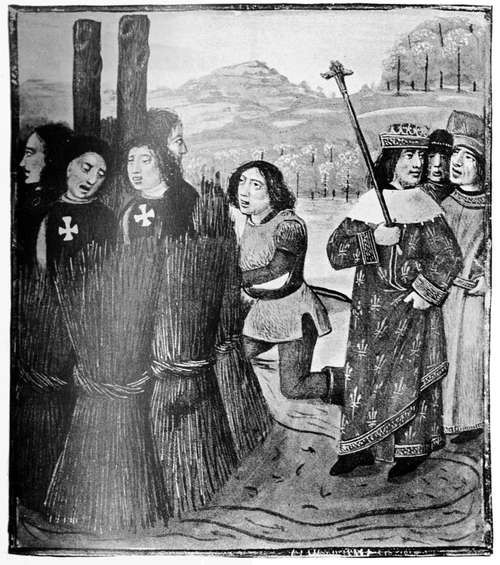
THE BURNING OF THE MASTER OF THE TEMPLE
From a miniature in the French version of the "De Casibus Virorum," made in 1409 by Laurent le Premierfait. MS. late XV century. (Brit. Mus. Showcase V, MS. 126.)
Let us now examine such evidence as we may gather from the allegories of his own poems and plays, though there he speaks in parables. In two of his works at least—the Filocolo and the Ameto—Boccaccio seems to be speaking of himself in the characters of Idalagos[16] and Caleone and Ibrida. The Ameto, like the Filocolo, was written to give expression to his love for Fiammetta, the bastard daughter of King Robert of Naples. There he says that Caleone (whom we suppose to be in some sort himself) was born not far from the place whence Fiammetta's mother (whom he has told us was French) drew her origin. Again, in another part of the same book the story is related of a young Italian merchant, not distinguished by birth or gentle breeding, who went to Paris and there seduced a young French widow. The fruit of their intercourse was a boy, who received the name of Ibrida. The evidence to be gathered from the Filocolo is even more precise, but, briefly, it may be said to confirm the story in the Ameto.[17] We find there, however, that the name of the father was Eucomos, which may be bad Greek for Boccaccio; that the name of the mother was Gannai, which might seem to be an anagram for Giovanna or Gianna; and that the father deserted the mother in order to marry Gharamita,[18] which sounds like an anagram for Margherita, and in fact we find that Boccaccio di Chellino did marry almost certainly about 1314 Margherita di Gian Donato de' Martoli.[19]
The result then of these allegorical allusions in the Ameto and the Filocolo is to support the theory based on the few facts we possess, and to supplement it. That theory absolutely depends, so far as we rely upon facts for its confirmation, on Boccaccio's own statement, as reported by Petrarch, that he was born in 1313. If he was born in 1313, he was conceived and born in Paris, for we know that Boccaccio di Chellino was there in the years between 1310 and 1313. The Filocolo and the Ameto bear this out, and lead us to believe that his mother was a certain Gianna or Gannai (Jeanne, Giovanna), that he was born out of wedlock, and that his father deserted his mother, and not long after married Gharamita, as we suppose Margherita di Gian Donato de' Martoli.
Turning now to the evidence of his contemporaries, we shall find that just this was the opinion commonly received, so much so that the Italian translator of Filippo Villani's Lives actually changed the words of that author and forced him to agree with it. "His father," says this adapter,[20] "was Boccaccio of Certaldo, a village of the Florentine dominion. He was a man distinguished by excellence of manners. The course of his commercial affairs brought him to Paris, where he resided for a season, and being free and pleasant in the temper of his mind, was no less gay and well inclined to love by the complexion of his constitution. There then it befell that he was inspired by love for a girl of Paris, belonging to the class between nobility and bourgeoisie, for whom he conceived the most violent passion; and, as the admirers of Giovanni assert, she became his wife and afterwards the mother of Giovanni."
As his admirers assert! But others were not slow to say that his father and mother were never married; and indeed, this without doubt was the ordinary opinion.
In the true version of Filippo Villani's Lives,[21] written in Latin, we read that he was the son of his natural father,[22] and that he was born at Certaldo. Domenico Aretino[23] agrees that Certaldo was his birthplace, and adds that in his opinion Boccaccio was a bastard. Again, Salvini and Manni, following perhaps the well-known sonnet of Acquettino, say he was born in Florence.[24] In all this confusion we are like to lose our way, and it is therefore not surprising that modern scholars are divided in opinion. Tiraboschi[25] remains undecided. Baldelli[26] thinks he was born in Paris and was illegitimate; Ginguené, Witte, Carducci, Landau, Hortis, Antona Traversi, and Crescini agree with Baldelli—and, indeed, we find only two modern students who give Florence as his birthplace, to wit Corazzini[27] and Koerting[28], who agree, however, that he was a bastard.
It will thus be seen that the weight of opinion is on the side of the evidence, and that it certainly seems to have been shown that Boccaccio was born out of wedlock in Paris in 1313, and that his mother's name was Jeannette or Jeanne[29].
It is probable that Boccaccio was brought still a tiny baby to Florence, but we cannot be sure of this, for though his father seems to have returned in 1314,[30] and almost at once to have married Margherita di Gian Donato de' Martoli, it is not certain that Giovanni accompanied him. Indeed the Filocolo seems to suggest that he did not.[31] However that may be, he was "in his first infancy" when he came to Tuscany, as he tells us in the Ameto, "fanciullo, cercai i regni Etrurii." The first river he saw was the Arno, "mihi ante alios omnes ab ipsa infantia cognitus"; and his boyhood was spent on that little hill described in the Filocolo, "piccolo poggio pieno di marine chiocciole," and covered with "salvatichi cerri," in the house of his father, "nel suo grembo," as he says in the Fiammetta.
Where was this hill dark with oaks where one might find sea-shells, the tiny shells of sea-snails? We do not know for certain. Some have thought it to be the hill of Certaldo,[32] but this seems scarcely likely, for we know that old Boccaccio was resident in Florence in 1318, and Boccaccio himself tells us that his boyhood was spent not in a house belonging to his father, but "nel suo grembo," literally in his father's lap.[33] Again, the country which he loved best and has described with the greatest love and enthusiasm is that between the village of Settignano and the city of Fiesole, north and east of Florence. As though unable to forget the lines of just those hills, the shadows on the woods there, the darkness of the cypresses over the olives, he returns to them again and again. The Ninfale Fiesolano is entirely devoted to this country, its woods and hills and streams; he speaks of it also in the Ameto,[34] it is the setting of the Decameron; while the country about Certaldo does not seem to have specially appealed to him, certainly not in the way the countryside of one's childhood never ceases to do.
It is, then, to the hills about Settignano, to the woods above the Mensola and the valley of the Affrico, that we should naturally turn to look for the scenes of his boyhood. And indeed any doubt of his presence there might seem to be dismissed by a document discovered by Gherardi, which proves that on the 18th of May, 1336, by a contract drawn up by Ser Salvi di Dini, Messer Boccaccio di Chellino da Certaldo, lately dwelling in the parish of S. Pier Maggiore and then in that of S. Felicità, sold to Niccolò di Vegna, who bought for Niccolò the son of Paolo his nephew, the poderi with houses called Corbignano, partly in the parish of S. Martino a Mensola and partly in that of S. Maria a Settignano.[35] This villa of old Boccaccio's exists to-day at Corbignano, and bears his name, Casa di Boccaccio, and though it has been rebuilt much remains from his day—part of the old tower that has been broken down and turned into a loggia, here a ruined fresco, there a spoiled inscription.[36] Here, doubtless, within sound of Mensola and Affrico, within sight of Florence and Fiesole, "not too far from the city nor too near the gate," Giovanni's childhood was passed.
Of those early years we have naturally very little knowledge. Before he was seven years old, as he himself tells us,[37] he was set to learn to read and write. Then he was placed in the care of Giovanni di Domenico Mazzuoli da Strada, father of the more famous Zanobi, to begin the study of "Grammatica."[38] With Mazzuoli he began Latin then,[39] but presently his father, who had already destined him for the counting-house, took him from the study of "Grammatica" and, as Giovanni tells us, made him give his time to "Arismetrica."[40] Then, if we may believe the Filocolo, he took him into his business, where he learned, no doubt, to keep books of account and saw some of the mysteries of banking and money-lending. Against this mode of life he conceived then a most lively hatred, which was to increase rather than to diminish as he grew older. Such work, he assures us in his Commentary on the Divine Comedy, cannot be followed without sin. Great wealth, he tells us in the Filocolo, prohibits, or at least spoils virtue: there is nothing better or more honest than to live in a moderate poverty; while in the De Genealogiis Deorum he says poverty means tranquillity of soul: for riches are the enemy of quietness and a torment of the mind.
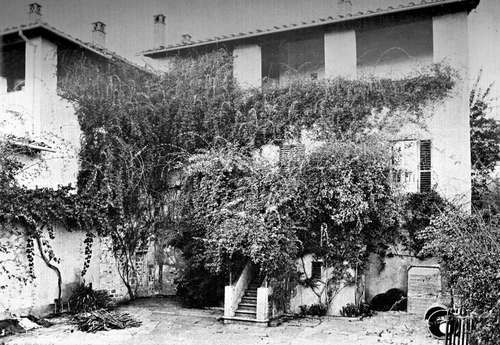
CASA DI BOCCACCIO, CORBIGNANO, NEAR FLORENCE
But we know nothing of his childhood, only it seems to have been unhappy. Till his return from Naples many year later, in spite of his hatred for business, he seems always to have got on well with his father.[41] In remembering words which he then wrote concerning him[42] we must remind ourselves that Boccaccino was at that time an old man, and had probably lost those "excellent manners" of which Villani speaks; and by then, too, Giovanni had altogether disappointed him, by forsaking first business, and later the study of Canon Law. His childhood seems to have been unhappy then not from any fault or want of care on his father's part, though no doubt his hatred of business had something to do with it; but the true cause of the unhappiness, and even, as he says, of the fear which haunted his boyhood, was almost certainly Margherita, his stepmother, with whom he doubtless managed to live well enough till her son Francesco was born.
We have already relied so much on the Filocolo and the Ameto that it will only confuse us to forsake them now. In the former,[43] he tells us that one day the young shepherd, Idalagos (himself), following his father, saw two bears, who glared at him with fierce and terrible eyes in which he saw a desire for his death, so that he was afraid and fled away from the paternal fields to follow his calling in other woods. These two bears who chased Giovanni from home, not directly but indirectly, by causing the fear which hatred always rouses in the young, were, it seems, Margherita and her son Francesco, born about 1321.
It may well be that Boccaccino had come to the conclusion about this time that Giovanni would never make a banker, and hoping yet to see him prosperous in the Florentine manner, sent him to Naples to learn to be a merchant. If we add to this inference the evidence of the allegory of the two bears in the Filocolo, we may conclude that his father, disappointed with him already, was not hard to persuade when Margherita, loath to see the little bastard beside her own son Francesco, urged his departure.
All this, however, is conjecture. We know nothing of Boccaccio's early years save that his father sent him to Naples to learn business while he was still young, as is generally believed in 1330, but as we may now think, not without good reason, in 1323, when he was ten years old.[44]
CHAPTER II
1323-1330
HIS ARRIVAL IN NAPLES—HIS YEARS WITH THE MERCHANT—HIS ABANDONMENT OF TRADE AND ENTRY ON THE STUDY OF CANON LAW
In the fourteenth century the journey from Florence by way of Siena, Perugia, Rieti, Aquila, and Sulmona, thence across the Apennines at Il Sangro, and so through Isernia and Venafro, through Teano and Capua to Naples, occupied some ten or eleven days.[45] The way was difficult and tiring, especially for a lad of ten years old, and it seems as though Giovanni was altogether tired out, for, if we may believe the Ameto,[46] as he drew near the city at last he fell asleep on his horse. And as he slept, a dream came to him. Full of fear as he was, lonely and bewildered, those "two bears" still pursuing him, doubtless, in his heart, suddenly it seemed to him that he was already arrived in the city. "The new streets," he says in the Ameto,[47] "held my heart with delight, and as I passed on my way there appeared to the eyes of my mind a most beautiful girl, in aspect gracious and fair, dressed all in garments of green, which befitted her age and recalled the ancient dress of the city; and with joy she gave me welcome, first taking me by the hand, and she kissed me and I her; and then she said sweetly, 'Come where you shall find good luck and happiness.'"[48] It was thus Giovanni was welcomed into Naples with a kiss.
Naples was then at the height of its splendour, under Robert the Wise, King of Jerusalem and the Two Sicilies, Count of Provence. If his titles had little reality, for that of Jerusalem merely commemorated an episode of history, and Sicily itself had passed into the hands of Aragon, as King of Naples and Count of Provence he possessed an exceptional influence in the affairs of Europe, while in Italy he was in some sort at the head of the triumphant Guelf cause. The son of Charles I of Anjou, King of Naples, Duke Robert, had seized the crown of Italy and Apulia, not without suspicion of fratricide; for the tale goes that none knew better than he the cause of the sudden illness which carried off his elder brother, Dante's beloved Charles Martel. However that may be, in June, 1309, Duke Robert went by sea from Naples to Provence to the Papal Court there, "with a great fleet of galleys," Villani[49] tells us, "and a great company, and was crowned King of Sicily and of Apulia by Pope Clement on S. Mary's Day in September." A year later we find him in Florence on his way back from Avignon. He stayed in the house of the Peruzzi dal Parlagio, and Villani[50] says: "The Florentines did him much honour and held jousts and gave him large presents of money, and he abode in Florence until the 24th day of October to reconcile the Guelfs together ... and to treat of warding off the Emperor." He was, in fact, the great opponent, as we have seen, of Henry VII, and in 1312 Villani[51] records that he sent 600 Catalan and Apulian horse to Rome to defend the City, while the people of Florence, Lucca, and Siena, and of other cities of Tuscany who were in league with him, sent help also; yet though they held half Rome between them, Henry was crowned in the Lateran after all. It was in the very year of the Emperor's death that the Florentines gave him the lordship of their city, as did the Lucchese, the Pistoians, and the men of Prato.[52] Later, after much fighting, the Genoese did the same; so that in the year 1323 King Robert was in some sort drawing tribute from more than half the Communes of Central Italy. The brilliancy of his statecraft, or even, perhaps, of his statesmanship, added to the splendour of Naples, whither his magnanimity and the brilliance of his court attracted some of the greatest men of the time.[53]
"Cernite Robertum
Regem virtute refertum"
wrote Petrarch of him later—"full of virtue." While in a letter written in 1340 to Cardinal Colonna he says that of all men he would most readily have accepted King Robert as a judge of his ability. Nor were they poets and men of learning alone whom he gathered about him. In 1330 Giotto, who had known Charles of Calabria in Florence in 1328,[54] came to Naples on his invitation; while so early as 1310, certainly, Simone Martini was known to him, and seems about that time to have painted his portrait, later representing him in S. Chiara as crowned by his brother S. Louis of Toulouse.[55] It was then into a city where learning and the arts were the fashion that Boccaccio came in 1323.
There were other things too: the amenity of one's days passed so much in the open air, the splendour of a city rich and secure, the capital of a kingdom, and the residence of a king—the only king in Italy—above all, perhaps, the gaiety of that southern life in the brilliant sunshine. Boccaccio never tires of telling us about this city of his youth. "Naples," he says in the Fiammetta, "was gay, peaceful, rich, and splendid above any other Italian city, full of festas, games, and shows." "One only thought, how to occupy oneself," he says again, "how to amuse oneself, dancing to the sound of music, discussing affairs of love, and losing one's heart over sweet words, and Venus there was indeed a goddess, so that more than one who came thither a Lucrece returned a Cleopatra. Sometimes," he continues, "the youths and maidens went in the gayest companies into the woods, where tables were prepared for them on which were set out all manner of delicate meats; and the picnic over, they would set themselves to dance and to romp and play. Some would glide in boats along the shore, others, dispensing with shoes and stockings, and lifting high their petticoats, would venture among the rocks or into the water to find sea shells; others again would fish with lines." And then there were the Courts of Love held in the spring, when the girls, adorned with splendid jewels, he tells us in the Filocolo, tried to outshine one another, and while the old people looked on, the young men danced with them, touching their delicate hands. And seeing that he was surrounded by a life like this, is it any wonder that he fell in love with love, with beauty?
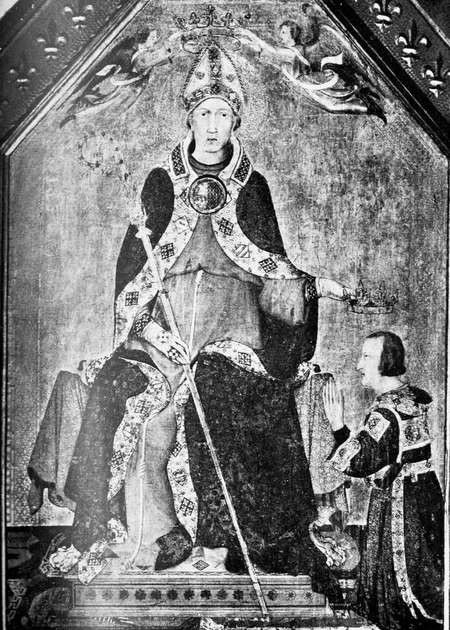
Anderson.
KING ROBERT OF NAPLES CROWNED BY S. LOUIS OF TOULOUSE
From the fresco by Simone Martini in S. Lorenzo, Naples.
Of the first years of his sojourn in that beautiful southern place we have only the vaguest hints.[56] In the De Genealogiis[57] he says that "for six years he did nothing but waste irrecoverable time" with the merchant to whom his father had confided him. He always hated business, and precocious as he was in his love for literature, in the gaiety and beauty of Naples he grew to despise those engaged in money-making; for, as he says in the Corbaccio, they knew nothing of any beautiful thing, but only how to fill their pockets.[58] Indeed Boccaccio might seem to have had no taste or even capacity for anything but study and the art of literature. He most bitterly reproaches his father in the De Genealogiis[59] for having turned him for so many years from his vocation. "If my father had dealt wisely with me I might have been among the great poets," he writes. "But he forced me, in vain, to give my mind to money-making, and to such a paying thing as the Canon Law. I became neither a man of affairs nor a canonist, and I lost all chance of succeeding in poetry."
Those six irrecoverable years had indeed almost passed away before even in Naples he was able to find, unlearned as he was, "rozza mente" as he calls himself, any opportunity of culture. It was in 1328,[60] it seems, that those conversazioni astronomiche began with Calmeta, which aroused in him the desire of wisdom.[61] By that time his father was in Naples, having come thither in the autumn of 1327, and it may have been in his company that Giovanni first met this the earliest friend of his youth. But who was this Calmeta, this benefactor to whom, after all, we owe so much? Andalò di Negro, says Crescini;[62] but as Della Torre reminds us, his work was done in Latin, and Giovanni knew but little of the tongue. It will be seen in the Filocolo, to which we must turn again for guidance, that Calmeta and Idalagos have the same profession; they are both shepherds, and it is in their leisure that Calmeta teaches Idalagos astronomy. It seems then that Calmeta was also in business in Naples. That such an one there was Della Torre proves by drawing attention to a letter he will not allow to be apocryphal.[63] Calmeta, then, as we see, like Giovanni, was inclined to study, and more fortunate than he, had been able "tuam puerilem ætatem coram educatoribus roborare, et vago atque interno intuiti elementa grammaticæ ruminare...." that is to say, to finish his elementary course of study, which consisted of grammar, dialectic, and rhetoric.
But this new friendship was not the only thing that about this time helped to strengthen Giovanni's dislike of business and to encourage him in his love of learning and literature. For in the same year, 1328, it seems likely that he was presented at the court of King Robert,[64] a court, as we have already said, full of gay, delightful people and learned men.[65] It seems certain too that he was presented by his father who, as we have seen, between September and November, 1327, came to Naples as a member of the Società de' Bardi.[66] Now old Boccaccio not only went frequently to court during his sojourn in Naples, for he was very honourably received there, but was probably one of the most considerable Florentine merchants in the city,[67] and then he had known Carlo, Duke of Calabria, in Florence, before setting out.[68] There can therefore be very little doubt as to where Giovanni got his introduction.
Before his father left Naples, Giovanni, who was then about sixteen years of age, had had the courage to tell him that he could not pursue a business career.[69] His father seems at last to have been convinced of this, and gave his consent for study in the Arts, but, practical man as he was, he believed in a fixed profession, and therefore set Giovanni in 1329[70] to study Canon Law, which might well bring him a career. So his father left him.
Whatever his duties had been or were to be, neither they nor his studies with his friend the young merchant occupied all his time. He enjoyed life, entering with gusto into the gaiety of what was certainly the gayest city in Italy then and later. He speaks often of the beauty of the women[71] amid that splendour of earth and sky and sea; and the beautiful names of two he courted and loved, being in love with love, have come down to us, to wit Pampinea, that white dove "bianca columba," and Abrotonia, the "nera merla" of the Filocolo.[72] Like Romeo, Boccaccio had his Rosaline. These were not profound passions, of course, but the sentimental or sensual ardours of youth that were nevertheless an introduction to love himself.[73] They soon passed away, though not without a momentary chagrin, for if he betrayed the first, the second seems to have forsaken him.
After that disillusion he tells us he retired into his room, and there, tired as he was, fell asleep half in tears. And again, as once before, a vision came to him. He seemed to be sitting, where indeed he was, all sorrowful, when suddenly Abrotonia and Pampinea appeared to him. For some time they watched him weeping, and then began to make fun of his tears. He prayed them to leave him alone since they were the first and only cause of his grief, but the two damsels redoubled their laughter, so that at last he turned to them and said: "Begone, begone! Is your laughter then the price of my verses in your honour and of all my trouble?"[74] But they answered that it was for another that he had really sung. Then he awoke; it was still night, and, tearful as he was, he rose to light the lamp, and sat thus thinking for a time. But weary at last he returned to bed, and presently falling asleep he dreamed again. Once more the two girls stood before him, but with them was another, fairer far, all dressed in green. Her they presented to him, saying that it was she who would be the real "tyrant of his heart." Then he looked at her, and behold, she was the same lady he had seen in the first vision when, weary with the long roads, he first drew near to Naples; the very lady indeed who bade him welcome and kissed him, and whom he kissed again. So the dream ended.
What are we to think of these visions? Did they really happen, or are they merely an artistic method of stating certain facts—among the rest that Fiammetta was about to renew his life? But we have gone too far to turn back now; we have already relied so much on the allegories of the Ameto, the Filocolo, and the Fiammetta, that we dare not at this point question them too curiously. The visions are all probably true in substance if not in detail. We must accept them, though not necessarily the explanations that have been offered of them.[75]
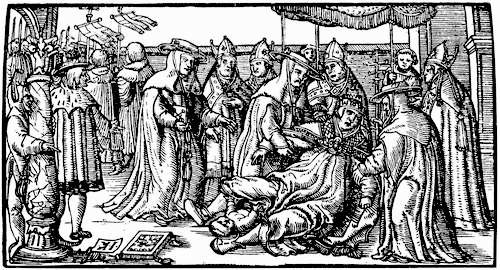
POPE JOAN
A woodcut from the "De Claris Mulieribus." (Berne, 1539.) (By the courtesy of Messrs. J. & J. Leighton.)
All this probably happened at the end of 1329, and Fiammetta was still more than a year away. By this time, however, Boccaccio was already studying Canon Law. Who was his master? He does not himself tell us. All he says is in the De Genealogiis,[76] and many reading that passage have at once thought of Cino da Pistoja, chiefly perhaps because it is so delightful to link together two famous men.[77] But while it is true that Cino was a doctor of Law in Naples in 1330,[78] we know that Boccaccio studied Canon Law, and that Cino was a Doctor of Civil Law and a very bitter enemy of the Canonisti.[79] It seems indeed impossible to name his master.[80] Whoever he may have been, the study of Canon Law which presently became so repugnant to Giovanni must have been at first, at any rate, much more delightful than business. It probably gave him more liberty for reading and for pleasure. He had, of course, begun to study Latin again, and no doubt he read Ovid, whom he so especially loved—
"Lo quale poetando
Iscrisse tanti versi per amore
Come acquistar si potesse mostrando."[81]
No doubt, too, he read the Ars Amandi, "in which," he says in the Filocolo, "the greatest of poets shows how the sacred fire of Venus may be made to burn with care even in the coldest," and knew it all by heart.
We may believe too that he read the Heroides, which he imitated later in the letters of Florio to Biancofiore and of Biancofiore to Florio; and the Metamorphoses, which indeed we find on every page of the Filocolo.[82]
Delia Torre thinks[83] that although Cino da Pistoja was not his master, he certainly met him during his stay in Naples between October, 1330, and July, 1331,[84] and it was possibly through him that Boccaccio first read Dante. At any rate, he read him, and shortly after he imitates and speaks of him.[85] He also studied at this time under Andalò di Negro,[86] the celebrated astrologer, one of the most learned men of his time, and we shall see to what use he put the knowledge he acquired; but who was it who introduced to him the French Romances? Perhaps it was one of the many friends he doubtless had among the rich Florentine merchants and their sons then in Naples;[87] but indeed he could hardly have failed to meet with them in that Angevin Court. That he knew the romance of King Arthur and the Knights of the Round Table we know,[88] but he knew even better the legends of the Romans and the Trojans, which he told Fiammetta, who now comes into his life never really to leave him again.
CHAPTER III
1331
HIS MEETING WITH FIAMMETTA AND THE PERIODS OF THEIR LOVE STORY
For it was in the midst of this gay life, full of poetry and study, that he met her who was so much more beautiful than all the other "ninfe Partenopee," and who seemed to him "quella che in Cipri già fu adorata," that is to say, Venus herself. He saw her first on a Holy Saturday, on the Vigil of Easter, as he himself tells us, and as we think on 30th March, 1331.[89] He had gone to Mass, it seems, about ten o'clock in the morning, the fashionable hour of the day, rather to see the people than to attend the service, in the church of S. Lorenzo of the Franciscans. And there amid that great throng of all sorts and conditions of men he first caught sight of the woman who was so profoundly to influence his life and shape his work.
"I found myself," he says, "in a fine church of Naples, named after him who endured to be offered as a sacrifice upon the gridiron. And there, there was a singing compact of sweetest melody. I was listening to the Holy Mass celebrated by a priest, successor to him who first girt himself humbly with the cord, exalting poverty and adopting it. Now while I stood there, the fourth hour of the day, according to my reckoning, having already passed down the eastern sky, there appeared to my eyes the wondrous beauty of a young woman, come thither to hear what I too heard attentively. I had no sooner seen her than my heart began to throb so strongly that I felt it in my slightest pulses; and not knowing why nor yet perceiving what had happened, I began to say, 'Ohimè, what is this?'... But at length, being unable to sate myself with gazing, I said, 'O Love, most noble Lord, whose strength not even the gods were able to resist,[90] I thank thee for setting happiness before my eyes!'... I had no sooner said these words than the flashing eyes of that lovely lady fixed themselves on mine...."[91]
Fiammetta, for it was she, was tall and slanciata; her hair, he tells us, "is so blonde that the world holds nothing like it; it shades a white forehead of noble width, beneath which are the curves of two black and most slender eyebrows ... and under these two roguish eyes ... cheeks of no other colour than milk." This description, even in the hands of Boccaccio, is little more than the immortal "Item, two lips, indifferent red...."[92] Yet little by little in his work Fiammetta lives for us. On that day she was dressed in a bruna vesta,[93] and wearing a veil that fell from her head crowned with a garland.[94] After her golden hair, it is her eyes and her mouth that he loves best in her.
"Due begli occhi luccan, sì che fiammetta
Parea ciascun d' amore luminosa;
E la sua bocca bella e piccioletta
Vermiglia rosa e fresca somigliava."[95]
He seems to have asked one of his companions who she was, but he knew not.
[16] Cf. Crescini, op. cit., cap. i; Antona Traversi, Della patria di Gio. Boccaccio in Fanfulla della Domenica (1880), II, and in Rivista Europea (1882), XXVI. See also B. Zumbini, Il Filocolo del Boccaccio (Firenze, 1879), esp. p. 58; and Crescini, Idalagos in Zeitschrift für Rom. Phil. (1885-6), IX, 457-9, X, 1-21.
[17] Cf. Ameto in Opere Minori (Milan, 1879), p. 186 et seq.; and Filocolo in Opere Volgari, ed. Moutier (Firenze, 1827), Vol. II, p. 236 et seq.
[18] For a full discussion of these allusions and anagrams, cf. Crescini, Contributo agli studi sul Boccaccio (Torino, 1887), cap, i. It will be seen that if our theory be correct, Giovanni Boccaccio bears the names of both his parents—Giovanna and Boccaccio. It is necessary to point out, however, that there is not much in this, for a paternal uncle was called Vanni, and Giovanni may have been named after him, as his brother was named after another uncle. Cf. Baldelli, Vita di Gio. Boccaccio (Firenze, 1806), p. 274, note 1.
[19] In the Filocolo (ed. cit., Vol. II, pp. 242-3) we read: "Ma non lungo tempo quivi ricevuti noi dimorò, che abbandonata la semplice giovane e l' armento tornò nei suoi campi, e quivi appresso noi si tirò, e non guari lontano al suo natal sito la promessa fede a Giannai ad un' altra, Garamita chiamata, ripromise e servò, di cui nuova prole dopo piccolo spazio riceveo." Cf. Baldelli, Vita di Gio. Boccaccio (Firenze, 1806), p. 275.
[20] See F. Villani, Le Vite d' uomini illustri Fiorentini (Firenze, 1826). F. Villani was a contemporary of Boccaccio, and succeeded him in the chair founded at Florence for the exposition of the Divine Comedy.
[21] See Galletti, Philippi Villani: Liber de Civitatis Florentiæ famosis civibus ex codice Mediceo Laurentiano, nunc primum editus, etc. (Firenze, 1847), and on this Calò, Filippo Villani e il Liber de Origine civitatis, etc. (Rocca S. Casciano, 1904), pp. 154-5.
[22] The son of his "natural father" may mean that Boccaccio di Chellino was not his adoptive father, or it may mean that Giovanni was a bastard. See on this Crescini, op. cit., p. 38 et seq., and Della Torre, La Giovinezza di Gio. Boccaccio (Città di Castello, 1905), cap. i.
[23] Domenico Bandini Aretino says: "Boccatius pater ejus ... amavit quamdam iuventulam Parisinam, quam prout diligentes Ioannem dicunt quamquam alia communior sit opinio sibi postea uxorem fecit, ex qua genitus est Ioannes." See Solerti, Le vite di Dante, Petrarca e Boccaccio scritte fino al secolo XVII (Milano, 1904). The lives of Boccaccio constitute the third part of the volume; the second of these is Domenico's. Cf. Messera, Le più antiche biografie del Boccaccio in Zeitschrift für Rom. Phil. (1903), XXVII, fasc. iii. See also Crescini, op. cit., p. 16, note 1, and Antona Traversi, op. cit. in Fansulia della Domencia, II, 23, where many authors of this opinion are quoted.
[24] Giovanni Acquettino da Prato was a bad poet. His sonnet says: "Nacqui in Firenze al Pozzo Toscanelli." Pozzo Toscanelli was in the S. Felicità quarter, close to the Via Guicciardini.
[25] St. della Lett. Ital. (1823), V, part iii. p. 738 et seq.
[26] Op. cit., pp. 277-80.
[27] Corazzini, Lettere edite e inedite di G. Boccaccio (Firenze, 1877), p. viii. et seq.
[28] Koerting, Boccaccio's Leben und Werke (Leipzig, 1880), p. 67 et seq., and Boccaccio Analekten in Zeitschrift für Rom. Phil. (1881), v. p. 209 et seq. If Antona Traversi has disposed of Corazzini's assertions, Crescini seems certainly to have demolished the arguments of Koerting.
[29] All the dates and facts so carefully established by Crescini and Della Torre are really dependent on the date of Boccaccio's birth, 1313, being the true one. This is the corner-stone of their structure. But the story of his illegitimacy and foreign birth was current long before this date was established. It was the commonly received opinion. Why? Doubtless because Boccaccio himself had practically stated so in the Filocolo and the Ameto. That Filippo Villani's Italian translator was dependent on these allegories for his story seems to be proved (cf. Della Torre, op. cit., p. 30); so probably was the general public. The question remains: Was Boccaccio speaking the mere truth concerning himself in these allegories? Filippo Villani himself, as we have seen, believed that he was born at Certaldo; so did Domenico Aretino. For myself, I do not think that enough has been allowed for the indirect influence of Fiammetta in the Filocolo and the Ameto. They were written for her—to express his love for her. She was the illegitimate daughter of King Robert of Naples by the wife of the nobleman Conte d'Aquino—a woman of French extraction. It is strange, then, that Boccaccio's story of his birth in the allegories should so closely resemble hers. She doubtless thought herself a very great lady, and was probably prouder of her royal blood than a legitimate princess would have been. But Boccaccio was just the son of a small Florentine trader; and he was a Poet. To proclaim himself—half secretly—illegitimate was a gain to him, a gain in romance. How could a youthful poet, in love with a princess too, announce himself as the son of a petty trader, a mere ordinary bourgeois, to a lady so fine as the blonde Fiammetta? Of course he could not absolutely deny that this was so, especially after his father's visit (1327), and also we must remember that the Florentine trader held, or is supposed to have held, quite a good social position even in feudal Naples. Nevertheless his bourgeois birth did not please the greatest story-teller of Europe. So he invented a romantic birth—he too would be the result of a love-intrigue, even as Fiammetta was. And because he loved her, and therefore wished to be as close to her and as like her as possible, he too would have a French mother. Suppose all this to be true, and that after all Boccaccio is the son of Margherita, the wife of his father; that he was born in wedlock in 1318; that he met Fiammetta not on March 30, 1331 (see Appendix I), but on March 30, 1336, and that he told Petrarch he was born in 1313 because he knew his father was in Paris at that date—this last with his usual realism to clinch the whole story he had told Fiammetta.
[30] In 1318 Boccaccio di Chellino is spoken of as having been a dweller in the quarter of S. Pier Maggiore for some four years. See Manni, Istoria del Decameron (Firenze, 1742), p. 7, who gives the document. This may mean little, however, for the residence may have been purely formal, and have signified merely that a business was carried on there in his name. But see Crescini, op. cit., pp. 40 and 41, Note 1, and Della Torre, op. cit., pp. 7-14.
[31] Cf. Filocolo, ed. cit., Vol. II, pp. 242-3.
[32] Della Torre, op. cit., p. 2.
[33] Moreover, as we shall see, the story of the "two bears" which in his allegory followed his father and drove himself out of the house—to Naples—seems to make it necessary that they should all have been living together. See infra, p. 14.
[34] In the first page he says: "Vagabondo giovane i Fauni e le Driadi abitatrici del luogo, solea visitare, et elli forse dagli vicini monti avuta antica origine, quasi da carnalità costretto, di ciò avendo memoria, con pietosi affetti gli onorava talvolta...."
[35] The document is given in full in Appendix II. The fact that the parish of S. Pier Maggiore is mentioned proves that when Boccaccio di Chellino was married, he was living therein, for the property was part of the dowry of Margherita di Gian Donato his first wife.
[36] See my Country Walks About Florence (Methuen, 1908), pp. 13-15 Casa di Boccaccio is within sight and almost within hail of Poggio Gherardo, the supposed scene of the first two days of the Decameron.
[37] In the De Genealogiis Deorum, Lib. XV, cap. x., he says "Non dum ad septimum annum deveneram ... vix prima literarum elementa cognoveram...." At this time he was already composing verses, he says.
[38] Cf. Massera, Le più antiche biografie in Zeitschrift für Rom. Phil., XXVII, pp. 310-18. But see Crescini, op. cit., p. 48, note 3; and in reply Della Torre, op. cit., p. 3, note 5.
[39] "Qui ... ferula ... ab incunabulis puellulos primum grammaticæ gradum tentantes cogere consueverat," writes Boccaccio in the letter to Iacobo Pizzinghe. See Corrazini, Le Lett. ed. e ined. di G. B. (Firenze, 1877), p. 196, and Filocolo, ed. cit., I, 75-6. It was probably the Metamorphoses of Ovid that he read with Mazzuoli, though in the Filocolo he speaks of the Ars Amandi! The Metamorphoses were read for the sake of the mythology as well as for the exercise in Latin. Cf. Della Torre, op. cit., p. 4.
[40] Cf. Hecker, Boccaccio Funde (Braunschweig, 1902), p. 288, and Massera, op. cit., p. 310.
[41] Della Torre, op. cit., pp. 5, 6.
[42] In the Ameto:—
[43] Filocolo, ed. cit., Vol. II, p. 243. He says: "Io semplice e lascivo" (cf. Paradiso, v. 82-4) "come già dissi, le pedate dello ingannator padre seguendo, volendo un giorno nella paternale casa entrare, due orsi ferocissimi e terribili mi vidi avanti con gli occhi ardenti desiderosi della mia morte, de' quali dubitando io volsi i passi miei, e da quell' ora innanzi sempre d' entrare in quella dubitai. Ma acciocchè io più vero dica, tanta fu la paura, che abbandonati i paternali campi, in questi boschi venni l' apparato uficio a operare." Crescini in Kritischer Jahresbericht über Fortschrifte der Rom. Phil. (1898), III, p. 396 et seq., takes these two bears to be old Boccaccio and Margherita, but Della Torre, op. cit., pp. 18-30, asks very aptly how could Boccaccio speak thus of a father he allows in the Fiammetta "per la mia puerizia nel suo grembo teneramente allevata, per l' amor da lui verso di me continuamente portato." Della Torre takes the two bears to be Margherita and her son Francesco, born ca. 1321. See op. cit., p. 24, and document there quoted.
[44] See Appendix I, where the whole question is discussed. Cf. Della Torre, op. cit., p. 30, note 1, and caps. ii. and iii.; Casetti, Il Boccaccio a Napoli in Nuova Antologia (1875); and De Blasiis, La Dimora di Gio. Boccaccio a Napoli in Arch. St. per le prov. Nap. (1892), XXII, p. 11 et seq.
[45] It seems strange that Boccaccio did not follow the Via Francigena for Rome, as Henry VII and all the emperors did, till we remember that the Pope was in Avignon and the City a nest of robbers. The route given above is, according to De Blasiis, the one he took, though of course there is no certainty about it. Cf. De Blasiis, op. cit., pp. 513-14.
[46] Ameto (Opere Minori, Milano, 1879), p. 225.
[47] My translation is free; I give therefore the original: "... le mai non vedute rughe con diletto teneano l' anima mia, per la quale così andando, agli occhi della mente si parò innanzi una giovane bellissima in aspetto, graziosa e leggiadra, e di verdi vestimenti vestita ornata secondo che la sua età e l' antico costume della città richiedono; e con liete accoglienze, me prima per la mano preso, mi baciò, ed io lei; dopo questo aggiugnendo con voce piacevole, vieni dove la cagione de' tuoi beni vedrai."
[48] One may contrast this vision of welcome with that which had driven him away. Of such is the symmetry of Latin work. He himself calls this a prevision of Fiammetta. We cannot help reminding ourselves that the Vita Nuova was already known to him when he wrote thus.
[49] G. Villani, Cronica, Lib. VIII, cap. 112.
[50] Ibid., Lib. IX, cap. 8.
[51] Ibid., Lib. IX, cap. 39.
[52] Ibid., Lib. IX, cap. 56.
[53] Cf. De Blasiis, op. cit.
[54] See Crowe and Cavalcaselle, ed. E. Hutton (Dent, 1908), Vol. I, p. 26.
[55] The picture, of life size, is still at Naples in S. Lorenzo Maggiore. Schulz, Denkmäler der Kunst des Mittelalters in Unteritalien, Vol. III, p. 165, publishes a document dated 13 July, 1317, by which King Robert grants Simone Martini a pension of twenty gold florins.
[56] It is perhaps not altogether unlikely that for a boy the port and Dogana would have extraordinary attractions. At any rate, Boccaccio in the tenth novel of the eighth day of the Decameron describes the ways of "maritime countries that have ports," how that "all merchants arriving there with merchandise would on discharging bring all their goods into a warehouse, called in many places 'Dogana'...."
[57] Lib. XV, 10: "Sex annis nil aliud feci quam non recuperabile tempus in vacuum terere." Note these six years, they will be valuable to us when we come to decide as to the year in which he first met Fiammetta, and thus to fix the date of his advent to Naples. See Appendix I.
[58] "Laddove essi del tutto ignoranti, niuna cosa più oltre sanno, che quanti passi ha dal fondaco, o dalla bottega alla lor casa; e par loro ogni uomo, che di ciò egli volesse sgannare, aver vinto e confuso quando dicono: all' uscio mi si pare, quasi in niun' altra cosa stia il sapere, se non o in ingannare o in guadagnare." Corbaccio in Opere Minori (Milano, 1879), p. 277. Cf. Egloga xiii., where the same sentiments are expressed.
[59] Lib. XV, cap. x.
[60] Cf. Della Torre, op. cit., pp. 109-11.
[61] Cf. Filocolo, ed. cit., Lib. IV, p. 244 et seq.
[62] Crescini, op. cit., p. 47.
[63] This letter is printed in Corazzini, Le Lett. edite e ined. (Firenze, 1877), p. 457. "Te igitur carissime," writes Boccaccio, "tam delectabilia tam animum attrahentia agentem cognovi, si recolis, et tui gratia tantæ dulcedinis effectus sum particeps tuus, insimul et amicus, in tam alto mysterio, in tam delectabili et sacro studio Providentia summa nos junxit, quos æqualis animi vinctos tenuit, retinet et tenebit...." This is the letter beginning "Sacræ famis et angelicæ viro," which we shall allude to again.
[64] Cf. De Blasiis, De Casibus, u.s., IX, 26, and Della Torre, op. cit., p. 112.
[65] Cf. Faraglia, Barbato di Sulmona e gli uomini di lettere della Corte di Roberto d' Angiò in Arch. St. Ital., Ser. V, Vol. III (1889), p. 343 et seq.
[66] We fix the approximate date of Boccaccio's presentation at court by his own words in the De Casibus Illustrium Virorum, Lib. IX, cap. 26: "Me adhuc adulescentulo versanteque Roberti Hierosolymorum et Sicilicæ Regis in aula..." As we have seen, adolescence began, according to the reckoning then, at fourteen years. To strengthen this supposition, we know that Boccaccino was in Naples at that time, and in relations with King Robert. See Appendix I.
[67] See supra p. 5, n. 1.
[68] Cf. De Blasiis, op. cit., p. 506, note 1. Davidsohn, Forschungen zur Geschichte von Florenz (Berlin, 1901), III, p. 182, note 911. Della Torre, op. cit., pp. 117-18. "Boccaccius de Certaldo de Societate Bardorum de Florencia, consiliarius, cambellanus, mercator, familiaris et fidelis noster," wrote the king of him. Cf. Davidsohn, op. cit., III, p. 187, note 942; and Ibid., Il padre di Gio. Boccaccio in Arch. St. It., Ser. V, Vol. XXIII, p. 144.
[69] Cf. De Genealogiis, XV, 10; "Quoniam visum est, aliquibus ostendentibus inditiis, me aptiorem literarum studiis, issuit ... ut pontificum sanctiones dives exinde futurus, auditurus intrarem."
[70] See supra, p. 19, n. 2, where, as we find in the De Genealogiis, he says that for six years he did nothing but waste irrecoverable time. Thus if he came to Naples in 1323 it was in 1329 that he began to study Law. The last we hear of his father in Naples is in 1329.
[71] "E come gli altri giovani le chiare bellezze delle donne di questa terra andavano riguardando, ed io" (Ameto, ed. cit., p. 225). In the Filocolo (ed. cit., Lib. IV, p. 246) he tells us that this was especially true in the spring.
[72] Crescini, op. cit., p. 50. Whether Abrotonia and Pampinea were the earliest of his loves seems doubtful. Cf. Renier, La Vita Nuova e Fiammetta, p. 225 et seq. Who was the Lia of the Ameto, and when did he meet her? Cf. Antonia Traversi, La Lia dell' Ameto in Giornale di Filologia romanza, n. 9, p. 130 et seq., and Crescini, Due Studi riguardanti opere minori del B. (Padova, 1882). Was she the same person as the Lucia of the Amorosa Visione? Or is the Lucia of the Amorosa Visione not a person at all? See Crescini, lucia non Lucia in Giorn. St. della Lett. It., III, fasc. 9, pp. 422-3. These are questions too difficult for a mere Englishman. An excellent paper on Boccaccio's loves is that by Antona Traversi, Le prime amanti di G. B. in Fanfulla della Domenica, IV, 19.
[73] Della Torre finds these love affairs to have befallen 1329. I have, as in almost all concerning the youth of Boccaccio, found myself in agreement with him. But cf. Hauvette, Une confession de Boccace—Il Corbaccio in Bull. Ital., I, p. 5 et seq.
[74] "O giovani schernitrici de' danni dati e di chi con sommo studio per addietro v' ha onorate; levatevi di qui, questa noia non si conviene a me per premio de' cantati versi in vostra laude, e delle avute fatiche."
[75] Cf. Crescini, op. cit., p. 108, note 1.
[76] Lib. XV, cap. x.: "... jussit genitor idem, ut pontificum sanctiones dives exinde futurus, auditurus intrarem et sub preceptore clarissimo fere tantumdem temporis in cassum etiam laboravi."
[77] A letter forged probably by Doni, who posed as its discoverer, would have confirmed this. The letter ran: "Di Pisa alli xix di aprile, 1338—Giovanni di Boccaccio da Certaldo discepolo e ubbidientissimo figliulo infinitamente vi si raccomanda." As is well known, Cino da Pistoja died at the end of 1336 or beginning of 1337.
[78] Cf. H. Cochin, Boccaccio (Sansoni, Firenze, 1901), trad. di Vitaliani.
[79] De Blasiis, Cino da Pistoia nella Università di Napoli in Arch. St. per le prov. Nap., Ann. XI (1886), p. 149. Again, the course seems to have been for six years under the same master, and although Cino was called to Naples in August, 1330, he was in Perugia in 1332. Cf. De Blasiis, op. cit., p. 149.
[80] Baldelli, Vita, p. 6, note 1, thinks this master was Dionisio Roberti da Borgo Sansepolcro. He adds that this man was in Paris in 1329, and that Boccaccio there in that year began work under him. In defence of this theory he cites a letter from Boccaccio himself to Niccola Acciaiuoli of 28th August, 1341, in which he says: "Nè è nuova questa speranza, ma antica; perocchè altra non mi rimase, poichè il reverendo mio padre e signore, maestro Dionigi, forse per lo migliore, da Dio mi fu tolto." (Cf. Corazzini, op. cit., p. 18.) We may dismiss Baldelli's argument, for we have decided that Boccaccio was in Naples in 1329, when he began the study of Canon Law. But the conjecture itself gains a certain new strength from the fact that Roberti was a professor in Naples. (See Renier, La Vita Nuova e La Fiammetta, Torino, 1879. Cf. Gigli, I sonetti Baiani del Boccaccio in Giornale St. della Lett. Ital., XLIII (1904), p. 299 et seq.) In 1328, however, he proves to have been in Paris, and in fact he did not arrive in Naples till 1338. As I have said, the course lasted six years, and even though we concede that Boccaccio began his studies under Roberti in 1338, we know that three years later, in 1341, Roberti died (Della Torre, op. cit., p. 146). Besides, in 1341 Boccaccio had returned to Florence. Roberti seems, indeed, to have been the protector rather than the master of Boccaccio, even as Acciaiuoli was, and it is for this reason that Boccaccio alludes to him in writing to Acciaiuoli in 1341 when Roberti was dead. The doctors in Naples in 1329 are named by De Blasiis, op. cit., p. 149. Among them were Giovanni di Torre, Lorenzo di Ravello, Giovanni di Lando, Niccola Rufolo, Biagio Paccone, Gio. Grillo, Niccola Alunno.
[81] Amorosa Visione, v. 171-3.
[82] Cf. Hortis, Studi sulle Opere Latine di Gio. Boccaccio, etc. (Trieste, 1879), p. 399.
[83] Della Torre, op. cit., p. 151. But the strongest proof that Boccaccio and Cino were friends is furnished by Volpi, Una Canzone di Cino da Pistoia nel "Filostrato" del Boccaccio in Bull. St. Pistoiese (1899), Vol. I, fasc. 3, p. 116 et seq., who finds a song of Cino's in the Filostrato. It seems probable, then, since they were in personal relations, that Cino introduced the works of Dante to Boccaccio.
[84] De Blasiis, op. cit., p. 139 et seq.
[85] In the Filocolo (ed. cit.), II, 377, begun according to our theory in 1331. I quote the following: "Nè ti sia cura di volere essere dove i misurati versi del Fiorentino Dante si cantino, il quale tu, siccome piccolo servidore, molto dei reverente seguire." Cf. Dobelli, Il culto del Boccaccio per Dante in Giornale Dantesca (1898), V, p. 207 et seq. See too the quotations from Dante, for they are really just that in the Filostrato, part ii. strofa 50, et passim, and see infra, pp. 77, n. 2, and 253, n. 5.
[86] Cf. Bertolotto, Il Trattato dell' Astrolabio di A. di N. in Atti della Soc. Liguria di St. Pat. (1892), Vol. XXV, p. 55 et seq. Also the De Genealogiis, XV, 6, and Hortis, Studi, p. 158 and notes 1-3. Andalò di Negro was born in 1260, it seems, at Genoa. In 1314 he was chosen by the Signoria of Genoa as ambassador to Alessio Comneno of Trebizond, and he carried out his mission excellently. He had already travelled much, and after his embassy seems to have gone to Cyprus (Genealogiis, u.s.). He passed his last years at the court of King Robert in Naples, who appointed him astrologer and physician to the court. His pay was six ounces of gold annually (Bertolotto, u.s.). He died in the early summer of 1334. He was a learned astronomer and astrologer, and probably one of the most remarkable men of his time.
[87] Cf. De. Blasiis, op. cit., p. 494.
[88] Cf. Amorosa Visione, cap. xxix.
[89] See Appendix I.
[90] Cf. Sophocles, Antigone, 781 et seq.
[91] See Filocolo, ed. cit., I, p. 5 et seq. The scene is described also in the Filostrato, i. xxvi.-xxxiv. In the Fiammetta, cap. i., it is described from Fiammetta's point of view.
[92] In the Fiammetta (Opere Minori, Milano, 1879, p. 25) Boccaccio thus describes himself on that morning through the eyes of Fiammetta; it is in keeping with the topsy-turveydom of that extraordinary work: "Dico che, secondo il mio giudicio, il quale ancora non era da amore occupato, elli era di forma bellissimo, nelli atti piacevolissimo ed onestissimo nell' abito suo, e della sua giovinezza dava manifesto segnale la crespa lanugine, che pur ora occupava le guancie sue; e me non meno pietoso che cauto rimirava tra uomo e uomo."
[93] Ameto (ed. cit.), p. 228. We should have expected a green dress to agree with the prevision; but it was Sabbato Santo. On Easter Day she is in green. See infra.
[94] Fiammetta (ed. cit.), p. 23.
[95] Amorosa Visione, cap. xv.
"Io stetti molto a lei mirar sospeso
Per guardar s' io l' udissi nominare,
O ch' io 'l vedessi scritto breve o steso
Lì nol vid' io nè 'l seppi immaginare."[96]
When she saw that he continued to stare at her, she screened herself with her veil.[97] But he changed his position and found a place by a column whence he could see her very well—"dirittissimamente opposto, ... appoggiato ad una colonna marmorea"—and there, while the priest sang the Office, "con canto pieno di dolce melodia,"[98] he drank in her blonde beauty which the dark clothes made more splendid—the golden hair and the milk-white skin, the shining eyes and the mouth like a rose in a field of lilies.[99] Once she looked at him,—"Li occhi, con debita gravità elevati, in tra la moltitudine de' circostanti giovani, con acuto ragguardamento distesi."[100] So he stayed where he was till the service was over, "senza mutare luogo." Then he joined his companions, waiting with them at the door to see the girls pass out. And it was then, in the midst of other ladies, that he saw her for the second time, watching her pass out of S. Lorenzo on her way home. When she was gone he went back to his room with his friends, who remained a short time with him. These, as soon as might be, excusing himself, he sent away, and remained alone with his thoughts.
The morrow was Easter Day, and again he went to S. Lorenzo to see her only. And she was there indeed, "di molto oro lucente"—"adorned with gems and dressed in most fair green, beautiful both by nature and by art."[101] Then remembering all things, he said to himself: "This is that lady who in my boyhood (puerizia) and again not so long ago, appeared to me in my dreams; this is she who, with a joyful countenance and gracious, welcomed me to this city; this is she who was ordained to rule my mind, and who was promised me for lady, in my dreams."[102] From this moment began for him "the new life."
Who was this lady "promised to him in his dreams," whose love was indeed the great prize of his youth? We know really very little about her, though he speaks of her so often, but in three well-known places, in the Filocolo, the Ameto, and the Amorosa Visione, he tells us of her origin. It is in the Ameto that he gives us the fullest account of her. In that comedy[103] he tells us that at the court of King Robert there was a gentleman of the wealthy and powerful house of Aquino who held in Naples "the highest place beside the throne of him who reigned there." This noble had married, we learn, a young Provençal, "per bellezza da lodare molto," who with her husband lived in the royal palace.[104] Of this pair were born "some daughters whom Fiammetta called sisters,"[105] and a son who was assassinated.[106] Fiammetta's own birth is, we understand, surrounded by a kind of mystery, "voluttuoso e lascivo," corresponding, as we shall see, to her own temperament.[107]
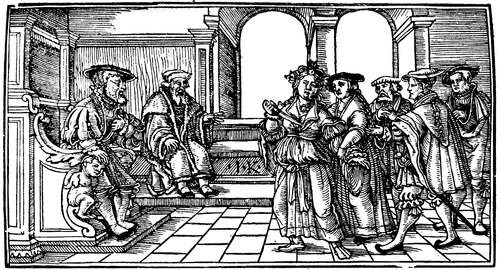
LUCRECE
A woodcut from "De Claris Mulieribus." (Berne, 1539.) (By the courtesy of Mssrs. J. & J. Leighton.)
Boccaccio suggests that her birth is connected with the great festa which celebrated the coronation of King Robert, that took place in Avignon in September, 1309.[108] The king returned to Naples by way of Florence, where he arrived on September 30, 1310;[109] he was still there in October, and there was much fighting to be done, for Henry VII was making war in Italy; so that it was not till February 2, 1313,[110] that the king opened the first general parliament in Naples after his coronation. Della Torre[111] thinks that it was on this occasion the great festa described by Boccaccio took place. Its chief feature seems to have been a banquet of the greatest magnificence, to which all the court as well as many of the leading subjects of the Kingdom were bidden. Amid all this splendour Boccaccio describes the king's gaze passing over a host of beautiful women, to rest, always with new delight, on the beauty of the young wife of D'Aquino, who, since her husband belonged to the court, was naturally present. Well, to make a long story short, a little later the king seduced this lady, but as it seems, on or about the same night she slept also with her husband, so that when nine months later a daughter was born to her, both the king and her husband believed themselves to be the father. It is like a story out of the Decameron.
This daughter, the Fiammetta of his dreams, was born, he tells us, in the spring[112]—the spring then of 1314[113]—and was named Maria.[114] Before very long she lost her mother, who however, before she died, told her as well as she could, considering her tender age, the mystery of her birth. Not long after, her father—or rather her mother's husband—died also, leaving the piccoletta "a vestali vergini a lui di sangue congiunte ... acciocchè quelle di costumi e d' arte inviolata servandomi, ornassero la giovanezza mia";[115] which is Boccaccio's way of saying that she was placed in the care of nuns, the nuns, as Casetti[116] supposes, of the Order of St. Benedict, to whom belonged the very ancient church of S. Arcangelo a Baiano.[117] There she grew up, and, like very many others of an eager and sensuous temperament, totally unfitted for the life of a religious, she desired too to be a nun, and this desire, we learn, became definite in her after an ecstatic vision in which S. Scholastica appeared to her[118] and invited her to take the vow. But happily this was not to be. Her golden hair was not to fall under the shears of the Church, but to be a poet's crown. She was too beautiful for the cloister, and indeed already the fame of her beauty had gone beyond the convent walls, which were in fact by no means very secure or unassailable. In those days, people "in the world," men as well as women, were received even by the "enclosed" in the parlour of the convent, where it was customary to hold receptions.[119]
So, we learn, there presently began a struggle in Fiammetta's heart—it was not of very long duration—between her resolution to take the veil and her feminine vanity. Little by little she began to adorn herself,[120] she received offers of marriage which by no means shocked her, she became reconciled to the life of the world for which she was so perfectly fitted by nature. Among the suitors, and apparently they were many, was "uno dei più nobili giovani ... di fortuna grazioso, de' beni Giunonichi copioso, e chiaro di sangue."[121] To him, as to the rest, she replied with a refusal, to which she was doubtless encouraged by the nuns, who could not easily suffer so well-born and powerful a pupil to escape them. The young man, however—we do not know his name—was not easily discouraged, and, renewing his suit, was accepted. So she was married perhaps when she was about fifteen years old, in 1329.[122]
Her beauty[123] was famous, and she seems scarcely to have been married when she gave herself up to all the voluptuousness of her nature, more or less mute in the convent. That she could read we know, for she read not only Giovanni's letters, but Ovid,[124] probably a translation of the Ars Amandi, and the French Romances.[125] She was greatly run after by the youth of the Neapolitan court, who swore no festa was complete without her. Her husband's house, too, was in such a position that not only the citizens, but strangers, who must on arrival or departure pass it by, might spy her at her window or on her balcony.[126] Her excuse is this universal admiration, and the eagerness of her temperament, which allowed her to pass with ease from one lover to another.[127] And then she also found that stolen waters are sweet, and bread eaten in secret is pleasant.[128] She excuses herself for having betrayed the husband who loved her so much, and can say: "What is lawfully pursued is apt to be considered of small account, even though it be most excellent, but what is difficult of attainment, even if contemptible, is held in high esteem."[129] But, like all vain and sensual natures, she was cruel, and encouraged her suitors to squander their substance on her, giving them nothing in return, and leading each to suppose that he was the only one she loved, and that she was about to make him happy. "And I," she says to Boccaccio in the character of Alleiram, "and I have laughed at them all, choosing, however, those who took my fancy and who were judged apt to give me pleasure. But no sooner was the fire spent than I broke the vase which contained the water and flung away the pieces." These words, so cynically moving, not only show us the cruelty of Maria's nature, but cast a strange light on the general condition of society in what was then, as later, the most corrupt city in Italy. Such, then, was the blonde Fiammetta whom Boccaccio loved.
But how could he, a mere merchant's son, ever hope to reach the arms of this disdainful, indifferent lady? By means of poetry? It seems so. But before replying fully to this question it will be necessary to establish the chronological limits and divisions of this love affair, and this is the most difficult question in all the difficult history of the youth of Boccaccio.
We may find, as it happens, two dates to begin with in the Amorosa Visione. They have not escaped Crescini,[130] who, founding himself on them, has concluded, though not too certainly, that between the day of innamoramento and that of possesso completo 159 days passed. He arrives at this tentative conclusion in the following manner. In chapter xliv. of the Amorosa Visione Boccaccio tells us that when he became enamoured of Fiammetta, at first he marvelled greatly, as though something incredible had befallen him. Then he began to make fun of himself, "farsi beffa," for having thought of a lady so far above him. But at last, when
"Quattro via sei volte il sole
Con l' orizzonte il ciel congiunto aveva ..."
it appeared that his courting pleased his lady, and he seemed to understand from her that there was no distance however great, between lover and beloved, that love could not annihilate. But, said she, one ought to serve her only, and not to run after other ladies.
Crescini interprets this to mean that twenty-four days after Boccaccio first saw Fiammetta, she gave him reason to hope. And he arrives at this conclusion because he considers that the sun is in conjunction with the horizon only once a day, whereas it might seem to be so twice a day, at sunrise as at sunset. The other 135 days of Crescini's chronology come from the following verses of chapter xlvi. of the Amorosa Visione, in which Boccaccio tells us that he was able to possess Maria after
"Cinque fiate tre via nove giorni
Sotto la dolce signoria di questa
Trovato m' era in diversi soggiorni."
Thus, says Crescini, we have twenty-four days from the first meeting to the acceptance of his court, and 135 days thenceforward to the possession, that is 159 days.[131]
Della Torre,[132] however, will have none of this reckoning, and seems to have proved that it is indeed inexact. To begin with, according to the Ptolemaic system, the sun moved round the earth and touched it as it were not only at its rising but also at its setting, so that the twenty-four days become twelve. This, however, is but a small matter, merely reducing the 159 days to 147. Crescini's chief error, according to Della Torre, is that he has added the first period of twelve (or twenty-four) days to the second of 135—making them immediately consecutive. Let us examine this matter somewhat closely.
In the Ameto Boccaccio tells us that the happy night which came at the end of the 135 days, the night in which he possessed Fiammetta, fell "temperante Apollo i veleni freddi di Scorpione." Now at what time precisely is the sun in the sign of the Scorpion? Andalò[133] tells us that at the end of the 20th October the sun is three and a half gradi in Scorpio, and that by the 15th November it is already entering Sagittarius. The sun then entered Scorpio on the 17th October and left it on the 14th November.[134] Somewhere between those two dates the loves of Giovanni and Fiammetta were consummated.
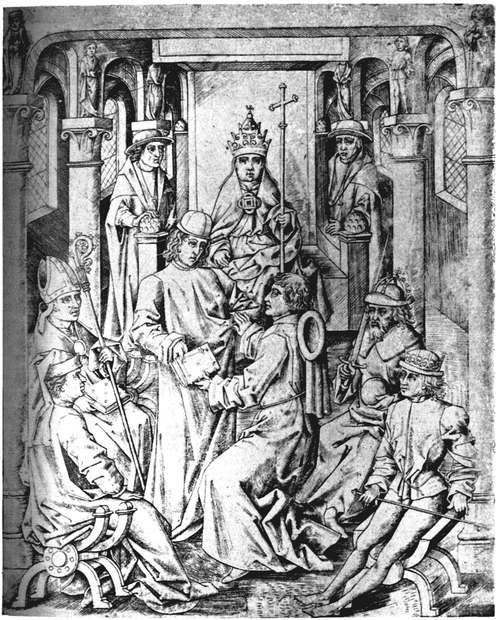
BOCCACCIO AND MAINARDI CAVALACANTI
By the Dutch engraver called "The Master of the Subjects in the Boccaccio."
"De Casibus Virorum." (Strasburg, 1476.)
Boccaccio tells us, if we interpret him aright, that twelve days after his innamoramento his lady showed him that she was pleased by his love. He then passes on to describe the long and faithful service he gave her:—
"Lungamente seguendo sua pietate
Ora in avversi ed ora in graziosi
Casi reggendo la mia voluntate,"[135]
and so on. Then he says:—
"Traendomi più là e con sommesso
Parlar le chiesi, che al mio dolore
Fine ponesse, qual doveva ad esso,
Ognor servando quel debito onore
Che si conviene a' suoi costumi adorni,
Di gentilezza pieni e di valore,"[136]
and at last adds the lines already quoted,
"Cinque fiate tre via nove giorni
Sotto la dolce signoria di questa
Trovato m' era in diversi soggiorni";
when
"nella braccia la Donna pietosa
Istupefatto gli parea tenere."
Taken thus we may divide the story of his love for Fiammetta into three periods. The first of these ends twelve days after the first meeting, and is the period of uncertainty. The second period is that in which he is accepted as courtier, as it were, on his trial. The third begins when his lady, moved by long service and repeated proofs of his devotions, returns his love; it is the period of "dolce signoria" and lasts one hundred and thirty-five days, at the end of which she gives herself to him.[137]
Of these periods we know only the length, then, of the first and the last. The first began on the 30th March and lasted till the 12th April, 1331, when the second began, to last how long? Well, at least two months, it seems,[138] perhaps three. In that case all three periods belong to the same year. If this be not so, the second period was of longer duration than three months, perhaps much longer. Boccaccio himself tells us that it was "non senza molto affanno lunga stagione."[139] Now it seems reasonable to suppose that even so eager a lover as Boccaccio cannot call three months "lunga stagione," though he were dying for her and each minute was an eternity. He can scarcely have hoped to seduce a woman of his own class in less time. Common sense, then, is on our side when reminding ourselves that Maria d'Aquino was of the noblest family, married, too, to a husband who loved her, and generally courted by all the golden youth of Naples—while Giovanni was the son of a merchant—we insist that he cannot mean a paltry three months when he speaks of a long time.[140] But if the second period lasted more than three months, and so does not belong to the year 1331, to what year or years does it belong?
Della Torre seems to have found a clue in the following sonnet, whose authenticity, though doubted by Crescini,[141] he insists upon:—
"Se io potessi creder che in cinqu' anni
Ch' egli è che vostro fui, tanto caluto
Di me vi fosse, che aver saputo
Il nome mio voleste, de' miei danni
Per ristorato avermi, de' miei affanni
Potrei forse sperare ancora aiuto,
Nè mi parrebbe il tempo aver perduto
A condolermi de' miei stessi inganni...."[142]
which we may explain as "O my lady, I shall be the happiest of mortals if in the five years that I shall pay you court, I should break through your indifference...." Five years brings us from 30th March, 1331, to 1336.
Now let us see whither the other facts we have will lead us.
In 1339 Boccaccio and Fiammetta had parted,[143] Boccaccio having been "betrayed" by her, as he tells us in Sonnets iv. and xxxiii.,[144] during the bathing season at Baia—the bathing season then of 1338—whither she had forbidden him to accompany her. But we know from Sonnets xlvii. and xlviii. that the end of the second period and the beginning of the third took place during the bathing season, and that there was also a season in which he accompanied her to Baia as her acknowledged lover.[145] There must, then, have been three seasons before April, 1339, and these three years lead us again to the year 1336.
So we believe that the first period "of uncertainty" in his love began on 30th March and ended on 12th April, 1331; that the second period "of service" began on 12th April, 1331, and ended between 3rd June and 2nd July, 1336, when the third period began, ending three years later. This third period is divided, as we have seen, into three parts, and comprises three bathing seasons. The first of these falls between 3rd June—2nd July, 1336, and the 17th October to 15th November, i.e. 135 days; an act of audacity on Giovanni's part, as we shall see, giving him possession of Fiammetta. The second is a period in which their love had become calmer: it fills the season of 1337 in which he was her cavaliere servente. The third falls in 1338, when, probably on account of the suspicions aroused by their intimacy, Fiammetta forbade him to accompany her to Baia, where in his absence she "betrayed" him.
Having thus found a chronology of Boccaccio's love-story, we must consider more particularly his life during its three periods.
CHAPTER IV
1331-1340
THE YEARS OF COURTSHIP—THE REWARD—THE BETRAYAL—THE RETURN TO FLORENCE
Of the first period of Giovanni's love-story, the period of uncertainty which lasted but twelve days, we know almost nothing, save that he was used to remind himself very often of his unworthiness, and to tell himself that he was only the son of a merchant, while Fiammetta, it was said, was the daughter of a king, and at any rate belonged to one of the richest and most powerful families in the Kingdom. That she was married does not seem to have distressed him or appeared as an obstacle at all, for the court was corrupt;[146] but he seems to have been disturbed by the knowledge that she was surrounded by a hundred adorers richer, nobler, and with better opportunities than himself. And so he seems to have come to the conclusion that there was nothing to be done but to make fun of himself for having entertained a thought of her. It was apparently in these states of mind that he passed the days from Holy Saturday to 12th April, 1331, when he found suddenly to his surprise that she was content he should love her if he would.
What happened is described in the forty-fourth chapter of the Amorosa Visione. The twelve days were passed, he tells us in this allegory, when he heard a voice like a terrible thunder cry to him:—
"O tu ... che nel chiaro giorno
Del dolce lume della luce mia,
Che a te vago sì raggia d' intorno,
Non ischernir con gabbo mia balìa
Nè dubitar però per mia grandezza,
La quale umil, quando vorrai, ti fia,
Onora con amor la mia bellezza,
Nè d' alcun' altra più non ti curare,
Se tu non vo' provar mia rigidezza."
How can we interpret this? It seems that there was evidently an occasion in which Fiammetta gave him to understand that she was not averse from his love. What was this occasion? Della Torre[147]—certainly the most subtle and curious of his interpreters—thinks he has found it: that he can identify it with that in which Fiammetta bade him write the Filocolo.
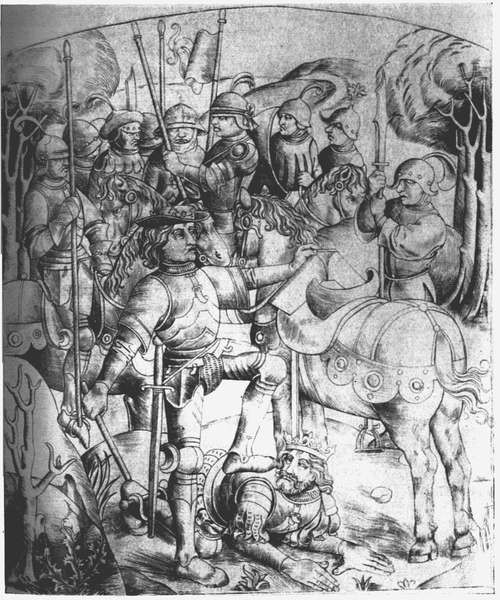
SAPOR MOUNTING OVER THE PROSTRATE VALERIAN
By the Dutch engraver called "The Master of the Subjects in the Boccaccio." "De Casibus Virorum." (Strasburg, 1476.)
In the prologue to that romance Boccaccio tells us that after leaving the temple of S. Lorenzo with full heart, and having sighed many days, he found himself by chance—he does not remember how—with some companions "in un santo tempio del Principe de' celestiali uccelli nominato": that is to say, as Casetti interprets it, in the convent of S. Arcangelo a Baiano, where Fiammetta had been. I have said that it was quite usual for nuns to receive visitors, both men and women, from the outside; the Fiammetta[148] itself confirms it if need be. The convents were in some sort fashionable resorts where one went to spend an hour in talk. On some such occasion Boccaccio went to S. Arcangelo with a friend, and finding Fiammetta there, probably told her stories from the French romances "del valoroso giovane Florio figliuolo di Felice grandissimo Re di Spagna," or of Lancelot and Guinivere, "con amorose parole," stuffed with piteous words. When he had finished, she, altogether charmed, turned to the young poet and bade him write such a romance as that—for her—"a little book in which the beginning of love, the courtship, and the fortune of the two lovers even to their death shall be told." Well, what could he do but obey gladly? "Hearing the sweetness of the words which came from that gracious mouth," he tells us, "and remembering that never once till this day had that noble lady asked anything of me, I took her prayer for a command, and saw therein hope for my desires";[149] so he answered that he would do his best to please her. She thanked him, and Boccaccio, "costretto più da ragione che da volontà," went home and began at once to compose his romance.[150] So ends the first period of his love-story, and the second, the period of courtship, begins.
The first result of this interview and of the hope and fear it gave him—for whatever may have been the case with Fiammetta now and later, Giovanni was genuinely in love—was that he wandered away "dall' usato cammino" from the highway that had brought him so far and abandoned "le imprese cose," things already begun.[151] And if we ask ourselves what was this highway, we may answer his way of life; and the things already begun—his study of the Canon Law. About this time, then, he began to go more to court, to enter eagerly into the joy of Neapolitan life in search of Fiammetta. At the same time his studies suffered—he neglected them to the dismay, as we shall see, not only of his father, but of his friends.
Something has already been said of the life at the court of King Robert. The very soul of it was the three ladies: Agnes de Perigord, wife of Jean D'Anjou, brother of King Robert; Marie de Valois, wife of Charles, Duke of Calabria, son of the king; and Catherine de Courteney, who at twelve years of age had married Philip of Taranto, another of the King's brothers.[152] The luxury in the city was by far the greatest to be found in Italy. The merchants of Florence, Lucca, Venice, and Genoa furnished to the court "scarlatti di Gant," "sciamiti, panni ricamati ad uso orientale," "oggetti d' oro ed argento," and "gemmas et lapides pretiosas ad camere regie usum." Boccaccio himself describes Naples: "Città, oltre a tutte l' altre italiche, di lietissime feste abbondevole, non solamente rallegra i suoi cittadini o con le nozze o con li bagni o con li marini liti, ma, copiosa di molti giuochi, sovente or con uno, or con un altro letifica la sua gente: ma tra l' altre cose, nelle quali essa appare splendidissima, è nel sovente armeggiare."[153] Or again of the spring there: "I giovani, quando sopra i correnti cavalli con le fiere armi giostravano, e quando circondati da' sonanti sonagli armeggiavano, quando con ammaestrata mano lieti mostravano come gli arditi cavalli con ispumante freno si debbano reggere. Le giovani donne di queste cose vaghe, inghirlandate di nuove frondi, lieti sguardi porgevano ai loro amanti, ora dall' alte finestre ed ora dalle basse porte; e quale con nuovo dono, e quale con sembiante, e quale con parole confortava il suo del suo amore."[154]
If he thus spent his time in play and love there can have been little enough left, when the Filocolo was laid aside, for study. We find his father complaining of his slackness. Old Boccaccio had already been grievously disappointed when Giovanni abandoned trade, and now that he threw up or was not eager to pursue his law studies, he was both distressed and angry; nor were Giovanni's friends more content. All the Florentines at Naples, he tells us, seemed to speak with his father's voice. It was well to be in love, they told him, even better to write poetry, but to ruin oneself for love, Monna mia! what madness, and then poetry never made any one rich.[155]
So spoke and thought the practical Tuscan soul, and the English have but echoed it for centuries. However, Giovanni only immersed himself more in Ovid, and doubtless the throb of hexameter and pentameter silenced the prose of the merchants. Later, about 1334, he began to read Petrarch;[156] their personal friendship, however, did not begin till much later, in 1350.[157] His reading then, like his love, inspired him to write verses, and as he tells us, when the days of uncertainty were over, "Under the new lordship of love I desired to know what power splendid words had to move human hearts."[158] And these ornate parole were all in honour of his love. How he praises her!
"Ed io presumo in versi diseguali
Di disegnarle in canto senza suono?
Vedete se son folli i pensier miei!"[159]
Presumptuous or no, he tells us very eloquently and sweetly that her teeth were candid Eastern pearls, her lips, living rubies clear and red, her cheeks, roses mixed with lilies, her hair, all gold like an aureole about her happy face:—
"E l' altre parti tutte si confanno
Alle predette in proporzione eguale
Di costei ch' i ver angioli simiglia."[160]
And then her eyes, it is always them he praises best:—
"L' angelico leggiadro e dolce riso
Nel qual quando scintillan quelle stelle
Che la luce del ciel fanno minore
Par s' apra 'l cielo e rida il mundo tutto."[161]
But he speaks of her beauty in a thousand verses in a thousand places, in many disguises.
This burning and eager love was, however, hindered in one thing—he had the greatest difficulty in seeing Fiammetta:—
"Qualor mi mena Amor dov' io vi veggia
Ch' assai di rado avvien, sì cara sete...."[162]
For at this time certainly Fiammetta does not seem to have considered his love of any importance to her, so that she gave him very few opportunities of seeing her, and then in everything he had to be careful not to rouse her husband's suspicions.[163] Sometimes, too, she went far away into the country to some property of her family, whither he could not follow, and always every year to Baia for the season; so that we find him writing:—
"... colla bellezza sua mi spoglia
Ogn' anno nella più lieta stagione
Di quella donna ch' è sol mio desire;
A sè la chiama, ed io, contra mia voglia
Rimango senza il cuore, in gran quistione,
Qual men dorriemi il vivere o 'l morire."[164]
He managed to see her, however, sometimes in church, or at her window, or in the gardens, and once he followed her to Baia, but only to see her "a long way off." Yet, as he reminds himself, he always had her, a vision in his heart:—
"Onde contra mia voglia, s' io non voglio
Lei riguardando, perder di vederla,
In altra parte mi convien voltare.
Oh grieve caso! ond' io forte mi doglio;
Colei qui cerco di poter vederla
Sempre non posso poi lei riguardare."[165]
Then there were moments of wild hope, till the indifference of Fiammetta put it out; and he would resolve to break the "love chains," but it was useless. He humiliated himself, and at last came to despair. It was in some such moment, during her absence, we may think, that he began the Filostrato,[166] and at length finally abandoned those studies which in some sort his love had killed.
In this feverish state of mind, of soul, sometimes hopeful, sometimes in despair, Boccaccio passed the next five years of his life, from the spring of 1331 to the spring of 1336. It was during this time, in 1335[167] it seems, that with his father's unwilling permission he discontinued the law studies he had begun in 1329, but had for long neglected, and gave himself up to literature, "without a master," but not without a counsellor—his old companion in the study of astronomy, Calmeta. Other friends, too, were able to assist him, among them Giovanni Barrili, the jurisconsult, a man of fine culture, later Seneschal of King Robert for the kingdom of Provence,[168] and Paolo da Perugia, King Robert's learned librarian, elected to that office in 1332. Him Boccaccio held in the highest veneration, and no doubt Paolo was very useful to him.[169]
We know nothing of his first literary studies, but we may be sure he continued to read Ovid, and now read or re-read Virgil—these if only for the study of versification. As for prose, it is possible that he now read the Metamorphoses of Apuleius, which he certainly knew and admired. However that may be, his work at this time cannot have been very severe or serious, for his mind was full of uneasiness about Fiammetta, and this excitement no doubt increased in the early summer of 1336, when she grew "kinder," and deigned even to encourage him; he met her "con humil voce e con atti piacenti."[170]
[96] Ibid., cap. xvi.
[97] Fiammetta (ed. cit.), p. 24.
[98] Filocolo (ed. cit.), I, p. 5.
[99] Ameto (ed. cit.), pp. 65-6.
[100] Fiammetta (ed. cit.), p. 24.
[101] Ameto, ed. cit., p. 228.
[102] Ibid.
[103] Ibid., pp. 221-3.
[104] Filocolo, ed. cit., I, p. 4.
[105] Fiammetta, ed. cit., pp. 114-17.
[106] Ibid., p. 101.
[107] Cf. Della Torre, op. cit., p. 182.
[108] Cf. Villani, Cronica, Lib. VIII, cap. 112.
[109] Villani, op. cit., Lib. IX, cap. 8.
[110] Cf. Arch. St. per le prov. nap., Vol. VII, pp. 220-1.
[111] Della Torre, op. cit., p. 183.
[112] Cf. Fiammetta, ed. cit., p. 21: "Nel tempo nel quale la rivestita terra più che tutto l' altro anno si mostra bella."
[113] Cf. Baldelli, op. cit., p. 362, and Casetti, Il Boccaccio a Napoli, u s., p. 573. So that Boccaccio's age did not differ much from Fiammetta's.
[114] Filocolo, ed. cit., Vol. I, p. 4. In the Fiammetta, ed. cit., p. 21, we learn that she was "in altissime delizie ... nutrita."
[115] Ameto, ed. cit., pp. 222-3.
[116] Casetti, op. cit., p. 575.
[117] See Filocolo, ed. cit., I, p. 6: "in un santo tempo del principe de' celestiali uccelli nominato." Cf. Catalogo di tutti gli edifici sacri della città di Napoli in Arch. St. per le prov. nap., VIII, p. 32.
[118] Ameto, ed. cit., p. 223.
[119] There are many examples of this.
[120] "Con sollecitudini ed arti." And again there came to her very soon "dalla natura ammaestrata, sentendo quali disii alli giovani possono porgere le vaghe donne, conobbi che la mia bellezza più miei coetanei giovanetti ed altri nobili accese di fuoco amoroso." (Fiammetta, ed. cit., p. 21).
[121] Ameto, ed. cit., p. 223.
[122] Cf. Della Torre, op. cit., p. 188. As to these early marriages, cf. Decameron, X, 10. Griselda was but twelve years old, and Juliet, as we remember, was "not fourteen." Fiammetta when Boccaccio first met her was seventeen years old, "dix-sept est étrangement belle," and had already had time for more than one act of infidelity.
[123] Fiammetta, ed. cit., p. 92.
[124] Ibid., pp. 52-4.
[125] Ibid., p. 130.
[126] Filocolo, ed. cit., II, pp. 260-1.
[127] Her excuse is also the morals of the time. There was temptation everywhere, as the Decameron alone without the evidence of the other novelle would amply prove. Every sort of shift was resorted to. Procuresses, hired by would-be lovers, forced themselves into the house of the young wife and compelled her to listen to them. They deceived even the most jealous husbands. The priest even acted as a pander sometimes and more often as a seducer. Decameron, III, 3, and Il Cortigiano di Castiglione, Lib. III, cap. xx. The society in which she moved had no moral horror of this sort of thing; as to-day, the sin lay in being found out. A woman's onestà was not ruined by secret vice, but by the exposure of it, which brought ridicule and shame.
[128]
"L' acqua furtiva, assai più dolce cosa
È che il vin con abbondanza avuto;
Così d' amor la gioia, che nascosa,
Trapassa assai del sempre mai tenuto
Marito in braccio...."
Filostrato, parte ii. strofe 74.
[129] Fiammetta, ed. cit., p. 102. She thought poorly of marriage, consoling herself when her lover marries by saying: "tutti coloro che moglie prendono, e che l' hanno, l' amino siccome fanno dell' altre donne: la soperchia copia, che le mogli fanno di sè a' loro mariti, è cagion di tostano rincrescimento, quando esse pur nel principio sommamente piacessero ..." (Fiammetta, ed. cit., pp. 69-70).
[130] Crescini, op. cit., pp. 127 and 130, note 2.
[131] Crescini, op. cit.
[132] Della Torre, op. cit., p. 192 et seq.
[133] In his Tabula ad situandos et concordandos menses cum signis in dorso astrolabii in Atti della soc. Ligure di Stor. Pat. (1892), Vol. XXV, p. 59.
[134] Crescini thinks (op. cit.) that Boccaccio first saw Fiammetta on 11th April, 1338. Supposing, then, the date most favourable to him, to wit, that Boccaccio possessed Fiammetta in the night of 17-18 October: 135 days before that was 3rd June, and twenty-four before that was 10th May (twelve days before was 22nd May), not 11th April. Suppose we take our own date, 30th March, we are in worse case still. It seems then certain that between these two periods of 12 and 135 days there was an interval. To decide on its length is the difficulty.
[135] Amorosa Visione, cap. xlv.
[136] Ibid., cap. xlvi.
[137] Cf. Filocolo, ed. cit., II, pp. 261-2.
[138] Cf. supra, p. 36, n. 4.
[139] Filocolo, ed. cit., II, p. 248.
[140] Besides, all the romances are against it. How long did Lancelot serve for Guinivere? And he was the best knight that there was in the whole world.
[141] Crescini, op. cit., p. 185.
[142] Sonnet lxxxvi. in edition Moutier (Opere Volgari di G. B.), Vol. XVI (Firenze, 1834).
[143] On 3rd April, 1339, Boccaccio writes to Carlo Duca di Durazzo that he cannot finish the poem he had asked for because his heart is killed by a love betrayed. Here is the letter, or part of it: "Crepor celsitudinis Epiri principatus, ac Procerum Italiæ claritas singularis, cui nisi fallor, a Superis fortuna candidior, reservatur ut vestra novit Serenitas, et pelignensis Ovidii reverenda testatur auctoritas:
[144] Sonnet xxxiii.:—
[145] Cf. Della Torre, op. cit., p. 207.
[146] And such was the fashion.
[147] Della Torre, op. cit., p. 213.
[148] Fiammetta, ed. cit., pp. 63-4.
[149] I give the Italian, my translation being somewhat free:—"Un piccolo libretto, volgarmente parlando, nel quale il nascimento, lo innamoramento, e gli accidenti delli detti due infino alla lor fine interamente si contenga ... Io sentendo la dolcezza delle parole procedenti dalla graziosa bocca e pensando che mai, cioè infino a questo giorno, di niuna cosa era stato dalla nobil donna pregato, il suo prego in luogo di comandamento mi reputai, prendendo per quello migliore speranza nel futuro de' miei disii."
[150] In the Amorosa Visione we learn that she told him no longer to make fun of himself and to think no more of the social difference between them. In the Filocolo he tells us that he first began to hope after this interview. No doubt she wished to play with him as with the rest. Certainly he was not easy in his mind. "Quelle parole più paura d' inganno che speranza di futuro frutto mi porsero," he tells us in the Filocolo, ed. cit., II., p. 248. Then come the words I for one find so suspicious concerning his birth. In order, he says, to bring her nearer to him, he thinks of his birth which, different in social position as they are, was not unlike hers in its romance. His mother was noble, he tells her, and he feels this nobility in his heart. "Ma la nobilità del mio cuore tratta non dal pastor padre, ma dalla reale madre mi porse ardire e dissi: 'Seguirolla e proverò se vera sarà nell' effetto come nel parlar si mostra volonterosa."
[151] Filocolo, ed. cit., II, 86.
[152] See on this subject De Blasiis, Le Case de' Principi Angioni in Arch. St. per le prov. nap., Ann. XII, pp. 311-12.
[153] Fiammetta, ed. cit., p. 84. I translate: "A city more addicted to joyous festivals than any other in Italy, her citizens were not only entertained with marriages, or country amusements, or with boat-races, but abounding in perpetual festivities she diverted her inhabitants now with one thing, now with another; among others she shone supreme in the frequent tournaments."
[154] Fiammetta, ed. cit., pp. 119-20. "The youths when jousting with potent weapons on galloping horses or to the sound of clashing bells in miniature warfare, showed joyously how with a light hand on the foam-covered bridle fiery horses were to be managed. The young women delighting in these things, garlanded with spring flowers, either from high windows or from the doors below, glanced gaily at their lovers; one with a new gift, another with tender looks, yet another with soft words assured her servant of her love."
[155] Cf. De Genealogiis, XIV, 4, and XV, 10. Giovanni's reply will be found in the Filocolo, ed. cit., II, pp. 84-6, "Chi mosse Vergilio? Chi Ovidio? Chi gli altri poeti a lasciare di loro eterna fama ne' santi versi, li quali mai ai nostri orecchi pervenuti non sarieno se costui non fosse?" and so forth.
[156] So it seems we ought to understand his letter to Franceschino da Brossano, where he says: "Et ego quadraginta annis, vel amplius suis (that is, of Petrarch) fui" (Corazzini, op. cit., p. 382).
[157] "Sono quarant' anni," he writes in 1374, "e più che io amo ed onoro il Petrarca"; cf. Dobelli and Manicardi and Massera: Introduzione al testo critico del "Canzoniere" del Boccaccio (Castel Fiorentino, 1901), pp. 62-4.
[158] Filocolo, ed. cit., II, p. 248.
[159] Rime (Moutier), XVIII.
[160] Ibid., III.
[161] Ibid., LXXXIX.
[162] Ibid., LXXXIII.
[163] Fiammetta, ed. cit., p. 28.
[164] Rime (Moutier), XXXIV.
[165] Ibid., XXV.
[166] Cf. Crescini, op. cit., pp. 186-208; Della Torre, op. cit., p. 245.
[167] See Della Torre, op. cit., pp. 259 and 260. Cf. also De Genealogiis, Lib. XV, cap. x (Hecker, Boccaccio Funde, Braunschweig, 1902, p. 289). "Attamen jam fere maturus etate et mei juris factus, nemine impellente, nemine docente, imo obsistente patre et studium tale damnante, quod modicum novi poetice, sua sponte sumpsit ingenium eamque summa aviditate secutus sum, et, precipua cum delectatione, auctorum eiusdem libros vidi legique, et, uti potui, intelligere conatus sum." So he seems to have won over his father by telling him he was of an age to decide for himself.
[168] See Zenati, Dante e Firenze (Firenze, 1903), p. 251, note 1, and the works there cited. Faraglia, Barbato di Sulmona e gli uomini di lettere della corte di Roberto d' Angiò in Arch. St. It., Ser. V, Vol. III, p. 343. Idem: I due amici del Petrarca, Giovanni Barrili e Barbato di Sulmona in I miei studi storici delle cose abruzzesi (Rocca Carabba, 1893), and Della Torre, op. cit., p. 261 et seq.
[169] Cf. Zenati, op. cit., p. 275, note 1.
[170] See Manicardi Massera, op. cit., p. 71, note 1, and Della Torre, op. cit., p. 262.
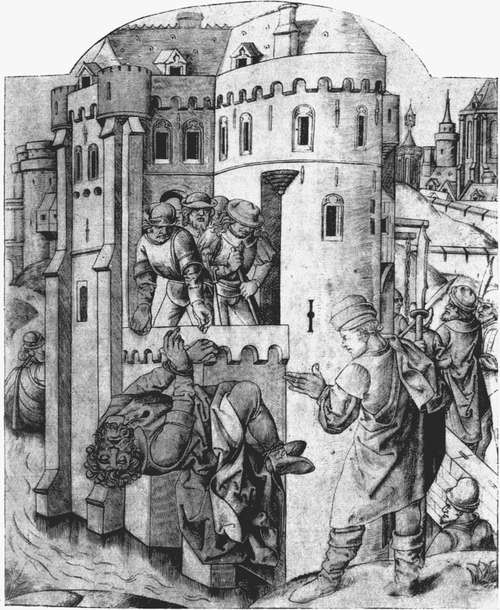
MANLIUS THROWN INTO THE TIBER
By the Dutch engraver called "The Master of the Subjects in the Boccaccio." "De Casibus Virorum." (Strasburg, 1476.)
What was the real cause of this "kindness" it seems impossible we should ever know. Perhaps at the moment Fiammetta lacked a lover, though that is hard measure for her. Some cause there must have been, for a woman does not surely let a lover sigh for five years unheard, and then for no reason at all suddenly requite him. Certainly Giovanni had made many beautiful verses for her, but when did that touch a woman's heart? Yet, be the cause what it may, in the summer of 1336 she would suddenly grow pale when he passed her by, and then as suddenly turn her "starry eyes" on him languidly, voluptuously:—
"Amor, se questa donna non s' infinge
La mia speranza al suo termine viene...."
All this seems to have come to pass at Baia, perhaps, as Boccaccio seems himself to suggest, one day in the woods of Monte Miseno whither they were gone with a gay company holding festa there in the golden spring weather.[171] And there were other days too: long delicious noons in the woods, still evenings by the seashore, where, though not alone, he might talk freely to her, by chance or strategy, or in a low voice whisper his latest verses beating with her heart. Giovanni, we may be sure, was no mean strategist; he was capable of playing his part in the game of hide-and-seek with the world.[172] He seems eagerly to have sought the friendship of her husband and of her relations and Fiammetta herself tells us in the romance that bears her name that filled "non solamente dello amoroso ardore, ma ancora di cautela perfetta il vidi pieno; il che sommamente mi fu a grado. Esso, con intera considerazione vago di servare il mio onore e adempiere, quando i luoghi e li tempi il concedessero, li suoi desii credo non senza gravissima pena, usando molte arti, s' ingegnò d' aver la familiarità di qualunque mi era parente, ed ultimamente del mio marito: la quale non solamente ebbe, ma ancora con tanta grazia la possedette, che a niuno niuna cosa era a grado, se non tanto quanto con lui la comunicava...."[173]
Well, the one hundred and thirty-five days had begun.[174] There were difficulties still to be overcome, however, before he won that for which, as he says, he had always begged. Fiammetta, like a very woman, denied it him over and over again, though very willingly she would have given it to him. Expert as he had become in a woman's heart—in this woman's heart at least—Giovanni guessed all this and knew besides that she could not give him what he desired unless he took it with a show at least of violence. Such, even to-day, are Italian manners.[175] He awaited the opportunity. It seems to have come during the absence of the husband in Capua.[176] Screwing his courage to the sticking-point, he resolved to go to her chamber, and to this end persuaded or bribed her maid to help him.[177]
It was in the early days of November probably, days so pensive in that beautiful southern country, that it befell even as he had planned. Led by the maid into Fiammetta's chamber, he hid himself behind the curtains of the great marital bed. Presently she came in with the maid, who undressed her and put her to bed, and left her, half laughing, half in tears. Again he waited, and when at last, desperate with anxiety and hope, he dared to come out of his hiding, she was sleeping as quietly as a child. For a time he looked at her, then trembling and scarce daring to breathe the while, he crept into the great bed beside her, in verity as though he were her newly wedded husband. Then softly he kissed her, sleeping still, and drawing aside the curtain that hid the light,[178] discovered to his amorous eyes "il delicato petto, e con desiderosa mano toccava le ritonde mammelle, bacciandola molte volte," and already held her in his arms when she awakened. She opened her mouth to cry for help, he closed it with kisses; she strove to get out of bed, but he held her firm, bidding her have no fear. She was defeated, of course, but that her yielding might not seem too easy she reproached him[179] in a trembling voice—trembling with fear and pleasure—for the violence with which he had stolen what she had always denied him; adding that all was quite useless as she did not wish it.
Then Giovanni, putting all to the proof, drew a dagger from his belt, and retiring to a corner of the bed, in a low and distressed voice said—we find the words in the Ameto—"I come not, O lady, to defile the chastity of thy bed, but as an ardent lover to obtain relief for my burning desires; thou alone canst assuage them, or tell me to die: surely I will only leave thee satisfied or dead, not that I seek to gratify my passion by violence or to compel any to raise cruel hands against me; but if thou art deaf to my entreaties with my dagger I shall pierce my heart."
To kill himself—there. O no, Giovanni! Certainly she did not want that. What then? Well, not a dead man in her room, at any rate, for all the world to talk about.[180] Yes, she was paid in her own coin. She was conquered; her silence gave consent. "O no, Giovanni!"
"Donna mia," he whispered, "I came thus because it was pleasing to the gods...."[181]
"Thou lovest me so?" she answered. "And when then, and how, and why ... and why?" So he told her all over again from the beginning, and she, yielding little by little, seemed doubtful even yet. Then he asked again, "Che farò O Donna? Passerà il freddo ferro il solecito petto o lieto sarà dal tuo riscaldato?" At this renewed menace the poor lady, without more ado, reached for the iron and flung it away. Then he, putting his arms about her and kissing her furiously, whispered: "Lady, the gods, my passion, and thy beauty, have wounded my soul, and thus as was already told thee in dreams I shall for ever be thine: I do not think I need implore thee to be mine, but if necessary I pray thee now once for all...."
That night was but the first of a long series, as we may suppose. "Oh," says Fiammetta, in the romance which bears her name, "how he loved my room and with what joy it saw him arrive. He held it in greater reverence than any church (temple). Ah me, what pleasant kisses! What loving embraces! How many nights passed as though they had been bright days in sweet converse without sleep! How many delights, dear to every lover, have we enjoyed there in those happy days."[182]
So autumn passed into winter and the long nights grew short, and all the world was at the spring; and for them too it was the golden age—so long ago. Well, do we not know how they spent their lives? It was ever Giovanni's way to kiss and tell. Has he not spoken of the festas and the jousts, and the rare encounters that in Naples greeted Primavera?[183] We see him with Fiammetta at the Courts of Love, in the deep shade of the gardens, in the joyful fields,[184] on the seashore at Baia,[185] and at the Bagno beside the lake of Avernus,[186] while we may catch a glimpse of them too at a wedding feast.[187] So passed what proved to be the one happy year of their love, and perhaps the happiest of Giovanni's life.
That year so full of wild joy soon passed away. With the dawn of 1338 his troubles began. At first jealousy. He found it waiting to torture him on returning from a journey we know not whither,[188] in which he had encountered dangers by flood and field; a winter journey then, doubtless. He came home to find Fiammetta disdainful, angry, even indifferent. All the annoyance of the road came back to him threefold:—[189]
"... non ch' alcun tormento
Mi desser tornand 'io, ma fur gioconde,
Tanta dolce speranza mi recava
Spronato dal desio di rivederti,
Qual ver me ti lasciai, Donna, pietosa.
Or, oltre, a quel che io, lasso! stimava,
Trovo mi sdegni, e non so per quai merti;
Per che piange nel cor l' alma dogliosa,
E maledico i monti, l' alpe e 'l mare,
Che mai mi ci lasciaron ritornare."[190]
Whose fault was it? Perhaps there is not much need to ask. Fiammetta was incapable of any stability in love, and Giovanni could never help looking at "altre donne."[191] As we have seen, Fiammetta was surrounded by admirers who were not, be sure, more scrupulous than Boccaccio. So that his suspicions were aroused, and he must have found it difficult to obey her when she forbade him to follow her to Baia in 1338. Perhaps he had compromised her, and for that cause alone she had ceased to care for him—it would perhaps be after her nature; but however it may have been, it was no marvel that he was jealous, angry, and afraid.[192]

ALLEGORY OF WEALTH AND POVERTY
From a miniature in the French version of the "De Casibus Virorum," made in 1409 by Laurent le Premierfait. MS. Late XV century. (Brit. Mus. Rothschild Bequest. MS. XII.)
And his fears prophesied truly—he was betrayed. He did not know it when she first returned to Naples after the summer was gone. She took care of that,[193] but she gave him excuses instead of kisses, which only roused his angry jealousy the more. "Il geloso," she told him, "ha l' animo pieno d' infinite sollecitudini, alle quali nè speranza nè altro diletto può porgere conforto o alleviare la sua pena.... Egli vuole e s' ingegna di porre legge a' piedi e alle mani, e a ogni altro atto della sua donna,"[194] and so on and so forth. These hypocritical and eloquent commonplaces did not soothe him, but rather increased his anxiety. We must remember that though Giovanni would gad after other beauties, he loved Fiammetta then and always. It is not surprising, then, that his jealousy became a wild anger. "Nel cuore mi s' accese un' ira sì ferocissima, che quasi con lei non mi fece allora crucciare, ma pur mi ritenni."[195] Little by little suspicion grew to certainty; he guessed he was betrayed, he knew it, he suspected the very man, his supplanter, his friend; and he sees him, as it were in a dream, on the "montagne vicine a Pompeano," like a great mastiff who devours the hen pheasant at a mouthful.[196] What could he do, what could he say? "Let Thy name perish, Baia...."
"Perir possa il tuo nome, Baia, e il loco;
Boschi selvaggi le tue piagge sieno,
E le tue fonti diventin veneno,
Nè vi si bagni alcun molto nè poco:
In pianto si converta ogni tuo gioco,
E suspetto diventi il tuo bel seno
A' naviganti; il nuvolo e 'l sereno
In te riversin fumo solfo e fuoco;
Che hai corrotto la più casta mente
Che fosse in donna colla tua licenza,
Se il ver mi disser gli occhi non è guari.
Là onde io sempre viverò dolente,
Come ingannato da folle credenza;
Or fuss' io stato cieco non ha guari!"[197]
After rage, humiliation. He tells himself that in spite of all he will love her always, more and more, yes, more than his own life or honour. He will persist, he will not be easily beaten, he will regain her. And yet it is all quite useless, as he knows.[198] Was it not in this hour that he wrote the following beautiful lines:—
"La lagrime e i sospiri e 'l non sperare,
A quella fine m' han si sbigottito
Ch' io me ne vo per via com' uom smarrito:
Non so che dire e molto men che fare.
E quando avvien che talor ragionare
Oda di me, che n' ho talvolta udito,
Del pallido colore, e del partito
Vigore, e del dolor che di fuor pare,
Una pietà di me stesso mi vene
Sì grande, ch' io desio di dir piangendo
Che sia cagion di tanto mio martiro:
Ma poi, temendo non aggiugner pene
Alle mie noie, tanto mi difendo,
Ch' io passo in compagnia d' alcun sospiro."[199]
But fate was not content, as he himself says,[200] with this single blow. Till now he had wanted for nothing; he had had a home of his own, and had been able to go to court when, and as, he would, and to enter fully into the life of the gay city. Now suddenly poverty stared him in the face. His father, from whom all that was stable and good in his life hitherto had proceeded, was ruined.[201] But even in his fall he remembered his son, and though Giovanni was now twenty-five years of age, he maintained him, at considerable inconvenience doubtless, from 1st November, 1338, to 1st November, 1339, by buying for him the produce of a podere near Capua, "i beni della chiesa di S. Lorenzo dell' Arcivescovato di Capua," which cost him twenty-six florins.[202] Della Torre thinks that the wretched youth was compelled to visit the place (possibly this was his fateful journey) and to deal with a fattore di campagna and the wily contadini of whom Alberti has so much to tell us a century later. With them he would have to take account of the grain, the grapes, the olives, the swine, and so forth, while trying to write romances and to save his love from utter disaster.
As though the ills he suffered were not enough, it was at this time he lost a friend and protector from whom he expected very much. Niccolò Acciaiuoli, whom he had known since 1331, left Naples on 10th October, 1338, and two years later Boccaccio writes to him on his return from the Morea: "Nicola, if any trust can be placed in the miserable, I swear to you by my suffering soul that the departure of Trojan Æneas was not a deeper sorrow to the Carthaginian Dido than was yours to me: not without reason, though you knew it not: nor did Penelope long for the return of Ulysses more than I longed for yours."[203]
And then all his companions forsook him owing to his change of fortune; one by one they fell away. He who had consorted with nobles and loved a king's daughter was left alone; not in his own dwelling, but outside the city now, "sub Monte Falerno apud busta Maronis," as he dates his letters: close then to the tomb of Virgil. Was it now, at the lowest ebb of his fortunes, in all this tempest of ill, that he turned to the verse of the Mantuan who has healed so many wounds that the Church may not touch; and so, dreaming beside his sepulchre at Posilippo, remembering the wasted life, the irrecoverable years, made that vow which posterity has so well remembered, sworn as it was on Virgil's grave, to give himself to letters, to follow his art for ever?
Henceforth his life belongs to literature. "Every cloud," says the proverb, "has a silver lining," and the miseries of youth, though not the least bitter, differ, in this at least, from those of old age, that one has time to profit by them. So it was with Giovanni. The tempest which had destroyed so much that he valued most highly was in some sort his salvation. To love is good, they had told him, to write verses even better; but to ruin oneself for love——! What madness! Yet it was just that he had done, and like many others who have practised his art, he found in ruin the highway of the world.
Driven by poverty outside the city, deprived alike of its pleasures and the excitement and distractions of his love, he had nothing left but his art, and for the first time in his life he seems to have set himself to study and to practise it with all his might. Deserted by his companions, he reminded himself that he was a poet and that solitude was his friend. He seems to have read much, studying in the shadow of Virgil's tomb the works of that poet[204] and the writings of the ever-delightful Apuleius, while in the letter to Calmeta we find—and this is most interesting in regard to his own work—that he was already reading the Thebais of Statius.[205] Helpers, too, of a sort he had, among them Dionigi Roberti da Borgo Sansepolcro,[206] who, as Della Torre thinks, made him write to Petrarch, a thing Boccaccio no doubt had long wished, but hesitated, to do. The first extant communication between them, however, dates from 1349.
In the midst of this resurrection of energy in which, as we learn, he had already grown calm enough to see Fiammetta afar off without flinching and even with a sort of pleasure, his father, widowed by the death of Margherita, "full of years, deprived by death of his children," summoned him home.[207] When did Boccaccio obey this summons? That he was in Naples in 1340 is proved by the letter "Sacro famis et angelice viro," dated "sub Monte Falerno apud busta Maronis Virgilii, Julii Kal IIII.," i.e. 28th June, and, as the contents show, of the year 1340.[208] He was still there in October, for on 1st November the renewal of the contract of the podere of S. Lorenzo fell due, but by 11th January, 1341, we know him to have been in Florence.[209] He left Naples, then, between 1st November, 1340, and 11th January, 1341,[210] and as the journey took eleven days or so he must have set out in the end of the year. By so doing, as it happened, he just missed seeing Petrarch, who, invited to his court by King Robert, left Avignon on 16th February, 1341, in the company of Azzo da Correggio, to reach Naples in March.[211]
So Giovanni came back into the delicate and strong Florentine country, along the bad roads, through the short days, the whole world lost in wind and rain, neither glad nor sorry, but thoughtful, and, yes, homesick after all for that ghost in his heart.
CHAPTER V
BOCCACCIO'S EARLY WORKS—THE FILOCOLO—THE FILOSTRATO—THE TESEIDE—THE AMETO—THE FIAMMETTA—THE NINFALE FIESOLANO
I have written at some length and in some detail of the early years of Boccaccio and of the circumstances attending his love for Fiammetta, because they decided the rest of his life, and are in many ways by far the most important in his whole career. But the ten years which follow his return to Florence are even more uncertain and obscure that those which preceded them, while we are without any of those semi-biographical allegories to help us. It will be necessary, therefore, to deal with these years less personally, and to regard them more strictly from the point of view of the work they produced. And to begin with, let us consider the work already begun before Boccaccio left Naples, or at any rate worked on during the years 1341-4, which were spent in and around Florence.
That his life was far from happy on his return from Naples we know not only from the bitter and cruel verses he has left us, in which he speaks of his home—
"Dove la cruda ed orribile vista
D' un vecchio freddo, ruvido ed avaro
Ogn' ora con affanno più m' attrista——"[212]
but also from the letters he sent to Niccolò Acciaiuoli,[213] in which he says: "I can write nothing here where I am in Florence, for if I should, I must write not in ink, but in tears. My only hope is in you—you alone can change my unhappy fate." That he was very poor we may be certain, and though he was not compelled to work at business, the abomination of his youth, no doubt he had to listen to the regrets, and perhaps to the reproaches, of an old man whom misfortune had soured. His father, however, seems to have left him quite free to work as he wished, satisfying himself with his mere presence and company. And then the worst was soon over, for, by what means we know not, by December, 1342, he was able to buy a house in the parish of S. Ambrogio, and to live in his own way.[214]
This period, then, materially so unfortunate, not for Boccaccio alone, as we shall see, is nevertheless the most fruitful of his existence. For it is in the five years which follow his return from Naples that we may be sure he was at work on the Filocolo, the Ameto, the Teseide, the Amorosa Visione, the Filostrato, and wrote the Fiammetta and the Ninfale Fiesolano, and somewhat in that sequence; though save with regard to the Filocolo perhaps, we have no notice or date or hint even of the order of their production, either from himself or any of his contemporaries.
It was at this time, too, that he perfected himself in the Latin tongue and read the classics, of which he shows he had a marvellously close if uncritical knowledge. His state of soul is visible in his work, which is so extraordinarily personal. A single thought seems to fill his mind: he had loved a princess, and had been loved in return; she had forsaken him, but she remained, in spite of everything, the lode-star of his life. He writes really of nothing else but this. Full of her he sets himself to glorify her, and to tell over and over again his own story.

THE MURDER OF THE EMPEROR AND EMPRESS
From a miniature in the French version of the "De Casibus Virorum," made in 1409 by Laurent le Premierfait. MS. late XV century. (Brit. Mus. Showcase V, MS. 126.)
It was the story of Florio and Biancofiore, popular enough in Naples, that had charmed Fiammetta at first hearing in the convent parlour at S. Arcangelo a Baiano, and it is round this tale that the Filocolo is written.[215] As he tells us himself in the first page, this was the first book he made to please her, and it was therefore probably begun in the summer of 1331.[216] The work thus undertaken seems to have grown on his hands, and can indeed have been no light task: it is the longest of his works after the Decameron, and the weakest of all. The book, indeed, as we now have it, must have demanded years of labour; as he himself exclaims: "O piccolo mio libretto a me più anni stato graziosa fatica";[217] and it is certain that it was still unfinished when he returned to Florence, and probable that it remained so for some years. The narrative is complicated, and the relation very long drawn out and even tiresome.
There live in Rome, we learn, Quinto Lelio Africano and Giulia Tropazia his wife, who have been married for five years, and yet, to their sorrow, have no children. Lelio is descended from the conqueror of Carthage, Scipio Africanus, and Giulia from the Julian stock. They are both pious Christians and vow a pilgrimage to S. James of Compostella if, in answer to the prayers of that saint, God will vouchsafe them a child. Their prayers are heard, and with a great company they set out on pilgrimage to Spain in fulfilment of their vow.
Now this pilgrimage has especially infuriated the ancient enemy of mankind, here half Satan, half Pluto, and he is resolved to hinder it. In the form of a knight he appears before King Felice of Spain, who is descended in direct line from Atlas, the bearer of the heavens, and tells him how his faithful city of Marmorina has been assailed by the Romans, how it was sacked and its inhabitants put to the sword without mercy.
Much moved to anger by this tale, King Felice sets out against the Romans, and meeting Lelio with his people on pilgrimage, takes them for his enemies and attacks them. The little Roman company defends itself with the courage of despair, but ends by succumbing to overwhelming force. All the Romans are killed on the field and their women made prisoners; but not before the King understands how maliciously he has been deceived by the devil, and how the folk he has killed were but innocent pilgrims. So he leads Giulia and Glorizia her friend to his wife in Seville, where a great fête is given in his honour.
And as it happens Giulia and the Queen give birth in the same day to a daughter and a son respectively, who are given the names of Biancofiore and Florio. Giulia, however, dies in child-bed, and her daughter Biancofiore is educated by the Queen with her son Florio. The two children learn to read in the "santo libro d' Ovidio," in which Boccaccio tells us the poet shows, "come i santi fuochi di Venere si deano ne' freddi cuori con sollecitudine accendere." And this reading is not without its effect; the two children fall in love, Love himself appearing to them.
There follows what we might expect. The King is angered at their love, and refuses to permit the union of his son with an unknown Roman girl. He sends the fifteen-year-old Florio to Montorio, ostensibly to study philosophy, but really to forget Biancofiore. After the parting, charmingly told, in which Florio calls on the gods and heroes, and Biancofiore gives him a ring which will always tell him of her safety, he departs. The King, however, profiting by his absence, plots against Biancofiore with the assistance of Massamutino the seneschal. At a sumptuous banquet given in the castle the girl is accused of having tried to poison him. She is condemned to the stake, and Massamutino is to execute the sentence.
Meanwhile Florio has been disquieted by the sudden tarnishing of the ring. Suddenly Venus appears to him, and bids him go to the assistance of his mistress. Armed with arms terrestrial and celestial, accompanied by Mars, Florio hastens to Marmorina. He frees Biancofiore, and in a sort of duel conquers the seneschal, and having obtained from him a confession of the conspiracy, proves the innocence of Biancofiore and kills him. During all this he is incognito. Then, without heeding her prayers, he gives her once more into the care of the King and returns to Montorio without declaring who he is. There he is tempted to be false to his love by two girls who offer him every sort of love and pleasure, and it is only with difficulty he keeps his faith. He is then assaulted by jealousy, however, for he knows that a young knight, Fileno by name, altogether noble and valorous, is fallen in love with Biancofiore. Florio resolves to kill him, but the youth is advised in a dream of his danger and flies into Tuscany, where, by reason of his continual weeping, he is changed into a fountain near a temple.
The persecutions of Biancofiore, however, are not over. King Felice, wishing to be rid of her, sells her one day to some merchants, and these take her at length to Alexandria in Egypt. Florio, returning, is told she is dead; he tries to kill himself on her pretended tomb, but his mother prevents him and tells him the truth. He resolves to set out through the world in search of his love. Here the first part of the story may be said to end.
The second part is concerned with Florio's adventures. He travels unknown under the name of Filocolo,[218] that is to say Fatica d' Amore. With his companions he voyages first towards Italy, and, blown by a tempest to Partenope (Naples), meets there in a garden the beautiful Fiammetta and her lover Galeone amid a joyful and numerous company, each member of which recounts an amorous adventure, and closes the narrative with a demand for the solution of the Questione d' Amore which arises out of it.
Meanwhile Biancofiore has been sold to the admiral of the Sultan of Babylon in Alexandria, who makes a collection of beauties for his lord. This treasure is kept well guarded, but with every consideration, at the top of a lofty and beautiful tower by Sadoc, a ferocious old Arab, who, however, has two weaknesses—his love of money and his love of chess. Florio allows him to win at a game of chess, and at the same time bribes him generously. Having thus won his good will he has himself carried to Biancofiore in a great basket of flowers. She rewards him for all his labour. The admiral, however, learns of this, and, furious at the spoliation of his property, condemns both Florio and his mistress to be burned alive. But when they are at the stake, Venus makes their bodies invulnerable, and inspires Florio's companions to heroic deeds. In admiration of their courage, the admiral is reconciled with them; and, in fact, when Florio, Filocolo till now, declares who he is, he finds that the old admiral is his uncle. Then follows the marriage and the marriage feast.
Here the book might well have ended; but Boccaccio has by no means finished.
On the way back to Spain, Florio, Biancofiore and their companions pass through Italy. In Naples they find Galeone abandoned by Fiammetta. They visit the places round about, the baths of Baia, the ancient sepulchre of Misenum,[219] Cuma, the Mare Morto and Pozzuoli. Florio fishes in the bay and hunts in the woods. One day following a stag, he shoots an arrow that not only wounds the animal, but also strikes the root of a tall pine, and, wonderful to relate, Florio and Biancofiore see blood spring from the wounded tree and hear a mournful voice cry out in pain. This being, changed into a tree, proves to be Idalagos, who, questioned by Florio, tells him all his history, the history, as we have seen,[220] of Boccaccio himself, for it is his own story he tells in the name of Idalagos.
After these adventures Florio, with Biancofiore and his companions, goes on to Rome, where, like a modern tourist, he visits all the sights. In the Lateran he meets the monk Ilario, who discourses on religion, dealing severely with paganism, and recounting briefly the contents of the Old and New Testaments. He speaks also of the history of the Greeks and Romans, and at last converts Florio and his companions to Christianity.[221] Then follows the reconciliation with Biancofiore's relations and the return to Spain, where, Felice being dead, Florio inherits his kingdom, and with Biancofiore lives happily ever after.
Such, in the most meagre outline, is the main story of the Filocolo; but Boccaccio is not really concerned with it in its integrity, and in the construction of it he does not show himself to be the future composer of the Decameron. He collects in haste, and without much discernment, all sorts of episodes and adventures, and tells them, not without some confusion, solely to serve his own ends, to express himself and his love. Sometimes he copies the French poems from which in part he had the story,[222] though probably his real sources were tradition; sometimes he invents his own story, as in the tale of Idalagos. But as a work of art the Filocolo is now intolerable, and is, in fact, even in Italy, quite unread. For when we have followed the hero in detail from birth to the unspeakable happiness which is the finality of all such creations, we know nothing of his character. He is not a man, but a shadow; the ghost of a ghost. And as it is with Florio, so it is with Biancofiore: they are pure nothing. But, as it seems, Boccaccio was too young and too eager to care about anything but flattering Fiammetta and telling her he loved her. The story, in so far as it is a story, is an imitation of the endless medieval tales told by word of mouth in the streets and piazzas up and down Italy. Yet now and again, even in this wearying and complicated desert of words, we may find hints of the author's attitude of mind towards the great things of the world, while once certainly we find a prophecy not only of a great artist, but of the Decameron itself.
A WOODCUT FROM "DES NOBLES MALHEUREUX" (DE CASIBUS VIRORUM) PARIS, 1515.
This cut originally appears in the "Troy Book." (T. Bonhomme, Paris, 1484.) Unique copy at Dresden. (By the courtesy of Messrs. J. & J. Leighton.)
In the course of the book Boccaccio makes all sorts of excursions into mythology, and towards the end into religion. If we examine these pages we find that for him the gods of Greece once reigning in Olympus are now devils and demons according to the transformation of the Middle Age. The monk who converts Florio and teaches him Christian doctrine speaks with the same faith of Saturn and the Trojan war, while Mars and Venus are never named without the epithet of Santi, and S. James of Compostella is "il Dio che viene adorato in Galizia."
In spite, however, of its faults of prolixity and preciosity, the Filocolo has, as I have said, this much interest for us to-day, that in the finest episode, that of the Questioni d' Amore, it prophesies the Decameron. In the course of his search for Biancofiore, Florio, it will be remembered, comes to Naples, where in a beautiful garden he finds Fiammetta and her lover Galeone. There, amid a joyful company, he assists at a festa given in his honour, where thirteen questions are proposed by four ladies—Cara, Pola, and Graziosa, and one dressed in bruni vestimenti; and nine gentlemen—Filocolo, Longanio, Menedon, Clonico, Galeone, Feramonte, Duke of Montorio, Ascalione, Parmenione, and Massalino.[223] It is Fiammetta's task to resolve these questions. Neither the tales nor the questions which rise out of them are entirely new. For instance, Galeone asks: "Whether a man for his own good ought to fall in love or no?" Feramonte demands: "Whether a young man should love a married woman, a maiden, or a widow?" It is not indeed so much in the questions as in the stories and the assembly we are interested, for they announce the Decameron, the whole of which, as Bartoli[224] says, is contained in the Questioni d' Amore.[225]
The first edition of the Filocolo was published in Venice in 1472 by Gabriele di Piero, with a life of Boccaccio written by Girolamo Squarciafico. A French translation appeared in 1542 by Adrien Sevin. It was translated again in 1554 by I. Vincent (Paris, 1554, Michel Fezandat).
The Filocolo was written in prose. In his next venture[226] Boccaccio, who had no doubt already written many songs for Fiammetta, attempted a story in verse. It is written in ottave, and was begun during the earlier and brighter period of his love.[227] "You are gone suddenly to Samnium," he writes in the dedication to Fiammetta, "and ... I have sought in the old histories what personage I might choose as messenger of my secret and unhappy love, and I have found Troilus son of Priam, who loved Criseyde. His miseries are my history. I have sung them in light rhymes and in my own Tuscan, and so when you read the lamentations of Troilus and his sorrow at the departure of his love, you shall know my tears, my sighs, my agonies, and if I vaunt the beauties and the charms of Criseyde you will know that I dream of yours." Well, the intention of the poem is just that. It is an expression of his love. He is tremendously interested in what he has suffered; he wishes her to know of it, he is eager to tell of his experiences, his pains and joys. The picture is the merest excuse, a means of self-expression. And yet in its exquisite beauty of sentiment and verse it is one of the loveliest of his works. The following is an outline of the narrative.
During the siege of Troy, Calchas, priest of Apollo, deserts to the Greek camp,[228] and leaves his daughter Criseyde, the young and beautiful widow, in Troy.[229] Troilus sees her there in the temple of Minerva,[230] and falls in love. By good luck he finds that Criseyde is a cousin of his dear friend Pandarus, whom he immediately makes his confidant,[231] obtaining from him the promise that he will help him.[232] Pandarus goes slowly and cautiously to work. He first persuades Criseyde to let herself be seen by Troilus,[233] and when this does not satisfy his friend he shows himself rich in resource. At his suggestion Troilus writes to Criseyde and he bears the letter. He spares no way of persuading her, who at first swearing "per la mia salute" that she will never consent, consents and makes Troilus happy.[234]
Almost all the third Canto is devoted to a description of the happiness of the two lovers.
[171] Boccaccio praises especially Monte Miseno in Sonnet xlviii.:—
[172] As to his strategy, hear him in the Fiammetta: "Quante volte già in mia presenza e de' miei più cari, caldo di festa e di cibi e di amore, fignendo Fiammetta e Panfilo essere stati greci, narrò egli come io di lui, ed esso di me, primamente stati eravamo presi, con quanti accidenti poi n' erano seguitati, alli luoghi ed alle persone pertinenti alla novella dando convenevoli nomi! Certo io ne risi più volte, e non meno della sua sagacità che della semplicità delli ascoltanti; e talvolta fu che io temetti, che troppo caldo non trasportasse la lingua disavvendutamente dove essa andare non doveva; ma egli, più savio che io non pensava, astutissimamente si guardava dal falso latino..." Maria was doubtless a good scholar, already very proficient.
[173] Fiammetta, ed. cit., p. 37 et seq.; cf. Crescini, op. cit., pp. 151-2. I translate: "filled not only with amorous ardour, but also with infinite caution, which pleased me mightily, desirous above all things to shield my honour and yet to attain whenever possible his desire, not, I think, without much trouble, he used every art and studied how to gain the friendship, first of any who were related to me, and then of my husband: in this he was so successful that he entirely won their good graces, and nothing pleased them but what was shared by him."
[174] See supra, p. 40.
[175] On this point see an incident related by Lina Duff Gordon in her charming Home Life in Italy (Methuen, 1908), p. 157.
[176] See Ameto, ed. cit., p. 224 et seq.; cf. Crescini, op. cit., pp. 80-2, and Della Torre, op. cit., p. 270.
[177] For all these particulars and the following see Filocolo, ed. cit., II, pp. 168-9, 174, 178-9. Without doubt these passages are biographical. See Crescini, op. cit., p. 82, and Della Torre, p. 270 et seq.
[178] Fiammetta was afraid of the dark since her childhood; she always had a light in her room. Cf. Fiammetta, ed. cit., p. 55.
[179] "Col tuo ardito ingegno, me presa nella tacita notte secura dormendo ... prima nelle braccia m' avesti e quasi la mia pudicizia violata, che io fossi dal sonno interamente sviluppata. E che doveva io fare, questo veggendo? doveva io gridare, e col mio grido a me infamia perpetua, ed a te, il quale io più che me medesima amava, morte cercare?"—Fiammetta, ed. cit.; p. 67. Not so argued "Lucrece of Rome town."
[180] It was a cowardly threat from our point of view, but probably not an idle one. Men go to bed in Sicily and die of love in the night. And then, too, this violence was part of the etiquette, and in some sort is so still, in Southern Italy, at any rate.
[181] Filocolo, ed. cit., II, p. 180. In the Ameto, ed. cit., p. 225, he says it was Hecate who brought him in.
[182] Fiammetta, ed. cit., p. 39.
[183] Cf. Fiammetta, ed. cit., pp. 84-8.
[184] Filocolo, ed. cit., II, p. 27 et seq.; cf. also Della Torre, St. della Accademia Platonica di Firenze (Firenze, 1902), p. 164 et seq.; and Pio Rajna, L' Episodio delle Questioni d' amore nel "Filocolo" in Raccolta di studi critici per A. d' Ancona (Firenze, 1901).
[185] Sonnet xxxii., Rime, ed. cit.
[186] Cf. Hortis, Accenni alle Scienze naturali nelle opere di G. B. (Trieste, 1877), p. 49 et seq.; and Percopò, I bagni di Pozzuoli in Arch. St. per le prov. nap., XI, pp. 668, 703-4.
[187] Fiammetta, pp. 77-80.
[188] Cf. Crescini, op. cit., p. 182, note 1.
[189] Cf. Della Torre, op. cit., p. 289.
[190] Sonnet lix., Rime, ed. cit.
[191] See Madrigal ii. (Moutier) and Sonnet xxiv. (Moutier), where he excuses himself. As for Fiammetta, we know her, and she says, in the Fiammetta, "Quanti e quali giovani d' avere il mio amore tentassero, e i diversi modi, e l' inghirlandate porte dagli loro amori, le notturne risse e le diurne prodezze per quelli operate." In the Filocolo he describes how in a vision Florio is shown how strenuously he ought to defend his love from her admirers.
[192] See Sonnet lxix., in which he says (but see the whole sonnet):—
[193] Filocolo, ed. cit., II, p. 70-1; Crescini, op. cit., pp. 76-7: Della Torre, op. cit., pp. 294-5.
[194] I translate: "The jealous lover's soul is ever filled with infinite terrors and his pangs are not to be alleviated by hope or by any other joy. He insists on inventing and dictating laws for the feet and hands, and for every act of his mistress."—Filocolo, ed. cit., II, p. 73.
[195] Filocolo, ed. cit., II, p. 71. I translate: "My heart was filled with such furious anger that I almost broke away from her, yet I restrained myself."
[196] Filocolo, ed. cit., II, pp. 25-6.
[197] Sonnet iv.; cf. also Sonnet lv. "Che dolore intollerabile sostengo," he writes in the Filocolo. See also Madrigal iii., and Della Torre, op. cit., pp. 297-9.
[198] Cf. Filocolo, ed. cit., II, p. 262. "Come di altri molti," he says, "avea fatto, cosi di lui feci gittandolo dal mio senno. Questa cosa fatta, la costui letizia si rivolse in pianto. E, brevemente, egli in poco tempo di tanta pietà il suo viso dipinse, che egli in compassione di sè moveva i più ignoti. Egli mi si mostrava, e con preghi e con lagrime tanto umile quanto più poteva, la mia grazia ricercando...."
[199] Sonnet lxxxvii.
[200] Filocolo, ed. cit., II, 26.
[201] We know nothing of the cause of Boccaccino's ruin. It is interesting to remember, however, that he was connected with the Bardi who in 1339 had, with the Peruzzi, lent Edward III of England 1,075,000 florins. As we know, this sum was never repaid, and the transaction ruined the lenders. Boccaccino himself seems to have been already short of money in 1336, when he sold Casa di Boccaccio.
[202] The church is situated, according to Della Torre, in the village of S. Maria Maggiore. See Della Torre, op. cit., pp. 309-13.
[203] Corazzini, op. cit., p. 17.
[204] That Boccaccio considered Virgil in some sort a magician is certain. Cf. Hortis, Studi, etc., pp. 394, 396-8.
[205] Not being able to understand it, he asks for an example with glosses. Cf. Corazzini, op. cit., p. 465.
[206] Cf. the letter to Niccolò Acciaiuoli, dated from Florence, August 23, 1341, where he speaks of "il reverendo mio padre e signore, Maestro Dionigi," Corazzini, op. cit., p. 18. Possibly Dionigi made him read Seneca. Cf. Della Torre, op. cit., pp. 323-4.
[207] Boccaccino had lost almost everything, including the dote of his wife. Giovanni declares this was the justice of heaven upon him for the desertion of his (Giovanni's) mother. Cf. Ameto, ed. cit., pp. 187-8. He never forgave his father for this. Yet, like a good son, he obeyed the summons, and says later that "we ought to learn to bear the yoke of our fathers, and should honour with the greatest reverence their trembling old age." We believe Margherita died in 1339. The last document we have which speaks of her is, however, of 1337. When Francesco died we cannot say.
[208] Cf. Della Torre, op. cit., p. 339. This letter is, as I have already said, considered apocryphal by many scholars, though not by Della Torre.
[209] Ibid., p. 343. See document there given, which equally proves that on 11th January, 1341, Boccaccio was already in Florence.
[210] Fiammetta, ed. cit., p. 40, where he says Panfilo (himself) left Naples "essendo il tempo per piove e per freddo noioso."
[211] Della Torre seems to have proved that Boccaccio left Naples in December, 1340, and was in Florence early in the new year, 1341. For the most part he is in agreement with Crescini and Landau. Cf. Crescini, op. cit., p. 86 et seq., and Landau, op. cit., 70 and 40 (Italian edition) also pp. 181-2. Koerting, op. cit., p. 164, says 1339 or 1340.
[212] Ameto, ed. cit., p. 254.
[213] Cf. Corazzini, op. cit., p. 17. This letter seems to be a translation from the Latin.
[214] Possibly on the occasion of his father's second marriage (cf. Fiammetta, infra), which was probably made for purely financial reasons. The lady died possibly in the Black Death of 1348, certainly before 1349. See infra.
[215] I write Filocolo rather than Filocopo: see A. Gaspary, Filocolo oder Filocopo in Zeitschrift für Rom. Phil., III, p. 395.
[216] See supra, p. 43, and Appendix I. The view that it was begun in 1336 is defended by Renier, La Vita Nuova e la Fiammetta (Torino, 1879), p. 238 et seq. That this was his first book we might assert from the evidence of its form and style. He himself, however, says in the Introduction: "E se le presenti cose a voi giovani e donzelle generano ne' vostri animi alcun frutto o dilletto, non siate ingrati di porgere divote laudi a Giove e al nuovo autore" (Filocolo, ed. cit., Lib. I, p. 9).
[217] Filocolo, ed. cit., ii., Lib. V, p. 376.
[218] He takes the name of Filocolo because, as he tells us at the end of Book III, Filocolo, ed. cit., I, 354, "such a name it is certain suits me better than any other." He goes on to explain: "Filocolo è da due greci nomi composto, da philos e da colos; philos in greco tanto viene a dire in nostra lingua quanto amatore; e colos in greco similmente tanto in nostra lingua resulta quanto fatica: onde congiunto insieme, si può dire trasponendo le parti, Fatica d' Amore: e in cui più che in me fatiche d' amore sieno state e siano al presente non so; voi l' avete potuto e potete conoscere quante e quali esse sieno state, sicchè chiamandomi questo nome l' effetto suo s' adempierà bene nella cosa chiamata, e la fama del mio nome cosi s' occulterà, nè alcuno per quello spaventerà: e se necessario forse in alcuna parte ci fia il nominarmi dirittamente, non c' è però tolto."
[219] Cf. Virgil. Æneid, VI, 232 et seq.
[220] Supra, p. 6 et seq. See Filocolo, ed. cit., II, Lib. V, 236 et seq.
[221] In the French romance on which the Filocolo is founded the hero on his return imposes Christianity on his people, and those who will not be converted he burns and massacres. Boccaccio has none of this barbarism. Italy has never understood religious persecution. It has always been imposed on her from outside—by Spain, for instance. I do not forget the rubrics de hereticis in so many of the Statutes of the free Communes.
[222] Floire et Blanceflor, poèmes du XIII. siècle, pub. d'après les MSS., etc., par Edélestand du Méril (Paris, 1856). I say from whom he had the story, because it seems to me certain that in Naples he must have seen or heard these poems. The Provençal troubadours, especially Rambaldo di Vaqueiras, sang the loves of Florio and Biancofiore, and Boccaccio himself in the Filocolo affirms that the legend was known and popular in Naples. It has been contended by Clerc, Discours sur l'état des lettres au XIV. siècle in Hist. Littér., II, 97, that Boccaccio's work is only an imitation of the French poems. This cannot be upheld. The legend was everywhere in the Middle Age. It was derived from a Greek romance, and many of the happenings and descriptions used by Boccaccio are to be found in the Greek romances. Cf. Zumbini, Il Filocolo, in Nuova Antologia, December, 1879, and January, 1880.
[223] It is perhaps unnecessary to remind the reader that it is seven ladies and three gentlemen who tell the tales of the Decameron. Cf. Rajna, L' Episodio delle Questioni d' Amore nel "Filocolo" del B. in Romania, XXXI (1902), pp. 28-81.
[224] Bartoli, I precursi del B. (Firenze, 1876), p. 64.
[225] An English translation of these Questioni appeared in 1567 and was reprinted in 1587. The title runs: "Thirteen | Most pleasaunt and | delecable Que | stions: entituled | a Disport of Diverse | noble Personages written in Itali | an by M. John Boccacce Flo | rentine and poet Laure | at, in his booke | named | Philocopo: | English by H. G[rantham] | Imprinted at Lon | don by A.J. and are | to be sold in Paules Church | yard, by Thomas | Woodcocke | 1587."
[226] The order of the production of these youthful works is extremely uncertain. I do not believe it possible to give their true order, because they were not necessarily begun and finished in the same sequence. We may be sure that the Filocolo is the first work he began: it seems almost equally certain that the Filostrato is the first of his long poems. That no work was completed in Naples I think equally certain; but it is possible that the Ameto, begun in Florence, was finished before any other book. The Filostrato was begun in Naples, but it s so much finer than the Filocolo or the Ameto, and is perhaps the finest work of his youth, that many critics have wished to place it later.
[227] He writes in the dedication: "Filostrato è il titolo di questo libro; e la cagione è, perchè ottimamente si confà cotal nome con l' effetto del libro. Filostrato tanto viene a dire, quanto uomo vinto ed abbattuto d' amore come vedere si può che fu Troilo, dell' amore del quale in questo libro si racconta: perciocchè egli fu da amore vinto si fortemente amando Griseida, e cotanto si afflisse nella sua partita, che poco mancò che morte non le sorprendesse."
[228] Filostrato (ed. Moutier), parte i. ott. viii.-ix. p. 14.
[229] Ibid., p. i. ott. xi.
[230] So had Boccaccio seen Fiammetta in S. Lorenzo di Napoli. Criseyde was also "in bruna vesta," ott. xix.
[231] Filostrato, ed. cit., p. ii. ott. xix.-xx., pp. 37-8.
[232] Ibid., p. ii. ott. xxiii.-xxiv., p. 39.
[233] Ibid., p. ii. ott. lxiv.-lxvi., pp. 52-3.
[234] Filostrato, ed. cit., p. ii. ott. cxxxvi. et seq. Her protestations, too long to quote here, are exquisite. They might be Fiammetta's very words, or any woman's words.
"Poi che ciascun sen fu ito a dormire,
E la casa rimasta tutta cheta,
Tosto parve a Griseida di gire
Dov' era Troilo ni parte segreta,
Il qual, com' egli la sentì venire,
Drizzato ni piè, e con la faccia lieta
Le si fe' incontro, tacito aspettando,
Per esser presto ad ogni suo comando.
"Avea la donna un torchio in mano acceso,
E tutta sola discese le scale,
E Troilo vide aspettarla sospeso,
Cui ella salutò, poi disse, quale
Ella potè: signor, se io ho offeso,
In parte tale il tuo splendor reale
Tenendo chiuso, pregoti per Dio,
Che mi perdoni, dolce mio disio.
"A cui Troilo disse: donna bella
Sola speranza e ben della mia mente,
Sempre davanti m' è stata la stella
Del tuo bel viso splendido e lucente,
E stata m' è più casa particella
Questa, che 'l mio palagio certamente;
E dimandar perdono a ciò non tocca;
Poi l' abbracciò e baciaronsi in bocca.
"Non si partiron prima di quel loco
Che mille volta insieme s' abbracciaro
Con dolce festa e con ardente gioco,
Ed altrettante vie più si baciaro,
Siccome que' ch' ardevan d' ugual foco,
E che l' un l' altro molto aveva caro;
Ma come l' accoglienze si finiro,
Salir le scale e'n camera ne giro.
"Lungo sarebbe a raccontar la festa
E impossibile a dire il diletto
Che insieme preser pervenuti in questa:
E' si spogliarono e entraron nel letto;
Dove la donna nell' ultima vesta
Rimasa già, con piacevole detto
Gli disse: speglio mio, le nuove spose
Son la notte primiera vergognose.
"A cui Troilo disse: anima mia,
I' te ne prego, sì ch' io t' abbia in braccio
Ignuda sì come il mio cor disia.
Ed ella allora: ve' che me ne spaccio;
E la camicia sua gittata via,
Nelle sue braccia si raccolse avaccio
E strignendo l' un l' altro con fervore,
D' amor sentiron l' ultimo valore.
"O dolce notte, e molto disiata,
Chente fostu alli due lieti amanti!"[235]
But the happiness of the Trojan prince does not last. Calchas, who desires to see his daughter, contrives that she shall come to him in an exchange of prisoners. Inexpressible is the sorrow of Troilus when he learns of this design.[236] He prays the gods, if they wish to punish him, to take from him his brother Hector or Polissena, but to leave him his Criseyde.[237] Nor is Criseyde less affected.[238] Pandarus, when appealed to, suggests that Troilus shall take the girl, if need be, by force: a marriage seems to have been out of the question.
"Pensato ancora avea di domandarla
Di grazia al padre mio che la mi desse;
Poi penso questo fora un accusarla,
E far palese le cose commesse;
Nè spero ancora ch' el dovesse darla,
Sì per non romper le cose promesse,
E perchè la direbbe diseguale
A me, al qual vuol dar donna reale."[239]
In fact, Cassandra has already discovered that her brother is in love with a lady of no birth, the daughter of a wretched and vulgar priest. So Troilus decides to have a last meeting with Criseyde before she goes, to contrive with her what is to be done. At this meeting the lovers swear eternal fidelity[240] and Criseyde promises to return to him in Troy in ten days' time. Then in that same day Diomede delivers one prisoner and takes Criseyde back with him to the Greek camp.
Now Troilus is alone with his sorrow. He visits all the places that remind him of Criseyde, and this pilgrimage is described in some of the most splendid verses of the poem:—[241]
"Quindi sen gì per Troia cavalcando
E ciascun luogo gliel tornava a mente;
De' quai con seco giva ragionando:
Quivi rider la vidi lietamente;
Quivi la vidi verso me guardando:
Quivi mi salutò benignamente;
Quivi far festa e quivi star pensosa,
Quivi la vidi a? miei sospir pietosa.
"Colà istava, quand' ella mi prese
Con gli occhi belli e vaghi con amore;
. . . . . .
"Colà la vidi altiera, e là umile
Mi si mostrò la mia donna gentile."
So he passes the time. In vain Pandarus seeks to distract him;[242] in vain he seeks to comfort himself with making verses; the longing to see Criseyde again is stronger than anything else.
MARCUS MANLIUS HURLED FROM THE TARPEIAN ROCK
An English woodcut from Lydgate's "Falles of Princes." (Pynson, London, 1527.) It is a copy in reverse from the French translation of the "De Casibus." (Du Pré, Paris. 1483.) (By the courtesy of Messrs. J. & J. Leighton.)
At last the ten days pass, and Criseyde ought to return to Troy. Troilus awaits her at dawn at the gate of the city; but in vain: she does not come. He consoles himself, however, by thinking that perhaps she has forgotten to count the days and will come to-morrow. But neither does she come on the morrow. Thus he awaits her for a whole week in vain at the gate of the city, till at last in despair he resolves to take his own life.[243]
Meanwhile Criseyde, from the day of her departure, has passed the time much better than Troilus. For in truth she has consoled herself with Diomede, who, after the first four days, has easily made her forget the Trojan. She does not wish, however, that Troilus should know she has broken faith. She answers his letters and puts him off with words and excuses.
"My love with words and errors still she feeds,
But edifies another with her deeds."[244]
This sort of deception, however, cannot last long. Troilus grows more and more suspicious, till one day Deiphebus having fought with Diomede, he brings into Troy a clasp taken from the Greek which Troilus recognises as the same he had given to Criseyde, and is persuaded of her falsity.[245] So he resolves to avenge himself on Diomede. In every encounter he rushes headlong on the foe, achieving miracles of valour, seeking everywhere for Diomede; but fate is against him even here, and he falls at last unavenged, but at least by the noble hand of Achilles.[246]
"The wraththe, as I began yow for to seye
Of Troilus, the Grekes boughten dere;
For thousands his hondes maden deye
As he that was with-outen any pere,
Save Ector, in his tyme, as I can here.
But weylaway save only goddes will
Dispitously him slough the fiers Achille."[247]
Thus ends this simple work. In it we see an extraordinary advance on the Filocolo and the Teseide, both of which were possibly planned and begun before the Filostrato and finished later, for there is a fine unity about the last which suggests that it was begun and ended without intervention. Certainly here Boccaccio has freed himself from all the mythological nonsense of those works as well as from the lay figures and ghosts of knights who take antique names and follow impossible ways. Here are real people of flesh and blood, and among them nothing is finer than the study of Criseyde. She is as living as any figure in the Decameron itself. We see her first as a widow mourning for a husband she has altogether forgotten; yet when Pandarus makes his first overtures, she pleads her bereavement, while she reads with delight the letters Troilus sends her, and is already contriving in her little head how and when she shall meet him. She tries to make Pandarus think she is doing everything out of pity, but in her mind she has already decided to give everything to her lover, although she writes him that she is "desirous to please him so far as she may with safety to her honour and chastity." Then, as soon as she has left Troy weeping, and Diomede has revealed his love to her, she forgets Troilus because the Greek "was tall and strong and beautiful":—
"Egli era grande e bel della persona,
Giovane fresco e piacevole assai
E forte e fier siccome si ragiona....
E ad amor la natura aveva prona."[248]
So she takes him, but even to him she lies, for she tells him she has loved and been loved by no one but her dead husband, whom she served loyally:—
"Amore io non conobbi, poi morio
Colui al qual lealmente il servai,
Sì come a marito e signor mio;
Nè Greco nè Troian mai non curai
In cotal fatto, nè me m' è in disio
Curarne alcuno, nè mi fia giammai...."[249]
This character, vain, false, and light, but absolutely living and a very woman, is opposed to the loyal character of Pandarus, and is doubtless subtly modelled without too much exaggeration on that of Fiammetta. In direct contrast to it is the character of Troilus, the most beautiful in the poem: so eager, so ardent, so perfectly youth itself. He knows no country, no religion, no filial affection, but lives and sees only Criseyde. Every day he will thrust himself into the thickest of the fight in search of glory that he may lay it at her feet and win her praise. It is love that has made him a hero, as it made Boccaccio a poet: but both Criseyde and Fiammetta were women; what should they care for that? Troilus is a real creation, the first of those marvellous living figures who later people the Decameron: the first and the most charming, the most youthful, the most beautiful. But the whole poem is marvellously original alike in its characters and in its versification.
As for the story, Boccaccio, it seems, got it partly from
Benoît
de Sainte-More, whose Roman de Troie had been composed from the uncertainly dated works of "Dictys Cretensis" and "Dares Phrygius," and partly from the prose Latin Hystoria Troiana of Guido delle Colonne; there is certainly nothing of the Iliad there. But the Filostrato is really an original composition, owing little or nothing to any previous work. If there be any imitations to be found in it they are not of the Roman de Troie or of Guido delle Colonne, but of Dante:[250] the Divine Comedy even at this time having cast its shadow over Boccaccio.In the ninth and last book of the poem, which is not indeed a part of it, but rather a sort of epilogue, he dedicates his work to Fiammetta,
"Alla donna gentil della mia mente,"
and tells her that she may find there his own tears and sighs because of—
"De' suoi begli occhi i raggi chiari,
Mi si occultaron per la sua partenza
Che lieto sol vivea di lor presenza."
These words to some extent date the poem, which was apparently finished before Fiammetta had betrayed him, and it seems likely even that he had not as yet obtained from her the favours he valued so highly and of which she was so generous to so many. These are the reasons why I have considered the Filostrato so early a work in spite of its perfection.
The poem was published for the first time about 1480 by Luca Veneto in Venice; it was translated into French[251] by Louis de Beauveau, Seneschal d'Anjou, and as we shall see, Chaucer drew from it his exquisite poem Troilus and Criseyde.
In turning now to the Teseide we come apparently to the third work, in point of time, of Boccaccio's youth. In the Filocolo, itself a labour of love, he has told us of his first joy; in the Filostrato of his hopes, torments, doubts, and waiting; in the Teseide we see the agonies of his jealousy. It was written to some extent under the influence of Virgil as we should suppose, since it was begun, as we may think, in the shadow of his tomb when Boccaccio had left the city of Naples,[252] and it proves indeed to be written in twelve books, and to have precisely the same number of lines as the Æneid, namely 9896; it is therefore about twice as long as the Filostrato. It is prefaced by a letter "To Fiammetta," in which he tells us why he has written the poem, while "thinking of past joy in present misery." The work professes to be a story of ancient times, and to be concerned with the love two brothers in arms, Palemon and Arcite, bear Emilia; but this is merely an excuse. "It is to please you," he tells Fiammetta, "that I have composed this love story." Was it with some idea of winning back her love by this stupendous manuscript? How charming and how naive, how like Giovanni too; but how absurd to dream of thus influencing Fiammetta. Did she ever read these nine thousand odd verses? Che! che!
The story is meagrely as follows:—
In the barbarous land of Scythia,[253] on the shores of the Black Sea, dwelt the Amazons under Ippolyta, their queen. Now certain Greeks cast up on that coast in a tempest had been ill-treated there, and Theseus, Duke of Athens, undertakes a war of vengeance against that kingdom, and in spite of a valorous defence conquers it.[254] His price of peace is absolute submission and the hand of the Queen Ippolyta. And it was so, and many of the Greeks too, longing for women after the campaign, married also. And when Theseus had lived in peace there with his wife Ippolyta for more than a year,[255] scarce thinking of Athens, his friend Peritoo appeared to him in a dream urging his return. So he set out and came to Athens with Ippolyta and her younger sister Emilia.
Scarcely is he come to Athens when he is urged by a deputation of the Greek princesses to declare war on Creon, who will not permit the burial rites to be performed for those who fell in the war of succession. Theseus conquers Thebes and Creon is killed, the bodies of the Greek princes are solemnly burned and their ashes conserved.
So far the introduction, in which Boccaccio has followed tradition with an almost perfect faithfulness: now begins his own work, to which these adventures of Theseus are but the preface.
Two youths of the royal Theban stock, Palemon and Arcite, have been made prisoners by Theseus and taken to Athens. There they see from the window of their prison the beautiful Emilia of the blonde hair, sister of the Amazonian queen. She is walking in the garden when they see her and she them. She quickly finds that she likes to be admired, and in all innocence coquets with the two young prisoners,[256] who for six months lament their love without hope.
Now as it happens, by the help of Peritoo, Arcite is set at liberty, on condition that he goes into exile and only returns to Athens under pain of death. Profoundly sorrowful to leave Emilia, he sets out in company with some esquires as a knight-errant, and wanders all over Greece, until at last his love compels him to return to Athens.[257] Once more in Athens, he enters the service of Theseus, undiscovered and unknown, but that the little Emilia recognises him, though she does not betray him. He is, however, discovered and betrayed by his own imprudence. For he arouses the jealousy of Palemon, who escapes from his prison, and finding his friend and rival in a wood, forces him to fight in order to decide who shall have Emilia.[258]
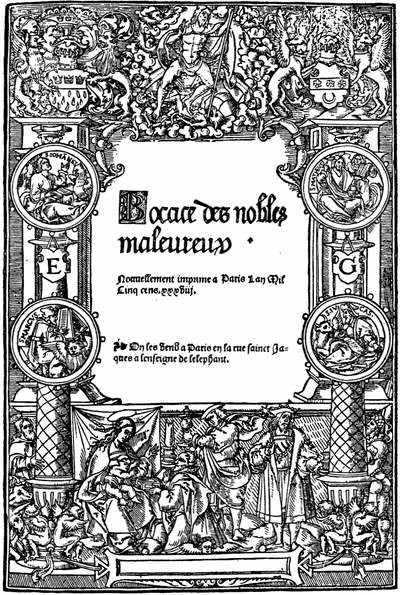
THE TITLE OF THE "NOBLES MALHEUREUX" (DE CASIBUS). (PARIS, 1538)
(By the courtesy of Messrs. J. & J. Leighton)
While they were calling on Mars, Venus, and Emilia,[259] in the same way as the Christian knights called on Madonna and their lady, suddenly Emilia, who was hunting in that very wood, came upon them, and they, made fiercer by her presence, start in earnest.[260] But at last Theseus arrives called by Emilia, to end the combat and learn the cause of the quarrel. Hearing it he pardons them, for he himself has been young and has loved too, but he attaches to his pardon a condition, to wit, that each of them, aided by a hundred knights, shall combat in public for Emilia's hand.[261]
The young lovers must send into all lands messengers to enrol two hundred knights,[262] and these at last are gathered together in the place of combat. Among the rest came Peleus, still a youth, the great twin brethren Castor and Pollux, Agamemnon and Paris, Narcissus, Nestor, Ulysses, Pygmalion, prince of Tyre, Sichæus, Minos, and Rhadamanthus, who have abandoned their judgment seats in Orcus to witness the fight. Indeed, as Landau has well said, if Homer had been there, he would certainly have been delighted to find again so many he had known of old, but he would also have marvelled to find among them so many jongleurs.
Before beginning the struggle Theseus, Palemon, and Arcite hold long discourses; the two rivals and Emilia recite long prayers.
The prayer of Arcite is to Mars, who lives in the mists of Thrace amid snow and ice. There in a thick wood of stout oaks stands his palace of iron with gates of diamond, at which mount guard Mad Fury, Murder, and Eternal Anger red as fire.
On the other hand, Palemon's prayer is to Venus, who lives in a garden full of fountains and streams and singing birds. There meet Grace, Courtesy, Delight, Beauty, Youth, and Mad Ardour. At the entrance sits Madonna Pace (Peace), and near her Patience and Cunning in Love. Within, however, Jealousy tortures his victims; while the door which leads to the sanctuary where Venus reposes between Bacchus and Ceres is guarded by Riches.[263]
The tourney is then described in the usual way, and ends in the defeat of Palemon. However, as Arcite only asked Mars for victory, he cannot enjoy it or its fruit. Palemon, it seems, asked not for victory, but that he might have Emilia. So the gods decide it. And therefore Venus sends a Fury who throws Arcite, and he is mortally wounded after his victory.[264] Before his death, however, he is married to Emilia,[265] makes his will, in which he leaves his wife and fortune to his friend and rival, and ends by swearing to him that he has only had of Emilia a single kiss.[266] After this Arcite is buried with great pomp, and tourneys are held in his honour, and there follows the marriage of Emilia and Palemon.[267]
What are we to make of such a work as this? Ambitious and complicated though it be, it is out of all comparison feebler than the simple tale of Troilus and Criseyde. Nor has it the gift of life, nor the subtle characterisation of the Filostrato. The two youths Palemon and Arcite are alike in their artificiality; they have never breathed the air we breathe, and we care nothing for or against them. And it would be the same with Emilia, but that her absolute stupidity angers us, and we soon come to find her unbearable. She is always praying the gods to give her the man she loves for a husband, but she herself is absolutely ignorant which of the two he may be.
But it might seem that the last thing Boccaccio thought of here was the creation of an impersonal work of art. His intention was rather to express his own sufferings. In the agonies of Palemon and Arcite he wished Fiammetta to see his own misery; and it may be that in the protection of Venus by which Palemon got at last what he most desired, he wished to tell Fiammetta that he too expected to triumph, even then, by virtue of his passion, the singleness of his love. Certainly, he seemed to say, you are worthy of the love of heroes, but it is the heart of a poet that Venus protects and satisfies; then give me your grace, since I am so faithful. That something of this sort was in his mind is obvious from the dedicatory letter to Fiammetta.[268]
As for the sources from which Boccaccio had the tale, we have seen that he certainly knew the Thebais of Statius,[269] but it was not only from Statius that he borrowed; he used also, as Crescini[270] has proved, the Roman de Thèbes, especially towards the end of his poem. Nor must we altogether pass over the influence of the Æneid, in which he found not only the form, but often the substance of his work.[271]
The first edition of the Teseide, full of faults, was published in Ferrara in 1475 by Pietro Andrea Bassi. As for translations, there have been many, the first being a Greek version issued in Venice in 1529. There followed an Italian prose paraphrase published in Lucca in 1579; while in 1597 a French version was published in Paris. The most famous translation or rather paraphrase was made, however, by Chaucer for the Knight's Tale in the Canterbury Tales; and of this I speak elsewhere.
In the shadow of Virgil's tomb, in a classic country still full of an old renown, Boccaccio had followed classic models, had written two epics and a romance in the manner of Apuleius; but in Tuscany, the country of Dante and Petrarch, he came under the influence of different work, and we find him writing pastorals. The Ameto is a pastoral romance written in prose scattered with verses, and to the superficial reader it cannot but be full of weariness. The action takes place in the country about Florence under the hills of Fiesole in the woods there, and begins with the description of the rude hunter Ameto (ἄδμητος), who only thinks of the chase and of the way through the forest[272]. Then he comes upon a nymph, Lia by name, and scarcely has he seen her and heard her sing than he loves her. After many pages of description of the love of Ameto, the struggle between his love and his timidity, he tells Lia at last that he loves her, and makes her accompany him in the chase. Winter comes, however, and separates them. But in the spring Ameto finds her again near a temple in which are gathered a company of fauns, dryads, satyrs, and naiads. There too in a private place a party of nymphs and shepherds meet close to Ameto and Lia. Many pages of description follow concerning each of the six nymphs, Mopsa, Emilia, Fiammetta, Acrimonia, Agapes, and Adiona. These descriptions are very wearying, for they are almost exactly alike, so like, indeed, that we may think Boccaccio was describing one woman and that Fiammetta. One after another these nymphs tell their amorous adventures, and each closes her account with a song in terza rima. Then Venus appears in the form of a column of fire,[273] and Ameto not being able to support the sight of the goddess, the nymphs come to his aid. When he is himself again, he prays the goddess to be favourable to his love.
Till now the pagan and sensual character of the book is complete, but here Ameto suddenly sees the error of his ways, all is changed in a moment, the spiritual beauty of the nymphs seems to him to surpass altogether their physical beauty. He understands that their loves are not men; the gods and temples about which they discourse are not those of the Pagans, and he is ashamed to have loved one of them as he might have loved any mortal girl. Then suddenly he breaks into a hymn in honour of the Trinity, and they all return to their own homes. Thus the work ends without telling us of the fate of Ameto or the nymphs.
The book, however, full as it is of imitations of Dante, is an allegory within an allegory. The nymphs and shepherds are not real people, but it seems personifications of the four cardinal virtues and the three theological virtues and their opposites. Thus Mopsa is Wisdom, and she loves Afron, Foolishness; Emilia is Justice, and she loves Ibrida, Pride; Adiona is Temperance, and she loves Dioneo, Licence; Acrimonia is Fortitude, and she loves Apaten, Insensibility; Agapes is Charity, and she loves Apiros, Indifference; Fiammetta is Hope, and she loves Caleone, Despair; Lia is Faith, and she loves Ameto, Ignorance. In their songs the seven nymphs praise and exalt the seven divinities that correspond to the seven virtues which they impersonate; thus Pallas is praised by Mopsa (Wisdom), Diana by Emilia (Justice), Pomona by Adiona (Temperance), Bellona by Acrimonia (Fortitude), Venus by Agapes (Charity), Vesta by Fiammetta (Hope), and Cibele by Lia (Faith). The whole action of the work then becomes symbolical, and Boccaccio, it has been said, had the intention of showing that a man, however rude and savage, can find God only by means of the seven virtues which are the foundation of all morals. If such were his intention he has indeed chosen strange means of carrying it out. The stories of the seven nymphs are extremely licentious, and all confess that they do not love their husbands and are seeking to make the shepherds fall in love with them. All this is, as we see, obscure, medieval, and far-fetched. Let it be what it may be. It is not in this allegory we shall find much to interest us, but in certain other allusions in which the work is rich. Thus we shall note that Fiammetta is Hope, and that she gives Hope to Caleone, who is Despair. That Caleone is Boccaccio himself there can be no manner of doubt. We see then that at the time the Ameto was written he still had some hope of winning Fiammetta again. In fact in the Ameto Fiammetta has the mission of saving Caleone from death, for he is resolved to kill himself. I have spoken of the autobiographical allusions in the Ameto, however, elsewhere.[274] It will be sufficient to say here that the Ameto was written, as Boccaccio himself tells us, in order that he might tell freely without regret or fear what he had seen and heard. It is all his life that we find in the stories of the nymphs. Emilia tells of Boccaccino's love for Jeanne (Gannai), his desertion of her, his marriage, and his ruin. Fiammetta tells how her mother was seduced by King Robert, who is here called Midas.[275] Then she describes the passion of Caleone (Boccaccio), his nocturnal surprise of her, and his triumph. The work is in fact a complete biography; and since this is so, there are in fact no sources from which it can be said to be derived. We find there some imitations of the Divine Comedy, some hints from Ovid and Virgil, of Moschus and Theocritus. The Ameto was dedicated to Niccola di Bartolo del Bruno, his "only friend in time of trouble." It was first published in small quarto in Rome in 1478. It has never been translated into any language.
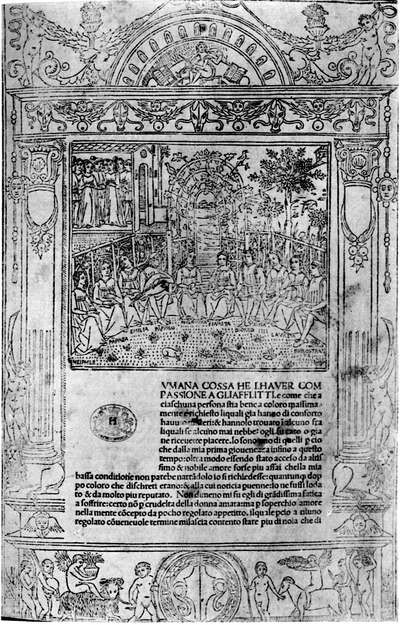
FRONTISPIECE OF THE "DECAMERON." (VENICE, 1492)
There follows the Amorosa Visione, which was almost certainly begun immediately after the Ameto; at any rate, all modern authorities are agreed that it was written between 1341 and 1344. It recalls the happier time of his love, and Fiammetta is the very soul of the poem. Written in terza rima, not its only likeness to the Divine Comedy, it is dedicated to Maria d'Aquino (Fiammetta) in an acrostic, which is solved by reading the initial letters of the first verse of each terzina; the result being two sonnets and a ballata.[276] The name of "Madonna Maria" is formed by the initials of the twelfth to the twenty-second terzine of chapter x, and the name "Fiamma" by those of the twenty-fifth to the thirty-first of chapter xiii. Here is no allegory at all, but a clear statement; the three last lines of the first sonnet reading:—
"Cara Fiamma, per cui 'l core ò caldo,
Que' che vi manda questa Visione
Giovanni è di Boccaccio da Certaldo."
As the title proclaims, the poem is a Vision—a vision which Love discovers to the poet-lover. While he is falling asleep a lady appears to him who is to be his guide. He follows her in a dream, and together they come to a noble castello; there by a steep stairway they enter into the promised land, as it were, of Happiness, choosing not the wearying road of Good to the left, but passing through a wide portal into a spacious room on the right, whence come delicious sounds of festa. Two youths, one dressed in white, the other in red, after disputing with his guide, lead him into the festa, where he sees four triumphs—of Wisdom, of Fame, of Love, and of Fortune. In the triumph of Wisdom he sees all the learned men, philosophers, and poets of the world, among them Homer, Virgil, and Cicero, Horace, Sallust, Livy, Galen, Cato, Apuleius, Claudian, Martial, and Dante.[277] In the triumph of Fame he sees all the famous heroes and heroines of Antiquity and the Middle Age, among them Saturn, Electra, Baal, Paris, Absalom, Hecuba, Brutus, Jason, Medea, Hannibal, Cleopatra, Cornelia, Giulia, and Solomon, Charlemagne, Charles of Apulia, and Corradino.[278] The uniformity of the descriptions is pleasantly interrupted by certain apparitions, among them Robert of Naples[279] and Boccaccino, [280] besides a host of priests.[281] Once in speaking of the sufferings of poverty he seems to be writing of his own experiences:—
"Ha! lasso, quanto nelli orecchi fioco
Risuona altrui il senno del mendico,
Nè par che luce o caldo abbia 'l suo foco.
E 'l più caro parente gli è nemico,
Ciascun lo schifa, e se non ha moneta,
Alcun non è che 'l voglia per amico."[282]
After all, it is the experience of all who have been poor for a season.
There follows the triumph of Love, in which he sees all the fortunate and unfortunate lovers famous in poetry from the mythology of Greece to Lancelot and Guinevere, and Tristram and Iseult; and among these he sees Fiammetta.
So we pass to the triumph of Fortune, in which we learn the stories of Thebes, of Troy, of Carthage, of Alexander, of Pompey, of Niobe, and we are told of the inconstancy of terrestrial things.[283] And thus disillusioned, the poet makes the firm resolve to follow his guide in spite of every temptation. Yet almost at once a certain beautiful garden destroys his resolve. For he enters there and finds a marvellous fountain of marble, and a company of fair women who are presented to him under mysterious pseudonyms.[284] Among these are the bella Lombarda, the Lia of the Ameto, and finally the lady who writes her name in letters of gold in the heart of the poet.[285] And this lady he chooses for his sun, with the approval of his guide, who seems to have forgotten, as he has certainly done, the resolves so lately taken. However, the guide now discreetly leaves him in a somewhat compromising position; and it is thus Fiammetta who leads him into the abandoned road of virtue.[286]
These Trionfi were written before the Trionfi of Petrarch, and their true source is to be found not in any of Petrarch's work, but in the Divine Comedy and in the sources Dante used.[287] Boccaccio has evidently studied the great poem very closely. He imitates it not only in motives and symbols and words, but, as we have seen, in the form of his verse, and to some extent in the construction of his poem, which consists of fifty capitoli, each composed of twenty-nine terzine and a verse of chiusa, that is of eighty-eight verses in each.
The first edition was published in Milan in 1521 with an Apologia contro ai detrattori della poesia del Boccaccio by Girolamo Claricio of Imola. No translation has ever been made.[288]
We turn now to the Fiammetta,[289] which must have been the last of the works directly concerned with his passion for Maria d'Aquino. Crescini[290] thinks it was written in 1343, but others[291] assure us that it is later work.[292] Crescini's argument is, however, so formidable that we shall do better to accept his conclusions and to consider the Fiammetta as a work of this first Florentine period. Though concerned with the same subject, his love, the allegory is worth noting, for while in all the other books concerned with Fiammetta he assures us he was betrayed by her, here he asserts that Panfilo (himself) betrayed Fiammetta! Moreover, he warns us that here he speaks the truth,[293] but in fact it is only here he is a liar. It is impossible to believe that every one had not penetrated his various disguises, and he must have known that this was, and would be, so. Wishing, then, both to revenge and to vindicate himself—for his "betrayal" still hurt him keenly—and guessing that Fiammetta would read the book, he tells us that it was he who left her, not she him. The book then is very amusing for us who are behind the scenes, as it was, doubtless, for many of those who read it in his day.
The action is very simple, the story being told by Fiammetta as though it were an autobiography. It begins with a dream in which Fiammetta is warned that great unhappiness is in store for her. She knows Panfilo,[294] and suddenly there arises between them an eager love. Warned of the danger they run in entertaining so impetuous a passion, they yet take no heed; till quite as suddenly as it had begun, their love is broken. Panfilo must go away, it seems, being recalled to Florence by his old father. In vain Fiammetta tries to detain him; she can only obtain from him a promise that he will return to Naples in four months. The ingenious lying in that!
All alone she passes her days and nights in weeping. The four months pass and Panfilo does not come back to her. One day she hears from a merchant that he has taken a wife in Florence. This news increases her agony, and she asks aid of Venus. Then her husband, seeing her to be ill, but unaware of the cause of her sufferings, takes her to Baia; but no distraction helps her, and Baia only reminds her of the bygone days she spent there with Panfilo. At last she hears from a faithful servant come from Florence that Panfilo has not taken a wife, that the young woman in his house is the new wife of his old father; but it seems though he be unmarried he is in love with another lady, which is even worse. New jealousy and lamentations of Fiammetta. She refuses to be comforted and thinks only of death and suicide, and even tries to throw herself from her window, but is prevented. Finally the return of Panfilo is announced. Fiammetta thanks Venus and adorns herself again. She waits; but Panfilo does not come, and at last she is reduced to comforting herself by thinking of all those who suffer from love even as she. The work closes with a sort of epilogue.
As a work of art the Fiammetta is the best thing Boccaccio has yet achieved. The psychology is fine, subtle, and full of insight, but not so dramatic nor so simple and profound as that in the Filostrato. He shows again that he understands a woman's innermost nature, her continual doubts of herself, her gift of introspection. The torment of soul that a deserted woman suffers, the helpless fury of jealousy, are studied and explained with marvellous knowledge and coolness. The husband, who, ignorant of all, is so sorry for his wife's unhappiness, and seeks to console and comfort her, really lives and is the fine prototype of a lot of base work done later in which the cruel absurdity of the situation and the ridiculous figure he cuts who plays his part in it are insisted on. In fact, in the Fiammetta we find many of the finest features of the Decameron. It is the first novel of psychology ever written in Europe.
[235] Filostrato, ed. cit., part iii. ott. xxvii-xxxii. pp. 88-90, and cf. Chaucer, Troilus and Criseyde (Complete Works, ed. Skeat, Oxford, 1901), Bk. III, st. 169-189.
[236] Filistrato, ed. cit., part iv. ott. xiv.-xviii. pp. 117-18.
[237] Ibid., part iv. ott. xxx.-xxxii. pp. 122-3.
[238] Ibid., part iv. ott. xciii.-xcv. pp. 143-4.
[239] Filostrato, ed. cit., part iv. ott. lxix. p. 135.
[240] Ibid., part iv. clxii.-clxiii. pp. 166-7.
[241] Ibid., part v. liv. et seq. The same idea is to be found in the Teseide and the Fiammetta. It is more than worth while comparing these passages.
[242] Ibid., part v. xxxiv.-xlii.
[243] Filostrato, ed. cit., part vii. ott. vi., xi., xvi., xxxii.-xxxiii. pp. 208, 210, 212, 217.
[244] Shakespeare, Troilus and Cressida, V, 3.
[245] Filostrato, ed. cit., part viii. xii.-xvi. pp. 247-8.
[246] Ibid., part viii. xxvii.
[247] Chaucer, Troilus and Criseyde, Book V, st. 258.
[248] Filostrato, ed. cit., part vi. ott. xxxiii. p. 205.
[249] Filostrato, ed. cit., p. vi, ott. xxix. p. 204.
[250] Cf. e.g. Filostrato, ed. cit., p. iii. ott. i. p. 80, with Paradiso, i. 13-27; or Filostrato, ed. cit., p. viii. ott. xvii. p. 249, with Purgatorio, vi. 118-20. There are, however, very many Dantesque passages. See infra, p. 253 et seq.
[251] Cf. Hortis, Studi sulle op. Latine del B. (Trieste, 1879), p. 595.
[252] See supra, p. 58.
[253] Teseide (ed. Moutier), Lib. I, ott. 6, p. 11.
[254] Ibid., Lib. I, ott. 74-6, p. 34.
[255] Ibid., Lib. II, ott. 2, p. 57.
[256] Teseide, ed. cit., Lib. III, ott. 28-9, pp. 99-100.
[257] Ibid., Lib. IV, ott. 37, p. 131.
[258] Ibid., Lib. V, ott. 48, p. 166.
[259] Teseide, ed. cit., Lib. V, ott. 75, p. 175.
[260] Ibid., Lib. V, ott. 80, p. 177.
[261] Ibid., Lib. V, ott. 97, p. 182.
[262] Ibid., Lib. VI, ott. 11, p. 190.
[263] Cf. Poliziano, Stanze, Lib. I, st. 69-76.
[264] Teseide, ed. cit., Lib. IX, ott. 2-8, pp. 306-8.
[265] Ibid., Lib. IX, ott. 83, p. 333.
[266] Ibid., Lib. X, ott. 43, p. 348.
[267] Ibid., Lib. XII, ott. 69, p. 426.
[268] He says there: "E ch' ella da me per voi sia compilata, due cose fra le altre il manifestano. L' una si è, che ciò che sotto il nome dell' uno de' due amanti e della giovine amata si conta essere stato, ricordandovi bene, e io a voi di me, e voi a me di voi (se non mentiste) potrete conoscere essere stato fatto e detto in parte." And consider the closing words of the letter: "Io procederei a molti più preghi, se quella grazia, la quale io ebbi già in voi, non se ne fosse andata. Ma perocchè io del niego dubito con ragione, non volendo che a quell' uno che di sopra ho fatto, e che spero, siccome giusto, di ottenere, gli altri nocessero, e senza essermene niuno conceduto mi rimanessi, mi taccio; ultimamente pregando colui che mi vi diede, allorachè io primieramente vi vidi, che se in lui quelle forze sono che già furono, raccendendo in voi la spenta fiamma a me vi renda, la quale, non so per che cagione, inimica fortuna mi ha tolta."
[269] Supra, p. 58 et seq. Cf. the letter of 1338 or 1339 in which he asks for a codex of the Thebais with a gloss: P. Savi-Lopez, Sulle fonti delle Teseide in Giornale Stor. della Lett. Ital., An. XXIII, fasc. 106-7; and Crescini, op. cit., pp. 220-47.
[270] Crescini, op. cit., pp. 234-5.
[271] In looking for the sources of the Teseide one must not forget what Boccaccio himself writes in the letter dedicatory to Fiammetta: "E acciocchè l' opera sia verissimo testimonio alle parole, ricordandomi che già ne' dì più felici che lunghi io vi sentii vaga d' udire, e talvolta di leggere e una e altra storia, e massimamente le amorose, siccome quella che tutta ardeva nel fuoco nel quale io ardo (e questo forse faciavate, acciocchè i tediosi tempi con ozio non fossono cagione di pensieri più nocevoli); come volonteroso servidore, il quale non solamente il comandamento aspetta del suo maggiore, ma quello, operando quelle cose che piacciono, previene: trovata una antichissima storia, e al più delle genti non manifesta, bella sì per la materia della quale parla, che è d' amore, e sì per coloro de' quali dice che nobili giovani furono e di real sangue discesi, in latino volgare e in rima acciocchè più dilettasse, e massimamente a voi, che già con sommo titolo le mie rime esaltaste, con quella sollecitudine che conceduta mi fu dell' altre più gravi, desiderando di piacervi, ho ridotta."
[272] Ameto (in Opere Minori, Milano, 1879), pp. 147-8.
[273] Ibid., pp. 246-7.
[274] See supra, p. 6.
[275] King Robert is always spoken of as living, so that one may suppose the Ameto to have been finished before January, 1343, for the king died on the 19th. This, however, by no means certainly follows.
[276] See Appendix IV.
[277] Amorosa Visione (Moutier), cap. v. pp. 21-5.
[278] Ibid., caps. vii.-xii.
[279] Ibid., cap. xiii. p. 53.
[280] Ibid., cap. xiv. p. 58.
[281] Ibid., cap. xiv. p. 57.
[282] Amorosa Visione, ed. cit., cap. xiv. p. 59.
[283] Ibid., cap. xxxiii. p. 135.
[284] Ibid., caps. xl-xliv. For an explanation consult Crescini, op. cit., pp. 114-41.
[285] Ibid., cap. xlv. p. 151
[286] "Ecco dunque," says Crescini (op. cit., p. 136), "il fine della mirabile visione: mostrare che Madonna Maria è dal poeta ritenuta un essere celeste sceso dall' alto alla salute di lui, che errava perduto e sordo a' consigli delle ragione fra le mondane vanità. Per farsi degno dell' amore di lei e delle gioie di questo amore, egli ormai seguirà una virtù finora negletta, la fortezza resisterà, cioè alle passioni e alle vanità mondane; e così per l' influsso morale della sua donna procederà sulla strada faticosa, che mena l' uomo al cielo."
[287] He borrows from Brunetto Latini's Tesoretto (ca. 1294) certain inventions and moral symbols. Cf. Dobelli, Il culto del B. per Dante (Venezia, 1897), pp. 51-9.
[288] But see Landau, op. cit. (Ital. Trans.), p. 155.
[289] Note the beautiful names Boccaccio always found; especially the beautiful women's names. We shall find this again in the Decameron.
[290] Crescini, op. cit., p. 154.
[291] e.g. Landau (op. cit., pp. 346, 404) and Koerting (op. cit., pp. 170-1, 568).
[292] Baldelli (op. cit.) thinks, however, that it was written 1344-5, after B.'s return to Naples, and Renier (La Vita Nuova e La Fiammetta, Torino, 1879, pp. 245-6) agrees with him.
[293] "... Quantunque io scriva cose verissime sotto si fatto ordine l' ho disposte, che eccetto colui che così come io le sa, essendo di tutto cagione, niuno altro, per quantunque avesse acuto l' avvedimento, potrebbe chi io mi fossi conoscere" (cap. i.).
[294] "Pamphilius," writes Boccaccio, "græce, latine totus dicatur amor"; cf. Corazzini, op. cit., p. 269. Panfilo also appears, as does Fiammetta, in the Decameron, as we shall see; cf. Gigli, Il Disegno del Decamerone (Livorno, 1907), p. 24, note 4.
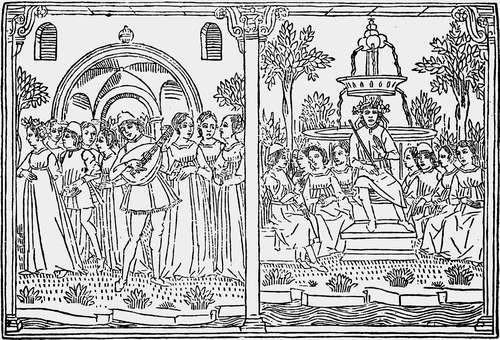
CHAPTER HEADING FROM THE "DECAMERON." (VENICE, 1492)
The sources of the Fiammetta are hard and perhaps impossible to trace. It seems to have no forbears.[295] One thinks of Ovid's Heroides, but that has little to do with it. Among the minor works of Boccaccio it is the one that has been most read. First published in Padova in 1472, it was translated into English in 1587 by B. Young.[296]
From this intense psychological novel Boccaccio seems to have turned away with a sort of relief, the relief the poet always finds in mere singing, to the Ninfale Fiesolano. Licentious, and yet full of a marvellous charm, full of that love of nature, too, which is by no means a mere convention, the Ninfale Fiesolano is the most mature of his poems in the vulgar tongue.
"Basterebbe," says Carducci,[297] "Basterebbe, io credo, il Ninfale Fiesolano perchè non fosse negato al Boccaccio l' onore di poeta anche in versi." It was probably begun about 1342 in Florence, and finished in Naples in 1346. The theme is still love:
"Amor mi fa parlar che m' è nel core
Gran tempo stato e fatto m' ha suo albergo,"
he tells us in the first lines. The story tells how the shepherd Affrico falls in love with Mensola, nymph of Diana,[298] and how the nymph, penitent for having broken her vow of chastity, abandons the poor shepherd.[299] In desperation, Affrico kills himself on the bank of the brook that has witnessed their happiness and that is now called Affrico after him;[300] and Mensola, after bearing a son, is changed too into the stream Mensola hard by.[301] Pruneo, their offspring, when he is eighteen years old, enters the service of Atlas, founder of Fiesole, who marries him to Tironea. She receives as dote the country between the Mensola and the Mugnone.[302]
The sources he drew from for this beautiful poem, so full of learning, but fuller still of a genuine love of nature, prove to us that it was, in its completeness, a mature work. It is derived in part from the Metamorphoses of Ovid, from the Æneid, and from Achilles Tatius, a Greek romancer of Alexandria who lived in the fifth century a.d.[303] Moreover, the Ninfale is a pastoral poem that is in no way at all concerned with chivalry; it is wholly Latin, full of nature and the bright fields, expressed with a Latin rhetoric. Curiously enough it has never had much success, especially out of Italy; and though it be voluptuous, it is by no means the immoral book it has been called.
This, as we have seen, is the third poem which Boccaccio wrote in ottave, and it has been stated, not without insistence, that he was in fact the inventor, or at any rate the renewer, of that metre in Italian.[304]
The truth seems to lie with Baldelli. The Sicilians had written ottave, but they had but two rime, and were akin to those of the Provençals. What Boccaccio did was to take this somewhat arid scheme and give it life by reforming it out of all recognition. Moreover, if he was not actually the first poet to write ottave in Italian, he was the first to put them to epic use. There are in fact, properly speaking, no Italian epics before the poems of Boccaccio.
As for the Ninfale Fiesolano, it was first published in Venice in 1477 by Bruno Valla and Tommaso d' Alessandria. It has only been translated once—into French—by Anton Guercin du Crest, who published it in Lyons in 1556 at the shop of Gabriel Cotier. This was apparently the last poem on which Boccaccio was engaged—though it may have been put aside for the sake of the Fiammetta, and taken up again—before, about 1344, it seems, he returned to Naples.
CHAPTER VI
1341-1343
IN FLORENCE—HIS FATHER'S SECOND MARRIAGE—THE DUKE OF ATHENS
Those years which Boccaccio spent in Florence between 1341 and 1345, and which would seem for the most part to have been devoted to literature, the completion of the works already begun in Naples, the composition of the Amorosa Visione, the Fiammetta, and the Ninfale Fiesolano, were personally among the most unhappy of his life, while publicly they brought the republic of Florence to the verge of ruin. And indeed he was an unwilling victim. That he hated leaving Naples might seem obvious from his own circumstances at that time; nor were the political conditions of Florence encouraging. He had left a city friendly to men of letters, full of all manner of splendour, rich, peaceful, and, above all, governed by one authority, the king, for a distracted republic divided against itself and scarcely able to support a costly foreign war.[305] Nor were the conditions of his father's house any more pleasing to him.
Soured by misfortune, Boccaccino seems at this time to have been a melancholy and hard old man. The picture Giovanni gives us of him is perhaps coloured by resentment, and indeed he had never forgiven his father for the desertion of the girl he had seduced, the little French girl Jeanne, Giovanni's mother;[306] but it is with a quite personal sense of resentment he describes the home to which he returned from Naples—that house in the S. Felicità quarter which Boccaccino had bought in 1333:[307] "Here one laughs but seldom. The dark, silent, melancholy house keeps and holds me altogether against my will, where the dour and terrible aspect of an old man frigid, uncouth, and miserly continually adds affliction to my saddened mood."[308] That was in 1341 one may think; and no doubt the loss of Fiammetta, his own poverty, and the confusion of public affairs in Florence added to his depression; and then he was always easily cast down. But as it happened, things were already improving for him.
It will be remembered that in the romance which passes under her name Fiammetta tells us that Panfilo (Giovanni), when he deserted her, promised to return in four months. Later[309] she says, when the promised time of his return had passed by more than a month, she heard from a merchant lately arrived in Naples that her lover fifteen days before had taken a wife in Florence.[310] Great distress on the part of Fiammetta; but, as she soon learnt, it was not Giovanni, but his father, who had married himself.
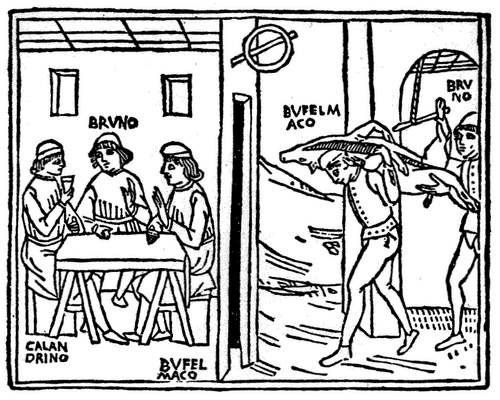
THE THEFT OF CALANDRINO'S PIG (DEC. VIII, 6)
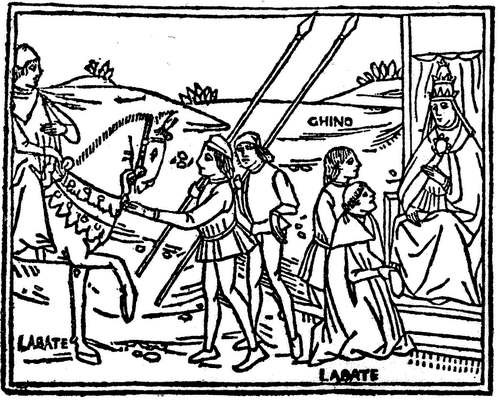
GHINO AND THE ABBOT (DEC. X, 2)
Woodcuts from the "Decameron." (Venice, 1492.)
Is there any truth in this story? Assuredly there is. We know, indeed, that Boccaccino did marry a second wife, whose name was Bice de' Bostichi, and that she bore him a son, Jacopo;[311] but we do not know when either of these events happened. If we may trust the Fiammetta, which says clearly that Giovanni's father married again about five months after his son returned home, and if we are right in thinking that that return took place in January, 1341, then Boccaccino married his second wife in the spring, or more precisely in May, 1341. That they were man and wife in May, 1343,[312] we know, for, thanks to Crescini, we have a document which proves it. Beyond that fact all is conjecture in this matter. Yet it is significant that we find Boccaccino, on December 13, 1342, acquiring half a house in the popolo di S. Ambrogio in Florence,[313] and yet, as we know from the document just quoted,[314] in May, 1343, he was still living in popolo di S. Felicità.[315] For what possible reason could Boccaccino, ruined as he was, want half a house in which he did not propose to live? Had family history repeated itself? Was Giovanni in some sort again turned out of his father's house by his second stepmother as he had been by the first, and for a like reason—the birth of a legitimate son? It was for him, then, that Boccaccino bought the half-house in popolo di S. Ambrogio, and the occasion was the birth of Jacopo his son by Madonna Bice? It is possible, at any rate; and when we remember the efforts the old man had already made in his poverty for the comfort of a son who had disappointed him in everything, it seems more than likely. Nor can we but accuse Giovanni of ingratitude when we think of his constant allusions to his father's avarice and remember these benefits.[316]
Such, then, are the few and meagre personal events that have in any way come down to us of Boccaccio's life while he was writing all or nearly all those works of his youth which we have already examined, between his return to Florence in January, 1341, and his departure once more for Naples in 1344 or 1345.
These years, materially none too happy for him but full after all of successful work, were disastrous for Florence. That tranquillity and internal peace which so happily followed the death of Castruccio Castracani and of Charles of Calabria in 1328, in which, among other splendid things, Giotto's tower was built, had been broken in 1340, when the grandi, who held the government, having grown oppressive, a rebellion headed by Piero de' Baldi and Bardo Frescobaldi was only crushed by a rising of the people. Things were quiet then for a moment, but the grandi would heed no warning, and as one might expect, their insolence grew with their power. Nor was it only at home that things were going unhappily for Florence. When Louis of Bavaria, who claimed the empire against the will of the Pope, left Italy—it was the Visconti who had called him across the Alps in fear of the House of Anjou—some of his Germans, after Castruccio's death, seized Lucca and offered to sell it to the Florentines, who refused it. They repented later; and when it had come into the hands of Martino della Scala of Verona and Parma, who, in straits himself on account of Visconti, offered to sell it again, they found a competitor in Pisa, who was ready to dispute the city with them. Nevertheless they bought it, only to find that the Pisans, knowing the wealth of Florence and expecting this, had sat down before it. A war followed in which nothing but dishonour came the way of Florence, and Lucca fell into the hands of Pisa. This so enraged the Florentines that they rose against the grandi, who, at their wits' end what to do, asked their old ally Robert of Naples for help. This was in 1341. It was not, therefore, to a very prosperous or joyful city that Boccaccio returned from Naples; the words he put into the mouth of Fiammetta[317] were fully justified.
King Robert, however, did not send help to Florence at once. He was thinking always of Sicily and had been busy with the conquest of the Lipari Islands,[318] but when he did send it, in the person of Walter, Duke of Athens and Count of Brienne, a French baron, it proved to be the worst disaster of all. Yet at first the Florentines rejoiced, for they knew Walter of old, who had been vicegerent in Florence for Charles of Calabria in 1325, and as Machiavelli tells us, his behaviour had been so modest that every one loved him. That was not his attitude now, nor does it tally with Boccaccio's lively account of him,[319] which certainly reads like the work of an eye-witness and supports our belief that he was in Florence during 1342 and 1343—those disastrous years.
For as it happened, the Duke arrived in Florence at the very time when the enterprise of Lucca was utterly lost. The grandi, however, hoping to appease the people, at once made him Conservator and later General. But they had alienated every one. The nobili, long since their enemies, had always maintained a correspondence with the Duke ever since he had been vicegerent for Charles of Calabria; they thought now that their chance was come when they might be avenged alike on the grandi and the people; so they pressed him to take the government wholly into his hands. The people, on the other hand, smarting under new taxes and oppression and insolence and defeat, to a large extent joined the nobili against the grandi. In this conspiracy we find all the names of the great popular families, Peruzzi, Acciaiuoli, Antellesi, and Buonaccorsi, whom the unsuccessful war, among other things, had ruined, and who hoped thus to free themselves from their creditors.
The Duke's ambition, being thus pampered and exasperated, over-reached itself. To please the people he put to death those who had the management of the war, Giovanni de' Medici, Nardo Rucellai, and Guglielmo Altoviti, and banished some and fined others. And thus his reputation was increased, and indeed a general fear of him spread through the city, so that to show their affection towards him people caused his arms to be painted upon their houses, and nothing but the bare title was wanting to make him their Prince.
Being now sure of his success, he caused it to be signified to the Government that for the public good he judged it best that they should transfer their authority upon him, and that he desired their resignation. At first they refused, but when by proclamation he required all the people to appear before him in the Piazza di S. Croce (for he was living in the convent as a sign of his humility), they protested, and then consented that the government should be conferred upon him for a year with the same conditions as those with which it had been formerly given to Charles of Calabria.
So on September 8, 1342, the Duke, accompanied by Giovanni della Tosca and many citizens, came into the Piazza della Signoria with the Senate, and, mounting on the Rhingiera, he caused the articles of agreement between him and the Senate to be read. Now when he who read them came to the place where it was written that the government should be his for a year, the people cried out, "For his life. For his life." It is true, Francesco Rustichesi, one of the Signori, rose up and tried to speak, but they would not hear him. Thus the Duke was chosen lord by consent of the people not for a year, but for ever; and afterwards he was taken and carried through the multitude with general acclamation. Now the first thing he did was to seize the Palazzo della Signoria, where he set up his own standard, while the Palazzo itself was plundered by his servants; and all this was done to the satisfaction of those who maliciously or ignorantly had consented to his exaltation.
The Duke was no sooner secure in his dominion than he forbade the Signori to meet in the Palazzo, recalled the Baldi and the Frescobaldi, made peace with the Pisans, and took away their bills and assignments from the merchants who had lent money in the war of Lucca. He dissolved the authority of the Signori and set up in their place three Rettori, with whom he constantly advised. The taxes he laid upon the people were great, all his judgments were unjust, and all men saw his cruelty and pride, while many citizens of the more noble and wealthy sort were condemned, executed, and tortured. He was jealous of the nobili, so he applied himself to the people, cajoling them and scheming into their favour, hoping thus to secure his tyranny for ever. In the month of May, for instance, when the people were wont to be merry, he caused the common people to be disposed into several companies, gave them ensigns and money, so that half the city went up and down feasting and junketing, while the other half was busy to entertain them. And his fame grew abroad, so that many persons of French extraction repaired to him, and he preferred them all, for they were his faithful friends; so that in a short while Florence was not only subject to Frenchmen, but to French customs and garb, men and women both, without decency or moderation, imitating them in all things. But that which was incomparably the most displeasing was the violence he and his creatures used to the women. In these conditions it is not surprising that plots to get rid of him grew and multiplied. He cared not. When Matteo di Morrozzo, to ingratiate himself with the Duke, discovered to him a plot which the Medici had contrived with others against him, he caused him to be put to death. And when Bettone Cini spoke against the taxes he caused his tongue to be pulled out by the roots so that he died of it. Such was his cruelty and folly. But indeed this last outrage completed the rest. The people grew mad, for they who had been used to speak of everything freely could not brook to have their mouths stopped up by a stranger. "When," asks Machiavelli, "did the Florentines know how to maintain liberty or to endure slavery?" However, things were indeed at such a pass that the most servile people would have tried to recover its freedom.
Many citizens of every sort, we hear, resolved to destroy him, and out of this hatred grew three serious conspiracies by three sorts of people: the grandi, the people, and the arti. The grandi hated him for he had robbed them of the government, the people because he had not given it to them, the arti because they were ruined. With the first were concerned the Bardi, Rossi, Frescobaldi, Scali, Altoviti, Mazalotti, Strozzi, and Mancini, with the Archbishop of Florence; with the second, Manno and Corso Donati, the Pazzi, Cavicciulli, Cerchi, and Albizzi; with the third, Antonio Adimari, the Medici, Bordini, Rucellai, and Aldobrandini.
The plan was to kill him on the feast of S. John Baptist, June 24, 1343, in the house of the Albizzi, whither, as it was thought, he would go to see the palio.[320] But he went not and that design was lost. The next proposal was to kill him as he walked in the streets, but that was found difficult, because he was always well armed and attended and, moreover, very uncertain. Then it was debated to slay him in the Council, but this too was dangerous, for even should they succeed they would remain at the mercy of his guards. Suddenly all was discovered. The Duke learnt of the plots through the quite innocent action of a Sienese. He was both surprised and angry; and that is strange. At first he proposed to kill every man of all the families I have named; but he had not force enough to do it openly, so he in his turn plotted. He called the chief citizens to council, meaning to slay them there. But they got wind of it, and knowing not whom to trust, confessed at last to one another their three conspiracies and swore to stand together and get rid of the Duke.
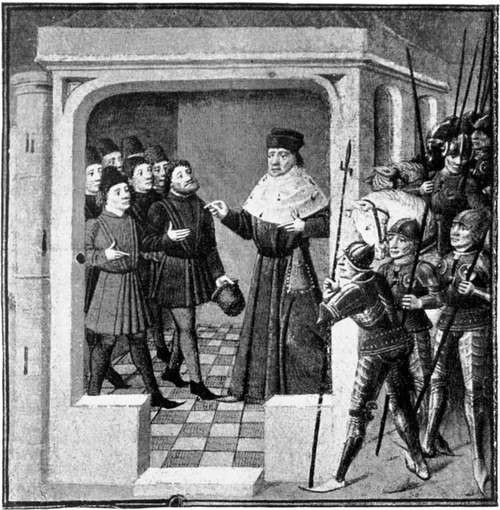
THE DUKE OF ATHENS
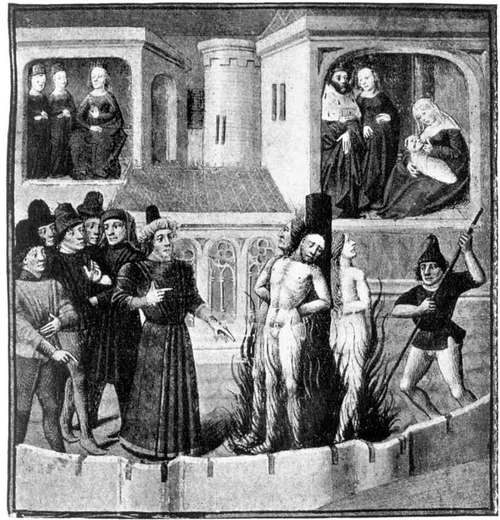
THE EXECUTION OF FILIPPA LA CATANESE
From miniatures in the French version of the "De Casibus Virorum." made in 1409 by Laurent le Premierfait. MS. late XV century. (Brit. Mus. Rothschild Bequest. MS. XII.)
Their plan was this: the next day, as it happened, was the feast of S. Anne, July 26, 1343, and they decided that then a tumult should be raised in the Mercato Vecchio, upon which all were to take arms and excite thepeople to liberty. And the next day, the signal being given by sounding a bell as had been agreed, all took arms and, crying out, "Liberty, liberty," excited the people, who took arms likewise. The Duke, alarmed at this noise, fortified himself in the Palazzo and then, calling home his servants who were lodged through the city, set forth with them to the Mercato. Many times were they assaulted on the way and many too were slain, so that though recruited with three hundred horse he knew not himself what to do. Meantime the Medici, Cavicciulli, and Rucellai, who were afraid lest he should attack, drawing together a force, advanced so that many of those who had stood for the Duke rallied over to their side, and though the Duke was again reinforced, yet was he beaten and went backward into the Palazzo. Meanwhile Corso and Amerigo Donati with part of the people broke up the prisons, burned the records of the Potestà, sacked the houses of the rettori, and killed all the Duke's officers they could meet with. And the Duke remained besieged in the Palazzo. Has not Boccaccio told us the story:—
"Upon a day they armyd in stele bright
Magnates first with comons of the toun
All of assent roos up anon right
Gan to make an hydous soun:
Late sle this tyrant, late us pull him doun.
Leyde a syege by mighty violence
A forn his paleys where he lay in Florence."[321]
While the Duke was thus besieged, the citizens to give some form to their government met in S. Reparata (S. Maria del Fiore) and created fourteen of their number, half grandi half people, to rule with the Bishop. Then the Duke asked for a truce. They refused it, except Guglielmo of Assisi, with his son, and Cerrettieri Bisdomini, who had always been of his party, should be delivered into their hands. This for long the Duke refused, but at last, seeing no way out, he consented. "Greater, doubtless," says Machiavelli, "is the insolence and contumacy of the people and more dreadful the evils which they do in pursuit of liberty than when they have acquired it." So it proved here. Guglielmo and his son were brought forth and delivered up among thousands of their enemies. His son was a youth of less than eighteen years; yet that did not spare him nor his beauty neither. Those who could not get near enough to do it whilst he was alive wounded him when he was dead; and as if their swords had been partial and too moderate, they fell to it with their teeth and their hands, biting his flesh and tearing it in pieces. And that all their senses might participate in their revenge, having feasted their ears upon groans, their eyes upon wounds, their touch upon the bowels of their enemies which they rent out of their bodies with their hands, they regaled their taste also. Those two gentlemen, father and son, were eaten in the Piazza; only Cerrettieri escaped, for the people, being tired, forgot him altogether and left him in the Palazzo not so much as demanded, and the next night he was conveyed out of the city.
Satiated thus with blood, they suffered the Duke to depart peacefully on August 6, attended by a host of citizens who saw him on the way to the Casentino, where, in fact, though unwillingly it seems, he ratified the renunciation.
And all these things befell in Florence while Giovanni Boccaccio was writing in the popolo di S. Felicità and in the popolo di S. Ambrogio in the years 1341, 1342, and 1343. In 1344, as we may believe, Boccaccio returned to Naples.
CHAPTER VII
1344-1346
IN NAPLES—THE ACCESSION OF GIOVANNA—THE MURDER OF ANDREW OF HUNGARY—THE VENGEANCE
Those three years of tumult in Florence cannot but have made a profound impression on a man like Boccaccio. "Florence is full of boastful voices and cowardly deeds," he writes in the Fiammetta, while his account of the Duke in the De Casibus Virorum Illustrium tells us clearly enough what he thought of that business. Was it the public confusion in Florence that sent him back to Naples in 1344 or 1345,[322] on an invitation from Niccolò Acciaiuolo, or just a hope of seeing once more Madonna Fiammetta, whom, as we have seen, even amid the dreadful excitement of those three years, he had never been able really to forget for a moment? We shall never know; but if it were any expectation of peace or hope of finding in that far city the old splendour and gaiety he had once enjoyed there, he must indeed have been disappointed. Already, before he returned to Florence in 1341, the rule of King Robert, who was then in his last years, had weakened; and factions were already forming which, when the wise king passed away, were not slow to divide the city against itself. No doubt the splendid reception offered to Petrarch, the gaiety of all that, served to hide the dangerous condition of affairs, which was not rendered less insecure by the fact that King Robert's heir was a girl still in her first youth, Giovanna the beautiful, daughter of Charles of Calabria.
"Giovanna Regina
Grassa nè magra, bella el viso tondo
Dotata bene de la virtù divina
D' animo grato, benigno, jocondo."[323]
So sang the poets, and that the painters were not less enthusiastic is proved by the frescoes in S. Maria dell' Incoronata.
In 1342 Giovanna was entering her seventeenth year, while Andrew of Hungary, her betrothed, was but fifteen. On Easter Day in that year King Robert invested him with the insignia of knighthood, and four days later he was to have been married to the Princess, but the death first of Pope Benedict (April 25th), and then of the King of Hungary, his father (July 15th), prevented the ceremony, so that it was not till August that it could take place, and then quite suddenly King Robert the Wise died, aged sixty-four, on January 19th, 1343. In the frock of a Franciscan tertiary they buried him in S. Chiara, behind the high altar, and Sancius and Johannes of Florence presently built there the great and beautiful tomb we know.[324]
"Pastorum Rex Argus erat: cui lumina centum
Lyncea, cui centum vigiles cum sensibus aures
Centum artes, centumque manus, centumque lacerti
Lingua sed una fuit."[325]
So said Petrarch.
Now by his Will, as was inevitable, Robert appointed his granddaughter Giovanna his successor and heiress to all his dominions—including Provence and most of his Piedmontese possessions; he left her too the unrestored island of Sicily and the title of Jerusalem. In case of her death all was to pass to Maria her sister, who later married the Duke of Durazzo. During Giovanna's minority and that of her husband Andrew of Hungary, which were to last till they were twenty-five, the Will vested the government in a Supreme Council which was in fact dominated by the Dowager Queen Sancia, and was composed of Philip de Cabassoles, Bishop of Cavaillon, vice-chancellor of the realm on behalf of the suzerain Holy See, Charles d'Artois, Count of S. Agata, natural son of King Robert, Goffredo Marzano, Count of Squillace, admiral of the Kingdom, and Filippo di Sanguinetto, Count of Altomonte, seneschal in Provence. It thus appears that the intention of the King was to keep the throne in his own line, certainly not to make Andrew of Hungary king in Naples. The two branches of his house had had, it will be remembered, almost equal rights to the throne, and if Clement V for his own good had decided in favour of the younger branch, that is in favour of Robert, though Charles Martel of Hungary, Andrew's father, submitted to the Papal decision, Robert had thought it prudent to make voluntarily a kind of composition of his rights and the claims of his brothers in arranging the marriage between Andrew his nephew and his granddaughter Giovanna. It will thus be seen that Giovanna's marriage was a political act designed to establish peace between the descendants of Charles d'Anjou.[326] That no peace but a sword came of it we shall see.
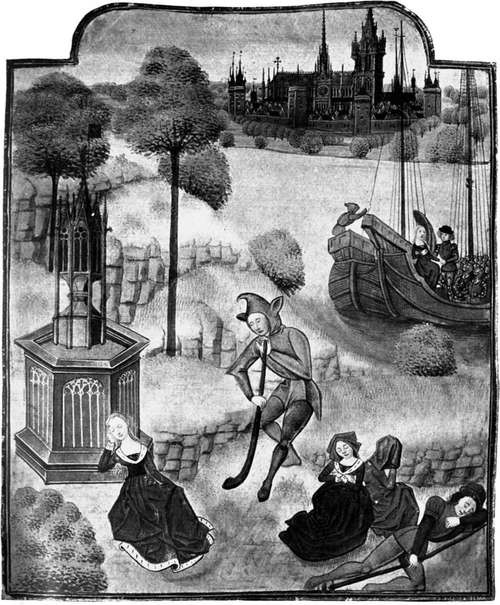
CIMON AND IPHEGENIA. (DEC. V, 1)
From a miniature in the French version of the "Decameron," made in 1414 by Laurent le Premierfait. MS. late XV century. (Brit. Mus. Rothschild Bequest. MS. XIII)
King Robert had not been dead many months when the Hungarians, sure of Andrew's protection, began to flock to Naples. They angered those who surrounded the Queen and even the Queen herself by their insolence, and thus the court was divided into two parties, or rather there were two courts in one palace.
In the autumn of 1343 Petrarch was once more in Naples. In a letter to Barbato di Sulmona he pays an eloquent tribute to King Robert, and at the same time states his reasons for anxiety as to the condition of the Kingdom. "I fear as much from the youthfulness of the Queen and her consort as from the age and ideas of the Queen Dowager; but I am especially afraid of the administration and manners of the court. Perhaps I am a bad prophet: I hope so. But I seem to see two lambs in the care of a pack of wolves...." Touching on the administration, Petrarch gives the following account of Fra Roberto, the Franciscan confessor of Andrew. "I encountered a deformed creature, barefooted, hoodless, vainglorious in his poverty, degenerate through his sensuality; in fact, a homunculus, bald and rubicund, with bloated limbs.... Would you hear his revered name? He is called 'Robert.' Yes, in the place of the noblest of kings, till lately the glory of our age, has arisen this Robert who, on the contrary, will disgrace it. Nor will I henceforth hold it a fable they relate of a serpent able to be generated from a buried corpse, since from the royal sepulchre has issued this reptile." And indeed of all the court he has a good word for Philip de Cabassoles only: "he who alone stands up on the side of justice."
So much for the administration; nor were the manners he found there any better, in his judgment. The whole city was divided against itself, and life was altogether insecure. The council is "compelled to end its sittings at sunset, for the turbulent young nobles make the streets quite unsafe after dark. And what wonder if they are unruly and society corrupt, when the public authorities actually countenance all the horrors of gladiatorial games? These disgusting exhibitions take place in open day before the court and populace in this city of Italy with more than barbaric ferocity."[327]
The vicious life of this and the following years in Naples is usually attributed to the example and influence of Queen Giovanna. In fact nothing can be further from the truth. In King Robert's time the court life was, as we have seen, very far from being exemplary, but Giovanna herself was not weak and abandoned. Already Hungary was pressing the claims of Andrew to equal if not superior power to hers. She never flinched for a moment; from the hour she perceived the way things were drifting she determined to win.
At first things seemed altogether against her. In June, 1344, she wrote to Charles of Durazzo, her sister's husband, telling him that Cardinal Aimeric, the Papal Legate, had entered her kingdom without her leave, and that therefore she and Andrew were gone to Aversa to meet him. There she made peace, acknowledged the Cardinal as Regent, and admitted her crown to be held from the Holy See. Andrew signed her proclamation as a mere witness.[328] But this intrusion of the Papacy by no means improved chances of peace.
The coming of Andrew, with his Hungarian pretensions and those crowds of needy foreign place-hunters, angered the Neapolitan people it is true, but it infuriated the long-established group of domestic functionaries in Castel Nuovo, who in some sort had been confirmed in their offices by the Will of King Robert. The head of this court party, as whole-heartedly against Andrew as it was against the Pope, was Filippa la Catanese, now quite an old woman. Among her family were Raimondo the seneschal, Sancia de Cabannis, Contessa di Morcone, her granddaughter, wife of Carlo di Gambatesa, Roberto de Cabannis, grand seneschal of the Kingdom, and his wife. This group sided with Giovanna, and in its own interest pushed her claims against those of Aimeric and Andrew. They were supported more or less in secret by Catherine of Taranto and her sons Robert and Louis.
A storm was obviously brewing, and it must have been about this time that Boccaccio returned to Naples, perhaps on the invitation of Niccolò Acciaiuoli, secretary and protégé of Catherine of Taranto. No doubt he hoped to see Fiammetta—no doubt he did see her, though what came of it we shall never know; but he found no more peace in Naples than in Florence.
In February, 1345, the Pope removed Aimeric, who he declared had succeeded in governing pacifice et quiete.[329] The Cardinal returned to Avignon, and moved in the Consistory that Andrew be crowned king. He was supported by Durazzo. Giovanna appealed. The Pope listened, but ordered that Filippa la Catanese, Sancia, Margherita, and others should be dismissed. From that moment the Catanesi plotted to murder Andrew.
It was the custom of the court (then, as it happened, in mourning for the Dowager Queen Sancia, who died July 28, 1345) to spend the summer at one of the royal palaces outside Naples. In July Giovanna, then with child, had gone with the court to Castellamare; in September she moved to Aversa. On the night of the 18th, the anniversary of Andrew's arrival in Naples, the Queen had retired early, and Andrew too had gone early to his room, when Tommaso, son of Mambriccio di Tropea, summoned him from his chamber into a passage leading toward the garden, on the pretence, as it is said, that messengers had arrived from Naples with important despatches. In that passageway he was seized, gagged, and strangled, and his body thrown into the garden, where it was discovered by his Hungarian nurse.[330]
It was at once whispered that the Queen was concerned in the murder, and this rumour has been accepted as the truth even in our own day;[331] but, in fact, there is little or nothing to substantiate it. Her account[332] scarcely differs from that of the Pope, but adds that a man had been seized and executed for the crime. Then, after a day or two, the Queen left Aversa for Naples. Andrew's nurse remained in her service and nursed her through her confinement in December.
The murder of Andrew, whose handiwork soever, effectually divided the Kingdom into two parties, to wit those of Durazzo and Taranto; the former demanding punishment of the murderers. Two Cardinals, di S. Clemente and di S. Marco, were appointed by the Pope to rule in Naples and to exact vengeance. The Queen was helpless. On December 25th her son was born and named Charles Martel. As time went on and none of the assassins were brought to justice, the Hungarians became furious, and at last requested the custody of the young prince; and this request became a demand when it was known that Giovanna was being sought in marriage by Robert of Taranto, who, with his mother and his half-brother Louis, had been covertly associated with the Catanesi. Something had to be done, and early in 1346 we find Charles of Durazzo with Robert of Taranto and Ugo del Balzo seizing Raimondo the seneschal, as one of the guilty persons. Under torture he confessed that he had knowledge of the plot and assisted those who committed the murder. Among his accomplices he named the Count of Terlizzi, Roberto de Cabannis, Giovanni and Rostaino di Lagonessa, Niccolò di Melezino, Filippa Catanese, and Sancia de Cabannis.
Charles of Durazzo and Robert of Taranto therefore determined to hunt down the Catanese family and offer it as a peace-offering to the King of Hungary, who already threatened to descend upon the Kingdom. At Durazzo's instigation an armed mob surrounded Castel Nuovo hunting for the murderers. A few had been wise enough to flee, but most of those denounced were arrested, imprisoned in
Castel Capuano
, and put to torture. In vain the Queen protested against the princes' action. They achieved their purpose and the Pope, in a Bull of March 19th, 1346, pardoned them, asserting that God had moved them to it.The Queen, as might be expected, had now no further wish to marry Robert of Taranto; and, indeed, finding that she could not depend on him for help, she had already promised herself to his half-brother Louis. In this second marriage she begged for the favour of the Holy See. The Pope, though not averse, bullied by Hungary, temporised.
Now, behind Louis of Taranto was the most astute mind of that age, Boccaccio's old friend, Niccolò Acciaiuoli, the Florentine. He resolved to win for his patron both the Queen of Naples and the crown. Nor was he easily discouraged. Yet, at first certainly things looked black enough for him.
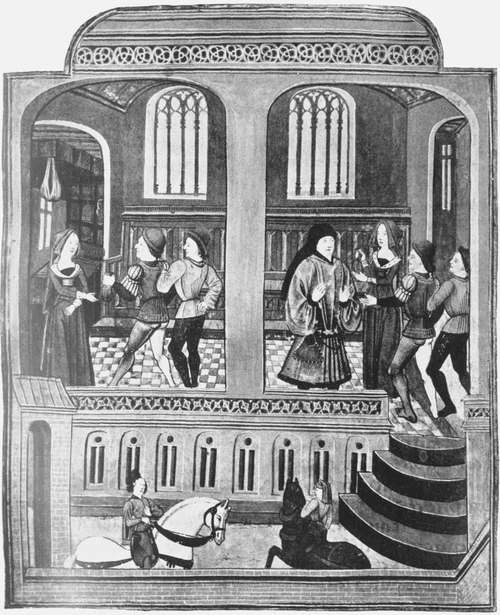
GULFARDO AND GUASPARRUOLO. (DEC. VIII, 1)
From a miniature in the French version of the "Decameron," made in 1414 by Laurent le Premierfait. MS. late XV century. (Brit. Museum. Rothschild Bequest, MS. XIV.)
Early in August, 1346, there had been erected along the shore by the Castello dell' Ovo a palisade encircling a raised platform. Here, under Ugo del Balzo, the public torture of the suspected began. Whatever else Boccaccio may have seen or done in Naples, it seems certain that he was a witness of this dreadful orgie.[333]
But in Naples confusion followed on confusion. Without waiting for the Pope's leave, risking an interdict, Louis of Taranto married Giovanna in the Castel Nuovo in August, 1347, while already King Louis of Hungary was creeping down through the Abruzzi to invade the Kingdom and seize the city. On January 15, 1348, the Queen, with a few friends, leaving her child behind, sailed for Provence. Not long after Louis of Taranto and Acciaiuoli reached Naples, and, finding her departed, took ship for Tuscany. With them, according to Witte, went Boccaccio. However that may be, when next we hear of him he is in Romagna at the court of Ostasio da Polenta. Louis of Taranto and Acciaiuoli, with or without him, landed at Porto Ercole of the Counts Orsini of Sovana, and two days later del Balzo surrendered Castel dell' Ovo with the young Prince Charles Martel. King Louis was then at Aversa, where he captured Philip of Taranto and Louis of Durazzo who had come to treat with him. Then Charles of Durazzo was seized, tried for the murder of Andrew, and condemned: and they took him to Aversa and struck off his head on the scene of the crime. But even the Neapolitans, who had in fact taken little part in the war, if a war it can be called, being busy with their own feuds, grew weary of the invasion, so that when King Louis demanded ransom from them, posing as a conqueror, they proved to him that it would be wiser to withdraw. And there were other arguments: for the Black Death fell on his army and he fled, leaving only enough troops to prevent Giovanna from returning. She, poor Queen, without soldiers or money, was compelled to cede Avignon to the Holy See for 80,000 florins, on condition that the Pope declared her innocent of the murder of her husband and proclaimed the legality of her second marriage. Thus the Church was the only gainer by these appalling crimes and treasons. Once more Israel had spoiled the Egyptians. It was not till 1352, after the second invasion of King Louis, that Giovanna was able to return to Naples.
CHAPTER VIII
1346-1350
IN ROMAGNA—THE PLAGUE—THE DEATH OF FIAMMETTA
The few notices we have of Boccaccio's life at this time are almost entirely mere hints which enable us to assert that in such a year he was in such a place: they in no way help us to discover why he was there or what he was doing. Thus we are able to affirm that probably between 1344 and 1346, certainly in 1345, he was in Naples, but why he went there, unless it were for the sake of Fiammetta, we cannot suggest, for if Florence was a shambles, so was Naples. In much the same way we know that he was in Ravenna with Ostasio da Polenta not later than 1346; for in a letter Petrarch wrote him in 1365 he reminds him that he was in Ravenna "in the time of the grandfather of him who now rules there."[334] But why Boccaccio went to Ravenna, unless it were that, finding Naples too hot to hold him and Florence impossible, he took refuge with some relations he had there, or with the Polenta who had befriended Dante, we do not know. Nor do we know what he did there. It may be that during his stay in Naples he had already begun to think of writing a life of Dante; and hearing that the great poet had left a daughter Beatrice in Ravenna he set out to see her. This, however, is but the merest conjecture. Baldelli,[335] indeed, thinks that Boccaccio was at this time in Romagna as ambassador for Florence. For Ravenna was not the only place he visited about this time. If we may believe the third Eclogue, he was also the guest of Francesco degli Ordelaffi, the great enemy of the Church in Romagna and of King Robert the Wise.[336]
In the third Eclogue Palemone reproves Pamfilo for idly reposing in his cave while all around the woods ring with the cries of Testili infuriated against Fauno. Now Fauno, as Boccaccio tells us in his letter to Frate Martino da Signa,[337] where he explains some of the disguises of the Eclogues, is Francesco degli Ordelaffi, and Testili, although Boccaccio does not say so, is without doubt the Church, which had in fact no greater enemy in all Romagna than Ordelaffo, the usurper, if you will, of the ecclesiastical dominion, who held in contempt the many excommunications launched against him, replying always by an attack on some bishop, and by making continual war on the legates sent against him.[338]
Those cries, and the anger which causes them, fill the first part of the Eclogue. In the second part, it is clearly recounted how King Louis of Hungary came down into Italy to avenge the murder of his brother Andrew. Argo, the head shepherd worthy to be praised by all, has perforce abandoned the sheep.[339] Argo is Robert King of Naples,[340] wise as King Solomon, who follows the Muses. Alexis is Andrew of Hungary and Naples, who, made free of the woods by Argo, being careless and without caution, has been assailed by a she-wolf, pregnant and enraged, that is by Queen Giovanna; for here, at any rate, Boccaccio eagerly sides with the rabble and accepts the guilt of the Queen as fact. They say, he adds, that the woods held many cruel wild beasts and lions, and that Alexis met the death of Adonis. Now Tityrus, that is King Louis of Hungary, the brother of the dead Alexis, heard of this beyond Ister or the Danube, and set forth with innumerable hunters to punish the wolf and the lions.[341] And many Italians joined with Tityrus, says Boccaccio; among them was Faunus, although Testili threatened him and cursed him sore.[342]
What this means is obvious. The Pope, dismayed by the descent of King Louis into Italy,[343] having tried unsuccessfully in a thousand ways to turn him from his purpose, hindered him as best he could when he had once set out. The Vicar in Romagna, Astorgio di Duraforte, was ordered not to allow him to enter any city; a papal legate met him at Foligno, forbidding him on pain of excommunication to enter the Kingdom. In spite of the papal prohibition the signorotti of Romagna gladly entertained the king. Francesco Ordelaffi above all, as Villani tells us,[344] "bade him welcome, and went out to meet him in the contado of Bologna with two hundred horse and a thousand foot, all under arms. On December 13 he received him in Forlì with the greatest honour, furnishing his needs and those of all his people. And there they sojourned three days with much feasting and dancing of men and women, and the king made knights of the lord of Forlì and of his two sons."
This, however, did not content Ordelaffo, for with three hundred of his best horse he followed King Louis to help him in his undertaking on December 17, 1347.[345] Now Ordelaffo was not only a lover of the chase and of war, but in his way a humanist also, who, like Sigismondo Malatesta later, surrounded himself with poets and men of letters. Among his friends and counsellors was that Cecco da Meleto who was the friend of Petrarch and Boccaccio.[346] He was a great admirer of Petrarch, and merited the title Boccaccio gave him in that letter to Zanobi: Pieridum hospes gratissimus.
If that letter is authentic,[347] then Boccaccio not only met King Louis of Hungary[348] at Forlì, but accompanied him and Francesco degli Ordelaffi into the Kingdom in the end of the year 1347 and the beginning of 1348.[349] His sentiments with regard to the murder and the war which followed it are clearly expressed there. He speaks of the King's arms as "arma justissima," and though it surprises us to find Boccaccio on that side, the letter only states clearly the sentiments already set down in allegory in the third and eighth Eclogues, and clearly but more discreetly stated in the De Casibus Virorum. In the fourth Eclogue, however, he commiserates the unhappy fate of Louis of Taranto, and hymns his return. Can it be that, at first persuaded of the Queen's guilt, he learned better later? We do not know. The whole affair of the murder, as of Boccaccio's actions at this time and of his sentiments with regard to it, are mysterious. If in the third and eighth Eclogues he tells us that Giovanna and Louis of Taranto were the real murderers of Andrew and wishes success to the arms of the avenger; in the fourth, fifth, and sixth Eclogues he sympathises with Louis and tells of the misery of the Kingdom after the descent of the Hungarians, and at last joyfully celebrates the return of Giovanna and her husband.[350] And this contradiction is emphasised by his actions. So far as we may follow him at all in these years, we see him in Naples horrified and disgusted at the state of affairs, leaving the city after the torture and death of the Catanesi and repairing to the courts of the Polenta and of the Ordelaffi, the enemies of the Church which held Giovanna innocent, and of the champions of the Church, Robert and Naples. Nor does he stop there, but apparently follows Ordelaffo in his descent with King Louis on Naples in the end of 1347 and the beginning of 1348. Yet in 1350 he was in Naples, and in 1352 he was celebrating the return of those against whom he had sided and written. The contradiction is evident, and we cannot explain it; but in a manner it gives us the reason why, when Frate Martino da Segna asked for an explanation and key to the Eclogues, he supplied him with one so meagre and imperfect.[351]
[295] Crescini, op. cit., pp. 155-6.
[296] "Amorous Fiammetta, where is sette doune a catalogue of all and singular passions of Love and Jealosie incident to an enamoured young gentlewoman" ... done into English by B. Giovano [i.e. B. Young]. London, 1587. The only example I can find of this translation is in the Bodleian Library; the British Museum has no copy.
[297] Carducci, Ai Parenteli di G. B. in Discorsi Letterari e Storici (Bologna, 1889), p. 275.
[298] Ninfale Fiesolano (Moutier), p. 1. ott. xiv.-xxxiii.
[299] Ibid., p. vi. ott. i.-v.
[300] Ninfale Fiesolano, ed. cit., p. vi. ott. xxx.-xlv.
[301] Ibid., p. vii. ott. iii.-vi. and ix.-xiii. The Mensola and the Affrico are two small streams that descend from Monte Ceceri, one of the Fiesolan hills, and are lost in the Arno, one not far from the Barriera Settignanese, the other by Ponte a Mensola, near Settignano.
[302] Ibid., p. vii. ott. xxxiii.-xlix.
[303] See his romance, Leucippe and Clectophon, Lib. VIII, cap. 12.
[304] For the ottava in Italy see Rajna, Le fonti dell' Orlando Furioso (Sansoni, Florence, 1900), pp. 18-19. Baldelli, op. cit., p. 33, however, did not go so far as Trissino and Crescimbeni in such an assertion, contenting himself with assuring us that Boccaccio "colla Teseide aperse la nobile carriera de' romanzeschi poemi, degli epici, per cui posteriormente tanto sopravanzò l' Italiana ogni straniera letteratura. Il suo ingegno creatore correggendo, e migliorando l' ottava de' Siciliani, che non usavan comporla con più di due rime e una terza aggiungendone, per cui tanto leggiadramente si chiude e tanto vaga si rende, trovò quel metro su cui cantarono e gli Ariosti, e i Tassi vanamente sperando trovarne altro più adeguato agli altissimi e nobilissimi loro argomenti."
[305] Cf. Fiammetta, ed. cit., cap. ii. p. 45, where by the mouth of Fiammetta his apprehensions are expressed. "La tua città [Florence]," she says to him, "as you yourself have already said, is full of boastful voices and of cowardly deeds, and she serves not a thousand laws, but even as many, it seems, as she has men. She is at war within and without, so that a citizen is like a foreigner, he trembles. She is furnished with proud, avaricious, and envious people, and full of innumerable anxieties. And all this your soul abhors. Now the city you would leave is, as you know, joyful, peaceful, rich, and magnificent, and lives under one sole king; the which things I know well are pleasing to you. And besides all these, I am here; but you will not find me whither you go."
[306] In Ameto, ed. cit., p. 187, when Ibrida tells his story, he says his father was unworthy of such a mistress: "Ma il mio padre siccome indegno di tale sposa traendolo i fati, s' ingegnò d' annullare i fatti sacramenti, e le 'mpromesse convenzioni alla mia madre. Ma gli Iddii non curantisi di perdere la fede di sì vile uomo, con abbondante redine riserbando le loro vendette a giusto tempo, il lasciarono fare; e quello che la mia madre gli era si fece falsamente d' un altra nelle sue parti. La qual cosa non prima sentì la sventurata giovane, dal primo per isciagurata morte, e dal secondo per falsissima vita abbandonata, che i lungamente nascosi fuochi fatti palesi co' ricevuti inganni, chiuse gli occhi e del mondo a lei mal fortunoso, si rendè agli Iddii. Ma Giunone nè Imeneo non porsero alcuno consentimento a' secondi fatti, benchè chiamati vi fossero; anzi esecrando la adultera giovane con lo 'ngannevole uomo, e verso loro con giuste ire accendendosi, prima privatolo di gran parte de' beni ricevuti da lei, e dispostolo a maggiore ruina a morte la datrice, la data e la ricevuta progenie dannarono con infallibile sentenzia, visitando con nuovi danni chi a tali effetti porse alcuna cagione." Cf. also Ameto, ed. cit., p. 252 et seq., and Fiammetta, ed. cit., cap. ii. p. 42.
[307] On the different houses of Boccaccino in Florence, see an unpublished MS. by Gherardi, La Villeggiatura di Maiano, which I believe to be in the Florentine archives. A copy is in the possession of Mrs. Ross, of Poggio Gherardo, near Florence. From this copy I give cap. iv. of the MS. in Appendix III.
[308] Ameto, ed. cit., p. 254.
[309] Fiammetta, ed. cit., cap. v. p. 63: "Quando di più d' un mese essendo il promesso tempo passato."
[310] Ibid., p. 64. Fiammetta asks: "How long ago had you news of him?" "It is about fifteen days," says the merchant, "since I left Florence." "And how was he then?" "Very well; and the same day that I set out, newly entered his house a beautiful young woman who, as I heard, had just married him."
[311] Cf. Baldelli, op. cit., p. 276, n. 1: "26 Januarii, 1349 [i.e. 1350 according to our reckoning]. Dominus Ioannes quondam Boccacci, populi Sanctæ Felicitatis, tutor Iacobi pupilli ejus fratris, et filii quondam et heredis Dominiæ Bicis olim matris suæ, et uxoris q. dicti Boccaccii et filiæ q. Ubaldini Nepi de Bosticcis." This document, which gives us the name of Boccaccino's second wife, tells us also that Giovanni was his brother's guardian and governor in January, 1350. Crescini had already suggested (op. cit., p. 102 n.), following Baldelli, that the Lia of the Ameto was a Baroncelli when Sanesi (Un documento inedito su Giovanni Boccaccio in Rassegna Bibliografica della Lett. Ital. (Pisa, 1893), An. I, No. 4, p. 120 et seq.) proved it to be so, giving a genealogical table:—
[312] Cf. Crescini, op. cit., p. 155, note 3. Arch. Stat. Fior. (Archivio della Grascia Prammatica del 1343): "1343. die Maij Domina Bice uxor Boccaccij de Certaldo populi S. Felicitatis habet guarnaccham de camecha coloris purpurini," etc.
[313] See Appendix III, MS. of Gherardi.
[314] See supra, n. 1.
[315] Boccaccino still possessed the house in popolo di S. Felicità when he died. See supra, p. 98, n. 3.
[316] It must be remembered that in 1343 Giovanni was thirty years old.
[317] Cf. Fiammetta, ed. cit., cap. ii. p. 45, already quoted supra, p. 96, note 1.
[318] Gio. Villani, Lib. XI, cap. 137.
[319] See the De Casibus Virorum Illustrium, Lib. IX, cap. 24; cf. Hortis, Studi, etc., pp. 127-8. A translation in verse of the De Casibus was made by Lydgate, The Fall of Princes, first printed by Pynson in 1494; later editions, 1527, 1554 (Tottel), and John Wayland's, 1558. There is no modern edition. It is a disgrace to our two universities that no modern edition of Lydgate has been published.
[320] Cf. W. Heywood, Palio and Ponte (Methuen, 1904), pp. 7-9. These races or palii seem to have originated in the thirteenth century (cf. Villani, Cronica, Lib. I, cap. 60, and Dante, Paradiso, xvi 40-2). Benvenuto da Imola says, "Est de more Florentiæ, quod singulis annis in festo Iohannis Baptistæ currant equi ad brevium in signum festivæ laetitiæ..." He goes on to say that the race was run from S. Pancrazio, the western ward of the city, through the Mercato Vecchio, to the eastern ward of S. Piero. Goro di Stazio Dati, who died in 1435, thus describes the palio of S. John in Florence. I quote Mr Heywood's excellent redaction from Dati's Storia di Firenze (Florence, 1735), pp. 84-9, in his Palio and Ponte, u s "... Thereafter, dinner being over, and midday being past, and the folk having rested awhile according to the pleasure of each of them; all the women and girls betake themselves whither the horses which run the palio will pass. Now these pass through a straight street, through the midst of the city, where are many dwellings, beautiful, sumptuous houses of good citizens, more than in any other part thereof. And from one end of the city to the other, in that straight street which is full of flowers, are all the women and all the jewels and rich adornments of the city; and it is a great holiday. Also there are always many lords and knights and foreign gentlemen, who come every year from the surrounding towns to see the beauty and magnificence of that festival. And there, through the said Corso, are so many folk that it seemeth a thing incredible, the like whereof he who hath not seen it could neither believe nor imagine. Thereafter, the great bell of the Palagio de' Signori is tolled three times, and the horses, ready for the start, come forth to run. On high upon the tower, may be seen, by the signs made by the boys who are up there, that is of such an one and that of such an one (quello è del tale, e quello è del tale). And all the most excellent race-horses of the world are there, gathered together from all the borders of Italy. And that one which is the first to reach the Palio is the one which winneth it. Now the Palio is borne aloft upon a triumphal car, with four wheels, adorned with four carven lions which seem alive, one upon every side of the car, drawn by two horses, with housings with the emblem of the Commune thereon, and ridden by two varlets which guide them. The same is a passing rich and great Palio of fine crimson velvet in two palii, and between the one and the other a band of fine gold a palm's width, lined with fur from the belly of the ermine and bordered with miniver fringed with silk and fine gold; which, in all, costeth three hundred florins or more.... All the great piazza of S. Giovanni and part of the street is covered with blue hangings with yellow lilies; the church is a thing of marvellous form, whereof I shall speak at another time...." Boccaccio must often have seen these races. Cf. Decameron, Day VI, Nov. 3.
[321] Lydgate, op. cit., Lib. IX.
[322] We do not know when, if at all at this time, Boccaccio returned to Naples. The only testimony by which Baldelli, Witte, and Koerting hold that he was in Naples in 1345 is the passage in the De Casibus Virorum Illustrium, Lib. IX, cap. 25, where he narrates, as though he had been present on the occasion, the terrible end of Philippa la Catanese (see infra). Witte, however, wishes to support this evidence by an interpretation of certain words in the letter to Zanobi, Longum tempus effluxit (see Corrazini, op. cit., p. 33). Hortis, Gaspary, and Hauvette, however, assert that in the De Casibus, u.s., Boccaccio does not actually say he was present on the occasion mentioned, but only says, quæ fere vidi, while the passage in the letter to Zanobi, they say, refers to Acciaiuoli. Lastly, Hecker observes that the words of Boccaccio seem to prove that he was in Naples in 1345. In fact, speaking of the condemnation and torture of the Catanese as accomplice in the assassination of King Andrew he says: "quædam auribus, quædam oculis sumpta meis describam."
[323] See Arch. St. per la prov. Nap., An. V, p. 617. For an excellent account of King Robert's reign, as of Giovanna's, see Baddeley, King Robert the Wise and His Heirs (Heinemann, 1881). It is a good defence of the Queen.
[324] Gio. Villani, who did not love the Angevins, tells us that King Robert was full of every virtue, admitting, however, that in his last years he was very avaricious; and in this he agrees with Boccaccio. He says, however, that he was the wisest monarch of Christendom after Charlemagne. Boccaccio too calls him Solomon. In a poem attributed to Convenevole da Prato he is hailed as the sovereign of United Italy. But it is to Petrarch he owes his fame. Robert was a great patron of the Franciscans, then utterly rotten. Boccaccio doubtless saw enough in Naples to give him justification for his stories later. See infra.
[325] Petrarch, Egloga, II.
[326] Here is the genealogical table:—
[327] I quote Mr. Hollway-Calthrop's redaction in his Petrarch (Methuen, 1907), p. 112. He adds: "Knowing nothing of what he was to see, Petrarch was taken to a spectacle attended by the sovereigns in state; suddenly, to his horror, he saw a beautiful youth killed for pastime, expiring at his feet, and putting spurs to his horse, he fled at full gallop from the place." These gladiatorial games took place in Carbonara.
[328] Baddeley, op. cit.
[329] He received beside his board and lodging 19,000 florins of gold as salary. These were not paid by the Pope, whose servant he was, but by Queen Giovanna and the wretched Neapolitans. The amount was fixed by the Pope. Cf. Baddeley, op. cit.
[330] Cf. Baddeley, op. cit., p. 344. The Pope's account is as follows: "Immediately he was summoned by them he went into the gallery or promenade which is before the chamber. Then certain men placed their hands over his mouth so that he could not cry out, and in this act they so pressed their iron gauntlets that their print and character were manifest after death. Others placed a rope round his neck in order to strangle him, and this likewise left its mark; others 'vero receperunt eum pro genitalia, et adeo traxerunt, quod multi qui dicebant se vidisse retulerunt mihi quod transcendebant genua', while others tore out his hair, dragged him, and threw him into the garden. Some say with the rope with which they had strangled him they swung him as if hanging over the garden. It was further related to us that they intended to throw him into a well, and thereafter to give it out he had left the Kingdom ... and this would have been carried out had not his nurse quickly come upon the scene." Cf. Baluzius, Vitæ Paparum Avenonensium, 1305-94, Vol. II, p. 86, and Baddeley, op. cit., p. 344 et seq.
[331] e.g. another account states that "a conspiracy was formed against the young Andrew, and it is said, with some truth, that the Queen was the soul of it. One evening in September, 1345, the court being at the Castello of Aversa, a chamberlain entered the royal apartment, where Andrew was with the Queen, to announce to them that despatches of great importance were arrived from Naples. Andrew went out immediately, and as he passed through the salon which separated his room from the Queen's, he was seized and hanged from the window of the palace by a golden rope said to have been woven by the Queen's hands, and there he was left for two days. The Queen, who was, or pretended to be, stupefied with horror, returned to Naples. No real attempt, even at the behest of the Pope, was made to find the assassins." The Queen was within three months of the birth of her child when the murder occurred. She gained nothing by Andrew's death but exile. The murderers, so far as we can judge now, were undoubtedly the Catanese group in danger of losing their positions at court.
[332] Giovanna's own account is given in Baddeley, op. cit., p. 345, n. 2. Mr. Baddeley is her ablest English defender. See also a curious book by Amalfi, La Regina Giovanna nella Tradizione (Naples, 1892).
[333] See supra, p. 108, n. 1. All sorts of stories have been current as to Boccaccio's personal relations with Queen Giovanna. By some he is said to have been her lover, by others to have been in her debt for the suggestion of the scheme of the Decameron so far as it is merely a collection of merry tales. These tales he is supposed to have told her. No evidence is to be found for any of these assertions. But cf. Hortis, op. cit., p. 109 and n. 1.
[334] See Lett. 19 del Lib. XXIII, Epist. Familiarum. Fracassetti has translated this letter into Italian: see Lettere di Fr. Petrarca volgarizz. Delle Cose Fam., Vol. V, p. 91 et seq. Petrarch says: "Adriæ in litore, ea ferme ætate, qua tu ibi agebas cum antiquo plagæ illius domino eius avo qui nunc præsidet." It is Fracassetti who dates this letter 1365 (Baldelli dates in 1362, and Tiraboschi in 1367). If, as we believe, Fracassetti is right, then Boccaccio must have been in Ravenna in 1346, for in 1365 Guido da Polenta ruled there, the son of Bernardino who died in 1359, the son of Ostasio, who died November 14, 1346. Boccaccio had relations in Ravenna. In the proem to the De Genealogiis he tells us that Ostasio da Polenta induced him to translate Livy.
[335] Yet there may be something in it. Baldelli tells us that he wrote the Vita di Dante in 1351, and in 1349 we find him in communication with Petrarch. That Beatrice di Dante was in Ravenna in 1346 seems certain. Pelli, Memorie per servire alla vita di Dante (Firenze, 1823), p. 45, says: "As for the daughter Beatrice ... one knows that she took the habit of a religious in the convent of S. Stefano detto dell' Uliva in Ravenna." We know from a document seen by Pelli that in 1350 the Or San Michele Society sent Beatrice ten gold florins by the hand of Boccaccio. What I suggest is that Boccaccio found her in Ravenna in 1346 very poor. He represented the facts to the Or San Michele Society, who, after the Black Death of 1348, had plenty of money in consequence of all the legacies left them and, as is well known, were very free with their plenty.
[336] Cf. Ferretus Vicentinus, Lib. VII, in R. I. S., Tom. IX.
[337] Corazzini, op. cit., p. 268. "Tertiæ vero Eclogæ titulus est Faunus, nam cum eiusdam causa fuerit Franciscus de Ordolaffis Forolivii Capitaneus, quem cum summe sylvas coleret et nemora, ob insitam illi venationis delectationem ego sæpissime Faunum vocare consueverim, eo quod Fauni sylvarum a poetis nuncupentur Dei, illam Faunum nominavi. Nominibus autem collocutorum nullum significatum volui, eo quod minime videretur opportunum."
[338] See Hortis, Studi sulle opere Latine del B. (Trieste, 1879), p. 5 et seq.
[339] Here is part of the Eclogue which will be useful to us:—
[340] Petrarch also calls him Argo in his third Eclogue. See Hortis, op. cit., p. 6, n. 2.
[341] The lions—biondi leoni—according to Hortis, refer to Niccolò Acciaiuoli, whose coat was a lion, but for me they are the Conti della Leonessa. Cf. Villani, op. cit., Lib. XII, cap. 51. When then did Boccaccio quarrel with Acciaiuoli?
[342]
"... multi per devia Tityron istum
Ex nostris, canibus sumptis, telisque sequuntur.
Inter quos Faunus, quem tristis et anxia fletu
Thestylis incassum revocat, clamoribus omnem
Concutiens silvam. Tendit tamen ille neglectis
Fletibus...." Eclog. III, p. 268, ed. cit.
[343] It is well known, of course, that King Louis made two descents into Italy: one in 1347 before the Black Death, and one after it in 1350. Hortis tells us that this Eclogue is certainly dated 1348 (op. cit., p. 5, n. 4). It therefore must allude to the first descent. This is confirmed, as Hortis points out, by the poems themselves. (1) By the chronological order in which Boccaccio treats of events in the Eclogues. The first two deal with his love, and those immediately following the third, of the events of 1348. (2) By the contents of the third Eclogue itself, which deals first with the happiness of Naples under King Robert, with his death, the murder of Andrew, and the descent of King Louis, his passage, as we shall see, through Forlì in 1347, whence Francesco degli Ordelaffi set out with him for Lower Italy: all of which happened not in the second, but in the first (1347) descent of King Louis.
[344] Villani, Cronica, Lib. XII, cap. 107.
[345] Cf. Annales Cæsenates R. I. S., Tom. XIV, col. 1179, and Hortis, op. cit., p. 8, n. 3. The latter argues long and successfully for the departure of Ordelaffo with King Louis at this date: to which he also ascribes the letters of Boccaccio to Zanobi (Quam pium, quam sanctum), by some considered apochryphal (Corazzini, op. cit., p. 447), where Boccaccio says: "Varronem quidem nondum habui: eram tamen habiturus in brevi, nisi itinera instarent ad illustrem Hungariæ regem in estremis Brutiorum et Campaniæ quo moratur, nam ut sua imitetur arma iustissima meus inclitus dominus et Pieridum hospes gratissimus cum pluribus Flamineæ proceribus præparetur; quo et ipse, mei prædicti domini jussu non armiger, sed ut ita loquar rerum occurrentium arbiter sum iturus, et præestantibus Superis, omnes in brevi victoria habita et celebrato triumpho dignissime proprias [sic] revisuri." The letter is dated Forlì.
[346] Cf. Fracassetti, in a note to Lett. 3 of Lib. XXI, Lett. Fam. of Petrarch; and as regards Boccaccio, see Baldelli, in note to Sonnet xcix., written for Cecco (Moutier, Vol. XVI, p. 175).
[347] Cf. Hortis, op. cit., pp. 8 and 267-77. Cf. Corazzini, op. cit., p. 447.
[348] That he met King Louis is certain. In the third Eclogue he says:—
[349] In the letters to Zanobi, spoken of above, beginning Quam pium, quam sanctum, he says he is going to the illustrious King of Hungary in the confines of the Abruzzi and of Campania: "Ad illustrem Hungariæ regem in estremis Brutiorum et Campaniæ."
[350] Villani, op. cit., Lib. XII, cap. 51, believed in the guilt of Giovanna, but he was writing from hearsay. He says the Queen lived in adultery with Louis of Taranto and with Robert of Taranto and with the son of Charles d'Artois and with Jacopo Capano.
[351] Boccaccio was and remained all his life a keen Guelf and supporter of the House of Anjou. Of that no doubt is possible. Cf. Hortis, op. cit., p. 109.

MADONNA FRANCESCA AND HER LOVERS. (DEC. IX, I)
From a miniature in the French version of the "Decameron," made in 1414 by Laurent le Premierfait. MS. late XV century. (Brit. Mus. Rothschild Bequest. MS. XIV.)
King Louis of Hungary, as we know, had not been many months in the Kingdom when he was forced to fly for his life, not by a mortal foe, but by the plague—the Black Death of 1348. It was brought to Italy by two Genoese galleys which had been trading in the East and had touched at Pisa. In April it had spread to Florence, a month later to Siena, before Midsummer all Italy was in its grip, and by the following year the greater part of Europe. No chronicler of the time in Italy but has more than enough to say of this "judgment of God"; and beside the wonderful description by Boccaccio in the introduction to the Decameron, there is scarcely a novelist who does not recount some tale or other concerning it.[352]
Perhaps Tuscany suffered most severely. "In our city of Florence," writes Matteo Villani,[353] for old Giovanni Villani perished in the pestilence—"in our city of Florence the plague became general in the beginning of April of the year 1348, and lasted till the beginning of September. And there died in the city, the contado, and the district, of both sexes and of all ages, three out of every five persons and more, for the poor suffered most, since it began with them who were utterly without aid, and more disposed by weakness to be attacked." Already Giovanni Villani had noted that in 1347 "there began in Florence and in the contado a sort of sickness which always follows famine and hunger, and this especially fell on women and children among the poor."[354] Giovanni Morelli[355] tells us that in Florence it was a common thing to see people laughing and talking together, and then in the same hour to see them dead. People fell down dead in the streets, and were left where they fell. "Many went mad and cast themselves into wells or out of windows into the Arno by reason of their great pain and horrible fear. Vast numbers died unnoticed in their houses, and were left to putrefy upon their beds. Many were buried before they were actually dead. Priests went bearing the cross to accompany a corpse to burial, and before they reached the church there were three or four biers following them. The grass grew in the streets. So completely were all obligations of blood and of affection forgotten, that men left their nearest and dearest to die alone rather than incur the danger of infection."[356] Nor was this all. Every sort of moral obligation was forgotten. Boccaccio more than hints at this, and we have evidence from many others. In the continual fear of death men and women often forgot everything but the present moment, which they were content to enjoy in each other's arms, even though they were strangers. Ah, poor souls! Amid the terror and loneliness of the summer, when the hot sunshine was more terrible than the darkness, which at least hid the shame, the disorder, and the visible horror, there was no lack of opportunities. All social barriers were gone, and rich and poor, bond and free, took what they might desire. It was the same in Siena; and if in Naples and the Romagna the deaths were less numerous, what are a few thousands when the lowest mortality was more than two in every five? People said the end of the world was come. In a sense they were right. It was the end of the Middle Age.
In Florence there perished among the rest Giovanni Villani, as I have said, and, as we may believe, Bice, the second wife of Boccaccino. In Naples it seems certain that Fiammetta died.
But where was Boccaccio during those dreadful five months of 1348? Was he with Fiammetta in Naples? Did he perhaps close her eyes and bear her to the grave? Or was he in Florence with his father, or in Forlì with the Ordelaffi? All we know is that he was not in Florence,[357] and it therefore seems certain that he was either in Naples, though we cannot say with Fiammetta, or in Forlì with Ordelaffo. Wherever he was, he did not escape the terrible sights that the plague brought in its train. He tells us of one of these which he himself had seen in the Introduction to the Decameron. On the whole, however, it seems likely that Boccaccio was in Naples at this time, and Baldelli even cites the letter to Franceschino de' Bardi, which he tells us bears the date of May 15, 1349,[358] and which was certainly written in Naples. Wherever he may have been, however, he was recalled to Florence by the death of his father, which befell not in the plague, for in July, 1348, he added a codicil to his Will,[359] but between that date and January, 1350, when, as Manni proved, Giovanni was appointed tutor to his brother Jacopo.[360]
In that year, 1350, Boccaccio was thirty-seven years old, and, save for his stepbrother Jacopo, he was now alone in the world. His father was dead, his stepbrother Francesco had long since been in the grave, and now Fiammetta also was departed. And those last ten years, which had robbed him of so much, of his youth also, had been among the most terrible that even Italy can ever have endured. He had seen Florence run with blood, and every sort of torture and horror stalk abroad in Naples. Rome, if he ventured there, can have appeared to him but little less than a shambles. Rienzi, with all that hope, had come and vanished like a ghost. The fairest province in Italy lay under the heel of a barbarian invader. And as though to add a necessary touch of irony to the tragedy that had passed before his eyes, he had taken refuge and found such peace as he enjoyed among the unruly and riotous signorotti and bandits of the Romagna, where properly peace was never found, but which amid the greater revolutions on the western side of the Apennines seemed perhaps peaceful enough. And then had come the pestilence, which cared nothing for right or wrong, innocent or guilty, young or old, bond or free, but slew all equally with an impartial and appalling cruelty that was like a vengeance—the vengeance of God, men said. In that vengeance, whether of God or of outraged nature, all that he loved or cared for had been lost to him. That he always loved his mother, dead so long ago, better than his father goes for nothing; that he loved his father as all men love him who has given them life is certain, he could not choose but love him. But in spite of the easy laugh, too like a sneer to be quite true or sincere, at the beginning of the Decameron, the wound he felt most nearly, that he never really forgot or quite forgave, was the death of Fiammetta, whom he had loved at first sight, with all the eagerness and fire of his youth, with all his heart, as we might say, ruthlessly keeping nothing back. From this time love meant nothing to him; there were other women doubtless in his life, mirages that almost lured him to despair or distraction, for he was always at the mercy of women; but the passion, if we may so call it, which henceforth fills his life is that of friendship—friendship for a great and a good man which, with all its comfort, left him still with that vain shadow, that emptiness in his heart—
"The grief which I have borne since she is dead."
CHAPTER IX
THE RIME—THE SONNETS TO FIAMMETTA
Fiammetta was dead. It must have been with that sorrow in his heart that Boccaccio returned once more from Naples into Tuscany, to settle the affairs of his father and to undertake the guardianship of his stepbrother Jacopo. That the death of Fiammetta was very bitter to him there are many passages in his work to bear witness; her death was the greatest sorrow of his life; yet even as there are persons who doubt Shakespeare's love for the "dark lady" and would have it that those sonnets which beyond any other poems in any literature kindle in us pity and terror and love are but a literary exercise, so there is a certain number of professional critics who would deny the reality of Boccaccio's love for Fiammetta. I confess at once that with this kind of denial I have no sympathy whatever. It seems to me the most ridiculous part of an absurd profession. We are told, for instance, in the year 1904 that Sir Philip Sidney, who died in 1586, did not love his Stella; and this is suddenly asserted with the air of a medieval Pope speaking ex cathedra, no sort of evidence in support of the assertion being vouchsafed, and all the evidence that could be brought to prove the contrary ignored in a way that is either ignorant or dishonest. Sidney spent a good part of his life telling us he did love Stella; his best friend, Edmund Spenser, in two separate poems on his death asserts in the strongest way he can that this was true; and all this apparently that some hack in the twentieth century should find them both liars. Such is "criticism" and such are the "critics," who do not hesitate to explain to us as fluently as possible the psychology of a poet's soul. The whole method both in its practice and in its results is a fraud, and would be dangerous if it were not ridiculous.
This very method which in regard to Shakespeare and Sidney has brought us to absurdity has been applied, though with some excuse, to Boccaccio in regard to his love for Fiammetta. It has been necessary, apparently, to defeat the heresiarchs with their own weapons, to write pamphlets to prove that Boccaccio's love for Fiammetta was a real passion[361] and not a figment of his imagination, and this in spite of the fact that he tells us over and over and over again almost every detail of that love which was the sunlight and shadow of his youth, the consolation and the regret of his manhood and age. Yes, say the dissenters, we must admit that; but on the other hand you must allow that Boccaccio carefully wraps everything up in mystery; he gives us not a single date, and in his own proper person he says nothing, or almost nothing, about it. Well, there is some truth in that; but Boccaccio did not write an autobiography, and if he had, it would scarcely have been decent then, whatever it may be thought now, to proclaim himself, actually in so many words with names and dates, the lover of a married lady, and this would have been almost impossible if that lady were the daughter of a king. Thus on the face of it, the last thing we ought to expect is a frank statement of such facts as these.
But then, the dissenters continue, none of the contemporary biographers, such as Villani and Bandino,[362] say anything of the matter. Our answer to that is that they had nothing to say for the same reason that a modern biographer would have or should have nothing to say in similar circumstances. But in spite of the diversity of opinion which we find for these and similar reasons, we must suppose, that even to-day, to every type of mind and soul save the critic of literature it must be evident that the love of Boccaccio for Fiammetta was an absolutely real thing, so real that it made Boccaccio what he was, and led him to write those early works which we have already examined and to compose the majority of the poems which we are now about to consider and to enjoy.[363]
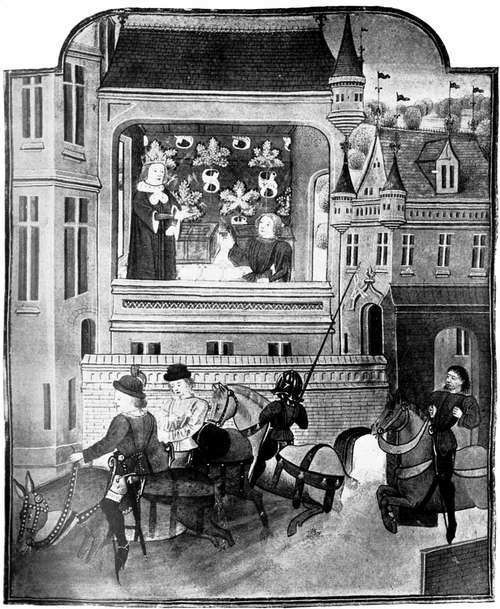
THE KNIGHT WHO THOUGHT HIMSELF ILL-REWARDED. (DEC. X, 1)
From a miniature in the French version of the "Decameron," made in 1414 by Laurent le Premierfait. MS. late XV century. (Brit. Mus. Rothschild Bequest. MS. XIV.)
But before we proceed to consider in detail these sonnets and songs of Boccaccio, we must decide which of all those that from time to time have passed under his name are really his. And here we will say at once that no English writer, no foreign writer at all, has a right to an opinion. Such a question, involving as it does the subtlest and most delicate rhythm of verse, cannot be solved by any one who is not an Italian, for to us the most characteristic and softest music of the Tuscan must ever pass unheard. So the French have made of Poe a very great poet because they, being foreigners, can hear, and not too easily, his melody; while the music of Herrick, for instance, is too subtle for them in the foreign tongue. No, for us there remains the received canon of Boccaccio's Rime to which no doubt can attach, and that consists of one hundred and four sonnets, namely, Nos. 1-101 and 107, 109, and 110 in Baldelli's edition,[364] and a poem which Baldelli refused to print because he thought it obscene, though in fact it is not, Poi, Satiro se' fatto sì severo—all these conserved in Prof. Cugnoni's codex of the Rime.[365] We may add the two ballate, the first madrigale, the capitolo on the twelve beautiful ladies, and the ballata which Baldelli mistakenly calls a canzone from the Livorno collection. To these we may add again four sonnets and a ternario from the codex Marciana (Venice, it cl. ix. 257), and finally the madrigal O giustizia Regina in codex Laurenziana (Florence, xl. 43).[366]
Having thus decided on our text, let us try to get it into some sort of order. Baldelli's collection, which has been twice reprinted, is itself an utter confusion,[367] a mere heap of good things. If we are to make anything of these poems we must arrange them in some sort of sequence, either of date or of contents. No one can possibly arrange them in the order in which they were written, and therefore, though there are lacunæ, for we cannot suppose that we are in possession of all Boccaccio's verse, or if we were that he would consciously have written a story in sonnets, we shall try to arrange them in accordance with their subjects. In this I follow for the most part the work of the Signori Manicardi and Massera. They were not, however, the first to try their hands at it. The learned Signore Antona Traversi[368] had already suggested a method of grouping these sonnets, when they began to bring a real order out of chaos.
To make a long story short, Signor Antona Traversi thought he could distinguish four sonnets which were written before any of those he wished to give to Fiammetta. He found seventy-eight which were inspired by her, nine of which were concerned with her death. Two others he thought were composed for the widow of the Corbaccio.[369]
The sonnets to Fiammetta, sixty-nine of which were written to her living and nine to her dead, he arranges in a sort of categories, thus: twenty-six sonnets he calls "ideal"—these were written to her in the first years that followed Boccaccio's meeting with her; nineteen he calls "sensual"—these were composed before he possessed her at Baia; twenty-three he calls "very sensual"—these were written in the fullness of his enjoyment, when his most impetuous desires had been satisfied. Finally, Signor Antona Traversi finds one sonnet where we may see his sorrow at having lost his mistress.
But this method is almost the same as that we found so absurd in the dissenters, who eagerly deny the reality of any love which man has cared to express. Its success depends entirely on our absolute knowledge of the psychology of man's heart, of a poet's heart. What knowledge, then, have we which will enable us to divide what is ideal love here from what is base love, the false from the true? Is the parable of the tares and the wheat to go for nothing? And again, can we divide love, the love of any man for any woman, if indeed it be love, into "sensual," "ideal," and so forth? Indeed, for such a desperate operation one would need a knowledge of man beside which that of Shakespeare would be as a rushlight to the sun. Canst thou bind the sweet influences of Pleiades or loose the bands of Orion? Who shall divide love into periods of the soul? These are things too wonderful for me, which I know not. Are not "idealism" and "sensuality" moods of the same passion, often simultaneous and always interchangeable? Or do the critics speak of affection? But I speak not of affection. I speak of love—a flame of fire. And whatever Boccaccio's love may have been, good or bad as you will, I care not what you decide to think, this at least it was, a passion, a passion which mastered him and destroyed in him much that was good, much that was bad, but that made of him a poet and the greatest story-teller in the world. Such a passion was composed of an infinite number of elements spiritual and physical, in which the sensual presupposes the ideal even as the ideal does the sensual. Who may divide what God has joined together? And if one might—what disaster!
As though this difficulty were not enough to stagger even the most precise among us, we have to take this also into account, that for the first time in modern literature, love, human love, is freely expressed in Boccaccio's sonnets. It is true Dante had sung of Beatrice till she vanishes away into a mere symbol, far and far from our world in the ever-narrowing circles of his Paradise. So Petrarch had sung of Laura till the coldness of her smile—ah! in the sunshine of Provence—has frozen his song on his lips, so that it is as smooth and as brittle as ice. It is not of such as these that Boccaccio sings, but of a woman mean and lovely, beautiful as the sea and as treacherous, infinitely various, licentious, sentimental, of two minds in a single heart's beat, who smiled his soul out of his body in a short hour on a spring morning in church, who passed with him for her own pleasure in the shadow of the myrtles at Baia, whom he took by the hair, and kissed cruelly, thirsty for kisses, on the mouth, and who, being weary, as women will be, threw him aside for no cause but for this, that she had won his love. No man but Dante could have loved Beatrice, for he made her; and for Laura, she is so dim, so mere a ghost, I only know her name; but for Fiammetta, which of us would not have staked his eternal good, since in her we recognise the very truth; not "every woman"—God forbid—but woman, and if, as the dissenters would assert, she is a myth, a creation of Boccaccio's, then indeed he was an artist only second to the greatest, for she is only less human, less absolute than Cleopatra.
We may take it then, first, that Boccaccio's love was a reality, and not a "literary exercise" that he performed in these sonnets; and then, that if we are to get any order at all out of those which deal with so profound and difficult a subject as love, we must not hope to do it by dividing them into certain artificial categories, such as of "ideal love," of "sensual love," of "very sensual love."
Let us begin with certainties. We can dispose of certain of the poems at once. Sonnet xcvii. to Petrarch, who is dead, must have been written after July 20, 1374. Sonnets vii., viii., ix., which deal with certain censures which had been passed on his Exposition of Dante, were certainly written after August, 1373, when Boccaccio was appointed to lecture on the Divine Comedy. In sonnets i., xxvi., xlii., lxiv., lxviii., and xciii. he alludes to the fact that he is growing old.[370] In sonnet ciii. he says he is sorry to depart without hope of seeing his lady again:—
"Ma ciò mai non avviene, e me partire
Or convien contra grado, nè speranza
Di mai vederti mi rimane alcuna.
Onde morrommi, caro mio disire,
E piangerò, il tempo che m' avanza,
Lontano a te, la mia crudel fortuna."
If this refers to Fiammetta, as seems certain, it should have been written in 1340-1. Finally, it is natural to suppose that the greater part of the sonnets written to Fiammetta living were composed between 1331 and 1341, while those to Fiammetta dead were written after 1348. From these facts I pass on to make the only possible distribution of the Rime that our present knowledge allows.
Let us begin by distinguishing the love poems from the rest, which for the most part belong to Boccaccio's old age. There are thirty-two poems which are not concerned with love, namely, twenty-nine sonnets: Nos. i., vi.-xii., xxvi.-xxviii., xxxvi., xlii., xlix., lvi., lxviii., lxxiv., lxxviii., xci.-xcvi., xcix., ci., Poi Satiro, Saturna al coltivar, Allor che regno, and to these we may add the capitolo, the ballata of the beautiful ladies, and the madrigal O giustizia regina.
There are nine, if not eleven, sonnets written in morte di Madonna Fiammetta: (xix.?), xxi., xxix., li., (lviii.?), lx., lxvii., lxxiii., lxxxviii., xc., xcviii.
All the rest are love poems. Let us begin with them. And the first question that must be answered is: Were they all written to Fiammetta, or were some of them composed for one or other of the women with whom Boccaccio from time to time was in relations?
Crescini tells us that it is only just to admit that atleast the greater part of the love poems of Boccaccio refer to Fiammetta. Landau is more precise, and Antona Traversi follows him in naming sonnets c. and ci. (the latter we do not call a love poem) as written for Pampinea or Abrotonia. To these Antona Traversi adds sonnets xii. and xvii. (the former we do not call a love poem), which he thinks were written for one of the ladies Boccaccio loved before he met Fiammetta.[371] I give them both in Rossetti's translation:—
"By a clear well, within a little field
Full of green grass and flowers of every hue,
Sat three young girls, relating (as I knew)
Their loves. And each had twined a bough to shield
Her lovely face; and the green leaves did yield
The golden hair their shadow; while the two
Sweet colours mingled, both blown lightly through
With a soft wind for ever stirred and still.
After a little while one of them said
(I heard her), 'Think! If, ere the next hour struck,
Each of our lovers should come here to-day,
Think you that we should fly or feel afraid?'
To whom the others answered, 'From such luck
A girl would be a fool to run away.'"
That might seem to be just a thing seen, perfectly expressed, so that we too feel the enchantment of the summer day, the stillness and the heat; but if indeed it be written for any one, it might seem to be rather for the blonde Fiammetta than for any other lady.
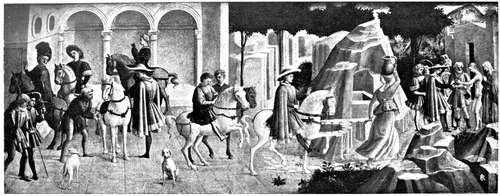
Anderson
THE STORY OF GRISELDA. (DEC. X, 10)
From the picture by Pesellino in the Morelli Gallery at Bergamo.
Sonnet xvii., however, is, it seems to me as it seemed to Rossetti, clearly Fiammetta's. Is it not a reminiscence of happiness at Baia?
"Love steered my course, while yet the sun rode high,
On Scylla's waters to a myrtle grove:
The heaven was still and the sea did not move;
Yet now and then a little breeze went by
Stirring the tops of trees against the sky:
And then I heard a song as glad as love,
So sweet that never yet the like thereof
Was heard in any mortal company.
'A nymph, a goddess or an angel sings
Unto herself, within this chosen place,
Of ancient loves'; so said I at that sound.
And there my lady, 'mid the shadowings
Of myrtle trees, 'mid flowers and grassy space,
Singing I saw, with others who sat round."
Of the rest the following seem to be doubtfully addressed to Fiammetta:[372] Sonnet xxxv. may refer to his abandonment by Fiammetta; cix. seems to refer to the same misfortune; lxxxi. was possibly written before he possessed her; but these two and xlv., lxiv., lxv., and c. seem to Manicardi and Massera too much of the earth for Fiammetta, and they regard them as later work. As we have already said,[373] in sonnet lxiv. he speaks of growing grey.
When we have disposed of these, the rest seem to belong to Fiammetta. If we would have nothing but certainties, however, we must distinguish. In lxvii. and lxx. (the first in morte) her name occurs, while in xl., xli., xlvi., lxiii., in the ternaria, Amor che con sua forza (verse 18), and the fragment of the sestina, her name is clearly hinted at, as it probably is in sonnet lxxxiii. (verse 11).[374] Again in iv., xv., xxxiii., lxix., Baia is spoken of; and in xxxiv., xlvii., xlviii., Miseno. In v. and lii. Naples is named as Parthenope; in xxxii. and liii. the scene is on the sea, and near it in xxxi.[375] In sonnet xxxviii. we see him falling in love:—
"All' ombra di mille arbori fronzuti,
In abito leggiadro e gentilesco,
Con gli occhi vaghi e col cianciar donnesco
Lacci tendea, da lei prima tessuti
De' suoi biondi capei crespi e soluti
Al vento lieve, in prato verde e fresco,
Un' angioletta, a' quai giungeva vesco
Tenace Amor, ed ami aspri ed acuti;
Da quai, chi v' incappava lei mirando,
Invan tentava poi lo svilupparsi;
Tant' era l' artificio ch' ei teneva,
Ed io lo so, che me di me fidando
Più che 'l dovere, infra i lacciuoli sparsi
Fui preso da virtù, ch' io non vedeva."
While in sonnets iii., xviii., xxiv., xxv., xxx., xl., xli., lxi. he praises who but Fiammetta:—
"Le bionde trecce, chioma crespa e d' oro
Occhi ridenti, splendidi e soavi...."
These sonnets were written to Fiammetta before the betrayal, and to them I would add sonnets xxii. and lxxxvi.—
"Se io potessi creder, che in cinqu' anni ..."
which I have already referred to and used in suggesting that five years passed between the innamoramento and the possession in Boccaccio's love affair.[376]
I now turn to the sonnets, which, in their dolorous complaint, would seem to belong to the period after his betrayal. In sonnets lxxix. and lxxx. he reproves Love, in lxx. he swears that love is more than honour, in lvii. he invokes death as his only refuge, in lxxvii. he burns with love and rage:—
"Ed io, dolente solo, ardo ed incendo
In tanto fuoco, che quel di Vulcano
A rispetto non è ch' una favilla."
In sonnets iv., v., xliii., lv., and ballata i. he is altogether desperate. In iv. we have the splendidly bitter invective against Baia already quoted.[377]
It is true that we should not have recognised the soul of Fiammetta as the "chastest that ever was in woman"; but that Boccaccio could think so is not only evidence that he had been blind, as he says, but also of the eagerness of his passion. If we had any doubt of the reason of his misery, however, it is removed by sonnets xliii., lv., and ballata i., where his betrayal is explicitly mentioned.[378] In sonnet xvi. a thousand ways of dying present themselves to him; in cv. he hopes, how vainly, to win her back again:—
"Questa speranza sola ancor mi resta,
Per la qual vivo, ingagliardisco e tremo
Dubbiando che la morte non m' invole...."
With these sonnets we should compare xxxvii., xxxix., xlvi., lxxv., lxxxvii., and ciii. Sonnet lxxxvii. is perhaps the most beautiful of these poems written in despair: it has been quoted above.[379]
In sonnets xiv. and lxxi. he tries to rouse himself, to free himself, in vain, from love;[380] while in sonnet lxxii. he likens himself to Prometheus. He bemoans his fortune again and again in sonnets ii., xxx., lii., cx.; while in xx. and cvii. he tries to hope in some future. Whether that future ever came we do not know. There is no hint of it in the sonnets, and on the whole one is inclined to think it did not.[381] His last sight of Fiammetta, recorded after her death, we may find in the beautiful sonnet so marvellously translated by Rossetti:—[382]
"Round her red garland and her golden hair
I saw a fire about Fiammetta's head;
Thence to a little cloud I watched it fade,
Than silver or than gold more brightly fair;
And like a pearl that a gold ring doth bear,
Even so an angel sat therein, who sped
Alone and glorious throughout heaven, array'd
In sapphires and in gold that lit the air.
Then I rejoiced as hoping happy things,
Who rather should have then discerned how God
Had haste to make my lady all His own,
Even as it came to pass. And with these stings
Of sorrow, and with life's most weary load
I dwell, who fain would be where she is gone."
Fiammetta's death is nowhere directly recorded in the sonnets, but in those which he made for her dead we find, as we might expect, that much of his bitterness is past, and instead we have a sweetness and strength as of sorrow nobly borne. Was not death better than estrangement, for who will deny anything to God, who robs us all? And so in that prayer to Dante we have not only the best of these sonnets, but the noblest too, the strongest and the most completely human. No one will to-day weep with Dante for Beatrice, or with Petrarch for Madonna Laura, but these tears are our own:—
"Dante, if thou within the sphere of love,
As I believe, remain'st contemplating
Beautiful Beatrice, whom thou didst sing
Erewhile, and so wast drawn to her above;—
Unless from false life true life thee remove
So far that love's forgotten, let me bring
One prayer before thee: for an easy thing
This were, to thee whom I do ask it of.
I know that where all joy doth most abound
In the Third Heaven, my own Fiammetta sees
The grief that I have borne since she is dead.
O pray her (if mine image be not drown'd
In Lethe) that her prayers may never cease
Until I reach her and am comforted."[383]
Again in sonnet lxxiii. he sees her before God's throne among the blessed:—
"Sì acceso e fervente è il mio desio
Di seguitar colei, che quivi in terra
Con il suo altero sdegno mi fe' guerra
Infin allor ch' al ciel se ne salio,
Che non ch' altri, ma me metto in oblio,
E parmi nel pensier, che sovent' erra,
Quella gravezza perder che m' atterra,
E quasi uccel levarmi verso Dio,
E trapassar le spere, e pervenire
Davanti al divin trono infra i beati,
E lei veder, che seguirla mi face,
Sì bella, ch' io nol so poscia ridire,
Quando ne' luoghi lor son ritornati
Gli spiriti, che van cercando pace."
Like Laura, it is true, but more like herself,[384] she visits her lover in a dream (sonnets xix., xxix., and lxxxviii.).[385] All these sonnets were not necessarily or even probably written immediately after Fiammetta's death. The thought of her was present with Boccaccio during the rest of his life,[386] and it is noteworthy and moving that at the age of sixty-one he should thus address Petrarch dead in a sonnet (xcvii.):—
"Or sei salito, caro Signor mio
Nel regno, al qual salire ancora aspetta
Ogn' anima da Dio a quello eletta,
Nel suo partir di questo mondo rio;
Or se' colà, dove spesso il desio
Di tirò già per veder Lauretta
Or sei dove la mia bella Fiammetta
Siede cui lei nel cospetto di Dio ...
. . . . . .
Deh! se a grado ti fui nel mondo errante,
Tirami dietro a te, dove giojoso
Veggia colei, che pria di amor m' accese."
Such was the poet Boccaccio.
In turning now for a moment to look for his masters in verse, we shall find them at once in Dante and Petrarch. In his sonnets he followed faithfully the classic scheme, and only three times did he depart from it, adding a coda formed of two rhyming hendecasyllabic lines. Nor is he more original in the subject of his work. Fiammetta is, up to a certain point, the sister of Beatrice and of Laura, a more human sister, but she remains always for him la mia Fiammetta, never passing into a symbol as Beatrice did for Dante or into a sentiment as Laura for Petrarch.
Finally, in considering his place as a poet, we must admit that it has suffered by the inevitable comparison of his work with that of Dante and of Petrarch. Nevertheless, in his own time the fame of his poems was spread throughout Italy. Petrarch thought well of them, and both Bevenuto Rambaldi da Imola and Coluccio Salutati hailed him as a poet: it was the dearest ambition of his life and that about which he was most modest. Best of all, Franco Sacchetti, his only rival as a novelist, if indeed he has a rival, and a fine and charming poet too, hearing of his death, wrote these verses:—
"Ora è mancata ogni poesia
E vote son le case di Parnaso,
Poichè morte n' ha tolto ogni valore.
S' io piango, o grido, che miracolo fia
Pensando, che un sol c' era rimaso
Giovan Boccacci, ora è di vita fore?"
CHAPTER X
1350-1351
BOCCACCIO AS AMBASSADOR—THE MEETING WITH PETRARCH
As we have seen, Boccaccio returned to Florence probably in the end of 1349. His father, who was certainly living in July, 1348, for he then added a codicil to his Will,[387] seems still to have been alive in May, 1349,[388] but by January, 1350, he is spoken of as dead and Giovanni is named as one of his heirs.[389] And in the same month of January, 1350, on the 26th of the month, Boccaccio was appointed guardian of his brother Jacopo,[390] then still a child. But these were not the only duties which fell to him in that year, which, as it proved, was to mark a new departure in his life. It is in 1350 that we find him, for the first time as we may think, acting as ambassador for the Florentine Republic, and it is in 1350 that he first met Petrarch face to face and entertained him in his house in Florence.
The condition of Italy at this time was, as may be easily understood, absolutely anarchical. While Florence and Naples were still in the throes of revolution and war, the Visconti of Milan had not been idle. Using every discontent that could be found in Italy, chiefly of Ghibelline origin, they were in the way to threaten whatsoever was left of liberty and independence. In the worst of this confusion the plague had suddenly appeared in 1348 with the same result as an earthquake might have caused. Old landmarks were overthrown, wealth was, as it were, redistributed, and the whole social condition, often bad enough, became indescribably confused.
[352] See especially Sacchetti, Nov. XXI and CLVIII.
[353] M. Villani, Cronica, Lib. I, cap. ii.
[354] Cf. G. Villani, Lib. XII, cap. 84. After the horrible slaughters and wars in Florence, and indeed in all Tuscany, the disgraceful state of affairs in Naples, it is not wonderful that pestilence broke out and found a congenial soil.
[355] G. Morelli, Cronica, p. 280. Cf. G. Biagi, La vita privata dei Fiorentini (Milano, 1899), pp. 77-9.
[356] W. Heywood, The Ensamples of Fra Filippo (Torrini Siena, 1901), p. 80 et seq.
[357] In the Commentary on the Divine Comedy (Moutier, Vol. XI, p. 105) he says: "E se io ho il vero inteso, perciocchè in que' tempi io non ci era, io odo, che in questa città avvenne a molti nell' anno pestifero del MCCCXLVIII, che essendo soprappresi gli uomini dalla peste, e vicini alla morte, ne furon più e più, i quali de' loro amici, chi uno e chi due, e chi più ne chiamò, dicendo, vienne tale e tale; de' quali chiamati e nominati assai, secondo l' ordine tenuto dal chiamatore, s' eran morti, e andatine appresso al chiamatore...." This might seem evidence enough that Boccaccio was not in Florence in 1348, for he expressly says so. There is a passage, however, in the Decameron Introduction where he seems to say that he was in Florence; but as we shall see, we misunderstand him. He says: "So marvellous is that which I have now to relate that had not many, and I among them, observed it with their own eyes I had hardly dared to credit it...." He then goes on to tell us (assuring us again that he had seen it himself) that one day two hogs came nosing among the rags of a poor wretch who had died of the disease, and immediately they "gave a few turns and fell down dead as if from poison...." But this might have happened in Naples or Forlì quite as well as in Florence. It is only right to add that the Moutier edition of the Comento sopra Dante notes that the MS. from which it is printed reads 1340 instead of 1348 in the passage already quoted. This may or may not be an error. There was a plague in Florence in 1340. See Villani, op. cit., Lib. XII, cap. lxxiii.
[358] See the letter in Corazzini, op. cit., p. 23. It is written in the Neapolitan dialect, and in all the versions I have been able to see bears the date of no year at all. It is signed thus: "In Napoli, lo juorno de sant' Anniello—Delli toi Jannetto di Parisse dalla Ruoccia."
[359] Cf. Manni, Istoria del Decamerone (Firenze, 1742), p. 21. See also Koerting, op. cit., p. 179, and especially Crescini, op. cit., p. 257 et seq.
[360] Cf. Manni, u.s.
[361] Cf. Antona Traversi, Della realtà e della vera natura dell' amore di Messer Gio. Boccaccio (Livorno, 1883), and Ibid., Della verità dell' amore di Gio. Boccaccio (Bologna, 1884); also Renier, Di una nuova opinione sull' amore del B. in Rassegna Settimanale, Vol. VI, No. 145, pp. 236-8.
[362] Villani says B. wrote in the vulgar tongue in verse and prose "in quibus lascivientis iuventutis ingenio paullo liberius evagavit." Bandino says almost as little; but see Crescini, op. cit., p. 164, n. 3. Manetti says: "in amores usque ad maturam fere ætatem vel paulo proclivior." Squarciafico speaks of the various opinions current on the love of B. for Fiammetta, but does not give an opinion himself; he seems doubtful, however, whether the daughter of so great a king could be induced to forget her honour by mere verses and letters. Sansovino, however, thinks B. was a successful lover of Fiammetta. Betussi came to think the same, so did Nicoletti, and so did Zilioli. Mazzuchelli, however, does not believe it. Tiraboschi does not believe the so-called confessions of B. Baldelli, however, does believe them (op. cit., p. 364 et seq.).
[363] I confess that the dissenters seem to me to be merely absurd. They are not worth any fuller answer than that given above. Of course, in speaking of Fiammetta, I mean Maria d'Aquino. It would seem to be impossible to doubt her identity after the acrostic of the Amorosa Visione. I do not hope to convert the dissenters by abusing them. I would not convert them if I could. They are too dangerous to any cause.
[364] Baldelli, Rime di Messer Gio. Boccacci (Livorno, 1802). This text was reprinted in Raccolta di Rime Antiche Toscane (Palermo, 1817), Vol. IV, pp. 1-157, which was used by Rossetti for his translation of six of the sonnets, and again in the Opere Volgari (Moutier, 1834), Vol. XVI.
[365] Cf. Manicardi e Massera, Introduzione al testo critico del Canzoniere di Gio. Boccacci con rime inedite (Castelfiorentino, La Società Stor. di Valdelsa, 1901), p. 20. This book contains the best explanation we yet have of the sonnets and their order. It is a masterly little work. On it cf. Crescini in Rassegna bibliogr. della letter. it., Vol. IX, p. 38 et seq.
[366] Cf. Manicardi e Massera, op. cit., p. 21.
[367] Cf. Manicardi e Massera, op. cit., p. 27, note i.
[368] See Antona Traversi, Di una cronologia approssimativa delle rime del Boccaccio in Preludio (Ancona, 1883), VII, p. 2 et seq.
[369] See infra, p. 181 et seq.
[370] In sonnet xlii. he says the arch of his age is passed:—
[371] As to sonnet ci., both Crescini and Koerting point out that it is written to a widow (perhaps the lady of the Corbaccio, see infra, p. 181 et seq.); but they consider it a mere fantasy, not referring to any real love affair. Cf. Crescini, op. cit., p. 166, note 2. Cf. a similar question to that put in the sonnet in Filocolo (Moutier), Lib. IV, p. 94. Sonnet c. also deals with a widow: "il brun vestire ed il candido velo." Who this widow really may be is an insoluble problem. If it be the lady of the Corbaccio, she would seem to be the wife of Antonio Pucci, for sonnet ci. is dedicated "ad Antonio Pucci." Sonnets lxiv., lxv., seem to refer to the same affair. As to sonnets xii. and xvii., the first is a fantasy and the second refers to Fiammetta in my judgment.
[372] Cf. Manicardi e Massera, op. cit., p. 37.
[373] Supra, p. 136, n. 1.
[374] In xl. he writes, "Quella splendida fiamma"; in xli., "Quindi nel petto entrommi una fiammetta"; in xlvi., "Se quella fiamma"; in lxiii., "Amorosa fiamma"; in lxxxiii., "Accese fiamme attingo a mille a mille."
[375] Sonnets xxxi., xxxii., liii. refer without doubt to Fiammetta, but are indeterminate in time.
[376] See supra, p. 38.
[377] See supra, p. 55.
[378]
"Dunque piangete, e la nemica vista
Di voi spingete col pianger più forte,
Sì ch' altro amor non possa più tradirvi."
Sonnet xliii.
"Che dopo 'l mio lungo servire invano
Mi preponesti tal ch' assai men vale:
Caggia dal ciel saetta, che t' uccida."
Sonnet lv.
"... Veggendomi per altri esser lasciato;
E morir non vorrei, che trapassato
Più non vedrei il bel viso amoroso,
Per cui piango, invidioso
Di chi l' ha fatto suo e me ne spoglia."
Ballata i.
[379] See supra, p. 56.
[380] Note the "occhi falsi" in sonnet xiv.
[381] But see sonnet lviii.
[382] Sonnet lxvii.
[383] Sonnet lx. Cf. Dante, Paradiso, iv. 28-39.
[384] Cf. supra, p. 16.
[385] Cf. Crescini, op. cit., p. 167, note 3.
[386] Cf. sonnets xxi., li., lxxvii., lxxxiii., and cf. Manicardi e Massera, op. cit., p. 50.
[387] See supra, p. 128.
[388] See Crescini, op. cit., p. 258. He quotes the following from Libro Primo del Monte, Quartiere S. Spirito, cap. 162: "Anno mcccxlviij [=1349 n.s.] Ind ja die nono mensis Maij positum est dictum creditum ad aliam rationem dicti Boccaccij sive Boccaccini in presenti quarterio ad car 110, ad instantiam eiusdem Bocchaccij per me dinum Ml Attaviani notarium."
[389] Cf. Crescini, op. cit., p. 258. He quotes the following from the Libro Primo above, cap. 110b: "Mcccxlviiij, Ind iija die xxv Ianuarij, de licencia domini Iohannis filij et heredis, ut dixit, dicti Boccaccij hereditario nomine concessa dicto per me Bartalum maççatelli notarium positum est dictum creditum in libro quarterij Se Crucis et carta 50."
[390] The document is quoted by Manni, op. cit., p. 21. It is as follows: "Mcccxlviiij 26 Ianuarii D. Ioannes q. Boccacci pop. S. Felicitatis tutor Iacobi pupilli eius fratris, et filii quondam, et heredis D. Bicis olim matris suæ, et uxoris q. dicti Boccaccii, et filiæ q. Ubaldini Nepi de Bosticcis."
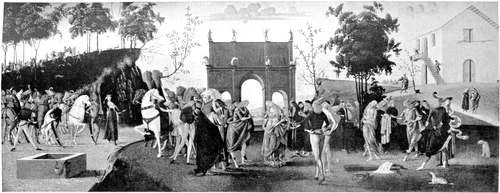
THE STORY OF GRISELDA. (DEC. X, 10.)
i. The Marquis of Saluzzo, while out hunting, meets with Griselda, a peasant girl, and falls in love; he clothes her in fine things. From the picture in the National Gallery by (?) Bernardino Fungai.
The economical results of that awful catastrophe, not only for Italy, but for Europe, were not easily defined or realised anywhere, and least of all perhaps in Italy, where the conditions of life were so complex. An enormous displacement of riches had taken place. All those in any way concerned with the ministration to the sick or the burial of the dead were, if they survived, greatly enriched; and among these was such a society as that of the Or San Michele. But individuals also found themselves suddenly wealthy: doctors and druggists, undertakers, drapers, and poulterers, and such, all who had been able to render help were seemingly benefited, but the farmers and the merchants were ruined. Something perhaps of the awful transformation brought about by the plague may berealised when we consider that, according to Boccaccio, Florence lost three out of every five[391] of her inhabitants, that is about 100,000 persons, that at Pisa six out of every seven died, that Genoa lost 40,000 people, Siena 80,000, while every one died at Trapani, in Sicily, not a soul escaping. Old Agnola de Tura, the Sienese historian, tells us that he buried five of his sons in the same grave, and this was not extraordinary. The economic result of such disaster may then be better imagined than described in detail. No one realised what had happened: it was inconceivable. Even the governments did not understand the new position. They saw the needy suddenly rich, those who had been clothed in rags went in silks and French fashions, and they came to the conclusion that the state was suffering from too great wealth: they revived sumptuary laws, raised taxes, fixed prices, and did, in fact, no good, but much harm. The problem to be solved was that of population and the prices of production. The moral condition was as disastrous as the economic and left a more lasting scar.
In this helpless and disastrous condition of the major part of Italy, from which indeed some of the communes never wholly recovered,[392] we find what in fact we might have expected, that those who had suffered least threatened to become dominant. Now, as it happened, of all Italy upper and lower Milan had escaped most easily, and it was in fact a domination of Milan that, with Naples in the grip of the invader and Tuscany almost depopulated, Florence had to face.
Things came to a head when the Visconti, in October, 1350, possessed themselves of Bologna. In such a case Florence might have expected help or at least resentment, one might think, from the Romagna, but the unruly barons of that region were fighting for their lives and their lordships with Duraforte, whom the Pope had sent to bring them to order. Nor were Venice and Genoa able to render her aid, for they had entered on a mortal duel and cared for nothing else. Naples of course was helpless, and Siena and Perugia, the one stricken almost to death by the plague, the other confident in her mountain passes, thought themselves too far for the ambition of Milan.
So Florence faced the enemy alone, and while we admire her courage we must admit that she had no choice, for she would never have moved at all, nor in her condition would she have been justified in moving, but that she was directly threatened; for with Bologna in the hands of Milan her northern trade routes were at the mercy of the enemy. Thus it became necessary before all else to secure the Apennine passes, and this she foresaw so well that in February, 1350, she bought Prato from the Queen of Naples, who held her rights by inheritance from her father, Charles of Calabria; and not content with this, for Prato was no use without Pistoia, she tried to seize Pistoia also. There, however, she was not wholly or at first successful, but she was allowed to garrison the citadel as well as two important fortified places after guaranteeing full freedom to the Pistolese. In the former of these transactions, the donation of Prato, carried out by Niccolò Acciaiuoli, we catch a glimpse of Boccaccio, who was present as a witness in Florence.[393]
Just before the sale of Bologna to the Visconti we find Boccaccio in Romagna at Ravenna, whither he had gone apparently in September, as we have seen,[394] on the delicate and honourable mission entrusted to him by the Society of Or San Michele, of presenting a gift of ten gold florins to the daughter of Dante, a nun in the convent of S. Stefano dell' Uliva in that city. Thence he seems to have gone as ambassador for the republic to Francesco degli Ordelaffi of Forlì, who was of course already known to him. This, however, is unfortunately but conjecture. We know in fact almost nothing of what, for reasons which will presently appear, I consider to have been Boccaccio's first embassy. All that we can assert is that before November 11, 1350, he went as ambassador into Romagna, and this we know from a document cited by the Abate Mehus,[395] bearing that date which says, "Dominus Johannes Boccacci olim ambasciator transmissus ad partes Romandioliæ."[396] Baldelli tells us[397] without supporting his assertions by a single document that Boccaccio went three times as ambassador for the republic into Romagna: first in the time of Ostasio da Polenta; later in October, 1350; and again a few months after. The first of these embassies, that to Ostasio, he bases on Petrarch's letter of 1365, which we have already quoted and used.[398] There Petrarch says: "Ortus est Adriæ in litore ea ferme ætate, nisi fallor, qua tu ibi agebas cum antiquo plagæ illius Domino ejus avo, qui nunc præsidet." That is to say, he says to Boccaccio: "Unless I am mistaken, you were on the shores of the Adriatic in the time of the grandfather of him who now rules there." He is speaking of Ravenna, not of Rimini, and quite apart from the fact that he says, "unless I am mistaken"—and he may have been mistaken—there is no mention there of an embassy, but only of a visit, a visit to Ostasio da Polenta, who died in 1346, and was the grandfather of Guido da Polenta, who ruled in Ravenna when that letter was written in 1365. We have already used this letter to prove the date of that visit, in doing which we are making legitimate use of it, but to try to prove an embassy from it is to use it improperly.
The second embassy, Baldelli tells us, was to Francesco degli Ordelaffi, in October, 1350, "after the sale of Bologna on the 14th of that month." This again is pure conjecture, the only document which supports it being that quoted above, discovered by Mehus. We have, however, reason to suppose that Baldelli may be right here,[399] and may possibly have been in possession of a document or documents since lost to us, which unfortunately he has not quoted or even named. We know at least that Boccaccio was ambassador in Romagna before November 11, 1350. Now until late in 1349 we have seen him in Naples, and in January and February, 1350, in Florence. In October, 1350, we know him to have been in Florence again, for he there entertained Petrarch, as he did in December. What was he doing between February and October in that year? Well, in September he was in Romagna, in Ravenna fulfilling his mission from the Or San Michele to the daughter of Dante. It seems likely, therefore, that it was at this time he was acting as Florentine ambassador at the court of the Ordelaffi of Forlì.
As to the third embassy of which Baldelli speaks, that to Bernardino da Polenta "a few months after" the second, we know nothing of it, and it remains absolutely in the air—a mere conjecture.[400]
Putting aside Baldelli's assertion, we may take it on the evidence as most probable that Boccaccio was the ambassador of Florence in Romagna at some time between March and October, 1350. If we are right in thinking so, his mission was of very great importance. What Florence feared, as we have seen, was the growing power of Milan, and, after the sale of Bologna, the loss of her trade routes north, and finally perhaps even her liberty. Already, in the latter part of 1349,[401] she had offered again and again to mediate between the Pope and Bologna and Romagna, fearing that in their distraction Milan would be tempted to interfere for her own ends. In the first months of 1350 she had written to the Pope, to Perugia, Siena, and to the Senate of Rome, that they should send ambassadors to the congress at Arezzo to form a confederation for their common protection.[402] In September she wrote the Pope more than once explaining affairs to him; but he had touched Visconti gold, and far away in Avignon cared nothing and paid but little heed. The sale of Bologna, however, brought things to a crisis so far as the policy of Florence was concerned, and having secured Prato, Pistoia, and the passes, her ambassadors in Romagna had apparently induced the Pepoli to replace Bologna under the protection of the communes of Florence, Siena, and Perugia, till the Papal army was ready to act. But the Papal army was not likely to be ready so long as Visconti was willing to pay,[403] and we find the Pope, while he thanks Florence effusively, refusing to acknowledge the claim of the League to protect Bologna. The sale of Bologna to Milan, its seizure by the Visconti, brought all the diplomacy of Florence to naught for the moment, and in another letter, written on November 9, 1350,[404] she returns once more to plead with the Pope and to point out to him the danger of the invasions of the Visconti in Lombardy and in Bologna, which placed in peril not only the Parte Guelfa, but the territories of the Church and the Florentine contado. By the time that letter was written Boccaccio was back in Florence, and it must have been evident to the Florentines that the Pope had no intention of giving them any assistance and that they must look elsewhere for an ally.
That year, so troubled in Italy, incongruous as it may seem to us, had been proclaimed by the Pope a year of Jubilee, not without some intention that the Papal coffers should benefit from the faithful, then eager to express their piety and their thankfulness for the passing of the plague. To gain the indulgence of the Jubilee it was necessary to spend fifteen days in Rome. On April 17, 1350, the commune of Florence prayed the Papal Legate, partly, no doubt, on account of the unsettled condition of the City, and partly, perhaps, that Florence itself might not be long without as many citizens as possible, to reduce the term of fifteen days to eight for all Florentines and for those who dwelt in the contado.[405]
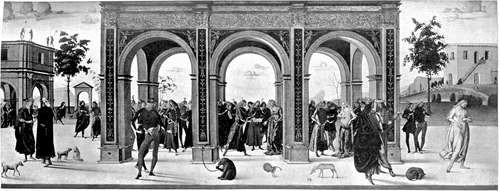
THE STORY OF GRISELDA. (DEC. X, 10.)
ii. Her two children are taken from her, she is divorced, stripped, and sent back to her father's house. From the picture in the National Gallery by (?) Bernardino Fungai.
Now Petrarch, always a man of sincere piety, and especially at this time when he was mourning for Laura, had spent the earlier months of the year in Padua, Parma, and Verona. On February 14, the feast of S. Valentine, he had been present at the translation of the body of S. Anthony of Padua from its first resting-place to the church just built in its honour—Il Santo. On June 20 he had taken formal possession of his archdeaconry in Parma; and so it was not till the beginning of October that he set out, alone, on pilgrimage for Rome to win the indulgences of the Jubilee. As it happened, he travelled by way of Florence, entering that city for the first time about the middle of the month, and there, as is generally supposed, for the first time too, he met Boccaccio face to face.[406]
Petrarch, born in Arezzo on July 20, 1304, was nine years older than Boccaccio, and differed from him so much both in intellect and character that the two friends may almost be said to complement one another. Of a very noble nature, Petrarch was nevertheless introspective, jealous of his reputation, and absolutely personal in his attitude towards life, of which, as his work shows, he was in many ways so shy. Nor was he without a certain puritanism which was his weakness as well as his strength. As a scholar he was at this time, as he always remained, incomparably Boccaccio's superior. For Boccaccio the ancient world was a kind of wonder and miracle that had no relation to himself or to the modern world. But Petrarch regarded antiquity almost as we do, and, though necessarily without our knowledge of detail, such as it is, with a real historic sense—as a living thing with which it was possible, though hardly, to hold communion, by which it was possible to be guided, governed, and taught, a reality out of which the modern world was born.
Moreover
, in 1350, at the time of his meeting with Boccaccio, Petrarch was indubitably the most renowned poet and man of letters in Europe. Every one knew his sonnets, and his incoronation as Laureate on the Capitol had sufficed in the imagination of the world, quite apart from the intrinsic and very real value of his work, to set him above all other poets of his time. He was the Pope's friend, and was honoured and welcomed in every court in Italy—at the court, for instance, of King Robert of Naples, where he had left so splendid a memory on his way to the triumph of the Capitol, at the courts of the signorotti of the Romagna. The youth of Italy had his sonnets by heart; all women read with envy his praise of Madonna Laura; the learned reverenced him as the most learned man of his time and thought him the peer of Virgil and of Cicero. Nor was the Church behind in an admiration wherein all the world was agreed, for she saw in the lettered canonico the glory of the priesthood, and would gladly have led him forward to the highest honours.[407] It was this man, one of the most famous and as it happened one of the best of the age, that Boccaccio met in Florence in 1350.Petrarch himself gives us an account of their first meeting.[408]
"In days gone by," he says in a letter to Boccaccio,[409] "I was hurrying across Central Italy in midwinter; you hastened to greet me, not only with affection, the message of soul to soul, but in person, impelled by a wonderful desire to see one you had never yet beheld, but whom nevertheless you were minded to love. You had sent before you a piece of beautiful verse, thus showing me first the aspect of your genius and then of your person. It was evening and the light was fading, when, returning from my long exile, I found myself at last within my native walls. You welcomed me with a courtesy and respect greater than I merited, recalling the poetic meeting of Anchises with the king of Arcadia, who, "in the ardour of youth," longed to speak with the hero and to press his hand.[410] Although I did not, like him, stand "above all others," but rather beneath, your zeal was none the less ardent. You introduced me, not within the walls of Pheneus, but into the sacred penetralia of your friendship. Nor did I present you with a "superb quiver and arrows of Lycia," but rather with my sincere and unchangeable affection. While acknowledging my inferiority in many respects, I will never willingly concede it in this either to Nisus or to Pythias or to Lælius.—Farewell."
Thus began a friendship that lasted nearly twenty-five years. They were, says Filippo Villani, "one soul in two bodies."
But Petrarch did not remain long in Florence; after a few days he hurried on to Rome, whence he wrote to Boccaccio on his arrival:—
"... After leaving you I betook myself, as you know, to Rome, where the year of Jubilee has called—sinners that we are—almost all Christendom. In order not to be condemned to the burden of travelling alone I chose some companions for the way; of whom one, the oldest, by the prestige of his age and his religious profession, another by his knowledge and talk, others by their experience of affairs and their kind affection, seemed likely to sweeten the journey that nevertheless was very tiring. I took these precautions, which were rather wise than happy as the event proved, and I went with a fervent heart, ready to make an end at last of my iniquities. For, as Horace says, 'I am not ashamed of past follies, but I should be, if now I did not end them.'[411] Fortune, I hope, has not and will not be able to alter my resolution in anything...."[412]
But as he himself seems to have feared, he was unlucky that day, for as he passed with his companions up the hillside out of Bolsena he was kicked badly on the leg by his companion's horse and came to Rome with difficulty, suffering great pain all the time he was there. He seems to have reached the City on November 1, and to have left it again early in December for Arezzo, his birthplace, where he was received with extraordinary honour. Thence he returned to Florence, where he again saw Boccaccio with his friends Lapo da Castiglionchio and Francescho Nelli, whose father had been Gonfalonier of Justice and who himself became Secretary to Niccolò Acciaiuoli when he was Grand Seneschal of Naples. Nelli was in Holy Orders and Prior of SS. Apostoli. Lapo was a man of great learning; he now presented Petrarch with a copy of the newly discovered Institutions of Quintillian.
In the New Year Petrarch left Florence, and three months later we find Boccaccio visiting him in Padua as ambassador for the republic, which, no doubt to his delight and very probably at his suggestion, wished to offer the great poet a chair in her new university. For partly in rivalry with Pisa, partly to attract foreigners and even new citizens after the plague,[413] the republic had founded a new university in Florence at the end of 1348, to which, in May, 1349, Pope Clement VI had conceded all the privileges and liberties of the universities of Paris and Bologna. For some reason or another, however, the new university had not brought to Florence either the fame or the population she desired. It was therefore a brilliant and characteristic policy which prompted her to invite the most famous man of learning of the day to accept a chair in it; for if Petrarch could have been persuaded to accept the offer, the university of Florence would have easily outshone any other then in existence: all Italy and half Europe might well have flocked thither.
The offer thus made, and if at Boccaccio's suggestion, then so far as he was concerned in all good faith, was characteristic in its impudence or astonishing in its generosity according to the point of view, for it will be remembered that Florence had banished Petrarch's father and confiscated his goods and all such property as it could lay its hands on two years before the birth of his son in 1302. With him into exile went his young wife. They found a refuge in the Ghibelline city of Arezzo, where for this cause Petrarch was born. Even in 1350, the year in which the poet entered Florence for the first time, the decree of banishment was in force against him; had he been less famous, less well protected, he would have been in peril of his life. As it was, Florence dared not attack him; nor, seeing the glory he had won, did she wish to do anything but claim a share in it.
It was doubtless this consideration and some remembrance of her humiliation before the contempt of that other exile who had died in Ravenna, that prompted Florence, always so business-like, to try to repair the wrong she had done to Petrarch. So she decided to return him in money the value of the property confiscated from his father, and to send Boccaccio on the delicate mission of persuading him to accept the offer she now made him of a chair in her university.[414] With a letter then from the Republic, Boccaccio set out for Padua in the spring of 1351, meeting Petrarch there, as De Sade tells us, on April 6, the anniversary of the day of Petrarch's first meeting with Laura and of her death.
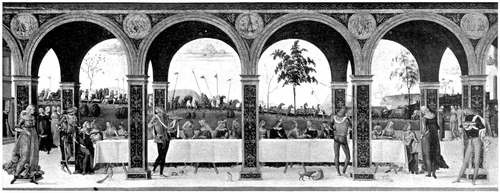
THE STORY OF GRISELDA. (DEC. X, 10.)
iii. A banquet is prepared for the new bride; Griselda is sent for to serve, but is reinstated in her husband's affections and finds her children. From the picture in the National Gallery by (?) Bernardino Fungai.
The letter which Boccaccio took with him was from the Prior of the Arti: Reverendo Viro D. Francisco Petrarcha, Canonico Padoano, Laureato Poetæ, concivi nostro carissimo, Prior Artium Vexillifer Justitiæ Populi et Communis Florentiæ. It was very flattering, laudatory, and moving. It greeted Petrarch as a citizen of Florence, spoke of his "admirable profession," his "excellent merit in studies," his "utter worthiness of the laurel crown," his "most rare genius which shall be an example to latest posterity," etc. etc. etc. Then it spoke of the offer. "No long time since," it said, "seeing our city deprived of learning and study, we wisely decided that henceforth the arts must flourish and ought to be cultivated among us, and that it would be necessary to introduce studies of every sort into our city so that by their help our Republic, like Rome of old, should be glorious above the other cities of Italy and grow always more happy and more illustrious. Now our fatherland believes that you are the one and only man by whom this result can be attained. The Republic prays you, then, as warmly as it may, to give yourself to these studies and to make them flourish...." So on and so forth, quoting Virgil, Sallust, and Cicero, with allusions to that "immortal work the Africa which...." Boccaccio was to do the rest. "Other things," the letter ends, "many and of infinitely greater consideration, you will hear from Giovanni Boccaccio, our citizen, who is sent to you by special commission...."[415]
With this letter in his pocket Boccaccio made his way to Padua, where, as we know, he was delighted to come, nor was Petrarch less happy to see him. And when he returned he bore Petrarch's answer to the Republic: "Boccaccio, the bearer of your letter and of your commands, will tell you how I desire to obey you and what are my projects." No doubt while Boccaccio was with him, seeing his sincerity, Petrarch felt half inclined to accept; but he was at all times infirm of purpose. "If I break my word that I have given to my friends," he writes,[416] "it is because of the variation of the human spirit, from which none is exempt except the perfect man. Uniformity is the mother of boredom, that one can only avoid by changing one's place." However that may be, when later in the year he left Padua, it was to return not to Florence, but to France.
If we know nothing else of this embassy, we know, at least, that this sojourn in Padua passed pleasantly for Boccaccio. In a letter written to Petrarch from Ravenna, in July, 1353,[417] he reminds his "best master" of his visit. "I think," he writes, "that you have not forgotten how, when less than three years ago I came to you in Padua the ambassador of our Senate, my commission fulfilled, I remained with you for some days, and how that those days were all passed in the same way: you gave yourself to sacred studies, and I, desiring your compositions, copied them. When the day waned to sunset we left work and went into your garden, already filled by spring with flowers and leaves.... Now sitting, now talking, we passed what remained of the day in placid and delightful idleness, even till night."
Some of that talk was doubtless given to Letters, but some too fell, as it could not but do, on politics. For that letter, so charming in the scene it brings before us of that garden at nightfall, goes on to speak in a transparent allegory of the affairs of Italy and of Petrarch's sudden change of plans, for whereas in 1351 he had promised to enter the service of Florence and had cursed the Visconti, when he returned to Italy in 1353, it was with these very Visconti he had taken shameful service—with the enemies of "his own country" Florence, whom he had spurned, and who in return had repealed the repeal of his banishment and refrained from returning to him the money value of his father's possessions. Is it in revenge for this, Boccaccio asks, that he has taken service with the enemy? He reproaches him in the subtlest and gentlest way, yet with an eager patriotism that does him the greatest honour, representing him to himself even as a third person, one Sylvanus, who "had been of their company" in Padua. Yet Boccaccio does not spare him, and though he loved and revered him beyond any other living man, he bravely tells him his mind and points out his treachery, when his country is at stake.
That Sylvanus, it seems—Petrarch himself really—had lamented bitterly enough the unhappy state of Italy, neglected by the Emperors and the Popes, and exposed to the brutality and tyranny of the Archbishop Giovanni Visconti of Milan. More and more he cursed the tyrants, and especially the Visconti, and "how eagerly you agreed with him!... But now," the letter continues,[418] "I have heard that this Sylvanus is about to enter the service of those very Visconti, who even now menace his country. I would not have believed it had not I had a letter from him in which he tells me it is so himself. Who would ever have suspected him of so much mobility of character, or as likely to forswear his own faith out of greediness? But he has done so perhaps to avenge himself on his fellow-citizens who have retaken the property of his father, which they had once returned to him. But what man of honour, even when he has received a wrong from his country, would unite himself with her enemies? How much has Sylvanus mystified and compromised, by these acts, all his admirers and friends...."
Just here we come upon something noble and firm in the character of Boccaccio, something of the "nationalism" too which was to be the great force of the future, to which Petrarch was less clairvoyant and which Dante had never perceived at all. The Empire was dead; in less than a hundred years men were to protest they did not understand what it meant. The Papacy then too seemed almost as helpless as it is to-day. Internationalism—the latest cry of the modern decadent or dreamer—was already a mere ghost frightened and gibbering in the dawn, and the future lay in the growth of nationalities, in the variety and freedom of the world, perhaps in the federation of Italy. Were these the thoughts that occupied the two pioneers of the modern world on those spring nights in that garden at Padua?
CHAPTER XI
1351-1352
TWO EMBASSIES
Boccaccio did well to be anxious. The greed of the Visconti, the venality and indifference of the Pope, threatened the very liberty of Tuscany, and though Boccaccio had till now held no permanent public office in Florence, we have seen him as a witness to the donation of Prato, as ambassador for the Republic in Romagna, and as its representative offering Petrarch a chair in the new university. He was now to be entrusted with a more delicate and serious mission. But first, on his return from Padua in January-February, 1351, he became one of the Camarlinghi del Comune.[419] During the remainder of that year we seem to see him quietly at work in Florence,[420] most probably on the Decameron, and then suddenly in December he was called upon to go on a mission to Ludwig of Brandenburg, Count of Tyrol.[421]
Florence was tired of appealing to the Pope always in vain and had at last looked for another champion against the Visconti. Deserted by the Church, at war with the Visconti, Florence had either to submit or to find a way out for herself, and with her usual astuteness she hoped to achieve the latter by calling to her aid the excommunicated Ludwig. The moment was well chosen. Ludwig was just reconciled with Charles IV, King of the Romans, the greatest enemy of his house. He was poor and in need of money, little loved in his own country, and not indisposed to try any adventure that offered. So Boccaccio set out. The letters given to him December 12, 1351, were directed to Conrad, Duke of Teck, who had already visited Florence in 1341, and to Ludwig himself.[422] We know, however, nothing personal to Boccaccio with regard to this mission. In fact save that it was so far successful that Ludwig sent Diapoldo Katzensteiner to Florence to continue the overtures we know little about it at all. Katzensteiner's pretensions, however, proved to be such that the Florentines would not accept them, and communications were broken off.[423] That was in March, 1352. On May 1 a new project was on foot. Florence decided to call the prospective Emperor Charles IV, the grandson of her old enemy Henry VII, into Italy to her assistance.[424]
That a Guelf republic should turn for assistance to the head of the Ghibelline cause seems perhaps more strange than in fact it was. Guelf and Ghibelline had become mere names beneath which local jealousies hid and flourished, caring nothing for the greater but less real quarrel between Empire and Papacy. Charles, however, was to fail Florence; for at the last moment he withdrew from the treaty, fearing to leave Germany; when he did descend later, things had so far improved for her that she was anything but glad to see him especially when she was forced to remember that it was she who had called him there. After these two failures Florence was compelled to make terms with the Visconti at Sarzana in April, 1353, promising not to interfere in Lombardy or Bologna, while Visconti for his part undertook not to molest Tuscany.[425] But by this treaty the Visconti gained a recognition of their hold in Bologna from the only power that wished to dispute it. They profited too by the peace, extending their dominion in Northern Italy. In this, though fortune favoured them, they began to threaten others who had looked on with composure when they were busy with Tuscany. Among these were the Venetians, who made an alliance with Mantua, Verona, Ferrara, and Padua, and were soon trying to persuade Florence, Siena, and Perugia to join them.[426] Nor did they stop there, for in December, 1353, they too tried to interest Charles IV in Italian affairs. When it was seen that Charles was likely to listen to the Venetians the Visconti too sent ambassadors to him, nor was the Papacy slow to make friends.
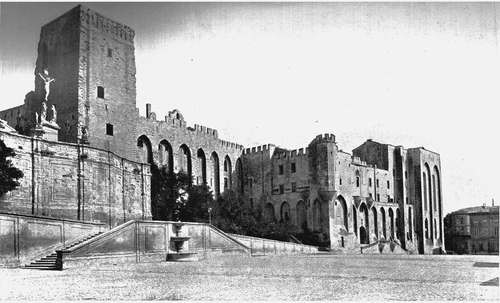
THE PALACE OF THE POPES AT AVIGNON
In 1352 Clement VI had died, and in his stead Innocent VI reigned in Avignon. He was determined to assert his claims in Italy, and especially in the Romagna, and to this end despatched Cardinal Albornoz, the redoubtable Spaniard, to bring the unruly barons of that region to order. The whole situation was delicate and complicated. Florence was in a particularly difficult position. She had called Charles into Italy without the Pope's leave—she, the head of the Guelf cause. He had not come. Now when she no longer wanted him he seemed to be coming in spite of her and with the Pope's goodwill. She seems to have doubted the reality of that, as well she might. Moreover, though she and her allies would have been glad enough to join the Venetians, the situation was too complicated for hurried action, especially as a treaty only two years old bound them not to interfere in Lombardy and Bologna so long as they were left alone.
Charles's own position can have been not less difficult. Now that he seemed really eager to enter Italy, both sides seemed eager for him to do so. Should he enter Italy as the "Imperatore de' Preti," and so make sure of a coronation, or descend as the avenger of the imperial claims? He hesitated. In these circumstances it seemed to the Florentines that there was but one thing to do—to inform themselves of the real intentions of the Pope, and when these were known, to decide on a course of action. In these very delicate missions his countrymen again had recourse to Boccaccio. He set out on April 28, 1354.[427] His instructions were to find out whether the Emperor was coming into Italy with consent of His Holiness, to speak of the loyalty of Florence to the Holy See, and to protest her willingness to do whatever the Pope desired. At the same time he had to obtain at least this, that the Pope should exert himself to save the honour and independence of the republic. Again, if the Pope pretended that heknew nothing of the advent of Charles, but asked the intentions of Florence in case he should enter Italy, Boccaccio was instructed to say that he was only sent to ask the intentions of His Holiness. In any case he was to return as quickly as possible.
The Pope's answer seems to have been far from clear. Boccaccio returned, but a few months later Dietifeci di Michele was sent as ambassador to Avignon with almost the same instructions and with the same object in view.
Can it be that Florence really did not understand the situation as we see it, or was that situation in reality very dangerous to her liberty? It is difficult to understand how she can have failed to see that the Pope had already won. It was obvious that he had come to some arrangement with Charles, which proved to be that the Church would crown him on condition that he only spent the day of his incoronation in Rome and respected the sovereignty of the Pope in the states of the Church. Moreover, if this were not enough, as Florence knew, the presence of Albornoz in Romagna had already drawn the teeth of the Visconti so far as they were dangerous to Tuscany. However, it seems to have been in considerable fear and perplexity that she saw Charles enter Padua early in November, 1354. Now if ever, some thought doubtless, the White Guelf ideal was to be realised. Among these idealists was, alas, Petrarch, whose hymn, not long written perhaps, Italia Mia, surely dreamed of quite another king than a German prince. Boccaccio was, as I think, better advised. In his seventh Eclogue he mercilessly ridicules Charles, who in fact, though not maybe in seeming, was the instrument of the Pope. He entered Italy by the Pope's leave. Padua received him with honour, but Cane della Scala of Verona clanged to his gates, and the Visconti with bared teeth waited to see what he would do. He went to Mantua and Gonzaga received him well. There he expected the ambassador of Tuscany, but as the Pope's friend the Ghibellines knew him not, they smiled bitterly at the "Priests' Emperor," only Pisa pathetically stretching out her hands to Cæsar's ghost, while, as claimant of the imperial title the Guelf republics would have none of him. Florence need have had no fear, the Church had out-manœuvred her enemies as in old time.
Charles, however, was not contemptible. Simple German as he was, he soon grasped the situation. He made friends in some sort with Visconti, and in this doubtless Petrarch, who had urged him on, was able to assist him. From them he received the iron crown, though not indeed at Monza, but in Milan, in the church of S. Ambrogio, and at their hands. That must have been a remarkable and unhappy time for the King of the Romans, in spite of Petrarch's talk and friendship. Presently he set out for Pisa and so to Rome, where he received the imperial crown on April 4, 1355, and, returning to Pisa, as though in irony of Petrarch's enthusiastic politics, crowned the grammarian Zanobi da Strada poet laureate. Yet this was surely but a German joke. As for Florence, still trembling it seems, she took as firm a stand as she could, and asked only the protection and friendship of the Emperor, offering no homage or subordination. The Sienese, on the other hand, in spite of their treaty with Florence, offered him their lordship. Others followed their example, and Pisa was filled with Ghibellines claiming the destruction of Florence, the head and front of the Guelf faction. Charles, however, refused to adventure. He demanded from Florence only money, as a fine, by paying which she was to be restored to his favour, and that her magistrates should be called Vicars of the Empire. She forfeited nothing of her liberty and none of her privileges as a free republic. Yet at first she refused to acquiesce. It was only after an infinite number of explanations that she was brought to consent. Indeed, we read that the "very notary who read out the deed broke down, and the Senate was so affected that it dissolved. On the next day the Act was rejected seven times before it was passed. The bells were the only merry folk in Florence, so jealous were her citizens of the liberty of their state."
CHAPTER XII
1353-1356
BOCCACCIO'S ATTITUDE TO WOMAN—
THE CORBACCIO
Those embassies, for the most part so unsuccessful one may think, which from time to time between 1350 and 1354 Boccaccio had undertaken at the request of the Florentine Republic, heavy though his responsibility must have been in the conduct of them, had by no means filled all his time or seriously prevented the work, far more important as it proved to be, which he had chosen as the business of his life. Between 1348 and 1353, as we shall see, he had written the Decameron; in 1354-5 he seems to have produced the Corbaccio, and not much later the Vita di Dante; while in the complete retirement from political life, from the office of ambassador at any rate, which followed the embassy of 1354 and lasted for eleven years, till indeed in 1365 he went again to Avignon on business of the Republic, he devoted himself almost entirely to study and to the writing of those Latin works of learning which his contemporaries appreciated so highly and which we have perhaps been ready too easily to forget.
It is generally allowed[428] that Boccaccio began the Decameron in 1348, but that it did not see the light in its completeness till 1353, and this would seem reasonable, for it is surely impossible that such a work can have been written in much less than four years. That a considerable time did in fact divide the beginning from the completion of the book Boccaccio himself tells us in the conclusion, at the end of the work of the Tenth Day, where he says: "Though now I approach the end of my labours, it is long since I began to write, yet I am not oblivious that it was to none but to ladies of leisure that I offered my work...."
That the Decameron was not begun before 1348 would seem to be certain, for even if we take away the Prologue, the form itself is built on the dreadful catastrophe of the Black Death.[429] If the book was begun between that year and 1351, it cannot, however, have been suggested, as some have thought, by Queen Giovanna of Naples, for she was then in Avignon. In 1348 Boccaccio was thirty-five years old, and whether at that time he was in Naples or in Forlì with Ordelaffo is, as we have seen, doubtful, though that he was in Naples would appear more likely; but wherever he was he had ample opportunity of witnessing the appalling ravages of the pestilence which he so admirably describes, and which is the contrast of and the excuse for his book, for save in Lombardy and Rome the pestilence was universal throughout Italy. In 1353, however, we know him to have been resident in Florence, and if we accept the tradition, which there is no reason at all to doubt, it was in that year that the complete Decameron first saw the light.[430] It was known, however, in part, long before that, and would seem indeed to have been published—if one may so express it—in parts; not perhaps ten stories at a time—a day at a time—as Foscolo[431] has conjectured, but certainly in parts, most likely of various quantity and at different intervals. This would seem to be obvious from the introduction to the Fourth Day, where Boccaccio speaks of the envy and criticism that "these little stories" had excited, and proceeds to answer his detractors. It is obvious that he could not at the beginning of the Fourth Day have answered criticisms of his work if some of it had not already seen the light and been widely read.
It must have been then when he was about forty years old that he finished the Decameron, that extraordinary impersonal work in which in the strongest contrast with his other books he has almost completely hidden himself from us. He might seem at last in those gay, licentious, and profoundly secular pages, often so delightfully satirical and always so full of common sense, so sane as we might say, to have lost himself in a joyous contemplation and understanding of the world in which he lived, to have forgotten himself in a love of it.
I speak fully of the Decameron elsewhere, and have indeed only mentioned it here for two reasons—to fix its date in the story of his life, and to contrast it and its mood with the work which immediately followed it, the Corbaccio and the Vita di Dante.
We cannot, I think, remind ourselves too often in our attempts—and after all they can never be more than attempts—to understand the development of Boccaccio's mind, of his soul even, that he had but one really profound passion in his life, his love for Fiammetta. And as that had been one of those strong and persistent sensual passions which are among the strangest and bitterest things in the world,[432] his passing love affairs—and doubtless they were not few—with other women had seemed scarcely worth recounting.[433] That he never forgot Fiammetta, that he never freed himself from her remembrance, are among the few things concerning his spiritual life which we may assert with a real confidence. It is true that in the Proem to the Decameron he would have it otherwise, but who will believe him? There he says—let us note as we read that even here he cannot but return to it—that: "It is human to have compassion on the afflicted; and as it shows very well in all, so it is especially demanded of those who have had need of comfort and have found it in others: among whom, if any had ever need thereof or found it precious or delectable, I may be numbered; seeing that from my early youth even to the present,[434] I was beyond measure aflame with a most aspiring and noble love, more perhaps than were I to enlarge upon it would seem to accord with my lowly condition. Whereby, among people of discernment to whose knowledge it had come, I had much praise and high esteem, but nevertheless extreme discomfort and suffering, not indeed by reason of cruelty on the part of the beloved lady, but through superabundant ardour engendered in the soul by ill-bridled desire; the which, as it allowed me no reasonable period of quiescence, frequently occasioned me an inordinate distress. In which distress so much relief was afforded me by the delectable discourse of a friend and his commendable consolations that I entertain a very solid conviction that I owe it to him that I am not dead. But as it pleased Him who, being infinite, has assigned by immutable law an end to all things mundane, my love, beyond all other fervent, and neither to be broken nor bent by any force of determination, or counsel of prudence, or fear of manifest shame or ensuing danger, did nevertheless in course of time abate of its own accord, in such wise that it has now left naught of itself in my mind but that pleasure which it is wont to afford to him who does not adventure too far out in navigating its deep seas; so that, whereas it was used to be grievous, now, all discomfort being done away, I find that which remains to be delightful ... now I may call myself free."
His love is not dead, but is no longer the sensual agony, the spiritual anguish it had once been, but it "remains to be delightful." That it remained, though perhaps not always "to be delightful," that it remained, is certain. For though he "may now call myself free," that Proem tells us that after all we owe the Decameron itself indirectly to Fiammetta. And who reading those tales can believe in his vaunted emancipation, if by that is meant his forgetfulness of her? She lives everywhere in those wonderful pages. Is she not one of the seven ladies of the Decameron? That is true, it will be said, but she has no personality there, she is but one of ten protagonists who are without life and individuality. Let it be granted. But whereas the others are in fact but lay figures, she, Fiammetta, though she remains just an idol if you will, is to be worshipped, is to be decked out with the finest words, to be honoured and glorified. Her name scarcely occurs but he praises her; he is always describing her; while for the others he seldom spares a word. Who can tell us what Pampinea, Filomena, Emilia, Neifile, or Elisa were like? But for Fiammetta—he tells us everything; and when, as in the Proem we have just discussed or in the Conclusion to the Fourth Day, he speaks for himself, it is her he praises, it is of her he writes. She is there crowned as queen. It is Filostrato who crowns her: "taking the laurel wreath from his own head, and while the ladies watched to see to whom he would give it, set it graciously upon the blonde head of Fiammetta, saying: 'Herewith I crown thee, as deeming that thou, better than any other, will know how to make to-morrow console our fair companions for the rude trials of to-day.' Fiammetta, whose wavy tresses fell in a flood of gold over her white and delicate shoulders, whose softly rounded face was all radiant with the very tints of the white lily blended with the red of the rose, who carried two eyes in her head that matched those of the peregrine falcon, while her tiny sweet mouth showed a pair of lips that shone as rubies...."
[391] This was about the average loss throughout Europe.
[392] Siena never really recovered, nor did Pisa.
[393] Cf. Tanfani, Niccolò Acciaiuoli, studi storici (Firenze, 1863), p. 82.
[394] Supra, p. 120, n. 1.
[395] Mehus, Ambrosii Traversarii Vita (Firenze, 1759).
[396] It has been said by Hortis that the "olim" is unlikely to have referred to so recent an embassy, one which, in fact, was only in being two months before. I do not see the force of this. The "olim" is used in our sense of late, "the late ambassador." In November, as we shall see, Boccaccio was back in Florence. In the sense of "late" we find the "olim" used in the document already quoted in which Giovanni is appointed guardian of his brother Jacopo (supra, cap. x. n. 4): "... et heredis D. Bicis olim matris suæ," i.e. "and heir of Donna Bice, his late mother."
[397] Baldelli, op. cit., p. 377. Baldelli seems here to have confused himself—at any rate he expresses himself badly. It is difficult to see clearly what he means. He is wrong too when he gives the commission from the Or San Michele as being of the month of December; Landau follows him in this. The commission was of the month of September. See supra, p. 120, n. 1.
[398] See supra, p. 119, n. 1.
[399] Ciampi, Monumenti di un Manoscritto autografo di Messer G. B. (Firenze, 1827), goes further than Baldelli and is in evident error. He connects this embassy of 1350 with the descent of King Louis of Hungary. This is impossible. That Boccaccio did meet King Louis in Forlì, and that he accompanied him with "suo signore" Francesco degli Ordelaffi into Campania is certain, as we have seen (supra, p. 124); but that was in 1347, not in 1350, and when he was a visitor at Forlì, not when he was Florentine ambassador there. How could he call Ordelaffo "suo signore" when he was the servant of Florence? And how could he follow Ordelaffo and the King, when he was ambassador, without the permission of Florence? Moreover, according to Ciampi, all this occurred, not in 1347, but in 1350. Now in May, 1350, King Louis was in Aversa, and from February, 1350, Ordelaffo was fighting the Papal arms in Romagna, which had been turned against him on account of the rebellion of the Manfredi of Faenza, which he was supposed to have instigated. We see him victor in fight after fight; he took Bertinoro in May, Castracaro in July, Meldola in August, and the war continued throughout 1351 and longer. In 1350 then neither did the King descend into Italy nor did Ordelaffo accompany him. These things happened in 1347. Besides, in February, 1350, Boccaccio was in accord with Niccolò Acciaiuoli and, as we have seen, assisted as witness at the donation of Prato. Cf. Tanfani, Niccolò Acciaiuoli, pp. 79-82.
[400] Of course, Boccaccio was in Ravenna in September, 1350, and probably saw Bernardino there, for he must have known him very well.
[401] See the letter to the Pope of September 10, 1349, given in Arch. Stor. Ital., Series I, Appendix, Vol. VI, p. 369.
[402] See the letters of February 17, February 23, February 28, 1350, in Arch., cit., u.s., pp. 373-4.
[403] "The luxury, vice, and iniquity of Avignon during the Papal residence became proverbial throughout Europe; and the corruption of the Church was most clearly visible in the immediate neighbourhood of its princely head. Luxury and vice, however, are costly, and during the Pope's absence from Italy the Papal States were in confusion and yielded scanty revenues. Money had to be raised from ecclesiastical property throughout Europe, and the Popes in Avignon carried extortion and oppression of the Church to an extent it had never reached before." (Creighton, History of the Papacy, Vol. I, p. 51.)
[404] Letter of November, 1350, in Arch., cit., u.s., p. 378.
[405] Arch. Stor. It., u.s., p. 376.
[406] It seems certain that they had been in correspondence for some years, perhaps for more than fifteen. In the letter to Boccaccio of January 7, 1351, Petrarch speaks of a poem that Boccaccio had long since sent him (? 1349) (Famil., XI, 1); while in the letter to Franceschino da Brossano, written after Petrarch's death in 1374, Boccaccio says "I was his for forty years or more" (Corazzini, op. cit., p. 382). This would seem to mean he had loved his work for so long, and brings us to 1341-4. It still seems to me just doubtful whether this meeting in Florence in 1350 was their first encounter. As I have said, Petrarch came to Florence in October; by November 2 he was in Rome, whence he wrote Boccaccio on that date an account of his journey. Now as we shall presently see, in a letter written much later (Epist. Fam., XXI, 15), he distinctly says that he first met Boccaccio, who had come to meet him when he was hurrying across Central Italy in midwinter. No one, least of all an Italian and a somewhat scrupulous scholar, would call October 15 midwinter. Perhaps then it will be said that he met him on his return from Rome in December. But already in November he is writing to Boccaccio—we have the letter—in the most familiar and affectionate terms. Can it be that they met after all (see supra, pp. 60 and 111) in 1341 or perhaps in 1343? The problem seems insoluble on our present information.
[407] Cf. Hortis, op. cit., pp. 509-10.
[408] I have already shown (supra, p. 153, n. 2) that it is possible to doubt whether the meeting in Florence was their first meeting. It is, however, generally accepted as the first by modern scholars. Cf. Landau and Antona Traversi.
[409] Cf. Epistol. Famil., Lib. XXI, 15.
[410] See Æneid, VIII, 162 et seq.
[411] Horace, Epistolæ, Lib. I, 14.
[412] Epistol. Famil., Lib. XI, 1.
[413] Cf. M. Villani, in R. I. S., XIV, 18.
[414] The chair was to be in any faculty Petrarch chose. D. Rosetti insists that it was offered at Boccaccio's suggestion (Petrarca, Giulio Celso e Boccaccio (Trieste, 1823), p. 351), and asserts that the short biography of Petrarch which he attributes to Boccaccio was composed to persuade the Government of Florence to repair Petrarch's wrongs. Tiraboschi (op. cit., Vol. II, pp. 253-4), with tears in his voice, cannot decide whether the affair did more honour to Petrarch or to Florence. So far as Florence is concerned, I see no honour in the affair at all. She was asking Petrarch to do her an inestimable service by bolstering up her third-rate university. In order to get him to do this, she was willing to pay back what she had stolen and (a poor gift when she was begging for foreigners as citizens) to repeal the edict of banishment against him. Petrarch treated the whole impudent attempt to get round him in the right way. And Florence, when she found nothing was to be got out of him, repealed the repeal. But surely we know the Florentines!
[415] Corazzini, op. cit., p. 391 and Hortis, Boccaccio Ambasciatore in Avignone (Trieste, 1875)
[416] Epist. Famil., II, xii.
[417] Cf. Corazzini, op. cit., p. 47.
[418] Corazzini, op. cit., p. 47. Letter of July, 1353. Petrarch in May-June, 1353, had accepted the patronage of Giovanni Visconti.
[419] Cf. Crescini, op. cit., p. 258. I quote the document. Camarlinghi del Comune Quad. 75 and 76 Gennaio-Febbraio 1350-1. "In dei nomine amen. Hic est liber sive quaternus In se continens solutiones factas tempore Religiosorum virorum fratris Benedicti caccini et fratris Iacopi Iohannis de ordine fratrum sancti marci de flor. Et discretorum virorum domini Iohannis Bocchaccij de Certaldo pro quarterio Si Spiritus et Pauli Neri de bordonibus pro quarterio Se Marie novelle laicorum, civium florentinorum, camerariorum camere comunis florentie pro duobus mensibus initiatis die primo mensis Ianuarij Millesimo trecentesimo quinquagesimo [1351, n.s.] Ind iiij," etc. etc.
[420] In May, as we have seen, he was inscribed in the Arte dei Giudici e Notai. Cf. supra, p. 145, n. 4.
[421] Cf. Hortis, Boccaccio Ambasciatore, cit., p. 8, n. 4, and Docs. 2, 3, 4, 5.
[422] Cf. Hortis, op. cit., p. 9. n. 1. Baldelli, op. cit., pp. 112-13, and Witte are wrong in supposing Ludwig to be Ludovico il Romano, as Hortis shows.
[423] Florence broke off communications after consulting Siena and Perugia. Cf. Arch. Stor. Ital., Ser. I. App. VII, p. 389.
[424] Cf. Arch. Stor. Ital., u.s., p. 389.
[425] Cf. Matteo Villani, Lib. IV. In July (see letter quoted supra) we know Boccaccio to have been in Ravenna. He says to Petrarch, "Pridie quidem IIII ydus julii forte Ravennam urbem petebam, visitaturus civitatis Principem et ut ferebat iter Livii forum intravi...." He arrived, then, on July 12, and it was a friend he met in Forlì (Livii) who told him that Petrarch had entered the service of the Visconti. He reproaches him, as we have seen. Nelli, whom he here calls Simonides, was also in Ravenna. He upbraids Petrarch, as we have seen, in allegory, asking how Sylvanus (Petrarch) can desert and betray the nymph Amaryllis (Italy) and go over to the oppressor Egon (Visconti), the false priest of Pan (the Pope), a monster of crime. Cf. Corazzini, op. cit., p. 47.
[426] See docs. cited in Arch. Stor. Ital., u.s., pp. 392-4.
[427] Baldelli, Hortis, Landau, and Koerting are all in agreement that this mission took place in April, 1354, not April, 1353. The instructions of the Republic, which I quote infra, were published by Canestrini in Arch. St. It., u.s., p. 393, but under the erroneous date of April 30, 1353. In April, 1353, Charles was not about to set out.
[428] See Manni, Istoria del Decamerone (Firenze, 1742), p. 144; Antona Traversi in Landau, Gio. Boccaccio sua vita ed opere (Napoli, 1882), p. 523; Koerting, Boccaccio's Leben und Werke (Leipzig, 1880), pp. 244 and 673-4; and cf. Salviati, Avvertimenti della Lingua sopra il Decamerone (Venezia, 1584), Lib. II, cap. 12.
[429] I deal with the form of the Decameron later. See infra, p. 292.
[430] The original MS. has disappeared. The oldest we now possess seems to have been written in 1368 by Francesco Mannelli. The later Hamilton MS., now in Berlin, is, however, the better of the two. Cf. H. Hauvette, Della parentela esistenta fra il MS. Berlinese del Dec. e il codice Mannelli in Giorn. St. d. Lett. It. (1895), XXXI, p. 162 et seq.
[431] Foscolo, Discorso Storico sul testo del Decamerone ... premesso all' edizione delle Cento Novelle fatta in Londra (Lugano, 1828), p. 9.
[432] Cf. Decameron, Proem, where he speaks of his love for Fiammetta and the "discomfort," and "suffering" it brought him, "not indeed by reason of the cruelty of the beloved lady, but through the superabundant ardour engendered in the soul by ill-bridled desire; the which, as it allowed me no reasonable period of quiescence, frequently occasioned me inordinate distress."
[433] We know that Boccaccio had three children, two sons and a daughter. We do not know by whom.
[434] So that when he wrote the Proem (? 1353) he still loved her.

MASETTO AND THE NUNS. (DEC. III, 1)
In 1538 this woodcut appears in Tansillo's "Stanze" (By the courtesy of Messrs. J. & J. Leighton.)
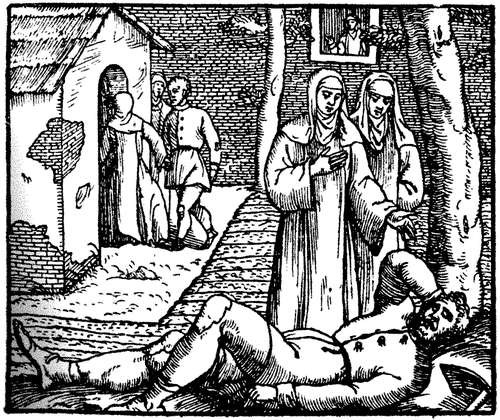
MASETTO AND THE NUNS. (DEC. III, 1)
A woodcut from "Le Cento Novelle" in ottava rima. (Venice, 1554.) (By the courtesy of Messrs. J. & J. Leighton.)
And it is the same with the Conclusion of the book, which in fact closes with her name, and with the question Boccaccio must have asked her living and dead his whole life long: "Madonna, who is he that you love?"
That he never forgot her, then, is certain; but Fiammetta was dead, and for Boccaccio more than for any other man of letters perhaps, love with its extraordinary bracing of the intellect as well as of the body was in some sort a necessity. Never, as we may think, handsome, in 1353, at forty years of age, he was already past his best, fat and heavy and grey-haired. The death of Fiammetta, his love affair with her, had left him with a curious fear of marriage, ill-disguised and very characteristic. If he had ever believed in the perfection of woman in the way of Dante and Petrarch and the prophets of romantic love—and without thereby damning him it is permissible to doubt this—he had long ceased to hold any such creed or to deceive himself about them. Woman in the abstract was for him the prize of life; he desired her not as a friend, but as the most exquisite instrument of pleasure, beyond the music of flutes or the advent of spring. In the Decameron, though we are not justified in interpreting all the sentiments and opinions there expressed as necessarily his own, the evidence is too strong to be put altogether aside. He loves women and would pleasure them, but he is a sceptic in regard to them; he treats them always with an easy, tolerant, and familiar condescension, sometimes petulant, often ironical, always exquisite in its pathos and humanity; but beneath all this—let us confess it at once—there is a certain brutality that is perhaps the complement to Petrarch's sentiment. "The Muses are ladies," he says,[435] speaking in his own person—he had, as we have seen, been accused of being too fond of them—"and albeit ladies are not the peers of the Muses, yet they have their outward semblance, for which cause, if for no other, it is reasonable that I should be fond of them. Besides which ladies have been to me the occasion of composing some thousand verses, but of never a verse that I made were the Muses the occasion."
He loves women then, but he is not deluded by them—or rather, as we should say, because he loves them he does not therefore respect them also. He considers them as fair or unfair, or as he himself has it,[436] "fair and fit for amorous dalliance" or "spotted lizards." He does not believe in them or their virtue—their sexual virtue that is—nor does he value it very highly.[437] It is a thing for priests and nuns, and even there rare enough. But in the world——!
In one place in the Decameron[438] he speaks of the "insensate folly of those who delude themselves ... with the vain imagination that, while they go about the world, taking their pleasure now of this, now of the other woman, their wives, left at home, suffer not their hearts to stray from their girdles, as if we who are born of them and live among them could be ignorant of the bent of their desires." Moreover, he considers that "a woman who indulges herself in the intimate use with a man commits but a sin of nature; but if she rob him or slay him or drive him into exile, her sin proceeds from depravity of spirit." Thus, as the story shows, to deny him the satisfaction of his desire would be a greater sin than to accord it to him.
Again, in another tale,[439] we see his insistence upon what he considers—and not certainly without reason—as the reality of things, to deny which would be not merely useless, but even ridiculous. Certain "very great merchants of Italy, met in Paris," are "discussing their wives at home...."[440] "I cannot answer for my wife," says one, "but I own that whenever a girl that is to my mind comes in my way, I give the go-by to the love I bear my wife and take my pleasure of the new-comer to the best of my power." "And so do I," said another, "because I know that whether I suspect her or no my wife tries her fortune, and so it is 'do as you are done by.'" All agree save a Genoese, who stakes everything on his wife's virtue. He proves right, his wife is virtuous; but the whole company is incredulous, and when one of them tells him he is talking nonsense, and that the general opinion of women's virtue "is only what common sense dictates," he carries the whole company with him. He admits that "doubtless few [women] would be found to indulge in casual amours if every time they did so a horn grew out on the brow to attest the fact; but not only does no horn make its appearance, but not so much as a trace or vestige of a horn, so only they be prudent; and the shame and dishonour consist only in the discovery; wherefore if they can do it secretly they do it, or are fools to refrain. Hold it for certain that she alone is chaste who either had never a suit made to her, or suing herself was repulsed. And albeit I know that for reasons true and founded in nature this must needs be, yet I should not speak so positively thereof as I do had I not many a time with many a woman verified it by experience."
It is not that in the Decameron virtue is not often rewarded in the orthodox way, but that such cases are not to the point; they are as unreal, as merely poetical or fictional as they are to-day. But where real life is dealt with—and in no other book of the fourteenth century is there so much reality—the evidence is what we have seen. It was not that woman as we see her there is basely vicious; but that she is altogether without ideality, light-hearted and complacent, easily yielding to caprice, to the allure of pleasure, to the first solicitation that comes to her in a propitious hour, and this rather because of a certain gaminerie, a lightness, an incorrigible naughtiness, than because of a real depravity. Like all Italians—the great exceptions only prove the rule—she is without a fundamental moral sense. She sins lightly, easily, without regret, dazzled by life, by the pleasure of life.
Such, then, was the attitude of Boccaccio towards woman at the time when he was writing the Decameron, that is to say, from his thirty-fifth to his fortieth year. And we may well ask whether he had always thought as he did then, and if not, what had been the cause of his disillusion and what was to be the result of it?
It is difficult to answer the first of these questions with any certainty. And yet it might seem incredible that in his youth he had already emancipated himself from an illusion—if illusion it be—that seems proper to it in all ages, and that was so universal in the Middle Age as to inform the greater part of its secular literature—the illusion that woman was something to be worshipped, something almost sacred, to be approached in great humility, with gentleness and reverence.
In reading the early romances of Boccaccio, it must be confessed that while his attitude towards woman is not so assured, nor so masterful in its realism and humour as in the Decameron, it is nevertheless much the same in character. In the Filocolo, as in the Ameto, he thinks of her always as a prize, as something to be hunted or cajoled, yes, like a barbarian; nor are his early works less sensual than the Decameron. The physical reality is for him—and not only in regard to woman—so much more than the spiritual.
Yet in spite of the general character of his work, we observe from time to time, and more especially in the Rime, a certain idealism, still eagerly physical, if you will, but none the less ideal on that account, which centres in Fiammetta and his thoughts concerning her.
We have already traced that story from its beginning to its end, we shall but return to it here to repeat that whatever we may come to think of it, this at least is assured and certain: that it was a genuine and sincere passion in which Boccaccio's whole being was involved—inextricably involved—soul as well as body. To a nature such as Boccaccio's, so lively and full of energy, that awakening, so far as his physical nature was concerned, came not without preparation—he had had other loves before he saw Fiammetta—but spiritually it seems to have been in the nature of an unexpected revelation. It made him a poet, as we have seen, and one cannot read the Rime without being convinced that something more was involved in his love for his lady than the body.
It would seem, then, that we have here under our hands a history, logical and inevitable, developed by the character of the man in the circumstances which befell him. Like all the men of his day, he was in love with love. Without the profound spiritual energy of Dante, but with a physical vitality greater far than Petrarch's, Boccaccio was inevitably in youth at the mercy of the lust of the eye, following woman because she was beautiful and because he desired her with all the fresh energy of his nature. He met Fiammetta and loved her. And then, though his desire abated no jot, there was added to it a certain idealism in which to some extent, sometimes greater, sometimes less, the spirit was involved to his joy and his sorrow. So, when Fiammetta forsook him, she wounded him not only in his pride, but in his soul, a wound that might never altogether be healed. That at least might seem certain, for had he loved her only as he had loved the others, to forget her would have been easy; but he could not forget.
Well, this wound, as we might say, grew angry and festered, poisoning his whole being with its bitterness. Thus in the years which follow his betrayal by Fiammetta we see him regarding woman now with a furious bitterness and anger, as in the subtle cruelty of the Fiammetta, now merely sensually as the instrument and means of the pleasure of man—a flower to be plucked in the garden of life, worn a little and thrown away e'er one grow weary of it.
But this phase, mixed of too bitter and too sweet, unhealthy too and without the capacity of laughter, presently passed away before the essential virility and energy of his nature. In the fullness of his youth from thirty-three to forty, busy with important work, engaged in responsible missions, the friend of great men of action as well as of poets and scholars, almost all that bitterness and anger passes away from him, and instead he assumes the pose we see in the Decameron, to which all his knowledge of the world, his tolerance of life, his sense of humour, and in some sort his sanity, must have urged him. He has lost every illusion with regard to woman save that she is able to give him pleasure. He may "call himself free" from her, he says, and he shows her to us, well, as the realist sees her, as she appears, that is, to the bodily eye, and as we find her in the Decameron.
Let it be granted if you will that such an attitude as that of the poets of romantic love was ridiculous, and that like all illusion and untruth it entailed in some sort a denial of life and brought its own penalty. But was Boccaccio's attitude really, fundamentally any nearer the truth? And if not, must not it too be paid for? Assuredly. Life will not be denied. If woman be nothing but the flesh, however we may glorify her, she is but dust, and our mouth, eloquent with her praises, full of ashes. So it was with Boccaccio. All his early works, including the Decameron, had been written to please women. In the Corbaccio we see the reaction.
It seems that during the time he was writing the Decameron, towards his forty-first year, he found himself taken by a very beautiful woman, a widow, who pretended to encourage him, perhaps because of his fame, provoked his advances, allured him to write to her, and then laughing at this middle-aged and obese lover, gave his letters to her young lover, who scattered them about Florence.
Boccaccio had already been hurt, as we have seen, by the criticisms some had offered on his work.[441] This deception by the widow exasperated him, his love for women turned to loathing, and he now composed a sort of invective against them, which was called the Corbaccio, though whether he so named it himself remains unknown.[442]
The story is as follows: A lover finds himself lost in the forest of love, and is delivered by a spirit. The lover is Boccaccio, the spirit is the husband of the widow who has returned from hell, where his avarice and complaisance have brought him. In setting Boccaccio in the right way, the spirit of the husband reveals to him all the imperfections, artifices and defects, the hidden vices and weaknesses of his wife with the same brutality and grossness that Ovid had employed in his Amoris Remedia. "Had you seen her first thing in the morning with her night-cap on, squatting before the fire, coughing and spitting.... Ah, if I could tell you how many different ways she had of dealing with that golden hair of hers, you would be amazed. Why, she spent all her time treating it with herbs and washing it with the blood of all sorts of animals. The house was full of distillations, little furnaces, oil cups, retorts, and such litter. There wasn't an apothecary in Florence or a gardener in the environs who wasn't ordered to send her fluid silver or wild weeds...."
Such was Boccaccio's revenge. But he was not content with this fierce attack on the foolish woman who had deceived him; he involved the whole sex in his contempt and ridicule. "Women," he says, "have no other occupation but in making themselves appear beautiful and in winning admiration; ... all are inconstant and light, willing and unwilling in the same heart's beat, unless what they wish happens to minister to their incorrigible vices. They only come into their husband's house to upset everything, to spend his money, to quarrel day and night with the servants or with his brothers and relations and children. They make out that they are timid and fearful, so that if they are in a lofty place they complain of vertigo, if in a boat their delicate stomachs are upset, if we must journey by night they fear to meet ghosts, if the wind rattles the window or they hear a pebble fall they tremble with fright; while, as you know, if one tries to do anything, to go anywhere without warning them, they are utterly contrary. But God only knows how bold and how ready they are in things to their taste. There is no place so difficult, precipices among the mountains, the highest palace walls, or the darkest night, that will stop them. Their sole thought, their only object, there one ambition is to rob, to rule, and to deceive their husbands, and for this end they will stoop to anything."[443]
The Corbaccio, however, was not the only work in which his pessimism and hatred of woman showed itself. It is visible also in the Vita di Dante, which was written about this time or a little later than the Corbaccio,[444] perhaps in 1356-7. All goes well till we come to Dante's marriage, when there follows a magnificent piece of invective which, while it expresses admirably Boccaccio's mood and helps us to date the book, has little or nothing to do with Dante. Indeed, we seem to learn there, reading a little between the lines, more of Boccaccio himself than of the husband of Gemma Donati.
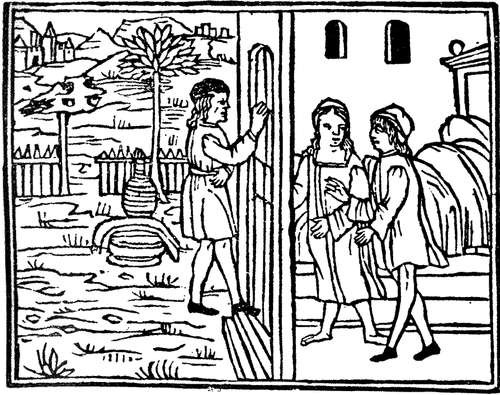
MONNA TESSA EXORCISING THE DEVIL. (DEC. VII, 1)
A woodcut from the "Decameron." (Venice, 1525.)
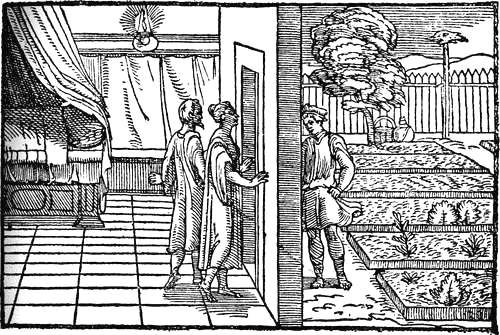
MONNA TESSA EXORCISING THE DEVIL. (DEC. VII, 1)
Appeared in Sansovino's "Le Cento Novelle." (Venice, 1571.) (By the courtesy of Messrs. J. & J. Leighton.)
"Oh, ye blind souls," he writes there,[445] "oh ye clouded intellects, oh, ye vain purposes of so many mortals, how counter to your intentions in full many a thing are the results that follow;—and for the most part not without reason! What man would take another who felt excessive heat in the sweet air of Italy to the burning sands of Lybia to cool himself, or from the Isle of Cyprus to the eternal shades of the Rhodopæan mountains to find warmth? What physician would set about expelling acute fever by means of fire, or a chill in the marrow of the bones with ice or with snow? Of a surety not one; unless it be he who shall think to mitigate the tribulations of love by giving one a bride. They who look to accomplish this thing know not the nature of love, nor how it maketh every other passion feed its own. In vain are succours or counsels brought up against its might, if it have taken firm root in the heart of him who long hath loved. Even as in the beginning every feeblest resistance is of avail, so when it hath gathered head, even the stoutest are wont many times to turn to hurt. But returning to our matter, and conceding for the moment that there may (so far as that goes) be things which have the power to make men forget the pains of love, what hath he done who to draw out of one grievous thought hath plunged me into a thousand greater and more grievous? Verily naught else save by addition of that ill which he hath wrought me, to bring me into a longing for return into that from which he hath drawn me. And this we see come to pass to the most of those who in their blindness marry that they may escape from sorrows, or are induced to marry by others who would draw them hence; nor do they perceive that they have issued out of one tangle into a thousand, until the event brings experience, but without power to turn back howsoever they repent. His relatives and friends gave Dante a wife that his tears for Beatrice might have an end; but I know not whether for this (though the tears passed away, or rather perhaps had already passed) the amorous flame departed; yet I do not think it. But even granted that it were quenched, many fresh burdens, yet more grievous, might take its place. He had been wont, keeping vigil at his sacred studies, to discourse whensoever he would with emperors, with kings, with all other most exalted princes, to dispute with philosophers, to delight himself with most pleasing poets and giving heed to the anguish of others to mitigate his own.[446] Now he may be with these only so much as his new lady chooses; and what seasons it is her will shall be withdrawn from so illustrious companionship, he must bestow on female chatter, which, if he will not increase his woes, he must not only endure but must extol. He who was wont, when weary of the vulgar herd, to withdraw into some solitary place, and there consider in his speculations what spirit moveth the heaven, whence cometh life to the animals that are on earth, what are the causes of things; or to rehearse some rare invention, compose some poem which shall make him though dead yet live by fame amongst the folk that are to come; must now not only leave these sweet contemplations as often as the whim seizes his new lady, but must submit to company that ill sorts with such like things. He, who was wont to laugh, to weep, to sing, to sigh, at his will, as sweet or bitter emotions pierced him, now dares it not; for he must needs render an account to his lady, not only of greater affairs, but of every little sigh, explaining what started it, whence it came, and whither it tended; for she takes gladness as evidence of love for another, and sadness as hatred of herself.
"Oh weariness beyond conception of having to live and hold intercourse, and finally grow old and die with so suspicious an animal! I choose not to say aught of the new and most grievous cares which they who are not used to them must bear, and especially in our city; I mean how to provide for clothes, ornaments, and rooms crammed with superfluities that women make themselves believe are a support to an elegant existence; how to provide for man and maid servants, nurses and chambermaids ... I speak not of these ... but rather come to certain things from which there is no escape.
"Who doubts that judgment will be passed by the general whether his wife be fair or no? And if she be reputed fair, who doubts but she will straightway have a crowd of lovers who will most pertinaciously besiege her unstable mind, one with his good works and one with his noble birth and one with marvellous flattery and one with gifts and one with pleasant ways? And that which many desire shall scarce be defended against every one; and women's chastity need only once be overtaken to make them infamous and their husbands miserable in perpetuity. But if, by misfortune of him who brings her home, she be foul to look upon—well, it is plain to see that even of the fairest women men often and quickly grow weary, and what are we then to think of the others, save that not only they themselves, but every place which they are like to be found of them who must have them for ever with them, will be detested? And hence springs up their wrath; nor is there any wild beast more cruel than an angry woman—no, nor so much. Nor may any man live in safety of his life who hath committed him to any woman who thinketh she hath good cause to be in wrath against him. And they all think it.
"What shall I say of their ways? Would I show how greatly they all run counter to the peace and repose of men, I must draw out my discourse to an all too long harangue; and therefore let me be content to speak of one common to almost all. They imagine that any sorriest menial can keep his place in the house by behaving well, but will be cast out for the contrary. Wherefore they hold that if they themselves behave well theirs is no better than a servile lot; for they only feel that they are ladies when they do ill, but come not to the evil end that servants would.
"Why should I go on pointing out that which all the world knows? I judge it better to hold my tongue, than by my speech to give offence to lovely woman. Who doth not know that trial is first made by him who should buy ere he take to himself any other thing save only his wife—lest she should displease him or ever he have her home? Whoso taketh her must needs have her not such as he would choose, but such as fortune yieldeth her to him. And if these things above be true (as he knoweth who hath tried) we may think what woes those chambers hide, which from outside to whoso hath not eyes whose keenness can pierce through walls, are reputed places of delight.
"Assuredly I do not affirm that these things chanced to Dante; for I do not know it: though true it is that (whether such like things or others were the cause) when once he had parted from her (who had been given him as a consolation in his sufferings!) never would he go where she was, nor suffered he her to come where he was, albeit he was the father of several children by her. But let not any suppose that from the things said above I would conclude that men ought not to take to themselves wives. Contrariwise, I much commend it; but not for every one. Let philosophers leave marrying to wealthy fools, to noblemen and peasants; and let them take their delight with philosophy, who is a far better bride than any other."
Such then was Boccaccio's mood, "his state of soul" in the years between 1354 and 1357. Well might Petrarch discern in him "a troubled spirit": "from many letters of yours," he writes from Milan on December 20, 1355, "I have extracted one thing, that you have a troubled spirit."
CHAPTER XIII
1357-1363
LEON PILATUS AND THE TRANSLATION OF HOMER—
THE CONVERSION OF BOCCACCIO
That a profound change had already taken place in Boccaccio's point of view, in his attitude towards life, in his whole moral consciousness, it might seem impossible to doubt after reading the Corbaccio and the Vita di Dante; but though its full significance only became apparent some years after the publication of those works, the curious psychologist may perhaps find signs of it before the year 1355. For while that change was on the one hand the inevitable consequence of his youth and early manhood, a development from causes that had always been hidden in his soul, it was also a result, as it was a sign, of his age, of his passing from youth to middle age, and it declares itself with the first grey hairs, the first sign of failing powers and loss of activity, in a sort of disillusion and pessimism. From this time his life was to be a kind of looking backward, with a wild regret for the mistakes and wasted opportunities then perhaps for the first time horribly visible.
Yes, a part at least of that bitterness, scorn, and anger against woman might seem to be but the approach of old age. But side by side with that moral and spiritual revolution that by no means reached its crisis in 1355, we may see an intellectual change not less profound, that in its own way too is also a "looking backward." His creative powers were paralysed. The Corbaccio is the last original or "creative" work that he achieved; henceforth his life was to be devoted to scholarship and to criticism, and however eager we may be to acknowledge the debt we owe him for his labours in those fields, we cannot but admit that they are a sign of failing power, of a lost grip on life, on reality; and though we can hardly have hoped for another Decameron, we are forced to allow that the energy which created the one we have was of quite another and a higher sort than that which produced the works of learning which fill the last twenty years of his life.
When Petrarch first met Boccaccio, as we have seen, it was not so much of Italian letters as of antiquity that they spoke; and ever after we find that the elder poet brings the conversation back to that, to him the most important of subjects, when Boccaccio, with his keener sense of life and greater vitality, would have involved him in political discussion, or persuaded him to consider such aspects of the life of his own time as are to be found, for instance, so plentifully in the Decameron. Seeing the way Petrarch was determined to follow, venerating him as his master and leader, always ready to give him the first place, it is not surprising that Boccaccio interested himself more and more in what so engrossed his friend. In 1354 Petrarch thanks him[447] for an anthology from the works of Cicero and Varro that he had composed and given him, and in the same year he thanks him again for S. Augustine's Commentary on the Psalms.
Long before he met Boccaccio in Florence in 1350, however, Petrarch had begun the study of Greek in Avignon in 1342 under the Basilian monk Barlaam,[448] whom he had met there in 1339.
According to Boccaccio, Barlaam was a man of small stature but of prodigious learning, the Abbot of the monastery of S. Gregory, a bitter theological disputant with many enemies, but in high favour at the court of Constantinople, whence the Emperor Andronicus had sent him to Avignon ostensibly on a mission for the reunion of the Churches, but really to ask for the assistance of the West in the struggle with the Turks. Barlaam was in fact a Calabrian, but most of his life had been spent in Salonica and Constantinople. He knew Greek; that was his value in Petrarch's eyes, and he seems to have read with the poet certain dialogues of Plato.[449] In 1342, however, Barlaam become Bishop of Gerace,[450] and Petrarch lost him before his greatest desire had begun to be satisfied, to wit, the translation of Homer, which, with the Middle Age, he only knew in the mediocre abridgment Ilias Latina, the weakness of which he recognised.[451] Eleven years later, in 1353, however, Petrarch met in Avignon Nicolas Sigeros, another ambassador of the Emperor of Constantinople, come on a similar mission to Barlaam's. They spoke together of Homer, and in the following year when Sigeros was departed, he sent Petrarch as a gift the Greek text of the Iliad and the Odyssey. This the poet received with an enthusiastic letter of thanks, at the same time confessing his insufficiency as a Hellenist.[452]
Now in the winter of 1358-9, during a sojourn at Padua, there was introduced to Petrarch by one of his friends a certain Leon Pilatus, who gave himself out for a Greek; and the poet seized the opportunity to get a translation of a part of his MS. of Homer.[453] In the spring, however, he went to Milan, and it was there, on March 16, 1359, that Boccaccio visited him, finding him in his garden "in orto Sanctæ Valeriæ Mediolani."[454]
That visit, from one point of view so consoling for Boccaccio, must have cost him a pang; for he had, as we have seen, always blamed Petrarch for accepting the hospitality of the Visconti, those enemies of his country. But he had not allowed the fact that Petrarch had disregarded his protests to interfere with their friendship. Keen patriot as he always remained, Boccaccio, without in any way changing his opinion, accepted Petrarch's strange conduct, his indifference to nationalism, with a modesty as charming as it is rare, and allowing himself to take up the attitude of a disciple, made a pilgrimage to the city he hated for the sake of the friend he loved; and cost what it may have done, that visit, long planned we gather, must have been full of refreshment for Boccaccio. We see them in that quiet garden in Visconti's city planting a laurel, a favourite amusement of Petrarch's, for it reminded him alike of Laura and of his coronation as poet;[455] and, "as the pleasant days slipped by," talking of poetry, of learning, above all of Greek and of that Leon Pilatus recently come into Italy, whom Petrarch had met in Padua.
It is probable that Boccaccio met this man in Milan before he returned to Florence;[456] it is certain that Petrarch spoke to him of Pilatus, and that Boccaccio asked him to visit him. That invitation was accepted, and before the end of the year we see Pilatus established in Florence.
This man who makes such a bizarre figure in Boccaccio's life seems to have belonged to that numerous race of adventurers half Greek, half Calabrian, needy, unscrupulous, casual, and avaricious, who ceaselessly wandered about Europe in the fourteenth and fifteenth centuries seeking fortune. It might seem strange that such an one should play the part of a teacher and professor, but he certainly was not particular, and Petrarch and Boccaccio were compelled to put up with what they could get. Pilatus, however, seems to have wearied and disgusted Petrarch; it was Boccaccio, more gentle and more heroic, who devoted himself to him for the sake of learning. Having persuaded Pilatus to follow him to Florence, he caused a Chair of Greek to be given to him in the university, and for almost four years imposed upon himself the society of this disagreeable barbarian. For as it seems he was nothing else; his one claim on the attention of Petrarch and Boccaccio being that he could, or said he could, speak Greek.
We know very little about him. He boasted that he was born in Thessaly, but later owned that he was a Calabrian.[457] His appearance, according to Boccaccio [458] and Petrarch,[459] had something
repellent
about it. His crabbed countenance was covered with bristles of black hair, an untrimmed beard completing the effect; and his ragged mantle only half covered his dirty person. Nor were his manners more refined than his physique; while his character seems to have been particularly disagreeable, sombre, capricious, and surly. Petrarch confesses that he had given up trying to civilise this rustic, this "magna bellua."[460]Such was Leon Pilatus; but for the love of Greek Boccaccio pardoned everything, and he and two or three friends, the only persons in Florence indeed able to do so, followed the lectures[461] of this improvised professor. But it was above all in admitting this creature to his own home that Boccaccio appears most heroic. There he submitted him to long interviews and interminable séances in order that he might accomplish the great task of a complete translation of Homer.
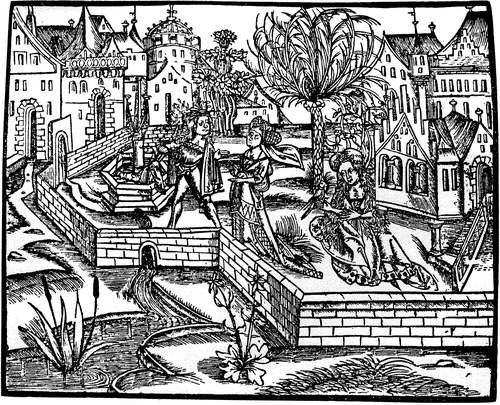
A WOODCUT FROM THE "DECAMERON." (STRASBURG, 1553)
(By the courtesy of Messrs. J. & J. Leighton.)
Afar off Petrarch associated himself with this work and tried to direct it with wise counsels that Leon Pilatus was doubtless too little of a scholar to understand and too ignorant to follow blindly. In fact but for Petrarch, as the following letter proves, they would have lacked the text itself:—
"You ask me," he writes in 1360,[462] "to lend you, if as you think I have bought it, the book of Homer that was for sale at Padua, in order that our friend Leon may translate it from Greek into Latin for you and for our other studious compatriots, for you say I have long since had another example. I have seen this book, but I have neglected it, because it appeared to me inferior to my own. One could easily get it, however, through the person who procured me the friendship of Leon; a letter of his would be all-powerful and I will write him myself. If by chance this book escapes us, which I do not believe, I will lend you mine. For I have always been desirous of this translation in particular and of Greek literature in general, and if Fortune had not been envious of my beginnings in the miserable death of my excellent master (? Barlaam), I should perhaps have to-day something more of Greek than the alphabet.
"I applaud, then, with all my heart and strength your enterprise.... I am sorry to see so much solicitude for the bad and so much negligence of the good. But what would you? One must resign oneself to it....
"I hope also here and now to prevent you in one thing, so as not to repent myself later for having passed it by in silence. You say that the translation will be word for word. Hear how on this point S. Jerome expresses himself in the preface to the book De Temporibus of Eusebius of
Cæsarea
that he translated into Latin. It pleases me to send you the very words of one so learned in both tongues and in many others, and especially in the art of translation. 'Let him who says that in translation one does not lose the grace of the original try to translate Homer literally into Latin, and into any tongue which he has, and he will see how ridiculous is the order of the words and how the most eloquent of poets is made tostammer like a child.' I tell you this for your advice whilst there is yet time, so that such a great work may not be useless."For myself I desire only that the thing be well done.... In truth the portion I have which the same Leon translated for me into Latin prose—the beginning of Homer—has given me a foretaste of the complete work.... It contains indeed a secret charm.... Go on then with the aid of Heaven; give us back Homer who was lost to us....
"In asking me at the same time for the volume of Plato that I have with me and that escaped the fire in my house across the Alps, you give me a proof of your ardour, and I will hold this book at your disposition when you want it. I will second with all my power such noble enterprises. But take care that the union of these two great Princes of Greece be not unseemly, and that the weight of these two geniuses does not crush the shoulders of mortals.... And remember that the one wrote many centuries before the other. Good-bye. Milan, 18 August (1360)."[463]
From that letter we may gather how eagerly Boccaccio had turned to this new labour. Was it in order to escape from himself? Certainly it might seem that in his new enthusiasm he found for a time, at any rate, a certain consolation; but the crisis was not long delayed. In those long months while the wretched Pilatus was with him, however, he was able for a time to ward off the danger; and realising this, the comedy of that friendship is almost pathetic.
We seem to see him eagerly drinking in the words that fell from the surly Calabrian, pressing him with questions, taking note of all and trying to understand everything—even what his master himself could not understand. As for the master, flattered and puffed up by the confidence that Boccaccio seems to have felt in him, he no doubt replied to all his questionings in the tone of a man who knew perfectly what he was talking about, and had nothing to fear or to hide. Sometimes, no doubt, the adventurer showed itself. Weary and bored by the incessant work, his sullen humour exasperated by the sedentary life, Pilatus would demand his liberty. Then Boccaccio would have to arm himself with all his patience, and by sweetness and gentleness and good-humour would at last persuade the wretched man to remain a little longer with him.
Suddenly in the midst of this difficult work with Pilatus his trouble descended upon him, with a supernatural force as he thought. He received a message from a dying saint—a message that warned him of his approaching end and certain damnation unless he should repent. When exactly this message reached him we do not know. It may well have been in the end of 1361, but it was more probably in the first months of 1362. He was in any case in no fit state to meet the blow.
In those days when political crises followed hard on one another, and the very aspect of a city might change in the course of a few years, Boccaccio's youth must then have seemed infinitely far away. His Corbaccio had been written "to open the eyes of the young" to the horror of woman. While in very many ways he is the pioneer of the Renaissance, in his heart there lingered yet something, if only a shadow, of the fear of joy. All his joys had been adventures on which he scarcely dared to enter, and while he was never a puritan, as one sometimes thinks Petrarch may have been, he was so perfectly of his own time as to "repent him of his past life." For a nature like that of Boccaccio was capable only of enthusiasm. He had loved Fiammetta to distraction, and those who only see there a lust of the flesh have never understood Boccaccio. His other loves were what you will, what they always are and must be; but when Fiammetta died, the very centre of his world was shaken.[464] He could not follow her through Hell and Purgatory into the meadows of Paradise as Dante had followed Beatrice: he was of the modern world. For Dante, earth, heaven, purgatory, and hell were but chambers in the universe of God. For Boccaccio there remained just the world.
Having the religious sense, he accused himself of sin as St. Paul had done, as St. John of the Cross was to do, with an astonishing eccentricity, an exaggeration which lost sight of the truth, in a profound self-humiliation. Of such is the lust of the spirit. He too had found it difficult "to keep in the right way amid the temptations of the world." And then, suddenly it seems, on the threshold of old age, poor and alone, he thought to love God with the same enthusiasm with which he had loved woman. He was not capable of it; his whole life rose up to deny him this impassioned consolation, and his "spirit was troubled," as the wise and steadfast eyes of Petrarch had seen.
It was in the midst of this disease, to escape from which, as we may think, he had so eagerly thrown himself into the translation of Homer with Pilatus, that a certain Gioacchino Ciani sought him out to warn him, as he intended to warn Petrarch, of the nearness of death. In doing this the monk, for he was a Carthusian, was but obeying the dying commands of the Beato Pietro Petroni,[465] a Sienese who had seen on his death-bed "the present, the past, and the future." Already drawn towards a new life—a life which under the direction of the Church he was told would be without the consolations of literature—at the sudden intervention, as it seemed, of Heaven, Boccaccio did the wisest thing of his whole life—he asked for the advice of Petrarch.
The letter which Petrarch wrote him takes its rank among the noblest of his writings, and is indeed one of the most beautiful letters ever written.
"Your letter," he says—"Your letter, my brother, has filled me with an extraordinary trouble. In reading it I became the prey of a great astonishment, and also of a great chagrin: after reading it both the one and the other have disappeared. How could I read without weeping the story of your tears and of your approaching death, being totally ignorant of the facts and only paying attention to the words? But at last when I had turned and fixed my thoughts on the thing itself, the state of my soul changed altogether, and both astonishment and chagrin fled away....
"You tell me that this holy man had a vision of our Lord, and so was able to discern all truth—a great sight for mortal eyes to see. Great indeed, I agree with you, if genuine; but how often have we not known this tale of a vision made a cloak for an imposture? And having visited you, this messenger proposed, I understand, to go to Naples, thence to Gaul and Britain, and so to me. Well, when he comes I will examine him closely; his looks, his demeanour, his behaviour under questioning, and so forth, shall help me to judge of his truthfulness. And the holy man on his death-bed saw us two and a few others to whom he had a secret message, which he charged this visitor of yours to give us; so, if I understand you rightly, runs the story. Well, the message to you is twofold: you have not long to live, and you must give up poetry. Hence your trouble, which I made my own while reading your letter, but which I put away from me on thinking it over, as you will do also; for if you will only give heed to me, or rather to your own natural good sense, you will see that you have been distressing yourself about a thing that should have pleased you. Now if this message is really from the Lord, it must be pure truth. But is it from the Lord? Or has its real author used the Lord's name to give weight to his own saying? I grant you the frequency of death-bed prophecies; the histories of Greece and Rome are full of instances; but even though we allow that these old stories and your monitor's present tale are all true, still what is there to distress you so terribly? What is there new in all this? You knew without his telling you that you could not have a very long space of life before you. And is not our life here labour and sorrow, and is it not its chief merit that it is the road to a better?... Ah! but you have come to old age, says your monitor. Death cannot be far off. Look to your soul. Well, I grant you that scholarship may be an unreasonable and even bitter pursuit for the old, if they take it up then for the first time; but if you and your scholarship have grown old together, 'tis the pleasantest of comforts. Forsake the Muses, says he: many things that may grace a lad are a disgrace to an old man; wit and the senses fail you. Nay, I answer, when he bids you pluck sin from your heart, he speaks well and prudently. But why forsake learning, in which you are no novice but an expert, able to discern what to choose and what to refuse?... All history is full of examples of good men who have loved learning, and though many unlettered men have attained to holiness, no man was ever debarred from holiness by letters.... But if in spite of all this you persist in your intention, and if you must needs throw away not only your learning, but the poor instruments of it, then I thank you for giving me the refusal of your books. I will buy your library, if it must be sold, for I would not that the books of so great a man should be dispersed abroad and hawked about by unworthy hands. I will buy it and unite it with my own; then some day this mood of yours will pass, some day you will come back to your old devotion. Then you shall make your home with me, you will find your books side by side with mine, which are equally yours. Thenceforth we shall share a common life and a common library, and when the survivor of us is dead, the books shall go to some place where they will be kept together and dutifully tended, in perpetual memory of us who owned them."[466]
That noble letter, so sane in its piety, in some sort cured Boccaccio. We hear no more of the fanatic monk, and the books were never bought, for they were never sold. Petrarch, however, did not forget his friend. He caused the office of Apostolic Secretary to be offered him, and that Boccaccio had the strength and independence to refuse the sinecure assures us of his restored sanity.
But we may well ask ourselves what had brought Boccaccio to such a pass that he was at the mercy of such infernal humbugs and liars as the Blessed Pietro and his rascal friend. That he was in a wretched state of mind and soul we know, and the causes we know too in part, but they by no means account for the fact that the first enemy of monks and friars and all their blackguardism should have fallen so easily into their hands. Was Boccaccio superstitious? That he was less superstitious, less credulous, than the men of his time generally is certain; that he was content to believe what Petrarch attacked and laughed at we shall presently see; but that he can be properly accused of superstition remains doubtful. Certainly he believed in dreams;[467] he believed in astrology;[468] he believed that a strabism or squint was an indication of an evil soul;[469] he believed in visible devils;[470] he believed that Æneas truly descended into Hades and that Virgil was a magician.[471] He may well have believed all such things and have been no worse off than many a Prince of the Church to-day; at any rate, such beliefs, unreasonable as they may appear to us, cannot have led him to the incredible folly of believing in the Blessed Pietro and his messenger.
It might seem inexplicable that he who had exposed the lies and tricks of the monks so often should have been himself so easily deceived. Had he not exposed them? There was Fra Cipolla—true he was a friar—part of whose stock-in-trade was a tale of relics—"the finger of the Holy Ghost as whole and entire as ever it was, the tuft of the seraph that appeared to S. Francis and one of the nails of the cherubim, one of the ribs of the Verbum caro fatti alle finestre (factum est) and some of the vestment of the Holy Catholic Faith, some of the rays of the star that appeared to the Magi, a phial of the sweat of S. Michael abattling with the Devil, the jaws of death of S. Lazarus, and other relics."[472]
It might seem inexplicable! Unfortunately, however, Boccaccio also believed that those about to die can participate in the spirit of prophecy.[473] Thus he was for the moment, at any rate, altogether at the mercy of the Blessed Pietro. The splendid common-sense, the caustic wit of Petrarch helped him, it is true, to recover himself, but that bitter and humiliating experience left a permanent mark upon him. He was a changed man. With an immense regret he looked back on his life, and would have destroyed if he could the gay works of his youth, even the Decameron, and, for a time at least, he would have been content to sacrifice everything, not only his poetry in the vulgar and his romances and stories, but the new learning itself, the study of antiquity, and to enter into some monastery.
That he did not do so we owe in part at least to Petrarch. For when he had read his letter and come to himself, he returned to Pilatus and the translation of Homer.[474]
That translation was scarcely finished when Pilatus wished to be gone, and he seems in fact to have accompanied Boccaccio to Venice on his visit to Petrarch probably in May, 1363.[475] That visit was a kind of flight; he seems to have taken refuge with Petrarch from the fears of his own heart, and that it was as full of pleasure and enjoyment for Petrarch, as of consolation for Boccaccio, happily we know and can assert.
"I have always thought," Petrarch writes to him after his return to Tuscany,[476] "I have always thought that your presence would give me pleasure, I knew it would, and I felt that it would please you too. What I did not know, however, was that it would bring good fortune. For during the very few months, gone so quickly, that you have cared to dwell with me in this house that I call mine, and which is yours, it seems to me, in truth, that I have contracted a truce with fortune who, while you were here, dared not spoil my happiness...."
We know nothing more of that visit save that Boccaccio must have returned to Tuscany before the writing of that letter, before the 7th of September then. As for Pilatus, he too left Venice "at the end of the summer"[477] to return to Constantinople, "cursing Italy and the Latin name," as Petrarch says. "One would have thought him scarcely arrived there," Petrarch continues, "when I received a badly written and very long letter, more untidy than his beard or his hair, in which among other things he said he loved and longed for Italy as for some heavenly country, that he hated Greece which he had loved and execrated Byzantium which he had praised, and he supplicated me to send for him back as eagerly as Peter, about to be shipwrecked, prayed Christ to still the waves."
To make a long story short, Petrarch ignored his petition. This, however, did not stop Pilatus. He embarked for Italy, but a storm wrecked the ship in which he sailed in the Adriatic, and though he was not drowned he was struck and killed by lightning. Petrarch wonders if amid his "wretched baggage, which, thanks to the honesty of the sailors, is in safety, I shall find the Euripides, Sophocles, and other manuscripts which he had promised to procure for me."[478] The two friends mourned him sincerely, forgetting their disgust in remembering that Pilatus had known Greek, and finding touching words to deplore the tragic death of the first translator of Homer.
[435] Conclusion to Day IV.
[436] Day II, Nov. 10.
[437] Closing words of Day II, Nov. 7.
[438] Day II, Nov. 10.
[439] Day II, Nov. 9.
[440] That mere fact should enlighten us, for we may well believe such a subject of "jovial discourse" impossible to-day.
[441] Cf. Prologue to the Fourth Day: "Know then, my discreet ladies, that some there are who reading these little stories have alleged that I am too fond of you, and that 'tis not a seemly thing that I should take so much pleasure in ministering to your gratification and solace; and some have found fault with me for praising you as I do."
[442] See the interesting study of the Corbaccio by Hauvette in Bulletin Italien (Bordeaux, 1901), Vol. I, No. I. Boccaccio says in the Corbaccio: "E primieramente la tua età, per la quale, se le tempie già bianche e la canuta barba non m' ingannano, tu dovresti avere li costumi del mondo, fuor delle fasce già sono degli anni quaranta e già venticinque, cominciatili a conoscere" (Ed. Moutier, 183). Hauvette interprets this: "Grown out of swaddling clothes as you are these forty years, you have known the world for twenty-five...." The majority of critics agree that the Corbaccio was written ca. 1355, in which year Boccaccio was forty-two years old. Twenty-five years before brings us to 1330, or almost to the dates on which he (1) deserted trade, and (2) first saw Fiammetta. But in another place in the same book he suggests that the book was written when the new year was about to begin: "l' anno ... è tosto per entrar nuovo," so that we may refer this unfortunate contretemps, and the writing of the Corbaccio in consequence, to December, 1355, i.e. February, 1356, new style, which brings us almost exactly to March, 1331, the day of the meeting with Fiammetta.
[443] The sources of this amazing and amusing book are not far to seek. In the Divine Comedy it had been love which had let Dante out of the selva oscura; here the selva oscura is love and it is reason or experience who delivers Boccaccio. Another source, as Pinelli, Corbaccio in Propugnatore, XVI (Bologna, 1883), pp. 169-92, has shown, is found in Giovenale. "L' imitazione," says Pinelli, "del Boccaccio non è pedestre, ma artifiziosa come quella che cogliendo sempre il solo punto capitale del pensiero, e trascurando la particolarità meno interessanti, aggiunge di suo tante inestimabili bellezze da rendere l' opera originale."
[444] We shall consider the Vita di Dante later when we discuss Boccaccio's whole relation to Dante. It is necessary perhaps to decide here so far as we can the date at which it was written. Baldelli (op. cit., pp. 378-9) tells us that Buonmattei was of opinion that Boccaccio wrote the Vita di Dante while he was still young. But Baldelli assures us that it must have been written after the Ameto and before the Decameron, as its style is more pure and formed than the one and less so than the other. The Decameron first saw the light in 1353; and so Baldelli tells us the Vita was written in 1351. On such a question no foreigner has a right to an opinion. But if I may break my own rule, I shall say that I find myself in agreement with (among others) Antona Traversi, in his translation of Landau's life of Boccaccio (Giovanni Boccaccio sua vita, etc. (Naples, 1882), p. 786, n. 3), when he says that no really satisfactory conclusion can be arrived at on the evidence of a prose style alone; for nothing is more fluid or more subject to mood, and nothing, we might add, is more difficult to judge. Foscolo, with whom Carducci finds himself in agreement, tells us that "Fra quante opere abbiamo del Boccaccio la più luminosa di stile e di pensieri a me pare la Vita di Dante. Cf. Foscolo, Discorso storico sul testo del Decameron (Lugano, 1828), p. 94. But we need not admit so much to refute Baldelli. If the Decameron was published in 1353, it was certainly begun some years, four or five at least, before that. It is generally supposed, and with much reason, to have been begun in 1348-9. But Baldelli gives the Vita to 1351. It follows then that the work less pure in style than the Decameron was written two years after the Decameron was begun. If we accept Baldelli's evidence we must conclude that the Vita was written before 1348.
[445] I use the translation of Mr. P. H. Wicksteed, The Early Lives of Dante (Chatto and Windus, 1907).
[446] Cf. Machiavelli, Lettere, Lettera di Dec. 10.
[447] Petrarch, Fam., XVIII, 3 and 4.
[448] But see Lo Parco, Petrarca e Barlaam da nuove ricerche e documenti inediti e rari (Reggio, Calabria, 1905).
[449] See De Nohlac, Les Scholies inédites de Pétrarque sur Homère in Revue de Philologie, de Littérature et d'Histoire anciennes, Vol. XI (Paris, 1887), p. 97 et seq.; and Idem, Pétrarque e Barlaam in Revue des Études grecques (Paris, 1892).
[450] Petrarch, Fam., XVIII (Fracassetti, 2nd ed., Vol. II, p. 474).
[451] He says of it: "Libellus, ille vulgo qui tuus fertur, et si cuius sit non constet, tibi excerptus tibique inscriptus tuus utique non est."—Fam., XXIV, 12 (Fracassetti, Vol. III, p. 293). Cf. also Fam., X (Fracassetti, Vol. II, p. 89), and the critical edition of F. Plessis, Italici Ilias Latina (Paris 1885).
[452] Fam., XVIII, 2.
[453] See the letter to Boccaccio, to be quoted later. Var., XXV.
[454] Cf. Petrarch, Fam., XX, 6, 7 (To Francesco Nelli, III, Id. Ap.). This visit of Boccaccio's to Petrarch has been long known to have taken place in the spring of 1359; but the date is fixed for us by a MS. in Petrarch's hand found by De Nohlac in his Apuleius (Vatican MS. 2193, fol. 156). Cf. De Nohlac, Pétrarque et son jardin in Giornale Storico della Letteratura Italiana, Vol. XI (1887), p. 404 et seq. I give below that part of the MS. which refers to 1359:—
[455] In planting the laurel Petrarch expressed the hope that the presence of Boccaccio might prove "fortunate" to "these little sacred laurels." Boccaccio had protested to Petrarch that he was not worthy of the name of poet. Petrarch insisted that he was. "It is a strange thing," he says, "that you should have aimed at being a poet only to shrink from the name." This affair of the laurel may refer to that incident. "The laurel," says Boccaccio in the Vita di Dante, "which is never struck by lightning, crowns poets...."
[456] He was back in Florence certainly by May. Cf. Hortis, Studi, etc., p. 22 note. Petrarch in his letter to Nelli says that Boccaccio's visit was brief.
[457] Petrarch, Epist. Sen., III, 6, and V, 3.
[458] Boccaccio, De Geneal. Deor., XV, 6.
[459] Epist. Sen., III, 6, and V, 3.
[460] Cf. Hauvette, Le Professeur de Grec de Pétrarque et de Boccace (Chartres, 1891).
[461] Cf. De Nohlac, Les scholies, u.s., p. 101. He began to lecture in the end of 1359.
[462] Petrarch, Var., XXV. In this year Pino de' Rossi was exiled for conspiracy against the Guelfs. Boccaccio had dedicated the Ameto to him, and now wrote to console him. In that letter (Corazzini, op. cit., p. 67) Boccaccio says he has gone to Certaldo to avoid contact with these vile people (p. 96).
[463] Petrarch, Varie, XXV.
[464] Because Boccaccio's love for Fiammetta was not a passion wholly or almost wholly spiritual, as we may suppose Dante's to have been for Beatrice, we are eager to deny it any permanence or strength. Why? Perhaps a passion almost wholly sensual if really profound is more persistent than any desire in which the mind alone is involved.
[465] Our source of information is Petrarch's letter, quoted below in the text (Ep. Sen., I, 5). The affair is recounted in the life of Beato Pietro Petroni, who died May 29, 1361, by Giovanni Columbini. This life has been conserved and enriched with notes by the Carthusian of Siena, Bartholommeo, in 1619. It is printed in the Acta Sanctorum, May 29 (Tom. VII, Antwerp, 1668, p. 186 et seq.). Boccaccio's story is told at p. 228. There seems to be nothing there not gleaned from Petrarch's letter. Cf. also Traversari, Il Beato Pietro Petroni e la conversione del B. (Teani, 1905), and Graf, Fu superstizioso il B.? in Miti, Leggende e Superstiz. del Medioevo (Torino, 1893), Vol. II, p. 167 et seq.
[466] I quote to some extent the excellent redaction of Mr. Hollway-Calthrop, Petrarch and his Times (Methuen, 1907), p. 237 et seq.
[467] De Geneal. Deorum, I, 31, De Casibus, II, 7.
[468] De Geneal. Deorum, I, 10; III, 22; IX, 4. Comento sopra Dante (Milanesi, Firenze, 1863), Vol. I, p. 480 et seq.
[469] Comento sopra Dante, ed. cit., II, p. 56; i.e. he believed in the evil eye; so did Pio Nono's cardinals.
[470] Ibid., u.s., II, p. 156.
[471] Ibid., u.s., I, p. 216.
[472] Decameron, VI, 10. I deal with Boccaccio's treatment of monks and friars and the clergy generally in my chapter on the Decameron (see infra).
[473] Comento, ed. cit., Vol. II, p. 19.
[474] Baldelli tells us that Pilatus left Boccaccio in 1362, but this is not so, for they went together to see Petrarch in Venice in 1363 (see infra). Baldelli's assertion is probably founded on the obscure and doubtful letter of Boccaccio to Francesco Nelli (Corazzini, p. 131), from which we learn that Boccaccio went to Naples on the invitation of Acciaiuoli, as we suppose, in 1362. This letter, which is very long, is dated, according to Corazzini, August 28, 1363. Now before September 7, 1363, Nelli was dead of the plague in Naples, as appears from Petrarch's letter (Sen., III, i., September 7, 1363). Hortis (Studi, p. 20, n. 3) is of opinion that this letter is apocryphal. Todeschini (Opinione sulla epistola del priore di S. Apostolo [sic] attribuita al Boccaccio, Venice, 1832) convinced Hortis of this. Todeschini does not believe in this visit to Naples, and in fact the only notice we have of it is contained in the letter he discards. His arguments are as follows. Until May, 1362, Boccaccio dwelt certainly in Tuscany, where in 1361, or more probably in 1362, Ciani visited him, and whence he wrote Petrarch the letter we have lost to which Petrarch replied in the noble letter I have cited above (Sen., I, 5) on May 28, 1362. (Cf. Fracassetti's note to this letter.) It is not possible that Boccaccio can have been in Naples between the autumn of 1361 and May, 1362, because he himself tells us that for three years he was with Pilatus, who enjoyed his hospitality and from whom he learned to understand Homer. Now it is certain that he did not know Pilatus before 1360, and was with him till 1363, when, as we shall see, they visited Petrarch together in Venice. (Cf. Fracassetti his note to Fam., XVIII, 2.)
[475] This visit must have been between March 13 and September 7, 1363, on both of which dates Petrarch wrote to him. The letter of September 7 seems to have been written immediately after his departure (Senili, II, 1, and III, 1). Cf. also De Nohlac, op. cit., p. 102. Cf. also Boccaccio's letter to Pietro di Monteforte, which Hortis, op. cit., thinks refers to this visit. Corazzini, op. cit., p. 337.
[476] Senili, III, 1.
[477] Ibid., III, 6 (March, 1365).
[478] Ibid., VI, 1.


