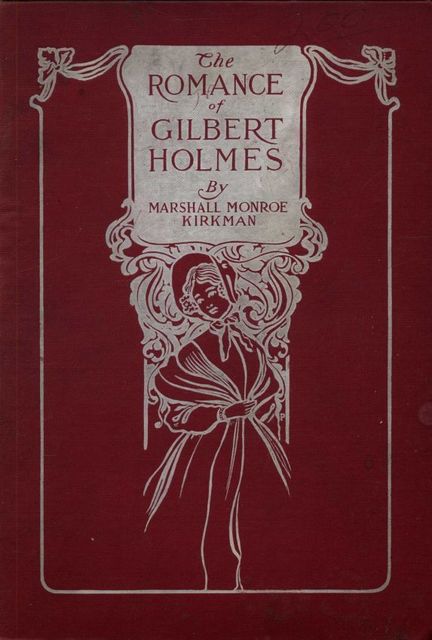



автордың кітабын онлайн тегін оқу The Romance of Gilbert Holmes
THE ROMANCE OF GILBERT HOLMES
This ebook is for the use of anyone anywhere in the United States and most other parts of the world at no cost and with almost no restrictions whatsoever. You may copy it, give it away or re-use it under the terms of the Project Gutenberg License included with this ebook or online at http://www.gutenberg.org/license. If you are not located in the United States, you'll have to check the laws of the country where you are located before using this ebook.
Title: The Romance of Gilbert Holmes Author: Marshall Monroe Kirkman Release Date: September 07, 2016 [EBook #53006] Language: English Character set encoding: UTF-8
*** START OF THIS PROJECT GUTENBERG EBOOK THE ROMANCE OF GILBERT HOLMES ***
Produced by Al Haines.
Cover art

BLACK HAWK RESCUING GILBERT'S FATHER AND MOTHER. PAGE 33
THE ROMANCE
OF
GILBERT HOLMES
AN HISTORICAL NOVEL
BY
MARSHALL MONROE KIRKMAN
AUTHOR OF "THE SCIENCE OF RAILWAYS," IN TWELVE VOLUMES, "PRIMITIVE CARRIERS," ETC., ETC.
THE WORLD RAILWAY PUBLISHING COMPANY CHICAGO NEW YORK LONDON 1900
COPYRIGHT 1900 UNITED STATES, GREAT BRITAIN, FRANCE
All rights reserved
SEVENTEENTH EDITION
DEDICATION
THE WRITING OF THIS BOOK HAVING BEEN TO ME WHOLLY A LABOR OF LOVE, I DEDICATE IT IN A LIKE SPIRIT TO MY WIFE AND CHILDREN
M. M. KIRKMAN
LARCHMERE, JULY 10, 1900
CONTENTS
CHAPTER
-
A Sweet Lady
-
Gilbert Holmes's Account Of Himself
-
The Wreck
-
Black Hawk, the Sac King
-
The Swath of the Hurricane
-
Love's Ideals
-
Gilbert's Flight
-
Gilbert's Encounter with the Timber-Wolf
-
Driftwood from the Thames Battlefield
-
An Awakening
-
The New Country
-
The Unknown Passenger
-
The Place of Refuge
-
The Highwayman
-
Constable Blott
-
Before the Little Justice
-
The Singletons
-
The Shadows of Life
-
The Duel
-
Abraham Lincoln and Jefferson Davis—the Parting of the Ways
-
What the Canteens Held
-
Rolland Love
-
Cousin Angeline
-
The Fishers
-
The Conspirators
-
Lost in the Forest
-
In the Tiger's Mouth
-
Gilbert and the Highwayman Join Forces
-
The Tragedy of Murderer's Hollow
-
The Ride for Life
-
Constance
-
Convalescence
-
The Red Rose of Cuvier River
-
Glimpse of a Summer Sea
-
Conspiracy in Black Hawk's Cabin
-
Phantoms of the Woods
-
The Prodigal
-
The Dragon's Master
-
The Depths
-
Job Throckmorton's Trial: The Tragedy
-
The Reunion
-
An Adventure
-
On Board the War Eagle
-
The Steamboat Race
-
Telling the News
-
The Americans
-
Making the Most of Things
-
The Carriers
-
The Betrothal
-
Under the Widespreading Hawthorns
-
The Mauvaise Terre
-
Life and Death
-
Where All the Roads Meet
CHAPTER I
A SWEET LADY
The crowding and haste of other days no longer stirred the great wharf at New Orleans, and steamboats did not now as then struggle for place or preferment, but lay apart, a melancholy picture of the changing fortunes of carriers and the fluctuations of our country's commerce. On the wide expanse, once piled high with goods, only scattered packages lay, and these hid away under grimy coverings, like corpses awaiting burial. About the boat I sought, the tumult of the shipping ebbed and flowed, and to one side the great city lay as if deserted, or asleep under the hot afternoon sun. Close by, and near the river's edge, a procession of convicts came on, winding in and out amid sacks of coffee and bales of cotton, sad and noiseless, as specters might have marched. On either side armed men, alert and watchful, kept pace, a part of the melancholy show. Stripes encompassed the bodies of the convicts, as serpents might loosely coil themselves; but about the guards the stripes ran up and down—to the looker-on there was no other difference. Back of this procession of doomed men and as if threatening it, a herd of mules, half wild and frantic with fear, dashed here and there seeking a way out. About them, and in guardianship, a burly negro, black as night, rode hither and thither, headlong, wheeling and circling, like a Numidian of old, stopping the rush here and cutting it off there—not hurriedly, but at the last moment, as if craving excitement and the admiration his horsemanship elicited. When it seemed to those who looked as if he had lost control over the half-crazed brutes, his fierce cry and the crack of his great whip stayed the frightened animals, and, wheeling, the headlong race began afresh. On board the vessel, room and clean beds awaited these creatures; but for the marching convicts, fortunate he who found a bale or box upon which to lay his sorrowing head. Afterward, amid the swamps of Louisiana, the animals will live, sleek and fat; but the men of sin, less fortunate, will find graves in the shadows of the moss-grown oaks, or, returning, a place in some noisy alms-house, there to eke out their lives with shrunken frames and despairing hearts! This, however, in passing, and not in any way to judge the acts of men, but that I may pick up the beginning of my story, which in no wise concerns itself with such serious things, but is a tale of love and life in the new country, and nothing more.
From the quarter-deck passengers watched the busy scene, and among them one face gentler and fairer than the others. I, glancing up, thought it the most beautiful I had ever beheld, but looking, saw it only for a moment, and this as the convicts marching past were swallowed in the body of the great vessel. An angel grieving over the lost and despairing in life could not, I thought, have looked down on the world with more compassionate pity.
Of delay in loading there was none, or if some lull occurred, the negroes, losing all care, threw down their burdens, and flinging themselves on their knees, fell to playing "craps" as children play at marbles; this vehemently and with noisy contention, snapping their fingers as the dice flew from their trembling hands, each as he threw crying some inarticulate word of menace or entreaty to the goddess of good luck. Finally, when it was an hour past the time of leaving, and the wharf was deserted save by groups of waiting negroes, the bell rang its note of warning, and I, hastening on board, glanced upward, and doing so, saw again the face of the beautiful lady, but now less sorrowing than at first.
Backing into the stream amidst the ringing of bells and the splash of the great wheel, we passed the white city with ever-increasing speed as the sun, far to the west, tipped the buildings and shipping with a golden hue. Later, and as the night closed in cool and starlit, those who watched could yet see some glimpse of the city's lights far down on the edge of the horizon; but with this passing, no place save the trio of hill-clad cities on the western shore of the Great River met our view until we reached the landing-place at Memphis.
At the time of which I write spring floods filled the deep basin of the Mississippi to overflowing, so that the mighty stream, ever dark and sinister in its lower stretches, was never more cruel or repellent. Its built-up banks, tipped with foam and fast crumbling from the overflow, offered at many points such slight resistance to the conflicting currents as they swept back and forth in the windings of the river that a breath only seemed needed to sweep them away. As if to add some stress of tragedy to the scene, armed men patrolled the western shore, warning us away with angry cries when we sought to land, lest the wash of the boat should overcome the weakened dikes, and so engulf the villages and wide plantations that lay behind.
At many points the waste of water spread unchecked as far as the eye could penetrate the tangled forest, and at other places, eating into the yielding banks, turbulent bays were formed, in which vast whirlpools circled. Into these, trees toppled and fell as the banks gave way, to be sucked down into the murky water, so that we could get no glimpse of them afterward as we watched from the boat's side. In all this, how strange a contrast! For in the far north golden sands form the bed and rocky shores the borders of the mighty stream. From whatever point one surveys the great river, however, whether north or south or midway in its course, its aspect invites reflection and romantic thoughts, for throughout its length it is ever babbling and full of mystery and change, having a story to tell, had it the time; but evasive, as if in play, it hurries on with ripple of expectancy, beneath the shadows of overhanging trees and amid projecting roots and grasses, glowing with reflected light, to its final ending in the great gulf.
How like, one sees, is it to the lives of men and their affairs. Springing up in obscurity amid limpid springs in tranquil depths, far off, feeble and uncertain of course, it gains strength, like childhood, pushing on through opening vistas and enlivening prospects to its full estate. Thence, faster and faster, to where the waters grow dark and yellow and uncertain of temper, but still onward to the end, where, amid somber shadows and pendent reeds, in the ooze of the slimy earth, its waters are lost in the wide expanse, as men are swallowed up in eternity. Of its tragedies of men and women that have come and gone leaving no trace, who shall tell! Of that race, too, which on its silent shores in ages long gone by came into life, was nurtured, lived, grew old, and was lost, as if it had not been, we know nothing, nor ever will. Nor of that later people, whose warriors for uncounted centuries disturbed the solitude with their fierce cries or quenched their death-rattle in the depths of its silent waters. Here, amidst bordering forests and far-reaching plains, they passed their savage life as Nature formed them, chanting amid circling bays and quiet dells their plaintive love-songs, or listening to the requiem of the rustling leaves and murmuring waters when death at last confronted them. They, too, have gone, following as in a procession of stricken men, leaving no trace as we come on, doomed as they were. For as others have gone, we shall go, and in the end as in the beginning, the valleys of the great river will echo no sound save the ripple of its waters and the moan of the wind in the trees as in primeval days.
Along our course the great river plowed its unobstructed way through rich alluvial lands, bordered with forests and far-reaching plantations. On the edges of these last, hamlets clustered, and about them children played, while men and women watched the angry waters with bated breath. At spots far apart, landing-places were marked by lonesome cabins, and here, in the water-soaked bank, our boat poked its nose, and was held as in a vise by the soft receptive clay. At other places, warned away, we anchored at a distance, transferring our load to smaller crafts, or passed on to await a more favorable hour. Of danger there was none, or if at night the timid held their breath when the sharp sound of the bell caused the great wheel to stop as if stricken with death, they breathed more freely when the obstruction, crashing against the bottom of the boat, passed on and we were safe. Or if at times the tumbling waters and swift converging currents threatened us, the watchful pilots steered us clear, and we saw the danger from afar, and so paid little heed. Thus waiting, some read or slept or played, while others watched the sea-gulls as they flew back and forth across the foam of the flying wheel, searching for particles of food as sharks are said to do at sea.
Not meeting with accident of any kind, the more companionable among the passengers soon set themselves to form the acquaintance of those about them, and in this way, and happily, I was brought in contact with Gilbert Holmes. More fortunate still, I thought, he proved to be the companion of the beautiful lady I had seen looking down in pity on the marching convicts as I came on board. Strangely enough—but not strangely either, for such things are often noticed—he resembled her as men may resemble women. Not much alike, but as they will, without knowing it, take on some part of the features or gentle sweetness of these dear companions of their lives. Mr. Holmes was reaching on to old age, but youthful in face and erect of form and buoyant as if still in the vigor of manhood. Running through his slow speech and mirrored in the mild complaisance of his eyes there were ever present the melodies of the past, the remembrance of what had been. This as we often see in men of affairs who have mixed much in the world's strife, but are no longer concerned in its turmoil or ambitious ends. In his look and speech there was, however, still a pleasant note of interest, as if life had not tired him, nor his concern in its affairs been dulled by usage or infirmity of temper; but while he listened to what was said or took note of what went on about him, it was plain to every one that he lived only in the presence and reflection of his loving wife. She, on her part, it was also clear, had little thought of anything but her husband, her eyes following him with tender concern, as if in him all her life's interests were centered.
The great affection these two bore each other was soon discerned by every one, and at once elicited that kind and inquisitive interest which men and women are said ever to feel for those who truly love. Of her age I could form no idea, for life had left no trace of care on her beautiful face, and her eyes still showed in their placid depths the luster of youth and the tranquil calm of a loving and trustful heart. Her mouth, soft in outline and of engaging sweetness, ever led me to speculate anew as to which is the more attractive, the eyes or the mouth of women; but this, I know, others have puzzled over before me, and will to the end of time. Her soft speech and gentle manners quickly made every one her slave, the officers of the boat not less than others; and though harassed by the cares and perplexities of the journey, they lost no excuse or opportunity to come within the radiance of her gentle presence. This tribute of admiration that men ever pay, and with delight, to queenly women, one and all yielded, and gladly, to this sweet-faced lady.
Thus the days passed, and they were to me a new experience of life and its possibilities. A vision of love, burning on undimmed through years of health and sweet contentment to the very end. Happy association! Tranquil picture of life! It fades not from me now, but grows with each recurring day, so that I conjure it up anew and with greater interest than before when, in the turmoil of affairs, my mind finds need of rest or some sweet solace of comfort.
Mr. and Mrs. Holmes received me kindly from the very first, and this, it appeared, because of a resemblance they saw in me to a son lost to them long before at Lookout Mountain in the great Civil War. This resemblance and a certain reverent homage I paid them, which I did not seek to hide, caused them to take me trustfully and wholly within the influence of their lives; and this to my great happiness and good fortune then and now.
Mr. Holmes, or Gilbert, as she called him when not using some term of endearment, which she generally did, had passed his life in the West, as the country about the Mississippi Valley was called in his youth. He was fond of telling of the settlement of this new country and the people who had been connected with its early history, and in this was led on by his sweet wife. Into these accounts were interwoven glimpses of his own life, so that I was led to ask him more about himself, and particularly his early adventures, which his wife was most fond of having him recall. This I did at first, I will confess, not so much out of any great interest as that I might find excuse for being the more in his presence and that of his dear lady. After a day thus passed, I wrote out at night what he had recounted. Not at the beginning with any purpose, but because I ever had a peculiar knack in this direction, being designed, I think, from the first to be a clerk or something of that kind, and nothing more. However, lest I should transgress some law of good manners, I after a while informed Mr. Holmes of what I was doing. This, I saw, did not meet his entire approval, though he gave no expression to his thoughts save a look of surprise; but Mrs. Holmes, upon hearing it, was greatly pleased, and thereafter lost no opportunity to aid me in my efforts to draw from him the particulars of his early life. In this, however, we were never wholly successful, because of his reluctance to speak of himself; but as she seemed to know every incident of his career and to treasure it as a sweet memory, when he halted or sought to break the story, she would put her hand on his, and taking up the narrative go on, perhaps, until we parted for the night. These interruptions were greatly to his liking, it was clear, for he loved above all things to listen to her voice; and I continually detected him at such times looking at her with eyes half of remonstrance at what she told, but altogether full of affection for her and her engaging ways. By this the reader will see—and I am glad to make it plain to him—that while the life of Gilbert Holmes seems to be related by himself, it was in many parts—and the most interesting parts, I think—told by his wife as she sat by his side with her hand clasping his. Cherished memory! Sweet tale of love and adventure sweetly told! Surely I shall never know anything so beautiful again.
Our journey too quickly over, cut short the account of Mr. Holmes's life, and this to my sorrow, and so I said.
"You have heard but a part, and that not the most entertaining, you would think, could you hear all," Mrs. Holmes answered; "for among other things he has been a soldier in two of his country's wars, and in the last a general," she added, with a fond look at her husband.
"I am sure his life must have been full to the brim," I answered.
"Yes, and well you may be; but it is his early life that interests me most, and the part he loves best to recall. Nor of this have you heard the half—the dear, soft-hearted, modest man!" she answered, taking his face in both her hands and kissing him as women will those they greatly love.
Afterward, when I had written out the story and came to ask Mr. Holmes's permission to put it in print, I should by no means have succeeded except for the intercession of his sweet wife, who rightly believed the world could never know too much of so good and honest a gentleman.
"Surely, Gilbert, there is nothing in it you would not have told, and it will please me more than I can tell if you will let him have his way in this," the dear lady remonstrated; and he, saying nothing, assented, as he did to everything she proposed.
I have had much inclination to prolong the story, but this I have restrained, lest it prove tiresome; though how that could be I cannot see. In the telling I shall follow on with the reader, but more slowly, it being to me worthy of greater regard than he can give it; and this because in every word I shall detect a presence or hear again voices that will be dear to me forever. This pleasure the reader cannot share, nor see as I shall the loving couple, first one and then the other, take up the story on this page and on that as, in the telling, some halt or embarrassment of speech clogs the other's utterance.

Chapter I tailpiece
CHAPTER II
GILBERT HOLMES'S ACCOUNT OF HIMSELF
I was born on the borders of a rolling prairie in the great state of Illinois, near the spot where the Big and Little Sandy mingle their shallow waters to form the wandering Mauvaise Terre. This last, hesitating long as to the course it would pursue, or indeed whether it would move at all or not, finally making up its mind, takes its way to the west, there at last to be swallowed up in the turbid waters of the Illinois. This in 1826, when the state was just born and men lived far apart, and wolves uttered their doleful cries beyond the sheepfold and in the edges of the great forests at night and in the gray of the early morning. Of the county in which I was born, I am not sure, because of the uncertainty as to the boundary-lines in the early days, but this is not a matter of any account, as it in no wise concerns the subject of my story.
My mother, for family reasons, wished I should be called Job, but dissuaded, though why I do not know, she named me Gilbert, after a gentleman of amiable disposition she had once known. This, she said, because she traced in me a resemblance to him in this important particular.
"Did you ever see milder eyes or softer ways?" she would say aside to visitors, with an air of motherly pride, when I was scarce able to walk.
When she was gone, those who treasured her memory said I resembled her; but it was only a faint reflection of her presence, such as we often see in children, for of all women she was the most beautiful in the world save one.
As a child I was shy, and because of it, disposed to be much alone; and to this day I love above everything else to mount my horse, and leaving the streets and public highways, seek out the nooks and restful corners of the cool and silent country. This love of being alone—if one can ever be said to be alone in the country—has not in any way lessened my liking for my fellow-men nor my delight in their company, but has served rather as a gentle antidote to the cares and vexations of an otherwise busy life. As a youth I was rosy-cheeked and inclined to be dull; but this is said ever to be the case with children having a fine color. Why this should be so, if it is indeed true, I leave to those versed in such things, for I can see no reason for it whatever. I loved to play, but not to study and because of these opposites, so conflicting and inopportune, I ever found it hard to keep up with my class in school. Reading I liked, but not arithmetic, while grammar made my head ache, and in spelling I tripped on the simplest words. It often fell out, therefore, that when the other children piled their books on the rude benches in the cool of the afternoon, and went their way with shouts and laughter I settled down to try again. At such times the teacher would sit back in her chair on the little platform and scowl clown on me in gloomy discontent, tapping the desk to relieve her angry feelings.
"You little beast!" she would sometimes say when thus cheated of her afternoon outing, "you are not half so stupid as you seem, though you are dull enough, goodness knows. You could learn if you wanted to, but you would rather watch the girls or look out of the windows than study—the more shame to you."
This was true enough as regards the girls, I know, but I hated her for all that; only I hated myself still more. As I grew in years my dullness so preyed upon me that in all my reflections on the great and desirable things in life. Smartness always stood foremost and the best of all. My affliction made me still more shy, until in time what was at first only a trait, became a habit, and one that I have never been able to quite throw off, though the vicissitudes of life and much intercourse with men have somewhat lessened its embarrassments. While on this subject I may say, going to the other extreme, that neither my dear wife nor my children will ever admit that I could have been dull in my youth, and at this I smile and even make believe; but they know little of human nature, and their skepticism only proves their love. For their disbelief grows out of the knowledge that in middle life I was able to take up whatever interested me and carry it forward to a more or less successful conclusion. This facility, however, came too late to enliven my childhood, and did not arise so much from any talent I possessed as from experience and reflection—things that come to all of us with mature years.
My amiability in youth, coupled with my lack of smartness, caused me to be much set upon by boys more precocious than I, and, in consequence, the quiet of my life was often rudely disturbed. For it is only truth to say that while my eyes may have been mild and my manner soft, I really had a very high temper if much stress was put upon it. Then, going to the other extreme, no situation of peril could prevent its blazing forth. At such times my rage, rising higher and higher, like a prairie fire, grew with what it fed upon, only to die away finally of shame or for want of something to keep it alive. These outbreaks occasioned me much self-abasement, and I would often cry out in agony at the excess of my passions, but without much if any good coming from it that I could see. Such temper was unknown to my early youth, or maybe it only lay dormant. For afterward, when fortune threw me, a stripling, into the world, I was so crowded and jostled about, as the unprotected are apt to be in such cases—and generally to their good—that from being mild and gentle, I became as fierce and intractable as a wild beast. However, I now look back upon this period with a sense of thankfulness that I did not become so wedded to its excesses as not to be conscious in the end that I could not thus get on in the world, but that sooner or later I should have it arrayed solidly against me. With the aid of such reflections and other help, and the fact that I was inclined to be affectionate if circumstances favored, I was in time able to resume some part of my old cheerfulness of manner. This, however, I believe, that to those who were kind to me, and in every case to those who were weak, I was never aught but gentle. For certainly, to the unfortunate my heart has ever gone out in sympathy; but how much of this feeling has been due in later years to the trials of my youth and how much to natural love of my kind, I cannot tell.
When young my health was a source of anxiety to my mother, and after I lost her, to those who interested themselves in my affairs, but without any great reason, I have always thought. As a young man my complexion was fair and my height not above the medium, but because of my active life I appeared somewhat taller than I really was. In face, my nose was aquiline, and much too delicate to buffet the world successfully, it was said by those wise in such matters. Of my mouth, it was full, and my chin inclined to be pointed rather than heavy. This last, the village phrenologist said, denoted a subtle disposition; but in this I think he was mistaken, though I may say that I ever possessed that peculiar sense which leads animals and some men to the adoption of measures necessary to their preservation, and this without their being conscious of its exercise. This trait is, however, an instinct, and not one of calculation. In great men and in large affairs something akin to it, but of a higher order, is called Apprehension. Thus the great foresee what is to happen, and doing so, turn it to their advantage.
My mother said my mouth indicated a love of artistic things, and in this she was clearly right so far as her own sex was concerned. For I have always held women in such high esteem that the least among them have ever commanded my love and respect. As a lad there was not a blithe, sweet-eyed girl who pored over her lessons in the log schoolhouse by the forest stream, about which my early recollections cluster, whom I did not look upon as a divinity. This feeling of love and respect for the dainty companions of my youth has ever been my conception of women, and now, when no longer young, I look upon them as angels sent to eke out our life after it has been robbed of the delusions of youth. This feeling men share in common, and it is due to contrast, and more particularly to woman's superior delicacy of mind and heart, and also to something else, I cannot tell what. For she is and ever will be an unfathomable mystery to us, try as we may to understand her.
This account of myself I have striven to make as favorable as I can, and if it is partial, you will attribute it to pride, and not to vanity. For while all men may be proud, no one should be vain, and the first for the reason that it is not altogether conscience or the love of right that keeps men from wrong. Pride is a great factor in such matters, and so far as that is true this brittle cactus, so unjustly reviled by the thoughtless, should be fertilized according to our needs.
Like all men born to live in the country, I have ever had the habit of trusting fair-spoken men. This has resulted to my disadvantage many times, but on the whole I have not been the loser by it. For the goose is bound to be plucked, and is none the worse for it in the end, while the feathers the rogue scatters along his path serve in some measure to indicate his whereabouts afterward to the trusting and simple-minded.
In my youth I was disregardful of money, and thus early acquired credit for generosity that did not belong to me. Because of this I have always believed that merit in giving ought to attach only to those who do so with groans and contractions of the heartstrings. For such to give is real generosity, and in this regard it is a subject of gratitude to me, as it must be to all improvident men, that with the lapse of years and the coming on of old age, no untoward circumstance of poverty has caused me to regret any foolish thing I may have done in disregard of matters relating to money; and about the possession of this last there exists much misunderstanding, I have always thought. For I must say, that for the life of me I have never been able to discover that money is more prized among the trading-people with whom my life has been thrown than among the better bred of other communities. In whomsoever wealth dwells, to that person the social peacock and the common barnyard fowl alike droop their crests in respectful and distant salutation. Love of property is innate in man, and to that love we may trace most of the blessings we have above those of common savages. About this, however, men differ; but all agree that those who have little defer of their own accord to those who have more, and that so long as men have vigor and the hope of life their greed of property never ceases to grow. In my own case, lack of skill in getting and holding has been said by those who professed to understand such matters to be clearly indicated by my temperament. This prediction may have been true, though it has always been a conviction with me that if I had devoted myself to making money with proper spirit I might have been fairly successful. In this, however, I may be vain without reason, but in order to acquire and keep, one's thoughts, it is clear, must dwell much upon such subjects. Out of this concentration comes the gift of acquiring and holding, the genius of the money-getter. Such occupation of one's life many esteem uneventful and void of interest, but I am assured that it is more intense than the habit of gambling or the love of women; indeed, a passion so great that it eats up all others, and in its intensity is worthy to rank with the fanaticism of martyrs, the ambition of soldiers, the fierce egotism of artists, or the dry nervous disorder of writers.
CHAPTER III
THE WRECK
My father was a most kind and lovable man, and while he owned and cultivated a farm, he was a trader, and nothing else. The farm was a dream of my mother's, a vision of her girlhood, never fulfilled. He bought and sold cattle, and it was said could tell the weight of an ox by merely looking at it, so that his judgment in such matters was accepted everywhere without question by buyer and seller alike. One year, I remember, because of a great murrain breaking out among the cattle in the West, he turned his attention to swine, buying all there were in the country, and this to the great discomfiture of other dealers, who would not pay the price he offered. Afterward he drove them to market, where they were sold at a considerable advance, to the great benefit of all concerned. This venture was much thought of by those who profited by the enterprise, and added to the high esteem in which he was already held by the community generally. He did not, however, pursue the matter further, but returned the next year to his former occupation, to the great regret of his late patrons and the no less great satisfaction of those who made a business of buying and selling hogs. Winter and summer, in sunshine and storm, he traversed the country far and near, buying and selling cattle. On occasion, however, if opportunity offered, he traded in other things; but such dealings were aside and in the nature of perquisites, which he lavished on my mother or gave to the poor, of whom there were great numbers in the new country. When, from time to time; he had exhausted his money and credit and the market was right, he was in the habit of collecting his herds at some central place and driving them across the country, usually to St. Louis, that city being then as now a market of importance and noted, as it is to-day, for the enterprise and high character of its merchants.
The life my father led was one of hardship and constant danger, the newness of the country and the lawlessness that prevailed making travel dangerous and life insecure. Such things, however, did not deter him; and by repeating his venture many times successfully, it came about at last that he was thought to be among the richest men in the country. This glimpse of fortune, so alluring, proved not to be lasting, and later appeared to have visited us merely that the reverse of the picture might be the more forbidding. Esteemed a harbinger of greater things in store, it vanished in a moment to return no more.
In the autumn that I reached my tenth year my father's purchases were greater than ever before, embracing all his own resources and those of his neighbors and friends. For these last ever pressed upon him in this way, that they might share in his good fortune—and willingly enough upon his part, for he was in all things a most considerate and generous man. At last, collecting all his herds, he drove them by easy stages across the country to St. Louis, where he found a market favorable for their sale, as he had thought. This venture consummated the access of fortune he looked forward to, and assured him thereafter ease and quietude of life and the lasting comfort of those who were dear to him. The goal so many seek, and oftentimes fruitlessly, he had thus early in life fairly and honorably attained. Closing up his affairs with all haste, he collected the proceeds of his venture, and with his little army of retainers set out on his return home. My mother, as had often been the case before, was one of the party, and this that she might be with her husband, his prolonged absences from home being the one source of unhappiness in her married life. For they were in all things lovers, as at first; and starting out on our homeward journey no premonition of coming misfortune disturbed their happiness or clouded the bright hopes they had of the future.
Pursuing our way leisurely northward—for through my mother's indulgent love I had been permitted to accompany her—we came, after a wide detour which my father's affairs caused him to make, to the ferry where we were to cross the Great River into Illinois. This spot was one not easily forgotten, its beauty and solitude being such as to awaken to the full one's love of the romantic and picturesque in country life. On the western shore a fringe of graceful trees hung far over the margin of the river, and on the other side wild flowers and verdant grasses covered the valley that sloped back to the hills upon which a forest loomed. Nature, ever dainty in her handicraft, had encompassed the picture, as she never fails to do, with a graceful and appropriate setting. Some distance below the crossing, and as if to add piquancy to the scene, we could plainly discern the foam of the great rapids that there interrupted the flow of the river, but far away, and purposely, to avoid the danger of travelers being drawn into its turbulent waters. In other respects my father thought the ferry unwisely placed, because of the contracted channel and swift-running current. No accident, however, had ever occurred; and while the water was high at the time of which I speak, the prospect as we stood waiting on the shore was thought to be exhilarating rather than dangerous.
Looking forward to the passage as a pleasant diversion, the party rode onto the boat, commenting with cheerful gayety on the river and the wide expanse of the other shore, with its background of trees and projecting clouds. These last added greatly to the beauty and grandeur of the scene, and that they foretold danger in any way we did not dream. Such delusions, however, ever form a part of the destiny of men. The things that menace us we willfully disregard in the soft pleasure of idle talk, or lose sight of in the desultory fancies of the moment.
When the boat upon which we were embarked had left the shore, it was discovered, all too late, that the man in charge was far gone in drink and altogether stupid, so as not to be able to perform his duties except in a merely mechanical way. However, to turn about was impossible, the cumbrous craft being scarcely able to go forward in the turbulent current. Moreover, the difficulties of the situation appeared not to be great, and the necessity of skill on the part of the attendant a matter of little or no account; and so it would have been in most cases, but not now, as it appeared afterward.
Our craft was quaint of build in the extreme, and one not to be forgotten. In length it was some forty feet and in width perhaps a third as much. On either side a wheel projected beyond the boat, and on the inner axle a house perched in which a horse was hidden. From a distance the little craft resembled a crippled waterfowl, which, with half-closed wings, sought to rise above the stream, but at best was only able to agitate the waters in its struggle to get on. Our progress was slow and at times doubtful, the lurching of the boat oftentimes lifting the wheels clear of the water. Of this, however, we thought little, as it was in no wise attended with danger of any kind. Such was the prospect at the moment, and in the long years that have since intervened no detail of the little group as it stood huddled together looking out on the dark river has faded from my memory, or ever will.
As we neared the middle of the stream, the storm which had shown above the hills, and which we had so little regarded, burst upon us with the force of a tornado. At once all was confusion and uproar, the affrighted animals rushing hither and thither, tipping the boat this way and that as if it were a mere eggshell. Still we might have come safely to land, had not the boatman, bewildered by the uproar, lost even the semblance of habit, and failing to keep the bow resolutely to the wind, allowed it to drift hopelessly to one side. At this, and with scarcely an interval in which to cry "God help us!" the wind and waves, acting together, lifted the little craft high in the air, and holding it aloft for a moment as if in mockery, turned it bottom side up.
Before this, and as the storm arose, my father and mother stood at the bow of the boat, and happily for me I had not dismounted, but pushing to a place beside them, awaited, childlike, the coming shore. When the hurricane struck us I remember to have laughed, for storms have ever had an attraction for me, and to this day nothing gives me greater pleasure than to listen to the wind as it sweeps through the trees or spends its strength on whatever object impedes its course. I had no thought of danger, else why this great boat which seemed capable of withstanding any strain? My mother's fears and my father's anxious face, however, quickly conveyed to me some sense of the peril that threatened us. Nevertheless, the music of the tempest and the fitful gusts of rain and spray that beat in my face would have drowned all thought of danger, had not my mother's shrill cry, rising above the roar of the storm and calling my name, have startled me out of myself; and now, although half a century has come and gone, I see her, as then, standing by my father's side, holding her habit with one hand and clinging to him with the other, her paleface directed toward mine in an agony of supplication and fear. As I looked, her lips moved in prayer, as if in this way she would avert the danger that threatened those she loved. The sight brought me to my senses, and rising in my saddle, I waved my hand, and with a look sought to allay or lessen her fears. At this her face relaxed and tears darkened her eyes, as if some part of her prayer was already answered. Oh, blessed, fitful vision of a being and form divine! a glance only, but everyway sufficient for life's brief span!
As the storm increased in violence, the wind and waves tossed our boat here and there as if it were but a feather's weight. At last, when it was plain that the vessel was about to take its final plunge, I saw my father grasp my mother's hand and drag her to the edge of the boat, crying: "Quick, Margaret, for your life!" Calling to me to cling to my horse and give him free rein, he lifted the great whip he carried and gave the animal a mighty stroke across the back. At this the horse, startled out of himself, sprang forward, clearing the vessel's side at a bound, and thus in a second I found myself submerged in the angry waters. Coming to the surface, I saw my father a few feet away, supporting my mother, and now, strange sight! she seemed to have no fear whatever—at least her face gave no sign of it; but this was not out of the ordinary, for she was always trusting and womanlike, believing that in his company no harm could come to her. So that now, when the fierce waters swept over her, she clung about his neck with the same confidence, I must believe, that she had felt when he led her to the altar. For a moment we stayed together, but not longer; and as my pony straightened out in the struggle to reach the shore, I called back:
"I'm all right, pap; hold onto mother, and I'll soon bring you help!"
Oh, hopeful, evanescent spirit of youth! To you naught is impossible or beyond God's power to help. Of our companions who struggled with despairing cries in vain effort to free themselves from the dreadful wreck, what shall I say except to pray God that I may be spared from ever seeing or hearing anything so pitiful again.
"There, there! they must be there!"
CHAPTER IV
BLACK HAWK, THE SAC KING
Submerged in the icy stream, the waves and fierce current impeded our progress toward the shore, and soon, the effort being too great for my pony's strength, he showed signs of exhaustion, rising each time with greater difficulty from the water as the waves rolled high above our heads. Observing this, I slipped from his back and caught the stirrup with one hand, swimming with the other; but now my weight being on one side, threw him off his balance, so that he more than once came nigh to being overturned. In this extremity I knew not what to do; but when hope was fast giving way to despair, I bethought me how my father had once saved his life in a like case, and so releasing the stirrup I caught hold of the pony's tail. At this, freed from the unequal burden, he shot forward with new life, seeming no longer to regard my weight in the least. In this way we at last approached the shore, where soon my horse's feet, and then my own, touched the bottom, and we were saved. Climbing the bank, my joy was shared by my sturdy companion, for as we emerged from the water he straightened out his nose and whinnied again and again, as if in triumph. Patting him on the neck, I rested, looking back across the angry waters; but nothing met my gaze save the high-rolling waves tipped with foam and flying spray. Unable to make headway, my father and mother had drifted with the current, and this toward the dreadful rapids, now scarce a mile away. At the thought I sprang into the saddle, calling in a frenzy of fear: "Father! father! mother! mother!" but foolishly, for no sound answered my cry save the splash of the water and the whir of the tempest as it swept across the darkened river. Trembling with fright, I put spur to my horse, hoping to intercept their progress ere it was too late, but how I could not tell. In this way I went on until I could plainly hear the roar of the rapids, but of means of rescue I could discern none whatever. This until as I skirted a little bay I was gladdened by the sight of a boat drawn up on the shore and half hidden by the overhanging shrubbery. Seeing it, I gave a shout, and looking about, saw in the edge of the forest, which here grew nearly to the water's edge, a rude hut of logs. Jumping from my horse, I ran toward it, and without waiting to make summons of any kind, burst in the door, which was but loosely held with a wooden latch. At first I could see no one, but scanning the interior, all its parts became fixed in my brain as if it were for that and nothing else that I had come. At the farther extremity of the room, on a rude hearth, a dull fire burned, and above it a kettle of water simmered. From the rafters festoons of corn hung, and near by vegetables and pieces of venison and smoked fish. On the wall a bunch of arrows, loosely tied, was held by a wooden peg, and beside it an Indian bow. Below this a rifle rested. Of furniture there was none, pallets of bear and panther skins serving alike for seats and beds. On the floor a gourd filled with water supplied the place of pail and cup, and in the corner a rude box answered for a cupboard. At my feet a floor hard as flint glistened in the dim light like polished oak; and this was all. No detail of the dark inclosure escaped me, yet while thus seeing without consciousness, my eyes sought the help I came for, and this fortunately, for in the twilight of the room and in lonely abandonment an Indian woman sat. Her bent form and worn and wrinkled face told of a life of sorrow and hardship, and my first thought was one of discouragement; but giving it no heed, I ran to where she sat, and grasping her hand, cried, at the top of my voice:
"Help! help me to save my father and mother who are drowning in the river, and quick, before it's too late!"
At this she looked up as if not fully understanding, but upon repeating my appeal, she rose to her feet, saying slowly, as if not accustomed to the tongue, but plainly as one could wish:
"What has happened to the white-faced child?"
"The ferryboat's upset, and they're in the river; but we can reach them before it's too late, if you'll come with me, and quick," I answered, grasping her hand.
"The white child's mother's in the water?" she answered, interrogating me and pointing toward the river.
"Yes, my father and mother; and quick, please, or it'll be too late," I answered, in a frenzy of haste. Comprehending at last, she answered, and now with animation and a wish to aid me:
"Yes, yes, my child; I'll come, I'll come."
Saying which, she started forward, but as she did so the room darkened, and looking up I saw an Indian chief standing in the open door. His face and rugged features, bronzed by the sun, bore traces of paint, and surmounting his head, which seemed higher and greater than that of other men, there waved a plume of crimson encircled about with feathers of the sparrow-hawk. When he smiled with gentle tenderness on my companion I was filled with new hope; but a moment after, looking in my direction, his face darkened, as if he saw in me one of a race he hated, and so was dumb. Trembling, I could not speak; and looking toward him spellbound, his form, before commanding, seemed to tower higher and higher, while his eyes glowed in his dark face as if emitting flames of fire. Looking up, the woman spoke to him in the Indian tongue, smiling as she did so; but to all she said he paid no heed. At last, going to where he stood, she put her hand upon his breast and spoke to him again, and now with entreaty, as if asking a boon, pointing first at me and then toward the river. As she went on in this way, his features after a while relaxed, and finally reaching out his hand as if in acquiescence, he let it rest in gentle caress upon her upturned face. At this she smiled and drew back, as if made happy by his touch. Crossing the room and opening a door that led into a dark inclosure, he brought forth an oaken oar, and looking toward me, said, as one accustomed to command, but not unkindly, "Come." Upon this, and without speaking, I followed to the shore where the boat lay hid. Shoving it into the stream, he motioned me to enter, seating himself in the stern. Pointing upward as we reached the open water, I cried:
"There, there! they must be there!"
To this he vouchsafed no reply, but dipping his oar far into the water, the little boat shot into the bay and thence into the stream beyond. This, while still disturbed by high-rolling waves, was no longer lashed by the storm, the hurricane having passed as quickly as it came. Standing up in the boat, as we went forward my eyes sought in vain for some glimpse of those we came to help. At last, seeing nothing, fear chilled my heart and my limbs grew cold; but as we neared the center of the stream and were yet unable to discover any trace of those we sought, I saw above the glistening whitecaps, far away, an object rising and falling in the troubled waters. Filled with new hope, I pointed toward it, crying:
"There, there they are!"
Upon this my companion, putting forth all his strength, the boat flew through the water as a swallow might cut its surface, and in a moment I was made happy by the sight of my father upholding the form of my dear mother. At this I called to them, but they returned no answer to my anxious cry; and at last, when we had reached the spot, I should still have lost them except for the great strength of my companion, who, stooping, lifted first my mother and then my father into the boat, and they were safe.
Embracing them, with tears of joy, I stripped off my jacket and wrapped it about my mother's form, and for this she gave me a gentle smile, but speech or motion seemed gone from her forever. At the sight, my father, who did not appear much the worse for his adventure, fell to chafing her hands and limbs, I helping, and this with such vigor that in a little while she was able to move and speak. Now, after some further respite, my father turned about and thanked our rescuer with every show of love and gratitude for what he had done. To this, however, the other made no response, nor indeed appeared to have heard what was said to him. His eyes, turned toward the shore, were fixed on the dark forest we were fast approaching, and this as if there was naught else on earth. Thinking he had not heard, my father thanked him again, and now more earnestly. To this the chief at last responded, but without lowering his gaze or manifesting any interest whatever in those about him.
"Thank La Reine! It is she, the soft-hearted, who has saved you, not I."
"You, too, surely; and we can never thank you enough," my mother answered, turning to him.
"Yes, and we shall treasure your memory as long as we live, for we owe you our lives, and shall be ever grateful for it," my father again spoke up.
"Speak not to me of gratitude, for it has no meaning in the mouths of such as you. The voice of your race is ever thus soft-spoken, but only that it may the better hide its treachery," the chief answered, but absently and without passion, as if addressing an invisible spirit.
"Now and here, and to those we love and to whom we owe our lives, it is true and as we say," my father answered, surprised out of himself at what the other said.
"It is ever the same, and has no spark of life in it, more than the mist above yonder troubled waters," the other answered, without lowering his gaze. "It was with such speech that your race crept into my country, and like a tide that rises in the night overcame and destroyed my people, while they yet trusted and believed, and so it has always been."
"Surely that cannot be laid to us, for we have never injured your people in any way. Tell us who you are, your name only, if you will, so that we may treasure it as long as we live, and our children afterward," my father cried in desperation, as if determined not to be thus put off.
"I have no name nor place in life," the chief answered, sorrowfully, raising his eyes to the clouds that flew across the darkened sky. "In my youth I trusted your race, and thought to live with it in peace, dreaming of great and noble things for my people. In the end I have done nothing, and dying shall leave no trace, more than the wind that sweeps the tops of yonder trees, or the leaves that fall bitten by the winter's frost. As soon seek to follow the flight of the bird that has been snared or the path of the fish in the tumbling waters, for I have done nothing, and have no home nor place among men. A king and the son of kings, I dare not whisper my name lest the air betray it to my enemies and I suffer unjustly! Coming among us, your race divided my children, as the clouds are parted or the lightning cleaves the towering cottonwood. Scattered, where are they? Ask the Great Spirit, for only he can tell! Living in concord, you brought division; loving their king, you sowed distrust; loyal, you planted treason; sober, you made them drunk that you might buy their lands for a song. Now driven from their birthplace, they seek in a strange land the home of those who have no country; and I, coming back like a thief to visit the forests and streams of my youth, dare not speak my name aloud. Thank me not, for it is the act of the doe, the gentle-hearted La Reine, not I."
Ceasing, he raised his hand as if to forbid further speech, and giving the paddle a deeper and longer sweep, quickly brought the boat into the cove from whence we came. Securing the little craft, the chief took my mother in his arms and carried her to the cabin, where a great fire now welcomed our coming. Placing her upon a bed of furs, he spoke some words to La Reine in her own tongue, and then taking the rifle from its place, opened the door and went away. Nor did he return; and to all our inquiries La Reine answered only, and sadly, that we should see him no more. Nor would she tell his name, nor aught of his history save that he was a chief whose people had been divided and scattered, yielding their homes to the whites. Thus to their dying day my father and mother knew not that it was Black Hawk, the Sac chief, who had saved their lives. Nor I for many years, and then only by chance was I made acquainted with it.
CHAPTER V
THE SWATH OF THE HURRICANE
When at last I saw my mother resting on the soft couch of furs in the glow of the cheerful fire, my strength left me, and I fell forward on her body as one dead. Such weakness, you must know, ever afflicted me in my youth, though I sought to overcome it, as indicating the absence of control that strong people have, but without any success until I was near a man grown. When I returned to consciousness, my mother was bending over me murmuring prayers and entreaties with the vain efforts they were making to bring me back to life.
"My child, my sweet child, come back to me! Speak to your mother! Open your eyes and smile, sweet one! O God, he does not breathe; he's dead, my darling boy!" she cried at last, relaxing her efforts in a paroxysm of grief; but I, regaining my senses as quickly as I had lost them, clasped her about the neck and kissed her, crying out:
"I am not dead, mother, though I thought I'd lost you and pap, I was so long away and the water was so cold."
"Oh, my sweet child!" was all the answer she could make, as she buried her face in the soft pillow beside my own.
"Did you think I'd never come?" I asked caressing her hair and face.
"We heard you call back that you would bring us help, but we could see no way, and were given over to despair and death when at last you reached us. Oh, you were brave, my darling, to have planned as you did. Surely God must have guided you."
"He did, dear mother, and except for your prayer I'd never have reached the shore or known what to do once I got there"; and this, her prayer to the good Lord to protect her son, has been a legacy of love and tenderness to me to this day. For throughout all my life the sweet vision has not faded, nor will to the end, nor afterward, I must believe.
My father, now that the danger was past, appeared much cast down, and so sat silent and despondent beside the pallet on which I lay. Seeing him, I cried:
"Oh, pap, you looked so brave and grand as you struggled in the water! and when I saw you with mother clinging about your neck I never loved you half so much"; and reaching up I pulled him down and kissed him, and doing so, my face was wet as with rain with his tears.
"Except for you, my son, our struggle had been in vain; for in a few minutes we should have been drawn into the rapids, and that would have been the end. I am glad you have shown yourself so strong, my child, for your mother will soon need your young arms, I fear, for strength and life seem forever dead within me," he answered, in a voice so full of lugubrious forebodings that I cried out as if some great misfortune hung over us. My mother, too, burying her face in my bosom, also began to weep, and thus, despite our being saved, we all mourned as if some dreadful mishap threatened.
"Oh, pap," I answered at last, "I'm too small to do more than love you and come to you for everything I want, but we've got ourselves, and what more is there? When I'm a man I'll give you all I have, and we will make mother love us more and more every day."
To this he made no response, save a sob and the pressure of his hand, which was icy cold. Nor did he ever afterward speak to me in the old way, for from that time a dreadful melancholy seized him, which never departed nor lightened, but grew steadily darker each day until the end.
For our present comfort there was not one thing lacking, the good Indian woman nursing us as if we were her own children, so that in a little while we were well and strong as before. As soon as my father had rested, he set out in search of our companions, not returning till the evening of the following day. Of those he sought, however, there was no trace. All were lost, and with them the heaped-up wealth they had in charge. Comforting my mother and refreshing himself, he started again, but without result, save to recover the bodies of some of our companions as they came to the surface far down the river. Of the treasure there was no sign; the great rapids had sucked it down and so tossed and dispersed it about that no trace of it could be discovered.
After many days' fruitless effort in this way my father gave up the search; and now determining to return home, my little pony was brought to the door for my mother to mount. Then as we were about to take our departure, looking on our benefactress, we all with one accord burst into tears at the remembrance of her kindness and the unhappy fate of our late companions. At this the good La Reine, putting her arms about my neck, kissed me, calling me her son, adding some words in her own tongue that I did not understand. Then turning, she embraced and kissed my mother, tears trickling down her sad face as she did so. Of money or other valuables we had none to leave in remembrance of her kindness, until my mother, bethinking her, loosened a great chain from about her throat—my father's gift—and reaching down, clasped it about the neck of our benefactress.
"We shall never forget you, dear mother," she said, tears running down her face; "you have been our good angel, and may God bless you for your love and kindness to us."
"The Great Spirit is good, and will keep all his children," La Reine answered, sadly and in farewell.
Thus we took our departure, my father supporting my mother on one side and I clasping the stirrup on the other. Looking back as we turned to ascend the stream, we saw La Reine as we had left her before the little hut, her eyes fixed on ours, a melancholy picture of gentleness and lonely abandonment.
Our sad journey occupied many days, and oftentimes as we marched along my mother would reach down, and lifting me up, fold me in her arms, saying, "Let me hold you a minute, you little waif." Or maybe she would place me behind her, "just to give your tired legs a little rest," she would say, with an attempt at cheerfulness. Throughout the journey was one of sorrow and dark forebodings, my father's melancholy growing greater as the days went by. In such mood he would stride ahead like one crazed, waving his hand fretfully back and forth before his eyes, as if to shut out some horrible vision; or from being silent for a long time, would suddenly cry out: "Oh, God, Jesus of Nazareth, are they all gone, every one?" and at the remembrance great tears, like blots of ink, would start in his weary eyes, and his face would flush as if the pain of it was something too great to bear. Sweet mother! Angel of mercy! How lovingly you watched over him during that long and weary journey, and afterward. This as if he were an ailing child, and by love and endearing words could be brought back to his former self; but vainly, for no cheerful smile, nor trace of one, ever again showed itself in his sad and haggard face.
When at last we reached home, the good people from far and near flocked to our house to show their sorrow and mingle their tears with ours; and of those who had lost the part or the whole of their fortune, no hint was given that they in any way mourned. All alike were tender and solicitous to lessen, if they might, the melancholy of my father, or lighten the burden of my sorrowing mother. He, moving about as if asleep or dead, mingled with the guests, saying nothing, gazing with melancholy sweetness upon those who came to proffer aid, but accepting naught. When at last they had gone their way and we were once more alone, he straightway bestirred himself as in former times. Collecting all his belongings, he forced them to sale for what they would bring, dividing the proceeds among those who had suffered, giving most to the families of those who were lost. Many sought to refuse, but he received their overtures with such savage displeasure that no one was able, finally, to decline what he offered. In this way we lost all we had, and with it our home, which my mother had named Wild Plum, because of a pretty grove of trees of this kind that grew near by. In its transfer reservations were made which were much talked about at the time as in some way likely to lessen the grief of my father; but vainly, for he gave no thought to anything save to divide what he had among those who had suffered.
Alas, if this had been all, or the end! But when there was nothing more to give, the strain relaxing, he broke down, and this to his complete undoing. The struggle in the river and the death of his followers, and the losses of those who had suffered through him, brought on a fever of the head, from which he had no sooner recovered than he was stricken afresh. This last, passing away under my mother's care, was followed by a more dreadful and final attack. Thus his life was wrecked, and with it that of my mother, for the days of anxiety and the passing away of her husband broke her heart. Awhile she struggled against the doom that closed about her, but only feebly, and on account of her child. For she had no desire to live, and so feeling, died, her last words being a prayer for the welfare of her son.
Thus our little family, detached from its moorings by an untoward event, floated for a while like driftwood on the turbulent stream, only at last to be dispersed and lost. Saddest of days were these to me, for doubly unfortunate is the child bereft of a mother's love. All the warmth and sweet juices of life that make childhood a vision of love are lodged in her breast, and with her gone the gates of heaven are as if closed forever. In this way, and as I have described, there passed out of the world's busy life two youthful and loving hearts that only a little while before had fondly looked forward to a life of companionship and sweet contentment.
CHAPTER VI
LOVE'S IDEALS
All men, and more especially those of a sympathetic nature, have in their youth not one divinity only, but many, toward which their minds turn with love and fond entreaty. Afterward, when these romantic attachments have given place to other and more serious things, our lives are still colored by them, and to our lasting benefit. For such attachments, however evanescent, shape the destinies of men and sweeten their lives as with the gentle fragrance of a flower.
Nor are we less sincere in youth because the glass that reflects the image of our love to-day shadows forth another picture quite as attractive on the morrow. All are real, and add to the attractiveness of men's lives, as does every comforting or ennobling thought. The opening prospect of youth ever mirrors the present to the exclusion of the future, for which it has no thought; and, similarly, the newness of the world and its constant changes crowd out the imagery of yesterday with the expectations of to-day. For that which is past there is, for the present, no retrospective glance. Its attachments and delusions, however, are none the less real, and though seemingly without purpose, serve to enrich the heart and build up a love of life's graces that sweetens and softens the character of men forever afterward. Lacking such food, the mind and heart are deficient in the things that make men something more than animals. For the imagery of life, be it good or bad, has its growth in youth, but its pictures pass so quickly, one upon the other, that only in after years do they recur to charm our lives with their reflected glow or darken it with their somber shadows.
These thoughts, however trite they may be, recur to me now when I recall the memory of my mother. So long as she lived she possessed my tenderest affection, and nowhere except in her could I discern all that was good and beautiful in woman. While, however, I set her thus apart, a being to revere and worship, other imaginings of which I was not conscious were already beginning to light the fires of love along the pathway of my opening life. Looking back now over the fast-fading years of my youth, I cannot recall any period that did not thus have its imagery of love—its reflection of a youthful face set about with some sweet femininity that attracted and held me, but unobtrusively as a lily might take my fancy or the green of a meadow bordered about with trees and flowers. Such impressions have no consciousness at the time, and are doubly tender and lasting because thus expressionless; for woven in with the little things of life, they form the ideals of our youth and the tender strands that expand the heart and make mature existence tolerable.
In my mother I saw perfection, and if I found in another some sweet intrusion of character or line of beauty, it was but a reflection of something more perfect in her. Because of this great love, I have ever esteemed it the most happy circumstance of my being that at the time of losing her there should have come into my life one who was like her in gentleness and sweetness of character. So that while I ever cherished her memory with tenderest affection, I could never afterward picture her as different in any way from the sweet being who now came to take her place in all the dreams and longings of my life.
Such was Constance Seymour, of whom I speak; and it being true that we were both motherless and in a measure forlorn in the world, we straightway came to love each other, and in that sweet solace of life found the contentment and happiness our hearts so greatly craved; and it was wholly due to her love and gentle nature that I did not lose interest in the soft amenities of life after my mother's death or cease to make some effort to fulfill the aims to which she had so hopefully looked forward. Thus buoyed and cheered in my new life, and with my heart overflowing with love for the sweet creature, and desire above all things for her good opinion, I was able to look upon the mishaps that befell me as things not worth considering in comparison with the happiness of being thought well of by her.
CHAPTER VII
GILBERT'S FLIGHT
Thus, in the way I have described, my life passed without any great shock from the old to the new, and now, some time having elapsed and Constance being with me, I passed my last day at Wild Plum happily, if not in forgetfulness of what had gone before. Together we visited the little brook and the red-leaved plum-trees and the great forest beyond, on the edge of which we had passed so many happy hours. Every place about the old home we visited, my leave-taking of each sweet belonging being so filled with her dear companionship that its melancholy was for the moment quite lost upon me. This, however, was always the way, her presence causing me to forget what was sorrowful in life in the delight of being near her.
When at last the sun was well down in the west, and the shadows of the forest ran far into the unkempt prairie, giving its grasses a darker hue, Constance's father came to take her home in the way it had been planned. I was to go to my Aunt Jane's, my father's sister, to become her ward, and henceforth to make my home with her. This disposition of my life occasioned me much unhappiness, for she was in all things a most unlovable woman, her unsympathetic nature and icy heart showing all too plainly in her formal manner and cold, impassive face. She was now in middle life, alert and active, and with eyes of steely blue that chilled those on whom they rested like shadows from off a bank of snow. For all this, it is proper to say she was held in high esteem by her neighbors, and in such awe, too, that mothers in their far-off, lonely farmhouses conjured her name at night to quiet their unruly children. This as it was told me, but whether truly or not I do not know. Of my father's mishap it was said she cautioned him beforehand against risking all he had, and on his return sought to put new hope and courage in his heart, but unavailingly. After the disaster, she came more frequently to our house than had been her wont, my father and she being often closeted together for hours at a time. Of the nature of their conference we knew nothing, save much anger and loud talk upon her part at times, but from him not a word. It was not known how much she lost by his failure, but it did not seem to depress her in any way, for now she carried on her farm and other enterprises with greater spirit than before, and soon—so it was talked among our neighbors—she had more than made good her losses in the new ventures she had undertaken. Certain it is that she began again to dicker and trade as when my father acted for her, and now not less to her advantage than before.
It was this energetic lady that had arranged for me to come and live with her, and who was there to dispute anything she had set her heart upon? Certainly no one in Little Sandy or thereabout; and to me, being but a youth and of little account, she had never even mentioned the subject. Nor did she notice me any more now than before, save one day she drew me to her knee and stroked my hair and made as if she would say some pleasant thing, but whether because of the expression of my face or its resemblance to my mother's I know not, she put me to one side without vouchsafing so much as a word. Because of these things I had come to fear and hate her, and now looked forward to living under her roof with gloomy discontent; but so it must be, and I neither thought nor planned otherwise. This she well knew, and being a woman regardful of outlay, had said it was a needless expense to take legal steps to acquire possession of my body; for who was there that would question her right to such possession? In this it was thought she acted with her usual prudence, for no one so much as hinted at any other arrangement. Mr. Job Throckmorton, my mother's brother and my only relative save Aunt Jane, had come post-haste across the country on hearing of my mother's death, and to him I had looked with some hopefulness, but vainly, it appeared, for he made no sign. Nor ought I to have thought it likely, for he was only a young man, and had his way to make in the world, and so could not be expected to encumber himself with so helpless a burden as I. In this way, and as I say, it fell out that I was now to go to my Aunt Jane's as her ward and to make her house my home.
When Mr. Seymour drove up, Constance and I took a sad farewell of each other, for henceforth my life was to be circumscribed, no one could tell how much. Mr. Seymour, however, took no notice of us as we stood beside the wagon peering into each other's faces, but busied himself arranging and rearranging the robes as if much depended upon what he was doing. When at last they were fixed to his liking and Constance was seated beside him, he looked down upon me, and cried out in a cheerful voice:
"Now, my gay young spark, have you decided to go with us or stay here and await your aunt?"
"I'd like to go with you if I could," I answered, after a while, not understanding what he meant.
"Well, climb up, then, and we will show her a transformation scene she will remember all her bright and sunny life."
Not comprehending him in any way, I stood still, staring upward into his smiling face.
"Come, come, my son, be quick! We are losing time, and every moment is precious," he went on, when he saw I did not stir.
"I don't know what you mean," I answered. "I thought Aunt Jane was to come for me at sunset and that I was to go with her."
"She was, and if you are that way inclined, all right. I will not interfere; but Mr. Throckmorton thought you were greatly averse to going to her home."
"I am; but what else can I do, unless I run away?" I asked.
"That is it; and who is to prevent? I thought though that your Uncle Job had told you about his plans?"
"No; but will you help me?" I asked, excited at the prospect of thus escaping my aunt.
"Yes; and it is for that partly that I am here. So climb up and I will smuggle you into town, and once there, hide you where even your Aunt Jane's bright eyes can never find you. Afterward, if we need talk about that now, you are to go away with your Uncle Job." The hope thus held out so unexpectedly filled me with a happiness I cannot describe, but still I did not move, so greatly was I stirred by what he said. "We have planned to do this from the start, Gilbert," Mr. Seymour went on, seeing me hesitate. "There was no other way, you must know, for your aunt would have fought us through all the courts in the state if we had openly defied her. So be quick if you like the plan, and we will be off before it is too late."
I did like the plan, and so climbed into the wagon without further loss of time. When we had gone some little way on the road, seeing Aunt Jane coming toward us, Mr. Seymour pushed me down into the bed of the wagon, drawing the blanket tightly above my head. In a moment, however, and as if in comfort of my seclusion, Constance's hand crept beneath the robe, and feeling about, rested at last warm and loving against my cheek. Pressing it to my lips, I was content, nor wished, if I could, to stir from where I knelt.
"Now, Gilbert, hold your breath, for here is your loving aunt," Mr. Seymour exclaimed a moment afterward, pulling up his horses.
"Good evening, Miss Holmes," he spoke up, politely, as she stopped beside our wagon; "I hope you are quite well and that nothing has occurred to mar the happiness of your life."
"Thank you, I am very well," my aunt answered, but as if not desiring to prolong the interview.
"I have just been over to Wild Plum after Constance, who has been spending the day with your nephew," he went on. "A wild lad that, Miss Holmes."
"Indeed, it was very kind of Constance," my aunt answered, but not as if at all pleased with his familiarity.
"I suppose you are on your way to get the young scape-grace. He told us you thought to come after him," Mr. Seymour continued, appearing not to notice her manner.
"Yes, I am on my way to bring my nephew home," she answered, coldly.
"Well, I hope you will find him all you desire, but I fear he will not be much comfort to you."
"I know of no reason why you should speak in that way," she replied, with some heat.
"Perhaps, madam; but take my advice, and look well to him, for if I ever saw a roving vagabond he is one. There, there, Constance, keep still, will you? The lad's slippery, Miss Holmes, slippery, and upon my soul I believe he had it in his mind to decamp when we came away. I never saw anything stamped in a lad's face more plainly," Mr. Seymour answered, soberly.
"You are too severe, Mr. Seymour," Aunt Jane replied. "He has been allowed to do as he pleased since his father's mishap; but he is not bad, and will make a good man, you may be sure."
"I am sure you will make a man of him if it is possible, madam, although you have not had much experience with children," Mr. Seymour answered, dryly. "They are a troublesome set, Miss Holmes," he went on, "or at least I have found it so, and that makes it the more surprising to me that you should want to undertake so difficult a task."
"Thank you; but my brother's child is mine, and I will do by him as he would have done had he lived; but I will not detain you longer, Mr. Seymour. Good night," Aunt Jane answered, curtly, cutting short the interview.
"The evening is likely to be chilly, madam," Mr. Seymour replied, pleasantly; "can't you make use of this robe? We have another in the bottom of the wagon"; and he laid his hand on the blanket that hid me, as if he would gladly give it up, but my aunt answered back that she would do very well with the one she had, and so drove away. "A determined woman that, Constance, and with a wonderful head for affairs. There is not a man in the county half as smart," he went on, as the sound of my aunt's vehicle was lost in the distance.
When we were again on our way, Constance chided her father for speaking so badly of me and for saying I looked as if I intended to run away; but to this he only laughed, and putting his horses to their topmost speed, we soon reached Constance's home. On the way, Mr. Seymour would by no means allow the blanket to be removed from about my head, lest, he said, I should be seen by some passer-by and word conveyed to my aunt. When at last I was free, I found myself in the stable-yard of the Dragon, the tavern kept by Mr. Seymour in the town of Little Sandy. Getting down, Constance took my hand and led me into the house, and here, ascending to the floor above, she opened a door, and when we had entered, closed it and drew the bolt. Screening the windows, she presently lighted a candle, and doing so, stood revealed to me beside the table, a smile, half mirthful, half sad, showing in her beautiful eyes.
Thus we regarded each other, I thankful for my escape, and she showing plainly how happy she was to have in some way aided it. As we thus contemplated each other a strange thing happened, for from her young face, as I looked, the timid dependence of youth faded away, and in its place there came the look and presence of a woman; this as plainly as the dawn is merged in the light of day. Nor could I ever afterward think of her otherwise. There was a change in me, too, no less real. For as I stood watching her, every boyish feeling fell from me as if it had never been, and from that time on I thought and felt as men feel. Thus quickly and surely do sorrow and loneliness of life rob our youth of its sweet prerogative. Whether she was conscious of any change or not I do not know, but henceforth she was different, as I say. In that moment, too, as we looked into each other's eyes, the true and unquestioning love that we ever afterward bore each other stood revealed. This I know for myself, though the truth of it as regards her I was not conscious of at the time, not being wise in such matters; but while we stood thus, her eyes fell before mine and her face flushed, and all at once she became possessed of a shyness not like her at all. So that instead of coming to me as she had done before, she busied herself about the room, lighting first one candle and then another, until the whole apartment was ablaze. This, too, with such show of embarrassment that I stood gazing in wonder, not understanding the one nor the other. When there were no more candles to light and she had regained some control of herself, she turned to me, saying simply:
"This is your room, Gilbert."
"It's a fine one, and I hope it will be a long time before I shall have to give it up," I answered, the thought of leaving sending a chill to my heart.
"Maybe you will not have to go at all; or if you do, not far," she answered, with a reassuring smile.
"Uncle Job lives a great way off, if I'm to go with him," I answered, not much comforted.
"Perhaps your aunt will give you up, now she sees you do not care to live with her; then you can go and come as you please," she replied, her face lighting up as if she thought it might be so.
"No, Constance, aunt will never do that. She never gave up anything on which she had set her heart," I answered; but even as I spoke my feelings changed, and so I went on without stopping: "I'll not go with Uncle Job, but will stay here. Why not? Aunt Jane's never harmed me"; and on the moment all my fear and hatred of her vanished, so averse was I to being separated from the dear girl before me. Hearing me, Constance smiled her approval, as if she too thought that the best way, and presently, looking about, asked:
"How do you like your room, Gilbert? I hope it will please you."
"I never saw anything half so fine before," I answered, staring about me.
"Your father and mother always occupied it when in town, and your mother never tired of the pictures and the laces about the windows and bed."
"They're beautiful, but where did all these things come from?" I asked, examining the furniture of the room more carefully.
"Papa and mamma brought them from England when they came to this country," she answered.
I recall all this now, and vividly, because of the part the room and its furnishings afterward played in my life, and this under circumstances so peculiar that each article became at last fixed in my mind as if its image were engraven there.
Of the many things the apartment contained, not the least wonderful was the high canopied bedstead, with its rare lace, about which Constance had spoken. Scattered about the room were many chairs, some upright, some reclining, but all curiously carved and odd and of old fashion. In the center of the apartment a great table stood, and from its fat sides and legs lions and tigers looked out as if ready to spring upon you, so real were they in every particular. At one end of the room brass andirons, with tops like tigers' heads, adorned the fireplace, and at the side a shovel and tongs of similar pattern. The walls of the room were tinted, and on these pictures hung, and among them one of George III. Above this, and as if in guardianship, there was a portrait of the younger Pitt, but who he was I did not then know, any more than of the other. The room was called the Treasury, and in it and nowhere else, I afterward came to know, Mr. Seymour lived again the life of his youth. Here he preserved all the mementos of his young wife and of the land and home they had left beyond the sea. Here, after her death, it was said he would shut himself up for days together, from all save Constance, until, the mood passing, he would emerge again, the quiet, unobtrusive man the world knew.
Why Mr. Seymour left England was not known, but Constance thought it had in some way to do with his marriage to her mother, a delicate woman, who proved not strong enough to withstand the hardships of the new country, and so sickened and died. Nor was it known why Mr. Seymour had chosen to keep a tavern in preference to some calling of greater dignity, unless, all occupations being alike to him, he had believed this not so difficult as the others. Whatever may have been the reason, certain it was he spared no effort to do acceptably what he had undertaken, and thus it came about that his hostelry was held in high esteem throughout the country by all who had occasion to patronize places of this character. He called the tavern—for so such places were designated in the new country—the Dragon, but whether from some early association or because he in secret reprobated the place, I do not know. The Dragon's sign hung in the open street, and had for its background a delicate peacock green, designed to convey the idea of a soft, voluptuous sea. On the edge of this expanse a fierce dragon stood upreared with open mouth and protruding tongue. Of St. George, however, there was neither sign nor hint. This strange omission, which the knowing had discerned, it was whispered was intentional on Mr. Seymour's part and out of regard for the sentiment of the country, which at that time was by no means friendly to Great Britain or her patron saint.
Mr. Seymour had many ways out of the ordinary, and among them an odd habit, it was thought, of taking Constance to the woods on pleasant days, where they would wander about, hand in hand, gathering leaves and flowers. Or if a shrub pleased them, they would pluck it up by the roots and transplant it to the little garden she tended in the yard beside the Dragon. This fondness of Mr. Seymour for immaterial things, and the time he gave them, was much commented upon by the busy community in and about Little Sandy, and was thought by many to seriously cripple his business, if not foretell its final ruin.
CHAPTER VIII
GILBERT'S ENCOUNTER WITH THE TIMBER-WOLF
When we had examined all the beautiful things the room contained, or made pretense of doing so—for I was ever interested in Constance to the exclusion of other matters—she pointed with a show of pride to the battered head of an animal fastened above the door by which we had entered, exclaiming:
"See, Gilbert, where papa's put the horrid thing! I can never look at it without a shudder."
"It's ugly enough, I'm sure," I answered; "but what is it?"
"Surely you ought to know, if any one," she answered, taking hold of my hand and leading me close to the object.
"It's so cut up one can't tell whether it's the head of a pig or a panther," I answered.
"It's neither; but you're only making believe, Gilbert?"
"No; but I never saw anything half so ugly."
"Oh, fie! how stupid you are, or make out to be."
"Well, what is it? I can't guess," I answered, but in no hurry to have her tell me, so sweet was her voice and so entrancing her contention.
"Well, I've a good mind not to tell you, but it's the head of the wolf you killed. Papa had it mounted just as it was brought from Wild Plum; and it grows more ugly every day, I think," she answered, scowling at the hideous thing.
"I'd never have known it, it's so shrunken and wrinkled," I answered, gazing at the object with new interest.
"Then you remember, do you?" she asked, coming close to my side, as if it were still alive.
Yes, I remembered the wolf well enough, but most because it concerned Constance, and had, besides, so much to do with her father's kindness to me then and always. On this account it is proper I should tell you the story; and though it may seem out of the ordinary and improbable now, it was not so regarded at the time. For you must know that in the early days the panther and bear and many other savage animals made their homes undisturbed in the depths of the great forests of Illinois, and among the first recollections of my childhood were the cries, sometimes fierce, but more often doleful, of the wolves about our home. Our situation indeed in respect to such visits was peculiar, for from the plain that lay on one side there came the gray or prairie wolf, and from the forest opposite, his fierce brother, the black or timber wolf. The first was a cowardly brute, hardly above a chicken in courage, and given to pilfering about the stables and hen-houses, though sometimes venturing as far as the kitchen if there was anything it could steal. The timber-wolf was larger, and when hungry would attack animals ten times its size. Indeed, when famished, it did not fear man, and in this way numbers of the early settlers lost their lives. In the summer and fall, when food was plentiful, it rarely visited us, but in the late winter its cries at night were so common as hardly to attract attention.
Thus it was one day in the early spring, when the grasses were fairly started and the trees beginning to sprout, or only the laggards slept, as loth to waken now as they were quick to go to sleep in the early autumn. The day being warm and fair, Constance and I had ventured into the great forest, not far, indeed, but apart, the foliage shutting us off from view. At such times the thing that delighted her most was to run in and out among the trees, as children from the city always take pleasure in doing when visiting the country. In this way we had become separated for a moment, when suddenly there came to me from out the still woods a quick and agonizing cry. It was Constance's voice, and something to chill one's blood. Nor has a long life sufficed to still its vibrations, and often in the night it awakens me now, with the same dread as when I heard it in that afternoon in my far-off youth. Starting up in affright, I let fall the basket I carried, but retained in some unconscious way the small ax I had in my hand, my father's gift, and this fortunately, as it afterward turned out. Listening, and the cry being repeated, I hastened in the direction whence it came, but as I advanced it receded, faster and faster, until after a little while it came to me only plaintively, and then not at all. Hurrying forward, I after a time reached an opening in the forest, and doing so beheld on the opposite side a huge wolf, gaunt with hunger, carrying Constance in his mouth, with high uplifted head, as if her weight were nothing. Nor was it much to speak of, for she was but a child, and delicate as the lilies that bobbed and curtsied in the black pond on the edge of the great woods. At sight of the wolf I stopped, so benumbed with fear that I could neither move nor cry aloud, and thus I stood with open mouth, without any sense whatever, doing nothing. What could I do? The house was now far away, and only women there, and if I sought them it would be too late. While thus unable to think or act, I caught sight of the weapon I held, and with it courage returned to my heart—not much, to be sure, but enough. Something might be done with so good a weapon, and with the thought I hastened across the opening and plunged into the forest, following the direction the wolf had taken. After running some distance without response to my cries or finding any clew to guide me, I stopped again, filled anew with fear and dreadful forebodings. Surely she was lost, and her life a prey to the savage beast that bore her away. At the thought, taking fresh courage, I plunged ahead, and now into the very heart of the forest, thinking this the direction the animal would be most like to take. Thus minutes like hours passed, as I struggled forward through the dense undergrowth, but neither hearing nor seeing aught of her I sought. Worn out at last, I sank down in despair, tears blinding my eyes. Beyond, the great forest stretched away unbroken to the far west, receding ever to lower and lower levels, there to meet noiseless, half-hidden creeks or black, impassable swamps. Throughout its great expanse, and as a cover for the wild beasts that frequented its depths, dense undergrowth grew, and resplendent as in a garden. So much I knew from my father, who had penetrated its vast solitudes, and at another time I should have been stirred by its solemn splendor; but now it had neither beauty nor variety, revealing only darkness and terror, wherein a hideous tragedy lay concealed. Such were my thoughts as, after some moments' resting to gain new breath, I struggled to my feet and started afresh, but now without any purpose other than to follow aimlessly on. Going forward in this way, I came at last upon an opening in the trees, and there, a few feet off, and in the interval of the forest, I beheld the wolf, with tongue outstretched and bloodshot eyes, standing at bay. As I came into the cleared space, the animal raised himself erect and turned his fierce countenance on me as if inviting attack. This I did not think to offer, but losing all consciousness, I rushed forward, crying, "Constance! Constance!" Thus I reached the animal, and it not moving, I raised my weapon and struck it full in the face. The blow was not hard, for I was weak and dead with fear; but the brute not attacking me in return, and blood following the stroke, I struck again and again, sometimes missing altogether, but more often hitting my mark. Whether the animal was exhausted by its long flight, or surprised into fear by my quick attack, I do not know, but that it was dazed I must believe, for it made no effort to attack me, but stood sullenly before Constance's body, neither advancing nor receding. Finally, my blows growing weak, and the animal making as if it would spring upon me, I struck it again, and now with the strength of both my arms, full in the face. At this, as if grievously hurt, or else losing all courage, it gave a mournful cry, and turning, darted into the forest. Seeing this, and my strength being gone and my heart numb with fear, I fell forward unconscious beside Constance's prostrate body.
When I came to, my head was pillowed in her lap and she was stroking my hair, kissing me the while as if to bring back the color to my face, calling, now in a fever of fright and then again plaintively and coaxingly:
"Gilbert! Gilbert! My Gilbert!"
Feeling her soft breath on my face, I feigned unconsciousness, loth to move; and thus I lay for a while, not stirring, nor conscious of any reason why I should. Then the thought of the wolf came back to me, and I sprang up, terror-stricken lest the animal should return, alone or with its fellows, as these fierce brutes were sometimes known to do when crazed with hunger.
"Quick, Constance! We must be off before the brute returns," I cried, taking hold of both her hands. To my appeal, however, she returned no answer, but sat still, her face, torn and bleeding, turned imploringly toward mine. "You're hurt!" I exclaimed, filled with fear; "but come! I can carry you, and it's not far"; and stooping I raised her in my arms as easily as I would a child.
"No, I'm not hurt, Gilbert," she answered, trembling and clinging about my neck; "but I thought you were dead, and your springing up frightened me as much as the presence of the wolf."
"Are you sure you're not hurt in any way?" I asked, looking at her scared face and torn garments, not believing she could have got off so easily.
"Yes—and you?" she answered, peering into my face.
"I'm all right; but how could you have escaped so easily?" I asked, in wonder.
"I don't know, for I knew nothing after the first moment till I found you lying beside me," she answered, disengaging herself from my arms.
"See where the brute held you," I answered, pointing with a shaking hand to the marks of its teeth in the heavy woolen frock she wore.
"If my dress had been lighter, he might not have been able to carry me off at all," she answered. "But where is the beast, Gilbert? And see, you are covered with blood, too!"
"Come! We must leave here as quickly as we can. The wolf didn't have any more courage than a sheep, and ran away; but he may come back with the pack, if they're near by," I answered, looking about uneasily.
"How can you find the way, Gilbert? No one has ever been so far as this before, I know," she replied, scanning the dark trees as we hurried forward.
"It's no great distance, and I could find my way blindfolded," I answered, confidently; and so, guided by the sun, and this happily, we at last reached the edge of the forest just as the night was coming on. Here my mother, who had become alarmed at our long absence, was awaiting us, and as we came into view, she ran forward, crying:
"My children! My children! How could you frighten me so!" When, however, she had come near to where we were, and saw the blood on my garments, she stopped and came nigh to falling, but recovering herself, hurried forward and clasped me in her arms, exclaiming: "My son! my son! What dreadful thing has happened to you?"
Nor would she move or release me till we had told her the story from beginning to end. Then, kissing us, she put her arms about our bodies and led us to the house, and there kept us by her side until my father came home and heard the story. He, more used to danger, embraced us tenderly, and not waiting for a fresh horse to be saddled, mounted the one he had, and taking Constance in his arms, carried her to her home in town. The next day Mr. Seymour came out to Wild Plum with Constance, and together we all visited the spot where the encounter had taken place; but my father, following the animal's trail by its blood, presently gave a cry, and we, running forward, found him standing over the wolf, which lay dead on the ground.
That is the story, and it was the battered head of the animal, that Mr. Seymour because of some sentiment had preserved, that now stared at us from above the chamber door.
NOTE.—Mr. Gilbert Holmes, in reviewing this part of his life, thought, for some reason, that the story of the timber-wolf should be omitted; but to this Mrs. Holmes would by no means listen, treasuring every word as if it were Gilbert himself and a part of her life. Because of this I have included it as it was told me, and partly, too, because it explains Mr. Seymour's love for Gilbert as a youth and the great confidence he had in him always. It also illustrates Gilbert's courage, which was so simple and found expression so naturally when anything called it forth that he was never conscious he possessed it, but always spoke of the fear that oppressed him in the emergencies of life, though it was not fear at all, it was apparent, but merely the agitation of a sensitive nature. For of all men, none ever lived who were more brave than he; and it was said of him, and truly, as a general of cavalry in our great war, that no leader pressed forward with such ardor in the charge, and similarly it was told, none gazed upon the empty saddles after the conflict was over with so sorrowful and pitying a heart.—THE AUTHOR.
CHAPTER IX
DRIFTWOOD FROM THE THAMES BATTLEFIELD
While Constance and I stood with clasped hands gazing at the wolf's head, Mr. Seymour entered the room, followed by Uncle Job. At sight of the latter my heart went out to him with tender emotion, and I ran and embraced him as I would a dear friend.
"I hope you find yourself in good spirits, and none the worse for what has happened?" he inquired, affectionately, taking my hands in his and kissing me.
"Gilbert's in fine spirits," Constance spoke up, looking at me as a mother might on a petted child.
"Yes, and I can't thank you enough for what you've done, uncle," I answered.
"Don't talk that way, child, for you owe me nothing," he replied. "I was sorry to leave you in doubt so long, but there was no other way."
"It didn't matter; but I'm afraid I'll be a great burden to you," I answered, remembering what I had thought in regard to this.
"Nonsense! Only I'm not sure but you would be better with your Aunt Jane than with me; but your mother would approve what I am doing if she were alive, and that is what governs me," he answered.
"I'm sure she would," I replied, feeling that he spoke the truth.
"Then you are pleased?" he asked, smiling, as if comforted by my answer.
"Yes, but I fear Aunt Jane will be very unhappy when she finds I have gone without money or clothing. Wouldn't it be right to send her word that no harm will come to me?" I asked, a feeling of remorse coming over me that I had shown her so little respect.
"She will not fret nor lose an hour's sleep over you, my boy," Uncle Job replied. "Her heart will close up like an oyster when she finds you are gone; but when we are well out of the country we will let her know. She will never forgive you, but it doesn't matter, for she was never friendly to our family, anyway."
"Mother used to say we didn't understand her," I answered, remembering her words.
"Your mother found excuses for every one, so tender was her heart; and your Aunt Jane is not to be blamed if she is ice instead of flesh and blood," he replied.
"Please, Job, leave Aunt Jane in the quietude of her farm for a while. The die is cast, and nothing can change it now," Mr. Seymour broke in, good-naturedly. "Come, Constance, let us have dinner served here, where we can have the evening to ourselves—and make haste, for we are starving," he added, putting his arm about her as she turned to leave the room.
At the dinner which followed, it was my great good fortune to make a new acquaintance, and one I had occasion to prize more and more as the years went by. This in the person of Constance's companion and teacher, Setti, a young person who had lately come to make one of Mr. Seymour's family; and strangely enough for such companionship, and improbable you will say, she was of pure Indian blood. No one, however, would have known this, for except that her hair and eyes were black and her complexion olive rather than dark, she was in no wise different from those about her. She was above medium height, with graceful figure, and soft, shy manners that were truly captivating, and in regard to this last there was no difference of opinion. Her history, while it would be strange now and romantic in the extreme, was not thought peculiar at the time of which I speak. For you must know she was found when a child, playing beside the body of her dead mother on the Thames battlefield, where Tecumseh fell, a little way across the Canadian border. The officer who thus discovered her took her to his home and educated her, treating her in all things as his child. This until some months back, when, his family being broken up by one of the dreadful scourges of sickness common in the new country, Mr. Seymour had asked her to become the companion and instructor of Constance.
While nothing was known of Setti's parentage, it was thought she was the daughter of some great chief, from the ornaments clasped about her neck, and which she still wore. Of these, one was a cross of mixed gold and silver, sunk in an oval frame of copper and lead, the handiwork of some Indian craftsman, who, it was apparent, had only rude tools and molten metals with which to work. Another ornament, and one that struck you strangely, was a serpent, hammered out of pure iron and inlaid with silver; but of its significance nothing was known. Afterward, when I came to know this sweet creature as one does a sister or cherished friend, I could never discover anything to indicate her savage ancestry, save, perhaps, a reticence of speech unusual in attractive women—if I except, perhaps, a startled look she sometimes wore when coming suddenly upon any new or remarkable experience in life. This peculiarity, however, we see in people of our own blood, and so it should not have been thought strange in her. In all other respects there was nothing about her to mark the abrupt step from savagery to civilized life, for her intelligence was in all things of the order and delicacy that characterizes refined women. Her beauty and sweetness of disposition, too, were such as to confirm the romantic notions I have ever held respecting the Indian character; and it was no doubt due to her and other kindly influences that I was first led to believe our treatment of the Indian tribes had been somewhat lacking in wisdom and humanity. Mr. Seymour was also of this opinion, and never lost an opportunity to express his views on the subject, and with considerable abruptness.
"Setti's affectionate nature and sweetness of temper," he was in the habit of saying to his friends when the subject was brought up, "are natural to her—God's gifts; and had a wiser and more tolerant course been followed by our government, all the Indian tribes of America would have been led to accept civilization, as she has been—not grudgingly, but with their whole heart and soul. Either that, or they should have been left apart to follow the processes every race has passed through in its progress from savagery. Instead, we have the sad sight of great Indian nations debauched and hunted down and destroyed, as if they were a plague upon the earth. Surely they were worthy of something better, and should have been preserved to mark for all time the magnificent men and women who made up our native Indian population. To do this we would have had to recognize their right to live and multiply unmolested, as we do others more fortunate in color and birth; or failing in that, have subjected them to gentle treatment and wise laws. Surely they were worthy such care and consideration. Homer's Greeks, to make a point of it, were no better, nor scarcely more civilized, than the Sacs and Foxes we have but just driven like wolves beyond the confines of civilization after robbing them of their lands and villages."
Mr. Seymour's views, and others like them, however noble and humane, were not regarded by the community as meriting attention except in a sentimental way, one and all being animated by a desire to dispossess the Indians of their lands as quickly as possible, and without reference to their rights or any feeling of humanity whatever. However, he was not the less strenuous in giving them utterance, even to the extent of offending his friends and patrons.
"Bad faith and cruel harassment of the Indian tribes on their lonely reservations," he would say, "have characterized our government's policy from the first, and forms, indeed, so gross a crime that coming ages will reprobate it wherever men love justice and hate swinish greed. It will not in any way excuse us that we are hungry for the property of our neighbors, and because of this agree to treat the Indian as an inferior being. He is nothing of the kind, for God never made more perfect men physically, and the mind conforms in all things to the body. It is nature's law. Nor does it excuse our acts, however much our passions may be aroused, that the Indian in his savage state kills and mutilates his enemy. Achilles, the ideal Greek, circling the walls of ancient Troy with Hector's body chained to his chariot, has never been surpassed in cruelty and ignoble pride in Indian annals. The comparison is still more odious when we think of the hecatombs of harmless men the Homeric Greeks sacrificed to the manes of their honored dead. The Indian's heaven is lighted by no such baleful fires. Nor have we any reason to suppose the red man more backward than the Greek, for he is greater in courage and much superior to him in physical strength and patient endurance."
"If Achilles lived in our day," Uncle Job once answered, "we would not lose an hour in appropriating his incomparable horses and sending him to the wilds of Iowa to join that other savage, Black Hawk, saying to ourselves the while that we were well rid of a nuisance and disturber of the peace. Too much can't be expected, though, of our young country, Henry. It is too full of the bumptious exuberance of animal life. Children in experience make very poor governors; they are too headstrong and intolerant; but we will do better later on. Only mature nations, like mature men, know how to govern well. It's a pity, but so it is, and will be always, and the weak and dependent must suffer whenever contrary conditions exist."
Thus tender-hearted men declaimed in the years that are gone, but fruitlessly. These thoughts, however out of place, recur to me now and struggle for utterance when my mind reverts to the gentle being who came into my life that evening, and who afterward, and so long as she lived, did so much to add to the happiness and well-being of those with whom she was brought in contact.
When at last we were seated about the table, Mr. Seymour asked grace, and this with such show of reverence that I was awed by it as something new and strange. For such a thing was not usual, you must know, in the new country. Not that men were lacking in respect for religious observances; on the contrary, but time pressed, and, moreover, it was thought that such delicate matters should be left to those trained, so to speak, in things of that nature. On occasion, to be sure, the more venturesome would, if asked, raise their voices openly; but such practices were cause rather of wonder at the courage they evinced than desire to emulate them on the part of the more timid of the community. Mr. Seymour's custom, however, seemed to me to be so good and reverent that I determined if I ever grew to man's estate to do the same; but such resolves, however commendable, are rarely followed, for when I came to have a home of my own, and children sat about the table, I put it off, as weak men ever do in cases of this nature. For a long time the dinner promised to be without speech, all seeming to be oppressed at the step that had been taken—a step that would, for good or bad, color forever the life of at least one of their number. At last Mr. Seymour, looking across to where I sat, said, with an encouraging smile:
"I hope, Gilbert, you don't feel any regret at what has been done?"
"No, sir," I answered; "why should I?"
"Nor have any disposition to turn back?"
"It would be too late for that, I'm afraid, even if I wanted to," I answered. "Aunt Jane would never forgive me so great an offense."
"No, not too late, if you regret the step. The blame for what has been done is all ours, and no part of it would rest on your head," he answered, kindly.
"I don't regret it, but I'm sorry for Aunt Jane," I answered; for, however loth I was to live with her, she was entitled to my respect, if not my love. So much, I thought, I owed my father's memory.
"Well, you may be sorry," Mr. Seymour answered. "We all admire your aunt, and if she would unbend a little and let her face relax into a smile on occasion, she would be a most attractive and lovable woman; but immersed in her thoughts, and formal of manner because of it, she is like the icebergs one sometimes meets in midocean, she is so cold and inaccessible."
"It's her way, and doesn't mean anything, mother always said," I answered.
"Perhaps so; but age does not change or soften her way, as it does most people. Your Uncle Job may not prove as watchful a guardian as she would have been, Gilbert, but your heart will be the warmer and your figure the more supple for the freedom," Mr. Seymour went on.
"I'm sure I shall be content," I answered, looking at Constance, not finding it in my heart to say I could be happy with any one away from her.
"He will never have any other company save yours, nor desire for any. So you are likely to see a good deal of him, and always to your betterment, I am sure," Mr. Seymour answered.
"Why do you say that, Henry?" Uncle Job asked, looking up in surprise.
"Because you are destined to be an old bachelor, Job," Mr. Seymour answered, "and of this I am sure. Charles, Gilbert's father, used to say the same. You lack time and inclination to find a mate, and more's the pity. In such company, Gilbert," he went on, "your craft must hug the shore or sail into the open, as fate decides; but wherever wind and tide may take you, here is hoping you may have a prosperous voyage," and Mr. Seymour raised a glass of wine to his lips, and much to my astonishment, bowed to me as if I were a man grown. He was, however, always surprising those about him in some such pleasant way. Indeed, I thought his bearing so fine that for him to single out any one for notice was a distinction to be remembered and be proud of ever afterward. Thus strongly does kindliness and courtesy of speech ever impress the young or inexperienced in life.
"We all want to join in that toast, Henry," Uncle Job broke in, reaching for a goblet of water that stood beside his plate.
"Won't you join me in a glass of wine, Job?" Mr. Seymour went on, observing his action. "You will sleep the better for it. No? Well, I won't urge you; but you will excuse me, I know, if I say it has always seemed strange to me that in this new country, where all save the pious tipple, and even they indulge sometimes behind the door, you should so rigidly abstain."
"It looks odd, I suppose," Uncle Job answered, "but you know it doesn't grow out of any assumption on my part. I simply don't care for liquor, and can't cultivate it, for the same reason you give for my not marrying; I haven't the time."
"Well, that is a clever way to put it," Mr. Seymour responded. "You are all the better, though, for being free. I have been used to the custom since a boy, and so it would seem odd to dine without wine of some kind. It is all a matter of habit, however, and in this new country, where any kind of good liquor is hard to get, it is better to eschew it altogether, as you do, if one can. Many reprobate the use of wine, I know, but that is an extreme way to look at it, for it is as old as man, and so not to be criticised as if the fashion were new."
"Custom never makes a bad practice the better, though it may excuse it," Uncle Job answered, good-naturedly.
"No, but it is the excesses of those who use liquor that should be condemned; but there doesn't seem to be any middle course in most cases."
"That is not the only thing that is carried to excess in our new country," Uncle Job answered. "The habit of chewing tobacco is quite as harmful, and one that ought to be frowned upon by all men with the beating of drums and tom-toms. This for sanitary reasons, if for no other."
"That is as men think," Mr. Seymour, who was sometimes disposed to be very democratic, replied. "The custom is not nice, but it will die out when men live nearer each other and have leisure to observe the habits of their neighbors. Our people are not more peculiar in this than in giving up the pipe for the cigar."
"That was bad taste, for a pipe is every way superior to a cigar. It is more cleanly and costs less and is not so harmful," Uncle Job replied, with animation; for however abstemious he might be in regard to the use of liquor, he was seldom without a pipe or cigar in his mouth.
"The pipe will come into fashion again when men have more leisure," Mr. Seymour answered. "Now they have scarce time to bite off the end of a cigar or say 'Lord forgive me!' ere they die, so busy are they in bringing the new world into subjection. However, to talk about something of more interest to these children, what are you going to do next? What are your plans, Job, if I may ask?"
This reference to the future caused both Constance and me to stop our chatter and lean forward not to lose a word of what was said, but little comfort did we derive from Uncle Job's reply.
"I have a plan, and it is to leave for home to-morrow morning," he answered, abruptly, looking across the table to where I sat, as if to see how I took it.
"Why so much haste?" Mr. Seymour expostulated.
"Well, the more promptly we act, the less trouble we are likely to have. No one ever caught Miss Holmes napping before, and while we may have misled her up to this time, it is not possible to do so long. The safest way for us, then, is to hurry away."
"Surely, Uncle Job, there's no such hurry," I broke in, my heart ceasing to beat at the thought of going so soon.
"I would like to stay longer, but why take the risk of delay, my son? There is nothing to detain us, and the sooner we are off the less likely we are to be interfered with. So let us start in the morning—and that reminds me, I ought to go and procure the things you need for the journey, Gilbert, if you will excuse me, Henry," he asked, turning to Mr. Seymour.
"A day or two wouldn't make any difference, I should think, Mr. Throckmorton," Constance interposed. "No one will look for Gilbert in this room, and he has not thought of going so soon."
"Keep still, you little puss, and don't meddle in such serious business," Mr. Seymour interposed, half seriously, half in mirth at her earnestness.
"Well, I don't see any reason for such haste," Constance answered, as if that ought to settle it.
"Nor I," I added, shutting my jaws tight, so greatly was I wrought up over the prospect.
"There is no other safe way. Miss Holmes would be down on us like a hawk before noon to-morrow if she doesn't put in an appearance to-night. Indeed, it would not surprise me to see her enter this room any minute," Uncle Job answered, in a decided way, at which we all turned and glanced toward the door, as if expecting to see her enter, as he said.
This disposition of the matter I thought worse than going to Aunt Jane's, and when Uncle Job and Mr. Seymour presently left us to get things in readiness for the morrow, I turned and clasped Constance in my arms in an agony of grief at the thought of parting from her so soon. Thus for a long time we mingled our tears, our hearts too full for speech; but after a while, regaining our composure, we fell to talking of the future, and what we would do, and how we would meet, and this with so much earnestness that we quite forgot our present troubles in the contemplation of what was to come. Thus it is ever with the young; the illusions of life dry their tears and cheer them on when older people sink down in despair and die.
CHAPTER X
AN AWAKENING
When at last Constance left me for the night, I threw myself across the bed without removing my garments, that I might the sooner lose my sorrows in the forgetfulness of sleep. Without avail, however, till the night was far spent, and then only for a moment; for awakening, I found Aunt Jane bending over me grim and determined, a cruel smile lighting up her cold, impassive face. Yes, it was as Uncle Job had said. She could not be misled, and spying out my hiding-place, had bribed the attendants, and so gained access to my room—and I was lost. Stifling my cries, she beckoned her servants to her side, and they, taking me in their arms, bore me through the silent house to the carriage that stood waiting before the door. Thrusting me within, they drove away, muffling my voice till we were far beyond the town. Then releasing me, as if in mockery, I beat my head against the sides of the vehicle, screaming aloud for help, but vainly, for no answer was returned to my angry cries. This till my strength was gone and I sank back exhausted in my seat.
Thus we reached her home in the gray of the morning, but not to enter, for turning into a vacant field, she hid me in a house half buried in the ground, apart and far from the traveled road. Here they left me, but returning in the evening, covered my prison deep with dirt, so that it resembled a gigantic grave. In this loathsome cell I remained for many weeks, mold gathering on my garments and fever racking my worn frame. Nor was this all, for from out the sides of my prison snakes and lizards peered at me with lack-luster eyes as I sat brooding the day through, and at night monstrous field-rats, gaining entrance, ran to and fro across my body, or warmed themselves beneath my jacket. Here in the early morning or late at night my aunt came to visit me, striking the door of my prison with her staff as she called my name. Grieved and incensed, I for a long time refused to answer, but at last, rising to my feet in rage to upbraid her for her cruelty, I awoke, trembling and covered with sweat, to find Setti rapping on my door and calling my name:
"Gilbert! Gilbert!"
Springing up, I ran to her, crying:
"Here! here! Save me, save me, Setti!" clasping my arms about her body as I spoke.
Startled by my action and wild speech, she sought to disengage herself, but observing my distraught air, bent down and kissed me, saying soothingly:
"What is the matter, Gilbert? What has frightened you? You tremble, and your face is as pale as death."
"It's the cold and damp," I answered, scarce knowing what I said, only that I sought to cling to her the tighter.
"That is not it, Gilbert, for the morning is soft and warm," she answered, peering into my face. "You are ill or hiding something from me. What is it?"
"Oh, I've had a dream, a dreadful dream—or it was true, I don't know which. I thought Aunt Jane came and took me to her home and hid me in a cave where no one could find me or hear my cries."
"Oh you poor boy! It was only a dream, for see, this is the Dragon, and your uncle is downstairs, and Constance will be here in a moment with your breakfast."
"Let's go to her; it's better than staying here," I answered, looking back into the room, unable to command my voice or trembling limbs.
"No, Gilbert, not till you are yourself again. Constance must not see you in this way, for the poor thing is dead with grief already," she answered, striving to quiet my agitation.
"I'll stay, but don't leave me, for I'll not stop here alone; I can't!" I cried, fear still overcoming me.
"See, it is nothing," she answered, entering the room and looking about. "It was all a dream, Gilbert. There, you will be yourself again in a minute"; and putting her arm about me, she led me to the open window, and looking out, I saw the day was just breaking.
In this manner, and after some time, I regained my composure, so that when Constance entered she in no wise suspected that anything had gone amiss. Spreading the table, Setti motioned the servant to go away, and making some excuse, she presently followed, leaving us alone. Seating myself, I made pretense of eating, but only that, so deeply was I stirred by what had happened and the thought of parting from Constance. Now, though a long life has elapsed since that unhappy morning, I can see her as plainly as then, striving to smile or say some cheerful word, but more often with tears filling her gentle eyes and clogging her utterance as she sat sad-faced and despondent by my side. In this way I made believe I had some appetite, till the horn sounded the departure of the stage. Then, springing to my feet, I took her in my arms and kissed her a thousand times, but without speech of any kind, so full were we of the sorrow of parting. At last, tearing myself away, I hurried below, where I found Mr. Seymour waiting for me in the hall.
"Good by, God bless you!" he cried, with a striving at gayety as he put his arm about me and led me to the door. "Remember, Gilbert, that we love you always, and will welcome you back with open arms whenever you choose to come," he concluded, his voice choking.
My heart too full for utterance, I raised his hand and kissed it, and without stopping, hurried on to where Uncle Job stood waiting to put me in the stage. Thus we went away, and turning, I saw Constance looking down on me from the room where we had just parted, waving me a last farewell.
CHAPTER XI
THE NEW COUNTRY
When we were clear of the village and the straggling houses that lined the road beyond its limits, the sun was well above the horizon, lighting with ever-lessening shadows the great prairie spread out before us. Refreshed and enlivened by the pure air and the companionship of the quiet country, I looked about me, curious as to the route we were following and the far-reaching prospect on either side. On our right the gentle Mauvaise Terre pursued its slow and devious course through the quiet plain, marked throughout its winding way by trees and drooping bushes. To the south, low down on the hazy landscape, the great forest about Wild Plum, so dear of memory, showed its black depths in the soft morning air. This far-off glimpse of my home stirred the sorrows of my heart anew, but a turn in the road shutting out the view, I soon found myself scanning with curious interest the placid landscape on which we were entering.
Our great state, now so thickly peopled, had then, save here and there, only widely scattered inhabitants. Its forests and prairies were still undisturbed, save by the birds and wild animals that sought in their vast solitudes the security and food they craved. Of highways there were scarce any, and these as nature had left them, except at some impassable place where neglect would have barred the way. The streams, quiet and uneventful, pursued their noiseless way across the level plains, amid flower-strewn banks, unvexed by obstructions of any kind, save, perhaps, at points far removed on the great rivers, where primitive ferries added to rather than lessened the solitude of the gentle landscape.
In this way Nature's aptitude for grouping the beauties of her abundant harvest found material with which to work her will unvexed by man. The great prairies, looped together or apart, formed natural parks, interspersed throughout their length and breadth with quiet lakes and still-running streams, the whole fringed about with slumbering forests filled to the edge with every kind of foliage that could attract the eye or engage the mind. This grouping of forest and lawn, separate yet forever together, blending and scintillating in the sweet air, filled the heart of the traveler with the peace and restfulness that only the quiet of the country can afford. Man's presence here, I thought, as I looked forward on the road which scarred the face of the grassy plain as if cut with a whip, can only disfigure, not help it in any way.
Such was the prospect, but of its beauty I was only partly conscious. This is not strange, though no more so in the case of the young than of those of mature age. For the infinite is ever beyond us, no matter when or how presented. We can, at best, only understand the small things of life, the make-believes of the world. The petty park, the trick of some cunning landscape gardener, elicits our admiration and unstinted praise, and this properly; but the wide expanses of Nature, in which beauty blends in every line and shadow, pass by us unnoticed, or at most with only feeble comprehension. Their symphonies are beyond us, or at best, find only a faint echo in our hearts.
In this manner, and only half-conscious of what I saw, we pursued our way; but in excuse I may say one must share in the quietude of Nature to be able to drink in her beauties to the full. This I could not do—my awakening had been too rude; nor was our vehicle one to invite comfort or reflection. Hard usage had long since dulled its springs, and its narrow seats suggested poverty of material rather than desire to put one at his ease. Public need, however, it was apparent, could afford nothing better, and so the traveler was fain to be content, and was. Of paint or ornamentation it had none, and the horses, dulled out of all semblance of animation, dragged us forward in sullen discontent. In front, beside the driver, a mail-pouch lay, and in the body of the vehicle two seats faced each other, and behind these a rack for baggage. Above our heads a coarse canvas was upheld by rude supports, and at the sides soiled and tattered curtains flapped uneasily in the morning air. The vehicle, however rude, was thought to denote some attempt at splendor, and never failed to call the more curious to the roadsides as it went back and forth across the country.
Such were the surroundings, you must know, under which I set out that sunny morning in May, 1838, to take my first step in the serious affairs of life.
CHAPTER XII
THE UNKNOWN PASSENGER
For a long time we rode on in silence, Uncle Job sitting back in the corner of the stage, busy with the sad thoughts that darkened his fine face. Perhaps he might have spoken some word had we been alone, but there was another passenger, in the person of a tall gentleman with melancholy visage, who sat beside him wrapped in a great military cloak, as the fashion was at that time. Whether he came from Little Sandy or beyond I did not know, for we found him thus and asleep when we got into the stage. Nor did he arouse himself till the sun was well up and the air full of warmth and the perfume of the prairie. Then he stirred uneasily, and finally, after a prodigious yawn that cracked his jaws and caused his face to open up cavernous depths one would not have thought possible in any man, he opened his eyes and looked about. Amid such struggles, I idly speculated, man must first have awakened to life; and pleased at the conceit, I stared at him the harder, looking point-blank into his worn face as if some secret lay hidden there, though I knew that only impertinence prompted my rude behavior.
Of all situations in life there is no such place in the world for studying mankind or spying out their secrets as the old-fashioned stagecoach. Of escape to the modest and shrinking there is none, and of concealment not so much as a wink. Here all alike yield up their treasures, however loth. A gimlet could not more surely penetrate the heart than the cold, unfriendly eyes that peer into yours scarce a yard away. Old people of discretion and some pretense of manners may put a limit to their curiosity, but the young none whatever. Thus I sat watching our fellow-traveler, noting the processes of his awakening, and wondering what kind of a man he would turn out to be—merchant, or preacher, or boor, or all in one. For youth is ever thus inquisitive, and more often than otherwise at the expense of good manners, as in my case; but it is upon such small things, it may be said in excuse, that the mind is constructed and some knowledge of men and affairs finally attained.
When the gentleman at last awoke, he after a while took notice of my fixed attention, but not unkindly. Stroking the beard that covered his lower face, and seeing only an inquisitive youth, he opened his eyes to the full and smiled down on me with kind benignancy. This smile so instantly transformed the man, brightening his face and lighting up the depths of his eyes, that I stirred uneasily, as if by some imperceptible movement he had taken the place of the one I had been watching: and this was true; for when the smile died away, the other man—and it was another man—with the worn face and inscrutable eyes straightway reappeared. This other man, homely in looks, neither invited nor repelled confidence, but his face had about it something I had never seen before and shall never see again. Youthful, it had an air of immeasurable age and sphinx-like silence and mystery, the face of a man still young, but without mirth or hopefulness. Of its melancholy there was no fathoming the depth or cause. Worn and seamed, shadows filled its cavities and lingered about its shrunken surfaces, giving it an air of weariness one never sees except in the faces of those who have suffered much. Its expression was as of a man who looked at you from out his grave, but not forbiddingly. Rather as if seeing nothing in the surroundings he craved, or that could by any possibility satisfy his longings. Such, too, was the man as I afterward came to know him, and as all the world finally knew him. For through the cracked and shrunken surfaces of his face a great soul looked out, but a face wherein expectation was lost in disappointment and dreary waiting. Seen in the shadows of the stage, its angularities and deep-sunken eyes saddened the beholder as might the wailing of the wind on an autumn day; and this, it was apparent, would ever form its fixed expression, no matter what fortune might come to brighten the life of its possessor.
His hands, great like his body, lay limp before him, and in their huge proportions bore evidence of the usage such hands are put to in a new country when poverty leads the way. Observing them, my eyes again sought his face to determine, if I might, what manner of man he was, but to this scrutiny his eyes returned no answer. They were, as I have said, as if belonging to a dead man, or one feigning to be dead, yet having in their hidden depths a spark of life that might need only occasion to cause them to burn with indignation or warm with love. Above the veiled face that might hide an emperor's front or only plodding vacuity there rose a towering head, disfigured but not hidden by the hair that clung about it, as if filled with tears or winter's rain. Seeing, and not seeing, I sat, absorbed and staring, yet not forgetting his greeting and the sudden change that followed. Surely a man must be something out of the common, I idly reasoned, to have one moment the mien of a god and the next to shrink to nothing. Such change, I dimly saw, as it is sometimes given the young to see, could not be natural, but had its origin in some misery of life that led its possessor to seek rest and opportunity in evasion, or else had changed the man from what he was at first. Every part of this singular being corresponded to his face, so that no loophole was left by which to come at his real presence. Thus balked, my mind filled with romantic imaginings concerning him as he had stood revealed by his benign salutation, and I saw—though only as a youth might see such things and ponder them—that the face was one that in its processes could at will still the minds of men or cause them to follow its possessor, if profit in trade or other motive called forth its hidden power; a face that at the fireside or in the turmoil of politics, if its owner were that way inclined, would win and retain the love of those about him; a face so hidden or so open in its candor that no one would think otherwise than that its every thought stood revealed. A noble face, and without wrong, but concealing in its depths, as I afterward came to know, ambitions so boundless and hopes so great that the means necessary to attain their ends in this undeveloped country appeared so commonplace and vulgar that every instinct of the man's aspiring soul revolted at the disgusting sacrifice. Such, truly, was the inward nature of the then unknown man who sat silently facing me as we went forward in the warmth of that far-off day. Not all that I have said, indeed, came to me as I sat staring, but something akin to it, afterward to find more mature expression as I grew to man's estate.
While thus watching and dreaming, I became conscious, in turn, of his fixed attention. Not, indeed, as if he saw me, but as if studying some natural object, as if wondering within himself whether the thing he looked at was of vegetable or animal growth—a cabbage, perhaps, or a man just sprouting. Observing his look, I dropped my eyes and turned away, and seeing this, he relaxed his gaze, and reaching forward laid his great hand on mine, saying:
"Well, my young friend, why do you turn away? Never did I see a look more steadfast or prolonged."
"I hope you'll excuse me, sir," I answered, ashamed and blushing.
"There is nothing to excuse; but did my face interest you because it is homely, or was there something else you saw there besides plainness? Come, tell me! First, though, let us be friends"; and clasping my hands in his, the God-like smile again lighted up his face, driving the dark shadows before it as the summer wind drives the black clouds across a lowering sky. "If I had a son, I should like him to be something like you in complexion and build; so come now, tell me of what you were thinking."
His voice—and this I noticed—seemed not to have any beginning or ending, but fell on the morning air like a chime of bells heard afar off through the silent woods, so sweet and soft it was. Nor could I feel embarrassment in his presence once he had spoken, but rather as if contact with him had in some way made me more worthy of regard. Because of this I responded freely enough to what he said, answering:
"I was wondering, sir, how it came that you have two faces, if you will excuse me."
At this he smiled, as if not displeased at my reply, answering:
"Have I two faces, do you think?"
"Yes, sir; or so it seemed to me."
"Well, perhaps I have; and what would you say if I told you one was my business face and the other one I keep for my own entertainment?"
"I would think it strange, sir," I answered.
"Would it be?" he replied, pleasantly. "People, you know, who are on the lookout for custom strive to present as smart an appearance as possible. Most of the goods merchants keep they expect to sell, but there are articles in every stock for which there is little or no demand or profit in the handling. These the merchant keeps to gratify his pride of proprietorship. Perhaps I have such a weakness, but with which face do you think I seek preferment, my son?"
"Surely that which people like best; but why doesn't that please you, too?" I answered, led on by his engaging manner.
"Perhaps because I must use it of necessity," he replied, reflectively, and as if answering some serious question. "Maybe it is love of contrast, or perhaps the natural recoil of the mind. We love the blue sky the more because it is often overcast, and in turn the clouds and the storm are welcome after days of sunshine; so it is with men. Sometimes the contrasts are natural, and perhaps they are in my case; but how happens it, my young friend," he went on in his kindly way, "that so young and slight a lad as you should be alone and so early on the road?"
"I beg your pardon," Uncle Job here broke in; "he is my ward, and traveling with me, if you please. I have been so wrapped up in my thoughts that I had quite forgotten where I was, and am much obliged to you for recalling me to myself, and for your kind notice of my nephew." This was a very long speech for Uncle Job to make to a stranger, but being a man much given to regard the little politenesses of life, he saw in the speech and kind attention of our companion his gentleness of heart, and seeing it, was attracted to him, as men ever are toward one another. "We are very happy, sir," he went on, "in having the pleasure of your company on our journey, if you will permit me to say so."
"Thank you. The society of agreeable people who want nothing, the politicians say, is a thing to prize; and as we are likely to be long on the road, I must consider myself fortunate in your company and that of your nephew," he answered, with grave politeness.
"Companionship is doubly agreeable traveling these lonesome stretches of country, and my nephew and I are glad indeed of yours," Uncle Job went on, as if to draw the other out.
"You are very kind, sir. Company is valuable in many ways," the gentleman answered, and not altogether, I thought, as if talking to us. "If good, we approve and pattern after it; if bad, the discomfort we suffer strengthens our better impulses. Much solitude, however, is necessary to man's health. It is no idle saying that 'Silence is golden,' for it is in such intervals of rest that the mind is fertilized and strengthened, spreading out and grasping the mysteries and common affairs of life, just as the roots of a tree seek nourishment and added hold in darkness and solitude. Thus only are they able to sustain the great height and luxuriant foliage the world admires. The steer that is watched, to use a homely illustration, never lives to carry its meat to market, and the child that is too much petted dies young or lives an invalid. So men who talk too much have nothing for the mind to feed upon, if indeed they have any mind at all; while those who divide their time more profitably are enabled by their wisdom and foresight to untangle the web in which those less wise become entangled."
In this way, the ice being broken, our companion entertained us as the hours passed. Of all subjects, however, he seemed to like best those relating to government, and Uncle Job, while having little knowledge of such matters, had yet a patriotic interest; and so the conversation of our companion was not allowed to lag, as we journeyed on, for want of an attentive and appreciative listener.
CHAPTER XIII
THE PLACE OF REFUGE
The undulations of the great prairie we were traversing added to its beauty without in any way restricting the distant view, but late in the forenoon there loomed before us an elevation higher than the others and so noticeable as to attract and hold attention. Our companion, indeed, watched it intently from the moment it came into view, and this without speaking or motion of any kind, as if he were enraptured with the view, or saw something not perceptible to Uncle Job or myself. When we at last reached its base, he called to the driver to stop, and excusing himself, got down and made his way to the top of the hill, and reaching its summit, stopped and gazed about him and then upward, as if offering a prayer. Remaining thus for some time, his tall figure outlined against the distant sky, he at last turned and slowly retraced his steps, taking his seat in the stage without speaking. Whether oppressed by his thoughts or interrogating our silence, I know not, but after a while he turned to Uncle Job, as if in apology or explanation, and said:
"You wonder, perhaps, at what I did, but the hill is a sacred spot to me because of the recollections that cluster about it and the memory of a dear friend that is gone."
"Indeed!" Uncle Job replied, sympathetically; "what you say interests me greatly."
"Yes," our companion went on in a melancholy voice; "and except for his courage and knowledge of the prairie, I should have suffered a cruel death near the spot where we now are."
Saying which he relapsed into silence again, and Uncle Job, who was never curious about other people's affairs, or bashful about expressing it if he was—which latter is perhaps the more probable of the two—made no further comment, but sat still, gazing stolidly before him. I, not having any modesty, and being stirred by what the stranger said, could not restrain my curiosity, and so spoke up:
"Please, sir, tell us about it, if you will."
At this he smiled, and after a moment's reflection, answered:
"Certainly, if you would like to hear it."
"I should, very much," I replied; whereupon he turned to Uncle Job, as if to ask his consent, upon which the latter responded, with great heartiness:
"It would be a pleasure indeed to hear the story, if it is agreeable to you to tell it."
"There is not much to tell, and of little account to any one now save myself," the gentleman responded, the shadow deepening in his face as he spoke. "It was a new experience to me, however, though not uncommon then or now in our young state. It happened several years ago, when I had occasion, late in the fall, to cross the prairie we are now traversing. Fortunately, as it turned out, I fell in with the friend I speak of, and so was not alone, else I would not be alive to tell it. The night came on cold and cloudy, the wind, which had been strong during the day, increasing almost to a hurricane as the evening advanced. Being well mounted, however, we pushed on, anxious to reach our destination and scarce speaking a word. As we approached the hill we have just passed a rim of light, no wider than your finger, attracted my attention on the edge of the horizon. At first I gave it no thought, attributing it to some atmospheric disturbance; but upon its spreading and increasing in brightness, I turned to my companion to see if he regarded it as important. He, however, was fast asleep, sitting deep in his saddle with his head buried in his greatcoat, and this though we were riding at full speed. Loth to wake him, I said nothing for a while, but the light increasing and our horses showing signs of uneasiness, I took hold of his arm and spoke to him. At this he straightened up, snatching a pistol from his belt with the motion as if attacked. In a moment, however, he was wide-awake, and no sooner did his eyes rest on the lighted horizon than to my surprise he pulled his horse back on its haunches, stopping abruptly as if turned to stone. Gazing anxiously for a moment, he exclaimed, but as if unconscious of my presence:
"'My God! the prairie's on fire.'
"The fear his voice evinced alarmed me; but as the light was many miles away, I could not see that we were in any danger, and so expressed myself.
"'Not in danger!' he answered, absently; 'in a quarter of an hour the fire will have passed miles beyond where we are!'
"Even while we waited, the sky reddened and the circle of light grew longer and wider, extending now in both directions as far as the eye could reach. Still it seemed so remote that I could not make myself believe there was any danger. Not so my companion, who sat still, scanning the country about us, now beginning to grow red with the coming conflagration. Looking this way and that, his eyes at last rested on the hill we have passed, and seeing it he put spurs to his horse, crying:
"'Quick! quick! We may still be in time!'
"Spurring to his side, I called out, 'If there is danger, why not turn back!'
"'It is too late,' he answered, his voice drowned in the hoofbeats of our horses and the rush of the wind as it swept across the wide expanse.
"'There is still time to reach the forest,' I cried, following on, distrustful of his action.
"'No; in ten minutes it will be here, and then the Lord save us!'
"'If that is so, why go forward?' I persisted, as we went on at top speed, full in the face of the advancing fire.
"To this he made no response, but pointed upward to the hill we were passing, as if in some way our hope of safety lay there. When we had circled its base and reached the farther side, and that nearest the fire, he threw himself from his saddle, and in a voice so loud and fierce that it sounded high and clear above the shrieking wind, cried:
"'Blindfold and hobble the horses, and for God's sake don't lose time!'
"Saying which, he took from his saddlebags an old-fashioned pistol, and slipping the flint from out its socket, threw himself on the ground, and with its aid and the steel of his weapon sought to ignite the dry grass which covered the plain. Succeeding after a while, he gave a shout, as one might when saved from death, and springing to his feet, gathered a wisp of grass, and igniting it, trailed the flame along the base of the hill, first one way and then the other. In a moment the fierce wind catching the fire whipped it forward and upward, so that while my task was yet half done the flames had swept the sides of the height, and covering it, passed on. Following in a few minutes, we reached the summit, suffering little harm from the smoking and blistered earth. Arriving there, we were none too soon, for now the fire, that a little while before seemed so far away, reached us with leaps and bounds and such deafening roar that had we not restrained our horses we could by no means have kept them under control, so great was their terror. Reaching the edge of the burnt ground on which we stood, the flames leaped high in the air, as if striving to reach the spot whereon we stood, and this again and again, but after a while dying down without doing us any harm whatever.
"As the fire approached, it did not follow any given line, as one would think, but was caught up by the strong wind and thrown forward, and this in such quick succession that the whole plain seemed to take fire at once. It was in some respects like what one may see on the water when a hurricane, sweeping the tops of the rolling waves, carries them upward and forward, to let them drop finally like a deluge of falling rain. So the flames which we stood watching were continually lifted and carried forward by great leaps and bounds, and with such speed that the eye could only faintly trace their progress. At times, indeed, the earth itself seemed to be aflame, and all things about to perish, so fierce and all-pervading was the heat.
"As the fire came on a curious thing happened, for from out the tall grass about the base of the black hill whereon we stood the wild animals that live in the plain, with lolling tongues and bloodshot eyes, burst into the open, and seeing us, mounted to the summit, and crouched at our feet, trembling and panting, as domestic animals might have done, all their wildness clean gone out of them. At last, as the grass about us ignited, a fawn ran into the opening, but only to fall exhausted on its very edge. Seeing this, my companion ran to where it was, and taking the animal in his arms, brought it safely to the top. Afterward, not less curiously, when the fire had passed and we began to stir about, all the animals took fright and fled, their fear of man returning as if by one accord once the danger was gone.
"Thus we were saved, and in the manner I have described. When the fire had died down, and there was no longer any danger, I sought to express my thanks and admiration for my companion's coolness and bravery. He, however, as if thinking lightly of what had happened, was already preparing the horses for our departure, and with such expedition that ere I had recovered myself they were in readiness for us to mount. Springing into the saddle as if urged to haste by some motive unknown to me, he cried aloud:
"'Come, quick! the danger is past; I must be off!'
"Mounting my horse without response, we took our way down the side of the hill, and reaching its base, he stopped abruptly, saying:
"'I can't go on with you, but must hasten across the country to my home. My wife will have seen the fire and be crazed with fear until she knows I am safe; but if you would like,' he went on, seeing the look of distress in my face, 'I should be glad to have you go with me. It will not be much out of your way, and you can ride into town in the morning if you wish.'
"To this I answered that I should be only too glad to do as he said. 'But how,' I asked, 'can we find our way across the country on such a night, with every landmark gone?'
"'I know the direction, and my horse will take me home without bridle or spur or swerving an inch from the true course.'
"'Go on, then,' I answered, and without saying more we started; and after an hour's ride across the black expanse at a pace I thought only a madman would dare, we reached his home in safety, where we found his wife, as he had thought, prostrate and in tears. Our welcome was such as seldom falls to the lot of men in this world, though Mr. Holmes strove to make light of the risk we had run. She knew better, however, and so what he said did not lessen the shock; and at supper, which was soon spread, she ate nothing, but sat idly by, never taking her eyes off his face. Nor did he succeed in calming her during the evening that followed, though she said little or nothing. Thus we escaped, and alas! brave man, only that you should afterward be overtaken by a fate scarcely less cruel!"
Here our companion brought his story to an end, and leaning forward rested his face in his hands, as if consumed by the sad thoughts the recollection called forth. Waiting a while, Uncle Job spoke up, but with voice so low and broken as to be scarce audible:
"You used a name just now that is dear to us beyond speaking. Perhaps you remember Mr. Holmes' other name?"
"Yes, Charles; and his wife's name was Margaret," he answered without moving.
Hearing this, Uncle Job turned toward me and held up his hand as if in warning, but I overcome by what I had heard, burst into a paroxysm of tears, crying out:
"Father! Mother!"
At this outburst our companion raised his head, his look of melancholy giving place to one of surprise. Thus he continued to regard me for some time, until at last, understanding the meaning of what I said, he reached forward in tender pity, and lifting me up pressed me against his heart. Releasing me after a while, he took my hand, and leaning forward, looked in my face as one might gaze into the face of a friend long mourned as lost.
"Yes, the same; his mother's face and eyes, and something of his father's look, too," he murmured, as if talking to himself. "How strange that in the shadow of this hill I should meet their child. Gone; I thought never to see them again, but here they look out on me as before."
Overcome, I made no answer, and thus we went on in silence until our little party having in some measure regained its former composure, the gentleman, taking my hand, spoke up again:
"Tell me, my son, where you live, your home, if you do not mind."
"I'm going to live with Uncle Job," I answered; "but where, I do not know."
"I asked, thinking some time to be of service to you. Who knows: It would not be more strange than our meeting here; but this I want to ask of you, my child, that you will treasure the thought that I want to serve you: and that you may always know where I am and how to reach me, take this," and tearing a leaf from a worn book he took from his pocket, he wrote thereon his name and handed it to me; and I looking, read:

A. Lincoln, Springfield, Ills
This precious paper I still have and treasure, and shall transmit to my children, as one might the relic of a saint or the memory of an event in which love mingles and grows stronger with the lapse of time.
NOTE.—Mr. Lincoln at the time of which Gilbert Holmes speaks was in his twenty-ninth year, but already bore in his drawn face the look of melancholy habitual to it in later life. This, as if forecasting in some way the doom that was finally to overtake him in the height of his career; but not, indeed, until his task was done and his country saved through his great wisdom and patriotic effort.—THE AUTHOR.
CHAPTER XIV
THE HIGHWAYMAN
When the day was half gone, and we were worn with fatigue and hunger, we reached the edge of the forest toward which we had been tending since early morning. Here in its shadows we came upon a lonely tavern, where we found dinner and a change of horses. Here, too, the mailbag was brought forth for the first time, and its contents scanned by our host of the "White Cow"—for such was the name of the hostelry—but unavailingly, for of letters or other matter concerning him there was not a scrap. Our dinner, which was quickly served, was simple in the extreme, but greatly to our liking, consisting of cornbread and hulled corn, with pork and hot coffee for relishes; and then, to top all, and in the way of dessert, wild strawberries, with cream from the White Cow's own dairy.
When we were ready to depart the stage was brought to the door, and taking our places, we bade our host adieu, greatly refreshed in body and mind by our short stop. The way lay through the deep forest, and our progress, before slow, now became still more deliberate, for there was scarce more than a path, and across this the rank shrubbery stretched its luxuriant branches as if to further bar the way. Moreover, the road, softened by late rains, was in many places impassable, so that we often found it necessary to alight in order to lessen the load. Nor was this sufficient in many cases, but in such emergencies the great strength of Mr. Lincoln answered us in good stead, being enough in itself to lift the vehicle from the mire and place it on firm ground. In this way our stoppages were so frequent that we ceased to give them any attention; so that finally, when we came to an abrupt halt on emerging from a small stream, we thought nothing of it until a man, springing from behind the overhanging trees, called out:
"Halt! Throw up your hands!"
Not waiting a response, he came forward with resolute step, covering the occupants of the stage with the weapons he carried. Scarce had the summons been made, however, than Mr. Lincoln, with a quick movement, thrust a pistol forward and fired. Missing his mark, the shot did not stay the robber, for now, coming on with longer strides, he thrust his pistols into the stage, crying out:
"Throw up you hands, or, by heavens, I'll blow your heads off!"
At this, seeing further resistance useless, Mr. Lincoln and Uncle Job did as they were told.
"There! that's more polite. God Almighty, what an ugly shot, though!" the highwayman exclaimed, and in proof of it held up his arm, showing the sleeve of his coat half blown away. "Most men would fire back, my friend, but I am more considerate, you see, though it's not nice to welcome a man who seeks agreeable company in so rude a fashion. There! you need not excuse yourselves," he went on, in a whimsical, good-natured way; "but get down, and lest you pinch your fingers, keep your hands in the air meanwhile. There! like that; thanks!" Saying which he moved back so as to let us alight, but keeping his pistols all the while pointed in our direction. When I got down, which I did with all haste, he laughed aloud, as he did at Uncle Job; but when Mr. Lincoln bent forward to follow, the robber, scanning his face, gave a start of surprise, and lowering his weapons, cried out, as if astonished beyond measure at what he saw:
"Great God! Mr. Lincoln!"
Hearing his name thus called, Mr. Lincoln sat still, scrutinizing the robber, as if trying to recall his face.
"Good Lord!" the highwayman went on, after a moment's pause, "who would have thought to run across you here! And to think I might have killed you, of all men. Do not get down, Mr. Lincoln, but let me, and in that way ask your forgiveness, and on my knees." Saying which, and without more ado, the bandit dropped down in the road in the most ludicrous way possible, looking for all the world as if he wished he were dead, so forlorn was his aspect. To all this Mr. Lincoln made no response, but sat gazing upon the other with darkened brow in which anger and surprise were mingled. At last, raising his hand to still the other, he said, in his slow, measured way:
"What is the meaning of all this nonsense, man—if indeed you are not mad or acting a part?"
At this the robber, still kneeling, removed his hat, which before partly hid his face, and doing so, displayed a countenance singularly handsome and free from look of evil or dissipation of any kind. Seeing him thus more clearly, Mr. Lincoln exclaimed, in a voice full of astonishment and anger:
"Fox, the highwayman!"
"Yes, Fox; the scoundrel you saved from the gallows, only to risk your own life to-day."
"If not me, some one else," Mr. Lincoln answered; "for if you would rob and, if need be, murder a stranger, you would not long respect a friend; but men like you have no friends."
"No, nor deserve any, and I wish you had killed me; I would like to have died that way," the robber answered, averting his face and rising to his feet.
"I only sought to cripple your arm, as your torn sleeve shows," Mr. Lincoln answered, looking him over.
"That was like you, but I did not deserve it, nor was it a mercy to me."
"No, but I do not wish your blood on my hands. You are not to die that way, but by the hangman, Fox," Mr. Lincoln answered, soberly.
"No, no, not that!" the other cried. "I am not so bad as to deserve such a death, for I have never killed any one, and did not intend injury to you, though you will not believe it, and ought not to."
"It is not likely; but tell me how long you have been following this kind of a life," Mr. Lincoln asked, after a pause.
"I have not followed it at all, or only since yesterday."
"You are not telling the truth; but how could you take to the road again after the promises you made me?" Mr. Lincoln inquired, with a mournful cadence in his voice.
"Oh! you think I have always been a highwayman, and lied to you?" Fox cried out at this in a pitiful way.
"Certainly; or how does it happen you are here?" Mr. Lincoln asked, his voice filled with distress at the imposition that had been practiced upon him.
"It was exactly as I told you at the time, neither more nor less, though every appearance is now dead against me, I know," Fox answered, appealingly.
"I have forgotten the particulars, or remember them only vaguely. Tell them to me again, and quickly; and speak the truth as you hope to be saved," Mr. Lincoln interrupted.
"I will, but I can't speak more truly than I did before. I was in bad company, and that was all, as I told you at the time; but that was enough to undo me. A little while before you came across me in the hands of the farmers I had been sick and unfortunate. Traveling across the country, I fell ill of a fever at a farmhouse where I chanced to stop for the night; and here I remained for many weeks, while the man and his wife, themselves far from well, nursed me back to life. When strong enough to go on I had nothing save my horse with which to pay them for their kindness. This I left, though they would have prevented it if they could. Going forward on foot, and greatly enfeebled, I fell in after a while with a man leading an extra horse. Whether out of kindness because of my forlorn condition or for some other reason I know not, he asked me to make use of the spare animal. This I did, thanking him for his kindness; but when we had gone a little way on the road, and I was congratulating myself on my good fortune, I observed men following us, and as soon as they were within hearing they called to us to stop. Upon this I turned about, but my companion, going to one side, entered the forest which here grew near the road. Of this I thought nothing, but when the party, coming up, accused me of stealing the horse upon which I was mounted, I looked around for my companion to confirm my innocence, only to find he had disappeared. They laughed at my explanation, and would have hung me had you not come up, and by entreaty and promises to see that justice was done, prevailed upon them to put me in jail. For you know how it is in this disordered country; a man may rob another of his purse, and even take life, and still have the benefit of a doubt, but to have stolen a horse means death, with no trial save by men in the heat of passion."
"That is the story I remember you told me at the time; but what did you do afterward, and why have you turned highwayman if you were honest before?" Mr. Lincoln interrupted, his voice wavering between distrust and pity.
"When I was set free every one thought me guilty, nor would they believe otherwise, saying I got off because the jury was influenced by your belief that I was innocent, and that it was your plea that saved me, and nothing else. When finally no one would give me work and I was warned to leave the country, I turned to the road for a living, and poor it is, for save a worthless watch I have nothing for my pains."
Here the poor robber, as if realizing anew his forlorn condition, fell to crying as if his heart was broken. At this we were all greatly moved, so distressing was the sight, and from disbelief were every one of us led to think he spoke the truth, and in all things had been much abused by the community. For a long time nothing was said, until at last, turning to the robber, Mr. Lincoln exclaimed:
"Well, Fox, I am led to believe you again, though your presence here confirms all the things said of you before. Surely with your talents you ought to be able to do something better than this."
"Let me have a chance, Mr. Lincoln, for there never lived a man less inclined to lead such a life; but my good name is gone, and I dare not show my face among honest men. Of all the wrongdoing laid at my door this is the beginning and end," he exclaimed, drawing from his pocket a silver watch scarce worth the carrying, and handing it to Mr. Lincoln. "A few hours ago, coming upon an old man, this was all he had, and so sorrowful was his tale that in pity I was led to give him the few pieces of silver I had in exchange. Nor would I have taken the watch, only that I could not see how I was to succeed as a highwayman if I let the first man I met escape me."
"I am afraid you would make a poor robber, Fox," Mr. Lincoln answered; "and if you are still inclined to live an honest life, I will help you to start anew. Our new country is full of such breakdowns, and happy the men who can and will retrieve them."
Saying which, Mr. Lincoln, reaching out his hand, grasped that of Fox, and with such fervor and good will that should I live a thousand years I could not forget the action, nor how it thrilled me. At this tears welled up afresh in the forlorn eyes of the poor wretch, and reaching forward he would have embraced Mr. Lincoln's knees but the latter, lifting him up, exclaimed:
"There, mount and follow us, or tie your horse behind and get into the stage if you would like that better. No one here will speak of what has happened," he added, looking at each of us in turn to confirm his words. To this appeal we answered with our eyes, for we were all filled with the greatest pity.
"You are capable of great things, Fox," Mr. Lincoln went on, "and hereafter you shall look to me till you get on your feet again, which will not be long," he added, as if to encourage him. Upon this, Fox, without saying more, mounted his horse and fell in behind the stage, where he rode on in silence the rest of the afternoon.
No word was spoken after we took our seats, and so it came about that I found myself again peering into the face of the man before me, who had shown, by turns, such courage and trusting faith and womanly tenderness. It was less perplexing to me now, and in its sad expression I read, as a child might, the story of his life and its hardships; hardships patiently endured, and that would forever make its owner tender to all who were afflicted or in distress; a face shadowing forth a thousand miseries, and that in youth had looked out on a barren prospect from a body overworked and poorly nourished; a face that hid itself behind eyes weary with disappointment and vain striving; a face to invite confidence and hold it forevermore; a face full of expediency, and that would have been commanding and self-assertive had it not been softened by long waiting upon the pleasure of others; a face truly great, but having in its texture other and lesser strains such as all men's have, the kingly line, not less than the peasant's; a face in which greatness dominated all others, but sensitive withal, and scarce fitted to endure the buffetings of unthinking boors who, to be made useful, must be smoothed into good-natured complaisance. Yet such tasks its owner set about, and succeeding, suffered naught save martyrdom, of which mankind will forever reap the fruits. Of my scrutiny Mr. Lincoln took no further notice, but shrank back again within himself, as if he would hide from every one what he was or sought to be. Inscrutable man! How truly great, and yet how truly tender and honest of heart! Surely such combination ne'er found lodgement in man before, nor will again until suffering and ambition blend strains as widely divergent.
Thus the afternoon passed until the sun was setting, when we stopped at a wayside tavern for supper and a change of horses. Here Mr. Lincoln arranged for Fox to stay until his return, some days later. As for the latter, he could not be moved to take his eyes off his benefactor, but sat as if entranced, and when we drove away, watched us from the road until our lamps were lost in the depths of the surrounding forest.
CHAPTER XV
CONSTABLE BLOTT
Nothing further occurred to disturb the monotony of our journey until we neared its end, on the afternoon of the third day, when I was thrown into a fever of excitement by the strange actions of a man of savage aspect who overtook us as we were slowly making our way. Pistols protruded from his belt, and as he passed he slackened his pace, and thrusting his lean face into the stage, gazed about with such fierce assertiveness that I threw up my hands, expecting we should surely be called upon to halt; but after eying us attentively, and me most of all, he straightened up, and putting spurs to his horse, was soon lost in the distance. Before this, however, at every stop, no matter what the cause, I fell back in my seat, scarce able to breathe, thinking to hear the report of a pistol and an order to halt, so greatly had the adventure with Fox upset my nerves. Nothing of the kind occurring, my peace of mind returned at last, so that I was able to pursue the journey with some comfort, until, as I say, the savage little man with the beaked nose and fierce eyes stirred my blood afresh.
In this way our long ride came to an end on the third day, when we alighted, none the worse for our journey, in the little town of Quincy. Scarce looking to the right or left, we hurried to the river to take the boat which lay tied to the shore, with steam up. As I followed on, however, wide-eyed, I was thrown into a tremor of fright by the sight of the savage little man who had passed us on the road, who now stood as if awaiting our coming. With him there was another man of great stature, but harmless-looking, with flabby cheeks and bloated hands that seemed about to burst or drop to the ground, so limp and dangling did they appear. This man had on some badge of office, but loosely, and not as if it gave him honor or in any way added to his dignity. Between the two, the man of huge frame and the pigmy by his side, there was such contrast that for the moment I forgot my fears in staring open-mouthed. Surely nothing more remarkable was ever seen before. The weazened, parched-faced, pugnacious little man, frail of body, and with legs no bigger than mopsticks, and chest as flat as a pieplate, stood erect and eager-eyed, with the spring of a panther, though long past the prime and vigor of life; while the other, scarce thirty years of age, was shambling and heavy on his feet, and had about his sunken eyes and spongy features the marks of a man fast falling to decay. The first, any one could see, was filled to the ends of his nails with love of life, and so had studied how to prolong it; but his companion, not regarding such things, except as abstractions not needful for him to consider with his huge frame and stanch stomach, was broken and winded long before his time.
As I came up, eying them and wondering, the little man turned to his companion, and pointing to me called in a voice I could plainly hear:
"That is the lad we are after, Blott. Lay hold of him, and see that he doesn't get away."
Upon this the latter, winking heavily, as if to collect his wits, came forward, and laying his hand on my arm, said:
"Hold on, my lad, I want you."
"What for?" I asked, staring at him.
"For company mebbe, and mebbe because I've a summons for you," he answered, good-naturedly.
"A summons! What's that?" I asked, confused, not understanding fully what he meant.
"It's the beginnin' of trouble for you, I'm afeered; but what's the world comin' to, Pickle. Don't children learn nothin' nowdays, not to know what a summons is?"
"Never mind that," the savage little man exclaimed; "but tell him and march along."
"Well, sonny, it's an order to take you to court," the other answered, placidly.
"To court!" I exclaimed, striving to free myself.
"To the justice's office, innocent. Where else could it be?" he answered, taking a firmer hold of my jacket.
"Why? I've done nothing, for we have just got here," I answered, still attempting to get away.
"Mebbe, but don't ask me, for blister my nose if I know; but quit wrigglin'; you're harder to hold than an eel."
"Well, I'm not going to any justice's office," I answered, slipping out of my jacket and starting to run.
"Hello, my bird!" he cried, catching hold of me. "Now keep quiet, or I'll put the come-alongs on you, an' I'd hate to do that, you're so young an' fresh."
"You are a bigger boy than he, Blott, and don't know half as much," the little man here interposed. "What are you about? Are you going to stand here all day wrangling with him?"
"If it was you, Pickle, I'd show you how spry I could be," Blott answered, eying the other.
Seeing no way of escape, I called at the top of my voice to Uncle Job, who had stopped a few feet away, and stood beside Mr. Lincoln, watching the loading of the boat. Hearing my cry and seeing the officer, they turned and hurried back.
"What have you got your hand on that lad for, officer?" Uncle Job asked, as he came up.
"'Cause I'm attached to him," he answered, winking stupidly at Mr. Lincoln.
"What do you mean! Let go of him, I say!" Uncle Job demanded, advancing with a determined air.
"Yes, when I've delivered him to the justice, as the summons says, an' not before; so don't git red in the face or meddle," the constable answered, facing Uncle Job and straightening up.
"The summons! What summons? There is some mistake, man! No one has issued a summons for him, for we haven't been here five minutes."
"You've another guess, my friend. I only know what I know, an' as the fee is small I'm not 'tending night-school to increase my learnin'. So stand back an' don't interfere," the constable answered, good-naturedly, but as one in the right.
"What reason is there for issuing the summons? Surely you must know that?" Uncle Job asked, bewildered.
"I don't know what he's done, nor why; but mebbe Pickle there can tell you. He knows everything," Blott answered, nodding toward the little man in gray, who now stepped forward and spoke up with great show of authority.
"The lad is a runaway, and is to be taken back to his home; and the justice's summons is to secure that and nothing more."
"No justice has any authority to meddle with him," exclaimed Uncle Job, angrily. "Moreover, what interest have you in the matter?"
"As to the right of the justice to meddle, that is a matter for him to determine, having possession of the boy. For myself, sir, I am a lawyer, and come here at the instance of my client to regain possession of her ward."
"Oh, rot!" Uncle Job exclaimed, in great wrath. "No one has a right to make any such claim. But come, officer, we are losing time, and nothing will come of standing here wrangling. Take us to the justice, so that the matter can be explained and the lad released."
"Fall in, then, for the justice's order is to bring the lad straight to him. Come now, young man, no more slippin' out of your clothes, but be good"; and with this admonition he turned about and led the way toward the town, the others following.
As we went forward, Mr. Lincoln, who had looked on without remark, unable, it was apparent, to comprehend the reason of my arrest, asked Uncle Job the meaning of it all. Upon this the latter explained how it was, giving him such account of his dispute with Aunt Jane as he thought necessary, but more particularly how she, an austere maiden lady of fifty, and of questionable gentleness of heart, sought to become my guardian whether or no. This strangely enough, he thought, for she had never been friendly to my mother, and, indeed, was thought not to have been well inclined toward my father at the last. Nor had she my love or respect, for that matter. For these reasons, Uncle Job went on, he had opposed her wishes, and was determined to do so to the end. To all this Mr. Lincoln made no reply, and when Uncle Job had finished, continued on in silence, as if summing up the case, pro and con, as a judge might do on the bench.
The town of Quincy at the time of which I speak was one of many small places that had sprung up on the banks of the Mississippi about the time of the Black Hawk war. Most of these exist to-day as attractive cities, but others not so wisely located have long since been abandoned, many of them being lost even to memory. New and unkempt, the houses of the little city were scattered here and there, as if placed by blind men or spilled off a tray in some unaccountable way. Such, however, is the beginning of all cities, their dignity coming later, with pride and prosperity, as in the case of men. Most of the stores and warehouses of the town, and there were not many, were grouped about the public square near the center of the village, and in front of one of these, built of rough boards and roofed with like material, our little party presently came to a halt. Above the door of this structure there was a flaring sign recounting the goods sold within and the great bargains that awaited the fortunate buyer. Below this, one more modest told that it was also the office of the justice of the peace, and this not strangely, for it was common then, as it is now in the country, thus to merge the duties of tradesman and magistrate.
When we entered, the justice was busy tying up a package, as were all his clerks, and this as if that were the chief end and aim of trade in Quincy, as it was in fact, and properly enough. Observing us, he motioned for the officer to go on to the office in the rear, where he occupied himself at intervals of the day hearing such cases as were brought before him.
The store through which we now passed I thought pretentious in the extreme, and indeed it was such a one as to cause a country lad to open his eyes in wonder. On the left the shelves were packed with bottles filled with drugs, all with picturesque and highly colored labels, as if containing tempting delicacies or things of that nature. Farther on there was crockery, and this of every kind; yellow, however, over-shadowed all other colors. In the display of these wares perfect candor was observed, and this without reference to the use the article was put to; but trade is ever thus ingenuous, having no real modesty. For gain is a brazen hussy, and never loses opportunity to display her charms if trade may be fostered thereby. On the other side of the store shelves stuffed with dry goods reflected back the hues of bright calicoes and delaines, interspersed with worsted and highly colored scarfs. Stockings of a passionate hue also hung here and there invitingly from conspicuous places. On the counter gaudy jewelry was temptingly spread in cases covered with stout wire, as if much in need of such protection. Further back a receptacle was piled high with fat, obtrusive pies, for those who craved delicacies of that nature. Beyond this groceries and tobacco occupied the space. Nor was this all, for from the ceiling savory hams and succulent pieces of bacon hung, redolent of the smokehouse and temptingly, so that the very sight of them made one's mouth water with desire. In the extreme rear a space was cleared, and here, facing the front, a chair and table served for the seat of justice. About these were other chairs, and empty boxes tipped on end, all arranged in the form of an amphitheater. Still back of these, packages of goods were piled, in which cheese and fish predominated, as was apparent from the odor that filled the place. At one side, to tempt the good-natured, a barrel of tobacco stood open, inviting all who would to fill their pipes without hindrance or pay.
Such was the court of justice into which we were ushered. As we stood patiently waiting the coming of the judge, Blott mopped his face and shifted nervously from one foot to the other, as if laboring under great excitement of some kind, but of what nature I could not tell, until at last, losing all control over himself, he let go my arm, and springing back, cried, in a voice of terror:
"Scat, you imps! scat!" at the same time kicking angrily at some object he saw before him. Seeing nothing, we all looked at him in surprise, which he, presently noticing, remarked in a shamed way: "I hate cats, and black ones more particular. They give me the shivers. Take 'em away; take 'em away, please, please, please!" he added, plaintively, waving his hand.
"I have always heard it said that it was a sign of good luck to have a black cat rub against you; but there are no cats here," the little lawyer spoke up, after eying Blott curiously for a while.
"Mebbe your sight's failin' account age, for there's three of 'em peerin' from under them bags yonder," Blott answered, looking furtively in the direction indicated.
"Three of them? Well, well, you have got it bad. What do you generally take for these attacks?" the lawyer answered, grimly, as if enjoying the other's fright.
"What do I take? Can't a man see cats without bein' thought queer? Any one can see 'em," he answered, turning to Uncle Job to confirm his statement.
"It is a clear case of jimjams," the lawyer went on; "and if you will take my advice, you will sleep more and booze less, my friend."
"Don't git gay now, grandpa, nor expect a fee for your advice. A little liquor wouldn't hurt you, or meat, either, if I'm any judge of its effect on skeletons," Blott replied, Without taking his eyes off the hiding-place of his enemies.
"Here, take a pull at this," the lawyer answered at length, handing him a flask filled with liquor. "The hair of the dog is good for the bite, they say; anyway, it will quiet your nerves till we get through with this trial, when I would advise you to go and drown yourself."
To this Blott made no reply, but taking the flask, emptied it without stopping to breathe.
"It's the drops that woman give me as has brought this on, an' nothin' else," he exclaimed, as he wiped his mouth with the flat of his hand.
What more he would have said or done I do not know, for all further conversation was here cut short by the entrance of the magistrate.
CHAPTER XVI
BEFORE THE LITTLE JUSTICE
The justice of the peace, a smiling, amiable man, given to trade and knowing nothing of the law, nor professing to, except as it was filtered to him through the hints of lawyers, bowed politely as he entered, and taking his seat, said:
"I am ready to hear your case now, officer."
Upon this Blott, who had in some measure regained his composure, stepped forward and raised his hand to be sworn, but remembering that such formality was unnecessary, dropped it, with a gesture of disgust, and answered:
"Please, your honor, this is the lad the summons was for," nodding down on me as he concluded.
Motioning me to come forward, the justice spoke up, with a reassuring smile:
"Don't be frightened, my son, for no one here intends you harm." This as if in answer to my distressed look, or perhaps because he too had a child somewhere more happily placed than I. Then, assuming the air of his office, he went on, but mildly and as if to give me courage:
"What is your name, young man?"
"Gilbert Holmes, sir?"
"How old are you?"
"Twelve, if you please.'
"You look older. Are your parents alive?"
"No, sir."
"Have you a guardian?"
"No, sir."
"What near relatives?"
"My uncle, Job Throckmorton, and my aunt, Miss Jane Holmes."
"Where does your aunt live?"
"On her farm, near Little Sandy."
"Does she seek to become your guardian?"
"Yes, sir."
"Does any one else?"
"Yes; Uncle Job."
"Is your uncle present?"
"Yes, sir," I answered, turning around and pointing him out to the justice.
At this Uncle Job, taking a step forward, bowed, and addressing the justice, said:
"This lad is my nephew, if you please, and I am taking him to my home. He is in my care, and I trust you will allow us to to go on without further hindrance."
"I am sorry to put you to any trouble, sir, but I must look into the matter now that it is brought before me," the justice answered, politely, scrutinizing Uncle Job as he spoke. Then turning to me he continued: "If you were allowed a choice, my son, which would you choose for your guardian, this gentleman or your aunt?"
Ere I could answer, the gray-faced little lawyer, thrusting himself to the front, interposed angrily, saying:
"I protest, your honor, against this method of trying the case. It will not lead to anything definite, for the lad is not of age to choose for himself, and has therefore no voice in the matter. I—"
"Excuse me, sir, but what interest have you in the matter?" the justice interrupted, annoyance clearly showing in his mild face.
"My name appears as attorney in the affidavit, as you ought to know. It is Sylvester Moth, lawyer, and I am here to represent the interests of my client, Miss Jane Holmes, from whom this lad was abducted by Job Throckmorton, surreptitiously and with malice aforethought."
"I protest that what he says about the lad's being abducted is not true," Uncle Job objected.
"We will come to that in a moment," the justice answered, pleasantly. Then turning to Moth, he asked: "Is the Miss Holmes you refer to the guardian of the lad?"
"Every one understood she was to act in that capacity, your honor, and it was generally recognized as the only fit thing. Because of this, legal steps were thought to be unnecessary; but upon the matter being brought to the attention of the proper tribunal, in the emergency that has arisen, the judge has expressed a desire to pass upon it in due form—and in Miss Holmes's interest, I may add."
"Let me see his summons," the justice interposed.
"Please, your honor, upon hearing of the lad's abduction, the necessity for haste was so great that I only had time to consult the judge informally before my departure. There can be no doubt, however, what his decision in the matter will be."
"Why should he favor Miss Holmes, may I ask, in preference to the other claimant?" the justice said, glancing in the direction of Uncle Job, who stood looking on with a face black as midnight.
"Because of the two she only is fit to serve. There can be but one choice between them, as you yourself must acknowledge when you hear the facts. Miss Holmes is a woman of mature years and great respectability, and possessed, moreover, of large property, so that she is able to look after the lad's comfort while young, and advance his fortunes when he comes to manhood. She is his aunt, his father's devoted sister, and deeply attached to him, and earnestly solicitous of his bringing-up and final position in the world, and for these reasons should be his guardian."
"Is not this gentleman equally worthy, equally solicitous?" the justice asked, as Moth came to a halt.
"No, your honor; it is impossible. The lad's reputed uncle, Job Throckmorton, who is he? No one knows. A youth without friends or fortune or fixed abode! Who can tell what he designs doing with the lad? Who will hold him accountable? Who trace him hereafter? A myth—here to-day, to-morrow where? What fate has he in store for this tender and homeless youth? We may surmise, and doing so, hesitate. Will it be a home and careful schooling and Christian example, such as Miss Holmes offers? Or—the thought chills me—the slave-block perhaps, and afterward some far-off plantation in the everglades of Florida, where a fortune may be had for such a lad? In view of this, and other things that will occur to a man of your experience and discernment, can there be but one course to follow in disposing of the lad? No; and in this I am sure we will agree."
This tirade was more than Uncle Job could patiently listen to, and thrusting himself forward, he again addressed the justice:
"May it please you honor, this man's insinuations in regard to myself and what I will do are unworthy of your notice. What he says about my having no fixed home is true, but I will devise ways for caring for the child, and such as his father and mother would approve and applaud were they alive. I am most tenderly attached to him, and having no family, will make his happiness the concern of my life. This I pledge you my word."
This true statement Uncle Job thought unanswerable; but while he hesitated, considering whether it was best to say more, Moth broke in again, more vehemently than before.
"Stuff! Nonsense! Talk, your honor; nothing else. Mr. Job Throckmorton, if I know anything of men, is nothing more or less than an adventurer. He seeks possession of the child to gratify a spite against my client, the lad's loving aunt, and not from any interest in the child himself. His malice is born, I may say, in misapprehension and fostered by a vindictive spirit that only a man with a bad heart could have. Miss Holmes offers her nephew a home, shielded by love, and holds out to him the care of a wise and tender mother. Could more be asked? In one direction, your honor, security and happiness await the youth. In the other, uncertainty, distressing doubt—at best the life of a vagrant. In view of all this, I crave your enlightened action in furtherance of the beneficent purposes of my client. This, I may add, will be secured by your holding her nephew to await the summons of the judge having jurisdiction in the case."
Such disposition of the matter, it was clear, struck the justice as being, under the circumstances, a way that could be safely followed, and looking toward me, he nodded as if in acquiescence. Thus in a moment all my hopes were destroyed—and oh, the grievousness of it! To be disposed of out of hand, as if I were a mere baby and helpless, when, oh, how dim and immeasurably distant childhood seemed to me! Not a thing, indeed, of yesterday, but far off, as if it had never been. No, never was I to know again the unconscious happiness of youth, but in its place the maturity that sorrow and abandonment quickly bring. Thus mourning, my thoughts turned, as in every emergency of my life, to Constance. Sweet Constance! How her heart would bleed did she but know of my sad plight, and this unhappiness she would share, with embrace of love, as always; but oh, how unavailingly! Thus thinking, I was comforted as if she were near me, and in the thought forgot my misery and where I was.
While my mind was thus filled with tender remembrance of my love, Mr. Lincoln arose and made his way forward to the cleared space before the justice, and the latter, observing him, stood up, and with a smile of recognition, shook him warmly by the hand. After some further exchange of greeting, wherein both seemed pleased, the justice asked:
"Do you desire to appear in this case, Mr. Lincoln?"
"Yes, if you please," he responded, moving back a step and bowing to the justice, as if in recognition of the dignity of the law, howsoever presented; "and may it please your honor," he went on, in his slow, melancholy way, "I venture to do so without solicitation, but properly, I think, in view of the unfriended state of this youth. I am, I may say, in a measure familiar with the case, and may add that it appeals to me deeply. What has been said by my brother lawyer in regard to the social position, wealth, and high character of his client, Miss Jane Holmes, is true in every particular," he continued, bowing to Moth. "She is well known to me, and that her every thought in regard to her nephew is creditable to her I cannot doubt. She has no object in desiring to befriend him save his good, and this I firmly believe, and in this view of the matter she has my gratitude and admiration, as she should that of every man."
"You see, your honor," Moth here broke in, exultingly, "he confirms what I have said in every particular."
"Will you keep still!" Blott spoke up, laying his hand on Moth's shoulder. "You can't hold the yarn an' wind it, too, Pickle. Let the other side have a chance, man. Why you're as full of wind as a bellus."
"While we may admit Miss Holmes' worth," Mr. Lincoln resumed, "that does not lessen the claim of Mr. Throckmorton; and before proceeding it is my duty, as it is the duty of every one when the character of another is aspersed, to clear it from suspicion, so far as may be. This I desire to do in the case of Mr. Throckmorton, for Mr. Moth is misinformed, and grossly so, in regard to him. On no other grounds are his statements worthy of his calling as a lawyer or the dignity of the court he addresses. The facts are in every way honorable to Mr. Throckmorton. The candor of his face is proof of this, and I beg of you to study it attentively. The Almighty thus stamps the character of his children so that all may see, if they will. This is especially true of the young. For if malignant or uncharitable, time has not been granted in which to hide it behind the smile of complaisance; and if honest, distrust has not yet led its owner to conceal the truth behind a mask of cunning or a smile of incredulity. Thus we may judge, and never mistakenly, and we may do so in this case without going astray. I am confident of Mr. Throckmorton's uprightness and good intentions, and believing as I do, hope to make it equally plain to your honor. This is my reason and excuse for appearing here. It has been my good fortune to be the close companion of these young gentlemen for several days, and during that time my opportunities for studying them have been such as rarely fall to one's lot, and unconsciously too, and without purpose on their part. Moreover, I know Mr. Throckmorton through others, and no man stands higher in the regard of men, for he is trusted and his word accepted wherever given. Such is the testimony. That he will do as he says in this case, there can be no shadow of doubt, and I confidently appeal to you to believe him. He has no home, as has been said, and that is to be regretted; but he has the boy's love and entire confidence. In return his heart is tenderly regardful of the youth's happiness. Is not that a home in which childhood may safely dwell, if virtue and strength abide there? Can such a home be weakened or destroyed? Can it be lost, as wealth may be? Is it not the most secure anchorage and the only refuge for the young? Can the substantiality of wealth or position alone replace it? Here, your honor, a phase of the case presents itself that I approach with reluctance. My brother lawyer has recounted the virtues of his client, and to all he says in that respect I cheerfully subscribe. I leave it to candid men to judge, however, which of the two, Miss Holmes or Mr. Throckmorton, is the more likely to enlist the lad's sympathy and love. The maiden lady of fifty, a recluse upon her farm, without knowledge of children, with a demeanor that cannot, unhappily, be called inviting, or the young man, with a warm heart and blood still running fresh and vigorous along the lines of youth this child is treading, and will for many a day? Every instance, I am constrained to believe, recommends Mr. Throckmorton in preference. He had the mother's love and the father's confidence, and he loved them in return. Miss Holmes, if her heart responded to theirs, gave no sign, for they died believing in her indifference, if not her enmity. This lady now seeks control of their child, knowing what she does. Can we have any doubt in regard to the youth's feelings or preferences? Nothing, it seems to me, could be more inopportune, more incongruous, than Miss Holmes's action. It needs no great discernment on our part, your honor, to trace this lad's future. Had his father and mother lived, they could have controlled him. He would have been obedient and patient; but dying, others cannot fill their office unless he loves and trusts them. No one else will he obey. That is human nature; for lacking the wisdom that only comes of experience, he will revolt when discipline clashes with desire; for even in the case of men, you know, judgment and prudence travel with halting step when inclination leads the other way."
"Nonsense, you honor! What he needs is a master with a good wrist and a stack of rawhides," Moth angrily interrupted. "What would become of the world if such ideas were to govern the bringing-up of children? Why, we would have a nation of bandits, and no man would be safe."
"Will you oblige me," the justice objected, "by not interrupting Mr. Lincoln again?"
"Put him in the jug, your honor, for contempt. He'll git fat on the fare, an'll fool the rats, for they haven't any likin' for bones if there ain't any meat on 'em," Blott spoke up excitedly, appealing confidently to the justice.
"You may withdraw, officer; we will not need you longer. I will myself look after the lad," the justice spoke up, scrutinizing Blott's flushed face and trembling limbs.
"All right, your honor, I'm glad to git rid of the job; but if anything should turn up needin' somebody to handle Pickle, I'm your man, an'll not ask any fee either," Blott answered, scowling upon Moth as he made his way from the room.
"The heart of guardian and child must be responsive," Mr. Lincoln went on when quiet had once more been restored; "and can there exist any bond of sympathy between Miss Holmes and this young lad? No. How many wretched men and women does the world hold to-day, made so by disregarding truths of this nature! How many are there broken and lost who might have led useful lives but for lack of a sympathetic heart in which to confide when young! A child bereft, as in this case, is like a man cast naked upon an island. The world it knew is gone, and with it the love that nourished its life. It cannot, if it would, easily take up with new conditions. Yet upon its being able to do so finally depends its acceptability and usefulness to society when grown to manhood. Viewing the problem thus, can we conceive of any duty devolving upon those who execute our laws more delicate, more tender of application, than the disposition of children subject to their control, a disposition so fraught with good or bad to those whom it affects? The bodies and souls of those needlessly wrecked in youth because of lack of conscience or care in this respect cry out against the neglect of their just needs." Here Mr. Lincoln's voice quavered and died away, as if some black, unwholesome recollection of his own youth had suddenly obtruded itself across his mind. "To leave this feature of the case, however," he went on, slowly and in alow voice, "of which I have, perhaps, said too much, what are the rights of the parties? For the law is made to protect every one, and cannot be subverted now, more than at another time, that good may possibly follow. In this case it is clearly perverted, for there is no just warrant for holding the lad. Of this there can be no doubt, though circumstances for the moment may excuse it. The summons of the proper court has not been issued, and only a court of competent jurisdiction can act in its place. I need not point out, your honor, that acting alone you possess no authority, though conjointly with another justice you might. Putting aside this feature of the case, is there, I ask, any call for intervention? I feel assured there is not. The happiness and well-being of the child may safely be intrusted to Mr. Throckmorton, and sincerely believing this, and pledging you my faith that it is so as man to man, I ask that your honor annul the order of detention and let the lad go free"; and so concluding, Mr. Lincoln bowed to the magistrate and stepped back.
"May I ask your honor," he resumed after a moment, "that you will act in the matter with such promptness as you can, as we very much desire to go on by the boat now about to leave?"
Moth, however, had no intention of submitting the case without further hearing, and pushing forward, exclaimed:
"I protest, your honor, that this—" However, he got no further, his protest falling on deaf ears. For the justice had heard enough, and holding up his hand to command silence, said:
"I have to thank you, gentlemen, most heartily; and while listening to your statements have endeavored to weigh what you have said fairly. My conclusion is, that I have no right to act in the matter, and that being so, the case is dismissed."
At this termination a great silence fell on the assemblage, followed by a shout of approval from every one present; but Mr. Lincoln, not waiting to hear more, grasped my hand, and turning, walked rapidly from the room.
Gaining the boat, I looked back to see Moth, who had followed, regarding me with such savage determination that I shuddered at the sight, feeling that in him I had and should ever have a bitter and unforgiving enemy.
CHAPTER XVII
THE SINGLETONS
At the time of which I speak steam was only just coming into use on the Mississippi, and men went far out of their way to see the great boats that plied back and forth, and seeing them, stood spellbound, as did I. Nor have change and lengthening years served in any way to dull the recollection of that far-off day. Every detail comes back to me now; the clanging bell, the hoarse whistle sounding croupily across the water, the great boat coming buoyantly on, its busy decks, the passengers standing by, the gurgling water, the swash of the wheels, the rhythmic music of the exhaust, the black smoke trailing on behind, and, most striking of all—so simple are the impressions of youth—the letters painted in vivid plainness on the surface of the rounded wheelhouse. Naught is wanting to complete the picture, and if by chance some sound like the deep bell or croaking whistle strikes on my listening ear, it awakens afresh the scenes of that far-off time as if they were but yesterday. Not, however, as then, to thrill with ecstasy, but rather with pleasurable melancholy, like an echo from the past, so sad it is.
While the boat was making its way to the channel of the river, our little party ascended the stairs which led to the saloon above. Reaching the quarter-deck, what was our surprise to find Blott facing us, and unconcernedly, as if knowing us but casually, if at all. At sight of him, Uncle Job stopped abruptly, and after regarding him a moment, angrily inquired:
"What are you doing here, constable?"
"I'm holdin' down this mattin', an' as you've got feet, s'pose you come an' help me," Blott answered, moving about uneasily on the piece of carpet whereon he stood.
"You are following this lad," Uncle Job answered, paying no attention to what he said.
"Now, don't lose yourself, old man; I'm no trailer. Moth done you dirt, mebbe, but I never did nothin' to you, have I?" he asked, facing us and striving to appear calm.
"Perhaps not, but you are here to spy on us now."
"Not on your life; an' let me advise you, my friend," he answered, opening and shutting his hands nervously, "not to use that word too much in this country, or it'll git you into trouble. I'm no spy, least of all for Pickle."
"Then what are you doing on this boat?" Uncle Job inquired, by no means convinced of the other's good intention.
"Mebbe I'm toorin', but I ain't," he answered, more quietly. "I'm doin' the disappearin' act, though, an' to-morrow they'll be draggin' the river, I 'spect, thinkin' I'm drowned."
"Where are you going?"
"That's nothin' to you, but I don't mind tellin' now we're off. I'm goin' to Rock River, where I fit Black Hawk, to lie on its shady banks an' listen to the birds an' ripplin' waters. It's too noisy an' excitin' here, an' people stare, for I've bin seein' things that ain't real, they say—though you seed them cats yourself, didn't you?" he went on, excitedly, peering into Uncle Job's face. "They was as plain as day to me."
"Is that all you have seen?" Uncle Job answered, evasively.
"No; monkeys an' snakes, an' wassops as big as eagles. Things like that, out of the way, sorty, but all real, though it seems queer."
"Well, you know what causes it," Uncle Job answered.
"You bet; it comes from usin' toothache drops an ole woman give me, filled with opium or pisen of some sort."
"Toothache drops! Bosh! It comes from drinking whisky."
"Well, there's no use disputin' 'bout it; but if it's whisky, I'm all right, an'll git over it, for I'm goin' to cut myself down, an' that I've made up my mind to."
"Why don't you stop altogether?" Uncle Job asked.
"I can't, Job; I'd rather fall ninety-nine times than resist oncet. That's the way I'm built, you see, an' it's no use tryin'."
"Nonsense! You can stop if you want to."
"That's what people say; but if you had the thirst in the throat an' hot cravin' an' crawlin' in the stomach that I have, when the malary's comin' on an' the sky's red, an' you dasn't put out the light, nor shut your eyes for seein' things at night, you'd not give it up. Nor'll I, but I'm goin' to be more moderate-like." And ceasing to speak, he reached out as if to pick some object from Uncle Job's coat, but finding nothing, looked up abashed, and without saying more, turned and walked away.
Thus reassured in some measure in regard to Blott's purpose, we went on to the saloon of the majestic vessel. Here again I live in the memory of the past and what I saw, but not without a sob filling the throat, that it should all have proven so unreal. For it is not what we see as children, but the newness and strangeness of it, that causes our hearts to beat and our eyes to open with wonder. Never afterward, and that is the pity of it, does the splendor of real things cause the pulse to throb as do the small things of youth. For the vast apartment on the threshold of which I now stood seemed to my inexperienced eyes grand beyond the power of speech. Nor was it cut off in its limits, but reached away in perspective like the lengthened glade of a forest—a forest wherein overhanging clouds were frescoed with golden filigree and glistening silver, from which descended, as if held by outstretched arms, row upon row of glistening chandeliers, resplendent with radiating surfaces and pendent crystals. Such was the view; not cramped or confined, but reaching far away and bathed in light and soft, illusive shadows.
In the center of this vast room, tables succeeded each other as far as the eye could reach, while on either side chairs with gilded backs stretched away like disks of beaten gold. Above these, and from the borders of the ceiling, ferns and wild roses drooped, and beside them windows, half-concealed, gave a soft and glimmering light, as if the day were just beginning. On the sides of the room there were doors without number, of pearly white, inlaid with gold, and on the floor crimson carpets that gave back no sound to the footfall more than the moss one finds in the shadows of the dark woods. Such things I saw, and standing, wondered, and there I would have stayed; but to those about me it was only commonplace, so quickly are our impressions dulled by use. So, with scarce time to catch my breath or give expression to my thoughts, we hurried on to our room—and oh, its snugness and compactness! A playhouse fit for children indeed, but for bigger animals all too small!
When we emerged the great hall was full of the bustle and stir of supper, but of this last I remember only a little. For my mind was busy with other thoughts—with Wild Plum, my mother, Constance, the forlorn highwayman, the weazen-faced lawyer. This so fully that I scarce noticed the eager throng that laughed and chatted by my side. When supper was over, Uncle Job went forward to smoke, and I being alone, set out to explore the great palace, so calm and steadfast, yet pulsating as with the breath of life. This last in greater semblance of reality because of the far-off sound of the exhaust, so like a man breathing heavily in his sleep. Curious and loitering by the way, I after a while approached a part of the saloon set off by a great screen. This division I for a time respected, but presently reaching the barrier, and being curious, passed beyond. A group of ladies occupied the space thus set apart, and seeing this, I stopped, and would have turned about.
No sooner, however, did I come into view than one of them of gentle presence, detached herself from those about her and came toward me. Reaching the spot where I stood, to my great amazement, she clapped down on me as my mother was wont to do. Folding me in close embrace against her bosom, she kissed me as if I were her son, saying with tender emotion:
"My sweet child! how glad I am to see you again, and to know you got safely off from that little dragon of a lawyer. I have not thought of anything else since I returned to the boat, and oh, the pity of it and the pathos of the trial! I could not stay to see the end, but still I felt that no one, and least of all that kind-faced judge, could resist the adorable man who pleaded for you as for his son." Thus she went on, and giving me no chance to say a word, led me to a sofa, and drawing me to a seat beside her, sat down, her arm about my body. "Come now, my dear, tell me all about yourself and your Uncle Job, and that acrid old Aunt Jane, for I know she is both old and sour."
"My aunt's cold, madam, but she's more like ice than vinegar," I answered, not knowing what to say.
"Because of that you do not love her?"
"How can I, for she doesn't love me as my mother did."
"No one, my sweet child, ever will, save one, if you are lucky. But where do you come from?" the lady went on, as if to make me forget my unhappy state.
"From Little Sandy, madam."
"How quaint! And who is Uncle Job? What a droll name for so sprightly a gentleman."
"He is my mother's brother, and is to be my guardian, I hope."
"I hope so too, for I am sure he will be more indulgent than the other; and children do so much need indulgence," she went on, looking over at the little group she had just left. "Where are you going? How I wish you might live near us! I have children of my own, but I am sure I could love you too"; and with that she bent over and kissed me again, as my mother might.
"It would be better than I could hope, to be near you, but I am glad I've seen you, anyway," I replied, returning her caress, so gentle and kind were her ways.
"You have not told me where you are going. In this sparsely settled country one can never hope to live near anybody; but still," she went on comfortingly, "you might not be far away."
"I'm going to Appletop, where Uncle Job lives, but I have no idea where it is," I answered.
"Why, that is where we are going. How fine! You will be near us, and can come to me when you want anything—and you will come, anyway, I know, my dear?" she went on, pressing her cheek against mine.
"I will indeed," I replied, scarce able to restrain my tears.
"Well, now that we are to be neighbors, I am going to get acquainted with your Uncle Job, and make him promise to leave you with me when he is away. But come, I want you to get acquainted with my children"; and rising, she took my hand and led me across the room to the group she had left when I entered. "This is the young gentleman, my dears, I was telling you about when he came in just now," and she smiled as if expecting them to be as interested as herself. "This is my daughter Amelia, Gilbert," she went on, "and this is Viola, and this is the baby, Betty, though she is sixteen, and a pert miss, as you will find out when you come to know her," the sweet lady concluded, kissing her affectionately.
They were all fine-looking children, like their mother, with smiling faces and amiable manners, having about them the air of young people who have no thought beyond the present. Seating myself, I was overjoyed at being again in such company: for, as I may have told you, I have ever found my greatest pleasure in the society of women. Seated thus, it seemed a long time since I had felt the fragrance of their presence or listened to their gentle talk. Thus I was in the mood, ever more common to me than any other, to sit without speaking, and watch the faces of the dear creatures, and smile back my heart's response to their sweet ways and pretty speeches.
CHAPTER XVIII
THE SHADOWS OF LIFE
While occupied in the agreeable manner I have described, our little group was joined by a gentleman whom the lady welcomed as if he were a brother or dear friend—and not too heartily, I thought, for his person and manner were engaging in the extreme, and such as to attract and hold the attention of any one. Of commanding presence, and full of the glow and fire of life, his years sat so lightly upon him that he seemed only to have reached manhood, though he was in reality quite thirty years of age. Calling him to take a place by her side, he responded with pleasure, his high and noble features lighting up in response to her salutation and those of her children with so much animation and kindness that I was at once captivated by him, as in the case of Mr. Lincoln. When he was seated Mrs. Singleton spoke up, without preface of any kind, as was her way:
"Oh, Jefferson, I have had the queerest adventure! Something like a play at the theater, only a hundred times more exciting."
"Indeed," he answered, encouragingly.
"A play wherein a little tigerish lawyer sought to carry off a child. Without avail, though, for he was beaten off finally by a melancholy knight who appeared suddenly on the scene, to the great joy of those who were looking on," the lady concluded, with rising voice.
"I am sure it must have been interesting," he answered. "Pray tell me about it."
"Yes, it was interesting, and something more than that. I was shopping, you must know, while the boat waited at Quincy, and in the most accidental way ran across the trial. The quaintest thing it was, too, that any one ever heard of. It was before a little justice, in the back part of his store, and all about the possession of this young gentleman," she went on, laying her hand on mine, "who was being fought over by his Uncle Job, a fair-spoken young man, on one side, and a little dragon of a lawyer, who moved about like a hawk hovering over a brood of chickens. Oh, you should have seen him!"
"He was put to rout, though, finally, as you say?" the gentleman responded, smilingly.
"Yes; and in the end the good fairy carried off the child in triumph, as it does in the story-book."
"It must have been a sight worth seeing," he answered.
"Indeed it was. When the trial was going on you could have cried out with pain and rage, but not have laughed to save your life, it was so pitiable. It was grand, too; and what made it so was the presence of the sublime man who pleaded for the child—did he come on with you, Gilbert, the lawyer, I mean, who defended you?" the good lady stopped abruptly to inquire.
"Yes, madam."
"Well, Jefferson, you must hunt him up, for to know such a man is an inheritance in itself, he has such gentleness and wisdom; and oh, the pathos and mournful sweetness of his speech! His knowledge of mankind, and of children most, I would never have believed any one could possess—and he so young, too"; and the lady stopped as if to conjure up anew the tall figure and melancholy face of Mr. Lincoln. "When he pleaded for his little friend, such sweetness of soul and honesty of heart shone in his face and lighted up his eyes that I know I shall never see the like of it again. Oh, you must know him, Jefferson, indeed you must!"
"I am sure it will be a pleasure, after what you have said," he replied. "But what is the name of the gentleman? Surely such a man must be well known."
"No, I think not, for he is only a young lawyer making his way. I inquired his name in the store as I came out, and they told me it was Abraham Lincoln. Is that it, Gilbert?" she asked, turning to me.
"Yes, madam; and except for him I should have been lost, I know," I answered, remembering the desperate strait I was in when he came forward to plead my cause.
"That you would; but his benignity of manner and ingenuous truthfulness of speech no one could resist. His voice, Jefferson, was filled with such sweet melancholy that I could not listen without my eyes filling with tears. Oh, I could be enthusiastic in his praise if such a thing were possible to me," the good lady concluded, with a sigh.
At this reference, the gentleman's eyes wavered for a moment and filled with mirth, but respecting her kind heart and the intuition women have of men, he answered, soberly enough:
"I know Mr. Lincoln, or did at one time, for he was with General Gaines in Black Hawk's war, and commanded a company of Illinois troops."
"Indeed!" Mrs. Singleton responded.
"Yes; and he was much commended, I remember, for his tact and courage."
"I can well believe it; but you were yourself in that war, Jefferson?"
"Yes."
"Your dear wife, I remember, never tired of telling of the years of peril you passed among the Indians in this far-off country. Surely, such wisdom and courage in a mere lad would have made a great name had you stayed in the army."
"It is very kind of you to say so, but I was only one of many who risked their lives similarly in the uprisings and ambuscades of the Indians."
"Yet you have always been friendly inclined toward them?"
"Yes, their cause has always appealed to me; nor was the danger ever sufficient to efface it from my heart."
"Their wars have been so cruel, though, Jefferson."
"They fight in the way they have been taught," he answered, gravely, "and for their homes, as white men do and will. Their love of country is not less than that of our race, and greater, maybe, for they live in its very bosom. Everything they treasure is threatened by the inroad of the whites, and has been from the beginning, the waves rolling on and over them like a cruel sea from which they cannot escape. They have sought to check or stay them, but only here and there have they been successful, and then only for a moment. Their fate is pathetic, and such, it seems to me, as to make men cry out. Brave and lost souls, they are like little children, made old and savage by the subtlety of the whites and our disregard of plighted faith."
"Why did you quit the service, Jefferson? Surely it was a great loss to our country," she went on, as was her way, without stopping to give him time to reply; "and how does it happen that you come back here? Some speculation, I suppose, for I hear the country is full of opportunities of that kind."
"No, madam; I am on my way to Dubuque to adjust the claim of a poor man who is kept out of his rights, partly by reason of my action while in the service," he answered, simply.
"Pray tell me about it," Mrs. Singleton asked.
"There is little to tell. When I was in the service the government sent me to Dubuque with troops to remove the miners who had established claims there in advance of an understanding with the Indians, and who, up to that time, had obstinately refused to move."
"Did you succeed?" Mrs. Singleton interrupted.
"Yes; partly by show of force and partly by persuasion, they were in the end prevailed upon to withdraw, but only on my pledging my word of honor that I would see to it finally that every man was reinstated in his claim."
"Has not this been done?"
"Yes, except in the case of one man, and it is to aid in reinstating him that I am now on my way to Dubuque."
"Have you come all the way from your home in Mississippi to do this?" Mrs. Singleton asked, half incredulously, and yet with a note of admiration and believing in her voice.
"Yes; there was no other way," he answered simply.
"Oh, happy the cause, whatever it may be, that such men serve!" she answered, glancing at him with the pride women ever feel in the honor of men. "Surely, something great must be in store for one so brave and just and truly honorable."
"I have no thought of greatness, dear madam, but live on my plantation, busied with its small affairs, and the sad thoughts that fill my mind of her I lost," he answered, his face clouding.
For a time nothing further was said, but after a while, looking up, he continued, curiosity and interest showing in his face: "How does it happen, Mrs. Singleton, if I may ask, that I find you and all your belongings in this far-off land? What was it that tore you up by the roots, to transplant you to this savage country? Surely, you had no thought of leaving Mississippi when I saw you last."
"In that you are mistaken, Jefferson, for we have always looked forward to such a thing, but not to speak of it, except among ourselves. It dates back, indeed, to a time long before John and I were married," the lady answered; and here, at mention of her husband, her face suddenly became overcast, as one awakened from some pleasant dream to find a world full of worry and unhappiness.
"I do not understand, but perhaps you do not care to speak of it," he answered, as if puzzled by her manner and disturbed look.
"No there is nothing to hide. Our leaving grew out of an intolerable dislike of the surroundings of my home life that I had when a girl. I need not tell you what it was. Perhaps I was not justified, but when John asked me to marry him I refused unless he would come North. How could he, though? He had his father's plantation and the care of its slaves; and so he pleaded with me, but though I loved him, I would not yield. Thus weeks and months passed, he urging and I refusing, always with tears. Finally my mother, who knew of my reasons and how firmly I could cling to them, thought of a way out of our trouble. It was this: We were to marry and continue on, but if we had children, so she planned, we were, before any of them came of age, to leave the South and come North. To this we agreed, and gladly, for we loved each other devotedly, as we have to this day and will to the end." Here stopping, her face clouded again, as if some dire thought obtruded itself upon her to disturb her happiness and peace of mind.
"How strange; and yet I do not know that I should say that," he answered, after a while, "for others have done the same before and will probably to the end"; and ceasing to speak, his face showed in its lowering depths a trace of fear as of a vision of some far-off time when a nation should look upon slavery with her eyes and stand firm as she had stood. "Are you satisfied you have acted for the best?" he went on presently. "Your daughters will find the new life far different from the old, I fear."
At this reference Mrs. Singleton turned to her children, but they had long since gone to some other part of the boat. Facing her companion again, her eyes filled with tears, which she sought in vain to restrain; and seeing this and her deep agitation, I made as if I would go, but looking at me, she invited me to remain. Whether it was she felt the need of so soft a creature as I, or for some other reason, I know not, but plainly she asked me by her look to stay, and so believing, I sat still.
"I am not disturbed by that, Jefferson," she went on. "Their new life will give them self-reliance and strength. The hardships, I care nothing for. Besides, we were prepared to meet and lessen these, but it is in this that all my expectations have gone astray," the good lady concluded, sobs choking her utterance.
"In what way, madam, may I ask, if I do not obtrude myself upon you?" he asked, with the affection a son might show.
"Oh, can I tell you, or ought I to! Yet every one will know it soon. Yes, I must and will, and oh, Jefferson, I beseech you, for the love our families have borne each other for a hundred years, save my husband! save him from himself!" Saying which, she arose and threw herself on her knees before him, tears streaming in torrents down her sad face.
"My God, madam, rise, I beg of you!" he answered, lifting her up. "What danger menaces him? You know I would risk my life to save you or your family! I have not seen Mr. Singleton since I came aboard. What is the matter, and how can I serve him or you?" he concluded, his voice agitated so as to be hardly distinguishable.
"John has always been a devoted husband, and in everything regardful of me and our children, until the last few days. Now he is no longer himself," she answered, striving to control her emotion. "He has changed in everything. A demon has possession of him, follows him, tempts him, lures him on and on—in the morning, in the afternoon, in the night, never leaving him. Oh, my poor John! He has scarce spoken a word to me since we started. Save him, Jefferson, save him from the wretch who is ruining him body and soul! Surely men ought not to stand by and see such things. Oh, my poor husband! my poor children!" the lady concluded, burying her tear-stained face in her hands.
"Pray be calm, madam, I beseech you, and tell me what is the matter, and how I can aid you."
"It is all on account of our neighbor, Colonel Burke, whom you know, and who, under the guise of being a planter and a gentleman, lives only to rob those he can tempt or deceive.
"Yes, I know him. All he has he has acquired by gambling and trickery; but I thought he had left our country."
"He did, but only to return, and knowing John had everything we have in the world about him, found excuse to travel on the same boat with us, and from the first has lured him on to play. John, poor man, losing each day, yet hoping to regain his losses, has kept on till now our fortune is all but swallowed up, if indeed it is not wholly gone. Oh, save him, I beseech you, Jefferson, for the honor of men and the happiness of my poor children." Saying which, Mrs. Singleton pressed her hands to her face in agony of shame and grief.
"What you have told me, dear madam, surprises and distresses me beyond anything I can say; but rest assured, if it is possible to save your husband and break the man who has entrapped him it shall be done," he answered, rising to his feet. Then taking Mrs. Singleton's hand, he bowed over it with such courtesy and gentle tenderness that his manner, I thought, was in all things like that which characterized and set apart Mr. Lincoln from other men.
When he had taken his departure, which he did without delay, overcome with emotion I put my arms about the dear lady, as if I might thus comfort and shield her. Some grain of sense, however, returning to me presently, I kissed her as I would my mother or Constance, and bidding her good night set out to find Uncle Job. Coming across that amiable gentleman in another part of the boat, I asked him to go with me, and this he did, but with some surprise, because of my abruptness of speech and the scant ceremony I showed. Taking hold of his hand, I led him to the upper deck, where we found ourselves alone, save for Mr. Lincoln, who was walking back and forth in deep thought. Seeing us, he came forward, and after a few words we all sat down on a bench that stood near by. Then, without delay or any kind of preface, I told them of the kindness Mrs. Singleton had shown me, and the deep trouble she was in and the cause of it, not leaving out a thing. My story, I must believe, lost nothing in the telling, for they gave me rapt attention, and when I had finished I sprang up, crying out, without giving them time to speak:
"You will help her, Uncle Job, I know; and please come with me now, and I'll take you to the gentleman who's promised to save her husband."
At this, and without a word being said, they arose and followed me. When we reached the great saloon the gentleman I sought stood apart, watching two men at play. Glancing in their direction, I saw Mr. Singleton, and of this I was sure, for such anguish I never saw in man's face before. His companion, on the contrary, nowise disturbed, sat back at his ease, and with an air of being bored; but this was his mask, as it is of all men in similar cases. Going up to the gentleman I sought, I plucked his arm, and upon his turning about, said:
"This is my Uncle Job, and this is Mr. Lincoln, about whom Mrs. Singleton spoke. Uncle Job'll be glad to help you save her husband, I know."
"I am glad to meet you, gentlemen," he responded, politely, greatly taken back it was apparent by what I said.
"I had not thought of calling any one to my assistance," he went on, after a moment's pause, "nor do I know that anything can be done, but it is kind of you to make the offer, and I thank you with all my heart."
"I am glad to place myself at your disposal, as my nephew says, if I can be of service to you in any way," Uncle Job responded.
"Thank you," the other replied. Then turning, he extended his hand to Mr. Lincoln, saying: "I feel it a happiness and an honor to know you, Mr. Lincoln. My good friend, Mrs. Singleton, who heard you plead for our young friend here, is so filled with admiration at what she esteems your greatness of soul that she cannot find words to express her thoughts. Let me make myself known to you, however. My name is Jefferson Davis, and as you may perhaps remember, Mr. Lincoln, I served with you in the Black Hawk war."
"I remember your service in that war very well, and before and after," Mr. Lincoln answered, grasping Mr. Davis's hand. "It is the common property of our state, I may say, and for it you have the love and gratitude of our people, whom you so faithfully served. I am glad indeed of the opportunity to meet you again, and to be able to express some part of the obligation we are under for your services." Here, stopping, Mr. Lincoln by some chance looked down at me, and seeing the distressed look in my face, went on: "Now, if you will excuse me, let us take up the matter about which Gilbert has told us, not idly, but with a desire to aid the lady who has enlisted his sympathy. If Mr. Throckmorton or I can serve you in any way, Mr. Davis, please command us."
"Surely, sir, this lady's distress appeals to us as strongly as if we saw her being robbed by footpads on the open highway," Uncle Job spoke up with great energy; "and I wish to place myself at your service, Mr. Davis, to throw the scoundrel overboard or horsewhip him, it doesn't matter which."
"Thank you, gentlemen. Our common manhood is concerned in the matter, however distasteful it is. I hope we may be able to hit upon some means of saving Singleton and the fortune that is the mainstay of his wife and children, for they will be helpless without it. This place is too public, however, to discuss such a matter, and if you will come to my room we can talk it over there more freely."
Mr. Lincoln and Uncle Job assenting, they went away, leaving me alone. When they were gone, I turned again to the players, but after watching them for a while, feeling tired, sought my bed, where I was soon lost in the dreamless sleep of youth.
CHAPTER XIX
THE DUEL
In the early history of travel on the great river, gambling was common, and nothing thought of it more than eating and drinking. When, therefore, breakfast was over the following morning, the gentlemen, who stood about in expectant groups, sat down to play, and from that time on, except when meals were served, there was little or no diminution of the game. Throughout the day and far into the night the play went on, sometimes with uproar and curses and show of pistols and huge bowie-knives, but more often without speech or movement of any kind. Around each group lookers-on gathered, but quietly, refraining from so much as touching the chairs of players, lest the latter be unlucky in consequence. Many had charms, according to their fancy: one a hawk's bill, another a mildewed penny, another the toenail of a murderer; but above all other things, a rabbit's foot was thought to be most efficacious for bringing good luck. When these devices failed, new cards were called for, or men exchanged seats, no means being left untried to propitiate the goddess of good fortune. In such simple ways as these are the minds of gamesters sustained and diverted, not here or there only, but the world over.
Of the players, some had the semblance of calmness, others were irritable, some truculent; all observant. The panther about to spring upon his prey could not be more watchful or less pitying. The game was always the same—poker; and if by chance a chair was vacated, it was quickly filled by another so that there was never any falling off in number or interest. The players were one and all oblivious of their surroundings, or if the passing of a boat or other happening caused an idle craning of the neck, it was without interest or consciousness. Lust of money lighted up every countenance, and in this there was no difference. Those who lost were morose, some profane; others, half-crazed, cried out pitifully, like children. All, however, were alike anxious and resentful. Those who won were less repulsive than the others, but not less greedy, reaching out for their winnings with glistening eyes and soft chucklings, sometimes with boisterous hilarity, for flesh and blood cannot stand everything. A glance told who were winners, who losers; wrinkled foreheads and anxious faces, oftentimes trembling hands, marking the latter. With the former there was a certain comfort of ease, but they were not the less alert and watchful, lest opportunity for gain should pass unnoticed. Avarice here made no effort to conceal its ugliness, but stood without garments, shameless and unconfused, striving by cunning and bravado, or the mere act of waiting and watching, to satisfy its cravings. This not strangely, for such is ever the case where money is at stake, though the novelty of the situation and the tenderness of men's hearts may rob the practice of its repulsive features in the case of gentlemen and novices.
My interest, however, was not with the throng, but with Mr. Singleton and Burke, and these I singled out and watched, as they sat somewhat apart, and doing so, meditated many evil things against the latter, but unavailingly. As the game went on, Mr. Singleton from time to time took papers from his pocket and handed them to Burke, for which the latter gave him money in exchange. All the while the poor gentleman lost, and this until the middle of the afternoon, when, with an oath, he pushed all there was before him into the middle of the table. Burke, after a while, and as if hesitating, put up a like amount. Then the end came. Singleton had lost. At this he sat rigid, staring before him, while I, standing by, counted the exhaust of the boat as if it were the pulsations of his life. At last, catching his throat as if choking, striving the while to appear calm, he exclaimed:
"You have won, Burke; that is all. I am ruined, and can play no more."
Upon this, Burke, drawing the money toward him, answered in a soft, purring voice, as if surprised at what he heard:
"I am sorry, Singleton; but I have won honestly, you will admit."
To this the other made no answer, but after a moment dropped his face on his arms as they lay extended on the table before him.
At this ending, Mr. Davis, who stood back of Mr. Singleton, leaned forward, and looking Burke coldly in the face, said, in a voice so low that it was scarce audible:
"You are not sorry, Colonel Burke, but have overreached Singleton, and because of it, should return every dollar you have won."
"I have won fairly; it is mine, and I will return nothing," Burke answered, looking up surprised at what the other said.
"You have not won honestly, and I must insist that you return the money as I say," Mr. Davis answered, calmly.
"Not a cent; not to save his life," Burke answered, scowling.
"Yes, you will. You have cheated him, as you have others; and it is not strange, either, for while professing to be a gentleman, you are nothing but a common thief and blackguard, and as such I shall brand you publicly, so that the gentlemen of my country may hereafter know you for what you are."
Astonished beyond measure at what Mr. Davis said, Burke fell to trembling as if stricken with palsy; but after a while, his face darkening, he gathered himself together, exclaiming:
"You lie, sir, if you say I have cheated Singleton"; and with the words he drew a pistol, and would have killed Mr. Davis had not Uncle Job restrained him.
"You are not only a cheat, but an assassin, and would kill me without a chance to defend myself, as you have more than one of my friends. You are a coward, and would not think of resenting what I say unless opportunity offered to assassinate me," Mr. Davis answered, looking Burke in the face, but without moving or raising his voice.
"You lie!" Burke answered, striving to raise his weapon; but Uncle Job preventing, took it from him, saying soothingly, and with a fine air of cheerfulness:
"You must not kill him in that way, Colonel, if you do not care to give up the money, but make him answer for his words as gentlemen are expected to do when they say aught against another. He is bound to give you satisfaction, bound to Colonel. Excuse me," he went on, in answer to Burke's look of surprise, "if I am meddling in a matter that does not concern me, but I can't stand by and see a man thus insulted. You must call him out; it will not cause you any trouble afterward."
"He will not call me out, nor do I care to meet him," Mr. Davis answered, coldly. "All I ask is that he return the money he has taken from this poor gentleman, or even half of it, if he will not pay back the whole."
"I'll not pay back a cent, and you lie if you say I will not call you out! I will, and kill you, as sure as there is a God in heaven! I only wish there was opportunity," Burke replied, rising to his feet, his rage passing all bounds.
"You will not lack opportunity, Colonel Burke, for here it is," Mr. Davis replied, his high courage flaming up. "The boat is slowing up for wood, and the country about hidden with trees, so we can settle our affair without interference, or its coming to the knowledge of any one, if you are not inclined to return Singleton's money." Burke making no response to this, Mr. Davis presently went on: "Come, then, if you have the courage, which I doubt," saying which he turned toward the forward part of the boat, Uncle Job remarking so that both could hear:
"Go on, Mr. Davis; I will attend to the details of the meeting."
This near prospect seemed not at all to Colonel Burke's taste, and he would have held back, but Uncle Job taking his arm and urging him to protect his honor, partly by pushing and partly by coaxing, prevailed on him at last to follow Mr. Davis, who had now been joined by Mr. Lincoln.
All this time Mr. Singleton had not stirred, but lay as if fallen in a fit. Nor did he make any sign of life as we moved away; for I followed on, though some way off, determined to see the end of it. Passing the crew, who were loading wood amid the cries and curses of the mate, Mr. Davis struck into the forest, the others following. In this way, coming presently upon a cleared spot, he stopped, saying:
"This place will do. Mr. Lincoln, will you favor me by acting with Mr. Throckmorton, should he require assistance?"
"Certainly, I will be glad to serve you in any way I can, Mr. Davis, though this is something new to me," Mr. Lincoln answered, in a kindly voice, but without any enthusiasm whatever.
"It is new to me, and distasteful and nowise expected," Mr. Davis responded. "There is, however, no other way now; and besides, only private justice can reach such men as Burke. He has robbed other friends of mine and murdered them afterward, as he would have murdered me a few minutes ago."
To this Mr. Lincoln made no reply, save to grasp Mr. Davis' hand. Holding it thus a moment, as if about to say something more, or reluctant to leave the other, he at last turned about without further speech. Uncle Job meanwhile coming up, calmly surveyed the field as if such things were matters of everyday occurrence with him and of no account whatever. At last, looking toward Mr. Davis and Burke, he asked:
"Is it your wish that I should attend to the details?" and on their bowing assent, he went on: "As the meeting must be with pistols, the distance is the only thing to consider. Have you any wishes in regard to that?"
"I am quite content to leave the matter in your hands, Mr. Throckmorton," Mr. Davis responded.
Burke saying nothing except to nod his head, Uncle Job went on:
"If the matter is left to me, I shall arrange that you stand back to back twenty paces apart, and upon the word being given, turn and fire, or advance before firing, if you wish. Each principal will be entitled to one shot and no more. Is this satisfactory?"
"It suits me," Burke spoke up quickly, in a soft, insinuating voice. "Count five, the last number being the signal to fire—the last number, you understand."
"The arrangement is satisfactory to me," Mr. Davis answered; "but be quick, if you please, for time presses."
Matters being thus arranged, Uncle Job placed Mr. Davis, and doing so gave him one of the two horse-pistols he had brought with him, and such as were in common use in those days. Then pacing twenty steps away, he placed Colonel Burke as he had done Mr. Davis, giving him the duplicate of the other's weapon. The principals being thus fixed, he rejoined Mr. Lincoln, who stood looking on with troubled countenance. Facing about, Uncle Job turned toward Burke, as if expecting to see him throw down his weapon and cry for mercy. Instead, he stood firm, and with a look of such deadly hate in his sallow face that I shuddered at the sight. Seeing this, Uncle Job turned to Mr. Lincoln as if uncertain what to do next, but Mr. Davis, observing the pause, spoke up with some impatience, saying:
"Come, Mr. Throckmorton, why lose time? Let us get through with the business."
At this, everything being fixed, and there being no excuse for further delay, Uncle Job called out, but no longer with any heart in his voice:
"Are you ready, gentlemen? Remember, when I count five, turn and fire, or advance before firing if You choose. Remember, five is the signal. Are you ready? One, two, three, four—" As the last number was called, Burke whirled about, and with quick aim fired. At this Mr. Lincoln's and Uncle Job's faces blanched, and they turned to Mr. Davis as if expecting to see him fall, Uncle Job calling out mechanically the final number, "Five." Upon hearing this, and not before, Mr. Davis turned about unharmed, but feeling his shoulder with his free hand as if he had been hit. Looking in the direction of Burke and observing his smoking pistol still upheld, Mr. Davis' face lowered and he hesitated for a moment; then, without remark of any kind, he straightened himself up, and keeping his weapon extended, advanced slowly toward where his opponent stood. As he went forward, Burke's face, from being red, turned purple, and then a livid white, his eyes and cheeks falling in as if he had been dead a month. When Mr. Davis had gone some distance, Burke, unable to control himself longer, screamed out in deadly fright:
"For God's sake have mercy, Mr. Davis! Don't kill me! No, no, you can't, Mr. Davis; it would be murder."

RESTITUTION.
Paying no heed, Mr. Davis kept on until he was within a few feet of Burke. There stopping, the fire of his eyes seemed to consume his enemy, for Burke, losing all control of himself fell on his knees, crying out in the most craven manner:
"For God's sake, as you are a Christian, don't kill me, Mr. Davis! I'll give back the money; I never meant to keep it, I swear to you, as God is my judge. I have children, Mr. Davis—little things. Surely you could not kill me"; and moaning and purring like a cat, the wretch dropped on his elbows, limp and undone.
"Let you live to go on robbing and killing men, you scoundrel! You deserve a dozen deaths for the murders you have committed," Mr. Davis answered, without stirring or lowering his weapon.
"I know it, Mr. Davis, but have mercy! I will never play cards again if you will let me off, nor harm any one! So help me God! Have mercy! have mercy!" and he dropped his face on the ground, unable longer to look upon Mr. Davis's towering height and angry countenance.
"You do not deserve to die by the hands of a gentleman, and I will spare you, though you would have murdered me; but on condition that you turn over to Mr. Throckmorton the money you have taken from Singleton, and afterward do as I say," Mr. Davis answered, without making any move.
Upon this, Burke, rising to his knees, answered in his soft, whimpering voice:
"I will do anything you say, Mr. Davis. I never meant to keep the money, and Singleton shall have every cent back"; and clutching his pocket with trembling hands, he drew forth a leather book, and searching it through and through, presently gave Uncle Job a handful of papers and money, saying: "There, that is all I have; every penny!"
Receiving what was tendered, Uncle Job put it in his pocket, and then, as if to assure himself, took the book from Burke's hand, and looking it through, presently came upon another paper, which he held up to view, saying:
"See, Mr. Davis, he would still have robbed Singleton of this, a bill of exchange for five thousand dollars."
"I did not know it was there, I swear to God!" Burke answered, dropping forward again on his elbows, as if this last act would surely cause his death.
"You did, you scoundrel," Mr. Davis rejoined; "but no matter. What I require of you now is that you remain here until the boat leaves, for if you come aboard or show yourself or cry out, I will kill you as I would a wolf."
"You will not leave me here, Mr. Davis, surely?" Burke purred, looking around at the dark forest.
"Yes, I will," Mr. Davis answered. "A walk of a few miles will take you to a landing where you will find a boat by which to get out of the country. Come, do you agree?"
"I must, if I am allowed no choice," Burke replied, rising to his feet.
Upon this ending of the matter Uncle Job secured the pistol Burke had dropped, and the three, without exchanging a word, took their way to the river, the bell clanging the boat's departure as they neared the landing. On the way Uncle Job lagged far behind, and with downcast head and sorrowful visage. Poor man! he had judged Burke to be a coward, and sure to give up Singleton's money rather than fight. So that his bravado on the field, and attempt to assassinate Mr. Davis, had come to him in the nature of a shock, and now when it was all over, his having suggested the meeting appeared to him in the light of a very foolish, if not criminal, act. Because of this he did not feel elated over the restoration of the money, as he otherwise would, but looked upon what he had done as silly in the extreme, and mourned accordingly.
CHAPTER XX
ABRAHAM LINCOLN AND JEFFERSON DAVIS—THE PARTING OF THE WAYS
When we returned to the boat Mr. Singleton had not stirred, but lay as if dead or asleep. Going straight to him, Mr. Davis laid his hand on his shoulder, and this with some impatience, if not anger, I thought. At first Mr. Singleton did not move, but after a while looked up confused and blurred, as if awakening from a debauch. Collecting himself, he arose and extended his hand in greeting, as if he had not known before of Mr. Davis' presence on the boat. Accepting his overtures, but somewhat curtly, it was apparent, Mr. Davis said:
"I come to tell you, Singleton, that Burke has left the boat, but before going wished to return the money he had of you, as he has designed doing from the first, he says. To accomplish this he has made me his messenger, as you see." Saying which, Mr. Davis laid the money and papers Burke had turned over on the table before him. At this Singleton drew back, flushed and scowling, replying in a harsh voice:
"I'll not accept it, Davis. It is his, and the more scoundrel I for risking it and ruining my family. No, he won, and that is the end of it." Saying which he sank down and buried his face in his arms as before.
"Very well," Mr. Davis answered, curtly, and placing the money in his pocket without saying more, proceeded to the cabin set apart for ladies. Here finding Mrs. Singleton, he called her aside, and after telling her as much as he thought proper of what had occurred, leaving out indeed all reference to the encounter, I thought, he handed her the package. When she was able finally to comprehend that the fortune of her children had thus been restored, she burst into a flood of tears, and would have fallen had he not supported her. Recovering herself after a while, she sought to kneel to him in gratitude, but he, lifting her up, made such light of the affair that she was able presently to resume in a measure her natural cheerfulness of manner. Then, and as if in remembrance of her husband's dignity, she said, tears dimming her eyes:
"Will you not oblige me, Jefferson, by giving the money to Mr. Singleton. Please do this for me."
"I have already offered it to him, dear lady," Mr. Davis, answered, "but he will by no means accept it. So there is nothing for you to do but take charge of it, for Burke has left the boat and will not return."
"God will surely bless you for your kindness in saving my husband and protecting my children," Mrs. Singleton responded, her emotion again overcoming her. Upon this ending, Mr. Davis stooping down with grave respect took her hand and kissed it, saying:
"I have a favor to ask of you in return, dear lady, and it is that I may present the gentlemen who have acted with me, and without whom I could have done nothing. You already know and admire them, and they are every way worthy of your high regard."
Saying which, and without waiting for a reply, he went forward, and finding Mr. Lincoln and Uncle Job, presented them to her with every expression of regard and friendship that one can in speaking of another. Taking the hand of each in turn, Mrs. Singleton pressed it between both her own, but overcome so that she could not speak. Then inclining her head and smiling upon them her tender thanks, she went to her husband, and seating herself beside him, put her arm about his neck in loving embrace.
Thus this dear lady's sorrows came to a happy ending through the efforts of the gentlemen who had been brought together in the strange manner I have related. Never before, I must believe, have men stood beside each other in such unconscious regard of the greatness of their souls and the exalted destiny fate had in store for them as Mr. Lincoln and Mr. Davis. Looking back now to that far-off day through the mists of gathering years and over the heads of intervening men, I see them again, as then, distinct and apart from all others; and thus I shall always see them. In many things they were alike, differing only in unimportant particulars. Mr. Davis' bearing was truly great, his carriage and dignity and chivalrous character stamping him as one born to command. Yet in all things his kingly air, for it was truly so, was softened into sweet conventionality by gentle courtesy and regard for the small things of life. Of his countenance, how shall I describe it, except to say that it was singularly handsome, and so exquisitely refined and attractive that no one could look upon it except with favor.[*]
[*] The painting of Mr. Davis in the War Department at Washington fully bears out what Gilbert Holmes says of Mr. Davis in this respect. For of all the faces there grouped of the War Secretaries, since the foundation of our Government, his is by far the most refined and attractive.—THE AUTHOR.
Differing from Mr. Lincoln, with whom he afterward came to share the events of a great epoch in the world's history, Mr. Davis's life had been nurtured in love and amid surroundings every way attractive. The crucible of misery through which Mr. Lincoln had passed, and that ever caused his heart to pulsate with tender emotion, Mr. Davis had happily escaped. Yet in all things he was not less gentle, nor did he in any way lack in conception of men's needs or desire to further them so far as lay in his power.
I had no thought, in recounting the story of my life, it is proper for me to tell you, to say aught of Mr. Davis or his chivalrous action in Mrs. Singleton's behalf, as my share therein was not worthy of mention. I have, however, been led to change my mind in this, for the reason that afterward, in the great struggle between the North and South, I had occasion to experience his gentleness and kindness of heart in my own person. At the time to which I refer I was confined in Libby Prison, broken in health by long confinement and irritating wounds, and above all, distressed on account of my dear wife, who was ill and sorely afflicted. Fearing a disastrous termination to my troubles, after many days' anxious thought I wrote to the President of my distressful plight, and doing so, recommended myself to him by recalling the memories of the past, and especially the link of friendship that bound each of us to Mrs. Singleton, who was now grown to old age, but still beautiful and kindly as in the years that were gone. Sealing my letter with much trepidation of heart, it had scarcely left my hand when a Confederate officer came with directions for me to accompany him, and doing so, he took me straight to the President. Mr. Davis received me with every show of hospitality, afterward plying me with tender inquiries about the Singletons and their life in the new home. Then, so great was his courtesy, he took me to sup with his family, where it was my good fortune to meet many of the officers of the Confederacy, and among them that great and serene man General Lee. Very kind they were to me too, and amiable of countenance and full of gentle speech, solicitous in all things of my comfort and ease of mind, that I should not feel myself to be a stranger in an enemy's country. When I returned to my prison, which I did much cheered in mind and body, the officer in command presently brought me word that the President had directed I should be permitted to be at large in Richmond, on my giving my word of honor to respect the parole. That is how it happened, you must know, that I was not among those who escaped from Libby Prison, some to reach their homes in safety, but many to suffer recapture or perish by the way. Directly after this Mr. Davis sent for me again, and receiving me graciously, as in the first instance, gave me a pass through the lines, there to remain on parole until exchanged. This with many kind messages to the Singletons and expressions of good will toward myself. For his act of unsolicited grace, by which I was able once more to be with my dear wife and children, I cherish him in grateful remembrance, as you may well believe, and each day with deeper and more tender affection.
Mr. Lincoln took leave of us the third day, much to the regret of every one, for in so short a time his kindness of heart and the simplicity of his nature had won the regard of all, as they never failed to do throughout his eventful life. This exalted man had many peculiarities, and all of them agreeable. The angularity of his features, not the least, lent piquancy of interest to what he said, and discovering this in early life, he used it, and wisely, to further his ambitious ends. For his story-telling was but a political device, designed to win and control the rude and impulsive men among whom his lot was at first cast. Afterward, when President, it became an instrument of vast significance to his country, to be used in the divertisement of those who surged about him in greed of place and preferment, or for other objects not consistent with the good of the state. In that moment of the nation's peril, when wealth melted away unnoticed and men sunk into the ground without a cry, this simple device of an alert mind, not less than what was truly great and majestic in his nature, helped in its place, and as intended, to control and hold the government on its appointed course.
Of Mr. Lincoln I saw but little more as a youth, but in after days the chance fell to me to have been of supreme service to him, had I been wiser or more alert. This on the fatal night of his assassination, in April, 1865, when the hearts of men stood still and the nation cried out in anguish; but being dilatory, without knowing it, the chance passed. I was in Washington at the time, brought there by some small affair of the army, and late in the afternoon, loitering about my hotel, a rumor reached me, though how I did not know, that some demonstration was contemplated in connection with Mr. Lincoln at the theater that night. Regarding it as unimportant, and yet thinking it otherwise in the disturbed condition of affairs, I determined to be present. Arriving at the theater, and observing Mr. Lincoln's unprotected state, and remembering why I came, and yet not knowing why, I passed to the side where he sat, striving as I went, but vainly, to think of some excuse for going to him, or, indeed, for being there at all. As I pressed forward, perplexed whether to go on or turn back, a gentleman brushed past me, going in the direction of the President's box. Upon the moment, and in impulse of thought, I reached out my hand to stay him; and this I had done, but looking up, saw it to be the actor Booth, whom I knew to have access to places of this kind. Thinking idly that he was on his way to the stage, I stepped aside and let him pass; and alas that I did so, for while I was yet deliberating, and some distance from the President, I heard the report of a pistol, and a moment afterward saw the assassin leap upon the stage, with that strange cry of his mad brain, "Sic semper tyrannis." Thus the opportunity to serve my benefactor came without my knowing it, and the strangeness of it all has closed my lips till now; but it recurs to me at this time, to add to the mournfulness of the picture as I look back to that far-off parting on the great river in May, 1838.
CHAPTER XXI
WHAT THE CANTEENS HELD
One evening, some days after leaving Quincy, we again ran across Blott, and seemingly not different from what he was at first. Accosting him, Uncle Job asked:
"How do you find yourself to-night, Blott?" but this as if seeking diversion rather than from any interest in the poor wretch.
"Oh, I'm just runnin' by gravity. The insects is botherin' me, but not's bad, not's bad. Why, they made more noise than a fannin' mill at one time, givin' me no peace, nor lettin' me sleep," Blott answered, kicking mechanically at some object before him. "Tell me," he went on, with the old scared look, "how're the stars appearin' to you to-night, Mr. Job? Sorty as if rain was comin'?"
"No; how do they look to you?"
"Like red blotches with purple rings about 'em, an' movin' here an' there quick, as if they was alive."
"You are ill, Blott," Uncle Job answered, sympathetically.
"No; it's nothin' but them toothache drops, an' it'll work off. You think it's whisky, mebbe, but it ain't, for I've drunk it for years, an' it's never hurt me before, an' I don't believe it'll hurt any one. No; it's the drops an' the malary," Blott answered.
"What makes you think you have malaria, Blott?" Uncle Job asked.
"Why, I've had it ever since Black Hawk's war, six years ago. It come of sleepin' out nights."
"Were you in that war?" Uncle Job asked, his voice showing more interest.
"Was I? I was one of the main guys; had a horse, an' helped pull the cannon an' things. The malary come on me first at Stillman's Run, where Black Hawk scart us stiff."
"Is that why the battle is called Stillman's Run?"
"It wa'n't a battle, just a volley an' a whoop an' a scramble to git away. Why we were that scart you could have stood on our coat-tails, they stuck out so."
"Tell us about it; I am sure it must be interesting," Uncle Job responded, offering Blott a chair and taking one himself.[*]
[*] In Mr. Holmes' references to Blott he at first manifested some impatience with was not strenuous in the matter and so I have included it, feeling it worthy of regard because relating to an historical event of great importance to the people of the Upper Mississippi Valley, in which Blott took a part.—THE AUTHOR.
"You see we were all cooped up at Fort Dixon," Blott went on, seating himself, "when Major Stillman determined to go an' do somethin'. So we marched out, full of expectation an' ignorance, in the direction where Black Hawk was. When he heard we was comin' he sent out three Injuns with a white flag to meet us. These we took prisoners, an' some of our people killed one of 'em. Then the boys in front lit out after the mounted scouts Black Hawk had sent to see what become of his flag, an' succeeded in killin' two of these. When Black Hawk saw this he took to the woods, an' by an' by, when our fellers come along, the Injuns gave a great whoop an' fired in the air, not hurtin' anybody. At that we turned an' run, an' them in the camp hearin' us comin' an' thinkin' we was Injuns, lit out, every one on his own hook, an' never stopped till they'd got under cover. It seems funny now, but it wasn't funny then. I happened to be on a long-legged mare that you couldn't see for the dust when she was runnin', an' so kept ahead. It was lucky for me, too, for them who got off first in the panic, thinkin' in the dark that them who was tearin' after was Injuns, fired, an' so a lot of our people was killed that way. Scart! Why we thought every bush or shadder was an Injun, an' one of our fellers' bridle ketchin' on a stump, an' he thinkin' it was an Injun, jumped off to surrender; but when he saw what it was, he gave the tree a whack, an' mountin', never stopped till he'd reached Dixon. If anythin' on earth can make an Injun laugh, they must have laughed that day."
"What was Black Hawk doing in Illinois, anyway?" Uncle Job asked.
"He came over from Iowa to have a dog-feast an' a talk with the Pottawatamies an' plant corn for his people, he said. Anyway, if he'd meant war, he wouldn't have brought his women an' children, would he? But our people was scart, an' said it was contrary to the treaty. 'Tain't likely, though, that our boys would have killed the flag of truce bearer, or shot Black Hawk's scouts, or run away, as they did finally, but a wagon breakin' down that had a barrel of whisky aboard, some of our soldiers drank all they could an' filled their canteens with the rest. It was their drinkin' of this stuff that brought on the trouble, an' for that reason it ought to be called the "Canteen War."
"So that is where you got the malaria, was it?" Uncle Job interrupted. "But were you in the battle of Bad Axe, too, in that war?" he went on, tilting his chair against the wheelhouse and crossing his legs, as if going to make a night of it.
"Well, I should say I was; but shakin' an' as full of malary as a 'possum is of fat."
"Tell us about it, please," Uncle Job demanded, lighting a cigar and offering one to Blott.
"Well, we lined up there finally, with Black Hawk's warriors an' twelve hundred Injun women an' children in the willows on the water's edge between us an' the river. When we'd got 'em cornered they wanted to surrender, but this our fellers wouldn't have, an' disregardin' the white flag, as before, shot 'em down like rabbits whenever one showed his head."
"That was cruel."
"Yes, but clean-like an' satisfyin' to our boys, who didn't want any prisoners, but was in for finishin' it onct for all."
"Was there no outcry?"
"Not a cry. The men an' squaws just dropped in their tracks like lead when we shot 'em down, them as was only hurt tryin' to creep away into the swamps."
"Did the Indians show fight?"
"When they saw they was bein' shot like pigeons, an' no attention was paid to the white flag, they fired back, an' so a lot of our fellers was killed that needn't have been. Some of the Injun women tried to swim the river with their little ones, but the men on the steamboat killed or drove 'em back. Some did git over, though, but the Sioux killed an' scalped these, I heard."
"Did you take any prisoners?"
"Yes; some women an' children, but not many men."
"It is shameful that white men will be so cruel, even in the heat of anger," Uncle Job exclaimed, puffing out great clouds of smoke.
"Mebbe, but that's the way they fight Injuns. 'Tain't as if one man was fightin' another, but like he'd fight a panther or wildcat."
"Was Black Hawk in the battle?"
"No. He was up the river with some warriors, tryin' to git our army to chase him, so's to give his squaws an' children a chance to git across; but our people was too smart for that."
"Was Black Hawk a brave man?" Uncle Job asked.
"Yes; a badger to fight an' a fox to git away if need be."
"What became of him when the war was over?"
"He surrendered, an' they sent him to Jefferson Barracks, an' when I saw him he was draggin' a ball an' chain around like any common thief. Afterward, though, they let him off on his agreein' to go to Iowa."
"Was he a good general?" Uncle Job persisted.
"Yes; like a lightnin'-bug on a dark night in battle. First here an' then there, an' so quick you couldn't git a bead on him. He never slept in a campaign, some claimed. Torpid Liver an' Split Ear, our Injun scouts, said he could go a week without sleepin', though I didn't believe that; but in the chase from Stillman's Run to Bad Axe he couldn't have slept more'n an' hour a day. Except for his copper color, he was as fine a lookin' man as I ever saw; an' when he put his eyes on you 'twas as if two coals of fire was just droppin' into your stomach, they were so fierce an' hot-like. For all that, he wasn't cruel, an' didn't drink, an' was agin scalpin' an' torturin' white prisoners, or deviltry like that, though when fightin' other Injuns he follered the custom of his people."
"I saw such an Indian once," I spoke up, remembering the chief who had rescued my father and mother. "He looked like a king, and his eyes burned you."
"You never saw any one like Black Hawk unless it was him, for there ain't any other such Injun," Blott answered.
"What else happened in the war?" Uncle Job asked, lighting a fresh cigar.
"Nothin', except such things as always happen in Injun wars. Shootin' an' burnin' an' skirmishin' here an' there, day an' night, an' women an' children scart to death, though mostly without cause," Blott answered, making a furtive dive at some object before him.
"Were you hurt in any way?"
"No, 'cept I got the malary; an' for months I didn't do nothin' but take quinine an' whisky, first one an' then the other."
"The other mostly, I fear," Uncle Job interrupted, drily. "When you got well why did you not quit drinking?"
"I never got well, or if I felt better, the fear of the thing kept me from quittin'. Oh, it's awful!—the malary, I mean; an' I feel it comin' on now, an' if you'll excuse me I'll go an' git somethin' to head it off afore it gits the start." Saying which, Blott rose to his feet and hurried away before Uncle Job could ask him another question.
"Poor devil, he will never overcome his malaria as long as there is whisky to be had," Uncle Job remarked, as we watched him disappear down the stairway.
CHAPTER XXII
ROLLAND LOVE
Cloudless days and nights scarcely less brilliant added to the pleasure of our journey, and this fortunately, for we were, throughout, greatly delayed by reason of low water and drifting sands and shifting currents. These, however, are ever obstacles in the summer months on the upper river, but at the time of which I speak the stream was little known, and the pilots, in the main, ignorant of the courses of the river, so that we were hindered more than would be the case at the present time. The delay, however vexatious it might have been under some circumstances, only added to the pleasure of the many who, like myself, were abroad in the world for the first time, and so little or nothing was thought of it.
On the fourth evening, Uncle Job asked me to go with him to the upper deck, and this I was glad to do, for there the view was always finer than at any other place. Seating ourselves, we idly watched the river and the country round about, enjoying to its full the serenity and tranquil beauty of the night; and to me it has ever been memorable in this respect above all others. The stars reflected on the placid surface of the water seemed fixed in its depths, and nowhere else, so bright and steadfast did they appear. Far off, the moon, at its full, filled the valley with mellow light, except at some distant point where it glistened in silvery whiteness on the surface of the broad river, or was lost in the gathering mists beyond. About us the distant hills stood out like sentinels, silent and observant, as if noting our progress, or asleep in the fullness of nature. On one side a black forest banked itself against the blue sky, save where some giant tree, lifting its head above its fellows, was outlined for a moment against the distant horizon.
"From out that forest, now so still," Uncle Job spoke up, softly, as we watched, "there came, only a little while ago, the fierce cries of the Sacs and Foxes as they gathered for battle or were scattered by our pursuing armies. Now where are they?" he added, sadly, as if stirred by the picture.
Farther on, patches of hawthorn and elder peered out from the steep bank of the river, or lurched forward into the stream, as buffaloes or wild horses will when stooping to drink. Back of these, on lonely peaks, towering cottonwoods and elms stood watching us, and as if mourning our inroad on their peaceful domain and the confusion it presaged. Thus we sat without speaking, attentive, yet half-asleep, watching the view that changed with each passing moment, yet never changed at all. When in this way the night was half gone, Uncle Job, who had scarce moved, uttered an exclamation of impatience, and stretching his legs across the guard, spoke up, though not as if he were addressing any one in particular:
"If no more delays occur we ought to reach Rock Island in the morning, or by noon at the farthest."
"Yes," I answered, not regarding what he said.
"A beautiful place it is, too—great trees lining the sloping bank, with a grassy plain beyond, backed by a forest reaching down to the edge of the town," he went on, as if reading from an advertisement.
"It must be fine," I responded, nowise interested.
"It is not an island, though, in any sense, as one would suppose. Nor rocky, either, but with green, soft as velvet, reaching to the water's edge. At one time its people thought it would be a great city, perhaps the greatest, but already the belief is dying out. That is the way, though. A town springs up in a day, only to be followed later by a rush to some other place, and so everything has to be commenced anew"; and he sighed, as if these transformations had been the cause of many grievous disappointments to him in his short life.
"Have you ever lived in Rock Island?" I asked, seeing he wanted to talk.
"Yes, for a while, as I have in other places; but only to be caught up and carried on to some new town," he replied.
"Will you ever get fixed in one place, do you think?" I asked.
"How would you like to live in Rock Island for a while—say a month or two?" he replied, as if not hearing my idle question.
"Why do you ask, uncle?" I answered, wondering what he meant.
"Oh, we have a relative there. A sort of a cousin, named Rolland Love, and a very agreeable man, too. He married a second cousin of yours when young, but she dying, he has married again; so he is a cousin and not a cousin, if you can make that out."
"If he was once a cousin I suppose he is always a cousin, isn't he?" I answered.
"I suppose so, and more particularly," he replied, "as he is a man to open your heart to."
"Are we going to stop at Rock Island?" I asked, conscious that what he was saying led up to something, I could not tell what.
"Yes, if you think you will like it," he answered. "I want to see Rolland, and there is a matter that has been troubling me ever since we left Quincy. What would you say to staying with him a while, until matters quiet down?" he went on, abruptly, as if to have an end to something that oppressed him.
"Are you going to stay, too?" I asked.
"Well, no—or only for a day or so; but I will only be a little way off, and we will see each other often, you know," he answered, reassuringly.
"Do you wish to leave me there?" I asked, a great lump filling my throat at the thought.
"Yes, for a while. It will throw Moth off the track if he tries to follow us, as I fear he will, for your aunt will spend half she has to get you back, the old shrew!" he exclaimed, angrily. "Think of her sending Moth on to Quincy. She is mad through and through, and now Moth, the scamp! will be equally determined," and stopping, he seemed as if trying to make out the persistence and cunning they would evince in the pursuit. To all this I made no answer, being filled afresh with direful forebodings. For I had fondly thought the last few days had done away with fear of Moth, the river cutting off all possibility of his troubling me further.
"If I can arrange to leave you with Rolland for a few weeks," Uncle Job resumed, presently, "I will go home and take measures to put it out of the power of your aunt to molest you further. After that we will have clear sailing, and can do as we please."
The prospect thus held out of being freed from Aunt Jane, now brought up afresh, served in some measure to reconcile me to what he said. Nevertheless, it made me feel very sad; but in the week that had elapsed since we left Wild Plum, now so far in the past, I had grown old, or had the semblance of it, and so spoke up with some cheerfulness.
"I'll be glad to stay if you think it is best, uncle. I must learn to be away from you sometime, and I might as well begin now, I suppose."
"That is my brave little brother," he answered, with a click in his throat. "It is the best thing we can do, I am sure. No one will dream of looking for you there, and I will be only a few miles off, anyway. Rolland will be glad to have you come and stay with him, I know. You will like him, too, for he is the gentlest man in the world, and will treat you more like a companion than anything else. He never knows any distinctions as regards age, he is so simple in his ways."
"I am sure I shall like him," I answered, anxious to put his mind at ease.
"He is funny about some things," Uncle Job went on, "and microscopical, like many clerical men; but the lens through which he looks at the world is amber instead of ink, for there is no guile in him, nor crustiness of any kind."
"Why do you say he's microscopical?" I asked, not knowing what he meant.
"Because of dealings with small things and of looking at them mostly through the point of a pen. The world with such men too often takes on the hue of the ink that fills their eyes, instead of the blue sky and shining sun."
"I never thought of that," I replied.
"It diminishes the perspective, you see, and so a drop of ink is oftentimes enough to hide or drown a dozen men. Rolland is not like that, though, and if he ever drowns anybody it will be in honey, so sweet is his nature."
"Oh, I am sure I'll like him; but what does he do?" I asked, now anxious to prolong the conversation.
"He is a kind of land clerk, but his work does not take up all his time, and so he has a good deal of leisure. This, I am sorry to say, his habits sometimes lead him to misuse, but not often. Such things are common, though, here, and not much thought of; but in his case they keep him poor and prevent his rising in the world, as he would do otherwise."
"Is his wife like him?" I asked at a venture, not knowing what to say next.
"I don't know, for I've never seen her. When our cousin died and Rolland's home was broken up he was like one lost, and so after a while determined to marry again. There being no one in Rock Island he thought suitable, what did he do, the simpleton! but write to a friend in St. Louis to pick him out a wife. This his friend did, and after a little correspondence, Rolland went down after his bride. They were married within an hour after his arrival, and before the day was over were on their way home. It was quick work, but his business did not permit of his being away, I suppose," Uncle Job added, as if to explain the necessity for so much haste.
"What a queer way! And has it turned out as he would like?" I answered, wondering what kind of a wife one would get in such a fashion.
"I don't know," he replied, "as I have not seen him since he brought her home; but you will not see much of her, and I am sure it must be all right. If you think you will not like it, though, say the word, and we will go on together and take the chance of fighting off your aunt until matters can be fixed up."
"No, I'll stop with Cousin Rolland if you think it best," I answered, not being able to see why the new wife should alter our determination one way or the other.
"Yes, for the present, anyway; and now that it is settled, let us turn in, for it is long past midnight," Uncle Job answered, getting to his feet.
The arrangement thus concluded I did not afterward seek to change, though it caused me to toss and tumble about for many an hour after I went to bed. The next morning I awoke more reconciled than I had thought, and indeed was inclined to it now rather than otherwise, offering, as it did, some new excitement which, youth-like, I set off against any objections there could be.
When we reached the little town of Rock Island, which we did the middle of the forenoon, we parted from the Singletons with many kind expressions of regret. Mrs. Singleton, now happy again in the reunion of her family, embraced and kissed me, making me promise I would come and see her as soon as I got to Appletop. This I was only too glad to do, for I had become very fond of her and the young ladies, all having been kind to me from the very first moment of my meeting them. The leave-taking of Uncle Job was much more prolonged, and unduly so, it seemed to me, in the case of Miss Betty, and afterward, I noticed, he turned about continually, as we mounted the shore, to wave her a new farewell. This I thought strange, for commonly he was inclined to be very reserved with ladies. As we turned to leave the boat I was surprised to observe Blott making his way toward the town. Hurrying to him, I caught his hand, crying out:
"Please, Blott, you're not going to betray me to Moth, nor tell him I have stopped here, are you?"
"Be off with you! What do you take me for?" he answered, with considerable temper.
"Promise me, though," I pleaded.
"Well, I swear I won't, so help me," and he raised his hand as if being sworn. "I'd stop drinkin' first, my little bantam," he added in a lighter mood and as if to clinch the matter.
"Thank you; I know you'll do as you say," I answered, relieved.
"You bet your life I will; an' if Moth troubles you again, I'll break every bone in his nasty little body. Mr. Lincoln's the man for him, though, and a strange one he is, too. One minute so homely he'd sour milk, and the next you look up expectin' to see the angels peerin' through the clouds an' listenin' to what he says." Saying which, Blott reached out and took hold of my shoulders, as if to embrace me, but thinking better of it, turned and went his way.
Overjoyed, I hastened after Uncle Job, whom I found some distance off, still waving his handkerchief to Miss Betty, who stood watching from the boat. When we reached the town, which lay a little back from the river, we went directly to Cousin Rolland's office, which proved to be a very poor affair indeed, being over a store, and having nothing in it save a few pieces of rough furniture. When he caught sight of Uncle Job, as we mounted the stairs, he hastened to the landing to receive him; and very glad he was indeed, if his reception was a sign, for he took both Uncle Job's hands in his and held them as if he would never let go. When at last Uncle Job was able to explain who I was and why we came, he embraced me affectionately, saying with great heartiness:
"I am glad to welcome you, Cousin Gilbert. It is so long since I have seen any of my kin that it does my eyes good."
"I'm glad to see you, Cousin Rolland, I am sure," I replied, much pleased with his kind reception and cordial manner.
"We will be great friends and have many a lark together, depend upon it," he went on, as he ushered us into his office.
When Uncle Job explained his plans for circumventing Aunt Jane, Cousin Rolland manifested the greatest enthusiasm, and at a hint of the possibility of a visit from Moth, he shook the goose-quill he held in such a savage, menacing way that I felt at last that here I was safe.
When everything had been concluded to our satisfaction. Uncle Job spoke of our new cousin and her willingness to receive me as one of her family. At this Cousin Rolland seemed to remember her for the first time, for at mention of her name his manner changed, and though he continued to murmur words of welcome, he was not by any means the same as before. However, after some stirring about the office, he was more at ease, bursting out anew, and in the most animated way:
"Angeline will be glad to welcome you, Gilbert, I know she will. Indeed, she will esteem it an honor, Cousin Job, and a pleasure. You could not possibly leave the young man in better hands, so let us talk about something else. Yes, indeed, it is all settled and fixed." Saying which, he dropped into a chair and began to arrange the inkstands and goose-quills on the table in rows and angles, as if that was a part of the business of his life. This agitation passed unobserved by Uncle Job, and I seeing it, set it down to a lover's embarrassment at mention of his new wife, and nothing more.
"Why, do you know, Cousin Job," he went on, after a while, "she is the dearest woman in the world, and when we were married I was so much in love with her that I cut her name in two and called her 'Angel.'"
"And now?" Uncle Job asked, absently, standing on tip-toe and striving to catch a glimpse of the boat we had just left.
"Oh, now! Well, in the stress of married life one gets to be more formal, you see, and so I have come to call her plain Angeline."
"Plain Angeline?"
"Yes, by her full name, you know, and simply, without any formality. It wears better. Oh, she will be more than pleased to have you with us, Cousin Gilbert, I know she will," he concluded, commencing anew to arrange and rearrange the inkstands and goose-quills on his desk.
Upon these assurances of Cousin Rolland, and everything else being arranged, Uncle Job concluded at the last moment not to stop longer, but to go forward on the boat we had just left. I thought afterward that Miss Betty's presence had something to do with this, for when we returned to the boat they greeted each other as if they had been separated for months instead of a few minutes. This I wondered at greatly, but without in any way understanding it, so simple and inexperienced was I in the ways of the world.
CHAPTER XXIII
COUSIN ANGELINE
Uncle Job's departure made me very unhappy, and when I could no longer see a trace of the boat that carried him away, my heart grew sick and tears started in my eyes at the thought of my abandoned state. Cousin Rolland, however, scarce giving me time to breathe, took me here and there about the little town, keeping up the while such a flow of small talk that in a little while I found myself joining with the greatest heartiness in all he said and did. When it was time for luncheon we went to his home, but not directly, for making some excuse, he left me a little way off, going on alone. This I thought very proper, I being a stranger to his wife and the circumstances of my coming peculiar. When, however, he did not return for an hour or more, I became uneasy, and some further time elapsing, was filled with fear, not being able to understand the cause of his prolonged absence. At last, to my great relief, he returned, and without explaining anything, began anew to assure me of the delight with which Cousin Angeline entered into our plans and the desire she had to know her young kinsman. Thus relieved of any anxiety, for I was never of a suspicious disposition, I went on with him to his home in the greatest possible ease of mind. Nothing in Cousin Angeline's manner tended to disturb this feeling when I was presented to her. Nor afterward, indeed, at luncheon, for she was, on occasion and when that way inclined, a woman of more than ordinary tact and dignity. Much younger than Cousin Rolland, she lacked his rosiness of color and fullness of figure, he being very red and plump of build, while she was tall and of somewhat meager frame. Her eyes, if I may attempt to tell you how she looked, were a light blue, and save when at times tinged with a steeliness as of ice, were rather attractive than otherwise. Her mouth I thought remarkable for its great firmness, for her lips offered no more resistance to the eye than the edge of a knife-blade. Her nose, too, was noticeable, being finely formed and in all things perfect, until at last, approaching the end, the material giving out, or something else happening, what remained had been squeezed into a point somewhat too sharp for comeliness, and so left. However, I did not observe these things at the time, or if I did, only vaguely, being young and generally ignorant in respect to the importance of such matters in our daily life.
The luncheon was light, but every way fit for abstemious people, though much unlike what I had been used to at Wild Plum, where there was profusion verging on waste in all such things. However, being hungry, I did not regard it particularly, but ate with great heartiness, paying little attention to what was going on about me. Once indeed, as the meal progressed, happening to glance in Cousin Angeline's direction, I thought I detected some show of uneasiness at the inroads I was making on her bread and butter, but not believing such a thing possible, I gave it no further attention. Nothing of any account was said at the table, except that Cousin Angeline showed much curiosity concerning my old home, and particularly Aunt Jane and her attorney, Moth. This I thought very kind, and answered her inquiries with great fullness, being desirous above all things to please her. Seeing this, she smiled encouragingly, as if much admiring my amiability and frankness of speech.
After luncheon Cousin Rolland did not stop, but bidding me good by hurried away, and this abruptly, as if greatly pressed for time. Being thus left alone with Cousin Angeline, and she seeming to forget I was there, I presently went out to inspect the garden, some glimpses of which I had obtained from the window. Of gravel and cleanliness there was no end, but of flowers no great profusion or variety, and such as there were, I thought, had a stiff, aggressive look, as if challenging me to come near or touch them. Altogether they had the air of soldiers on duty, and because of too strict discipline or for some other good reason, had lost something of the glow and comfort of outdoor life. Of flowers, however, I had never as a youth taken much account, not being able to understand them, nor, indeed, make them thrive, as my mother could without thought. Because of this I was inclined to look on what I now saw as something out of my line, and therefore not to be lightly criticised. In this frame of mind I went on to where a mild-eyed cow stood watching me curiously, as cows will when strangers approach. Not having any morsel with which to tempt her palate, I stroked her face for a while, and then turned to the little colonies of chickens that busied themselves near by. These I saluted as old friends, being much inclined to their cheerful companionship, carried on as it always is with so much small talk and pleasurable excitement. Thus being once more in their company, I fell into an attitude of attention and interest, to which they at once responded by much clucking and diligent search after the small particles of food the yard contained. These old friends I came in time to know very well, and with great liking, because of their simple ways; but of their product, which I looked forward to with interest, as young people of good appetite will, only a small portion ever found its way to the table. The reason of this, as I learned at a later day, was that the greater part was put aside and converted by Cousin Angeline, with other small perquisites of the house, into a secret fund for her own particular behoof and divertisement. This properly enough. However, it did not come fully to light until after Cousin Rolland's death, some years later, when the fund thus laid away came in the nick of time to enable her to live on in great contentment and ease of life. This until one day a clergyman of studious habits coming along and being desirous to marry, yet not having the time to examine the goods he was getting, or being ignorant in respect to such matters, he took her out of hand, as Cousin Rolland had done before him. However, these things being then unknown, as I say, I confidently looked forward to a plentiful supply of butter and eggs, as in the old time at Wild Plum, though mistakenly, as it appeared. When the scantiness of fare in this respect became apparent, I did not much regard it, I am bound to say, being always stout of appetite for such things as fell in my way, thinking little of what was lacking. Indeed, I had heard it said, and wisely, that we were ever inclined to eat more than was good for us. This saying was often on my Aunt Jane's lips, and she, living up to her doctrine, was in everything healthy and well preserved. So that if sometimes on getting up from Cousin Angelina's table I felt that I could have eaten more, remembering my aunt and her rugged health, I was fain to think it for the best. Such reflections of the young, however apt, are more natural to mature folk, being seasoned in the latter case with a philosophy of life that the former lack. So that if abstinence is not always accepted by children with good grace, older people and relatives, however remote, should make allowance for the circumstance.
On the evening of my arrival, tea was delayed by Cousin Rolland's not coming at the time expected, and when he reached home I observed an unsteadiness of limb and height of voice that I had not noticed before. Cousin Angeline also remarked the change, and harshly, by a word that, out of respect for Cousin Rolland, I may not repeat. When the meal was over, and it was not such, I am bound to say, as to cause one to lay awake because of too much fullness, we sat about in great discomfort of mind, Cousin Rolland making pretense of reading and Cousin Angeline busying herself with some accounts that lay docketed in a precise way on her table. These, I learned later, had to do with the many charitable matters in which she was interested, and to their great and lasting good, so it was claimed. Her contributions toward work of this nature, however, were rather in the way of supervision and needed advice than in the giving of more tangible things. In new and unorganized societies such duties, she was often at pains to point out, were much more necessary and difficult of procurement than the mere giving of money. Nevertheless, in accepting offices requiring this disparity of service she did so without jealousy or protest, her desire to help, she would say, leading her to act with cheerful zeal, leaving the lesser labor of providing funds and supplies to those competent in that direction.
When it was time to retire for the night, Cousin Angeline made much of the cozy nook she had arranged for me, and indeed it quite exceeded anything of the kind I had ever seen. The couch, which answered for both bed and lounge, was put to one side of the kitchen, and so deftly that lying down my feet just missed the stove at one end, while my head barely escaped contact with the cupboard at the other. Upon trial I found the bed hard and the clothing scant, but it being summer this last I thought not worth noticing. Cousin Rolland, who had by this time regained his former composure, eyed the bed with great disfavor, but being in disgrace, did not venture further than to inquire why she had not given me a room, there being one unoccupied. To this Cousin Angeline replied by look rather than words, but on the whole giving out that it was unprepared, and in any event hardly suitable for such occupancy, being in the nature of a guest-chamber. As I made no remark, but began resolutely to take off my clothes, being tired with the day's doings, nothing more was said on the subject. Bidding me good night, they went away, leaving me in darkness, save that, happily and as of good omen, plenty of light came from the full moon shining through the open window at my side. The bed, to my young and pliant bones, seemed at first not so hard, but later, the edge being taken off my weariness, I awoke to find it different; but never having set much store by such things when living in greater luxury of life, and being still tired, I turned my face to the wall, and was soon lost in sleep.
My life the first day was in no particular different throughout my stay with Cousin Angeline, except such slight change as going to Cousin Rolland's office or loitering by the river, which latter ever drew me, by reason of its great and masterful ways. Unhappily for me, however, my habits, and more particularly my manners, not being suited to city life, soon attracted the attention and reproof of Cousin Angeline. In this connection, and that I might improve the faster, she cited as examples for me to study her orphaned nephews, Rudley and James, whose bringing-up she had supervised, and to whom she was in all things greatly attached. Her reference to these young gentlemen, whom I was destined never to see, were given, too, with much strength of utterance as time went on and the need of reproof became more and more apparent. For Cousin Angeline was not lacking in force of speech, as she was fond of saying, when good might be accomplished thereby. Her frequent reference to Rudley and James made them a source of anxiety to me at first, and later a cause of fear and shame, for however strenuously I sought to follow their example, I could never by any chance come near to them, even in the smallest particular of their lives. In the larger things my failure was more marked, but not without hopefulness at first. Thus, when Cousin Angeline told me it had never been necessary to bribe Rudley and James to read the Bible, and that even as children they loved to bury their faces in its sacred pages, I strove to become equally interested. So, too, in regard to keeping the Sabbath and absence of desire to amuse myself on that sacred day. To them, she was wont to say, the hum of the Sunday-school was like the music of the harps; and upright and alert, with attentive faces, no fragment of prayer or sermon ever escaped their hungry ears. Of texts they could repeat every one they had heard, down to the very last, but I, when questioned, could not for the life of me think of one. It thus fell out that the feet of Rudley and James, being fixed on solid ground, all else came easy. It was a second nature to them to be respectful and prompt at meals, sparing in the use of jam, and ever regardful of those about them. Nor could they tell a lie, or come to the table save with shining faces.
Such, unfortunately for me, because of my shortcomings, were Rudley and James, in all things upright and without shred or raveling of any kind. When I came to know how perfect they were, I never through vanity sought to equal them in any great thing, but struggled only to pattern after them in smaller matters, but fruitlessly, as it turned out. Nor was I alone in these efforts, not indeed to achieve preferment, but bear equality in some immaterial thing. For Cousin Rolland came in with like scantiness of resource in comparison with Cousin Angeline's dear father, who in every detail of life, so it appeared, was a model of sobriety and goodly thrift. These comparisons, however unpalatable, Cousin Rolland and I came in time to bear with patience; nay, to look forward to with equanimity, as one may become accustomed to any disquieting thing in life. Nor did we ever question anything she said, for Cousin Angeline was not a woman to argue with, much less to contradict in matters about which she had made up her mind. If, indeed, one were so foolish, she had a way of conjuring up something in her own experience that would utterly and forever upset all your arguments, however plausible they might appear. This trait, however, we often notice in good men and women that we know, and so I do wrong, perhaps, to speak of it as peculiar to her.
In all Cousin Angeline's references to Rudley and James, the former, I came to remark, was ever named first. Whether this was because he was older or the more upright of life I never knew—or if I did, have forgotten.
Thus they passed, and to my good, I hope; but in the long years that have elapsed since that far-off time I have had, as you may suppose, many curious reflections regarding them; not, indeed, in the way of speculative desire for nearer acquaintance, but rather as to how they fell out in the end—whether they lived on to old age, looked up to and honored by the world, or relaxing because of too great strain, finally fell by the wayside in sheer contrariness of spirit, and so ended their lives in shame, and different from what might have been hoped. Of these details and others of interest I shall now never know, for the connecting-threads by which knowledge might have come to me were long since severed. Thus it has been that at the end of all my cogitations concerning them, I have ever been compelled, and to my great regret, to bid them a new and reluctant farewell.
CHAPTER XXIV
THE FISHERS
"Fish'll bite their own tails on a day like this, Gilbert, and will go crazy at sight of a grasshopper," Cousin Rolland remarked one afternoon as we came out from luncheon and were well clear of the house.
"Yes," I answered, looking up at the sky, which was overcast with gray clouds.
"What do you say, then, to a little diversion—after office hours?" he asked, coaxingly, as if seeking to influence me.
"I'd like it," I answered, which he knew well enough.
"Well, then, suppose you be at the inlet at four—that is, if your cousin can spare you," he added, winking, and glancing in the direction of the house.
"What kind of bait shall I get?" I asked, disregarding his reference to Cousin Angeline.
"Oh, anything. If you could lay hold of a frog, though, we might get a bass or pickerel, maybe; but pork or worms will do for cat and suckers, and they are good enough fishing for me."
"All right; I'll be there with what I can find," I answered, as he walked away.
Like all good-natured men, Cousin Rolland was very fond of this kind of sport, and without much, if any, reference to the weather, though if favorable, as in the present instance, he never failed to make it an excuse. Fishing, indeed, was the one thing in our lives from which we derived unalloyed pleasure, albeit partaken of surreptitiously and with fear and trembling as regards Cousin Angeline, who looked upon such things as weak and frivolous, and not to be countenanced, much less encouraged.
The ground we most frequented was a little inlet below the town, near where the Sacs and Foxes once had their home, though for pickerel and bass we often went as far as the juncture of the two rivers, some way off. Hid away in the little cove I have mentioned, Cousin Rolland kept a boat, which I was privileged to use when I could steal away; and this was much oftener than one would think, because of Cousin Angeline's frequent absences from home in pursuance of her many charitable labors. When Cousin Rolland's work permitted, he would join me, and loosing our little craft, we pulled into the quiet bay in search of such sport as the day afforded. This, however, without hope of any great catch as regards number or quality of fish, but with many idle comments regarding the water and nature of the bait and other things of that kind, such as fishermen are given to.
One place in the little inlet, where the water was deep and the bottom black with mud, catfish were always to be found in the shade of the evening, and here at such times we were in the habit of casting our lines; and in regard to this fish, I am bound to say it is not generally held in the high estimation its plastic nature and grave character merit. Moving about all its life in the quietude of the deep, cool water, it comes to the surface without flutter or hurry of expectation, but with a steady pull on the line such as one might expect from its bulk and dignified character. This absence of flurry is misconstrued by the unthinking, and causes many fishermen to underestimate the value and game qualities of the fish. For one must not suppose that it is without feeling or spirit because it makes so little fuss. On the contrary, its grinding teeth and close-set jaws clearly evince its courage and disposition to fight if there was anything to be gained by such waste of energy. "Why struggle against the inevitable!" it seems to say, and in this clearly shows itself superior to all others of its kind, though if one would clearly understand its rage and undying hate he has but to watch its pliant whiskers as they wag and twirl as it emerges from the water, and afterward when lying helpless in the bottom of the boat. Curiously, the head of this fish is in all things too big for its body, but why this is so I have never heard any one venture an opinion. It is as if it were made for some other and bigger animal, but there being none such about, nature had in derision clapped it on this creature, all too small. This unfortunate fish afforded us no end of pleasure, but of our catch, after giving it some examination and remark, we generally ended by slipping it back into the stream, to be caught again, unless, indeed, it was of considerable size and firmness, when if we thought it prudent, we put it aside for Cousin Angeline's table or charitable endeavors.
If it happened that we were on hand too early for cat to bite, we fished for suckers, of which there were great numbers about the mouth of the little bay. It is from this harmless fish, you must know, that feeds mainly on succulent grasses, that the good people of Illinois derive their patronymic. Why it, any more than another, should have had so great an honor thrust upon it I do not know, unless, indeed, because of its great prevalence in the sluggish streams of the state. Viewed from the exterior, it is as shapely a fish as one could wish, but inwardly is full of bones; not diffused, indeed, as in the case of other fish, but tied up like faggots or sheaves of wheat, and in such diminutive parcels that no ingenuity of the gourmand is sufficient to evade the delicate morsels. The mouth of the sucker is its striking feature, however, and from this it derives its name. Without teeth and featureless, this interesting fish has a way of puckering its lips into a knot and then pursing them out suddenly, as a child will in derision of its playmates; or perhaps more like a man who, firmly drawing in his lips, as if nothing could ever move him from his set purpose, suddenly relaxes and gives up all without a struggle.
Nothing could exceed our delight in snaring the inoffensive creatures that frequented the little inlet, and indeed it is difficult to imagine any form of recreation more refreshing or likely to relax the overstrained nerves of men. This more especially, I may say, in the case of philosophers and others not given to much hardness of muscle. Its restive properties, too, are far greater, I am constrained to believe, than are to be found in the new-fangled reel and more alert game, whereby your nervous system is much overwrought and the fish put to a vexation of spirit every kindly man must deplore.
In this way, and as I have described, the days went by until two months had come and gone, when one afternoon, as we sat watching our lines, Cousin Rolland remarked, spitting on his bait a second time:
"Your Cousin Angeline has more work to do, Gilbert."
This news, while important, as was everything concerning Cousin Angeline, seemingly did not concern me, and so I only answered:
"Yes, cousin."
"She has a correspondent."
"Has she?" I replied, absently, pulling in a bullhead that wriggled on the hook as if some one were tickling it to death.
"Cousin Angeline's fond of writing and accounts."
"This has nothing to do with the charities, though," he answered, reflectively.
"I suppose letter-writing's strange here?" I replied, throwing the bullhead back into the water and putting on a fresh worm. "But we ought always to write to our kin, and Cousin Angeline's got a lot, you know."
"Yes, including papa and the two nephews; but it is not her kin who are writing to her now," he replied, jerking at his line. "Drat it! that's the third worm that turtle has picked off my hook."
"Try a grasshopper, cousin; but who else writes to her?" I answered, dropping my hook close to the bottom for cat.
"A lawyer, of all men."
"A lawyer! What can he have to say?" I answered, little interested.
"Oh, there are many things lawyers can write about, as in this case," he replied. "You would jump out of the boat, too, if you knew his name."
"Why, what have I to do with it?" I answered, looking up surprised.
"Can't you guess who it is?" he answered, eying me sideways.
"No, unless it's Mr. Lincoln. I don't know any other," I answered.
"It is not Mr. Lincoln, for he never heard of your cousin. It is some one you dislike, and for good reason," he replied. slowly.
"Some one I dislike!" I answered, trying to think who he could mean.
"Yes, but it is all right, I hope. It's—it's—Moth," he answered at last, catching his breath.
This piece of news, which he had sought to lead up to with, so much pains, and which if I had not been so dull I would have guessed, I was altogether unprepared to hear. Surely nothing so startling could have been dreamed of, and repeating the name over and over, I sat staring at him, unable to say more.
"Yes, Moth," he went on, "the rascal! I saw the letter on her table."
"What did it say?" I asked, after a while, scarce able to speak.
"I could only read the name, for your cousin came in at the moment, and made such an ado about my spying into her correspondence that I was frightened. When I told her again and again that I had not read a word the letter contained, she finally appeared to believe what I said, and there the matter dropped."
"Do you think he knows I'm here?" I asked, foolishly, feeling sure he did.
"I am afraid so, else why should he write to her? He must have found out that you stopped off here, and so have traced you. Some one in Rock Island has written him—betrayed you, Gilbert, I fear," he added, coloring, and winding his line absently about the stick he held.
"Yes, but what am I to do? I'll not let Moth take me. I'd throw myself into the river first," I answered, scarce knowing what I said.
"No, of course not; and if it turns out that he is really after you, you must go to your Uncle Job. It is only a few hours' ride, and if there is no boat, you can go by the highway. There is no need to act hastily, though. Let us watch and see. Maybe it is all right, after all."
"No, they're after me, and I'm not going back to the house," I answered, determined never to come into Moth's clutches.
"That will never do, Gilbert. We will go home and spy out the ground, as I have said. Moth will never come this far on so uncertain an errand," he added, as if to comfort me.
"Yes, he will, now that he has found out I'm here and he has some one to help trap me," I answered, thoughtlessly, as I should not have done, because of Cousin Rolland. He, however, took no notice of what I said, but taking up the oars brought us to the shore, and securing the boat we started for home, much cast down in spirits.
CHAPTER XXV
THE CONSPIRATORS
At the supper-table Cousin Angeline gave no sign except that she seemed to speak more kindly than was her wont and to put herself out somewhat to add to my comfort. This was so unusual that by and by if she but offered me a dish or smiled, I was ready to cry out with fear. For what more natural, if she were going to give me up, than that she should seek to lull me to sleep meanwhile by little attentions of this nature. Of Moth or his letter she said not a word. Nor did she so much as look at Cousin Rolland, who sat dumb, with his face buried in his plate. Most strange of all, she did not speak of her father or Rudley and James. This alarmed me more than aught else, for such a thing had never happened before that I could remember. Thus I found nothing to comfort me, and supper being over, I after a little while excused myself and went to bed; but sleep did not visit my tired eyes, and at the first peep of day I got up and went into the garden. Here I wandered aimlessly about until summoned to breakfast. Afterward, still more disturbed, my mind conjured up a thousand improbable things, till finally, worn out with loss of sleep and worry, I entered the house, and slipping unobserved into the parlor, lay down on a settle that stood in the corner, where I soon fell asleep. How long I had thus lain I do not know, when I was awakened by voices in the adjoining room. At this I got up, greatly alarmed, for of way of escape there was none, save through the room from whence the voices came. Listening intently, I recognized Cousin Angeline's voice, and then, almost with the same breath, Moth's. Fearing they would enter the room where I lay, I secreted myself, and luckily, as it turned out, for in a moment the parlor door was thrown open and Cousin Angelina and Moth entered.
"Your letter, Mrs. Love, notifying me of Gilbert being here was delayed, not being properly directed," Moth went on, finishing what he had been saying; "but as soon as it came to hand I wrote you, and have followed as quickly as I could."
"I am glad you have come," Cousin Angeline replied, seating herself on the settle behind which I was hidden, "for every day the lad is away from his aunt and her restraining influence is greatly to his disadvantage."
"I am sure of that, as indeed my client is," Moth answered, striding back and forth.
"I have done what I could to correct his morals and abominable habits, and while there is nothing positively wicked about him, he is wayward, and I can plainly see a tendency in him to go to the bad that nothing but strict discipline will overcome. Miss Holmes has probably observed this, too, Mr. Miller?"
"Moth, if you please, madam. Yes, she has noticed the tendency you speak of, and it is because of it that I have hastened; and now that I am here," he went on, "I will lose no time in having him taken before the court and his aunt appointed guardian. His uncle abandoning him is evidence of his unfitness, so there will be no trouble this time, I apprehend."
"Take him before the court! What for, pray? No, no, you will never get him that way," Cousin Angeline answered, in a decided voice.
"Indeed, madam, why not, may I ask?"
"There will be delay, and in the end you will be defeated through the efforts of his uncle and, I fear, my husband, whose heart is like melted butter."
"Then what am I to do? for have him I will," Moth answered, in his dogged way.
"Of course; he belongs to his aunt," Cousin Angeline replied. "But why bother the courts with so trifling a thing, Mr. Miller?"
"Moth, I said, madam, if you please—Moth. I fear I do not quite understand your meaning. How else, pray, can I secure him except through the courts?"
"It is plain enough. Take him wherever you find him. What have the courts to do with his going back to his aunt? It will be time enough to consult them afterward, I should think," she answered, as if there was no other way.
"I could handle him easily enough if I could once get him away from here," Moth answered, reflectively. "There is many a way to make a lad keep quiet, or silence inquiry; but how to get him, that is the thing that sticks me."
"It is easy enough if you have the courage and tact," she replied, decisively.
"How, madam?" he asked, surprised.
"Well, in this way, among others. He is in the habit of stealing off to a little inlet below the town, and quite out of the way of observation. I will give him permission to go there this afternoon, and that will please him, for he would rather idle away his time than do any useful thing. He will go straight to the inlet, and once there you can come upon him unawares, and in a place where he can neither fly nor make himself heard. You must go early, however, and before my husband joins him, as he will be likely to do later, being that way inclined, I am sorry to say."
"That is all right as far as it goes, madam, but afterward?" Moth asked, doubtfully.
"When you have him, capsize his boat, and every one will think he has been drowned. Then if you can't get him away, you are sadly lacking in resources," Cousin Angeline added, grimly, as if to spur him on.
"Suppose some one should be about. You can't tell," Moth answered, dubiously.
"There will be no one, for the place is aside, as I have said. No one frequents it except Gilbert and my husband. And once he is in your possession, you can drop down the river to the first town, and from there take him home; and good riddance to the little glutton."
"Well, the plan seems all right, madam, and I will try it, and am much obliged to you for your advice, and the hint about overturning the boat," Moth answered, with a chuckle, as he turned toward the door. "Do not fail to have him on hand, though. And about another matter I had nearly forgotten," he added, facing about. "You have been very obliging, and my client directs me to say that she will lose no time in recompensing you for your trouble, and of this you may rest assured."
"Thank you; I have not expected any recompense, but only sought to do my duty by the unfortunate lad. However, she can do as she likes in the matter," Cousin Angeline answered, as if greatly pleased at the idea of a reward. "Do not fear in regard to Gilbert, Mr. Miller. He will be on hand, as I have said, or if anything should prevent his going this afternoon, he will be there to-morrow. It would be impossible for him to keep away from the river two days in succession, the little vagabond!"
"Thank you; and now as the matter is fully understood, I will go and make the necessary arrangements," Moth answered; and bidding her good day, took his departure.
When the street door closed behind him and his footsteps could no longer be heard, Cousin Angeline left the room, and putting on her bonnet, followed him, but for what purpose I could not imagine. Nor did it matter, for when she was gone I sprang up, and not losing a moment, gathered such articles of clothing as I could lay hands on, and wrapping them about some biscuits I found in the cupboard, slipped out of the back door and so into the alley. Following this in the direction of the country, I quickly reached the forest, and hiding myself in its depths, soon found my way to the road that led to Appletop.
CHAPTER XXVI
LOST IN THE FOREST
However much we may desire to retain the unconscious spirit of youth, it vanishes with life's first nipping frost, and although the leaves may not fall in a night, they have no sap or potency left in them. Thus it was with me from that melancholy day when my father went down broken and disheartened. The shell, however, had not yet fallen apart, but from the day that I left Wild Plum childhood vanished, and the weeks were like years in growth and knowledge of worldly things. So that now, at twelve, my youth was already a thing of the past, and not to be considered in any other light. It mattered not that others did not see the change. This pleased me rather than otherwise; but Moth made me less than I was—a mere creature not worthy of thought—and because of it I hated him, and my aunt not less. They threatened all I at present regarded, so fast had I grown in love of things apart; and to shake them off, and in all matters go contrary to their wishes, was now uppermost in the desire of my heart. In this I was again successful, and going forward in the bright sunshine, my heart lightened as I reached the summit of the bluff and looked down on the village I had left behind. Its scattered houses lay bathed in the afternoon's sun, and beyond them the great river, smooth and glistening, stretched away on either side, broken only by the lofty trees that lined its eastern shore. To the south the little inlet, bordered about with willows, where Cousin Rolland and I were wont to go, I could plainly see; and in the heart of the village his house stood out among its neighbors, as if somehow greater than them all. Looking, I imagined I could see Cousin Angeline watching from her door, and beckoning me to return. Knowing it could not be, I yet was none the less alarmed, and turning, ran on, the quicker to hide myself in the forest that lay behind.
As I went forward my spirits mounted with every step; for such is ever the elasticity of our young life, its shadows losing themselves in the smallest ray of light. Now again I was free, beneath the spreading trees and overhanging sky, and hurrying on, a frenzy seized me, and I sang and cried aloud like one crazed. Never had the odors of the woods seemed so sweet or the flowers that bordered the road so full of beauty. Hastening, the murmurings of the forest and the sight of the birds flying back and forth across my path, or running forward in semblance of fear, little by little soothed my mind and made me share with them the peaceful sweetness of the surrounding scene. The path I followed, for it was little more, now plain, now obscure, had no set rule, but went here and there, as in the old days of Indian life. If the trees were dense, it went around them, as it did the rocks and hills. So, too, with the slumbering pools and impassable stretches that lay along the way. These it dodged as if in play, leaving Nature's tracing undisturbed as in the grace of its first creation. Each turn in the meanderings of the road, as if in jealousy, hid some mystery of its own. A vista or cluster of trees it might be, or perhaps a distant view of some quiet valley, clothed in vestments of color and asleep in its hazy depths. Thus I went on, disregardful, noting only what was about me, softly beguiled, and after a while silent, plucking at the wild flowers by the way, or bathing my face in their soft perfume. Coming in this mood upon a wild-plum tree that grew beside the road, I gathered its leaves in remembrance of my home, and pressing them to my lips, thrust them into my bosom, wet with my tears. In this way the afternoon passed, the openings in the forest showing more and more the sun hastening to its setting.
As I proceeded, idly and unconcerned as to what might be before me, the sound of a galloping horse reached my ear, and turning, I discovered Moth coming toward me at full speed. As I stood gazing, unable to move, scarce to breathe, another horseman, turning into the road from the overhanging shrubbery, followed on. Wondering idly whether he were a confederate or some one in waiting, my senses came back to me, and turning, I plunged without thought into the tangled undergrowth that bordered the road where I stood. As I did so Moth called my name, but not regarding it, I hastened on, seeking only to pursue a course he could neither trace nor follow. When I had gone some distance in this distracted way, the report of a pistol reached me, followed a moment later by another discharge. Startled anew, I hurried on, and faster than before, not knowing what it meant, nor caring, so that I might only hide myself in the forest depths. Thus I ran, always in the direction of the deep woods, making such haste as I could, often falling, but paying little heed if I but made some headway. In this way I came at last upon an opening in the trees, and here I stopped and threw myself upon the ground, worn out with fatigue and the fear that had oppressed me. When I was somewhat rested it was already growing dark, so that I could not retrace my steps had I desired. This, however, I had no thought of doing; the forest hid me, and I welcomed its solitude and deepening shadows as a cover under which I was secure. Looking about me, in the center of the opening a giant sycamore reared its height far above the surrounding trees. Dead and glistening white, its extended limbs, long since fallen, had left an opening to the sky, and about this the trees reached out their arms like beggars seeking alms. On the edge of the cleared space, and as a tracing to the picture, shrubs and wild raspberries grew, and dense, so as to form an impassable barrier save where I stood.
Beside the dead tree, whence I could see the overhanging sky, I determined to pass the night; and hastening ere darkness set in, I gathered a handful of berries, and placing them beside my little store of food, sat down in happy contentment to my evening meal. Ere this was finished, darkness had closed in, and fatigued with the events of the day and what had gone before, I stretched my body on the soft grass with the dead sycamore for a pillow. Looking up as I lay outstretched, the sky, which was before clear, had now become overcast, gray, filmy clouds scattering themselves across its face like puffs of steam, and seeming to fly rather than float in the summer air. Nor was this the only change. The treetops, no longer still, gave forth faint murmurings, swaying and curtesying to each other as if in welcome or expectancy of some coming event. The wind rising as I gazed, filled the air with fitful meanings, not unlike fear, and soon flying leaves and bits of wood tossed from the swaying trees, falling on my face, gave notice that the storm was gaining in strength. The moan of the forest as the wind whipped the branches of the trees presently rose into wild uproar, like the mad rush of multitudes of men. Then, as if worn out with the effort, it would die away into pitiful murmurings, only to spring up again a moment later with greater fury than before. Thus as I watched, the storm came on with ever-increasing tumult and confusion of sounds, but orderly and in sequence, like a great orchestra getting under way. The whirl and roar of the wind as the rising tempest swept the impeding forest in no wise disturbed my repose, but soothed, rather, both my body and mind. Now again I was once more at Wild Plum, and listening, as in childhood, to the woods and the voices of the air and the night.
No feature of Nature's storehouse, it may be said, is so full of grandeur and expectancy as a storm in the forest. A scourge, maybe, but not in the sense of punishment, but of playfulness and reviving life! A carnival of the air, a frolicking of the atoms, where moderation gives place to fantasies and all the world joins in the fullness of life! Many, I know, do not look upon such things with any pleasure, but for the most part all such are city born, and not used to wide expanses where the wind is free to work its will, nor cumbered about with the devices of men that serve to stay its strength and hinder its progress. To such, storms are fraught with direful happenings, in which the wind and lightning are dreaded agents; but not so do those who are country bred look upon the tempest. Nor did I, but lay with upturned face, harkening to each sound as if it conveyed some form of speech, which I have no doubt it did.
In a little while, and as couriers might carry the news, flashes of lightning shone through the trees and spun out across the open sky until presently the wide expanse of heaven was ablaze with the reflected light. Counting from these to the thunder that followed, I kept track in idle curiosity of the storm as it approached. Nor was it long delayed, but came on, preceded by flurries of rain, which the wind, catching up, whipped into shreds of mist and spray. At last, as if satisfied with the preparation made for its coming, the storm burst, and not lightly, as it sometimes does, but deluging the earth with water and overspreading the sky with masses of phosphorescent light and deep reverberating thunder. Rising to my feet, I sought shelter behind the great tree, harkening to the wild roar of the tempest as it swept past, echoing and reëchoing through the forest like the beating of the ocean on some rockbound coast. In the midst of this, and confusing, a sound as of booming cannon caught my ear. Listening, I thought it the cry of a wild beast, but in a moment, catching the direction more clearly, found it came from the hollow of the great tree beside which I stood. Thus the night wore on, the rain after a while dying away, but the wind, as if in recompense, increasing each moment in violence, its wild shrieking and the mad rush of the trees as they bent this way and that rising and falling like no sound that man can describe or imitate. For in such things Nature claims its sole prerogative, and strive as we may, we cannot in any way mimic its voices or varying moods.
Entertained as one bred in the city might be at a play, I neither sought nor desired sleep; but as the storm reached its climax a tremor shook my frame and fear laid hold of me, as if some great and pressing danger threatened. Of what nature, however, or from whence, I could not tell, for in no way were the sounds that reached me different from those I had heard before. What was it, then? Some instinct of life that cried out within me, or a voice of the night that bade me beware! Listening, I could distinguish nothing, nor make aught of my fear. Weak and scarce able to stand, I reached out my hand to steady myself against the great tree, and doing so, found it rocking in the storm like a gigantic pendulum turned bottom side up. This it was, then, that had caused my tremblings. Its silent movements, unnoticed in the darkness of the night, had yet in some mysterious way conveyed a note of warning, and I, as if it were some kindred spirit, had felt its vibrations, and so was filled with fear. Conscious the tree was about to fall, I drew back, but unable to make out the direction it would take, I stood still, not knowing which way to turn. At last, guided by the storm, I sprang to one side, and then, as if only awaiting my movements, the great tree, leaning more and more, fell with a mighty crash on the spot where I had stood. Outstretched before me, it lay like some huge animal, its glistening trunk towering far above my head. Seeing it, a cry of terror burst from my lips, and throwing myself on my face, I gave thanks to God for my escape from death.
Rising to my feet after a while, I looked about to find the storm, as if only awaiting the overthrow of the great tree, had died away, and the moon coming out full and clear, cast its peaceful light over the silent glade. Seeking some spot not drenched with rain where I might pass the night, the hollow of the fallen tree, like some great cavern partly lighted, loomed before me. Here I determined to find a bed, and entering its secure depths, stretched my weary body on its smooth surface, and in a moment was lost in dreams of Constance and Little Sandy.
CHAPTER XXVII
IN THE TIGER'S MOUTH
When I awoke the sun was high in the heavens and the air filled with the songs of birds and the sweet fragrance of the woods. Lying still and resting, in no mood to move, I looked out on the world from a great fissure in the side of the tree where I had made my bed. Far off in the ambient air, and immovable, an eagle pinioned, as if pondering on the great tree's overthrow. Near by and alert, a bluejay uttered its discordant cries, and on a projecting limb, almost within my hand, a squirrel sat upright, rubbing his nose and looking down in wonder on the fallen monarch. Thus outstretched, and with no thought of stirring, a noise reached me from the opening of the tree, and sitting up, I saw my bundle tossed this way and that by a cub no bigger than a three-months' puppy. This at first in play, but by and by coming on the odor of the food, the youngster's mood changed, and it tore at the package as if ravenous with hunger. Seeing this, I sprang out, and grasping the brute by the neck, threw it to one side. In no way hurt, it yet uttered a doleful cry, as these animals will. Not regarding its complainings in any way, I busied myself putting my bundle to rights, until presently, the cries continuing, they were answered by a fierce growl from the opening of the glade. Looking in the direction from whence it came, I saw a huge bear coming toward me, half uprisen, her teeth showing white and cruel against the deep color of her blood-red mouth. Transfixed, I fell to trembling, for of escape I could see no way, save that from which the brute came on, dense undergrowth barring the road and making flight impossible, even if I could have hoped to outstrip the fierce creature. While thus bewildered, not knowing what to do, the hollow of the tree where I had passed the night caught my eye, and with the sight hope revived in my heart. For there at least the brute might not dare to follow. Thinking thus, I sprang into the opening, but the enraged animal, after smelling about as if fearing a trap, being assured, followed resolutely on. Seeing this, I hurried forward, at first upright, and then stooping, and finally on my hands and knees. As the tree contracted and my progress was lessened, I could feel the breath of the savage animal stir my hair, while her angry growls filled my ears as if she were already upon me. Glancing back, I saw her some way off, but coming on slowly and as if in fear of being caught in the tree. At this I sought to crowd myself forward where she could not come, but presently the opening becoming contracted, so that I could make no further headway, I knew not what to do. Now, indeed, hope died within me, and no longer able to look back or scarce move my body, I lay still, listening to the deep breathing of the animal as it came steadily toward me. At last in an agony of fear I put forth all my strength anew, and to my great joy the walls of the tree, which had before been hard and unyielding, now crumbled and fell apart under the pressure of my outstretched hands. While thus striving to make some headway, light broke in on my prison, and looking forward, I was gladdened by the sight of an opening a few feet away, caused by the breaking of the tree in its fall.
Cheered by what I saw, I struggled forward with new courage, making a way, sometimes with my hands, but more often with my head and face. In this manner I at last reached the opening; but now, when safety seemed assured, my strength left me, and I lay as one dead, unable to move or cry aloud. Regaining some mastery over myself after a time, I dragged my body through the opening, my garments torn and my face and hands dripping with blood. This I did not much regard, and revived by the cool air and the thought that I was free, my strength came back, and from lying unable to stir I had now no fear at all. Stooping down, I looked into the opening, and fortunate it was, for the fierce brute, discovering my escape, was already backing from the tree. Frightened anew at this, I stuck my face into the opening, and cried out in rage, as if daring the creature to come on. At this she stopped, and after a moment, answering my challenge with an angry growl, started anew in my direction. Coming a little way, she stopped again, and despite my cries, turned back. At this, observing her cub, and scarce knowing what I did, I ran and caught it in my arms, and returning, thrust it into the narrow opening, wrenching its limbs to make it cry with pain. No sooner had I done this than the mother turned back, growling in fierce anger and tearing at the sides of the tree with her teeth and claws in vain effort to reach her offspring. Seeing this, I fell to beating the poor thing with all my strength, so as to make it cry the louder. When, however, some time had passed and the bear could make no further headway, and made as if she would turn back, I thrust the cub far into the opening, and giving it a cruel stroke, left it there.
Hastening to the spot where my bundle lay, I snatched it up, and turning, fled through the opening of the glade into the forest beyond. Overcome with fear, and not regarding the direction I took, I ran on, looking back with each step to see if I were followed. At last, worn out with fatigue and hunger, I could go no farther, and throwing myself on the ground, burst into a paroxysm of tears. Now indeed was I forlorn. Lost in the forest and beset by wild beasts, what danger might I not fear! Thus I lay, until at last, rested and reassured, I rose to my feet. Above my head as I looked up the spreading trees, serene and calm, bent over me with steadfast gaze, and as if in pity and tender sympathy. Listening, I heard in their soft murmurings, melodies I knew, sweet sounds that might be the voices of angels watching over the lost of earth or guarding their departing souls to the portals of Heaven above. Comforted, I went forward, and in a little while, coming to a meandering stream, took off my torn clothes, and casting them aside, cleansed myself in its limpid waters. Putting on new garments, I looked about for some place to eat my morning meal, and this I saw a little way off, beside a trickling spring, rimmed about with flowers and verdant mosses. On its edge, as I approached, a thrush refreshed himself in its cool depths, and waiting till he was gone, I took out my store of food, and sitting down beside the sparkling water, ate my fill. Then burying my face in its depths, I arose, and put the little food I had remaining in my pocket, and refreshed and hopeful, started on my way.
Now the trees took on a brighter look, and swaying and curtesying this way and that as I went forward, seemed as if pointing the direction I should go. Striving to follow some given course, noon passed, and so the afternoon, without sign of man or any clew to guide me. At last, as night approached, my strength failed me; and now the birds, as if in sympathy with my mood, no longer fluttered their gay plumage, but flew back and forth in the gathering twilight, swiftly and silently hastening to their hiding-place for the night. In the open before me, however, and as if to cheer my solitude, a thrasher flew forward, and at intervals, running on, looked back, saying as in words: "Come on; this is your road." At last, its mission done or tiring with the effort, it flew away, and I saw it no more. Watching its flight, the treetops still reflected back the hue of the departing sun, and midway in their height some trace of yellow was yet to be seen, but near the ground were already black as night with the fast-gathering shadows. At this moment, when hope was dead within me, I came, and without thought, upon a beaten road, but whether that which I had left the night before or not I did not know nor care. Elated, my strength returned, and sitting down I took what food I had and ate it, thankful for so much, and without thought of the morrow. Strengthened, I started afresh, but in what direction I could not tell. Thus I went on till the moon arose, but without sight of man or house. Nor was there sound of any kind, save the sighing of the forest, all Nature sleeping as if in recompense for the debauch of the previous night. Going forward, cheerful of heart, I was not much surprised when a light flashed out before me, and then another and another. Pushing on, I came after a while upon a little village of huts scattered along the highway, some near the road and others farther off. Peering through the window of the first I came to, in hopeful expectancy of food and lodging, a comely woman, large, and fine of face, sat on a bench, her children gathered about her kneeling at their evening prayers. Of room, however, there was scarce enough to swing a cat, and this so crowded as not to afford place for another; and so, with a longing look at the little group, I went on to the house beyond. Here there were only three children, as I could plainly see, but as if the saving had been known in advance, the place was made to fit, and so there was no room for more. The next house, dark and forbidding, gave back no response to my knocking, and so I went on to the fourth, a little hut standing close beside the road. Here there was sickness, and though they bade me stay, I could not find it in my heart to thus obtrude myself upon their gentle hospitality. At the hut beyond they would have welcomed me, but a guest already filled the space, and so they could offer me no place where I could lie.
In this way I went on, now somewhat depressed, till I reached the extremity of the little village, and here I came upon a building, larger than the others, and standing back from the road, as if courting greater privacy. A dull light showed in its single window, but high up, so that I could not scan the interior as I had the others. Hearing voices, I knocked, confident of a welcome, so imposing was the structure. For a moment silence followed my summons, and then a voice bade me enter. Lifting the latch, I opened the door and went in; but entering, no one spoke nor said aught of welcome as I stood looking about me. Of the room, it was the size of the building, and without furniture of any kind, save a bench that ran beside the wall. On this I presently made out two men, for of light there was none save from a lantern that stood on the floor, clouded with dirt and smoke. This I thought strange; but more surprising still, a man, half-sitting, half-reclining, in the farther corner of the room, his legs securely fastened to a huge ring fixed in the floor. Startled, I turned about and would have fled, but one of the men, who had been seated, springing between me and the door, cried out:
"Gilbert Holmes! by all the gods of Greece and Rome!"
Hearing him, I needed nothing more to tell me it was Moth; and alas! he barred the way—and of exit there was no other. Seeing this, I stood still, looking into his face, my own aflame with anger and shame.
"Thank you, my lad, for saving me further trouble," he went on, with sarcastic glee. "I have had many setbacks lately, but things at last seem to be coming my way. A robber and a runaway in twenty-four hours will do pretty well for an amateur. One I capture, and the other comes to me of his own accord. Yes, I am certainly in luck"; and Moth chuckled, as if fortune was at last favoring him beyond all other men. "Come, my lad," he continued, after a moment's pause, seeing I did not speak; "do not stand there dumb, but tell me what good fortune brings you into my hands."
"It's not that I want to see you," I answered, at a loss whether to answer him or no.
"Of course not, my dear. You have not shown any liking for my company, I am sorry to say, though I mean you no harm. But I hope it will be different hereafter," he answered, leering at me.
"It will not, sir! You have no right to pursue me, and I will never go with you; I'll die first."
"Oh, yes, you will! And I will not let you get away again, either," he answered, confidently.
"You can't fasten me so I'll not escape. I'd kill you if I couldn't get away without," I answered, my anger passing all bounds.
"You would, would you, you little devil! But what I want is for the best, and go back with me you shall," he answered, determinedly, and as if that ended the matter.
"I say I'll not—never! You think me a child, and I was, but you have made me something more. Don't come near me! I'll never let you take me alive!" I screamed, as he took a step in my direction, my anger growing to white heat.
"Tut, tut, child! Do not fly into such a passion. Listen to reason. I am not going to harm you," he replied, soothingly.
"What is all this about, anyway?" the man who had been seated beside Moth here interposed, coming forward and holding the lantern aloft so as to see me the better. "Good God! lad, what is the matter with your face?" he went on. "You look as if you had been run over by a harrow."
"It was scratched in the woods," I replied, quieting down.
"Why, it is seamed and slashed like a piece of raw meat. No, no, the brush never did that, lad!" he went on, examining it more carefully.
"It's nothing, sir, and will be all right in the morning," I answered.
"Maybe, but for fear I'll rub some salve on it to help it along," he answered; and going to a small cupboard, brought back a cup of grease, which he smeared over my face. "There, that will do for to-night, and in the morning I will dress it again."
"You are foolish to waste grease or sympathy on him, jailer," Moth interposed. "That is the lad we have been looking for all day, and a precious sly one he is, too."
"Well, he does not look it," the jailer answered, "but frank about the eyes as my own boy, though his face is not much to speak of in its present shape."
"I'm as honest, sir, as I can be, and this man has no business to say I'm not, nor claim any rights over me," I answered, appealingly.
"Do not let him fool you, jailer. Those brown eyes of his have more deviltry in them than there is in that highwayman's whole body," Moth answered, looking across at the man in the corner, who had straightened up and now sat silently regarding us.
"I'm not bad," I cried, laying hold of the jailer's hand, "and I haven't harmed any one, nor taken what didn't belong to me."
"I am sure of it," he answered, kindly.
"I told you he would fool you, for in cunning and evasion he is Satan's own imp," Moth answered, anger showing in his voice.
"Don't believe him," I answered. "He has no right to pursue me as he does. He's not my guardian."
"Who is your guardian, and where is he?" the jailer asked, as if that would settle it.
"Uncle Job Throckmorton, and he lives in Appletop. He left me at Rock Island till he could come back, and yesterday this man planned to kidnap me, and that's why I ran away," I answered, determined to tell my story.
"I know Mr. Throckmorton, and he is an upright, honest gentleman, if there is one in the state," the jailer replied.
"Then don't let this man pursue me longer," I answered, "for he has no right."
"I have you already," Moth answered, "and so there is no need to pursue you farther. You are under age and an estray, for Throckmorton's not your guardian, and can be reclaimed by the owner wherever found. Is not that so, jailer?"
"Maybe; but I think you ought to have a warrant to take him," he added, brightening up at the thought.
"Nonsense! It is not necessary. You are a justice, and it is your business to hold him pending investigation."
"Why should I, if you have nothing to prove your right to him?"
"I have, and you know it," Moth answered, confidently.
"I do not," the jailer replied, doggedly.
"Well, I tell you so now, and that I shall hold you responsible as an officer of the law for his safety," Moth answered, with savage determination.
"Well, I say I'll not turn a hand to help you. The statutes of Illinois are very liberal about boys being at large, and I am not going to interfere with this one," the jailer answered.
"You will not dare to refuse to perform the duties of your office," Moth answered, desperately.
"It is not my duty to detain him," the jailer answered.
"I'll never go with him," I spoke up, encouraged by the jailer's manner and speech. "He has no more claim on me than that robber."
"Yes, I have; and you will go with me, just as the robber did," Moth replied. "I will make you go."
"You can't; and if you were not an old man I'd wallop the life out of you right here and now," I cried, my anger getting the better of me again.
To this Moth made no response, but stood still, eying me for a while in silence; then turning to the jailer, he said:
"To-morrow I will bring an officer to take this lad, my client's ward according to the judge's ruling, and you dare not let him go meanwhile. He is a runaway, and I call on you to hold him."
"If you want to leave him here, perhaps you can, provided you pay his board and lodging, but I will not assume any responsibility—not for a minute," the jailer answered, cowed by Moth's manner and confident air.
"Yes, you will, and you will secure him in the same way you have the highwayman," Moth answered, pointing to the robber.
"I'll see you damned first. He is not a criminal, but a child, and I will not tie him up, nor will you," the jailer answered.
"You are not fit to fill the office you do; but I must be satisfied, I suppose. Anyway, he can't escape," Moth answered, gazing about him as if to judge of the strength of the room.
"No," the jailer replied, in a voice that plainly said he wished I could; "and now, sir, if you have no one else to lock up and no more orders to give, I will shut up shop and go home."
Moth returning no answer to this, the jailer crossed to where the robber sat and pinioned his arms, after which he attached the rope to a ring in the wall, but not so closely that the prisoner could not lie down. Then taking his lantern, he motioned Moth to go ahead, following him to the door. There turning around, he pointed to a bunk in the corner, saying:
"You will not find it hard, my lad"; but as if this was not enough, he turned back, and taking my hand, bade me not to fear, adding that he would see that my uncle got word of what had happened on the succeeding day.
CHAPTER XXVIII
GILBERT AND THE HIGHWAYMAN JOIN FORCES
When they were gone the moon served in some measure to light the room, and taking advantage of it, I examined the window and door, to see if there was not some way of escape. In vain, however; and discouraged I sat down on the empty bench, thinking how much better off I had been the night before, for then at least I was free. While thus overcome by my sad thoughts, the robber spoke up, and with such cheerfulness and strength of voice that I turned to him in astonishment.
"So the little spook of a lawyer has trapped you, too, has he? But why so sad about it?"
At this I only stared, but after a while, remembering poor Fox and Mr. Lincoln's grand way, I answered:
"Yes, I'm trapped, and without reason."
"That is always the way. Reason plays hide and seek with us, but might is always on hand and wide awake. Moth puts me in jail because I sought to harm him. He too ought to be here, though, for seeking to harm you; but he is free and you are in jail, and that is the way it goes. There is always some bit of injustice, I have noticed, in everything that is done," the robber went on, but more as if talking to himself than to me.
"What have you done that he's after you?" I asked, interested in him because of his cheerful way and kind speech.
"Me! I tried to rob him."
"To rob him!" I exclaimed, wondering that any one should try to rob Moth.
"Yes, in the woods, as he was pursuing you. For you are the lad, I expect, that went by as I lay in wait."
"Yes," I answered, not knowing whether I was or no.
"After you had passed he came along, his horse all afoam, and I followed on. When he stopped at the place where you left the road, I called to him to throw up his hands, but instead he drew a pistol and fired at me point-blank."
"The rascal!" I interrupted; for everything that Moth did appeared hateful to me.
"Yes, and I, not to be outdone, fired back, but over his head, thinking to frighten him; and truly enough, for he turned and fled. My horse was the better of the two, but he the lighter, so for a long time there was no advantage. At last, my animal having the best wind, I overhauled him, and releasing a pistol I raised it and fired, intending, as before, to frighten him into giving up his purse, for I do not think I could kill a man if I were starving."
"Well?"
"Well, just as I fired, my horse, left to himself, stumbled, and falling on his face, threw me over his head into the road."
"Then what happened?" I asked, sympathizing with him in his misfortune.
"The fall stunned me, and before I could so much as stir the little scamp had disarmed me, and when I looked up, bruised and hurt, he held a pistol within an inch of my nose."
"That was too bad," I answered, sorry that Moth should have been the victor.
"When I had recovered a little, he told me to get up, and keeping me under the muzzle of a pistol, marched me forward. After a while, coming across a farmer, they bound me with ropes and straps, and in that shape brought me here."
"What will he do with you now?" I asked, forgetting my own sorrows in his.
"Take me to the county jail. They would have done it to-day, only the jailer and he were off in search of you. Oh, if I had my hands and legs free, I would show him a trick worth two of his!" the robber exclaimed, surveying his limbs with a sigh.
"What would you do?" I asked.
"Leave here," he replied, "within an hour; and we would go together, and so double his rage."
"To do this all you want is your hands and feet?" I asked, doubtingly.
"That is all, and I wouldn't go through the door if it were open."
I could set him free, and why not, I asked myself, the sweat starting out all over me at the thought. What wrong would there be in it, for it was as the robber said—Moth had a right to put him there, but no right to treat me the same way, and in breaking the law he was no better than the highwayman. Reasoning thus, I determined to do what the robber said, and so answered:
"I'll cut the ropes, if that's all you want."
"I shall be much obliged if you will, but I'll not ask you to do it," he answered.
"Why not?"
"Oh, perhaps because I am foolish."
"How will you get out if you are free, as you say?" I asked, not seeing any way.
"Oh, easy enough," he answered. "I have been planning it all day as I lay here on my back. I would use the bench as a ram to displace the logs overhead, for they are short and not half fastened. Once in the loft, it would be easy to remove the shingles, and being on the roof, the ground is not ten feet away."
"That seems easy," I answered.
"It is; for the jail is a poor affair, and only intended for small offenders; and if prisoners have not escaped, it is because they were bound, as I am, or did not think it worth while to try."
What he said was true; and now resolved in my mind, and elated at the prospect of getting even with Moth, I went to the cupboard, and finding a knife, as I had thought, took it and cut the cords that bound the robber's arms and legs.
"There, you are free!" I cried, pleased at what I had done.
"Thank you, my lad; and now we will not lose any time, for we ought to be far away by sunrise," he answered. But when he got to his feet he could scarce stand. "It is nothing," he went on, noticing my surprise, "only I have to get the blood into my legs and arms again before I can do anything, for they are as stiff as ramrods." This did not take long, and in a few seconds he was busy with his preparations for our escape. "See!" he exclaimed, straightening up, "I can touch the ceiling with my hands. Now help me with the bench, for two are better than one. There, that will do. Now send the end of it into that log overhead, as if it were Moth's backbone. Good! we moved it a little. Now again. See! it is giving way." This was true, and at the third stroke it flew out of place, leaving an opening a foot wide. "That is fine, and one more will be enough. Now! right into the small of his back again," and with the words we gave the next log a stroke, lifting it clear from its place, as we had the first.
"That hole is big enough to drive a sleigh through," he exclaimed; and placing the bench on the floor, stood on it, and taking hold of the edge of the opening, swung himself into the loft. "Now, my lad, give me your hand," and doing as he said, I found myself in a moment seated beside him. "We are getting on finely, and the rest will be easy. There! stay where you are, my son, and in a minute I will give you a glimpse of the shining stars." Saying which, he took one of the logs we had displaced, and with it drove a hole through the roof as big as a barrel. At this, and greatly to our surprise, the watchdog in the adjoining yard, aroused by the noise, set up a furious barking, running up to the jail door, where it kept up its angry outcry.
"Quick, my lad! We must go back. It is the jailer's dog, and the old man will be sure to come to see what is the matter"; and without wasting time, the robber lowered himself through the opening to the floor below. "Now let yourself down, and I'll catch you," he called. Doing as he said, I took hold of the cross-beam and let my body swing through the opening, and he taking me in his arms, sat me down safely on the floor.
"Quick! into your bunk, and I'll do the same as soon as I put this bench back." And not a moment too soon, for scarce had he thrown himself on his pallet when the jailer opened the door, and pushing his lantern into the room, peered about.
"Hello there! how do you find yourselves? Comfortable-like?" he asked, when he had succeeded in making us out by the dim light.
"Yes, we are all right. Why, what is the matter? is it time to get up, or has Moth sent you to inquire after our health?" my companion answered, yawning, but with some sarcasm in his voice.
"Never mind about Moth. I heard the dog barking, and thought you might be wanting something, but if not, I'll go back to bed," he answered, as if excusing himself.
"No, we are not in need of anything, thank you. Good night, and pleasant dreams," my companion called out.
"Good night," the jailer answered; and closing and fastening the door, went away.
When he was gone we lay for some time without speaking, until at last the robber, springing up, called out:
"Hello! young man, are you asleep?"
"No; how could I be?" I answered, starting to my feet.
"I thought you looked a little tired when you came in to-night, that is all. Well, now for another try," and with that he placed the bench beneath the opening, and standing on it as before, climbed into the loft, lifting me after him.
"Now for the roof; and as the hole is big enough to push a washtub through, there is no occasion for making any more noise. Let me help you," and with the words he lifted me through the opening, climbing up himself a moment later.
Descending to the eaves without loss of time, he took my hands and lowered me the length of his arm, when, letting go his hold, I dropped to the ground. Inquiring if I was all right, he did not wait, but following, alighted without harm. At this moment, when we thought ourselves free, the dog again set up a dreadful barking, running out into the moonlight within a few feet of where we lay prostrate in the weeds.
"We're lost," I whispered, seeing no way of returning to the room we had left; but placing his hand over my mouth the robber bade me keep my peace. A moment later the jailer came to the door of his hut, but after looking about for a while and yawning, called to the dog, and turning about, reëntered his house. For a long time we lay motionless, afraid to move, until everything being quiet again, we made our way on our hands and knees to the forest, some way off. Here, regaining our feet, we hurried on for a mile or more without speaking, until at last coming to an opening in the trees, we stopped in the bright moonlight and looked into each other's faces.
"Fox," I exclaimed, seeing him now clearly for the first time.
"Fox! how do you know that?" he asked, surprised, starting back.
"I know, for I was with Mr. Lincoln when you sought to rob the stage."
"Good Lord! what are you saying?" he exclaimed, with a scared look.
"Yes, and I heard you promise him you'd change your ways," I answered, angrily, thinking of Mr. Lincoln and the sorrow he would feel at Fox's want of good faith a second time.
"Oh, I remember you well enough now; and, my God, I meant what I said, too!"
"Then why didn't you carry out your promise?" I asked.
"It was my damned luck not to, that is all. For when you were gone from the tavern where I stayed, the old man I robbed of the watch had me arrested; but while on my way to jail I escaped, and as good fortune would have it this time, I ran across the very thief who got me into trouble at first. Recognizing him, and being ready, when he sought to rob me I overcame him, and so made him dismount, and taking his pistols and horse, rode off. That is how it happened that I did not await Mr. Lincoln's return and that I am on the road again."
"What have you been doing?" I asked, pleased at what he said.
"Not much in my line," he answered, sadly, waving his hand; "mostly begging a night's lodging or a meal here and there, till I ran across Moth."
"You will never reform, I'm afraid," I answered, sorrowing, he was so pleasant of face and voice.
"Perhaps not; but I will make no more promises, anyway. And now, just as I once owed my freedom to Mr. Lincoln, so I owe it to you. It is more than life to me, too, for if a man is once condemned, that settles him for all time."
"I only helped myself in helping you, and so you owe me nothing," I answered, true enough.
"Yes, I do. One never asks a neighbor why he does a good act. I could not have escaped except for you, and I owe you a debt I can never pay."
"No, for I couldn't have got off without you, and so we're quits. It's good to be free again, though," I exclaimed, drawing in a long breath of the sweet air.
"Yes," he answered, brightening up; "and on such a night, too! How beautiful everything is—the moon, the sleeping trees, the restful shadows, the soft stir of the leaves!" and he sighed as a better man might have done in his place.
"I hope we'll neither of us ever be in such a fix again," I answered, my happiness at our escape dampened by compassion for my companion and his dangerous way of life.
"No need in your case, surely; but for me," he went on, as if reading my thoughts, "who can tell? My sins will follow me on horseback, let me do what I may. There will be no dodging them, either. It is the first misstep that guides your footsteps ever afterward, my son; but the roads seem so much alike at the start that you can hardly tell one from the other. Both are bordered with flowers, and the sun shines as warm on one as the other; and yet the difference and the quick change if we go wrong! Then the trees lose their green and the flowers fade, and the sun goes out as if it were night. Look to your footsteps, my friend, for once you stray off the beaten path, the lash of justice will scourge you ever afterward. Such is the criminal, and such am I, and there is never but one ending. Who that starts wrong, though, ever gives the ending or its quick coming a thought? This is my sermon to you, my son, and it is real preaching, for that was the calling I meant to follow for man's good and my own salvation when I started out in life. What a mess I have made of it, though, as others have done and will to the end. Not to repent, either, nor strive to, for on this road there is no turning back. The silliness of it all, and the futility! But do not regard what I say, lad. The lost ever thus grieve and go on preaching and reforming and falling anew. So there you are, and here am I; and which way do you go now?" he added, changing in a whimsical way, but as if pleased with his sermon.
"I'm going to Appletop," I answered, sorrowing over what he said, knowing he was making himself out bad when he was only unfortunate and foolish; "but I don't know where I am nor which way to go."
"I will put you on the road, and it is but a step," he answered; and taking my hand we plunged into the forest again. Walking on without speaking for half an hour, we came at last to a road that stretched away, white and glistening, in the bright moonlight.
"Here is your way, my son, and a plain one, too. Go to the right for a mile or thereabouts, where a road leads to the left. Follow it and it will take you zigzagging through the country to Appletop. You can't miss the way, and nothing will harm you; or if you should run across robbers, and maybe you will, say nothing, but go on, for they will not harm a lad like you."
"Where are you going?" I asked, reluctant to leave him.
"Why, what does that matter?" he answered, putting me off; but thinking better of it, added: "I am going to find my horse, the one I took from my friend the robber. He does not know any one but me now, nor I any one but him, and I am not going to leave him here."
"Where is he?" I asked.
"In the village we have just left; but the night is like day, and I shall have no trouble in finding him, and perhaps Moth's, too, who knows!" he added, his eyes lighting up as a boy's might when about to play a trick on a playmate.
"Oh, don't touch Moth's horse," I answered, filled with fear, so clever were his ways. "I wish you'd go with me, and not try to get your horse, and maybe get caught again.
"Never fear!" he answered, lightly. "Good by, and don't forget me, for I shall always be your friend, though not one you will care to own."
"I'm sure I shall; but don't take Moth's horse."
"Well, we will see. Good by."
Clasping his outstretched hand, I was loath to let it go, for he did not seem to me to be bad at all. Surely, I thought, there ought to be some way to save such a man, it not being his nature to do wrong, but a habit likely to grow upon him. Thus do the sympathies of the young ever go out to the wrong-doer before the world has taught them to classify men and treat all alike who go astray, without regard to their nature or surroundings; and thus mine went out to Fox that night as we parted in the white road, with the solemn moon looking down on our leave-taking.
CHAPTER XXIX
THE TRAGEDY OF MURDERER'S HOLLOW
Going the way Fox pointed out, I found the road as he had said; but so overwrought were my nerves by the events of the night that if by chance a shadow outlined the fanciful figure of a man across my path, I stood still, trembling and in doubt, until its harmless nature was disclosed. While thus peering ahead and striving to make out the objects in my path, a rabbit ran into the road and stopped, as if disputing my right to pass. This, strangely enough, disturbed me not a little, as if somehow I were discovered. While I stood still, hesitating whether to go on or turn back, so little control had I over myself, the plaintive notes of a whip-poor-will came to me from out the deep forest, as if in comfort of my loneliness. Clear and sweet, it warmed and cheered my heart like the greeting of a friend. For who that has been brought up in the country ever heard the notes of this songster of the night without such feeling or remembrance of it ever afterward? To all such who traverse the woods, or who are in trouble, it is as if some good spirit were awakening the echoes of the place to soothe their thoughts and calm their fears. Coming to me now, out of the slumbering trees, I was enlivened and cheered so that I went on as if in the company of friends. Thus quickly do those who are in trouble accept the semblance of what they wish for for the thing itself.
Going on as directed, I came at last to the summit of a bluff, from which I looked down into a valley filled with moonlight and sylvan shadows. The road descending the elevation, as I could see, there turned and followed the edge of the hill to the opposite side of the valley, where it reascended the height and was lost to view. Looking to know the reason of this strange detour, I saw it was caused by a shallow river, which following along the edge of the valley, crowded the road from its direct course.
Reaching the foot of the descent, the stream had scarce more water in its bed than the Little Sandy at its best; and wearied by my walk, I determined to cross the valley and so shorten the distance I would otherwise have to go. Looking to determine the course I should take, the plain lay spread before me, and midway in its breadth a grove of walnut trees lifted their graceful foliage to the sky, standing out black and clear against the pale grasses of the sleeping valley. Cheered by the sight, for there is no tree more attractive to the eye, its rich fruit bringing it nearer to us in sympathy of life, I went forward in high spirits, stopping as I crossed the little river to drink my fill and bathe my face in its refreshing waters.
Coming presently to the grove of trees, I plunged beneath their depths, to emerge a moment after in a cleared space, on the edge of which a log hut, charred by fire, stood in lonely seclusion. About it, and as if in mockery, rank weeds grew where once a garden had been planted. Wondering why such a spot should have been selected for a home, I went forward, and turning the angle of the ruin, came without thought upon a towering gibbet, from which ropes, frayed with the wind, dangled in the midnight air. Beneath these, and as if to make the story plainer, rude graves lifted their rounded forms in the bright moonlight. Recoiling at the sight, I had nearly fallen; but with my discovery, and as if the spirits of the dead were returned to earth, voices reached me, and seemingly from the shadow of the gallows and its dangling ropes. Questioning if I heard aright and hesitating whether to go forward or turn and fly, the voices came a second time, and now more plainly than before. In doubt of their friendliness, I threw myself down where I stood, and in that way was hidden by the weeds and the shadow of the crumbling ruin. Thus concealed, I was safe, unless, indeed, the course of the speakers crossed the spot where I lay hidden; but coming presently full on the gibbet, they stopped, one of them crying out in a voice of terror:
"In the name of all the spirits of hell, what's them?"
"What's what?" the other answered, softly, as if seeing nothing out of the way.
"Them graves an' danglin' ropes?"
"Why, what about them?"
"Are they real, or is't the phantoms comin' on agin?"
At this I recognized Blott's voice, now no longer whimsical, but constrained and full of fear. Greatly relieved, I rose to call his name, but doing so, discovered his companion to be the gambler Burke, who had robbed Mr. Singleton and afterward sought to murder Mr. Davis. Seeing him, I dropped down again, trembling and full of fear, for what could Blott be doing here, and in such company! Surely nothing good! And with the thought I hid myself more securely in the shadow of the abandoned hut.
"What is the matter, Blott?" the other replied, as if surprised. "Has liquor got the better of you again, or what is it that frightens you?"
"Frightens me! I'm not frightened; but why the devil have you brought me to this spot, of all others?"
"Was there ever spot more beautiful? Why, it is a bower fit for lovers," Burke replied, softly.
"Fit for the devil an' his bride, mebbe, but not for honest men. Why, the place's damned, Burke."
"Damned, Blott! Why damned? There is not a spot on earth more peaceful. Doves coo in the trees yonder, and birds nest there; but I see your old trouble is coming on again," Burke replied, more softly than at first, if that were possible.
"Curse you, Burke, an' your soft speech! My trouble ain't comin' on, but this place's enough to give a man the jimjams. It's haunted an' I'd rather visit the devil in his den than come here."
"You talk wildly, Blott. It is safe, and what more does one want? There is the gallows rotting away, and under it five good men as ever risked their lives for money; but harmless, Blott, harmless. They will never cast a shadow more, and the traveler may go his way for all the harm they can do him. Then why cry out, Blott?" Burke queried, in his purring voice.
"What these men come to you an' I'll come to, an' I don't care to be reminded of it. So let's leave the spot."
"What silly talk, Blott! what silly talk! Here no one comes, and here we are free from prying eyes. Fools think the hut is haunted, and that is why I have chosen it for a hiding-place. There is no spot on earth so safe, Blott."
"There's other places secure enough for me, an' I'd rather stand in the open than hide here and be safe," Blott answered, in anger.
"Will you never stop, Blott, will you never stop? I shall lose my temper, I am afraid, and it is always bad for those about me when I do," Burke answered, his voice, if possible, more subdued than before. "You can't put off the day you will hang by shutting your eyes, and what is there to fear from the graves of dead men or a rotting gibbet? You put me out, Blott."
"I don't care whether I put you out or not. I'm no boy," Blott answered, impatiently.
"Surely not! surely not! But we must have a hiding-place, and what one so safe as this, which every man shuns?"
"I'm not afeerd, but I don't like the company," Blott answered gloomily.
"These men will never betray us. Do they cry out that it was I who fired the shot for which they were hung? Not a bit of it. Give me dead men when there is anything to hide."
"You're the devil's own, Burke."
"Perhaps, Blott, perhaps; but what has the devil done to you or me that we should be afraid of him?"
"Why've we come here, anyway, I'd like to know?" Blott asked. "Our man'll not cross this cursed valley, an' while we're foolin' away our time he'll pass, an' so we'll lose him."
"There you go again, Blott! I told you he was not to start till one o'clock? So we have time and to spare," Burke answered, in his low, purring way.
"How do you know he'll not start till one? Or how do you know he's comin' at all, for that matter?" Blott replied.
"How did I know Hogge was coming this way that rainy night, or how do I know other things that are going on in the world that interest me?" Burke answered.
"Well, how do you?"
"Because I have a man on the outside whose interest it is to tell me. You don't suppose I trust everything to chance, do you?" Burke answered.
"You devil! Who's the man?"
"Well, I like that, Blott, I like that; and you an old constable, too! Why don't you ask me to give myself up; to put a halter around my neck?"
"If we're to be pards, Burke, you must trust me, for I'll know who's pullin' the strings or I won't go on."
"We are not going to be partners, Blott; or only in this. Why should we?"
"Then why have you brought me here to help you?"
"Because the man is said to be ugly to handle, and I might fail alone."
"Well, what'm I to git out of it if we're not pards?" Blott asked.
"We are partners in this, and you are to get one-third if you do as I tell you," Burke answered.
"What'm I to do?"
"Nothing of any account. You are to stand beside the road and fire when I do, and if one shot doesn't kill him, you are to keep on firing till he is dead. Is that hard, Blott? It is just play."
"You won't kill him, though, if he throws up his hands an' we git what we want?"
"Yes; he is to die whether he throws up his hands or not. That is the understanding," Burke answered.
"Whose understandin'?"
"My understanding with my partner, and in this he is to have his way; and why not?" Burke answered, in his soft voice.
"Great God! what does he want him killed for?"
"I don't know; but what does it matter? That is always the best way, for it leaves one enemy the less."
"Yes, and I hang for't, like these dead men, while you go free, you devil! No, I'll have nothin' to do with the murder. I didn't come here to kill a man 'cause somebody I don't know wants it," Blott answered, in a determined way.
"Don't talk foolishly, Blott; don't!" Burke replied, quietly, but with such dreadful menace in his voice that I shuddered, hearing it.
"No, not a finger'll I raise agin the man, whoever he is," Blott answered, doggedly. "Not a finger!"
"You will think better of it, Blott; but come into the cabin, though it is a poor thing since the boys held it against the Regulators," Burke answered, as if to turn the subject to pleasanter things.
"Were you one of 'em?" Blott asked, as if loath to go on.
"No; or how should I be here? I was late, you see, and when I stuck my head out of the bushes there the cabin was afire, and our men holding up their hands and crying for mercy."
"What happened then?" Blott asked.
"What would be likely to happen? The posse tied them hand and foot and stood them in a row, and before you could count a hundred, had picked a judge and jury. Others went and cut uprights and a crossbeam for the gallows, and when the trial was over the thing was ready as you see it now. After they had convicted the prisoners, every one had his say, but not one peached. Then they strung them up; and when all were dead, they dug holes, one under each man, and so dropped the five into their graves and covered them up, and there they rot. But come, this is idle talk, and we ought to be at work"; and partly following and partly pushing Blott, the two disappeared within the cabin.
When they were gone I remained where I was, not knowing whether to fly or lie still; but while thus deliberating, a ray of light fell across my face, and hearing voices, I partly arose and peered through a crevice into the building. A lantern stood on the rude bench that ran across the room, and beside it Burke was busy with something he held in his hand, while Blott sat a little way off, seemingly taking no interest in what the other was doing. After a while, Burke bringing the object he held near the lantern, I saw it was a pistol, its black barrel glistening in the uncertain light like the body of a serpent.
"There, that will do, that will do. A beauty, too! and now for the others," he exclaimed, as he fell to work on a second weapon, cleaning and polishing it as he had the first. Afterward taking from his belt a third and a fourth, he cleaned and loaded them as he had the others. "There! I think I am ready for the Appletop gentleman; but how are your pistols, Blott? In good shape, I hope?" he purred, looking up as if for the first time.
"I don't know, an' I don't care, for I'll have nothin' to do with the murder."
"Don't speak so roughly, Blott; don't, you shock me. But what are you going to do, then?" Burke continued, keeping his eyes on his companion, though the latter did not look in his direction any more than as if he had not been present.
"What'm I goin' to do? I'm goin' to leave this cursed place," Blott answered, standing up.
"Is that fair, Blott? Is it fair, after learning my plans? You would be a witness against me, without being guilty, you know," Burke answered, softly, taking a pistol in each hand. At this I thought to cry out, so dreadful did Burke's movement appear and so unconscious was Blott of any danger; but my tongue clove to the roof of my mouth and my throat was like the dust of the road. Paying no attention to the movements or voice of the other, Blott answered, angrily, and as if secure in his own house:
"You can go to the devil, Burke, if you like; I'll not betray you, but you'll never lack for witnesses to hang you."
"You don't mean that, Blott! You don't, surely! Think again. There will be no danger, and a lot of money to share. A lot, I say."
"You can't tempt me. I don't care about the risk, but I sha'n't be a party to no cold-blooded murder. I didn't come here to engage in any such fool business"; and he turned on Burke as if defying him.
"If you are not going to do as I wish, I will not help you longer, nor give you liquor. I can't afford to keep a dead one in food and whisky," Burke went on in a whining voice, as if loath to act.
"Shut off the whisky, and be damned to you, if you wish! I may want a drink bad enough to-morrer to kill a man, an' I shouldn't wonder if I did; but I'm not feelin' that way to-night," Blott answered, sullenly.
"Then take that, you booby, you driveling idiot!" and Burke leveled a pistol full at Blott's breast and fired. Too late the latter sought to spring upon his enemy, but with the movement he threw up his hands, and without cry or sound of any kind sank down upon the floor.
Burke, who had sprung to his feet, stopped short when he saw Blott waver and fall. And thus he stood watching him, with his face half-revealed. When some time had passed and Blott did not stir, Burke went to him, and lifting his hand, let it fall to the floor.
"Dead, and so quick, too, the ass! But he would have it, and I could do nothing less. Did he suppose I would let him go knowing what he did! Well, well, you need not fear spooks longer, Blott, and I hope they will find you better company than I have"; saying which, he stood contemplating the fallen man as if reflecting on his fate. At last, gathering himself together, he went on: "Lie there, you donkey! till I come back, when a hole will put you out of sight. Better work alone than with such a baby. Yes, yes, much better!" And his voice, which a moment before had been like the cry of a wild beast, was now soft and purring, as if with the occasion all feeling of anger had vanished from his heart forever.
NOTE.—At the time of which Gilbert Holmes speaks, the inhabitants of the Mississippi Valley were greatly harassed by outlaws; but these, differing from the thugs of the East, were often men of education and considerable culture, like Burke. Many of them were the sons of merchants and clergymen and people of character, who thought to commence in the West a better life, or continue their downward course with greater license. These social outcasts were, in the end, driven from the country, or exterminated by bands of Regulators organized by the communities for that purpose. For many years, however, men were not safe abroad, unless in companies or heavily armed, if thought to have money. Horse-stealing was a common crime, and more surely punished with death than murder, as is the case in all new countries. Notwithstanding this, and contrary to what is generally thought, the community was, as a whole, made up of the highest type of men and women; men and women who spoke pure English and in the main were refined and well educated. Coming to the new country, they gave up every comfort to better their fortunes, enduring hardship with cheerfulness, in the prospect held out of wealth and independence for their children, if not for themselves.—THE AUTHOR.
CHAPTER XXX
THE RIDE FOR LIFE
When Burke had assured himself a second time that Blott was dead, he reloaded his pistol and hurriedly left the cabin. Waiting till he was gone, I crept to the corner of the building and watched him as he crossed the open space and disappeared in the shadows of the trees. Overcome, I had now but one desire, and that to leave this place of death; and turning, I fled across the moonlit space, past the graves and dangling ropes, to the woods beyond. Directing my course in the direction I had been following, I made a wide detour that I might strike the highway at the top of the hill instead of the bottom, as I had thought. Reaching the road at last, worn out with fatigue, I threw myself down, the better to regain my lost strength. As I lay outstretched, I listened to catch, if I might, the report of Burke's pistol. In vain, however; but perhaps the distance was too great; or what if the traveler had not yet reached the valley! At the thought I sprang to my feet and ran on, hoping I might yet be in time to warn him of his danger. Stopping at intervals to listen, no sound reached my ears save the moan of the wind and the far-off cry of some night-bird in quest of its prey. At last, discouraged and worn out, I threw myself down beside the road, careless of all else if I might only rest and sleep.
As my face touched the ground, and ere I could close my eyes, there struck upon my ear the far-off rhythmical beat of a horse's hoofs at full gallop. Angry at being disturbed, I arose, but standing upright I could hear it no more. Relieved, I lay down again; but no sooner had my head touched the cool earth than the sound came to me once more, and now nearer and deeper than before. There could be no mistake this time, and rising to my feet, the steady pulse-beat of the galloping horse rose full and clear on the still air, saying as in words, "Coming, coming, coming!" Or some obstruction intervening, it would die away, calling back, as in sad adieu, "Going, going, going!" Then the obstruction cleared, or the ground hardening, it came again, clear and welcome as before, "Coming, coming, coming!" Thus I stood trembling and impatient, counting the hoof-beats as the horse came swiftly on. Surely this must be the man I sought; and so believing, I braced myself and waited. As the horse neared the spot where I stood half-hidden by the overhanging trees, it shied at sight of me, but the rider, keeping control with one hand, drew a pistol with the other, and would have fired had I not cried out:
"Stop! stop! stop!"
Bewildered, he hesitated, but distrustfully, calling in fierce anger:
"Throw up your hands, and come into the light, or I will kill you!"
Hastening to do as he said, and the moon striking my face as I stepped into the road, he lowered his pistol, crying out:
"My God, Gilbert!"
Recognizing Uncle Job's voice, I answered, but hardly above a whisper, so overcome was I at seeing him.
"Great heavens! what are you doing here?" he went on, springing from his horse; but I knew no more till I found myself lying in the road and he bending over me.
"There, you are coming round; but, my God! how pale and wan you look, and how torn your face! Have you been ill, or what is the matter?" he asked, his voice choked and trembling.
"No, I'm all right," I answered; and indeed the sight of him filled me with such happiness that my weariness left me ere I had finished speaking.
"There! do not get up. Lie where you are, and when you are strong enough you can tell me how it happens that you are here and alone, and at this time of night," he replied, his face clouded with anxiety.
"I ran away to escape Moth; but I've something else to tell you," I answered, remembering the tragedy at the cabin and Burke waiting beside the road, "and it's about you," I went on, overcome by the recollection.
"There is no hurry to tell it," he answered, tenderly. "We can stay here till morning for all the difference it will make; so calm yourself."
"There is need, though, for Burke is waiting by the road to kill you," I answered, getting to my feet and striving to overcome my weakness.
"What is that you say? Some one waiting to kill me?" he asked, peering into my face, as if he thought I had lost my senses.
"Yes; I heard them planning it in the cabin in Murderer's Hollow," I answered, simply.
"Good heavens! what could have taken you there, Gilbert?" he asked, as if still doubting what I said.
"I was crossing the valley, and reached the cabin as the robbers came up," I answered, striving to make myself clear, "and seeing them first, hid in the shadow of the hut."
"You said one before, and now you say two," he answered, as if the discrepancy confirmed his thought that I was mad.
"There were two—Burke and Blott."
"Burke and Blott?"
"Yes; our Blott, and Burke, who robbed Mr. Singleton; but when Blott refused to aid, Burke killed him."
"What is all this you are telling me, my poor boy?" he replied, his voice shaking. "Surely you are dreaming."
"No, I'm not; and afterward Burke hurried away to wait your coming."
"Burke! What on earth can he be doing here, unless, indeed, he has been driven from his home, and so turned outlaw. Did he know it was me?"
"I think not, for I never thought of you at all."
"How did he know I was coming this way to-night?"
"Some one in Appletop sent him word, he said."
"He only wanted to rob me. He could not have wished to kill me, unless in revenge!" Uncle Job answered, inquiringly.
"Yes, both rob and kill you, and as it had been agreed between him and the person in Appletop, he said."
Upon this I told Uncle Job all that I had heard and seen at the cabin. When I had finished, he stood for a long time silent, asking himself over and over again who it was that could have informed Burke of his coming, or that desired his death, and wherefore, if, indeed, it was not a ruse of Burke's to deceive Blott.
"I can't make it out," he said at last. "The river is too low for boats to pass the rapids, so I had to come this way, and started late on purpose to avoid highwaymen, for I have a lot of money with me."
"Burke knew all about it," I answered; "even the hour you were to start."
"Then it is lucky I was delayed; but I have still time to pay my respects to him, the villain!" he answered, throwing the rein over his horse's neck.
"Time to do what?" I asked.
"To go on to the cabin and take or kill Burke, the cold-blooded assassin!" he answered, grimly.
"No, no! You'll not do that, Uncle Job, surely!" I cried.
"Yes, I must have Burke, or know who it is that sent him word. My life may depend upon it hereafter."
"He'll kill you! He's a devil, but soft and purring like a cat," I answered, remembering Burke's way.
"I will not give him a chance. Besides, Blott may not be dead."
"I know he is, for his hand dropped like lead," I answered.
"Very likely, and deserves it for the company he was in; but pistols don't always kill. You stay here," he went on, preparing to mount; "there is no danger, and I will be back in an hour."
"No. If you're going, I'm going, too," I answered, determined not to be alone again in this forest, so full of horrors.
"Well, do as you like. There will be no danger if we can reach the place without being seen."
"That'll be easy enough, for the trees will hide us; but I wish you'd go back to Appletop," I answered, full of forebodings.
"To be shot from a bush to-morrow? No! I must find out who it is that seeks my life, if, indeed, there is any one save Burke himself."
"Burke'll never tell, I know he'll not," I answered, still hoping to dissuade him.
"Well, I will get him, anyway, and that will make one enemy the less to guard against," he replied, springing into the saddle.
Lifting me up behind him, he put spurs to his horse, and in a few minutes we reached the top of the bluff. Turning into the forest, we made our way to the grove back of the cabin, and here, fastening the horse, we crept forward on our hands and knees to the rear of the hut. Peering within, and everything being as I had left it, we made our way into the dark inclosure. Closing the door, Uncle Job went to Blott, bidding me keep a lookout for Burke; and this I could do through the opening in the wall without in any way betraying our presence. Trying first his pulse and then his heart, Uncle Job exclaimed at last:
"There is life in him, but whether he can be brought around or not is another thing." Saying which, he got down on his knees and began to beat the man's arms and chest, prying his mouth open at last, and breathing into it, as if he would force life into the body whether or no.
While thus engaged, Burke emerged from the shadows of the trees, and upon my crying out, Uncle Job got up, and taking a pistol in each hand, stationed himself in the middle of the room. Reaching the door, Burke pushed it open, and doing so, stood outlined in the bright moonlight. At this, and before he could enter or suspect our presence, Uncle Job cried out in a terrible voice:
"Throw up your hands, Burke, or you are a dead man!"
Surprised, the robber stepped back, wavering, as if uncertain whether to fly or grasp his weapons; but Uncle Job advancing, thrust his pistols forward, calling out again:
"Quick! before I kill you!" And upon this, Burke, with a dreadful oath, did as he was ordered.
"Thanks, Colonel, thanks!" Uncle Job went on, more quietly. "I had not expected to meet you so soon again; but back up a little, will you? There, that will do. Now, Gilbert, come and relieve him of his pistols. There is no danger, lad, for I will kill him if he stirs so much as a hair," he added, pressing the weapons close against Burke's breast. Doing as I was told, I went to the robber, and taking his pistols, hid them in the cabin. "We are getting on finely, Gilbert. Now see if he has a knife. Don't be afraid." Obeying, I took from Burke a murderous weapon, which I threw, with all my might into the surrounding weeds. All this while the robber stood still, his eyes darting this way and that, as a wild beast's might when suddenly brought to bay.
"Now, Colonel, I must trouble you to remove your coat. There, thank you! Gilbert, take off his belt and strap his arms to his body," Uncle Job went on, pleasantly, keeping his pistols all the while leveled upon Burke. "Tighter, lad, tighter! Don't leave any slack. We are getting on, Colonel, we are getting on; so don't be impatient. Now take my belt, Gilbert, and bind his legs together in the same way. Harder, boy! you don't half pull! There, that is better. I am sorry to do this, Colonel, but assassins and those who murder without knowing why must be carefully looked to," Uncle Job ran on in a chatty way, as if costuming a friend and being desirous of doing it well, even at some personal inconvenience. "Now, Colonel, I must ask you to lie down. There, so, so! That will do; and let me advise you to keep still if you value your life, for I am in a mood to kill you," Uncle Job added, soberly enough, examining Burke's fastenings as he spoke, tightening them and turning the belts about so that the buckles could not be reached.
To all that was said and done, Burke made no response, seeming to feel that it was useless to make remonstrance. Indeed, his discovery and the dead man lying in full view told him that to beg for mercy was a waste of breath. When at last Uncle Job had things fixed to his liking, he stopped, and looking at Burke, said:
"Now that we have some leisure, Burke, I should like to know how it happens you are here, and an outlaw, for when I saw you last you were about to return to Mississippi."
"Yes, and I should, except for your robbing me of my winnings, curse you!" he answered, but mildly, and as if speaking to a friend.
"What difference did that make?" Uncle Job asked.
"All the difference in the world, for I could then have recouped myself, but being under a ban I dared not go back empty-handed."
"Then it was for both gain and revenge that you were going to kill me to-night?"
"Were you the man I was waiting for?" Burke asked, in surprise.
"Yes, and you knew it."
"No; for if I had I would have gone to Appletop to make sure of killing you," Burke answered.
"I should have thought Blott's murder enough for one night," Uncle Job answered, impatiently.
"That was nothing. He brought it on himself, the fool! And I should have slept soundly for a week could I have killed you, too. That is the way such things affect me," Burke replied, looking Uncle Job coldly in the face.
"Have you no conscience?" the latter asked, out of all patience.
"Don't talk cant! Conscience is a matter of digestion. If that is good, I sleep soundly; if not, a cricket will make me start with fear."
"Have you no mercy, either, Burke?" Uncle Job asked.
"No, not if it would rob me of a crumb or a drop of water I craved. It is every one for himself as I look at it."
"You devil! You don't deserve to live."
"Yes, as much as you. We are both animals, only differently built. You can live on vegetables, but I must have meat and plenty of it, and not cooked too well, either."
"Well, all this leads to nothing; but I should like to ask you a question, Burke, and if you are wise, you will answer it frankly," Uncle Job responded.
"You can ask as many as you like, and I will do as I think best about answering them, Mr. Throckmorton," the other replied, with a soft purr in his voice, as if speaking to a comrade.
"What I want to know is, who told you I was to pass this way to-night, if, indeed, any one told you?"
"Well, really, I should like to oblige you, but you will have to excuse me," Burke answered, looking at Uncle Job as if it pained him beyond expression to refuse his request.
"Then you refuse to tell?" Uncle Job replied, disappointment clearly showing in his voice.
"Thank you, yes; I can't, really. And now may I ask you a question in return?" Burke answered.
"Yes, but I will not promise to answer you," Uncle Job replied, shortly.
"Of course not, Mr. Throckmorton, of course not. It is nothing of importance, anyway."
"Well, what is it, Burke?"
"It is this, if you don't mind. Who told you I was waiting by the roadside for you?"
"I don't know that there is any harm in telling you, but I guess I had better not," Uncle Job replied, glancing at me. "Perhaps it was the same person who told you I was coming this way. Who knows? I will make a bargain with you, though, Burke, if you have a mind. Answer my question and I will answer yours."
To this Burke made no reply, shutting his mouth as if it concealed a secret of the greatest value to him.
"Very well; we will say no more about it," Uncle Job continued. "Now, Gilbert, if you will look after him, I will see if I can do anything for Blott." And going into the cabin, he got down on his knees and commenced to work over the fallen man as before. "His heart flutters and there is life in him, if I only knew how to get at it, but that is just where I fail," he exclaimed at last, rising to his feet. "We must have a doctor, Gilbert, and quickly, if he is to be saved."
"A doctor!" I answered.
"Yes; and to get him we must go to Appletop."
"Blott will surely die before he could reach here," I answered.
"Perhaps not, if you were to go without loss of time," Uncle Job replied, looking at me inquiringly.
"I'll not go," I answered, shortly, determined not to leave him alone with Burke.
"Why not? No harm can come to you, and I am as safe here as in bed. Besides, it may save Blott's life. You are not strong enough, though, to stand the ride, I am afraid," he added, scanning my face.
"I'm all right, but I wouldn't know where to go," I answered.
"Oh, that will be easy enough. The road we came leads there, and you can't miss it. In the middle of the town as you go forward there is a park where all the roads meet, and at the end of the one you are following there is a tavern, with a wide porch and green blinds. Stop there and tell them what is wanted, and they will do the rest."
"I can't leave you here alone," I answered, nowise inclined to do as he said.
"There is no danger; and how will I dispose of Burke if you don't go for help?" he replied.
"All right, I'll go," I answered, seeing there was no other way.
"That is a brave lad! Tell them to send a surgeon and a man to aid. There! not another word. The dapple-gray mare is as gentle as a lamb, and will carry you like the wind"; and without saying more he went and brought her to where I stood, and lifting me into the saddle, shortened the stirrups and tightened the girth. "Don't spare her, my lad. She is good for fifty miles, and a better horse you never had at Wild Plum, if you have the strength to stand the ride."
"I'm as strong as an ox," I answered; "and you know I'm used to horses."
"Yes; but look well to the saddlebags, my boy, for the money is not mine. Now be off, and God bless you!" he cried, stepping back and waving me away.
Glancing over my shoulder as I shot under the trees, he stood where I left him, watching and waving me a fond adieu. For a while the cool air and the novelty of my errand buoyed me up, but after a time, being greatly worn in body, I lost somewhat the security of my seat. This I thought due to the swaying of the overwrought animal, and not to any lack of steadiness on my part; but alarmed, I grasped the saddle, urging the horse with whip and rein to still greater speed. Going on, strive as I would, every trifling thing jarred my nerves and agitated my mind, and soon strange fantasies such as I had never seen before began to dance before my eyes. Riding with my back to the moon, my very shadow came to perplex me, as if it were some unnatural thing. Now it would run on ahead, as if afraid, only to halt directly for me to overtake it. Then, as if tired of the road, it would wander off into the bushes, climbing the sides of the hills and trees in the strangest possible way. Why did it not go on before me, as a shadow should? Then I would be conscious that its vagaries were caused by the windings and inequalities of the road, and nothing else; but straightway I had convinced myself that this was so, I would fall to speculating about it again, as if it somehow boded me evil. How strangely, too, the trees and road blended at times or were lost to sight in utter blackness! Surely there was some mist or storm coming on with the dawn! Then again I would seem to topple and fall from my horse, only to find myself a moment after holding hard and going faster than before. What strange forms the objects by the roadside took on, and how dim and tired my eyes with looking! Or was it the wind? Yes, that was it, for I was always affected that way at Wild Plum when riding at full speed. With all this, I was consumed with a burning desire to get on, and faster, as if the world were about to stop and the sky fall. This mare of Uncle Job's that he thought so fine, why, my pony could beat her; and with the thought I fell to pounding her sides with my heels to make her go the faster. What mattered the smoke that steamed from her sides and the foam that flecked her head and shoulders if she could do no better than this! Then changing, I would praise her, patting her shoulder and calling her the bravest horse in the world. How dreary and long the road, though! And its many devious windings! Why were these not straightened? The hills, too! Surely they might be made easier!
Going on in this mood, the moon died out and the gray of the morning came on as I reached the open country, and looking away saw the great river, black and glimmering as if with a sickness of some kind. By this I knew I was far on my way, and urging my horse to still greater speed, rocking this way and that, I came at last, without expectation, full upon the town. Now indeed I was sure, but without halting or looking to right or left I flew onward, until in the uncertain light I came straight upon the park, as Uncle Job had said. Pulling my horse on her haunches, the little tavern, with its sign dangling in the still air, was at my very elbow. With the sight I slipped from my saddle and ran to the door, beating it with my hands and forehead, crying all the time, "Open! open! open!" No response, however, came to my summons until my voice grew hoarse with the effort. Then, as my strength was leaving me and my sight grew dim, the door flew open, and I fell forward into the arms of the man who held it. Of sense I had none left, nor of voice scarce enough to be heard, but clutching him as a drowning man might, I cried:
"I'm from Uncle Job—he's at the cabin in Murderer's Hollow! Go—quick, and—take a surgeon—and help—and—and—look to the saddlebags, and—" But that was all, and sinking down, I thought I was dying, and was glad, as one might be who throws off a burden too heavy to bear.
CHAPTER XXXI
CONSTANCE
When I opened my eyes, I lay without moving, staring and unconscious of life as if I had never been. Presently, tiring with the effort, I sank back into the blackness and stillness of night. Awakening anew, and yet not knowing that I lived, something touched my lips, and I opened them as a young bird will, and swallowed what was given me. Drifting again into somber nothingness, I revived, but after what length of time or wherefore I did not know. Then a face bent over mine, and looking down into my glazed and staring eyes, started back with a sob or stifled cry. Now I began to watch the shadows of the room, as a child might, without knowing they were shadows or what they signified. Relapsing once more into unconsciousness, I awakened, and after a while fell to tracing the objects about me, and with some thought that I had seen them before, but distrustfully, so weak was my understanding. Thus days passed, wherein a shadowy face bent over mine, with sorrowful eyes that were always anxious and often filled with tears. Gaining strength, I made out, little by little, the things about me, and doing so, smiled as children will in their sleep or when a toy is flashed before their eyes. By and by the objects more distinct began to fix themselves, and in the guise of friends, but drifting, and purposely, as if to elude me.
Thus the past came back, until at last I need no longer study the great canopied bed with its dangling laces, nor the faces of the king and his minister staring at me from off the wall. They were friends, and craning my neck, I looked about for the curious table, and in the sweep of my eye caught sight of my old enemy, the timber-wolf, above the door. I was not at Wild Plum, then! That was gone; but next to it, and now as dear, at the Dragon—Constance's home. Beyond the window were the big trees and Little Sandy, and about me the treasures that Constance and her father loved. Here it was I had dined and gone to sleep, and strange that it should seem so long when only a night had passed! It was time to rise, and with the thought I sought to lift my head, but all in vain. Falling back and resting, other thoughts came, and not like shadows: the flight from Wild Plum, Moth, the jail, Murderer's Hollow! At this last I shuddered, so real did it appear. Was it a dream after all, or was I dreaming now? Surely the one or the other! Worn out, I raised my hand; but how white and thin it looked! I had been ill, then, and so had never left the Dragon and Little Sandy. That was it; the things I remembered were visions and nothing else. Reasoning thus, I sighed as one will whose heart is weak or breaking; and scarce had it passed my lips ere a face dearer to me than all else in life bent over mine with a look of pity and tenderest love.
"Constance!"
"Gilbert!"
"Come nearer, dearest, so I can see you better," I whispered, after awhile, afraid to speak aloud lest the vision vanish.
"My face touches yours, Gilbert."
"Then kiss me and put your arms about my neck," I answered, partly reassured.
"Yes, you dear child! I'll do anything you say."
"Oh, I am so weary and tired, Constance," I answered, striving to return her caress.
"Yes, but you will be stronger soon if you lie still"; and the sweet angel laid her fingers on my lips, keeping her face close to mine as I had asked. Kissing her hand, I had no wish to disobey if only I might look into her eyes and feel her breath upon my face; and lest it should be only a dream, I lay still, and looking into her eyes, sank into a gentle sleep.
Awakening, I found her bending over me with anxious eyes and troubled face.
"Constance! you are still there?"
"Yes, always."
"Tell me I'm awake."
"Yes, and better, you dear boy!"
"I'm at the Dragon, and you are surely Constance?" I asked, ready to cry out.
"Yes, you know I'm Constance"; and she bent over and kissed me as if the better to reassure me.
"I've had such dreams, Constance! such terrible dreams!"
"It's nothing, Gilbert. People with fevers always have dreams," she answered, caressing my face.
"I thought I left Little Sandy with Uncle Job, and then a lot of things happened."
"Yes; but don't think of it any more. Dreams never come true, you know," she answered, placing her face beside mine.
"I won't; only I'm glad I'm in Little Sandy," I answered, lying still. When I next awoke Uncle Job and Setti were beside me, my hands clasped in theirs.
"You are better, Gilbert," Uncle Job spoke up, stopping short, as if something choked him.
"I'm all right," I answered, feeling stronger.
"You are a Little Prince, and my True Knight forever," Setti exclaimed, bending over me and taking my face in both her hands.
"I'll be anything you wish, Setti, you know," I answered, striving to answer with some spirit.
"Then I must be careful," she answered, smiling through her tears and kissing me.
"No, you mustn't," I cried, in great spirits. Then turning to Uncle Job I went on: "I'm sorry to have kept you here, uncle, but I couldn't help it. I've never been very strong, you know," I added, thinking how little a thing it took to upset me.
"I said I wanted to stay longer in Little Sandy, you remember," he replied, with a show of being cheerful.
"Your business needed you, though."
"Men always say that, Gilbert," he answered, as if it were nothing.
"What about Aunt Jane?" I asked, fearing to speak her name.
"Oh, she will never bother you any more."
"I'm glad of that, for I dreamed she had a man who followed me everywhere, giving me no peace."
"Poor boy! but you must lie still, the doctor says, if you want to get well," he answered, turning away.
"I've a lot I want to say, Uncle Job," I cried, following him with my eyes.
"Yes, but not now, Gilbert," Constance interposed, coming to my side and laying her hand on my lips. "Your fever will surely come back if you don't keep quiet."
"I must talk, or you'll all vanish and it will turn out to be a dream, I know it will," I answered, holding tight to her hand.
"No, for it's all real. Please lie still now, Gilbert; for my sake," she whispered, bending over me.
"I will if you'll stay and sit where I can see you"; and reaching out I sought to lay hold of her, but eluding me, as if she were a shadow, her form faded from my sight and I knew no more. Coming to again, my first thought was of her, and she, sweet angel, as if knowing it would be so, was there to meet my anxious look. When, however, I would have spoken, she placed her hand on my lips, saying:
"You must not talk"; and kissing her hand, I was fain to do as she said.
In this way many days passed, Constance giving me nourishment, and sitting beside me, her hand clasped in mine. When sometimes I would have talked in spite of her, she would leave her seat as if to go away; at which I would do as she wished, only looking always into her sweet face and gathering there some new hope of life and happiness.
"You are my little mother, Constance, only different from her, and not different either," I said one day.
"Yes, always your little mother," she answered, taking my hand.
"You will not go away as she did, though?" I answered, the fear of losing her being always uppermost in my mind, so sore was my heart.
"You dear boy, you know I will never leave you," she answered, smiling and patting my hand.
Lying thus, my thoughts would sometimes wander, in spite of me, to the visions of my sickness, but if I sought to speak of them and so free my mind and have an end of it, Constance would not listen, saying dreams always came to those who had a fever. So, after a while, not being able to speak of them, they faded away, as such things will when treated irreverently. Thus, at last, I got the peace of mind I needed. Save a visit each day from Uncle Job and Setti, no one came near me except Constance and the doctor. When I slept, Constance rested beside me in a great chair, never seeming to eat nor sleep, nor desire to do either. The doctor I had never seen before, but that was not strange, not having much need of medicine up to this time. He had little to say save to tell me I would soon be on my feet if I but did as Constance told me. One day, however, more talkative than usual, he said, smiling on her, and softly tapping his medicine-case:
"You have been ill to death, my lad, and but for this little woman, and the calomel and jalap, would have surely died."
"I know it; and except for her I'd not care to live," I answered, my throat filling. Nothing, indeed, could exceed my love for the sweet girl, and it added to my happiness now to think I should always owe my life to her and her tender care.
As I grew stronger, Setti came and sat beside me, and I have ever been grateful for this chance that made the gentle being known to me. For with her shy ways I else had never known her as the tender and good in woman should be by those who hold them in respect. As I gained strength Uncle Job's visits were more frequent, but further than caressing my hand or face he scarce said a word, so soft was his heart. The great care with which they watched over me I must believe to have been needed; for one day, when I disregarded some order of Constance's, I fell into such a dreadful faint that all their efforts to bring me to were vain, until Uncle Job and the doctor had been sent for; and thus I found them grouped about my bed when I revived. When at last I had gained strength and was pronounced out of danger, I one day asked Constance if Aunt Jane had been to see me, thinking it strange if she had not, even in one so cold. For a time Constance did not reply, and when she did it was not like her, but as if she were acting a part.
"No, your aunt has not been here, Gilbert. Do you care much?"
"I don't know. Only I thought she might have come while I was sick."
"It's so far, Gilbert, you know."
"So far! her farm is scarce half an hour's ride, Constance. She can't care for me. Or haven't you told her?"
"No, she doesn't know, Gilbert."
"Oh," I answered, not wondering much, but still feeling as if she ought to have been told. "Didn't you want her to know?"
"We thought to write her, but put it off from day to day, hoping you would be better."
"To write her?" I answered, only the more puzzled.
"You don't understand, Gilbert," Constance answered, moving about the room, as she had a way of doing when anyway disturbed. After a while, recovering herself, she went on, "Suppose your aunt is farther away than you think, Gilbert?"
"I don't understand, Constance, unless she is dead or has moved away," I answered, greatly disturbed.
"Suppose this is not Little Sandy, but Appletop. What would you say to that, Gilbert?" she asked, kissing me.
At this I was more bewildered than ever, not being able in any way to make out the sense of what she was saying.
"How can that be and you here?" I answered at last.
"Well, would it be so very strange? I might be in Appletop, you know," she answered, as if leading me on.
"This room, too! It couldn't be in both places!" I cried, thinking that for some reason she was seeking to mislead me.
"Might we not have moved to Appletop and brought these things with us? That would make it clear," she answered, bending over me.
"Yes—I don't know—only tell me quick!" I answered.
"That is how it is, Gilbert. This is not Little Sandy, but Appletop," she replied, pressing her face down close beside mine. After a while, raising her head and smiling on me in tenderest love, she added: "Are you glad, Gilbert!"
"Yes, you being here," I answered, not so much surprised after all, if the truth were told, for I could never quite make myself believe that some part of my dream was not true. "I so longed to see you after we left Little Sandy," I went on, "that I always wished myself back, though a hundred Moths and Aunt Janes were in the way."
"Then you are not worried?" she asked, kissing me again.
"No; why should I be? but have I been sick long?"
"Yes, many weeks."
"How did it happen? I can't remember that I was ailing," I answered.
"You broke down that morning when you came to our door, and for weeks knew nobody, but raved continually about Moth and Burke and the wild animals that had you imprisoned in a tree of some kind."
"Did I talk about such things?" I asked
"Yes."
"I'm a poor stick, always breaking down and making a show of myself," I answered, ashamed of my weakness.
"No, you are not. The doctor said your sickness was brought on by fatigue and lack of food and sleep. It was your coming to, though, he most dreaded, fearing you would lose your mind."
"Now I see why I am in this room, and why you have made it like the old one," I answered, tears coming to my eyes at the thought of their kindness.
"Yes, we fixed it up like the other so you would think you were in Little Sandy. See," she added, going to the window and throwing back the curtain, "this is not the old square, but another, larger and finer, with a house hidden away in the trees."
"Where all the roads meet, as Uncle Job said," I answered, putting my arm about her and kissing her in such delight of living as I had never known before.
"There; you will bring on your fever again if you act in that way, you wild boy!" she answered, drawing back.
"I don't care if I do," I answered, reaching out and taking her hand and pressing it to my lips.
"Then you don't mind my not telling you all this before?" she asked, as if she had been in doubt how I would take the part she had played in misleading me.
"No, for now I'll not have to leave you again. Tell me, Constance," I asked, after a while, "why has your father not been to see me? I've looked for him every day."
"He had to go back to Little Sandy, but will be here in a few days. It was he who caught you that morning."
"Was it? I couldn't see."
"We never expected to hear you speak again, for you lay for hours as if dead. Then sleeping and waking you uttered frightful cries, and for weeks we stood about your bed, watching and praying," Constance answered, tears dimming her soft eyes at the remembrance.
The next day, being stronger than ever, Constance said I might talk, and with that I fell to questioning her about everything that had happened, and particularly about Uncle Job, who, next to her, was ever uppermost in my thoughts.
"Did some one go to Uncle Job that night?" I asked.
"Yes; papa and the doctor."
"What did they find?" I asked, lifting myself up.
"They found your Uncle Job guarding Burke and trying to bring the other man to life," she replied.
"Did he succeed?" I asked, remembering poor Blott, and with what courage he had stood up at the last.
"No; but the doctor soon brought him to."
"How is he now?"
"He is well and at work about the stables. Papa doesn't think he is bad, only weak, and that Burke misled him."
"Burke!" I exclaimed, a tremor creeping over me at the thought of that cruel villain and his soft, purring way. "What did they do with him?"
"They put him in prison, but when Blott refused to appear against him he was released."
"Why wouldn't Blott appear?" I asked, surprised.
"Every one urged him to, but he said he was as bad as Burke."
"They ought not to have let Burke go!" I cried, thinking of Uncle Job.
"That is what papa said, but the jail was full and they would have had to board him, and the town being poor, they didn't want to do that, no one appearing against him."
"It's too bad," I answered, all Burke's cunning and wickedness rising before me. "Didn't Uncle Job try to detain him?"
"No; and he seemed much relieved when Burke was released and left the town, at which we all wondered."
"It was like him not to think of himself," I answered, remembering the Singletons, and why Uncle Job should wish Burke anywhere but in Appletop.
"Has he anything to fear from Burke any more than others?" Constance asked, as if my alarm had in some way communicated itself to her.
"Oh, hasn't he told you?" I asked, stopping short; for if uncle had said nothing about the conspiracy to kill him, ought I to tell?
"No."
At this I wondered, not being able to see any reason why he should not have told Mr. Seymour. Anyway, I determined to tell Constance, and this I did, but without referring to the Singletons or what happened on the boat. Constance thought it strange, and straightway began to wonder who there could be in Appletop that wished Uncle Job harm, but fruitlessly. Indeed, after a while we concluded it was but a ruse of Burke's to give him an excuse for keeping more than his share of the money. This, we made up our minds, was what Uncle Job thought, and so when he came to visit me I ventured to say as much, but without his vouchsafing any reply.
"Did Uncle Job get hurt that night?" I asked, continuing my talk with Constance, the better to keep her by my side.
"No; but when he saw you on his return he was nearly crazed, blaming himself for all you suffered. Nor did he leave the house until the doctor pronounced you out of danger. He was like one out of his mind, and would not go to his room, but slept on a cot before your door. Had you died it would have killed him, the doctor said, so much was he wrought up over your misfortunes."
"Poor uncle! he was in no way to blame," I answered. "Tell me, Constance, how it was that you came to leave Little Sandy?" I asked, flying from one thing to another, as people will whose minds are weak. "You had no thought of it when I came away."
"No; but papa had grown to dislike the place. After my mother died he wanted to leave, and when your father and mother were gone, he was still more inclined that way. So when your Uncle Job wrote to him to come to Appletop, he did not wait to write, but taking everything, we drove across the country, following the route you took. When we got here we were disappointed not to find you, papa not less than I, for you know he has loved you as if you were his son since that day you saved my life."
At this, too full for speech, I drew her to my side and kissed her. For the doctor would have it that I should lie in bed part of the day, to ease my heart, he said—though why my heart should need easing I could not understand; but doctors—once they get you at a disadvantage—exact all kinds of things of you, as every one knows, though for good reasons, it is probable, in most cases.
"How long have you been in Appletop?" I went on, that I might still hear her voice.
"We had only been here a little while when you came."
"How did you find time to fix this room?" I asked, wondering, it was so like the other.
"It gave us a lot of trouble, for carpenters are hard to get here; but papa is pleased, for it is dearer to him than everything else."
"I know; and have you named this place the Dragon?" I asked, smoothing out her hair, which was ever inclined to fly apart as if impatient of restraint.
"Yes; for any other would seem odd."
"The sign, too, is it like the old one?"
"Worse, because better painted, papa says. He does better in water-colors though."
"Did he paint it?"
"Yes."
"Can he paint real pictures, too?" I asked, thinking how beautiful she was with the sun shining in her hair.
"Yes, but no one is to know it," she replied; "though why, I don't know."
"No?" I answered, gazing on her dear form and thinking how much more fortunate I was than other youths, and all because of her love and tender ways.