



автордың кітабын онлайн тегін оқу A History of Germany / From the Earliest Times to the Present Day
The Project Gutenberg EBook of A History of Germany, by Bayard Taylor
This eBook is for the use of anyone anywhere at no cost and with
almost no restrictions whatsoever. You may copy it, give it away or
re-use it under the terms of the Project Gutenberg License included
with this eBook or online at www.gutenberg.net
Title: A History of Germany
From the Earliest Times to the Present Day
Author: Bayard Taylor
Release Date: June 21, 2011 [EBook #36484]
Language: English
*** START OF THIS PROJECT GUTENBERG EBOOK A HISTORY OF GERMANY ***
Produced by David Garcia, Neil Wyllie, Leonard Johnson and
the Online Distributed Proofreading Team at
http://www.pgdp.net (This book was produced from scanned
images of public domain material from the Google Print
project.)
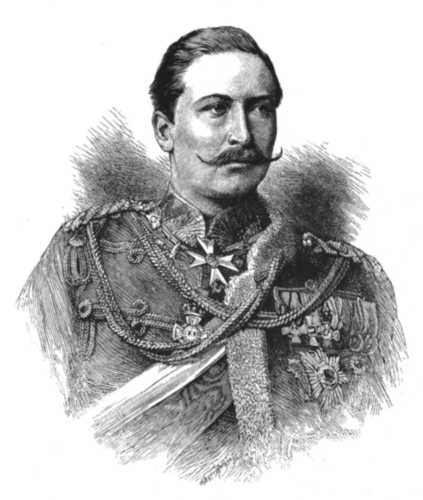
THE EMPEROR OF GERMANY.
(After a Photograph by J. C. Schaarwächter, Photographer to the Emperor.)
A
HISTORY OF GERMANY
FROM THE EARLIEST TIMES TO THE PRESENT DAY
BY
BAYARD TAYLOR
WITH AN ADDITIONAL CHAPTER BY
MARIE HANSEN-TAYLOR
NEW YORK
D. APPLETON AND COMPANY
1897
Copyright, 1874, 1893, By D. APPLETON AND COMPANY.
Electrotyped and Printed at the Appleton Press, U. S. A.
PREFACE.
When I assented to the request of the publishers that I would edit a new edition of the History of Germany, and write an additional chapter finishing the work down to the present date, I was fully aware of both my own shortcomings and the difficulty of the task. That I undertook it, nevertheless, is because I was strongly tempted to perform what I considered, in my case, an act of piety. Being naturally familiar with the aim and style of this book, I have tried to compile a new chapter in the simple narrative fashion by which the History has commended itself to its readers.
In his "Introductory Words" to the original edition the author says: "The History of Germany is not the history of a nation, but of a race. It has little unity, therefore it is complicated, broken, and attached on all sides to the histories of other countries. In its earlier periods it covers the greater part of Europe, and does not return exclusively to Germany until after France, Spain, England and the Italian States have been founded. Thus, even before the fall of the Roman Empire, it becomes the main trunk out of which branch the histories of nearly all European nations, and must of necessity be studied as the connecting link between ancient and modern history. The records of no other race throw so much light upon the development of all civilized lands during a period of fifteen hundred years.
"My aim has been to present a clear, continuous narrative, omitting no episode of importance, yet preserving a distinct line of connection from century to century. Besides referring to all the best authorities, I have based my labors mainly upon three recent German works—that of Dittmar, as the fullest; of Von Rochau, as the most impartial; and of Dr. David Müller, as the most readable. By constructing an entirely new narrative from these, compressing the material into less than half the space which each occupies, and avoiding the interruptions and changes by which all are characterized, I hope to have made this History convenient and acceptable to our schools."
The book is, indeed, eminently fitted for use in the higher grades of schools. But the scope, comprehensiveness, and style of the work make it in no less a degree inviting and attractive to the general reader.
The material for the preparation of the additional chapter was difficult of access, since the history of the last twenty years is on record chiefly in monographs and in the public press. The best guide I have found is the "Politische Geschichte der Gegenwart," by Prof. Wilhelm Müller. The author of the present book was fortunate in being able to close it with the glorious events of the years 1870 to 1871, and the birth of the new Empire. The additional chapter has no such ending. It deals with the beginning of a new era, and has to state facts, with an eye to their results in the future.
Marie Hansen-Taylor.
New York, 1893.
CONTENTS.
CHAPTER
- —The ancient Germans and their country. (330 B. C.—70 B. C.)
- —The wars of Rome with the Germans. (70 B. C.—9 A. D.)
- —Hermann, the first German leader. (9—21 A. D.)
- —Germany during the first three centuries of our era. (21—300 A. D.)
- —The rise and migrations of the Goths. (300—412.)
- —The invasion of the Huns, and its consequences. (412—472.)
- —The rise and fall of the Ostrogoths. (472—570.)
- —Europe, at the end of the migration of the races. (570.)
- —The kingdom of the Franks. (486—638.)
- —The dynasty of the royal stewards. (638—768.)
- —The reign of Charlemagne. (768—814.)
- —The emperors of the Carolingian line. (814—911.)
- —King Konrad, and the Saxon rulers, Henry I. and Otto the Great. (912—973.)
- —The decline of the Saxon dynasty. (973—1024.)
- —The Frank emperors, to the death of Henry IV. (1024—1106.)
- —End of the Frank dynasty, and rise of the Hohenstaufens. (1106—1152.)
- —The reign of Frederick I., Barbarossa. (1152—1197.)
- —The reign of Frederick II. and end of the Hohenstaufen line. (1215—1268.)
- —Germany at the time of the interregnum. (1256—1273.)
- —From Rudolf of Hapsburg To Ludwig the Bavarian. (1273—1347.)
- —The Luxemburg emperors, Karl IV. and Wenzel. (1347—1410.)
- —The reign of Sigismund and the Hussite war. (1410—1437.)
- —The foundation of the Hapsburg dynasty. (1438—1493.)
- —Germany, during the reign of Maximilian I. (1493—1519.)
- —The Reformation. (1517—1546.)
- —From Luther's death to the end of the 16th century. (1546—1600.)
- —Beginning of the Thirty Years' War. (1600—1625.)
- —Tilly, Wallenstein and Gustavus Adolphus. (1625—1634.)
- —End of the Thirty Years' War. (1634—1648.)
- —Germany, to the peace of Ryswick. (1648—1697.)
- —The war of the Spanish succession. (1697—1714.)
- —The rise of Prussia. (1714—1740.)
- —The reign of Frederick the Great. (1740—1786.)
- —Germany under Maria Theresa and Joseph II. (1740—1790.)
- —From the death of Joseph II. to the end of the German Empire. (1790—1806.)
- —Germany under Napoleon. (1806—1814.)
- —From the liberation of Germany to the year 1848. (1814—1848.)
- —The Revolution of 1848 and its results. (1848—1861.)
- —The struggle with Austria; the North-German union. (1861—1870.)
- —The war with France, and establishment of the German Empire. (1870—1871.)
- —The new German Empire. (1871—1893.)
- Chronological Table of German History.
LIST OF MAPS.
- Germany under the Cæsars
- The Migrations of the Races, A. D. 500
- Empire of Charlemagne, with the Partition of the Treaty of Verdun, A. D. 843
- Germany under the Saxons and Frank Emperors, Twelfth Century
- Germany under Napoleon, 1812
- Metz and Vicinity
- The German Empire, 1871
A HISTORY OF GERMANY.
CHAPTER I.
THE ANCIENT GERMANS AND THEIR COUNTRY.
(330 B. C.—70 B. C.)
- The Aryan Race and its Migrations.
- —Earliest Inhabitants of Europe.
- —Lake Dwellings.
- —Celtic and Germanic Migrations.
- —Europe in the Fourth Century B. C.
- —The Name "German."
- —Voyage of Pytheas.
- —Invasions of the Cimbrians and Teutons, B. C. 113.
- —Victories of Marius.
- —Boundary between the Gauls and the Germans.
- —Geographical Location of the various Germanic Tribes.
- —Their Mode of Life, Vices, Virtues, Laws, and Religion.
The Germans form one of the most important branches of the Indo-Germanic or Aryan race—a division of the human family which also includes the Hindoos, Persians, Greeks, Romans, Celts, and the Slavonic tribes. The near relationship of all these, which have become so separated in their habits of life, forms of government and religious faith, in the course of many centuries, has been established by the evidence of common tradition, language, and physiological structure. The original home of the Aryan race appears to have been somewhere among the mountains and lofty table-lands of Central Asia. The word "Arya," meaning the high or the excellent, indicates their superiority over the neighboring races long before the beginning of history.
When and under what circumstances the Aryans left their home, can never be ascertained. Most scholars suppose that there were different migrations, and that each movement westward was accomplished slowly, centuries intervening between their departure from Central Asia and their permanent settlement in Europe. The earliest migration was probably that of the tribes who took possession of Greece and Italy; who first acquired, and for more than a thousand years maintained, their ascendency over all other branches of their common family; who, in fact, laid the basis for the civilization of the world.
330 B. C.
Before this migration took place, Europe was inhabited by a race of primitive savages, who were not greatly superior to the wild beasts in the vast forests which then covered the continent. They were exterminated at so early a period that all traditions of their existence were lost. Within the last fifty years, however, various relics of this race have been brought to light. Fragments of skulls and skeletons, with knives and arrow-heads of flint, have been found, at a considerable depth, in the gravel-beds of Northern France, or in caves in Germany, together with the bones of animals now extinct, upon which they fed. In the lakes of Switzerland, they built dwellings upon piles, at a little distance from the shore, in order to be more secure against the attacks of wild beasts or hostile tribes. Many remains of these lake-dwellings, with flint implements and fragments of pottery, have recently been discovered. The skulls of the race indicate that they were savages of the lowest type, and different in character from any which now exist on the earth.
The second migration of the Aryan race is supposed to have been that of the Celtic tribes, who took a more northerly course, by way of the steppes of the Volga and the Don, and gradually obtained possession of all Central and Western Europe, including the British Isles. Their advance was only stopped by the ocean, and the tribe which first appears in history, the Gauls, was at that time beginning to move eastward again, in search of new fields of plunder. It is impossible to ascertain whether the German tribes immediately followed the Celts, and took possession of the territory which they vacated in pushing westward, or whether they formed a third migration, at a later date. We only know the order in which they were settled when our first historical knowledge of them begins.
In the fourth century before the Christian Era, all Europe west of the Rhine, and as far south as the Po, was Celtic; between the Rhine and the Vistula, including Denmark and southern Sweden, the tribes were Germanic; while the Slavonic branch seems to have already made its appearance in what is now Southern Russia. Each of these three branches of the Aryan race was divided into many smaller tribes, some of which, left behind in the march from Asia, or separated by internal wars, formed little communities, like islands, in the midst of territory belonging to other branches of the race. The boundaries, also, were never very distinctly drawn: the tribes were restless and nomadic, not yet attached to the soil, and many of them moved through or across each other, so that some were constantly disappearing, and others forming under new names.
113 B. C. THE CIMBRIANS AND TEUTONS.
The Romans first heard the name "Germans" from the Celtic Gauls, in whose language it meant simply neighbors. The first notice of a Germanic tribe was given to the world by the Greek navigator Pytheas, who made a voyage to the Baltic in the year 330 B. C. Beyond the amber-coast, eastward of the mouth of the Vistula, he found the Goths, of whom we hear nothing more until they appear, several centuries later, on the northern shore of the Black Sea. For more than two hundred years there is no further mention of the Germanic races; then, most unexpectedly, the Romans were called upon to make their personal acquaintance.
In the year 113 B. C. a tremendous horde of strangers forced its way through the Tyrolese Alps and invaded the Roman territory. They numbered several hundred thousand, and brought with them their wives, children and all their movable property. They were composed of two great tribes, the Cimbrians and Teutons, accompanied by some minor allies, Celtic as well as Germanic. Their statement was that they were driven from their homes on the northern ocean by the inroads of the waves, and they demanded territory for settlement, or, at least, the right to pass the Roman frontier. The Consul, Papirius Carbo, collected an army and endeavored to resist their advance; but he was defeated by them in a battle fought near Noreia, between the Adriatic and the Alps.
The terror occasioned by this defeat reached even Rome. The "barbarians," as they were called, were men of large stature, of astonishing bodily strength, with yellow hair and fierce blue eyes. They wore breastplates of iron and helmets crowned with the heads of wild beasts, and carried white shields which shone in the sunshine. They first hurled double-headed spears in battle, but at close quarters fought with short and heavy swords. The women encouraged them with cries and war-songs, and seemed no less fierce and courageous than the men. They had also priestesses, clad in white linen, who delivered prophecies and slaughtered human victims upon the altars of their gods.
102 B. C.
Instead of moving towards Rome, the Cimbrians and Teutons marched westward along the foot of the Alps, crossed into Gaul, devastated the country between the Rhone and the Pyrenees, and even obtained temporary possession of part of Spain. Having thus plundered at will for ten years, they retraced their steps and prepared to invade Italy a second time. The celebrated Consul, Marius, who was sent against them, found their forces divided, in order to cross the Alps by two different roads. He first attacked the Teutons, two hundred thousand in number, at Aix, in southern France, and almost exterminated them in the year 102 B. C. Transferring his army across the Alps, in the following year he met the Cimbrians at Vercelli, in Piedmont (not far from the field of Magenta). They were drawn up in a square, the sides of which were nearly three miles long: in the centre their wagons, collected together, formed a fortress for the women and children. But the Roman legions broke the Cimbrian square, and obtained a complete victory. The women, seeing that all was lost, slew their children, and then themselves; but a few thousand prisoners were made—among them Teutoboch, the prince of the Teutons, who had escaped from the slaughter at Aix,—to figure in the triumph accorded to Marius by the Roman Senate. This was the only appearance of the German tribes in Italy, until the decline of the Empire, five hundred years later.
The Roman conquests, which now began to extend northwards into the heart of Europe, soon brought the two races into collision again, but upon German or Celtic soil. From the earliest reports, as well as the later movements of the tribes, we are able to ascertain the probable order of their settlement, though not the exact boundaries of each. The territory which they occupied was almost the same as that which now belongs to the German States. The Rhine divided them from the Gauls, except towards its mouth, where the Germanic tribes occupied part of Belgium. A line drawn from the Vistula southward to the Danube nearly represents their eastern boundary, while, up to this time, they do not appear to have crossed the Danube on the south. The district between that river and the Alps, now Bavaria and Styria, was occupied by Celtic tribes. Northwards they had made some advance into Sweden, and probably also into Norway. They thus occupied nearly all of Central Europe, north of the Alpine chain.
100 B. C. THE GERMAN TRIBES.
At the time of their first contact with the Romans, these Germanic tribes had lost even the tradition of their Asiatic origin. They supposed themselves to have originated upon the soil where they dwelt, sprung either from the earth, or descended from their gods. According to the most popular legend, the war-god Tuisko, or Tiu, had a son, Mannus (whence the word man is derived), who was the first human parent of the German race. Many centuries must have elapsed since their first settlement in Europe, or they could not have so completely changed the forms of their religion and their traditional history.
Two or three small tribes are represented, in the earliest Roman accounts, as having crossed the Rhine and settled between the Vosges and that river, from Strasburg to Mayence. From the latter point to Cologne none are mentioned, whence it is conjectured that the western bank of the Rhine was here a debatable ground, possessed sometimes by the Celts and sometimes by the Germans. The greater part of Belgium was occupied by the Eburones and Condrusii, Germanic tribes, to whom were afterwards added the Aduatuci, formed out of the fragments of the Cimbrians and Teutons who escaped the slaughters of Marius. At the mouth of the Rhine dwelt the Batavi, the forefathers of the Dutch, and, like them, reported to be strong, phlegmatic and stubborn, in the time of Cæsar. A little eastward, on the shore of the North Sea, dwelt the Frisii, where they still dwell, in the province of Friesland; and beyond them, about the mouth of the Weser, the Chauci, a kindred tribe.
What is now Westphalia was inhabited by the Sicambrians, a brave and warlike people: the Marsi and Ampsivarii were beyond them, towards the Hartz, and south of the latter the Ubii, once a powerful tribe, but in Cæsar's time weak and submissive. From the Weser to the Elbe, in the north, was the land of the Cherusci; south of them the equally fierce and indomitable Chatti, the ancestors of the modern Hessians; and still further south, along the head-waters of the river Main, the Marcomanni. A part of what is now Saxony was in the possession of the Hermunduri, who together with their kindred, the Chatti, were called Suevi by the Romans. Northward, towards the mouth of the Elbe, dwelt the Longobardi (Lombards); beyond them, in Holstein, the Saxons; and north of the latter, in Schleswig, the Angles.
East of the Elbe were the Semnones, who were guardians of a certain holy place,—a grove of the Druids—where various related tribes came for their religious festivals. North of the Semnones dwelt the Vandals, and along the Baltic coast the Rugii, who have left their name in the island of Rügen. Between these and the Vistula were the Burgundiones, with a few smaller tribes. In the extreme north-east, between the Vistula and the point where the city of Königsberg now stands, was the home of the Goths, south of whom were settled the Slavonic Sarmatians,—the same who founded, long afterwards, the kingdom of Poland.
Bohemia was first settled by the Celtic tribe of the Boii, whence its name—Boiheim, the home of the Boii—is derived. In Cæsar's day, however, this tribe had been driven out by the Germanic Marcomanni, whose neighbors, the Quadi, on the Danube, were also German. Beyond the Danube all was Celtic; the defeated Boii occupied Austria; the Vindelici, Bavaria; while the Noric and Rhætian Celts took possession of the Tyrolese Alps. Switzerland was inhabited by the Helvetii, a Celtic tribe which had been driven out of Germany; but the mountainous district between the Rhine, the Lake of Constance and the Danube, now called the Black Forest, seems to have had no permanent owners.
The greater part of Germany was thus in possession of Germanic tribes, bound to each other by blood, by their common religion and their habits of life. At this early period, their virtues and their vices were strongly marked. They were not savages, for they knew the first necessary arts of civilized life, and they had a fixed social and political organization. The greater part of the territory which they inhabited was still a wilderness. The mountain chain which extends through Central Germany from the Main to the Elbe was called by the Romans the Hercynian Forest. It was then a wild, savage region, the home of the aurox (a race of wild cattle), the bear and the elk. The lower lands to the northward of this forest were also thickly wooded and marshy, with open pastures here and there, where the tribes settled in small communities, kept their cattle, and cultivated the soil only enough to supply the needs of life. They made rough roads of communication, which could be traversed by their wagons, and the frontiers of each tribe were usually marked by guard-houses, where all strangers were detained until they received permission to enter the territory.
HABITS OF THE GERMANS.
At this early period, the Germans had no cities, or even villages. Their places of worship, which were either groves of venerable oak-trees or the tops of mountains, were often fortified; and when attacked in the open country, they made a temporary defence of their wagons. They lived in log-houses, which were surrounded by stockades spacious enough to contain the cattle and horses belonging to the family. A few fields of rye and barley furnished each homestead with bread and beer, but hunting and fishing were their chief dependence. The women cultivated flax, from which they made a coarse, strong linen: the men clothed themselves with furs or leather. They were acquainted with the smelting and working of iron, but valued gold and silver only for the sake of ornament. They were fond of bright colors, of poetry and song, and were in the highest degree hospitable.
The three principal vices of the Germans were indolence, drunkenness and love of gaming. Although always ready for the toils and dangers of war, they disliked to work at home. When the men assembled at night, and the great ox-horns, filled with mead or beer, were passed from one to the other, they rarely ceased drinking until all were intoxicated; and when the passion for gaming came upon them, they would often stake their dearest possessions, even their own freedom, on a throw of the dice. The women were never present on these occasions: they ruled and regulated their households with undisputed sway. They were considered the equals of the men, and exhibited no less energy and courage. They were supposed to possess the gift of prophecy, and always accompanied the men to battle, where they took care of the wounded, and stimulated the warriors by their shouts and songs.
They honored the institution of marriage to an extent beyond that exhibited by any other people of the ancient world. The ceremony consisted in the man giving a horse, or a yoke of oxen, to the woman, who gave him arms or armor in return. Those who proved unfaithful to the marriage vow were punished with death. The children of freemen and slaves grew up together until the former were old enough to carry arms, when they were separated. The slaves were divided into two classes: those who lived under the protection of a freeman and were obliged to perform for him a certain amount of labor, and those who were wholly "chattels," bought and sold at will.
Each family had its own strictly regulated laws, which were sufficient for the government of its free members, its retainers and slaves. A number of these families formed "a district," which was generally laid out according to natural boundaries, such as streams or hills. In some tribes, however, the families were united in "hundreds," instead of districts. Each of these managed its own affairs, as a little republic, wherein each freeman had an equal voice; yet to each belonged a leader, who was called "count" or "duke." All the districts of a tribe met together in a "General Assembly of the People," which was always held at the time of new or full moon. The chief priest of the tribe presided, and each man present had the right to vote. Here questions of peace or war, violations of right or disputes between the districts were decided, criminals were tried, young men acknowledged as freemen and warriors, and, in case of approaching war, a leader chosen by the people. Alliances between the tribes, for the sake of mutual defence or invasion, were not common, at first; but the necessity of them was soon forced upon the Germans by the encroachments of Rome.
The gods which they worshipped represented the powers of Nature. Their mythology was the same originally which the Scandinavians preserved, in a slightly different form, until the tenth century of our era. The chief deity was named Wodan, or Odin, the god of the sky, whose worship was really that of the sun. His son, Donar, or Thunder, with his fiery beard and huge hammer, is the Thor of the Scandinavians. The god of war, Tiu or Tyr, was supposed to have been born from the Earth, and thus became the ancestor of the Germanic tribes. There was also a goddess of the earth, Hertha, who was worshipped with secret and mysterious rites. The people had their religious festivals, at stated seasons, when sacrifices, sometimes of human beings, were laid upon the altars of the gods, in the sacred groves. Even after they became Christians, in the eighth century, they retained their habit of celebrating some of these festivals, but changed them into the Christian anniversaries of Christmas, Easter and Whitsuntide.
OPEN TO CIVILIZATION.
Thus, from all we can learn respecting them, we may say that the Germans, during the first century before Christ, were fully prepared, by their habits, laws, and their moral development, for a higher civilization. They were still restless, after so many centuries of wandering; they were fierce and fond of war, as a natural consequence of their struggles with the neighboring races; but they had already acquired a love for the wild land where they dwelt, they had begun to cultivate the soil, they had purified and hallowed the family relation, which is the basis of all good government, and finally, although slavery existed among them, they had established equal rights for free men.
If the object of Rome had been civilization, instead of conquest and plunder, the development of the Germans might have commenced much earlier and produced very different results.
CHAPTER II.
THE WARS OF ROME WITH THE GERMANS.
(70 B. C.—9 A. D.)
- Roman Conquest of Gaul.
- —The German Chief, Ariovistus.
- —His Answer to Cæsar.
- —Cæsar's March to the Rhine.
- —Defeat of Ariovistus.
- —Cæsar's Victory near Cologne.
- —His Bridge.
- —His Second Expedition.
- —He subjugates the Gauls.
- —He enlists a German Legion.
- —The Romans advance to the Danube, under Augustus.
- —First Expedition of Drusus.
- —The Rhine fortified.
- —Death of Drusus.
- —Conquests of Tiberius.
- —The War of the Marcomanni.
- —The Cherusci.
- —Tyranny of Varus.
- —Resistance of the Germans.
70 B. C.
After the destruction of the Teutons and Cimbrians by Marius, more than forty years elapsed before the Romans again came in contact with any German tribe. During this time the Roman dominion over the greater part of Gaul was firmly established by Julius Cæsar, and in losing their independence, the Celts began to lose, also, their original habits and character. They and the Germans had never been very peaceable neighbors, and the possession of the western bank of the Rhine seems to have been, even at that early day, a subject of contention between them.
About the year 70 B. C. two Gallic tribes, the Ædui in Burgundy and the Arverni in Central France, began a struggle for the supremacy in that part of Gaul. The allies of the latter, the Sequani, called to their assistance a chief of the German Suevi, whose name, as we have it through Cæsar, was Ariovistus. With a force of 15,000 men, he joined the Arverni and the Sequani, and defeated the Ædui in several battles. After the complete overthrow of the latter, he haughtily demanded as a recompense one-third of the territory of the Sequani. His strength had meanwhile been increased by new accessions from the German side of the Rhine, and the Sequani were obliged to yield. His followers settled in the new territory: in the course of about fourteen years, they amounted to 120,000, and Ariovistus felt himself strong enough to demand another third of the lands of the Sequani.
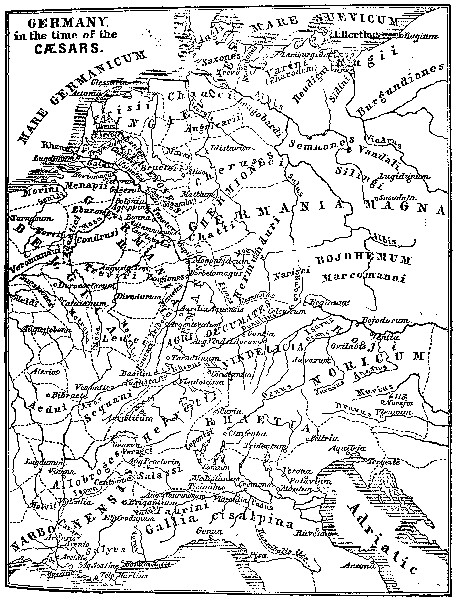
GERMANY UNDER THE CÆSARS.
57 B. C. UNDER THE CÆSARS.
Southern France was then a Roman province, governed by Julius Cæsar. In the year 57 B. C. ambassadors from the principal tribes of Eastern Gaul appeared before him and implored his assistance against the inroads of the Suevi. It was an opportunity which he immediately seized, in order to bring the remaining Gallic tribes under the sway of Rome. He first sent a summons to Ariovistus to appear before him, but the haughty German chief answered: "When I need Cæsar, I shall come to Cæsar. If Cæsar needs me, let him seek me. What business has he in my Gaul, which I have acquired in war?"
On receiving this answer, Cæsar marched immediately with his legions into the land of the Sequani, and succeeded in reaching their capitol, Vesontio (the modern Besançon), before the enemy. It was then a fortified place, and its possession gave Cæsar an important advantage at the start. While his legions were resting there for a few days, before beginning the march against the Suevi, the Gallic and Roman merchants and traders circulated the most frightful accounts of the strength and fierceness of the latter through the Roman camp. They reported that the German barbarians were men of giant size and more than human strength, whose faces were so terrible that the glances of their eyes could not be endured. Very soon numbers of the Roman officers demanded leave of absence, and even the few who were ashamed to take this step lost all courage. The soldiers became so demoralized that many of them declared openly that they would refuse to fight, if commanded to do so.
In this emergency, Cæsar showed his genius as a leader of men. He called a large number of soldiers and officers of all grades together, and addressed them in strong words, pointing out their superior military discipline, ridiculing the terrible stories in circulation, and sharply censuring them for their insubordination. He concluded by declaring that if the army should refuse to march, he would start the next morning with only the tenth legion, upon the courage and obedience of which he could rely. This speech produced an immediate effect. The tenth legion solemnly thanked Cæsar for his confidence in its men and officers, the other legions, one after the other, declared their readiness to follow, and the whole army left Vesontio the very next morning. After a rapid march of seven days, Cæsar found himself within a short distance of the fortified camp of Ariovistus.
57 B. C. CÆSAR AND ARIOVISTUS.
The German chief now agreed to an interview, and the two leaders met, half-way between the two armies, on the plain of the Rhine. The place is supposed to have been a little to the northward of Basel. Neither Cæsar nor Ariovistus would yield to the demands of the other, and as the cavalry of their armies began skirmishing, the interview was broken off. For several days in succession the Romans offered battle, but the Suevi refused to leave their strong position. This hesitation seemed remarkable, until it was explained by some prisoners, captured in a skirmish, who stated that the German priestesses had prophesied misfortune to Ariovistus, if he should fight before the new moon.
Cæsar, thereupon, determined to attack the German camp without delay. The meeting of the two armies was fierce, and the soldiers were soon fighting hand to hand. On each side one wing gave way, but the greater quickness and superior military skill of the Romans enabled them to recover sooner than the enemy. The day ended with the entire defeat of the Suevi, and the flight of the few who escaped across the Rhine. They did not attempt to reconquer their lost territory, and the three small German tribes, who had long been settled between the Rhine and the Vosges (in what is now Alsatia), became subject to Roman rule.
Two years afterwards, Cæsar, who was engaged in subjugating the Belgæ, in Northern Gaul, learned that two other German tribes, the Usipetes and Tencteres, who had been driven from their homes by the Suevi, had crossed the Rhine below where Cologne now stands. They numbered 400,000, and the Northern Gauls, instead of regarding them as invaders, were inclined to welcome them as allies against Rome, the common enemy. Cæsar knew that if they remained, a revolt of the Gauls against his rule would be the consequence. He therefore hastened to meet them, got possession of their principal chiefs by treachery, and then attacked their camp between the Meuse and the Rhine. The Germans were defeated, and nearly all their foot-soldiers slaughtered, but the cavalry succeeded in crossing the river, where they were welcomed by the Sicambrians.
Then it was that Cæsar built his famous wooden bridge across the Rhine, not far from the site of Cologne, although the precise point can not now be ascertained. He crossed with his army into Westphalia, but the tribes he sought retreated into the great forests to the eastward, where he was unable to pursue them. He contented himself with burning their houses and gathering their ripened harvests for eighteen days, when he returned to the other side and destroyed the bridge behind him. From this time, Rome claimed the sovereignty of the western bank of the Rhine to its mouth.
53 B. C.
While Cæsar was in Britain, in the year 53 B. C., the newly subjugated Celtic and German tribes which inhabited Belgium rose in open revolt against the Roman rule. The rapidity of Cæsar's return arrested their temporary success, but some of the German tribes to the eastward of the Rhine had already promised to aid them. In order to secure his conquests, the Roman general determined to cross the Rhine again, and intimidate, if not subdue, his dangerous neighbors. He built a second bridge, near the place where the first had been, and crossed with his army. But, as before, the Suevi and Sicambrians drew back among the forest-covered hills along the Weser river, and only the small and peaceful tribe of the Ubii remained in their homes. The latter offered their submission to Cæsar, and agreed to furnish him with news of the movements of their warlike countrymen, in return for his protection.
When another revolt of the Celtic Gauls took place, the following year, German mercenaries, enlisted among the Ubii, fought on the Roman side and took an important part in the decisive battle which gave Vercingetorix, the last chief of the Gauls, into Cæsar's hands. He was beheaded, and from that time the Gauls made no further effort to throw off the Roman yoke. They accepted the civil and military organization, the dress and habits, and finally the language and religion of their conquerors. The small German tribes in Alsatia and Belgium shared the same fate: their territory was divided into two provinces, called Upper and Lower Germania by the Romans. The vast region inhabited by the independent tribes, lying between the Rhine, the Vistula, the North Sea and the Danube, was thenceforth named Germania Magna, or "Great Germany."
Cæsar's renown among the Germans, and probably also his skill in dealing with them, was so great, that when he left Gaul to return to Rome, he took with him a German legion of 6,000 men, which afterwards fought on his side against Pompey, on the battle-field of Pharsalia. The Roman agents penetrated into the interior of the country, and enlisted a great many of the free Germans who were tempted by the prospect of good pay and booty. Even the younger sons of the chiefs entered the Roman army, for the sake of a better military education.
15 B. C. THE EXPEDITIONS OF DRUSUS.
No movement of any consequence took place for more than twenty years after Cæsar's last departure from the banks of the Rhine. The Romans, having secured their possession of Gaul, now turned their attention to the subjugation of the Celtic tribes inhabiting the Alps and the lowlands south of the Danube, from the Lake of Constance to Vienna. This work had also been begun by Cæsar: it was continued by the Emperor Augustus, whose step-sons, Tiberius and Drusus, finally overcame the desperate resistance of the native tribes. In the year 15 B. C. the Danube became the boundary between Rome and Germany on the south, as the Rhine already was on the west. The Roman provinces of Rhætia, Noricum and Pannonia were formed out of the conquered territory.
Augustus now sent Drusus, with a large army, to the Rhine, instructing him to undertake a campaign against the independent German tribes. It does not appear that the latter had given any recent occasion for this hostile movement: the Emperor's design was probably to extend the dominions of Rome to the North Sea and the Baltic. Drusus built a large fleet on the Rhine, descended that river nearly to its mouth, cut a canal for his vessels to a lake which is now the Zuyder Zee, and thus entered the North Sea. It was a bold undertaking, but did not succeed. He reached the mouth of the river Ems with his fleet, when the weather became so tempestuous that he was obliged to return.
The next year, 11 B. C., he made an expedition into the land of the Sicambrians, during which his situation was often hazardous; but he succeeded in penetrating rather more than a hundred miles to the eastward of the Rhine, and establishing—not far from where the city of Paderborn now stands—a fortress called Aliso, which became a base for later operations against the German tribes. He next set about building a series of fortresses, fifty in number, along the western bank of the Rhine. Around the most important of these, towns immediately sprang up, and thus were laid the foundations of the cities of Strasburg, Mayence, Coblenz, Cologne, and many smaller places.
9 B. C.
In the year 9 B. C. Drusus marched again into Germany. He defeated the Chatti in several bloody battles, crossed the passes of the Thuringian Forest, and forced his way through the land of the Cherusci (the Hartz region) to the Elbe. The legend says that he there encountered a German prophetess, who threatened him with coming evil, whereupon he turned about and retraced his way towards the Rhine. He died, however, during the march, and his dejected army had great difficulty in reaching the safe line of their fortresses.
Tiberius succeeded to the command left vacant by the death of his brother Drusus. Less daring, but of a more cautious and scheming nature, he began by taking possession of the land of the Sicambrians and colonizing a part of the tribe on the west bank of the Rhine. He then gradually extended his power, and in the course of two years brought nearly the whole country between the Rhine and Weser under the rule of Rome. His successor, Domitius Ænobarbus, built military roads through Westphalia and the low, marshy plains towards the sea. These roads, which were called "long bridges," were probably made of logs, like the "corduroy" roads of our Western States, but they were of great service during the later Roman campaigns.
After the lapse of ten years, however, the subjugated tribes between the Rhine and the Weser rose in revolt. The struggle lasted for three years more, without being decided; and then Augustus sent Tiberius a second time to Germany. The latter was as successful as at first: he crushed some of the rebellious tribes, accepted the submission of others, and, supported by a fleet which reached the Elbe and ascended that river to meet him, secured, as he supposed, the sway of Rome over nearly the whole of Germania Magna. This was in the fifth year of the Christian Era. Of the German tribes who still remained independent, there were the Semnones, Saxons and Angles, east of the Elbe, and the Burgundians, Vandals and Goths along the shore of the Baltic, together with one powerful tribe in Bohemia. The latter, the Marcomanni, who seem to have left their original home in Baden and Würtemberg on account of the approach of the Romans, now felt that their independence was a second time seriously threatened. Their first measure of defence, therefore, was to strengthen themselves by alliances with kindred tribes.
8 B. C. THE MARCOMANNI: VARUS.
The chief of the Marcomanni, named Marbod, was a man of unusual capacity and energy. It seems that he was educated as a Roman, but under what circumstances is not stated. This rendered him a more dangerous enemy, though it also made him an object of suspicion, and perhaps jealousy, to the other German chieftains. Nevertheless, he succeeded in uniting nearly all the independent tribes east of the Elbe under his command, and in organizing a standing army of 70,000 foot and 4,000 horse, which, disciplined like the Roman legions, might be considered a match for an equal number. His success created so much anxiety in Rome, that in the next year after Tiberius returned from his successes in Germany, Augustus determined to send a force of twelve legions against Marbod. Precisely at this time, a great insurrection broke out in Dalmatia and Pannonia, and when it was suppressed, after a struggle of three years, the Romans found it prudent to offer peace to Marbod, and he to accept it.
By this time, the territory between the Rhine and the Weser had been fifteen years, and that between the Weser and the Elbe four years, under Roman government. The tribes inhabiting the first of these two regions had been much weakened, both by the part some of them had taken in the Gallic insurrections, and by the revolt of all against Rome, during the first three or four years of the Christian Era. But those who inhabited the region between the Weser and the Elbe, the chief of whom were the Cherusci, were still powerful, and unsubdued in spirit.
While Augustus was occupied in putting down the insurrection in Dalmatia and Pannonia, with a prospect, as it seemed, of having to fight the Marcomanni afterwards, his representative in Germany was Quinctilius Varus, a man of despotic and relentless character. Tiberius, in spite of his later vices as Emperor, was prudent and conciliatory in his conquests; but Varus soon turned the respect of the Germans for the Roman power into the fiercest hate. He applied, in a more brutal form, the same measures which had been forced upon the Gauls. He overturned, at one blow, all the native forms of law, introduced heavy taxes, which were collected by force, punished with shameful death crimes which the people considered trivial, and decided all matters in Roman courts and in a language which was not yet understood.
8 B. C.
This violent and reckless policy, which Varus enforced with a hand of iron, produced an effect the reverse of what he anticipated. The German tribes with hardly an exception, determined to make another effort to regain their independence; but they had been taught wisdom by seventy years of conflict with the Roman power. Up to this time, each tribe had acted for itself, without concert with its neighbors. They saw, now, that no single tribe could cope successfully with Rome: it was necessary that all should be united as one people: and they only waited until such a union could be secretly established, before rising to throw off the unendurable yoke which Varus had laid upon them.
CHAPTER III.
HERMANN, THE FIRST GERMAN LEADER.
(9—21 A. D.)
- The Cherusci.
- —Hermann's Early Life.
- —His Return to Germany.
- —Enmity of Segestes.
- —Secret Union of the Tribes.
- —The Revolt.
- —Destruction of Varus and his Legions.
- —Terror in Rome.
- —The Battle-Field and Monument.
- —Dissensions.
- —First March of Germanicus.
- —Second March and Battle with Hermann.
- —Defeat of Cæcina.
- —Third Expedition of Germanicus.
- —Battles on the Weser.
- —His Retreat.
- —Views of Tiberius.
- —War between Hermann and Marbod.
- —Murder of Hermann.
- —His Character.
- —Tacitus.
9 A. D. HERMANN.
The Cherusci, who inhabited a part of the land between the Weser and the Elbe, including the Hartz Mountains, were the most powerful of the tribes conquered by Tiberius. They had no permanent class of nobles, as none of the early Germans seem to have had, but certain families were distinguished for their abilities and their character, or the services which they had rendered to their people in war. The head of one of these Cheruscan families was Segimar, one of whose sons was named Hermann. The latter entered the Roman service as a youth, distinguished himself by his military talent, was made a Roman knight, and commanded one of the legions which were employed by Augustus in suppressing the great insurrection of the Dalmatians and Pannonians. It seems probable that he visited Rome at the period of its highest power and splendor: it is certain, at least, that he comprehended the political system by means of which the Empire had become so great.
When Hermann returned to his people, he was a man of twenty-five and already an experienced commander. He is described by the Latin writers as a chief of fine personal presence, great strength, an animated countenance and bright eyes. He was always self-possessed, quick in action, yet never rash or heedless. He found the Cherusci and all the neighboring tribes filled with hate of the Roman rule and burning to revenge the injuries they had suffered. His first movement was to organize a secret conspiracy among the tribes, which could be called into action as soon as a fortunate opportunity should arrive. Varus was then—A. D. 9—encamped near the Weser, in the land of the Saxons, with an army of 40,000 men, the best of the Roman legions. Hermann was still in the Roman service, and held a command under him. But among the other Germans in the Roman camp was Segestes, a chief of the Cherusci, whose daughter, Thusnelda, Hermann had stolen away from him and married. Thusnelda was afterwards celebrated in the German legends as a high-hearted, patriotic woman, who was devotedly attached to Hermann: but her father, Segestes, became his bitterest enemy.
9 A. D.
In engaging the different tribes to unite, Hermann had great difficulties to overcome. They were not only jealous of each other, remembering ancient quarrels between themselves, but many families in each tribe were disposed to submit to Rome, being either hopeless of succeeding or tempted by the chance of office and wealth under the Roman Government. Hermann's own brother, Flavus, had become, and always remained, a Roman; other members of his family were opposed to his undertaking, and it seems that only his mother and his wife encouraged him with their sympathy. Nevertheless, he formed his plans with as much skill as boldness, while serving in the army of Varus and liable to be betrayed at any moment. In fact he was betrayed by his father-in-law, Segestes, who became acquainted with the fact of a conspiracy and communicated the news to the Roman general. But Varus, haughty and self-confident, laughed at the story.
It was time to act; and, as no opportunity came Hermann created one. He caused messengers to come to Varus, declaring that a dangerous insurrection had broken out in the lands between him and the Rhine. This was in the month of September, and Varus, believing the reports, broke up his camp and set out to suppress the insurrection before the winter. His nearest way led through the wooded, mountainous country along the Weser, which is now called the Teutoburger Forest. According to one account, Hermann was left behind to collect the auxiliary German troops, and then, with them, rejoin his general. It is certain that he remained, and instantly sent his messengers to all the tribes engaged in the conspiracy, whose warriors came to him with all speed. In a few days he had an army probably equal in numbers to that of Varus. In the meantime the season had changed: violent autumn storms burst over the land, and the Romans slowly advanced through the forests and mountain-passes, in the wind and rain.
9 A. D. HERMANN'S CONSPIRACY.
Hermann knew the ground and was able to choose the best point of attack. With his army, hastily organized, he burst upon the legions of Varus, who resisted him, the first day, with their accustomed valor. But the attack was renewed the second day, and the endurance of the Roman troops began to give way: they held their ground with difficulty, but exerted themselves to the utmost, for there was now only one mountain ridge to be passed. Beyond it lay the broad plains of Westphalia, with fortresses and military roads, where they had better chances of defence. When the third day dawned, the storm was fiercer than ever. The Roman army crossed the summit of the last ridge and saw the securer plains before them. They commenced descending the long slope, but, just as they reached three steep, wooded ravines which were still to be traversed, the Germans swept down upon them from the summits, like a torrent, with shouts and far-sounding songs of battle.
A complete panic seized the exhausted and disheartened Roman troops, and the fight soon became a slaughter. Varus, wounded, threw himself upon his sword: the wooded passes, below, were occupied in advance by the Germans, and hardly enough escaped to carry the news of the terrible defeat to the Roman frontier on the Rhine. Those who escaped death were sacrificed upon the altars of the gods, and the fiercest revenge was visited upon the Roman judges, lawyers and civil officers, who had trampled upon all the hallowed laws and customs of the people. The news of this great German victory reached Rome in the midst of the rejoicings over the suppression of the insurrection in Dalmatia and Pannonia, and turned the triumph into mourning. The aged Augustus feared the overthrow of his power. He was unable to comprehend such a sudden and terrible disaster: he let his hair and beard grow for months, as a sign of his trouble, and was often heard to cry aloud: "O, Varus, Varus, give me back my legions!"
The location of the battle-field where Hermann defeated Varus has been preserved by tradition. The long southern slope of the mountain, near Detmold, now bare, but surrounded by forests, is called to this day the Winfield. Around the summit of the mountain there is a ring of huge stones, showing that it was originally consecrated to the worship of the ancient pagan deities. Here a pedestal of granite, in the form of a temple, has been built, and upon it has been placed a colossal statue of Hermann in bronze, 90 feet high, and visible at a distance of fifty miles.
14 A. D.
Hermann's deeds were afterwards celebrated in the songs of his people, as they have been in modern German literature; but, like many other great men, the best results of his victory were cast away by the people whom he had liberated. It was now possible to organize into a nation the tribes which had united to overthrow the Romans, and such seems to have been his intention. He sent the head of Varus to Marbod, Chief of the Marcomanni, whose power he had secured by carrying out his original design; but he failed to secure the friendship, or even the neutrality, of the rival leader. At home his own family—bitterest among them all his father-in-law, Segestes—opposed his plans, and the Cherusci were soon divided into two parties,—that of the people, headed by Hermann, and that of the nobility, headed by Segestes.
When Tiberius, therefore, hastily collected a new army and marched into Germany the following year, he encountered no serious opposition. The union of the tribes had been dissolved, and each avoided an encounter with the Romans. The country was apparently subjugated for the second time. The Emperor Augustus died, A. D. 14: Tiberius succeeded to the purple, and the command in Germany then devolved upon his nephew, Germanicus, the son of Drusus.
The new commander, however, was detained in Gaul by insubordination in the army and signs of a revolt among the people, following the death of Augustus, and he did not reach Germany until six years after the defeat of Varus. His march was sudden and swift, and took the people by surprise, for the apparent indifference of Rome had made them careless. The Marsi were all assembled at one of their religious festivals, unprepared for defence, in a consecrated pine forest, when Germanicus fell upon them and slaughtered the greater number, after which he destroyed the sacred trees. The news of this outrage roused the sluggish spirit of all the neighboring tribes: they gathered together in such numbers that Germanicus had much difficulty in fighting his way back to the Rhine.
15 A. D. THE INVASION OF GERMANICUS.
Hermann succeeded in escaping from his father-in-law, by whom he had been captured and imprisoned, and began to form a new union of the tribes. His first design was to release his wife, Thusnelda, from the hands of Segestes, and then destroy the authority of the latter, who was the head of the faction friendly to Rome. Germanicus re-entered Germany the following summer, A. D. 15, with a powerful army, and to him Segestes appealed for help against his own countrymen. The Romans marched at once into the land of the Cherusci. After a few days they reached the scene of the defeat of Varus, and there they halted to bury the thousands of skeletons which lay wasting on the mountainside. Then they met Segestes, who gave up his own daughter, Thusnelda, to Germanicus, as a captive.
The loss of his wife roused Hermann to fury. He went hither and thither among the tribes, stirring the hearts of all with his fiery addresses. Germanicus soon perceived that a storm was gathering, and prepared to meet it. He divided his army into two parts, one of which was commanded by Cæcina, and built a large fleet which transported one-half of his troops by sea and up the Weser. After joining Cæcina, he marched into the Teutoburger Forest. Hermann met him near the scene of his great victory over Varus, and a fierce battle was fought. According to the Romans, neither side obtained any advantage over the other; but Germanicus, with half the army, fell back upon his fleet and returned to the Rhine by way of the North Sea.
Cæcina, with the remnant of his four legions, also retreated across the country, pursued by Hermann. In the dark forests and on the marshy plains they were exposed to constant assaults, and were obliged to fight every step of the way. Finally, in a marshy valley, the site of which cannot be discovered, the Germans suddenly attacked the Romans on all sides. Hermann cried out to his soldiers: "It shall be another day of Varus!" the songs of the women prophesied triumph, and the Romans were filled with forebodings of defeat. They fought desperately, but were forced to yield, and Hermann's words would have been made truth, had not the Germans ceased fighting in order to plunder the camp of their enemies. The latter were thus able to cut their way out of the valley and hastily fortify themselves for the night on an adjoining plain.
15 A. D.
The German chiefs held a council of war, and decided, against the remonstrances of Hermann, to renew the attack at daybreak. This was precisely what Cæcina expected; he knew what fate awaited them all if he should fail, and arranged his weakened forces to meet the assault. They fought with such desperation that the Germans were defeated, and Cæcina was enabled, by forced marches, to reach the Rhine, whither the rumor of the entire destruction of his army had preceded him. The voyage of Germanicus was also unfortunate: he encountered a violent storm on the coast of Holland, and two of his legions barely escaped destruction. He had nothing to show, as the result of his campaign, except his captive Thusnelda and her son, who walked behind his triumphal chariot, in Rome, three years afterwards, and never again saw their native land; and his ally, the traitor Segestes, who ended his contemptible life somewhere in Gaul, under Roman protection.
Germanicus, nevertheless, determined not to rest until he had completed the subjugation of the country as far as the Elbe. By employing all the means at his command he raised a new army of eight legions, with a great body of cavalry, and a number of auxiliary troops, formed of Gauls, Rhætians, and even of Germans. He collected a fleet of more than a thousand vessels, and transported his army to the mouth of the Ems, where he landed and commenced the campaign. The Chauci, living near the sea, submitted at once, and some of the neighboring tribes were disposed to follow their example; but Hermann, with a large force of the united Germans, waited for the Romans among the mountains of the Weser. Germanicus entered the mountains by a gorge, near where the city of Minden now stands, and the two armies faced each other, separated only by the river. The legends state that Hermann and his brother Flavus, who was still in the service of Germanicus, held an angry conversation from the opposite shores, and the latter became so exasperated that he endeavored to cross on horseback and attack Hermann.
Germanicus first sent his cavalry across the Weser, and then built a bridge, over which his whole army crossed. The Romans and Germans then met in battle, upon a narrow place between the river and some wooded hills, called the Meadow of the Elves. The fight was long and bloody: Hermann himself, severely wounded, was at one time almost in the hands of the Romans. It is said that his face was so covered with blood that he was only recognized by some of the German soldiers on the Roman side, who purposely allowed him to escape. The superior military skill of Germanicus, and the discipline of his troops, won the day: the Germans retreated, beaten but not yet subdued.
16 A. D. END OF THE INVASION.
In a short time the latter were so far recruited that they brought on a second battle. On account of his wounds, Hermann was unable to command in person, but his uncle, Ingiomar, who took his place, imitated his boldness and bravery. The fight was even more fierce than the first had been, and the Romans, at one time, were only prevented from giving way by Germanicus placing himself at their head, in the thick of the battle. It appears that both sides held their ground at the close, and their losses were probably equally great, so that neither was in a condition to continue the struggle.
Germanicus erected a monument on the banks of the Weser, claiming that he had conquered Germany to the Elbe; but before the end of the summer of the year 16 he re-embarked with his army, without leaving any tokens of Roman authority behind him. A terrible storm on the North Sea so scattered his fleet that many vessels were driven to the English coast: his own ship was in such danger that he landed among the Chauci and returned across the country to the Rhine. The autumn was far advanced before the scattered remnants of his great army could be collected and reorganized: then, in spite of the lateness of the season, he made a new invasion into the lands of the Chatti, or Hessians, in order to show that he was still powerful.
Germanicus was a man of great ambition and of astonishing energy. As Julius Cæsar had made Gaul Roman, so he determined to make Germany Roman. He began his preparations for another expedition the following summer; but the Emperor Tiberius, jealous of his increasing renown, recalled him to Rome, saying that it was better to let the German tribes exhaust themselves in their own internal discords, than to waste so many of the best legions in subduing them. Germanicus obeyed, returned to Rome, had his grand triumph, and was then sent to the East, where he shortly afterwards died, it was supposed by poison.
19 A. D.
The words of the shrewd Emperor were true: two rival powers had been developed in Germany through the resistance to Rome, and they soon came into conflict. Marbod, Chief of the Marcomanni and many allied tribes, had maintained his position without war; but Hermann, now the recognized head of the Cherusci and their confederates, who had destroyed Varus and held Germanicus at bay, possessed a popularity, founded on his heroism, which spread far and wide through the German land. Even at that early day, the small chiefs in each tribe (corresponding to the later nobility) were opposed to the broad, patriotic union which Hermann had established, because it weakened their power and increased that of the people. They were also jealous of his great authority and influence, and even his uncle, Ingiomar, who had led so bravely the last battle against Germanicus, went over to the side of Marbod when it became evident that the rivalry of the two chiefs must lead to war.
Our account of these events is obscure and imperfect. On the one side, it seems that Marbod's neutrality was a ground of complaint with Hermann; while Marbod declared that the latter had no right to draw the Semnones and Longobards—at first allied with the Marcomanni—into union with the Cherusci against Rome. In the year 19 the two marched against each other, and a great battle took place. Although neither was victorious, the popularity of Hermann drew so many of Marbod's allies to his side, that the latter fled to Italy and claimed the protection of Tiberius, who assigned to him Ravenna as a residence. He died there in the year 37, at a very advanced age. A Goth, named Catwalda, assisted by Roman influence, became his successor as chief of the Marcomanni.
21 A. D. DEATH OF HERMANN.
After the flight of Marbod, Hermann seems to have devoted himself to the creation of a permanent union of the tribes which he had commanded. We may guess, but can not assert, that his object was to establish a national organization, like that of Rome, and in doing this, he must have come into conflict with laws and customs which were considered sacred by the people. But his remaining days were too few for even the beginning of a task which included such an advance in the civilization of the race. We only know that he was waylaid and assassinated by members of his own family in the year 21. He was then thirty-seven years old, and had been for thirteen years a leader of his people. The best monument to his ability and heroism may be found in the words of a Roman, the historian Tacitus; who says: "He was undoubtedly the liberator of Germany, having dared to grapple with the Roman power, not in its beginnings, like other kings and commanders, but in the maturity of its strength. He was not always victorious in battle, but in war he was never subdued. He still lives in the songs of the Barbarians, unknown to the annals of the Greeks, who only admire that which belongs to themselves—nor celebrated as he deserves by the Romans, who, in praising the olden times, neglect the events of the later years."
CHAPTER IV.
GERMANY DURING THE FIRST THREE CENTURIES OF OUR ERA.
(21—300 A. D.)
- Truce between the Germans and Romans.
- —The Cherusci cease to exist.
- —Incursions of the Chauci and Chatti.
- —Insurrection of the Gauls.
- —Conquests of Cerealis.
- —The Roman Boundary.
- —German Legions under Rome.
- —The Agri Decumates.
- —Influence of Roman Civilization.
- —Commerce.
- —Changes among the Germans.
- —War against Marcus Aurelius.
- —Decline of the Roman Power.
- —Union of the Germans in Separate Nationalities.
- —The Alemanni.
- —The Franks.
- —The Saxons.
- —The Goths.
- —The Thuringians.
- —The Burgundians.
- —Wars with Rome in the Third Century.
- —The Emperor Probus and his Policy.
- —Constantine.
- —Relative Position of the two Races.
50.
After the campaigns of Germanicus and the death of Hermann, a long time elapsed during which the relation of Germany to the Roman Empire might be called a truce. No serious attempt was made by the unworthy successors of Augustus to extend their sway beyond the banks of the Rhine and the Danube; and, as Tiberius had predicted, the German tribes were so weakened by their own civil wars that they were unable to cope with such a power as Rome. Even the Cherusci, Hermann's own people, became so diminished in numbers that, before the end of the first century, they ceased to exist as a separate tribe: their fragments were divided and incorporated with their neighbors on either side. Another tribe, the Ampsivarii, was destroyed in a war with the Chauci, and even the power of the fierce Chatti was broken by a great victory of the Hermunduri over them, in a quarrel concerning the possession of a sacred salt-spring.
About the middle of the first century, however, an event is mentioned which shows that the Germans were beginning to appreciate and imitate the superior civilization of Rome. The Chauci, dwelling on the shores of the North Sea, built a fleet and sailed along the coast to the mouth of the Rhine, which they entered in the hope of exciting the Batavi and Frisii to rebellion. A few years afterwards the Chatti, probably for the sake of plunder, crossed the Rhine and invaded part of Gaul. Both attempts failed entirely; and the only serious movement of the Germans against Rome, during the century, took place while Vitellius and Vespasian were contending for the possession of the imperial throne. A German prophetess, of the name of Velleda, whose influence seems to have extended over all the tribes, promised them victory: they united, organized their forces, crossed the Rhine, and even laid siege to Mayence, the principal Roman city.
70. THE INVASION OF CEREALIS.
The success of Vespasian over his rival left him free to meet this new danger. But in the meantime the Batavi, under their chief, Claudius Civilis, who had been previously fighting on the new Emperor's side, joined the Gauls in a general insurrection. This was so successful that all northern Gaul, from the Atlantic to the Rhine, threw off the Roman yoke. A convention of the chiefs was held at Rheims, in order to found a Gallic kingdom; but instead of adopting measures of defence, they quarrelled about the selection of a ruling family, the future capital of the kingdom, and other matters of small comparative importance.
The approach of Cerealis, the Roman general sent by Vespasian with a powerful army in the year 70, put an end to the Gallic insurrection. Most of the Gallic tribes submitted without resistance: the Treviri, on the Moselle, were defeated in battle, the cities and fortresses on the western bank of the Rhine were retaken, and the Roman frontier was re-established. Nevertheless, the German tribes which had been allied with the Gauls—among them the Batavi—refused to submit, and they were strong enough to fight two bloody battles, in which Cerealis was only saved from defeat by what the Romans considered to be the direct interposition of the gods. The Batavi, although finally subdued in their home in Holland, succeeded in getting possession of the Roman admiral's vessel, by a night attack on his fleet on the Rhine. This trophy they sent by way of the river Lippe, an eastern branch of the Rhine, as a present to the great prophetess, Velleda.
The defeat of the German tribes by Cerealis was not followed by a new Roman invasion of their territory. The Rhine remained the boundary, although the Romans crossed the river at various points and built fortresses upon the eastern bank. They appear, in like manner, to have crossed the Danube, and they also gradually acquired possession of the south-western corner of Germany, lying between the head-waters of that river and the Rhine. This region (now occupied by Baden and part of Würtemberg) had been deserted by the Marcomanni when they marched to Bohemia, and it does not appear that any other German tribe attempted to take permanent possession of it. Its first occupants, the Helvetians, were now settled in Switzerland.
100.
The enlisting of Germans to serve as soldiers in the Roman army, begun by Julius Cæsar, was continued by the Emperors. The proofs of their heroism, which the Germans had given in resisting Germanicus, made them desirable as troops; and, since they were accustomed to fight with their neighbors at home, they had no scruples in fighting them under the banner of Rome. Thus one German legion after another was formed, taken to Rome, Spain, Greece or the East, and its veterans, if they returned home when disabled by age or wounds, carried with them stories of the civilized world, of cities, palaces and temples, of agriculture and the arts, of a civil and political system far wiser and stronger than their own.
The series of good Emperors, from Vespasian to Marcus Aurelius (A. D. 70 to 181) formed military colonies of their veteran soldiers, whether German, Gallic or Roman, in the region originally inhabited by the Marcomanni. They were governed by Roman laws, and they paid a tithe, or tenth part, of their revenues to the Empire, whence this district was called the Agri Decumates, or Tithe-Lands. As it had no definite boundary towards the north and north-east, the settlements gradually extended to the Main, and at last included a triangular strip of territory extending from that river to the Rhine at Cologne. By this time the Romans had built, in their provinces of Rhætia, Noricum and Pannonia, south of the Danube, the cities of Augusta Vindelicorum, now Augsburg, and Vindobona, now Vienna, with another on the north bank of the Danube, where Ratisbon stands at present.
From the last-named point to the Rhine at Cologne they built a stockade, protected by a deep ditch, to keep off the independent German tribes, even as they had built a wall across the north of England, to keep off the Picts and Scots. Traces of this line of defence are still to be seen. Another and shorter line, connecting the head-waters of the Main with the Lake of Constance, protected the territory on the east. Their frontier remained thus clearly defined for nearly two hundred years. On their side of the line they built fortresses and cities, which they connected by good highways, they introduced a better system of agriculture, established commercial intercourse, not only between their own provinces but also with the independent tribes, and thus extended the influence of their civilization. For the first time, fruit-trees were planted on German soil: the rich cloths and ornaments of Italy and the East, the arms and armor, the gold and silver, and the wines of the South, soon found a market within the German territory; while the horses and cattle, furs and down, smoked beef and honey of the Germans, the fish of their streams, and the radishes and asparagus raised on the Rhine, were sent to Rome in exchange for those luxuries. Wherever the Romans discovered a healing spring, as at Baden-Baden, Aix-la-Chapelle and Spa, they built splendid baths; where they found ores or marble in the mountains, they established mines or hewed columns for their temples, and the native tribes were thus taught the unsuspected riches of their own land.
150. THE ROMAN FRONTIER.
For nearly a hundred years after Vespasian's accession to the throne, there was no serious interruption to the peaceful intercourse of the two races. During this time, we must take it for granted that a gradual change must have been growing up in the habits and ideas of the Germans. It is probable that they then began to collect in villages; to use stone as well as wood in building their houses and fortresses; to depend more on agriculture and less on hunting and fishing for their subsistence; and to desire the mechanical skill, the arts of civilization, which the Romans possessed. The extinction of many smaller tribes, also, taught them the necessity of learning to subdue their internal feuds, and assist instead of destroying each other. On the north of them was the sea; on the east the Sarmatians and other Slavonic tribes, much more savage than themselves: in every other direction they were confronted by Rome. The complete subjugation of their Celtic neighbors in Gaul was always before their eyes. In Hermann's day, they were still too ignorant to understand the necessity of his plan of union; but now that tens of thousands of their people had learned the extent and power of the Roman Empire, and the commercial intercourse of a hundred years had shown them their own deficiencies, they reached the point where a new development in their history became possible.
166.
Such a development came to disturb the reign of the noble Emperor, Marcus Aurelius, in the latter half of the second century. About the year 166, all the German tribes, from the Danube to the Baltic, united in a grand movement against the Roman Empire. The Marcomanni, who still inhabited Bohemia, appear as their leaders, and the Roman writers attach their name to the long and desperate war which ensued. We have no knowledge of the cause of this struggle, the manner in which the union of the Germans was effected, or even the names of their leaders: we only know that their invasion of the Roman territory was several times driven back and several times recommenced; that Marcus Aurelius died in Vienna, in 181, without having seen the end; and that his son and successor, Commodus, bought a peace instead of winning it by the sword. At one time, during the war, the Chatti forced their way through the Tithe-Lands and Switzerland, and crossed the Alps: at another, the Marcomanni and Quadi besieged the city of Aquileia, on the northern shore of the Adriatic.
The ancient boundary between the Roman Empire and Germany was restored, but at a cost which the former could not pay a second time. For a hundred and fifty years longer the Emperors preserved their territory: Rome still ruled, in name, from Spain to the Tigris, from Scotland to the Desert of Sahara, but her power was like a vast, hollow shell. Luxury, vice, taxation and continual war had eaten out the heart of the Empire; Italy had grown weak and was slowly losing its population, and the same causes were gradually ruining Spain, Gaul and Britain. During this period the German tribes, notwithstanding their terrible losses in war, had preserved their vigor by the simplicity, activity and morality of their habits: they had considerably increased in numbers, and from the time of Marcus Aurelius on, they felt themselves secure against any further invasion of their territory.
Then commenced a series of internal changes, concerning which, unfortunately, we have no history. We can only guess that their origin dates from the union of all the principal tribes under the lead of the Marcomanni; but whether they were brought about with or without internal wars; whether wise and far-seeing chiefs or the sentiment of the people themselves, contributed most to their consummation; finally, when these changes began and when they were completed—are questions which can never be accurately settled.
250—300. GERMAN NATIONALITIES.
When the Germans again appear in history, in the third century of our era, we are surprised to find that the names of nearly all the tribes with which we are familiar have disappeared, and new names, of much wider significance, have taken their places. Instead of twenty or thirty small divisions, we now find the race consolidated into four chief nationalities, with two other inferior though independent branches. We also find that the geographical situation of the latter is no longer the same as that of the smaller tribes out of which they grew. Migrations must have taken place, large tracts of territory must have changed hands, many reigning families must have been overthrown, and new ones arisen. In short, the change in the organization of the Germans is so complete that it can hardly have been accomplished by peaceable means. Each of the new nationalities has an important part to play in the history of the following centuries, and we will therefore describe them separately:
1. The Alemanni.—The name of this division (Allemannen,[A] signifying "all men") shows that it was composed of fragments of many tribes. The Alemanni first made their appearance along the Main, and gradually pushed southward over the Tithe-Lands, where the military veterans of Rome had settled, until they occupied the greater part of South-western Germany, and Eastern Switzerland, to the Alps. Their descendants inhabit the same territory, to this day.
[A] Allemagne remains the French name for Germany.
2. The Franks.—It is not known whence this name was derived, nor what is its meaning. The Franks are believed to have been formed out of the Sicambrians in Westphalia, together with a portion of the Chatti and the Batavi in Holland, and other tribes. We first hear of them on the lower Rhine, but they soon extended their territory over a great part of Belgium and Westphalia. Their chiefs were already called kings, and their authority was hereditary.
3. The Saxons.—This was one of the small original tribes, settled in Holstein: the name is derived from their peculiar weapon, a short sword, called sahs. We find them now occupying nearly all the territory between the Hartz Mountains and the North Sea, from the Elbe westward to the Rhine. The Cherusci, the Chauci, and other tribes named by Tacitus, were evidently incorporated with the Saxons, who exhibit the same characteristics. There appears to have been a natural enmity—no doubt bequeathed from the earlier tribes out of which both grew—between them and the Franks.
250—300.
4. The Goths.—The traditions of the Goths state that they were settled in Sweden before they were found by the Greek navigators on the southern shore of the Baltic, in 330 B. C. It is probable that only a portion of the tribe migrated, and that the present Scandinavian race is descended from the remainder. As the Baltic Goths increased in numbers, they gradually ascended the Vistula, pressed eastward along the base of the Carpathians and reached the Black Sea, in the course of the second century after Christ. They thus possessed a broad belt of territory, separating the rest of Europe from the wilder Slavonic races who occupied Central Russia. The Vandals and Alans, with the Heruli, Rugii and other smaller tribes, all Germanic, as well as a portion of the Slavonic Sarmatians, were incorporated with them; and it was probably the great extent of territory they controlled which occasioned their separation into Ostrogoths (East-Goths) and Visigoths (West-Goths). They first came in contact with the Romans, beyond the mouth of the Danube, about the beginning of the third century.
5. The Thuringians.—This branch had only a short national existence. It was composed of the Hermunduri, with fragments of other tribes, united under one king, and occupied all of Central Germany, from the Hartz southward to the Danube.
6. The Burgundians.—Leaving their original home in Prussia, between the Oder and the Vistula, the Burgundians crossed the greater part of Germany in a south-western direction, and first settled in a portion of what is now Franconia, between the Thuringians and the Alemanni. Not long afterwards, however, they passed through the latter, and took possession of the country on the west bank of the Rhine, between Strasburg and Mayence.
270. INCURSIONS OF THE GOTHS.
Caracalla came into collision with the Alemanni in the year 213, and the Emperor Maximin, who was a Goth on his father's side, laid waste their territory, in 236. About the latter period, the Franks began to make predatory incursions into Gaul, and the Goths became troublesome to the Romans, on the lower Danube. In 251 the Emperor Decius found his death among the marshes of Dacia, while trying to stay the Gothic invasion, and his successor, Gallus, only obtained a temporary peace by agreeing to pay an annual sum of money, thus really making Rome a tributary power. But the Empire had become impoverished, and the payment soon ceased. Thereupon the Goths built fleets, and made voyages of plunder, first to Trebizond and the other towns on the Asiatic shore of the Black Sea; then they passed the Hellespont, took and plundered the great city of Nicomedia, Ephesus with its famous temple, the Grecian isles, and even Corinth, Argos and Athens. In the meantime the Alemanni had resumed the offensive: they came through Rhætiæ, and descended to the Garda lake, in Northern Italy.
The Emperor, Claudius II., turned back this double invasion. He defeated and drove back the Alemanni, and then, in the year 270, won a great victory over the Goths, in the neighborhood of Thessalonica. His successor, Aurelian, followed up the advantage, and in the following year made a treaty with the Goths, by which the Danube became the frontier between them and the Romans. The latter gave up to them the province of Dacia, lying north of the river, and withdrew their colonists and military garrisons to the southern side.
Both the Franks and Saxons profited by these events. They let their mutual hostility rest for awhile, built fleets, and sailed forth in the West on voyages of plunder, like their relatives, the Goths, in the East. The Saxons descended on the coasts of Britain and Gaul; the Franks sailed to Spain, and are said to have even entered the Mediterranean. When Probus became Emperor, in the year 276, he found a great part of Gaul overrun and ravaged by them and by the Alemanni, on the Upper Rhine. He succeeded, after a hard struggle, in driving back the German invaders, restored the line of stockade from the Rhine to the Danube, and built new fortresses along the frontier. On the other hand, he introduced into Germany the cultivation of the vine, which the previous Emperors had not permitted, and thus laid the foundation of the famous vineyards of the Rhine and the Moselle.
300.
Probus endeavored to weaken the power of the Germans, by separating and colonizing them, wherever it was possible. One of his experiments, however, had a very different result from what he expected. He transported a large number of Frank captives to the shore of the Black Sea; but, instead of quietly settling there, they got possession of some vessels, soon formed a large fleet, sailed into the Mediterranean, plundered the coasts of Asia Minor, Greece and Sicily, where they even captured the city of Syracuse, and at last, after many losses and marvellous adventures, made their way by sea to their homes on the Lower Rhine.
Towards the close of the third century, Constantine, during the reign of his father, Constantius, suppressed an insurrection of the Franks, and even for a time drove them from their islands on the coast of Holland. He afterward crossed the Rhine, but found it expedient not to attempt an expedition into the interior. He appears to have had no war with the Alemanni, but he founded the city of Constance, on the lake of the same name, for the purpose of keeping them in check.
The boundaries between Germany and Rome still remained the Rhine and the Danube, but on the east they were extended to the Black Sea, and in place of the invasions of Cæsar, Drusus and Germanicus, the Empire was obliged to be content when it succeeded in repelling the invasions made upon its own soil. Three hundred years of very slow, but healthy growth on the one side, and of luxury, corruption and despotism on the other, had thus changed the relative position of the two races.
[A] Allemagne remains the French name for Germany.
1. The Alemanni.—The name of this division (Allemannen,[A] signifying "all men") shows that it was composed of fragments of many tribes. The Alemanni first made their appearance along the Main, and gradually pushed southward over the Tithe-Lands, where the military veterans of Rome had settled, until they occupied the greater part of South-western Germany, and Eastern Switzerland, to the Alps. Their descendants inhabit the same territory, to this day.
CHAPTER V.
THE RISE AND MIGRATIONS OF THE GOTHS.
(300—412.)
- Rise of the Goths.
- —German Invasions of Gaul.
- —Victories of Julian.
- —The Ostrogoths and Visigoths.
- —Bishop Ulfila.
- —The Gothic Language.
- —The Gothic King, Athanaric.
- —The Coming of the Huns.
- —Death of Hermanric.
- —The Goths take refuge in Thrace.
- —Their Revolt.
- —Defeat of Valens.
- —The Goths under Theodosius.
- —The Franks and Goths meet in Battle.
- —Alaric, the Visigoth.
- —He invades Greece.
- —Battle with Stilicho.
- —Alaric besieges Rome.
- —He enters Rome, A. D. 410.
- —His Death and Burial.
- —Succession of Ataulf.
- —The Visigoths settle in Southern Gaul.
- —Beginning of other Migrations.
325. RISE OF THE GOTHS.
Rome, as the representative of the civilization of the world, and, after the year 313, as the political power which left Christianity free to overthrow the ancient religions, is still the central point of historical interest during the greater part of the fourth century. Until the death of the Emperor Valentinian, in 375, the ancient boundaries of the Empire, though frequently broken down, were continually re-established, and the laws and institutions of the Romans had prevailed so long throughout the great extent of conquered territory that the inhabitants now knew no other.
But beyond the Danube had arisen a new power, the independence of which, after the time of Aurelian, was never disputed by the Roman Emperors. The Goths were the first of the Germanic tribes to adopt a monarchical form of government, and to acquire some degree of civilization. They were numerous and well organized; and Constantine, who was more of a diplomatist than a general, found it better to preserve peace with them for forty years, by presents and payments, than to provoke them to war. His best soldiers were enlisted among them, and it was principally the valor of his Gothic troops which enabled him to defeat the rival emperor, Licinius, in 325. From that time, 40,000 Goths formed the main strength of his army.
350.
The important part which these people played in the history of Europe renders it necessary that we should now sketch their rise and growth as a nation. First, however, let us turn to Western and Northern Germany, where the development of the new nationalities was longer delayed, and describe the last of their struggles with the power of Rome, during the fourth century.
After the death of Constantine, in 337, the quarrels of his sons and brothers for the Imperial throne gave the Germans a new opportunity to repeat their invasions of Gaul. The Franks were the first to take advantage of it: they got possession of Belgium, which was not afterwards retaken. The Alemanni followed, and planted themselves on the western bank of the Rhine, which they held, although Strasburg and other fortified cities still belonged to the Romans. About the year 350, a Frank or Saxon, of the name of Magnentius, was proclaimed Emperor by a part of the Roman army. He was defeated by the true Emperor, Constantius II., but the victory seems to have exhausted the military resources of the latter, for immediately afterwards another German invasion occurred.
This time, the Franks took and pillaged Cologne, the Alemanni destroyed Strasburg and Mayence, and the Saxons, who had now become a sea-faring people, visited the northwestern coasts of Gaul. Constantius II. gave the command to his nephew, Julian (afterwards, as Emperor, called the Apostate), who first retook Cologne from the Franks, and then turned his forces against the Alemanni. The king of the latter, Chnodomar, had collected a large army, with which he encountered Julian on the banks of the Rhine, near Strasburg. The battle which ensued was fiercely contested; but Julian was completely victorious. Chnodomar was taken prisoner, and only a few of his troops escaped, like those of Ariovistus, 400 years before, by swimming across the Rhine. Although the season was far advanced, Julian followed them, crossed their territory to the Main, rebuilt the destroyed Roman fortresses, and finally accepted an armistice of ten months which they offered to him.
He made use of this time to intimidate the Franks and Saxons. Starting from Lutetia (now Paris) early in the summer of 358, he drove the Franks beyond the Schelde, received their submission, and then marched a second time against the Alemanni. He laid waste their well-settled and cultivated land between the Rhine, the Main and the Neckar, crossed their territory to the frontiers of the Burgundians (in what is now Franconia, or Northern Bavaria), liberated 20,000 Roman captives, and made the entire Alemannic people tributary to the Empire. His accession to the imperial throne, in 360, delivered the Germans from the most dangerous and dreaded enemy they had known since the time of Germanicus.
375. TERRITORY OF THE GOTHS.
Not many years elapsed before the Franks and Alemanni again overran the old boundaries, and the Saxons landed on the shores of England. The Emperor Valentinian employed both diplomacy and force, and succeeded in establishing a temporary peace; but after his death, in the year 375, the Roman Empire, the capital of which had been removed to Constantinople in 330, was never again in a condition to maintain its supremacy in Gaul, or to prevent the Germans from crossing the Rhine.
We now return to the Goths, who already occupied the broad territory included in Poland, Southern Russia, and Roumania. The river Dniester may be taken as the probable boundary between the two kingdoms into which they had separated. The Ostrogoths, under their aged king, Hermanric, extended from that river eastward nearly to the Caspian Sea: on the north they had no fixed boundary, but they must have reached to the latitude of Moscow. The Visigoths stretched westward from the Dniester to the Danube, and northward from Hungary to the Baltic Sea. The Vandals were for some generations allied with the latter, but war having arisen between them, the Emperor Constantine interposed. He succeeded in effecting a separation of the two, and in settling the Vandals in Hungary, where they remained for forty years under the protection of the Roman Empire.
From the time of their first encounter with the Romans, in Dacia, during the third century, the Goths appear to have made rapid advances in their political organization and the arts of civilized life. They were the first of the Germanic nations who accepted Christianity. On one of their piratical expeditions to the shores of Asia Minor, they brought away as captive a Christian boy. They named him Ulfila, and by that name he is still known to the world. He devoted his life to the overthrow of their pagan faith, and succeeded. He translated the Bible into their language, and, it is supposed, even invented a Gothic alphabet, since it is doubtful whether they already possessed one. A part of Ulfila's translation of the New Testament escaped destruction, and is now preserved in the library at Upsala, in Sweden. It is the only specimen, in existence of the Gothic language at that early day. From it we learn how rich and refined was that language, and how many of the elements of the German and English tongues it contained. The following are the opening words of the Lord's Prayer, as Ulfila wrote them between the years 350 and 370 of our era:
Gothic. Atta unsara, thu in himinam, veihnai namo thein.
English. Father our, thou in heaven, be hallowed name thine.
German. Vater unser, du im Himmel, geweiht werde Name dein.
Gothic. quimai Thiudinassus Theins, vairthai vilja theins,
English. come Kingdom thine, be done will thine,
German. komme Herrschaft dein, werde Wille dein,
Gothic. sve in himina, jah ana airthai.
English. as in heaven, also on earth.
German. wie im Himmel, auch auf Erden.
350.
Ulfila was born in 318, became a bishop of the Christian Church, spent his whole life in teaching the Goths, and died in Constantinople, in the year 378. There is no evidence that he, or any other of the Christian missionaries of his time, were persecuted, or even seriously hindered in the good work, by the Goths: the latter seem to have adopted the new faith readily, and the Arian creed which Ulfila taught, although rejected by the Church of Rome, was stubbornly held by their descendants for a period of nearly five hundred years.
Somewhere between 360 and 370, the long peace between the Romans and the Goths was disturbed; but the Emperor Valens and the Gothic king, Athanaric, had a conference on board a vessel on the Danube, and came to an understanding. Athanaric refused to cross the river, on account of a vow made on some former occasion. The Goths, it appears, were by this time learning the art of statesmanship, and they might have continued on good terms with the Romans, but for the sudden appearance on the scene of an entirely new race, coming, as they themselves had come so many centuries before, from the unknown regions of Central Asia.
375. COMING OF THE HUNS.
In 375, the year of Valentinian's death, a race of people up to that time unknown, and whose name—the Huns—had never before been heard, crossed the Volga and invaded the territory of the Ostrogoths. Later researches render it probable that they came from the steppes of Mongolia, and that they belonged to the Tartar family; but, in the course of their wanderings, before reaching Europe, they had not only lost all the traditions of their former history, but even their religious faith. Their very appearance struck terror into the Goths, who were so much further advanced in civilization. They were short, clumsy figures, with broad and hideously ugly faces, flat noses, oblique eyes and long black hair, and were clothed in skins which they wore until they dropped in rags from their bodies. But they were marvellous horsemen, and very skilful in using the bow and lance. The men were on their horses' backs from morning till night, while the women and children followed their march in rude carts. They came in such immense numbers, and showed so much savage daring and bravery, that several smaller tribes, allied with the Ostrogoths, or subject to them, went over immediately to the Huns.
The kingdom of the Ostrogoths, almost without offering resistance, fell to pieces. The king, Hermanric, now more than a hundred years old, threw himself upon his sword, at their approach: his successor, Vitimer, gave battle, but lost the victory and his life at the same time. The great body of the people retreated westward before the Huns, who, following them, reached the Dnieper. Here Athanaric, king of the Visigoths, was posted with a large army, to dispute their passage; but the Huns succeeded in finding a fording-place which was left unguarded, turned his flank, and defeated him with great slaughter. Nothing now remained but for both branches of the Gothic people, united in misfortune, to retreat to the Danube.
Athanaric took refuge among the mountains of Transylvania, and the Bishop Ulfila was dispatched to Constantinople to ask the assistance of the Emperor Valens, who was entreated to permit that the Goths, meanwhile, might cross the Danube and find a refuge on Roman territory. Valens yielded to the entreaty, but attached very hard conditions to his permission: the Goths were allowed to cross unarmed, after giving up their wives and children as hostages. In their fear of the Huns, they were obliged to accept these conditions, and hundreds of thousands thronged across the Danube. They soon exhausted the supplies of the region, and then began to suffer famine, of which the Roman officers and traders took advantage, demanding their children as slaves in return for the cats and dogs which they gave to the Goths as food.
376.
This treatment brought about its own revenge. Driven to desperation by hunger and the outrages inflicted upon them, the Goths secretly procured arms, rose, and made themselves masters of the country. The Roman governor marched against them, but their Chief, Fridigern, defeated him and utterly destroyed his army. The news of this event induced large numbers of Gothic soldiers to desert from the imperial army, and join their countrymen. Fridigern, thus strengthened, commenced a war of revenge: he crossed the Balkan, laid waste all Thrace, Macedonia and Thessaly, and settled his own people in the most fertile parts of the plundered provinces. The Ostrogoths had crossed the Danube at the first report of his success, and had taken part in his conquests.
Towards the end of the year 377, the Emperor Valens raised a large army and marched against Fridigern. A battle was fought at the foot of the Balkan, and a second, the following year, before the walls of Adrianople. In both the Goths were victorious: in the latter two-thirds of the Roman troops fell, Valens himself, doubtless, among them,—for he was never seen or heard of after that day. His nephew, Gratian, succeeded to the throne, but associated with him Theodosius, a young Spaniard of great ability, as Emperor of the East. While Gratian marched to Gaul, to stay the increasing inroads of the Franks, Theodosius was left to deal with the Goths, who were beginning to cultivate the fields of Thrace, as if they meant to stay there.
He was obliged to confirm them in the possession of the greater part of the country. They were called allies of the Empire, were obliged to furnish a certain number of soldiers, but retained their own kings, and were governed by their own laws. After the death of Fridigern, Theodosius invited Athanaric to visit him. The latter, considering himself now absolved from his vow not to cross the Danube, accepted the invitation, and was received in Constantinople on the footing of an equal by Theodosius. He died a few weeks after his arrival, and the Emperor walked behind his bier, in the funeral procession. For several years the relations between the two powers continued peaceful and friendly. Both branches of the Goths were settled together, south of the Danube, their relinquished territory north of that river being occupied by the Huns, who were still pressing westward.
400. ALARIC INVADES GREECE.
In Italy, Valentinian II. succeeded his brother Gratian. His chief minister was a Frank, named Arbogast, who, learning that he was to be dismissed from his place, had the young Valentinian assassinated, and set up a new Emperor, Eugene, in his stead. This act brought him into direct conflict with Theodosius. Arbogast called upon his countrymen, the Franks, who sent a large body of troops to his assistance, while Theodosius strengthened his army with 20,000 Gothic soldiers. Then, for the first time, Frank and Goth—West-German and East-German—faced each other as enemies. The Gothic auxiliaries of Theodosius were commanded by two leaders, Alaric and Stilicho, already distinguished among their people, and destined to play a remarkable part in the history of Europe. The battle between the two armies was fought near Aquileia, in the year 394. The sham Emperor, Eugene, was captured and beheaded, Arbogast threw himself upon his sword, and Theodosius was master of the West.
The Emperor, however, lived but a few months to enjoy his single rule. He died at Milan, in 395, after having divided the government of the Empire between his two sons. Honorius, the elder, was sent to Rome, with the Gothic chieftain, Stilicho, as his minister and guardian; while the boy Arcadius, at Constantinople, was intrusted to the care of a Gaul, named Rufinus. Alaric, perhaps a personal enemy of the latter, perhaps jealous of the elevation of Stilicho to such an important place, refused to submit to the new government. He collected a large body of his countrymen, and set out on a campaign of plunder through Greece. Every ancient city, except Thebes, fell into his hands, and only Athens was allowed to buy her exemption from pillage.
The Gaul, Rufinus, took no steps to arrest this devastation; wherefore, it is said, he was murdered at the instigation of Stilicho, who then sent a fleet against Alaric. This undertaking was not entirely successful, and the government of Constantinople finally purchased peace by making Alaric the Imperial Legate in Illyria. In the year 403, he was sent to Italy, as the representative of the Emperor Arcadius, to overthrow the power of his former fellow-chieftain, Stilicho, who ruled in the name of Honorius. His approach, with a large army, threw the whole country into terror. Honorius shut himself up within the walls of Ravenna, while Stilicho called the legions from Gaul, and even from Britain, to his support. A great battle was fought near the Po, but without deciding the struggle; and Alaric had already begun to march towards Rome, when a treaty was made by which he and his army were allowed to return to Illyria with all the booty they had gathered in Italy.
408.
Five years afterwards, when Stilicho was busy in endeavoring to keep the Franks and Alemanni out of Gaul, and to drive back the incursions of mixed German and Celtic bands which began to descend from the Alps, Alaric again made his appearance, demanding the payment of certain sums, which he claimed were due to him. Stilicho, having need of his military strength elsewhere, satisfied Alaric's claim by the payment of 4,000 pounds of gold; but the Romans felt themselves bitterly humiliated, and Honorius, listening to the rivals of Stilicho, gave his consent to the assassination of the latter and his whole family including the Emperor's own sister, Serena, whom Stilicho had married.
When the news of this atrocious act reached Alaric, he turned and marched back to Italy. There was now no skilful commander to oppose him: the cowardly Honorius took refuge in Ravenna, and the Goths advanced, without resistance, to the gates of Rome. The walls, built by Aurelian, were too strong to be taken by assault, but all supplies were cut off, and the final surrender of the city became only a question of time. When a deputation of Romans represented to Alaric that the people still numbered half a million, he answered: "The thicker the grass, the better the mowing!" They were finally obliged to yield to his demands, and pay a ransom consisting of 5,000 pounds of gold, 30,000 pounds of silver, many thousands of silk robes, and a large quantity of spices,—a total value of something more than three millions of dollars. In addition to this, 40,000 slaves, mostly of Germanic blood, escaped to his camp and became free.
Alaric only withdrew into Northern Italy, where he soon found a new cause of dispute with the government of Honorius, in Ravenna. He seems to have been a man of great military genius, but little capacity for civil rule; of much energy and ambition, but little judgment. The result of his quarrel with Honorius was, that he marched again to Rome, proclaimed Attalus, the governor of the city, Emperor, and then demanded entrance for himself and his troops, as an ally. The demand could not be refused: Rome was opened to the Goths, who participated in the festivals which accompanied the coronation of Attalus. It was nothing but a farce, and seems to have been partly intended as such by Alaric, who publicly deposed the new Emperor shortly afterwards, on his march to Ravenna.
410. ALARIC IN ROME.
There were further negotiations with Honorius, which came to nothing; then Alaric advanced upon Rome the third time, not now as an ally, but as an avowed enemy. The city could make no resistance, and on the 24th of August, 410, the Goths entered it as conquerors. This event, so famous in history, has been greatly misrepresented. Later researches show that, although the citizens were despoiled of their wealth, the buildings and monuments were spared. The people were subjected to violence and outrage for the space of six days, after which Alaric marched out of Rome with his army, leaving the city, in its external appearance, very much as he found it.
He directed his course towards Southern Italy, with the intention, it was generally believed, of conquering Sicily and then crossing into Africa. The plan was defeated by his death, in 411, at Cosenza, a town on the banks of the Busento, in Calabria. His soldiers turned the river from its course, dug a grave in its bed, and there laid the body of Alaric, with all the gems and gold he had gathered. Then the Busento was restored to its channel, and the slaves who had performed the work were slain, in order that Alaric's place of burial might never be known.
His brother-in-law, Ataulf (Adolph), was his successor. He was also the brother-in-law of Honorius, having married the latter's sister, Placidia, after she was taken captive by Alaric. He was therefore strengthened by the conquests of the one and by his family connection with the other. The Visigoths, who had gradually gathered together under Alaric, seem to have had enough of marching to and fro, and they acquiesced in an arrangement made between Ataulf and Honorius, according to which the former led them out of Italy in 412, and established them in Southern Gaul. They took possession of all the region lying between the Loire and the Pyrenees, with Toulouse as their capital.
412.
Thus, in the space of forty years, the Visigoths left their home on the Black Sea, between the Danube and the Dniester, passed through the whole breadth of the Roman Empire, from Constantinople to the Bay of Biscay, after having traversed both the Grecian and Italian peninsulas, and settled themselves again in what seemed to be a permanent home. During this extraordinary migration, they maintained their independence as a people, they preserved their laws, customs, and their own rulers; and, although frequently at enmity with the Empire, they were never made to yield it allegiance. Under Athanaric, as we have seen, they were united for a time with the Ostrogoths, and it was probably the renown and success of Alaric which brought about a second separation.
Of course the impetus given to this branch of the Germanic race by the invasion of the Huns did not affect it alone. Before the Visigoths reached the shores of the Atlantic, all Central Europe was in movement. Leaving them there for the present, and also leaving the great body of the Ostrogoths in Thrace and Illyria, we will now return to the nations whom we left maintaining their existence on German soil.
CHAPTER VI.
THE INVASION OF THE HUNS, AND ITS CONSEQUENCES.
(412—472.)
- General Westward Movement of the Races.
- —Stilicho's Defeat of the Germans.
- —Migration of the Alans, Vandals, &c.
- —Saxon Colonization of England.
- —The Vandals in Africa.
- —Decline of Rome.
- —Spread of German Power.
- —Attila, king of the Huns.
- —Rise of his Power.
- —Superstitions concerning him.
- —His March into France.
- —He is opposed by Aëtius and Theodoric.
- —The Great Battle near Châlons.
- —Retreat of Attila.
- —He destroys Aquileia.
- —Invades Italy.
- —His Death.
- —Geiserich takes and plunders Rome.
- —End of the Western Empire.
- —The Huns expelled.
- —Movements of the Tribes on German Soil.
412. MOVEMENT OF THE TRIBES.
The westward movement of the Huns was followed, soon afterwards, by an advance of the Slavonic tribes on the north, who first took possession of the territory on the Baltic relinquished by the Goths, and then gradually pressed onward towards the Elbe. The Huns themselves, temporarily settled in the fertile region north of the Danube, pushed the Vandals westward toward Bohemia, and the latter, in their turn, pressed upon the Marcomanni. Thus, at the opening of the fifth century, all the tribes, from the Baltic to the Alps, along the eastern frontier of Germany, were partly or wholly forced to fall back. This gave rise to a union of many of them, including the Vandals, Alans, Suevi and Burgundians, under a Chief named Radagast. Numbering half a million, they crossed the Alps into Northern Italy, and demanded territory for new homes.
Stilicho, exhausted by his struggle with Alaric, whose retreat from Italy he had just purchased, could only meet this new enemy by summoning his legions from Gaul and Britain. He met Radagast at Fiesole (near Florence), and so crippled the strength of the invasion that Italy was saved. The German tribes recrossed the Alps, and entered Gaul the following year. Here they gave up their temporary union, and each tribe selected its own territory. The Alans pushed forwards, crossed the Pyrenees, and finally settled in Portugal; the Vandals followed and took possession of all Southern Spain, giving their name to (V-)Andalusia; the Suevi, after fighting, but not conquering, the native Basque tribes of the Pyrenees, selected what is now the province of Galicia; while the Burgundians stretched from the Rhine through western Switzerland, and southward nearly to the mouth of the Rhone. The greater part of Gaul was thus already lost to the Roman power.
429.
The withdrawal of the legions from Britain by Stilicho left the population unprotected. The Britons were then a mixture of Celtic and Roman blood, and had become greatly demoralized during the long decay of the Empire; so they were unable to resist the invasions of the Picts and Scots, and in this emergency they summoned the Saxons and Angles to their aid. Two chiefs of the latter, Hengist and Horsa, accepted the invitation, landed in England in 449, and received lands in Kent. They were followed by such numbers of their countrymen that the allies soon became conquerors, and portioned England among themselves. They brought with them their speech and their ancient pagan religion, and for a time overthrew the rude form of Christianity which had prevailed among the Britons since the days of Constantine. Only Ireland, the Scottish Highlands, Wales and Cornwall resisted the Saxon rule, as across the Channel, in Brittany, a remnant of the Celtic Gauls resisted the sway of the Franks. From the year 449 until the landing of William the Conqueror, in 1066, nearly all England and the Lowlands of Scotland were in the hands of the Saxon race.
Ataulf, the king of the Visigoths, was murdered soon after establishing his people in Southern France. Wallia, his successor, crossed the Pyrenees, drove the Vandals out of northern Spain, and made the Ebro river the boundary between them and his Visigoths. Fifteen years afterwards, in 429, the Vandals, under their famous king, Geiserich (incorrectly called Genseric in many histories), were invited by the Roman Governor of Africa to assist him in a revolt against the Empire. They crossed the Straits of Gibraltar in a body, took possession of all the Roman provinces, as far eastward as Tunis, and made Carthage the capital of their new kingdom. The Visigoths immediately occupied the remainder of Spain, which they held for nearly three hundred years afterwards.
445. ATTILA, KING OF THE HUNS.
Thus, although the name and state of an Emperor of the West were kept up in Rome until the year 476, the Empire never really existed after the invasion of Alaric. The dominion over Italy, Gaul and Spain, claimed by the Emperors of the East, at Constantinople, was acknowledged in documents, but (except for a short time, under Justinian) was never practically exercised. Rome had been the supreme power of the known world for so many centuries, that a superstitious influence still clung to the very name, and the ambition of the Germanic kings seems to have been, not to destroy the Empire, but to conquer and make it their own.
The rude tribes, which, in the time of Julius Cæsar, were buried among the mountains and forests of the country between the Rhine, the Danube and the Baltic Sea, were now, five hundred years later, scattered over all Europe, and beginning to establish new nations on the foundations laid by Rome. As soon as they cross the old boundaries of Germany, they come into the light of history, and we are able to follow their wars and migrations; but we know scarcely anything, during this period, of the tribes which remained within those boundaries. We can only infer that the Marcomanni settled between the Danube and the Alps, in what is now Bavaria; that, early in the fifth century, the Thuringians established a kingdom including nearly all Central Germany; and that the Slavonic tribes, pressing westward through Prussia, were checked by the valor of the Saxons, along the line of the Elbe, since only scattered bands of them were found beyond that river at a later day.
The first impulse to all these wonderful movements came, as we have seen, from the Huns. These people, as yet unconquered, were so dreaded by the Emperors of the East, that their peace was purchased, like that of the Goths a hundred years before, by large annual payments. For fifty years, they seemed satisfied to rest in their new home, making occasional raids across the Danube, and gradually bringing under their sway the fragments of Germanic tribes already settled in Hungary, or left behind by the Goths. In 428, Attila and his brother Bleda became kings of the Huns, but the latter's death, in 445, left Attila sole ruler. His name was already famous, far and wide, for his strength, energy and intelligence. His capital was established near Tokay, in Hungary, where he lived in a great castle of wood, surrounded with moats and palisades. He was a man of short stature, with broad head, neck and shoulders, and fierce, restless eyes. He scorned the luxury which was prevalent at the time, wore only plain woollen garments, and ate and drank from wooden dishes and cups. His personal power and influence were so great that the Huns looked upon him as a demigod, while all the neighboring Germanic tribes, including a large portion of the Ostrogoths, enlisted under his banner.
449.
After the Huns had invaded Thrace and compelled the Eastern Empire to pay a double tribute, the Emperor of the West, Valentinian III. (the grandson of Theodosius), sent an embassy to Attila, soliciting his friendship: the Emperor's sister, Honoria, offered him her hand. Both divisions of the Empire thus did him reverence, and he had little to fear from the force which either could bring against him; but the Goths and Vandals, now warlike and victorious races, were more formidable foes. Here, however, he was favored by the hostility between the aged Geiserich, king of the Vandals, and the young Theodoric, king of the Visigoths. The former sent messages to Attila, inciting him to march into Gaul and overthrow Theodoric, who was Geiserich's relative and rival. Soon afterwards, a new Emperor, at Constantinople, refused the additional tribute, and Valentinian III. withheld the hand of his sister Honoria.
Attila, now—towards the close of the year 449—made preparations for a grand war of conquest. He already possessed unbounded influence over the Huns, and supernatural signs of his coming career were soon supplied. A peasant dug up a jewelled sword, which, it was said, had long before been given to a race of kings by the god of war. This was brought to Attila, and thenceforth worn by him. He was called "The Scourge of God," and the people believed that wherever the hoofs of his horse had trodden no grass ever grew again. The fear of his power, or the hope of plunder, drew large numbers of the German tribes to his side, and the army with which he set out for the conquest, first of Gaul and then of Europe, is estimated at from 500,000 to 700,000 warriors. With this, he passed through the heart of Germany, much of which he had already made tributary, and reached the Rhine. Here Gunther, the king of the Burgundians, opposed him with a force of 10,000 men and was speedily crushed. Even a portion of the Franks, who were then quarrelling among themselves, joined him, and now Gaul divided between Franks, Romans and Visigoths, was open to his advance.
451. THE SIEGE OF ORLEANS.
The minister and counsellor of Valentinian III. was Aëtius, the son of a Gothic father and a Roman mother. As soon as Attila's design became known, he hastened to Gaul, collected the troops still in Roman service, and procured the alliance of Theodoric and the Visigoths. The Alans, under their king Sangipan, were also persuaded to unite their forces: the independent Celts in Brittany, and a large portion of the Franks and Burgundians, all of whom were threatened by the invasion of the Huns, hastened to the side of Aëtius, so that the army commanded by himself and Theodoric became nearly if not quite equal in numbers to that of Attila. The latter, by this time, had marched into the heart of Gaul, laying waste the country through which he passed, and meeting no resistance until he reached the walled and fortified city of Orleans. This was in the year 451.
Orleans, besieged and hard pressed, was about to surrender, when Aëtius approached with his army. Attila was obliged to raise the siege at once, and retreat in order to select a better position for the impending battle. He finally halted on the broad plains of the province of Champagne, near the present city of Châlons, where his immense body of armed horsemen would have ample space to move. Aëtius and Theodoric followed and pitched their camp opposite to him, on the other side of a small hill which rose from the plain. That night, Attila ordered his priests to consult their pagan oracles, and ascertain the fate of the morrow's struggle. The answer was: "Death to the enemy's leader, destruction to the Huns!"—but the hope of seeing Aëtius fall prevailed on Attila to risk his own defeat.
The next day witnessed one of the greatest battles of history. Aëtius commanded the right and Theodoric the left wing of their army, placing between them the Alans and other tribes, of whose fidelity they were not quite sure. Attila, however, took the centre with his Huns, and formed his wings of the Germans and Ostrogoths. The battle began at dawn, and raged through the whole day. Both armies endeavored to take and hold the hill between them, and the hundreds of thousands rolled back and forth as the victory inclined to one side or the other. A brook which ran through the plain was swollen high by the blood of the fallen. At last Theodoric broke Attila's centre, but was slain in the attack. The Visigoths immediately lifted his son, Thorismond, on a shield, proclaimed him king, and renewed the fight. The Huns were driven back to the fortress of wagons where their wives, children and treasures were collected, when a terrible storm of rain and thunder put an end to the battle. Between 200,000 and 300,000 dead lay upon the plain.
452.
All night the lamentations of the Hunnish women filled the air. Attila had an immense funeral pile constructed of saddles, whereon he meant to burn himself and his family, in case Aëtius should renew the fight the next day. But the army of the latter was too exhausted to move, and the Huns were allowed to commence their retreat from Gaul. Enraged at his terrible defeat, Attila destroyed everything in his way, leaving a broad track of blood and ashes from Gaul through the heart of Germany, back to Hungary.
By the following year, 452, Attila had collected another army, and now directed his march towards Italy. This new invasion was so unexpected that the passes of the Alps were left undefended, and the Huns reached the rich and populous city of Aquileia, on the northern shore of the Adriatic, without meeting any opposition. After a siege of three months, they took and razed it to the ground so completely that it was never rebuilt, and from that day to this only a few piles of shapeless stones remain to mark the spot where it stood. The inhabitants who escaped took refuge upon the low marshy islands, separated from the mainland by the lagoons, and there formed the settlement which, two or three hundred years later, became known to the world as Venice.
Attila marched onward to the Po, destroying everything in his way. Here he was met by a deputation, at the head of which was Leo, the Bishop (or Pope) of Rome, sent by Valentinian III. Leo so worked upon the superstitious mind of the savage monarch, that the latter gave up his purpose of taking Rome, and returned to Hungary with his army, which was suffering from disease and want. The next year he died suddenly, in his wooden palace at Tokay. The tradition states that his body was inclosed in three coffins, of iron, silver and gold, and buried secretly, like that of Alaric, so that no man might know his resting-place. He had a great many wives, and left so many sons behind him, that their quarrels for the succession to the throne divided the Huns into numerous parties, and quite destroyed their power as a people.
455. GEISERICH TAKES ROME.
The alliance between Aëtius and the Visigoths ceased immediately after the great battle. Valentinian III., suspicious of the fame of Aëtius, recalled him to Rome, the year after Attila's death, and assassinated him with his own hand. The treacherous Emperor was himself slain, shortly afterwards, by Maximus, who succeeded him, and forced his widow, the Empress Eudoxia, to accept him as her husband. Out of revenge, Eudoxia sent a messenger to Geiserich, the old king of the Vandals, at Carthage, summoning him to Rome. The Vandals had already built a large fleet and pillaged the shores of Sicily and other Mediterranean islands. In 455, Geiserich landed at the mouth of the Tiber with a powerful force, and marched upon Rome. The city was not strong enough to offer any resistance: it was taken, and during two weeks surrendered to such devastation and outrage that the word vandalism has ever since been used to express savage and wanton destruction. The churches were plundered of all their vessels and ornaments, the old Palace of the Cæsars was laid waste, priceless works of art destroyed, and those of the inhabitants who escaped with their lives were left almost as beggars.
When "the old king of the sea," as Geiserich was called, returned to Africa, he not only left Rome ruined, but the Western Empire practically overthrown. For seventeen years afterwards, Ricimer, a chief of the Suevi, who had been commander of the Roman auxiliaries in Gaul, was the real ruler of its crumbling fragments. He set up, set aside or slew five or six so-called Emperors, at his own will, and finally died in 472, only four years before the boy, Romulus Augustulus, was compelled to throw off the purple and retire into obscurity as "the last Emperor of Rome."
In 455, the year when Geiserich and his Vandals plundered Rome, the Germanic tribes along the Danube took advantage of the dissensions following Attila's death, and threw off their allegiance to the Huns. They all united under a king named Ardaric, gave battle, and were so successful that the whole tribe of the Huns was forced to retreat eastward into Southern Russia. From this time they do not appear again in history, although it is probable that the Magyars, who came later into the same region from which they were driven, brought the remnants of the tribe with them.
450.
During the fourth and fifth centuries, the great historic achievements of the German race, as we have now traced them, were performed outside of the German territory. While from Thrace to the Atlantic Ocean, from the Scottish Highlands to Africa, the new nationalities overran the decayed Roman Empire, constantly changing their seats of power, we have no intelligence of what was happening within Germany itself. Both branches of the Goths, the Vandals and a part of the Franks had become Christians, but the Alemanni, Saxons and Thuringians were still heathens, although they had by this time adopted many of the arts of civilized life. They had no educated class, corresponding to the Christian priesthood in the East, Italy and Gaul, and even in Britain; and thus no chronicle of their history has survived.
Either before or immediately after Attila's invasion of Gaul, the Marcomanni crossed the Danube, and took possession of the plains between that river and the Alps. They were called the Boiarii, from their former home of four centuries in Bohemia, and from this name is derived the German Baiern, Bavaria. They kept possession of the new territory, adapted themselves to the forms of Roman civilization which they found there, and soon organized themselves into a small but distinct and tolerably independent nation.
But the period of the Migration of the Races was not yet finished. The shadow of the old Roman Empire still remained, and stirred the ambition of each successive king, so that he was not content with territory sufficient for the needs of his own people, but must also try to conquer his neighbors and extend his rule. The bases of the modern states of Europe were already laid, but not securely enough for the building thereof to be commenced. Two more important movements were yet to be made before this bewildering period of change and struggle came to an end.
CHAPTER VII.
THE RISE AND FALL OF THE OSTROGOTHS.
(472—570.)
- Odoaker conquers Italy.
- —Theodoric leads the Ostrogoths to Italy.
- —He defeats and slays Odoaker.
- —He becomes King of Italy.
- —Chlodwig, king of the Franks, puts an End to the Roman Rule.
- —War between the Franks and Visigoths.
- —Character of Theodoric's Rule.
- —His Death.
- —His Mausoleum.
- —End of the Burgundian Kingdom.
- —Plans of Justinian.
- —Belisarius destroys the Vandal Power in Africa.
- —He conquers Vitiges, and overruns Italy.
- —Narses defeats Totila and Teias.
- —End of the Ostrogoths.
- —Narses summons the Longobards.
- —They conquer Italy.
- —The Exarchy and Rome.
- —End of the Migrations of the Races.
476. ODOAKER, KING OF ITALY.
After the death of Ricimer, in 472, Italy, weakened by invasion and internal dissension, was an easy prey to the first strong hand which might claim possession. Such a hand was soon found in a Chief named Odoaker, said to have been a native of the island of Rügen, in the Baltic. He commanded a large force, composed of the smaller German tribes from the banks of the Danube, who had thrown off the yoke of the Huns. Many of these troops had served the last half-dozen Roman Emperors whom Ricimer set up or threw down, and they now claimed one-third of the Italian territory for themselves and their families. When this was refused, Odoaker, at their head, took the boy Romulus Augustulus prisoner, banished him, and proclaimed himself king of Italy, in 476, making Ravenna his capital.
The dynasty at Constantinople still called its dominion "The Roman Empire," and claimed authority over all the West. But it had not the means to make its claim acknowledged, and in this emergency the Emperor Zeno turned to Theodoric, the young king of the Ostrogoths, who had been brought up at his court, in Constantinople. He was the successor of three brothers, who, after the dispersion of the Huns, had united some of the smaller German tribes with the Ostrogoths, and restored the former power and influence of the race.
489.
Theodoric (who must not be confounded with his namesake, the Visigoth king, who fell in conquering Attila) was a man of great natural ability, which had been well developed by his education in Constantinople. He accepted the appointment of General and Governor from the Emperor, yet the preparations he made for the expedition to Italy show that he intended to remain and establish his own kingdom there. It was not a military march, but the migration of a people, which he headed. The Ostrogoths and their allies took with them their wives and children, their herds and household goods: they moved so slowly up the Danube and across the Alps, now halting to rest and recruit, now fighting a passage through some hostile tribe, that several years elapsed before they reached Italy.
Odoaker had reigned fourteen years, with more justice and discretion than was common in those times, and was able to raise a large force, in 489, to meet the advance of Theodoric. After three severe battles had been fought, he was forced to take shelter within the strong walls of Ravenna; but he again sallied forth and attacked the Ostrogoths with such bravery that he came near defeating them. Finally, in 493, after a siege of three years, he capitulated, and was soon afterwards treacherously murdered, by order of Theodoric, at a banquet to which the latter had invited him.
Having the power in his own hands, Theodoric now threw off his assumed subjection to the Eastern Empire, put on the Roman purple, and proclaimed himself king. All Italy, including Sicily, Sardinia and Corsica, fell at once into his hands; and, having left a portion of the Ostrogoths behind him, on the Danube, he also claimed all the region between, in order to preserve a communication with them. He was soon so strongly settled in his new realm that he had nothing to fear from the Emperor Zeno and his successors. The latter did not venture to show any direct signs of hostility towards him, but remained quiet; while, on his part, beyond seizing a portion of Pannonia, he refrained from interfering with their rule in the East.
In the West, however, the case was different. Five years before Theodoric's arrival in Italy, the last relic of Roman power disappeared forever from Gaul. A general named Syagrius had succeeded to the command, after the murder of Aëtius, and had formed the central provinces into a Roman state, which was so completely cut off from all connection with the Empire that it became practically independent. The Franks, who now held all Northern Gaul and Belgium, from the Rhine to the Atlantic, with Paris as their capital, were by this time so strong and well organized, that their king, Chlodwig, boldly challenged Syagrius to battle. The challenge was accepted: a battle was fought near Soissons, in the year 486, the Romans were cut to pieces, and the river Loire became the southern boundary of the Frank kingdom. The territory between that river and the Pyrenees still belonged to the Visigoths.
507. CHLODWIG CONQUERS GAUL.
While Theodoric was engaged in giving peace, order, and a new prosperity to the war-worn and desolated lands of Italy, his Frank rival, Chlodwig, defeated the Alemanni, conquered the Celts of Brittany—then called Armorica—and thus greatly increased his power. We must return to him and the history of his dynasty in a later chapter, and will now only briefly mention those incidents of his reign which brought him into conflict with Theodoric.
In the year 500, Chlodwig defeated the Burgundians and for a time rendered them tributary to him. He then turned to the Visigoths and made the fact of their being Arian Christians a pretext for declaring war against them. Their king was Alaric II., who had married the daughter of Theodoric. A battle was fought in 507: the two kings met, and, fighting hand to hand, Alaric II. was slain by Chlodwig. The latter soon afterwards took and plundered Toulouse, the Visigoth capital, and claimed the territory between the Loire and the Garonne.
Theodoric, whose grandson Amalaric (son of Alaric II.) was now king of the Visigoths, immediately hastened to the relief of the latter. His military strength was probably too great for Chlodwig to resist, for there is no report of any great battle having been fought. Theodoric took possession of Provence, re-established the Loire as the southern boundary of the Franks, and secured the kingdom of his grandson. The capital of the Visigoths, however, was changed to Toledo, in Spain. The Emperor Anastasius, to keep up the pretence of retaining his power in Gaul, appointed Chlodwig Roman Consul, and sent him a royal diadem and purple mantle. So much respect was still attached to the name of the Empire that Chlodwig accepted the title, and was solemnly invested by a Christian Bishop with the crown and mantle. In the year 511 he died, having founded the kingdom of France.
511.
The power of Theodoric was not again assailed. As the king of the Ostrogoths, he ruled over Italy and the islands, and the lands between the Adriatic and the Danube; as the guardian of the young Amalaric, his sway extended over Southern France and all of Spain. He was peaceful, prudent and wise, and his reign, by contrast with the convulsions which preceded it, was called "a golden age" by his Italian subjects. Although he and his people were Germanic in blood and Arians in faith, while the Italians were Roman and Athanasian, he guarded the interests and subdued the prejudices of both, and the respect which his abilities inspired preserved peace between them. The murder of Odoaker is a lasting stain upon his memory: the execution of the philosopher Boëthius is another, scarcely less dark; but, with the exception of these two acts, his reign was marked by wisdom, justice and tolerance. The surname of "The Great" was given to him by his contemporaries, not so much to distinguish him from the Theodoric of the Visigoths, as on account of his eminent qualities as a ruler. From the year 500 to 526, when he died, he was the most powerful and important monarch of the civilized world.
During Theodoric's life, Ravenna was the capital of Italy: Rome had lost her ancient renown, but her Bishops, who were now called Popes, were the rulers of the Church of the West, and she thus became a religious capital. The ancient enmity of the Arians and Athanasians had only grown stronger by time, and Theodoric, although he became popular with the masses of the people, was always hated by the priests. When he died, a splendid mausoleum was built for his body, at Ravenna, and still remains standing. It is a circular tower, resting on an arched base with ten sides, and surmounted by a dome, which is formed of a single stone, thirty-six feet in diameter and four feet in thickness. The sarcophagus in which he was laid was afterwards broken open, by the order of the Pope of Rome, and his ashes were scattered to the winds, as those of a heretic.
When Theodoric died, the enmities of race and sect, which he had suppressed with a strong hand, broke out afresh. He left behind him a grandson, Athalaric, only ten years old, to whose mother, Amalasunta, was entrusted the regency during his minority. His other grandson, Amalaric, was king of the Visigoths, and sufficiently occupied in building up his power in Spain. In Italy, the hostility to Amalasunta's regency was chiefly religious; but the Eastern Emperor on the one side, and the Franks on the other, were actuated by political considerations. The former, the last of the great Emperors, Justinian, determined to recover Italy for the Empire: the latter only waited an opportunity to get possession of the whole of Gaul. Amalasunta was persuaded to sign a treaty, by which the territory of Provence was given back to the Burgundians. The latter were immediately assailed by the sons of Chlodwig, and in the year 534 the kingdom of Burgundy, after having stood for 125 years, ceased to exist. Not long afterwards the Visigoths were driven beyond the Pyrenees, and the whole of what is now France and Belgium, with a part of Western Switzerland, was in the possession of the Franks.
534. END OF THE VANDALS.
While these changes were taking place in the West, Justinian had not been idle in the East. He was fortunate in having two great generals, Belisarius and Narses, who had already restored the lost prestige of the Imperial army. His first movement was to recover Northern Africa from the Vandals, who had now been settled there for a hundred years, and began to consider themselves the inheritors of the Carthaginian power. Belisarius, with a fleet and a powerful army, was sent against them. Here, again, the difference of religious doctrine between the Vandals and the Romans whom they had subjected, made his task easy. The last Vandal king, Gelimer, was defeated and besieged in a fortress called Pappua. After the siege had lasted all winter, Belisarius sent an officer, Pharas, to demand surrender. Gelimer refused, but added: "If you will do me a favor, Pharas, send me a loaf of bread, a sponge and a harp." Pharas, astonished, asked the reason of this request, and Gelimer answered: "I demand bread, because I have seen none since I have been besieged here; a sponge, to cool my eyes which are weary with weeping; and a harp, to sing the story of my misfortunes." Soon afterwards he surrendered, and in 534 all Northern Africa was restored to Justinian. The Vandals disappeared from history, as a race, but some of their descendants, with light hair, blue eyes and fair skins, still live among the valleys of the Atlas Mountains, where they are called Berbers, and keep themselves distinct from the Arab population.
552.
Amalasunta, in the mean time, had been murdered by a relative whom she had chosen to assist her in the government. This gave Justinian a pretext for interfering, and Belisarius was next sent with his army to Italy. The Ostrogoths chose a new king, Vitiges, and the struggle which followed was long and desperate. Rome and Milan were taken and ravaged: in the latter city 300,000 persons are said to have been slaughtered. Belisarius finally obtained possession of Ravenna, the Gothic capital, took Vitiges prisoner and sent him to Constantinople. The Goths immediately elected another king, Totila, who carried on the struggle for eleven years longer. Visigoths, Franks, Burgundians and even Alemanni, whose alliance was sought by both sides, flocked to Italy in the hope of securing booty, and laid waste the regions which Belisarius and Totila had spared.
When Belisarius was recalled to Constantinople, Narses took his place, and continued the war with the diminishing remnant of the Ostrogoths. Finally, in the year 552, in a great battle among the Apennines, Totila was slain, and the struggle seemed to be at an end. But the Ostrogoths proclaimed the young prince Teias as their king, and marched southward under his leadership, to make a last fight for their existence as a nation. Narses followed, and not far from Cumæ, on a mountain opposite Vesuvius, he cut off their communication with the sea, and forced them to retreat to a higher position, where there was neither water for themselves nor food for their animals. Then they took the bridles off their horses and turned them loose, formed themselves into a solid square of men, with Teias at their head, and for two whole days fought with the valor and the desperation of men who know that their cause is lost, but nevertheless will not yield. Although Teias was slain, they still stood; and on the third morning Narses allowed the survivors, about 1,000 in number, to march away, with the promise that they would leave Italy.
Thus gloriously came to an end, after enduring sixty years, the Gothic power in Italy, and thus, like a meteor, brightest before it is quenched, the Gothic name fades from history. The Visigoths retained their supremacy in Spain until 711, when Roderick, their last king, was slain by the Saracens, but the Ostrogoths, after this campaign of Narses, are never heard of again as a people. Between Hermann and Charlemagne, there is no leader so great as Theodoric, but his empire died with him. He became the hero of the earliest German songs; his name and character were celebrated among tribes who had forgotten his history, and his tomb is one of the few monuments left to us from those ages of battle, migration and change. The Ostrogoths were scattered and their traces lost. Some, no doubt, remained in Italy, and became mixed with the native population; others joined the people which were nearest to them in blood and habits; and some took refuge among the fastnesses of the Alps. It is supposed that the Tyrolese, for instance, may be among their descendants.
565. NARSES SUMMONS THE LONGOBARDS.
The apparent success of Justinian in bringing Italy again under the sway of the Eastern Empire was also only a flash, before its final extinction. The Ostrogoths were avenged by one of their kindred races. Narses remained in Ravenna as vicegerent of the Empire: his government was stern and harsh, but he restored order to the country, and his authority became so great as to excite the jealousy of Justinian. After the latter's death, in 565, it became evident that a plot was formed at Constantinople to treat Narses as his great cotemporary, Belisarius, had been treated. He determined to resist, and, in order to make his position stronger, summoned the Longobards (Long-Beards) to his aid.
This tribe, in the time of Cæsar, occupied a part of Northern Germany, near the mouth of the Elbe. About the end of the fourth century we find them on the north bank of the Danube, between Bohemia and Hungary. The history of their wanderings during the intervening period is unknown. During the reign of Theodoric they overcame their Germanic neighbors, the Heruli, to whom they had been partially subject: then followed a fierce struggle with the Gepidæ, another Germanic tribe, which terminated in the year 560 with the defeat and destruction of the latter. Their king, Kunimund, fell by the hand of Alboin, king of the Longobards, who had a drinking-cup made of his skull. The Longobards, though victorious, found themselves surrounded by new neighbors, who were much worse than the old. The Avars, who are supposed to have been a branch of the Huns, pressed and harassed them on the East; the Slavonic tribes of the north descended into Bohemia; and they found themselves alone between races who were savages in comparison with their own.
568.
The invitation of Narses was followed by a movement similar to that of the Ostrogoths under Theodoric. Alboin marched with all his people, their herds and household goods. The passes of the Alps were purposely left undefended at their approach, and in 568, accompanied by the fragments of many other Germanic tribes who gave up their homes on the Danube, they entered Italy and took immediate possession of all the northern provinces. The city of Pavia, which was strongly fortified, held out against them for four years, and then, on account of its strength and gallant resistance, was chosen by Alboin for its capital.
Italy then became the kingdom of the Longobards, and the permanent home of their race, whose name still exists in the province of Lombardy. Only Ravenna, Naples and Genoa were still held by the Eastern Emperors, constituting what was called the Exarchy. Rome was also nominally subject to Constantinople, although the Popes were beginning to assume the government of the city. The young republic of Venice, already organized, was safe on its islands in the Adriatic.
The Migrations of the Races, which were really commenced by the Goths when they moved from the Baltic to the Black Sea, but which first became a part of our history in the year 375, terminated with the settlement of the Longobards in Italy. They therefore occupied two centuries, and form a grand and stirring period of transition between the Roman Empire and the Europe of the Middle Ages. With the exception of the invasion of the Huns, and the slow and rather uneventful encroachment of the Slavonic race, these great movements were carried out by the kindred tribes who inhabited the forests of "Germania Magna," in the time of Cæsar.
CHAPTER VIII.
EUROPE, AT THE END OF THE MIGRATION OF THE RACES.
(570.)
- Extension of the German Races in A. D. 570.
- —The Longobards.
- —The Franks.
- —The Visigoths.
- —The Saxons in Britain.
- —The Tribes on German Soil.
- —The Eastern Empire.
- —Relation of the Conquerors to the Conquered Races.
- —Influence of Roman Civilization.
- —The Priesthood.
- —Obliteration of German Origin.
- —Religion.
- —The Monarchical Element in Government.
- —The Nobility.
- —The Cities.
- —Slavery.
- —Laws in regard to Crime.
- —Privileges of the Church.
- —The Transition Period.
570. SPREAD OF THE GERMAN RACES.
Thus far, we have been following the history of the Germanic races, in their conflict with Rome, until their complete and final triumph at the end of six hundred years after they first met Julius Cæsar. Within the limits of Germany itself, there was, as we have seen, no united nationality. Even the consolidation of the smaller tribes under the names of Goths, Franks, Saxons and Alemanni, during the third century, was only the beginning of a new political development which was not continued upon German soil. With the exception of Denmark, Sweden, Russia, Ireland, Wales, the Scottish Highlands, and the Byzantine territory in Turkey, Greece and Italy, all Europe was under Germanic rule at the end of the Migration of the Races, in the year 570.
The Longobards, after the death of Alboin and his successor, Kleph, prospered greatly under the wise rule of Queen Theodolind, daughter of king Garibald of Bavaria, and wife of Kleph's son, Authari. She persuaded them to become Christians; and they then gave up their nomadic habits, scattered themselves over the country, learned agriculture and the mechanic arts, and gradually became amalgamated with the native Romans. Their descendants form a large portion of the population of Northern Italy at this day.
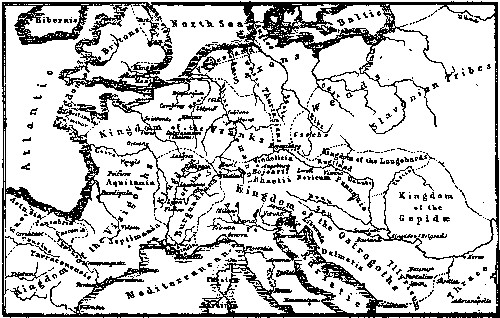
THE MIGRATIONS OF THE RACES, A. D. 500.
570. LOCATION OF THE TRIBES.
The Franks, at this time, were firmly established in Gaul, under the dynasty founded by Chlodwig. They owned nearly all the territory west of the Rhine, part of Western Switzerland and the valley of the Rhone, to the Mediterranean. Only a small strip of territory on the east, between the Pyrenees and the upper waters of the Garonne, still belonged to the Visigoths. The kingdom of Burgundy, after an existence of 125 years, became absorbed in that of the Franks, in 534.
After the death of Theodoric, the connection of the Visigoths with the other German races ceased. They conquered the Suevi, driving them into the mountains of Galicia, subdued the Alans in Portugal, and during a reign of two centuries more impressed their traces indelibly upon the Spanish people. Their history, from this time on, belongs to Spain. Their near relations, the Vandals, as we have already seen, had ceased to exist. Like the Ostrogoths, they were never named again as a separate people.
The Saxons had made themselves such thorough masters of England and the lowlands of Scotland, that the native Celto-Roman population was driven into Wales and Cornwall. The latter had become Christians under the Empire, and they looked with horror upon the paganism of the Saxons. During the early part of the sixth century, they made a bold but brief effort to expel the invaders, under the lead of the half-fabulous king Arthur (of the Round Table), who is supposed to have died about the year 537. The Angles and Saxons, however, not only triumphed, but planted their language, laws and character so firmly upon English soil, that the England of the later centuries grew from the basis they laid, and the name of Anglo-Saxon has become the designation of the English race all over the world.
Along the northern coast of Germany, the Frisii and the Saxons who remained behind, had formed two kingdoms and asserted a fierce independence. The territory of the latter extended to the Hartz Mountains, where it met that of the Thuringians, who still held Central Germany southward to the Danube. Beyond that river, the new nation of the Bavarians was permanently settled, and had already risen to such importance that Theodolind, the daughter of its king, Garibald, was selected for his queen by the Longobard king, Authari.
East of the Elbe, through Prussia, nearly the whole country was occupied by various Slavonic tribes. One of these, the Czechs, had taken possession of Bohemia, where they soon afterwards established an independent kingdom. Beyond them, the Avars occupied Hungary, now and then making invasions into German territory, or even to the borders of Italy; Denmark and Sweden, owing to their remoteness from the great theatre of action, were scarcely affected by the political changes we have described.
570.
Finally, the Alemanni, though defeated and held back by the Franks, maintained their independence in the south-western part of Germany and in Eastern Switzerland, where their descendants are living at this day. Each of all these new nationalities included remnants of the smaller original tribes, which had lost their independence in the general struggle, and which soon became more or less mixed (except in England) with the former inhabitants of the conquered soil.
The Eastern Empire was now too weak and corrupt to venture another conflict with these stronger Germanic races, whose civilization was no longer very far behind its own. Moreover, within sixty years after the Migration came to an end, a new foe arose in the East. The successors of Mahomet began that struggle which tore Egypt, Syria and Asia Minor from Christian hands, and which only ceased when, in 1453, the crescent floated from the towers of Constantinople.
Nearly all Europe was thus portioned among men of German blood, very few of whom ever again migrated from the soil whereon they were now settled. It was their custom to demand one-third—in some few instances, two thirds—of the conquered territory for their own people. In this manner, Frank and Gaul, Longobard and Roman, Visigoth and Spaniard, found themselves side by side, and reciprocally influenced each other's speech and habits of life. It must not be supposed, however, that the new nations lost their former character, and took on that of the Germanic conquerors. Almost the reverse of this took place. It must be remembered that the Gauls, for instance, far outnumbered the Franks; that each conquest was achieved by a few hundred thousand men, all of them warriors, while each of the original Roman provinces had several millions of inhabitants. There must have been at least ten of the ruled, to one of the ruling race.
570. SPREAD OF CHRISTIANITY.
The latter, moreover, were greatly inferior to the former in all the arts of civilization. In the homes, the dress and ornaments, the social intercourse, and all the minor features of life, they found their new neighbors above them, and they were quick to learn the use of unaccustomed comforts or luxuries. All the cities and small towns were Roman in their architecture, in their municipal organization, and in the character of their trade and intercourse; and the conquerors found it easier to accept this old-established order than to change it.
Another circumstance contributed to Latinize the German races outside of Germany. After the invention of a Gothic alphabet by Bishop Ulfila, and his translation of the Bible, we hear no more of a written German language until the eighth century. There was at least none which was accessible to the people, and the Latin continued to be the language of government and religion. The priests were nearly all Romans, and their interest was to prevent the use of written Germanic tongues. Such learning as remained to the world was of course only to be acquired through a knowledge of Latin and Greek.
All the influences which surrounded the conquering races tended, therefore, to eradicate or change their original German characteristics. After a few centuries, their descendants, in almost every instance, lost sight of their origin, and even looked with contempt upon rival people of the same blood. The Franks and Burgundians of the present day speak of themselves as "the Latin race": the blonde and blue-eyed Lombards of Northern Italy, not long since, hated "the Germans" as the Christian of the Middle Ages hated the Jew; and the full-blooded English or American Saxon often considers the German as a foreigner with whom he has nothing in common.
By the year 570, all the races outside of Germany, except the Saxons and Angles in Britain, had accepted Christianity. Within Germany, although the Christian missionaries were at work among the Alemanni, the Bavarians, and along the Rhine, the great body of the people still held to their old pagan worship. The influence of the true faith was no doubt weakened by the bitter enmity which still existed between the Athanasian and Arian sects, although the latter ceased to be powerful after the downfall of the Ostrogoths. But the Christianity which prevailed among the Franks, Burgundians and Longobards was not pure or intelligent enough to save them from the vices which the Roman Empire left behind it. Many of their kings and nobles were polygamists, and the early history of their dynasties is a chronicle of falsehood, cruelty and murder.
570.
In each of the races, the primitive habit of electing chiefs by the people had long since given way to an hereditary monarchy, but in other respects their political organization remained much the same. The Franks introduced into Gaul the old German division of the land into provinces, hundreds and communities, but the king now claimed the right of appointing a Count for the first, a Centenarius, or centurion, for the second, and an elder, or head-man, for the third. The people still held their public assemblies, and settled their local matters; they were all equal before the law, and the free men paid no taxes. The right of declaring war, making peace, and other questions of national importance, were decided by a general assembly of the people, at which the king presided. The political system was therefore more republican than monarchical, but it gradually lost the former character as the power of the kings increased.
The nobles had no fixed place and no special rights during the migrations of the tribes. Among the Franks they were partly formed out of the civil officers, and soon included both Romans and Gauls among their number. In Germany their hereditary succession was already secured, and they maintained their ascendancy over the common people by keeping pace with the knowledge and the arts of those times, while the latter remained, for the most part, in a state of ignorance.
The cities, inhabited by Romans and Romanized Gauls, retained their old system of government, but paid a tax or tribute. Those portions of the other Germanic races which had become subject to the Franks were also allowed to keep their own peculiar laws and forms of local government, which were now, for the first time, recorded in the Latin language. They were obliged to furnish a certain number of men capable of bearing arms, but it does not appear that they paid any tribute to the Franks.
Slavery still existed, and in the two forms of it which we find among the ancient Germans,—chattels who were bought and sold, and dependents who were bound to give labor or tribute in return for the protection of a freeman. The Romans in Gaul were placed upon the latter footing by the Franks. The children born of marriages between them and the free took the lower and not the higher position,—that is, they were dependents.
570. PENALTIES FOR CRIME.
The laws in regard to crime were very rigid and severe, but not bloody. The body of the free man, like his life, was considered inviolate, so there was no corporeal punishment, and death was only inflicted in a few extreme cases. The worst crimes could be atoned for by the sacrifice of money or property. For murder the penalty was two hundred shillings (at that time the value of 100 oxen), two-thirds of which were given to the family of the murdered person, while one-third was divided between the judge and the State. This penalty was increased threefold for the murder of a Count or a soldier in the field, and more than fourfold for that of a Bishop. In some of the codes the payment was fixed even for the murder of a Duke or King. The slaying of a dependent or a Roman only cost half as much as that of a free Frank, while a slave was only valued at thirty-five shillings, or seventeen and a half oxen: the theft of a falcon trained for hunting, or a stallion, cost ten shillings more.
Slander, insult and false-witness were punished in the same way. If any one falsely accused another of murder he was condemned to pay the injured person the penalty fixed for the crime of murder, and the same rule was applied to all minor accusations. The charge of witchcraft, if not proved according to the superstitious ideas of the people, was followed by the penalty of one hundred and eighty shillings. Whoever called another a hare, was fined six shillings; but if he called him a fox, the fine was only three shillings.
As the Germanic races became Christian, the power and privileges of the priesthood were manifested in the changes made in these laws. Not only was it enacted that the theft of property belonging to the Church must be paid back ninefold, but the slaves of the priests were valued at double the amount fixed for the slaves of laymen. The Churches became sacred, and no criminal could be seized at the foot of the altar. Those who neglected to attend worship on the Sabbath three times in succession, were punished by the loss of one-third of their property. If this neglect was repeated a second time, they were made slaves, and could be sold as such by the Church.
570.
The laws of the still pagan Thuringians and Saxons, in Germany, did not differ materially from those of the Christian Franks. Justice was administered in assemblies of the people, and, in order to secure the largest expression of the public will, a heavy fine was imposed for the failure to attend. The latter feature is still retained, in some of the old Cantons of Switzerland. In Thuringia and Saxony, however, the nobles had become a privileged class, recognized by the laws, and thus was laid the foundation for the feudal system of the Middle Ages.
The transition was now complete. Although the art, taste and refinement of the Roman Empire were lost, its civilizing influence in law and civil organization survived, and slowly subdued the Germanic races which inherited its territory. But many characteristics of their early barbarism still clung to the latter, and a long period elapsed before we can properly call them a civilized people.