



автордың кітабын онлайн тегін оқу The Sea Shore
Transcriber’s Note
There is a single footnote, which has been rendered using the original asterisk. The footnote itself has been placed after the paragraph where it is referenced. Illustrations have been re-positioned slightly.
Please see the detailed notes at the end of this text for details about the few corrections that were made during it’s preparation.
For the reader’s convenience, links have been added to the text for references to figures and pages not in the immediate vicinity.
The cover image has been fabricated and is placed in the public domain.
THE SEA SHORE
THE OUT-DOOR WORLD SERIES.
THE OUT-DOOR WORLD; or, the Young Collector’s Handbook.
By W. S. Furneaux. With 18 Plates (16 of which are Coloured), and 549 Illustrations in the Text. Crown 8vo, 6s. 6d. net.
FIELD AND WOODLAND PLANTS.
By W. S. Furneaux. With 8 Plates in Colour, and numerous other Illustrations by Patten Wilson, and from Photographs. Crown 8vo, 6s. 6d. net.
BRITISH BUTTERFLIES AND MOTHS.
By W. S. Furneaux. With 12 Coloured Plates and 241 Illustrations in the Text. Crown 8vo, 6s. 6d. net.
LIFE IN PONDS AND STREAMS.
By W. S. Furneaux. With 8 Coloured Plates and 331 Illustrations in the Text. Crown 8vo, 6s. 6d. net.
THE SEA SHORE. By W. S. Furneaux.
With 8 Coloured Plates and over 300 Illustrations in the Text. Crown 8vo, 6s. 6d. net.
BRITISH BIRDS. By W. H. Hudson.
With a Chapter on Structure and Classification by Frank E. Beddard, F.R.S. With 16 Plates (8 of which are Coloured), and 103 Illustrations in the Text. Crown 8vo, 6s. 6d. net.
LONGMANS, GREEN & CO., 39 Paternoster Row, London, E.C.4 New York, Toronto, Bombay, Calcutta and Madras.
Plate I
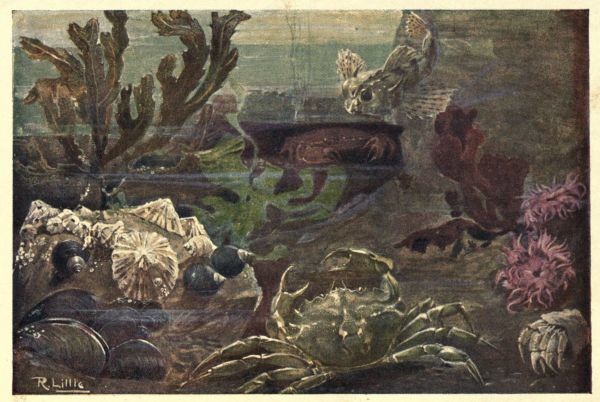
A ROCK-POOL
THE SEA SHORE
BY
W. S. FURNEAUX
AUTHOR OF
‘THE OUTDOOR WORLD’ ‘BRITISH BUTTERFLIES AND MOTHS’
‘LIFE IN PONDS AND STREAMS’ ETC.
WITH EIGHT PLATES IN COLOUR
AND OVER THREE HUNDRED ILLUSTRATIONS IN THE TEXT
NEW IMPRESSION
LONGMANS, GREEN AND CO.
39 PATERNOSTER ROW, LONDON, E.C.4
NEW YORK, TORONTO
BOMBAY, CALCUTTA AND MADRAS
1922
All rights reserved
BIBLIOGRAPHICAL NOTE.
First published in September, 1903.
Re-issue at Cheaper Price, July, 1911.
New Impression, November, 1922.
Made in Great Britain
PREFACE
To sea-side naturalists it must be a matter of great surprise that of the inhabitants of our coast towns and villages, and of the pleasure-seekers that swarm on various parts of the coast during the holiday season, so few take a real interest in the natural history of the shore. The tide flows and ebbs and the restless waves incessantly roll on the beach without arousing a thought as to the nature and cause of their movements. The beach itself teems with peculiar forms of life that are scarcely noticed except when they disturb the peace of the resting visitor. The charming vegetation of the tranquil rock-pool receives but a passing glance, and the little world of busy creatures that people it are scarcely observed; while the wonderful forms of life that inhabit the sheltered nooks of the rugged rocks between the tide-marks are almost entirely unknown except to the comparatively few students of Nature. So general is this apparent lack of interest in the things of the shore that he who delights in the study of littoral life and scenes but seldom meets with a kindred spirit while following his pursuits, even though the crowded beach of a popular resort be situated in the immediate neighbourhood of his hunting ground. The sea-side cottager is too accustomed to the shore to suppose that he has anything to learn concerning it, and this familiarity leads, if not to contempt, most certainly to a disinclination to observe closely; and the visitor from town often considers himself to be too much in need of his hard-earned rest to undertake anything that may seem to require energy of either mind or body.
Let both, however, cast aside any predisposition to look upon the naturalist’s employment as arduous and toilsome, and make up their minds to look enquiringly into the living world around them, and they will soon find that they are led onward from the study of one object to another, the employment becoming more and more fascinating as they proceed.
Our aim in writing the following pages is to encourage the observation of the nature and life of the sea shore; to give such assistance to the beginner as will show him where the most interesting objects are to be found, and how he should set to work to obtain them. Practical hints are also furnished to enable the reader to successfully establish and maintain a salt-water aquarium for the observation of marine life at home, and to preserve various marine objects for the purpose of forming a study-collection of the common objects of the shore.
To have given a detailed description of all such objects would have been impossible in a work of this size, but a large number have been described and figured, and the broad principles of the classification of marine animals and plants have been given such prominence that, it is hoped, even the younger readers will find but little difficulty in determining the approximate positions, in the scale of life, of the various living things that come within their reach.
Of the many illustrations, which must necessarily greatly assist the reader in understanding the structure of the selected types and in the identification of the different species, a large number have been prepared especially for this work.
CONTENTS
CHAPTER
PAGE
I.
THE GENERAL CHARACTERISTICS OF THE SEA SHORE
1II.
THE SEA-SIDE NATURALIST
21III.
SEA ANGLING
34IV.
THE MARINE AQUARIUM
51V.
THE PRESERVATION OF MARINE OBJECTS
71VI.
EXAMINATION OF MARINE OBJECTS—DISSECTION
91VII.
THE PROTOZOA OF THE SEA SHORE
102VIII.
BRITISH SPONGES
115IX.
THE CŒLENTERATES—JELLY-FISHES, ANEMONES, AND THEIR ALLIES
127X.
STARFISHES, SEA URCHINS, ETC.
157XI.
MARINE WORMS
172XII.
MARINE MOLLUSCS
190XIII.
MARINE ARTHROPODS
256XIV.
MARINE VERTEBRATES
306XV.
SEA WEEDS
343XVI.
THE FLOWERING PLANTS OF THE SEA-SIDE
391INDEX
425LIST OF COLOURED PLATES
Drawn by Mr. Robert Lillie and reproduced by Messrs. André & Sleigh, Ltd., Bushey.
Plate I—
A ROCK-POOL Frontispiece Plate II—
SEA ANEMONES To face p. 1421, 2, 3.
Actinia mesembryanthemum.4.
Caryophyllia Smithii.5.
Tealia crassicornis.6.
Sagartia bellis.7.
Balanophyllia regia.8.
Actinoloba dianthus. Plate III—
SEA ANEMONES To face p. 1501.
Sagartia troglodytes.2. ”
venusta.3.
Actinia glauca.4. ”
chiococca.5.
Bunodes Ballii.6. ”
gemmacea.7.
Anthea cereus.8.
Sagartia rosea. Plate IV—
ECHINODERMS To face p. 1681.
Asterias rubens.2.
Goniaster equestris.3.
Ophiothrix fragilis.4.
Echinocardium cordatum.5.
Echinus miliaris.6. ”
esculentus. Plate V—
MOLLUSCS To face p. 2221.
Solen ensis.2.
Trivia europæa.3.
Trochus umbilicatus.4. ”
magnus.5.
Littorina littorea.6. ”
rudis.7.
Haminea(
Bulla)
hydatis.
8.
Tellina.9.
Capulus(
Pileopsis)
hungaricus.
10.
Chrysodomus(
Fusus)
antiquus.
11.
Buccinum undatum.12, 13.
Scalaria communis.14.
Pecten opercularis.15. ”
varius.16. ”
maximus. Plate VI—
CRUSTACEA To face p. 2901.
Gonoplax angulata.2.
Xantho florida.3.
Portunus puber.4.
Polybius Henslowii.5.
Porcellana platycheles. Plate VII—
SEAWEEDS To face p. 3541.
Fucus nodosus.2.
Nitophyllum laceratum.3.
Codium tomentosum.4.
Padina pavonia.5.
Porphyra laciniata(
vulgaris).
Plate VIII—
SEAWEEDS To face p. 3841.
Chorda filum.2.
Fucus vesiculosus.3.
” canaliculatus.4.
Delesseria(
Maugeria)
sanguinea.
5.
Rhodymenia palmata.6.
Chondrus crispus.7.
Ulva lactuca.OTHER ILLUSTRATIONS
Transcriber’s Note
CHAPTER I
THE GENERAL CHARACTERISTICS OF THE SEA SHORE
CHAPTER II
THE SEA-SIDE NATURALIST
CHAPTER III
SEA ANGLING
CHAPTER IV
THE MARINE AQUARIUM
CHAPTER V
THE PRESERVATION OF MARINE OBJECTS
CHAPTER VI
EXAMINATION OF MARINE OBJECTS—DISSECTION
CHAPTER VII
THE PROTOZOA OF THE SEA SHORE
CHAPTER VIII
BRITISH SPONGES
CHAPTER IX
THE CŒLENTERATES—JELLY-FISHES, ANEMONES, AND THEIR ALLIES
CHAPTER X
STARFISHES, SEA URCHINS, ETC.
CHAPTER XI
MARINE WORMS
CHAPTER XII
MARINE MOLLUSCS
CHAPTER XIII
MARINE ARTHROPODS
CHAPTER XIV
MARINE VERTEBRATES
CHAPTER XV
SEA WEEDS
CHAPTER XVI
THE FLOWERING PLANTS OF THE SEA-SIDE
INDEX
FIG.
PAGE
1.
Chalk Cliff 32.
Whitecliff (Chalk), Dorset 43.
Penlee Point, Cornwall 54.
Balanus Shells 65.
A Cluster of Mussels 76.
Breakers 87.
Illustrating the Tide-producing Influence of the Moon 108.
Illustrating the tides 119.
Spring Tides at Full Moon 1210.
Spring Tides at New Moon 1211.
Neap Tides 1312.
Chart showing the relative Times of High Tide on different parts of the British Coast 1613.
The Vasculum 2214.
Wire Ring for Net 2415.
Net Frame with Curved Point 2416.
Rhomboidal Frame for Net 2417.
Rhomboidal Net 2518.
Semicircular Net 2519.
The Dredge 2520.
The Crab-pot 2621.
An old Bird-cage used as a Crab-pot 2722.
A Young Naturalist at Work 3223.
A good Hunting-ground on the Cornish Coast 3324.
Round Bend Hook with Flattened End 3725.
Limerick Hook, eyed 3726.
Method of Attaching Snood to Flattened Hook 3827.
Method of Attaching Snood to Eyed Hook 3828.
The Lugworm 3929.
The Ragworm 4030.
Digging for Bait 4131.
Method of Opening a Mussel 4232.
Fishing from the Rocks 4633.
The Paternoster 4834.
Section of an Aquarium constructed with a Mixture of Cement and Sand 5435.
Cement Aquarium with a Glass Plate in Front 5536.
Aquarium of Wood with Glass Front 5637.
Hexagonal Aquarium constructed of Angle Zinc, with Glass Sides 5738.
Method of Aerating the Water of an Aquarium 6539.
Aquarium fitted with Apparatus for Periodic Outflow 6740.
Jars for preserving Anatomical and Biological Specimens 7641.
Showing the different stages in the making of a small Specimen Tube 7742.
Small Specimen Tube mounted on a Card 7843.
Small Crab mounted on a Card 8244.
Spring for holding together small Bivalve Shells 8445.
The Triplet Magnifier 9246.
A small Dissecting Trough 9347.
Cell for small Living Objects 9548.
Sheet of Cork on thin Sheet Lead 9949.
Weighted Cork for Dissecting Trough 9950.
The Amœba, highly magnified 10251.
” ”
showing changes of form 10352.
” ”
feeding 10353.
” ”
dividing 10454.
A Group of Foraminifers, magnified 10555.
A Spiral Foraminifer Shell 10656.
A Foraminifer out of its Shell 10657.
The same Foraminifer (fig. 56) as seen when alive 10758.
Section of the Shell of a Compound Foraminifer 10759.
Section of a Nummulite Shell 10860.
Globigerina bulloides,
as seen when alive, magnified 10861.
Section of a piece of Nummulitic Limestone 10962.
A Group of Radiolarian Shells, magnified 11163.
Three Infusorians, magnified 11364.
A Phosphorescent Marine Infusorian(
Noctiluca),
magnified 11465.
Section of a Simple Sponge 11666.
Diagrammatic section of a portion of a Complex Sponge 11767.
Horny Network of a Sponge, magnified 11868.
Grantia compressa 12069.
Spicules of Grantia,
magnified 12070.
Sycon ciliatum 12171.
Leucosolenia botryoides,
with portion magnified 12172.
Chalina oculata 12273.
Halichondria panicea 12374.
Spicules of Halichondria,
magnified 12475.
An Oyster Shell, bored by Cliona 12476.
Spicules of Cliona 12577.
Thread Cells of a Cœlenterate, magnified 12778.
The Squirrel’s-tail Sea Fir(
Sertularia argentea),
with a portion enlarged 12879.
Sertularia filicula 12980.
”
cupressina 13081.
The Herring-bone Polype(
Halecium halecinum 13182.
Tubularia indivisa 13283.
The Bottle Brush(
Thuiaria thuja)
13284.
Antennularia antennia 13385.
Aurelia aurita 13586.
The Early Stages of Aurelia 13687.
Rhizostoma 13688.
Chrysaora 13689.
Cydippe pileus 13790.
Section of an Anemone 13991.
Stinging Cells of Anemone, highly magnified 14092.
Diagrammatic transverse section of an Anemone 14093.
Larva of Anemone 14094.
The Trumpet Anemone(
Aiptasia Couchii),
Cornwall; deep water 14495.
Peachia hastata, S. Devon 14596.
Sagartia pallida, Devon and Cornwall 14697.
Sagartia nivea, Devon and Cornwall 14798.
Corynactus viridis, Devon and Cornwall 14899.
Bunodes thallia, West Coast 150100.
Bunodes gemmacea, with tentacles retracted 151101.
Caryophyllia cyathus 152102.
Sagartia parasitica 153103.
The Cloak Anemone(
Adamsia palliata)
on a Whelk Shell, with Hermit Crab 154104.
Larva of the Brittle Starfish 158105.
Larva of the Feather Star 160106.
The Rosy Feather Star 160107.
The Common Brittle Star 162108.
Section of the Spine of a Sea Urchin 165109.
Sea Urchin with Spines removed on one Side 166110.
Apex of Shell of Sea Urchin 166111.
Shell of Sea Urchin with Teeth protruding 167112.
Interior of Shell of Sea Urchin 167113.
Masticatory Apparatus of Sea Urchin 167114.
Sea Urchin Dissected, showing the Digestive Tube 168115.
The Sea Cucumber 170116.
A Turbellarian, magnified 175117.
Arenicola piscatorum 178118.
The Sea Mouse 179119.
Tube-building Worms:
Terebella, Serpula, Sabella 182120.
Terebella removed from its Tube 183121.
A tube of Serpula attached to a Shell 185122.
Serpula removed from its Tube 186123.
The Sea Mat(
Flustra)
187124.
Flustra in its Cell, magnified 188125.
Sea Squirt 189126.
Larvæ of Molluscs 191127.
Shell of the Prickly Cockle(
Cardium aculeatum)
showing Umbo and Hinge; also the interior showing the Teeth 192128.
Interior of Bivalve Shell, showing Muscular Scars and Pallial Line 193129.
Diagram of the Anatomy of a Lamellibranch 194130.
Mytilus edulis,
with Byssus 195131.
A Bivalve Shell(
Tapes virgineana)
196132.
Pholas dactylus 199133.
” ”
interior of Valve; and Pholadidea with Animal 201134.
The Ship Worm 202135.
1.
Teredo navalis.2.
Teredo norvegica 202136.
Gastrochæna modiolina 203137.
1.
Thracia phaseolina.2.
Thracia pubescens,
showing Pallial Line 204138.
1.
Mya truncata.2.
Interior of Shell.3.
Mya arenaria.4.
Corbula nucleus 205139.
Solen siliqua 206140.
1.
Solen ensis.2.
Cerati-solen legumen.3.
Solecurtus candidus 207141.
Tellinidæ 208142.
1.
Lutraria elliptica.2.
Part of the Hinge of Lutraria,
showing the Cartilage Pit. 3.
Macra stultorum.4.
Interior of same showing Pallial Line 210143.
Veneridæ 211144.
Cyprinidæ 213145.
Galeomma Turtoni 214146.
1.
Cardium pygmæum.2.
Cardium fasciatum.3.
Cardium rusticum 215147.
Cardium aculeatum 215148.
Pectunculus glycimeris,
with portion of Valve showing Teeth, and Arca tetragona 216149.
Mytilus edulis 217150.
1.
Modiola modiolus.2.
Modiola tulipa.3.
Crenella discors 218151.
Dreissena polymorpha 219152.
Avicula,
and Pinna pectinata 220153.
1.
Anomia ephippium.2.
Pecten tigris.3.
Pecten,
animal in shell 222154.
Terebratulina. The upper figure represents the interior of the Dorsal Valve 224155.
Under side of the Shell of Natica catena,
showing the Umbilicus; and outline of the Shell, showing the Right-handed Spiral 225156.
Section of the Shell of the Whelk, showing the Columella 226157.
Diagram of the Anatomy of the Whelk, the Shell being removed 228158.
A portion of the Lingual Ribbon of the Whelk, magnified; and a single row of Teeth on a much larger scale 229159.
Egg Cases of the Whelk 230160.
Pteropods 231161.
Nudibranchs 234162.
”
235163.
Shells of Tectibranchs 236164.
Chiton Shells 238165.
Shells of Dentalium 238166.
Patellidæ 239167.
Calyptræa sinensis 241168.
Fissurellidæ 241169.
Haliotis 242170.
Ianthina fragilis 242171.
Trochus zizyphinus. 2.
Under Side of Shell.3.
Trochus magnus.4.
Adeorbis subcarinatus 244172.
Rissoa labiosa and Lacuna pallidula 244173.
Section of Shell of Turritella 245174.
Turritella communis and Cæcum trachea 245175.
Cerithium reticulatum and Aporrhais pes-pelicani 245176.
Aporrhais pes-pelicani,
showing both Shell and Animal 246177.
1.
Odostomia plicata.2.
Eulima polita.3.
Aclis supranitida 246178.
Cypræa(
Trivia)
europæa 247179.
1.
Ovulum patulum. 2.
Erato lævis 248180.
Mangelia septangularis and Mangelia turricula 248181.
1.
Purpura lapillus.2.
Egg Cases of Purpura. 3.
Nassa reticulata 249182.
Murex erinaceus 249183.
Octopus 251184.
Loligo vulgaris and its Pen 252185.
Sepiola atlantica 252186.
Sepia officinalis and its ‘Bone’ 253187.
Eggs of Sepia 254188.
The Nerve-chain of an Arthropod (Lobster) 257189.
Section through the Compound Eye of an Arthropod 260190.
Four Stages in the Development of the Common Shore Crab 261191.
The Barnacle 261192.
Four Stages in the Development of the Acorn Barnacle 262193.
A Cluster of Acorn Shells 263194.
Shell of Acorn Barnacle(
Balanus)
263195.
The Acorn Barnacle(
Balanus porcatus)
with Appendages protruded 264196.
A Group of Marine Copepods, magnified 265197.
A Group of Ostracode Shells 265198.
Evadne 266199.
Marine Isopods 267200.
Marine Amphipods 268201.
The Mantis Shrimp(
Squilla Mantis)
270202.
The Opossum Shrimp(
Mysis chamæleon)
271203.
Parts of Lobster’s Shell, separated, and viewed from above 272204.
A Segment of the Abdomen of a Lobster 272205.
Appendages of a Lobster 273206.
Longitudinal Section of the Lobster 274207.
The Spiny Lobster(
Palinurus vulgaris)
275208.
The Norway Lobster(
Nephrops norvegicus)
276209.
1.
The Mud-borer(
Gebia stellata). 2.
The Mud-borrower(
Callianassa subterranea)
277210.
The Common Shrimp(
Crangon vulgaris)
278211.
The Prawn(
Palæmon serratus)
279212.
Dromia vulgaris 282213.
The Hermit Crab in a Whelk Shell 282214.
The Long-armed Crab(
Corystes Cassivelaunus)
287215.
Spider Crabs at Home 288216.
The Thornback Crab(
Maia Squinado)
290217.
The Pea Crab(
Pinnotheres pisum)
290218.
The Common Shore Crab(
Carcinus mænas)
291219.
The Shore Spider 294220.
The Leg of an Insect 295221.
Trachea of an Insect, magnified 296222.
Sea-Shore Insects 298223.
Marine Beetles of the genus(
Bembidium)
302224.
Marine Beetles 303225.
Transverse section through the Bony Framework of a Typical Vertebrate Animal 306226.
The Sea Lamprey 309227.
The Pilchard 310228.
The Skeleton of a Fish (Perch) 315229.
The Internal Organs of the Herring 316230.
The Egg-case of the Dogfish 319231.
The Smooth Hound 320232.
The Common Eel 323233.
The Lesser Sand Eel 326234.
The Three-bearded Rockling 327235.
The Snake Pipe-fish 328236.
The Rainbow Wrass(
Labrus julis)
330237.
The Cornish Sucker 330238.
The Fifteen-spined Stickleback and Nest 331239.
The Smooth Blenny 333240.
The Butterfish 334241.
The Black Goby 335242.
The Father Lasher 335243.
The Lesser Weaver 337244.
The Common Porpoise 341245.
Callithamnion roseum 359246.
Callithamnion tetricum 359247.
Griffithsia corallina 361248.
Halurus equisetifolius 361249.
Pilota plumosa 361250.
Ceramium diaphanum 363251.
Plocamium 366252.
Delesseria alata 368253.
Delesseria hypoglossum 368254.
Laurencia pinnatifida 371255.
Laurencia obtusa 371256.
Polysiphonia fastigiata 373257.
Polysiphonia parasitica 374258.
Polysiphonia Brodiæi 374259.
Polysiphonia nigrescens 374260.
Ectocarpus granulosus 378261.
Ectocarpus siliculosus 378262.
Ectocarpus Mertensii 378263.
Sphacelaria cirrhosa 379264.
Sphacelaria plumosa 379265.
Sphacelaria radicans 380266.
Cladostephus spongiosus 380267.
Chordaria flagelliformis 380268.
Laminaria bulbosa 384269.
Laminaria saccharina 384270.
Alaria esculenta 385271.
Sporochnus pedunculatus 385272.
Desmarestia ligulata 386273.
Himanthalia lorea 387274.
Cystoseira ericoides 388275.
Transverse Section of the Stem of a Monocotyledon 391276.
Leaf of a Monocotyledon 392277.
Expanded Spikelet of the Oat 393278.
The Sea Lyme Grass 395279.
Knappia agrostidea 397280.
The Dog’s-tooth Grass 397281.
The Reed Canary Grass 397282.
Male and Female Flowers of Carex, magnified 399283.
The Sea Sedge 400284.
The Curved Sedge 400285.
The Great Sea Rush 400286.
The Broad-leaved Grass Wrack 401287.
The Sea-side Arrow Grass 401288.
The Common Asparagus 401289.
The Sea Spurge 403290.
The Purple Spurge 404291.
The Sea Buckthorn 404292.
Chenopodium botryoides 405293.
The Frosted Sea Orache 406294.
The Prickly Salt Wort 406295.
The Creeping Glass Wort 407296.
The Sea-side Plantain 408297.
The Sea Lavender 408298.
The Dwarf Centaury 410299.
The Sea Samphire 412300.
The Sea-side Everlasting Pea 413301.
The Sea Stork’s-bill 414302.
The Sea Campion 416303.
The Sea Pearl Wort 417304.
The Shrubby Mignonette 417305.
The Wild Cabbage 418306.
The Isle of Man Cabbage 418307.
The Great Sea Stock 419308.
The Hoary Shrubby Stock 419309.
The Scurvy Grass 419310.
The Sea Radish 419311.
The Sea Rocket 420312.
The Sea Kale 421313.
The Horned Poppy 422Fig. 1.—Chalk Cliff
Fig. 2.—Whitecliff (Chalk), Dorset
Fig. 3.—Penlee Point, Cornwall
Fig. 4.—Balanus Shells
Fig. 5.—A Cluster of Mussels
Fig. 6.—Breakers
Fig. 7.—Illustrating the Tide-producing Influence of the Moon
Fig. 8.—Illustrating the Tides
Fig. 9.—Spring Tides at Full Moon
Fig. 10.—Spring Tides at New Moon
Fig. 11.—Neap Tides
Fig. 12.—Chart showing the relative Times of High Tide on different parts of the British Coast
Fig. 13.—The Vasculum
Fig. 14.—Wire Ring for Net
Fig. 15.—Net Frame with Curved Point
Fig. 16.—Rhomboidal Frame for Net
Fig. 17.—Rhomboidal Net
Fig. 18.—Semicircular Net
Fig. 19.—The Dredge
Fig. 20.—The Crab-pot
Fig. 21.—An old Bird-cage used as a Crab-pot
Fig. 22.—A Young Naturalist at Work
Fig. 23.—A good Hunting-ground on the Cornish Coast
Fig. 24.—Round Bend Hook with Flattened End
Fig. 25.—Limerick Hook, eyed
Fig. 26.—Method of attaching Snood to Flattened Hook
Fig. 27.—Method of attaching Snood to Eyed Hook
Fig. 28.—The Lugworm
Fig. 29.—The Ragworm
Fig. 30.—Digging for Bait
Fig. 31.—Method of Opening a Mussel
Fig. 32.—Fishing from the Rocks
Fig. 34.—Section of an Aquarium constructed with a mixture of Cement and Sand
Fig. 35.—Cement Aquarium with a Glass Plate in Front
Fig. 36.—Aquarium of Wood with Glass Front
Fig. 37.—Hexagonal Aquarium constructed of Angle Zinc, with Glass Sides
Fig. 38.—Method of aërating the Water of an Aquarium
a, aquarium with fountain; c, cistern to supply the fountain; o, pipe for overflow; v, vessel for overflow
Fig. 39.—Aquarium fitted with Apparatus for Periodic Outflow
Fig. 40.—Jars for preserving Anatomical and Biological Specimens
Fig. 41.—Showing the different stages in the making of a small Specimen Tube
Fig. 42.—Small Specimen Tube mounted on a Card
Fig. 43.—Small Crab mounted on a Card
Fig. 44.—Spring for holding together small Bivalve Shells
Fig. 45—The Triplet Magnifier
Fig. 46.—A small Dissecting Trough
Fig. 47.—Cell for small Living Objects
Fig. 48.—Sheet of Cork on thin Sheet Lead
Fig. 49.—Weighted Cork for Dissecting Trough
Fig. 50.—The Amœba, highly magnified
Fig. 51.—The Amœba, showing changes of form
Fig. 52.—The Amœba, feeding
Fig. 53.—The Amœba, dividing
Fig. 54.—A group of Foraminifers, magnified
Fig. 55.—A Spiral Foraminifer Shell
Fig. 56.—A Foraminifer out of its shell
Fig. 57.—The same Foraminifer (Fig. 56) as seen when alive
Fig. 58.—Section of the Shell of a Compound Foraminifer
Fig. 59.—Section of a Nummulite Shell
Fig. 60.—Globigerina bulloides, as seen when alive, magnified
Fig. 61.—Section of a piece of Nummulitic Limestone
Fig. 62.—A Group of Radiolarian Shells, magnified
Fig. 63.—Three Infusorians magnified
Fig. 64.—A Phosphorescent Marine Infusorian (Noctiluca), magnified
Fig. 65.—Section of a Simple Sponge
Fig. 66.—Diagrammatic section of a portion of a Complex Sponge
Fig. 67.—Horny Network of a Sponge, magnified
Fig. 68.—Grantia compressa
Fig. 69.—Spicules of Grantia, magnified
Fig. 70.—Sycon ciliatum
Fig. 71.—Leucosolenia botryoides, with portion magnified
Fig. 72.—Chalina oculata
Fig. 73.—Halichondria panicea
Fig. 74.—Spicules of Halichondria, magnified
Fig. 75.—An Oyster Shell bored by Cliona
Fig. 76.—Spicules of Cliona
Fig. 77.—Thread Cells of a Cœlenterate, magnified
1. Thread retracted 2. Thread protruded
Fig. 78.—The Squirrel’s-tail Sea Fir (Sertularia argentea), with a portion enlarged
Fig. 79.—Sertularia filicula
Fig. 80.—Sertularia cupressina
Fig. 81.—The Herring-bone Polype (Halecium halecinum)
Fig. 82.—Tubularia indivisa
Fig. 83.—The Bottle Brush
(Thuiaria thuja)
Fig. 84.—Antennularia antennia
Fig. 85.—Aurelia aurita
Fig. 86.—The early Stages of Aurelia
Fig. 87.—Rhizostoma
Fig. 88.—Chrysaora
Fig. 89.—Cydippe pileus
Fig. 90.—Section of an Anemone
t, tentacles; m, mouth; s, stomach; b c, body-cavity p, mesentery; o, egg-producing organ
Fig. 91.—Stinging Cells of Anemone, highly magnified
a and c, with thread protruded; b, with cell retracted
Fig. 92.—Diagrammatic transverse section of an Anemone
S, stomach; bc, body-cavity; m′, m″, m‴, primary, secondary, and tertiary mesenteries
Fig. 93.—Larva of Anemone
Fig. 94.—The Trumpet Anemone (Aiptasia Couchii), Cornwall; deep water
Fig. 95.—Peachia hastata, S. Devon
Fig. 96.—Sagartia pallida, Devon and Cornwall
Fig. 97.—Sagartia nivea, Devon and Cornwall
Fig. 98.—Corynactus viridis, Devon and Cornwall
Fig. 99.—Bunodes thallia, West Coast
Fig. 100.—Bunodes gemmacea, with tentacles retracted
Fig. 101.—Caryophyllia cyathus
Fig. 102.—Sagartia parasitica
Fig. 103.—The Cloak Anemone (Adamsia palliata) on a Whelk Shell, with Hermit Crab
Fig. 104.—Larva of the Brittle Starfish
Fig. 105.—Larva of the Feather Star
Fig. 106.—The Rosy Feather Star
Fig. 107.—The Common Brittle Star
Fig. 108.—Section of the Spine of a Sea Urchin
Fig. 109.—Sea Urchin with Spines Removed on one side
Fig. 110.—Apex of Shell of Sea Urchin
Fig. 111.—Shell of Sea Urchin with Teeth protruding
Fig. 112.—Interior of Shell or Sea Urchin
Fig. 113.—Masticatory Apparatus of Sea Urchin
Fig. 114.—Sea Urchin Dissected, showing the Digestive Tube
Fig. 115.—The Sea Cucumber
Fig. 116.—A Turbellarian, magnified
a, mouth; b, cavity of mouth; c, gullet; d, stomach; e, branches of stomach; f, nerve ganglion; g to m, reproductive organs.
Fig. 117.—Arenicola piscatorum
Fig. 118.—The Sea Mouse
Fig. 119.—Tube-building Worms: Terebella (left), Serpula (middle), Sabella (right)
Fig. 120.—Terebella removed from its tube
Fig. 121.—A tube of Serpula attached to a Shell
Fig. 122.—Serpula removed from its Tube
Fig. 123.—The Sea Mat (Flustra)
Fig. 124.—Flustra in its Cell, magnified
Fig. 125.—Sea Squirt
Fig. 126.—Larvæ of Molluscs
v, ciliated ‘velum’; f, rudimental foot
Fig. 127.—Shell of the Prickly Cockle (Cardium aculeatum) showing Umbo and Hinge; also the interior showing the Teeth
Fig. 128.—Interior of Bivalve Shell, showing Muscular Scars and Pallial Line
Fig. 129.—Diagram of the Anatomy of a Lamellibranch
f, mouth, with labial palps; g, stomach; i, intestine, surrounded by the liver; a, anus; r, posterior adductor muscle; e, anterior adductor muscle; c, heart; d, nerve ganglion; m, mantle (the right lobe has been removed); s, siphons; h, gills; ft, foot
Fig. 130.—Mytilus edulis, with Byssus
Fig. 131.—A Bivalve Shell
(Tapes virgineana)
a, anterior; p, posterior; l, left valve; r, right valve; u, umbo, on dorsal side
Fig. 132.—Pholas dactylus
1, ventral aspect, with animal; 2, dorsal side of shell showing accessory valves
Fig. 133.—Pholas dactylus, interior of Valve; and Pholadidea with Animal
Fig. 134.—The Ship Worm
Fig. 135.—1. Teredo navalis. 2. Teredo norvegica
Fig. 136.—Gastrochæna modiolina
1, Animal in shell; 2, shell; 3, cell
Fig. 137.—1. Thracia phaseolina. 2. Thracia pubescens, showing Pallial Line
Fig. 138.—1. Mya truncata. 2. Interior of Shell. 3. Mya arenaria. 4. Corbula nucleus
Fig. 139.—Solen siliqua
The valves have been separated and the mantle divided to expose the large foot
Fig. 140.—1. Solen ensis. 2. Cerati-solen legumen. 3. Solecurtus candidus
Fig. 141.—Tellinidæ
1. Psammobia ferroensis. 2. Donax anatinus. 3. Tellina crassa. 4. Tellina tenuis. 5. Donax politus
Fig. 142.—1. Lutraria elliptica. 2. Part of the Hinge of Lutraria, showing the Cartilage Pit. 3. Macra stultorum. 4. Interior of same showing Pallial Line
Fig. 143.—Veneridæ
1. Venus fasciata. 2. Venus striatula. 3. Tapes virgineana. 4. Tapes aurea
Fig. 144.—Cyprinidæ
1. Cyprina islandica. 2. Teeth of Cyprina. 3. Astarte compressa. 4. Circe minima. 5. Isocardia cor
Fig. 145.—Galeomma Turtoni
Fig. 146.—1. Cardium pygmæum. 2. Cardium fasciatum. 3. Cardium rusticum
Fig. 147.—Cardium aculeatum
Fig. 148.—Pectunculus glycimeris, with portion of Valve showing Teeth, and Arca tetragona
Fig. 149.—Mytilus edulis
Fig. 150.—1. Modiola modiolus. 2. Modiola tulipa. 3. Crenella discors
Fig. 151.—Dreissena polymorpha
Fig. 152.—Avicula, and Pinna pectinata
Fig. 153.—1. Anomia ephippium. 2. Pecten tigris. 3. Pecten, animal in shell
Fig. 154.—Terebratulina. The upper figure represents the interior of the Dorsal Valve
Fig. 155.—Under side of the Shell of Natica catena, showing the Umbilicus; and outline of the Shell, showing the Right handed Spiral
Fig. 156.—Section of the Shell of the Whelk, showing the Columella
Fig. 157.—Diagram of the Anatomy of the Whelk, the Shell being removed
c, stomach; e, end of intestine; g, gills; h, ventricle of the heart; a, auricle; f, nerve ganglia; b, digestive gland; ft, foot; o, operculum; d, liver
Fig. 158.—A portion of the Lingual Ribbon of the Whelk, magnified; and a single row of Teeth on a much larger Scale
b, medial teeth; a and c, lateral teeth
Fig. 159.—Egg Cases of the Whelk
Fig. 160.—Pteropods
Fig. 161.—Nudibranchs
1. Doto coronata. 2. Elysia viridis. 3. Proctonotus mucroniferus. 4. Embletonia pulchra
Fig. 162.—Nudibranchs
1. Dendronotus arborescens. 2. Tritonia plebeia. 3. Triopa claviger. 4. Ægirus punctilucens
Fig. 163.—Shells of Tectibranchs
Fig. 164.—Chiton Shells
Fig. 165.—Shells of Dentalium
Fig. 166.—Patellidæ
1. Patella vulgata. 2. P. pellucida. 3. P. athletica. 4. Acmæa testudinalis
Fig. 167.—Calyptræa sinensis
Fig. 168.—Fissurellidæ
1. Puncturella noachina. 2. Emarginula reticulata. 3. Fissurella reticulata
Fig. 169.—Haliotis
Fig. 170.—Ianthina fragilis
Fig. 171.—1. Trochus zizyphinus. 2. Under side of Shell. 3. Trochus magnus. 4. Adeorbis subcarinatus
Fig. 172.—Rissoa labiosa and Lacuna pallidula
Fig. 173.—Section of Shell of Turritella
Fig. 174.—Turritella communis and Cæcum trachea
Fig. 175.—Cerithium reticulatum and Aporrhais pes-pelicani
Fig. 176.—Aporrhais pes-pelicani, showing both shell and animal
Fig. 177.—1. Odostomia plicata. 2. Eulima polita. 3. Aclis supranitida
Fig. 178.—Cypræa (Trivia) europæa
Fig. 179.—1. Ovulum patulum. 2. Erato lævis
Fig. 180.—Mangelia septangularis and Mangelia turricula
Fig. 181.—1. Purpura lapillus. 2. Egg Cases of Purpura. 3. Nassa reticulata
Fig. 182.—Murex erinaceus
Fig. 183.—Octopus
Fig. 184.—Loligo vulgaris and its Pen
Fig. 185.—Sepiola atlantica
Fig. 186.—Sepia officinalis and its ‘Bone’
Fig. 187.—Eggs of Sepia
Fig. 188.—The Nerve-chain of an Arthropod (Lobster)
o, optic nerve; c, cerebral ganglion; i, large ganglion behind the œsophagus; th, ganglia of the thorax; ab, ganglia of the abdomen
Fig. 189.—Section through the Compound Eye of an Arthropod
Fig. 190.—Four Stages in the development of the Common Shore Crab
Fig. 191. The Barnacle
Fig. 192.—Four Stages in the development of the Acorn Barnacle
a, newly hatched larva; b, larva after second moult; c, side view of same; d, stage immediately preceding loss of activity; a, stomach; b, base of future attachment. All magnified
Fig. 193.—A Cluster of Acorn Shells
Fig. 194.—Shell of Acorn Barnacle (Balanus)
Fig. 195.—The Acorn Barnacle (Balanus porcatus) with Appendages protruded
Fig. 196.—A group of Marine Copepods, magnified
Fig. 197.—A group of Ostracode Shells
Fig. 198.—Evadne
Fig. 199.—Marine Isopod
1. Sphæroma serratum. 2. Limnoria lignorum. 3. Ligia oceanica. 4. Nesæa bidentata. 5. Oniscoda maculosa
Fig. 200.—Marine Amphipods
1. The spined sea screw (Dexamine spinosa). 2. Westwoodia cœcula. 3. Tetromatus typicus. 4. The sandhopper (Orchestia littorea). 5. Montagua monoculoides. 6. Iphimedia obesa. All enlarged
Fig. 201.—The Mantis Shrimp (Squilla Mantis)
Fig. 202.—The Opossum Shrimp (Mysis chamæleon)
Fig. 203.—Parts of Lobster’s Shell, separated, and viewed from above
Fig. 204.—A Segment of the Abdomen of a Lobster
t, tergum; s, sternum, bearing a pair of swimmerets; h, bloodvessel; d, digestive tube; n, nerve chain
Fig. 205.—Appendages of a Lobster
1. Second maxilla. 2. Third foot-jaw. 3. Third walking leg. 4. Fifth walking leg
Fig. 206.—Longitudinal Section of the Lobster
a, antenna; r, rostrum or beak; o, eye; m, mouth; s, stomach; in, intestine; l, liver; gl, gills; h, heart; g, genital organ; ar, artery; n, nerve ganglia
Fig. 207.—The Spiny Lobster (Palinurus vulgaris)
Fig. 208.—The Norway Lobster (Nephrops norvegicus)
Fig. 209.—The Mud-borer (Gebia stellata) (1) and the Mud-burrower (Callianassa subterranea) (2)
Fig. 210.—The Common Shrimp (Crangon vulgaris)
Fig. 211.—The Prawn (Palæmon serratus)
Fig. 212.—Dromia vulgaris
Fig. 213.—The Hermit Crab in a Whelk Shell
Fig. 214.—The Long-armed Crab (Corystes Cassivelaunus)
Fig. 215.—Spider Crabs at Home
Fig. 216.—The Thornback Crab (Maia Squinado)
Fig. 217.—The Pea Crab (Pinnotheres pisum)
Fig. 218.—The Common Shore Crab (Carcinus mænas)
Fig. 219.—The Shore Spider
Fig. 220.—The Leg of an Insect
Fig. 221.—Trachea of an Insect, magnified
Fig. 222.—Sea Shore Insects
1. Æpophilus. 2. Machilis maritima. 3. Isotoma maritima. 4. Cœlopa
Fig. 223.—Marine Beetles of the genus Bembidium
1. B. biguttatum. 2. B. pallidipenne. 3. B. fumigatum. 4. B. quadriguttatum
Fig. 224.—Marine Beetles
1. Æpys marinus. 2. Micralymma brevipenne
Fig. 225.—Transverse section through the Bony Framework of a Typical Vertebrate Animal
1. Spinous process of the vertebra. 2. Neural arch. 3. Transverse process. 5. Body of the vertebra. 6. Breast-bone. 7. Rib. The space between 2 and 5 is the neural cavity; and that between 5 and 6 is the visceral cavity
Fig. 226.—The Sea Lamprey
Fig. 227.—The Pilchard
1. Dorsal fin. 2. Pectoral fin. 3. Pelvic fin. 4. Ventral or anal fin. 5. Caudal fin.
Fig. 228.—The Skeleton of a Fish (Perch)
d, dorsal fin; p, pectoral fin; v, pelvic fin; t, tail fin; a, anal fin
Fig. 229.—The Internal Organs of the Herring
a, œsophagus; bc, stomach; e, intestine; l, duct of swimming bladder; k, air-bladder; h, ovary
Fig. 230.—The Egg-case of Dogfish
Fig. 231.—The Smooth Hound
Fig. 232.—The Common Eel
Fig. 233.—The Lesser Sand Eel
Fig. 234.—The Three-bearded Rockling
Fig. 235.—The Snake Pipe-fish
Fig. 236.—The Rainbow Wrass (Labrus julis)
Fig. 237.—The Cornish Sucker
Fig. 238.—The Fifteen-spined Stickleback and Nest
Fig. 239.—The Smooth Blenny
Fig. 240.—The Butterfish
Fig. 241.—The Black Goby
Fig. 242.—The Father Lasher
Fig. 243.—The Lesser Weaver
Fig. 244.—The Common Porpoise
Fig. 245.—Callithamnion roseum
Fig. 246.—Callithamnion tetricum
Fig. 247.—Griffithsia corallina
Fig. 248.—Halurus equisetifolius
Fig. 249.—Pilota plumosa
Fig. 250.—Ceramium diaphanum
Fig 251..—Plocamium
Fig. 252.—Delesseria alata
Fig. 253.—Delesseria hypoglossum
Fig. 254.—Laurencia pinnatifida
Fig. 255.—Laurencia obtusa
Fig. 256.—Polysiphonia fastigiata
Fig. 257.—Polysiphonia parasitica
Fig. 258.—Polysiphonia Brodiæi
Fig. 259.—Polysiphonia nigrescens
Fig. 260.—Ectocarpus granulosus
Fig. 261.—Ectocarpus siliculosus
Fig. 262.—Ectocarpus Mertensii
Fig. 263.—Sphacelaria cirrhosa
Fig. 264.—Sphacelaria plumosa
Fig. 265.—Sphacelaria radicans
Fig. 266.—Cladostephus spongiosus
Fig. 267.—Chordaria flagelliformis
Fig. 268.—Laminaria bulbosa
Fig. 269.—Laminaria saccharina
Fig. 270.—Alaria esculenta
Fig. 271.—Sporochnus pedunculatus
Fig. 272.—Desmarestia ligulata
Fig. 273.—Himanthalia lorea
Fig. 274.—Cystoseira ericoides
Fig. 275.—Transverse Section of the Stem of a Monocotyledon
Fig. 276.—Leaf of a Monocotyledon
Fig. 277.—Expanded Spikelet of the Oat
G. glumes; P.e, outer pale; P.i, inner pale; A, awn; F.S, a sterile flower. The stamens and the feathery stigmas of the fertile flower are also shown
Fig. 278.—The Sea Lyme Grass
Fig. 279.—Knappia agrostidea
Fig. 280.—The Dog’s-tooth Grass
Fig. 281.—The Reed Canary Grass
Fig. 282.—Male and Female Flowers of Carex, magnified
Fig. 283.—The Sea Sedge
Fig. 284.—The Curved Sedge
Fig. 285.—The Great Sea Rush
Fig. 286.—The Broad-leaved Grass Whack
Fig. 287.—The Sea-side Arrow Grass
Fig. 288.—The Common Asparagus
Fig. 289.—The Sea Spurge
Fig. 290.—The Purple Spurge
Fig. 291.—The Sea Buckthorn
Fig. 292.—Chenopodium botryoides
Fig. 293.—The Frosted Sea Orache
Fig. 294.—The Prickly Salt Wort
Fig. 295.—The Creeping Glass Wort
Fig. 296.—The Sea-side Plantain
Fig. 297.—The Sea Lavender
Fig. 298.—The Dwarf Centaury
Fig. 299.—The Sea Samphire
Fig. 300.—The Sea-side Everlasting Pea
Fig. 301.—The Sea Stork’s-bill
Fig. 302.—The Sea Campion
Fig. 303.—The Sea Pearl Wort
Fig. 304.—The Shrubby Mignonette
Fig. 305.—The Wild Cabbage
Fig. 306.—The Isle of Man Cabbage
Fig. 307.—The Great Sea Stock
Fig. 308.—The Hoary Shrubby Stock
Fig. 309.—The Scurvy Grass
Fig. 310.—The Sea Radish
Fig. 311.—The Sea Rocket
Fig. 312.—The Sea Kale
Fig. 313.—The Horned Poppy
THE SEA SHORE
CHAPTER I
THE GENERAL CHARACTERISTICS OF THE SEA SHORE
What are the attractions which so often entice us to the sea shore, which give such charm to a ramble along the cliffs or the beach, and which will so frequently constrain the most active wanderer to rest and admire the scene before him? The chief of these attractions is undoubtedly the incessant motion of the water and the constant change of scene presented to his view. As we ramble along a beaten track at the edge of the cliff, new and varied features of the coast are constantly opening up before us. Each little headland passed reveals a sheltered picturesque cove or a gentle bay with its line of yellow sands backed by the cliffs and washed by the foaming waves; while now and again our path slopes down to a peaceful valley with its cluster of pretty cottages, and the rippling stream winding its way towards the sea. On the one hand is the blue sea, full of life and motion as far as the eye can reach, and on the other the cultivated fields or the wild and rugged downs.
The variety of these scenes is further increased by the frequent changes in the character of the cliffs themselves. Where they are composed of soft material we find the coast-line washed into gentle curves, and the beach formed of a continuous stretch of fine sand; but where harder rocks exist the scenery is wild and varied, and the beach usually strewn with irregular masses of all sizes.
Then, when we approach the water’s edge, we find a delight in watching the approaching waves as they roll over the sandy or pebbly beach, or embrace an outlying rock, gently raising its olive covering of dangling weeds.
Such attractions will allure the ordinary lover of Nature—the mere seeker after the picturesque—but to the true naturalist there are many others. The latter loves to read in the cliffs their past history, to observe to what extent the general scenery of the coast is due to the nature of the rocks, and to learn the action of the waves from the character of the cliffs and beach, and from the changes which are known to have taken place in the contour of the land in past years. He also delights to study those plants and flowers which are peculiar to the coast, and to observe how the influences of the sea have produced interesting modifications in certain of our flowering plants, as may be seen by comparing them with the same species from inland districts. The sea birds, too, differing so much as they do from our other feathered friends in structure and habit, provide a new field for study; while the remarkably varied character of the forms of life met with on the beach and in the shallow waters fringing the land is in itself sufficient to supply the most active naturalist with material for prolonged and constant work.
Let us first observe some of the general features of the coast itself, and see how far we can account for the great diversity of character presented to us, and for the continual changes and incessant motions that add such a charm to the sea-side ramble.
Here we stand on the top of a cliff composed of a soft calcareous rock—on the exposed edge of a bed of chalk that extends far inland. All the country round is gently undulating, and devoid of any of the features that make up a wild and romantic scene. The coast-line, too, is wrought into a series of gentle bays, separated by inconspicuous promontories where the rock, being slightly harder, has better withstood the eroding action of the sea; or where a current, washing the neighbouring shore, has been by some force deflected seaward. The cliff, though not high, rises almost perpendicularly from the beach, and presents to the sea a face which is but little broken, and which in itself shows no strong evidence of the action of raging, tempestuous seas; its chief diversity being its gradual rise and fall with each successive undulation of the land. The same soft and gentle nature characterises the beach below. Beyond a few small blocks of freshly-loosened chalk, with here and there a liberated nodule of flint, we find nothing but a continuous, fine, siliceous sand, the surface of which is but seldom broken by the protrusion of masses from below. Such cliffs and beaches do not in themselves suggest any violent action on the part of the sea, and yet it is here that the ocean is enabled to make its destructive efforts with the greatest effect. The soft rock is gradually but surely reduced, partly by the mechanical action of the waves and partly by the chemical action of the sea-water. The rock being almost uniformly soft, it is uniformly worn away, thus presenting a comparatively unbroken face. Its material is gradually dissolved in the sea; and the calcareous matter being thus removed, we have a beach composed of the remains of the flints which have been pulverised by the action of the waves. Thus slowly but surely the sea gains upon the land. Thus it is that many a famous landmark, once hundreds of yards from the coast, now stands so near the edge of the cliff as to be threatened by every storm; or some ancient castle, once miles from the shore, lies entirely buried by the encroaching sea.
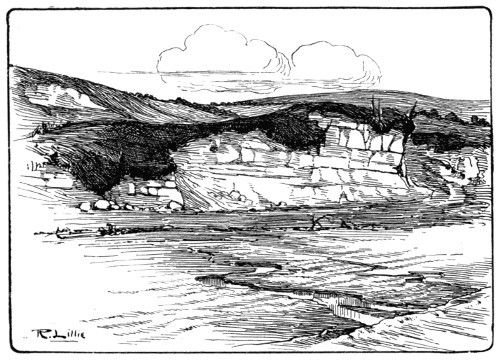
Fig. 1.—Chalk Cliff
The coast we have described is most certainly not the one with the fullest attractions for the naturalist, for the cliffs lack those nooks that provide so much shelter for bird and beast, and the rugged coves and rock pools in which we find such a wonderful variety of marine life are nowhere to be seen. But, although it represents a typical shore for a chalky district, yet we may find others of a very different nature even where the same rock exists. Thus, at Flamborough in Yorkshire, and St. Alban’s Head in Dorset, we find the hardened, exposed edge of the chalk formation terminating in bold and majestic promontories, while the inner edge surrounding the Weald gives rise to the famous cliffs of Dover and the dizzy heights of Beachy Head. The hard chalk of the Isle of Wight, too, which has so well withstood the repeated attacks of the Atlantic waves, presents a bold barrier to the sea on the south and east coasts, and terminates in the west with the majestic stacks of the Needles.
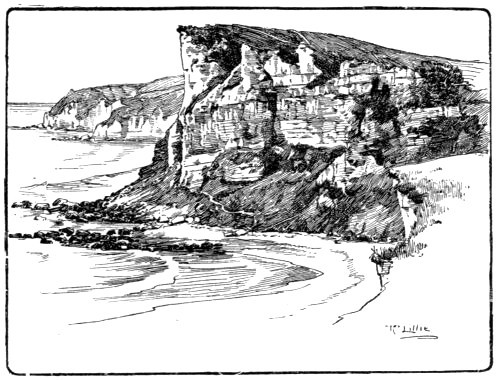
Fig. 2.—Whitecliff (Chalk), Dorset
Where this harder chalk exists the coast is rugged and irregular. Sea birds find a home in the sheltered ledges and in the protected nooks of its serrated edge; and the countless wave-resisting blocks of weathered chalk that have been hurled from the heights above, together with the many remnants of former cliffs that have at last succumbed to the attacks of the boisterous sea, all form abundant shelter for a variety of marine plants and animals.
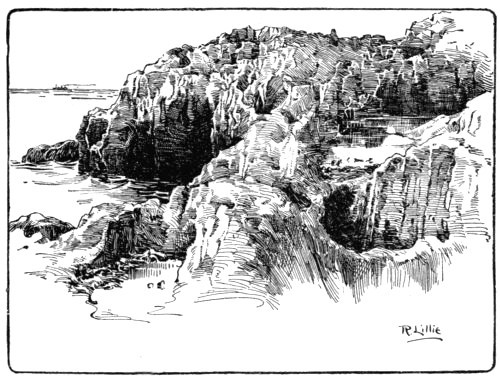
Fig. 3.—Penlee Point, Cornwall
But it is in the west and south-west of our island that we find both the most furious waves and the rocks that are best able to resist their attacks. Here we are exposed to the full force of the frontal attacks of the Atlantic, and it is here that the dashing breakers seek out the weaker portions of the upturned and contorted strata, eating out deep inlets, and often loosening enormous blocks of the hardest material, hurling them on the rugged beach, where they are eventually to be reduced to small fragments by the continual clashing and grinding action of the smaller masses as they are thrown up by the angry sea. Here it is that we find the most rugged and precipitous cliffs, bordering a more or less wild and desolate country, now broken by a deep and narrow chasm where the resonant roar of the sea ascends to the dizzy heights above, and anon stretching seaward into a rocky headland, whose former greatness is marked by a continuation of fantastic outliers and smaller wave-worn masses of the harder strata. Here, too, we find that the unyielding rocks give a permanent attachment to the red and olive weeds which clothe them, and which provide a home for so many inhabitants of our shallow waters. It is here, also, that we see those picturesque rock pools of all sizes, formed by the removal of the softer material of the rocks, and converted into so many miniature seas by the receding of the tide.
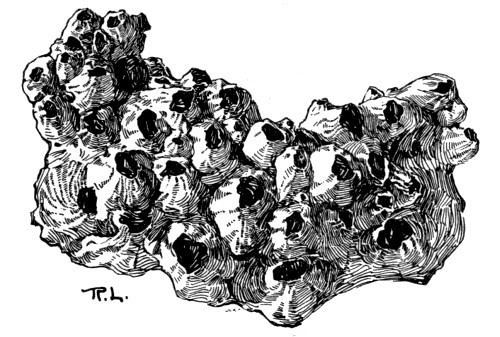
Fig. 4.—Balanus Shells
A more lovely sight than the typical rock pool of the West coast one can hardly imagine. Around lies the rugged but sea-worn rock, partly hidden by dense patches of the conical shells of the Balanus, with here and there a snug cluster of young mussels held together by their intertwining silken byssi. The surface is further relieved by the clinging limpet, the beautifully banded shells of the variable dog-periwinkle, the pretty top shells, and a variety of other common but interesting molluscs. Clusters of the common bladdery weeds are also suspended from the dry rock, and hang gracefully into the still water below, where the mantled cowry may be seen slowly gliding over the olive fronds. Submerged in the peaceful pool are beautiful tufts of white and pink corallines, among which a number of small and slender starfishes may climb unnoticed by the casual observer; while the scene is brightened by the numerous patches of slender green and red algæ, the thread-like fronds of which are occasionally disturbed as the lively little blenny darts among them to evade the intruder’s glance. Dotted here and there are the beautiful anemones—the variously-hued animal flowers of the sea, with expanded tentacles gently and gracefully swaying, ready to grasp and paralyse any small living being that may wander within their reach. Here, under a projecting ledge of the rock, partly hidden by pale green threads, are the glaring eyes of the voracious bullhead, eager to pounce on almost any moving object; while above it the five-fingered starfish slowly climbs among the dangling weeds by means of its innumerable suckers. In yonder shady corner, where the overhanging rock cuts off all direct rays of the sun from the deeper water of the pool, are the pink and yellow incrustations of little sponges, some of the latter colour resembling a group of miniature inverted volcanic cones, while on the sandy floor of the pool itself may be seen the transparent phantom-like prawn, with its rapidly moving spinnerets and gently-waving antennæ, suddenly darting backward when disturbed by the incautious approach of the observer; and the spotted sand-crab, entirely buried with the exception of its upper surface, and so closely imitating its surroundings as to be quite invisible except on the closest inspection. Finally, the scene is greatly enlivened by the active movements of the hermit-crab, that appropriates to its own use the shell which once covered the body of a mollusc, and by the erratic excursions of its cousin crabs as they climb over the weedy banks of the pool in search of food.
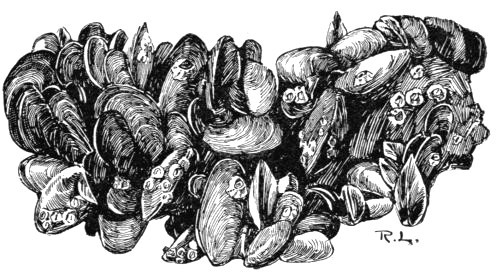
Fig. 5.—A Cluster of Mussels
Thus we may find much to admire and study on the sea shore at all times, but there are attractions of quite another nature that call for notice on a stormy day, especially on the wilder and more desolate western coasts. At such times we delight to watch the distant waves as they approach the shore, to see how they become gradually converted into the foaming breakers that dash against the standing rocks and wash the rattling pebbles high on the beach. The powerful effects of the sea in wearing away the cliffs are now apparent, and we can well understand that even the most obdurate of rocks must sooner or later break away beneath its mighty waves.
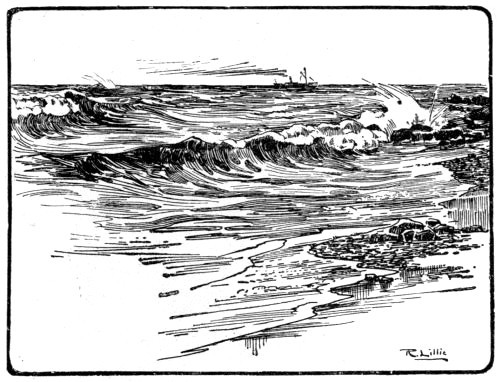
Fig. 6.—Breakers
The extreme mobility of the sea is displayed not only by the storm waves, and by the soft ripples of the calm day, but is seen in the gentle currents that almost imperceptibly wash our shores, and more manifestly in the perpetual motions of the tides.
This last-named phenomenon is one of extreme interest to the sea-side rambler, and also one of such great importance to the naturalist that we cannot do better than spend a few moments in trying to understand how the swaying of the waters of the ocean is brought about, and to see what determines the period and intensity of its pulsations, as well as some of the variations in the daily motions which are to be observed on our own shores.
In doing this we shall, of course, not enter fully into the technical theories of the tides, for which the reader should refer to authoritative works on the subject, but merely endeavour to briefly explain the observed oscillations of the sea and the general laws which govern them.
The most casual observer must have noticed the close connection between the movements of the ocean and the position of the moon, while those who have given closer attention to the subject will have seen that the relative heights of the tides vary regularly with the relative positions of the sun, moon, and earth.
In the first place, then, we notice that the time of high tide in any given place is always the same at the same period of the cycle of the moon; that is, it is always the same at the time of new moon, full moon, &c. Hence it becomes evident that the moon is the prime mover in the formation of tides. Now, it is a fact that the sun, though about ninety-three millions of miles from the earth, has a much greater attractive influence on the earth and its oceans than the moon has, although the distance of the latter is only about a quarter of a million miles: but this is due to the vastly superior mass of the sun, which is about twenty-six million times the mass of the moon. How is it, then, that we find the tides apparently regulated by the moon rather than by the sun? The reason is that the tide-producing influence is due not to the actual attractive force exerted on the earth as a whole, but to the difference between the attraction for one side of the globe and that for the opposite side. Now, it will be seen that the diameter of the earth—about eight thousand miles—is an appreciable fraction of the moon’s distance, and thus the attractive influence of the moon for the side of the earth nearest to it will be appreciably greater than that for the opposite side; while in the case of the sun, the earth’s diameter is such a small fraction of the distance from the sun that the difference in the attractive force for the two opposite sides of the earth is comparatively small.
Omitting, then, for the present the minor tide-producing influence of the sun, let us see how the incessant rising and falling of the water of the ocean are brought about; and, to simplify our explanation, we will imagine the earth to be a globe entirely covered with water of uniform depth.
The moon attracts the water on the side nearest to it with a greater force than that exerted on the earth itself; hence the water is caused to bulge out slightly on that side. Again, since the attractive force of the moon for the earth as a whole is greater than that for the water on the opposite side, the earth is pulled away, as it were, from the water on that side, causing it to bulge out there also. Hence high tides are produced on two opposite sides of the earth at the same time, while the level of the water is correspondingly reduced at two other parts at right angles with these sides.
This being the case, how are we to account for the observed changes in the level of the sea that occur every day on our shores?
Let us first see the exact nature of these changes:—At a certain time we find the water high on the beach; and, soon after reaching its highest limit, a gradual descent takes place, generally extending over a period of a little more than six hours. This is then followed by another rise, occupying about the same time, and the oscillations are repeated indefinitely with remarkable regularity as to time.
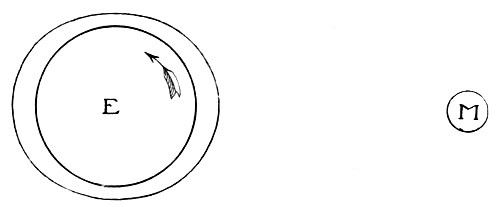
Fig. 7.—Illustrating the Tide-producing Influence of the Moon
Now, from what has been previously said with regard to the tidal influence of the moon, we see that the tide must necessarily be high under the moon, as well as on the side of the earth directly opposite this body, and that the high tides must follow the moon in its regular motion. But we must not forget that the earth itself is continually turning on its axis, making a complete rotation in about twenty-four hours; while the moon, which revolves round the earth in about twenty-eight days, describes only a small portion of its orbit in the same time; thus, while the tidal wave slowly follows the moon as it travels in its orbit, the earth slips round, as it were, under the tidal wave, causing four changes of tide in approximately the period of one rotation. Suppose, for example, the earth to be performing its daily rotation in the direction indicated by the arrow (fig. 8), and the tide high at the place markedÛuccessively, where the tide is high and low respectively. Hence the daily changes are to a great extent determined by the rotation of the earth.
But we have already observed that each change of tide occupies a little more than six hours, the average time being nearly six hours and a quarter, and so we find that the high and low tides occur nearly an hour later every day. This is due to the fact that, owing to the revolution of the moon round the earth in the same direction as that of the rotation of the earth itself, the day as measured by the moon is nearly an hour longer than the average solar day as given by the clock.
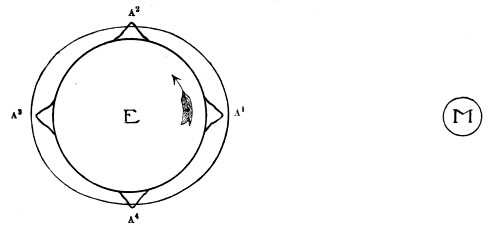
Fig. 8.—Illustrating the Tides
There is yet another point worth noting with regard to the relation between the moon and the tidal movements of the water, which is that the high tides are never exactly under the moon, but always occur some time after the moon has passed the meridian. This is due to the inertia of the ocean, and to the resistance offered by the land to its movements.
Now, in addition to these diurnal changes of the tide, there are others, extending over longer periods, and which must be more or less familiar to everyone who has spent some time on the coast. On a certain day, for instance, we observe that the high tide flows very far up the beach, and that this is followed, a few hours later, by an unusually low ebb, exposing rocks or sand-banks that are not frequently visible. Careful observations of the motions of the water for some days after will show that this great difference between the levels of high and low-water gradually decreases until, about a week later, it is considerably reduced, the high tide not flowing so far inland and the low-water mark not extending so far seaward. Then, from this time, the difference increases again, till, after about two weeks from the commencement of our observations, we find it at the maximum again.
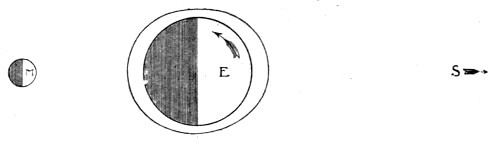
Fig. 9.—Spring Tides at Full Moon
Here again we find that the changes exactly coincide with changes in the position of the moon with regard to the sun and the earth. Thus, the spring tides—those which rise very high and fall very low—always occur when the moon is full or new; while the less vigorous neap tides occur when the moon is in her quarters and presents only one-half of her illuminated disc to the earth. And, as the moon passes through a complete cycle of changes from new to first-quarter, full, last-quarter, and then to new again in about twenty-nine days, so the tides run through four changes from spring to neap, spring, neap, and then to spring again in the same period.
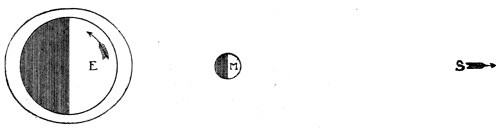
Fig. 10.—Spring Tides at New Moon
The reason for this is not far to seek, for we have already seen that both sun and moon exert a tide-producing influence on the earth, though that of the moon is considerably greater than that of the sun; hence, if the sun, earth, and moon are in a straight line, as they are when the moon is full, at which time she and the sun are on opposite sides of the earth, and also when new, at which time she is between the earth and sun, the sun’s tide is added to the moon’s tide, thus producing the well-marked spring tides; while, when the moon is in her quarters, occupying a position at right angles from the sun as viewed from the earth, the two bodies tend to produce high tides on different parts of the earth at the same time, and thus we have the moon’s greater tides reduced by the amount of the lesser tides of the sun, with the result that the difference between high and low tides is much lessened.
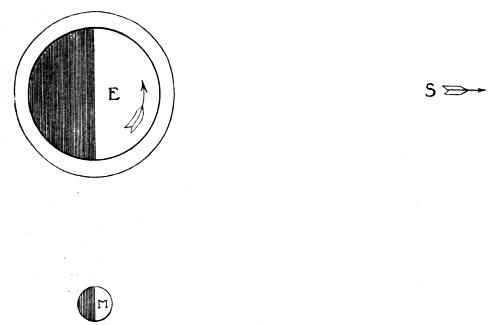
Fig. 11.—Neap Tides
Again, the difference between high and low water marks is not always exactly the same for the same kind of tide—the spring tide for a certain period, for example, not having the same limits as the same tide of another time. This is due to the fact that the moon revolves round the sun in an elliptical orbit, while the earth, at the same time, revolves round the sun in a similar path, so that the distances of both moon and sun from the earth vary at different times. And, since the tide-producing influences of both these bodies must increase as their distance from the earth diminishes, it follows that there must be occasional appreciable variations in the vigour of the tidal movements of the ocean.
As the earth rotates on its axis, while at the same time the tidal wave must necessarily keep its position under the moon, this wave appears to sweep round the earth with considerable velocity. The differences in the level of the ocean thus produced would hardly be appreciable if the earth were entirely covered with water; but, owing to the very irregular distribution of the land, the movements of the tidal wave become exceedingly complex; and, when it breaks an entrance into a gradually narrowing channel, the water is compressed laterally, and correspondingly increased in height. It is thus that we find a much greater difference between the levels of high and low tides in continental seas than are to be observed on the shores of oceanic islands.
We have occupied so much of our time and space in explanation of the movements of the tides not only because we think it desirable that all who delight in sea-side rambles should understand something of the varied motions which help to give such a charm to the sea, but also because, as we shall observe later, these motions are a matter of great importance to those who are interested in the observation and study of marine life. And, seeing that we are writing more particularly for the young naturalists of our own island, we must devote a little space to the study of the movements of the tidal wave round Great Britain, in order that we may understand the great diversity in the time of high tide on any one day on different parts of the coast, and see how the time of high tide for one part may be calculated from that of any other locality.
Were it not for the inertia of the ocean and the resistance offered by the irregular continents, high tide would always exist exactly under the moon, and we should have high water at any place just at the time when the moon is in the south and crossing the meridian of that place. But while the inertia of the water tends to make all tides late, the irregular distribution of the land breaks up the tidal wave into so many wave-crests and greatly retards their progress.
Thus, the tidal wave entering the Atlantic round the Cape of Good Hope mingles with another wave that flows round Cape Horn, and the combined wave travels northward at the rate of several hundred miles an hour. On reaching the British Isles it is broken up, one wave-crest travelling up the English Channel, while another flows round Scotland and then southwards into the North Sea.
The former branch, taking the shorter course, determines the time of high tide along the Channel coast. Passing the Land’s End, it reaches Plymouth in about an hour, Torquay in about an hour and a half, the Isle of Portland in two hours and a half, Brighton in about seven hours, and London in about nine hours and a half. The other branch, taking a much longer course, makes its arrival in the southern part of the North Sea about twelve hours later, thus mingling at that point with the Channel wave of the next tide. It takes about twenty hours to travel from the south-west coast of Ireland, round Scotland, and then to the mouth of the Thames. Where the two waves meet, the height of the tides is considerably increased; and it will be understood that, at certain points, where the rising of one tide coincides with the falling of another, the two may partially or entirely neutralise each other. Further, the flow and the ebb of the tide are subject to numerous variations and complications in places where two distinct tidal wave-crests arrive at different times. Thus, the ebbing of the tide may be retarded by the approach of a second crest a few hours after the first, so that the ebb and the flow do not occupy equal times. At Eastbourne, for example, the water flows for about five hours, and ebbs for about seven and a half. Or, the approach of the second wave may even arrest the ebbing waters, and produce a second high tide during the course of six hours, as is the case at some places along the Hampshire and Dorset coasts.
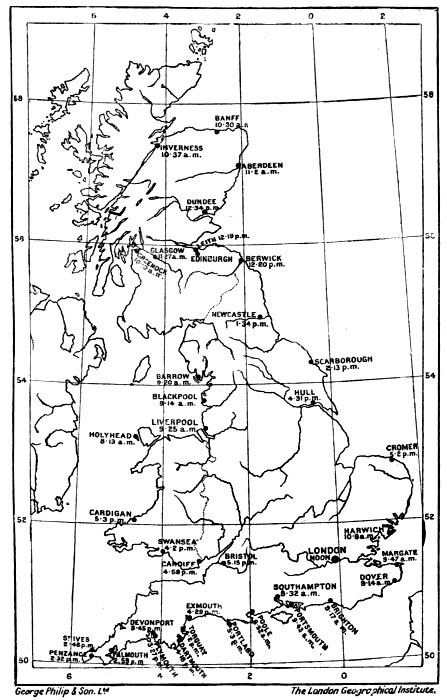
Fig. 12.—Chart showing the relative Times of High Tide on different parts of the British Coast
Those who visit various places on our own coasts will probably be interested in tracing the course of the tidal crests by the aid of the accompanying map of the British Isles, on which the time of high tide at several ports for the same time of day is marked. It will be seen from this that the main tidal wave from the Atlantic approaches our islands from the south-west, and divides into lesser waves, one of which passes up the Channel, and another round Scotland and into the North Sea, as previously mentioned, while minor wave-crests flow northward into the Irish Sea and the Bristol Channel. The chart thus supplies the data by means of which we can calculate the approximate time of high tide for any one port from that of another.
Although the time of high water varies so greatly on the same day over such a small area of country, yet that time for any one place is always approximately the same during the same relative positions of the sun, earth, and moon; that is, for the same ‘age’ of the moon; so that it is possible to determine the time of high water at any port from the moon’s age.
The time of high tide is generally given for the current year in the local calendars of our principal seaports, and many guide-books supply a table from which the time may be calculated from the age of the moon.
At every port the observed high water follows the meridional passage of the moon by a fixed interval of time, which, as we have seen, varies considerably in places within a small area of the globe. This interval is known as the establishment of the port, and provides a means by which the time of high water may be calculated.
Before closing this short chapter on the general characteristics of the sea shore we ought to make a few observations on the nature of the water of the sea. Almost everyone is acquainted with the saltness while many bathers have noticed the superior buoyancy of salt water as compared with the fresh water of our rivers and lakes. The dissolved salts contained in sea water give it a greater density than that of pure water; and, since all floating bodies displace their own weight of the liquid in which they float, it is clear that they will not sink so far in the denser water of the sea as they would in fresh water.
If we evaporate a known weight of sea water to dryness and weigh the solid residue of sea salt that remains, we find that this residue forms about three and a half per cent. of the original weight. Then, supposing that the evaporation has been conducted very slowly, the residue is crystalline in structure, and a careful examination with the aid of a lens will reveal crystals of various shapes, but by far the larger number of them cubical in form. These cubical crystals consist of common salt (sodium chloride), which constitutes about three-fourths of the entire residue, while the remainder of the three and a half per cent. consists principally of various salts of magnesium, calcium, and sodium.
Sea salt may be obtained ready prepared in any quantity, as it is manufactured for the convenience of those who desire a sea bath at home; and it will be seen from what has been said that the artificial sea-water may be prepared, to correspond almost exactly with that of the sea, by the addition of three and a half pounds of sea salt to about ninety-six and a half pounds of water.
This is often a matter of no little importance to the sea-side naturalist, who may require to keep marine animals alive for some time at considerable distance from the sea shore, while their growth and habits are observed. Hence we shall refer to this subject again when dealing with the management of the salt-water aquarium.
The attractions of the sea coast are undoubtedly greater by day than at night, especially in the summer season, when the excessive heat of the land is tempered by the cool sea breezes, and when life, both on the cliffs and among the rocks, is at its maximum. But the sea is grand at night, when its gentle ripples flicker in the silvery light of the full moon. No phenomenon of the sea, however, is more interesting than the beautiful phosphorescence to be observed on a dark summer’s night. At times the breaking ripples flash with a soft bluish light, and the water in the wake of a boat is illuminated by what appears to be liquid fire. The advancing ripples, as they embrace a standing rock, surround it with a ring of flame; while streaks and flashes alternately appear and disappear in the open water where there is apparently no disturbance of any kind.
These effects are all produced by the agency of certain marine animals, some of which display a phosphorescent light over the whole surface of their bodies, while in others the light-giving power is restricted to certain organs or to certain well-defined areas of the body; and in some cases it even appears as if the creatures concerned have the power of ejecting from their bodies a phosphorescent fluid.
It was once supposed that the phosphorescence of the sea was produced by only a few of the lower forms of life, but it is well known now that quite a large number of animals, belonging to widely different classes, play a part in this phenomenon. Many of these are minute creatures, hardly to be seen without the aid of some magnifying power, while others are of considerable size.
Among the peculiar features of the phosphorescence of the sea are the suddenness with which it sometimes appears and disappears, and its very irregular variations both at different seasons and at different hours of the same night. On certain nights the sea is apparently full of living fire when, almost suddenly the light vanishes and hardly a trace of phosphorescence remains; while, on other occasions, the phenomenon is observed only on certain patches of water, the areas of which are so well defined that one passes suddenly from or into a luminous sea.
The actual nature of the light and the manner in which it is produced are but ill understood, but the variations and fitfulness of its appearances can be to a certain extent conjectured from our knowledge of some of the animals that produce it.
In our own seas the luminosity is undoubtedly caused principally by the presence of myriads of minute floating or free-swimming organisms that inhabit the surface waters. Of these each one has its own season, in which it appears in vast numbers. Some appear to live entirely at or near the surface, but others apparently remain near the surface only during the night, or only while certain conditions favourable to their mode of life prevail. And further, it is possible that these minute creatures, produced as they generally are in vast numbers at about the same time, and being more or less local, are greatly influenced by changes of temperature, changes in the nature of the wind, and the periodic changes in the tides; and it is probable that we are to look to these circumstances for the explanations of the sudden changes so frequently observed.
In warmer seas the phenomenon of phosphorescence is much more striking than in our own, the brilliancy of the light being much stronger, and also produced by a greater variety of living beings, some of which are of great size, and embrace species belonging to the vertebrates and the higher invertebrate animals.
Those interested in the investigation of this subject should make it a rule to collect the forms of life that inhabit the water at a time when the sea is unusually luminous. A sample of the water may be taken away for the purpose of examination, and this should be viewed in a good light, both with and without a magnifying lens. It is probable, too, that a very productive haul may be obtained by drawing a fine muslin net very slowly through the water. After some time the net should be emptied and gently washed in a small quantity of sea water to remove the smaller forms of life contained, and the water then examined at leisure.
Of course it must not be assumed that all the species so obtained are concerned in any way with the phosphorescence of the sea, but any one form turning up in abundance when collected under the conditions named will probably have some connection with the phenomenon.
One may well ask ‘What is the use of this light-emitting power to the animals who possess it?’ but this question is not easily answered. The light produced by the glow-worm and other luminous insects is evidently a signal by means of which they call their mates, and this may be the case with many of the marine luminous animals, but it is evidently not so with those which live in such immense numbers that they are simply crowded together; nor can it be so with the many luminous creatures that are hermaphrodite. It is a fact, however, that numbers of deep-sea species possess the power of emitting light to a striking extent; and the use of this power is in such cases obvious, for since the rays of the sun do not penetrate to great depths in the ocean, these luminous species are enabled to illuminate their own surroundings while in search of food, and, in many cases at least, to quench their lights suddenly at such times as they themselves are in danger.
CHAPTER II
THE SEA-SIDE NATURALIST
Outdoor Work
Assuming that the reader is one who desires to become intimately acquainted with the wonderful and varied forms of life to be met with on the sea shore, or, hoping that he may be lured into the interesting and profitable pastimes of the sea-side naturalist, we shall now devote a chapter to the consideration of the appliances required for the collection and examination of marine life, and to general instructions as to the methods by which we may best search out the principal and most interesting objects of the shore.
First, then, we shall describe the equipment of an enthusiastic and all-round admirer of Nature—he who is interested in plant forms from the flowering species down to the ‘meanest weed that grows,’ and is always ready to learn something of any member of the animal world that may happen to come within his reach. And this, not because we hope, or even desire, that every reader may develop into an all-round naturalist, but so that each may be able to select from the various appliances named just those which would be useful for the collection and observation of the objects which are to form his pet study.
The most generally useful of all these appliances is undoubtedly some kind of case of the ‘hold-all’ type, a case into which specimens in general may be placed for transmission from the hunting-ground in order that they may be studied at leisure, and we know of nothing more satisfactory than the botanist’s ‘vasculum.’ This is an oblong box of japanned tin, fitted with a hinged front, and having both handle and strap, so that it can be either carried in the hand or slung over the shoulder. Of course almost any kind of non-collapsible box or basket will answer the purpose, but we know of no utensils so convenient as the one we have named. It is perfectly satisfactory for the temporary storage of the wild flowers gathered on the cliffs, as it will keep them moist and fresh for some considerable time; and for the reception of sea weeds of all kinds it is all that could be desired, for it will preserve them in splendid condition, and is so constructed that there is no possibility of the inconvenience arising from the dripping of salt water on the lower garments. Then, as regards marine animal-life in general—starfishes, urchins, anemones, molluscs, crustaceans, fishes, &c.—these may be conveyed away in it with a liberal packing of moist weeds not only without injury, but in such a satisfactory condition that nearly all may be turned out alive at the end of a day’s work; and this must be looked upon as a very important matter to him who aims at becoming a naturalist rather than a mere collector, for while the latter is content with a museum of empty shells and dried specimens, the former will endeavour to keep many of the creatures alive for a time in some kind of artificial rock pool in order that he may have the opportunity of studying their development and their habits at times when he has not the chance of visiting the sea shore for the purpose.
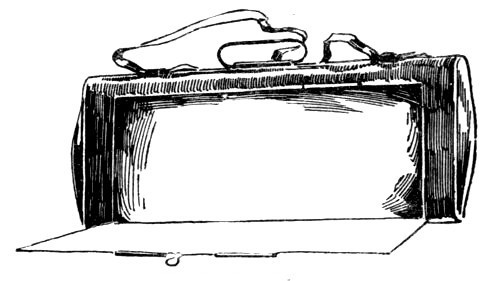
Fig. 13.—The Vasculum
But although the vasculum is so generally useful for the temporary storage and the transmission of the objects collected, yet it is not in itself sufficient for all purposes. There are many marine animals so small—but none the less interesting because they are small—that they would probably be lost in a case containing a mass of sea weeds with various larger creatures. These should be placed in small well-corked bottles, and temporarily preserved in a little sea-water, or, preferably, a tuft of one of the delicate weeds so common in our rock pools. Others, again, though they may be larger, are of so fragile a nature that they should be isolated from the general stock on that account alone. Instead of bottles or tubes, small tin boxes may be used, and these have the advantage of being unbreakable, though, of course, they will not hold water. This, however, is of no consequence, as most marine animals may be kept alive for some time in moist sea-weed quite as well as in water.
When small animals are required for structural examination only, they may be put into methylated spirit as they are taken, and when stored in this way a much larger number may be put into the same receptacle; hence the collector will often find it convenient to have a small supply of this liquid while at his work.
A strong pocket-knife is essential for sea-side work. It serves to remove those molluscs that adhere firmly to the rocks by suction, and also others that fix themselves by means of a byssus of silken fibres, as is the case with mussels. It will also be employed in the removal of acorn barnacles, anemones, and small tufts of algæ, and may be useful in cutting through the stouter weeds. Small sponges and other low forms of life often form incrustations on the solid rock, and may be peeled off with the aid of a knife. In the case of the last-named, however, as well as with the anemones and other fixed animals, it is often far more satisfactory to remove a small portion of the rock itself with the animal attached, and for this purpose a small hammer will be of great service.
A strong net of some kind is necessary in searching the rock pools, and as suitable nets are, we believe, not to be obtained of the dealers in naturalists’ appliances, it devolves on one to manufacture a net according to his requirements.
The simplest form of net may be made by bending a piece of stout galvanised iron wire into the form here shown (fig. 14), and firmly wedging the two straight ends in a short piece of strong metal tube which will also serve as a ferrule for the attachment of a tough handle. Such a circular frame although satisfactory for a net to be used in fresh-water ponds and streams, is not nearly so suitable for the irregular rocky pools to be met with on the sea coast, for it will not enable one to search the numerous corners and crevices into which many marine creatures will retire on being disturbed, but it may be greatly improved by bending the side opposite the ferrule into a moderately sharp angle and then turning the angle slightly upward, as shown in fig. 15.
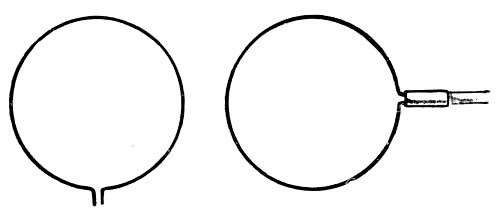
Fig. 14.—Wire Ring for Net
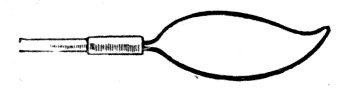
Fig. 15.—Net Frame with Curved Point
Another very convenient net frame may be made by bending the wire into a rhomboidal form (fig. 16), the ferrule being attached by means of two short, straight ends at one of the angles. The opposite angle will serve the purpose of searching into the crannies of the rocks, while the straight sides will prove very useful in removing the objects that lie on the sandy bottoms so commonly seen in rock pools. The semicircular net shown in fig. 18 will also prove useful for working on sands or for scraping the flatter surfaces of weed-covered rocks.
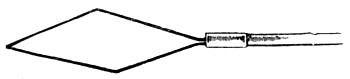
Fig. 16.—Rhomboidal Frame for Net
The material of the net should be some kind of strong gauze, or a loosely-woven canvas. Leno answers very well, but is somewhat easily torn, and will have to be frequently renewed. This, however, may be avoided to a great extent if, instead of sewing the gauze directly round the wire, a strip of strong calico be first attached to the frame, and the gauze then sewn to the calico; for it will be understood that any fragile material placed round the wire will soon be worn through by friction against the rugged surfaces of the rocks and stones. The net itself should not be very deep, and should have no corners; and as to the length of the handle, that will be determined by the fancy of the collector, or by the character of the ponds to be searched, but a tough walking-stick with a crook handle will generally answer all purposes, the crook being itself frequently useful for removing the larger weeds and other obstructions.
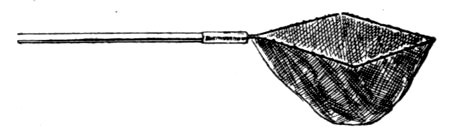
Fig. 17.—Rhomboidal Net
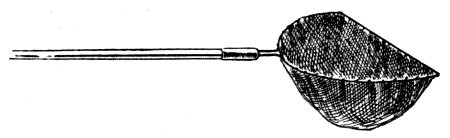
Fig. 18.—Semicircular Net
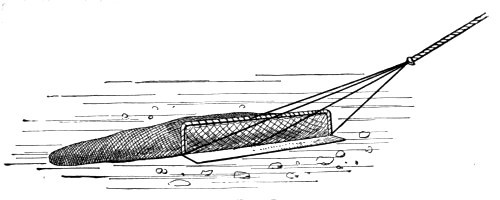
Fig. 19.—The Dredge
Although the net, as above described, will answer the requirements of nearly all young collectors, yet there may be some, who, not satisfied with the exploration of the rocks and pools exposed when the tide is out, desire to know something of the creatures that live entirely beyond low-water mark, where the water is generally too deep for work with a hand net. To such we recommend a small dredge that may be lowered from a boat and then drawn along the bottom. A good form of dredge is shown in fig. 19, and a little skill and ingenuity will enable anyone to construct one with the help of our illustration; but, seeing that the best work is to be done on rough bottoms, it is absolutely necessary that both frame and net should be made of the stoutest materials that can be conveniently employed.
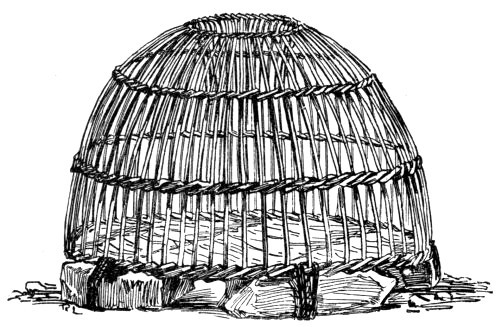
Fig. 20.—The Crab-pot
Those who have ever accompanied a fisherman while taking a pull round to examine the contents of his crab or lobster pots will probably have noticed what strange creatures, in addition to the edible crabs and lobsters, sometimes find their way into the trap. These creatures are often of great interest to a young naturalist, and it will repay him to take an occasional trip with a fisherman in order to obtain them; or, still better, to have a crab-pot of his own. The writer has obtained many good specimens by means of an inexpensive trap, on the same principle as the ordinary crab-pot, made from an old metal bird-cage of rather small size. The bottom was removed, and a very shallow bag of thick canvas fixed in its place; and some of the wires were cut, and bent inwards so as to allow the easy entrance of moderately large crustaceans and other creatures, while at the same time they served as a barrier to their escape. Such a trap, baited with pieces of fish, and let down to a rocky bottom, will enable the young naturalist to secure specimens that are seldom seen between the tide-marks; and the animals thus obtained will include not only those larger ones for which the opening was made, but also a variety of smaller creatures that may enter between the wires of the cage. Some of the latter may, of course, escape by the same way as the trap is being hauled up for examination, but this is not so likely to occur if the canvas bottom is of a material so loosely woven that water can pass through it very freely. It will, of course, occur to the reader that the insertion of a stone or other weight will assist in sinking the trap; also that the ordinary door of the cage forms a ready means by which the captives may be removed.
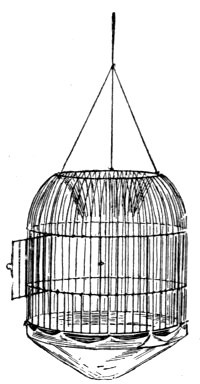
Fig. 21.—An old Bird-cage used as a Crab-pot
One thing more: make it a rule never to go out collecting natural objects of any kind without a note-book and pencil. This, to the beginner who is anxious to get to his work, with the idea only too prevalent with the amateur that the success of his labours is to be measured only by the number of specimens obtained, may seem quite an unnecessary part of the equipment. But it must be remembered that there is much to observe as well as much to collect on a well-selected coast; and that without the aid of the book and pencil a great many of the observations made will be forgotten, and thus much interest that would otherwise be attached to the objects permanently preserved will be lacking.
The above appliances include the only necessary equipment of the sea-side naturalist, with the exception of a few required for occasional use in connection with the species of a somewhat restricted habitat, and the outfit of the sea angler. The former will be dealt with in the chapters where the species concerned are described, while the subject of sea angling is of such general interest that we propose to devote a short chapter exclusively to it.
It may seem hardly necessary to discourse on the nature of the attire most suitable for sea-side work, since the majority will readily form their own opinions on this matter, but perhaps a few words of advice to the inexperienced may not be altogether out of place. First, then, make it a rule to wear no clothing of any value. The work will lead the enthusiast over slippery weeds, on treacherous boulders, over rocks covered with sharp acorn shells, and among slimy and muddy stones, and many a slip may occur in the course of a day’s work. Large pockets specially but simply made by sewing square pieces of lining on the inside of an old jacket are a great convenience; a cap rather than a brimmed hat should be worn unless the latter be considered essential for protection from a burning summer’s sun; and a pair of old shoes, preferably with rubber soles, are just the thing for both rough and slippery rocks, as well as for wading through shallow waters. Other details we can safely leave to the fancy of the reader himself.
Now comes the most important question ‘Where shall we go?’ Fortunately we are favoured with a great extent of coast-line considering the area of our country, but the character of the coast is so diversified, both with regard to its scenery and its life, that the naturalist will do well to carefully select his locality according to the objects he desires to study. The east coast of England is not generally noted either for variety or abundance of marine life, and the same is true both of the south-east and a large portion of the south coast. In some places the beach is formed of an unbroken stretch of sand on which one may walk for miles without seeing any sign of life, with the exception of an occasional empty shell and a few fragments of dried sea-weed washed in by the breakers during a recent storm; while at the same time the cliffs, if such exist at all, are not very generous in their production of the fauna and flora that are characteristic of the shore. But even on the coasts referred to there are, here and there, isolated spots where the uplands jut into the sea, giving rise to bold promontories, at the foot of which are the fallen masses of rock that afford protection to a moderate variety of truly marine life, while the rough bottoms beyond yield numerous interesting forms that may be secured by means of the dredge or suitable traps. Such spots are to be found where the chalk hills abut on the sea, as at Flamborough and Beachy Head, but it is in the neighbourhood of Weymouth that the English coast really begins to be of great interest to the naturalist. From here to the Land’s End almost every part of the shore will yield a great variety of life in abundance, and the same is true of the rocky coasts of the west, and also of the more rugged shores of the Isle of Wight. As an ideal hunting-ground one cannot do better than to select one of the small fishing towns or villages on the rocky coasts of Devon and Cornwall. With such a spot as his headquarters the most enthusiastic sea-side naturalist will find ample employment. The exposed rocks and rock pools yield abundance of life; and if these be searched when the tide is out, there will remain plenty of sea angling and other employments to occupy him at other times.
We will now describe the actual work of the sea-side naturalist, giving the necessary instructions for the observation and collection of the various living things he will meet with.
First, then, with regard to work on the cliffs, a very few words will suffice; for, seeing that the objects of interest to be met with here will consist principally of the various flowers that are peculiar to or characteristic of the sea shore, and certain insects and other creatures more or less partial to a life on the cliffs, we may regard these as coming within the range of the general work of the botanist, entomologist, &c.; and since instructions for the collection and preservation of such objects have already been given in former works of this series, we may pass them over at once in order to deal with those objects which are essentially marine.
It has already been hinted that the right time for collecting on the shore is when the tide is at its lowest; and in order that the best work may be done the collector should consult the local tide-tables, or calculate, if necessary, the time of high tide from the establishment of the port; and, of course, the period of spring tides should be selected if possible. The time during which work should continue must be regulated according to the enthusiasm of the collector or the time at his disposal, but, as a rule, it is advisable to be on the scene of action about three hours before the time of low tide, with a determination to work continuously until the lowest ebb of the water.
On reaching the beach it is always advisable to start by examining the line of miscellaneous material at high-water mark, along which may be found quite a variety of objects, more or less interesting, which have been washed in by the breakers, especially just after a storm, together with numerous scavengers of the shore that perform a most useful work in devouring the decomposing organic matter that would otherwise tend to pollute the air.
Here we may find many useful and interesting objects of both the animal and vegetable worlds. Among the former are the empty shells of both univalve and bivalve molluscs, some of which are more or less worn by the action of the waves, while others are in splendid condition for examination and study. Here, too, are various species of sea firs and the skeletons of sponges; the shell of the cuttle-fish, and occasionally a cluster of the eggs of this creature—the sea-grapes of the fishermen; also the egg-cases of the skate and the dog-fish—usually empty, but sometimes enclosing the young animal still alive; and, lastly, we frequently meet with portions of the skeletons of fishes in a perfect state of preservation, the animal matter having been cleared away by the combined action of the scavengers previously referred to. Then, as regards the vegetable world, we often find beautiful specimens of sea-weeds along the high-water mark, some of which are rarely met with in the rock pools, since they are species that have been detached from beyond the line of low water, and washed up by the breakers.
On turning over the debris thus thrown on the beach we intrude on the privacy of numerous living creatures which immediately scamper away to find a new hiding-place. These consist principally of sand-hoppers, but occasionally we find members of the insect world engaged in the same useful work in addition to the numerous flies that perform their office of scavengers in the bright sunshine on the top of the matter that supplies them with food.
It will be interesting to capture a few of these scavengers, and to compare them with others of the same order obtained from different localities. Thus, the flies may be compared with the more familiar house fly, and the sand-hoppers of high-water mark with similar crustaceans to be afterwards obtained lower on the beach.
Attention should now be given to the rocks left exposed by the retreating tide, and it is here that the real work begins. Examine each rock pool as soon as possible after it is no longer disturbed by the waves. Remove any tufts of corallines or other weeds required for study or preservation, and simply place them, pro tem., in the vasculum or other receptacle provided for the purpose. These will form a useful protective packing for other objects that are to be carried away, so that it will be advisable to secure a moderate amount rather early, even though they may not be required for any other purpose. Live molluscs, crabs, small fishes, &c., may all be put in the receptacle with this weed, and all will probably be still alive after the collecting and the homeward journey have been completed. Probe the corners of the pool with the point of the net, and also sweep the net upward among the weeds to remove any creatures that seek shelter among the fronds. Tufts of corallines and other weeds should be searched for the small and delicate starfishes that live among them, and any stones that may cover the bottom of the pool should be lifted. Anemones may be removed from the rocks by means of a rather blunt knife; but, if possible, it will be better to chip off a small piece of the rock with the anemone attached to it, and wrap it lightly round with a tuft of soft weed previous to placing it in the collecting case.
A number of rock pools should be searched in this manner, but those chosen should vary as much as possible in general character. All very small and delicate objects should be isolated from the general stock, and placed, with the usual packing material, either in tin boxes or small wide-mouthed bottles; and if any animals taken are not required alive, but only for preservation, they should be preferably killed at once and then stored in a separate case. Some creatures are easily killed by simply dropping them into a bottle of fresh water, but others should be covered with methylated spirit. It should be mentioned, however, that the natural appearance of some of the crustaceans is quite destroyed by strong spirit, which soon makes them look as if they had been boiled. Some species are changed in this way much more readily than others; and, until sufficient experience has been gained to enable the young collector to distinguish between them, it will be advisable to kill and temporarily preserve crustaceans in spirit that has been considerably diluted with water—about two parts of water to one of spirit, for example. Further, there are certain fragile starfishes that have a way of breaking themselves into pieces when dropped into spirit, or even when suddenly disturbed in almost any other manner. These must always be handled gently, and if it is required to kill them for preservation, the best way will be to put them in a little salt water, and then gradually add fresh water until the desired result is obtained.
Perhaps the most productive of all sea-shore work is the turning over of the stones of various sizes near the low-tide mark, and the examination of the chinks and sheltered hollows of the rocks that are left uncovered for but a short period. This work should be carried on as near the water’s edge as possible, closely following the receding tide; and the collector must now be prepared with a number of small bottles or tins for the isolation of small and delicate specimens. He must also be on the alert for numerous examples of protective resemblance, in which the animals concerned so closely resemble their surroundings in colour and general character of surface that they are detected only by careful observation, while the difficulty of identification is still further increased in instances where the creatures remain perfectly still even when disturbed.
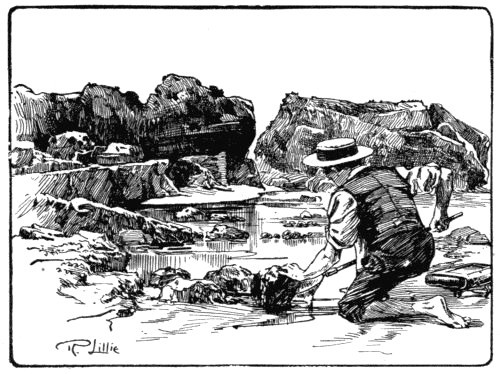
Fig. 22.—A Young Naturalist at Work
Under the stones all manner of animals—fishes, crustaceans, worms, molluscs, starfishes, anemones, &c.—will be hiding until covered by the next tide. Some of these will be found on the ground beneath the stones, and others attached to the under surfaces of the stones themselves; therefore both should be carefully examined, attention being given at first to the more active species that hurry away with all speed towards a new shelter as soon as they find themselves exposed to the light; the less active creatures may then be secured at leisure.
The tide will not allow the collector a great deal of time in which to turn over the most productive stones—those close to the low-water mark, so there is but little opportunity of observing the movements and other interesting habits of many of the animals found; hence it is advisable to secure a good variety of living specimens, especially of the less familiar species, in order that they may be placed in some kind of aquarium, temporary or otherwise, for observation at home.
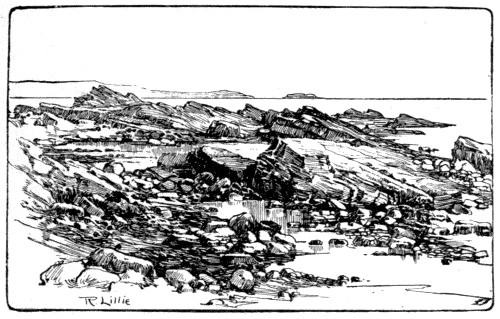
Fig. 23.—A good Hunting-ground on the Cornish Coast
One thing more remains to be done while the tide is well out, and that is to examine the weed-covered rocks near the water’s edge. Lift the dangling weeds and carefully search the rocks for those low forms of animal life that form incrustations on the surface, as well as for new species of anemones, sea firs, &c. Lastly, look well into the dark and narrow chinks of the rocks, for here several species of lowly animals that are hardly met with elsewhere may be found, and also certain crustaceans that delight to squeeze their bodies into the remotest corner of a sheltered niche.
CHAPTER III
SEA ANGLING
We do not propose dealing with this subject from the point of view of the angler, but rather that of the naturalist. The former is actuated principally, if not entirely, by the mere love of sport; or, it may be, to a great extent by the desire to obtain a supply of fish for food; and he generally estimates the success of his expeditions not by the number of species captured, but by the total weight of his catch, no regard being paid, as a rule, to the inedible specimens. The naturalist, however, does not desire weight, or sweetness of flesh. He works the greatest possible variety of habitats, with the object of determining the number of species inhabiting the locality and of learning as much as possible of their general form, habits, and adaptations of structure to habits. His success is measured by the number and variety of species caught, and he pays but little attention to superiority of size or weight, or to the estimated market value of his haul. The element of sport may enter more or less largely into the pleasure of his occupation, but the main end in view is to learn as much as possible of all the species obtainable.
Further, our remarks will not include the subject of the different kinds of fishing usually resorted to by sea anglers, but will be confined almost exclusively to the simple means of catching the common species that frequent the immediate neighbourhood of the shore.
If the reader will follow the general instructions given in Chapter II. on the outdoor work of the marine naturalist, he will undoubtedly make the acquaintance of a considerable variety of interesting species which may be captured in the rock pools, found under stones at low tide, or obtained by means of a small dredge; but his knowledge of our littoral fishes may be appreciably extended by the occasional employment of rod and line from rocks and piers, or from a small boat in close proximity to the shore.
The appliances required are of a very simple nature, and not at all costly. The long, heavy rod and strong tackle of the sea angler and professional fisherman are not at all essential to our purpose, for our work will be confined almost exclusively to shallow water, and the fish to be caught will be chiefly of small size. True it is that one may occasionally find his light tackle snapped and carried away by the unexpected run of a large fish, for cod and other large species often approach close to the shore, and bite at baits intended for the smaller fish that make their home among the partly submerged rocks of the coast; but such surprises will not frequently occur, and the young naturalist may learn all he wants to know of the fishes of our shallow waters with the aid of a light rod of about nine or ten feet and one or two light lines of no great length.
It must not be understood, however, that we assume the reader’s disinclination to know anything of the inhabitants of deep water, but rather that we consider the whole subject of deep-sea fishing quite beyond the scope of this work. It is a fact that quite a large number of species, the forms and habits of which are extremely interesting, live exclusively on deep bottoms. These should undoubtedly be studied by all who are interested in the various phases of marine life; but unless the reader is prepared to practise sea fishing in all its branches—to put his trust in the restless sea, supplied with all the necessary heavy gear, and to risk those internal qualms that arise from the incessant swaying of the boat on open waters, he should make arrangements with the professional deep-sea fisher—preferably a trawler—for the supply of those disreputable species that invariably form part of the haul, while the better-known food fishes can always be obtained from dealers for purposes of study.
On one occasion we had a rather unique and very successful interview with a friendly trawler. She was sailing slowly towards her station in a south-western fishing port, while two of her crew were clearing her nets, and throwing all refuse into the sea. We rowed behind her in order to see the nature of the rejected portion of the haul, and finding that it included specimens of interesting fishes of ill repute, dead but perfectly fresh, we followed her track, and collected a few for future examination. Presently our movements were watched from aboard, and we were invited to pull up to larboard, where a short explanation as to our wants led to the acquisition of quite a variety of deep-sea life, including several species of fishes not often seen on land, crabs, shelled and shell-less molluscs, worms, star-fishes, and various lowly organised beings, many alive and in good condition, together with several good food fishes thrown in by way of sympathy. There is no doubt that a naturalist can obtain much more deep-sea life with the aid of a friendly trawler than by any amount of ‘fishing’ with ordinary tackle from a boat; and this without the necessity of going to sea at all, if he will only take the opportunity of examining the nets as the boats are stranded on their return.
But now to return to our angling:—We have to provide a light rod, about ten feet long, with a winch, and a line of twisted silk or other thin but strong material; also a light hand line, and a supply of gut, leads, shot, and hooks, together with one or two small floats, and a few bait boxes.
We do not, as a rule, recommend the amateur angler to use both rod and hand line at the same time, for the attempt to do this leads to the neglect of both. In the end it is not likely to lead to any gain, so many fish being lost through the inability to strike at the moment a bite is given, and so much time having to be devoted to the baiting of hooks rather than to the direct management of the lines. In most cases the rod is much more convenient than the hand line. The young collector will meet with the greatest variety of species in rocky and weedy places, where abundant shelter exists for those fishes that prefer to keep well under cover, and any attempt with a hand line in such spots will certainly lead to frequent loss of hooks, and often of lead, line, and temper. Such a line must be reserved for fishing on sandy bottoms, while the ten-foot rod recommended will enable the angler to do good work in the rockiest parts without much danger of fouling; and, in fact, to fish anywhere along the coast.
The arrangement of hooks and lead must necessarily depend on the character of the place to be worked, but in all cases we strongly recommend no such multiplicity of hooks as is made use of by fishermen and others who fish for food. In their case the use of so many hooks often pays them well; but, as we have previously hinted, the naturalist does not desire quantity of fish so much as variety of species. Further, there is no necessity to make his work heavy and arduous. His desire is not to spend an undue proportion of his time in baiting hooks, but to have his line so under control that he is ready to strike at any moment, and to be able to alter the conditions of his work as often as his ideas or the conditions change.
In rugged and weedy places the hooks must be kept free from rocks and weeds. This may be done by letting down the rod line with a lead at the bottom, and one or two hooks fastened to gut at such a level as to keep quite clear of weeds. A much better arrangement, and one which we ourselves almost invariably employ, consists of a light lead, as a rule not exceeding an ounce in weight, fastened at the end of the line, and below it a few feet of gut terminating in a single hook. With such tackle it is of course necessary to determine previously the depth of the water, in order to adjust the line to such a length that the hook keeps clear of rocks and weeds, and a float may be used if desired.
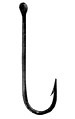
Fig. 24.—Round Bend Hook with Flattened End
We do not recommend a float for the general work of the marine collector, for it is a decided advantage to be prepared to bring the bait to any level from bottom to surface, especially when the water is so clear that the fish may be seen swimming, in which case one is often impressed with the desire to capture a specimen in order to establish its identity, and for such work as this a float is superfluous. If, however, a float is used, it should be a sliding one, so that it may be adapted to the rising and falling of the tide.
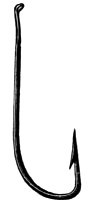
Fig. 25.—Limerick Hook, eyed
Of hooks there is a great variety to choose from, differing in the form both of the curve and of the end of the shank. As to the curve, those with a decided twist are best adapted to our purpose, chiefly on account of the fact that sea fishes generally have larger mouths than fresh-water species of the same size, and are consequently better held with a twisted hook. The shanks of sea hooks are either flattened or eyed, and each is as good as the other providing the snood is firmly attached; but some amateurs find a greater difficulty in attaching the snood to the former than to the latter.
Gut snoods are recommended for our purpose, and fig. 26 shows one method by which they may be fastened to a flattened shank, while fig. 27 illustrates the figure-of-eight knot by means of which the eyed shank may be firmly secured. The gut should be soaked for some hours in cold water previous to tying, and it may be kept soft for some considerable time by giving it a few hours’ immersion in a solution of glycerine—about one part of glycerine to four or five parts of water.
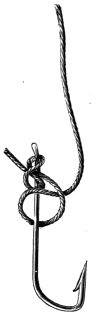
Fig. 26.—Method of attaching Snood to Flattened Hook
Small hooks will be most suitable for our purpose; and if the reader finds any difficulty in attaching the snood firmly, he may purchase suitable hooks ready mounted on gut, though, of course, these are more expensive than the flattened or eyed hooks generally used for sea-fishing. Such small and fragile hooks may be occasionally snapped off by the run of a vigorous fish of moderate size, therefore it is advisable to have a supply of larger hooks, ready fixed on strong snoods, to be used when it is found that the shore is frequented by larger fishes than those generally caught close to land.
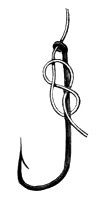
Fig. 27.—Method of attaching Snood to Eyed Hook
When fishing with a rod and line from rocks, or from piers, the foundations of which are covered with large weeds, the bait will frequently be carried by currents among the weeds and snapped off when endeavours are made to release the hook. This will especially be the case when the hook is a few feet below the lead, as we have already suggested it should be. To reduce the frequency of such mishaps, it will be a good plan to weight the gut below the lead by means of a few split shot. In fact, in sheltered places, where the water is not disturbed, these shot may take the place of the lead, but little weight being necessary for rod fishing in such localities.
The amateur sea angler is often in great doubt as to the best bait to use; and, believing that a certain kind of bait is absolutely necessary for his work in some particular spot, is often at a loss to obtain it. This bait difficulty is evidently a prevailing one among amateur sea fishers, if one may judge from the frequent questions asked as to the best or proper bait to use, and from the very common ‘Can you oblige me with a little bait?’ This latter question, we believe, is frequently the outcome of carelessness or laziness on the part of the asker. He has not the forethought, born of enthusiasm, that would lead him to procure a suitable bait, at a convenient time, previous to starting off on his angling expedition, but rather depends on the possibility of being able to beg or otherwise secure sufficient for his purpose at the time; yet there are so many good baits that are easily secured at the proper time and place that the enthusiastic angler need never be at a loss. Some of these may be collected by himself at low tide, others may be obtained from local fishermen, or from the tradesmen of the town or village.
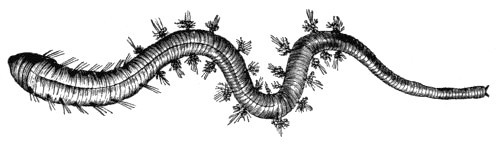
Fig. 28.—The Lugworm
Some anglers seldom collect their own bait, either purchasing it or employing some one to collect it for them; but we are of opinion that the pleasure of a day’s fishing begins here, and especially so when the angler is of the naturalist type, for he will frequently learn more of the nature and habits of living creatures during one hour’s bait-collecting than during three or four hours’ angling. It is true that the work in question is often a bit laborious, particularly on a warm day, and that it may be frequently described as dirty and odorous; but what is that to one who is interested in his employment, and who derives pleasure in doing his own work? Fishermen often use lugworms for bait, and although these constitute one of the best baits for their own fishing, they are not so suitable for the purposes of the amateur angler, fishing with small hooks close to shore. They may be dug out of the sand when the tide is out, and are most abundant where the sand is mixed with mud. A spade should be used, and this should be thrust deep into the sand, selecting those spots where the holes or burrows of the worms most abound. Lugworms should be used whole; and being of large size, are suitable for baiting large hooks only. They may be kept alive in wet sand or sea-weed, preferably the latter for convenience, and stored till required in a wooden box.
Ragworms also afford good bait, and are particularly adapted for shore angling with small hooks. Almost all the fishes that frequent our shores take them readily, but they are not to be found in all localities. They are to be taken, though not usually in large numbers, on rocky shores where numerous stones lie among the somewhat muddy deposits of the more sheltered nooks, where they may be seen on turning over the stones. The best situation for ragworms, however, is the more or less odoriferous mud so frequently deposited in the estuaries of rivers and in landlocked harbours. Here they maybe dug out in enormous numbers with a spade, attention being directed to those spots where their burrows are most numerous. They are best stored with a little of the mud in a shallow wooden box provided with a sliding, perforated lid.

Fig. 29.—The Ragworm
Failing a supply of the marine worms just mentioned, the common earthworm may be used as a substitute, but it is decidedly less attractive to the fishes; and the same may be said of gentles—the larvæ or grubs of flies. The latter may be bred in large numbers by simply placing a piece of liver in the soil with only a small portion exposed. If this is done in the summer time, hundreds of eggs will soon be deposited on it, and in about a week or so it will be found to be a living mass of fat white grubs, perhaps more useful to the fresh-water angler than to his marine counterpart.
Among the so-called shell fish of the class mollusca, mussels, limpets, cockles, and whelks are all largely used for bait. The last of these are too large for our purpose, but form a splendid bait for deep-sea fishing, while the other three, and especially the mussels, are well suited for shore work. Mussels, in fact, provide one of the best possible baits for almost all kinds of shore fishing, the only drawback being the excessive softness of their bodies, which enables them to be easily torn from the hook. When small hooks are used, mussels of a small size may be used whole, or the larger ones may be divided into portions of suitable size; and in any case it will be found a good plan to tie the bait to the hook with a short piece of cotton thread.
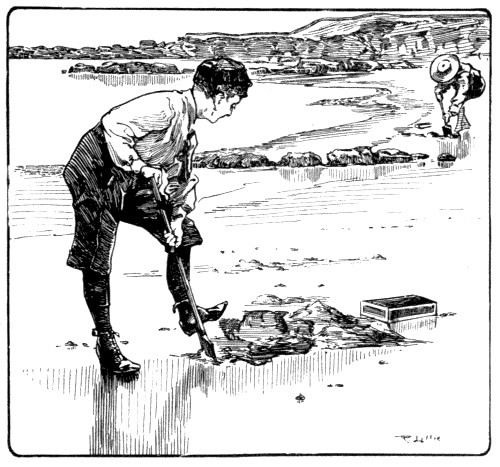
Fig. 30.—Digging for Bait
Mussels are not easily opened without injury, and consequently some anglers give them a short immersion in hot water, to kill the animal and thus cause the shell to gape. As far as our own experience goes, the value of the bait is not deteriorated by this treatment, though some are of opinion that it is not so attractive after scalding. Mussels are opened, when alive, much in the same way as oysters, but the valves of the shell fit together so closely that it seems at first almost impossible to insert a knife between them. This, however, can be done with ease if one valve is first made to slide a little way over the other by pressing it with the thumb. This being accomplished, the two valves should not be separated by the mere force of the knife, for this would tear the animal within, and render it more or less unfit for its purpose; but first direct the edge of the knife towards the adductor muscle, by means of which the animal pulls its valves so firmly together, and then cut through this close to the inner surface of the upper valve. This valve can then be lifted without injury to the soft parts, and the whole animal removed from the other valve by cutting through the same muscle close to it.
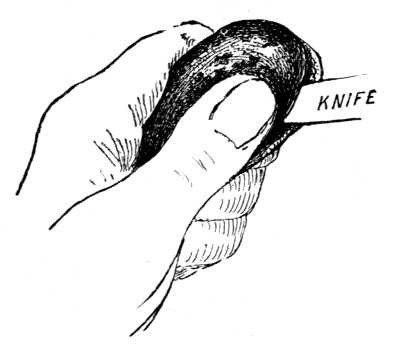
Fig. 31.—Method of Opening a Mussel
Between the two lobes of the mantle—the soft covering on both sides of the animal that previously lined the shell—will be seen a brown, fleshy, tongue-like body. This is the ‘foot’ of the mussel. The point of the hook should first be run through this, and then from side to side through the mantle, and finally through the adductor muscle previously described. If this is carefully done, there will be little fear of the bait becoming detached unless it is subjected to rough usage, and still less if it is tied round the shank of the hook by means of a short piece of cotton thread.
It is probably superfluous to mention to the reader the fact that mussels are to be found on almost every rocky coast, where they may be seen attached to the rocks by means of a bunch of silky fibres called the byssus; and that, failing this, they are to be obtained from almost every fisherman and fish-dealer; if, however, these molluscs are not to be obtained, cockles may be used as a substitute, though it will probably be found that they are appreciably inferior, except when fishing for dabs and plaice on sandy shores, in which case they are highly satisfactory. Cockles abound on most sandy coasts, where they live a little below the surface; and are usually obtained by means of an ordinary garden rake. Sometimes we meet with them in large numbers in the estuaries of rivers, where they lie buried in the banks of mixed sand and mud that are left exposed at low tide.
Limpets are extensively used for bait in some places, especially by amateur anglers; and often with good results. They should always be removed from the rocks without injury, and this is no easy matter to those who do not know how to deal with them. If taken completely by surprise, one sharp, but light tap on the side of the conical shell will successfully detach them from their hold; or they may be raised by means of the blade of a strong pocket-knife that has been thrust beneath the cone.
For our work small limpets will prove far more satisfactory than large ones, and these may be used whole; but if the limpets are too large for the hooks employed, the soft, upper part of the body only need be used.
It is not an easy matter to remove fresh limpets from their shells without destroying this soft portion of the animal, but if placed for a minute or so in hot water they come out quite easily, and are apparently none the less attractive as bait. Some fishermen on the Cornish coast always collect the largest limpets for bait, remove them from their shells by means of hot water, and arrange them on the rocks to become partly dry. When required for bait, the soft parts only are used, but these, having been more or less hardened by the drying process, hold much better on the hook than when fresh.
And now, after mentioning the fact that land snails are occasionally used, though, we believe, with no very considerable success, for sea fishing, we will note a few baits derived from the higher head-footed molluscs—the squid, cuttle-fish, &c. There are several species of these peculiar molluscs, but the common squid and the common cuttle of our seas, and especially the former, is highly prized as bait. It may be obtained from fishermen, who frequently haul it in their nets; but if supplied alive and fresh from the sea it must be handled very cautiously, otherwise it may discharge the contents of its ink-bag over one with the most unpleasant results. It is certainly best used while fresh, though some suspend it until dry, and then store it for future use, in which case it will require soaking in water when required. The thin tentacles or arms are very convenient for baiting small hooks, though other parts of the body, cut into narrow strips, will serve the purpose of the angler equally well.
Of the crustaceans, shrimps and prawns, and various species of crabs are used as bait. Shrimps and prawns are used whole for catching flat-fish, but small pieces are better when fishing for smelt and other small species of fish that swim close to shore. Little pieces of the flesh of the crab are also well adapted for baiting hooks of small size, and will prove very attractive to almost all kinds of fish. Small crabs, however, may be used whole, but are of little use except when soft—that is, just after the shedding of their shells, and before the new skin has had time to harden. Such crabs may be found under stones and in other hiding-places at low tide, for at such times they keep well secluded from their numerous enemies by whom they are greedily devoured while in this helpless and unprotected condition.
The hermit-crab, which selects the empty shell of a whelk or winkle for its home, is probably well known to our readers. The protection afforded by such a home is absolutely necessary to its existence, since its abdomen has no other covering than a soft, membranous skin. This soft abdomen is frequently used as a bait with great success, as well as the flesh of the larger claws.
If the shell from which the hermit-crab is taken be broken, a worm, something of the nature of the common ragworm, will almost always be found, and this also is very serviceable as bait.
In addition to all the baits previously named there are several other good ones, many of which are to be obtained almost everywhere. Among these may be mentioned strips cut from the mackerel, herring, or pilchard, preferably with a portion of the silvery skin attached; also thin strips of tripe. Sand-eels, which may be dug out of the sand near the water’s edge, are very useful, and may be cut into pieces for baiting small hooks. Further, a large number of artificial baits are employed in various kinds of sea fishing, but as these are not essential for the work we have in hand we do not propose describing them in detail.
Now let us suppose that we are about to try our luck at sea angling, on some rocky coast, such as that of Devon and Cornwall, our object being to determine, as far as possible, what species of fishes frequent the immediate neighbourhood of the shore. And this is not all; for, when fishing with rod and line on such a coast, it frequently happens that we land some species of crab that has been attracted to our bait. The ordinary angler would regard such crab as an intruder, and, we are sorry to say, would often consider it his duty to crush the unfortunate crustacean beneath his foot. But it is far different with the naturalist. He favourably regards all creatures from which something may be learnt, and is as anxious, as a rule, to gather information concerning the habitats of one class as of another. In fact, we may go still further, and combine crab fishing with ordinary angling, both in one and the same expedition, by letting a small crab-pot down into deep water among the rocks, and allowing it to remain while the angling is proceeding.
We select a spot where there are several feet of water close to a perpendicular rock, varied and broken by numerous holes and crevices, in which various species of fishes and crustaceans habitually hide.
Such a situation is an ideal one for a young naturalist, for not only does he obtain the greatest variety of species here, but the takings will surely include some of those remarkably interesting rock-dwelling fishes that differ from our ordinary food fishes in so many points of structure, all of which, however, display some interesting adaptation to the habits and habitats of the species concerned.
Our apparatus consists of nothing more than rod and line, one or two small leads, a supply of hooks on gut snoods, a box of bait, and a waterproof bag in which to pack the specimens we desire to preserve.
We first determine the depth of the water by means of a lead on the end of the line, and then tie the hook on the end with a small lead a few feet above it, and fish in such a manner that the hook is just on the bottom, or, if the bottom is covered with weeds, the hook should be kept just clear of fouling them.
The peculiar rock fishes so common on such a coast as this on which we are engaged need special treatment at the hands of the angler. They hide in their holes, watching for the unwary creatures on which they feed, and, pouncing upon them suddenly, rush back to their snug little nooks in which they can secure themselves firmly by means of the sharp, hard spines with which their bodies are furnished. When these fishes seize the bait offered them—and they are not at all fastidious in the choice of their viands—they should be hooked and pulled up with one vigorous sweep of the rod, or they will dart into their homes, from which it is almost impossible to dislodge them.
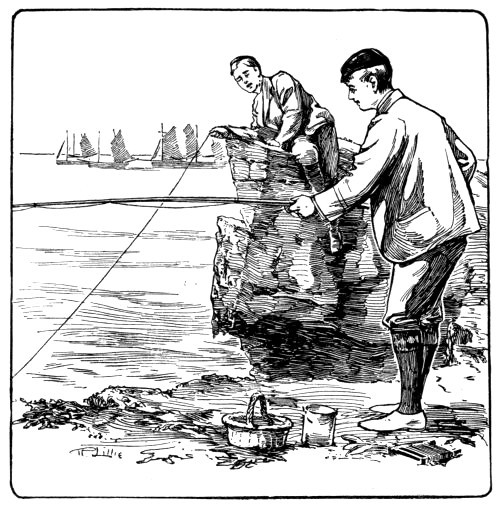
Fig. 32.—Fishing from the Rocks
In addition to these, there will be various other species that require gentler treatment, and may be hooked and landed much in the same manner as fresh-water fishes, since they are free swimmers, usually keeping well clear of the rocks and weeds.
If the day is calm, and the water clear, the sea angler will often be able to watch various fishes as they swim, and to bring the bait gently within their reach; and here we find the advantage of the rod as compared with the hand line. Sometimes quite a shoal of small fishes may be seen sporting near the surface, and, as a rule, there will be no difficulty in obtaining one for identification and study. These are generally best secured by means of small hooks, with but very little bait, and will often bite freely at the tiniest fragment of worm on an almost naked hook.
After the water has been searched at all depths, it will be well to allow the bait to rest quite on the bottom, even at the risk of losing a hook or two in the weeds and rocks. This may enable one to take some fresh species of fish or to secure a crustacean or other creature that is not often found between the tide-marks. Care should be always taken, however, to keep the hook well clear of the weeds that grow on the sides of the rock, and sway to and fro with every movement of the restless waters.
Angling from piers may be pursued much in the same manner as described above in those places where the bottom is rocky, but since the chances of hooking large fish are greater here than close to shore, it is necessary to be provided with stronger tackle and larger hooks. If, however, the bottom is sandy, the rod tackle may be modified by placing the lead at the bottom, and arranging two or three hooks above it, about one or two feet apart, the lowest one being near the lead. With such an arrangement the line may be cast some distance out, but for angling close to the pier itself there is, perhaps, nothing better than the single-hook arrangement suggested above, for with this one may fish on the bottom and at all depths without any alteration in the tackle being necessary.
If, however, the rod line is to be cast as suggested above, or if a hand line is to be similarly used, the following hints may be useful as regards the arrangement of hooks and lead.
The line itself may be of twisted silk or hemp, terminated with about a yard of strong gut. The lead, preferably of a conical or pear-shaped form, should be placed at the extreme end, and its weight regulated according to the necessities of the occasion. A few ounces of lead are quite sufficient where there are no strong currents, but it is well to be supplied with larger sizes, to be substituted if circumstances require it. Two hooks will be ample. One of these should be only a few inches from the lead, and the other about eighteen or twenty inches higher. The whole arrangement, known as a Paternoster, is represented in fig. 33, in which the method of fixing the lead and the hook links is also illustrated.
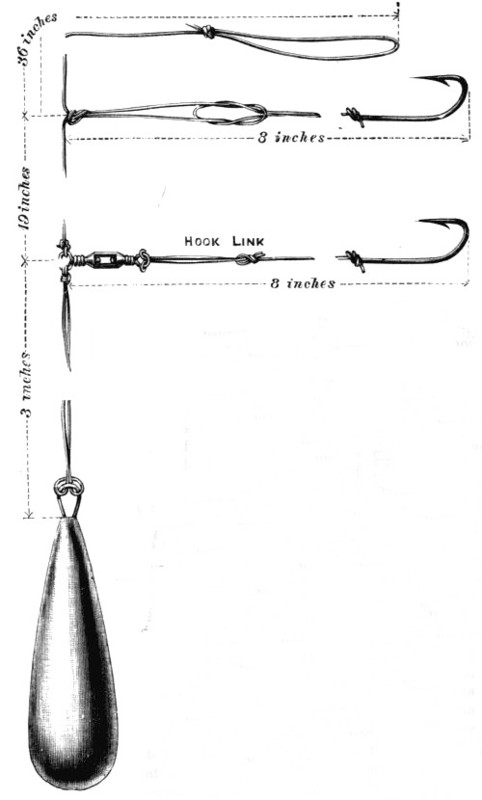
Fig. 33.—The Paternoster
Fig. 33.—The Paternoster
It will be seen that a swivel has been introduced in connection with the bottom hook, the object being to show the manner in which this useful piece of tackle is fitted. It must not be supposed, however, that swivels are always necessary. It is often useful to insert a swivel on the line itself, above the Paternoster, when it is of twisted material, in order to prevent it from kinking; but its use is more frequently serviceable on the hook links, especially when fishing where the currents are strong. When the bait used is one that presents two flat surfaces to the water, as would be the case with a strip of mackerel, a strong current will set it spinning round and round, thus causing the hook link to kink if it has not been fitted with a swivel, and the same effect is often produced by the spinning of a fish on the hook.
The employment of a suitable ground bait will often make a wonderful difference in the angler’s haul. It frequently attracts large numbers, keeping them near at hand for some considerable time, and apparently sharpens their appetite. It may be often observed, too, that a fish will bite freely at the angler’s bait when in the neighbourhood of the ground bait, while the former is viewed with suspicion in the absence of the latter.
When fishing on the bottom only, the ground bait should be weighted if it is of such a nature that it does not sink readily or if it is liable to be carried away by currents; but it will often be found more convenient to secure it on the end of a string, tied up in a muslin bag if necessary, so that it may be adjusted to any desired depth.
Among the attractive viands suitable for this purpose we may mention mussels, crushed crabs, pounded liver, the guts of any oily fish, and the offal of almost any animal.
Along the east coast, and in some of the sandy bays of Devon and Cornwall, fishing from the beach is practised, but we can hardly recommend this as of much value to the amateur whose object is to obtain as great a variety as possible of fishes for study. Some good food fishes are often caught by this means, but the methods employed are often very primitive, and would lack all interest to those who love good sport.
On the east coast a long line, fitted with many hooks, is slung out as far as possible by means of a pole, and the home end either held in the hand of the fisher or fastened to the top of a flexible stick driven into the sand. The latter plan becomes necessary when more than one line is owned by the same individual, and he is made aware of the bite of a large fish—and a large fish only, since the hooks are placed beyond a heavy lead—by the bending of the stick.
The naturalist, however, is as much interested in the small fish as the large ones, and, even for beach fishing, a rod and line, fitted with one or two hooks only, and a lead no heavier than is absolutely essential, will be preferable. A little practice will of course be necessary in order that one may become expert in the casting of the rod line, but with large rings on the rod, and a reel without a check, or a check that can be thrown off when desired, the necessary proficiency in casting ought to be acquired without much difficulty.
In some of the sandy bays of the south-west, long lines with a heavy lead at both ends and baited hooks at short intervals throughout the whole length, are placed on the sand at low tide close to the water’s edge, and left unwatched until the next tide is out. As far as our observations go this primitive mode of fishing is usually anything but successful, the receding of the tide generally revealing a long row of clean hooks, with, perhaps, one or two dead or half-dead fish; and it is probable that most of the bait is devoured by crabs and other crustaceans before the water becomes sufficiently deep to allow the desired fishes to reach it.
There is one other method of fishing on which we may make a few remarks, although it hardly comes under the heading of shore fishing. We refer to a method of catching surface fishes from a moving boat, which method is known as whiffing. The line is weighted with a lead which must be regulated according to the speed of the boat. If the boat is an ordinary rowing-boat, kept going at only a moderate speed, a few ounces of lead will be sufficient, but a whiffing line trailing behind a sailing boat travelling in a good breeze will require a pound or two of lead to keep the bait only a little below the surface.
Beyond the lead we have three or four yards of gimp or strong gut, at the end of which is a single hook fitted with a spinner, or baited with some attractive natural or artificial bait. Whatever be the bait used, there will certainly be more or less spinning caused by the resistance offered by the water, hence it will be necessary to have a swivel beyond the lead.
When whiffing near the shore, care must be taken to avoid outlying rocks that approach the surface of the water, or a sudden snapping of the line will give you an unwelcome warning of their existence. Further, we should note that the fishes which are to be caught when whiffing do not always swim at the same depth, thus it will be advisable to fish at different distances from the surface by varying either the weight of the lead or the speed of the boat.
CHAPTER IV
THE MARINE AQUARIUM
We have already advised our readers to take home their specimens alive for the purpose of studying their growth and habits. Now, although there may be some difficulties in the way of keeping marine animals and plants alive for any considerable time, yet we are inclined to emphasise the importance of this matter, knowing that the pleasure and instruction that may be obtained from even a moderately successful attempt to carry this out will far more than compensate for the amount of trouble entailed. There are very many marine objects that are exceedingly pretty and also very instructive, even when studied apart from the life with which they were associated in the sea. Thus, a well-preserved sea-weed may retain much of its original beauty of form and colour, the shells of numerous molluscs and crustaceans exhibit a most interesting variety of features well worthy of study, and a number of the soft-bodied animals may be preserved in such a manner as to closely resemble their living forms. This being the case, we can hardly say anything to discourage those who gather sea-side objects merely for the purpose of making a collection of pretty and interesting things to be observed and admired. Such objects must necessarily afford much pleasure and instruction, and the time spent in the collection and preparation will certainly cause the collector to stray to the haunts of the living things, where he is certain to acquire, though it may be to a great extent unconsciously, a certain amount of knowledge concerning their habits and mode of life. Moreover, sea-side collecting is one of the most healthy and invigorating of all out-door occupations, and for this reason alone should be encouraged.
Yet it must be observed that he whose sea-side occupation is merely that of a collector, and whose work at home is simply the mounting and arranging of the objects obtained, can hardly be considered a naturalist. Natural history is a living study, and its devotee is one who delights in observing the growth and development of living things, watching their habits, and noting their wonderful adaptation to their environments; and it is to encourage such observation that we so strongly recommend the young collector to keep his creatures alive as far as it is possible to do so.
The first thing to settle, then, is the nature of the vessel or vessels that are to serve the purpose of aquaria for the work of the young naturalist.
As long as the outdoor work is in progress temporary aquaria will be very useful as a means by which the objects collected may be sorted and stored until a final selection is made for the permanent tank. These temporary aquaria may consist of jars or earthenware pans of any kind, each containing a few small tufts of weed, preferably attached to pieces of rock, and a layer of sand or gravel from the beach.
As such temporary aquaria will, as a rule, be within a convenient distance from the sea-side where the collecting is being done, there will be, we presume, no great difficulty in the way of obtaining the frequent changes of water necessary to keep the animals and plants in a healthy condition, so that we need do no more now than urge the importance of avoiding overcrowding, and of renewing the water frequently for the purpose of supplying the air required for the respiration of the inmates.
When it is desired to isolate small species in such a manner that their movements may be conveniently observed, glass jars answer well; but whatever be the form or size of the vessels used, care must be taken to avoid excess of both light and heat. They should be kept in a cool place, quite out of the way of direct sunshine, and the glass vessels used should be provided with a movable casing of brown paper to exclude all light except that which penetrates from above.
Even temporary aquaria, used merely for the purpose suggested above, should be carefully watched, for a single day’s neglect will sometimes result in the loss of several valuable captives. A dead animal should be removed as soon as it is discovered to avoid the unpleasant results arising from the putrefaction of its body. The appearance of a scum or film on the surface of the water should always be regarded with suspicion. Such a scum should be removed with the aid of absorbent paper, since it tends to prevent the absorption of oxygen from the air; and, should the water be tainted in the slightest degree, it should be changed at once, or, if this is not practicable, air should be driven into it for some time by means of a syringe with a very fine nozzle. Such precautions, however, are not so urgently needed when the aquarium contains crustaceans only, for the majority of these creatures suffer less than others in the tainted sea water, some even being apparently quite as comfortable in this as in a supply fresh from the sea. Sea-weeds exhibiting the slightest tendency to decay must be removed at once; and, as regards the feeding of the animals, one must be careful to introduce only as much food as is required for immediate use, so that there be no excess of dead organic matter left to putrefy. Some of the marine animals obtained from our shores feed entirely on the minute and invisible organisms that are always present in the sea water, and others subsist principally on certain of the weeds. Many, however, of a more predaceous disposition, capture and devour living prey, while some, and more especially the crustaceans, are partial to carrion. If, therefore, the observer desires to study the ways in which the various creatures secure and devour their food, he should introduce into his aquaria live marine worms and other small animals, and also small pieces of fish or flesh.
We will now pass on to the more serious undertaking of the construction and management of a permanent salt-water aquarium.
The first point to decide is, perhaps, the size of the proposed vessel, and this will in many cases be determined partly by a consideration of the space at one’s disposal, and of the apartment it is intended to occupy. If it is to be placed in a drawing-room or other ordinary apartment of a dwelling-house, preference should be given to a window facing the north in order to avoid the direct rays of the sun, but perhaps no situation is more suitable than a cool conservatory in the shady part of a garden; and in either case a strong table or other support should be provided, of a form and size adapted to those of the aquarium to be constructed.
Various materials may be used in the construction of such an indoor aquarium, and we shall deal with two or three different types, so that the reader may make his selection according to his fancy, or to his mechanical ability, if he intends that it shall be of his own construction.
We will begin with an aquarium constructed entirely of a mixture of cement and fine sand, this being the most inexpensive and certainly the easiest to make; and although it may not be regarded as the most ornamental—but opinions will differ on this point—yet it has the decided advantage of being the nearest approach to the natural rock pool. Though somewhat heavy and cumbersome, even when empty, the amount of material used in its construction may be varied according to the taste and convenience of the maker. Further, this form of aquarium is one that will readily admit of structural alterations at any future period. It may be deepened at any time; lateral additions or extensions may be made, or a portion may at any time be shut off for the purpose of isolating certain of the animals procured.
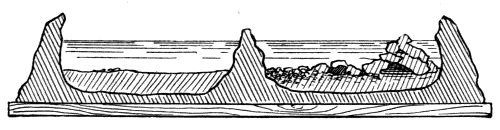
Fig. 34.—Section of an Aquarium constructed with a mixture of Cement and Sand
The first thing to do is to prepare a flat, strong slab of hard wood or stone, the exact shape and size of the desired artificial pool, and then cover this, if of wood, with a mixture of fine sand and cement, mixed to a convenient consistency with water, to the depth of about one inch. The banks or walls of the pool must then be built up on all sides, and this is best done by the gradual addition of soft pellets of cement, applied in such a manner as to produce an irregular surface. Unless the walls of the aquarium be very thick and massive the cement will soon show a tendency to fall from its place as the height increases, but this may be avoided by doing the work in instalments, allowing each portion to set before further additions are made to the structure.
Since some marine animals like to occupy snug and shady niches in deep water while others prefer full exposure to the light in shallows, arrangements should be made for all by varying the depth of the bed, and providing several little tunnels and caverns. This may be accomplished either by working the cement itself into suitable form, or by means of piled stones obtained from the sea beach; and if the latter plan is adopted, the stones should not be obtained until the aquarium is quite ready for its living contents; for then a selection of stones and rock fragments with weeds, anemones, sponges, and other fixed forms of life attached to them, may be made. The natural appearance of a rock pool is thus more nearly approached, and in a shorter time than if the sedentary life were required to develop on an artificial ground.
Objection may be raised to the form of aquarium just described on the ground that no life within it is visible except when viewed from above. But is not this also the case with a rock pool on the sea shore? And has any admirer of nature ever been heard to complain of the beauties of such a pool because he was unable to look at them through the sides? Further, it may be urged that the inmates of our aquarium will be living under more natural conditions than those of the more popular glass-sided aquaria, because they receive light from above only.
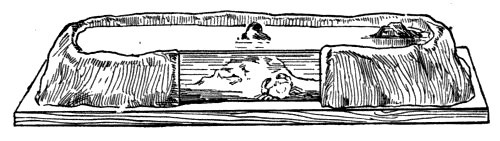
Fig. 35.—Cement Aquarium with a Glass Plate in Front
However, should the reader require a glass front to his cement tank, the matter is easily accomplished. Three sides are built up as before described. A sheet of thick glass—plate glass by preference—is then cut to the size and shape of the remaining space, and this is fixed by means of cement pressed well against its edges, both inside and outside.
Water should not be put into the tank until it is quite dry; and, if one side is made of glass, not until the cement surrounding the edge of the glass has been liberally painted with marine glue, hot pitch, or some other suitable waterproof material.
If any pipes are required in connection with the water supply of the aquarium, according to either of the suggestions in a later portion of this chapter, such pipes may be fixed in their proper places as the cement sides are being built up.
The next type of aquarium we have to describe is of low cost as far as the materials are concerned, and one that may be made by any one who has had a little experience in woodwork; and although the tank itself is of a simple rectangular form, yet it may be made to look very pretty with a suitable adjustment of rocks and weeds.
It consists of a rectangular box, the bottom, ends, and back of which are of hard wood, firmly dovetailed together, and the front of plate glass let into grooves in the bottom and ends. All the joints and grooves are caulked with marine glue, but no paint should be used in the interior.
This form of tank may be vastly improved by the substitution of slabs of slate for the wood, though, of course, this change entails a much greater expenditure of both time and cash; but supposing the work to be well done, the result is everything that could be desired as far as strength and durability are concerned.
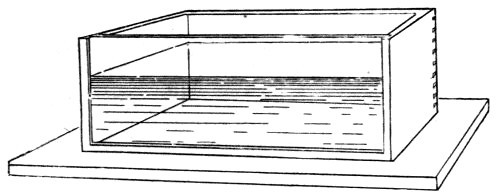
Fig. 36.—Aquarium of Wood with Glass Front
In either of the rectangular tanks just described glass may be used for two sides instead of one only; and since this is not a matter of very great importance, the choice may well be left to the fancy of the one who constructs it.
Some prefer an aquarium with glass on all sides, and where this is the case the framework may be made of angle zinc with all the joints strongly soldered. Such an aquarium may be made in the form of any regular polygon, for it is no more difficult to construct one of six or eight sides than of four. It is more difficult, however, to make such an aquarium perfectly watertight, for the glass, instead of being in grooves, has to be securely fastened to the metal frame by means of a cement on one side only, and this cement has to serve the double purpose of holding the glass and keeping in the water.
Various mixtures have been suggested for this purpose, and among them the following are perfectly satisfactory:—
1.
Litharge
2 parts
Fine sand
2 ”
Plaster of Paris
2 ”
Powdered resin
1 part
Mix into a very thick paste with boiled linseed oil and a little driers.
2.
Red lead
3 parts
Fine sand
3 ”
Powdered resin
1 part
Mix with boiled linseed oil as above.
Both these cements should be applied very liberally, and the aquarium then allowed to remain quite undisturbed for at least two weeks before any water is introduced.
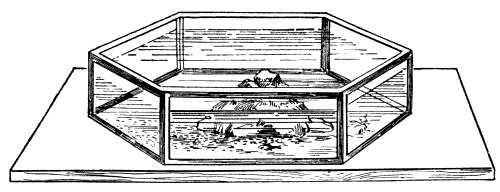
Fig. 37.—Hexagonal Aquarium constructed of Angle Zinc, with Glass Sides
When ready for the water, the bottom of the aquarium should be covered with a moderately thick layer of fine sand from the sea shore, and stones then piled in such a manner as to form little tunnels and caves to serve as hiding-places for those creatures that prefer to be under cover. As to the selection of stones, we have already suggested that some may have weeds rooted to them, and that pieces of rock with anemones, sponges, and other forms of life attached may be chipped off. Further, on many of our rocky coasts we may find, near low-water mark, a number of stones covered with a layer of vegetable growth, amongst which many small animals live, often more or less concealed by their protective colouring. Some of these stones placed on the bed of the salt-water aquarium would add greatly to the natural appearance, as well as give greater variety to the living objects. Shells bearing the calcareous, snakelike tubes of the common serpula (p. 121), preferably with the living animals enclosed, will also enhance the general appearance and interest of the aquarium.
In making preparations previous to the introduction of animal life, due regard should be paid to the peculiar requirements of the creatures it is intended to obtain. We have already referred to the advisability of arranging the bed of the tank in such a manner that the water may vary considerably in depth, so that both deep and shallow water may be found by the animals as required, and to the provision of dark holes for crustaceans and other creatures that shun the light. Very fine sand should be provided for shrimps, prawns, and other animals that like to lie on it; and this sand must be deep in places if it is intended to introduce any of the burrowing molluscs and marine worms.
The water used may be taken from the sea or be artificially prepared. The former is certainly to be preferred whenever it can be conveniently obtained, and at the present time few will find much difficulty in securing a supply, for not only are we favoured with the means of obtaining any desired quantity by rail at a cheap rate from almost any seaport, but there are companies in various ports who undertake the supply of sea water to any part of the kingdom. If the water is to be conveyed from the coast without the aid of the regular dealers in this commodity, great care must be taken to see that the barrel or other receptacle used for the purpose is perfectly clean. Nothing is more convenient than an ordinary beer or wine barrel, but it should be previously cleansed by filling it several times with water—not necessarily sea water—and allowing each refill to remain in it some time before emptying. This must be repeated as long as the water shows the slightest colouration after standing for some time in the barrel.
Should any difficulty arise in the way of getting the salt water direct from the sea, it may be made artificially by dissolving ‘sea salt’ in the proper proportion of fresh water, or even by purchasing the different salts contained in the sea separately, and then adding them to fresh water in proportionate quantities.
The composition of sea water is as follows:—
Water
96·47
per cent.
Sodium chloride
2·70
”
Magnesium chloride
·36
”
Magnesium sulphate (Epsom salts)
·23
”
Calcium sulphate
·14
”
Potassium chloride
·07
”
Traces of other substances
·03”
100·00
and it will be seen from this table that artificial sea water may be made by adding about three and a half pounds of sea salt, obtained from the sea by the simple process of evaporation, to every ninety-six and a half pounds of fresh water used. In making it there may be some difficulty in determining the weight of the large volume of water required to fill an aquarium of moderate dimensions, but this will probably disappear if it be remembered that one gallon of water weighs just ten pounds, and, therefore, one pint weighs twenty ounces.
If the sea salt cannot be readily obtained, the following mixture may be made, the different salts being purchased separately:—
Water
96½
lbs.
Sodium chloride (common salt)
43¼
ozs.
Magnesium chloride
5¾
”
Epsom salts
3¾
”
Powdered gypsum (calcium sulphate)
2¼
”
Although in this mixture the substances contained in the sea in very small quantities have been entirely omitted, yet it will answer its purpose apparently as well as the artificial sea water prepared from the true sea salt, and may therefore be used whenever neither sea salt nor the natural sea water is procurable.
Assuming, now, that the aquarium has been filled with sea water, it remains to introduce the animal and vegetable life for which it is intended; and here it will be necessary to say something with regard to the amount of life that may be safely installed, and the main conditions that determine the proportion in which the animal and vegetable life should be present in order to insure the greatest success.
Concerning the first of these we must caution the reader against the common error of overcrowding the aquarium with animals. It must be remembered that almost all marine animals obtain the oxygen gas required for purposes of respiration from the air dissolved in the water. Now, atmospheric air is only very slightly soluble in water, and hence we can never have an abundant supply in the water of an aquarium at any one time. If a number of animals be placed in any ordinary indoor aquarium, they very soon use up the dissolved oxygen; and, if no means have been taken to replace the loss, the animals die, and their dead bodies soon begin to putrefy and saturate the water with the poisonous products of decomposition.
It is probably well known to the reader that a large proportion of the oxygen absorbed by the respiratory organs of animals is converted by combination of carbon into carbonic acid gas within their bodies, and that this gas is given back into the water where it dissolves, thus taking the place of the oxygen used in its formation.
If, then, an aquarium of any kind is to be a success, some means must be taken to keep the water constantly supplied with fresh oxygen quite as rapidly as it is consumed, and this can be done satisfactorily by the introduction of a proportionate quantity of suitable living weeds, providing there is not too much animal life present.
The majority of living plants require carbonic acid gas as a food, and, under the influence of light, decompose this gas, liberating the oxygen it contained. This is true of many of our common sea-weeds, and thus it is possible to establish in a salt-water aquarium such a balance of animal and vegetable life that the water is maintained in its normal condition, the carbonic acid gas being absorbed by the plants as fast as it is excreted by animals, and oxygen supplied by the plants as rapidly as it is consumed by the animals.
This condition, however, is more difficult to obtain in a salt-water aquarium than in one containing fresh-water life, partly because, generally speaking, the sea-weeds do not supply oxygen to the water as rapidly as do the plants of our ponds and streams, and partly because of the difficulties attending the successful growth of sea-weeds in artificial aquaria. Thus it is usually necessary to adopt some means of mechanically aërating the water; but, for the present, we shall consider the sea-weeds only, leaving the mechanical methods of aërating the water for a later portion of this chapter.
In the first place, let us advise the amateur to confine his attention to the smaller species of weeds that are commonly found in small and shallow rock pools, for the successful growth of the larger purple and olive weeds will probably be beyond his power, even though his tank be one of considerable capacity. The best plan is that we have already suggested—namely, to chip off small pieces of rock with tufts of weed attached, and to fix them amongst the rockery of the aquarium, being careful to place those that grew in shallow water with full exposure to the light, and those which occupied sheltered and shady places in the rock pool, respectively, in similar situations in the artificial pool.
For the purposes of aëration we have to rely principally on the bright green weeds, and preference should be given to any of these that exhibit, in their natural habitat, a multitude of minute air-bubbles on the surface of their fronds, for the bubbles consist principally of oxygen that is being liberated by the plant, and denote that the species in question are those that are most valuable for maintaining the desired condition of the water in an aquarium.
Any small sea-weed may be tried at first, but experience will soon show that some are much more easily kept alive than others. In this experimental stage, however, a constant watch should be maintained for the purpose of detecting signs of decay in the marine garden. A plant should always be removed as soon as it presents any change from the natural colour, or exhibits the smallest amount of slimy growths on the surface, for decomposing plants, as well as decaying animals, will soon convert an aquarium into a vessel of putrid and poisonous water.
It seems almost unnecessary to name a selection of sea-weeds for small aquaria, seeing that our rock pools produce so many extremely beautiful species, most of which may be successfully kept alive in a well-managed tank; but the common Sea Grass (Enteromorpha compressa), and the Sea Lettuce (Ulva latissima), also known locally as the Green Laver or Sloke, are particularly useful for the aëration of the water; while the Common Coralline (Corallina officinalis), the Dulse (Schizymenia edulis), the Peacock’s tail (Padina pavonia), the Irish or Carrageen Moss (Chondrus crispus), Callithamnion, Griffithsia setacea, Plocamium plumosium, Rhodymenia palmata, Rhodophyllis bifida, and Ceramium rubrum are all beautiful plants that ought to give no trouble to the aquarium-keeper.
It is not advisable to introduce animal life into the aquarium immediately it is filled, on account of the possibility of the water being contaminated by contact with the cement that has been used to make it water-tight. It is safer to allow the first water to stand for a few weeks, the weeds and all other objects being in situ, and the necessary means employed for perfect aëration during this interval, and then, immediately before the animals are placed in their new home, to syphon off the whole of the water, and refill with a fresh supply.
In the selection of animals due regard should be paid to two important points—first, the danger of overcrowding, and, secondly, the destructive habits of some of the more predaceous species.
No more than two or three animals should, as a rule, be reckoned for each gallon of water; and the proportion of animals should be even less than this when any of them are of considerable size.
As regards the destructive species, these are intended to include both those that are voracious vegetable feeders and also those whose habit it is to kill and prey on other creatures.
It must be understood that the weeds are to serve two distinct purposes:—They are to supply at least some of the oxygen required for the respiration of the animal inmates, and also to serve as food for them. Some marine fishes and molluscs feed on the fronds of the weeds, and among these the common periwinkle may be mentioned as one of the most voracious. If many such animals are housed in the aquarium, it will be necessary to replace at intervals those species of weeds that suffer most from their ravages. The zoospores thrown off by the weeds, particularly in the autumn, are also valuable as food for some of the animals.
Notwithstanding the destructive character of the periwinkle just referred to, it has one redeeming feature, for it is certainly useful in the aquarium as a scavenger, as it greedily devours the low forms of vegetable life that cover the glass and rocks, thus helping to keep them clean; and the same is true of the common limpet and other creeping molluscs. Some of these are even more to be valued on account of their partiality for decaying vegetable matter, by devouring which they reduce the amount of the products of decomposition passing into the water.
Other details concerning the selection of animal and vegetable life for the indoor aquarium must be left to the discretion and experience of the keeper, for it is impossible by written instructions and advice to cover all the various sources of loss and trouble that may from time to time arise. If, however, the general hints for the management of the marine aquarium here given be faithfully followed, there ought to be no further losses than must accrue from the injudicious selection of animal species, and these will decrease as experience has been acquired respecting the habits of the creatures introduced.
We must now pass on to matters pertaining to the maintenance of the healthy condition of an aquarium which, we will suppose, has been established with due regard to scientific principles. Under this head we shall consider, (1) the aëration of the water, (2) the repair of loss due to evaporation, and (3) the regulation of light and temperature.
It has already been shown that the marine aquarium can hardly be maintained in a satisfactory condition as regards its air supply by leaving the aëration of the water entirely to the action of plant life; and herein this form of aquarium differs from that employed for the animal and vegetable life derived from ponds and streams. Fresh-water weeds develop and multiply with such rapidity, and are such ready generators of oxygen gas that it is a very easy matter to establish a fresh-water aquarium that will remain in good condition for years with but little attention; it is therefore important that we should point out the difference in treatment necessary to those of our readers who are already acquainted with the comparative ease with which the fresh-water aquarium may be kept in good order, lest they expect the same self-aërating condition in the marine tank.
It is never a good plan to leave the renovation of the water of the aquarium until there are visible signs within that something is going wrong. It is true that an unsatisfactory condition of the water, revealed by a slight taint in the odour, or a general turbidity, or the formation of a slight scum on the surface, may sometimes be rectified by the prompt application of some method of artificial aëration, but the aim of the aquarium-keeper should be not the rectification of unsatisfactory conditions, but the establishment of such a method of aëration that the unsatisfactory condition becomes an impossibility. We do not wish to discourage anyone who has the slightest desire to start a marine aquarium. Our aim is to point out any difficulties that lie in the way in order that the aquarium may be a success; and thus, having stated that the difficulties attending it are somewhat greater than those connected with the management of a fresh-water aquarium, we should like to add that these practically disappear when one is prepared to devote a short time at regular intervals in order to see that the process of aëration is properly carried out.
Some recommend the occasional injection of air by a syringe as one means of aërating the water; but, although this may be all very well as a temporary purifier of the slightly tainted aquarium, it is hardly suitable as a means of maintaining a good, healthy condition. It must be remembered that oxygen gas—the gas of the atmosphere so essential to animal life—is only very slightly soluble in water. By this we mean not only that water dissolves oxygen very slowly, but also that it can never hold a large supply of the gas at any one time. This being the case, it is clear that the use of a syringe for a short time, though it discharges an enormous total volume of air into the water, will result in the actual solution of only a small quantity. No method of aëration is perfect that allows the admission of air for a short time only at comparatively long intervals; the most perfect system is that in which air is slowly but continuously passed into solution.
Since air is slightly soluble in water, it is clear that it must be continuously passing into any body of water that has its surface freely exposed to it; hence a wide and shallow aquarium is much more likely to keep in good order than one that is narrower and deeper. But, with marine aquaria, the simple absorption from the air at the surface is not in itself sufficient, as a rule, to maintain a healthy condition. Yet it will be advisable to remember this matter when constructing a tank for marine life.
One of the prettiest, and certainly one of the most effectual, methods of supplying air to an aquarium is by means of a small fountain with a very fine spray. The water need seldom be changed, but the fountain may be fed by water from the aquarium, and as the fine spray passes through the air it will absorb oxygen and carry it in solution to the tank.
The accompanying diagram illustrates the manner in which this can be accomplished. The aquarium (a) is supplied with an outlet (o) about an inch from the top by means of which the water is prevented from overflowing, and the outlet pipe leads to a vessel (v) of considerable capacity which, for the sake of convenience and appearance, may be concealed beneath the table on which the aquarium stands. Some feet above the level of the aquarium is another vessel (c), supported on a shelf, having about the same capacity as v, and supplied with a small compo pipe that passes down into the aquarium, and then, hidden as much as possible by the rockery, terminates in a very fine jet just above the level of the water in the centre. The upper vessel should also be provided at the top with a loose covering of muslin to serve as a strainer, and this should be replaced at intervals as it becomes clogged with sedimentary matter.
In order that this arrangement may give perfect satisfaction the two vessels (c and v) must each be of at least half the capacity of the aquarium itself, and the total quantity of salt water sufficient to fill the aquarium together with one of them. It should also be remembered that since the pressure of water depends not on its quantity, but on its height measured perpendicularly, it follows that the height to which the fountain will play is determined by the height of the vessel c above the level of the jet.
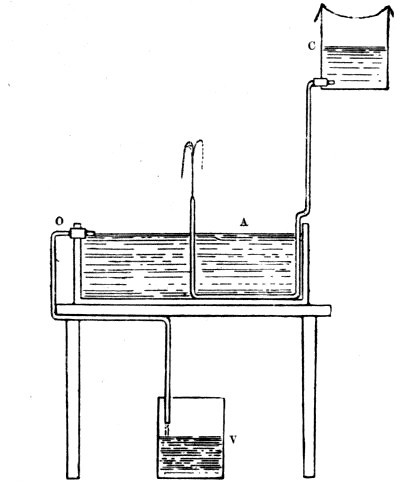
Fig. 38.—Method of aërating the Water of an Aquarium
a, aquarium with fountain; c, cistern to supply the fountain; o, pipe for overflow; v, vessel for overflow
Let us now suppose that the aquarium and the upper vessel have both been filled with sea water. The fine jet from the pipe plays into the air and returns with a supply of oxygen to the aquarium, while the excess above the level of o passes into the concealed vessel below the table. If the two vessels are as large as we recommend, and the jet a very fine one, the fountain may continue to play for hours before c is empty, the animals of the tank being favoured all this time with a continuous supply of air. And when the supply from above is exhausted, the contents of the bottom vessel are transferred to the top one, and at the same time so effectually strained by the layer of muslin that no sedimentary matter passes down to choke the fine jet of the fountain. One great advantage this method possesses is that the living creatures derive the benefit of a much larger quantity of water than the aquarium alone could contain; and thus, apart from the aërating effects of the fountain, the result is the same as if a much larger tank were employed.
In our next illustration (fig. 39) we give a modified arrangement based on the same principle which may commend itself by preference to some of our readers. Here the supply pipe to the fountain passes through a hole in the bottom of the aquarium instead of into the top, and the outlet pipe is bent downward within so as to form a syphon.
Those who are acquainted with the principle of the syphon will understand at once the working of such an arrangement as this. Let us suppose the vessel c to be full of water, and the fountain started, while the water in the aquarium stands no higher than the level l. The water slowly rises until the level h of the bend of the outlet tube has been reached, and during the whole of this time no water escapes through the exit. As soon, however, as the latter level has been attained, the water flows away into the lower vessel, into which it continues to run until the lower level is reached, and then the outflow ceases, not to commence again until the fountain causes the water to rise to the upper level.
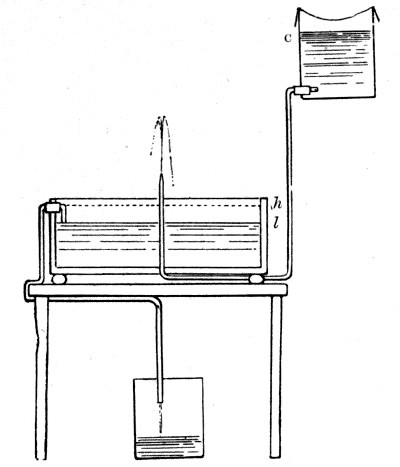
Fig. 39.—Aquarium fitted with Apparatus for Periodic Outflow
From what has been said the reader will see that the total quantity of water required in this instance need not exceed the capacity of the aquarium; also that each of the vessels connected with water supply and waste should have a capacity equivalent to the volume of water contained in the aquarium between the two levels h and l.
The alternate rising and falling of the water produced in the manner just described represents in miniature the flow and ebb of the tides, but perhaps this is in itself of no great advantage in the aquarium except from the fact that it allows those creatures that prefer to be occasionally out of the water for a time a better opportunity of indulging in such a habit. And further, with regard to both the arrangements for aëration above described, it should be noted that earthenware vessels are much to be preferred to those made of metal for the holding of sea water, since the dissolved salts corrode metallic substances rather rapidly, and often produce, by their chemical action, soluble products that render the water more or less poisonous.
Other methods of aërating the water of aquaria are practised, but these, as a rule, are only practicable in the case of the large tanks of public aquaria and biological laboratories, as the mechanical appliances necessary to carry them out successfully are beyond the means of an ordinary amateur.
In such large tanks as those referred to it is common to force a fine jet of air into the water by machinery. Sometimes this air is driven downward from a jet just below the surface, and with such force that a multitude of minute bubbles penetrate to a considerable depth before they commence to rise, but in others the air is made to enter at the bottom and must therefore pass right through the water.
Of course the amateur aquarium-keeper may carry out this method of aëration with every hope of success providing he has some self-acting apparatus for the purpose, or can depend on being able himself to attend to a non-automatic arrangement at fairly regular intervals, always remembering that a single day’s neglect, especially in the case of a small tank with a proportionately large amount of animal life, may lead to a loss of valuable specimens.
We have already mentioned the use of a syringe as a means by which an aquarium may be temporarily restored to a satisfactory condition providing it has not been neglected too long, and some recommend forcing air, or, still better, pure oxygen gas, from an india-rubber bag into the water. We have used, for the same purpose, a stream of oxygen from a steel cylinder of the compressed gas with very satisfactory results; and since oxygen may be now obtained, ready compressed, at a very low price—about twopence a cubic foot—there is much to be said in favour of this method as an auxiliary in the hands of the owner of a small tank, though we hardly recommend it as a prime means of aëration to take the place of the fountain.
In any case, where a stream of air or oxygen is employed, an exceedingly fine jet should be used, in order that the expelled gas may take the form of a stream of minute bubbles; for, as previously stated, the water can absorb the gas only very slowly, so that there must necessarily be a considerable waste when the gas issues rapidly. Further, the smaller the bubbles passing through the water, the greater is the total surface of gas in contact with the liquid, the volume of the supply being the same, and hence the more effectually will the solution of the gas proceed. Again, another advantage of the fine stream of minute bubbles lies in the fact that the smaller these bubbles are the more slowly they rise to the surface of the water, and thus the longer is the time in which the gas may be absorbed during its ascent.
A fine jet, well suited to the purpose here defined, may be made very easily by holding the middle of a piece of glass tubing in a gas flame until it is very soft, and then, immediately on removing it, pulling it out rather quickly. A slight cut made with a small triangular file will then enable the operator to sever the tube at any desired point.
Yet another method of maintaining the air supply of aquaria is adopted in the case of some of the large tanks of public aquaria and biological laboratories situated close to the sea, and this consists in renewing the water at every high tide by means of pumps.
It must not be supposed that an indoor aquarium, even when well established, and supplied with the best possible system of aëration, requires no further care and attention. In the first place there is a continual loss of water by evaporation, especially in warm and dry weather, and this must be rectified occasionally. Now, when water containing salts in solution evaporates, the water passing away into the air is perfectly free from the saline matter, and thus the percentage of salt in the residue becomes higher than before. It is evident, therefore, that the loss by evaporation in a marine aquarium must be replaced by the addition of fresh water, which should either be distilled, or from the domestic supply, providing it is soft and moderately free from dissolved material.
But the question may be asked, ‘Do not the marine animals and plants utilise a certain amount of the saline matter contained in the salt water?’ The answer to this is certainly in the affirmative, for all sea-weeds require and abstract small proportions of certain salts, the nature of which varies considerably in the case of different species; and, further, all the shelled crustaceans and molluscs require the salts of lime for the development of their external coverings, and fishes for the growth of their bony skeletons. Hence the above suggestion as to the replenishment of loss by evaporation with pure water is not perfectly satisfactory. It will answer quite satisfactorily, however, providing the sea water is occasionally changed for an entirely new supply. Again, since carbonate of lime is removed from sea water more than any other salt, being such an essential constituent of both the external and internal skeletons of so many marine animals, as well as of the calcareous framework of the coralline weeds, we suggest that the aquarium may always contain a clean piece of some variety of carbonate of lime, such as chalk, limestone, or marble, which will slowly dissolve and replace that which has been absorbed.
Water is rendered denser, and consequently more buoyant, by the presence of dissolved salts; and, since the density increases with the proportion of dissolved material, we are enabled to determine the degree of salinity by finding the density of the solution. We can apply this principle to the aquarium, as a means of determining whether the water contains the correct amount of sea salt, also for testing any artificial salt water that has been prepared for the aquarium.
Probably some of our readers are acquainted with some form of hydrometer—an instrument used for finding the density of any liquid; but we will describe a simple substitute that may be of use to the owner of a marine aquarium, especially if the salt water for the same is artificially prepared. Melt a little bees-wax, and mix it with fine, clean sand. Then, remembering that the wax is lighter than water, and consequently floats, while sand is considerably heavier, and sinks, adjust the above mixture until a solid ball of it is just heavy enough to sink very slowly in sea water. Now make two such balls, and then cover one of them with a light coating of pure wax. We have now two balls, one of which will float in sea water, and the other sink, and these may be used at any time to test the density of the water in, or prepared for, the aquarium. If the water is only a little too salt, both balls will float; while, if not sufficiently rich in saline matter, both will sink.
We must conclude this chapter by making a few remarks on the important matter of the regulation of light and temperature. Direct sunlight should always be avoided, except for short and occasional intervals, not only because it is liable to raise the temperature to a higher degree than is suitable for the inmates of the aquarium, but also because an excess of light and heat tends to produce a rapid decomposition of organic matter, and a consequent putrid condition of the water, and this dangerous state is most likely to occur when both light and temperature are high at the same time.
The water should always be cold; and as it is not always easy to estimate the temperature, even approximately, by the sensation produced on immersing the fingers, it is a good plan to have a small thermometer always at hand, or placed permanently in the aquarium. In the summer time the water should be kept down to fifty-five degrees or lower, and in winter should never be allowed to cool much below forty. There may be some difficulty in maintaining a temperature sufficiently low in summer, but a small piece of ice thrown in occasionally to replace the loss due to evaporation, especially on very hot days, will help to keep it down.
CHAPTER V
THE PRESERVATION OF MARINE OBJECTS
The sea-side naturalist, in the course of his ramblings and searchings on the coast, will certainly come across many objects, dead or alive, that he will desire to set aside for future study or identification in his leisure moments at home. Some of these will be required for temporary purposes only, while, most probably, a large proportion will be retained permanently for the establishment of a private museum, that shall serve not only as a pleasant reminder of the many enjoyable hours spent on the shore, but also as a means of reference for the study of the classification of natural objects and of their distribution and habitats.
We will first deal with those specimens that are required for temporary purposes only—those of which the collector desires to study the general characters, as well as, perhaps, something of the internal structure; but before doing so we cannot refrain from impressing on the reader the advisability of learning as much as possible of the external features and mode of growth of the different living creatures while still alive, for it must be remembered that it is impossible to preserve many of them without more or less destruction of their natural colouring and distortion of their characteristic forms.
In those cases where it is possible to keep the creatures alive for a short time only, it is a good plan to make notes of their movements and all observed changes in form, and their methods of feeding, and also to illustrate these notes by sketches drawn from life. This may seem quite an unnecessary procedure to many beginners in the study of natural objects, and may even, as far as the sketches are concerned, present difficulties that at first appear to be insurmountable; but the power to sketch from nature will surely be acquired to a greater or less degree by constant practice, and illustrated notes prepared for the purpose we suggest will undoubtedly be of great value to the student. Further, though it may often be necessary to set specimens aside in a preservative fluid until one has the leisure to examine their structure, it should always be remembered that they never improve by keeping, also that they are rarely in such good condition for dissection after saturation with the preservative as when perfectly fresh.
One of the most convenient preservatives for general use is undoubtedly methylated spirit. This is alcohol that has been adulterated in order to render it undrinkable, so that it may be sold free from duty for use in the various arts and manufactures without any danger of its being employed for the concoction of beverages. It may be used just as purchased—that is, in its strongest condition—for many purposes, but in this state it has a powerful affinity for water, and will rapidly abstract water from animal and vegetable objects, causing the softer ones to become hard, shrunken, and shrivelled, often to such an extent that they are almost beyond recognition.
By diluting the spirit, however, we satisfy to a great extent its affinity for water, and thus prevent, or, at least, reduce the action just mentioned. A mixture of equal quantities of spirit and water is quite strong enough. Unfortunately the common methylated spirit of the shops produces a fine white precipitate, that gives the whole mass a milky appearance, when it is diluted. This is due to the presence of mineral naphtha, which is added in a certain fixed proportion in accordance with the Government regulations. But it is possible, by special application, to obtain the ‘non-mineralised’ or ‘ordinary’ methylated spirit of former years, though not in small quantities, and this liquid dissolves in water without the formation of a precipitate. It should be noted, however, that the use of the spirit as a preservative is in no way interfered with by the presence of the mineral naphtha, the only disadvantage of this impurity lying in the fact that the milkiness consequent on dilution prevents the objects in a specimen jar from being observed without removal.
We have just referred to the hardening action of strong spirit as a disadvantage, and so it is when it is required to preserve soft structures with as little as possible of change in general form and appearance; but there are times when it becomes necessary to harden these soft structures in order that sections may be made for the purpose of examining internal structure with or without the aid of the microscope, and for such purposes strong spirit is one of the best hardening agents that can be employed.
Formaldehyde is another very good preservative. It is a colourless liquid, and should be considerably diluted for use, a two per cent. solution being quite strong enough for all ordinary purposes. It possesses some distinct advantages as compared with spirit. In the first place, it does not destroy the natural colours of objects to the extent that spirit does; and, although a hardening agent as well as a preservative, it does not harden soft structures by the extraction of the water they contain, and therefore does not cause them to become shrivelled or otherwise distorted. It will also occur to the reader that, since a small bulk of formaline represents a large volume of the diluted preservative, it is very conveniently stored, and a very small bottle of it taken for outdoor work may, on dilution with water, be made to yield all that is required for the preservation of the takings of a successful day, or even of a longer period. Formaldehyde is usually sold in solution of about forty per cent. strength, and for the preparation of a two per cent. solution it will be found convenient to provide a glass measure graduated either into cubic centimetres or fluid ounces and drams. One hundred volumes of the original solution contain forty of pure formaldehyde, and if water be added to make this up to two thousand volumes, a two per cent. solution is obtained. Thus, one hundred cubic centimetres of the original solution is sufficient to prepare two litres (three and a half pints) of suitable preservative.
A very good preservative liquid may be made by dissolving two ounces of common salt, one ounce of alum, and two or three grains of corrosive sublimate (a deadly poison) in one quart of water, and then, after allowing all sedimentary matter to settle to the bottom, decanting off the clear solution. This mixture is known as Goadby’s fluid, and is well adapted for the preservation of both animal and vegetable structures. It does not cause any undue contraction of soft tissues, and, as a rule, does not destroy the natural colours of the objects kept in it.
Glycerine is valuable as a preservative for both animal and vegetable objects, and especially for the soft-bodied marine animals that form such a large percentage of the fauna of our shores. It maintains the tissues in a soft condition, and preserves the natural tints as well as any liquid.
An inexpensive preservative may also be made by dissolving chloride of zinc—about one ounce to the pint of water. This is considered by some to be one of the best fluids for keeping animal structures in good condition.
Now, although the different fluids here mentioned are described in connection with the temporary preservation of natural objects, it must be remembered that they are equally adapted for the permanent preservation of the animals and plants that are to figure in the museum of the sea-side naturalist; and, although some marine objects may be preserved in a dry state in a manner to be hereafter described, yet there are many species of animals, and also some plants, that can be satisfactorily preserved only by immersion in a suitable fluid.
This method may be applied to all soft-bodied animals, such as anemones, jelly-fishes, marine worms, shell-less molluscs (sea slugs, cephalopods, &c.), the soft parts of shelled molluscs, fishes, &c.; and most sponges retain their natural appearance much better in a preservative fluid than in a dry condition. Many sea-weeds also, which are practically destroyed by the most careful drying process, are most perfectly preserved in fluid.
But the puzzled amateur will probably be inclined to ask: ‘Which is the best preservative liquid for this or that specimen?’ No satisfactory general rule can be given in answer to such a question, and a great deal will have to be determined by his own experiments and observations. Whenever he has two or three specimens of the same object, as many different fluids should be employed, and the results compared and noted. In this way a very great deal of useful information will be obtained and by the best possible means. However, it may be mentioned that all the fluids alluded to above may be safely used for almost every animal or vegetable specimen with the following reservations: strong spirit should not be employed for any very soft animal, nor should it be used for delicate green plants, since it will dissolve out the green colouring matter (chlorophyll), leaving them white or almost colourless. Further, the greatest care should be exercised in dealing with sea anemones and jelly-fishes. If spirit is used for preserving these creatures, it should be very dilute, at least at first, but may with advantage be increased in strength afterwards, though this should be done gradually.
Whatever be the preservative used, it is sure to be more or less charged with sedimentary and coloured matter extracted from the object immersed in it; hence, if the specimen concerned is to form part of a museum collection, it will be necessary to transfer it to a fresh solution after a time, and a second, and even further changes may be necessary before the object ceases to discolour the fluid or render it turbid.
Considerable difficulty will sometimes be found in the attempts to preserve a soft-bodied animal in its natural attitude. Thus, when a sea anemone is removed from its native element, it generally withdraws its tentacles, and, contracting the upper part of its cylindrical body, entirely conceals these appendages, together with the mouth they surround; and a mollusc similarly treated will generally pull itself together within its shell, leaving little or no trace of the living body inhabiting the lifeless case. Then, if these animals are transferred to any fluid other than sea water, or placed anywhere under unnatural conditions, they usually remain in their closed or unexpanded form. Thus, almost every attempt to kill them for preservation deprives them of just the characteristics they should retain as museum specimens.
Some such animals may be dealt with satisfactorily as follows: Transfer them to a vessel of fresh sea water, and leave them perfectly undisturbed until they assume the desired form or attitude. Then add a solution of corrosive sublimate very gradually—a drop or two at intervals of some minutes. In this way the bodies of anemones may be obtained ready for preservation with expanded tentacles, tube-secreting worms with their heads and slender processes protruding from their limy or sandy cases, molluscs with their ‘feet’ or their mantles and gills protruding from their shells, and barnacles with their plume-like appendages projecting beyond the opening of their conical shells.
The specimens thus prepared may be placed at first in very dilute spirit, and then, after a time, finally stored in a stronger solution of spirit in water; or they may be transferred to one of the other preservative solutions previously mentioned.
All specimens permanently preserved in fluid for a museum should be placed in jars, bottles, or tubes of suitable size, each vessel containing, as a rule, only one. Where expense is no object, stoppered jars made expressly for biological and anatomical specimens may be used for all but the smallest objects; or, failing this, ordinary wide-mouthed bottles of white glass, fitted with good corks or glass stoppers.
For very small specimens nothing is more suitable than glass tubes, but it must be remembered that wherever corks are used, even if they are of the best quality procurable, it will be necessary to look over the specimens occasionally to see if the preserving fluid has disappeared to any extent either by leakage or evaporation; for such loss is always liable to occur, although it may be very slow, and especially when methylated spirit is the liquid employed.
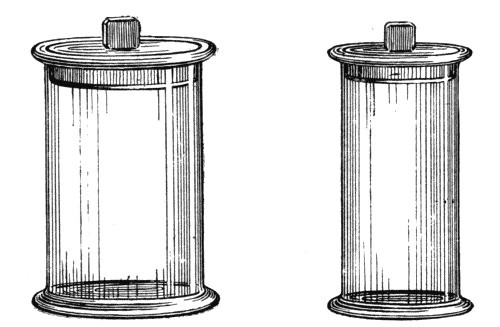
Fig. 40.—Jars for preserving Anatomical and Biological Specimens
The writer has preserved many hundreds of small marine and other objects in glass tubes of dilute spirit that have been hermetically sealed, thus rendering the slightest loss absolutely impossible, while the perfect exclusion of air prevents the development of fungoid growths that sometimes make their appearance in imperfectly preserved specimens. The making and closing of such tubes, though a more or less difficult operation at first to those who have had no previous experience in glass-working, become exceedingly simple after a little practice; and believing it probable that many of our readers would like to try their hand at this most perfect method of preserving and protecting small objects, we will give a description of the manner in which it is done.
The apparatus and materials required for this work are:—Lengths of ‘soft’ glass tubing, varying from about one quarter to a little over half an inch in internal diameter; a supply of diluted spirit—about half spirit and half water; a Herapath blowpipe, preferably with foot-bellows; and a small triangular file.
The glass tubing may be cut into convenient lengths by giving a single sharp stroke with the file, and then pulling it apart with, at the same time, a slight bending from the cut made.
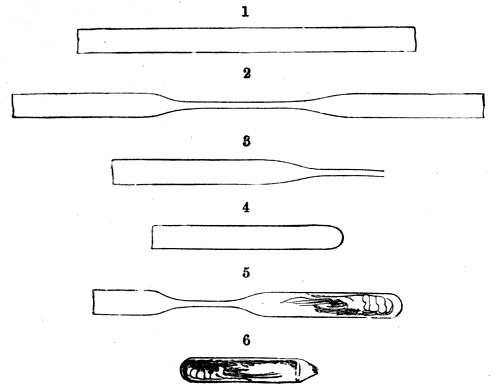
Fig. 41.—Showing the different stages in the making of a small Specimen Tube
Cut a piece of tubing about eight or nine inches long, heat it in the blowpipe flame, turning it round and round all the time, until it is quite soft, then remove it from the flame and immediately pull it out slowly until the diameter in the middle is reduced to about a sixteenth of an inch (fig. 41, 2). Make a slight scratch with the file at the narrowest part, and divide the tube at this point (fig. 41, 3). Now heat one of these pieces of tubing as before just at the point where the diameter of the drawn part begins to decrease; and, when very soft, pull it out rather quickly while it is still in the flame. The part pulled now becomes completely separated, and the tube is closed, but pointed. Continue to heat the closed end, directing the flame to the point rather than to the sides, until the melted glass forms a rather thick and flattened end; and then, immediately on removing it from the flame, blow gently into the open end until the melted glass is nicely rounded like the bottom of a test-tube (fig. 41, 4). When the tube is cold, the specimen that it is to contain, and which has already been stored for a time in dilute spirit, is dropped into it. The tube is now heated about an inch above the top of the specimen, drawn out as shown in fig. 41, 5, and again allowed to cool. When cold, the fresh spirit is poured into the open end of the tube, but the middle part is so narrow that the spirit will not run down freely. If, however, suction be applied to the open end, air from the bottom will bubble through the spirit, and then, on the cessation of the suction, the spirit will pass down to take the place of the air that was withdrawn. This may be repeated if necessary to entirely cover the specimen with the fluid. Any excess of spirit is then thrown from the upper part of the tube, and the latter cut off. Nothing is now left but to close the tube hermetically. This is done by heating the lower part of the narrow neck, and then drawing it out in the flame, taking great care that the tube is withdrawn from the flame the moment it is closed. The tube must also be kept in an upright position until it has cooled. The appearance of the finished tube is shown in fig. 41, 6.
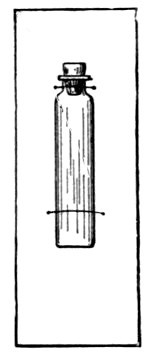
Fig. 42.—Small Specimen Tube mounted on a Card
All preserved specimens should have a label attached on which is written the name of the specimen, the class and order to which it belongs, the locality in which it was found, together with any brief remarks that the owner desires to remember concerning its habits &c.
The bottles or tubes that are too small to have a label attached to them in the ordinary way may be mounted on a card, as represented in fig. 42, and the desired particulars then written on the card.
When soft or delicate specimens are preserved in a bottle of fluid they frequently require some kind of support to keep them in proper form and to display them better for observation. Perhaps the best way to support them is to fasten them to a very thin plate of mica of suitable size by means of a needle and very fine thread. The mica is so transparent that it is invisible in the fluid, and the few stitches are also hardly perceptible, thus making it appear as if the specimen floats freely in the fluid.
We will now pass on to consider those objects of the shore that are usually preserved in a dry condition, commencing with
Starfishes and Sea Urchins
Starfishes are commonly preserved by simply allowing them to dry in an airy place, with or without direct exposure to the sun’s rays, and this method is fairly satisfactory when the drying proceeds rapidly; but care should be taken to maintain the natural roughness of the exterior as well as to have the numerous suckers of the under surface as prominent as possible. If the starfish is simply laid out on some surface to dry, the side on which it rests is often more or less flattened by the weight of the specimen itself, which therefore becomes adapted for the future examination of one surface only; but a better result, as regards both the rapidity of drying and the after appearance of the specimen, may be obtained by suspending it on a piece of fine net or by threads. A still better plan is to put the dead starfish into strong spirit, which will rapidly extract the greater part of the moisture that its body contained. After allowing it to remain in this for a day or two to harden it, put it out to dry as before mentioned. The spirit, being very volatile, will soon evaporate, so that the specimen will shortly be ready for storing away.
It is most important to observe that dried specimens—not starfishes only, but all animal and vegetable objects—should never be placed in the cabinet or other store-case until perfectly dry, for a very small amount of moisture left in them will often encourage the development of moulds, not only on themselves, but on other specimens stored with them.
Very small and delicate starfishes, when preserved in a dry condition, may be protected from injury by fastening them on a card by means of a little gum, or by keeping them permanently stored on cotton wool in glass-topped boxes.
Sea urchins, or sea eggs, as they are commonly called, may be preserved exactly in the same way as starfishes, though it is more essential in the case of these to soak them in strong spirit previous to drying, otherwise the soft animal matter within the shell will decompose before the drying is complete. Here, however, it is possible to remove the whole interior with the aid of a piece of bent wire, and to thoroughly clean the inner surface of the shell before drying it.
Some of the shells should be preserved with the spines all intact, and others with these removed in order to show the arrangement of the plates which compose the shell, as well as the perforations, and the rounded processes to which the spines are articulated.
The majority of sea urchins are provided with a most complicated and beautiful arrangement of teeth which are well worthy of study. These should be removed from a moderately large specimen, the soft surrounding structures carefully dissected away, and then cleaned by means of an old tooth-brush without disarranging them.
It will be found that dried sea urchins will require care when preserved with spines attached, for these appendages are usually very brittle and are easily dislocated at their bases where they are united to the shell by ball-and-socket joints.
It may be mentioned here that corrosive sublimate is very valuable for preventing the development of mould on the surfaces of starfishes, sea urchins, and museum specimens generally. It is best supplied in the form of an alcoholic solution made by dissolving a few grains in about half a pint of methylated spirit; the advantage of this over an aqueous solution being the rapidity with which it dries. In most cases it is simply necessary to apply the solution to the object by means of a soft brush, but, as regards starfishes and urchins it is far better to dissolve a few grains of the corrosive sublimate in the spirit in which the objects are placed previous to drying.
Crustaceans
The preservation of crustaceans by the dry method often requires some care and demands a certain amount of time; but the process is never really difficult, and the satisfaction of having produced a good specimen for a permanent collection well repays one for the trouble taken and time spent.
Some of our crustaceans are only partially protected by a firm outer covering, and almost every attempt to preserve these as dry objects results in such a shrivelling of the soft tissues that the natural appearance is quite destroyed. This is the case with some of the barnacles, and the abdominal portion of the bodies of hermit crabs, which are, therefore, far better preserved in fluid. Dilute spirit is quite satisfactory for most of these as far as the preservation of the soft structures is concerned, but it has the disadvantage that it turns the shells of some crustaceans red, making them appear as if they had been boiled.
Other crustaceans are so small, or are hardened externally to such a slight extent, that they also are not adapted for the dry method of preservation. Speaking generally, such crustaceans as shrimps and sand-hoppers are best preserved in fluid, while the different species of crabs and lobsters are more conveniently preserved dry unless it is desired to study any of their soft structures.
It is quite impossible to remove the soft parts from small crabs and lobsters previous to drying them, hence the drying should be conducted as rapidly as possible, so that no decomposition may set in. Where the process goes on very slowly, as is the case when the air is damp, or when the specimens are not set out in an airy spot, a decay of the soft structures soon proceeds, and the products of this decay will generally saturate the whole specimen, giving rise to most objectionable odours, and destroying the natural colour of the shell.
If it has been found that the species in question are not reddened by the action of methylated spirit, they should be allowed to remain in this fluid, with a few grains of dissolved corrosive sublimate, for at least a few hours, and then they will dry rapidly without any signs of putrefaction; and even those species that are reddened by spirit may be treated to a shorter immersion in this fluid with advantage.
The specimens should always be set out in some natural attitude to dry, unless it is desired to spread out the various appendages in some manner that is more convenient for the study of their structure. A sheet of blotting-paper may be placed on cork or soft wood, the specimens placed on this, and the appendages kept in the desired positions when necessary by means of pins placed beside, but not thrust through them. When more than one specimen of the same species has been collected, one should be set in such a manner as to exhibit the under side; and, further, in instances where the male and female of the same crustacean differ in structure, as is commonly the case, two of each should be preserved, one displaying the upper, and the other the under surface.
When perfectly dry, all small crustaceans should be mounted on cards with the aid of a little gum, and the name and other particulars to be remembered then written on the card.
The question may well be asked: ‘Which is the best gum to use?’ In answer to this we may say that gum tragacanth is certainly as good as any. It holds well, and leaves no visible stain on a white card. A small quantity of the solid gum should be put into a bottle with water in which a grain or so of corrosive sublimate has been dissolved. It absorbs much water, becoming a very soft, jelly-like mass. Any excess of water may be poured off, and the gum is then ready for use.
The larger crabs and lobsters contain such an amount of soft tissue within that it becomes absolutely necessary to clear them in order to avoid the unpleasant and destructive effects of decomposition.
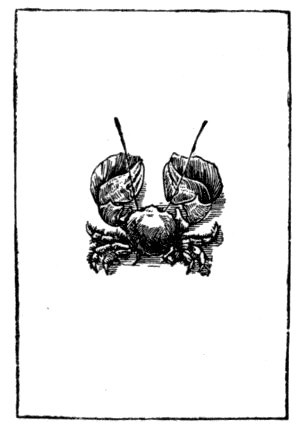
Fig. 43.—Small Crab mounted on a Card
In the case of lobsters the abdomen should be removed from the large cephalo-thorax by cutting through the connecting membrane with a sharp knife. The soft portions of both halves of the body are then raked out by means of a piece of wire flattened and bent at one end, and the interior cleaned with the aid of a rather stiff bottle-brush. The large claws are then removed by cutting through the membrane that unites them with the legs, and these are cleared in a similar manner. The different parts are next laid out to dry on blotting-paper, with the various appendages attached to the body arranged just as in life; and, finally, when all parts are quite dry, both within and without, the separated parts are reattached by means of some kind of cement. For this purpose a solution of gelatine in acetic acid is much better than gum tragacanth, as it has a far greater holding power, and this is necessary when we require to unite rather large structures with but small surfaces in contact.
Large crabs are to be dealt with much in the same manner, but, instead of removing the abdomen only, which, in the crab, is usually very small and doubled under the thorax, the whole carapace—the large shell that covers the entire upper surface of the body—should be lifted off, and replaced again after the specimen has been cleaned and dried.
Marine Shells &c.
We have previously dealt with the preservation of the shell-less molluscs, and the soft bodies of the shelled species when such are required, so we will now see what should be done with the shells.
Numerous shells are often to be found on the sea beach—shells that have been washed in by the breakers, and from which the animal contents have disappeared, either by the natural process of decay, aided by the action of the waves, or by the ravages of the voracious or carrion-eating denizens of the sea; and although these shells are rarely perfect, having been tossed about among the other material of the beach, yet we occasionally find here the most perfect specimens of both univalve and bivalve shells in such a condition that they are ready for the cabinet, and these often include species that are seldom found between the tide-marks, or that are otherwise difficult to obtain.
However, the shell-collector must not rely on such specimens as these for the purpose of making up his stock, but must search out the living molluscs in their habitats and prepare the shells as required.
The molluscs collected for this purpose are immersed in boiling water for a short time, and the animal then removed from the shell. In the case of bivalves it will generally be found that the hot water has caused the muscles of the animal to separate from the valves to which they were attached, or, if not, they have been so far softened that they are easily detached, while it does not destroy the ligament by means of which the valves are held together at the hinge; but the univalve molluscs must be removed from their shells by means of a bent pin or wire. In the latter instance care must be taken to extract the whole of the body of the animal, otherwise the remaining portion will decompose within the shell, giving rise to the noxious products of natural decay.
The univalves have now simply to be placed mouth downwards on blotting-paper to drain and dry, when they are ready for the cabinet. If, however, they include those species, like the periwinkles and whelks, that close their shells by means of a horny lid (operculum) when they draw in their bodies, these lids should be removed from the animal and attached to their proper places in the mouth of the shell. The best way to accomplish this is to pack the dry shells with cotton wool, and then fasten the opercula to the wool by means of a little gum tragacanth or acetic glue.
Bivalve shells should, as a rule, be closed while the ligament is still supple, and kept closed until it is quite dry, when the valves will remain together just in the position they assume when pulled together by the living animal. The shells of the larger species may be conveniently kept closed during the drying of the ligament by means of thread tied round them, but the very small ones are best held together by means of a delicate spring made by bending fine brass wire into the form shown in fig. 44.
Fig. 44.—Spring for holding together small Bivalve Shells
There are many features connected with the internal structure and surface of the shells of molluscs that are quite as interesting and instructive as those exhibited externally; hence a collection of the shells intended for future study should display internal as well as external characteristics. Thus, some of the spiral univalve shells may be ground down on an ordinary grindstone in order to display the central pillar (the columella) and the winding cavity that surrounds it, while others, such as the cowries, may be ground transversely to show the widely different character of the interior. Bivalve shells, too, may be arranged with the valves wide open for the study of the pearly layer, the lines of growth, the scars which mark the positions of the muscles that were attached to the shell, and the teeth which are so wonderfully formed in some species.
Some collectors make it a rule to thoroughly clean all the shells in their collection, but this, we think, is a great mistake; for when this is done many of the specimens display an aspect that is but seldom observed in nature. Many shells, and especially those usually obtained in deep water, are almost always covered with various forms of both animal and vegetable growth, and it is advisable to display these in a collection, not only because they determine the general natural appearance, but also because these growths are in themselves very interesting objects. Further, it is a most interesting study to inquire into the possible advantages of these external growths to the inhabitants of the shells, and vice versâ—a study to which we shall refer again in certain chapters devoted to the description of the animals concerned.
But there is no reason whatever why some of the duplicate specimens should not be cleaned by means of a suitable brush, with or without the use of dilute hydrochloric acid (spirits of salt), or even polished, in some few cases, to show the beautiful colours so often exhibited when the surface layer has been removed. This, however, should be done somewhat sparingly, thus giving the greater prominence to the exhibition of those appearances most commonly displayed by the shells as we find them on the beach or dredge them from the sea.
Very small and delicate shells may be mounted on cards, as suggested for other objects; but, as a rule, the specimens are best displayed by simply placing them on a layer of cotton wool in shallow boxes of convenient size. The number of insects that may be described as truly marine is so small that their preservation is not likely to form an important part of the work of the sea-side naturalist; and even though a considerable number of species exhibit a decided partiality for the coast, living either on the beach or the cliffs, the study of these is more generally the work of the entomologist. For this reason, and partly because we have already given full instructions for the setting and mounting of insects in a former work of this series, we consider a repetition inadmissible here.
The subject of the preservation of fishes, also, will require but few words. There is no satisfactory method of preserving these in a dry state, though we often meet with certain thin-bodied species, such as the pipe-fish, that have been preserved by simply drying them in the sun. Fishes should be placed in dilute spirit, or in one of the other liquids recommended, but a change of fluid will always be necessary after a time, and also frequently the gentle application of a brush to remove coagulated slime from the surface of the scales.
The great drawbacks in the way of preserving a collection of fishes are the expense of the specimen jars, and the large amount of space required for storing the specimens. Of course the former difficulty can be overcome by substituting ordinary wide-mouthed bottles in the place of the anatomical jars, while the latter can be avoided to a considerable extent by limiting the collection to small species, and to small specimens of the larger species. If this is done, it is surprising what a large number of fishes can be satisfactorily stored in bottles of only a few ounces’ capacity.
Flowers and Sea Weeds
The apparatus required for the preservation of the wild flowers of our cliffs, and the sea weeds, consists of a quantity of blotting paper or other thick absorbent paper cut to a convenient size, a few thin boards and a few pieces of calico of the same size, some heavy weights, and several sheets of drawing paper.
The wild flowers are arranged on the sheets of absorbent paper while still fresh, care being taken to display the principal parts to the best advantage. They are then placed in a single pile, with a few extra sheets of absorbent paper between each two specimens to facilitate the drying, boards at the bottom and top as well as at equal distances in the midst of the pile, and the weights on the top of the whole.
The natural colours of leaves and flowers are not very often preserved satisfactorily, but the best results are obtained when the drying process proceeds most rapidly. Hence, if the press contains any specimens of a succulent or sappy nature, they should be taken out after the first day or two, and then replaced with a fresh supply of dry paper.
The flowers must be left in the press until quite dry, and they may then be mounted on sheets of drawing paper, by fixing them with a little gum tragacanth, or by narrow strips of gummed paper passing over their stems.
Some collectors prefer simply placing their botanical specimens inside double sheets of drawing paper, not fastening them at all, and there is much to be said in favour of this, especially as it allows the specimens to be examined on both sides; and even when they are fastened to the paper double sheets are much to be preferred, for the specimens are not then so liable to be damaged by friction when being turned over, especially when the names are written on the outside of each sheet.
The larger sea-weeds may be dried in the same manner, though it is a good plan to absorb the greater part of the moisture they contain by pressing them between pieces of calico previous to placing them in the ordinary press. It should be observed, however, that many sea-weeds exude a certain amount of glutinous substance that makes them adhere to the paper between which they are dried, while they do not so freely adhere to calico. These should be partially dried in the calico press, and then laid on the paper on which they are to be finally mounted, and re-pressed with a piece of dry calico on the top of each specimen.
Many of the smaller weeds may be treated in the manner just described, but the more delicate species require to be dealt with as follows:—Place each in a large, shallow vessel of water, and move it about, if necessary, to cause its delicate fronds to assume that graceful form so characteristic of the algæ of our rock pools. Then immerse the sheet of paper on which the weed is to be finally mounted, and slowly raise the specimen out of the water, on the paper, without disturbing the arrangement of the fronds. If it is found necessary to rearrange any of the fronds, it may be done by means of a wet camel-hair brush. Now lay the specimen on calico or absorbent paper, placed on a sloping board, to drain; and, after the greater part of the moisture has disappeared by draining and evaporation, transfer the specimen to the press with a piece of dry calico immediately over it. All are dealt with in turn in the manner described, and allowed to remain in the press until perfectly dry, when it will be found that the majority of them have become firmly attached to the mount, and require nothing but the label to fit them for the herbarium.
Sea-weed collectors often make the great mistake of pressing tufts that are far too dense to admit of the structural characters being satisfactorily examined. To avoid this fault, it will often be necessary to divide the clusters collected so that the forms of their fronds may be more readily observed.
The calcareous corallines may be pressed in the same way as the other algæ, but very pretty tufts of these, having much the appearance of the living plant, may be obtained by simply suspending them until thoroughly dry; though, of course, specimens so prepared must not be submitted to pressure after they are dry, being then so brittle that they are easily broken to pieces.
The hard framework of these interesting corallines is composed principally of carbonate of lime, a mineral substance that dissolves freely in hydrochloric acid (spirits of salt). Thus, if we place a tuft of coralline in this acid, which should be considerably diluted with water, the calcareous skeleton immediately begins to dissolve, with the evolution of minute bubbles of carbonic acid gas; and after a short time, the end of which is denoted by the absence of any further bubbling, nothing remains but the vegetable matter, now rendered soft and pliant. A decalcified specimen of coralline may be pressed and dried, and then mounted beside the plant in its natural condition for comparison; and the true appearance of the vegetable structure may also be retained, and in a far more satisfactory manner, by preserving a portion of the specimen in dilute spirit.
Finally, it may be observed that many sea-weeds, like wild flowers, do not retain their natural forms and colours when preserved dry. They are spoilt by the pressure applied, or become so shrivelled and discoloured in the drying as to be but sorry representatives of the beautifully tinted and graceful clothing of the rocks of the coast. But many of those that suffer most in appearance when dried may be made to retain all their natural beauty by preserving them in a fluid; and it is most important that this should be remembered by all who desire to study the weeds at home, and particularly by those who possess a microscope, and wish to search into the minute structure of marine algæ. Our own plan is to keep not only the dried specimens for the purpose of studying the general characters and classification of the algæ, but also to keep a few large bottles—stock bottles—filled with weeds of all kinds in a preservative fluid. These latter are exceedingly useful at times, and are frequently brought into requisition for close inspection, with or without the microscope. Small pieces may be detached for microscopic examination when required, and sections may be cut either for temporary or permanent mounting just as well as from living specimens, such sections showing all the details of structure exhibited by the living plant.
The Museum
One of the greatest difficulties besetting the young collector lies in the choice and construction of the cabinet or other store-house for the accommodation of the specimens that accumulate as time advances.
Of course, when expense is a matter of no great consideration, a visit to the nearest public or private museum to see the manner in which the specimens are housed, followed by an order to a cabinet-maker, will set the matter right in a short time; but it is probable that the majority of our readers are unable to fit up their museum in this luxurious style, and will either have to construct their own cabinets and store-boxes or to purchase cheap substitutes for them.
Where one has the mechanical ability, and the time to spare, the construction of a cabinet with the required number of drawers may be undertaken, and there is no better form of store than this. The whole should be made of well-seasoned wood, and the drawers should vary in depth according to the size of the specimens they are to contain. Some of these drawers may be lined with sheet cork, and the cork covered with white paper or a thin layer of cotton wool. This will enable some of the specimens to be fixed in their places by means of pins. As a rule, however, no pins will be required, and the specimens will be most conveniently arranged in shallow cardboard boxes, placed in rows in the drawer, a little cotton wool covering the bottom of each.
Failing the usual cabinet, the specimens may be stored in shallow trays or boxes, or even in the little cardboard cabinets so often sold for storing stationery &c. The best and cheapest things of this kind we have ever met with are the little cabinets, each containing either six or twelve drawers, made by Macdonald & Co., of Temple Row, Birmingham. By the use of such as these the specimens may be neatly stored away, and additions to match may always be made as the collection increases in magnitude.
The specimens should all be classified according to their positions in the animal or vegetable world, and accompanied by labels giving the name of species and genus, together with localities, habitats, &c. The outlines of classification may be studied from the later chapters of this work, in which the common objects of the sea shore are described in their scientific order, beginning with the lowest sub-kingdoms and classes; and further, it will be observed that the sub-kingdoms are divided into classes, the classes into orders, orders into families, families into genera, and that the genera contain a smaller or larger number of closely allied species.
The collection must be kept in a perfectly dry place, otherwise many of the specimens will be liable to develop moulds, and this will, of course, quite spoil their appearance. It is almost sure to be attacked by mites and other animal pests unless some means be taken to prevent their intrusion.
As regards the latter, it is well to know that it is far easier to prevent the intrusion of small animal pests than it is to exterminate them after they have once found an entrance; and so, from the very commencement of the formation of the collection, all drawers and boxes should be charged with some substance that is objectionable, if not fatal, to them. Small lumps of naphthaline (albo-carbon) put into the various compartments, and renewed occasionally as they disappear by evaporation, will generally suffice to prevent the entrance of all pests, but this substance is not effectual as an insecticide for the purpose of killing them after they are in.
Perhaps the best of all insecticides is the corrosive sublimate already mentioned, and this may be applied to any animal or vegetable object that is capable of providing food for museum pests, and it is difficult to find such an object on which they will not feed.
Many of the specimens that find a place in a museum have been temporarily preserved in spirit previous to being dried, and if a little corrosive sublimate was dissolved in this spirit, the specimens will have been rendered perfectly free from all attacks of marauders, since the spirit will have saturated the whole object, carrying with it the dissolved poison.
Most of the specimens that have not been treated by the above method would not suffer from a short immersion in spirit containing the corrosive sublimate; but in cases where it is considered inexpedient to do this, the same liquid may be applied to them by means of a soft brush. In this way even the dried botanical specimens may be rendered perfectly secure from attacks.
CHAPTER VI
EXAMINATION OF MARINE OBJECTS—DISSECTION
An enthusiastic observer of nature will learn much concerning the structure of natural objects with the unaided eye, but there are times when he will desire some kind of magnifier to reveal more perfectly the structure of minute parts, or to enable him to observe the small creatures that are invisible to the naked eye. Further, one may learn many interesting and instructive facts relating to animal and plant life by cutting sections for close examination, or by making such simple dissections as will enable one to observe the more salient features of internal structure; we therefore propose in the present chapter to make a few remarks and suggestions regarding work of this kind.
A pocket magnifier is of great value to the young naturalist, both for the inspection of natural objects while engaged in out-door work, and for the subsequent examination of the specimens collected for study. It is often necessary to enable one to identify and classify small animals and plants, and will be in constant demand for the purpose of studying the less conspicuous external features. Such an instrument should be regarded as an essential companion of the naturalist, and should accompany him on every ramble.
There are several different forms of pocket lenses, but for general work there is, perhaps, nothing more convenient and serviceable than the ‘triplet’ magnifier. It is a combination of three lenses, enclosed in a pocket case, and so arranged that they may be used separately or in combination, thus supplying a variety of powers. The three lenses of the triplet are themselves of different magnifying powers, and these powers may be increased by combining two or all of them.
For work at home a ‘dissecting microscope’ is very useful. This consists of a magnifying lens, mounted on a support over a surface on which small objects may be examined and dissected, the height of the lens being, of course, adjusted according to its focal distance. Lenses ready mounted on adjustable stands may be purchased for this purpose, but no one ought to experience much difficulty in designing and constructing some simple stand that will give every satisfaction.
The arrangement just described is, of course, suitable for the dissection of only small objects, and these are placed on a material adapted to the nature of the work to be done. Thus it is sometimes convenient to place the object to be examined on a small sheet of cork, in order that it may be secured by means of pins while the dissection proceeds, while at other times it is essential that it be laid on a hard and unyielding surface, such as that of a slip of glass. But whatever be the nature of the substance on which the dissection is made, its colour may be regulated according to that of the object. If, for example, we are dissecting a small white flower on a piece of cork, we should naturally blacken the cork, or cover it with a piece of dead black paper; or, if we are to dissect a small, light-coloured object on a glass surface, we lay the glass on black paper.
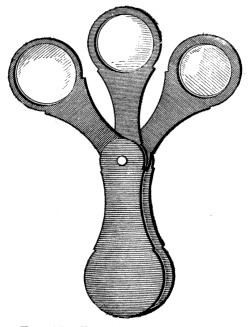
Fig. 45—The Triplet Magnifier
The advantage of dissecting objects under water does not seem to be generally appreciated by beginners, who often allow their specimens to become dry and shrivelled, almost beyond recognition, during the progress of their examination. This mode of dissection is certainly not necessary with all objects, but may be generally recommended for soft and succulent vegetable structures, as well as for almost all animal dissections.
This being the case, arrangements should certainly be made to provide a miniature dissecting trough as an accessory to the dissecting microscope, and the following instructions will enable the reader to construct a highly satisfactory and inexpensive one:—
Procure the flat lid of a cylindrical tin box, or the lid of a glass or porcelain pomade pot, such lid to be about two inches in diameter and about half an inch in depth. Cement the flat side of this lid to a small slab of hard wood, or to a square piece of sheet lead, by means of acetic glue—ordinary glue or gelatine dissolved in glacial acetic acid—to give it the necessary steadiness during the dissection. When the cement is quite hard, pour into the lid some melted paraffin (paraffin wax) which has been blackened by the admixture of a small quantity of lamp-black in the form of a fine powder. The paraffin should be melted by putting it into a beaker or wide-mouthed bottle, and standing it in hot water, and the lamp-black should be added, with stirring, as soon as it is entirely liquefied. The quantity of the mixture used must be sufficient to half fill the lid, thus leaving a space to contain water to the depth of about a quarter of an inch. The blackened wax provides a good background on which to work, and provides a hold for pins when these are necessary in order to fix the object under examination.
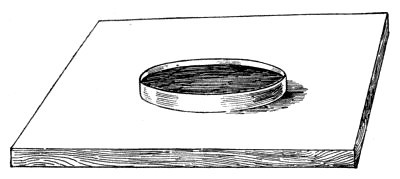
Fig. 46.—A small Dissecting Trough
The complete trough is represented in fig. 46; and will be found to answer its purpose admirably, except that it occasionally displays one fault, but one that is easily remedied. The wax contracts on cooling, and may, therefore, detach itself from the trough; and, being lighter than water, will float instead of remaining submerged. This may be prevented by securing the disc of wax in its place by means of a ring of brass wire, or by weighting the wax with two or three small pieces of lead pushed down into it while it is yet soft.
With such a dissecting microscope and trough as we have described one may do a great deal of exceedingly useful work, both hands being quite free to manipulate the object under examination.
The dissection may be conducted with the aid of a small scalpel or other very sharp knife, the parts being arranged or adjusted by means of a needle, mounted in a handle, and held in the left hand. Sometimes, however, the object to be dissected is so minute that even a small scalpel is too large for the purpose, and in such cases nothing is better than little dissecting instruments made by mounting large sewing needles in suitable handles, and then grinding down the points of the needles on two opposite sides, on a hone, so as to produce little pointed, two-edged blades. Bent needles are often useful, too, and these may be prepared by heating the points to redness in a gas-flame, bending them as desired while hot, and then hardening them by suddenly thrusting them, at a red heat, into cold water.
The compound microscope will often prove useful for the examination of very minute objects, as well as for the study of the structure of the principal tissues of the larger species; but since detailed instructions for the management of the microscope, and for the preparation of objects for microscopic examination would occupy much more space than we can spare, we shall content ourselves with nothing more than a few general hints on this portion of the young naturalist’s work, dealing more particularly with those points which commonly present difficulties to the amateur.
If it is desired to examine some minute living object, such as a protozoon, place the object in a drop of the water in which it lived just in the middle of a clean glass slip, and cover it with a cover-glass. The quantity of water should be just sufficient to fill the space between the two glasses. If less than this has been used, a little more applied to the edge of the cover by means of a glass rod will immediately run in between the glasses; while if an excessive amount was employed, the surplus may be removed by the application of a strip of blotting paper. Place the glass slip on the stage of the microscope, and reflect light through it from the mirror below.
Examine it first with a low power; and, after having observed as much as possible of the creature’s movements and structure with this aid, repeat with a higher power. This rule applies not only to such small objects as we have now under consideration, but to all objects, and parts of them, in which minute details are to be observed.
Beginners with the microscope often find prolonged examination very tiring to the eyes, but this, we believe, would seldom be the case if right methods were followed. Both eyes should always be open, and the microscopist should train himself to use both eyes equally for the actual observation.
The higher the magnifying power used, the nearer must the objective (the lower combination of lenses) be brought to the object itself, and it is no uncommon thing for the amateur, in his attempts to focus his object, to lower the body of the microscope beyond its proper position, causing the objective to crush the object, break the thin cover-glass, and become wetted with the liquid, if any, in which the object was being examined. All this may be avoided by lowering the body of the microscope until it nearly touches the cover-glass before attempting to view the object through it, and then, with the eye above the object-glass, to gradually raise the body until the object is in focus.
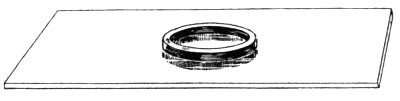
Fig. 47.—Cell for small Living Objects
The top of the cover-glass should always be perfectly dry; and if by any chance the objective becomes wet it should be wiped perfectly dry with a piece of old silk or with chamois leather. Also, if permanent mounting is attempted, and the preservative liquid is allowed to come in contact with the objective, such liquid must, of course, be washed off with some suitable solvent before any attempt is made to wipe the lens dry.
If the object under examination is of such dimensions that the cover-glass has a tendency to rock on it, or if it is a living object of such a size that it is unable to move freely in the exceedingly thin film of water between the cover and the slip, it should be placed in a cell. The cell may be made by cementing a ring of glass or vulcanite to the middle of a slip, or it may be a little circular cavity prepared in the slip itself. In either case the cell must be quite full of water before the cover-glass is applied, so that no air-bubbles are included.
Hitherto we have spoken only of mounting small objects in water, and this is advisable when the object is moist, whether it be animal or vegetable, alive or dead. But dry objects may be examined in the dry state, in which case they need not be covered. If they are composed of transparent material they are to be dealt with in the manner recommended before, as far as the management of the light is considered; that is, a moderately strong light is sent through them by the reflector below the stage; but opaque objects are best examined on a dead black ground, the light being directed on to them by means of a condensing lens placed between them and the source of light.
A collector who has done only a few days’ work on the sea shore will probably find himself the possessor of a host of interesting objects that will afford much pleasure and instruction when placed under the microscope—objects, many of which have been somewhat hastily deposited in a bottle of spirit or other preservative for study in his future leisure moments. These objects, if small, may be examined as above described, simply placing them under a cover-glass, or in a cell, with a clear drop of the same liquid in which they have been kept.
The general characters of the larger objects may also be observed by means of some kind of hand lens, but even these are generally best examined under water or other suitable liquid.
A great deal may be learnt of natural objects by preparing very thin sections for microscopic examination; and although special works should be consulted if one desires to become proficient in the different methods of cutting and preparing such sections, yet a great amount of good work may be done with the aid of a sharp razor, manipulated with nothing more than ordinary skill.
Some objects, especially certain of those of the vegetable world, are of such a nature that suitable sections may be cut, either from the fresh or preserved specimen, without any preliminary preparation. All that is required is to hold the object firmly between the finger and thumb of the left hand, previously securing it in some kind of holder if necessary, and pare off the thinnest possible slices with a horizontal movement of the razor, both razor and object being kept very wet during the process. As the sections are cut they may be allowed to drop into a shallow vessel of water; and, the thinnest then selected for examination in water as previously described.
Other objects are so soft that the cutting of sections becomes impossible without previously hardening them. Methylated spirit is a good hardening reagent, and many of the soft structures that have been preserved in this fluid, especially if it has been used undiluted, will be found sufficiently hard for cutting thin sections. Among the other hardening reagents used by microscopists may be mentioned a solution of chromic acid—one part by weight of the solid acid dissolved in from one hundred to two hundred parts of water, and a solution of bichromate of potash—one part of the bichromate to about forty parts of water. In either case the hardening of the object takes place slowly, and it should be examined from day to day until the necessary consistence has been obtained.
The structures of many soft animals can never be satisfactorily hardened for section-cutting by either of the above reagents, and thus it becomes necessary either to freeze or to imbed them. In the former case the object is first soaked in gum water—a thin solution of gum arabic—and then frozen by an ether spray or by a mixture of ice and salt. The sections should be cut with a razor just as the object is beginning to thaw, and they may then be examined under a cover-glass, in a drop of the gum water.
The other method is conducted as follows:—The soft object is first soaked in absolute alcohol to extract all the water it contains, and is then transferred to paraffin that has been heated just to its melting-point by standing it in warm water. After the object is thoroughly permeated with the paraffin, the whole is cooled quickly by immersion in cold water. Sections are now cut, the paraffin being sliced away with the substance it contains. These sections are placed in warm turpentine, where they are allowed to remain until the whole of the wax has dissolved, and they may then be mounted in a drop of turpentine, and covered with a cover-glass.
We have given brief instructions for temporary mounting only, but most amateur microscopists would undoubtedly prefer mounting their objects permanently, so that they may be set aside for study at any future period. Hence we append a few directions to this end, advising the reader, however, to consult a work dealing especially with this subject if he desires to become proficient in the preparation of microscopic slides.
Moist objects, including those which have been preserved in dilute spirit, may be soaked in water, then transferred direct to the glass slip, and covered with a drop of glycerine. Any excess of the glycerine should then be absorbed from around the cover-glass by means of a strip of blotting-paper, and the edge of the cover cemented by gold size applied with a small camel-hair brush.
Glycerine jelly is also a valuable mountant for permanent work. When this is used the object should first be soaked in glycerine, and then in the melted jelly. It is then transferred to a drop of melted jelly which has been placed on a warm slide, and covered as before. The jelly soon solidifies, so that a ring of cement is not absolutely necessary, though it is advisable, as a rule, to cement the cover-glass all round with gold size or black varnish.
Sections cut while frozen are best mounted in glycerine, to which they may be transferred direct.
Canada balsam is one of the best media for permanent mounting; and, as it becomes very hard after a time, it serves the purposes of both preservative and cement. When this is used the object must be entirely freed from water by soaking it in absolute alcohol. It is then put into turpentine for a minute or two, transferred to a warm slide, and covered with a drop of the prepared balsam. Sections that have been imbedded in paraffin may be mounted in this way, the turpentine acting as a solvent for the paraffin in which it was cut.
Although the compound microscope is absolutely necessary for the study of the minutest forms of life and of the minute structure of the various tissues of larger beings, yet the young naturalist will find that a vast amount of good work may be done without its aid. Thus the general structure of the larger species may be made out by means of simple dissections requiring no extraordinary skill on the part of the worker, and with appliances that may be obtained at a low cost. Certain of the marine animals, however, require special treatment that can hardly be described in a short chapter devoted to general instructions only, but hints with regards to these will be given in future chapters in which the animals referred to are described.
The appliances referred to above include nothing more than a simple form of dissecting trough, a few dissecting instruments, and one or two minor accessories that may always be found at hand as required.
The dissection of animals is always best performed under water, for by this method the object examined may not only be kept clean as the work proceeds, but the parts, having a tendency to float, readily separate from one another and therefore become more distinctly visible when submerged.
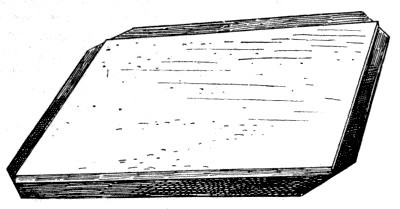
Fig. 48.—Sheet of Cork on thin Sheet Lead
A very convenient form of trough may be made by taking any kind of rectangular, flat-bottomed dish, one made of zinc being, perhaps, the best of all, and covering the bottom with a slab of good cork carpet which has been weighted with sufficient lead to prevent it from floating. Or, instead of cork carpet, a sheet of cork may be used. In either case, a piece of thin sheet lead, a little larger than the slab, should be cut, the corners of which are then snipped off as shown in fig. 48, and the edges finally turned over as represented in the next illustration. The size of the trough must be regulated according to the nature of the work to be done, but one measuring ten inches long, seven wide, and two inches deep will answer most purposes.
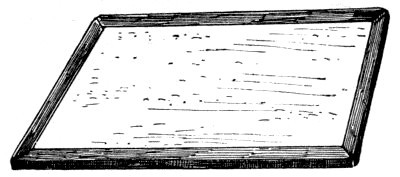
Fig. 49.—Weighted Cork for Dissecting Trough
The object to be dissected is placed in the trough, secured in position by means of a few ordinary pins, and then completely covered with water.
We need hardly impress upon the reader the great importance of thoroughly examining all external characters—all those structures that are visible without actual dissection—before attempting to remove anything; and we have already insisted on the importance of carefully examining all creatures while alive before anything else is done. The value of this latter stipulation can hardly be overestimated, for in many instances it is almost impossible to detect the use of an organ unless it has been observed in action; and the enthusiastic student will go even further than this, for he will make it an invariable rule to sketch everything he sees, and to make full notes on all his observations.
When pins are used to fix the object under examination—and it is generally essential that the object be fixed—their heads should be turned outwards; for then the object will not slip from its position, nor will the pins tend to get in the way of the work.
Some objects are of such a nature that they are not easily secured by means of pins, and yet require to be fixed in some way or other. Thus, one may desire to examine the structure and appendages of a prawn or small crab, or to investigate the nature of a chiton. In such instances as these it is a good plan to make a cake of paraffin wax of suitable size by pouring the melted substance into a mould, then secure the object in proper position in the wax while still fluid, and pin the latter to the cork of the dissecting trough.
It is often necessary to trace the courses of internal passages that open on the surface of the body, or of tubes that are revealed during the progress of dissection, and this may be done by means of a little instrument called a seeker. It is simply a blunted needle, bent into a large angle, and mounted in a handle; or, it may consist of nothing but a moderately long and stiff bristle, rendered blunt at one end by tipping it with melted sealing wax. This is not always sufficient, however, for it frequently happens that certain tubes and passages in animal forms are disposed in such a complicated manner that it is impossible to send even the most flexible seeker through them. For instance, suppose one desires to trace the course of the digestive tube of some large bivalve mollusc with its many reflections, the seeker is useless except that it will penetrate to the first sharp bend. The arrangement of such a tube must be traced by dissecting along its course, but this may be aided considerably by first filling it with some coloured substance to enable its direction to be more easily followed. In fact, the injection of some brightly coloured fluid, forced through the tube by means of a fine-nozzled glass syringe will often enable the course of such a tube to be seen without any dissection at all, the colour of the fluid used being detected through the semi-transparent tissues surrounding it. A mixture of Berlin blue and water, or a mixture of plaster of Paris and water coloured with carmine is well adapted to this purpose; and if the latter is employed it may be allowed to set, and thus produce a permanent cast from the tube that is being dissected. Perhaps it should be mentioned that if either of the injection mixtures be used for this purpose it must be previously strained through muslin, and that, in the case of the plaster, the mixing and straining should occupy as little time as possible, or it may begin to set before the injection has been completed.
A very considerable insight into the structure of animals may be frequently obtained by cutting sections through the body with all its organs in situ, but, generally speaking, they are too soft to allow of this without danger of the displacement of those very parts, the relations of which we desire to determine. To avoid this the body should be previously hardened by a somewhat prolonged soaking in methylated spirit, or in a solution of chromic acid prepared as before directed. Then, with the aid of a good razor, very interesting sections may be prepared with the greatest of ease, and the true relations of the various organs throughout the body may be exactly determined by cutting a succession of slices, not necessarily very thin, from end to end, or, transversely, from side to side.
Even those crustaceans that are protected by a hard, calcareous exo-skeleton, and the molluscs that cannot be removed from their stony shells without injury to their soft structures, may be studied in the manner just described, and this may be done by first soaking them in dilute hydrochloric acid, renewed as often as may be necessary, until all the mineral matter has been dissolved completely, and then hardening the softer tissues in one of the reagents mentioned above. Hydrochloric acid may also be used to dissolve the calcareous shells of foraminifers, the vegetable corallines, and other small forms of life, previous to microscopic examination of the soft parts.
CHAPTER VII
THE PROTOZOA OF THE SEA SHORE
We shall now study the principal forms of animal life to be found on the sea shore; and, in order that the reader may thoroughly understand the broader principles of classification, so as to be able to locate each creature observed in its approximate position in the scale of life, we shall consider each group in its zoological order, commencing with the lowest forms, and noting, as we proceed, the distinguishing characteristics of each division.
The present chapter will be devoted to the Protozoa—the sub-kingdom that includes the simplest of all animal beings.
Each animal in this division consists of a minute mass of a jelly-like substance called protoplasm, exhibiting little or no differentiation in structure. There is no true body-cavity, no special organs for the performance of distinct functions, and no nervous system.
Perhaps we can best understand the nature of a protozoon by selecting and examining a typical example:
Remove a small quantity of the green thread-like algous weed so commonly seen attached to the banks of both fresh and salt water pools, or surrounding floating objects, and place it in a glass with a little of the water in which it grew. This weed probably shelters numerous protozoons, among which we are almost sure to find some amœbæ if we examine a drop of the water under the high power of a microscope.
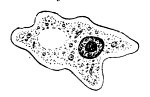
Fig. 50.—The Amœba, highly magnified
The amœba is observed to be a minute mass of protoplasm with an average diameter of about one-hundredth of an inch, endowed with a power of motion and locomotion. Its body is not uniformly clear, for the interior portion is seen to contain a number of minute granules, representing the undigested portions of the animal’s food. There is a small mass of denser protoplasm near the centre, termed the nucleus, and also a clear space filled with fluid. This latter is called the vacuole, and is probably connected with the processes of respiration and excretion, for it may be seen to contract at irregular intervals, and occasionally to collapse and expel its contents.
As we watch the amœba we see that it is continually changing its shape, sending out temporary prolongations (pseudopodia) of its gelatinous substance from any part, and sometimes using these extended portions for the purpose of dragging itself along.
Its method of feeding is as remarkable as it is simple. On coming in contact with any desired morsel, it sends out two pseudopods, one on each side of the food. These two pseudopods gradually extend round the food, till, at last, they meet and coalesce on the opposite side of it, thus completely enclosing it within the body. Any part of the body of the amœba may thus be converted into a temporary mouth; and, there being no special cavity to serve the purpose of a stomach, the process of digestion will proceed equally well in any part of the body except in the superficial layer, where the protoplasm is of a slightly firmer consistence than that of the interior. Further, the process of digestion being over, any portion of the superficial layer may be converted into a temporary opening to admit of the discharge of indigestible matter.
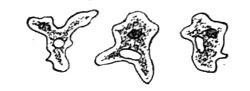
Fig. 51.—The Amœba, showing changes of form
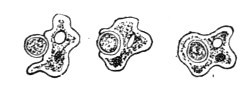
Fig. 52.—The Amœba, feeding
The amœba is an omnivorous feeder, but subsists mainly on vegetable organisms, especially on diatoms and other minute algæ; and the siliceous skeletons of the former may often be seen within the body of the animal, under the high power of a microscope.
The multiplication of the amœba is brought about by a process of fission or division. At first the nucleus divides into two, and then the softer protoplasm contracts in the middle, and finally divides into two portions, each of which contains one of the nuclei. The two distinct animals thus produced both grow until they reach the dimensions of their common progenitor.
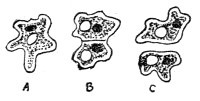
Fig. 53.—The Amœba, dividing
All the protozoons resemble the amœba in general structure and function; but while some are even simpler in organisation, others are more highly specialised. Some, like the amœba, are unicellular animals; that is, they consist of a single, simple speck of protoplasm; but others live in colonies, each newly formed cell remaining attached to its parent cell, until at last a comparatively large compound protozoon is formed.
The sub-kingdom is divided into several classes, the principal of which, together with their leading characteristics, are shown in the following table:—
1. Rhizopods:—Body uniform in consistence. Pseudopods protruded from any point.
2. Protoplasta:—Outer protoplasm slightly firmer in consistence. Pseudopods protruded from any point. (Often grouped with the Rhizopods.)
3. Radiolaria:—Possessing a central membranous capsule. Usually supported by a flinty skeleton.
4. Infusoria:—Outer protoplasm firmer and denser; therefore of more definite shape.
Possess permanent threadlike extensions of protoplasm instead of pseudopods.
We shall now observe the principal marine members of the protozoa, commencing with the lowest forms, and dealing with each in its proper zoological order as expressed in the above table.
Marine Rhizopods
When we stand on a beach of fine sand on a very calm day watching the progress of the ripples over the sand as the tide recedes we frequently observe whitish lines marking the limits reached by the successive ripples as they advance toward the shore. If, now, we scrape up a little of the surface sand, following the exact course of one of these whitish streaks, and examine the material obtained by the aid of a good lens, we shall in all probability discover a number of minute shells among the grains of sand.
These shells are of various shapes—little spheres, discs, rods, spirals, &c.; but all resemble each other in that they are perforated with a number of minute holes or foramina. They are the skeletons of protozoons, belonging to the class Rhizopoda, and they exist in enormous quantities on the beds of certain seas.
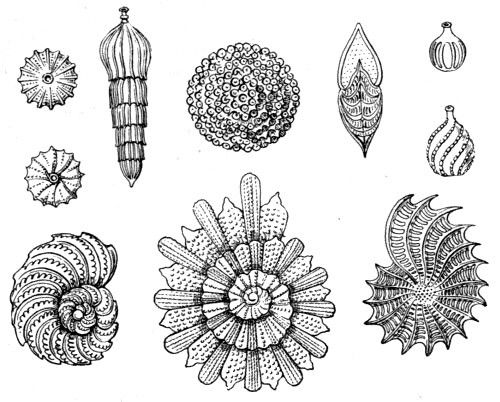
Fig. 54.—A group of Foraminifers, magnified
We will first examine the shells, and then study the nature of the little animals that inhabit them.
The shells vary very much in general appearance as well as in shape. Some are of an opaque, dead white, the surface somewhat resembling that of a piece of unglazed porcelain; others more nearly resemble glazed porcelain, while some present quite a vitreous appearance, much after the nature of opal. In all cases, however, the material is the same, all the shells consisting of carbonate of lime, having thus the same chemical composition as chalk, limestones, and marble.
If hydrochloric acid be added to some of these shells, they are immediately attacked by the acid and are dissolved in a very short time, the solution being accompanied by an effervescence due to the escape of carbonic acid gas.
The shells vary in size from about one-twelfth to one three-hundredth of an inch, and consist either of a single chamber, or of many chambers separated from each other by perforated partitions of the same material. Sometimes these chambers are arranged in a straight line, but more frequently in the form of a single or double spiral. In some cases, however, the arrangement of chambers is very complex.
We have already referred to the fact that the shells present a number of perforations on the exterior, in addition to those which pierce the partitions within, and it is this characteristic which has led to the application of the name Foraminifera (hole-bearing) to the little beings we are considering.
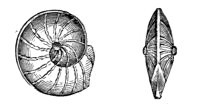
Fig. 55.—A Spiral Foraminifer Shell
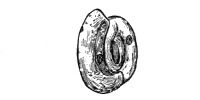
Fig. 56.—A Foraminifer out of its shell
The animal inhabiting the shell is exceedingly simple in structure, even more so than the amœba. It is merely a speck of protoplasm, exhibiting hardly any differentiation—nothing, in fact, save a contractile cavity (the vacuole), and numerous granules that probably represent the indigestible fragments of its food.
The protoplasm fills the shell, and also forms a complete gelatinous covering on the outside, when the animal is alive; and the vacuole and granules circulate somewhat freely within the semi-solid mass. Further, the protoplasm itself is highly contractile, as may be proved by witnessing the rapidity with which the animal can change its form.
When the foraminifer is alive, it floats freely in the sea, with a comparatively long and slender thread of its substance protruded through each hole in the shell. These threads correspond exactly in function with the blunt pseudopodia of the amœba. Should they come in contact with a particle of suitable food-material, they immediately surround it, and rapidly retracting, draw the particle to the surface of the body. The threads then completely envelop the food, coalescing as soon as they touch, thus bringing it within the animal.
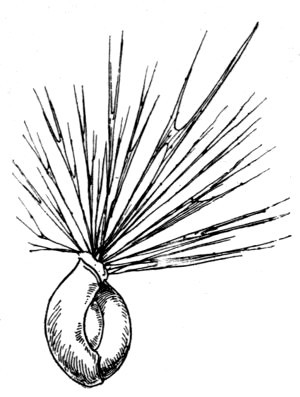
Fig. 57.—The same Foraminifer (Fig. 56) as seen when alive
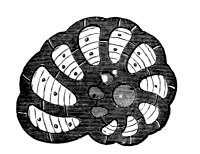
Fig. 58.—Section of the Shell of a Compound Foraminifer
The foraminifer multiplies by fission, or by a process of budding. In some species the division of the protoplasm is complete, as in the case of amœbæ, so that each animal has its own shell which encloses a single chamber, but in most cases the ‘bud’ remains attached to a parent cell, and develops a shell that is also fixed to the shell of its progenitor. The younger animal thus produced from the bud gives rise to another, which develops in the same manner; and this process continues, the new bud being always produced on the newest end, till, at last, a kind of colony of protozoons is formed, their shells remaining attached to one another, thus producing a compound shell, composed of several chambers, arranged in the form of a line or spiral, and communicating by means of their perforated partitions. It will now be seen that each ‘cell’ of the compound protozoon feeds not only for itself, but for all the members of its colony, since the nourishment imbibed by any one is capable of diffusion into the surrounding chambers, the protoplasm of the whole forming one continuous mass by means of the perforated partitions of the complex skeleton.
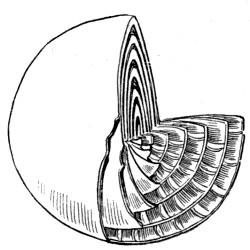
Fig. 59.—Section of a Nummulite Shell
Some of the simplest foraminifers possess only one hole in the shell, and, consequently, are enabled to throw off pseudopods from one side of the body only. In others, of a much more complex nature, the new chambers form a spiral in such a manner that they overlap and entirely conceal those previously built; and the development may proceed until a comparatively large discoid shell is the result. This is the case with Nummulites, so called on account of the fancied resemblance to coins. Further, some species of foraminifera produce a skeleton that is horny in character, instead of being calcareous, while others are protected merely by grains of sand or particles of other solid matter that adhere to the surface of their glutinous bodies.
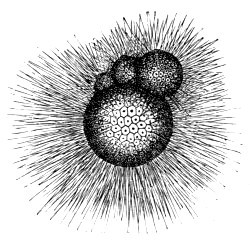
Fig. 60.—Globigerina bulloides, as seen when alive, magnified
We have spoken of foraminifera as floating freely about in the sea water, but while it is certain that many of them live at or near the surface, some are known to thrive at considerable depths; and those who desire to study the various forms of these interesting creatures should search among dredgings whenever an opportunity occurs. Living specimens, whenever obtained, should be examined in sea water, in order that the motions of their pseudopods may be seen.
If we brush off fragments from the surface of a freshly broken piece of chalk, and allow them to fall into a vessel of water, and then examine the sediment under the microscope, we shall observe that this sediment consists of minute shells, and fragments of shells, of foraminifers. In fact, our chalk beds, as well as the beds of certain limestones, consist mainly of vast deposits of the shells of extinct foraminifera that at one time covered the floor of the sea. Such deposits are still being formed, notably that which now covers a vast area of the bed of the Atlantic Ocean at a depth varying from about 300 to 3,000 fathoms. This deposit consists mainly of the shells of a foraminifer called Globigerina bulloides, a figure of which is given on the opposite page.
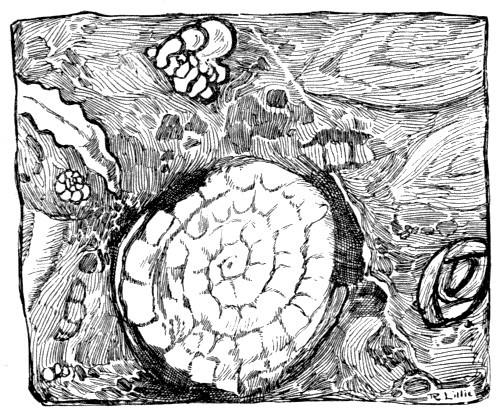
Fig. 61.—Section of a piece of Nummulitic Limestone
The structure of chalk may be beautifully revealed by soaking a small piece of the rock for some time in a solution of Canada balsam, allowing it to become thoroughly dry, and then grinding it down till a very thin section is obtained. Such a section, when viewed under the low power of a compound microscope, will be seen to consist very largely of minute shells; though, of course, the shells themselves will be seen in section only.
The extensive beds of nummulitic limestones found in various parts of South Europe and North Africa are also composed largely of foraminifer shells, the most conspicuous of which are those already referred to as nummulites—disc-shaped shells of a spiral form, in which the older chambers overlap and hide those that enclose the earlier portion of the colony.
Before concluding our brief account of these interesting marine protozoons, it may be well to point out that, although the foraminifera belong to the lowest class of the lowest sub-kingdom of animals, yet there are some rhizopods—the Monera, which are even simpler in structure. These are mere specks of undifferentiated protoplasm, not protected by any shell, and not even possessing a nucleus, and are the simplest of all animal beings.
The second division of the Protozoa—the class Protoplasta—has already received a small share of attention, inasmuch as the amœba, which was briefly described as a type of the whole sub-kingdom, belongs to it.
The study of the amœba is usually pursued by means of specimens obtained from fresh-water pools, and reference has been made to it in a former work dealing particularly with the life of ponds and streams; but it should be observed that the amœba inhabits salt water also, and will be frequently met with by those who search for the microscopic life of the sea, especially when the water examined has been taken from those sheltered nooks of a rocky coast that are protected from the direct action of the waves, or from the little pools that are so far from the reach of the tides as to be only occasionally disturbed. Here the amœba may be seen creeping slowly over the slender green threads of the confervæ that surround the margin of the pool.
The third class—Radiolaria—is of great interest to the student of marine life, on account of the great beauty of the shells; but, as with the other members of this sub-kingdom, a compound microscope is necessary for the study of them.
The animals of this group resemble the foraminifers in that they throw out fine thread-like pseudopods, but they are distinguished from them by the possession of a membranous capsule in the centre of the body, surrounding the nucleus, and perforated in order to preserve the continuity of the deeper with the surrounding protoplasm. They have often a central contractile cavity, and further show their claim to a higher position in the animal scale than the preceding classes by the possession of little masses of cells and a certain amount of fatty and colouring matter.
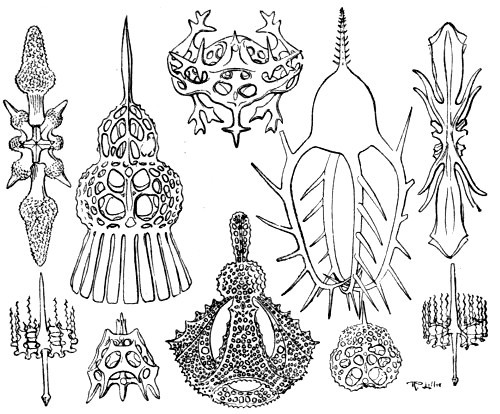
Fig. 62.—A Group of Radiolarian Shells, magnified
Some of the radiolarians live at or near the surface of the ocean, while others thrive only at the bottom. The former, in some cases, appear to avoid the light, rising to the surface after sunset; and it is supposed that the phosphorescence of the sea is due in part to the presence of these animals. The latter may be obtained from all depths, down to several thousand fathoms.
The beauty of the radiolarians as a class lies in the wonderful shells that protect the great majority of them. These shells are composed not of carbonate of lime, as is the case with foraminifers, but of silex or silica, a substance that is not acted on by the strongest mineral acids. They are of the most exquisite shapes, and exhibit a great variety of forms. Some resemble beautifully sculptured spheres, boxes, bells, cups, &c.; while others may be likened to baskets of various ornamental design. In every case the siliceous framework consists of a number of clusters of radiating rods, all united by slender intertwining threads.
It is not all the radiolarians, however, that produce these beautiful siliceous shells. A few have no skeleton of any kind, while others are supported by a framework composed of a horny material, but yet transparent and glassy in appearance.
The sizes of the shells vary from about one five-hundredth to one half of an inch; but, of course, the larger shells are those of colonies of radiolarians, and not of single individuals, just as we observed was the case with the foraminifers.
Those in search of radiolaria for examination and study should, whenever possible, obtain small quantities of the dredgings from deep water. Material brought up by the trawl will often afford specimens; but, failing these sources of supply, the muddy deposit from deep niches between the rocks at low-water mark will often provide a very interesting variety.
Place the mud in a glass vessel, and pour on it some nitric acid (aqua-fortis). This will soon dissolve all calcareous matter present, and also destroy any organic material. A process of very careful washing is now necessary. Fill up the vessel with water, and allow some time for sedimentary matter to settle. Now decant off the greater part of the water, and repeat the process several times. By this means we get rid of the greater part of the organic material, as well as of the mineral matter that has been attacked by the acid; and if we examine the final sediment under the microscope, preferably in a drop of water, and covered with a cover-glass, any radiolarians present will soon reveal themselves.
It is often possible to obtain radiolarian shells, as well as other siliceous skeletons, through the agency of certain marine animals. The bivalve molluscs, for example, feed almost entirely on microscopic organisms; and, by removing such animals from their shells, and then destroying their bodies with aqua-fortis, we may frequently obtain a sediment composed partly of the skeletons referred to.
There remains one other class of protozoons to be considered, viz. the Infusorians—the highest class of the sub-kingdom. In this group we observe a distinct advance in organisation; for, in the first place, the infusorians are enclosed in a firm cuticle or skin, which forms an almost complete protective layer. Within this is a layer of moderately firm protoplasm, containing one or more cavities that contract at intervals like a heart. Then, in the interior, there is a mass of softer material with cavities filled with fluid, two solid bodies, and numerous granules.
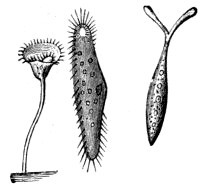
Fig. 63.—Three Infusorians magnified
In these creatures we find, too, a distinct and permanent mouth, usually funnel-shaped, leading to the soft, interior substance, in which the food material becomes embedded while the process of digestion proceeds. Here, then, for the first time, we meet with a special portion of the body set apart for the performance of the work of a stomach; and, further, the process of digestion being over, the indigestible matter is ejected through a second permanent opening in the exterior cuticle.
Again, the infusorian does not move by means of temporary pseudopods, as is the case with the lower protozoons, but by means of minute hair-like processes which permanently cover either the whole of the body, or are restricted to certain portions only. These little processes, which are called cilia, move to and fro with such rapidity that they are hardly visible; and, by means of them the little infusorian is enabled to move about in its watery home with considerable speed.
In some species a few of the cilia are much larger than the others, and formed of a firmer material. These often serve the purpose of feet, and are also used as a means by which the little animal can anchor itself to solid substances.
As with the lower protozoons, the infusoria multiply by division; but, in addition to this, the nucleus may sometimes be seen to divide up into a number of minute egg-like bodies, each of which, when set free, is capable of developing into a new animal. Should the water in which infusorians have been living evaporate to dryness, the little bodies just mentioned become so many dust particles that may be carried away by air currents; but, although dry, they retain their vitality, and develop almost immediately on being carried into a suitable environment.
Infusorians are so called because they develop rapidly in infusions of various vegetable substances; and those who desire to study their structure and movements with the aid of a microscope cannot do much better than make an infusion by pouring boiling water on fragments of dried grass, and leaving it exposed for a few days to the warm summer atmosphere. The numerous germs floating in the air will soon give rise to abundance of life, including several different species of infusoria, varying from 1/30 to 1/2000 of an inch in length.
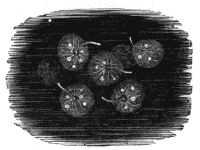
Fig. 64.—A Phosphorescent Marine Infusorian (Noctiluca), magnified
Fresh-water pools and marshes provide such an abundance of infusoria that the animals are generally obtained for study from these sources, and a few of the common and most interesting species inhabiting fresh water have already been described in a former work. Nevertheless, the sea is abundantly supplied with representatives of the class, and it is certain that the beautiful phosphorescence sometimes observed in the sea at night is in part due to the presence of luminous infusoria, some of which appear to have an aversion to sunlight, retiring to a depth during the day, but rising to the surface again after sunset.
CHAPTER VIII
BRITISH SPONGES
It seems to be the popular opinion that sponges are essentially natives of the warmer seas, and it will probably be a surprise to many young amateur naturalists to learn that there are about three hundred species of this sub-kingdom of the animal world to be found on our own shores. It must not be thought, however, that they are all comparable with the well-known toilet sponges in regard to either size or general form and structure, for some of them are very small objects, no larger than about one-twentieth of an inch in diameter, and some form mere incrustations of various dimensions on the surfaces of rocks and weeds, often of such general appearance that they would hardly be regarded as animal structures by those who have not studied the peculiarities of the group.
Sponges are known collectively as the Porifera or Polystomata, and constitute a separate sub-kingdom of animals of such distinct features that they are not readily confused with the creatures of any other group. Their principal characteristic is expressed by both the group names just given, the former of which signifies ‘hole-bearing,’ and the latter ‘many openings’; for in all the members of the sub-kingdom there are a number of holes or pores providing a means of communication between the body cavity or cavities and the surrounding water. Most of these holes are very small, but there is always at least one opening of a larger size at the anterior end.
It will be seen from what we have just stated that sponges exhibit a distinctly higher organisation than the protozoa described in the last chapter, inasmuch as they possess a permanent body-cavity that communicates with the exterior; but in addition to this there are many points of differentiation of structure that denote a superior position in the scale of life.
In order to ascertain the general features of a sponge we cannot do better than select one of the simplest forms from our own shores. If we place the live animal in a glass vessel of sea water, and examine it with a suitable magnifying power, we observe a number of minute pores scattered over its whole surface; and a much larger opening at the free end. The animal is motionless, and exhibits no signs of life except that it may contract slightly when touched. The water surrounding the sponge also appears to be perfectly still, but if we introduce some fine insoluble powder, such as precipitated chalk, or a drop of a soluble dye, the motion of the suspended or soluble material will show that the water is passing into the sponge through all the small pores, and that it is ejected through the larger opening.
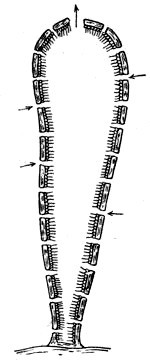
Fig. 65.—Section of a Simple Sponge
On touching the sponge we observe that it is of a soft, gelatinous consistence throughout, or if, as is often the case, the body is supported by a skeleton of greater or less firmness, a gentle application of the finger will still show that this framework is surrounded by material of a jelly-like nature. This gelatinous substance is the animal itself, and a microscopic examination will show that its body-wall is made up of two distinct layers, the inner consisting of cells, many of which possess a cilium or whip-like filament that protrudes from a kind of collar, its free extremity extending into the body-cavity.
These minute cilia are the means by which the water currents just described are set up. By a constant lashing movement they urge the fluid contained in the body-cavity towards the larger hole, thus causing the water to flow in through the numerous small pores. This circulation of sea water through the body-cavity of the sponge is the means by which the animal is supplied with air and food. Air is, of course, absorbed from the water by the soft material of the external layer of the body, but the constant flow of fresh water through the body-cavity enables this process of respiration to go on with equal freedom in the interior. The mode of feeding of the sponge is very similar to that of the protozoa. Organic particles that are carried into the body-cavity, on coming in contact with the cells of the internal layer, are absorbed into their protoplasm by which they are digested. Thus the sponge may be compared to a mass of protozoon cells, all united into a common colony by a more or less perfect coalescing of the cell-substance, some of the units being modified in structure for the performance of definite functions. The air and food absorbed by any one cell may pass readily into the surrounding cells, and thus each one may be said to work for the common weal.
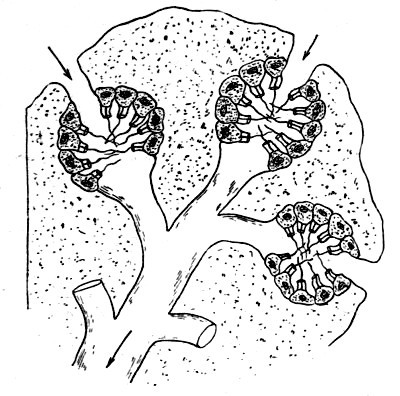
Fig. 66.—Diagrammatic section of a portion of a Complex Sponge
The description just given applies only to the simplest of the sponges, and we have now to learn that in the higher members of the group the structure is much more complicated. In these the surface-pores are the extremities of very narrow tubes which perforate both layers of the body-wall and then communicate with wider tubes or spaces within, some of which are lined with the ciliated cells above described. These spaces, which are sometimes nearly globular in form, and often arranged in groups with a common cavity, communicate with wider tubes which join together until, finally, they terminate in a large opening seen on the exterior of the sponge. Hence it will be seen that the water entering the minute pores of the surface has to circulate through a complicated system of channels and spaces, some of which are lined with the ciliated cells that urge the current onwards before it is expelled through the large hole. Further, imagine a number of such structures as we have described growing side by side, their masses coalescing into one whole, their inner tubes and spaces united into one complex system by numerous inter-communications, and having several large holes for the exit of the circulating water, and you then have some idea of the general nature of many of the more complex sponges to be found on our shores (see fig. 66).
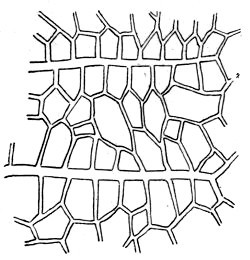
Fig. 67.—Horny Network of a Sponge, magnified
But even this is not all, for as yet we have been regarding the sponges as consisting of animal matter only, whereas nearly all of them possess some kind of internal skeleton for the support of the soft, gelatinous animal substance. The skeleton consists of matter secreted by certain cells from material in the water and food, and is either horny, calcareous, or siliceous. The horny skeleton is formed of a network of fibres of a somewhat silky character, and often, as in the case of the toilet sponges, highly elastic; but it is sometimes so brittle that the sponge mass is easily broken when bent. The fibres of this framework support not only the outer wall of the sponge, but also the walls of all the internal tubes and spaces, which are often of so soft a nature that they would collapse without its aid.
The other forms of skeletons consist of minute bodies of carbonate of lime or of silica, respectively, which assume certain definite shapes, resembling stars, anchors, hooks, pins, spindles, &c., and are known as spicules. Such spicules are usually present in those sponges that have horny skeletons, but in others they form the entire skeleton.
Sponges sometimes increase by division, a part being separated from the parent mass and then developing into a complete colony; and they may be reproduced artificially to almost any extent by this method, each piece cut off, however small, producing a new sponge. They also increase by a process of ‘budding,’ the buds produced sometimes remaining attached to the original colony, thus increasing its size, but on other occasions becoming detached for the formation of new colonies on a different site. In addition to these methods of reproduction there are special cells in a sponge that possess the function of producing eggs which are ejected through the larger holes. The eggs are usually developed in the autumn, and, after being ejected, swim about freely for a time, after which they become fixed to rocks or weeds, and produce sponges in the following year. The eggs may often be seen towards the end of the summer by cutting through a sponge, or by carefully pulling it asunder. They are little rounded or oval bodies, of a yellowish or brownish colour, distinctly visible to the naked eye, occupying cavities in the interior.
Sponges are classified according to the composition of the skeleton and the forms of the spicules, the chief divisions being:—
1. The Calcareous Sponges (Calcarea). Skeleton consisting of spicules of carbonate of lime in the form of needles and three-or four-rayed stars.
2. The Six-Rayed Sponges (Hexactinellida). Skeleton of six-rayed glassy spicules.
3. Common Sponges (Demospongia). Skeleton horny, flinty, or entirely absent.
The first of these divisions contains about a dozen known British species, which are to be found on the rockiest shores, attached to stones, weeds, or shells, generally hidden in very secluded holes or crevices, or sheltered from the light by the pendulous weeds. They should be searched for at the lowest spring tide, particular attention being given to the under surfaces of large stones, narrow, dark crevices, and the roofs of small, sheltered caves. They may be readily recognised as sponges by the numerous pores on the surface, though these are often hardly visible without a lens, and the calcareous nature of the skeleton may be proved by dropping a specimen into dilute hydrochloric acid, when the carbonate of lime will speedily dissolve, the action being accompanied by the evolution of bubbles of carbonic acid gas.
If calcareous sponges are to be preserved for future reference, they may be placed in diluted spirit, in which case the animal matter, as well as the mineral substance, will be preserved with but little alteration in the natural appearance and structure. A specimen which has been decalcified by means of acid, as above described, may also be preserved in the same manner; and small portions of this will serve for the microscopic study of the animal portion of the sponge. If the skeleton only is required, the sponge is simply allowed to dry, when the soft animal substance, on losing its contained water, will leave hardly any residue; or, better, allow the calcareous sponge to macerate in water for some days for the animal substance to decompose, and then, after a few minutes in running water, set it aside to dry.
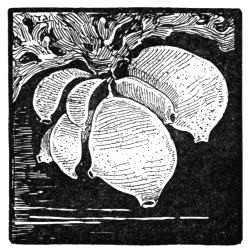
Fig. 68.—Grantia compressa
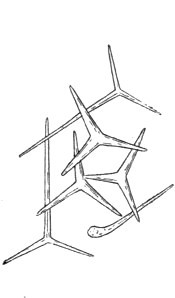
Fig. 69.—Spicules of Grantia, magnified
Small portions of the skeleton, examined under the microscope, will show the nature of the calcareous spicules of which it is composed. These consist of minute needles and stars, the latter having generally either three or four rays.
We give figures of three of the calcareous sponges of our shores, the first of which (Grantia compressa) resembles little oval, flattened bags, which hang pendulous from rocks and weeds, sometimes solitary, but often in clusters. The smaller openings are thickly scattered over the flat sides of the bag, and the larger ones, through which the water is expelled, around the margin. When the sponge is out of the water and inactive, the two opposite sides of the bag are practically in contact, but, when active, the cavity is filled with water by means of the whip-cells that line it, and the sides of the sponge are then more or less convex.
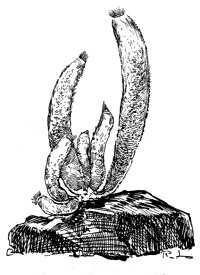
Fig. 70.—Sycon ciliatum
The ciliated sycon (Sycon ciliatum), fig. 70, though of a very different appearance externally, is similar in structure to Grantia. It is also found in similar situations, and is not uncommon on many parts of the South Coast, from Weymouth westwards. The other example, Leucosolenia botryoides, shown in fig. 71, is a branching calcareous sponge, consisting of a number of tubes, all united to form one common cavity which is lined throughout with whip-cells. It is usually found attached to weeds.
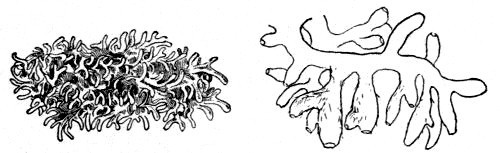
Fig. 71.—Leucosolenia botryoides, with portion magnified
Nearly all our British sponges belong to the group Demospongia—common sponges; but the members of this group present a great variety of form and structure. Most of them have a skeleton consisting of siliceous spicules, but some have a horny skeleton, somewhat after the nature of that of the toilet sponges; and others, again, have fleshy bodies entirely, or almost entirely, unsupported by harder structures. They are sometimes known collectively as the Silicia, for the greater number of them have skeletons consisting exclusively of siliceous matter, while the so-called horny sponges usually have spicules of silica intermingled with the horny substance, and even those which are described as having no skeleton at all sometimes contain scattered spicules of silex.
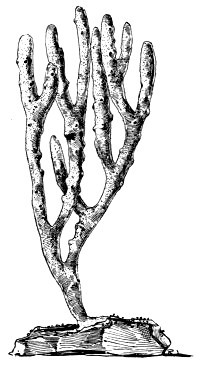
Fig. 72.—Chalina oculata
As the spicules of sponges are in themselves beautiful objects, and are important to the naturalist, inasmuch as they form a basis for the classification of sponges, it is well to know by what means they may be separated from the animal for microscopic examination. The separation is based on the fact that nitric acid (aqua-fortis) will destroy organic matter while it has not the slightest action on silica. In some of our common horny sponges the fibres are so transparent that, when teased out and placed under the microscope, the siliceous spicules may be seen embedded within them, but the spicules, both in these and the fleshy sponges, may be separated completely from the animal matter by putting a fragment of the sponge in a test-tube, covering it with nitric acid, and boiling it for a short time. The tube should then be filled up with water and allowed to stand undisturbed for a time, after which the liquid is poured off gently from the sediment. If the sediment is then put under the microscope on a slip of glass, it will be seen to consist of grains of sand, of which there is always a considerable amount in the pores and cavities of a sponge, and the siliceous spicules.
Among the common objects of the sea shore is the horny skeleton of the sponge Chalina oculata, which is frequently washed on the beach by the waves, especially after storms. This sponge is not likely to be seen between the tide-marks except at the lowest spring tide, when it may be found suspended in a sheltered crevice or cave. The skeleton consists of a fine network of horny fibres, in the centre of which lie the spicules, imbedded in the horny material. The spicules are short and straight, tapering at both ends.
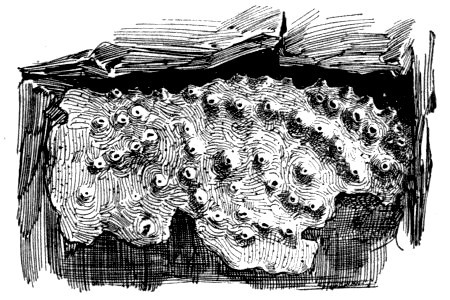
Fig. 73.—Halichondria panicea
The Bread-crumb sponge (Halichondria panicea) is even more common, for it is to be found on every rocky coast, encrusting weeds and rocks, often considerably above low-water mark. It is of a yellowish or pale greenish colour, and forms an incrustation varying in thickness from one-twentieth of an inch to half an inch or more; and, like most sponges, should be looked for in narrow crevices, under heavy growths of weeds, or in other situations where it is protected from the light. Sometimes its free surface is unbroken, except, of course, by the minute pores, and, here and there, the larger openings that serve for the outgoing currents; but when it is found encrusting a rock in patches of considerable size, the larger holes all occupy the summit of a little cone resembling a miniature volcano with its crater. This sponge is easily removed from the rock with the aid of a blunt broad-bladed knife, and retains its natural appearance to perfection if preserved in methylated spirit. Its horny skeleton is of a very compact nature, and the spicules are minute siliceous needles pointed at both ends.
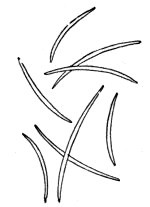
Fig. 74.—Spicules of Halichondria, magnified
Rambling on the sea beach we frequently meet with old oyster and other shells perforated by a number of circular holes about the size of a pin’s head or less, and chalk and limestone rocks also are seen similarly bored. On breaking into or grinding down the substance we find that the openings are the ends of channels that form a network of canals and chambers, some of which are so near the surface that they are covered by an exceedingly thin layer of the calcareous substance. These canals and chambers form the home of the Boring Sponge (Cliona), which, although a very soft-bodied animal, has itself excavated them.
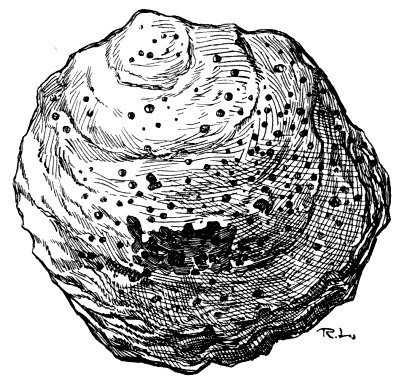
Fig. 75.—An Oyster Shell bored by Cliona
The manner in which the Cliona excavates such a complicated system of passages in so hard a material has naturally raised a considerable amount of curiosity, and those who have studied the matter are divided in opinion as to whether the work is done by chemical or by mechanical action.
Some of those who advocate the chemical theory suppose that an acid fluid is secreted by the sponge, and that the carbonate of lime forming the shell or stone is thereby dissolved; but such advocates have, as yet, failed to detect the presence of any acid substance in the body of the animal. Others ascribe the action to the solvent power of carbonic acid gas. This gas certainly has the power of dissolving carbonate of lime, as may be proved by a very simple experiment: Pour a little lime water into a glass, and blow into it through a glass tube. The lime water speedily becomes milky in appearance, the lime having been converted into particles of chalk or carbonate of lime by union with the carbonic acid gas from the lungs. Continue to blow into the liquid for some time, and the carbonate of lime will slowly disappear, being gradually dissolved by the excess of the gas—the gas over and above that required for the formation of the carbonate. Thus, it has been said, the carbonic acid gas evolved as a product of the respiration of the sponge is the agent by which the channels are excavated. Whatever be the acid to which this power is ascribed, whether it be the carbonic acid or a special acid fluid secreted for the purpose, there is still this difficulty in the way of accepting the theory, namely, that an acid, though it has the power of dissolving the mineral matter of a shell—the carbonate of lime—has no action on the laminæ of animal substance that form part of the structure. If we put the shell of a mollusc in hydrochloric or dilute nitric acid, we obtain, after the complete solution of the carbonate of lime, a substantial residue of animal matter which the acid does not touch, but in the case of Cliona both animal and mineral substances yield to its power.
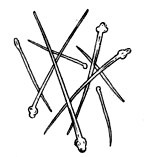
Fig. 76.—Spicules of Cliona
Those who favour the mechanical theory assert that the material is worn away by siliceous particles developed by the sponge, and kept in constant motion as long as the animal lives; and the theory is supported by the statement that, in addition to the spicules of silica, which are pin-shaped, and occupy the interior of the animal, there are little siliceous granules scattered on the surface of the sponge which are kept in constant motion resembling that of cilia; and the minute particles of carbonate of lime that form a dusty deposit within the galleries are supposed to be the product of the rasping or drilling action of these granules.
The pin-shaped spicules of Cliona may be obtained for microscopic examination by breaking any old oyster shell that has formed its home, and brushing out the dust from the galleries; or, a part of the shell may be dissolved in acid, and the sediment examined for spicules on a slip of glass.
CHAPTER IX
THE CŒLENTERATES—JELLY-FISHES, ANEMONES, AND THEIR ALLIES
One of the most interesting groups of marine life is that including jelly-fishes and anemones. In it are the pretty little sea firs, so often mistaken for sea-weeds by the youthful admirers of these plants, who almost always include them in their collection of marine algæ; the transparent, bell-shaped jelly-fishes, which may often be seen in thousands during the summer, carried by the tides, and swimming gently by graceful contractions of their bells; and, most beautiful of all, the lovely anemones—the ‘sea flowers’ of the older naturalists, by whom they were regarded as forms of vegetable life.
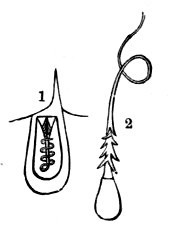
Fig. 77.—Thread Cells of a Cœlenterate, magnified
1. Thread retracted 2. Thread protruded
The simplest animals of this group are minute jelly-like creatures, of a more or less cylindrical form, usually fixed at one end, and having a mouth at the other. The body is a simple hollow cylinder, the wall of which is made up of two distinct layers, while the cavity within serves the purpose of a stomach. The mouth is surrounded by a circle of arms or tentacles by means of which the creature is enabled to capture its prey. These arms are capable of free movement in every direction, and can be readily retracted when the animal is disturbed. They are also armed with minute oval, hollow cells, each of which has a slender filament coiled up into a spiral within its cavity. Each filament is capable of being suddenly protruded, thus becoming a free whip-like appendage, and these are so numerous as to be very effectual in seizing and holding the living beings on which the animal feeds. This would undoubtedly be the case even if they were capable of mechanical action only, but, in many instances at least, they seem to be aided by the presence of some violent irritant, judging from the rapidity with which the struggling prey is paralysed when seized, especially in the case of some of the larger members of the group.
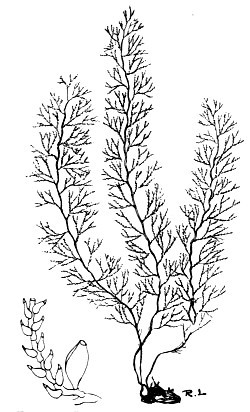
Fig. 78.—The Squirrel’s-tail Sea Fir (Sertularia argentea), with a portion enlarged
The simple forms referred to increase by a process of budding, the buds appearing first as simple swellings on the side of the parent creature, and afterwards developing a mouth and tentacles, thus becoming exactly like the adult form. Clusters of eggs also are developed in the outer layer of the body-wall, and these are set free at intervals, and produce new individuals. These animals possess no blood system of any kind, and have no special organs for respiration, but the nutrient matter absorbed from the body-cavity permeates the soft structures of the flower-like body, and the oxygen required for respiratory purposes is readily absorbed from the surrounding water.
The higher cœlenterates differ in certain particulars from the lower forms just referred to. Thus, they frequently have a large number of tentacles around the mouth, often arranged in several distinct whorls. They have also a stomach separate from the general body-cavity, but communicating with the latter below; and the body-cavity is divided into compartments by a number of radiating partitions. Some, also, develop a hard, stony skeleton by secreting carbonate of lime obtained from the water in which they live.
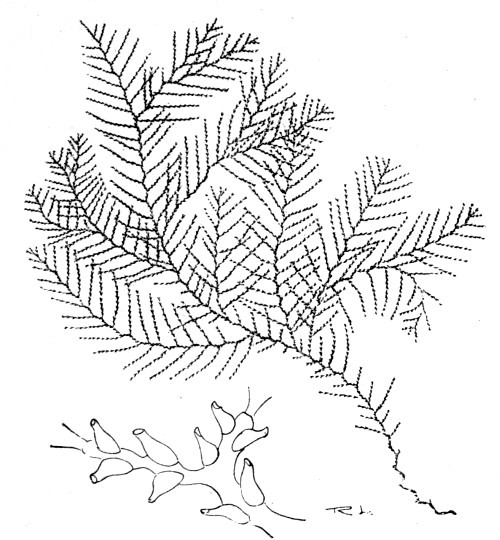
Fig. 79.—Sertularia filicula
We often see, when collecting on the beaches of rocky coasts, and especially after storms, a number of vegetable-like growths, of a greyish or brownish colour, each consisting of one or more main stalks bearing a number of delicate branches. Some of them, by their peculiar mode of growth, have suggested the name of sea firs, and a few of these, together with other animals of the same group, may readily be recognised by the accompanying illustrations. They are the objects already referred to as being commonly included in collections of sea-weeds by young naturalists, but they are in reality the horny skeletons of colonies of cœlenterates of the simplest type, belonging to the division Hydrozoa.
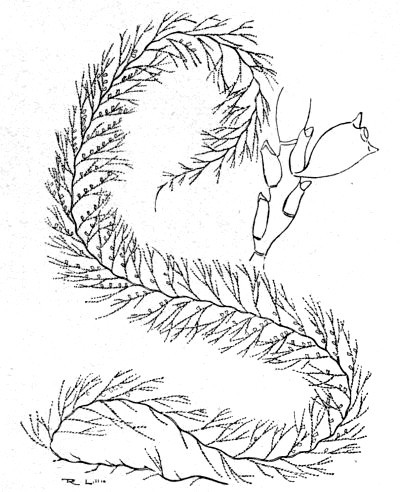
Fig. 80.—Sertularia cupressina
If we examine them with a lens we find that there are little cup-like bodies projecting from each portion or branch of the stem-like structure, and that the stem itself is hollow, with a communicating pore at the base of each cup. This constitutes the skeleton only of the colony—the dead matter, so to speak, which persists after the living creatures have perished; but if the specimens collected have been obtained fresh from the sea, placed in a glass of sea water, and then examined with the aid of a lens, little jelly-like hydroids or polypites will be seen to protrude from the cups, and extend their short arms in search of food.
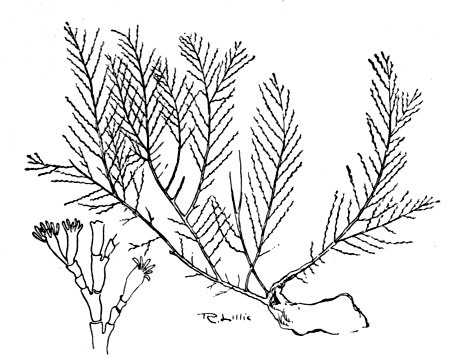
Fig. 81.—The Herring-bone Polype (Halecium halecinum)
Each of the little creatures has a tubular stalk which passes through the hole at the base of the cup, and is continuous with a tube of gelatinous material in the interior of the horny stem, and thus each member of the colony is directly connected with all the others, so that any nutrient matter collected and digested by one member may be absorbed into the central tube for the nourishment of the entire company of little socialists, the activity of the one being thus made to compensate for the laziness or incompetency of others. And this provision seems to be absolutely necessary for the well-being of the colony as a whole, for a close examination will often show that a kind of division of labour has been established, since it includes two or three distinct kinds of polypites, each adapted for the performance of a certain function. Thus, in addition to the feeding or nutritive members of the community, there are some mouthless individuals whose sole function seems to be the production of eggs for the propagation of the species, while others, also mouthless, develop an enormous number of stinging cells, probably for the protection of the whole community against its enemies, and these must therefore be provided, as we have seen they are, with a means by which they may derive nourishment through the agency of the feeding polypites.
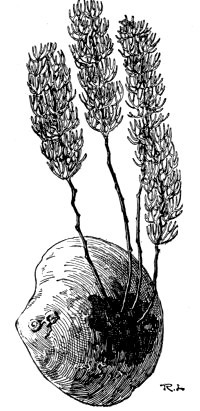
Fig. 82.—Tubularia indivisa
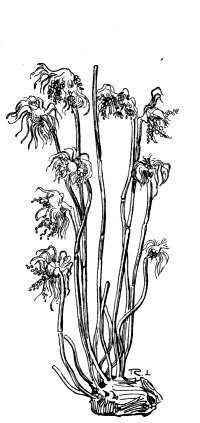
Fig. 83.—The Bottle Brush
(Thuiaria thuja)
When the eggs are liberated from what we may call the reproductive members, they are carried away by the currents or tides, and soon develop into little larvæ which are very unlike the parent, since they are covered with minute vibratile cilia by means of which they can swim freely. This they do for a period, and then settle down, lose their cilia, become stalked, and thus constitute the foundation of a new colony. A tubular stalk grows upward from its root, new members are added as outgrowths or buds from their progenitor, and so the growth proceeds until an extensive colony of hundreds of individuals has been formed.
We have spoken of the hydroid communities as being washed up on the beaches of our rocky coasts, but the collector of these interesting objects should not depend on such specimens for purposes of study. It is undoubtedly true that splendid examples of the sea firs and their allies are frequently washed up by the waves, including some species that inhabit deep water, and which are, consequently, not to be found by the ordinary collector in their proper habitat, and that these may often be secured with the polypites still alive; but several species are to be obtained between the tide-marks, especially at extreme low water, growing on rocks, weeds, and shells; and we have often met with good specimens, still alive, attached to the shells of whelks, scallops, &c., in fishmongers’ stores, even in inland towns.
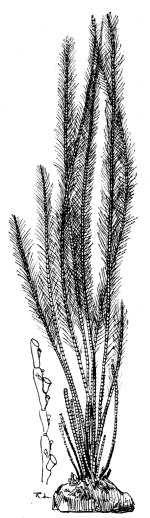
Fig. 84.—Antennularia antennia
Sometimes individual polypites become detached from a colony, and develop into little umbrella-shaped jelly-fishes, about a fifth of an inch in diameter; and these float about freely, keeping themselves near the surface by rhythmic contractions of their ‘bells,’ the margins of which are fringed by numerous fine tentacles. The mouth is situated centrally on the under side, and is surrounded by a circular canal from which proceed radiating tubes; and pigmented spots, supposed to be rudimentary eyes, are formed round the edge. These little bodies are called Medusoids, and may frequently be seen floating round our coasts towards the end of the summer. In the water they are almost invisible on account of the extreme transparency of their bodies; but if a muslin net be drawn through the water from the stern of a boat, and the net then gently turned inside out in a vessel of sea water, a number of medusoids may be obtained for examination. These creatures produce eggs which yield small ciliated larvæ that swim about freely for a time, and then settle down and establish stalked colonies as previously described.
The larger jelly-fishes or Medusæ so frequently seen floating in enormous numbers near the surface of the sea during the summer months are allied to the medusoids. Their bodies are so soft that it is a difficult matter to remove them from the water without injury, and when removed their graceful forms are completely destroyed by the pressure of their own weight. When left stranded on the beach, as is often the case, they seem to dissolve almost completely away, so readily does the soft animal tissue disintegrate in the large proportion of water, which forms about 95 per cent. of the weight of the whole body.
Those who desire to examine the nature and movements of the medusæ will find it necessary to observe them in water. The creatures may be lifted out of the sea in a vessel placed below them, and then transferred to a glass tank or a still rock pool by submerging the vessel and allowing them to float out. It will then be observed that the mouth is situated at the summit of a tube that projects from the middle of the under side of the ‘bell,’ and is surrounded by lobed or frilled lips. Marginal tentacles also generally fringe the edge of the bell, projecting downwards into the water. Round the circumference of the body may be seen a circular canal, from which several tubes converge towards, and communicate with, the cavity of the stomach.
When a medusa is inactive, its body gradually sinks to the bottom, being usually slightly heavier than the water in which it lives; but it is enabled to keep afloat by those rhythmic contractions of the bell with which we are so familiar. It seems that the medusæ are very sensitive to various external conditions, for they frequently disappear simultaneously from the surface water, and as suddenly reappear in shoals when the conditions are more favourable; but it is difficult to understand the causes which give rise to these remarkable movements.
The medusæ are often termed the Acalephæ—a word which signifies ‘nettles,’ and they are popularly known as sea nettles. They all possess stinging cells, which are distributed most thickly in the tentacles, and some of the larger species are undoubtedly able to produce an impression on the bodies of unwary bathers, while almost all have the power of paralysing the living prey on which they feed.
By far the commonest of the jelly-fishes of our seas is the beautiful blue medusa—Aurelia aurita. This species appears in enormous shoals during the summer, and large numbers are washed upon flat, sandy beaches. They vary in size from two or three inches to nearly a foot in diameter, and may be recognised from our illustration. The ‘bell’ is umbrella-shaped, and is so transparent that the stomach with its radiating canals may be seen through its substance. Around the margin there are little pigment spots which are supposed to be rudimentary eyes, and little cavities, containing a clear fluid, that are thought to serve the purpose of ears.
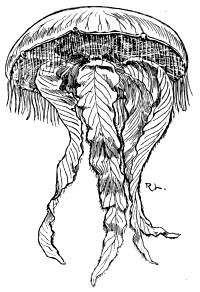
Fig. 85.—Aurelia aurita
On the under surface may be seen the square mouth, furnished with four long and graceful frilled lips, which are richly supplied with stinging cells; also the four ovaries or egg-producing organs, rendered conspicuous by their violet colouring.
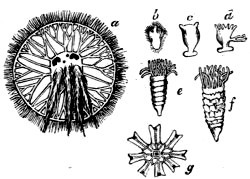
Fig. 86.—The early Stages of Aurelia
The life history of Aurelia is most interesting. The eggs are produced in pouches that communicate directly with the stomach-cavity, and these give rise to little ciliated larvæ that are ejected through the mouth, and then swim about freely in the water for a time. After this they settle at the bottom, lose their cilia, and become little cylindrical jelly-fishes, fixed by a short stalk-like foot to rocks or weeds Numerous tentacles develop as the creatures increase in size, and a number of transverse furrows appear at the surface. The furrows gradually increase in depth until, at last, the body is broken up into several star-like discs, each of which floats away and develops into a new medusa.
Other jelly-fishes, some of which are considerably larger than Aurelia, frequent our seas, and are often to be seen stranded on the beach. Two of these—Rhizostoma and Chrysaora—are figured. Although they differ considerably in form from the blue aurelia, they closely resemble it in general structure and habits.
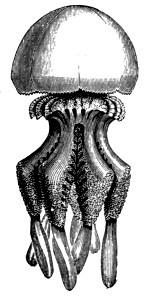
Fig. 87.—Rhizostoma
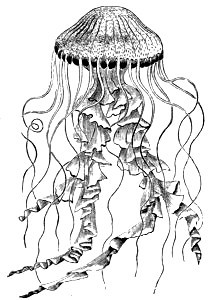
Fig. 88.—Chrysaora
When strolling on flat, sandy beaches, especially in the spring and early summer, we commonly see what appear to be little balls of exceedingly transparent and glassy jelly, no larger than an ordinary marble. If picked up and examined, we observe that they are not quite spherical, but oval in form, with a little tubercle at one end, and eight equidistant bands running from this to the opposite end, like the meridians on a globe.
This extremely beautiful little creature is one of the cœlenterates, belonging to the division Ctenophora, or comb-bearing jelly-fishes, so called because they possess comb-like ciliated plates, and is called the Globular Beroe (Cydippe pileus).
The ctenophores are very active creatures, swimming freely in the open seas by means of their numerous cilia; and, although of such delicate structure, are very predaceous, devouring small crustaceans and other marine animals. They are usually globular in form, but some are like long ribbons, and almost all are remarkable for their wonderful transparency, which renders them nearly invisible when floating in water. They have not the power of stinging or paralysing their prey, as the medusæ have, but their fringed arms are provided with adhesive cells by which they hold their prey tenaciously.
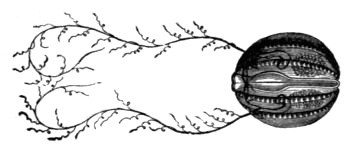
Fig. 89.—Cydippe pileus
In order to observe the form and habits of the Beroe we transfer it to a vessel of sea water, when it immediately displays its regular spheroid form, and its eight rows of comb-like plates which form the meridians before alluded to. Its mouth is situated on the little tubercle at what we may call the lower pole, for it is the habit of the Beroe to swim in an inverted position, and the digestive cavity may be seen through its glassy body.
At first no appendages of any kind are visible, but soon the animal protrudes two long and exceedingly slender arms, fringed with slender gelatinous threads, from two cavities, at opposite sides of the body, into which they can be withdrawn. A close examination will also reveal the rapid movements of the cilia of its combs, and it is remarkable that these do not always work together, the animal being able to move any of its plates independently, and to reverse their motion when occasion requires. It has no tentacles corresponding with those of jelly-fishes and anemones, but is assisted in the capture of its prey by its two long arms, the chief use of which, however, seems to be that of a rudder for steering.
If the Beroe is left out of water for some time, the water which forms such a large proportion of its body evaporates, leaving an almost imperceptible residue of solid matter; and if left in water after it is dead, its substance rapidly dissolves away, leaving not the slightest trace of its presence. There seems to be no satisfactory way of preserving this beautiful form of animal life. If placed in strong spirit the water is rapidly extracted from its body, and its animal substance shrivelled to a minute, shapeless mass; while in weak spirit and in other fluid preservatives it becomes more or less distorted, and deprived of its beautiful transparency, or else it disappears altogether.
We now come to the great favourites among the cœlenterates—the beautiful anemones-the animated flowers of the ocean, remarkable not only for their lovely flower-like forms, but also for the great variety of colour and of habits which they display. These, together with the corals, form the division of the cœlenterates known as the Zoantharia, characterised by the possession of simple tentacles, the number of which is a multiple of either five or six. The latter differ from the former mainly in the power of secreting a calcareous skeleton which remains attached by its base after the animal substance has decayed.
The expanded anemone exhibits a more or less cylindrical body, attached by a suctorial base to a rock or some other object, and a broad circular disc above. In the centre of this disc is the mouth, surrounded by the tentacles, often very numerous, and arranged in one or more whorls. When the animal is inactive the tentacles are usually completely withdrawn, and the body contracted into a semiglobular or pear-shaped mass which is very firm to the touch.
The general internal structure of an anemone may be made out by simple dissections, and the examination conducted with the specimen submerged in water. A longitudinal section will show that the body is a double tube, the outer being formed by the body-wall, and the inner by the wall of the stomach. Thus there is a body-cavity distinct from that of the stomach, but the two will be seen to communicate below, since the stomach-wall does not extend as far down as the base. It will be seen, too, that the body-wall is made up of two distinct layers—an outer one, that is continued inward at the mouth to form the inner wall of the stomach, and an inner one that lines the whole of the body-cavity. The latter contains the muscular elements that enable the anemone to contract its body.
When the animal is expanded, the whole interior is filled with sea water, as are also the tentacles, which are hollow tubes, really extensions of the body-cavity, and formed by prolongations of the same two layers that constitute the body-wall. As it contracts this water is expelled, partly through the mouth, and partly through small openings that exist at the tips of the tentacles.
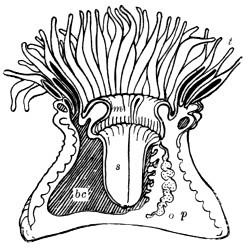
Fig. 90.—Section of an Anemone
t, tentacles; m, mouth; s, stomach; b c, body-cavity p, mesentery; o, egg-producing organ
The outer layer of the body-wall is provided with stinging cells which serve not only to protect the anemone from its enemies, but also to aid it in the capture of its prey, for which latter purpose they are distributed in much greater abundance in the tentacles.
The body-cavity is divided into a number of communicating compartments by means of vertical partitions running from the body-wall and converging towards the centre of the cavity. These are called mesenteries, and are extensions of the inner layer of the body-wall. Five or six of these are larger than the others, extending from disc to base, and are called primary mesenteries. Between these are an equal number of smaller secondary mesenteries; and, sometimes, a third set of still smaller tertiary mesenteries.
These internal partitions are best displayed in a transverse section of the body, which shows the double tube formed by the walls of the body and the stomach, together with the wheel-like arrangement of the mesenteries. At one time all animals that had a radial symmetry—the regular arrangement of parts round a common centre—were grouped together under the title of Radiata; but it has since been recognised that the creatures of this group exhibited such a great diversity of structure that they have been re-classified into two main divisions, one of which constitutes the cœlenterates which we are at present considering, and the other containing such creatures as star fishes and sea urchins.
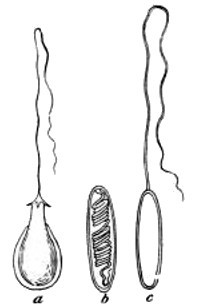
Fig. 91.—Stinging Cells of Anemone, highly magnified
a and c, with thread protruded; b, with cell retracted
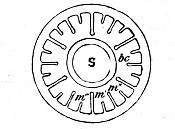
Fig. 92.—Diagrammatic transverse section of an Anemone
S, stomach; bc, body-cavity; m′, m″, m‴, primary, secondary, and tertiary mesenteries
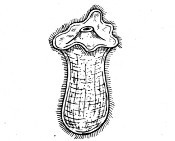
Fig. 93.—Larva of Anemone
On the surface of the mesenteries of the anemone may be seen the ovaries or egg-producing organs. These discharge the ova into the general body-cavity, after which they are ejected through the mouth. The embryos are minute jelly-like creatures that have an active existence, swimming about freely in the ocean by means of vibrating cilia, but after this period of activity they settle down and fix themselves, gradually assuming the adult form common to the species.
The habits of sea anemones are particularly interesting, and it will well repay anyone to make a study of these animals in their natural haunts as well as in the aquarium. The gentle swinging of the tentacles when searching for food, the capture and disposal of the prey, the peculiar modes of locomotion, and the development of the young, are among the chief points of interest. As regards locomotion, the usual method of moving from place to place is by an exceedingly slow gliding of the base or ‘foot’; and while some anemones are almost constantly on the move, others hardly ever stir from the secluded niche in which they have taken up their abode.
Sometimes an anemone will detach itself from the rock, and drag itself along, but very slowly, by means of its tentacles, sometimes inverting its body and walking on its head, as it were, and though one may never have the opportunity of witnessing this manœuvre on the shore, we have found it far from an uncommon occurrence in the aquarium.
The natural food of anemones consists of small crustaceans, such as shrimps, and crabs, molluscs, small fishes, and in fact almost every kind of animal diet, and there need never be any difficulty in finding suitable viands for species kept in captivity. It is really astonishing to see what large morsels they can dispose of with the assistance of their extensile mouths and stomachs. It is not even necessary, indeed, that the morsel be so small as to be entirely enclosed by the walls of its digestive cavity, for the anemone will digest one portion while the other remains projecting beyond its mouth. Further, it will even attack bodies which it cannot swallow at all, by protruding its stomach so as to partially envelope them, and then digesting the portion enclosed. Indigestible portions of its food, such as the shells of small molluscs, are ejected through the mouth after the process of digestion has been completed.
We have already referred to the reproduction of sea anemones by means of eggs, but it is interesting to note that they may also increase by a division of the body into two or more parts, and that this division may be either natural or artificial.
If an anemone be cut into halves longitudinally, each half will develop into a complete animal. If cut transversely, the upper portion will almost always develop a new suctorial disc, and produce a new individual complete in every respect; and it has been stated that the basal portion of the divided animal will also, occasionally, produce a new disc and tentacles.
The natural division of the anemone has frequently been spoken of as by no means an uncommon occurrence, but, as far as our experience of captive anemones go, this mode of multiplication does not seem to take place except as the result of some mechanical force applied, or as a means by which the animal may relieve itself of a solid body that it is unable to eject. Thus, on one occasion, when a stone had slipped so that its narrow edge rested across the middle of the disc of a large Mesembryanthemum, the animal, apparently unable to free itself from the burden, simply withdrew its tentacles and awaited results. In a few days two individuals were to be seen, one on either side of the stone, both undoubtedly produced as the result of the pressure applied. This instance seems to be exactly akin to artificial division, for it is far more likely that the animal was severed by the simple pressure of the stone than that it divided itself to be relieved of its burden.
On another occasion an anemone that had almost entirely surrounded a mussel on which it had been feeding, gradually released itself of the shell by a longitudinal division of its body; but here, again, it is probable that the fission was the result of pressure applied rather than of any power on the part of the animal.
A few of the British sea anemones are shown on Plates II. and III., and although the coloured illustrations will probably suffice for purposes of identification, yet a short description of each one represented may be acceptable.
The most common and most widely distributed species is undoubtedly the familiar Beadlet (Actinia mesembryanthemum—Plate II., figs. 1, 2, 3), which is to be found on every bit of rocky coast around the British Isles, and even on some stony beaches where there are no standing rocks between the tide-marks.
The colour of this species is exceedingly variable, but the most abundant variety is of a liver-brown colour, with crimson disc and tentacles, brilliant blue spots round the margin of the disc, and a line of bright blue around the base. In others the prevailing colour is deep crimson, orange, yellowish brown, or green. Fig. 1 represents a variety commonly known as the Strawberry Beadlet (Fragacea), which is distinguished by its superior size, and in which the dark-red ground is often conspicuously spotted with green.
Two members of the same genus are also shown on Plate III. One of these—A. glauca (fig. 3)—is of a bluish-green colour; while the other—A. chiococca (fig. 4)—is bright scarlet, with deep crimson disc and white spots round the disc.
Plate II
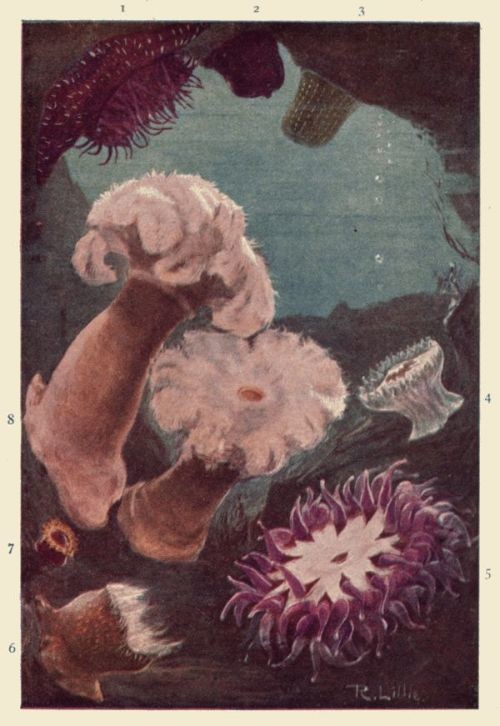
SEA ANEMONES
1, 2, 3, Actinia mesembryanthemum.
6. Sagartia bellis.
4. Caryophyllia Smithii.
7. Balanophyllia regia.
5. Tealia crassicornis.
8. Actinoloba dianthus.
The general form of this genus is that of an expanded flower on a short column; the name Beadlet is applied on account of the little bead-like projections on the margin of the disc. The tentacles number nearly two hundred in a fully grown individual, and are arranged in several rows; but when the animal is disturbed and the tentacles retracted, its form is almost hemispherical.
It is interesting to note that A. mesembryanthemum not only exists in varieties distinguished by distinct colours, but that the same individual will sometimes change its tint, as may be observed when it is kept in the aquarium; and it may be mentioned, by the way, that it is very easily reared in captivity, either in the natural or the artificial salt water, for not only may the same individuals be kept alive for years with only a moderate amount of attention, but their offspring may be reared without difficulty.
On Plate II. (fig. 8) are two illustrations of the beautiful Actinoloba dianthus, which grows to a length of five or six inches, and is easily distinguished by its expanded and frilled disc, its very numerous short and slender tentacles, and its tall, pillar-like body. Its colour is somewhat variable, being either salmon, flesh-colour, cream, white, red, orange, or brownish; but whatever be the tint of the body and tentacles, the margin of the mouth is always red or orange. When young it may easily be mistaken for another species, as its disc is not then frilled, and the tentacles are much fewer in number.
This pretty anemone usually inhabits deep water, and is frequently brought in, attached to shells and stones, by trawlers, but it may be commonly observed in the dark crevices of rocks, a little above low-water mark, where it is usually seen contracted into a ball, or even so much flattened that it looks like a mere pulpy incrustation of the rock. It is very common on the rocky coasts of Dorset, Devon, and Cornwall, as well as in many parts of Scotland and Ireland.
Like the Beadlet, it is easily kept alive in the aquarium, where it commonly multiplies by natural division; but as it does not generally expand in full daylight, its beauty is often better observed at night by artificial light.
On Plate II. (fig. 5) we have an illustration of the beautiful Dahlia Wartlet (Tealia crassicornis), which may be readily recognised by its thick, banded, horn-like tentacles, and the numerous little adhesive warts that almost cover the surface of its body.
This species is as abundant as it is beautiful, for it is to be found in plenty on almost every rocky coast, where it may be seen in the rock pools and in the crevices of rocks near low-water mark. The diameter of its cylindrical body often reaches two or three inches, while the expanded tentacles embrace a circle of four or five inches. Specimens even much larger than this are sometimes obtained by dredging in deep water.
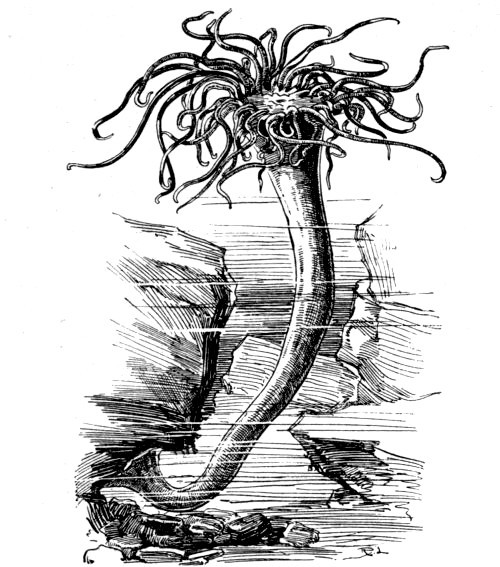
Fig. 94.—The Trumpet Anemone (Aiptasia Couchii), Cornwall; deep water
The ‘Dahlia’ is not so frequently seen by sea-side collectors as its abundance would lead one to expect, and this is principally due to the fact that it not only conceals itself in narrow and out-of-the-way crevices and angles of rocks, but also that, on the retreat of the tide, it generally covers itself with small stones, fragments of shells, &c., held fast to its body by means of its numerous suckers. In this manner it conceals its beauty so well that the sense of of sight, is necessary in determining its whereabouts. As a rule, however, it does not resort to this method of concealment when it inhabits deep water, or even a permanent rock pool between the tide-marks, and thus it is in the latter home where one may expect to see this sea flower in all its glory, for when permanently covered with water it will seldom hide its crown, except when alarmed, or when in the act of swallowing its food.
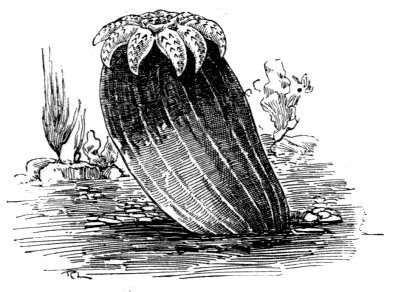
Fig. 95.—Peachia hastata, S. Devon
It should be noted, too, that the rock pool is the right place in which to study the habits of this anemone, for it is not nearly so easy to rear in the artificial aquarium as the species previously described, and, moreover, it requires a great deal of food. We have found it live longest in running water, kept cool, and frequently renewed by supplies fresh from the sea. It may be fed on almost any, if not every, form of animal life inhabiting a rock pool. A small fish or a prawn is perfectly helpless when once it is seized by the creature’s tentacles. Mussels, winkles, limpets, &c., are eagerly swallowed, and the indigestible shells disgorged after the animal substance has been dissolved by the digestive fluid. Even the active shore crab, armed as it is with a coat of mail and powerful pincers, is no match for its powerfully adhesive tentacles; nor do the sharp spines of the prickly urchin preserve it from so voracious a creature.
The rocky coasts of Devon and Cornwall are the chief haunts of the pretty ‘Daisy Anemone’ (Sagartia bellis), and here it is very abundant in places. This species lives in holes and crevices of the rocks, its body usually entirely hidden from view, but its dark brown disc, intersected by bright red radiating lines, and fringed with numerous small tentacles, fully exposed to view as long as it is submerged. The length of its body is always adapted to the depth of the hole or crevice in which the animal lives, and may vary from half an inch to two or three inches, the diameter of the columns being greatest where the length is least.
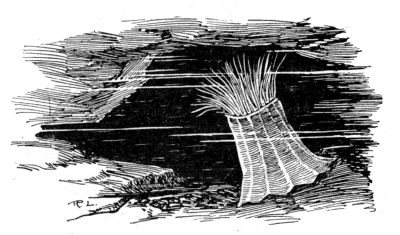
Fig. 96.—Sagartia pallida, Devon and Cornwall
Sometimes the ‘Daisy’ may be seen living a solitary life, having settled down in a hole just large enough to accommodate it, but more commonly it is seen in company with several others of its species, occupying a crevice in a rock pool, and often so closely packed together that the tentacles of each individual are intermingled with those of its neighbours, thus exhibiting a more or less continuous cluster or line of ‘flowers,’ each disc being from one to two or three inches in diameter when fully expanded.
On account of the peculiar positions selected by this species, it is not easily removed without injury, and hammer and chisel are almost always necessary for its removal; but if it is obtained without injury, and transferred to the indoor aquarium, but little difficulty will be found in keeping it alive and in health. It is also very prolific, and a single specimen placed in the indoor tank will frequently produce a large number of young.
The colour of S. bellis, like that of many of our anemones, is very variable, but the species may easily be recognised by the radiating lines of the disc, and the numerous small tentacles. One variety, however, deviates considerably in form, colour, and habit from the normal. It (Plate II., fig. 6) is of a dull yellow colour, and has a much less graceful form; and, instead of living in the holes and crevices of rocky coasts, where it would be washed by fresh sea water at every tide, it inhabits the muddy and fœtid waters of narrow inlets of the sea in the neighbourhood of Weymouth.
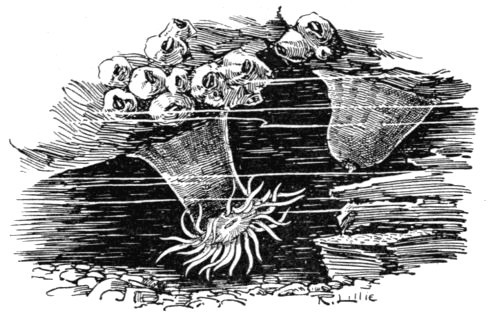
Fig. 97.—Sagartia nivea, Devon and Cornwall
Three other species of the same genus are represented on Plate III. The first of these—Sagartia troglodytes, sometimes called the Cave-dweller (fig. 1)—though very variable in colour, may be known by its barred tentacles, each with a black B-like mark near its base. It lives in sheltered, sandy, or muddy hollows between the rocks on most rugged coasts, often with its body entirely buried beneath the sediment; or, if only partially buried, the projecting portion of the column concealed by particles that adhere to its suckers.
The column is usually of an olive colour, striped longitudinally with a paler tint, and sometimes reaches a length of two inches, while the diameter of the expanded ‘flower’ may even exceed this length.
This anemone is not a very conspicuous object of the shore, since the exposed portion of its column is usually more or less covered by sedimentary matter, and the tentacles are generally of a tint closely resembling that of the surrounding surface. Thus the anemone is protected from its enemies by its peculiar habit and colouring, while at the same time the spreading tentacles constitute an unseen but deadly snare for the unwary victims that come within their range.
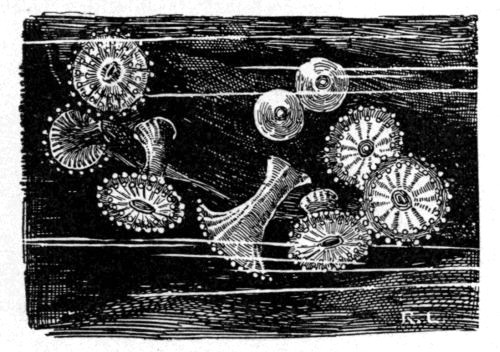
Fig. 98.—Corynactus viridis, Devon and Cornwall
This species is often difficult to secure without injury on account of its preference for narrow chinks in awkward situations, but we have found that it is sometimes easily removed by first clearing away the surrounding débris, and then gently pushing it from its hold by means of the finger-nail. It seems, in fact, that its base is occasionally quite free from the underlying rock, being simply imbedded in sand or mud. In other cases hammer and chisel are necessary to remove it from its snug hole.
If placed in the aquarium it should be allowed to get a foot-hold in a suitable hole or crevice, which should be afterwards partially filled with sand. It is not difficult to keep, and although not a showy species, and having a decided preference for shady places, yet its habits will be found interesting.
The Orange-disked Anemone (Sagartia venusta) is represented in fig. 2 of the same plate. It may be easily distinguished by its brilliant orange-coloured disc, surrounded by white tentacles, which, when fully expanded, commands a circle of from one to one and a half inches. South-west Wales is said to be the headquarters of this pretty sea flower, but we have found it abundant on parts of the north Devon coast, especially in places between Ilfracombe and Lynton. Like the last species, it may be termed a cave-dweller, for it delights to hide in corners and crevices that are so overhung with rocks and weeds that the light is never strong.
Yet another species of this genus (S. rosea) is depicted in Plate III., fig. 8. It has been termed the Rosy Anemone, from the brilliant rosy tint of its numerous tentacles. The column is generally of a dull brown colour, with suckers scattered over the upper portion, and the flower reaches a diameter of an inch or more. This anemone may be seen at rest on overhanging rocks near low-water mark when the tide is out, its disc only partially hidden, and the tips of its bright tentacles just exposed. It may be seen on many parts of the Devon coast, and is, or, at least, was, abundant in localities near Brixham and Shaldon.
On the same plate is an illustration (fig. 7) of one of the most abundant and most interesting of our anemones. It is commonly known as the Opelet, and its scientific name is Anthea cereus. Almost everyone who has done a little collecting on the rocky shores of the south-west of England, or on the shores of Scotland or Ireland, must have seen this species, easily distinguished by its long, slender, smooth tentacles, all of about equal length, and presenting a waxy appearance. These appendages are usually green and tipped with pink, but sometimes pale yellow or red, and are of such a length that they cover a circle of five or six inches.
This species is decidedly of social disposition, for a number may generally be seen in a cluster, crowded closely together; and when we see them, as we often do, occupying a little tide pool that contains scarcely sufficient water to enable them to give free play to their tentacles, and exposed for hours to the full blaze of the summer sun, we naturally form the opinion that they ought to require no special care in the indoor aquarium. And this is actually the case, for they thrive well with but little trouble.
Perhaps the chief interest attached to this anemone is the deadly nature of its grip. The numerous long tentacles have considerable clinging power throughout their length, and their paralysing power is very considerable compared with that of many other species of the same size. Even the human skin is more or less affected by the irritating influence of this species, a sensation approaching to a sting being sometimes produced, and the skin showing visible signs of the injury done. The grip, too, is so tenacious that tentacles are sometimes torn off when the hand is quickly withdrawn from their hold.
Our next example is the Red-specked Pimplet (Bunodes Ballii), shown in fig. 5 of Plate III., which has received its popular name on account of the numerous longitudinal rows of red-specked warts that run down its short yellow column, and other red spots on the column itself, between the rows. Its tentacles are usually pale yellow or white, but sometimes grey or greenish, and often tinged with pink.
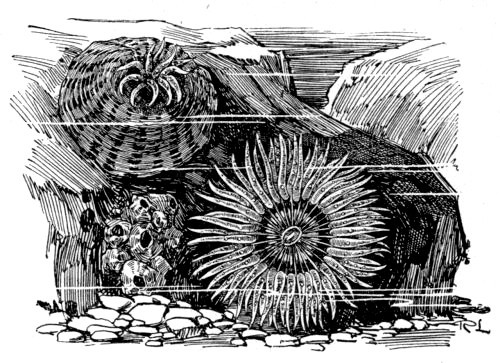
Fig. 99.—Bunodes thallia, West Coast
This anemone is common on some parts of the coasts of Hampshire, Dorset, Devon, and Cornwall, as well as on the south coast of the Isle of Wight, and may be found in secluded crevices of the rocks, or under the large stones that are scattered on the beach.
Plate III
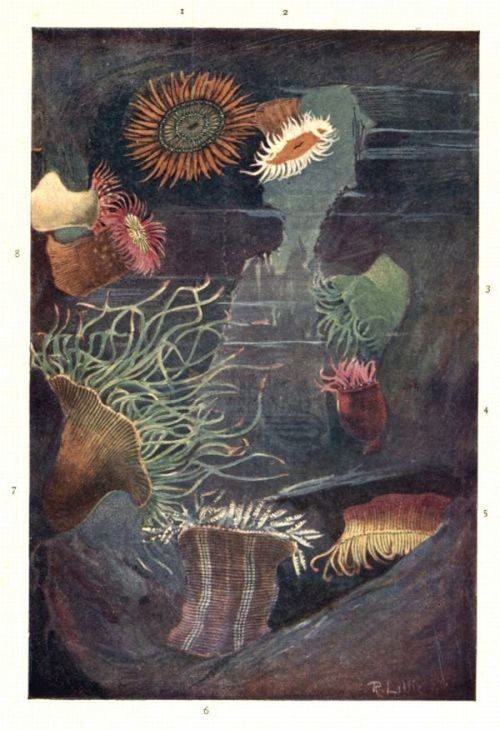
SEA ANEMONES
1. Sagartia troglodytes
5. Bunodes Ballii
2. Sagartia venusta
6. Bunodes gemmacea
3. Actinia glauca
7. Anthea cereus
4. Actinia chiococca
8. Sagartia rosea
The Gem Pimplet (Bunodes gemmacea) is shown on the same plate (fig. 6). It is easily distinguished by the six conspicuous longitudinal rows of large white warts, between which are several other rows of smaller ones. The column is pink or brownish, and the thick tentacles are conspicuously marked by light-coloured roundish spots. It is not uncommon on the south-west coast of England, where it may be seen in the rock pools and on the surfaces of rocks between the tide-marks. Both of the species of Bunodes above mentioned may be kept in the aquarium without much trouble.
All the anemones so far briefly described are quite devoid of any kind of skeleton, the whole body being of a pulpy or leathery consistence, but some of our British species develop an internal calcareous skeleton, consisting of a hollow cylinder of carbonate of lime secreted by the body-wall, and attached to the rock by means of a similar deposit formed in the base, and also, within the cylinder, of a number of thin plates attached to the skeleton of the body-wall and projecting inwards towards the axis, thus resembling, in fact, the skeletons of a number of the tropical corals with which we are familiar. The animals in question are often collectively spoken of as British corals.
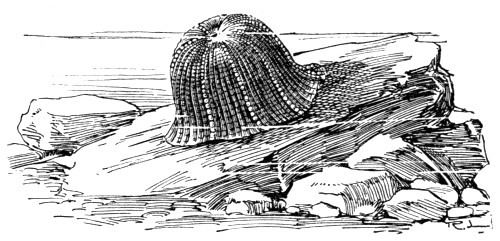
Fig. 100.—Bunodes gemmacea, with tentacles retracted
One of the finest of these corals is the Devon Cup-Coral (Caryophyllia Smithii), figured on Plate II. It may be found in many parts of Devon and Cornwall, attached to the rocks between the tide-marks, often in very exposed places, but is much more abundant in deep water.
Its skeleton is white or pale pink, and very hard, and is in itself a beautiful object. The animal surrounding this stony structure is of a pale fawn colour, with a white disc relieved by a deep brown circle round the mouth. The tentacles are conical, almost colourless and transparent, with the exception of the deep-brown warts scattered irregularly over them, and are tipped by rounded white heads.
Of course a hammer and chisel are necessary for the removal of these corals, but they are hardy creatures, and may be kept for a considerable time in captivity. Their habits, too, are particularly interesting, and two or more may sometimes be found with skeletons attached, suggesting that branched arrangement so common in many of the corals from warmer seas.
Another of these stony corals (Balanophyllia regia) is shown on the same plate. It is much smaller than the last species, but exceedingly pretty. It is also much less abundant, being confined almost exclusively to the coast of North Devon, and is seldom seen far above the lowest ebb of the tide.
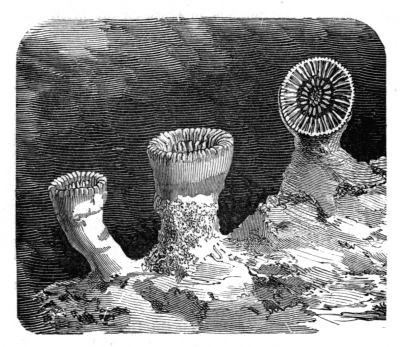
Fig. 101.—Caryophyllia cyathus
Our few brief descriptions of British anemones and corals have been confined to those species which appear in our coloured plates, but we have interspersed here and there between the text a few illustrations which will assist in the identification of other species and also help to show what a rich variety of form is exhibited by these beautiful creatures. Some of these inhabit deep water only and are consequently beyond the reach of most sea-side observers during the ordinary course of their work; yet they may often be seen in fishing villages, especially in the south-west, where they are frequently brought in among the haul of the trawlers, attached either to shells or stones; and live specimens of these deep-sea anemones may even be seen on the shells of whelks and bivalve molluscs in the fishdealers’ shops of London and other large towns.
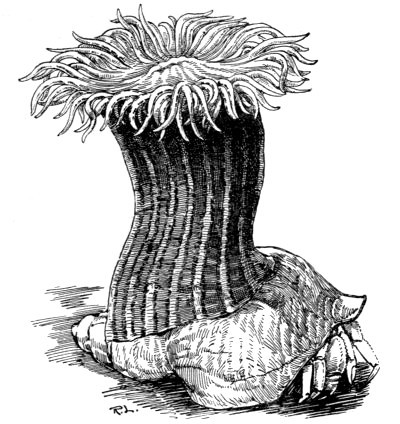
Fig. 102.—Sagartia parasitica
One of the species in question—the Parasitic Anemone (Sagartia parasitica) is generally found on the shell of the whelk or some other univalve; and, if removed from its chosen spot, it will again transfer itself to a similar shell when an opportunity occurs. This interesting anemone is usually seen among the dredgings of the trawler, but may be occasionally met with on the rocky coasts of the south-west, at extreme low-water mark. Though sometimes seen attached to stones, shells may undoubtedly be regarded as constituting the natural home of the species, and many regard the former position as accidental or merely temporary, and denoting that the animal had been disturbed and removed from its favourite spot, or that circumstances had recently rendered a change of lodgings necessary or desirable. Further, the shell selected by this anemone is almost always one that is inhabited by a hermit crab; and this is so generally the case that the occasional exceptions to the rule probably point to instances in which the occupant of the shell had been roughly ejected during the dredging operations.
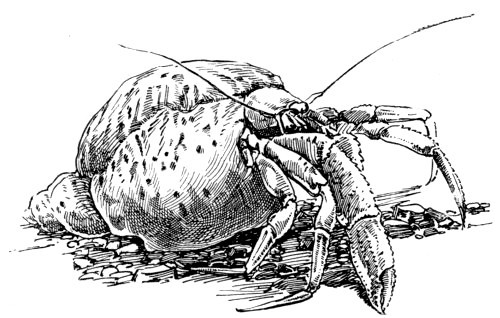
Fig. 103.—The Cloak Anemone (Adamsia palliata) on a Whelk Shell, with Hermit Crab
The peculiar habit of the anemone just referred to makes it an interesting pet for the aquarium, for if removed from its natural home, and placed in the aquarium with a hermit crab, it will, sooner or later, as the opportunity occurs, glide from its hole on the stone or rock, and transfer itself to its favourite moving home.
It may be difficult at first to see what advantage can accrue to the anemone by the selection of such a situation; and, moreover, it becomes an interesting question as to whether the advantage is a mutual one. Close observations may, and already have, thrown some light on this matter, though it is probable that there still remains something to be learnt concerning the relations which exist between the inside and outside occupants of the portable house.
It may be noticed that the anemone almost invariably takes up a position on the same portion of the shell, and that, when fully expanded, its mouth is usually turned towards that of the crab. This seems to be a very favourable position for the anemone, since it is one that will enable it to catch the waste morsels from the crab’s jaws by its expanded tentacles. But it is, perhaps, not so easy to suggest a means by which the anemone can make an adequate return for free board thus obtained. It is well to remember, however, that crabs are regarded as such delicate morsels by fishes that we have already spoken of the value of these crustaceans as bait; while the fact that sea anemones remain perfectly unmolested in rock pools inhabited by most voracious fishes, coupled with the fisherman’s experience as to the absolute worthlessness of anemones as bait, is sufficient in itself to justify the conclusion that these creatures are very distasteful to fishes. This being the case, it is possible that the hermit crab is amply repaid by the anemone for its liberal board not only by partially hiding the crab from the view of its enemies, and thereby rendering it less conspicuous, but also by associating its own distasteful substance with that which would otherwise be eagerly devoured.
When the hermit grows too large to live comfortably in its shell, a change of home becomes necessary, and it is interesting to observe that the anemone living on the outside of the shell transfers itself at the same time; and this is a matter of vital importance to the crab, since it usually changes its lodging at the moulting period, at which time its body is covered by a soft skin, and is then even more acceptable as prey to the fishes. Thus the anemone accompanies its host, affording it continued protection during the period of its greatest danger.
Before leaving the cœlenterates we must refer to one other form which, though not often having its habitat between the tide-marks, is nevertheless a very common object in the neighbourhood of fishing villages, where the refuse from the nets used in deep water has been thrown on the beach. We refer to the peculiar animal known to fishermen as ‘Dead Men’s Fingers,’ and to the naturalist as the Alcyonium.
When seen out of water it is not by any means an inviting object, but is apparently a mass of gristly matter, of a dirty yellowish or brownish colour, sometimes flattened and shapeless, and sometimes lobed in such a manner as to suggest the popular name so commonly applied. It is always attached to some hard object, such as a stone or a shell, and is so frequently associated with oyster shells that it is by no means an uncommon object in the fishmonger’s shop, from which we have often obtained live specimens for the aquarium.
When placed in sea water it gradually imbibes the fluid surrounding it, becoming much swollen. Then little star-like openings appear, the circumference of each of which protrudes so as to form a little projecting tube. Finally, a crown of eight little tentacles is protruded, and the mass, so uninteresting at first sight, reveals itself as a colony of pretty polyps.
In general structure the Alcyonium resembles the sea anemone, but the firm body-wall of the colony is supported and protected to some extent by the presence of minute spicules of carbonate of lime; and it is interesting to note that while the tentacles of anemones and corals make up a number that is a multiple of either five or six, those of the Alcyonaria and the allied ‘Sea pens’ are always in multiples of four.
CHAPTER X
STARFISHES, SEA URCHINS, ETC.
Still passing up the scale of animal life, we now come to the Echinodermata—the other sub-kingdom which we have already referred to as forming, with the Cœlenterates, the old division of Radiata. The term Echinoderm signifies ‘hedgehog skin,’ and is applied to the group on account of the fact that the majority of its species possess a skin that is either distinctly spiny, or exhibits numerous more or less defined prominences. This skin is also supported and hardened by the deposit of little plates or spicules of carbonate of lime, all joined together so as to form a kind of scaffolding or ‘test’ for the protection of the animal; and this secretion of carbonate of lime is not always confined to the outer skin, for, in some cases, it occurs in the walls of the internal organs as well.
Most of the animals of this sub-kingdom display a regular radiate symmetry; that is, the parts of their bodies are arranged regularly round a common axis, and the arrangement is usually a five-fold one, as may be observed in the case of the common Five-fingered Starfish of our coasts (see Plate IV.), and it is worthy of note that this radiate disposition of parts is not merely external, but that, as in the case of anemones and jelly-fishes, it also obtains within, and determines the arrangement of the internal organs. Further, although this radiate symmetry characterises the adult animals of the group we are considering, yet some show a tendency towards bilateral symmetry (parts arranged equally on two opposite sides of a common axis), while this is the rule, rather than the exception, with the early stages or larvæ of these creatures. Observe, for instance, the larva of the common Brittle Starfish, the adult of which species exhibits an almost perfect radiate symmetry, and we see something more than a mere trace of a two-sided disposition.
We have not to look far into the structure of any typical echinoderm to see that it is a distinct advance on the anemones in the matter of organisation. To begin with its digestive system—this consists of a tube having no communication with the general body-cavity, but remaining quite distinct throughout its length, with both ends communicating directly with the exterior. Its nervous system also is more highly developed, for it has a well-formed ring of nerve matter round the mouth, from which pass two or three systems of nerve fibres, each system having its own special function to perform. The sense organs, however, do not appear to be well developed, though there exist certain ‘pigment spots,’ in which nerve fibres terminate, and which are supposed to serve the purpose of eyes.
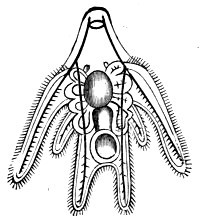
Fig. 104.—Larva of the Brittle Starfish
One of the most interesting features in connection with the echinoderms is undoubtedly the structure and function of the apparatus for locomotion. Examine a live sea urchin, or the common five-rayed starfish, in a rock pool or aquarium, and it will be seen to possess a large number of soft, flexible, and protrusible processes, each of which terminates in a little sucking-disc that enables the animal to obtain a good ‘foot-hold;’ and, having fixed itself on one side by means of a number of these little ‘feet,’ it is enabled, by the contraction of certain muscles, to pull itself along.
The little feet we are examining are really tubes filled with water, and capable of being inflated by the injection of water into them from within the body of the animal. Each one communicates with a water tube, several of which (usually five) radiate from a circular canal of water that surrounds the mouth. This circular canal does not communicate with the mouth, but with a tube, known as the ‘stone canal’ because of the carbonate of lime deposited within its walls, that opens at the surface of the body on the opposite side, and is guarded at the orifice by one or more perforated plates through which water gains admission. Thus the animal can fill its ‘water system’ direct from the sea, and, by the contraction of muscles that surround the main canals, force this water into the little ‘tube-feet,’ causing them to protrude and present their sucking-discs to any solid object over which it desires to creep. We may observe, however, that some of the little protrusible tubes have no sucking-discs, and probably serve the purpose of feelers only; also, that while these tube-feet are the principal means of locomotion in certain species, in others the movements of the body are performed almost exclusively by the five or more rays that extend from the centre of the animal, and which are readily curved into any desired position by the action of well-developed muscles.
All the echinoderms come within the domain of the marine naturalist, for no members of the sub-kingdom are inhabitants of fresh water; and it is interesting to observe that, unlike the animals previously described, none of them live in colonies.
A general examination of the various starfishes to be found in our seas will show that they may be divided into three distinct groups. One of these contains the pretty Feather Stars, which are distinguished by their long and slender ‘arms,’ usually ten or more in number, each of which bears a number of pinnules that give it quite a feathered appearance. The second includes the Brittle Stars, possessing five slender arms that are jointed to the small, flattened, central disc, and which are so named on account of the readiness with which the animal falls to pieces when alarmed or disturbed; and the third is formed by the remaining five-rayed stars, the arms of which, instead of being jointed to, are continuous with, the centre of the body.
All these starfishes have a leathery skin, supported and hardened by a framework of calcareous plates, and presenting a number of hard ridges or spines. In addition to the system of water tubes already mentioned as characteristic of the echinoderms, they also possess a second circular vessel round the mouth, from which a number of vessels are distributed to the walls of the digestive tube. These, however, are bloodvessels, and are directly concerned with the nutrition of the body. Some, also, have imperfectly developed eyes at the ends of the arms or rays.
Contrary to what one would expect after watching the somewhat sluggish movements of starfishes, they are really very voracious creatures, attacking and devouring molluscs and small crustaceans, sometimes even protruding their stomachs to surround their prey when too large to be passed completely through the mouth; and they are also valuable as scavengers, since they greedily devour dead fishes and other decomposible animal matter.
Feather Stars differ from other starfishes in that they are stalked or rooted during one portion of their early life. At first they are little free-swimming creatures, feeding on foraminifers and other minute organisms that float about in the sea. Then they settle down and become rooted to the bottom, usually in deep water, at which stage they are like little stalked flowers, and closely resemble the fossil encrinites or stone lilies so common in some of our rock beds, and to which they are, indeed, very closely allied. After a period of this sedentary existence, during which they have to subsist on whatever food happens to come within their reach, they become free again, lose their stalks, and creep about by means of their arms to hunt for their prey.
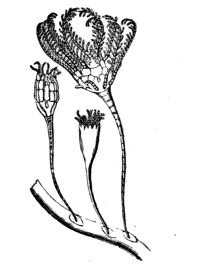
Fig. 105.—Larva of the Feather Star
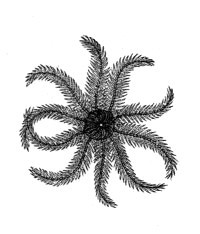
Fig. 106.—The Rosy Feather Star
The commonest British species of these starfishes is the Rosy Feather Star (Antedon rosaceus); and as this creature may be kept alive in an aquarium for some considerable time without much difficulty, it will repay one to secure a specimen for the observation of its habits. It is not often, however, that the Feather Star is to be found above low-water mark, its home being the rugged bottom under a considerable depth of water, where a number usually live in company; but there is no difficulty in obtaining this and many other species of interesting starfishes in fishing towns and villages where trawlers are stationed, for they are being continually found among the contents of the net.
Although the Feather Star can hardly be described as an active creature, yet it will cover a considerable amount of ground in the course of a day, creeping over rocks and weeds by means of its arms, which are raised, extended, and again depressed in succession, each one thus in turn serving the purpose of a foot. These arms are capable of being moved freely in any direction, as are also the little more or less rigid pinnules appended to them. The latter are bent backwards on an extended arm that is being used to pull the animal along, so that they form so many grappling hooks that hold on the bottom; and then the arm in question is bent into a curve by the contraction of its muscles, thus dragging the body forward. The arms on the opposite side of the body are also used to assist the movement by pushing it in the same direction, and this is accomplished by first bending the arms, and then, after curving the pinnules in a direction from the body, again extending them. Other movements of the feather star are equally interesting. Thus, the manner in which it will suddenly extend its arms and apply its pinnules to the surface on which it rests in order to obtain a good hold when alarmed, and the way in which it apparently resents interference when one of the arms is touched, are worthy of observation. The arms themselves are readily broken, and will continue to move for some time after being severed from the body, but the loss to the animal is only temporary, for a new arm grows in the place of each one that has been broken off.
This tendency to break into pieces is much greater in the Brittle Stars, as might be expected from their popular name; and is, in fact, such a marked characteristic of the group that it is not by any means an easy matter to obtain a collection of perfect specimens. They will often snap off all their arms, as if by their own power of will, when disturbed or alarmed, and even when removed from their hold without injury, they will frequently break themselves into pieces if dropped into spirit or in any way subjected to a sudden change of conditions.
The tube-feet of Brittle Stars are very small and are not provided with suckers, but are very sensitive, serving the purpose of feelers; also, having thin, permeable walls, they probably play a large part in the process of respiration. Both arms and disc are hardened by a dense scaffolding of calcareous plates; and not only are the former attached to the latter by a well-formed joint, but the arms themselves are constructed of a number of segments that are held together by a kind of ‘tongue and groove’ joint. Round the mouth are a number of tentacles that are kept in constant motion with the object of carrying the food towards it, and of holding the larger morsels while the act of swallowing is progressing.

