


автордың кітабын онлайн тегін оқу Cambridge
Contents
List of Illustrations
(In certain versions of this etext, in certain browsers, clicking on this symbol

A Bibliography
Index Names of Persons and of Cambridge Families referred to in the Text
General Index
(etext transcriber's note)
CAMBRIDGE
AGENTS
America
The Macmillan Company
64 & 66 Fifth Avenue, New York
Australasia
The Oxford University Press
205 Flinders Lane, Melbourne
Canada
The Macmillan Company of Canada, Ltd.
St. Martin’s House, 70 Bond Street, Toronto
India
Macmillan & Company, Ltd.
Macmillan Building, Bombay
300 Bow Bazaar Street, Calcutta
Indian Bank Buildings, Madras

THE BRIDGE OF SIGHS, ST. JOHN’S COLLEGE This Bridge joins the Third Court with the Fourth or New Court. The building on the right, seen through the bridge, is the Library, and dates back to 1624.
CAMBRIDGE
BY
M. A. R. TUKER
AUTHOR OF PARTS II. AND III. AND JOINT-AUTHOR OF PARTS I. AND IV. OF THE
HANDBOOK TO CHRISTIAN AND ECCLESIASTICAL ROME, AND
JOINT-AUTHOR OF ‘ROME’ IN THIS SERIES
PAINTED BY
WILLIAM MATTHISON

LONDON
ADAM AND CHARLES BLACK
1907
Published May 1907
Preface
“OF making many books there is no end.” When I set about writing this book I was ready to believe that the University had not its fair share of the literary output. Cambridge indeed does not appear to suggest, does not lend itself to, the numberless little brochures or hymns of praise which accompany the honoured years of the sister university; in weighty tomes and valuable collectanea of MSS., however, it possesses works (such as Cooper’s Annals, the Cole and Baker MSS., and Willis and Clark’s Architectural History) not possessed by Oxford and unrivalled, perhaps, by any English town.
In the middle of last century the invaluable Fuller was the most readily accessible authority, but the last thirty years have seen the publication of the monumental work of Messieurs Willis and Clark, and of the History of the University by Mr. J. Bass Mullinger, while at the same time the slighter literature of the subject has not been neglected.
Nevertheless there is room, I hope, for a short book on the present lines.
It is, I believe, the first time that a chapter on the women’s colleges has anywhere appeared, and certainly the first time that such a chapter forms part of an account of the University. I have taken pains to authenticate the description here given, for events which occurred thirty—even twenty—years back are now fading out of remembrance and some of those who took part in them are no longer with us.
A first and last chapter on the origin of universities and on the sister universities have been omitted for the purposes of this volume.
The pleasantest part of my task still remains to be performed—to thank all those, both in and out of Cambridge, who have kindly afforded me facilities, have obtained information on innumerable points, or lightened my labours by lending books. In addition to this welcome assistance my thanks are specially due to Mr. J. Willis Clark, late fellow of Trinity, and Registrary of the University, for sparing time to read the proof sheets of Chapters I. and II.—for sparing time and not sparing trouble; to the Master of Peterhouse and to Dr. A. W. Verrall (fellow and late tutor of Trinity) for reading the proof sheets of portions of Chapter II. and portions of Chapter III.; to Mr. C. W. Moule fellow and librarian of Corpus Christi, Mr. Ellis H. Minns assistant-librarian, and late fellow, of Pembroke, to Miss M. G. Kennedy, and to the Mistress of Girton; to the Assistant Keeper of MSS. at the British Museum, and the Librarian at Lambeth; to Lord Francis Hervey and Sir Ernest Clarke who kindly supplied some annotated references to the school at Bury from the Curteys Register, and last but not least to the Rev. H. F. Stewart (chaplain of Trinity) and Mrs. Stewart, the former of whom has been good enough to read portions of the proof sheets of Chapter IV.
For any opinions expressed I am, of course, alone responsible.
M. A. R. T.
February 1907.
Contents
CHAPTER I
THE ORIGIN OF THE UNIVERSITY OF CAMBRIDGE
The northern schools—legends—the town—the river—the fen monasteries—the school of glomery—the religious orders—the jurisdiction of Ely—the clerk and the religious.
School and university—Stourbridge fair—the university in the xiii century—foundation of endowed scholars—hostels
1-51
CHAPTER II
THE COLLEGES
The university and the colleges—the collegiate system—eras of college building—Peterhouse—Michaelhouse—collegium and aula—Clare—college statutes—architectural scheme of a college—Pembroke—founders of colleges—Gonville—Trinity Hall—Corpus Christi—Cambridge in 1353—Chaucer at Cambridge—the schools, library, the university printers and the Pitt Press, the senate house—King’s—King’s College chapel—Cambridge college chapels—Queens’—English sovereigns at Cambridge—S. Catherine’s—Jesus—Christ’s—Lady Margaret and Bishop Fisher—S. John’s—Magdalene—King’s Hall and Trinity College—college libraries—gateways—Caius—monks in Cambridge—Emmanuel—Sidney Sussex—Downing—public hostels—nationality of founders and general scope of their foundations—university and college revenues
52-156
CHAPTER III
THE UNIVERSITY AS A DEGREE-GIVING BODY
Meaning of a degree—the kinds of degrees—the bachelor—the ancient exercises of the schools called acts, opponencies, and responsions—the sophister—questionist—determiner—master—regent master—the degree of M.A.—introduction of written examinations—the tripos.
The subjects of study and examination: the trivium and quadrivium—grammar—Aristotle’s logic—rhetoric—the three learned faculties—the doctorate—development in university studies—the development of the mathematical tripos—the senior wrangler—the classical tripos—Greek at Cambridge—the moral sciences tripos—philosophy at Cambridge—the natural sciences tripos—science at Cambridge—the language triposes—lists of the triposes—changing value of the examination tests—the double tripos—present conditions for the B.A. degree—modern changes in the examinations—standard of the ordinary and honour degree, examples.
Method of tuition at Cambridge—the lecture—the class—the weekly paper—the professorial chairs—readerships—lectureships—Lambeth degrees—degrees by royal mandate—honorary degrees—the “modern subjects”—and the idea of a university
157-201
CHAPTER IV
COLLEGIATE AND SOCIAL LIFE AT THE UNIVERSITY
University and college officers:—chancellor and vice-chancellor—the senate—graces—proctors—bedells—the master of a college—the vice-master or president—the fellows—unmarried and married fellows—the combination room—dons’ clubs—‘Hobson’s choice’—the dons of last century—classes of students:—scholar—pensioner—fellow-commoner—sizar—age of scholars—privileges of peers—position of the sizar—college quarters and expenses—‘non-colls’—early discipline—jurisdiction of the university in the town—present discipline:—the proctors—fines—‘halls’—‘chapels’—town lodgings—expulsion—rustication—‘gates’—the tutor—academical dress—cap and gown—the undergraduates’ day—the gyp—the college kitchen—‘hall’—‘wines’—teas—the May term—idleness—rioting—modern studies and tripos entries—athletics—the Union Society—Sunday at Cambridge—scarlet days—academic terms and the long vacation—multiplication of scholarships—class from which the academic population has been drawn and careers of university men:—the Church—the rise of an opulent middle class—the aristocratic era—English conception of the benefits of a university—examples of the classes from which the men have come—recruiting grounds of the university—popularity of colleges—numbers in the colleges—religion at Cambridge—Cambridge politics—university settlement at Camberwell—married dons and future changes
202-249
CHAPTER V
UNIVERSITY MEN AND NATIONAL MOVEMENTS
Men who owe nothing to a university—40 great Englishmen—Cambridge men: the scientists, the poets, the dramatists, other literary men, the philosophers, the churchmen, lawyers, and physicians, the statesmen.
National movements: King John and the barons—the peasants’ revolt—York and Lancaster—the new world—Charles and the Parliament—James II. and the University—the Declaration of Indulgence—the Nonjurors—William and Mary and Cambridge whiggery—Jacobitism and Toryism at Cambridge in the reign of Anne—George I. and Cambridge—modern political movements.
Religious movements: Lollards, the early reformers, the question of the divorce, Lutheranism at Cambridge, later reformers and the Reformation, the English bible, and service books, the Cambridge martyrs, the Puritans, the Presbyterians, the Independents, the Latitudinarians, the Deists, the evangelical movement, the Tractarian movement, anti-calvinism.
Intellectual movements: the New Learning and the age of Elizabeth—the Royal Society—the Cambridge Platonists—modern science.
Connexion of Cambridge founders and eminent men with the university—early Cambridge names—a group of great names in the xiii and xiv centuries—Cambridge men in the historical plays of Shakespeare—genealogical tables of founders—Cantabrigians from the xv century to the present day—Cambridge men who have taken no degree
250-309
CHAPTER VI
GIRTON AND NEWNHAM
Etheldreda of Ely and Hild of Whitby connect the school of York with the monastery of Ely—English women and education—the four “noble and devoute countesses” and two queens at Cambridge—the rise of the movement for university education—two separate movements—Girton—Newnham—rise of the university lecture movement—Anne Clough—the Newnham Halls and Newnham College—the first triposes—the “Graces” of 1881—social life at the women’s colleges—character and choice of work among women—the degree—status of women’s colleges at Cambridge and Oxford—and status elsewhere
310-360
List of Illustrations
1.
The Bridge of Sighs, S. John’s College
Frontispiece
FACING PAGE
2.
Norman Church of the Holy Sepulchre
3.
Market Square
4.
The Old Gateway of King’s College
5.
S. John’s College Gateway and Tower from Trinity Street
6.
Oriel Window of the Hall, Trinity Great Court
7.
The Old Castle Inn
8.
Peterhouse from the Street
9.
Peterhouse—The First Court
10.
Peterhouse from the Fellows’ Garden
11.
Clare College and Bridge from the Cam—Autumn Evening
12.
Clare College and Bridge from the Avenue
13.
The Hall of Clare College
14.
The Old Court, Pembroke College
15.
A Court and Cloisters in Pembroke College
16.
Trinity Hall
17.
S. Botolph’s Church and Corpus College from the Steps of the Pitt Press, Trumpington Street
18.
The Old Court, Corpus Christi College
19.
S. Benedict’s Church from Free School Lane
20.
King’s College Gateway and Chapel—Twilight Effect
21.
Gateway of King’s College, King’s Parade
22.
King’s College Chapel and the Entrance Court, from the Fellows’ Buildings
23.
King’s College Chapel and the Fellows’ Buildings
24.
King’s College Chapel Interior from the Choir
25.
The Hall of King’s College
26.
Entrance Gateway, Queens’ College
27.
An Old Court in Queens’ College
28.
Queens’ College from the River Front
29.
Gateway of S. Catherine’s College
30.
Gateway of Jesus College
31.
The Gateway of Christ’s College from S. Andrew’s Street
32.
The Fellows’ Building in Christ’s College
33.
Milton’s Mulberry Tree in the Fellows’ Garden, Christ’s College
34.
The Gateway and Tower of S. John’s College
35.
Entrance to S. John’s College Chapel from the First Court
36.
The Second Court of S. John’s College
37.
The Combination Room, S. John’s College
38.
The Library Window, S. John’s College, from the Bridge of Sighs
39.
Old Gateway and Bridge
40.
Pepys’ Library, Magdalene College
41.
The Gateway of Trinity College
42.
The Great Court, Trinity College
43.
The Hall of Trinity College from Nevile’s Court
44.
Nevile’s Gate, Trinity College
45.
Trinity College Bridge and Avenue, with Gate leading into the New Court
46.
Caius College and the Senate House from S. Mary’s Passage
47.
The Gate of Virtue, Gonville and Caius College
48.
The Gate of Honour, Caius College
49.
The First Court of Emmanuel College
50.
The Old Court in Emmanuel College
51.
The Lake and New Buildings, Emmanuel College
52.
The Cloister Court, Sidney Sussex College
53.
Downing College from the Entrance in Regent Street
54.
Trumpington Street from Peterhouse
55.
Peashill
56.
Old Houses near S. Edward’s Church and S. Edward’s Passage
57.
Market Street and Holy Trinity Church
58.
Great S. Mary’s, from Trinity Street
59.
The Lake in Botanic Gardens
60.
Parker’s Piece
61.
Trinity Bridge, King’s College Chapel in the Distance
62.
The Tower of S. John’s College Chapel from the River
63.
University Boat-houses on the Cam—Sunset
64.
Ditton Corner, on the Cam
65.
The Fitzwilliam Museum—Evening
66.
University Church of Great S. Mary
67.
Addenbrooke’s Hospital in Trumpington Street
68.
The Great Bridge—Bridge Street
69.
View of Cambridge from the Castle Hill
70.
Girton College—Evening
71.
The Boathouse on Robinson Crusoe’s Island
72.
Queens’ Lane—the Site of the old Mill Street
73.
Merton Hall
74.
Newnham College, Gateway
75.
The Granary on the Cam
76.
Grantchester Mill
77.
Madingley Windmill
Map at end of Volume.
A Bibliography
Further down, in the east of England, there in fact existed a still earlier school than the schools at York, established in 635 by Siegebert king of East Anglia. The site of this school was very probably Seaham or Dunwich; but legend connects it with Cambridge, and the memory of King Siegebert is kept green in the annual commemorations of the university.[2] A legend referring to the same period connects Cambridge with Canterbury. According to this, Ethelbert of Kent by the command of Gregory the Great assigned a residence at Cambridge for some learned men from “the village of Canterbury” (598-604).
Cambridge was at no period of its history a great or even a prosperous commercial centre. East Anglia has always been a corner of England to itself, not on the direct line to anywhere, and offering very few points of vantage to the statesman or the merchant. The course of a river determines the history of a town, as it first determines its site. This is well exemplified in the histories of the Granta and the “Isis.” The “Isis” is a reach of the Thames,[13] and this fact with its moral political and commercial implications has coloured the whole history of the town on its banks—everything came to Oxford by the river from London, and dignified alderman or humble bargeman shared with the lesser centre the life of the greater. The Granta and Ouse have a history in every sense the opposite of this. Through the centuries, long before Oxford was a town at all,[14] the sounds we hear are the thud of the Ely barge as it strikes the bank of deserted Grantchester, and Sexberga’s messengers borrow from the neighbourhood of the future university the sepulture for the founder of Ely—the gift of a civilisation still older than hers.[15] Or, three hundred and fifty years later, the chant of the Ely monks is wafted out upon the water as Canute bids his men rest a moment on their oars to listen
There were also ‘glomerels’ at Bury-St.-Edmund’s and Abbot Sampson’s doings as regards the grammar school there in the xii century bear a strong resemblance to Balsham’s doings at Cambridge in the xiiith.[26] The persistence of the glomery school at Cambridge and the equally remarkable persistence of this school at Orléans goes far to justify the conjecture that it was Orléans which influenced Cambridge, not Paris: for Crowland had certainly been influenced by the same school, and Cambridge and Bury were both familiar with ‘glomerels’; the former under the jurisdiction of the diocesan the latter under that of the abbot.[27]
The Bethlemite friars came over here in 1257, and appear to have had only one house in England, that in Trumpington Street.[41] Our-Lady-friars (Fratres de Domina) are first heard of about thirty years later (1288). They were settled near the castle (and are hence called in the Barnwell Chartulary: Fratres beatae Mariae ad Castrum) and are only heard of at Cambridge and at Norwich where they arrived before 1290 and were there established at the time of the plague.[42] The Cambridge burgesses had an ancient leper hospital at Stourbridge, under the dedication of “S. Mary Magdalene for lepers.” In the closing years of the xiv century Henry Tangmer, alderman of the Guild of Corpus Christi, founded the Hermitage of S. Anne and Hospital of Lazars. About the same time (1395) the Benedictine nuns of S. Leonard of Stratford-le-Bowe granted a curtilage in Scholars’ Lane to the university.[43] The Priories of Anglesey S. John of Jerusalem and Tyltey and the abbeys of Crowland (p. 12) and Denney all held land in Cambridge.
and bailiffs of the town to deal fairly with members of the university in the matter or lodgings, and enjoins them to establish according to “university custom” two masters and two liegemen of the town to act as “taxors.”[61] Dating the rescript from Oxford on the third day of May the king writes: “It is already sufficiently known to you that a multitude of scholars has gathered to our town of Cambridge, for the sake of study, both from the regions near home and from beyond the seas; the which is most grateful and acceptable to us, because it gives an example of no small convenience to our whole realm, and our honour is thereby increased; and you especially, among whom these students are loyally dwelling should feel it matter of no little gratulation and rejoicing.”[62] In the second rescript, dated from Oxford on the same day, the king enjoins that no clerk shall live in the town (quod nullus clericus moretur in villa) who is not under a magister scholarum.[63]
The university hostelries or inns for the accommodation of scholars who lived there at their own charges were intermediate between the town lodging house and the college, which they both anticipate and supplement. A number of scholars joined together, elected their own principal, and paid him at a fixed rate for board and lodging. At first, therefore, the university like the town hostel was a private enterprise, scholars undertook the charge of them in their private capacity. The head of the hostel was called the Principal. Later on these institutions changed their democratic character. The government passed entirely into the hands of the principal, certain oaths were exacted of him, and he kept a list of the scholars in his house.[91] The principal collected a rent from the inmates, though in some hostels the accommodation appears to have been free. All these changes, we may imagine, belong to the time when some of the hostels were affiliated to colleges, becoming thenceforward subject in all respects to the customs and discipline of the endowed foundation. Thus S. Mary’s hostel, where Matthew Parker studied, was affiliated to Corpus, Borden’s belonged to S. John’s hospital, then to Ely, and in 1448 was affiliated to Clare; S. Bernard’s belonged first to Queens’ then to Corpus; S. Austin’s to King’s. The hostels took their name sometimes from the neighbouring church or chapel, or other saintly patron, and sometimes from their proprietor. “Newmarket” and “Harleston” hostels must have served for students from these neighbouring towns. The monks who first came to study in Cambridge lived in lodgings; but these were soon exchanged for the monastic hostel, hence “Ely hostel” and “Monks’ hostel.”[92] Those zealous learners the friars of the Sack had Jesu hostel, dismantled in 1307, the Sempringham canons had S. Edmund’s hostel, the Barnwell canons had a hostel in the town called S. Augustine’s, and the hospitaller knights of S. John owned Crouched and S. John’s hostels in School Lane and Mill Street.[93] Rud’s offers a good example of a xiii century Cambridge hostel, and Physwick of one of the xivth. The former is mentioned in 1283 and was part of the compensation allowed in that year to S. John’s for the alienated hostels at Peterhouse,[94] it still exists, almost unaltered, and forms part of the Castle inn in S. Andrew’s Street. Physwick was the private residence of an esquire bedell of that name who bequeathed it for the purposes of a hostel in 1393. It was affiliated to Gonville and was in use until absorbed in the buildings of Trinity College in the xvi century.
Peterhouse was founded by Hugh de Balsham[100] for his Ely scholars whom he had in vain attempted to unite, with a separate endowment of their own, under the same roof as the canons of S. John’s Hospital.[101] In 1284 he removed the Ely clerks to two hostels by S. Peter’s church at the other end of the town, and at his death two years later left three hundred marks for the erection of a hall. This was built in 1290 on the south-west and formed with the scholars’ chambers the only collegiate building at Peterhouse till the close of the xiv century. Here then were the primitive elements of a college; the hostel or scholars’ lodging house to which was added a common meeting and dining room, or hall. The little parish church of S. Peter served for prayers and gave its name to the college. College chapels were not built till considerably later: the example first given by Pembroke College in the next century not being followed for another hundred years. The quadrangle was not begun till 1424. A combination room[102] opening out from the hall, and a library, were added along the south side. Over the former was the master’s room, over the latter the students’ quarters; and all looked upon the ancient lawn, the meadow with its elms beyond and, stretching to the right, with its water gate, Coe fen.
described by the poet’s contemporary.
The Rectory of Cherry Hinton two and a half miles south-east of Cambridge, on the way to the village of Balsham, is no less important in the history of the Ely scholars. In the xiv century the endowment of the college was not sufficient for their maintenance all the year round: the college nevertheless had made rapid progress since its separate existence at Peterhouse began, and Fordham Bishop of Ely (1388-1426) decided to confirm to them the greater tithes of Cherry Hinton of which the college is to this day rector; but which had indeed been first assigned them by Bishop Simon Langham as early as 1362.[112]
As Peterhouse was called “the House-of-Scholars of S. Peter,” so was Michaelhouse called “the House-of-Scholars of S. Michael.” It will be seen that domus and aula were the earliest appellations. As hospitia or diversoria literarum signified the unendowed house, so domus or aula scholarium signified the endowed house. Such compound titles as “house of S. Peter or hall-of-scholars of the Bishop of Ely” precede, as they explain, the later title college. A college denotes not a dwelling but a community: precisely the same distinction is to be drawn between domus and collegium as between monasterium and conventus. Every university domus was intended for a college of scholars, as every religious house was intended for a convent of religious; the transition was easy, though not logical, from “college of the hall of Valense-Marie” to Valence-Marie College, and to-day the word is used indiscriminately to mean both the building and the community.[115]
When one pictures Clare Hall it is to recall “the Backs,” the characteristic feature of Cambridge scenery which rivals the beauty of “the gardens” in the sister university. The grounds of the succession of collegiate buildings fronting the ancient High Street, with sloping lawns, bowling green, and fellows’ garden, extend along the backs of the colleges beyond the narrow river over which each college throws its bridge, and beyond again runs the well known road and the college playgrounds.
Elizabeth de Burgh’s originality consists in her realisation of the value of learning and of general knowledge for all kinds of men and for its own sake. “In every degree, whether ecclesiastical or temporal, skill in learning is of no mean advantage; which although sought for by many persons in many ways is to be found most fully in the university where a studium generale is known to flourish.”[124] Thence it sends forth its “disciples,” “who have tasted its sweetness,” skilled and fitted, to fill their place in the world. She wishes to promote, with the advancement of religious worship and the welfare of the state, “the extension of these sciences”; her object being that “the pearl of knowledge” “once discovered and acquired by study and learning” “should not lie hid,” but be diffused more and more widely, and when so diffused give light to them that walk in the darkness of the shadow of ignorance.[125]
Marie de Saint-Paul, like her predecessor Elizabeth de Burgh, purchased university property for the site of her college. “University hostel” which stood here formed one side of the narrow quadrangle the building of which was at once begun, and a messuage of Hervey de Stanton’s formed the other. Within five years the complete area had been acquired, and it is probable that the south side was also partly built before the founder’s death in 1377. On the west were the hall and kitchen, on the east, abutting on the street, was the gate with students’ chambers on either side of it. With the hostel the founder bought an acre of meadowland which she converted into an orchard—“the orchard against Pembroke Hall” it is called in her lifetime. She also obtained permission from two of the Avignon popes—Innocent VI. and Urban V.—to erect a chapel and bell tower, and these were built, after the middle of the xiv century, at the north west corner of the closed quadrangle. This interesting site was used later as a library and is still a reference library and lecture room. Traces of fresco remain under the panelling, and the chaplain’s room with its hagioscope for the altar is on the east. The lower part of the bell tower also still exists.
No college but Trinity outshines Pembroke for the fame of its scholars and none for the antiquity of its fame. Henry VI. in a charter granting lands speaks of it as “this eminent and most precious college, which is and ever hath been resplendent among all places in the university.”[132] The king so favoured it that it was called his “adopted daughter”; and when Elizabeth rode past it on her way to her lodging at King’s she saluted it with one of those happy phrases characteristic of the Tudors: “O domus antiqua et religiosa!” words which sum its significance in university history.
Within a month of the licence granted to Marie de Saint-Paul, Edmund Gonville obtained his for the erection of the hall which is called after him. Gonville was an East Anglian parson, rector of two Norfolk parishes and sometime vicar-general of the diocese of Ely. In one of these parishes his elder brother Sir Nicholas Gonville of Rushworth had already established a college of canons, and Edmund Gonville himself was a great favourer of the Dominicans. Edward III.’s licence enabled him to found a hall for 20 scholars in Lurteburgh (now Free school) Lane, between S. Benet’s and great S. Mary’s, in 1348. In 1352 this site was exchanged with Benet College for another on the other side of the High Street,[145] the present site of Gonville and Caius. The Hall was dedicated in honour of the Annunciation of the Blessed Virgin Mary, and enjoyed a great reputation among East Anglians and various proofs of papal favour up to the eve of the Reformation.[146] Like Corpus its object was the education of the clergy and theology was to be their study. Alexander VI. (1492-1503) licensed annually two of its students to preach in any part of England, apparently a unique permission.[147] Humphrey de la Pole—who resided for many years—and his brother Edward, sons of the second Duke of Suffolk, were students here; so was Sir Thomas Gresham. Gonville was refounded as Gonville and Caius by Doctor Keys (Caius) two hundred years later.[148]
If Gonville’s foundation was intended for the country parson, Bateman’s was intended for the prete di carriera. Both were designed to repair the ravages in the ranks of the clergy left by the plague, but while Gonville’s clerks were to devote their time to the study of theology Bateman’s were to study exclusively civil and canon law. The college was built round a quadrangle,[152] and the religious services were kept in the church of S. John the Baptist (or Zachary) and afterwards in the north aisle of S. Edward’s church; these two churches being shared with the students of Clare. Indeed it was owing to Gardiner’s policy and Ridley’s advice that Trinity Hall escaped incorporation with Clare College in the reign of Edward VI. The library remains as it was in the early years of Elizabeth’s reign, and was founded by Bateman with the gift of his own collection. The Norfolk men were famous litigants. Doctor Jessopp has shown that neither the Black Death nor any lesser tragedy could hold them from an appeal to the law on every trivial pretext. That the first college of jurists should have been founded by a native of Norwich is certainly therefore a fitting circumstance.
It was two such guilds which forgetting their differences and laying aside all emulations, joined together in the middle of the xiv century in order to found and endow a college in their town. The brethren of the guilds had been planning this enterprise since 1342, and in the following years those who possessed contiguous tenements in the parishes of S. Benet and S. Botolph pulled them down “and with one accord set about the task of establishing a college there.”[155] “By this means they cleared a site for their college square in form.”[156] Here then, as in the case of King’s Hall and Pembroke, the earliest collegiate buildings designed as such, the plan was quadrangular. Sometimes, as in the case of Trinity Hall, the adjacent buildings for completing the court could not be at once obtained, in others, as at Corpus itself and Clare, the courts are irregular, owing to the same difficulty of getting the foursquare space. Corpus Christi college presents us, indeed, with the unique and perfect example in Cambridge of the ancient college court. By March 1352 a clear space, 220 feet long by 140 wide, had been cleared, and the guilds worked with so much good will that they had nearly finished the exterior wall of their college in the same year. “The building of the college as it appears at the present day,” writes John Jocelyn, “with walls of enclosure, chambers arranged about a quadrangle, hall, kitchen, and Master’s habitation, was fully finished in the days of Thomas Eltisley, the first Master [1352-1376] and of his successor” [1376-1377]. This original court is what we see also to-day: the buildings are in two floors, the garrets were added later. The hall range contains the Master’s lodging with a solarium above it, a door and passage leading thence to the hall. The three other sides were devoted to scholars’ chambers. S. Benet’s served as the scholars’ church, and the gate was on this side of the court.
In the Library is one of the most valuable collections of MSS. in the country, the spoils of the dissolved monasteries gathered together by Archbishop Parker. Here is the oldest or “Winchester” Anglo-Saxon Chronicle (to A.D. 892), and Jerome’s version of the four gospels sent by Gregory to Augustin—“the most interesting MS. in England.” Here is the splendid Peterborough psalter and “bestiary”; a penitentiale of Archbishop Egbert’s (A-S. translation); a Pontifical, probably written before 1407; a xv century MS. Homer rescued by Parker from the whilom baker of S. Augustine’s Abbey; Matthew Paris’ own copy of his history; the Sarum missal of 1506, and a copy of the great English bible of 1568. Here also is the first draft (1562) of the Articles of Religion, 42 in number, scored over by Matthew Parker’s red chalk; the 3 articles which were finally omitted (dealing with the state of the departed, the last containing the statement “That all shall not be saved”) are here struck out by Parker. The clause concerning the transubstantiation of the eucharist he has similarly overscored.
Cambridge had in fact the reputation of the fashionable university, while its fame is extolled by Lydgate—a younger contemporary of Chaucer who had himself studied at Oxford—in words which show that at this date it was believed also to be the older university.[161] Let us suppose that Chaucer is returning from his first walk to Grantchester, along the Trumpington road, past the scene he describes in the Reeve’s Tale, and let us follow him up the Saxon High street. He skirts Coe fen and reaches Peterhouse, its greater and its “little ostle” on the street, with Balsham’s hall behind; and as he proceeds he sees on either hand conspicuous signs of the love of the Edwards for Cambridge—to the right the narrow quadrangle of Pembroke, beyond it, off the high road, past S. Botolph’s and two hostels, lay the limestone walls of Corpus which had just passed under the protection of Henry of Lancaster;[162] its old court, then the newest of new courts at Cambridge, nestling against the Saxon church of S. Benet. Behind lay the Austinfriars, and across the road the Whitefriars from which Austin’s Lane led to Austin’s hostel, occupying with Mill street the site of the future King’s College and King’s College chapel. To the north of S. Benet’s he sees the university church of Great S. Mary’s, just rebuilt after the fire, and opposite are the schools begun a few years previously, with University, Clare, and Trinity Halls behind, and “le Stone house” of Gonville. Then still to his left, where now we see the buildings of Trinity, he beholds the “gret colledge” King’s Hall which Edward III. has just built, Michaelhouse with Crouched hostel which passed into its possession in the February of this year, and its satellite hostels Ovyng’s and Garret’s.
There were, then, no public buildings up to the xiv century. The Greyfriars or the Austinfriars gave hospitality to the university on public occasions, and the only brick and mortar evidence of a university lay in the hostels and colleges. The “Schools” now erected were halls for lecturing and scholastic disputations; the north, west, and east sides were completed by the middle of the next century, the south side being added in accordance with a decision taken in 1457 to build “a new school of philosophy and civil law, or a library.”[170] This was erected on university ground (on the south) next to the school of canon law (west). Over this last was the original library room (the “west room” 1457) and “a chapel of exceeding great beauty.” The quadrangle contained the Divinity school (north) with the Regent and non-regent houses; opposite was the Sophisters’ school with the libraria communis or magna; on the entrance side were the Chancellor’s (Rotherham’s) Library, Consistory court and Court of the Proctors and Taxors; and facing this the Bachelors’ school and the school of Medicine and Law; the old “west room” having been converted into a school, by grace of the Senate, in 1547.[171]
A printing press was set up at Cambridge, early in the xvi century, by Siberch who said of himself that he was the first in England to print Greek—7 small volumes in the Greek character were printed by him at the university. Carter, however, tells us that an Italian Franciscan, William of Savona, printed a book at Cambridge in 1478, four years after Caxton had printed the first book in England. Lord Coke pointed out that this university enjoyed before Oxford the privilege of printing omnes et omnigenas libros, “all and every kind of book” (1534). This included the right to appoint 3 stationers or printers.
So writes Wordsworth; and the stained glass windows, the most ‘complete and magnificent series’ in the country says Carter, probably inspired Milton’s
of the university. It was endowed for the accommodation of a Provost, 70 poor scholars, 10 secular priests, 16 choristers, and 6 clerks—a total of 103. Eton was designed for 132 inmates.[184] 24 of the 48 scholarships of King’s are now open. Each of these scholarships is of the annual value of £80. There are also 46 fellowships. The most celebrated Etonians have not however been educated at King’s, among whose eminent sons have been Croke, Cheke (of S. John’s) Provost, Woodlark the founder of S. Catherine’s, third Provost of the college and also its benefactor, Sir John Harrington, Robert and Horace Walpole, Sir Francis Walsingham, Lord Stratford de Redcliffe, Conisby, Haddon, Giles Fletcher, Waller, Fleetwood, Oughtred an Etonian on the first foundation, Whichcote (of Emmanuel) Provost, Upton, Cole, and Charles Simeon who was a life fellow. Nicholas Close (1551) and Aldrich (1537) both bishops of Carlisle, the former one of the original six fellows, the latter the intimate of Erasmus, Rotherham of York (1467) a fellow and a donor to the chapel fund, Fox of Hereford (1535), William and George Day bishops of Winchester and Chichester, one provost of Eton the other of King’s, Wickham of Lincoln and Winchester,[185] Nicholas West (Bishop of Ely 1515) the friend of Fisher and More and Richard Cox (1559) both scholars of the college, Oliver King of Exeter, then of Bath and Wells (1492), Alley of Exeter, Guest of Rochester and Salisbury (1559), Goodrich of Ely (1534), Pearson, and Sumner, are among its prelates. Henry and Charles Brandon, heirs of their father the Duke of Suffolk, and nephews of Henry VIII. and both proficient scholars, died of the sweating sickness while in residence here in the reign of Edward VI. Cardinal Beaufort was a princely benefactor to the college, and John Somerset, physician to Henry VI., who came to Cambridge as an Oxford sophister and here graduated, was one of the chief instruments in its foundation, and drew up its statutes.[186]
The importance of King’s College chapel in university history since the xv century leads us to consider the rôle played in Cambridge by collegiate chapels. Every college chapel, and every church which has an historical connexion with the university, has served—as all early Christian edifices have served—other purposes than those of religious worship. What we have to remark in Cambridge is that this ancient custom continued there longer than elsewhere. The “Commencements” which took place later in the Senate House used to be held, as we have seen, in the famous church of the Greyfriars or in that of the Austinfriars. The University church—Great S. Mary’s—was used by the university for its assemblies in the xiii century and was the scene of all great civic functions; disputations were held in it on Elizabeth’s visit in 1564. The college chapels were everywhere used for the transaction of important business; the Provost of King’s and other Masters are still elected in the chapel, documents are still sealed in the chapel of King’s and Trinity, and the Thurston speech is still pronounced in the chapel of Caius. The choir of King’s was used for degree examinations as late as 1851, and declamations are even now held in the chapel at Trinity. Indeed the “exercises of learning” “used” in the chapels was the reason given by the Corpus men to Lord Bacon’s father when asking for a church to themselves; and Queen Elizabeth witnessed the Aulularia of Plautus in King’s chapel on Sunday August 6th 1564, as the abbess and her nuns had assembled for Hrostwitha’s play in the abbey church of Gandersheim six hundred years earlier. The building of colleges adjoining a parish church is a feature peculiar to Cambridge. Merton is the one exception at Oxford, and Pembroke is, as we have seen, the only early exception to this rule at Cambridge.[188]
The charter for the foundation of Queens’ College is dated 15 April 1448, but by this date its north and east ranges were already built. Queen Margaret of Anjou had been so impressed with the beauty and majesty of the plans for King’s College that she could find no rest till she had projected her own foundation—Queens’; to endow and perfect which she set to work with holy emulation; dedicating it in her turn to her patron saint, Margaret the legendary Virgin and Martyr whose body is shown at Montefiascone, and to Bernard of Citeaux. Two years previously the principal of S. Bernard’s hostel had founded a college of S. Bernard, the site of which he changed in 1447 to the present site of Queens’. This formed the moral nucleus of the queens’ college; but she obtained the larger part of the ground, near King’s, from the Carmelites. This is one of the three colleges in Cambridge built of red brick, S. John’s and S. Catherine’s being the others. The Queens’ quadrangle is, as Messieurs Willis and Clark tell us, the earliest now remaining which claims attention for its architectural beauty. It is 99 feet east and west by 84 north and south.[189] The plan is not only a very perfect example of college architecture, but is a model of the xv century English manor-house, of the type of Haddon Hall;[190] so that Queens’ College is as homogeneous a structure as King’s is heterogeneous. The hall is on the west, adjoining it is the combination room, above, the President’s lodging with a bedchamber over it. The north side is kept for the chapel and for the library which is on the first floor. The chambers are on the east and south sides, the gateway being in the former. As in other colleges the passage to the grounds (or, as in this case, to the second court) is between the hall and the butteries. The west side of the quadrangle which was gradually cloistered forms the east side of the second court, and is washed by the Cam. The beautiful gallery on the north has formed part of the lodge since the xvi century,[191] and connects the old
Queens’, like King’s, was originally built with a chapel, and in both instances the foundation stone of the chapel was that of the college. A new chapel and buildings now lie beyond the President’s garden on the north. There is a small court on the south of the cloister court which contains the rooms occupied by Erasmus, overhanging the college kitchen. Besides Erasmus, who lived here for at least four years, Fisher was there as President of the college until 1508, and Old Fuller was another of its worthies. Henry Bullock, the opposer of Protestantism and friend of Erasmus, was a fellow, so was Sir T. Smith; Bishop Pearson[192] and Ockley alumni. Henry Hastings Earl of Huntingdon, whose portrait hangs in the audit room, Manners Earl of Rutland, George Duke of Clarence, Cecilia Duchess of York, and Maud Countess of Oxford, were among its benefactors. But its chief benefactor was Andrew Doket, a friar (of what order is not known) and its first President, who saved the fortunes of the college after the fall of the House of Lancaster.[193] The picture of principal interest is also to be found in the lodge—Holbein’s portrait of Erasmus which was painted during a visit made at the scholar’s request to England.
John had been in Cambridge the month before his death, September 1216; Henry III. was there in the second year of his reign (1218); Edward I. was there as Prince of Wales in 1270, and lodged again in the castle in 1294. Edward II. was the guest of Barnwell priory in 1326. Edward III. was there in September 1328. Richard II. was also lodged at Barnwell in 1388.
If at Queens’ we are in a xv century manor-house, at Jesus we are in a monastery; and might well imagine ourselves for a moment back in one of the busiest centres of old Cambridge if we pace the cloisters just before hall time when the stir is suggestive of the life of a great monastery. Even the legend “Song Room” over a doorway falls in with the illusion. James I. said that if he lived in the university he would pray at King’s, eat at Trinity, and study and sleep at Jesus.
Ten years later a most interesting foundation was made. A college called God’s House had, as we have seen, been founded in the reign of Henry VI. and was appropriated by that monarch as part of the site of King’s College. The foundation was a far-off echo of the plague in the previous century, and when the king took possession of the site he appears to have intended to endow a considerable college in its place in the parish of S. Andrew where he erected another God’s House.[202] It was this design, left unfulfilled (for the house only supported four of the sixty scholars whom Henry VI. had himself proposed to maintain there) that John Fisher, chancellor of the university and Bishop of Rochester, brought to the notice of Lady Margaret Beaufort, daughter of the first Duke of Somerset, Countess of Richmond and Derby, the wife of Edmund Tudor and mother of Henry VII.; and on the site of God’s House she erected her own Christ’s College, and made John Sickling its Proctor first Master. The quadrangle was encased in stone in the xviii century, but the gateway with its statue and armorials of the founder, and the oriel over the entrance to the Master’s lodge recall the founder’s time. Facing the gateway are the hall, the old combination room, and the lodge, and above were a set of rooms reserved for the founder’s own use; a turret staircase led therefrom to both hall and garden, as was the custom in a master’s lodge. On the east of this “Tree court” is a building in the renascence style, thought to be one of the finest examples in England, and to have been the work of Inigo Jones (1642). The gold plate of the college was a bequest of Lady Margaret’s and there is none finer in the university. Christ’s is also noted for its gardens.
The Lady Margaret, for with this title alone her memory is preserved at both universities, has, perhaps, no rival in Cambridge as both an interesting and an important figure in its history. She appears to have been one of the first in that age to understand that the university was to replace the monastery as the channel of English learning, and to endow colleges rather than religious houses. The two splendid foundations which owe their existence to her bear upon them a stronger personal impress than others. Alone of non-resident founders she retained for her own use a lodge in the college she founded. An anecdote when she was staying at Christ’s, preserved for us by Fuller, comes across the centuries vivid with her personality. There is no episode in any university to compare with the scholastic partnership of Lady Margaret and Bishop Fisher, her chaplain, perpetual chancellor of the university, and Master of Michaelhouse. Both were in their measure “reformers before the reformation,” both joined to the spirit of piety an abounding appreciation of the spirit of knowledge. At Cambridge and Oxford she founded those readerships in theology known as the Lady Margaret Professorships, and at Cambridge she instituted the Lady Margaret preachership. She died on 29 June 1509, and Erasmus wrote her epitaph in Westminster Abbey.[206]
We next come to the most splendid foundation hitherto realised at Cambridge. The site chosen for a college which held its place through the xvi century as the first and most brilliant society in the university, could not have been more appropriate. It was that of S. John’s Hospital, the first home of Cambridge students, the nucleus of the university, erected soon after the Conquest in the heart of the Norman town, and whence the first endowed scholars in christendom set forth to found a college.[208]
With S. John’s we have the first of the large colleges. Henceforth Trinity and John’s are “the big colleges” the others are “the 14 small colleges.” It now consists of four large courts, three of which are of brickwork. The first court was erected between 1509-1616 on the pattern of the quadrangle at Christ’s. The founder’s grandson Henry VIII., whose coronation she lived to witness, not only sequestrated a large part of the funds she had destined for the building, but fifteen years later beheaded Fisher her executor. The latter himself subscribed to the fund and was able before he died to erect a college for a Master and 21 fellows—the original design being for 50 fellows. But what thus fell short of the spirit of the earlier design has since been amply repaired, and a series of benefactors have made the college one of the most useful in England, with that large influence on the nation and large power of helping poorer students which its founders had so greatly at heart.
Christ’s and S. John’s are both profusely ornamented with the Tudor and Beaufort badges of the founder, and with her name-device the marguerite.[212] The ancient gateway has a canopied statue of the Evangelist. To the north and south of the new chapel porch are statues of Lady Margaret and of Fisher, and 16 statues of the benefactors and great members of the college: Mary Cavendish Countess of Shrewsbury, Sarah Alston Duchess of Somerset, Williams Archbishop of York, and Linacre who founded the Physics lecture here and at Merton Oxford, appear among the former. Among the latter are Roger Ascham (fellow) (those asterisked are effigied); Sir John Cheke (fellow); *Bentley; *Cecil Lord Burleigh; *Lucius Lord Falkland[213]; Fairfax, the parliamentary general; *Wentworth Lord Strafford; *Stillingfleet, *Overall,[214] *Gunning, and Selwyn, prelates; *William Gilbert; *Brook Taylor the naturalist; *Clarkson the opponent of the slave trade; Cave the ecclesiastical historian; Metcalfe the most brilliant of its masters[215]; Matthew Prior, Grindal the classic, Cecil Lord Salisbury, Ben Jonson, Wordsworth, Kirke White, Rowland Hill, Henry Martyn the missionary, Horne Tooke, Castlereagh, Palmerston, Wilberforce, Erasmus Darwin, Colenso, Herschell, Liveing, Adams the discoverer of Neptune, Benjamin Hall Kennedy, and *Baker the historian of the college. Fisher arranged a small chapel leading from the college chapel for his own resting place.[216] The site of S. John’s chapel is as old an ecclesiastical site as Jesus chapel: the xvi century edifice was constructed close to the xii century canons’ church, and the fine modern chapel is on the same site.
Ely then had been the pioneer in providing this accommodation, which served for Ely monks alone, and which, as we see, was speedily abolished. Those few Houses which still elected to send their monks to Cambridge[218] maintained them there thenceforth under the care of “the prior of students”; and it was owing to the energy of one of these Cambridge priors that Monks’ hostel was projected in 1428, at a time when, as is then stated, no house existed for Crowland or other Benedictine monks, and the religious either shared the hostels with seculars or lived in lodgings in the town. The site for Monks’ hostel consisted of two messuages granted in that year to the abbot of Crowland by the Cambridge burgesses. Crowland, Ely, Ramsey, and Walden each built portions for their own students.[219] Nearly a hundred years later, on the eve of the Reformation, Edward Stafford Duke of Buckingham refounded this hostel as Buckingham College. It was not
The mastership of the college is in the gift of the owner of Audley-End (now Lord Braybrooke). Nothing of the xv century building remains. A window of Pugin’s adorns the chapel[221] replacing the old altar-piece which is now in the library. The combination room leads from the musicians’ gallery of the pleasant hall, the only instance of this arrangement in Cambridge.[222] In the time of Fuller, Magdalene was a college of reading men: “The scholars of this college, though farthest from the schools, were in my time the first to be observed there, and to as good purpose as any.”[223] Twenty years ago it was the fashionable college, and its members lived in private lodgings, attending neither hall nor chapel. Magdalene is in the parish of S. Giles, and it has been conjectured that it occupies the site of the house of the canons of S. Giles before they removed to Barnwell. There is however no evidence for this, and there are no documents at Magdalene earlier than Stafford’s time.[224]
When Henry VIII., whose effigy adorns the great gate, proposed to make a vast college on this site, he was proposing to expand the “great college” built by Edward III. whose effigy graces the older gateway within the court. Edward II. had maintained thirteen students at Cambridge as early as 1317 and the number was increased later to thirty-two: it was however left to his son to carry out the design of a “House-of-Scholars of the King.”[226] We have already had frequently to refer to this building, in which new interest has been awakened since the restoration (in 1904-6) of part of the old Hall lying behind King Edward’s gateway towards the bowling green, and presenting architectural features fully justifying its xiv century fame as the most considerable collegiate enterprise thitherto undertaken. The Hall lay to the north west of the present quadrangle, covering the space now occupied by the ante-chapel,[227] Edward’s gate, and the Master’s lodge. The acquisition of the site affords a most interesting glimpse into contemporary Cambridge history: for no site represented such various interests and recalled so many of the great local names. The first plot of ground obtained was a messuage of Robert de Croyland’s in 1336. Eight years later Edmund Walsyngham’s house was purchased; the house of Sir John de Cambridge who was knight of the shire and alderman of the guild of S. Mary was sold to the college in 1350 by his son Thomas; and the next year saw the purchase from Thomas son of Sir Constantine de Mortimer, of a waste parcel of land next the river and S. John’s Hospital, called the Cornhythe, which abutted on the last named property. Croyland’s and Walsyngham’s houses were first adapted, and formed a small irregular quadrangle. Later in the xiv century a new (irregular) court was constructed on the north of the present chapel. The original entrance was situated where the sundial now is; here stood the Great Gate, the present
The work which had been begun by Lady Margaret at Christ’s and S. John’s—the final substitution of the college for the monastery school—was now completed by her grandson, the great despoiler of the monasteries, who appears to have designed Trinity College as a splendid atonement for the destruction of so many homes of learning. It was largely endowed with abbey lands, and Henry’s undeniable interest in erudition seems to have found its ultimate satisfaction in a foundation into which there entered every element of that “new learning” which was humanistic before it was Protestant. That provision was here to be made for a wider field of knowledge than any hitherto contemplated in or out of a university, seems amply proved by the words of the founder; who, after declaring that the college is intended for the “development and perpetuation of religion” (a well-chosen form of words?), continues thus: “for the cultivation of wholesome study in all departments of learning, knowledge of languages, the education of youth in piety, virtue, self-restraint, and knowledge; charity towards the poor, and the relief of the afflicted and distressed.” The programme was so liberal that Mary herself endowed the college with monastic property, and Elizabeth completed the chapel which her sister had begun.
Trinity Great Court covers more than 90,000 square feet—an area of over 2 acres—and is the largest in any college. The building, carried out under Edward VI., received considerable modification during the mastership of Nevile (1593-1615) dean of Canterbury, who arranged the court on its present plan, erected the “Queen’s gateway” and the fine renascence fountain, enlarged the original lodge, and built the hall and kitchen. On the west side, facing us as we enter, is the hall (1604) which was modelled on that of the Middle Temple. Next it are two combination rooms—the centre for generations of Cambridge fellows who first had their assembling room in King’s Hall hard by[229]—but the façade here was spoiled in the xviii century when the oriel and frontage of the old hall of Michaelhouse were removed. A Jacobean porch leads us into the lodge, which occupies the site of King’s Hall lodge. The great scholar Bentley, Master from 1700 to 1742, built the staircase and otherwise left his mark here. His excursions into the classical were, however, curtailed during the mastership of Whewell (1840) when Alexander Beresford Hope subscribed to restore the Gothic character of the front and built the picturesque oriel.[230] The inscription stating that he had restored its ancient aspect to the house during the mastership of Whewell gave rise to the following amusing paraphrase:—
The great court leads in the usual way, by hall and butteries, to Nevile’s court, another work of Dr. Nevile’s, and here the library—to the building of which Newton contributed—was erected by subscription, the foundation stone being laid on February 26, 1676. The architect was Wren who also designed the bookcases of the “stately library” as those who had determined on its foundation had called it in anticipation. The wood of the cases is Norway oak which has been stained to imitate cedar. The building is very rich with decoration inside and out; the length is 194 feet as compared with the chapel 210 feet and the hall 100 feet. The staircase and pavement are of marble. Pedestals with busts of members of the college line the room on either side. The library contains 90,000 volumes, with 1900 MSS. including a Sarum missal on vellum of 1500, Milton’s rough draft notes of “Paradise Lost,” the Codex Augiensis of Paul’s Epistles, four MSS. of Wyclif’s bible, and the Canterbury psalter.[232]
Trinity has been equally great in literature and science, and has effected more for both in the three hundred and fifty years of its existence than any other centre of learning. Among its fellows it counts Newton, Adam Sedgwick, Ray, Barrow, Porson, Roger Cotes, Macaulay, Whewell, Westcott, Airy, Clerk Maxwell, Cayley, Hort, Thirlwall, Jebb. Among lawyers Bacon, Coke, and Lyndhurst; among prelates Tunstall,[233] Whitgift, Lightfoot. Among other famous alumni are Robert Devereux, Cotton, Spelman, Thackeray, Granville (M.A. 1679), Peacock, Kinglake, Trench, De Morgan, F. D. Maurice, and the late Duke of Rutland (Lord John Manners). Among poets, Byron, Dryden, Andrew Marvell, Tennyson, Donne, Cowley, George Herbert, Monckton-Milnes. Another historic friendship like that between Spenser and Kirke at Pembroke, Milton and King at Christ’s, and Gray and Walpole, grew up in the shadow of Trinity—the friendship of Tennyson and Arthur Hallam commemorated in In Memoriam.
Keys or Caius was one of the great physicians of the xvi century; physician to Edward VI., Mary, and Elizabeth, and President of the College of Physicians. He was a Yorkshireman by race but a native of Norwich, and had been Principal of Physwick hostel which was at that time attached to Gonville Hall. Italian universities had turned his mind from the study of divinity to that of medicine and he became a doctor in that faculty at Padua in 1541, two years after leaving Cambridge. At Padua he lived with one of the earliest anatomists—Vesalius; and he himself lectured for twenty years on anatomy to the surgeons in London, at the request of Henry VIII.[239] He was Master of the college of which he was co-founder, but regularly spent the emoluments on fresh buildings at Caius. He was not only a great naturalist, the first English anatomist, a great physician, and an eminent classic,[240] but also a distinguished antiquary, and to him we owe one of the most valuable histories of the university. He had withal “a perverse stomach to the professors of the gospel,” and clung like Metcalfe of S. John’s and Baker of King’s to the old religion and the old ways of worship.[241] He is buried in the college chapel, and the simple words Fui Caius are inscribed over him. The foundation-stone of Caius he had himself inscribed: Johannes Caius posuit sapientiae; “John Caius dedicated it to knowledge.”
In the xv century Gonville was peopled with monastic students: it is said that when Humphrey de la Pole and Gresham were studying there the other scholars were nearly all religious. If the monks of Ely, Crowland, Ramsey, and Walden lived at Monks’ hostel, the monks of Norwich priory had been allowed by a special papal exemption to continue to frequent Gonville and Trinity Halls, as they had done since Bateman’s time.[243] The Suffolk monks of Butley, black Benedictines from Bury, Cistercians from Lewes, and Austin canons from Westacre in Norfolk were also to be found there.[244] Gonville Hall was always regarded as the papal favourite at Cambridge; yet by 1530 Nix Bishop of Norwich in a letter to the primate Warham asserts that not one of the clerks at Gonville but “savoured of the frying pan.”
The name of Emmanuel College recalls the movement with which it was connected later in that century: when Whichcote, Cudworth, Smith, and Culverwell of Emmanuel, and More of Christ’s led the van of philosophic thought.[245] Besides Cudworth, Emmanuel has nurtured at least four eminent representatives of learning and science, Flamsteed, Wallis, Foster, Horrox; and one great statesman, Sir William Temple; and as a representative churchman, Sancroft who was also Master of the college. Samuel Parr was here; and William Law, the author of the “Serious Call,” was a nonjuring fellow. Harvard went from Emmanuel to America where he founded the university which bears his name.
One college has been built at Cambridge in modern times. The founder, who bequeathed his property for the purpose, was Sir George Downing of Gamlingay Park, Cambridgeshire, whose father was a graduate of Clare. Wilkins (the architect of the modern portions of King’s and Corpus and of the New Court of Trinity) began the structure in 1807, but he only completed the west and east sides. The town has since grown up to the college, which has large pleasure grounds. A “Downing” professorship of law and another of medicine were also endowed by the founder. Six of the 8 college fellowships must be held by students of law or medicine; and there are 10 scholars on the foundation.
These four last are the result of the abolition of the test act (1871) which kept our universities closed both to catholics and nonconformists: but Benet and S. Edmund’s houses were projected when the prohibition to catholics, maintained by Cardinal Manning, was withdrawn.
It will be seen that the university owes most to Cambridge itself and East Anglia; and next to two counties which have always been in strict relation to it, Yorkshire and Essex. Two of the founders of colleges were French. Both Welsh and Irish names have been from the first represented, but Cambridge owes nothing to Scotland.[251] Even as late as 1535 when Henry issued the royal injunctions to the university during the chancellorship of Cromwell, there were students from every diocese and district of England, and from Wales and Ireland, at Cambridge, but Scotland is not mentioned.[252] Of the 4 countesses who founded colleges, one was twice married to Irishmen, and two married Welshmen.
The original property of colleges was in land, benefices, and plate. The portable property was laid by in a chest kept in the muniment room: here title deeds, charters, rare books, college plate, and legacies in specie were treasured; the last being drawn upon for the purpose for which they were bequeathed until exhausted. Benefactors to a college presented it with a “chest,” and hence the “University Chest” is still the name for its revenue. Queen Eleanor presented a “chest” of a hundred marks to the university in 1293 (“The Queen’s Chest”); and Elizabeth, Duchess of Norfolk, enriched the public treasury with a thousand marks in the reign of Henry VII. when the “chests” had been “embezzled to private men’s profit”; a gift “which put the university in stock again.”[256] The “Ely Chest” was given in 1320 by John sometime Prior of Ely and Bishop of Norwich, and the other principal givers were country parsons, university chancellors, a “citizen of London” in 1344, and Thomas Beaufort, Duke of Exeter (“Exeter’s Chest”) in 1401.
A UNIVERSITY differs from other scholastic institutions in conferring “degrees.” Having taught a man his subject it offers him a certificate that he in his turn is able to teach it: the “degree” originally signified nothing more nor less than the graduate’s competence to profess the faculty in which it was obtained. This certificate of proficiency referred to the “three faculties” of theology, law, and medicine, to which was added later “the liberal arts.” The titles of “master,” “doctor,” and “professor” were at first synonymous. A master was a doctor in his subject, capable of professing it. The title of “master,” however, clung to the faculty of arts, that of “doctor” to the three liberal or learned professions.
It is only in modern times that the conferring of a degree follows upon a set written examination. For six hundred years the aspiring bachelor and master obtained their status by public disputations in the schools. Public exercises, called “acts, opponencies and responsions,” were regularly held during the period of probation, and the student advanced to the degree of master by steps which recall the rites of initiation in the catechumenate. After his first year the “freshman” became a “junior sophister”[262] in one of the faculties, and began to attend the school disputations, without however taking part in them. In his fourth year, as senior sophister, he qualified to be “questionist,” and presented himself as such at the beginning of Lent with ceremonies which turned him into a bachelor; ceremonies in which the Cambridge bedell figures as a veritable deacon. The procession was formed on Ash Wednesday and introduced into the arts schools by the bedell, who exclaimed: “Nostra Mater, bona nova, bona nova!” and “the father” (the presiding college senior) having proceeded to his place, the bedell suggested to him the stages of the ceremony: Reverende pater, licebit tibi incipere, etc. After this day the new bachelor was no longer a questionist but a “determiner” who determined in place of responding to the propositions raised in the schools. This status continued through Lent, and hence the incepting bachelor was described as stans in quadragesima.[263]
business it was to teach the subjects he had himself been taught, for a period of five years; after which he became a non-regent, or full master.[264] The obligation to teach was part of the university theory of studies; so that when a Cambridge professor of our own time astonished his hearers by declaring “I know nothing of political economy, I have not even taught it” he was speaking in the spirit of the university maxim disce docendo. It was the scholar who had taught who was called magister and doctor in old times, not the men who, as is the case nowadays, “go down” with no other qualification than that of the bachelor and are nevertheless allowed in due time to write M.A. after their names. For the degree of M.A. has virtually ceased to exist: no one now “commences master,” and the master of arts is simply the bachelor who has spent three years away from the university, in which he has had time to forget what he once knew. Indeed as between the master and the bachelor the case is often inverted, and if the former is an ordinary degree man and the latter an honours man, it is the latter who is the master in his subject while the former is little else than a tyro. That the degree of master carries with it not one iota more of scholarship or experience is certainly not understood by the public, but the fact that it is understood elsewhere supplies the reason why such a small proportion of men now proceed to take it.[265]
Euclid and Newton filled the Cambridge horizon, and summed, as we have seen, all philosophy and all “arts.” Theology itself ceased to rival the mathematical disputations which became the business of the schools par excellence, and which were of such importance that the name of wranglers was exclusively applied to those most proficient in them, and “the senior wrangler” held the first position in the university. To attain this place it was necessary to have “fagged steadily every day” for six or eight hours. The quality of a man’s work would tell for nothing in the final result if he had neglected, with this end set before him, to practise that mere mechanical “pace” which would serve him in the great week.[281]
Empirical science at Cambridge dates from Linacre and Caius. The Puritan masters of the university discountenanced science, discouraged the university’s higher mathematics, but were led by their liking for the open bible greatly to favour the study of Greek. It is a remarkable fact that the natural ally of the reform movement was “Greek” not natural science.[290] Greek and “heresy” were equivalents; Caius, the ardent champion of medicine and empirical science in Cambridge, was one of the last to cling to the old “popishe trumpery.”[291] Just two hundred years before the publication of the “Origin of Species,” someone writes to Sir Thomas Browne the author of Religio Medici, from Darwin’s college at Cambridge, saying that there were then (1648) “so few helps” at the university for the student of medicine and science. With the Restoration scientific interests were revived, London setting the fashion to the seats of learning. But even at the close of the xviii century—that dark age of the universities—there was a professor of anatomy and there were lectures on “human anatomy and physiology” at Cambridge.[292] A few years later there was no physiology and the only physical study was astronomy.[293] Such
The value of the tests to which degrees have been attached in the past has varied considerably, and the same is true of the present. The M.A. degree in the xvi and following century was obtained with little or no examination; the disputations, as we have seen, were often idle forms, but the improvement in methods dates from 1680 when the proctors were replaced by moderators as overseers in the sophisters’ school. Fifty years later the building of the Senate House opened the new era, and the next twenty years (1730-50) saw rapid progress; so that the Cambridge degree was still something better than the Oxford when at the end of that century aspirants for degrees at both universities were adequately described as “term-trotters.”[298] The conspicuous university learning of the xvii century was untested and unstimulated by any adequate examination test; but earlier still the sheer number of years passed at a university must have had a value which is now lost. Seven years was the rule at Cambridge in the xv, xvi and xvii centuries, and the early history of the oldest of Cambridge colleges shows us the Peterhouse students residing all the year round.[299] Nowadays the standards of the honour and “poll” degree[300] are so wide apart that the terms bachelors and masters of arts applied equally to all degree work, are misleading. “He only wanted to take his degree, he did not work much” someone said to me a short time ago, and one felt one knew that degree. The honours class standard is also variable, and “a good year” raises the first class standard unduly.
There was no salaried professorship in the university until Lady Margaret founded her chair of divinity in 1502. Before this, tuition in each faculty had been assigned to its doctors, the tuition in arts was left in the hands of the masters of arts. The next three professorships to be founded were also in the 3 faculties: the Regius of Divinity by the king in 1540, the Regius of Civil Law in the same year, and the Regius of Physic.[308] Henry also founded Regius professorships of Hebrew and Greek. In 1632 Sir T. Adams founded the Arabic, and in 1663, Henry Lucas, M.P. for the university, the Lucasian of Mathematics; the Knightbridge of Moral Philosophy was founded by a fellow of Peterhouse in 1683. Between that date and 1899 (when the professorship of Agriculture was founded) 35 professorships have been endowed, 16 of which are in natural sciences and medicine, 5 for languages, 4 for history and archæology, 2 more for law, 1 for mental philosophy and logic, and 3 more for divinity, one of which, the Norrisian, is tenable, and is now held by a layman. Fisher and Erasmus were the first holders of the Lady Margaret professorship, and Selwyn, Lightfoot, and Hort held it between the years 1855 and 1892. Bentley and Westcott held the Regius professorship (1717, 1870). Sir T. Smith was the first to hold the Regius of Civil Law, which was also held by Walter Haddon, and by Sir Henry Maine when he was twenty-five years old, Glisson of Caius was one of the distinguished holders of the Regius of Physic (1636), Metcalfe of S. John’s and Cudworth both held the Hebrew professorship, Sir J. Cheke was the first to sit in the chair of Greek following on three such great predecessors and professors of Greek at Cambridge as Erasmus, Croke, and Sir Thomas Smith. Isaac Barrow (1660), Porson (1792) and Sir R. C. Jebb (1889-1906), all Trinity men, have also held it. The Lucasian of Mathematics was held by Barrow, then by Isaac Newton, then by his deputy Whiston of Clare, then by Sanderson of Christ’s, and the chair was filled in the xix century by Airy and Sir George Stokes. Roger Cotes was the first to hold the Plumian of Astronomy (1707) founded three years previously by the Archdeacon of Rochester, who endowed it with an estate at Balsham. Professor Adams, the discoverer of Neptune, held the Lowndean of Astronomy and Geometry (1858-1892). The Regius of Modern History (George I. 1724)[309] was held by the poet Gray, by Sir J. Stephen, Charles Kingsley, Sir J. Seeley, and Lord Acton: the Cavendish professorship of Experimental Physics (founded by Grace of the Senate 1871) was first filled by Clerk Maxwell and Lord Rayleigh; F. W. Maitland (ob. Dec. 1906) held the Downing of Law; and the new Quick professorship of biology has just been offered to an American graduate.[310]
A propos of a recent list of ‘birthday honours’ a weekly literary newspaper reminded us “that commerce, politics, and retired generals are not the only vitalizing forces in this country”; it blamed a public which it described as “increasingly illiterate and sheepish,” and adjured the universities to make no “concessions to popular prejudice” but “to confine the honours they are able to give to those who deserve them.” It is in fact ludicrous and absurd that the universities should be expected to come in with their blessing in cases of non-academic success, and that degrees should be mere acclamations of popular verdicts. The public should have every reason to regard these as the blue riband of academic attainment in contrast with the attainments of successful ignorance or successful vulgarity, or indeed with all those kinds of success which are sufficiently rewarded by the vox populi, and in other ways. It is expected that a university should set a limit to the assumption that every good and perfect thing is at the beck and call of the mere plutocrat, and should confer its honours and seat in its rectorial chairs only those persons who present academic qualifications. When one sees with what punctilious assiduity every mark and brand of tradesman and tradesmen’s interests receives recognition nowadays, one turns with anxiety to the Cambridge list of honorary degree men. The university’s awards have not yet however been assigned to people who have grown rich on “Trusts,” business ‘slimness,’ or industries like the canned meat industry; whose title to recognition is that they have been successful speculators. How very nice it would be if instead of installing gasometers in the leper colonies or sending the latest pattern of trichord overstrung grand piano to the deaf and dumb schools of Europe and America, some rich man, with a less pretty taste for publicity, should endow the university with a million pounds
When the xix century opened there was no general society in Cambridge. It was more out of the way of polite England than Oxford, and many dons whose homes were at a distance spent the whole year in their colleges, emphasising the faults and therefore detracting from the virtues of small learned societies. The dons in the xvi century, say at S. John’s College, had been a brilliant company who bestowed as much on the Elizabethan age as they took from it: but the xviii century closed upon a period of dulness and reaction, in which the rudeness of material civilisation met a social uncouthness little calculated to recall the university of Spenser, of Burleigh, of Bacon. The intimacy between the fellows and their head was a thing of the past; the familiarity between scholar and don had been replaced by “donnishness” which kept the undergraduate at arm’s length; the blight of the artificial and stilted, the sterile and pompous aristocratism of just a century ago had settled down upon the university. Isolated in this eastern corner of England, just before the enormous impulse to travelling brought by railways, just after the cosmopolitan spirit which took even the Englishman abroad—the sense of a debt to Italy, of a continental comradeship—had finally ceased to exist, Cambridge dons at the dawn of the xix century had perhaps fathomed the lowest social depths. But before this century passed a social change more wonderful than the material changes around them metamorphosed university society. The unmannerly don married; and the sex which makes society, the sex which suffers no social deterioration when left to its own devices—the aristocratic sex—was introduced as the don’s helpmeet. More still—worse still—she was introduced in the same quarter of a century as what the weak-kneed among us cry out upon—his rival. It is the same donnish bachelor, separated by a gulph from the social amenities, wedded to ingrained habits and some eradicable prejudices, who suffered women to come to Cambridge and take what they could of the intellectual advantages he himself enjoyed. The historian of the great movements of the age we live in will record with interest this proof of the traditional open-mindedness which has never deserted the Cantabrigian, which has never failed to respond to the sacred dual claims of the age and the intellect.
University discipline is in the hands of the vice-chancellor and his court,[346] and the proctors. College discipline in those of the dean[347] and tutors. Two proctors perambulate the town every night, each accompanied by two servants known to the undergraduate as the proctor’s “bull-dogs.” They take the name of any offending student and bring him up next morning if necessary before the vice-chancellor. They can also send men back to their college or rooms, enter lodgings, and exact fines. When the youth of 19 or 20 leaves the higher forms of a public school and comes to the university, he is treated as a man, and leads a man’s life guided by himself. But he becomes also a member of a great society, existing for certain purposes. If he is a man, he is a very young one; and if he guides his own life he has only just begun to do so. He lives in his own house—for his college room, like the Englishman’s dwelling, is his castle—but he must be at home by 10 p.m.
Would it be impossible, among so many good rules, to make cap and gown obligatory at both universities between the hours of 9 and 12? The spectacle of youths hugging golf clubs on the Oxford station at ten o’clock in the morning cannot be extraneous to examination results which show that not 3 men in 4 who matriculate, take the B.A. At Cambridge there is good promise in the large increase of scientific students who take advantage of the facilities afforded by its laboratories: more men entered for the “doctors’ college” in October 1905 than for any other, except of course Trinity; and even “the sporting college” has been a principal contributor to the number of medical graduates. Since 1883 there has been a board of Indian Civil Service studies, and the universities between them send up far the larger number of candidates for this service. A board of agricultural studies was instituted in 1899, a diploma in agriculture is now awarded, also one in sanitation, and geographical studies are encouraged by prizes. Since 1899, when the tripos was divided, the Historical has become one of the larger triposes and in 1905 had the highest number of entries after the Natural Sciences.[370]
In England men belonging to what have, hitherto, been the governing classes have always sought advantages which would doubtless be less apparent in countries where nobility and gentry are synonyms and where government is not carried on by means of two such institutions as the House of Commons and the House of Lords. A noblesse which gives no scions to the professions or to a representative chamber has seldom sought academic distinction. The man destined for parliament for the diplomatic service and the government office—occupations which an acute American observer has said are chosen by Englishmen as the business of their lives “without studying any other profession”[374]—prepared himself in no other way than by three or four years spent at the university, with or without graduating there. It was not however till the nineteenth century opened that the distinctively aristocratic trend of a university was defined. Throughout that century the university was par excellence the seminary of the English gentleman, and the parson. A few bankers’ sons might be put into their fathers’ counting houses, a few government officials might place their sons at an early age in a government office, but the exception only proved the rule.
The “slumming” movement made an early appeal to the younger members of the university. Their present work in south London was begun over twenty years ago, and “Cambridge House” has existed for ten years in a district which has been called “the largest area of unbroken poverty in any European city.” The workers are all laymen, 11 out of the 17 colleges being represented by resident Cambridge men, while an undergraduate secretary in every college assists in furthering the movement.
The dramatist movement from Marlowe to Shirley is one of the most important in our literature. Here for the first time in English history a group of Englishmen set themselves, on leaving the university, to earn an independence by literature—and the opportunity offered them was writing for the players. The dramatists were, with but few exceptions of which the greatest is Shakespeare himself, university men; and of these all who were epoch-marking hail from Cambridge. The list is headed by the first English tragic poet, Christopher Marlowe, Shakespeare’s great predecessor; and Ben Jonson the greatest of his younger contemporaries was also a Cambridge man. Lyly who created the art tradition of English comedy, went to Cambridge from Oxford and there graduated M.A. Lodge after leaving Oxford went to Avignon, took his M.D. degree there, and on returning to England went to Cambridge. Shirley, the last of the dramatists, went from Oxford to Cambridge.[385]
But with the blaze of the renascence the reform movement passed from Oxford to Cambridge. Great national movements, as we have seen, are seldom the consequence of an opinion of the Schools. The struggles of the barons, the parliamentary wars, the restoration, the revolution which placed William and Mary on the throne, were not prepared in any university. But there is one exception—and the prime part in that reawakening of the human mind which issued in the English Reformation, must be assigned to the university of Cambridge. Here was laid the intellectual and historical basis of the reformed religion, and Cambridge produced the men and the minds which created the ecclesiastical order, the liturgy, and the service books deemed suitable to the reformed faith. The stones of Cambridge are indeed a monument to the academic and intellectual form of Protestantism, as the cathedral at Orvieto is a monument to the crudest form of eucharistic doctrine.
Nevertheless, the Cambridge Platonists were ineffective. Their philosophy lacked a touchstone, concentration; and they allied its fate to a ridiculous bibliology. For More, who taught at the university which gave us our school of biblical critics—Erasmus, Colenso, Westcott, Lightfoot, Hort—the wisdom of the Hebrew had been transmitted to Pythagoras, and from Pythagoras to Plato, who thus becomes the heir of divine (the Hebrew) philosophy. Such a doctrine was a serious embarrassment to a cause in the age of Hobbes; it meant that the rational and critical criteria of the day went unutilised, and no doctrine can withstand such a charge. There was, too, a certain lack of the spirit of adventure, that gallant spirit which is not out of place even in philosophy, and of the courage which belongs to enthusiasm. The appeal to reason made by Hooker had debouched as Latitudinarianism; Laud and George Herbert had both opposed it; but Puritan England was stronger than both and would have none of either. The Platonists stood between them—called upon the Laudian to modify his conception of authority, upon the Puritan to admit the claims of reason, enriched Latitudinism with a philosophy. They were not listened to. None the less the via media they offered has penetrated English thought. The Englishman favours reason but is no Hobbist, he must have his God behind the machine; he likes the supremacy of reason with a nebulous Plato behind it—not the real Plato, but a Plato to hurl as a weapon in the face of the materialist, without understanding too much about it. The ‘Cambridge mind’ hit on a middle term, a resting place for speculation and for faith, which suits the Englishman in the long run better than either Laud or Hobbes. In Cudworth we have that mind typified—that union of toleration with half lights which triumphs in England. Very bold speculation is not the Englishman’s forte. His intellect in such gesta is not clear-cut, and his practical sense is always compatible with unturned-out-corners of mysticism, prejudices, reverences false and true—all the haziness made by those useful half lights loved by a people who do not like to be mystified, but do not wish to be too much enlightened.
Etheldreda of Ely and Hild of Whitby were of the same blood, kin to Edwin and Oswy. They founded two of those famous double monasteries for women and men, one of which became the greatest school in England, the other the nursing mother of the university of Cambridge.[441] The histories of the School of York and of the School which was to rise on the banks of the Granta had therefore been linked together since the vii century by Hild and Etheldreda. Was any prevision vouchsafed to Hild, that mother of scholars, of the day just twelve hundred years later when two women’s colleges were to rise by the side of the great school in the diocese of Ely? The centre of learning which had Etheldreda of Ely for one of its patrons was certainly propitious to women; but Cambridge had another patroness—whose name was among the earliest to be invoked in the town after the coming of the Normans—that Rhadegund who ruled the first nuns and the first double monastery in France, who was ordained a deacon by S. Médard, in whose convent study came next to prayer, who lectured each day to her spiritual children, and whose learning is recorded with admiration by one of her monks, the poet-bishop Venantius Fortunatus.[442]
Girton and Newnham are the outcome of two contemporaneous but separate movements. In 1867, as we have seen, the moral foundations were laid of a college in connexion with Cambridge university where women should follow the same curriculum and present themselves for the same examinations as men. In 1869 the late Professor Henry Sidgwick, fellow of Trinity, and afterwards Knightbridge Professor of Moral Philosophy, suggested that lectures for women should be given at Cambridge in connexion with the new Higher Local Examination which the university had that year established for women all over England. To-day, more than thirty years after the building of the two colleges, Newnham and Girton are as alike in character as two institutions can be, but this likeness is the consequence of changes on both sides. The view taken by the promoters of Girton was that if women were to be trained at the university by university men they should undergo precisely the same tests, and take precisely the same examinations as men. Professor Sidgwick contented himself with a scheme for relating the higher education of women to university teaching, and not only accepted but encouraged a separate course of study and a separate examination test. Girton represents the principle that a woman’s university education should closely resemble that which the centuries had evolved as the best for men. Newnham was started to further a scheme of education as unlike the men’s as preparation for the higher work made possible. The one grew out of a claim to have the same examination as men; the other was the outcome of an examination established expressly for women. Events have not justified the second scheme. If women’s education was to be connected with the university, the only permanently satisfactory way was, clearly, to follow the curriculum already traced out. If this was not actually the best which could be devised, the foundation of women’s colleges was not the moment to attempt to alter it. A “best” created for women would always have been thought to be a second best. There were in fact not one but two objects set before all who interested themselves in these things—to get higher education for women, and to win recognition for their capacity to do the same work as men. Among the founders of women’s colleges many had present to their minds something further than the advantages of education—they looked forward to a time when women should participate in the world’s work, and have a fair share in the common human life; not a fair share of its labour, for this had never been lacking, but of the means, the opportunities, and the recognition enjoyed by men.
The final decision to build near but not in the university town was taken at the last moment when Lady Augusta Stanley, wife of Dean Stanley, refused both money and moral support if it were decided otherwise.[451] Lady Augusta Stanley who thus determined a step which has not proved advantageous to Girton was not, however, one of the founders of the college. This honour is due in the first place to Madame Bodichon (Barbara Leigh Smith before her marriage) and to Miss Emily Davies, daughter of Dr. Davies, rector of Gateshead, who elaborated the scheme together. The first thousand pounds which made possible the realisation of the scheme was given by the former, whose activity in all causes for the advancement of women’s interests was crowned by her gifts to the first women’s college: part of her capital was made over in her life-time to Girton which became her trustee for the payment of the interest until her death in 1891, and of certain terminable annuities afterwards.[452] The third founder was Henrietta wife of the 2nd Lord Stanley of Alderley and daughter of the 13th Viscount Dillon,[453] a munificent donor to the college, who joined the movement in 1871, before the removal from Hitchin, and who died in 1895.
Former Girton students not only fill posts all over Great Britain and Ireland as head or assistant mistresses in high schools, grammar schools, and women’s colleges, but they are to be found holding the professorship of mathematics and a classical fellowship at Bryn Mawr College Pennsylvania, in the high schools of Pretoria, Bloemfontein, and Moscow, in women’s colleges at Toronto and Durban, as mathematical or other tutors in Queen’s College London, Queen’s College Belfast, and Alexandra College Dublin. A Girtonian is vice-president of the British Astronomical Association, computer at Cambridge Observatory, assistant inspector to the Scotch Education Department, lecturer in modern economic history in the university of London, a fellow of the university of London, on the staff of the Victoria History of the Counties of England, assistant on the staff of the English Dialect Dictionary (just published); while one is secretary and librarian of the Royal Historical Society, and another (a D.Sc. of London) is a fellow of the same society. Old students are also to be found as educational missionaries in Bombay and Calcutta, as members of the Missionary Settlement for University Women in Bombay, and of the Women’s Mission Association (S.P.G.) at Rurki; as medical missionary at Poona, as missionaries at Lake Nyasa, and in Japan, and the principal of the North India Medical School for Christian Women is also a Girtonian. In special work, a Girtonian is H.M.’s principal lady inspector of factories, one of H.M.’s inspectors of schools, a Poor Law guardian, a deputy superintendent of the women clerks’ department of the Bank of England, and on the secretarial staff of the Tariff Commission. An old Girtonian is the only woman member of the Institution of Electrical Engineers, and the only woman to hold the Hughes Gold Medal of the Royal Society.
guilds had built.[461] The Carmelites moved later to the present site of Queens’ and the adjoining ground, and the edge of their property is skirted by every Newnham student on her way to lectures either through Silver Street or King’s College. This new residence was the gift of Sir Guy de Mortimer and was in the busy university centre—Mill Street in the parish of S. John Baptist—so that the friars still heard the sound of the horn which was blown at the King’s Mill to tell the miller at Newnham that he might begin to grind. Beyond the mill was Newnham Lane, which stretched to Grantchester.[462]
a university education to the minimum, and they wished, too, that it should be completely undenominational, while a clause in the constitution of Girton provided for Church of England instruction and services. Finally, the question as to which preliminary and degree examinations should be preferred by women was still pending.[463] But when the moment came to hire and build a house of residence, the advantage was all on the side of Newnham. Work began in a hired house in the centre of the town with five students, in the October term of 1871.[464] These quarters were too noisy, and Miss Clough, who loved a garden, found an old house set in a large garden and orchard, with the historic name of Merton Hall, and moved there in 1872. A supplementary house in Trumpington Street was taken next year, and there were then in residence 14 students in Merton Hall, 7 in Trumpington Street, and 8 in town lodgings. In 1875 Newnham Hall was built on one side of Coe fen and Newnham Mill, as Peterhouse had been built on the other. So that Newnham students frequented the streets of Cambridge from the first, and had their house of residence in the town two years before the sister community settled at Girton. The founders of Girton had been the first to ideate a women’s college in connexion with university teaching, but Newnham was the first college for women to take its place by the side of the historic colleges in Cambridge.
The first 28 students came into residence in Newnham Hall on October 18th 1875, and found the moment no less thrilling because they approached the door of their alma mater across planks and unfinished masonry. More room was at once needed, and “Norwich House” in the town was hired. In 1879 the Newnham Hall Company and the Association for promoting the Higher Education of Women[469] amalgamated, and as “the Newnham College Association for advancing education and learning among women in Cambridge” built the second, or North Hall. Thus Newnham Hall became Newnham College. A public pathway led between the two halls, and this was not closed till 1891; but in 1886 a still larger building, containing the college hall, was erected, and called Clough Hall, the original Newnham (“South”) Hall becoming the “Old Hall,” and the North Hall becoming “Sidgwick Hall.” Lastly the two original halls were joined by the “Pfeiffer building”[470] and the college gateway in 1893, and in 1897 Mr. and Mrs. Yates Thompson presented a fine library, the pretty old library of Newnham Hall which had been built in 1882, being converted into a reading room. The land for the three Halls was purchased from S. John’s College, the hockey field is on Clare land, and the total acreage is about ten and a half acres. The college holds 160 students, a few ‘out students’ being affiliated to one or other of the halls—and consists of a large hall, capable of seating 400 persons, a smaller hall and reading room in each building, the library, nine lecture and class rooms, gymnasium, small hospital, chemical laboratory, and the Balfour laboratory in the town which is a freehold of the college. The grounds contain two fives courts, lawn tennis courts, and a hockey ground. In the hall are the portraits of Miss Clough, Professor and Mrs. Sidgwick, and Miss M. G. Kennedy, as the four people who had given most of their life work to Newnham.[471]
There have been 880 honour students, and the total number of past and present students is 1600.[476] Like the Girtonians, old Newnhamites are to be found engaged in all kinds of work and in every corner of the world, and like Girton they have their large share of the teachers in the County and High schools of the country; the towns which are perhaps most conspicuous for the number of Cambridge ‘graduates’ being Norwich, Exeter, Cambridge, and Birmingham. Among the mathematicians one is lecturer on Physics in the London School of Medicine for Women, another is mathematical lecturer at the Cambridge Training College, a third is warden of the House for Women Students at Liverpool, a fourth (who took the Natural Sciences as a second tripos) is senior physician in a Bombay hospital. Others are lecturers in the Civil Service Department of King’s College London, and others again are teaching in Toronto, Cape Town, the Training College of Cape Colony, in Nova Scotia, the diocesan school at Lahore, and at an Indian mission school; one is assistant investigator in the Labour Department of the Board of Trade, another who was secretary for secondary education in the Transvaal is now Chief Assistant on the Education Committee (Executive Office) of the L.C.C. The classics are engaged as classical tutors in Columbia University, in Trinity College Melbourne, at Mysore, and Cape Colony, at the Girls’ High school at Poona, and as lecturers on history in University College Cardiff, on Method in the Chancery Lane Training school of the L.C.C., as assistant to the Professor of Humanity at Aberdeen, and as members of the educational committees of the Staffordshire County Council and Newcastle Town Council. The moralists have posts as lecturers at Newnham, as Mistress of Method at University College Bristol, and in the training department of the government school for girls at Cairo, as member of the Chiswick education committee, and as sub-warden of the Women’s University Settlement at Southwark; and a senior moralist was first Principal of the Training College Cambridge. The natural scientists lecture on physiology in the London School of Medicine, on chemistry in Holloway College, are to be found in the geological research department of Birmingham University, as Quain student of botany in University College London, and as assistant demonstrator in geology to the Woodwardian professor at Cambridge. One is in Bloemfontein, one is sanitary inspector at Hampstead, another assistant curator of the museum at Cape Town, and another in the missionary
Newnham has formed a collegiate character which is partly due to elements in its original constitution, partly to its first principal, and partly to its physical vicinity to the university. To take the last first. The college has always benefited by what one of the professors once described to the present writer as “the life of the university passing through it.” It was not only this proximity, but the fact that Newnham was the product of the interest taken by university men in the advanced education of women—(Girton of a just and fully justified claim to university education made by women for women)—which made the acquirement of this character easier: and Newnham has in a marked degree the character of the university which harbours it—its cult of solid learning, its width and range, the absence of all pretentiousness, of that which every man and woman educated at Cambridge abhors as “priggishness.” The delightful informality of Newnham and the liking for simple appearances is already outlined in the first Principal’s views about the scheme and the new building; “nothing elaborate or costly” is wanted: “The simple Cambridge machinery will be found all the better and all the more lasting because it suggested itself so very naturally, and almost, so to speak, created itself. It is all the better for a college, as for other institutions, when it is not made, but grows.”[478] And Newnham was not made but has grown, grown “very naturally” out of the “simple machinery” first designed for it; has “created itself” because these simple elements suggested the way and the means of growth. There is no chapel at Newnham, all sorts and conditions of men have always been found there, and have worshipped God their own way—“not on this mountain, nor in Jerusalem.” Old students sit at its council board, and come up to read in the Long Vacation. Miss Clough governed without rules, in conditions which were not then normal—which were thought indeed to be so abnormal that no company of women could venture to accept them.
Both colleges hold debates in the great hall and also inter-collegiate and inter-university debates. Here are some of the subjects discussed: “Is half a loaf better than no bread?” “That we spend too much” (lost). “That the best education offered to our grandmothers was more adequate than that offered by the High Schools of to-day” (lost). The most important society at Newnham, however, is the Political Debating Society, and the lively and absorbing interest in politics shown nowadays by the college is in striking contrast to the general indifference to politics at Girton. This year (1906) in an inter-university debate (Oxford and Newnham) the motion “That this house approves Chamberlain’s conception of empire” resulted in a ‘draw.’ Most of the students of both colleges are members of the Women’s University Southwark Settlement, to which they subscribe. There is a Sunday Society and two musical societies in addition to the original Choral Society at Newnham, and societies in connexion with each of the triposes take the place of the select “Jabberwock” and “Sunday Reading Society” of earlier days. The great indoor institution at both colleges is the students’ party at 10 p.m. known at Newnham as the “Cocoa.” Two to four is the chief recreation hour, and there are college, inter-collegiate, and inter-university hockey, fives, cricket, tennis, and croquet matches. One of the first conveniences provided at Newnham was its gymnasium, where in the early days of the college a senior moralist might be seen leaping over the back of a student who had just been “ploughed” in the divinity of the “Little-Go,” and a series of reverend seigniors would engage in a hopping match round the room led by the youngest “first year” who was an acknowledged expert in the art.
Ackermann.—— History of the University of Cambridge. 2 vols.
1815.
Anstey, H.—— Munimenta Academica. Rolls Series.
London 1868.
Atkinson, Thomas Dinham.—— Cambridge Described & Illustrated, with an introduction by John Willis Clark, M.A.
1897.
Baker MSS.
42 vols. collected & compiled by Thomas Baker fellow of S. John’s College, 19 of which are preserved at the University, the others at the Brit. Mus.
Baker—Mayor.—— History of the College of S. John the Evangelist.
Cambridge 1869.
The Baker MSS. (Harl. MS. 1039) relating to S. John’s edited by J. E. B. Mayor.
Ball, W. W. Rouse.—— Trinity College, Cambridge.
London 1906.
In the College Monograph series.
Barnwell Chartulary.—— Brit. Mus. Harl. MSS. No. 3601.
Bentham, James.—— History & Antiquities of Ely.
Norwich 1812.
Bentham, James.—— Stevenson.—— A supplement to the 2nd ed. of Mr. Bentham’s History & Antiquities of Ely.
Norwich 1817.
Caius, John.—— De Antiquitate Cantebrigiensis Academiae.
Londini, in aedibus Johannis Day 1574.
Cambridge Antiquarian Society’s publications.
Cambridge Portfolio.—— Edited by Rev. J. J. Smith, fellow & tutor of Gonville & Caius.
1840.
Carter, Edmund.—— History of the University of Cambridge to 1753. 2 vols.
London 1753.
With MS. notes by Cole, in the Bodleian Library. (Containing the list of the chancellors.)
Clark, John Willis.—— Cambridge. Brief historical & descriptive Notes. Illustrated.
1890.
Clark, John Willis.—— The Observances in use at the Augustinian Priory of S. Giles & S. Andrew at Barnwell, Cambridgeshire. Edited with a translation & glossary.
Cambridge 1897.
Cole MSS.—— (Harleian MSS.)
60 vols., bequeathed by William Cole of King’s College to the British Museum.
Cooper, Charles Henry.—— Annals of Cambridge. 4 vols.
Cambridge 1843.
An additional pamphlet gives the Statutes of Victoria.
Cooper, Charles Henry.—— Memorials of Cambridge. 3 vols.
Cambridge 1860-66.
The edition of 1880 is enlarged from the work of Le Keux.
Cooper, Charles Henry.—— Memoir of Margaret Countess of Richmond & Derby.
Cambridge 1874.
Cooper, Charles Henry. & Thompson Cooper.—— Athenae Cantabrigienses.
Cambridge 1858-1861.
Vol. i. 1500-1585. Vol. ii. 1586-1609.
Dyer, George.—— The Privileges of the University of Cambridge. 2 vols.
London 1824.
The Statutes of Elizabeth are printed in vol. i. 1559.
Dyer, George.—— History of the University & Colleges of Cambridge. 2 vols.
1814.
Everett, William.—— On the Cam.
London, S. O. Beeton, 1866.
Fuller, Thomas, D.D.—— The History of the University of Cambridge (to the year 1634). Edited by Marmaduke Prickett, chaplain of Trinity, & Thomas Wright, of Trinity.
Cambridge 1840.
Hare, Robert, of Gonville & Caius.—— Register of Charters, Liberties, & Privileges of the University & the Town.
The nucleus of Dyer’s Privileges. The original is in the public chest of the University, & there is a copy, made by Hare, in the Registry.
Hobhouse, Edmund, Bishop of Nelson, N.Z.—— Sketch of the Life of Walter de Merton.
Oxford 1859.
Humphry, G. M., M.D., F.R.S. (late Professor of Anatomy).—— Guide to Cambridge, the Town, University, & Colleges.
Cambridge 1883.
Hundred Rolls (for Cambridge).—— Rotuli Hundredorum, temp. Hen. III. et Edw. I. in Turr. Lond. &c. asservati.
Record Commission. 1812-1818.
Loggan, David, S.P.D.—— Cantabrigia Illustrata.
1690.
Containing the University costumes of the xvii century.
Masters—Lamb.—— History of the College of Corpus Christi in the University of Cambridge. (With additional matter & a continuation to the present time, by John Lamb.)
Cambridge 1831.
“Mind,” a quarterly review of Psychology & Philosophy. Vol. i.
Williams & Norgate 1876.
Mullinger, J. Bass.—— History of the University of Cambridge from the earliest times to the Royal Injunctions of 1535.
University Press 1874.
Mullinger, J. Bass.—— History of the University of Cambridge from the Royal Injunctions of 1535 to the Accession of Charles I.
University Press 1884.
Parker, Matthew.—— Academiae Historia Cantabrigiensis.
Parker, Richard, B.D., fellow of Caius (1622).—— History & Antiquities of the University of Cambridge.
London, printed at the Hat & Star, 1721.
Peacock, George, D.D., Dean of Ely, V.P.R.S.—— Observations on the Statutes of the University of Cambridge.
London & Cambridge 1841.
Peacock, George, D.D., Dean of Ely, V.P.R.S.—— Appendix to Observations on the University Statutes.
1841.
Searle, W. G.—— Ingulf & the Historia Croylandensis—an investigation attempted. Camb. Ant. Soc. Pub. xxvii.
Cambridge 1894.
Stokys, Matthew, & John Buck.—— The Bedells’ Books.
In Cole MSS. & in Peacock.
Taylor, Richard.—— Index Monasticus. The Abbeys & other Monasteries formerly established in the diocese of Norwich & kingdom of East Anglia.
London 1821.
Thompson, Alexander Hamilton.—— Cambridge & its Colleges. Illustrated by E. H. New. (Little Library.)
1898.
Tulloch, Principal.—— Rational Theology in England in the xvii Century. 2 vols.
1872.
Venn, John, Sc.D., F.R.S.—— Biographical History of Gonville & Caius College (1349-1897). 3 vols.
Cambridge 1897-1902.
Willis, Robert, and Clark, J. W.—— The Architectural History of the University of Cambridge & of the Colleges of Cambridge & Eton. 4 vols.
University Press 1886.
Wordsworth, Christopher, fellow of Peterhouse.—— Scholae Academicae.
University Press 1877.
Wordsworth, Christopher—— Social Life at the English Universities in the xviii Century.
Cambridge 1874.
To the above must be added the College Histories, published by F. E. Robinson London.
Peterhouse (Walker) 1906.
Clare (Wardale) 1899.
Gonville and Caius (Venn) 1901.
Trinity Hall (Malden) 1902.
Corpus Christi (Stokes) 1898.
King’s (Austen Leigh) 1899.
Queens’ (J. H. Gray) 1899.
S. Catherine’s (Bp. of Bristol) 1902.
Jesus (A. Gray) 1902.
Christ’s (Peile) 1900.
S. John’s (Mullinger) 1901.
Magdalene (Preston) 1904.
Emmanuel (Shuckburgh) 1904.
Sidney (Edwards) 1899.
Downing (Pettit Stevens) 1899.
No complete bibliography of the subject—of the MSS. or printed matter—has been attempted. The above is a list of some Cambridge documents and books most of which have been consulted personally by the writer of the present volume.
CAMBRIDGE
CHAPTER I
THE ORIGIN OF THE UNIVERSITY OF CAMBRIDGE
I. pp. 1-30.
The northern schools—legends—the town—the river—the fen monasteries—the school of glomery—the religious orders—the jurisdiction of Ely—the clerk and the religious.
IN Saxon times our schools of learning were grouped round York the Roman centre of Britain, which represented not only the Roman tradition but the vigorous Christianity of the north. It is this auspicious combination which nourished for over a hundred years the university spirit before universities, carried through Alcuin this spirit to the Continent, and eventually brought learning hand in hand with Christianity to Germany. Whatever may be true as to the distribution of talent in England later in its history, in the vii and viii centuries our great school was to be found at York, and England’s learned men hailed from the kingdom of Northumbria.
The School of York.
York and Rome.
A.D. 657.
The School of York originated in the school established by Hild for the Celtic clan community over which she presided; and Caedmon the first English poet, John of Beverley, Wilfrid of York, Bede the father of English learning, and the scholar Alcuin who has been called “minister of Public Instruction to Charlemagne” were the noble fruit it put forth.
A.D. 664.
Its history was determined at the Synod of Whitby where Hild appears as the link between the Celtic Aidan and the Roman Wilfrid, a representative figure of the genius of English religion. She had been baptized by Paulinus but her sympathies were with the Scottish Church. The victory of Wilfrid did not destroy that dual character of English Christianity which accompanied its mind and its liturgy to the last days of the religious domination of Rome in the realm; but through this victory York again entered the hegemony of Latin civilisation, was bound afresh to the overshadowing tradition of Rome, and thenceforth sealed with an European character its schools of learning.
York and Canterbury.
And through York Rome again takes possession of England. In the vii century Christianity in Kent had ceased to be the Christianity of Augustine; with the fall of Edwin Northumbria forgot the Christianity of Paulinus; but the immediate result of the Roman victory at York was the mission of Theodore to Canterbury, where the episcopal school he inaugurated shared the honours though it never rivalled the learning of the School of York.
York and Cambridge.
The legends which relate that Bede came to study at Cambridge in 682, that Alcuin was one of its first doctors in theology, and that Alfred of Beverley, “the Treasurer,” studied there, legends already known in the time of Chaucer, symbolise the spiritual relationship between the School of York and Cambridge. Those large elements which had operated at York—that combination of the shaping power of Rome with the insular force of Angle, Celt, and Saxon—had in them the promise of the English genius and the English character; and one seems to trace the same wide tradition, the operation of similarly large elements, in the future seat of learning at Cambridge. The university of Chaucer, Spenser, and Milton, of Fox, Fisher, and Langton, of Ascham, Bacon, Newton, Whewell, and Lightfoot, may well be regarded as the spiritual descendant of the School which first held the torch of English learning never again to be entirely extinguished in this country.[1]
Early legends of the origin of Cambridge.
Further down, in the east of England, there in fact existed a still earlier school than the schools at York, established in 635 by Siegebert king of East Anglia. The site of this school was very probably Seaham or Dunwich; but legend connects it with Cambridge, and the memory of King Siegebert is kept green in the annual commemorations of the university.[2] A legend referring to the same period connects Cambridge with Canterbury. According to this, Ethelbert of Kent by the command of Gregory the Great assigned a residence at Cambridge for some learned men from “the village of Canterbury” (598-604).
Legend also relates that Edward the Elder founded the Cambridge schools
A.D. 910.
when he was repairing the ravages of the Danes in East Anglia, and gave to them a charter of incorporation.
The fact not only that the neighbourhood of Cambridge, like Canterbury and York, was the site of an early Anglo-Saxon school, but that Cambridge was itself a Roman station, gave rise in its turn to another legend of the origin of the university. According to this it was founded by Cantaber the son-in-law of King Gurgentius and brother of Partholin the Spanish king of Ireland, who gave his name to it, a name, no doubt, formed from the Cantabri, the Spanish auxiliaries mentioned by Caesar. Lydgate’s panegyric of the university shows us that a tradition of its antiquity made up of both Roman and School of York elements received credence in the xiv century; nay, remembering that Cambridge had been a Roman town, men found no difficulty in supposing that Caesar had carried off a supply of Cambridge dons to the capital of the world.
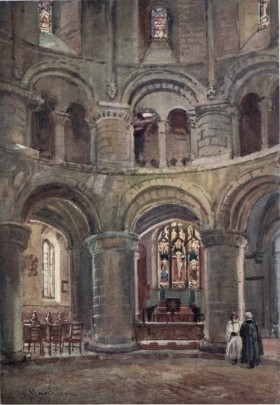
NORMAN CHURCH OF THE HOLY SEPULCHRE Believed to be the oldest of the four round Churches in England, built about 1120-40.
The town of Cambridge.
The Roman fortress lay on the left bank of the river, at the hamlet of Grantchester (Granta, castrum); the town of Cambridge proper, on the same bank, being called Grantabrigge. Here it was that William the Conqueror’s castle was built on the site of a British earthwork still known as Castle Mound, and here British as well as Roman coins and other Roman remains have been discovered. The British town of Cair-Graunth has been identified with both sites; while the Roman station marked in Saxon maps as Camboritum or Camboricum has hitherto been confounded with the site of the Norman fortress. We do not know where Camboricum was, but we no longer identify it with Cambridge.[3]
In the time of Bede, and earlier, Grantchester was a desolate ruin,[4] but Grantabridge was a place of some importance at the time of the Domesday survey, and we find that nearly thirty of its four hundred houses were destroyed to make room for William’s castle.[5] The town which is still called Grantabridge in the Anglo-Saxon Chronicle, in Domesday, and in Henry I.’s charter, becomes Cantebruge before the middle of the xii century, and Cantebrigge in Chaucer.[6]
Roman roads.
Two great Roman roads met near the Castle Mound, the one being the only way across the pathless fens, running from the coast of Norfolk through Ely to Cambridge and thence on to Cirencester and Bath; the other—via Devana—was the great highway (along the site of the present Huntingdon road) which led from Cambridge out of the fen country, stretching from Chester[7] on the north-west to Colchester on the south-east. This road crossed the only high ground in the flat country round Cambridge—the low range of hills called the Gogmagogs and Castle Mound itself.
The river.
The river Granta gave its name to the British and Roman towns (Cair-Graunth, Grantchester), to the university city, and to the whole shire. The Granta or Cam, for it is now called by both names, is made by the confluence of two small streams which meet beyond Grantchester; the eastern branch, the Granta, rising in Cambridgeshire, the western, the Rhee, in Hertfordshire. What other river in England can boast that it has been celebrated by our poets in every age? For Milton it is Camus, for Byron Granta, both names serve the muse of Gray; it is Wordsworth’s Cam, but Spenser calls it Guant, and also Ouse, the name it takes before reaching Ely, although the waters of the “plenteous Ouse” join the Granta much lower down.[8]
The ford.
The important thing about the river, which determined the history of the town on its banks, was that between Grantabridge and Grantchester it was fordable, and here only could it be traversed by those going to and from the east of England and the Midlands. Near Trumpington, indeed, a part of the Via Devana had been carried by the Romans right through the water.[9]
In the ix century the province of Cambridge—the Flavia Caesariensis of the Romans—formed part of the Danelagh.[10] Throughout the middle ages, writes Mr. J. W. Clark, the town “was a frontier fortress on the edge of the great wild ... which stretched as far as the Wash”: and no place suffered more from invasion and fire. The Danes completely destroyed it in 870, after the capture of York; and the fortunes of the two cities were again linked two hundred years later when William, fresh from the reduction of the northern capital, turned
A.D. 1068-1070.
his steps to Cambridge and made it the centre of his operations against the outstanding isle of Ely. A second destruction at the hands of the Danes occurred in 1010, and in 1088 Cambridge was again devastated with the rest of Cambridgeshire by Robert Curthose. This, however, led to a vigorous re-instatement of the city by Henry I. who showed it many marks of favour.
A.D. 1102.
In the second year of his reign he ordered the townsmen to pay their dues to the bedells, and about this time the ferry which had hitherto been “a vagrant ... even anywhere where passengers could get waftage over,”[11] was established at Cambridge, bringing traffic in its train. In 1106 the first signs of returning prosperity were seen in the settlement of the Jews. The Cambridge Jewry was near the market-place, and the Cambridge Jews were noted for their “civil carriage,” none of the customary outrageous charges
A.D. 1118.
being brought against them there.[12] Twelve years later, the king gave a charter to the burgesses.
Cambridge was at no period of its history a great or even a prosperous commercial centre. East Anglia has always been a corner of England to itself, not on the direct line to anywhere, and offering very few points of vantage to the statesman or the merchant. The course of a river determines the history of a town, as it first determines its site. This is well exemplified in the histories of the Granta and the “Isis.” The “Isis” is a reach of the Thames,[13] and this fact with its moral political and commercial implications has coloured the whole history of the town on its banks—everything came to Oxford by the river from London, and dignified alderman or humble bargeman shared with the lesser centre the life of the greater. The Granta and Ouse have a history in every sense the opposite of this. Through the centuries, long before Oxford was a town at all,[14] the sounds we hear are the thud of the Ely barge as it strikes the bank of deserted Grantchester, and Sexberga’s messengers borrow from the neighbourhood of the future university the sepulture for the founder of Ely—the gift of a civilisation still older than hers.[15] Or, three hundred and fifty years later, the chant of the Ely monks is wafted out upon the water as Canute bids his men rest a moment on their oars to listen
Merrily sang the monks of Ely when Canute the king rowed by.
The convent messenger, the Danish king, the Norman conqueror, may come up the water, but they make the stir they find, and the river leaves no trace behind them.
So the university town owes nothing to adventitious causes; makes no bid for public favour, and has no tentacles to put forth to obtain it. But the river has, nevertheless, determined its activities as well as its reticences. It will give rise to a fair, and Stourbridge fair will become one of the greatest fairs in the kingdom. The fish market was another source of traffic. Ely and Cambridge fish were celebrated—Bede, indeed, derives “Ely” from the abundance of its eels, although helyg (the willow) seems the more

MARKET SQUARE This picture represents what is called Half Market, which takes place on Wednesday. Market day, properly speaking, is on Saturday, when the square is filled with stalls. The church is Great St. Mary’s, and King’s College Chapel is seen in the distance on the left.
probable original.[16] The kings of England patronised this market, Henry III. sending for his fish to Cambridge even when he was staying at Oxford; and Chaucer is careful to note that the Cambridge miller was an angler, skilled in mending his nets.[17] The isle of Ely, so-called because cut off by river and mere from the rest of Cambridgeshire, was proverbial for the turbulence of its population, and the men of Ely drew the men of Cambridge into their quarrels, or harried them on their own account. Cambridge Castle was built as an outpost against the English earls who with Hereward resisted the Conqueror at Ely; it was at Ely that another determined stand was made by Simon de Montfort’s followers after Cambridge had been regained for John; and Henry III. had to bring relief to the university town when its neighbours burnt and plundered it during the years 1266-1270. The two centres were inseparable for weal or woe, and the intellectual as well as the political life of Cambridge was coloured for centuries by the activities of its neighbour.
The fen monasteries.
The proximity of the great fen monasteries must be reckoned as the chief factor in the earlier scholastic—the pre-university—history of Cambridge. Ely, Crowland, Bury-St.-Edmund’s and Peterborough were among the most important and the most ancient religious houses in the country. Crowland and Bury both had abbey schools influenced, as we shall see, in the early xii century by the famous school at Orléans; Ely had besides an episcopal school, and as monastery, school, and cathedral, was in constant domestic relations with her neighbour of Cambridge.[18]
Crowland.
Among these famous houses, surrounded by undrained marshes, like islands, forbidding and yet inviting access, none was more isolated than Crowland which, reared as Venice upon piles and stakes driven into the marshy ground, shone like a beacon out of the mysterious silence and solitude.
A.D. 1109.
The story that abbot Joffred of Crowland sent four Orléans monks full of new learning to his Cambridge manor of Cottenham[19] early in the xii century, who held disputations in a large barn, has been shown to be entirely legendary. Yet the moment chosen by the self-styled continuator of Ingulph is singularly felicitous.[20] We know nothing of any sources of information which may have been open to a xiv century forger; but it is certain that some such scholastic movements were fermenting in Cambridge in the xii century. Joffred had been prior at Orléans which was a flourishing school, and we have evidence that this school actually influenced the university of Cambridge. The abbey house of Crowland was burnt in 1091 and the rebuilding was not undertaken till 1113. It was likely enough that the abbot should look out for something for his learned monks to do, and should make use of an outlying manor near to such a centre as Cambridge as a promising field for activities restricted through the disaster to his house. Moreover the energies of the lecturers, we are told, were directed against Jewish doctrines, and the Jews, as we have seen, had come to Cambridge three years before. The town was rising in prosperity, and the charter of 1118 points to the conclusion that people and trade had been attracted to it since Henry’s first rescript sixteen years earlier.[21]
Whether among those attracted to Cambridge we are to count the large influx of scholars who are said to have listened to the Crowland monks, or not, it is certain that Cambridge became once more in 1174 the
A.D. 1174.
theatre of great disaster, and a destructive fire was only stayed when it could find no more fuel to feed it.[22]
The school of glomery.
Soi-disant Peter of Blois declares that the monks when they set about teaching “took the university of Orléans for their pattern.”[23] The earliest school we come across at Cambridge is a “school of glomery” under the patronage of the bishops of Ely. The archdeacon of Ely nominated the “master of the glomerels” and one of the chief acts of Hugh de Balsham was to limit the authority which the archdeaconry had thus come indirectly to exercise in university matters. From thenceforward the master of glomery is to have the same authority to compose disputes between glomerels as other regent masters had towards their scholars; but in disputes with scholars or with townsmen as to lodgings or in grave matters affecting the jurisdiction of the university, the glomerels were to plead before the chancellor. There were thus two classes of students in the early days at Cambridge, ‘glomerels’ and ‘scholars.’ The former were subject to the magister glomeriae who in his turn was subject to the archdeacon of Ely; the latter had grown up under the aegis of the regent masters and chancellor.
Now the school of glomery was nothing else than the time-honoured Cambridge school of grammar.[24] The word has been for centuries a local term known only here, and it is therefore the more interesting to find that the students of Orléans were called ‘glomerel clerks’ (clers glomeriaus) and that they resisted the invasion of their grammar schools by Aristotle’s logic in the xiii century.
Paris et Orliens ce sont ij: C’est granz domages et granz deuls Que li uns à l’autre n’acorde. Savez por qui est la descorde? Qu’il ne sont pas d’une science: Car Logique, qui toz jors tence, Claime les auctors autoriaus Et les clers d’Orliens glomeriaus.[25]
There were also ‘glomerels’ at Bury-St.-Edmund’s and Abbot Sampson’s doings as regards the grammar school there in the xii century bear a strong resemblance to Balsham’s doings at Cambridge in the xiiith.[26] The persistence of the glomery school at Cambridge and the equally remarkable persistence of this school at Orléans goes far to justify the conjecture that it was Orléans which influenced Cambridge, not Paris: for Crowland had certainly been influenced by the same school, and Cambridge and Bury were both familiar with ‘glomerels’; the former under the jurisdiction of the diocesan the latter under that of the abbot.[27]
The religious orders. The canons.
Cambridge presents us with an excellent example of the relations which secular and religious learning bore to one another in the foundation of universities. Ecclesiastically it was of no importance whatever; it was not the seat of a bishop nor the fief of abbot or prior—the one monastic house was the nunnery of S. Rhadegund, founded before the middle of the xii century—and at no time in

THE OLD GATEWAY OF KING’S COLLEGE This gateway now forms the entrance to the Library from Trinity Lane. The North door of King’s Chapel is seen in the distance.
its history was the fate of the university determined by the learning of the cloister or its fortune raised by a doctrine of the schools. Ely, the outside influence which played the largest rôle, introduced no monastic elements, and within Cambridge itself the communities which had most part in its development were the canons, and canons always represented a half-way house between clerk and monk. If their contribution to European learning be altogether inferior to that of the Benedictine, they at no time showed any desire to impose a tradition or to stamp with their own hall mark the scholars who willingly attached themselves to canonical houses. The earliest community of canons in Cambridge was founded by a Norman, Hugolina wife to Picot Sheriff of the county, in 1092, in gratitude for her recovery from sickness.
A.D. 1092
It was a foundation for six secular canons serving her church of S. Giles by the Castle, and the little community was transformed, twenty years later, by
A.D. 1112.
another Norman, Pain Peverel standard-bearer to the Duke of Normandy, into the Canons Regular of Barnwell under the rule of S. Augustine.[28] The six canons became thirty, and Barnwell Priory, on the other side of the river, became a house of considerable importance, and gave hospitality to Richard II. during the Cambridge parliament of 1388. It continued to exist till the Suppression. About 1135 a second canons’ house was established on the present site of S. John’s College. This was a hospital, or travellers’ hospice, designed by a Cambridge burgess, Henry Frost, who gave the plot of land and endowed “a master and poor brethren of the rule of S. Austin” to dispense the charity of the house.[29] If the Barnwell canons of S. Giles were among the earliest friends of the scholars, the canons of the hospice of S. John were to play the most important part in their history.[30] S. John’s and the other xii century foundation of S. Rhadegund were dissolved under similar circumstances within thirteen years of one another, the latter in 1497 the former in 1510.[31]
The Gilbertine canons of Sempringham.
There was a third community of Canons Regular at Cambridge. The Lincolnshire community founded by S. Gilbert of Sempringham in the xii century settled near Peterhouse in 1291. Their hostel “S. Edmund’s” took its name from the old chapel dedicated to the martyr-king enshrined at Bury-St.-Edmund’s, and a licence of Edward III.’s permitting the canons to acquire houses and lands in the town styles them “the Prior and Canons of the chapel of S. Edmund.” We hear of these possessions early in the xiv century when (in 1417) the Prior of S. Edmund’s leases land; and again in 1474 when the community sell land to William Bassett. Of the 26 houses of this Order—the only Order of English origin—there were two in the isle of Ely,[32] while a fourth was established near Hitchin. The Barnwell Memoranda announcing their arrival in Cambridge
A.D. 1291.
say: “The canons of Sempringham first came to dwell at the chapel of S. Edmund, and earnestly set about hearing lectures and attending disputations.”
Friars. Carmelites.
The four orders of friars were all represented in Cambridge, and all settled there in the course of the xiii century. The Carmelites or Whitefriars were the first to arrive, settling in 1200 at
A.D. 1249.
Chesterton near the town, then at Newnham, and finally in Mill Street (1291). For nearly a hundred years the Carmelites took no part in the academic life of Cambridge. They refused to graduate, and showed no desire to display the insignia of a secular doctorate over the peculiarly sacred habit of their Order. It was, indeed, at Cambridge that S. Simon Stock had had, in 1251, his vision of the Blessed Virgin, and had received from her hands the celebrated “scapular of Our Lady of Mount Carmel”; and it was not till forty years after this that the Carmelite Humphrey Necton, at the urgent instance of the then chancellor of the university, consented to take the degree of Doctor in Theology.[33] In the reign of Richard II. this was the richest religious house in Cambridge, and Edmund Langley Earl of Cambridge and Courtney Archbishop of Canterbury lodged there during the parliament of 1388. The Cambridge Carmelites put forth several eminent men: Bale, the historian, had been a Carmelite at Norwich before proceeding to the university; Walter Diss, a zealous opponent of the Lollards, was confessor to that friend of Cambridge John of Gaunt; Nicholas Cantilupe (1441) wrote the Historiola Cantabrigiae,[34] and friar Nicholas Kenton was chancellor of the university as late as the middle of the xv century.
Franciscans.
The Franciscans, or Greyfriars, came to Cambridge soon after their arrival in England, and during the lifetime of S. Francis. Among the nine friars who landed in 1224 there were three Englishmen, Richard Ingworth (the only friar in priest’s orders), who was accompanied probably by another East Anglian, and by Richard of Devon. This East Anglian element among the first Franciscans is noteworthy, for the first Franciscan readers in divinity at both universities hailed from our Eastern counties. The Cambridge burgesses established the friars at the Jewish synagogue next to the prison.[35] These uncomfortable quarters were exchanged later for a site in the present Sidney Street, where Edward I. built them a friary. Here they took part and share in the life of the university: the novices and younger brethren studied and graduated, the elder taught; while the church of the Franciscans, which was one of the finest buildings in the town, served the purposes of a university church before the rebuilding of Great S. Mary’s.
Dominicans.
The Dominicans, or Blackfriars, did not reach Cambridge till about the last quarter of the xiii century,[36] fifty years after the Franciscans. A strange destiny decreed that a house which had once been under the patronage of the seraphic Francis should nurture Oliver Cromwell and become the first Protestant college; and that the house of “the Lord’s Watchdogs” (Dominicanes) should become the front and centre of Puritanism in the university.[37]
[1] Cf. iii. p. 172.
[2] Siegebert, who had been baptized in France, on returning to his own country and becoming king of East Anglia “desiring to imitate those things which he had seen well ordered in France, at once set up a school in which youths could be instructed in letters, and was helped herein by bishop Felix who came to him from Kent, and who supplied him with paedagogues and masters after the custom of the men of Kent.“—Bede, cap. xviii.
[3] Cair-Graunt means the Castle on the Granta, and is exchanged in the A-S. Chronicle for Grantacaester.
[4] “Civitatulam quandam desolatam ... quae lingua anglorum Grantacaestir vocatur.“—Bede, cap. xix.
[5] The castle, ruinous by the middle of the xv c., was quarried to supply stone for King’s College and other university buildings in that and the next century. Edw. III. had quarried it for King’s Hall, and Hen. IV. granted more of the stone for King’s Hall chapel. Finally Mary gave the stone to Sir Robert Huddleston in 1557 for his new house at Sawston: “Hereby that stately structure, anciently the ornament of Cambridge, is at this day reduced next to nothing,” writes Fuller.
[6] A-S. Chron., Grantebrycge. Domesday, Grentebrige. Henry I.’s charter (1118) Grantebrugeshire and borough of Grantebruge. In Matilda’s grant of the earldom of Cambridge (before 1146) Cantebruggescire. Temp. John, Cantebrige, Cantebrig. Temp. Hen. III., Cantebr. (1218) Cantabr. (1231, 1261) Cantabrigiense. Cauntebrigg. and Cantebrigg. in the same deed relating to the Merton scholars (1269-70) Brit. Mus. Add. MSS. 5832. f. 74. Hundred Rolls (1276-9) Cantebr. In a document of Hugh de Balsham’s, 1275, Cantabr. Barnwell Chartulary, circ. 1295, Cantebrige, Cantebrigesire, burgum Cantebrigiae. In the earliest college statutes (1324) Cantebrigia. In Chaucer, Cantebrigge, Cantebregge. In the first half of the next (xvth) century we have Cambrugge in a petition sent by King’s Hall to the Franciscans. Cf. also note infra p. 7, on the name of the river.
[7] The Roman Deva.
[8] Caius, writing in 1447, says that the town is divided into two parts by the Canta and the Rhee, called earlier le Ee; and by Spenser the Cle. We have Granta, Guant, and Cante: the r dropped out, and G was replaced by C in the name of both town and river (see supra). Cante does not seem to have been the name of a river at all. The river bank by Castle Mound is spoken of in the xiv c. as “the common bank called Cante“: one arm at least of the Cambridge river was known simply as “the water” [Prof. Skeat has pointed out that Ee is the xii, xiii, and xiv c. form of the A-S. éa, cognate with aqua] and for centuries there would appear to have been no need for any other name. In Henry of Huntingdon’s Chronicle (1130) the river is called the Grenta; but Lydgate writes
[9] Trumpington is 2 miles S., Grantchester 2 miles S.S.W. of the town.
[10] 878. It was from the town (Grantebrycge) that the Danes set forth, two years before, and surprised Alfred at Wareham. In the time of Ethelred, just before the Danish invasion, Cambridge was a royal mint; it was so in the time of the Conqueror, and had a Danish ‘moneyer,’ and continued to be so under the Plantagenet kings: even Henry VI. coined money at Cambridge. In Domesday the town is described as a “Hundred,” a description, says Stubbs, belonging to big towns with large surrounding common land—Norwich and Canterbury are similarly described. After the history of the town became merged in that of the university, two parliaments were summoned there; in 1388, and in 1447 (afterwards held at Bury-St.-Edmund’s). For the city, see also p. 36 and v. p. 260.
[11] Fuller, p. 7.
[12] The edict expelling the Jews from England dates from 1290, and the Jews left Cambridge the year following.
[13] The fancy appellations Cam and Isis appear to have both been due to Camden. They are not heard of before his work appeared in 1586.
[14] Cambridge, writes Doctor Jessopp, existed as a town and fortress “a thousand years before Oxford was anything but a desolate swamp, or at most a trumpery village, where a handful of Britons speared eels, hunted for deer, and laboriously manufactured earthenware pots.”
[15] They found a Roman stone coffin, sculptured; one, apparently, of many known to have been left there, for portions of Roman sarcophagi are even now to be seen walled up in the church at Grantchester. Bede, cap. xix.
[16] The pollard willow is the chief denizen of the fens.
[17] The water runs flows and dances through the Cantabrigian’s life. The king’s and the bishop’s mills, Newnham mill just beyond, the Mill street, and the hythes, all courted constant recognition. As at Ely, the hythes were the small trading ports along the river: there was Dame Nichol’s hythe, Cornhythe, Flaxhythe, Salthythe, Clayhythe.
[18] For the vii c. foundation of Ely see chap. vi. p. 311. The see dates from 1107, when the minster became a cathedral. Crowland, in Lincolnshire on the borders of Cambridgeshire, was built over the tomb of Guthlac, a prince and a saint of the house of Mercia, in the vii c. Bury rose after the martyrdom of the East Anglian king Edmund (870) c. 903; it did not become a monastery till 1020. Peterborough was founded by Wulfhere, king of Mercia from 659 to 674: it formed part of the diocese of Lincoln till the xvi c. Ramsey and Thorney were other fen monasteries. Ramsey was on the borders, in Huntingdonshire, but Thorney was in Cambridgeshire. Peterborough and Thorney with Ely and Crowland were sacked by the Danes in 870. All these were ‘black Benedictine’ houses.
[19] Cottenham 7 miles north of Cambridge; the benefice became an advowson of Chatteris abbey in the isle of Ely, and was bestowed by the abbess on Warham in 1500.
[20] Joffred was appointed abbot of Crowland in 1109 in succession to Ingulph: the xiv c. forgery the Historia Croylandensis pretends to be written by Ingulph (nat. 1030) and continued by Peter of Blois. It contains fables about the antiquity of Oxford. See Ingulph and the Historia Croylandensis by W. G. Searle, M.A.
[21] p. 8.
[22] Fuller.
[23] “The monk Odo, a singular grammarian and satirical poet, read grammar to the boys and those of the younger sort assigned to him”; logic and rhetoric were imparted to the elder scholars. Soi-disant Peter of Blois.
[24] iii. p. 164. Their school was in the parish where the university schools rose later—under the shadow of Great S. Mary’s; and opposite was Le Glomery Lane (the Vicus Glomeriae).
[25] La Bataille des vii Ars. Oeuvres Rutebeuf, Paris 1839, ii. 415.
[26] Abbot Sampson (b. 1135) had himself been “a poor clerke” at the school of Bury, and William Diss, a Norfolk man, was the schoolmaster. In 1160 Sampson became its magister scholarum. He proceeded to buy certain stone houses—those solid structures which either as Jewish or Norman building were sought for at Cambridge and at Oxford also—so that the scholars might live rent free; and in 1198 he endowed the magister scolarum grammaticalium so that the tuition too became free. (The Chronicle of Jocelin of Brakelond, newly edited by Sir Ernest Clarke, M.A., F.S.A.) “School Hall Street” was just outside the abbey precincts, and answered to the “School Street” and the Vicus Glomeriae in Cambridge. There was an ancient chapel in Cambridge dedicated to the patron saint of Bury, and one of the chief possessions of that rich abbey was the manor of Mildenhall, which provided the expenses of its sacrist and cellarer: it is at least an interesting coincidence that Robert and Edmund of Mildenhall were original fellows of Michaelhouse; the former was its second master, third master, according to Le Neve, of Peterhouse, and chancellor of the university in 1334. An abbot and a monk of Bury are two of those to be specially commemorated in every mass said by the scholars of the new foundation of Michaelhouse (1324); and Curteys the 24th abbot of Bury was one of the personages invited by Henry VI. to assist at the laying of the foundation stone of King’s College. Walter Diss (a name well known in Bury) was a famous Carmelite friar at Cambridge in the xiv c. Fuller preserves the legend that Jocelyn, Abbot Sampson’s Boswell, had studied in the Cambridge schools, the source of which is Bale who was a Carmelite of Norwich and Cambridge. Together these things perhaps suggest that the schools of Cambridge and Bury had some relation to each other as well as to Orléans.
[27] A Henry of Orléans was sub-bailiff of Cambridge in the 2nd year of Edw. I. (Hundred Rolls i. p. 49).
[28] The transformation of houses of canons serving a church or cathedral into Regular Canons in the xii and xiii centuries was the effect of the rule indited by Yvo of Chartres which gave its final form and name to the “Canons Regular of S. Augustine” at the end of the xi c. The canons of S. Giles and Lanfranc’s hospital of S. Gregory at Canterbury were among the earliest of these communities to be converted, in the reign of Henry I., into Regulars.
[29] In the xi and xii centuries a large number of hospitals of the order of S. Augustine were founded for the relief of poor and impotent persons, the type being that of the Whittington hospital in London. Sometimes their object was to succour the wayfarer, sometimes they were virtually almshouses where leprous and indigent “brethren” formed the larger part of the community with a few “healthful brethren” and the master to look after them. Such was the origin, in the xi c., of the Knights of Malta, or Order of the Hospital of S. John of Jerusalem. At Canterbury Lanfranc erected a hospital of S. Gregory; at Oxford the hospital of S. Bartholomew, founded in the reign of Hen. I., was bestowed by Edw. III. on Oriel College; and Magdalen, Oxford, was erected on the site of another S. John’s hospital, which numbered brethren and sisters among its members. Amalfi merchants trading to the Holy Land endowed the first “master and brethren” of the Order of S. John of Jerusalem; a well-to-do burgess endowed the Cambridge hospice, and the nobles, the bishops, and the sovereign himself are to be numbered among the founders and benefactors of these first almshouses and hospitals. Cf. ii. p. 117 n.
[30] See chap. ii. Peterhouse and S. John’s.
[31] See chap. ii. S. John’s and Jesus Colleges.
[32] Fordham and Mirmaud-at-Welle. The Gilbertines of Chiksand in Bedfordshire had a house and garden in King’s Childers’ Lane by King’s Hall, which they leased to the university for the schools quadrangle in 1433. The Gilbertines were a double Order of nuns and canons; the former followed the Cistercian rule but were never affiliated to that Order. The canons followed the rule of S. Augustine, but the sympathies, like the dress, of the Gilbertines were Cistercian: “militat sub instituto Cisterciensi.” Only in this indirect way did Citeaux enter Cambridge: but see i. p. 25 and ii. p. 143.
[33] The Carmelite Bale says: ex omni factione sua primus tandem fuit qui theologicus doctor sit effectus. Pits says the same in the De illust. Angl. Script. For Carmelite property in Cambridge see also vi. pp. 325-6.
[34] This was the treatise known in Cambridge as ‘the black book,’ in which Prior Cantilupe tells of Cantaber and his son Grantanus, and their foundation of Cambridge on the site of Caergrant.
[35] The prison or tolbooth had been the house of Benjamin the Jew, which became university property in the reign of Elizabeth, but after a famous trial in the next reign reverted to the citizens. Like the Jewish houses elsewhere it was amongst the most solid structures in the town.
[36] Dugdale says “before 1275.” Their priory was enlarged and perhaps refounded by Alice, wife of de Vere second Earl of Oxford.
[37] Chap. ii., Sidney Sussex and Emmanuel Colleges.
Austinfriars.
The last to arrive were the Austinfriars, who entered Cambridge in 1290, at the same time as the Sempringham canons, just as the first Carmelite took his university degree, and as the Jews were expelled from the town. The priory was behind the present college of Corpus Christi, occupying part of the site of the Botanical Gardens, where the new museums now stand. Here was nurtured Miles Coverdale whose reforming principles were imbibed from its prior Barnes afterwards burned as a heretic.[38] Like the other Cambridge friars, the Austinfriars were dissolved at the Reformation.[39]
Other friars at Cambridge.
There were other friars in Cambridge. The friars of the Sack[40] or De poenitentia Jesu, were established in S. Mary’s parish in 1291, then in the parish of S. Peter. This was one of the spurious orders of Franciscans suppressed, as a result of the Council of Lyons, in 1307. The Barnwell Chartulary, however, has recorded for us that “these brethren of the Sack gathered together many scholars and good, and multiplied exceedingly until the time of the Council of Lyons.”
Other religious houses at Cambridge.
The Bethlemite friars came over here in 1257, and appear to have had only one house in England, that in Trumpington Street.[41] Our-Lady-friars (Fratres de Domina) are first heard of about thirty years later (1288). They were settled near the castle (and are hence called in the Barnwell Chartulary: Fratres beatae Mariae ad Castrum) and are only heard of at Cambridge and at Norwich where they arrived before 1290 and were there established at the time of the plague.[42] The Cambridge burgesses had an ancient leper hospital at Stourbridge, under the dedication of “S. Mary Magdalene for lepers.” In the closing years of the xiv century Henry Tangmer, alderman of the Guild of Corpus Christi, founded the Hermitage of S. Anne and Hospital of Lazars. About the same time (1395) the Benedictine nuns of S. Leonard of Stratford-le-Bowe granted a curtilage in Scholars’ Lane to the university.[43] The Priories of Anglesey S. John of Jerusalem and Tyltey and the abbeys of Crowland (p. 12) and Denney all held land in Cambridge.
The prior and convent of Anglesey, a Cambridgeshire house of Regular Canons, owned land here as early as 1278-9, and were of some importance in the town in the xiv century.[44] The land held by the knights of S. John was not part of the confiscated Templar property, all of which escheated to the Order, but was purchased by them early in the reign of Edward I.[45] It lay in the university centre between Mill Street and School Street (“Milnestrete alias Seynt Johnstrete”) and was a parcel of open land on which was their patronal church of S. John Baptist, and Crouched or S. Crosse’s Hostel.[46] In 1432 William Hulle, preceptor of Swenefeld, Templecombe, and Quenyngton, and prior of the English Langue, sold this ground to the university for the schools quadrangle, and the New Schools of Canon Law were built upon it.[47] The

ST. JOHN’S COLLEGE GATEWAY AND TOWER FROM TRINITY STREET Trinity Chapel is seen on the left behind the trees.
knights’ property was on the west of the schools quadrangle, the property of the nuns of Stratford-le-Bowe on the east. Denney and Tyltey both owned land on the site of Christ’s Pieces and elsewhere in the xv century. The former was a Franciscan nunnery founded by Marie de Chatillon Countess of Pembroke (p. 69) on land which was claimed from her by the knights of S. John as part of the sequestrated Templar property. It lay on the borders of the fen between Cambridge and Ely. The latter was a Cistercian house in Essex.[48]
The rôle reserved for these houses and congregations in the earlier history of the university was subordinate. By the time that every Benedictine house was required by the Constitution of Honorius III. (1216-1227) to send some of its students to the universities, learning had already passed from the monastery to the university, and the monks’ hostel at Cambridge[49] signalised the change. The part taken by the friars is not less instructive. The refusal of the Carmelites (throughout the xiii century) to pursue the academic course is valuable evidence of the conflict between secular and religious studies at the rise of the university. The Franciscans were the most important of the mendicants in England, and as such took a paramount place at both Cambridge and Oxford; but at the former their action was inconspicuous, and there is nothing to indicate that they were at any time or in any sense “nursing fathers” to Cambridge university whatever they may have been elsewhere.
The moment when they made their appearance was at least as propitious historically as it had been at Oxford, and the independent growth of Cambridge, its escape from the intellectual thraldom of that scholasticism of which the Franciscans were the chief exponents, are hence doubly significant. The quarrels which arose in the early xiv century between the officials of the university and the friars prove that the religious societies which shared its academic life did by no means act in permanent harmony with it. Thus in 1303 the chancellor quarrelled with the Franciscans and Dominicans and excommunicated two of the friars, and later in the century the university had to prohibit novices in the Cambridge friaries from proceeding to their degrees under eighteen years of age. Then, as now, the Franciscans were accustomed to recruit very little lads for the noviciate, all of whom probably received their education at the public Cambridge schools of grammar and theology, and might be seen strutting about as full-fledged “masters of arts before they were masters of themselves.”[50]
Before the xiii century closed—from the date of Hugh de Balsham’s death—the university ceased to receive any help from monastic learning, for the monks avoided Cambridge, and even Norwich priory sent its students to Oxford.[51] Less than a hundred years elapsed, and we find Gaunt, Pembroke, and Scrope—the court party—opposing the pretensions and the temporalities of the clergy in the company of Cambridge men. Pembroke—the representative of the house of Valence[52]—is their spokesman, and it is Scrope
A.D. 1371.
and Sir Robert Thorpe, Master of a Cambridge college, who take the Purse and the Seals from the hands of their episcopal holders Brantingham and William of Wykeham. This movement, as Stubbs points out, was independent of Wyclif’s; and it is remarkable that while William of Wykeham was influencing Oxford the theories for which he stood were being repulsed at Cambridge.
Cambridge and the jurisdiction of Ely.
There remains the relation of the university to the see of Ely. The episcopal jurisdiction of Ely in the university did not long survive the building of colleges. The scholars refused to plead in the archdeacon’s court, and Balsham upheld them—their statutes already provided as much.[53] Bishop Montacute also set limits to diocesan authority.[54] In 1317 John XXII. withdrew the university from the spiritual jurisdiction not only of the diocesan but of the provincial archbishop; but it was the friction arising from the failure of some of the bishops of Ely to recognise the spiritual independence of the chancellor which resulted in the celebrated court held at Barnwell priory at the instance of Martin V., in 1430, under the presidency of its prior. Two forged bulls of Honorius and Sergius[55] were cited as vii century evidence of the spiritual liberties of Cambridge, and the Pope in a third bull set the question for ever at rest in favour of the university. The solemn visitation of the colleges which had taken place under the auspices of Archbishop Arundel in 1401 was probably the result of the temporary victory obtained by the Primate when the chancellor refused to take an oath of obedience to him.
The early college statutes were as eager to repel the religious as the rule of Benedict, the father of western monasticism, was to repel the clergyman.[56] The statutes of Michaelhouse (1334), the earliest which have reached us intact, provide that neither monk nor friar should obtain admittance to the college. The statutes of Peterhouse enact that no one deciding to enter a religious order can remain on the foundation. It must at the same time be clearly realised that some of the earliest colleges were little more than clerical seminaries.[57] What is peculiar to Cambridge is that there a monk made the earliest attempt to endow learning for the secular clergy—a monk who was also a bishop, the ever-memorable Hugh Balsham. The non-monastic direction taken was by no means as yet an anti-monastic one; but at the rise of both universities, as soon as scholars were endowed and endowed houses began to be built for them, the monastic and the academic careers were regarded as incompatible vocations. It was the separation of the clerk from the religious, the recognition by Balsham of the secular scholar and of an endowed foundation for such scholars which was neither a religious house nor an episcopia, that transformed a more or less fortuitous concourse of students and teachers—a mere amplification, as at Oxford, of the school system of other great centres—into a chartered corporation of scholars—a university.[58]
II
School and university—Stourbridge fair—the university in the xiii century—Foundation of endowed scholars—hostels.
Both our universities doubtless count a school life of eight centuries at least: but a school life, the activity of teachers and scholars, is not the same thing as a university life. We have already said that Oxford owed its history to the constant communication between it and London, to its accessibility from the capital which made it the frequent resort not only of our kings but, what is more to our purpose, of scholars European and English.[59] The ferment created by their lectures no doubt kept alive the desire for knowledge and the spirit of enquiry among the motley population of the town; a moral atmosphere which in its turn attracted students. At Cambridge everything was the opposite of this. S. Frideswide’s at Oxford was a poor religious house, but it was in the heart of the town; the monastery at Ely was a great religious house, but its school was many miles from the university. Cambridge, as we have seen, was accessible to no great centre, there was nothing to attract the traveller who if he visited it almost certainly went out of his way to do so. Nevertheless some influences were at work in the xii century which determined the transformation of Cambridge into a studium generale, a university. The river near the town, as I have already said, gave rise to one of the greatest fairs in England, and Mr. J. W. Clark is disposed to see in the concourse of people brought together by Stourbridge fair the determining factor in our university history. The fair was called after the Stour a stream lower down the river, and was held in a large cornfield near Barnwell. It began on the feast of S. Bartholomew, August 24, and lasted till the fourteenth day after the feast of the Exaltation of the Cross (September 14). These five weeks of revelry proved more disturbing to Cambridge studies than the May term of to-day; xiii century scholars spent their money at Stourbridge fair as Isaac Newton spent his in the xviith; there he acquired his prism in August 1661 and a book on “Judicial Astrology” the geometry and trigonometry of which were then as ‘Greek’ to him. Sea-borne goods which had probably always been brought inland up the river to this point, formed the nucleus of the fair at Stourbridge. It is generally agreed that three other English fairs exceeded the Cambridge fair in importance, those at Bristol, Bartholomew’s in London, and Lynton. Defoe however describes it as the largest in Europe, greater than that at Nuremberg or than the Frankfort mart. It
A.D. 1211.
was already highly prosperous when King John made over its dues to the leper hospice of S. Mary Magdalene; and it has been suggested that this was the ancient fair to which Irish merchants brought their cloth in the time of Athelstan.
Why so uncommercial a district became the site of one of the greatest fairs in Europe, and why a studium generale became established there, are problems both of which we cannot resolve. There always remains at the bottom some virtue in the apparently unpropitious city on the banks of the Granta which as an Italian would say fece da sè. But Mr. J. W. Clark’s suggestion has at least placed the two problems in juxtaposition: the growing importance of the schools and the growing importance of the fair both meet us in the opening lustres of the xiii century; the fair, that is, has its roots in the preceding century when the fate of the embryo seat of learning lay in the balance. How should a fair, how should an extraordinary concourse of people, help to consolidate a university? Simply because this was the age of peripatetic teaching, because it was the custom all through the middle ages for wandering scholars to find themselves where men gathered together, and to claim for a theorem of Roscellinus or a doctrine from Araby brought by the crusaders the ear of a crowd which had just been entertained by the Norman jongleur.
Earliest references to Cambridge university.
Our first glimpse of the Cambridge schools shows us an immigration of the scholars of one university to the other. In 1209,
A.D. 1209 10th of John.
in consequence of an unjust retaliation upon the students, Oxford was depleted and its scholars found their way to Cambridge.[60] Nine years later we have a rescript of Henry III.’s (1218) ordering all those clerks
A.D. 1218 2nd of Henry III.
who had adhered to Louis to depart the realm. In the eleven years which elapsed between this and 1229 the Franciscans had established themselves at Cambridge, and in that year as a result of Henry’s invitation to
A.D. 1229 13th of Henry III.
Paris students to settle in England there was a considerable influx or foreigners to the university, the echo of which may be traced in two interesting rescripts of the year 1231. In one of these the king charges the mayor
A.D. 1231 15th of Henry III.
and bailiffs of the town to deal fairly with members of the university in the matter or lodgings, and enjoins them to establish according to “university custom” two masters and two liegemen of the town to act as “taxors.”[61] Dating the rescript from Oxford on the third day of May the king writes: “It is already sufficiently known to you that a multitude of scholars has gathered to our town of Cambridge, for the sake of study, both from the regions near home and from beyond the seas; the which is most grateful and acceptable to us, because it gives an example of no small convenience to our whole realm, and our honour is thereby increased; and you especially, among whom these students are loyally dwelling should feel it matter of no little gratulation and rejoicing.”[62] In the second rescript, dated from Oxford on the same day, the king enjoins that no clerk shall live in the town (quod nullus clericus moretur in villa) who is not under a magister scholarum.[63]
Charters and Bulls. Charter of Hen. III. A.D. 1231. Bull of John XXII. A.D. 1317.
These letters patent addressed to the mayor and burgesses of the town by Henry III. in 1231 are the earliest existing document which can be regarded in the light of a university charter.[64] At the same time it appears by no means certain that royal letters had not been addressed earlier to Cambridge in which the

ORIEL WINDOW OF THE HALL, TRINITY GREAT COURT In the nearer part of the picture is the Master’s Lodge, and in the far distance two turrets of King’s Chapel stand up against the evening sky.
academic society there was treated as a moral entity. In the following reign the jury of Cambridge made oath to the effect that “the Chancellor and Masters of the university had appropriated to themselves more ample liberties than were warranted in the charters granted them by the king’s predecessors”;[65] and in the same way when, at the request of Edward II., John XXII. erects Cambridge into a studium generale in the second year of his pontificate, he reaffirms and confirms the privileges with which his predecessors in the apostolic chair and the English kings had adorned the university: omnia privilegia et indulta praedicto studio ... a pontificibus et regibus praedictis concessa.[66] In this instrument he refers to Cambridge university as studium ab olim ibi ordinatum, “the university from old time there established.” Cambridge and Oxford, however, like the earliest centres of learning in Italy and France—Bologna and Paris—grew into universities; papal authorisations follow instead of preceding their institution. In other cases universities were definite creations which make their first appearance with a bull of institution and inauguration attached to them.[67]
Henry III.’s writs in behalf of Cambridge begin in the second and cover the fifty years of his reign. In the 45th and again in the 50th year he repeats and confirms his previous rescripts. The scholastic prosperity of Cambridge dates from this reign as its civil prosperity dates from that of Henry I.; and the traditions that Cambridge was Beauclerk’s alma mater and that Henry V. was a student at Oxford probably both derive from the signal favours shown to the two by these monarchs respectively.[68] Cambridge however was greatly reduced in the reign of John, especially about the year 1214 in spite of the recent immigration from Oxford.
The Henrys and the Edwards.
But from the accession of Henry III. onwards the university city became the special care of the Henrys and the Edwards. Edward I., while still Prince of Wales, visited the town in 1254 and undertook the pacification of the quarrels in which scholars and townsmen were engaged.[69] A document sealed with his own seal and those of the university and the borough ordained that henceforth 13 scholars and 10 burgesses should be chosen to represent the interests of both parties. Five of the former were to be Englishmen, 3 Scotchmen, 3 Irishmen, and 2 from Wales. The proportions are interesting.[70] It was soon after Edward’s accession that the refusal of Cambridge
4th Edw. I. A.D. 1276.
students to obey summonses to the archidiaconal courts led to Balsham’s judicious settlement of the point.[71]
Edward II. continued the interest shown in Cambridge by his father and grandfather; not only obtaining for it the status of a studium generale but maintaining a group of scholars there at his own
A.D. 1317.
charges—“king’s scholars” who were to rank with Ely and Merton scholars in historical importance. The favour shown to the university by the magnificent king his son was perhaps the one instance in which he took pains to fulfil the intentions of his murdered father.[72]
Foundation of endowed scholars. Hugh de Balsham
In the long reign of Henry III., in the year 1257, Hugh de Balsham,[73] subprior of Ely, was made tenth bishop of the diocese; and it was then that he placed and endowed at S. John’s hospital a group of secular students known as “Ely scholars,” who were the object of his anxious care until his death in 1286. His scheme and its results are described in the next chapter.[74] At this time there were no endowed houses at Cambridge, no school buildings, no endowed scholars.[75] It was some thirty years after the arrival of the Franciscans, the Carmelites had as yet taken no part in the academic life, and many years were to elapse before the Dominicans made their appearance. It was fifty years since the Oxford immigration, and thirty since the king had invited over the students from Paris. The distinction that was now made between the clerk-canon, or the clerk-friar, and the scholar in arts or theology who would remain a secular, converted, as we have said, the university corporation into something more—a studium generale, and led, as we shall see, to the building of the first endowed colleges.
Walter de Merton.
Contemporaneously with Balsham there lived and toiled another college legislator, Walter de Merton, Chancellor of England and afterwards Bishop of Rochester. His prime importance in developing the collegiate conception will be seen in the next chapter; here we are concerned with him as a founder of endowed scholars. Merton had eight nephews to educate, and he set about designing an academic scheme the far-reaching effects of which endure to this day, although the steps of the scheme are involved in an obscurity which responds to his own hesitations. He first assigned his manor of Malden,
A.D. 1264.
adjoining Merton in Surrey, as a chef-lieu and endowment for “poor scholars in the schools” who are living under a code of rules prescribed by himself. During the next five years he acquired lands both in Cambridge and Oxford; his chief acquisition at the former being in 1269, when he purchased an estate lying under the shadow of the Conqueror’s castle which included the Norman manor house known as the School of Pythagoras. This property had been in the possession of the Dunnings since the Conquest, and was afterwards known as the Merton estate. In the same year William de Manfield, who held a mortgage on this property, states that he had given his lands in Cambridge to the house, scholars, and brethren of Merton—domui et scholaribus et fratribus de Merton.[76] Meanwhile Walter de Merton had been buying land at Oxford,[77] and in 1274 he definitely moved the hall at Malden and refounded it as Merton College in the sister university; the formula hitherto maintained in his charters and statutes (see ii. p. 68) being now changed, and “poor scholars who are studying at Oxford or elsewhere where a studium generale exists” (Oxoniae, aut alibi, ubi studium viget generale) becomes “who are studying at Oxford where there is a university” (Oxoniae ubi universitas viget studentium).
The scheme thus crowned in 1274 had had its birth twelve years before when in 1262 Gilbert de Clare Earl of Gloucester allowed the manor of Malden to be assigned to the Austin priory of Merton or to some other religious house for the sustenance of clerici in scholis degentes (poor clerks in the schools) who were living according to Merton’s prescriptions.[78] This vesting of endowments in a religious house was already familiar at both universities. The Bishop of Ely (Kilkenny) had vested his exhibitions for divinity students in the prior of Barnwell in 1256, and it appears that this was Merton’s first intention. Two years later, however, we find him assigning Malden and other manors to his nephews, the beneficiaries being still described as “poor scholars in the schools.”
Any scholars maintained at either university by these endowments were “Merton scholars.” This is again made perfectly clear when the charter (and statutes) of 1270 were issued, in which Walter de Merton settles the Cambridge estates as part of the Malden endowments for “scholars studying in Oxford or elsewhere.” It was part of his plan to acquire local endowments at both universities, and also that vast clerical patronage in the different shires which was obviously destined to ensure the future of his scholars. This was the scheme eventually concentrated in the foundation of Merton, Oxford: and when Bishop Hobhouse is inclined to anticipate the date at which Merton scholars were established there, we may entirely agree with him, only adding that if there were certainly Merton scholars at Oxford before 1274, there were no less certainly Merton scholars at Cambridge also before that date. Merton’s scholars had their chef-lieu at Malden, but were studying at these two universities, and possessed endowments at both during the decade 1264-1274.
The Hundred Rolls furnish us with ample references to the Cambridge scholars. In the Rolls for the borough and town of Cambridge, the 2nd year of Edward I., they are accused of poaching on the
A.D. 1274.
fishing rights of the townsmen. “A servant of the House of the Merton scholars[79] had appropriated to his masters’ use a certain foss common to the whole town.” In the later inquisitions of the 7th of Edward I.
A.D. 1278-9.
we find them figuring among the most considerable Cambridge landlords, one entry showing them to us as purchasers of land from Manfield: Item scolares de Merton tenent unum mesuagium cum quadraginta et quinque acris terre ... quas emerunt de Willelmo de Manefeld.[80]
A.D. 1278-9.
Three of these entries point to tenure of no very recent date. Thus Eustace Dunning sold to Walter Howe a messuage with a croft which Eustace had inherited from his father Hervey Dunning, and for which the Howes, in accordance with an assignment made by Eustace Dunning, gave twelve pence a year to the clerks of Merton (per assignationem praedicti Eustachi clericis de Merton xiid).[81] The declaration is made by John son and heir of Walter Howe, so that Eustace Dunning’s appointment in favour of the
A.D. 1278-9.
Merton clerks refers to some time back. Again, Agnes daughter of the tailor Philip inherited a messuage in the parish of S. Peter which her father “had held of the Merton scholars.” In the last place the Cambridge jurymen affirm that two annual attendances should have been made at the court of Chesterton for a holding of Eustace Dunning’s, but that the scholars of Merton had failed to put in an appearance for the past six years.[82]
These transactions cannot be held to relate to an estate managed for the Oxford college founded in 1274, and to a period covering not more than four or five years. From 1274, which is also the date of the earliest Hundred Rolls, the Merton scholars were definitely and finally established at Oxford; and when John Howe and Agnes Taylor gave their evidence it is probable that there were no longer Merton scholars in Cambridge: what their depositions seem to indicate is a concurrent antiquity for Merton scholars at both universities. If these scholars had not been settled among them when these land transactions occurred the references would certainly have been to scholares de Merton Oxoniae,[83] and it is well worthy of notice that the only two instances in the Cambridge Hundred Rolls where “the Merton scholars at Oxford” are referred to are two instances where Walter de Merton is said to have “alienated” land in Cambridge for the use of the scholars in Oxford.[84]
No doubt it had always been part of Merton’s design to found a residential college for his scholars at one of the universities; and he had perhaps strong reasons for establishing this at Cambridge. His great patron was Chief-Justice Bassett, and the Bassetts were Cambridge landowners. His patron in the original assignment of Malden manor was Gilbert de Clare whose family gave its name in the next century to the eponymous college at the same university. Was the domus de Merton of “the scholars and brethren” (p. 39) in fact at one time such a residence? where poor scholars, some of them perchance from Merton priory school itself, lived under the auspices of the Merton brethren? Certain it is that a prior of Merton intrudes himself and his affairs into the Cambridge Hundred Rolls.[85] It is also certain that the House of Scholars of Merton is first heard of not at Oxford but at Cambridge. Mr. J. W. Clark has pointed out in another connexion that the words domus and aula were employed when a building was “appropriated by endowment as a fixed residence for a body of scholars.” Our domus scholarium de Merton on which Cambridge lands were bestowed—to which Cambridge lands were confirmed—in 1269, could not have been either in Surrey or at Oxford.
Whether there was a house of Merton scholars at Cambridge before there was a house of Merton scholars at Oxford, or not, it would appear that a like antiquity must be claimed for the scholars themselves at both universities.[86]
Universities in other towns. The licence to found a university at Northampton.
One of the odd things about Merton’s movements is that though he began buying land in Oxford the year after the Malden foundation (1265), he made his chief acquisition in Cambridge as late as 1269, and that a year later when he issued a revised set of statutes (1270) he still makes no allusion to any change of locality. It is possible that in 1265 when he wrote “at Oxford or at any other university” he had in mind the tentatives then being made to found an English university in some other town. It was in fact in 1262, the 45th year of the reign of Henry III., that Cambridge students had migrated to Northampton with the king’s licence to found a university. The traditional bickerings between southerners and northerners three years previously had been the cause of the exodus, and the Cambridge scholars found many Oxonians already there who had migrated from Oxford after their quarrel with the papal legate in 1238 but had obtained no licence to institute a university. The licence accorded to the masters and scholars of Cambridge university was withdrawn four years later on a representation being made to Henry III. that a university at Northampton must prove prejudicial to Oxford.[87] Migrations of students to other towns took place throughout the xiii century. They begin in 1209 when there was a general exodus from Oxford not only to Cambridge but to the town of Reading. Thirty years later the Oxonians migrated to Northampton and Salisbury, being followed to the former in 1262 as we have just seen by many Cambridge “masters and scholars.” These migrations certainly indicate that Oxford and Cambridge were not yet regarded as such permanent homes of English scholarship that other sites could not be substituted. The event which most impressed the popular imagination occurred when both universities had attained to European fame—the exodus in the reign of Edward III. from Oxford to Stamford which caused the king in 1333 to issue his royal letters forbidding any one to teach there. It had been prophesied that the studies pursued at Oxford would be transferred to Stamford, and the Cambridge floods gave rise to another prophecy, recorded by Spenser, which showed that the Stamford incident still occupied men’s minds. The flat Lincolnshire country would, it was said, become completely flooded, and Stamford then would
—— shine in learning more than ever did Cambridge or Oxford England’s goodly beames.
No migration took place from Cambridge after the foundation of its first college. But before we enter upon this period of its history, and find ourselves in the brilliant epoch which was so soon to overtake the university in the xiv century, let us see what arrangements were made for the accommodation of the scholar population previous to the existence of colleges.
At first—in the xii and the early part of the xiii centuries—scholars lived each at his own charges; perhaps groups of three and four would club together, but every scholar was then, as Fuller expressively has it, “his own founder and his own benefactor.”[88] The rescript of the early years of Henry III., already cited,
A.D. 1231 15th of Henry III.
introduces us to the town hostels—hospitia locanda; and establishes the taxing of lodging house charges by the taxatores, a usage probably rendered the more necessary owing to the great influx of students two years before, when the demand for lodgings must have been very much in excess of the supply.[89] These town hostels, the result of town enterprise, were subject to the four “taxors” only, and were under no other academic supervision.[90] It seems highly probable, however, that the king’s rescript gave rise to the university hostels, some thirty of which were in existence fifty years later. In any case the rescript leads us to conclude that the town hostels were in existence in the previous century, and supplies us with a date before which we cannot suppose that any university hostel existed.
The university hostel.
The university hostelries or inns for the accommodation of scholars who lived there at their own charges were intermediate between the town lodging house and the college, which they both anticipate and supplement. A number of scholars joined together, elected their own principal, and paid him at a fixed rate for board and lodging. At first, therefore, the university like the town hostel was a private enterprise, scholars undertook the charge of them in their private capacity. The head of the hostel was called the Principal. Later on these institutions changed their democratic character. The government passed entirely into the hands of the principal, certain oaths were exacted of him, and he kept a list of the scholars in his house.[91] The principal collected a rent from the inmates, though in some hostels the accommodation appears to have been free. All these changes, we may imagine, belong to the time when some of the hostels were affiliated to colleges, becoming thenceforward subject in all respects to the customs and discipline of the endowed foundation. Thus S. Mary’s hostel, where Matthew Parker studied, was affiliated to Corpus, Borden’s belonged to S. John’s hospital, then to Ely, and in 1448 was affiliated to Clare; S. Bernard’s belonged first to Queens’ then to Corpus; S. Austin’s to King’s. The hostels took their name sometimes from the neighbouring church or chapel, or other saintly patron, and sometimes from their proprietor. “Newmarket” and “Harleston” hostels must have served for students from these neighbouring towns. The monks who first came to study in Cambridge lived in lodgings; but these were soon exchanged for the monastic hostel, hence “Ely hostel” and “Monks’ hostel.”[92] Those zealous learners the friars of the Sack had Jesu hostel, dismantled in 1307, the Sempringham canons had S. Edmund’s hostel, the Barnwell canons had a hostel in the town called S. Augustine’s, and the hospitaller knights of S. John owned Crouched and S. John’s hostels in School Lane and Mill Street.[93] Rud’s offers a good example of a xiii century Cambridge hostel, and Physwick of one of the xivth. The former is mentioned in 1283 and was part of the compensation allowed in that year to S. John’s for the alienated hostels at Peterhouse,[94] it still exists, almost unaltered, and forms part of the Castle inn in S. Andrew’s Street. Physwick was the private residence of an esquire bedell of that name who bequeathed it for the purposes of a hostel in 1393. It was affiliated to Gonville and was in use until absorbed in the buildings of Trinity College in the xvi century.
Cambridge hostels were highly important foundations. The 8 jurists’ hostels housed eighty and a hundred students apiece, and the large hostels of S. Bernard, S. Thomas, S. Mary, and S. Augustine sometimes housed twenty and thirty regents without counting the non-regents and students.[95] A large proportion of men whose names are not to be found on the books of any college received their education in these houses. The Inns, of which there were three at Cambridge—Oving’s, S. Zachary’s, and S. Paul’s—were smaller and less important hostels and appear to have been frequented by the richer students. Hostel and hall or college existed side by side through the xiii, xiv, and xv centuries. Indeed until the college system was well established the hostels greatly exceeded the endowed halls in number, and they continued to supplement the latter until the completion of the large colleges at the renascence. Some twenty were erected as late as the xv and the opening years of the xvi centuries. During the xiv and xv centuries many hostels were destroyed to make room for the colleges; and in the xvith those which remained were abandoned, Trinity
[38] v. p. 275.
[39] All branches of the Augustinians were represented at Cambridge: the Augustinian canon at Barnwell, the hospitaller at S. John’s, and the hermit-friar at the Austin friary. ‘The friars heremites of the order of S. Austin’ were settled in Suffolk from the middle of the xiii c., probably by Richard de Clare Earl of Gloucester and Lord of the honour of Clare. One of their chief benefactors was Elizabeth de Burgh. See Clare College chap. ii. p. 64.
[40] Confraternities and friars “of the Sack,” known as Sacconi in their birthplace, Italy, and so called because of the loose gown or ‘sack’ common to begging friars and confraternities, and also because of the large sacks which they sometimes carried when begging for the poor, were associations due to the preaching of S. Francis and especially of S. Antony of Padua in the first quarter of the xiii c. So that the Cambridge friars, dispersed after the Council of Lyons in 1307, were one of the earliest of these communities; and it is interesting to find them addicted to scholarship.
[41] Matthew Paris, anno 1257. Concessa est mansio fratribus Bethleemitis in Cantabrigia, silicet in vico qui ducit versus Trumpintonam.
[42] They were begging friars following the rule of S. Austin.
[43] They had held land in Cambridge for over 100 years “of the gift of the earl of Mandeville.” At the Suppression they were seized of land in Haslyngfeld, co. Cambridge. Cf. ii. p. 96.
[44] The property was situated “in Henney,” a well-known part of Mill Street in the parish of S. John Baptist, and included the stone house on the high street by S. Michael’s rectory house which passed to the family of Sir John Cambridge in 1311 was by him bequeathed to Corpus Christi College, and became the nucleus of Gonville Hall. The prior of Anglesey is found leasing this land in the reign of Edward III., and selling it to Henry VI. in 1447. The priory lay between Cambridge and Newmarket.
[45] Rot. Hund. ii. 360. Cf. also ibid. p. 370.
[46] pp. 25 n., 49 and ii. p. 90.
[47] Another piece of this ground was conveyed by Henry VI. (who bought it of the university in the same year) to Trinity Hall in 1440 (and became the college garden). It is there described as “a void ground” pertinent priori et confratribus sancti Johannis in Anglia. Crouched hostel had already been pulled down for the schools. Like other hostels in Mill Street—God’s house, S. Nicholas, and Austin’s (see King’s and Christ’s Colleges) it stood, as we see, on open ground: “a certain garden of the hostel of the Holy Cross” we hear of in 1421.
[48] It is supposed that monks from Denney and Tyltey came here to study. The former was in fact a cell to Ely abbey before Marie de Chatillon transferred the Franciscans of Waterbeach thither. The two ‘nuns of the Order of S. Clare’ who were friends of Erasmus at Cambridge were probably inmates of Denney. In Rot. Hund. two other communities are recorded: the moniales de Pato, of whom we know nothing—there is a Paston in Norfolk and another in Northants.; and ‘the monks of the Holy Trinity at Cambridge’ who are mentioned in the Oxford Hundred Rolls of the 7th year of Edw. I.: the name affords another instance of the antiquity and popularity of this dedication to the Trinity, which we find at Michaelhouse, Trinity Hall, Trinity church, and in the guild of the Trinity at Cambridge.
[49] p. 127.
[50] Fuller.
[51] For later monastic influences in Cambridge, see ii. pp. 127-9, Magdalene College.
[52] Pembroke College p. 69. For Scrope see ii. 94, v. 295; for Thorpe ii. 75, 96, v. 295.
[53] ...in statutis universitatis ejusdem ... familia scholarium ... immunitate et libertate gaudeant qua et scholares, ut coram archidiacono non respondeant.... (Balsham’s Judgment A.D. 1275/6). The Statuta Antiqua, the old body of statutes of the university, have for the most part no chronological arrangement, and the date cannot in some cases be determined to within a century. The earliest ‘grace’ to which a date is attached belongs to the year 1359, but there is another referable to the year 1275/6. The latest, reduced to chronological order, is of the year 1506. The Statuta Antiqua were replaced in the 12th year of Elizabeth by a fresh body of statutes, and these again by the statutes of Victoria, 1882. The former are printed in Dyer’s Privileges of the University.
[54] Simon Montacute (1337-1345) ceded the right of the bishops of Ely to the presentation of fellowships in their own college of Peterhouse. Cf. also iv. pp. 203-4.
[55] Dated February 20, 624; and 689. Martin’s bull recognises their authority. Copies exist in the Cambridge Registry, Nos. 107 and 114 in the catalogue.
[56] “Si quis de ordine sacerdotium in monasterio suscipi rogaverit, non quidem citius ei assentiatur.“—Regula S. P. Benedicti, caput lx.
[57] See, chap, ii., Michaelhouse, Corpus, Gonville, and Trinity Hall.
[58] A chartered corporation and a university in the sense of a studium generale possessing European privileges. Cambridge was a universitas many years before this, and was so familiarly styled by Henry III. in 1231.
[59] It has been pointed out that our knowledge of Oxford’s intellectual activity during the xii c. is confined to the visits of three or four celebrated teachers who lectured to its changing population and in its schools, among which the priory school of S. Frideswide was the most important. We must not of course confuse the activities of monastic and episcopal schools with those of a university.
[60] Matthew Paris, in anno 1209: Ita quod nec unus ex omni universitate remansit.
[61] p. 47.
[62] Satis constat vobis quod apud villam nostrum Cantebr’ studendi causa e diversis partibus tam cismarinis quam transmarinis confluit multitudo, quod valde gratum habemus et acceptamus, cum exemplum toti regno nostro commodum non modicum, et honor nobis accrescat, et vos specialiter inter quos fideliter conversantur studentes non mediocriter gaudere debetis et laetari.
[63] Clerk and scholar were used interchangeably in the xiii c. as they are in these two rescripts, clericus being employed in the rescript of 1218 and in that addressed to the sheriff (vicecomes) of the county cited above: Quoniam ut audivimus plures nominantur clerici apud Cantabr. qui sub nullius magistri scholarum sunt disciplina et tuitione, sed potius mentiuntur se esse scholares cum non sint.... In a further rescript of the king’s the meaning is no less clear: Ita tamen quod ad suspensionem vel mutilationem clericorum non procedatis, sed eos alio modo per consilium universitatis Cantabr. castigetis. (Referring to “insults recently offered to certain northern scholars of the university of Cambridge,” 1261.) In the Hundred Rolls, at the same period, we have clerici de Merton and scholares de Merton; and clerici in scholis degentes is W. de Merton’s own description of his scholars.
[64] The charter of Oxford university belongs to the same reign.
[65] Rot. Hund. 7th Edw. I.
[66] The Pope no doubt refers to the forged bulls (p. 28) but his reference to previous royal rescripts is likely to be more correct, and to have been supplied by Edward himself.
[67] See studium generale pp. 30 n., 31.
[68] The importance of Cambridge was steadily growing in the reigns of Henry I. and Stephen. The isle of Ely supported Matilda; and the earldom of Cambridge was conferred both by her and by Stephen for the first time. The former by her letters, issued before the year 1146, bestowed it on her favourite Aubrey de Vere, “if the King of Scotland hath it not,” as prior in dignity to the counties of “Oxfordshire, Berkshire, Wiltshire, or Dorsetshire” one of which he was to take if Stephen’s gift of the earldom of Cambridge to Saint David of Scotland held good. De Vere had to accept the county of Oxford which has since remained in that family—the earldom of Cambridge passing to royal hands and becoming in time a royal dukedom. David of Scotland held Cambridge in his own and Huntingdon in right of his wife. Malcolm of Scotland held both earldoms together in exchange for the northern counties of Northumberland and Cumberland. The union of these earldoms is still represented by the union of Huntingdon and Cambridge under one vicecomes or sheriff. Edward III. created his wife’s brother (the Count of Hainault) and after him his son Edmund Langley, earls of Cambridge. Edmund’s son Richard held the earldom until his attainder, and his son Richard Duke of York was again created Earl of Cambridge by Henry V. (p. 295). This was Edward IV.’s father in whom the earldom became merged in the crown. The arms of Edmund Langley, Duke of York and Earl of Cambridge, are on the first of the 6 shields of arms of Edward’s sons over the entrance gate of Trinity; beneath is inscribed: Edmondus D. Ebor. C. Cantabrugie.
[69] See “Town and Gown” chap. iv. p. 233 n.
[70] Cf. “the students from regions near home” (e partibus diversis tam cismarinis ...) of his father’s rescript p. 33.
[71] For other references to this important document see ante pp. 14, 28; chap. iii. p. 165 n, iv. p. 203.
[72] Henry VI., VII., VIII., and Edward VI. continued the favour shown by the Henrys and Edwards to Cambridge; the exceptions were Henry V. and Edward IV. See ii. p. 101, v. p. 262. For the relation of the English queens to the university see Queens’ College pp. 109, 112, and p. 114.
[73] pp. 29, 54.
[74] Peterhouse p. 55, S. John’s pp. 122-3.
[75] Except Kilkenny’s exhibitioners, infra p. 40.
[76] “I have given to God, the Blessed Virgin, blessed John Baptist, and to the House of the Scholars of Merton“: these words occur in the same deed with those in the text. Harl. Add. MSS. 5832. ff. 74, 75. The gift includes a stone house in the town: Dedi etiam et concessi prefatae domui ... domum illam lapideam in Cauntebrigg. cum gardino et curia adjacente.... Three deeds relating to the same transaction are dated mense Martii 54th of Hen. III. In Rot. Hund. 7th Edw. I. p. 366, a certain John gives a quit rent to the scholars of Merton for 18 acres of this property.
[77] The priory of S. Frideswide granted him land in 1265, and he obtained much more two years later.
[78] The wording provides for the existing or any other ordinatio Merton may formulate.
[79] “Domus scolarium de Merton.” Burg. Cantebr. Rot. Hund. i. 55.
[80] Rot. Hund. ii. 360.
[81] The “Merton clerks,” clerici de Merton, are mentioned again in the next paragraph. At the same date a certain Johanna declares that she had as a marriage portion from her father a messuage given him by Cecil at the Castle, for which is paid a quit rent of twelve pence a year to “the scholars of Merton.” Rot. Hund. ii. 379. In the Hundred of Chesterton (p. 402) we find that “the scholars of Merton hold of the fee of Hervey Dunning” such and such properties. They also paid a quit rent to Edmund Crouchback for lands he held (on the death of de Montfort) as earl of Leicester.
[82] Rot. Hund. ii. 364, 407.
[83] The general rule in these Rolls is to add no qualification of origin in cases where the owner, or religious house, has another habitation in the locality to which the transaction refers. Hence we find “the prior of Anglesey,” “the prioress of Stratford,” side by side with “the scholars of Merton” in the Cambridge Hundred Rolls (cf. Rot. Hund. ii. 364).
[84] Grantchester (7th Edw. I. p. 565): et tota dicta pars alienata est scolaribus Oxon’ per dominum Walter’ de Merton’, nescit quo warranto. Gamlingay: “William of Leicester sold the whole of that holding to dominus Walter de Merton and the said Walter gave it all to the scholars of the domus de Merton Oxonie.”
[85] “Villani ejusd’ Gunnor’ dicunt quod prior de Mertone” held the advowson of the church of Barton. (Rot. Hund. ii. 564.)
[86] For the “Ely scholars” see ii. pp. 122-3. The first to leave an endowment for scholars was William of Durham in 1249; but several years elapsed before the fund was utilised, scholars maintained, or University College Oxford founded. University College was thus the outcome of an earlier intention to endow, and Balliol College was an earlier foundation in embryo, than either Peterhouse or Merton.
[87] The preamble of these letters addressed to the civic authorities at Northampton is as follows: Occasione cuiusdam magnae contentionis in villa Cantabrigiensi triennio jam elapso subortae nonnulli clericorum tunc ibidem studentium unanimiter ab ipsa villa recessissent, se usque ad villam nostram praedictam Northam. transferentes et ibidem (studiis inherendo) novam construere universitatem cupientes. The letters are dated from Westminster 1 Feb. in the 49th year of his reign (1265). Rot. Claus. 49, Hen. III. membr. 10. d. [1 Feb. 1264-5].
[88] Chaucer shows us that the system of private lodgings continued in vogue at Oxford even in the late xiv c. His “pore scholer” lodges in the house of a well-to-do carpenter.
[89] p. 33.
[90] Cf. the regulations for lodgings at the present day, iv. pp. 224, 225.
[91] Caius speaks of “two principals” overseeing respectively the studies and the economics of Physwick hostel.
[92] Cf. ii. Trinity Hall p. 79, Magdalene pp. 127, 128.
[93] Crouched, Crutched, for Crossed. So the Trinitarians who also wore a conspicuous cross on their habit were known in England as Crutched friars.
[94] p. 56.
[95] S. Austin’s or Augustine’s hostel had a length of 220 feet with 80 of breadth.
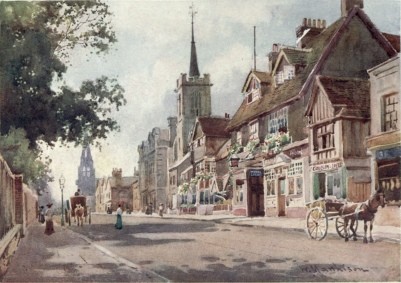
THE OLD CASTLE INN Now styled “Ye Olde Castel Hotel.” The Baptist Church and the Police Courts are seen just beyond, and the Roman Catholic Church in the distance. The near trees are in the grounds of Emmanuel College.
hostel, as Fuller testifies, being the only one remaining in use till 1540.[96]
CHAPTER II
THE COLLEGES
The university and the colleges—the collegiate system—eras of college building—Peterhouse—Michaelhouse—collegium and aula—Clare—college statutes—architectural scheme of a college—Pembroke—founders of colleges—Gonville—Trinity Hall—Corpus Christi—Cambridge in 1353—Chaucer at Cambridge—the schools, library, the university printers and the Pitt Press, the senate house—King’s—King’s College chapel—Cambridge college chapels—Queens’—English sovereigns at Cambridge—S. Catherine’s—Jesus—Christ’s—Lady Margaret and Bishop Fisher—S. John’s—Magdalene—King’s Hall and Trinity College—college libraries—gateways—Caius—monks in Cambridge—Emmanuel—Sidney Sussex—Downing—public hostels—nationality of founders and general scope of their foundations—university and college revenues.
THE college is an endowed foundation providing for the residence and maintenance of teachers—masters or graduates, and for the free education of a certain number of poor scholars, to whose company are added, according to the capacity of the building, other students who are able to live at their own charges.
Relation of the college to the university.
Much has been said about the relation of the college to the university. By some it is supposed that the latter is nothing but the aggregate of the former; that somewhere in the time of the Georges “the university” arrogated to itself a separate existence, and that since that time university offices have taken precedence of collegiate offices.[97] The universitas, the corporation of scholars, must and did precede any college foundation: at the same time we cannot distinguish the development of either of our universities from the rise of these foundations, whose history has, ever since, been the history of the academic society. Each college is independent and autonomous, and though the aggregate of colleges does not constitute the university, each collegiate foundation forms part and parcel of it in virtue of its union with the incorporated society of Chancellor Masters and Scholars which formed at first and still forms “the university.”
The college the distinguishing characteristic of Cambridge and Oxford
It is the collegiate system which distinguishes the English universities from all others. Everywhere else in Europe students live in their own private lodgings and have complete control of their lives, subject to no supervision whatever; the university has no rights over them and no means of ensuring their good behaviour during the period in which they choose to attend its lectures. In many parts of Europe the student passes from a school curriculum in which he has been treated as a complete dependent, on whose sense of common fairplay and honour, even, no reliance can be placed, to a curriculum in which he at once becomes his own absolute master. English instinct is against this—against abandoning a young man at a critical moment of his life to his own devices, his own unsupported endeavours, as it is against ruling him by a system of espionage in his school days. It is in favour in both cases of the moral support to be found in an external guarantee for order, orderliness—and of a tacit assistance to good instincts, a tacit resistance to bad; and the result is the university college.
The origin of the college system.
The result, as we say, is an English result, and is the development of a scheme to which shape was first given by Walter de Merton, Chancellor of England and afterwards Bishop of Rochester, and Hugh de Balsham Bishop and formerly subprior of Ely, in the reign of Henry III.[98] An endowed house and college statutes formed part of this fine academic scheme, which, in all its amplitude and completeness, sprang Athena-like from the brain of Walter de Merton, and was destined from the first to be realised in a university. It must, nevertheless, be clearly borne in mind that the original college dwellings—and the college statutes—were designed for adult scholars, they were, in fact, the earliest training colleges for teachers, and it is only later that their advantages were extended in equal measure to the taught.[99]
The era of college building.
College building began in the xiii century and ended with the xvith. The first great period of building, however, belongs to the second quarter of the xiv century, and no less than seven colleges and halls were founded between the years 1324 and 1352. Ninety years elapsed before the second period, which began with the foundation of King’s College in 1441 and ended with the foundation of S. John’s in 1509. The third and last period opened a hundred years after the foundation of King’s and closed with the foundation of the first Protestant colleges fifty years later (1595):
First period.
Second period.
Third period.
Peterhouse 1284
(28 years)Michaelhouse 1324
Clare 1326-38
King’s Hall 1337
Pembroke 1347
Gonville Hall 1348
Trinity Hall 1350
Corpus Christi 1352
(68 years)King’s College 1441
Queens’ 1448
S. Catherine’s 1473
Jesus 1495
Christ’s 1505
S. John’s 1509
(50 years)Magdalene 1542
Trinity 1546
(Caius 1557)
Emmanuel 1584
Sidney Sussex 1595
There were therefore 8 colleges in Cambridge by the middle of the xiv century; when the xvi century opened there were 14, and at its close 12 of the previous buildings remained and 4 new had been added. Downing College (built 1805) must be added to these, making at the present day a total of 17 colleges.
Peterhouse.
Peterhouse was founded by Hugh de Balsham[100] for his Ely scholars whom he had in vain attempted to unite, with a separate endowment of their own, under the same roof as the canons of S. John’s Hospital.[101] In 1284 he removed the Ely clerks to two hostels by S. Peter’s church at the other end of the town, and at his death two years later left three hundred marks for the erection of a hall. This was built in 1290 on the south-west and formed with the scholars’ chambers the only collegiate building at Peterhouse till the close of the xiv century. Here then were the primitive elements of a college; the hostel or scholars’ lodging house to which was added a common meeting and dining room, or hall. The little parish church of S. Peter served for prayers and gave its name to the college. College chapels were not built till considerably later: the example first given by Pembroke College in the next century not being followed for another hundred years. The quadrangle was not begun till 1424. A combination room[102] opening out from the hall, and a library, were added along the south side. Over the former was the master’s room, over the latter the students’ quarters; and all looked upon the ancient lawn, the meadow with its elms beyond and, stretching to the right, with its water gate, Coe fen.
Ye brown, o’er-arching groves, That contemplation loves, Where willowy Camus lingers with delight! Oft at the blush of dawn I trod your level lawn . . . . . . . . . .
With Freedom by my side, and soft-eyed Melancholy.[103]

PETERHOUSE FROM THE STREET The Tower of the Congregational Church in the distance.
Hostels and church, facing the Trumpington road, were just without Trumpington gate. In 1309 the college area was extended southwards, over the ground occupied by Jesu hostel.[104] The property of the Gilbertine canons was added in the xvi century. The college area covers the space between Trumpington Street and Coe fen, and Little S. Mary’s church and Scroope Terrace; two-thirds of the site of the Fitzwilliam Museum being ground purchased from Peterhouse. The new Gisborne building (1825) is built on the west beyond the hall. The frontage of Peterhouse on Trumpington Street is unpromising; nothing suggests the charm of the buildings on the south side or the open country beyond, stored with historical memories. From the hall, a site unrivalled in the university, opens the panelled combination room,[105] the “Good Women” of Chaucer limned in one of its bays, recalling
The chambres and parlers of a sorte With bay windowes
described by the poet’s contemporary.
Above the xvi century library (of which Balsham’s own books were the nucleus, enriched by Whittlesey, Bottlesham, Arundel, Warkworth, Gray, Perne, and Cosin)[106] a charming corner room in the students’ quarters has been set apart by the present Master for evening study, a veritable solarium where the readers are surrounded by the portraits of the great sons of Peterhouse.
The chapel A.D. 1628.
Old S. Peter’s church was perhaps burnt down in 1338-1340 by a fire which is supposed to have also destroyed the chapel of S. Edmund. On its site rose the present church of Little S. Mary.[107] But in the early xvii century a movement was set afoot at Peterhouse which resulted in the erection of a college chapel. It now stands in the midst of the college buildings, and one of the two ancient hostels, “the little ostle,” was demolished to provide a site. Matthew Wren, uncle of Sir Christopher and then Master of the college, afterwards Bishop of Ely, was the builder. The desire of the fellows of Peterhouse for a chapel of their own coincided with the movement in the English Church for an elaborate ritual. As it stands it is a perfect specimen of a xvii century chapel, with its dark oak stalls, and its east window spared from Commonwealth marauders by the expedient of removing the glass piece by piece and hiding it till the
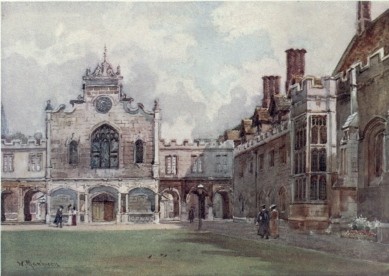
PETERHOUSE—THE FIRST COURT The entrance to the chapel faces the spectator. On the right is seen the Combination Room (1460) and the Hall. Through the Cloisters we get a view into the street. This is the oldest college in Cambridge.
iconoclastic fever had spent itself. But still we have only the shell of the original chapel, the roof of which was adorned with figures of a hundred and fifty angels the statue of S. Peter presiding from the west. Nine years later all this was pulled down by the Commonwealth men and the ritualist movement it embodied came to an end.[108]
Hall portraits.
Peterhouse hall, in common with the halls of all other colleges, contains the portraits of its great men: here, however, they look down upon us not only from the wall above the high table but from the stained glass of the windows. Holbroke Master of the college, chancellor of the university during the Barnwell process, and an early student of science; Cardinal Beaufort scholar of the house who represented Henry V. at the Council of Constance, and was himself, perhaps, papabile; Warkworth writing his Lancastrian Chronicle—are in their doctor’s scarlet: here also are Whitgift, Cosin, and Crashaw, who is depicted as a canon of Loreto; the poet Gray, the third duke of Grafton chancellor of the university and Prime Minister, and Henry Cavendish the physicist. The panel portraits were removed here from the Stone parlour. The painting of Bishop Law by Romney (?) reminds us that many of the Laws were at Peterhouse, including the first Lord Ellenborough. Over the high table is Lord Kelvin the latest famous son of the house. Among these must also be noted Thomas Heywood “a prose Shakspeare,” Hutchinson “the regicide” one of the first Puritan gentlemen and one of the best, Peter Baro, Markland the classical critic, and Sherlock who measured himself against Bossuet.
Peterhouse owes nothing to royal endowments but it has not lived outside the stir of national movements either political or religious. There were fervent Lancastrians within its walls in the xv century, fervent partisans of the Stuarts in the xviith. It was, second to none in England, the anti-Puritan college, numbering among its masters Wren and Cosin, and that Doctor Andrew Perne who was among its most munificent benefactors.[109] Perne was a Petrean first and a theologian afterwards, and, as vice-chancellor, was to be found burning the remains of Martin Bucer and Paul Fagius[110] in order to ingratiate the university with Mary, and signing the Thirty-nine Articles on the accession of Elizabeth. The letters AP AP on the weather cock of his college are said to mean: Andrew Perne, “a Papist” or “a Protestant,” as you will; and in Cantabrigian language a coat that has been turned is a coat that has been perned, and pernare signifies to change your opinions with frequency.
Since the xvii century Peterhouse has been connected with no great movements. In the xv century and again in the early xixth it produced eminent physical and mathematical students; and in the xviii century Sir William Browne, President of the College of Physicians, learnt here his science. Scotchmen have a predilection for the college; and a nucleus of history men is being formed under the present Master’s guidance.
Little S. Mary’s.
The patronage of the historical church which was for three or four centuries the chapel of Peterhouse remains in the hands of the college. It is indeed an integral part of Peterhouse for every Petrean. But its interest does not end here; it reaches across the Atlantic and binds the new continent to the home-hearth of learning in England. A monument in the chapel to Godfrey Washington who died in 1729 bears the arms argent two bars gules, in chief three estoiles—the origin of the Stars and Stripes. The Washington crest is an eagle issuant from a crown—affirming sovereignty or escaping from a monarchy?[111]
Cherry Hinton.
The Rectory of Cherry Hinton two and a half miles south-east of Cambridge, on the way to the village of Balsham, is no less important in the history of the Ely scholars. In the xiv century the endowment of the college was not sufficient for their maintenance all the year round: the college nevertheless had made rapid progress since its separate existence at Peterhouse began, and Fordham Bishop of Ely (1388-1426) decided to confirm to them the greater tithes of Cherry Hinton of which the college is to this day rector; but which had indeed been first assigned them by Bishop Simon Langham as early as 1362.[112]
A visit to this interesting church completes our picture of the college which “his affection for learning and the state of the poor scholars who were much put to it for conveniency of lodging” persuaded Balsham to endow.
Peterhouse lodge.
The lodge of Peterhouse is on the opposite side of Trumpington Street, and is the only example of a lodge outside the college precincts in the university. The house belonged to Charles Beaumont, nephew of the metaphysical poet Joseph Beaumont who was Master of Peterhouse, and was bequeathed by him for the college lodge in 1727.
Peterhouse has always been one of the small colleges. Balsham founded it for a master, 14 fellows, and a few Bible clerks.[113] In the time of Charles I. (1634) it maintained 19 fellows, 29 Bible clerks, and 8 scholars, making with the college officers and other students a total of 106. Sixty years earlier, when Caius wrote, there were 96 inmates, and in the middle of the xviii century, 90. To-day there are 11 fellowships, and 23 scholarships varying from £20 to £80 a year in value.
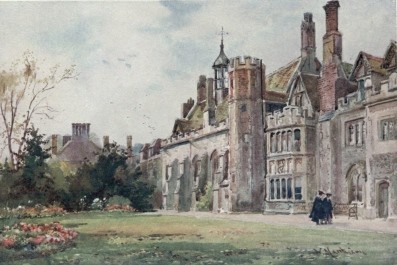
PETERHOUSE FROM THE FELLOWS’ GARDEN On the right is the Combination Room (1460), while farther back in the picture is the Hall, a continuation of this range of most ancient and picturesque buildings.
The bishops of Ely have never ceased to be the visitors of the college.
Michaelhouse.
Nearly forty years elapsed before a second college was projected. On September 27 1324 Hervey de Stanton, who like other founders in both universities—like Merton, Alcock, Wykeham, and Wolsey—was a notable pluralist,[114] opened Michaelhouse on the present site of Trinity. His purchases for the site had been made in 1323-4, and as was the case with the foundations preceding and succeeding it, Michaelhouse was an adaptation of edifices already existing. It remained one of the principal collegiate buildings until the xvi century and was successively enlarged by absorbing both Crouched and Gregory’s as students’ hostels.
Domus aula collegium.
As Peterhouse was called “the House-of-Scholars of S. Peter,” so was Michaelhouse called “the House-of-Scholars of S. Michael.” It will be seen that domus and aula were the earliest appellations. As hospitia or diversoria literarum signified the unendowed house, so domus or aula scholarium signified the endowed house. Such compound titles as “house of S. Peter or hall-of-scholars of the Bishop of Ely” precede, as they explain, the later title college. A college denotes not a dwelling but a community: precisely the same distinction is to be drawn between domus and collegium as between monasterium and conventus. Every university domus was intended for a college of scholars, as every religious house was intended for a convent of religious; the transition was easy, though not logical, from “college of the hall of Valense-Marie” to Valence-Marie College, and to-day the word is used indiscriminately to mean both the building and the community.[115]
Clare Hall 1326-1338.
Clare Hall was erected on the site of University Hall, a house for scholars founded during the chancellorship of Richard de Badew who obtained the king’s licence for it on February 20 1326, when he was lodged at Barnwell.[116] In the next reign (1344, 18th of Edward III.) it is referred to as “the hospice belonging to Cambridge university.” This hall, like Peterhouse, originated in two hostels purchased for the university in the street running parallel to the High Street, from the present site of Queen’s to the back gate of Trinity.[117] Twelve years later Elizabeth de Burgh[118] sister and co-heiress of
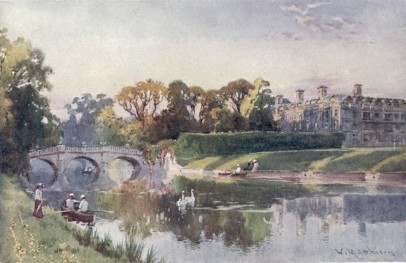
CLARE COLLEGE AND BRIDGE FROM THE CAM—AUTUMN EVENING
Gilbert Earl of Clare founded her college and in 1340 she obtained possession of University Hall,[119] and decreed in 1359 that it should thenceforth be known as the “House of Clare.”[120]
The scheme of building of Clare Hall was quadrangular; but no college was longer in the building. A hall, combination room, and Master’s room were on the west, while the chapel at the north-east angle was not built till 1535.[121] The scholars had till then kept their prayers in the parish church of S. Zachary and in the south chancel aisle of S. Edward’s. The present chapel was not begun till 1764. As we see it now Clare is a homogeneous piece of work of the time of Charles I., and in its classical beauty is one of the finest in Cambridge. This complete rebuilding occupied twenty-six years—from 1635 to 1661. There is no record of the architect, though an unsupported tradition points to Inigo Jones.
When one pictures Clare Hall it is to recall “the Backs,” the characteristic feature of Cambridge scenery which rivals the beauty of “the gardens” in the sister university. The grounds of the succession of collegiate buildings fronting the ancient High Street, with sloping lawns, bowling green, and fellows’ garden, extend along the backs of the colleges beyond the narrow river over which each college throws its bridge, and beyond again runs the well known road and the college playgrounds.
Clare is supposed to have been the “Soler hall” of Chaucer’s Tale.[122] It has enjoyed the reputation of a fashionable college, and indeed of a “sporting college.” It no doubt enjoyed the former reputation from the first, as a foundation under the patronage of the great house of Clare, and furnished some of the overdressed dandies who flocked to Cambridge in Chaucer’s time, as well as his “pore” Yorkshire “scolers” or others like them. Ralph Cudworth was Master of the college; Tillotson Archbishop of Canterbury, the martyr bishop Latimer, and Whiston the successor of Newton were its fellows; and Nicholas Heath primate of York, Sir George Downing, Cole the antiquary, Townshend, Chancellor of the Exchequer, the first Marquis Cornwallis, Brodrick Archbishop of Cashel, and Whitehead the laureate were its alumni. It was founded for 20 fellows or scholars, 6 of whom were to be in priests’ orders. In 1634 there were 15 fellows and 32 scholars, in all 106 inmates. In the time of Caius there had been 129, and in the middle of the xviii century there were about 100. There are
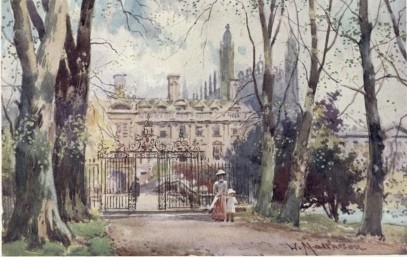
CLARE COLLEGE AND BRIDGE FROM THE AVENUE King’s College Chapel is seen through the trees.
now 18 fellowships and 31 scholarships ranging in value from £20 to £60.
College statutes.
The statutes of Clare Hall were written by the founder in 1359, a year before her death. The statutes of Peterhouse[123] and of Pembroke do not exist in their original form—and those of Hervey de Stanton for Michaelhouse and of Elizabeth de Burgh for Clare must be held to be the two types of Cambridge college statutes. Of these the latter rank as the most enlightened original code framed for a Cambridge college. Stanton’s contain little more than directions for the conduct of a clerical seminary, and this type was followed by the framers of the statutes of Corpus Christi and in their general intention by Gonville in statutes afterwards modified by Bateman. The statutes of King’s Hall framed for Richard II. reverted to the Merton type; Henry VI.’s statutes for King’s follow, as we shall see, the type already laid down by William of Wykeham, while Lady Margaret Countess of Richmond, and John Fisher Bishop of Rochester framed statutes which contain some original elements.
Elizabeth de Burgh’s originality consists in her realisation of the value of learning and of general knowledge for all kinds of men and for its own sake. “In every degree, whether ecclesiastical or temporal, skill in learning is of no mean advantage; which although sought for by many persons in many ways is to be found most fully in the university where a studium generale is known to flourish.”[124] Thence it sends forth its “disciples,” “who have tasted its sweetness,” skilled and fitted, to fill their place in the world. She wishes to promote, with the advancement of religious worship and the welfare of the state, “the extension of these sciences”; her object being that “the pearl of knowledge” “once discovered and acquired by study and learning” “should not lie hid,” but be diffused more and more widely, and when so diffused give light to them that walk in the darkness of the shadow of ignorance.[125]
The statutes of Marie Valence were written twelve years earlier and even in the form in which they have come down to us have a character of their own and conform to none of the three types of Merton, Michaelhouse, or Clare.[126]
Merton’s statutes were issued in 1264, 1270, and 1274, and the 1274 statutes exist in the university library in a register of the Bishops of Lincoln. Mr. J. Bass Mullinger has printed Hervey de Stanton’s in Appendix D. to his “History of the University of Cambridge”; they are contained in the Michaelhouse book in the muniment room of Trinity.
For King’s Hall, founded in 1337, see page 131.

THE HALL OF CLARE COLLEGE The notable features of this interior are the plaster ceiling and the large oak figures over the fireplace, the latter designed by Sir M. Digby Wyatt 1870-72.
Pembroke College A.D. 1347.
Pembroke Hall was founded in 1347 by Marie daughter of Guy de Chatillon comte de Saint-Paul and of Mary grand-daughter of Henry III. She was of the blood of that Walter de Chatillon who in the retreat from Damietta during the 7th crusade, held a village alone against successive assaults of the Saracen; and having drawn forth their missiles from his body after each sally, charged afresh to the cry of Chatillon! Chevaliers!—and the widow of Aymer de Valence Earl of Pembroke the inexorable enemy of Robert Bruce in Edward’s wars against the Scottish king. Pembroke stands opposite Peterhouse and several hostels were destroyed to make room for it. It was called by the founder the hall of Valencemarie, and in Latin documents aula Pembrochiana.
Architectural scheme of a college.
With Pembroke the first college foundation stone was laid in Cambridge. Here for the first time we have a homogeneous collegiate house and not a mere adaptation of pre-existing buildings, and may therefore enquire what was the architectural plan of a college. The principle of the quadrangle, although it underwent considerable architectural development, was recognised with the first attempt at college architecture.[127] The special collegiate buildings at first occupied one side of the court only. Here, facing the gateway, were to be found the hall with its buttery and kitchen, above the hall the Master’s lodging, with perhaps a garret bedroom above it—the solarium. The combination room attiguous to the hall makes its appearance in the next century, and at right angles or parallel to this main block stretch the students’ chambers and studies. A muniment room or treasury is over the gate; the library, occupying a third side,[128] and the chapel, come later; and last of all the architectural gateway is added.[129] Meadows and fields and the Master’s plot of ground are soon developed into the Master’s garden, the fellows’ garden, the bowling green, and tennis court. By the xv century the buildings round a courtyard easily assume the plan of the new domestic dwelling of that epoch, of which the type is Haddon Hall Derbyshire and, in Cambridge, Queens’ College: the college domus of the xiv century becomes the quadrangular manor-house of the xvth and xvith. In such a scheme of public buildings only a few scholars could be lodged in the main court, and smaller quadrangles for their accommodation were therefore added. University Hostel formed one side of such a second court in Pembroke; Clare and Queens’ had also second courts, and their example was followed at Christ’s and S. John’s.
Here then we have a scheme of building which is neither monastic nor feudal. It may with propriety be called scholastic but it is also essentially domestic architecture. The college quadrangle as we see it evolved in Cambridge is the earliest attempt at devising a dwelling which should resemble neither the cloister nor the castle, should suggest neither enclosure nor self-defence—a scholastic dwelling. The college is the outcome of that moment in our history when feudalism had played its part and monasticism was losing its power; it represents what the rise of the universities themselves represents and its architectural interest is unique. No monastic terms are retained; the hall is not a refectory, the one constant monastic and canonical feature, the church, has no part at all in the scheme—the scholars were men not separated from their fellows and they used the parish church.
The first collegiate dwelling houses, like the English manor-house, consciously or unconsciously followed one of the oldest house-plans known to civilisation—the scheme of dwelling-rooms round a court was that of the Roman house. The aula seu domus scholarium had moreover as its starting point—like the earliest domus ecclesiae—a hall in a house; the hall is the nucleus of the college.[130]
The site of Pembroke.
Marie de Saint-Paul, like her predecessor Elizabeth de Burgh, purchased university property for the site of her college. “University hostel” which stood here formed one side of the narrow quadrangle the building of which was at once begun, and a messuage of Hervey de Stanton’s formed the other. Within five years the complete area had been acquired, and it is probable that the south side was also partly built before the founder’s death in 1377. On the west were the hall and kitchen, on the east, abutting on the street, was the gate with students’ chambers on either side of it. With the hostel the founder bought an acre of meadowland which she converted into an orchard—“the orchard against Pembroke Hall” it is called in her lifetime. She also obtained permission from two of the Avignon popes—Innocent VI. and Urban V.—to erect a chapel and bell tower, and these were built, after the middle of the xiv century, at the north west corner of the closed quadrangle. This interesting site was used later as a library and is still a reference library and lecture room. Traces of fresco remain under the panelling, and the chaplain’s room with its hagioscope for the altar is on the east. The lower part of the bell tower also still exists.
In 1389 the college acquired Cosyn’s Place, and later Bolton’s, and in 1451 a perpetual lease of S. Thomas’s hostel. University hostel retained its name till the last quarter of the xvi century, and it was only pulled down in 1659 to make room for the Hitcham building which now forms the south side of the second court. There is nothing left of the xiv and xv century structures. The present lodge, hall, and library and the other new buildings in stone and red brick have all been erected since 1870. The chapel occupies part of the site of S. Thomas’s hostel, and was built by Matthew Wren, Bishop of Ely and Master of
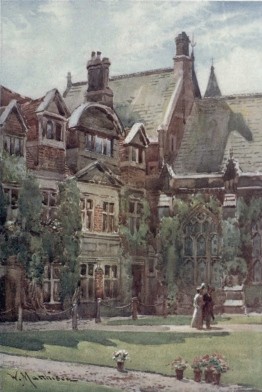
THE OLD COURT, PEMBROKE COLLEGE The Dining Hall is seen on the right of the picture.
Peterhouse, at his own charges; the architect being his nephew Christopher Wren. The bishop had already built Peterhouse chapel and this new work was undertaken in fulfilment of his intention to make some pious offering if he were ever liberated from the Tower, where the Parliament kept him between the years 1642 and 1658. The fine combination room is panelled with the oak from the xvii century hall. The portrait of Marie de Saint-Paul presides in the present hall with that of Henry VI. flanked by busts of Pitt, Gray, and Stokes.
Two spiritual relationships were bequeathed by the founder to the college. One with the Franciscan friars, the other with the Minoresses of Denney. The former connexion ceased almost as soon as it was devised, for the existing edition of the statutes (made after the founder’s death) omits all mention of it.[131]
No college but Trinity outshines Pembroke for the fame of its scholars and none for the antiquity of its fame. Henry VI. in a charter granting lands speaks of it as “this eminent and most precious college, which is and ever hath been resplendent among all places in the university.”[132] The king so favoured it that it was called his “adopted daughter”; and when Elizabeth rode past it on her way to her lodging at King’s she saluted it with one of those happy phrases characteristic of the Tudors: “O domus antiqua et religiosa!” words which sum its significance in university history.
Pembroke is the alma mater of Edmund Spenser,[133] of Gray,[134] of the younger Pitt,[135] of Thixtil, fellow in 1519, whose extraordinary erudition is praised by Caius, of Wharton the anatomist, Sydenham the xvii century physician, Gabriel Harvey the “Hobbinoll” of the Shepherd’s Calendar,[136] Sir George Stokes the mathematician, and Sir Henry Maine.[137] *Grindal and *Whitgift[138] of Canterbury, *Rotherham and *Booth of York, *Richard Fox Master of the college, Bishop of Winchester, and founder of Corpus Christi Oxford, the two Langtons Bishops of *S. David’s and Winchester, *Ridley the martyr Bishop of London, *Lancelot Andrewes Bishop of Ely, then of Winchester, with
[96] See pensioners, iv. p. 217 n.
[97] For university and collegiate officials, see iv. pp. 203-10.
[98] i. 29, 38, ii. 55-6.
[99] See iv. 217 n., and early college discipline pp. 221-2.
[100] Balsham (a village 9-1/2 miles S.E. of Cambridge) was one of the 10 manorhouses, palaces, and castles of the bishops of Ely in the xiv c. Montacute resided here in 1341. In 1401 a controversy regarding archidiaconal jurisdiction in the university was held here: a similar dispute occurred in Balsham’s time (p. 28). On the alienation of this manor from the see of Ely it was purchased by the founder of the Charterhouse, and now forms part of the endowment of that college. There is a mention of Hugh de Balsham (Hugo de Belesale) in Matthew Paris.
[101] S. John’s College, pp. 122-3.
[102] iv. p. 214.
[103] Gray, Installation Ode. There has been little water in Coe fen for the last hundred years. The wall and water gate were made during the mastership of Warkworth and the episcopacy of Alcock (1486-1500) and ornamented with the arms of the latter, who was probably a Peterhouse man.
[104] i. p. 22. Their house was on a messuage purchased by them “opposite the chapel of S. Edmund“: it lay on the south of the two hostels, and reached “as far as the marsh“—i.e. Coe fen.
[105] The rebuilding of the hall and combination room took place in 1866-70. Gilbert Scott, William Morris, Burne-Jones and Ford Madox Brown were called in, and an excellent piece of work accomplished, the fellows’ old “Stone parlour” and “inner parlour” being thrown into one to make the present picturesque combination room.
[106] College libraries, p. 138 n. The two Beauforts, the Cardinal and the Duke of Exeter, and two of Henry VI.’s physicians Roger Marshall and John Somerset (p. 106), all enriched this library.
[107] Beata Maria de Gratia. For S. Peter’s church and Peterhouse chapel, see Willis and Clark, i. p. 40.
[108] v. p. 280.
[109] v. pp. 263-4. Isaac Barrow uncle of his great namesake was one of the fellows ejected by the Puritan commissioners, before his nephew who had been entered for the college could come into residence. Crashaw was another; and Whitgift was a third fellow whose name stands for anti-Puritanism.
[110] Both sent by Edward VI. to inculcate Protestant doctrine in Cambridge.
[111] See v. p. 278.
[112] In the reign of Richard II. the merits of the Peterhouse scholars were as celebrated as their “indigence” was “notorious”; they continued in unceasing exercise of discipline and study, and the tithes of Cherry Hinton appear to have been bestowed in the hope of providing through them a bulwark against lollardry.
[113] The Bible-clerks (bibliotistae) were so called because it was their duty to read the Scriptures in hall at meal time: they were a sort of poorer scholar or ‘sizar,’ see iv. p. 219.
[114] He was Chancellor of the Exchequer to Edward II.; Canon of York and Wells, and Rector of East Dereham and of North Creake in Norfolk. For Michaelhouse, see also Statutes p. 67 and Trinity College p. 133.
[115] Elizabeth de Burgh speaks of “the college” of her “aforesaid house.” Cf. the words used by the founder of Trinity Hall as regards his own foundation: University Calendar sub rubrica Trinity Hall.
[116] See royal visits, p. 113.
[117] See Mill Street, pp. 96-7 n.
[118] She was daughter of Gilbert de Clare, Earl of Gloucester and Hertford by Joan daughter of Edward I. Her brother and co-heir fell at Bannockburn 1314. Like Lady Margaret she was three times married, first to John de Burgh son and heir of Richard Earl of Ulster, her third husband also being an Irishman.
[119] April 5 1340. Grant by the university of the domus universitatis to Elizabeth de Burgh Lady de Clare, in consideration of her gift of the advowson of Litlyngton. See Caius p. 144 n.
[120] Peterhouse, Michaelhouse, Clare House—the earliest name for a Cambridge college; Corpus also was incorporated as the Domus Scholarium Corporis Christi, etc. King’s Hall is the first to be so styled and is followed by Pembroke Hall. In 1440 we have King’s College. Peterhouse and Trinity Hall are now the only colleges which retain the older style, although Clare itself was called Clare Hall until 1856.
[121] Cf. p. 109 n.
[122] “Soler,” apparently used for a loggia or balcony. East Anglian belfries were called bell-solers. Cf. solarium for an upper chamber, and nei solai (Ital.) for “in the garrets.” In early Cambridge college nomenclature solar was an upstairs, celar (cellar) a downstairs room.
[123] Simon Montacute, 17th Bishop of Ely, re-wrote the statutes of Peterhouse, 1338-44.
[124] Cf. Merton’s “Oxoniae, vel alibi ubi studium vigere contigerit” (1264), and the words in Alan Bassett’s bequest for monastic scholars at Oxford or elsewhere ubi studium fuerit universitatis (1233).
[125] See also p. 86 footnote.
[126] The proportion of priests among the fellows (i.e. scholars on the foundation) was to be 6 in 30, 4 in 20, 2 in 12. See also pp. 152 and 153.
[127] Cf. King’s Hall, p. 132.
[128] The xv c. library at Pembroke was over the hall; the older library of the same date at Peterhouse was next the hall.
[129] The earliest of these features appears at Pembroke, which had a treasury. For the combination room see p. 135 and iv. p. 214. For the gateway, p. 140. For students’ studies, iv. p. 232 n.
[130] Cf. Peterhouse p. 56. The Christian church evolved in Rome no doubt originated in the domestic aula, the basilica, of a great private house, and was surrounded by those dwelling-rooms which constituted the first titulus or domus ecclesiae. So at Cambridge we have a domus collegii, and domus vel aula scholarium sancti Michaelis or Clarae.
[131] After the founder’s death two rectors were to exercise complete jurisdiction, one of these was to be a secular graduate but the other is to be a Franciscan. Moreover the fellows of the college were “to give their best counsel and aid” to the abbess and sisters of Denney abbey who had from the founder “a common origin with them.” For Denney, see i. p. 25, 25 n.
[132] Notabile et insigne et quam pretiosum collegium quod inter omnia loca universitatis ... mirabiliter splendet et semper resplenduit.
[133] Spenser entered as a sizar.
[134] Gray left Peterhouse on account of some horseplay on the part of its students who raised a cry of fire which brought him out of bed and down from his window overlooking Little S. Mary’s church in an escape which his dread of fire had induced him to contrive. Of his treatment at Pembroke he writes that it was such as might have been extended to “Mary de Valence in person.”
[135] Pitt in introducing his son to the college writes: “Such as he is, I am happy to place him at Pembroke; and I need not say how much of his parents’ hearts goes along with him.” (Letter to the Senior tutor of the college, 1767.)
[136] He was afterwards fellow of Trinity Hall, and Spenser dedicates one of the Eclogues to him there.
[137] See Trinity Hall, p. 80.
[138] The asterisks denote Masters of the College. Whitgift migrated from Queens’ to Pembroke, and was subsequently fellow of Peterhouse and Master of Pembroke. Langton of Winchester was a fellow.
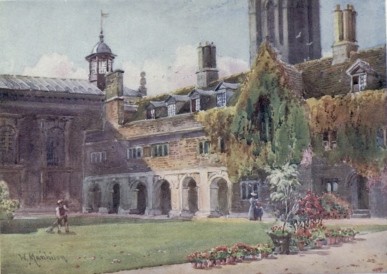
A COURT AND CLOISTERS IN PEMBROKE COLLEGE This represents the First or Entrance Court of the College. Beyond the Cloisters is the Chapel designed by Sir Christopher Wren and completed in 1664.
Felton and *Wren of Ely, are on its honour roll. The second Master was Robert Thorpe of Thorpe-next-Norwich, knighted by Edward III. and afterwards Lord Chancellor.[139] The old college garden, loved by Ridley, is much despoiled, but “Ridley’s walk” remains. Pembroke gave two other martyrs for their religious opinions, Rogers and Bradford.[140] Two fellows of the college[141] in the reign of Edward III. died in Rome where they had gone to obtain from Innocent VI. possession of part of the original endowment of the college; a statute prescribes that mass shall be said for them each July.
In the library are Gower’s Confessio Amantis and the Golden Legend, printed by Caxton. It is this last book which brought him the promise of “a buck in summer and a doe in winter” from the Earl of Arundel, for its great length had made him “half desperate to have accomplished it.” There, too, is Gray’s MS. of the “Elegy.” The college also possesses Bishop Andrewes’ library. Matthew Wren is buried in the chapel, and his staff and mitre are preserved in the college, the latter being a solitary specimen of a post-reformation mitre; it was worn over a crimson silk cap.
The college was founded for 30 scholars, if the revenues permitted.[142] In the time of Caius it housed 87 members; in Fuller’s time 100 (including 20 fellows and 33 scholars); in the middle of the xviii century the number of students averaged 50 or 60. There are now 13 fellowships and 34 scholarships of the value of £20 to £80.
Founders of Cambridge colleges.
The Cambridge colleges are remarkable for the large proportion of them founded and endowed by women. Of the 16 colleges built between the xiii and xvi centuries, now in existence, 6 are due to the munificence of women—Clare, Pembroke, Queens’, Christ’s, S. John’s, and Sidney Sussex. Next as college builders come the chancellors of England, the bishops, and the kings who have each endowed the university with three colleges. Hervey de Stanton, Chancellor of the Exchequer in the reign of Edward II., Thomas Lord Audley chancellor to Henry VIII., and Sir Walter Mildmay Chancellor of the Exchequer to Elizabeth, all founded colleges, two of which still remain—Magdalene and Emmanuel.[143] Hugh Balsham of Ely, Bateman of Norwich, and Alcock of Ely founded three existing colleges—Peterhouse, Trinity Hall, and Jesus.[143a] The kings of England account for some of the finest work in the university, King’s Hall, King’s College, and Trinity College.[144]
The early series of colleges.
In the series of Cambridge colleges the 3 foundations of the early xiv century which followed Peterhouse were all merged in other colleges. Pembroke which was the sixth foundation was the first piece of collegiate building to be carried through in Cambridge, and Corpus Christi must rank as the second.
The colleges from Peterhouse to Pembroke:—
Peterhouse 1284
Michaelhouse 1324
(Gonville 1348
)
{University Hall 1326
(Trinity Hall 1350)
{Clare 1338
King’s Hall 1337
Corpus 1352
Pembroke Hall 1347
Michaelhouse and King’s Hall went to swell the greatness of Trinity; University Hall became the foundation stone of Clare: and all of them, with Gonville and Trinity Hall, were incomplete adaptations of earlier buildings at the time when Pembroke and Corpus were finished.
We now come to two colleges which formed an East Anglian corner in the university.
Gonville Hall 1348.
Within a month of the licence granted to Marie de Saint-Paul, Edmund Gonville obtained his for the erection of the hall which is called after him. Gonville was an East Anglian parson, rector of two Norfolk parishes and sometime vicar-general of the diocese of Ely. In one of these parishes his elder brother Sir Nicholas Gonville of Rushworth had already established a college of canons, and Edmund Gonville himself was a great favourer of the Dominicans. Edward III.’s licence enabled him to found a hall for 20 scholars in Lurteburgh (now Free school) Lane, between S. Benet’s and great S. Mary’s, in 1348. In 1352 this site was exchanged with Benet College for another on the other side of the High Street,[145] the present site of Gonville and Caius. The Hall was dedicated in honour of the Annunciation of the Blessed Virgin Mary, and enjoyed a great reputation among East Anglians and various proofs of papal favour up to the eve of the Reformation.[146] Like Corpus its object was the education of the clergy and theology was to be their study. Alexander VI. (1492-1503) licensed annually two of its students to preach in any part of England, apparently a unique permission.[147] Humphrey de la Pole—who resided for many years—and his brother Edward, sons of the second Duke of Suffolk, were students here; so was Sir Thomas Gresham. Gonville was refounded as Gonville and Caius by Doctor Keys (Caius) two hundred years later.[148]
Trinity Hall A.D. 1350.
Edmund Gonville left William Bateman Bishop of Norwich his executor in the interests of his new foundation. Bateman, a notable

TRINITY HALL The nearer building seen in the picture is the old Library, and beyond it are the Latham Buildings.
figure in the xiv century, set forth as Edward’s ambassador to the King of France in the month that the Black Death made its appearance in East Anglia (March 1350), and died at Avignon on an embassy from the king to the Pope. In 1350 on his return from France,[149] he founded Trinity Hall, near Gonville, on the site of the hostel of the monks of Ely[150] which he obtained for that purpose.[151]
If Gonville’s foundation was intended for the country parson, Bateman’s was intended for the prete di carriera. Both were designed to repair the ravages in the ranks of the clergy left by the plague, but while Gonville’s clerks were to devote their time to the study of theology Bateman’s were to study exclusively civil and canon law. The college was built round a quadrangle,[152] and the religious services were kept in the church of S. John the Baptist (or Zachary) and afterwards in the north aisle of S. Edward’s church; these two churches being shared with the students of Clare. Indeed it was owing to Gardiner’s policy and Ridley’s advice that Trinity Hall escaped incorporation with Clare College in the reign of Edward VI. The library remains as it was in the early years of Elizabeth’s reign, and was founded by Bateman with the gift of his own collection. The Norfolk men were famous litigants. Doctor Jessopp has shown that neither the Black Death nor any lesser tragedy could hold them from an appeal to the law on every trivial pretext. That the first college of jurists should have been founded by a native of Norwich is certainly therefore a fitting circumstance.
Stephen Gardiner Bishop of Winchester and Chancellor of England was Master of Trinity Hall in the reign of Edward VI. and again in the first year of Mary. He used to say “if all his palaces were blown down by iniquity, he would creep honestly into that shell”—the mastership of Trinity Hall. Other distinguished Masters were Haddon,[153] Master of the Requests to Elizabeth, and Sir Henry Maine who had been fellow and tutor. Bishop Sampson, a pupil of Erasmus, Thirlby, Glisson,[154] Bilney, one of the early reformers, Lord Chesterfield, Bulwer Lytton, and Leslie Stephen were all members of Trinity Hall, which is still the college of the larger number of Cambridge law students. There are 13 fellowships, and about 12 scholarships varying in value from £80 to £21 a year, besides exhibitions of the same value.
In the middle of the xiv century there were two important guilds in Cambridge, the one under the invocation of Corpus Christi “keeping their prayers in S. Benet’s church,” the other dedicated to the
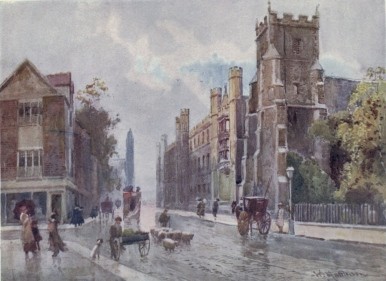
ST. BOTOLPH’S CHURCH AND CORPUS COLLEGE FROM THE STEPS OF THE PITT PRESS, TRUMPINGTON STREET King’s College is seen in the distance.
Blessed Virgin “observing their offices in S. Mary’s church.” These guilds or confraternities—which existed all through the middle ages as they had existed in classical Rome with precisely similar features—were to be found, as we know, especially among the artisan class, and took the place of our modern trades unions and mutual insurance societies. Like every enterprise of the ages of faith they had a semi-religious character, were usually attached as its “sisters and brethren” to some church, and owed their members not only material assistance but spiritual, paying for masses to be offered for the repose of the souls of all deceased brethren.
Corpus Christi A.D. 1352.
It was two such guilds which forgetting their differences and laying aside all emulations, joined together in the middle of the xiv century in order to found and endow a college in their town. The brethren of the guilds had been planning this enterprise since 1342, and in the following years those who possessed contiguous tenements in the parishes of S. Benet and S. Botolph pulled them down “and with one accord set about the task of establishing a college there.”[155] “By this means they cleared a site for their college square in form.”[156] Here then, as in the case of King’s Hall and Pembroke, the earliest collegiate buildings designed as such, the plan was quadrangular. Sometimes, as in the case of Trinity Hall, the adjacent buildings for completing the court could not be at once obtained, in others, as at Corpus itself and Clare, the courts are irregular, owing to the same difficulty of getting the foursquare space. Corpus Christi college presents us, indeed, with the unique and perfect example in Cambridge of the ancient college court. By March 1352 a clear space, 220 feet long by 140 wide, had been cleared, and the guilds worked with so much good will that they had nearly finished the exterior wall of their college in the same year. “The building of the college as it appears at the present day,” writes John Jocelyn, “with walls of enclosure, chambers arranged about a quadrangle, hall, kitchen, and Master’s habitation, was fully finished in the days of Thomas Eltisley, the first Master [1352-1376] and of his successor” [1376-1377]. This original court is what we see also to-day: the buildings are in two floors, the garrets were added later. The hall range contains the Master’s lodging with a solarium above it, a door and passage leading thence to the hall. The three other sides were devoted to scholars’ chambers. S. Benet’s served as the scholars’ church, and the gate was on this side of the court.
Before the reign of Henry VIII. there was but little glass or panelling in either story of the building. But in Jocelyn’s time the Master’s and fellows’ rooms were “skilfully decorated” with both. The fellows and scholars together panelled, paved, decorated, plastered, and glazed the public rooms of the college, in one case

THE OLD COURT, CORPUS CHRISTI COLLEGE This is the oldest court in Cambridge. The Tower of the old Saxon Church of St. Benedict is seen in the background.
“the college paying for the material and the scholars for the labour.” Thus was this college born of the democratic spirit and the sentiment of union nurtured in the same spirit. The college was called “of Corpus Christi and the Blessed Virgin” but was familiarly known from the close of the xiv century to modern times as Benet College. It lay in the heart of the Saxon town, between the Saxon church of S. Benet and the church of the Saxon Botolph which also served the scholars for their prayers. The former was used until the year 1500, when a small chapel communicating with the south chancel of the church was built. In 1579 Sir Nicholas Bacon gave the college a chapel; and the modern chapel is on its site. Sir Francis Drake was the largest contributor next to Bacon. The queen gave timber, and the scholars of the college again toiled side by side with the workmen.
On March 21, 1353 the guilds made over to their college Gonville’s house in Lurteburgh Lane which they had exchanged with his executor Bateman. More ground was purchased facing the street and in time two large neighbouring hostels S. Mary’s and S. Bernard’s were acquired for students. The second court has all been built since 1823, and contains the modern hall, lodge, library and chapel, and muniment room, and the Lewes collection. The ancient hall serves as the present kitchen.
In the Library is one of the most valuable collections of MSS. in the country, the spoils of the dissolved monasteries gathered together by Archbishop Parker. Here is the oldest or “Winchester” Anglo-Saxon Chronicle (to A.D. 892), and Jerome’s version of the four gospels sent by Gregory to Augustin—“the most interesting MS. in England.” Here is the splendid Peterborough psalter and “bestiary”; a penitentiale of Archbishop Egbert’s (A-S. translation); a Pontifical, probably written before 1407; a xv century MS. Homer rescued by Parker from the whilom baker of S. Augustine’s Abbey; Matthew Paris’ own copy of his history; the Sarum missal of 1506, and a copy of the great English bible of 1568. Here also is the first draft (1562) of the Articles of Religion, 42 in number, scored over by Matthew Parker’s red chalk; the 3 articles which were finally omitted (dealing with the state of the departed, the last containing the statement “That all shall not be saved”) are here struck out by Parker. The clause concerning the transubstantiation of the eucharist he has similarly overscored.
Corpus also houses some of the most interesting plate in the university.
Candle rents.
Corpus Christi procession.
College arms.
The college was the chief sufferer in the peasant revolt of 1381 principally on account of the wealth which accrued to it from “candle rents,” a tax chargeable on the tenants of all houses which had been guild property.[157] On the festival of Corpus Christi—the
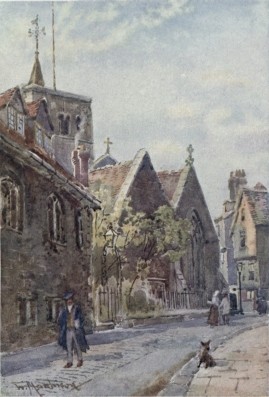
ST. BENEDICT’S CHURCH FROM FREE SCHOOL LANE Its Saxon tower is the oldest building left in Cambridge, and close by is the oldest piece of College building, the wall of Corpus Christi.
Thursday in the Octave of Trinity—a great procession which included the officers of the united guild, the civic dignitaries, and the university authorities, perambulated the town from Benet Church to the bridge, the Master bearing the pyx under a rich canopy. Even after the dissolution of the guild the Master of Corpus continued the procession until it was abolished by Henry VIII. in the 27th year of his reign (1535/6). The ancient arms of the college consisted of the shields of the two guilds—the emblems of the Passion for Corpus Christi; the triangle symbol of the Trinity for the guild of the Blessed Virgin, above, Christ crowning the Madonna and below, the guilds dedicating their college. Exception was taken to them in Parker’s time as too papistical, and he got the heralds to change them. The new arms still however recorded the two guilds: quarterly, gules and azure, in the first and fourth a pelican, with her young, vulning herself; in the second and third three lilies proper
Signat avis Christum, qui sanguine pascit alumnos; Lilia, virgo parens, intemerata refert.
Among its great names Corpus counts Sir Nicholas Bacon the father of Francis Lord Bacon, Matthew Parker who was Master of the college and its great benefactor in later times, Christopher Marlowe and Fletcher, Archbishop Tenison, Sir William Paston and a group of xvii century antiquaries, and Boyle ‘the great earl’ of Cork. Roger Manners was a considerable benefactor. In the time of Henry VII. Elizabeth Duchess of Norfolk founded a bible clerkship and a fellowship, and placed the buttresses of the college.[158]
The college soon maintained 8 fellows, 6 scholars, and 3 bible clerks. All the inmates were destined by the founders for priests’ orders, this being one of the four foundations in Cambridge due in whole or in part to the dearth of clerks consequent on the black death.[159] In the time of Caius Corpus held 93 persons and in Fuller’s time 126. In the xviii century about 60. There are to-day 12 fellowships, about 15 scholarships varying from £80 to £30 in value, 3 sizarships worth £25 each, and 6 exhibitions for students from S. Paul’s school, Canterbury, and the Norwich Grammar school varying from £18 to double this sum.[160]
The building of Corpus Christi marks an historical and closes an architectural epoch at Cambridge. The university had indeed two golden ages—the reign of Edward III. and the reign of the Tudors. It has not been sufficiently realised that Cambridge had no European rival in scholastic activity in either period. In Edward’s reign six colleges were built there—King’s Hall, Clare, Pembroke, Gonville, Trinity Hall, and Corpus; only one college—Queens’—was founded at Oxford during the same time. Three of these six foundations signalise local enterprise, but the three earlier are a record of the affection of Edward’s house for the university; and it is their preference for Cambridge in the xiv century and the preference of the Tudors for it in the xvth and xvith which marks its two great epochs.
Cambridge in 1353.
Let us look at the university as it was in the middle of the xiv century, and let it be the year 1353. It is 250 years since Henry I. began to reign; 150 before Erasmus lived here, and 550 before our own time. It is the eve of that great change in the mental and moral venue of humanity which ushered in the modern world. The Oxford friar Occam, and with him scholasticism, had died four years before, Petrarch was mourning Laura, and Chaucer was walking the streets of Cambridge the man who was to be our link with the early Italian renascence and to clasp hands across the century with Erasmus. Lastly, it was at this moment in our history that the final adjustment of Norman and Saxon elements went hand in hand with the creation of an English language—a period of which Chaucer is our national representative. The town and university were just emerging from the havoc wrought by the “black death,” but the royal and noble foundations which had sprung up on all sides before the appearance of the scourge had already attracted the youth round Edward’s court to Cambridge; necessitating in 1342 Archbishop Stratford’s injunction against the curls and rings of the young coxcombs studying there.
Cambridge had in fact the reputation of the fashionable university, while its fame is extolled by Lydgate—a younger contemporary of Chaucer who had himself studied at Oxford—in words which show that at this date it was believed also to be the older university.[161] Let us suppose that Chaucer is returning from his first walk to Grantchester, along the Trumpington road, past the scene he describes in the Reeve’s Tale, and let us follow him up the Saxon High street. He skirts Coe fen and reaches Peterhouse, its greater and its “little ostle” on the street, with Balsham’s hall behind; and as he proceeds he sees on either hand conspicuous signs of the love of the Edwards for Cambridge—to the right the narrow quadrangle of Pembroke, beyond it, off the high road, past S. Botolph’s and two hostels, lay the limestone walls of Corpus which had just passed under the protection of Henry of Lancaster;[162] its old court, then the newest of new courts at Cambridge, nestling against the Saxon church of S. Benet. Behind lay the Austinfriars, and across the road the Whitefriars from which Austin’s Lane led to Austin’s hostel, occupying with Mill street the site of the future King’s College and King’s College chapel. To the north of S. Benet’s he sees the university church of Great S. Mary’s, just rebuilt after the fire, and opposite are the schools begun a few years previously, with University, Clare, and Trinity Halls behind, and “le Stone house” of Gonville. Then still to his left, where now we see the buildings of Trinity, he beholds the “gret colledge” King’s Hall which Edward III. has just built, Michaelhouse with Crouched hostel which passed into its possession in the February of this year, and its satellite hostels Ovyng’s and Garret’s.
Just beyond King’s Hall is the building which forms the nucleus of the university in the Norman town—the hospital of S. John, bordering on Bridge street. As soon as this road is reached, which leads to the Great Bridge, we see the crusaders’ round church of S. Sepulchre, and following the road to the right we come to the Greyfriars, to the site of the future God’s House, and past Preachers’ street to the Friars Preachers or Blackfriars. On our left, across in the Greencroft, we have left the Benedictine nunnery of S. Rhadegund. Returning past S. Sepulchre’s we cross the river and come to the heart of the Norman town—the Conqueror’s castle with the Norman manor house bought by Merton in its shadow, and the churches of S. Giles and S. Peter.
Many of the hostels had recently disappeared to make room for the colleges, but they were still as regards these latter nearly in the proportion of three to one—and these latter, with the sole exception of Peterhouse, had all arisen in the previous thirty years.
The sights and sounds in the streets suggested a new epoch—something already achieved and something about to be achieved. Something of stir before an awakening. The English language which was to prove in the hands of its masters one of the finest vehicles of literary expression began everywhere to be heard in place of the French of Norfolk and Stratford-atte-Bowe. The softer southern speech prevailed over

KING’S COLLEGE GATEWAY AND CHAPEL—TWILIGHT EFFECT The Gateway and Screen on the left hand, and beyond it the Chapel. In the distance the Senate House, Caius College, and the Tower of St. John’s College Chapel.
the northern, but the dialects of East Anglia and the Ridings of Yorks were perhaps most frequently heard. The canons of S. John and S. Giles, from the Norman side of the town, might be met in their black cloaks, the Gilbertine canons, from the Saxon side, all in white with the homely sheepskin cape. The Carmelites had already exchanged their striped brown and white cloak—representing Elijah’s mantle singed with fire as it fell from the fiery chariot—for the white cloak to which they owe their name of Whitefriars. The Romites of S. Austin wore a hermit’s dress.[163] Benedictine monks from Ely and Norwich could certainly be seen in the streets of Cambridge,[164] and the Benedictine nuns of S. Rhadegund rode and walked abroad in the black habit as it was the universal custom in that great order for nuns to do. The Dominicans looked like canons in their black cappa, the Franciscans like peasants in their coarse grey tunic roughly tied with cord.
Besides the Carmelites and Austinfriars there were the Bethlemite friars in Trumpington street and Our-Lady friars by the Castle; the former could be distinguished at a distance by the red star of five rays on their cloaks with a sky blue circle in its centre—the star of Bethlehem; but both these communities wore the habit—black over white—of the Dominicans. Scholars poor and rich jostled each other in the schools and in the public ways, wearing the long and short gowns of the day, the cote which had just come into fashion, or the habit of their order. There were doctors in the three faculties wearing scarlet gowns and the doctor’s bonnet or camaurum, and there was a sprinkling of doctors and of students from Orléans, Padua, Pavia, and Paris.
A large number of the inmates of the colleges round, and of the scholars walking the streets, wear the clerical tonsure, many scores have the coronal tonsure of the friar—yet the feeling in the air is secular. Cambridge has always suggested a certain detachment; neither zeal—perfervid or sour—nor the pressure of tradition upon living thought has had its proper home there. It has not represented monastic seclusion nor hieratic exclusion, and it did so at this moment of its history less than ever. The dawn of the coming renascence shone upon the walls at which we have been looking. The modern world has been born of the birth-pangs which have since convulsed Europe, and the walls which were then big with the future are now big with the past. But it is the greatness of Cambridge that amidst the multiple suggestiveness of its ancient halls of learning, tyranny of the past has no place. About it the dawn of the renascence still lingers; and the early morning light which presided at its birth still defines the shadows and seems to temper the noon-day heat, as light and shade alternate in its history.
Chaucer at Cambridge.
We have taken it for granted that Chaucer was walking the streets of Cambridge with us. We have no direct evidence as to where Chaucer studied; but our indirect evidence is sufficient. In the “Canterbury Tales” Chaucer introduces us to two Cambridge scholars and to a clerk of Oxenforde; and if one considers what would nowadays be called the internal evidence of the Reeve’s Tale it is difficult to resist the conclusion that Chaucer was at Cambridge. How else should he know Trumpington so well? Its brook, its bridge, its mill, its fen? He knows about the “gret colledge” which had risen a few years previously; he knows that its Master is called “the warden,” that its scholars are also its “fellaws.” He has learnt there the dialect of Yorkshiremen, and reproduces not only their turns of speech but characteristic terms—as bete, kime, jossa—in the East Anglian dialect. If we turn to the Miller’s Tale all this local colouring is to seek. A “clerke of Oxenforde,” indeed, was no unfamiliar figure in the xiv century, especially to a Londoner. Familiarity with the aspect of Cambridge and its neighbourhood was a very different matter.
Chaucer was probably himself of East Anglian origin. His grandfather Robert and John his father were both of Ipswich and London, and when he was kidnapped by his mother’s family “Thomas Stace of Ipswich” is the kidnapper. There are two events of his young life known to us, and both suggest that he was at Cambridge. One of these we hear about from his evidence in the famous Scrope and Grosvenor suit in 1386. An upstart knight—Sir Robert Grosvenor—whose name Chaucer had never heard before, had displayed the arms of the Scropes, and Chaucer testifies in the Court of Chivalry action which ensues that he had often seen Henry le Scrope use the proud armorials “azure, a bend or” in the French wars where they had been companions in arms twenty-seven years before (1359). Now this great Yorkshire family were connected with Cambridge from Chaucer’s time: Richard le Scrope, the son of his old comrade, was chancellor of the university in 1378.[165] Two members of the same family were chancellors in the next century, and the intermarriage of the Scropes with the Gonvilles is recorded there to this day in Scrope or “Scroope Terrace.”[166] Is it not probable that Geoffrey Chaucer knew Henry Scrope at Cambridge and formed there the friendship which moved him to testify in his behalf thirty years later?
This conjecture does not become less probable when we turn to the other incident in his early life, which came to light in 1866 with a fragment of the household accounts of the wife of Lionel Duke of Clarence. Here the name of Geoffrey Chaucer is mentioned (in 1357) as that of a junior member of her household. His early connexion with the house of Edward is therefore an historical fact like his later friendship with John of Gaunt. Now in 1352 Lionel Plantagenet had married Elizabeth de Burgh the grand-daughter and namesake of the founder of Clare Hall Cambridge. The “gret colledge” about which Chaucer tells us in the Reeves Tale is called “Soler Hall” and “Soler Hall,” so Caius records, was the ancient name for Clare. Remembering, however, the incomplete condition of Clare and of other foundations at this date the present writer supposes the “gret colledge” to have been King’s Hall, the first imposing architectural undertaking in the university and the building which must par excellence have attracted attention in the middle of the xiv century.[167] It may also have been Chaucer’s own college, and in this connexion it is worthy of notice that with the exception of the half-dozen “minor scholars” at Pembroke, King’s Hall was at this time the only college which educated lads in their teens.
Assuming the year of the poet’s birth to have been 1340 he would have been going to the university, according to the custom of those days, about the year 1353, and his place in Elizabeth de Burgh’s household was probably already assured him when he went to Cambridge.[168] He was back in her service in his seventeenth year and therefore could not have had time to study at both universities: and we may add to this that although his general knowledge, which he had no time to acquire in later life, suggests that he received a university education, there is not a tittle of evidence to support the idea that Chaucer went to Oxford.
One more conjecture: had he got his information about prioress’s French from the religious of the convent of S. Leonard of Stratford-atte-Bowe whom we find owning land in Cambridge from the days of Edward I.?
The Schools.
The High Street and School Street.
It is to this period of the history of Cambridge that the first university buildings as distinguished from collegiate buildings belong. During the chancellorship of Robert Thorpe, Knight, Master of Pembroke (1347-64) and Lord Chief Justice of the Common Pleas, afterwards Chancellor of England, the “schools quadrangle” was projected in that street of colleges, unrivalled in Europe, which prolonging the Trumpington Road as King’s Parade or Trinity Street or S. John’s Street was anciently known as the “School street” of the university. It was also the high street of the Saxon town of which S. Benet’s tower was the nucleus, but whether the original Saxon town lay on this side of the river, or whether, as frequently happened in the xi century, the Saxon population retreated here leaving the Castle district to their Norman conquerors, we have no means of determining.[169]
There were, then, no public buildings up to the xiv century. The Greyfriars or the Austinfriars gave hospitality to the university on public occasions, and the only brick and mortar evidence of a university lay in the hostels and colleges. The “Schools” now erected were halls for lecturing and scholastic disputations; the north, west, and east sides were completed by the middle of the next century, the south side being added in accordance with a decision taken in 1457 to build “a new school of philosophy and civil law, or a library.”[170] This was erected on university ground (on the south) next to the school of canon law (west). Over this last was the original library room (the “west room” 1457) and “a chapel of exceeding great beauty.” The quadrangle contained the Divinity school (north) with the Regent and non-regent houses; opposite was the Sophisters’ school with the libraria communis or magna; on the entrance side were the Chancellor’s (Rotherham’s) Library, Consistory court and Court of the Proctors and Taxors; and facing this the Bachelors’ school and the school of Medicine and Law; the old “west room” having been converted into a school, by grace of the Senate, in 1547.[171]
The university library.
The schools remained untouched till the opening years of the xviii century when the Regent House was pulled down to build the present university library. This is the oldest of the three great English libraries, and stands on ground which has always been university property. The early xv century library which was lodged in the Schools quadrangle originated in gifts of single volumes by private donors until 52 had been collected; and books which were bequeathed in 1424 are still preserved. Fifty years later (1473) the proctors Ralph Sanger and Richard Tokerham made a catalogue of 330 books.[172] Rotherham Archbishop of York next presented 200 tomes, and Tunstall Bishop of Durham was another donor: many of these last gifts
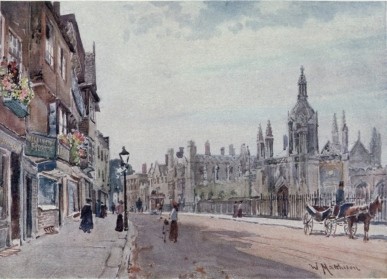
GATEWAY OF KING’S COLLEGE, KING’S PARADE This is one of the most picturesque views in Cambridge. On the right are the Gateway and Screen and other portions of King’s College; on the left are some ancient houses.
were “embezzled” by “pilferers” before the middle of the xvi century,[173] and the libraries of three successive Cambridge archbishops of Canterbury, Parker, Grindal, and Bancroft, formed the chief treasure of the university until 1715 when George I. purchased and presented the library of Moore Bishop of Ely which is the nucleus of the modern collection.[174]
There are 400,000 volumes on open shelves among which the student can wander at will and get his own books without applying to the library officials; a convenience which Lord Acton, the late Professor of Modern History, used to say made this the only serviceable library in Europe. Another privilege, which is possessed by all masters of arts, is that books may be taken home. Undergraduates, if in academic dress, have also free access. The university library is one of the three copyright libraries in England.[175]
[139] pp. 27 and 96.
[140] v. p. 275.
[141] Reyner D’Aubeney and Robert Stanton.
[142] p. 68 n.
[143] Alcock himself, by a unique arrangement made with Rotherham, held the Seals conjointly with that prelate, then Bishop of Lincoln, from April to September 1474; and he had acted in parliament in the same capacity for Stillington in 1472. Merton whose Cambridge operations were described in the last chapter was Lord Chancellor; so was Sir Robert Thorpe who began the Schools, and so were Booth and Rotherham who completed the Schools quadrangle and built the old library. John Somerset, who was chiefly instrumental in the founding of King’s College, was Chancellor of the Exchequer to Henry VI.
[144] Cf. nationality of founders of colleges p. 150.
[145] The stone house (p. 24 n.) and John Goldcorn’s property—all opposite Michaelhouse—were then fashioned by Bateman, after the founder’s demise, as Gonville Hall.
[146] See Gonville and Caius, pp. 143-4.
[147] Twelve preachers from each university were annually licensed for any diocese in England. Gonville was now allowed two such licences on its own account.
[148] p. 141.
[149] He landed at Yarmouth in June, and the charter of foundation is dated November 20.
[150] Magdalene, p. 127.
[151] The style “the keeper and scholars of the college of the Holy Trinity of Norwich,” reminds us that the original dedication of this and Gonville corresponds to that of two of the ancient Cambridge guilds—the Holy Trinity and the Annunciation.
[152] The N.E. corner was obtained four years after the foundation by the purchase of a house at the corner of Henney Lane.
[153] See also King’s.
[154] See also Caius.
[155] Account given of the building of Corpus by Archbishop Parker’s Latin secretary, John Jocelyn, fellow of Queens’. It is supposed that the hall of the guild of Corpus Christi was near the old court; S. Mary’s guild met at the hostel of that name near the present Senate House. See also p. 83.
[156] Ibid.
[157] The brethren and sisters of the two guilds presumably thus taxed all house property bequeathed by them to their college, to defray the expenses of the wax lights so freely used in funeral and other liturgical rites. It has been pointed out that the riots occurred two days after the feast of Corpus Christi, with its recent procession in England, the contribution of wax tapers for which may have greatly aggravated the grievance. The feast is of xiii c. origin, the outdoor procession dates from the late xivth.
[158] She was heiress to her sister Eleanor who had been betrothed to Edward IV. They were the daughters of John Talbot Earl of Shrewsbury, and Elizabeth’s only child Ann was wife to Richard of York murdered in the Tower.
[159] The dearth of clerks or clergy and the failure of learning: the former engaged the attention of the founders of Gonville, Trinity Hall, and Corpus, the latter of the founder of Clare who writes: “to promote ... the extension of these sciences, which by reason of the pestilence having swept away a multitude of men, are now beginning to fail rapidly.”
[160] The fact that we have a guild college built in Cambridge is especially interesting, for, as Dr. Stubbs has shown, Cambridge ranks highest among English towns for its guild history. Even the Exeter statutes do not rival those of one of its ancient guilds which united the craft or religious guild with the frith-guild—the guild instituted for the religious interests of its members or to protect craftsmen and their craft, and the guild which was an attempt “on the part of the public authorities to supplement the defective execution of the law by measures for mutual defence.” The Cambridge statutes, in fact, show us the guild as an element in the development of the township or burgh, one of those communities within a community which was the earliest expedient of civilisation, the earliest essay in organisation, everywhere. The guild which combined these two institutions was a thanes guild. It made and enforced legal enactments; it paid the blood-money if a member slew a man with righteous cause, and exacted eight pounds from any one who robbed a member. “It is improbable” writes Dr. Stubbs “that any institution on so large a scale existed in any other town than London.” In Athelstan’s reign we have a complete code of such a London frith-guild. (Constitutional History of England, vol. i. p. 414.)
[161]
“Thus of Cambridge the name gan first shyne As chieffe schoole and vniuersitie Vnto this tyme fro the daye it began”
[162] The “good duke of Lancaster” was Alderman of the Guild of Corpus Christi. John of Gaunt greatly befriended the college. It was anno 1356 that the “translation of the college of Corpus Christi out of lay hand to the patronage of the duke of Lancaster,” took place; a document so entitled once formed part of the Registry MSS.
[163] Augustinians never enjoyed their habit in comfort; in the xiii c. they were obliged to make their leather girdle long and their tunic short because they were suspected of a desire to pass as corded and sandalled Franciscans, and to cover over their white tunic with black in the streets lest they should be taken for friars preachers.
[164] pp. 127, 128 n., and p. 143, 143 n.
[165] Recorda et placita coram cancellario Ric. le Scrope in le Tollebouth. 2 Ric. II. 1378-9. MS. No. 49 in the Cambridge Registry.
[166] Stephen le Scrope was chancellor in 1400 and 1414, Richard Scroop (who had been Master of King’s Hall) in 1461, and Lady Anne Scroope was one of the early benefactors of Gonville’s hall; see vi. p. 325, 325 n.
[167] Edward himself speaks of it as “so important a college” in 1342. See p. 132. Since going to press I see that Mr. Rouse Ball identifies King’s Hall as ‘Solar Hall’ in his monograph on Trinity College, published in March 1906. Prof. Willis conjectured that ‘Solar Hall’ = Garrett Hostel.
[168] King’s Hall statutes name 14 as the age.
[169] The main artery of the xiv and xv century university was not, as now, the High street, but the Mill street (Milne street). It lay in a direct line between Clare Hall and Queens’ Lane, and 7 colleges had their entrances on it: Michaelhouse, Trinity Hall, Clare, old King’s College, S. Catherine’s, and Queens’. Gonville was approached from the north end, and King’s Hall lay on the same side. The church and property of the Knights of S. John and Garret’s and Ovyng’s hostels were in the same street. Mill street began at Queens’ Lane, and led northwards from the King’s and the Bishop’s Mills, which gave it its name. The larger part was alienated in 1445 to build the second King’s College.
[170] Temp. Laurence Booth, chancellor.
[171] See Loggan’s print, 1688. The great schools in the School street are first mentioned 1346-7. The divinity schools were the first to be completed, by Sir William Thorpe’s executors, in 1398. The quadrangle was completed c. 1475. The eastern front was rebuilt in 1755. The buildings lie under the present library and are now used for the keeping of “acts” and for discussions, but not for lectures in the various faculties. The new Divinity schools are in S. John’s street, and were erected by friends as a memorial of Bishop Selwyn. The Science schools, school of Human Anatomy, chemical laboratories, etc. are on the site of the university botanical garden which was once Austinfriars’ property.
[172] The room where these were treasured was the libraria communis or magna (in the time of Caius the “old” or “public” library), which still exists on the south side, with Chancellor Rotherham’s library on the east. The ancient two-storeyed building on the west which existed as early as 1438 still contains the old Canon Law (now the Arts) school, with the original library and the university chapel (disused for centuries) above (p. 97).
[173] Fuller and Caius both record this fact.
[174] It consists of 700 MSS. and 30,000 volumes. Other and earlier benefactors to the library were Perne (1574), Fulke Greville, Stephen Perse of Caius, and George Villiers Duke of Buckingham.
[175] A copy of every book and pamphlet published in England is sent here, to the British Museum, and to the Bodleian.
The Pitt Press.
A printing press was set up at Cambridge, early in the xvi century, by Siberch who said of himself that he was the first in England to print Greek—7 small volumes in the Greek character were printed by him at the university. Carter, however, tells us that an Italian Franciscan, William of Savona, printed a book at Cambridge in 1478, four years after Caxton had printed the first book in England. Lord Coke pointed out that this university enjoyed before Oxford the privilege of printing omnes et omnigenas libros, “all and every kind of book” (1534). This included the right to appoint 3 stationers or printers.
Siberch’s printing place was on the present site of Caius. In 1655 the university obtained from Queens’ College a lease of the ground at the corner of Silver street and Queens’ lane—the historic Mill street district—now the site of the lodge and garden of S. Catherine’s. In 1804 the present site was obtained for the university press, with a further “messuage fronting upon Trumpington street and Mill lane”; the remaining properties in Trumpington street, between Silver street and Mill street, being bought in 1831-3. The Pitt Press, a church-like structure, stands opposite to Pembroke (Pitt’s) College, and owes its name to the fact that the surplus funds of the Pitt monument in Westminster abbey were a donation to the university towards defraying the cost. The building also contains the offices of the university Registrary.[176]
The Senate House was not founded till 1722, and lies on the north of the library.[177]
King’s College. A. D. 1441.
Ninety years passed after the building of Corpus before Henry VI. founded King’s College, and Margaret of Anjou, his consort, founded
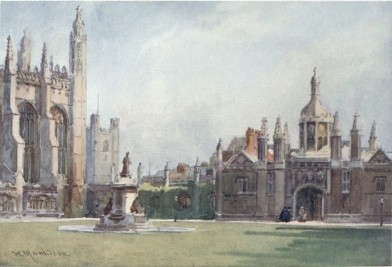
KING’S COLLEGE CHAPEL AND THE ENTRANCE COURT, FROM THE FELLOWS’ BUILDINGS A portion of the Chapel is seen on the left of the picture with Great St. Mary’s tower in the distance. The Screen and Gate are on the right.
Queens’. It was in 1443 that the charter of the double foundation of Eton at Windsor and King’s College at Cambridge was signed—the one “our royal college of S. Mary of Eton,” the other “our royal college of S. Mary and S. Nicholas”; for Henry dedicated his college to his patron saint Nicholas “of Bari” the patron of scholars. The king laid the foundation stone himself (p. 112) in the presence of John Langton chancellor of the university, the keeper of the Privy Seal, the chancellor of the Exchequer, and the bishops of Lincoln and Salisbury.[178] The king’s father had intended to build a college at Oxford; Henry VI. carried out his intention in endowing a college but decided that the university should be Cambridge. A small college called God’s House which had just been founded,[179] together with Mill Street (acquired in 1445) and Augustine’s hostel (in 1449) and the church of S. John Zachary, were pulled down to clear a space: but the original plan for the college was never carried out, and the buildings we now see were erected in the first quarter of the xviiith and in the xixth centuries.[180]
The chapel.
The only portion of the original plan executed was the chapel. The importance of King’s College chapel is not only architectural; is due not only to the fact that it was begun before the Italian classical revival as a monument of English Gothic, and completed in the full blaze of the renascence, but that it marks a chapter in the history of English religion. The church built for the old worship was consecrated for the new; the first stone was laid by Henry VI. in the presence of great catholic prelates, the oaken screen—perhaps the finest woodwork in the country—bears the monogram of Henry VIII. and Anne Boleyn[181] twined with true lovers’ knots. In the third place “this immense and
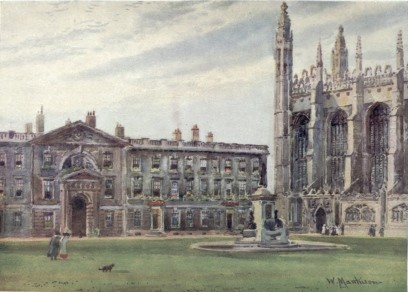
KING’S COLLEGE CHAPEL AND THE FELLOWS’ BUILDINGS The South door of the Chapel is seen to the right in the picture, and the Fellows’ Buildings, constructed in 1723, are on the left. The Fountain with a statue of the founder, Henry the Sixth, was designed by H. A. Armstead, R. A.
glorious work of fine intelligence,” as Wordsworth calls it, remains one of the very finest monuments of Perpendicular architecture; and that beautiful English feature the fan-vaulting, which is to be seen in the Tudor chapel at the Guildhall, in Henry VII.’s chapel at Westminster, and at S. David’s (now ruinous), is here carried out over a larger area than anywhere else.[182]
That branching roof Self-poised, and scooped into ten thousand cells Where light and shade repose, where music dwells Lingering, and wandering on as loth to die— Like thoughts whose very sweetness yieldeth proof That they were born for immortality.
So writes Wordsworth; and the stained glass windows, the most ‘complete and magnificent series’ in the country says Carter, probably inspired Milton’s
—storied windows richly dight, Casting a dim religious light. There let the pealing organ blow, To the full voic’d quire below, In service high, and anthems clear, As may with sweetness through mine ear, Dissolve me into ecstasies, And bring all Heav’n before mine eyes.
On the death of the Lancastrian monarch, Edward IV. sequestrated the building funds, but returned a thousand pounds later, and Richard III. contributed £700; but it is Henry VII. who brought the work to completion.
King’s is the only college in the university which receives only those students who intend to read for honours, and until 1857 its members could claim the B.A. degree without presenting themselves for examination.[183] The college was, almost immediately upon its foundation, exempted not only from archiepiscopal and episcopal control but also from the general jurisdiction

KING’S COLLEGE CHAPEL INTERIOR FROM THE CHOIR
of the university. It was endowed for the accommodation of a Provost, 70 poor scholars, 10 secular priests, 16 choristers, and 6 clerks—a total of 103. Eton was designed for 132 inmates.[184] 24 of the 48 scholarships of King’s are now open. Each of these scholarships is of the annual value of £80. There are also 46 fellowships. The most celebrated Etonians have not however been educated at King’s, among whose eminent sons have been Croke, Cheke (of S. John’s) Provost, Woodlark the founder of S. Catherine’s, third Provost of the college and also its benefactor, Sir John Harrington, Robert and Horace Walpole, Sir Francis Walsingham, Lord Stratford de Redcliffe, Conisby, Haddon, Giles Fletcher, Waller, Fleetwood, Oughtred an Etonian on the first foundation, Whichcote (of Emmanuel) Provost, Upton, Cole, and Charles Simeon who was a life fellow. Nicholas Close (1551) and Aldrich (1537) both bishops of Carlisle, the former one of the original six fellows, the latter the intimate of Erasmus, Rotherham of York (1467) a fellow and a donor to the chapel fund, Fox of Hereford (1535), William and George Day bishops of Winchester and Chichester, one provost of Eton the other of King’s, Wickham of Lincoln and Winchester,[185] Nicholas West (Bishop of Ely 1515) the friend of Fisher and More and Richard Cox (1559) both scholars of the college, Oliver King of Exeter, then of Bath and Wells (1492), Alley of Exeter, Guest of Rochester and Salisbury (1559), Goodrich of Ely (1534), Pearson, and Sumner, are among its prelates. Henry and Charles Brandon, heirs of their father the Duke of Suffolk, and nephews of Henry VIII. and both proficient scholars, died of the sweating sickness while in residence here in the reign of Edward VI. Cardinal Beaufort was a princely benefactor to the college, and John Somerset, physician to Henry VI., who came to Cambridge as an Oxford sophister and here graduated, was one of the chief instruments in its foundation, and drew up its statutes.[186]
The college has produced several great schoolmasters, and is now gradually acquiring a reputation for historical studies, about one third of the students being history men. The dedication to S. Nicholas is only retained in formal descriptions: King’s College has been by common consent regarded as the fitting title for this truly royal foundation, and it recalls that still older King’s Hall which is now merged in Trinity.[187]
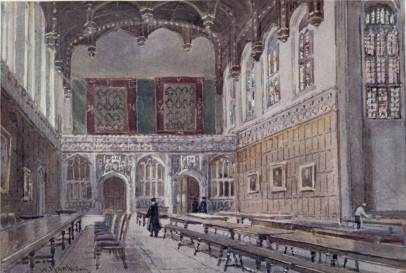
THE HALL OF KING’S COLLEGE This was built by Wilkins 1824-28. On the walls are several portraits by Sir Hubert Herkomer, R.A.
The Cambridge College chapels.
The importance of King’s College chapel in university history since the xv century leads us to consider the rôle played in Cambridge by collegiate chapels. Every college chapel, and every church which has an historical connexion with the university, has served—as all early Christian edifices have served—other purposes than those of religious worship. What we have to remark in Cambridge is that this ancient custom continued there longer than elsewhere. The “Commencements” which took place later in the Senate House used to be held, as we have seen, in the famous church of the Greyfriars or in that of the Austinfriars. The University church—Great S. Mary’s—was used by the university for its assemblies in the xiii century and was the scene of all great civic functions; disputations were held in it on Elizabeth’s visit in 1564. The college chapels were everywhere used for the transaction of important business; the Provost of King’s and other Masters are still elected in the chapel, documents are still sealed in the chapel of King’s and Trinity, and the Thurston speech is still pronounced in the chapel of Caius. The choir of King’s was used for degree examinations as late as 1851, and declamations are even now held in the chapel at Trinity. Indeed the “exercises of learning” “used” in the chapels was the reason given by the Corpus men to Lord Bacon’s father when asking for a church to themselves; and Queen Elizabeth witnessed the Aulularia of Plautus in King’s chapel on Sunday August 6th 1564, as the abbess and her nuns had assembled for Hrostwitha’s play in the abbey church of Gandersheim six hundred years earlier. The building of colleges adjoining a parish church is a feature peculiar to Cambridge. Merton is the one exception at Oxford, and Pembroke is, as we have seen, the only early exception to this rule at Cambridge.[188]
List of pre-reformation colleges built with chapels:—
1.
Pembroke 1355-63 (the existing chapel is xvii c.)
2.
King’s 1446-1536 (the existing chapel).
3.
Queens’ 1448 (defaced at the reformation and restored. But a xix c. chapel is now used).
4.
Jesus 1495 (The then existing xii c. monastic chapel was rebuilt by the founder.)
5.
S. Catherine’s 1475 (the existing chapel is xvii c.)
6.
Magdalene 1483 (completely restored in the middle of the xix c.)
Existing pre-reformation chapels:—
King’s xv c.
Queens’ xv c. (restored).
Jesus xv c.
Trinity Hall xv c.
Magdalene (restored) xv c.
Colleges built without chapels and with (generally) post-reformation chapels:—
1.
Peterhouse (xvii c.)
[188a]2.
Michaelhouse (none).
3.
King’s Hall (chapel built temp. Edw. IV., and Ric. III. The site of the present chapel of Trinity College).
4.
Clare (1535. The existing chapel is 1764).
[188b]5.
Gonville.
[188c]6.
Trinity Hall 1474.
7.
Corpus 1500, and 1579 (the existing chapel is on the site of the latter, and was erected 1823).
Existing xvi c. chapels:—
Christ’s 1505 (the original chapel, but defaced); Trinity, completed 1564-7.
At Caius, the present chapel is on the site of the xvi c. chapel; and at S. John’s a xix c. structure replaces the xvi c. one, near the same site.
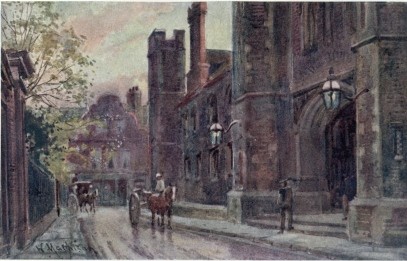
ENTRANCE GATEWAY, QUEENS’ COLLEGE This old gateway forms the principal entrance to the College from Queens’ Lane.
The oldest ecclesiastical site and building incorporated with a Cambridge college is therefore the chapel of Jesus (but cf. S. John’s p. 126); the site of the earliest college chapel is at Pembroke—but it is a site merely; the oldest existing college chapel is King’s.
Queens’ College. A.D. 1448.
The charter for the foundation of Queens’ College is dated 15 April 1448, but by this date its north and east ranges were already built. Queen Margaret of Anjou had been so impressed with the beauty and majesty of the plans for King’s College that she could find no rest till she had projected her own foundation—Queens’; to endow and perfect which she set to work with holy emulation; dedicating it in her turn to her patron saint, Margaret the legendary Virgin and Martyr whose body is shown at Montefiascone, and to Bernard of Citeaux. Two years previously the principal of S. Bernard’s hostel had founded a college of S. Bernard, the site of which he changed in 1447 to the present site of Queens’. This formed the moral nucleus of the queens’ college; but she obtained the larger part of the ground, near King’s, from the Carmelites. This is one of the three colleges in Cambridge built of red brick, S. John’s and S. Catherine’s being the others. The Queens’ quadrangle is, as Messieurs Willis and Clark tell us, the earliest now remaining which claims attention for its architectural beauty. It is 99 feet east and west by 84 north and south.[189] The plan is not only a very perfect example of college architecture, but is a model of the xv century English manor-house, of the type of Haddon Hall;[190] so that Queens’ College is as homogeneous a structure as King’s is heterogeneous. The hall is on the west, adjoining it is the combination room, above, the President’s lodging with a bedchamber over it. The north side is kept for the chapel and for the library which is on the first floor. The chambers are on the east and south sides, the gateway being in the former. As in other colleges the passage to the grounds (or, as in this case, to the second court) is between the hall and the butteries. The west side of the quadrangle which was gradually cloistered forms the east side of the second court, and is washed by the Cam. The beautiful gallery on the north has formed part of the lodge since the xvi century,[191] and connects the old
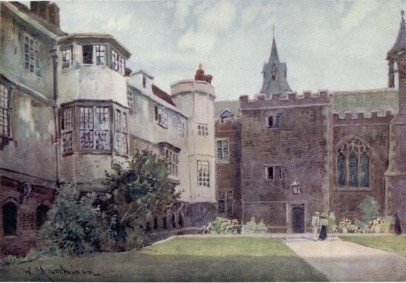
AN OLD COURT IN QUEENS’ COLLEGE This is the Cloister Court. In the quaint sixteenth century buildings on the left is the Gallery, and facing the spectator is the doorway into the First Court. The Hall is seen on the right of this doorway.
president’s lodging with a set of rooms on the west side, among which is the audit room now used as a dining room.
Queens’, like King’s, was originally built with a chapel, and in both instances the foundation stone of the chapel was that of the college. A new chapel and buildings now lie beyond the President’s garden on the north. There is a small court on the south of the cloister court which contains the rooms occupied by Erasmus, overhanging the college kitchen. Besides Erasmus, who lived here for at least four years, Fisher was there as President of the college until 1508, and Old Fuller was another of its worthies. Henry Bullock, the opposer of Protestantism and friend of Erasmus, was a fellow, so was Sir T. Smith; Bishop Pearson[192] and Ockley alumni. Henry Hastings Earl of Huntingdon, whose portrait hangs in the audit room, Manners Earl of Rutland, George Duke of Clarence, Cecilia Duchess of York, and Maud Countess of Oxford, were among its benefactors. But its chief benefactor was Andrew Doket, a friar (of what order is not known) and its first President, who saved the fortunes of the college after the fall of the House of Lancaster.[193] The picture of principal interest is also to be found in the lodge—Holbein’s portrait of Erasmus which was painted during a visit made at the scholar’s request to England.
The college was originally endowed for a president and 4 fellows, and their principal study was to be theology. There are now 11 fellowships, and about 18 scholarships which vary in value from £30 to £60.
Queens’ College is a monument of peace. The Yorkist queen Elizabeth Woodville continued Margaret of Anjou’s work, and the two queens are the co-founders of the college. It is Elizabeth Woodville whose portrait looks down upon us in the hall, and it was she who changed Queen Margaret’s dedication and called their joint work Queens’ College.[194] It is also a monument to the unambitious but well-defined revival of learning that marked the reign of Edward IV., of which Woodville Earl Rivers, the queen’s brother, Tiptoft Earl of Worcester, and Caxton himself are the representatives.
Kingly visitors to the university.
Both King’s and Queens’ Colleges have offered hospitality on several occasions to English sovereigns. Henry VI. came to lay the foundation stone of King’s in 1441 and was at King’s Hall in 1445-6 (when he laid the foundation stone of his second college?), in 1448-9 and in 1452-3.[195] Edward IV. visited the university in 1463 and 1476.

QUEENS’ COLLEGE FROM THE RIVER FRONT On the left is seen the garden front of the President’s Lodge. The wooden bridge designed by Etheridge (1749) is known as the Mathematical Bridge. In the distance are the two old mills—the King’s Mill and the Bishop’s Mill.
Henry VII. paid five visits to Cambridge and stayed at Queens’ in 1498 and again in 1506 when he occupied a chamber near the audit room. It was on this occasion that he attended the service for the eve of S. George’s day in King’s College chapel clad in the robes of the Garter. Henry VIII. was by his father’s side during this visit, and came again in 1522. Mary came as far as Sir Robert Huddleston’s when Jane Grey was proclaimed. Elizabeth was entertained in the Provost’s lodge of King’s, and it was when repairing to her rooms there after the solemn service in the chapel that she thanked God “that had sent her to this university where she was so received as she thought she could not be better.” James I. visited Cambridge twice in 1615 and was again at Trinity College in 1623 and 1624; Charles I. (who had been Nevile’s guest in 1613) was entertained there in 1632 and 1642; and Charles II. in the long gallery at S. John’s in 1681. Anne was there in 1705, George I. in 1717, and George II. in 1728. Queen Victoria came in 1843 and again in 1847 when the Prince Consort was installed as Chancellor; and Edward VII. visited the university in February 1904.
John had been in Cambridge the month before his death, September 1216; Henry III. was there in the second year of his reign (1218); Edward I. was there as Prince of Wales in 1270, and lodged again in the castle in 1294. Edward II. was the guest of Barnwell priory in 1326. Edward III. was there in September 1328. Richard II. was also lodged at Barnwell in 1388.
The Conqueror had been at Cambridge in 1070.
Matilda is the first queen-consort whom we can picture visiting the university town; Eleanor of Castile was frequently at Walsingham with Edward,[196] and she gave as we shall see a “chest” to the university. Margaret of Anjou was never there, but Elizabeth Woodville came in 1468. The mother of Henry VII. also came to see her college in 1505 and again with the king in 1506. Elizabeth of York accompanied Henry VII. in 1498; Catherine of Aragon slept at Queens’ in 1519; and Henrietta Maria was with the king in 1631-2.
The erection of King’s and Queens’ Colleges opened a period of college building which lasted sixty years, and closed with the foundation of S. John’s (in 1509).
S. Catherine’s College, 1473.
In 1473 Robert Woodlark chancellor of the university and third provost of King’s, and one of the original scholars of that foundation, built a small college dedicated to the Glorious Virgin Martyr S. Catherine of Alexandria, with the object of extending “the usefulness of Church preaching, and the study of theology, philosophy, and other arts within the Church of England.” The present red brick structure was erected two hundred years later, this being the only college except Clare which has been entirely rebuilt since its foundation. S. Catherine’s, or “Cat’s” as the

GATEWAY OF ST. CATHERINE’S COLLEGE This is a view of the old Renaissance Gateway (1679), being the entrance to the College from Queens’ Lane.
undergraduate familiarly calls it, is remarkable for the number of bishops it has educated, among whom were Archbishop Sandys, May of Carlisle, Brownrigg of Exeter, all of whom were Masters of the college, as was Overall of Norwich who migrated from S. John’s: John Lightfoot, the orientalist, was its 16th Master, and Strype (who came here from Jesus), James Shirley the last of the dramatists,[197] Ray the naturalist, and Addenbrooke the founder of the well known hospital of that name at Cambridge, were also educated here.
The hall[198] was founded for a master and 3 fellows, and now maintains 6 fellows and 26 scholars.
Jesus College 1495.
The next college is a solitary instance of the adaptation of monastic architecture to collegiate purposes in Cambridge. Alcock Bishop of Ely and joint lord chancellor with Rotherham obtained from Alexander VI. (1496/7) the dissolution of the ancient Benedictine nunnery of S. Rhadegund, and founded there a college which he dedicated to the Blessed Virgin Mary, S. John Evangelist, and the glorious Virgin S. Rhadegund. Its name of Jesus College records the growing cult of the name of Jesus, and the substitution was approved by the founder himself.[199]
If at Queens’ we are in a xv century manor-house, at Jesus we are in a monastery; and might well imagine ourselves for a moment back in one of the busiest centres of old Cambridge if we pace the cloisters just before hall time when the stir is suggestive of the life of a great monastery. Even the legend “Song Room” over a doorway falls in with the illusion. James I. said that if he lived in the university he would pray at King’s, eat at Trinity, and study and sleep at Jesus.
The chapel is the original conventual church[200] as rebuilt by Alcock. It contains xii century work, and represents the transition from Norman to Early English. The character of the college has been consistently evangelical in spite of the fact that Bancroft the Laudian archbishop before Laud, was here, and that he migrated here from Christ’s on account of the latter’s reputation for Puritanism. Cranmer was scholar, and fellow until his marriage, and was readmitted fellow when his wife died a year later. Archbishops Bancroft and Sterne, Laurence Sterne, Bale Bishop of Ossory, Strype, Fulke Greville, Fenton, Fawkes (the poet), Hartley, and S. T. Coleridge were members. The college which was founded for 6 fellows and 6 scholars, now maintains 16 fellows and some 20 scholars. The statutes
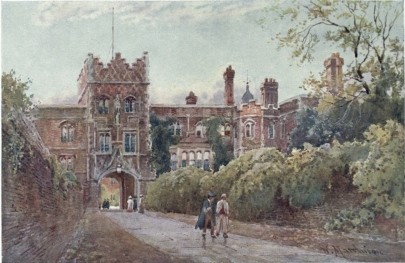
GATEWAY OF JESUS COLLEGE
were indited by James Stanley Bishop of Ely, stepson of Lady Margaret, and modified by his successor Nicholas West. Jesus College scholars were commended by the founder to the perpetual tutelage of the bishops of Ely, who when they lie there are said to lie in their own house.[201]
Christ’s College A.D. 1505.
Ten years later a most interesting foundation was made. A college called God’s House had, as we have seen, been founded in the reign of Henry VI. and was appropriated by that monarch as part of the site of King’s College. The foundation was a far-off echo of the plague in the previous century, and when the king took possession of the site he appears to have intended to endow a considerable college in its place in the parish of S. Andrew where he erected another God’s House.[202] It was this design, left unfulfilled (for the house only supported four of the sixty scholars whom Henry VI. had himself proposed to maintain there) that John Fisher, chancellor of the university and Bishop of Rochester, brought to the notice of Lady Margaret Beaufort, daughter of the first Duke of Somerset, Countess of Richmond and Derby, the wife of Edmund Tudor and mother of Henry VII.; and on the site of God’s House she erected her own Christ’s College, and made John Sickling its Proctor first Master. The quadrangle was encased in stone in the xviii century, but the gateway with its statue and armorials of the founder, and the oriel over the entrance to the Master’s lodge recall the founder’s time. Facing the gateway are the hall, the old combination room, and the lodge, and above were a set of rooms reserved for the founder’s own use; a turret staircase led therefrom to both hall and garden, as was the custom in a master’s lodge. On the east of this “Tree court” is a building in the renascence style, thought to be one of the finest examples in England, and to have been the work of Inigo Jones (1642). The gold plate of the college was a bequest of Lady Margaret’s and there is none finer in the university. Christ’s is also noted for its gardens.
No college has been richer in great men. Milton was here for seven years, Henry More the Platonist, Latimer the scholar-bishop and martyr, Leland the antiquary, Nicholas Saunderson, Paley of the “Evidences,” Archbishops Grindal and Bancroft, Bishop Porteous,
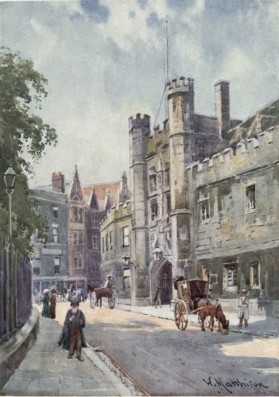
THE GATEWAY OF CHRIST’S COLLEGE FROM ST. ANDREW’S STREET The Gateway is coeval with the founding of the College, and dates from the first decade of the sixteenth century.
Sir Walter Mildmay,[203] Charles Darwin, and Sir John Seeley. Lightfoot the great Hebraist of his century, and Cudworth, were both Masters in the xvii century; and in the previous century Exmew the Carthusian martyr (1535) and Richard Hall (afterwards Canon of Cambray), Fisher’s biographer, were inmates. Here Milton wrote his hymn on the Nativity, and here he formed his friendship with Edward King—fellow of the college—in whose memory Lycidas was written.
The college was endowed for 12 fellows at least, half of whom were to hail from those northern counties in which both Lady Margaret and Fisher were interested; the total endowment was for 60 persons. There are now 15 fellowships, 30 scholarships (£30 to £70) and some 4 sizarships of the value of £50 a year.[204]
Grammar, the original study of God’s House,[205] and arts were to be studied in addition to theology, but excluding law and medicine; and for the first time in college statutes lectures on the classical orators and poets are provided for, an attention to polite letters for their own sake which is supposed to have been due to the influence of Erasmus.
The Lady Margaret.
The Lady Margaret, for with this title alone her memory is preserved at both universities, has, perhaps, no rival in Cambridge as both an interesting and an important figure in its history. She appears to have been one of the first in that age to understand that the university was to replace the monastery as the channel of English learning, and to endow colleges rather than religious houses. The two splendid foundations which owe their existence to her bear upon them a stronger personal impress than others. Alone of non-resident founders she retained for her own use a lodge in the college she founded. An anecdote when she was staying at Christ’s, preserved for us by Fuller, comes across the centuries vivid with her personality. There is no episode in any university to compare with the scholastic partnership of Lady Margaret and Bishop Fisher, her chaplain, perpetual chancellor of the university, and Master of Michaelhouse. Both were in their measure “reformers before the reformation,” both joined to the spirit of piety an abounding appreciation of the spirit of knowledge. At Cambridge and Oxford she founded those readerships in theology known as the Lady Margaret Professorships, and at Cambridge she instituted the Lady Margaret preachership. She died on 29 June 1509, and Erasmus wrote her epitaph in Westminster Abbey.[206]
Cardinal Fisher, Bishop of Rochester, and perpetual chancellor of the university.
Fisher lived many years after her, and completed the foundation of S. John’s. He pronounced that discourse at her obsequies which is our chief source of information about her.[207] Fisher was imprisoned, like Thomas More, for refusing to admit the

THE FELLOWS’ BUILDING IN CHRIST’S COLLEGE This building is in the Second Court. The design is attributed to Inigo Jones. Through it we pass into the Fellows’ Garden, where we shall find the famous mulberry tree sacred to Milton.
royal supremacy in things ecclesiastical; covered with rags, and worn with neglect and ill-treatment, but consoled by a filial and courageous letter from his sons at S. John’s, he was led out to die on June 22, 1534, the New Testament in his hand open at the words: “This is eternal life, to know Thee the only true God.” He stands alone among the bishops of England to give his life for the principle for which the layman Thomas More laid down his. Pole in a letter to Charles V. narrates that Henry VIII. had said he supposed “that I” (Pole) “had never in all my travels met one who in letters and virtue could be compared to the Bishop of Rochester.”
[176] The printing of bibles and of the Book of Common Prayer is still confined to the king’s printer and the 2 universities. Until 1779 the printing of almanacks was also restricted to the universities and the Stationers’ Company.
[177] See iii. p. 183, and iv. p. 205.
[178] Cf. the laying of the foundation stone of the Norman church of S. Giles in 1092, when Anselm of Canterbury and the Bishop of Lincoln (then the diocesan) were present.
[179] In 1439. Its site was the present ante-chapel, see Christ’s College p. 117.
[180] The king’s design did not at first include the connexion of Eton and King’s. The foundations of a college and chapel for a rector and 12 scholars were first laid opposite Clare, between Mill Street and the Schools, on April 2, 1441. Within three years this foundation was changed into a society which, like Eton, is under a Provost and which was bound to provide the free education of poor Etonians. Here Henry imitated William of Wykeham, and the statutes which he drew up follow the lines laid down by the founder of Winchester and New College. The original “mean quadrant” was used till 1828 when it was sold to the university for the library extension on that side. The chapel fell down in 1536. A wall and gateway on the west, remain. The new design had the original court and Clare on the north, Austin’s hostel and Whitefriars on the south: the chapel was to form the north side of a quadrangle measuring 230 × 238 feet (cf. the measurements of Corpus); and, as in previous colleges, the west side was to contain the hall and provost’s lodging, a library and lecture rooms. The south and east sides were to be for the chambers and the latter was to have a gateway and tower. The present Queens’ College is on the site of the Whitefriars’ house; and the old gate of King’s which led from the chapel yard to Queens’ Lane used to be known as “Friars’ gate.” (For a full account of this most interesting design the reader is referred to Messrs. Willis and Clark’s book.)
[181] The Norfolk name of Boleyn is found at the university in the xv c. Henry Boleyn was proctor in 1454-5, and Anne’s uncle was churchwarden of S. Clement’s.
[182] It has been suggested that Tudor architecture might be styled Heraldic architecture, so freely does heraldry and blazonry enter into its plan and the scheme of decoration. England’s two great specimens of the Perpendicular—King’s College chapel and Henry VII.’s chapel at Westminster—are pervaded by a “gorgeous display of heraldry.” The west and south entrances of King’s are decorated with bold carvings of the badges of Henry VII.—the crowned rose and portcullis. “No person ever glanced his eye over the wonders around and above him, without being awestruck at the daring of the architect that could plan, and the builders that could erect such a structure. The whole of the lower part of the Chapel beneath the windows is divided into panels, and every panel is filled with the arms of the king who erected the building.” “The immense pendants hanging from the gorgeous roof are ornamented with the rose, the royal badge of both the king and queen at this period.” (Clark’s Introduction to Heraldry, edited by J. R. Planché, Rouge Croix.) The arms and supporters of Eton, Henry VI. and VIII., Richard II., Edward IV. and VIth, Mary and Elizabeth, appear also. The gateway towers of Christ’s and John’s afford other examples of heraldic display as the exclusive scheme of decoration—they bear the arms, supporters, and badges of their founder, the mother of Henry VII. Finally the Entrance Gateway tower of Trinity exhibits the arms of Edward III. and his six sons (William of Hatfield being represented by a blank shield); above is a statue of Henry VIII. No street—no town—in England presents anything like this “boast of heraldry” which Gray had always under his eyes in Cambridge. It is a permanent record of the two royal groups in England who preferred this university; the gateway at Trinity being the trait d’union between them.
[183] “The scholars of King’s enjoyed the questionable privilege of drifting into their degrees without examination. Lectures and rare compositions in Latin were the only demands upon their time,” writes Lord Stratford de Redcliffe. The same arrangements obtained at New College Oxford until 50 years ago.
[184] The “13 poor men” who are to form part of the foundation at Eton are an addition of Henry’s own; they do not appear on Wykeham’s foundation.
[185] For the Days, see v. p. 273 n. Wickham was vice-provost of Eton.
[186] Somerset returned to Cambridge in later life, after he had fallen into disgrace and poverty, and met, like Metcalfe of John’s, with small gratitude. Dr. Philip Baker, though a Catholic, retained the provostship under Elizabeth till 1570. For King’s men see also pp. 174-5, 272-3-4 n., 283.
[187] Eton is the only public school joined from its foundation with a Cambridge college. Merchant Taylors’ used however to be related to Pembroke (which owes Spenser’s presence there to this circumstance) and the ancient school of Bury used, it is said, to send its alumni to Gonville. S. Paul’s school has tied scholarships and exhibitions at Corpus Christi and Trinity: Corpus was connected with Norwich school and Norfolk by Bacon, Parker, and other Norfolk benefactors, and has tied scholarships with King’s School, Canterbury, and Westminster; the last being also closely connected with Trinity College. Harrow has two tied scholarships at Caius; Magdalene holds the Latimer Neville scholarships for Shrewsbury, Marlborough, Uppingham, and Fettes schools, and tied exhibitions from Wisbech school. Uppingham is similarly connected with Emmanuel; Peterhouse with Huntingdon Free Grammar School, and S. John’s with 18 schools all over England and with several towns as well.
[188] A chapel of S. Lucy (erected 1245) came into the possession of Peterhouse with the property of the friars of the Sack (1309) and was used by the fellows towards the end of that century. The licences obtained by Bateman (1352 and 1353) for chapels in Trinity Hall and Gonville were never acted upon. Gonville however had a house chapel in 1393. At this date Clare also had a chapel, which was used at the primate’s visitation in 1401. The Clare Statutes (1359) direct that S. John Baptist’s church be used. For ritual in the college chapels, see pp. 59, 145. Organs were placed in most of the chapels in the reign of Charles I., at a time when the courts, gates, and frontage of colleges underwent repair and decoration.
[189] Cf. with the dimensions of Corpus old court which was considerably larger (220 by 140), of the proposed quadrangle at King’s p. 102 n., and with the frontage of some of the hostels p. 50.
[190] Haddon Hall in Derbyshire; the first owners of which were those Peverels (”of the Peak”) who figure in Cambridge history at the time of the Conquest (i. p. 17). The house passed to the Bassetts, a name which was also well known in the university; and from there—so the old story runs—Dorothy Vernon, a daughter of the last owners of the manor, ran away with Sir John the first Lord Manners.
[191] For the marriage of a xvi c. President of Queens’, see iv. pp. 209, 212.
[192] Pearson was educated here, then at King’s of which he became fellow, and was Master of Jesus and, in 1662, of Trinity.
[193] See Bernard’s hostel p. 109.
[194] Margaret had however called it “the quenes collage of sainte Margarete and S. Bernard.” In her petition for a charter she tells the king: “in the whiche vniuersitie is no college founded by eny quene of Englond hidertoward.” The statutes were drawn up by Millington first Provost of King’s, and others.
[195] Accounts of King’s Hall. Here, too, the king was to have been lodged for the parliament of 1447.
[196] Henry VII. was on his way to the same celebrated shrine when he came to Cambridge in 1506.
[197] He was at S. John’s Oxford, which he left without his degree.
[198] “Hall of S. Katerine,” the only foundation since King’s College founded as a hall not a college.
[199] Willis and Clark.
[200] It was the gift of Malcolm “the Maiden” of Scotland. The monastery was much enlarged and enriched by him circa 1160. Dugdale dates the house to the middle of Stephen’s reign or perhaps as early as 1130. In the xiii c. Constantia wife to Earl Eustace granted to the nuns all the fisheries and water belonging to the town of Cambridge, and the convent at that time shared with the canons of S. John’s and the Merton scholars the fame of being the greatest landlords in the town. See i. pp. 16, 18 and 36 n., vi. p. 311 and ii. p. 109. On a stone by the south-eastern corner of the south transept in the church there is this inscription (A.D. 1261):
[201] Fuller.
[202] See iii. p. 165 n. Dyer points out that William Byngham is called “proctor and Master of God’s House,” but not founder: he considers that Hen. VI. was the founder, Byngham being its procurator as Doket was procurator of Queens’ and Somerset of King’s colleges. The facts recorded here and in chap. iii. appear to support this conclusion. At the same time Byngham in his letter to the king in 1439 distinctly claims to have built the house: “Goddeshous the which he hath made and edified in your towne of Cambridge.” In the case of every Cambridge college the founder is the man who endows it. A college may owe its existence (as certainly in Byngham’s case) to the energies of some one else, but its founder remains the man by whom it was built and endowed. A God’s House at Ewelme in Oxfordshire was founded about the same time by William de la Pole and Alice his wife, Earl and Countess of Suffolk. “It is still in being,” writes Tanner, “but the Mastership is annexed to the King’s professor of Physic in the university of Oxford.” A God’s house was an almshouse for some object of mercy. Thirteen poor men were maintained at Ewelme.
[203] Founder of Emmanuel College. Fuller says he was “a serious student in” and benefactor of this college.
[204] Refer to iv. p. 217 n.
[205] p. 153, iii. p. 165 n.
[206] She diverted some of her gifts to Henry VII.’s chapel at Westminster, with the king’s consent, in favour of S. John’s College Cambridge.
[207] “Fryvelous things, that were lytell to be regarded, she wold let pass by, but the other that were of weyght and substance, wherein she might proufyte, she wolde not let for any payne or labour, to take upon hande. All Englonde for her dethe had cause of wepynge ... the students of both the unyversytees, to whom she was as a moder; all the learned men of Englonde, to whom she was a veray patroness ... all the noblemen and women to whom she was a myrroure and exampler of honoure; all the comyn people of this realme, for whom she was in their cause a comyn medyatryce, and toke right grete displeasure for them.”
S. John’s College, A.D. 1509.
We next come to the most splendid foundation hitherto realised at Cambridge. The site chosen for a college which held its place through the xvi century as the first and most brilliant society in the university, could not have been more appropriate. It was that of S. John’s Hospital, the first home of Cambridge students, the nucleus of the university, erected soon after the Conquest in the heart of the Norman town, and whence the first endowed scholars in christendom set forth to found a college.[208]
The whole history of the university is epitomised in the street which has S. John’s at one end of it and Peterhouse at the other: the bishops of Ely have firm hold of either end, and lying against S. John’s is that Pythagoras House which Merton bought from the Dunnings when he was planning his famous foundation in the xiii century. We have seen that it was at S. John’s Hospital that Balsham introduced secular scholars in the same century, who should become unum corpus et unum collegium with the canons. The experiment did not succeed, and the canons saw the scholars depart with great relief to the other end of what was to prove the great street of colleges, whose limits were determined by this early conflict between seculars and religious.
In what year the Ely scholars were settled at S. John’s remains uncertain, although there is no more important date in Cambridge history. Simon Montacute, Bishop of Ely, “who knew very well” as the historian of S. John’s observes, says that the scholars had continued there per longa tempora, and Baker
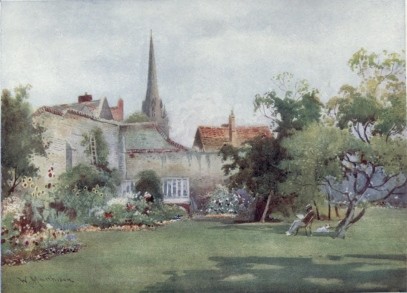
MILTON’S MULBERRY TREE IN THE FELLOWS’ GARDEN, CHRIST’S COLLEGE King James I. is said to have introduced the culture of the mulberry tree, and it is probable that the one in this garden is the last survivor of a number bought in 1609. Milton was admitted to this College in 1625.
considers that in no construction of words can this be understood otherwise than as referring to the beginning of Hugh Balsham’s prelacy at Ely.[209] The licence permitting the seculars to be engrafted on the old stock with their own endowment, is dated the ninth year of Edward I. (1280)[210] and the transference to Peterhouse took place three years after; but the date of the royal licence is no proof that the work to which it refers was initiated rather than completed and crowned in that year; Margaret of Anjou, for example, obtained her licence when three sides of the quadrangle at Queens’ were nearing completion.[211] In any case the few months intervening between December 23, 1280 and the decision to remove to Peterhouse could not be described as a “long time,” and as Balsham had become bishop of the diocese in 1257 it is most probable that he at once set about what it must certainly be supposed he had at heart while still subprior of Ely.
With S. John’s we have the first of the large colleges. Henceforth Trinity and John’s are “the big colleges” the others are “the 14 small colleges.” It now consists of four large courts, three of which are of brickwork. The first court was erected between 1509-1616 on the pattern of the quadrangle at Christ’s. The founder’s grandson Henry VIII., whose coronation she lived to witness, not only sequestrated a large part of the funds she had destined for the building, but fifteen years later beheaded Fisher her executor. The latter himself subscribed to the fund and was able before he died to erect a college for a Master and 21 fellows—the original design being for 50 fellows. But what thus fell short of the spirit of the earlier design has since been amply repaired, and a series of benefactors have made the college one of the most useful in England, with that large influence on the nation and large power of helping poorer students which its founders had so greatly at heart.
The Second Court was built chiefly at the expense of Mary Countess of Shrewsbury in 1595-1620. The Third Court was begun in 1623, with funds provided by Williams then Bishop of Lincoln, and finished by benefactors some of whom remained anonymous. The last Court was built in 1826 and is joined to the college by the “Bridge of Sighs.” Beyond this is the beautiful “wilderness” commemorated by Wordsworth.
—— Scarcely Spenser’s self Could have more tranquil visions in his youth
he tells us, than he had had loitering in Cambridge nights under a “fairy work of earth,” a certain lovely ash, wreathed in ivy. This is the site of the infirmary of the canons, the only portion of whose Hospital to be preserved was adapted as a college infirmary and was at the north side of the First Court: it was destroyed in 1863 when the present large chapel was built, which is the work of Gilbert Scott, and is 193 feet long. The large hall

THE GATEWAY AND TOWER OF ST. JOHN’S COLLEGE The Kirke White memorial is seen in the foreground, and behind it are the Divinity Schools; to the left is the Gateway of St. John’s, with the Tower behind it. The enclosed space in the foreground was formerly the site of All Saints’ Church, pulled down in 1865.
measures 108 feet, and the portrait of Lady Margaret presides over the high table. The new combination room, which is now entered from the second court, was built in 1864, and is 93 feet long. The west side of the Third Court is cloistered, and from here leads the covered bridge, called from its resemblance to the bridge at Venice “the Bridge of Sighs.” The stone bridge near it supplanted the old timber bridge in 1696. As at Queens’, there is a long gallery on the first floor of the Second Court. Nowhere has the original modest “master’s lodging” undergone more change than here. The lodging—two rooms over the old combination room, with an oriel, on the first court—was gradually extended, again as at Queens’, along the gallery, and ran along part of the next court. Finally Scott built the present lodge, outside the courts altogether.
Christ’s and S. John’s are both profusely ornamented with the Tudor and Beaufort badges of the founder, and with her name-device the marguerite.[212] The ancient gateway has a canopied statue of the Evangelist. To the north and south of the new chapel porch are statues of Lady Margaret and of Fisher, and 16 statues of the benefactors and great members of the college: Mary Cavendish Countess of Shrewsbury, Sarah Alston Duchess of Somerset, Williams Archbishop of York, and Linacre who founded the Physics lecture here and at Merton Oxford, appear among the former. Among the latter are Roger Ascham (fellow) (those asterisked are effigied); Sir John Cheke (fellow); *Bentley; *Cecil Lord Burleigh; *Lucius Lord Falkland[213]; Fairfax, the parliamentary general; *Wentworth Lord Strafford; *Stillingfleet, *Overall,[214] *Gunning, and Selwyn, prelates; *William Gilbert; *Brook Taylor the naturalist; *Clarkson the opponent of the slave trade; Cave the ecclesiastical historian; Metcalfe the most brilliant of its masters[215]; Matthew Prior, Grindal the classic, Cecil Lord Salisbury, Ben Jonson, Wordsworth, Kirke White, Rowland Hill, Henry Martyn the missionary, Horne Tooke, Castlereagh, Palmerston, Wilberforce, Erasmus Darwin, Colenso, Herschell, Liveing, Adams the discoverer of Neptune, Benjamin Hall Kennedy, and *Baker the historian of the college. Fisher arranged a small chapel leading from the college chapel for his own resting place.[216] The site of S. John’s chapel is as old an ecclesiastical site as Jesus chapel: the xvi century edifice was constructed close to the xii century canons’ church, and the fine modern chapel is on the same site.
The licence for the college dates from 1511; the building was opened in 1516; and the statutes were drawn up by Fisher.
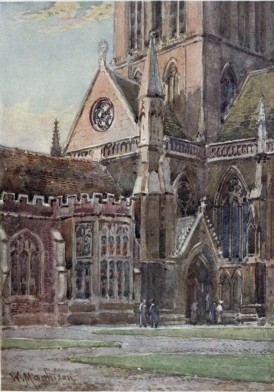
ENTRANCE TO ST. JOHN’S COLLEGE CHAPEL FROM THE FIRST COURT In the corner on the right is seen the Doorway of the Chapel, with the tower rising above it. On the left is part of the Hall with a fine oriel window.
There are now 56 fellowships, 60 foundation scholars each receiving £50 annually, and 9 sizars £35 annually.
The next college which claims our attention must rank among the more interesting foundations on account of its origin rather than of its subsequent history.
Magdalene College, A.D. 1542.
Near S. John’s Hospital there was a site traditionally connected with the lectures of Abbot Joffred’s monks in 1109, and which in fact was afterwards Crowland Abbey property. When a monastic order possessed no convent in a university town, the monks were obliged to reside in lodgings, and this led, as we have already seen (i. p. 49) to the foundation of monastic hostels for their reception. There were two such hostels at Cambridge—Ely hostel and Monks’ hostel. Ely hostel was the direct outcome of Benedict XII.’s Constitution in 1337[217] which reconfirmed an earlier injunction of Honorius III. 1216-27 requiring the Benedictines and Augustinians to send students in rotation from the monastery to the university, and provided that monks should live at the universities under a prior of Benedictines. It was purchased in 1340 (or earlier) by John de Crawden prior of Ely for the Ely monks and was made over to Bateman Bishop of Norwich seven years later for his foundation of Trinity Hall.
Ely then had been the pioneer in providing this accommodation, which served for Ely monks alone, and which, as we see, was speedily abolished. Those few Houses which still elected to send their monks to Cambridge[218] maintained them there thenceforth under the care of “the prior of students”; and it was owing to the energy of one of these Cambridge priors that Monks’ hostel was projected in 1428, at a time when, as is then stated, no house existed for Crowland or other Benedictine monks, and the religious either shared the hostels with seculars or lived in lodgings in the town. The site for Monks’ hostel consisted of two messuages granted in that year to the abbot of Crowland by the Cambridge burgesses. Crowland, Ely, Ramsey, and Walden each built portions for their own students.[219] Nearly a hundred years later, on the eve of the Reformation, Edward Stafford Duke of Buckingham refounded this hostel as Buckingham College. It was not
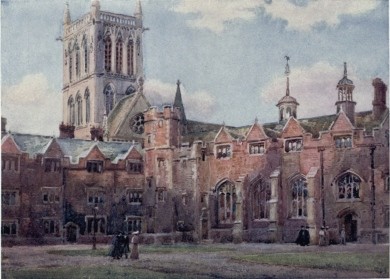
THE SECOND COURT OF ST. JOHN’S COLLEGE The doorway on the right leads into the First Court. The Dining Hall is in the building on the right and the Combination Room on the left of the picture. In the background is the Chapel Tower with the sunset light upon it
completed at the time of his attainder two years afterwards (1521) and the property escheated in due course as a cell of Crowland Abbey to the crown.[220]
How soon Monks’ hostel became “the monks’ hostel of Buckingham” is by no means clear. That the Dukes of Buckingham were early patrons must be admitted on the evidence; for even if the house was not known as Buckingham College in 1465, it was known as “the hostel called Bokyngham college” in 1483 while it was still Crowland property, and both hall and chapel were probably the gift of “deep revolving, witty Buckingham” the second Duke Henry.
“I have in this world sustained great damage and injury in serving the king’s highness, which this grant shall recompense.” So wrote Lord Chancellor Audley in a letter begging for a share of the plunder when Henry had determined on the suppression of the monasteries. The share he wanted and got was Walden Abbey in Essex on the borders of Cambridgeshire, and here he established himself on the site which his son was to transform into the mansion of Audley-End. He did more; he proposed to himself, apparently, some sort of expiation to balance the “recompense,” and in 1542 changed Buckingham into Magdalene College which he re-endowed. We have seen that Walden Abbey was itself one of the builders of Monks’ hostel.
The mastership of the college is in the gift of the owner of Audley-End (now Lord Braybrooke). Nothing of the xv century building remains. A window of Pugin’s adorns the chapel[221] replacing the old altar-piece which is now in the library. The combination room leads from the musicians’ gallery of the pleasant hall, the only instance of this arrangement in Cambridge.[222] In the time of Fuller, Magdalene was a college of reading men: “The scholars of this college, though farthest from the schools, were in my time the first to be observed there, and to as good purpose as any.”[223] Twenty years ago it was the fashionable college, and its members lived in private lodgings, attending neither hall nor chapel. Magdalene is in the parish of S. Giles, and it has been conjectured that it occupies the site of the house of the canons of S. Giles before they removed to Barnwell. There is however no evidence for this, and there are no documents at Magdalene earlier than Stafford’s time.[224]
Archbishop Grindal,[225] Robert Rede chief justice in 1509, Cumberland Bishop of Peterborough, and Kingsley were educated here. So was Pepys, the diarist, who bequeathed to the college his extraordinary collection

THE COMBINATION ROOM, ST. JOHN’S COLLEGE This Gallery is used by the Fellows and is 93 feet long. It contains portraits of many College worthies. The approach to it is by a Turret Staircase in the Second Court. Its panelled walls and rich plaster-work ceiling make it one of the finest specimens of its kind left in England.
of books, engravings, maps, and plans. The Pepysian library is now preserved in a separate hall, in the donor’s own bookshelves constructed after a plan of his own. It is by far the most interesting thing in the college, and would be unique anywhere. It is to be hoped we may soon have an official catalogue of its contents.
Magdalene is a small college, it has about 40 inmates, of whom 5 are fellows. In Fuller’s time it held 140 persons, 11 being fellows and 22 scholars, the rest being as usual the college officers, domestics, and students.
Trinity College A.D. 1546.
With Trinity College are joined together in indissoluble matrimony the two great periods of college building, and the culminating point of the renascence is reached: so that Trinity, alone, represents Cambridge architecturally and morally in its historical character of a university of the rebirth from its dawn to its meridian.
King’s Hall A.D. 1337.
When Henry VIII., whose effigy adorns the great gate, proposed to make a vast college on this site, he was proposing to expand the “great college” built by Edward III. whose effigy graces the older gateway within the court. Edward II. had maintained thirteen students at Cambridge as early as 1317 and the number was increased later to thirty-two: it was however left to his son to carry out the design of a “House-of-Scholars of the King.”[226] We have already had frequently to refer to this building, in which new interest has been awakened since the restoration (in 1904-6) of part of the old Hall lying behind King Edward’s gateway towards the bowling green, and presenting architectural features fully justifying its xiv century fame as the most considerable collegiate enterprise thitherto undertaken. The Hall lay to the north west of the present quadrangle, covering the space now occupied by the ante-chapel,[227] Edward’s gate, and the Master’s lodge. The acquisition of the site affords a most interesting glimpse into contemporary Cambridge history: for no site represented such various interests and recalled so many of the great local names. The first plot of ground obtained was a messuage of Robert de Croyland’s in 1336. Eight years later Edmund Walsyngham’s house was purchased; the house of Sir John de Cambridge who was knight of the shire and alderman of the guild of S. Mary was sold to the college in 1350 by his son Thomas; and the next year saw the purchase from Thomas son of Sir Constantine de Mortimer, of a waste parcel of land next the river and S. John’s Hospital, called the Cornhythe, which abutted on the last named property. Croyland’s and Walsyngham’s houses were first adapted, and formed a small irregular quadrangle. Later in the xiv century a new (irregular) court was constructed on the north of the present chapel. The original entrance was situated where the sundial now is; here stood the Great Gate, the present
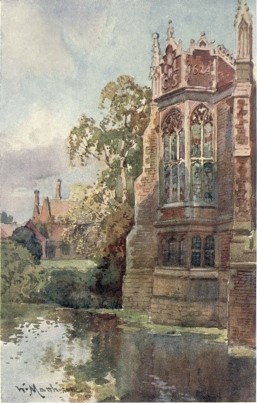
THE LIBRARY WINDOW, ST. JOHN’S COLLEGE, FROM THE BRIDGE OF SIGHS From this spot beautiful views are obtained up and down the river.
Entrance Gate being built as late as 1535 to give King’s Hall a frontage on the High Street. The Hall rebuilt in the later xiv century and added to in the xvth was however only the nucleus of Henry VIII.’s college. To the south west stood Michaelhouse; this too was absorbed in the new building, and its second dedication to the holy and undivided Trinity was retained in Henry’s college. Seven other buildings—all university hostels—were also absorbed—Gregory’s, Crouched, Physwick, S. Margaret’s, Tyled, Gerard’s, and Oving’s. The present kitchen occupies part of the site of Michaelhouse; Physwick stood between the Queen’s Gate and Trinity Street; and the other hostels were grouped round these in S. Michael’s and King’s Hall Lanes.[228]
The work which had been begun by Lady Margaret at Christ’s and S. John’s—the final substitution of the college for the monastery school—was now completed by her grandson, the great despoiler of the monasteries, who appears to have designed Trinity College as a splendid atonement for the destruction of so many homes of learning. It was largely endowed with abbey lands, and Henry’s undeniable interest in erudition seems to have found its ultimate satisfaction in a foundation into which there entered every element of that “new learning” which was humanistic before it was Protestant. That provision was here to be made for a wider field of knowledge than any hitherto contemplated in or out of a university, seems amply proved by the words of the founder; who, after declaring that the college is intended for the “development and perpetuation of religion” (a well-chosen form of words?), continues thus: “for the cultivation of wholesome study in all departments of learning, knowledge of languages, the education of youth in piety, virtue, self-restraint, and knowledge; charity towards the poor, and the relief of the afflicted and distressed.” The programme was so liberal that Mary herself endowed the college with monastic property, and Elizabeth completed the chapel which her sister had begun.
No building, indeed, in either university suggests in the same way and in the same degree that delightful mental combination of form and space which is the mark of the “Cambridge mind” in science if it is not so in literature. As we pass into the great court the buildings we see neither shut out the light nor hem in the thoughts. The enclosure they suggest is that formal enclosure of point and line which enables us to make propositions about infinity. Of all scholastic buildings in the world the great court of Trinity is that which best suggests the majesty and spaciousness of learning. Here one receives an impression of adequacy, balance, clearness, spaciousness, elevation, serenity, a certain high power of the imagination—the mathematical qualities, the qualities of the seeker after truth: an impression of the simple force of what is simply clear, the simple grandeur of that which can dispense with the mysterious; of the dignity which accompanies those who have looked upon things as
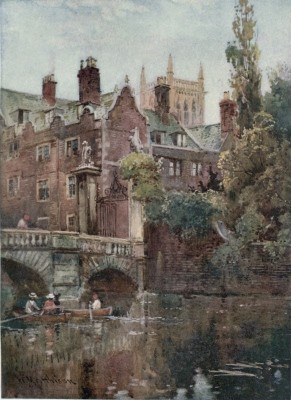
OLD GATEWAY AND BRIDGE These buildings form part of St. John’s College, and look on to the river. The Tower of the College Chapel is seen in the background.
they are in themselves, and have nothing adventitious to offer, yet what they offer holds a curious power of satisfying.
Does a man see all this as he walks into Trinity and learn from it the lesson which Cambridge spreads before him, or does he take it with him under the gateway and let Trinity Great Court represent for him what he already knows of Cambridge? What does it matter whether it suggests so much or is allowed to represent so much?
Trinity Great Court covers more than 90,000 square feet—an area of over 2 acres—and is the largest in any college. The building, carried out under Edward VI., received considerable modification during the mastership of Nevile (1593-1615) dean of Canterbury, who arranged the court on its present plan, erected the “Queen’s gateway” and the fine renascence fountain, enlarged the original lodge, and built the hall and kitchen. On the west side, facing us as we enter, is the hall (1604) which was modelled on that of the Middle Temple. Next it are two combination rooms—the centre for generations of Cambridge fellows who first had their assembling room in King’s Hall hard by[229]—but the façade here was spoiled in the xviii century when the oriel and frontage of the old hall of Michaelhouse were removed. A Jacobean porch leads us into the lodge, which occupies the site of King’s Hall lodge. The great scholar Bentley, Master from 1700 to 1742, built the staircase and otherwise left his mark here. His excursions into the classical were, however, curtailed during the mastership of Whewell (1840) when Alexander Beresford Hope subscribed to restore the Gothic character of the front and built the picturesque oriel.[230] The inscription stating that he had restored its ancient aspect to the house during the mastership of Whewell gave rise to the following amusing paraphrase:—
This is the House that Hope built. This is the Master, rude and rough, Who lives in the House that Hope built. These are the seniors, greedy and gruff, Who toady the Master, rude and rough, Who lives in the House that Hope built.[231]
A.D. 1555-1564.
The chapel, on the north, was built by Mary, and
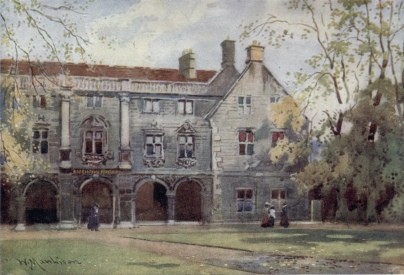
PEPYS’ LIBRARY, MAGDALENE COLLEGE This range of old buildings houses the Pepysian Library. The style is seventeenth century.
is one of the few churches erected in her reign, as Trinity College is itself one of the few places where her name is held in affection. Though it has none of the greatness of King’s chapel, it yields to none in interest. The site is that of the chapel of King’s Hall built for the scholars by Edward IV., the materials of which, with stone from the Greyfriars’ house, the fen abbey of Ramsey, and Peterhouse, and lead from the Greyfriars and Mildenhall, were used in the construction. Elizabeth completed it nine years later (1564). The ante-chapel contains the statue of Newton,
—— with his prism and silent face, The marble index of a mind for ever Voyaging through strange seas of Thought, alone
a work of Roubiliac’s considered by Chantrey to be the noblest of English statues. Bacon, Barrow, Macaulay, and Whewell have also statues here, while Richard Porson is commemorated by a bust. Along the wall which faces us as we enter are sixteen memorial brasses chiefly to remarkable fellows of the college who have died within the last twenty years.
The great court leads in the usual way, by hall and butteries, to Nevile’s court, another work of Dr. Nevile’s, and here the library—to the building of which Newton contributed—was erected by subscription, the foundation stone being laid on February 26, 1676. The architect was Wren who also designed the bookcases of the “stately library” as those who had determined on its foundation had called it in anticipation. The wood of the cases is Norway oak which has been stained to imitate cedar. The building is very rich with decoration inside and out; the length is 194 feet as compared with the chapel 210 feet and the hall 100 feet. The staircase and pavement are of marble. Pedestals with busts of members of the college line the room on either side. The library contains 90,000 volumes, with 1900 MSS. including a Sarum missal on vellum of 1500, Milton’s rough draft notes of “Paradise Lost,” the Codex Augiensis of Paul’s Epistles, four MSS. of Wyclif’s bible, and the Canterbury psalter.[232]
A New Court, to which George IV. contributed, was erected in the first quarter of the xix century and Dr. Whewell built, at his own expense, the Master’s Court. Upon the site of Garret’s hostel, the then bishop of Lichfield erected in 1670 a small building known as “Bishop’s hostel” which is used as students’ quarters, and the proceeds of letting it are spent according to the founder’s direction in the purchase of books for the library. Macaulay “kept” here when he first went up to Cambridge.
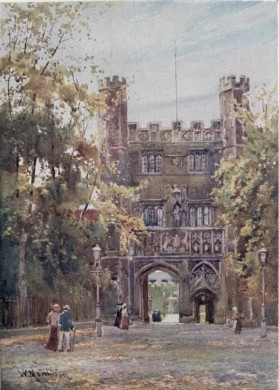
THE GATEWAY OF TRINITY COLLEGE The Great Entrance Gate, constructed about 1518-35. The panels over the arch commemorate King Edward the Third and his six sons. The Master’s lodge is seen in the distance through the gateway.
The Mastership.
The Mastership of Trinity has been, ever since the Reformation, one of the most important offices in the university; but it is rendered still more distinguished by the great men who have successively filled it. The last Master of King’s Hall became the first Master of Trinity and has had among his successors Isaac Barrow, William Bill, Whitgift, Wilkins, Bentley, and Whewell. Its chief benefactor Nevile was eighth Master.
Trinity has been equally great in literature and science, and has effected more for both in the three hundred and fifty years of its existence than any other centre of learning. Among its fellows it counts Newton, Adam Sedgwick, Ray, Barrow, Porson, Roger Cotes, Macaulay, Whewell, Westcott, Airy, Clerk Maxwell, Cayley, Hort, Thirlwall, Jebb. Among lawyers Bacon, Coke, and Lyndhurst; among prelates Tunstall,[233] Whitgift, Lightfoot. Among other famous alumni are Robert Devereux, Cotton, Spelman, Thackeray, Granville (M.A. 1679), Peacock, Kinglake, Trench, De Morgan, F. D. Maurice, and the late Duke of Rutland (Lord John Manners). Among poets, Byron, Dryden, Andrew Marvell, Tennyson, Donne, Cowley, George Herbert, Monckton-Milnes. Another historic friendship like that between Spenser and Kirke at Pembroke, Milton and King at Christ’s, and Gray and Walpole, grew up in the shadow of Trinity—the friendship of Tennyson and Arthur Hallam commemorated in In Memoriam.
There are 60 fellowships, 74 scholarships worth each £100 a year, and 16 sizarships of the value of £80 each. The students of Trinity number one-fourth of the undergraduate population. The college is not only the largest but the most important scholastic institution in the world: “being at this day” writes Fuller, “the stateliest and most uniform college in Christendom, out of which may be carved three Dutch universities.” Among the college livings are the university church of S. Mary’s, S. Michael’s (the old church attached to Michaelhouse) Chesterton Vicarage and several rectories and vicarages in the dioceses of Ely, York, Lincoln, Lichfield, London, Peterborough, and Carlisle, which include most of those belonging to King’s Hall and Michaelhouse, with the exception of the Norwich benefices.[234]
Gateways.
The gateway of Trinity with its four towers, the two interior being the larger and furnished with staircases, reminds us that the ornamental gateway was the last architectural addition to the college quadrangle. The first ornamental archway was the great gate built for King’s Hall in 1426.[235] It was copied in the turreted gateway of Queens’ College, and afterwards in the old gateway of King’s,[236] and in the present gateways of
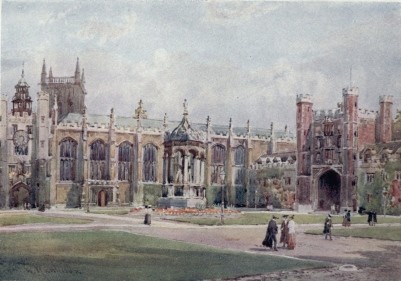
THE GREAT COURT, TRINITY COLLEGE The largest at either University or in Europe. We see the Great Gate in the picture on the right, facing us—the Chapel. To the left of the Chapel is seen King Edward’s Gate, fourteenth century. The beautiful Fountain in the middle of the picture is in the Renaissance style, and was built by Nevile in 1602, and rebuilt in 1716.
Christ’s and S. John’s, and even in that second gateway of King’s Hall which is the present entrance gate of Trinity.[237] The only gateway in Cambridge which varies completely from these models is Alcock’s at Jesus, which is much lighter in character. The xvi century gateways of Caius are “the first specimens of the revival of stone work.”[238] The ornamental gateway is a distinctive feature of Cambridge college architecture. The room over the gate was used as a muniment room; in S. John’s the chamber in the tower serves this purpose.
Caius College A.D. 1557.
In 1557 Doctor John Keys (whose name was Latinised as Caius) built and incorporated with Gonville Hall a college for scientific research and medical studies—the illustrious society which has since been known as Gonville and Caius College.
Keys or Caius was one of the great physicians of the xvi century; physician to Edward VI., Mary, and Elizabeth, and President of the College of Physicians. He was a Yorkshireman by race but a native of Norwich, and had been Principal of Physwick hostel which was at that time attached to Gonville Hall. Italian universities had turned his mind from the study of divinity to that of medicine and he became a doctor in that faculty at Padua in 1541, two years after leaving Cambridge. At Padua he lived with one of the earliest anatomists—Vesalius; and he himself lectured for twenty years on anatomy to the surgeons in London, at the request of Henry VIII.[239] He was Master of the college of which he was co-founder, but regularly spent the emoluments on fresh buildings at Caius. He was not only a great naturalist, the first English anatomist, a great physician, and an eminent classic,[240] but also a distinguished antiquary, and to him we owe one of the most valuable histories of the university. He had withal “a perverse stomach to the professors of the gospel,” and clung like Metcalfe of S. John’s and Baker of King’s to the old religion and the old ways of worship.[241] He is buried in the college chapel, and the simple words Fui Caius are inscribed over him. The foundation-stone of Caius he had himself inscribed: Johannes Caius posuit sapientiae; “John Caius dedicated it to knowledge.”
He built his college in two parallel ranges, east and west; a chapel and the Master’s lodge occupying the north side. On the south was a low wall with a gateway. “We decree,” he writes in the statutes of Caius, “that no building be constructed which shall shut in the entire south side of the college of our foundation, lest for lack of free ventilation the air should become foul.” This appreciation of the all-importance of air and sun to living organisms was more than three hundred years in advance of his time. If his instructions be not carried out, he says, the health of the college will be impaired, and disease and death will ensue. Closed quadrangles had been built in Cambridge ever
[208] See i. 38; ii. 55-6. An old Ely Chartulary says: “Henry Frost ought never to be forgot, who gave birth to so noted a seat of religion, and afterwards to one of the most renowned seats of learning in Europe.”
[209] History of the College of S. John the Evangelist, Baker-Mayor, pp. 22-3.
[210] Lit. Pat. 9 Edw. I. membr. 28 (23 Dec. 1280). Printed in Commission Documents vol. ii. p. 1.
[211] Willis and Clark.
[212] See p. 103 n.
[213] v. p. 278.
[214] Overall had been a scholar at Trinity, and was Master of S. Catherine’s.
[215] Metcalfe was the Catholic Master who made the great reputation of S. John’s, but whom “the young fry of fellows” combined to oust in 1534. “Did not all the bricks of the college that day double their dye of redness to blush at the ingratitude of those that dwelt therein?” (Fuller.)
[216] He was buried by the side of Sir Thomas More in the chapel of S. Peter ad Vincula in the Tower.
[217] Constitutions for the reform of the Black Benedictine, Cistercian, and Augustinian Orders, issued in 1335, 1337, 1339.
[218] i. p. 27. The university for English and Irish monks provided by papal authority and by the Cistercian Constitutions was Oxford. The licence for Monks’ hostel Cambridge stipulates that all monks of the order of S. Benedict in England or in other the king’s dominions shall henceforth dwell there together during the university course. There was a small recrudescence of monastic studies in Cambridge in the xiv c. when Ely hostel was built, and from this time forward 3 or 4 Ely monks were regularly to be found pursuing the university course there (Testimony of John of Sudbury, prior of students, at the Northampton chapter in 1426). But there was no prior of students at Cambridge till towards the end of that century; Ely hostel itself was dismantled before the middle of the century; the black monks of Norwich however came to Cambridge under Bateman’s influence with what the bull of Sixtus IV. 150 years later shows to have been considerable constancy. See Caius pp. 143-4, 144 n.
[219] Chambers for Crowland were built by its abbot John of Wisbeach in 1476. John de Bardenay had preceded John of Sudbury as prior of Benedictines in 1423, and both were probably Crowland monks.
[220] Dugdale. When Charles V. heard that Stafford Duke of Buckingham had been beheaded through the machinations of the butcher’s son Wolsey, he exclaimed: “A butcher’s dog has killed the fairest buck in England!”
[221] It is clear from the masonry of the chapel that this was anterior to the college of 1519. See Willis and Clark ii. 362, 364.
[222] Corpus hall is the only one in Cambridge not provided with a musicians’ gallery.
[223] The retired position of the earlier college had been, he held, a salutary assistance to study: it “stood on the transcantine side, an anchoret in itself, severed by the river from the rest of the university.”
[224] Fuller and Carter say the college site was purchased by the convents of Ely, Ramsey, and Walden. Cf. p. 128.
[225] Grindal is a good instance of a migrating student: he entered at Magdalene, and subsequently migrated to Christ’s and Pembroke, where he became fellow and Master.
[226] The university statute providing for the commemoration of benefactors and others, directs that mass be said every 5th of May for Edward II. as founder of King’s Hall.
[227] Which is on the site of the hall, pulled down in 1557 to make room for the chapel.
[228] For changes made in the Mill Street district in the xv c. when the School’s Quadrangle and King’s College were built, cf. pp. 24, 24 n., 25 n., 97 n., 101.
[229] There was a fellows’ “parloure” in King’s Hall as early as 1423-4.
[230] There is a fine series of most valuable portraits in the Lodge; among them one of Mary, and the standing portrait of the young Henry VIII. which Wordsworth made the subject of a poem. A careful list of university portraits appears at the end of Atkinson’s volume, but such a list—useful and valuable as it is—tucked away somewhere in a book on Cambridge is not an adequate homage to so important a source of university history as these portraits. The loan exhibition at the Fitzwilliam Museum in 1884-5 was the first attempt to collect the Cambridge pictures: the example was followed by Oxford in 1904-6, and the Catalogue of portraits then published is a model of what can and should be done.
[231] A sedan coach is preserved in the entrance hall of Trinity Lodge, and is used to transport visitors from the Gateway to the Lodge when the Master entertains. It is the college tradition that the coach was presented by Mrs. Worsley, wife of the then Master of Downing, to Christopher Wordsworth Master of Trinity, and brother of the poet (1820-41).
[232] This is the largest college library but it is not the most ancient. Peterhouse led the way in the xiii century with divinity and medicine books of Balsham’s. In 1418, 380 volumes were catalogued, containing “from six to seven hundred distinct treatises.” Here were to be found books on law, medicine, astrology, and natural philosophy, as well as the preponderating theological tomes. Trinity Hall was another famous xiv century library, and Pembroke has a catalogue of books in that and the next century amounting to 140 volumes. In the xv century Queens’ had 224, and S. Catherine’s 137 (in 1472 and 1475). In 1571 the French ambassador to this country deemed the library at Peterhouse “the worthiest in all England” Cf. the university library, p. 98.
[233] His name appears in the House List of King’s Hall.
[234] The tithes of Great S. Mary’s and Chesterton both belonged to King’s Hall, on which the advowson of S. Peter’s Northampton was bestowed, as Cherry Hinton had been bestowed on Peterhouse. The rectory of Chesterton, which had pertained till then to the monastery of Vercelli, was given by Eugenius IV.
[235] Removed to its present position by Nevile in 1600; see p. 132.
[236] p. 102 n.
[237] See p. 133.
[238] Willis and Clark.
[239] iii. p. 179.
[240] iii. p. 174.
[241] iii. p. 180.

THE HALL OF TRINITY COLLEGE FROM NEVILE’S COURT This is sometimes called the Cloister Court, and was built at the expense of Dr. Nevile about 1612. The principal building in this picture is the Dining Hall with its beautiful oriel window. Passing up the steps and through the passage we enter the Great Court, where we get another fine view of this Hall. Lord Byron occupied rooms in Nevile’s Court.
since the erection of Pembroke College, but no more were built there after the time of Caius.[242] Andrew Perne of Peterhouse was a contemporary stickler for hygienic conditions in the colleges; he saw to it that only pure water should be available “for the avoiding of the annoyance, infection, and contagion ordinarily arising through the uncleanness” of King’s Ditch “to the great endammaging” of health and welfare.
The college founded by Gonville is still known as Gonville Court in the joint college; but the other buildings are entirely new and make a modern show at the corner of King’s Parade not necessarily justified by the modernness of the science pursued within their walls.
In the xv century Gonville was peopled with monastic students: it is said that when Humphrey de la Pole and Gresham were studying there the other scholars were nearly all religious. If the monks of Ely, Crowland, Ramsey, and Walden lived at Monks’ hostel, the monks of Norwich priory had been allowed by a special papal exemption to continue to frequent Gonville and Trinity Halls, as they had done since Bateman’s time.[243] The Suffolk monks of Butley, black Benedictines from Bury, Cistercians from Lewes, and Austin canons from Westacre in Norfolk were also to be found there.[244] Gonville Hall was always regarded as the papal favourite at Cambridge; yet by 1530 Nix Bishop of Norwich in a letter to the primate Warham asserts that not one of the clerks at Gonville but “savoured of the frying pan.”
Caius has always been a doctors’ college; Harvey, Glisson the anatomist, and a long roll of eminent surgeons and physicians here received their education. Jeremy Taylor and Sir Thomas Gresham the only one of the Merchant Adventurers known to have been at a university, and founder of the Royal Exchange, were also sons of this house; as was Samuel Clarke (b. Norwich 1675) the metaphysician, “the lad of Caius.”
There are 22 fellows and some 36 scholars and exhibitioners, the value varying from £100 down to £20. There are also two chapel-clerkships (£38 for one year), and the Tancred medical studentships each worth £100 a year.
Emmanuel 1584.
We now come to the last two colleges to be founded in the xvi century. Emmanuel was founded by Sir Walter Mildmay, Chancellor of

NEVILE’S GATE, TRINITY COLLEGE To the left are the College kitchens and on the right is Bishop’s Hostel. The buildings on the left are among the most ancient in this college. Through the picturesque old gateway we see up the lane into Trinity Street.
the Exchequer to Elizabeth, in 1584, his object being to plant the seed of Puritanism in the university. The site he chose was the suppressed house of the Dominicans, and Ralph Symons, the architect who worked with so much skill and judgment at S. John’s and under Nevile at Trinity, converted the friary buildings into the Puritan college. The friars’ church is now the college hall and the library which at one time served as a chapel was it is said the convent refectory. The college chapel was built, from Wren’s designs, by Sancroft Archbishop of Canterbury (1668-78); and the college itself was rebuilt in the xviii and xix centuries. Emmanuel has preserved an evangelical character, the relic of its original Calvinism in doctrine and Puritanism in discipline; and the clerical students of Ridley Hall are recruited chiefly from here. “In Emmanuel College they do follow a private course of public prayer, after their own fashion”; the chapel used was unconsecrated, the communion was received sitting. The contrast must have been all the greater at this time—the beginning of the xvii century—when incense was burning and Latin was sung in other Cambridge chapels.
The name of Emmanuel College recalls the movement with which it was connected later in that century: when Whichcote, Cudworth, Smith, and Culverwell of Emmanuel, and More of Christ’s led the van of philosophic thought.[245] Besides Cudworth, Emmanuel has nurtured at least four eminent representatives of learning and science, Flamsteed, Wallis, Foster, Horrox; and one great statesman, Sir William Temple; and as a representative churchman, Sancroft who was also Master of the college. Samuel Parr was here; and William Law, the author of the “Serious Call,” was a nonjuring fellow. Harvard went from Emmanuel to America where he founded the university which bears his name.
There are 16 fellowships, 30 scholarships, and 4 sizarships.
Sidney Sussex 1594.
Sidney Sussex, the last of the xvi century colleges, was also built in Elizabeth’s reign, on the site of the Greyfriars’ as Emmanuel rose on the site of the Blackfriars’ house. Frances Sidney, daughter of Sir William Sidney and wife to the third Earl of Sussex, bequeathed the money for the foundation, and her executors purchased the property from Trinity College. The ubiquitous Ralph Symons was the architect; but the college was modernised in the early xix century. There are two courts: the hall and lodge in one, the chapel and library in the other. In this last is a x century pontifical from a northern diocese, probably Durham. The character of the college has always remained Protestant, this and Emmanuel being the first Protestant foundations in the university. Oliver Cromwell was enrolled a member the day of Shakespeare’s death, and Fuller the ecclesiastical historian was here for many years. Sterne the founder of the

TRINITY COLLEGE BRIDGE AND AVENUE, WITH GATE LEADING INTO THE NEW COURT The Bridge was built in 1763 by Wilkins. The trees in the Avenue in foreground were planted in 1671-72.
Irish College of Surgeons, Archbishop Bramhall, Henry Martyn,[246] May the poet, and Seth Ward are among its worthies. Edward Montague, Earl of Manchester, of whom the historian writes that he “loved his country with too unskilful a tenderness” was a member of this college, and carried out Cromwell’s destructive programme at his university. No one mentions the founder of Sidney Sussex without saying that she was aunt to Sir Philip, and it is a title of honour even for the founder of a college: did not Fulke Greville have himself described in his epitaph as “Frend to Sir Philip Sidney”?
There are 10 fellows and 36 scholars on the foundation, besides sizarships of the value of £27 a year.
Downing 1803.
One college has been built at Cambridge in modern times. The founder, who bequeathed his property for the purpose, was Sir George Downing of Gamlingay Park, Cambridgeshire, whose father was a graduate of Clare. Wilkins (the architect of the modern portions of King’s and Corpus and of the New Court of Trinity) began the structure in 1807, but he only completed the west and east sides. The town has since grown up to the college, which has large pleasure grounds. A “Downing” professorship of law and another of medicine were also endowed by the founder. Six of the 8 college fellowships must be held by students of law or medicine; and there are 10 scholars on the foundation.
Taking the place of the older hostels, but inversely as regards their relative proportion to the colleges, there are now 6 hostels, colleges in all but university status, with resident students reading for the usual university examinations. There are also two post-graduate hostels. The oldest of these are Newnham (1871) and Girton (1873) which are described in another chapter. Cavendish College on the Hills Road was opened in 1876 by the County College Association and admitted students from sixteen years old. It was recognised as a public hostel (November 9, 1882) but was closed nine years later.
Ridley Hall was erected in 1880 for theological students who have taken their degree. Its object is the maintenance of Reformation principles.
Selwyn College was founded in 1882, by subscription, in memory of Bishop Selwyn, and for the maintenance of Church of England principles, to whose members it is restricted. This institution occupies a somewhat anomalous position in the university, for it is the only hostel on avowedly “denominational” lines publicly recognised by and therefore forming part of the academic society. Cambridge has set its face against the recognition of colleges intended to meet the interests of one religious section of the community to the exclusion of others, on the ground that members of all religious communities may now receive instruction in any of the colleges, and suffer no interference with their religion, and also in pursuance of the main principle that a university education is of greater use
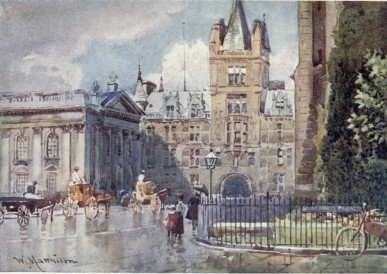
CAIUS COLLEGE AND THE SENATE HOUSE FROM ST. MARY’S PASSAGE On the left is the Senate House, built 1772-30. The building facing the spectator is the South Front of Gonville and Caius College by Waterhouse (1870). Through the railings on the right is the Tower of Great St. Mary’s. The street is King’s Parade.
and value when young men are not classed and separated according to their religious divisions. Thus when the Catholic hostel of S. Edmund applied for recognition in 1898, the “grace” was refused, in spite of the fact that many members of the university unconnected with any religious denomination, voted in its favour. S. Edmund’s House was founded by the Duke of Norfolk in 1897, and is for clerical students working for a tripos or other advanced work recognised in the university. It ranks as a licensed lodging house. A Benedictine hostel, Benet House, was founded in the same year, and supported by the father of the present abbot of Downside. A few professed monks, who are entered as members of Christ’s or some other college, pursue there the usual university course.
Westminster College is a post-graduate college for the Presbyterian Church of England, founded in Cambridge in 1899 (removed from London).
Cheshunt theological College, founded by the Countess of Huntingdon in 1768, has just been removed to Cambridge, and is there lodged in temporary premises. Undergraduate and post-graduate students are received, the former being non-collegiate members of the university. Students and staff must be of the Evangelical Reformed faith, but are free to enter the ministry of the established or any Free Church responding to that description.
These four last are the result of the abolition of the test act (1871) which kept our universities closed both to catholics and nonconformists: but Benet and S. Edmund’s houses were projected when the prohibition to catholics, maintained by Cardinal Manning, was withdrawn.
A note on the nationality of Cambridge founders.
Hugh de Balsham, founder of Peterhouse, 1284, Cambridge. Ob. 1286, bur. before the high altar, Ely.
Hervey de Stanton, founder of Michaelhouse, 1324. Ob. York 1327, bur. in S. Michael’s church near his college.
Richard de Badew, founder of University Hall, 1326, Chelmsford, Essex.
King’s Hall, Edward II. and Edward III., 1337.
Elizabeth de Clare, founder of Clare Hall, 1338 b. at Acre of Norman settlers in England, Wales and Ireland; married to two Irishmen. Ob. 1360, bur. Ware, Herts.
Marie de Chatillon, founder of Pembroke Hall, 1347. French, married a Welsh earl. Ob. 1377, bur. in the choir of Denney Abbey.[247]
Edmund Gonville, founder of Gonville Hall, 1348. East Anglian. Ob. 1351.
William Bateman, founder of Trinity Hall, 1350, East Anglian (b. Norwich). Ob. 1354, bur. Avignon.
Two Cambridge guilds, founders of Corpus Christi College, 1352.
William Byngham co-founder with Henry VI. of God’s House, 1439, 1448 (Rector of S. John Zachary, London; Proctor of the university in 1447) (Fuller pp. 150, 161).
King’s College, Henry VI., 1441.
Margaret of Anjou, founder of Queens’ College, 1448, French. Ob. 1482, bur. at the cathedral of Angers.[248]
Elizabeth Woodville, co-founder of Queens’. Northants. Ob. 1492, bur. at Windsor, near Edward IV.
Robert Woodlark, founder of S. Catherine’s, 1473, b. Wakerly near Stamford, Northants. Ob. 1479.
John Alcock, founder of Jesus College, 1495, b. Beverley, Yorks. Ob. 1500, bur. at Ely.
Margaret Beaufort, founder of Christ’s and S. John’s Colleges, 1505, 1509, b. Bletsoe, Beds.[249] Ob. 1509, bur. Westminster Abbey, in the south aisle of Hen. VII.’s chapel.
John Fisher (her coadjutor) b. Beverley, Yorks. Beheaded 1534, bur. in the Tower.
Magdalene College [first founded by the Fen abbeys and Walden 1428] Henry and Edward Stafford 2nd and 3rd Dukes of Buckingham, then Thomas first Baron Audley of Walden 1544. The two former (whose family came from Staffordshire) were beheaded 1483 and 1521, and bur. at Salisbury, and Austinfriars, London.[250] Lord Audley b. Essex, ob. 1544, bur. Saffron Walden.
Trinity College, Henry VIII., 1546.
John Caius, founder of Caius College 1557. Yorks, but b. Norwich, ob. 1573, bur. in the college chapel.
Sir Walter Mildmay, founder of Emmanuel College, 1584, Chelmsford, Essex. Ob. 1589, bur. at S. Bartholomew the Great, London.
Frances Sidney, founder of Sidney Sussex College, 1595, Kent (the family came from Anjou with Henry II.). [Her father and husband were both Lords deputy for Ireland, and her father also President of Wales.] Ob. 9th March 1589, bur. Westminster Abbey.
Sir George Downing, founder of Downing College, 1803, Cambridgeshire. Ob. 1749, bur. Croydon, Cambridgeshire.
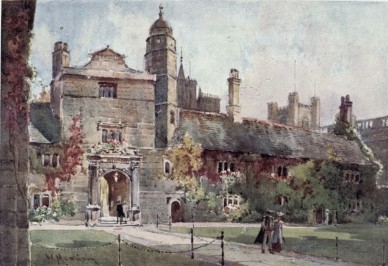
THE GATE OF VIRTUE, GONVILLE AND CAIUS COLLEGE This picture represents the Court built by Caius, who refounded the College. The Gate of Humility faces the spectator. This is the west side, and over the gate are the words Io CAIVS POSVIT SAPIENTIAE 1567. These words are taken from the inscription on the foundation stone.
It will be seen that the university owes most to Cambridge itself and East Anglia; and next to two counties which have always been in strict relation to it, Yorkshire and Essex. Two of the founders of colleges were French. Both Welsh and Irish names have been from the first represented, but Cambridge owes nothing to Scotland.[251] Even as late as 1535 when Henry issued the royal injunctions to the university during the chancellorship of Cromwell, there were students from every diocese and district of England, and from Wales and Ireland, at Cambridge, but Scotland is not mentioned.[252] Of the 4 countesses who founded colleges, one was twice married to Irishmen, and two married Welshmen.
Of the 14 (non-royal) men founders (including the third Duke of Buckingham and Fisher) 5 were East Anglian (3 Cambridgeshire), 3 were East-Saxons, 3 Yorkshiremen, one a Northamptonshire man, and one came from Staffordshire. To Beverley the university owes Fisher and Alcock, to Chelmsford Badew and Mildmay, to Norwich Bateman and Caius.
Of the 6 women founders, two were French (Chatillon and Queen Margaret) one was of French extraction (Sidney), the Clares were Normans, Elizabeth Clare and Chatillon were Plantagenets through Henry III. and Edward, Margaret Beaufort and Buckingham by descent from Edward III.; Elizabeth Woodville was half French through her mother Jaquetta of Luxembourg, daughter of Peter Comte de Saint-Paul. Thus, curiously enough, two of the women founders hailed from Anjou (Margaret and Frances Sidney) and two from Saint-Paul (Chatillon and Elizabeth Woodville).
The colleges they founded favoured different provinces.
Scope of their foundations.
Marie Valence, wished French fellows to be preferred to others of equal merits, and, failing these, scholars from the college rectories.[253]
Gonville wished to benefit East Anglian clergy.
Bateman wished chiefly to benefit clergy of the diocese of Norwich.
Henry VI. decided that failing scholars from the parishes of Eton or King’s, Buckinghamshire and Cambridgeshire should have the preference.
Margaret of Anjou’s college was, by Andrew Doket, allied with the Cambridge Greyfriars.
Margaret Beaufort and Fisher favoured the northern districts of Richmond, Derby, Northumberland, Cumberland, Westmoreland, York, Lancashire, and Nottingham, from which half at least of the scholars were to come.
Sidney Sussex College was, by its “bye-founder” Sir Francis Clerk, endowed for students from Bedfordshire.
The special character given to Peterhouse by Balsham was the studious pursuit of letters, arts, Aristotle, canon law or theology. There were to be 2 scholars for civil and canon law, and one for medicine; and poor bible-clerks were to be instructed in grammar.
Hervey de Stanton founded Michaelhouse for clergy, and for the study of theology.
Marie Valence founded Pembroke for the study of arts as well as theology.
Elizabeth de Burgh founded Clare for general learning. Three poor boys were to be instructed in grammar, logic, and singing.
Edmund Gonville made the 7 Arts the foundation for a theological training. (Bateman abolished its theological character.)
William Bateman founded Trinity Hall for the study of law only.
The two Guilds of Corpus Christi and the Blessed Virgin founded their college for scholars in sacred orders, and for the study of theology and canon law.
William Byngham established God’s House for the study of grammar among the clergy of the north-eastern counties.
Henry VI. required all the scholars of King’s to be candidates for sacred orders, and made theology and arts the principal but not the exclusive faculties.
Margaret of Anjou made theology the principal study at Queens’, and in her college law was only tolerated. The master of arts must either teach the trivium and quadrivium for 3 years, or devote the same time to the liberal sciences or Aristotle.
Robert Woodlark made his fellows restrict their studies by vow to “philosophy and sacred theology”—his college of S. Catherine was founded to promote Church interests exclusively.
John Alcock required that the scholars of Jesus College when they had graduated in arts, should devote themselves to the study of theology. Canon law was prohibited, but one out of the 12 fellows might be a student of civil law.
Margaret Beaufort founded Christ’s for the study of grammar, arts, and theology, but law and medicine were excluded.
Edward III. and Henry VIII. founded King’s Hall and Trinity College for general learning.
John Caius founded his college for the pursuit of science.
Sir Walter Mildmay founded Emmanuel for clergy who should maintain the principles of the Reformation.
Sir George Downing founded his college for the study of law and medicine.
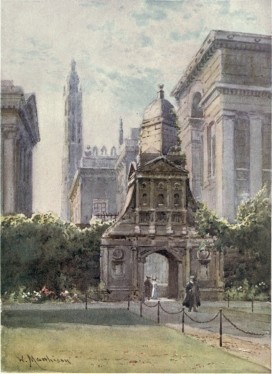
THE GATE OF HONOUR, CAIUS COLLEGE In the background on the right appear the buildings of the University Library, one of the Turrets of King’s Chapel in the distance, and the Senate House is seen on the left.
Hence Michaelhouse, Gonville, Corpus, God’s House, King’s, Catherine’s, Jesus, and Emmanuel were destined for a clerical curriculum only.
Bateman contemplated the union of the diplomatic career with the clerical; and although there were many jurists’ hostels his is the only college founded and endowed for the exclusive study of law. Caius is the only college founded and endowed for the natural sciences and medicine; but in the xiii century Balsham, in the xvith Caius, and in the xixth Downing, all provided for medical studies. Similarly in the xiii, xiv, and xvi centuries Balsham, Edward III., Elizabeth de Burgh and Henry VIII. each founded a college for the pursuit of general knowledge.[254]
Wealth of the university.
Sources of revenue.
Throughout the xiiith, xivth, and xvth centuries the university was certainly a very poor corporation. It took a hundred years to build three sides of the Schools quadrangle, and the money for the important schools of Philosophy and Civil Law collected by Chancellor Booth in the xv century was only got together by taxing the university.
The university as distinguished from the colleges has never been a wealthy society, and its sources of revenue are now much the same as they have always been. There are the capitation fees of members of the university. Fees for matriculation, for the public examinations, and for graduation, and proctors’ fines.
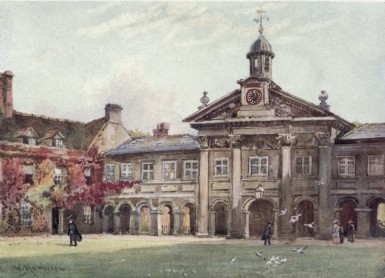
THE FIRST COURT OF EMMANUEL COLLEGE
The income of Burwell rectory and of a farm at Barton, The trading profits of the University Press; and one new source of income—the annual contribution from each of the colleges, in proportion to its revenues, provided for by statute in 1882. The vice-chancellor delivers an annual statement of expenditure, which includes the upkeep of the Senate House and Schools, of the University church, the Registrary’s office, the observatory, museums and lecture rooms, and a yearly contribution to the library: the salaries of professors and public examiners, and the stipends and salaries of university officers and servants.[255]
College wealth and property.
The original property of colleges was in land, benefices, and plate. The portable property was laid by in a chest kept in the muniment room: here title deeds, charters, rare books, college plate, and legacies in specie were treasured; the last being drawn upon for the purpose for which they were bequeathed until exhausted. Benefactors to a college presented it with a “chest,” and hence the “University Chest” is still the name for its revenue. Queen Eleanor presented a “chest” of a hundred marks to the university in 1293 (“The Queen’s Chest”); and Elizabeth, Duchess of Norfolk, enriched the public treasury with a thousand marks in the reign of Henry VII. when the “chests” had been “embezzled to private men’s profit”; a gift “which put the university in stock again.”[256] The “Ely Chest” was given in 1320 by John sometime Prior of Ely and Bishop of Norwich, and the other principal givers were country parsons, university chancellors, a “citizen of London” in 1344, and Thomas Beaufort, Duke of Exeter (“Exeter’s Chest”) in 1401.
The wealth of the colleges differs greatly. Trinity college has a gross income of over £74,000 and the next richest college is S. John’s. The poorer colleges have gross incomes varying from 4 to £9000.[257] The proportion contributed at Cambridge and Oxford for the royal loan of 1522 is interesting. At Oxford, New College and Magdalen contributed most, more than eight times as much as Exeter and Queens’ (£40) which gave least.[258] At Cambridge, King’s College and King’s Hall were the richest corporations and contributed the same sums as New College and Magdalen Oxford.
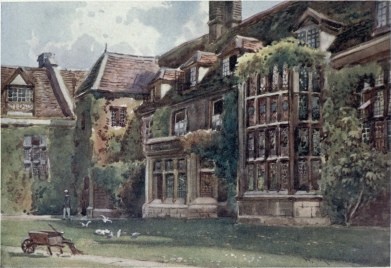
THE OLD COURT IN EMMANUEL COLLEGE The large stained-glass window of the Hall is seen on the right, and beyond that the window of the Combination Room. The Dormer window of Harvard’s room is seen on the extreme left.
CHAPTER III
THE UNIVERSITY AS A DEGREE-GIVING BODY
[pp. 157-164] Meaning of a degree—the kinds of degrees—the bachelor—the ancient exercises of the schools called acts, opponencies, and responsions—the sophister—questionist—determiner—master—regent master—the degree of M.A.—introduction of written examinations—the tripos.
[pp. 164-189] The subjects of study and examination: the trivium and quadrivium—grammar—Aristotle’s logic—rhetoric—the three learned faculties—the doctorate—development in university studies—the development of the mathematical tripos—the senior wrangler—the classical tripos—Greek at Cambridge—the moral sciences tripos—philosophy at Cambridge—the natural sciences tripos—science at Cambridge—the language triposes—list of the triposes—changing value of the examination tests—the double tripos—present conditions for the B.A. degree—modern changes in the examinations—standard of the ordinary and honour degree, examples.
[pp. 189-201] Method of tuition at Cambridge—the lecture—the class—the weekly paper—the professorial chairs—readerships—lectureships—Lambeth degrees—degrees by royal mandate—honorary degrees—the “modern subjects”—and the idea of a university.
A UNIVERSITY differs from other scholastic institutions in conferring “degrees.” Having taught a man his subject it offers him a certificate that he in his turn is able to teach it: the “degree” originally signified nothing more nor less than the graduate’s competence to profess the faculty in which it was obtained. This certificate of proficiency referred to the “three faculties” of theology, law, and medicine, to which was added later “the liberal arts.” The titles of “master,” “doctor,” and “professor” were at first synonymous. A master was a doctor in his subject, capable of professing it. The title of “master,” however, clung to the faculty of arts, that of “doctor” to the three liberal or learned professions.
The following degrees are now conferred: in arts, the bachelor and master (B.A., M.A.); in divinity, the bachelor and doctor (B.D., D.D.—formerly S.T.P., sacrae theologiae professor); in laws, bachelor, master and doctor (LL.B., LL.M., LL.D.[259]); in medicine, bachelor and doctor (M.B., M.D.); in music, bachelor, master, and doctor (Mus.B., Mus.M., Mus.D.); in surgery, bachelor and master (B.C., M.C.). Besides which a doctorate in science (Sc.D.), and a doctorate in letters (Litt.D.), are conferred on graduates in laws or in either of the last four faculties who have made some original contribution to the advancement of science or learning.[260]
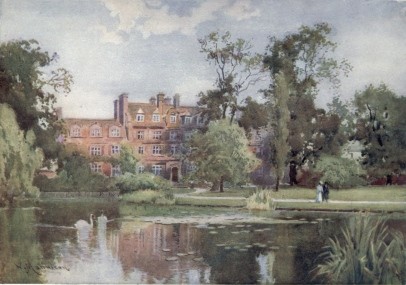
THE LAKE AND NEW BUILDINGS, EMMANUEL COLLEGE The building is known as the Hostel, and was erected between 1885 and 1894.
The bachelor and exercises of the schools.
The title of bachelor originally marked the conclusion of a period of study; it was not a degree, and bestowed no faculty to teach. Here, as elsewhere, a bachelor was an apprentice or aspirant to another status or position; and he remained in statu pupillari as he still is in theory to-day.[261]
It is only in modern times that the conferring of a degree follows upon a set written examination. For six hundred years the aspiring bachelor and master obtained their status by public disputations in the schools. Public exercises, called “acts, opponencies and responsions,” were regularly held during the period of probation, and the student advanced to the degree of master by steps which recall the rites of initiation in the catechumenate. After his first year the “freshman” became a “junior sophister”[262] in one of the faculties, and began to attend the school disputations, without however taking part in them. In his fourth year, as senior sophister, he qualified to be “questionist,” and presented himself as such at the beginning of Lent with ceremonies which turned him into a bachelor; ceremonies in which the Cambridge bedell figures as a veritable deacon. The procession was formed on Ash Wednesday and introduced into the arts schools by the bedell, who exclaimed: “Nostra Mater, bona nova, bona nova!” and “the father” (the presiding college senior) having proceeded to his place, the bedell suggested to him the stages of the ceremony: Reverende pater, licebit tibi incipere, etc. After this day the new bachelor was no longer a questionist but a “determiner” who determined in place of responding to the propositions raised in the schools. This status continued through Lent, and hence the incepting bachelor was described as stans in quadragesima.[263]
The master of arts.
In due course the bachelor “commenced master of arts,” the inception taking place in Great S. Mary’s church on the day of the “Great Commencement” the second of July. This is the traditional time of year for the granting of degrees, and the ceremony is still called “Commencements” in Cambridge and in universities which, like Dublin, are derivative institutions. The status now attained was that of regent master, i.e. a junior graduate whose

THE CLOISTER COURT, SIDNEY SUSSEX COLLEGE The new buildings on the left of the picture were designed by Mr. J. L. Pearson and erected in 1890. In the distance we see the large mullioned window of the Hall, which is part of the old college building begun 1596.
business it was to teach the subjects he had himself been taught, for a period of five years; after which he became a non-regent, or full master.[264] The obligation to teach was part of the university theory of studies; so that when a Cambridge professor of our own time astonished his hearers by declaring “I know nothing of political economy, I have not even taught it” he was speaking in the spirit of the university maxim disce docendo. It was the scholar who had taught who was called magister and doctor in old times, not the men who, as is the case nowadays, “go down” with no other qualification than that of the bachelor and are nevertheless allowed in due time to write M.A. after their names. For the degree of M.A. has virtually ceased to exist: no one now “commences master,” and the master of arts is simply the bachelor who has spent three years away from the university, in which he has had time to forget what he once knew. Indeed as between the master and the bachelor the case is often inverted, and if the former is an ordinary degree man and the latter an honours man, it is the latter who is the master in his subject while the former is little else than a tyro. That the degree of master carries with it not one iota more of scholarship or experience is certainly not understood by the public, but the fact that it is understood elsewhere supplies the reason why such a small proportion of men now proceed to take it.[265]
Written examinations.
It was not till the xviii century that written examinations were introduced, and from the day of their introduction the practice grew and flourished. Originally teaching and tests had both been oral, it was only as books became cheaper that the book in a measure supplanted the teacher, the written examination came to supplant the public acts and disputations, and the writing down of knowledge became the characteristic feature of Cambridge training. “Then know, sir, that at this place, all things—prizes, scholarships, and fellowships—are bestowed not on the greatest readers, but on those who, without any assistance, can produce most knowledge upon paper.” “Read six or eight hours a day, and write down what you know,” is a tutor’s advice ninety years ago.
The tripos.
The tripos, although it did not take shape till the middle of the same century derives its name from a custom of the xvith. On the day when the bachelor obtained his public recognition he had as his opponent in discussion one of the older bachelors who posed as the champion of the university. He sat upon a three-legged stool “before Mr. Proctor’s seat” and

DOWNING COLLEGE FROM THE ENTRANCE IN REGENT STREET These buildings are in the classical style and are all nineteenth-century work.
disputed with the senior questionist. This stool or tripod was eventually to provide a name for the great written examination of succeeding centuries—the tripos. The champion bachelor was addressed as “Mr. Tripos,” and his humorous orations were called “tripos speeches.” Tripos verses were next written, and on the back of these the moderators, in the middle of the xviii century, began printing the honours list:[266] from this tripos list of names the transition was easy to tripos as the name of the examination itself—the tripos examination. These disputations degenerated in Restoration times to buffoonery, but the principle of examination made steady progress,[267] and there were probably no tripos speeches after the Senate House was built. In the xvi and xvii centuries, however, great personages had acts and disputations performed for their entertainment; and the tastes of Elizabeth and her Scotch successor were consulted when “a physic act” was kept before the former, while “a philosophy act” was reserved for James.
There were declamations, which did not escape Byron’s ridicule, in the xix century, but the last general public “act” was kept in 1839. The viva voce examination in the “Little go” which was only discontinued 14 years ago, and the viva voce and the “act” for the medical degree[268] are the only survivals to our day of that oral examination by which the scholar in the public acts constantly responded to the living voice of the magister. For the first time in their long history silence settled down upon the schools, and the eye replaced the ear as the channel of knowledge.[269]
[242] Closed courts, however, continued to be built at Oxford; a late instance being the second court of S. John’s built by Laud so that his college should not be outshone by its Cambridge namesake.
[243] Bull of Sixtus IV. 1481. The bull recites that in the time of William Bishop of Norwich the Norwich Benedictines had been accustomed to lodge at Gonville and Trinity Hall where Bateman had made convenient arrangements for them. When the pope proceeds to say that Benedict XI. had required all Benedictines who wished to study in Cambridge to live in certo alio collegio dictae universitatis, “deputed ad hoc,” he is mistaking the authorisation of Monks’ hostel 50 years before for the papal Constitution of 150 years before, as he mistakes Benedict XI. for Benedict XII. The suggestion that he refers to University Hall (the hospicium universitatis) is certainly erroneous: the words above quoted simply mean “in the said university” and not “the college called university college“: there was no such house for monks in Cambridge between 1347 and 1428, when “the college deputed in the said university ad hoc“—Monks’ College—was founded. Benedict’s Constitution does not specify whether the religious are to dwell in common, or not.
[244] Cf. Magdalene, p. 127.
[245] v. p. 286. Cudworth was afterwards Master of Clare, then of Christ’s; Whichcote became Provost of King’s.
[246] p. 126.
[247] The spot is marked by the black tombstone in the present farmyard, half way between Cambridge and Ely.
[248] At her own request made to Louis XI. The tomb was destroyed during the Revolution.
[249] The seat of the Bedfordshire Beauchamps, her mother’s family.
[250] A headless skeleton found, before the middle of last century, near the spot where tradition says that Henry Duke of Buckingham suffered, is presumed to be that of the duke, of whose burial there is no other record. Hatcher’s History of Salisbury, 1843.
[251] Elizabeth Clare was heir to her brother who fell at Bannockburn: Marie Chatillon was widow of Valence Earl of Pembroke who fell in the wars against Bruce. The only Scotch benefactor was Malcolm the Maiden who endowed the nunnery of S. Rhadegund; but this was before colleges were built.
[252] “Ex omni dioecesi et qualibet parte hujus regni nostri Angliae, tam ex Wallia quam ex Hibernia.” There were, however, Scotchmen at Cambridge in the xiv c., i. p. 37.
[253] To this day Pembroke fellowships are open to men “of any nation and any county,” whereas at other colleges (as e.g. Corpus) the restriction is to “any subjects of the king, wherever born.” Cf. Jebb’s “Bentley,” p. 92.
[254] See divinity, canon and civil law, medicine, arts, and grammar in the next chapter, pp. 164-7.
[255] To these must be added: insurance, rates, and taxes, repairs, legal expenses, printing, and stationery, gifts made by the university, and the honorarium paid to the university preacher.
[256] Fuller.
[257] Magdalene, S. Catherine’s, Downing, Queens’, Peterhouse, Corpus, and Trinity Hall are the small and least wealthy colleges, and in this order. All the others have a gross income of over £10,000 a year. The income of all the colleges is published annually in Whitaker.
[258] University College contributed £50.
[259] See p. 167.
[260] A man’s university and the faculty in which he has graduated are shown by the hood: the Cambridge master’s hood is black silk lined with white silk; the bachelor’s black stuff hood is trimmed with white rabbit fur. The doctors in the three faculties wear scarlet silk hoods lined with pink and violet shot silk (D.D.), cherry silk (LL.D.) and magenta silk (M.D.).
[261] Thus the knight bachelor is one enjoying the titular degree and rank of knighthood, without membership of any knightly order, to the companionship of which he is supposed to be an aspirant.
[262] The study of sophistry or dialectic, which preceded Aristotle’s analytical logic.
[263] Junior and senior sophister and bachelor: Fuller writing of Northampton says: “But this university never lived to commence Bachelor of Art, Senior Sophister was all the standing it attained unto. For, four years after,” etc.
[264] Regent: regere like legere, to teach; cf. the doctores legentes and non-legentes of Bologna: regere scholas, and officium regendi occur in Bury school records, xii c. (Brit. Mus. Add. MSS. 14,848, fol. 136). A congregation of the Cambridge masters, regents and non-regents, met in S. Mary’s church as early as 1275.
[265] It must be realised that the degree in arts always differed from degrees in theology law and medicine inasmuch as these latter implied competence to exercise the corresponding professions. There was no such corresponding profession in the case of arts, except that of the schoolmaster. The clergyman, lawyer, or doctor at least exercised himself in these subjects, but the “artist” unless he was a regent-master, or a magister scholarum elsewhere, left his studies when he left his university.
[266] “The Tripos is a paper containing the names of the principal graduates for the year. It also contains 2 copies of verses written by two of the undergraduates, who are appointed to that employment by the proctors.“—Dyer. An extract from one of these sets of tripos verses is given in Dyer, Hist. Camb. ii. 89.
[267] It was at this time that the moderators were substituted for the proctors, see p. 183.
[268] pp. 168, 169.
[269] Cf. p. 189, the lecture.
Subjects of study. Trivium and Quadrivium.
The subjects in which university students were from the first exercised, were those of the Roman trivium and quadrivium, and the three faculties of theology law and medicine. A special importance must be assigned to the school of grammar—the first member of the trivium—at Cambridge. There is every reason to believe that it flourished there not only in the xiii century, under the patronage of the bishops of Ely, but also in the xiith. It was called the school of glomery (glomery, glamery, grammery)[270] and continued to be of importance till the xvi century, the last degree in grammar being granted in 1542.[271] Degrees in grammar were, nevertheless,
xii-xiii c.
considered inferior to those in arts. To begin with, grammar was only studied for three years, arts for seven; grammar made the clerk, arts the professor. The introduction of the “new art,” Aristotle’s
A.D. 1712.
analytical logic, increased the importance of the second member of the trivium: the name of Aristotle was a name to conjure with, but no new texts came to light to add lustre to the acquirements of the classical grammarian. As to the third member of the trivium, public rhetoric lectures were delivered in Cambridge by George Herbert (1620); but a century later Steele complains that both universities are “dumb in the study of eloquence.” There were still however rhetoric lectures in the xviii century, but they were not about rhetoric, and the public declamations in the senate house must be regarded as the last homage to this most ancient of arts, whose modern successor is the Union debating society.
The three liberal or learned faculties.
If the original Cambridge schools were grammar schools after the pattern of Orléans and Bury-St.-Edmund’s, then the introduction of the arts faculty—the trivium and quadrivium—was the first step towards the formation of a universitas; and its appearance in the xii century would account for the university status of Cambridge in the opening years of the xiii century.[272] The first of the three learned faculties to take its place in the university was divinity, and with the rise of the earliest colleges provision was made for the study of the two faculties of theology and law. The faculty of medicine was the last to gain a footing. Cambridge never became famous as a school of any of the faculties in the sense in which Paris represented divinity, Bologna law, Montpellier medicine. The study of the civil and canon law was, however, prominent in the xv and early xvi centuries, but was shorn of its ecclesiastical moiety during the chancellorship of Thomas Cromwell when Peter Lombard and Gratian were banished the Cambridge schools.[273] Of the two universities Cambridge alone retains a recognition of canon law in the title of its bachelors masters and doctors of laws, LL.B., LL.M., and LL.D., a title commuted at Oxford into ‘bachelor and doctor of civil law,’ B.C.L. and D.C.L. The medical progress of the early xvi century which had been marked by the foundation in 1518 of the Royal College of Physicians reached Cambridge by means of two great men, Linacre from Oxford and its own distinguished son John Caius. Peterhouse had been the first college to admit medical studies, but our naturalists and physicians of later times, not content with the fare provided for them in England, took their degrees at the continental schools. Medicine, the last to obtain recognition, is now the most prominent representative of the learned faculties at Cambridge. Until 1874 when a theological tripos was formed, admitting to a degree in that subject only, theology was studied as part of the mathematical tripos. Law was taken as an additional subject, and degrees in divinity and law were proceeded to separately, as now. Satisfying the examiners in the theological, law, or natural sciences tripos does not admit the student to any but the arts degree. Medical students need not, however, graduate in arts, but may proceed at once, after taking the Previous Examination, to read for the M.B. degree.[274] In addition they must keep an “act,” which consists in reading a thesis previously approved by the Regius Professor of Physic. Having read the thesis (of which public notice is given) in the schools, the candidate is orally examined by the presiding Regius Professor of Physic. After this he becomes an M.B.[275]
A candidate who has obtained honours in Parts I. and II. of the law tripos or honours in Part I. in addition to an arts degree, is eligible for the degree in laws and may proceed to take the LL.B., the B.A., or both. Any candidate may “incept in law” (LL.M.), without further examination, who has taken a first class in both parts of the law tripos. If he has not this qualification he must have attained an honours standard in one part of the tripos, or be a qualified barrister or solicitor, or their equivalent in Scotland. In this case he must submit a dissertation on law, its history, or philosophy. The doctorate of laws is obtained after making an application in writing and sending in an original written contribution to the science of law. The LL.M. cannot incept till six years have elapsed from the end of his first term of residence, and five years must elapse between the master’s and the doctor’s degree.
The doctorate.
A master of arts or of laws becomes a bachelor of divinity after subscribing certain declarations required by statute and preaching a sermon in the University church. Four years later he must “keep an act” or print a dissertation, in Latin or English, upon some matter of biblical exegesis or history, of dogmatic theology, ecclesiastical history or antiquities, or on the evidences of Christianity. The “act” is kept in the same way as that for the medical degree, and includes a viva voce examination. To proceed to the D.D. the same preliminary formalities as for the B.D. must be observed,[276] and a dissertation be printed on one of the same subjects. Five years must elapse between the two degrees, except in the case of a B.D. who is also an M.A. of at least twelve years’ standing. In fact the lapse of time is all that remains of incepting and proceeding to the higher degrees.
Development of university studies.
Until hard upon the close of the xv century there was no development in university studies. Erasmus in 1516 describes them as having consisted until thirty years previously in nothing but Alexander (the grammar text-book at Cambridge) the “Little Logicals,” the old exercises from Aristotle, the quaestiones from Duns Scotus. The study of mathematics, the new Aristotle, a knowledge of Greek, had all come within the last few years.[277]
The development of the mathematical tripos.
Gradually the study of these “arts” yielded to the mathematical tripos. The subjects which had been intended to embrace a general education dropped out,[278] those which dealt with mathematics or mathematical physics encroached more and more, till in 1747 the historic tripos with which the name of Cambridge is identified was fully established. The conviction of the paramountcy of mathematical reasoning had been emphasised at the university by the discoveries of Newton, and when its mathematical studies were consolidated in the xvii century under the influence of Newton’s tutor, Isaac Barrow, “philosophy” was understood to mean the mathematical sciences, and continued to mean this and this only in English mouths till the threshold of our own times.[279] “By the study of the great relations of form,” writes an old Trinity student from the other side of the Atlantic, the Cambridge man acquired that “breadth of reasoning,” that power of generalisation, and perception of analogy “in forms and formulae apparently dissimilar,” which characterise the scientific mind. A study which bestows accuracy of scholarship, the perception of order and beauty, and “inventive power of the highest kind,” was that “in which for two hundred years all, and now more than half of the Cambridge candidates for honours exercise themselves.”[280]
Wranglers.
Euclid and Newton filled the Cambridge horizon, and summed, as we have seen, all philosophy and all “arts.” Theology itself ceased to rival the mathematical disputations which became the business of the schools par excellence, and which were of such importance that the name of wranglers was exclusively applied to those most proficient in them, and “the senior wrangler” held the first position in the university. To attain this place it was necessary to have “fagged steadily every day” for six or eight hours. The quality of a man’s work would tell for nothing in the final result if he had neglected, with this end set before him, to practise that mere mechanical “pace” which would serve him in the great week.[281]
The classical tripos.
In 1822 the classical tripos was added. The history of classical studies at Cambridge is of special interest. The introduction of Greek into this country was a movement due directly to our universities: students of Oxford first learnt the language in Italy, but Cambridge as a university first gave it an academic welcome. The last echoes among Englishmen of the most wonderful idiom the world has heard resounded in the school of York, when John of Beverley, Wilfrid, and Bede could be described as Grecians, and where Alcuin taught Greek. More than seven centuries later the efforts of Fisher chancellor of the university of Cambridge with the co-operation first of Erasmus and then of Croke, re-established Greek in an English seat of learning.[282]
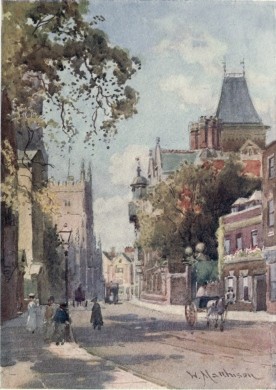
TRUMPINGTON STREET FROM PETERHOUSE Part of the new buildings of Pembroke College are seen on the right, and the Tower of the Pitt Press, commonly called by undergraduates “The Freshers’ Church,” is seen in the distance. The entrance to Peterhouse is behind the tree on the left of the picture.
Greek at the universities.
Erasmus had given up his dream of studying Greek in an Italian university and had settled down three years before the close of the century at Oxford on hearing that Grocyn was teaching there.[283] He had known some Greek before he went to Oxford, and he knew but little when he left, for its acquisition was still his great pre-occupation when he accepted Fisher’s invitation and went to Cambridge. The work of Grocyn and Linacre left no trace in their own university. When Colet introduced the study of Greek into his new school, Oxford showed itself hostile; when the Greek of Erasmus and Croke had taken permanent hold in Cambridge, the Oxford students rose up in arms against the Cambridge “Grecians,” and dubbing themselves “Trojans” sought street brawls with the “Greeks.” Finally, Sir Thomas More himself wrote a protest to his old university, which, he wrote, was engaged in casting ridicule on those who “are promoting all the interests of literature at your university, and especially that of Greek.” “At Cambridge, which you were always accustomed to outshine, even those who do not learn Greek are so much persuaded to its study in their university that they praiseworthily contribute to maintain a salaried professor who may teach it to others.”[284]
Colet took Greek into our public schools, in face of the hostility of his university; it was the Cambridge Grecians settled by Wolsey at Cardinal College who established it at both universities, and it was men like Ascham, Sir Thomas Smith, and Cheke who introduced it as Cambridge learning to the world outside. It has been well said that classics “kept a firm hold on the Cambridge mind.” The mantle of Erasmus Croke and Cheke fell upon Bentley and Porson who had no rivals among English classics and critics, and the services rendered by Cambridge as a university in this direction have been maintained by the present generation of scholars.[285]
Colloquial Latin and Greek.
By order of Thomas Cromwell “two daily public acts one of Greek the other of Latin” were to be held in all the colleges.[286] The Commonwealth Committee tried to revive the colloquial use of Latin and Greek in 1649, but the use of Latin in halls and walks ceased in this century, though it lingered in the college lectures, the declamations, and the “acts and opponencies.” It lingered also in the college chapels, but the only relic now remaining is the Latin grace in hall. The study of the classics themselves declined at Cambridge during the reign of Charles II. and Gray laments, while Bentley was still living, that these studies should have “fallen into great contempt.”[287]
The moral sciences tripos.
It was the introduction of the classical tripos which gave a foothold for mental and moral philosophy. Occupation with Greek metaphysics, contact with the Greek mind, brought into relief the one-sidedness of the mathematical mind. It also placed the two methods in sharp contrast. For hitherto a fundamental antagonism between mathematical and metaphysical method had been unsuspected. It was not till the dispute between Whewell and Hamilton that the idea was pressed home that there were two philosophical methods, not one; that not only the reasoning which begs but the reasoning which questions the premiss has a right to be heard; that there was a philosophy of formal proof and one of philosophic doubt; that axiomatical reasoning lay on the one side, and the enquiry into the validity of the reasoning process itself on the other.
Psychology.
It was indeed by way of psychology that this other philosophy gained a foothold in the university. It was the contact with the scientific temper of Cambridge of psychology and psycho-physics—the modern science par excellence, the point of contact between the experimental method and mental philosophy, the fine flower of science since Darwin, its complement, its interpreter—which ensured the introduction of a moral sciences tripos. This it was which won recognition for an organon other than the mathematical. Metaphysics captured Cambridge based upon psychology, and here the two have never been divorced.
The problem of education at Cambridge before 1851 had been entirely concerned with the mutual relations of mathematics, physics, and classics. The two historic triposes had between them ousted even Locke and Paley, the relegation of which to the ordinary degree work nullified, for all serious philosophic purposes, the “grace” of 1779 which had devoted a fourth day to examination in “natural religion, moral philosophy, and Locke.”[288] Whewell who had lectured in 1839 as professor of casuistry on moral philosophy, was chiefly instrumental eleven years later in forming the new tripos. The college which took the leading part was S. John’s, where the Rev. J. B. Mayor was fellow and afterwards examiner; and the first man admitted to a fellowship for his attainments in this direction was a Johnian who came out senior moralist in 1863. When the tripos was framed, within twenty-five years of the final disappearance of all mental philosophy from the higher schools at Cambridge, it included papers on logic and psychology, on metaphysics, ethics, political philosophy and political economy. The political subjects now form a tripos to themselves, the Economics tripos created in 1903. Hort was a candidate in the first examination (1851) and L. B. Seeley in the third: until 1861, when Whewell and Leslie Stephen were among the examiners, the tripos was taken in addition to one of the others, and did not confer a degree.[289]
That vampire of the Cambridge schools, mathematics, had absorbed not only philosophy and the arts but also the natural sciences. It had been however through one of the great metaphysicians, Robert Clarke, that Newton’s physics had taken their place in the Cambridge curriculum, and Locke and Newton were there side by side, and had entered there together. It seemed, then, a simple revival and continuance of these traditions when the natural sciences tripos was formed in the same year as the moral sciences.
Empirical science at Cambridge.
Empirical science at Cambridge dates from Linacre and Caius. The Puritan masters of the university discountenanced science, discouraged the university’s higher mathematics, but were led by their liking for the open bible greatly to favour the study of Greek. It is a remarkable fact that the natural ally of the reform movement was “Greek” not natural science.[290] Greek and “heresy” were equivalents; Caius, the ardent champion of medicine and empirical science in Cambridge, was one of the last to cling to the old “popishe trumpery.”[291] Just two hundred years before the publication of the “Origin of Species,” someone writes to Sir Thomas Browne the author of Religio Medici, from Darwin’s college at Cambridge, saying that there were then (1648) “so few helps” at the university for the student of medicine and science. With the Restoration scientific interests were revived, London setting the fashion to the seats of learning. But even at the close of the xviii century—that dark age of the universities—there was a professor of anatomy and there were lectures on “human anatomy and physiology” at Cambridge.[292] A few years later there was no physiology and the only physical study was astronomy.[293] Such
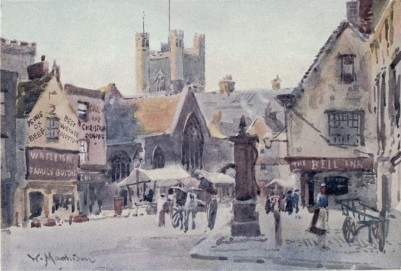
PEASHILL The Chancel of St. Edward’s Church is seen behind the stalls in the roadway, and the Tower of Great St. Mary’s in the distance. On the right is the Old Bell Inn and the old town pump is in the foreground.
was the state of affairs two or three decades before the creation, in 1851, of a tripos which included physiology, comparative anatomy, chemistry, geology, botany, and mineralogy. The examination now comprises papers in 8 subjects, and is divided into two parts: chemistry, physics, mineralogy, geology, botany, zoology and comparative anatomy, human anatomy, and physiology. In the second part the last paper is upon human anatomy and vertebrate comparative anatomy. Cambridge owes its present prominent position as a teacher in the scientific world to the remarkable development of its scientific laboratories and equipment. For the purposes of the natural sciences tripos it possesses some of the finest laboratories and museums in the kingdom. The great Cavendish laboratory was built in 1874, the chemical in 1887, the engineering in 1894-9, the new medical school in 1904 with the museum of geology, while the same year saw the erection of the most complete botanical laboratory in England. Cambridge therefore which is “the most ancient scientific school in the country” is also among the best equipped.
The study of modern languages.
Within a century of the decay of Norman French in England, a knowledge of modern languages began to assume value. Throughout the Tudor epoch it was those ecclesiastics and lawyers who were also linguists to whom the diplomatic posts and the secretaryships of state were entrusted. Latin did not cease to be the common official medium, but the growth of national dialects gave to a knowledge of these the importance which they must always possess for the diplomat and the trader. “Esperanto” will not take its place until nothing is spoken anywhere but Esperanto.
Some progress was made in these studies in both the universities in the xvi century:—“Petrarch and Boccace in every man’s mouth—the French and Italian highly regarded: the Latin and Greek but lightly,” writes Gabriel Harvey to Spenser: but the xixth opened at Cambridge barren of anything linguistic, ancient or modern, eastern or western, except the uncouth Latin of the schools.[294] The first languages tripos was formed in 1878 for the Semitic languages; the Indian languages tripos (1879) now forms part, with the Semitic tripos, of the Oriental languages tripos created in 1895. In 1886 the “medieval and modern languages” tripos came into being.
List of the triposes.
The complete list of Cambridge triposes with the date of their introduction is as follows:—(1) Mathematical 1747.[295] (2) Classical 1822. (3) Moral Sciences 1851. (4) Natural Sciences 1851. (5) Law 1858.[296] (6) Theological 1874. (7) Historical 1875.[297] (8) Medieval and Modern Languages 1886. (9) Mechanical Sciences 1894. (10) Oriental Languages 1895. (11) Economics 1903.
Changing value of examination tests.
The value of the tests to which degrees have been attached in the past has varied considerably, and the same is true of the present. The M.A. degree in the xvi and following century was obtained with little or no examination; the disputations, as we have seen, were often idle forms, but the improvement in methods dates from 1680 when the proctors were replaced by moderators as overseers in the sophisters’ school. Fifty years later the building of the Senate House opened the new era, and the next twenty years (1730-50) saw rapid progress; so that the Cambridge degree was still something better than the Oxford when at the end of that century aspirants for degrees at both universities were adequately described as “term-trotters.”[298] The conspicuous university learning of the xvii century was untested and unstimulated by any adequate examination test; but earlier still the sheer number of years passed at a university must have had a value which is now lost. Seven years was the rule at Cambridge in the xv, xvi and xvii centuries, and the early history of the oldest of Cambridge colleges shows us the Peterhouse students residing all the year round.[299] Nowadays the standards of the honour and “poll” degree[300] are so wide apart that the terms bachelors and masters of arts applied equally to all degree work, are misleading. “He only wanted to take his degree, he did not work much” someone said to me a short time ago, and one felt one knew that degree. The honours class standard is also variable, and “a good year” raises the first class standard unduly.
The double tripos.
The condition which characterised Cambridge studies before 1850 was that the mathematical tripos was obligatory on all candidates for honours. Between 1823 therefore and 1850 every classic was obliged to pass in one of the three classes of the mathematical tripos—he had, that is, to satisfy the examiners in two triposes. The results were often curious. Men like Macaulay, who became fellows of their college, were “ploughed” in the tripos, and professors of classics wrote M.A. after their names in virtue of a “poll” degree. The native repugnance to mathematical method in some men’s minds was constantly shown and at all stages of the university curriculum; Stratford Canning was “sorely puzzled” and indeed “in an agony of despair” over the study for which he was a “volunteer” at King’s, and Gray refused to graduate rather than pursue it. On the other hand the Cambridge “double first” meant a degree unrivalled in any part of the world.[301]
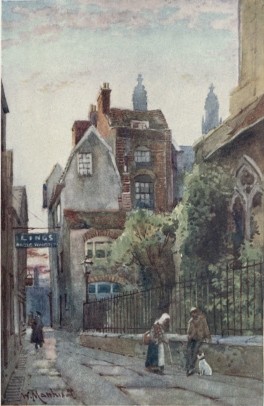
OLD HOUSES NEAR ST. EDWARD’S CHURCH AND ST. EDWARD’S PASSAGE This Passage leads from the Market into King’s Parade. Part of the South side of St. Edward’s Church is seen on the right. The Reformers Bilney, Barnes, and Latimer preached here. The three Tuns Inn, praised by Pepys for its good liquor, formerly stood in this passage.
The present conditions for obtaining the B.A. degree are (a) residence for nine terms within the precincts of the university[302] (b) satisfying the examiners in one of the examinations, or groups of examinations to which a degree is attached. One may satisfy them in one of four ways: (1) by reading for and obtaining ‘honours’[303] (2) by taking the Previous, General, and Special examinations of the ordinary degree[304] (3) by being ‘allowed the ordinary degree,’ which may happen when a man fails to be placed in any class of a tripos, but when his work is allowed to count as tantamount to the examinations of the ordinary degree. (4) by being “excused the General,” which happens when a man has failed in the tripos examination, but his work is counted as putting him half way towards the ordinary degree. The aegrotat is a fifth way. If a man who has read for honours or for the ordinary degree falls sick, he is allowed to answer one or two of the examination papers only, and if he shows adequate knowledge of these is granted a degree, but is not placed in any class.[305]
There have been frequent changes and regroupings in all the examinations described, and other reforms are in contemplation. In 1850 the Universities Commission led to radical changes at both universities. It is now proposed to simplify greatly Part I. of the mathematical tripos, placing the candidates in divisions in alphabetical order, and thus abolishing the senior wrangler.[306] This classification is the rule in the second parts of all the large triposes, all of which have been divided since their formation. The abolition of compulsory Greek in the Previous Examination is bruited and re-bruited, but for the moment the question has been set at rest (May 1906) by a decided negative vote of the senate.
The lecture and class.
The method of tuition at Cambridge consists of the lecture, the class, the weekly paper, and the examinations. “Reading” has, naturally, taken the place of oral teaching to a large extent, but the lecture still holds its place in the university. In the view of many of the seniors that place is still too large a one: the lecture at which copious (often verbatim) notes are taken is, no doubt, in many instances thrown away, especially in those subjects in which the lecturer simply goes over ground covered by the existing text-books. The class permits of lecturer and student discussing difficulties, and here the college tutor’s rôle is also of first importance;[307] the weekly paper (usually a “time paper,” to be answered in three hours) tests progress in the subject, and teaches a man how to “write down what he knows,” and to do so in a certain given time.
Professorships.
There was no salaried professorship in the university until Lady Margaret founded her chair of divinity in 1502. Before this, tuition in each faculty had been assigned to its doctors, the tuition in arts was left in the hands of the masters of arts. The next three professorships to be founded were also in the 3 faculties: the Regius of Divinity by the king in 1540, the Regius of Civil Law in the same year, and the Regius of Physic.[308] Henry also founded Regius professorships of Hebrew and Greek. In 1632 Sir T. Adams founded the Arabic, and in 1663, Henry Lucas, M.P. for the university, the Lucasian of Mathematics; the Knightbridge of Moral Philosophy was founded by a fellow of Peterhouse in 1683. Between that date and 1899 (when the professorship of Agriculture was founded) 35 professorships have been endowed, 16 of which are in natural sciences and medicine, 5 for languages, 4 for history and archæology, 2 more for law, 1 for mental philosophy and logic, and 3 more for divinity, one of which, the Norrisian, is tenable, and is now held by a layman. Fisher and Erasmus were the first holders of the Lady Margaret professorship, and Selwyn, Lightfoot, and Hort held it between the years 1855 and 1892. Bentley and Westcott held the Regius professorship (1717, 1870). Sir T. Smith was the first to hold the Regius of Civil Law, which was also held by Walter Haddon, and by Sir Henry Maine when he was twenty-five years old, Glisson of Caius was one of the distinguished holders of the Regius of Physic (1636), Metcalfe of S. John’s and Cudworth both held the Hebrew professorship, Sir J. Cheke was the first to sit in the chair of Greek following on three such great predecessors and professors of Greek at Cambridge as Erasmus, Croke, and Sir Thomas Smith. Isaac Barrow (1660), Porson (1792) and Sir R. C. Jebb (1889-1906), all Trinity men, have also held it. The Lucasian of Mathematics was held by Barrow, then by Isaac Newton, then by his deputy Whiston of Clare, then by Sanderson of Christ’s, and the chair was filled in the xix century by Airy and Sir George Stokes. Roger Cotes was the first to hold the Plumian of Astronomy (1707) founded three years previously by the Archdeacon of Rochester, who endowed it with an estate at Balsham. Professor Adams, the discoverer of Neptune, held the Lowndean of Astronomy and Geometry (1858-1892). The Regius of Modern History (George I. 1724)[309] was held by the poet Gray, by Sir J. Stephen, Charles Kingsley, Sir J. Seeley, and Lord Acton: the Cavendish professorship of Experimental Physics (founded by Grace of the Senate 1871) was first filled by Clerk Maxwell and Lord Rayleigh; F. W. Maitland (ob. Dec. 1906) held the Downing of Law; and the new Quick professorship of biology has just been offered to an American graduate.[310]
Next in dignity to professors are the Readers in the different subjects, who act as a sort of suffragans and assistants to professors; and next to these come the lecturers in branches of knowledge which range from comparative philology to electrical engineering, from medical jurisprudence to ethnology.[311]
Lambeth degrees and degrees by royal mandate.
The Pope was the fountain of graduate honour in the middle ages and conferred degrees in all the faculties, and he does so still. Doctors and masters from Rome would receive

MARKET STREET AND HOLY TRINITY CHURCH In this picture Holy Trinity Church (of which Charles Simeon was incumbent) with its spire may be seen on the left. The cool grey building in the middle of the picture is the Henry Martyn Hall, a modern structure. In the distance is seen the Tower and North side of Great St. Mary’s.
incorporation at Cambridge, and Englishmen without a degree would be given, on occasion, a degree by the Pope.[312] The general statute of Henry VIII. conveying
A.D. 1534.
to the primate all licences and dispensations which had heretofore “been accustomed to be had and obtained from Rome,” transferred the faculty of conferring degrees in England from the Pope to the Archbishop of Canterbury. This faculty had, until the date of the statute, formed part and parcel of the legatine powers, and had been exercised as such by Wolsey. It was among the more important powers transferred under the statute, relating to licences of the taxable sum of £4 and over, and required confirmation by Letters Patent under the great seal, or enrolment in Chancery. The right was exercised by successive archbishops, and every faculty so granted rehearsed the authority of parliament by which authority the said power was now vested in the see of Canterbury. In the reign of George I. the power was for the first time disputed. The then Bishop of Chester refused to induct a Lambeth B.D. and a law suit followed, as a result of
A.D. 1722.
which a prescriptive and statutable right was made out for the practice. The matter was then carried by appeal to the King’s Bench and decided in favour of the archbishop, three years later, in 1725.
A.D. 1660-1700.
From the accession of Charles II. till the end of the century the usual recipients were members of one or other of the universities, and when this was not the case incorporation in Cambridge university was granted with the proviso that no precedent was thereby created. Between 1539, when Cranmer created a D.D., and the accession of Charles II., only seven instances of archi-episcopal degrees are recorded.[313] Over 450 were conferred between 1660 and 1848, and some 334 have been conferred since.[314] A Cantabrigian primate confers the Cambridge hood, an Oxonian the Oxford. There have been many instances of the incorporation of men who were recipients of the ‘Lambeth degree’ in one or other of the colleges. The Lambeth M.A. does not include membership of the Senate or of Convocation.[315]
During Stuart times there were several examples of the conferring of degrees by royal mandate; a custom commuted to the now traditional compliment, when a sovereign or prince receives a degree, of conferring degrees on any persons he may wish associated with him in the honour. Lord Stratford de Redcliffe, whose studies at Cambridge were interrupted by diplomatic missions, was created M.A. by royal mandate.
[270] The derivation is Prof. Skeat’s.
[271] The school of glomery was nourishing in 1452 (Ely Register anno 1452); but a few years previously, when the statutes of King’s College were written, it was understood that grammar would be studied at Eton not at Cambridge. A century later (1549) the parliamentary commissioners introduced mathematics into the trivium where it replaced grammar. A school of grammar existed at the university side by side with the school of glomery [see the provision for the teaching of grammar at God’s House (below) and Peterhouse and Clare p. 153 of the last chapter]. As late as 1500 there was a magister grammaticae and a magister glomeriae, who, in ejus defectu, is represented by proctors (Stat. Cant.). “The Master of Grammar shall be browght by the Bedyll to the Place where the Master of Glomerye dwellyth, at iij of the Clocke, and the Master of Glomerye shall go before, and his eldest son nexte him.” A.D. 1591 (Stokys in G. Peacock). By Fuller’s time the master of glomery had ceased to exist. His work seems to have resembled the preparatory work of the Previous Examinations at the university to-day.
[272] See chapter i. p. 33.
[273] Royal Injunctions to the university of 1535, requiring the denial of papal supremacy. “King Henry stung with the dilatory pleas of the canonists at Rome in point of his marriage, did in revenge destroy their whole hive throughout his own universities,” Fuller. The last Cambridge doctor in canon law “commenced” in this reign.
[274] The usual course is to take the special medical examinations with the First Part of the natural sciences tripos. Sometimes however these are taken in addition to the ordinary B.A. degree. The last of the three M.B. examinations is divided into two parts, of which Part I. is taken at the end of the fourth year of medical study, and Part II. after six years, three of which must have been spent in medical and surgical practice and hospital work. The keeping of the “act” is not intended to be a mere form, and students are advised to prepare for it during the years of their hospital practice.
[275] The degrees of bachelor of surgery (a registrable qualification) and master of surgery require no separate examination; the candidate must have done all that is required of a bachelor of medicine; but bachelors of surgery who are not also masters of arts cannot incept until three years have passed since they took the B.C., and masters of arts must have become legally qualified surgeons.
[276] Whitgift’s thesis for the D.D. degree (1570) was “Papa est ille anti-Christus“—‘the pope is himself anti-Christ.’
[277] Erasm. Epist. (London 1642), Liber secundus, Epist. 10. Letter to Bullock dated from the Palace at Rochester, August 31, 1516.
[278] Or were relegated to the previous examinations.
[279] Till then it had meant Aristotle: the statutes of Queens’ and Christ’s, framed within 50 years of one another, provide for its teaching—“the natural, moral, and metaphysical philosophy of Aristotle”; and even in Fuller’s time these metaphysics were the study of the bachelor of arts: “Let a sophister begin with his axioms, a batchelor of art proceed to his metaphysicks, a master to his mathematicks, and a divine conclude with his controversies and comments on scripture....”
[280] William Everett, M.A., 1865.
[281] It has been said that senior wranglers are hidden in country rectories and are never heard of again. In a hundred and sixty years (1747-1906) there have been eight senior wranglers who could be placed in the first rank as mathematicians and physicists:
[282] Another distinguished Oxonian, and East Anglian, Grosseteste, attempted in the xiii c. the re-introduction of Greek into England; but the foreign linguists whom he invited to St. Albans left no successors.
[283] The west countryman Grocyn (b. 1442) who learnt his Greek in Italy and returned to teach it in Oxford was, chronologically, the first English classical scholar since the revival of learning.
[284] “All students equally contributed to his” (Croke’s) “lectures, whether they heard or heard them not.” Fuller.
[285] Revivers of Greek in Cambridge.
[286] Namely “in King’s Hall, King’s, S. John’s and Christ’s Colleges, Michaelhouse, Peterhouse, Gonville, Trinity Hall, Pembroke Hall, Queens’, Jesus, and Buckingham Colleges, Clare Hall and Benet College.” Royal Injunctions of 1535.
[287] The ancient pronunciation of Latin (so far as it can be recovered) has been taught, as an alternative, at Cambridge for the last 25 years, and has of late been widely adopted there, as elsewhere. Perhaps at the bottom of the preference for English Latin there lies the notion that without it Latin would no longer be the English scholar’s second tongue. The simple retort is that with it Latin is no longer (has not been for centuries) a common medium, the second tongue, of European scholars. Anglicised Greek is due to Sir John Cheke and Sir Thomas Smith, though it was promptly abolished at the time by Stephen Gardiner then chancellor of the university, and opposed also by Caius. “Nor mattereth it if foreigners should dissent, seeing hereby we Englishmen shall understand one another,” so Fuller explains the position.
[288] Paley continued to keep his traditional hold on Cambridge through the divinity paper in the “Little Go” which is based upon the “Evidences for Christianity.” On the other hand logic has recaptured the place which Aristotle held in the general curriculum by being admitted, since 1884, as the alternative subject for Paley’s “Evidences.”
[289] Lord Maynard of Wicklow (S. John’s College) endowed a professor of logic at Cambridge in the reign of James I., with £40-50 a year.
[290] One must not forget, however, that both the remarkable men who planted the study of the experimental sciences in Cambridge were distinguished ‘classics’ as well as scientists.
[291] Letter of Vice-Chancellor Byng to Burleigh then chancellor of the university, 14 Dec. 1572, in which he advises him of a “greate oversighte of Dr. Caius” who had long kept “superstitious monuments in his college.” “I could hardly have been perswadid,” he continues, “that suche things by him had been reservid.”
[292] Chairs of anatomy, botany, geology, and astronomy had been created in the first quarter of that century. See also Peterhouse p. 153.
[293] For the natural sciences professorships, see pp. 190-92, and n. p. 192.
[294] “In barb’rous Latin doom’d to wrangle” writes Byron of the Cambridge of his time.
[295] The year is counted from the beginning of the academic year, i.e. Oct. 1747—the first degrees were taken in 1748.
[296] A classified list of civil law graduates exists from the year 1815. There used to be a university title S.C.L. (Student of Civil Law) in relation to the civil law classes. The Act of 20-21 Vict., disestablishing civil law in the courts, led to a revolution of law studies at Cambridge. From then dates the abolition of the old quaint ceremonies and disputations connected with this faculty.
[297] From 1870, before the creation of the history tripos, examinations were conducted in a mixed law and history tripos.
[298] Among educational reformers in the second half of the xviii c. Dr. John Jebb must not be omitted. To him is due the annual test examinations of tripos students called ‘the Mays,’ and perhaps also the “Little-Go.” He was a distinguished scientist, and member of Peterhouse.
[299] Cf. chap. ii. p. 61 and chap. iv. p. 241.
[300] “Poll,” [Greek: oi polloi οἱ πολλοἱ].
[301] In 1835 Goulburn (afterwards Bishop of Trinidad) was second wrangler and senior classic; in 1828 Selwyn, another bishop, was senior classic and sixth wrangler. For the 2 triposes cf. iv. p. 238 n.
[302] “Within 2-1/2 miles in a direct line” from Great S. Mary’s. For the academic year see iv. p. 241, and n. p. 182.
[303] Part I. of most of the divided triposes entitles to the degree. Advanced and research students (p. 241) are entitled to the B.A. and higher degrees after receiving a “certificate of research” and residing for 6 terms at the university.
[304] The Previous Examination or “Little-Go,” as it is popularly called, consists of two parts, the first containing 5 papers on (a) one of the four Gospels in Greek (set book) (b) a Latin classic (set book) (c) a Greek classic (set book) (d) simple unprepared passages in Latin (e) simple Latin and Greek syntax. Since 1884 a Greek or Latin classic may be substituted for the Greek Gospel. Part II., since June 1903, consists of 5 papers on (1) Paley’s Evidences, for which since 1884, elementary logic may be substituted (2) geometry (3) arithmetic (4) elementary algebra (5) subjects for an English essay from some standard English work or works. Until 1903 the geometry paper was exclusively on Euclid’s lines, and required knowledge of the first three books and of parts of the vth and vith books. To qualify for admission to an ‘Honours’ examination a student must pass in certain subjects ‘additional’ to the ordinary Previous Examination. He is now allowed to choose between (1) additional Mathematics (Mechanics and Trigonometry) (2) French (3) German.
[305] Even if the candidate answer most of the tripos papers the conditions of the aegrotat degree preclude his being placed in any one of the classes. Edmund Spenser the poet and Lancelot Andrewes the scholar-bishop were both on the aegrotat list of Pembroke College—in 1571—before, however, this necessarily implied absence from any of the university “acts.”
[306] Since going to press, this change has been effected.
[307] See chap. iv. p. 225.
[308] This professorship was an expansion of the natural science lectureships founded by the great Linacre.
[309] A chair of history was endowed by Fulke Greville, Lord Brooke, with £100 a year, in the reign of Charles I. It no longer exists.
[310] A list of the professorships, with date of creation and emoluments, and of the readers and lecturers, appears in the University Calendar every year.
[311] In 1524 the executors of Sir Robert Rede, Lord Chief Justice, endowed tres liberae lecturae in humane letters, logic, and philosophy; and many distinguished men have been invited to deliver this annual lecture. The Hulsean lecture was founded in the xviii c.
[312] Towards the end of the xv c. we have several instances of papal degrees conferred on members of religious orders which were followed by incorporation and full membership of Cambridge university. Thus frater Steele “of Rome” was incorporated in 1492, and frater Raddyng as a doctor five years later.
[313] 1539 Eligius Ferrers, D.D.; 1544 a Venetian B.A. ad eundem; 1559, circa, a B.D.; 1615 an M.A. created B.D.; 1617 the same; 1619 an M.A.; 1635 the archdeacon of Essex M.A., is created B.D.
[314] Archbishop Sumner (1848-62) 120 degrees; Langley (1862-68) 46; Tait (1868-82) 101; Benson (1882-96) 55; Temple (1896-1903) 12.
[315] Degrees in the 3 faculties are conferred without examination. Since Aug. 1858 degrees in medicine have carried with them no qualification to practise.