автордың кітабын онлайн тегін оқу The Battle and the Ruins of Cintla
Project Gutenberg's The Battle and the Ruins of Cintla, by Daniel G. Brinton
This eBook is for the use of anyone anywhere at no cost and with
almost no restrictions whatsoever. You may copy it, give it away or
re-use it under the terms of the Project Gutenberg License included
with this eBook or online at www.gutenberg.net
Title: The Battle and the Ruins of Cintla
Author: Daniel G. Brinton
Release Date: February 27, 2010 [EBook #31418]
Language: English
*** START OF THIS PROJECT GUTENBERG EBOOK THE BATTLE AND THE RUINS OF CINTLA ***
Produced by Julia Miller and the Online Distributed
Proofreading Team at http://www.pgdp.net (This file was
produced from images generously made available by The
Internet Archive/American Libraries.)
Transcriber’s Note
A number of typographical errors have been maintained in this version of this book. They are
marked
and the corrected text is shown in the popup. A description of the errors is found in the list at the end of the text. Inconsistent spelling, hyphenation, and capitalization have been maintained. A list of inconsistently spelled, hyphenated, and capitalized words is found in a list at the end of the text.THE
BATTLE AND THE RUINS
OF CINTLA
BY
DANIEL G. BRINTON, M. D., LL. D., D. Sc.
PROFESSOR OF
AMERICAN ARCHAEOLOGY AND LINGUISTICS IN THE UNIVERSITY
OF PENNSYLVANIA
[REPRINTED FROM THE AMERICAN ANTIQUARIAN, SEPTEMBER, 1896]
CHICAGO
1896
THE BATTLE AND THE RUINS OF CINTLA.
By Daniel G. Brinton, M. D.
The first battle on the American continent in which horses were used was that of Cintla in Tabasco, March, 1519, the European troops being under the leadership of Hernando Cortes.
This fact attaches something more than an ordinary historic interest to the engagement, at least enough to make it desirable to ascertain its precise locality and its proper name. Both of these are in doubt, as well as the ethnic stock to which the native tribe belonged which opposed the Spanish soldiery on the occasion. I propose to submit these questions to a re-examination, and also to describe from unpublished material the ruins which,—as I believe—, mark the spot of this first important encounter of the two races on American soil.
The engagement itself has been described by all the historians of Cortes’ famous conquest of Mexico, as it was the first brilliant incident of that adventure. We have at least four accounts of it from participants. One prepared under the eye of Cortes himself, one by the anonymous historian of his expedition, a third by Cortes’ companion-in-arms, the redoubtable Bernal Diaz del Castillo, and a fourth by Andres de Tapia.3-1
The most satisfactory narrative, however, is given by the chaplain of Cortes, Francisco de Gomara, and I shall briefly rehearse his story, adding a few points from other contemporary writers.3-2
Cortes with his armada cast anchor at the mouth of the River Grijalva in March, 1519. The current being strong and the bar shallow, he with about eighty men proceeded in boats up the river for about two miles, when they descried on the bank a large Indian village. It was surrounded with a wooden palisade, having turrets and loopholes from which to hurl stones and darts. The houses within were built of tiles laid in mortar, or of sun-dried brick (adobes), and were roofed with straw or split trees. The chief temple had spacious rooms, and its dependences surrounded a court yard.
The interpreter Aguilar, a Spaniard who had lived with the Mayas in Yucatan, could readily speak the tongue of the village, which was therefore a Mayan dialect. The natives told him that the town was named Potonchan, which Aguilar translated “the place that smells or stinks,” an etymology probably correct in a general way.
The natives were distrustful, and opposed the landing of the Europeans rather with words and gestures than with blows. Their warriors approached Cortes in large boats, called in their tongue tahucup, and refused him permission to land.
After some parleying, Cortes withdrew to an island in the river near by, and as night drew on, he sent to the ships for reinforcements, and despatched some of the troops to look for a ford from the island to the mainland; which they easily found.
The next morning he landed some of his men by the boats, and attacked the village on the water side, while another detachment crossed the ford and making a circuit assaulted it in the rear. The Indians were prepared, having sent their women and children away. They were in number about four hundred, and made at first a brisk resistance, but being surprised by the rear assault, soon fled in dismay. No Spaniard was killed, though many were wounded.
Cortes established himself in the village and landed most of his troops and ten out of his thirteen horses. When his men were rested and the injured had had their wounds dressed with fat taken from dead Indians4-1 (!) he sent out three detachments on foot to reconnoitre.
After marching a distance which is not stated, but which could not have been many miles, they came to an extensive plain covered with maize fields, temples and houses. This was Cintla. There were many warriors gathered there, and after a sharp skirmish the Spaniards fell back.
Having thus learned the ground, Cortes prepared for a decisive battle, as also did the natives. The latter gathered at Cintla in five divisions of eight thousand men each, as the chroniclers aver.
Cortes had about five hundred men including some Cuban Indians. The main detachment proceeded on foot by the high road, the cavalry along a path in the woods, and another detachment by a third route. The country was swampy and cut with canals, offering serious obstacles to the horses. It was not until the infantry had been for some time closely engaged with the enemy on the plain of Cintla, and rather severely handled, that the cavalry reached the spot. Their appearance, together with the noise and fatal effect of the musketry, soon struck terror to the hearts of the natives—their ranks broke and they fled. Gomara estimates that there were about three hundred of them killed, which is likely enough; while Bishop De las Casas puts the slain at thirty thousand!5-1
Such was the battle of Cintla. It broke the spirits of the natives, and soon their chieftain, named Tabasco, from whom the river and the province were later called, came in, and offered his submission. Cortes took possession of the land in the name of the King of Spain, and erected a large cross in the chief temple of Potonchan. He remained there several days longer before proceeding on his voyage.
The Name Cintla.—Of the contemporary authorities, only two give the name of the place at or near which the battle was fought.
One of these is Bernal Diaz, who writes it twice, spelling it both times Cintia.5-2 The other is Gomara, who gives Cintla, the form which I believe to be correct. Through following some less reliable authorities a number of writers, among them Prescott and his editor Mr. J. F. Kirk, Orozco y Berra, etc., and their copyists, have deformed this word into Ceutla.
The most obvious derivation of Cintla is from the Nahuatl language, in which Cintla means a dried ear of maize; Cintlan, a place where dried ears are, a cornfield. Most of the places in Tabasco became known to the Spaniards under their Nahuatl appellatives through interpreters in that tongue, and because most of the territory had been subjected to the powerful sway of the Montezumas.
Still, Cintla may also be a Mayan word. It may be a nominal form from the verb tzen-tah, and would then have the signification, “a built-up place,” or one well stocked with provisions; or, it may be a patronymic from the Tzentals, the tribe which occupied this region at the time, as I shall proceed to show.
The Native Tribe.—There is no question but that the native tribe which took part in this combat belonged to the Mayan stock. All the accounts agree that Aguilar, the Spaniard whom Cortes found in Yucatan as a captive, and who had learned to speak the Mayan tongue, communicated with the natives without difficulty. This is conclusive as to their ethnic position.
Further evidence, if needed, is offered by the native names and words preserved in the accounts. The term for their large canoes, tahucup, is from the Maya tahal, to swim, and kop, that which is hollow, or hollowed out. The name potonchan, Aguilar translated as, “the place that stinks” (lugar que hiede). He evidently understood it as derived from the Maya verb tunhal, to stink, with the intensive prefix pot (which is not unusual in the tongue, as pot-hokan, very evident, etc.). The historian Herrera, on some authority not known to me, further explains this term as one of contempt applied to the people there, meaning rude and barbarous;6-1 as we should say, using the same metaphor, “stinkards.”
Tabasco is said by Bernal Diaz to have been the name of the principal chief of the eight provinces or tribes, who together opposed the Spaniards. For this reason I would reject the derivation from the Nahuatl, proposed by Rovirosa,—tlalli, earth, paltic, wet or swampy, co, in,6-2—however appropriate it would be geographically; and also that from the Maya, tazcoob, “deceived,” referring to the deceptions practiced on the Spaniards,—which is defended by Orozco y Berra6-3; and I should accept that which I find suggested by Dr. Berendt in his manuscript work on Mayan geographical names. He reads Tabasco as a slightly corrupt form of the Maya T’ah-uaxac-coh, “our (or the) master of the eight lions,” referring to the eight districts or gentes of the tribe. This is significant and appropriate, the jaguar, the American lion, being a very common emblem in the ruins of Cintla.
The branch of the Mayan stock which occupied the litoral of the province of Tabasco at that time were those later known as the Tzentals (otherwise spelled Zendal or Tzeltal). By some writers they have been called the Chontals of Tobasco, chontal, as is well known, being merely a common noun in Nahuatl to express foreigners or barbarians. Their identity with the modern Tzentals of Chiápas has been established by the researches of Dr. Berendt.
The Tzental is a dialect closely akin to pure Maya, though it was believed by Dr. Berendt to present nearer relations than the Maya proper to the dialect of the Huastecas, a segregated idiom of the Mayan family, spoken near Tampico.
The Locality.—Until M. Désiré Charnay brought out the results of the Lorillard expedition in his handsome work, “The Ancient Cities of the New World,”6-4 no one, so far as I know, had expressed any doubt that Cintla was situated near the mouth of the great river, the Rio de Tabasco, formed by the confluence of the Usumacinta and the Rio de Grijalva, and emptying into the bay of Campeche, 18° 35′, north latitude.
M. Charnay did not visit the ruins of Cintla nor the site of Potonchan, which I am about to describe; but he did make an examination of the ruins of Comalcalco, about thirty miles west of Cintla; and as they are of notable magnitude, he proceeds to argue that they represent the ancient Cintla, of the victory of Cortes.
The arguments on which he founds this contention may be briefly stated. They are that the accounts refer to two entrances to the river (dos bocas) while the Tabasco has but one; that the bar of Tabasco now admits vessels of 300 tons, whereas Cortes speaks of it as too shallow for his caravels; that Herrera says Cortes retired to a small island, whereas there is none in the Rio de Tabasco; that Herrera further speaks of a ford by which the soldiers of Cortes “crossed the river,” which would have been impossible in the Tabasco; and finally that the same writer mentions cacao plantations, though at present none exist near Frontera. For these reasons he thinks both Grijalva and Cortes entered the embouchure now known as the Barra de Dos Bocas, some twenty-five miles west of the mouth of the Rio de Tabasco.
A slight examination dissipates these objections. Both Grijalva and Cortes note the powerful current of the Rio de Tabasco, carrying fresh water six miles out to sea, as is observed to-day,7-1 and this is not in the least applicable to the insignificant stream flowing out of the Dos Bocas. M. Charnay was misinformed when he stated there is no island at the mouth of the Rio de Tabasco. There are in fact two, one, long and narrow, known as the Isla de Grijalva, the other quite small, close to the plantation of Dolores (see the map). The latter was probably that to which Cortes retired. None of the accounts say that the soldiers “forded the river,” but only the short distance between the island and the mainland. These islands give to the entrance of the river the appearance of two embouchures or mouths. The depth of the bar varies of course with the seasons and with the tides.
But what is conclusive is that in 1525 the Spaniards founded the city Nuestra Señora de la Victoria, on the site of Potonchan. In 1646, it had a cura and a vicar, and counted 2000 parishioners, and the abundance of its cacao harvest is especially noted.7-2 At some later day it was attacked and destroyed by filibusters; but the remains of the church and the cemetery are still visible at Dolores, and pilgrimages are yet made to them on certain holy days by the faithful of the parish of Frontera, on the opposite shore. This record places the scene of the conflict beyond all doubt.
Condition of the Natives.—The various accounts agree in describing the province as highly cultivated and thickly settled. Maize and cacao were the principal crops. Temples and edifices are repeatedly referred to. A few years afterwards (1524) Cortes traversed Tabasco some miles inland, and has left a description of its industries. The people were active merchants, and the list of their commodities which he gives includes cacao, maize, cotton, dye-stuffs, feathers, salt, wax, resins, paints, gum copal, pottery, beads, shells, precious stones, woven stuffs and gold of low alloy. The richer citizens had numerous wives and female slaves, which accounted for the rapid increase in population.8-1 The chronicler Gomara furnished a long list of the native articles which Grijalva brought back in 1519 from Potonchan and the neighboring coast. They reveal a high degree of artistic culture, and leave no doubt but that the tribes of the vicinity were as developed in the arts as any in America.
Ruined Cities.—Writing about 1875, Mr. H. H. Bancroft says: “On the immediate coast (of Tabasco) some large towns and temples were seen by the early voyagers; but I have no information that relics of any kind have been discovered in modern times.”8-2
In fact, although it is doubtful if there are any ruins directly on the coast, there are many but a short distance inland. Those at
Comalcacalco
have been figured and described by M. Charnay, and his work is so well known that a reference to it is sufficient.At the locality called Pedrito, about fifteen miles from the mouth of the Tabasco, there are many mounds, embankments, piles of pottery and other signs of an ancient town. Among the relics is a large circular stone, “like a round table,” with figures in relief engraved on its sides, and with holes drilled in its surface, in which pegs or wooden nails are said to have been fitted.8-3 About ten miles north of this spot is another group of mounds on the left bank of the Rio de San Pablo y San Pedro. Doubtless many others exist unknown in the dense forests.
The Ruins of Cintla.—The ruins of Cintla were visited and surveyed by the late Dr. C. H. Berendt in March and April, 1869, and, so far as I know, neither before nor since have they been seen by any archæologist. Nor can I learn that Dr. Berendt ever published the results of his researches. The only reference I can find to them in any of his published writings is in a paper which he read, July 10th, 1876, before the American Geographical Society, and which was published in its Bulletin, No. 2, for that year. The title of this address was, “Remarks on the Centers of Ancient Civilization in Central America and their Geographical Distribution.” He certainly prepared a much more extended paper especially on Cintla, with illustrations and maps, fragments of which I have found among the documents left at his death; but if published, I have been unable to trace it. Nor can I discover what became of the considerable archæological collection which he made at Cintla and brought away with him, a memorandum about which is among his papers.
The passage in his address before the Geographical Society touching on Cintla is as follows:
“It was by mere chance that in the year 1869 I discovered the site of ancient Cintla, buried in the thick and fever-haunted forests of the marshy coast, and unknown until then to the Indians themselves. In the course of the excavations which I caused to be made, antiquities of a curious and interesting character were laid bare.
“Prominent among these ruins, and presenting a peculiar feature of workmanship, are the so-called teocallis, or mounds, which here are built of earth, and covered at the top and on the sides with a thick layer of mortar in imitation of stone work. On one of these mounds I found not only the sides and the platform, but even two flights of stairs, constructed of the same apparently fragile but yet enduring material. One of the latter was perfectly well preserved. I likewise saw clay figures of animals covered with a similar coating of mortar or plaster, thus imitating sculptured stone and retaining traces of having been painted in various colors.
Fig. 1.—Map of the Ruins of Cintla.
“The reason for this singular use of cement probably is that in the alluvial soil of this coast, no stones occur within a distance of fifty miles and more from the sea shore; stone implements, such as axes, chisels, grinding stones, obsidian flakes, etc., which are occasionally found, can have been introduced solely by trade. The pottery and the idols made of terra cotta show a high degree of perfection.
“Regarding the period down to which such earthenware was made, a broken vase disinterred from one of the mounds in my presence may give a clue. Its two handles represent Spaniards, with their European features, beard, Catalonian cap, and polainas, or gaiters.”
There is also among his papers the commencement of an address or essay upon these ruins, written in Spanish, and this, when completed, may have been printed in some Mexican periodical. I translate from it the following passage, the remainder having been lost:
“Having learned that in the forests of the coast between the barras of Chiltepec and Grijalva various mounds, idols and other remains of an earlier population had been discovered, I proceeded to that part of the country called Del Cajete, and devoted six weeks to its exploration. I soon found numerous mounds and embankments from which the present inhabitants had gathered fragments of idols and milling stones of a form unknown now in the vicinity.
“It very soon became apparent that these mounds were not such as those isolated ones which are found in various parts of this country, but were arranged in groups surrounding open spaces, plazas, and forming streets, extending over an area three leagues in length by one in breadth.
“Not a single tradition, not a single native name survives to cast any light upon these ruins. The whole of this coast was depopulated in the seventeenth and eighteenth centuries owing to the slave-hunting incursions of the filibusters and man-hunters. The Indians who are now found in the neighborhood have removed there from the interior since the beginning of the present century, and are absolutely ignorant of the origin or builders of this city, hidden in the tropical forest.”
The locality referred to as Del Cajete was a settlement (rancheria) of Indians, now better known as San José de la Bellota, on a large pond into which drains the Río de la Bellota. It was founded in 1815 by a cura who brought the Indians there from the other side of the river, back of Frontera.
The general position of the ruins will be seen from the above map. It is drawn to the scale of the Mexican league, which contains 5000 yards (varas) each 838 mm. One league is therefore approximately two and three quarters of our miles. No ruins or mounds were located immediately on or near the coast.
Almost a continuous line of mounds, embankments and heaps of débris extends from near Bellota for about nine miles in a general west-south-west direction over a plain which is now densely covered by a tropical forest.
Dr. Berendt did not attempt to survey but a few of these numerous monuments. The plan of one of the largest, called by the natives El Cuyo Grande, “The Great Temple,” is shown in the following, figure 2.
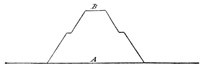
The principal mound B is terraced about half way up and was 82 feet in height. A cross section of it is shown in Fig. 3, A-B.
A series of constructions is connected with this, the whole running in a direction east-north-east to west-south-west. They consist of a rectangular embankment six to eight feet high, Fig. 2, A; an isolated circular mound, D; and two small mounds at the eastern corners of the great mound, from which parallel embankments, E, extend easterly, inclosing an open space, which at the extremity is terminated by a long low mound, C. The total distance from A to C is 1140 feet.
The great mound and most of the others in the vicinity are faced with mortar made of sand and lime from burnt oyster shells. On one or both sides are flights of steps which lead up to the summit. These are constructed of layers of mortar, tiles and hard-pounded earth, distributed in the manner represented in Fig. 4.
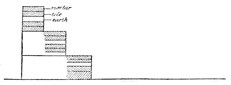
The earth is either black or red, and is mixed with sand from the coast to give it consistency. The tiles or bricks are rectangular in shape, well made and regular in outline, and laid one against another as in a pavement.
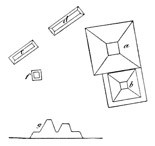
Another group is called Los Cuyos de la Canada, Fig. 5. It consists of two mounds on a low platform, adjoining each other. The larger, a, is twenty feet in height, the lower, b, about fifteen feet. Their sides are oriented exactly to the true north. A section is shown in Fig. 5, g. Two small oblong mounds, c and d, about six feet high, and a square altar-like heap, f, appear to be in relation to the group. Numerous pieces of mortar and terra cotta occur in the vicinity, and 1500 feet directly west there is a large mound of moderate height.
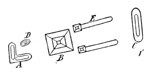
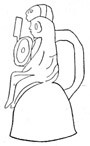
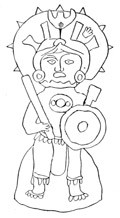
Almost anywhere in the area of this ancient city, the soil abounds in fragments of mortar, pottery and images of earthenware. Very frequently the latter are represented seated on a bell-shaped support, apparently that they might be stood up upon a flat surface. Two of these are shown from Dr. Berendt’s drawings in Figs. 6 and 7. The handles of utensils were often decorated in fantastic forms as that shown in Fig. 8.
6
—Image withBell-shaped Bottom
and Handle.

An abundance of metates, or corn-stones, of a shape not now usual in the neighborhood were exhibited. Some of these were quite graceful, having several feet and highly ornamented. The vases of pottery were occasionally noteworthy for their symmetry and beauty, as that shown in Fig. 9.

At the foot of the stairways to the summit of the mounds on each side were frequently the remains of tigers’ heads, well moulded in burnt clay.
Here and there the remains of wells were discovered, or of excavations which apparently were intended for the purpose of obtaining water.
Dr. Berendt mentions several tombs, but unfortunately does not specify their location or construction. He states that they usually contained several bodies, in a sitting posture, placed side by side with their arms and ornaments.
No trace of metal whatever was discovered, neither copper nor gold, which is rather unexpected, as the natives in the time of Grijalva were acquainted with both these substances.
Such is the brief account I am able to give of these extensive and interesting ruins from the fragmentary papers of their explorer. If any reader of these notes can inform this journal of the disposition Dr. Berendt made of his collection and the full memoranda of his surveys and excavations, the cause of American archæology will be further benefited.
Media, Penna.
3-1 The authorities are:
Carta de la Justicia de la Rica Villa de la Vera Cruz, July 10, 1519. This is sometimes referred to as Cortes’ first letter.
Bernal Diaz del Castillo, Historia de la Conquista de la Nueva Espana.
Andres de
Tapia.
Relacion Sobre la Conquista de la Nueva Espana.Relacion Anonyma de la Conquista de la Nueva Espana.
3-2 Francisco Lopez de Gomara, Conquista de Mexico. I follow the Madrid edition of 1852.
4-1 This delectable surgical item is added by Captain Bernal Diaz.
5-1 Historia de las Indias. Lib. XIV.
5-2 I have consulted both the original edition (1632) and the Madrid reprint of 1852. It is thus spelled in both, though Dr. Jourdanet, in his excellent French translation (Paris, 1877) gives Cintla.
6-1 Herrera, Historia de las Indias Occidentales. Dec. III, lib. vii, cap. iii.
6-2 Jose N. Rovirosa, Nombres Geographicos de Tabasco, (Mexico, 1888).
6-3 Orozco y Berra, Historia Antigua de Mexico, Tom. XIV, Lib. I, cap. V.
6-4 I use the French edition, Les Anciennes Villes du Nouveau Monde, pp. 159, 160 (Paris, 1885).
7-1 Requena says the current from the river is visible “from ten to twelve leagues from the shore in every season and in high water much further.” Pedro Requena, Informe sobre Tabasco, p. 52 (S. Juan Bautista, 1847. Imprenta del Gobierno).
7-2 These facts are given in the Memoria of Diaz de la Calle, printed at Madrid, 1646, extracts from which I find in Dr. Berendt’s manuscripts.
8-1 Cortes’ description is given in his “fourth letter.” His route is extremely difficult to locate accurately.
8-2 The Native Races of the Pacific States, Vol. IV, p. 287.
8-3 MSS, Notes of Dr. C. H. Berendt.
Transcriber’s Note
The following errors have been maintained in this version of the book.
Page
Error
Correction
8Comalcacalco
Comalcalco
12Fig. 6
Fig. 6.
fn. 3-1Tapia.
Tapia,
The following words were inconsistently spelled.
- Jose / José
- Rio / Río
End of the Project Gutenberg EBook of The Battle and the Ruins of Cintla, by
Daniel G. Brinton
*** END OF THIS PROJECT GUTENBERG EBOOK THE BATTLE AND THE RUINS OF CINTLA ***
***** This file should be named 31418-h.htm or 31418-h.zip *****
This and all associated files of various formats will be found in:
http://www.gutenberg.org/3/1/4/1/31418/
Produced by Julia Miller and the Online Distributed
Proofreading Team at http://www.pgdp.net (This file was
produced from images generously made available by The
Internet Archive/American Libraries.)
Updated editions will replace the previous one--the old editions
will be renamed.
Creating the works from public domain print editions means that no
one owns a United States copyright in these works, so the Foundation
(and you!) can copy and distribute it in the United States without
permission and without paying copyright royalties. Special rules,
set forth in the General Terms of Use part of this license, apply to
copying and distributing Project Gutenberg-tm electronic works to
protect the PROJECT GUTENBERG-tm concept and trademark. Project
Gutenberg is a registered trademark, and may not be used if you
charge for the eBooks, unless you receive specific permission. If you
do not charge anything for copies of this eBook, complying with the
rules is very easy. You may use this eBook for nearly any purpose
such as creation of derivative works, reports, performances and
research. They may be modified and printed and given away--you may do
practically ANYTHING with public domain eBooks. Redistribution is
subject to the trademark license, especially commercial
redistribution.
*** START: FULL LICENSE ***
THE FULL PROJECT GUTENBERG LICENSE
PLEASE READ THIS BEFORE YOU DISTRIBUTE OR USE THIS WORK
To protect the Project Gutenberg-tm mission of promoting the free
distribution of electronic works, by using or distributing this work
(or any other work associated in any way with the phrase "Project
Gutenberg"), you agree to comply with all the terms of the Full Project
Gutenberg-tm License (available with this file or online at
http://gutenberg.net/license).
Section 1. General Terms of Use and Redistributing Project Gutenberg-tm
electronic works
1.A. By reading or using any part of this Project Gutenberg-tm
electronic work, you indicate that you have read, understand, agree to
and accept all the terms of this license and intellectual property
(trademark/copyright) agreement. If you do not agree to abide by all
the terms of this agreement, you must cease using and return or destroy
all copies of Project Gutenberg-tm electronic works in your possession.
If you paid a fee for obtaining a copy of or access to a Project
Gutenberg-tm electronic work and you do not agree to be bound by the
terms of this agreement, you may obtain a refund from the person or
entity to whom you paid the fee as set forth in paragraph 1.E.8.
1.B. "Project Gutenberg" is a registered trademark. It may only be
used on or associated in any way with an electronic work by people who
agree to be bound by the terms of this agreement. There are a few
things that you can do with most Project Gutenberg-tm electronic works
even without complying with the full terms of this agreement. See
paragraph 1.C below. There are a lot of things you can do with Project
Gutenberg-tm electronic works if you follow the terms of this agreement
and help preserve free future access to Project Gutenberg-tm electronic
works. See paragraph 1.E below.
1.C. The Project Gutenberg Literary Archive Foundation ("the Foundation"
or PGLAF), owns a compilation copyright in the collection of Project
Gutenberg-tm electronic works. Nearly all the individual works in the
collection are in the public domain in the United States. If an
individual work is in the public domain in the United States and you are
located in the United States, we do not claim a right to prevent you from
copying, distributing, performing, displaying or creating derivative
works based on the work as long as all references to Project Gutenberg
are removed. Of course, we hope that you will support the Project
Gutenberg-tm mission of promoting free access to electronic works by
freely sharing Project Gutenberg-tm works in compliance with the terms of
this agreement for keeping the Project Gutenberg-tm name associated with
the work. You can easily comply with the terms of this agreement by
keeping this work in the same format with its attached full Project
Gutenberg-tm License when you share it without charge with others.
1.D. The copyright laws of the place where you are located also govern
what you can do with this work. Copyright laws in most countries are in
a constant state of change. If you are outside the United States, check
the laws of your country in addition to the terms of this agreement
before downloading, copying, displaying, performing, distributing or
creating derivative works based on this work or any other Project
Gutenberg-tm work. The Foundation makes no representations concerning
the copyright status of any work in any country outside the United
States.
1.E. Unless you have removed all references to Project Gutenberg:
1.E.1. The following sentence, with active links to, or other immediate
access to, the full Project Gutenberg-tm License must appear prominently
whenever any copy of a Project Gutenberg-tm work (any work on which the
phrase "Project Gutenberg" appears, or with which the phrase "Project
Gutenberg" is associated) is accessed, displayed, performed, viewed,
copied or distributed:
This eBook is for the use of anyone anywhere at no cost and with
almost no restrictions whatsoever. You may copy it, give it away or
re-use it under the terms of the Project Gutenberg License included
with this eBook or online at www.gutenberg.net
1.E.2. If an individual Project Gutenberg-tm electronic work is derived
from the public domain (does not contain a notice indicating that it is
posted with permission of the copyright holder), the work can be copied
and distributed to anyone in the United States without paying any fees
or charges. If you are redistributing or providing access to a work
with the phrase "Project Gutenberg" associated with or appearing on the
work, you must comply either with the requirements of paragraphs 1.E.1
through 1.E.7 or obtain permission for the use of the work and the
Project Gutenberg-tm trademark as set forth in paragraphs 1.E.8 or
1.E.9.
1.E.3. If an individual Project Gutenberg-tm electronic work is posted
with the permission of the copyright holder, your use and distribution
must comply with both paragraphs 1.E.1 through 1.E.7 and any additional
terms imposed by the copyright holder. Additional terms will be linked
to the Project Gutenberg-tm License for all works posted with the
permission of the copyright holder found at the beginning of this work.
1.E.4. Do not unlink or detach or remove the full Project Gutenberg-tm
License terms from this work, or any files containing a part of this
work or any other work associated with Project Gutenberg-tm.
1.E.5. Do not copy, display, perform, distribute or redistribute this
electronic work, or any part of this electronic work, without
prominently displaying the sentence set forth in paragraph 1.E.1 with
active links or immediate access to the full terms of the Project
Gutenberg-tm License.
1.E.6. You may convert to and distribute this work in any binary,
compressed, marked up, nonproprietary or proprietary form, including any
word processing or hypertext form. However, if you provide access to or
distribute copies of a Project Gutenberg-tm work in a format other than
"Plain Vanilla ASCII" or other format used in the official version
posted on the official Project Gutenberg-tm web site (www.gutenberg.net),
you must, at no additional cost, fee or expense to the user, provide a
copy, a means of exporting a copy, or a means of obtaining a copy upon
request, of the work in its original "Plain Vanilla ASCII" or other
form. Any alternate format must include the full Project Gutenberg-tm
License as specified in paragraph 1.E.1.
1.E.7. Do not charge a fee for access to, viewing, displaying,
performing, copying or distributing any Project Gutenberg-tm works
unless you comply with paragraph 1.E.8 or 1.E.9.
1.E.8. You may charge a reasonable fee for copies of or providing
access to or distributing Project Gutenberg-tm electronic works provided
that
- You pay a royalty fee of 20% of the gross profits you derive from
the use of Project Gutenberg-tm works calculated using the method
you already use to calculate your applicable taxes. The fee is
owed to the owner of the Project Gutenberg-tm trademark, but he
has agreed to donate royalties under this paragraph to the
Project Gutenberg Literary Archive Foundation. Royalty payments
must be paid within 60 days following each date on which you
prepare (or are legally required to prepare) your periodic tax
returns. Royalty payments should be clearly marked as such and
sent to the Project Gutenberg Literary Archive Foundation at the
address specified in Section 4, "Information about donations to
the Project Gutenberg Literary Archive Foundation."
- You provide a full refund of any money paid by a user who notifies
you in writing (or by e-mail) within 30 days of receipt that s/he
does not agree to the terms of the full Project Gutenberg-tm
License. You must require such a user to return or
destroy all copies of the works possessed in a physical medium
and discontinue all use of and all access to other copies of
Project Gutenberg-tm works.
- You provide, in accordance with paragraph 1.F.3, a full refund of any
money paid for a work or a replacement copy, if a defect in the
electronic work is discovered and reported to you within 90 days
of receipt of the work.
- You comply with all other terms of this agreement for free
distribution of Project Gutenberg-tm works.
1.E.9. If you wish to charge a fee or distribute a Project Gutenberg-tm
electronic work or group of works on different terms than are set
forth in this agreement, you must obtain permission in writing from
both the Project Gutenberg Literary Archive Foundation and Michael
Hart, the owner of the Project Gutenberg-tm trademark. Contact the
Foundation as set forth in Section 3 below.
1.F.
1.F.1. Project Gutenberg volunteers and employees expend considerable
effort to identify, do copyright research on, transcribe and proofread
public domain works in creating the Project Gutenberg-tm
collection. Despite these efforts, Project Gutenberg-tm electronic
works, and the medium on which they may be stored, may contain
"Defects," such as, but not limited to, incomplete, inaccurate or
corrupt data, transcription errors, a copyright or other intellectual
property infringement, a defective or damaged disk or other medium, a
computer virus, or computer codes that damage or cannot be read by
your equipment.
1.F.2. LIMITED WARRANTY, DISCLAIMER OF DAMAGES - Except for the "Right
of Replacement or Refund" described in paragraph 1.F.3, the Project
Gutenberg Literary Archive Foundation, the owner of the Project
Gutenberg-tm trademark, and any other party distributing a Project
Gutenberg-tm electronic work under this agreement, disclaim all
liability to you for damages, costs and expenses, including legal
fees. YOU AGREE THAT YOU HAVE NO REMEDIES FOR NEGLIGENCE, STRICT
LIABILITY, BREACH OF WARRANTY OR BREACH OF CONTRACT EXCEPT THOSE
PROVIDED IN PARAGRAPH F3. YOU AGREE THAT THE FOUNDATION, THE
TRADEMARK OWNER, AND ANY DISTRIBUTOR UNDER THIS AGREEMENT WILL NOT BE
LIABLE TO YOU FOR ACTUAL, DIRECT, INDIRECT, CONSEQUENTIAL, PUNITIVE OR
INCIDENTAL DAMAGES EVEN IF YOU GIVE NOTICE OF THE POSSIBILITY OF SUCH
DAMAGE.
1.F.3. LIMITED RIGHT OF REPLACEMENT OR REFUND - If you discover a
defect in this electronic work within 90 days of receiving it, you can
receive a refund of the money (if any) you paid for it by sending a
written explanation to the person you received the work from. If you
received the work on a physical medium, you must return the medium with
your written explanation. The person or entity that provided you with
the defective work may elect to provide a replacement copy in lieu of a
refund. If you received the work electronically, the person or entity
providing it to you may choose to give you a second opportunity to
receive the work electronically in lieu of a refund. If the second copy
is also defective, you may demand a refund in writing without further
opportunities to fix the problem.
1.F.4. Except for the limited right of replacement or refund set forth
in paragraph 1.F.3, this work is provided to you 'AS-IS' WITH NO OTHER
WARRANTIES OF ANY KIND, EXPRESS OR IMPLIED, INCLUDING BUT NOT LIMITED TO
WARRANTIES OF MERCHANTIBILITY OR FITNESS FOR ANY PURPOSE.
1.F.5. Some states do not allow disclaimers of certain implied
warranties or the exclusion or limitation of certain types of damages.
If any disclaimer or limitation set forth in this agreement violates the
law of the state applicable to this agreement, the agreement shall be
interpreted to make the maximum disclaimer or limitation permitted by
the applicable state law. The invalidity or unenforceability of any
provision of this agreement shall not void the remaining provisions.
1.F.6. INDEMNITY - You agree to indemnify and hold the Foundation, the
trademark owner, any agent or employee of the Foundation, anyone
providing copies of Project Gutenberg-tm electronic works in accordance
with this agreement, and any volunteers associated with the production,
promotion and distribution of Project Gutenberg-tm electronic works,
harmless from all liability, costs and expenses, including legal fees,
that arise directly or indirectly from any of the following which you do
or cause to occur: (a) distribution of this or any Project Gutenberg-tm
work, (b) alteration, modification, or additions or deletions to any
Project Gutenberg-tm work, and (c) any Defect you cause.
Section 2. Information about the Mission of Project Gutenberg-tm
Project Gutenberg-tm is synonymous with the free distribution of
electronic works in formats readable by the widest variety of computers
including obsolete, old, middle-aged and new computers. It exists
because of the efforts of hundreds of volunteers and donations from
people in all walks of life.
Volunteers and financial support to provide volunteers with the
assistance they need are critical to reaching Project Gutenberg-tm's
goals and ensuring that the Project Gutenberg-tm collection will
remain freely available for generations to come. In 2001, the Project
Gutenberg Literary Archive Foundation was created to provide a secure
and permanent future for Project Gutenberg-tm and future generations.
To learn more about the Project Gutenberg Literary Archive Foundation
and how your efforts and donations can help, see Sections 3 and 4
and the Foundation web page at http://www.pglaf.org.
Section 3. Information about the Project Gutenberg Literary Archive
Foundation
The Project Gutenberg Literary Archive Foundation is a non profit
501(c)(3) educational corporation organized under the laws of the
state of Mississippi and granted tax exempt status by the Internal
Revenue Service. The Foundation's EIN or federal tax identification
number is 64-6221541. Its 501(c)(3) letter is posted at
http://pglaf.org/fundraising. Contributions to the Project Gutenberg
Literary Archive Foundation are tax deductible to the full extent
permitted by U.S. federal laws and your state's laws.
The Foundation's principal office is located at 4557 Melan Dr. S.
Fairbanks, AK, 99712., but its volunteers and employees are scattered
throughout numerous locations. Its business office is located at
809 North 1500 West, Salt Lake City, UT 84116, (801) 596-1887, email
business@pglaf.org. Email contact links and up to date contact
information can be found at the Foundation's web site and official
page at http://pglaf.org
For additional contact information:
Dr. Gregory B. Newby
Chief Executive and Director
gbnewby@pglaf.org
Section 4. Information about Donations to the Project Gutenberg
Literary Archive Foundation
Project Gutenberg-tm depends upon and cannot survive without wide
spread public support and donations to carry out its mission of
increasing the number of public domain and licensed works that can be
freely distributed in machine readable form accessible by the widest
array of equipment including outdated equipment. Many small donations
($1 to $5,000) are particularly important to maintaining tax exempt
status with the IRS.
The Foundation is committed to complying with the laws regulating
charities and charitable donations in all 50 states of the United
States. Compliance requirements are not uniform and it takes a
considerable effort, much paperwork and many fees to meet and keep up
with these requirements. We do not solicit donations in locations
where we have not received written confirmation of compliance. To
SEND DONATIONS or determine the status of compliance for any
particular state visit http://pglaf.org
While we cannot and do not solicit contributions from states where we
have not met the solicitation requirements, we know of no prohibition
against accepting unsolicited donations from donors in such states who
approach us with offers to donate.
International donations are gratefully accepted, but we cannot make
any statements concerning tax treatment of donations received from
outside the United States. U.S. laws alone swamp our small staff.
Please check the Project Gutenberg Web pages for current donation
methods and addresses. Donations are accepted in a number of other
ways including including checks, online payments and credit card
donations. To donate, please visit: http://pglaf.org/donate
Section 5. General Information About Project Gutenberg-tm electronic
works.
Professor Michael S. Hart is the originator of the Project Gutenberg-tm
concept of a library of electronic works that could be freely shared
with anyone. For thirty years, he produced and distributed Project
Gutenberg-tm eBooks with only a loose network of volunteer support.
Project Gutenberg-tm eBooks are often created from several printed
editions, all of which are confirmed as Public Domain in the U.S.
unless a copyright notice is included. Thus, we do not necessarily
keep eBooks in compliance with any particular paper edition.
Most people start at our Web site which has the main PG search facility:
http://www.gutenberg.net
This Web site includes information about Project Gutenberg-tm,
including how to make donations to the Project Gutenberg Literary
Archive Foundation, how to help produce our new eBooks, and how to
subscribe to our email newsletter to hear about new eBooks.
6-4 I use the French edition, Les Anciennes Villes du Nouveau Monde, pp. 159, 160 (Paris, 1885).
6-1 Herrera, Historia de las Indias Occidentales. Dec. III, lib. vii, cap. iii.
8-3 MSS, Notes of Dr. C. H. Berendt.
5-2 I have consulted both the original edition (1632) and the Madrid reprint of 1852. It is thus spelled in both, though Dr. Jourdanet, in his excellent French translation (Paris, 1877) gives Cintla.
6
—Image withBell-shaped Bottom
and Handle.
8-2 The Native Races of the Pacific States, Vol. IV, p. 287.
5-1 Historia de las Indias. Lib. XIV.
6-2 Jose N. Rovirosa, Nombres Geographicos de Tabasco, (Mexico, 1888).
Transcriber’s Note
8-1 Cortes’ description is given in his “fourth letter.” His route is extremely difficult to locate accurately.
3-2 Francisco Lopez de Gomara, Conquista de Mexico. I follow the Madrid edition of 1852.
6-3 Orozco y Berra, Historia Antigua de Mexico, Tom. XIV, Lib. I, cap. V.
Comalcacalco
have been figured and described by M. Charnay, and his work is so well known that a reference to it is sufficient.7-2 These facts are given in the Memoria of Diaz de la Calle, printed at Madrid, 1646, extracts from which I find in Dr. Berendt’s manuscripts.
Fig. 7.—Image of a Warrior on Bell-shaped Support.
3-1 The authorities are:
4-1 This delectable surgical item is added by Captain Bernal Diaz.
7-1 Requena says the current from the river is visible “from ten to twelve leagues from the shore in every season and in high water much further.” Pedro Requena, Informe sobre Tabasco, p. 52 (S. Juan Bautista, 1847. Imprenta del Gobierno).