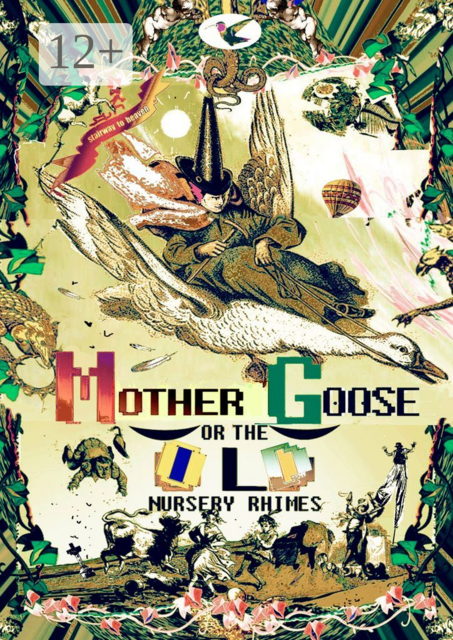
Mother Goose or the Old Nursery Rhimes
Қосымшада ыңғайлырақҚосымшаны жүктеуге арналған QRRuStore · Samsung Galaxy Store
Huawei AppGallery · Xiaomi GetApps

автордың кітабын онлайн тегін оқу  Mother Goose or the Old Nursery Rhimes

Mother Goose or the Old Nursery Rhimes

Fonts by «ParaType»


Cover designer Алексей Борисович Козлов


Contents

There was an old man of Tobago

There was an old man of Tobago,

Who lived on rice, gruel, and sago;

Till, much to his bliss,

His physician said this —

«To a leg, sir, of mutton you may go.»

Old Mother Goose

Old Mother Goose, when

She wanted to wander,

Would ride through the air

On a very fine gander.

Mother Goose had a house,

‘Twas built in a wood,

Where an owl at the door

For sentinel stood.

This is her son Jack,

A plain-looking lad,

He is not very good,

Nor yet very bad.

She sent him to market,

A live goose he bought,

“Here, mother,” says he,

“It will not go for nought.”

Jack’s goose and her gander

Grew very fond,

They’d both eat together,

Or swim in one pond.

Jack found one fine morning

As I have been told,

His goose had laid him

An egg of pure gold.

Jack rode to his mother,

The news for to tell,

She called him a good boy

And said it was well.

Jack sold his gold egg

To a rogue of a Jew,

Who cheated him out of

The half of his due.

Then Jack went a-courting

A lady so gay, As fair as the lily,

And sweet as the May.

The Jew and the Squire

Came behind his back,

And began to be labour

The sides of poor Jack.

And then the gold egg

Was thrown into the sea,

When Jack he jumped in,

And got it back presently.

The Jew got the goose,

Which he vowed he would kill,

Resolving at once

His pockets to fill.

Jack’s mother came in,

And caught the goose soon,

And mounting its back,

Flew up to the moon.

Boys and girls, come out to play

The moon does shine as bright as day,

Leave your supper, and leave your sleep,

And meet your playfellows in the street;

 Come with a whoop, and come with a call,

And come with a good will, or not at all.

Up the ladder and down the wall,

A halfpenny loaf will serve us all.

You find milk and I’ll find flour,

And we’ll have a pudding in half an hour.

Tom Tumbs Alphabet

A was an Archer, who shot at a frog.

B was a Butcher, who had a great dog.

C was a Captain, all covered with lace.

D was a Drummer, who played with a grace.

E was an Esquire with pride on his brow.

F was a Farmer, who followed the plough.

G was a Gamester, who had but ill-luck.

H was a Hunter, who hunted a buck.

I was an Italian, who had a white mouse.

 J was a Joiner, who built up a house.

K was a King, so mighty and grand.

L was a Lady, who had a white hand.

M was a Miser, who hoarded up gold.

N was a Nobleman, gallant and bold.

O was an Organ-Boy, who played for his bread.

P a Policeman, of bad boys the dread.

Q was a Quaker, who would not bow down.

R was a Robber, who prowled about town.

S was a Sailor, who spent all he got.

T was a Tinker, who mended a pot.

U was an Usher, with dunces severe.

V was a Veteran, who never knew fear.

W was a Waiter, with dinners in store.

X was Expensive, and so became poor.

Y was a Youth, who did not like school.

Z was a Zany, who looked a great fool.

The Walrus and the Carpenter

The sun was shining on the sea,

Shining with all his might:

He did his very best to make

The billows smooth and bright—

And this was odd, because it was

The middle of the night.

The moon was shining sulkily,

Because she thought the sun

Had got no business to be there

After the day was done—

“It’s very rude of him,” she said,

“To come and spoil the fun!”

The sea was wet as wet could be,

The sands were dry as dry.

You could not see a cloud, because

No cloud was in the sky:

No birds were flying overhead—

There were no birds to fly.

The Walrus and the Carpenter

Were walking close at hand;

They wept like anything to see

Such quantities of sand:

“If this were only cleared away,”

They said, “it would be grand!”

“If seven maids with seven mops

Swept it for half a year,

Do you suppose,” the Walrus said,

“That they could get it clear?”

“I doubt it,” said the Carpenter,

And shed a bitter tear.

“O Oysters, come and walk with us!”

The Walrus did beseech.

“A pleasant walk, a pleasant talk,

Along the briny beach:

We cannot do with more than four,

To give a hand to each.”

The eldest Oyster looked at him,

But never a word he said:

The eldest Oyster winked his eye,

And shook his heavy head—

Meaning to say he did not choose

To leave the oyster-bed.

But four young Oysters hurried up,

All eager for the treat:

Their coats were brushed, their faces washed,

Their shoes were clean and neat—

And this was odd, because, you know,

They hadn’t any feet. Four other

Oysters followed them,

And yet another four;

And thick and fast they came at last,

And more, and more, and more—

All hopping through the frothy waves,

And scrambling to the shore.

The Walrus and the Carpenter

Walked on a mile or so,

And then they rested on a rock

Conveniently low:

And all the little Oysters stood

And waited in a row.

“The time has come,” the Walrus said,

“To talk of many things:

Of shoes — and ships — and sealing-wax—

Of cabbages — and kings—

And why the sea is boiling hot—

And whether pigs have wings.”

“But wait a bit,” the Oysters cried,

“Before we have our chat;

For some of us are out of breath,

And all of us are fat!”

“No hurry!” said the Carpenter.

They thanked him much for that.

“A loaf of bread,” the Walrus said,

“Is what we chiefly need:

Pepper and vinegar besides

Are very good indeed—

Now if you’re ready,

Oysters dear,

We can begin to feed.”

“But not on us!” the Oysters cried,

Turning a little blue.

“After such kindness, that would be

A dismal thing to do!”

“The night is fine,” the Walrus said.

“Do you admire the view?

“It was so kind of you to come!

And you are very nice!”

The Carpenter said nothing but

“Cut us another slice:

I wish you were not quite so deaf—

I’ve had to ask you twice!”

“It seems a shame,” the Walrus said,

 “To play them such a trick,

After we’ve brought them out so far,

And made them trot so quick!”

The Carpenter said nothing but

“The butter’s spread too thick!”

“I weep for you,” the Walrus said:

“I deeply sympathize.”

With sobs and tears he sorted out

Those of the largest size,

Holding his pocket-handkerchief

Before his streaming eyes.

“O Oysters,” said the Carpenter,

“You’ve had a pleasant run!

Shall we be trotting home again?”

But answer there came none—

And this was scarcely odd, because

They’d eaten every one.

— Lewis Carroll.
A Man Went Hunting at Reigate

A man went hunting at Reigate,

And wished to jump over a high gate;

Says the owner, “Go round,

With your horse and your hound,

For you never shall leap over my gate.”