



автордың кітабын онлайн тегін оқу An Epitome of the History of Medicine
AN EPITOME OF THE HISTORY OF MEDICINE
By Roswell Park, A.M., M.D.
Professor of Surgery in the Medical Department of the University of Buffalo, etc.
Based Upon A Course Of Lectures Delivered In The University Of Buffalo.
Illustrated with Portraits and Other Engravings.
1897,
The F. A. Davis Company. [Registered At Stationers' Hall. London, Eng.]
"Destiny Reserves for us Repose Enough."—Fernel.
Original

Original
TO MY COLLEAGUES
IN THE
MEDICAL FACULTY OF THE UNIVERSITY OF BUFFALO,
Who Authorized and Encouraged this First Attempt in the Medical Schools of this Country to Give Systematic Instruction in the History or the Science which they Teach,
THIS BOOK
Is Dedicated.
PREFACE.
The history of medicine has been sadly neglected in our medical schools. The valuable and fruitful lessons which it tells of what not to do have been completely disregarded, and in consequence the same gross errors have over and over been repeated. The following pages represent an effort to bring the most important facts and events comprised within such history into the compass of a medical curriculum, and, at the same time, to rehearse them in such manner that the book may be useful and acceptable to the interested layman.,—i.e., to popularize the subject. This effort first took form in a series of lectures given in the Medical Department of the University of Buffalo. The subject-matter of these lectures has been rearranged, enlarged, and edited, in order to make it more presentable for easy reading and reference. I have also tried, so far as I could in such brief space, to indicate the relationship which has ever existed between medicine, philosophy, natural science, theology, and even belles-lettres. Particularly is the history of medicine inseparable from a consideration of the various notions and beliefs that have at times shaken the very foundation of Christendom and the Church, and for reasons which appear throughout the book.
The history of medicine is really a history of human error and of human discovery. During the past two thousand years it is hard to say which has prevailed. Notwithstanding, had it not been for the latter the total of the former would have been vastly greater. A large part of my effort has been devoted to considering the causes which conspired to prevent the more rapid development of our art. If among these the frowning or forbidding attitude of the Church figures most prominently, it must not be regarded as any expression of a quarrel with the Church of to-day. But let any one interested read President White's History of the Warfare of Science with Theology, the best presentation of the subject, and he can take no issue with my statements.
Reverence for the true, the beautiful, and the good has characterized physicians in all times and climes. But little of the true, the beautiful, or the good crept into the transactions of the Church for many centuries, and we suffer, to-day, more from its interference in time past than from all other causes combined. The same may be said of theology, which is as separate from religion as darkness from light. Only when students of science emancipated themselves from the prejudices and superstitions of the theologians did medicine make more than barely perceptible progress.
In this connection I would like to quote a paragraph from an article by King, in the Nineteenth Century for 1893: "The difficulties under which medical science labored may be estimated from the fact that dissection was forbidden by the clergy of the Middle Ages on the ground that it was impious to mutilate a form made in the image of God. We do not find this pious objection interfering with such mutilation when effected by means of the rack and wheel and such other clerical, rather than medical, instruments."
Written history is, to a certain extent at least, plagiarism; and I make no apology for having borrowed my facts from whatever source could best furnish them, but wish cheerfully and publicly to acknowledge my indebtedness to the works mentioned below, those especially of Renouard, Baas, and Sprengel, and to various biographical dictionaries. I have not even scrupled to take bodily sentences or expressions from these authorities, but have tried to so indicate them when I could.
The writer takes pleasure in acknowledging here the obligations which both he and the publishers feel to Dr. Joseph H. Hunt, of Brooklyn, N. Y., from whose extensive and valuable collection have been furnished the originals for most of the portraits in the following pages, and to Dr. F. P. Henry, Honorary Librarian of the College of Physicians of Philadelphia, through whose courtesy was obtained the privilege of reproducing the illustrations of instruments and operations from some of the rare old works in the college library. The kind co-operation of these gentlemen has given a distinct and added value to the contents of this little work.
LIST OF PRINCIPAL WORKS CONSULTED.
Baas, Outlines of the History of Medicine. Translated by Henderson. New York, 1889.
Berdoe, Origin and Growth of the Heeding Art. London, 1893.
Bouchut, Histoire de la Médecine. Paris, 1873.
Dezeimeris, Lettres sur VHistoire de la Médecine. Paris, 1838.
Dietionnaire Historique de la Médecine. Paris, 1828.
Haeser, Geschiehte der Medicin. Jena, 1853.
Hirsch, Biographisehes Lexikon des Hervorragendeu der Aerzte aller Zeiten und Vülker. Wien und Leipzig, 1884.
Portal, Histoire de VAnatomie et de la Chirurgie. Paris, 1770.
South, Memorials of the Craft of Surgery in England. London, 1886.
Sprexgel, Geschicute der Chirurgie. Halle, 1819.
CONTENTS
PREFACE.
LIST OF PRINCIPAL WORKS CONSULTED.
CONTENTS.
LIST OF ILLUSTRATIONS.
AN EPITOME OF THE HISTORY OF MEDICINE.
CHAPTER I.
CHAPTER II.
CHAPTER III.
CHAPTER IV.
CHAPTER V.
CHAPTER VI.
CHAPTER VII.
CHAPTER VIII.
CHAPTER IX.
CHAPTER X
CHAPTER XI.
CHAPTER XII.
CHAPTER XIII.
CHAPTER XIV.
INDEX.
CONTENTS.
CHAP I.
Medicine Among the Hebrews, the Egyptians, the Orientals, the Chinese,
and the Early Greeks.—The Asclepiadæ.—Further Arrangement into Periods
(Renouard's Classification). The Age of Foundation.—The Primitive;
Sacred, or Mystic; and Philosophic Periods.—Systems in
Vogue: Dogmatism, Methodism, Empiricism,
Eclecticism.—Hippocrates...................................... ...1-29
CHAP II.
AGE OF Foundation (continued).—Anatomic Period: Influence of the
Alexandrian Library. Herophilus and Erasistratus. Aretæus. Cel-sus.
Galen.—Empiricism: Asclepiades.—Methodism: Theinison.—Eclecticism.
Age of Transition.—Greek Period: Oribasins. Ætius. Alexander of
Tralles. Paulus Ægineta............ ...30-56
CHAP III.
Age of Transition (continued).—Arabic Period: Alkindus. Mesue.
Rhazes. Haly-Abbas. Avicenna. Albucassis. Avenzoar. Averroës.
Maimonides.—School of Salernum: Constantinus Africanus. Roger
of Salerno. Roland of Parma. The Four Masters. John of
Procida................................................. ...57-85
CHAP IV
Age of Transition ( concluded).—The School of Montpellier: Raimond
Lulli. John of Gaddesden. Arnold of Villanova. Establishment of Various
Universities. Gerard of Cremona. William of Salicet. Lanfranc. Mondino.
Guy de Chauliac. Age of Renovation.—Erudite Period, including the
Fifteenth and Sixteenth Centuries. Thomas Linacre. Sylvius. Vesalius.
Columbus. Eustaclius. Fallopius. Fabricius ab Aquapendente. Fabricius
Hildanus.. ...8686-113
CHAP V.
Age of Renovation (continued).—Erudite Period (continued): Beni-vieni.
Jean Fern el. Porta. Severino. Incorporation of Brother-hood of St. Come
into the University of Paris. Ambroise Paré. Guillemeau. Influence
of the Occult Sciences: Agrippa. Jerome Cardan. Paracelsus. Botal.
Joubert...................... ...114-147
CHAP VI.
Age of Renovation (continued).—Stndent-life During the Fifteenth
and Sixteenth Centuries. Ceremonials Previous to Dissection.—Reform
Period: The Seventeenth, Eighteenth, and Nineteenth Centuries. Modern
Realism in Medicine and Science. Introduction of the Cell-doctrine.
Discovery of the Circulation. William Harvey. Malpighi. Leuwenhoek.
Correct-Doctrine of Respiration. Discovery of the Lymphatic Circulation.
The Nervous System. Discovery of Cinchona. Development in Obstetric
Art, in Medical Jurisprudence, and in Oral Clinical Teaching. Van
Helmont.—The Iatrochemical System: Le Bôe. Thomas Willis......148-170
CHAP VII.
Age of Renovation (continued).—latromechanical School: Santoro.
Borelli. Sydenham. Sir Thomas Browne.—Surgery: Denis. F. Collot.
Dionis. Baulot (Frère Jacques). Scultetus. Rau. Wiseman. Cowper. Sir C.
Wren the Discoverer of Hypodermatic Medication. Anatomical Discoveries.
General Condition of the Profession During the Seventeenth Century.
The Eighteenth Century. Boerliaave. Gaub.—Animism:
Stahl.—Jlechanico-dynamic System: Hoffmann. Cullen.—Old Vienna
School: Van Swieten. De Haën.—Vitalism: Bordeu. Erasmus Darwin
..................171-202
CHAP VIII.
Age of Renovation (continued).—Animal Magnetism: Mesmer. Braid.
—Brunonianism: John Brown.—Realism: Pinel. Bichat. Avenbrugger.
Werlliof. Frank.—Surgery: Petit. Desault. Scarpa. Gimbernat. Heister.
Von Siebold. Richter. Cheselden. Monro (1st). Pott. John Hunter. B.
Bell, J. Bell, C. Bell. Smellie. Denman.—Revival of Experimental Study:
Haller. Winslow. Portal. Yieq d'Azvr. Morgagni.—Inoculation against
Smallpox: Lady Montagu. Edward Jenner.............................
...203-221
CHAP IX.
Age of Renovation (continued).—The Eighteenth Century; General
Considerations. Foundation of Learned Societies, etc. The Royal College
of Surgeons; the Josephinum.—The Nineteenth Century Realistie Reaction
Against Previous Idealism. Influence of Comte, of Claude Bernard,
and of Charles Darwin. Influence Exerted by Other Sciences.—Theory
of Excitement: Roeschlaub.—Stimolo and Contrastimolo:
Kasori.—Homoeopathy: Halineiaim.—Isopatly, Electrohomoeopathy
of Mattei.—Cranioscopy, or Phrenology: Gall and Spurzlieim.—The
Physiological Theory: Broussais.—Paris Pathological School:
Cruveillier. Andral. Louis. Magendie. Trousseau. Claude
Bernard.—British Medicine: Bell and Hall. Travel's.—Germany, School
of Natural Philosophy: Johannes Müller.—School of Natural
History: Schonlein.—New Vienna School: Rokitansky.
Skoda.................................... ...230-252
CHAP X.
Age of Transition (concluded).—New Vienna School (concluded): von
Hebra. Czermak and Türck. Juger. Arlt. Gruber. Politzer.—German
School of Physiological Medicine: Roser.—School of Rational
Medicine: Henle.—Pseudoparacelsism: Rademaeher.—Hydrotherapeutics:
Priessnitz.—Modern Vitalism: Virchow.—Seminalism: Bouchut.—Parasitism
and the Germ-theory: Davaine. Pasteur. Chauveau. Klebs. F. J.
Cohn. Koch. Lister.—Advances in Physical Diagnosis: Laënnec.
Piorry.—Surgery: Delpecli. Stro-meyer. Sims. Bozeman. McDowell. Boyer.
Larrey. Dupuytren. Cloquet. Civiale. Vidal. Velpeau. Malgaigne.
Nélaton. Sir Astley Cooper. Brodie. Guthrie. Syme. Simpson. Langenbeck.
Billroth.................................................. ...253-275
CHAP XI.
History of Medicine in America.—The Colonial Physicians. Medical Study
under Preceptors. Inoculation against Small-pox. Military Surgery During
the Revolutionary War. Earliest Medical Teaching and Teachers in this
Country. The First Medical Schools. Benjamin Rush. The First Medical
Journals. Brief List of the Best-Known American Physicians and
Surgeons.... ...276-299
CHAP XII.
The History of Anæsthesia.—Anæsthesia and Analgesia. Drugs Possessing
Narcotic Properties in use since Prehistoric Times. Mandragora; Hemp;
Hasheesh. Sulphuric Ether and the Men Concerned in its Introduction as
an Anæsthetic—Long, Jackson, Wells, and Morton. Morton's First Public
Demonstration of the Value of Ether. Morton Entitled to the Credit of
its Introduction. Chloroform and Sir Janies Simpson. Cocaine and Karl
Koller.............................................. ...300-315
CHAP XIII.
The History of Antisepsis.—Sepsis, Asepsis, and Antisepsis. The
Germ-theory of Disease. Gay-Lussac's Researches. Schwann. Tyndall.
Pasteur. Davaine. Lord Lister and his Epoch-making Revolution in
Surgical Methods. Modifications of his Earlier Technique without Change
in Underlying Principles, which Still Remain Unshaken. Changes Effected
in Consequence. Comparison of Old and Modern Statistics...........
...316-329
CHAP XIV.
Ax Epitome of the History of Dentistry.—Rude Dentistry of Prehistoric
Times. Early Instruments for Extraction Made of Lead. Dentistry on the
Same Low Plane as Medicine During the First. Half of the Christian Era.
Dentistry Taught at the School of Salernum. Progress of the Art on the
Continent. Prosthesis and Substitutes for Human Teeth. Introduction of
Porcelain for Artificial Teeth; of Metal and of Vulcanized Rubber for
Plates; of Plaster for Impressions. From being a Trade, Dentistry is now
a Profession, in which Americans lead the World. Statistics... ...330-341
LIST OF ILLUSTRATIONS.
1. Æsculapius,...................................007
2. Offering to Æsculapius,.......................009
3. Hippocrates,..................................019
4. Aulus Cornelius Celsus,.......................035
5. The Conversion of Galen,......................037
6. Averroës,.....................................064
7. Andreas Vesalius,.............................105
8. Title-page, Seven Books of the Anatomy,.......106
9. IV, Forceps for Extracting Balls..............108
10. Gabriel Fallopius,...........................109
11. Forms of Forceps for Enlarging Wounds,.......111
12. Body Showing Various Kinds of Wounds,........117
13. Mode of Extracting Leaden Bullets,...........121
14. Ambroise Pare,...............................124
15. Pliers, Iron for Actual Cautery,.............126
16. Swan's Beak, Used for Dilating...............132
17. Instruments for the Extraction of Balls,.....133
18. Spéculums for the Mouth and Womb, etc.,......135
19. Amputation Instruments,......................136
20. Different Forms of Trephines and Pliers,.....137
21. Philip Theophrastus Paracelsus,..............143
22. William Harvey, M.D.,........................156
23. Thomas Sydenham,.............................173
24. Straight Saws and Divers Scraping Tools,.....179
25. Surgical Treatment of Dislocations,..........181
26. Operations on the Arms and Lower Limbs,......185
27. Surgical Operations on the Breast, etc.,.....187
28. Boerhaave,...................................193
29. John Brown, M.D.,............................205
30. Ph. Pinel,...................................207
31. Marie François Xavier Bicliat, M.D.,.........208
32. William Hunter, M.D., F.R.S.,................217
33. John Hunter,.................................219
34. J. F. Blumenbacli,...........................223
35. Edward Jenner, M.D.,.........................227
36. Samuel Hahnemann,............................242
37. Rudolph Virchow,.............................257
38. Bernhard von Langenbeck,.....................265
39. Theodor Billroth,............................266
40. Sir Astley Cooper, Bart.,....................272
41. Sir Benjamin Collins Brodie, F.R.S.,.........273
42. B. Waterhouse, M.D.,.........................280
43. Surgeon's Hall,..............................281
44. Benjamin Rush, M.D.,.........................284
45. George B. Wood, M.D.,........................287
46. Robley Dunglison, M.D.,......................287b
47. Austin Flint, M.D.,..........................288
48. Isaac Ray, M.D.,.............................289
49. Philip Sung Physick, M.D.,...................291
50. Ephraim McDowell, M.D.,......................292
51. S. D. Gross, M.D., LL.D.,....................294
52. J. Marion Sims, M.D.,........................296
53. D. Hayes Agnew, M.D., LL.D.,.................297
54. William T. G. Morton, M.D.,..................307
55. Dr. Morton, October 16, 1846,................308
56. Lord Lister, M.D., D.C.L., LL.D.,............323
AN EPITOME OF THE HISTORY OF MEDICINE.
CHAPTER I.
Medicine Among the Hebrews, the Egyptians, the Orientals, the Chinese, and the Early Greeks.—The Asclepiadæ.—Further Arrangement into Periods ( Renouard's Classification). The Age of Foundation.—The Primitive; Sacred, or Mystic; and Philosophic Periods.—Systems in Vogue: Dogmatism, Methodism, Empiricism, Eclecticism.—Hippocrates, born 460 B.C.
Of the origin of medicine but little need be said by way of preface, save that it must have been nearly contemporaneous with the origin of civilization. The lower animals when sick or wounded instinctively lessen or alter their diet, seek seclusion and rest, and even in certain cases seek out some particular herb or healing substance. Thus, too, does the savage in his primitive state; and experience and superstition together have led nearly all the savage tribes into certain habits and forms in case of injury or disease. For us the history of medicine must necessarily begin with the written history of events, and its earliest endeavors need detain us but a very short time. Its earliest period is enveloped in profound obscurity, and so mingled with myth and table as to be very uncertain. It embraces an indefinite time, during which medicine was not a science, but an undigested collection of experimental notions,—vaguely described, disfigured by tradition, and often made inutile by superstition and ignorance. The earliest records of probable authenticity are perhaps to be met with in the Scriptures, from which may be gathered here and there a fair notion of Egyptian knowledge and practice. Thus we read that Joseph commanded his servants and physicians to embalm him, this being about 1700 B.C.. It shows that Egypt at that time possessed a class of men who practiced the healing art, and that they also embalmed the dead, which must have both required and furnished a crude idea of general anatomy. We are also informed from other sources that so superstitious were the Egyptians that they not only scoffed at, but would stone, the embalmers, for whom they had sent, after the completion of their task. The probably mythical being whom the Egyptians called Thoth, whom the Greeks named Hermes and the Latins Mercury, passed among the Egyptians as the inventor of all sciences and arts. To him are attributed an enormous number of writings concerning all subjects. Some have considered him as identical with Bacchus, Zoroaster, Osiris, Isis, Serapis, Apollo, and even Shem, the son of Xoah. Others have thought him to be a god. It is now almost certain that the books attributed to Hermes were not the work of anyone hand or of any one age. The-last six volumes of the forty-two composing the encyclopaedia, with which Hermes is credited, refer to medicine, and embrace a body of doctrines fairly complete and well arranged. Of these six, the first treats of anatomy; the second, of diseases; the third, of instruments; the fourth, of remedies; the fifth, of diseases of the eye; and the sixth, of diseases of women. In completeness and arrangement it rivals, if not surpasses, the Hippocratic collection, which it antedated by perhaps a thousand years. The Egyptians appear at first to have exposed their sick in public (at least, so says Strabo), so that if any of those who passed by had been similarly attacked they might give their advice for the benefit of the sufferers. In fact, according to Herodotus, the same custom prevailed among the Babylonians and Lusitanians. At a later date all who were thus cured were required to go to the temples and there inscribe their symptoms and what had helped them. The temples of Canopus and Vulcan at Memphis became the principal depots for these records, which were kept as carefully as were the archives of the nation, and were open for public reference. These records, being under the control of the priests, were mainly studied by them, who later collected a great mass of facts of more or less importance, and endeavored to found upon the knowledge thus collected an exclusive practice of the art of medicine. In this way they formed their medical code, which was called by Diodorus the Hiera Sacra, Sacred Book, from whose directions they were never allowed to swerve. It was perhaps this code which was later attributed to Hermes, and that made up the collection spoken of by Clement of Alexandria. If in following these rules they could not save their patients they were held blameless, but were punished with death if any departure from them were not followed by success.
I have spoken of embalming as practiced by the Egyptians. It was of three grades: the first reserved for men of position and means, which cost one talent, and according to which the brain was removed by an opening through the nasal fossæ, and the intestines through an opening on the left side of the abdomen, after which both cavities were stuffed with spices and aromatics; then the body was washed and spread over with gum and wrapped in bandages of linen. The second grade was adopted by families of moderate means; and the third was resorted to by the poor, consisting simply in the washing of the body and maceration in lye for seventy days.
Pliny assures us that the kings of Egypt permitted the opening of corpses for the purpose of discovering the causes of disease, but this was only permitted by the Ptolemies, under whose reign anatomy was carried to a very high degree of cultivation.
The medicine of the Hebrews is known generally through the Sacred Scriptures, especially through the writings attributed to Moses, which embraced rules of the highest sagacity, especially in public hygiene. The book of Leviticus is largely made up of rules concerning matters of public health. In the eleventh chapter, for instance, meat of the rabbit and the hog is proscribed, as apparently injurious in the climate of Egypt and India; it, however, has been suggested that there was such variation of names or interpretation thereof as to make it possible that our rabbit and hog are not the animals alluded to by Moses. The twelfth and fifteenth chapters of the same book were designed to regulate the relation of man and wife and the purification of women, their outlines being still observed in some localities by certain sects, while the hygienic measure of circumcision then insisted upon is still observed as a religious rite among the descendants of Moses. For the prevention of the spread of leprosy, the measures suggested by Moses could not now be surpassed, although ancient authors have confounded under this name divers affections, probably including syphilis, to which, however, the same hygienic rules should apply. Next to Moses in medical lore should be mentioned Solomon, to whom is attributed a very high degree of knowledge of natural history, and who, Josephus claimed, had such perfect knowledge of the properties of all the productions of nature that he availed himself of it to compound remedies extremely useful, some of which had even the virtues necessary to cast out devils.
The most conspicuous feature in the life of the Indian races is their division into castes, of which the most noble is that of the priests, or Brahmins, who in ancient times alone had the privilege of practicing medicine. Their Organon of Medicine, or collection of medical knowledge, was a hook which they called Vagadasastir. It was not systematically arranged, and in it demonology played a large rôle. They held the human body to consist of 100,000 parts, of which 17,000 were vessels, each one of which was composed of seven tubes, giving passage to ten species of gases, which by their conflicts engendered a number of diseases. They placed the origin of the pulse in a reservoir located behind the umbilicus. This was four fingers wide by two long, and divided into 72,000 canals, distributed to all parts of the body. The physician examined not only the pulse of his patient, but the dejecta, consulted the stars, the flight of birds, noted any incidental occurrence during his visits, and made up his prognosis from a multitude of varying circumstances, omitting only those which were really valuable, namely, the symptoms indicating the state of the organs. Ancient Hindoo charlatan priests let fall from the end of a straw a drop of oil into the patient's water. If the oil was precipitated and attached itself to the bottom of the vessel, they predicted an unfavorable result; if, on the contrary, it floated, they gave a favorable prognosis. This is, so far as we know, the earliest recorded way of testing the specific gravity of the urine.
With all their absurdities, however, the Indians appear to have done some things that we scarcely do to-day: they arè said to have had an ointment that caused the cicatrices of variola to disappear, and they cured the bites of venomous serpents with remedies whose composition has been lost.
The antiquity of the Chinese is simply lost in tradition and fable. From time immemorial their rulers have taken extraordinary care to prevent contact and interchange of ideas with foreigners. For 4000 years their manners, laws, religious beliefs, language, and territory have scarcely changed. In this respect they stand alone among the nations of the earth. They attribute the invention of medicine to one of their emperors named Hoam-ti, who was the third of the first dynasty, and whose supposititious date is 2687 B.C. He is considered to be the author of the work which still serves them as a medical guide. It is, however, more probably an apochryphal book. Its philosophy was of a sphygmic kind,—i.e., based upon the pulse, which they divided into the supreme or celestial, the middle, and the inferior or terrestrial; by the examination of which the Chinese physician was supposed not only to show the seat of disease, but to judge of its duration and gravity. It is related that one of the ancient Chinese emperors directed the dead bodies of criminals to be opened, but this is questionable, since it is certain that they have the most profound ignorance of rudimentary anatomy, and glaring errors abound in their system. Being thus replete with errors, and possessing no anatomical knowledge, their surgery was of the most barbarous type. No one dared attempt a bloody operation; the reduction of hernia was unknown; a cataract was regarded as beyond their resources; and even venesection was never practiced. On the other hand, they employed cups, and acupuncture, fomentation, plasters of all kinds, lotions, and baths. The moxa, or red-hot button, was in constant use, and they had their magnetizers, who appear to have been convulsionists. For a long time there existed at Pekin an Imperial School of Medicine, but now there is no such organization nor any regulation for the privilege of practicing medicine or surgery since 1792. At least until lately the country and the cities were infested with quacks, who dealt out poison and death with impunity. They practiced most murderous methods in place of the principles of midwifery. Only since the civilized missionaries have penetrated into their country has there been any improvement in this condition of affairs.
It is Greece which furnishes us with the most interesting and the most significant remains of the history of medicine during antiquity, as she furnishes every other art with the same historical advantages. During the period preceding the Trojan War there is little hut myth and tradition. Leclerc catalogued some thirty divinities, heroes or heroines, who were supposed to have invented or cultivated some of the branches of medicine. Melampus is perhaps the first of these who immortalized himself by extraordinary cures, especially on the daughters of Proetus, King of Argos. These young princesses, having taken vows of celibacy, became subjects of hysterical monomania, with delusions, during which they imagined themselves transformed into cows and roamed the forests instead of the palaces. This nervous delusion spread to and involved many other women, and became a serious matter.
Original
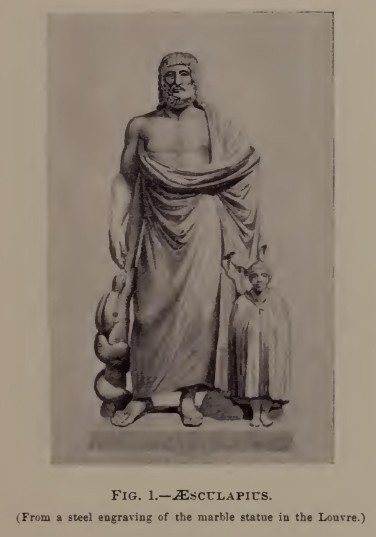
Melampus, the shepherd, having observed the purgative effects upon goats of white hellebore, gave to the young women milk in which this plant had been steeped, thereby speedily effecting a cure. Scarcely less distinguished than Melampus was Chiron. He was mainly distinguished because he was the preceptor of Æsculapius, the most eminent of early Greeks in this field. By some Æsculapius was considered the son of Apollo by the nymph Coronis.
Several cities of Greece contended for the honor of his birthplace, as they did for that of Homer. That he was famous at the time of the Argonautic expedition is seen by the fact that the twins Castor and Pollux desired him to accompany the expedition as surgeon. Be his origin what it may, Æsculapius was the leading character in medicine of all the ancients, with the possible exception of Hermes among the Egyptians; in fact, some scholars consider the two identical. Temples were erected in his honor, priests were consecrated to them, and schools of instruction were there established. It is related that Pluto, god of hell, alarmed at the diminishing number of his daily arrivals, complained to Jupiter, who destroyed the audacious healer—on which account, some wit has said, "the modern children of Æsculapius abstain from performing prodigies," But the true Æsculapians, the successors of the demigod, wrere imitated or copied by the crowd of charlatans and quacks, calling themselves theosophs, thaumaturgs, and so on, and not alone at that date, but for generations and centuries thereafter, Paracelsus and Mesmer being fair examples of this class. The poet Pindar, who lived seven or eight hundred years after Æsculapius, says that he cured ulcers, wounds, fever, and pain of all who applied to him by enchantment, potions, incisions, and by external applications. *
* Third Pythian Ode,
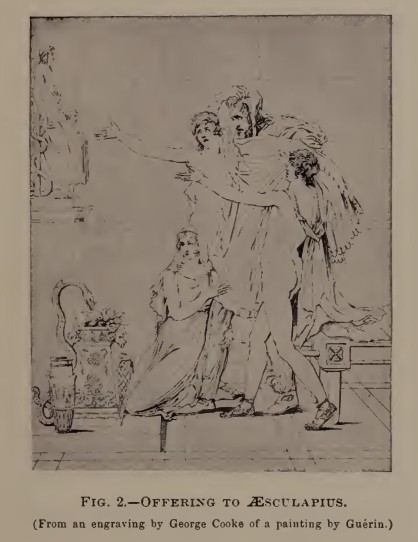
The followers of Æsculapius, and the priests in the temples dedicated to him, soon formed a separate caste, transmitting from one to another, as a family heritage, their medical knowledge. At first no one was admitted to practice the sacred science unless lie joined the priesthood, although later this secrecy was relaxed. They initiated strangers, provided they fulfilled the test which they made. Some kind of medical instruction was given in each temple. The three most celebrated temples to Æsculapius were that of Rhodes, already extinct by the time of Hippocrates; that of Cnidus, which published a small repertory; and finally that of Cos, most celebrated of all, because of the illustrious men who emanated from this school. In these temples votive tablets were fastened in large numbers, after the fashion of the Egyptians, the same giving the name of the patient, his affliction, and the manner of his cure. For example, such a one as this: "Julien vomited blood, and appeared lost beyond recovery. The oracle ordered him to take the pine-seeds from the altar, which they had three days mingled with honey; he did so, and was cured."
Original
Having solemnly thanked the god, he went away. There is reason to think that the priests of these temples made for their own uses much more minute and accurate accounts, which should be of some real service, since the writings which have come down to us evince a habit of close observation and clear description of disease. During the Trojan War two men are frequently mentioned by Homer as possessing great surgical skill. These were Machaon and Podalirius. They were regarded as sons of Æsculapius, the former being the elder. The first account of venesection, although not authentic, refers to the bleeding practiced by the latter upon the daughter of the King of Caria, upon whose shores Podalirius was cast by tempest after the ruin of Priam's kingdom. Whether he was the first of all men to practice it or not, it is certain that the act of venesection goes back long prior to the era of Hippocrates, who speaks of it as frequently performed.
Many of the deities upon Olympus seem at one time or another to have usurped medical functions. Apollo, the reputed father of Æsculapius, appropriated nearly everything under the name of Pæon, who assumed the privilege of exciting or subduing epidemics. Juno was supposed to preside at accouchements, and in both the Iliad and Odyssey it is indicated that Apollo was considered as the cause of all the natural deaths among men, and Diana of those among women.
The long Trojan War appears to have been an epoch-making event in the medical and surgical history of those times, as was the Civil War recently in our country. Certain vague and indefinite practices then took more fixed form, and from that time on medicine may be said to have been furnished with a history. After the dethronement of Priam and the destruction of his capital, navigation was free and unrestricted. The Hellenists covered with their colonies both shores of the Mediterranean, and their navigators even passed the pillars of Hercules. By these means the worship of Æsculapius passed from Greece into what is now Asia, Africa, and Italy. In his temple at Epidaurus was a statue of colossal size made of gold and ivory. The dialogues of Plato, especially the Phædo, make it apparent that the cock was the animal sacrificed to him, and hence sacred to the god of medicine. The priests attached to his worship were called Asclepiacloe, or descendants of Æsculapius. The temples were usually hygienically located near thermal springs or fountains and among groves. Pilgrimages were made from all quarters, and these localities became veritable health-resorts. A well-regulated dietary, pure air, temperate habits, and faith stimulated to a fanatical degree combined and sufficed for cures which even nowadays would be regarded as wonderful. The priests prescribed venesection, purgatives, emetics, friction, sea-baths, and mineral waters, as they appeared to be indicated. The imagination of the patient was continually stimulated, and at the same time controlled. Before interrogating the oracles they must be purified by abstinence, prayer, and sacrifice. Sometimes they were obliged to lie in the temple for one or more nights. The gods sometimes revealed themselves in mysterious ways, at times devouring the cakes upon the altars under the guise of a serpent, or again causing dreams which were to be interpreted by^the priests. There can be no doubt that sometimes, at least, the grossest frauds and the basest trickery were relied upon for the purpose of impressing the minds of those weakened by abstinence or influenced by drugs. Mercenary considerations were not lacking; moreover, cures were often not obtained until zeal had been redoubled by largely increased contributions to the treasury of the temples. In the neighborhood of many of these temples serpents abounded, non-venomous and easily tamed. These were employed by the priests in various supernatural performances by which the ignorant people were astonished and profoundly impressed. In fact, the serpent and the serpent-myth played a very large rôle in the early history of medicine as well as that of religion and religious symbolism.
It will thus be seen that during the space of about 700 years medicine underwent a transformation in Greece. It was first domestic and popular, practiced by shepherds, soldiers, and others; then became sacerdotal; after the Trojan War it was confined to the vicinity of the temples and practiced in the name of some divinity; and finally it was wrapped in mystery and mystic symbolism, where superstition was played upon and credulity made to pay its reward. Down to the time of Hippocrates the Asclep-iadæ rendered some genuine service to science, especially by inculcating habits of observation, in which Hippocrates excelled above all. Later, however, down to the time of the Christian era, medicine in the temples declined, and became, in fact, a system based upon the grossest jugglery.
It is time now that we make a systematic attempt to classify events in the history of medicine, and to recognize certain distinct epochs as they have occurred. For this purpose I know of no better arrangement than that of Renouard, which, in the main, I shall follow, at least during the forepart of this book. In this sense he divides the past into three ages, known, respectively, as the Age of Foundation, the Age of Transition, and the Age of Renovation. Each of these chronological divisions is subdivided into periods, of which the first contains four:—
AGE OF FOUNDATION.
1. The Primitive Period, or that of Instinct, beginning with myth, and ending with the destruction of Troy 1184 years before Christ.
2. The Sacred, or Mystic, Period, ending with the dispersion of the Pythagorean Society, 500 years before Christ.
3. The Philosophic Period, terminating with the foundation of the Alexandrian library, 320 years before Christ.
4. The Anatomic Period, ending with the death of Galen, about A.D. 200.
THE SECOND AGE, OR THAT OF TRANSITION, is divided into a fifth, or Greek Period, ending at the burning of the Alexandrian library, A.D. 640, and a sixth, Arabic Period, ending with the revival of letters, A.D. 1400.
THE THIRD AGE, OR THAT OF RENOVATION, includes the seventh, or Erudite Period, comprising the fifteenth and sixteenth centuries, and eighth, or Reform Period, comprising the seventeenth, eighteenth, and nineteenth centuries.
Examining this table for a moment, it will be seen that so far we have dealt with the Primitive Period and the Sacred, or Mystic, Period. Before passing on to the Philosophic Period let us for a moment follow Renouard, who likens the three schools of medical belief in the earlier part of the Primary Age, or the Age of Foundation, to the three schools of cosmogony, which obtained among the Greeks. The first of these was headed by Pythagoras, who regarded the universe as inhabited by acknowledged sentient principles which governed all substances in a determined way for preconceived purposes. Animals, plants, and even minerals were supposed to possess vivifying spirits, and above them all was a supreme principle. To this school corresponded the so-called Dogmatic School of medicine, attributed to Hippocrates, which was the precursor of modern vitalism, and regarded diseases as indivisible units from beginning to termination; in other words, they consisted of a regular programme of characteristic systems, successive periods, and of long course, either for the better or worse; that was one of the characteristic dogmas of the Hippocratic teaching. The Second System of cosmogony was that founded by Leucippus and Democritus, who explained all natural phenomena without recourse to the intervention of intelligent principles. All things for them existed as the necessary result of the eternal laws of matter. They denied preconceived purposes and ridiculed final causes. To this system corresponded that in medicine which has been termed Methodism (medically and literally speaking) and which recognized as its founders Æsculapius and Themison. The believers in this doctrine attempted to apply the atomic theory of Democritus and Epicurus to the theory and practice of medicine. Atoms of various size were supposed to pass and repass without cessation through cavities or pores in the human body. So long as the atoms and pores maintained a normal relationship of size and proportion health was maintained, but it was deranged so soon as the exactness of these relations was destroyed or interfered with. The Dogmatists considered vital reaction as a primary phenomenon, while with the Methodists it was secondary. The Third System of cosmogony, founded by Parmenides and Pyrrho, believed in the natural improvement of bodies in their endless reproduction and change, and concluded that wisdom consisted in remaining in doubt; in other words, they were the agnostics of that day. "What is the use," said they, "of fatiguing the mind in endeavoring to comprehend what is beyond its capability." Later they were known as Skeptics and Zetetics, to indicate that they were always in search of truth without flattering them selves that they had found it. To them corresponded a third class of physicians, with Philinus and Serapis at their head, who deemed that proximate causes and primitive phenomena of disease were inaccessible to observation; that all that is affirmed on these subjects is purely hypothetical, and hence unworthy of consideration in choosing treatment. For them objective symptoms—or, as we would say, signs—constituted the natural history of disease, they thus believing that their remedies could only be suggested by experience, since nothing else could reveal itself to them. They therefore took the name of Empirics.
Finally a fourth class of physicians arose who would not adopt any one of these systems exclusively, but chose from each what seemed to them most reasonable and satisfactory. They called themselves Eclectics, wishing thereby to imply that they made rational choice of what seemed best. The idea conveyed in the term "eclecticism" has been fairly criticised for this reason: eclecticism is in reality neither a system nor a theory; it is individual pretension elevated to the dignity of dogma. The true eclectic recognizes no other rule than his particular taste, reason, or fancy, and two or more eclectics have little or nothing in common. If that were true two thousand years ago, it is not much less so to-day. The eclectic carefully avoids the discussion of principles, and has neither taste nor capacity for abstract reasoning, although he may be a good practitioner; not that he has no ideas, but that his ideas form no working system. With him medical tact—i.e., cultivated instinct—replaces principle.
The eclectic of our day, however, is only an empiric in disguise,—that is, a man whose opinions are based on comparison of observed facts, but whose theoretical ideas do not go beyond phenomena.
In older days philosophy embraced the whole of human knowledge, and the philosopher was not permitted to be unacquainted with any of its branches. Now physics, metaphysics, natural history, etc., are arranged into separate sciences, and the sum-total of knowledge is too great to be compassed by any one man.
Pythagoras was the last of the Greek sages who made use of hieroglyphic writings and transmitted his doctrine in ancient language. Born at Samos, he was, first of all, an athlete; but one day, hearing a lecture no immortality of the soul, he was thereby so strongly attracted to philosophy that he renounced all other occupation to devote himself to it. He studied arduously in Egypt, in Phoenicia, in Chaldea, and even, it is said, in India, where he was initiated into the secrets of the Brahmins and Magi. Finally, returning to his own country, he was received by the tyrant Polycrates, but not made to feel at home. Starting on his travels again, he assisted at one of the Olympic games, and, being recognized, was warmly greeted. He sailed to the south of Italy, landed at Crotona, and lodged with Milo, the athlete. Commencing here his lectures, he soon gathered around him a great number of disciples, of whom he required a very severe novitiate, lasting even five or six years, during which they had to abstain almost entirely from conversation, and live upon a very frugal diet. Those only who persevered were initiated later into the mysteries of the order. His disciples had for him most profound veneration, and were accustomed to decide all disputes witlr: "The master has said it." Pythagoras possessed immense knowledge; he invented the theorem of the square of the hypothenuse, and he first divided the year into 365 days and 6 hours. He seems to have suspected the movements of our planetary system. He traveled from place to place, and founded schools and communities wherever he went, which exercised, at least at first, only the happiest influence; but the success and influence which their learning gave them later made his disciples bold, and then dishonest, and his communities were finally dispersed by angry mobs, which forced their members to conceal or expatriate themselves; and so, even during the life-time of its founder, the Pythagorean Society was destroyed, and never reconstructed.
With Pythagoras and his disciples numbers played a very important rôle, and the so-called language of numbers was first taught by him. He considered the unit as the essential principle of all things, and designated God by the figure 1 and matter by the figure 2, and then he expressed the universe by 12, as representing the juxtaposition of 1 and 2. As 12 results from multiplying 3 by 4, he conceived the universe as composed of three distinct worlds, each of which was developed in four concentric spheres, and these spheres corresponded to the primitive elements of fire, air, earth, and water. The application of the number 12 to express the universe Pythagoras had received from the Chaldeans and Egyptians—it being the origin of the institution of the zodiac. Although this is digressing, it serves to show what enormous importance the people of that time attached to numbers, especially to the ternary and quarternary periods in the determination of critical days in illness. Pythagoras was the founder of a philosophic system of great grandeur, beauty, and, in one sense, completion, embracing, as it does, and uniting by common bounds God, the universe, time, and eternity; furnishing an explanation of all natural phenomena, which, if not true, was at that time acceptable, and which appears in strong and favorable contrast as against the mythological systems of pagan priests. No wonder that it captivated the imagination and understanding of the thinking young men of that day. Had they continued in the original purity of life and thought in which he indoctrinated them there is no knowing how long the Pythagorean school might have continued. But after it had been dissolved by the storm of persecution, its members were scattered all over Greece and even beyond. Now no longer held by any bonds, many of them revealed the secrets of their doctrine, to which circumstance we owe the little knowledge thereof we now possess.
The Pythagoreans apparently first introduced the custom of visiting patients in their own homes, and they went from city to city and house to house in performance of this duty. On this account they were called Periodic or Ambulant physicians, in opposition to the Asclepiadæ, who prescribed only in the temples. Empedocles, of Agrigentum, well known in the history of philosophy, was perhaps the most famous of these physicians. Let the following incident witness his sagacity: Pestilential fevers periodically ravaged his native city. He observed that their appearance coincided with the return of the sirocco, which blows in Sicily on its western side. He therefore advised to close by a wall, as by a dam, the narrow gorge from which this wind blew upon Agrigentum. His advice was followed and his city was made free from the pestilence.
Again, the inhabitants of Selinus were ravaged by epidemic disease. A sluggish stream filled the city with stagnant water from which mephitic vapors arose. Empedocles caused two small rivulets to be conducted into it, which made its current more rapid; the noxious vapors dispersed and the scourge subsided.
The Gymnasia.—Before we proceed to a somewhat more detailed, but brief, account of Hippocrates, it is necessary to say a word or two of the ancient gymnasia of Greece, which were used long before the Asclepiadæ had practiced or begun to teach. In these gymnasia were three orders of physicians: first, the director, called the Gym-nasiarch; second, the subdirector, or Gymnast, who directed the pharmaceutical treatment of the sick; and, lastly, the Iatroliptes, who put up prescriptions, anointed, bled, gave massage, dressed wounds and ulcers, reduced dislocations, treated abscesses, etc. Of the gymnasiarclis wonderful stories are told evincing their sagacity, which, though somewhat fabulous, indicate the possession of a very high degree of skill of a certain kind. Of one of the most celebrated of these, Herodicus, we may recall Plato's accusation, who reprimanded him severely for succeeding too well in prolonging the lives of the aged. Whatever else may be said, we must acknowledge that above all others the Greeks recognized the value of physical culture in the prevention of infirmity, and of all physical methods in the treatment of disease. By their wise enactments with reference to these matters they set an example which modern legislators have rarely, if ever, been wise enough to follow,—an example of compulsory physical training for the young,—and thereby built up a nation of athletes and a people of rugged constitution among whom disease was almost unknown.
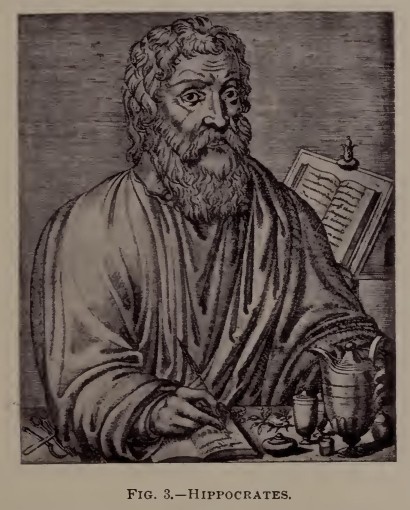
I come now to the so-called Philosophic Period, or the third period in the Age of Foundation, which is inseparably connected with the name of Hippocrates. This central figure in the history of ancient medicine was born on the Island of Cos, of a family in which the practice of medicine was hereditary, who traced their ancestors on the male side to Æsculapius, and on the female side to Hercules. The individual to whom every one refers under this name was the second of seven; the date of his birth goes back to 460 B.C., but of his life and his age at death we do not know; some say he lived to be over one hundred years of age. It is certain that he traveled widely, since his writings evince the knowledge thus gained. He was a contemporary of Socrates, although somewhat younger, and lived in the age of Pericles,—the golden age for science and art in Greece.
Original
The Island of Cos is now called Stan-Co, and is situated not far from the coast of Ionia. Formerly it was considered as having a most salubrious climate; now that it is under the dominion of the Turks, it is considered most unhealthy. It possessed a temple dedicated to Æsculapius and a celebrated medical school. But Hippocrates, not satisfied with what he could learn here, visited the principal foreign cities, and seems to have been a most accurate and painstaking observer and collector of notes. That he achieved great renown in his life is known, since Plato and even Aristotle refer to him as their authority in very many matters. His children and grandchildren followed in his footsteps, and published their writings under the same name; it has, therefore, become difficult to distinguish his works from theirs. Finally, authors more unscrupulous, who bore no relationship to him, attached his name to their own writings. But the true were, as a rule, easily distinguished from the spurious, and were carefully separated by those in charge of the Alexandrian library.
The enumeration of his writings by different authors varies very much. Renouard, who seems to have studied the subject very carefully, gives the following as appearing to him to be the authentic list of writings of Hippocrates the Second,—i.e., the Great: The Prognostic, the Aphorisms, the first and third books of Epidemics, that on Regimen in Acute Disease, that on Airs, Waters, and Places, that on Articulations and Luxations, that on Fractures, and the Mochlic, or the treatise on instruments and reduction. This list does not comprise the fourth part of the entire Hippocratic collection, but its authenticity appears to be undoubted, and it suffices, as Renouard says, to justify the enthusiasm of his contemporaries and the admiration of posterity. Later, joined with the writings of Pythagoras, Plato, Aristotle, and others, they constituted the so-called Hippocratic collection, which was a definite part of the great libraries of Alexandria and Pergamos, and formed the most ancient authentic monument of medical science.
Respect for the bodies of the dead was a religious observance in all Greece, and prevented the dissection of the human body. Consequently the knowledge of anatomy possessed by Hippocrates must have been meagre. Nevertheless, he described lesions, like wounds of the head, of the heart, the glands, the nature of bones, etc. It being impossible to establish a physiology without an anatomical basis, it is not strange that we find but little physiology in the Hippocratic writings, and that this little is very crude and incorrect. Arteries and veins were confounded, and nerves, tendons, ligaments, and membranes were represented as analogous or interchangeable tissues. The physiologists of those days abandoned themselves to transcendental speculation concerning the nature and principles of life, which some placed in moisture, others in fire, etc. Speculation, thus run wild, prevented such accurate observation as might have greatly enhanced the progress of physiological knowledge.
Hippocrates wrote at least three treatises concerning hygiene: The first, on Airs, Waters, and Places; the second, on Regimen; the third, on Salubrious Diet,—practically an abridgement of the preceding, in which he recommends the habit of taking one or two vomits systematically every month. The classification of diseases into internal or medical, and external or surgical, is not modern, but is due to Hippocrates; neither is it philosophic, although it is very convenient.
With so little knowledge of physiology and pathology as the ancients had, it is not strange that they ascribed undue importance to external appearance; in other words, to what has been termed semeiotics, which occupies a very considerable place in the medical treatises of the Asclep-iadæ. Indeed, the writings on this subject constitute more than one-eighth part of the entire Hippocratic collection. To prognosis, also, Hippocrates ascribed very great importance, saying that "The best physician is the one who is able to establish a prognosis, penetrating and exposing first of all, at the bedside, the present, the past, and the future of his patients, and adding what they omit in their statements. He gains their confidence, and being convinced of his superiority of knowledge they do not hesitate to commit themselves entirely into his hands. He can treat, also, so much better their present condition in proportion as he shall be able from it to foresee the future," etc.
To the careful scrutiny of facial appearances, the position, and other body-marks about the patient he attributed very great importance; in fact, so positive was he about these matters that he embodied the principal rules of semeiotics into aphorisms, to which, however, there came later so many exceptions that they lost much of their value. From certain passages in his book on Prediction, and from the book on Treatment, which is a part of the Hippocratic collection, it appears that it was the custom then of physicians to announce the probable issue of the disease upon the first or second visit,—a custom which still prevails in China and in Turkey, It gave the medical man the dignity of an oracle when right, but left him in a very awkward position when wrong.
To Hippocrates we are indebted for the classification of sporadic, epidemic, and endemic forms, as well as for the division of disease into acute and chronic. Hippocrates wrote extensively on internal disease, including some particular forms of it, such as epilepsy, which was called the sacred disease; also fragments on diseases of girls, relating particularly to hysteria; also a book on the nature of woman, an extensive treatise on diseases of women, and a monograph on sterility. That Hippocrates was a remarkably close observer of disease as it appeared to him his books amply prove; in fact, they almost make one think that close observation is one of the lost arts, being only open to the objection that too much weight was attached to insignificant external appearances, speculation on which detracted from consideration of the serious feature of the case. His therapeutics, considering the crude information of the time, was a vast improvement on that which had preceded, and really entitled him to his title of "Great Physician."
Of external diseases and their surgical therapeutics he wrote fully: on The Laboratory of the Surgeon, dealing with dressings, bandaging, and operating; on Fractures; and on Articulations and Dislocations; showing much more anatomical knowledge than was possessed by his contemporaries. The Mochlic was an abridgment of former treatises; in Wounds of the Head he formulated the dictum concerning the possible danger of trifling wounds and the possible recovery from those most serious, so often ascribed to Sir Astlev Cooper. Other monographs, also, he wrote, on Diseases of the Eye, on Fistula, and on Hoemorrhoids. He described only a small number of operations, however, and all the Hippocratic writings on surgery would make but a very incomplete treatise as compared with those that belong to the next historical epoch; all of which we have to ascribe—in the main—to prejudice against dissection and ignorance of anatomy.
From the earliest times physicians and writers occupied themselves largely with obstetrics, as was most natural. The Hippocratic collection includes monographs on Generation; the Nature of the Infant; the Seventh Month of Pregnancy; the Eighth Month of Pregnancy; on Accouchement; Superfoetation; on Dentition; on Diseases of Women; on Extraction of the Dead Foetus. The treatise on superfcetation concerned itself mainly with obstetrics.
On epidemics Hippocrates writes extensively, showing that he had studied them carefully. He was among the first to connect meteorological phenomena with those of disease during given seasons of the year, expressing the hope that by the study of storms it would be possible to foresee the advent of the latter, and prepare for them. Seven books of the Hippocratic collection bear the title of Epidemics, although only two of them are exclusively devoted to this subject. In these books were contained a long list of clinical observations relating to various diseases. They constituted really a clinical study of disease.
The collection of Hippocrates's Aphorisms fills seven of the books; no medical work of antiquity can compare with these. Physicians and philosophers of many centuries have professed for them the same veneration as the Pythagoreans manifested for their golden verses. They were considered the crowning glory of the collection. Even within a short time past the Faculty of Paris required aspirants for the medical degree to insert a certain number of these in their theses, and only the political revolution of France served to cause a discontinuance of this custom. These aphorisms formed, says Littré, "a succession of propositions in juxtaposition, but not united." It has always been and always will be disadvantageous for a work to be written in that style, since such aphorisms lose all their general significance; and that which seems isolated in itself becomes more so when introduced into modern science, with which it has but little practical relationship. But not so if the mind conceive of the ideas which prevailed when these aphorisms were written; in this light, when they seem most disjoined they are most related to a common doctrine by which they are united, and in this view they no longer appear as detached sentences.
The school of the Asclepiadæ has been responsible for certain theories which have been more or less prominent during the earlier historical days. One of these which prevailed throughout the Hippocratic works is that of Coction and Crisis. By the former term is meant thickening or elaboration of the humors in the body, which was supposed to be necessary for their elimination in some tangible form. Disease was regarded as an association of phenomena resulting from efforts made by the conservative principles of life to effect a coction,—i.e., a combination of the morbific matter in the economy, it being held that the latter could not be properly expelled until thus united and prepared so as to form excrementitious material. This elaboration was supposed to be brought about by the vital principles, which some called nature (Physis), some spirit (Psyche), some breath (Pneuma), and some heat (Thermon).
The gradual climax of morbid phenomena has, since the days of Hippocrates, been commonly known as Crisis; it was regarded as the announcement of the completion of the union by coction. The day on which it was accomplished was termed critical, as were also the signs which preceded or accompanied it, and for the crisis the physician anxiously watched. Coction having been effected and crisis occurring, it only remained to evacuate the morbific material—which nature sometimes spontaneously accomplished by the critical sweat, urination, or stools, or sometimes the physician had to come to her relief by the administration of diuretics, purgatives, etc. The term "critical period" was given to the number of days necessary for coction, which in its perfection was supposed to be four, the so-called quarternary, while the septenary was also held in high consideration. Combination of figures after the Pythagorean fashion produced many complicated periods, however, and so periods of 34, 40, and 60 days were common. This doctrine of crisis in disease left an impress upon the medical mind not yet fully eliminated. Celsus was the most illustrious of its adherents, but it can be recognized plainly in the teachings of Galen, Sydenham, Stahl, Van Swieten, and many others. In explanation, it must be said that there have always existed diseases of nearly constant periods, these being nearly all of the infectious form, and that the whole "critical" doctrine is founded upon the recognition of this natural phenomenon.
The Hippocratic books are full, also, of the four elements,—earth, water, air, and fire; four elementary qualities,—namely, heat, cold, dryness, and moisture; and the four cardinal humors,—blood, bile, atrabile, and phlegm.
Owing to the poverty of knowledge of physics and chemistry possessed by the ancients, and notwithstanding their errors and imperfections, the doctrine of Dogmatism, founded upon the theory of coction and humors, was the most intelligible and complete among the medical doctrines of antiquity, responding better, as it did, to the demands of the science of that day. That Hippocrates was a profound observer is shown in this: that he reminds both philosophers and physicians that the nature of man cannot be well known without the aid of medical observation, and that nothing should be affirmed concerning that nature until by our senses we have become certain of it. In this maxim he took position opposed to the Pythagorean doctrine, and included therein the germ of a new philosophy of which Plato misconceived, and of which Aristotle had a very faint glimpse.
Another prominent theory throughout the Hippocratic books is that of Fluxions, meaning thereby about what we would call congestions, or conditions which we would say were ordinarily caused by cold, though certain fluxions were supposed to be caused by heat, because the tissues thereby became rarefied, their pores enlarged, and their humor attenuated so that it flowed easily when compressed. The whole theorv of fluxion was founded on the densest ignorance of tissues and the laws of physics, the body of man being sometimes likened to a sponge and sometimes to a sieve. The treatment recommended was almost as crazy as the theory. Certain other theories have complicated or disfigured the Hippocratic writings, and certain have been founded on the consideration of two elements—i.e., fire and earth—or on the consideration of one single element which was supposed to be air,—the breath, or pneuma; and there was—lastly—the theory of any excedent, which is very vague; of all of these we may say that they are not of sufficient interest to demand expenditure of our time.
The eclat which the second (i.e., the Great) Hippocrates gave to the school of Asclepiadæ in the Island of Cos long survived, and many members of his family followed in his footsteps. Among his most prominent successors were Polybius, Diodes, and Praxagoras, also of Cos,—the last of the Asclepiadæ mentioned in history. Praxagoras was distinguished principally for his anatomical knowledge; like Aristotle, he supposed that the veins originated from the heart, but did not confound these vessels with the arteries, as his predecessors had done, but supposed that they contained only air, or the vital spirit. It has been claimed that he dissected the human body. He laid the foundation of sphygmology, or study of the pulse, since Hippocratic writers rarely alluded to arterial pulsations and described them as of only secondary importance.
The predominating theory in the Island of Cos was that which made health dependent on the exact proportion and play of the elements of the body, and on perfect combination of the four cardinal humors. This was the prevailing doctrine,—i.e., the Ancient Medical Dogmatism, so named because it embraced the most profound dogmas in medicine, and was taught exclusively until the foundation of the school at Alexandria.
Two men, however, more commonly ranked among philosophers than among physicians of antiquity, dissected the statements of Hippocrates, and embodied them more or less in their own teachings, and thus exercised a great influence on the progress of the human mind, particularly in the direction of medical study. The first of these was Plato, profound moralist, eloquent writer, and most versatile thinker of his day or any other. He undertook the study of disease, not by observation (the empirical or experimental method), but by pure intuition. He seemed to have never discovered that his meditations were taken in the wrong direction, and that the method did not conduce to the discovery of abstract truths. He gave beauty an abstract existence, and affirmed that all things beautiful are beautiful because of the presence of beauty. This reminds one of that famous response in the school of the Middle Ages to a question: "Why does opium produce sleep?" the answer being: "Because it possesses the sleepy principle." Plato introduced into natural science a doctrine of final causes. He borrowed from Pythagoras the dogma of homogeneity of matter, and claimed that it had a triangular form.
Aristotle, equally great thinker with Plato, but whose mental activity was manifest in other channels, was born in Stagyrus, in Macedonia. He was fascinated by the teachings of Plato, and attained such eminence as a student that King Philip of Macedon made him preceptor to his son Alexander, subsequently the Great, by whom he was later furnished with sufficient funds to form the first known museum in natural history.—a collection of rare objects of every sort, transmitted, many of them, by the royal hands of his former student from the remote depths of Asia. Aristotle, by long odds the greatest naturalist of antiquity, laid the first philosophic basis for empiricism. He admitted four elements—fire, air, earth, and water—and believed them susceptible of mutual transmutation. He studied the nature of the soul and that of the animal body; regarded heat and moisture as two conditions indispensable to life; described the brain with some accuracy, but without the least idea of its true function; said that the nerves proceeded from the heart; termed the aorta a nervous vein; and made various other mistakes which to us seem inexcusable. Nevertheless, he was rich in many merits, and no one of his age studied or searched more things than he, nor introduced so many new facts. Although he never dissected human bodies, he nevertheless corrected errors in anatomy held to by the Hippocratic school. He dissected a large number of animals of every species, and noted the varieties of size and shape of hearts of various animals and birds. In other words, he created a comparative anatomy and physiology, and the plan that he traced was so complete that two thousand years later the great French naturalist Cuvier followed it quite closely. If he be charged with having propagated a taste for scholastic subtleties, he also furnished an example of patient and attentive observation of Nature. His history of animals is a storehouse of knowledge, and his disciples cultivated with zeal anatomy, physiology, and natural history. His successor, Theophrastus, was the most eminent botanist of antiquity.
It will thus be seen that Plato and Aristotle were the eminent propagators of two antagonistic opinions. One supposed knowledge to be derived by mental intuition, and the other that all ideas are due to sensation. Both count among moderns some partisans of the greatest acumen: Descartes, Leibnitz, and Kant being followers of Plato, and Bacon, Locke, Hume, and Condillac, of Aristotle.
The excuse for stating these things, which apparently do not so closely concern the history of medicine, must be that of the learned interpreter of the doctrine of Cuvier, that "The first question in science is always a question of method."
Hippocrates formed a transition between a period of mythology and that of history. His doctrine was received by contemporaries and by posterity with a veneration akin to worship. No other man ever obtained homage so elevated, constant, and universal. A little later ignorance reigned in the school that he made celebrated. Methods and theories were propagated there under the shadow of his name which he would have disowned.
Medical science now changes its habitation as well as its aspect, and from the record of Hippocrates and his work we turn to the fourth period of the Age of Foundation,—namely, the Anatomic, which extends from the foundation of the Alexandrian library, 320 B.C., up to the death of Galen, about the year A.D. 200.
CHAPTER II.
Age of Foundation (continued).—Anatomic Period: Influence of the Alexandrian Library. Herophilus and Erasistratus. Aretæus, f B.C. 170. Celsus, A.D. 1-65 (?). Galen.—Empiricism: Asclepiades B.C. 100 (?).—Methodism: Theinison, B.C. 50 (?).—Eclecticism. Age of Transition, A.D. 201-1400.—Greek Period: Oribasius, 326-403. Ætius, 502-575. Alexander of Tralles, 525-605. Paul us Ægineta, 625-690.
Fourth, or Anatomic, Period.—As already seen, Alexander the Great and his successors collected the intellectual and natural riches of the universe, as they knew them, and placed them at the disposal of studious men to benefit humanity; their complete value has not yet been exhausted, and never can be. This undertaking was carried out under conditions that made it one of extreme difficulty. Manuscripts were then rare and most costly; but few copies of a given work were in existence, often only one, and these were held almost priceless. Under these circumstances the establishment of a public library and of a museum was an act of philanthropy and liberality simply beyond eulogy, and did more to immortalize the founder of the collection than all his victories and other achievements.
This appears to have also occurred to two of Alexander's lieutenants—one Eumenes, Governor of Pergamos, and the other, Ptolemy, Governor of Egypt. After the death of the conqueror his generals shook of all dependence upon the central government, and endeavored to centralize their own authority. But these two were the only ones among so many leaders who did not devote all their attention to armies and invasion, but interested themselves in commerce and arts. So active were they in the enterprise that Eumenes had gathered two hundred thousand volumes for the library at Pergamos, and Ptolemy six to seven hundred thousand for that of Alexandria. The latter was divided into two parts, the greater and the lesser, the latter of which was kept in the temple of Serapis, hence known as the Serapium. These notable efforts to found enormous collections first excited praiseworthy rivalry among contemporaries and rulers, which, however, degenerated into contemptible jealousy, so that some of the rulers of Alexandria even went so far as to interdict the exportation of papyrus, in order to prevent the making of copies for the library of Pergamos. But the effect was unexpected, since it led to the invention of the paper of Pergamos, otherwise called parchment, which completely displaced the bark from which papyri were made. Be this as it was, the collection at Alexandria had a much more marked influence on the medical study of the future than that of Pergamos, and calls for our particular notice. About it sprang up first a collection of learned men, and then the inevitable result—a school of learning. It was Ptolemy Soter who called around him the most renowned men of his day. He provided them with homes adjoining the library, endowed them with salaries, and charged them with the classification and collation of manuscripts, or with the giving of instruction by lectures and discussions. Ptolemy himself sometimes took part in these feasts of reason, which became still more frequent and formal under his son Ptolemy Philadelphia. These were called the Feasts of the Muses and of Apollo,—i.e., ludi musarum,—and, consequently, the place where they were held came to be termed the "museum." Often the subjects for discussion were announced in advance, and those who gained the most applause received rewards in accordance with the merits of their work. Among those who enjoyed these advantages under the reign of these two Ptolemies are prominently named two physicians, Herophilus and Erasistratus, the latter said to be the grandson of Aristotle. It was under this Philadelphus that the Hebrew wise men translated into Greek the Holy Scriptures, which translation has since been called the Septuagint—so called because it is supposed to have been translated by the members of the Sanhedrim, which was composed of about seventy men, or because, according to another legend, it was translated by seventy-two men in seventy-two hours. These savants of ancient Egypt, thus supported by the dynasty of the Lagides, gave the first place to the science of medicine. As regards this study, the school of Alexandria eclipsed almost from its origin the ancient schools of Cos and Pergamos, and during its existence was the leading institution of its kind in the world. At the time of Galen it was sufficient to have studied there, and even to have resided a short time in Alexandria, to obtain the reputation of being a physician. Nearly all the scholars of these five centuries had received instruction in this school. The principal reason for its eminence in medical instruction was the practice of dissection of human bodies, which, under the Ptolemies, was allowed and recommended, and by which the science of medicine received an extraordinary impulse. Although the prejudice of Egyptians was very strong against those who touched a dead body, the Ptolemies themselves are said to have participated in this kind of anatomical study, thus destroying by their example the odium previously attached to dissection. Strange to say, however, the practice of dissection fell into disuse toward the end of this Anatomic Period, and scholars preferred to indulge in subtle metaphysical discussions rather than study human tissues. But the principal reason for giving up this practice was the Roman domination of Egypt, the Romans, inconsistently, being perfectly willing to see any amount of bloodshed in the arena, and all sorts of inhumanities practiced upon living human beings, but holding that contact with a corpse was profanation; so that not a single anatomist of reputation had his origin in ancient Rome. "If on any occasion," says Renouard, "a foreign physician attached to the king or general desired to avail himself of the occasions that were afforded to examine the structures of the internal parts of the human body, he was obliged to conceal and carry off during the night some body abandoned to the birds of prey." To complete the melancholy termination of the Anatomic Period, the labors of the writers of those days were all lost by the burning of the great library by Julius Cæsar, which was the beginning of the chain of disasters with which Egypt was accursed under Roman dominion. Although Mark Antony, induced thereto by the endearments and solicitations of Cleopatra, transported the library of Pergamos to Alexandria, even this was unavailing to restore the position of the school, since the atrocious and imbecile Caracalla took from the pensioners of the museum their privileges of common residence and every other advantage, and suppressed all public exhibitions and discussions. I can mention but few of the names most eminent during this Anatomic Period, and but a short account of the life and work of each.
The first deserving of mention was Herophilus, who was born in Chalcedon about the end of the fourth century before Christ, and supposed to be the first to undertake systematic dissection of the human body. The so-called Torcular Herophili, or common meeting-place of the sinuses at the occiput, named after him, gives evidence of his influence upon the study of anatomy. He wrote on all departments of medical science, concerning the eyes, the pulse, midwifery, etc., as well as numerous commentaries upon the Hippocratic writings,—describing the membranes of the brain and its vessels, the choroid plexus, the ventricles of the brain, the tunics of the eye, the intestinal canal, and certain portions of the vascular system. He alluded to the thoracic duct without knowing its purpose, and gave a more accurate description of the genitalia than any previous writer. Strange to say, but little is known of his later life, and of his death absolutely nothing.
Erasistratus was the son of Cleombrotus, a student of Metrodorus, and lived for some time at the court of Seleucus Nicator, whose son, Antiochus, he healed of a secret ailment, which happened to be a desperate love-affair with his mother-in-law, Stratonice. He wrote extensively on fevers, hygiene, paralyses, therapeutics, and many other subjects; regarded most diseases as due to overindulgence in food, which is not digested, and consequently putrefies. Plethora was for him the prevailing disease, against which he employed not only venesection, but fasting, and bandaging of the extremities. He was a diligent student of anatomy, and carefully described the brain in many of its grosser features, regarding it as the seat of the soul and the centre of the nerves. He also described more exactly than his predecessors the valves of the heart, which organ he regarded as the origin of veins and arteries. He discovered the lymph-vessels, and maintained, against Plato and others, that the epiglottis prevents the entrance of fluids into the lungs, but he supposed digestion to be produced by mechanical trituration in the stomach, and preferred gymnastics, exercise, diet, and baths to drugs or other therapeutic measures. He died about 280 B.C.
Aretæus, who died about 170 B.C., was one of the most brilliant lights of antiquity previous to the Christian era, but, in spite of all this, of his life very little is known. He came from Cappadocia about the end of the reign of Nero, and lived in Alexandria. That he lived in Alexandria is apparent from his numerous references to its location, to the habits and therapeutics of the Egyptians, and to the geography of the country. Furthermore, references to its diseases abound in his writings, so that it is made to appear that he had had the best advantages there, although he must have traveled extensively. But a small portion of his writings remain, and these consist, for the most part, of compendiums of pathology and therapeutics. He described disease, not in anatomical order from head to foot, but under the classification of acute and chronic. With the exception of Hippocrates, he has shown himself the most free from vague, arbitrary speculation, and from the dogmatism of the schools of any writer of antiquity. He, more than any other up to his time, endeavored to found pathology upon a sound anatomical basis. For every picture of disease he endeavored to provide a suitable anatomical accompaniment. This appears particularly, for instance, in his description of intestinal ulcers due to dysentery, or the paralyses following brain affections, or his description of pharyngeal diphtherias, of which he gave a good account under the name of Syriac or Egyptian ulcers. Pulmonary tuberculosis, tetanus, and anal fistula are amply mentioned in his writings.
His therapeutics were simple and rational; he laid great stress upon dietetic treatment. His surgical writings appear to have all been lost, but there is every reason to think that he brought to bear upon external medicine the same good sense which he applied to internal affections.

Original
Cornelius Celsus, the most celebrated author for a number of centuries, was born in Rome about the time of Christ. Brilliant as he was, he exerted a wide-spread influence for centuries. The exact date of his death is unknown. He was a contemporary of the greatest philosophers, poets, and savants of Rome during its most brilliant period. He studied rhetoric, philosophy, the art of war, economics, and medicine—he was, in fact, a walking encyclopaedia of the knowledge of his day; but it is in medicine that he shows to best advantage, and in his capacity as a physician he was and is best known. The direction in which Celsus appears to least advantage is in failure of power of direct observation, and in yielding unquestioning obedience to the views and dicta of Hippocrates, for whom he possessed the greatest reverence, not being able to brook any serious contradiction or opposition to his opinions. In this reverence for Hippocratic authority he was followed by many less prominent successors, the consequence being a failure to train men as observers, the endeavor being to make them simply storehouses of information derived from Hippocratic writings. As a result, Celsus wrote but little, or else his writings are lost. He contented himself mostly with a mere commentary upon the writings which he so highly revered. But little of his writings remain, and these pertain mostly to the therapeutics of curable disease, dietetic, pharmaceutical, and surgical. Although he exercised great authority during his period, he was later totally supplanted by Galen, and his views are seldom mentioned in the writings of those subsequent to this great physician. His death must have taken place during the first century after Christ.
Of all the students of Hippocratic dogmatism, the most earnest, skillful, and learned was Claudius Galen, a native of Pergamos, a place already celebrated for its temple dedicated to Æsculapius, for its school of medicine, and for a library which had been removed to Alexandria. He was placed by his father under the most distinguished teachers in all of the sciences, and even as a young man showed extraordinary progress, and became early a disputant with the most erudite in grammar, history, mathematics, and philosophy. He has related how in two different dreams he was urged by Apollo to study medicine. He traveled widely for instruction, and remained some time in Alexandria.
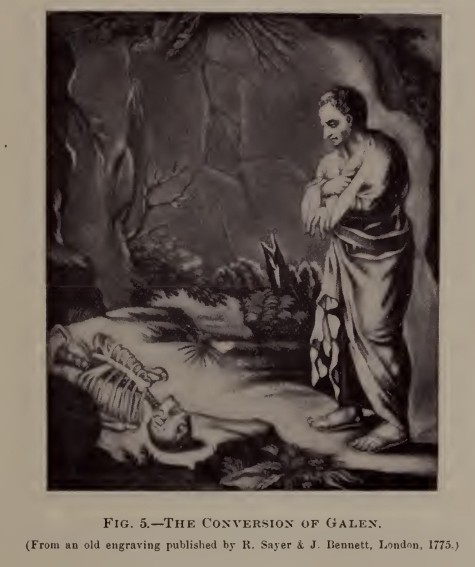
Original
On his return to his own country he was charged by its ruler to dress the wounded in the great circus, which furnished him opportunity for displaying all his anatomical knowledge and surgical skill. Not remaining long at home, he went to Rome, where his renown had preceded him, and where, by his brilliant elocution, his accurate logic, and his profound erudition, as well as his versatility and practical skill, he at once took the highest place. But here his rapid success, his vanity, his disdain for his colleagues, and his useless boasting, as well as his natural jealousy, gained him the enmity of nearly all his contemporaries, and his stay at Rome was thereby made very disagreeable. In his work on Prenotions he accuses his colleagues of base jealousy and stupid ignorance, lavishes upon them such epithets as "thieves" and "poisoners," and closes by saying that after having unmasked them he would leave them to their evil designs by abandoning the great city to seek a home in a smaller place, where the surroundings would be to him more congenial. This threat he carried out, but soon returned to Rome upon the invitation of the Emperors Marcus Aurelius and Lucius Yerus, whose confidence, as well as that of their successors, he enjoyed. He is supposed to have lived to the age of seventy-one, and to have died about 200 A.D. Galen strongly denied being attached to any of the sects of his day, and regarded as slaves those who took the title of Hippocratists, Praxagoreans, Herophilists, and so on. Nevertheless, his predilection in favor of the Hippocratic writings is well marked, for lie explains, comments upon, and expands them at length, refutes the objections of their adversaries, and gives them the highest place. He says: "No one before me has given the true method of treating disease; Hippocrates, I confess, lias heretofore shown the path, but as he was the first to enter it he was not able to go as far as he wished.... He has not made all the necessary distinctions, and is often obscure, as is usually the case with ancients when they attempt to be concise. He says very little of complicated diseases; in a word, he has only sketched what another was to complete; he has opened the path, but has left it for a successor to enlarge and make it plain." This implies how he regarded himself as the successor of Hippocrates, and how littleweight he attached to the labors of others. He held that there were three sorts of principles in man: spirits, humors, and solids. Throughout his metaphysical speculations Galen reproduces and amplifies the Hippocratic dogmatism. Between perfect health and disease there were, he thought, eight kinds of temperaments or imperfect mixtures compatible with the exercise of the functions of life. With Plato and Aristotle, he thought the human soul to be composed of three faculties or parts: the vegetative, residing in the liver; the irascible, having its seat in the heart; and the rational, which resides in the brain. He divided diseases of the solids of the body into what he called distempers; he distinguished between the continued and intermittent fevers, regarding the quotidian as being caused by phlegm, the tertian as due to yellow bile, and the quartan as due to atrabile. In the doctrine of coction, crises, and critical days he agreed with Hippocrates; with him he also agreed in the positive statement that diseases are cured by their contraries. From all this it will be seen that Galen must be regarded as one of the earliest of Hippocratic dogmatists. He was a most extensive writer, and it is said that the total number of his works exceeded one hundred. His contributions to anatomy were not insignificant. For myology he did a great deal. He wrote a monograph on the skeleton in which he recommended that bones be seen and handled, not merely studied from books, and that the student should go to Alexandria, where teachers would place before him the real human skeleton. It has been inferred that there was not, in his time, in Rome a single skeleton. He wrote fifteen books on anatomy, of which six are lacking; also an extensive treatise on the lesions of the human body, distributed among seventeen books which have come down to us. He is supposed to have introduced the term "symphysis," and he described nearly every bone in the human body. By him the muscles were no longer considered as inert masses and tissue-layers serving to cover the bones, but he classified them according to their distinct functions, and studied separately their form and uses. The location of the vessels and nerves between them was also noted, and it was proved that muscles were indispensable to the accomplishment of voluntary motions. Galen was, perhaps, the first vivisector of all, since he exposed muscles of living animals, and showed how alternate tension and relaxation of distinct groups set the bones in motion, after the manner of levers; he named a great number of them, but, curiously, took no note of others. His classification according to their uses is followed down to the present day—i.e., flexors, extensors, etc.
The Hippocratic authors confounded the arteries with the veins. Praxagoras first distinguished two kinds of vessels which he supposed to contain air, whence the name artery. Aristotle and Erasistratus maintained this view, which prevailed until the time of Galen, who devoted a book to the refutation of it, basing his argument upon the observation that always when an artery is wounded blood gushes out. How near he came to being the discoverer of the circulation may thus be seen. A little less reverence for authority and a little more capacity for observation would have placed him in possession of the knowledge, lack of which for so many centuries retarded the whole profession. He thought the veins originated from the liver—in this respect being behind Aristotle—but considered the heart as the common source of the arteries and veins. Even the portal system of veins confused him, and he erroneously described a superior and inferior aorta, but atoned for this by describing the umbilical veins and arteries. Aristotle also had supposed all the nerves originated from the heart, but Galen stated that they are derived from the brain and spinal marrow, and pointed out two kinds of nerves: those of sensation, which he thought proceeded from the brain, and those of motion, which he considered to originate in the spinal marrow. Thus, he described distinct nerves of sensation and motion, but sadly confused their anatomy. He seems also to have had some notion of the great sympathetic, although it was by no means accurate. He suggested the division of the principal nerves, in order to prove the fact that nervous energy is transmitted from the encephalon to other parts of the body. He speaks of glands, and thought they discharged their secretions through veins into the various cavities, but regarded them rather as receptacles of excrementitious matter than as agents for secretion of valuable fluids. He even regarded the mammæ as glandular bodies in this sense, although he knew, of course, the value of their secretion. To Galen we owe the division of the body into cranial, thoracic, and abdominal cavities, whose proper viscera and envelopes he described. He spoke of the heart as having the appearance of a muscle, but differing from it. He regarded it as the source of natural heat, and the seat of anger and of violent passions. He appreciated that inspiration is carried on by enlargement of the thoracic cavity. He thought that atmospheric air entered the cavity of the cranium through the cribriform plate of the ethmoid and passed out by the same route, carrying with it excrementitious humors from the brain, which were discharged into the nasal fossæ. But some portion of air thus entering remained, according to his views, and combined with the vital spirits in the anterior ventricles of the brain, from which combination originated the animal spirits and immediate agents of the rational soul. These acquired their last attenuation in the fourth ventricle, whence they would pass out drop by drop through a round, narrow tube.
From this brief résumé of the anatomy and physiology of Galen it will be seen that by the end of the second century of the Christian era immense progress had been made since the foundation of the Alexandrian school, and that it was due to the impetus in the study of anatomy given by Herophilus and Erasistratus, who not only made numerous dissections, but resorted to frequent vivisections. It is even said that Herophilus did not hesitate to employ his knife on live criminals who were subjected to him for experiment; but this has been a popular tradition about almost every anatomist of antiquity, and there is no evidence in confirmation of the unkind rumor, although that such experiments might be legally and justly performed has occurred to the minds of many. But zeal for dissection rapidly cooled off, and Galen barely mentions five or six men who devoted themselves to it in the space of nearly four hundred years down to his time. He speaks of Rufus of Ephesus,—who lived under Trajan of Marinus,—who wrote in the beginning of the second century A.D., and of Quintus, who instructed his own preceptor. None of them left a reputation, however, approaching that of Herophilus and Erasistratus, with whom Galen alone could compare by the number of his experiments and his discoveries. Galen strove as hard as one of his position might, by example and precept, to awaken in his contemporaries a desire for anatomical knowledge, but could not overcome their indifference. After him the practice of dissection appears to have been lost, either from the redoubled prejudices of the superstitious, who opposed it, or as the result of the apathetic ignorance or the ignorant apathy of the physicians.
It has been shown that, during the Hippocratic era and subsequently, the physicians even of primitive times followed more or less by instinct the empirical method. Acron of Agrigentum was a contemporary of Pythagoras, and affirmed that experience is the only true foundation of the healing art. Hippocrates, however, showed himself more anxious to report faithfully clinical facts than to dispute theoretical views.
The surprising progress in anatomy and physiology made during the first portion of the Anatomic Period and during the better days of the Alexandrian institute did not keep men from confounding several different points in the Hippocratic doctrine, by which confidence in the same was naturally shaken. Thus many new speculations were hazarded which nullified each other. In the midst of this confusion practitioners continued to seek in experience a refuge from the incessant variations of dogmatism and the sterile incertitude of the skeptics. Thus, empiricism as a school of practice became placed upon a firmer and firmer foundation, and the empirics of that day seem to have laid the true basis of our art. Their doctrine took at first a rapid growth, and Galen spoke of it with great regard. The circumstances under which it was proclaimed were most favorable for its propagation. Theories had fallen into confusion; practice, methods, and opinions were questionable. Everything was conjecture, and that which rested on the evidence of facts was by the empirics received with enthusiasm. Although founded on pure observation, it did not put an end to differences of opinion, and in the eyes of the ancients it lacked in solidity, because it did not attach itself to any philosophic theory then known. This doctrine was then best able to captivate physicians on account of its simplicity, contrasted with the general inability to satisfy speculative minds; but for this very reason it subsequently fell into disgrace, and the term "empiricism" became synonymous with ignorance. For centuries condemned and despised, it was revived from its long humiliation under the name of the Experimental Method, and achieved, after the labors of Bacon, Locke, and Condillac, almost universal dominion in the sciences.
This doctrine had been proclaimed for about a century during the period of which we now speak, but later led men into a fondness for secondary generalities or for the elevation and magnifying of trifles, which confused their minds and terminated its usefulness to science. Meanwhile, a man of great intelligence, renowned as an elocutionist, well versed in the doctrine of philosophers and grammarians—namely, Asclepiades, of Bythinia—came to Rome with the intention of teaching rhetoric. By his talent and personal address he soon became one of the most illustrious persons in the Roman Republic; so early as 150 B.C. he enjoyed a high reputation as a rhetorician, and was one of the intimate friends of Cicero; nevertheless, he abandoned letters, undertook the practice of medicine, and sought moreover to create a new system, being unwilling to follow in the track of his predecessors. Imbued with the philosophy of Epicurus, who was then in high repute, he deduced from it a theory which was in harmony with the philosophy of the day. He thought that the elements of the body existed from eternity; that they were indivisible, impalpable, and perceptible to the reason only. These elements he named atoms, which were supposed to be animated by perpetual motion, and from which, by their frequent encounters and fortuitous contention, all sensible phenomena were supposed to result. He explained the properties of the body by saying that compounds were aggregates of atoms, differing very much from atoms themselves. Solid silver, he said, is white, but, reduced to powder, appears black; the horn of the goat, on the contrary, is black, but if it be razed its particles are white. This, it will be seen, was the parent of our present atomic theory. He ridiculed the theories of Hippocrates concerning coction, crises, etc., and sarcastically called the Hippocratic treatise on therapeutics "a meditation on death."
Asclepiades based his own therapeutics on endeavors so to enlarge the pores of the human body that disease could find egress, or so to constrict them that it could not enter; consequently he rejected all violent remedies, such as vomits, purges, etc., and his favorite remedies were hygienic,—for the most part bodily exercise.
A celebrated disciple of Asclepiades was Themison, of Laodicea (b.c. 50), who was led by the teachings of his master to lay the foundation of the so-called Methodism as opposed to Dogmatism in the school of Cos. By him and his followers a very arbitrary arrangement of diseases was made, according to what they considered the constrictive, or contractive; the fluxionary,—congested or relaxed; and the mixed forms. From this division of diseases it appears that, according to the methodists, there were only two kinds of therapeutic indications to follow,—namely, to relax where there was constriction, to constrict where there was relaxation. They, however, admitted a third creditable result, which they called prophylactic; but the pure methodists, such as Ccelius Aurelianus, admitted neither specific disease nor specific remedies, and erased from their materia medica purgatives, diuretics, emmenagogues, nauseants, etc.
According to the methodist doctrine, the study of medicine was so abridged that one of its prominent exponents said that he felt able to teach the whole of medical science in six months. It made rapid progress, and consequently was most attractive to the numerous young neophytes who were anxious to finish their apprenticeship and hasten into practice. It is not one of the smallest of the services which Galen rendered to his time and to posterity that he demolished the sophistry of the methodists, demonstrated the insufficiency of their practice, and brought to bear upon them the wittiest satire, calling them the asses of Thessaly, alluding thereby to their lack of literature and medical instruction.
In summing up, then, the basis for the various systems of medicine during this period of antiquity, it is seen that the most ancient doctrine of all—Dogmatism—directs our attention especially to the animal economy in health and disease; that it took account of the union of vital forces, of sympathies in the organism, and of nature's efforts to repel both internal and external deleterious influences, which providential tendency manifests itself especially in certain acute diseases. This was the strong side of dogmatism. Its weak side consisted in this: that it was held that the causes of diseases inhere in the access of certain qualities and humors along with organic forces,—such as dryness or moisture in combination with bile or atrabile,—and the treatment was directed against these supposed causes. It was on account of this weakness that the enemies of dogmatism attacked it. The empirics opposed the idea that inaccessible and occult causes of disease could become the basis for rational treatment. They affirmed that there was no consistent relation of antagonism or similitude between the disease and the remedies which cured it.
The Methodists somewhat improved on the doctrine of empiricism, but ran wild in its improvement and erected over their fundamental theory such a superstructure of secondary and tertiary generalities as to cause the fundamental part to be entirely obscured from sight.
There were not lacking, in those days of old, certain educated physicians who more or less vaguely comprehended that the entire truth of medicine did not inhere in any one of these systems, but that there was good and evil in each. These men, not being able to establish general rules, tried to decide practical questions according to their fancy or their reason. They assumed the name of Eclectics or Episynthetics, meaning thereby that they adopted no exclusive system, but selected from each that which seemed to them best. They did not constitute a sect, because they had no precise dogmas nor theories, but they should not be confounded with the Pyrrhonians, who held to doubt as a fundament doctrine, the true eclectic doubting only that which he could not understand. True eclecticism in medicine, however, is rather the absence of fixed principles, or, as Renouard says, it is "individualism erected into a dogma, which escapes refutation because it is deficient in principle." Many became eclectics to avoid discussing principles, and made of it a shelter. In one sense, then, an eclectic is one destitute of profound convictions, who sides with no particular party, is committed to no person or doctrine, and who is often so indifferent that he cannot judge with impartiality; consequently, to be truly eclectic is different from being an adherent of a school of eclecticism.
During the historic period just reviewed, anatomy and physiology made most progress, next internal and external nosography, and next to these medical and surgical therapeutics, and although Coelius Aurelianus and Aretæus have left to us by far the best books issued up to their times, nevertheless not one of the writers of this period has achieved the distinction in which Hippocrates is held, since he, perhaps more than any other, combined intelligence, sincerity, disinterestedness, love of his art, and humanity.
Under the classification of Renouard, already alluded to, the so-called Age of Transition includes centuries commencing with the death of Galen, about A.D. 201, and ending with the revival of letters in Europe, about the year 1400. The first period of this transition age is the so-called Greek Period, which ends with the burning of the Alexandrian library, A.D. 640.
At the time when this historic period commenced all the known world was under the dominance of a single man. The power of Septimus Severus had more extent than that of Alexander the Great, and bid fair to be of a much longer existence. The Roman dominion, cemented by seven hundred years of bold and persevering government, seemed almost immovable. While the savages upon its frontiers occasionally troubled its peace, none were strong enough to penetrate its centres or place it in real peril. The great civil wars had ceased, or changed their object.
Both the people and the senate, those two eternal competitors, had gotten over the struggle for supreme power; monarchial government was accepted as a matter of fact, and the citizens contended only for choice of a master.
Similar changes had taken place in the domain of the mind; philosophical discussions, which were so essentially a part of the schools of the ancient Greeks, had nearly lost their interest and were being discontinued. Such disputes as took place related less to principle than to interpretation of the language of the teacher. In morals, Plato, Epicurus, and Zeno were followed until the principles of Christianity gradually supplanted their teaching; in physics and metaphysics the authority of Aristotle, and in medicine that of Galen, were simply undisputed.
Conditions being such as these, there was naturally but one sect in medicine, and one method of study and practice. Medical science retrograded rather than progressed, sad to say, and was undisturbed by any remarkable revolution. The scepter of medicine passed from the hands of one nation to those of another, and the language of Hippocrates and Galen was later replaced, as will duly be seen, by that of Avicenna and Albucassis. But this Greek Period, which is one of transition, offers little for our consideration more than the lives and writings of four of its most eminent physicians, who by their study in the school of Alexandria, and by their writings and teachings, left reputations which were sustained until the invasion of the Arabs. Of these it may be said that, while they did little or nothing original, and simply commented upon the writings of Hippocrates and Galen, they kept burning the torch of medical learning which else had been almost extinguished by their indolent contemporaries. Of these various commentators—for they were little more than that—the first of any importance after Galen was Oribasius, who was horn in Pergamos (328-403); he early attached himself to the fortunes of Julian the Apostate, and followed him into Gaul when he was made its governor. Julian appreciated the good qualities of Oribasius, made him an intimate friend, and after he himself became emperor appointed his friend as quæstor at Constantinople. After the emperor's untimely death, Oribasius remained faithful to his memory, but his jealous colleagues so falsely and so successfully misrepresented his fidelity that he was disgraced, spoiled of his office and property, and banished among a barbarous people. In this new field, however, he displayed such courage, effected such extraordinary cures, discoursed so eloquently, and so attached to himself the savage men around him, that he was by them regarded as a god. The fame of this homage in time reached the ears of the Emperors Valens and Valentinianus, who recalled him, reimbursed him for his losses, and permitted him to enjoy his high reputation and fortune to the end of his days. He was held to be the wisest man of his time, most skillful in medicine, and the most charming in conversation. He dedicated a collection of seventy books to Julian, his first patron, and edited, at a later period, an abridgment of this work for the benefit of his son. His principal merit consisted in reproducing the ideas of others with such clearness, order, and precision that the summaries that he gives of them are often preferable to the originals. What he has said of pregnant women, nursing, and the earliest education of the child has been copied literally by writers for twelve centuries since his time. It must be said of him, however, that his prepossession in favor of Galen was so great that he adopted servilely his ideas and even his words to such an extent that he has been surnamed "the ape of Galen."
Ætius was born in Mesopotamia in the year 502 and died in 575. He studied at Alexandria, and afterward went to Constantinople, where he became a chamberlain at court. Ætius was the first medical man of any note who professed Christianity, as is shown by such passages as this one: he said that in the composition of certain medicaments the following words should be repeated in a low voice: "May the God of Abraham, the God of Isaac, and the God of Jacob deign to bestow upon this medicament such and such virtues." In another place he recommends that to extract a bone from the throat the following words be pronounced: "Bone—as Christ caused Lazarus to come forth from the sepulchre, as Jonah came out of the whale's belly—come out of the throat or go down." But he exhibits the same credulity in not doubting the miraculous virtues attributed by the quacks of his day to most remedies.
Like Oribasius, he collected everything that he found remarkable in the writings of his predecessors, and has preserved certain fragments of antiquity which would otherwise have been lost. His work formed a complete manual of medicine and surgery, except that it lacked anatomical descriptions and references to dislocations and fractures.
Alexander of Tralles (525-605), a city of Lydia, where Greek was spoken, was a son of the physician Stephen, and the most celebrated of five sons, who were all distinguished for their learning. He traveled extensively, and fixed his residence in Rome, where he became celebrated. He lived to an advanced age, and, being no longer able to practice, composed a treatise of twelve books, exclusively devoted to affections that did not require the aid of surgery. He professed the greatest veneration for Galen, but did not blindly adopt his opinions. He described the first reported case of excessive hunger and pain due to intestinal worms; he advised venesection in the foot rather than in the arm; but with all his sound judgment and mental enlightenment he had faith in amulets and talismans, and widely recommended them. It may be said for him, such was the universal prejudice of his age, the whole world being plunged in superstition, that it was necessary for every one to pay some tribute to the prevailing belief; and we may add that it is necessary to make this excuse for some who practice much nearer to ourselves than did those ancient physicians.
Paul, or Paulus, surnamed Ægineta (because he was born in the Island of Ægina), was among the last of the Greek physicians who have special interest for us. It is supposed that he died about A.D. 690. He traveled extensively, and his skill in surgery and obstetrics rendered him celebrated even among the Arabs, whose midwives sent for him in consultation from great distances. He composed a compendium of medicine, divided into seven books, and not only did not hesitate to borrow from his predecessors, but quoted from them most extensively; a number of his chapters were taken almost verbatim from Oribasius; however, he made no secret of it, but rather boasted that he had judiciously sought to appropriate the best of the writings of those he most revered. He showed originality, however, in the treatment of hydrocephalus, in advising paracentesis of the thorax and abdomen, in the extraction of calculi from the bladder, in the treatment of aneurism, the excision of hypertrophied mammæ in men, etc. He was the first to describe varicose aneurism, and the first to perform the operation of bronchotomy after the method borrowed from Antyllus, of which he has transmitted a very detailed account. Of this Antyllus, by the way, it may be added, en passant, that he was one of the most distinguished and original surgeons of antiquity. He flourished during the third century after Christ; was the first to describe the extraction of small cataracts; and is, perhaps, best known to the surgical world to-day by his exceedingly bold plan of opening aneurisms, so successfully imitated a generation or so ago by James Syme.
It has already been seen that before and during the early centuries of the Christian era the secrets and learning of the physicians tended to pass gradually into the hands of the priests. It was so in the temples of ancient Greece, it was so in Alexandria, it became so in Rome, it has been so even in modern times, although only for brief periods of time. This has come about in some measure from the cupidity of the clerical orders, partly because it required a certain amount of intelligence and knowledge to become a priest, and partly because, owing to ignorance, credulity, and superstition, diseases have at all times been regarded by the ignorant as evidence of divine wrath and chastisement, or of diabolical or occult influences, rather than the effect of natural causes. Hence men have turned ever toward prayers, exorcism, and expiation, especially when exhorted thereto by the priests. This has been the sacerdotal aspect of the practice of medicine in all times, and when the priests have usurped therapeutic functions they have done harm rather than good. So long as theology and science work hand in hand, each redounds to the credit of the other, but always in the history of man when theology has appropriated that which did not belong to it it has brought ridicule upon itself and has delayed the progress of knowledge. There have been frequent rebellions against religious authority in ancient as in modern times. For instance, at the commencement of the fifth century before Christ the Pythagoreans were dispersed, and the doctrines of Cos and Cnidus—i.e. the Hippocratic teachings—were promulgated; and again, in the course of events, when the descendants of Æsculapius became servile attendants at the temple and adjuncts to the priesthood or a part of it. At first, in Alexandria, the physicians were supreme; their disciples, however, had the same blind reverence for authority that too many workers in the field of theology have evinced, and men once more practiced medicine on the traditions of the past, and in so doing allied themselves more and more to the temples in Rome. At first, the oldest and best instructed of the relatives treated the diseases of his family as he understood them; simply shared this duty with its other members. Cato, the censor, was much engrossed with this domestic medicine; he wrote a book in which he recommended cabbage as a sovereign remedy in many diseases. He venerated the number 3, as did the Pythagoreans; did not disdain to transmit to posterity certain medical words which it was believed should be repeated to assist in the reduction of dislocations and fractures. This old censor seemed to have a profound hatred for medical men, and most absurd ideas of their works and claims, although doubtless many Greek physicians who came to Rome merited the invectives which he launched against them. Then came Asclepiades, of Bythinia, as already mentioned, whose talents were far superior to those of his Roman contemporaries, and who did not need to call to his aid charlatanism and deceit. This medical hero unfortunately had many worthless and dishonest imitators, who appealed to superstition and ignorance in every dishonest way, and who desired to be judged by the luxury and elegance they displayed. Hence for a long time in Rome medicine was practiced without license. The Emperor Anthony the Pious was the first to occupy himself with regulating the practice of medicine. He granted certain immunities, but did ask for proof of qualifications. A certain physician to Nero, Adromachus, was honored by the emperor with the title of Archiater.— i.e., royal healer.—but Galen, who was physician to Marcus Aurelius, never bore it. From the time of Constantine the Great, however, the title is frequently met with in the edicts of the emperors. In fact, there were two sorts of these.—one named the Palatine, who belonged to the household of the reigning monarch and who held high rank among the nobility; and the other called the Popular Archiaters, who were public-health officers. No one could practice medicine in the jurisdiction of one of these without examination and authorization. Those who transgressed this regulation were punished with a fine of two thousand drachmas. The Popular Archiaters were pensioned by the city, enjoyed certain privileges, and had to attend the poor gratuitously. Practitioners who were not members of the College of Archiaters had no pay, no rights, nor emoluments. The Popular Archiaters were elected by the citizens from many candidates who had proved their capacity before the college of this medical organization. The evils of medical anarchy were thus remedied; this happy condition existed until the empire was broken up by barbarism.
It is during this period—about 400 A.D.—that we first find a class of citizens to whom was delegated the duty of preparing drugs ordered by physicians. Their duties were in some respects similar to those of our apothecaries, although in attainment and in social position they were far below the physicians. They were termed pharmacopolists.
It is worth while to stop a moment to inquire what were the medical charitable institutions of antiquity. Even in the days of ancient Athens there was a certain gymnasium, called the Cynosarga, in which abandoned and illegitimate children were brought up at public expense until such time as they were able to serve their country. A little later several private institutions of this kind were established. Rome in her earlier day never had such institutions. To be sure, she distributed provisions, or else remitted taxes, to parents who were unable to support their children, or even permitted them to destroy their newborn children when unable to maintain them; but there were no bonds of sympathy which induced the patricians to succor the plebeians in time of disease and distress; slaves were cared for as were cattle. It is one of the debts we owe Christianity that, under its influence, the first almshouses and retreats were established in Rome. It has been said that the Emperor Marcus Aurelius first instituted anything like a dispensary service in the Sacred City. We are told, also, of an illustrious woman, St. Pauline, living in the midst of the greatest wealth and pomp, who retired from society and devoted her life to charity and self-denial. She went to Jerusalem, united with other Christian women of the same mission, and formed, under the direction of St. Jerome, a sisterhood whose members divided their time between reading sacred books and doing good works. They offered an asylum for the faithful and a hospice for the benefit of the indigent sick, and even established a home for convalescents outside the city-walls. After the model thus set, heathen emperors, Christian kings, and Moslem caliphs showed their zeal in this good direction by the erection of sumptuous edifices and other rich endowments for the relief of suffering human beings.
Reviewing now the Greek period, let it be remembered that in the time of Galen animals were dissected, and that he made anatomical demonstrations on monkeys; that sometimes the corpses of the enemy were rudely dissected upon the field of battle, but that finally the practice of dissection fell into disuse, and human anatomy was studied only from books, the early Christians having evinced even more horror of the dead body for the purposes of anatomical study than did their pagan predecessors, while the Fathers of primitive times launched their anathemas against the dissection of human remains. Here, again, as usual, the interference of the church worked only general harm. This abandonment of anatomy contributed doubtless to the decadence of medicine; by the rapid extension of Christianity the pagan schools were disorganized and broken up, the profane sciences (such as medicine) were discarded, and the teachers still remaining in the old schools were ruined. Passion for religious controversy was engendered and took the place of study or original research, even to such an extent as to hasten the fall of the Empire of the East. In addition to these factors, reverence for authority of the past—that terribly oppressive weight which has kept down so much which would otherwise have risen early, and which has been the greatest enemy of human learning—permitted the explanation of natural phenomena to be sought only in the writings of revered ancients, and not in living beings. No one dared to advocate changes in regard to received doctrines, and there could be no such thing as progress. Only two men in the lapse of four centuries showed any originality; these were Alexander of Tralles and Paul of Ægina, whose lives have already been briefly rehearsed. It is with some relief, however, that we can think that this period, so unfruitful in scientific progress, was not so in social amelioration. By the organization of the institutions above alluded to charlatanism was checked, by the requirement of capability and good character society was benefited, and the charitable institutes of this epoch perhaps gave the world its best models in teaching and an insight into the most valuable means of medical instruction. Of the old Greek Period, then, we may say that it accrues rather to the benefit of humanity than to that of science.
CHAPTER III.
Age of Transition (continued).—Arabic Period: A.D. 640-1400. Alkindus, 873. Mesue, 777-857. Rhazes, 850-932. Haly-Abas, 994. Avicenna, 980-1037. Albucassis, 1122. Avenzoar, 1113-1161. Averroës, 11661198. Maimonides, 1135-1204. School of Salernum: Constantinus Afri-canus, 1018-1085. Roger of Salerno, 1210. Roland of Parma, 1250. The Four Masters, 1270 (?). John of Procida.
The Arabic Period, which began with the second destruction of the Alexandrian Library—640 A.D.—ends with the fourteenth century. At the commencement of this period the Roman Empire of the West scarcely existed: the magnificent territory which composed it had been overrun and subdued by barbarous tribes from the forests of the North, while from its ruins had risen several independent kingdoms,—that of the Franks in Gallia, of the Visigoths in Spain, and of the Lombards in Italy. The last of the Western emperors of note was Justinian, whose army and generals—especially the genius and heroic devotion of Belisarius—threw some glory upon Italy, Sicily, Africa, and Spain. Meantime the Empire of the East, surrounded by enemies, and harassed from all directions, still sustained itself with vigor. The Turks had begun to show themselves on the banks of the Danube; those eternal enemies of Rome—the Persians—made incessant war; and a new and terrible enemy had sprung up in the deserts of Arabia. Then came one who was at the same time legislator, prophet, and conqueror, and united under one faith and one leader tribes hitherto divided and warring against each other. Thus arose a powerful and enthusiastic nation, animated by thirst for conquest and ardor for proselytism. In less than a century after the first preaching of Mahomet, all of Arabia, India, Syria, and Egypt were in the hands of his followers. In the year 640 Amrou effected the conquest of Egypt, seized Alexandria, and the great library of five hundred thousand volumes was, by order of Omar (successor to Mahomet), delivered over to the flames; and the historian Abulpharagius declares that these books served for six months to heat the public baths, four thousand in number. Such were the first fruits of the establishment of Islam. * Happily, zeal of proselytism somewhat abated among the Mussulman princes, and religious fervor gave place to policy; so that the later Arabian caliphs showed themselves, in general, the protectors of the arts and sciences. Some, indeed, endeavored to collect the débris of the scattered treasures that had been so fortunate as to escape the ignorant fanaticism of their predecessors; and others, more tolerant even than the Christian princes of the time, received without distinction all men of merit who took refuge in their State, gave them employment, and recompensed them for their services. On this account philosophers and persecuted "heretics" sought an asylum among infidels, and found there the protection which Christianity did not afford,—in return for which they gave their protectors the benefits of Greek civilization.
* See a very vigorous denial of this historical statement in
The Nineteenth Century, October, 1894, page 555.
Of all the Moslem rulers, the most distinguished for love of learning and general enlightenment was Haroun-al-Raschid, the Charlemagne of the East, contemporary and emulator of the glory of the emperor of the Franks, the hero of a hundred Arabic poems, whose dominion extended from the borders of the Indus to the heart of the Spanish peninsula. He embellished Bagdad, his capital, with schools and hospitals. His son Almamon founded the Academy of Bagdad, which became the most celebrated of the age; likewise spared no pains to draw to his court the most illustrious men of all countries. He enjoined each of his ambassadors to purchase all the writings of the philosophers and physicians that could be found, and these he required to be translated into Arabic; his interpreter, Honain, a Christian, was employed at translating for forty-five years, and received, for each book rendered into Arabic, literally its weight in gold.
The eclat which the Moorish caliphs shed upon Spain from the tenth to the thirteenth century is well known. The cities of Cordova, Toledo, Seville, and Murcia possessed public libraries and academies, and students from all parts of Europe flocked to them to be instructed in arts and sciences; the library of Cordova alone embraced more than two hundred and twenty-four thousand volumes. Thus it will be seen that the dominion of mental and temporal affairs passed from the Greeks and Romans to the Saracens.
Arabian medicine constitutes one of the most interesting chapters in the history of our art. An offspring from Greek schools, it was for nearly one hundred years the fostermother of that art, and, although it gave rise to no great discovery nor wonderful step in advance during all this period, it nevertheless kept alive all the learning of the past, and clarified rather than made it turbid. In the sixth century the Nestorians (followers of Bishop Nestor), having been driven out of Syria, settled in Persia, Mesopotamia, and Arabia, and there founded schools and other institutions such as they had had at home,—schools in which, beside the ordinary philosophic studies, medicine received a share of attention. Thus it came about that by the seventh century Arabian physicians were everywhere known and in high repute. Naturally the basis for their studies embodied the writings of Hippocrates, Galen, Oribasius, and Paul of Ægina; and the first Arabian works consisted solely of translations from the Greek, first out of their Syriac rendering, and later from the originals. Indeed, so much eminence was finally achieved by Arabian physicians that more than four hundred are known by name as authors.
The first author deserving of mention was Bachtischua, of Nestorian stock, celebrated in Jondisapur, director of the medical school, and later physician to Caliph El-Mansur, in Bagdad. Of his descendants several became well known in the same field.
Alkindus—this being the Latin arrangement of his Arabic name—came from a Persian family, who lived first in Basara and later at the court of the caliphs El-Monon and El-Motasin, in Bagdad. He enjoyed a very high reputation as physician, philosopher, astronomer, and mathematician, and died A.D. 873. Mesue, the first of his name, sometimes known as Janus Damascenus, was director of the hospital in Bagdad and physician to Haroun-al-Raschid. He was born in 777, wrote extensively (since at least forty of his works have been catalogued), and died in 857 in Samarra.
Serapion the elder, also sometimes known as Janus Damascenus, and whose Arabic name was Serafiun, was born in Damascus—the exact data is not known—and died some time prior to A.D. 930. He was author of two volumes of aphorisms concerning the practice of medicine, which had at his time the greatest repute.
The most celebrated of the early Arabian physicians was Rhazes, born in the Persian province of Khorassan A.D. 850. According to the historians of his nation he was a universal genius, equally famous in music, astronomy, mathematics, chemistry, and medicine; he was surnamed "The Experienced." At the age of fifty he was one of the most distinguished professors in the Academy of Bagdad, where students came from great distances to listen to him. Chosen from among a hundred colleagues to direct the grand hospital of that city, he displayed indefatigable zeal and most scholarly learning, even to his old age and in spite of loss of sight, which overtook him at the age of eighty, when his reputation was at its height. Two years after this misfortune—i.e., in 932—he died. His generosity, which was proverbial, and his compassion for the poor left him penniless at the time of his death. Some two hundred and thirty-seven monographs of his have been catalogued, though the greater number of his works are practically lost. Two treatises on medicine remain which afford excellent counsel in many respects; among other matters he advises:—
"Study carefully the antecedents of the man to whose care you propose to confide all you have most dear in this world,—that is, your life and the lives of your wife and children. If the man is dissipated, is given to frivolous pleasures, cultivates with too much zeal the arts foreign to his profession, still more if he be addicted to wine and debauchery, refrain from committing into such hands lives so precious."
His greatest publication was Continens—extracts compiled from all authors for his own use—divided into thirty-seven books, constituting an abridgment of the science of medicine and surgery up to his time; and, notwithstanding its imperfect state, this work was held in greatest reverence, and was a common source of knowledge among Orientals long after his day.
Haly-Abbas, a Persian by birth, flourished fifty years after Rhazes, and died A.D. 994. His Almalelci, in twenty volumes, constituted a quite complete system of theory and practice of medicine, which, however, was in large measure taken from Rhazes's Continens. It is generally regarded as the best work of any of the physicians of the Arabic Period; it is divided into three parts—a book on Health, a book on Death, and a book of Signs—and it is interesting to know that the portion devoted to midwifery and obstetrics was in the hands not only of the profession, but also of the midwives.
Avicenna—Latinized form of his Arabic name, Ebn Sina—was born in Bokhara in 980. From his earliest youth he manifested a remarkable disposition for scientific study, and it is claimed that he mastered the entire Koran at the age of ten years; also that he devoted his entire days and the greater part of his nights to research, mastering philosophy, mathematics, astronomy, and, later, medicine, which he studied at the university at Bagdad, in which city his talents were chiefly exhibited. He was received at court, loaded with favors, and elevated to the dignity of Vizier, but suddenly fell into disgrace, was deprived of property, imprisoned, and even threatened with execution. After two years, however, he was restored to liberty, and once more possessed the consideration of the public and the court, becoming the recipient of new honors. Meantime he had given himself up to intemperance, by which his previously robust constitution was undermined, and this, with excessive labor, brought about his demise at the too early age of fifty-six, in the year 1037. He was author of several books, the chief being the Canon Medicinae, which remained a classic for six centuries, constituting the medical code of Asia and Saracenic Europe; no author since Galen had enjoyed so wide and extensive authority in the medical world; and in the various medical schools professors, for the most part, confined themselves to reading the Canon from their desks, explaining and commenting upon its text. The work was divided into five volumes, of which the first two comprised the principles of physiology, pathology, hygiene, and therapeutics, arranged to conform to the teachings of Aristotle and Galen; the third and fourth dealt with treatment; and the fifth wras devoted to the preparation and composition of remedies. Avicenna appears to have surpassed in subtlety both Aristotle and Galen; he was fond of metaphysical speculation, and his works were too much filled out with subtleties of language rather than with true science. Authors of this period were fond of torturing in every way possible the writings which they undertook to edit or quote from, and, instead of devoting themselves to original research, wasted time in seeking for vague and hidden meanings. That man was most esteemed as learned who could see the greatest subtlety in some passage from one of the ancient writers; consequently, that which was obscure or unintelligible was deemed the most sublime and philosophic. A very brief study of the Canon, for instance, will show this, while in graphic pictures of disease the work by no means approaches those of Aretæus or Alexander of Tralles, for Avicenna too often contented himself with mentioning merely a list of symptoms without indicating in any way their progression, characters, or duration. Undoubtedly just was the criticism of an Arabian poet: "His philosophy had no sound foundation, and his medical knowledge availed him naught for the possession of personal health and long life."
Albucassis was born in Zahra, near Cordova, about the beginning of the eleventh century, and is supposed to have died A.D. 1122, at the advanced age of one hundred and one. He was author of an abridgment, or compilation, devoted to the practice of medicine, the only novelty of which is a small portion devoted to surgery, in which are described certain instruments. He says:—
"I have detailed briefly the methods of operations; I have described all necessary instruments, and I present their forms by means of drawings; in a word, I have omitted nothing of what can shed light to the profession.... But one of the principal reasons why it is so rare to meet a successful surgeon is that the apprenticeship of this branch is very long, and he who devotes himself to it must be versed in the science of anatomy, of which Galen has transmitted us the knowledge.... In fine, no one should permit himself to attempt this difficult art without having a perfept knowledge of anatomy and the action of remedies."
Not a word is said about dissections, however, from which we conclude that they were not tolerated in his time. He resorted enthusiastically to the cautery, and recommended it in spontaneous luxations and the commencement of curvature of the spine. He refers particularly to instrumental delivery and the extraction of the after-birth, and, when speaking of fractures and dislocations, he remarks: "This part of surgery has been abandoned to men of vulgar and uncultivated minds, for which reason it has fallen into undeserved contempt."
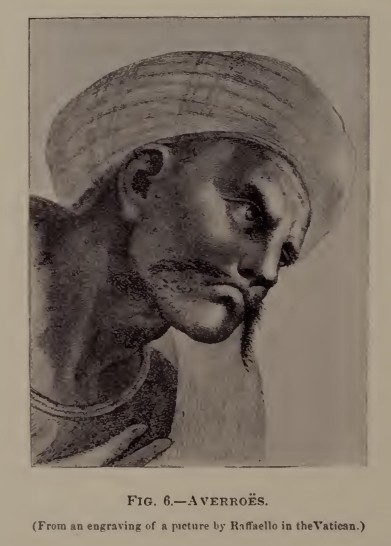
Original
Avenzoar, born in 1113, of a Spanish family which had many illustrious scions, was instructed in medicine by his father, and ultimately achieved great celebrity throughout Spain and Africa; for a time he lived at the court of the Prince of Seville, loaded with honors and presents, and finally was made Vizier. Among other works he wrote a treatise on renal diseases, in which he outlined the treatment of calculus and described an operation therefor. He died in 1161.
Averroës (as he is generally known, though his Arabic name was Aben Roschd) was born A.D. 1166, in Cordova, where his father held official position. After being grounded in philosophy, mathematics, and other sciences he became a pupil in medicine under Avenzoar. The greater part of his life wras passed in Seville, where he was greatly esteemed and finally knighted. In 1195 he was called to the court of the King of Spain and Morocco, in Cordova, where he received the highest honors, only, however, through some misunderstanding, to be disgraced; but he soon afterward recovered his former position and dignities. He wrote extensively not only on medicine, but on philosophy, his writings taking throughout a more or less dialectic character. He died in 1198, and from him descended a number of physicians who achieved more or less reputation.
Maimonides was born in Cordova, A.D. 1135. He early devoted himself to the Talmud, and in his extended travels visited Jerusalem; he even founded a school of philosophy in the East, which, however, had only a brief existence. He died in 1204. He ranked higher in philosophy than in medical art, and seems to have been imbued with the methods of his teacher, Averroës, and is generally regarded as a theorist rather than as a practical physician, although he wrote more or less on medical topics, and is particularly remembered for an essay upon poisons. He was about the last of the Arabians who deserves special mention.
During the period which was nearing its close at the time of the death of Maimonides, the Arabs embraced with much ardor the study of medicine, and translated into their language nearly all the treasures that had been amassed by the Greeks; indeed, the preservation of many of the great writings which would otherwise have been lost is due solely to this fact. Strange to say, however, the Arabians neglected Latin authors, and apparently possessed no knowledge of Celsus or Coelius Aurelianus. As religious prejudices prohibited dissections, they were obliged to rely solely upon the anatomical descriptions of Galen, and succeeded in increasing the errors of the original by inaccurate translations. So far as originality of observation goes, the Arabians were in most respects behind the Greeks; nevertheless, they were the first to differentiate eruptive fevers, to which the latter paid little or no attention. The Arabian school also supplied the knowledge of purgatives, such as cassia and manna, which replaced the drastics employed by the ancients; also the mode of preparation of syrups, tinctures, distilled waters, pomades, and plasters.
While the Arabians were gradually rising by their power, intelligence, and renown, the Greeks were declining in inverse ratio; the genius, courage, and ancient virtues of the latter grew weaker and weaker, until they seemed on the verge of extinction. In the medical history of these centuries, in all Europe not under Moslem rule, there was but one man entitled to mention as an author in medicine,—viz., John Actuarius, the son of one Zacharia. He lived at the close of the thirteenth and the beginning of the fourteenth century; was employed at Constantinople, his surname being the honorary title of the court-physicians. He is more commonly known as Zacharia. Of his life we know little, save that he wrote several volumes, for the most part abridgments or commentaries on the doctrine of Galen. He laid great stress on the theory of critical days, and sustained his views by astronomical hypotheses most ingeniously combined. His was the first Greek work in which were mentioned the remedies introduced by the Arabians, yet he has not a word to say of variola, measles, spina ventosa, and other affections fully described by Arabic authors. He held remarkable views concerning the nature of man, whom he supposed to be formed by the union of two contrary substances,—the soul and the body; described somewhat elaborately an imaginary plexus of veins connected with the digestive organs, through which the animal spirits were elaborated and purified; also, and quite methodically, for his age, he explained the functions of the animal economy and the etiology of disease.
While the clouds that befogged the study of medicine in the Empire of the East thus grew heavier and heavier, we must not be blind to the melancholy spectacle concerning the provinces composing the Empire of the West. Barbarians in swarms, from the forests of Germany and Scandinavia, had swept its various portions, pillaging, destroying, and reducing to slavery its inhabitants. In southern Europe everything was changed. Each generation witnessed some new and unheard-of invader, who demanded his share of booty and renown and left a track of desolation behind him. There was a brief period of order when Charlemagne reunited under one dominion these divers races and seemed to have resuscitated the Western Empire; but no sooner was he dead than its elements, being devoid of affinity, broke apart. Former vassals, no longer restrained by the firm hand of the emperor, made common warfare against his successors and against each other, and for several ages there was nothing but a succession of wars and invasions. Feudalism gave some sort of character to this military anarchy by affording repose and, in a measure, security for those who had hitherto been trampled under foot; but learning and the sciences fell into complete neglect, and it was with great difficulty that a very small number of men found within the pale of the church a limited protection that enabled them to devote themselves to the study of medicine and ecclesiastical law. Near the end of the eleventh century, however, the enthusiasm of the crusades whetted anew the turbulent appetite of the Christian barons, and led these lords of western Europe, with their belligerent spirits, to the East, as a result of which people hitherto oppressed could breathe more freely. A few States recovered their independence; some semblance of law was established; municipal institutions were organized, and establishments consecrated to public use were founded and multiplied; finally, in the course of the thirteenth and fourteenth centuries, the cloud which covered the face of Roman Catholic Europe was in some measure dispersed, and men of talent and even genius began to appear upon the scene; everything about them being so obscure, they shone like stars in the firmament. In letters, for instance, there were Dante, Petrarch, Boccaccio; in mathematics, Leonard, of Pisa, the first in Europe to understand and employ figures and algebraic characters, although Cuvier has claimed this distinction for Gerbert, a Benedictine monk of the tenth century, who subsequently became Pope Sylvester II. At this time, although in scholastic estimation medicine, theology, and philosophy alone were fit to entertain the human mind, the natural sciences were not without occasional representatives. Roger Bacon was three centuries in advance of scientific reform, and endeavored to introduce experimental philosophy, and so fully convinced some of his auditors that they subscribed £2000 sterling to provide for the expense of his experiments; this was money most happily employed, since it made possible a number of important discoveries. It is said that Bacon knew the properties of convex and concave lenses, and was the first to conceive of the microscope and telescope; his astronomical knowledge led him to demand a reform in the calendar, which Gregory XIII carried out three centuries later; he had knowledge of gunpowder and its effects, and was, in fact, the wizard of his day; but his boldness and originality drew upon him the enmity of the church, by which he was persecuted and finally condemned to imprisonment for life upon a diet of bread and water, although he was ultimately released, in 1266, by Pope Clement IV. He wrote extensively, but only fragments of his works exist, since the friars believed them tainted with witchcraft and prevented their publication.
Before and during the time of Roger Bacon the philosophers were divided into two parties, which engaged in very unseemly and unphilosophic strife. One was termed the Realist, and believed, with Plato, that ideas are self-existent and independent of the mind,—in other words, veritable entities; the other, the Nominalist, held, with Aristotle, that general ideas are pure abstractions formed by the mind with the aid of sensations received from without, without which they could never exist,—that is, if a being could be imagined without sensibilities and the power of sensation, such being would be destitute of ideas. These two parties kept up a very active warfare, and enlisted the aid of both civil and ecclesiastical authorities, the result being persecution of each other, and that general unsatisfactory conflict into which theology and metaphysical speculation always force those who indulge in them.
Now, regarding the condition of medical affairs in the Empire of the West: Down to the seventh century, in Rome, there were court-archiaters who were attached to the retinues of the nobles, and in each large city popular archiaters formed a college charged with sanitary matters, the instruction and examination of candidates, and gratuitous services to the poor. Although there is little definite information available, it is probable that after the ruin of Alexandria much the same medical organization obtained in those provinces as continued under the Greek Empire at Constantinople. Under Arab sway we know very little of what rules or regulations governed instruction in medicine and its practice; and, so soon as one of these countries fell under the rule of the Turks, all scientific institutions seem to have decayed or been discontinued,—or, as Renouard states it: "If we may judge by what still exists to-day in this unfortunate country (Turkey), consumed by the power of ignorance and despotism, the most complete anarchy followed all older organizations."
In southern Europe, however, things had not gone on quite so badly, although at first barbarous invasion caused everywhere disorder and confusion, and the Christian States of the Western Empire yet presented after three or four centuries a chaotic condition of affairs. The ecclesiastical schools, which were under the care of the church, still pursued courses of literary and scientific instruction; in the time of Charlemagne, for instance, the colleges of the cathedrals, and even some of the monasteries, taught medicine in a very limited way under the name of physics. Thus all the liberal professions—that of medicine included—fell under the domination of the clergy, and priests, abbots, and bishops became court-physicians. The monks of Mount Cassin, of the order of St. Benoit, enjoyed for a long time a great reputation for medical skill; and among these in the tenth century was an abbot named Berthier Didier, who became Pope Victor III toward the close of the eleventh century, and one Constantine, surnamed the African. Of the ecclesiastics who from the ninth to the eleventh century were distinguished by the knowledge of medicine, there were Hugues, abbot of St. Denis, physician to the King of France; Didon, abbot of Sens; Sigoal, abbot of Epernay; Archbishop Milo, etc. Even several religious orders of women undertook, to a certain extent, the practice of medicine, and Hildegarde, who was abbess of the convent of Rupertsburg, near Bingen, is credited with having written a treatise on Materia Medica.
From the ninth to the thirteenth century the Jews shared with the clergy the monopoly of the healing art. Many of these studied under Arabian physicians, and, though the canons of the church forbade them to in any way minister to the ailments of Christians, they were still called upon in time of need, and even in many instances had access to the palaces of archbishops, cardinals, and popes.
The education of Christian priests and infidel practitioners embraced really very little, and consisted, for the most part, of knowledge of a few symptoms and possession of a few receipts; books were excessively rare and expensive, capable teachers lacking, and a good medical education out of the question. There was no law nor public regulation which concerned the practice of medicine, and any who desired could enter upon it; while besides the priests and the Jews—which latter stood at the top of the scale—there was a multitude of charlatans of the lowest order, such as barbers, keepers of baths, and even a few women. The morality of this vulgar herd was on a level with its knowledge. I have said the practice of medicine was not regulated by law, yet Theodoric, King of the Visigoths, enacted a statute that no physician should bleed a woman of noble birth without the assistance of a relative or domestic; that if a physician in treating a patient or dressing a wound happened to harm a gentleman he should pay a forfeit of one hundred sous, and if the patient died from the operation he should be handed over to the relatives of the deceased, who could do with him whatever they pleased; while if he crippled or caused the death of a serf, he was to be held accountable only for the loss, and compelled to supply another. This remained in force from the sixth to the twelfth century, and was made to apply chiefly to the practice of surgery, which had been abandoned to individuals of the lowest condition. The practice of internal medicine was, for the principal part, the privilege of the clergy, and it is not likely the secular power ever expected that one protected with the title of priest should be handed over to the relatives of the dead. It furthermore appears that the practice of medicine as divorced from surgery led to such irregularities in the manners and conduct of the clergy that from the twelfth century popes and councils of the church repeatedly forbade the medical art to those in holy orders or under vows; but that this prohibition was often violated is shown by the frequent reiteration of inhibitory laws. During the twelfth century the secular authority was also affected by abuses. Roger, founder of the kingdom of Sicily, one of the first Christian princes of the Middle Ages, gave special attention thereto, and in 1140 proclaimed that every one who wished to practice medicine must present himself before a magistrate and obtain authorization, under pain of imprisonment and confiscation of goods. Other sovereigns followed this example, and regulating ordinances were gradually established, which ultimately led to the institution of medical faculties and university degrees.
During the Middle Ages, in the Empire of the West, arose the School of Salernum, which became so celebrated that, like that of Alexandria, it deserves special mention. The modern city of Salerno is situated on the Neapolitan Gulf, about thirty miles southeast of the city of Naples, with a population of but a few thousand souls. The ancient city stood upon a height in the rear of the present town, where the ruins of its mediaeval citadel are still to be seen. It first appeared in history 194 B.C., when a Roman colony was founded, was a municipal town of importance, and appears even at this early day to have been a health resort, since Horace informs us he had been advised to substitute its cool baths for the warm ones of Baiæ. During the stormy centuries following the downfall of the Western Empire, Salerno successively submitted to the sway of the Goths, Lombards, Franks, Saracens, and Greeks, as the vicissitudes of Avar compelled. Under the Lombards it became the residence of the Duke of Benevcntum, and, in 1075, when taken by Robert Guiscard of Normandy, it fell to the crown of Naples, in consequence of which in the fourteenth century, the heir apparent of this kingdom took the title of Prince of Salernum.
During the Middle Ages here flourished a medical school, important not alone because of its celebrity at the time, but for its effect upon the medical history of the future. Its origin is obscure, though it has been ascribed to Charlemagne in 802; again, its founding has been held to be the work of fugitives from Alexandria when that city was captured by the Saracens, 640 A.D.; some attribute it to the Benedictine order of monks, others to Saracens, etc. The foundation by Alexandrian fugitives is probably conjectural, yet it must be admitted there is some evidence of knowledge of Arabian medicine in Salernum as early as this. Be the origin what it may, it is certain that the Benedictine monks exercised a very important influence upon this school, and there is considerable reason to think that it was really originated by them. Their monastery of Monte Casino was located about fifty miles the other side of Naples, occupying the site of an ancient temple of Apollo; the rules of the order enjoined the care of the sick and treatment by prayer, and St. Benedict himself was credited with performing miraculous cures. The rules which forbade public instruction were gradually discarded, for in the ninth century Abbot Bertharius wrote two books on the art of healing, and by the tenth century Monte Casino had acquired great reputation as a medical school, and was sought by medically-inclined monks from all quarters. A little later (1022) King Henry II, of Bavaria, Emperor of Germany, is said to have been cut for stone by St. Benedict himself, who appeared in ghostly form and operated with such skill that on awaking the royal patient found the calculus in his hand, and only the cicatrix of the wound through which it had been removed. Of course, the grateful emperor could do no less than richly endow the monastery, and bestow upon it additional privileges.
Desiderius, the Benedictine abbot from 1058 to 1086, and in the eleventh century promoted to the papal chair under the title of Victor III, was distinguished for his attainments in medicine and in music, and founded a new hospital in connection with the monastery; he also composed four books detailing the miraculous cures wrought by his patron saint. It was really within this monastery that Constantine the African, one of the most learned men and the most famous Christian physician of his time, compiled his numerous medical treatises.
About Constantine there is much of romance. He was born in Carthage in 1018 and died in 1085. He visited all the prominent schools of his day in Egypt, Bagdad, Babylon, and even India, and for thirty-nine years pursued the various branches of knowledge away from home. Returning to Carthage, misunderstood and feared, he was accused of practicing sorcery and compelled to fly to save his life. Disguised as a beggar he escaped to Salernum, which had been recently captured by Robert Guiscard, and on the recommendation of some royal visitor, who had known him at another court, he was made private secretary to Guiscard. His new duties soon became irkscme, however, and he retired to a cloister to devote himself to literary labors. These, for the most part, were translations of Greek and Arabic writings, often made verbatim and without credit. Whatever may be said about this lack of honesty, and the barbaric nature of his Latin, credit must be given him for reviving the study of Hippocrates and Galen in France; and he is generally credited with being the first to introduce into Europe knowledge of Arabian medicine.
From Monte Casino the Benedictines at an early day spread to Salernum, where, by the middle of the tenth century, three monasteries were established, in all of which were kept holy relics. It now appears that, although there may have been some previous institution of learning at this point, and possibly even medical teachers, the real organization of a regular school of medicine was due to the Benedictines. In the annals of Naples of the middle of the ninth century the names of Salernian physicians are mentioned; and it is known that toward the close of the tenth century Archbishop Verdun visited Salernum for relief from vesical calculus, and there died.
The earliest medical writings of this school which have been preserved are found in the Compendium Salernitanum, discovered in manuscript form in 1837; and among the more prominent authors quoted are: Petronius, who wrote about 1035; Gariopontus, who wrote about 1040; Bartholomæus, Ferrarius, and Affiacius,—the latter a disciple of Constantius Africanus.
The preaching of Peter the Hermit, which marked the close of the eleventh century, was followed by an outburst of crusading enthusiasm that quickly converted Europe into a vast camp, and Salernum, being situated upon the highroad to the East, was benefited in no small degree and its reputation as a medical school materially enhanced; likewise its teachers gained in experience as regards military surgery. In this way it became a favorite resort for crusaders when disabled, wounded, or diseased. Robert of Normandy, son of the conqueror, returning from the Holy Land, remained here for some time with a poisoned wound in the arm, received in 1097 at the siege of Jerusalem, and it was decided it could be healed only by sucking out the poison, a process deemed dangerous to the operator. History declares that Robert's wife, daughter of Goeffrey, Earl of Conversana, being denied permission, took advantage of her husband's unconsciousness during sleep to withdraw the poison, when the wound speedily healed. At the time of the departure of Robert, hastened by the death of his brother William, John of Milan, the then chief of the medical school, presented him with the famous Regimen Sanitatis Salerni, said to have been composed largely for Robert's benefit. This was a Latin poem that enjoyed most unexampled popularity for many generations, and was the vade mecum of well-educated physicians for centuries. It is said to have passed through two hundred and forty different editions, and that more than one hundred manuscript copies are to-day to be found in various European libraries. The latest English version was published by Professor Ordronaux in 1871. A sample is here submitted:—
"Salerno's school in conclave high unites
To counsel England's king, and thus indites:
If thou to health and vigor would'st attain,
Shun mighty cares; all anger deem profane;
From heavy suppers and much wine abstain;
Nor trivial count it after pompous fare
To rise from table and to take the air.
Shun idle noonday slumbers, nor delay
The urgent calls of nature to obey.
These rules if thou wilt follow to the end,
Thy life to greater length thou may'st extend."
During the twelfth and thirteenth centuries the glory of the School of Salerno reached its zenith; it was the most famous school of medicine in Europe, and was fostered by various kings. The celebrated Jew, Benjamin of Tudela, traveling from Spain to India, visited Salernum in 1164, and called it the "principal university of Christendom." Early in the twelfth century flourished Cophon, Archimatheus, and Nicholas, surnamed Præpositus, all of whom were distinguished teachers. The latter published a work known as Antidotarium, which was for several centuries the standard pharmacopoeia, and which contained a table of weights that corresponded very closely to those of the modern apothecary. The younger Cophon, who has been confounded with his father (as both seem to have written extensively), wrote two treatises,—one on the anatomy of the hog, the other entitled Ars Medendi. The first is interesting as the only anatomical treatise of this school which has been preserved, and is an index of the degradation of anatomical science of that time.
The names of John and Matthew Platearius are of frequent occurrence in the records of this school, and have given rise to considerable confusion; the former is supposed to have been the husband of Trotula, a female physician, of whom I shall have more to say later.
Bernard the Provincial, who seems to have escaped the notice of most historians, wrote about 1155, and his commentary offers much interesting information concerning the therapeutics of the day; he formulated a large number of recipes to enable the sick to escape the omnipotence of the apothecaries, and recommended wine for the delicate stomachs of the more exalted of the clergy, and, inasmuch as these stomachs did not bear medicine well, he directed, in accordance with the practice of Archbishop Æfanus, that emetics should be prescribed after meals, when their action is less injurious and more agreeable; he advised young men and women tormented with love which they could not gratify to tie their hands behind their backs and drink water from a vessel in which a red-hot iron had been cooled. Indeed, his work is full of curious information and advice, and is not without therapeutic interest.
A name which figures largely in the history of this school is that of Magister Salernus, about which there is great uncertainty; it is not positively known whether this refers to a particular person or is a generic name covering various individuals. The name has been mentioned as that of one of the four reputed founders of the school; it is positive that there are certain treatises which bear this name, which give an appearance of authenticity to it as an individual title.
In the latter half of the twelfth century lived John of St. Paul, one of the teachers of Gilbert the Englishman; also Musandinus, who left a curious treatise on dietetics; and Urso, who wrote on the pulse and on the urine. Here in 1190 resided and studied a certain Alcadinus, from Syracuse, whose knowledge of philosophy and medicine was such that he acquired great reputation, and was made a professor; he even composed Latin medical poems.
Just at the close of this century flourished Ægidius, who studied at Salernum, and also at Montpellier, where a school of medicine had been founded in 1180; he was physician to Philip Augustus, of France, and became professor in the University of Paris. Three treatises, all in Latin hexameter, are ascribed to him. A contemporary was Johanes Rogerus, of Palermo, a graduate of Salernum and author of several works.
Early in the thirteenth century flourished Roger of Parma, one of the most distinguished of the alumni of this school and the earliest pioneer in modern surgery; his work on this topic, familiarly known as Rogeriana, enjoyed the greatest reputation in its day, and was for a long time the surgical text-book of Italy; his predilection for poultices and moist dressings in the treatment of wounds, abscesses, and ulcers became, in the hands of his successors, the distinguishing feature of the surgery of Salernum in opposition to the school at Bologna, where Hugo Di Lucca and Theo-doric (his great rival) contended for the superiority of the dry treatment. Roger was also the first to use the term seton, and to give practical demonstration to this means of derivation.
Roland of Parma, a pupil of Roger, and a surgeon of great distinction, became professor at Bologna, and wrote a treatise on surgery, which was, for the most part, a commentary on the works of his master. The treatise of Roger and that of Roland furnished the basis for a work entitled The Treatise of the Four Masters, supposed to have been written about 1270, and manuscripts of which have been long known in various European libraries. It is divided into four books, displays no little surgical ability, and from its title would appear to have been the joint composition of four teachers; indeed, it was long attributed to Archimatheus, Platearius, Petro Cellus, and Affiacius, though it is now pretty generally understood to be the product of but a single pen and its author most likely a Frenchman. The ascription of authorship to four masters was probably for the purpose of increasing its weight and authority, and it constituted a reliable exposition of the surgery of Salernum in its day. It is quoted quite freely by Guy de Chauliac, who was the restorer of French surgery in the fourteenth century, and occasionally by later writers.
Another of the distinguished Salernian physicians of the thirteenth century, one highly esteemed by Frederick II, was John of Procida, who also was active in producing—if not the real author of—the massacre of the Sicilian Vespers, A.D. 1282. In a dispute concerning the question of the two Sicilies he embraced the cause of Prince Manfred, for which he was banished by Charles of Anjou, and took refuge at the court of Peter III, of Arragon, by whom he was created a baron; and he was influential in persuading the latter to assert his claim to the throne of Sicily. By various intrigues at different courts he succeeded in organizing an alliance, which betrayed its existence in this massacre, and finally resulted in the overthrow of the French in Sicily and the transfer of the island to the crown of Spain. He was author of at least two treatises devoted to medicine and philosophy.
Other writers of the School of Salernum were: a learned Jew of Agrigentum known as "Farragus," Matthew Sylvaticus, Graphæus, and Cappola. About the middle of the fifteenth century flourished Saladino, famous as an authority on materia medica.
It is of no small interest that now, for the first time in history, women began to figure somewhat prominently as writers, practitioners, and even teachers of medicine. About the middle of the eleventh century appeared a work, entitled De Midierium Passionibus, attributed to the before-mentioned Trotula, wife of John Platearius, which has descended even to these days. There is nothing in the work to indicate the name or sex of the author, who is invariably spoken of in the third person; consequently Trotula's connection therewith has often been disputed.
It mentions a certain "aqua mirabilis" composed largely of brandy, which spirit is said to have first been employed medicinally by Thaddeus of Florence, who died in 1295; there is also an account of a patient who wore spectacles! The diseases of women and children are also largely dealt with. The work is undoubtedly an anonymous production of the eleventh century, disfigured by additions of a later day, and ascribed to Trotula, perhaps, because of the celebrity that attached to her; at all events, it is the earliest work ascribed to a female physician, and thus possesses special claims to interest.
Later we read of Sichelguada, wife of Robert Guiscard and a graduate of Salernum, who endeavored to poison her step-son, Bohemond, in order to secure the succession of her own child. This infamous plot was furthered by some of the Salernian physicians, and thwarted only by the prompt action of Guiscard, who swore he would slay his wife with his own sword should the malady of Bohemond prove fatal.
Certain other female physicians of this period are mentioned, notably Abella, who, in spite of the modesty that is supposed to hedge about her sex, produced in Latin hexameter a work entitled De Natura Seminis Hominis. Mercuriolus, in the fifteenth century, produced treatises on the cure of wounds, pestilent fevers, and on the nails. The most celebrated of all, however, appears to have been Calenda, who lived during the reign of that notorious profligate, John II, of Naples (1414-1435), and who was particularly distinguished for her personal attractions. She graduated with great honor from the school at Salernum, and soon after, in 1423, married a nobleman of the court, which perhaps accounts for the fact that she never exercised the privilege of authorship. A little later, Marguerite, of Sicily or Naples, also a Salernian graduate, acquired an extended professional reputation, and was licensed to-practice by Ladislaus, King of Poland.
Daremberg informs us that there were numerous female physicians at Salernum, much sought after because of their talents, and, moreover, highly esteemed by the professors of the school, who freely quoted the writings of their fair pupils and contemporaries; further, that they employed ointments in paralyses; fumigations, vapors, and antimony for coughs; and lotions of aloe and rose-water for swellings of the face; they combined scientific knowledge with facetious playfulness in a manner peculiar to the sex, in that they tendered unsuspecting beaux bouquets of roses doctored with powdered euphorbium, and hugely enjoyed the forced sternutations of their victims.
It will thus be seen what a wide-spread and long-continued influence the school of Salernum exerted. At first physics and philosophy were the principal branches taught, but later the other sciences were cultivated. The Emperor Frederick II united the different schools of the city into a university,—a term, however, that, as then applied, appears to have corresponded to what in the nineteenth century is understood by corporation. The emperor likewise published several decrees which revised the duties and privileges of practitioners of medicine and surgery in his kingdom, and, in 1224, ordered that no person should practice within the two Sicilies until examined by the faculty of the university and licensed at the royal hands; further, practitioners were compelled to devote at least one year to the study of anatomy. The faculty at this time consisted of ten professors, whose salary probably depended upon the number of pupils. A candidate for graduation was required to present proof of majority, of legitimacy of birth, and of proper duration of preliminary study, and then was examined publicly in the Synopsis of Galen, the Aphorisms of Hippocrates, or the Canon of Avicenna. On passing he swore to conform to all the regulations hitherto observed in medicine, to give gratuitous treatment to the poor, and to expose all apothecaries detected in adulterating drugs. A book was then placed in his hands, a ring upon his finger, and a laurel crown upon his head, when he was "dismissed with a kiss." The degree conferred was that of "Magister"—the modern title of Doctor being at that period employed almost exclusively to designate a public teacher or professor.
But the watchfulness of King Frederick was not confined alone to the regulation of medical study within his kingdom. The number of professional visits, and the recompense therefor, were fixed by law. Every physician was compelled to visit his patients twice daily, and even once at night as well, if summoned, and for this attendance was permitted a daily fee equivalent to fourteen cents for patients within the city, while for calls without the city the largest legal charge was one dollar and thirteen cents, provided he paid his own expenses.
The earlier teachings and practice of Salernum were a curious mixture of methodism, dogmatism, and superstition. The latter may be better understood when it is recalled that the practice of medicine for an extended period was confined almost exclusively to ecclesiastics, who by their very education were prone to superstition and upheld the efficacy of charms and relics, and the active intervention of saints and martyrs as well as the myrmidons of evil; hence arose many of the conflicts and absurd notions peculiar to the period. The prevalence of the doctrine of medical methodism was due to the character of the writings most accessible to students of that day,—such as those of Ccelius Aurelianus and others; and it is curious that Celsus, the most elegant of medical authors, was never popular among medical monks. The Hellenic language having almost disappeared from Italy by the sixth century, the works of the Greek authors had become a sealed book to a vast majority, even of the better educated; hence the purer sources of medical knowledge were not available. Although the school of Salernum, at a later date, prided itself upon its devotion to the "Father of Medicine," the Hippocratic writings were not known at this period; and, when Constantine the African, by the translation of Arabian works, introduced a new element into the Salernian school, he ingrafted upon its medical teaching a form of doctrine which found a congenial atmosphere, in which it throve vigorously, while, a century later, the translations of Gerard of Cremona gave a stronger impulse to the growth of Hippocratic medicine than to Hippocratic doctrine.
From the Commentary of the Four Masters we learn that Salernian practitioners recognized the diagnostic importance of nausea, vomiting, and the flow of blood from the ears in injuries to the head; that they resorted to the trepan for depressed fractures and the relief of intracranial extravasation; that hernia cerebri was treated by pressure and caustics; that ligatures, both above and below the opening, were applied for the treatment of wounds of the carotid arteries and jugular veins. It was advised to decline patients suffering from wounds of the heart, lungs, diaphragm, stomach, or liver, in order to avoid the disgrace of losing them; and in penetrating wounds of the intestines and in those complicated with protrusion of the wounded gut instruction was given how to envelop them in the warm abdomen of a slaughtered animal until natural color and temperature were restored, and then to insert a cannula of alder-wood into the wounded intestine, which was to be neatly closed and stitched; finally, the protrusion was to be carefully washed with warm water and returned into the abdominal cavity, enlarging the opening for this purpose, if necessary. Also was advised the extraction of diseased teeth; and the operation of lithotomy was described with considerable care. Compound fractures were to be treated with splints. On the whole, this commentary of the alleged Four Masters is the most interesting and ancient Salernian work which has been preserved, and is well worthy the attention of even modern surgeons.
Such was the school of Salernum in its prime, during the twelfth and thirteenth centuries. My readers will not have failed to note how few names have been mentioned which are prominent in medical history, and how few improvements were made in medical art by those who have been mentioned. One naturally inquires, then, what was the source of the wide-spread fame of Salerno as a school, since it was distinguished neither by notable discovery in science nor by celebrated teachers, and the predominant element was doubtless one of obstinate conservatism and unswerving devotion to ancient doctrines. Founded during the dark period of the Middle Ages, at a time when ignorance, bigotry, and superstition prevailed, it preserved, amidst the gloom that had settled upon Europe, a few rays of that intellectual light which had shown so brightly in the golden ages of Roman history. These rays, made more conspicuous by the intellectual night which they barely illumined, were a beacon for men who were groping for more light. Thus the name of Salernum became synonymous with intellectual advancement in later ages. As the parent and model of our modern university system, Salernum yet deserves, in a measure, to enjoy the esteem of a numerous scholastic offspring. At a time when priests were particularly active in passing off rudimentary knowledge for the science of healing this school began to secure all information possible from the laity for the progressive development of medicine. It began, in other words, to hold aloof and then to break away from the fetters of a fanatical church. Its decline, too, was as rapid as its career had been brilliant. One very serious blow was struck when, in 1224, Frederick II founded the University of Naples and forbade Neapolitan subjects to seek instruction at any other university. The next year a revolt in the city provoked the closure of the schools of Bologna, which were, however, opened again two years later. Within a short time the universities of Naples, Montpellier, Padua, Paris, and Bologna all entered into a contest for pre-eminence with a rivalry which was not always generous. In 1224, it is said, the latter university had no less than ten thousand students. Happily, however, the period of the Renaissance proved to be one of emancipation from the fetters of ignorance and superstition, making an appeal for liberty which the conservatism of Salernum could not brook. Roger Bacon, in England; Lanfranc and Guy de Chauliac, in France; Mondino, at Bologna, and Savonarola, at Padua, found no rivals at Salernum to successfully contest their fame. Thus this ancient school fell behind the age, and in a short time sank into a mediocrity which was scarcely brightened by the reflection of a departed glory. In 1342 Robert I renewed the decree of Frederick II, which closed all the schools in his kingdom save those of Naples, but excepted Salernum solely because of its antiquity and the traditions of his predecessors. In 1413 King Ladislaus excepted the Salernian alumni and professors from all taxes, duties, and tribute. In the middle of the fourteenth century the poet Petrarch speaks of the school as a memory of the past; but its last appearance was in 1748, when a dispute at Paris relating to the rank of physicians and surgeons was referred to Salerno's university for arbitration and final decision. In 1811 a formal decree reduced this parent of all European universities to a mere gymnasium or preparatory school; and now one may wander through the streets of the modern town and among the ruins of its ancient predecessor and seek in vain to trace some reminder of those who were illustrious during some of the most terrible ages in the world's history. No echo of tradition, no stone of ancient edifice, no library preserving precious manuscripts, not even an edition of the old Salernian regimen, in the whole city; in fact, none now so poor as to do it reverence.
CHAPTER IV.
Age of Transition (concluded).—The School of Montpellier: Raimond Lulli, 1235-1315. John of Gaddesden, 1305—(?). Arnold of Villanova, 12341313. Establishment of Various Universities. Gerard of Cremona, 1187. William of Salicet, 1280. Lanfranc, 1315. Mondino, 1275-1327. Guy de Chauliac, 1300-1370. Age of Renovation, 1400 to Present Time.—Erudite Period, including Fifteenth and Sixteenth Centuries. Thomas Linacre, 1461-1524. Sylvius, 1478-1555. Vesalius, 1514-1564. Columbus, 1490-1559. Eustachius, 1500-1574. Fallopius, 1523-1562. Fabricius ab Aquapendente, 1537-1619. Fabricius Hildanus, 1560-1634.
Although I have taken up so much time with an account of the school of Salernum, a few words must be devoted to the school of Montpellier, which was second in time and in importance among the great influences in the culture of western Europe. There was a time when to have studied there lent a special halo of glory, for, being near the sea, and in the vicinity of thermal baths, even so early as A.D. 1153 it was famous as a school of medicine; moreover, those who presided over it did not lapse unconditionally into mediæval philosophy, with its bewildering subtleties. It is said to have been founded A.D. 738, but first mention of it as a source of medical education occurs in 1137, when Bishop Adelbert II, of Mayence, visited the city to listen to its medical teachers. A faculty of philosophy was added in 1242, and one of law in 1298. Within the walls of the city sojourned both Christians and Jews, the latter being subject directly to the civil authorities, and particularly esteemed as translators. One of the most famous of the sons of Israel was Profatius Judicus, who became a rector of the faculty.
Prior to 1370, when the university became subject to the kings of France, it was under the control of the Pope; and then, as now, the school of medicine was the chief ornament of this ancient seat of learning.
One of the most illustrious and famous pupils of Montpellier was that religious mystic and alchemistic visionary, Raimond Lull, or Lulli, a would-be transmuter of metals and seeker for the philosopher's stone. Born in 1234, at the age of thirty he began to see visions, and was thereby roused from an atheistic tendency to soon become wonderfully pious; ultimately he entered the order of Minorites, studied Arabic, and appeared as a missionary in Africa, seeking to convert the Saracens—who, however, declined the honor, and finally (in 1315) rewarded his zeal by stoning him to death. Beside works on alchemy and theology, he wrote on medical subjects, and, like all great minds of the period, passed among the common people as a sorcerer in league with the devil. Nevertheless, he was a notable figure in his age and country.
Quite celebrated became the compendium of Gilbert of England (1290), which contained the same speculative nonsense, the same polypharmacy, and the same superstition as other works of that time; what little it contained of value was taken largely from other writers. While this Gilbert, often known as Gilbertus Anglicus, was not the first English writer on practical medicine, he was the earliest whose works have been preserved.
Still more famous was John Gaddesden, physician-in-ordinary to the King of England, professor in Merton College, Oxford, who wrote the famous treatise known as Rosa Anglica, which appeared between 1305 and 1315. This treatise was characterized by mysticism and disgusting therapeutic measures, and tainted by medical avarice, superstition, and charlatanry. Gaddesden was, perhaps, the first to formally recommend the "laying on of hands" by the king for the cure of scrofula (first performed by Edward the Confessor—1042-1056), whence comes the ancient name for this disease,—i.e., "king's evil." *
*A special "Service of Healing" was used in the English
Church under Henry VIII, 1484-1509.
Arnold de Villeneuve (1234-1313) studied seven years at Montpellier, twenty years at Paris, visited all the universities in Italy, then went to Spain to levy on the Arabian authors. He wrote on medicine, theology and especially on chemistry—in which art he obtained great renown both as an author and teacher. To him is due the discovery of spirit of wine, oil of turpentine, aromatic waters, besides several preparations of less note, and the introduction of chemical compounds into therapeutics. His was a very stirring life, for he traveled extensively; he became a teacher at Bologna, and physician to Peter III, of Arragon. Shortly before his demise he went to Paris, having fallen under the ban because of a declaration that papal bulls, far from being sacredly inspired, were human works, and that acts of charity were dearer to God than hecatombs, etc. He finally perished by shipwreck, but the spirit of fanaticism followed him after death, for his volumes were condemned by the Inquisition, because they commended experiments rather than mere speculations. In spite of his general honesty in accordance with the spirit of the times he inculcated deceit in medicine, and one of his declarations is: "If thou canst not find anything in the examination of the renal secretion, declare that an obstruction of the liver exists. Particularly use the word 'obstruction,' since it is not understood, and it is of great importance that people should not understand what thou say est." He was one of the first to administer brandy, which he regarded as the elixir of life—whence the modern Eau de Vie.
Connected with this school, also, or well known as having studied there, were many men whose names became more or less famous—among them John Arden, who settled in London about the middle of the fourteenth century; Vinario, a contemporary of Guy de Cliauliac, and the well-known surgeon and anatomist Henri de Mondeville, who was a teacher of Guy de Chauliac. But an idea of the doctrines prevalent in the medical literature of this part of the world, at this time, may be had from the fact that most writers chose titles for their works after the style of ballad singers: for instance, those describing the plague and venereal diseases were called Flowers and Lilies of Medicine; the Rosa Anglica of John Gaddesden was another example. Matters had arrived at such a pass, indeed, that men of science no longer hesitated to confess superstition and mingle it openly with deceit, to oppose the interests of the most needy, and to extort from their fellow-creatures fees in proportion to their supposed ability to pay.
In the time of Charlemagne each cathedral possessed a school in which were taught arithmetic, theology, singing, and sometimes medicine; the Episcopal College had medical teachers who gave advice and dressed wounds at the doors of the Church of Notre Dame, Paris; but when the medical profession had been divorced from the sacerdotal by councils and popes, many of these cathedral schools closed. In order to preserve the jurisdiction which they for a long time had exercised over the learned professions, many were erected into universities, and thus the clergy gave instruction in philosophy, theology, and later in medicine. During the thirteenth century arose many of the great universities in Europe, notably those of Bologna, Padua, and Naples, in Italy; of Paris, Montpellier, and Toulouse, in France; of Valencia and Tortosa, in Spain; of Oxford, in England. Pope Innocent III by papal bull guaranteed that the professors and students at Paris should be exempt from all excommunications save those which emanated directly from the Holy See; French sovereigns conferred many privileges upon the universities, and soon the members of the University of Paris formed practically a second city, with its own laws, customs, police, citizens, and magistrates. Still, however, all science belonged to the clergy, and its teachers, though removed from the cloister, were none the less Roman Catholic; so that the popes reigned over the people through the parish clergy, and over the latter by the clerical teachers and professors. Nevertheless, in all candor it must be acknowledged that these studious men, thus associated together for mutual instruction and emulation in learning, contributed, in a large measure, to elevate Christian civilization above all others, though several generations were required to secure the results calculated to make men celebrated; hence the early periods of the universities developed very few names. Many were conspicuous by their love of instruction, but not by originality of research. Men undertook expensive and wearisome voyages without encouragement or hope of reward, simply to obtain some rare manuscript or to hear some renowned professor; and they appeal to us of the nineteenth century by their devotion, if not by the results of their work.
Among the somewhat scattered and more or less eminent men of this period was Gerard, of Cremona in Lombardy, a man of great purity and studiousness, who arduously pursued all that Latin authors could teach him, and, not being able to procure in Italy certain manuscripts which dated from the time of Ptolemy, determined to go to Toledo in search of an Arabian translation. At this time he was unacquainted with Arabic, but soon mastered it, and—armed with this powerful resource, which no other physician had possessed since the time of Constantine the African—he could not see so many Arabic works devoted to all branches of science as were gathered at the Spanish University without a desire to translate and transmit the same to his own country; hence he gave the remainder of his life to this work. He rendered into Latin the treatises of Hippocrates and Galen, of Serapion, and of all the famous Arabian authors from the time of Phazes, including the Canon of Avicenna and the work on surgery by Albucassis. He died at the age of seventy-three, in 1187, at Cremona, and left all his books to the monastery of St. Lucy, within whose walls he was buried.
William of Salicet, born at Plaisance in the first years of the thirteenth century, became a professor in the University of Bologna, and later at Verona. He wrote extensively on medicine, and earned a reputation as a surgeon that preserves his fame to the present day. It is claimed that his status in medical literature depends, in large measure, upon the fact that he was, perhaps, the first to refuse slavish obedience to preceding authors, preferring, instead, to draw upon the results of personal study and experience. He died in 1280.
Lanfranc, or Lanfranchi (according to whether one prefers his French or Italian name), studied under William of Salicet. Of his early life very little is known, save that he practiced surgery in Milan at the time of the great dissension between the Guelphs and Ghibellines, and, for attaching himself to the weaker party, was exiled and forced to seek an asylum in France; he resided in Lyons for several years, and here wrote a work on minor surgery; in 1295 he went to Paris on the invitation of the faculty of medicine, opened a course on surgery which met with great success, and then published a second and larger treatise on the subject. It is said of him by Malgaigne that, less from his fault perhaps than that of his age, after his death (about 1315) surgery began to decline. From the time of Brunus, who practiced in Padua in 1250, the barbers had done the scarifying and bleeding. After the time of Lanfranchi there were others who applied leeches and often cauteries, and even the women meddled with surgery and in all operations competed with the barbers; the lay surgeons held themselves rivals to the clergy. Lanfranchi inherited from his old master, William, an aversion for them all, and often had to contend with uneducated and incompetent laymen. Clerical surgeons regarded operations as beneath their dignity; and Lanfranchi, who deplored this condition of affairs, confessed he had sometimes bled with his own hands, but had never operated for ascites, hernia, cataract, or stone.
John Pitard has descended to fame not as a writer, but as the founder of the surgical schools of St. Come and St. Damien, which occupy so eminent a position in the surgical annals of France. In 1306 he was surgeon to the King of France, Philip le Bel, and the sworn surgeon of Chatelet. The College of St. Come, in 1311, was only a little brotherhood of lay-surgeons, who gradually grew in importance as the result of the obstinate struggles sustained,—on the one hand, against the faculty of medicine, and, on the other, against the barber-surgeons. Malgaigne has, with great patience and clearness, shown that the importance of this body of men has been greatly exaggerated by historians; he has traced their various turns of fortune from beginning to end; I shall have occasion to consider them again farther on.
Mondino, sometimes known as Mundinus, born in 1275, became a professor in the University of Bologna, and died in 1327. He was the author of a celebrated treatise on anatomy, said to have reached twenty-five editions, and which was the first of its kind since Galen. This science had been greatly neglected; in Salernum, for instance, they were, for a long time, contented with the treatise of Copho on the anatomy of the hog, and most of the anatomical knowledge of the age was apparently derived from this source; Mondino resurrected the study and pursued it with interest and enthusiasm, though under the greatest difficulties. His works for more than two centuries, along with the writings of Galen and the Arabic authors, served for anatomical demonstration, although very incomplete,—as witness the statement:—
"Beneath the veins of the forearm we see many muscles and many large and strong cords, of which it is not necessary to attempt the anatomy on such a corpse (i.e., a recent one), but on one dried in the sun for three years, as I have shown otherwise, in developing the number and the anatomy of those of the superior and inferior extremity."
On the other hand, he took the opposite course to discover and demonstrate the nerves, and advised maceration in running water. It required almost superhuman boldness to substitute demonstrations on the human cadaver for those upon swine, yet this was done by Mondino; and at the time the prejudice against dissection was so general that for more than a century after Mondino—who died in 1327—no one dared, at least publicly, to emulate his example. It was in the year 1315 that he publicly dissected the bodies of two women in Bologna. Anatomical study was further complicated at this time by certain bulls of Pope Boniface VIII, forbidding evisceration or boiling or cooking any part of the human body; these deliverances were really aimed, not against scientific investigation, but at the absurd custom introduced by the crusaders of cutting up and boiling the bodies of their relatives who died in infidel countries, in order to send them home for burial in holy ground; nevertheless, the papal injunction certainly operated to discourage and prohibit anatomical dissection, since nearly two hundred years later the University of Tübingen was obliged to apply to Pope Sixtus IV for permission to authorize dissection.
Guy de Chauliac, born in Gévaudan about 1300. was the most famous physician and surgeon in Christendom during the Arabic period. He studied at the cathedral college of Mende, which at that time was quite celebrated, and was taught medicine at Montpellier under the best masters of his day. It is probable, also, that he studied in Paris, and certain that later, in Bologna, he saw dissections made. Dissatisfaction with the writings of the ancients and the knowledge which he obtained at the schools stimulated his own powers of observation, and he became, in every respect, an original student and acquired a degree of erudition far more extended than that possessed by any of his contemporaries. He practiced in various places, longest at Lyons; and finally entered the service of Pope Clement VI, at Avignon, and probably enjoyed the same honor under Innocent V and Urban V; when the latter was made pope, in 1362, de Chauliac became his chaplain, or chapel-reader. In 1363 he published a work on surgery called The Inventory, upon which his fame chiefly rests, though several other volumes emanated from his pen. None knew better than he how to unite respect for the ancients with justice toward contemporaries, and he cited a large number of Greek, Arabian, and Latin authors, some of whom are now utterly unknown. The sciences, he declared, are "created by successive additions; the same man cannot lay the foundation and perfect the superstructure. We are as children carried on the neck of a giant; aided by the labors of our predecessors we see all that they have seen, and something beside." In tracing the character of a surgeon he recommends that he be "learned, expert, ingenious, bold where he is sure, timid when in doubt, avoiding bad cures and practices, being gracious to the sick, generous and compassionate, wise in prediction, chaste, sober, pitiful, and merciful; not covetous nor extortionate, but receiving moderate fees according to the circumstances of his patients, the character of the case, and his own dignity."
"Never since Hippocrates," says Malgaigne, "has medicine learned a language stamped with such nobility and in such few words." Although a follower of Galen, in anatomy he insisted on the necessity of dissection, and proposed to make use of the corpses of executed criminals for this purpose. The drawings made by Henri de Mondeville were known to him; he divided abscesses into hot and cold, although among the latter he included oedcma, tympanites, dropsy, scirrhus, and other conditions. In practice he was more timid, yet more active, than Lan franchi, who never cut for stone, but left that operation to the traveling surgeons. De Ghauliac described it as he had seen it performed; he opened the abdomen for dropsy, did not hesitate to attempt the radical cure of hernia, and operated for cataract. The plague which raged during the fourteenth century and depopulated the known world of one-fourth of its inhabitants, twice appeared in Avignon while Guy de Chauliac was a resident there—and he acknowledges that nothing but shame prevented him from fleeing. He remained at his post, visited the sick, and was himself attacked and left for dead. "In this frightful position he had sufficient presence of mind to follow the peculiarities of his case, analyze his own sufferings, and to give a description of them worthy of Hippocrates" (Renouard). His work soon became the surgical code of Christendom, and was commented upon and translated into all tongues, remaining for a long time a classic, and even at this day it preserves much of its interest as representing the condition of medical science at the close of the Middle Ages; moreover, its literary style was much superior to that of any of his contemporaries, all of whom wrote very barbarous Latin. He died about 1370.
With the death of de Chauliac terminates our interest, not merely in the Arabian physicians and those who were intimately connected with them, but in the so-called Arabic Period. It may be added, in passing, that the followers of Mahomet, like those of Christ, erected by the side of each of their mosques a school, and often a hospital, endowed with more or less generosity by caliphs or the wealthy, who hoped to purchase redemption and eternal happiness by such liberality.
A certain number of religious orders or communities were established during the Middle Ages to give succor to the deserving sick, the most widely known being those of St. Mary; St. Lazarus; St. John, of Jerusalem; and the Daughters of God. To be sure, some, through the endowment of the opulent, became rich beyond all reason, and departed from their primitive purposes, and thus not only excited the covetousness of monarchs, but had even the temerity to resist their authority. This compelled, every now and again, a suppression of some order or institution—partly, perhaps, for laxity of morals, and partly because of their turbulence. Of this period it may be said that charitable zeal for the sick was never more pronounced; princes, bishops, and popes gave examples of devotion by dressing with their own hands the ulcers of lepers—and leprosy was in those days a frightful disease, having been contracted by the crusaders in the Orient, and everywhere spread as they returned, being, moreover, favored by the miserable uncleanliness which was then so common. Ignorance, dread, and fear rendered this disease worse than usual, and it was confounded with other maladies less formidable. It has been estimated that in the fifteenth century Europe harbored no less than nineteen thousand lepers; and that the disease was a great terror is manifest by the excessive caution taken against its spread: its victims were forbidden to enter cities, and on the highway were compelled to stand aside lest they should taint passers-by with their breath; even a healthy person convicted of being touched by a leper was banished from society; any infraction of these rules was punishable by death. It will thus be seen what depth of genuine humanity it required to have anything to do with one of these outcasts.
Another institution prevailed widely during these days,—namely, public baths, which were established in nearly every city and increased to such an extent that in the fifteenth century the bathers of Paris constituted a powerful brotherhood, so powerful, in fact, that Jacque Despars, physician to Charles VII, and one of the most renowned professors of the faculty, for speaking openly against the abuse of public baths, was obliged to leave the capital to avoid persecution.
A study of the general history of the Arabic Period reveals that the Arabs, previously obscure and uncivilized, emerged rapidly from the demi-savage state, and took the first rank among the polished nations of the world. During the earliest portion of this period these people were religious vandals and destructive fanatics, but later embraced with enthusiasm and persistence a study of the humanities, and endeavored to repair their early ravages by collecting the débris of the literary and scientific monuments of Greece; but, though they cultivated medicine with zeal and success, they added little to the Greek treasures. Later, Arabia was overrun by hordes from the deserts of Tartary, a people yet more barbarous and unknown, who established themselves in all parts of the globe then under Saracenic dominion, and by their brutal despotism degraded the Arabians to a condition approaching that from which they had emerged. This seems to have been ever the result of Turkish conquest.
Meanwhile the Greek nation, which was for so many ages at the head of civilization, gradually lost its power, virtue, courage, glory, and independence, and continued to descend, until now it exercises no influence whatever on the course of events. During the course of the Arabic Period only one Grecian physician merits mention on account of his writings, and in these there was nothing-new except what he had borrowed without credit from the Saracens.
The Empire of the West,—that is the western part of the ancient Roman Empire,—after subjugation by barbarians from Germany and Scandinavia, fell under a cloud whose darkness overwhelmed it. Its people, however, gradually received new life by commingling their blood with that of the invaders. Later they were able to repulse the Saracens who poured in upon them from Spain; then they turned their armies against each other, and wrought mutual havoc and ruin for several centuries. Again, roused by religious fanaticism, as had been the Mohammedans previously, they rushed by thousands upon the plains of Asia Minor, Syria, and Egypt, which had been for centuries occupied by the Arabs; and their adventures and enterprises, and the new and varied scenes through which they passed, gave rise among the "Francs" to some taste for poetry and works of imagination During the twelfth and thirteenth centuries governments became more stable, liberal institutions were created, the rust of ignorance gradually disappeared, and by the end of the Arabic Period there were really apparent brilliant streaks of mentality in the horizon of the nations of Europe. In this progressive movement the study of medicine shared. In the thirteenth century it was worthily represented in Italy, in Paris, and became established in Montpellier. Notwithstanding, up to this time physicians apparently only knew how to timidly follow in the track of the Arabians, and approached little, or not at all, in their studies, the purer lore of the Greeks.
THE AGE OF RENOVATION.
This Age of Renovation (extending from the commencement of the fifteenth century to the present time, according to Renouard's classification) is divided into the Erudite Period, comprising the fifteenth and sixteenth centuries, and the Reform Period, comprising the seventeenth and eighteenth centuries, and one should add, in fact, the nineteenth. In general literature this age is known as that of the Renaissance, and is one of whose beginning a great deal has been written, and so much better than I can put it in this brief work, that to general sources I should perhaps refer those who are interested in knowing how and why there came about such a tremendous change in methods and habits of thought and in acquirement of knowledge. But it is the history of medicine that at this time we particularly desire, and our minds must be, in some slight degree, prepared for the great changes to be recounted by some, with the conditions which brought about this revolution. It was truly an awakening in every department of knowledge and along every line of study; it was as if the minds of men had been dormant and lost their power of receptivity, and, after a long period of torpor, awakened in a new atmosphere amid new surroundings; as if there had burst upon them a sudden appreciation of ability to do things hitherto undreamed of, and to acquire knowledge such as hitherto had been possessed by none. Once free from the shackles imposed by authority of the past, these minds severed their Gothic bonds, and started forth in every direction with the ardor of youth and the interest of novelty, all engaging in the general enterprise of erecting from the débris of antique science a new temple to the mind in which to worship. While some delved among the records of the past, others sought to bind the past and present, and others, bolder yet, cut entirely loose from it, rejected all tradition, and would fain have built this temple with entirely new materials.
Now, what led to this sudden awakening? Was it chance, or the effect of certain causes which had long been operating'? It has been seen that hospitals and various institutions, whose foundations were dedicated to humanity, were erected in all parts of Europe; that gradually there had come about a better social organization; that there had been a diminution of conflicts between princes and their vassals, and the relations between the two were more nearly at an equilibrium. Moreover, the invention of the compass, which rendered long voyages less dangerous and more frequent, opened up to trade regions hitherto inaccessible or unknown, and attracted interest toward commerce as a means of pecuniary gain. The telescope had been invented, and astronomy was able to seize upon some of the facts by it revealed, and thereby to make more interesting calculations concerning the motions of celestial bodies, and attain a knowledge of our solar system and its laws. Gradually the microscope shed light upon the hitherto unseen; engraving on copper had added its power of illustration to the works of the great writers as they appeared; but above all, that which brought about this condition of affairs was the discovery of the art of printing. The first attempts in this direction were made between the years 1435 and 1440, and by the united efforts of three men, whose names deserve mention so long as their art persists,—namely, Guttenberg, Faust, and Shoeffer. Thanks to them, the same information could be multiplied in manifold form and transmitted to all parts of the civilized globe. In this way intelligence and reason become triumphant; thenceforward the dominion of brute force was broken, and knowledge, because capable of dissemination, became imperishable.
At the commencement of the Erudite Period Arabic literature still predominated in medicine. Rhazes, Haly-Abbas, and Avicenna were universally invoked and explained. But a taste for Greek literature began to prevail in the universities of Italy, and was finally extended to every part of Europe, especially after the taking of Constantinople by Mahomet II, Emperor of the Turks, in 1453. This disaster, which at first bade fair to be a mortal blow to Greek literature and language, strange to say, served only to hasten their resurrection in the Occident. Constantinople having been given over to pillage at this time, most of its learned men escaped, carrying with them all manuscripts that could be seized; most of these found refuge in Italy, and enlightened protectors in the allpowerful prince of the house of Medici, in Florence, in the popes at Rome, and in Alphonso, of Arragon, King of Naples and Sicily. Everywhere these fugitives spread the knowledge of the masterpieces of Greek literature and art, and in this way a taste for books, libraries, and sound erudition was diffused, while the Greek and Latin classics were hunted up and published with great patience and ardor; thus the works of the old writers were edited, translated, commented upon, and everywhere disseminated throughout Europe.
Among those who devoted themselves to the thankless task of editing, and purifying from interpolations, the works of the classic writers was Nicholas Léonicenus, born near Vincenza in the year 1428, who studied medicine at Padua and taught it for more than sixty years at Ferrara. He possessed great vigor of mind, with purity of manners and serenity of soul, and was the first to translate directly from Greek into Latin the aphorisms of Hippocrates and portions of the writings of Galen. He combated in every way the infatuation of his contemporaries for the Arabians and their lore, and called attention to many of the errors of men who, like Pliny the naturalist, had fallen for lack of fully understanding the Greek authors they compiled. At the ripe age of ninety-six he died, regretted by all.
Thomas Linacre, of Canterbury, a contemporary of Léonicenus, though younger (1461-1524), studied first at the University of Oxford, went to Italy in 1484, and in Florence attracted the attention of Lorenzo de Medici, who made him the companion of his own children, to whom he gave the best possible advantages. In due time he returned to England, where his talents speedily won him high station, and he became physician to King Henry VIII, and later to Queen Mary. Linacre was the first Englishman, it is said, who spoke purely the language of the Romans. He translated several books of Galen that are still esteemed; and caused the founding of two chairs, one at Oxford, the other at Cambridge, whose incumbents were charged with the duty of explaining the works of Hippocrates and Galen. But he is most entitled to the gratitude of his countrymen for his influence in founding the College of London. To appreciate properly its importance and his merits, we must remember the obstacles that had to be surmounted; for at that time bishops alone had the right to accord, in their own dioceses, permission to practice medicine, and, consequently, the healing art was abandoned entirely to monks and illiterate empirics. It was well that Linacre had influence at court, else he could never have obtained the reform of such overwhelming abuses; but he triumphed in spite of powerful opposition, and secured the issue of letters patent which prohibited the practice of medicine by any one who had not received a degree in one of the two universities in the kingdom, and been examined by the President of the College of London assisted by three others. This was the achievement which gave this learned man the title of "Restorer of Medicine" in England.
Léonicenus and Linacre, who were of the early Erudite Period, also merit mention not merely because of literary talents, but because they were the first eminent physicians to embrace the study of Greek classics, and to propagate the knowledge therein contained. Subsequently others followed the same course,—too many, in fact, to be enumerated; but it was easy to follow after such leaders. From the time when men began to realize the superiority of Greek models over prolix Arabian commentaries, they were anxious to seek the light at its source, and applied themselves with avidity to the study of the originals. At this time copies of Greek authors were few in number and in a deplorable condition, owing to neglect. To rediscover them, to purify, to eliminate what was not original, to rearrange, and finally to multiply by the aid of the printing-press was an extended labor requiring great knowledge, rare sagacity, and commendable patience. One of the greatest publications in medical literature belonging to this epoch was a complete edition of the Hippocratic writings, translated into Latin by Anuce Foes,—a poor, but learned, practitioner, who lived on the products of his business as pension physician in the city of Metz,—and issued from Frankfort-on-the-Main in 1495. To this master-work Foes consecrated forty years of his life. Another treatise belonging to this same time, less important, perhaps, from a medical point of view, but nevertheless showing great erudition, was a treatise on the gymnastics of the ancients, by Jerome Mercurial is, a work said to be not less precious to historians than antiquarians. It was by such intense zeal and hard labor that true erudition was restored in Europe.
Following now some of the special branches of medical learning and their development, let us look first at anatomy and physiology. I have already related the salient points of the life and labors of Mondino, of whom it is said that, about the year 1315, while professor at Bologna, he dissected the bodies of two women, and shortly after published an epitome of anatomy illustrated with wood-cuts. Also has been mentioned the prohibition of anatomical study pronounced by Pope Boniface VIII, in 1300. It was only toward the close of the fifteenth and the early years of the sixteenth century that this prejudice began to abate; the popes, who then stood at the head of scientific movements, withdrew their interdictions, and the universities of Italy gave public dissections. Achillini, Benedetti, and Jacques Berenger dissected at Bologna, Padua, and Pavia, previous to the year 1500; soon afterward their example was generally followed.
Jacques Dubois, whose name was Latinized into Jacobus Sylvius, was born in 1478, in a village near Amiens; he studied in Paris, where he worked most industriously at anatomy, which later he was so successful in teaching. He was the first to arrange all the muscles of the human body, to determine their functions, and to give names to those of them which had not yet been so designated. He discovered the valves of the large veins, and was the first to study the blood-vessels by means of colored injections. He gave the same careful attention to pharmacy, and in Paris, before a large class of students, began lectures, on anatomy, physiology, hygiene, pathology, and therapeutics; these he continued until the faculty, on account of jealousy, interrupted them. He then, in 1529, went to Montpellier, but returned two years later to become a member of the faculty, and once more lectured with the greatest eclat. Later yet he became a successor to Vidius in the Royal College,—a position he retained up to his death in 1555. His medical writings were extensive and marked by great accuracy, while for anatomy he did a great deal, contributing much to popularize it. He dissected a great number of animals and as many human cadavers as he could procure, the number, however, being small. Unfortunately, he subordinated all his own research to the authority of Galen, being himself among those anatomists who permitted themselves to be so far misled.
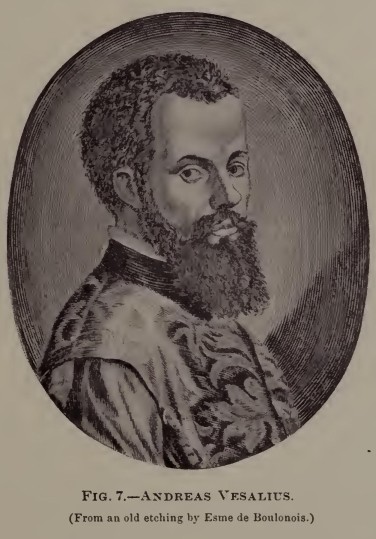
Original
The man of genius and courage, who accepted the truth of what his eyes revealed to him, and who was the true reformer in anatomy, was Andreas Vesalius, born at Brussels, in 1514, of a family already illustrious in medicine. He studied at the University of Louvain, where he early revealed the inclinations of the anatomist, since in his leisure moments he was wont to amuse himself in dissecting small animals. Near Louvain was a place where criminals were executed; and Vesalius, having observed the body of one from which the soft parts had all been cleaned away by ravenous birds, only the bones and ligaments remaining, detached the extremities separately, and then carried off the trunk by night, thus possessing himself of his first skeleton. Attracted by the fame of Sylvius, lie afterward went to Paris to become his pupil, but, not content with the lessons of his master, continued to observe for himself. On the hill Montfauçon, where executions took place, he disputed with dogs and vultures for the remains of criminals, or by stealth disinterred bodies from the cemeteries at the greatest personal risk. So great was his application that his progress became rapid, and at the age of twenty he gave instruction to fellow-students; at twenty-two he became Professor of Anatomy at Padua, being appointed by the Senate of Venice; at twenty-nine he issued his great work on anatomy, which showed a completeness that left far in the rear all that had hitherto been published on this subject. The following year he was called by the Emperor Charles V to the court of Madrid, then the most brilliant in Europe, where he became the first physictan, and from this time abandoned his anatomical labors.
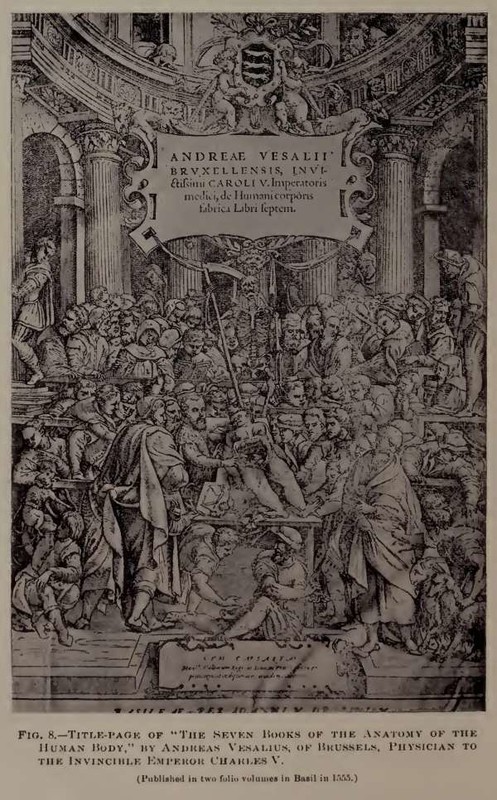
Original
He was the first who dared to dispute the words of Galen and point out his errors,—to ascertain that the greater part of Galen's descriptions, having been made from monkeys, did not correctly represent human anatomy. This audacity raised a crowd of vehement opponents, the least reasonable and most fanatic being his old master, Sylvius; but even these onslaughts could not conceal the truth. The minds of men generally were ripe for the revolution whose signal-fire was thus lighted, and no sooner did Vesalius appeal from the decision of Galen to observation of nature than a crowd of anatomists were ready to follow his method. He died in 1564.
One who, at Padua, had been first his pupil, then his co-laborer,—namely, Columbus, born at Cremona in 1490,—succeeded him. Columbus criticised, in some respects, the statements of his eminent predecessor, which he could better do, since he is said to have dissected fourteen bodies every year, as well as to have practiced venesection. He came so near to discovering the mystery of the circulation that it is strange how he could have missed it. He even appreciated the systole and diastole of the heart and the connection thereof with dilatation and contraction of the arteries. He knew, also, that the pulmonary veins conducted arterial blood, and that the pericardium was a shut sac. He even appreciated the lesser circulation, since he described how the blood left the right side of the heart and passed into the lungs, and came back through the veins into the left ventricle; because of this discovery, and in spite of his utter failure to appreciate the greater circulation, he has been by some regarded as entitled to the credit which is universally given to Harvey. From his position as teacher in Padua Columbus was called to Pisa, and from Pisa to Rome, where he died in 1559.
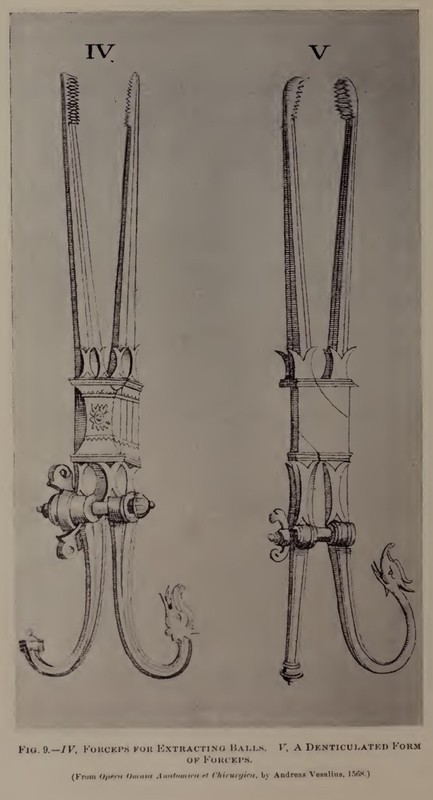
Original
Another of the great anatomists of this period, second only in fame to Vesalius, was Eustachius, born about the beginning of the sixteenth century. He became physician to the Duke of Urbino, and in Rome a city physician and professor of anatomy, continuing to teach in the latter city until overtaken by his final sickness. He was a defender of Galen rather than an opponent, and sought to shelter his reputation from the attacks of Vesalius. In his praise it must be said that, for his day, he was a great anatomist; his chief discoveries were in the domain of comparative anatomy. He brought to bear upon his work a knowledge of embryology which enabled him, for instance, to describe the kidneys and the teeth much more accurately than would otherwise have been possible; he noted, also the pathological changes in bodies dissected, and is brought daily to our minds as we think of the connecting channel between the pharynx and the middle ear, to which his name has been given.
He died in 1574.
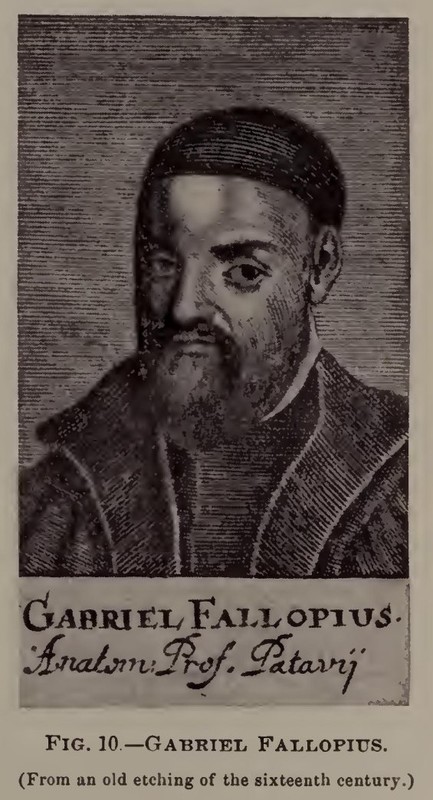
Original
Fallopius, born in Modena, in 1523, was professor successively at Ferrara, Pisa, and Padua. He cultivated anatomy with the greatest ardor, and, in consequence, his name is also linked with that of Vesalius, as are those of Herophilus and Erasistratus in the history of ancient anatomy. His anatomical researches included all parts of the human body, and his name has been given to the tube through which the ovum enters the cavity of the uterus. Death overtook him in the year 1562.
Jerome Fabricius, better known as Fabricius ab Aquapendente, was born in the town of the latter name, near the southern end of the Apennines, in 1537, received his no early education in Padua, and studied anatomy under Fallopius, whose assistant he also was. After the death of the latter he succeeded to the professorship of anatomy, and later built, at his own expense, a large anatomical theater, in which he lectured and demonstrated to students from all parts of the world. Toward the end of his life he had accumulated a large number of specimens, and published extensively on anatomy, embryology, physiology, and surgery. Though often accredited with discovering the valves of the veins, he is not entitled to that honor, since Erasistratus, Sylvius, Vesalius, and others had previously described them, Estiennes had seen them in the azygos veins, and Canano in other veins. His true claim to glory rests upon embryological researches, which he was the first to undertake in a comparative way. In De Formato Foetu he elucidated the development of the embryo and its membranes by a long list of observations on lower animals of many species. He was probably the first to describe the uterine decidua. Fabricius died in 1619.
This Fabricius must not be confused with the almost-as-renowned Fabricius Hildanus, who was born in Hilden, near Düsseldorf, in 1560. Under the German name of Wilhelm Fabry he became widely known as a surgeon, and, after traveling through France, settled in Hilden, but later moved to Cologne, where he founded an academy. His first treatise—on gangrene and sphacelus—quickly made him known, and went through eleven editions. From Cologne he went successively to Genf, Lausanne, and Polen; returned to Cologne; and finally, after several other visits, settled in Bern, where he died of gout and asthma (in 1634.). His frequent changes of location were, perhaps, less the result of instability than a testimony to his reputation, inasmuch as he was invited from one place to another. He has been, with propriety, named the "German Paré," since he rendered such great service to German surgery, and was not only an expert therein, but likewise a cultivated physician and polished humanitarian; in fact he was ahead of his time, by many years, in these regards, as is shown by his recommending amputation in cases of gangrene, and his writings concerning gunshot wounds. He enjoyed a ripe experience also in obstetrics, and even instructed his wife in the obstetric art and praised her ability most highly. His most important contributions to literature were in the field of surgery, and these passed through numerous editions, while his opinions and practice are quoted even to-day.
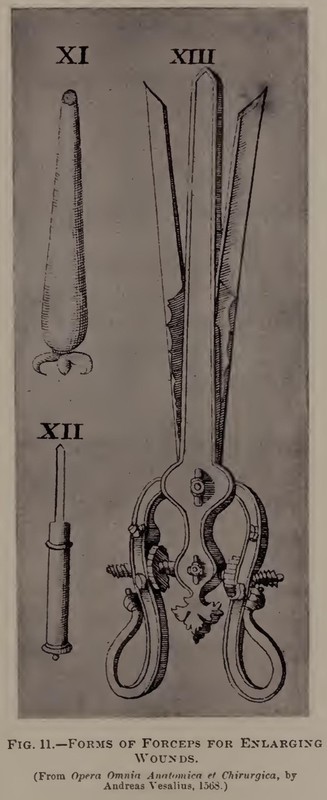
Original
During this epoch many modifications were introduced and improvements made in the teaching of medicine. Permanent amphitheaters were established for dissection, and chairs of anatomy created, their incumbents being paid out of the public treasury. The popes, appear to have taken the initiative in this respect, which accounts for the great number of subjects with which Eustachius was supplied, as compared with Vesalius, who obtained only two or three in a year. Up to this time the razor had been the sole instrument of dissection, but was now replaced by the scalpel, which remains in use to-day. By the labors of the few men mentioned anatomy acquired a degree of perfection which it had never attained under the Greeks. Skillful artists put their labors upon paper, and plates and descriptions made from anatomical preparations represented the various parts of the human body with more fidelity than had been supposed possible. Nerves, tendons, and ligaments were no longer confused, but traced so far as possible from origin to ramifications. Ancient errors generally were corrected. It was proven that there was no bony structure in the tissue of the heart, that the partition between its cavities was not porous; and attentive examination of its valves led to the discovery of the lesser circulation by Columbus. Michael Servetus, whom John Calvin burned at the stake, was perhaps the first to note this phenomenon. He saw that the blood could not penetrate directly from the right into the left cavity of the heart, but that it was necessary for the whole fluid to pass through the lungs, where it became impregnated with the vital spirit of the atmosphere, and reached afterward the left auricle; the position of the valves in the pulmonary arteries and veins clearly confirmed his conjecture. Moreover the size of the pulmonary arteries was enormous, and disproportionate to the quantity of blood necessary for the nutrition of the lungs, which seemed to prove that this was not, as had been believed, the sole purpose of those vessels. It was about this time that Fabricius ab Aquapendente pointed out valves in veins in various parts of the body, and that Columbus and Andreas Cesalpinus explained more fully the mechanism of the lesser circulation; in fact, the former so closely approached an appreciation of the purpose of the vascular system that some have thought he really knew it, but the passages in his writings thought to sustain this opinion are not at all conclusive. He seems to have confused the action of the heart during sleep with that during the waking hours; and although he realized that the blood could not flow backward through the arteries, that the vena cava was the only vessel which permitted the entrance of blood into the heart, and though he spoke of anastomosis between arteries and veins and remarked that if a band be applied around a limb the veins swell below the ligature, he contented himself with comparing the motion of the blood with the flux and reflux of Euripus, as Aristotle had done. It is even thus that he tortured his mind in trying to reconcile two irreconcilable theories,—i.e., the opinion of the ancients on the motion of the blood and recent discoveries in the anatomy of the vascular system.
CHAPTER V.
Age of Renovation (continued).—Erudite Period (continued): Benivieni, 11502. Jean Fern el, 1497-1553. Porta, 1536-1615. Severino, 1580-1656. Incorporation of Brotherhood of St. Come into the University of Paris, 1515. Ambroise Paré, 1510-1590. Guillemeau, 1550-1613. Influence of the Occult Sciences: Agrippa, 1486-1535. Jerome Cardan, f 1501. Paracelsus, 14931541. Botal, born 1530. Joubert, 1529-1583.
In the domain of pathology the Arabs had added only a very small number of observations to those contained in the works of Galen. The most interesting of these pertain to eruptive fevers. Most of their writers contented themselves with making an inventory of the acquisitions of the past, as did Guy de Chauliac, and this was about all they could do under existing circumstances; although they did not make discoveries, they prepared the way for their successors.
Two men about this time did a great deal in the direction of creating a desire for post-mortem study of cases, and in illustrating and succinctly describing symptoms.
The first of these was Benivieni, a Florentine, who died in 1502—the date of his birth being uncertain. To him, more than to any other, we owe the commencement of the study of gross pathology and pathological anatomy. He was the first to consider the knowledge that might be obtained by opening bodies for the sole purpose of ascertaining the location and cause of the diseases from which they had died. As Malgaigne remarks: "A eulogy which he merits, and which he shared with no other person, and which has not been accorded to him up to this time by the many historians of surgery who have superficially searched among these precious sources, is that he was the first who had the habit, felt the need, and set the useful example, which he transmitted to his successors, of searching in the cadaver, according to the title of his book, for the concealed causes of disease." The work referred to by Malgaigne was entitled: Concerning Some of the Secret and Strange Causes of Disease and was published in Florence in 1507. It is poor in quotations, but rich in original observations, which pertain especially to the etiology of disease, and gives a very concise symptomatology and history of each affection of which it treats, as well as a pathological explanation. Benivieni's observations on gall-stone, on the anatomical lesions of heart diseases, and on the conveyance of syphilis from the mother to the foetus were original, as well as many observations concerning the presence of worms and other parasites in the body.
He did not limit himself to dissection of his own cases, but sought autopsies in the cases of others. He examined the bodies of those who had been hung, always thinking to find in them something of interest. In this regard he was followed by one already mentioned,—namely, Eustachius.
After these two the men who most cultivated pathology and anatomy in the sixteenth century were Rembert Dodoens and Marcellus Donatus. The former was born in 1517, in Mecheln, traveled extensively, was physician to Maximilian II and the Emperor Rudolph, and died in 1585. The latter lived and worked in the latter half of the sixteenth century, the dates of his birth and death being somewhat uncertain.
The next man whom we must mention is one who did a great deal for internal medicine, pathology, and anatomy. Jean Fernel, who has been surnamed "the modern Galen," was born in Clermont in 1497. Even as a boy he showed great aptitude, and very early made himself a reputation in philosophy, law, and mathematics. In 1530 he was received as doctor, with the unanimous applause of the entire faculty of Paris. He seems to have been stimulated by this only to more extended study; in fact, so hard did he work at his studies that his friends became seriously alarmed for his health, and remonstrated with him; they received for reply: "Destiny reserves for us repose enough." He became physician to King Henry II, of France, and in the midst of a very extensive practice undertook to collect all the medical knowledge scattered in the Greek, Arabic, and Latin works, in order to form from it a body of doctrines. His work was written with a purity and elegance of Latin that reminds one of Cicero. Throughout its pages he was philosophic, and sought to unite the apparently irreconcilable doctrines of Plato and Aristotle.
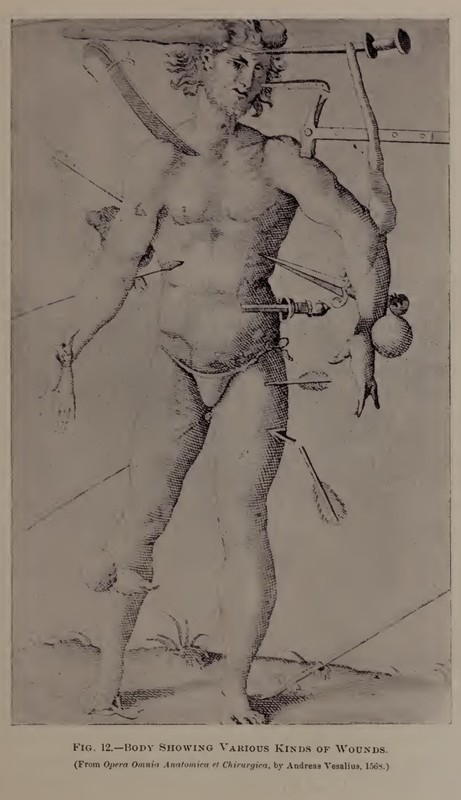
Original
He divided medical science into three great sections,—physiology, pathology, and therapeutics. In his explanations of disease he was too often fanciful, following the speculations mainly of Galen, and making free use of the hypotheses of humors, temperaments, vital spirits, etc.; but the following statement of his would do credit to a trained pathologist of to-day: "As for myself, I shall never believe I have profound knowledge of any affection if I do not know positively, just as if I could see it with my eyes, in what part of the human body is the disease, its primitive seat, what suspicion of organic lesions constitute it, whence it proceeded, if it exists idiopathically or by sympathy, or if it be kept up by some exterior cause. He who pretends to be a rational physician must sound each of these subjects, and discern them by certain signs." The problem which he thus set himself he certainly, for his own part, considered as solved, although it was not long before his solutions were set aside and the original uncertainty reappeared.
In therapeutics he very early laid down the fundamental maxim that every disease must be combated by contrary remedies, justifying this by every species of argument, amounting to this: that every disease must be combated by its contrary because all that cures a disease is contrary to it. This was, in part, the doctrine of "Contraria contrariis curantur"—the antithesis of the equally absurd sophism: "Similia similibus curantur" which three hundred years later was erected into an excuse for the foundation of an alleged new school. There can be no doubt that Fernel rendered very great service to his time and to subsequent generations, despite the fact that his recommendations and statements were too often founded upon sophistry.
Just here we must digress for a moment to consider the status of bleeding. Hippocrates and Galen had advised to bleed largely from the arm on the affected side in pleurisy and pneumonia. That practice was gradually abandoned as Greek traditions were lost sight of, and finally the Arabs substituted for it something entirely different,—namely, pricking a vein in the foot in order to let blood flow drop by drop. Their method prevailed throughout Europe until the commencement of the sixteenth century, or about the time when Fernel appeared upon the scene. A Parisian physician named Brissot had revived the ancient (the Greek) practice during an epidemic of pleurisy, and had obtained thereby astonishing success, which he hastened to publish, commending the method employed. He thus created a great uproar in the medical world. The innovation found foes and defenders, and disputes grew warm, even to the fever point. Finally, the ancient method was generally revived, and Fernel accepted it.
Felix Plater was born in 1536, in Basel, Switzerland, and died in 1614. He had several sons who made their mark in medicine. In his large work, which preceded that of Fernel, he took perhaps the first step in an unexplored route,—namely, in the classification of disease according to the totality of apparent symptoms. Defective as this classification appears in our eyes, its author lived a long life as a very distinguished practitioner and professor in his native town.
Giovanni Batista Porta was born in Naples in 1536, traveled extensively in Italy, France, and Spain, and founded in 1560 an Academy of the Segreti. He was accused of magic, and was compelled to refute the charges in Rome. He died in 1615, having been one of the leading scientists of his time, and the founder of modern optics. In the first edition of his Magia Naturalis, published in Naples, 1587, is found the first description of the camera obscura,—of course, in a very incomplete form and without lenses.
Severino was a celebrated surgeon of Naples. He was born in 1580, in Calabria, studied in Naples, became a doctor in Salernum, and then became professor of anatomy in his native town. For a long time the victim of intrigue and of persecution by the Inquisition, he was finally driven out of Naples, but was called back by the populace. He then became the most celebrated teacher of his time, writing extensively on a variety of subjects. He died in 1656 of the plague, an epidemic of which was at that time raging in central Italy.
Arriving now at the surgery of this Age, we find that matters were more chaotic than in other departments of medicine, and for reasons which are easily given and appreciated. While, ordinarily, external diseases are more easily discerned than internal, and while in a corresponding degree they can be more satisfactorily treated; while, in other words, external pathology has ordinarily taken precedence of internal in professional as in lay minds, this view seems to have been inverted for a time during the Middle Ages. Previous to the period now under discussion the sciences had generally declined in Europe, and surgery had fallen even lower than medicine, for the reason that medicine was in the hands of the priests, who had at that time something of a liberal education, while the practice of surgery was abandoned to a class of ignorant barbers, bathers, and bone-setters. No mechanic or artisan could take as an apprentice any youth without a certificate affirming his legitimate birth, and that he came from a family in which there were neither barbers, bath-keepers, shepherds, nor butchers. Among the men who were thus made social outcasts were those into whose hands most of the surgery of the fifteenth century fell. This was particularly the case in Germany, and other European countries were little in advance. We have seen that in France and in Italy Lanfranc and Guy de Chauliac did their best to rescue surgery from the hands of these men, but their efforts did not prevent it from being completely abandoned by the clergy, who devoted themselves to the practice of medicine.
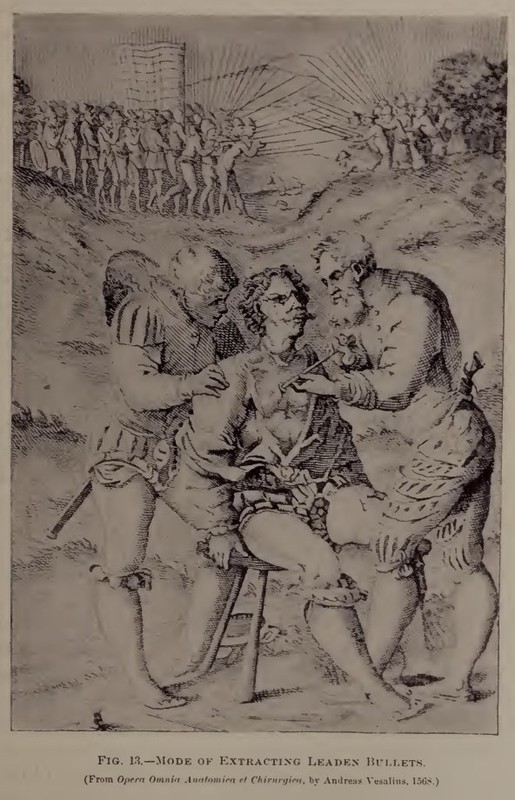
Original
When we come to inquire the reason for this—in other words, why an art so useful as surgery, and one which made such requirements for knowledge, sagacity, and dexterity, whose necessity was almost continually felt, particularly during these troublous times of almost constant warfare, should be so neglected by men who could best comprehend its utility and respond to its requirements—it is difficult to find a satisfactory answer. The social condition of the times sheds some light upon the question. The nations of southern Europe were socially divided at that time into the nobility, who were nearly always at war; the clergy, who monopolized learning and filled the so-called liberal professions; and, finally, the common people, who were common prey for both the other classes, and who yet had to support both without having any privileges of their own. While the practice of medicine was a clerical right, the canon of the church prohibited physicians from drawing blood, under pain of excommunication; and hence surgery, shunned by the priests, to whom it naturally belonged in connection with the practice of medicine, fell into the hands of the ignorant and vulgar, who practiced it in a purely mechanical way, without knowledge or appreciation of its possibilities. In addition to this, there was an almost total lack of detailed and precise anatomical knowledge, and but small reason to expect that the ignorant practitioners of surgery would feel the need of such knowledge. Moreover, most of the operators were itinerants, going from city to city, stopping so long as they had cases to operate upon or until some reverse forced them to depart. Most of these men limited themselves to one or two sorts of operations. Some operated for cataract, others for stone, others for hernia, nearly every one having a secret method which was transmitted to his posterity as a heritage.
In the history of medicine certain family names of itinerant operators have been preserved; for example, the Branca, the Norsini, in Italy, and the Colot in France.
Under such conditions there could be no such thing as the profession of the surgeon. The prejudice against dissection did not begin to abate until the thirteenth century, when a very few of the clergy dared, in a very timid manner, to perform surgical operations. Their numbers increased in the course of the fourteenth and fifteenth centuries, and in the sixteenth had become considerable. Most of the great anatomists of that period—such as Benivieni, de Carpi, Vesalius, Fallopius, and Fabricius ab Aquapendente—were great surgeons.
In due time it came about that while the clerical physicians were willing to descend to the rank of operators, the lay-surgeons aspired to the rank of doctors of medicine. This transformation took place especially in France, the only country where at that time there was a special college of surgeons—the small Brotherhood of St. Come, already alluded to, which was always contending against the faculty on one hand and against the barber-surgeons on the other, with varying results, and which, at last, sought peace with the university and was received by it. This took place in 1515, and was the renaissance of surgery, not only for Paris, but for the whole world. By this reunion the faculty acquired authority over the barbers, who were admitted to their lectures and took courses in anatomy and surgery, gradually attaining a knowledge which entitled them to be called barber-surgeons; their rights were not curtailed, but made more difficult of procurement, for, in addition to passing their initiation for the privilege of becoming barbersurgeons, they also had to pass an examination before the physicians and the two surgeons of the king, at Chatelet, for the right to practice surgery. The surgeons, as the price of their submission to the faculty, had, beside the university privilege, a sort of supremacy over the barbers; and thus it happened that the barbers were admitted to the rank of surgeons at St. Come, and that the surgeons of St. Come were admitted as barber-surgeons by the faculty of medicine. In this double capacity they approached nearer the profession of medicine, from which they should never have been separated, while surgery became an art which received numerous improvements. We must now devote a little time to the consideration of at least two or three of the men who most contributed to extend and elevate it.
Among those who most contributed to make the period of which we are now speaking a glorious one, raising himself from the lowest walks of life to the attainment of the highest professional honors, is Ambroise Paré, whose name will never die while the art of surgery is taught. Paré was born about the year 1510, at Laval, of poor parents. He was an early apprentice to the provincial barber-surgeons, after which a natural ambition for improvement led him to Paris (about the year 1532), where he studied three years at the Hôtel-Dieu, and obtained the confidence of his teachers to such an extent that he sometimes operated for them. He never learned Latin, the language at that time of the books and of the schools. Paré was most fond of recalling his hospital experience; he counted it among the highest honors of his life that he should have enjoyed what he there did enjoy, and gives us to suppose that he was a favorite upon whom peculiar favors were conferred. In one of his writings, a physician of Milan having expressed astonishment at so young a man's knowledge, he remarks with pride: "But the good man did not know that I had been house-surgeon for three years at the Hôtel-Dieu de Paris." The functions of the barber apprentices in the hospital in those days were probably to make dressings and bleedings, and sometimes post-mortem examinations ordered by the chiefs, to assist the latter in their operations, and to act in case of emergency; in other words, to do about as the internes at present do. They probably found there a precious and rare opportunity for anatomical dissection, but it does not appear that they had regular clinical instruction.
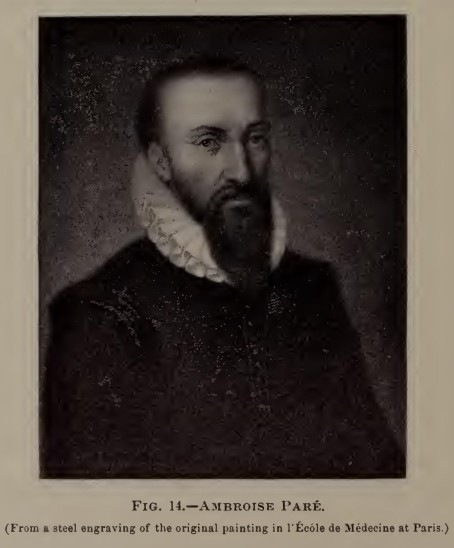
Original
Communication between master and pupil depended absolutely on the pleasure of the former.
In 1537 Paré was made surgeon to the Colonel-General of Infantry, René de Montijean, with whom he made his first campaign in Italy. (This was in the army which King Francis I assembled in Provence with which to repulse the invasion of Charles V.) He had never seen war nor recent gunshot wounds, and only knew of them by what he had read in the writings of John de Vigo. This was at a time when it was the custom of surgeons to pour boiling oil into every amputation or other wound in order to check haemorrhage; and Paré's experience in this, his first campaign, put him in the way of his first discovery,—a discovery which will never be forgotten. He has recounted in his Book of Arquebus Wounds and in his great Apology how after the affair of Pas-de-Suze he watched the other surgeons, dreaming of nothing else but to imitate them as far as he could; how the boiling oil gave out; how his anxiety about it prevented him from sleeping; and how to his great wonder he found that the wounded who had submitted to the operation suffered more than the others. This set him to thinking, and led him, a young man without name or authority, without letters or philosophical studies, to observe, to reason, and to combat a doctrine which was universally admitted and which the highest surgical authorities of the day sustained. At that time all authors who had spoken of gunshot wounds considered them as poisonous and complicated with burns; consequently they gave the precept to cauterize with boiling oil or a red-hot iron, and at the same time to administer certain alexipharmics which should serve as internal antidotes. John de Vigo, physician to Pope Julius II, assures us that the danger of these wounds results from the round formation of the balls, from heat, and from the poisonous qualities communicated to them by the powder. His theory and the method of treatment above given had been adopted without contradiction until the day when Paré dared to utter the first protest against them.
After a campaign of three years, in which he lost his master, he returned to Paris and married. In 1543 he was in the army of Perpignan, in the service of de Rohan, grand lord of Brittany, where he gave continuous proof of his sagacity. It was after this campaign that his reputation, so well established among warriors and the nobility, inspired Sylvius with the desire of seeing him. Paré has recounted how, in a conversation which they had together, he insisted upon the then entirely new precept, of which he had made many applications, that in order to extract bullets it was best to place the wounded in the position in which they were at the moment of injury.
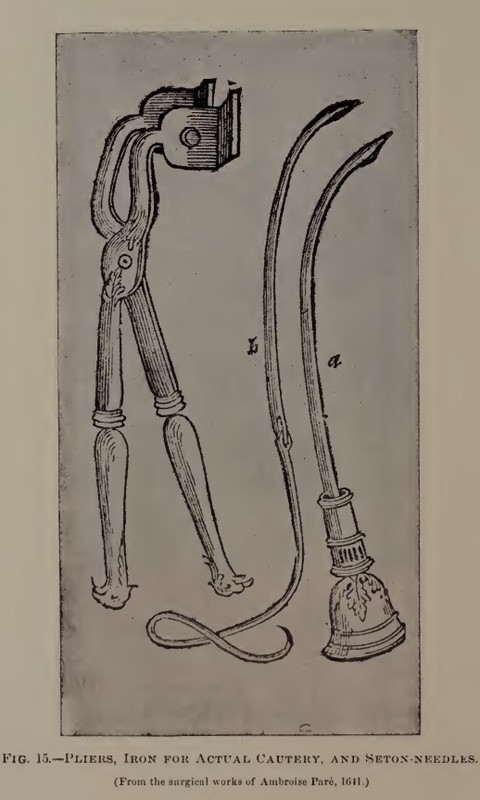
Original
Sylvius, then at the height of his fame, invited the young physician to dinner, and listened to him with great attention while he explained his views on gunshot wounds, which made such an impression upon the mind of the host that he besought him eagerly to write them out and make them public. Encouraged by this advice from so high a source, Paré prepared his text, illustrated it, and in the year 1545 brought out his little work, which marked in a manner so glorious the revival of French surgery. It was published by Gaulterot, the sworn bookseller of the University of Paris, and was entitled "The Manner of Treating Wounds made by Arquebuses and other Fire-arms, and those made by Arrows, Darts, and the Like; and also by Burns made Especially by Gunpowder. Composed by Ambroise Paré, Master Barber-Surgeon in Paris."
A few months later appeared the second edition, in which he still recommended the actual cautery in haemorrhage; but each day he meditated upon the subject, and on one occasion discussed it with two surgeons of St. Come, submitting to them the idea that, since ligatures were applied to veins and arteries, and to recent wounds, there was nothing to prevent their being equally applied to amputations. Both agreed with him, and opportunity soon presented itself at the siege of Damvilliers, when a gentleman had his leg crushed by a shot from the fortress. Paré made an amputation, omitting for the first time the use of the cautery, and had the happiness to save his patient, who, full of joy at having escaped the red-hot iron, said he had got clear of his leg on very good terms. This was, in truth, the actual renaissance of surgery, which had been to that time a torture, but which became thereafter a blessed art. It was a barber-surgeon who produced the double marvel. This took place in 1552.
In 1554, after other campaigns, Paré was made, without examination, Master of the College of St. Come, and in 1559 was included among the surgeons of King Henry II (who was killed in a tourney, in Paris, in 1559)r which position he retained with Francis II and Charles IX. The latter raised him to the highest position among his surgeons, and King Henry III retained him, which caused the witty and true remark that the kings of France transferred him to their successors as a legacy of the crown.
Many anecdotes are related of Paré to show the remarkable esteem in which he was held by public and private citizens. For instance, in October, 1552, one of the most eminent generals of Charles V laid seige to the city of Metz, and the emperor came in person to join the army. Within the walls of this beleaguered city were gathered nearly all the nobility and princes of France. The city was defended by the Duke of Guise, and the besieged soldiers were at that time suffering alike from the attacks of the enemy, the results of the siege, and the rigors of a frightful winter. The duke had established two hospitals for the soldiers, and had put into requisition the barber-surgeons of the city, giving them money with which to furnish their supplies. But these surgeons were sadly incompetent against the combination of unfavorable circumstances, consequently nearly all the wounded perished, and a horrible suspicion was roused among the soldiers that they had been poisoned. Under these circumstances the duke dispatched one of his captains to the king to say that the place could hold out for ten months, and asked at the same time for fresh medicine. The king sent for Paré, gave him money, directed him to take all the medicine he thought necessary, and furnished him a letter to Marshal St. Andre, who commanded in Verdun, and who bribed an Italian captain for fifteen hundred crowns to introduce into the besieged city the celebrated surgeon. The expedition was perilous, and Paré himself would have willingly remained in Paris. But he entered Metz on the 8th of December, at midnight, without an accident. Having passed already sixteen years in war, he was known to the chiefs and common soldiers. The day after his arrival, the duke, who knew how to strike the imagination, presented him on the ramparts to all the princes, lords, and captains, who embraced and received him with clamor. By the soldiers he was received with shouts of triumph. "We shall not die," they exclaimed; "even though wounded; Paré is among us!" From this time the defense was conducted with renewed vigor, and it has been universally conceded that to the presence of this single man the city was indebted for its salvation. The siege itself was not raised until after a terrific conflict. On the very day of Paré's arrival he began to treat the leg of one of the prominent officers, who for four days had been in charge of a charlatan, and had suffered horrible tortures. The next day he decided to trephine another, who had been struck on the head by a fragment of stone, and who had been insensible for fourteen days. Both patients recovered.
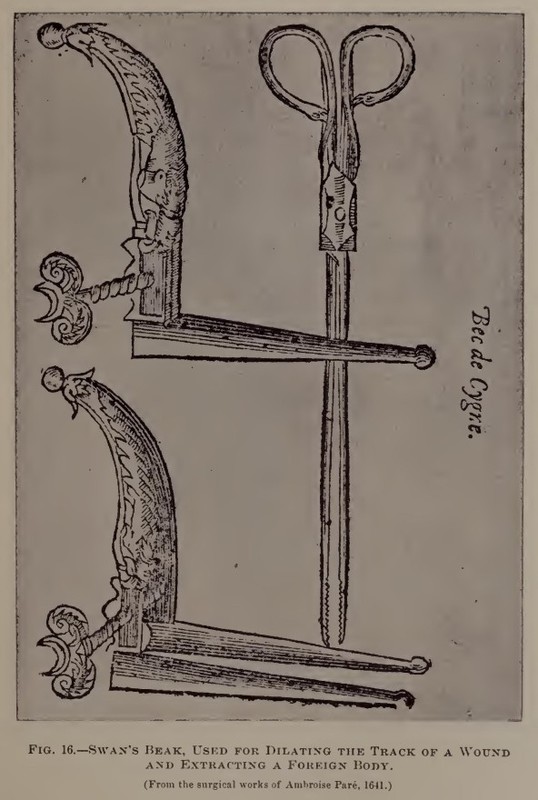
Original
The little brotherhood of surgeons of St. Come were ready to seize on every circumstance which might redound to their advantage, and desired to have within their ranks the man who enjoyed such great renown. They, therefore, admitted him to an examination, in spite of the statute which required that the candidate should understand Latin, and in spite of opposition by the professors of the university. They not only admitted him to all their degrees, but awarded him a reception,—a hitherto unknown honor.
Description of Fig. 17.—A, the instrument named, on account
of its figure, lizard's beak; in Latin, "rostrum lacerti."
It is used to extract balls which have been flattened or
imbedded in bone. A displays particularly the cannula. B,
hinge, by means of which the lizard's beak is opened and
closed as much or as little as the surgeon wishes. C, the
rod which opens and closes the lizard's beak. When drawn
upon it closes and when pushed it opens the instrument. D,
dilator and mirror: in Latin, "dilatatorium,
speculum." The instrument is somewhat roughened and
dentated in order to take a firm hold of whatever it grasps.
It may serve two purposes: first, to dilate and enlarge the
wound so that it may be seen to the bottom, and also to make
way for some instrument, as pincers or crow's beak, and to
grasp more easily and withdraw the foreign body; secondly,
it may itself serve to extract the foreign body,—e.g., a,
double-headed ball; b, a small chain; c, c, some pieces of
mail. E, E, crane's beak; in Latin, "rostrum gruinum." H2,
H, duck's beak; in Latin, "rostrum arserinum." K, sound. L,
ball-extraetor without cannula. M, cannula with handle.

Original
Paré in his time met with a success which to-day would be pronounced extraordinary. He seemed to inspire the wounded with the utmost confidence, and to possess greatness and firmness of character in the highest degree. It is perhaps, even more extraordinary that with so strong a character he should have so long retained favor at court. In the midst of the excitement of camps, and a very extended practice, he found time to read all that had been published on his art, and to compose himself a great number of works, enriching all branches of surgery. Instead of keeping secret his inventions, as was the custom of the time, he made them as public as possible, saying, in the preface of his large work on surgery: "For my part, I have dispensed liberally to everybody the gifts that God has conferred upon me, and I am none the worse for it; just as the light of a candle will not diminish no matter how many may come to light their torches by it."
Besides his smaller treatises, his large, collective works passed through a number of editions, and were everywhere reprinted and studied. Not only was he great in surgery, but he attained a high degree of expertness in midwifery. Among other things, he restored the forgotten practice of podalic version in cases where this procedure is necessary. He died in 1590.
The doctrine of Paré on gunshot wounds was rapidly disseminated. From 1550, Maggi, of Bologna, advocated it without giving credit to its real author, and sustained it by decisive experiments. He observed that none of the wounded felt any heat, and that the torn portions of their clothing showed no trace of fire; and he shot balls through packages of powder without setting them on fire. At the same time Lange spread this view in Germany, and Botal, of Turin, took it up (withholding, however, the true author's name).
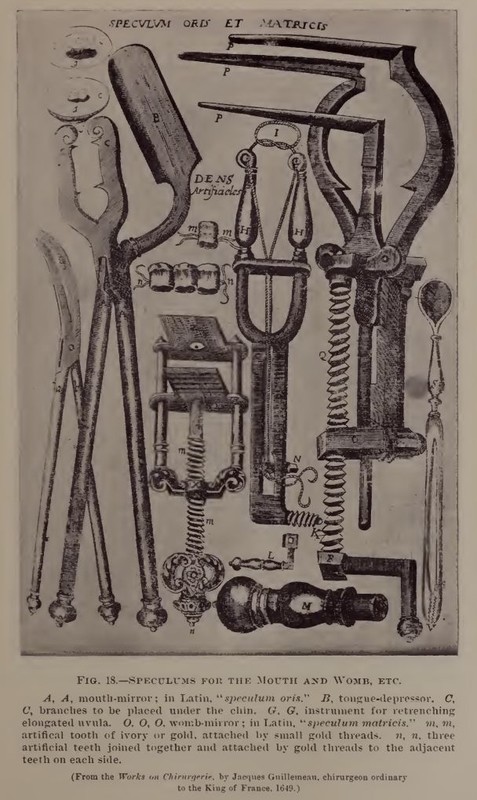
Original
While Ambroise Paré did not disdain to act as accoucheur, it was his friend and pupil, Jacob Guillemeau (1550-1613), who, in the sixteenth century, most occupied himself with the practice of obstetrics. We owe to Guillemeau the first improvements that the moderns made in this art; for instance, the proposition to rapidly and artificially terminate parturition in cases of considerable haemorrhage or when the woman is taken with convulsions during labor. Guillemeau supported this practice on the authority of Hippocrates, and operated on a great number of patients, proving its value and the danger of its neglect.
The Cæsarean operation was known to the ancient Greeks and Romans, but had been abandoned during the Middle Ages. It' remained for the accoucheurs and surgeons of the sixteenth century to re-establish it. Among others, Rousset, physician to the Duke of Savoy, who recommended it very warmly, reported several cases where it had a happy issue for both mother and child. He even reported the most remarkable case of all,—that of a woman who was six times delivered by this operation, and who perished in the seventh confinement, because, as he states, the surgeon who had been accustomed to operate on her was absent. Unfortunately, this case is not authenticated.
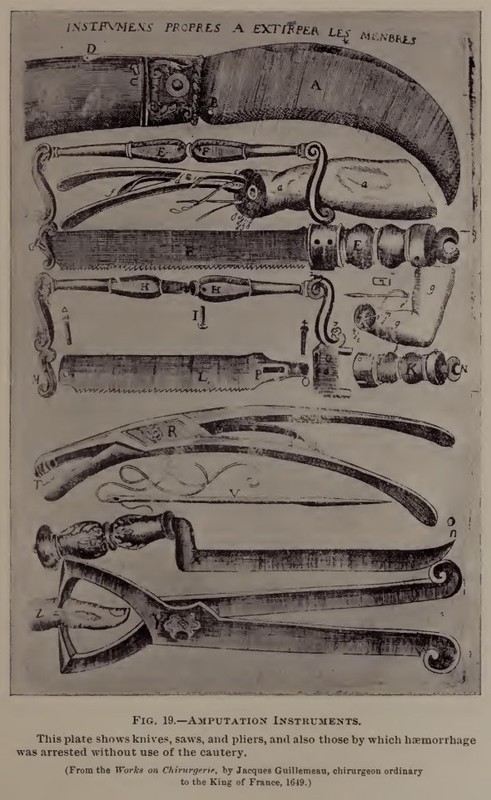
Original
Nothing shows better how the art of observation and accurate description of phenomena had progressed at the time of the revival of letters than the number of new diseases of which the authors of that period make mention. Then, for the first time did one read of whooping-cough, miliaria, scurvy, plica polonica, syphilis, and raphania. It is scarcely credible that these diseases fell upon Europe at this particular time. It is more probable that they had a more ancient existence and were not recognized.
Even to-day medical men are divided in their own opinions on the origin of syphilis, some believing that it was developed spontaneously in Europe toward the close of the sixteenth century, others that it was imported from the New World, others that it had a most ancient origin, and others yet that it represented a degenerated form of leprosy.
Certain it is that syphilis appeared almost simultaneously in all parts of Europe,—at Bologna, Halle, Brunswick, in Lombardy, Apulia, Auvergne, and so on. Léonicenus attributed this sudden outbreak to an extraordinary inundation that occurred in all parts of Italy toward the close of the fourteenth century, and supported his views with the authority of Hippocrates and Galen. Others attributed it to astrological influence; while still others regarded it as a scourge of God with which to punish men and turn them away from unbridled libertinism, Fallopius thought venereal disease was engendered by the poison which the perfidious Neapolitans had thrown into the wells from which the French drew their water. These wild views simply indicate the spirit of the age. Oviedo published in 1545 a history of the West Indies, in which he states that syphilis originated in America. He held that when Columbus returned from his second expedition to the New World, in 1496, his men enlisted under Gonsalvo de Cordova to go and fight the French, who had invaded the Kingdom of Naples, and that they communicated to the French and Neapolitans the disease which they had brought from San Domingo. Unhappily for his veracity, it is certain that syphilis broke out in Naples at least two years before the arrival of the Spanish fleet. It is equally certain that at none of the points at which Columbus touched on his return from his first expedition was there any manifestation of syphilis for years.
At this time the venereal disease, so-called, included those conditions which we now differentiate under the names of syphilis, chancroid, and gonorrhoea,—a confusion of diseases which persisted even up to the time of John Hunter. It is worth while to publish this fact, since writers of two or three hundred years ago may not have meant by the term "syphilis" just what we would mean to-day. Without going into this question here, it is enough to say that one who reads intelligently may see in the Sacred Scriptures unmistakable allusions to this disease. If the statements of David, as contained in the Psalms, are reliable, he was himself a serious sufferer from it. The ancient Greek and Arabian physicians make mention of lesions which could only be attributed to this disease; and the Latin satirists, like Horace and Juvenal, describe symptoms of a certain kind as being the fruit only of shameful practices.
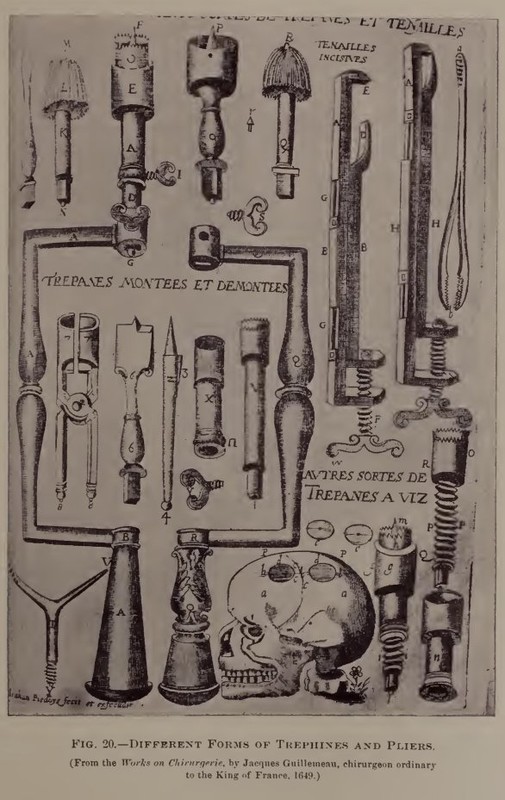
Original
It is most likely that the sudden appearance of syphilis in nearly all parts of Europe at about the same time, which has been regarded as so extraordinary, can be explained by the clearer distinctions physicians began to make between symptoms of this disease and those of leprosy. Arrangements for the cure of lepers were very complete, and such syphilitic patients as responded kindly to the treatment thereby established themselves in a very different category of disease.
The first writer to systematically consider venereal disease was Astruc, who was born in Languedoc in 1684 and died in 1766. He was the principal advocate of the view that syphilis had an American origin, in which view he was bitterly opposed by Sanchez, a Portuguese physician, who collected a large amount of evidence to the effect that its first ravages were observed in Italy.
Summing up this whole matter, we may agree with Jourdan, who has examined all the opinions of these writers, and who, in his treatise published in 1826, concluded that all symptoms which had been hitherto connected with syphilis had been known and described from the remotest antiquity, but were not supposed to proceed from a common source, and to be attached to the same cause, until after the close of the fifteenth century.
THE INFLUENCE OF THE OCCULT SCIENCES ON THE MEDICINE OF THIS PERIOD.
Most of the partisans of occult science were restless minds, such as are found in all ages, who chafed under the yoke of authority, and who practiced as well as deduced their lines of thought and conduct in accordance with their own ideas. Some of these men did not lack in sagacity, imagination, or audacity, but almost all of them lacked in consistency of idea and dignity of thought. Most of them lived isolated lives, apart from each other and from the rest of the world, and were, to a large extent, what we would now regard as "cranks." While they made a wide departure from accredited doctrine, they depended upon imagination rather than upon reason. This happened to be a period, however, when such men achieved great notoriety,—more so than the same class of individuals have done since their time.
Cornelius Agrippa (born in 1486) was an early promoter of occult science. He came of a noble family of Cologne, received the best éducation of his time, was a man of varied attainments, great inconsistency in conduct, and a caustic humor which everywhere made him enemies and prevented him from having any settled abode. He wandered from place to place, sometimes honored with the favor of the nobility and sometimes plunged into extreme misery. He early became a secretary in the court of Emperor Maximilian I, and under that monarch distinguished himself in the army by such bravery as to win him spurs as a knight. Soon disgusted with the profession of arms, he devoted himself to law and medicine, but his intemperate pen soon drew him into quarrels and persecution. At Dole he fell out with the monks; at Paris and Turin he compromised himself with the theologians; at Metz he incurred the animosity of the Jacobins for attacking the prevailing opinion that St. Ann had three husbands. He became a vagabond and almost a beggar in Germany, England, and Switzerland, and then went to Lyons, where the mother of Francis I, who was then Queen Regent, made him her physician. He soon lost favor here, and was disgraced and banished; then he went to the Low Countries, where he was imprisoned on account of his treatise on The Vanity of the Sciences. Afterward he returned to Lyons, was imprisoned anew, for an old libel against his former patron, and finally died in the hospital of Grenoble, in 1535, at the age of about fifty. His treatise on The Vanity of the Sciences made him most trouble, and showed best both his bitterness of spirit and the extent of his learning. Herein he laid down the paradox, which was later renewed and sustained by Rousseau, that there is nothing more pernicious and injurious to common life, or more pestilential to the salvation of souls, than the arts and sciences. He founded this thesis on Scriptural authority, and supported it by profane testimony.
The conclusions which Agrippa drew were not so strange to the eyes of his contemporaries as they are to ours. Long before him, men of character and attainments, such as Pic de la Mirandola and Bessarion, had attempted to introduce the Platonic idea, that the best means of acquiring science and truth were introspective. They were, moreover, persuaded that a great number of phenomena and events have their origin in astral influences. From this system to the extravagance of the Cabal * is but a step; indeed, the Christian doctrine, that events and phenomena are influenced by the direct intervention of the deity or of the devil, is but a small transposition. The cabalistic theory, summed up, was that all the events of life and all the phenomena of nature proceed from influences which gods, devils, or the stars exercised on the "archetype"'—that is, on the essential spirit, or substance. He who could withdraw his spirit possessed supernatural faculties. The day and the hour of birth, according to this view, were under the domination of particular stars and each of the principal members of the body was supposed to correspond with some planet or constellation. This is the fundamental idea underlying the pictures—which are still to be found on almanacs used by quack-medicine firms—of the individual whose interior is so completely and uncomfortably exposed, while around him are arranged the signs of the zodiac, with indications as to which part of the body is governed by each.
* Cabal, or Kabbalah: A theosophieal or mystic speculative
system, of Hebrew origin, which flourished from the tenth to
the sixteenth century. It included a mystic theosophy and
cosmogony, attributing to deity neither will, desire, nor
action, but teaching that from it emanated wisdom, grace,
intellect, power, beauty, firmness, and other attributes. It
also ascribed hidden meanings to the sacred Hebrew writings
and words. Even in the letters and forms of the sacred words
the followers of the cabal pretended to find wonderful and
hidden meanings; hence the modern expression "cabalistic."
The teachings of the cabal were esoteric, of course, and
inculcated mysticism and occultism in everything, but
appear to have been more or less influenced by neoplatonism.
Occult philosophy, built upon this foundation, was divided into four branches: theosophy, to which a man raised himself by prayer; magic, or the art of controlling demons; astrology, or the art of reading future events by the stars; and alchemy, which teaches the secret of extracting the essence or the archetype of substances,—i.e., virtually the secret of the philosopher's stone, by which metals were to be transmuted and then abolished.
And so the errors of science, the prejudices of the superstitious, the excitement of the religious, and the cupidity of the rich and powerful, all concurred to propagate the faults of the cabal at the close of the Middle Ages. Never were there seen so many sorcerers, astrol-ogists, and alchemists; never were prophecies, visions, and prodigies so common. Whatever happened, it was pretended that it had been announced by some previous sign, or that it was a revelation of the future. This particular kind of folly persisted in Germany longer than in any other part of the world. Even Martin Luther seemed to share many of the cabalistic views, and his alleged struggle with the devil, his adventure with the inkstand, and so on, contributed much to spread them, and were, perhaps, the most prominent illustrations of their general acceptance. Surely, these were the Dark Ages.
Jerome Cardan was born at Pavia in 1501. His life, like that of Agrippa, was one of vicissitude and inconsistency. Being the idol of his mother and the detestation of his father produced a peculiar effect upon his character. When he began to study he made rapid progress, and at the age of twenty-two was able to discuss publicly all questions. About two years later he received his doctor's hat. He practiced medicine in various places until he was thirty-three, and was then made professor of mathematics at Milan. He occupied this position but two years, then traveled in Germany, France, and England, and returning to Italy was imprisoned for debt in Bologna, and finally obtained a pension from the pope, in Rome, where he died in 1556. He was a man of great attainments and sagacity; his literary style was dignified, and, if he had not developed such a taste for the marvelous, such inconceivable credulity and superstition, and such vanity and boasting, he would have been a remarkable character in his age. Leibnitz said of him: "Notwithstanding his faults, Cardan was a great man and, without his defects, would have been incomparable." He wrote extensively on philosophy, mathematics, and medicine. Sometimes he admitted to his writings the most absurd statements of visions, etc., and again affirmed that he had never devoted himself to cabalistic art, blamed those who practiced it, and jeered at those who believed in it. He wrote extensively on chiromancy. For his own follies and misfortunes he apologized, attributing them all to the influences of the stars.
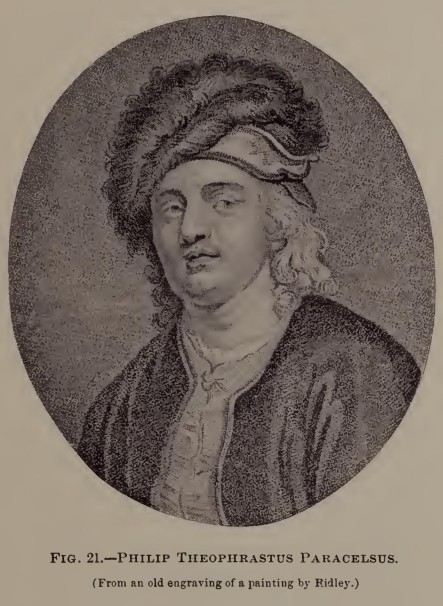
Original
The most colossal figure in this collection of mediaeval charlatans and knaves was Paracelsus. He was born in 1493, near Zurich, of a well-to-do family, his father being a physician. He had a good preliminary education, and then visited the various universities, or rather university towns; but, instead of listening to the professors, Paracelsus associated with clever women, barbers, magicians, alchemists, and the like, from whom he acquired much information. He was led at once to the vagaries of the cabal, and, according to his own statement, he did not open a book for ten years. He neglected his studies and forgot his Latin, so that he became incapable of expressing himself in that language. From the age of twenty-five he became a hard drinker, and this habit ultimately worked his ruin. One of his disciples says of him that during the two years which he passed with him he was so inclined to drinking and debauchery that he could scarcely be seen for an hour or two without being full of wine, although that condition did not prevent him from being admired by every one as a second Æsculapius.
At this time Paracelsus was between thirty-three and thirty-five years of age, and at, apparently, the most brilliant period of his life. He had written extensively and with emphasis of his numerous cures, after the fashion of charlatans of those days,—and, unfortunately, of to-day,—and claimed to be possessed of infallible secrets against the most intractable diseases. He had just been called to Basel to the chair of physic and surgery, and crowds of curious and idle persons attended his lectures, which he gave in the vernacular, and not, as was customary in those days, in Latin. In order to strike his auditors with astonishment, he began by burning the works of Galen and Avicenna, and then reading from his own writings, breaking off from time to time into the statement: "Know, ye doctors, that my hat knows more than you; that my beard is more experienced than your academies. Greeks, Latins, Arabians, French, Italians, Jews, Christians, and Mohammedans, you must follow me; I shall not follow you, for I am your monarch, and sovereignty belongs to me." As may be imagined, his professorship was not one of long duration, and he soon had few or no listeners. In consequence of some mishaps he left Basel quite precipitately, his departure causing no such sensation as his arrival. He then resumed his nomadic life, and we find him at Alsace in 1528, at Nuremberg in 1529, at St. Galle in 1531, at Mindelheim in 1540, and in the following year at Salzburg, where he died in the hospital at the age of forty-eight.
Few men there are of whom so much good and so much evil has been written as of Paracelsus. Few are there of whom it is to-day so hard to judge, since, if we refer to his contemporaries, they disagree completely concerning him, and if we refer to his own writings we fall into still greater chaos and have to abandon the attempt. His writings show ideas without connection, observations which contradict each other, and phrases which defy comprehension. At one moment he gives proof of admirable penetration, at the next simply abject nonsense.
That he exerted an influence upon his time is certain, but that this influence was retrograde rather than progressive seems quite likely. His exact duplicate has probably never existed since his time, and we may say that never was there another man like Aurelius Phillip-pus Theophrastus Paracelsus Bombastus ab Hohenheim—his full name.
Although this man was such a prominent character in his day, his name must be erased from the list of those who have contributed to the world's progress. He was simply a pretended reformer, who counted as nothing the most erudite writings, and who relied solely on his own experience. He had the most profound self-confidence, and played upon the credulity of his neighbors and victims with the toys which were furnished him by the prevalent cabalistic notions of the day. The school which he would have founded was nothing but a school of ignorance, dissipation, and boasting—a school of medical dishonesty. In a word, it was, as Renouard has said, "a school of which Thessalus, of Tralles, had been the Corypheus in antiquity, which John of Gaddesden revived in the Middle Ages, and to which Paracelsus gave a new development."
While, as has been briefly recounted, the partisans of the occult sciences strove to completely overturn the scientific edifice of antiquity, other reformers, more sensible and less daring, were content to expose its defects without attacking it in its entirety. These were, for the most part, enlightened men, and at the same time free thinkers,—friends of progress, and not of destruction. During the sixteenth century these men were few in number, but at least three or four of them deserve mention.
John Argentier was born in Piedmont, and taught in Naples, Pisa, and Turin. He did not hesitate to take issue with the theories and statements of Galen, and criticised those who adopted them too servilely. Of him it may be said that, although styled a reformer, nevertheless, he kept too near to the doctrines of those against whom he inveighed to seriously weaken their position.
Leonard Botal, also a Piedmontese, was born in 1530. First a surgeon in the French army, he later became physician to the kings Charles IX and Henri III. He was the first to recommend frequent and general bloodletting. Apparently before his time this practice was greatly restrained. He carried his views so far as to maintain that an infirm old man should be bled from two to six times a year, and that it was good custom to open the veins of healthy individuals every six months. He wrote a remarkable memoir on the cure of disease by blood-letting. It is not to be denied that he obtained some remarkable success with his copious venesections, and it must be said, in his defense, that, if he overdid it, his contemporaries did not resort to it often enough, and that his own practices were instructive to others. In his writings he united independence and energy of thought with elegance and purity of style.
Joubert (1529-1583) was Chancellor in the University of Montpellier and physician to King Henri III. He wrote a treatise on Popular Errors, which had an unheard-of success. In less than six months there were sold nearly five thousand copies, which, considering the times, constituted a prodigious edition. For one thing, it was written in the common tongue, and so placed within the reach of all. It was also diversified with anecdotes and jokes, some of which were not of the most delicate character; in fact, the author endeavored to atone for some of its salacity by dedicating it to Queen Marguerite. He really proposed for his main purpose a serious and useful one,—namely, that of combating prejudices which were both injurious and ridiculous. Although we may make light of Joubert's treatise, it certainly achieved a useful end by dissipating a multitude of errors, giving information to those who could scarcely get it as well from any other source. That it was full of defects is simply another form of saying that it was published in the middle of the sixteenth century.
It was during this period of which we have written that the separation of the priesthood from medicine was completed. From the sixteenth century celibacy was not obligatory on physicians in the Kingdom of France, and they no longer enjoyed ecclesiastical benefices. At this time, too, surgery, which had naturally been separated from medicine, began to approach it, the combination thus gradually brought about inuring to the benefit of all concerned. From now on, the professors of St. Come were on the same level as the professors of the university, and enjoyed equal privileges. Institutions for instruction in medicine increased, and those which already existed were developed. Amphitheaters for dissection were open in every city in Europe. Hospitals and dispensaries were established alongside the schools, and by the various governments more attention was paid to the protection of the public from imposition, and to the amelioration of every evil affecting either public or private health.
CHAPTER VI.
Age of Renovation (continued).—Student-life During the Fifteenth and Sixteenth Centuries. Ceremonials Previous to Dissection.—Reform Period: The Seventeenth, Eighteenth, and Nineteenth Centuries. Modern Realism in Medicine and Science. Introduction of the Cell-doctrine. Discovery of the Circulation. William Harvey, 1578-1637. Malpighi, 1628-1694. Leuwenhoek, 1632-1723. Correct Doctrine of Respiration. Discovery of the Lymphatic Circulation. The Nervous System. Discovery of Cinchona. Development in Obstetric Art, in Medical Jurisprudence, in Oral Clinical Teaching. Van Helmont, 1578-1644.—The Iatrochemical System: Le Bôe, 1614-1672. Thomas Willis, 1622-1675.
For a long time the Italian universities held the first rank; next came the French; and last the German, although all were well attended. The most famous were the medical faculties of Bologna, Pisa, Padua; then Paris, Montpellier, and, finally, Basel.
A little of what concerned the student-life of this period may not be amiss. The students chose the rector and officers of the universities, sometimes even the teachers, and assisted in determining the curriculum of study, the execution of which they watched. In some of the Scotch universities even now the students choose the rector.
The students were divided, usually according to country, into bodies denominated "nations" (some having special seals), which were the parents of the present stu-dent-corps in German universities. Certain representatives, known as vice-rectors, were chosen from each of these corps and constituted a so-called college of rectors which negotiated with the officials of the State, and possessed a power that was preserved until the end of the sixteenth century.
The poorer class of students passed from one school to another, supporting themselves by singing, begging, or stealing, and were sometimes guilty of great barbarities. The younger scholars, called "Schutzen," were compelled to perform most menial duties for their older comrades, the "Bacchanten,"—much like the system of fagging still in vogue in English grammar-schools; and when the bacchantes were admitted to the university proper they were required to pass through an initiation, or hazing, which eclipsed anything known in these days; indeed, the antiquity of fagging may be traced back even to the philosophic schools of Athens. The habits of the traveling scholars led many of them into dissolute and vicious ways, though some attained respectable positions,—possibly even eminence. The students who were better situated financially; for the most part entered the Italian universities.
Already mention has been made of the enormous number of students congregated during this age in Bologna and in Naples. In the small University of Wettenburg there were, in 1520, only about six hundred students; in Erfurt, three hundred, and this number dwindled two years later to fifteen; in 1500 Leipzig had four hundred students; at the same time there were about seven thousand in the University of Vienna. Students and teachers migrated from one place to another, and faculties were constantly changing. Great teachers were received with great ceremony. Bitter struggles and disputes between teachers sometimes occurred; it is related of Pistorius, who died in 1523, and Pollich, deceased in 1513, that they conceived a violent enmity toward each other because of antagonistic views relative to the epidemic or contagious character of syphilis, and both ultimately left Leipzig for other schools.
Some curious customs prevailed. In teaching anatomy, while the learned teachers explained the parts as exposed, the dissections were left to barbers as being unworthy of an educated medical gentleman. While the cadavers were mainly the corpses of executed criminals, it was thought that before and after each special dissection religious ceremonies were appropriate, and such were often held; it was also believed that all who came in contact with such a corpse would be made disreputable unless it were itself first made reputable; hence the professors first read aloud a decree to that effect from the magistrate, and then, by order of the senate of the faculty, stamped upon the breast of the corpse the seal of the university. The body was next carried into the anatomical hall, and the cover of the box in which it had been transported was returned to the executioner, who remained at some distance for this purpose. If the corpse was one that had been decapitated, during these solemn ceremonies the head was placed between its legs. Finally, an entertainment with music, often furnished by itinerant actors, was given. But this folly was gradually discontinued, and by the second half of the sixteenth century public dissection was performed without recourse to such mummeries. The price of skeletons in those days was high; the University of Hiedelberg, in 1669, paid seventy-two dollars for one.
The practitioners of the sixteenth century were often quite as roving as the students and professors, though those who held positions as State physicians were bound by contract to a fixed residence for a certain time. In 1519 the State physician of Heilbronn received a salary of twenty-one dollars per year and his firewood, but could not leave the city over night without permission of the burgomaster. Medical attendants of the King of Spain were required to kneel down when they felt the king's pulse. There were few physicians who acquired wealth, although Fabricius ab Aquapendente left a fortune of two hundred thousand ducats.
The Reform Period is the name which Renouard has given to the time beginning with the commencement of the seventeenth century,—a time when the domain of natural science was daily enlarged, and when observation had enriched human knowledge with multitudes of new facts, some of which harmonized with, and some of which were in opposition to, prevailing doctrines. Men whose knowledge equaled their genius began to need a radical reform, and by such men intellectual improvement was begun by which the decrepit theories of the schools of the Middle Ages were eradicated and by which there were substituted for them others which harmonized much better with known phenomena. To the period of worship of ancient authority succeeded one characterized by a desire to shake off the yoke of the same, and men now struggled, as it were, to free themselves from the tyranny of the past. As Galileo was the torch-bearer for regeneration of the knowledge of physics, and as Kepler, and others already named, or to be named, did as much for other branches of science, so there were not lacking those who broke away from the restraint of authority in medicine, and began to beat or choose paths for themselves among the facts which experimental science furnished them.
With the approach of the seventeenth century there was evident improvement in both the social and mental status of medical men. While political humiliation and exhaustion were everywhere noted, in the field of literature it was evident that the line had advanced. What may have been the effect of thirty years of religious war, with other political struggles carried on under the hypocritical cloak of religion, may be imagined, if not fully described; the devastation of whole countries by disease, and notably by the plague,—the poverty and hunger consequent upon the ravages of perpetual war (it is stated that even so late as 1792 there were still in Saxony 535 wasted and extinct villages), to say nothing of the barbarity and immorality resulting therefrom,—all combined to make the early part of the seventeenth century a most mournful epoch. It is not strange that, with poverty, superstition and great rudeness of manners prevailed, or that trials for witchcraft and persecutions by the Jesuit Inquisition were common. That any advance should have been made under such circumstances speaks well for the progress of the human mind. That this advance was slight in Germany and central Europe is not strange, though other countries were able to quietly enlarge their scientific borders. Now it was that England, Italy, and the Netherlands, which took but little part in the warlike struggles of the century, acquired leadership in medicine, and were seconded by the French. In Great Britain, science had been fostered by various kings, and particularly by Charles II, who professed to be something of a chemist; in fact, an epidemic of scientific interest fell upon the English court.
The seventeenth century, in contrast to the idealistic sixteenth, witnessed the advent of modern realism in almost all departments of thought. Medicine furnished the first example in what we are accustomed to-day to speak of as the exact method; hence, the century is of great importance, in that physicists and chemists began to be original, instead of mere followers of the past. The most notable feature of medicine was the promulgation of three medical systems: the pietistically colored Paracelsism of Van Hel-mont; the chemical system of Sylvius; and the iatro-cliemical system of the physicist and mechanician, Borelli. This period is, moreover, illumined by the life of one great practitioner, whose name will be imperishable in the history of our art,—namely, Sydenham.
The principal tendency of the time was toward skepticism, which had begun in the preceding century with Montaigne, and was continued by Charron, under the patronage of Queen Marguerite of Navarre; it was the fundamental idea of Pierre Bayle, the author of the great dictionary. Opposed thereto was the supernatural philosophy, or the theosophic, cabalistic, or mystic. The leading exponent of the latter was Boehme, who was a business colleague of the celebrated "Meistersinger," Hans Sachs, in Germany, and of Blaise Pascal and his contemporary.
Malebranche, in France. The doctrine of Lord Bacon, Lord Verulam (1561-1626), a man who showed himself as exalted in mind as he was mean in personal traits, was of great importance Bacon is a landmark in history as the defender and eulogist of modern realism,—i.e., of inductive philosophy. While personally contributing but little to the advance of science, he taught a great method; as Gruen says, he was the philosopher of patents and profit; he recognized the compass, the art of printing, and gunpowder as great inventions, but placed little value on the discovery of Copernicus, having little comprehension of mathematics. Hobbes and Locke went farther into realistic philosophy, and the latter was an exponent later of pure empiricism.
In the seventeenth century, also, zoology and botany were largely extended. In it lived Swammerdam (1637-1680), famous as a naturalist, physiologist, linguist, poet, and savant; there were others, also, whose names are better known in the history of collateral science than in medicine, and who left conclusive demonstrations in accordance with their theories, and made daily use of the microscope, simple as it then was. The term "cell" had been introduced by Hooke in 1667, and Malpighi and Grew were the founders of the cell-doctrine. The astronomical laws discovered by Copernicus changed the course of the world's thought; and now appeared the brilliant Kepler (1571-1630), and Galileo (15641642), the defender of the Copernican system, and the persecuted discoverer of the law of falling bodies, of the thermometer, the telescope, and the movements of Jupiter; also, Sir Isaac Newton (1642-1727), whose discovery of the laws of gravitation in 1665 marked an era in the history of science. This century, too, gave birth to Romer, who in 1675 calculated the velocity of light; Huyghens (1627-1693), who discovered the polarization of light and the satellites of Saturn; James Gregory, who in 1663 made a reflecting telescope with a metallic concave mirror; Torricelli, who in 1643 measured the weight of the air; Gascoigne, who invented the micrometer in 1639; and Napier, who invented logarithms in 1700.
Now chemistry, having ceased to be alchemy, began to don the dignity of a science per se, and it may be claimed that medicine derived no slight benefit therefrom. Scientific societies and journals arose at this period, and were all of good service to medicine in their way. The church scented danger to the faith in everything which related to natural science, and founded certain secret associations, especially in Italy; the Accademia Degli Lyncei, so called from its seal, which bore the image of a fox or lynx, founded in Rome in 1603, was one of these. Counter-societies, or, rather, societies with opposite purposes, were also started, and the original and private so-called Invisible Society, which was originated mainly by Milton, in 1645, and remodeled by Charles II in 1662, is now the flourishing Royal Society. In France the Academy was founded in 1665 by Colbert, but developed its first real activity thirty-five years later.
Those who to-day are so familiar with the course of the circulation of the blood through the arteries and veins find it difficult to understand how the recognition of this phenomenon could have been so long delayed; it seems so simple, yet to the ancients it was perfectly incompre-hensible! Although every one had recognized that blood would flow from an incision, few stopped to reason thereupon. From time immemorial it had been supposed that the veins had their origin in the liver, and were the only vessels which contained blood, since the arteries were always found empty after death; the latter were held to contain only air or spirit. The circulation was supposed to leave and return to the liver through the venous canals by undulating movements similar to those of the waves of the ocean; and this was the doctrine of the Asclepiadæ, and probably of Erasistratus. Galen modified this view by showing that the arteries contained blood; he knew it was poured into the right cavities of the heart by the great veins, but he believed that only a small quantity passed from the right ventricle into the lungs, and that the major portion reached the left ventricle by passing through pores in the inner ventricular septum. This opinion was uncontested until the middle of the sixteenth century.
Then the theologian, Michael Servetus, who, in 1553, perished as the victim of Calvin's jealousy, denied the passage of the blood through this septum, contending that it was returned from the lungs to the left side of the heart by the pulmonary veins. This was a happy thought, and a great step toward the truth. Soon after Columbus demonstrated anatomically that the conjecture of Servetus was plausible, by showing the function and real use of the valves of the heart. Cesalpinus came still nearer to the truth, and explained, as did Columbus, the course of the circulation through the lungs, but he opined that blood and vital spirits passed from the arteries into the veins during sleep, because at that time there was swelling of the latter and diminution of the pulse. Valves in the veins were known, and it had been shown that ligature of an artery in the living animal stopped the flow below it, while if a vein were tied there was shrinkage above the ligature, and swelling below it. Such was the state of science at the beginning of the seventeenth century; there remained, practically, but one step to take,—to find the true course of the blood.
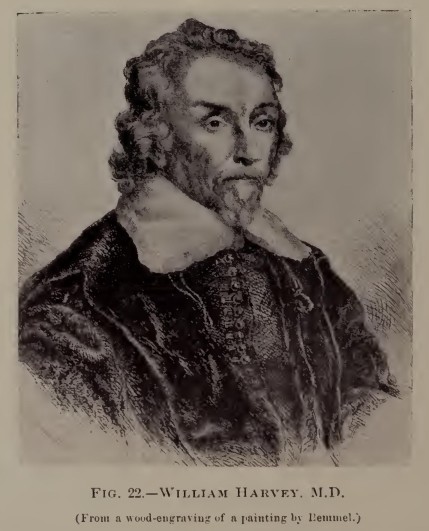
Original
William Harvey was born in Folkestone, Kent, in 1578 and died in London in 1637. He first studied at Cambridge, entering at the age of fifteen; subsequently traveled in France, Germany, and Italy, remaining in Padua from 1599 to 1602, in order to hear the lectures of Fabricius ab Aquapendente. With the title of "Doctor" he returned and settled in London and soon became a member of the College of Medicine, of which he was made a regent in 1613; in time he became physician to James I, and, on the demise of this sovereign, to Charlçs I; to the latter he dedicated his chief work. During the civil war he was driven from place to place, and, finally, to Oxford, where he surrendered himself to the Parliamentary troops, after which he again resided in London with his brothers, who had become rich. Modesty led him to decline the high distinction of President of the College of Physicians, and he lived a quiet and retired life, occupied with his studies and, in his later years, investigations in mathematics. Soon after 1613 he began, through his lectures, to make known the doctrine of the circulation of the blood; but he did not publish the results of his researches until 1628, after submitting them to fifteen years of proofs and counterproofs of every kind. So bitter was the opposition of his contemporaries to the new doctrine that he at one time lost a part of his practice, and was even held to be demented. It is characteristic of the fate of new truths, as well as of that age of dominant authority, that his first publication—Concerning the Motions of the Heart and the Blood—was unable to pass censorship in England, and therefore appeared in a foreign country (Frankfort, in 1628) when he was fifty years old; but his second treatise on the same subject, in reply to Riolan, a professor in the Faculty of Paris, was published in Cambridge in 1649.
"So much care and circumspection in search for truth, so much modesty and firmness in its demonstration, so much clearness and method in the development of his ideas," says Renouard, "should have prepossessed every one in favor of the theory of Harvey; but, on the contrary, it caused a general stupefaction in the medical world, and gave rise to great opposition."
This theory, which to-day appears so natural that we conceive with difficulty why it was not sooner discovered, was nothing less than a revolution in physiology; it excited a tremendous controversy that continued more than twenty-five years, and in which mingled every one possessed of any pretension to knowledge of anatomy or physiology; even naturalists and philosophers took part in the dispute. René Descartes was the first to declare in its favor and to support it by experiment; John Walæus (Jan de Wale), the celebrated Professor of Anatomy in the University of Leyden, confirmed it by new observations; finally Plempius, of Louvain, for a time one of the most fiery of opponents, succumbed to the truth, and in 1652 passed publicly to the ranks of Harvey's followers—no small triumph!
During these long debates Harvey remained always dignified and firm, although the early attacks rendered him unduly sensitive regarding others which he anticipated.
About his only answer to the arguments adduced against him, was to add new proofs and new experiments to those already published. The only one of his adversaries who obtained a direct response was Riolan, who possessed immense influence among his contemporaries as a man of attainments; Riolan combated with equal violence and obstinacy the other great discovery of the age,—viz., the circulation of the lymph. Harvey ultimately, however, had the satisfaction of seeing his theory universally adopted. But his services were not limited to this one discovery. He made most interesting observations on generation, both in man and in animals; on midwifery; and on the structure and diseases of the uterus.
The intermediary system and bond of union between the arteries and veins, so very essential, yet up to this time unknown, was discovered by the great Malpighi, who was born in 1628 near Bologna, became professor in its university, and discovered in the lungs and mesentery of frogs, in 1661, the capillary circulation. He first described the corpuscles of the blood in 1665; he also discovered the lung-cells, as well as the cutaneous glands, certain portions of the kidney, and the pigmentary layer of the skin, named after him (rete Malpighi), which later furnished the first explanation of the difference of color in different races.
In 1690 Leuwenhoek (1632-1723), who had been making observations on the larvæ of frogs and other small animals, was able to see with his improved microscope the movements of the blood in the small vessels, and gave the important testimony of his observations. In 1687 Cowper saw the passage of the arterial into the venous current in the mesentery of a cat. The capillary connection between the two vascular systems was first demonstrated by Marchetti, but was best shown by Ruysch (1638-1731), professor at Amsterdam, the famous inventor of minute injections, who greatly advanced anatomy by the formation of collections, one of which was brought into Russia by Peter the Great at an expense of about seventy-five thousand dollars. The Russian transporters of the collection, however, drank the alcohol in which many of the preparations were preserved, and a portion of the specimens was thus ruined.
Further illustration and amplification of Harvey's views came from various sources; the last, perhaps, from Nich-olaus Steno (1638-1686), who was first a professor in Copenhagen, then a bishop and peripatetic converter of heretics. Steno first proved the heart to be a muscle that contracts actively and expels the blood. The duct that bears his name was discovered during his residence in Leyden or at Amsterdam. His name is written also "Stenson."
While ancient anatomists were able to describe in a general way the form of the lungs, their location, consistency, the ring-like structure of the trachea, and the first division of the bronchi, they did not go farther, but blindly accepted the prevalent theory that the bronchial tubes anastomosed with the terminal pulmonary veins, and that in this way atmospheric fluid was conveyed from the respiratory organs into the heart. On such vague and erroneous data was constructed the theory that the air was drawn into the lungs by the heat of the heart, which was the reservoir of the vital spirits; that in penetrating through the smaller tubes it was rarefied, its thinnest part passing into the heart, where it served as material for the formation of the vital spirit, its grosser part being exhaled. In other words, respiration was supposed to have two purposes one to refresh the lungs, which, being porous and inflammable, would otherwise take fire from the heart, or focus of animal heat; the other to furnish the pneuma, or ether, which was employed by the heart in the formation of animal spirits. Harvey's discovery upset all this, in great measure.
Next it was shown that pulmonary veins carried nothing to the heart except blood. And now, during this Reform Period, the purpose of the movements of the chest was better studied, for Borelli, Helvetius, and Haller made many experiments, as the result of which it was determined that during inspiration the thorax is enlarged in all directions, and during expiration partly collapsed by relaxation of muscles, and that there never is any empty space between the lungs and the sides of the chest; further, that air is drawn into the chest by the tendency of all gases or fluids to maintain an equilibrium, or, in other words, because Nature abhors a vacuum. This being settled, various pneumatic theories were adopted and abandoned, all of which had subsequently to give way before a knowledge of what really occurs. The truth was conceived of by Mayow in 1668. It had been noticed that blood which appeared black in issuing from the veins, became red in contact with the air, and direct observation proved a similar change of color to take place during its passage from the pulmonary veins during life. Goodwin, opening the thorax of a frog, was the first to see this, and Hessenfratz filled a silk bladder with venous blood, and, plunging it into an atmosphere of oxygen, saw the blood change from black to red. In this way and by the later labors of Bichat and Lavoisier were clearly established the mechanism and the purpose of the function of respiration.
The discovery of the lymphatic vessels and their purpose was scarcely less remarkable than that of the circulation, though marked by less eclat because it was not the work of one man, but a matter of slow development. Herophilus and Erasistratus had seen white vessels connected with the lymph-nodes in the mesentery of animals, and supposed them to be arteries full of air. Galen disputed this, for he believed that the intestinal chyle was carried by the veins of the mesentery into the liver. In 1563 Eustachius described the thoracic duct in the horse. In 1622 Aselli, Professor of Anatomy at Milan, discovered the lacteal vessels in a dog which had been killed immediately after partaking of food; having pricked one of these by mistake, he saw a white fluid issue from it. Repeating the experiment, he became certain that the white threads were vessels which drew the chyle from the intestines. He observed the valves with which they are supplied, and supposed these vessels all met in the pancreas and continued on into the liver. In 1647 Pecquet, while still a student at Montpellier, discovered the lymph-reservoir, or receptaculum chyli, and the canal which leads from it (the thoracic duct), which he followed to its termination in the left subclavian vein. Having ligated the duct, he saw it swell below and become empty above the ligature. He studied the courses of the lacteals, and convinced himself that they all entered into the common reservoir. This discovery gave the last blow to the ancient theory which attributed to the liver the function of blood-making, and confirmed the doctrine of Harvey. Strangely enough, the latter united with Riolan in opposing the discovery of Pecquet and denying its significance. From this time the lymphatic vessels and glands became objects of common interest and were investigated by many anatomists,—by Bartholin, Ruysch, the Hunters, Hewson, and, above all, by Mascagni, who was the first to give a graphic description of the whole lymphatic apparatus.
The ancients confounded, under the name "neuron," nerves, tendons, ligaments, and membranes; even Aristotle regarded the brain as an inert mass devoid of sensation, and supposed the nerves to originate in the heart. Rufus, of Ephesus, remarked that Herophilus distinguished three sorts of nerves,—the first serving for sensation and motion and proceeding from the brain and spinal marrow, the second and third serving to unite bones and muscles.
Galen also shared in this error, but, nevertheless, described the brain-membranes and the difference between white and gray matter; he supposed the cerebrum to be the seat of the soul and origin of sensory nerves, and that the cerebellum gave rise to nerves of motion; the pulsation of the cerebrum exposed was held to be a sort of brain respiration. Galen came very near recognizing the distinction between nerves and tendons, but nevertheless confused them. The anatomists of the sixteenth century described certain portions of the nervous system with, more exactness than did Galen, but not with such positiveness as to prevent Cesalpinus from renewing the Aristotelian theory that the heart was the origin of sensation and the seat of the soul. Nearly two centuries later Baglivi advanced a theory which referred vital movement to the heart and the dura mater.
The progress which accrued to comparative anatomy and physiology, and the experiments which were made on animals, during this period, shed a great deal of light upon the nervous system. The researches of Vieussens, Haller, Meckel, Vicq d'Azyr, Scarpa, Soemmering, and others had already rendered it manifest that the brain was the organ of sensation and voluntary motion, and Bichat had proposed to divide the nervous system into cerebrospinal and sympathetic branches.
Now, too, Kepler discovered that the crystalline lens was not the seat of vision, as had been supposed, but that its function, like that of other lenses, is the refraction of light. He observed that the image of objects is depicted upon the retina, and (with Schemer) demonstrated that the expansion of the optic nerve in the retina is the essential part in the organ of sight. Obviously, also, interest in the anatomy of the eye, which these observations everywhere stimulated, was, in a great measure, aided by the researches of Newton on light and color.
About this time, too, Casserius and others studied the auditory apparatus and described the ossicles, the small muscles of the internal ear, and the semicircular canals; they even followed the acoustic nerve. By the researches of a number of French and Italian anatomists it was likewise established that the true seat of hearing lies within the internal ear, the external parts being merely of assistance in conducting sound.
Thomas Willis was one of the first to consider the brain as an assemblage of organs and to assign special functions to certain of its divisions; he thus became a pioneer in cerebral localization, although most of his conjectures were inaccurate or fanciful. The workings of the brain were also studied by Pinel and others, who observed that in certain conditions of mania or partial insanity some of the mental faculties—such as memory, judgment, imagination, or will—were abolished or suspended, while other faculties were preserved; hence it was inferred that each faculty must have its own seat. The views thus enunciated were carried to an absurd degree by Gall, and later by Spurzheim, who made an entirely new classification, believing the cranium to be molded in a reasonably exact manner upon the brain, and that, by inspection of the exterior, the character of a given individual could be read. They thus founded the pseudoscience denominated phrenology, which we now know has practically nothing to justify itself.
About the middle of the seventeenth century Glisson (a professor in the University of Oxford) recognized a property pertaining to all living tissue, which he termed irritability, and which he regarded as sufficient cause for all the phenomena of life; he enunciated certain views that, in times past, have had an important bearing upon the pathology of disease, but which were forgotten for sixty years or more until revamped by the Dutch anatomist, Goerter. It was the latter, with the great Haller, who, by a series of very ingenious experiments, elevated the suppositions of Glisson to the dignity of demonstrated facts. In 1747 the results of Haller's researches were published under the modest title of First Lines in Physiology; the author was, in fact, the great exponent of the doctrine of irritability in neurophysiology, and for this deserves to be remembered wherever the history of our art is spoken of. This theory of irritability was applied to pathology by Fabre, of Paris, who refuted the mechanical theory of Boerhaave on inflammation, proving that the latter proceeds not from obstruction of the capillaries, but from exaltation of their irritability. It was also applied in many ways by Bichat, who enjoyed a brief, though memorable, career. The theory of irritability, along with the truths established by John Hunter in his researches on the blood, made a very distinct advance in the physiological knowledge of the seventeenth century, and the researches of those who contributed so much to its advance are well worthy of study even at the present day. In this line of investigation should, perhaps, also be mentioned the names of Winslow, Albinus, the two Monroes, besides vicq d'Azyr, and others already named.
I have so far discussed the development of theories and researches of individuals. During the earlier portion of the seventeenth century there happened something which gave to materia medica a remedy so valuable, and which attracted such wide-spread attention, that it deserves special mention, I refer to the discovery of that great febrifuge, Peruvian bark. Malarial fevers had been known as early as the time of Hippocrates, and were universally treated largely with purgatives, sometimes with venesections. There had been no notable improvement in the management of pyrexias of this class down to 1638, when the Countess of Cinchon, wife of the Viceroy of Peru, became a prey to a fever which nothing could remove. It is said a Spaniard learned from the natives the secret of the bark, and advised its employment, whereby the countess recovered her health. This is the generally received account, although it has been widely discredited, and Humboldt expresses decided doubts as to the source whence the first knowledge of the bark was derived. Be this as it may, however, it is certain that, in 1639, the countess and her physician, de Vega, imported into Spain a quantity of ground Peruvian bark, and distributed it to various persons, though it was not made an article of general commerce until ten years later, when it was exploited by the Jesuits, who had received a large supply; in Spain it was known as the "countess's powder," and in Italy as "Jesuit" or "cardinal" powder. Being very high-priced, it was soon so sophisticated as to be quite unreliable. Condamine, the botanist, having been sent to America for other purposes, determined the botanical position of the tree and described several species of cinchona, one of which is known by his name. To him is due the generic title bestowed in acknowledgment of the services rendered by the countess, who introduced the bark into Europe. Many vain attempts were made to determine the chemical composition of the powder, and it remained for two French chemists to isolate and separate its most important alkaloid. The first who wrote upon the therapy of cinchona was Barba, a Spanish physician, whose work was printed in Seville in 1642. After its introduction into England Peruvian bark fell into disrepute, owing to improper administration, whereby death was caused in certain instances; and it was this latter fact that instigated Sydenham to investigate it still more accurately. There has never been introduced into medicine any one drug which has proved itself so generally valuable and so widely effective as cinchona and its products.
As little progress had been made in obstetrics as in other branches of applied medicine or surgery. The custom of employing midwives was general, and these, for the most part, were ignorant and filthy old women, slaves of routine procedures that had obtained from time immemorial. Educated accoucheurs were called only in extraordinary cases; but with progress the prejudice which excluded educated physicians from the practice of midwifery gradually gave way, and there was opened for obstetrics a new era. In the beginning of the seventeenth century the initiative was taken by Louise Bourgeois, the sage femme of Marie de Medicis, who in 1626 published a collection of observations concerning sterility, abortion, fecundity, accouchement, and diseases of women and children generally; it embodied several distinctly new ideas. A little later (in 1668), Mauriceau, of Paris, chief accoucheur to the Hôtel-Dieu, published his treatise on diseases of pregnancy and childbirth, which was translated into all the languages of Europe and became a powerful agent for good, not alone that it represented an advance in knowledge, but it stimulated such rivals and successors as Devanter, Peu, Paul Portal, and Delamotte to further research. About this time the Chamberlains, an English family devoted to the practice of midwifery, invented an instrument to facilitate the extraction of the foetal head when arrested, and one of them went to Paris, and, failing of success there, went on to Holland, where he sold his secret to two Dutch practitioners, who kept it only too faithfully. In 1721, Palfvn, a surgeon of Ghent, while seeking to fathom the device of the Chamberlains, conceived a tire tête (literally a head-drawer) composed of two steel spoons, and hastened to publish an account thereof,—a praiseworthy act, whereby he merits distinction as the inventor of the forceps. As modified by Smellie in England and Levret in France, the obstetrical forceps ranks among the most useful discoveries of modern surgery, and, although not in common use until about a century ago, it may be said that the invention has been the means of saving the lives of countless women and children.
Medical jurisprudence also seems to have had its beginning during this century. It had long been the practice to summon physicians to court in order to enlighten the judiciary in questions demanding particular knowledge in physics and medicine; indeed, the practice began under the first Christian emperors, and owes its origin to ecclesiastical authority. Charlemagne confirmed in this regard what Justinian was perhaps the first to ordain. The tribunal of Châtelet, according to Renouard, appears to have been the first which comprehended the great utility of consultation with expert physicians; an edict of Philip le Bel, in 1311, qualified Master John Potard with the title "Sworn Surgeon of Châtelet", and the constitution promulgated by Charles V, in 1552, gave great importance to medical jurisprudence, as it treated in detail of infanticide, wounds, poisons, abortion, and other such crimes. Early in the seventeenth century Fidelis collated all that had been written on this subject, and thus published the first special treatise on legal medicine.
Some writers claim to have discovered traces of clinical teaching in the history of Arabian universities, but, as Renouard says, the presence of a few pupils during visitations and consultations no more constituted real clinical teaching than the practice adopted by some practitioners of ancient Rome of being ever surrounded by a group of spectators whom they dignified with the title of disciples. The first attempt at real clinical teaching appears to have been in the hospital of St. Francis, in Padua, in 1558, by Botoni and Oddi. About the beginning of the seventeenth century Otto de Heurne, of the University of Leyden, introduced bedside instruction, which was continued by le Boe, sometimes called Sylvius, with the result of drawing-large crowds of students to Leyden from 1658 to 1672. Notwithstanding the success attained, the practice was neglected by the successors of Sylvius until renewed by Boerhaave, who, invested with several functions at the University of Leyden, also occupied the chair of medicine. So great was the renown of Boerhaave that, despite the poverty of the resources of the Leyden hospital, people came to consult him from the most distant countries, and he was a correspondent of several crowned heads, even of the Pope, although himself a Protestant. During his life and long afterward he exerted an immense influence in medicine, and while, perhaps, inferior in genius to some of his contemporaries, he had a wider reputation, and his doctrines prevailed longer. The great success of his clinics decided in favor of this method of teaching, and in 1715 the Pope established in Rome a similar institution, under the direction of the celebrated Lancisi. Soon Edinburgh, Vienna, Pavia, and other universities followed suit, the first clinical chair in Paris being held by Corvisart, and the first in Vienna by Van Swieten. After the demise of Boerhaave, the school of Leyden rapidly declined, while those of Edinburgh and Vienna became rivals for the first place. It is thus seen that after an interruption of more than two thousand years clinical teaching was revived and became more brilliant than ever before.
I now propose to recount the methods and deeds of some of those concerned in the development of systems, so called, and make mention of the most prominent medical men in national and historical order. This will not prevent going back to philosophical conclusions or reflections upon the philosophy of the history of medicine, when it may seem wise so to digress.
First, of the system of J. B. Van Helmont, which in its day was most highly regarded, and which seems to have been, in some measure, a rearrangement of the views of Paracelsus into a mystic and pietistic system based upon mechanical principles. Van Helmont was born in Brussels in 1578, and was so precocious that he entered the University of Louvain at an age which would have enabled him, had he so desired, to obtain the degree of Magister when only seventeen years old, he deemed the degree frivolous. He had studied mathematics, astronomy, philosophy, and astrology. Going now to the Jesuits, who at that time, even, taught music, he soon became dissatisfied, and turned to the study of stoical philosophy. Believing that the Capuchins (who were mere lascivious gluttons, and considered even washing unchristian) were the true stoics, he sought to join this order, but ere long abandoned them and resumed his studies in law, botany, and medicine. For the latter Van Helmont had at first little respect, since his studies in this line did not enable him to rid himself of the itch. He soon again lapsed to the monastics, and came to the conclusion that wisdom, like the grace of God, was obtainable only by fasting, supplication, and poverty; accordingly he practiced medicine among the poor as a labor of love (having received his degree of Doctor in 1599). During his travels he became familiar with the writings of Paracelsus, which he studied zealously. Finally he settled down in Vilvorde, where he practiced medicine and chemistry until his death (in 164-4).
Like most "systems," that of Van Helmont is valued only as an expression of the spirit of the age, since it embodied largely the pantheism of Paracelsus, merely cloaked with a more religious or monkish dress. He held that the general cause of disease was the fall of man; though there also figured a subsidiary cause, which he denominated Archeus,—a faculty of appetite seated in the spleen or in the stomach; thus dropsy was a hindrance of renal excretion by the enraged Archeus. Demons, witches, and ghosts were included in Van Helmont's system as causes of disease. Indeed, the man seems to have been a second Paracelsus, lacking only in the dishonesty and bombast of the latter. He had no followers of any prominence, and the "system" soon lapsed into obscurity.
The Chemical, or Iatrochemical, System was originated by le Bôe, commonly known as Sylvius (but who must not be confounded with the great anatomist of the same name). Le Bôe was born in Hanau in 161-4; studied in Paris, Leyden, and Basel; received his doctorate from the latter university at the age of twenty, and practiced in Switzerland with great success until 1660, when he accepted a professorship in Leyden; here he was distinguished for his eloquence, wealth, and sociability, as well as for the great number of pupils that were attracted by his clinical method of teaching. His system embraced a peculiar phantasy, being based upon the elements of chemistry, the new knowledge of the circulation, the latest physiological teachings, and the old doctrine of the spirituous or innate heat of the heart, which he claimed to have felt with his finger. He asserted his theories were founded upon experience, but the truth is, they were inaccurate deductions from experimental observations, many of which were wholly irrelevant. The majority of diseases, he taught, were produced by excess of acidity or alkalinity. For him, the three great fluids of the body were the saliva, the pancreatic fluid, and the bile, while health consisted in the undisturbed performance in the body of the process of fermentation; and the saliva was supposed to give rise to hectic fevers, because such manifest exacerbation after eating. Stereotyped theory and equally stereotyped therapeutics gained for him, for a short time, a large following, but later raised numerous opponents, who alleged that his system caused as many human lives as the whole thirty years' war. He died in 1672.
To the same iatrochemical school is generally assigned Thomas Willis, born in Oxford in 1622 (died in 1675), who rendered great service to anatomy, especially to anatomy of the nervous system, although his teaching was disfigured by certain unsupported theories. Like Van Helmont, he had been destined for theology, but turned his attention to medicine. Ultimately he became Professor of Philosophy in the University of Oxford. He first described the so-called circle of Willis, whence its name; also ascribed diseases, especially those of the blood, to fermentation, in which the vital spirits played the chief part. He accounted for hysteria, for instance, by the union of the spiritus with imperfectly purified blood.
CHAPTER VII.
Age of Rénovation—(continued).—Iatromechanical School: Santoro, 15611635. Borelli, 1608-1679. Sydenham, 1624-1689. Sir Thomas Browne, 1605-1682.—Surgery: Denis, f 1704. F. Collot, f 1706. Dionis, f!718. Baulot (Frère Jacques), 1671-1714. Scultetus, 1595-1645. Rau, f 1719. Wiseman, 1625-1686. Cowper, 1666-1709. Sir C. Wren the Discoverer of Hypodermatic Medication. Anatomical Discoveries. General Condition of the Profession during the Seventeenth Century. The Eighteenth Century. Boerhaave, 1668-1738. Gaub, 1705-1780.—Animism: Stahl, 1660-1734.—Mechanico-dynamic System: Hoffmann, 1660-1742. Cullen, 1712-1790.—Old Vienna School: Van Swieten, 1700-1772. De Haën, 1704-1776.—Vitalism: Borden, 1732-1796. Erasmus Darwin, 1731-1802.
The physiology of the Iatromathematical, or Iatro-mechanical, or Iatrophysical School devoted chief consideration to the solid parts of the economy, whose form and function it strove to discover and demonstrate by the aid of exact methods,—that is, by calculation and physical apparatus. Thus, it explained digestion as mechanical trituration; secretions were referred to variation in resistance of parts in the vascular system; warmth was supposed to be due to friction of the blood-corpuscles; health consisted in the undisturbed performance of the physical and mechanical processes of the body. Diseases were explained inversely: the blood, under diseased conditions, was held to contain pointed and angular crystals, which irritated as they passed through the pores, or disturbed because they could not so pass.
The first to enunciate these views was Santoro, or Sanctorius, who flourished from 1561 to 1635, and was for a while professor at Padua. He taught how to investigate the pulse by an instrument of his own contrivance, and how to study the temperature by means of a species of thermometer, which was probably his own invention. (This instrument, by the way, was invented about this time; Drebbel [1572-1634] is regarded as the inventor of the air-thermometer, Galileo [1574-1642] of the spirit-thermometer, and Roemer [1644-1710] of the mercurial thermometer.) Santoro studied the phenomenon of transpiration, and constructed apparatus for bathing bed-ridden individuals; he found that in twenty-four hours the insensible transpiration through the skin amounted to 1 1/4 kilogrammes,—which result, compared with the results of the present day, determined by the most complete observations, is only twenty per cent, too high, and proves how accurately he investigated. The important rôle of the perspiration, which he pointed out, was made use of by the iatrochemists to vindicate their terrific sweat-cures.
Borelli (1608-1679), of Naples, is usually regarded, however, as the founder of the iatromechanical school. Of a quarrelsome disposition, he could not stay long in any one place, though he ultimately settled in Rome, where he joined the circle of savants who gathered round Christina, the daughter of Gustavus Adolphus, who had become a convert to Catholicism. Finally Borelli entered a monastery. His services related mainly to physiology, where, like Descartes, he followed purely mathematical principles; he explained the action of the muscles by the laws of the lever, calculated the mechanical work done by the heart, and correctly ascribed inspiration to muscular action. He was the opponent of iatrochemistry, and claimed there was no such thing as corruption of the blood. His pupils and followers—like Bellini (1643-1704). of Florence, who became professor in Pisa at the early age of nineteen, and Baglivi (1668-1707), a pupil of Malpighi, and a man of universal education—carried out and elaborated the first expressions of this author. Borelli was the author of the oft-quoted maxim: "He who diagnoses well cures well."
The iatromathematical system held ground for some time in Italy, and also found followers elsewhere. For instance, Dodart (1664-1707). of Paris, explained the voice on the mechanical principles enunciated by Borelli and by Quesnay (1694-1774). the tirst permanent secretary of the Academy of Surgery in Paris. In England this explanation was adopted by a number of followers, none of whom, however, was eminent enough to justify special mention here. In Germany it obtained a certain amount of favor, but seems not to have attracted any very eminent disciples.
The iatromechanical school ran a course not unprofit' able to science, yet was unfruitful of real advance in the domain of practical medicine. The man of this particular age, who, more than any other, exerted an influence destined to be prolonged even to the present time, and probably much longer, who had a cool, clear, and unprejudiced spirit, and who sought the true value of medicine, and recompense for the same in the benefits which it brings to the sick, without scorning or neglecting its scientific side, was Thomas Sydenham, bora at Winford Eagle in 1624. a student at Oxford in 1642, and recipient of a bachelor's degree of medicine in 1648.
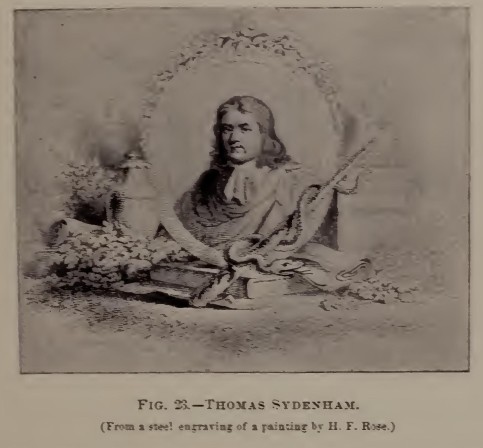
Original
The next fifteen years of his life we know practically nothing of, save that he spent some time in Montpellier pursuing his medical studies. In 1663 he became a member of the Royal College of Physicians, but did not take his degree of Doctor until 1676,—thirteen years before his death. His chief work—Medical Observations—is said to have been originally written in English, and translated into Latin; it first appeared in 1666,—the year when fire and plague devastated London. He died of gout in 1689, and was buried in Westminster Abbey. During the earliest years of the plague in London he fled, as was the general custom of that day.
His model was Hippocrates. In pathology he was a humoralist without being a theorist. He knew only one standard,—observation and experience. Sharing the opinions of his day, he laid but little weight upon anatomy and physiology; yet he recognized their value when employed in the production of hypotheses. He conceived of disease as active, operative,—a natural effort of the body to remove morbid material from the blood; if this effort is violent and speedy, we have to do, he says, with an acute disease, but if slow and difficult, the condition is chronic. Fever was supposed to result mostly from cold or from epidemic influences. As causes of disease, he considered unknown influences and changes of the atmosphere very important. In his special pathology "inflammation of the blood" played the chief rôle, and upon it were made to depend nearly all acute and some chronic diseases. He arrived at what he called the "healing power of Nature," for which he made great claims in his description and observation of epidemics: but he believed there always remained a good deal for the physician to do, and in treating syphilis he even gave mercury until two kilogrammes of saliva were discharged daily. As compared with the therapeutics of that day his were manifestly simple,—and yet he employed, for example, eighteen different herbs in one prescription, and that merely an ointment. The unreliability of the action of drugs induced him to rely upon specifics, as did Paracelsus, but he acknowledged only one such,—the then new discovery, cinchona,—not even allowing mercury such a position in the treatment of syphilis. Such drugs as he chose were mainly from the vegetable kingdom.
The great importance of Sydenham, and all his statements, so far as we are concerned, centres about his struggle for the elucidation of the healing power of Nature, and for simple observation and simpler treatment, as opposed to the overgrown luxuriance of previous systems and theories. He became the standard-bearer of his age in his return to Hippocrates's method and art of healing, which are founded on the nature of things and on the limits of human ability.
Sydenham was vehemently opposed by Richard Morton (1625-1648), of London, who, like Fernel, considered all diseases to be a poisoning of the vital spirits. Sydenham was also antagonized by Gideon Harvey, who ridiculed his medical contemporaries without stint, because most of them, for febrile disease, gave cathartics from the second day, and began treatment with emetics. With delightful satire Harvey divided the physicians of the day into six classes: the Ferrea, Asinaria, Jesuitica, Aquaria, Laniaria, and Stercoraria, according as their favorite systems of treatment were the administration of iron, asses' milk, cinchona, mineral water, venesection, or purgatives.
Sir Thomas Browne (1605-1682), who still enjoys a great reputation, was the author of the works entitled Religlo Medici and Inquiries into Vulgar and Common Errors. The latter appeared in 1646, but does not seem to have protected its author from the worst error of his age,—viz., superstition,—since, in 1664, he swore that two condemned old women were actual witches.
Having considered the progress of medicine during the seventeenth century, it may be well to glance likewise at surgical progress. Among the Italians Santoro, already spoken of as the inventor of various instruments, should be mentioned; also Valsalva, who obtained a sound reputation as an operator, employed the ligature, and recommended a starvation plan for treating aneurism; Magati (1579-1647). who contended against the abuses of treating wounds by filling them with plasters, balsam, poultices, tents, etc., and of changing the dressing several times a day.—once in four days was better, he said; Severino (1580-1656), first a lawyer, then a professor at Xaples, and later an eminent surgeon, a good anatomist, and a particular friend of the actual cautery; Marchetti (1589-1673), a bold, versatile operator of Padua; and Borri, of Milan (1625-1695), skilled as an operator and an oculist but better known because of his sad fate, since he died in the prison of the Inquisition, alter a prison-life of twenty-five years, on account of too liberal religious views. There were also numerous other Italian surgeons who made a name, especially in plastic surgery, and particularly in that branch of it named rhinoplasty, by whose efforts one method of manufacturing a new nose came to be known as the "Italian method."
France, we must remember, was the home, during this century of Richelieu. Mazarin. Louis XIV. Corneille. Racine. Molière. Fénelou. La Fontaine. Boileau, Bossuet, and many other men eminent in literature and science. During this century the French laid the foundation for that leadership in surgery which they maintained for nearly two centuries. Let us mention, among their surgeons. Morel, who invented the tourniquet at the siege of Besançon, in the year 1674. There was also Jean Baptiste Denis (who died in 1704), physician to Louis XIV. who performed the first transfusion of blood in man. (Transfusion of the blood of the young into the veins of the old for the purposes of rejuvenation, was recommended by Libavius, in 1715, and Colle, of Padua, gave it new support by describing a method for its performance. In 1729 Boyle practiced transfusion on dogs. The London faculty sought the value of the operation after excessive haemorrhage, and Edmund King, physician to Charles II, in 1665 practiced transfusion from vein to vein. But Denis was the first to carry out the operation with lamb's blood upon a patient sinking under excessive venesection,—an operation which was very much abused at this time.) It was in this century that the French family of lithotomists—the Collots—distinguished themselves in their special line. The last member of the family, Francois, died in 1706. Their specialty must have found, at that time, considerable more material than comes to the front to-day.
Among the general surgeons of France were de Marque (1618), who distinguished himself as a bandager; Bienaise, who invented the bistoury caché (1601-1631); de Launay (1649), monk and lithotomist; Goursaud, who survived his century, and who was the first to describe stercoral incarceration; Duverney, who demonstrated the growth and nutrition of the bones by periosteum; Lambert, who practiced injections in hydrocele; Andry, of Lyons, who wrote of orthopaedic surgery and originated the name orthopaedics; Pierre Dionis (who died in 1718), surgeon to the Empress Maria Theresa, famous in his art, and who first emphasized the effects of rickets upon the pelvis; and Boulot, better known as Beaulieu (1671-1714). who advanced himself from being a soldier and a day-laborer to become a physician, a famous lithotomist and surgeon. He finally joined the Franciscan order, where he obtained the name of Frère Jacques, under which title he passed for the inventor of lateral lithotomy. Then there were Saviard (1656-1702), surgeon-in-chief in the Hôtel-Dieu, who, among other things, determined the seat of hernial strangulation to be often in the neck of the sac; and Georges Mareschal (1658-1736), surgeon to Louis XIV, one of the founders of the Academy of Surgery, who has a record of eight lithotomies performed in half an hour, and who became famous for his services in improving the schools of surgery in France.
In this (the seventeenth) century, also, ophthalmology was much cultivated in France, although it was assigned to the despised surgeons. Those who won most renown in this line were Maitre Jean and Brisseau, who divide the honor of first recognizing the seat of true cataract. During this period, also, Duverney, Professor of Anatomy at Paris, was the first to systematically describe diseases of the ear in accordance with their anatomical seat.
In Spain scholarship sank more rapidly during this century than among any other people in history, due mainly to the loss of their political supremacy and their commerce to the Dutch and English, and to the utter failure, at home, of their efforts to introduce true unity of faith. In these efforts the industrious Moors were excluded, under Philip III. In art they maintained their standing,—attaining, in fact, in Murillo, the acme of their fame; but in other branches of industry they rapidly degenerated. Students of history will readily understand how little leisure the Spaniards had at this time to devote to the cultivation of science, including medicine and surgery. Of the two men who are mentioned during this century as Spanish surgeons, namely, Almeida and Ayala, we know practically nothing.
The Germans gained no such store of knowledge from their experience during the Thirty Years' War as did the French during their campaigns. The barber-surgeons, for the most part, still reigned supreme, and their guild contained some men of ability and independence of thought. The most notable man of the times was Fabricius Hildanus (1560-1634). Of him, however, I have already spoken as belonging rather to the previous century. He was the first learned German surgeon recognized and esteemed as such by his contemporaries. He was distinguished, also, as an oculist and aurist, and removed a particle of iron from the cornea by means of a magnet. A man of great operative genius, and a born surgeon, was Purmann (1648-1721), who greatly lamented the low condition of surgery in Germany, and regarded a knowledge of anatomy as the prime requisite for the surgeon; he employed the speculum in the diagnosis of syphilis, although it has been Ricord's boast that this was his own idea. Scultetus (1595-1645), of Ulm, was a famous surgical writer of this period, and a bandage of his devising is still in frequent use, and bears his name. Murait, of Zürich, was also a capable surgeon (1655-1733).
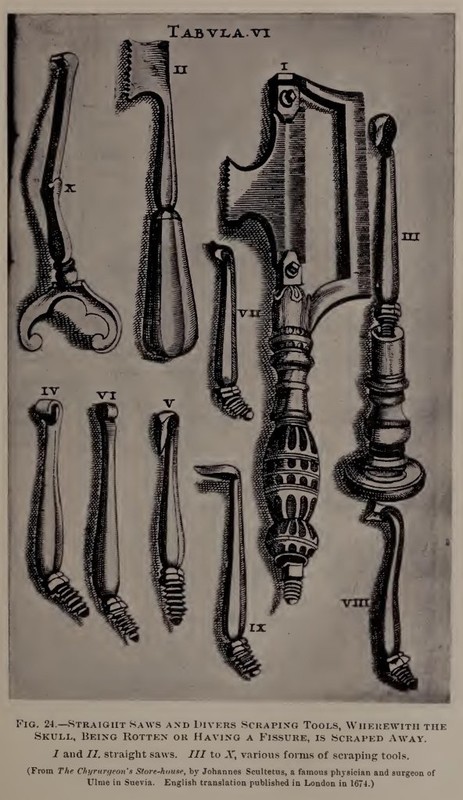
Original
The Dutch had but few men during this century who enjoyed any reputation as surgeons. The best among them was Rau (1658-1719), who, from being a poor boy, became a barber, traveled extensively, and was finally made Professor of Anatomy and Surgery in Leyden, where he introduced the innovation of teaching practical surgery upon the cadaver. He was especially famous as a lithotomist after the method of Frère Jacques, although he did not give instruction on this subject in his lectures.
By the way, it is an interesting fact that the clinical histories of many operations for stone during the seventeenth century were related in verse, and illustrated with plates. Harvey's vivisections were also related in verse.
Now, for the first time, do we begin to hear of English surgeons and English surgery. The most prominent, as well as almost the earliest, was Richard Wiseman (1595-1686), ordinary surgeon of James I, called sometimes the "Pride of England" and sometimes the "Paré of England,"—a bold, judicious operator, who took hold of every novelty and who accepted the ligature of Paré (always having the actual cautery at hand, in case the ligature should fail); he also amputated through sound parts, favored operating for strangulated hernia, and employed the trephine zealously. The first recorded operation for external urethrotomy for the relief of stricture is mentioned in Wiseman's writings.
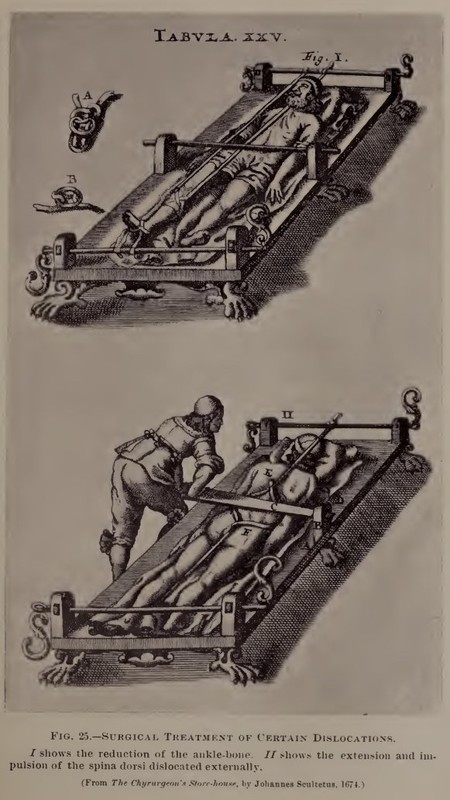
Original
There were also William Cowper (1666-1709), a famous anatomist and surgeon; and Woolhouse, a famous, but ignorant, itinerant oculist. Sir Christopher Wren, architect of St. Paul's, was the first who devoted attention to injecting medicine into the veins,—a subject studied again much later and recently once more taken up. His example (in 1667) was followed by others, whose experiments demonstrated, as we know to-day, that the effects which follow the intravenous administration of drugs are the same as follow administration by the mouth.
Midwifery during the seventeenth century advanced even more rapidly than its mother-science surgery. The accouchement of women was intrusted in many cases to the care of educated men, who contributed not a little to the art. Anatomy and physiology contributed also their quota to a clearer knowledge of these diseases. The obstetric forceps were for so long a time kept secret that they were of small benefit at first to the obstetric art. Among the French who were especially prominent as promoters of midwifery must be mentioned Marguerite de la Marche, chief midwife of the Hôtel-Dieu; Francois Mauriceau, President of the College of St. Come; Jules Clement Delamotte, who was also a skillful surgeon; and Portal, who first proposed version by one foot Among the Germans a few midwives distinguished themselves as independent observers, most of all Justine Siegemundin, daughter of a minister, who devoted herself to midwifery with such success that she became court midwife; she recommended puncture of the membranes for the production of artificial delivery, and especially advocated bimanual version.
But, perhaps, the most significant advances were made in the direction of studies in anatomy, physiology, and pathology. The history of the circulation we have already taken up. After Harvey's time, and largely because of his researches, physiologists were divided into two parties with regard to the origin of life. These parties were known as animists and animalculists. It was largely by the later researches of Highmore (1613-1685) upon the anatomy of the testis and the epididymis, supplemented by those of Aubrey in Florence concerning the ovaries (which had been previously considered as female testicles), and the researches of Stenon concerning the muscular nature of the uterus, that a better knowledge of reproduction was established. De Graaf (1641-1673), a physician of Delft, Holland, pointed out the ovarian follicles, known to-day under his name, while Swammerdam (1637-1686) studied the comparative anatomy of the ovaries,—and was, by the way, the first to prove that the queen bee is a female. Needham, the London anatomist and physician, and Hoboken, of Utrecht, described more accurately the placenta and the coverings of the ovum.
Anatomical discoveries crowded along about this time. For instance, Wharton (1610-1673) discovered the sub-maxillary duct, named after him; Glisson (1647-1671) studied the liver and recognized its capsule, that still bears his name; Nuck injected the lymphatics with quicksilver, and studied the glands especially; Stenson discovered the excretory duct of the parotid, and Rivinius (his name being translated in German, Bachmann) found the sublingual duct; Peyer, Schafhausen, and Brunner, the latter a professor in Heidelberg, discovered the intestinal glands which bear their names; Wirsung, of Bavaria (who was assassinated in 1643 by another physician), discovered in the dissecting-room of Vesalius, at Padua, the excretory duct of the pancreas; Pacchioni found the bodies named after him in the dura mater; Havers, of London, discovered the synovial glands and the so-called Haversian canals; Cowper, already mentioned, discovered the small glands named after him, located in front of the prostate, and Bartholin yet other glands, in the labia, which bear his name; Mei-bom, professor in Helmstàdt, discovered the small glands in the eyelids which are named after him. Besides these, many other discoveries might be recorded here, did time permit. One other, however, deserves to be mentioned, with which the name of Schneider (1614-1680) must always be honorably connected. He described the mucous membrane of the nose and demonstrated anatomically and clinically that not the brain, but this membrane, secretes the mucous discharge during fluxes from the nose. This overthrew at once and forever the ancient doctrine, which included so many and various "catarrhal" diseases. I might add also that the best and most complete description of the entire central nervous system which had been given up to this time was furnished by Vieussens.
Description of Fig. 26.—"Of the corruption of the bones of
the arm and shin, even as far as the marrow; of the shin-
bone broken with a wound and the bones sticking out and
bound with swathe-bands brought circularly about; and of the
cutting off of the end of the hand or foot. I represents the
corruption of the bone and of the marrow of the shin-bone,
II represents the shin-bone wholly corrupted and rotten. III
represents the place where the corrupt bone was situated and
was now pulled forth with the pincers. V is that shin-bone
corrupted, which the patient laid up for a memorial. VI is
the bone of the right arm corrupted. VII represents the bone
of the arm totally corrupted and sharp, which was pulled
away with the pullers, but by pieces, without any noise or
pain. VIII shows the place where the corrupt bone of the arm
lay, which was now pulled forth, which Nature filled up with
a callous, so that the patient could perform country
business without any impediment. The patient was a
countryman of Pappatavia, whose arm a souldier broke in four
places, without any wound, anno 1636. IX is a fracture of
the shin-bone with a wound, and laying the bone naked. X is
the bone of the shin with a wound, broken, with bones
sticking forth, and bound with bands not crosswise, but
circularly brought about and laid within the capsula as it
ought to be. XI is a hand affected with a secret canker
which is cut off in the sound part, namely at the end of the
radius and cubit bone. XII is a hand that is sphacelated,
which, being laid upon the block (D), is amputated in the
sound ends of the radius and arm-bone with a chizel (E),
contrary to Hildanus, with good success. XIII is a basin
filled with oxyerat, in which swims a bladder, which, being
wet, must be applied to the mutilated part. XIV are two
swathe-bands wrapt together (F and O), whereof each hath two
ends, to bind the arm, whereof the hand at the end is cut
off. XV represents a foot that is sphacelated, which is
taken off in the mortified part, near the sound part with a
pair of pinccrs. The mortified part being removed, the rest
of the putrefaction is consumed with red-hot irons until the
patient feels the force of the fire. After this two plagets
are anointed with Hildanus, his unguent Egyptiae, which are
applied to the escar; lastly, long plaisters (7) being laid
upon it, the foot mutilated is bound with a wet band (Q} as
far as the knee, as the hand is unto the middle of the arm.
XVI are divers sorts of iron instruments and made red hot,
both to consume the remainder of the putrefied part and are
also fit to stop the flux of blood."
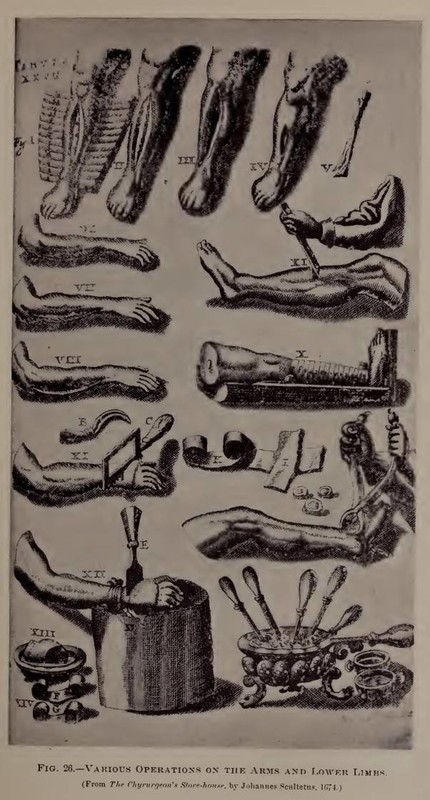
Original
By the middle and latter portions of the seventeenth century most of the better physicians and surgeons had either assumed offices and positions in which they were supported by the State, or were settled in permanent residences, which was not the case with the mass of physicians in the sixteenth century. As a result the reputation of the entire profession began to improve, while the unlimited license and absolute freedom of practice prevailing during the Middle Ages were almost entirely done away with. By this time the clerical element had disappeared almost entirely from medical circles, or only dabbled in certain specialties. The Thirty Years' War was fatal to the supremacy of the clergy in matters of public health. Moreover, the increase of international intercourse favored the communication of medical knowledge.
The physicians of this period were more occupied with chemistry and physics than had ever been the case before. Nevertheless, this was also the special age of alchemists and of impecuniosity. According to one of the classifications of the time, the regular profession was supposed to include physicians, surgeons, barbers, regimental surgeons, lithotomists, bath-keepers, midwives, nurses, apothecaries, druggists, and even confectioners and grocers. Another list of impostors and quacks, equally official, was made to include old women, village priests, hermits, quacks,—
Description of Fig. 27.—"I represents the breast affected
with an ulcerated canker, the basis whereof is thrust
through with two needles drawing after them a twisted flaxen
thread. II shews how the chyrurgeon takes hold with his left
hand, of the ends of the threads that were thrust through,
and with his right hand he takes the knife and with that he
cutteth the canker out by the roots. III shews a canker cut
from the breast weighing six physical pounds. IV shews how
the chyrurgeon, after the cutting off of a breast ulceratcd,
doth lightly cautcrize the place with a red-hot iron at
least to corroborate the parts. V is the instrument of
Hierom Fabritius ab Aquapendente wherewith a fistula of the
thorax is perforated. VI is Sostratus, his band, which is
most convenient where the breast is affected with any
disease that requires binding. VII shews how Celsus cured
the sticking forth of the navil by manual operation. VIII is
a truss for the navil made of a double: cotton linncn
cloth."

Original
—uroscopists, Paracelsists, Jews, calf-doctors, executioners, crystallomancers (a class of people—chiefly Italian—who sought after crystals), mountebanks, vagrants, magicians, exorcists, monsters, rat-catchers, jugglers, and gypsies. Veterinary physicians were also at that time included in this class.
Anatomy was now studied more from human bodies, and was authorized by statute. This was especially the case in non-German institutions, to which for this reason students flocked in great numbers. In Dresden, so early as 1617, there was a dissecting-room in which stuffed birds, at that time a great rarity, and similar curiosities were preserved. The study of anatomy was at a low ebb in Germany; so that when Rolfink, in 1629, arranged at Jena, which was then the most popular German university, for two public dissections upon executed malefactors, it was considered such an event that the very highest authorities were present. But the peasantry took such fright at this occurrence that for a long time afterward they watched their cemeteries by night lest the corpses should be dug up and, as they said, "Rolfinked." Vienna did not possess a skeleton until 1658. Strassburg obtained one of a male in 1671, and several years later one of a female. In Edinburgh an anatomical theatre was first erected in 1697 in Surgeons' Hall. It is worthy of remark that anatomical plates, designed to be lifted off in layers, existed even at this period. About the middle of this century there arose a dispute at the bedside of the Margrave of Baden, between two learned professors and the regular court physician, whether a plaster to be applied over the patient's heart should be placed in the middle of the chest, according to Galen, or upon the left side. The dispute was settled by opening, before the eyes of the noble patient, a hog, by means of which it was demonstrated that, as a matter of fact, the heart of the hog lay on the left side. So convinced was his excellency that he dismissed the ordinary physician, who had held a contrary opinion as to the position of a nobleman's heart.
The general barbarity and immorality of this century were conspicuous, especially among the upper classes, and by its close had spread from France, became naturalized in both Germany and Italy, and extended even to the universities, their professors, and their students. The life of the latter during this period was more vulgar and rude than ever before, and almost more so than ever since. Pennalism—that is to say, barbarity toward junior students—became unbounded, so that outbreaks occurred even during lectures. At last the State authorities were compelled to interfere. Student outrages were very frequent and often fatal, and their outbursts were disgraceful in the extreme.
Only in France was instruction in surgery well regulated, for this was the only country which possessed a proper surgical college. Practical instruction was imparted to mid wives—in Paris through a special institution, in Germany through the Midwives' Guild; the barbers, too, continued to receive instruction from their guilds; while instruction in pharmacy was given by the master-apothe-caries, too often dogmatically and even farcically, serving as objects for the keen satire of Molière. The expenses of graduation were very great, and the ceremonies sometimes lasted two days.
In another way this same seventeenth century might be characterized as one of aggrandizement for physicians,—that is, as one during which their position was improved in the eyes of the public and better supported by the State. The physicians proper—the "medici pitri"—were still persons of the profoundest gravity, with fur-trained robes, perukes, canes, and swords, when matters were prosperous, who for their lives would do nothing more than write prescriptions in formal style, everything else being considered beneath their dignity,—even as they affect in England to*day. They demanded to be called in every case, however, even though they knew nothing about it, claiming that only by means of their presence could things certainly go right. Nevertheless, in dangerous cases—for example, during the plague—they left the surgeons alone, while they looked upon the sick through the windows. In spite of this, however, they were generally esteemed and often sought for, as well in public as in private. Some of them were supplied with large libraries by their patrons or through their positions under the government, and most of them enjoyed moderate prosperity. Their pay was, for the most part, regulated in accordance with a definite tariff, while the State gradually cut down the doctor's honorarium to the pay of a day-laborer. During that century a certain physician to a countess in Munich received $25 as his annual stipend. For being present at a post-mortem and rendering an opinion thereon, each physician received $1.75. Surgeons who were zealous and eager were always highly esteemed; they were often better educated, in many respects, because of their extensive travels; but the social emancipation of the surgeons was not completed until the eighteenth century. About this time amputation of the arm was supposed to be worth 31 marks ($7.75); of the leg, 41 marks; or, if a patient died, half this price. Lithotomy cost 51 marks, or half of that if the patient died. For cataract operation on one eye the surgeon received 17 marks; for a like operation on both eyes, 25 marks.
We find in medicine, as in other branches of knowledge, that each succeeding century presents its added quota of imperishable facts, making it still more important than its predecessor. We may say that the fifteenth century had prepared the way for a reforming idealism which was the principal characteristic of the sixteenth; and that in the seventeenth century the realistic reaction against this same idealism showed itself in the church and the State by struggles against constituted authority, and in medical science by the domination of inductive philosophy. The idealism of the eighteenth century was not reformative and humanistic, but revolutionary and humanitarian. The unsettled character of the century's events may be charged, in some degree, to the American and French revolutions, with their interpretation (and their attempted attainment) of the so-called "rights of man." The masses were now supposed to be released, and philosophers created new doctrines, which had a greater influence upon the times than ever had philosophical doctrines before. Rousseau, for instance, aroused a revolution in politics and education, while skeptics and materialists alike strove for general enlightenment, which was sadly needed. Among the higher classes extravagance and immorality prevailed extensively, among the lower classes poverty and ignorance. In Germany the rulers even sold their subjects, as when Hesse-Cassel sold to the English seventeen hundred mercenary soldiers, and other States sold smaller numbers. A criminal code, published in 1769, contained seventeen copper-plate engravings, illustrating various methods of torture. A physician was always present when torture was inflicted, to see that the victim's sufferings were not greater than he could bear. This inhuman mode of eliciting testimony was last practiced in Europe in 1869, in the Swiss Canton of Zug. Popular education was a myth, and the children of bondmen were not permitted to learn. No wonder the French revolution was hailed with joy along the Rhine, where it swept away at once and forever the petty rulers, abbots, and bishops, who were the "bloodsuckers" of the people. The numerous wars of the century had no great influence upon the development of medicine, except in the direction of surgery.
The eighteenth century was revolutionary also in the introduction of freedom of religious thought, so that clerical physicians disappeared entirely from the ranks, save a few who officiated as lithotomists, like Frère Come, or as oculists, like Wrabetz, the latter of whom was even a professor in Prague.
This was the century, too, of Leibnitz and Kant, of Linnæus and Lavoisier, as well as of Bach, Haydn, Beethoven, and Goethe. During it the most conspicuous services in nearly all branches of learning were rendered by the Germans, instead of by the Italians and English, as during' the preceding century. In fact, Germany was then at the zenith of her glory, and supplied an impulse for all other nations.
The influence of philosophy and the natural sciences became also more and more marked. At the head of its philosophers must be placed Leibnitz (164:6-1716), who, by his own writings and those of his pupils, created a philosophical school, whose influence is still every where felt. His doctrine was dualistic: Matter is created once for all, and has no further need of the Creator. As concerns the spiritual world, he assumed minute, indivisible, intelligent beings, called monads,—constituents of all bodies and all beings. In close relation with him stood Kant, while in England Locke and Hume became leaders of the opposed and materialistic school, declaring the brain to be an organ for the secretion of thought.
Among the universities founded during the eighteenth century were those of Breslau, 1702; Bonn, 1771; Stuttgart, 1781; Pesth, 1794; Gottingen, 1737; and Erlangen, 1743. Medicine was also cultivated in learned societies, which increased constantly in numbers. In 1744 Frederick the Great united two other societies into his Royal Academy. In Switzerland, in 1751, was founded an association of physicians and naturalists, while in France royal scientific societies were founded at Bordeaux, Montpellier, Lyons, and Dijon, and the Royal Medical Society of Paris lived from 1717 until 1788. In spite of all these opportunities for enlightenment, everything was not yet enlightened. Then de Haën defended the existence of demons, and Maerz, a well-known theological teacher, in 1760 devoted a book to witches and magic. That witches were burned publicly is a matter of history, even in America. So late as 1821 there was a statute regarding witches in Ireland, and they were burned in Mexico as recently as 1877. But these are flying pictures of the eighteenth century, which are meant only for the moment to illustrate the more serious topic, to which we must now address ourselves.
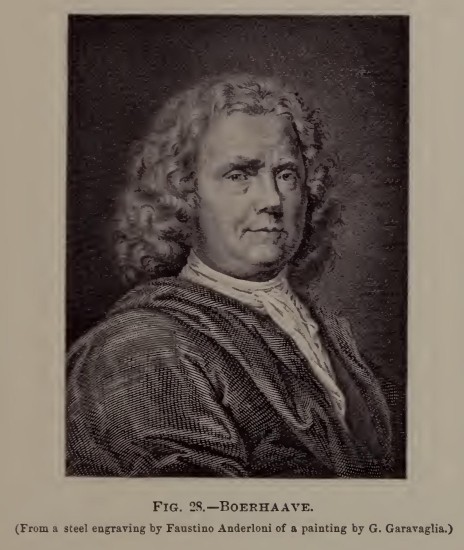
Original
First of all, the medical systems and theories of the century. Many hundred years previously Galen had originated a method, which deserves, perhaps, the title of pure eclecticism. The first purely eclectic system similar to his originated with Boerhaave (1688-1738), perhaps the most famous physician of his or any other century. He was the son of a clergyman near Leyden, Holland, and was one of thirteen children. Originally intended for the clerical profession, he had studied philosophy, history, logic, metaphysics, philology, mathematics, as well as theology, with great diligence. His education was, later, directed to the study of medicine, because of the statement that the purity of certain theological doctrines was endangered by him. So he studied chemistry and botany, and then anatomy and medicine, graduating in 1693. He practiced in Leyden with great success, and was offered a court position. In 1709 he was tendered the chair of Medicine and Botany, and in 1714 that of the Practice of Medicine; in 1718 he was also made Professor of Chemistry. In all of these positions he displayed the greatest capacity. He was a clinical teacher of rare talent, and soon acquired such reputation as to attract to Leyden students from all parts of the world in such numbers that no lecture-room in the university could contain them. He was the first to give separate lectures on the subject of ophthalmology, and employed the magnifying-glass in examining the eye. As a practitioner he was no less popular, and he left an estate valued at two million dollars. He was so famous that, when a Chinese official addressed a letter "To the Most Famous Physician in Europe," it reached him safely. He made no distinction in his patients, and compelled Peter the Great to wait a whole night for his turn to consult him. His most eminent pupils were: Haller, Van Swieten, de Haën. Gaub, and Cullen.
Boerhaave's influence and dignity, which were astonishing, even in a physician, were based no less upon his encyclopaedic attainments than upon the benevolence and purity of his character. He was free from disputatiousness and vanity, although everywhere regarded as an oracle. His universal maxim was: "Simplicity is the seal of truth," although he never manifested this in his therapeutics. He employed the thermometer in the axilla in examining his cases, as did the iatrophysicists of the previous century.
His doctrines did not form a new system, but rather a composite of earlier systems, he stands also in the anomalous position of one who had the whole world at his feet, and yet contributed little or nothing which has been of essential importance. In fact, his peculiar views have been so universally given up that they are of only meagre historic interest. He looked upon disease as a condition in which bodily action or natural activities, being disturbed or unsettled, could take place only with difficulty; the reverse of this, of course, constituted good health. Fever he regarded as an effort of Nature to ward off death. Digestion was explained, like the circulation, upon mechanical principles. In his therapeutics, besides his efforts to sweeten the acid, to purify the stomach, to get rid of acridities, he made Hippocrates and Sydenham his models. His biographers say that his medicines were less effective than his personal appearance. He left many adherents, but no school of followers. It must be said, however, to his credit, that, while not the first to give clinical instruction, he permanently established a clinical method in teaching.
Gaub (1705-1780), professor in Leyden from 1731, was but little inferior to his master, Boerhaave, in fame as a teacher. He wrote the first complete work on the exclusive subject of general pathology. In general therapeutics he considered the healing power of Nature amply sufficient to remove sickness, but attributed this power sometimes to the soul and sometimes to the body.
There arose, naturally, strenuous opposition to the views and teachings of Boerhaave, and his principal opponent was Stahl (1660-1734), who was one of the most important systematists of any age, a profound thinker, and a pioneer chemist. He began lecturing in Jena at once upon his graduation, at the age of twenty-five, and moved through two or three different university positions until he came to Berlin at the age of fifty-six. He was a great pietist, of uncouth manners, faithful to his laboriously acquired convictions, and bitter and relentless against those who could not accept them. Indeed, he regarded his convictions as revelations from God. He looked upon the success of another as a personal injury to himself, and from being first a croaker he became finally a confirmed misanthrope, until he fell into actual melancholia. Pecuniary profit he had never sought, and its pursuit he scorned. His views were dynamico-organic, pietistic, and antagonistic. He regarded the soul as the supreme principle, life-giving and life-preserving, not to be confounded with the spirit; when hindered or obstructed in its operation, disease was present. The soul governed the organism chiefly by way of the circulation; consequently, plethora played an important rôle. To get rid of this plethora the soul employed either fever or convulsive movements; for example, in children plethora produces a pressure of blood to the head, and, by way of compensation, the soul provides a haemorrhage from the nose. For reasons easily appreciated, he regarded bleeding piles as safety-valves of the utmost importance. Fever was a salutary effort of the soul to preserve the body; this was true even of intermittents, and, accordingly, he never gave cinchona. He scorned anatomy and physiology, saying, in one place, that medicine had profited as much by the knowledge of the bones in the ear as by a knowledge of snow which had fallen ten years previously. But Stahl was one of the most eminent chemists of the age, and did a great deal to liberate chemistry from the glamour of alchemy and the domination of pharmacy, and to transform it into an independent science.
Stahl's doctrine has been called animism, and was a reaction against the chemical and mechanical theories of the seventeenth century. He gained a considerable number of followers, the most notable of them among the French being Sauvages (1706-1767), the forerunner of Pinel and an opponent of pure mechanics, who animated the mechanical system of the body with Stahl's "soul." This was, par excellence, the age of artificial systems, and so Sauvages in his classification supplied a system which had ten classes of diseases, each of which had several orders, and some as many as two hundred and ninety-five genera, and two thousand four hundred species of disease!! Even Linnæus had three hundred and twenty-five genera of disease, while Cullen had only four classes with one hundred and forty-nine genera.
The mechanico-dynamic system was a sort of compromise or mixed system, which was held in high honor by the most eminent physicians and better minds of the last century, and has even been prized by Sprengel as the best of all. It was originated by Friedrich Hoffmann (1660-1742). Hoffmann's father was a physician, and he was himself born in Halle, whose university he attended. He acquired lasting reputation as an oculist, and was made Professor of Anatomy, Surgery, Medicine, Physics, and Chemistry at his alma mater. Our commonplace "Hoffmann's anodyne" is named after him. He was one of the most erudite professors of his day, more easily understood than Stahl, widely known for his fluent diction and amiable temper, and, accordingly, won great renown for his university. His good fortune as a practitioner was so great that even Boerhaave declared him his own equal. As a writer he was voluminous, one edition of his works comprising twenty-seven large volumes.
According to Hoffmann's views, life was simply mechanical movement, especially of the heart; death, the cessation of heart-action, putrefaction thereupon resulting. Health meant regularity of movements; disease, a disturbance of the same. He used the word "tonus" extensively. Ether he regarded as an important factor, producing and maintaining movements of the body, itself extremely volatile, corresponding largely to the "pneuma" of the ancients; it was, in fact, a motor principle and, at the same time, the perceptive soul. Ether was stored in the medulla, and circulated in a double way in the body; spasm was the consequence of too strong, atony of too feeble, influx of ether. Fever was a general spasm of the arteries and veins, having its cause in the spinal cord. Hoffmann's therapeutics were simple, and poor in drugs. These latter were intended to weaken, alter, or evacuate, and he was especially partial to the use of vinous remedies. The strong and toxic drugs he used but little.
William Cullen (1712-1790), a Scotchman, rose from the deepest poverty to the greatest celebrity. First a barber, he afterward became an apothecary, then a ship-surgeon, then a village practitioner, finally entering into partnership with William Hunter as a general practitioner. Both of these eminent men being in equally poor circumstances, they agreed to live in the same place and that, while one was studying, the other should take care of the practice. In this way Cullen was enabled to graduate in 1740. Six years later he taught chemistry in Glasgow, and in ten years more came to Edinburgh as Professor of Medicine. He continued very active and famous up to the time of his death, but died as he had been born,—in poverty. Among his numerous other charitable deeds, he supported the widow of Robert Burns and published the latter's poems.
Cullen was the father of modern Solidism,—a system based upon the solid parts of the body, the nerves being the chief agents. The life-giving element was, in his view, an undefined, dynamic something (different from Hoffmann's ether or Stahl's soul), which he called nerve-force, or nerve-principle; animal force; and brain-energy, and in it he included the spinal cord. His nerve-principle was supposed to produce spasms and atony, either actively or passively. The causes of disease, while of a debilitating character, were supposed to awaken reaction of the healing powers of Nature; fever was a reparative effort of Nature, even in its cold stage, the blood playing no part in it. He constructed a very arbitrary classification of fevers, as, in fact, he did of all diseases, his system of nosology being the secret of his reputation. His explanation of gout was famous. That disorder, he said, depended upon an atony in the digestive organs against which was periodically set up a reparative effort in form of a joint inflammation. In scrofula he had to assume, in contradiction to his nervous pathology, a peculiar acridity, and in putrid fever a putridity of the humors of the body. His therapeutics were simple and salutary, because of his renunciation of venesection, which was much abused in his day.
The most celebrated pupils and successors of Hoffmann were Gregory, of Edinburgh, Gardiner, and, in Germany, the famous Thaer (1752-1828), who finally abandoned the practice of medicine because it promised more than it could perform, and who became a "father of husbandry."
A composite of the doctrine of Hippocrates, Sydenham, and Boerhaave was represented in the so-called Old Vienna School, whose connection with the lives of Maria Theresa and Joseph II deserves, at least, mention. Its founder was Baron Van Swieten (1700-1772), of Leyden, a descendant of a noble Jansenist family of the Netherlands, who graduated under Boerhaave after having studied at Louvain. After the death of his patron he was called to the assistance of the Archduchess Maria Anna, of Austria, who was suffering from an abortion, and gave such satisfaction that she recommended him to her sister, Maria Theresa, who up to this time had remained sterile. To her and to her husband he gave advice which resulted in sixteen successive pregnancies, and then, as the result of his success, came to Vienna in 1745 as President of the General Medical Department of Austria. He was also made censor, in which position he incurred the enmity especially of the Jesuits and of Voltaire, whom he robbed of their influence. He was made baron, and became, next to Kaunitz, the most influential counselor of the empress. His chief care was dedicated to the elevation of medical affairs in Austria, and especially to the improvement of the medical faculty. He had just seen success crown his efforts when he died of senile gangrene, with the reputation of being a great physician and benefactor of the poor. One of the greatest of his services was improving the treatment of syphilis, in which he, after the example of Paracelsus, recommended the internal use of corrosive sublimate.
More eminent as a physician than for personal character was de Haën (1704-1776), of The Hague,—a pupil of Boerhaave. At the suggestion of Van Swieten, he was called, in 1754, to Vienna as president of the clinic of the city hospital, which at that time afforded accommodation for only twelve patients. He was the real founder of the so-called Old Vienna School, whose merit, in contrast to the so-called new school, is to be sought in practical and diagnostic services. As de Haën quarreled with every one, he also did with Stoerck (1749-1803), the successor of Van Swieten in the direction of the Austrian Medical Department, and with Stoll (1742-1787),—a clinical teacher who was especially famous as an epidemiologist.
Stoll lectured with great popularity until 1784, upon the completion of the Allgemeines Krankenhaus, when he fell into the background and was badly treated. He was the subject of numerous intrigues by his enemies, and had a wife who embittered his life, and who even had him buried in the dress of a Jesuit in order to injure his reputation after his death. To his credit be it said that, changing his views of the constituents of disease later in life and his original therapeutics becoming no longer of use to him, he abandoned them entirely. Nevertheless his therapeutic system flourished for a long time after him.
There were in vogue during this period numerous other doctrines, some of which were too puerile or insubstantial to gain any foothold at all; others exerted a certain amount of influence during the life-time of their originators or for a generation afterward. With many of these I do not care in any way to deal. A few others, I think, ought to be at least mentioned in such a history as I am endeavoring to present.
There was another Hoffmann—Christopher Ludwig
Hoffmann (1721-1807), of Westphalia, who devised a so-called humoral theory in which the "acridities" of Boer-haave were mingled with the "putridities" of the pneu-matists and the "irritability" of Glisson. His treatment and remedies for diseases were supposed to be antiseptic, as was very proper when dealing with putridities.
The theory known as the "Doctrine of Infarctus" had its origin with Kampf, who died in 1753. By infarctus Kampf understood impacted fæces, which he thought originated in the humors of the body, portal vessels, and intestines; he recognized two kinds,—the black bilious and the mucous. From this theory a wide-spread clyster fashion developed, and lords and ladies vied with each other in belaboring their infarcti and in administering enemas. As Baas says: "We cannot deny to the author of this doctrine at least an extensive knowledge of human nature. He supplied a universal remedial procedure, and gratified the apothecaries with the bulkiness of the herbs required for its practice."
Quite antagonistic to the views of the Vienna School were those of the School of Montpellier, inaugurated by Bordeu (1732-1796), and generally known as vitalism. Bordeu died in the enjoyment of great reputation, but at variance with all his colleagues. He maintained the existence of a general life of the body,—a composite life,—resulting from the harmonious working of the individual lives and powers of all the organs, which were supposed to be associated with each other, but each for its own definite function; the most important organs—the stomach, heart, and brain—being called "the tripod of life." In pathology he laid great weight upon crises, which were supposed to proceed from the glands.
The most important representative of vitalism was Barthez (1734-1806), of Montpellier,—a man of great gifts and eager for knowledge. He recognized a vital principle as the cause of the phenomena of life, but acknowledged that its nature was unknown, although he endowed it with motion and sensibility different from a thinking mind.. Plants were supposed to possess it likewise. Disease, he believed, was the result of an affection of this vital principle. Every disease was divisible into certain disease-elements, viewed as parts of the whole, and these were again divisible into secondary elements. He explained putrid fevers as specific vital diseases,—in which view, of course, he embodied humoral ideas.
In Germany, at about this time, a similar doctrine obtained,—a doctrine of vital forces,—which the versatile Reil (1759-1813) elaborated into a system.
Meantime, in England, a doctrine was elaborated by Erasmus Darwin (1731-1802) which partook, in a certain degree, of the doctrines of Stahl, Hoffmann, Haller, Brown, and Bordeu. Erasmus Darwin distinguished himself, not only as a physician, but as a poet, philosopher, and physiologist. He was a friend of James Watt. Of his life it is said that by his practice and very fortunate marriages he became wealthy, ate much, and drank nothing but water. His chief work—entitled Zoonomia, or the Laws of Organic Life—was published in 1784, and is well worthy of perusal to-day. He recognized two fundamental substances—spirit and matter. But it is not so much for his doctrine as for his researches into animal and plant physiology, and, reflexly, because of his more celebrated descendant of the same name, that we owe him most gratitude.
CHAPTER VIII.
Age of Renovation (continued).—Animal Magnetism: Mesmer, 1754-1815. Braid.—Brunonianism: John Brown, 1735-1788.—Realism: Pinel, 17451826. Bichat, 1771-1802. Avenbrugger, 1722-1809. Werlhof, 1699-1767. Frank, 1725-1801.—Surgery: Petit, 1674-1750. Desault, 1744-1795. Scarpa, 1772-1832. Gunbernat, 11790. Heister, 1683-1758. Von Siebold, 1736-1807. Richter, 1742-1812. Cheselden, 1688-1752. Monro (1st), 1697-1767. Pott, 1749-1787. John Hunter, 1728-1793. B. Bell, 1806; J. Bell, 1820; C. Bell, 1842. Smellie, 1680. Denman, 1753-1815.—Revival of Experimental Study: Haller, 1708-1777. Winslow, 16691760. Portal, 1742-1832. Vicq d'Azyr, 1748-1794. Morgagni, 1682-1772.—Inoculation against Small-pox: Lady Montagu, 1762. Edward Jenner, 1749-1823.
During the eighteenth century also arose the illusory doctrine of Animal Magnetism, which obtained among all classes a following that can be accounted for only by the attractiveness of the marvelous and unexplained. Frank Mesmer, born near Lake Constance, in 1754, was early a victim of romantic yearnings, and his graduating thesis, delivered in Vienna, dealt with the influence of the planets upon man and the use of the magnet. After traveling extensively he erected a private institution, where he treated blind girls, fidgety old maids, and simpletons, until his deceptive methods were unmasked by a commission appointed by the Empress Maria Theresa, and he was compelled to leave Vienna in twenty-four hours. This martyrdom recommended him in Paris, where the so-called Mesmerism speedily became fashionable. He finally undertook instructions in magnetizing, at the rate of 100 louis a head, and founded the "Order of Harmony." His so-called baquets were tubs with magnetic ducts, partially filled with soft water and all kinds of ingredients, and armed with iron conductors, with which his pupils, joining hands, placed themselves in contact. At these séances Mesmer appeared in lilac-colored clothes and professed to reinforce the action of the tubs by looks, gestures, playing upon the harmonica, and touching the subjects with wand or fingers. "If any one, particularly a lady, had a crisis at this time, she was borne to the 'crisis-chamber' by Mesmer himself, where he treated her alone, as only when alone, he claimed, could he attain success." He speedily became wealthy; managed to deceive even the Queen of France; and, when he threatened to deprive the country of his presence, 20,000 francs were offered him to instruct others in his art. This offer, however, the wily charlatan declined. In 1785 some fool penned an article extolling him as a worker of miracles; this stimulated the authorities to organize a committee of investigation, the adverse decision of which, along with some contributory evidence, made Paris too warm for him. After the revolution he returned, but his day had passed, and he figures no more in medical history. He has had many imitators, and the mesmeric craze, at times, has infested different portions of the civilized globe; even some who were eminent in science have fallen into the snares of so-called Mesmerism,—notably Olbers, the discoverer of a number of asteroids. Mystic medical doctrines, founded upon Mesmer's views, still continue in certain circles, though the majority have long since succumbed to the advances of scientific psychology. In this connection it is proper to speak of the revived interest in "animal magnetism" due to the researches of Dr. James Braid, of Manchester, England. This gentleman, in 1842, published a work which pretty thoroughly exposed the fallacies of the doctrine of Mesmer, and expounded many of the truths that were entangled therein. He was among the first, perhaps, to employ the phrase "animal magnetism," and was the author of the term "hypnotism," though in his day the popular title was Braidism.
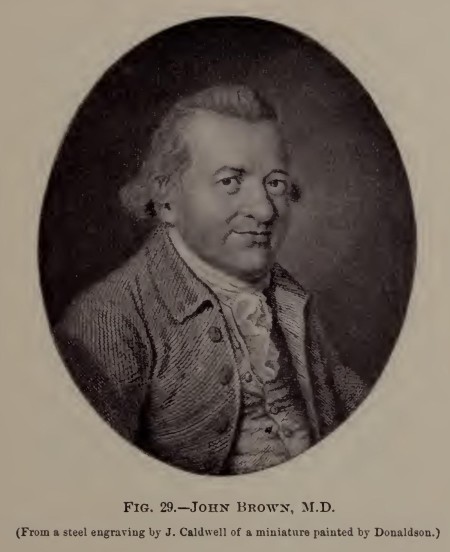
Original
During the middle of the eighteenth century arose a doctrine that, in its novelty, ease of practical application, and apparent consistency (through the ingenious employment of certain vital phenomena), secured such a hold that its influence continued even into the present century. This was the "Brunonian doctrine," promulgated and upheld by the great foe and rival of Cullen,—Doctor John Brown. In youth very precocious, though of most humble birth, Doctor Brown had mastered the Latin language at the early age of seven years, and three years later essayed to learn a trade. At the age of twenty he left his native village of Dunse for Edinburgh, seeking employment as a tutor and intending to study theology. Poverty soon compelled him, however, to take a rural school, but he returned a few years later (in 1759) to the Scottish Athens and began the study of medicine, supporting himself meantime by rendering theses into Latin and by teaching, translating, and quizzing. Finally, he attracted the attention of Cullen, to whom he became useful through his knowledge of the classics; but, ultimately, a foolish quarrel made bitter enemies of the former friends. In 1770, in private lectures, Brown began to advance the theory to which he had been led by one of his own attacks of gout that disappeared under the use of stimulants, the disease having previously always been aggravated by the treatment prescribed and that was held to be orthodox,—viz., antiphlogistic. He had now become somewhat dissolute, and the students he gathered about him were of very much the same character; but they formed the nidus of a great following opposed to Cullen, and quarreled on all occasions with the adherents of the latter. Finally, Doctor Brown removed to London, where fortune seemed to smile upon him, as he gained rapidly in reputation and practice; indeed, he barely missed a call to Berlin and another to Padua as a teacher, the scale being turned against him by his dissolute habits. Though possessed of the highest mental gifts, Brown was unfortunate in lack of mental stamina. He taught that life is not a natural condition, but an artificial and necessary result of constant irritations; all living beings, therefore, tend toward death. Health is an intermediate grade of excitement; diseases, which are either sthenic or asthenic, represent either too high or too low a grade of excitement. It has been said that Brown's teachings slaughtered more human beings than the French Révolution and the wars of Napoleon combined. In England this system found no important followers, but in America Benjamin Rush, of Philadelphia (1745-1815), distinguished himself as an adherent. In Spain and France it found little place; but in Italy, and later in Germany, it secured a numerous and important following, which numbered, among others, Scarpa, Massini, and Girtanner.
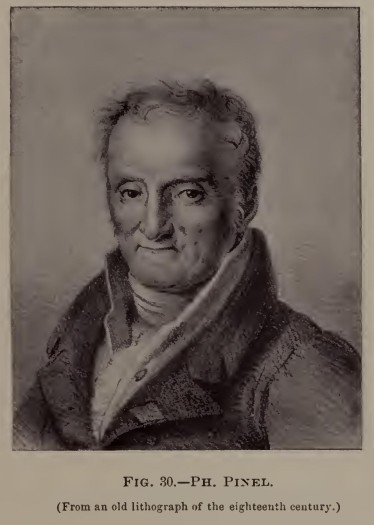
Original
Another system which attained influential development, extending even into the present century, was the so-called Realism, originated by Pin el (1745-1836). Born in poverty, and designed for the Roman Catholic Church, Pinel did not turn his attention to medicine until his thirtieth year, but on completing his studies he rapidly rose to positions of importance. Led to the investigation of mental diseases by the fate of one of his particular friends, who had become insane, escaped into the forest, and was there devoured by wolves, Pinel speedily developed a great interest in this class of sufferers. The lot of the insane at this time was most pitiable: they were imprisoned, chained, and treated worse than wild beasts. In his efforts to improve their lot, Pinel acquired the title of conservative and aristocrat, either of which was almost equivalent to a death-sentence. Unterrified, however, he appeared before the Paris Council and urged the adoption of reformatory measures, replying to the challenges of skeptical and selfregardful opponents by liberating a number of insane patients who were in his charge. The courage thus exhibited receives appreciation in our time, if never before. Not the least of Pinel's services was the substitution of analytical for synthetical methods; he also sought to determine disease by a diagnosis carefully constructed from symptoms, but unfortunately he made pathology and anatomy subordinate factors. He was a pupil of Barthez, but he placed his preceptor's vitalism far in the background.
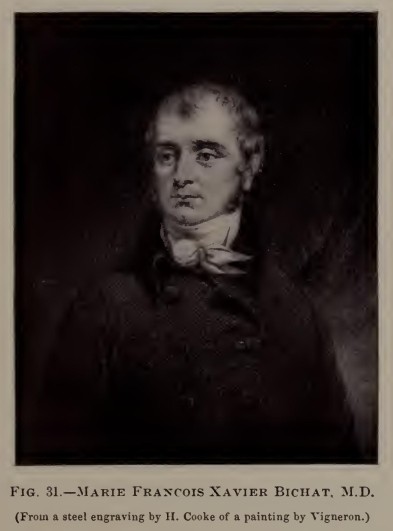
Original
Francois Bichat, born in 1771, earned high rank both as a clinician and an anatomist. His education was begun in Nantes, but he studied surgery and anatomy in Lyons and Montpellier, subsequently going to Paris, where he became a member of Desault's family. After the death of his patron he lectured on surgery, and from 1797 on anatomy. Possessed of a feverish scientific activity, he became a member of the Société d'Emulation. Death overtook him in 1802 as the sequel of consumption and an injury received through a fall. He was the most capable physician of France in his time, and, brief as w>as his span of life, he was author of nine important volumes, the chief of which were a Treatise on Membranes and works on general and pathological anatomy. From the latter a new tendency in study took origin. He it was who gave utterance to the aphorism: "Take away some fevers and nervous troubles, and all else falls to the kingdom of pathological anatomy." As an evidence of his energy, it is related that he in one winter examined seven hundred bodies. He taught how to discriminate between disease processes, and notably subdivided peripneumonia into pleurisy, pneumonia, and bronchitis, these having been previously confounded. He once remarked: "You may observe disease of the heart, lungs, abdominal viscera, etc., night and morning by the sick-bed for twenty years, yet the whole furnishes merely a jumble of phenomena which unite in nothing complete; but if you open a few bodies, you will see the obscurity speedily give way,—a result never accomplished by observation if we do not know the seat of the disease." To Bichat is also due our modern recognition of cellular, osseous, fibrous, and other tissues, as such, wherever they appear throughout the body. He differentiated, without the aid of the microscope, twenty-one different tissues as simple and similar elements of the body, enumerating them as one does the chemical elements; he described the stomach as composed of mucous, serous, and muscular layers; overthrew the speculative tendency of medicine, and placed facts in the front rank; and so conspicuous were his services that he has been termed the "Napoleon of Medicine." He supplemented the influence of Pinel upon the side of pathological anatomy; called sensibility and contractility vital properties, whose alterations constitute disease, claiming, however, that the vital properties of individual tissues differed among themselves. His life and works are revelations to young men and show what can be accomplished at a very early age by sufficiently active and harmoniously developed brains.
In reviewing the theories and lives of those mentioned as medical luminaries of the eighteenth century, one experiences a feeling of mingled respect and disappointment—respect for the devoted way in which they worked and sought for the truth, and disappointment at so much waste of intellectual power and labor. The lesson is also taught, and should be impressed, that in all so-called new systems old principles for the most part reappear, and that the labors of the past are rarely so deliberately consulted as to guard against repetition and revamping of theories that had long before been proved futile.
Let me now mention a few other of the physicians of the last century who have left more or less of an impress upon their successors and upon our science. One man, in particular, historians are wont to remember with the honor that was denied him by his colleagues and contemporaries. I refer to Leopold Avenbrugger, who was born in Graz in 1722, and who, after pursuing his philosophical and professional studies in his native city, obtained, at the age of twenty-nine, charge of a Spanish military hospital; while thus employed lie invented the art of percussion as applied to diagnosis. This he gave the test of experience during seven long years before making it known to the profession, and even then it was not appreciated, but remained practically unnoticed until after his death, which occurred in 1809. He did receive a patent of nobility from the Emperor Joseph II, but this hardly compensated him for the contumely heaped upon him by his colleagues. Paulus Ægineta employed sounds and specula; Santoro used the balance, counted the pulse, and resorted to the use of the thermometer; Boerhaave employed the thermometer and the simple lens; Floyer, and after him Haller, utilized the watch in marking seconds; a Salernian practitioner utilized auscultation and percussion in tympanites and ascites; but the diagnosis of diseases of the great viscera by percussion was never known before Avenbrugger. His booklet of twenty-two pages, unsalable in his time, is to-day held worth far more than its weight in gold. His famous colleague, de Haën, wrote fifteen volumes without a word on percussion; Van Swieten did it no greater justice; in his great treatise the History of Medicine, Sprengel barely alludes to it; yet the contents of Avenbrugger's booklet were of more practical value than all that these other men ever wrote, or all the results of the vast and bloody campaigns during which it slept. In 1808 this volume was rescued from oblivion by Corvisart, who translated it into French and proclaimed its undying value.
During the earlier part of this century lived Werlhof, of Helmstâdt (1699-1767), a far-famed observer, author, and practitioner, who declined a professorship, and especially distinguished himself as a writer of German poetry. Though possessed of an exceptional knowledge of modern tongues, he wrote only in Latin,—the scientific language of the day. In 1734 he was appointed physician to King George II, in which position he attained world-wide fame, while indefatigable in his efforts to elevate science. He first described the disease known by his name,—morbus maculosus Werlhofii,—and struggled hard to establish in Germany the use of cinchona.
From 1740 to 1802 flourished Wichman, of Hanover, highly esteemed as a writer and practitioner. He is especially known for his pleas in favor of more scientific diagnosés, and his demonstration of how to make them. The rôle of the itch-mite in the transmission of scabies he demonstrated upon himself; to be sure, Bonomo, a hundred years before, had called attention thereto, but with little avail.
Another eminent Hanoverian was the fickle, stubborn, and misanthropic Zimmerman, born in 1728, in Berne, upon whom misfortune and disease played many shabby tricks. He was, however, a man of ingenious endowments, and merits especial regard, because he sought to free medical science from the charge of being a secret art.
Another of the prodigies of medical history was J. P. Frank, born (1725) in the Bavarian Palatinate, of pauper parents, and, while an infant, abandoned by a cruel father. His early life was passed in a religious school; at twenty-five he became a court and garrison physician, and later a professor in Gottingen; finally he went to Vienna, where he died in 1801. He was greatly beloved by his pupils, and Walther, the famous surgeon, said of him: "No one ever made so elevating and permanent an impression on me." He published an extensive work on forensic medicine and sanitation,—wherein he took up the hygiene of the individual, of the family, and of the school,—which constituted an effort far ahead of anything of the kind previously known. He is also memorable for efforts toward increasing the population, for the Thirty Years' War had depopulated extensive districts—to such a degree, indeed that in 1750 bigamy was legalized in Nuremberg and many other towns. Frank was distinguished for a keen and even caustic humor, whose subject was not infrequently himself.
From 1707 to 1782 there lived in England one Sir John Pringle, chief of the Army Medical Department, known to this day as an author upon military hygiene. John Huxliam (1794-1868) advanced our knowledge of putrid dissolution of the blood. John Howard (1766-1790) rendered eminent service in prison reform. Heberden (1710-1801) was the first to describe varicella, and also angina pectoris—which was long known as Heberden's asthma. John Fothergil (1712-1780), a Quaker, acquired fame by his observations on chronic angina, neuralgia, and hydrocephalus; was likewise a benefactor of the poor, regarding them as "bridges to the pockets of the rich"; indeed, a large part of what he gained from the latter class he bestowed in charity, and at his death left £200,000 for the same purpose. Radcliffe (1750-1814) was an eminent, witty, successful practitioner of London, who was wont to declare that, as a young practitioner, he possessed twenty remedies for every disease, but at the close of his career had found twenty diseases for which he had not one remedy. Richard Mead (1673-1754) was a prolific writer, and the author of the first quarantine regulations adopted in England. Contemporary with Mead was Lettsom,—the busiest, most philanthropic, and most successful physician of his day,—whose practice, although a large part of it was gratuitous, brought him sixty thousand dollars a year, and who gave away immense sums for charitable purposes; also, Thomas Dover, who invented the sedative known by his name and who died in 1741. Akenside, physician and poet (1721-1770), wrote on dysentery. Baillie, of Edinburgh, was the first to accurately describe the morbid anatomy of gastric ulcer.
Among the French surgeons must be mentioned la Peyronie, of Montpellier, born in 1668, who ultimately became director of the Academy of Surgery and surgeon to the king. His wealth was employed for the elevation of the craft, and he founded no less than ten different surgical professorships at his own expense. In 1743 he effected the separation of the surgeons from the barbers. He died in 1747, dedicating his estate to the purpose for which he had lived. The most famous of the earlier surgeons of this century was J. L. Petit (16741750), inventor of the screw tourniquet, and who was called to treat Augustus the Strong, of Poland; indeed, several other crowned heads became his patients. Garen-geot (1688-1759), a professor in the College of St. Come, published a work on operative surgery. Morand (1697-1773) and le Dran were distinguished surgeons of Paris, the former especially noted for the number of times he performed paracentesis. Famous lithotomists were le Cat and Frère Come,—whose real name was Baseilhac, and who operated by means of the lithotome caché, Astruc (1685-1766) was a syphilographer of extensive attainments; Quesnay (1694-1774), an eminent and undaunted surgeon of Louis XV, who wrote on the history and progress of surgery in France; Brasdor (1721-1776) was best known for his method of distal ligation in aneurism; Sabatier (1732-1811) wrote a famous treatise on operations, in which he recommended resection of the head of the humerus.
One of the most celebrated surgeons was P, J. Desault (1744-1795), the son of a poor farmer, originally designed for the priesthood, but who, after obtaining a thorough mathematical education, began the study of surgery with an ignorant master of his native town. Subsequently he went to Paris, and here supported himself by teaching, gradually rising, step by step, until, without collegiate education, he became professor and chief-surgeon at the Hôtel-Dieu, where he established the first surgical clinic. He opposed violently the prevalent abuse of the trephine, and was also a champion of healing by first intention. A trusted friend of Desault was Ghopart, well known because of the amputation of the foot that bears his name. Another well-known surgeon, likewise a friend of Desault, was Doublet; and it is somewhat remarkable that Desault, Ghopart, and Doublet suffered persecution and perhaps martyrdom in connection with the supposed death of the Dauphin of France,—properly Louis XVII,—in 1795. There is evidence that the child who died in the temple was not the dauphin, but a substitute, and these three surgeons, who examined the corpse, had the hardihood to express their doubts. The same day that Desault reported upon the evidence he was invited to dinner by some members of the Convention, was taken ill at the table, and died almost immediately after his return home, A few days later Chopart and Doublet died, also under mysterious circumstances.
Daviel (1796-1862) is remembered among French surgeons chiefly for extraction of the lens as an independent method of treating cataract; Tenon (172-4-1816), for his writings on the anatomy and diseases of the eye; and Anel for originating the operation for aneurism, mistakenly attributed to Hunter. There were also many others, of lesser note, who distinguished themselves through special services to surgery or some of its branches.
Among the Italians of this century may be mentioned Scarpa (1772-1832), of Motta, professor successively in Modena and Pavia, and who advanced our knowledge of hernia, diseases of the eyes, aneurism, and general anatomy.
The most famous Spanish surgeon was Gimbernat, of Madrid (1742-1790), for a time professor in Barcelona, who also became distinguished through anatomical researches.
German surgeons did not rank high during the earlier half of the last century, owing to the contempt engendered by the church for this branch of the medical art. The fashion of imitating the French, however, led to some surgical development. The first German surgeon of scientific education was Heister (1683-1758), of Frankfort-on-the-Main, who, unable to obtain honorable employment in the military service of his own country, entered that of Holland, where he remained until the experience of his own nation had brought about a healthy reaction. In 1720 he came to Helmstâdt, where he developed great activity in anatomy, surgery, and botany; also distinguished himself as a dentist and oculist, and discussed the whole range of surgical topics from the least to the greatest.
Bilguer (1720-1796), of Chur, became surgeon-general in Berlin, and performed the first resection of the wrist in 1762; he was an opponent of amputation, which at that time was altogether too frequently practiced.
Von Siebold (1736-1807) was the founder of an institution for surgical instruction, where, for the first time in Germany, surgery was taught clinically. He became one of the most famous teachers, and was first in his native land to perform the operation of symphysiotomy, so recently revived.
The greatest German surgeon of the eighteenth century, however,—one eminent both as writer and operator,—was August Gottlieb Richter (1742-1812), of Zorbig, a descendant of a ministerial family, who wrote a famous work on hernia, and greatly improved all branches of surgery; he it was that enunciated the principle of dressing wounds "quickly, easily, and rarely."
Among English surgeons of the century must be mentioned, first of all, Cheselden (1688-1752). wrhose name is inseparably connected with anatomy and pathology as well as surgery At first a warm advocate of the high operation for stone, his dexterity in lithotomy excited the wonder of his contemporaries. He published a treatise on anatomy, and one on the suprapubic section.
Alexander Monro, Sr. (1697-1767), of Edinburgh, was also eminent in both anatomy and surgery, and contributed more than any other one man to the success and reputation of the Scottish medical school. His sons, Alexander and Donald, and his grandson, Alexander (3d), w'ere equally celebrated in anatomy.
Charles White, of Manchester, is generally credited with having performed, in 1768, the first subperiosteal resection of the head of the humerus, although, as a matter of fact, this was not done until 1774, and then by Bent, of Newcastle. He also performed resection of the hip-joint upon the cadaver—another of the same name, Anthony White, having done the operation on the living subject in 1721. He invented the method of reducing dislocation of the humerus with the foot in the axilla,—a procedure that is ordinarily ascribed to Sir Astley Cooper; also operations for false joint by the removal of the involved surfaces of the bone.
It will be seen that the excision of the joints was peculiarly an English method, the elbow-joint having been first excised in 1758, by Wainman, and the knee-joint by Filkin, of Northwich. The man who permanently attracted the attention of surgeons to these new operations was Henry Park, a bold surgeon, who wrote in 1782. The merits of these methods were then soon forgotten, however, and were revived in the present century by Liston and Syme.
One of the best-known London surgeons was Percival Pott (1749-1787), who became especially eminent through his studies upon hernia, spinal disease, and diseases of the bones and joints; his complete chirurgical works appeared in London in 1771.
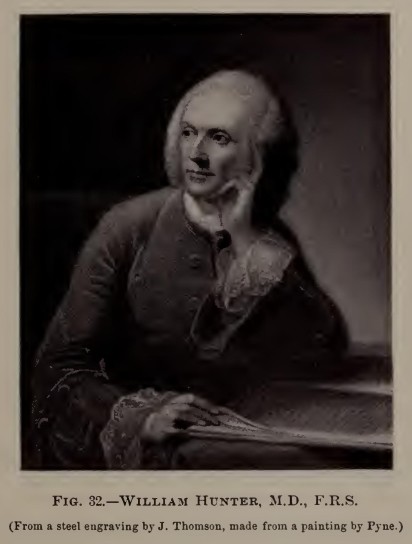
Original
William Hunter (1718-1783), of Scotch parentage, originally a theological student, and a pupil of Cullen, went to London in 1741, began to lecture on anatomy and surgery in 1746, and soon acquired a great reputation as a surgeon, obstetrician, and anatomist. He achieved enormous success in practice, and spent £100,000 upon his house, library, and private collections. The latter now form the Hunterian Museum in the University of Glasgow. His magnificent plates illustrating the gravid uterus required the labors of twenty years and appeared in 1774.
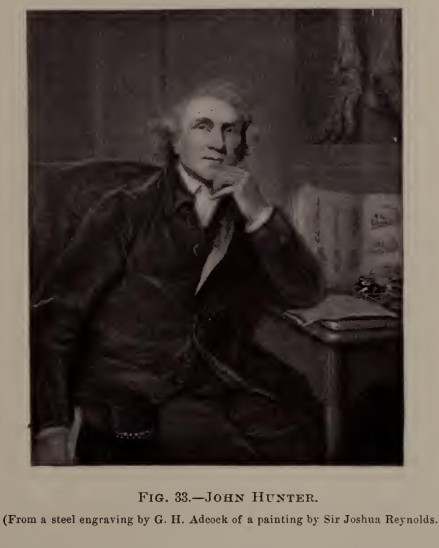
Original
John Hunter (1728-1793), younger brother of William, enjoyed even greater reputation than the latter. He was a pupil not only of his brother, but also of Cheselden and Pott. Beginning the practice of surgery in 1763, he became surgeon to St. George's Hospital in 1768, and Surgeon-general of the English forces in 1790. So memorable were the labors and services of this man that at the Royal College of Surgeons, of London, there is given annually an "Hunterian Oration," intended in some way to commemorate his labors or to draw some lesson from his life and work, To do justice to John Hunter would require a volume, hence we must at present dismiss the subject with this brief reference.
Almost equally famous as a surgeon, though by no means such an omnivorous student as Hunter, was Benjamin Bell, of Edinburgh, who died in 1806. He employed tubes of lead and silver for the purpose of drainage. Sir Charles and John Bell, also of Edinburgh, are eminent names pertaining to the latter part of the eighteenth and first part of the nineteenth century. The latter was Professor of Anatomy, Surgery, and Obstetrics, a busy practitioner, a fertile writer, and not only one of the most successful operators of his day, but an excellent classical scholar; his Principles of Surgery appeared from 1801 to 1807. Sir Charles, who died in 1842, belongs more to the present century, but was equally distinguished as an operator, surgeon, and writer, and best known, perhaps, lor his Bridgewater Treatise on the Hand.
Among the Dutch an eminent surgeon was Peter Camper (1722-1789), who, in order to acquire manual dexterity, learned to use various mechanical tools. He was a fruitful author, and did not consider it beneath his dignity to write a treatise about the best form of shoes, published in Vienna in 1782, but recently translated and republished in England as something new. Sandifort, of Leyden, discussed ruptures, dislocations, etc., and reported the first observation of downward dislocation of the femur.
As already noted, the surgeons of the eighteenth century were often obstetricians,—William Hunter conspicuously. The most important obstetrician of his time was William Smellie (1680-1763), of London, who invented numerous instruments, wrote a large treatise on the theory and practice of midwifery, and greatly advanced our knowledge of deformed pelves. He was the first to distinguish one diameter from the other, and to point out the importance of cephalic version and version of the breech. Parenthetically, it may be remarked that William Hunter, great as he was, was the uncompromising foe of instrumental midwifery, and was in the habit of showing his forceps, covered with rust, as evidence that he never resorted to such aids. A rival of Smellie and Hunter was Thomas Denman (1753-1815), best known, perhaps, because of his demonstration of the portability of puerperal infection.
The researches of anatomists during the eighteenth century were, for the most part, directed toward the minute, more difficult, and less striking parts, and to increased thoroughness and accuracy of description. Microscopical anatomy suffered a relative quiescence. Pathological and general anatomy, which were destined to control the medicine of the succeeding century, were newly created and not yet regarded as sciences by themselves, but merely as special branches. The most important feature was the revival and more accurate study of experimental physiology, which had been scarcely resorted to since the time of Galen, except for Harvey's discoveries. This revival, which really seemed an epoch in the history of medicine, was effected by the great Haller (1708-1777), of Berne,—a man who really deserved the title of "Great," as he was a universal and indefatigable savant, possessed of thorough conscientiousness, marvelous capacity for work, great ingenuity, natural endowments, and an inextinguishable love for art and science; he was certainly one of the most versatile scholars and thinkers of any time, distinguished not only in his chosen field of medicine, but as a poet, botanist, and statesman. Like all Swiss poets, he never passed beyond the didactic and the homely in his versification. From his tenth year he wrote poems in Latin and German, and even when eight years old had made most extensive compilations from Bayle's dictionary. At fifteen he went to the University of Tubingen, where, in the second year of his sojourn, he disputed with one of his teachers. In 1725 he went to Leyden, where Boerhaave and Albinus found in him a most indefatigable follower. At nineteen he received the degree of doctor. In the excess of his zeal for anatomy he purchased for a considerable sum, from Albinus, half of a corpse, the other half of which his teacher had dissected; and, while in Paris, he even engaged in grave-robbing, and, being betrayed by his own carelessness, was compelled to save himself by flight. In many other States, and in more than one country, he studied with the best of teachers, lecturing at times himself. At the age of twenty-six he became professor and hospital director at Berne, and in 1752 published his famous researches on irritability. Three years later he accepted a call to Gottingen as Professor of Anatomy, Surgery, Chemistry, and Botany. He was the founder of a botanical garden; for many years was so busy that he slept and lived in his library; and, in spite of his enormous and unique correspondence with the savants of the world, he never left a letter unanswered. Strange to say, his permanent influence upon the practice of medicine was only indirect; and, although he was professor of surgery, and performed many vivisections, he was never able to persuade himself to perform a single surgical operation upon the living human being. He it was that introduced into Germany the use of the watch in counting the pulse. Like Hunter, Haller demands a special historian, and it is possible here to outline only a few of the services he rendered to medicine. He enriched the anatomy of the heart, of the brain and dura, and pointed out the venous nature of the sinuses; taught that the uterus should be regarded as a muscle: advanced the knowledge of the lymphatic system, and believed in and taught a developmental theory that every individual is descended or derived from a preceding one. In the mechanism of the heart his doctrine of irritability especially maintained itself. He administered the death-blow to the doctrine of vital spirits, and was, in fact, the father of modern nerve-physiology. His doctrine of irritability moved the minds of his century in a way that has no parallel, unless we compare it with the doctrine of Darwin. Glisson had established the general principles of irritability, and Haller followed, teaching it by the inductive method, and proving its existence by experiments,—proving, moreover, that it is a peculiarity of the muscular substance and not governed by ordinary sensation. His researches deserve the more credit because he lacked modern aids to physiological study. The first physiological institute was founded in Breslau by Purkinje, some fifty years ago. Haller had no such opportunity; even his successor, the great Müller, possessed no such advantages. The profound impression made by Haller's teachings may be measured by the number of his supporters and opponents; he was a great man, second only in wide-spread influence to Boerhaave, and one who left a more lasting impress upon the world than even the latter.
The two best known of Haller's opponents were: Wolf (1733-179-4), of St. Petersburg, who regarded each generation as an actual new creation, and was the first to teach the doctrine of the blastodermic membranes; and Blumenbach (1752-1840), of Gotha, who did great service by investigations in general anthropology, of which he was, in fact, the founder, and whose researches in comparative anatomy and the history of development have rendered him famous.
Of the famous anatomists of the century may be mentioned Sommerring (1755-1830), of Frankfort,—the first to distinguish the facial and auditory nerves from eacli other, and whose published works are well known, because of the beautiful illustrations furnished him by the well-known artist, Koeck.
The ablest French anatomist of the century was Winslow (1669-1760),—a man of Danish birth, but who became a professor in Paris, and is best known by the foramen named for him. There were, also, Portal (1742-1832), physician to Louis XVIII, who wrote a famous history of anatomy and surgery; and Vicq d'Azyr (1748-1794), known equally well for his labors in the department of anatomy, especially of the brain, nervous system, and the vocal organs. Bichat (already mentioned) would deserve to be placed at the head of French anatomists were it not for his superior rank in clinical medicine.

Original
The founder of pathological anatomy as a science was Morgagni, born in 1682, in Forli, Italy,—a pupil of Valsalva, and, at the age of nineteen, the assistant of the latter. It was not until his seventy-ninth year, after he had published several works, that he allowed his famous work on pathological anatomy to appear. This is the historical classic, De Seclibus et Causis Morborum, published in Venice in 1761. Its famous author did not cease work, even when he became blind, and to him we owe the maxim that observations should be "weighed, not counted." He was very versatile, and well informed in all branches of science and literature, and possessed a remarkable memory; likewise was the first to devote attention extensively and thoroughly to the anatomical products of common diseases, since, before his time, little had been regarded but rare discoveries in the body. He also called attention to the important bearing which the history of the disease has toward its products, and found his discoveries of advantage, even when they were unable to promote the cure of disease, because of the light which they threw upon physiology and normal anatomy, and because they prevented incurable patients from being continually tormented with drugs intended to cure them; also because pathological investigations alone could settle disputes in diagnosis and matters of honor among physicians. He died in 1772.
Morgagni's legitimate successors in Great Britain were Baillie ( 1761-1823), a son of John Hunter's sister, and Sir Everard Home,—Hunter's brother-in-law,—who became professor in the Royal College of Surgeons, and was intrusted by Hunter with the work of describing his collection. Home, however, in a most discreditable way, burned several volumes of Hunter's own descriptions, in order to appropriate to himself the sole credit of the work. He has gone down to fame especially because of his book on the prostate.
One of the most notable events in the history of medicine was the introduction of the systematic practice of preventive inoculation against small-pox. It is so generally taught that this is entirely due to the efforts of Jenner—or, rather, we are so often allowed to think it, without being taught otherwise—that the measure deserves an historical sketch. The communication of the natural disease to the healthy, in order to afford protection,—or, in other words, the communication of small-pox to prevent the same,—reaches back into antiquity. It is mentioned in the Sanscrit Yedas as performed by Brahmins, who employed pus procured from small-pox vesicles a year before. They rubbed the place selected for operation until the skin was red, then scratched with a sharp instrument, and laid upon it cotton soaked in the variolous pus, moistened with water from the sacred Ganges. Along with this measure they insisted upon careful hygienic regulations, to which, in large measure, their good results were due. Among the Chinese was practiced what was known as "pock-sowing," and ten centuries before Christ the Celestials introduced into the nasal cavities of young children pledgets of cotton saturated with variolous pus. The Arabians inoculated with needles, and so did the Circassians, while in North Africa incisions were made between the fingers, and among some of the negroes inoculation was performed in or upon the nose. In Constantinople, under the Greeks, the custom had long been naturalized, and was practiced by old women, instructed in the art, who regarded it as a revelation of Saint Mary. The first accounts of this practice were given to the Royal Society by Timoni, a physician of Constantinople, in 1714. The actual introduction of the practice into the West, however, was due to Lady Mary Wortley Montagu, who died in 1762, and who was wife of the English Ambassador to the Porte in 1717. She had her son inoculated in Constantinople, by Maitland, and on her return to London, in 1721, her daughter also was inoculated. During the same years experiments were undertaken by Maitland upon criminals, and, as these turned out favorably, the Prince of Wales and his sisters were inoculated by Mead. The practice was then more or less speedily adopted on this side of the Atlantic, but suffered occasional severe blows, because of unfortunate cases here and there, such as never can be avoided. The clergy, especially, using the Scripture, as designing men can always do, became warm opponents of the practice, and stigmatized it as an atrocious invasion of the divine prerogative. Nevertheless, in 1746 the Bishop of Worcester recommended it from the pulpit, established houses for inoculation, and thus made it again popular. In Germany it was generally favored, and a little later came into vogue in France and Italy. In 1757 Robert Sutton, near London, professed to have made fifteen thousand inoculations without a single fatal case; he kept his patients on a strict diet for nine days, then inoculated with the smallest possible quantity of virus. The operation was not prohibited in England until the year 1840, although it involved much greater dangers than vaccination with cow-pox.
The first inoculation with cow-pox seems to have been performed in 1774: by a farmer of Gloucester, named Jesty, though the pioneer in the extensive and general introduction of this method was Edward Jenner (1749-1823), of Berkeley, in Gloucestershire, who, therefore, is generally known as the "Father of Vaccination." The son of a clergyman, he began early the study of medicine and surgery, and during his apprenticeship received from a milkmaid information of the protective power of cow-pox against variola, as established by popular observation. (Sutton and others had proved that inoculation of sheep-pox was not efficient.) This communication so struck Jenner as a means of affording protection to the whole human race that the subject never afterward left his mind. In 1770 he became a pupil of John Hunter, and when he communicated to him this idea the great surgeon said: "Do not think; investigate!" Accordingly he went to Berkeley and performed the little operation which has made him famous; and from 1778 until 1788 he communicated to Sir Everard Home such observations as he had made. But the first vaccination was performed in 1796, upon a boy, with matter from the hand of a maid who had contracted cow-pox in milking.
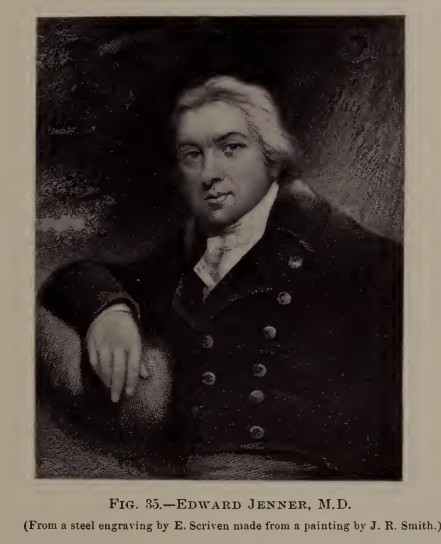
Original
In 1798 he published his memorable work, and afterward removed to London. He died full of fame and honor, in his native place, having-received rewards from the government amounting to one hundred and fifty thousand dollars, besides being made an honorary citizen of the city of London. The subsequent wide-spread practice of the method, and the formation of societies for the promotion of vaccination are matters of recent history.
The first vaccinations in the United States were performed by Doctor Waterhouse, Professor of Medicine in Harvard College, in 1800, upon four of his own children. The transmission of humanized virus through the system of the cow, and its subsequent employment in vaccination of human beings, was first practiced by Troja (1747-1827), of Naples, shortly after the introduction of human vaccination; but in 1810 this was prohibited in Italy. Compulsory vaccination was first extensively introduced in Germany in 1807; in England it was first legalized in 1827. The occasional temporary character of the protection thus afforded was first taught by Elsâsser in 1814. Schoenlein was the first to call attention to the distinction between variola and varioloid.
Another matter in which the eighteenth century witnessed great reform was the treatment of the insane, which continued in very bad condition until toward the close of the century, when a movement for improvement began. From and after this lunatics were liberated from their fetters and from the hands of brutal keepers, and regarded as actually ill, while so-called schools of psychiatry were founded. While the first impulse in this direction was given by Lorry, the true reformer was Pinel, already mentioned, who did away with corporeal punishment and abuse, separated the insane from convicts, limited the employment of drugs and especially venesection, placed the unfortunates in special institutions under the charge of physicians, and classified patients according to their symptoms. Yet, in spite of his humane teachings, lunatics were found incarcerated in cages in some of the French cities as late as 1834. Pinel was followed by Esquirol (1772-1840), who in 1818 established the first clinic for mental diseases.
It is well known what a conspicuous part public baths played in the social life of the ancient Greeks and Romans, but the first public resort for sea-bathing was established in Germany in 1794. The cold-water epoch of this century, however, began with the researches of Hahn (16961773), a Silesian, who introduced a systematic and almost exclusive hydrotherapeutic method. The modern method of using cold water as an antipyretic agent was first employed in England, in 1797, by Currie, who originally was an American merchant. In France the method found little sympathy, but it made its way even to Spain later, where it was adopted by the famous Sangrado, who is well known to readers of Gil Blas.
