



автордың кітабын онлайн тегін оқу Drowsy
E-text prepared by Ralph
and the Online Distributed Proofreading Team
(http://www.pgdp.net)
from page images generously made available by
Internet Archive
(https://archive.org)
Note:
Images of the original pages are available through Internet Archive. See
https://archive.org/details/drowsyjam00mitcialaBY THE SAME AUTHOR
The Summer School of Philosophy at Mt. Desert
The Romance of the Moon
The Last American
"Life's" Fairy Tales
Amos Judd
That First Affair
Dr. Thorne's Idea
The Pines of Lory
The Villa Claudia
The Silent War
Pandora's Box
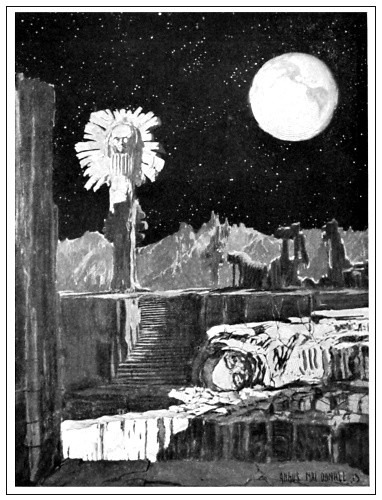
"A FANTASTIC, SOLEMN REGION"—Page 208
DROWSY
By
John Ames Mitchell
Author of "The Last American," "Amos Judd,"
"Pines of Lory," "Pandora's Box," etc.
WITH ILLUSTRATIONS BY
ANGUS MACDONALL AND THE AUTHOR
NEW YORK
FREDERICK A. STOKES COMPANY
PUBLISHERS
Copyright, 1917, by
John Ames Mitchell
All rights reserved, including that of translation
into foreign languages
To the Reader
This is not a fairy tale.
The wonders of to-day, we are told by scientists, will be to-morrow the common things of daily life.
Wireless telegraphy, it appears, is but the crude beginning to a deeper knowledge of the mysteries that surround us. Waves of thought, like waves of light, obedient to our will, may supplant the spoken word and the written message.
And we learn that Space, the borderless abyss through which we move, is vibrant with electric life. But still unsolved is the mystery of the force that holds the moon, for instance, to its orbit around the earth. And it holds it with a mightier power than bars of steel.
If it be true that the human voice goes out into space, on and forever, as other waves, why should not a lover on a nearby planet receive the message from an earthly maiden? If waves of thought keep pace with waves of light, the call of a human heart would surely reach him.
This tale of Drowsy is the somewhat romantic narrative of a woman and a reckless lover. An unusual lover, to be sure, with a singular inheritance; but very human—and with a full equipment of human faults and virtues. While his achievements may seem to us incredible, the coming generation may regard them as commonplace events.
It was Pliny, the elder, who said, "Indeed, what is there that does not appear marvelous when it comes to our knowledge for the first time?"
So, if this story of Drowsy seems a fairy tale, let us remember that the Atlantic Cable would be a fairy tale to Columbus.
CONTENTS
CHAPTER
PAGE
I.
Their Own Affair
1II.
How the Acquaintance Began
19III.
Uncle Hector's Verdict
33IV.
Matrimonial
43V.
He Meets Two Ladies
72VI.
He Almost Gets Religion
103VII.
Toward the Light
116VIII.
A Worker of Miracles
132IX.
Dreams?
144X.
The Farthest Traveler
162XI.
Unsight Unseen
172XII.
"Incredible!"
189XIII.
A Message
221XIV.
Over Seas
229XV.
A Garden of Wonders
235XVI.
The Soul of a Song
251XVII.
"I Mean It"
259XVIII.
The Cañon of Despair
267XIX.
A Young Man Talks
273XX.
Another Message
280XXI.
Above the Clouds
290Illustrations
"A fantastic, solemn, region"
Frontispiece
FACING
PAGE
"Gracefully he floated over their heads"
28"A cocoanut palace against a mountain of vanilla ice cream"
114"I want to know how the earth looks when you are standing on the moon"
120"And now, today, down at the bottom of the ocean, those cities and those marble temples are still standing"
124"Could lift it in the air to any height, crew, passengers, and cargo"
154"And glide forever, a homeless vagrant through the dusky void"
170"Far and fast, even for a bird man"
180"But who ever saw such a diamond?"
198"A most unusual country!"
206"But once a city?"
208"Older than human history"
209"The dried bones of its own past, whatever it was"
212"But why build their cities in those sunless chasms?"
213"And over everything an awful silence"
214"A world of dust and ashes"
215"The diamonds are there, and plenty of them"
216"With long arms and very short legs"
217"But the Diva was far away. She heard nothing save the thing unheard by others"
226DROWSY
I THEIR OWN AFFAIR
II HOW THE ACQUAINTANCE BEGAN
III UNCLE HECTOR'S VERDICT
IV MATRIMONIAL
V HE MEETS TWO LADIES
VI HE ALMOST GETS RELIGION
VII TOWARD THE LIGHT
VIII A WORKER OF MIRACLES
IX DREAMS?
X THE FARTHEST TRAVELER
XI UNSIGHT UNSEEN
XIII A MESSAGE
XIV OVER SEAS
XV A GARDEN OF WONDERS
XVI THE SOUL OF A SONG
XVII "I MEAN IT"
XVIII THE CAÑON OF DESPAIR
XIX A YOUNG MAN TALKS
XX ANOTHER MESSAGE
XXI ABOVE THE CLOUDS
"GRACEFULLY HE FLOATED OVER THEIR HEADS"—Page 29
"A COCOANUT PALACE AGAINST A MOUNTAIN OF VANILLA ICE CREAM"—Page 114
"I WANT TO KNOW HOW THE EARTH LOOKS WHEN YOU ARE STANDING ON THE MOON"—Page 119
"AND NOW, TODAY, DOWN AT THE BOTTOM OF THE OCEAN, THOSE CITIES AND THOSE MARBLE TEMPLES ARE STILL STANDING"—Page 123
"COULD LIFT IT IN THE AIR TO ANY HEIGHT, CREW, PASSENGERS, AND CARGO"—Page 155
"—AND GLIDE FOREVER, A HOMELESS VAGRANT THROUGH THE DUSKY VOID"—Page 171
"——FAR AND FAST, EVEN FOR A BIRD MAN"—Page 181
"BUT WHO EVER SAW SUCH A DIAMOND?"—Page 199
"A MOST UNUSUAL COUNTRY!"—Page 206
"BUT ONCE A CITY?"—Page 208
"OLDER THAN HUMAN HISTORY"—Page 209
"——THE DRIED BONES OF ITS OWN PAST, WHATEVER IT WAS"—Page 212
"BUT WHY BUILD THEIR CITIES IN THOSE SUNLESS CHASMS?"—Page 214
"AND OVER EVERYTHING AN AWFUL SILENCE"—Page 214
"——A WORLD OF DUST AND ASHES"—Page 214
"THE DIAMONDS ARE THERE, AND PLENTY OF THEM"—Page 215
"WITH LONG ARMS AND VERY SHORT LEGS"—Page 216
"But the Diva was far away. She heard nothing save the thing unheard by others."
I THEIR OWN AFFAIR
Breath of Scandal.
Imperishable zephyr! Dispenser of delight to all:—save those it touches. Floating in playful sport around the globe, it does little harm to callous sinners. But it blights, with a special and vociferous joy, superior persons.
The higher and more immaculate the victim the greater the general mirth. In the wake of pleasure it may have, at times, a comic side; at other times it kills—and with agonies that are not for publication.
In a certain month of May it loitered up the eastern shore of the Adriatic, lingering briefly at Rovigno, just long enough to nip the budding romance of an interesting widow. At Orsera it electrified the leading citizens by linking, in a gentle whisper, the name of a lady of spotless reputation with a Platonic Friend. It spared Parenzo. But at Cittanuova it fanned into flame a general curiosity regarding the relations of a Captain of Cavalry with the wife of a certain careless husband. At S. Lorenzo it merely put two lovers on their guard.
Then onward for Trieste. In this search for savory victims it overlooked a villa high up a hillside. Here, indeed, the Breath of Scandal might have entered and rejoiced! But the villa, as if guarding against this very visitor, had drawn before its face a screen of trees and vines and flowers. As wise old Bumble takes his morning nectar from the choicest flowers, so here might this fateful zephyr have drunk his fill.
There was mystery about this villa.
Natives, whose business brought them in the vicinity, were enchanted by the beauty of a woman's voice. In melody and in power it was, to them, a revelation. Two middle-aged gentlemen—one of them the Curé of S. Pietro in Selve—both lovers of music and who attended operas at Milan and other cities heard the celestial voice one day when passing near the villa. They were charmed. Both knew it was no ordinary singer. But the singer's identity was not discovered.
On this particular morning a young man was sitting alone in the Loggia of the villa. Westward, through one of the open arches, he gazed upon the deep, blue waters of the Adriatic, far down below. Small boats, with sails of various colors, floated here and there, like lazy butterflies. The man was reclining in an easy chair like an invalid—which he was. Bandages encased his throat. A bullet through his neck, two months ago, would explain these bandages. It was the price he paid for striking an Austrian officer across the mouth. The Austrian officer had made an offensive remark concerning the Diva. The young American was a good shot and in the duel, three days later, he sent a bullet through his adversary's chest. It so happened that the Austrian, being also a good shot, sent a corresponding missile through the young American's neck. Then the Diva and her defender had fled to this villa; not together, but separately, to escape the Breath of Scandal. Here, in this ideal nest, they found peace and privacy. Not under their own names. Ah, no! If the lady's identity were suspected the thrilling news would have circled the globe. One cannot be an opera singer of world-wide fame and suddenly become obscure. The Diva's Italian friends and the public believed that she was rusticating somewhere, with relatives. The American's friends in Paris had heard about the duel, but knew nothing of his whereabouts. So, alone and happy, here on this Istrian hillside, they laughed at Mrs. Grundy, and lived and loved at leisure. And what sweeter victory than looking down from a perch of safety upon the world below where the Breath of Scandal spared neither the guilty nor the innocent? Kind providence had so managed that the Diva's immediate family was not inquisitive. It consisted solely of her father, a famous scientist, whose portrait, with its high forehead, shaggy hair and drowsy eyes was a familiar face to Italian students. So absorbed he was in study and experiment that the adventures of his yet more famous daughter caused him no uneasiness. Had the Breath of Scandal entered his laboratory, it would have been ignored—or ejected as a liar. The Diva's husband—known as "The Calamity" by her friends—a handsome gentleman of noble family, had long since become immune to the Breath of Scandal—so well encased in his disrepute that he could sink no further. He and the Breath of Scandal were boon companions. At present he held a government position in Siam. Three years he had been there, and might remain for ten years more. So, at the cozy Istrian villa were no jealous eyes to disturb a lover's dream.
On this May morning, too warm, perhaps, in the sunshine, but perfect in the shade, the American, in his reclining chair, was listening to a singing voice. It came to him from an inner room of the villa. Dreamily he listened, with half closed eyes, and smiling mouth. It had been rather a handsome face before the duel. Now the features were too sharp, and the eyes showed lack of sleep. This old Hungarian song—a mother's prayer, now coming from the Diva's lips, and heart—was her lover's favorite, and her own. It was given with the depth of feeling and the art of a great singer, herself soon to be a mother. There are things in music, often the simplest songs, that stir the imagination and reach the secret chamber of the soul beyond all others. This Hungarian prayer was one. It had become, to these two people, a hymn of hope, with its love and fears, its yearnings and its joy. And into it the Diva gave her very soul.
The song ended. Then, with eyes still moist, the Diva walked out into the loggia.
A pleasant thing to look upon, this goddess of the ravishing voice. There seemed bewitchment in her figure, in her carriage, in her head and neck, in the low, wide brow with its blackest of black hair. Beneath the heavy lashes of the midnight eyes lurked tragedy. Their mysterious depths disturbed the hearts of men. Yet her lips told more of mirth. Certain critics maintained that her greatest triumphs were in comedy. But as nearly all grand opera is for tragedy she rarely appeared in lighter rôles. This morning, as she stepped out into the loggia, she could have passed for almost any heroine—either of tragedy or comedy. Her robe, a thing of light material, might be any shade or color; perhaps a delicate purple ground with a smiling yellow pattern—or vice versa; so artfully designed that the outlines of her figure became elusive.
She bent over, kissed the invalid, and pressed a cheek against his face. Then she straightened up and stood beside him, looking down with a smile that was more than friendly. The invalid returned the smile. It was an easy thing to do. For what is easier than returning the smile of a singing goddess vainly sought by other men, when she descends from pinnacles of glory—and freely, joyfully surrenders herself, and all from an overpowering love? In the smile that lingered between them were things whose utterance is not in words of any language:—things that true lovers, and they alone, can ever know. Close beside him she drew a wicker chair, and she sat in silence for a moment, studying his face. Earnestly she looked into his eyes as if searching his secret thoughts.
Flowers may be the language of love, but in this case it was also French. The Diva was Italian and her French was more than good. And Dr. Alton's French, for an American, was not so very bad. But since the leaden messenger had entered his neck three months ago, he had spoken no word, of French, nor of any other language. It was still a question whether he would regain his voice or be forever mute. And in those three months of ceaseless devotion there had come to the Diva an amazing gift. So intense had been her desire to know his thoughts, so persistent her efforts to know what his silent lips would utter, that at last the wish was granted. A mysterious power had come: a power that transferred to her own brain—or soul—the thoughts his lips could not express.
The conversation to an eavesdropper would have seemed a monologue by the lady, with long pauses. In these pauses she was reading her lover's thoughts. The young man's pleasure in these gazings was even greater than the Diva's. Within her eyes, themselves an entrancement, he found love and infinite devotion. Under their spell he asked no greater joy than opening wide the secret chambers of his soul.
"Did the little blond hero happen to notice how I finished the prayer song this morning?"
The little blond hero—who was some inches taller than the Diva when on his feet—nodded. He nodded slowly and carefully in consideration of the bandaged throat.
"And that it was a little different from the way I usually sing it?"
Again the answer was a careful nod.
"How did he like it? Is it better that way?"
This time, after the faint, affirmative sign, she gazed longer into the adoring eyes, waiting a less simple answer. She found it, and with no aid from his lips.
"Yes, that was my idea precisely. More strength in the final passages; the deeper feeling of a mother's appeal." Then, with closed eyes and clasped hands: "May the prayer be answered, for my whole soul is in it!"
On the clasped hands the invalid laid one of his own, with a gentle pressure, telling of sympathy, hope and confidence. She opened her eyes and returned his smile. "Yes, yes. We must be cheerful; always cheerful and full of hope. It will be better for the child."
After a silence, in which both looked thoughtfully over the tree tops, toward the distant coast of Italy, beyond the butterfly sails far below moving here and there on the shimmering surface of the Adriatic, she turned, in response to another pressure of the hand, and again looked deep into the patient's eyes.
"No, Dr. Cervini says there's no harm in my singing unless I fatigue myself. And I never do that."
But his face was anxious. So with an air of cheerful confidence she exclaimed:
"I have decided on a boy. Yes, a boy! Smile again. I love to see you smile. Why a boy? Because boys are stronger and bigger than girls; more reasoning; more honest. What? Not so lovable as girls. Oh, nonsense!"
Here a pause.
"I don't quite understand. Think that again.—Oh, well I shouldn't mind if he was. I love bad boys. Of course we don't want a cowardly, mean-spirited, stingy, cold-blooded, deceitful kind of badness."
Here, after another pause, she laughed. "Yes, I suppose that is just what I do mean—a bad boy who is good."
Another silence, and another laugh. "No, never!" "But tell me, Defender of Women, why do you wish for a girl? Because what? She might be a perfect copy of myself? Oh, honey-mouthed humbug!"
She rose, stooped over, kissed him, and sat down again.
"Well, I shall be happy, very happy, whatever the Bon Dieu gives us."
The next silence was longer.
"Yes, that is all very true. Heredity counts. There's no doubt of that. Half Italian, half American—there are worse combinations. But I am doubtful about the American half." Here she frowned and slowly shook her head. "I have a torturing suspicion that all Americans—with one heavenly exception—are ignoble things."
The blond hero smiled and closed his eyes.
"Not an opera singer in the whole country," she went on. "No music, no art, no Roman ruins; just a race of handsome, reckless, blood-thirsty young doctors. And the whole miserable wilderness, the whole continent itself, was discovered by an Italian! Think of that! Think of how much we owe Columbus, you and I! Were it not for him we should never have met—for you would not exist. You owe everything to Italy. Still, we love each other just as much. That is the important thing. Nothing else really matters." But she frowned and shook a finger. "Nevertheless, if it's a boy I shall name him Columbus Michael Angelo Dante Victor Emanuel Alton, just to hide the dishonor of his father's nationality."
The invalid clasped the finger, and held it. For a moment two pairs of eyes looked deep into each other. Then the Diva laughed. "What ideas you have! The Good God gave you a sunny heart, my beloved. And you know—Oh, you know well—that whatever——"
At the sound of a distant door bell she stopped abruptly. Into her face came a look of mild alarm. Both knew that no visitor was welcome. Who could enter this bower unless shadowed by the Breath of Scandal? The next moment, however, her face brightened. "Oh—of course! It's the good Dr. Cervini. I had forgotten he was to come early to-day."
The man who entered kissed the tips of the Diva's fingers. Then he shook hands with the American.
Tall, thin, of brown and leathery skin, with a prominent Roman nose, fierce mustaches and pointed iron gray beard, he could easily have passed for Don Quixote. But the fierce mustaches failed to hide the lines of mirth about the mouth. And from two calm eyes beneath the threatening eyebrows gleamed sympathy and benevolence. It was generally believed that Dr. Cervini had ushered into the world more princes and princesses, more grand dukes and duchesses, more future kings and queens than any man in Europe. In those cases where there might be a question as to the propriety of the little one's arrival, he was more than trustworthy. In such affairs the Silence of the Tomb, compared with Dr. Cervini, was noisy gossip.
After various questions concerning the patient's progress he exclaimed:
"What patience, what godlike self-control are exhibited by Dr. Alton! Younger and more up-to-date than I, with a perfect knowledge of the human throat, yet he submits to my advice and antiquated treatment! Medals should be his!"
Dr. Alton, of course, protested, in silence, and the silent protest was put in words by the Diva. So ran the conversation for a time, Dr. Cervini watching the Diva with deepest interest.
"Do you realize, Signora," he said at last, "that you have developed a most extraordinary faculty?"
"Is it so very remarkable?"
"It is, indeed! In all my experience, and you know it covers many years, I have seen nothing quite like it. Hypnotism, mental telepathy and the old familiar tricks are very different matters. In your case a sound mind in a sound body merges itself in closest communication with another mind, equally sound and normal. I am wondering if you could still read the doctor's thoughts if there was no common language between you. Or is it his unspoken words that you read?"
The Diva reflected. "No, it is not his words. I feel sure I should know his wishes even if there were no such things as words." Then, turning to her lover: "Tell me, wicked one, do you have to think in words when we talk together?—No, he says not."
"An amazing faculty!" murmured Dr. Cervini. "I have never seen nor heard of such a case. You two, as I understand, can carry on an endless conversation, and without a word from him."
"Yes, except, sometimes, names of people or of places. Then, if I don't know them, he writes them for me."
"Could you read the thoughts of another person, do you think? Of others, beside our invalid, here?"
"Oh, I am sure I don't know! I never tried. It's a terrible thought. Could anything be more frightful than to know, at times, what people really thought of you? No, no, Heaven forbid!"
Dr. Cervini laughed. "Oh, you would have little to fear on that score!" Then, tapping the hand of the invalid, "But you and I, Doctor, we professional sinners!—well—that would indeed be humiliating! Our crosses would be heavy!"
The invalid smiled, then looked at the Diva. And the Diva laughed, blushed and shook her head.
"What does he say?"
"It's too foolish to repeat. He's a silly boy."
"I insist upon knowing."
"He says——. No, no. I couldn't repeat it! His brain is affected. His blond wits are wandering."
Dr. Cervini frowned and looked his fiercest. "What manners! Secret messages in the very presence of a guest!"
"Well—he says the unspoken thoughts of a grateful world might intoxicate me, and he doesn't enjoy drunkards."
Dr. Cervini laughed. "No, you are mistaken, Doctor. She has already survived that test. No living conqueror has sailed in triumph on such seas of glory. No other queen or goddess has achieved her victory without losing something of the simplicity, the freshness and the charm of youth. The hearts of men are hers. To entrance the world, to——"
"Stop! Stop!" Again the color came to her cheeks. "If you said it too often, I might believe it, and then—adieu to all simplicity."
The two men protested—each in his own manner—against all denials of their sincerity.
More serious conversation followed. Dr. Cervini, after final instructions for the patient, departed, the Diva going with him to the outer door. As usual at these partings, she pressed him for an honest opinion of the patient's condition. And, as usual, it was favorable.
She laid a hand on his arm. "You are telling me the truth, aren't you, old friend?"
"Yes. On my honor. In a fortnight he shall eat and drink and talk in comfort. Believe me. Now, now! No tears! I know what a strain it is. You have been simply magnificent all through these weary weeks. Don't weaken now. The worst is over."
"Yes, I will be brave. But the hardest of all is to see him suffer. He never complains. He tries so hard, so hard, to be cheerful! It seems, at moments, as if I could bear it no longer."
"Go away for a week or two. I can bring an excellent nurse."
"No, no! Never that!"
"Then remember the child. It must not come into the world with the face of a tragic mask; with weeping eyes and wrinkled brow."
She smiled and promised. But, after bidding him a cheerful good-by, and when the door had closed, she dropped into a chair and pressed both hands against her face. It was a determined effort to keep back the tears. They came, however; but the luxury was brief. With an air of somewhat fierce resolve she arose, stood just long enough before a mirror to dry her eyes, then, humming the gayest of airs from a comic opera, she went out into the loggia and rejoined the sufferer.
Meanwhile, Dr. Cervini descended the driveway of the villa to the postroad. There he stopped, leaned upon the parapet and looked down upon the scene below him; the little town at the foot of the hill, and the sky-blue Adriatic.
At the sound of an approaching carriage he turned. The approaching equipage was obviously patrician. It pertained to a lady of the High Nobility. Save the two men in livery on the box and the Breath of Scandal, this Countess was traveling alone. She and the Breath of Scandal were boon companions. This intimacy bore no resemblance to the corresponding intimacy among common people where purity is defiled, homes ruined and good names besmeared. With the Countess the Breath of Scandal became a sweet perfume—wafting around her person an intriguing atmosphere of mystery, romance and patrician vice.
Friendly greetings passed between the lady and the doctor. Then the lady asked for information. She suspected from something she had heard that the Diva was in this vicinity.
"Now, tell me, Doctor. Where is she?"
"She? In this vicinity?"
"Come now, I am not to be deceived. You may as well tell me at once. Where is she? You are one of her intimates and I saw you come down that avenue. As the only truthful man in Austria, you may as well confess that she lives at the end of it."
The truthful man raised his Mephistophelean eyebrows, smiled and slowly shook his head. "Alas, I wish, indeed, she were there! There is a villa, Countess, but no Diva in it."
The lady frowned. "Who then?"
"Nobody you know, or are likely to know. The occupant is a deservedly prosperous manufacturer of excellent chocolate."
"Are you sure?" In her manner was suspicion, not quite allayed.
"Well—I have spent the last hour there—and many previous hours."
"Very likely. But I don't believe you."
"Am I a liar?"
"I really don't know."
"But you just said I was the only truthful man in Austria."
"Merely a form of speech. I meant relatively. You might be the most truthful man in Austria and yet have no standing in heaven—or any other honest resort."
Dr. Cervini smiled. "True, too true! But who told you our Diva was here about?"
"A connoisseur. A judge of voices. One who could not be mistaken. He heard her voice one evening, here, along this road."
"Was he sure it was the Diva?"
"Absolutely."
"Ah, now I understand. Delicious! Really, it's too good to keep to ourselves. If we could only interview him together, you and I!"
"What do you mean?"
"I mean my chocolate king has a young daughter, who sings. And she sings—yes—she sings well. But, vocally, she bears about the same resemblance to our Diva as a guinea chicken to a skylark."
"Could our connoisseur be quite such a fool as that?"
"A real connoisseur can be anything. But possibly he had dined too well on that particular night. However, even when sober a musical critic can——" He stopped abruptly, with a gesture of annoyance. "Oh, what a memory! My humblest apologies to our connoisseur. He was right, absolutely right. He made no mistake."
"Then she is here, after all?"
"No, she is far from here. But I had entirely forgotten, for the moment, that she passed this way not so long ago. In the town below there, she lingered a day or two on her way to France."
"Is she in France?"
"Yes, for the summer;—and for rest."
"What part of France?"
"Ah, that, Countess, I must not tell."
"But I am one of her oldest friends! Am I not even to correspond with her?"
"Well, you know her one object in going there is for absolute rest, not even writing letters. I see you are hurt, dear lady, and I understand your feelings, but I am sworn to secrecy."
The lady stiffened, and settled back in the carriage. "Hurt! I should say so. And why not, pray?"
Dr. Cervini seemed to reflect a moment. "Well, Countess, will you give me your solemn word of honor to guard the secret if I tell you?"
"I promise."
"Do you happen to know the town of Tarbes?"
"No."
"Have you ever been to Foix?"
"Never heard of it."
"Well, she has rented a little villa somewhere between those places, but back in the mountains."
"What mountains?"
"The Pyrenees."
"God protect us! Is she there?"
"She is. Her doctors and her family all insisted upon her having a six months' rest. And she needs it."
"Provoking! Most annoying! And here I have had a long drive beneath a broiling sun—and all for nothing."
Dr. Cervini waved a solemn finger. "Don't forget your promise."
"Yes, I will remember. But, the young American doctor who struck—and then killed a captain. Where is he?"
"In his own country."
"In America?"
"Even so."
"Shameful! Shameful!"
"Why shameful, Countess?"
"Because I hoped they were together—as they should be. It's too delicious a romance for the lovers to spoil by parting."
"Lovers! She hardly knew him. If a favorite prima donna were to adopt every man who fell in love with her she would have no time for music. Heavens! What a regiment of followers!"
"Nevertheless," said the lady, in a more serious manner, "I blush for the Diva."
"Why blush?"
"I always blush for virtue."
As the carriage, with the Countess, escorted by the Breath of Scandal, disappeared around a curve in the road, Dr. Cervini removed his hat, looked heavenward and murmured:
"Angels of mercy, forgive a liar."
But the lie did well. Never again came the Breath of Scandal so near the Diva. The lovers' secret remained a secret. Even her father, the famous scientist with the drowsy eyes, died twenty years later not knowing that he had a grandchild.
II HOW THE ACQUAINTANCE BEGAN
Seven years have passed.
Under the arching elms in a Massachusetts village, one Sunday morning in July, various persons were moving toward a house of worship. The house of worship was white, with a portico of Ionic columns.
Among the branches of the elms a noisy congregation of non-sectarian birds seemed to be laughing at the Orthodox bells.
Dr. Alton, leading his little son by the hand, was walking beside the parson. Dr. Alton was but little over thirty years of age. His son was nearly seven. When the older physician died, two months ago, this younger Dr. Alton, his only child, had returned from Europe and announced his intention of continuing his father's practice. Why an attractive young man, shining with honors from the medical schools of Paris and Vienna, should be willing to hide his talents in a village like Longfields was an interesting mystery. Some argued that the death of his young wife had broken his heart and killed ambition. But this morning, as he walked to church, beneath the singing elms, he took cheerful notice of the things about him. He enjoyed the greetings of old friends of his boyhood.
Some yards behind, in this progress toward the church, came Mr. and Mrs. David Snell. Mr. Snell was listening to the discourse of his wife. He listened with the patience and the fortitude attained by long experience and by force of will. His beard was gray, his eyes were blue, his shoulders narrow and his figure slight. Also, he had a gentle voice and gentle manners. But it was known among his friends that this gentleness was by no means a manifestation of any inward weakness. While patient and much enduring, there were times when he became more determined, more "cantankerously sot" and unchangeable than the movements of the planets. Deacon Babbit once said, "Compared with David when he gets his dander up the Rock of Ages is a weather-cock. The only safe thing to do is to stand from under and let him be." But these transformations were rare, and often forgotten.
"I don't care," Mrs. Snell was saying, "people have a right to gossip when a handsome young man comes home from Europe with a child like that and refuses to open his mouth about its mother. I don't believe it had a mother."
"P'r'aps not. P'r'aps it grew on a pumpkin tree and the doctor jest picked it."
"You know what I mean, David. We never heard of his being married durin' those six years he was over there—over there studyin' medicine. Studyin' medicine! I guess he studied a good many things besides medicine."
"Been a fool if he hadn't. Medicine ain't the only interestin' thing in this world."
"Don't be coarse, David, and excusing vice. You know very well he should not deceive people about it."
"How has he deceived anybody?"
"By saying he was married to this boy's mother—and she died."
"Well, ain't it true?"
"No."
"How do you know it ain't?"
"Because if it was true he wouldn't be so secretive about it. There's nothing to be ashamed of in marrying an honest woman and having a child."
"No," said Mr. Snell. "Nuthin' specially surprisin' about that. Good folks have done it."
"Then why be hiding something? All his old friends are naturally interested in his wife and he'd naturally tell us—unless there was something he was ashamed of."
"Ashamed of? Well, Rebecca, you certainly can talk like a fool when you put your mind on it."
Mrs. Snell flushed. "Really! Indeed! So you think it's perfectly natural for a man to hide from his old friends all knowledge of his marriage—as he would a murder?"
"Yes, if he wants to."
"Well, I don't. And that's the difference. And we'll see what other people in this village are going to think about it."
Mr. Snell stopped, laid a hand on his wife's arm and wheeled her about. He spoke in a low voice, but his words were metallic in their clearness. "Now look here, Rebecca Snell, you jest go slow on startin' that kind of talk. Dr. Alton's a good man. We are mighty lucky to have him in the old doctor's shoes. Longfields is a mighty small village for a man with such an education as he's got. And if it ever got to his ears that you'd been insultin' his dead wife's memory—well—you'll get jest exactly what you deserve, and I'll help give it to yer. I mean it. Now shut up."
Mrs. Snell glanced at the light blue angry eyes now looking steadily into her own. Between those eyes and her own face, a long and bony finger, quivering with anger, was moving slowly, to and fro. It came very near her face. She blinked, tightened her lips and took a backward step. Then her husband, in a low voice, husky with rage, the vibrating finger almost touching her nose, spoke once more.
"And you stay shut up!"
After a pause, just long enough for his message to be acknowledged by a nod of obedience he started on toward the church.
Mrs. Snell followed after.
In that congregation were persons who came to worship their Creator—the ostensible purpose of the gathering. Miss Susan Pendexter, on the other hand, a somewhat emotional spinster, came to worship the preacher, Rev. George Bentley Heywood. She was thrilled by the originality, the power and the beauty of the sermon which to his own wife seemed, as usual, prosy and commonplace. Many were present because afraid to stay away. Among these were the young men. Children, of course, were present under compulsion, accepting the sermon as a punishment.
No gathering could be more democratic. These descendants of the Pilgrims were not encumbered by class distinctions. Judge Dean, for instance, the most influential citizen of the village, would never presume to patronize either Abner Phillips, the harness maker or Elisha Bisbee, the blacksmith. Uncle Hector, who kept the store, would have snubbed all the reigning monarchs of the earth had he suspected them of willful condescension. The somewhat restless man in a side pew, he whose stiff hair stands straight on end, who snuffs and clears his throat and looks pleasantly around the church, is Lemuel Cobb, the stage driver. He is a descendant of a famous Governor of Plymouth Colony and has a brother who is now President of a Western College. And the two Allen "girls," Nance and Fidelia—now over sixty—have one of the best pews in Church. The fact of their being largely dependent for food and clothing, rent and fuel, on the bounty of their neighbors, lessens in no degree the courtesy they receive.
It was natural that Dr. Alton and his son, this morning, should be objects of lively interest. This interest was all the greater from certain unexplained events in Europe kindly referred to by Mrs. Snell. But other persons were less suspicious than this lady. Nearly all the members of the congregation—and of the township for that matter—were old friends of this Dr. Alton's father. Few among those here present failed to recall, with gratitude and affection, the dead physician. The older members he had either sustained in sickness or had postponed their departure to realms above. The younger ones he had ably assisted into our merry world. This younger Dr. Alton, now present, bore some resemblance to his father. He had a good expression and a pleasant smile, but he was, of course, too young to carry those deeper lines of study, of work and kindly deeds that marked his father's face.
So high were the backs of the pews that the smaller children were almost invisible. Only the tops of their heads were in sight. But Dr. Alton's son, for a wider knowledge of this new world, folded his short legs beneath him and sat upon his heels. This was welcomed—in silence—by many persons in the congregations. They could now satisfy their curiosity as to his appearance. And the face was disappointing. His eyes, as they moved in a drowsy way over the faces about him, seemed dull and almost stupid. They seemed half closed by heavy lids. And his short, cherubic mouth might indicate a want of decision. His hair, short, thick and dark grew in a straight line across his forehead. Altogether, with his stiff hair, plump cheeks, short neck and placid manner, he seemed a different type from the little Yankee boys of Longfields.
Mrs. Waldo Bennett, the tall, straight woman with startled eyebrows, said to herself, as she watched his slow moving eyes, studying in mild surprise the church and the people about him, "That little heathen was never in a house of God before." But she was wrong. This was, to be sure, his first experience in a New England church, but he had been in cathedrals. And he was surprised at the difference in size between this cathedral and those at Milan and Canterbury. Leisurely, and with no embarrassment or self-consciousness, his eyes wandered slowly over various persons who were watching him. But when his eyes encountered Mrs. Snell they opened a trifle wider. There, in surprise, they rested for a moment. For in this lady's face he found, not the amiable curiosity of his grandfather's grateful friends, but a pious disapproval of his very existence. Almost threatening was her look of hostility, of reprobation and contempt. There was censure in it, and condemnation. She was studying him as one of the Higher Angels might study the meanest imp of Satan. For Mrs. Snell, while not impervious to the consolations of religion, found more solace, just at present, in believing Dr. Alton a special envoy from Sodom and Gomorrah. As for the boy, she detected, in his evil eyes and voluptuous mouth, an agent of the devil for the future debauchery of Longfields. She was not especially prophetic in other matters but, for this boy, she predicted an unspeakable career.
And the boy, while unable to divine all her thoughts or to realize this blighting forecast, did not fail to catch the general message. For a moment he returned her gaze, calmly and undisturbed; then as calmly looked away. He was seeking refuge in the thought that perhaps she hated all other boys just as much. Perhaps the women in this new country were fiercer than those in Europe.
The very next minute, however, something happened—something so much more thrilling that he forgot completely the square jawed, ominous woman. As he looked away from her hostile glare he encountered the eyes of the parson's daughter. And such eyes! How different from Mrs. Snell's! These eyes were the two most astonishing things he had ever seen. They were not far away—in a pew at right angles to his own—and they were looking straight at him! They had thick, dark lashes. They, also, were severe, but in a different way from Mrs. Snell's. They certainly were frowning at him. From Mrs. Snell's eyes he felt like running away—for safety. These other eyes seemed more surprised than angry—as if demanding an apology for something. Although but six years old they were remarkably effective for weapons with so little experience. Not that she was a flirt at that age: she was nothing more than a rather willful little girl, already somewhat spoiled: one of those clever females intended by nature to succeed, from the cradle up, in getting whatever they desire.
The boy's eyebrows went up and he smiled, involuntarily, in spite of her frown, and his slumbrous eyelids opened a little wider. He enjoyed beautiful things, in whatever form, and those eyes, whether hostile or friendly, were wondrous things. Then, when he had just begun to stare at them, comfortably, came one of the surprises of his life. It was more than a surprise: it was a blow, a shock, a humiliation. For, this girl, with no warning, made a face at him! She wrinkled up her nose, slightly raised her chin and stuck out her tongue. And, while he gazed in wonder, she unfolded the legs upon which she was elevated and sank from his vision like a mermaid beneath the waves. He was more astonished than angry. That such an affront, so undeserved, so undignified and so insulting should come from so angelic a face was something new in his experience. In his desire to see more of this novelty he forgot his surroundings, and to the surprise of neighboring worshipers, and before his father could stop him, he clambered to his feet and stood up on the seat of the pew.
Accelerated by his father's hand and by a whispered word, he came down to his proper level. But Mrs. Snell had seen the act. It strengthened her conviction that this future corrupter of youth had no respect for the House of God, and was already dead to any religious influence. For a time the Corrupter of Youth kept his eyes on the place where the eyes had vanished; but in vain. They seemed to have disappeared forever. So, being a boy, he found interest in other things.
The tall windows of the church were open at the top, and those members of the congregation, not enthralled by the sermon, could see snowy clouds drifting idly across a bright blue sky. Through these open windows came the song of birds;—voices of the heathen birds already mentioned; good singers but with little reverence for the Gospel Word. To the Corrupter of Youth, also, the Gospel Word had little interest. He was looking up, through the open windows, at the floating clouds, the swallows and the white pigeons. One swallow, less discerning than his friends, flew into the church and fluttered about before escaping. He was followed, with envious eyes, by the Corrupter of Youth, who decided there and then—a decision often made before—that when he grew to be a man, and could do as he pleased, he also would fly:—up from the earth, high up into the clouds like a bird!
Perhaps it was the warm day and the preacher's voice, but after a while he began to feel sleepy. And, anyway, why should a bird be so much better off than men and other animals? Why stick so tight to the ground? It didn't seem fair. Why should a hen—just a hen—have wings and not a boy? If he himself had wings—my gracious!—he would rise and sail up through the open window, up and far away above the clouds, into the blue sky itself! Among the gods and angels he would float around. And just to show what he could do, he would astonish them with extraordinary evolutions. For speed, originality and distance, his flights, with curves and sudden stops, would startle even sparrows themselves. There was pleasure, too, in swooping down, and showing his contempt for these heavy, easily satisfied persons all huddled together between the bare walls of this foolish little Longfields cathedral. Darting downwards, but in easy curves, to the very window through which he had been looking up and out, he now looked down and in. Hovering at the open window, his body without, his head within, he frowned upon the upturned, startled faces of the earth-bound congregation. Then he entered. Gracefully he floated over their heads. For a moment he hovered over Mrs. Snell, who uttered a loud scream, then fell dead from terror. Next, above the girl with the wonderful eyes he moved slowly to and fro, as fishes move in water. This just to show her what kind of a floating boy he was. Descending a little, until his face was close to hers, he looked straight into her startled eyes and wiggled his nose like a rabbit. And it frightened her almost to death!
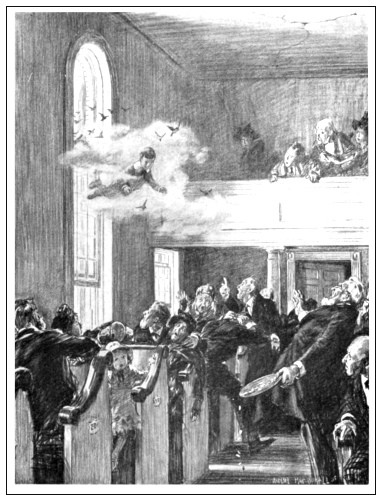
"GRACEFULLY HE FLOATED OVER THEIR HEADS"—Page 29
'Twas a great thought!
He smiled as he reveled in it. But there are dreams too beautiful to be true. And when, at last, his soul rejoined his body he saw the preacher had folded his hands upon the Bible in front of him, and was praying. The members of the congregation, with bowed heads, were listening in solemn silence. Then the dreamer, now wide awake, slid from his seat, stood up, put his mouth to his parent's ear and whispered:
"Father, quick! His eyes are shut. Let's get away!"
Parents can be dull. On this occasion his father certainly missed a golden opportunity. He merely shook his head and failed to act.
However, the weary service was almost over. The prayer ended; the congregation stood up and joined in the final hymn. The dreamer also stood up. Also, he opened his cherubic mouth, and sang. The words he knew not, but he sang without them. His unfamiliar voice surprised Miss Martha Lincoln, a middle-aged maiden just in front of him. Twice a week she gave music lessons in Worcester. Now, involuntarily she looked behind. Her surprise was great when she discovered the performer to be a small boy whose diminutive mouth could hardly open wide enough to put forth the music that was in him. Clearly this courageous singer possessed an ear and a sense of harmony that were a part of himself, and not acquired.
At last, the benediction finished, the people came slowly out of the pews into the aisle, and moved toward the open doors. Greetings occurred between people who lived miles apart and seldom met, except on Sundays. The boy stuck close to his father. One of his hands kept a tight grip on Dr. Alton's coat. As the top of his head was not above the waists of people about him he received little attention. Many persons overlooked him. But just before reaching the vestibule he heard a voice close to his ear, on his own level. It said, distinctly, but in a tone too low for the taller people to hear:
"How do you do, little stupid?"
He turned. There was the girl with the wondrous eyes! But now the eyes glistened with malicious triumph. For an instant he was too surprised, too disconcerted, to grasp the situation. Like a ship that receives a raking broadside from an unexpected quarter and reels beneath the shock, but recovers and prepares for action, so Cyrus Alton pulled himself together, blinked and faced the foe. Then it was that the maiden herself received a shock. For this boy, instead of "sassing back" as she expected, inclined his head and body in a ceremonious bow—as elaborate as the skirts and legs of the surrounding grown-ups permitted, and inquired politely:
"Why do you say that?"
So surprised was the girl, so startled by this unprecedented, this unheard of politeness in a human boy, that her expression swiftly changed to one of comic dismay. She was dumb. The miracle stupefied her. In their wonderment the beautiful eyes became yet larger and more beautiful. But the lips were speechless. Then, once again she vanished, this time behind her mother's skirt.
And that is how the acquaintance began between Cyrus Alton and Ruth Heywood.
III UNCLE HECTOR'S VERDICT
It so happened a few days later that this acquaintance was renewed. Cyrus, sitting on the doorstep of a house in the village, waited for his father, who was visiting a patient within.
Two little girls came along, arm in arm. They stopped in front of him.
One of them said: "A new boy."
The other said: "Isn't he funny!"
In one of these persons Cyrus recognized the girl who made faces at him in church. As they stood smiling, brimming over with mischief, he arose, lifted his hat and made a sweeping bow, as d'Artagnan might have saluted Anne of Austria. It was so well done, with so much grace and solemnity, that the two girls were startled. Things of that sort had never occurred in Longfields. The girls giggled. They believed he was "showing off" to amuse them. But he was not showing off. It was merely his usual manner of saluting ladies. When the hat was again on his head, he looked calmly at the girl with the eyes and inquired:
"Why did you call me stupid?"
For an instant she was taken aback. Then with a smile of defiance:
"Because you look stupid."
"But I am not."
"Well you look so, anyway; doesn't he, Martha?"
Martha nodded and giggled endorsement. But Ruth Heywood herself stopped giggling, and said more seriously:
"It's your eyes that are funny. They are half awake. They are so drowsy they make me sleepy to look at them. Can't you open them wider?"
Cyrus made no answer because he could think of nothing to say. But as the heavy lidded eyes looked into Ruth Heywood's, with their supernatural tranquility, it seemed to the maiden as if the accumulated wisdom of mankind was rebuking and despising her. The same expression came into her face that came there in church; a rapid change from bantering gayety to doubt and misgiving. But she wheeled about, with an air of indifference, and walked away, leading the devoted Martha. A little way off she turned her head and called to him:
"Good-by, Drowsy!"
With that they both scampered away as fast as they could run.
After this interview the acquaintance marched—or rather jumped ahead—with all the velocity of youth. Cyrus passed her house every time he went to the village and interviews were frequent. All discourtesy in their first meetings was forgiven—and forgotten. To his ceremonious salutations, with their astonishing bows, Ruth Heywood soon became accustomed. Also, she ceased being impressed by his judicial gaze, for she soon learned that the heavy lidded eyes concealed neither disdain nor supernatural wisdom. She discovered, in short, that he was just a boy. But he proved neither sleepy nor stupid.
Certain traits, however, quite at variance with those in other children of her own age, made him an object of her special concern. She began to regard him as her own personal property, something to be watched over, guided and protected. Although she had known but six years of terrestrial life, some feminine, kindly instinct was already prompting her to be mother and grandmother to him, also aunt and sister and all the female blessings that he missed at home. He was, to be sure, just about her own age, but he was shorter and less assertive. And there certainly is—at times—a distinct advantage in being able to look down upon the person you are trying to impress.
When Ruth wanted a thing she wanted it very much, and at once. With strangers she always got it. Her beauty, combined with her manner—when she chose—were irresistible, it appeared, to all human males between the ages of ten and one hundred. She could smile the smile that routed reason and paralyzed all powers of resistance. This smile, as she grew older, with the sensitive mouth and conquering eyes, never lost its charm. And the unsuspecting Cyrus was either brave or timid, patient or angry, happy or unhappy, at the witch's will.
Moreover, his mental processes were quite different from those of Ruth. He was slower in reaching conclusions. Her own swift decisions amazed him. She dazzled him at times, by a mysterious intuitive agency whose lightning turns he did not pretend to follow.
Cyrus, more than other boys, was a lover of beautiful things. Flowers, pictures, music, color, all gave him pleasure. In the presence of an American sunset he would sit in solemn adoration. To this lover of beautiful things Ruth's eyes were as windows of heaven. Into them he could look and wonder; quit the earth and imagine all things. They soothed and stirred his fancy like summer skies and solemn woods—or flowers and thunderstorms. And when they rested on him, in reproach, they filled him with delectable guilt.
Ruth and Truth were one and inseparable. Truth was part of herself. Truth and Cyrus, on the other hand, sometimes parted company. And they parted easily. Truth was a good thing—he knew that. But there seemed to be occasions when Truth and Wisdom did not pull together; when the immediate results were disastrous. When those moments came he preferred the exercise of his own wits; the triumphs of his own invention. And his invention was rich and ready.
On one occasion, when rebuked by his father for telling a lie, he replied, after a moment's thought, and with earnest conviction:
"I don't see any fun in telling the truth all the time. Anybody can do it."
However, aside from this little matter of despising Truth, he was a reliable boy. He kept his promises. And it should be said in justice that, while an easy and successful liar, his mind was open to reason and he could be made to realize the sin and folly of his ways. His interview with Uncle Hector, for instance, showed a willingness to see the light.
Uncle Hector kept the store. He was seventy-five years old, tall, very erect, wore a green wig and was a bachelor. The wig was not really green, but certain tints of its original golden brown had changed, in the passing years, to a peculiar greenish yellow. His own original virtues, however, had not deteriorated. He was honest and true. Everybody liked him, and all the children called him Uncle. He wore dark clothes, and a stiff, old fashioned collar—a sort of dickey—for he had a hired man to do the rough work about the place.
Toward noon, one February day, Cyrus and Ruth entered the store. Uncle Hector was off at the further end talking with a customer:—Mrs. Bennett. Nobody else was there. While waiting for Mrs. Bennett to finish her business Cyrus and Ruth admired, as usual, the wonders about them, and inhaled the intoxicating air; an air heavy laden with odors of molasses and vinegar, of coffee, calico and oranges, of the spices of Araby and the rubber boots of New England. On the top of the counter, which was on a level with the nose of Cyrus, lay a dollar bill. Cyrus saw it, and by standing on his toes he could reach over and take it—which he did. He held it in the fingers of both hands and drank in its beauties. Then he held it closer to Ruth's face, that she, too, might admire it.
"Just think!" he said. "A dollar is a hundred cents; we can buy a hundred sticks of that candy you like!"
Ruth had doubts of his ownership. Yet she considered the discoverer's feelings.
"But, Cyrus, it isn't yours."
"Yes it is!"
"Oh, no!"
"Yes. Findin's is keepin's."
Ruth had never heard this principle before, but she accepted it because it came from Cyrus. And Cyrus, this fortune in his fingers, felt as all men feel when raised, without warning, from poverty to wealth.
Mrs. Bennett departed and at last Uncle Hector towered behind the counter smiling down upon the two upturned, excited faces.
"Well, Miss Ruth Heywood, and Mr. Cyrus Alton, what can I do for you this morning?"
Again Cyrus raised himself upon his toes, pushed the dollar bill as far over on the counter as he could reach, and exclaimed:
"A whole dollar's worth of that red candy with the white stripes!"
Uncle Hector's genial smile gave way, for a moment, to an expression of surprise.
"Where did you get this money, Cyrus?"
"Father gave it to me."
"Oh, Cyrus!" exclaimed Ruth.
The liar turned and looked at Ruth, not in anger at being exposed, but in a sort of calm amazement that so sensible a girl should ruin so good a plan. Ruth, however, was not the person to compromise with sin.
"Cyrus Alton! How can you say such a thing?"
Kindly but sadly Uncle Hector looked down upon the boy.
"Tell the truth, Cyrus."
Cyrus, unabashed, met Uncle Hector's reproving gaze. He even smiled, as any honest man might smile, to show his spirit was above defeat.
"I found it just now, right here on this counter."
Uncle Hector's face was still serious. "Are you sure it's your dollar?"
"Yes, sir. Findin's is keepin's."
Uncle Hector stroked his chin and twisted his mouth, as if wondering how to answer. "Well—er—if you should take one of those oranges and refuse to pay for it, and just walk away with it and say 'findin's is keepin's'—would that be all right?"
"No, sir, because I know they are for sale. This dollar wasn't."
Again Uncle Hector stroked his chain and twisted his mouth. And Cyrus smiled up at him, the smile of triumph. It was obvious, even to Ruth, that this opening skirmish was a victory for Cyrus. She also smiled up at Uncle Hector and nodded, signifying that her escort was an able person.
But Uncle Hector was not vanquished. He laid the dollar on the counter, off near Cyrus' face, to make it clear there was no forcible retention of doubtful property—that justice should be rendered to the smallest boy as fairly as to the biggest man. Then he straightened up, pushed back his coat and inserted his thumbs in the arm holes of his vest. And there was something in his smile and in his confident manner that caused uneasiness in Ruth.
"If I should go to your house, Cyrus, and carry off a handsome sled with the name Hiawatha on it in blue letters, refuse to give it back, and say 'findin's is keepin's—would that be all right?"
"No, sir, because you know it's my sled, and there's no other like it."
Again was Uncle Hector taken by surprise, and in his face the two children saw signs of the hesitation which often leads to defeat. Ruth's faith in Cyrus rose yet higher. As she smiled at the tall figure behind the counter her expression said as plainly as words, "Nobody can get ahead of Cyrus."
But Uncle Hector, while not prepared for such an answer to his question, even now was unconquered. "Cyrus," he said, "you'll make a great lawyer some day. You are mighty good at an argument. But suppose a stranger took that sled, and when you ran after him and told it was yours, he should say 'findin's is keepin's and refuse to give it up. Would that be all right?"
"Oh, no!"
"Why not?"
"Because I had told him it was mine."
"Well, now, Mrs. Bennett bought seventy cents worth of tea and sewing silk just before you and Ruth came in. She laid a dollar bill on the counter and I gave her the change—thirty cents. Then we went away for a minute to the back of the store and left it lying here. When I came back I found you claimed it, saying 'findin's is keepin's.' So, if you keep it, I lose seventy cents' worth of tea and sewing silk and thirty cents in cash."
Cyrus frowned, and looked sidewise at the bill. Ruth also frowned. As she looked up at the jar that held the striped candy tears came to her eyes. Uncle Hector smiled pleasantly upon the two troubled faces and inquired in his gentlest manner:
"Now, Cyrus, just as man to man, whose bill do you think it is?"
Cyrus worked his lips, and looked away. He stood firm on his legs, but inwardly he staggered beneath the blow. It was a whole dollar, and gone—gone forever, before he could spend it! He might never have another. Full grown men have been known to collapse under sudden loss of fortune. He dared not look at Ruth. It might unnerve him for the sacrifice. With tightened lips and blinking eyes he reached up over the counter and silently pushed the bill away, as far toward the new owner as his short arm could do it.
"Thank you, Cyrus," said Uncle Hector. "I knew I was dealing with a man who would do the right thing when he saw it. And now, let's have some candy together and celebrate the occasion. What'll you have, Ruth?" He moved his hand, at a guess, toward the glass jar that held the pink candy with the white stripes.
She nodded. "Yes, I like that best."
He placed a stick of it in the lady's hand.
"And you, Cyrus? The same, I suppose?"
"No, sir. I'll have a cocoanut cake."
Uncle Hector replaced the jar; then, as he laid the cocoanut cake in the extended hand:
"But you wanted the candy a minute ago; a whole dollar's worth."
"That's when I was treatin' Ruth. I thought it would please her to think I liked what she liked."
"But you don't care for that candy?"
"No, sir."
Uncle Hector's face took on a new expression. He straightened up, lowered his chin, regarded the small boy in front of him was a peculiar look, bent forward and held an open palm quite close to the wondering face.
"Shake hands."
Cyrus reached up and placed his small hand in the extended palm.
The large hand closed over the little one.
"Cyrus, you are a gentleman."
IV MATRIMONIAL
A June morning.
The sky, this morning, is the bluest blue; the air delicious. There is fragrance in it, of buds, new grass and flowers. Also, in the air, is the joy of living, and the promise of even better things to come.
But Ruth Heywood, sitting upon the front door step of her father's house, seemed oblivious to the surrounding rapture. Her thoughts were solemn. Half an hour ago she had witnessed a marriage in her own parlor. Her father, a clergyman, had united two lovers in the bonds of matrimony. The ceremony had deeply impressed the youthful witness, curled up in the big arm chair near the window. And after the departure of the happy couple she had been still further, and yet more deeply impressed, by her father's explanation of what the ceremony meant. Now, sitting in the sunshine on the front steps, her youthful mind was struggling with the marriage problem. It certainly seemed a grand idea, this bringing together of a man and woman to love each other dearly all the rest of their lives, with no drawback, and to make each other supremely happy, not only in this life but in the life to come. The more she thought and the deeper she went into this inviting subject the better she liked it. And she wondered why anybody should delay an hour before entering the holy state.
From this maiden dream of everlasting bliss she was gently awakened by peculiar sounds. These sounds came from the lips of a jubilant boy, dancing along the center of the street. If explanation were necessary the sounds might be interpreted as a song of praise to the Creator for producing such a perfect day in such a wondrous world. To further emphasize the joy of living the boy's arms were swinging above his head and his eyes were heavenward. He wore a blue and white checkered shirt-waist, brown knickers, stockings of the same color and copper-toed shoes. His hat, being a nuisance, had been left at home.
With him was a dog. And the dog, even more than his master, seemed intoxicated with present conditions. The fact of being alive had stirred him to a wild activity. At dazzling speed he was describing circles about the size of a circus ring around the singing boy. He traveled like a thing possessed and with a velocity somewhat faster than a shooting star. And the eyes of Ruth Heywood, although young and active, blinked as they tried to follow him.
She called.
"Drowsy!"
Cyrus stopped, turned about and made a sweeping bow. When he straightened up the maiden beckoned, and said, "Come here."
As he seated himself beside her, she asked:
"Were you ever married, Cyrus?"
For an instant the boy was taken aback. As he turned and looked into the maiden's eyes, ready to carry on the joke, he saw those eyes were more than serious: they were almost tragic in their earnestness.
"Why, of course not! I'm too young."
"No, nobody is too young. It's a lovely, beautiful thing and everybody ought to do it."
Cyrus was clearly surprised; but, always polite to ladies, he nodded his appreciation of the new truth. "I didn't know. I thought only grown folks got married."
"No; it is everybody's duty. And it's my duty and yours, too."
Cyrus' eyebrows went up. "Me? Mine?"
"Yes. It's a beautiful thing and makes us all better. Father says so."
"Did he say children, too?"
Ruth hesitated. "He—he—said it makes everybody better—more unselfish—and of course he meant nobody is too young to be made better."
Cyrus nodded. "I s'pose that's so."
"And I want to marry you," said Ruth.
Cyrus nodded. "I'm ready, if it's a good thing."
"It's a lovely thing."
"What's the kind of good that it does?"
"It makes us better."
"Yes, but—but in what ways is a feller better?"
"Oh, in every way."
"Can he play ball any better?"
"I guess so."
"Is a married feller stronger and can he run faster than the feller that isn't married?"
"Oh, yes."
"Well, that's a good deal. Does it take long to have it done?"
"Just a few minutes."
As a new suspicion entered the mind of the prospective groom he edged away a few inches. "Does it hurt?"
"What hurt?"
"Getting married. Does a dentist do it—or something like that?"
Contemptuously the maiden answered. "'Course not! You are a very ignorant boy. We just stand up before father and say 'I will,' and 'Yes' and 'It is' or 'I do' and short things like that. Father does all the rest."
Then Ruth explained the ceremony, and described minutely the scene she had witnessed an hour ago in her own home.
"That's easy enough," said Cyrus. "Anybody can say those things."
"Everybody does it," said Ruth.
Cyrus smiled; it seemed a smile of relief. "That's funny. I'd always thought being married was kind of important, and kind of—kind of—lasted a mighty long time."
"It does. It lasts forever. That is why it is so beautiful and lovely. Everybody is better forever and ever."
Cyrus frowned. "I don't know."
"Don't know what?"
"I don't like the—the long time. S'pose we got enough of it. We'd have to keep on just the same."
"Oh, Cyrus! Would you get tired of me?"
"No, 'course not! Nobody could ever do that! But s'pose I died in a few days, would you have to be married all the rest of your life to a dead boy?"
"Yes, and I would be very faithful to your memory. I would never marry anybody else and I would put lovely flowers on your grave every day."
"Ho! I don't believe that!"
"Yes I would!"
Cyrus put both hands on his knees, stiffened his arms, straightened up and drew a long breath of the morning air. "Anyway, I'd rather be alive."
"Of course you would! So would almost anybody for a time. But you are very silly and ignorant if you think being married is going to kill you."
"'Course I don't!"
"Then you mustn't say such things."
"I guess I only just meant that if I was married I'd rather be alive than dead. But what do we have to do after we are married?"
"Oh, everything—just what other folks do, of course."
"And what's that?"
"Why—sit opposite each other at breakfast, go around together, and own things together, and have the same pew at church. You at one end and me at the other, with our children between us."
Cyrus frowned. "Our children?"
Ruth nodded.
"But I never heard of a boy eight years old having real children."
Ruth closed her eyes in solemn meditation. Cyrus, after waiting in vain for an answer said, with a laugh: "Think of me with real children, p'r'aps biggern I am! They could lick me in a fight." And he laughed. "That is funny, isn't it?" And he gave her arm a shake, as if to wake her up.
At the sound of laughter Zac, sitting on the step below, cocked his ears, wagged his tail and sidled up closer to Cyrus, who reached forward, gathered up the loose skin at the back of Zac's neck and gave him a friendly shake.
"Anyway," said Ruth, "everybody ought to get married. Your father and mother and my father and mother were all married."
"Yes, I s'pose they were."
"Of course they were. They would be ashamed not to. All good and wise people marry. Why, King Solomon, who was wiser than anybody, had seven hundred wives."
"How many?"
"Seven hundred."
"Seven hundred! Oh, get out!"
"But he did!"
"Seven hundred, all alive at once?"
"Yes."
"Jimminy! That seems an awful lot for one man, doesn't it?"
Ruth confessed that it did.
"Nobody in Longfields has more than one, have they?"
Ruth mentioned several citizens, but could recall none who had more than one wife.
"If one," said Cyrus, "is enough for men around here, why should your Solomon need seven hundred?"
"I don't know. Perhaps the Bible tells."
"P'r'aps," said Cyrus, "he was homely or mean or something like that, and instead of one good one he had to take seven hundred bad ones."
"No, I don't believe it was that."
Cyrus reflected a moment. "P'r'aps they were all mighty good and there being so many of 'em was what made Solomon so wise."
"I shouldn't wonder."
There came a silence. Then Cyrus straightened up and spoke with emphasis. "I just don't believe he or anybody else had seven hundred wives. It's too many. It isn't likely, somehow. No feller would want that much."
"Why, Cyrus Alton! Don't you believe what the Bible says?"
"Yes—I—I—'course I believe it if you and the Bible both say so, but seven hundred does seem a mighty big lot." Then, as he looked away, over the common, his eyes rested on two persons who stood talking together across the way, and he asked:
"Were Solomon's wives real live women like Mrs. Strong and Mrs. Clapp, over there?"
"Of course they were!"
Cyrus closed his eyes. But through his ears came the thin, far reaching, nasal voice of Mrs. Clapp. "Did seven hundred women like that sit around the breakfast table with Solomon every morning?"
"I s'pose they did."
For an instant Cyrus faltered. He lowered his eyes and studied his shoes with the copper toes. There might be a darker side to matrimony, a noisier, less peaceful side, than Ruth had pictured. But, as he turned and looked at his companion, it came upon him, like a ray of sunshine that a hundred Ruths would be, oh, so very different from a hundred Mrs. Clapps!
"Did all those wives," he asked, "sit with Solomon in one pew on Sunday?"
Ruth made no answer.
"Doesn't the Bible say anything about that?"
"I don't remember."
"Well, if they did, I say he must have had a mighty long pew. Do you s'pose they all slept in the same bed?"
"Perhaps."
Cyrus laughed. "Seven hundred wives in one bed! Cracky! I guess old Solomon slept on the floor!"
He turned and smiled into the girl's face. But he saw no mirth, only surprise and disapproval as the lovely eyes looked into his own. He was learning his first lesson in the noble art of suppressing humor in the presence of humorous things when taken seriously. And he blushed at his own frivolity. Moreover, his sympathy for the much married Solomon did not weaken his allegiance to the girl beside him. There was, to be sure, a peculiar excitement in the idea of sitting at breakfast with seven hundred Ruths entirely his own. Yet, somehow, the vision daunted him. Even the vision of a hundred Ruths, all just alike, filled him with a kind of awe—an awe of more things than he could ever live up to. Seeking courage and consolation, he looked down into the face of Zac as a companion more like himself—on a lower spiritual plane. Zac, still sitting in front of them, always looking earnestly into the face of whoever was speaking, appeared interested in the conversation. Cyrus stroked his head, then stood up.
"Let's go ahead with this marrying, if you say so. But where's the fun of it?"
"Oh, in doing such a beautiful thing—and being better."
"There's no great fun in being better. We are good enough already."
"Oh, Cyrus! Nobody is good enough already except our fathers and mothers and ministers."
Ruth's manner was solemn. The responsibility of the enterprise seemed to rest entirely on her own shoulders. While she was deciding, with far away look, on the next step, Cyrus said:
"There's a big circus picture on Mr. Wade's barn, just stuck up this morning. It has a great big tiger crawling up an elephant, and soldiers fighting Indians, all big, in splendid colors! Come over and see it."
Ruth frowned. In her very pretty eyes, as she turned them in sadness on the prospective groom, was pity—the almost tearful yet contemptuous pity with which Wisdom looks on Folly.
"Cyrus, you are just a boy. You don't understand things."
"Don't understand what things?"
"How important this marriage is."
"Oh, that's all right. I'm ready. Let's go ahead now and have it over with. What do we do first?"
"We must go in to father and ask him to marry us, just as he did those people this morning."
"All right. Come along."
As the two children entered the house, Zac with a bark of joy bounced into the hall ahead of them. It was a loud bark, a piercing, youthful bark, that might disturb a dozen clergymen if working on their sermons.
Ruth stopped. "Hush, you horrid dog!"
"Zac, shut up!" said Cyrus. "Go back, and stay on the porch."
But Zac preferred to accompany the expedition. Without openly refusing to obey, he merely bounced about, just out of reach, wagged his tail and smiled in the faces of the bride and groom.
"Shall we let him come?" said Cyrus.
Ruth hesitated, but only for an instant. "No. A dog barking at a wedding would be unreligious."
So Cyrus, by pleadings, threats and gentle force induced his more worldly comrade to remain without. But he said good-by to him as he turned away. For, in parting with this bachelor friend, he may have had feelings in common with other matrimonial heroes when marching to the altar.
Meanwhile, the Rev. George Bentley Heywood, father of the prospective bride, stood at the west window of his study. His thoughts were far away. In his hand was a letter from a friend in China. This friend, a missionary, had presented, in eloquent and convincing words, the various joys, spiritual, material and social that attended the servant of God when converting the heathen of the Orient.
Mr. Heywood's imagination had responded to the winged words and was already disporting itself in the Chinese vineyard. There had been other letters, all with the same message. And, now, standing at the window with the letter in his hand, he was thinking, and thinking hard, over the most important decision of his life.
Mr. Heywood was a serious man. Upon his person lay no superfluous flesh. His face, otherwise severe, was tempered by the eyes of a poet—eyes of a gentle, somewhat solemn beauty. They were pleasant to look into. Ruth had inherited these eyes, and in her childish face they shone with an added beauty. They were dreamy eyes, a soft brown-black with blacker lashes, and either tragic or mirthful, as occasion called.
When the study door opened—with no preliminary knock—there was annoyance in the clergyman's manner as his eyes turned toward the intruder. This time there were two intruders,—Cyrus and his fiancée. Mr. Heywood frowned when the two small people advanced to the center of the room. He was in no mood for answering children's questions. But, as he frowned, Cyrus bowed—one of his best and most elaborate efforts, bringing the heel of one foot against the instep of the other, all with a gracious, sweeping salutation of his free hand—the one that was not leading Ruth. It was the greeting of one gentleman of the old school to another, of deference and good wishes. Mr. Heywood, partly, perhaps, from his thoughts being in China, found himself also bowing deferentially, as if to some exalted and venerable person. Suddenly realizing the absurdity of such an obeisance he straightened up and frowned again. Then he spoke more harshly than if he had not blundered into such a foolish action.
"Well, children, what is it?"
Cyrus spoke. "We have come to get married."
"Who?"
"We. We—us."
"What do you mean?"
"Ruth and I want to get married."
Mr. Heywood frowned again and blinked, as if to summon his wandering wits, undecided whether to believe or doubt his eyes and ears. His thoughts, barely returned from China, seemed unequal to a sudden grasp of the situation.
"What are you saying?"
"I am saying that Ruth and I want to get married."
"Whose idea is this?"
"Mine," said Ruth.
As the father met the earnest eyes of his daughter he almost smiled.
"Where did you get such an idea, Ruth?"
"From seeing the people you married this morning. You said marriage was a beautiful thing."
"So it is. So it is. But that was very different. Only grown people marry, so run away, children. I have no time for play this morning." And he turned away and sat down at his desk.
"But, Mr. Heywood," said Cyrus, "this is not play. This is important."
"Important? Why important, Cyrus?"
"'Cause Ruth wants it."
This time Mr. Heywood smiled. "That's a good sentiment, Cyrus. It shows a kind regard for the lady. But run away, both of you. I am very busy this morning."
"But, Mr. Heywood," said Cyrus, "what's Ruth done that she should be punished and not have what she wants, and wants ever so much?"
"How punished?"
"By not getting what she wants."
"And what do you say she wants?"
"Me."
The father laughed. "Oh, it's you she wants, is it?"
"Yes, sir."
Mr. Heywood drew a hand slowly across his mouth as he looked inquiringly at Ruth.
Ruth smiled and nodded. "Yes, sir."
Her father also nodded as in polite recognition of her wishes. Turning to Cyrus, he inquired, "What are you going to live on? What is going to be your business?"
"I'm going to be a discoverer, like Columbus."
"I am afraid there won't be much left to discover by the time you are a man—not on this earth, at least. The big continents are already discovered."
"But there will be new countries at the bottom of the sea, and under the earth and on the moon, and such places."
"On such places! Dear me, Cyrus, do you think of taking your wife to the moon?"
"Yes, sir."
"But how will you be supporting Ruth all that time? A husband should be earning money."
"Oh, that part'll be all right! I'm going to be a train robber."
"A train robber!"
"Yes, sir."
Mr. Heywood whistled softly and looked at his daughter. "Well—now—is that a nice business, Ruth, for a model husband? Do you want to marry a train robber?"
Ruth smiled and nodded. "Yes, I shall always like Cyrus and whatever he does."
"But suppose Cyrus is imprisoned for life, or hanged, as often happens to train robbers?"
Cyrus interrupted, and spoke contemptuously. "No, I shan't be that kind! It's only the stupid ones that's caught!"
Mr. Heywood closed his eyes for a moment and appeared to be thinking it over. "Of course, it's possible,—just possible, that you may change your mind as you get older."
"No, sir. 'Cause a man gets lots of money that way and gets it quick and easy. And there'll be jewelry, too. I shall give the jewelry to Ruth."
"And I," said Ruth, "shall give lots of it to mother. Mother likes jewelry."
"Yes," said Mr. Heywood, "most women do. But isn't stolen jewelry a little——"
Again Cyrus interrupted. "But that won't be stolen jewelry. When you steal anything you get it when the other feller isn't looking—kind of sneakin'. I shall take it right before their faces."
"Yes, but you threaten to kill them if they resist. That's robbery, isn't it?"
"Yes, sir, but robbery isn't like stealing. It's more—more—it's braver."
"Braver? Possibly. And you really consider robbery an honorable business?"
"Oh, yes."
"And I can help him," said Ruth; "we would work together."
Mr. Heywood looked from the cherubic lips of the groom into the clear eyes of his superlatively conscientious little daughter and murmured: "Yes, you would be of great assistance." Then, after a pause:
"Now, Cyrus, you and Ruth come to me twenty years hence and if we are all alive and Ruth still wants you I have no doubt we can arrange a wedding."
"Twenty years!" exclaimed Ruth. "Why, father, we shall all be dead!"
"Oh, no! I trust not."
"Or too old—too awful old!"
"No, indeed! You will be twenty-seven. Call it fourteen years, then you will be only twenty-one."
"But," said Cyrus, "we may forget all about it in fourteen years."
"Then it will be no disappointment to you if you can't marry. But run along now, children, I have no more time for you." He spoke with such decision as he began reading the letter in his hand that the unmarried couple turned about and slowly vanished.
When they passed out into the open air, a stranger might have thought, from the manner in which Zac bounced with joy and lifted up his voice, that Cyrus was emerging from the Valley of the Shadow of Death. As they stood again on the porch, the corners of Ruth's mouth were drooping. There were tears in her irresistible eyes. Cyrus laid his hands on her shoulders.
"Now don't you feel bad, Ruthy. If you want to be married, we just will."
The maiden shook her head. "He said not."
"No, he didn't. He only said he was busy."
"He said only grown people got married."
"But he didn't say children couldn't if they wanted to."
In the maiden's face came a brighter look. "Yes, that is true, isn't it?"
"'Course it is! And we will be doing something new and different. It makes folks famous to be the first to do things. Look at Christopher Columbus, and look at Benjamin Franklin, the first man to fly a kite and steer lightnin' and make it mind him."
"Was he married when he was a child?"
"Nobody knows. But if you and I are the first children to get married—the very first, why our pictures might be in history books."
Ruth laughed. "That would be funny, wouldn't it?"
"Yes, wouldn't it! And under it would be printed Mr. and Mrs. Ruth Heywood."
"Oh, no! It would be Mr. and Mrs. Cyrus Alton. It's always that way."
"Then we'll be the first ones to do it the new way. We needn't do just like everybody else. But who's going to wait fourteen years. Not us! If your father is too busy to do it, we'll get somebody else."
"Who?"
"I dunno." And he looked away toward the common and became thoughtful.
Now Cyrus' ideas of matrimony were vague, and impersonal. As a game it had never interested him. He had given it no attention. On some other subject he had definite views—such as war, baseball, voyages of discovery, balloons, maple sugar, battleships and the different kinds of ice cream. But this marriage business, now that Ruth wanted it, had suddenly become important. And when Ruth really wanted a thing he felt that reason, religion and the Laws of Man and Nature should stand aside. Moreover, Cyrus was no quitter. He was not of those who are easily discouraged. Persistence, the sort that stiffens in disaster, was one of his dominant traits. A precious gift on occasions; but there were times, in the bosom of his own family, when it was not admired. As guides to character the drowsy eyes and cherubic mouth were, in this particular, misleading. Behind them lay the tenacity of purpose which so often transforms defeat into victory. In this present emergency there seemed to him especial demand for achievement. Ruth wanted something and when Ruth wanted something it was not for him, nor for others, to reason why.
So now, while the bride, crushed to earth, was mourning the downfall of a high endeavor, her companion had not accepted defeat. With roving eyes and tight shut mouth he was seeking some other road to victory.
Inspiration came.
Seeing no road to victory, up or down the village street, his eyes turned heavenward. As they rested on the spire of the Unitarian church, just across the way, there came an answer to his appeal. It came through the open windows of the church—the notes of an organ. He turned and seized his fiancée by an arm.
"Ruth! Listen!"
"To what?"
"To that music! It's Horace Phillips practising on the organ!"
Ruth nodded in acknowledgment of the fact, but she saw no relation between the music and their late rebuff.
"We can go right over there and get married," said Cyrus. "It doesn't matter who does it so long as it is in a church and there's music."
"Are you sure?"
"Yes, of course! Ask anybody."
There was nobody to ask, so he took her by the hand and started forward. She held back. He pulled harder. "Come along. There's the church all open; and the organ playing. It's just the place to be married."
She yielded. "But there's no minister to do it."
"That don't make any difference. As long as we are married in a church with music, anybody can do it."
He spoke with authority—the kind that carries conviction and puts an end to controversy.
As they started, however, she again held back, and exclaimed, in a final despair, "Oh, I forgot!"
"Forgot what?"
"The ring. We have to have a ring."
"What's the use of a ring?"
"Nobody is married without a ring. The man puts a ring on the woman's finger and says things."
"Well—I can say the things and we'll just play there's a ring."
"No."
"Oh, come along!"
"No."
Now Cyrus had become interested in this business. He felt a pride in carrying it through. To fail now would be disgrace. In vexation he raised his right hand—the one not holding Ruth's—and thrust its thumb between his teeth. On that hand something glistened.
"Why, there's a ring!" exclaimed Ruth, "right on your finger! Isn't it lucky."
Cyrus regarded the little silver band.
Ruth repeated: "Isn't it lucky!"
Cyrus hesitated. "Do I have to give it to you?"
"Yes."
"For you to keep and not give back?"
"Yes, of course!"
"But Henry Wheelock made it for me out of a ten-cent piece. I've only had it a little while."
"Oh, Cyrus! Would you be so mean as that?"
"I'm not mean! You know I'm not mean! Henry Wheelock made it out of my own ten-cent piece and I—I—don't want to lose it."
A look of sorrow in Ruth's eyes suddenly changed to contempt. "Then keep your old ring! I'm sure I don't want it." And she pulled away the hand that was in his, wheeled about and started to reënter the house. But Cyrus caught her by the arm.
"Oh, that's all right, Ruthy! You shall have it. Come. Don't let's fight."
So began this lovers' quarrel. But as often happens, the male of the species besought and appealed, apologized, promised everything, acknowledged guilt and sufficiently humbled himself until Sweet Peace returned. Then all was forgiven, and a second time they started for the church. Zac brought up the rear.
On the church steps sat Luther Dean and the New Boy. The New Boy had lived in Longfields only a few weeks. He differed, in many ways, from the other boys of the village. He was blasé, and older in his feelings; he came from a larger town and had seen more of the world. His tendency, now,—natural, perhaps, but unrepressed—was to despise more simple people. He gave the impression among still younger boys of having crowded into his ten years of life a red career of war and piracy, of wild adventure, of reckless deeds and thrilling escapes. These experiences were rather suggested than described, always in a casual off-hand way, calmly and without excitement, in a voice and manner tempered by the wisdom of the ages. And his eyes, light blue and frigidly serene, moved slowly from one listener to another in a weary but patient condescension. His usual haunts, it appeared, were the upper ether, and the deep sea, the cañon and the prairie, the impenetrable forest, the decks of battleships and fields of carnage.
As the bridal couple approached the steps, Cyrus called to Luther Dean and beckoned to him. Luther came forward. So also did the New Boy—the Budding Outlaw—although he was not invited; and his presence embarrassed Cyrus, for this was a private business, in a sense, and not for the general public. Besides, Cyrus did not like the New Boy. However, he braced up and put on a careless front.
"We want you to marry us, Luther, now, here in the church."
Luther frowned, then smiled. "Me? Marry?"
"Yes, marry us—Ruth and me."
"Golly! I—I—never married anybody."
"That don't matter. Anybody can do it."
"But I'm too young. It takes a man."
"No, it doesn't. Ruth can tell you what to say. It's all easy. Come along."
They entered the church; but Zac, like many of his kind, was unpleasantly affected by music, so he remained outside.
Up the main aisle they started, Luther in front, the bride and groom behind, holding hands. In the gallery above Horace Phillips was practising various tunes, and the voice of the great organ filled the church. To the bride and groom, both lovers of music, the notes of the organ seemed more impressive than ever in the now empty building.
But the wedding procession had barely started up the aisle when the ceremonies were rudely interrupted. The Budding Outlaw, smarting perhaps at being ignored, followed close behind and yielded to a vengeful impulse. Ruth's hair, gathered by a ribbon behind her head, was flowing down her back like a golden mane. The Budding Outlaw reached forth and seized a handful, then gave it a violent jerk, as if driving a horse, and he said,
"Hi there! Giddap; giddap!"
Ruth cried aloud in pain, "Stop it! Oh, stop it! It hurts!"
She could not turn her head, but raised her hands in vain efforts at protection.
Cyrus wheeled about. "Let go that hair!"
And he scowled in anger at the aggressor. But the aggressor merely renewed the twitchings with: "Giddap hossey. Giddap."
"Let go that hair," once more said Cyrus.
The Budding Outlaw, for answer, twitched the golden hair again, and harder than before. As Ruth in helpless agony was still raising her hands to her head, Cyrus aimed a blow at the Budding Outlaw and hit him in the face. But the Budding Outlaw was one year older and one year bigger than Cyrus, and twenty years cooler, more cynical and more blasé. So, without even loosening his hold on the bride's hair, he struck out with his free hand and landed full on Cyrus's mouth. The blow was so well directed that the recipient staggered back and stood for a second or two as if dazed. On the Budding Outlaw's face was a smile of easy victory—and contempt. Cyrus saw it. In Ruth's face he saw torture and helpless anger. Then he threw himself again at the enemy. And again the enemy without loosening his left-hand clutch on the golden hair, sent his fist against the approaching face, landing full on its nose and followed it by a sudden push. Cyrus staggered back across the aisle and leaned against the nearest pew. He blinked, and drew a hand across his bleeding mouth. His nose seemed—to him—about twice its usual size and rapidly growing bigger. Then Ruth, forgetting her own pain, cried out:
"Oh, Luther, Luther! Help Cyrus!"
But, either from wisdom or some other reason, Luther refrained from interfering. He looked at Ruth, then down at the floor, then up again at the Budding Outlaw, now terrible in his easy triumph. Ruth called again to him, yet more urgent—a passionate appeal for help. It was the cry of one old playmate to another, for the rescue of a bosom friend. But the organ above was pouring forth its music and Luther turned away, pretending not to hear the cry.
Cyrus, during this moment's lull, did some rapid thinking. He saw the folly of his previous attacks. So, as Ruth was uttering her second appeal to his lukewarm friend, he advanced again, but more slowly than before, ducked his head and dodged a blow, then jumped, and closed with the enemy. And to the Budding Outlaw it seemed as if a dozen boys were on him. Blows rained upon his face. Copper toed shoes were hammering, with the rage of demons, against his sensitive shins. He let go the maiden's hair, as all his hands were none too many for this peaceable boy now suddenly transformed into a reckless and bloodthirsty athlete. He could not reach Cyrus's face, as that face, for protection, was pressed close against the Outlaw's own chest. And when, at last, he got both hands against Cyrus's face and body to push him off he felt ten fingers tighten about his throat with a grip that scared him. For now, as the two iron thumbs were pressing his windpipe with murderous power, he realized that this boy was fighting with the fury and the strength of those who fight for victory or for death. He gurgled, gasped, pulled Cyrus's hair and beat wildly at his head. But when a man is fighting for the woman of his choice—or for any other holy cause—he has the strength of many. So with Cyrus. The tearing of his hair, the blows upon his head and face and body were as summer zephyrs. For him, at the moment, death could have no terrors. He was in this struggle for victory or annihilation.
No boy can live without breathing, and the Budding Outlaw's strength was going. Cyrus forced him to the floor. Then, knowing nothing of the Rules of the Ring, he hammered him in the face and jammed his knees into his stomach, as if to kill.
At last, after a final blow and jab and kick, he climbed to his feet, stepped back and looked down at him. Ruth seized him by an arm and tried to drag him from the church.
"Come! Come quick, before he gets up!"
But a change had come over the once peaceful groom. The lust of battle was in him. He paid no attention to her words. Breathing hard, with bruises on his face, his lips bleeding, he beckoned to the figure on the floor as if angry at delay:
"Come along. Get up."
But the Dare-devil of the West, the killer of Indians, the Pirates' Terror, had no intention of rising. Enough was sufficient for this Despiser of Peace, this Tormentor of Brides. To fight in orderly fashion with a boy you know you can lick—that's one thing. But to struggle with wild animals, cyclones and supernatural forces that ignore the rules of war and really mean to kill you, and will,—unless you can get away,—that's very different. Moreover, something was telling him now that a big will in a little body can demolish giants. He knew he was stronger than Cyrus, but the thing with which he had so suddenly become acquainted was the spirit within this smaller boy—the same old spirit that stirred the Greeks at Marathon, and the handful of Lexington farmers. And now, before him, with the swelling nose and bleeding lips, glowered the embodiment of that immortal spirit. The Tormentor of Brides suspected, and his suspicions were correct, that if he hurled this boy a dozen times against the opposite pews he would still come at him, and each assault would be more deadly than its predecessor.
Cyrus, again ignoring the Rules of the Ring, stepped forward and kicked him. "Come, get up! Get up. Finish it!"
Slowly the New Boy shook his head, with a gesture of defeat. He muttered something too low to hear—words drowned in the notes of the organ. He refused to rise.
Then Cyrus turned and held out his hand to Ruth. In drawing the back of a fist across his mouth during the conflict his cheeks had become smeared with blood. As Ruth stared in a kind of terror at this gory visage with riotous hair, swelling nose and still bleeding lips, she saw in the erstwhile drowsy eyes a look that was unfamiliar; a look of determination, as if no arguments from God or man or devil would be considered. Weak and all atremble, her one desire was for hurrying home. But she obeyed the unspoken mandate and laid her hand in his. Then Luther, also in obedience to an unspoken command, this time a peremptory gesture toward the pulpit, again started up the aisle. And it so happened as the little assemblage resumed its interrupted progress the great organ in the gallery burst forth with Wagner's "Wedding March"; and it filled the church.
The marriage ceremony passed off well;—that is, of course,—making allowance for the officiating person who had no knowledge of what he ought to say, or of what he was saying. With constant promptings and corrections from the bride—who although somewhat hysterical at the moment, had a remarkable memory for the sound of words—Luther managed to get along. To misunderstand certain promptings was excusable, for the music was confusing. Horace Phillips, in the gallery, ignorant of what was happening below, had started off with the full force of the organ, and he continued with enthusiasm until the swelling notes resounded through the empty building.
Ruth supplied all the language.
Luther. Will you take this wedded girl for your wife?
Cyrus. I will.
Luther. Will you take this wedded boy for your husband?
Ruth. I will.
Luther. Do you promise to endure with all your worldly goods?
Cyrus. I do.
Luther. Will you hold on for better than worse?
Ruth. I will.
Luther. You promise to obey?
Cyrus. I do.
Luther. Until death departs, richer or poorer and cherish.
Ruth. I do.
Cyrus. It is.
Luther. I denounce you as man and wife.
Cyrus. I do.
Ruth. No, Cyrus, you say nothing.
Cyrus. Nothing.
Ruth. No, no! You don't say anything—just keep still.
Luther. With this ring I you wed.
Cyrus. No. I say that!
He said it, and with heroic self-control bade a silent farewell to his silver treasure as he slipped it on a finger of the bride. Then, to the rejoicing music, they marched down the aisle.
Outside the church the bride, who feared a renewal of the conflict, looked about with anxious eyes for the Budding Outlaw. But she had no cause for alarm. The Budding Outlaw was visible, far down the street, beyond the common, marching with humble mien, reflecting sadly on the uncertainties of human life.
V HE MEETS TWO LADIES
Miss Anita Clement was the maiden lady who had rented, with her two unmarried sisters, Mr. David Lothrop's house at the west end of the village. She had a girlish figure, good features and soulful eyes. Her exact age was somewhere between twenty-five and forty. This lady's delicate beauty was impaired a trifle by a nervous mouth which told, in spite of all efforts to the contrary, that its owner was easily annoyed, and was a stranger to the various blessings of a tranquil spirit. She had no sense of humor; but this deficiency was counterbalanced by a profound respect for the conventions of life, and by a sincere and humble adoration of her own religious creed, with a corresponding contempt for all others. Her dominant attribute was timidity. Compared with Miss Clement, the average mouse was a fearless desperado. As is usually the case with such temperaments, her nerves were assertive.
This particular November afternoon they seemed to have started a revolt throughout her whole interior mechanism; and she decided to consult a physician. So she walked out to Dr. Alton's house. On this walk—about two miles—she passed a group of boys playing with a football. Now boys, to Miss Clement, were the living emblems of noise and danger. Her one dread concerning a future existence was the possibility of there being boys in Heaven. And, in this life, the things she dreaded most were fire, burglars, run-away horses, smallpox and boys. Her sympathy with boys was akin to her sympathy with thunderstorms and pirates. In passing boys in the street or on the common she held her breath in nervous terror, expecting to be struck by a baseball, or bat or stone, green apple or snow-ball, according to season. Only in color and in clothing did she recognize any difference between boys and Comanche Indians. She loved Law and Order; whereas, to a boy, Law and Order were merely bars to freedom. She had reasons for believing that the highest ambition of every normal boy under twelve years of age was to become an influential outlaw. And she was not far wrong.
This being Saturday afternoon, and no school, the earth seemed swarming with these offensive creatures. However, by going around the common instead of across it, she reached Dr. Alton's house alive—and rang the bell. The door was opened by yet another boy, eight or nine years of age. Miss Clement, being a newcomer in the town, had not the honor of this child's acquaintance. Knowing all boys to be barbarians, with no manners, she was surprised when this one acknowledged her presence with a smile of welcome and a ceremonious bow. It was the kind of salutation that Louis XIV would have given to the Queen of Spain. She might have expected it from an elderly dancing master, but never from a boy in this New England village. Taken by surprise, she was silent a moment, fearing this youthful savage, perhaps more uncivilized even than other boys, was amusing himself at her expense. A good look at his face, however, allayed suspicion. In his calm eyes and radiant smile there was nothing but pleasure at seeing her. Beside him stood—or rather bounced—a youthful dog. He was a fox terrier. Judging from the activity of his tail and from the general expression of his person, the arrival of the visitor was affording him joy and excitement. In a tentative bark he told his welcome.
But Miss Clement hesitated. Her dread of boys was only equaled by her aversion to dogs. How a civilized person could live in the same house with a dog she had never been able to understand. Their manners and customs were unspeakable. And the exuberant vitality of this dog annoyed her. His joy was unreasoning and intemperate. He wagged his tail with such energy as to sway his entire person. Judging from outward vibrations his very soul was wagging. He gave the impression—to this visitor—of having a frivolous nature. And she found solace in the thought that, later on, he would be made to realize that life was a serious thing.
"Is Dr. Alton at home?" she inquired.
"No, ma'am,"
"Do you know when he will return?"
"Oh, very soon! Won't you walk in?" and he stepped aside, holding the door wide open. At the same time, he waved with his free hand a courtly gesture toward the interior of the house. Inwardly disturbed by this unexpected deportment of a barbarian, Miss Clement walked into the sitting-room and seated herself on a sofa, near the open fire. It was a large cheerful room with white woodwork and a pale green paper on the walls, somewhat faded in places near the sunny windows. Scattered over the large center table were many books and periodicals. On the floor in front of her was a pair of scissors and a family Bible. The Bible was open and three of its illustrations, recently extracted, were lying beside it. The author of this mutilation climbed into a large arm chair directly opposite, sitting very erect, as if on his best behavior. He was watching her with undisguised interest and approval.
But the dog was inclined to be familiar. He jammed his nose against her skirt and ankles and sniffed in a most offensive way. The boy saw that these things annoyed her and he called off the brute, rebuked him and apologized to the visitor. "I guess you have a dog, and Zac smells him."
Miss Clement, with some severity, denied the accusation. "Indeed, I have no dog." And it was clear from her manner that she had no such associates.
Now all boys were alike to Miss Clement. The only striking features in this one's face were his eyes. Their heavy lids, coming far down over the iris, gave a half shut, drowsy look to his face, and Miss Clement felt sorry that his parents should be afflicted with such a stupid child. His fat, cherubic little mouth, however, seemed to indicate a cheerful spirit. As the two sat facing each other, the young male and the adult super-civilized female, the lady from some undefined reason felt ill at ease. Yet she knew that nothing was more absurd than a woman of her age being ill at ease in the presence of a nine-year-old boy. As she looked again into his eyes she began to realize that their very drowsiness gave an impression of abnormal serenity and repose—as of concealing hidden depths of wisdom. Also they seemed to be sitting in judgment on her. The fact of his being a boy aroused antipathy. Although she knew that many good men had once been boys, as certain butterflies have once been worms. Moreover, she knew it was not really his own fault that he had come into the world in that form. They were necessary evils, like taxes and old age.
"Are you Dr. Alton's son?" she asked.
"Yes, ma'am."
"What is your name?"
"Cyrus."
While Miss Clement was wondering why New Englanders persisted in giving such names to helpless children she was startled by his saying, regretfully:
"You don't like that name."
"Not like it? Why do you think I don't like it?"
"I know by your face."
Miss Clement blushed. The tranquil eyes were looking sadly into her own as if investigating in a friendly way her most secret thoughts. She became embarrassed.
"Why, yes—I like it."
"It is better than some other names."
"Indeed it is! Very much better!"
"It is the name of a great conqueror."
"Yes—of course—and—perhaps you may be a great conqueror yourself when you grow up."
"No. I don't care for that business. I shall sit on the high seat of a big, gold band-wagon of a circus full of splendid music, with eight white horses. I shall drive the horses and listen to the music."
"Yes, that will be very nice."
The room seemed warm after the November chill outside, and Miss Clement drew off her thick gloves. As her left hand dropped carelessly beside her, upon the edge of the sofa, she felt a sickening contact with something warm and very wet. Quickly she withdrew the hand. With an exclamation of disgust, she held aloft the befouled member. But the dog, whose generous tongue by one lingering stroke yielded such a vast amount of moisture, had risen upon his hind legs to accomplish it, and now stood looking up into her face for recognition of the friendly act. His reward was a look of loathing. And for a moment she still held aloft the varnished hand, uncertain what to do.
The boy laughed. "Why, it's nothing but dog spit!"
He drew forth from his pocket a handkerchief.
With two steps forward he offered it to the lady. As he did so he bowed with the pretentious grace of a Chesterfield advancing to the relief of Beauty. But Miss Clement recoiled. For on this handkerchief were blood stains—also mud—and green paint. Too much disgusted to think of manners, she ignored his offer and used her own handkerchief. But she shrank from replacing it in a clean pocket.
Looking down at the floor she frowned.
"I hope it was not you who cut those pictures from that nice book."
The Vandal smiled, and nodded, giving the impression of pride in the work.
"Are you the only person in the house?" she asked.
"Yes, ma'am. Joanna's gone to the store."
Again she frowned down at the litter on the floor. "Does your mother know what you have been doing here?"
"Oh, no!"
"Has she never told you not to cut up books?"
"No, ma'am."
Miss Clement frowned again, and stiffened a little.
"And your father? Does he allow you to do such things?"
"I don't know. I didn't ask him. Are you fond of pictures?"
"Yes—I am fond of pictures."
He got down from his chair, picked up the three engravings, came and stood beside her, leaning against her knees. He laid the pictures in her lap and asked which she liked the best.
One engraving showed Joshua commanding the sun to stand still; one showed Elijah going to Heaven in his fiery chariot; and the other—she almost blushed as she looked at it—showed Susanna and the elders. Susanna wore no clothing and the elders were shocking old men.
"Which do you like best?" he repeated.
She pointed to Joshua.
"Which next?"
She pointed to Elijah.
"Now—I don't care for that feller himself," he said, "but I like the pretty lady. Best of all, though, I think, is the horses and the chariot going right up into the sky. Just think of it!" he exclaimed; "just think of going way up into the sky! I think I shall do it myself! Did he really go up that way with those fat horses?"
"No, I think not."
"Then it's a fairy story."
"No, it's a Bible story."
"What's the difference?"
"Bible stories are true stories and fairy tales are made-up stories."
"But you just said this man didn't go up to Heaven with a span of horses."
"Not in just that way—probably."
"Did he go up at all?"
Miss Clement hesitated. "Well—I suppose he did, perhaps."
"I betcher he couldn't go up in any way like that with horses treading on nothing but air."
Miss Clement had not come to this house for a theological argument. But she said nothing and merely heaved a sigh, a sigh of weariness.
But the boy was still fresh. "What was this man's name?"
"Elijah."
"Elijah what?"
"I don't think he had a last name."
"Where did he live?"
"Off in the East."
"If any one should write him a letter, asking him how he went up that way, and addressed the envelope just Elijah, off in the Yeast—would he get it?"
"Oh, no; he died long, long ago.
"Well, anyway, I am going up myself, some day, but not with horses. Horses couldn't do it. When I go I shall go with a kite, a big kite with a long string. I shall have a box kite. You know what a box kite is?"
"I think so."
"Well, it will be a big box kite longer'n this room, with me sitting inside and Luther Dean flying it. When it gets ten miles up in the air I shall reach down with long scissors and cut the string."
As he stepped back to study the effect of this news, she found his drowsy eyes were no longer drowsy, but wider open and all aglow with enthusiasm. "That's my own idea!"
She smiled and nodded. "Yes, it is very original."
"And then I shall sail way up as high as I want to. Perhaps to the moon!"
"Yes, that will be very nice."
"What's the use of crawling about on the earth like a bug? I'd rather be a bird."
Miss Clement nodded assent and lowered her eyes to the mutilated Bible. But his enthusiasm was contagious. She almost believed, for a moment, that he could do it. However, she was uncomfortable in the presence of this barbarian. She knew, from experience, the awful frankness of a boy; the statements he can make, and his cruel questions; questions that upheave religions, that lay bare your secret doubtings and impugn the wisdom and the motives of the Creator himself. A boy's thirsty, delving little mind is never satisfied with your easy answer that "the ways of the Almighty are inscrutable." As this interview proceeded she realized—and to her chagrin—that there was something about this vandal that caused her a peculiar kind of restraint and self-consciousness—almost diffidence. Being distinctly a nervous person and gently irritated at her own self-consciousness, Miss Clement looked about the room, over the boy's head, with an expression somewhat more severe than the situation required. But his instincts of hospitality were not so easily suppressed. Pointing to a dish of fruit on a further table, he asked:
"Won't you have an apple?"
"No, I thank you."
He seemed disappointed. Then as his eyes rested on a little music box that lay on the table beside him, he exclaimed, with enthusiasm: "You like good music?"
In her own voice there was less enthusiasm as she answered, "Yes, I—think I—do."
Miss Clement suddenly realized—as happens with nervous people—that she was annoyed by these foolish questions. Instead of replying she straightened up and looked first at the clock, then at the boy. She found him gazing at her earnestly, as if trying to read her thoughts.
"This music box," he said, with signs of embarrassment, "plays five lovely tunes: The Last Rose of Summer, Hear Me, Norma, The Carnival of Ven——"
"Not now," she interrupted.
Had her host been an older man, with a knowledge of women—if such is possible—this unexpected change of manner would have been a warning.
"It's four o'clock," she added hastily, and her smiles had vanished. "Are you the only person in the house?"
Taken aback, and obviously mortified by this sudden change of manner, he took a backward step and replaced the music box on the table. In his face, with a slight quivering of the lips, came the first signs of embarrassment he had shown. He bowed: not the gracious, self-possessed, courtly salutation of a kingly welcome with which he had first greeted her, but a solemn inclination of the head, as one who humbles himself—but gracefully—before an angry deity. And he murmured:
"I am sorry."
Her eyebrows went up. "Sorry for what?"
"I don't know—exactly."
For an instant she failed to understand. Then into her face came a gentler expression. "Yes, you do! You are sorry because you think you have troubled me; but it is I who beg your pardon. I am ashamed of myself. You have given me a lesson in politeness."
And she smiled her sweetest smile. Whereupon the sunshine returned to his own face. Encouraged by this change of atmosphere, he resumed with new courage his rôle of host. For a moment he studied her face, uncertain as to what was expected of him. Folding his hands above his head, he glanced about the room, searching for inspiration. It came. His face brightened. The slumbrous eyes sparkled. Coming a step nearer, he demanded with suppressed enthusiasm:
"Do you care for snakes or mice?"
The visitor regarded him with a kind of terror.
She frowned, turned her face to one side and shook her head. The host misunderstood the movement.
"But it's no trouble. I can get them both. They are right here in the woodshed." And he started toward the door.
"Come back," she said, "I don't care to see either of them."
"But the snake is dead and the mouse won't bite. He knows me."
Miss Clement shuddered: "No! No! Don't speak of them again! Come back."
He came back. She knew, and had always known, that boys themselves were a species of reptile. She felt, at this moment, that whatever this boy did must be regarded from that point of view—and forgiven. And as she wondered how a benevolent Creator could permit, in a decently ordered world, the existence of boys, the Vandal exclaimed in a reflective tone, but with a smile of amusement:
"Women are funny!"
At that moment the grandfather clock in the corner struck four. Miss Clement frowned in that direction. "When did Dr. Alton say he would be back?"
"He didn't say."
"But you told me he would return soon."
"Yes, ma'am."
"But you really don't know when?"
"No, ma'am."
"Then you told a fib."
The Vandal smiled and nodded. "Yes, ma'am."
"But that is wrong, you know. You should always tell the truth."
"Yes, ma'am. But I thought it would be good to have you come in, and sit."
Miss Clement almost frowned and smiled in one expression. "But you did wrong. Doesn't your mother punish you for telling such fibs?"
"No, ma'am."
"Is she not at home?"
"Oh, no!"
"When do you expect her?"
"Oh, never!"
"Never?"
The drowsy eyes, in astonishment, opened a little wider. "Of course not. She is dead."
"Oh, that is too bad! I am very sorry. Was it long ago that she died?"
"Oh, yes! Long, long ago. More than twenty years."
"More than twenty years! I think you must be mistaken. How old are you?"
"Nine next July."
"Then your mother could not have died twenty years ago."
"Yes. She died long before I was born."
Miss Clement slowly shook her head. "But not twenty years. That is impossible."
"But she did."
"Then she was your step-mother perhaps?"
"No. My own mother."
This conversation was becoming so very absurd that Miss Clement made no answer. She merely looked away—and studied the room.
The boy smiled as if amused at her ignorance. "Don't you understand how it was?"
The lady's only reply was to close her eyes wearily. But he stepped nearer and laid a hand on each of her knees, to wake her up.
"Don't you see," he said, "the difference between eight and twenty is twelve, isn't it?"
"It is."
"Well, then she must have been dead twelve years when I was born."
Now Miss Clement could never do arithmetic. She abominated figures, and these words were uttered with so much conviction—reënforced by the wisdom of his eyes—that her brain became tangled for a moment. It seemed to shrink, in a sort of nervous bewilderment, from this fantastic puzzle. He smiled at her obvious confusion, moved backward a step or two, folded his hands behind him and squirmed with delight. "It's funny you don't understand. I guess I am smarter than you are."
Miss Clement shut tight her lips and looked away—anywhere. Her own brain seemed laughing at her.
"I s'pose," said the Vandal, "I don't need a mother much."
"Every boy needs a mother. Is Joanna your sister?"
He laughed at such an absurd mistake. "No! She's lots older than you are. She's housekeeper—and lots of things."
Miss Clement looked about the room, at the pictures on the walls. They were mostly engravings and photographs.
"Is there a portrait of your mother here?"
"No, ma'am."
"Not anywhere in the house?"
"No."
"There must be a photograph."
"No."
"Are you sure?"
"Yes'm."
"That is very strange."
"Why?"
"Because—because—it is most unusual. Did she die here in this house?"
"Oh, no! Of course not!"
"Why of course not?"
"Because she died in Italy."
"Was she Italian?"
"I guess so."
"Have you never seen a portrait of her?"
"No, ma'am."
Miss Clement frowned. There seemed to be a mystery here. Possibly a scandal of some sort. And her interest quickened. "I suppose your father talks to you about her sometimes."
"No, ma'am."
"Never?"
"No, ma'am."
"Of course he has told you where you were born?"
"P'r'aps."
"Perhaps what?"
"P'r'aps he did."
"But you don't remember?"
"No, ma'am."
Nobody likes to be thwarted in the pursuit of knowledge. In this case it seemed to Miss Clement that the deeper she delved the less she found.
"Don't you remember ever having seen a portrait of her?"
"Of course not."
"Why of course not?"
"Because there isn't any."
This seemed a good reason. But Miss Clement felt that either she—or this boy—was being deceived.
The Vandal, whose drowsy eyes had scarcely moved from the study of her face since she entered the room, saw the look of disappointment. It was a somewhat petulant expression in which she would not have indulged had her host been twenty years older. But he saw it so clearly that he was moved to sympathy. With all the joy and enthusiasm of a great idea, he exclaimed: "My father may know all about her. I will ask him to tell you!"
A chill of horror swept up Miss Clement's spine. She suddenly realized what awful mischief a youthful savage—either from ignorance or perversity—might accomplish. She stood up. "No! Don't mention it to him—nor to anybody."
"Why not?'
"Because you mustn't."
She could see, in the Vandal's face as he looked up at her, that he enjoyed this—to him—unaccountable fright. He even laughed. "There's nothing to be afraid of."
"No, of course not!" And she tried to smile. "But promise me you will not ask your father, nor anybody else."
To this super-sensitive lady there appeared in his uplifted eyes a cruel, triumphant delight, as he said—"Why did you ask if you don't want to know about her?"
"Merely in the way of conversation." And she added, with her sweetest smile—"merely from a friendly interest. You are a nice boy, and you understand, I am sure."
He nodded; but his eyes, in their slumbrous wisdom, seemed almost contemptuous.
"Promise me," she insisted. "Promise me you will say nothing about it to anybody."
"Yes, I promise."
"You are a nice little boy—and I must go, now. I will call again in a day or two. Good by."
He bowed as he said good-by. Then he followed her out into the hall, ran before her and held the door wide open. As she passed out he bowed again; the same deferential obeisance with which he had first greeted her—as from Louis XIV to the Queen of Spain.
As Miss Clement crossed the common on her way home she saw a group of children looking skywards, and she heard the word "Eagle." She stopped, and also looked up. And as she looked, and watched the bird, floating tranquilly in the upper air, in a wide, slow circle, majestically, with no apparent effort, so high above the earth that he might be a visitor from another planet—she recalled the words of her recent host: "What's the use of crawling about on the earth like a bug? I'd rather be a bird."
An hour later Dr. Alton returned afoot. He had left his horse in the village to be shod. As he walked up the driveway he noticed a figure standing on the mounting block before the house. It was so enveloped in the golden glories of a setting sun that Dr. Alton failed, at first, to recognize his own son. The figure seemed a part of the sunset—more an ethereal spirit than an earthly boy. Cyrus was standing erect and motionless, his head thrown back as if inhaling inspiration from the radiance about him. Such prolonged and voluntary immobility would be unusual in any boy. Moreover, Cyrus maintained this attitude, forgetting—or ignoring—the customary greeting to his father. After waiting a moment before his strangely indifferent son, a feeling of uneasiness began to mingle with Dr. Alton's surprise.
At the foot of the block sat Zac, looking up at the silent boy. And Zac, also, might be a little off in his mind for he, too, failed to welcome or even to notice the returning parent.
At last Dr. Alton spoke. "What's the matter, Cyrus? Dreaming you are a bird?"
Slowly Cyrus lowered his face, his eyes still shut. And slowly the eyes were opened as if waking from a sleep. They showed a mild surprise at his father's presence. But he answered, in a low voice, as if his spirit still lingered elsewhere:
"Somebody wants us."
"Who?"
"I don't know."
"But you know who told you."
"No, sir. Nobody told me."
"What do you mean, Cyrus? Wake up. Is it an emergency call?"
Cyrus raised a hand and pointed before him, toward the south.
"It comes from off there."
Dr. Alton frowned, less from irritation than from fear that this foolish utterance of his son might be the forerunner of some future spiritualistic obsession—or other mental derangement.
But he spoke gently. "Whose house do you think it is?"
"Oh, I don't know at all! It comes from way off—way off! It's in the air; not a loud sound, like somebody near. More like a—like a—breath."
"What does it say?"
"It says—it says—oh, I dunno. It isn't words."
"Then how do you know they want me?"
"It wants us both. It wants me too."
Dr. Alton smiled. "Do they want your help as another doctor?"
But Cyrus did not return the smile. He obviously regarded the message with a certain solemnity—and awe. Again he closed his eyes and again turned up his face.
"It is still coming."
"What is still coming, Cyrus? The same message?"
"Yes, sir, the same message—that we are wanted there."
"Where?"
"I don't know. But it isn't anywheres near here. It's a good ways off. And we are wanted very much;—oh, very much!"
Dr. Alton turned away. "Well, Cyrus, when you get your message in more definite form I shall be glad to consider it."
As he entered the house, however, he stood in the doorway a moment, looking back. Cyrus was still standing on the mounting block, with face upturned. On the ground sat Zac, still waiting patiently for his hero to return to earth.
When Cyrus followed his father into the house he found him warming himself before the open fire. He approached and stood before him.
"Father, why isn't there a picture of my mother somewhere round the house?"
Dr. Alton raised his eyebrows at the unexpected question. "Why do you ask, Cyrus?"
"'Cause somebody was here to-day who wanted to know."
"Who?"
With a knowing shake of the head the diplomat answered, "Oh, I mustn't tell you. I promised not to."
"Well, you must keep your promise."
"But why isn't there one?"
"It's a long story, Cyrus. Some day I will tell you, but not just now."
"But why not now? This is when I want to know. I may forget about it."
Dr. Alton was familiar with the gimlet quality of the youthful mind. "Well—Cyrus—let us wait and see if you forget it. And if you——" At that moment he happened to look more carefully at a letter in his hand, delivered during his absence and which he had just taken from the table. Cyrus waited for him to go on. He waited in vain. Dr. Alton stepped hastily to the window for more light, and read the letter. It was evidently of unusual interest, as he forgot to finish his sentence. And when, at last, Cyrus asked him to continue he did not even hear his son's voice.
The letter was written in a woman's hand, and in French.
At the supper table that evening father and son were sitting alone, as usual. The son was talkative, but the father was silent; so silent that Cyrus, at last discouraged by the complete indifference of a usually sympathetic audience, became silent himself.
And the father had abundant material for thought. He was trying to understand how the message in the letter had reached the boy. By what mysterious agency had this yearning of a woman's heart stirred the brain of the far away Cyrus? Could there be a harmony between these two spirits so intimate as to render the written word superfluous? These were questions he tried in vain to answer.
When the meal was finished and Joanna began to clear away the things, Dr. Alton surprised her by asking if Cyrus had a good suit of clothes.
"A good suit of clothes! Of course he has!"
"I mean, a nice new suit, that is becoming to him."
"He has that pretty dark suit with the wide collar that he wears Sundays."
"Yes,—yes—I know—but would that be good enough to wear in New York."
"In New York? Is Cyrus going to New York?" And there was a ring of dismay in Joanna's voice.
"I think so."
"When?"
"To-morrow."
"What for?"
Dr. Alton hesitated. "I have some—sort of business there and—will take him with me."
"Will he stay long?"
"Only a day or two."
"Heaven be praised! I began to be frightened."
The doctor laughed. "You needn't worry, Joanna. We shall come back alive—and very soon."
The next day Cyrus and his father were in the wicked city. The important business of the following morning was taking the boy to a fashionable establishment and fitting him out in stylish raiment. And when the deed was done Dr. Alton realized that Cyrus, in these new, well fitting clothes, with his intelligent face and erect little figure, was not a boy to be ashamed of.
"To-night," said Dr. Alton, "we go to the opera."
"Opera." And Cyrus repeated the new word. "Opera. What is that, father?"
"It's a theater, where they sing."
"Isn't the circus better?"
"Well, yes; sometimes it is better. But you come to the opera with me to-night and to-morrow I will take you to the Hippodrome. That's fair, isn't it?"
Cyrus agreed that it was.
To a boy of eight, who has never been to any theater, Grand Opera is a strong beginning. When he and his father took their seats—seats not too far from the stage—Cyrus, in wonder, looked about him and above him, at the vast auditorium, the gorgeous architecture, the radiant women and their flashing jewels. And so many of them! This was a new world of which he had never heard. Wide open were his eyes; also his mouth—and all his senses. He absorbed everything. The overture filled him to the brim with a celestial joy. Such music he had not imagined. Then, to his surprise, all the lights were lowered and the vast chamber was in gloom. And when, the next moment, the great curtain began slowly to ascend, disclosing the scene behind, then, indeed, came the culmination of his joy and amazement.
What followed was bewildering—the music and the changing lights; the peasants, the soldiers and the kings and queens. And everybody singing! Then the ballet, with the fairies! The boy was enchanted.
But, among the many figures, there was one that stood out the clearest. It was a woman. Her face, her voice, her singing and her story moved him beyond any of the others. The words that were sung were strange words and they told him nothing, but he guessed the story. This lovely woman with a lovely voice had a diadem in her hair and was in trouble—troubled by a hateful man in splendid clothes, with lavender legs. But, however deep her trouble, she sang so well and in such a heavenly voice that the whole audience applauded her, again and again. It was clear, even to a child, that she was the queen of the evening, the star of stars. And once, between two acts, when she came out upon the stage, between the good lover and the wicked nobleman, bowing to the audience in acknowledgment of flowers, Cyrus saw, and saw so clearly there was no mistake, that she looked directly at him, Cyrus, and at his father! And as she saw them, she bowed and smiled more radiantly than ever! And so clear it was that he looked up and whispered:
"Why, father, she was bowing to us!"
He saw his father was smiling back at her as he murmured, "Yes—she is."
That, in itself, was exhilarating.
But no human boy can withstand for an infinity of time an infinity of new emotions—however delectable. At the end of the second hour Cyrus' head was resting against his father's arm, and his eyes were closed. But in his sleep he heard the music. In his dreams came the voice of the Lovely Lady. His eyes, only, were closed. In his ears, and to his weary but enchanted brain came all except the actual vision. When his father woke him from this gentle sleep the great curtain was slowly descending at the end of the final act. Music filled the air,—volumes and volumes of it. Countless people were on the stage; kings and queens, lords and ladies, peasants and soldiers, all singing their loudest. So many noisy people Cyrus had never heard. And in the center among the kings and queens was the Lovely Lady, also singing.
A few moments later, after the great curtain had descended, a half dozen of the principal singers came filing out in front of it, holding hands, and bowing and smiling to the audience. The Lovely Lady received heaps of flowers. And her eyes, as she bowed and smiled, rested for a moment on Cyrus himself.
The next day, as to weather, was disappointing. The cold, damp air, the leaden sky and the flurries of snow were a surprise to Cyrus, as it was just plain, country weather, and bad at that. It seemed out of place in a fine, big city. And he was again surprised, in the afternoon, when his father took him into Central Park. He considered it a waste of time, when so much of the city had not been seen. They walked along the borders of a lake, through some woods, then followed a path up a little hill. And, two or three times, when they came to other paths, his father took from his pocket the French letter he had received at home, and seemed to study it as if it told him where to go. On one of these halts the boy protested.
"Why do we come here, father? We can see trees at home."
"Yes, you are right, Cyrus. But we go only a little further." And when they came to a rustic bench in a secluded spot, quite hidden among trees and shrubs, Dr. Alton seated himself.
"Are you tired?" Cyrus asked. Dr. Alton looked at his watch. "No, I am not tired."
"Then let's go back to the city, and be seeing things."
His father laid a hand on his shoulder and patted it.
"There is no hurry. We can wait a minute. It is rather pleasant here, don't you think?" Then he looked along the path in both directions as if expecting something. Cyrus was too polite to say what he really thought, so he merely scowled and swung his legs, hitting the toe of one foot against the heel of the other. Meanwhile his father kept looking along the path by which they had come as if expecting something.
And something came.
It was a lady, and she was hurrying toward them. Instead of going by she stopped and greeted Dr. Alton. And the greeting was more than friendly. There were kisses, and they stood for a moment in each other's arms. Tears were on her cheeks when she stooped down and put both hands on Cyrus' shoulders and looked earnestly into his face. In her own face there was a look of excitement, and of joy. More tears came to her eyes. And her eyes were full of expression, with a peculiar droop, that gave an air of calmness and repose. She kissed the boy,—kissed him several times—then held him at arm's length, said something in a foreign language—then kissed him again. Although she was evidently an important person, and beautiful and kind and very gentle and affectionate—and he liked her furs as he stroked them—nevertheless Cyrus accepted her attentions with surprise, and with a mild resentment. No woman had ever treated him in this manner, and these caresses embarrassed him. Moreover, her face and voice awakened memories—memories as of fairy tales with music—of things unreal, yet positive, and fresh in his mind. His frown was from an effort to remember what her face and voice recalled. At last, of a sudden, the clouds vanished. Into his puzzled brain poured a flood of light. The frown gave way to a smile of triumph as he exclaimed, holding her at arm's length with both hands against her chest:
"Oh, I know now! You are the lady of last night!"
She looked up at Dr. Alton for a translation but guessed the meaning. And when it came she nodded, laughed and confessed—but in a language Cyrus did not understand, although familiar to his ears. Seating herself on the rustic bench, she held Cyrus in her lap, and with Dr. Alton as interpreter they conversed together. She asked many questions: if he was happy, in good health, what he thought and how he spent his time, and lots of other things. And Cyrus was delighted to learn more about her strange adventures of last night. And to know that the wicked man with lavender legs could do her no harm.
She was certainly a wonderful lady, as charming now as in the story of last night. And Cyrus asked many questions about that story, all of which she answered. Of course, it was slow and troublesome not understanding her language—nor she his, except a few words—but Dr. Alton was a willing translator. It all ended, however, in an unexpected way. After one of her embraces, more affectionate even than the others, Cyrus startled his two companions by asking in the joyful voice that comes with a grand discovery:—
"Are you my mother?"
With a frightened look she drew back. The last word she understood. Instead of answering she glanced up at his father, as if for assistance. Into Dr. Alton's face, also, had come a look of alarm; then a frown. But he answered pleasantly:
"No—Cyrus. No. Why should you ask such a question?"
"Because she acts just as Elmer Snow's mother acted when he came back from the hospital."
When this was translated she leaned back, bowed her head, and covered her face with her hands. When she raised her head there were fresh tears on her cheeks.
Cyrus apologized. "I am very sorry. I didn't mean anything—in particular. I only—just thought I'd ask."
She patted his shoulder to assure him no harm was done.
"This lady, Cyrus, is an old friend of mine," said his father. "And is very glad to see you and is sorry you have no mother. That's all."
Now Cyrus would sooner doubt a voice from heaven than his father's word; and any one could easily see that the lady was much disturbed—so much disturbed that it shortened the interview. The parting with his father seemed painful and took a long time. Both had much to say. They seemed to cling to each other, and he kissed her several times. At last, after a tearful farewell to Cyrus, with a long embrace in which her wet cheeks were pressed long against his face, she hurried away.
There was sorrow in his drowsy eyes as he watched the departing figure. No woman had ever treated him in such a way, and he had begun to like it. Before she disappeared around a curve in the path, even before the sound of her pleasant voice had died away in his ears—something happened!
A fat, gray squirrel, followed by another fat, gray squirrel jumped upon the bench just where the lady had been sitting! And there they sat almost within reach!
He was young. Within a month the unexplained lady, her face, her voice and her caresses had begun to fade from his unfledged memory. But the two gray squirrels, almost within reach, sitting up with their funny little hands crossed upon their portly stomachs, he remembered clearly.
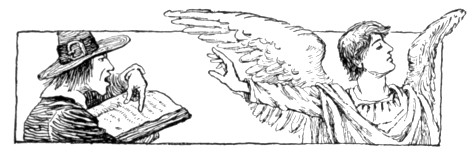
VI HE ALMOST GETS RELIGION
Cyrus was in bed.
The history of the case is instructive and should be a warning to other champions.
On a certain afternoon in the fourteenth year of this hero's life the home team had met and defeated the baseball club from a neighboring village. The score was twenty to thirteen. Such a victory deserved celebration. So Cyrus, with half a dozen fellow champions, went to Mrs. Turner's little ice cream parlor and regaled themselves. Each boy had three ice creams, and as the money still held out they decided on a fourth. But Mrs. Turner, having a friendly interest in her patrons, declined to be further identified with this particular debauch.
To victors in the national game this was humiliating. Defeat in an ice cream parlor after triumph on the diamond, was not to be accepted. So they adjourned to the store where a fresh lot of cocoanut cakes had just come in. These cakes were not dry and fly blown like their predecessors. They were fresh, full and well rounded, soft and juicy and nicely browned on top. Wilbur Cobb said he could eat a dozen. But Cyrus, familiar with the deceptive richness of cocoanut cakes, said no boy could eat a dozen, but that he, Cyrus, could eat more than Wilbur. This aroused the sporting instinct of the party and it was arranged, on the spot, that these two champions should compete. The boy who ate the most should pay nothing toward the cost of the cakes. The cakes were two cents a piece.
Cyrus won. He ate nine and claimed, with justice, that were it not for the space already occupied by the ice cream and sponge cake he could have eaten still more.
Half an hour later these same boys, in passing through Deacon Bisbee's orchard, found the taste of green apples cool and refreshing, for the moment, after the somewhat milky fullness caused by the ice cream and cocoanut cakes. And they partook with reckless freedom. What exclamations of surprise or warning may have passed between those hereditary foes, the ice cream and green apples, when the apples entered those overworked stomachs is not recorded. But the apples conquered as easily as the Barbarians when they entered Rome. For green apples, on occasion, resemble Truth: they are mighty and will prevail. And Cyrus, after starting homeward, began to feel, in that region between his chest and legs, as if he had swallowed a football. The distention was painful. Moreover, as he hurried on, the football seemed growing bigger and harder. Also, it showed signs of life. From his interior came rumblings; the rumblings that precede a storm. All through this central zone, this sphere of distention, pains were starting up, sharp, swift, far reaching. It appeared to him that through his equator lightning played. At first these playful spasms darted here and there in a frolicsome way—like airy nothings. Though somewhat threatening and reverberant they did not alarm him. They seemed well intentioned pains, like harmless gleams of lightning on a summer night. But these spasms became less friendly. They grew sharper and more threatening. Soon, like flashes in a real storm, they were shooting here and there as if rending him asunder; no longer playful, but the kind of lightning that rips the bark from trees, tears bricks from chimneys, and spires from churches. When near his own home this storm within grew fiercer yet, and wilder in its fury. So sharp the agony that he clasped the afflicted territory with both his hands, and leaned for support against a fence.
Never before, in his brief career had he realized that the human body could be rent and plowed and torn to shreds without killing the owner.
At that moment Mrs. Eagan came along. Mrs. Eagan had a large face, a large chest, large hips and a large heart. And she was carrying a large basket—of things for the wash. Cyrus withdrew his hands from that region where the tempest raged, straightened up, lifted his hat and bowed. And it was done as respectfully as if Mrs. Eagan were the leading lady of the land. Mrs. Eagan, with a smile of pleasure, returned the salutation, not gracefully perhaps, for she was hampered by the heavy basket. She knew Cyrus, and she knew that in his courtesy to her sex he made no distinctions. She knew that if the Queen of Sheba were passing at the same moment, the Queen of Sheba would have received an obeisance not a bit more deferential than the obeisance to Mrs. Eagan. But as she looked more carefully at the boy's face, her friendly eyes saw clearly there was trouble.
"Why, Cyrus! Are ye sick? Ye are as white as a sheet."
"Yes'm." He spoke in a fade-a-way voice, and he smiled from sheer force of will. "I feel very—very—I don't know." And one of his hands moved instinctively to the sphere of revolt. His head drooped, partly from pain; partly from shame that these awful spasms had weakened his legs and might effect his courage.
"'Tis there ye are sufferin'? 'Tis the belly ache?"
Cyrus nodded. "Yes—Mrs. Eagan—and I never—had—such a——" The lips quivered, his head sank lower and he leaned against the fence for support. Mrs. Eagan laid down her basket. Then closer to the smaller white face came the larger red one.
"D'ye feel so bad as that, little man?"
Cyrus nodded, with lips tight pressed to conceal a quivering he could not control. He looked into the light blue eyes, now near his own, and tried to smile.
Mrs. Eagan said no more. Cyrus felt an arm behind his legs, another across his back, and he was lifted from the earth. She lifted him in her arms—as Hercules might have lifted a spring lamb. With his head against her shoulder she carried him easily up the long driveway to his own home.
There were sleepless hours that night, and Cyrus did some unusual thinking on important subjects. For, as it happened, he had recently read portions of the Old Testament, quite by accident, and was much impressed, temporarily, by certain statements of the Hebrew fathers. He inferred from that book that the Ruler of the Universe was watchful and vindictive, and dependent upon constant praise; that for any dodging of this praise and worship hell fire and eternal damnation were ordinary penalties; that the sins of the fathers were visited upon the children, forever and ever—which seemed unfair. The impression of all this upon his youthful mind was that any person who really believed these things must be either impossibly good or scared to death. While in good health those awful utterances did not worry him. Now, however, in the silent hours of the night, weakened by the devastation in his interior, he became less callous to such warnings. Those Hebrew fathers, backed by the vindictive Almighty, might get him before daylight and consign him, forever, to the fires of hell.
But at last he slept. And when he awoke the sun was shining in his chamber—and he was still alive! However, when Joanna came up with his toast and tea, and sat at his bedside, he was still haunted by the awful prophecies of the Hebrew fathers and by the suspicion that the Avenging Deity might still have an eye on him.
Joanna was a well-built woman of forty, with good features and an honest face. For nearly twenty years she had lived in the Alton family as housekeeper, nurse, companion, cook, friend and servant: and, incidentally, as mother to Cyrus. While Joanna's education had been scanty, her common sense was abundant. Her attendance at church was regular, and Cyrus felt, naturally, that her views on Paradise and Purgatory could be relied on. So he asked if religious people were more likely to get to heaven than other folks.
"Of course," said Joanna.
"Which kind are the surest?"
"The Good People."
"I mean, which kind of religion is the—is the safest?"
"Each one thinks his own is."
"Which do you think, Joanna?"
"Congregationalist."
"Is that yours?"
"Yes."
"Do they have a better chance than Baptists or Methodists or Unitarians?"
"I guess they do."
"But the Unitarians have the biggest church."
"Yes—in this village."
"What do they believe,—the Unitarians?"
Joanna closed her eyes. "Oh, I can't tell you exactly. They believe something about God being the only thing to worship—the most important of all."
"Well,—isn't He?"
"Why—er—yes."
"What's bigger?"
Joanna frowned. "Bigger than what?"
"Bigger than God?"
"Why, nothing, I suppose."
"Then it seems to me He is the One to be friends with." And Cyrus leaned back on the pillow, and turned his face toward the light. Joanna stroked his head.
"But don't you worry, little boy. You are not goin' to die just because you are sick."
"Are you sure?"
"Of course I am sure, so is your father sure. To-morrow you will be all well again."
"Yes, but I shall die some day and I might as well be ready. You think the Congregashalists have the best chance of getting to heaven."
"Yes."
"Then I'll be one. What do I have to do?"
"Nothing, but just go to church."
"Is God a Congregashalist?"
Joanna hesitated. "Well—nobody really knows."
"Not even a minister?"
"Perhaps he would. But you have asked enough questions. Now try and go to sleep."
Cyrus obeyed, and slept. But that evening when his father came up and was sitting by the bed he made further efforts to get light on the darkest of all subjects. Dr. Alton, however, saw signs of a feverish excitement in the usually calm eyes of the invalid, and he decided upon a soothing course of religious instruction. He knew that this sudden thirst for knowledge in a fresh field could not be allayed by any off-hand advice to forget and slumber. So with a smiling face he answered questions as if the matter in hand was of no immediate importance.
"Father, was Jesus so very good?" Cyrus began.
"Yes, indeed! The best of men!"
"He wasn't better than you, I bet."
"Indeed he was, Cyrus; very, very much better."
"Ho!" said the boy; "I don't believe it."
Dr. Alton explained, in few words, certain important differences between Our Savior and other men. Cyrus listened, and understood; then inquired:
"Was He a Congregashalist?"
Dr. Alton smiled, and shook his head. "Never, Cyrus! Never! He couldn't have been if he tried. And He was not the man to try. There was no cruelty in him. He was all forgiveness."
"Then he must have been a Unitarian, a Piscopalian, or Baptist or Methodist—or something like that."
Dr. Alton closed his eyes and stroked his chin.
"No—I should say not. He might possibly have been a Universalist, or a Unitarian. But why are you so interested in religion all of a sudden? Afraid you are going to die?"
"No, not now. But all lost night I was afraid."
His father took one of the small hands in both his own and smiled into the invalid's adoring face. "There's no hurry about choosing your creed, little man. Benevolent Creators are not punishing children for theological errors. But we can talk it all over later, when you are well."
Cyrus also smiled—"But tell me, father, just for fun, what religion is the best?"
"Well, Cyrus, that's hard to say. There are many to choose from."
"Why, I thought the Christian religion was the only real one."
"Well, that's what the Christians think—naturally."
Cyrus frowned. "But what's the use of so many?"
"No use whatever. One good one would be enough for everybody—and save heaps of trouble."
"But the Christian religion is the best, isn't it—to go to heaven with?"
"That's hard to say. Nobody really knows. It's a good Sunday religion, but it doesn't seem to work so well week days."
"I guess it's safer than any of the others, isn't it?"
"Possibly. But you needn't decide in a hurry, Cyrus. Take your time and look around a little."
"Do people always look around before choosing their religion?"
Dr. Alton laughed. "No, they do not. In fact, it is considered a sign of moral depravity to think too much for yourself in those matters. To be at peace with mankind you must follow your neighbors. It is all merely a matter of geography. When you know the name of the country you know their religious beliefs. There is not much thinking done."
"That's funny," said Cyrus. "But a Christian is lots better than any of the others—isn't he?"
Again Dr. Alton smiled. "Well, he himself thinks he is. But all virtue is not centered in the Christian. When you get up to-morrow and wish to get well and strong you will begin to eat again, won't you?"
"Gracious! I guess I will! I could eat a house."
"Yes, you will be hungry enough. And you will feel like eating quite a variety of things, I suppose."
"Oh, won't I!" And as Cyrus spoke the pallor of the Saint was submerged in a glow of fleshly desire.
"Good! And you shall have it! Now we will play, for a minute, that Christianity is pie."
"Is what?"
"Is pie. Just pie. But there are various creeds of pie among the Christians; there's apple, pumpkin, mince, squash, cocoanut, and all the others."
"Me for cocoanut!" exclaimed the invalid. "Cocoanut pie beats 'em all!"
"That's a matter of taste. But you prefer cocoanut pie to all the others?"
"Oh, yes!"
"Very well. Now there's apple for Methodist, mince for Episcopalian, cocoanut for Unitarian, pumpkin for Congregationalist, and so on, through the list."
Cyrus laughed. "And which are you?"
"I haven't decided yet. But you must stick to your colors and have more faith in cocoanut than in all the others."
"Oh, yes! That's easy!"
"And so you eat nothing but cocoanut pie."
"Nothing else at all?"
"Nothing else. So long as you are a Christian you must stick to your creed. You must feel considerably wiser and better than outsiders who are eating grapes, and roast turkey and custards and watermelons, and pudding and ice cream, and all who eat anything except your one kind of pie."
"Oh, I couldn't do that!"
"But you must, if you want to be a true defender of your cocoanut creed. For all the others are outsiders. Those pudding, turkey, grapes, custard and ice cream people don't believe in your pie."
Cyrus slowly shook his head and pushed out his lips. "I couldn't despise people for eating things they liked."
"Neither could I, Cyrus. So, for the present, anyway, we will eat whatever we want to. And we are just as sure of going to Heaven as if we stuck to one kind of pie."
"Yes, we will," declared the invalid, and in his face and voice had come the enthusiasm of fresh hopes and a new life. "If our minister," he said, "would talk like that in the pulpit, about roast turkey and ice cream and things to eat, it would be more—more interesting. Wouldn't it?"
Dr. Alton bent over Cyrus and kissed him good night. "Yes, but he wouldn't dare—unless his congregation consisted of empty boys."
The father's diagnosis was correct: his treatment a success. During that short half hour the patient had been converted from a terrified sinner to a hopeful gourmand. The anxious look had left his eyes. The lips were smiling.
And that night, instead of fitful wakings interspersed with dreams of hell and Hebrew prophets, of death, damnation and eternal punishment, he slept a solid, tranquil sleep. And such dreams as came were happy dreams. He dreamed of puddings of the richest kind, of turkeys all stuffed and ready; of various pies, of custard, of pastry, and of ice cream, all of which he ate, and ate—and ate. And lying flat upon his stomach on a sponge-cake raft he floated in a sea of pineapple sherbet. He would bite off edges of the raft, then, with his whole face in the boundless ocean, he would suck up long gulps of this divine material. And his permanent residence was in a cocoanut palace against a mountain of vanilla ice cream.
When morning came, and he awoke and sat up in bed, he was himself again. In the sunshine of his room the bottomless pit had lost its menace. His spirit, refreshed by slumber and now guided by his nose, ignored the fires of Purgatory and was hovering over the more friendly heat of Joanna's kitchen stove.
A few days later, when he was curled up at one end of the sofa with a book, he asked: "What is the transmigration of souls?"
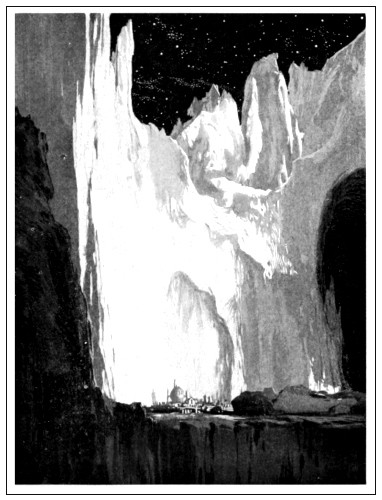
"A COCOANUT PALACE AGAINST A MOUNTAIN OF VANILLA ICE CREAM"—Page 114
Dr. Alton explained.
Then Cyrus, after a good look into the face of the dog beside him: "Whose soul do you suppose is in Zac?"
"That's a hard one, Cyrus. I could only guess at it."
"But it means for dogs, too, doesn't it?"
"It certainly ought. I shouldn't accept it unless it did."
"Then I say that whatever soul came into Zac was the soul of a mighty good man."
"Yes—no doubt about that."
"Just think! Zac may be George Washington!"
"Well—you can't be too sure. You have all the good people in history to choose from, you know."
"Yes, of course. I guess, after all, he isn't George Washington. He is quicker and jumps about more." Then after another look into the dog's adoring face: "Besides, I don't believe any great man in history would be so awful fond of me as Zac is."
"Oh, he might be. Washington would have liked you, I think; although he might not have followed you about so closely."
Other famous men were mentioned: the Emperor Augustus, Magellan, Shakespeare, Daniel Boone and Fenimore Cooper—also Joan of Arc. But it was agreed by both father and son that the best known characteristics of those persons were not sufficiently obvious in Zac to make a clear case.
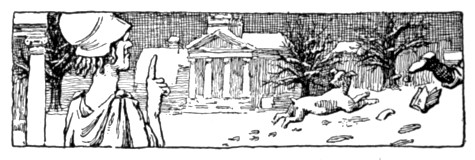
VII TOWARD THE LIGHT
The snow lay deep—and still it fell.
On a low stone wall by the roadside Ruth Heywood sat in solemn meditation. With melancholy eyes she watched the door of the little red school house a hundred yards away. On the porch of that school house shivered Zac, also waiting. He, too, kept his eyes on the door, but he had no intention of rebuking the prisoner—should he ever appear. Why try to improve an already perfect thing?
Above Ruth's head the North Wind, moaning through the leafless branches of the maples, played dirge-like airs. Now, late in the afternoon, the darkening sky seemed bearing down upon the snow-covered earth. And Ruth's thoughts were all in harmony with the world about her. There was reason for a joyless face. More experienced women than Ruth had found sorrow and defeat in acting as guardian angel to erring males.
Other children had gone home. Cyrus was being held in punishment. And the punishment was just. The Guardian Angel disliked this business, but Cyrus had no mother, aunt or sister, and his father, being only a man, did not realize the situation. Therefore, it seemed clear to Ruth that she was the chosen instrument by which Cyrus was to be rescued from a career of shame and failure.
At last the boy appeared. Zac bounced with joy, stirring the snowy air with cries of welcome. And Cyrus, glad as any other prisoner to be again at liberty, came running after.
Ruth walked out into the road and stood before him. As he stopped there was a smile on his face, the old familiar smile of the guilty, who hope to soften the face of Justice. But Justice was not beguiled. On the face of the Guardian Angel came no returning smile. Instead, with accusing eyes, she slowly shook her head.
"Cyrus, you ought to be ashamed."
"Why?"
"You know very well why. You are bad, very bad, and teacher was right to keep you after school and punish you."
Cyrus gave up smiling. He reached forth and toyed with one of the horn buttons on the Guardian Angel's coat. "I don't think I am bad just because I hate that geography."
"It's your duty to learn it whether you hate it or not. You will grow up an ignorant, good-for-nothing man unless you study your lessons. Everybody knows that. You ought to go straight home and tell your father you have been kept after school. Just tell him all about it. Will you?"
There was a puckering of the boy's mouth, but no answer.
"If you were stupid, and couldn't learn if you tried, it would be different, but you are just perverse and—and bad. If you don't do better I shall just go and tell your father myself."
"Oh, Ruthy! You wouldn't do that!" And he let go the button and took a backward step, as one who shrinks from a faithless friend.
"But it's for your own good, Drowsy. And, besides, teacher will tell him if I don't."
"I s'pose she would."
"You don't want to grow up and know less than anybody else—even less than school children?"
Cyrus smiled. "That would be funny!"
"No, it would not be funny. Do you think it would be funny to dig ditches all your life and drive oxen like old Sim Barker?"
"But what makes him so bad is because he's foolish and dirty and has tobacco juice in the corners of his mouth. Geography wouldn't help him—nor anybody else. Geography!" And Cyrus uttered the word with a fathomless contempt. "That geography just makes me sick—just sick, sick, sick—and mad! What stuff it tells you! Which is the largest African Lake? Where are the Barbary States? What about the surface of Abyssinia? What are the products of the Cape of Good Hope? Who in thunder cares for the climate of Uruguay or the exports of Ecuador? Who'd ever be such a fool as to want to remember the population of Thibet? And who cares anyway? Any jackass can know those things whenever he wants to by looking at a map or that fool geography."
"Oh, Cyrus, you mustn't talk like that!"
But the revolutionist went on. "Why don't they tell us things worth remembering? Look at my lesson to-day! The Island of Madagascar! Who in thunder wants to know about the products of Madagascar? Hoh! It makes me sick!"
"But, Drowsy, Madagascar is an important island and——"
"Important grandmother! Any fool can read about it. Why don't they tell me things I want to know?"
"What thing do you want to know?"
"I want to know things that other people don't know. I want to know how the earth looks when you are standing on the moon. I want to know what's lying in the mud at the bottom of the Tiber—all the bronze and gold and marble things; and what sort of people live on the other planets, and why cats and dogs can see in the dark. And if God is good and not mean—why did he make Bobby Carter a hunchback?"
"Oh, Cyrus! It's wicked to talk like that!"
"No, it isn't. I'm only asking about it. I'm only asking why teacher doesn't tell us things worth knowing. I want to know what would happen if you dug a well through the center of the earth. Would a stone keep on dropping till it came out the other side?"
"That is gravity," said Ruth in her wisest manner, glad of a chance to hold her position as mentor.
"Yes, but the name doesn't help any. If I got into a big cannon ball and was shot up into the air how many hundreds of miles would I go before I would fall back? And if you should go up in a balloon a mile high I want to know if you would stay still and see the earth going round and round beneath you or would you have to go with it—and Massachusetts always just underneath."
"There's no use in knowing that."
"Yes, there is. When I'm grown up I may do something like it."
Ruth laughed. "You silly boy! Nobody ever did such a thing."
"But I may. Lots of things have been done that were never done before. And mighty surprisin' things, too!"
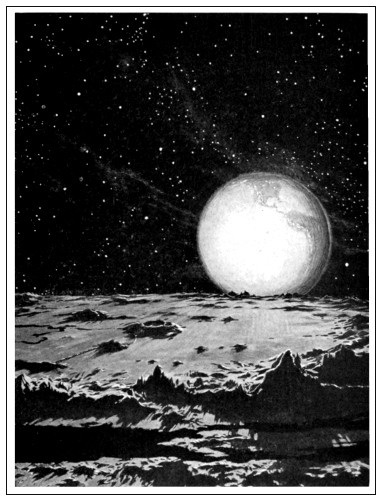
"I WANT TO KNOW HOW THE EARTH LOOKS WHEN YOU ARE STANDING ON THE MOON"—Page 119
There was no denying this. So Ruth, for want of words, merely gazed upon him in sorrow and disapproval, as any Conservative might gaze upon any Radical. Before she could frame a speech to fit the look the orator again rushed on. He spoke rapidly and with feeling. The drowsy eyes became wider open. His hands with the gray mittens moved freely in the snowy air. To Ruth it was a sudden transformation of a prospective ignoramus into an inspired orator. In a higher, thinner voice he demanded: "What makes one kind of electricity do what another kind can't? And if men are so smart, why didn't they use electricity thousands of years ago instead of just now? The air has always been full of it."
This was an interesting question. But the Guardian Angel had no answer ready.
"And what makes light travel so fast? Why, just think of it, a hundred and fifty thousand miles in one second! And heat. There's lots to learn about heat. Why do folks burn wood and coal in winter instead of storing up heat in summer when there's too much of it. They keep ice all summer. And why not keep heat all winter? And just look at sunshine! Why not keep some overnight to read by? I could do it if I was a man."
The orator paused to get his breath.
"But, Cyrus, perhaps you can learn all those things later."
"But I want to know 'em now. Not the things I've just been reciting, the climate of Texas, the crops of New South Wales and the population of Wurtemburg. Hoh! I could be a teacher myself and tell things everybody knows already. Teachers are no smarter than anybody else. I asked her why some families, like the Herricks, have all boys and other families all girls."
"What did she say?"
"She just couldn't tell me. And she didn't like it when I asked her why God, who knows everything, should do foolish things."
"Oh, Cyrus!"
"Well, he makes warm days in April to start things going, then sends a sudden frost and nips the blossoms and kills the crops. Any fool farmer knows better than that."
Ruth frowned. "You should not say such things." But the orator ignored the rebuke. "Instead of telling me about the wrecks and ruins and the treasures and the forests at the bottom of the ocean, teacher tells me how many bales of cotton and barrels of molasses come from Alabama. Why, Ruthy, at the Island of St. Helena the ocean is nearly six miles deep!"
"But, Cyrus, nobody really knows just what lies at the bottom of the ocean."
"Hoh! That's just it. Teacher stuffs us with things everybody knows. All the easy things. Any cow or any hen can know 'em. I want the other things. If she's a teacher she ought to know about the bottom of the sea. She ought to tell us about Atlantis. There's be some fun in that."
"Atlantis?"
"Yes. That was the big island out in the Atlantic Ocean that suddenly disappeared. It sank to the bottom of the sea. Don't you remember?"
Ruth was honest and slowly shook her head. Yet she knew that her position as mentor, spiritual guide and good example became weaker should the ignoramus she was rebuking display more learning than herself.
But Cyrus was too much absorbed in the bigness of his subject to think of himself or other trifles. "Why, Ruthy, it was a whole kingdom, this island—a continent. It was covered with beautiful temples, whole cities and lots of people. And all of a sudden—nobody knows why—it disappeared beneath the waves! And now, to-day, down at the bottom of the ocean those cities and those marble temples are still standing!"
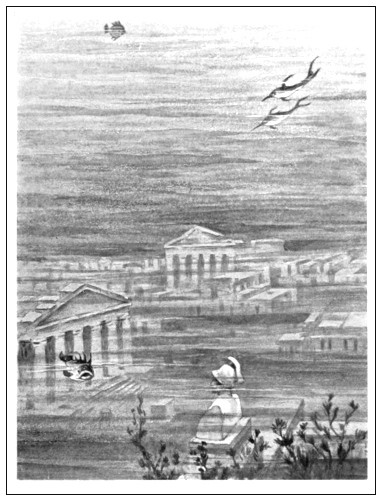
"AND NOW, TODAY, DOWN AT THE BOTTOM OF THE OCEAN, THOSE CITIES AND THOSE MARBLE TEMPLES ARE STILL STANDING"—Page 123
"Where was this island?"
"Off to the west of Spain, and Africa. People think the Azores and the Canary Islands are the tops of mountains of that sunken country."
Ruth said nothing, but the enchanting eyes spoke plainly of surprise and wonder. "When did that happen?"
"Way back in ancient times; before Greece began."
The enthusiasm of Cyrus produced its effect on Ruth, and the earnest eyes of Ruth had their usual effect on Cyrus. He laid one of his hands, in its gray worsted mitten, against the Guardian Angel's chest. "And, Ruthy, just think of those white marble temples! Just think of the streets and houses! Think of all the statues and the helmets, shields and swords and spears all lying around down there at the bottom of the ocean! Think of all the ornaments in gold and silver! And think, that in those great white cities with all their treasure, coral and sea plants grow instead of trees! And the only living things are fishes swimming in and out among the statues and the monuments, the palaces, the forums and the amphitheaters."
The orator drew a long breath, then in a lower tone: "I'd give anything to spend a day in that place."
Little batches of snow had gathered on the heads and shoulders of the two children. For a moment they stood in silence, Ruth gazing thoughtfully at Cyrus, Cyrus gazing in anger and contempt toward the school house.
At this point there came a sudden change in the Guardian Angel's manner. She realized the necessity for different tactics. Familiar with Cyrus's astonishing cleverness in argument she suspected that he was justifying his own guilt by this dazzling display of wisdom. Then came a swift transformation in the irresistible eyes, from sympathy to rebuke.
"Stop," she said.
Cyrus stopped—midway in a sentence.
"Those reasons you can tell to teacher. They are no excuse for being a lazy boy; I shall tell your father unless you do better."
Then she turned and walked away, striking her cold hands together for warmth. Cyrus followed, treading the narrow path in the snow made by horse's feet.
But shivering Zac, who had good excuse for shivering after his long wait on the windy porch, ran joyfully ahead. He had borne with patience this long delay. Cyrus picked up a handful of snow and molded it into a ball. As they were passing the store he caught Ruth by a sleeve and pointed to a boy more than a hundred feet away. The boy was stooping over a sled.
"What'll you bet I can't hit Luther from here?"
Now Cyrus was a surprisingly good shot. He seemed able to hit whatever he fired at, and from unbelievable distances. His surprising accuracy in this direction had made him pitcher on the village nine. But Ruth, remembering her rôle as Guardian Angel, merely turned about and started on again in dignified silence. But from the corners of her eyes she watched the unsuspecting Luther, for she knew the missile would reach its mark. Her silent prophecy was correct. Through the snowy air the missile flew. It landed, with force, on the victim's back, just below his neck. He straightened up and looked about. Then with a shout of defiance he scooped a handful of snow, quickly rolled it into a ball and sent it toward the enemy. Here the unexpected happened. The snow ball, thrown in a hurry, would have missed Cyrus by a yard or more even had Fate allowed it to go its way. But Deacon Phineas Whitlock intervened. This stern old puritan of ferocious aspect, of iron will and despotic temper, the terror of children and of all other habitual sinners, was just passing Cyrus in solemn dignity, toward the store.
The snowy sphere forwarded by Luther landed full upon the deacon's mouth. And, as the deacon's mouth happened to be partly open at the time—from his habit of preaching to himself—he received within it a portion of the missile as it smashed and spread about his face. Swiftly he wiped his face with the back of a hand. His temper was a hot one. Luther knew it, and he grabbed the rope to his sled and disappeared down the hill behind the store, with a velocity no elderly deacon could hope to attain. Spluttering and wiping snow from his mouth and nose he turned threatening eyes on Cyrus. In a voice between a gasp and a shout of rage he demanded:
"Who is that boy? Who is he? What's his name?"
Cyrus shook his head. "I don't know, sir."
"Yes, you do! Who is he? What's his name?"
"I don't know, sir. Honestly I don't."
"Don't know, you young rascal! You have eyes. What's his name?"
But Cyrus, with a protesting, most polite and sorrowful gesture with both his hands, again proclaimed his ignorance. "I really don't know, sir. The air is so full of snow I didn't see his face."
Deacon Whitlock again spluttered. His speech was incoherent, but doubt and anger were plainly indicated. However, he turned away—still muttering.
Then the Guardian Angel approached the liar. "Cyrus Alton! How can you do such a thing?"
"What thing?"
"Deacon Whitlock knows perfectly well you knew who it was, and that you told him a lie. And he will despise you for it. So would everybody else. So do I despise you for it."
His only answer to this was a look of mingled sorrow and remonstrance. Then, instead of trying to defend himself, as the Guardian Angel expected, he looked away. He also heaved a sigh,—a sigh of weariness and discouragement, an unboylike, elderly sigh such as grown-ups use.
The Guardian Angel continued. "And I should think you would be ashamed to be such a coward."
Cyrus stiffened at the word. "A coward!"
"Yes, coward. People only lie when they are afraid. If you had been brave you would have told the truth."
"But, Ruthy, you don't understand. I did it to save Luther. If Deacon Whitlock knew who it was he would tell Luther's father and Luther might get a lickin'."
Ruth shook her head. "Your duty was to tell the truth—or say nothing."
"No, sirree! That isn't true. The Bible says do unto others as you'd like to have other fellers do unto you. And I did just what I would want Luther to do for me."
This line of defense was confusing, and Ruth was familiar with his skill in argument. She knew well enough the pitfalls he could dig for the embarrassment of any adversary. So, regarding him with the sternest look she could bring into a very gentle face, she said:
"It is wrong to tell lies and you know it is. And you are bad—just bad. Why don't you button up your coat in front? The snow is actually blowing down your neck."
And she drew the collar of his overcoat closer about his throat and tried to fasten it. "Why, the button is gone! Joanna ought to see to it. You really ought to have a mother, Drowsy. You aren't half taken care of."
This time Cyrus had nothing to say in his own defense. She laid a hand against his cheek. "Your face is hot. I believe you are sick now!"
Cyrus smiled, and nodded. "I shouldn't wonder if I was."
"Why? How do you feel?"
"Oh, sort of—sort of—funny."
"How, funny?"
"I don't know. Sort of cold and then hot and then cold—and kind of trembly. That's why I didn't hit Luther on the head instead of down on his back."
"Now, Cyrus Alton, you go straight home and tell your father just how you feel. Tell him all about it." Then, with increasing severity: "It's a shame you haven't got a mother. I believe it is because you are bad and that's the way God punishes you."
Then she turned away and started on again, Cyrus close behind. In front of her own home she stopped suddenly and wheeled about;—so suddenly that Cyrus walked against her. He took a backward step, and as they looked into each other's faces he said, quietly:
"No, it doesn't."
Ruth's eyes opened wide, in surprise. "Doesn't what?"
"It doesn't mean what you asked."
"But, Drowsy, I didn't ask anything!"
"You thought it, though."
"Thought what?"
"That because I told lies now I would not be an honest man when I grew up. But that isn't so. I shall be an honest man."
"Yes, but I hadn't spoken a word. How could you tell what I was going to say?"
"Oh, I dunno. I can often do that."
"Yes, you have done it before, but how do you do it? How do you know? Just guess at it?"
"No. It sort of comes—as if—well—just the usual way—only without the words waiting to be spoken. I guess it's natural enough."
"Natural enough! Why, it's most mysterious. Nobody else does it."
"Oh, p'r'aps lots of people do it. We don't know everybody."
"But if many people did it we should have heard about them. No, it's very mysterious. Why, Drowsy, I had just opened my lips to say your being such a liar now proves you will be a dishonest man and you said, before I uttered a word, 'No, it doesn't.'"
Cyrus smiled. "I guess it must be a sort of telegraphing without wires, like that man Marconi has just discovered."
For a moment they stood in silence, Ruth looking earnestly into the boy's slumbrous, half smiling eyes, trying vainly to explain the unexplainable. "It's all the harder to understand," she said, "because you could only see the back of my head. And this horrid storm was blowing between us."
"Yes, it's funny, and I dunno much about it. But I believe I could get it if I wasn't seeing you at all; I mean, if you were way off, out of sight."
"Really?"
"Yes, sir! I believe I could. Let's try it some day. Will you?"
"Yes, little Drowsy, when ever you say."
Once more she laid a hand against his face.
"Your cheeks are hot again. Now you go straight home and tell your father just how you feel, and have Joanna sew on that button. Will you?"
"Yep. All right."
He started off. About a dozen yards away he stopped and looked back. She was still standing where he left her, and was watching him. The obvious lack of confidence in his promise—or her air of authority with all this military discipline caused a momentary revolt. He picked up a handful of snow, rolled it quickly in a ball and threw it. She saw it coming, but merely bent her head and lifted an arm in protection.
'Twas a good shot. But the snowball, being soft, merely broke against her arm. Ruth lowered the arm and raised her head, slowly and calmly, as a Guardian Angel who is invulnerable to earthly weapons. She pointed toward his home.
Cyrus raised his cap, moved it grandly through the air in a sweeping curve, bowed very low, then turned and marched away.
He walked with no suspicion of pursuit. But Ruth had obeyed a sudden impulse. She started forward on a run, and when close behind him gave a sudden push with both hands. He tumbled forward into a drift and rolled over on his back. As he started to get up, she pounced on him with all her weight. Then with both knees on his chest she rubbed his face with snow.
Had the assailant been another boy, Cyrus would have kicked and struck and fought him off. But you do not kick and strike your aunts, your mother or your best girl. So, he merely pushed and wriggled about, with eyes and mouth tight shut.
Zac seemed to enjoy the business as much as Ruth. He barked and plunged about as if cheering for the victor.
Well into Cyrus's face Ruth rubbed the snow. "Take that, you horrid boy, and that, and that!"
With a triumphant laugh she took her knees from his chest, jumped to her feet and ran away. And as she ran she expected just what happened. For Cyrus, also quickly on his feet, drew the backs of his mittens across his eyes for clearer vision, then sent a snowball toward the vanishing figure. It landed between her shoulders. But she ignored it, and ran into her own house without even a backward glance.
For a moment Cyrus stood and watched her, then started homeward.
It was a friendly enough parting, but it might have been different had they know how many years were to come and go before they met again.
VIII A WORKER OF MIRACLES
Something of a liar was Cyrus, in emergencies, but he told the truth when he said "lots of things have been done that never were done before; and mighty surprisin' things, too!"
History bears him out. The stories of Grimm and Andersen are commonplace events besides the victories of Science. Interesting, indeed, would be the views of Galileo on wireless telegraphy, or Botticelli's opinion of the "movies," or even what language the British commander might have used at Bunker Hill had the Yankees employed aeroplanes. Since the impossible is now in daily use, the dream of the visionary in every home, incredible things have ceased to astonish. Fairy tales are coming true.
So thought Dr. Alton, on the afternoon following that last interview between Ruth and Cyrus, when he was suddenly converted from incredulity to compulsory faith in an achievement which he had believed impossible. As he drove up to his own house Cyrus leaned out of the sitting room window and told him to go at once to Mrs. Heywood who had fallen on the stairs and broken a leg. Dr. Alton asked no questions, turned about and drove off. A few hundred yards along the road he met Mr. Heywood, who, much agitated, and traveling fast, as if trying to walk and run at the same time. The doctor stopped and the clergyman climbed in. As they started off Mr. Heywood exclaimed, out of breath: "How fortunate this is. I was afraid you might not be at home. Poor Alice, I fear, has broken her leg."
"Yes, so I heard. I am on my way there."
"On your way to my house?"
"Of course."
Mr. Heywood turned in surprise. "You say you—you knew of the accident?"
"Yes."
"But, Doctor, you couldn't. It happened less than ten minutes ago."
"Cyrus told me. Perhaps somebody telephoned him."
"But I have no telephone."
Dr. Alton smiled. "Possibly somebody is a faster runner than you."
"But no one was there except Alice, Ruth and myself."
"Ruth may have done it."
"Ruth has not left her mother. She is there now. And nobody else knows of it."
For a moment Dr. Alton was silent. "Bad news travels fast, Mr. Heywood."
"But not when there's nobody to carry it."
"Yes, there's that miraculous new messenger boy, wireless telegraphy."
Mr. Heywood was in no mood for argument and said no more as Dr. Alton obviously had little faith in any mysterious messenger. So, for the moment, the subject was dropped.
When the bone was set—and it proved a simple fracture—Mr. Heywood followed Dr. Alton to the door. "I wish, Doctor, you would ask Cyrus how he got his information—just to gratify my curiosity."
"Are you absolutely sure that Ruth did not tell him?"
Mr. Heywood, for answer, stepped back into the hall and called to his daughter, who at once came running down the stairs.
"Ruth," he said, "do you know how Cyrus heard of your mother's accident so soon after it happened?"
"Yes, sir. I told him."
"You!" exclaimed her father. "Why Ruth, you never left the house!"
"And Cyrus," said Dr. Alton, "is at home, confined to the house with a bad cold. At least that's where he ought to be."
"Oh, sir, he is!" said Ruth. "He sent me a note asking me to talk to him, on the porch, from our house at just five o'clock, and I did. Mother fell on the stairs just as I began to talk so I told him about it."
"Do you mean," said her father, "that your voice carried from this house to his, nearly a mile away?"
"Oh, no, sir! Cyrus doesn't have to hear your voice, always. He has a special way of knowing things."
"A special way of knowing things?"
Ruth nodded.
"What do you mean, Ruth? What things?"
"Things you don't say."
"But you did say to him that your mother had an accident."
"Yes, sir; but he didn't have to hear it. He gets it some other way." She added, with a smile: "He doesn't get it through his ears."
"Then how does he get it?"
"I don't know. He says it is in the air. He says he thinks it's a kind of wireless telegraph and must work the same way."
"Most extraordinary!" murmured Mr. Heywood, and he looked at Dr. Alton as if hoping for more light on a cloudy subject. Dr. Alton, however, was gazing thoughtfully at the girl, whom he knew to be truthful. He also knew the misleading possibility of a child's imagination. "Do you really think, Ruth, that Cyrus learned of the accident in that way?"
"I don't know, sir. I couldn't hear anything from him."
"You mean if he answered back you couldn't get it?"
"Yes, sir. Nobody but Cyrus could understand anything at all, so far away."
"He knew that you couldn't hear anything he said?"
"Yes, sir. He just wanted to find out if he could tell what a person said so far away without hearing it."
Mr. Heywood turned to Dr. Alton. "He evidently succeeded, and it seems quite incredible."
Dr. Alton did not reply, directly. He had closed his eyes, and his own thoughts, whatever their nature, were so absorbing that Mr. Heywood's voice had failed to reach him. His abstraction, however, was brief. With a smile he shook hands with Ruth. "I thank you for your testimony, little lady. You make a perfect witness." Then to her father: "I shall interview Cyrus at once and we will try to reach a better understanding of the mystery."
He promised to call in the morning to see Mrs. Heywood, and then departed.
When he entered his own house, half an hour later, he found the worker of miracles asleep on a sofa near the open fire. Curled up at his feet lay Zac. But Zac was not asleep. When the doctor moved toward the fire and stood before it, warming his hands, Zac followed him with his eyes. These cautioning eyes were saying: "Don't make a noise or you'll wake him."
Dr. Alton understood. He made no noise. But as he looked down upon the sleeper he saw signs of vivid dreams. The sleeper kicked, muttered and moved his hands. One vigorous kick landed on Zac's forehead, but the recipient merely closed his eyes, hoping for better luck another time. One more kick, spasmodic and violent, just missing Zac's head by an eighth of an inch, and the boy awoke. As he awoke he sat up and shouted:
"She's out!"
Seeing his father he swung his legs over the side of the sofa, blinked and laughed aloud. Zac also laughed:—that is, he barked. He always barked when Cyrus laughed, just to be in it. To do whatever Cyrus did was, of course, beyond a dog's ambition, but laughter being a manifestation of his owner's joy, he expressed himself with sincerity and enthusiasm by tail and voice. Moreover, by always joining Cyrus in his mirth the world might know that their tastes were similar. In fact, to be identified with Cyrus in any way was glory enough for any dog. Cyrus was really the Only Boy. There were, of course, other boys, but they could not all be Cyruses. God was not running this world on any such plan. There was always one specimen that overtopped the others. Only one Helen of Troy, one Socrates, one Columbus, one George Washington and one Cyrus. Zac was not familiar with these names but they serve their humble purpose in fixing the status of the human being that he loved and respected above all others.
"That's the funniest thing that ever was," said Cyrus. "What do you think I dreamed? I dreamed we were playing ball on the ice on Minnebuc Lake; us fellers against the women, and we all had skates on. I was pitchin'. Mrs. Snell was at the bat and Deacon Whitlock first base. Mrs. Snell's kind of fat, you know, and fierce and dignified, but she wore trousers like the rest of us. Oh, it was funny!"
Here the miracle worker paused and wagged his head, indicating suppressed mirth. "Well, I gave her a twister. Jimminy! Wouldn't I like to give such balls in a real game! 'Twas an up and down curve and a fade away all in one. It went like a cork screw. No feller would ever try to hit it. But Mrs. Snell did! She just shut her eyes and let go—and she hit it! I caught it and threw to first. It turned into a snowball between me and Deacon Whitlock and hit him square in his wide open mouth—for he's always talking to himself, you know."
"Yes, I know."
"Well, Mrs. Snell dropped her bat and went sliding down to first—on her skates—and when she got there she couldn't stop. She just scooped up Deacon Whitlock as if he'd been a little boy and carried him off in her arms. He was screamin' and kickin' and wavin' his arms like a mad baby. And Luther, who was out in right field, grabbed her by the trousers and tried to hold her back. Oh, it was funny!"
Again the worker of miracles was convulsed with mirth.
Dr. Alton nodded, smiled and expressed a proper appreciation of the unusual game. He looked down into the boy's laughing face, as he spoke, and there came to him an impression, considered trivial at the moment, but remembered later with a livelier interest. It seemed to him, for a brief moment, that Cyrus's smiling eyes were gazing deep into his own as if groping, in a friendly way, for unspoken thoughts. Dr. Alton realized that this impression was probably due to his recent discovery of the boy's extraordinary faculty—a usual look in Cyrus's eyes which, earlier in the day, would have made no impression. But the look was short, little more than a glance, and Cyrus lowered his eyes to his swinging legs and pulled up a stocking which was slipping down.
"This afternoon," he said, "I broke a pane of glass in the parlor."
"How did that happen?"
"Well," said Cyrus, still watching his swinging legs, "I was playing barn-tick in the parlor with Zac. I would throw the ball against the wall and catch it when it bounced back, and every two or three throws I'd let Zac get it. Then once, I threw it kind of careless——"
"Carelessly, you mean."
"Yes, sir, kind of carelessly and it hit the window instead of the wall."
Dr. Alton slowly moved his head in acknowledgment of the explanation. The other subject on which he desired light was so much more important than any broken window pane that neither his face nor manner expressed very serious disapproval. In fact, Cyrus had hardly finished his confession before his father spoke.
"How did you happen to know, this afternoon, that Mrs. Heywood had broken her leg?"
"Oh, that was a great idea! I've invented a new kind of wireless!" And he went on to tell, but in different words, the same story that Ruth had given. "And just think! if everybody can do it there won't be any need of telegraph machines, or letters either. People can talk miles apart—just talk, as Ruth and I did!"
"Yes, of course, but how long ago did you find you could do this?"
"Only to-day. This was the first time."
"But Ruth says you often know what people think, or are going to say, before they say it?"
"Yes, sir."
"How long have you been able to do this?"
"Oh, p'r'aps three or four years."
"Why did you never happen to tell me?"
"I supposed you knew. I supposed everybody could do it."
"No; it's a very unusual faculty—very unusual indeed." Then, with a smile: "I suppose you have often known what I was thinking?"
Cyrus laughed. "Oh, yes; lots of times!"
"When was the last time?"
Cyrus hesitated. He looked down at Zac, as if for encouragement. Then, with a glance from the corners of his eyes: "Just now."
"Just now!"
Cyrus bobbed his head and grinned. "Yes, just now."
"Why—what was it?"
Again Cyrus hesitated. His father smiled—the smile of reassurance. "Go ahead and tell me about it."
"Will you promise not to be angry or say anything bad?"
"Yes, I promise."
"Well, when I broke the window pane in the parlor to-day I was going to wait and let Joanna tell you about it when I was out of the way. But when you looked at me to-night after I had told about the dream I saw that you were in such a hurry to find out about the message from Ruth, that you wouldn't think so much of the window pane. So I told you."
Dr. Alton smiled and kept his promise, refraining from criticism. But he recalled the look in the boy's eyes, a few moments since—the look as of gently exploring another's thoughts. The recollection at this present moment brought a singular feeling almost of awe; as of something beyond human limitations. Was he on the border land of the supernatural? And yet, as he looked into the honest face of Cyrus, his wonder did not lessen. He found, therein, no solution of the mystery. He discovered nothing beyond the familiar face of his normal, sane and healthy boy, absorbed in things that became his age. He knew that Cyrus, like other boys, would rather eat than pray; that he preferred stealing apples to hearing sermons and would rather be a pirate than a bishop. This knowledge did not trouble the father. He had been a boy himself.
Then, sitting on the old sofa beside Zac and Cyrus, he asked many questions. They were all answered. Cyrus had nothing to conceal. With boyish frankness he told many things, some serious, some amusing—little secrets of his own—when he had enjoyed his extraordinary gift. His experiences in divining the thoughts of others were given as matter of fact occurrences. He had believed, until now, that this power was possessed by all the world.
It was a cozy group on the old sofa before the open wood fire, Zac, Cyrus and Dr. Alton, and they stayed an hour or more. Dr. Alton began to realize that this faculty was not only mind reading but something far beyond. That thoughts of others should come to this boy with no effort of his own was almost incredible. Even more amazing was the transmission through space not only of spoken words but of the unuttered wishes of far away friends. Was his son the master of a vital secret, a mysterious power now unknown to science but, in future years perhaps, to be common knowledge? Was it within the realms of material science? Or was it an individual form of spiritual sympathy, some ethereal harmony attuned by superhuman guidance to a chosen few?
When Cyrus had gone upstairs to bed Dr. Alton sat long before the open fine, remembering. And there was much to remember. At last he stepped out into the night air and stood upon the doorstep. Before him, in the moon-light, were snow-covered fields, tall skeletons of elms and maples, their leafless branches like barren memories against the sky. But this New England landscape was not what he saw. He saw, through his closed eyelids, the blue waters of the Adriatic. Close beside him a pair of loving eyes, dark, tragic—but smiling now—were looking deep into his own and the woman's lips were asking if it were possible for the unborn child to inherit its mother's power of divining another's thoughts. And he—the wise young doctor!—shook his head and smiled at the foolish question.
And, lo! not only had the power descended to the boy but with it had come an added faculty even more mysterious and unbelievable!