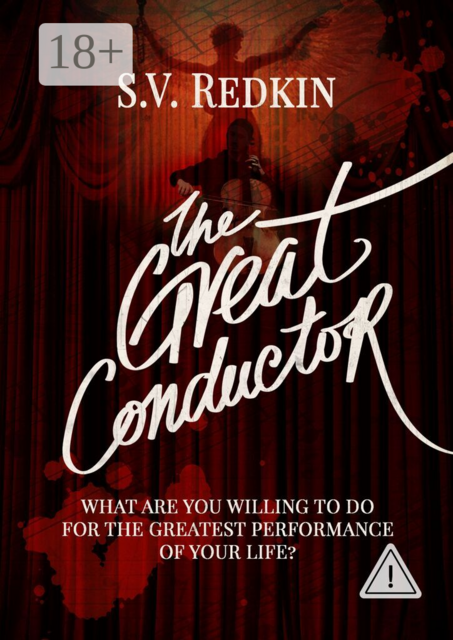



S.V. Redkin
The Great Conductor
Fonts by «ParaType»
© S.V. Redkin, 2026
A former child prodigy, Christine Heart turned her back on music after the unsolved death of her parents, finding purpose in police work.
Driven by a genius bordering on obsession, cellist Sebastian Copeland believes his new concerto will finally earn him a place among the immortal composers.
As Christine delves deeper into the new investigation, and Sebastian gets close to the crescendo of his creation, a shocking revelation will entangle their fates in a harmony neither could have foreseen.
ISBN 978-5-0069-6819-6
Created with Ridero smart publishing system
Contents
Movement I: Adagio
Chapter 1
“Music killed my parents.”
Perhaps it was not the best answer, but there it was.
“Excuse me,” Dr. Korpacheff said, peering over her horn-rimmed glasses. “Christine, did you just say that music — ”
“Killed my parents. Yes. That’s what I said… well, it was sort of one of the reasons why it happened,” Christine said, fiddling with the jade beads on her wrist before closing her eyes. “You asked me about my parents, and I answered your question.”
Why did I bring that up in here? Christine thought with regret.
Christine Heart, a thirty-five-year-old homicide detective, did not want to be in the shrink’s office in the middle of July while her colleagues were busy solving criminal cases with hardly any time for lunch in a stuffy office sometimes overwhelmed by BO. Granted, the air-conditioning in the doctor’s office was way better, and it felt really nice to be in the room.
The Homicide Investigation Division, which she had requested to be transferred to only two years ago, was no place for slacking and taking personal leaves. It was like the army — if you signed up for it, you had to be there day in and day out no matter what. Today, though, Christine felt like a high school student who had been sent to the principal’s office for a trivial offense, wasting her time explaining her behavior while the rest of the class depended on her in some extremely important sports event. It was an absolute waste of her time and taxpayers’ money.
“Is that why you’re here?” Dr. Korpacheff asked, adjusting her spectacles.
Christine looked at the big, fancy clock on the wall — five past two in the afternoon. She had been in the doctor’s office for only five minutes, but it felt like an eternity. She had nothing against Dr. Korpacheff. In fact, Christine kind of liked her demeanor when they had met before the session: friendly, professional, and soft-spoken.
The doctor was approximately her age, perhaps a couple of years older than Christine, who had not had time to celebrate her birthday a couple of months ago. Dr. Korpacheff had smooth, tanned skin and sported a very nice, expensive-looking beige pantsuit. Christine’s skin had not seen much sun even though it was the middle of summer — too much time in the office during the day and long, tedious hours sitting in the car during evening stakeouts. Christine’s jeans and shirt, even though clean and tidy, had been in her possession longer than she wanted to admit — no time or desire for shopping.
Christine noticed that Dr. Korpacheff kept her immaculately manicured nails short, and her forearms, which were not covered by the rolled-up sleeves of her silk blouse, looked strong. Daily workouts? No ring. Is she married? Kids?
“No, I’m here to work on my anger management skills in the workplace.” Christine shifted in the chair.
Christine had had a few issues with a couple of male colleagues — Detectives Kozminsky and O’Hara — who did not believe that she was capable of doing a good job and had tried to make sure she was assigned cases they did not want. Those poor excuses for colleagues had a good relationship with the detective sergeant who was in charge of assigning cases when he received calls from uniformed units.
Despite these attempts to undermine her, Christine had a good record of solved cases and had been pulled from the usual rotation onto some priority cases at her supervisor’s — Lieutenant Whitehead’s — discretion. That hadn’t sat well with the other detectives, and they had continued to spread antagonistic rumors about her alleged incompetence around the office, which had led to a shouting match with a lot of profanity (on their side) and a bit of body pushing (from Christine). Being in good shape, it had not been hard for Christine to put the two overweight, middle-aged men to shame. She probably should not have done that, but those jerks had deserved it.
“Do you think the reason why you are here is related to your parents?”
Christine pondered this for a second. “Well, perhaps everything that happens in anyone’s life is related to their parents one way or another. Do you think so?”
Dr. Korpacheff looked at her notes and nodded. “Well, why don’t you tell me about them? What did they do?”
Christine glanced at the doctor. She already regretted mentioning music — a subject she had been avoiding since she was fourteen years old. But as her lieutenant had told her, she needed to “go all the way and hold nothing back from the doctor to get better… or else” (whatever that meant), and it seemed that she had no choice but to share the pain she had been carrying inside for twenty-one years.
Christine closed her eyes and instantly imagined her mom and dad, who would always be young and healthy in her mind. She remembered her mom’s soft voice and warm hands in the evening and her dad’s upbeat demeanor in the morning. He was an early bird and used to make breakfast for everyone, humming happy tunes under his breath.
Christine opened her eyes and saw an encouraging smile on the doctor’s face.
“They were both engineers and were partners in a small company that made and did maintenance on elevators. They actually founded the firm right after they graduated from Baltimore Polytechnic Institute. My dad — Oliver Heart — studied engineering, and my mom — Connie Heart, née Brooks — studied math.” Christine smiled. “My grandparents told me that they were a couple of geeks who had been made for each other.”
Dr. Korpacheff reciprocated with a smile and nodded.
“I used to… um, play the piano. And… I was very good at it.” Christine shook her head and took a deep breath. Touching her self-made stone bead bracelet on her left hand gave her a sense of peace — she liked to feel the stones with her fingers. “I started when I was four and got to grade eight when I was six and was ready to get to advanced levels, which was… um…”
“Impressive?” Dr. Korpacheff ventured a guess.
“I mean… usually, kids get to the next grade every year, so… I guess I was going through those grades faster than others. And… when I was seven, I performed my first solo concert.”
“Did your parents want you to play the piano?”
Christine’s mind went to the cozy and sunny living room of the house where she used to live with her parents. They had an old Charles M. Stieff piano that miraculously came with the house when they moved in. She could see herself sitting on the bench — her feet dangling, too short to reach the floor — chewing her lower lip while doing scales time after time.
“No,” Christine said. “I wanted to do it. As soon as I realized what that big brown wooden thing was and how it made sounds — my dad could play a bit — I just wanted to make those beautiful sounds myself. It’s like… the piano talked to me through those sounds, and I didn’t want that conversation to end. So… um, I kept banging the piano keys until my parents couldn’t take it anymore and got me a teacher who showed me how to play it properly.”
Christine took a sip of water from the glass that Dr. Korpacheff had poured for her at the beginning of their session. The glass had been placed on a coaster with a picture of the Eiffel Tower on it. The doctor’s glass was sitting on a similar coaster but in a different color — the pair was probably a set, and they didn’t look cheap. Did the good doctor bring this little souvenir back from a romantic trip to France? She does look sophisticated enough to be into the Old World. Perhaps even, God forbid, classical music.
“Music was the only thing that mattered to me. I played when I was awake and dreamed about playing when I was asleep. It was like an obsession. I wanted more of it and never felt satisfied,” Christine said.
“Did your parents support you?”
“Oh, yeah, but… at some point, I think they were a bit scared of the intensity with which I was tackling challenging music pieces. I would never stop before I was sure I could play some particularly difficult part correctly. Even my teachers would sometimes tell me to take it easy, but I wouldn’t listen to them. It was like… I had a target in front of me that I had to hit no matter what or how long it took.”
Christine took another sip. Her throat was parched, and she felt like her face was on fire. She put down the glass and turned it on the coaster so that the Eiffel Tower would point directly at the doctor, to see if Dr. Korpacheff would notice. Her father used to do that to her — Can you see anything different now, Christine? — to keep her observation skills sharp, and she had a habit of doing it to other people to see how good their attention was.
“Then, one of my teachers suggested I participate in contests to hone my skills against other kids, to see how good I objectively was.”
“And?”
“Well, I did, and I was.”
“Was what?”
“I was much better than the rest of them,” Christine said and took another sip of water. Her throat was still dry. Was the air-conditioning still on? “Anyway, I was getting to the point when I was ready for serious international competitions and… um, I needed money to travel, and my parents did everything they could to make it happen for me.”
Christine saw Dr. Korpacheff taking some notes with her silver pen in her leather-bound notebook and wondered which part of her story was worth noting in order to help Christine with her situation at work.
As a homicide detective, Christine carried a standard-issue, pocket-sized black leather notebook where she would jot down important highlights of the cases she was working on and significant details from interviews with people involved in her investigations. In her detective training, she learned that officers should always strive to take accurate and thorough notes. They should be made “as contemporaneously as possible.” The notes reflected what the investigator thought, what they did, and what they observed.
What is Dr. Korpacheff thinking and observing? Does she still have her parents around? Does she get along with them?
“Anyway,” Christine said. “My parents were quite successful, and they had no financial problems paying for my music trips and my teachers. They even got me a used Steinway baby grand piano that cost as much as a small car when I was ten. They had to take out the window frame in our living room to bring that instrument into the house. My parents arranged it as a surprise when I was away at my grandparents’, and I was so happy when I saw it.”
“Do you still have it?”
“I do.”
“Do you play it?”
“No.”
“Which brings us to…”
“Yes.” Christine smiled ruefully. “I was scheduled to play at an important music contest that was going to open many exciting opportunities for me as a performer, and I wanted my parents to be there to watch me. They couldn’t go with me because of a work emergency and promised to be in their seats by the time I was on the stage.”
Dr. Korpacheff nodded without saying anything.
“It’s difficult to see who is in the audience when you’re on the stage because of the bright lights. I played my piece well, and I remember thunderous applause. I stood up, exhilarated by my own performance. The piece was challenging — Trois mouvements de Pétrouchka by Stravinsky — but I thought that I did a good job. It was eerily ironic that my teacher and I had chosen it. I went to the edge of the stage to wave to my parents, only to see that their seats were empty.”
Christine took a deep breath.
“Anyway, when I saw they weren’t there, I got mad at them for missing such an important event in my life, and that’s when I noticed a police officer walking in and pointing at me while talking to my teacher.”
Christine remembered her knees getting weak and all the sounds around her turning into white noise. She still felt some of that every time she remembered that watershed moment.
“When I got off the stage, I learned about the car accident that took the lives of my mom and dad. They’d just parked not too far from the concert hall and were getting a bouquet of flowers out of the car when a big black pickup truck slammed into their Lexus, killing my father instantly. My mother lived long enough to tell the ambulance doctors my name and the place where I was performing before losing consciousness and dying later in the emergency room before I could get there.”
“How old were you?”
“Fourteen.”
“What happened after that?”
“I stopped playing music and have never played the piano ever since.”
Dr. Korpacheff pondered for a minute. “Why did you say the choice of the music piece was eerily ironic?”
Christine gave another rueful smile. “It’s said that when writing that piece, Stravinsky had a picture of a puppet exasperating the patience of the orchestra with diabolical cascades of arpeggios. I remember fixating on the word ‘diabolic’ when it happened and feeling that I had brought a curse on my parents with my music.”
“What happened to the person who had caused the accident?”
“Don’t know.”
“Why?”
“They never found the car or the person who drove it. There were no CCTV cameras on the street, and the witnesses didn’t see the license plate.”
Dr. Korpacheff pondered for a moment. “Do you think your parents’ untimely demise was the reason why you joined the force?”
Christine readjusted her bracelet and looked at the coaster under her glass — the Eiffel Tower was still aiming at the doctor. It seemed that Dr. Korpacheff had not noticed it.
“I don’t think. I know it was,” Christine said and glanced at the clock. There were another twenty minutes to go.
Chapter 2
The old coffee machine made its usual gurgling sound, announcing that a fresh brew was ready. Sebastian Copeland, a thirty-six-year-old man with a pair of dreamy blue eyes, a long, disheveled mane of brown hair with a touch of grey, and a protruding belly, slowly walked into the kitchen of the rowhouse he shared with his mother, Lydia Hasselbach, to get himself his first caffeine fix of the day. It was six thirty in the morning — the time when he started his daily cello practice that sometimes went all the way to noon.
Unlike so many classical musicians, Sebastian was not a night owl and preferred to catch the worm. Another reason for getting up early was the lack of a stable job in an orchestra that would require a different daily schedule. He made his living by teaching cello to a few kids and getting some money from music stores for referring his students to buy their instruments. There were also occasional gigs — weddings, cocktail parties, fancy corporate events — that sometimes brought a bit of extra cash.
“Get me a cup,” came his mother’s demanding voice from the living room. “And don’t forget the sugar this time. Martha never forgets. You should’ve learned from her already.”
Martha Smith was a fifty-seven-year-old social worker who came three days a week to help Lydia around the house. An organization that assisted retired musicians had arranged this for her. Though grateful for Martha’s assistance, Sebastian did not interact with her much, as he was usually busy when she was around.
“Yes, Mother,” Sebastian answered absentmindedly, being used to his mother’s hourly requests, following them without even thinking.
He was going over Shostakovich’s Cello Concerto No. 1 in his head — in Rostropovich’s rendition, of course, for whom the concerto had been written in the first place — when he poured two cups of coffee and went to the living room to find his mother sitting in her favorite armchair with well-worn upholstery, watching the news on TV.
Lydia Hasselbach was a seventy-two-year-old wiry woman with an ever-judging expression on her face that made her look like a strict schoolteacher. Her salt-and-pepper hair was neatly tied in a small bun on the back of her head, there was a hint of powder on her parchment-like facial skin, and her hawk eyes followed every move Sebastian made.
“This bunch of idiots is going to ruin this country, and nobody is doing a damn thing about it,” she said, giving her take on the political report presented by a dramatically enthusiastic TV pundit, and took her cup. She looked at Sebastian. “You mark my words — the end of the world is near, and don’t you think about bringing any children into this satanic bonfire. You hear me?”
“Yes, Mother.” One part of his brain was giving orders to reply with generic answers to Lydia’s ever-negative comments on whatever she happened to watch on TV, and the other part was going through an elegiac second movement of the concerto where the cello played its second theme and became progressively more agitated, building to a climax in bar 148. He always enjoyed this change of pace after the marching allegretto in the first movement. A faint tremor of amusement appeared on his lips for a second and disappeared without a trace. He did not want Lydia to think that he was not really listening to her or, God forbid, laughing at her.
“That’s right. No more new children for this godforsaken country. They’ll be brainwashed and turned into zombies or cannon fodder,” Lydia said, drinking her coffee and getting agitated herself. “Only music can save us. Music can save this rotten world. Or could… I don’t know.” She looked at Sebastian as if to make sure he was not going to say anything contradictory and, seeing no visible reaction from her submissive son, she turned back to the TV. “Have I ever told you that I was on the short list for going to the USSR with the Cleveland Orchestra?” she said, without taking her eyes off yet another TV expert on the screen.
Sebastian, who had heard the story only a few dozen times, shook his head to indulge his mother once again, letting her dive into the past that was so precious to her.
“That’s right,” Lydia said proudly. “I could’ve been the first American harpist to play for those poor people. I could’ve changed history and, God knows, things could’ve been different if I had gotten on that tour.”
Sebastian knew better than to ask his mother — the former professional harpist who had stopped playing on the stage for just about as long as Sebastian was alive — why she had never gotten the position back in 1965 and what kind of things could have been different had she indeed been a part of that orchestra.
He knew that Lydia would get into a thousand reasons why the world had been unfair to her and how men, including “that loser father of yours,” ruined her prospects of becoming the greatest harp player in the world. Despite the fact that they both lived in the house that Sebastian’s late father, Stephen Copeland, had owned and left them, along with some money that paid all their bills, Lydia still considered her marriage to “the man who didn’t know anything about music” the biggest mistake of her life.
“Don’t just stand there; go boil some eggs before your practice. Martha never makes me tell her things. She does it before I even think about it.” Lydia’s voice was penetrating the second movement in Sebastian’s head. “I want you to pick up some pills for me in the afternoon, and we’re running out of vegetables. Don’t forget to buy some meat for dinner, and I want a bottle of decent wine this time, not that cheap garbage you got me the other day. You hear me?”
She scanned Sebastian’s outfit — an old Aloha shirt and cargo pants. “And for God’s sake, try to wear something tasteful when you’re in the house, will you? What’s wrong with you today? You’re supposed to be a musician.” She sighed dramatically. “Here I am, talking about not having children. How silly of me. What children, for God’s sake? There’s no woman in the world who will ever think about getting involved with you if you insist on dressing like a bum.”
“Yes, Mother.”
“Don’t forget to take your vitamins either. Do I have to think of everything?”
Sebastian waited for a moment to see if there were any more instructions from Lydia, but when he saw that her eyes were back on the TV, lured by the talking heads as usual, he quietly left the room.
It was time for his daily practice. He went downstairs to the basement and, through the laundry room, entered his “shrine of music” — the only place in the house where he was left completely alone to his own devices and the place where his cello was waiting for him.
The floor and walls of the shrine were covered with old Persian carpets, which his father had brought back from his business trips to the Middle East. Stephen, an oil engineer who had traveled extensively for work, was known as a great admirer of the unique carpet craftsmanship found only in the East.
Sebastian had fond memories of his father, an ever-positive man who played Beatles records when Lydia wasn’t home, as she hated “that crap,” and who died unexpectedly of a heart attack when he was only fifty years old.
The death of his father was difficult for Sebastian, but it brought him closer to his brother, Paul, with whom he had rarely talked before. Paul was everything Lydia wanted in a son — neat and organized. Sebastian, on the other hand, was the complete opposite. He never really cared about how he looked, which annoyed Lydia, a perfectionist in everything. She had worked hard to ensure that Sebastian’s “inherent laziness” would not hinder his progress in music as a child and had “sacrificed hundreds of hours” of her undivided attention to his practices. There were never any sleepovers at their house, and Sebastian was never invited to his classmates’ parties, as he never had time for anything other than music.
Sebastian carefully placed his still-steaming coffee cup on the old desk that was covered with piles of music sheets. He stood motionless in the middle of the room with his eyes closed, waiting for the second movement of the concerto that was still playing in his head to finish. As soon as the imaginary Mstislav Rostropovich lowered his bow, Sebastian opened his eyes and smiled. Rostropovich, imaginary or not, never failed to put Sebastian in the right mood for practice.
He picked up the coffee cup and took a few sips, enjoying the drink for a moment. After he had finished, he placed the cup back on the desk and turned his attention to the large, old, battered, but sturdy cello case with its seven silver latches, which was standing next to his chair and music stand. Inside the case was the most precious thing in Sebastian’s life — the instrument that had cost him half the money his father had left him when he became old enough to make an extremely difficult decision about purchasing the right instrument on his own. For once, Lydia had agreed with his choice.
Sebastian did a bit of a body warm-up: rolling his shoulders and stretching them out — the third movement playing in his head.
He slowly unclipped the latches of the case and opened the lid. There, inside, was his Helmuth Keller & Son cello, “Galina” –named after the wife of Mstislav Rostropovich. The moment Sebastian saw the instrument for the first time, he knew it was special. Its beauty was worthy of the name of the greatest musician’s wife. Sebastian gently touched the fingerboard and moved his fingers along the upper bout rib all the way down to the f-holes, body, and tailpiece.
“Hello, Galina,” he said quietly with a dreamy smile. “Miss me?”
Sebastian still remembered his first cello, which was made in Shanghai, China, from German wood. It was a special instrument that held a special place in his heart. But “Galina” had become his life partner, the instrument with which he created his own music.
First things first.
Sebastian took his bow out of the case. Using a nail clipper, he clipped off a torn horsehair. Then he tightened the horsehair and applied some resin. He liked to use the stuff, which was said to have golden flecks in it, which were invisible to the naked eye, but Sebastian liked the idea of it. His telescopic chair was positioned where the corners of the floor carpets almost met, revealing just enough of the hardwood floor to put a slip-stop endpin rest for his cello. He did not want to ruin his father’s carpets. He adjusted the spike “Russian style” so that “Galina” would be more horizontal against his chest — easier for his bow hand, which would give him a richer, more powerful sound.
With “Galina” across his chest, Sebastian waited until the third movement — the solo cadenza based on themes from the preceding movements — of the concerto was over in his head. He did his usual warm-up routine (finger control exercise, warming up his right hand’s wrist, crescendo and diminuendo exercises on an open string), then he reached for the metronome that was on his desk and gently pushed the pendulum.
Sebastian closed his eyes, listened to the steady clicks, feeling the growing excitement he always had before playing, took a deep breath, and started with his trill and vibrato exercises before moving on to the scales.
He doubled his speed, doing four active runs for each bit in his usual meditative and steady manner. Then, to stimulate his brain, he performed one movement from one of Bach’s Cello Suites — today, according to Sebastian’s ritualistic order, it was number 4 in E-flat major.
Now, it was time for his masterpiece. The musical piece that would change the world of music. The one that would surely change his life, but… the world would have to wait until he had what he needed to present it properly.
Chapter 3
It was an unexpectedly relaxed Friday in the office. After her usual greeting of the parents’ photo on her desk, Christine had a cup of coffee and started on some paperwork. She had a few reports to finish before the weekend, and although they wouldn’t make the pile on her desk much smaller, it was good to get them done.
She was finalizing a murder case — a young woman had been shot in her apartment by some gangsters who owed her boyfriend a debt — and was preparing to appear in court for the trial. She was reviewing her testimony when her phone rang. Her grandmother’s name appeared on the screen.
Christine knew the reason for the call — Veronica Heart was calling to check if Christine was coming to lunch that Saturday. Christine had canceled a few lunches previously, citing her busy schedule, but this was only half true. She knew her grandparents were worried about her working under pressure and being single, and they wanted to make sure she was okay. While she appreciated their concern, it was difficult for her to sit through lengthy conversations about finding a life partner. They were supportive of any decision she made, even if it meant she was into women. This had amused her at first, but then she realized they were serious. Her grandparents most certainly suspected that Christine’s lack of any romantic or sexual relationships with men meant that she was probably “playing for the other team or no team at all.”
Christine could not explain why, at thirty-five, she had hardly gone on any dates with men. She was reluctant to tell the people who had taken care of her after her parents died about the mess that her personal life had become. A few short-term relationships that meant nothing had convinced her that it was better to stay at home, doing what she enjoyed — making stone beads and reading about gemstones — rather than wasting her time on men who weren’t ready to invest emotionally in the dating process. So she resorted to telling them that it was her choice — whatever it was — and they should respect that.
She did have another, less antisocial hobby, though, which was somewhat related to her work. She liked going to shooting ranges, where she could let all her negative emotions and frustrations leave her mind as she shot bullets at targets.
Perhaps she could have invented an imaginary relationship, and at one point, she even considered bringing home a fake boyfriend to make her grandparents stop asking about her love life. She had decided not to do it — she couldn’t bring herself to lie to them. But this time, she felt that she had no other choice and reluctantly picked up the phone.
“Hello, Grandma,” Christine said, stopping work on her reports.
“Hi, hon,” Veronica said cheerfully. “I hope I’m not interrupting anything important.”
“No, it’s fine. What’s up?”
“Nothing much. Just wanted to make sure that you’re coming to lunch tomorrow.”
That sentence reminded Christine of the time when she enrolled at the University of Baltimore to pursue a bachelor’s degree in criminal justice. At the age of seventeen, she was the youngest student in her class. Veronica would call her every day to check on her, worried about Christine’s ability to take care of herself. This continued until her graduation from the police academy. By then, Christine had learned to survive on her own, but she would still allow herself to be persuaded into having home-cooked meals from time to time.
Christine’s parents had provided her with enough support not to worry about her finances, and they also left her a rowhouse so she could live on her own. However, she had decided not to use the trust fund for anything other than education, unless absolutely necessary. So, she did some waitressing when she could to make sure she had just enough money to cover her basic expenses before getting her badge.
Christine smiled. “Sure, Grandma. I’ll be there. Do you want me to bring anything?”
“A bottle of wine would be nice, I suppose, but only if it’s not too much trouble for you.”
“It’s not. I’ll bring something nice.”
“Oh, good.”
There was a familiar pause in the conversation — Veronica was forming her next “sensitive” question.
“Yes?” Christine said, not wanting to have a long conversation at work.
“Your grandfather and I think that…”
“Yeah?”
“Well, there is a nice young man — ”
“Grandma!”
“No, listen. I’m just saying that… you don’t have to do it if you don’t want to, but our friends’ son — ”
“Please, don’t tell me that you’re talking about your neighbors and their son.”
Veronica and Sam Heart were unfortunate to have the Ellisons as neighbors, the most pompous old couple Christine had ever known, and their forty-year-old son, Matthew, who thought of himself as the center of the entire universe and behaved accordingly. “Obnoxious jerk” were the two words that were synonymous with Matthew Ellison in Christine’s dictionary.
“Oh no,” Veronica said. “I’m talking about Victor O’Brian.”
Christine could hardly remember who that was. A few images came to mind of a handsome man who was working for his father and was always on the phone at the one or two family occasions where they had happened to be in the same room.
“Do you remember him, sweetie?” Veronica asked.
“I kind of do, but I don’t — ”
“Listen, before you say no, please hear me out…”
Christine rolled her eyes, fully aware that Veronica could not see her, but she could not help it.
“He works for his father. You may not remember that — he’s in real estate and he travels all over the country selling apartments and houses to rich people. He’s quite successful, you know.”
“So what’s wrong with him?”
“How do you mean?”
“He’s successful and handsome, but… he’s single. Right?”
“Yes.”
“So, what is wrong with him? Why is he still single?”
Veronica laughed. “Oh, I see what you’re doing there.”
“What am I doing?”
“Oh, don’t play innocent with me, young lady.” Veronica tried to sound stern. “You’re getting back at us, aren’t you? For what we told you. Right?”
Christine was smiling, but she wanted to continue this game to make sure her grandmother realized what they had been doing to her. “Could you remind me? What was it that you told me about me being single?”
“Oh, stop it! You know it was different back when we — oh, heck, even back when your parents, God bless their souls — were young. People would get… what’s the expression they use nowadays? Hook up in their twenties.”
“But now?”
“Okay, now is different. There. Happy?”
Veronica could never win any debates with Christine — a fact that both of them were very well aware of.
“Quite. So… what about Victor? Is he looking for a life partner?” Christine asked.
Veronica laughed. “Your detective skills are extraordinary, but… it was his parents who are worried about him and they… well, they just suggested that — ”
“Is that a blind date proposition?”
“It won’t be blind, will it? You know each other.”
“Sort of. I’ve seen him twice in my life. Don’t even remember what he looks like, really. He could be fat and sporting a ZZ Top beard, for all I know.”
“ZZ what?” Veronica asked.
“The band? Haven’t you heard of them? They’re pretty old. I’m actually surprised that I just used that reference.”
“Oh.” It sounded as if everything Christine just said went over Veronica’s head. “In any case, please, think about it. It could be good for you — ”
Here we go again, Christine thought.
“ — to meet someone.”
There it is.
“All right, Grandma. I’ll think about it.” Christine gave up.
“That’s all I’m asking, sweetie.” Veronica’s voice brightened considerably. “I’ll let you go now. You’re probably terribly busy.”
“Mission accomplished, right?”
“Excuse me?”
Christine shook her head, smiling. “I love you, Grandma. I’ll bring that wine. See you tomorrow.”
“Love you, too, hon.”
Christine put down her phone and was about to resume her work on the report, but then she changed her mind and decided to check the system to see if there had been any accidents involving cars similar to the one mentioned in her parents’ case. The car in question was a black 1999 Ford Super Duty, based on the testimony of some witnesses. She had been doing this every week whenever she had some free time.
Chapter 4
“Is dinner ready yet?” Lydia’s shrieking voice seemed to reverberate off the walls in the living room, amplifying its volume and sending it to every corner of their rowhouse. It always reminded Sebastian of his late grandfather Nathan Hasselbach, Lydia’s father, who was one mean old man and could not tolerate anything that was not to his liking. Sebastian remembered him yelling for his beer from the living room, just like Lydia, and his mother was the one to fetch it from the fridge — Nathan only drank it cold; otherwise, you were in trouble.
“Soon, Mother,” Sebastian replied calmly from the kitchen, where he was checking on a whole chicken in the oven. It would be another twenty minutes until the skin of the once-living hen, which had only been fed natural grains and probably had a nice cage-free life before it was slaughtered for the pleasure of people who cared about what they put in their mouths, would turn a succulent light brown color.
Sebastian’s father used to be responsible for all the grocery shopping and always bought good quality products. He subscribed to the “you are what you eat” philosophy. Lydia would often ridicule his approach, calling it a “nonsensical waste of money.” However, after noticing the positive effects on her skin, which would often manifest as an itchy rash when she ate certain ingredients, she gradually began to believe in the approach. She vehemently denied any suggestion from Stephen that her condition was psychosomatic or stress-related, strongly believing that her parents’ lack of understanding of proper nutrition was the real cause. To some extent, this was probably true, as Nathan, aside from the temperature of his beer, did not give a shit about what he ate as long as it had meat in it.
Lydia’s mother, Caitlin, was not in a position to vote on the matter within the family hierarchy. Nathan was the dominant figure that everyone had to reckon with, but Lydia was her father’s daughter and, as stubborn as a mule, she imposed the new eating habits on her father as well.
Wearing an apron, Sebastian sliced a few organic potatoes very thinly, covered them with salt, pepper, and ghee, and added them to the chicken in the oven.
“Hurry up, will you? I’m starving,” came another announcement. “Why can’t you be like Martha?”
Sebastian nodded in agreement — it was Martha’s day off and he was on cooking duty — and continued preparing a green salad with cheese, walnuts, and pumpkin seeds, dressed with organic pumpkin seed oil. As he worked on the salad, he thought about his music composition, which needed some fine-tuning before he could show it to Lydia.
He had decided that it was time for her to know what he had been busy with. He hadn’t been “horsing around,” and he was not “just a music tutor for lazy children,” either. Even if he was too old to attend serious auditions, he had enough skill and knowledge to create music worth performing onstage.
“Why aren’t you answering me?” Lydia’s authoritative voice barked behind him.
Sebastian turned around and saw Lydia standing next to their dining table, leaning on it with one hand and holding a music score book in the other. She liked to go over the music pieces she used to perform in the evening before dinner. She wore a black silk turtleneck and black pants; she looked as if she were ready to go out. Sebastian knew that Lydia’s evening routine had been her way to feel as if she were still working. He played along, never asking her the reason for looking formal.
“Sorry, Mother. Got carried away with the salad,” Sebastian said, stirring the salad in a big ceramic bowl. “The chicken should be ready in about fifteen minutes. Why don’t you sit down, and I’ll pour you a glass of wine.”
Lydia snorted — she did not like it when people told her what to do. “Is it chilled?”
“Of course,” Sebastian said and went to the refrigerator to get the bottle of Chardonnay.
Lydia sat down and placed her score book next to her plate after checking the surface of the table and finding it relatively clean. She folded her arms across her chest and glanced at her son.
“There’s something strange about you today,” she said. “You look… excited. What’s happening? Yesterday you didn’t want to talk to me, today you’re cooking — not that I’m complaining about it — and looking… I don’t know. Whatever you’re thinking about in that head of yours now makes your face look funny.”
Sebastian finished stirring the salad and brought the bowl over to the table.
“I want to show you something tonight… after dinner, of course,” he said, placing the bowl closer to Lydia’s plate.
“Well, whatever it is, don’t forget it, like you usually do. And may I remind you that I might have company later tonight? So I hope it won’t take long.”
Sebastian didn’t think it was true — another made-up excuse for looking proper — but didn’t say anything.
Lydia motioned for him to hurry. “Let’s eat already. I’ll have some of that salad and a glass of wine before the chicken is ready.”
Lydia would often have more than one glass of wine with dinner, moving on to stronger beverages “for dessert.” Her alcohol intake had been gradually increasing over the years.
***
With the last movement of the bow, the piece was over. Sebastian blew some of his hair off his sweaty face. It was the first time that he had played his “masterpiece” for someone else. Even Paul had not heard it. He looked at his mother and wondered whether it had been a mistake to play it for her, after all. He could count all those instances when she had been remotely indulgent toward whatever he had been able to do on one hand. He did not even need all his fingers on that hand to do it.
He looked at her.
“Well?” he asked.
Lydia took a deep breath and shook her head. She was sitting in her favorite chair — the same chair where Nathan used to sit — and looked as if contemplating what she wanted to say.
“You hated it,” Sebastian said with an affirmative intonation.
She took a sip of her bourbon, her preferred “after dinner” beverage that she had brought to the “presentation” in the living room, before answering. “It doesn’t matter whether I like it or not,” she said. “The question is, do you think it’s good enough musically? Do you think you fully conveyed the message with that piece?” she asked in a condescending tone.
It was clear to Sebastian that Lydia did not think much of the piece, and he started to put “Galina” back into her case without saying much.
“I mean,” Lydia continued, “there was just too much of everything, wasn’t there? It sounded like you were trying to cram Shostakovich, Beethoven, Smetana, and Mozart all into one small space and have them fight each other.” She took another sip of her drink. “What was it, some sort of short audition list? It’s like you’re trying too hard to hide the fact that you lack the ability to compose behind technicalities. Do you remember when you were a kid and used to hide your wet bedsheets?”
Sebastian’s face twitch at the mention of his “little problem” when he was a boy, and she nodded satisfactorily, as if to say, “you’re getting my point.”
“Pretending that something isn’t there when it is doesn’t make the problem go away,” she added, driving the last nail into the coffin of her assessment.
“Never mind,” Sebastian said, closing the cello case. He did not feel like discussing the piece with his mother anymore. She was clearly getting drunk and was not in the mood to analyze the complexity of his music.
He stood up.
“Where are you going?” Lydia asked, her speech becoming slurred.
“Out,” he said. “Need some fresh air.”
Lydia shrugged, took the TV remote control, turned on the set, and started to surf the channels. “Might as well. My guest is a bit late, but he’s still coming for a drink later,” she said without looking at Sebastian.
She was done talking, which suited Sebastian just fine. He locked the case, leaving the room with only the voices of the news commentators behind him and his mother steadily working through the bottle.
He had an important meeting himself that he did not want to miss. Even Lydia’s indifference did not spoil his mood that much — he had expected her reaction, or lack thereof. In a way, his mother had confirmed what he had always suspected — his music was only for outstanding minds, people who could appreciate the polyrhythmic and hypnotic melodious tranquility of what he had created.
Sebastian needed someone special, and that’s exactly what sheer, unbelievable luck (or providence?) had brought into his life. This man had seemed to appear as the desirable answer to Sebastian’s unspoken prayers. The Great Conductor — one of the greatest musical minds of his generation — had agreed to listen to his piece of music. It was a life-changing experience and the beginning of a unique collaboration. It was everything Sebastian hoped for — a true validation of his talent as a musician.
It had happened a couple of years ago when he had just started working on his piece. The meeting was so unexpected and surreal that he sometimes feared it might not have happened at all. He could not imagine that a musician of his caliber, hardly worth noticing from the perspective of snobbish professional orchestral musicians, could have possibly caught the attention of such a musical giant. But the Great Conductor was different; he could see the core of a true composer in Sebastian.
As for Sebastian’s musical skills, it’s not that he was a bad cellist. He was all right, but there were thousands of other players just like him who were constantly looking for ethereal orchestral positions around the world, through websites and word of mouth, who may have all sorts of strings attached to their applications.
What set him apart from the crowd was his unique mind as a composer. He had read somewhere that composers can hear the unheard, reach into the subconscious mind from the conscious mind, and shape emotions into sonic existence. This was exactly how he felt about his own mind. He did not just strive to be a great soloist, putting in tens of hours each week to master his performance skills. He wanted to be onstage, playing his own music. His compositions were the pinnacle of human creativity. His pieces would stand the test of time, like the Egyptian pyramids, and be enjoyed by people forever.
The Great Conductor was very patient and waited until Sebastian was ready to work on the final part of his concerto. He proposed his assistance, which was an extraordinary honor for Sebastian, who was speechless and flabbergasted by the offer.
However, there were two conditions. The first was that Sebastian’s mind had to be free from any negative thoughts, and he needed to create a perfect environment for music composition. This meant that he had to be free from anyone’s influence, including his mother’s.
Once this condition was met, the Great Conductor would reveal the second condition.
Tonight, though, the Great Conductor was going to meet with Sebastian and see the progress on the piece. Sebastian would forget about Lydia’s reaction and concentrate on meeting the man who would most likely change his life.


















- Басты
- ⭐️Mystery & Detective
- S.V. Redkin
- The Great Conductor
- 📖Тегін фрагмент