



автордың кітабын онлайн тегін оқу History of the Reign of Philip the Second, King of Spain, Vols. 1 and 2
The Project Gutenberg EBook of History of the Reign of Philip the Second,
King of Spain., by William H. Prescott
This eBook is for the use of anyone anywhere at no cost and with
almost no restrictions whatsoever. You may copy it, give it away or
re-use it under the terms of the Project Gutenberg License included
with this eBook or online at www.gutenberg.org
Title: History of the Reign of Philip the Second, King of Spain.
Author: William H. Prescott
Release Date: May 30, 2010 [EBook #32600]
Language: English
*** START OF THIS PROJECT GUTENBERG EBOOK PHILIP THE SECOND ***
Produced by Paul Murray, Chuck Greif and the Online
Distributed Proofreading Team at http://www.pgdp.net
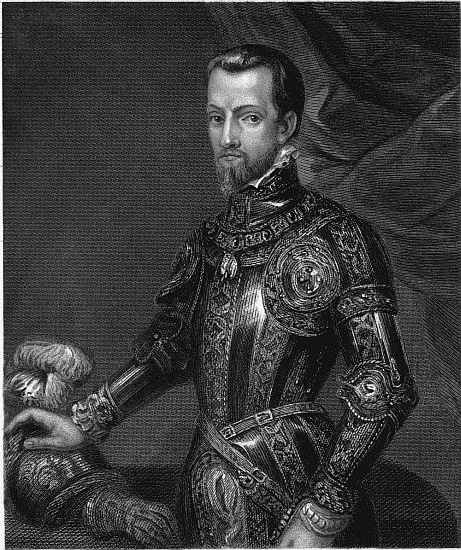
Royal Museum at Madrid. London, George Routledge & Sons, Broadway, Ludgate Hill.
HISTORY
OF
THE REIGN
OF
PHILIP THE SECOND,
KING OF SPAIN.
BY
WILLIAM H. PRESCOTT,
CORRESPONDING MEMBER OF THE INSTITUTE OF FRANCE, OF THE ROYAL
ACADEMY OF HISTORY AT MADRID, ETC.
VOLUMES FIRST AND SECOND.
COMPLETE IN ONE VOLUME.
LONDON
GEORGE ROUTLEDGE AND SONS
THE BROADWAY, LUDGATE
NEW YORK. 416, BROOME STREET.
Contents
Footnotes
PREFACE.

{iii}
The reign of Philip the Second has occupied the pen of the historian more frequently—if we except that of Charles the Fifth—than any other portion of the Spanish annals. It has become familiar to the English reader through the pages of Watson, who has deservedly found favor with the public for the perspicuity of his style,—a virtue, however, not uncommon in his day,—for the sobriety of his judgments, and for the skill he has shown in arranging his complicated story, so as to maintain the reader's interest unbroken to the end. But the public, in Watson's day, were not very fastidious in regard to the sources of the information on which a narrative was founded. Nor was it easy to obtain access to those unpublished documents which constitute the best sources of information. Neither can it be denied that Watson himself was not so solicitous as he should have been to profit by opportunities which a little pains might have put within his reach,—presenting, in this respect, a contrast to his more celebrated predecessor, Robertson; that he contented himself too easily with such cheap and commonplace materials as lay directly in his path; and that, consequently, the foundations of his history are much too slight for the superstructure. For these reasons, the reign of Philip the Second must still be regarded as open ground for English and American writers.
And at no time could the history of this reign have been undertaken with the same advantages as at present, when the more enlightened policy of the European governments has opened their {iv}national archives to the inspection of the scholar; when he is allowed access, in particular, to the Archives of Simancas, which have held the secrets of the Spanish monarchy hermetically sealed for ages.
The history of Philip the Second is the history of Europe during the latter half of the sixteenth century. It covers the period when the doctrines of the Reformation were agitating the minds of men in so fearful a manner as to shake the very foundations of the Romish hierarchy in the fierce contest which divided Christendom. Philip, both from his personal character, and from his position as sovereign of the most potent monarchy in Europe, was placed at the head of the party which strove to uphold the fortunes of the ancient Church; and thus his policy led him perpetually to interfere in the internal affairs of the other European states,—making it necessary to look for the materials for his history quite as much without the Peninsula as within it. In this respect the reign of Ferdinand and Isabella presents a strong contrast to that of Philip the Second; and it was the consideration of this, when I had completed my history of the former, and proposed at some future day to enter upon that of the latter, that led me to set about a collection of authentic materials from the public archives in the great European capitals. It was a work of difficulty; and, although I had made some progress in it, I did not feel assured of success until I had the good fortune to obtain the coöperation of my friend, Don Pascual de Gayangos, Professor of Arabic in the University of Madrid. This eminent scholar was admirably qualified for the task which he so kindly undertook; since, with a remarkable facility—such as long practice only can give—in deciphering the mysterious handwriting of the sixteenth century, he combined such a thorough acquaintance with the history of his country as enabled him to detect, amidst the ocean of manuscripts which he inspected, such portions as were essential to my purpose.
With unwearied assiduity he devoted himself to the examination of many of the principal collections, both in England and on the Continent. Among these may be mentioned the British Museum and the State-Paper Office, in London; the Library of the Dukes of Burgundy, in Brussels; that of the University of Leyden; the {v}Royal Library, at the Hague; the Royal Library of Paris, and the Archives of the Kingdom, in the Hôtel Soubise; the Library of the Academy of History, the National Library at Madrid, and, more important than either, the ancient Archives of Simancas, within whose hallowed precincts Señor Gayangos was one of the first scholars permitted to enter.
Besides these public repositories, there are several private collections to the owners of which I am largely indebted for the liberal manner in which they have opened them for my benefit. I may mention, in particular, the late Lady Holland, who kindly permitted copies to be made by Señor Gayangos from the manuscripts preserved in Holland House; Sir Thomas Phillips, Bart., who freely extended the same courtesy in respect to the present work which he had shown to me on a former occasion; and Patrick Fraser Tytler, Esq., the late excellent historian of Scotland, who generously placed at my disposal sundry documents copied by him in the public offices with his own hand, for the illustration of the reign of Mary Tudor.
In Spain the collection made by Señor Gayangos was enriched by materials drawn from the family archives of the marquis of Santa Cruz, whose illustrious ancestor first had charge of the Spanish armada; from the archives of Medina Sidonia, containing papers of the duke who succeeded to the command of that ill-starred expedition; and from the archives of the house of Alva,—a name associated with the most memorable acts of the government of Philip.
The manuscripts, thus drawn from various quarters, were fortified by such printed works as, having made their appearance in the time of Philip the Second, could throw any light on his government. Where such works were not to be purchased, Señor Gayangos caused copies to be made of them, or of those portions which were important to my purpose. The result of his kind, untiring labors has been to put me in possession of such a collection of authentic materials for the illustration of the reign of Philip as no one before had probably attempted to make. Nor until now had the time come for making the attempt with success.
There still remained, however, some places to be examined where I might expect to find documents that would be of use to {vi}me. Indeed, it is in the nature of such a collection, covering so wide an extent of ground, that it can never be complete. The historian may be satisfied, if he has such authentic materials at his command, as, while they solve much that has hitherto been enigmatical in the accounts of the time, will enable him to present, in their true light, the character of Philip and the policy of his government. I must acknowledge my obligations to more than one person, who has given me important aid in prosecuting my further researches.
One of the first of them is my friend, Mr. Edward Everett, who, in his long and brilliant career as a statesman, has lost nothing of that love of letters which formed his first claim to distinction. The year before his appointment to the English mission he passed on the Continent, where, with the kindness that belongs to his nature, he spent much time in examining for me the great libraries, first in Paris, and afterwards more effectually in Florence. From the Archivio Mediceo, in which he was permitted by the grand duke to conduct his researches, he obtained copies of sundry valuable documents, and among them the letters of the Tuscan ministers, which have helped to guide me in some of the most intricate parts of my narrative. A still larger amount of materials he derived from the private library of Count Guicciardini, the descendant of the illustrious historian of that name. I am happy to express my lively sense of the courtesy shown by this nobleman; also my gratitude for kind offices rendered me by Prince Corsini; and no less by the Marquis Gino Capponi, whose name will be always held in honor for the enlightened patronage which he has extended to learning, while suffering, himself, under the severest privation that can befall the scholar.
There was still an important deficiency in my collection,—that of the Relazioni Venete, as the reports are called which were made by ambassadors of Venice on their return from their foreign missions. The value of these reports, for the information they give of the countries visited by the envoys, is well known to historians. The deficiency was amply supplied by the unwearied kindness of my friend, Mr. Fay, who now so ably fills the post of minister from the United States to Switzerland. When connected with the American legation at Berlin, he, in the most obliging manner, {vii}assisted me in making arrangements for obtaining the documents I desired, which, with other papers of importance, were copied for me from the manuscripts in the Royal Library of Berlin, and the Ducal Library of Gotha. I have also, in connection with this, to express my obligations to the distinguished librarian of the former institution, Mr. Pertz, for the good-will which he showed in promoting my views.
Through Mr. Fay, I also obtained the authority of Prince Metternich to inspect the Archives of the Empire in Vienna, which I inferred, from the intimate relations subsisting between the courts of Madrid and Vienna in that day, must contain much valuable matter relevant to my subject. The result did not correspond to my expectations. I am happy, however, to have the opportunity of publicly offering my acknowledgments to that eminent scholar, Dr. Ferdinand Wolf, for the obliging manner in which he conducted the investigation for me, as well in the archives above mentioned, as, with better results, in the Imperial Library, with which he is officially connected.
In concluding the list of those to whose good offices I have been indebted, I must not omit the names of M. de Salvandy, minister of public instruction in France at the time I was engaged in making my collection; Mr. Rush, then the minister of the United States at the French court; Mr. Rives, of Virginia, his successor in that office; and last, not least, my friend, Count de Circourt, a scholar whose noble contributions to the periodical literature of his country, on the greatest variety of topics, have given him a prominent place among the writers of our time.
I am happy, also, to tender my acknowledgments for the favors I have received from Mr. Van de Weyer, minister from Belgium to the court of St. James; from Mr. B. Homer Dixon, consul for the Netherlands at Boston; and from my friend and kinsman, Mr. Thomas Hickling, consul for the United States at St. Michael's, who kindly furnished me with sundry manuscripts exhibiting the condition of the Azores at the period when those islands passed, with Portugal, under the sceptre of Philip the Second.
Having thus acquainted the reader with the sources whence I have derived my materials, I must now say a few words in regard {viii} to the conduct of my narrative. An obvious difficulty in the path of the historian of this period arises from the nature of the subject, embracing, as it does, such a variety of independent, not to say incongruous topics, that it is no easy matter to preserve anything like unity of interest in the story. Thus the Revolution of the Netherlands, although, strictly speaking, only an episode to the main body of the narrative, from its importance, well deserves to be treated in a separate and independent narrative by itself.[1] Running along through the whole extent of Philip's reign, it is continually distracting the attention of the historian, creating an embarrassment something like that which arises from what is termed a double plot in the drama. The best way of obviating this is to keep in view the dominant principle which controlled all the movements of the complicated machinery, so to speak, and impressed on them a unity of action. This principle is to be found in the policy of Philip, the great aim of which was to uphold the supremacy of the Church, and, as a consequence, that of the crown. "Peace and public order," he writes on one occasion, "are to be maintained in my dominions only by maintaining the authority of the Holy See." It was this policy, almost as sure and steady in its operation as the laws of Nature herself, that may be said to have directed the march of events through the whole of his long reign; and it is only by keeping this constantly in view that the student will be enabled to obtain a clew to guide him through the intricate passages in the history of Philip, and the best means of solving what would otherwise remain enigmatical in his conduct.
In the composition of the work, I have, for the most part, conformed to the plan which I had before adopted. Far from confining myself to a record of political events, I have endeavored to present a picture of the intellectual culture and the manners of the people. I have not even refused such aid as could be obtained {ix} from the display of pageants, and court ceremonies, which, although exhibiting little more than the costume of the time, may serve to bring the outward form of a picturesque age more vividly before the eye of the reader. In the arrangement of the narrative, I have not confined myself altogether to the chronological order of events, but have thrown them into masses, according to the subjects to which they relate, so as to produce, as far as possible, a distinct impression on the reader. And in this way I have postponed more than one matter of importance to a later portion of the work, which a strict regard to time would assign more properly to an earlier division of the subject. Finally, I have been careful to fortify the text with citations from the original authorities on which it depends, especially where these are rare and difficult of access.
In the part relating to the Netherlands I have pursued a course somewhat different from what I have done in other parts of the work. The scholars of that country, in a truly patriotic spirit, have devoted themselves of late years to exploring their own archives, as well as those of Simancas, for the purpose of illustrating their national annals. The results they have given to the world in a series of publications, which are still in progress. The historian has reason to be deeply grateful to those pioneers, whose labors have put him in possession of materials which afford the most substantial basis for his narrative. For what basis can compare with that afforded by the written correspondence of the parties themselves? It is on this sure ground that I have mainly relied in this part of my story; and I have adopted the practice of incorporating extracts from the letters in the body of the text, which, if it may sometimes give an air of prolixity to the narrative, will have the advantage of bringing the reader into a sort of personal acquaintance with the actors, as he listens to the words spoken by themselves.
In the earlier part of this Preface, I have made the acknowledgments due for assistance I have received in the collection of my materials; and I must not now conclude without recording my obligations, of another kind, to two of my personal friends,—Mr. Charles Folsom, the learned librarian of the Boston Athenæum, who has repeated the good offices he had before rendered me in {x} revising my manuscript for the press; and Mr. John Foster Kirk, whose familiarity with the history and languages of Modern Europe has greatly aided me in the prosecution of my researches, while his sagacious criticism has done me no less service in the preparation of these volumes.
Notwithstanding the advantages I have enjoyed for the composition of this work, and especially those derived from the possession of new and original materials, I am fully sensible that I am far from having done justice to a subject so vast in its extent and so complicated in its relations. It is not necessary to urge in my defence any physical embarrassments under which I labor; since that will hardly be an excuse for not doing well what it was not necessary to do at all. But I may be permitted to say, that what I have done has been the result of careful preparation; that I have endeavored to write in a spirit of candor and good faith; and that, whatever may be the deficiencies of my work, it can hardly fail—considering the advantages I have enjoyed over my predecessors—to present the reader with such new and authentic statements of facts as may afford him a better point of view than that which he has hitherto possessed for surveying the history of Philip the Second.
Boston, July, 1855
CONTENTS.
{xi}
Book I. CHAPTER I.ABDICATION OF CHARLES THE FIFTH.
PAGE
Introductory Remarks—Spain under Charles the Fifth—He prepares to resign the Crown—His Abdication—His Return to Spain—His Journey to Yuste
CHAPTER II.EARLY DAYS OF PHILIP.
Birth of Philip the Second—His Education—Intrusted with the Regency—Marries Mary of Portugal—Visit to Flanders—Public Festivities—Ambitious Schemes—Returns to Spain
CHAPTER III.ENGLISH ALLIANCE.
Condition of England—Character of Mary—Philip's Proposals of Marriage—Marriage Articles—Insurrection in England
CHAPTER IV.ENGLISH ALLIANCE.
Mary's Betrothal—Joanna Regent of Castile—Philip embarks for England—His splendid Reception—Marriage of Philip and Mary—Royal Entertainments—Philip's Influence—The Catholic Church restored—Philip's Departure
CHAPTER V.WAR WITH THE POPE.
Empire of Philip—Paul the Fourth—Court of France—League against Spain—The Duke of Alva—Preparations for War—Victorious Campaign
CHAPTER VI.{xii}WAR WITH THE POPE.
Guise enters Italy—Operations in the Abruzz—Siege of Civitella—Alva drives out the French—Rome menaced by the Spaniards—Paul consents to Peace—Paul's Subsequent Career
CHAPTER VII.WAR WITH FRANCE.
England joins in the War—Philip's Preparations—Siege of St. Quentin—French Army routed—Storming of St. Quentin—Successes of the Spaniards
CHAPTER VIII.WAR WITH FRANCE.
Extraordinary Efforts of France—Calais surprised by Guise—The French invade Flanders—Bloody Battle of Gravelines—Negotiations for Peace—Mary's Death—Accession of Elizabeth—Treaty of Cateau-Cambresis
CHAPTER IX.LATTER DAYS OF CHARLES THE FIFTH.
Charles at Yuste—His Mode of Life—Interest in Public Affairs—Celebrates his Obsequies—Last Illness—Death and Character
Book II. CHAPTER I.VIEW OF THE NETHERLANDS.
Civil Institutions—Commercial Prosperity—Character of the People—Protestant Doctrines—Persecution by Charles the Fifth
CHAPTER II.SYSTEM ESTABLISHED BY PHILIP.
Unpopular Manners of Philip—He enforces the Edicts—Increase of the Bishoprics—Margaret of Parma Regent—Meeting of the States-General—Their spirited Conduct—Organization of the Councils—Rise and Character of Granvelle—Philip's Departure
CHAPTER III.PROTESTANTISM IN SPAIN.
Philip's Arrival in Spain—The Reformed Doctrines—Their Suppression—Autos da Fé—Prosecution of Carranza—Extinction of Heresy—Fanaticism of the Spaniards
CHAPTER IV.{xiii}PHILIP'S THIRD MARRIAGE.
Reception of Isabella—Marriage Festivities—The Queen's Mode of Life—The Court removed to Madrid
CHAPTER V.DISCONTENT IN THE NETHERLANDS.
The Reformation—Its Progress in the Netherlands—General Discontent—William of Orange
CHAPTER VI.OPPOSITION TO THE GOVERNMENT.
Grounds of Complaint—The Spanish Troops—The New Bishoprics—Influence of Granvelle—Opposed by the Nobles—His Unpopularity
CHAPTER VII.GRANVELLE COMPELLED TO WITHDRAW.
League against Granvelle—Margaret desires his Removal—Philip deliberates—Granvelle dismissed—Leaves the Netherlands
CHAPTER VIII.CHANGES DEMANDED BY THE LORDS.
Policy of Philip—Ascendancy of the Nobles—The Regent's Embarrassments—Egmont sent to Spain
CHAPTER IX.PHILIP'S INFLEXIBILITY.
Philip's Duplicity—His Procrastination—Despatches from Segovia—Effect on the Country—The Compromise—Orange and Egmont
CHAPTER X.THE CONFEDERATES.
Design of the Confederates—They enter Brussels—The Petition—The Gueux
CHAPTER XI.FREEDOM OF WORSHIP.
The Edicts suspended—The Sectaries—The Public Preachings—Attempt to suppress them—Meeting at St. Trond—Philip's Concessions
CHAPTER XII.{xiv}THE ICONOCLASTS.
Cathedral of Antwerp sacked—Sacrilegious Outrages—Alarm at Brussels—Churches granted to Reformers—Margaret repents her Concessions—Feeling at Madrid—Sagacity of Orange—His Religious Opinions
CHAPTER XIII.THE REGENT'S AUTHORITY REËSTABLISHED.
Reaction—Appeal to Arms—Tumult in Antwerp—Siege of Valenciennes—The Government triumphant
CHAPTER XIV.TRANQUILLITY RESTORED.
Oath imposed by Margaret—Refused by Orange—He leaves the Netherlands—Submission of the Country—New Edict—Order restored
Book III. CHAPTER I.ALVA SENT TO THE NETHERLANDS.
Alva's Appointment—His remarkable March—He arrives at Brussels—Margaret disgusted—Policy of the Duke—Arrest of Egmont and Hoorne
CHAPTER II.CRUEL POLICY OF ALVA.
The Council of Blood—Its Organization—General Prosecutions—Civil War in France—Departure of Margaret—Her administration reviewed
CHAPTER III.REIGN OF TERROR.
Numerous Arrests—Trials and Executions—Confiscations—Orange assembles an Army—Battle of Heyligerlee—Alva's Proceedings
CHAPTER IV.TRIALS OF EGMONT AND HOORNE
The Examination—Efforts in their Behalf—Specification of Charges—Sentence of Death—The Processes reviewed
CHAPTER V.{xv}EXECUTION OF EGMONT AND HOORNE.
The Counts removed to Brussels—Informed of the Sentence—Procession to the Scaffold—The Execution—Character of Egmont—Fate of his Family—Sentiment of the People
CHAPTER VI.SECRET EXECUTION OF MONTIGNY.
Bergen and Montigny—Their Situation in Spain—Death of Bergen—Arrest of Montigny—Plot for his Escape—His Process—Removal to Simancas—Closer Confinement—Midnight Execution
Book IV. CHAPTER I.THE OTTOMAN EMPIRE.
Condition of Turkey—African Corsairs—Expedition against Tripoli—War on the Barbary Coast
CHAPTER II.THE KNIGHTS HOSPITALLERS OF ST. JOHN.
Masters of Rhodes—Driven from Rhodes—Established at Malta—Menaced by Solyman—La Valette—His Preparations for Defence
CHAPTER III.SIEGE OF MALTA.
Condition of Malta—Arrival of the Turks—They reconnoitre the Island—Siege of St. Elmo—Its Heroic Defence—Its Fall
CHAPTER IV.SIEGE OF MALTA.
Il Borgo invested—Storming of St. Michael—Slaughter of the Turks—Incessant Cannonade—General Assault—The Turks Repulsed—Perilous Condition of Il Borgo—Constancy of La Valette
CHAPTER V.SIEGE OF MALTA.
The Turks dispirited—Reinforcement from Sicily—Siege raised—Mustapha defeated—Rejoicings of the Christians—Mortification of Solyman—Review of the Siege—Subsequent History of La Valette
CHAPTER VI.{xvi}DON CARLOS.
His Education and Character—Dangerous Illness—Extravagant Behavior—Opinions respecting him—His Connection with the Flemings—Project of Flight—Insane Conduct—Arrest
CHAPTER VII.DEATH OF DON CARLOS.
Causes of his Imprisonment—His Rigorous Confinement—His Excesses—His Death—Llorente's Account—Various Accounts—Suspicious Circumstances—Quarrel in the Palace—Obsequies of Carlos
CHAPTER VIII.DEATH OF ISABELLA.
Queen Isabella—Her Relations with Carlos—Her Illness and Death—Her Character
{Page 1}
HISTORY OF PHILIP THE SECOND.
BOOK I.
CHAPTER I.
ABDICATION OF CHARLES THE FIFTH.
Introductory Remarks.—Spain under Charles the Fifth.—He prepares to resign the Crown.—His Abdication.—His Return to Spain.—His Journey to Yuste.
1555.
In a former work, I have endeavored to portray the period when the different provinces of Spain were consolidated into one empire under the rule of Ferdinand and Isabella; when, by their wise and beneficent policy, the nation emerged from the obscurity in which it had so long remained behind the Pyrenees, and took its place as one of the great members of the European commonwealth. I now propose to examine a later period in the history of the same nation,—the reign of Philip the Second; when, with resources greatly enlarged, and territory extended by a brilliant career of discovery and conquest, it had risen to the zenith of its power; but when, under the mischievous policy of the administration, it had excited the jealousy of its neighbors, and already disclosed those germs of domestic corruption which gradually led to its dismemberment and decay.
By the marriage of Ferdinand and Isabella, most of the states of the Peninsula became united under one common rule; and in 1516, the sceptre of Spain, with its dependencies both in the Old and the New World, passed into the hands of their grandson, Charles the Fifth, who, though he shared the throne nominally with his mother, Joanna, became, in consequence of her incapacity, the real sovereign of this vast empire. He had before inherited, through his father, Philip the Handsome, that fair portion of the ducal realm of Burgundy which comprehended Franche Comté and the Netherlands. In 1519, he was elected to the imperial crown of Germany. Not many years elapsed before his domain was still further enlarged by the barbaric empires of Mexico and Peru; and Spain then first realized the magnificent vaunt, since so often repeated, that the sun never set within the borders of her dominions.
Yet the importance of Spain did not rise with the importance of her acquisitions. She was, in a manner, lost in the magnitude of these acquisitions. Some of the rival nations which owned the sway of Charles, in Europe, were of much greater importance than Spain, and attracted much more attention from their contemporaries. In the earlier period of that monarch's reign, there was a moment when a contest was going forward in Castile, of the deepest interest to mankind. Unfortunately, the "War of the Comunidades,"{2} as it was termed, was soon closed by the ruin of the patriots; and, on the memorable field of Villalar, the liberties of Spain received a blow from which they were destined not to recover for centuries. From that fatal hour,—the bitter fruit of the jealousy of castes and the passions of the populace,—an unbroken tranquillity reigned throughout the country; such a tranquillity as naturally flows not from a free and well-conducted government, but from a despotic one. In this political tranquillity, however, the intellect of Spain did not slumber. Sheltered from invasion by the barrier of the Pyrenees, her people were allowed to cultivate the arts of peace, so long as they did not meddle with politics or religion,—in other words, with the great interests of humanity; while the more adventurous found a scope for their prowess in European wars, or in exploring the boundless regions of the Western world.
While there was so little passing in Spain to attract the eye of the historian, Germany became the theatre of one of those momentous struggles which have had a permanent influence on the destinies of mankind. It was in this reign that the great battle of religious liberty was begun; and the attention and personal presence of Charles were necessarily demanded most in the country where that battle was to be fought. But a small part of his life was passed in Spain, in comparison with what he spent in other parts of his dominions. His early attachments, his lasting sympathies, were with the people of the Netherlands; for Flanders was the place of his birth. He spoke the language of that country more fluently than the Castilian; although he knew the various languages of his dominions so well, that he could address his subjects from every quarter in their native dialect. In the same manner, he could accommodate himself to their peculiar national manners and tastes. But this flexibility was foreign to the genius of the Spaniard. Charles brought nothing from Spain but a religious zeal, amounting to bigotry, which took deep root in a melancholy temperament inherited from his mother. His tastes were all Flemish. He introduced the gorgeous ceremonial of the Burgundian court into his own palace, and into the household of his son. He drew his most trusted and familiar counsellors from Flanders; and this was one great cause of the troubles which, at the beginning of his reign, distracted Castile. There was little to gratify the pride of the Spaniard in the position which he occupied at the imperial court. Charles regarded Spain chiefly for the resources she afforded for carrying on his ambitious enterprises. When he visited her, it was usually to draw supplies from the cortes. The Spaniards understood this, and bore less affection to his person than to many of their monarchs far inferior to him in the qualities for exciting it. They hardly regarded him as one of the nation. There was, indeed, nothing national in the reign of Charles. His most intimate relations were with Germany; and as the Emperor Charles the Fifth of Germany, not as King Charles the First of Spain, he was known in his own time, and stands recorded on the pages of history.
St. Elmo fell. But precious time had been lost,—an irreparable loss, as it proved, to the besiegers; while the place had maintained so long and gallant a resistance as greatly to encourage the Christians, and in some degree to diminish the confidence of the Moslems. "What will not the parent cost," exclaimed Mustapha,—alluding to St. Angelo,—"when the child has cost us so dear!"[1334]{432}
Yet a Fleming of that day might well doubt whether the prince of Orange were a man likely to resign his fair heritage and the land so dear to his heart without striking one blow in their defence. One who knew the wide spread of the principles of reform, and the sturdy character of the reformer, might distrust the permanence of a quiet which had been brought about by so much violence. He might rather think that, beneath the soil he was treading, the elements were still at work, which, at no distant time perhaps, would burst forth with redoubled violence, and spread ruin over the land! {310}
The duke of Alva was entirely resigned to the proposed departure of Margaret. However slight the restraint her presence might impose on his conduct, it exacted more deference than was convenient, and compelled him to{327} consult appearances. Now that he had shown his hand, he was willing to play it out boldly to the end. His first step, after the arrest of the lords, was to organize that memorable tribunal for inquiring into the troubles of the country, which has no parallel in history save the revolutionary tribunal of the French republic. The duke did not shrink from assuming the sole responsibility of his measures. He said, "it was better for the king to postpone his visit to the Netherlands, so that his ministers might bear alone the odium of these rigorous acts. When these had been performed, he might come like a gracious prince, dispensing promises and pardon."[995]
The king now felt it incumbent on him to explain to the holy father his late proceedings. This he did through Requesens, his ambassador at the papal court. The minister was to inform his holiness that Philip would not have moved in this matter without his advice, had there been time for it. But perhaps it was better as it was; for the abolition of the Inquisition in the Low Countries could not take effect, after all, unless sanctioned by the pope, by whose authority it had been established. This, however, was to be said in confidence.[803] As to the edicts, Pius might be assured that his majesty would never approve of any scheme which favored the guilty by diminishing in any degree the penalties of their crimes. This also was to be considered as secret.[804] Lastly, his holiness need not be scandalized by the grant of a general pardon, since it referred only to what concerned the king personally, where he had a right to grant it. In fine, the pope might rest assured that the king would consent to nothing that could prejudice the service of God or the interests of religion. He deprecated force, as that would involve the ruin of the country. Still, he would march in person, without regard to his own peril, and employ force, though it should cost the ruin of the provinces, but he would bring his vassals to submission. For he would sooner lose a hundred lives, and every rood of empire, than reign a lord over heretics.[805]{273}
His moral sense was miserably perverted. Men were judged, not by their practice, but by their professions. Creed became a substitute for conduct. Difference of faith made a wider gulf of separation than difference of race, language, or even interest. Spain no longer formed one of the great brotherhood of Christian nations. An immeasurable barrier was raised between that kingdom and the Protestants of Europe. The early condition of perpetual warfare with the Arabs who overran the country had led the Spaniards to mingle religion strangely with their politics. The effect continued when the cause had ceased. Their wars with the European nations became religious wars. In fighting England or the Netherlands, they were fighting the enemies of God. It was the same everywhere. In their contest with the unoffending natives of the New World, they were still battling with{183} the enemies of God. Their wars took the character of a perpetual crusade, and were conducted with all the ferocity which fanaticism could inspire.
Soon after the prince's death, Philip retired to the monastery of St. Jerome, in whose cloistered recesses he remained some time longer secreted from the eyes of his subjects. "He feels his loss like a father," writes the papal nuncio, "but he bears it with the patience of a Christian."[1537] He caused despatches to be sent to foreign courts, to acquaint them with his late{490} bereavement. In his letter to the duke of Alva, he indulges in a fuller expression of his personal feelings. "You may conceive," he says, "in what pain and heaviness I find myself, now that it has pleased God to take my dear son, the prince, to himself. He died in a Christian manner, after having, three days before, received the sacrament, and exhibited repentance and contrition,—all which serves to console me under this affliction. For I hope that God has called him to himself, that he may be with him evermore; and that he will grant me his grace, that I may endure this calamity with a Christian heart and patience."[1538]
Not long after Egmont's arrival, Philip privately called a meeting of the most eminent theologians in the capital. To this conclave he communicated briefly the state of the Low Countries, and their demand to enjoy freedom of conscience in matters of religion. He concluded by inquiring the opinion of his auditors on the subject. The reverend body, doubtless supposing that the king only wanted their sanction to extricate himself from the difficulties of his position, made answer, "that, considering the critical situation of Flanders, and the imminent danger, if thwarted, of its disloyalty to the crown and total defection from the Church, he might be justified in allowing the people freedom of worshipping in their own way." To this Philip sternly replied, "He had not called them to learn whether he might grant this to the Flemings, but whether he must do so."[649] The flexible conclave, finding they had mistaken their cue, promptly answered in the negative; on which Philip, prostrating himself on the ground before a crucifix, exclaimed, "I implore thy divine majesty, Ruler of all things, that thou keep me in the mind that I am in, never to allow myself either to become or to be called the lord of those who reject thee for their Lord."[650]—The story was told to the historian who records it by a member of the assembly, filled with admiration at the pious{238} zeal of the monarch! From that moment the doom of the Netherlands was sealed.
Notwithstanding Granvelle's constancy, and the countenance he received from the regent and a few of the leading councillors, it was hard to bear up under this load of obloquy. He would gladly have had the king return to the country, and sustain him by his presence. It is the burden of his correspondence at this period. "It is a common notion here," he writes to the secretary, Perez, "that they are all ready in Spain to sacrifice the Low Countries. The lords talk so freely, that every moment I fear an insurrection.... For God's sake, persuade the king to come, or it will lie heavy on his conscience."[555] The minister complains to the secretary that he seems to be entirely abandoned by the government at home. "It is three months," he writes, "since I have received a letter from the court. We know as little of Spain here as of the Indies. Such delays are dangerous, and may cost the king dear."[556]—It is clear his majesty exercised his royal prerogative of having the correspondence all on one side. At least his own share in it, at this period, was small, and his letters were concise indeed in comparison with the{213} voluminous epistles of his minister. Perhaps there was some policy in this silence of the monarch. His opinions, nay, his wishes, would have, to some extent, the weight of laws. He would not, therefore, willingly commit himself. He preferred to conform to his natural tendency to trust to the course of events, instead of disturbing them by too precipitate action. The cognomen by which Philip is recognized on the roll of Castilian princes is "the Prudent."
He would not even consent to have the sacred relics, or the archives of the order, removed thither, as to a place of greater security. It would serve to discourage the soldiers, by leading them to suppose that he distrusted their power of maintaining the town against the enemy. On the contrary, he caused a bridge communicating with the castle to be broken down, after calling off the greater part of the garrison to assist in the defence of Il Borgo. By these measures, he proclaimed his unalterable determination to maintain the town to the last, and if need were, to die in its defence.[1368]{445}
That country is fortunate which can command the services of such men as these for the illustration of its national annals,—men who with singular enthusiasm for their task combine the higher qualifications of scholarship, and a talent for critical analysis. By their persevering labors the rich ore has been drawn from the mines where it had lain in darkness for ages. It now waits only for the hand of the artist to convert it into coin, and give it a popular currency.{393}
The Papiers d'Etat, besides Granvelle's own letters, contain a large amount of historical materials, such as official documents, state papers, and diplomatic correspondence{226} of foreign ministers,—that of Renard, for example, so often quoted in these pages. There are, besides, numerous letters both of Philip and of Charles the Fifth, for the earlier volumes embrace the times of the emperor.—The minister's own correspondence is not the least valuable part of the collection. Granvelle stood so high in the confidence of his sovereign, that, when not intrusted himself with the conduct of affairs, ha was constantly consulted by the king as to the best mode of conducting them. With a different fate from that of most ministers, he retained his influence when he had lost his place. Thus there were few transactions of any moment in which he was not called on directly or indirectly to take part. And his letters furnish a clew for conducting the historical student through more than one intricate negotiation, by revealing the true motives of the parties who were engaged in it.
At last came the Compromise and the league. Margaret's eyes seemed now to be first opened to the direction of the course she was taking. This was followed by the explosion of the iconoclasts. The shock fully awoke her from her delusion. She was as zealous for the Catholic Church as Philip{340} himself; and she saw with horror that it was trembling to its foundations. A complete change seemed to take place in her convictions,—in her very nature. She repudiated all those with whom she had hitherto acted. She embraced, as heartily as he could desire, the stern policy of Philip. She proscribed, she persecuted, she punished,—and that with an excess of rigor that does little honor to her memory. It was too late. The distrust of Philip was not to be removed by this tardy compliance with his wishes. A successor was already appointed; and at the very moment when she flattered herself that the tranquillity of the country and her own authority were established on a permanent basis, the duke of Alva was on his march across the mountains.
The king delighted in these martial exercises, in which he could display his showy person and matchless horsemanship in the presence of the assembled beauty and fashion of his court.[277] He fully maintained his reputation on this occasion, carrying off one prize after another, and bearing down all who encountered his lance. Towards evening, when the games had drawn to a close, he observed the young count of Montgomery, a Scotch noble, the captain of his guard, leaning on his lance, as yet unbroken. The king challenged the cavalier to run a course with him for his lady's sake. In vain the queen, with a melancholy boding of some disaster, besought her lord to remain content with the laurels he had already won. Henry obstinately urged his fate, and compelled the count, though extremely loth, to take the saddle. The champions met with a furious shock in the middle of the lists. Montgomery was a rude jouster. He directed his lance with such force against the helmet of his antagonist, that the bars of the visor gave way. The lance splintered; a fragment struck the king with such violence on the temple as to lay bare the eye. The unhappy monarch reeled in his saddle, and would have fallen but for the assistance of the constable, the duke of Guise, and other nobles, who bore him in their arms senseless from the lists. Henry's wound was mortal.{120} He lingered ten days in great agony, and expired on the ninth of July, in the forty-second year of his age, and the thirteenth of his reign. It was an ill augury for the nuptials of Elizabeth.[278]
"They put Egmont forward," writes the regent's secretary, "as the boldest, to say what other men dare not say."[723] This was after the despatches had{253} been received. "He complains bitterly," continues the writer, "of the king's insincerity. The prince has more finesse. He has also more credit with the nation. If you could gain him, you will secure all."[724] Yet Philip did not try to gain him. With all his wealth, he was not rich enough to do it. He knew this, and he hated William with the hatred which a despotic monarch naturally bears to a vassal of such a temper. He perfectly understood the character of William. The nation understood it too; and, with all their admiration for the generous qualities of Egmont, it was to his greater rival that they looked to guide them in the coming struggle of the revolution.
At home the effects were not less striking. The death of these two illustrious men, following so close upon the preceding executions, spread a deep gloom over the country. Men became possessed with the idea that the reign of blood was to be perpetual.[1211] All confidence was destroyed, even that confidence which naturally exists between parent and child, between brother and brother.[1212] The foreign merchant caught somewhat of this general distrust, and refused to send his commodities to a country where they were exposed to confiscation.[1213] Yet among the inhabitants indignation was greater than even fear or sorrow;[1214] and the Flemings who had taken part in the prosecution of Egmont trembled before the wrath of an avenging people.[1215] Such were the effects produced by the execution of men whom the nation reverenced as martyrs in the cause of freedom. Alva notices these consequences in his letters to the king. But though he could discern the signs of the times, he little dreamed of the extent of the troubles they portended. "The people of this country," he writes, "are of so easy a temper, that, when your majesty shall think fit to grant them a general pardon, your clemency, I trust, will make them as prompt to render you their obedience as they are now reluctant to do it."[1216]—The haughty soldier, in his contempt for the peaceful habits of a burgher population, comprehended as little as his master the true character of the men of the Netherlands.{378}
The cessation of the long Moorish wars by the fall of Granada, made the most important change in the condition of the Spaniards. They, however, found a vent for their chivalrous fanaticism, in a crusade against the heathen of the New World. Those who returned from their wanderings brought back to Spain little of foreign usages and manners; for the Spaniard was the only civilized man whom they found in the wilds of America.{30}
William's father had been a Lutheran, and in that faith had lived and died. In that faith he had educated his son. When only eleven years old, the latter,{290} as we have seen, was received into the imperial household. The plastic mind of boyhood readily took its impressions from those around, and without much difficulty, or indeed examination, William conformed to the creed fashionable at the court of Castile. In this faith—if so it should be called—the prince remained during the lifetime of the emperor. Then came the troubles of the Netherlands; and William's mind yielded to other influences. He saw the workings of Catholicism under a terrible aspect. He beheld his countrymen dragged from their firesides, driven into exile, thrown into dungeons, burned at the stake; and all this for no other cause than dissent from the dogmas of the Romish Church. His soul sickened at these enormities, and his indignation kindled at this invasion of the inalienable right of private judgment. Thus deeply interested for the oppressed Protestants, it was natural that William should feel a sympathy for their cause. His wife too was of the Lutheran persuasion. So was his mother, still surviving. So were his brothers and sisters, and indeed all those nearest akin to him. Under these influences, public and domestic, it was not strange, that he should have been led to review the grounds of his own belief; that he should have gradually turned to the faith of his parents,—the faith in which he had been nurtured in childhood.[871] At what precise period the change in his opinions took place we are not informed. But his letter to the landgrave of Hesse, in November, 1566, affords, so far as I am aware, the earliest evidence that exists, under his own hand, that he had embraced the doctrines of the Reformation.
Philip was received by the authorities of the city with the honors due to his rank. He passed some days there receiving the respectful courtesies of the inhabitants, and, on his departure, rejoiced the hearts of the garrison by distributing among them a thousand crowns of gold. He resumed his journey, with his splendid train of Castilian and English nobles, among whom were the earls of Arundel, Pembroke, Huntington, and others of the highest station in the realm. On the road, he was met by a military escort sent by his father; and towards the latter part of September, 1555, Philip, with his gallant retinue, made his entry into the Flemish capital, where the emperor and his court were eagerly awaiting his arrival.[130]{59}
But even though it were true that the two lords, in that season of public excitement, had been seduced from their allegiance for a time, some charity might have been shown to men who had subsequently broken with their former friends, and displayed the utmost zeal in carrying out the measures{364} of the government; a zeal in the case of Egmont, at least, which drew from the regent unqualified commendation.[1144] Something more might have been conceded to the man who had won for his sovereign the most glorious trophies of his reign. But Philip's nature, unhappily, as I have had occasion to notice, was of that sort which is more sensible to injuries than to benefits.
In the long perspective of their annals, there was no event which they continued to hold in so much honor as the defence of Malta by La Valette. The eighth of September—the day of the nativity of the Virgin—continued to the last to be celebrated as their proudest anniversary. On that day the whole body of the knights, and the people of the capital, walked in solemn procession, with the grand-master at their head, to the church of St. John. A knight, wearing the helmet and mailed armor of the ancient time, bore on high the victorious standard of the order. A page by his side carried the superb sword and poniard presented by Philip the Second. As the procession passed into the church, and the standard was laid at the foot of the altar, it was announced by flourishes of trumpets and by peals of artillery from the fortresses. The services were performed by the prior of St. John's; and, while the Gospel was read, the grand-master held the naked sword aloft, in token that the knights were ever ready to do battle for the Cross.[1399] When the ceremony was concluded, a fine portrait of La Valette was exhibited to the{456} people; and the brethren gazed, with feelings of reverence, on his majestic lineaments, as on those of the saviour of their order.[1400]
{85}
On the following day, five other victims were led to execution within the walls of Vilvoorde, where they had been long confined. One of these has some interest for us, Casembrot, lord of Backerzele, Egmont's confidential secretary. That unfortunate gentleman had been put to the rack more than once, to draw from him disclosures to the prejudice of Egmont. But his constancy proved stronger than the cruelty of his persecutors. He was now to close his sufferings by an ignominious death; so far fortunate, however, that it saved him from witnessing the fate of his beloved master.[1108] Such were the gloomy scenes which ushered in the great catastrophe of the fifth of June.{355}
[1] It is gratifying to learn that before long such a history may be expected,—if, indeed, it should not appear before the publication of this work,—from the pen of our accomplished countryman, Mr. J. Lothrop Motley, who, during the last few years, for the better prosecution of his labors, has established his residence in the neighborhood of the scenes of his narrative. No one acquainted with the fine powers of mind possessed by this scholar, and the earnestness with which he has devoted himself to his task, can doubt that he will do full justice to his important, but difficult subject.
It would be strange, indeed, if the leader in a religious revolution should have been himself without any religious convictions. One thing is certain, he possessed a spirit of toleration, the more honorable that in that day it was so rare. He condemned the Calvinists as restless and seditious; the Catholics, for their bigoted attachment to a dogma. Persecution in matters of faith he totally condemned, for freedom of judgment in such matters he regarded as the inalienable right of man.[513] These conclusions, at which the world, after an incalculable amount of human suffering, has been three centuries in arriving, (has it altogether arrived at them yet?) must be allowed to reflect great credit on the character of William.{201}
The preceding chapter was written in the summer of 1851, a year before the appearance of Stirling's "Cloister Life of Charles the Fifth," which led the way in that brilliant series of works from the pens of Amédée Pichot, Mignet, and Gachard, which has made the darkest recesses of Yuste as light as day. The publication of these works has deprived my account of whatever novelty it might have possessed, since it rests on a similar basis with theirs, namely, original documents in the Archives of Simancas. Yet the important influence which Charles exerted over the management of affairs, even in his monastic retreat, has made it impossible to{146} dispense with the chapter. On the contrary, I have profited by these recent publications to make sundry additions, which may readily be discovered by the reader, from the references I have been careful to make to the sources whence they are derived.
He then summoned his council of state, and commenced a process against the prisoner. His affliction did not prevent him from being present all the while, and listening to the testimony, which, when reduced to writing, formed a heap of paper half a foot in thickness.—Such is the account given of this extraordinary proceeding by the ayuda de camara.[1458]{471}
So ended the first campaign of the war with Rome. It had given a severe lesson, that might have shaken the confidence and humbled the pride of a pontiff less arrogant than Paul the Fourth. But it served only to deepen his hatred of the Spaniards, and to stimulate his desire for vengeance.{73}
The keys of Valenciennes, it was commonly said, opened to the regent the gates of all the refractory cities of the Netherlands. Maestricht, Tornhut, Ghent, Ypres, Oudenarde, and other places which had refused to admit a{299} garrison within their walls, now surrendered, one after another, to Margaret, and consented to receive her terms. In like manner Megen established the royal authority in the province of Gueldres, and Aremberg, after a more prolonged resistance, in Gröningen and Friesland. In a few weeks, with the exception of Antwerp and some places in Holland, the victorious arms of the regent had subdued the spirit of resistance in every part of the country.[885] The movement of the insurgents had been premature.
By this departure of the English force, and the secession of the Germans, Philip's strength was so much impaired, that he was in no condition to make conquests, hardly to keep the field. The season was now far advanced, for{102} it was the end of October. Having, therefore, garrisoned the conquered places, and put them in the best posture of defence, he removed his camp to Brussels, and soon after put his army into winter-quarters.[228]
{409}
As Vandervynckt had the national archives thrown open to his inspection, he had access to the most authentic sources of information. He was a man of science and discernment, fair-minded, and temperate in his opinions, which gives value to a book that contains, moreover, much interesting anecdote, not elsewhere to be found. The work, though making only four volumes, covers a large space of historical ground,—from the marriage of Philip the Fair, in 1495, to the peace of Westphalia, in 1648. Its literary execution is by no means equal to its other merits. The work is written in French; but Vandervynckt, unfortunately, while he both wrote and spoke Flemish, and even Latin, with facility, was but indifferently acquainted with French.{170}
A full experience of the inconveniences of the site of the capital led Charles the Third to contemplate its removal to Seville. But it was too late. Madrid had been too long, in the Castilian boast, "the only court in the world,"[490]—the focus to which converged talent, fashion, and wealth from all quarters of the country. Too many patriotic associations had gathered round it to warrant its desertion; and, in spite of its local disadvantages, the capital planted by Philip the Second continued to remain, as it will probably ever remain, the capital of the Spanish monarchy.{192}
{43}
The place he had chosen for his retreat was the monastery of Yuste, in the province of Estremadura, not many miles from Plasencia. On his way thither he halted near three months at Jarandilla, the residence of the count of Oropesa, waiting there for the completion of some repairs that were going on in the monastery, as well as for the remittance of a considerable sum of money, which he was daily expecting. This he required chiefly to discharge the arrears due to some of his old retainers; and the failure of the remittance has brought some obloquy on Philip, who could so soon show himself unmindful of his obligations to his father. But the blame should rather be charged on Philip's ministers than on Philip, absent as he was at that time from the country, and incapable of taking personal cognizance of the matter. Punctuality in his pecuniary engagements was a virtue to which neither Charles nor Philip—the masters of the Indies—could at any time lay claim. But the imputation of parsimony, or even indifference, on the part of the latter, in his relations with his father, is fully disproved by the subsequent history of that monarch at the convent of Yuste.[14]{11}
On the tenth of April, the confederates quitted Brussels, in the orderly manner in which they had entered it; except that, on issuing from the gate, they announced their departure by firing a salute in honor of the city which had given them so hospitable a welcome.[755] Their visit to Brussels had not only created a great sensation in the capital itself, but throughout the country. Hitherto the league had worked in darkness, as it were, like a band of secret conspirators. But they had now come forward into the light of day, boldly presenting themselves before the regent, and demanding redress of the wrongs under which the nation was groaning. The people took heart, as they saw this broad ægis extended over them to ward off the assaults of arbitrary power. Their hopes grew stronger, as they became assured of the interposition of the regent and the great lords in their favor; and they could hardly doubt that the voice of the country, backed as it was by that of the government, would make itself heard at Madrid, and that Philip would at length be compelled to abandon a policy which menaced him with the loss of the fairest of his provinces.—They had yet to learn the character of their sovereign.{260}
Notwithstanding, therefore, his occasional abuse of power, and the little respect he may have had at heart for the civil rights of his subjects, the government of Charles, as already intimated, was on the whole favorable to their commercial interests. He was well repaid by the enlarged resources of the country, and the aid they afforded him for the prosecution of his ambitious{157} enterprises. In the course of a few years, as we are informed by a contemporary, he drew from the Netherlands no less than twenty-four millions of ducats.[395] And this supply—furnished not ungrudgingly, it is true—was lavished, for the most part, on objects in which the nation had no interest. In like manner, it was the revenues of the Netherlands which defrayed great part of Philip's expenses in the war that followed his accession. "Here," exclaims the Venetian envoy, Soriano, "were the true treasures of the king of Spain; here were his mines, his Indies, which furnished Charles with the means of carrying on his wars for so many years with the French, the Germans, the Italians, which provided for the defence of his own states, and maintained his dignity and reputation."[396]
No sooner had the grand-master learned the true destination of the Turkish armament, than he sent his emissaries to the different Christian powers, soliciting aid for the order in its extremity. He summoned the knights absent in foreign lands to return to Malta, and take part with their brethren in the coming struggle. He imported large supplies of provisions and military stores from Sicily and Spain. He drilled the militia of the island, and formed an effective body of more than three thousand men; to which was added a still greater number of Spanish and Italian troops, raised for him by the knights who were abroad. This force was augmented by the extraordinary addition of five hundred galley-slaves, whom La Valette withdrew from the oar, promising to give them their freedom if they served him faithfully. Lastly, the fortifications were put in repair, strengthened with outworks, and placed in the best condition for resisting the enemy. All classes of the inhabitants joined in this work. The knights themselves took their part in the toilsome drudgery; and the grand-master did not disdain to labor with the humblest of his followers. He not only directed, but, as hands were wanted, he set the example of carrying his own orders into execution. Wherever his presence was needed, he was to be found,—ministering to the sick, cheering{414} the desponding, stimulating the indifferent, chiding the dilatory, watching over the interests of the little community intrusted to his care with parental solicitude.
FOOTNOTES:
{Page 1}
SPAIN UNDER CHARLES THE FIFTH.
When Charles ascended the throne, at the beginning of the sixteenth century, Europe may be said to have been much in the same condition, in one respect, as she was at the beginning of the eighth. The Turk menaced her on the east, in the same manner as the Arab had before menaced her on the west. The hour seemed to be fast approaching which was to decide whether Christianity or Mahometanism should hold the ascendant. The Ottoman tide of conquest rolled up to the very walls of Vienna; and Charles, who, as head of the empire, was placed on the frontier of Christendom, was called on to repel it. When thirty-two years of age, he marched against the formidable Solyman, drove him to an ignominious retreat, and, at less cost of life than is often expended in a skirmish, saved Europe from invasion. He afterwards{3} crossed the sea to Tunis, then occupied by a horde of pirates, the scourge of the Mediterranean. He beat them in a bloody battle, slew their chief, and liberated ten thousand captives from their dungeons. All Europe rang with the praises of the young hero, who thus consecrated his arms to the service of the Cross, and stood forward as the true champion of Christendom.
But from this high position Charles was repeatedly summoned to other contests, of a more personal and far less honorable character. Such was his long and bloody quarrel with Francis the First. It was hardly possible that two princes, so well matched in years, power, pretensions, and, above all, love of military glory, with dominions touching on one another through their whole extent, could long remain without cause of rivalry and collision. Such rivalry did exist from the moment that the great prize of the empire was adjudged to Charles; and through the whole of their long struggle, with the exception of a few reverses, the superior genius of the emperor triumphed over his bold, but less politic adversary.
There was still a third contest, on which the strength of the Spanish monarch was freely expended through the greater part of his reign,—his contest with the Lutheran princes of Germany. Here, too, for a long time, fortune favored him. But it is easier to contend against man than against a great moral principle. The principle of reform had struck too deep into the mind of Germany to be eradicated by force or by fraud. Charles, for a long time, by a course of crafty policy, succeeded in baffling the Protestant league; and, by the decisive victory at Muhlberg, seemed, at last, to have broken it altogether. But his success only ministered to his ruin. The very man on whom he bestowed the spoils of victory turned them against his benefactor. Charles, ill in body and mind, and glad to escape from his enemies under cover of the night and a driving tempest, was at length compelled to sign the treaty of Passau, which secured to the Protestants those religious immunities against which he had contended through his whole reign.
Not long after, he experienced another humiliating reverse from France, then ruled by a younger rival, Henry the Second, the son of Francis. The good star of Charles—the star of Austria—seemed to have set; and as he reluctantly raised the siege of Metz, he was heard bitterly to exclaim, "Fortune is a strumpet, who reserves her favors for the young!"
With spirits greatly depressed by his reverses, and still more by the state of his health, which precluded him from taking part in the manly and martial exercises to which he had been accustomed, he felt that he had no longer the same strength as formerly to bear up under the toils of empire. When but little more than thirty years of age, he had been attacked by the gout, and of late had been so sorely afflicted with that disorder, that he had nearly lost the use of his limbs. The man who, cased in steel, had passed whole days and nights in the saddle, indifferent to the weather and the season, could now hardly drag himself along with the aid of his staff. For days he was confined to his bed; and he did not leave his room for weeks together. His mind became oppressed with melancholy, which was, to some extent, a constitutional infirmity. His chief pleasure was in listening to books, especially of a religious character. He denied himself to all except his most intimate and trusted counsellors. He lost his interest in affairs; and for whole months, according to one of his biographers, who had access to his person, he refused to receive any public communication, or to subscribe any document, or even letter.[2] One cannot understand how the business of the nation{4} could have been conducted in such a state of things. After the death of his mother, Joanna, his mind became more deeply tinctured with those gloomy fancies which in her amounted to downright insanity. He imagined he heard her voice calling on him to follow her. His thoughts were now turned from secular concerns to those of his own soul; and he resolved to put in execution a plan for resigning his crown and withdrawing to some religious retreat, where he might prepare for his latter end. This plan he had conceived many years before, in the full tide of successful ambition. So opposite were the elements at work in the character of this extraordinary man!
Although he had chosen the place of his retreat, he had been deterred from immediately executing his purpose by the forlorn condition of his mother, and the tender age of his son. The first obstacle was now removed by the death of Joanna, after a reign—a nominal reign—of half a century, in which the cloud that had settled on her intellect at her husband's death was never dispelled.
The age of Philip, his son and heir, was also no longer an objection. From early boyhood he had been trained to the duties of his station, and, when very young, had been intrusted with the government of Castile. His father had surrounded him with able and experienced counsellors, and their pupil, who showed a discretion far beyond his years, had largely profited by their lessons. He had now entered his twenty-ninth year, an age when the character is formed, and when, if ever, he might be supposed qualified to assume the duties of government. His father had already ceded to him the sovereignty of Naples and Milan, on occasion of the prince's marriage with Mary of England. He was on a visit to that country, when Charles, having decided on the act of abdication, sent to require his son's attendance at Brussels, where the ceremony was to be performed. The different provinces of the Netherlands were also summoned to send their deputies, with authority to receive the emperor's resignation, and to transfer their allegiance to his successor. As a preliminary step, on the twenty-second of October, 1555, he conferred on Philip the grand-mastership—which, as Lord of Flanders, was vested in himself—of the toison d'or, the order of the Golden Fleece, of Burgundy; the proudest and most coveted, at that day, of all the military orders of knighthood.
Preparations were then made for conducting the ceremony of abdication with all the pomp and solemnity suited to so august an occasion. The great hall of the royal palace of Brussels was selected for the scene of it. The walls of the spacious apartment were hung with tapestry, and the floor was covered with rich carpeting. A scaffold was erected, at one end of the room, to the height of six or seven steps. On it was placed a throne, or chair of state, for the emperor, with other seats for Philip, and for the great Flemish lords who were to attend the person of their sovereign. Above the throne was suspended a gorgeous canopy, on which were emblazoned the arms of the ducal house of Burgundy. In front of the scaffolding, accommodations were provided for the deputies of the provinces, who were to be seated on benches arranged according to their respective rights of precedence.[3] {5}
CEREMONY OF ABDICATION.
On the twenty-fifth of October, the day fixed for the ceremony, Charles the Fifth executed an instrument by which he ceded to his son the sovereignty of Flanders.[4] Mass was then performed; and the emperor, accompanied by Philip and a numerous retinue, proceeded in state to the great hall, where the deputies were already assembled.[5]
Charles was, at this time, in the fifty-sixth year of his age. His form was slightly bent,—but it was by disease more than by time,—and on his countenance might be traced the marks of anxiety and rough exposure. Yet it still wore that majesty of expression so conspicuous in his portraits by the inimitable pencil of Titian. His hair, once of a light color, approaching to yellow, had begun to turn before he was forty, and, as well as his beard, was now gray. His forehead was broad and expansive; his nose aquiline. His blue eyes and fair complexion intimated his Teutonic descent. The only feature in his countenance decidedly bad was his lower jaw, protruding with its thick, heavy lip, so characteristic of the physiognomies of the Austrian dynasty.[6]
In stature he was about the middle height. His limbs were strongly knit, and once well formed, though now the extremities were sadly distorted by disease. The emperor leaned for support on a staff with one hand, while with the other he rested on the arm of William of Orange, who, then young, was destined at a later day to become the most formidable enemy of his house. The grave demeanor of Charles was rendered still more impressive by his dress; for he was in mourning for his mother; and the sable hue of his attire was relieved only by a single ornament, the superb collar of the Golden Fleece, which hung from his neck.
Behind the emperor came Philip, the heir of his vast dominions. He was of a middle height, of much the same proportions as his father, whom he resembled also in his lineaments,—except that those of the son wore a more sombre, and perhaps a sinister expression; while there was a reserve in his manner, in spite of his efforts to the contrary, as if he would shroud his thoughts from observation. The magnificence of his dress corresponded with his royal station, and formed a contrast to that of his father, who was quitting the pomp and grandeur of the world, on which the son was about to enter.{6}
Next to Philip came Mary, the emperor's sister, formerly queen of Hungary. She had filled the post of regent of the Low Countries for nearly twenty years, and now welcomed the hour when she was to resign the burden of sovereignty to her nephew, and withdraw, like her imperial brother, into private life. Another sister of Charles, Eleanor, widow of the French king, Francis the First, also took part in these ceremonies, previous to her departure for Spain, whither she was to accompany the emperor.
After these members of the imperial family came the nobility of the Netherlands, the knights of the Golden Fleece, the royal counsellors, and the great officers of the household, all splendidly attired in their robes of state, and proudly displaying the insignia of their orders. When the emperor had mounted his throne, with Philip on his right hand, the Regent Mary on his left, and the rest of his retinue disposed along the seats prepared for them on the platform, the president of the council of Flanders addressed the assembly. He briefly explained the object for which they had been summoned, and the motives which had induced their master to abdicate the throne; and he concluded by requiring them, in their sovereign's name, to transfer their allegiance from himself to Philip, his son and rightful heir.
After a pause, Charles rose to address a few parting words to his subjects. He stood with apparent difficulty, and rested his right hand on the shoulder of the Prince of Orange, intimating, by this preference on so distinguished an occasion, the high favour in which he held the young nobleman. In the other hand he held a paper, containing some hints for his discourse, and occasionally cast his eyes on it, to refresh his memory. He spoke in the French language.
He was unwilling, he said, to part from his people without a few words from his own lips. It was now forty years since he had been intrusted with the sceptre of the Netherlands. He was soon after called to take charge of a still more extensive empire, both in Spain and in Germany, involving a heavy responsibility for one so young. He had, however, endeavored earnestly to do his duty to the best of his abilities. He had been ever mindful of the interests of the dear land of his birth, but, above all, of the great interests of Christianity. His first object had been to maintain these inviolate against the infidel. In this he had been thwarted, partly by the jealousy of neighboring powers, and partly by the factions of the heretical princes of Germany.
In the performance of his great work, he had never consulted his ease. His expeditions, in war and in peace, to France, England, Germany, Italy, Spain, and Flanders, had amounted to no less than forty. Four times he had crossed the Spanish seas, and eight times the Mediterranean. He had shrunk from no toil, while he had the strength to endure it. But a cruel malady had deprived him of that strength. Conscious of his inability to discharge the duties of his station, he had long since come to the resolution to relinquish it. From this he had been diverted only by the situation of his unfortunate parent, and by the inexperience of his son. These objections no longer existed; and he should not stand excused, in the eye of Heaven or of the world, if he should insist on still holding the reins of government when he was incapable of managing them,—when every year his incapacity must become more obvious.
CEREMONY OF ABDICATION
He begged them to believe that this, and no other motive, induced him to resign the sceptre which he had so long swayed. They had been to him dutiful and loving subjects; and such, he doubted not, they would prove to his successor. Above all things, he besought them to maintain the purity of the faith. If any one, in these licentious times, had admitted doubts into his bosom, let such doubts be extirpated at once. "I know well," he concluded,{7} "that, in my long administration, I have fallen into many errors, and committed some wrongs, but it was from ignorance; and, if there be any here whom I have wronged, they will believe that it was not intended, and grant me their forgiveness."[7]
While the emperor was speaking, a breathless silence pervaded the whole audience. Charles had ever been dear to the people of the Netherlands,—the land of his birth. They took a national pride in his achievements, and felt that his glory reflected a peculiar lustre on themselves. As they now gazed for the last time on that revered form, and listened to the parting admonitions from his lips, they were deeply affected, and not a dry eye was to be seen in the assembly.
After a short interval, Charles, turning to Philip, who, in an attitude of deep respect, stood awaiting his commands, he thus addressed him:—"If the vast possessions which are now bestowed on you had come by inheritance, there would be abundant cause for gratitude. How much more, when they come as a free gift in the lifetime of your father! But, however large the debt, I shall consider it all repaid, if you only discharge your duty to your subjects. So rule over them, that men shall commend, and not censure me for the part I am now acting. Go on as you have begun. Fear God; live justly; respect the laws; above all, cherish the interests of religion; and may the Almighty bless you with a son, to whom, when old and stricken with disease, you may be able to resign your kingdom with the same good-will with which I now resign mine to you."
As he ceased, Philip, much affected, would have thrown himself at his father's feet, assuring him of his intention to do all in his power to merit such goodness; but Charles, raising his son, tenderly embraced him, while the tears flowed fast down his cheeks. Every one, even the most stoical, was touched by this affecting scene; "and nothing," says one who was present, "was to be heard, throughout the hall, but sobs and ill-suppressed moans." Charles, exhausted by his efforts, and deadly pale, sank back upon his seat; while, with feeble accents, he exclaimed, as he gazed on his people, "God bless you! God bless you!"[8]
After these emotions had somewhat subsided, Philip arose, and, delivering himself in French, briefly told the deputies of the regret which he felt at not{8} being able to address them in their native language, and to assure them of the favor and high regard in which he held them. This would be done for him by the bishop of Arras.
This was Antony Perennot, better known as Cardinal Granvelle, son of the famous minister of Charles the Fifth, and destined himself to a still higher celebrity as the minister of Philip the Second. In clear and fluent language, he gave the deputies the promise of their new sovereign to respect the laws and liberties of the nation; invoking them, on his behalf, to aid him with their counsels, and, like royal vassals, to maintain the authority of the law in his dominions. After a suitable response from the deputies, filled with sentiments of regret for the loss of their late monarch, and with those of loyalty to their new one, the Regent Mary formally abdicated her authority, and the session closed. So ended a ceremony, which, considering the importance of its consequences, the character of the actors, and the solemnity of the proceedings, is one of the most remarkable in history. That the crown of the monarch is lined with thorns, is a trite maxim; and it requires no philosophy to teach us that happiness does not depend on station. Yet, numerous as are the instances of those who have waded to a throne through seas of blood, there are but few who, when they have once tasted the sweets of sovereignty, have been content to resign them; still fewer who, when they have done so, have had the philosophy to conform to their change of condition, and not to repent it. Charles, as the event proved, was one of these few.
On the sixteenth day of January, 1556, in the presence of such of the Spanish nobility as were at the court, he executed the deeds by which he ceded the sovereignty of Castile and Aragon, with their dependencies, to Philip.[9]
The last act that remained for him to perform was to resign the crown of Germany in favor of his brother Ferdinand. But this he consented to defer some time longer, at the request of Ferdinand himself, who wished to prepare the minds of the electoral college for this unexpected transfer of the imperial sceptre. But, while Charles consented to retain for the present the title of Emperor, the real power and the burden of sovereignty would remain with Ferdinand.[10]
At the time of abdicating the throne of the Netherlands, Charles was still at war with France. He had endeavored to negotiate a permanent peace with that country; and, although he failed in this, he had the satisfaction, on the fifth of February, 1556, to arrange a truce for five years, which left both powers in the possession of their respective conquests. In the existing state of these conquests, the truce was by no means favorable to Spain. But Charles would have made even larger concessions, rather than leave the legacy of a war to his less experienced successor.
HIS RETURN TO SPAIN
Having thus completed all his arrangements, by which the most powerful prince of Europe descended to the rank of a private gentleman, Charles had{9} no longer reason to defer his departure, and he proceeded to the place of embarkation. He was accompanied by a train of Flemish courtiers, and by the foreign ambassadors, to the latter of whom he warmly commended the interests of his son. A fleet of fifty-six sail was riding at anchor in the port of Flushing, ready to transport him and his retinue to Spain. From the imperial household, consisting of seven hundred and sixty-two persons, he selected a hundred and fifty as his escort; and accompanied by his sisters, after taking an affectionate farewell of Philip, whose affairs detained him in Flanders, on the thirteenth of September he sailed from the harbor of Flushing.
The passage was a boisterous one; and Charles, who suffered greatly from his old enemy, the gout, landed, in a feeble state, at Laredo, in Biscay, on the twenty-eighth of the month. Scarcely had he left the vessel, when a storm fell with fury on the fleet, and did some mischief to the shipping in the harbor. The pious Spaniard saw in this the finger of Providence, which had allowed no harm to the squadron till its royal freight had been brought safely to the shore.[11]
On landing, Charles complained, and with some reason, of the scanty preparations that had been made for him. Philip had written several times to his sister, the regent, ordering her to have everything ready for the emperor on his arrival.[12] Joanna had accordingly issued her orders to that effect. But promptness and punctuality are not virtues of the Spaniard. Some apology may be found for their deficiency in the present instance; as Charles himself had so often postponed his departure from the Low Countries, that, when he did come, the people were, in a manner, taken by surprise. That the neglect was not intentional is evident from their subsequent conduct.[13]
Charles, whose infirmities compelled him to be borne in a litter, was greeted, everywhere on the road, like a sovereign returning to his dominions. It was evening when he reached the ancient city of Burgos; and, as he passed through its illuminated streets the bells rang merrily, to give him welcome. He remained there three days, experiencing the hospitalities of the great constable, and receiving the homage of the northern lords, as well as of the people, who thronged the route by which he was to pass. At Torquemada, among those who came to pay their respects to their former master was Gasca, the good president of Peru. He had been sent to America to suppress the insurrection of Gonzalo Pizarro, and restore tranquillity to the country. In the execution of this delicate mission, he succeeded so well, that the emperor, on his return, had raised him to the see of Plasencia; and the excellent man now lived in his diocese, where, in the peaceful discharge of his episcopal functions,{10} he probably enjoyed far greater contentment than he could have derived from the dazzling, but difficult post of an American viceroy.
From Torquemada, Charles slowly proceeded to Valladolid, where his daughter, the Regent Joanna, was then holding her court. Preparations were made for receiving him in a manner suited to his former rank. But Charles positively declined these honours, reserving them for his two sisters, the dowager queens of France and Hungary, who accordingly made their entrance into the capital in great state, on the day following that on which their royal brother had entered it with the simplicity of a private citizen.
He remained here some time, in order to recover from the fatigue of his journey; and, although he took little part in the festivities of the court, he gave audience to his ancient ministers, and to such of the Castilian grandees as were eager to render him their obeisance. At the court he had also the opportunity of seeing his grandson Carlos, the heir of the monarchy; and his quick eye, it is said, in this short time, saw enough in the prince's deportment to fill him with ominous forebodings.
Charles prolonged his stay fourteen days in Valladolid, during which time his health was much benefited by the purity and the dryness of the atmosphere. On his departure, his royal sisters would have borne him company, and even have fixed their permanent residence near his own. But to this he would not consent; and, taking a tender farewell of every member of his family,—as one who was never to behold them again,—he resumed his journey.
The place he had chosen for his retreat was the monastery of Yuste, in the province of Estremadura, not many miles from Plasencia. On his way thither he halted near three months at Jarandilla, the residence of the count of Oropesa, waiting there for the completion of some repairs that were going on in the monastery, as well as for the remittance of a considerable sum of money, which he was daily expecting. This he required chiefly to discharge the arrears due to some of his old retainers; and the failure of the remittance has brought some obloquy on Philip, who could so soon show himself unmindful of his obligations to his father. But the blame should rather be charged on Philip's ministers than on Philip, absent as he was at that time from the country, and incapable of taking personal cognizance of the matter. Punctuality in his pecuniary engagements was a virtue to which neither Charles nor Philip—the masters of the Indies—could at any time lay claim. But the imputation of parsimony, or even indifference, on the part of the latter, in his relations with his father, is fully disproved by the subsequent history of that monarch at the convent of Yuste.[14]{11}
BIRTH OF PHILIP.
This place, it is said, had attracted his eye many years before, when on a visit to that part of the country, and he marked it for his future residence. The convent was tenanted by monks of the strictest order of Saint Jerome. But, however strict in their monastic rule, the good fathers showed much taste in the selection of their ground, as well as in the embellishment of it. It lay in a wild, romantic country, embosomed among hills that stretch along the northern confines of Estremadura. The building, which was of great antiquity, had been surrounded by its inmates with cultivated gardens, and with groves of orange, lemon, and myrtle, whose fragrance was tempered by the refreshing coolness of the waters that gushed forth in abundance from the rocky sides of the hills. It was a delicious retreat, and, by its calm seclusion and the character of its scenery, was well suited to withdraw the mind from the turmoil of the world, and dispose it to serious meditation. Here the monarch, after a life of restless ambition, proposed to spend the brief remainder of his days, and dedicate it to the salvation of his soul. He could not, however, as the event proved, close his heart against all sympathy with mankind, nor refuse to take some part in the great questions which then agitated the world. Charles was not master of that ignoble philosophy which enabled Diocletian to turn with contentment from the cares of an empire to those of a cabbage-garden.—In this retirement we must now leave the royal recluse, while we follow the opening career of the prince whose reign is the subject of the present history.
CHAPTER II.
EARLY DAYS OF PHILIP.
Birth of Philip the Second.—His Education.—Intrusted with the Regency.—Marries Mary of Portugal.—Visit to Flanders.—Public Festivities.—Ambitious Schemes.—Returns to Spain.
1527-1551.
Philip the Second was born at Valladolid, on the twenty-first of May, 1527. His mother was the Empress Isabella, daughter of Emanuel the Great of Portugal. By his father he was descended from the ducal houses of Burgundy and Austria. By both father and mother he claimed a descent from Ferdinand and Isabella the Catholic of Spain. As by blood he was half a Spaniard, so by temperament and character he proved to be wholly so.
The ceremony of his baptism was performed with all due solemnity, by Tavera, archbishop of Toledo, on the twenty-fifth of June, when the royal infant received the name of Philip, after his paternal grandfather, Philip the Handsome, whose brief reign—for which he was indebted to his union with Joanna, queen-proprietor of Castile—has hardly secured him a place in the line of Castilian sovereigns.
The birth of a son—the heir of so magnificent an empire—was hailed with delight both by Charles and by the whole nation, who prepared to celebrate it in a style worthy of the event, when tidings reached them of the capture of Pope Clement the Seventh and the sack of Rome by the Spanish troops under{12} the constable de Bourbon. The news of this event, and the cruelties inflicted by the conquerors, filled all Europe with consternation. Even the Protestants, who had no superfluous sympathy to spare for the sufferings of the pope, were shocked by the perpetration of atrocities compared with which the conduct of Attila and Alaric might almost be deemed merciful. Whatever responsibility may attach to Charles on the score of the expedition, it would be injustice to him to suppose that he did not share in the general indignation at the manner in which it was conducted. At all events, he could hardly venture to outrage the feelings of Christendom so far as to take the present moment for one of public rejoicing. Orders were instantly issued to abandon the intended festivities, greatly to the discontent of the people, whose sympathy for the pope did not by any means incline them to put this restraint on the expression of their loyalty; and they drew from the disappointment an uncomfortable augury that the reign of the young prince boded no good to the Catholic religion.[15]
It was not long, however, before the people of Castile had an opportunity for the full display of their enthusiasm, on the occasion of Philip's recognition as rightful heir to the crown. The ceremony was conducted with great pomp and splendor in the cortes at Madrid, on the nineteenth of April, 1528, when he was but eleven months old. The prince was borne in the arms of his mother, who, with the emperor, was present on the occasion; while the nobles, the clergy, and the commons took the oath of allegiance to the royal infant, as successor to the crown of Castile. The act of homage was no sooner published, than the nation, as if by way of compensation for the past, abandoned itself to a general jubilee. Illuminations and bonfires were lighted up in all the towns and villages; while everywhere were to be seen dancing, bull-fights, tilts of reeds, and the other national games of that chivalrous and romantic land.
Soon after this, Charles was called by his affairs to other parts of his far-extended empire, and he left his infant son to the care of a Portuguese lady, Doña Leonor Mascareñas, or rather to that of the Empress Isabella, in whose prudence and maternal watchfulness he could safely confide. On the emperor's return to Spain, when his son was hardly seven years old, he formed for him a separate establishment, and selected two persons for the responsible office of superintending his education.[16]
One of these personages was Juan Martinez Siliceo, at that time professor in the College of Salamanca. He was a man of piety and learning, of an accommodating temper,—too accommodating, it appears from some of Charles's letters, for the good of his pupil, though not, as it would seem, for his own good, since he found such favor with the prince, that, from an humble ecclesiastic, he was subsequently preferred to the highest dignities of the Church.{13}
HIS EDUCATION.
Under him Philip was instructed in the ancient classics, and made such progress in Latin, that he could write it, and did write it frequently in after life, with ease and correctness. He studied, also, Italian and French. He seems to have had little knowledge of the former, but French he could speak indifferently well, though he was rarely inclined to venture beyond his own tongue. He showed a more decided taste for science, especially the mathematics. He made a careful study of the principles of architecture; and the fruits of this study are to be seen in some of the noblest monuments erected in that flourishing period of the arts. In sculpture and painting he also made some proficiency, and became, in later life, no contemptible critic,—at least for a sovereign.
The other functionary charged with Philip's education was Don Juan de Zuñiga, commendador mayor of Castile. He taught his pupil to fence, to ride, to take his part at the tilts and tourneys, and, in short, to excel in the chivalrous exercises familiar to cavaliers of his time. He encouraged Philip to invigorate his constitution by the hardy pleasures of the chase, to which, however, he was but little addicted as he advanced in years.
But, besides these personal accomplishments, no one was better qualified than Zuñiga to instruct his people in the duties belonging to his royal station. He was a man of ancient family, and had passed much of his life in courts. But he had none of the duplicity or of the suppleness which often marks the character of the courtier. He possessed too high a sentiment of honor to allow him to trifle with truth. He spoke his mind plainly, too plainly sometimes for the taste of his pupil. Charles, who understood the character of Zuñiga, wrote to his son to honor and to cherish him. "If he deals plainly with you," he said, "it is for the love he bears you. If he were to flatter you, and be only solicitous of ministering to your wishes, he would be like all the rest of the world, and you would have no one near to tell you the truth;—and a worse thing cannot happen to any man, old or young; but most of all to the young, from their want of experience to discern truth from error." The wise emperor, who knew how rarely it is that truth is permitted to find its way to royal ears, set a just value on the man who had the courage to speak it.[17]
Under the influence of these teachers, and, still more, of the circumstances in which he was placed,—the most potent teachers of all,—Philip grew in years, and slowly unfolded the peculiar qualities of his disposition. He seemed cautious and reserved in his demeanor, and slow of speech; yet what he said had a character of thought beyond his age. At no time did he discover that buoyancy of spirit, or was he betrayed into those sallies of temper, which belong to a bold and adventurous, and often to a generous nature. His deportment was marked by a seriousness that to some might seem to savor of melancholy. He was self-possessed, so that even as a boy he was rarely off his guard.[18]
The emperor, whose affairs called him away from Spain much the greater part of his time, had not the power of personally superintending the education of his son. Unfortunately for the latter, his excellent mother died when{14} he was but twelve years old. Charles, who loved his wife as much as a man is capable of loving whose soul is filled with schemes of boundless ambition, was at Madrid when he received tidings of her illness. He posted in all haste to Toledo, where the queen then was, but arrived there only in time to embrace her cold remains before they were consigned to the sepulchre. The desolate monarch abandoned himself to an agony of grief, and was with difficulty withdrawn from the apartment by his attendants, to indulge his solitary regrets in the neighboring monastery of La Sisla.
Isabella well deserved to be mourned by her husband. She was a woman from all accounts, possessed of many high and generous qualities. Such was her fortitude, that, at the time of her confinement, she was never heard to utter a groan. She seemed to think any demonstration of suffering a weakness, and had the chamber darkened that her attendants might not see the distress painted on her countenance.[19] With this constancy of spirit, she united many feminine virtues. The palace, under her rule, became a school of industry. Instead of wasting her leisure hours in frivolous pleasures, she might be seen busily occupied, with her maidens, in the elegant labors of the loom; and, like her ancestor, the good Queen Isabella the Catholic, she sent more than one piece of tapestry, worked by her own hands, to adorn the altars of Jerusalem. These excellent qualities were enhanced by manners so attractive, that her effigy was struck on a medal, with a device of the three Graces on the reverse side, bearing the motto, Has Habet et superat.[20]
Isabella was but thirty-six years old at the time of her death. Charles was not forty. He never married again. Yet the bereavement seems to have had little power to soften his nature, or incline him to charity for the misconduct, or compassion for the misfortunes of others. It was but a few months after the death of his wife, that, on occasion of the insurrection of Ghent, he sought a passage through the territory of his ancient enemy of France, descended on the offending city, and took such vengeance on its wretched inhabitants as made all Europe ring with his cruelty.[21]
Philip was too young at this time to take part in the administration of the kingdom during his father's absence. But he was surrounded by able statesmen, who familiarized him with ideas of government, by admitting him to see the workings of the machinery which he was one day to direct. Charles was desirous that the attention of his son, even in boyhood, should be turned to those affairs which were to form the great business of his future life. It seems even thus early—at this period of mental depression—the emperor cherished the plan of anticipating the natural consequence of his decease, by resigning his dominions into the hands of Philip so soon as he should be qualified to rule them.
No event occurred to disturb the tranquillity of Spain during the emperor's absence from that country, to which he returned in the winter of 1541. It was after his disastrous expedition against Algiers,—the most disastrous of any that he had yet undertaken. He there saw his navy sunk or scattered by the tempest, and was fortunate in finding a shelter, with its shattered remnants, in the port of Carthagena. Soon after landing, he received a letter from Philip, condoling with him on his losses, and striving to cheer him with the reflection, that they had been caused by the elements, not by his enemies. With this tone of philosophy were mingled expressions of sympathy; and Charles may have been gratified with the epistle,—if he could believe it the composition{15} of his son.[22] Philip soon after this made a journey to the south; and, in the society of one who was now the chief object of his affections, the emperor may have found the best consolation in his misfortunes.
INTRUSTED WITH THE REGENCY.
The French had availed themselves of the troubled state of Charles's affairs to make a descent upon Roussillon; and the Dauphin now lay in some strength before the gates of Perpignan. The emperor considered this a favorable moment for Philip to take his first lesson in war. The prince accordingly posted to Valladolid. A considerable force was quickly mustered; and Philip, taking the command, and supported by some of the most experienced of his father's generals, descended rapidly towards the coast. But the Dauphin did not care to wait for his approach; and, breaking up his camp, he retreated, without striking a blow, in all haste, across the mountains. Philip entered the town in triumph, and soon after returned, with the unstained laurels of victory, to receive his father's congratulations. The promptness of his movements on this occasion gained him credit with the Spaniards; and the fortunate result seemed to furnish a favorable augury for the future.
On his return, the prince was called to preside over the cortes at Monzon,—a central town, where the deputies of Aragon, Catalonia, and Valencia continued to assemble separately, long after those provinces had been united to Castile. Philip, with all the forms prescribed by the constitution, received the homage of the representatives assembled, as successor to the crown of Aragon.
The war with France, which, after a temporary suspension, had broken out with greater violence than ever, did not permit the emperor long to protract his stay in the Peninsula. Indeed, it seemed to his Spanish subjects that he rarely visited them, except when his exchequer required to be replenished for carrying on his restless enterprises, and that he stayed no longer than was necessary to effect this object. On leaving the country, he intrusted the regency to Philip, under the general direction of a council consisting of the duke of Alva, Cardinal Tavera, and the Commendador Cobos. Some time after this, while still lingering in Catalonia, previous to his embarkation, Charles addressed a letter to his son, advising him as to his political course, and freely criticising the characters of the great lords associated with him in the government. The letter, which is altogether a remarkable document, contains, also, some wholesome admonitions on Philip's private conduct. "The duke of Alva," the emperor emphatically wrote, "is the ablest statesman and the best soldier I have in my dominions. Consult him, above all, in military affairs; but do not depend upon him entirely in these or in any other matters. Depend on no one but yourself. The grandees will be too happy to secure your favor, and through you to govern the land. But, if you are thus governed, it will be your ruin. The mere suspicion of it will do you infinite prejudice. Make use of all; but lean exclusively on none. In your perplexities, ever trust in your Maker. Have no care but for him." The emperor then passes some strictures on the Commendador Cobos, as too much inclined to pleasure, at the same time admonishing Philip of the consequences of a libertine career, fatal alike, he tells him, to both soul and body. There seems to have been some ground for this admonition, as the young prince had shown a disposition to gallantry, which did not desert him in later life. "Yet, on the whole," says the monarch, "I will admit I have much reason to be satisfied with your behavior. But I would have you perfect; and, to speak frankly, whatever other persons may tell you, you have some things to mend yet. Your confessor," he continues, "is now your old preceptor, the bishop{16} of Carthagena,"—to which see the worthy professor had been recently raised. "He is a good man, as all the world knows; but I hope he will take better care of your conscience than he did of your studies, and that he will not show quite so accommodating a temper in regard to the former as he did with the latter."[23]
On the cover of this curious epistle the emperor indorsed a direction to his son, to show it to no living person; but if he found himself ill at any time, to destroy the letter, or seal it up under cover to him. It would, indeed, have edified those courtiers, who fancied they stood highest in the royal favor, to see how, to their very depths, their characters were sounded, and how clearly their schemes of ambition were revealed to the eye of their master. It was this admirable perception of character which enabled Charles, so generally, to select the right agent for the execution of his plans, and thus to insure their success.
The letter from Palamos is one among many similar proofs of the care with which, even from a distance, Charles watched over his son's course, and endeavored to form his character. The experienced navigator would furnish a chart to the youthful pilot, by which, without other aid, he might securely steer through seas strange and unknown to him. Yet there was little danger in the navigation, at this period; for Spain lay in a profound tranquillity, unruffled by a breath from the rude tempest, that, in other parts of Europe, was unsettling princes on their thrones.
A change was now to take place in Philip's domestic relations. His magnificent expectations made him, in the opinion of the world, the best match in Europe. His father had long contemplated the event of his son's marrying. He had first meditated an alliance for him with Margaret, daughter of Francis the First, by which means the feud with his ancient rival might be permanently healed. But Philip's inclination was turned to an alliance with Portugal. This latter was finally adopted by Charles; and, in December, 1542, Philip was betrothed to the Infanta Mary, daughter of John the Third and of Catharine, the emperor's sister. She was, consequently, cousin-german to Philip. At the same time, Joanna, Charles's youngest daughter, was affianced to the eldest son of John the Third, and heir to his crown. The intermarriages of the royal houses of Castile and Portugal were so frequent, that the several members stood in multiplied and most perplexing degrees of affinity with one another.
Joanna was eight years younger than her brother. Charles had one other child, Mary, born the year after Philip. She was destined to a more splendid fortune than her sister, as bride of the future emperor of Germany. Since Philip and the Portuguese princess were now both more than sixteen years old, being nearly of the same age, it was resolved that their marriage should no longer be deferred. The place appointed for the ceremony was the ancient city of Salamanca.
[12] The last of Philip's letters, dated September 8, is given entire in the MS. of Don Tomas Gonzales, (Retiro, Estancia, y Muerte del Emperador Carlos Quinto en el Monasterio de Yuste,) which forms the basis of Mignet's interesting account of Charles the Fifth.
[7] The speech is given, with sufficient conformity, by two of the persons who heard it;—a Flemish writer, whose MS., preserved in the Archives du Royaume, has lately been published by Gachard, in the Analectes Belgiques (p. 87); and Sir John Mason, the British minister at the court of Charles, who describes the whole ceremony in a communication to his government, (The Order of the Cession of the Low Countries to the King's Majesty, MS.) The historian Sandoval also gives a full report of the speech, on the authority of one who heard it. Historia de la Vida y Hechos del Emperador Carlos V., (Amberes, 1681,) tom. II. p. 599.
[13] Among other disappointments was that of not receiving four thousand ducats which Joanna had ordered to be placed at the emperor's disposition on his landing. This appears from a letter of the emperor's secretary, Gaztelu, to Vazquez de Molina, October 6, 1556. "El emperador tovo por cierto que llegado aqui, hallaria los cuatro mil ducados que el rey le dijo habia mandado proveer, y visto que no se ha hecho, me ha mandado lo escribiese luego à Vuestra Merced, para que se haya, porque son mucho menester." MS.
[20] Ibid., tom. II. p. 877.
[14] Sandoval makes no allusion to the affair, which rests on the report of Strada, (De Bello Belgico (Antverpiæ, 1640,) tom. I. p. 12,) and of Cabrera,—the latter, as one of the royal household and the historiographer of Castile, by far the best authority. In the narration he does not spare his master. "En Jarendilla ameno lugar del Conde de Oropesa, espero treinta dias treinta mil escudos con que pagar y dispedir sus criados que llegaron con tarda provision y mano; terrible tentacion para no dar todo su aver antes de la muerte." Filipe Segundo Rey de España, (Madrid, 1619,) lib. II. cap. 11.
[8] Sandoval, Hist. de Carlos V., tom. II. pp. 597-599.—Leti, Vita del Catolico Rè Filippo II., (Coligni, 1679,) tom. I. pp. 240-242.—Vera y Figueroa, Epitome de la Vida y Hechos del invicto Emperador Carlos Quinto, (Madrid, 1649,) pp. 119, 120.
[3] A minute account of this imposing ceremony is to be found in a MS. in the Archives of Simancas, now published in the Coleccion de Documentos Inéditos para la Historia de España, (Madrid, 1845,) tom. VII. p. 534 et seq.
[23] Cabrera, Filipe Segundo, lib. I. cap. 2.—Leti, Vita di Filippo II., tom. I. p. 132.—Sandoval, Hist. de Carlos Quinto, tom. II. p. 299 et seq.—Breve Compendio, MS.—Charles's letter, in the Seminario Erudito, tom. XIV. p. 156.
[10] Lanz, Correspondenz des Kaisers Karl V., B. III. s. 708.
[17] Cabrera, Filipe Segundo, lib. I. cap 1.—Leti, Vita di Filippo II., tom. I. p. 97—Noticia de los Ayos, MS.—Relatione di Michele Soriano, MS.—Relatione di Federico Badoaro, MS.
[15] Cabrera, Filipe Segundo, lib. I. cap. 1.—Vanderhammen, Don Felipe el Prudente, (Madrid, 1625,) p. 1.—Breve Compendio de la Vida Privada del Rey D. Felipe Segundo atribuido à Pedro Mateo Coronista mayor del Reyno de Francia, MS.—Leti, Vita di Filippo II., tom. I. p. 69 et seq.
[19] Florez, Memorias de las Reynas Catholicas, (Madrid, 1770,) tom. II. p. 869.
[4] A copy of the original deed of abdication was preserved among the papers of Cardinal Granvelle, at Besançon, and is incorporated in the valuable collection of documents published by order of the French government under the direction of the learned Weiss, Papiers d'Etat du Cardinal de Granvelle, d'après les Manuscrits de la Bibliothèque de Besançon, (Paris, 1843,) tom. IV. p. 486.
[16] Ibid., tom. I. p. 74.—Noticia de los Ayos y Maestros de Felipe Segundo y Carlos su Hijo, MS.
[21] "Tomo la posta vestido en luto come viudo," says Sandoval, Hist. de Carlos Quinto, tom. II. p. 285.
[11] "Favor sin duda del Cielo," says Sandoval, who gives quite a miraculous air to the event, by adding that the emperor's vessel encountered the brunt of the storm, and foundered in port. (Hist. de Carlos V., tom. II. p. 607.) But this and some other particulars told by the historian of Charles's landing, unconfirmed as they are by a single eye-witness, may be reckoned among the myths of the voyage.
[6] "Erat Carolus statura mediocri, sed brachiis et cruribus crassis compactisque, et roboris singularis, ceteris membris proportione magnoque commensu respondentibus, colore albus, crine barbaque ad flavum inclinante; facie liberali, nisi quod mentum prominens et parum cohærentia labra nonnihil eam deturpabant." Sepulvedæ Opera, vol. II. p. 527.
[9] The date of this renunciation is also a subject of disagreement among contemporary historians, although it would seem to be settled by the date of the instrument itself, which is published by Sandoval, in his Hist. de Carlos V., tom. II. pp. 603-606.
[18] Cabrera, Filipe Segundo, lib. I. cap 1.
[2] "Post annum ætatis quinquagesimum, prementitras morbis, tantopere negotiorum odium cepit, ut diutius interdum nec se adiri aut conveniri præterquam ab intimis pateretur, nec libellis subscribere animum induceret, non sine suspicione mentis imminutæ; itaque constat novem mensibus nulli nec libello nec diplomati subscripsisse, quod cum magno incommodo reipublicæ populariumque dispendio fiebat, cum a tot nationibus, et quibusdam longissime jus inde poteretur, et certe summa negotia ad ipsum fere rejicerentur." (Sepulvedæ Opera, (Matriti, 1780,) vol. II. p. 539.) The author, who was in the court at the time, had frequent access to the royal presence, and speaks, therefore, from personal observation.
[5] It is strange that the precise date of an event of such notoriety as the abdication of Charles the Fifth should be a matter of discrepancy among historians. Most writers of the time assign the date mentioned in the text, confirmed moreover by the Simancas MS. above cited, the author of which enters into the details of the ceremony with the minuteness of an eye-witness.
[22] The letter is given by Cabrera, Filipe Segundo, lib. I. cap. 2.
MARRIES MARY OF PORTUGAL.
In October, 1543, the Portuguese infanta quitted her father's palace in Lisbon, and set out for Castile. She was attended by a numerous train of nobles, with the archbishop of Lisbon at their head. A splendid embassy was sent to meet her on the borders, and conduct her to Salamanca. At its head was the duke of Medina Sidonia, chief of the Guzmans, the wealthiest and most powerful lord in Andalusia. He had fitted up his palace at Badajoz in the most costly and sumptuous style, for the accommodation of the princess. The hangings were of cloth of gold; the couches, the sideboards, and some of {17}the other furniture, of burnished silver. The duke himself rode in a superb litter, and the mules which carried it were shod with gold. The members of his household and his retainers swelled to the number of three thousand, well mounted, wearing the liveries and cognizance of their master. Among them was the duke's private band, including several natives of the Indies,—then not a familiar sight in Spain,—displaying on their breasts broad silver escutcheons, on which were emblazoned the arms of the Guzmans. The chronicler is diffuse in his account of the infanta's reception, from which a few particulars may be selected for such as take an interest in the Spanish costume and manners of the sixteenth century.
The infanta was five months younger than Philip. She was of the middle size, with a good figure, though somewhat inclined to embonpoint, and was distinguished by a graceful carriage and a pleasing expression of countenance. Her dress was of cloth of silver, embroidered with flowers of gold. She wore a capa, or Castilian mantle, of violet-colored velvet, figured with gold, and a hat of the same materials, surmounted by a white and azure plume. The housings of the mule were of rich brocade, and Mary rode on a silver saddle.
As she approached Salamanca, she was met by the rector and professors of the university, in their academic gowns. Next followed the judges and regidores of the city, in their robes of office, of crimson velvet, with hose and shoes of spotless white. After these came the military,—horse and foot,—in their several companies, making a brilliant show with their gay uniforms; and, after going through their various evolutions, they formed into an escort for the princess. In this way, amidst the sound of music and the shouts of the multitude, the glittering pageant entered the gates of the capital.
The infanta was there received under a superb canopy, supported by the magistrates of the city. The late ambassador to Portugal, Don Luis Sarmiento, who had negotiated the marriage treaty, held the bridle of her mule; and in this state she arrived at the palace of the duke of Alva, destined for her reception in Salamanca. Here she was received with all honour by the duchess, in the presence of a brilliant company of cavaliers and noble ladies. Each of the ladies was graciously permitted by the infanta to kiss her hand; but the duchess, the chronicler is careful to inform us, she distinguished by the honor of an embrace.
All the while, Philip had been in the presence of the infanta, unknown to herself. Impatient to see his destined bride, the young prince had sallied out, with a few attendants, to the distance of five or six miles from the city, all in the disguise of huntsmen. He wore a slouched velvet hat on his head, and his face was effectually concealed under a gauze mask, so that he could mingle in the crowd by the side of the infanta, and make his own scrutiny, unmarked by any one. In this way he accompanied the procession during the five hours which it lasted, until the darkness had set in; "if darkness could be spoken of," says the chronicler, "where the blaze of ten thousand torches shed a light stronger than day."
The following evening, November the twelfth, was appointed for the marriage. The duke and duchess of Alva stood as sponsors, and the nuptial ceremony was performed by Tavera, archbishop of Toledo. The festivities were prolonged through another week. The saloons were filled with the beauty of Castile. The proudest aristocracy in Europe vied with each other in the display of magnificence at the banquet and the tourney: and sounds of merriment succeeded to the tranquillity which had so long reigned in the cloistered shades of Salamanca.
On the nineteenth of the month the new-married pair transferred their residence to Valladolid,—a city at once fortunate and fatal to the princess. Well might the chronicler call it "fatal;" for, in less than two years, July 8th,{18} 1545, she there gave birth to a son, the celebrated Don Carlos, whose mysterious fate has furnished so fruitful a theme for speculation. Mary survived the birth of her child but a few days. Had her life been spared, a mother's care might perhaps have given a different direction to his character, and, through this, to his fortunes. The remains of the infanta, first deposited in the cathedral of Granada, were afterwards removed to the Escorial, that magnificent mausoleum prepared by her husband for the royalty of Spain.[24]
In the following year died Tavera, archbishop of Toledo. He was an excellent man, and greatly valued by the emperor; who may be thought to have passed a sufficient encomium on his worth when he declared, that "by his death Philip had suffered a greater loss than by that of Mary; for he could get another wife, but not another Tavera." His place was filled by Siliceo, Philip's early preceptor, who, after having been raised to the archiepiscopal see of Toledo, received a cardinal's hat from Rome. The accommodating spirit of the good ecclesiastic had doubtless some influence in his rapid advancement from the condition of a poor teacher in Salamanca to the highest post,—as the see of Toledo, with its immense revenues and authority, might be considered,—next to the papacy, in the Christian Church.
For some years, no event of importance occurred to disturb the repose of the Peninsula. But the emperor was engaged in a stormy career abroad, in which his arms were at length crowned with success by the decisive battle of Muhlberg.
This victory, which secured him the person of his greatest enemy, placed him in a position for dictating terms to the Protestant princes of Germany. He had subsequently withdrawn to Brussels, where he received an embassy from Philip, congratulating him on the success of his arms. Charles was desirous to see his son, from whom he had now been separated nearly six years. He wished, moreover, to introduce him to the Netherlands, and make him personally acquainted with the people over whom he was one day to rule. He sent instructions, accordingly, to Philip, to repair to Flanders, so soon as the person appointed to relieve him in the government should arrive in Castile.
The individual selected by the emperor for this office was Maximilian, the son of his brother Ferdinand. He was a young man of good parts, correct judgment, and popular manners,—well qualified, notwithstanding his youth, for the post assigned to him. He was betrothed, as already mentioned, to the emperor's eldest daughter, his cousin Mary; and the regency was to be delivered into his hands on the marriage of the parties.
Philip received his father's commands while presiding at the cortes of Monzon. He found the Aragonese legislature by no means so tractable as the Castilian. The deputies from the mountains of Aragon and from the sea-coast of Catalonia were alike sturdy in their refusal to furnish further supplies for those ambitious enterprises, which, whatever glory they might bring to their sovereign, were of little benefit to them. The independent people of these provinces urged their own claims with a pertinacity, and criticized the conduct of their rulers with a bluntness, that was little grateful to the ear of majesty. The convocation of the Aragonese cortes was, in the view of the{19} king of Spain, what the convocation of a general council was in that of the pope,—a measure not to be resorted to but from absolute necessity.
On the arrival of Maximilian in Castile, his marriage with the Infanta Mary was immediately celebrated. The ceremony took place, with all the customary pomp, in the courtly city of Valladolid. Among the festivities that followed may be noticed the performance of a comedy of Ariosto,—a proof that the beautiful Italian literature, which had exercised a visible influence on the compositions of the great Castilian poets of the time, had now commended itself, in some degree, to the popular taste.
Before leaving the country, Philip, by his father's orders, made a change in his domestic establishment, which he formed on the Burgundian model. This was more ceremonious, and far more costly, than the primitive usage of Castile. A multitude of new offices was created, and the most important were filled by grandees of the highest class. The duke of Alva was made mayor-domo mayor; Antonio de Toledo, his kinsman, master of the horse; Figueroa, count of Feria, captain of the body-guard. Among the chamberlains was Ruy Gomez de Silva, prince of Eboli, one of the most important members of the cabinet under Philip. Even the menial offices connected with the person and table of the prince were held by men of rank. A guard was lodged in the palace. Philip dined in public in great state, attended by his kings-at-arms, and by a host of minstrels and musicians. One is reminded of the pompous etiquette of the court of Louis the Fourteenth. All this, however, was distasteful to the Spaniards, who did not comprehend why the prince should relinquish the simple usages of his own land for the fashions of Burgundy. Neither was it to the taste of Philip himself; but it suited that of his father, who was desirous that his son should flatter the Flemings by the assumption of a state to which they had been accustomed in their Burgundian princes.[25]
Philip, having now completed his arrangements, and surrendered the regency into the hands of his brother-in-law, had no reason longer to postpone his journey. He was accompanied by the duke of Alva, Enriquez, high-admiral of Castile, Ruy Gomez, prince of Eboli, and a long train of persons of the highest rank. There was, besides, a multitude of younger cavaliers of family. The proudest nobles of the land contended for the honor of having their sons take part in the expedition. The number was still further augmented by a body of artists and men of science. The emperor was desirous that Philip should make an appearance that would dazzle the imaginations of the people among whom he passed.
With this brilliant company, Philip began his journey in the autumn of 1548. He took the road to Saragossa, made an excursion to inspect the fortifications of Perpignan, offered up his prayers at the shrine of Our Lady of Montserrat, passed a day or two at Barcelona, enjoying the fête prepared for him in the pleasant citron-gardens of the cardinal of Trent, and thence proceeded to the port of Rosas, where a Genoese fleet, over which proudly waved the imperial banner, was riding at anchor, and awaiting his arrival. It consisted of fifty-eight vessels, furnished by Genoa, Sicily, and Naples, and commanded by the veteran of a hundred battles, the famous Andrew Doria.
Philip encountered some rough weather on his passage to Genoa. The doge and the principal senators came out of port in a magnificent galley to receive him. The prince landed, amidst the roar of cannon from the walls and the adjacent fortifications, and was forthwith conducted to the mansion{20} of the Dorias, preëminent, even in this city of palaces, for its architectural splendor.
During his stay in Genoa, Philip received all the attentions which an elegant hospitality could devise. But his hours were not wholly resigned to pleasure. He received, every day, embassies from the different Italian states, one of which came from the pope, Paul the Third, with his nephew, Ottavio Farnese, at its head. Its especial object was to solicit the prince's interest with his father, for the restitution of Parma and Placentia to the Holy See. Philip answered in terms complimentary, indeed, says the historian, "but sufficiently ambiguous as to the essential."[26] He had already learned his first lesson in kingcraft. Not long after, the pope sent him a consecrated sword, and the hat worn by his holiness on Christmas eve, accompanied by an autograph letter, in which, after expatiating on the mystic import of his gift, he expressed his confidence that in Philip he was one day to find the true champion of the Church.
At the end of a fortnight, the royal traveller resumed his journey. He crossed the famous battle-field of Pavia, and was shown the place where Francis the First surrendered himself a prisoner, and where the Spanish ambuscade sallied out and decided the fortune of the day. His bosom swelled with exultation, as he rode over the ground made memorable by the most brilliant victory achieved by his father,—a victory which opened the way to the implacable hatred of his vanquished rival, and to oceans of blood.
From Pavia he passed on to Milan, the flourishing capital of Lombardy,—the fairest portion of the Spanish dominions in Italy. Milan was, at that time, second only to Naples in population. It was second to no city in the elegance of its buildings, the splendor of its aristocracy, the opulence and mechanical ingenuity of its burghers. It was renowned, at the same time, for its delicate fabrics of silk, and its armor, curiously wrought and inlaid with gold and silver. In all the arts of luxury and material civilization, it was unsurpassed by any of the capitals of Christendom.
As the prince approached the suburbs, a countless throng of people came forth to greet him. For fifteen miles before he entered the city, the road was spanned by triumphal arches, garlanded with flowers and fruits, and bearing inscriptions, both in Latin and Italian, filled with praises of the father and prognostics of the future glory of the son. Amidst the concourse were to be seen the noble ladies of Milan, in gay, fantastic cars, shining in silk brocade, and with sumptuous caparisons for their horses. As he drew near the town, two hundred mounted gentlemen came out to escort him into the place. They were clothed in complete mail of the fine Milanese workmanship, and were succeeded by fifty pages in gaudy livery, devoted to especial attendance on the prince's person, during his residence in Milan.
Philip entered the gates under a canopy of state, with the cardinal of Trent on his right hand, and Philibert, prince of Piedmont, on his left. He was received, at the entrance, by the governor of the place, attended by the members of the senate, in their robes of office. The houses which lined the long street through which the procession passed were hung with tapestries, and with paintings of the great Italian masters. The balconies and verandahs were crowded with spectators, eager to behold their future sovereign, and rending the air with their acclamations. The ceremony of reception was closed, in the evening, by a brilliant display of fireworks,—in which the Milanese excelled,—and by a general illumination of the city.
VISIT TO FLANDERS
Philip's time glided away, during his residence at Milan, in a succession of{21} banquets, fêtes, and spectacles of every description which the taste and ingenuity of the people could devise for the amusement of their illustrious guest. With none was he more pleased than with the theatrical entertainments, conducted with greater elegance and refinement in Italy than in any of the countries beyond the Alps. Nor was he always a passive spectator at these festivities. He was especially fond of dancing, in which his light and agile figure fitted him to excel. In the society of ladies he lost much of his habitual reserve; and the dignified courtesy of his manners seems to have made a favorable impression on the fair dames of Italy, who were probably not less pleased by the display of his munificence. To the governor's wife, who had entertained him at a splendid ball, he presented a diamond ring worth five thousand ducats; and to her daughter he gave a necklace of rubies worth three thousand. Similar presents, of less value, he bestowed on others of the court, extending his liberality even to the musicians and inferior persons who had contributed to his entertainment. To the churches he gave still more substantial proofs of his generosity. In short, he showed, on all occasions, a munificent spirit worthy of his royal station.
He took some pains, moreover, to reciprocate the civilities he had received, by entertaining his hosts in return. He was particularly fortunate in exhibiting to them a curious spectacle, which, even with this pleasure-loving people, had the rare merit of novelty. This was the graceful tourney introduced into Castile from the Spanish Arabs. The highest nobles in his suite took the lead in it. The cavaliers were arranged in six quadrilles, or factions, each wearing its distinctive livery and badges, with their heads protected by shawls, or turbans, wreathed around them in the Moorish fashion. They were mounted à la gineta, that is, on the light jennet of Andalusia,—a cross of the Arabian. In their hands they brandished their slender lances, with long streamers attached to them, of some gay color, that denoted the particular faction of the cavalier. Thus lightly equipped and mounted, the Spanish knights went through the delicate manœuvres of the Moorish tilt of reeds, showing an easy horsemanship, and performing feats of agility and grace, which delighted the Italians, keenly alive to the beautiful, but hitherto accustomed only to the more ponderous and clumsy exercises of the European tourney.[27]
After some weeks, Prince Philip quitted the hospitable walls of Milan, and set out for the north. Before leaving the place, he was joined by a body of two hundred mounted arquebusiers, wearing his own yellow uniform, and commanded by the duke of Arschot. They had been sent to him as an escort by his father. He crossed the Tyrol, then took the road by the way of Munich, Trent, and Heidelberg, and so on towards Flanders. On all the route, the royal party was beset by multitudes of both sexes, pressing to catch a glimpse of the young prince who was one day to sway the mightiest sceptre in Europe. The magistrates of the cities through which he passed welcomed him with complimentary addresses, and with presents, frequently in the form of silver urns, or goblets, filled with golden ducats. Philip received the donatives with a gracious condescension; and, in truth, they did not come amiss in this season of lavish expenditure. To the addresses, the duke of Alva, who rode by the prince's side, usually responded. The whole of the long journey was performed on horseback,—the only sure mode of conveyance in a country where the roads were seldom practicable for carriages.
At length, after a journey of four months, the royal cavalcade drew near{22} the city of Brussels. Their approach to a great town was intimated by the crowds who came to welcome them; and Philip was greeted with a tumultuous enthusiasm, which made him feel that he was now indeed in the midst of his own people. The throng was soon swelled by bodies of the military; and with this loyal escort, amidst the roar of artillery and the ringing of bells, which sent forth a merry peal from every tower and steeple, Philip made his first entrance into the capital of Belgium.
The Regent Mary held her court there, and her brother, the emperor, was occupying the palace with her. It was not long before the father had again the satisfaction of embracing his son, from whom he had been separated so many years. He must have been pleased with the alteration which time had wrought in Philip's appearance. He was now twenty-one years of age, and was distinguished by a comeliness of person, remarked upon by more than one who had access to his presence. Their report is confirmed by the portraits of him from the pencil of Titian,—taken before the freshness of youth had faded into the sallow hue of disease, and when care and anxiety had not yet given a sombre, perhaps sullen, expression, to his features.
He had a fair, and even delicate complexion. His hair and beard were of a light yellow. His eyes were blue, with the eyebrows somewhat too closely knit together. His nose was thin and aquiline. The principal blemish in his countenance was his thick Austrian lip. His lower jaw protruded even more than that of his father. To his father, indeed, he bore a great resemblance in his lineaments, though those of Philip were of a less intellectual cast. In stature he was somewhat below the middle height, with a slight, symmetrical figure and well-made limbs. He was attentive to his dress, which was rich and elegant, but without any affectation of ornament. His demeanor was grave with that ceremonious observance which marked the old Castilian, and which may be thought the natural expression of Philip's slow and phlegmatic temperament.[28]
During his long residence in Brussels, Charles had the opportunity of superintending his son's education in one department in which it was deficient,—the science of government. And, surely, no instructor could have been found with larger experience than the man who had been at the head of all the great political movements in Europe for the last quarter of a century. Philip passed some time, every day, in his father's cabinet, conversing with him on public affairs, or attending the sessions of the council of state. It can hardly be doubted that Charles, in his private instruction, inculcated on his son two principles so prominent throughout Philip's administration,—to maintain the royal authority in its full extent, and to enforce a strict conformity to the Roman Catholic Communion. It is probable that he found his son an apt and docile scholar. Philip acquired, at least, such habits of patient application, and of watching over the execution of his own plans, as have been possessed by few princes.[29]{23}
PUBLIC FESTIVITIES.
The great object of Philip's visit to the Low Countries had been, to present himself to the people of the different provinces, to study their peculiar characters on their own soil, and obtain their recognition as their future sovereign. After a long residence at Brussels, he set out on a tour through the provinces. He was accompanied by the queen-regent, and by the same splendid retinue as on his entrance into the country, with the addition of a large number of the nobles.
The Netherlands had ever been treated by Charles with particular favor, and, under his royal patronage, although the country did not develop its resources as under its own free institutions of a later period, it had greatly prospered. It was more thickly studded with trading towns than any country of similar extent in Europe; and its flourishing communities held the first rank in wealth, industry, and commercial enterprise, as well as in the splendid way of living maintained by the aristocracy. On the present occasion, these communities vied with one another in their loyal demonstrations towards the prince, and in the splendor of the reception which they gave him. A work was compiled by one of the royal suite, setting forth the manifold honors paid to Philip through the whole of the tour, which, even more than his former journey, had the aspect of a triumphal progress. The book grew, under the hands of its patriotic author, to the size of a bulky folio, which, however interesting to his contemporaries, would have but slender attraction for the present generation.[30] The mere inscriptions emblazoned on the triumphal arches, and on the public buildings, spread over a multitude of pages. They were both in Latin and in the language of the country, and they augured the happy days in store for the nation, when, under the benignant sceptre of Philip, it should enjoy the sweets of tranquillity and freedom. Happy auguries! which showed that the prophet was not gifted with the spirit of prophecy.[31]
In these solemnities, Antwerp alone expended fifty thousand pistoles. But no place compared with Brussels in the costliness and splendor of its festivities, the most remarkable of which was a tournament. Under their Burgundian princes the Flemings had been familiar with these chivalrous pageants. The age of chivalry was, indeed, fast fading away before the use of gunpowder and other improvements in military science. But it was admitted that no tourney had been maintained with so much magnificence and knightly prowess since the days of Charles the Bold. The old chronicler's narrative of the event, like the pages of Froissart, seems instinct with the spirit of a feudal age. I will give a few details, at the hazard of appearing trivial to those who may think we have dwelt long enough on the pageants of the courts of Castile and Burgundy. But such pageants form part of the natural accompaniment of a picturesque age, and the illustrations they afford of the manners of the time may have an interest for the student of history.{24}
The tourney was held in a spacious square, inclosed for the purpose, in front of the great palace of Brussels. Four knights were prepared to maintain the field against all comers, and jewels of price were to be awarded as the prize of the victors. The four challengers were Count Mansfeldt, Count Hoorne, Count Aremberg, and the Sieur de Hubermont; among the judges was the duke of Alva; and in the list of the successful antagonists we find the names of Prince Philip of Spain, Emanuel Philibert, duke of Savoy, and Count Egmont. These are names famous in history. It is curious to observe how the men who were soon to be at a deadly feud with one another were thus sportively met to celebrate the pastimes of chivalry.
The day was an auspicious one, and the lists were crowded with the burghers of Brussels, and the people of the surrounding country. The galleries which encompassed the area were graced with the rank and beauty of the capital. A canopy, embroidered with the imperial arms in crimson and gold, indicated the place occupied by Charles the Fifth and his sisters, the regent of the Netherlands, and the dowager queen of France.
For several hours the field was gallantly maintained by the four challengers against every knight who was ambitious to prove his prowess in the presence of so illustrious an assembly. At length the trumpets sounded, and announced the entrance of four cavaliers, whose brilliant train of followers intimated them to be persons of high degree. The four knights were Prince Philip, the duke of Savoy, Count Egmont, and Juan Manriquez de Lara, major-domo of the emperor. They were clothed in complete mail, over which they wore surcoats of violet-colored velvet, while the caparisons of their horses were of cloth of gold.
Philip ran the first course. His antagonist was the Count Mansfeldt, a Flemish captain of great renown. At the appointed signal, the two knights spurred against each other, and met in the centre of the lists with a shock that shivered their lances to the very grasp. Both knights reeled in their saddles, but neither lost his seat. The arena resounded with the plaudits of the spectators, not the less hearty that one of the combatants was the heir apparent.
The other cavaliers then tilted, with various success. A general tournament followed, in which every knight eager to break a lance on this fair occasion took part; and many a feat of arms was performed, doubtless long remembered by the citizens of Brussels. At the end of the seventh hour a flourish of trumpets announced the conclusion of the contest, and the assembly broke up in admirable order, the knights retiring to change their heavy panoplies for the lighter vestments of the ball-room. A banquet was prepared by the municipality, in a style of magnificence worthy of their royal guests. The emperor and his sisters honored it with their presence, and witnessed the distribution of the prizes. Among these, a brilliant ruby, the prize awarded for the lança de las damas,—the "ladies' lance," in the language of chivalry,—was assigned by the loyal judges to Prince Philip of Spain.
Dancing succeeded to the banquet; and the high-bred courtesy of the prince was as much commended in the ball-room as his prowess had been in the lists. Maskers mingled with the dancers in Oriental costume, some in the Turkish, others in the Albanian fashion. The merry revels were not prolonged beyond the hour of midnight, when the company broke up, loudly commending, as they withdrew, the good cheer afforded them by the hospitable burghers of Brussels.[32]{25}
PUBLIC FESTIVITIES.
Philip won the prize on another occasion, when he tilted against a valiant knight, named Quiñones. He was not so fortunate in an encounter with the son of his old preceptor, Zuñiga, in which he was struck with such force on the head, that, after being carried some distance by his horse, he fell senseless from the saddle. The alarm was great, but the accident passed away without serious consequences.[33]
There were those who denied him skill in the management of his lance. Marillac, the French ambassador at the imperial court, speaking of a tourney given by Philip in honor of the princess of Lorraine, at Augsburg, says he never saw worse lance-playing in his life. At another time he remarks, that the Spanish prince could not even hit his antagonist.[34] It must have been a very palpable hit to be noticed by a Frenchman. The French regarded the Spaniards of that day in much the same manner as they regarded the English at an earlier period, or as they have continued to regard them at a later. The long rivalry of the French and Spanish monarchs had infused into the breasts of their subjects such feelings of mutual aversion, that the opinions of either nation in reference to the other, in the sixteenth century, must be received with the greatest distrust.
But, whatever may have been Philip's success in these chivalrous displays, it is quite certain they were not to his taste. He took part in them only to conform to his father's wishes, and to the humor of the age. Though in his youth he sometimes hunted, he was neither fond of field-sports nor of the athletic exercises of chivalry. His constitution was far from robust. He sought to invigorate it less by exercise than by diet. He confined himself almost wholly to meat, as the most nutritious food, abstaining even from fish; as well as from fruit.[35] Besides his indisposition to active exercises, he had no relish for the gaudy spectacles so fashionable in that romantic age. The part he had played in the pageants, during his long tour, had not been of his own seeking. Though ceremonious, and exacting deference from all who approached him, he was not fond of the pomp and parade of a court life. He preferred to pass his hours in the privacy of his own apartment, where he took pleasure in the conversation of a few whom he honored with his regard. It was with difficulty that the emperor could induce him to leave his retirement and present himself in the audience-chamber, or accompany him on visits of ceremony.[36]{26}
These reserved and quiet tastes of Philip by no means recommended him to the Flemings, accustomed as they were to the pomp and profuse magnificence of the Burgundian court. Their free and social tempers were chilled by his austere demeanor. They contrasted it with the affable deportment of his father, who could so well conform to the customs of the different nations under his sceptre, and who seemed perfectly to comprehend their characters,—the astute policy of the Italian, the home-bred simplicity of the German, and the Castilian propriety and point of honor.[37] With the latter only of these had Philip anything in common. He was in everything a Spaniard. He talked of nothing, seemed to think of nothing, but Spain.[38] The Netherlands were to him a foreign land, with which he had little sympathy. His counsellors and companions were wholly Spanish. The people of Flanders felt, that, under his sway, little favor was to be shown to them; and they looked forward to the time when all the offices of trust in their own country would be given to Castilians, in the same manner as those of Castile, in the early days of Charles the Fifth, had been given to Flemings.[39]
Yet the emperor seemed so little aware of his son's unpopularity, that he was at this very time making arrangements for securing to him the imperial crown. He had summoned a meeting of the electors and great lords of the empire, to be held at Augsburg, in August, 1550. There he proposed to secure Philip's election as king of the Romans, so soon as he had obtained his brother Ferdinand's surrender of that dignity. But Charles did not show, in all this, his usual knowledge of human nature. The lust of power on his son's account—ineffectual for happiness as he had found the possession of it in his own case—seems to have entirely blinded him.
He repaired with Philip to Augsburg, where they were met by Ferdinand and the members of the German diet. But it was in vain that Charles solicited his brother to waive his claim to the imperial succession in favor of his nephew. Neither solicitations nor arguments, backed by the entreaties, even the tears, it is said, of their common sister, the Regent Mary, could move Ferdinand to forego the splendid inheritance. Charles was not more successful when he changed his ground, and urged his brother to acquiesce in Philip's election as his successor in the dignity of king of the Romans; or, at least, in his being associated in that dignity—a thing unprecedented—with his cousin Maximilian, Ferdinand's son, who, it was understood, was destined by the electors to succeed his father.
This young prince, who meanwhile had been summoned to Augsburg, was as little disposed as Ferdinand had been to accede to the proposals of his too grasping father-in-law; though he courteously alleged, as the ground of his refusal, that he had no right to interfere with the decision of the electors. He might safely rest his cause on their decision. They had no desire to perpetuate the imperial sceptre in the line of Castilian monarchs. They had suffered enough from the despotic temper of Charles the Fifth; and this temper they had no reason to think would be mitigated in the person of Philip.
{27}
AMBITIOUS SCHEMES.
They desired a German to rule over them,—one who would understand the German character, and enter heartily into the feelings of the people. Maximilian's directness of purpose and kindly nature had won largely on the affections of his countrymen, and proved him, in their judgment, worthy of the throne.[40]
Philip, on the other hand, was even more distasteful to the Germans than he was to the Flemings. It was in vain that, at their banquets, he drank twice or thrice as much as he was accustomed to do, until the cardinal of Trent assured him that he was fast gaining in the good graces of the people.[41] The natural haughtiness of his temper showed itself on too many occasions to be mistaken. When Charles returned to his palace, escorted, as he usually was, by a train of nobles and princes of the empire, he would courteously take them by the hand, and raise his hat, as he parted from them. But Philip, it was observed, on like occasions, walked directly into the palace, without so much as turning round, or condescending in any way to notice the courtiers who had accompanied him. This was taking higher ground even than his father had done. In fact, it was said of him, that he considered himself greater than his father, inasmuch as the son of an emperor was greater than the son of a king![42]—a foolish vaunt, not the less indicative of his character, that it was made for him, probably, by the Germans. In short, Philip's manners, which, in the language of a contemporary, had been little pleasing to the Italians, and positively displeasing to the Flemings, were altogether odious to the Germans.[43]
Nor was the idea of Philip's election at all more acceptable to the Spaniards themselves. That nation had been long enough regarded as an appendage to the empire. Their pride had been wounded by the light in which they were held by Charles, who seemed to look on Spain as a royal domain, valuable chiefly for the means it afforded him for playing his part on the great theatre of Europe. The haughty Castilian of the sixteenth century, conscious of his superior pretensions, could ill brook this abasement. He sighed for a prince born and bred in Spain, who would be content to pass his life in Spain, and would have no ambition unconnected with her prosperity and glory. The Spaniards were even more tenacious on this head than the Germans. Their remote situation made them more exclusive, mere strictly national, and less tolerant of foreign influence. They required a Spaniard to rule over them. Such was Philip; and they anticipated the hour when Spain should be divorced from the empire, and, under the sway of a patriotic prince, rise to her just preëminence among the nations.
Yet Charles, far from yielding, continued to press the point with such pertinacity, that it seemed likely to lead to an open rupture between the different branches of his family. For a time Ferdinand kept his apartment, and had no intercourse with Charles or his sister.[44] Yet in the end the genius or the{28} obstinacy of Charles so far prevailed over his brother, that he acquiesced in a private compact, by which, while he was to retain possession of the imperial crown, it was agreed that Philip should succeed him as king of the Romans, and that Maximilian should succeed Philip.[45] Ferdinand hazarded little by concessions which could never be sanctioned by the electoral college. The reverses which befell the emperor's arms in the course of the following year destroyed whatever influence he might have possessed in that body; and he seems never to have revived his schemes for aggrandizing his son by securing to him the succession to the empire.
Philip had now accomplished the great object of his visit. He had presented himself to the people of the Netherlands, and had received their homage as heir to the realm. His tour had been, in some respects, a profitable one. It was scarcely possible that a young man, whose days had hitherto been passed within the narrow limits of his own country, for ever under the same local influences, should not have his ideas greatly enlarged by going abroad and mingling with different nations. It was especially important to Philip to make himself familiar, as none but a resident can be, with the character and institutions of those nations over whom he was one day to preside. Yet his visit to the Netherlands had not been attended with the happiest results. He evidently did not make a favorable impression on the people. The more they saw of him, the less they appeared to like him. Such impressions are usually reciprocal; and Philip seems to have parted from the country with little regret. Thus, in the first interview between the future sovereign and his subjects, the symptoms might already be discerned of that alienation which was afterwards to widen into a permanent and irreparable breach.
Philip, anxious to reach Castile, pushed forward his journey, without halting to receive the civilities that were everywhere tendered to him on his route. He made one exception at Trent, where the ecclesiastical council was holding the memorable session that occupies so large a share in Church annals. On his approach to the city, the cardinal legate, attended by the mitred prelates and other dignitaries of the council, came out in a body to receive him. During his stay there, he was entertained with masks, dancing, theatrical exhibitions, and jousts, contrived to represent scenes in Ariosto.[46] These diversions of the reverend fathers formed a whimsical contrast, perhaps a welcome relief, to their solemn occupation of digesting a creed for the Christian world.
CONDITION OF SPAIN.
From Trent Philip pursued his way, with all expedition, to Genoa, where he embarked, under the flag of the veteran Doria, who had brought him from Spain. He landed at Barcelona, on the twelfth day of July, 1551, and proceeded at once to Valladolid, where he resumed the government of the kingdom. He was fortified by a letter from his father, dated at Augsburg, which contained ample instructions as to the policy he was to pursue, and freely discussed both the foreign and domestic relations of the country. The letter, which is very long, shows that the capacious mind of Charles, however{29} little time he could personally give to the affairs of the monarchy, fully comprehended its internal condition and the extent of its resources.[47]
The following years were years of humiliation to Charles; years marked by the flight from Innsbruck, and the disastrous siege of Metz,—when, beaten by the Protestants, foiled by the French, the reverses of the emperor pressed heavily on his proud heart, and did more, probably, than all the homilies of his ghostly teachers, to disgust him with the world and its vanities.
Yet these reverses made little impression on Spain. The sounds of war died away before they reached the foot of the Pyrenees. Spain, it is true, sent forth her sons, from time to time, to serve under the banners of Charles; and it was in that school that was perfected the admirable system of discipline and tactics which, begun by the Great Captain, made the Spanish infantry the most redoubtable in Europe. But the great body of the people felt little interest in the success of these distant enterprises, where success brought them no good. Not that the mind of Spain was inactive, or oppressed with the lethargy which stole over it in a later age. There was, on the contrary, great intellectual activity. She was excluded, by an arbitrary government, from pushing her speculations in the regions of theological or political science. But this, to a considerable extent, was the case with most of the neighboring nations; and she indemnified herself for this exclusion by a more diligent cultivation of elegant literature. The constellation of genius had already begun to show itself above the horizon, which was to shed a glory over the meridian and the close of Philip's reign. The courtly poets in the reign of his father had confessed the influence of Italian models, derived through the recent territorial acquisitions in Italy. But the national taste was again asserting its supremacy; and the fashionable tone of composition was becoming more and more accommodated to the old Castilian standard.
It would be impossible that any departure from a national standard should be long tolerated in Spain, where the language, the manners, the dress, the usages of the country, were much the same as they had been for generations,—as they continued to be for generations, long after Cervantes held up the mirror of fiction, to reflect the traits of the national existence more vividly than is permitted to the page of the chronicler. In the rude romances of the fourteenth and the fifteenth century, the Castilian of the sixteenth might see his way of life depicted with tolerable accuracy. The amorous cavalier still thrummed his guitar, by moonlight, under the balcony of his mistress, or wore her favors at the Moorish tilt of reeds. The common people still sung their lively seguidillas, or crowded to the fiestas de toros,—the cruel bull-fights,—or to the more cruel autos da fé. This last spectacle, of comparatively recent origin,—in the time of Ferdinand and Isabella,—was the legitimate consequence of the long wars with the Moslems, which made the Spaniard intolerant of religious infidelity. Atrocious as it seems in a more humane and enlightened age, it was regarded by the ancient Spaniard as a sacrifice grateful to Heaven, at which he was to rekindle the dormant embers of his own religious sensibilities.
The cessation of the long Moorish wars by the fall of Granada, made the most important change in the condition of the Spaniards. They, however, found a vent for their chivalrous fanaticism, in a crusade against the heathen of the New World. Those who returned from their wanderings brought back to Spain little of foreign usages and manners; for the Spaniard was the only civilized man whom they found in the wilds of America.{30}
Thus passed the domestic life of the Spaniard, in the same unvaried circle of habits, opinions, and prejudices, to the exclusion, and probably contempt of everything foreign. Not that these habits did not differ in the different provinces, where their distinctive peculiarities were handed down, with traditional precision, from father to son. But, beneath these, there was one common basis of the national character. Never was there a people, probably, with the exception of the Jews, distinguished by so intense a nationality. It was among such a people, and under such influences, that Philip was born and educated. His temperament and his constitution of mind peculiarly fitted him for the reception of these influences; and the Spaniards, as he grew in years, beheld, with pride and satisfaction, in their future sovereign, the most perfect type of the national character.
CHAPTER III.
ENGLISH ALLIANCE.
Condition of England.—Character of Mary.—Philip's Proposals of Marriage.—Marriage Articles.—Insurrection in England.
1553, 1554.
In the summer of 1553, three years after Philip's return to Spain, occurred an event which was to exercise a considerable influence on his fortunes. This was the death of Edward the Sixth of England,—after a brief but important reign. He was succeeded by his sister Mary, that unfortunate princess, whose sobriquet of "Bloody" gives her a melancholy distinction among the sovereigns of the house of Tudor.
The reign of her father, Henry the Eighth, had opened the way to the great revolution in religion, the effects of which were destined to be permanent. Yet Henry himself showed his strength rather in unsettling ancient institutions than in establishing new ones. By the abolition of the monasteries, he broke up that spiritual militia which was a most efficacious instrument for maintaining the authority of Rome; and he completed the work of independence by seating himself boldly in the chair of St. Peter, and assuming the authority of head of the Church. Thus, while the supremacy of the pope was rejected, the Roman Catholic religion was maintained in its essential principles unimpaired. In other words, the nation remained Catholics, but not Papists.
[29] Marino Cavallo, the ambassador at the imperial court, who states the facts mentioned in the text, expresses a reasonable doubt whether Philip, with all his training, would ever equal his father: "Nelle cose d'importanza, facendolo andare l'imperatore ogni giornio per due o tre hore nella sua camera, parte in Consiglio et parte per ammaestrarlo da solo a solo, dicesi che fin hora a fatto profitto assai, et da speranza di proceder piu oltre, ma la grandezza di suo padre et l'esser nato grande et non haver fin qui provato travaglio alcuno, non lo farà mai comparirse à gran giunta eguale all'Imperatore." Relatione di Marino Cavallo, MS.
[40] Cabrera, Filipe Segundo, lib. I. cap. 3.—Leti, Vita di Filippo II., tom. I. pp. 195-198.—Sepulvedæ Opera, vol. II. pp. 399-401.—Marillac, ap. Raumer, Sixteenth and Seventeenth Centuries, vol. I. p. 28 et seq.
[36] "Rarissime volte va fuora in Campagna, ha piacere di starsi in Camera, co suoi favoriti, a ragionare di cose private; et se tall'hora l'Imperatore lo manda in visita, si scusa per godere la solità quiete." Relatione di Marino Cavallo, MS.
[39] "Si fa giudicio, che quando egli succederà al governo delli stati suoi debba servirsi in tutto et per delli ministri Spagnuoli, alla qual natione è inclinato più di quello, che si convenga a prencipe, che voglia dominare a diverse." Relatione di Marino Cavallo, MS.
[28] "Sua altezza si trova hora in XXIII. anni, di complessione delicatissima e di statura minore che mediocre, nella faccia simiglia assai al Padre e nel mento." Relatione del Clarissimo Monsig. Marino Cavallo tornato Ambasciatore del Imperatore Carlo Quinto l'anno 1551, MS.
[43] "Da cosi fatta educatione ne segui quando S. M. usci la prima volta da Spagna, et passò per Italia et per Germania in Fiandra, lasciò impressione da per tutto che fosse d'animo severo et intrattabile; et però fu poco grato a Italiani, ingratissimo a Fiamenghi et a Tedeschi odioso." Relatione di Michele Soriano, MS.
[32] "Assi fueron a palacio siendo ya casi la media noche, quando se vuieron apeado muy contentos de la fiesta y Vanquete que la villa les hiziera." Estrella, Viage del Principe Phelipe, p. 73.
[31] Take the following samples, the former being one of the inscriptions at Arras, the latter, one over the gate of Dordrecht:—
[26] "Non rispose che in sensi ambigui circa al punto essenziale, ma molto ampi ne'complimenti." Leti, Vita di Filippo II., tom. I, p. 189.
[27] Estrella, El Felicissimo Viaje del Principe Don Phelipe desde España à sus Tierras de la Baxa Alemania, (Anveres, 1552,) pp. 1-21, 32.—Leti, Vita di Filippo II., tom. I. p. 190.—Breve Compendio. MS.
[44] Marillac, ap. Raumer, Sixteenth and Seventeenth Centuries, vol. I. p. 32.
[34] Raumer, Sixteenth and Seventeenth Centuries, vol. I. p. 24.
[42] Ranke, Ottoman and Spanish Empires in the Sixteenth and Seventeenth Centuries, (Eng. trans., London, 1843,) p. 31.
[41] Marillac, ap. Raumer, Sixteenth and Seventeenth Centuries, vol. I. p. 30.
[46] Leti, Vita di Filippo II., tom. I. p. 199.—Mémorial et Recueil des Voyages du Roi des Espagnes, escript par le Controleur de Sa Majesté, MS.
[24] Florez, Reynas Catolicas, tom. II. pp. 883-889.—Cabrera, Filipe Segundo, lib. I. cap. 2.—Leti, Vita di Filippo II., tom. I. p. 142.—Breve Compendio, MS.—Relazione Anonimo, MS.
[33] "Ictum accepit in capite galeaque tam vehementem, ut vecors ac dormienti similis parumper invectus ephippio delaberetur, et in caput armis superiorem corporis partem gravius deprimentibus caderet. Itaque semianimis pulvere spiritum intercludente jacuit, donec a suis sublevatus est." Sepulvedæ Opera, vol. II. p. 381.
[37] "Pare che la natura l'habbia fatto atto con la familiarità e domestichezza a gratificare a Flammenghi et Borgognoni, con l'ingegno et prudentia a gl'Italiani, con la riputatione et severità alli Spagnuoli; vedendo hora in suo figliulo altrimente sentono non picciolo dispiacere di questo cambio." Ibid. MS.
[35] "E S.M. di complessione molto delicata, et per questo vive sempre con regola, usando per l'ordinario cibi di gran nodrimento, lasciando i pesci, frutti et simili cose che generano cattivi humori; dorme molto, fa però essercitio, et i suoi trattenimenti domestici sono tutti quieti; et benche nell'essercitio habbi mostrato un poco di prontezza et di vivacità, pero si vede che ha sforzato la natura, la quale inclina piu alla quiete che all'essercitio, piu al reposo che al travaglio." Relatione di Michele Soriano, MS.
[45] A copy of the instrument containing this agreement, dated March 9, 1551, is preserved in the archives of Belgium. See Mignet, Charles-Quint, p. 42, note.
[38] "Philippus ipse Hispaniæ desiderio magnopere æstuabat, nec aliud quam Hispaniam loquebatur." Sepulvedæ Opera, vol. II. p. 401.
[47] The letter, of which I have a manuscript copy, taken from one in the rich collection of Sir Thomas Phillips, is published at length by Sandoval, in his Hist. de Carlos V., where it occupies twelve pages folio. Tom. II. p. 475 et seq.
[25] Cabrera, Filipe Segundo, lib. I. cap. 2.—Leti, Vita di Filippo II., tom. L pp. 166, 185 et seq.—Sepulvedæ Opera, vol. II. p. 346.
[30] This is the work by Estrella already quoted, (El Felicissimo Viage del Principe Don Phelipe,)—the best authority for this royal progress. The work, which was never reprinted, has now become extremely rare.
CONDITION OF ENGLAND.
The impulse thus given under Henry was followed up to more important consequences under his son, Edward the Sixth. The opinions of the German Reformers, considerably modified, especially in regard to the exterior forms and discipline of worship, met with a cordial welcome from the ministers of the young monarch. Protestantism became the religion of the land; and the Church of England received, to a great extent, the peculiar organization which it has preserved to the present day. But Edward's reign was too brief to allow the new opinions to take deep root in the hearts of the people. The greater part of the aristocracy soon showed that, whatever religious zeal they had affected, they were not prepared to make any sacrifice of their temporal interests. On the accession of a Catholic queen to the throne, a reaction soon became visible. Some embarrassment to a return to the former faith was found in the restitution which it might naturally involve of the confiscated{31} property of the monastic orders. But the politic concessions of Rome dispensed with this severe trial of the sincerity of its new proselytes; and England, after repudiating her heresies, was received into the fold of the Roman Catholic Church, and placed once more under the jurisdiction of its pontiff.
After the specimens given of the ready ductility with which the English of that day accommodated their religious creeds to the creed of their sovereign, we shall hardly wonder at the caustic criticism of the Venetian ambassador, resident at the court of London, in Queen Mary's time. "The example and authority of the sovereign," he says, "are everything with the people of this country in matters of faith. As he believes, they believe; Judaism or Mahometanism,—it is all one to them. They conform themselves easily to his will, at least so far as the outward show is concerned; and most easily of all where it concurs with their own pleasure and profit."[48]
The ambassador, Giovanni Micheli, was one of that order of merchant-princes employed by Venice in her foreign missions; men whose acquaintance with affairs enabled them to comprehend the resources of the country to which they were sent, as well as the intrigues of its court. Their observations were digested into elaborate reports, which, on their return to Venice, were publicly read before the doge and the senate. The documents thus prepared form some of the most valuable and authentic materials for the history of Europe in the sixteenth century. Micheli's report is diffuse on the condition of England under the reign of Queen Mary; and some of his remarks will have interest for the reader of the present day, as affording a standard of comparison with the past.[49]
London he eulogizes, as one of the noblest capitals in Europe, containing, with its suburbs, about a hundred and eighty thousand souls.[50] The great lords, as in France and Germany, passed most of their time on their estates in the country.
The kingdom was strong enough, if united, to defy any invasion from abroad. Yet its navy was small, having dwindled, from neglect and an ill-judged economy, to not more than forty vessels of war. But the mercantile{32} marine could furnish two thousand more, which, at a short notice, could be well equipped and got ready for sea. The army was particularly strong in artillery, and provided with all the munitions of war. The weapon chiefly in repute was the bow, to which the English people were trained from early youth. In their cavalry they were most defective. Horses were abundant, but wanted bottom. They were, for the most part, light, weak, and grass-fed.[51] The nation was, above all, to be envied for the lightness of the public burdens. There were no taxes on wine, beer, salt, cloth, nor, indeed, on any of the articles that in other countries furnished the greatest sources of revenue.[52] The whole revenue did not usually exceed two hundred thousand pounds. Parliaments were rarely summoned, except to save the king trouble or to afford a cloak to his designs. No one ventured to resist the royal will; servile the members came there, and servile they remained.[53]—An Englishman of the nineteenth century may smile at the contrast presented by some of these remarks to the condition of the nation at the present day; though in the item of taxation the contrast may be rather fitted to provoke a sigh.
The portrait of Queen Mary is given by the Venetian minister, with a coloring somewhat different from that in which she is commonly depicted by English historians. She was about thirty-six years of age at the time of her accession. In stature, she was of rather less than the middle size,—not large, as was the case with both her father and mother,—and exceedingly well made. "The portraits of her," says Micheli, "show that in her youth she must have been not only good-looking, but even handsome;—though her countenance, when he saw her, exhibited traces of early trouble and disease."[54] But whatever she had lost in personal attractions was fully made up by those of the mind. She was quick of apprehension, and, like her younger sister, Elizabeth, was mistress of several languages, three of which, the French, Spanish, and Latin, she could speak; the last with fluency.[55] But in these accomplishments she was surpassed by her sister, who knew the Greek well, {33}and could speak Italian with ease and elegance. Mary, however, both spoke and wrote her own language in a plain, straightforward manner, that forms a contrast to the ambiguous phrase and cold conceits in which Elizabeth usually conveyed, or rather concealed, her sentiments.
CHARACTER OF MARY.
Mary had the misfortune to labour under a chronic infirmity, which confined her for weeks, and indeed months, of every year to her chamber, and which, with her domestic troubles, gave her an air of melancholy, that in later years settled into a repulsive austerity. The tones of her voice were masculine, says the Venetian, and her eyes inspired a feeling, not merely of reverence, but of fear, wherever she turned them. Her spirit he adds, was lofty and magnanimous, never discomposed by danger, showing in all things a blood truly royal.[56]
Her piety, he continues, and her patience under affliction, cannot be too greatly admired. Sustained, as she was, by a lively faith and conscious innocence, he compares her to a light which the fierce winds have no power to extinguish, but which still shines on with increasing lustre.[57] She waited her time, and was plainly reserved by Providence for a great destiny.—We are reading the language of the loyal Catholic, grateful for the services which Mary had rendered to the faith.
Yet it would be uncharitable not to believe that Mary was devout, and most earnest in her devotion. The daughter of Katharine of Aragon, the granddaughter of Isabella of Castile, could hardly have been otherwise. The women of that royal line were uniformly conspicuous for their piety, though this was too often tinctured with bigotry. In Mary, bigotry degenerated into fanaticism, and fanaticism into the spirit of persecution. The worst evils are probably those that have flowed from fanaticism. Yet the amount of the mischief does not necessarily furnish us with the measure of guilt in the author of it. The introduction of the Inquisition into Spain must be mainly charged on Isabella. Yet the student of her reign will not refuse to this great queen the praise of tenderness of conscience and a sincere desire to do the right. Unhappily, the faith in which she, as well as her royal granddaughter, was nurtured, taught her to place her conscience in the keeping of ministers less scrupulous than herself; and on those ministers may fairly rest much of the responsibility of measures on which they only were deemed competent to determine.
Mary's sincerity in her religious professions was placed beyond a doubt by the readiness with which she submitted to the sacrifice of her personal interests whenever the interests of religion seemed to demand it. She burned her translation of a portion of Erasmus, prepared with great labor, at the suggestion of her confessor. An author will readily estimate the value of such a sacrifice. One more important, and intelligible to all, was the resolute manner in which she persisted in restoring the Church property which had been confiscated{34} to the use of the crown. "The crown is too much impoverished to admit of it," remonstrated her ministers. "I would rather lose ten crowns," replied the high-minded queen, "than place my soul in peril."[58]
Yet it cannot be denied, that Mary had inherited, in full measure, some of the sterner qualities of her father, and that she was wanting in that sympathy for human suffering which is so graceful in a woman. After a rebellion, the reprisals were terrible. London was converted into a charnel-house; and the squares and principal streets were garnished with the unsightly trophies of the heads and limbs of numerous victims who had fallen by the hand of the executioner.[59] This was in accordance with the spirit of the age. But the execution of the unfortunate Lady Jane Grey—the young, the beautiful, and the good—leaves a blot on the fame of Mary, which finds no parallel but in the treatment of the ill-fated queen of Scots by Elizabeth.
Mary's treatment of Elizabeth has formed another subject of reproach, though the grounds of it are not sufficiently made out; and, at all events, many circumstances may be alleged in extenuation of her conduct. She had seen her mother, the noble-minded Katharine, exposed to the most cruel indignities, and compelled to surrender her bed and her throne to an artful rival, the mother of Elizabeth. She had heard herself declared illegitimate, and her right to the succession set aside in favor of her younger sister. Even after her intrepid conduct had secured to her the crown, she was still haunted by the same gloomy apparition. Elizabeth's pretensions were constantly brought before the public; and Mary might well be alarmed by the disclosure of conspiracy after conspiracy, the object of which, it was rumored, was to seat her sister on the throne. As she advanced in years, Mary had the further mortification of seeing her rival gain on those affections of the people which had grown cool to her. Was it wonderful that she should regard her sister, under these circumstances, with feelings of distrust and aversion? That she did so regard her is asserted by the Venetian minister; and it is plain that, during the first years of Mary's reign, Elizabeth's life hung upon a thread. Yet Mary had strength of principle sufficient to resist the importunities of Charles the Fifth and his ambassador, to take the life of Elizabeth, as a thing indispensable to her own safety and that of Philip. Although her sister was shown to be privy, though not openly accessory, to the grand rebellion under Wyatt, Mary would not constrain the law from its course to do her violence. This was something, under the existing circumstances, in an age so unscrupulous. After this storm had passed over, Mary, whatever restraint she imposed on her real feelings, treated Elizabeth, for the most part, with a show of kindness, though her name still continued to be mingled, whether with or without cause, with more than one treasonable plot.[60] Mary's last act—perhaps the only one in which she openly resisted the will of her husband—was to refuse to compel her sister to accept the hand of Philibert of Savoy. Yet this act would have relieved her of the presence of her rival; and by it Elizabeth would have forfeited her independent possession of the crown,—perhaps the possession of it altogether. It may be doubted whether Elizabeth, under similar circumstances, would have shown the like tenderness to the interests of her successor.{35}
PHILIP'S PROPOSALS OF MARRIAGE.
But, however we may be disposed to extenuate the conduct of Mary, and in spiritual matters, more especially, to transfer the responsibility of her acts from herself to her advisers, it is not possible to dwell on this reign of religious persecution without feelings of profound sadness. Not that the number of victims compares with what is recorded of many similar periods of persecution. The whole amount, falling probably short of three hundred who perished at the stake, was less than the number who fell by the hand of the executioner, or by violence, during the same length of time under Henry the Eighth. It was not much greater than might sometimes be found at a single Spanish auto da fé. But Spain was the land in which this might be regarded as the national spectacle,—as much so as the fiesta de toros, or any other of the popular exhibitions of the country. In England, a few examples had not sufficed to steel the hearts of men against these horrors. The heroic company of martyrs, condemned to the most agonizing of deaths for asserting the rights of conscience, was a sight strange and shocking to Englishmen. The feelings of that day have been perpetuated to the present. The reign of religious persecution stands out by itself, as something distinct from the natural course of events; and the fires of Smithfield shed a melancholy radiance over this page of the national history, from which the eye of humanity turns away in pity and disgust.—But it is time to take up the narrative of events which connected for a brief space the political interests of Spain with those of England.
Charles the Fifth had always taken a lively interest in the fortunes of his royal kinswoman. When a young man he had paid a visit to England, and while there had been induced by his aunt, Queen Katharine, to contract a marriage with the Princess Mary,—then only six years old,—to be solemnized on her arriving at the suitable age. But the term was too remote for the constancy of Charles, or, as it is said, for the patience of his subjects, who earnestly wished to see their sovereign wedded to a princess who might present him with an heir to the monarchy. The English match was, accordingly, broken off, and the young emperor gave his hand to Isabella of Portugal.[61]
Mary, who, since her betrothal, had been taught to consider herself as the future bride of the emperor, was at the time but eleven years old. She was old enough, however, to feel something like jealousy, it is said, and to show some pique at this desertion by her imperial lover. Yet this circumstance did not prevent the most friendly relations from subsisting between the parties in after years; and Charles continued to watch over the interests of his kinswoman, and interposed, with good effect, in her behalf, on more than one occasion, both during the reign of Henry the Eighth and of his son, Edward the Sixth. On the death of the latter monarch, he declared himself ready to assist Mary in maintaining her right to the succession;[62] and, when{36} this was finally established, the wary emperor took the necessary measures for turning it to his own account.[63]
He formed a scheme for uniting Philip with Mary, and thus securing to his son the possession of the English crown, in the same manner as that of Scotland had been secured by marriage to the son of his rival, Henry the Second of France. It was, doubtless, a great error to attempt to bring under one rule nations so dissimilar in every particular, and having interests so incompatible as the Spaniards and the English. Historians have regarded it as passing strange, that a prince, who had had such large experience of the difficulties attending the government of kingdoms remote from each other, should seek so to multiply these difficulties on the head of his inexperienced son. But the love of acquisition is a universal principle; nor is it often found that the appetite for more is abated by the consideration that the party is already possessed of more then he can manage.
It was a common opinion, that Mary intended to bestow her hand on her young and handsome kinsman, Courtenay, earl of Devonshire, whom she had withdrawn from the prison in which he had languished for many years, and afterwards treated with distinguished favor. Charles, aware of this, instructed Renard, his minister at the court of London, a crafty, intriguing politician,[64] to sound the queen's inclinations on the subject, but so as not to alarm her. He was to dwell, particularly, on the advantages Mary would derive from a connection with some powerful foreign prince, and to offer his master's counsel, in this or any other matter in which she might desire it. The minister was to approach the subject of the earl of Devonshire with the greatest caution; remembering that, if the queen had a fancy for her cousin, and was like other women, she would not be turned from it by anything that he might say, nor would she readily forgive any reflection upon it.[65] Charles seems to have been as well read in the characters of women as of men; and, as a natural consequence, it may be added, had formed a high estimate of the capacity of the sex. In proof of which, he not only repeatedly committed{37} the government of his states to women, but intrusted them with some of his most delicate political negotiations.
PHILIP'S PROPOSALS OF MARRIAGE.
Mary, if she had ever entertained the views imputed to her in respect to Courtenay, must have soon been convinced that his frivolous disposition would ill suit the seriousness of hers. However this may be, she was greatly pleased when Renard hinted at her marriage,—"laughing," says the envoy, "not once, but several times, and giving me a significant look, which showed that the idea was very agreeable to her, plainly intimating at the same time that she had no desire to marry an Englishman."[66] In a subsequent conversation, when Renard ventured to suggest that the prince of Spain was a suitable match, Mary broke in upon him, saying that "she had never felt the smart of what people called love, nor had ever so much as thought of being married, until Providence had raised her to the throne; and that, if she now consented to it, it would be in opposition to her own feelings, from a regard to the public good;" but she begged the envoy to assure the emperor of her wish to obey and to please him in everything, as she would her own father; intimating, however, that she could not broach the subject of her marriage to her council; the question could only be opened by a communication from him.[67]
Charles, who readily saw through Mary's coquetry, no longer hesitated to prefer the suit of Philip. After commending the queen's course in regard to Courtenay, he presented to her the advantages that must arise from such a foreign alliance as would strengthen her on the throne. He declared, in a tone of gallantry rather amusing, that, if it were not for his age and increasing infirmities, he should not hesitate to propose himself as her suitor.[68] The next best thing was to offer her the person dearest to his heart,—his son, the prince of Asturias. He concluded by deprecating the idea that any recommendation of his should interfere, in the least degree, with the exercise of her better judgment.[69]{38}
Renard was further to intimate to the queen the importance of secrecy in regard to this negotiation. If she were disinclined to the proposed match, it would be obviously of no advantage to give it publicity. If, on the other hand, as the emperor had little doubt, she looked on it favorably, but desired to advise with her council before deciding, Renard was to dissuade her from the latter step, and advise her to confide in him.[70] The wary emperor had a twofold motive for these instructions. There was a negotiation on foot at this very time for a marriage of Philip to the infanta of Portugal, and Charles wished to be entirely assured of Mary's acquiescence, before giving such publicity to the affair as might defeat the Portuguese match, which would still remain for Philip, should he not succeed with the English queen.[71] In case Mary proved favorable to his son's suit, Charles, who knew the abhorrence in which foreigners were held by the English beyond all other nations,[72] wished to gain time before communicating with Mary's council. With some delay, he had no doubt that he had the means of winning over a sufficient number of that body to support Philip's pretensions.[73]
PHILIP'S PROPOSALS OF MARRIAGE.
These communications could not be carried on so secretly but that some rumor of them reached the ears of Mary's ministers, and of Noailles, the French ambassador at the court of London.[74] This person was a busy and{39} unscrupulous politician, who saw with alarm the prospect of Spain strengthening herself by this alliance with England, and determined, accordingly, in obedience to instructions from home, to use every effort to defeat it. The queen's ministers, with the chancellor, Gardiner, bishop of Winchester, at their head, felt a similar repugnance to the Spanish match. The name of the Spaniards had become terrible from the remorseless manner in which their wars had been conducted during the present reign, especially in the New World. The ambition and the widely-extended dominions of Charles the Fifth made him the most formidable sovereign in Europe. The English looked with apprehension on so close an alliance with a prince who had shown too little regard for the liberties of his own land to make it probable that he or his son would respect those of another. Above all, they dreaded the fanaticism of the Spaniards; and the gloomy spectre of the Inquisition moving in their train made even the good Catholic shudder at the thought of the miseries that might ensue from this ill-omened union.
It was not difficult for Noailles and the chancellor to communicate their own distrust to the members of the parliament, then in session. A petition to the queen was voted in the lower house, in which the commons preferred an humble request that she would marry for the good of the realm, but besought her, at the same time, not to go abroad for her husband, but to select him among her own subjects.[75]
Mary's ministers did not understand her character so well as Charles the Fifth did, when he cautioned his agent not openly to thwart her. Opposition only fixed her more strongly in her original purpose. In a private interview with Renard, she told him that she was apprised of Gardiner's intrigues, and that Noailles, too, was doing the impossible to prevent her union with Philip. "But I will be a match for them," she added. Soon after, taking the ambassador, at midnight, into her oratory, she knelt before the host, and, having repeated the hymn Veni Creator, solemnly pledged herself to take no other man for her husband than the prince of Spain.[76]
This proceeding took place on the thirtieth of October. On the seventeenth of the month following, the commons waited on the queen at her palace of Whitehall, to which she was confined by indisposition, and presented their address. Mary, instead of replying by her chancellor, as was usual, answered them in person. She told them, that from God she held her crown, and that to him alone should she turn for counsel in a matter so important;[77] she had not yet made up her mind to marry; but since they considered{40} it so necessary for the weal of the kingdom, she would take it into consideration. It was a matter in which no one was so much interested as herself. But they might be assured that, in her choice, she would have regard to the happiness of her people, full as much as to her own. The commons, who had rarely the courage to withstand the frown of their Tudor princes, professed themselves contented with this assurance; and, from this moment, opposition ceased from that quarter.
Mary's arguments were reinforced by more conciliatory, but not less efficacious persuasives, in the form of gold crowns, gold chains, and other compliments of the like nature, which were distributed pretty liberally by the Spanish ambassador among the members of her council.[78]
In the following December, a solemn embassy left Brussels, to wait on Mary and tender her the hand of Philip. It was headed by Lamoral, Count Egmont, the Flemish noble so distinguished in later years by his military achievements, and still more by his misfortunes. He was attended by a number of Flemish lords and a splendid body of retainers. He landed in Kent, where the rumor went abroad that it was Philip himself; and so general was the detestation of the Spanish match among the people, that it might have gone hard with the envoy, had the mistake not been discovered. Egmont sailed up the Thames, and went ashore at Tower Wharf, on the second of January, 1554. He was received with all honor by Lord William Howard and several of the great English nobles, and escorted in much state to Westminster, where his table was supplied at the charge of the city. Gardiner entertained the embassy at a sumptuous banquet; and the next day Egmont and his retinue proceeded to Hampton Court, "where they had great cheer," says an old chronicler, "and hunted the deer, and were so greedy of their destruction, that they gave them not fair play for their lives; for," as he peevishly complains, "they killed rag and tag, with hands and swords."[79]
On the twelfth, the Flemish count was presented to the queen, and tendered her proposals of marriage in behalf of Prince Philip. Mary, who probably thought she had made advances enough, now assumed a more reserved air. "It was not for a maiden queen," she said, "thus publicly to enter on so delicate a subject as her own marriage. This would be better done by her ministers, to whom she would refer him. But this she would have him understand," she added, as she cast her eyes on the ring on her finger, "her realm was her first husband, and none other should induce her to violate the oath which she had pledged at her coronation."
MARRIAGE ARTICLES.
Notwithstanding this prudery of Mary, she had already manifested such a prepossession for her intended lord as to attract the notice of her courtiers, one of whom refers it to the influence of a portrait of Philip, of which she had become "greatly enamored."[80] That such a picture was sent to her appears from a letter of Philip's aunt, the regent of the Netherlands, in which she tells the English queen that she has sent her a portrait of the prince,{41} from the pencil of Titian, which she was to return so soon as she was in possession of the living original. It had been taken some three years before, she said, and was esteemed a good likeness, though it would be necessary, as in the case of other portraits by this master, to look at it from a distance in order to see the resemblance.[81]
The marriage treaty was drawn up with great circumspection, under the chancellor's direction. It will be necessary to notice only the most important provisions. It was stipulated that Philip should respect the laws of England, and leave every man in the full enjoyment of his rights and immunities. The power of conferring titles, honors, emoluments, and offices of every description, was to be reserved to the queen. Foreigners were to be excluded from office. The issue of the marriage, if a son, was to succeed to the English crown and to the Spanish possessions in Burgundy and the Low Countries. But in case of the death of Don Carlos, Philip's son, the issue of the present marriage was to receive, in addition to the former inheritance, Spain and her dependencies. The queen was never to leave her own kingdom without her express desire. Her children were not to be taken out of it without the consent of the nobles. In case of Mary's death, Philip was not to claim the right of taking part in the government of the country. Further it was provided that Philip should not entangle the nation in his wars with France, but should strive to maintain the same amicable relations that now subsisted between the two countries.[82]
Such were the cautious stipulations of this treaty, which had more the aspect of a treaty for defence against an enemy than a marriage contract. The instrument was worded with a care that reflected credit on the sagacity of its framers. All was done that parchment could do to secure the independence of the crown, as well as the liberties of the people. "But if the bond be violated," asked one of the parliamentary speakers on the occasion, "who is there to sue the bond?" Every reflecting Englishman must have felt the inefficacy of any guaranty that could be extorted from Philip, who, once united to Mary, would find little difficulty in persuading a fond and obedient wife to sanction his own policy, prejudicial though it might be to the true interests of the kingdom.
No sooner was the marriage treaty made public, than the popular discontent, before partially disclosed, showed itself openly throughout the country. Placards were put up, lampoons were written, reviling the queen's ministers and ridiculing the Spaniards; ominous voices were heard from old, dilapidated buildings, boding the ruin of the monarchy. Even the children became infected with the passions of their fathers. Games were played in which the English were represented contending with the Spaniards; and in one of these an unlucky urchin, who played the part of Philip, narrowly escaped with his life from the hands of his exasperated comrades.[83]
But something more serious than child's play showed itself, in three several insurrections which broke out in different quarters of the kingdom. The most{42} formidable of them was the one led by Sir Thomas Wyatt, son of the celebrated poet of that name. It soon gathered head, and the number of the insurgents was greatly augmented by the accession of a considerable body of the royal forces, who deserted their colours, and joined the very men against whom they had been sent. Thus strengthened, Wyatt marched on London. All there were filled with consternation,—all but their intrepid queen, who showed as much self-possession and indifference to danger as if it were only an ordinary riot.
Proceeding at once into the city, she met the people at Guildhall, and made them a spirited address, which has been preserved in the pages of Holinshed. It concludes in the following bold strain, containing an allusion to the cause of the difficulties:—"And certainly, if I did either know or think that this marriage should either turn to the danger or loss of any of you, my loving subjects, or to the detriment or impairing of any part or parcel of the royal estate of this realm of England, I would never consent thereunto, neither would I ever marry while I lived. And on the word of a queen, I promise and assure you, that, if it shall not probably appear before the nobility and commons, in the high court of parliament, that this marriage shall be for the singular benefit and commodity of all the whole realm, that then I will abstain, not only from this marriage, but also from any other whereof peril may ensue to this most noble realm. Wherefore now as good and faithful subjects pluck up your hearts, and like true men stand fast with your lawful prince against these rebels, both our enemies and yours, and fear them not; for I assure you that I fear them nothing at all!"[84] The courageous spirit of their queen communicated itself to her audience, and in a few hours twenty thousand citizens enrolled themselves under the royal banner.
Meanwhile, the rebel force continued its march, and reports soon came that Wyatt was on the opposite bank of the Thames; then, that he had crossed the river. Soon his presence was announced by the flight of a good number of the royalists, among whom was Courtenay, who rode off before the enemy at a speed that did little credit to his valor. All was now confusion again. The lords and ladies in attendance gathered round the queen in Whitehall, as if to seek support from her more masculine nature. Her ministers went down on their knees, to implore her to seek refuge in the Tower, as the only place of safety. Mary smiled with contempt at the pusillanimous proposal, and resolved to remain where she was, and abide the issue.
It was not long in coming. Wyatt penetrated as far as Ludgate, with desperate courage, but was not well seconded by his followers. The few who proved faithful were surrounded and overwhelmed by numbers. Wyatt was made prisoner, and the whole rebel rout discomfited and dispersed. By this triumph over her enemies, Mary was seated more strongly than ever on the throne. Henceforward the Spanish match did not meet with opposition from the people, any more than from the parliament.
Still the emperor, after this serious demonstration of hostility to his son, felt a natural disquietude in regard to his personal safety, which made him desirous of obtaining some positive guaranty before trusting him among the turbulent islanders. He wrote to his ambassador to require such security from the government. But no better could be given than the royal promise that everything should be done to insure the prince's safety. Renard was much perplexed. He felt the responsibility of his own position. He declined to pledge himself for the quiet deportment of the English; but he thought matters had already gone too far to leave it in the power of Spain to recede.
{43}
MARY'S BETROTHAL.
He wrote, moreover, both to Charles and to Philip, recommending that the prince should not bring over with him a larger retinue of Spaniards than was necessary, and that the wives of his nobles—for he seems to have regarded the sex as the source of evil—should not accompany them.[85] Above all, he urged Philip and his followers to lay aside the Castilian hauteur, and to substitute the conciliatory manners which might disarm the jealousy of the English.[86]
CHAPTER IV.
ENGLISH ALLIANCE.
Mary's Betrothal.—Joanna Regent of Castile.—Philip embarks for England.—His splendid Reception.—Marriage of Philip and Mary.—Royal Entertainments.—Philip's Influence.—The Catholic Church restored.—Philip's Departure.
1554, 1555.
In the month of March, 1554, Count Egmont arrived in England, on a second embassy, for the purpose of exchanging the ratifications of the marriage treaty. He came in the same state as before, and was received by the queen in the presence of her council. The ceremony was conducted with great solemnity. Mary, kneeling down, called God to witness, that, in contracting this marriage, she had been influenced by no motive of a carnal or worldly nature, but by the desire of securing the welfare and tranquillity of the kingdom. To her kingdom her faith had first been plighted; and she hoped that Heaven would give her strength to maintain inviolate the oath she had taken at her coronation.
This she said with so much grace, that the bystanders, says Renard,—who was one of them,—were all moved to tears. The ratifications were then exchanged, and the oaths taken, in presence of the host, by the representatives of Spain and England; when Mary, again kneeling, called on those present to unite with her in prayer to the Almighty, that he would enable her faithfully to keep the articles of the treaty, and would make her marriage a happy one.
Count Egmont then presented to the queen a diamond ring which the emperor had sent her. Mary, putting it on her finger, showed it to the company; "and assuredly," exclaims the Spanish minister, "the jewel was a precious one, and well worthy of admiration." Egmont, before departing for Spain, inquired of Mary whether she would intrust him with any message to Prince Philip. The queen replied, that "he might tender to the prince her most affectionate regards, and assure him that she should be always ready to vie with him in such offices of kindness as became a loving and obedient wife." When asked if she would write to him, she answered, "Not till he had begun the correspondence."[87]{44}
This lets us into the knowledge of a little fact, very significant. Up to this time Philip had neither written, nor so much as sent a single token of regard to his mistress. All this had been left to his father. Charles had arranged the marriage, had wooed the bride, had won over her principal advisers,—in short, had done all the courtship. Indeed, the inclinations of Philip, it is said, had taken another direction, and he would have preferred the hand of his royal kinswoman, Mary of Portugal.[88] However this may be, it is not probable that he felt any great satisfaction in the prospect of being united to a woman who was eleven years older than himself, and whose personal charms, whatever they might once have been, had long since faded, under the effects of disease and a constitutional melancholy. But he loved power; and whatever scruples he might have entertained on his own account were silenced before the wishes of his father.[89] "Like another Isaac," exclaims Sandoval, in admiration of his conduct, "he sacrificed himself on the altar of filial duty."[90] The same implicit deference which Philip showed his father in this delicate matter, he afterwards, under similar circumstances, received from his own son.
MARY'S BETROTHAL.
After the marriage articles had been ratified, Philip sent a present of a magnificent jewel to the English queen, by a Spanish noble of high rank, the Marquis de las Nayas.[91] The marquis, who crossed from Biscay with a squadron of four ships, landed at Plymouth, and, as he journeyed towards London, was met by the young Lord Herbert, son of the earl of Pembroke, who conducted him, with an escort of four hundred mounted gentlemen, to his family seat in Wiltshire. "And as they rode together to Wilton," says Lord Edmund Dudley, one of the party, "there were certain courses at the hare, which was so pleasant that the marquis much delighted in finding the course so readily appointed. As for the marquis's great cheer, as well that night at supper as otherwise at his breakfast the next day, surely it was so abundant, that it was not a little marvel to consider that so great a preparation could be made in so small a warning.... Surely it was not a little{45} comfort to my heart to see all things so honorably used for the honor and service of the queen's majesty."[92]
Meanwhile, Philip was making his arrangements for leaving Spain, and providing a government for the country during his absence. It was decided by the emperor to intrust the regency to his daughter, the Princess Joanna. She was eight years younger than Philip. About eighteen months before, she had gone to Portugal as the bride of the heir of that kingdom. But the fair promise afforded by this union was blasted by the untimely death of her consort, which took place on the second of January, 1554. Three weeks afterwards, the unhappy widow gave birth to a son, the famous Don Sebastian, whose Quixotic adventures have given him a wider celebrity than is enjoyed by many a wiser sovereign. After the cruel calamity which had befallen her, it was not without an effort that Joanna resigned herself to her father's wishes, and consented to enter on the duties of public life. In July, she quitted Lisbon,—the scene of early joys, and of hopes for ever blighted,—and, amidst the regrets of the whole court, returned, under a princely escort, to Castile. She was received on the borders by the king, her brother, who conducted her to Valladolid. Here she was installed, with due solemnity, in her office of regent. A council of state was associated with her in the government. It consisted of persons of the highest consideration, with the archbishop of Seville at their head. By this body Joanna was to be advised, and indeed to be guided in all matters of moment. Philip, on his departure, left his sister an ample letter of instructions as to the policy to be pursued by the administration, especially in affairs of religion.[93]
Joanna seems to have been a woman of discretion and virtue,—qualities which belonged to the females of her line. She was liberal in her benefactions to convents and colleges; and their cloistered inmates showed their gratitude by the most lavish testimony to her deserts. She had one rather singular practice. She was in the habit of dropping her veil, when giving audience to foreign ambassadors. To prevent all doubts as to her personal identity, she began the audience by raising her veil, saying, "Am I not the princess?" She then again covered her face, and the conference was continued without her further exposing her features. "It was not necessary," says her biographer, in an accommodating spirit, "to have the face uncovered in order to hear."[94] Perhaps Joanna considered this reserve as suited to the season of her mourning, intending it as a mark of respect to the memory of her deceased lord. In any other view, we might suspect that there entered into her constitution a{46} vein of the same madness which darkened so large a part of the life of her grandmother and namesake, Joanna of Castile.
Before leaving Valladolid, Philip formed a separate establishment for his son, Don Carlos, and placed his education under the care of a preceptor, Luis de Vives, a scholar not to be confounded with his namesake, the learned tutor of Mary of England. Having completed his arrangements, Philip set out for the place of his embarkation in the north. At Compostella he passed some days, offering up his devotions to the tutelar saint of Spain, whose shrine, throughout the Middle Ages, had been the most popular resort of pilgrims from the western parts of Christendom.
While at Compostella, Philip subscribed the marriage treaty, which had been brought over from England by the earl of Bedford. He then proceeded to Corunna, where a fleet of more than a hundred sail was riding at anchor, in readiness to receive him. It was commanded by the admiral of Castile, and had on board, besides its complement of seamen, four thousand of the best troops of Spain. On the eleventh of July, Philip embarked, with his numerous retinue, in which, together with the Flemish Counts Egmont and Hoorne, were to be seen the dukes of Alva and Medina Cœli, the prince of Eboli,—in short, the flower of the Castilian nobility. They came attended by their wives and vassals, minstrels and mummers, and a host of idle followers, to add to the splendor of the pageant and do honor to their royal master. Yet the Spanish ambassador at London had expressly recommended to Philip that his courtiers should leave their ladies at home, and should come in as simple guise as possible, so as not to arouse the jealousy of the English.[95]
After a pleasant run of a few days, the Spanish squadron came in sight of the combined fleets of England and Flanders, under the command of the Lord Admiral Howard, who was cruising in the channel in order to meet the prince and convoy him to the English shore. The admiral seems to have been a blunt sort of man, who spoke his mind with more candor than courtesy. He greatly offended the Flemings by comparing their ships to muscle-shells.[96] He is even said to have fired a gun as he approached Philip's squadron, in order to compel it to lower its topsails in acknowledgment of the supremacy of the English in the "narrow seas." But this is probably the patriotic vaunt of an English writer, since it is scarcely possible that the haughty Spaniard of that day would have made such a concession, and still less so that the British commander would have been so discourteous as to exact it on this occasion.
On the nineteenth of July, the fleets came to anchor in the port of Southampton. A number of barges were soon seen pushing off from the shore; one of which, protected by a rich awning and superbly lined with cloth of gold, was manned by sailors, whose dress of white and green intimated the royal livery. It was the queen's barge, intended for Philip; while the other boats, all gaily ornamented, received his nobles and their retinues.
[81] "Si est-ce qu'elle verra assez par icelle sa ressemblance, la voyant à son jour et de loing, comme sont toutes peinctures dudict Titian que de près ne se recongnoissent." Marie, Reine de Hongrie, à l'Ambassadeur Renard, novembre 19, 1553, Papiers d'Etat de Granvelle, tom. IV. p. 150.
[89] Philip would have preferred that Charles should carry out his original design, by taking Mary for his own wife. But he acquiesced, without a murmur, in the choice his father made for him. Mignet quotes a passage from a letter of Philip to the emperor on this subject, which shows him to have been a pattern of filial obedience. The letter is copied by Gonzales in his unpublished work, Retiro y Estancia de Carlos Quinto.—"Y que pues piensan proponer su matrimonio con Vuestra Magestad, hallandose en disposicion para ello, esto seria lo mas acertado. Pero en caso que Vuestra Magestad está en lo que me escribe y le pareciere tratar de lo que à mi toca, ya Vuestra Magestad sabe que, como tan obediente hijo, no he tener mas voluntad que la suya; cuanto mas siendo este negocio de importancia y calidad que es. Y asi me ha parecido remitirlo à Vuestra Magestad para que en toda haya lo que le parecierá, y fuere servido." Mignet, Charles-Quint, p. 76.
[85] "L'on a escript d'Espaigne que plusieurs sieurs deliberoient amener leurs femmes avec eulx pardeça. Si ainsi est, vostre Majesté pourra preveoir ung grand desordre en ceste court." Renard, ap. Tytler, Edward VI. and Mary, vol. II. p. 351.
[93] Cabrera, Filipe Segundo, lib. I. cap. 4.—Florez, Reynas Catholicas, tom. II. p. 873.—Memorial des Voyages du Roi, MS.
[56] "E in tutto coragiosa, et cosi resoluta, che per nessuna adversità, ne per nessun pericolo nel qual si sia ritrovata, non ha mai pur mostrato, non che commesso atto alcuno di viltà ne di pusillanimità; ha sempre tenuta una grandezza et dignità mirabile, cosi ben conoscendo quel che si convenga al decoro del Re, come il più consummato consigliero che ella habbia; in tanto che dal procedere, et dalle maniere che da tenuto, et tiene tuttavia, non si può negare, che non mostri d'esser nata di sangue veramente real." Ibid. MS.
[66] "Quant je luy fiz l'ouverture de mariaige, elle se print à rire, non une foys ains plusieurs foys, me regardant d'un œil signifiant l'ouverture luy estre fort aggréable, me donnant assez à cognoistre qu'elle ne taichoit ou désiroit mariaige d'Angleterre." Renard à l'Evêque d'Arras, 15 août, 1558, Ibid., p. 78.
[76] "Le soir du 30 octobre, la reine fit venir en sa chambre, où étoit exposé le saint sacrement, l'ambassadeur de l'empereur, et, après avoir dit le Veni creator, lui dit qu'elle lui donnoit en face dudit sacrement sa promesse d'épouser le prince d'Espagne, laquelle elle ne changeroit jamais; qu'elle avoit feint d'être malade les deux jours précédents, mais que sa maladie avoit été causée par le travail qu'elle avoit eu pour prendre cette résolution." MS. in the Belgian archives, cited by Mignet, Charles-Quint, p. 78, note.
[96] "Il appelle les navires de la flotte de vostre Majesté coquilles de moules, et plusieurs semblables particularitez." Letter of Renard, ap. Tytler, Edward VI. and Mary, vol. II. p. 414.
[67] "Et, sans attendre la fin de ces propoz, elle jura que jamais elle n'avoit senti esguillon de ce que l'on appelle amor, ny entré en pensement de volupté, et qu'elle n'avoit jamais pensé à mariaige sinon depuys que a pieu à Dieu la promovoir à la couronne, et que celluy qu'elle fera sera contre sa propre affection, pour le respect de la chose publicque; qu'elle se tient toute assurée sa majesté aura considération à ce qu'elle m'a dict et qu'elle désire l'obéir et complaire en tout et par tout comme son propre père; qu'elle n'oseroit entrer en propoz de mariaige avec ceulx de son conseil, que fault, le cas advenant, que vienne de la meute de sa majesté." Renard à l'Evêque d'Arras, 8 septembre, 1553, Ibid., p. 98.
[90] "Higo en esto lo que un Isaac dexandose sacrificar por hazer la voluntad de su padre, y por el bien de la Iglesia." Sandoval, Hist. de Carlos V., tom. II. p. 557.
[64] Granvelle, who owed no good-will to the minister for the part which he afterwards took in the troubles of Flanders, frequently puns on Kenard's name, which he seems to have thought altogether significant of his character.
[53] "Sì come servi et sudditi son quelli che v'intervengono, così servi et sudditi son l'attione che si trattano in essi." Ibid. MS.
[91] A single diamond in the ornament which Philip sent his queen was valued at eighty thousand crowns.—"Una joya que don Filipe le enbiaba, en que avia un diamante de valor de ochenta mil escudos." Cabrera, Filipe Segundo, lib. I. cap. 4.
[78] "Le dit Lieutenant a fait fondre quatre mil escuz pour chaines, et les autres mil se repartiront en argent, comme l'on trouvera mieulx convenir." Renard, ap. Tytler, Edward VI. and Mary, vol. II. p. 325.
[82] See the treaty in Rymer, Fœdera, vol. XV. p. 377.
[58] Burnet, History of the Reformation, (Oxford, 1816,) vol. II. part ii. p. 557.
[57] "Della qual humilità, pieta, et religion sua, non occorre ragionare, ne renderne testimonio, perche son da tutti non solo conosciute, ma sommamente predicate con le prove.... Fosse come un debol lume combattuto da gran venti per estinguerlo del tutto, ma sempre tenuto vivo, et difeso della sua innocentia et viva fede, accioche havesse a risplender nel modo che hora fa." Ibid. MS.
[49] Soriano notices the courteous bearing and address of his countryman Micheli as rendering him universally popular at the courts where he resided. "Il Michiel e gratissimo a tutti fino al minore, per la dimestichezza che havea con grandi, et per la dolcezza et cortesia che usava con gl'altri, et per il guidicio che mostrava con tutti." Relatione di Michele Soriano, MS. Copies of Micheli's interesting Relation are to be found in different public libraries of Europe; among others, in the collection of the Cottonian MSS., and of the Lansdowne MSS., in the British Museum; and in the Barberini Library, at Rome. The copy in my possession is from the ducal library at Gotha. Sir Henry Ellis, in the Second Series of his "Original Letters," has given an abstract of the Cottonian MS.
[73] "Et si la difficulté se treuvoit aux conseillers pour leur intéretz particulier, comme plus ilz sont intéressez, il pourroit estre que l'on auroit meilleur moyen de les gaigner, assheurant ceulz par le moyen desquelz la chose se pourroit conduyre, des principaulz offices et charges dudict royaulme, voyre et leur offrant appart sommes notables de deniers ou accroissance de rentes, priviléges et prérogatives." L'Empereur à Renard, 20 septembre, 1553, Ibid., p. 113.
[48] "Quanto alla religione, sia certa V'ra Senta che ogni cosa può in loro l'essempio et l'autorita del Principe, che in tanto gl'Inglesi stimano la religione, et si muovono per essa, in quanto sodisfanno all'obligo de'sudditi verso il Principe, vivendo com'ci vive, credendo cioche ei crede, et finalmente facendo tutto quel che comanda conservirsene, più per mostra esteriore, per non incorrere in sua disgratia, che per zelo interiore; perche il medesimo faciano della Maumettana o della Giudea, pur che 'l Re mostrasse di credere, et volesse così; et s'accommodariano a tutte, ma a quella piu facilmente dalla quale sperassero o ver'maggior licentia et libertà, di vivere, o vero qualche utile." Relatione del Clarissimo M. Giovanni Micheli, ritornato Ambasciatore alla Regina d'Inghilterra l'anno 1557, MS.
[84] Holinshed, vol. IV. p. 16.—The accounts of this insurrection are familiar to the English reader, as given at more or less length, in every history of the period.
[70] "Car si, quant à soy, il luy semble estre chose que ne luy convînt ou ne fût faisable, il ne seroit à propoz, comme elle l'entend tres-bien, d'en faire déclaracion à qui que ce soit; mais, en cas aussi qu'elle jugea le party luy estre convenable et qu'elle y print inclinacion, si, à son advis, la difficulté tumba sur les moyens, et que en iceulx elle ne se peut résoldre sans la participation d'aulcuns de son conseil, vous la pourriez en ce cas requérir qu'elle voulût prendre de vous confiance pour vous déclairer à qui elle en vouldroit tenir propoz, et ce qu'elle en vouldroit communicquer et par quelz moyens." L'Empereur à Renard, 20 septembre, 1553, Ibid., p. 114.
[80] Strype, (Memorials, vol. III. p. 196,) who quotes a passage from a MS. of Sir Thomas Smith, the application of which, though the queen's name is omitted, cannot be mistaken.
[94] "Y prevenida de que los Embajadores se quejaban, pretextando que no sabian si hablaban con la Princesa; levantaba el manto al empezar la Audiencia, preguntando ¿Soy la Princesa? y en oyendo responder que si; volvia à echarse el velo, como que ya cessaba el inconveniente de ignorar con quien hablaban, y que para ver no necessitaba tener la cara descubierta." Florez, Reynas Catholicas, tom. II. p. 873.
[54] "E donna di statura piccola, più presta che mediocre; è di persona magra et delicata, dissimile in tutto al padre, che fù grande et grosso; et alla madre, che se non era grande era peró massiccia; et ben formata di faccia, per quel che mostrano le fattezze et li lineamenti che si veggono da i ritratti, quando era più giovane, non pur'tenuta honesta, ma più che mediocremente bella; al presente se li scoprono qualche crespe, causate piu da gli affanni che dall'etá, che la mostrano attempata di qualche anni di piu." Ibid. MS.
[75] "Pour la requerir et supplier d'eslire ung seigneur de son pays pour estre son mary, et ne vouloir prendre personnaige en mariaige, ny leur donner prince qui leur puisse commander aultre que de sa nation." Ambassades de Noailles, (Leyde, 1763,) tom. II. p. 234.
[92] Letter of Lord Edmund Dudley to the Lords of the Council, MS. This document, with other MSS. relating to this period, was kindly furnished to me by the late lamented Mr. Tytler, who copied them from the originals in the State Paper Office.
[59] Strype, Memorials, (London, 1721,) vol. III. p. 93.
[62] Yet the emperor seems to have written in a somewhat different style to his ambassador at the English court. "Desfaillant la force pour donner assistance à nostre-dicte cousine comme aussy vous sçavez qu'elle deffault pour l'empeschement que l'on nous donne du coustel de France, nous ne véons aulcun apparent moyen pour assheurer la personne de nostre-dicte cousine." L'Empereur à ses Ambassadeurs en Angleterre, 11 juillet, 1553, Papiers d'Etat de Granvelle, tom. IV, p. 25.
[72] "Les estrangiers, qu'ilz abhorrissent plus que nulle aultre nacion." L'Empereur à Renard, 20 septembre, 1553, Ibid., p. 113.
[60] "Non si scopri mai congiura alcuna, nella quale, o giusta o ingiustamente, ella non sia nominata.... Ma la Regina sforza quando seno insieme di riceverla in publico con ogni sorte d'humanitá et d'honore, ne mai gli parla, se non di cosa piacevole." Relatione di Gio. Micheli. MS.
[86] "Seullement sera requis que les Espaignolez qui suyvront vostre Alteze comportent les façons de faire des Angloys, et soient modestes, confians que vostre Alteze les aicarassera par son humanité costumiere." Ibid., p. 335.
[55] "Quanto se li potesse levare delle bellezze del corpo, tanto con verita, et senza adulatione, se li puó aggiunger'di quelle del animo, perche oltra la felicita et accortezza del ingegno, atto in capir tutto quel che possa ciascun altro, dico fuor del sesso suo, quel che in una donna parera maraviglioso, é instrutta di cinque lingue, le quali non solo intende, ma quattro ne parla speditamente; questi sono altre la sua materna et naturale inglese, la franzese, la spagnola, et l'italiana." Ibid. MS.
[71] The Spanish match seems to have been as distasteful to the Portuguese as it was to the English, and probably for much the same reasons. See the letter of Granvelle, of August 14, 1553, Ibid., p. 77.
[69] Ibid., pp. 108-116.
[88] Florez, Reynas Catholicas, tom. II. p. 890.
[87] The particulars of this interview are taken from one of Renard's despatches to the emperor, dated March 8, 1554, ap. Tytler, England under the Reigns of Edward VI. and Mary, (vol. II. pp. 326-329,)—a work in which the author, by the publication of original documents, and his own sagacious commentary, has done much for the illustration of this portion of English history.
[74] In order to carry on the negotiation with greater secrecy, Renard's colleagues at the English court, who were found to intermeddle somewhat unnecessarily with the business, were recalled; and the whole affair was intrusted exclusively to that envoy, and to Granvelle, the bishop of Arras, who communicated to him the views of the emperor from Brussels.—"Et s'est résolu taut plus l'empereur rappeler voz collègues, afin que aulcung d'iceulx ne vous y traversa ou bien empescha s'y estans montrez peu affectionnez, et pour non si bien entendre le cours de ceste négociation, et pour aussi que vous garderez mieulx le secret qu'est tant requis et ne se pourroit faire, passant ceste négociation par plusieurs mains." L'Evêque d'Arras à Renard, 13 septembre, 1553, Ibid., p. 103.
[68] "Vous la pourrez asseurer que, si nous estions en caige et disposition telle qu'il conviendroit, et que jugissions que de ce peut redonder le bien de ses affaires, nous ne vouldrions choysir aultre party en ce monde plus tost que de nous alier nous-mesmes avec elle, et seroit bien celle que nous pourrait donner austant de satisfaction." L'Empereur à Renard, 20 septembre, 1553, Ibid., p. 112.
[52] "Non solo non sono in essere, ma non pur si considerano gravezze di sorte alcuna, non di sale, non di vino o de bira, non di macina, non di carne, non di far pane, et cose simili necessarie al vivere, che in tutti gli altri luoghi d'Italia specialmente, et in Fiandra, sono di tanto maggior utile, quanto è più grande il numero dei sudditi che le consumano." Ibid. MS.
[51] "Essendo cavalli deboli, et di poca lena, nutriti solo d'erba, vivendo como la pecore, et tutti gli altri animali, per la temperie dell'aere da tutti i tempi ne i pascoli a la campagna, non possono far'gran'pruove, ne sono tenuti in stima." Relatione di Gio. Micheli, MS.
[65] "Quant à Cortenay, vous pourriez bien dire, pour éviter au propoz mencionné en voz lettres, que l'on en parle, pour veoir ce qu'elle dira; mais gardez-vous de luy tout desfaire et mesmes qu'elle n'aye descouvert plus avant son intention; car si elle y avoit fantasie, elle ne layroit (si elle est du naturel des aultres femmes) de passer oultre, et si se ressentiroit à jamais de ce que vous luy en pourriés avoir dit. Bien luy pourriés-vous toucher des commoditez plus grandes que pourroit recepvoir de mariaige estrangier, sans trop toucher à la personne où elle pourroit avoir affection." L'Evêque d'Arras à Renard. 14 août, 1553, Ibid., p. 77.
[63] Charles, in a letter to his ambassador in London, dated July 22, 1553, after much good counsel which he was to give Queen Mary, in the emperor's name, respecting the government of her kingdom, directs him to hint to her that the time had come when it would be well for the queen to provide herself with a husband, and if his advice could be of any use in the affair, she was entirely welcome to it. "Et aussy lui direz-vous qu'il sera besoin que pour etre seustenue audit royaulme, emparée et deffendue, mesmes en choses que ne sont de la profession de dames, il sera très-requis que tost elle prenne party de mariaige avec qui il luy semblera estre plus convenable, tenant regard à ce que dessus; et que s'il lui plaît nous faire part avant que s'y déterminer, nous ne fauldrons de, avec la sincérité de l'affection que lui portons, luy faire entendre libéralement, sur ce qu'elle voudra mettre en avant, nostre advis, et de l'ayder et favoriser en ce qu'elle se déterminera." L'Empereur à ses Ambassadeurs en Angleterre, 22 juillet, 1553, Ibid., p. 56.
[50] This agrees with the Lansdowne MS. The Cottonian, as given by Sir Henry Ellis, puts the population at 150,000.
[83] "Par là," adds Noailles, who tells the story, "vous pouvez veoir comme le prince d'Espagne sera le bien venu en ce pays, puisque les enfans le logent au gibet." Ambassades de Noailles, tom. III. p. 130.
[61] Hall, Chronicle, (London, 1809,) pp. 692, 711.—Sepulvedæ Opera, vol. II. pp. 46-48.
[77] "Qu'elle tenoit de dieu la couronne de son royaulme, et que en luy seul esperoit se conseiller de chose si importante." Ambassades de Noailles, tom. II. p. 269.
[95] Letter of Bedford and Fitzwaters to the Council, ap. Tytler, Edward VI. and Mary, vol. II. p. 410.—Cabrera, Filipe Segundo, lib. I. cap. 4, 5.—Sepulvedæ Opera, vol. II. pp. 496, 497.
[79] Strype, Memorials, vol. III. pp. 58, 59.—Holinshed, Chronicles, (London, 1808,) vol. IV. pp. 10, 34, 41.
PHILIP'S SPLENDID RECEPTION.
The Spanish prince was welcomed, on landing, by a goodly company of English lords, assembled to pay him their obeisance. The earl of Arundel presented him, in the queen's name, with the splendid insignia of the order of the Garter.[97] Philip's dress, as usual, was of plain black velvet, with a{47} berret cap, ornamented, after the fashion of the time, with gold chains. By Mary's orders, a spirited Andalusian jennet had been provided for him, which the prince instantly mounted. He was a good rider, and pleased the people by his courteous bearing, and the graceful manner in which he managed his horse.
The royal procession then moved forward to the ancient church of the Holy Rood, where mass was said, and thanks were offered up for their prosperous voyage. Philip, after this, repaired to the quarters assigned to him during his stay in the town. They were sumptuously fitted up, and the walls of the principal apartment hung with arras, commemorating the doings of that royal polemic, Henry the Eighth. Among other inscriptions in honor of him might be seen one proclaiming him "Head of the Church," and "Defender of the Faith;"—words which, as they were probably in Latin, could not have been lost on the Spaniards.[98]
The news of Philip's landing was received in London with every demonstration of joy. Guns were fired, bells were rung, processions were made to the churches, bonfires were lighted in all the principal streets, tables were spread in the squares laden with good cheer, and wine and ale flowed freely as water for all comers.[99] In short, the city gave itself up to a general jubilee, as if it were celebrating some victorious monarch returned to his dominions, and not the man whose name had lately been the object of such general execration. Mary gave instant orders that the nobles of her court should hold themselves in readiness to accompany her to Winchester, where she was to receive the prince; and on the twenty-first of July she made her entry, in great state, into that capital, and established her residence in the episcopal palace.
During the few days that Philip stayed at Southampton, he rode constantly abroad, and showed himself frequently to the people. The information he had received, before his voyage, of the state of public feeling, had suggested to him some natural apprehensions for his safety. He seems to have resolved, from the first, therefore, to adopt such a condescending, and indeed affable demeanor, as would disarm the jealousy of the English, and if possible conciliate their good-will. In this he appears to have been very successful, although some of the more haughty of the aristocracy did take exception at his neglecting to raise his cap to them. That he should have imposed the degree of restraint which he seems to have done on the indulgence of his natural disposition, is good proof of the strength of his apprehensions.[100]
The favor which Philip showed the English gave umbrage to his own nobles. They were still more disgusted by the rigid interpretation of one of the marriage articles, by which some hundreds of their attendants were prohibited, as foreigners, from landing, or, after landing, were compelled to reembark, and return to Spain.[101] Whenever Philip went abroad he was accompanied{48} by Englishmen. He was served by Englishmen at his meals. He breakfasted and dined in public, a thing but little to his taste. He drank healths, after the manner of the English, and encouraged his Spanish followers to imitate his example, as he quaffed the strong ale of the country.[102]
On the twenty-third of the month, the earl of Pembroke arrived, with a brilliant company of two hundred mounted gentlemen, to escort the prince to Winchester. He was attended, moreover, by a body of English archers, whose tunics of yellow cloth, striped with bars of red velvet, displayed the gaudy-colored livery of the house of Aragon. The day was unpropitious. The rain fell heavily, in such torrents as might have cooled the enthusiasm of a more ardent lover than Philip. But he was too gallant a cavalier to be daunted by the elements. The distance, not great in itself, was to be travelled on horseback,—the usual mode of conveyance at a time when roads were scarcely practicable for carriages.
Philip and his retinue had not proceeded far, when they were encountered by a cavalier, riding at full speed, and bringing with him a ring which Mary had sent her lover, with the request that he would not expose himself to the weather, but postpone his departure to the following day. The prince, not understanding the messenger, who spoke in English, and suspecting that it was intended by Mary to warn him of some danger in his path, instantly drew up by the road-side, and took counsel with Alva and Egmont as to what was to be done. One of the courtiers, who perceived his embarrassment, rode up and acquainted the prince with the real purport of the message. Relieved of his alarm, Philip no longer hesitated, but, with his red felt cloak wrapped closely about him and a broad beaver slouched over his eyes, manfully pushed forward, in spite of the tempest.
As he advanced, his retinue received continual accessions from the neighboring gentry and yeomanry, until it amounted to some thousands before he reached Winchester. It was late in the afternoon when the cavalcade, soiled with travel and thoroughly drenched with rain, arrived before the gates of the city. The mayor and aldermen, dressed in their robes of scarlet, came to welcome the prince, and, presenting the keys of the city, conducted him to his quarters.
That evening Philip had his first interview with Mary. It was private, and he was taken to her residence by the chancellor, Gardiner, bishop of Winchester. The royal pair passed an hour or more together; and, as Mary spoke the Castilian fluently, the interview must have been spared much of the embarrassment that would otherwise have attended it.[103]{49}
MARRIAGE OF PHILIP AND MARY.
On the following day the parties met in public. Philip was attended by the principal persons of his suite, of both sexes; and as the procession, making a goodly show, passed through the streets on foot, the minstrelsy played before them till they reached the royal residence. The reception-room was the great hall of the palace. Mary, stepping forward to receive her betrothed, saluted him with a loving kiss before all the company. She then conducted him to a sort of throne, where she took her seat by his side, under a stately canopy. They remained there for an hour or more, conversing together, while their courtiers had leisure to become acquainted with one another, and to find ample food, doubtless, for future criticism, in the peculiarities of national costume and manners. Notwithstanding the Spanish blood in Mary's veins, the higher circles of Spain and England had personally almost as little intercourse with one another at that period, as England and Japan have at the present.
The ensuing day, the festival of St. James, the patron saint of Spain, was the one appointed for the marriage. Philip exchanged his usual simple dress for the bridal vestments provided for him by his mistress. They were of spotless white, as the reporter is careful to inform us, satin and cloth of gold, thickly powdered with pearls and precious stones. Round his neck he wore the superb collar of the Golden Fleece, the famous Burgundian order; while the brilliant riband below his knee served as the badge of the no less illustrious order of the Garter. He went on foot to the cathedral, attended by all his nobles, vying with one another in the ostentatious splendor of their retinues.
Half an hour elapsed before Philip was joined by the queen at the entrance of the cathedral. Mary was surrounded by the lords and ladies of her court. Her dress, of white satin and cloth of gold, like his own, was studded and fringed with diamonds of inestimable price, some of them, doubtless, the gift of Philip, which he had sent to her by the hands of the prince of Eboli, soon after his landing. Her bright-red slippers, and her mantle of black velvet, formed a contrast to the rest of her apparel, and, for a bridal costume, would hardly suit the taste of the present day. The royal party then moved up the nave of the cathedral, and were received in the choir by the bishop of Winchester, supported by the great prelates of the English Church. The greatest of all, Cranmer, the primate of all England, who should have performed the ceremony, was absent,—in disgrace and a prisoner.
Philip and Mary took their seats under a royal canopy, with an altar between them. The queen was surrounded by the ladies of her court; whose beauty, says an Italian writer, acquired additional lustre by contrast with the shadowy complexions of the south.[104] The aisles and spacious galleries were crowded with spectators of every degree, drawn together from the most distant quarters to witness the ceremony.
The silence was broken by Figueroa, one of the imperial council, who read aloud an instrument of the emperor, Charles the Fifth. It stated that this marriage had been of his own seeking; and he was desirous that his beloved son should enter into it in a manner suitable to his own expectations and the{50} dignity of his illustrious consort. He therefore resigned to him his entire right and sovereignty over the kingdom of Naples and the duchy of Milan. The rank of the parties would thus be equal, and Mary, instead of giving her hand to a subject, would wed a sovereign like herself.
Some embarrassment occurred as to the person who should give the queen away,—a part of the ceremony not provided for. After a brief conference, it was removed by the marquis of Winchester and the earls of Pembroke and Derby, who took it on themselves to give her away in the name of the whole realm; at which the multitude raised a shout that made the old walls of the cathedral ring again. The marriage service was then concluded by the bishop of Winchester. Philip and Mary resumed their seats, and mass was performed, when the bridegroom, rising, gave his consort the "kiss of peace," according to the custom of the time. The whole ceremony occupied nearly four hours. At the close of it Philip, taking Mary by the hand, led her from the church. The royal couple were followed by the long train of prelates and nobles, and were preceded by the earls of Pembroke and Derby, each bearing aloft a naked sword, the symbol of sovereignty. The effect of the spectacle was heightened by the various costumes of the two nations,—the richly-tinted and picturesque dresses of the Spaniards, and the solid magnificence of the English and Flemings, mingling together in gay confusion. The glittering procession moved slowly on, to the blithe sounds of festal music, while the air was rent with the loyal acclamations of the populace, delighted, as usual, with the splendor of the pageant.
In the great hall of the episcopal palace, a sumptuous banquet was prepared for the whole company. At one end of the apartment was a dais, on which, under a superb canopy, a table was set for the king and queen; and a third seat was added for Bishop Gardiner, the only one of the great lords who was admitted to the distinction of dining with royalty.
Below the dais, the tables were set on either side through the whole length of the hall, for the English and Spanish nobles, all arranged—a perilous point of etiquette—with due regard to their relative rank. The royal table was covered with dishes of gold. A spacious beaufet, rising to the height of eight stages, or shelves, and filled with a profusion of gold and silver vessels, somewhat ostentatiously displayed the magnificence of the prelate, or of his sovereign. Yet this ostentation was rather Spanish than English; and was one of the forms in which the Castilian grandee loved to display his opulence.[105]
At the bottom of the hall was an orchestra, occupied by a band of excellent performers, who enlivened the repast by their music. But the most interesting part of the show was that of the Winchester boys, some of whom were permitted to enter the presence, and recite in Latin their epithalamiums in honor of the royal nuptials, for which they received a handsome guerdon from the queen.
ROYAL ENTERTAINMENTS.
After the banquet came the ball, at which, if we are to take an old English authority, "the Spaniards were greatly out of countenance when they saw the English so far excel them."[106] This seems somewhat strange, considering that dancing is, and always has been, the national pastime of Spain. Dancing is to the Spaniard what music is to the Italian,—the very condition of his{51} social existence.[107] It did not continue late on the present occasion, and, at the temperate hour of nine, the bridal festivities closed for the evening.[108]
Philip and Mary passed a few days in this merry way of life, at Winchester, whence they removed, with their court, to Windsor. Here a chapter of the order of the Garter was held, for the purpose of installing King Philip. The herald, on this occasion, ventured to take down the arms of England, and substitute those of Spain, in honor of the new sovereign,—an act of deference which roused the indignation of the English lords, who straightway compelled the functionary to restore the national escutcheon to its proper place.[109]
On the twenty-eighth of August, Philip and Mary made their public entry into London. They rode in on horseback, passing through the borough of Southwark, across London Bridge. Every preparation was made by the loyal citizens to give them a suitable reception. The columns of the buildings were festooned with flowers, triumphal arches spanned the streets, the walls were hung with pictures or emblazoned with legends in commemoration of the illustrious pair, and a genealogy was traced for Philip, setting forth his descent from John of Gaunt,—making him out, in short, as much of an Englishman as possible.
Among the paintings was one in which Henry the Eighth was seen holding in his hand a Bible. This device gave great scandal to the chancellor, Gardiner, who called the painter sundry hard names, rating him roundly for putting into King Harry's hand the sacred volume, which should rather have been given to his daughter, Queen Mary, for her zeal to restore the primitive worship of the Church. The unlucky artist lost no time in repairing his error by brushing out the offending volume, and did it so effectually, that he brushed out the royal fingers with it, leaving the old monarch's mutilated stump held up, like some poor mendicant's, to excite the compassion of the spectators.[110]
But the sight which, more than all these pageants, gave joy to the hearts of the Londoners, was an immense quantity of bullion, which Philip caused to be paraded through the city on its way to the Tower, where it was deposited{52} in the royal treasury. The quantity was said to be so great, that, on one occasion, the chests containing it filled twenty carts. On another, two wagons were so heavily laden with the precious metal as to require to be drawn by nearly a hundred horses.[111] The good people, who had looked to the coming of the Spaniards as that of a swarm of locusts which was to consume their substance, were greatly pleased to see their exhausted coffers so well replenished from the American mines.
From London the royal pair proceeded to the shady solitudes of Hampton Court, and Philip, weary of the mummeries in which he had been compelled to take part, availed himself of the indisposition of his wife to indulge in that retirement and repose which were more congenial to his taste. This way of life in his pleasant retreat, however, does not appear to have been so well suited to the taste of his English subjects. At least, an old chronicler peevishly complains that "the hall-door within the court was continually shut, so that no man might enter unless his errand were first known; which seemed strange to Englishmen that had not been used thereto."[112]
Yet Philip, although his apprehensions for his safety had doubtless subsided, was wise enough to affect the same conciliatory manners as on his first landing,—and not altogether in vain. "He discovered," says the Venetian ambassador, in his report to the senate, "none of that sosiego—the haughty indifference of the Spaniards—which distinguished him when he first left home for Italy and Flanders.[113] He was, indeed, as accessible as any one could desire, and gave patient audience to all who asked it. He was solicitous," continues Micheli, "to instruct himself in affairs, and showed a taste for application to business,"—which, it may be added, grew stronger with years. "He spoke little. But his remarks, though brief, were pertinent. In short," he concludes, "he is a prince of an excellent genius, a lively apprehension, and a judgment ripe beyond his age."
Philip's love of business, however, was not such as to lead him to take part prematurely in the management of affairs. He discreetly left this to the queen and her ministers, to whose judgment he affected to pay the greatest deference. He particularly avoided all appearance of an attempt to interfere with the administration of justice, unless it were to obtain some act of grace. Such interference only served to gain him the more credit with the people.[114]{53}
PHILIP'S INFLUENCE.
That he gained largely on their good-will may be inferred from the casual remarks of more than one contemporary writer. They bear emphatic testimony to the affability of his manners, so little to have been expected from the popular reports of his character. "Among other things," writes Wotton, the English minister at the French court, "one I have been right glad to hear of is, that the king's highness useth himself so gently and lovingly to all men. For, to tell you the truth, I have heard some say, that, when he came out of Spain into Italy, it was by some men wished that he had showed a somewhat more benign countenance to the people than it was said he then did."[115] Another contemporary, in a private letter, written soon after the king's entrance into London, after describing his person as "so well proportioned that Nature cannot work a more perfect pattern," concludes with commending him for his "pregnant wit and most gentle nature."[116]
Philip, from the hour of his landing, had been constant in all his religious observances. "He was as punctual," says Micheli, "in his attendance at mass, and his observance of all the forms of devotion, as any monk;—more so, as some people thought, than became his age and station. The ecclesiastics," he adds, "with whom Philip had constant intercourse, talked loudly of his piety."[117]
Yet there was no hypocrisy in this. However willing Philip may have been that his concern for the interests of religion might be seen of men, it is no less true that, as far as he understood these interests, his concern was perfectly sincere. The actual state of England may have even operated as an inducement with him to overcome his scruples as to the connection with Mary. "Better not reign at all," he often remarked, "than reign over heretics." But what triumph more glorious than that of converting these heretics, and bringing them back again into the bosom of the Church? He was most anxious to prepare the minds of his new subjects for an honorable reception of the papal legate, Cardinal Pole, who was armed with full authority to receive the submission of England to the Holy See. He employed his personal influence with the great nobles, and enforced it occasionally by liberal drafts on those Peruvian ingots which he had sent to the Tower. At least, it is asserted that he gave away yearly pensions, to the large amount of between fifty and sixty thousand gold crowns, to sundry of the queen's ministers. It was done on the general plea of recompensing their loyalty to their mistress.[118]
Early in November, tidings arrived of the landing of Pole. He had been detained some weeks in Germany, by the emperor, who felt some distrust—not ill-founded, as it seems—of the cardinal's disposition in regard to the{54} Spanish match. Now that this difficulty was obviated, he was allowed to resume his journey. He came up the Thames in a magnificent barge, with a large silver cross, the emblem of his legatine authority, displayed on the prow. The legate, on landing, was received by the king, the queen, and the whole court, with a reverential deference which argued well for the success of his mission.
He was the man, of all others, best qualified to execute it. To a natural kindness of temper he united an urbanity and a refinement of manners, derived from familiar intercourse with the most polished society of Europe, his royal descent entitled him to mix on terms of equality with persons of the highest rank, and made him feel as much at ease in the court as in the cloister. His long exile had opened to him an acquaintance with man as he is found in various climes, while, as a native-born Englishman, he perfectly understood the prejudices and peculiar temper of his own countrymen. "Cardinal Pole," says the Venetian minister, "is a man of unblemished nobility, and so strict in his integrity, that he grants nothing to the importunity of friends. He is so much beloved, both by prince and people, that he may well be styled the king where all is done by his authority."[119] An English cardinal was not of too frequent occurrence in the sacred college. That one should have been found at the present juncture, with personal qualities, moreover, so well suited to the delicate mission to England, was a coincidence so remarkable, that Philip and Mary might well be excused for discerning in it the finger of Providence.
On the seventeenth of the month, parliament, owing to the queen's indisposition, met at Whitehall; and Pole made that celebrated speech in which he recapitulated some of the leading events of his own life, and the persecutions he had endured for conscience' sake. He reviewed the changes in religion which had taken place in England, and implored his audience to abjure their spiritual errors, and to seek a reconciliation with the Catholic Church. He assured them of his plenary power to grant absolution for the past; and—what was no less important—to authorize the present proprietors to retain possession of the abbey lands which had been confiscated under King Henry. This last concession, which had been extorted with difficulty from the pope, reconciling, as it did, temporal with spiritual interests, seems to have dispelled whatever scruples yet lingered in the breasts of the legislature. There were few, probably, in that goodly company, whose zeal would have aspired to the crown of martyrdom.
The ensuing day, parliament, in obedience to the royal summons, again assembled at Whitehall. Philip took his seat on the left of Mary, under the same canopy, while Cardinal Pole sat at a greater distance on her right.[120]
{55}
THE CATHOLIC CHURCH RESTORED.
The chancellor, Gardiner, then presented a petition in the name of the lords and commons, praying for reconciliation with the papal see. Absolution was solemnly pronounced by the legate, and the whole assembly received his benediction on their bended knees. England, purified from her heresy, was once more restored to the communion of the Roman Catholic Church.
Philip instantly despatched couriers, with the glad tidings, to Rome, Brussels, and other capitals of Christendom. Everywhere the event was celebrated with public rejoicings, as if it had been some great victory over the Saracens. As Philip's zeal for the faith was well known, and as the great change had taken place soon after his arrival in England, much of the credit of it was ascribed to him.[121] Thus, before ascending the throne of Spain, he had vindicated his claim to the title of Catholic, so much prized by the Spanish monarchs. He had won a triumph greater than that which his father had been able to win after years of war, over the Protestants of Germany; greater than any which had been won by the arms of Cortés or Pizarro in the New World. Their contest had been with the barbarian; the field of Philip's labors was one of the most potent and civilized countries of Europe.
The work of conversion was speedily followed by that of persecution. To what extent Philip's influence was exerted in this is not manifest. Indeed, from anything that appears, it would not be easy to decide whether his influence was employed to promote or to prevent it. One fact is certain, that, immediately after the first martyrs suffered at Smithfield, Alfonso de Castro, a Spanish friar, preached a sermon in which he bitterly inveighed against these proceedings. He denounced them as repugnant to the true spirit of Christianity, which was that of charity and forgiveness, and which enjoined its ministers not to take vengeance on the sinner, but to enlighten him as to his errors, and bring him to repentance.[122] This bold appeal had its effect, even in that season of excitement. For a few weeks the arm of persecution seemed to be palsied. But it was only for a few weeks. Toleration was not the virtue of the sixteenth century. The charitable doctrines of the good friar fell on hearts withered by fanaticism; and the spirit of intolerance soon rekindled the fires of Smithfield into a fiercer glow than before.
Yet men wondered at the source whence these strange doctrines had proceeded. The friar was Philip's confessor. It was argued that he would not have dared to speak thus boldly, had it not been by the command of Philip, or, at least, by his consent. That De Castro should have thus acted at the suggestion of his master is contradicted by the whole tenor of Philip's life. Hardly four years elapsed before he countenanced by his presence an auto da fé in Valladolid, where fourteen persons perished at the stake; and the burning of heretics in England could have done no greater violence to his feelings than the burning of heretics in Spain. If the friar did indeed act in obedience to Philip, we may well suspect that the latter was influenced less by motives of humanity than of policy; and that the disgust manifested{56} by the people at the spectacle of these executions may have led him to employ this expedient to relieve himself of any share in the odium which attached to them.[123]
What was the real amount of Philip's influence, in this or other matters, it is not possible to determine. It is clear that he was careful not to arouse the jealousy of the English by any parade of it.[124] One obvious channel of it lay in the queen, who seems to have doated on him with a fondness that one would hardly have thought a temper cold and repulsive, like that of Philip, capable of exciting. But he was young and good-looking. His manners had always been found to please the sex, even where he had not been so solicitous to please as he was in England. He was Mary's first and only love; for the emperor was too old to have touched aught but her vanity, and Courtenay was too frivolous to have excited any other than a temporary feeling. This devotion to Philip, according to some accounts, was ill requited by his gallantries. The Venetian ambassador says of him, that "he well deserved the tenderness of his wife, for he was the most loving and the best of husbands." But it seems probable that the Italian, in his estimate of the best of husbands, adopted the liberal standard of his own country.[125]
PHILIP'S INFLUENCE.
About the middle of November, parliament was advised that the queen was in a state of pregnancy. The intelligence was received with the joy usually manifested by loyal subjects on like occasions. The emperor seems to have been particularly pleased with this prospect of an heir, who, by the terms of the marriage treaty, would make a division of that great empire which it had been the object of its master's life to build up and consolidate under one sceptre. The commons, soon after, passed an act empowering Philip, in case it should go otherwise than well with the queen at the time of her confinement, to assume the regency, and take charge of the education of her child during its minority. The regency was to be limited by the provisions{57} of the marriage treaty. But the act may be deemed evidence that Philip had gained on the confidence of his new subjects.
The symptoms continued to be favorable; and, as the time approached for Mary's confinement, messengers were held in readiness to bear the tidings to the different courts. The loyal wishes of the people ran so far ahead of reality, that the rumor went abroad of the actual birth of a prince. Bells were rung, bonfires lighted; Te Deum was sung in some of the churches; and one of the preachers "took upon him to describe the proportions of the child, how fair, how beautiful and great a prince it was, as the like had not been seen!" "But for all this great labor," says the caustic chronicler, "for their yoong maister long looked for coming so surely into the world, in the end appeared neither yoong maister nor yoong maistress, that any man to this day can hear of."[126]
The queen's disorder proved to be a dropsy. But, notwithstanding the mortifying results of so many prognostics and preparations, and the ridicule which attached to it, Mary still cherished the illusion of one day giving an heir to the crown. Her husband did not share in this illusion; and, as he became convinced that she had no longer prospect of issue, he found less inducement to protract his residence in a country which, on many accounts, was most distasteful to him. Whatever show of deference might be paid to him, his haughty spirit could not be pleased by the subordinate part which he was compelled to play, in public, to the queen. The parliament had never so far acceded to Mary's wishes as to consent to his coronation as king of England. Whatever weight he may have had in the cabinet, it had not been such as to enable him to make the politics of England subservient to his own interests, or, what was the same thing, to those of his father. Parliament would not consent to swerve so far from the express provisions of the marriage treaty as to become a party in the emperor's contest with France.[127]
Nor could the restraint constantly imposed on Philip, by his desire to accommodate himself to the tastes and habits of the English, be otherwise than irksome to him. If he had been more successful in this than might have been expected, yet it was not possible to overcome the prejudices, the settled antipathy, with which the Spaniards were regarded by the great mass of the people, as was evident from the satirical shafts, which, from time to time, were launched by pamphleteers and ballad-makers, both against the king and his followers.
These latter were even more impatient than their master of their stay in a country where they met with so many subjects of annoyance. If a Spaniard bought anything, complains one of the nation, he was sure to be charged an exorbitant price for it.[128] If he had a quarrel with an Englishman, says{58} another writer, he was to be tried by English law, and was very certain to come off the worst.[129] Whether right or wrong, the Spaniards could hardly fail to find abundant cause of irritation and disgust. The two nations were too dissimilar for either of them to comprehend the other. It was with no little satisfaction, therefore, that Philip's followers learned that their master had received a summons from his father to leave England, and join him in Flanders.
The cause of this sudden movement was one that filled the Castilians, as it did all Europe, with astonishment,—the proposed abdication of Charles the Fifth. It was one that might seem to admit of neither doubt nor delay on Philip's part. But Mary, distressed by the prospect of separation, prevailed on her husband to postpone his departure for several weeks. She yielded, at length, to the necessity of the case. Preparations were made for Philip's journey, and Mary, with a heavy heart, accompanied her royal consort down the Thames to Greenwich. Here they parted; and Philip, taking an affectionate farewell, and commending the queen and her concerns to the care of Cardinal Pole, took the road to Dover.
After a short detention there by contrary winds, he crossed over to Calais, and on the fourth of September made his entry into that strong place, the last remnant of all their continental acquisitions that still belonged to the English.
Philip was received by the authorities of the city with the honors due to his rank. He passed some days there receiving the respectful courtesies of the inhabitants, and, on his departure, rejoiced the hearts of the garrison by distributing among them a thousand crowns of gold. He resumed his journey, with his splendid train of Castilian and English nobles, among whom were the earls of Arundel, Pembroke, Huntington, and others of the highest station in the realm. On the road, he was met by a military escort sent by his father; and towards the latter part of September, 1555, Philip, with his gallant retinue, made his entry into the Flemish capital, where the emperor and his court were eagerly awaiting his arrival.[130]{59}
EMPIRE OF PHILIP
CHAPTER V.
WAR WITH THE POPE.
Empire of Philip.—Paul the Fourth.—Court of France.—League against Spain.—The Duke of Alva.—Preparations for War.—Victorious Campaign.
1555, 1556.
Soon after Philip's arrival in Brussels took place that memorable scene of the abdication of Charles the Fifth, which occupies the introductory pages of our narrative. By this event, Philip saw himself master of the most widely extended and powerful monarchy in Europe. He was king of Spain, comprehending under that name Castile, Aragon, and Granada, which, after surviving as independent states for centuries, had been first brought under one sceptre in the reign of his father, Charles the Fifth. He was king of Naples and Sicily, and duke of Milan, which important possessions enabled him to control, to a great extent, the nicely balanced scales of Italian politics. He was lord of Franche Comté, and of the Low Countries, comprehending the most flourishing and populous provinces in Christendom, whose people had made the greatest progress in commerce, husbandry, and the various mechanic arts. As titular king of England, he eventually obtained an influence, which, as we shall see, enabled him to direct the counsels of that country to his own purposes. In Africa he possessed the Cape de Verd Islands and the Canaries, as well as Tunis, Oran, and some other important places on the Barbary coast. He owned the Philippines and the Spice Islands in Asia. In America, besides his possessions in the West Indies, he was master of the rich empires of Mexico and Peru, and claimed a right to a boundless extent of country, that offered an inexhaustible field to the cupidity and enterprise of the Spanish adventurer. Thus the dominions of Philip stretched over every quarter of the globe. The flag of Castile was seen in the remotest latitudes,—on the Atlantic, the Pacific, and the far-off Indian seas,—passing from port to port, and uniting by commercial intercourse the widely scattered members of her vast colonial empire.
The Spanish army consisted of the most formidable infantry in Europe; veterans who had been formed under the eye of Charles the Fifth and of his generals, who had fought on the fields of Pavia and of Muhlberg, or who, in the New World, had climbed the Andes with Almagro and Pizarro, and helped these bold chiefs to overthrow the dynasty of the Incas. The navy of Spain and Flanders combined far exceeded that of any other power in the number and size of its vessels; and if its supremacy might be contested by England on the "narrow seas," it rode the undisputed mistress of the ocean. To supply the means for maintaining this costly establishment, as well as the general machinery of government, Philip had at his command the treasures of the New World; and if the incessant enterprises of his father had drained the exchequer, it was soon replenished by the silver streams that flowed in from the inexhaustible mines of Zacatecas and Potosí.
All this vast empire, with its magnificent resources, was placed at the disposal of a single man. Philip ruled over it with an authority more absolute than that possessed by any European prince since the days of the Cæsars. The Netherlands, indeed, maintained a show of independence under the shadow of their ancient institutions. But they consented to supply the necessities of the crown by a tax larger than the revenues of America. Naples and Milan were ruled by Spanish viceroys. Viceroys, with delegated{60} powers scarcely less than those of their sovereign, presided over the American colonies, which received their laws from the parent country. In Spain itself, the authority of the nobles was gone. First assailed under Ferdinand and Isabella, it was completely broken down under Charles the Fifth. The liberties of the commons were crushed at the fatal battle of Villalar, in the beginning of that monarch's reign. Without nobles, without commons, the ancient cortes had faded into a mere legislative pageant, with hardly any other right than that of presenting petitions, and of occasionally raising an ineffectual note of remonstrance against abuses. It had lost the power to redress them. Thus all authority vested in the sovereign. His will was the law of the land. From his palace at Madrid he sent forth the edicts which became the law of Spain and of her remotest colonies. It may well be believed that foreign nations watched with interest the first movements of a prince who seemed to hold in his hands the destinies of Europe; and that they regarded with no little apprehension the growth of that colossal power which had already risen to a height that cast a shadow over every other monarchy.
From his position, Philip stood at the head of the Roman Catholic princes. He was in temporal matters what the pope was in spiritual. In the existing state of Christendom, he had the same interest as the pope in putting down that spirit of religious reform which had begun to show itself, in public or in private, in every corner of Europe. He was the natural ally of the pope. He understood this well, and would have acted on it. Yet, strange to say, his very first war, after his accession, was with the pope himself. It was a war not of Philip's seeking.
PAUL THE FOURTH.
The papal throne was at that time filled by Paul the Fourth, one of those remarkable men, who, amidst the shadowy personages that have reigned in the Vatican, and been forgotten, have vindicated to themselves a permanent place in history. He was a Neapolitan by birth, of the noble family of the Caraffas. He was bred to the religious profession, and early attracted notice by his diligent application and the fruits he gathered from it. His memory was prodigious. He was not only deeply read in theological science, but skilled in various languages, ancient and modern, several of which he spoke with fluency. His rank, sustained by his scholarship, raised him speedily to high preferment in the Church. In 1513, when thirty-six years of age, he went as nuncio to England. In 1525, he resigned his benefices, and, with a small number of his noble friends, he instituted a new religious order, called the Theatins.[131] The object of the society was, to combine, to some extent, the contemplative habits of the monk with the more active duties of the secular clergy. The members visited the sick, buried the dead, and preached frequently in public, thus performing the most important functions of the priesthood.{61} For this last vocation, of public speaking, Caraffa was peculiarly qualified by a flow of natural eloquence, which, if it did not always convince, was sure to carry away the audience by its irresistible fervor.[132] The new order showed itself particularly zealous in enforcing reform in the Catholic clergy, and in stemming the tide of heresy which now threatened to inundate the Church. Caraffa and his associates were earnest to introduce the Inquisition. A life of asceticism and penance too often extinguishes sympathy with human suffering, and leads its votaries to regard the sharpest remedies as the most effectual for the cure of spiritual error.
From this austere way of life Caraffa was called, in 1536, to a situation which engaged him more directly in worldly concerns. He was made cardinal by Paul the Third. He had, as far back as the time of Ferdinand the Catholic, been one of the royal council of Naples. The family of Caraffa, however, was of the Angevine party, and regarded the house of Aragon in the light of usurpers. The cardinal had been educated in this political creed, and, even after his elevation to his new dignity, he strongly urged Paul the Third to assert the claims of the holy see to the sovereignty of Naples. This conduct, which came to the ears of Charles the Fifth, so displeased that monarch that he dismissed Caraffa from the council. Afterwards, when the cardinal was named by the pope, his unfailing patron, to the archbishopric of Naples, Charles resisted the nomination, and opposed all the obstacles in his power to the collection of the episcopal revenues. These indignities sank deep into the cardinal's mind, naturally tenacious of affronts; and what, at first, had been only a political animosity, was now sharpened into personal hatred of the most implacable character.[133]
Such was the state of feeling when, on the death of Marcellus the Second, in 1555, Cardinal Caraffa was raised to the papal throne. His election, as was natural, greatly disgusted the emperor, and caused astonishment throughout Europe; for he had not the conciliatory manners which win the favor and the suffrages of mankind. But the Catholic Church stood itself in need of a reformer, to enable it to resist the encroaching spirit of Protestantism. This was well understood not only by the highest, but by the humblest ecclesiastics; and in Caraffa they saw the man whose qualities precisely fitted him to effect such a reform. He was, moreover, at the time of his election, in his eightieth year; and age and infirmity have always proved powerful arguments with the sacred college, as affording the numerous competitors the best guaranties for a speedy vacancy. Yet it has more than once happened that the fortunate candidate, who has owed his election mainly to his infirmities, has been miraculously restored by the touch of the tiara.
Paul the Fourth—for such was the name assumed by the new pope, in gratitude to the memory of his patron—adopted a way of life, on his accession, for which his brethren of the college were not at all prepared. The austerity and self-denial of earlier days formed a strong contrast to the pomp of his present establishment and the profuse luxury of his table. When asked how he would be served, "How but as a great prince?" he answered. He usually passed three hours at his dinner, which consisted of numerous courses of the most refined and epicurean dishes. No one dined with him, though one or more of the cardinals were usually present, with whom he freely conversed; and as he accompanied his meals with large draughts of the thick, black wine of Naples, it no doubt gave additional animation to his discourse.[134] At such{62} times, his favorite theme was the Spaniards, whom he denounced as the scum of the earth, a race accursed of God, heretics and schismatics, the spawn of Jews and of Moors. He bewailed the humiliation of Italy, galled by the yoke of a nation so abject. But the day had come, he would thunder out, when Charles and Philip were to be called to a reckoning for their ill-gotten possessions, and be driven from the land![135]
Yet Paul did not waste all his hours in this idle vaporing, nor in the pleasures of the table. He showed the same activity as ever in the labors of the closet, and in attention to business. He was irregular in his hours, sometimes prolonging his studies through the greater part of the night, and at others rising long before the dawn. When thus engaged, it would not have been well for any one of his household to venture into his presence, without a summons.
Paul seemed to be always in a state of nervous tension. "He is all nerve," the Venetian minister, Navagero, writes of him; "and when he walks, it is with a free, elastic step, as if he hardly touched the ground."[136] His natural arrogance, was greatly increased by his elevation to the first dignity in Christendom. He had always entertained the highest ideas of the authority of the sacerdotal office; and now that he was in the chair of St. Peter, he seemed to have entire confidence in his own infallibility. He looked on the princes of Europe, not so much as his sons—the language of the Church—as his servants, bound to do his bidding. Paul's way of thinking would have better suited the twelfth century than the sixteenth. He came into the world at least three centuries too late. In all his acts he relied solely on himself. He was impatient of counsel from any one, and woe to the man who ventured to oppose any remonstrance, still more any impediment to the execution of his plans. He had no misgivings as to the wisdom of these plans. An idea that had once taken possession of his mind lay there, to borrow a cant phrase of the day, like "a fixed fact,"—not to be disturbed by argument or persuasion. We occasionally meet with such characters, in which strength of will and unconquerable energy in action pass for genius with the world. They, in fact, serve as the best substitute for genius, by the ascendancy which such qualities secure their possessors over ordinary minds. Yet there were ways of approaching the pontiff, for those who understood his character, and who, by condescending to flatter his humors, could turn them to their own account. Such was the policy pursued by some of Paul's kindred, who, cheered by his patronage, now came forth from their obscurity to glitter in the rays of the meridian sun.{63}
[129] "Quando occorre disparere tra un Inglese et alcun di questi, la giustitia non procede in quel modo che dovria..... Son tanti le cavillationi, le lunghezze, et le spese senza fine di quei lor'giuditii, che al torto, o al diritto, conviene ch'il forestiero soccumba; ne bisogna pensar che mai si sottomettessero l'Inglesi come l'altre nationi ad uno che chiamano l'Alcalde della Corte, spagnuole di natione, che procede sommariamente contra ogn'uno, per vie però, et termini Spagnuoli; havendo gl'Inglesi la lor legge, dalla quale non solo non si partiriano, ma vogliano obligar a quella tutti gl'altre." Relatione di Gio. Micheli, MS.
[116] See the remarks of John Elder, ap. Tytler, Edward VI. and Mary, vol. II. p. 258.
[113] Relatione di Gio. Micheli, MS.
[117] "Nella religione,.... per quel che dall'esterior si vede, non si potria giudicar meglio, et più assiduo, et attentissimo alle Messe, a i Vesperi, et alle Prediche, come un religioso, molto più che a lo stato, et età sua, a molte pare che si convenga. Il medisimo conferiscono dell'intrinseco oltra certi frati Theologi suoi predicatori huomini certo di stima, et anco altri che ogni di trattano con lui, che nelle cose della conscientia non desiderano nè più pia, nè miglior intentione." Relatione di Gio. Micheli, MS.
[109] Holinshed, vol. IV. p. 62.
[106] Strype, Memorials, vol. III. p. 130.
[128] "Hispani parum humane parumque hospitaliter a Britannis tractabantur, ita ut res necessarias longe carius communi pretio emere cogerentur." Sepulvedæ Opera, vol. II. p. 501.
[104] "Poco dopo comparve ancora la Regina pomposamente vestita, rilucendo da tutte le parti pretiosissime gemme, accompagnata da tante e cosi belle Principesse, che pareva ivi ridotta quasi tutta la bellezza del mondo, onde gli Spagnoli servivano con il loro Olivastro, trà tanti soli, come ombre." Leti. Vita di Filippo II. tom. I. p. 232.
[126] Holinshed, vol. IV. pp. 70, 82.
[132] Relazione di Bernardo Navagero.
[135] "Nazione Spagnuola, odiata da lui, e che egli soleva chiamar vile, ed abieta, seme di Giudei, e feccia del Mondo." Nores, Guerra fra Paolo Quarto e Filippo Secondo, MS.
[107] Some interesting particulars respecting the ancient national dances of the Peninsula are given by Ticknor, in his History of Spanish Literature, (New York, 1849,) vol. II. pp. 445-448; a writer who, under the title of a History of Literature, has thrown a flood of light on the social and political institutions of the nation, whose character he has evidently studied under all its aspects.
[134] "Vuol essere servito molto delicatamente; e nel principio del suo pontificato non bastavano venticinque piatti; beve molto più di quello che mangia; il vino è possente e gagliardo, nero e tanto spesso, che si potria quasi tagliare, e dimandasi mangiaguerra, il quale si conduce dal regno di Napoli." Relazione di Bernardo Navagero.
[103] According to Sepulveda, Philip gave a most liberal construction to the English custom of salutation, kissing not only his betrothed, but all the ladies in waiting, matrons and maidens, without distinction. "Intra ædes progressam salutans Britannico more suaviavit habitoque longiore et jucundissimo colloquio, Philippus matronas etiam et Regias virgines sigillatim salutat osculaturque." Sepulvedæ Opera, vol. II. p. 499.
[101] According to Noailles, Philip forbade the Spaniards to leave their ships, on pain of being hanged when they set foot on shore. This was enforcing the provisions of the marriage treaty en rigueur. "Apres que ledict prince fust descendu, il fict crier et commanda aux Espaignols que chascun se retirast en son navire et que sur la peyne d'estre pendu, nul ne descendist à terre." Ambassades de Noailles, tom. III. p. 287.
[133] Ibid.—Nores, Guerra fra Paolo Quarto e Filippo Secondo, MS.—Giannone, Istoria Civile del Regno di Napoli, (Milano, 1823,) tom. X. pp. 11-13.
[118] Ibid.
[136] "Cammina che non pare che tocchi terra; è tutto nervo con poca carne." Relazione di Bernardo Navagero.
[115] Letter of Nicholas Wotton to Sir William Petre, MS.
[98] Salazar de Mendoza, Monarquia de España, (Madrid, 1770,) tom. II. p. 118.—Ambassades de Noailles, tom. III. pp. 283-286.—Sepulvedsæ Opera, vol. II. p. 498.—Cabrera, Filipe Segundo, lib. I. cap. 5.—Leti, Vita di Filippo II., tom. I. p. 231.—Holinshed, vol. IV. p. 57.—Memorial des Voyages du Roi, MS.
[102] Leti, Vita di Filippo II., tom. I. pp. 231, 232.
[121] "Obraron de suerte Don Felipe con prudencia, agrado, honras, y mercedes, y su familia con la cortesía natural de España, que se reduxo Inglaterra toda à la obediencia de la Iglesia Catolica Romana, y se abjuraron los errores y heregias que corrían en aquel Reyno," says Vanderhammen, Felipe el Prudente, p. 4.
[127] Soriano notices the little authority that Philip seemed to possess in England, and the disgust which it occasioned both to him and his father.
[123] Philip, in a letter to the Regent Joanna, dated Brussels, 1557, seems to claim for himself the merit of having extirpated heresy in England by the destruction of the heretics. "Aviendo apartado deste Reyno las sectas, i reduzidole à la obediencia de la Inglesia, i aviendo ido sempre en acrecentamiento con el castigo de los Ereges tan sin contradiciones como se haze en Inglaterra." (Cabrera, Filipe Segundo, lib. II. cap. 6.) The emperor, in a letter from Yuste, indorses this claim of his son to the full extent. "Pues en Ynglaterra se han hecho y hacen tantas y tan crudas justicias hasta obispos, por la orden que alli ha dado, como si fuera su Rey natural, y se lo permiten." Carta del Emperador a la Princesa, Mayo 25, 1558, MS.
[119] Ibid.
[114] "Lasciando l'essecution delle cose di giustitia alla Regina, et a i Ministri quand'occorre di condannare alcuno, o nella robba, o nella vita, per poter poi usarli impetrando, come fa, le gratie, et le mercedi tutte; le quai cose fanno, che quanto alla persona sua, non solo sia ben voluto, et amato da ciascuno, ma anco desiderato." Relatione di Gio. Micheli, MS.
[105] The sideboard of the duke of Albuquerque, who died about the middle of the seventeenth century, was mounted by forty silver ladders! And, when he died, six weeks were occupied in making out the inventory of the gold and silver vessels. See Dunlop's Memoirs of Spain during the reigns of Philip IV. and Charles II. (Edinburgh, 1834,) vol. I. p. 384.
[97] "L'ordre de la Jaretiere, que la Royne et les Chevaliers ont concludz luy donner et en a fait faire une la Royne, qu'est estimée sept ou huict mil escuz, et joinctement fait faire plusieurs riches habillemens pour son Altese." Ibid., p. 416.
[99] Strype, Memorials, vol. III. pp. 127, 128.
[112] Holinshed, ubi supra.
[120] If we are to credit Cabrera, Philip not only took his seat in parliament, but on one occasion, the better to conciliate the good-will of the legislature to the legate, delivered a speech which the historian gives in extenso. If he ever made the speech, it could have been understood only by a miracle. For Philip could not speak English, and of his audience not one in a hundred, probably, could understand Spanish. But to the Castilian historian the occasion might seem worthy of a miracle,—dignus vindice nodus.
[108] "Relation of what passed at the Celebration of the Marriage of our Prince with the Most Serene Queen of England,"—from the original at Louvain, ap. Tytler, Edward VI. and Mary, vol. II. p. 430.—Salazar de Mendoza, Monarquia de España, tom. II. p. 117.—Sandoval, Historia de Carlos V., tom. II. pp. 560-563.—Leti, Vita di Filippo II., tom. I. pp. 231-233.—Sepulvedæ Opera, vol. II, p. 500.—Cabrera, Filipe Segundo, lib. I. cap. 5.—Memorial de Voyages, MS.—Miss Strickland, Lives of the Queens of England, vol. V. pp 389-396.
[131] Relazione di Roma di Bernardo Navagero, 1558, published in Relazioni degli Ambasciatori Veneti, Firenze, 1846, vol. VII. p. 378.
[125] "D'amor nasce l'esser inamorata come è et giustamente del marito per quel che s'ha potuto conoscer nel tempo che è stata seco dalla natura et modi suoi, certo da innamorar ognuno, non che chi havesse havuto la buona compagnia et il buon trattamento ch'ell'ha havuto. Tale in verità che nessun'altro potrebbe essergli stato nè migliore nè più amorevol marito.... Se appresso al martello s'aggiungesse la gelosia, della qual fin hora non si sa che patisca, perche se non ha il Re per casto, almanco dice ella so che è libero dell'amor d'altra donna; se fosse dico gelosa, sarebbe veramente misera." Relatione di Gio. Micheli, MS.
[110] Ibid., p. 63.
[130] Holinshed, vol. IV. p. 80.—Strype, Memorials, vol. III. p. 227.—Memorial de Voyages, MS.—Leti, Vita di Filippo II., tom. I. p. 236.
[122] Strype, Memorials, vol. III. p. 209.
[111] The Spaniards must have been quite as much astonished as the English at the sight of such an amount of gold and silver in the coffers of their king,—a sight that rarely rejoiced the eyes of either Charles or Philip, though lords of the Indies. A hundred horses might well have drawn as many tons of gold and silver,—an amount, considering the value of money in that day, that taxes our faith somewhat heavily, and not the less that only two wagons were employed to carry it.
[100] The change in Philip's manners seems to have attracted general attention. We find Wotton, the ambassador at the French court, speaking, in one of his letters, of the report of it, as having reached his ears in Paris. Wotton to Sir W. Petre, August 10, 1554, MS.
[124] Micheli, whose testimony is of the more value, as he was known to have joined Noailles in his opposition to the Spanish match, tells us that Philip was scrupulous in his observance of every article of the marriage treaty. "Che non havendo alterato cosa alcuna dello stile, et forma del governo, non essendo uscito un pelo della capitolatione del matrimonio, ha in tutto tolta via quella paura che da principio fù grandissima, che egli non volesse con imperio, et con la potentia, disporre, et comandare delle cose à modo suo." Relatione di Gio. Micheli, MS.
COURT OF FRANCE.
Paul had all his life declaimed against nepotism as an opprobrious sin in the head of the Church. Yet no sooner did he put on the tiara than he gave a glaring example of the sin he had denounced, in the favors which he lavished on three of his own nephews. This was the more remarkable, as they were men whose way of life had given scandal even to the Italians, not used to be too scrupulous in their judgments.
The eldest, who represented the family, he raised to the rank of duke, providing him with an ample fortune from the confiscated property of the Colonnas,—which illustrious house was bitterly persecuted by Paul, for its attachment to the Spanish interests.
Another of his nephews he made a cardinal,—a dignity for which he was indifferently qualified by his former profession, which was that of a soldier, and still less fitted by his life, which was that of a libertine. He was a person of a busy, intriguing disposition, and stimulated his uncle's vindictive feelings against the Spaniards, whom he himself hated, for some affront which he conceived had been put upon him while in the emperor's service.[137]
But Paul needed no prompter in this matter. He very soon showed that, instead of ecclesiastical reform, he was bent on a project much nearer to his heart,—the subversion of the Spanish power in Naples. Like Julius the Second, of warlike memory, he swore to drive out the barbarians from Italy. He seemed to think that the thunders of the Vatican were more than a match for all the strength of the empire and of Spain. But he was not weak enough to rely wholly on his spiritual artillery in such a contest. Through the French ambassador at his court, he opened negotiations with France, and entered into a secret treaty with that power, by which each of the parties agreed to furnish a certain contingent of men and money to carry on the war for the recovery of Naples. The treaty was executed on the sixteenth of December, 1555.[138]
In less than two months after this event, on the fifth of February, 1556, the fickle monarch of France, seduced by the advantageous offers of Charles, backed, moreover, by the ruinous state of his own finances, deserted his new ally, and signed the treaty of Vaucelles, which secured a truce for five years between his dominions and those of Philip.
Paul received the news of this treaty while surrounded by his courtiers. He treated the whole with scepticism, but expressed the pious hope, that such a peace might be in store for the nations of Christendom. In private he was not so temperate. But without expending his wrath in empty menaces, he took effectual means to bring things back to their former state,—to induce the French king to renew the treaty with himself, and at once to begin hostilities. He knew the vacillating temper of the monarch he had to deal with. Cardinal Caraffa was accordingly despatched on a mission to Paris, fortified with ample powers for the arrangement of a new treaty, and with such tempting promises on the part of his holiness as might insure its acceptance by the monarch and his ministers.
The French monarchy was, at that time, under the sceptre of Henry the Second, the son of Francis the First, to whose character his own bore no resemblance;{64} or rather the resemblance consisted in those showy qualities which lie too near the surface to enter into what may be called character. He affected a chivalrous vein, excelled in the exercises of the tourney, and indulged in vague aspirations after military renown. In short, he fancied himself a hero, and seems to have imposed on some of his own courtiers so far as to persuade them that he was designed for one. But he had few of the qualities which enter into the character of a hero. He was as far from being a hero as he was from being a good Christian, though he thought to prove his orthodoxy by persecuting the Protestants, who were now rising into a formidable sect in the southern parts of his kingdom. He had little reliance on his own resources, leading a life of easy indulgence, and trusting the direction of his affairs to his favorites and his mistresses.
The most celebrated of these was Diana of Poictiers, created by Henry duchess of Valentinois, who preserved her personal charms and her influence over her royal lover to a much later period than usually happens. The persons of his court in whom the king most confided were the Constable Montmorency and the duke of Guise.
Anne de Montmorency, constable of France, was one of the proudest of the French nobility,—proud alike of his great name, his rank, and his authority with his sovereign. He had grown gray in the service of the court, and Henry, accustomed to his society from boyhood, had learned to lean on him for the execution of his measures. Yet his judgments, though confidently given, were not always sound. His views were far from being enlarged; and though full of courage, he showed little capacity for military affairs. A consciousness of this, perhaps, may have led him to recommend a pacific policy, suited to his own genius. He was a stanch Catholic, extremely punctilious in all the ceremonies of devotion, and, if we may credit Brantôme, would strangely mingle together the military and the religious. He repeated his Pater-Noster at certain fixed hours, whatever might be his occupation at the time. He would occasionally break off to give his orders, calling out, "Cut me down such a man!" "Hang up another!" "Run those fellows through with your lances!" "Set fire to that village!"—and so on; when, having thus relieved the military part of his conscience, he would go on with his Pater-Nosters as before.[139]
A very different character was that of his younger rival, Francis, duke of Guise, uncle to Mary, queen of Scots, and brother to the regent. Of a bold, aspiring temper, filled with the love of glory, brilliant and popular in his address, he charmed the people by his manners and the splendor of his equipage and dress. He came to court, attended usually by three or four hundred cavaliers, who formed themselves on Guise as their model. His fine person was set off by the showy costume of the time,—a crimson doublet and cloak of spotless ermine, and a cap ornamented with a scarlet plume. In this dress he might often be seen, mounted on his splendid charger and followed by a gay retinue of gentlemen, riding at full gallop through the streets of Paris, and attracting the admiration of the people.
LEAGUE AGAINST SPAIN.
But his character was not altogether made up of such vanities. He was sagacious in counsel, and had proved himself the best captain of France. It{65} was he who commanded at the memorable siege of Metz, and foiled the efforts of the imperial forces under Charles and the duke of Alva. Caraffa found little difficulty in winning him over to his cause, as he opened to the ambitious chief the brilliant perspective of the conquest of Naples. The arguments of the wily Italian were supported by the duchess of Valentinois. It was in vain that the veteran Montmorency reminded the king of the ruinous state of the finances, which had driven him to the shameful expedient of putting up public offices to sale. The other party represented that the condition of Spain, after her long struggle, was little better; that the reins of government had now been transferred from the wise Charles to the hands of his inexperienced son; and that the coöperation of Rome afforded a favorable conjunction of circumstances, not to be neglected. Henry was further allured by Caraffa's assurance that his uncle would grant to the French monarch the investiture of Naples for one of his younger sons, and bestow Milan on another. The offer was too tempting to be resisted.
One objection occurred, in certain conscientious scruples as to the violation of the recent treaty of Vaucelles. But for this the pope, who had anticipated the objection, readily promised absolution. As the king also intimated some distrust lest the successor of Paul, whose advanced age made his life precarious, might not be inclined to carry out the treaty, Caraffa was authorized to assure him that this danger should be obviated by the creation of a batch of French cardinals, or of cardinals in the French interest.
All the difficulties being thus happily disposed of, the treaty was executed in the month of July, 1556. The parties agreed each to furnish about twelve thousand infantry, five hundred men-at-arms, and the same number of light horse. France was to contribute three hundred and fifty thousand ducats to the expenses of the war, and Rome one hundred and fifty thousand. The French troops were to be supplied with provisions by the pope, for which they were to reimburse his holiness. It was moreover agreed, that the crown of Naples should be settled on a younger son of Henry, that a considerable tract on the northern frontier should be transferred to the papal territory, and that ample estates should be provided from the new conquests for the three nephews of his holiness. In short, the system of partition was as nicely adjusted as if the quarry were actually in their possession, ready to be cut up and divided among the parties.[140]
Finally, it was arranged that Henry should invite the Sultan Solyman to renew his former alliance with France, and make a descent with his galleys on the coast of Calabria. Thus did his most Christian majesty, with the pope for one of his allies and the Grand Turk for the other, prepare to make war on the most Catholic prince in Christendom![141]
Meanwhile, Paul the Fourth, elated by the prospect of a successful negotiation, threw off the little decency he had hitherto preserved in his deportment. He launched out into invectives more bitter than ever against Philip, and in a tone of defiance told such of the Spanish cardinals as were present that they might repeat his sayings to their master. He talked of instituting a legal process against the king for the recovery of Naples, which he had forfeited by omitting to pay the yearly tribute to the holy see. The pretext was ill-founded, as the pope well knew. But the process went on with suitable gravity, and a sentence of forfeiture was ultimately pronounced against the Spanish monarch.{66}
With these impotent insults, Paul employed more effectual means of annoyance. He persecuted all who showed any leaning to the Spanish interest. He set about repairing the walls of Rome, and strengthening the garrisons on the frontier. His movements raised great alarm among the Romans, who had too vivid a recollection of their last war with Spain, under Clement the Seventh, to wish for another. Garcilasso de la Vega, who had represented Philip, during his father's reign, at the papal court, wrote a full account of these doings to the viceroy of Naples. Garcilasso was instantly thrown into prison. Taxis, the Spanish director of the posts, was both thrown into prison and put to the torture. Saria, the imperial ambassador, after in vain remonstrating against these outrages, waited on the pope to demand his passport, and was kept standing a full hour at the gate of the Vatican, before he was admitted.[142]
Philip had full intelligence of all these proceedings. He had long since descried the dark storm that was mustering beyond the Alps. He had provided for it at the close of the preceding year, by committing the government of Naples to the man most competent to such a crisis. This was the duke of Alva, at that time governor of Milan, and commander-in-chief of the army in Italy. As this remarkable person is to occupy a large space in the subsequent pages of this narrative, it may be well to give some account of his earlier life.
Fernando Alvarez de Toledo was descended from an illustrious house in Castile, whose name is associated with some of the most memorable events in the national history. He was born in 1508, and while a child had the misfortune to lose his father, who perished in Africa, at the siege of Gelves. The care of the orphan devolved on his grandfather, the celebrated conqueror of Navarre. Under this veteran teacher the young Fernando received his first lessons in war, being present at more than one skirmish when quite a boy. This seems to have sharpened his appetite for a soldier's life, for we find him at the age of sixteen, secretly leaving his home and taking service under the banner of the Constable Velasco, at the siege of Fontarabia. He was subsequently made governor of that place. In 1527, when not twenty years of age, he came, by his grandfather's death, into possession of the titles and large patrimonial estates of the house of Toledo.
The capacity which he displayed, as well as his high rank, soon made him an object of attention; and as Philip grew in years, the duke of Alva was placed near his person, formed one of his council, and took part in the regency of Castile. He accompanied Philip on his journeys from Spain, and, as we have seen, made one of his retinue both in Flanders and in England. The duke was of too haughty and imperious a temper to condescend to those arts which are thought to open the most ready avenues to the favor of the sovereign. He met with rivals of a finer policy and more accommodating disposition. Yet Philip perfectly comprehended his character. He knew the strength of his understanding, and did full justice to his loyalty; and he showed his confidence in his integrity by placing him in offices of the highest responsibility.
PREPARATIONS FOR WAR.
The emperor, with his usual insight into character, had early discerned the military talents of the young nobleman. He took Alva along with him on his campaigns in Germany, where from a subordinate station he rapidly rose to the first command in the army. Such was his position at the unfortunate{67} siege of Metz, where the Spanish infantry had nearly been sacrificed to the obstinacy of Charles.
In his military career the duke displayed some of the qualities most characteristic of his countrymen. But they were those qualities which belong to a riper period of life. He showed little of that romantic and adventurous spirit of the Spanish cavalier, which seemed to court peril for its own sake, and would hazard all on a single cast. Caution was his prominent trait, in which he was a match for any graybeard in the army;—a caution carried to such a length as sometimes to put a curb on the enterprising spirit of the emperor. Men were amazed to see so old a head on so young shoulders.
Yet this caution was attended by a courage which dangers could not daunt, and by a constancy which toil, however severe, could not tire. He preferred the surest, even though the slowest, means to attain his object. He was not ambitious of effect; he never sought to startle by a brilliant coup-de-main. He would not have compromised a single chance in his own favor by appealing to the issue of a battle. He looked steadily to the end, and he moved surely towards it by a system of operations planned with the nicest forecast. The result of these operations was almost always success. Few great commanders have been more uniformly successful in their campaigns. Yet it was rare that these campaigns were marked by what is so dazzling to the imagination of the young aspirant for glory,—a great and decisive victory.—Such were some of the more obvious traits in the military character of the chief to whom Philip, at this crisis, confided the post of viceroy of Naples.[143]
Before commencing hostilities against the Church, the Spanish monarch determined to ease his conscience, by obtaining, if possible, a warrant for his proceedings from the Church itself. He assembled a body composed of theologians from Salamanca, Alcalá, Valladolid, and some other places, and of jurists from his several councils, to resolve certain queries which he propounded. Among the rest, he inquired whether, in case of a defensive war with the pope, it would not be lawful to sequestrate the revenues of those persons, natives or foreigners, who had benefices in Spain, but who refused obedience to the orders of its sovereign;—whether he might not lay an embargo on all revenues of the Church, and prohibit any remittance of moneys to Rome;—whether a council might not be convoked to determine the validity{68} of Paul's election, which, in some particulars, was supposed to have been irregular;—whether inquiry might not be made into the gross abuses of ecclesiastical patronage by the Roman see, and effectual measures taken to redress them. The suggestion of an ecclesiastical council was a menace that grated unpleasantly on the pontifical ear, and was used by European princes as a sort of counterblast to the threat of excommunication. The particular objects for which this council was to be summoned were not of a kind to soothe the irritable nerves of his holiness. The conclave of theologians and jurists made as favorable responses as the king had anticipated to his several interrogatories; and Philip, under so respectable a sanction, sent orders to his viceroy to take effectual measures for the protection of Naples.[144]
Alva had not waited for these orders, but had busily employed himself in mustering his resources, and in collecting troops from the Abruzzi and other parts of his territory. As hostilities were inevitable, he determined to strike the first blow, and carry the war into the enemy's country, before he had time to cross the Neapolitan frontier. Like his master, however, the duke was willing to release himself, as far as possible, from personal responsibility before taking up arms against the head of the Church. He accordingly addressed a manifesto to the pope and the cardinals, setting forth in glowing terms the manifold grievances of his sovereign; the opprobrious and insulting language of Paul; the indignities offered to Philip's agents, and to the imperial ambassador; the process instituted for depriving his master of Naples; and, lastly, the warlike demonstrations of the pope along the frontier, which left no doubt as to his designs. He conjured his holiness to pause before he plunged his country into war. As the head of the Church, it was his duty to preserve peace, not to bring war into Christendom. He painted the inevitable evils of war, and the ruin and devastation which it must bring on the fair fields of Italy. If this were done, it would be the pope's doing, and his would be the responsibility. On the part of Naples, the war would be a war of defence. For himself, he had no alternative. He was placed there to maintain the possessions of his sovereign; and, by the blessing of God, he would maintain them to the last drop of his blood.[145]
Alva, while making this appeal to the pope, invoked the good offices of the Venetian government in bringing about a reconciliation between Philip and the Vatican. His spirited manifesto to the pope was intrusted to a special messenger, a person of some consideration in Naples. The only reply which the hot-headed pontiff made to it was to throw the envoy into prison, and, as some state, to put him to the torture.
Meanwhile, Alva, who had not placed much reliance on the success of his appeal, had mustered a force, amounting in all to twelve thousand infantry,{69} fifteen hundred horse, and a train of twelve pieces of artillery. His infantry was chiefly made up of Neapolitans, some of whom had seen but little service. The strength of his army lay in his Spanish veterans, forming one third of his force. The place of rendezvous was San Germano, a town on the northern frontier of the kingdom. On the first of September, 1556, Alva, attended by a gallant band of cavaliers, left the capital, and on the fourth arrived at the place appointed. The following day he crossed the borders at the head of his troops, and marched on Pontecorvo. He met with no resistance from the inhabitants, who at once threw open their gates to him. Several other places followed the example of Pontecorvo; and Alva, taking possession of them, caused a scutcheon displaying the arms of the sacred college to be hung up in the principal church of each town, with a placard announcing that he held it only for the college, until the election of a new pontiff. By this act he proclaimed to the Christian world that the object of the war, as far as Spain was concerned, was not conquest, but defence. Some historians find in it a deeper policy,—that of exciting feelings of distrust between the pope and the cardinals.[146]
Anagni, a place of some strength, refused the duke's summons to surrender. He was detained three days before his guns had opened a practicable breach in the walls. He then ordered an assault. The town was stormed and delivered up to sack,—by which phrase is to be understood the perpetration of all those outrages which the ruthless code of war allowed, in that age, on the persons and property of the defenceless inhabitants, without regard to sex or age.[147]
One or two other places which made resistance shared the fate of Anagni; and the duke of Alva, having garrisoned his new conquests with such forces as he could spare, led his victorious legions against Tivoli,—a town strongly situated on elevated ground, commanding the eastern approaches to the capital. The place surrendered without attempting a defence; and Alva, willing to give his men some repose, made Tivoli his head-quarters; while his army spread over the suburbs and adjacent country, which afforded good forage for his cavalry.
The rapid succession of these events, the fall of town after town, and, above all, the dismal fate of Anagni, filled the people of Rome with terror. The women began to hurry out of the city; many of the men would have followed but for the interference of Cardinal Caraffa. The panic was as great as if the enemy had been already at the gates of the capital. Amidst this general consternation, Paul seemed to be almost the only person who retained his self-possession. Navagero, the Venetian minister, was present when he received tidings of the storming of Anagni, and bears witness to the composure with which he went through the official business of the morning, as if nothing had happened.[148] This was in public; but the shock was sufficiently strong to strike out some sparkles of his fiery temper, as those found who met him that day in private. To the Venetian agent who had come to Rome{70} to mediate a peace, and who had pressed him to enter into some terms of accommodation with the Spaniards, he haughtily replied, that Alva must first recross the frontier, and then, if he had aught to solicit, prefer his petition like a dutiful son of the Church. This course was not one very likely to be adopted by the victorious general[149]
In an interview with two French gentlemen, who, as he had reason to suppose, were interesting themselves in the affair of a peace, he exclaimed: "Whoever would bring me into a peace with heretics is a servant of the Devil. Heaven will take vengeance on him. I will pray that God's curse may fall on him. If I find that you intermeddle in any such matter, I will cut your heads off your shoulders. Do not think this an empty threat. I have an eye in my back on you,"—quoting an Italian proverb,—"and if I find you playing me false, or attempting to entangle me a second time in an accursed truce, I swear to you by the eternal God, I will make your heads fly from your shoulders, come what may come of it!" "In this way," concludes the narrator, one of the parties, "his holiness continued for nearly an hour, walking up and down the apartment, and talking all the while of his own grievances and of cutting off our heads, until he had talked himself quite out of breath."[150]
But the valor of the pope did not expend itself in words. He instantly set about putting the capital in the best state of defence. He taxed the people to raise funds for his troops, drew in the garrisons from the neighboring places, formed a body-guard of six or seven hundred horse, and soon had the satisfaction of seeing his Roman levies, amounting to six thousand infantry, well equipped for the war. They made a brave show, with their handsome uniforms and their banners richly emblazoned with the pontifical arms. As they passed in review before his holiness, who stood at one of the windows of his palace, he gave them his benediction. But the edge of the Roman sword, according to an old proverb, was apt to be blunt; and these holiday troops were soon found to be no match for the hardy veterans of Spain.
Among the soldiers at the pope's disposal was a body of German mercenaries, who followed war as a trade, and let themselves out to the highest bidder. They were Lutherans, with little knowledge of the Roman Catholic religion, and less respect for it. They stared at its rites as mummeries, and made a jest of its most solemn ceremonies, directly under the eyes of the pope. But Paul, who at other times would have punished offences like these with the gibbet and the stake, could not quarrel with his defenders, and was obliged to digest his mortification as he best might. It was remarked that the times were sadly out of joint, when the head of the Church had heretics for his allies and Catholics for his enemies.[151]
Meanwhile the duke of Alva was lying at Tivoli. If he had taken advantage of the panic caused by his successes, he might, it was thought, without much difficulty, have made himself master of the capital. But this did not suit his policy, which was rather to bring the pope to terms than to ruin him. He was desirous to reduce the city by cutting off its supplies. The possession of Tivoli, as already noticed, enabled him to command the eastern approaches to Rome, and he now proposed to make himself master of Ostia and thus destroy the communications with the coast.{71}
VICTORIOUS CAMPAIGN.
Accordingly, drawing together his forces, he quitted Tivoli, and directed his march across the Campagna, south of the Roman capital. On his way he made himself master of some places belonging to the holy see, and in the early part of November arrived before Ostia, and took up a position on the banks of the Tiber, where it spread into two branches, the northern one of which was called the Fiumicino, or little river. The town, or rather village, consisted of only a few straggling houses, very different from the proud Ostia, whose capacious harbor was once filled with the commerce of the world. It was protected by a citadel of some strength, garrisoned by a small but picked body of troops, so indifferently provided with military stores, that it was clear the government had not anticipated an attack in this quarter.
The duke ordered a number of boats to be sent round from Nettuno, a place on the coast, of which he had got possession. By means of these he formed a bridge, over which he passed a small detachment of his army, together with his battering train of artillery. The hamlet was easily taken, but, as the citadel refused to surrender, Alva laid regular siege to it. He constructed two batteries, on which he planted his heavy guns, commanding opposite quarters of the fortress. He then opened a lively cannonade on the outworks, which was returned with great spirit by the garrison.
Meanwhile he detached a considerable body of horse, under Colonna, who swept the country to the very walls of Rome. A squadron of cavalry, whose gallant bearing had filled the heart of the old pope with exultation, sallied out against the marauders. An encounter took place not far from the city. The Romans bore themselves up bravely to the shock; but, after splintering their lances, they wheeled about, and, without striking another blow, abandoned the field to the enemy, who followed them up to the gates of the capital. They were so roughly handled in their flight, that the valiant troopers could not be induced again to leave their walls, although Cardinal Caraffa—who had a narrow escape from the enemy—sallied out with a handful of his followers, to give them confidence.[152]
During this time Alva was vigorously pressing the siege of Ostia; but though more than a week had elapsed, the besieged showed no disposition to surrender. At length, the Spanish commander, on the seventeenth of November, finding his ammunition nearly expended and his army short of provisions, determined on a general assault. Early on the following morning, after hearing mass as usual, the duke mounted his horse, and, riding among the ranks to animate the spirits of his soldiers, gave orders for the attack. A corps of Italians was first detached, to scale the works; but they were repulsed with considerable loss. It was found impossible for their officers to rally them, and bring them back to the assault. A picked body of Spanish infantry was then despatched on this dangerous service. With incredible difficulty they succeeded in scaling the ramparts, under a storm of combustibles and other missiles hurled down by the garrison, and effected an entrance into the place. But here they were met with a courage as dauntless as their own. The struggle was long and desperate. There had been no such fighting in the course of the campaign. At length, the duke, made aware of the severe loss sustained by his men, and of the impracticability of the attempt, as darkness was setting in, gave the signal for retreat. The assailants had doubtless the worst of it in the conflict; but the besieged, worn out with fatigue, with their ammunition nearly exhausted, and almost without food, did not feel themselves in condition to sustain another assault on the following day. On the nineteenth of November, therefore, the morning after the{72} conflict, the brave garrison capitulated, and were treated with honor as prisoners of war.[153]
The fate of the campaign seemed now to be decided. The pope, with, his principal towns in the hands of the enemy, his communications cut off both with the country and the coast, may well have felt his inability to contend thus single-handed against the power of Spain. At all events, his subjects felt it, and they were not deterred by his arrogant bearing from clamoring loudly against the continuance of this ruinous war. But Paul would not hear of a peace. However crippled by his late reverses, he felt confident of repairing them all on the arrival of the French, who, as he now learned with joy, were in full march across the territory of Milan. He was not so disinclined to a truce, which might give time for their coming.
Cardinal Caraffa, accordingly, had a conference with the duke of Alva, and entered into negotiations with him for a suspension of arms. The proposal was not unwelcome to the duke, who, weakened by losses of every kind, was by no means in condition at the end of an active campaign to contend with a fresh army under the command of so practised a leader as the duke of Guise. He did not care to expose himself a second time to an encounter with the French general, under disadvantages nearly as great as those which had foiled him at Metz.
With these amiable dispositions, a truce was soon arranged between the parties, to continue forty days. The terms were honorable to Alva, since they left him in possession of all his conquests. Having completed these arrangements, the Spanish commander broke up his camp on the southern bank of the Tiber, recrossed the frontier, and in a few days made his triumphant entry, at the head of his battalions, into the city of Naples.[154]
So ended the first campaign of the war with Rome. It had given a severe lesson, that might have shaken the confidence and humbled the pride of a pontiff less arrogant than Paul the Fourth. But it served only to deepen his hatred of the Spaniards, and to stimulate his desire for vengeance.{73}
GUISE ENTERS ITALY
CHAPTER VI.
WAR WITH THE POPE.
Guise enters Italy.—Operations in the Abruzzi.—Siege of Civitella.—Alva drives out the French.—Rome menaced by the Spaniards.—Paul consents to Peace.—Paul's subsequent Career.
1557.
While the events recorded in the preceding pages were passing in Italy, the French army, under the duke of Guise, had arrived on the borders of Piedmont. That commander, on leaving Paris, found himself at the head of a force consisting of twelve thousand infantry, of which five thousand were Swiss, and the rest French, including a considerable number of Gascons. His cavalry amounted to two thousand, and he was provided with twelve pieces of artillery. In addition to this, Guise was attended by a gallant body of French gentlemen, young for the most part, and eager to win laurels under the renowned defender of Metz.
The French army met with no opposition in its passage through Piedmont. The king of Spain had ordered the government of Milan to strengthen the garrisons of the fortresses, but to oppose no resistance to the French, unless the latter began hostilities.[155] Some of the duke's counsellors would have persuaded him to do so. His father-in-law, the duke of Ferrara, in particular, who had brought him a reinforcement of six thousand troops, strongly pressed the French general to make sure of the Milanese before penetrating to the south; otherwise he would leave a dangerous enemy in his rear. The Italian urged, moreover, the importance of such a step in giving confidence to the Angevine faction in Naples, and in drawing over to France those states which hesitated as to their policy, or which had but lately consented to an alliance with Spain.
France, at this time, exercised but little influence in the counsels of the Italian powers. Genoa, after an ineffectual attempt at revolution, was devoted to Spain. The coöperation of Cosmo de'Medici, then lord of Tuscany, had been secured by the cession of Sienna. The duke of Parma, who had coquetted for some time with the French monarch, was won over to Spain by the restoration of Placentia, of which he had been despoiled by Charles the Fifth. His young son, Alexander Farnese, was sent as a hostage, to be educated under Philip's eye, at the court of Madrid,—the fruits of which training were to be gathered in the war of the Netherlands, where he proved himself the most consummate captain of his time. Venice, from her lonely watch-tower on the Adriatic, regarded at a distance the political changes of Italy, prepared to profit by any chances in her own favor. Her conservative policy, however, prompted her to maintain things as far as possible in their present position. She was most desirous that the existing equilibrium should not be disturbed by the introduction of any new power on the theatre of Italy; and she had readily acquiesced in the invitation of the duke of Alva, to mediate an accommodation between the contending parties. This pacific temper found little encouragement from the belligerent pontiff who had brought the war upon Italy.
The advice of the duke of Ferrara, however judicious in itself, was not relished by his son-in-law, the duke of Guise, who was anxious to press forward{74} to Naples as the proper scene of his conquests. The pope, too, called on him, in the most peremptory terms, to hasten his march, as Naples was the object of the expedition. The French commander had the address to obtain instructions to the same effect from his own court, by which he affected to be decided. His Italian father-in-law was so much disgusted by this determination, that he instantly quitted the camp, and drew off his six thousand soldiers, declaring that he needed all he could muster to protect his own states against the troops of Milan.[156]
Thus shorn of his Italian reinforcement, the duke of Guise resumed his march, and, entering the States of the Church, followed down the shores of the Adriatic, passing through Ravenna and Rimini; then, striking into the interior, he halted at Gesi, where he found good accommodations for his men and abundant forage for the horses.
Leaving his army in their pleasant quarters, he soon after repaired to Rome, in order to arrange with the pope the plan of the campaign. He was graciously received by Paul, who treated him with distinguished honor as the loyal champion of the Church. Emboldened by the presence of the French army in his dominions, the pope no longer hesitated to proclaim the renewal of the war against Spain. The Roman levies, scattered over the Campagna, assaulted the places but feebly garrisoned by the Spaniards. Most of them, including Tivoli and Ostia, were retaken; and the haughty bosom of the pontiff swelled with exultation as he anticipated the speedy extinction of the Spanish rule in Italy.
After some days consumed in the Vatican, Guise rejoined his army at Gesi. He was fortified by abundant assurances of aid from his holiness, and he was soon joined by one of Paul's nephews, the duke of Montebello, with a slender reinforcement. It was determined to cross the Neapolitan frontier at once, and to begin operations by the siege of Campli.
This was a considerable place, situated in the midst of a fruitful territory. The native population had been greatly increased by the influx of people from the surrounding country, who had taken refuge in Campli as a place of security. But they did little for its defence. It did not long resist the impetuosity of the French, who carried the town by storm. The men—all who made resistance—were put to the sword. The women were abandoned to the licentious soldiery. The houses, first pillaged, were then fired; and the once flourishing place was soon converted into a heap of smouldering ruins. The booty was great, for the people of the neighborhood had brought their effects thither for safety, and a large amount of gold and silver was found in the dwellings. The cellars, too, were filled with delicate wines; and the victors abandoned themselves to feasting and wassail, while the wretched citizens wandered like spectres amidst the ruins of their ancient habitations.[157]
SIEGE OF CIVITELLA.
The fate of Italy, in the sixteenth century, was hard indeed. She had advanced far beyond the age in most of the arts which belong to a civilized community. Her cities, even her smaller towns, throughout the country, displayed the evidences of architectural taste. They were filled with stately temples and elegant mansions; the squares were ornamented with fountains of elaborate workmanship; the rivers were spanned by arches of solid masonry. The private as well as public edifices were furnished with costly works of art, of which the value was less in the material than in the execution. A generation had scarcely passed since Michael Angelo and Raphael{75} had produced their miracles of sculpture and of painting; and now Correggio, Paul Veronese, and Titian were filling their country with those immortal productions which have been the delight and the despair of succeeding ages. Letters kept pace with art. The magical strains of Ariosto had scarcely died away when a greater bard had arisen in Tasso, to take up the tale of Christian chivalry. This extraordinary combination of elegant art and literary culture was the more remarkable, from the contrast presented by the condition of the rest of Europe, then first rising into the light of a higher civilization. But, with all this intellectual progress, Italy was sadly deficient in some qualities found among the hardier sons of the north, and which seem indispensable to a national existence. She could boast of her artists, her poets, her politicians; but of few real patriots, few who rested their own hopes on the independence of their country. The freedom of the old Italian republics had passed away. There was scarcely one that had not surrendered its liberties to a master. The principle of union for defence against foreign aggression was as little understood as the principle of political liberty at home. The states were jealous of one another. The cities were jealous of one another, and were often torn by factions within themselves. Thus their individual strength was alike ineffectual, whether for self-government or self-defence. The gift of beauty which Italy possessed in so extraordinary a degree only made her a more tempting prize to the spoiler, whom she had not the strength or the courage to resist. The Turkish corsair fell upon her coasts, plundered her maritime towns, and swept off their inhabitants into slavery. The Europeans, scarcely less barbarous, crossed the Alps, and, striking into the interior, fell upon the towns and hamlets that lay sheltered among the hills and in the quiet valleys, and converted them into heaps of ruins. Ill fares it with the land which, in an age of violence, has given itself up to the study of the graceful and the beautiful, to the neglect of those hardy virtues which can alone secure a nation's independence.
From the smoking ruins of Campli, Guise led his troops against Civitella, a town but a few miles distant. It was built round a conical hill, the top of which was crowned by a fortress well lined with artillery. It was an important place for the command of the frontier, and the duke of Alva had thrown into it a garrison of twelve hundred men under the direction of an experienced officer, the marquis of Santa Fiore. The French general considered that the capture of this post, so soon following the sack of Campli, would spread terror among the Neapolitans, and encourage those of the Angevine faction to declare openly in his favor.
As the place refused to surrender, he prepared to besiege it in form, throwing up intrenchments, and only waiting for his heavy guns to begin active hostilities. He impatiently expected their arrival for some days, when he caused four batteries to be erected, to operate simultaneously against four quarters of the town. After a brisk cannonade, which was returned by the besieged with equal spirit, and with still greater loss to the enemy, from his exposed position, the duke, who had opened a breach in the works, prepared for a general assault. It was conducted with the usual impetuosity of the French, but was repulsed with courage by the Italians. More than once the assailants were brought up to the breach, and as often driven back with slaughter. The duke, convinced that he had been too precipitate, was obliged to sound a retreat, and again renewed the cannonade from his batteries, keeping it up night and day, though, from the vertical direction of the fire, with comparatively little effect. The French camp offered a surer mark to the guns of Civitella.
The women of the place displayed an intrepidity equal to that of the men. Armed with buckler and cuirass, they might be seen by the side of their husbands and brothers, in the most exposed situations on the ramparts; and, as{76} one was shot down, another stepped forward to take the place of her fallen comrade.[158] The fate of Campli had taught them to expect no mercy from the victor, and they preferred death to dishonor.
As day after day passed on in the same monotonous manner, Guise's troops became weary of their inactive life. The mercurial spirits of the French soldier, which overleaped every obstacle in his path, were often found to evaporate in the tedium of protracted operations, where there was neither incident nor excitement. Such a state of things was better suited to the patient and persevering Spaniard. The men began openly to murmur against the pope, whom they regarded as the cause of their troubles. They were led by priests, they said, "who knew much more of praying than of fighting."[159]
Guise himself had causes of disgust with the pontiff which he did not care to conceal. For all the splendid promises of his holiness, he had received few supplies either of men, ammunition, or money; and of the Angevine lords not one had ventured to declare in his favor or to take service under his banner. He urged all this with much warmth on the pope's nephew, the duke of Montebello. The Italian, recriminated as warmly, till the dialogue was abruptly ended, it is said, by the duke of Guise throwing a napkin, or, according to some accounts, a dish, at the head of his ally.[160] However this may be, Montebello left the camp in disgust and returned to Rome. But the defender of the Church was too important a person to quarrel with, and Paul deemed it prudent, for the present, at least, to stifle his resentment.
Meanwhile heavy rains set in, causing great annoyance to the French troops in their quarters, spoiling their provisions, and doing great damage to their powder. The same rain did good service to the besieged, by filling their cisterns. "God," exclaimed the profane Guise, "must have turned Spaniard."[161]
While these events were taking place in the north of Naples, the duke of Alva, in the south, was making active preparations for the defence of the kingdom. He had seen with satisfaction the time consumed by his antagonist, first at Gesi, and afterwards at the siege of Civitella; and he had fully profited by the delay. On reaching the city of Naples, he had summoned a parliament of the great barons, had clearly exposed the necessities of the state, and demanded an extraordinary loan of two millions of ducats. The loyal nobles readily responded to the call; but as not more than one third of the whole amount could be instantly raised, an order was obtained from the council, requiring the governors of the several provinces to invite the great ecclesiastics in their districts to advance the remaining two thirds of the loan. In case they did not consent with a good grace, they were to be forced to comply by the seizure of their revenues.[162]
By another decree of the council, the gold and silver plate belonging to the monasteries and churches, throughout the kingdom, after being valued, was to be taken for the use of the government. A quantity of it, belonging to a city in the Abruzzi, was in fact put up to be sent to Naples; but it caused such a tumult among the people, that it was found expedient to suspend proceedings in the matter for the present.
[143] I have three biographies of the duke of Alva, which give a view of his whole career. The most important is one in Latin, by a Spanish Jesuit named Ossorio, and entitled Ferdinandi Toletani Albæ Ducis Vita et Res Gestæ (Salmanticiæ, 1669). The author wrote nearly a century after the time of his hero. But as he seems to have had access to the best sources of information, his narrative may be said to rest on a good foundation. He writes in a sensible and business-like manner, more often found among the Jesuits than among the members of the other orders. It is not surprising that the harsher features of the portrait should be smoothed down under the friendly hand of the Jesuit commemorating the deeds of the great champion of Catholicism.
[158] Andrea, Guerra de Roma, p. 226.
[161] "Encendido de colera, vino a dezir, Que Dios se auia buelto Español." Andrea, Guerra de Roma, p. 228.
[157] Nores, Guerra fra Paolo Quarto e Filippo Secondo, MS.—Andrea, Guerra de Roma, p. 220.—De Thou, Histoire Universelle, tom. III. p. 86.—Cabrera, Filipe Segundo, lib. III. cap. 9.
[159] Giannone, Istoria di Napoli, tom. X. p. 40.
[141] Giannone, Istoria di Napoli tom. X. p. 19.
[155] Sepulveda, De Rebus Gestis Philippi II., p. 13.
[156] Nores, Guerra fra Paolo Quarto e Filippo Secondo, MS.—Andrea, Guerra de Roma, p. 165.
[154] Nores, Guerra fra Paolo Quarto e Filippo Secondo, MS.—Andrea, Guerra de Roma, p. 86 et seq.
[162] Giannone, Istoria di Napoli, tom. X. p. 35.
[140] Nores, Guerra fra Paolo Quarto e Filippo Secondo, MS.—Summonte, Historia di Napoli, tom. IV. p. 280.—Giannone, Istoria di Napoli, tom. X. p. 21.—De Thou, Histoire Universelle, tom. III. p. 23 et seq.
[150] Sismondi, Histoire des Français, tom. XVIII. p. 17.
[151] "Quel Pontefice, che per ciascuna di queste cose che fosse cascata in un processo, avrebbe condannato ognuno alla morte ed al fuoco, le tollerava in questi, come in suoi defensori." Relazione di Bernardo Navagero.
[145] Nores, Guerra fra Paolo Quarto e Filippo Secondo, MS.—Andrea, Guerra da Campaña de Roma, (Madrid, 1589,) p. 14.—Summonte, Historia di Napoli, tom. IV. p. 270.
[148] "Stava intrepido, parlando delle cose appartenenti a quel'uffizio, come se non vi fusse alcuna sospezione di guerra, non che gl'inimici fussero vicini alle porte." Relazione di Bernardo Navagero.
[144] Giannone, Istoria di Napoli, tom. X. p. 27.—Consulta hecha a varios letrados y téologos relativamente a las desavenencias con el Papa, MS. This document is preserved in the archives of Simancas.
[139] Brantôme, who has introduced the constable into his gallery of portraits, has not omitted this characteristic anecdote. "On disait qu'il se falloit garder des patenostres de M. le connestable, car en les disant et marmottant lors que les ocasions se presentoient, comme force desbordemens et desordres y arrivent maintenant, il disoit: Allez moy pendre un tel; attachez celuy là à cet arbre; faictes passer cestuy là par les picques tout à ceste heure, ou les harquebuses tout devant moy; taillez moy en pieces tous ces marauts," etc. Brantôme Œuvres (Paris, 1822,) tom. II. p. 372.
[149] "Pontifex eam conditionem ad se relatam aspernatus in eo persistebat, ut Albanus copias domum reduceret, deinde quod vellet, a se supplicibus precibus postularet." Sepulveda, De Rebus Gestis Philippi II., lib. I. cap. 17.
[152] Nores, Guerra fra Paolo Quarto e Filippo Secondo, MS.
[138] Nores, Guerra fra Paolo Quarto e Filippo Secondo, MS.—Summonte, Historia della Città e Regno di Napoli, (Napoli, 1675,) tom. IV. p. 278.—Giannone, Istoria di Napoli, tom. X. p. 20.
[147] Nores, Guerra fra Paolo Quarto e Filippo Secondo, MS.
[160] Sismondi, Histoire des Français, tom. XVIII. p. 39.
[137] "Servì lungo tempore l'Imperatore, ma con infelicissimo evento, non avendo potuto avere alcuna ricompensa, come egli stesso diceva, in premio della sua miglior etá, e di molte fatiche, e pericoli sostenuti, se non spese, danni, disfavore, esilio ed ultimamente un ingiustissima prigionia." Nores, Guerra fra Paolo Quarto e Filippo Secondo, MS.—Relazione di Bernardo Navagero.
[146] Giannone, Istoria di Napoli, tom. X. p. 25.—Carta del Duque de Alba à la Gobernadora, 8 de Setiembre, 1556, MS.
[142] Nores, Guerra fra Paolo Quarto e Filippo Secondo, MS.—Carta del Duque de Alba à la Gobernadora, 28 de Julio, 1556, MS.—Giannone, Istoria di Napoli, tom. X. pp. 15, 16.
[153] The details of the siege of Ostia are given with more or less minuteness by Nores, Guerra fra Paolo Quarto e Filippo Secondo, MS.; Andrea, Guerra de Roma, p. 72 et seq.; Campana, Vita del Catholico Don Filippo Secondo, con le Guerre de suoi Tempi, (Vicenza, 1605,) tom. II. fol. 146, 147; Cabrera, Filipe Segundo, lib. II. cap. 15.
SIEGE OF CIVITELLA.
The viceroy still further enlarged his resources by the sequestration of the revenues belonging to such ecclesiastics as resided in Rome. By these various expedients the duke of Alva found himself in possession of sufficient funds,{77} for carrying on the war as he desired. He mustered a force of twenty-two, or, as some accounts state, twenty-five thousand men. Of these three thousand only were Spanish veterans, five thousand were Germans, and the remainder Italians, chiefly from the Abruzzi,—for the most part raw recruits, on whom little reliance was to be placed. He had besides seven hundred men-at-arms and fifteen hundred light horse. His army, therefore, though, as far as the Italians were concerned, inferior in discipline to that of his antagonist, was greatly superior in numbers.[163]
In a council of war that was called, some were of opinion that the viceroy should act on the defensive, and await the approach of the enemy in the neighborhood of the capital. But Alva looked on this as a timid course, arguing distrust in himself, and likely to infuse distrust into his followers. He determined to march at once against the enemy, and prevent his gaining a permanent foothold in the kingdom.
Pescara, on the Adriatic, was appointed as the place of rendezvous for the army, and Alva quitted the city of Naples for that place on the eleventh of April, 1557. Here he concentrated his whole strength, and received his artillery and military stores, which were brought to him by water. Having reviewed his troops, he began his march to the north. On reaching Rio Umano, he detached a strong body of troops to get possession of Giulia Nuova, a town of some importance lately seized by the enemy. Alva supposed, and it seems correctly, that the French commander had secured this as a good place of retreat in case of his failure before Civitella, since its position was such as would enable him readily to keep up his communications with the sea. The French garrison sallied out against the Spaniards, but were driven back with loss; and, as Alva's troops followed in their rear, the enemy fled in confusion through the streets of the city, and left it in the hands of the victors. In this commodious position, the viceroy for the present took up his quarters.
On the approach of the Spanish army, the duke of Guise saw the necessity of bringing his operations against Civitella to a decisive issue. He accordingly, as a last effort, prepared for a general assault. But, although it was conducted with great spirit, it was repulsed with still greater by the garrison; and the French commander, deeply mortified at his repeated failures, saw the necessity of abandoning the siege. He could not effect even this without sustaining some loss from the brave defenders of Civitella, who sallied out on his rear, as he drew off his discomfited troops to the neighboring valley of Nireto. Thus ended the siege of Civitella, which, by the confidence it gave to the loyal Neapolitans throughout the country as well as by the leisure it afforded to Alva for mustering his resources, may be said to have decided the fate of the war. The siege lasted twenty-two days, during fourteen of which the guns from the four batteries of the French had played incessantly on the beleaguered city. The viceroy was filled with admiration at the heroic conduct of the inhabitants; and, in token of respect for it, granted some important immunities, to be enjoyed for ever by the citizens of Civitella. The women, too, came in for their share of the honors, as whoever married a maiden of Civitella was to be allowed the same immunities, from whatever part of the country he might come.[164]
The two armies were now quartered within a few miles of each other. Yet no demonstration was made, on either side, of bringing matters to the issue of{78} a battle. This was foreign to Alva's policy, and was not to be expected from Guise, so inferior in strength to his antagonist. On the viceroy's quitting Giulia Nuova, however, to occupy a position somewhat nearer the French quarters, Guise did not deem it prudent to remain there any longer, but, breaking up his camp, retreated, with his whole army, across the Tronto, and, without further delay, evacuated the kingdom of Naples.
The Spanish general made no attempt to pursue, or even to molest his adversary in his retreat. For this he has been severely criticized, more particularly as the passage of a river offers many points of advantage to an assailant. But, in truth, Alva never resorted to fighting when he could gain his end without it. In an appeal to arms, however favorable may be the odds, there must always be some doubt as to the result. But the odds here were not so decisively on the side of the Spaniards as they appeared. The duke of Guise carried off his battalions in admirable order, protecting his rear with the flower of his infantry and with his cavalry, in which last he was much superior to his enemy. Thus the parts of the hostile armies likely to have been brought into immediate conflict would have afforded no certain assurance of success to the Spaniards. Alva's object had been, not so much to defeat the French as to defend Naples. This he had now achieved, with but little loss; and rather than incur the risk of greater, he was willing, in the words of an old proverb, to make a bridge of silver for the flying foe.[165] In the words of Alva himself, "he had no idea of staking the kingdom of Naples against the embroidered coat of the duke of Guise."[166]
On the retreat of the French, Alva laid siege at once to two or three places, of no great note, in the capture of which he and his lieutenants were guilty of the most deliberate cruelty; though, in the judgment of the chronicler, it was not cruelty, but a wholesome severity, designed as a warning to such petty places not to defy the royal authority.[167] Soon after this, Alva himself crossed the Tronto, and took up a position not far removed from the French, who lay in the neighborhood of Ascoli. Although the two armies were but a few miles asunder, there was no attempt at hostilities, with the exception of a skirmish in which but a small number on either side were engaged, and which terminated in favor of the Spaniards. This state of things was at length ended by a summons from the pope to the French commander to draw nearer to Rome, as he needed his presence for the protection of the capital. The duke, glad, no doubt, of so honorable an apology for his retreat, and satisfied with having so long held his ground against a force superior to his own, fell back, in good order, upon Tivoli, which, as it commanded the great avenues to Rome on the east, and afforded good accommodations for his troops, he made his head quarters for the present. The manner in which the duke of Alva adhered to the plan of defensive operations settled at the beginning of the campaign, and that, too, under circumstances which would have tempted most men to depart from such a plan, is a remarkable proof of his perseverance and inflexible spirit. It proves, moreover, the empire which he held over the minds of his followers, that, under such circumstances, he could maintain implicit obedience to his orders.
ROME MENACED BY THE SPANIARDS.
The cause of the pope's alarm was the rapid successes of Alva's confederate,{79} Mark Antony Colonna, who had defeated the papal levies, and taken one place after another in the Campagna, till the Romans began to tremble for their capital. Colonna was now occupied with the siege of Segni, a place of considerable importance; and the duke of Alva, relieved of the presence of the French, resolved to march to his support. He accordingly recrossed the Tronto, and, passing through the Neapolitan territory, halted for some days at Sora. He then traversed the frontier, but had not penetrated far into the Campagna when he received tidings of the fall of Segni. That strong place, after a gallant defence, had been taken by storm. All the usual atrocities were perpetrated by the brutal soldiery. Even the sanctity of the convents did not save them from pollution. It was in vain that Colonna interfered to prevent these excesses. The voice of authority was little heeded in the tempest of passion.—It mattered little, in that age, into whose hands a captured city fell; Germans, French, Italians, it was all the same. The wretched town, so lately flourishing, it might be, in all the pride of luxury and wealth, was claimed as the fair spoil of the victors. It was their prize-money, which served in default of payment of their long arrears,—usually long in those days; and it was a mode of payment as convenient for the general as for his soldiers.[168]
The fall of Segni caused the greatest consternation in the capital. The next thing, it was said, would be to assault the capital itself. Paul the Fourth, incapable of fear, was filled with impotent fury. "They have taken Segni," he said in a conclave of the cardinals; "they have murdered the people, destroyed their property, fired their dwellings. Worse than this, they will next pillage Palliano. Even this will not fill up the measure of their cruelty. They will sack the city of Rome itself; nor will they respect even my person. But, for myself, I long to be with Christ, and await without fear the crown of martyrdom."[169] Paul the Fourth, after having brought this tempest upon Italy, began to consider himself a martyr!
Yet even in this extremity, though urged on all sides to make concessions, he would abate nothing of his haughty tone. He insisted, as a sine qua non, that Alva should forthwith leave the Roman territory and restore his conquests. When these conditions were reported to the duke, he coolly remarked, that "his holiness seemed to be under the mistake of supposing that his own army was before Naples, instead of the Spanish army being at the gates of Rome."[170]
After the surrender of Segni, Alva effected a junction with the Italian forces, and marched to the town of Colona, in the Campagna, where for the present he quartered his army. Here he formed the plan of an enterprise, the adventurous character of which it seems difficult to reconcile with his habitual caution. This was a night assault on Rome. He did not communicate his whole purpose to his officers, but simply ordered them to prepare to march on the following night, the twenty-sixth of August, against a neighboring city, the name of which he did not disclose. It was a wealthy place, he said, but he was most anxious that no violence should be offered to the inhabitants, in either their persons or property. The soldiers should be forbidden{80} even to enter the dwellings; but he promised that the loss of booty should be compensated by increase of pay. The men were to go lightly armed, without baggage, and with their shirts over their mail, affording the best means of recognizing one another in the dark.
The night was obscure, but unfortunately a driving storm of rain set in, which did such damage to the roads as greatly to impede the march, and the dawn was nigh at hand when the troops reached the place of destination. To their great surprise, they then understood that the object of attack was Rome itself.
Alva halted at a short distance from the city, in a meadow, and sent forward a small party to reconnoitre the capital, which seemed to slumber in quiet. But, on a nearer approach, the Spaniards saw a great light, as if occasioned by a multitude of torches, that seemed glancing to and fro within the walls, inferring some great stir among the inhabitants of that quarter. Soon after this, a few horsemen were seen to issue from one of the gates, and ride off in the direction of the French camp at Tivoli. The duke, on receiving the report, was satisfied that the Romans had, in some way or other, got notice of his design; that the horsemen had gone to give the alarm to the French in Tivoli; and that he should soon find himself between two enemies. Not relishing this critical position, he at once abandoned his design, and made a rapid countermarch on the place he had left the preceding evening.
In his conjectures the duke was partly in the right and partly in the wrong. The lights which were seen glancing within the town were owing to the watchfulness of Caraffa, who, from some apprehensions of an attack, in consequence of information he had received of preparations in the Spanish camp, was patrolling this quarter before daybreak to see that all was safe; but the horsemen who left the gates at that early hour in the direction of the French camp were far from thinking that hostile battalions lay within gunshot of their walls.[171]
Such is the account we have of this strange affair. Some historians assert that it was not the duke's design to attack Rome, but only to make a feint, and, by the panic which he would create, to afford the pope a good pretext for terminating the war. In support of this, it is said that he told his son Ferdinand, just before his departure, that he feared it would be impossible to prevent the troops from sacking the city, if they once set foot in it.[172] Other accounts state that it was no feint, but a surprise meditated in good earnest, and defeated only by the apparition of the lights and the seeming state of preparation in which the place was found. Indeed, one writer asserts that he saw the scaling-ladders, brought by a corps of two hundred arquebusiers, who were appointed to the service of mounting the walls.[173]
The Venetian minister, Navagero, assures us that Alva's avowed purpose was to secure the person of his holiness, which, he thought, must bring the war at once to a close. The duke's uncle, the cardinal of Sangiacomo, had warned his nephew, according to the same authority, not to incur the fate of their countrymen who had served under the Constable de Bourbon, at the sack of Rome, all of whom, sooner or later, had come to a miserable end.[174]
{81}
ROME MENACED BY THE SPANIARDS.
This warning may have made some impression on the mind of Alva, who, however inflexible by nature, had conscientious scruples of his own, and was, no doubt, accessible, as others of his time, to arguments founded on superstition.
We cannot but admit that the whole affair,—the preparations for the assault, the counsel to the officers, and the sudden retreat on suspicion of a discovery,—all look very much like earnest. It is quite possible that the duke, as the Venetian asserts, may have intended nothing beyond the seizure of the pope. But that the matter would have stopped there, no one will believe. Once fairly within the walls, even the authority of Alva would have been impotent to restrain the licence of the soldiery; and the same scenes might have been acted over again as at the taking of Rome under the Constable de Bourbon, or on the capture of the ancient capital by the Goths.
When the Romans, on the following morning, learned the peril they had been in during the night, and that the enemy had been prowling round, like wolves about a sheepfold, ready to rush in upon their sleeping victims, the whole city was seized with a panic. All the horrors of the sack by the Constable de Bourbon rose up to their imaginations,—or rather memories, for many there were who were old enough to remember that terrible day. They loudly clamored for peace before it was too late; and they pressed the demand in a manner which showed that the mood of the people was a dangerous one. Strozzi, the most distinguished of the Italian captains, plainly told the pope that he had no choice but to come to terms with the enemy at once.[175]
Paul was made more sensible of this by finding now, in his greatest need, the very arm withdrawn from him on which he most leaned for support. Tidings had reached the French camp of the decisive victory gained by the Spaniards at St. Quentin, and they were followed by a summons from the king to the duke of Guise, to return with his army, as speedily as possible, for the protection of Paris. The duke, who was probably not unwilling to close a campaign which had been so barren of laurels to the French, declared that "no chains were strong enough to keep him in Italy." He at once repaired to the Vatican, and there laid before his holiness the commands of his master. The case was so pressing, that Paul could not in reason oppose the duke's departure. But he seldom took counsel of reason, and in a burst of passion exclaimed to Guise, "Go, then; and take with you the consciousness of having done little for your king, still less for the Church, and nothing for your own honor."[176]
Negotiations were now opened for an accommodation between the belligerents, at the town of Cavi. Cardinal Caraffa appeared in behalf of his uncle, the pope, and the duke of Alva for the Spaniards. Through the mediation of Venice, the terms of the treaty were finally settled, on the fourteenth of September, although the inflexible pontiff still insisted on concessions nearly as extravagant as those he had demanded before. It was stipulated in a preliminary article, that the duke of Alva should publicly ask pardon, and receive absolution, for having borne arms against the holy see. "Sooner than surrender this point," said Paul, "I would see the whole world perish; and this, not so much for my own sake as for the honor of Jesus Christ."[177]
It was provided by the treaty, that the Spanish troops should be immediately{82} withdrawn from the territory of the Church, that all the places taken from the Church should be at once restored, and that the French army should be allowed a free passage to their own country. Philip did not take so good care of his allies as Paul did of his. Colonna, who had done the cause such good service, was not even reinstated in the possessions of which the pope had deprived him. But a secret article provided that his claims should be determined hereafter by the joint arbitration of the pontiff and the king of Spain.[178]
The treaty was, in truth, one which, as Alva bitterly remarked, "seemed to have been dictated by the vanquished rather than by the victor." It came hard to the duke to execute it, especially the clause relating to himself. "Were I the king," said he haughtily, "his holiness should send one of his nephews to Brussels, to sue for my pardon, instead of my general's suing for his."[179] But Alva had no power to consult his own will in the matter. The orders from Philip were peremptory, to come to some terms, if possible, with the pope. Philip had long since made up his own mind, that neither profit nor honor was to be derived from a war with the Church,—a war not only repugnant to his own feelings, but which placed him in a false position, and one most prejudicial to his political interests.
The news of peace filled the Romans with a joy great in proportion to their former consternation. Nor was this joy much diminished by a calamity which at any other time would have thrown the city into mourning. The Tiber, swollen by the autumnal rains, rose above its banks, sweeping away houses and trees in its fury, drowning men and cattle, and breaking down a large piece of the wall that surrounded the city. It was well that this accident had not occurred a few days earlier, when the enemy was at the gates.[180]
On the twenty-seventh of September, 1557, the duke of Alva made his public entrance into Rome. He was escorted by the papal guard, dressed in its gay uniform. It was joined by the other troops in the city, who, on this holiday service, did as well as better soldiers. On entering the gates, the concourse was swelled by thousands of citizens, who made the air ring with their acclamations, as they saluted the Spanish general with the titles of Defender and Liberator of the capital. The epithets might be thought an indifferent compliment to their own government. In this state the procession moved along, like the triumph of a conqueror returned from his victorious campaigns to receive the wreath of laurel in the capitol.
On reaching the Vatican, the Spanish commander fell on his knees before the pope, and asked his pardon for the offence of bearing arms against the Church. Paul, soothed by this show of concession, readily granted absolution. He paid the duke the distinguished honor of giving him a seat at his own table; while he complimented the duchess by sending her the consecrated golden rose, reserved only for royal persons and illustrious champions of the Church.[181]{83}
PAUL CONSENTS TO PEACE.
Yet the haughty spirit of Alva saw in all this more of humiliation than of triumph. His conscience, like that of his master, was greatly relieved by being discharged from the responsibilities of such a war. But he had also a military conscience, which seemed to be quite as much scandalized by the conditions of the peace. He longed to be once more at Naples, where the state of things imperatively required his presence. When he returned there, he found abundant occupation in reforming the abuses which had grown out of the late confusion, and especially in restoring, as far as possible, the shattered condition of the finances,—a task hardly less difficult than that of driving out the French from Naples.[182]
Thus ended the war with Paul the Fourth,—a war into which that pontiff had plunged without preparation, which he had conducted without judgment, and terminated without honor. Indeed, it brought little honor to any of the parties concerned in it, but, on the other hand, a full measure of those calamities which always follow in the train of war.
The French met with the same fate which uniformly befell them, when, lured by the phantom of military glory, they crossed the Alps to lay waste the garden of Italy,—in the words of their own proverb, "the grave of the French." The duke of Guise, after a vexatious campaign, in which it was his greatest glory that he had sustained no actual defeat, thought himself fortunate in being allowed a free passage, with the shattered remnant of his troops, back to his own country. Naples, besides the injuries she had sustained on her borders, was burdened with a debt which continued to press heavily for generations to come. Nor were her troubles ended by the peace. In the spring of the following year, 1558, a Turkish squadron appeared off Calabria; and, running down the coast, the Moslems made a landing on several points, sacked some of the principal towns, butchered the inhabitants, or swept them off into hopeless slavery.[183] Such were some of the blessed fruits of the alliance between the grand seignior and the head of the Catholic Church. Solyman had come into the league at the invitation of the Christian princes. But it was not found so easy to lay the spirit of mischief as it had been to raise it.
The weight of the war, however, fell, as was just, most heavily on the author of it. Paul, from his palace of the Vatican, could trace the march of the enemy by the smoking ruins of the Campagna. He saw his towns sacked, his troops scattered, his very capital menaced, his subjects driven by ruinous taxes to the verge of rebellion. Even peace, when it did come, secured to him none of the objects for which he had contended, while he had the humiliating consciousness that he owed this peace, not to his own arms, but to the forbearance—or the superstition of his enemies. One lesson he might have learned,—that the thunders of the Vatican could no longer strike terror into the hearts of princes, as in the days of the Crusades.
In this war Paul had called in the French to aid him in driving out the Spaniards. The French, he said, might easily be dislodged hereafter; "but the Spaniards were like dog-grass, which is sure to strike root wherever it is cast."—This was the last great effort that was made to overturn the Spanish{84} power in Naples; and the sceptre of that kingdom continued to be transmitted in the dynasty of Castile, with as little opposition as that of any other portion of its broad empire.
Being thus relieved of his military labors, Paul set about those great reforms, the expectation of which had been the chief inducement to his election. But first he gave a singular proof of self-command, in the reforms which he introduced into his own family. Previously to his election, no one, as we have seen, had declaimed more loudly than Paul against nepotism,—the besetting sin of his predecessors, who, most of them old men and without children, naturally sought a substitute for these in their nephews and those nearest of kin. Paul's partiality for his nephews was made the more conspicuous by the profligacy of their characters. Yet the real bond which held the parties together was hatred of the Spaniards. When peace came, and this bond of union was dissolved, Paul readily opened his ears to the accusations against his kinsmen. Convinced at length of their unworthiness, and of the flagrant manner in which they had abused his confidence, he deprived the Caraffas of all their offices, and banished them to the farthest part of his dominions. By the sterner sentence of his successor, two of the brothers, the duke and the cardinal, perished by the hand of the public executioner.[184]
After giving this proof of mastery over his own feelings, Paul addressed himself to those reforms which had engaged his attention in early life. He tried to enforce a stricter discipline and greater regard for morals, both in the religious orders and the secular clergy. Above all, he directed his efforts against the Protestant heresy, which had begun to show itself in the head of Christendom, as it had long since done in the extremities. The course he adopted was perfectly characteristic. Scorning the milder methods of argument and persuasion, he resorted wholly to persecution. The Inquisition, he declared, was the true battery with which to assail the defences of the heretic. He suited the action so well to the word, that in a short time the prisons of the Holy Office were filled with the accused. In the general distrust no one felt himself safe; and a panic was created, scarcely less than that felt by the inhabitants when the Spaniards were at their gates.
Happily, their fears were dispelled by the death of Paul, which took place suddenly, from a fever, on the eighteenth of August, 1559, in the eighty-third year of his age, and fifth of his pontificate. Before the breath was out of his body, the populace rose en masse, broke open the prisons of the Inquisition, and liberated all who were confined there. They next attacked the house of the grand-inquisitor, which they burned to the ground; and that functionary narrowly escaped with his life. They tore down the scutcheons, bearing the arms of the family of Caraffa, which were affixed to the public edifices. They wasted their rage on the senseless statue of the pope, which they overturned, and, breaking off the head, rolled it, amidst the groans and execrations of the by-standers, into the Tiber. Such was the fate of the reformer, who, in his reforms, showed no touch of humanity, no sympathy with the sufferings of his species.[185]
Yet, with all its defects, there is something in the character of Paul the Fourth that may challenge our admiration. His project—renewing that of Julius the Second—of driving out the barbarians from Italy, was nobly conceived, though impracticable. "Whatever others may feel, I at least will have some care for my country," he once said to the Venetian ambassador.
{85}
ENGLAND JOINS THE WAR WITH FRANCE.
"If my voice is unheeded, it will at least be a consolation to me to reflect, that it has been raised in such a cause; and that it will one day be said that an old Italian, on the verge of the grave, who might be thought to have nothing better to do than to give himself up to repose, and weep over his sins, had his soul filled with this lofty design."[186]
CHAPTER VII.
WAR WITH FRANCE.
England joins in the War.—Philip's Preparations.—Siege of St. Quentin.—French Army routed.—Storming of St. Quentin.—Successes of the Spaniards.
1557.
While the events related in the preceding chapter were passing in Italy, the war was waged on a larger scale, and with more important results, in the northern provinces of France. As soon as Henry had broken the treaty, and sent his army across the Alps, Philip lost no time in assembling his troops, although in so quiet a manner as to attract as little attention as possible. His preparations were such as enabled him, not merely to defend the frontier of the Netherlands, but to carry the war into the enemy's country.
He despatched his confidential minister, Ruy Gomez, to Spain, for supplies both of men and money; instructing him to visit his father, Charles the Fifth, and, after acquainting him with the state of affairs, to solicit his aid in raising the necessary funds.[187]
Philip had it much at heart to bring England into the war. During his stay in the Low Countries, he was in constant communication with the English cabinet, and took a lively interest in the government of the kingdom. The minutes of the privy council were regularly sent to him, and as regularly returned with his remarks, in his own handwriting, on the margin. In this way he discussed and freely criticized every measure of importance; and, on one occasion, we find him requiring that nothing of moment should be brought before parliament until it had first been submitted to him.[188]
In March, 1557, Philip paid a second visit to England, where he was received by his fond queen in the most tender and affectionate manner. In her letters she had constantly importuned him to return to her. On that barren eminence which placed her above the reach of friendship, Mary was dependent{86} on her husband for sympathy and support. But if the channel of her affections was narrow, it was deep.
Philip found no difficulty in obtaining the queen's consent to his wishes with respect to the war with France. She was induced to this, not merely by her habitual deference to her husband, but by natural feelings of resentment at the policy of Henry the Second. She had put up with affronts, more than once, from the French ambassador, in her own court; and her throne had been menaced by repeated conspiracies, which, if not organized, had been secretly encouraged by France. Still, it was not easy to bring the English nation to this way of thinking. It had been a particular proviso of the marriage treaty, that England should not be made a party to the war against France; and subsequent events had tended to sharpen the feeling of jealousy rather towards the Spaniards than towards the French.
The attempted insurrection of Stafford, who crossed over from the shores of France at this time, did for Philip what possibly neither his own arguments nor the authority of Mary could have done. It was the last of the long series of indignities which had been heaped on the country from the same quarter; and parliament now admitted that it was no longer consistent with its honor to keep terms with a power which persisted in fomenting conspiracies to overturn the government and plunge the nation into civil war. On the seventh of June, a herald was despatched, with the formality of ancient and somewhat obsolete usages, to proclaim war against the French king in the presence of his court and in his capital. This was done in such a bold tone of defiance, that the hot old constable, Montmorency, whose mode of proceeding, as we have seen, was apt to be summary, strongly urged his master to hang up the envoy on the spot.[189]
The state of affairs imperatively demanded Philip's presence in the Netherlands, and, after a residence of less than four months in London, he bade a final adieu to his disconsolate queen, whose excessive fondness may have been as little to his taste as the coldness of her subjects.
Nothing could be more forlorn than the condition of Mary. Her health wasting under a disease that cheated her with illusory hopes, which made her ridiculous in the eyes of the world; her throne, her very life, continually menaced by conspiracies, to some of which even her own sister was supposed to be privy; her spirits affected by the consciousness of the decline of her popularity under the gloomy system of persecution into which she had been led by her ghostly advisers; without friends, without children, almost it might be said without a husband,—she was alone in the world, more to be commiserated than the meanest subject in her dominions. She has had little commiseration, however, from Protestant writers, who paint her in the odious colors of a fanatic. This has been compensated, it may be thought, by the Roman Catholic historians, who have invested the English queen with all the glories of the saint and the martyr. Experience may convince us that public acts do not always furnish a safe criterion of private character,—especially when these acts are connected with religion. In the Catholic Church the individual might seem to be relieved, in some measure, of his moral responsibility, by the system of discipline which intrusts his conscience to the keeping of his spiritual advisers. If the lights of the present day allow no man to plead so humiliating an apology, this was not the case in the first half of the sixteenth century,—the age of Mary,—when the Reformation had not yet diffused that spirit of independence in religious speculation, which, in some{87} degree at least, has now found its way to the darkest corner of Christendom.
PHILIP'S PREPARATIONS.
A larger examination of contemporary documents, especially of the queen's own correspondence, justifies the inference, that, with all the infirmities of a temper soured by disease, and by the difficulties of her position, she possessed many of the good qualities of her illustrious progenitors, Katharine of Aragon and Isabella of Castile; the same conjugal tenderness and devotion, the same courage in times of danger, the same earnest desire, misguided as she was, to do her duty,—and, unfortunately, the same bigotry. It was, indeed, most unfortunate, in Mary's case, as in that of the Catholic queen, that this bigotry, from their position as independent sovereigns, should have been attended with such fatal consequences as have left an indelible blot on the history of their reigns.[190]
On his return to Brussels, Philip busied himself with preparations for the campaign. He employed the remittances from Spain to subsidize a large body of German mercenaries. Germany was the country which furnished, at this time, more soldiers of fortune than any other; men who served indifferently under the banner that would pay them best. They were not exclusively made up of infantry, like the Swiss, but, besides pikemen,—lanzknechts,—they maintained a stout array of cavalry, reiters, as they were called,—"riders,"—who, together with the cuirass and other defensive armor, carried pistols, probably of rude workmanship, but which made them formidable from the weapon being little known in that day. They were, indeed, the most dreaded troops of their time. The men-at-arms, encumbered with their unwieldy lances, were drawn up in line, and required an open plain to manœuvre to advantage, being easily discomposed by obstacles; and once broken, they could hardly rally. But the reiters, each with five or six pistols in his belt, were formed into columns of considerable depth, the size of their weapons allowing them to go through all the evolutions of light cavalry, in which they were perfectly drilled. Philip's cavalry was further strengthened by a fine corps of Burgundian lances, and by a great number of nobles and cavaliers from Spain, who had come to gather laurels in the fields of France, under the eye of their young sovereign. The flower of his infantry, too, was drawn from Spain; men who, independently of the indifference to danger, and wonderful endurance, which made the Spanish soldier inferior to none of the time, were animated by that loyalty to the cause which foreign mercenaries could not feel. In addition to these, the king expected, and soon after received, a reinforcement of eight thousand English under the earl of Pembroke. They might well fight bravely on the soil where the arms of England had won two of the most memorable victories in her history.
The whole force, exclusive of the English, amounted to thirty-five thousand foot and twelve thousand horse, besides a good train of battering artillery.[191] The command of this army was given to Emanuel Philibert, prince of Piedmont,{88} better known by his title of duke of Savoy. No man had a larger stake in the contest, for he had been stripped of his dominions by the French, and his recovery of them depended on the issue of the war. He was at this time but twenty-nine years of age; but he had had large experience in military affairs, and had been intrusted by Charles the Fifth, who had early discerned his capacity, with important commands. His whole life may be said to have trained him for the profession of arms. He had no taste for effeminate pleasures, but amused himself, in seasons of leisure, with the hardy exercise of the chase. He strengthened his constitution, naturally not very robust, by living as much as possible in the open air. Even when conversing, or dictating to his secretaries, he preferred to do so walking in his garden. He was indifferent to fatigue. After hunting all day he would seem to require no rest, and in a campaign had been known, like the knights-errant of old, to eat, drink, and sleep in his armor for thirty days together.
He was temperate in his habits, eating little, and drinking water. He was punctual in attention to business, was sparing of his words, and, as one may gather from the piquant style of his letters, had a keen insight into character, looking below the surface of men's actions into their motives.[192]
His education had not been neglected. He spoke several languages fluently, and, though not a great reader, was fond of histories. He was much devoted to mathematical science, which served him in his profession, and he was reputed an excellent engineer.[193] In person the duke was of the middle size; well-made, except that he was somewhat bow-legged. His complexion was fair, his hair light, and his deportment very agreeable.
Such is the portrait of Emanuel Philibert, to whom Philip now intrusted the command of his forces, and whose pretensions he warmly supported as the suitor of Elizabeth of England. There was none more worthy of the royal maiden. But the duke was a Catholic; and Elizabeth, moreover, had seen the odium which her sister had incurred by her marriage with a foreign sovereign. Philip, who would have used some constraint in the matter, pressed it with such earnestness on the queen as proved how much importance he attached to the connection. Mary's conduct on the occasion was greatly to her credit; and, while she deprecated the displeasure of her lord, she honestly told him that she could not in conscience do violence to the inclinations of her sister.[194]
The plan of the campaign, as determined by Philip's cabinet,[195] was that the duke should immediately besiege some one of the great towns on the northern borders of Picardy, which in a manner commanded the entrance into the Netherlands. Rocroy was the first selected. But the garrison, who were well provided with ammunition, kept within their defences, and maintained so lively a cannonade on the Spaniards, that the duke, finding the siege was likely to consume more time than it was worth, broke up his camp, and resolved to march against St. Quentin. This was an old frontier town of Picardy, important in time of peace as an entrepôt for the trade that was carried on between France and the Low Countries. It formed a convenient place of deposit, at the present period, for such booty as marauding parties from time to time brought back from Flanders. It was well protected by its{89} natural situation, and the fortifications had been originally strong; but, as in many of the frontier towns, they had been of late years much neglected.
SIEGE OF ST. QUENTIN.
Before beginning operations against St. Quentin, the duke of Savoy, in order to throw the enemy off his guard, and prevent his introducing supplies into the town, presented himself before Guise, and made a show of laying siege to that place. After this demonstration he resumed his march, and suddenly sat down before St. Quentin, investing it with his whole army.
Meanwhile the French had been anxiously watching the movements of their adversary. Their forces were assembled on several points in Picardy and Champagne. The principal corps was under the command of the duke of Nevers, governor of the latter province, a nobleman of distinguished gallantry, and who had seen some active service. He now joined his forces to those under Montmorency, the constable of France, who occupied a central position in Picardy, and who now took the command, for which his rash and impetuous temper but indifferently qualified him. As soon as the object of the Spaniards was known, it was resolved to reinforce the garrison of St. Quentin, which otherwise, it was understood, could not hold out a week. This perilous duty was assumed by Gaspard de Coligni, admiral of France.[196] This personage, the head of an ancient and honored house, was one of the most remarkable men of his time. His name had gained a mournful celebrity in the page of history, as that of the chief martyr in the massacre of St. Bartholomew. He embraced the doctrines of Calvin, and by his austere manners and the purity of his life well illustrated the doctrines he embraced. The decent order of his household, and their scrupulous attention to the services of religion, formed a striking contrast to the licentious conduct of too many of the Catholics, who, however, were as prompt as Coligni to do battle in defence of their faith. In early life he was the gay companion of the duke of Guise.[197] But as the Calvinists, or Huguenots, were driven by persecution to an independent and even hostile position, the two friends, widely separated by opinion and by interest, were changed into mortal foes. That hour had not yet come. But the heresy that was soon to shake France to its centre was silently working under ground.
As the admiral was well instructed in military affairs, and was possessed of an intrepid spirit and great fertility of resource, he was precisely the person to undertake the difficult office of defending St. Quentin. As governor of Picardy he felt this to be his duty. Without loss of time, he put himself at the head of some ten or twelve hundred men, horse and foot, and used such despatch that he succeeded in entering the place before it had been entirely invested. He had the mortification, however, to be followed only by seven hundred of his men, the remainder having failed through fatigue, or mistaken the path.
The admiral found the place in even worse condition than he had expected. The fortifications were much dilapidated; and in many parts of the wall the masonry was of so flimsy a character, that it must have fallen before the first{90} discharge of the enemy's cannon. The town was victualled for three weeks, and the magazines were tolerably well supplied with ammunition. But there were not fifty arquebuses fit for use.
St. Quentin stands on a gentle eminence, protected on one side by marshes, or rather a morass of great extent, through which flows the river Somme, or a branch of it. On the same side of the river with St. Quentin lay the army of the besiegers, with their glittering lines extending to the very verge of the morass. A broad ditch defended the outer wall. But this ditch was commanded by the houses of the suburbs, which had already been taken possession of by the besiegers. There was, moreover, a thick plantation of trees close to the town, which would afford an effectual screen for the approach of an enemy.
One of the admiral's first acts was to cause a sortie to be made. The ditch was crossed, and some of the houses were burned to the ground. The trees on the banks were then levelled, and the approach to the town was laid open. Every preparation was made for a protracted defence. The exact quantity of provision was ascertained, and the rations were assigned for each man's daily consumption. As the supplies were inadequate to support the increased population for any length of time, Coligni ordered that all except those actively engaged in the defence of the place should leave it without delay. Many, under one pretext or another, contrived to remain, and share the fortunes of the garrison. But by this regulation he got rid of seven hundred useless persons, who, if they had staid, must have been the victims of famine; and "their dead bodies," the admiral coolly remarked, "would have bred a pestilence among the soldiers."[198]
He assigned to his men their several posts, talked boldly of maintaining himself against all the troops of Spain, and by his cheerful tone endeavored to inspire a confidence in others which he was far from feeling himself. From one of the highest towers he surveyed the surrounding country, tried to ascertain the most practicable fords in the morass, and sent intelligence to Montmorency, that, without relief, the garrison could not hold out more than a few days.[199]
That commander, soon after the admiral's departure, had marched his army to the neighborhood of St. Quentin, and established it in the towns of La Fère and Ham, together with the adjoining villages, so as to watch the movements of the Spaniards, and coöperate, as occasion served, with the besieged. He at once determined to strengthen the garrison, if possible, by a reinforcement of two thousand men under Dandelot, a younger brother of the admiral, and not inferior to him in audacity and enterprise. But the expedition miserably failed. Through the treachery or the ignorance of the guide, the party mistook the path, came on one of the enemy's outposts, and, disconcerted by the accident, were thrown into confusion, and many of them cut to pieces or drowned in the morass. Their leader, with the remainder, succeeded, under cover of the night, in making his way back to La Fère.
[163] Norres, Guerra fra Paolo Quarto e Flippo Secondo, MS.—Andrea, Guerra de Roma, p. 237.—Ossorio, Albæ Vita, tom. II. p. 64.
[178] Nores, Guerra fra Paolo Quarto e Filippo Secondo, MS.—Andrea, Guerra de Roma, p. 314.—De Thou, Histoire Universelle, tom. III. p. 128.—Giannone, Istoria di Napoli, tom. X. p. 45.—Ossorio, Albæ Vita, tom. II. p. 131.
[187] Cabrera, Filipe Segundo, lib. IV. cap. 2.—Carta del Rey Don Felipe Segundo a Ruy Gomez de Silva a XI. de Março, 1557, MS.—Papiers d'Etat de Granvelle, tom. V. pp. 61, 63.
[192] See the letters of the duke published in the Papiers d'Etat de Granvelle, (tom. V., passim,)—business-like documents, seasoned with lively criticisms on the characters of those he had to deal with.
[195] Papiers d'Etat de Granvelle, tom. V. p. 115.
[190] See Tytler's valuable work, Reigns of Edward VI. and Mary. The compilation of this work led its candid author to conclusions eminently favorable to the personal character of Queen Mary.
[179] "Hoggi il mio Rè ha fatto una gran sciocchezza, e se io fossi stato in suo luogo, et egli nel mio, il Cardinal Carafa sarebbe andato in Fiandra à far quelle stesse sommissioni à sua Maestà che io vengo hora di fare à sua Santità." Leti, Vita di Filippo II., tom. I. p. 293.
[172] "Dixo a Don Fernando de Toledo su hijo estas palabras: Temo que hemos de saquear a Roma, y no querria." Andrea, Guerra de Roma, p. 312.
[170] Andrea, Guerra de Roma, p. 306.
[171] Nores, Guerra fra Paolo Quarto e Filippo Secondo, MS.—Andrea, Guerra de Roma, pp. 306-311.—Relazione di Bernardo Navagero.—Ossorio, Albæ Vita, tom. II. p. 117 et seq.—Cabrera, Filipe Segundo, lib. IV. cap. 11.
[191] Conf. De Thou, Histoire Universelle, tom. III. p. 148; Cabrera, Filipe Segundo, lib. IV. cap. 4; Campana, Vita del Re Filippo Secondo, parte II. lib. 9; Herrera, Historia General, lib. IV. cap. 14.
[164] The particulars of the siege of Civitella may be found in Nores, Guerra fra Paolo Quarto e Filippo Secondo, MS.; Andrea, Guerra de Roma, p. 222 et seq.; Ossorio, Albæ Vita, tom. II. pp. 53-59; Cabrera, Filipe Segundo, lib. III. cap. 9; De Thou, Histoire Universelle, tom. III. p. 87 et seq., &c.
[186] "Della quale se altri non voleva aver cura, voleva almeno averla esso; e sebbene i suoi consigli non fossero uditi, avrebbe almeno la consolazione di avere avuto quest'animo, e che si dicesse un giorno: che un vecchio italiano che, essendo vicino alla morte, doveva attendere a riposare e a piangere i suoi peccati, avesse avuto tanto alti disegni." Relazione di Bernardo Navagero.
[180] Relazione di Bernardo Navagero.
[184] Giannone, Istoria di Napoli, tom. X. p. 50.—Nores, Guerra fra Paolo Quarto e Filippo Secondo, MS.
[181] Giannone, Istoria di Napoli, tom. X. p. 45.—Nores, Guerra fra Paolo Quarto e Filippo Secondo, MS.—Leti, Vita di Filippo II., tom. I. p. 293.—Andrea, Guerra de Roma, p. 316.
[196] De Thou, Histoire Universelle, tom. III. p. 147.—Commentaires de François de Rabutin, ap. Nouvelle Collection des Mémoires pour servir à l'Histoire de France, par MM. Michaud et Poujoulat, (Paris, 1838,) tom. VII. p. 535.—Herrera, Historia General, lib. IV. cap. 14.—Cabrera, Filipe Segundo, lib. IV. cap. 5.
[193] Relazione della Corte di Savoja di Gio Francesco Morosini, 1570, ap. Relazioni degli Ambasciatori Veneti, vol. iv.
[183] Giannone, Istoria di Napoli, tom. X. p. 46.
[197] "Ils furent tous deux, dans leur jeunes ans,..... sy grands compagnons, amis et confederez de court, que j'ay ouy dire à plusieurs qui les ont veus habiller le plus souvant de mesmes parures, mesmes livrées,..... tous deux fort enjoüez et faisant des follies plus extravagantes que tous les autres; et sur tout ne faisoient nulles follies qu'ils ne fissent mal, tant ils etoient rudes joüeurs et malheureux en leurs jeux." Brantôme, Œuvres, tom. III. p. 265.
[174] "Il Cardinal Sangiacomo, suo zio, dopo la tregua di quaranta giorni, fu a vecerlo e gli disse: Figliuol mio, avete fatto bene a non entrare in Roma, come so che avete potuto; e vi esorto che non lo facciate mai; perchè, tutti quelli della nostra nazione che si trovarono all'ultimo sacco, sono capitati male." Relazione di Bernardo Navagero.
[189] Herrera, Historia General del Mundo, de XV. Años del Tiempo del Señor Rey Don Felipe II., (Valladolid, 1606,) lib. IV. cap. 13.—Gaillard, Histoire de la Rivalité de la France et de l'Espagne, (Paris, 1801,) tom. V. p. 243.
[185] Nores, Guerra fra Paolo Quarto e Filippo Secondo, MS.—Giannone, Istoria di Napoli, tom. X. p. 50.
[166] "No pensava jugar el Reyno de Napoles contra una casaca de brocado del Duque de Guisa." Vera y Figueroa, Resultas de la Vida del Duque de Alva, p. 66.
[175] Relazione di Bernardo Navagero.
[165] "Quiso guardar el precepto de guerra que es: Hazer la puente de plata al enemigo, que se va." Andrea, Guerra de Roma, p. 285.
[168] Andrea, Guerra de Roma, p. 302.—Ossorio, Albæ Vita, tom. II. p. 96.—Nores, Guerra fra Paolo Quarto e Filippo Secondo, MS.
[188] Tytler, in his England under Edward VI. and Mary, (vol. II. p. 483,) has printed extracts from the minutes of the council, with the commentaries of Philip by the side of them. The commentaries, which are all in the royal autograph, seem to be as copious as the minutes themselves.
[198] "Il falloit les nourrir ou les faire mourir de faim, qui eust peu apporter une peste dans la ville." Mémoires de Gaspard de Coligni, ap. Collection Universelle des Mémoires particuliers relatifs à l'Histoire de France, (Paris, 1788,) tom. XL. p. 252.
[177] Giannone, Istoria di Napoli, tom. X. p. 43.
[167] "Quiso usar alli desta sexeridad, no por crueza, sino para dar exemplo a los otros, que no se atreuiesse un lugarejo a defenderse de un exercito real." Andrea, Guerra de Roma, p. 292.
[169] "Los enemigos han tomado a Seña con saco, muerte, y fuego...... Entraran en Roma, y la saqueran, y prenderan a mi persona; y yo, que desseo ser cō Christo, aguardo sin miedo la corona del martirio." Andrea, Guerra de Roma, p. 303.
[194] See the letter of the queen to Philip, in Strype, Catalogue of Originals, No. 56.
[176] Sismondi, Histoire des Français, tom. XVIII. p. 41.
[182] Charles the Fifth, who received tidings of the peace at Yuste, was as much disgusted with the terms of it as the duke himself. He even vented his indignation against the duke, as if he had been the author of the peace. He would not consent to read the despatches which Alva sent to him, saying that he already knew enough; and for a long time after "he was heard to mutter between his teeth," in a tone which plainly showed the nature of his thoughts. Retiro y Estancia, ap. Mignet, Charles-Quint, p. 307.
[173] Ibid., ubi supra.
[199] Ibid.—De Thou, Histoire Universelle, tom. III. p. 151.—Rabutin, ap. Nouvelle Collection des Mémoires, tom. VII. p. 540.—Garnier, Histoire de France, (Paris, 1787,) tom. XXVII. p. 358.
BATTLE OF ST. QUENTIN.
The constable now resolved to make another attempt, and in the open day. He proposed to send a body, under the same commander, in boats across the Somme, and to cover the embarkation in person with his whole army. His{91} force was considerably less than that of the Spaniards, amounting in all to about eighteen thousand foot and six thousand horse, besides a train of artillery consisting of sixteen guns.[200] His levies, like those of his antagonist, were largely made up of German mercenaries. The French peasantry, with the exception of the Gascons, who formed a fine body of infantry, had long since ceased to serve in war. But the chivalry of France was represented by as gallant an array of nobles and cavaliers as ever fought under the banner of the lilies.
On the ninth of August, 1557, Montmorency put his whole army in motion; and on the following morning, the memorable day of St. Lawrence, by nine o'clock, he took up a position on the bank of the Somme. On the opposite side, nearest the town, lay the Spanish force, covering the ground, as far as the eye could reach, with their white pavilions; while the banners of Spain, of Flanders, and of England, unfurled in the morning breeze, showed the various nations from which the motley host had been gathered.[201]
On the constable's right was a windmill, commanding a ford of the river which led to the Spanish quarters. The building was held by a small detachment of the enemy. Montmorency's first care was to get possession of the mill, which he did without difficulty; and, by placing a garrison there, under the prince of Condé, he secured himself from surprise in that quarter. He then profited by a rising ground to get his guns in position, so as to sweep the opposite bank, and at once opened a brisk cannonade on the enemy. The march of the French had been concealed by some intervening hills, so that, when they suddenly appeared on the farther side of the Somme, it was as if they had dropped from the clouds; and the shot which fell among the Spaniards threw them into great disorder. There was hurrying to and fro, and some of the balls striking the duke of Savoy's tent, he had barely time to escape with his armor in his hand. It was necessary to abandon his position, and he marched some three miles down the river, to the quarters occupied by the commander of the cavalry, Count Egmont.[202]
Montmorency, as much elated with this cheap success as if it had been a victory, now set himself about passing his troops across the water. It was attended with more difficulty than he had expected. There were no boats in readiness, and two hours were wasted in procuring them. After all, only four or five could be obtained, and these so small that it would be necessary to cross and recross the stream many times to effect the object. The boats, crowded with as many as they could carry, stuck fast in the marshy banks, or rather quagmire, on the opposite side; and when some of the soldiers jumped out to lighten the load, they were swallowed up and suffocated in the mud.[203] To{92} add to these distresses, they were galled by the incessant fire of a body of troops which the Spanish general had stationed on an eminence that commanded the landing.
While, owing to these causes, the transportation of the troops was going slowly on, the duke of Savoy had called a council of war, and determined that the enemy, since he had ventured so near, should not be allowed to escape without a battle. There was a practicable ford in the river, close to Count Egmont's quarters; and that officer received orders to cross it at the head of his cavalry, and amuse the enemy until the main body of the Spanish army, under the duke, should have time to come up.
Lamoral, Count Egmont, and prince of Gavre, a person who is to occupy a large space in our subsequent pages, was a Flemish noble of an ancient and illustrious lineage. He had early attracted the notice of the emperor, who had raised him to various important offices, both civil and military, in which he had acquitted himself with honor. At this time, when thirty-five years old, he held the post of lieutenant-general of the horse, and that of governor of Flanders.
Egmont was of a lofty and aspiring nature, filled with dreams of glory, and so much elated by success, that the duke of Savoy was once obliged to rebuke him, by reminding him that he was not the commander-in-chief of the army.[204] With these defects he united some excellent qualities, which not unfrequently go along with them. In his disposition he was frank and manly, and, though hasty in temper, had a warm and generous heart. He was distinguished by a chivalrous bearing, and a showy, imposing address, which took with the people, by whom his name was held dear in later times for his devotion to the cause of freedom. He was a dashing officer, prompt and intrepid, well fitted for a brilliant coup-de-main, or for an affair like the present, which required energy and despatch; and he eagerly undertook the duty assigned him.
The light horse first passed over the ford, the existence of which was known to Montmorency; and he had detached a corps of German pistoleers, of whom there was a body in the French service, to defend the passage. But the number was too small, and the Burgundian horse, followed by the infantry, advanced, in face of the fire, as coolly and in as good order as if they had been on parade.[205] The constable soon received tidings that the enemy had begun to cross; and, aware of his mistake, he reinforced his pistoleers with a squadron of horse under the duc de Nevers. It was too late; when the French commander reached the ground, the enemy had already crossed in such strength that it would have been madness to attack him. After a brief consultation with his officers, Nevers determined, by as speedy a countermarch as possible, to join the main body of the army.
BATTLE OF ST. QUENTIN.
The prince of Condé, as has been mentioned, occupied the mill which commanded the other ford, on the right of Montmorency. From its summit he could descry the movements of the Spaniards, and their battalions debouching on the plain, with scarcely any opposition from the French. He advised the constable of this at once, and suggested the necessity of an immediate retreat. The veteran did not relish advice from one so much younger than himself, and testily replied, "I was a soldier before the prince of Condé was born; and, by the blessing of Heaven, I trust to teach him some good lessons{93} in war for many a year to come." Nor would he quit the ground while a man of the reinforcement under Dandelot remained to cross.[206]
The cause of this fatal confidence was information he had received that the ford was too narrow to allow more than four or five persons to pass abreast, which would give him time enough to send over the troops, and then secure his own retreat to La Fère. As it turned out, unfortunately, the ford was wide enough to allow fifteen or twenty men to go abreast.
The French, meanwhile, who had crossed the river, after landing on the opposite bank, were many of them killed or disabled by the Spanish arquebusiers; others were lost in the morass; and of the whole number not more than four hundred and fifty, wet, wounded, and weary, with Dandelot at their head, succeeded in throwing themselves into St. Quentin. The constable, having seen the last boat put off, gave instant orders for retreat. The artillery was sent forward in the front, then followed the infantry, and, last of all, he brought up the rear with the horse, of which he took command in person. He endeavored to make up for the precious time he had lost by quickening his march, which, however, was retarded by the heavy guns in the van.
The duc de Nevers, as we have seen, declining to give battle to the Spaniards who had crossed the stream, had prepared to retreat on the main body of the army. On reaching the ground lately occupied by his countrymen, he found it abandoned; and joining Condé, who still held the mill, the two officers made all haste to overtake the constable.
Meanwhile, Count Egmont, as soon as he was satisfied that he was in sufficient strength to attack the enemy, gave orders to advance, without waiting for more troops to share with him the honors of victory. Crossing the field lately occupied by the constable, he took the great road to La Fère. But the rising ground which lay between him and the French prevented him from seeing the enemy until he had accomplished half a league or more. The day was now well advanced, and the Flemish captain had some fears that, notwithstanding his speed, the quarry had escaped him. But, as he turned the hill, he had the satisfaction to descry the French columns in full retreat. On their rear hung a body of sutlers and other followers of the camp, who, by the sudden apparition of the Spaniards, were thrown into a panic, which they had wellnigh communicated to the rest of the army.[207] To retreat before an enemy is in itself a confession of weakness sufficiently dispiriting to the soldier. Montmorency, roused by the tumult, saw the dark cloud gathering along the heights, and knew that it must soon burst on him. In this emergency, he asked counsel of an old officer near him as to what he should do. "Had you asked me," replied the other, "two hours since, I could have told you; it is now too late."[208] It was indeed too late, and there was nothing to be done but to face about and fight the Spaniards. The constable, accordingly, gave the word to halt, and made dispositions to receive his assailants.{94}
Egmont, seeing him thus prepared, formed his own squadron into three divisions. One, which was to turn the left flank of the French, he gave to the prince of Brunswick and to Count Hoorne,—a name afterwards associated with his own on a sadder occasion than the present. Another, composed chiefly of Germans, he placed under Count Mansfeldt, with orders to assail the centre. He himself, at the head of his Burgundian lances, rode on the left against Montmorency's right flank. Orders were then given to charge, and, spurring forward their horses, the whole column came thundering on against the enemy. The French met the shock like well-trained soldiers, as they were; but the cavalry fell on them with the fury of a torrent sweeping everything before it, and for a few moments it seemed as if all were lost. But the French chivalry was true to its honor, and, at the call of Montmorency, who gallantly threw himself into the thick of the fight, it rallied, and, returning the charge, compelled the assailants to give way in their turn. The struggle, now continued on more equal terms, grew desperate; man against man, horse against horse,—it seemed to be a contest of personal prowess, rather than of tactics or military science. So well were the two parties matched, that for a long time the issue was doubtful; and the Spaniards might not have prevailed in the end, but for the arrival of reinforcements, both foot and heavy cavalry, who came up to their support. Unable to withstand this accumulated force, the French cavaliers, overpowered by numbers, not by superior valor, began to give ground. Hard pressed by Egmont, who cheered on his men to renewed efforts, their ranks were at length broken. The retreat became a flight; and, scattered over the field in all directions, they were hotly pursued by their adversaries, especially the German schwarzreiters,—those riders "black as devils,"[209]—who did such execution with their fire-arms as completed the discomfiture of the French.
Amidst this confusion, the Gascons, the flower of the French infantry, behaved with admirable coolness.[210] Throwing themselves into squares, with the pikemen armed with their long pikes in front, and the arquebusiers in the centre, they presented an impenetrable array, against which the tide of battle raged and chafed in impotent fury. It was in vain that the Spanish horse rode round the solid masses bristling with steel, if possible, to force an entrance, while an occasional shot, striking a trooper from his saddle, warned them not to approach too near.
It was in this state of things that the duke of Savoy, with the remainder of the troops, including the artillery, came on the field of action. His arrival could not have been more seasonable. The heavy guns were speedily turned on the French squares, whose dense array presented an obvious mark to the Spanish bullets. Their firm ranks were rent asunder; and, as the brave men tried in vain to close over the bodies of their dying comrades, the horse took advantage of the openings to plunge into the midst of the phalanx. Here the long spears of the pikemen were of no avail, and, striking right and left, the cavaliers dealt death on every side. All now was confusion and irretrievable ruin. No one thought of fighting, or even of self-defence. The only thought was of flight. Men overturned one another in their eagerness to escape. They were soon mingled with the routed cavalry, who rode down their own countrymen. Horses ran about the field without riders. Many of the soldiers threw away their arms, to fly the more quickly. All strove to escape from the terrible pursuit which hung on their rear. The artillery and ammunition{95}-wagons choked up the road, and obstructed the flight of the fugitives. The slaughter was dreadful. The best blood of France flowed like water.
ARMY ROUTED.
Yet mercy was shown to those who asked it. Hundreds and thousands threw down their arms, and obtained quarter. Nevers, according to some accounts, covered the right flank of the French army. Others state that he was separated from it by a ravine or valley. At all events, he fared no better than his leader. He was speedily enveloped by the cavalry of Hoorne and Brunswick, and his fine corps of light horse cut to pieces. He himself, with the prince of Condé, was so fortunate as to make his escape, with the remnant of his forces, to La Fère.
Had the Spaniards followed up the pursuit, few Frenchmen might have been left that day to tell the story of the rout of St. Quentin. But the fight had already lasted four hours; evening was setting in; and the victors, spent with toil and sated with carnage, were content to take up their quarters on the field of battle.
The French, in the mean time, made their way, one after another, to La Fère, and, huddling together in the public squares, or in the quarters they had before occupied, remained like a herd of panic-struck deer, in whose ears the sounds of the chase are still ringing. But the loyal cavaliers threw off their panic, and recovered heart, when a rumor reached them that their commander, Montmorency, was still making head, with a body of stout followers, against the enemy. At the tidings, faint and bleeding as they were, they sprang to the saddles which they had just quitted, and were ready again to take the field.[211]
But the rumor was without foundation. Montmorency was a prisoner in the hands of the Spaniards. The veteran had exposed his own life throughout the action, as if willing to show that he would not shrink in any degree from the peril into which he had brought his followers. When he saw that the day was lost, he threw himself into the hottest of the battle, holding life cheap in comparison with honor. A shot from the pistol of a schwarzreiter, fracturing his thigh, disabled him from further resistance; and he fell into the hands of the Spaniards, who treated him with the respect due to his rank. The number of prisoners was very large,—according to some accounts, six thousand, of whom six hundred were said to be gentlemen and persons of condition. The number of the slain is stated, as usual, with great discrepancy, varying from three to six thousand. A much larger proportion of them than usual were men of family. Many a noble house in France went into mourning for that day. Among those who fell was Jean de Bourbon, count d'Enghien, a prince of the blood. Mortally wounded, he was carried to the tent of the duke of Savoy, where he soon after expired, and his body was sent to his countrymen at La Fère for honorable burial. To balance this bloody roll, no account states the loss of the Spaniards at over a thousand men.[212]
More than eighty standards, including those of the cavalry, fell into the{96} hands of the victors, together with all the artillery, ammunition-wagons, and baggage of the enemy. France had not experienced such a defeat since the battle of Agincourt.[213]
King Philip had left Brussels, and removed his quarters to Cambray, that he might be near the duke of Savoy, with whom he kept up daily communication throughout the siege. Immediately after the battle, on the eleventh of August, he visited the camp in person. At the same time, he wrote to his father, expressing his regret that he had not been there to share the glory of the day.[214] The emperor seems to have heartily shared this regret.[215] It is quite certain, if Charles had had the direction of affairs, he would not have been absent. But Philip had not the bold, adventurous spirit of his father. His talent lay rather in meditation than in action; and his calm, deliberate forecast better fitted him for the council than the camp. In enforcing levies, in raising supplies, in superintending the organization of the army, he was indefatigable. The plan of the campaign was determined under his own eye; and he was most sagacious in the selection of his agents. But to those agents he prudently left the conduct of the war, for which he had no taste, perhaps no capacity, himself. He did not, like his rival, Henry the Second, fancy himself a great captain because he could carry away the prizes of a tourney.
Philip was escorted to the camp by his household troops. He appeared on this occasion armed cap-à-pie,—a thing by no means common with him. It seems to have pleased his fancy to be painted in military costume. At least, there are several portraits of him in complete mail,—one from the pencil of Titian. A picture taken at the present time was sent by him to Queen Mary, who, in this age of chivalry, may have felt some pride in seeing her lord in the panoply of war.
On the king's arrival at the camp, he was received with all the honors of a victor; with flourishes of trumpets, salvos of artillery, and the loud shouts of the soldiery. The duke of Savoy laid at his feet the banners and other trophies of the fight, and, kneeling down, would have kissed Philip's hand; but the king, raising him from the ground, and embracing him as he did so, said that the acknowledgments were due from himself to the general who had won him such a victory. At the same time, he paid a well-deserved compliment to the brilliant part which Egmont and his brave companions had borne in the battle.[216]
FRENCH ARMY ROUTED.
The first thing to be done was to dispose of the prisoners, whose number embarrassed the conquerors. Philip dismissed all those of the common file, on the condition that they should not bear arms for six months against the Spaniards. The condition did no great detriment to the French service, as the men, on their return, were sent to garrison some distant towns, and their{97} places in the army filled by the troops whom they had relieved. The cavaliers and persons of condition were lodged in fortresses, where they could be securely detained till the amount of their respective ransoms was determined. These ransoms formed an important part of the booty of the conqueror. How important, may be inferred from the sum offered by the constable on his own account and that of his son,—no less, it is said, than a hundred and sixty-five thousand gold crowns.[217] The soldier of that day, when the penalty was loss of fortune as well as of freedom, must be confessed to have fought on harder conditions than at present.
A council of war was next called, to decide on further operations. When Charles the Fifth received tidings of the victory of St. Quentin, the first thing he asked, as we are told, was "whether Philip were at Paris."[218] Had Charles been in command, he would doubtless have followed up the blow by presenting himself at once before the French capital. But Philip was not of that sanguine temper which overlooks, or at least overleaps, the obstacles in its way. Charles calculated the chances of success; Philip, those of failure. Charles's character opened the way to more brilliant achievements, but exposed him also to severer reverses. His enterprising spirit was more favorable to building up a great empire; the cautious temper of Philip was better fitted to preserve it. Philip came in the right time; and his circumspect policy was probably better suited to his position, as well as to his character, than the bolder policy of the emperor.
When the duke of Savoy urged, as it is said, the expediency of profiting by the present panic to march at once on the French capital, Philip looked at the dangers of such a step. Several strong fortresses of the enemy would be left in his rear. Rivers must be crossed, presenting lines of defence which could easily be maintained against a force even superior to his own. Paris was covered by formidable works, and forty thousand citizens could be enrolled, at the shortest notice, for its protection. It was not wise to urge the foe to extremity, to force a brave and loyal people, like the French, to rise en masse, as they would do for the defence of their capital. The emperor, his father, had once invaded France with a powerful army, and laid siege to Marseilles. The issue of that invasion was known to everybody. "The Spaniards," it was tauntingly said, "had come into the country feasting on turkeys; they were glad to escape from it feeding on roots!"[219] Philip determined, therefore, to abide by his original plan of operations, and profit by the late success of his arms to press the siege of St. Quentin with his whole force.—It would not be easy for any one, at this distance of time, to pronounce on the wisdom of his decision. But subsequent events tend considerably to strengthen our confidence in it.
Preparations were now made to push the siege with vigor. Besides the cannon already in the camp, and those taken in the battle, a good number of{98} pieces were brought from Cambray to strengthen the battering-train of the besiegers. The river was crossed; and the Faubourg d'Ile was carried by the duke, after a stout resistance on the part of the French, who burned the houses in their retreat. The Spanish commander availed himself of his advantage to establish batteries close to the town, which kept up an incessant cannonade, that shook the old walls and towers to their foundation. The miners also carried on their operations, and galleries were excavated almost to the centre of the place.
The condition of the besieged, in the mean time, was forlorn in the extreme; not so much from want of food, though their supplies were scanty, as from excessive toil and exposure. Then it was that Coligni displayed all the strength of his character. He felt the importance of holding out as long as possible, that the nation might have time to breathe, as it were, and recover from the late disaster. He endeavored to infuse his own spirit into the hearts of his soldiers, toiling with the meanest of them, and sharing all their privations. He cheered the desponding, by assuring them of speedy relief from their countrymen. Some he complimented for their bravery; others he flattered by asking their advice. He talked loudly of the resources at his command. If any should hear him so much as hint at a surrender, he gave them leave to tie him hand and foot, and throw him into the moat. If he should hear one of them talk of it, the admiral promised to do as much by him.[220]
The duc de Nevers, who had established himself, with the wreck of the French army and such additional levies as he could muster, in the neighborhood of St. Quentin, contrived to communicate with the admiral. On one occasion he succeeded in throwing a reinforcement of a hundred and twenty arquebusiers into the town, though it cost him thrice that number, cut to pieces by the Spaniards in the attempt. Still the number of the garrison was altogether inadequate to the duties imposed on it. With scanty refreshment, almost without repose, watching and fighting by turns, the day passed in defending the breaches which the night was not long enough to repair. No frame could be strong enough to endure it.
Coligni had, fortunately, the services of a skilful engineer, named St. Rémy, who aided him in repairing the injuries inflicted on the works by the artillery, and by the scarcely less destructive mines of the Spaniards. In the want of solid masonry, every material was resorted to for covering up the breaches. Timbers were thrown across; and boats filled with earth, laid on the broken rampart, afforded a good bulwark for the French musketeers. But the time was come when neither the skill of the engineer nor the courage of the garrison could further avail. Eleven practicable breaches had been opened, and St. Rémy assured the admiral that he could not engage to hold out four-and-twenty hours longer.[221]
STORMING OF ST. QUENTIN.
The duke of Savoy also saw that the time had come to bring the siege to a close by a general assault. The twenty-seventh of August was the day assigned for it. On that preceding he fired three mines, which shook down some fragments of the wall, but did less execution than was expected. On the morning of the twenty-seventh, his whole force was under arms. The duke divided it into as many corps as there were breaches, placing these{99} corps under his best and bravest officers. He proposed to direct the assault in person.
Coligni made his preparations also with consummate coolness. He posted a body of troops at each of the breaches, while he and his brother Dandelot took charge of the two which, still more exposed than the others, might be considered as the post of danger. He had the satisfaction to find, in this hour of trial, that the men, as well as their officers, seemed to be animated with his own heroic spirit.
Before proceeding to storm the place, the duke of Savoy opened a brisk cannonade, in order to clear away the barricades of timber, and other temporary defences, which had been thrown across the breaches. The fire continued for several hours, and it was not till afternoon that the signal was given for the assault. The troops rushed forward,—Spaniards, Flemings, English, and Germans,—spurred on by feelings of national rivalry. A body of eight thousand brave Englishmen had joined the standard of Philip in the early part of the campaign;[222] and they now eagerly coveted the opportunity for distinction which had been denied them at the battle of St. Quentin, where the fortune of the day was chiefly decided by cavalry. But no troops felt so keen a spur to their achievements as the Spaniards, fighting as they were under the eye of their sovereign, who from a neighboring eminence was spectator of the combat.
The obstacles were not formidable in the path of the assailants, who soon clambered over the fragments of masonry and other rubbish which lay scattered below the ramparts, and, in the face of a steady fire of musketry, presented themselves before the breaches. The brave men stationed to defend them were in sufficient strength to occupy the open spaces; their elevated position gave them some advantage over the assailants, and they stood to their posts with the resolution of men prepared to die rather than surrender. A fierce conflict now ensued along the whole extent of the ramparts; and the French, sustained by a dauntless spirit, bore themselves as stoutly in the fight as if they had been in training for it of late, instead of being enfeebled by scanty subsistence and excessive toil. After a severe struggle, which lasted nearly an hour, the Spaniards were driven back at all points. Not a breach was won; and, broken and dispirited, the assailants were compelled to retire on their former position.
After this mortifying repulse, the duke did not give them a long time to breathe, before he again renewed the assault. This time he directed the main attack against a tower where the resistance had been weakest. In fact, Coligni had there placed the troops on whom he had least reliance, trusting to the greater strength of the works. But a strong heart is worth all the defences in the world. After a sharp but short struggle, the assailants succeeded in carrying the tower. The faint-hearted troops gave way; and the Spaniards, throwing themselves on the rampart, remained masters of one of the breaches. A footing once gained, the assailants poured impetuously into the opening, Spaniards, Germans, and English streaming like a torrent along the ramparts, and attacking the defenders on their flank. Coligni, meanwhile, and his brother Dandelot, had rushed, with a few followers, to the spot, in the hope, if possible, to arrest the impending ruin. But they were badly supported. Overwhelmed by numbers, they were trodden down, disarmed, and made prisoners. Still the garrison, at the remaining breaches, continued to make a desperate stand. But, with one corps pressing them on flank, and another in front, they were speedily cut to pieces, or disabled and{100} taken. In half an hour resistance had ceased along the ramparts. The town was in possession of the Spaniards.[223]
A scene of riot and wild uproar followed, such as made the late conflict seem tame in comparison. The victorious troops spread over the town in quest of plunder, perpetrating those deeds of ruthless violence, usual, even in this enlightened age, in a city taken by storm. The wretched inhabitants fled before them; the old and the helpless, the women and children, taking refuge in garrets, cellars, and any other corner where they could hide themselves from their pursuers. Nothing was to be heard but the groans of the wounded and the dying, the cries of women and children,—"so pitiful," says one present, "that they would grieve any Christian heart,"[224]—mingled, with the shouts of the victors, who, intoxicated with liquor, and loaded with booty, now madly set fire to several of the buildings, which soon added the dangers of conflagration to the other horrors of the scene. In a short time, the town would have been reduced to ashes, and the place which Philip had won at so much cost would have been lost to him by the excesses of his own soldiers.
The king had now entered the city in person. He had never been present at the storming of a place, and the dreadful spectacle which he witnessed touched his heart. Measures were instantly taken to extinguish the flames, and orders were issued that no one, under pain of death, should offer any violence to the old and infirm, to the women and children, to the ministers of religion, to religious edifices, or, above all, to the relics of the blessed St. Quentin. Several hundred of the poor people, it is said, presented themselves before Philip, and claimed his protection. By his command they were conducted, under a strong escort, to a place of safety.[225]
It was not possible, however, to prevent the pillage of the town. It would have been as easy to snatch the carcass from the tiger that was rending it. The pillage of a place taken by storm was regarded as the perquisite of the soldier, on which he counted as regularly as on his pay. Those who distinguished themselves most, in this ruthless work, were the German mercenaries. Their brutal rapacity filled even their confederates with indignation. The latter seem to have been particularly disgusted with the unscrupulous manner in which the schwarzreiters appropriated not only their own share of the plunder, but that of both English and Spaniards.[226]{101}
SUCCESSES OF THE SPANIARDS.
Thus fell the ancient town of St. Quentin, after a defence which reflects equal honor on the courage of the garrison, and on the conduct of their commander. With its fortifications wretchedly out of repair, its supplies of arms altogether inadequate, the number of its garrison at no time exceeding a thousand, it still held out for near a month against a powerful army, fighting under the eyes of its sovereign, and led by one of the best captains of Europe.[227]
Philip, having taken measures to restore the fortifications of St. Quentin, placed it under the protection of a Spanish garrison, and marched against the neighboring town of Catelet. It was a strong place, but its defenders, unlike their valiant countrymen at St. Quentin, after a brief show of resistance, capitulated on the sixth of September. This was followed by the surrender of Ham, once renowned through Picardy for the strength of its defences. Philip then led his victorious battalions against Noyon and Chaulny, which last town was sacked by the soldiers. The French were filled with consternation, as one strong place after another, on the frontier, fell into the hands of an enemy who seemed as if he were planting his foot permanently on their soil. That Philip did not profit by his success to push his conquests still further, is to be attributed not to remissness on his part, but to the conduct, or rather the composition, of his army, made up, as it was, of troops, who, selling their swords to the highest bidder, cared little for the banner under which they fought. Drawn from different countries, the soldiers, gathered into one camp, soon showed all their national rivalries and animosities. The English quarrelled with the Germans, and neither could brook the insolent bearing of the Spaniards. The Germans complained that their arrears were not paid,—a complaint probably well founded, as, notwithstanding his large resources, Philip, on an emergency, found the difficulty in raising funds, which every prince in that day felt, when there was no such thing known as a well-arranged system of taxation. Tempted by the superior offers of Henry the Second, the schwarzreiters left the standard of Philip in great numbers, to join that of his rival.
The English were equally discontented. They had brought from home the aversion for the Spaniards which had been festering there since the queen's marriage. The sturdy islanders were not at all pleased with serving under Philip. They were fighting, not the battles of England, they said, but of Spain. Every new conquest was adding to the power of a monarch far too powerful already. They had done enough, and insisted on being allowed to return to their own country. The king, who dreaded nothing so much as a rupture between his English and his Spanish subjects, to which he saw the state of things rapidly tending, was fain to consent.
By this departure of the English force, and the secession of the Germans, Philip's strength was so much impaired, that he was in no condition to make conquests, hardly to keep the field. The season was now far advanced, for{102} it was the end of October. Having, therefore, garrisoned the conquered places, and put them in the best posture of defence, he removed his camp to Brussels, and soon after put his army into winter-quarters.[228]
Thus ended the first campaign of Philip the Second; the first, and, with the exception of the following, the only campaign in which he was personally present. It had been eminently successful. Besides the important places which he had gained on the frontier of Picardy, he had won a signal victory in the field.
But the campaign was not so memorable for military results as in a moral view. It showed the nations of Europe that the Spanish sceptre had passed into the hands of a prince who was as watchful as his predecessor had been over the interests of the state; and who, if he were not so actively ambitious as Charles the Fifth, would be as little likely to brook any insult from his neighbors. The victory of St. Quentin, occurring at the commencement of his reign, reminded men of the victory won at Pavia by his father, at a similar period of his career, and, like that, furnished a brilliant augury for the future. Philip, little given to any visible expression of his feelings, testified his joy at the success of his arms, by afterwards raising the magnificent pile of the Escorial, in honor of the blessed martyr St. Lawrence, on whose day the battle was fought, and to whose interposition with Heaven he attributed the victory.
CHAPTER VIII.
WAR WITH FRANCE.
Extraordinary Efforts of France.—Calais surprised by Guise.—The French invade Flanders.—Bloody Battle of Gravelines.—Negotiations for Peace.—Mary's Death.—Accession of Elizabeth.—Treaty of Cateau-Cambresis.
1557-1559.
The state of affairs in France justified Philip's conclusions in respect to the loyalty of the people. No sooner did Henry the Second receive tidings of the fatal battle of St. Quentin, than he despatched couriers in all directions, summoning his chivalry to gather round his banner, and calling on the towns for aid in his extremity. The nobles and cavaliers promptly responded to the call, flocking in with their retainers; and not only the large towns, but those of inferior size, cheerfully submitted to be heavily taxed for the public service. Paris nobly set the example. She did not exhaust her zeal in processions of the clergy, headed by the queen and the royal family, carrying with them relics from the different churches. All the citizens capable of bearing arms enrolled themselves for the defence of the capital; and large appropriations were made for strengthening Montmartre, and for defraying the expenses of the war.[229]
CALAIS SURPRISED BY GUISE.
With these and other resources at his command, Henry was speedily enabled to subsidize a large body of Swiss and German mercenaries. The native troops serving abroad were ordered home. The veteran Marshal{103} Termes came, with a large corps, from Tuscany, and the duke of Guise returned, with the remnant of his battalions, from Rome. This popular commander was welcomed with enthusiasm. The nation seemed to look to him as to the deliverer of the country. His late campaign in the kingdom of Naples was celebrated as if it had been a brilliant career of victory. He was made lieutenant-general of the army, and the oldest captains were proud to take service under so renowned a chief.
The government was not slow to profit by the extraordinary resources thus placed at its disposal. Though in the depth of winter, it was resolved to undertake some enterprise that should retrieve the disasters of the late campaign, and raise the drooping spirits of the nation. The object proposed was the recovery of Calais, that strong place, which for more than two centuries had remained in possession of the English.
The French had ever been keenly sensible to the indignity of an enemy thus planting his foot immovably, as it were, on their soil. They had looked to the recovery of Calais with the same feelings with which the Spanish Moslems, when driven into Africa, looked to the recovery of their ancient possessions in Granada. They showed how constantly this was in their thoughts, by a common saying respecting any commander whom they held lightly, that he was "not a man to drive the English out of France."[230] The feelings they entertained, however, were rather those of desire than of expectation. The place was so strong, so well garrisoned, and so accessible to the English, that it seemed impregnable. These same circumstances, and the long possession of the place, had inspired the English, on the other hand, with no less confidence, as was pretty well intimated by an inscription on the bronze gates of the town,—"When the French besiege Calais, lead and iron will swim like cork."[231] This confidence, as it often happens, proved their ruin.
The bishop of Acqs, the French envoy to England, on returning home, a short time before this, had passed through Calais, and gave a strange report of the decay of the works, and the small number of the garrison, in short, of the defenceless condition of the place. Guise, however, as cautious as he was brave, was unwilling to undertake so hazardous an enterprise without more precise information. When satisfied of the fact, he entered on the project with his characteristic ardor. The plan adopted was said to have been originally suggested by Coligni. In order to deceive the enemy, the duke sent the largest division of the army, under Nevers, in the direction of Luxemburg. He then marched with the remainder into Picardy, as if to menace one of the places conquered by the Spaniards. Soon afterwards the two corps united, and Guise, at the head of his whole force, by a rapid march, presented himself before the walls of Calais.
The town was defended by a strong citadel, and by two forts. One of these, commanding the approach by water, the duke stormed and captured on the second of January, 1558. The other, which overlooked the land, he carried on the following day. Possessed of these two forts, he felt secure from any annoyance by the enemy, either by land or by water. He then turned his powerful battering-train against the citadel, keeping up a furious cannonade by day and by night. On the fifth, as soon as a breach was opened, the{104} victorious troops poured in, and, overpowering the garrison, planted the French colors on the walls. The earl of Wentworth, who commanded in Calais, unable, with his scanty garrison, to maintain the place now that the defences were in the hands of the enemy, capitulated on the eighth. The fall of Calais was succeeded by that of Guisnes and of Hames. Thus, in a few days the English were stripped of every rood of the territory which they had held in France since the time of Edward the Third.
The fall of Calais caused the deepest sensation on both sides of the Channel. The English, astounded by the event, loudly inveighed against the treachery of the commander. They should rather have blamed the treachery of their own government, who had so grossly neglected to provide for the defence of the place. Philip, suspecting the designs of the French, had intimated his suspicions to the English government, and had offered to strengthen the garrison by a reinforcement of his own troops. But his allies, perhaps distrusting his motives, despised his counsel, or at least failed to profit by it.[232] After the place was taken, he made another offer to send a strong force to recover it, provided the English would support him with a sufficient fleet. This also, perhaps from the same feeling of distrust, though on the plea of inability to meet the expense, was declined, and the opportunity for the recovery of Calais was lost for ever.[233]
Yet, in truth, it was no great loss to the nation. Like more than one, probably, of the colonial possessions of England at the present day, Calais cost every year more than it was worth. Its chief value was the facility it afforded for the invasion of France. Yet such a facility for war with their neighbors, always too popular with the English before the time of Philip the Second, was of questionable value. The real injury from the loss of Calais was the wound which it inflicted on the national honor.
The exultation of the French was boundless. It could not well have been greater, if the duke of Guise had crossed the Channel and taken London itself. The brilliant and rapid manner in which the exploit had been performed, the gallantry with which the young general had exposed his own person in the assault, the generosity with which he had divided his share of the booty among the soldiers, all struck the lively imagination of the French; and he became more than ever the idol of the people.
Yet, during the remainder of the campaign, his arms were not crowned with such distinguished success. In May he marched against the strong town of Thionville, in Luxemburg. After a siege of twenty days, the place surrendered. Having taken one or two other towns of less importance, the French army wasted nearly three weeks in a state of inaction, unless, indeed, we take into account the activity caused by intestine troubles of the army itself. It is difficult to criticize fairly the conduct of a commander of that age, when his levies were made up so largely of foreign mercenaries, who felt so little attachment to the service in which they were engaged, that they were ready to quarrel with it on the slightest occasion. Among these the German schwarzreiters were the most conspicuous, manifesting too often a degree of insolence and insubordination that made them hardly less dangerous as friends than as enemies. The importance they attached to their own services made them exorbitant in their demands of pay. When this, as was too frequently the case, was in arrears, they took the matter into their own hands, by pillaging the friendly country in which they were quartered, or by breaking out into open mutiny. A German baron, on one occasion, went so far as to level his pistol at the head of the duke of Guise. So widely did this{105} mutinous spirit extend, that it was only by singular coolness and address that this popular chieftain could bring these adventurers into anything like subjection to his authority. As it was, the loss of time caused by these troubles was attended with most disastrous consequences.
[221] Gaillard, Rivalité, tom. V. p. 253.
[202] Ibid., ubi supra.—Monpleinchamp, Histoire d'Emmanuel Philibert Duc de Savoie, (Amsterdam, 1699,) p. 146.—De Thou, Histoire Universelle, tom. III. p. 157.
[231] "Aussi les Anglois furent si glorieux (car ils le sont assez de leur naturel) de mettre sur les portes de la ville que, lors que les François assiegeront Calais, l'on verra le plomb et le fer nager sur l'eau comme le liege." Brantôme, Œuvres, tom. III. p. 203.
[230] "C'etoit un proverbe reçu en France pour désigner un mauvais général, un guerrier sans mérite, de dire: il ne chassera pas les Anglois de la France." Gaillard, Rivalité de France et de l'Espagne, tom. V. p. 260
[212] Campana, Vita del Re Filippo Secondo, parte II. lib. 9.
[216] Cabrera, Filipe Segundo, lib. IV. cap. 7
[209] "Noirs comme de beaux diables." Brantôme, Œuvres, tom. III. p. 185.
[208] "Appellant à lui dans ce trouble le vieux d'Oignon, officier expérimenté, il lui demanda: Bon homme, que faut-il faire? Monseigneur, répondit d'Oignon, il y a deux heures que je vous l'aurois bien dit, maintenant je n'en sais rien." Garnier, Histoire de France, tom. XXVII. p. 368.
[219] "Para no entrar en Francia como su padre comiendo pabos, i salir comiendo raizes." Cabrera, Filipe Segundo, lib. IV. cap. 8.
[205] I quote the words of Monpleinchamp, (Histoire du Duc de Savoie, p. 147,) who, however, speaks of the fire as coming from the artillery,—hardly probable, as the French batteries were three miles distant, up the river. But accuracy does not appear to be the chief virtue of this writer.
[207] Rabutin, who gives this account, says it would be impossible to tell how the disorder began. It came upon them so like a thunderclap, that no man had a distinct recollection of what passed. Rabutin, ap. Nouvelle Collection des Mémoires, tom. VII. p. 550.
[225] According to Sepulveda, (De Rebus Gestis Philippi II., lib. I. cap. 30,) no less than four thousand women. It is not very probable that Coligni would have consented to cater for so many useless mouths.
[204] Brantôme, Œuvres, tom. I. p. 361.
[201] Rabutin, ap. Nouvelle Collection des Mémoires, tom. VII. p. 548.
[227] Rabutin, Mémoires, ap. Nouvelle Collection des Mémoires, tom. VII. pp. 537-564.—De Thou, Histoire Universelle, tom. III. pp. 149-170.—Campana, Vita di Filippo Secondo, parte II. lib. 9.
[206] "Manda au prince, pour toute réponse, qu'il étoit bien jeune pour vouloir lui apprendre son metier, qu'il commandoit les armées avant que celui-ci fût au monde, et qu'il comptoit bien en vingt ans lui donner encore des leçons." Garnier, Histoire de France, tom. XXVII. p. 364.
[226] "The Swartzrotters, being masters of the king's whole army, used such force, as well to the Spaniards, Italians, and all other nations, as unto us, that there was none could enjoy nothing but themselves. They had now showed such cruelty, as the like hath not been seen for greediness: the town by them was set a-fire, and a great piece of it burnt." Letter of the earl of Bedford to Cecil, ap. Tytler, Edward VI. and Mary, vol. II. p. 493.
[217] De Thou, Histoire Universelle, tom. III. p. 246.
[228] De Thou, Histoire Universelle, tom. III. pp. 173-177.—Cabrera, Filipe Segundo, lib. IV. cap. 13.—Sepulveda, De Rebus Gestis Philippi II., lib. I. cap. 32.
[218] It is Brantôme who tells the anecdote, in his usual sarcastic way. "Encor, tout religieux, demy sainct qu'il estoit, il ne se peut en garder que quant le roy son fils eut gaigné la bataille de Sainct-Quentin de demander aussi tost que le courrier luy apporta des nouvelles, s'il avoit bien poursuivi la victoire, et jusques aux portes de Paris." Œuvres, tom. I. p. 11.
[224] Letter of the earl of Bedford to Sir William Cecil, (dated "from our camp beside St. Quentin, the 3rd of Sept. 1557,") ap. Tytler, Edward VI. and Mary, vol. II p. 493.
[220] "Si l'on m'oyoit tenir quelque langage, qui approchast de faire composition, je les suppliois tous qu'ils me jettassent, comme un poltron, dedans le fossé par dessus les murailles: que s'il y avoit quelqu'un qui m'en tint propos, je ne lui en ferois pas moins." Coligni, Mémoires, ap. Collection Universelle des Mémoires, tom. XL. p. 272.
[232] Burnet, History of the Reformation, vol. III. p. 646.
[213] For the preceding pages, see Rabutin, ap. Nouvelle Collection des Mémoires, tom. VII. pp. 548-552.—Cabrera, Filipe Segundo, lib. IV. cap. 7.—Campana, Vita del Re Filippo Secondo, parte II. lib. 9.—Monpleinchamp, Vie du Duc de Savoie, pp. 146-150.—Herrera, Historia General, lib. IV. cap. 15.—De Thou, Histoire Universelle, tom. III. pp. 154-160.—Garnier, Histoire de France, tom. XXVII. pp. 361-372.—Carta de Felipe 2do à su padre anunciandole la victoria de San Quentin, MS.
[211] "A ces nouvelles s'esleverent tellement leurs esprits et courages, qu'ils recoururent incontinent aux armes, et n'oyoit-on plus partout que demander harnois et chevaux, et trompettes sonner à cheval, ayant chacun recouvert ses forces et sentimens pour venger la honte précédente; toutefois ce murmure se trouva nul, et demeura assoupi en peu d'heure." Ibid., p. 552.
[200] There is not so much discrepancy in the estimates of the French as of the Spanish force. I have accepted the statements of the French historians, Garnier, (Histoire de France, tom. XXVII. p. 354,) and De Thou, (tom. III. p. 148,) who, however, puts the cavalry at one thousand less. For authorities on the Spanish side, see Cabrera, Filipe Segundo, lib. IV. cap. 7.—Herrera, Historia General, lib. IV. cap. 15.—Campana, Vita del Re Filippo Secondo, parte II. lib. 9.
[214] "Pues yo no me hallé alli, de que me pesa lo que V. M. no puede pensar, no puedo dar relaçion de lo que paso sino de oydas." Carta de Felipe 2do à su padre, 11 de Agosto, 1557, MS.
[215] This appears by a letter of the major-domo of Charles, Luis Quixada, to the secretary, Juan Vazquez de Molina, MS.
[229] De Thou, Histoire Universelle, tom. III, pp. 163, 176.—Garnier, Histoire de France, tom. XXVII. p. 377 et seq.
[210] "Icelles compagnies de fantrie, en ce peu qu'elles se comportoient, autant belles, bien complettes et bien armées, que l'on en avoit veu en France il y avoit long-temps." Rabutin, ap. Nouvelle Collection des Mémoires, tom. VII. p. 551.
[203] "Encore à sortir des bateaux, à cause de la presse, les soldats ne pouvoient suivre les addresses et sentes qui leur estoient appareillées; de façon qu'ils s'escartoient et se jettoient à costé dans les creux des marets, d'où ils ne pouvoient sortir, et demeuroient là embourbez et noyez." Rabutin, ap. Nouvelle Collection des Mémoires, tom. VII. p. 549.
[223] For notices of the taking of St. Quentin, in greater or less detail, see Coligni, Mémoires, ap. Collection Universelle des Mémoires, tom. XL.; Rabutin, Mémoires, ap. Nouvelle Collection des Mémoires, tom. VII. p. 556 et seq.; De Thou. Histoire Universelle, tom. III. pp. 164-170; Campana, Vita del Re Filippo Secondo, parte II. lib. 9; Cabrera, Filipe Segundo, lib. IV. cap. 9; Monpleinchamp, Vie du Duc de Savoie, p. 152.
[222] Burnet, Reformation, vol. III. p. 636.
[233] Ibid., p. 650.
THE FRENCH INVADE FLANDERS.
The duke had left Calais garrisoned by a strong force, under Marshal Termes. He had since ordered that veteran to take command of a body of fifteen hundred horse and five thousand foot, drawn partly from the garrison itself, and to march into West Flanders. Guise proposed to join him there with his own troops, when they would furnish such occupation to the Spaniards as would effectually prevent them from a second invasion of Picardy.
The plan was well designed, and the marshal faithfully executed his part of it. Taking the road by St. Omer, he entered Flanders in the neighborhood of Dunkirk, laid siege to that flourishing town, stormed and gave it up to pillage. He then penetrated as far as Nieuport, when the fatigue and the great heat of the weather brought on an attack of gout, which entirely disabled him. The officer on whom the command devolved allowed the men to spread themselves over the country, where they perpetrated such acts of rapacity and violence as were not sanctioned even by the code of that unscrupulous age. The wretched inhabitants, driven from their homes, called loudly on Count Egmont, their governor, to protect them. The duke of Savoy lay with his army, at this time, at Maubeuge, in the province of Namur; but he sent orders to Egmont to muster such forces as he could raise in the neighboring country, and to intercept the retreat of the French, until the duke could come to his support and chastise the enemy.
Egmont, indignant at the wrongs of his countrymen, and burning with the desire of revenge, showed the greatest alacrity in obeying these orders. Volunteers came in from all sides, and he soon found himself at the head of an army consisting of ten or twelve thousand foot and two thousand horse. With these he crossed the borders at once, and sent forward a detachment to occupy the great road by which De Termes had penetrated into Flanders.
The French commander, advised too late of these movements, saw that it was necessary to abandon at once his present quarters, and secure, if possible, his retreat. Guise was at a distance, occupied with the troubles of his own camp. The Flemings had possession of the route by which the marshal had entered the country. One other lay open to him along the sea-shore, in the neighborhood of Gravelines, where the Aa pours its waters into the ocean. By taking advantage of the ebb, the river might be forded, and a direct road to Calais would be presented.
Termes saw that no time was to be lost. He caused himself to be removed from his sick-bed to a litter, and began his retreat at once. On leaving Dunkirk, he fired the town, where the houses were all that remained to the wretched inhabitants of their property. His march was impeded by his artillery, by his baggage, and especially by the booty which he was conveying back from the plundered provinces. He however succeeded in crossing the Aa at low water, and gained the sands on the opposite side. But the enemy was there before him.[234]
Egmont, on getting tidings of the marshal's movements, had crossed the river higher up, where the stream was narrower. Disencumbering himself of artillery, and even of baggage, in order to move the lighter, he made a rapid{106} march to the sea-side, and reached it in time to intercept the enemy. There was no choice left for Termes but to fight his way through the Spaniards or surrender.
Ill as he was, the marshal mounted his horse, and addressed a few words to his troops. Pointing in the direction of the blazing ruins of Dunkirk, he told them that they could not return there. Then turning towards Calais, "There is your home," he said, "and you must beat the enemy before you can gain it." He determined, however, not to begin the action, but to secure his position as strongly as he could, and wait the assault of the Spaniards.
He placed his infantry in the centre, and flanked it on either side by his cavalry. In the front he established his artillery, consisting of six or seven falconets,—field-pieces of smaller size. He threw a considerable body of Gascon pikemen in the rear, to act as a reserve wherever their presence should be required. The river Aa, which flowed behind his troops, formed also a good protection in that quarter. His left wing he covered by a barricade made of the baggage and artillery wagons. His right, which rested on the ocean, seemed secure from any annoyance on that side.
Count Egmont, seeing the French thus preparing to give battle, quickly made his own dispositions. He formed his cavalry into three divisions. The centre he proposed to lead in person. It was made up chiefly of the heavy men-at-arms and some Flemish horse. On the right he placed his light cavalry, and on the left wing rode the Spanish. His infantry he drew up in such a manner as to support the several divisions of horse. Having completed his arrangements, he gave orders to the centre and the right wing to charge, and rode at full gallop against the enemy.
Though somewhat annoyed by the heavy guns in their advance, the battalions came on in good order, and fell with such fury on the French left and centre, that horse and foot were borne down by the violence of the shock. But the French gentlemen who formed the cavalry were of the same high mettle as those who fought at St. Quentin. Though borne down for a moment, they were not overpowered; and, after a desperate struggle, they succeeded in rallying and in driving back the assailants. Egmont returned to the charge, but was forced back with greater loss than before. The French, following up their advantage, compelled the assailants to retreat on their own lines. The guns, at the same time, opening on the exposed flank of the retreating troopers, did them considerable mischief. Egmont's horse was killed under him, and he had nearly been run over by his own followers. In the mean while, the Gascon reserve, armed with their long spears, pushed on to the support of the cavalry, and filled the air with their shouts of "Victory!"[235]
The field seemed to be already lost; when the left wing of Spanish horse, which had not yet come into action, seeing the disorderly state of the French, as they were pressing on, charged them briskly on the flank. This had the effect to check the tide of pursuit, and give the fugitives time to rally. Egmont, meanwhile, was mounted on a fresh horse, and, throwing himself into the midst of his followers, endeavored to reanimate their courage and reform their disordered ranks. Then, cheering them on by his voice and example, he cried out, "We are conquerors! Those who love glory and their fatherland, follow me!"[236] and spurred furiously against the enemy.
BATTLE OF GRAVELINES.
The French, hard pressed both on front and on flank, fell back in their turn, and continued to retreat till they had gained their former position. At the{107} same time, the lanzknechts in Egmont's service, marched up, in defiance of the fire of the artillery, and got possession of the guns, running the men who had charge of them through with their lances.[237] The fight now became general; and, as the combatants were brought into close quarters, they fought as men fight where numbers are nearly balanced, and each one seems to feel that his own arm may turn the scale of victory. The result was brought about by an event which neither party could control, and neither have foreseen.
An English squadron of ten or twelve vessels lay at some distance, but out of sight of the combatants. Attracted by the noise of the firing, its commander drew near the scene of action, and, ranging along shore, opened his fire on the right wing of the French, nearest the sea.[238] The shot, probably, from the distance of the ships, did no great execution, and is even said to have killed some of the Spaniards. But it spread a panic among the French, as they found themselves assailed by a new enemy, who seemed to have risen from the depths of the ocean. In their eagerness to extricate themselves from the fire, the cavalry on the right threw themselves on the centre, trampling down their own comrades, until all discipline was lost, and horse and foot became mingled together in wild disorder. Egmont profited by the opportunity to renew his charge; and at length, completely broken and dispirited, the enemy gave way in all directions. The stout body of Gascons who formed the reserve alone held their ground for a time, until, vigorously charged by the phalanx of Spanish spearmen, they broke, and were scattered like the rest.
The rout was now general, and the victorious cavalry rode over the field, trampling and cutting down the fugitives on all sides. Many who did not fall under their swords perished in the waters of the Aa, now swollen by the rising tide. Others were drowned in the ocean. No less than fifteen hundred of those who escaped from the field are said to have been killed by the peasantry, who occupied the passes, and thus took bloody revenge for the injuries inflicted on their country.[239] Two thousand French are stated to have fallen on the field, and not more than five hundred Spaniards, or rather Flemings, who composed the bulk of the army. The loss fell most severely on the French cavalry; severely indeed, if, according to some accounts, not very credible, they were cut to pieces almost to a man.[240] The number of prisoners was three thousand. Among them was Marshal Termes himself, who had been disabled by a wound in the head. All the baggage, the ammunition, and the rich spoil gleaned by the foray into Flanders, became the prize of the victors.—Although not so important for the amount of forces engaged, the victory of Gravelines was as complete as that of St. Quentin.[241]{108}
Yet the French, who had a powerful army on foot, were in better condition to meet their reverses than on that day. The duke of Guise, on receiving the tidings, instantly marched with his whole force, and posted himself strongly behind the Somme, in order to cover Picardy from invasion. The duke of Savoy, uniting his forces with those of Count Egmont, took up a position along the line of the Authie, and made demonstrations of laying siege to Dourlens. The French and Spanish monarchs both took the field. So well appointed and large a force as that led by Henry had not been seen in France for many a year; yet that monarch might justly be mortified by the reflection that the greater part of this force was made up of foreign mercenaries, amounting, it is said, to forty thousand. Philip was in equal strength, and the length of the war had enabled him to assemble his best captains around him. Among them was Alva, whose cautious councils might serve to temper the bolder enterprise of the duke of Savoy.
A level ground, four leagues in breadth, lay between the armies. Skirmishes took place occasionally between the light troops on either side, and a general engagement might be brought on at any moment. All eyes were turned to the battle-field, where the two greatest princes of Europe might so soon contend for mastery with each other. Had the fathers of these princes, Charles the Fifth and Francis the First, been in the field, such very probably would have been the issue. But Philip was not disposed to risk the certain advantages he had already gained by a final appeal to arms. And Henry was still less inclined to peril all—his capital, perhaps his crown—on the hazard of a single cast.
NEGOTIATIONS FOR PEACE.
There were many circumstances which tended to make both monarchs prefer a more peaceful arbitrament of their quarrel, and to disgust them with the war. Among these was the ruinous state of their finances.[242] When Ruy Gomez de Silva, as has been already stated, was sent to Spain by Philip, he was commanded to avail himself of every expedient that could be devised to raise money. Offices were put up for sale to the highest bidder. The public revenues were mortgaged. Large sums were obtained from merchants at exorbitant rates of interest. Forced loans were exacted from individuals, especially from such as were known to have received large returns by the late arrivals from the New World. Three hundred thousand ducats were raised on the security of the coming fair at Villalon. The Regent Joanna was persuaded to sell her yearly pension, assigned her on the alcavala, for a downright sum{109} to meet the exigencies of the state. Goods were obtained from the king of Portugal, in order to be sent to Flanders for the profit to be raised on the sale.[243] Such were the wretched devices by which Philip, who inherited this policy of temporizing expedients from his father, endeavored to replenish his exhausted treasury. Besides the sums drawn from Castile, the king obtained also no less than a million and a half of ducats, as an extraordinary grant from the states of the Netherlands.[244] Yet these sums, large as they were, were soon absorbed by the expense of keeping armies on foot in France and in Italy. Philip's correspondence with his ministers teems with representations of the low state of his finances, of the arrears due to his troops, and the necessity of immediate supplies to save him from bankruptcy. The prospects the ministers hold out to him in return are anything but encouraging.[245]
Another circumstance which made both princes desire the termination of the war was the disturbed state of their own kingdoms. The Protestant heresy had already begun to rear its formidable crest in the Netherlands; and the Huguenots were beginning to claim the notice of the French government. Henry the Second, who was penetrated, as much as Philip himself, with the spirit of the Inquisition, longed for leisure to crush the heretical doctrines in the bud. In this pious purpose he was encouraged by Paul the Fourth, who, now that he was himself restrained from levying war against his neighbors, seemed resolved that no one else should claim that indulgence. He sent legates to both Henry and Philip, conjuring them, instead of warring with each other, to turn their arms against the heretics in their dominions, who were sapping the foundations of the Church.[246]
The pacific disposition of the two monarchs was, moreover, fostered by the French prisoners, and especially by Montmorency, whose authority had been such at court, that Charles the Fifth declared "his capture was more important than would have been that of the king himself."[247] The old constable was most anxious to return to his own country, where he saw with uneasiness the ascendancy which his absence and the prolongation of the war were giving to his rival, Guise, in the royal counsels. Through him negotiations were opened with the French court, until, Henry the Second thinking, with good reason, that these negotiations would be better conducted by a regular congress than by prisoners in the custody of his enemies, commissioners were appointed on both sides, to arrange the terms of accommodation.[248] Montmorency{110} and his fellow-captive, Marshal St. André, were included in the commission. But the person of most importance in it, on the part of France, was the cardinal of Lorraine, brother of the duke of Guise, a man of a subtle, intriguing temper, and one who, like the rest of his family, notwithstanding his pacific demonstrations, may be said to have represented the war party in France[249]
On the part of Spain the agents selected were the men most conspicuous for talent and authority in the kingdom; the names of some of whom, whether for good or for evil report, remain immortal on the page of history. Among these were the duke of Alva and his great antagonist,—as he became afterwards in the Netherlands,—William of Orange. But the principal person in the commission, the man who in fact directed it, was Anthony Perrenot, bishop of Arras, better known by his later title of Cardinal Granvelle. He was son of the celebrated chancellor of that name under Charles the Fifth, by whom he was early trained, not so much to the duties of the ecclesiastical profession as of public life. He profited so well by the instruction, that, in the emperor's time, he succeeded his father in the royal confidence, and surpassed him in his talent for affairs. His accommodating temper combined with his zeal for the interests of Philip to recommend Granvelle to the favor of that monarch; and his insinuating address and knowledge of character well qualified him for conducting a negotiation where there were so many jarring feelings to be brought into concord, so many hostile and perplexing interests to be reconciled.
As a suspension of hostilities was agreed on during the continuance of the negotiations, it was decided to remove the armies from the neighborhood of each other, where a single spark might at any time lead to a general explosion. A still stronger earnest was given of their pacific intentions, by both the monarchs disbanding part of their foreign mercenaries, whose services were purchased at a ruinous cost, that made one of the great evils of the war.
The congress met on the fifteenth of October, 1558, at the abbey of Cercamps, near Cambray. Between parties so well disposed, it might be thought that some general terms of accommodation would soon be settled. But the war, which ran back pretty far into Charles the Fifth's time, had continued so long, that many territories had changed masters during the contest, and it was not easy to adjust the respective claims to them. The duke of Savoy's dominions, for example, had passed into the hands of Henry the Second, who, moreover, asserted an hereditary right to them through his grandmother. Yet it was not possible for Philip to abandon his ally, the man whom he had placed at the head of his armies. But the greatest obstacle was Calais. "If we return without the recovery of Calais," said the English envoys, who also took part in this congress, "we shall be stoned to death by the people."[250]{111}
MARY'S DEATH.
Philip supported the claim of England; and yet it was evident that France would never relinquish a post so important to herself, which, after so many years of hope deferred, had at last come again into her possession. While engaged in the almost hopeless task of adjusting these differences, an event occurred which suspended the negotiations for a time, and exercised an important influence on the affairs of Europe. This was the death of one of the parties to the war, Queen Mary of England.
Mary's health had been fast declining of late, under the pressure of both mental and bodily disease. The loss of Calais bore heavily on her spirits, as she thought of the reproach it would bring on her reign, and the increased unpopularity it would draw upon herself. "When I die," she said, in the strong language since made familiar to Englishmen by the similar expression of their great admiral, "Calais will be found written on my heart."[251]
Philip, who was not fully apprised of the queen's low condition, early in November sent the count, afterwards duke, of Feria as his envoy to London, with letters for Mary. This nobleman, who had married one of the queen's maids of honor, stood high in the favor of his master. With courtly manners, and a magnificent way of living, he combined a shrewdness and solidity of judgment, that eminently fitted him for his present mission. The queen received with great joy the letters which he brought her, though too ill to read them. Feria, seeing the low state of Mary's health, was earnest with the council to secure the succession for Elizabeth.
He had the honor of supping with the princess at her residence in Hatfield, about eighteen miles from London. The Spaniard enlarged, in the course of conversation, on the good-will of his master to Elizabeth, as shown in the friendly offices he had rendered her during her imprisonment, and his desire to have her succeed to the crown. The envoy did not add that this desire was prompted not so much by the king's concern for the interests of Elizabeth as by his jealousy of the French, who seemed willing to countenance the pretensions of Mary Stuart, the wife of the dauphin, to the English throne.[252] The princess acknowledged the protection she had received from Philip in her troubles. "But for her present prospects," she said, "she was indebted neither to the king nor to the English lords, however much these latter might vaunt their fidelity. It was to the people that she owed them, and on the people she relied."[253] This answer of Elizabeth furnishes the key to her success.
The penetrating eye of the envoy soon perceived that the English princess was under evil influences. The persons most in her confidence, he wrote, were understood to have a decided leaning to the Lutheran heresy, and he augured most unfavorably for the future prospects of the kingdom.{112}
On the seventeenth of November, 1558, after a brief, but most disastrous reign, Queen Mary died. Her fate had been a hard one. Unimpeachable in her private life, and, however misguided, with deeply-seated religious principles, she has yet left a name held in more general execration than any other on the roll of English sovereigns. One obvious way of accounting for this, doubtless, is by the spirit of persecution which hung like a dark cloud over her reign. And this not merely on account of the persecution; for that was common with the line of Tudor; but because it was directed against the professors of a religion which came to be the established religion of the country. Thus the blood of the martyr became the seed of a great and powerful church, ready through all after time to bear testimony to the ruthless violence of its oppressor.
There was still another cause of Mary's unpopularity. The daughter of Katharine of Aragon could not fail to be nurtured in a reverence for the illustrious line from which she was descended. The education begun in the cradle was continued in later years. When the young princess was betrothed to her cousin, Charles the Fifth, it was stipulated that she should be made acquainted with the language and the institutions of Castile, and should even wear the costume of the country. "And who," exclaimed Henry the Eighth, "is so well fitted to instruct her in all this as the queen, her mother?" Even after the match with her imperial suitor was broken off by his marriage with the Portuguese infanta, Charles still continued to take a lively interest in the fortunes of his young kinswoman; while she, in her turn, naturally looked to the emperor, as her nearest relative, for counsel and support. Thus drawn towards Spain by the ties of kindred, by sympathy, and by interest, Mary became in truth more of a Spanish than an English woman; and when all this was completed by the odious Spanish match, and she gave her hand to Philip the Second, the last tie seemed to be severed which had bound her to her native land. Thenceforth she remained an alien in the midst of her own subjects.—Very different was the fate of her sister and successor, Elizabeth, who ruled over her people like a true-hearted English queen, under no influence, and with no interests distinct from theirs. She was requited for it by the most loyal devotion on their part; while round her throne have gathered those patriotic recollections which, in spite of her many errors, still render her name dear to Englishmen.
On the death of her sister, Elizabeth, without opposition, ascended the throne of her ancestors. It may not be displeasing to the reader to see the portrait of her sketched by the Venetian minister at this period, or rather two years earlier, when she was twenty-three years of age. "The princess," he says, "is as beautiful in mind as she is in body; though her countenance is rather pleasing from its expression, than beautiful.[254] She is large and well-made; her complexion clear, and of an olive tint; her eyes are fine, and her hands, on which she prides herself, small and delicate. She has an excellent genius, with much address and self-command, as was abundantly shown in the severe trials to which she was exposed in the earlier part of her life. In her temper she is haughty and imperious, qualities inherited from her father, King Henry the Eighth, who, from her resemblance to himself, is said to have regarded her with peculiar fondness."[255]—He had, it must be owned, an uncommon way of showing it.
{113}
ACCESSION OF ELIZABETH.
One of the first acts of Elizabeth was to write an elegant Latin epistle to Philip, in which she acquainted him with her accession to the crown, and expressed the hope that they should continue to maintain "the same friendly relations as their ancestors had done, and, if possible, more friendly."
Philip received the tidings of his wife's death at Brussels, where her obsequies were celebrated, with great solemnity, on the same day with her funeral in London. All outward show of respect was paid to her memory. But it is doing no injustice to Philip to suppose that his heart was not very deeply touched by the loss of a wife so many years older than himself, whose temper had been soured, and whose personal attractions, such as they were, had long since faded under the pressure of disease. Still, it was not without feelings of deep regret that the ambitious monarch saw the sceptre of England—barren though it had proved to him—thus suddenly snatched from his grasp.
We have already seen that Philip, during his residence in the country, had occasion more than once to interpose his good offices in behalf of Elizabeth. It was perhaps the friendly relation in which he thus stood to her, quite as much as her personal qualities, that excited in the king a degree of interest which seems to have provoked something like jealousy in the bosom of his queen.[256] However this may be, motives of a very different character from those founded on sentiment now determined him to retain, if possible, his hold on England, by transferring to Elizabeth the connection which had subsisted with Mary.
A month had not elapsed since Mary's remains were laid in Westminster Abbey, when the royal widower made direct offers, through his ambassador, Feria, for the hand of her successor. Yet his ardor did not precipitate him into any unqualified declaration of his passion; on the contrary, his proposals were limited by some very prudent conditions.
It was to be understood that Elizabeth must be a Roman Catholic, and, if not one already, must repudiate her errors and become one. She was to obtain a dispensation from the pope for the marriage. Philip was to be allowed to visit Spain, whenever he deemed it necessary for the interests of that kingdom;—a provision which seems to show that Mary's over-fondness, or her jealousy, must have occasioned him some inconvenience on that score. It was further to be stipulated, that the issue of the marriage should not, as was agreed in the contract with Mary, inherit the Netherlands, which were to pass to his son Don Carlos, the prince of Asturias.
Feria was directed to make these proposals by word of mouth, not in writing, "although," adds his considerate master, "it is no disgrace for a man to have his proposals rejected, when they are founded, not on worldly considerations, but on zeal for his Maker and the interests of religion."
Elizabeth received the offer of Philip's hand, qualified as it was, in the most gracious manner. She told the ambassador, indeed, that, "in a matter of this kind, she could take no step without consulting her parliament. But his master might rest assured, that, should she be induced to marry, there{114} was no man she should prefer to him."[257] Philip seems to have been contented with the encouragement thus given, and shortly after he addressed Elizabeth a letter, written with his own hand, in which he endeavored to impress on her how much he had at heart the successes of his ambassador's mission.
The course of events in England, however, soon showed that such success was not to be relied on, and that Feria's prognostics in regard to the policy of Elizabeth were well founded. Parliament soon entered on the measures which ended in the subversion of the Roman Catholic, and the restoration of the Reformed religion. And it was very evident that these measures, if not originally dictated by the queen, must at least have received her sanction.
Philip, in consequence, took counsel with two of his ministers, on whom he most relied, as to the expediency of addressing Elizabeth on the subject, and telling her plainly, that, unless she openly disavowed the proceedings of parliament, the marriage could not take place.[258] Her vanity should be soothed by the expressions of his regret at being obliged to relinquish the hopes of her hand. But, as her lover modestly remarked, after this candid statement of all the consequences before her, whatever the result might be, she would have no one to blame but herself.[259] His sage advisers, probably not often called to deliberate on questions of this delicate nature, entirely concurred in opinion with their master. In any event, they regarded it as impossible that he should wed a Protestant.
What effect this frank remonstrance had on the queen we are not told. Certain it is, Philip's suit no longer sped so favorably as before. Elizabeth, throwing off all disguise, plainly told Feria, when pressed on the matter, that she felt great scruples as to seeking a dispensation from the pope;[260] and soon after she openly declared in parliament, what she was in the habit of repeating so often, that she had no other purpose but to live and die a maid.[261]—It can hardly be supposed that Elizabeth entertained serious thoughts, at any time, of marrying Philip. If she encouraged his addresses, it was only until she felt herself so securely seated on the throne, that she was independent of the ill-will she would incur by their rejection. It was a game in which the heart, probably, formed no part of the stake on either side. In this game, it must be confessed, the English queen showed herself the better player of the two.
TREATY OF CATEAU-CAMBRESIS.
Philip bore his disappointment with great equanimity. He expressed his regret to Elizabeth that she should have decided in a way so contrary to what the public interests seemed to demand. But since it appeared to her otherwise,{115} he should acquiesce, and only hoped that the same end might be attained by the continuance of their friendship.[262] With all this philosophy, we may well believe that, with a character like that of Philip, some bitterness must have remained in the heart; and that, very probably, feelings of a personal nature mingled with those of a political in the long hostilities which he afterwards carried on with the English queen.
In the month of February, the conferences for the treaty of peace had been resumed, and the place of meeting changed from the abbey of Cercamps to Cateau-Cambresis. The negotiations were urged forward with greater earnestness than before, as both the monarchs were more sorely pressed by their necessities. Philip, in particular, was so largely in arrears to his army, that he frankly told his ministers "he was on the brink of ruin, from which nothing but a peace could save him."[263] It might be supposed that, in this state of things, he would be placed in a disadvantageous attitude for arranging terms with his adversary. But Philip and his ministers put the best face possible on their affairs, affecting a confidence in their resources, before their allies as well as their enemies, which they were far from feeling; like some half-famished garrison, which makes a brave show of its scanty stock of supplies, in order to win better terms from the besiegers.[264]
All the difficulties were at length cleared away, except the vexed question of Calais. The English queen, it was currently said in the camp, would cut off the head of any minister who abandoned it. Mary, the young queen of Scots, had just been married to the French dauphin, afterwards Francis the Second. It was proposed that the eldest daughter born of this union should be united to the eldest son of Elizabeth, and bring with her Calais as a dowry. In this way, the place would be restored to England without dishonor to France.[265] Such were the wild expedients to which the parties resorted in the hope of extricating themselves from their embarrassment!
At length, seeing the absolute necessity of bringing the matter to an issue, Philip ordered the Spanish plenipotentiaries to write his final instructions to Feria, his minister in London. The envoy was authorized to say, that,{116} although England had lost Calais through her own negligence, yet Philip would stand faithfully by her for the recovery of it. But, on the other hand, she must be prepared to support him with her whole strength by land and by sea, and that not for a single campaign, but for the war so long as it lasted. The government should ponder well whether the prize would be worth the cost. Feria must bring the matter home to the queen, and lead her, if possible, to the desired conclusion; but so that she might appear to come to it by her own suggestion rather than by his. The responsibility must be left with her.[266] The letter of the plenipotentiaries, which is a very long one, is a model in its way, and shows that, in some particulars, the science of diplomacy has gained little since the sixteenth century.
Elizabeth needed no argument to make her weary of a war which hung like a dark cloud on the morning of her reign. Her disquietude had been increased by the fact of Scotland having become a party to the war; and hostilities, with little credit to that country, had broken out along the borders. Her own kingdom was in no condition to allow her to make the extraordinary efforts demanded by Philip. Yet it was plain if she did not make them, or consent to come into the treaty, she must be left to carry on the war by herself. Under these circumstances, the English government at last consented to an arrangement, which, if it did not save Calais, so far saved appearances that it might satisfy the nation. It was agreed that Calais should be restored at the end of eight years. If France failed to do this, she was to pay five hundred thousand crowns to England, whose claims to Calais would not, however, be affected by such a payment. Should either of the parties, or their subjects, during that period, do anything in contravention of this treaty, or in violation of the peace between the two countries, the offending party should forfeit all claim to the disputed territory.[267] It was not very probable that eight years would elapse without affording some plausible pretext to France, under such a provision, for keeping her hold on Calais.
The treaty with England was signed on the second of April, 1559. On the day following was signed that between France and Spain. By the provisions of this treaty, the allies of Philip, Savoy, Mantua, Genoa, were reinstated in the possession of the territories of which they had been stripped in the first years of the war. Four or five places of importance in Savoy were alone reserved, to be held as guaranties by the French king, until his claim to the inheritance of that kingdom was determined.
The conquests made by Philip in Picardy were to be exchanged for those gained by the French in Italy and the Netherlands. The exchange was greatly for the benefit of Philip. In the time of Charles the Fifth, the Spanish arms had experienced some severe reverses, and the king now received more than two hundred towns in return for the five places he held in Picardy.[268]
TREATY OF CATEAU-CAMBRESIS.
Terms so disadvantageous to France roused the indignation of the duke of Guise, who told Henry plainly, that a stroke of his pen would cost the country{117} more than thirty years of war. "Give me the poorest of the places you are to surrender," said he, "and I will undertake to hold it against all the armies of Spain!"[269] But Henry sighed for peace, and for the return of his friend, the constable. He affected much deference to the opinions of the duke. But he wrote to Montmorency that the Guises were at their old tricks,[270]—and he ratified the treaty.
The day on which the plenipotentiaries of the three great powers had completed their work, they went in solemn procession to the church, and returned thanks to the Almighty for the happy consummation of their labors. The treaty was then made public; and, notwithstanding the unfavorable import of the terms to France, the peace, if we except some ambitious spirits, who would have found their account in the continuance of hostilities, was welcomed with joy by the whole nation. In this sentiment all the parties to the war participated. The more remote, like Spain, rejoiced to be delivered from a contest which made such large drains on their finances; while France had an additional reason for desiring peace, now that her own territory had become the theatre of war.
The reputation which Philip had acquired by his campaigns was greatly heightened by the result of his negotiations. The whole course of these negotiations—long and intricate as it was—is laid open to us in the correspondence fortunately preserved among the papers of Granvelle; and the student who explores these pages may probably rise from them with the conviction that the Spanish plenipotentiaries showed an address, a knowledge of the men they had to deal with, and a consummate policy, in which neither their French nor English rivals were a match for them. The negotiation all passed under the eyes of Philip. Every move in the game, if not by his suggestion, had been made at least with his sanction. The result placed him in honorable contrast to Henry the Second, who, while Philip had stood firmly by his allies, had, in his eagerness for peace, abandoned those of France to their fate.
The early campaigns of Philip had wiped away the disgrace caused by the closing campaigns of Charles the Fifth; and by the treaty he had negotiated, the number of towns which he lost was less than that of provinces which he gained.[271] Thus he had shown himself as skilful in counsel as he had been successful in the field. Victorious in Picardy and in Naples, he had obtained the terms of a victor from the king of France, and humbled the arrogance of Rome, in a war to which he had been driven in self-defence.[272] Faithful to his allies and formidable to his foes, there was probably no period of Philip's life{118} in which he possessed so much real consideration in the eyes of Europe, as at the time of signing the treaty of Cateau-Cambresis.
In order to cement the union between the different powers, and to conciliate the good-will of the French nation to the treaty by giving it somewhat of the air of a marriage contract, it was proposed that an alliance should take place between the royal houses of France and Spain. It was first arranged that the hand of Henry's daughter, the Princess Elizabeth, should be given to Carlos, the son and heir of Philip. The parties were of nearly the same age, being each about fourteen years old. Now that all prospect of the English match had vanished, it was thought to be a greater compliment to the French to substitute the father for the son, the monarch himself for the heir apparent, in the marriage treaty. The disparity of years between Philip and Elizabeth was not such as to present any serious objection. The proposition was said to have come from the French negotiators. The Spanish envoys replied, that, notwithstanding their master's repugnance to entering again into wedlock, yet, from his regard to the French monarch, and his desire for the public weal, he would consent to waive his scruples, and accept the hand of the French princess, with the same dowry which had been promised to his son Don Carlos.[273]
Queen Elizabeth seems to have been not a little piqued by the intelligence that Philip had so soon consoled himself for the failure of his suit to her. "Your master," said she, in a petulant tone, to Feria, "must have been much in love with me not to be able to wait four months!" The ambassador answered somewhat bluntly, by throwing the blame of the affair on the queen herself. "Not so," she retorted, "I never gave your king a decided answer." "True," said Feria, "the refusal was only implied, for I would not urge your highness to a downright 'No,' lest it might prove a cause of offence between so great princes."[274]
In June, 1559, the duke of Alva entered France for the purpose of claiming the royal bride, and espousing her in the name of his master. He was accompanied by Ruy Gomez, count of Melito,—better known by his title of prince of Eboli,—by the prince of Orange, the Count Egmont, and other noblemen, whose high rank and character might give lustre to the embassy. He was received in great state by Henry, who, with his whole court, seemed anxious to show to the envoy every mark of respect that could testify their satisfaction with the object of his mission. The duke displayed all the stately demeanor of a true Spanish hidalgo. Although he conformed to the French usage by saluting the ladies of the court, he declined taking this liberty with his future queen, or covering himself, as repeatedly urged, in her presence,—a piece of punctilio greatly admired by the French, as altogether worthy of the noble Castilian breeding.[275]
{119}
[239] Cabrera, Filipe Segundo, lib. IV. cap. 21.—De Thou, Histoire Universelle, tom. III. p. 241.
[251] "Were I to die this moment, want of frigates would be found written on my heart." The original of this letter of Nelson is in the curious collection of autograph letters which belonged to the late Sir Robert Peel.
[265] Ibid., p. 468.
[260] "Dijo que pensaba estar sin casarse, porque tenia mucho escrúpulo en lo de la dispensa del Papa." Memorias de la Real Academia, tom. VII. p. 265.
[237] Cabrera, Filipe Segundo, lib. IV. cap. 21.
[270] Garnier, Histoire de France, tom. XXVII. p. 567.
[273] "Il nous a semblé mieulx de leur dire rondement, que combien vostre majesté soit tousjours esté dure et difficile à recepvoir persuasions pour se remarier, que toutesfois, aiant représenté à icelle le désir du roi très-chrestien et le bien que de ce mariage pourra succéder, et pour plus promptement consolider ceste union et paix, elle s'estoit résolue, pour monstrer sa bonne et syncère affection, d'y condescendre franchement." Granvelle, Papiers d'Etat, tom. V. p. 580.
[267] See the treaty, in Dumont, Corps Diplomatique, (Amsterdam, 1728,) tom. V. p. 31.
[261] Ibid., p. 266.
[275] "Osservando egli l'usanza Francese nel baciar tutte l'altre Dame di Corte, nell'arriuar alla futura sua Reina, non solo intermise quella famigliare cerimonia, ma non uolle nè anche giamai coprirsi la testa, per istanza, che da lei ne gli fusse fatta; il che fu notato per nobilissimo, e degno atto di creäza Spagnuola." Campana, Filippo Secondo, parte II. lib. 11.
[258] "Paresceme que seria bien que el conde le hablasse claro en estas cosas de la religion, y la amonestasse y rogasse de mi parte que no hiziesse en este parlamento mudança en ella, y que si la hiciesse que yo no podria venir en lo del casamiento, como en effecto no vendria." Carta del Rey Phelipe al Duque de Alba, 7 de Febrero, 1559, MS.
[272] Charles the Fifth, who in his monastic seclusion at Yuste, might naturally have felt more scruples at a collision with Rome than when, in earlier days, he held the pope a prisoner in his capital, decidedly approved of his son's course. It was a war of necessity, he said, in a letter to Juan Vazquez de Molina, and Philip would stand acquitted of the consequences before God and man.
[257] "Dijo que convendria consultarlo con el Parlamento; bien que el Rey Católico debia estar seguro que en caso de casarse, seria él preferido á todos." Ibid., p. 264.
[234] De Thou, Histoire Universelle, tom. III. p. 238.—Garnier, Histoire de France, tom. XXVII. p. 512.—Rabutin, ap. Nouvelle Collection des Mémoires, tom. VII. p. 598.—Campana, Vita del Re Filippo Secondo, parte II. lib. 10.—Cabrera, Filipe Segundo, lib. IV. cap. 21.—Herrera, Historia General, lib. V. cap. 5.—Monpleinchamp, Vie du Duc de Savoie, p. 154.
[253] "Tras esto véola muy indignada de las cosas que se han hecho contra ella en vida de la Reina: muy asida al pueblo, y muy confiada que lo tiene todo de su parte (como es verdad), y dando à entender que el Pueblo la ha puesto en el estado que está: y de esto no reconoce nada à V. M. ni à la nobleza del Reino, aunque dice que la han enviado à prometer todos que la serán fieles." Memorias de la Real Academia de la Historia, (Madrid, 1832,) tom. VII. p. 254.
[235] Cabrera, Filipe Segundo, lib. IV. cap. 21.
[271] "Pour tant de restitutions ou de concessions que revenoit-il à la France? moins de places qu'elle ne cédoit de provinces." Gaillard, Rivalité de la France et d'Espagne, tom. V. p. 292.
[262] "Aunque habia recibido pena de no haberse concluido cosa que tanto deseaba, y parecía convenir al bien público, pues á ella no le habia parecido tan necessario, y que con buena amistad se conseguiria el mismo fin, quedaba satisfecho y contento." Ibid., ubi supra.
[254] "Non manco bella d'animo che sia di corpo; ancor'che di faccia si puó dir' che sia piu tosto gratiosa che bella." Relatione di Giovanni Micheli, MS.
[248] The French government had good reasons for its distrust. It appears from the correspondence of Granvelle, that that minister employed a respectable agent to take charge of the letters of St. André, and probably of the other prisoners, and that these letters were inspected by Granvelle before they passed to the French camp. See Papiers d'Etat de Granvelle, tom. V. p. 178.
[245] "Yo os digo que yo estoy de todo punto imposibilitado à sostener la guerra.... Estos términos me parecen tan aprestados que so pena de perderme no puedo dejar de concertarme." Letter of Philip to the Bishop of Arras, (February 12. 1559,) ap. Papiers d'Etat de Granvelle, tom. V. p. 454, et alibi.
[274] "El Conde la dijo, que aunque las negativas habían sido en cierto modo indirectas, él no habia querido apurarla hasta el punto de decir redondamente que no, por no dar motivo à indignaciones entre dos tan grandes Príncipes." Mem. de la Academia, tom. VII. p. 268.
[256] The Spanish minister, Feria, desired his master to allow him to mention Mary's jealousy, as an argument to recommend his suit to the favor of Elizabeth. But Philip had the good feeling—or good taste—to refuse. Memorias de la Real Academia, tom. VII. p. 260.
[255] "Della persona è grande, et ben formata, di bella carne, ancor che olivastra, begl'occhi, et sopra tutto bella mano, di che fa professione, d'un spirito, et ingegno mirabile: il che ha saputo molto ben dimostrare, con l'essersi saputa ne i sospetti, et pericoli ne i quali s'è ritrovata cosi ben governare.... Si tien superba, et gloriosa per il padre; del quale dicono tutti che è anco più simile, et per cio gli fu sempre cara." Ibid.
[268] Garnier, Histoire de France, tom. XXVII. p. 570.
[238] De Thou, Histoire Universelle, tom. III. p. 240.—Garnier, Histoire de France, tom. XXVII. p. 516.
[243] Relatione di Giovanni Micheli, MS.—Cabrera, Filipe Segundo, lib. IV. cap. 2, 4.—Campana, Vita di Filippo Secundo, parte II. lib. 11.
[250] "Adjoustant que, si Calaix demeuroit aux François, ny luy ny ses collègues n'oseroyent retourner en Angleterre, et que certainement le peuple les lapideroit." Ibid., p. 319.
[263] The duke of Savoy, in a letter to Granvelle, says that the king is in arrears more than a million of crowns to the German troops alone; and, unless the ministers have some mysterious receipt for raising money, beyond his knowledge, Philip will be in the greatest embarrassment that any sovereign ever was. "No ay un real y devéseles á la gente alemana, demas de lo que seles a pagado aora de la vieja deuda, mas d'un mylion d'escudos..... Por esso mirad como hazeys, que sino se haze la paz yo veo el rey puesto en el mayor trance que rey s'a visto jamas, si él no tiene otros dineros, que yo no sé, á que el señor Eraso alle algun secretto que tiene reservado para esto." Papiers d'Etat de Granvelle, tom. V. p. 458.
[252] Philip's feelings in this matter may be gathered from a passage in a letter to Granvelle, in which he says that the death of the young queen of Scots, then very ill, would silence the pretensions which the French made to England, and relieve Spain from a great embarrassment. "Si la reyna moça se muriesse, que diz que anda muy mala, nos quitaria de hartos embaraços y del derecho que pretenden à Inglaterra." Papiers d'Etat de Granvelle, tom. V. p. 643.
[246] Cabrera, Filipe Segundo, lib. IV. cap. 16.—Ferreras, Histoire Générale d'Espagne, tom. VII. p. 397.
[266] "Hablando con la reyna sin persuadirla, ny á la paz, ny á que dexe Calaix, by tampoco á que venga bien á las otras condiciones propuestas por los Franceses, paraque en ningun tiempo pueda dezir que de parte de S. M. la hayan persuadido á cosa que quiçá despues pensasse que no le estuviesse bien, V. S. tenga respecto á proponerle las razones en balança, de manera que pesen siempre mucho mas las que la han de inclinar al concierto."—Ibid., p. 479.
[240] "Ma della caualleria niuno fu quasi, ch'ò non morisse combattendo, ò non restasse prigione, non potendosi saluar fuggendo in quei luoghi paludosi, malageuoli." Campana, Vita del Re Filippo Secondo, parte II. lib. 10.
[241] For the accounts of this battle, see Campana, Vita del Re Filippo Secondo, parte II. lib. 10.—Cabrera, Filipe Segundo, lib. IV. cap. 21.—De Thou, Histoire Universelle, tom. III. pp. 239-241.—Garnier, Histoire de France, tom. XXVII. p. 513 et seq.—Rabutin, ap. Nouvelle Collection des Mémoires, tom. VII. p. 598.—Herrera, Historia General, lib. V. cap. 5.—Ferreras, Histoire Générale d'Espagne, tom. IX. p. 396.—Monpleinchamp, Vie du Duc de Savoie, p. 155.
[247] "Habló que era de tener en mas la pressa del Condestable, que si fuera la misma persona del Rey, porque faltando el, falta el govierno jeneral todo." Carta del Mayordomo Don Luis Mendez Quixada al Secretario Juan Vazquez de Molina, MS.
[269] "Mettez-moi, sire, dans la plus mauvaise des places qu'on vous propose d'abandonner, et que vos ennemis tâchent de m'en déloger." Gaillard, Rivalité de la France et d'Espagne, tom. V. p. 294.
[236] "Nous sommes vainqueurs; que ceux qui aiment la gloire et leur patrie me suivent." De Thou, Histoire Universelle, tom. III. p. 240.
[264] The minister in London was instructed to keep up the same show of confidence to the English. "Todavía mostramos rostro á los Franceses, como tambien es menester que alla se haga con los Ingleses, que no se puede confiar que no vengan Franceses á saber dellos lo que alli podrian entender." Ibid., p. 479.
[249] Some historians, among them Sismondi, seem to have given more credit to the professions of the politic Frenchman than they deserve, (Histoire des Français, tom. XVIII. p. 73.). Granvelle, who understood the character of his antagonist better, was not so easily duped. A memorandum among his papers thus notices the French cardinal: "Toute la démonstration que faisoit ledict cardinal de Lorraine de désirer paix, estoit chose faincte à la françoise et pour nous abuser." Papiers d'Etat de Granvelle, tom. V. p. 168.
[244] Relatione di Giovanni Micheli, MS.
[242] There is an interesting letter of Philip's sister, the Regent Joanna, to her father, the emperor, then in the monastery at Yuste. It was written nearly a year before this period of our history. Joanna gives many good reasons, especially the disorders of his finances, which made it expedient for Philip to profit by his successful campaign to conclude a peace with France,—the same which now presented themselves with such force to both Philip and his ministers. The capture of Calais, soon after the date of Joanna's letter, and the great preparations made by Henry, threw a weight into the enemy's scale which gave new heart to the French to prolong the contest, until it ended with the defeat at Gravelines.—Carta de la Princesa Juana al Emperador, 14 de Diciembre, 1557, MS.—Carta del Emperador à la Princesa, 26 de Diciembre, 1557, MS.
[259] "Convendría que hablasse claro á la Reyna, y le dixesse rasamente que aunque yo desseo mucho este negocio, (y por aquí envanesçella quanto pudiesse,) pero que entendiesse que si haria mudança en la religion, yo lo hacia en este desseo y voluntad por que despues no pudiesse dezir que no se le avia dicho antes." Ibid.
DEATH OF HENRY THE SECOND.
On the twenty-fourth of June, the marriage of the young princess was celebrated in the church of St. Mary. King Henry gave his daughter away. The duke of Alva acted as his sovereign's proxy. At the conclusion of the ceremony, the prince of Eboli placed on the finger of the princess, as a memento from her lord, a diamond ring of inestimable value; and the beautiful Elizabeth, the destined bride of Don Carlos, became the bride of the king his father. It was an ominous union, destined, in its mysterious consequences, to supply a richer theme for the pages of romance than for those of history.
The wedding was followed by a succession of brilliant entertainments, the chief of which was the tournament,—the most splendid pageant of that spectacle-loving age. Henry was, at that time, busily occupied with the work of exterminating the Protestant heresy, which, as already noticed, had begun to gather formidable head in the capital of his dominions.[276] On the evening of the fifteenth of June, he attended a session of the parliament, and arrested some of its principal members for the boldness of their speech in his presence. He ordered them into confinement, deferring their sentence till the termination of the engrossing business of the tourney.
The king delighted in these martial exercises, in which he could display his showy person and matchless horsemanship in the presence of the assembled beauty and fashion of his court.[277] He fully maintained his reputation on this occasion, carrying off one prize after another, and bearing down all who encountered his lance. Towards evening, when the games had drawn to a close, he observed the young count of Montgomery, a Scotch noble, the captain of his guard, leaning on his lance, as yet unbroken. The king challenged the cavalier to run a course with him for his lady's sake. In vain the queen, with a melancholy boding of some disaster, besought her lord to remain content with the laurels he had already won. Henry obstinately urged his fate, and compelled the count, though extremely loth, to take the saddle. The champions met with a furious shock in the middle of the lists. Montgomery was a rude jouster. He directed his lance with such force against the helmet of his antagonist, that the bars of the visor gave way. The lance splintered; a fragment struck the king with such violence on the temple as to lay bare the eye. The unhappy monarch reeled in his saddle, and would have fallen but for the assistance of the constable, the duke of Guise, and other nobles, who bore him in their arms senseless from the lists. Henry's wound was mortal.{120} He lingered ten days in great agony, and expired on the ninth of July, in the forty-second year of his age, and the thirteenth of his reign. It was an ill augury for the nuptials of Elizabeth.[278]
The tidings of the king's death were received with demonstrations of sorrow throughout the kingdom. He had none of those solid qualities which make either a great or a good prince. But he had the showy qualities which are perhaps more effectual to secure the affections of a people as fond of show as the nation whom Henry governed.[279] There were others in the kingdom, however,—that growing sect of the Huguenots,—who looked on the monarch's death with very different eyes,—who rejoiced in it as a deliverance from persecution. They had little cause to rejoice. The sceptre passed into the hands of a line of imbecile princes, or rather of their mother, the famous Catherine de Medicis, who reigned in their stead, and who ultimately proved herself the most merciless foe the Huguenots ever encountered.
CHAPTER IX.
LATTER DAYS OF CHARLES THE FIFTH.
Charles at Yuste.—His Mode of Life.—Interest in Public Affairs.—Celebrates his Obsequies.—Last Illness.—Death and Character.
1556-1558.
While the occurrences related in the preceding chapter were passing, an event took place which, had it happened earlier, would have had an important influence on the politics of Europe, and the news of which, when it did happen, was everywhere received with the greatest interest. This event was the death of the Emperor Charles the Fifth, in his monastic retreat at Yuste. In the earlier pages of our narrative, we have seen how that monarch, after his abdication of the throne, withdrew to the Jeronymite convent among the hills of Estremadura. The reader may now feel some interest in following him thither, and in observing in what manner he accommodated himself to the change, and passed the closing days of his eventful life. The picture I am enabled to give of it will differ in some respects from those of former historians, who wrote when the Archives of Simancas, which afford the most authentic records for the narrative, were inaccessible to the scholar, native as well as foreign.[280]
CHARLES AT YUSTE.
Charles, as we have seen, had early formed the determination to relinquish{121} at some future time the cares of royalty, and devote himself, in some lonely retreat to the good work of his salvation. His consort, the Empress Isabella, as appears from his own statement at Yuste, had avowed the same pious purpose.[281] She died, however, too early to execute her plan; and Charles was too much occupied with his ambitious enterprises to accomplish his object until the autumn of 1555, when, broken in health and spirits, and disgusted with the world, he resigned the sceptre he had held for forty years, and withdrew to a life of obscurity and repose.
The spot he had selected for his residence was situated about seven leagues from the city of Plasencia, on the slopes of the mountain chain that traverses the province of Estremadura. There, nestling among the rugged hills, clothed with thick woods of chestnut and oak, the Jeronymite convent was sheltered from the rude breezes of the north. Towards the south, the land sloped by a gradual declivity, till it terminated in a broad expanse, the Vera of Plasencia, as it was called, which, fertilized by the streams of the sierra, contrasted strongly in its glowing vegetation with the wild character of the mountain scenery. It was a spot well fitted for such as would withdraw themselves from commerce with the world, and consecrate their days to prayer and holy meditation. The Jeronymite fraternity had prospered in this peaceful abode. Many of the monks had acquired reputation for sanctity, and some of them for learning, the fruits of which might be seen in a large collection of manuscripts preserved in the library of the monastery. Benefactions were heaped on the brotherhood. They became proprietors of considerable tracts of land in the neighborhood, and they liberally employed their means in dispensing alms to the poor who sought it at the gate of the convent. Not long before Charles took up his residence among them, they had enlarged their building by an extensive quadrangle, which displayed some architectural elegance in the construction of its cloisters.
Three years before the emperor repaired thither, he sent a skilful architect to provide such accommodations as he had designed for himself. These were very simple. A small building, containing eight rooms, four on each floor, was raised against the southern wall of the monastery. The rooms were low, and of a moderate size. They were protected by porticos, which sheltered them on two sides from the rays of the sun, while an open gallery, which passed through the centre of the house, afforded means for its perfect ventilation. But Charles, with his gouty constitution, was more afraid of the cold damps than of heat; and he took care to have the apartments provided with fire-places, a luxury little known in this temperate region.
A window opened from his chamber directly into the chapel of the monastery; and through this, when confined to his bed, and too ill to attend mass, he could see the elevation of the host. The furniture of the dwelling—according to an authority usually followed—was of the simplest kind; and Charles, we are told, took no better care of his gouty limbs than to provide himself with an arm-chair, or rather half a chair, which would not have brought four reals at auction.[282] The inventory of the furniture of Yuste tells{122} a very different story. Instead of "half an arm-chair," we find, besides other chairs lined with velvet, two arm-chairs especially destined to the emperor's service. One of these was of a peculiar construction, and was accommodated with no less than six cushions and a footstool, for the repose of his gouty limbs. His wardrobe showed a similar attention to his personal comfort. For one item we find no less than sixteen robes of silk and velvet, lined with ermine or eider-down, or the soft hair of the Barbary goat. The decorations of his apartment were on not merely a comfortable, but a luxurious scale;—canopies of velvet; carpets from Turkey and Alcaraz; suits of tapestry, of which twenty-five pieces are specified, richly wrought with figures of flowers and animals. Twelve hangings, of the finest black cloth, were for the emperor's bed-chamber, which, since his mother's death, had been always dressed in mourning. Among the ornaments of his rooms were four large clocks of elaborate workmanship. He had besides a number of pocket-watches, then a greater rarity than at present. He was curious in regard to his timepieces, and took care to provide for their regularity by bringing the manufacturer of them in his train to Yuste. Charles was served on silver. Even the meanest utensils for his kitchen and his sleeping apartment were of the same costly material, amounting to nearly fourteen thousand ounces in weight.[283]
The inventory contains rather a meagre show of books, which were for the most part of a devotional character. But Charles's love of art was visible in a small but choice collection of paintings, which he brought with him to adorn the walls of his retreat. Nine of these were from the pencil of Titian. Charles held the works of the great Venetian in the highest honor, and was desirous that by his hand his likeness should be transmitted to posterity. The emperor had brought with him to Yuste four portraits of himself and the empress by Titian; and among the other pieces by the same master were some of his best pictures. One of these was the famous "Gloria," in which Charles and the empress appear, in the midst of the celestial throng, supported by angels, and in an attitude of humble adoration.[284] He had the painting hung at the foot of his bed, or according to another account, over the great altar in the chapel. It is said, he would gaze long and fondly on this picture, which filled him with the most tender recollections; and as he dwelt on the image of one who had been so dear to him on earth, he may have looked forward to his reunion with her in the heavenly mansions, as the artist had here depicted him.[285]{123}
CHARLES AT YUSTE.
A stairway, or rather an inclined plane, suited to the weakness of Charles's limbs, led from the gallery of his house to the gardens below. These were surrounded by a high wall, which completely secluded him from observation from without. The garden was filled with orange, citron, and fig trees, and various aromatic plants that grew luxuriantly in the genial soil. The emperor had a taste for horticulture, and took much pleasure in tending the young plants and pruning his trees. His garden afforded him also the best means for taking exercise; and in fine weather he would walk along an avenue of lofty chestnut-trees, that led to a pretty chapel in the neighboring woods, the ruins of which may be seen at this day. Among the trees, one is pointed out,—an overgrown walnut, still throwing its shade far and wide over the ground,—under whose branches the pensive monarch would sit and meditate on the dim future, or perhaps on the faded glories of the past.
Charles had once been the most accomplished horseman of his time. He had brought with him to Yuste a pony and a mule, in the hope of being able to get some exercise in the saddle. But the limbs that had bestrode day after day, without fatigue, the heavy war-horse of Flanders and the wildest genet of Andalusia, were unable now to endure the motion of a poor palfrey; and, after a solitary experiment in the saddle on his arrival at Yuste, when he nearly fainted, he abandoned it for ever.[286]
There are few spots that might now be visited with more interest, than that which the great emperor had selected as his retreat from the thorny cares of government. And until within a few years the traveller would have received from the inmates of the convent the same hospitable welcome which they had always been ready to give to the stranger. But in 1809 the place was sacked by the French; and the fierce soldiery of Soult converted the pile, with its venerable cloisters, into a heap of blackened ruins. Even the collection of manuscripts, piled up with so much industry by the brethren, did not escape the general doom. The palace of the emperor, as the simple monks loved to call his dwelling, had hardly a better fate, though it came from the hands of Charles's own countrymen, the liberals of Cuacos. By these patriots the lower floor of the mansion was turned into stables for their horses. The rooms above were used as magazines for grain. The mulberry-leaves were gathered from the garden to furnish material for the silkworm, who was permitted to wind his cocoon in the deserted chambers of royalty. Still the great features of nature remain the same as in Charles's day. The bald peaks of the sierra still rise above the ruins of the monastery. The shaggy sides of the hills still wear their wild forest drapery. Far below, the eye of the traveller ranges over the beautiful Vera of Plasencia, which glows in the same exuberant vegetation as of yore; and the traveller, as he wanders among the ruined porticos and desolate arcades of the palace, drinks in the odors of a thousand{124} aromatic plants and wild-flowers that have shot up into a tangled wilderness, where once was the garden of the imperial recluse.[287]
Charles, though borne across the mountains in a litter, had suffered greatly in his long and laborious journey from Valladolid. He passed some time in the neighboring village of Xarandilla, and thence, after taking leave of the greater part of his weeping retinue, he proceeded with the remainder to the monastery of Yuste. It was on the third of February, 1557, that he entered the abode which was to prove his final resting-place.[288] The monks of Yuste had been much flattered by the circumstance of Charles having shown such a preference for their convent. As he entered the chapel, Te Deum was chanted by the whole brotherhood; and when the emperor had prostrated himself before the altar, the monks gathered round him, anxious to pay him their respectful obeisance. Charles received them graciously, and, after examining his quarters, professed himself well pleased with the accommodations prepared for him. His was not a fickle temper. Slow in forming his plans, he was slower in changing them. To the last day of his residence at Yuste,—whatever may have been said to the contrary,—he seems to have been well satisfied with the step he had taken and with the spot he had selected.
HIS MODE OF LIFE.
From the first, he prepared to conform, as far as his health would permit, to the religious observances of the monastery. Not that he proposed to limit himself to the narrow circumstances of an ordinary friar. The number of his retinue that still remained with him was at least fifty, mostly Flemings;[289] a number not greater, certainly, than that maintained by many a private gentleman of the country. But among these we recognize those officers of state who belong more properly to a princely establishment than to the cell of the recluse. There was the major-domo, the almoner, the keeper of the wardrobe, the keeper of the jewels, the chamberlains, two watchmakers, several secretaries, the physician, the confessor, besides cooks, confectioners, bakers, brewers, game-keepers, and numerous valets. Some of these followers seem not to have been quite so content as their master with their secluded way of life, and to have cast many a longing look to the pomps and vanities of the world they had left behind them. At least such were the feelings of Quixada, the emperor's major-domo, in whom he placed the greatest confidence, and who had the charge of his household. "His majesty's bedroom," writes the{125} querulous functionary, "is good enough; but the view from it is poor,—barren mountains, covered with rocks and stunted oaks; a garden of moderate size, with a few straggling orange-trees; the roads scarcely passable, so steep and stony; the only water, a torrent rushing from the mountains; a dreary solitude!" The low, cheerless rooms, he predicts, must necessarily be damp, boding no good to the emperor's infirmity.[290] "As to the friars," observes the secretary, Gaztelu, in the same amiable mood, "please God that his majesty may be able to tolerate them,—which will be no easy matter; for they are an importunate race."[291] It is evident that Charles's followers would have been very willing to exchange the mortifications of the monastic life for the good cheer and gaiety of Brussels.
The worthy prior of the convent, in addressing Charles, greeted him with the title of paternidad, till one of the fraternity suggested to him the propriety of substituting that of magestad.[292] Indeed, to this title Charles had good right, for he was still emperor. His resignation of the imperial crown, which, as we have seen, so soon followed that of the Spanish, had not taken effect, in consequence of the diet not being in session at the time when his envoy, the prince of Orange, was to have presented himself at Ratisbon, in the spring of 1557. The war with France made Philip desirous that his father should remain lord of Germany for some time longer. It was not, therefore, until more than a year after Charles's arrival at Yuste, that the resignation was accepted by the diet, at Frankfort, on the twenty-eighth of February, 1558. Charles was still emperor, and continued to receive the imperial title in all his correspondence.[293]
We have pretty full accounts of the manner in which the monarch employed his time. He attended mass every morning in the chapel, when his health permitted. Mass was followed by dinner, which he took early and alone, preferring this to occupying a seat in the refectory of the convent. He was fond of carving for himself, though his gouty fingers were not always in the best condition for this exercise.[294] His physician was usually in attendance during the repast, and might, at least, observe how little his patient, who had not the virtue of abstinence, regarded his prescriptions. The Fleming, Van Male, the emperor's favorite gentleman of the chamber, was{126} also not unfrequently present. He was a good scholar; and his discussions with the doctor served to beguile the tediousness of their master's solitary meal. The conversation frequently turned on some subject of natural history, of which the emperor was fond; and when the parties could not agree, the confessor, a man of learning, was called in to settle the dispute.
After dinner,—an important meal, which occupied much time with Charles,—he listened to some passages from a favorite theologian. In his worldly days, the book he most affected is said to have been Comines's Life of Louis the Eleventh,[295]—a prince whose maxim, "Qui nescit dissimulare, nescit regnare," was too well suited to the genius of the emperor. He now, however, sought a safer guide for his spiritual direction, and would listen to a homily from the pages of St. Bernard, or more frequently St. Augustine, in whom he most delighted.[296] Towards evening, he heard a sermon from one of his preachers. Three or four of the most eloquent of the Jeronymite order had been brought to Yuste for his especial benefit. When he was not in condition to be present at the discourse, he expected to hear a full report of it from the lips of his confessor, Father Juan de Regla. Charles was punctual in his attention to all the great fasts and festivals of the Church. His infirmities, indeed, excused him from fasting, but he made up for it by the severity of his flagellation. In Lent, in particular, he dealt with himself so sternly, that the scourge was found stained with his blood; and this precious memorial of his piety was ever cherished, we are told, by Philip, and by him bequeathed as an heirloom to his son.[297]
Increasing vigilance in his own spiritual concerns made him more vigilant as to those of others,—as the weaker brethren sometimes found to their cost. Observing that some of the younger friars spent more time than was seemly in conversing with the women who came on business to the door of the convent, Charles procured an order to be passed, that any woman who ventured to approach within two bowshots of the gate should receive a hundred stripes.[298] On another occasion, his officious endeavor to quicken the diligence of one of the younger members of the fraternity is said to have provoked the latter testily to exclaim, "Cannot you be contented with having so long turned the world upside down, without coming here to disturb the quiet of a poor convent?"
HIS MODE OF LIFE.
He derived an additional pleasure, in his spiritual exercises, from his fondness{127} for music, which enters so largely into those of the Romish Church. He sung well himself, and his clear, sonorous voice might often be heard through the open casement of his bedroom, accompanying the chant of the monks in the chapel. The choir was made up altogether of brethren of the order, and Charles would allow no intrusion from any other quarter. His ear was quick to distinguish any strange voice, as well as any false note in the performance,—on which last occasion he would sometimes pause in his devotions, and, in half-suppressed tones, give vent to his anger by one of those scurrilous epithets, which, however they may have fallen in with the habits of the old campaigner, were but indifferently suited to his present way of life.[299]
Such time as was not given to his religious exercises was divided among various occupations, for which he had always had a relish, though hitherto but little leisure to pursue them. Besides his employments in his garden, he had a decided turn for mechanical pursuits. Some years before, while in Germany, he had invented an ingenious kind of carriage for his own accommodation.[300] He brought with him to Yuste an engineer named Torriano, famous for the great hydraulic works he constructed in Toledo. With the assistance of this man, a most skilful mechanician, Charles amused himself by making a variety of puppets representing soldiers, who went through military exercises. The historian draws largely on our faith, by telling us also of little wooden birds which the ingenious pair contrived, so as to fly in and out of the window before the admiring monks![301] But nothing excited their astonishment so much as a little hand-mill, used for grinding wheat, which turned out meal enough in a single day to support a man for a week or more. The good fathers thought this savored of downright necromancy; and it may have furnished an argument against the unfortunate engineer in the persecution which he afterwards underwent from the Inquisition.
Charles took, moreover, great interest in the mechanism of timepieces. He had a good number of clocks and watches ticking together in his apartments; and a story has obtained credit, that the difficulty he found in making any two of them keep the same time drew from him an exclamation on the folly of attempting to bring a number of men to think alike in matters of religion, when he could not regulate any two of his timepieces so as to make them agree with each other; a philosophical reflection for which one will hardly give credit to the man who, with his dying words, could press on his son the maintenance of the Inquisition as the great bulwark of the Catholic faith. In the gardens of Yuste there is still, or was lately, to be seen, a sun-dial constructed by Torriano to enable his master to measure more accurately the lapse of time as it glided away in the monotonous routine of the monastery.[302]{128}
Though averse to visits of curiosity or idle ceremony,[303] Charles consented to admit some of the nobles whose estates lay in the surrounding country, and who, with feelings of loyal attachment to their ancient master, were anxious to pay their respects to him in his retirement. But none who found their way into his retreat appear to have given him so much satisfaction as Francisco Borja, duke of Gandia, in later times placed on the roll of her saints by the Roman Catholic Church. Like Charles, he had occupied a brilliant eminence in the world, and like him had found the glory of this world but vanity. In the prime of life, he withdrew from the busy scenes in which he had acted, and entered a college of Jesuits. By the emperor's invitation, Borja made more than one visit to Yuste; and Charles found much consolation in his society, and in conversing with his early friend on topics of engrossing interest to both. The result of their conferences was to confirm them both in the conviction, that they had done wisely in abjuring the world, and in dedicating themselves to the service of Heaven.
The emperor was also visited by his two sisters, the dowager queens of France and Hungary, who had accompanied their brother, as we have seen, on his return to Spain. But the travelling was too rough, and the accommodations at Yuste too indifferent, to encourage the royal matrons to prolong their stay, or, with one exception on the part of the queen of Hungary, to repeat their visit.
But an object of livelier interest to the emperor than either of his sisters was a boy, scarcely twelve years of age, who resided in the family of his major-domo, Quixada, in the neighboring village of Cuacos. This was Don John of Austria, as he was afterwards called, the future hero of Lepanto. He was the natural son of Charles, a fact known to no one during the father's lifetime, except Quixada, who introduced the boy into the convent as his own page. The lad, at this early age, showed many gleams of that generous spirit by which he was afterwards distinguished,—thus solacing the declining years of his parent, and affording a hold for those affections which might have withered in the cold atmosphere of the cloister.
Strangers were sure to be well received who, coming from the theatre of war, could furnish the information he so much desired respecting the condition of things abroad. Thus we find him in conference with an officer arrived from the Low Countries, named Spinosa, and putting a multitude of questions respecting the state of the army, the organization and equipment of the different corps, and other particulars, showing the lively interest taken by Charles in the conduct of the campaign.[304]
HIS INTEREST IN PUBLIC AFFAIRS.
It has been a common opinion, that the emperor, after his retirement to Yuste, remained as one buried alive, totally cut off from intercourse with the world;—"as completely withdrawn from the business of the kingdom and the concerns of government," says one of his biographers, "as if he had never taken part in them;"[305]—"so entirely abstracted in his solitude," says another{129} contemporary, "that neither revolutions nor wars, nor gold arriving in heaps from the Indies, had any power to affect his tranquillity."[306]
So far from this being the case, that not only did the emperor continue to show an interest in public affairs, but he took a prominent part, even from the depths of his retreat, in the management of them.[307] Philip, who had the good sense to defer to the long experience and the wisdom of his father, consulted him, constantly, on great questions of public policy. And so far was he from the feeling of jealousy often imputed to him, that we find him on one occasion, when the horizon looked particularly, dark, imploring the emperor to leave his retreat, and to aid him not only by his counsels, but by his presence and authority.[308] The emperor's daughter Joanna, regent of Castile, from her residence at Valladolid, only fifty leagues from Yuste, maintained a constant correspondence with her father, soliciting his advice in the conduct of the government. However much Charles may have felt himself relieved from responsibility for measures, he seems to have been as anxious for the success of Philip's administration as if it had been his own. "Write more fully," says one of his secretaries in a letter to the secretary of the regent's council; "the emperor is always eager to hear more particulars of events."[309] He showed the deepest concern in the conduct of the Italian war. He betrayed none of the scruples manifested by Philip, but boldly declared that the war with the pope was a just war, in the sight of both God and man.[310] When letters came from abroad, he was even heard to express his regret that they brought no tidings of Paul's death, or Caraffa's![311] He was sorely displeased with the truce which Alva granted to the pontiff, intimating a regret that he had not the reins still in his own hand. He was yet more discontented with the peace, and the terms of it, both public and private; and when Alva talked of leaving Naples, his anger, as his secretary quaintly remarks, was "more than was good for his health."[312]{130}
The same interest he showed in the French war. The loss of Calais filled him with the deepest anxiety. But in his letters on the occasion, instead of wasting his time in idle lament, he seems intent only on devising in what way he can best serve Philip in his distress.[313] In the same proportion he was elated by the tidings of the victory of St. Quentin. His thoughts turned upon Paris, and he was eager to learn what road his son had taken after the battle.[314] According to Brantôme, on hearing the news, he abruptly asked, "Is Philip at Paris?"—He judged of Philip's temper by his own.[315]
At another time, we find him conducting negotiations with Navarre;[316] and then, again, carrying on a correspondence with his sister, the regent of Portugal, for the purpose of having his grandson, Carlos, recognized as heir to the crown, in case of the death of the young king, his cousin. The scheme failed, for it would be as much as her life was worth, the regent said, to engage in it. But it was a bold one, that of bringing under the same sceptre these two nations, which, by community of race, language, and institutions, would seem by nature to have been designed for one. It was Charles's comprehensive idea; and it proves that, even in the cloister, the spirit of ambition had not become extinct in his bosom. How much would it have rejoiced that ambitious spirit, could he have foreseen that the consummation so much desired by him would be attained under Philip![317]{131}
HIS INTEREST IN PUBLIC AFFAIRS.
But the department which especially engaged Charles's attention in his retirement, singularly enough, was the financial. "It has been my constant care," he writes to Philip, "in all my letters to your sister, to urge the necessity of providing you with funds,—since I can be of little service to you in any other way."[318] His interposition, indeed, seems to have been constantly invoked to raise supplies for carrying on the war. This fact may be thought to show that those writers are mistaken who accuse Philip of withholding from his father the means of maintaining a suitable establishment at Yuste. Charles, in truth, settled the amount of his own income; and in one of his letters we find him fixing this at twenty thousand ducats, instead of sixteen thousand, as before, to be paid quarterly and in advance.[319] That the payments were not always punctually made may well be believed, in a country where punctuality would have been a miracle.
Charles had more cause for irritation in the conduct of some of those functionaries with whom he had to deal in his financial capacity. Nothing appears to have stirred his bile so much at Yuste as the proceedings of some members of the board of trade at Seville. "I have deferred sending to you," he writes to his daughter, the regent, "in order to see if, with time, my wrath would not subside. But, far from it, it increases, and will go on increasing till I learn that those who have done wrong have atoned for it. Were it not for my infirmities," he adds, "I would go to Seville myself, and find out the authors of this villany, and bring them to a summary reckoning."[320] "The emperor orders me," writes his secretary, Gaztelu, "to command that the offenders be put in irons, and in order to mortify them the more, that they be carried, in broad daylight, to Simancas, and there lodged, not in towers or chambers, but in a dungeon. Indeed, such is his indignation, and such are the violent and bloodthirsty expressions he commands me to use, that you will pardon me if my language is not so temperate as it might be."[321] It had been customary for the board of trade to receive the gold imported from the Indies, whether on public or private account, and hold it for the use of the government, paying to the merchants interested an equivalent in government bonds. The merchants, naturally enough, not relishing this kind of security so well as the gold, by a collusion with some of the members of the board of trade, had been secretly allowed to remove their own property. In this way the government was defrauded—as the emperor regarded it—of a large sum on which it had calculated. This, it would seem, was the offence which had roused the royal indignation to such a pitch. Charles's phlegmatic temperament had ever been liable to be ruffled by these{132} sudden gusts of passion; and his conventual life does not seem to have had any very sedative influence on him in this particular.
For the first ten months after his arrival at Yuste, the emperor's health, under the influence of a temperate climate, the quiet of monastic life, and more than all, probably, his exemption from the cares of state, had generally improved.[322] His attacks of gout had been less frequent and less severe than before. But in the spring of 1558, the old malady returned with renewed violence. "I was not in a condition," he writes to Philip, "to listen to a single sermon during Lent."[323] For months he was scarcely able to write a line with his own hand. His spirits felt the pressure of bodily suffering, and were still further depressed by the death of his sister Eleanor, the queen-dowager of France and Portugal, which took place in February, 1558.
A strong attachment seems to have subsisted between the emperor and his two sisters. Queen Eleanor's sweetness of disposition had particularly endeared her to her brother, who now felt her loss almost as keenly as that of one of his own children. "She was a good Christian," he said to his secretary, Gaztelu; and, as the tears rolled down his cheeks, he added, "We have always loved each other. She was my elder by fifteen months; and before that period has passed I shall probably be with her."[324] Before half that period, the sad augury was fulfilled.
At this period—as we shall see hereafter—the attention of the government was called to the Lutheran heresy, which had already begun to disclose itself in various quarters of the country. Charles was possessed of a full share of the spirit of bigotry which belonged to the royal line of Castile, from which he was descended. While on the throne, this feeling was held somewhat in check by a regard for his political interests. But in the seclusion of the monastery he had no interests to consult but those of religion; and he gave free scope to the spirit of intolerance which belonged to his nature. In a letter addressed, the third of May, 1558, to his daughter Joanna, he says: "Tell the grand-inquisitor from me to be at his post, and lay the axe at the root of the evil before it spreads further. I rely on your zeal for bringing the guilty to punishment, and for having them punished, without favor to any one, with all the severity which their crimes demand."[325] In another letter to his daughter, three weeks later, he writes: "If I had not entire confidence that you would do your duty, and arrest the evil at once by chastising{133} the guilty in good earnest, I know not how I could help leaving the monastery, and taking the remedy into my own hands."[326] Thus did Charles make his voice heard from his retreat among the mountains, and by his efforts and influence render himself largely responsible for the fiery persecution which brought woe upon the land after he himself had gone to his account.
HE CELEBRATES HIS OBSEQUIES.
About the middle of August, the emperor's old enemy, the gout, returned on him with uncommon force. It was attended with symptoms of an alarming kind, intimating, indeed, that his strong constitution was giving way. These were attributed to a cold which he had taken, though it seems there was good reason for imputing them to his intemperate living; for he still continued to indulge his appetite for the most dangerous dishes, as freely as in the days when a more active way of life had better enabled him to digest them. It is true, the physician stood by his side, as prompt as Sancho Panza's doctor, in his island domain, to remonstrate against his master's proceedings. But, unhappily, he was not armed with the authority of that functionary; and an eel-pie, a well-spiced capon, or any other savory abomination, offered too great a fascination for Charles to heed the warnings of his physician.
The declining state of the emperor's health may have inspired him with a presentiment of his approaching end, to which, we have seen, he gave utterrance some time before this, in his conversation with Gaztelu. It may have been the sober reflections which such a feeling would naturally suggest that led him, at the close of the month of August, to conceive the extraordinary idea of preparing for the final scene by rehearsing his own funeral. He consulted his professor on the subject, and was encouraged by the accommodating father to consider it as a meritorious act. The chapel was accordingly hung in black, and the blaze of hundreds of wax-lights was not sufficient to dispel the darkness. The monks in their conventual dresses, and all the emperor's household, clad in deep mourning, gathered round a huge catafalque, shrouded also in black, which had been raised in the centre of the chapel. The service for the burial of the dead was then performed; and amidst the dismal wail of the monks, the prayers ascended for the departed spirit, that it might be received into the mansions of the blessed. The sorrowful attendants were melted to tears, as the image of their master's death was presented to their minds, or they were touched, it may be, with compassion for this pitiable display of his weakness. Charles, muffled in a dark mantle, and bearing a lighted candle in his hand, mingled with his household, the spectator of his own obsequies; and the doleful ceremony was concluded by his placing the taper in the hands of the priest, in sign of his surrendering up his soul to the Almighty.
Such is the account of this melancholy farce given us by the Jeronymite chroniclers of the cloister life of Charles the Fifth, and which has since been repeated—losing nothing in the repetition—by every succeeding historian, to the present time.[327] Nor does there seem to have been any distrust of its correctness till the historical scepticism of our own day had subjected the{134} narrative to a more critical scrutiny. It was then discovered that no mention of the affair was to be discerned in the letters of any one of the emperor's household residing at Yuste, although there are letters extant written by Charles's physician, his major-domo, and his secretary, both on the thirty-first of August, the day of the funeral, and on the first of September. With so extraordinary an event fresh in their minds, their silence is inexplicable.
One fact is certain, that, if the funeral did take place, it could not have been on the date assigned to it; for on the thirty-first the emperor was laboring under an attack of fever, of which his physician has given full particulars, and from which he was destined never to recover. That the writers, therefore, should have been silent in respect to a ceremony which must have had so bad an effect on the nerves of the patient, is altogether incredible.
Yet the story of the obsequies comes from one of the Jeronymite brethren then living at Yuste, who speaks of the emotions which he felt, in common with the rest of the convent, at seeing a man thus bury himself alive, as it were, and perform his funeral rites before his death.[328] It is repeated by another of the fraternity, the prior of Escorial, who had ample means of conversing with eye-witnesses.[329] And finally, it is confirmed by more than one writer near enough to the period to be able to assure himself of the truth.[330] Indeed, the parties from whom the account is originally derived were so situated that, if the story be without foundation, it is impossible to explain its existence by misapprehension on their part. It must be wholly charged on a wilful misstatement of facts. It is true, the monkish chronicler is not always{135} quite so scrupulous in this particular as would be desirable,—especially where the honor of his order is implicated. But what interest could the Jeronymite fathers have had in so foolish a fabrication as this? The supposition is at variance with the respectable character of the parties, and with the air of simplicity and good faith that belongs to their narratives.[331]
We may well be staggered, it is true, by the fact that no allusion to the obsequies appears in any of the letters from Yuste; while the date assigned for them, moreover, is positively disproved. Yet we may consider that the misstatement of a date is a very different thing from the invention of a story; and that chronological accuracy, as I have more than once had occasion to remark, was not the virtue of the monkish, or indeed of any other historian of the sixteenth century. It would not be a miracle if the obsequies should have taken place some days before the period assigned to them. It so happens that we have no letters from Yuste between the eighteenth and twenty-eighth of August. At least, I have none myself, and have seen none cited by others. If any should hereafter come to light, written during that interval, they may be found possibly to contain some allusion to the funeral. Should no letters have been written during the period, the silence of the parties who wrote at the end of August and the beginning of September may be explained by the fact, that too long a time had elapsed since the performance of the emperor's obsequies, for them to suppose it could have any connection with his illness, which formed the subject of their correspondence. Difficulties will present themselves, whichever view we take of the matter. But the reader may think it quite as reasonable to explain those difficulties by the supposition of involuntary error, as by that of sheer invention.
Nor is the former supposition rendered less probable by the character of Charles the Fifth. There was a taint of insanity in the royal blood of Castile, which was most fully displayed in the emperor's mother, Joanna. Some traces of it, however faint, may be discerned in his own conduct, before he took refuge in the cloisters of Yuste. And though we may not agree with Paul the Fourth in regarding this step as sufficient evidence of his madness,[332] we may yet find something in his conduct, on more than one occasion, while there, which is near akin to it. Such, for example, was the morbid relish which he discovered for performing the obsequies, not merely of his kindred, but of any one whose position seemed to him to furnish an apology for it. Not a member of the toison died, but he was prepared to commemorate the event with solemn funeral rites. These, in short, seemed to be the festivities of Charles's cloister life. These lugubrious ceremonies had a fascination for him, that may remind one of the tenacity with which his mother, Joanna, clung to the dead body of her husband, taking it with her wherever she went. It was after celebrating the obsequies of his parents and his wife, which occupied several successive days, that he conceived, as we are told, the idea of rehearsing his own funeral,—a piece of extravagance which becomes the more credible when we reflect on the state of morbid excitement to which his mind may have been brought by dwelling so long on the dreary apparatus of death.
But whatever be thought of the account of the mock funeral of Charles, it appears that on the thirtieth of August he was affected by an indisposition which on the following day was attended with most alarming symptoms. Here also we have some particulars from his Jeronymite biographers which{136} we do not find in the letters. On the evening of the thirty-first, according to their account, Charles ordered a portrait of the empress, his wife, of whom, as we have seen, he had more than one in his collection, to be brought to him. He dwelt a long while on its beautiful features, "as if," says the chronicler, "he were imploring her to prepare a place for him in the celestial mansions to which she had gone."[333] He then passed to the contemplation of another picture,—Titian's "Agony in the Garden," and from this to that immortal production of his pencil, the "Gloria," as it is called, which is said to have hung over the high altar at Yuste, and which, after the emperor's death, followed his remains to the Escorial.[334] He gazed so long and with such rapt attention on the picture, as to cause apprehension in his physician, who, in the emperor's debilitated state, feared the effects of such excitement on his nerves. There was good reason for apprehension; for Charles, at length, rousing from his reverie, turned to the doctor, and complained that he was ill. His pulse showed him to be in a high fever. As the symptoms became more unfavorable, his physician bled him, but without any good effect.[335] The Regent Joanna, on learning her father's danger, instantly despatched her own physician from Valladolid to his assistance. But no earthly remedies could avail. It soon became evident that the end was approaching.[336]
Charles received the intelligence, not merely with composure, but with cheerfulness. It was what he had long desired, he said. His first care was to complete some few arrangements respecting his affairs. On the ninth of September, he executed a codicil to his will. The will, made a few years previous, was of great length, and the codicil had not the merit of brevity. Its principal object was to make provision for those who had followed him to Yuste. No mention is made in the codicil of his son Don John of Austria. He seems to have communicated his views in regard to him to his major-domo, Quixada, who had a private interview of some length with his master a few days before his death. Charles's directions on the subject appear to have been scrupulously regarded by Philip.[337]
[319] Carta del Emperador á Juan Vazquez, 31 de Marzo, 1557, MS.
[295] De Thou, Hist. Universelle, tom. III. p. 293.
[281] Sandoval, Hist. de Carlos V., tom. II. p. 611.
[300] "Non aspernatur exercitationes campestres, in quem usum paratam habet tormentariam rhedam, ad essedi speciem, præcellenti arte, et miro studio proximis hisce mensibus a se constructam." Lettres sur la Vie Intérieure de l'Empereur Charles-Quint, écrites par Guillaume van Male, gentilhomme de sa chambre, et publiées, pour la première fois, par le Baron de Reiffenberg, (Bruxelles, 1843, 4to,) ep. 8.
[318] Carta del Emperador al Rey, 25 de Mayo, 1558, MS.
[336] Vera y Figueroa, Carlos Quinto, p. 127.—Siguença, Orden de San Geronimo, parte III. p. 201.—Carta de Luis Quixada al Rey, 17 de Setiembre, 1558, MS.
[335] For the above account of the beginning of Charles's illness, see Siguença, Orden de San Geronimo, parte III. p. 201; Vera y Figueroa, Carlos Quinto, p. 127; Valparayso, el Perfecto Desengaño, MS.
[303] "A nemine, ne a proceribus quidem quacumque ex causa se adiri, aut conveniri, nisi ægre admodum patiebatur." Sepulveda, Opera, tom. II. p. 541.
[320] Carta del Emperador á la Princesa, 31 de Marzo, 1557, MS.—The whole letter is singularly characteristic of Charles. Its authoritative tone shows that, though he had parted with the crown, he had not parted with the temper of a sovereign, and of an absolute sovereign too.
[314] "Su Magestad está con mucho cuidado por saber que camino ará tomado el Rey despues de acabada aquella empresa." Carta de Luis de Quixada á Juan Vazquez, 27 de Setiembre, 1557, MS.
[337] The Regent Joanna, it seems, suspected, for some reason or other, that the boy in Quixada's care was in fact the emperor's son. A few weeks after her father's death she caused a letter to be addressed to the major-domo, asking him directly if this were the case, and intimating a desire to make a suitable provision for the youth. The wary functionary, who tells this in his private correspondence with Philip, endeavored to put the regent off the scent by stating that the lad was the son of a friend, and that, as no allusion had been made to him in the emperor's will, there could be no foundation for the rumor. "Ser ansy que yo tenya un muchacho de hun caballero amygo myo que me abia encomendado años a, y que pues S. M. en su testamento ni codecilyo, no azia memorya del, que hera razon tenello por burla." Carta de Luis Quixada al Rey, 28 de Noviembre, 1558, MS.
[289] Their names and vocations are specified in the codicil executed by Charles a few days before his death. See the document entire, ap. Sandoval, Hist. de Carlos V., tom. II. p. 662.
[329] Siguença, Hist. de la Orden de San Geronimo, parte III. pp. 200, 201.
[322] "His majesty was so well," writes Gaztelu, early in the summer of 1557, "that he could rise from his seat, and support his arquebuse, without aid." He could even do some mischief with his fowling-piece to the wood-pigeons. Carta de Gaztelu, á Vazquez, 5 de Junio, 1557, MS.
[308] "Supplicando con toda humildad e instancia á su Magestad tenga por bien de esforzarse en esta coyuntura, socorréindome y ayudandome, no solo con su parecer y consejo que es el mayor caudal que puedo tener, pero con la presencia de su persona y autoridad, saliendo del monasterio, á la parte y lugar que mas comodo sea á su salud." Retiro, Estancia, etc., ap. Mignet, Charles-Quint, p. 256, note.
[302] Ford, Handbook of Spain, p. 552.
[306] "Ut neque aurum, quod ingenti copia per id tempus Hispana classis illi advexit ab India, neque strepitus bellorum, ... quidquam potuerint animum ilium flectere, tot retro annis assuetum armorum sono."—Strada, De Bello Belgico, tom. I. p. 14.
[283] The reader will find an extract from the inventory of the royal jewels, plate, furniture, &c., in Stirling's Cloister Life of Charles the Fifth, (London, 1852,) Appendix, and in Pichot's Chronique de Charles-Quint, (Paris, 1854,) p. 537 et seq.
[296] "Quando comia, leya el confesor una leccion de San Augustin." El Perfecto Desengaño, MS.
[312] "Sobre que su magestad dizo algunas cosas con mas colera de la que para su salud conviene." Carta de Martin de Gaztelu á Juan Vazquez, 10 de Enero, 1558, MS.
[276] The work of extermination was to cover more ground than Henry's capital or country, if we may take the word of the English commissioners, who, in a letter dated January, 1559, advised the queen, their mistress, that "there was an appoinctment made betwene the late pope, the French king, and the king of Spaine, for the joigning of their forces together for the suppression of religion, ... th'end whereof was to constraine the rest of christiendome, being Protestants, to receive the pope's authorité and his religione." (Forbes, State Papers, vol. I. p. 296.) Without direct evidence of such a secret understanding, intimations of it, derived from other sources, may be found in more than one passage of this history.
[325] "Y que para ello les deis y mandeis dar todo el favor y calor que fuere necenario y para que los que fueren culpados sean punidos y castigados con la demostracion y rigor que la cualidad de sus culpas mereceran y esto sin exception de persona alguna." Carta del Emperador á la Princesa, 3 de Mayo, 1558, MS.
[278] Ibid, p. 351.—De Thou, Histoire Universelle, tom. III. p. 367.—Cabrera, Filipe Segundo, lib. IV. cap. 20.—Campagna Filippo Secondo, parte II. lib. 11.—Forbes, State Papers, vol. I. p. 151.
[292] "Llamando al Emperador paternidad, de que luego fué advertido de otro frayle que estava á su lado, y acudió con magestad." Ibid.
[293] "Emperador semper augusto de Alemania."
[330] Such, for example, were Vera y Figueroa, Conde de la Roca, whose little volume appeared in 1613; Strada, who wrote some twenty years later; and the marquis of Valparayso, whose MS. is dated 1638. I say nothing of Sandoval, often quoted as authority for the funeral, for, as he tells us that the money which the emperor proposed to devote to a mock funeral was after all appropriated to his real one, it would seem to imply that the former never took place.
[298] "Mandò pregonar en los lugares comarcanos que so pena de cien açotes muger alguna no passasse de un humilladero que estasa como dos tiros de ballesta del Monasterio." Sandoval, Hist. de Carlos V., tom. II. p. 612; and Sandoval's double, Valparayso, El Perfecto Desengaño, MS.
[299] "Si alguno se errava dezía consigo mismo: O hideputa bermejo, que aquel erro, ò otro nombre semejante." Sandoval, Hist. de Carlos V., tom. II. p. 613.
[305] "Retirose tanto de los negocios del Reyno y cosas de govierno, como si jamas uviera tenido parte en ellos." Sandoval, Hist. de Carlos V., tom. II. p. 614.—See also Valparayso, (El Perfecto Desengaño, MS.,) who uses the same words, probably copying Angulo, unless, indeed, we suppose him to have stolen from Sandoval.
[282] "Una sola silla de caderas, que mas era media silla, tan vieja y ruyn que si se pusiera en venta no dieran por ella quatro reales." Ibid., tom. II. p. 610.—See also El Perfecto Desengaño, por el Marqués de Valparayso, MS.
[310] "Pues no se puede hazer otra cosa, y el Rey se ha justificado en tantas maneras cumpliendo con Dios y el mundo, por escusar los daños que dello se seguiran, forzado sera usar del ultimo remedio." Carta del Emperador á Vazquez, 8 de Agosto, 1557, MS.
[311] "Del Papa y de Caraffa se siente aquí que no haya llegado la nueva de que se han muerto." Carta de Martin de Gaztelu á Juan Vazquez, 8 de Noviembre, 1556, MS.
[313] See, in particular, Carta del Emperador á Su Alteza, 4 de Febrero, 1558. MS.
[323] "Porque desde tantos de noviembre hasta pocos dias hame ha dado [la gota] tres vezes y muy rezio, y me ha tenido muchos días en la cama, y hestado hasta de poco acá tan trabajado y flaco que en toda esta quaresma no he podido oyr un sermon, y esto es la causa porque no os escribo esta de mi mano." Carta del Emperador al Rey, 7 de Abril, 1558, MS.
[287] See the eloquent conclusion of Stirling's Cloister Life of Charles the Fifth.
[316] Cartas del Emperador á Juan Vazquez, de Setiembre 27 y Octubre 31, 1557, MS.
[304] "Le hizo mas preguntas que se pudieran hazer á la donzella Theodor, de que todo dió buena razon y de lo que vió yoy ó en Francia, provisiones de obispados, cargos de Italia, y de la infantería y caballeria, artilleria, gastadores, armas de mano y de otras cosas." Carta de Martin de Gaztelu á Juan Vazquez, 18 de Mayo, 1558, MS.
[279] The English commissioner, Sir Nicholas Throckmorton, bears testimony to the popularity of Henry.—"Their was marvailous great lamentation made for him, and weaping of all sorts, both men and women." Forbes, State Papers, vol. I. p. 151.
[331] Siguença's composition may be characterized as simplex munditiis. The MS. of the monk of Yuste, found in Brussels, is stamped, says M. Gachard, with the character of simplicity and truth. Retraite et Mort, tom. I. p. xx.
[327] The history of this affair furnishes a good example of the crescit eundo. The author of the MS. discovered by M. Bakhuizen, noticed more fully in the next note, though present at the ceremony, contents himself with a general outline of it. Siguença, who follows next in time and in authority, tells us of the lighted candle which Charles delivered to the priest. Strada, who wrote a generation later, concludes the scene by leaving the emperor in a swoon upon the floor. Lastly, Robertson, after making the emperor perform in his shroud, lays him in his coffin, where, after joining in the prayers for the rest of his own soul, not yet departed, he is left by the monks to his meditations!—Where Robertson got all these particulars it would not be easy to tell; certainly not from the authorities cited at the bottom of his page.
[284] Mignet has devoted a couple of pages to an account of this remarkable picture of which an engraving is still extant, executed under the eyes of Titian himself. Charles-Quint, pp. 214, 215.
[277] Brantôme, who repays the favors he had received from Henry the Second by giving him a conspicuous place in his gallery of portraits, eulogizes his graceful bearing in the tourney and his admirable horsemanship.
[291] "Plegue á Dios que los pueda sufrir, que no será poco, segun suelen ser todos muy importunos, y mas los que saben menos." Carta de Martin de Gaztelu, MS.
[294] His teeth seem to have been in hardly better condition than his fingers.—"Era amigo de cortarse el mismo lo que comia, aunque ni tenia buenas ni desembueltas las manos, ni los dientes." Siguença, Orden de San Geronimo, parte III. p. 192.
[333] "Estuvo un poco contemplandole, devia de pedirle, que le previniesse lugar en el Alcazar glorioso que habitava." Vera y Figueroa, Carlos Quinto, p. 127.
[290] "Las vistas de las pieças de su magestad no son muy largas, sino cortas, y las que se véen, o es una montaña de piedras grandes, ó unos montes de robles no muy altos. Campo llano no le ay, ni como podesse pasear, que sea por un camino estrecho y lleno de piedra. Rio yo no vi ninguno, sino un golpe de agua que baza de la montana: huerta en casa ay una pequeña y de pocos naranjos....... El aposento baxo no es nada alegre, sino muy triste, y como es tan baxo, creo será humido....... Esto es lo que me parece del aposento y sitio de la casa y grandissima soledad." Carta de Luis Quixada á Juan Vazquez, 30 de Noviembre, 1556, MS.
[301] "Interdum ligneos passerculos emisit cubículo volantes revolantesque." Strada, De Bello Belgico, tom. I. p. 15.
[309] "Siempre, en estas cosas, pregunta si no hay mas." Carta de Martin de Gaztelu á Juan Vazquez, 8 de Noviembre, 1556, MS.
[324] "Sintiólo cierto mucho, y se le arrasáron los ojos, y me dijo lo mucho que él y la de Francia se habian siempre querido, y por cuan buena cristiana la tenia, y que le llevaba quince meses de tiempo, y que, según él se iba sintiendo, de poco acá podria ser que dentro de ellos le hiciese compañía." Carta de Gaztelu á Vazquez, 21 de Febrero, 1558, ap. Gachard, Retraite et Mort, tom. I, p. 270.—See also Mignet, Charles-Quint, p. 339.
[321] "Es tal su indignacion y tan sangrientas las palabras y vehemencia con que manda escribir á v.m. que me disculpará sino lo hago con mas templança y modo." Carta de Martin de Gaztelu á Juan Vazquez, 12 de Mayo, 1557, MS.
[285] Vera y Figueroa, Vida y Hechos de Carlos V., p. 127.
[280] This pleasing anticipation is not destined to be realised. Since the above was written, in the summer of 1851, the cloister life of Charles the Fifth, then a virgin topic, has become a thrice-told tale,—thanks to the labors of Mr. Stirling, M. Amédée Pichot, and M. Mignet; while the publication of the original documents from Simancas, by M. Gachard, will put it in the power of every scholar to verify their statements.—See the postscript at the end of this chapter.
[328] "Et j'assure que le cœur nous fendait de voir qu'un homme voulût en quelque sorte s'enterrer vivant, et faire ses obsèques avant de mourir." Gachard, Retraite et Mort, tom. I. p lvi.
[332] Mignet, Charles-Quint, p. 1.
[317] The Emperor intimates his wishes in regard to his grandson's succession in a letter addressed, at a later period, to Philip. (Carta del Emperador al Rey, 31 de Marzo, 1558, MS.) But a full account of the Portuguese mission is given by Cienfuegos, Vida de S. Francisco de Borja, (Barcelona, 1754,) p. 269. The person employed by Charles in this delicate business was no other than his friend Francisco Borja, the ex-duke of Gandia, who, like himself, had sought a retreat from the world in the shades of the cloister. The biographers who record the miracles and miraculous virtues of the sainted Jesuit, bestow several chapters on his visits to Yuste. His conversations with the emperor are reported with a minuteness that Boswell might have envied, and which may well provoke our scepticism, unless we suppose them to have been reported by Borja himself. One topic much discussed in them was the merits of the order which the emperor's friend had entered. It had not then risen to that eminence which, under its singular discipline, it subsequently reached; and Charles would fain have persuaded his visitor to abandon it for the Jeronymite society with which he was established. But Borja seems to have silenced, if not satisfied, his royal master, by arguments which prove that his acute mind already discerned the germ of future greatness in the institutions of the new order.—Ibid., pp. 273-279.—Ribadeneira, Vita Francisci Borgiæ, (Lat. trans., Antverpiæ, 1598,) p. 110 et seq.
[326] "No se si toviera sufrimiento para no salir de aqui arremediallo." Carta del Emperador á la Princesa, 25 de Mayo, 1568, MS.
[334] This famous picture, painted in the artist's best style, forms now one of the noblest ornaments of the Museo of Madrid. See Ford, Handbook of Spain, p. 758.
[307] It is singular that Sepulveda, who visited Charles in his retreat, should have been the only historian, as far as I am aware, who recognized the truth of this fact, so perfectly established by the letters from Yuste.—"Summis enim rebus, ut de bello et pace se consuli, deque fratris, liberorum et sororum salute, et statu rerum certiorem fieri non recusabat." Opera, tom. II. p. 541.
[315] Brantôme, Œuvres, tom. I. p. 11.
[286] Sandoval, Hist. de Carlos V., tom. II. p. 610.—Siguença, Historia de la Orden de San Geronimo, (Madrid, 1595-1605,) parte III. p. 190.—Ford, Handbook of Spain, (London, 1845,) p. 551.
[288] Carta de Martin de Gaztelu al Secretario Vazquez, 5 de Febrero, 1557, MS.
[297] Strada, De Bello Belgico, tom. I. p. 15.—Vera y Figueroa, Vida y Hechos de Carlos V., p. 123.—Siguença, Orden de San Geronimo, parte III. p. 195.