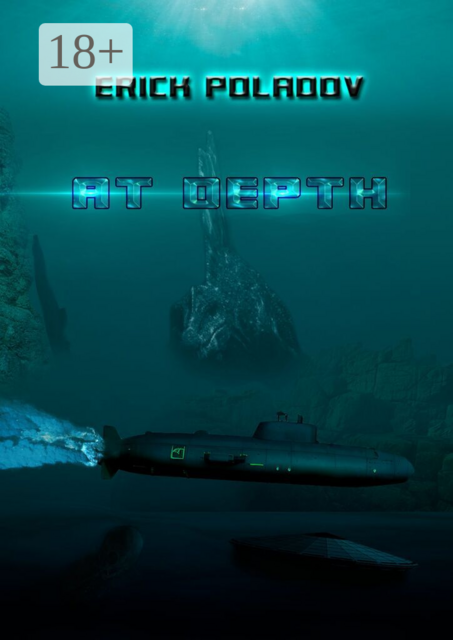



Erick Poladov
At depth
Шрифты предоставлены компанией «ПараТайп»
© Erick Poladov, 2025
The world’s oceans hold countless secrets, the most crucial of which lie buried at the deepest trenches. A scientific team descends into the crushing depths of the Atlantic to uncover these truths.
The mission, planned for two months, proves its worth within days. But it is abruptly terminated before it can truly begin. The ultimate goal is no longer to discover life, but simply to preserve their own.
An unknown entity dwells in the abyss, and it has no intention of welcoming uninvited guests.
ISBN 978-5-0062-7088-6
Создано в интеллектуальной издательской системе Ridero
Оглавление
PROLOGUE
It was a dimly lit room, concealed twenty-five meters beneath the surface. A one-and-a-half-meter layer of monolithic reinforced concrete sealed the bunker on all sides. A man in a gray suit, around forty, entered the room. He stopped before the main table but remained standing, immediately beginning to leaf through the folder he carried. Skipping any introduction, he began to speak in a low voice:
— Please take a seat. You have previously been fully briefed on the nature of the work ahead. Given this, I will not waste my time or yours, so I will get straight to the point. All research expeditions to the most restricted areas of our planet are typically initiated and financed by governmental agencies, and the results of such studies are stored in closed archives under a «classified» designation. This expedition, however, is organized by «Best Technologies.» It was personally initiated by the company’s President, Martin Hogan. Therefore, we must clarify a few points immediately. All finds and discoveries made during this expedition are the exclusive property of the company. The expedition is strictly confidential. Under no circumstances must it be disclosed to any third parties. Furthermore, none of you has the right to publicize your discoveries or disclose any data, directly or indirectly, related to the expedition. Only the company is authorized to publish information about specific discoveries and findings, and in doing so, will credit the individuals responsible. We determined your route in advance, based on data concerning map coordinates where strange and little-studied events have taken place. Should any valuable finds be discovered during the expedition, minor deviations from the course are permitted, followed by a return to the original trajectory. From the start to the completion of the entire expedition, you will be subordinate to the ship’s captain. All personnel must act in accordance with his instructions. Any of his orders must be executed without discussion. This is essential both for the successful completion of the mission and for ensuring the safety of all crew members. Questions?
Only silence followed.
— Very well, that concludes the briefing. A helicopter is waiting upstairs to take you to Heathrow, from where you will proceed to your destination. You will receive further instructions upon arrival on the island directly from the submarine commander. — Closing the folder, the man in the suit added: — I wish you all a successful expedition.
1. LUTHER DE BONT
He descended the gangway onto the pier, awaiting the passengers’ arrival. A few hours ago, his jacket’s breast pocket had held a packet containing the last two sticks of chewing gum. Quitting cigarettes had been tough, but now, after two months of abstinence, the old craving surfaced less often, and the urge to light up felt weaker. He knew that if he could hold out just a little longer, the nicotine addiction would finally burn itself out. Not even a career in the Navy had managed to break his reliance on the poison. Yet now, just as he was starting to overcome the damaging habit, the absence of gum in his pocket meant thoughts of a cigarette were monopolizing his mind with increasing intensity.
A man dressed to the nines appeared on the pier. He was a tall, dark-skinned man with a short haircut. His eyes were shielded by narrow sunglasses with thin, neat frames. He wore an expensive beige suit, his jacket casually draped over his shoulder, held by a hook of his index and middle fingers.
The stranger strode effortlessly along the pier until he was close, then spoke:
— Good morning.
— Morning.
— Mr. De Bont, I presume? — the stranger asked.
— Yes — the Captain replied with a note of suspicion.
The man in the suit extended his hand and introduced himself:
— My name is Stephen Frost. Pleased to meet you. Do you have five minutes?
Captain De Bont checked his watch and said:
— Judging by the fact that the concept of «punctuality» is alien to some people, I suppose I do have some time.
With that, the Captain gestured with his hand, suggesting they continue their conversation while walking along the rest of the pier.
— In that case, I will try to be as brief as possible.
— By the way, do you happen to have any gum on you? — the Captain cut in.
— Just lozenges.
— That’ll do.
Stephen Frost placed five lozenges in rustling wrappers on the Captain’s palm and resumed his thought:
— I represent «Best Technologies».
— Yes, I’ve heard of your firm. You specialize in technical development.
— That’s correct — Frost replied with a slight smile. — Though it’s less about DEVELOPMENT and more about our accumulated RESEARCH. We typically conduct studies, and their results are then used by manufacturers of consumer goods, transportation, and various equipment.
— But you’ve also had a hand in the Ministry of Defense’s technology, haven’t you?
— Yes. The software and internal electronics are our doing. But in recent years, we’ve shifted toward manufacturing. Innovative technology, it turns out, is always in demand, and not even exorbitant prices can halt the overwhelming craze — Frost replied, letting out his snow-white smile once more. He lightly scratched his nose with his index finger, paused, and then continued: — Mr. De Bont, when was the last time you commanded a submarine crew?
— Last year, I had a fixed-term contract with the Ministry of Defense for seven months.
— Where were your postings?
— The Bay of Bengal. The Mediterranean Sea. Antarctica. A bit near the Panama Canal.
— And why did they choose not to renew your contract?
— The commander I was filling in for recovered from his chemotherapy and returned to duty.
— So, is the British Fleet so flawless that it has no need for such an experienced captain with a spotless reputation?
— They simply had no vacancies for a Captain’s post. They offered me the position of Chief Mate, but do I look like a man who would be grateful for a demotion?
Frost shook his head slightly and said:
— Yes, that is an insult.
— But they still didn’t want to let me go and offered me command of a surface vessel. They were just about to commission a new aircraft carrier and wanted to entrust it to a seasoned, yet not elderly, captain so that one person would be permanently assigned to the ship, eliminating the constant need for a change of command. They considered a forty-nine-year-old veteran with submariner experience perfectly suited to run things on that ship.
— So you have experience with surface vessels as well?
— That’s where I started. I only transferred to a submarine as Chief Engineer at thirty-one.
— And you turned them down?
Captain De Bont took a deep breath and said:
— I prefer to be submerged. It’s hard to grasp. And even harder to explain. Consequently, I now find myself skippering some plutocrat’s yacht.
Stephen Frost wiped the sweat between his nose and upper lip, then adopted a slightly different tone:
— Well, I won’t beat around the bush or hold you up unnecessarily. Let’s get down to business. Our company wants to offer you a job. It involves commanding a submarine designed for civilian purposes.
— Someone built a submarine for civilian use?
— Yes, I agree, that sounds slightly odd at first glance.
— And what is its nature?
— Unfortunately, I am not authorized to disclose such information. I can give you only a few parameters. Length: thirty-five meters, displacement: two thousand tons, and… essentially, that’s it.
— Where is the intended voyage?
— That detail is still being finalized. At the moment, all that is known is that it will be in the Atlantic.
— Timeframe? — Luther De Bont asked, his voice tinged with skepticism.
— The launch is planned for approximately eight to twelve months from now.
— So the vessel is already in the assembly phase.
— At present, we are at seventy percent completion. As you might gather, given the nature of our company’s operations, this submarine is significantly more advanced than those currently commissioned by any military superpower. But I repeat, the vessel is intended for civilian — specifically, scientific — purposes.
Captain De Bont gazed thoughtfully out at the harbor and asked:
— What is the planned duration of the voyage?
— Between sixty and eighty days. But if the voyage proves successful and the vessel handles well, we would be ready to offer you a permanent working arrangement. I am not pressuring you for a decision. You have more than enough time. And, of course, I understand perfectly well that you will want to see the submarine for yourself before giving an answer.
— My apologies, but that is non-negotiable.
— None taken. This is perfectly understandable. Therefore, our company proposes that you conduct the practical sea trials of the vessel when it is launched. For an agreed-upon fee, naturally.
The Captain ran his fingers across his chin and asked:
— Why did you approach me specifically? Or is there a queue, and I am far from the first on it?
Frost carefully removed his glasses, smiled again, and replied:
— No, Mr. De Bont. There is no queue. If one appears at all, it will be because of you. Since we frequently fulfill government contracts for the Ministry of Defense, our representatives have well-established contacts within the ministry. We requested information on officers who have commanded submarines but are currently unattached to His Majesty’s military service due to circumstances beyond their control. In addition to you, we received recommendations for nine other captains. However, all of them are either near retirement age or lack impressive achievements and valuable skills in their service records. Your service file indicates that you have masterfully perfected the art of underwater maneuvering, that you enjoyed considerable authority among the ranks, and that ninety-eight percent of all ordnance fired throughout your career reached its target. Moreover, any crew placed under your command showed immediate, dramatic improvements in efficiency and organization. As for your psychological testing, you also stood out. You were described as an organized and pragmatic commander, devoid of impulsive tendencies, cool-headed, and able to judiciously prioritize in an emergency. Sustained emotional stability during extended deployments was also noted. But what I liked most was what was listed in the ’flaws’ column: «A severe smoking habit.»
Frost delivered his final words with a chuckle.
— My superiors practically waged war with me over it. I constantly heard that a man capable of organizing an entire crew is incapable of organizing himself.
— Come on. Our company is not the military. Here, you can smoke to your heart’s content.
Captain De Bont, at the mention of cigarettes, more intently manipulated the lozenge in his mouth with his tongue.
F Frost stopped, reaching into his jacket’s inside pocket, and said:
— I’ll leave you my number. Once you decide on the sea trials…
— You have a deal — the Captain cut in. He instantly wanted to blow and pop a bubble, but realized his mouth held a lozenge, not gum.
Frost extended his hand.
— Glad to hear that. — I’ll still leave the number with you, just in case any questions arise. I’ll be available to you twenty-four hours a day.
— Oh, really. That’s rare, even for a customer service hotline.
Frost’s snow-white smile, which shone brightly against his dark complexion, broke out once more. Suddenly he recalled:
— Oh yes, one more thing. Mr. De Bont, do you happen to have a capable Chief Mate in mind?
— Of course. He and I have served together for eleven years — we report aboard together, and we depart together.
— And we can count on him?
— Absolutely.
— Excellent.
After a brief pause, Luther said, an element of doubt in his voice:
— Mr… Frost?
— Yes.
— I haven’t seen the submarine yet, of course, but with parameters like that, two people hardly seem enough to run it.
— You are correct. There will also be an engineer. But don’t concern yourself with that. We will be supplying the engineer.
— And am I correct in assuming this conversation never took place?
— Now I have no doubt I am speaking to a military man. You understand everything correctly. Any further questions?
Captain De Bont shook his head.
Frost shook his hand one last time and unhurriedly walked away. On the way back, he took his phone from his pocket, dialed a number, and raised it to his ear.
Meanwhile, Captain De Bont gazed once more at his employer’s yacht. Suddenly, it repulsed him more than usual. At the mere thought that he would once again have to man the helm of a toy-sized surface vessel today, Luther felt even less inclined to return to the ship. But moments later, he broke into a smile. This might have surprised even Luther himself, but there was nothing strange about it. He simply realized he wouldn’t have long left to skipper this tub. Soon, he would leave it behind.
A few seconds later, Luther de Bont spotted the figure of the yacht’s owner and a provocatively dressed woman, whom the owner was affectionately holding by the fillet, appearing on the pier.
2. HECTOR CAGE
— Doctor Cage! Doctor Cage! — a student called, jogging to catch up with the professor in the corridor after the bell.
— Whoa, whoa. Slow down, Margaret. You’re going to drop everything.
— Sorry, I just wanted to ask you something.
— I’m not running a hundred-meter dash here. There’s no need to rush — the forty-two-year-old professor continued in a mild tone.
Margaret just smiled in response.
— Go on, ask.
— Dr. Cage, I wanted to talk to you about the paper on cetaceans due next week.
— Are you running into some difficulties? — the professor asked, puzzled, as he continued his unhurried walk down the corridor, carrying a leather briefcase.
— Well… I couldn’t really find enough solid data on the Dorudon. Even online, the information mostly boils down to merely mentioning their existence during the Eocene epoch, and the library only has a few encyclopedias that simply define their biological and species classification.
— And why did you choose the Dorudon in the first place?
— I just wanted to write about some kind of monster. You know, a big predator with an unusual look. I liked it in that film you screened.
— I can give you some of my monographs. But they won’t be enough to draw any objective conclusions. My advice is to choose someone else. Say, the Kutchicetus or the Protocetus. They are also Eocene species, but there is slightly more information available about them, and their anatomy is much more interesting.
— In that case, is it alright if I change my topic?
— By all means.
— Thank you.
— Anytime.
— Goodbye, Dr. Cage.
Hector Cage collapsed into the seat of his Ford, exhaling in relief that the work week was finally over. Teaching at the new university had been a struggle. It was his second year, and he still hadn’t managed to secure a spot on a single research expedition to study new and rare fish species. He had a sinking feeling it wouldn’t happen anytime soon. At his previous workplace, he had been a regular on expeditions to Australia, Thailand, Japan, and Malaysia. Now, his entire job was reduced to endless lectures and listening to the droning, self-congratulatory rubbish from students who couldn’t tell the difference between contemporary fish, let alone the prehistoric creatures that inhabited the Earth during the age of dinosaurs.
To avoid burnout from grinding through the same materials twenty times a week, Hector had been forced to see a private psychoanalyst for a sedative prescription. Otherwise, the incident that had gotten him fired from his last university might repeat itself.
It was already dark outside. The city streets were shrouded in a natural gloom, broken only by the glow of streetlights and car headlights.
Once inside his rented apartment, Hector put water on to boil for a cup of strong tea. With the kettle on, he approached his laptop, tapped the keyboard a few times, and a couple of seconds later, the sounds of «Mamy Blue» filled the room from the stereo system. While waiting for the kettle, Hector Cage leaned back on the sofa, listening to Julio Iglesias’s voice and feeling all the accumulated stress gradually dissipate. This continued until the urge to sleep took over and Hector’s consciousness shut down, plunging him into a deep slumber.
Only in the morning did Hector peel his face from the sofa upholstery, six minutes after realizing exactly where his body was. He managed to get to his feet only after his joints had at least partially woken up, which took a good hour and a half.
Turning off the music, he decided to boil water to make the tea that had never materialized the night before. But at the last minute, the scientist opted for coffee instead.
Hector looked into the mirror and wondered who was staring back. He looked as though he had been subjected to relentless torture, deprived of sleep throughout the entire work week. Bags were already prominent under his eyes, and his hair, rumpled from sleeping without a pillow, only accentuated his «vegetable» state.
The clock was showing twenty minutes to nine when the doorbell rang.
Standing on the threshold was a tall, dark-skinned man in a respectable suit.
— Good morning. Dr. Hector Cage?
— Yes. Hello. Yes. That’s me — Hector replied, stumbling over his words.
— My name is Stephen Frost — the man at the door stated, extending his hand. — Pleased to meet you. I represent «Best Technologies.» Might I take up a few minutes of your time?
With a wave of his hand, the scientist invited the guest into his modest apartment.
— Excuse the mess. I simply don’t have the time with work.
— Please, don’t worry about it. If you saw my place, you’d think yours was sparkling.
— Tea? Coffee?
— Whichever you prefer.
While Hector poured the invigorating instant coffee, Stephen Frost intently surveyed the bookcase, most of its volumes dedicated to river and oceanic fauna. Among them were reference works on the inhabitants of the world’s oceans, organized by geochronological time periods, from the Triassic to the Calymmian. The spine titles clearly indicated the scientist’s particular interest in cetaceans.
Hector set two cups of coffee on the coffee table, invited Frost to take the sofa, and settled himself in the armchair opposite.
— So… — Hector prompted, signaling Frost to get to the point.
— Your library is impressive.
The scientist glanced indifferently at his book collection for the thousandth time and said:
— I’ve spent my entire life on this.
— Do you get to study rare fish species from time to time?
— Well, I used to. That’s what I genuinely loved about the work. Observing species live that few others had ever seen. And, of course, researching them…
— Have you written any textbooks in your field?
— Textbooks? No. A mountain of monographs, but not a single book. It was planned, but the change of jobs got in the way. So, what did you want to discuss?
Stephen Frost leaned slightly toward Cage and began his pitch:
— Mr. Cage, our company is planning an expedition into the waters of the Atlantic Ocean. For this to happen, we require a highly qualified expert in marine fauna…
These words caused a noticeable rush of blood to Hector’s brain. It was like a shot of adrenaline to the heart, which was ready to start beating much harder. Hector seemed to be fully awake at last. It was as if a bomb had exploded near his ear, leaving him momentarily deaf, having lost the ability to hear any sound at all. Instead of sounds, a ringing sensation roared in his ears, and Frost’s lips continued to move silently for a moment.
— …never had to before.
— And what is the goal of the expedition?
— A complex of scientific research combining biology, ichthyology, and paleontology.
After a brief moment of reflection, Hector tried to speak, but Frost cut him off:
— Are you concerned about compensation?
— No, no. What is the planned duration of the work?
— Two months. Maybe slightly longer.
— When do you plan to commence?
— Likely within the next few months. The timeline could range from three to seven months. The current focus is on assembling the team. Right now, we are looking for the ichthyologist.
Dr. Cage stood in absolute silence, his gaze lost somewhere off to the side.
— In any case, we don’t require an immediate answer. You have time to consider the offer.
Hector glanced around his apartment: the scattered books, the countless course and lecture materials he had to grind through a hundred times daily. He pondered what his life had become. Its colors remained as bleak as his rented apartment.
But suddenly, Hector snapped back and decided he should at least feign a degree of doubt.
— May I ask one question?
— Of course. Go ahead — Frost replied, taking a sip from his cup.
— Since you brought up compensation, could you provide some clarity?
— Oh, certainly. For two months of work, you will be paid, let’s just say, enough for you to afford to quit teaching and not think about it for a very, very long time. To be more precise, it will be…
Frost took a notepad and pen from his jacket’s inner pocket, quickly wrote down a figure, and slid the notepad across the table toward his interlocutor.
— But you should understand, Mr. Cage, that this is the sum you will receive regardless of the work’s outcome. — Frost simultaneously began to drink his coffee in large gulps. — We fully recognize that this is largely a matter of luck, and the number of specimens or species discovered is not your direct responsibility. Therefore, the contract will stipulate a fixed salary. The amount you see will be paid irrespective of the expedition’s results. And should any discoveries be made-new species found, then… well, you understand.
Hector Cage actively rubbed his nose, while Frost added:
— I’ll leave you my business card. Take your time. Think everything through properly.
— Forgive me, — Hector interrupted, — Mr…
— Stephen. Just Stephen.
— If this offer had come a couple of years ago, I would have thought a thousand times. But under the current circumstances, this vacancy presents too strong a contrast to my current job to warrant any second thoughts. I accept.
— Glad to hear that. Oh, one more thing I forgot to mention. If rare biological specimens are captured, you will be offered a long-term position. You would either study or oversee the scientific work on those specimens placed at our disposal. And one final detail. How do you feel about extreme depths?
— Excuse me? — Hector Cage asked, bewildered, his brow furrowed.
— The expedition our company is planning will take place near the ocean floor, at a depth of around seven and a half to eight thousand meters.
— And you have the suitable equipment for that?
— In fact, we manufactured that apparatus. It has no analogues. At least, not yet.
Cage grew even more thoughtful, and by this point, Frost had already finished his coffee.
Slowly, a look of focused anticipation began to appear on Hector’s face. After a moment, he said:
— Where do I sign?
Hearing these words, Frost broke into a wide smile. But as soon as the smile faded, he immediately adopted a serious tone:
— Mr. Cage, I have one request for you. More accurately, a condition.
— I’m listening.
— No one must know about my visit, nor about this conversation. Is that possible?
— I see no problem.
— I like that. And finally, so you don’t get bored, I’ll leave you a small gift. Perhaps you can formulate a few new theories.
Frost placed a piece of paper with an image on the coffee table and added:
— Take a look sometime. Thank you for the coffee. It was genuinely delicious, and I didn’t say that out of politeness.
They shook hands, and Hector escorted his guest to the door.
Just before reaching the threshold, Frost turned around and asked:
— Mr. Cage, may I ask one final question?
Hector spread his hands in assent.
— With such a successful career, why were you dismissed from your previous university?
Hector felt a surge of energy. No bad memory could possibly spoil his suddenly elevated enthusiasm now. He straightened his back, shoved his hands into his pockets, and replied in a matter-of-fact tone:
— I knocked out eight teeth from a graduate student who was diving into my wife.
— I respect that — Frost tossed out before leaving.
3. KAYLA FOX
In the crowded, darkened lecture hall, the voice of thirty-five-year-old Kayla Fox, Doctor of Biological Sciences, resonated. She was commenting on the images projected onto the screen:
— Before you is a sample of a human zygote — the result of the fusion of two gametes from opposite sexes. In simpler terms, this is what happens when you forget about contraception.
A synchronized burst of laughter filled the hall.
— In this image, we can observe how the tail of one of the two gametes — the sperm — has already been reabsorbed into the egg cell’s cytoplasm. The nuclei of both gametes begin the fusion process, which, once complete, restores the diploid set of chromosomes. Thus, the genetic material for the future organism is formed within the cell, half of which comes from the egg cell and the other half from the sperm. This is how a diploid cell, possessing a complete set of chromosomes — the carriers of hereditary information — is formed from two haploid cells. What questions do you have regarding this section?
— Miss Fox? — a student’s voice rang out.
— Yes?
— What would happen if multiple sperm penetrated a single egg? How would the nuclei react?
— That’s an excellent question. The truth is, for a sperm to penetrate the egg, simply reaching it isn’t enough. The egg is enveloped by a protective layer that must dissolve before the sperm can enter. And here’s the interesting part. For that layer to dissolve, the egg needs to be surrounded by no fewer than three hundred million sperm, as only in that quantity can they release sufficient amounts of the enzymes hyaluronidase and protease to break down the egg’s coat. Once a sperm does get inside, the layer rapidly hardens and thickens, which prevents any other sperm from penetrating.
From the back row, a female student’s voice was heard:
— Now that’s love. The one and only for life.
Laughter erupted in the room, and the professor couldn’t help but join in.
— Love? What nonsense! — objected a student from the row in front. — She let him into her bungalow and then bolted the door. That, my dear, is called a dictatorial matriarchy.
The laughter intensified, subsiding only when the bell finally rang.
- Басты
- ⭐️Триллеры
- Erick Poladov
- At depth
- 📖Тегін фрагмент