


автордың кітабын онлайн тегін оқу Merkland; or, Self Sacrifice
Every attempt has been made to replicate the original as printed. Some typographical errors have been corrected;
a list follows the text. Archaic spellings (i.e. rebelious, rebelion, contemn, gallopping, tryste, knawing, bideing...) have been preserved.
CHAPTER I., II., III., IV., V., VI., VII., VIII., IX., X., XI., XII., XIII., XIV., XV., XVI., XVII., XVIII., XIX., XX., XXI., XXII., XXIII., XXIV., XXV., XXVI., XXVII., XXVIII., XXIX., XXX., XXXI.(etext transcriber’s note)

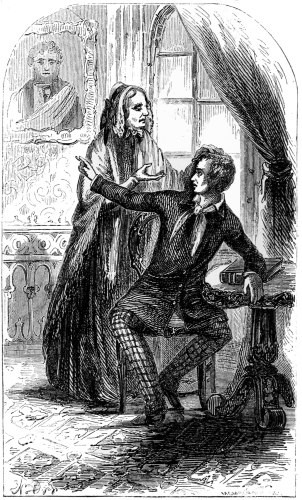
The Prodigal’s Solemn Pledge in Mrs. Catherine’s little room. See page 92

BY THE AUTHOR OF
“MARGARET MAITLAND.”
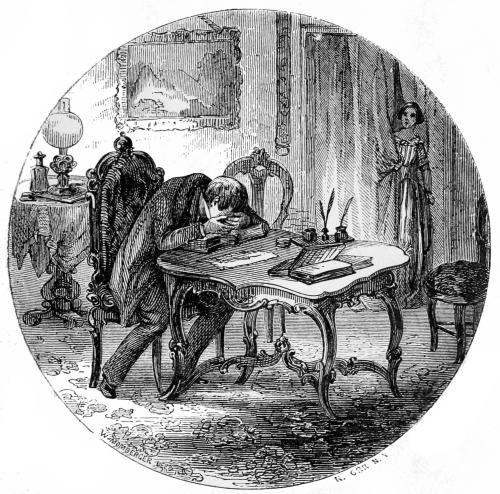
“Lord, look upon mine offering—I bring thee back seven-fold. Lord
of Mercy! cast me not away for evermore!—See page 292.

STRINGER & TOWNSEND, NEW YORK.
M E R K L A N D,
OR,
SELF SACRIFICE.
BY
THE AUTHOR OF
“PASSAGES IN THE LIFE OF MRS. MARGARET MAITLAND,” &C.
NEW YORK:
STRINGER & TOWNSEND.
1854.
MERKLAND;
OR,
S E L F - S A C R I F I C E.
CHAPTER I.
“BUT may not Mrs. Catherine’s visitor belong to another family? The name is not uncommon.”
“You will permit me to correct you, Miss Ross. The name is by no means a common one; and there was some very distant connexion, I remember, between the Aytouns and Mrs. Catherine. I have little doubt that this girl is his daughter.”
“Mother! mother!” exclaimed the first speaker, a young lady, whose face, naturally grave and composed, bore tokens of unusual agitation. “It is impossible; Mrs. Catherine, considerate and kind as she always is, could never be so cruel.”
“I am quite at a loss for your meaning, Anne.”
“To bring her here—to our neighborhood,” said Anne Ross, averting her eyes, and disregarding her step-mother’s interruption, “where we must meet her continually, where our name, which must be odious to her, will be ringing in her ears every day. I cannot believe it. Mrs. Catherine could not do anything so barbarous.”
Mrs. Ross, of Merkland, threw down her work, and pushed back her chair from the table:
“Upon my word, Anne Ross, you turn more absurd every day. What is the meaning of this?—our name odious! I should not like Lewis to hear you say so.”
“But Lewis does not know this terrible story,” said Anne.
“And never shall,” replied Mrs. Ross. “Neither can your brother’s crime make my son’s name odious to any one. I fancied you knew that Norman was called by your mother’s name; and this Aytoun girl, if she knows anything of it at all, will have heard of him as Rutherford, and not as Ross.”
“But Mrs. Catherine—she at least cannot be ignorant, cannot have forgotten: who could forget this? and my mother was her friend!”
“The friendship has descended, I think,” said Mrs. Ross, with a sneer, “as you seem to imagine feuds should. I suppose you think this girl’s brother, if she has one, would be quite doing his duty if he demanded satisfaction from Lewis, for a thing which happened when the poor boy was a mere infant? But be not afraid, most tender and scrupulous sister. People have better sense in these days.”
Anne Ross turned away, grieved and silenced; her conversations with her step-mother too often terminated so: and there was a long pause. At last she said, timidly, as if desirous, and yet afraid of asking further: “And my father never knew how he died?”
Mrs. Ross glanced hurriedly at the door: “He did not die.”
Anne started violently. “Norman, my brother? I beseech you to tell me, mother, is he not dead?”
“Ah, there is Duncan back, from Portoran,” said Mrs. Ross, rising. “Letters from Lewis, no doubt. How slow they are!” And she rang the bell vehemently.
The summons brought in a maid, struggling with the buckle of Duncan’s letter-bag, which was opened at length, and gave to Mrs. Ross’s delighted eyes the expected letters from her only son: but Anne sat apart, shivering and trembling with a great dread—a secret, most sad and terrible; a tale of dishonor, and crime, and misery, such as might chill the very heart to hear.
“And there’s a letter from the Tower, Miss Anne,” said the maid, giving her a note. “Duncan got it at the Brig, from Johnnie Halflin, and Johnnie was to wait, till Duncan got back with the answer, if there was to be any.”
“There is no answer, May,” said Anne, glancing over the brief epistle; and May withdrew reluctantly, having obtained no news of Maister Lewis, or his wanderings, wherewith to satisfy her expectant audience in the kitchen.
The letter of Lewis was a long one, and Anne had time to travel listlessly again and again over the angular and decided characters of her ancient friend.
“My friend,” said the singularly-folded black letter-looking note, “you will come to the Tower to-morrow. I am expecting Alison Aytoun at night; and seeing the world has gotten two new generations (to keep within the truth) since I myself was done with the company of children, I am in need of your counsel how we are to brighten the bed-chamber and other apartments, so as will become the presence of youth. For undoubtedly in this matter, if I am like any mortal person, it is like Issachar in the prophecy (not to be profane,) for there is Elspat Henderson, my own woman, that would have out the old red satin curtains (that are liker black than red now, as you will mind,) to put upon the bed, and Euphan Morison, her daughter, is for no curtains at all, for the sake of health, (pity me, Anne, that have doctors among my serving-women!) and Jacky, Euphan’s daughter (bethanked that she has but one!) has been gathering dahlias and sunflowers, and such other unwholesome and unyouthful things, to put in the poor bairn Alison’s room, wherewith I have near brought a fever upon myself, first with the evil odor of them, and then with flying upon the elf Jacky. So mind you come to the Tower, like a good bairn, as you are, and have always been, as early in the day as you can; and before twelve of the clock, if possible, seeing that I have many things to say to you.
“Catherine Douglas.”
For the third or fourth time, Anne’s eyes had travelled down to that firm and clear signature, when an exclamation from her step-mother roused her. “Lewis will be home before his birthday! Lewis will be here on Friday! I believe you are more concerned about that girl coming to the Tower. Do you hear me, Anne? On Friday your brother will be home.”
There were only two days to prepare for his coming; and before Anne had finished her hasty perusal of the letter which Mrs. Ross permitted her to see, the house was full of joyful bustle and unwonted glee—for the frigid soul of its mistress melted under the influence of her son, as if his words had been very sunbeams. By nature she was neither amiable nor generous; but the mother’s love, in its first out-gushing, almost made her both.
And she had known the details of that dark mystery too long, and had too little liking for her husband’s unhappy son, to sympathize at all with Anne’s horror and agony. And so Mrs. Ross, of Merkland, bustled and rejoiced in her selfish gladness, while Anne, longing to ask, and yet afraid of rude repulse or angry reprimand, sat silently, with a heavy heart, beside her. At length, when they were about to separate for the night, Anne took courage.
“Mother,” she said, “I do not wish to disturb you, in so happy an occupation as this, but only one word—Norman, poor Norman, you said he did not die.”
“Upon my word, Anne, I think you might choose a better time for those disagreeable inquiries,” said Mrs. Ross, impatiently.
“He is my brother,” said Anne, “and with such a dreadful history. Mother, is Norman alive?”
“How can I tell?” cried Mrs. Ross. “You ought to desire most earnestly, Anne, both for his sake and your own, that he may be peacefully dead. Your father, I know, received a letter from him, secretly, after the ship was lost. He had escaped the wreck; but that is seventeen years ago.”
“And did he confess?” said Anne, eagerly.
“Confess! Criminals do not generally do that. No, no, he professed his innocence. I may find you the letter sometime. There, will not that do? Go to your room now.”
“And will you not tell Lewis?” said Anne.
“Tell Lewis!” exclaimed Mrs. Ross, “why should I grieve my boy? He is but his half-brother.”
Anne turned away without another word and went quietly up stairs—not to her own apartment first, but to a dusty attic lumber-room, seldom entered, except by herself. In one dark corner stood a picture, its face to the wall. Anne placed her candle on the floor, and kneeling down turned the portrait—a frank, bold, generous face, half boy, half man, with its unshadowed brow and clear eyes, that feared no evil.
“Lewis is but my half-brother also,” said Anne Ross, replacing the picture with a sigh; “but Norman was my mother’s son.”
The house and small estate of Merkland were situated in one of the northern counties of Scotland, within some three or four miles of a little post-town which bore the dignified name of Portoran. The Oran water swept by the side of its small port, just before it joined its jocund dark-brown waters to the sea, and various coasting vessels carried its name and its traffic out (a little way) into the world. The parish in which Merkland stood, boasted at least its three Lairds’ houses—there was Strathoran, the lordliest of all, with its wide acres extending over three or four adjacent parishes. There was the Tower, with its compact and richly-cultivated lands, the well-ordered property of Mrs. Catherine Douglas; and, lastly, there was Merkland—the home of a race of vigorous Rosses, renowned in former generations for its hosts of sons and daughters, and connected by the spreading of those strong and healthful off-shoots, with half of the families of like degree in Scotland. The children of the last Ross of Merkland had not been vigorous—one by one, in childhood, and in youth, they had dropped into the family grave, and when the infant Anne was born, her worn-out mother died, leaving besides the newborn child, only one son. His mother’s brother long before had made this Norman, his heir. At the same time, in consideration of his independent inheritance, and his changed name, he had been excluded from the succession to his father’s lands. So Mr. Ross of Merkland, in terror lest his estate should have no worthier proprietor than the sickly little girl whose birth had cost her mother’s life, married hastily again. When Lewis and Anne were still only infants, Norman Rutherford left his father’s house to take possession of his own—and then some terrible blight had fallen upon him, spoken of in fearful whispers at the time, but almost wholly forgotten now. A stranger in the district at the time our history begins would only have learned, after much inquiry, that Norman, escaping from his native country with the stain of blood upon his hands, proved a second Jonah to the ship in which he had embarked, and so was lost, and that grief for his crime had brought his father’s grey hairs in sorrow to the grave. But the difference of name, and the entire silence maintained by his family concerning him, had puzzled country gossips, and restrained the voice of rumor, even at the time. Now his remembrance had almost entirely passed away, and in another week Lewis Ross, Esq., of Merkland, would be of age.
But the whole dreadful tale in all the darkness of its misery had been poured into Anne’s ears that day. She had known nothing of it before. Now, her stepmother thought, it was full time she should know, because—a reason that made Anne shrink and tremble—Mrs. Ross felt convinced that the girl who was so soon to be a visitor at the Tower, could be no other than the daughter of the murdered man.
“The south room, May—he had it when he was a boy,” said Mrs. Ross, as Anne entered their breakfast-room the next morning. “I wish there had been time to get some of the furniture renewed; but I dare say Lewis will like to see it as he left it. Do you not think so, Anne?”
“He was always such a kindly heart,” interposed May.
Mrs. Ross looked dubious.
“You must remember, May, that my son is no longer a boy. This day week he will take the management of his affairs into his own hands. He left us a youth, but he returns a man.”
“And I was just thinking that myself, ma’am,” said May; “and Duncan says it behoves us to call the young Lord by his own name, Merkland,—and not Mr. Lewis; but I always think the old way’s the kindliest.”
“Lewis will be changed, if he does not like the kindliest best,” said Anne.
“Ah, that may be,” said Mrs. Ross; “but there is something due to—Well, where were we. Ay, the south room. I know you keep it in good order, May, but we must have it on Friday shining like—”
“Like a new pin, ma’am,” said May, as Mrs. Ross paused for a simile; “and so it shall, and you may trust that to me.”
“Yes, Lewis will be quite a man,” said Mrs. Ross, leaning back in her chair with a smile. “I should think he would be a good deal browned, Anne—I have been thinking so all the morning.”
“Oh! and he’ll have a lordly presence,” said May, “like his father before him. The Rosses have always been grand men to look upon. They say the young Laird—”
“Was not in the least degree like what my son will be,” said Mrs. Ross, stiffly, while Anne grew pale. “You will see that my orders are strictly attended to, May, and let Duncan come to me whenever we have had breakfast. Take your place, Anne.”
Discomfited by her abrupt dismissal, May took her departure, muttering between her teeth:
“One would think it was a crime to speak a good word of the old lady’s bairns! Well, if one but knew what became of him at last, I would like to see the man in all Strathoran like the young Lord.”
“Anne,” said Mrs. Ross, somewhat sternly, as May withdrew, leaving Anne’s heart vibrating painfully with her indiscreet reference; “was it to-day that Mrs. Catherine expected her visitor?”
“Yes, mother.”
“And to-day you are engaged to go to the Tower?”
“Yes,” said Anne. “But I can send Duncan with an apology, if you wish it. I did not know that Lewis was likely to arrive so soon when I received Mrs. Catherine’s note.”
“Send Duncan! no, indeed!” said Mrs. Ross. “There would be little profit in wasting his time to save yours. Duncan is the most useful person about Merkland.”
“And I the most useless,” said Anne, sighing. “It grieves me deeply, mother, that it should be so.”
Mrs. Ross threw back her head slightly, expressing the peevish scorn which she did not speak, and Anne returned to her tea-making; and so they sat till their joyless meal was ended: each the sole companion and nearest connexion of the other, and yet so utterly separated in all that constitutes true fellowship.
The clear light of the October sun was shining on the waters of Oran, and its tinted, overshadowing leaves, when Anne emerged from among the trees that surrounded Merkland, and took her solitary way to the Tower. Her heart was heavy within her, her step irregular, her brow clouded. The great secret of the family had fallen upon her spirit with all the stunning force of a first grief, and vainly she looked about her for comfort, finding none.
How many times had May’s admiring mention of the “young Laird” called forth upon her lips a sad smile of affectionate sorrow for the dead brother whom she never saw. How often had she marvelled at the old nurse’s stern summary of his end: “He died a violent death!” How often lingered with sorrowful admiration over his picture in the attic lumber-room! And now his name had become a name of fear! The stain of blood was upon him! A Cain! a murderer!
Not dead! Anne’s hasty steps passed quick over the narrow pathway, with its carpeting of fallen leaves. In what pain—what misery, must that blighted life have passed! Whither might that guilty soul have wandered, seeking, in crowd or in solitude, to hide itself from its own fearful consciousness, and from its angry God! In privation, in danger, in want in sin, unfriended and accursed, and alone, with none to speak to him of mercy, of hope, of Divine forgiveness! And this was her brother! her mother’s son!
It was like some dreadful dream—but not like a dream could it be shaken off. How often in her childish imaginings, long ago, had she dreamed of the dead Norman living again, her friend and protector! Now how bitter and strong that unavailing wish, that God had indeed stricken him in his early youth, and laid him in the peaceful family grave unstained. Again and again those dark particulars rolled back upon her in bitter waves, swelling her grief and horror up to agony. And that the daughter of the slain man should come here—here, to have daily intercourse with the nearest kindred of her father’s murderer! The idea was so terrible, that it produced a revulsion. She tried to believe that it was not so—that it could not be possible.
Again and again she stopped, and would have turned back, and yet a strange fascination drew her on. There was a link of terrible connexion between herself and this girl, and Anne’s spirit throbbed to bursting with undefined and confused purposes. She could not trust herself alone, therefore she put force upon her struggling heart, as she had learned to do long years ago, and passed on to the Tower.
For the step-daughter of Mrs. Ross, of Merkland, had small reason to think of this many-sided world as a place of happiness. In a household which had barely means enough to support its station, and provide for the somewhat expensive wanderings of its heir, she was the one dependent, and Anne had ripened into some three-and-twenty years, and was no longer a girl. She felt how useless she was in the eyes of her clever step-mother; she felt the lethargic influence of having no aim, and deep down in that hidden heart of hers, which few others knew, or cared to know, sorrow and pain had been dwelling long, like Truth, in the well of their own solitary tears.
She was now proceeding to the house of her most dear and especial friend: an ancient lady, whose strong will swayed, and whose warm heart embraced all who came within their influence, and whose healthful and vigorous spirit was softened in a manner most rare and beautiful by those delicate perceptions and sympathies which form so important an element in the constitution of genius. Mrs. Catherine Douglas had seen the snows of sixty winters. For more than thirty of these, her strong and kindly hand had held absolute dominion at the Tower, yet of the few admitted to her friendship and confidence, Anne Ross, the neglected step-daughter of Mrs. Ross, of Merkland, an ill-used child, a slighted woman, held the highest place.
The Tower was a gray, old, stately place, defiant alike of storm and siege, with deep embrasures on its walls meant for no child’s play, and a court-yard that had rung to martial music centuries ago, in the days of the unhappy Stuarts. Deep woods stretched round it, tinted with autumn’s fantastic wealth of coloring. The Oran ran so close to the strong, heavy, battlemented wall, that in the old warlike days, it had been the castle-moat, but the drawbridge was gone, and there was peaceful access now, by a light bridge of oak. A boat lay on the stream, moored to an over-hanging rock, by which Mrs. Catherine herself was wont to make the brief passage of the Oran. It was a favorite toy of Anne’s also, in her happier moods, but she was too heavy of heart to heed it now.
“Mrs. Catherine is in the library, Miss Anne,” said Mrs. Euphan Morison, the portly, active housekeeper, whose medical propensities so frequently annoyed her mistress; and threading the dark passages familiarly, Anne passed on alone.
“Mrs. Catherine is in the library, Miss Anne,” repeated a dark, thin, elfin-like girl, who sat on the sill of a deep window, reading, and hiding her book beneath the stocking which she ought to have been knitting, as she threw furtive glances to the door of the housekeeper’s especial sanctum: “but there’s gentlemen with her. It’s a business day.”
“I suppose you may admit me, Jacky,” said Anne. “Mrs. Catherine expects me.”
“Mr. Walter Foreman’s in, Miss Anne,” said Jacky.
“And what then?” said Anne, smiling.
“And Mr. Ferguson, the factor from Strathoran,” said the girl, gravely, taking up, with a look of abstraction, some dropt loops in her neglected stocking.
“Then I will go to the drawing-room,” said Anne. “Tell me, Jacky, when Mrs. Catherine is disengaged.”
“And Miss Anne,” said Jacky, starting, as Anne was about to pass on, “the young lady’s coming.”
“So I have heard,” said Anne.
“And she’s to get the mid-chamber,” said Jacky, “and the chairs have come out of the big room in the west tower. You never saw them, Miss Anne. Will you come?” And Jacky jerked her thin, angular frame off her seat, and threw down book and stocking.
“What have you been reading, Jacky?” said Anne.
The sharp, dark face owned an involuntary flush, and the furtive eyes glanced back to the housekeeper’s closed door. “It was only the Faery Queen.”
“The Faery Queen! Jacky, these are strange studies for you.”
“There’s no harm in it,” muttered the girl, angrily.
“I did not say there was,” said Anne; “and you need not transfix me with those sharp eyes of yours, because I wondered. But, Jacky, your mother would not be pleased with this.”
“It’s not the chief end of woman to work stockings,” murmured the girl.
“No, surely,” said Anne; “nor yet to read poems. Come, Jacky, let me see the mid-chamber.”
Jacky seized the book, deposited it in a dark niche below the window, and glided away before Anne up the broad stone stairs, to the room which the united skill of the household had been decking for a bower to little Alice Aytoun. The mid-chamber, as its name imports, occupied the front of the building, between the two round towers, that rose grimly with their dark turrets on either side. It was a room of good proportions, with two deep windows, looking out on the windings of the Oran, and commanding a view of the little town, seated on the point where the river poured itself into the sea. The country looked rich and gay in its russet coloring, and here and there you could see the harvest labourers in a half-reaped field—for the harvests were late beneath the northern sky of Strathoran. A little way below, the unpretending house of Merkland stood, peacefully among its trees; on the left hand, the plain church and substantial Manse basked in the sunbeams; and the broad sea, flashing beneath the light, belted its blue breadths around the landscape. Anne stood at the window, and looked out, as in a dream; dim, misty, spectral visions floating before her, in which were ever mingling her unhappy wandering brother, and the unconscious girl who should look forth on that same scene to-night.
“It’s not so much here,” said Jacky, glancing round, and looking complacently on a great bunch of dahlias and hollyhocks, rudely inserted in an uncouth china vase. “The room’s just as it always is, except the flowers—will you come in here, Miss Anne?”
Anne followed, thinking little of the arrangements which she came to superintend. The room they entered was small and rounded, occupying as it did, a corner of the eastern tower. Its deep-set window was toward the sunrising—towards the hills, too, and the sea—and Anne paused upon the threshold, in wonder at the unwonted preparations made for this youthful visitor. In one end of the room stood a great wardrobe of richly-carved oak. There was an ancient piano, also, and little tables laden with well-chosen books, and the antique chairs looked richly sober in their renovation, heightening the air of olden romance which hung about this lady’s bower. The blooming plants in the window were the only things new, and pertaining to the immediate present. Graceful and pure in its antique delicacy, the small apartment was a bower indeed.
“But Mrs. Catherine,” said Jacky, “would let me put no flowers here—only a big branch of barberries that I slipped in myself.”
The branch of barberries was, indeed, projecting fantastically from the rich frame of the mirror on the wall.
“I think you may let Mrs. Catherine have the whole merit of this, Jacky,” said Anne, taking it down; “and do you have a ramble through the garden, and find something more fragrant than those sunflowers. You will get some roses yet—run, Jacky. Mrs. Catherine—”
“Is troubled with undutiful bairns,” said the lady herself entering the room. “Wherefore did you not come to me, Anne, and me in urgent need of counsel? And wherefore did you not open the door, you elf, Jacky, unless you be indeed a changeling, as I have always thought you, and were feared for learned words? Come down with me this moment, Anne! You can fiddle about these trifling things when there is no serious matters in hand. I am saying, Come with me!”
Mrs. Catherine Douglas was tall and stately, with a firm step, and a clear voice, strong constitutioned, and strong spirited. In appearance she embodied those complexional peculiarities which gave to the fabled founder of her house his far-famed name—black hair, streaked with silver, the characteristic pale complexion, and strongly-marked features, harmonising perfectly in the hue—she was dark-grey. It seemed her purpose, too, to increase the effect by her dress. At all times and seasons, Mrs. Catherine’s rich, rustling, silken garments were grey, of that peculiar dark-grey which is formed by throwing across the sable warp a slender waft of white. In winter, a shawl of the finest texture, but of the simple black and white shepherd’s check, completed her costume. In summer, its soft, fine folds hung over her chair. No rejoicing, and no sorrow, changed Mrs. Catherine’s characteristic dress. The lustrous silken garment, the fine woollen shawl, the cap of old and costly lace remained unchanged for years.
“It is a new vocation for me, child,” said Mrs. Catherine, as Anne followed her down stairs, “to set myself to the adorning of rooms; but when my serving-women must have their divers notions concerning them, I should put to my own hand, unless I had wanted the stranger to be terrified with the aspect of my house—which I do not, for—Look back, child, is that elf Jacky behind you with her sharp eyes. But I have matters more important on my hand to-day.”
They reached the library door as Mrs. Catherine spoke, and she entered, while Anne lingered behind. Another voice, the brisk one of Walter Foreman, the young Portoran writer, began to speak immediately, but was summarily interrupted by Mrs. Catherine’s clear tones:
“I tell you you’re a fool, Walter Foreman, as was your father before you—it’s in the blood. You say he was a kinsman. Ay, doubtless, as if I did not known that. And was not James Aytoun as near of kin to him as me, and Ralph Falconer nearer. To think of any mortal, in his senses, passing over the promising lads, to leave siller to me! Me, that have an abundance for my own turns, and none to be heir to either my land or my name. Speak not to me. Walter Foreman, I say the man was crazy!”
“But even if he were,” said Mr. Walter Foreman, as Anne entered the library, “you would surely never think, Mrs. Catherine, of contesting the validity of a will made in your own favor.”
“And who said I would not, if it seemed right in my own eyes?” said Mrs. Catherine, indignantly. “Come here, Anne; you are not blinded with the sight of siller, as this youth is. Robert Falconer, the merchant (the third son of old Falcon’s Craig,) is dead, and passing over his own near kin, that needed it (besides leaving the most part of his siller to hospitals, which may be was right, and may be not, I have not time to enter upon it,) the auld fool—that I should speak so of a man that is gone to his account—has left by his will a portion of siller, ten thousand pounds, no less, to me: me, that have no manner of use for it; that know not even what to do with it. I am thankful to you, Mr. Ferguson, you would learn me an easy way of putting it out of my hand; but I must consider, first, with your permission, whether I have any right to take it in.”
Mr. Ferguson, the Strathoran factor, smiled. “It is not often, Mrs. Catherine, that people receive legacies as you do.”
“No—neither, I am hoping, are there many left like this,” said Mrs. Catherine; “but truly, gentlemen, that is no fault of yours, that I should fall upon you for it. Come back to me this day week, Mr. Ferguson; and you can come also, Walter Foreman, unless your father, who has more discretion, has the time to spare; and in that space, I will have taken counsel what I should do.”
Mr. Ferguson and the young lawyer took their leave; and Mrs. Catherine turned to Anne: “Heard you ever the like of it, child? To leave siller to me! You did not know the man; but Ralph Falconer, of Falcon’s Craig, is his grand-nephew, and James Aytoun is also allied to him by the mother’s side: and I, that am but his cousin, three times removed, and having my own share of this world’s goods, and none to come after me—undoubtedly the man was crazy!”
CHAPTER II.
THE October sun rose brilliantly upon ancient Edinburgh, throwing the strong radiance of its russet gold upon the noble outline and antique grandeur of the historic city, and shone joyously into a family room, where a small household round their breakfast table were discussing the journey which that fair-haired, smiling girl, half-timorous, half-exultant, was to undertake that day. The white hair upon the mother’s placid forehead was belied by the fresh cheek and dewy liquid eye, from which time had not taken the brightness. Her son was entering upon the strongest years of manhood, with sense and intelligence shining in his face. Her daughter was a girl, just emerging from the child’s mirth and unrestrained gaiety, into those sensitive, imaginative years, which form the threshold of graver life—
“Standing with reluctant feet, Where the brook and river meet, Womanhood and childhood sweet.”
“But, mother,” exclaimed Alice Aytoun, suddenly, “Miss Douglas will see at once that Bessie has not been my maid at home.”
“Miss Douglas!” cried her mother. “Alice, did I not tell you that you were on no account to call her Miss. Remember always, Mrs. Catherine. And she knows very well that we are not able to keep a maid for you, and will understand that Bessie is for a companion on the way, and in some sense a protector. If you stay long, you can send her home.”
“And be alone in the strange place, mother,” said Alice, the sunshine fading, for a moment, from her face.
“How long will it be strange, Alice?” said her brother. “How many acquaintances will you make in a week?”
The sunshine flushed back again.
“And Mrs. Catherine—is she very eccentric, mother? I hope I shall like her.”
“I hope still more, Alice,” said Mrs. Aytoun, smiling, “that she may like you. Mrs. Catherine has many friends who could serve James; and then, you know, she has no heir. So be as fascinating as possible.”
“Mother!” exclaimed James, “this worldly wisdom sounds strangely from your lips. We do not send Alice away to pay court to Mrs. Catherine Douglas for her estate’s sake.”
“By no means,” said Mrs. Aytoun. “I have heard Mrs. Catherine spoken of often as a most kind, loveable person, in her own peculiar way; and I accepted her invitation to Alice gladly, not because she has an estate unheired, but because—for various reasons, indeed—but the other, by the way. You are a landless laird yourself, James, and I am not quite so stoical as to despise a good inheritance.”
“Do you know any of Mrs. Catherine’s neighbors, mother?” said Alice, whose attention, sadly distracted by anticipation, had altogether wandered during this discussion of motives. “The people I am likely to meet, do you know any of them?”
“No,” said Mrs. Aytoun, “I never was at the Tower; and my mother left the neighborhood young, and died so soon, too, that I have had very little connexion with her friends or native place. Indeed, it surprised me, that Mrs. Catherine should remember our relationship at all: but she is one of the most generous persons possible, I have heard often; and no doubt wishes to give you a glimpse, Alice, of the world you should enter on now.” And Mrs. Aytoun gave a very quiet sigh.
“Nonsense, mother!” said her son, energetically. “Alice stands in no need of generosity: and I should fancy a set of North Country lairds could be very little superior to the society we have here, landless though we be.”
“There are most gentlemanly and intellectual men in the North Country, James,” said Mrs. Aytoun, quietly shifting her premises.
“No doubt of it, mother; but not better than we have in Edinburgh.”
Mrs. Aytoun drew her hand over her daughter’s fair curls, and made no answer; confessing to herself, that a North Country laird would be, in her eyes, a more suitable partner for her Alice, than any rising W.S., or poor advocate of all James Aytoun’s friends.
Alice’s trunks were standing, corded and ready. Little Bessie, the daughter of a woman who had been Mrs. Aytoun’s nurse in better times, and who was her humble agent and assistant in all emergencies now, sat in the kitchen in all the glory of a new shawl and bonnet, a brevet ladies-maid; and it was nearly time to start. Mrs. Aytoun had yet to pack some small, forgotten tendernesses in a basket, with tremulous mother-anxiety, half-pleased, half-sorrowful, while James stood, watch in hand, warning her of the flight of those quick moments and of the possible starting of the coach before her cares were at an end.
At last, they left the house, established Alice in the cosiest corner, set little Bessie by her side, gave the guard all manner of instructions to attend to their comfort, and waited till the vehicle should start.
“Mind, Alice,” whispered Mrs. Aytoun, anxiously; “always to call her Mrs. Catherine,” and, in a moment more, Alice had lost sight of the compelled smile on her mother’s pale face, and had started on her first journey from home.
She was seventeen only, and her heart was bounding high within her. The October morning was so bright and invigorating, the beautiful world so new and so unknown. A transitory qualm passed over the unclouded, youthful spirit, as she thought it not right, perhaps, to rejoice at leaving home, but that passed speedily. A temporary anxiety as to the unknown Mrs. Catherine, whom she was hastening to see: but that disappeared also. The brilliant dreams that had been rising by day and night, since that momentous invitation came, floated together in indistinct brightness before her. The red October sunbeams, the bracing October breeze, the beautiful landscapes on that northern road—though these danced but indistinctly in her eyes, a part of the exhilaration of spirit, yet scarcely things rejoiced in for their own beauty—filled up her gladness to overflowing. The little heart at her side danced too, in its degree, as blithely, for after the young lady herself, in the great house to which they journeyed, was not the young lady’s maid next in dignity.
At one of the stages of the journey, a hypochondriac old gentleman, who had been the only other tenant of the coach, became faint, and declared himself unable to remain in the inside; whereupon, after some delay, an outside passenger was prevailed upon to exchange. A by no means unpleasant exchange, for the new comer was a young man of good looks, and frank, prepossessing manners, to whom the innocent, youthful face, with its blue eyes and fair curls might, or might not, have been an inducement to descend.
The beauty of the road became more articulate after that, as the polite stranger, apparently well-acquainted with the way, took care to point out to his young fellow-traveller its various points of interest, and imperceptibly, Alice scarce knew how, they glided into confidential conversation. For Strathoran, the stranger said, was his home and birth-place, whither he was returning after a long absence, and Mrs. Catherine Douglas was one of his oldest friends—he had known her all his life. So the hours went on, quick and pleasantly, and the long miles gradually dwindled down. Her new friend talked, Alice thought, as few could talk, and interspersed his comments on their present road so gracefully, with anecdotes of other roads, world-famed and wonderful, which she had read of often, but which he had seen.
He told her of her kinswoman, too, and of the Tower, and hinted how her own gentle presence would brighten the old walls and recall its youth again, till Alice, with all these magic influences about her, began to discover that this journey, instead of the weary means of reaching a wished-for destination, was in itself a young Elysium, unthought of, and delightful—the first homage rendered to the youthful woman, no longer a child: the first sign of her entrance into that fair world of more eventful life, whose air seemed now so golden with smiles and sunshine.
The dim lights of Portoran began to blink at last through the mists of the October night, and by and bye, the coach stopped at the door of the principal inn, in the main street. Already Alice could perceive various individual loungers without, touching their hats as they caught a glimpse of her companion, and while she herself began to wonder how she was to travel the remaining five or six miles to the Tower, the head of a tall and gaunt, elderly woman, dressed in stiff old-fashioned garments, looked in at the coach window.
“Is Miss Aytoun here?” said a harsh voice.
Alice answered timidly to her name.
“Quite safe; but very weary I am afraid,” said the gentleman, “Mistress Elspat, you have forgotten me, I see. How are they all at the Tower?”
“Bless me, Mr. Lewis, is’t you?” said the stately Mrs. Elspat Henderson, own woman to Mrs. Catherine Douglas, of the Tower. “Who would have thought of meeting you here? They’re a’ well, Sir. I left Miss Anne there even now; but the carriage is waiting for the young lady. The carriage is waiting, Miss Aytoun.”
And, beginning to tremble, with a revulsion of all her simple apprehensions and timidity, Alice Aytoun was transferred to Mrs. Catherine’s comfortable carriage, and leaving Lewis Ross at the inn door, looking after her, rolled away through the darkness to the Tower.
It was not a pleasant change; to leave the cheerful voice and vivacious conversation of Lewis, for those formal questions as to her journey, and the terrified stillness of little Bessie, as she sat tremulously by Mrs. Elspat’s side. Alice had scarcely ever seen before the dense darkness of starless nights in so wide and lonely a country, as she looked out through the carriage window, and saw, or fancied she saw the body of darkness floating round about her, the countless swimming atoms of gloom that filled the air, her bounding heart was chilled. The faint autumnal breeze, too, pouring its sweeping, sighing lengths, through those endless walls of trees; the excited throb of her pulse when in some gaunt congregation of firs, she fancied she could trace the quaint gables and high roof of some olden dwelling-place; the disappointment of hearing in answer to her timid question that the Tower was yet miles away! Alice sank back into her corner in silence, and closed her eyes, feeling now many fears and misgivings, and almost wishing herself at home.
At last the voice of the Oran roused her; there was something homelike in its tinkling musical footsteps, and Alice looked up.—Dimly the massy Tower was rising before her, planting its strong breadth firmly upon its knoll, like some stout sentinel of old. The great door was flung wide open as they approached, and a flood of light, and warmth, and kindliness beaming out, dazzled and made denser the intervening gloom. Foremost on the broad threshold, stood a young lady, whose graver and elder womanhood, brought confidence to the throbbing girlish heart; behind stood the portly Mrs. Euphan Morison—the elfin Jacky, and furthest back of all, a tall figure, enveloped in the wide soft folds of the gray shawl, Mrs. Catherine’s characteristic costume. Little Alice alighted, half stumbling in bashful awkwardness, the young lady on the threshold came forward, took her hand, and said some kindly words of welcome. Jacky curtsied; the tall figure advanced.
“I have brought ye the young lady—Miss Aytoun, ma’am,” said Mrs. Elspat Henderson, and Alice lifted her girlish face, shy and blushing, to the scrutiny of her ancient kinswoman. Mrs. Catherine drew the young stranger forward, took her hand, and looked at her earnestly.
“A right bonnie countenance it is,” she said at last, bending to kiss the white forehead of the tremulous Alice. “You are welcome to my house, Alison Aytoun. Anne, the bairn is doubtless cold and wearied. Do you guide her up the stair.”
Up the fine old staircase, into the inner drawing-room, which was Mrs. Catherine’s especial sanctum, with its warm colors, and blazing fire, and shining tea equipage. Little Alice had to close her blue eyes perforce, dazzled as they were, that no one might see the happy dew that gathered in them. The contrast was so pleasant, and forthwith the bounding of that gay heart, and all its bright dreams and sunshiny anticipations came flushing back again.
“And so you had a pleasant journey,” said Mrs. Catherine, kindly, when after half an hour which Alice had spent arranging her dress, half in awe, and more than half in pleasure, in the beautiful apartment called her dressing-room, they were seated at table—Anne Ross presiding over the massy silver tea-pot, and hissing urn: “and were not feared to travel your lane? Jacky, you elf! what call had you to open that door, and let in a draft upon us? The bairn will get her death of cold.”
“If you please, Miss Anne,” said Jacky, resolutely holding the door of the outer room open, as she kept her ground.
“Come in, ye fairy, and shut the door,” commanded Mrs. Catherine.
The girl obeyed, casting long sharp glances from under her dark eye-brows at the wondering Alice.
“If you please, Miss Anne, my grandmother says—”
“What, Jacky?”
Jacky had paused to ascertain who it was that the young stranger was like, and muttered a private memorandum of her discovery before she went on.
“It’s the little picture in the west room—my grandmother says, Miss Anne, that Mr. Lewis—but she bade me say, Merkland—”
“What of him, Jacky?” said Anne, rising hastily.
“If ye please, Miss Anne, he came to Portoran in the coach with a young lady to-night.”
“Came to Portoran to-night!” repeated Anne, “then you must let me leave you immediately, Mrs. Catherine. I must hasten to tell my mother, if indeed Lewis is not at home already.”
“Away with you down the stairs, you elf,” cried Mrs. Catherine, “and see if the horses are put up yet; and if they’re not, let Simon be ready to drive Miss Ross to Merkland. Anne, doubtless you must go, but mind the bairn Alison is not used to such company as a staid auld wife like me, and be soon back again.”
“I will bring Lewis to see you to-morrow, Mrs. Catherine,” said Anne, as she hastily bade Alice good night.
“It must have been your brother who travelled with me, Miss Ross,” said Alice. “He said he had been abroad, and knew Mrs. Catherine—and he was very kind. Will you thank him for me?”
Anne Ross felt herself shrink and tremble from the touch of the small soft hand, the innocent frank look of the girlish face—the child of the slain man, whose blood was on Norman’s hand.
A strange contrast—the little throbbing happy heart, whose slight fears, and shy apprehensions, scarcely graver than a child’s, had trembled and palpitated so short a time before, in the same vehicle which carried down to Merkland, so grave a burden of grief, so few hopes, so many sorrows, in Anne’s maturer spirit—for before her there lay no brilliant heritage of unknown good to come. One vision was in her very heart continually—a wandering, sorrowing, sinning man, buffeting the wind, striving through the tempest, enveloped with every physical attribute of misery, and carrying its essence in his soul. It is only those who have mourned and yearned for such, who can know how the sick heart, in its anxious agonies, conjures up storm, and blast, and desolation, to sweep around the beloved head, of whose sin and wanderings it knows, yet knows not where those wanderings are—the pain without, symbolizing and heightening the darker pain within, with one of those touches of tragic art, which grief does so strangely excel in.
Lewis had not arrived when Anne reached Merkland, but he came shortly after; and the stir of joy incident on his arrival united the family more closely together than was usual for them. Mrs. Ross’s cold bright eyes were wet with tears of joy that night, and her worldly spirit melted into kindliness; and the presence of Lewis gave his only sister a greater share in the household and its rejoicings. He stood between her step-mother and her, the nearest relation of each, linking them together. Lewis had been two years away. He had gone, a fairhaired youth, with a gay party from Strathoran, who, seizing the first opportunity of restored peace, set out to those sunny continental countries from which mere tourists had been excluded so long. He was a man now, bronzed and bearded, and with the independent manners of one who had been accustomed in all matters to guide and direct himself. There were various particulars of that same independence which jarred upon Anne’s delicate feelings. A considerable remainder of boyish self-importance, and braggadocio—a slight loudness of tone, and flippancy of expression; but there was the excitement of his home-coming, to excuse these faults in some degree.
“And the Duncombes, Lewis,” asked Mrs. Ross, when the first burst of welcome was over, and they were seated by the fireside, discussing his journey—”where are they now?”
“Oh, Duncombe’s in Gibraltar,” said Lewis, “with his regiment of course. Duncombe can’t afford to choose his residence—he must have his full pay. A dull life they have of it, yonder.”
“And how does Isabel Sutherland like that, Lewis?” said Anne.
“Isabel Sutherland? Mrs. Duncombe, do you mean? Why you don’t think she’s one of the garrison! She’s not such a fool, I can tell you!”
“Where is she then, if she is not with her husband?” said Anne, wonderingly.
“What an innocent you are, sister Anne!” said Lewis, laughing. “Why, she’s one of the ‘unattached,’ as Gordon says. I left her in Paris with Archie. You have no idea what a moody, gloomy fellow Duncombe’s grown. I should think he was enough to frighten anybody!”
“He was always a bilious-looking man,” said Mrs. Ross; “and yet Isabel ran away with him.”
“Ah! there’s no accounting for the taste of young ladies,” said Lewis, lightly. “I should think she would be more likely to run away from him, than with him, now. But you should see their menage in Paris! Archie’s the man for all that.”
“How do you mean, Lewis?” said Anne.
“You used to like him—eh, Annie?” said Lewis. “Don’t break your heart—it’s all up with that now. But, I can tell you, he makes the money fly finely.”
Anne’s face flushed deeply—perhaps with the faintest shadow of pain at that intelligence, more than did merely belong to her regret for the folly of an old neighbor and early companion—but certainly with a painful feeling of the levity and carelessness of Lewis.
“Well, Lewis,” said Mrs. Ross; “I should think Archibald Sutherland could afford it pretty well. The old people must have saved a great deal, they lived so quietly. Strathoran is a good estate. Archie does not need to be so frugal as you.”
“Frugal!” echoed her son. “I wish you only saw. But, unless you did, with your quiet Scotch notions, you could have no idea of it. If Archie Sutherland is not poorer than we are, I’m mistaken.”
“Oh!” said Mrs. Ross; “that will be the reason they are thinning the woods. Then why don’t they come home and economize?”
“Come home!” cried Lewis. “Home to this dull Strathoran after Paris! It’s not such an easy thing, I can tell you, mother. But, to be sure, one never knows the true reason. I’ve heard Archie often wishing for home—perhaps he is afraid of falling in love with Anne.”
“At all events, Lewis,” said Anne, gravely, “whatever Archie Sutherland fears, you are not afraid of giving me pain.”
“Don’t be absurd, Anne,” said Mrs. Ross. “The poor boy’s first night at home, to begin with these airs of yours!”
Lewis saw the painful flush upon Anne’s face—the look of deep humiliation with which she turned away her head, and his heart smote him.
“I did not think you were so easily hurt. Nonsense, Anne! It was mere thoughtlessness, I assure you. I would not give you pain for anything.”
Alas! there were many things for which Lewis Ross would have been content to pain any one in the world. But Anne was easily mollified, and he ran on:
“I met a little fairy of a girl in the coach, to-day. She was going to the Tower, to visit Mrs. Catherine. Hallo! what’s the matter, Anne?”
“Nothing,” said Anne, forcing a smile on the lip which she had felt quiver a moment before.
“How pale you were!” said Lewis. “I thought you were ill. I must go up to see Mrs. Catherine to-morrow. How does she wear, the old lady? She must be getting very ancient now. But that girl is a pretty little thing. Who can she be—do you know, Anne? I thought of her being a companion, or something of that kind; but there was a little maid with her.”
“A relative of Mrs. Catherine’s,” said Anne, faintly.
“A relative—oh! What if she cuts you out!” said Lewis.—”I should have thought you sure of a good place in Mrs. Catherine’s will, Anne. But there is no saying what a little fairy like that may do.”
Anne Ross felt the pang of dependence bitterly that night. Lewis was too like his mother to make it light to her; and portionless, with her plain face, and fastidious taste, what could she ever look for but dependence. Marriage, that necessity, often enough an unhappy one, to which so many young women in her position must look, as to a profession, for home and means, could never be a matter of mercenary convenience to Anne, and honorable earning of her own bread was an impossibility. And from her own sombre prospects she could turn for relief to so few of the things or people around. Lewis, so carelessly unfeeling and indifferent, so blunted in perception—Norman, whose very life was so great a dread to her, remaining before her mind’s eye for ever—and even the sunny, youthful face at the Tower, which had lifted its blue eyes so trustfully to her own—why did its remembrance, and Lewis’s light words of comment on its girlish comeliness, strike so deep a chill of fear into her heart? Ah! clouds deeply gathering, heavily brooding over this nook of still and peaceful country, what new combinations were your dark mists to form?
Alice Aytoun by this time was snugly settled in the Tower, and had already written a little note, overflowing with innocent pride and joyousness to her mother at home, describing that most cheerful of all inner drawing-rooms, and dwelling fully upon the glories of her own apartments, the carved wardrobe, the old piano, the beautiful flowers; mentioning, too, in the postscript, in the very slightest manner, a “young gentleman,” who had pointed out all the places to her on the way, and who turned out to be Miss Ross’s brother, though who Miss Ross was, Alice did not stay to particularize. And after the letter was written, Mrs. Catherine, whose eyes had been lingering on the youthful face with most genial kindliness, began to play with her in talk, half childish, and wholly affectionate, as with some toy of unknown construction, whose capabilities she did not yet quite see. Jacky, too, with those quick, sidelong glances, as she went jerking in and out at every possible opportunity, had commenced her study of the young stranger’s character, and quickened by admiration of the simple pretty face, was advancing in her study as quickly as her mistress. The minds of the stately old lady and the elfin girl came to conclusions strangely similar. There rose in them both an instinctive impulse of kindly protection, natural enough in Alice Aytoun’s aged kinswoman, but contrasting oddly with the age and position of Jacky Morison.
Anne and Lewis visited the Tower next day. In the Sutherlands, of whom Lewis brought tidings so unfavorable, Mrs. Catherine was deeply interested, and listened while he spoke of them, with many shakings of her head, and doubts and fears.
“Trysted to evil,” she exclaimed, as Lewis told her in his careless way, of Mrs. Duncombe’s Paris life. “Did I not say nothing good could come of the bairn that left the sick bed of her mother, for the sake of a strange man; ay, and made the sick-bed—a death-bed by the deed. Lewis, is’t the lad’s fault, think you, or is’t hers?”
“Oh, I don’t know that there is much fault in it,” said Lewis. “It’s not a formal separation, you know; only Isabel’s living with her brother, because it is, beyond dispute, pleasanter to live in Paris than in Gibraltar. You don’t know really—you can have no idea.”
“Think you so?” said Mrs. Catherine, quickly, “but maybe there are folk living who knew such places and things, before you were born! Why does Isabel Sutherland not return to the house of her fathers, if she cannot dwell with the man she left father and mother for?”
“There is no accounting for these things,” said Lewis, with a slight sneer.
“Lewis Ross,” said Mrs. Catherine, “hold your peace; you are but a boy, and should leave that to your elders. Anne, I am sore grieved for Archie Sutherland; if evil comes to the lad, it will be as hard to me, as if evil were coming upon you.”
CHAPTER III.
DURING the following week there were great preparations and much bustle in Merkland, for Lewis’s birthday was to be celebrated with unwonted festivities, and all Mrs. Ross’s energies were aroused to make an appearance worthy the occasion. All the Lairds’ families round about had received invitations to the solemn dinner-party, at which Lewis Ross was, for the first time, to take his father’s place. There was to be a dinner, too, in the Sutherland Arms, at Portoran, of the not very extensive tenantry of Merkland, at which the landlord and his underlings laughed in their sleeves, contrasting it secretly with the larger festivities which had hailed the majority of the youthful Sutherland of Strathoran, whose continued absence from his own home, gave occasion for so many surmisings. But yet, on a small scale, as they were, these same Merkland festivities were a matter of some moment in the quiet country-side. Alice Aytoun’s gay heart leaped breathlessly at the thought of them, and many anxious cogitations had risen under her fair curls, touching that pretty gown of light silk, which was her only gala dress. Whether it was good enough to shine in that assemblage of rural aristocracy, and how it would look beside the beautiful robes which, Bessie reported, the Misses Coulter, of Harrows, had ordered from Edinburgh for the occasion. Alice had serious doubts—her only consolation under which was Bessie’s genuine admiration; and thought within herself, with a sigh, that if she had to go to many parties, the same dress would not do always, and her mother, at home, could not afford to order beautiful robes for her, as Mrs. Coulter could; however, that was still in the future, and but a dim prospective evil.
Lewis Ross, in those busy days, had many errands to the Tower, and on his fine horse, looked, as Alice thought, the very impersonation of youthful strength, and courage, and gay spirits. And Merkland was a pretty house, with its deep bordering of woods, and its quiet home-landscape, of cultivated fields and scattered farm-houses. Alice almost thought she preferred its tamer beauty, to the wide expanse of hills and valleys, of wandering river, and broad sea, upon which she looked out, from the deepest window of her chamber in the eastern tower.
All the parish was stirred to welcome Lewis, and other parishes surrounding Strathoran, added the pressure of their kindliness. He was in the greatest request everywhere. From gay Falcon’s Craig to the sober Manse, from drowsy Smoothlie to the bustling homestead of Mr. Coulter, of Harrows, everybody delighted to honor the youthful heir of Merkland. Lewis did all that goodwill and good horsemanship could do, to renew his acquaintance with them all. He gallopped to Falcon’s Craig, and spent a gay night with the bold Falconers. He met Ralph by appointment next day, to follow the hounds. He made a visit to Smoothlie, and curbed his horse into compulsory conformity to the sober paces of Mr. Ambler’s respectable pony, as that easy, quiet old gentleman, who was conjoined with Mrs. Ross in the guardianship of her son, accompanied him to Merkland. And Lewis inspected the stock at Harrows, and dropped in at the Manse, to chat awhile with Mrs. Bairn’s father; yet, with all these labors on his hand, did yet insist, in the excess of his brotherly solicitude, on accompanying his reluctant sister Anne to the Tower, the day before he became of age.
Mrs. Catherine sat in her library, that day, in grave deliberation—with young Walter Foreman, and Mr. Ferguson, the Strathoran factor, again beside her. The table was strewed with papers, and the two gentlemen were pressing something to which she objected, upon the firm old lady.
“The siller is mine,” she said, “be it so. The man (I will say no ill of him, seeing he was a kinsman of my own, but that he was a fool, which is in no manner uncommon) is dead, and his will can have no more changes; frail folk as we are, that can never be counted on for our steadfastness, till we are in our graves! But allowing that the siller is my own—is it a lawful purpose, I ask of you, Mr. Ferguson, to build up with it, the foolish pleasures of a prodigal—alack, that I should call his mother’s son so! while I may have other righteous errands to send it forth upon?”
“It is to build up the old house of Strathoran. It is to save your friend’s son,” said the factor, with an appealing motion of his hand.
Mrs. Catherine was moved, and did not answer for a moment.
“The lad was left well in this world’s goods,” she said, at last. “A fairer course was never before mortal man. An honorable name, a good inheritance, the house of his fathers over his head, and a country-side looking up to him. What could he seek more, I ask you, Mr. Ferguson? And where is the lad? Revelling in yon land of playactors, and flunkies, and knicknackets: consorting with a herd of buzzing things, that were worms yesterday, and will be nothing in the morn. Speak not to me; I have seen suchlike with my own eyes. He must have his feasts, and his flatterers, forsooth! and the good land, that God gave him, eaten up for it. Bonnie-dyes, and paintings, and statues said he? And if it were even so (and the youth, Lewis Ross, says otherwise,) should he take the poor man’s lamb for that, think ye?—the farmer’s honest gains, that he toils for, with the care of his mind, and the sweat of his brow?”
The lawyer and the factor exchanged glances.
“I beg you to do us justice, Mrs. Catherine,” said Mr. Ferguson, deprecatingly: “that was done in no case but in Mr. Ewing’s; and the land is really worth considerably more now than when he got his former lease.”
“And whose praise is that?” said Mrs. Catherine, sharply. “Not the laird’s, who never put a finger to the land. Do you not know well yourself, Robert Ferguson, that Andrew Ewing’s lease had but four years to run, when by the good hand of Providence, giving him a discreet wife, with siller, he was set on improving the land? Has he not spent his profits twice told upon it? And, before he has time to reap a just harvest, the prodigal must come in, to take a tithe off the gains of the honest man. I take ye to witness, that the welfare of the lad, Archie Sutherland, Isabel Balfour’s son, lies near my own heart, but I cannot shut my eyes to this evil.”
“It was done in no other case,” repeated Mr. Ferguson.
“Was there any other lease out,” retorted Mrs. Catherine, “that the hunger of siller could have its aliment on? You are a discreet man, Mr. Ferguson, and you, Walter Foreman, with your business-breeding, should have some notion of the value of siller. Is it not a deep sea that ye are asking me to throw this portion into? A hungry mouth that, the more ye fill it, will but gape and gaunt the more? So far as the siller is mine, have I not gotten it to use it well, as my light goes?—to succour the widow and fatherless, maybe—not to pamper the unnatural wants of a waster and a prodigal?”
“Mrs. Catherine,” said the factor, “hear me speak before you make this decision. I do not, by any means, defend Strathoran. I have taken it upon me, indeed, both to warn and to entreat him to give up this ruinous—I will not say criminal course, he is embarked on: and I have received from him, in return, letters that would melt your heart. Why he persists in what he acknowledges to be wrong, I cannot tell; and I do not defend him. He has got into the vortex, I suppose, and cannot extricate himself. But his father built up my fortunes, Mrs. Catherine, and so long as anything can be done, I will not forsake his son. This seasonable relief may save him: without this, his affairs are hopelessly entangled, and Strathoran must cease to be the home of the Sutherlands.”
Mrs. Catherine leaned her head upon her hand, and did not speak. At length, looking up, she saw, through the opposite window, Anne Ross and Lewis coming up the waterside, to the Tower.
“You will leave me a time, for further thought,” she said, slowly. “Put the papers out of yon keen gallant’s sight, or go into another room. You will hear tidings of your prodigal from Lewis, Mr. Ferguson; and doubtless you know him well enough, Walter, being birds of a feather. Euphan Morison, send lunch for the gentlemen into the dining-parlor, and tell Miss Ross I am waiting for her, in the little room.”
So speaking, Mrs. Catherine rose and left the library, her face shadowed with deeper gravity than was its wont—her step slow and heavy, and proceeded through many winding passages, to a locked door, in the furthest angle of the western wing. She opened it with a key which hung from her neck, and entered a small apartment furnished with the most meagre simplicity. It contained but two chairs and a small table, and from the deep diamond-paned window, you could only see the steep side of a hill, rough with whins and crags, which sprang sheer upward from the back of the Tower. Upon the wall hung a fine portrait—a noble, thoughtful, manly face, resembling Mrs. Catherine’s except in so far as its flush of strong manhood was different from the aspect of her declining years. It was her brother, whose untimely death had cast its heavy shadow over her own womanly maturity; and the room was Mrs. Catherine’s especial retirement, whither she was wont to come in her seasons of most solemn and secret prayerfulness, or at some crisis when her deliberations were grave enough to require the entire attention of her whole earnest mind. Upon the table lay a large Bible—other furniture or adornments there were none. In elder days, when the Douglases of the Tower professed the faith of Rome, it might have been called the lady’s oratory; in these plainer times it was only “the little room;” yet was surrounded with the awe, which must always environ the strugglings of a strong spirit, however faintly known to the weaker multitude around. Mrs. Catherine paced up and down its narrow limits, moved in her spirit, and expressing often her strong emotion aloud.
“Isabel Balfour,” she murmured to herself, stopping as she passed, to turn upon the picture a look of deep and sorrowful affection. “Ay, Sholto, it is her bairn, her firstborn, the son of her right hand. If ye were here, Sholto Douglas, where you should have been, but for God’s pleasure, what would you spare for Isabel’s son, that should have been yours also, and a Douglas? I envied you your bride and your bairns, Strathoran, for his sake that I left lying in foreign earth, and now your home is left to you desolate—woe’s me! woe’s me!”
Mrs. Catherine turned away and paced the room again, with quick and uneasy steps: “Unrighteous? I know it is unrighteous; but if he had been Sholto’s son, what would I not have done for him, short of sin? and he is Isabel’s—”
A footstep approached, through the passage, as she spoke, and controlling herself instantly, Mrs. Catherine opened the door to admit Anne Ross.
“What is the matter?” exclaimed Anne, as she entered. “What has happened, Mrs. Catherine, that you are here?”
“Nothing, but that I am in a sore strait, and am needing counsel,” said Mrs. Catherine, closing the door; “sit down upon that seat, child, that I may speak to you.”
Anne silently took the chair, and Mrs. Catherine seated herself at the other side of the small table, with her dead brother’s picture looking down upon her from the wall.
“Anne,” she said, gravely, “you have heard the history of Sholto Douglas, and I need not begin and tell it here again. Look upon him there, in the picture, and see what manner of man he was. And you have heard of Isabel Balfour, the trysted bride of the dead, and how, when he had been in his grave but two twelvemonths, she was wedded to Strathoran. I blamed her not, Anne, though I myself was truer to the memory of my one brother; but wherefore am I speaking thus? There are two lads, Anne, to whom I may do service. One is, as I have heard, an honorable and upright young man, born to better fortune than he has inherited, and toiling manfully, as becomes the son of a good house; besides that, there is a kindred of blood between us. And the other is a rioter, wasting his substance, and dishonoring his name in a strange country. I am in a strait between, the two, which will I help, and which will I pass by?”
“Mrs. Catherine,” said Anne, anxiously, “what can I say? I fear that I can see whom you mean; but how can I advise?”
“The well-doing lad is James Aytoun, the brother of the bairn Alice,” said Mrs. Catherine, “who is working an honorable and just work to win back the inheritance of his fathers. The rioter is Isabel Balfour’s one son—that might have been your first-born, Sholto Douglas! and I am in a sore struggle between my reason and my liking. The boy has gotten in to my inmost heart, as if he had been truly Sholto’s son, and I cannot see him fall.”
There was a long silence—for many motives deterred Anne from attempting, what at any time she would have done with reluctance, to offer counsel to the clear and mature judgment of Mrs. Catherine; and she rightly judged that her ancient friend had all the strength of secretly-formed resolution to combat the scruples which Anne could not help sympathizing with, though in her also, so many kindly feelings pleaded for Archibald Sutherland—a prodigal, indeed, but still the frank and joyous comrade of her childish days, the “young Strathoran” of her native district.
At last, Mrs. Catherine rose.
“It must be done,” she exclaimed. “Bear me witness, Anne, that I do it against my judgment. I take the siller to feed the false wants of the waster, that should help the honorable man in his travail. I do it, knowing it is ill, but I cannot see the lad a ruined man. Let us away. I will blind myself with no more false reasonings; the thing is wrong, but we must do it—come!”
Anne followed without speaking. Mrs. Catherine locked the door, and, leaning on her heavily, led her up stairs. Alice Aytoun was in the drawing-room; Mrs. Catherine sent Anne thither, and went herself to seek for something in her own room. She had intended offering substantial help to James Aytoun, and now, when the warmth of her feelings for Archibald Sutherland baulked her benevolent intent, she turned with an involuntary impulse to make some atonement to Alice.
It had been a very dull morning for Alice—Mrs. Catherine was unusually grave at breakfast, and since breakfast Alice had been alone—then she saw Lewis and Anne walking arm-in-arm up Oranside to the Tower, and for a long half-hour had waited and wondered in tantalising loneliness, vainly expecting that they would join her, or she be summoned to them. But they did not come, and Alice, wearied and disappointed, was venting some girlish impatience on the piano, and indulging in a sort of fretful wish for home—quiet, affectionate home, where such slight neglects and forgetfulness never could take place—but, while the thought was being formed, Anne stood beside her.
“Oh! Miss Ross,” exclaimed Alice, “I thought you were never coming,” and through the fair curls the slightest side-glance was thrown to the closed door, which testified that Anne now came alone. “I saw you coming up by the water, and I have waited so long.”
“Mrs. Catherine had some business with me,” said Anne: “and Lewis, I think, is detained below with other visitors. And what do you think of our Strathoran now, Miss Aytoun?”
“Oh! a great deal,” said Alice; “only I have not seen Strathoran itself—Mr. Sutherland’s house—yet. I am to go to Falcon’s Craig, Mrs. Catherine says, after to-morrow. Miss Falconer was here yesterday—riding.”
“And you liked her, did you not?” said Anne, smiling.
Alice looked dubious.
“Yes, very well. But is she not more like a gentleman than a lady, Miss Ross?”
“Tell her so yourself to-morrow,” said Anne, “and she will think you pay her a high compliment.”
Alice shook her head.
“I should not mean it for that, Miss Ross; but Mrs. Catherine said you would perhaps go with me to Falcon’s Craig. Will you? I should be half afraid if I went alone.”
“Feared for Marjory Falconer!” said Mrs. Catherine, entering the room. “If once she knew her own spirit, it is not an ill one; and I see not wherefore she should scare folk. I know well you are not feared, Anne. See, bairns, here are some bonnie dyes to look at, while I am away. Ye are to wear them the morn’s night, Alison Aytoun, according to your pleasure. They belong to yourself. And see you go not away, Anne, till I come back again. I will send Lewis up to hold you in mirth. For myself, I have things to make me up, other than mirthful.”
Alice advanced timidly to the table as Mrs. Catherine left the room. What might be within that mysterious enclosure of morocco? Anne smilingly anticipated her. Rich ornaments of pearls, more beautiful than any thing the simple, girlish eyes had ever looked upon before. Alice did not know how to look, or what to say; only her heart made one great leap of delight—all these were her own! How pleased and proud, not for the gift alone, but for the kindness that gave it, would be the mother’s heart at home!
Mrs. Catherine descended slowly, and, resuming her seat in the library, called the young lawyer and the factor to her presence, and dismissed Lewis to the pleasanter company up stairs. Mr. Ferguson, one of those acute, sagacious, well-informed men, who are to be met with so frequently in the middle class of rural Scotland, came with looks of anxious expectation, and Walter Foreman, of whom his independent client did not deign to ask counsel, took his place again, with secret pique, fancying himself at least as good an adviser as the plain and quiet stepdaughter of Mrs. Ross, of Merkland.
“Mr. Ferguson,” said Mrs. Catherine, “I have made up my mind. You shall have the siller. Thank me not. I do that which I know is wrong, and which I would have done for no mortal but Isabel Balfour’s son. You can get the papers made out at your convenience, and tell me the name of his dwelling. I will write to the ill-doer myself.”
“Oh!” exclaimed Mr. Ferguson, eagerly, “I beg you will not give yourself so much trouble, Mrs. Catherine. I will myself write to Strathoran immediately, and tell him of your kindness.”
“Doubtless,” said Mrs. Catherine: “but wherefore should I not have my word of exhortation, as well as another? Write me down Archie Sutherland’s address. I could get it from Lewis Ross, but I do not choose that; and let the siller be paid to Mr. Ferguson, Walter Foreman—that is, when the papers are ready—for mind that I do not give this siller, I only lend it.”
“On the lands of Lochend and Loelyin,” said Mr. Ferguson. “Of course, Mrs. Catherine.”
A slight smile of triumph hovered about the factor’s mouth.—Mrs. Catherine perceived it.
“On which I will have the annual rent paid to a day,” she said, with some sternness, “as if I were the coldest stranger that ever heard of Archie Sutherland’s needs or ill-doings, and, I trow, that is a wide word. If I had not purposed so, I might have given him the siller, for what is it to a woman of years like me? Truly, my own spirit bears me witness, that I would give that threefold, if it were mine to give, with a light heart, to restore the prodigal to the house of his fathers, as innocent as he went away. Let the business be done, Walter Foreman; doubtless, you will be taken up with the ploy to-morrow, and will be putting it off till after that.”
“We can get it done immediately,” said Walter, somewhat sullenly.
“What ails you, sir?” said Mrs. Catherine. “Should I have taken counsel with you on the secrets of my own spirit, think you?—I that am given to take counsel of no man. Be content, Walter Foreman—you are not an ill gallant, but have overmuch favor for your own wisdom, as is common at your years. If you live to count threescore, you will be an humbler man.”
“Our success is a most fortunate thing for Strathoran,” said Mr. Ferguson, as they left the Tower. “But the letter—I would not receive such a letter as Mrs. Catherine will write, on such a subject, for the half of his estate.”
Walter Foreman shrugged his shoulders.
“And yet she has the greatest regard for him. Mrs. Sutherland was betrothed to Mrs. Catherine’s brother, when he died, people say; and it is her strange adoration of his memory that makes her so fond of young Strathoran. A singular consequent, one would think.”
“Mrs. Catherine is altogether singular,” said Mr. Ferguson, “and not to be judged as people of the world are.”
And when the night was far spent, and Alice had carried her bounding heart, and her new possessions, into her own bright apartment, and was electrifying little Bessie there, with a glimpse of the wonderous beauty of those pearls, and trying them on before the mirror on the walls, and listening with bursts of gay laughter to Bessie’s guesses of their value—sums immense and fabulous to the simplicity of both, yet, nevertheless, in truth, not greatly exceeding their true worth—Mrs. Catherine sat in the library alone, writing her letter, her strong features swept by deep emotion often, and her steady hand shaken. The course which the young man was pursuing, was in every way the most repulsive to her feelings. Sin it appeared in the eyes of her strong, unswerving, pure religion—dishonor to her nice sense of uprightness and independence. His foreign residence and likings shocked her warm, home-affections, her entire nationality, and the possible alienation of his lands from the name and family in whose possession they had been so long, alarmed alike fear and prejudice; for Mrs. Catherine, boasting her own pure descent from the “dark-grey man,” was no enemy to the law of entail. His sister, too, and her separation from the husband for whom she had left her mother’s sick-bed—all these things poured in upon Mrs. Catherine’s mind, increasing her agitation, and hallowed, as all her fears were, by that strange visionary tenderness, so thoroughly in unison with her strong character, despite its romance, which clung around those who might have been the children of that dearest brother Sholto, whose mortality, so much as remained of it, lay treasured in yon lone burying-ground in far Madeira, upon whose sunny shore he died.
“Archibald Sutherland,” wrote Mrs. Catherine, “I have been hearing tidings of you, which have carried a sword into my inmost heart; and though I might well write in anger, seeing that though I am not of your kin, you were in my arms a helpless bairn, before you were in the arms of any mortal—it is in grief rather that I speak to you. Wherefore is there neither firelight nor candlelight in the house of Strathoran? Is the home of your fathers not good enough for a son that puts in jeopardy their good fame? Is the roof that sheltered Isabel Balfour in her bridal days, too mean for Isabel Sutherland? or wherefore is it, that with your fair lands and good possessions you are dwelling in a strange and ungodly country? Father and mother you have none to warn you. Answer to me, Archie Sutherland, who have known you all your days, wherefore it should be so. Think you that among the flattering fools that are about you, there is one that would lose a night’s sleep, if Strathoran and all belonging to it, were swept into the sea? Come back to your own dwelling-place: witless and prodigal as you have been, there is not a hind in the parish but would lament over the desolate house of your fathers. Think you that it is a small thing, the leal liking and respect of a whole countryside, come down to you as a heritage? or is it your will to give up that for the antics of a papistical and alien race? I say to you, come back to your own house, Archie Sutherland. There is neither healthfulness nor safety—let alone good fame and godliness, a man’s best plenishing for this world and the next—in the course you are running now.
“Think not that I write this because I have served you with siller. Over the son of Isabel Balfour, the sister of Sholto Douglas has a right of succor and counsel, warning and reproof. Boy! if you had been my own—if in God’s good pleasure you had borne the name of my own brother—the dearest name upon this earth to me—what is there that you might not have claimed at my hands? What is there now, that would be for your own good, that I would hesitate to do?—but far be it from me, who mind your mother’s travail for the new birth in you, the which in all mortal seeming has not yet been granted to her prayers—to prop up your goings in a way of ill-doing. Of what good is it to the world, I ask you, Archie Sutherland, that you have been made upon it, a living man with a mind within you, and a heaven over you? Who is the better for the light that God has put into your earthen vessel? A crowd of dancing, singing fools, that know not either the right honor, or the grave errand of a man into this world. Shame upon you, the son of a stalwart and good house, to be wasting in bairnly diversion, the days you will never see again, till you meet them before the Throne. Listen to me, Archie Sutherland—return to your own house, and to such a manner of life as becomes an honorable and upright man, and I give you my word—the worth of which, you may be known—that for disentangling you from the unhealthful meshes of borrowed siller, the means shall not be to seek.
“Unto your sister Isabel, I have ever been a prophet of evil; nevertheless, she bears the name, and, in a measure, the countenance, of Sholto’s Isabel and mine. If she will not return to the lawful shelter and rule of her own house, let her come to Strathoran, or, if it likes her, to the Tower. Do you think, or does she think, that the very winged things that are about you, their own sillie selves, honor the wife for disregarding her natural right? The bond was of her own tieing; she liked him better than father and mother once—does she like him less now than she likes ill-fame, and slight esteem? If it is so, let her come home to me, her mother’s earliest and oldest friend. Bairns!—bairns! there is more to provide for than the pleasure of the quick hours that are speeding over ye. Purity before God, honor in the sight of men: are your spirits blinded within ye, that you cannot perceive the two?
Catherine Douglas.”
CHAPTER IV.
THE festive morning dawned at last, a vigorous, red October day, and all about and around Merkland was bustle and preparation.
“Duncan,” cried Bell the cook, her face looming, already red and full, through a mist; “when was that weary man, Bob Partan, to send up the turbot?”
“Punctual at eleven,” said the laconic Duncan.
“Eh! man, Duncan,” said May, “have ye tried on your new livery yet?—isn’t it grand?”
“Hout, you silly fool,” responded Duncan, “has the like o’ me leisure, think you, to be minding about coats and breeks?”
“Eh!” exclaimed Bell, “what has possessed me! There’s no clove in a’ the house and they need to be in—I kenna how mony things. You maun off to Portoran, Duncan, gallopping; there’s not a minute to be lost.”
“Duncan,” cried Johnnie Halflin, the boy at the Tower, who, with sundry other articles, had been lent for the occasion, “I’ve casten doun a jar o’ the Smoothlie honey, and it’s broken twa o’ the bottles. Man, come afore the leddy sees’t.”
“Duncan,” said Barbara Genty, Mrs. Ross’s own especial attendant. “You are to go up to the parlor, this minute. You were sent for half an hour ago.”
“Conscience!” exclaimed the overwhelmed Duncan, “is there two of us, that ye are rugging and riving at a man in that gate? Get out o’ my road, ye young sinner, or there shall be mair things broken than bottles! I’m coming, Bauby. Woman Bell, could ye no hae minded a’thing at once?”
Above stairs, Mr. Lewis’s servant, who had left Merkland a loutish lad, and returned glistening in Parisian polish and refinement, a superfine gentleman, was condescendingly advising with Mrs. Ross, as to the garniture of the dinner-table. Things were so arranged in the Hotel de ——, John said; for Monsieur Charles, Mr. Sutherland’s major-domo, had a style of his own. But for the country, John fancied this would do very well. Mrs. Ross had dismissed Anne, an hour before, to her own room, as useless; and half-offended with the airs of her son’s dignified servant, was yet not above hearing the style of the Hotel de ——, and in some degree making it her model, certain that Parisian fashion had not penetrated to any other house in the district, and well-pleased to take the lead. For the gay parties at Falcon’s Craig, and the stately festivities at the Tower, had an individuality about them which had always been wanting in Merkland, and Mrs. Ross had resolved to outshine all to-day.
Anne, meanwhile, sat up stairs, busied with her ordinary work. She was the seamstress of the family, and the post was not by any means a sinecure.
The guests began to arrive, at last. Mr. Ambler, of Smoothlie, emerged from his dressing-room, neat as elderly, finical gentleman could be, with his carefully arranged dress, and wig, savoring of olden times. Mr. Ambler had been in India once, and alluded to the fact on all occasions; albeit, an indulged only son, with the snug enough of his lairdship to fall back upon, he had returned in the same vessel which took him out. But though Mr. Ambler was too fond of slippered ease to try his fortune under the burning sun of the East, his voyage supplied him with an inexhaustible fund of conversation, innocently self-complacent, in which India and its wonders had a place all incompatible with his brief experience of them.
Dashing in, full gallop, came the Falconers—the gay, bold brother and sister, fatherless and motherless, and entirely unrestrained in any way, whose wild freaks afforded so much material for gossip to the countryside. Then in a methodical, business-like trot, came in the sleek horses and respectable vehicle of Mr. Coulter, of Harrows; the Manse gig; the stately carriage of Mrs. Catherine, and other conveyances, whose occupants we need not specify by name. The room was filled. Alice Aytoun had never in her life been at so great a party.
She could distinguish on yonder sofa, in the corner, Mrs. Bairnsfather’s black satin gown, side by side with the strong thrifty hued silk of Mrs. Coulter, of Harrows. The Misses Coulter, in their Edinburgh robes, were near their mamma. They were very well-looking, well-dressed girls; but Alice’s own silk gown bore a comparison with theirs, and their ornaments were nothing like those delicate pearls. The discovery emboldened little Alice Aytoun, and took away her sole existing heaviness. She was fully prepared to enjoy herself.
The stately dinner, and all its solemnities, were over at last. The real pleasure of the evening was commencing; the company forming into gay knots; and Lewis doing the honors, with so rare a grace, that his mother almost forgot her own duties in admiration of her son. Alice Aytoun admired him, too. The pretty little stranger had become a sort of centre already, with the gayest and most attractive of all those varied groups, about her—and Lewis let no opportunity pass of offering his homage. Even on Mrs. Catherine’s strong features, as she sat near her charge, there hovered a mirthful smile. Mrs. Catherine herself was not displeased that the debut of her little stranger should be so much a triumph.
“A pretty girl—there is no doubt of that,” said the good-humored Mrs. Coulter. “James, do you not think she is like our Ada? See, the heads of the two are together, and Jeanie is behind them, with young Walter Foreman. I declare that lad is constantly hovering about Jeanie. Ah, Mrs. Bairnsfather, we have many cares who have a family!”
“No doubt,” said the little, fat, round-about Mrs. Bairnsfather, the childless minister’s wife, whose cares, diverted from the usual channel of children-loving, expended themselves upon the many comforts of herself, and her easy, comfortable husband. “You must be troubled in various ways now that the young people have got to man’s estate, and woman’s. But what were you calling Miss Adamina, Mrs. Coulter? I noticed a change in the name.”
Mrs. Coulter looked slightly confused.
“You see, Mrs. Bairnsfather, it is a cumbrous name—four syllables—and we must have some contraction. When they were all bairns, they used to call her Edie, poor thing; but that would not do now; and at school she got Ada, and it really is a prettier name, and quite a good diminutive: so we just adopted it.”
“Dear me! is that it?” said Mrs. Bairnsfather. “When I got the last note from Harrows I saw it was ‘A. M. Coulter.’ And that’s it!”
“Yes,” said Mrs. Coulter. “Ada Mina—they are two very pretty names.”
Mrs. Bairnsfather coughed a short sarcastic cough of wonder, and Mrs. Coulter continued:
“Oh! there is John beside little Miss Aytoun. Is he not like his father, Mrs. Bairnsfather? James, did you not say that Miss Aytoun was a relative of Mrs. Catherine’s?”
“Ay, my dear,” said Mr. Coulter. “Mrs. Catherine told us so herself—you recollect? or was it to me she said it? So it was—when she was looking at yon new patent plough of John’s.”
“I wonder,” said Mrs. Bairnsfather, “who is likely to get the Tower? In the course of nature, it cannot be very long in Mrs. Catherine’s hands, and it’s a good estate.”
“Wonderfully improved in my time,” said Mr. Coulter. “Mrs. Catherine is not without a notion of the science of agriculture, which, to the shame of landed proprietors, is generally so much neglected. The low lands at Oran Point were but moor and heather in my memory, but they grow as fine barley now as any in the country.”
“Well, I suppose no one can say that Mrs. Catherine neglects her carnal interests,” said Mrs. Bairnsfather, with a professional sigh. Her husband was known among his shrewd parishioners to be greatly more observant of temporal than spiritual matters, and his wife, conscious of a failing in that respect, was wont to assume at times a technical solemnity.
“I believe Mrs. Catherine is a very excellent woman in every respect,” said the good-humored and uncensorious Mrs. Coulter, “and cares as little about money, for money’s sake, as any one can possibly do; but she thinks it a duty to use well and improve what Providence has given her, as you do yourself, James, though, to be sure, we have more motive, with a young family rising round us.”
“I was very much struck yesterday,” said Mr. Coulter, “with the contrast between the Tower fields, and the adjoining lands within the bounds of Strathoran. There is a place where the three estates meet—Mrs. Catherine’s, Mr. Sutherland’s and mine. You recollect the little burn, my dear, which that silly maid of yours fell into last Hallow-e’en? well, it is there. Mrs. Catherine’s stubble-fields stretch to the very burnside—mine are turnips—uncommonly fine Swedes; but, on the other side, spreading away as far as you can see, is the brown moor of Strathoran, miles of good land wastefully lost, besides breeding by the thousand these small cattle of game, to destroy our corn.”
“Ay,” said Mrs. Bairnsfather, mysteriously, “I hear the Sutherlands are not in the best way.”
“Poor things! they are young to be out in the world alone,” said Mrs. Coulter; “and Isabel was a wilful girl at all times. I gathered from what Lewis Ross said, that they were living very gaily; but perhaps you have heard more?”
Mrs. Bairnsfather shook her head.
“It is a melancholy thing to think of the downfall of an old family!”
“Hout! Mrs. Bairnsfather,” said Mr. Coulter; “you are taking it too seriously. Strathoran can stand a good deal. It will take more than one lad’s extravagance to bring down the family, I trust; and young Sutherland used to have good sense and discretion. I spoke to him of draining Loelyin before he went away, and he really had very just ideas on the subject. No, no; let us hope there will be no ruin in the case.”
Mrs. Bairnsfather shook her head again.
“I have no objection to hope the best, Mr. Coulter; but it is no uncommon thing to be disappointed in hopes; and, if what I hear be true, there is more room for fear.”
“What’s this,” said Mr. Ambler, approaching the little group, as he made a leisurely, chatting, circuit round the room—”hoping and fearing, Mrs. Bairnsfather? Is it about these happy-looking young people of ours, and the future matches that may spring from their pairings—eh, Mrs. Coulter?”
Mrs. Coulter smiled, and glanced over to where Walter Foreman lingered by her Jeanie’s side. They were a handsome couple, and Walter had a nice little improvable property, inherited from his mother. There was no saying what might come to pass.
“No, Mr. Ambler,” said Mrs. Bairnsfather, “we were speaking of poor young Strathoran;” and, from the depths of her fat bosom there came a mysteriously pathetic sigh.
“Strathoran! what’s happened to the lad?” exclaimed Mr. Ambler. “Lewis Ross left him well and merry—no accident I hope; but Lewis has not been a week at home yet: there is little time for any change in his fortunes.”
“Ah, Mr. Ambler,” said Mrs. Bairnsfather, “it is not aye well to be merry. I have heard from those who know, that young Mr. Sutherland’s gay life is putting his lands in jeopardy; they say he’ll spend a whole year’s income sometimes in a single night, poor ill-advised lad! I happened to mention it to Mrs. Catherine, but she turned about upon me, as if I was to be any better of Strathoran’s downfall, which I am sure I never meant, nor anything like it.”
“Bless me!” said Mr. Ambler, “I am concerned to hear that—I am grieved, do you know, to hear that. Is it possible? Why, I always thought Archie Sutherland was a wise lad—a discreet lad of his years.”
Mrs. Bairnsfather shook her head.
“Archibald Sutherland ruined!” continued Mr. Ambler, “no, it’s surely not possible—it must have been an ill-wisher that said that. Why, Strathoran is as big as Falcon’s Craig and Smoothlie put together—ay, and even ye might slip in a good slice off Merkland. Ruined! it’s not possible. When I came home from India I heard of old Strathoran saying—I do not recollect the amount, I always had a bad memory for figures—but a great sum every year. It must be a false alarm, Mrs. Bairnsfather.”
“Very well, gentlemen,” said Mrs. Bairnsfather, “it’s no concern of mine; but a little time will show that I am correct.”
“Bless me!” repeated Mr. Ambler, “then the lad must go to India, that is clear—he may do great things in India. You see when I was there myself, there was the best opening for a lad of talent that could possibly be; but I had a yearning for home. I was always uncommonly fond of home, and so I am only a country Laird, when I might have been a Nabob. But if he were once in India I would have no fear for him—he would soon get up again.”
“India, Mr. Ambler!” exclaimed Mr. Coulter, “no doubt there are fortunes to be made in India; but I fancy it’s a shame to us to send our sons away to seek gold, when it is lying in our very fields for the digging—agriculture—”
“What’s that you’re saying, Mr. Coulter?” exclaimed the Laird of Smoothlie. “Gold! where is’t man? we’ll all take a hand at that work, if it were but for poor auld Scotland’s sake, who has ever been said to have but a scanty providing of the precious metal.”
“There are harvests lying in the cold breast of the great Strathoran moor,” said the agriculturist, energetically, “of more import to man, Mr. Ambler, than if its sands were gold. If what we hear of Archibald Sutherland is true, he may never be able to do it now; but a sensible man, with sufficient capital, might double the rent-roll of Strathoran.”
Mr. Ambler looked slightly contemptuous.
“Well, well, Mr. Coulter, I’ll not gainsay you; but to tell the truth, I’ve no notion of making young lads of family and breeding amateur ploughmen—I beg your pardon, Mr. Coulter, I mean no affront to you—you look upon it as a science, I know, and doubtless so it is; but—you see if Archie Sutherland could fall in with such an opening, as was waiting ready for me when I went to India, he might be home again, a wealthy man, before your harvests were grown.”
“James,” interposed Mrs. Coulter, “you are not looking at our young people—how happy they all seem, poor things. I do not think you have seen my Ada, Mr. Ambler, since she returned from Edinburgh.”
Mr. Ambler adjusted his spectacles, with a smile. “No, I dare say not. Is that her with Lewis Ross? No, that’s Mrs. Catherine’s little friend. Ay, ay, I see her—like what her mother used to be, in my remembrance. Mrs. Coulter, you must have great pleasure in your fine family.”
Mrs. Coulter smiled, well pleased.
“Do you know, Mr. Ambler,” said Mrs. Bairnsfather, “who that Miss Aytoun is?”
“Who she is? No, indeed, except a very bonnie little girlie. She is that, without dispute; but Mr. Foreman will know. Mr. Foreman, can you tell Mrs. Bairnsfather who that young lady is, at Lewis Ross’s hand?”
“Miss Aytoun, ma’am, a relative of Mrs. Catherine’s,” said the lawyer.
“We know that,” said Mr. Ambler. “Is that all her history? Aytoun—Aytoun—I have surely some associations with that name myself.”
“Very likely,” said Mr. Foreman, dryly. “She comes from the south country; her mother lives in Edinburgh, I believe, and is of a good family. I do not know anything further of the young lady, Mrs. Bairnsfather; that is, nothing at all interesting.”
“Which means,” said Mrs. Coulter aside to her husband, as their little group increased, and the conversation became more general, “that Mr. Foreman knows something very interesting about that pretty little girl. Mrs. Catherine is a client of his. Perhaps he thinks of Miss Aytoun for Walter. James, will you call Jeanie to me?”
And so, in quiet talk, in that bright drawing-room, these ladies and gentlemen—all possessing their average share of kindliness—had decided upon the ruin of Archibald Sutherland, who sat this same night in yonder brilliant Parisian saloon, with the fatal dice trembling in his hand, in all the wild, delirious gaiety of a desperate man; and in their flood of easy conversation, had touched upon another centre of crime and misery, darker and more fatal still, the facts of which lingered in the lawyer-like memory of Walter Foreman’s father, and even attached some dim associations, in Mr. Ambler’s mind, to Alice Aytoun’s name. Strange domestic volcano, over which these slippered feet passed so heedlessly! How often, in quiet houses, and among quiet people, are mighty sins and mighty miseries passed by as lightly!
CHAPTER V.
SLEEPY, weary, and uncomfortable, the household of Merkland reluctantly bestirred itself next morning. Mrs. Ross rose ill-humored from very weariness. Duncan, and May, and Barbara, were all more than ordinarily stupid; and Mr. Ambler, of Smoothlie, with all his neatness and finicality, was still in the house. The imperturbable Mr. Ambler was first in the breakfast-parlor, joking Anne on her pale cheeks, and Lewis on his last night’s conquests—fully prepared to do justice to the edibles of the breakfast-table, and not, in any degree, inclined to forgive the sleepiness which had mangled these delicate Oran trout, and sent up the eggs hard-boiled; for Mr. Ambler, by right of his comfort-loving old bachelorship, was excused everywhere for discussing matters of the table more minutely than ordinary strangers were privileged to do, and had besides, as Lewis Ross’s guardian, a familiar standing at Merkland.
“Bless me, Madam,” said Mr. Ambler, “your cook must have been up all the hours of the night. Sleepy huzzies! Why, I myself was not in bed till two o’clock, and here I am, as fresh as ever I was. And just look at this trout—as beautiful a beast as was ever caught in water—broken clean in two! It’s quite shocking!”
“Are there never any such incidents in Smoothlie, Mr. Ambler?” asked Mrs. Ross, somewhat sharply.
“Accidents, Madam! Do you call that an accident—the massacreing of a delicate animal like a trout? No, I send Forsyth to the kitchen every morning to superintend; and Forsyth, by long practice, has arrived at perfiteness, as the old proverb says.—Better try a bit of one though, Lewis, mangled though they be, than hurt your stomach with these eggs; they’re indigestible, man—like lead. Send me your plate; here is not a bad bit.”
“There is a kipper beside you, more carefully cooked, Mr. Ambler,” said Anne, smiling.
“Thank you, Anne, my dear; but I never take kippered trout when I can get fresh, fit for the eating. Lewis, man, what makes you yawn so much? It’s very ill-bred.”
Lewis laughed. Mrs. Ross looked displeased. “Poor boy, he is fatigued. No wonder, after all his exertions yesterday.”
“Fatigued! Nonsense. What should fatigue him?” said Mr. Ambler. “Take my word for it, Mrs. Ross, it’s just an idle habit, and not genuine weariness. A young man, like Lewis, fatigued with enjoying himself!—on his one-and-twentieth birthday, too! Who ever heard the like? When I was in India (which is neither the day nor yesterday) I have seen me up till far on in the night, and yet astir and travelling a couple of hours before sunrise.—What would you say to that, Lewis? No; so far as I can see, our young generation are more likely to be spoiled by indolence than overwork.”
“Indolence! that’s quite too bad, Mr. Ambler,” said Lewis.—”Bear me witness, Anne, how I have been running about since I arrived at Merkland. I don’t think I have had a couple of hours to myself since I came home.”
“Lewis,” said Mr. Ambler, “what was yon I heard last night of Archie Sutherland? That little round body, Mrs. Bairnsfather, was enlightening us all as to Strathoran’s affairs. She says the lad is ruined.”
Lewis shrugged his shoulders.
“I can’t say, Mr. Ambler. I am not so deeply read in economics as the good lady. Archie’s an extravagant fellow: but—oh! if I say any more, I shall have Anne upon me. Never mind, he’s a fine fellow, Archie.”
“Anne?” said Mr. Ambler, inquisitively. “Ay, what is Anne’s special interest in Archie Sutherland? Well, I will ask no questions.”
“My special interest in Archie Sutherland, is a figment of my brother’s lively imagination, Mr. Ambler,” said Anne, quietly, “produced by what inspiration I do not know; but repeated, I suppose, because it annoys me.”
“Well, you can pay him back in his own coin,” said the old gentleman. “Oh, you need not look innocent, Lewis. Do you think nobody noticed you last night hanging about that pretty little girl of Mrs. Catherine’s? Bless me! Anne, my dear, what is the matter?”
Anne had turned very pale, and felt a deadly sickness at her heart, as she saw the color rising over Lewis’s cheek, and the conscious smile of pleasure and embarrassment hovering about his lip. But Mrs. Ross spoke before she could render any reason for her change of countenance.
“Miss Aytoun, indeed! Upon my word, Mr. Ambler, your ward is indebted to you—after all the pains that have been bestowed upon him, and all the advantages he has had, to think he could be attracted by yon little animated doll. Nonsense! Lewis will look higher, I confidently hope.”
“Upon my word, you dispose of me very summarily,” said Lewis, half laughing, half angry. “Mr. Ambler, will you put my mother in remembrance of those cabalistic forms of yesterday, which made me master of my own person and possessions. I suppose I may be very thankful, though, that you did not make me over to Miss Falconer—eh, Mr. Ambler?”
“Miss Falconer would not take you, Lewis,” said Mr. Ambler, coolly. “I will trouble you for the toast, Anne, and—yes, I will take the marmalade, too—do not alarm yourself, Lewis, you are in no danger from Miss Falconer.”
Lewis looked piqued. It was more agreeable to feel himself a prize, than to be told so very coolly that he was in no danger from Miss Falconer, and the pleasant flattery of those blue eyes of Alice Aytoun’s, which had looked up to him so gladly last night, returned upon him in consolatory fascination. His mother’s interference, too, excited a spirit of opposition and perversity, which stimulated the remembrance; and when Mr. Ambler had happily ridden away, Lewis beguiled Anne into going out with him, and, before long, their walk terminated at the door of the Tower, whither Alice Aytoun had seen them approaching, from her high window, and glided softly into the drawing-room, with her gay heart fluttering, that she might at once meet and welcome Miss Ross.
“Anne,” said Mrs. Catherine, “Alison Aytoun has a petition to make to you. She wants you to protect her when she goes to Falcon’s Craig. I, myself, as you know, am not given to visiting; besides that, at this time, I am taken up with graver matters. I would like you to take the bairn there to-morrow.”
“Oh, if you please, Miss Ross,” pleaded Alice.
“For the Tower is dreary enough for a young thing,” continued Mrs. Catherine, “At all seasons. Lewis, they are always quickening the speed of travel: how soon could a letter be answered from Paris?”
“Oh, in a week or two,” said Lewis, carelessly. “A fortnight, I dare say. But no one ever accused me of punctuality, Mrs. Catherine, so I cannot say exactly.”
“The more shame to you,” said Mrs. Catherine. “A silly youth bragging of a short-coming! Truly, Anne, I count it an affliction that folk must bear with the lads through their fool-estate, before ye can find an inkling of sense in any man. Alison, has Miss Ross consented to take charge of you? and will you go, Anne?”
“I shall be very glad,” said Anne, as Alice hung round her. “But is not Marjory related to Miss Aytoun?”
“It’s past counting, that kindred,” said Mrs. Catherine; “we could reckon it in my generation, that is with Alison’s grand-mother and the last family of Falconers passing the father of Ralph and Marjory, who was an only son, and died young—a poor peasweep he was, that might never have been born at all, for all the good he did!—and it was only a third or fourth cousinship then. I want the bairn to go to Falcon’s Craig, more for a diversion to her, than any other thing: and doubtless we must have festivities of our own, also. I will borrow your French serving-man from you, Lewis, to teach us a right manner of rejoicing.”
“You shall have him, with all my heart,” said Lewis, with some offended dignity; “only, I fear John would not take his orders from Mrs. Morison. He is too sensitive.”
“Set him up!” exclaimed Mrs. Catherine. “Sensitive, truly! Then you must e’en keep him and humor him yourself, Lewis. I am plaguit enough in my own household. There is Euphan Morison waylaying me with herbs. I caught her my ownself, this very morning, wileing the bairn Alison into poisoning herself with a drink made from dockens: the odor of them has not left me yet.”
“It was only camomile,” whispered Alice.
“Never you heed what it was,” said Mrs. Catherine. “Unwholesome trash that she calls good for the stomach, as if a bairn like Alison had any call to know whither she had a stomach or no! I have no patience with them. Jacky, you evil spirit, what are ye wanting now?”
“If you please,” said Jacky, “It’s Mr. Foreman—”
Mrs. Catherine started.
“Where is he?”
“And a strange man with him, dressed like a gentleman,” continued Jacky. “They’re in the library, Mrs. Catherine.”
Mrs. Catherine rose hurriedly.
“Bairns, you will tarry till I come back. I am not like to be long.”
Mr. Foreman, the acute, and sagacious writer of Portoran, was seated in the library when Mrs. Catherine entered, and a man of equivocal appearance, bearded like the pard, who had been swaggering round the room, examining, with an eye of assumed connoisseurship, the dark family portraits on the wall, turned round at the sound of her step to make an elaborate bow. Mrs. Catherine looked at him impatiently.
“Well, Mr. Foreman, have you brought me any tidings?”
“I have brought you no direct tidings, Mrs. Catherine, but this,”—Mr. Foreman looked dubiously at the stranger—”this gentleman, whom I met accidentally in Portoran, is charged with a mission, the particulars of which I thought you would like to know, being deeply interested in Mr. Sutherland.”
“Maiden aunt,” murmured the stranger. “Ah! I see.”
“You seem to have clear eyes, Sir,” said Mrs. Catherine, sternly. “Mr. Sutherland will be a friend of yours, doubtless?”
“Ah! a fine young fellow—most promising lad!” was the answer. “Might be a credit to any family. I have the honor of a slight acquaintance. Nothing could be more edifying than his walk and conversation, I assure you, Madam.”
“I will thank you to assure me of what I ask, and trouble your head about no more,” said Mrs. Catherine. “Are the like of you acquaint—I am meaning, is Archibald Sutherland a friend of yours?”
“Very intimate. My friend Lord Gillravidge and he are. Astonishing young man, Madam, my friend Lord Gillravidge—missed church once last year, and was quite overcome with contrition—so much comforted by Mr. Sutherland’s Christian friendship and fraternity—quite delighted to be a spectator of it, I assure you.”
“I was asking you about Archibald Sutherland, Sir,” said Mrs. Catherine, standing stiffly erect, as the stranger threw himself into a chair unbidden, “and in what manner the like of you were connected with him. I am waiting for your answer.”
“A long story, Madame,” said the stranger, coolly, “of friendly interest and mutual good offices. I have seen Mr. Sutherland often with my friend Lord G., and was anxious to do him a service—my time being always at my friend’s disposal.”
“Mr. Foreman,” exclaimed Mrs. Catherine, “know you the meaning of all this? You are a lawyer, man; see if you cannot shape questions so as they shall be answered.”
“Your friend Lord Gillravidge is intimately acquainted with Mr. Sutherland?” interrogated Mr. Foreman.
“Precisely—delightful; dwelling together in unity, like—”
“And Mr. Sutherland is in embarrassed circumstances?” continued Mr. Foreman, impelled by an impatient gesture from Mrs. Catherine.
The stranger turned round with a contraction of his forehead and gave a significant nod.
“A most benevolent young man—kind-hearted people are always being tricked by impostors, and made security for friends—merely temporary—does him infinite credit, I assure you, Madam.”
“Assure me no lies!” exclaimed Mrs. Catherine. “What have you to do—a paltry trickster as you are—with the lad Archie Sutherland: answer me that?”
“Madam!” exclaimed the stranger, rising indignantly, and assuming an attitude.
“The lady is aware of Mr. Sutherland’s embarrassments,” interposed Mr. Foreman, “and is putting no inquiries touching the cause. Your friend, Lord Gillravidge, Mr. ——”
“Fitzherbert, Sir,” said the stranger.
“Mr. Fitzherbert has served Mr. Sutherland in a pecuniary way?”
Mr. Fitzherbert bowed.
“And you are charged with a mission of a peculiar kind to Strathoran. Might I beg you to explain its nature to Mrs. Catherine Douglas, a lady who is deeply interested in your friend’s friend, Mr. Sutherland.”
The stranger looked perplexed, gracefully confused, and hung back, as if in embarrassment and diffidence.
“The fact is, Madam, I am placed in quite a peculiar position—a mission strictly confidential, intrusted to me—friendly inquiries—which I have no authority to divulge. I beg I may not be questioned further.”
“Mr. Fitzherbert, fortunately, was less delicate with me, Mrs. Catherine,” said Mr. Foreman. “Mr. Sutherland, Madam, is in treaty for the sale of Strathoran—for some portion of the estate, at least, and this gentleman is commissioned to report upon it, as he tells me, before the bargain is completed.”
“Not fair—against all principles of honor,” exclaimed Mr. Fitzherbert. “A mis-statement, Madam, I assure you; merely some shooting-grounds. Mr. Sutherland is no sportsman himself, and my friend, Lord Gillravidge, is a keen one. Amicable exchange—nothing more.”
Mrs. Catherine stood firmly erect; gazing into the blank air. The shock was great to her; for some moments she neither moved nor spoke.
“I appeal to yourself, Madam,” resumed the stranger. “I investigate farms and fields. I, fresh from the most refined circles: do I look like a person to report upon clods and cattle?”
The voice startled Mrs. Catherine from her fixed gravity.
“I will come to you by-and-by, Mr. Foreman,” she said. “Gather the story as clear as may be—at present, I cannot be troubled with strangers.”
A slight, emphatic motion of her hand conveyed her desire that the friend and emissary of Lord Gillravidge should be dismissed as speedily as possible, and turning, she left the room.
“Spoilt it all,” exclaimed Fitzherbert, as the door closed, “never have any commerce with lawyers—bad set—Scotch especially—keen—ill-natured. What harm would it have done you, old gentleman, if I had pleased the old lady about her nephew, and got her, perhaps, to come down with something handsome? I always like to serve friends myself—wanted to put in a good word for Sutherland—but it’s all spoiled now.”
“You expect to see more of Strathoran, I suppose,” said Mr. Foreman; “good sport on the moor, they tell me, Mr. Fitzherbert, and you say Lord Gillravidge is a keen sportsman.”
“Keen in most things,” said the stranger, with an emphatic nod. “Sharp—not to be taken in—simple Scotch lad no match for Gillravidge—serves him right, for thinking he was. But I say, old gentleman, don’t be ill-natured and tell the aunt—let him have a fresh start.”
“It is to be a sale, then?” said the lawyer, “is your friend really to buy Strathoran?”
The stranger laughed contemptuously.
“Has Sutherland got anything else, that you ask that? all the purchase money’s gone already—nothing coming your way, old gentleman—all the more cruelty in you preventing me from speaking a good word for him to his aunt.”
“Was the bargain concluded when you left?” said Mr. Foreman.
“Very near it,” was the reply. “Why, he’s been plunging on deeper in Gillravidge’s debt every night. I say it was uncommonly merciful to think of taking the land—an obscure Scotch place, with nothing but the preserves worth looking at; but Gillravidge knows what he’s about.”
Half an hour afterwards, Mrs. Catherine re-entered the library. The obnoxious visitor was gone, and Mr. Foreman sat alone, his brow clouded with thoughtfulness. He, too, had known Archibald Sutherland’s youth, and in his father had had a friend, and the kindly bond of that little community drew its members of all ranks too closely together, to suffer the overthrow of one without regret and sympathy.
“Is it true—think you it is true?” said Mrs. Catherine.
“I can think nothing else,” said Mr. Foreman, gravely; “there is but one hope—that strange person who left the Tower just now tells me that the bargain was not completed. Mr. Ferguson’s letter, telling Strathoran of the advance you were willing to make, Mrs. Catherine, may have reached him in time to prevent this calamity.”
“I cannot hope it—I cannot hope it,” said Mrs. Catherine, vehemently. “It is a race trysted to evil. Do you not mind, George Foreman, how the last Strathoran was held down all his days, with the burdens that father and grandsire had left upon him? Do you not mind of him joining with his father to break the entail, that some of the debts might be paid thereby? and now, when he has labored all his life to leave the good land clear to his one son, must it be lost to the name and blood? George Foreman, set your face against the breaking of entails! I say it is an unrighteous thing to give one of a race the power of disinheriting the rest; to put into the hands of a youth like Archie Sutherland, fatally left to his own devices, the option of overthrowing an old and good house—I say it is unrighteous, and a shame!”
Mr. Foreman made no answer—well enough pleased as he might have been that in this particular case, the lands of Strathoran had been entailed, he yet had no idea of committing himself on the abstract principle, and Mrs. Catherine continued:
“What is he to do? what can the unhappy prodigal do, but draw the prize of the waster—want. I cannot stand between him and his righteous reward—I will do no such injustice. Where did you meet with the ne’er-do-weel that brought you the tidings, Mr. Foreman? a fit messenger no doubt, with his hairy face, and his lying tongue.” Mrs. Catherine groaned. “You are well gone to your rest, Isabel Balfour, before you saw your firstborn herding with cattle like yon!”
“I think,” said Mr. Foreman, “that you are anticipating evil which is by this time averted, Mrs. Catherine. At the very crisis of Strathoran’s broken fortunes, your seasonable assistance would come in; and, on such a temperament as his, I should fancy the sight of the precipice so near would operate powerfully. I know how it has acted on myself, who ought to have more prudence than Mr. Sutherland, if years are anything. I came here to advise you to withdraw your money, when there was such imminent danger of loss—and here I am, building my own hopes and yours on the fact of its being promised.”
Mrs. Catherine was pacing heavily through the room.
“What care I for the siller,” she exclaimed, sternly. “What is the siller to me, in comparison with the welfare of Isabel Balfour’s son? Doubtless, if all the rest is gone, there is no need for throwing away that with our eyes open; but what share in my thoughts, think you, has the miserable dirt of siller, when the fate of the lad that might have been of my own blood, is quivering in the balance? George Foreman, you are discreet and judicious, but the yellow mammon is overmuch in your mind. What is it to me that leave none after me—that am the last of my name?”
“I think we may depend on the last statement of that strange messenger—that Fitzherbert,” said Mr. Foreman, endeavoring gently to lower the excitement of his client, “that he came down to examine, and would have his report to make, before the transaction was finished. Your letter must reach Strathoran, Mrs. Catherine, before this fellow can return. Depend upon it, the immediate danger is averted. Mr. Sutherland has good sense and judgment: he must by this time have perceived the danger, and receded from it.”
Mrs. Catherine seated herself in gloomy silence.
“And if he has,” she said, after a long pause, “if he has saved himself for this moment, what then? He has sown the wind, and think you he can shun its harvest? What has he to trust to? principle, honor, good fame, the fear of God, the right regard to the judgment of his fellows which becomes every man—has he not thrown them all away? What is there then, to look to in his future, if it be not a drifting before every wind, a running in every stray path, a following of all things that have the false glitter upon them, whatsoever ill may be below? I am done with hope for the lad: there is nothing to guide him, nothing to restrain him. I must e’en take fear to my heart, and look this grief in the face.”
“He is quite young,” said Mr. Foreman; “there is abundant time and room for hope, Mrs. Catherine. I feel assured we have erred on the side of fear. A shrewd lad, like Strathoran, surely could not be fascinated to his destruction, in society which can tolerate that man, Fitzherbert. Depend upon it, we have overrated the dangers; and that, by this time, Mr. Sutherland has taken warning, and withdrawn. A pretty counsellor I am, after all!—I should have sent Walter—coming here to advise you to withdraw your money, and now felicitating myself that it is given.”
Mrs. Catherine became more cheerful at last, before the kind-hearted Portoran writer took his departure, and admitted the chances in favor of his hopes. Archibald had been shrewd and sensible, and could not surely be so ruinously involved as to put his whole estate in peril; nevertheless, dreary visions, such as he had read in books of modern travel, of haggard gamesters risking their all upon a cast—staking wealth, and hope, and honor, in the desperate game, and marking its loss with the ghastly memento of blood, the hopeless death of the suicide—rose darkly before the lawyer’s eyes, as he rode home—home, to pleasant competence and unobtrusive refinement, and to a family of sound principle and cultivated intellect, in whose healthful upbringing and clear atmosphere fictitious excitement had no share.
And Mrs. Catherine went up stairs, gravely, to her cheerful inner drawing-room, and looking on the youthful faces there—the peaceful household looks, suggesting anything rather than misery and crime—forgot her terrors for Isabel Balfour’s son, warm as her interest in him was.
Haggard, desolate, hopeless, with no roof which he could justly call his own to shelter him, and with a dreary blank before him, where the teeming dreams of a bright future were wont to be, Archibald Sutherland stood that night, in the strange alien country, a ruined man.
CHAPTER VI.
TIRESOME as the manifold preparations for a feast may be, there is something especially dreary and full of discomfort in the bustle of setting to rights, which comes after: dismantled rooms undergoing a thorough purification, before they can once more settle down into their every day look and aspect; servants, in a chaos and frenzy of orderliness, turning the house into a Babel—a kitchen saturnalia; mistresses toiling in vain to have the work concluded bit by bit; and all this without the stimulant of expected pleasure to make it bearable.
Mrs. Ross rather liked such an overturn, and had it commenced gaily in the first relief of Mr. Ambler’s departure; so that when Lewis and Anne returned from the Tower, there was no place of refuge for them, save in the small library, which Lewis had already appropriated as his own peculiar place of retirement.
Mrs. Ross had long taken a malicious pleasure in excluding Anne from all share in the economies of Merkland, in which, indeed, her own active habits and managing disposition could brook no divided empire; and it was not, therefore any super refinement of feeling which called Anne Ross out after her daily task was over, into the silent evening air, upon the quiet side of Oran. It is true that there were delicate tones of harmony there, which few ears could appreciate as well as her own; but the first yearning of these human spirits of ours, is for the sympathy of other human spirits, and it is oftenest disappointment in that, which at once makes us seek for, and susceptible to, the mild pity and silent companionship of the wide earth around us.
A long invigorating walk she had, the little river modulating its voice, as she could fancy, to bear her musings gentle company. Strangely accordant was that plaintive harmony of nature. Wan leaves dropping one by one, the stillness so great that you could hear them fall: the wide air ringing with its tremulous, silent music; the pleasant voice of Oran blending in low cadence, “most musical, most melancholy.” These graduated tones had been significant and solemn to Anne’s spirit all her life long—from the dreamy days of childhood, so strangely grave and thoughtful, with all their shadowy array of haunting ghosts and angels, those constant comrades of the meditative child—up through the long still years of youth, unto this present time of grave maturity, of subdued and chastened prime. Other and mightier things, springing from heaven and not from earth, the presence of that invisible Friend, whose brotherhood of human sympathy circles His people, no less tenderly than His divine strength holds them up, were with her in her solitude; and the lesser music of His fair universe wrought its fitting part in the calming of the troubled spirit; pensive, shadowy, calm, and full of that strange spiritual breath, which Time has, in his momentary lingering between the night and day.
A lonely unfrequented path, winding by Oranside, to a little clump of houses, not very far off, almost too few to be dignified by the name of hamlet, ran close to the high, encircling hedge, which shut in at that side the grounds of Merkland. Not far from the principal entrance was a little gate, across which the branches nearly joined, and which was never used, except by Anne herself, in her solitary rambles. She lingered at it, before she entered again—her dark dress scarcely distinguishable from the thick boughs behind her, as she leant upon the lintel. There was some one approaching on the road, whom Anne regarded with little interest, thinking her some resident of the hamlet, returning to her home; but as the passenger came in front of Merkland, she suddenly stopped, and standing still upon the road, gazed on the quiet house. Her head was turned towards the gate, and Anne, startled into attention, looked upon it wonderingly—an emaciated, pale face, that spoke of suffering, with large, dark, spiritual eyes, beaming from it, as eyes can beam only from faces so worn and wasted. Wistfully the long, slow look fell upon Merkland; standing there, so firm, serene, and homelike, its light shining through the trees. And then Anne heard an inarticulate murmur, as of muttered words, and the cadence of a deep, long sigh, and the stranger—for the wan face, and thin, tall figure, were too remarkable to have escaped her notice, had the passer-by been other than a stranger—went forward upon the darkening path, scarce noting her, Anne thought, as the figure glided past her, like a spirit.
The image would not leave her mind. The pale, worn face—the wistful, searching eyes—haunted her through that night, and mingled with her dreams. Strange visions of Norman, such as now filled her mind continually, received into them this stranger’s spiritual face. Dangers, troubles, the whole indefinite horde of dreaming apprehensions and embarrassments clung round those wistful eyes, as round a centre. Anne could scarcely believe next morning, when she awoke, with the remembrance so clear upon her mind, that it was not some supernatural presence, lingering about her still.
The morning was very bright and clear, and cold, for October was waning then into the duskier winter; and Anne, remembering her engagement with Alice, laid her work by early, and prepared to walk up to the Tower. She met Lewis, booted and spurred, at the door.
“Are you going to the Tower, Anne?” he asked.
“Yes,” was the answer.
“Well, don’t be surprised if you find me at Falcon’s Craig, before you.”
“At Falcon’s Craig, Lewis! What errand have you there?”
“May I not make a friendly call as well as yourself?” said Lewis, gaily. “Besides, I shall take care of you, on the way home. How do I know that the Strathoran roads are quite safe for young ladies?”
“But I thought you were afraid of Miss Falconer?” said Anne.
“Oh, Mr. Ambler relieved me of that fear, you know. She wouldn’t have me, he said. Very fortunate, for she will never get the offer.”
“Mr. Ambler was quite right,” said Anne, uneasily. “But, Lewis do not go, pray—take another morning for your call at Falcon’s Craig. Your mother will be grieved and irritated—do not go to-day.”
“My mother!” Lewis drew himself up with all the petulant dignity peculiar to his years. “Upon my word, Anne, you are perfectly mistaken if you think I have come home to be restrained and chidden like a schoolboy! Grieved and irritated! because that pretty little Miss Aytoun happens to be of the party, I suppose. You are a foolish set, you women, forcing things upon a man’s consideration, which, if you had but let him alone—.” Lewis drew himself up again, and let the end of his sentence evaporate in a smile.
“I was not thinking of—I mean it is not for Miss Aytoun,” said Anne, anxiously; “but your mother wants to consult you, Lewis. There are so many matters of business to attend to that you should manage yourself. Do not go to-day.”
“Don’t fear me!” said Lewis, confidently. “I will attend to my business, too. We shall soon see who is strongest in that respect. Here, Duncan!”
Duncan had brought his master’s horse to the door, and stood at some distance, holding the bridle.
“Good morning, Anne!” cried Lewis, as he mounted and cantered gaily out. “I am off to Falcon’s Craig.”
Anne would gladly have broken her appointment now, had that been possible, but, as it was not, she too set out on her way to the Tower. A comfortable pony-carriage—Mrs. Catherine’s favorite vehicle—stood at the gate as she entered, and up stairs in her bright dressing-room Alice Aytoun was hastily wrapping herself in the costly furs—Mrs. Catherine’s latest present—which she had already spent so much time in admiring.
“Child,” said Mrs. Catherine, during the moment in which they were left alone together, “let Lewis come to me the morn; or is he with you to-day?”
“He spoke of meeting us at Falcon’s Craig, and returning with us,” said Anne.
“Bring him to me, then, when you come back,” said Mrs. Catherine. “I am feared there is little hope for the lad, Archie Sutherland, child, and I am solicitous to hear from Lewis what kind of friends his sister Isabel has. If the lad is ruined (which the Almighty avert, if it be His pleasure!) what is the wilful fool of a girl to do? A man may win back good fame, even if it be once lost—and that is a sore fight—but a woman can never; and if she be left in that narrow place, with an evil-speaking world that judges other folk as it knows it should be judged itself, I say to you, child, what is the inconsiderate fuil to do?”
“Captain Duncombe will surely come to take care of his wife,” said Anne.
“What know you about Captain Duncombe?” exclaimed Mrs. Catherine. “I will go myself to bring Isabel Balfour’s ill bairn home to my own house, child—the fittest place for her to be. I will leave her to the tender mercies of no ill-conditioned man, well though she may deserve it; that is if things come to the worst with Archie. Bring Lewis to me when ye come back, child. I would know what kind of folk she has her friends among.”
In a few minutes after, attended by Johnnie Halflin, the two young ladies drove over the bridge on their way to Falcon’s Craig.
The road was pleasant, and Alice was so very gay and full of happiness, that Anne’s heart expanded in involuntary sympathy. The girl had been so tenderly guarded through all her seventeen years, so hedged about with domestic love and protection, and did so trustingly rely now upon the kindness of all about her, that few could have been harsh enough to disappoint the reliance of the youthful spirit, or teach it suspicion. It was, besides, an altogether new enjoyment to Anne, to have anything loveable looking up to her as Alice did. It suited her graver nature to be trusted in, and leaned upon. The depths in Anne’s spirit began to stir; tenderness as of a mother’s to spread its protecting wing over the “little one” beside her. Might she not make some secret atonement—might she not by tenderest care, and sympathy, and counsel, in some slight degree, make up the loss which her brother’s hand had inflicted upon that unconscious girl?
They reached Falcon’s Craig at last. It was a great, rambling, gaunt, old house, standing high and bare, with inartistic turrets, and unsightly gables, on the summit of a rock. The perpendicular descent behind was draped with clinging shrubs and ivy, but the situation gave a bleak, cold, exposed look to the house. Nor had any precautions been taken to amend this. Trees and shrubs before the door grew rough and unkempt as nature had let them grow. The grass upon the lawn waved high and rank, great rows of hollyhocks and sunflowers shed their withered leaves and ripe seed below the windows. The much-trodden path, at the further end which led to the stables, and the presence of one or two lounging grooms, told the enjoyments of the Laird of Falcon’s Craig, and explained, in some degree, the inferior cultivation of the neighboring fields—fields over which Mr. Coulter, of Harrows, with a good-humored desire to see all around him as prosperous as himself, shook his head and groaned.
The visitors alighted, and were shown into Miss Falconer’s heterogeneous drawing-room. The lady herself lay upon a sofa near the fire, with a newspaper in her hand. Alice Aytoun did not like the appearance of the reclining figure, in its bold, manlike attitude, and kept close to Anne’s side.
“Anne Ross!” exclaimed Miss Falconer, springing up with an energy which made the room ring; “why, I should as soon have thought of Merkland coming to see me bodily, as you. How do you do? How are you, little Miss Aytoun? Tired of the Tower yet?”
“No,” said Alice, drawing back, instinctively.
“Don’t be afraid; I won’t hurt you,” said Miss Falconer, with a laugh. “Well, Anne, how do you get on in Merkland? Mrs. Ross will be good and dutiful now, when Lewis is at home.”
“You must ask Lewis himself,” said Anne; “he is here now, is he not?”
The face of Alice, which had been somewhat in shadow, brightened.
“Oh, yes, Lewis is here,” said Miss Falconer; “gone with Ralph to these everlasting stables. Take notice, Miss Aytoun, that when gentlemen come to Falcon’s Craig, it is Ralph’s horses and dogs they come to see, and not his sister. I say this, that you may not be jealous.”
Little Alice blushed, and drew up her slight young figure, with some budding dignity. “I have nothing to be jealous of, Miss Falconer.”
Miss Falconer laughed again. “Well, we will not say anything before Anne. Anne is taking lessons from Mrs. Catherine, in state and gravity. How did you come? In that little phæton, I declare, with these two sober ponies, that I have known all my life. You never ride now, Anne?”
“I do not remember that I ever did,” said Anne. “We keep few horses in Merkland; and besides, Marjory, there are not many ladies of your nerve and courage.”
“Miss Aytoun,” said Miss Falconer, gaily, “do you ever flatter? Anne, you see, knows my weak point, and attacks me accordingly. She thinks I rather pride myself on these two unsafe qualities of nerve and courage. Well, and why should we be cooped up within four walls, and sentenced to do propriety all our lives? The bolder a man is, the more he is thought of; but let one of us hapless women but stir a step beyond the line, and we have ‘improper, indecorous, unwomanly,’ thundered in our ears from every side.”
“Then you will not acknowledge the proverbial truth of what everybody says?” said Anne.
“Not a bit,” said Miss Falconer, boldly. “Why should not I follow the hounds as briskly, and read that political article,” she pointed to the paper she had thrown down, “with as much interest as my brother? I do, it is true; but see how all proper mammas draw their pretty behaved young ladies under their wings, when I approach. You all desert me, you cowards of women; I have only men’s society to fall back upon.”
“But did you not tell us just now that you liked that best?” ventured little Alice Aytoun.
“No, not I. Perhaps I do, though; but I did not say it.”
“Then, after all,” said Anne, “the mistake is not in what we quiet people call decorous, and proper, and feminine; but only that you, with your high spirits and courage, have the misfortune to be called Marjory, instead of Ralph; that is all; for here, you see, are Miss Aytoun and myself, and all the womankind of Strathoran to back us, who have no ambition whatever to follow the hounds, nor any very particular interest in the leading article. It is merely an individual mistake, Marjory. Acknowledge it.”
“Not I,” exclaimed Miss Falconer; “it is a universal oppression of the sex. They try to reason us down first, these men; and failing that, they laugh us down: they will not be able to accomplish either, one of these days. There! how you turn upon me, with that provoking smile of yours, Anne Ross. What are you thinking of now?”
“Do you remember a little poem—I think of Southey’s,” said Anne, smiling—”about the great wars of Marlbro’ and Prince Eugene, long ago? I was thinking of its owerword, Marjory—‘What good came of it at last? said little Wilhelmine.’ ”
“Ah, that is just like you,” said Miss Falconer; “coming down upon one with your scraps of poetry, when one is speaking common sense. Oh, you need not raise your eyebrows! I tell you I am speaking quite reasonably and calmly; and we shall see, one day.”
“But, Miss Falconer,” inquired Alice, timidly, “what shall we see?”
“See! Why, a proper equality between men and women, as we were created,” said Miss Falconer, vehemently. “No more bandaging up our minds, as they do the feet of the poor girls in China—oppressing us for their own whims, everywhere! No more shutting us out of our proper share in the management of the world—no more confining us in housekeepers’ rooms and nurseries; to make preserves, and dress babies!”
“Are the babies to be abolished, then?” said Anne. “For pity’s sake, Marjory, do not sentence the poor little things to masculine nurses. Farewell to all music or harmony, then. If we are to dress babies no more, let it be ordained, I pray you, that there shall be no more babies to dress!”
“Nonsense, Anne!” exclaimed Marjory Falconer, loudly; “you want to ridicule all I say. You are content with the bondage—content to be regarded as a piece of furniture, a household drudge, a pretty doll.”
“Hush!” said Anne; “spare me the abjective. I am in no danger of your last evil. And see how Miss Aytoun looks at you.”
“Never mind,” said Miss Falconer; “Miss Aytoun will sympathise with me, I am sure; every true woman must. See how they smile at our opinions—how they sneer at our judgment—‘Oh, it’s only a woman.’ I tell you, Anne Ross, all that will be changed by-and-bye. We shall have equal freedom, equal rights—our own proper dignity and standing in the world.”
“And how will it change our position?” said Anne.
“How obtuse you are! Change our position! Why it will make us free—it will emancipate us—it will——”
“Particulars, particulars, Marjory?”
Miss Falconer paused.
“We shall not be thought unfit any longer to do what men do; our equal mental power and intelligence shall be recognised. We shall have equal rights—we shall be free!”
Anne looked up smiling.
“ ‘And what good came of it at last? said little Wilhelmine.’ ”
Miss Falconer started from her seat in anger, and walked quickly through the room for a moment, Alice looked on in wonder and alarm. At last Marjory approached the table, looked Anne in the face, half smiling, half angry, and replied, in a burst:
“ ‘Nay, that I cannot tell,’ quoth he, But ’twas a glorious victory?’ ”
Conversation less abstract followed, when Lewis and Ralph joined them; and not long after, Anne and Alice resumed their places in the phaeton, and turned homewards, Lewis riding by their side. Anne’s spirits had wonderfully lightened during their drive, and now she defended Marjory Falconer, almost gaily, against the laughing and half-contemptuous attacks of Lewis.
“Marjory arms all the silly lads in the parish with flippant impertinences about women and their rights, Miss Aytoun,” she said. “I did not mean you, Lewis, so there is no occasion for drowing yourself up. Yet Marjory has some strength, and much kindliness of spirit. And when she has once got rid of those foolish notions, which she will when she has matured a little—”
Anne stopped abruptly. She had noticed before the tall, stooping figure of a woman advancing towards them, and could recognise now, as the passenger approached, the wan face, and wistful, melancholy eyes, which had made so deep an impression upon her imagination, when she saw them on the previous night, looking so sorrowfully on Merkland. A very remarkable face it was, which the stranger now lifted to them, as she passed slowly on, speaking in its emaciated lines of mental struggle more than bodily sickness; and with its strange habitual look of wistful search, as if its eyes had been exercised by constant watching, and had sought about vainly for some hope or gladness never to be found again. Anne met her steadfast, melancholy look for a moment; in another she had passed on.
“What is the matter, Anne?” said Lewis.
Anne drove on awhile, in silence.
“Did you not observe that face?”
“What face? I saw a woman passing, who stared at you, as you did at her; don’t be sentimental, Anne: some shopkeeper’s wife, from Portoran, who has been at the mill. What were you saying of Marjory Falconer? Go on.”
Anne went on.
“She will mature by-and-by, and come out of these follies a sensible woman. You shake your head, Lewis. She will never be of the gentlest; but sensible, and kindly, and vigorous, I believe she will be, one day. There is often some eccentricity about strength, in its development.”
“Hear, hear,” cried Lewis. “Do you observe how Anne turns her periods, Miss Aytoun? Marjory will keep a chair for you, Anne, in some of her feminine colleges, when she has accomplished the rights of women. Moral philosophy! I hope they will give you an LL.D.”
They reached the mill as Lewis spoke. It stood near the spot Mr. Coulter had spoken of “where three lairds’ lands met;” and the burn was intercepted for the uses of the mill, just before it joined its waters to the Oran.
Anne drew up her ponies at the end of the little bridge, which gave access to the miller’s dwelling. Alice had never seen this picturesque corner of the Oran banks, and Anne proposed giving her a glimpse of the bright interior of Mrs. Melder’s pleasant house: she was anxious herself to ask the miller’s wife if she knew anything of the singular stranger, whose appearance had interested her so much.
So Johnnie Halflin scrambled down from his perch behind, to hold Lewis’s horse, much wondering what motive they could have for calling on Mrs. Melder; and Alice lingered on the grassy bank, that sloped down to the riverside, from Mrs. Melder’s door, to ask questions and to admire. The grey mill buildings, and mighty revolving wheel, and rush of foaming water, as the bairn, like some brown mountain urchin, ran, boisterous, from its labors into the placid Oran, giving life and animation to the stream it increased, were worthy of admiration even more genuine than that of Alice, whose little heart was beating very pleasantly, from various causes, which she had not skill, if she had had inclination, to analyze.
But the cottage door was suddenly flung open, a loud scream startled them, and, turning round alarmed, they saw a child flee out, its little frock blazing, its face distorted with pain and fear. Alice screamed, and clung to the arm of Lewis, Lewis called to the boy, and sprang irresolutely forward himself, not knowing what to do; Johnnie Halflin scampered off in terror, holding firmly the bridle of his charge, and the child, blinded with fear, and scorched with pain, flew forward madly. Anne snatched from the carriage a large, rough plaid, threw herself before the little girl, and wrapped it closer round her. The child struggled—Anne pressed the long, wide folds closer and closer round her, extinguishing the flames with her hands. The terrified miller’s wife ran to her assistance—so did Lewis, and at last, very much frightened, and considerably scorched, but with no serious injury, the child was carried into the house, where Alice followed timidly, pressing the small hand of the sufferer within her own, and murmuring kindly words to still its weeping. It was a little girl of some six years, and moaned out its childish lamentations in broken words of some strange, sweet, foreign tongue. The remnants of its burnt dress, too, were not like the ordinary garments of peasant children, and Mrs. Melder herself had no family.
“God be thankit ye were passing by, Miss Anne!” exclaimed Mrs. Melder. “I am the silliest body mysel that was ever putten in a strait. Eh! do ye no hear my heart beating?—and the stranger bairn!”
“Whose is it, Mrs. Melder?” asked Anne, as they undressed the moaning child, and laid her on the wooden bed which formed part of the furniture of the homely apartment.
“And that is just what I cannot tell ye, Miss Anne,” said the miller’s wife. “It was left wi’ me by ane—ye wad meet her on the road. She wasna put on like a lady, but she wasna a common body either—it was clear to see that. We’ve had a dreary house, Robert and me, since little Bell (ye’ll mind her, Miss Anne?) was ta’en from us, two years syne come Martinmas, and the stranger leddy had heard tell o’t, and thocht, as she said, that I wad be guid to the child—as I will, doubtless, puir, innocent thing!—who could be otherwise?”
“And where did she come from?” inquired Anne, as she assisted in applying some simple remedies.
“The bairn? Na, how can I tell you that Miss Anne, when I dinna ken mysel?”
“No, no; I mean the lady,” said Anne, hurriedly. “I saw her—a very remarkable-looking person she is. Is the child her own?”
“Na; she said no, any way,” said Mrs. Melder. “Whaever it belongs to, they think shame o’t, that’s sure. Woes me, Miss Ross! the ill that there is in this world! She has been living at the brig for a day or two back, and the bairn wi’ her. I am doubtful it was but a foolish thing, taking a bairn when one kens nought of its kindred. But the house was dreary. Where there has been a babe in a dwelling, it makes great odds when the light of its bit countenance is lifted away, and my heart warmed to the puir wee thing, sent out from its own bluid. So I took it, ye see, Miss Ross, and Robert he didna oppose. It’s to bide two years—if we’re all spared as long—and the stipend for it is twenty pound, and the siller’s lying in Mr. Foreman the writer’s hands—so we canna come to any loss. It’s an uncommon bairn a’thegither o’t, and speaks in a tongue neither Robert nor me can make onything of. It maun have come from some far part—was ye speaking, my lamb?”
Anne beckoned Lewis forward as the child murmured again some incoherent words.
“What language is it?—I do not recognize the tongue.”
“It is Spanish,” said Lewis. “Strange! Where did the child come from, Mrs. Melder?”
The miller’s wife repeated her story, and, promising to call at the house of the doctor on their way homeward, and send him up to the little patient, her visitors left her, and proceeded on their way, disturbed by no further incident, except in Anne’s mind, by the strange excitement of interest with which this story moved her. She could not banish the stranger’s pale face from her mind, nor forget the pitiful look of the little child, in whose soft features she thought she could trace some resemblance, moaning out its feeble complaint in that strange language, uncomprehended, and alone.
CHAPTER VII.
THESE days passed on in suspense and anxiety to Mrs. Catherine. Uncertain what to believe or disbelieve, concerning the young man in whose fortunes she was so deeply interested, her strong spirit chafed and struggled in its compulsory inactivity. Nor did Lewis’s report of Mrs. Duncombe’s friends, in any degree still her anxiety. Fashionable ladies stood low in Mrs. Catherine’s opinion at all times; and her strong nationality aggravated tenfold her dislike to fashionable ladies in Paris—French or semi-French. Had it not been for Alice, Mrs. Catherine herself would have been on her way to Paris ere now. But unwilling to send the girl abruptly home, and riveted besides by a hundred little ties, which made her absence from the Tower (she had not left it since her sorrowful journey, thirty years’ ago, from Sholto’s island grave) seem an impossibility; she waited—we are constrained to admit, not patiently—for further tidings, inclined to hope sometimes that Mr. Foreman’s benevolent surmise might be well-founded; and anon, cast down, and venting her grief in a show of bitter indignation at “the prodigal that could sell his birthright.”
Many solitary hours were spent during that anxious fortnight (for mails travelled tardily thirty years ago) in the little room—and many wrestlings of secret, silent prayer these narrow walls were witness to. Jacky, gliding hither and thither in her elfin ubiquity, could hear Mrs. Catherine’s step shake the floor; and listened in tremulous awe and reverence sometimes to those often-repeated words, the burden of Mrs. Catherine’s anxiety: “Isabel Balfour’s one son—that might have been your firstborn, Sholto Douglas!” But Jacky, with a sentiment of honor peculiar to herself, kept her knowledge of Mrs. Catherine’s trouble, jealously within her own mind, and in the intervals of her heterogeneous occupations, and no less heterogeneous studies, wove dreams of that young Laird of Strathoran, over whom Mrs. Catherine prayed and mourned—and creating for his especial service, some such wondrous vassal as the Genii of Aladdin, conjured Sholto Douglas back to life and lands again, and made the prodigal his heir and son.
Little Bessie, Alice Aytoun’s maid, did not know what to make of that strange, thin, angular girl, with her dark keen face, and eccentric motions, and singular language. Bessie, plump, rosy and good-humored, looked on in wondering silence as Jacky sat on the carpet in the library, bent almost double over some mighty old volume from those heavy and well-filled shelves—was inclined to laugh sometimes, yet checking herself in mysterious reverence, revolved in her mind the possibility of Mrs. Catherine’s frequent epithet “you elf”—having in it some shadow of truth. Bessie had read fairy tales in her day, and knew that in these authentic histories there were such things as changelings—could this strange Jacky be one? The flying footsteps, and bold leaps and climbings, which Bessie did not venture to emulate, gave some color to the supposition, so did these out-of-the-way studies and singular expressions; but Jacky withal was not malicious, nor evil-tempered, and Bessie paused before condemning her. On consulting Johnnie Halflin on the subject, she found him as much puzzled as herself.
“For ye see,” said Johnnie, “she was never at the schule—and look till her reading! I was three—four year at it mysel, the haill winter; for ye ken in this part, Bessie, it’s no’ like a toun—there’s the beasts to herd all the summer and other turns, till the shearing’s by; but I wad rather hae a day’s kemping with that illwilly nowt that winna bide out o’ the corn, than sit down to the books wi’ Jacky. She kens best herself where she learnt it.”
“And look how she speaks,” ejaculated Bessie.
“Speaks! ye have not heard her get to her English—it’s like listening to the leddies. No Mrs. Catherine ye see, for one canna think what words she says—ye just ken when ye hear her, that ye maun do what ye’re bidden in a moment; but Jacky! ye would think she got it a’ out of books—whiles, when ye anger her—”
“Eh, Johnnie! yonder she is, coming fleeing down the hill,” cried little Bessie in alarm, as a flying figure paused on a ridge of the steep eminence above them, and drew itself back for a final race to the bottom. “Look! ye would think she never touched the ground.”
“Whist, whist,” said Johnnie, apprehensively, “she can hear ony sound about the place, as quick as Oscar, and Oscar’s the best watch in the parish—be quiet, Bessie.”
The youthful gossips were standing, during their gloaming hour of leisure, at the back of a knot of outhouses, barns, and stables, and Jacky came sweeping down upon them out of breath.
“Are you there, Johnnie Halflin? is that you, Bessie? Has my mother been in the barn yet?—whisht, there she’s speaking.”
“No, it’s Jean,” said the lad; “the cow’s better, and Jean said she would never let on there had been onything the matter wi’t, or else the puir beast would be killed wi’ physic. Ye needna tell on her, Jacky—ye wadna like to harm a bonnie cow like yon, yoursel.”
“And we’ll no’ tell on you,” added Bessie.
“I’m no caring,” was the quick response, “whether ye tell on me or no—only if you do, Bessie, I’ll never be friends with ye again; and if you do, Johnnie, ye’ll catch grief. Guess where I’ve been.”
“Scooring ower the hills on a heather besom,” said Johnnie, “seeking the fairies—they say ye’re one yoursel.”
A sweep of Jacky’s energetic arm sent Johnnie staggering down the path.
“I have been down at Robert Melder’s mill, and there’s a bairn there—a little girl—Bessie, ye never saw the like of it!”
“Is’t a’ dressed in green, and riding on a white powny?” said Mrs. Catherine’s youthful servingman, returning to the charge.
“Ye’re a fuil,” retorted Jacky, flushing indignantly, “how do the like of you ken what’s true and what’s a fable? There was a lady once, that led a lion in her hand—you dinna ken what that means—and if there were gentle spirits lang syne in the air, what do you ken about them? Bessie, come with me the morn, and see the little bairn. I like to hear her speak; she says words like what you hear in dreams.”
Jacky’s companions indulged in a smothered laugh.
“Has she wings?” asked the lad.
“I will throw ye into the Oran, Johnnie Halflin,” cried Jacky, in wrath; “if ye do not hold your peace in a minute. Miss Anne saved her life, and she speaks a strange language that naebody kens; and she’s from a strange country; and she’s like—”
“Oh, I saw her mysel,” interrupted Johnnie, “a bit wee smout, wi’ her frock burning—saved her life! how grand we’re speaking! I could have done’t mysel, a’ that Miss Anne did, and made nae work about it—only I had Merkland’s horse to haud.”
“I have seen a face like it,” said Jacky, thoughtfully, “a’ but the eyes.”
“Eh, and isna Mr. Ross a fine young gentleman?” said little Bessie. Bessie was glad to seize upon the first tangible point.
“How would ye like to bide constant in Strathoran, Bessie,” said Johnnie Halflin, “down bye at Merkland? Eh, disna Mr. Lewis gie weary looks up at the easter tower?”
Bessie bridled, and drew herself up with pleased consciousness, as her mistress’s representative.
“I wonder at ye, Johnnie! how can ye speak such nonsense?”
“Is’t Miss Aytoun Mr. Lewis looks up for?” inquired Jacky.
Her companions answered with a laugh.
“I think,” said the boy, “for my ain part, that there’s not a young leddy in a’ Strathoran like Miss Aytoun. She’s out-o’-sight bonnier than Miss Anne.”
Jacky pushed him indignantly away.
“A fine judge you are. Like a big turnip your ain sel. A clumsy Swede, like what they give to the kye. But, Bessie, do you think Mr. Lewis is in—” Jacky hesitated, her own singular romance making it sacrilege to speak the usual word in presence of those ruder comrades: “do ye think Mr. Lewis likes Miss Alice? he’s no courting her?”
Bessie smiled, blushed, and looked dignified.
“O, Jacky, how do I ken?”
“Does Miss Alice like him?”
“Jacky, what a question! Miss Alice disna tell me.”
Jacky looked at her inquisitively, and finishing her share of the conversation in her own abrupt fashion, shot into the byre to see the ailing cow, from whence she soon after stole into the Tower, where an irksome hour of compulsory stocking-knitting, in the comfortable housekeeper’s-room of Mrs. Euphan Morison, awaited Mrs. Euphan’s reluctant daughter. The room was a very cosy room in all things, but its disagreeable odor of dried and drying herbs; and Jacky, after a reproof from her mother, so habitual that it had sunk into a formula, took her customary seat and work. Bessie joined her, by-and-bye, with some little piece of sewing that she had to do for Miss Aytoun, and Johnnie Halflin, less dignified, betook himself to the kitchen fire, to read, or joke, or doze the evening out.
The time drew near when Mrs. Catherine’s doubts concerning Archibald Sutherland were to be solved. The strong old lady grew nervous on these dim mornings, and opened her letter-bag with a tremor in her hand; but when the latest day had come, there was still no letter from Paris. Impatiently she tossed them out. There were two or three letters of applicants for her vacant farm, the closely-written sheet of home-news for Alice, business-notes of various kinds, but nothing from the prodigal, whose interests lay so near her heart. She lifted them all separately again, turned out the bag—in vain. Her clear eye had made no blunder in its first quick investigation. Mrs. Catherine’s brow darkened. Alice hardly dared to approach timidly, and withdraw her own letter from the little heap. Not that the face of her kinswoman expressed anger, but it bore the impress of some unknown mental struggle, which Alice, in the serene light of her girlish happiness, did not even know by name.
So Alice stole up stairs to the fireside of her bright dressing-room, to read the long mother’s letter, overflowing with tender counsel and affection, and to weave fair dreams—dreams of joy and honor to that gentle mother, and all things pleasant and prosperous to James—round one unacknowledged centre of her own. Pleasant are those bright dream-mists of youthful reverie, with their vague fairy-land of gladness—pleasant to weave their tinted web, indefinitely rich and glorious, over that universe of golden air, with its long withdrawing vistas—the wealthy future of youth.
But Mrs. Catherine sat still alone, her head bent forward, her keen eyes looking into the blank depths of a mirror on the wall, as though, like the hapless lady in the tale, she could read the wished-for tidings there. The door opened slowly. Jacky, with some strange intuitive knowledge of her mistress’s anxiety, had been on the outlook from the window of the west room, and had now glided down stairs to report. Mrs. Catherine raised her head sharply as the girl’s prefatory “If you please!” fell on her ear.
“What ist’, you elf?”
“If you please,” continued Jacky, “it’s Mr. Ferguson, the Strathoran factor, gallopping up the waterside like to break his neck!”
Mrs. Catherine started to her feet.
“Take him to the library—I will be down myself in a moment. Are you lingering, you fairy? Away with you!”
Jacky vanished, and Mrs. Catherine walked hastily through the room.
“He will have gotten tidings!” And then she was still for a moment, in communion with One mightier than man, nerving herself for the “tidings,” whatever they might be.
Jacky stood at the open door as Mr. Ferguson gallopped up, but he did notice the unusual haste with which he was hurried into the library. A cold dew was on his honest forehead; regret and grief were in his kindly heart; the familiar ordinary things about him bore a strange look of change. The difference was in his own agitated eyes, but he did not think of that. Mrs. Catherine stood before him, calm and stern, in the library.
“Mr. Ferguson, you have gotten tidings?”
The firm, strong figure reeled in Mr. Ferguson’s dizzy eyes.
“Mr. Ferguson, you are troubled. Has the prodigal done his worst? Sit down and calm yourself. I am waiting to hear?”
The factor sat down. Mrs. Catherine did not, but, clasping her hands tightly together, stood before him and waited.
“I have bad news, Mrs. Catherine,” said Mr. Ferguson; “worse news, a hundred times, than ever I suspected—than ever you could expect. Strathoran is fallen—ruined! No hope—no possibility of saving him! It is all over!” And the strong man groaned.
“How and wherefore?” said Mrs. Catherine, sternly.
“He has sold his estate—parted with his home and his land to some titled sharper in Paris. Sold! he has done worse—still more dishonorable and fatal than that, he has gambled it away; what his father spent years to redeem, and set free for him, he has staked on the chances of a game. Bear with me, Mrs. Catherine, if I speak bitterly. The young man has disappointed all my hopes—ruined himself—what will become of him?”
Mrs. Catherine stood with her head bowed down, but otherwise firmly erect, and silent.
“What will he do?” repeated the distressed factor, “what can he do? land and name, fortune and character, all lost. What has he left, as he says, but despair—with his prospects too, his fair beginning. O, it is enough to make a man distracted! What have they done, that unhappy race, that they should be constantly thus—father and son, a wise man and a prodigal, the one wasting his substance and his inheritance, the other denying himself the lawful pleasures of a just life to win it back again.”
“Comfort yourself, Robert Ferguson,” said Mrs. Catherine, bitterly, as drawing forward a chair with emphatic rapidity, she seated herself at the table, “there will be no son of the name again to waste years in building up the house of Strathoran: their history has come to an end—fitly ended in a rioter and a prodigal.”
The factor looked up deprecatingly, the very words which his excitement brought to his own lips, sounding harsh from another’s.
“Mrs. Catherine, Mr. Archibald is young. When other lads were leaving school or entering college, he was launched upon the world his own master, with a great income and a large estate.—You know how easily the light spirit of youth is moved, but you cannot know how the way of a young man is hedged in with temptations—Mrs. Catherine!” the factor raised his hand in appeal.
“Speak not to me,” said Mrs. Catherine, “I know! yes truly, I know more than you think, or give me credit for. Temptations! and what is obedience that has never been tried, or strength that has not been exercised in needful resistance? I bid ye listen to me, Robert Ferguson—was there not a test appointed in Eden? and would you set youself to say that the fool of a woman (that I should say so, who am of her lineage and blood!) might be justified for her ill-doing, because the fruit hung fair upon the tree, and tempted the wandering eye of her? Think better of my judgment and bring no such pleas to me.”
“What can I bring? What can I say?” said Mr. Ferguson, in a low voice. “Is he to be left to live or die, as he best can, in yon strange country? Are we to let him sink into a professional gamester, like the men who have ruined him? I speak wildly.—He would never do that. I myself must seek, in some other place, a livelihood for my family; and I will get it; for my work is clear before me, and it is known that I can do what I undertake; but for him, Mrs. Catherine, with no friend in this wide world but yourself, who can give him efficient help—with not an acre but these poor lands of Loelyin and Lochend, which are still entailed; and, worse than all that, with his best years lost, his principles unsettled, and a stain upon his name—what is to become of him?”
“He will drink the beverage he has brewed,” said Mrs. Catherine, harshly. “He will have the reward of the waster, as I have told you before now. Let him take his wages—let him want now, as he has sinfully wasted. It is his righteous hire and reward.”
“And you can see that, can think of that, and not stretch out a hand to him?” cried the factor, nervously, as he rose from his chair. “Except my hand and my head, Mrs. Catherine Douglas, I have no inheritance; and your estate yields gold to you, greater every year; but, before I see want come to Strathoran’s son, I will labor night and day. The professions are open to him yet.—His mother’s uncle was a Lord of Session; his father’s cousin was the greatest physician in Edinburgh. I bid you good morning, Mrs. Catherine. I have to write to Mr. Archibald, without loss of time.”
“Sit down upon your seat, this moment,” said Mrs. Catherine, authoritatively, “and do not speak to me like a fool, Robert Ferguson. Let me hear Archie Sutherland’s story, the worst and the best of it; and spend a pound of your own siller on the rioter, at your peril! As if I did not know one lad at the college was enough for any man. Sit down upon your seat, and tell me the whole story, as I bid you, this moment; or I vow to you, that your young advocate, if he had his gown the morn, shall get no pleas of mine!”
Mr. Ferguson sat down, well pleased, and taking out a letter, laid it silently before Mrs. Catherine. The letter was long, blurred, uneven, and written, as it seemed, in hurried intervals, with breaks and incoherent dashes of the pen between. It was not either very clear or very coherent; but it told how rent and distracted the writer’s heart and spirit were, and what a ceaseless struggle raged and contended there. The large soft folds of Mrs. Catherine’s shawl shook as if a wind had stirred them, but she did not speak; the moisture gathered thick beneath her large eyelid, but was not shed, for Mrs. Catherine was not given to tears. At last she closed the letter carefully, occupying much more time in the operation than was necessary, and endeavored to assume her former caustic tone to hide her graver emotions. “A fine story to come to a gentlewoman withal! well, Mr. Ferguson, and what is it your purpose that I should do for your rioter?”
“I do not know—I have not been able to think,” said the factor, himself moved even to weeping: “that something must be done, and that immediately, is clear. If I had not been coming to you for assistance, Mrs. Catherine, I should have come for advice, for how to proceed I cannot see.”
There was a considerable pause—at length, Mrs. Catherine started from her seat and resumed her quick pacing of the room.
“Wherefore are we losing time—send a message home, to Woodsmuir to bid them put up a change of apparel for you; ride into Portoran and get what siller will be needful—do not be scrupulous—and go your ways this very day, or, if it be too far spent, at the latest the morn, to the prodigal. I would go myself, but the witless youth, as I see by his letter, is feared for me, and you can maybe travel with less delay. Bring him home. Strathoran can shelter him no longer, but the dwelling-place of Sholto Douglas can never be closed upon Isabel Balfour’s son. I say to you, lose no time, Robert Ferguson.” Mrs. Catherine rang the bell energetically. “Write to your wife about the needful raiment. Archie Sutherland has slept in young Robert’s cradle. She will not grudge the trouble.”
Mr. Ferguson did not wait to reflect, but with all speed, drew paper and ink towards him and began to write.
“Let Andrew or Johnnie be ready in a moment to ride to Woodsmuir,” said Mrs. Catherine, as Jacky appeared at the door; “and tell your mother to send in refreshments for Mr. Ferguson. Begone, you imp—what are you waiting for?”
“If you please,” said Jacky, “it’s Mr. Foreman himsel in the gig—will I bring him in?” and, without waiting for an answer, the girl disappeared.
“Mr. Foreman himself,” repeated Mrs. Catherine. “What new trouble is coming now?—they are ever in troops.”
Mr. Ferguson raised his head uneasily and paused in his writing. The excited curiosity of both suggesting some further aggravation of the great misfortunes they already knew.
Mr. Foreman entered the room gravely, and with care in his face—greeted Mrs. Catherine in silence, and starting, when he saw Mr. Ferguson, asked; “It is true, then?”
“True?—Ay, beyond doubt or hoping,” said Mrs. Catherine, bitterly. “The prodigal has made an end of his house and name. I was right, Mr. Foreman, and you were wrong. The hairy fool had been sent on no less an errand than to see the value of the prey. Grant me patience!—how am I to see daily before me, some evil animal, such as could herd with cattle like you, reigning in the house of the Sutherlands?”
“How have you heard, Mr. Foreman?” said the factor, anxiously. “Has Mr. Archibald written to you himself?”
“No,” said Mr. Foreman, “I have got my information from a most disagreeable source. I received a letter to-day from the solicitors of Lord Gillravidge, touching the conveyance of the property. Have you the intelligence direct from Mr. Sutherland? I came up immediately to let Mrs. Catherine know.”
“I have a letter,” said Mr. Ferguson. “It is indeed all over. He has lost everything except the entailed lands of Loelyin and Lochend, and the farm of Woodsmuir, upon which my own house stands, and it, you know, is mortgaged to its full value. All the rest is gone. Mr. Archibald is ruined.”
There was a pause again, broken only by the sound of Mrs. Catherine’s footsteps, as she walked heavily through the room.—These grave, kind men, Archibald Sutherland’s factor and agent, who had known him all his life, were almost as deeply affected with his sin and misfortune as though he had been an erring son. Mr. Foreman broke the silence by asking:
“What do you intend to do?”
“Mrs. Catherine advises me to start immediately for Paris,” said Mr. Ferguson. “We all of us know how bitterly Mr. Archibald will reproach himself, now that all self-reproach is unavailing. I will endeavor to bring him home—to the Tower, I mean; and then—I do not well know what we are to do. But we must try to rouse his mind (it is a vigorous one, if it were but in a purer atmosphere,) to shape out for itself another course. I was about to ride into Portoran to make immediate preparation for my journey.”
“Your letter, Mr. Ferguson,” said Mrs. Catherine, as Jacky again appeared at the door. “Let Andrew—is it Andrew?—lose no time! Here, you elf! Have you anything else to advise, Mr. Foreman? I myself would start in a moment, but that I think Mr. Ferguson would do it better. The lad’s spirit is broken, doubtless, and I might be over harsh upon him. Give me Archie’s letter.”
Mrs. Catherine’s large grey eyelid swelled full again, and she seated herself at the table.
“I have nothing else to advise,” said Mr. Foreman, abstractedly. “I think it is very wise, and you should start at once, Mr. Ferguson. But—” The lawyer paused. “Is it not possible to do anything? Could no compromise be made? Better mortgage the land (it was mortgaged heavily enough in his grandfather’s time—I remember how old Strathoran was hampered by paying them off,) than suffer it to pass altogether out of his hands. Could nothing be done? Mrs. Catherine, if such an arrangement were possible, would you not lend your assistance?”
Mrs. Catherine raised her eyes from the letter.
“To what end or purpose? That he might have the freedom of losing the land again, if it were won back to him by the spending of other folks’ substance? George Foreman, it is not like your wisdom to think of such a thing. A penniless laird—a shadow, and no substance—with a false rank to keep up, and nothing coming in to keep it up withal? I will not hear of it! Gentlemen, I have made up my mind; out of yon hot unnatural air of artificial ill, the lad must come down to the cold blast of poverty, if he is ever to be anything but a silken fule, spending gear unjustly gotten, in an unlawful way. I say I will have no hand in giving back plenty and ease to Archie Sutherland, till he has righteously wrought and struggled for the same. Bring him back to my house, Robert Ferguson. He has lost the home and the lands of his fathers. Let him see them in the hands of an alien, and then let him gird his loins to a right warfare, and win them back again. With God’s blessing, and man’s labor, there is nought in this world impossible. I hope to live to see him win back his possessions, as I have seen him lose them. If he does not, he deserves them not.”
“Write to him so,” said Mr. Ferguson, eagerly. “It is the spur he needs. Let me have a letter, so hopeful and encouraging, to carry with me, Mrs. Catherine. Mere reproach would do evil, and not good. You are perfectly right. A struggle—a warfare—that is the true prescription. Write to Mr. Archibald yourself—it will have more effect than anything I can say.”
Mr. Foreman sighed, and felt almost inclined to withdraw his adherence from those reformers who aim at the abolition of entails. At length, and slowly, he signified his consent.
“Yes—yes: Mrs. Catherine is right. I believe it is the wisest way. But—”
Mr. Foreman paused again. A strange master in Strathoran—the kindly union of the country broken in upon by one who, if they judged rightly, had done grievous ill to Archibald Sutherland. A painful film came over the lawyer’s eyes. It seemed like treason to the trust reposed in him by “Old Strathoran” thus to suffer his son’s downfall.
“You are losing time,” said Mrs. Catherine. “Robert Ferguson, the day is wearing on. Ye will not be able to leave Portoran the night. Start with the first coach the morn’s morning. Do not tarry a moment. Mind how long the days will be to a spirit in despair; and come to me when you are returning from Portoran if there is time. I will write to the unhappy lad.”
Thus dismissed, both gentlemen took their leave, the factor receiving a parting adjuration to “take sufficient siller—be not scrimpit. Ye will have many charges in so long a journey; and, as I have said, Robert Ferguson, lay out a pound of your own siller upon this dyvour at your proper peril! I will visit your iniquity upon the head of your young advocate, if ye venture to do such a thing.—Mind!”
Mrs. Catherine seated herself at her library table as the factor and the lawyer rode away together, and began to write to Archibald Sutherland—a hurried letter, swiftly written. It ran thus:
“I have heard of your transgression and calamity, Archibald Sutherland, and write as I need not tell you, in sore grief. Nevertheless, I have neither time nor leisure to record my lamentations, nor do I think that tears from old e’en—the which are bitter in the shedding—are things to make merchandise of for the mending of young backsliders. At this moment, I have other matters in hand. I see by your letter to Mr. Ferguson (a better man than I fear you will ever be), that you are yourself cast down, and in grief, as it is meet you should be. See that it be for the sin, and not for the mere carnal consequences, and so there will be the better chance for a blessing on your repentance.
“And boy, rise up and come back to the country that brought you forth, out of that den of sin and iniquity. The house of your fathers is open to you no longer—the house of Sholto Douglas can never be shut upon Isabel Balfour’s son. Come back to me—you shall not be my heir, for the lands of my fathers must descend to none that cannot keep them firmly, and guide them well; but whatsoever is needful for you to begin your warfare, lies ready for your claiming. I say your warfare, Archie Sutherland, for I bid you not come home to dally through an idle life or waste more days.—Come home to fight for your possessions back again—come home to strive in every honorable and lawful way to win back the good land you have lost—come home, I say, Archie Sutherland, to redeem your inheritance by honest labor, and establish your house again, as it was established by the first Sutherland that set foot on Oranside. The road is clear before you. You have gotten all the siller wasted now that you can get to waste. I command you, as there is anything in this life you set a value on, to throw these evil things behind you, and gird yourself for a warfare—a warfare that will be neither light nor brief, but that will be—what your past life has not been—just and honorable, a work for a man, not a witless and sinful dalliance for a silly youth, a play for a fevered bairn.
“I have a burden of years upon me as you know, and may have but a small distance between me and the kirkyard of Strathoran, therefore I lay my charge upon you to be speedy with your labor. My kin and youthful neighbors are round about me, Archie Sutherland, (all but Sholto my one brother, that I left lying in the cold earth of a strange country,) but they are dwelling in silent cities, where no living thing can tarry. Boy! let me see hope breaking upon you, before I lay down my head beside them. My time is short. Turn to this work, Archie Sutherland, that I may carry better tidings with me, to your father and your mother, in the good land where they are resting from their labor. To your warfare I command you, young man, that I may see your prosperity as I have seen your down-come. Come home to the house of your mother’s oldest friend, come home without delay (and I charge you that what honor remains to your name may be preserved—to bring home to me that wilful girl, your sister Isabel) to your just work, that I may not go down with a sore heart to my last dwelling-place.
“Catherine Douglas.”
Mr. Ferguson returned to the Tower on his way to Woodsmuir, and received this letter, with many messages and charges besides, especially addressed to Isabel Sutherland, whom Mrs. Catherine, in the excitement of her grief for Archibald, had almost forgotten. Mr. Ferguson was to leave Portoran with the night-coach for Edinburgh; and, again, the perforce quietude of waiting fell upon the aged lady of the Tower.
CHAPTER VIII.
OTHER two weary slow-paced weeks wore through, before Mrs. Catherine heard any further tidings of her prodigal. At last Mr. Ferguson’s hurried intimation of his arrival in Paris came at once to satisfy and to stimulate her anxiety—for Mr. Ferguson’s brief epistle said emphatically that it was well he had lost no time in setting out upon his journey, and that he found “Mr. Archibald” in sorest need of some steadfast friend about him. A few days after there came a more explicit letter. Mr. Ferguson had found poor Archibald Sutherland in the strong grip of despair. Loss of fortune had brought loss of friends—not one of all his former guests or flatterers remained to comfort him in his poverty; and save for the jealous solicitude with which he guarded his sister, Mr. Ferguson believed that his reckless desperation would have laid him ere now in the grave of the suicide. But Isabel, wilful, impetuous and admired as she was, bound her fierce guardian to his hated life—still courted in these gay circles, for the wit and beauty which all this burden of calamity could not diminish, the ruined man stalked by her side everywhere, like some intruding spectre, casting a blight upon the smiles that woke no congenial sunshine in his ghostly face. The treachery which he had felt surrounding himself—the warning of Mrs. Catherine’s letters had awakened him to a wild anxiety for Isabel: he could not bear her absence from him. Regardless of sneers and inuendos—regardless of contempt and indifference, he followed his sister wherever she went, and scowled away from her in his gaunt pride and anger, whosoever ventured upon any show of admiration. But no human spirit could bear that fierce tension long; and when his factor’s home face looked in upon him, so clear, upright, and manlike, with all its respectful kindliness of sympathy, the heart of Archibald Sutherland burst from its compulsory hardihood, and melted into very weakness. None knew or could appreciate better than he, the thoroughly honorable character of Mr. Ferguson—none better knew the warm kindliness of that pleasant home of Woodsmuir, which the factor had left for the discomforts of a long journey and a strange country, to aid and succor him—him, the prodigal, the destroyer of his father’s house. Tears, strange to the eyes of the broken man, fell copiously over Mrs. Catherine’s letter—a time of strange incoherence followed, and when Mr. Ferguson wrote again, it was from the sick room where Archibald Sutherland lay, prostrate in body and mind, in the wild heat of fever, struggling for his life.
Mr. Ferguson wrote with unwonted pathos of that strange phantom of terror for Isabel, which haunted his patient’s mind by night and day—the one consistent thread through all that delirious chaos—of how the wilful sister in the pride of her wit and beauty heard it first from her brother’s raving lips with indignant anger, haughtily blaming the manly watcher by that brother’s bedside whose place she did not offer to take; but how, at last, the “weeping blood of woman’s breast” was reached by that wail of agony, and Isabel gave up her gaieties, and took her place in the sick room, soothing the sufferer by her very presence. But Mr. Ferguson did not tell, how unweariedly he himself watched by that bed of fever, and when doctor and attendant despaired, still hoped against hope—nor how, when feeble, and pale, and worn out, the convalescent could raise his head again, it was the strong arm of his Strathoran factor that held him up—it was the kindly tongue of home that gave thanks for his recovery.
But long weeks had lengthened into months during Archibald’s illness, and the dark short days of December were rising, in their chill alternations of frost and rain, upon the northern skies of Strathoran, when Mr. Ferguson returned home. He came alone, for Captain Duncombe had joined his wife and brother-in-law in Paris, and was to be their escort to England. Captain Duncombe had got a considerable accession of fortune, by the death of some friend, during the time of Archibald’s convalescence, and had managed to effect an exchange into a regiment stationed near London, whither his wife had no objection to accompany him. The saturnine Captain was something touched by his hapless brother-in-law’s emaciated appearance, and had no objection to travel leisurely home for his convenience, though protesting many times, with unnecessary fervor, that, when once at home, he could do nothing for him; and Mr. Ferguson, whose own affairs imperatively called for his presence, and whose strength had been wasted by long confinement, reluctantly left his patient, and returned to Strathoran alone.
In the meantime, changes had taken place there: bevies of English sportsmen had arrived with Lord Gillravidge at his newly acquired property—gamekeepers and grooms, a whole village full, overbrimmed its quiet precincts. Rough Ralph Falconer, condescendingly noticed at first, in acknowledgment of his kindred pursuits, was shrinking from the neighborhood already fairly over-crowed and put down, endeavoring to hide his mortification under bitter laughter. Bitterly upon them, “pilgarlic dandies,” “hairy fuils,” “idle cattle,” poured the full flood of Mrs. Catherine’s derision. The countryside was stirred with unwonted excitement. An Englishman, alien to their blood, and contemptuous of their Church—the supplanter, besides, of an old and long established family, in a district peculiarly tenacious of hereditary loves and hatreds,—the new Lord of Strathoran had all the strongest feelings of his neighbors arrayed against him.
The new Lord of Strathoran was supremely indifferent. The countryside and its likings and dislikings, were not of the remotest consequence to him.
And little Alice Aytoun was beginning to receive gentle and tender hints from Edinburgh, that the original limits proposed for her visit, had been considerably overpassed. She had forgotten, in the unconscious selfishness of a light heart, how lonely the Edinburgh parlor would be, during the long days which her mother spent there alone—for Alice’s entree into the festivities and party-givings of that quiet district, which her inexperience called “the world,” had been a triumph—and with so much homage laid at her little feet, and so much girlish delight and laughing wonder, in receiving that strange, new tribute of admiration, it was scarcely wonderful that the Edinburgh parlor, with its quiet dwelling at home, and brief domestic circle, seemed almost sombre in the contrast. It was arranged, however, that Alice should return home after the new year, and, her conscience eased of some compunctions it had, respecting neglect of her mother, Alice looked forward to the especial merry-makings of that blythe season with a light heart.
Meanwhile, Anne Ross’s ingenuity was vainly exercised in devising expedients to occupy her brother, and divert him from those frequent visits which it had become his pleasure to pay at the Tower. Lewis found numberless errands—alleged consultations with Mrs. Catherine, at which his mother fumed silently in sullen dignity—pretences for advising with the shrewd factotum of Mrs. Catherine’s finely-cultivated home-farm, concerning those fields immediately adjoining Merkland which Mr. Coulter advised, putting on some scientific regimen—or even a rare fungus, or delicate moss to show to Miss Aytoun, who began to be interested in that beautiful science of botany which Lewis himself had taken up so suddenly.
These visits, and the too certain end to which they tended, pained Anne deeply, overpowered her, indeed, sometimes with sick bewilderment, the more that in the present state of matters, she was perfectly powerless. Any step of her’s might precipitate Lewis, so jealously alive to interference as he was, and make that certain, which was now only feared and deprecated, so Anne, like her friend in the Tower, had to wait perforce for the regular course of events, and with an anxiety still more intense and painful than Mrs. Catherine’s. What but woe and mishap could come from this unhappy intercourse? What but pain and disappointment and sorrow to these two youthful hearts.
Anne could perceive that it annoyed her step-mother; that Mrs. Ross, with her overweening partiality for, and pride in her only son, was inclined to take his attention to Alice Aytoun as a personal slight and injury to herself. But it was not because a connection so terrible existed between the families already—Alice had no friends to elevate the standing, nor portion to increase the wealth of her future partner, and therefore Mrs. Ross frowned upon the growing devotion of Lewis, and already, in many a peevish altercation and sarcastic allusion, had brought in Alice Aytoun’s name—fanning thereby the flame which she hoped to extinguish.
And during these months, the little girl, so strangely brought to Oran Mill, was learning the tongue of her new home rapidly. A strange junction, the liquid Spanish, which fell on Jacky’s visionary ear so pleasantly, “like the words folk hear in dreams,” made, mingled with these soft syllables of the homely, Scottish tongue, broken from what harshness soever might originally be in them, by the child’s voice of lisping music. Mrs. Melder had been told to call her Lilias, and affection had already contracted the name into the familiar diminutive of “Lilie.” A strange exotic lily the child seemed with her small, pale features and olive-tinted cheek, and flood of dusky silken hair, and she had become already a wonder in the parish.
Mrs. Coulter sent for the miller’s wife on some small pretext of business, that she might see her little lodger, and Lilie returned from Harrows laden with fruit, and toys, and sweetmeats, and leaving little Harry Coulter, the agriculturist’s Benjamin, struggling with desperate energy to follow her, and hopelessly in love. Lilie had even been taken to the Tower, and half smothered with caresses from Alice, had received from Mrs. Catherine strange looks of musing melancholy, and one abrupt expression of wonder—
“Who was she like?”
Miss Falconer herself had gallopped a couple of miles out of her way, and stopped at the Mill, with her horse in a foam, to make acquaintance with the little Donna. Jacky had constituted herself her bodyguard and attendant, and carried her off whole days on solitary rambles among the hills. There were few of all the circle round who were not interested in the stranger child.
But no one received so great a share of Lilie’s regard, or was so powerfully attracted towards her, as Anne Ross. There was a new pleasure now in the long walks, which had a half hour’s playful intercourse with Lilie to make them cheerful; and Anne again and again repeated her inquiries concerning the stranger who had left the child with Mrs. Melder, without however eliciting anything new.
“She wasna put on like a lady,” repeated the miller’s wife. “My ain muckle shawl, wi’ the border, was worth twa o’ the ain she had on, and naething but a printed goun. But I have seen folk in silks and satins, Miss Anne, that had a commoner look—no that she was bonnie—but you saw her yoursel.”
“Yes,” said Anne; “she was a very remarkable looking person.”
“Na’ but the eyes of her! They made me that I near sat down and fainted—they had sic a wistful, murning look in them. The bairn’s are no unlike. Haud up your head, Lilie, my lamb—only it wad tak watching and sorrow, if I’m no far mistaken, to gie her yon look. Waes me, Miss Anne! it spoke o’ a sair heart!”
“But Lilie’s are bright and happy,” said Anne, drawing the child closer to her, and looking affectionately upon the little face, from which shone eyes deep enough in their liquid darkness to mirror forth great sorrows. “We must not let grief come near Lilie.”
“Lilie blythe—blythe?” said the child, clinging to her side. “Lilie no like happy. Blythe is bonnier! Lilie go the morn—up—up!”
“To the hills, Lilie?”
“Up—up!” said the child, imitating with feet and hands the motions of climbing. “Lilie look away far—at the water.”
“At the Oran, Lilie?”
“Where he go to?” asked Lilie, pointing through the window to the brown, foaming water—”rinning fast? Where he go to?”
“To the sea, Lilie,” said Anne.
“Yes—yes,” said the child. “Lilie once sail upon the sea; row—row—in a big boat. Lilie likes to look at it.”
“Were you alone, Lilie?” said Anne. “Was no one with you?”
The child did not understand.
“A big boat—big—big—bigger than yon!” Lilie had seen Mrs. Catherine’s little vessel on the Oran, and had been greatly interested in it. “Lilie ran about,” and the child eked out her slender vocabulary with the universal language of signs, “and saw the sea; but the water did not come upon Lilie.”
“And was there no one to take care of Lilie?” said Anne.—”No one to put on her little frock, and to comb these pretty curls?”
The child looked up thoughtfully for a moment, and then, hiding her face in Anne’s lap, burst out into a passion of tears, moaning out in her own language a lamentation over her “good nurse, her Juana,” with all the inconsolable vehemence of childhood.
“She has done that before,” said Mrs. Melder. “Can ye make onything o’ the words, Miss Anne? I hae gotten to ken the sound o’ them, though neither Robert nor me can make ony sense o’ the outlandish tongue. Lilie, my lamb, whisht, like a guid bairn, and dry your eyes. See what a bonnie book Miss Anne has brocht ye, and pictures in’t!
“There’s mony o’ the neighbors wonder at us,” continued Mrs. Melder, as the child, when its fit of weeping was over, clambered up upon the table in the window, and sat there, in enjoyment of the picture-book, “for taking a bairn we ken naething about; and ye may think it foolish too, Miss Anne. But the house was waesome wi’ Robert out a’ day, and the bit thing had a pitiful look wi’t, and the leddy—for she bid to be a leddy, though she was plain enough put on—pleaded wi’ me in sic a way that I couldna withstand it; and we’re clar o’ a’ loss, wi’ the siller being in Mr. Foreman’s hand; and the bairn—puir wee desolate thing, cast off by its ain bluid—is a fine bairn, now that she’s learning to speak in a civilized tongue. My ain Bell, if the Almighty had spared her, would hae been about Lilie’s age. Eh, Miss Anne! a young lady like you canna ken what a sore dispensation that was! But we maun hae our ain way.”
“And do you think the lady could be Lilie’s mother?” said Anne, after a pause.
“It’s hard to say,” said Mrs. Melder; “but I am maistly inclined to think no, Miss Anne, for ye see the bairn disna greet after her the way she did the now, when ye asked her wha came hame wi’ her; and the leddy hersel, though she beggit me to be careful o’ the bairn, did not keep her in her sight till the last moment, as a mother would have done; and when she went by the Mill, Robert says—for he was watching—that she never stopped to look back; sae I think she may have been a friend further off, Miss Anne, but she couldna be Lilie’s mother.”
“Strange!” said Anne, “that any friend, above all a mother should send away a child so interesting!”
“Ay, Miss Anne,” said Mrs. Melder; “but the like o’ you disna ken. There are bitterer things in this world than even grief.—One canna tell. It may be a shame and a disgrace to some decent family, that that wee thing, pleasant as she is, has ever drawn breath—and the lady may be some kin of the mother’s, bringing it away out o’ the sight o’ kent folk and friends. The like of that is ower common. Eh, pity me! there’s nae counting the wiles o’ the enemy! There’s Strathoran, ye see, and the gentlemen that’s in’t playing at their cartes and their dice, they tell me, on the very Sabbath day itsel! Is’t no enough to bring a judgment on the country-side? If auld Strathoran—honest man—could but look down into his ain house now, I canna think but what it would make his heart sair—even yonder. He was a guid man, auld Strathoran, though he did put Mr. Bairnsfather into the parish.”
“Was that wrong, Mrs. Melder?” said Anne.
“The Apostle says we’re no to speak evil o’ the ruler o’ our people,” said Mrs. Melder; “but, eh, Miss Anne, he’s wersh and unprofitable. When I was in my trouble and sorrow (and who can tell how dark the earth is, and a’thing in’t, when one is bereaved o’ their first-born—their only lamb!) Robert brought the minister, thinking he could speak a word o’ comfort to me; and what think ye he said, Miss Anne? No that I was to look to my Lord that had gathered my lamb to his ain bosom, out of a’ the ills o’ this world, but that I was to be reasonable and calm, and bear the trouble wi’ fortitude, because it couldna be helpit. That was a’ the comfort he had to speak to a distracted woman, whose only bairn was in its grave! But he never had ony little ones himsel.”
“And you do not come to the Church, now?” said Anne, holding out her hand, as Lilie descended from the table, and came to her side again.
“Na; we were once gaun to the Meeting, Robert and me, for the Seceder minister preaches guid doctrine, but we couldna think to leave the Kirk. My father was an elder for twenty year—sae we aye waited on till Mr. Lumsden came to Portoran. Eh, Miss Anne, he’s a grand man! They say there’s no the like o’ him in the haill Presbytery!”
“What is this, Lilie?” cried Anne.
Lilie had brought her new “Shorter Catechism,” that much-prized text-book of Presbyterian Scotland, to point out the lessons which she was to repeat to Robert Melder, on the Sabbath afternoon, according to the venerable and excellent custom of such religious humble households; and insisted upon repeating her former “questions” and the first Psalm she had learnt in her new language.
Anne took the book, well pleased, and listened, while Lilie repeated that beautiful proposition in which all Scotland for centuries has learned to define the chief end of man, and then, with some slight stammering and uncertainty, went on:
“That man hath perfect blessedness, Who walketh not astray.”
The first verse was repeated, and Lilie stayed to remember the second.
“Eh,” cried Mrs. Melder, “hasna she come uncommon fast on? but I wish ye would speak to Jacky Morison, Miss Anne, she’s learning the bairn nonsense ballants and—”
“He shall be like a tree that grows, Near planted by a river,”
burst out Lilie triumphantly.
“Which in his season yields his fruit, And his leaf fadeth never. And all he doth shall prosper well—”
The child paused—accomplished the next three lines with prompting, and then made a stop.
“Lilie no mind now—Lilie show you the tree.”
Anne suffered herself to be drawn out—the tree which Lilie fancied must be the one meant in the Psalm, was an oak which stood upon a swelling hillock close by the Oran. When they came near, the child’s wandering attention was caught by some carving on the rude and gnarled trunk.
“What’s that?” she asked.
Anne read it, wonderingly:
“Norman R. R. Marion L.”
Beneath were two longer lines:
“Like autumn leaves upon the forest ways, The gentle hours fall soft, the brightest days Fade from our sight.”
and a date. The carvings were near the root, and might have been done by some one sitting on the grassy bank below. Anne had some difficulty in deciphering them, and when she had led her little charge home, returned alone to trace the moss-grown characters again. The date was seventeen years before—Norman R. R. Could it be possible that some other bore that name—or was it indeed a record of some bygone pleasant musing of her unhappy brother’s, before name, and fame, and fortune were lost in that dark crime—before the mark of Cain was sealed upon his brow.
And were there yet greater depths in this calamity than she knew, and more sufferers; the Marion who shared his happier thoughts—who was she? or how had Norman’s blight, so much more dreadful than death, fallen upon her?
The dusky December weeks passed on, and, on the last night of the year, a tall man, closely enveloped in a plaid, walked softly up the dark avenue towards the house of Strathoran. He seemed to know its turns and windings well, as keeping under covert of the thickest trees, he hastily approached the house;—once near it, he crossed the path quickly to gain the obscurity of its shadow, and then walked round it several times without manifesting any desire of entering. It was a very dreary night—the ground was thoroughly soaked with recent rains, and heavy clouds drifted in dark masses over the sky, of whose dull leaden surface, and wading afflicted moon you could see occasional glimpses, as these gloomy hosts of vapors were parted by the wind. A fitful glance of the moon fell now and then upon the stranger’s face. It was pale and resolute, and rigid, like the face of one undergoing some terrible surgical operation, to endure which manfully his every nerve was strained. He paused at last opposite a brilliant window, and retreating backward, raised himself by aid of a tree, so that he could look in. Through the closed curtains he could see a party of gentlemen sitting at their wine—the sound of their laughter, and gay voices, reached him on his watch. With keen eyes he surveyed the unconscious revellers, marked every face, took in, as it seemed, every particular of the scene, and then descending, took his way again through the solitary avenue, and turning as before into a side path, reached the highway unseen. Onward he went, walking very quickly for full two dreary miles, and arrived at last not at any dwelling of man, but at a solitary graveyard, still and solemn, lying upon Oranside, in the midst of which rose the ruined walls of an ancient chapel, moss-grown, and clad with clinging ivy.—The alarm which called forth the parishioners of more southern districts, night after night, to watch their dead, had not reached the distant stillness of Strathoran, and the stranger entered unmolested and unseen. He directed his steps to the chapel, climbed the broken stair, and entered the small unroofed apartment, with its ruined walls, and trailing ivy, and floor of lettered flags, bearing upon them the names of those who slept below—for this was the burial-place of the long-descended Sutherlands of Strathoran. Another uncertain glance of the wan moon directed him to a marble tablet in the wall, by the side of which he stood long in the dreary silence, motionless and still, himself like some dark statue, mocking the dead with empty honor. Hugh Sutherland and Isabel his wife, lay underneath the watcher’s feet; and the son to whom they had left so fair a heritage, and who had visited their grave two twelvemonths since, bearing a name of universal honor, and looking forth upon a smiling future, through natural tears that became him well—stood there now, tearless and stern in the thick gloom of night—a houseless, joyless man.
“I have obeyed,” said Archibald Sutherland, leaning upon the ruined wall. “I have returned to see my father’s house in the hands of an alien to his blood—and now what remains?” His knees were bent upon the stone that covered the dust of father and of mother—his brow pressed to the tablet that chronicled their names; and the ruined man in his extremity, poured out his full heart into the ear of One who heareth always, and never more certainly than when the voice of supplication rises to Him “out of the depths.” “Who shall stand before thee if thou markest iniquity? yet is there forgiveness with thee, that thou mayest be feared, and plenteous redemption.”
Yes, that remained—omnipotent, over all, in His tender mercy, the God whose plentiful redemption encircles with its arms of divine compassion its every returning prodigal—the loving-kindness that turns no supplicant away. The sympathy most wonderful and strange of all, which “touches”—the heart of the Incarnate God with “a fellow-feeling for our infirmities!”—these remained—greater than all sorrows of the earth.
So with less sternness in his pale face, and less despair in his heart, Archibald Sutherland retraced his steps, and turned to the humble fisher’s house far down the Oran, the inhabitants of which had recently come to the district, and knew not either the name or the quality of the stranger whom they had reluctantly agreed to shelter for the night.
He had hovered that same evening in cover of the darkness, in the neighborhood of the Tower—had passed the hospitable walls of Woodsmuir, and looked through the bare trees at Merkland; but drawing back in painful shame, had not dared to enter, or make himself known to any of them all—they all had households, kindred, warm friends about them. He only was alone.
The next night, with his plaid wrapped as closely about him as before, and serving as a disguise, he passed along Oranside in the darkness, turning his steps to the Tower. He could not delay longer—already perhaps in the bitter pain of last night’s trial, he had delayed too long, and in passing those wide-spreading fields and plantations, once his own, but in which now the meanest hind dwelling among them had more share than he, he felt that last night’s trial might be indefinitely prolonged. He came to the Tower at last, and found it also gay and full of light. The hall-door was open, and within stood a knot of servants. The door of Mrs. Euphan Morison’s snug room was ajar, and showed Duncan from Merkland, and Mr. Coulter’s grave man-servant sitting comfortably by the fireside, while the Falcon’s Craig groom, and Mr. Foreman’s lad, and one or two younger attendants, stood among Mrs. Catherine’s maid-servants in the hall listening to the music above.
“Jacky, ye monkey, shut that door,” cried Mrs. Euphan Morison, “Idle hizzies clavering nonsense, and decent folk like to get their death o’ cauld. I wad advise ye to tak hame some o’ that horehound-balsam wi’ ye, Duncan—it’s uncommon guid for hoarseness. I made it with my ain hand.”
Jacky darted forward to do her mother’s bidding; and Archibald felt the girl’s keen eye pierce his disguise in a moment.—She paused, looked at him. “If ye please, will I tell Mrs. Catherine?”
“Yes—but wait, Jacky, let me go up stairs.”
Jacky went gravely forward before him, and drawing his plaid more closely over his face, Archibald followed her unobserved.—The girl led him to a small apartment which opened into that well-remembered drawing-room, and without saying a word, left him there. He sat down and waited. Ah! these gay sounds of mirth and music, how bitterly they mock sick hearts. A sort of hope had inspired him, as he felt himself once more in shelter of these stately walls, but now, within hearing of the sounds of pleasure and rejoicing, his heart again sank within him. There was no place for him—homeless and hopeless, there. As he listened, a simple voice began to sing—words chiming strangely in with his changed fortunes.
“Like autumn leaves upon the forest ways, The gentle hours fall soft, the brightest days Fade from our sight. A dimness steals upon the earth and heaven, Blended of gloom and light; Shuts its soft eyelid o’er day’s azure levin, And shades with its soft tints the glories of sweet even To sober-toned night.
“From his deep cradle the woods among His russet robes waving free, The Oran with his kindly tongue, Is travelling to the sea. He rushes to the ocean old, In sparkling wave and foam, And out into that trackless wold Bears the kind voice of home. Wayfaring man, far, on the sea Listen how he calls to thee!
“Warm household lights are shining out His rugged channel o’er. Ill plants of malice, and guile, and doubts Ne’er blossom on his shore. There is Peace in her matron’s gown and hood. Her footsteps never roam, And Hope is in pleasant neighborhood And strength is strongest at home Thy foot is weary, thy cheek is wan, Come to thy kindred, wayfaring man
“Oran’s ringing voice he hears, The great sea waves among, To yon far shore the ripple bears The Oran’s kindly tongue. Yet he labors on, and travels far, For years of toil must glide, Before he sees the even star Rise calm on Oranside. Speed thy labor o’er land and sea, Home and kindred are waiting for thee!
“The gentle hours fall soft, the brightest days, Like autumn leaves upon the forest ways, Fade from our sight. And night and day he labors as he can, Far from home’s kindly light. His foot is weary, and his cheek is wan, Ah! pray, young hearts, for the sad wayfaring man Laboring this night.”
The air was very simple beginning and ending in a low pathetic strain, and with a quicker measure for the intervening verses—but the music was but a soft chiming breath, bearing along the words. Archibald Sutherland leaned his head upon his hands, the burden floating dizzily through his mind. Alas! for him, beginning his wayfaring so painfully, neither home nor kindred waited. He heard a step approach—a hand gently open the door of communication, and raised his head, a sad calmness possessing him.—Among the gay hearts, divided from him only by that wall, there might be some one, whose prayer of gentle pity, would indeed rise for the wayfaring man.
CHAPTER IX.
ANNE Ross was seated near Mrs. Catherine’s piano when Alice Aytoun took her place at it timidly, and placing a sheet of manuscript music before her, began her song. Anne started in tremulous wonder as it commenced. Most strange to hear these words repeated by a living voice at all—stranger still that they should fall from Alice Aytoun’s. With breathless interest she listened as the lines flowed on. The wayfaring man in toil, and danger, and sorrow, hearing in the ripple of the great sea, far away in some strange country, the kindly call of the Oran to home and kindred. Her cheeks grew pale—her lips quivered. How could this be twined into Norman’s history?—or was Alice unconsciously murmuring out the low, sad prayer of its conclusion for her father’s murderer?
The tears were swelling in Anne’s eyes as the song concluded; and Ralph Falconer who stood near had addressed to her some sneering compliment on her sensibility, when Jacky stole behind her chair, and whispered something in her ear. Anne recollected herself instantly, and, approaching Mrs. Catherine, communicated to her Jacky’s intelligence. Mrs. Catherine started—rose from her seat—wavered a moment, and then restraining her emotions, sat resolutely down again.
“See, Anne, there is the key of the little room. Take the dyvour there—I will come myself when I can. Tell him that—.” Anne turned to obey. “And, child,—bid Euphan Morison have a good fire kindled in the red room, and tell Andrew he is to hold himself ready to wait on Mr. Archibald—and, child—be kindly to the unhappy youth. It behoves me to be stern myself, but there is no such bondage upon you.”
When Archibald Sutherland lifted his head it was Anne Ross who stood before him, her eyes shining wet, her face full of sympathetic sorrow. She held out her hand, and advanced towards him.
“Mr. Sutherland—Archibald.”
“Anne!” said the broken man. They shook hands; there needed no more speech; perfect and cordial sympathy, of no exaggerated sort, but such as does sometimes, and should always subsist between those who have passed childhood and early youth together, was between them in a moment. There was no story told—no compassion claimed; but, in the pressure of Anne’s hand, and the subdued kindness of her look, the full heart felt itself eased, and leaned upon the unexpressed sympathy as with the confidence of nearest kindred. There were no words; but Anne knew how Archibald’s spirit was wading like the moon in clouds and darkness; and Archibald felt that Anne, in the confidence of ancient kindness, was ready to hope and believe all things for his final deliverance and welfare.
“You will not go in,” said Anne, gently. “There is a large party, and some strangers.”
“No—no,” said Archibald. “I regret now that I came at all to-night. I would be a strange spectre, disturbing your merrymaking, Anne.”
“Merrymaking! With some of us, at least, there is not much of that,” said Anne. “Lewis is home, Archibald; you must see him. But now will you come with me to the little room? Mrs. Catherine will come herself immediately.”
“To the little room?”
“Yes; the house is full, and all the other apartments are occupied,” said Anne; “that is all. Mrs. Catherine has been looking for you, Archibald.”
They left the room together, and, to the great wonder of the congregated listeners in the hall, descended the stair, and turned through a dark passage to Mrs. Catherine’s place of especial retirement—the little room. Archibald entered, and Anne, leaving him, hastened to Mrs. Euphan Morison’s apartment, to convey to her Mrs. Catherine’s orders, in immediate execution of which a reluctant maid was hurried up stairs.
And Archibald Sutherland seated himself alone, fearing the interview which Mrs. Catherine made still more important and solemn by ordaining that it should take place there. The firm, dark face of Sholto Douglas looked down upon him from the wall, and fascinated his restless eyes. There seemed a lofty purity of reproof in those fine lineaments, over which the pallor of death had fallen, before Mrs. Catherine’s only brother had told out an equal number of years with himself. Sholto Douglas, in his early prime of manhood, laid in a foreign grave, the odor of a stainless name, and strong faith, numbering him among those just, who shall be held in everlasting remembrance. Archibald Sutherland, in the wreck of hope and fortune, and good fame, preserving barely life. Ah! who would not rather have chosen the solitary grave in far Madeira, in which all sin and uncertainty lay dead, and where, above flowery sod, and gray headstone, there blossomed one sublime and stedfast hope, as sure and true as heaven.
Archibald could not bear, what seemed the cold reproving scrutiny of that noble pictured face, and laying his arms upon the table, he bent down his head upon them. He fancied he could hear the music and gay voices still. Anne had left him. Mrs. Catherine lingered in her coming; even in this household, the only one in the cold world around him, in which he thought himself secure of welcome, the ruined man was nothing; bitter thoughts swelled up within his worn and wearied spirit, despair came back like a flood upon his heart; exhausted in health, broken in mind, disgraced in name—what remained for the once joyous heir of Strathoran, but poverty, neglect, and death.
Large gray eyes, made larger by the dew that swelled beneath their lids, were looking on him, as thus he sank further and further, into that horror of great darkness. Mrs. Catherine, whose slow step he had not heard approaching, in the tumult of his own thoughts, stood by him silently; her strong features moved by the contest between severity and tenderness.
“Archibald Sutherland,” she said, harshly. The young man started, but did not lift his head. “Archie, my man!” Her large hand was upon his hair, stroking it softly, as if the head it covered had been a child’s. He looked up. “You have sinned against your own spirit, and in the sight of God; but you are home in your own country, and under a kindly roof. Archie Sutherland, give me your hand, and let bygones be bygones between us.”
There was a silence of some minutes, during which, Mrs. Catherine grasped Archibald’s trembling hand in one of her’s, and with the other, smoothed down his dark hair, wet as it was, with the cold dew of mental pain. “Archie!” she repeated, “there have many waves passed over your head since I laid my hand upon it last; waves of sorrow and shame, and waves of sin, Archie Sutherland—but yet—be silent, and listen to me—yet I pray, as I prayed when we parted, that the blessing of the God of our fathers may be about you, boy, at this time, and for ever! Look up, and hear me. Let trouble, and toil, and hardship come, as the Lord will; lift up your head in His presence, Archie Sutherland, and plight me your word, that in your further warfare, manfully and honestly, and in the strength of His name, ye will resist sin. I fear no other thing in this earth, be it the sorest pain that ever wrung mortal flesh; but with a deadly fear do I tremble for that! That you will strive against it night and day, that you will give place to it—no, not for an hour—that wherever ye may be, in joy, or in tribulation, in peace, or in strife—ye will remember the One name whereby we can be saved, and resist iniquity, if need be unto blood. Your word, Archie Sutherland, I am waiting for your word.”
And solemnly, with lifted hand, and tremulous voice, the word was plighted. “With all the strength of a sad man, honestly, and in truth. Remembering the One name whereby we can be saved, and in the strength of Him who has overcome sin. God succor me!”
The flush faded from his thin cheek, his hand fell. Mrs. Catherine stood still by his side, in the same attitude, her hand lying fondly upon his hair, and there was again an interval of silence. “The angel that redeemed me from all evil, bless the lad. Archie, be of good cheer. Who kens the ways of the Lord? We are tried, but we are not forsaken.”
Mrs. Catherine seated herself opposite him, and looked into his face. “You are white and thin, Archie, spent with that weary trouble—and you have been walking upon the damp road in the night air, like an imprudent lad, as you are, and will have wet feet, doubtless. Go up to your room like a good heart, and change them, and then, Archie, my man, we are all friends together. Come in, and see Lewis Ross, and the rest of them, for I have a houseful to-night.”
“I am not fit for any company,” said the young man. “I should go in among them like a ghost. Mrs. Catherine, I have obeyed you to the letter. Last night, I saw my father’s house in the possession of strangers. Last night, I saw that man in my father’s seat. I have not shrunk from the full trial, and now there is no probation so hard, no struggle so bitter, but I am willing to embrace it, if I may but have a prospect of redeeming what I have sinfully lost; although it be only to die when all is done, beneath the roof where my fathers have lived and died before me.”
A sympathetic light kindled in Mrs. Catherine’s eye; but the wasted young man beside her, needed soothing and rest, as she saw, and after her own fashion she comforted him. “Archie, I am in years, and there is no wish so near my heart, as to see your work done before I go hence; but to do your work you must be strong, and to be strong, ye must rest; this is no a time to speak of dying. I ken no man in this world, that has a chain to life as strong as you have yourself, Archie Sutherland, if it be the Lord’s will, and truly, I have little hope of a man, with a labor before him, turning to death for ease and idleness. I doubt not, there are many years before you yet, blyther than these; but we will have time to speak of that hereafter. Go up to your room, Archie. It will mind ye of your school days, to have Andrew about you again, and come down when you are ready, to the little east room to me. You must even be a good bairn, and do my bidding to-night.”
Mrs. Catherine rose. Archibald rose too, in obedience. The strong old lady took the arm of the weak and exhausted young man, and half supporting him, went with him herself to the door of the red-room, where a cheerful fire was shining upon the warm color of curtains and furniture, while Andrew, with his grey hair dressed, and his best livery donned, in honor of the company, stood waiting at the door: the same room, with all its arrangements perfectly unchanged! the same friendly and well-known face, that had been wont to hover about him in kindly attendance in those joyous boyish days! The prodigal had returned home—the despairing man had entered into an atmosphere rich and warm with hope. Archibald threw himself into the old fire-side chair, and hid his face again in his hands, overpowered with a momentary weakness, from whose tears the strength of steadfast resolution and grateful purpose sprang up boldly, rising over bitterness and ruin and grief in sober triumph, the beginning of better days.
But Archibald did not make his appearance in Mrs. Catherine’s drawing-room that night. With the shame of his downfall strong upon him, and feeling so bitterly the disruption of all the ties which formerly bound him in kindly neighborship to these prosperous people, who knew his fall and humiliation alone, and did not know his painful struggles and sore repentance, he shrank from meeting them; and when, having entered the little east-room, he told Mrs. Catherine what pain her kind wish to cheer him would inflict upon him, she did not repeat her commands.
“But I will meet ye half-way, Archie,” she said, “Robert Ferguson, your good friend and honorable steward is laboring at this time redding up the tangled odds and ends of your affairs, and it is meet you should see him and render him right thanks for his good service. You ought to have gone to Woodsmuir first. I know not any mortal you are so much indebted to. Go your ways to the library and shut the door—I will send over for Mr. Ferguson. Na—you shall not stir over my door in a damp night till you have won back your strength again—and Mr. Foreman is here, Archie; would you like me to send him down? or are you able to stand it?”
“Quite able,” said Archibald, hastily. “Ask Mr. Foreman to come to me, Mrs. Catherine. With all your kindness, I yet cannot rest till I see something definite before me. I have lost too much time already, and Mr. Foreman is an old and kind friend. I do not deserve so many. Let him come to me, if, indeed, he will come—I need counsel sorely.”
Mrs. Catherine made a gesture of impatience. “And I am trysted with these young fools, and cannot win down beside you to put in my word. Mr. Foreman will come blythely, Archie—go your ways, and be careful of shutting the door, that you may not be disturbed. Andrew, let Johnnie Halflin ride to Woodsmuir without a moment’s delay. If he tarries on the road, it will be at his peril; and give my compliments to Mr. Ferguson—or stay—Archie, write a word yourself.”
Established in the library, Archibald wrote a hasty note to Mr. Ferguson, and in a moment after heard Johnnie Halflin, with many arguments, persuading an unwilling pony to face the damp, chill blast, which swept so mournfully through the naked woods, and over the sighing Oran, and at last gallopping off on the road to Woodsmuir, the footsteps of his shaggy little steed sounding in unsteady leaps, as it struggled to turn its head from the wind, and regain its comfortable stable.
Various groups in Mrs. Catherine’s drawing room were whispering already reasons for her absence.
“I am afraid, Mrs. Catherine is not well,” said Mrs. Coulter, sympathetically. “Her face has had a look of trouble all the night.”
“Perhaps it is some unpleasant visitor,” suggested Mr. Bairnsfather. “I thought she was agitated.”
“Mrs. Catherine agitated,” cried Walter Foreman, “you might as soon shake the Tower.”
“Hold your peace, Sir,” said his father. “These young men are constantly speaking of things they don’t comprehend. Mrs. Catherine feels much more deeply than you will ever do.”
Walter looked up amazed. His father’s eyes were uneasily fixed upon the door; his face anxious and full of care.
“Ay,” said Mrs. Bairnsfather, shaking her head pathetically, “it has been a great grief to her this downcome of young Strathoran. A fine life he led in Paris, by all accounts; he will surely never come home, to be a burden on Mrs. Catherine.”
Mr. Foreman turned round impatiently, as if to answer, but evidently checking with some difficulty an angry reply, looked again towards the door.
“Poor Archibald,” said the kindly Mrs. Coulter, “this is not a time for his friends to desert him. Dear me, there is Mr. Ambler persuading Jeanie to sing. Jeanie, my dear, mind what a cold you have got.”
“Just, ‘Auld Robin Gray,’ for the benefit of the seniors,” said Mr. Ambler, “the first notes will call Mrs. Catherine back again.”
Jeanie Coulter seated herself at the piano, Walter Foreman took his place behind her. The “seniors” prepared to listen—the younger part of the company to whisper and exchange smiles and glances, the long ballad being too much for their patience.
“Do you think it can be young Strathoran who has arrived?” whispered Mrs. Bairnsfather.
Mrs. Coulter nodded impatiently, resenting the interruption of Jeanie’s song.
“Not that new fangled nonsense, Jeanie my dear,” said Mrs. Catherine, entering. “You ken the tune Lady Anne wrote it for—a right breath to carry forth the story on—not that—as if sick hearts were like to play with a melody, and did not just seek the needful breath of music to send forth their sorrows withal.”
“You knew Lady Anne, Mrs. Catherine?” said Jeanie Coulter, playing with the keys, and finding this a proper opportunity for the hesitation and coyness necessary to set off her pretty voice and tasteful singing.
“Ay, I knew Lady Anne—you all ken that; sing your ballad, Jeanie Coulter, and do not keep us waiting. Mr. Foreman, I have a word to say to you.”
The word was said. Mr. Foreman in haste, and not without agitation, left the room, and Mrs. Catherine herself stood near the piano listening to the music. Jeanie Coulter did the ballad—than which it seems to us, there is no history of more perfect beauty and pathos in all the stores of our Scottish tongue, rich though it be in such—full justice. The tremulous sad music stole through the room, arresting even Alice, though she was rising then nearly to the climax of her girlish happiness—”I wish I were dead, but I’m no like to dee.” What strange avalanche of trouble could ever bring such words as these from Alice Aytoun’s lips? It was impossible.
Yet under that same roof was one, whose youthful beginning had been more prosperous than Alice Aytoun’s, schooling himself to patience, as again and again the pain of his past transgressions came back upon him like a flood. Agent and factor had both taken their place beside him in the library—the lamp shone upon the somewhat sharp profile of Mr. Foreman, with its deepset acute eyes and deliberative look—upon the healthful, hardy, honest face of Mr. Ferguson, browned by exposure, and instinct with earnest sympathy and kindness—and upon Archibald Sutherland’s wan and downcast countenance, with its mark of past sickness, and present melancholy humility; they were discussing his future career.
“I will tell you what I propose for myself, Mr. Archibald,” said Mr. Ferguson, “My occupation is gone, as you know, in respect to the estate of Strathoran. Now there is Loelyin and Lochend the entailed lands—you will remember that Alexander Semple is in them, and there are three years of his lease to run; but Semple has little capital and no enterprise, and I think would be glad to get rid of his lease and try a more productive farm. It is poor land.”
Archibald looked up vaguely, not seeing what the factor’s remarks tended to:
“The land is poor but improvable,” continued Mr. Ferguson; “and the farm of Woodsmuir, which I have occupied myself, is in excellent condition. I believe that with capital and perseverance, the value of these entailed lands might be more than doubled, and Mr. Coulter, a practical man of high authority, bears me out.”
Archibald shook his head sadly:
“We have no capital, Mr. Ferguson.”
“We have thought of that,” said Mr. Ferguson; “but your friends—Mrs. Catherine for example—have, and this would be no temporary relief, but a certain benefit.”
“I see,” said Archibald; “and yet it is impossible. My most kind friends, do not think it is pride—of all things there is none that would become me worse than that; but I am quite unfit for this trial. I question if now, with my mind excited and unsettled as it has been, I could endure the placid routine of a farmer’s life anywhere. I have rather been looking forward to unceasing labor of a more engrossing kind, as the only wholesome discipline for me; but here it is impossible—to live within sight of Strathoran, to reap the bitter fruits of my folly day by day, without intermission, upon my own alienated land—it would kill me—I could not do it, I could do anything but that.”
The factor had been waiting eagerly, with his hand lifted.—”Certainly not—surely not—we never could think of such a thing, Mr. Archibald. You must hear out my plan. What I propose is, that I, who have some knowledge of agriculture, and a taste for it, should take these farms into my own hand. I have consulted Mr. Coulter, and I will have the full benefit of his advice; and I am confident of Mrs. Catherine’s assistance. In such an investment, capital is perfectly secure, and subject to no vicissitudes—very few, at least; and I fully believe, that, carefully and scientifically cultivated, we may quadruple the poor two hundred a year it yields now: so that, in addition to your own success, which I have no doubt is certain, if you throw your whole strength into any profession, there will be, in not very many years, a property of seven or eight hundred a year waiting for you. The original property, Mr. Archibald, with opportunity of adding to it, perhaps, bit by bit, from the rest of the estate—”
Archibald Sutherland extended his hand silently, and grasped his factor’s. “My punishment is to be overpowered with undeserved kindness,” he said, his voice trembling. “My obligations to you already transcend thanks, Mr. Ferguson, and yet you increase them.”
Mr. Ferguson resumed his statement hastily, as if ashamed of the emotion which wet his own eyes, and brought a kindred tremor to his voice. “I have grown grey in the district, Mr. Archibald, and would like ill to leave it now. My whole family were born in Woodsmuir. I have long been a theoretical farmer, you know; and now I will get some of my favorite crotchets put into practice. We shall come into collision Mr. Coulter and I,” continued the factor, with a kind of hysterical attempt at a joke, which broke down woefully; “but we will, at least, have a fair field for our respective hobbies; and the prospect of so great an increase, Mr. Archibald, is worth working for.”
“Yes, to the worker,” said Archibald; “but what justice can there be Mr. Ferguson, in you devoting years to increase my income? The fruit of your improvements is clearly your own—not mine.”
“There! there!” said Mr. Foreman, breaking in impatiently.—”The fact is, Ferguson, that you should have just put in your proposal without any preface to make it hazy. Mr. Ferguson takes Alexander Semple’s place, at Alexander Semple’s rent, Mr. Sutherland—that’s his proposal—continues so, till his improvements are fairly and honestly paying, and then remains your tenant at the advanced rent: we will see that he does not offer you too little. As for the capital, that is our concern; I will undertake that.”
Archibald Sutherland said some incoherent words of thanks, he did not himself know what—neither did his hearers, as Mr. Ferguson shook his grey eye-lash free of some encumbering moisture, and Mr. Foreman coughed, and cleared his throat. There was a brief pause.
“And for yourself, Mr. Archibald?” said the lawyer.
“For myself, I do not know. I have formed no definite plan. Give me your counsel: I am ready to do anything.”
“The bar?” suggested Mr. Foreman.
“Medicine?” ventured the factor.
Archibald shook his head. “I am no longer a youth, and could ill spare years now for study. Do you know what a great work I am pledged to Mr. Foreman? No less than winning back what I have lost, and doing it in Mrs. Catherine’s lifetime. You smile. It looks like a sick fancy, does it not?—yet it is a fancy that stirs me in every vein. I must work, gentlemen—I must work; how hardly I do not care; work for mere mercenary gain. I shall not gain honor with my schoolfellow Robert, Mr. Ferguson; that is beyond my reach. I must toil to the utmost of my strength to regain my birthright. I can afford to lose no time.”
Mr. Foreman had smiled gravely when Archibald began, but the smile settled down into a look of earnest attention before he concluded. He thought the hope futile, no doubt; but it was a hope: and his was not the hand to snatch it rudely from the grasp of a fallen man.
“Business?” said Mr. Ferguson, half aloud. “He must be embarked in business—but how?”
“Listen to me,” said Archibald, becoming stronger, as it seemed, when his own fate came under discussion. “My friends, I must go abroad; I can neither rest nor work well at home—at this time, at least. Let me go alone, as humbly as may be. I will put myself under mercantile training at first, if you think it necessary. My own idea is—I have some poor pride, perhaps, in letting you see that I am not too proud for my fallen fortunes—that I should get a clerk’s situation in some commercial house abroad—I do not care where—and work my way upward, as I can. I have no money; and what bare influence I could command, would help me little, I fancy. Let me make this experiment, with no adventitious help of patronage or introduction. If I fail, I will promise to return upon your hands again, trusting that your kindness will counsel the unhappy waif once more; but I hope not to fail. All the details remain to be considered.—When or how I am to endeavor to begin, I have not thought; and for whatever your kindness and better knowledge can suggest, I am in your hands.”
Neither of his grave counsellors spoke for some minutes; at last, Mr. Foreman said: “You are right, Mr. Archibald. I thought of that myself, formerly, but imagined foolishly, that you would shrink from trade. Your resolution is proper and wise; but remember—I do not wish to discourage you, but there are only a very few, who rise from the class of clerks into that of merchant princes. We are apt, in these days, to form mercantile romances for ourselves; there are some very wonderful instances, I grant, but they are rare.”
“As in all other professions,” said Mr. Ferguson, watching the changes of Archibald’s face anxiously; “but talent and vigor still more rarely remain in the humblest class. You are wearied, Mr. Archibald; let us adjourn this discussion. We can meet in Portoran in a day or two, if you are able,” continued the factor, turning with all the solicitude of a nurse to his late patient, “if you are sure you are able.”
And with that agreement, Archibald, indeed thoroughly exhausted and worn out, parted with his kind advisers and retired to his room, where he fell asleep in dreamy peace, and strange unwonted quiet, in the pleasant, ruddy twilight, which the fire made, as it glimmered in its shooting lights, and depths of fantastic shadow, through the familiar room.
The slight excitement of Archibald’s arrival over, Anne returned to the company, with Alice Aytoun’s song still ringing in her ear. Strange it was, how every passing event seemed to have some link of incoherent connection with Norman’s terrible history. The stranger child in Mrs. Melder’s cottage; the unconscious Alice; the magic threads were extending themselves in all directions. Anne almost feared to see new faces, to make new friends. Norman’s image was growing before her eyes, filling up the whole horizon of that dim future. If she should meet himself! the wandering Cain might, with a strange fascination, such as she had read of, seek his own birthplace, ere he died; the idea was fearful—a constant haunting dread, surrounding her like a mist wherever she went.
The evening wore on, and as the guests began to disperse, Anne, in virtue of her standing in the household, had various parting courtesies to pay; to stand at the hall door, while Mrs. Coulter’s carriage was packed with the many members of her family; to see Miss Falconer away, and Mrs. Bairnsfather; and when she returned to look for Lewis, the drawing-room was nearly empty. Lewis was not there, neither was Alice Aytoun. The door communicating with the little east room was ajar, and Anne entered, seeking her brother. The room was dimly lighted with one candle. Who stood at its further end? Lewis Ross and Alice Aytoun, hand in hand. Anne stood silent, on the threshold, in chill, fear and apprehension, her head bent forward, her eyes fixed upon them. Little Alice, drooping, blushing, leaning on her companion. Lewis, triumphant, proud, meeting his sister’s gaze with a smiling defiance. Anne stood still, seeing all, and could not speak. In another moment, Alice had glided towards her, thrown her slight arms round her waist, and was clinging to her like a child.
“Anne, be her sister,” said Lewis, with unusual emotion. Anne smiled a sickly smile, as in a painful dream, laid her hand unconsciously upon the girl’s fair hair, felt Alice start, and shiver at the touch of her cold fingers, and then, hastily disengaging herself, left the room, her very brain reeling, leaving Lewis enraged, and Alice grieved and alarmed, in the very fulness of her joy. It was all over now; the fatal engagement was made, and what remained but to blight the girlish gladness, and pour upon Lewis’s startled ears, the knowledge of that fatal crime, which stood like a spectre between his betrothed and him.
CHAPTER X.
LEWIS Ross and his sister walked home together in silence and alienation. Lewis was sullenly indignant, while Anne, still overpowered by that whirl of agitation, pain and fear, felt grateful for Duncan’s officious attendance with his lanthorn, which precluded any conversation of a private kind, between her brother and herself. In her first shock and bewilderment, she knew not what to do—whether to communicate her secret at once, or to delay until she herself knew the terrible story more perfectly. She determined on the latter course, before they reached Merkland, and pained still further by her brother’s averted looks, and sullen silence, whispered: “Lewis, forgive me, I knew not what I was doing,” as they entered the house. Lewis took no notice, but went angrily into the parlor, in which his mother usually sat. A fit of ill-humor had prevented Mrs. Ross from accompanying them to the Tower—the same cause had afflicted her with headache, and sent her to her room, full two hours before they returned home, and to Anne’s satisfaction, there was no family intercourse of any kind that night.
Once safe in the shelter of her own apartment, she sat through the dead hours of that chill January night, laboring to form some plan for her further proceedings. She could not concentrate her mind upon them—shooting off, now here, now there, those floods of distempered thoughts refused that bondage—now called back from a long and vivid picturing of Norman’s desolate and hopeless way, and Norman’s blighted life—now from recalling in strange caprice the girlish gaiety and sunny future of Alice Aytoun, dwelling upon its bright particulars, as if to exaggerate the gloom that now lowered over the gladness of those youthful days. The host of indefinite and conflicting purposes, which terminated all these discursive wanderings of thought, would not be reconciled. Crowding about her like so many phantoms, they even stifled the voice of her appeal to that One counsellor from whom it was Anne Ross’s constant wont to seek wisdom and guidance. Confused words, meaningless and often repeated, swelled up from her heart, constantly—a mere vacant cry of agony—for her mind was wandering all the while, from point to point, in aimless and bewildered speed.
With but the slight difference, that, for an hour or two, these confused thoughts, remaining as active as before, took upon them the yet more fantastic garb of dreams; her mind continued in the same state of excited agitation during the whole night, and it was only when the chill morning began to break, grey and faint, through the dark clouds of the east, that springing from her feverish sleep and unhappy fancies together, Anne girded herself for the work that lay before her. To see Mrs. Catherine, and ascertain beyond doubt that Alice was the daughter of that Aytoun who fell by Norman’s hand—that seemed her first step. To learn as fully and clearly as might be the particulars of the tragedy itself, and if possible, to get possession of Norman’s letter to her father, which Mrs. Ross had mentioned, and which, with foolish procrastination for which she now blamed herself, Anne had shrunk from seeking. If she had but accomplished these necessary preliminaries, Anne hoped that her mind might acquire more coherence, and that she might be able to resolve what was best to be done, for making known the secret to Alice and Lewis—the two individuals most deeply concerned.
Dressing herself hastily, she left Merkland, and took the path up Oranside, which led to the Tower. Anne was privileged to have admittance at all times, and knew that Mrs. Catherine was, comparatively, an early riser. The path was damp and slippery—the morning coming in, in clinging garments of wet mist, grey, drizzling and disconsolate, with blasts of thin rain, sweeping now and then in her face.
Mrs. Catherine was seated in her small dressing room, which was immediately over “the little room”—and like it looked out upon the bare ascent of the hill behind the Tower. She was dressed, all but the large soft grey shawl which her stately attendant Mrs. Elspeth Henderson was carefully unfolding; and seated in an easy chair by the fireside, was having her usual half-hour’s gossip with her “gentlewoman.”
“And so you think Anne Ross is looking ill, Elspat,” said Mrs. Catherine; “it’s my hope you and your wise daughter have no design upon the poor bairn. Mind, I will have no doctoring of my Anne. I believe Euphan Morison is crazy!—my best cow in the deadthraw with her abominations! I will not have it, Elspat, though she is your daughter. My household shall be poisoned with physic at the will of no woman.”
“Euphan walks according to her lights, Madam,” responded Mrs. Elspat; “but if ye ask my opinion, I would say that Miss Ross needit spiritual physic, and no temporal: the bitter herbs o’ repentance and grace, and no camomile and wormwood—though I hold with Euphan doubtless that the last are of service in their place.”
“Hold with Euphan—a great authority truly!” said Mrs. Catherine. “Spiritual physic, bitter herbs—ye are all fools together, the whole household and lineage of you! Not that I am saying we are, any of us, above grace and repentance—forbid that such a profane thing should come from my lips, but—Elspat Henderson what are you groaning at?—the bairn Anne is more simple and devout than the whole tribe of you.”
Mrs. Elspat Henderson looked meek and injured.
“It would ill become me, Madam, to maintain that anything is, when it’s your pleasure to say it is not. Nevertheless, it’s my privilege to lift up my testimony to the iniquity of human-kind, all and haill. We are all perverse, yea we have gone out of the way—we have together become unprofitable; there is none—”
“Woman, woman, hold your peace,” said Mrs. Catherine, “as if I was like to hold inherent ill of light import—me that have seen its outbreaking, time after time, in lives that the world called pure, and no less in my own. Carry your testimony to your Maker’s presence, Elspat Henderson, and mind that ye stand sole there, and cannot glide out of your ain private evil in the cover of a ‘we.’ And what is your special ill-will at Anne Ross? what is her misdeed the now?”
Mrs. Elspat gave a prolonged sigh.
“That ye should have so puir an opinion of me, as to throw such a blame on your auld and faithful servant. Me, a special ill-will at the young lady! it’s my hope I will never be so far left to mysel, frail vessel as I am.”
Mrs. Catherine groaned.
“Is it your purpose to drive me out of all patience, Elspat Henderson? Truly, if the three of you are no enough to banish peace from any mortal, I am no judge. What cause of censure have you, then, if I am no to say ill-will against my Anne? What has she done?”
Mrs. Elspat coughed solemnly.
“Miss Ross has been looking uncommon white and thin, Madam, since ever the day that Miss Aytoun came to the Tower; and if ye’ll notice yoursel how she looks steadfast at Miss Alice, and syne grows white, as if she would swarf away, you’ll see that what I am saying is true, neither less nor mair.”
Mrs. Catherine seemed struck, and did not answer immediately. Her attendant approached with the shawl. Mrs. Catherine took it, and wrapped it round her.
“Ay!” she exclaimed at last, “and what does your wisdom make of that?”
“If there is a sore evil under the sun,” said Mrs. Elspat, oracularly, “it is envy, and a jealous ill-will at folk better gifted and better likit than oursels. Far be it from me to lay a hard word upon a young lady like Miss Ross, but—”
“Elspat Henderson!” said Mrs. Catherine, angrily, “your learned daughter will be waiting on you for her breakfast. Go your ways down the stair, and, between this time and the morn, look me out the Psalm that gives a righteous reward to him that slanders his neighbor privately. I know well David, honest man, let his pen fall ajee when he wrote it ‘him,’ and no ‘her’—and see that you coin no more scandal out of the ill mists of your own brain to rouse my wrath withal. You may leave the room, Mrs. Elspat Henderson—I have no further need of you.”
The cowed attendant withdrew, and Mrs. Catherine seated herself in stately indignation. By-and-by her face grew calmer, graver. The suggestion awakened a new train of thought, and roused anxieties and fears, hitherto, in the pre-occupation of her mind, never dreamed of. Anne Ross’s light tap at the door came when she was deeply engaged in these, and Mrs. Catherine rose and opened it with some anger remaining in her face.
“Child!” she exclaimed; “at this time in the morning—through the mist—and with trouble in your face! What is the matter?” Anne entered, and sat down to recover her breath, and re-arrange her thoughts. Mrs. Catherine closed the door carefully, and, resuming her seat, looked in Anne’s face and waited.
“There is nothing the matter, Mrs. Catherine,” said Anne, smiling faintly; “that is—they are all well in Merkland, and I—I just wanted to consult you—to ask your advice.”
“Speak out, child,” said Mrs. Catherine. “It is something not common that has brought you here this morning. Tell me what it is. Does it concern Archie?”
“No, no,” said Anne. “Something far more—I mean just a little matter connected with ourselves—I should say myself, rather, for neither Mrs. Ross nor Lewis know my errand, Mrs. Catherine—”
“Child, speak out,” exhorted her friend.
“You will think it very foolish,” said Anne, a sickly ray of hope breaking upon her as the time of certain knowledge drew so near, “I only wanted to ask you about Miss Aytoun’s family. I mean—Miss Aytoun—Alice—is her father alive?”
Mrs. Catherine regarded her for a considerable time in silence. Anne felt the long, firm look a death knell to her last hope, and returned it with a strange, callous steadiness, such as comes occasionally in the extremity of trial, imparting to the sufferer a fictitious strength.
“Her father is not alive. Wherefore do you ask me, child?”
The unnatural flicker of hope rose again.
“Where did he die, and how? I beseech you to tell me, Mrs. Catherine!”
“Anne,” said Mrs. Catherine, gravely; “for what purpose do you seek to know? Wherefore do you question me so?”
“Where did he die, and when, and how?” repeated Anne.—”Answer me, Mrs. Catherine—do not hesitate—I am prepared.”
Mrs. Catherine paused long before she answered.
“The place was a country place—far south from this; the time was seventeen years ago; the way was—” Mrs. Catherine paused again. “To what purpose is this questioning, child? It is a matter that concerns you not.”
“The way was—?” repeated Anne, clasping her hand eagerly.
“The way was—he was killed,” said Mrs. Catherine, in abrupt haste. “Shot, as men shoot beasts. Anne Ross, I brought the bairn Alison to my house, because she was an innocent bairn that I wanted to do a kindness to, and not because of her parentage.”
Anne heard the words, but did not discern their meaning, and sat, in the blind, fainting sickness that possessed her, repeating them to herself, unconsciously.
“Child, child!” said Mrs. Catherine, in alarm. “What ails you? What have you heard? I am meaning, why have you come to me with such a question?”
“One other—only one,” said Anne, recollecting herself. “Mrs. Catherine, who was it—who was the murderer?”
Mrs. Catherine made an appealing motion with her hand, and did not answer.
But Anne was perfectly self-possessed again.
“Was it Norman?”
Mrs. Catherine did not speak; it was not necessary. The answer was far too legibly written in the long, steadfast look of grief and sympathy which she fixed upon her companion’s face.
And so they sat in silence for some minutes, too deeply moved and engrossed for words. At length Anne started up.
“That is all,” she said, hurriedly. “I must go now. I have much to do.”
Mrs. Catherine rose also, took her hand, and led her back to her seat.
“You shall not leave my house, child, till I hear more of this. Who was so cruel as to tell you this sorrowful story? and what is it that you have to do?”
Anne sat down again, mechanically.
“Child,” said Mrs. Catherine; “I have never spoken Norman’s name in your hearing, nor suffered it to be spoken. Who has told you a terrible story, which was buried in grief and forgetfulness long ago, when the unhappy lad found his grave under the sea? It is not known in the countryside, for the deed was done far from here, and your father hung back, and took no note, outwardly, of the miserable boy’s fate. He was right maybe. I would not have done the like—but that is little matter. Who told you?”
“Found his grave under the sea!” murmured Anne, unconsciously.
“What say ye, child?”
“It was Mrs. Ross,” said Anne, “when Miss Aytoun came first to the Tower, she told me that she feared this was his daughter. Oh! Mrs. Catherine, why did you not keep her separate from us? If we had not been brought so much together, this could not have happened.”
“Child,” said Mrs. Catherine, “there is something on your mind yet, which is not known to me; the story is a woeful story, dark enough to cause sore grief; but it is over and past, and there is some living dread upon you. What has happened?”
Anne looked up—she could not find words to communicate her “living dread”—she only murmured “Lewis.”
Mrs. Catherine started. “Lewis? Child what is it ye mean? No that there is anything—No, no, what makes me fear that—there can be no liking between the two.”
“There is, there is,” said Anne.
Mrs. Catherine rose, and walked through the room uneasily.
“It must be put to an end—immediate—without delay. I brought the bairn here to do her a kindness, no to give her a sore heart. Child, Lewis must not enter my house again till Alison Aytoun is home. She is but a bairn—it can have gone no further than the slight liking of a boy and a girl. Where were my eyes that I did not see the peril? Child, it must end this very day—better the pang of a sudden parting—better that each of them should think they were slighted by the other, than that it should ever come to an explanation between them, and then to the rendering of reasons—it must go no further.”
“It is too late,” said Anne; “there has already been an explanation between them. Mrs. Catherine, they are engaged.”
Mrs. Catherine paced up and down the small apartment with quick steps.
“I am compassed with troubles! no sooner seeing my way out of one, than another opens before me. Anne, my puir bairn, I am a selfish fool to think of my own gray head, when the burden falls the heaviest on your young one. What will we do? there is a purpose in your eye as I can see—tell me what it is.”
Anne did not know how to proceed: she could not betray Norman’s secret even to Mrs. Catherine.
“I will tell Lewis,” she said, “and perhaps, Mrs. Catherine—I do not know what is best to be done with poor Alice, so happy and young as she is—perhaps you will tell her—not all—but something to excuse Lewis.”
Mrs. Catherine shook her head.
“It will not do. It will not do. If I excuse Lewis, she will think it is but some passing thing that awhile will wear away.—No, child, no, if the bairn hears anything, she must hear all.”
“I will tell Lewis,” said Anne; “but I must first learn the whole of this dreadful story more perfectly. I thought of going to old Esther Fleming: she was Norman’s nurse, Mrs. Catherine—is she likely to know of this?”
“I mind much of it myself,” said Mrs. Catherine, “but you will get it better from Esther Fleming than from any other mortal. I have been taken up with many diverse things, but Norman and her own son were year’s bairns, and Norman was the light of Esther Fleming’s eyes. Your father made no endeavor to help the miserable young man, child. I know what you would say—there was no time—and it is true—for the deed had not been two days done, when he was on the sea—be thankful, child, that he perished in the sea and did not die a shameful death.”
Anne trembled—the consciousness of her secret overpowering her as if it had been guilt. Alas! over the head of the murderer the shameful death impended still.
“Did the family know?” she asked, her mind becoming strangely familiar with the subject: “could they know of Norman’s relationship to Lewis?”
“No,” said Mrs. Catherine. “When Arthur Aytoun died, his wife was a young thing, feeble in her health, and oppressed with many troubles; for I have heard that he was far from a good man. James Aytoun was but a bairn then, and Alison was not born; besides that, they were strangers in that countryside, as well as Norman—being from the south—and would know little of him but his name. Mrs. Aytoun is a woman of a chastened spirit, child; she knows the unhappy lad has answered for his guilt langsyne before his Maker; and think not that she will keep his name in the mother’s heart of her, in any dream of vengeance.”
Anne could not answer: her secret lay upon her like a cloud, weighing her down to the very earth.
“I must tell the bairn,” continued Mrs. Catherine, as if consulting with herself; “ay, I must tell the bairn, that she may know, without having any sick month of waiting, that there is a bar between Lewis and her that cannot be passed over—that there is a stern and terrible conclusion put to the dreams of their young love.—Child! it is a sore weight to lay upon a spirit innocent of all sorrow.”
Anne assented silently.
“And you will have a harder battle with the youth,” said Mrs. Catherine. “Child, there are bairns in this generation that would fain inherit the rights and possessions of their fathers, without the ills and the wrongs. Take heed of Lewis, lest he endeavor to hold this black deed lightly. I will not have it. The blood that a Ross spilt must never be joined in near kindred to another Ross. There is a deadly bar between the houses. Forgiveness there may be, full and free—I doubt it not—but union never. Mind, there can be no softening—no forgetting. The spirit that was sent to its account in violence and haste, by Norman’s hand, would rise to bar that ill-trysted betrothal. It must end.”
Anne rose.
“I will go,” she said. “I parted from Lewis last night in anger, because I had no kind word to say to Alice when he bade me be her sister. I must hasten now to learn these terrible details more accurately. Lewis might refuse to believe a story which came so suddenly upon him, and came for such a purpose, if I did not know it all. I must go now.”
“You will get it best from Esther,” said Mrs. Catherine. “I know she has brooded, in secret, over his sin and his death, since ever his sun set in yon terrible waves of blood-guiltiness. Anne, my bairn!” Mrs. Catherine paused, laid her hand upon Anne’s drooping head, and went on, her voice sounding low and solemn. “The Lord uphold and strengthen you for your work; the Lord guide you with the uplifting of His countenance, and give you to walk firm in the midst of tribulation, and not to falter or be weary in the way.”
Once out again upon Oranside, Anne felt the oppression of her terrible secret grow upon her to suffocation. “He is alive! he is alive!”—the words came bursting to her lips; she felt tempted, in the strange, almost irresistible, insanity of the moment, to proclaim it aloud, as she hurried along; running sometimes, with a sick feeling of escaping thereby from the phantom that overshadowed her inmost heart. The crime itself seemed to become dimmer, in its far distance. The thought that Norman was alive, laden with his fearful burden of remorse and blood-guiltiness, abiding perchance the shameful death of the murderer, filled her whole being almost to frenzy, and, with its circle of possibilities, curdled her very blood with terror.
Mrs. Ross and Lewis were about sitting down to breakfast, when Anne returned to Merkland, and the domestic horizon was anything but clear. Lewis, forgetful of his last night’s sullen petulance, was in high spirits—spirits so high as to aggravate his mother’s ill-humor. She grudged that he should have found so much pleasure at the Tower; and, sneering at Mrs. Catherine, whose unquestioned superiority had always galled her, kept up a biting war of inuendo and covert sarcasm.
“A pleasant morning for walking, Miss Ross,” she said, as Anne took her seat at the table.
“Why, Anne, have you been out?” exclaimed Lewis. “You have good taste certainly, so far as weather goes. Where do you go to, so early in the morning?”
“Oh, no doubt she has been at the Tower,” said Mrs. Ross. “Duncan and May will be going next. We are possessed with a Tower fever. I presume you were making tender inquiries after Mr. Sutherland, Miss Ross? At this time, of course, it is quite sentimental and romantic to entertain a friendship—nay, perhaps, something warmer than friendship—for the interesting unfortunate.”
“I might have asked for poor Archibald,” said Anne, “if I had thought of him at all; but I did not remember even that he had come home.”
“Then you have been at the Tower?”
Anne hesitated. “I did go in to see Mrs. Catherine,” she said, falteringly.
Lewis looked up gratefully, and smiled upon her with a smile which said, “I thank you;” before which Anne shrank, and turned away her head.
“I do not know how we shall get on in the ordinary affairs of life,” continued Mrs. Ross, “while this Tower madness lasts. I should like to know wherein the fascination lies. One can understand a passing infatuation, in a boy like Lewis; but for you, Anne, who should have some idea of propriety and decorum, to be visiting the house, where you knew that young man had arrived at night, so very early in the morning—I really am amazed; I do not understand it.”
Anne blushed painfully: Lewis drew himself up in towering indignation. “Passing infatuation!”—”a boy like Lewis!”
There was a fortunate diversion made, however, by the entrance of May, with letters, and until their meal was ended, there was a cessation of hostilities, though Mrs. Ross still kept up a fugitive fire, hitting right and left, Lewis and Anne alternately. The breakfast over, Lewis rose to leave the room.
“Oh!” exclaimed his mother. “I suppose you are going to the Tower.”
“Yes, mother,” said Lewis, gravely, “I am going to the Tower; and when I return I shall have something to tell you, which, as it will be of great importance to me, I hope you will receive calmly, and in a more gentle spirit.”
He left the room. Mrs. Ross followed him with her eyes in astonishment, and then going to the window, watched him turn up Oranside. Anne sat in terror, lest she should be questioned as to the mystery of Lewis’ words, but fortunately, she was not. Mrs. Ross sat down, and took her sewing. Anne had done so before, and the two ladies pursued their work in silence.
The needle trembled in Anne’s excited fingers; she felt the acceleration of her pulse, she heard the loud, quick throbbing of her heart. The silence became awful; she fancied Mrs. Ross could hear her fingers stumbling at every stitch. “Mother,” she said, looking up at last. “I have a great favor to ask of you.”
Mrs. Ross glanced at her impatiently. “Well; what is it?”
“You spoke to me once, of a letter—a letter,” continued Anne, growing bolder, as she steadied her voice, “which my unhappy brother, Norman, wrote to my father; you said I might see it some time, mother!”
“Upon my word, girl, I believe you want to drive me mad,” exclaimed Mrs. Ross, angrily. “You see me half distracted, with the wilfulness and regardlessness of Lewis, and you bring in your own foolish fancies, and your brother’s shameful story, as if I had not enough to vex me without that. Try to come down to ordinary life a little, and do not torment me with your chimeras.”
“This is no chimera,” said Anne, “nor whim, nor fancy, nor anything of the kind; it is of the gravest importance that I should see that letter. It is not even curiosity, though I need hardly be blamed for feeling deep interest in the history of my brother. For the sake of my father’s memory, and for the sake of Lewis, the two bonds between us, give me Norman’s letter. I will ask nothing further of you; this I must beg and plead for, this you must give me.”
Mrs. Ross stared angrily in her face, resenting, and yet something impressed by the very strange tone of command, which, impelled by the vehemence of her feelings, mingled with Anne’s entreaty. At last she rose, and walking quickly to her desk, opened it, and took from an inner drawer a small key, which she threw upon the table.
“There! let me have no further heroics; that is the key of an old bureau of your father’s, which you will find up stairs among the lumber. The letter is in some of the drawers. At least, don’t let me have any further trouble about it. I yield to you now, only to take away from you the power of tormenting me at another time.”
Anne did not pause to note the ungracious manner in which her petition was granted; but laying by her work nervously, she took the key, and hurried upstairs. The old bureau, of dark carved wood, stood dusty and damp in a recess, and Anne had to draw aside boxes of mouldering papers, and articles of broken furniture, before she reached it. The picture stood in her way; she knelt down again, delaying in her very eagerness, now, that the long wished-for letter was within her reach, to look upon the portrait; so bold, and frank, and open, in its flush of manly boyhood. Was that the face of a murderer?
Her fingers trembled so with haste and agitation, that she could scarcely open the many drawers, and examine their contents. In the last of all she found the letter, wrapped in a large sheet of paper, within which was something written, in the tremulous scratchy hand, which Anne knew to be her father’s. With Norman’s letter before her, she yet paused to read the comment of the dead—a comment which startled her into wild agitation, and still wilder hope.
“To my children, Anne and Lewis Ross:
“I am a dying man, and will never see either of you arrive at years to be trusted with such a secret; but I charge you, when this packet comes to your hands, to give earnest heed to it, as you value the last words of your father. I am standing in the presence of my Lord, with death at my door, a hoary-headed man, bent to the grave with trouble, and I leave to you who come after me, my solemn conviction that Norman Rutherford, your brother, is innocent of the crime laid to his charge. The whole course of his past life is before me, and my eyes are clear with looking upon death face to face. This blood is not upon Norman’s hand. Listen to his own words, children; and believe with me that his words are true. A frail and stricken man, I have done nothing to clear him of the imputed guilt; but as a special heritage, I leave this work to you. His blood is in your veins; he is your nearest kindred. Children of my old age, save my son Norman! As you would have a blessing on your own youth and prosperity, remember the desolate exile in his wanderings, and clear his name and fame. My eye is waxing heavy, and my hand weak—it is the beginning of death. Anne, sole child of his mother! Lewis, heir of my name! my charge is upon you. I appeal you to the throne of Him, who, in the fulness of His glory, forgot not this fallen world, but left a heavenly kingdom to save and die for it—if you disregard the last petition my lips will ever utter on this earth. My son Norman is innocent of this blood—clear him of the blot upon his name—bring him back to die peacefully in his own land, and the blessing of the God who binds up the broken-hearted, be about you all, for evermore.
Lawrence Ross.”
Anne laid down the letter, her eyes full of grateful tears, almost joyful in their tremulous solemnity. There was sorrow, and labor, and darkness in the way—there was not crime. The blessed belief came into her soul in solemn sunshine—the cloud rolled off her head. A strange invigoration was in every vein. Norman was alive! alive to receive the triumphant acquittal of justice—alive to be saved! She opened his letter, her tears falling thick upon it: other drops had fallen there before—the tears of the old man’s agony. She read it.
“Before you see this, they will have told you that I am a murderer. It is not so, father: believe a despairing man, it is not so. Arthur Aytoun has done me wrong: but I would not have put a hair of his head in peril. I would have guarded him with my own life. Wherever he is, be it in joy or misery, he bears me witness, before God, that I am innocent of his blood. Father my heart is like to burst. What can I say to you—my hand is clean. I am innocent!—I am innocent! there is no blood upon my soul. And yet I dare not venture to trust myself to a trial, with every circumstance against me. I have nothing for it but flight. To-night I go further away—I know not where—under cover of the darkness, like a felon and a criminal, as men will call me. It gnaws at my very heart. I would rather have died a thousand times—a cold-blooded, cowardly murderer! Father, father! you will not believe it of your son!
“They would find me guilty if I remained—they could not fail to find me guilty—and the disgrace of a fugitive will be less upon our house and name than the disgrace of a convicted murderer, dying a shameful death. It is like a coward to fly. I am a coward. I do not dare to meet that fatal judgment. I could not bear to hear myself called guilty, with my innocence strong in my heart. I have a suspicion, too—a terrible fear and suspicion—and I must fly. Father, I can say no more, even to you. I am a sinful man before God; but my hand is as pure of blood, as when I stood beside you on Oranside, before death had ever entered Merkland. They know in Heaven—if they can see my unhappy fortunes—my mother, Lawrence, Edward—they know that I am innocent. I do not know what I say. My thoughts are wandering like a sick man’s. Father, I am innocent!
“Marion is with me—she is my wife. We have escaped from the sea in peril of our lives—they will tell you I have perished in it—I would I had, but for Marion. Father, you may never hear from me, or of me, again; but again remember, I am innocent—this blood does not stand between God and me. Why this fearful cloud has covered us, He knows who sent it. It may depart yet, in His good time. For this unjust world, farewell, father. We will meet where there are no false accusations—where God himself shall vindicate the right. I become patient—I become trustful. Father, pray—pray that I may live to be cleared of this horror—that the curse may be taken from my name—that I may be acknowledged guiltless.
N. R. R.”
Norman Rutherford’s sister was kneeling before his portrait—her clasped hands holding her forehead, her eyes raining hot tears, her soul poured out before God. Norman was alive—could be prayed for, hoped for, toiled for. The curse was turned into a blessing. The path was wintry still, and bare, and laborious; but that horrible spectre of blood was gone; and the majestic presence of justice, and the clear rays of hope, were on the way instead. She was able for all labor, all patience, all sorrow in his cause. Norman was innocent.
Anna rose at length, folded the precious letters carefully, placed them in her bosom, and then hastily descended the stair, and set out again for the old nurse’s cottage, to learn, according to her original intention, the particulars of this dark history there. The Oran moaned no more, but only murmured plaintively, between his banks, the kindly song of home; and Anne, as she passed under the trees, almost with a light heart, murmured to herself the prayer of Alice Aytoun’s song—for the wayfaring man.
CHAPTER XI.
ESTHER Fleming, Norman Rutherford’s nurse, lived in a cottage by herself, not far from Merkland. When the first Mrs. Ross’s first son was born, Esther had entered her service as “bairns’-maid,” had left it again to be married, and after a brief period of two years had returned a youthful widow, with one boy infant of her own, between whose birth and Norman’s there was but some brief intervals of weeks. Esther had remained the head of Mrs. Ross’s nursery through the vicissitudes of all the succeeding years; had received into her charge infant after infant of Mrs. Ross’s family, and with grief, less only than the mother’s, had seen the tender blossoms fall one by one into the family grave: but Norman was peculiarly her own—a tie especially tender attached the generous, manly boy, to his foster-mother; and when her own handsome sailor-lad, returned from his first voyage, stood up to measure his height with that of his playmate and comrade, Esther’s overflowing eye looked with scarce less partial pride upon Norman Rutherford than upon William Fleming. When Mrs. Ross herself died, the little Anne became the object of Esther’s devoted and unceasing care, although her removal from Merkland to the cottage she now occupied took place before the second marriage of Mr. Ross; but even after that event, bitterly as the faithful servant resented it, Esther continued, for her delicate nurseling’s sake, to hold her footing in Merkland, and to pay daily visits to her old dominion in the nursery, asserting against all comers, and in face of the new darling, Lewis himself, the rights and privileges of “Miss Anne.” But when Anne was still a child, a blight fell upon Esther Fleming; the self-same blight, which brought the gray hairs of Norman Rutherford’s father in sorrow to the grave. The old nurse, stronger, or more tenacious of life, had borne her sorrow silently, and marked it more by her utter seclusion from the rustic society round her, than by any other demonstration. She had a little niece living with her, to manage her small domestic concerns, and except through this girl and Anne, Esther had no intercourse with the world—the very brief and quiet world—about her. Her house stood on a high bank of the Oran, with a pathway winding before it; and the grassy descent, dark with old trees and bushes, shelving steeply down behind. Within, the little dwelling consisted of two apartments, perfectly clean and neat (as is, indeed, much more usual in our Scottish cottage than southern readers give us credit for,) though without any attempt at ornament, except the two or three small profile portraits of children, which hung over the mantlepiece of the outer room, the only existing memorials of the dead sons and daughters of the house of Merkland, which Esther had rescued from their disgrace, in the lumber-room, after Mr. Ross’s death.
The nurse herself, in her gown and petticoat of dark print, and white cap bordered with narrow lace, and carefully-kept hood of black velvet, sat sewing by the fire, making shirts for her sailor son, then far away in a man-of-war, toiling upon the sea. Esther was alone, so there was no obstacle in the way of Anne’s errand.
“Esther,” she said, when she had delayed nervously for some time, in indifferent conversation, “I have come to ask you about a very grave matter, of which I only heard recently. A secret, Esther—you know—”
She paused. Esther looked up gravely in her face, and then, rising, closed the door.
“Mr. Norman?” she asked in a very low voice.
“Yes,” said Anne. “You know it all, Esther?”
“God be thanked that has put it in your heart to ask,” said the nurse, solemnly. “Yes, Miss Anne, I ken. It has been lying heavy on my heart since ever that cloud fell upon my boy. I have looked to you—I have aye looked to. Ye are like your mother, and will not falter. Oh, Miss Anne! if ye but kent how it has lain upon my heart!”
Anne looked at her inquisitively, uncertain how far her knowledge went, or whether it was safe to speak to her of Norman, as alive.
“Ye are doubtful of me, Miss Anne,” said Esther. “I see it in your eye. What of this story do ye ken yoursel? Have ye heard it all?”
Anne faltered.
“I do not know, Esther. I have heard—”
“Let me tell ye what I ken,” interrupted the nurse, “and then ye can give me your full trust. I claim nothing less from your mother’s bairn. Miss Anne, your brother Norman lies under the reproach of a black crime—the blackest that man can be blotted wi’. Folk think that he is dead, and he is guilty; he is not either the one nor the other. He is a living and an innocent man!”
Anne’s whole frame thrilled with joy as the words were said.—Solemn as was the testimony of the dead, and deeply as her hapless brother’s self-defence moved her, the words seemed surer and more hopeful when a living voice pronounced them.
“I want you to tell me everything, Esther,” she said, eagerly.—”I have Norman’s letter, and my father’s testimony, but, except these, I have heard little. This morning I was in despair, because I knew that Norman lived, and believed that he was guilty. Now, I can do anything. His innocence is all I care for. Tell me what can be done to prove his innocence—rather, I should say, tell me every circumstance, Esther—tell me all you know.”
“I care about his innocence also,” said Esther. “Yes, living or dead, I care about that first. But, Miss Anne, ye dinna ken—ye canna fathom how dearly I care about himsel. He was laid in my arms a helpless, greeting bairn, the first day o’ his life; wi’ my ain hands I put his first mortal claes about him—my boy!—my gallant, mirthful boy! And to think of him spending his best years toiling in a strange country, wi’ a dark end hanging ower him, his name cursed, and his lands lost!—and him an innocent man! Oh! I have thought upon it till my heart was like to burst!”
“Why did you not tell me?” said Anne. “We have lost years! Esther, there might have been something done long ago, if you had only told me.”
“I durstna,” said the nurse. “I was feared to whisper to mysel that he was living, for fear of trouble; but now, Miss Anne, now, ye have your work before ye—and a strange work it is for a young lady. But ye maunna shrink or fail.”
“I will not—do not fear me,” said Anne. “Only tell me, Esther—tell me everything you know—let us lose no more time.”
“It’s a lang story,” said Esther, “and ye maun let me tell ye my ain way, Miss Anne, as I have thought it ower in my ain spirt, money a time, looking for this day. Maybe, if ye haena patience wi’ me, I may mak it no sae clear. It’s a lang story, and, to understand it right, ye bid to ken his nature. I maun begin at the beginning.”
Anne assented, and Esther went on. “Miss Anne, he was the sweetest bairn that was ever putten into mortal hands for earthly upbringing. I think I can see him before me yet; aye the head o’ them a’ in their wild plays, and never out o’ mischief; but, for a’ that, as gentle as a lamb. I used to tell them, when they came in to me wi’ torn claes and dirty shoes, and blythe, black faces, that they were the plagues o’ my life—eh! Miss Anne, the ill o’ thae idle words—they were its very joy and sunshine; my blythe callants!—my bonnie, brave, pleasant bairns!
“For Mr. Norman was alike in age wi’ my Willie, and the twa were like brithers; they lay in the same cradle, and were nursed in the same arms—puir, feckless, withered arms, as they are noo!—and I had a conceit that they were like ane an ither, though Mr. Norman was head and shouthers higher than Willie, and had eyes like stars in a frosty nicht, and hair as dark as the clouds; and Willie was blue-e’ed and fair-haired, like his father before him. Ony way, they were like in spirit; the very look of them was heartsome in a house.
“But there was ane thing special, Miss Anne, about your brother; a thought o’ pleasure never entered his head; he had a sunshine within himsel that keepit him aye cheery; and the bits o’ dawting, and good things, and makings o’, that ither bairns fecht for, he heeded not, though I never saw a laddie that liket better the quietest mark of kindliness: only, if there was onything like a privilege or an honor, he would aye have it wared on the rest; no jealous and grudging, like as ye will see some bairns, that are learned to pretend to do the like, and no to be selfish; but with a blythe spark shining in his eye, enjoying the good thing, whatever it was, far mair than if he had gotten it himsel.
“It might be because Mr. Lawrence was aye delicate, and bid to get his ain way; but the maist of it, without doubt, was in the nature. My ain Willie was a kindly callant, as need to be; but I have seen him (who was only a poor man’s son, and no equal to the young Laird,) standing out against Mr. Lawrence in his pets, when Mr. Norman gaed way, in his blythe, frank manner, without sae much as a thought about ony pride o’ his ain; and I have kent him, money a time, when ony o’ them were in the wrang, taking the blame upon himsel.
“Ye will think I am dwelling on thae auld stories ower lang, Miss Anne; but I see them—I think I can see them on Oranside, Mr. Lawrence sitting, white and thin, on the bank, watching them; and my ain twa, my beautiful laddies! as wild in their innocent play as twa foals on a lee; and the cut fingers, and the torn clothes, and the fa’s into Oran: waes me! what were a’ their bits o’ tribulations but just another name for joy?
“Weel, Mr. Lawrence died, as ye ken. If he was petted whiles, it was wi’ sickness and suffering—pain that the young spirit could ill bear, and that awfu’ cough; but he was a blessed bairn, and departed as calm and pleasant as an angel gaun hame—as truly he was, puir lamb!—out of a world that had held nothing but ill to him; and the other bairns dwined away from the house o’ Merkland. Eh! Miss Anne, ane canna read thae sore and sorrowful dispensations! To think that there should be sae mony blythe families round about, wi’ no ane wee head lifted out among them, and a’ the Mistress’s lilies gathered—a’ but Mr. Norman; and ye wad have thought the rest had left a portion of their life to him, as that strange lassie, Jacky Morison, was saying to me out of a book of ballants, about three knights—aye as the ane was killed, the spirit and the strength of him entered into the other; but that’s a fule story. So, as I was saying, ye might have thought it was so wi’ Mr. Norman; for, the mair death there was in the house, the stronger and fuller of life he grew. Ye may think, Miss Anne, how the Mistress’s heart was bound up in her one son, growing among tears and troubles, like a strong young tree by the waterside.
“And then she died hersel. He wad be haill eighteen then, maistly a man; and ye wad have thought his heart would burst. For months after that, he used to come in and sit beside me in the nursery, never speaking a word. We were the truest mourners in Merkland, him and me, and maybe it made us like ane anither a’ the better.
“It was a dreary year, that first year after your mother died; but there were drearier years to come. The twelvemonth was just out, when it began to be whispered in the countryside that Merkland was courting a new wife. I could have felled the first body that said it to me, and Mr. Norman flew upon Duncan, in the greatest passion I ever saw him in, for dauring to hint at sic a word; but the rumor rose, for a’ that (folk said it was because Mr. Norman had been put aside from inheriting Merkland, because he was to take his uncle’s name, and sae noo there was nae heir,) till I put it to the Laird my ain sel—ye may think it bauld, Miss Anne, but I had been about the house a’ his married life.—That very night—for I wasna likely to bide wi’ a strange woman in my mistress’s seat—I was sorting my bits of odds and ends to gang away; and looking at you, sleeping in your wee bed, and murning for ye, an innocent lamb, left to the cold mercies of a stepmother, when Mr. Norman came in. I saw, by the white look of him, in a moment, that he had been hurt and wounded to the very heart (and so he was,) for his father had tell’t him. Eh! Miss Anne, to think that he could tell the fine, manly, grown-up lad, that nae mortal could help being proud o’; and that was liker being marriet himsel than hearing tell o’ his father.
“So he sat down by the fireside and covered his face wi’ his hands, and did not say a word to me—only I heard him moaning to himsel, ‘O, mother, mother!’ Nae wonder—we were wearing our murnings still, and she had been but ae twelvemonth gone.
“So the marriage-day came at last. I had flitted into this house the week afore—and there were mony folk at the wedding, only Mrs. Catherine, and Strathoran’s lady, and some more, wouldna come; and when they sought Mr. Norman, he wasna to be found far or near—where think ye he spent that day, Miss Anne? at his mother’s grave!
“Ye’re wearying on me—it’s just because it’s a’ sae clear in my ain mind—I canna help it; but I am coming to the time noo. Mr. Norman ye ken, had an inheritance o’ his ain by the mother’s side. Your uncle, Mr. Rutherford, of Redheugh, was a bachelor gentleman, and died three or four years before your mother—and Mr. Norman was his heir. He was to take both the land and the name, and I have heard it was a better property than Merkland, only it was far south by this, on the ither side o’ Edinburgh. Mr. Norman was to bide wi’ his father till he came of age, and a sore and weary time it was, for this Mrs. Ross couldna bear the sicht of him, and he likit her as ill. I maistly wished for his ain sake that the time was come, though it was a sore thought to me that I was to have the sight o’ him, gladdening my auld e’en (I wasna sae auld then either nae mair).
“And at last his one-and-twentieth birthday came, and he gaed away. I did not see him after that for a whole year. The light of my eyes was ta’en from me, Miss Anne—I had little pleasure of my life, for both my boys were away.
“Willie had served out his prenticeship, and was sailing second-mate in a timber ship to the Baltic; but that time he had ta’en a langer voyage, to India and thereaway, and didna came hame till the year was out. The very next day after Willie came, Mr. Norman arrived on a visit at Merkland, and the first body he came to see, after his father, was just my very sel—and what do ye think he had been devising in the kindness of his heart for my Willie? There was a schooner lying at Leith on sale, and Mr. Norman had made an offer for’t, for Willie’s sake, and no ither, to make him captain; and when they had rested themsells a week at hame, Mr. Norman took Willie away to Leith wi’ him to see the ship. Weel, Miss Anne, every thing was bright for baith o’ them when they gaed away; but when they got to Leith, and had near settled about the boat, my puir Willie, being maybe ower proud and uplifted about the honor, and the grand prospect, was careless o’ himself: and the first word that came to me was, no that he was captain of Mr. Norman’s ship, but that he was pressed, and ta’en away to some of the muckle English sea-towns on the east coast, to be a common man afore the mast in a man-o-war.”
Esther paused to wipe her eyes with her apron.
“Eh, Miss Anne, thae sore and humbling providences! just when ane thought every thing was prosperous and full of promise to be cast down into the very depths—my heart was sick within me. I had no more spirit for onything, but just gaed about the house like a ghaist, and caredna to spin, as the lass says in the sang. Mr. Norman did his endeavor to free my puir laddie, but it couldna be—and ye may think what a clould fell upon me, dwelling here alane, and my son far away in the dangers o’ the war, where, if he were spared, I couldna see him for years.
“Mr. Norman came seldom back to Merkland after that. He liked Mrs. Ross but little at all times, and I think he reproached himsel for no being carefu’ enough of Willie, though I never blamed him—no for a moment; but onyway he was altogether pairted from his ain auld hame—no that he forgot us; there was aye the tither bit present coming to me, at New-year’s times, and his birth-days and the like; and many fine claes and toys, and things, to yoursel, Miss Anne, that ye didna get the half o’—
“So three years ran out, and ane day when I happened to be up at Merkland, on some errand concerning yoursel, ye came, to me, Miss Anne, wi’ a paper in your hand, to let me hear ye read (ye were six years auld then.) So I got the paper—ye had slipped it out o’ the lockit book-case in the library, the time your papa was writing a letter, and didna see ye. I mind the very words ye said—because I likit to see the papers—and so I did, to see what word there was about the war, and if there was ony tidings of Willie’s ship. Sae I got it, and began to read it, the time Mr. Lewis and you were playing at my fit.
“Eh! Miss Anne: I mind the bits of words that came in upon me now and then, when I was looking at that awful paper, as if I had heard them in a fever. There was the haill story of the murder in’t; of how Mr. Norman and Mr. Aytoun had had a bitter quarrel the night before, and parted in anger—and how, the next morning. Mr. Aytoun was found lying dead in a lone place by a waterside—and how a man, gaun to his work, had met Mr. Norman coming, like from the same place, just about the time the deed bid to hae been dune—and there was mair than that still—a gun was found in the wood, and the gun was Mr. Norman’s, and when the officers gaed to take him up, he had fled, no man kent whither. My e’en were reeling in my head, but I could read it for a’ that—I didna lose a word; and in anither place there was mair news—the murderer, as they daured to ca’ him, had been traced into a Holland boat, and there was certain word of it, that it was wrecked, and all on board lost, so he had come, they said, to speedy punishment. I ken not now, how I had strength to do it; but I rose up the moment I was done, and went down into the library mysel’—what cared I at that time, if I had met a’ the leddies in the land?—to put it back secretly into the book-case again. Your father was sitting in the library, Miss Anne, a changed man; the white on his face was the white of death, and he was trembling like as with the cauld, and had the darkest woe in his e’e, that I ever looked upon. I put down the paper on the table, and he started, and looked up at me. There was never a word said between us; but we were equal in our terrible sorrow. He kent that, and so did I.
“I know not how I gaed hame that day; it was a bonnie day in June, but I thought that the sky, and the earth, and the trees, were a’ black alike, and the running of the Oran was hoarse and loud, like the wild sea that was flowing over my dear, dear bairn. It was before my eyes night and day, sleeping and waking. I kent he couldna have done it out of evil counsel or malice, but he might have done it in passion. The sinking ship, and the storm, and the black sky, and my pleasant laddie in the midst, wi’ bluid on his hand, and despair in his soul; oh, Miss Anne!
“A month past in that way. I dauredna face Merkland, and he never came near me, and I thought not there was any hope for Mr. Norman; I never doubted he was dead. In the beginning of July, I got a letter from Willie, telling me his ship was lying in Leith Roads, and I was to come and see him. So I put up a bit bundle, and took some lying siller, and set out upon the road. I wanted to buy some bits of things the puir laddie needed, and so I couldna afford to tak the coach, but walked every step, and a weary road it was. So Willie met me in my cousin’s house in the Citadel, and whenever our first meeting was ower, he came after me to the room I was to sleep in, and shut the door, and I saw there was trouble in his face. So I did not doubt he had heard. ‘Mother,’ he said to me, ‘I have news to tell you.’
“ ‘Oh, Willie!’ said I. ‘I ken, I ken; it has near broken my heart.’
“So Willie went to the door again, and saw it was safe shut, and said he, ‘Mother, what do ye ken?’
“ ‘About Mr. Norman, my dear laddie,’ said I; ‘that he has been left to himself, and done a terrible crime, and died a terrible death. Oh, that we had but kent that he repented; oh, that we had ony token that the Lord had visited his soul.’
“ ‘Mother,’ said Willie, very low, ‘do ye need me to tell you that he didna do it? Do you no ken that yoursel? O, mother! mother! him that wouldna have harmed the worm at his fit.’
“ ‘Ane disna ken—ane canna tell,’ said I; ‘he never did it wi’ purpose and counsel, Willie; but he may have been beguiled by passion. God send that it hasna been counted to him.’
“ ‘Mother,’ said Willie. ‘Whisht! mind that a precious life is hinging on’t. I have seen Mr. Norman.’
“Miss Anne, I thought I would have fa’en at his feet, for what could I think, but that it was the unquiet spirit my puir laddie had seen.
“ ‘Mother,’ said Willie, ‘God has saved him out o’ the sea, near by a miracle. Mr. Norman is a living man, and an innocent man. The hand that saved him will clear him in its ain guid time; but he bade me tell you. He couldna bear, he said, that folk that had kent him, and likit him weel should think he had done that crime; and he minded me that folk could pray for a living man, and couldna for a dead, and bade me tell you, mother.’
“ ‘O, Willie!’ said I, ‘wherefore did he flee?—the right would have been proved, if he had but waited for the trial.’
“ ‘I canna tell ye, mother,’ said Willie, ‘but he said every thing was against him; and it was borne in on my mind, that he knew wha had dune the deed, and that it was ane he likit weel and was willing to suffer for—ye ken his nature—but mind, that was only a fancy o’ my ain, for he did not mint a word of it to me.’
“ ‘And where was he, Willie?’ said I, ‘where was my dear laddie?—was he out of peril?”
“ ‘It was in a town on the Holland coast,’ said Willie, ‘a bit sma place, less than Portoran. They had travelled there on fit, from the place where the boat was cast away; and Mr. Norman was waiting till there should be some ship sailing from Rotterdam to India. He said to me, mother, that he would never daur write hame again; but if he died he would cause that word should be sent baith to Merkland and you—but as lang as ye didna hear, ye were to mind and pray for him, as a living and sorrowful man, and no to think he was dead.’
“ ‘My laddie!’ said I, ‘my dear bairn!—oh, that the Lord would bring forth His righteousness as the noonday, and His judgment as the morning light. Ye said they, Willie—was there onybody wi’ him?’
“ ‘Yes, mother,’ said Willie; ‘Mr. Norman was married the nicht before he fled, and there was a young lady with him. She didna belang about Strathoran—I never saw her before, but Mr. Norman said that in the wreck, she was braver than him, though she was a bit genty, delicate-looking thing. Mr. Norman took me in to see her, and tell’t her I was his foster-brother and friend. He is aye like himsel, thinking on pleasuring me, in the midst o’ a’ his ain trouble—and she gaed me her hand wi’ a sorrowful smile, that made me like to greet—and whiles when he was speaking to me, when his grief was like to get the better of him, she put her bit little hand on his arm, and said, “Norman, Norman,” and then he aye calmed down again.’
“So that was a’ that Willie had to tell, and in little mair than a week after that, his ship sailed again, and when I was on my road hame, I went first of a’ to the place where the deed was done. Its on the south side o’ the Firth, far down—but I could find out naething there, except that everybody blamed Mr. Norman, and naebody would believe but what he was the murderer.
“And since then, Miss Anne—it’s seventeen years past in the last July—I have been a bereaved woman, for Willie never came hame but ance, when the war was ended, and that was just for a while, for he had pleased his captain unco weel, and was made gunner in the ship, and he had got used wi’ their life, and liked it, so he just gaed back. He said to me, I mind, that he might aye be in the way of hearing tidings of Mr. Norman, and would come hame without delay if there was ony guid word. But word, guid or bad, there has been nane since that time, Miss Anne; a weary time it has been to me—but your brother is a living man, and the work is not too late.”
“What can be done?” said Anne; “what can be done?”
She felt an impulse to rise and hurry to the work at once. She felt it a sin to lose a moment. Yet all the difficulties rose up before her. What steps to take—what to do!
“Miss Anne,” said Esther; “I have pondered it, and ower again pondered it in my ain mind since I came hame frae that weary journey, and often I have been on the point of gaun away back again, to see if I could hear onything mair. But what I would bid ye do, would be to gang, or to get some of thae keen writer chiels to gang, cannily, without letting on what they want, to do their endeavor to find out if onybody else in that countryside had an ill-will at Mr. Aytoun: he was a wild man, I heard, and nae doubt had enemies—and if ony other man had been seen leaving the wood that awful morning bye Mr. Norman. There’s been a lang time lost, but I’ve thought often, it might maybe put the real sinner aff his guard, and so he micht be easier found. Miss Anne, that is the way, sae far as I can see. Ye maun try and find the true man that did it, living or dead.”
“And bring disgrace and ruin into some other peaceful family, Esther,” said Anne, sadly. “It is a terrible alternative!”
“Miss Anne,” said Esther, “my dear laddie Norman maun be saved, if I should gang away mysel. I aye waited for you. I had no thought ye wad falter. The work is a sore and painful work, but if ye will not do it, that have better power, I will try myself.”
“I had no thought of faltering, Esther,” said Anne. “I only said it was a very sad and terrible alternative, and so it is—if William was correct—if we are to endeavor to prove the guilt of one whom Norman was willing to sacrifice name and fame for, it is only so much the more painful. Yet I do not falter—you say truly, Norman must be saved—if it is within human power to clear his name, he shall be saved. But, oh! for guidance—for wisdom!”
When Anne left the house, Esther accompanied her to the door, earnestly urging upon her the necessity of losing no time. To lose no time!—no, surely; when, for all Alice Aytoun’s sunny lifetime, Norman had been an outcast and an exile.
And the “Marion!”—who was this who had not deserted him in the midnight of his calamity? this who had been bolder amidst the perils of the wreck than he, and who had gone with him to the unknown far country, the outcast’s wife? Anne’s imagination no longer pictured him alone, abroad beneath sweeping blast and tempest. A calmer air stole over the picture. It might be from some humble toiling home—not bright, yet with a chastened sunshine of hope and patience about it still—that the tidings of restored honor and fortune should call the exile, and the exile’s household, rejoicing to their own land.
CHAPTER XII.
LEWIS ROSS found but a cold welcome at the Tower from its aged mistress. Why she addressed him with so much reserve, and without even the familiar harshness of her usual manner, Lewis could not understand, and it roused his indignation mightily. He, an independent man, a landed proprietor of influence, a travelled, educated gentleman, to be over-borne by the caprices and prejudices of a set of old women! His dignity was hurt, his petulant pride roused. He certainly was conscious of doing simple Alice Aytoun some considerable honor, and did not fancy there was anything unnatural in his mother thinking that he might have done better—but to control his liberty—to think that by all this coldness and discouragement, they could change the current of his inclination and affections—it was quite too much. Lewis did not feel by any means inclined to submit to it. He felt, too, that Archibald Sutherland shrank from his not very delicate questionings, and that, beyond all doubt, he himself, Lewis Ross, of Merkland, important person as he was, was decidedly de trop in the Tower.
Even Alice felt it, as she sat in her corner by the window, that delicate embroidery, which she wished to finish for a cap to Mrs. Catherine, before she returned home, trembling in her small fingers, and her heart beating loud and unsteadily. Mrs. Catherine had been so tender to herself this morning, almost as if she knew—it was so strange that she should be cold to Lewis. Mrs. Catherine left the room for a moment: Lewis approached the window, and whispered a petition, that she would meet him at “the little gate.” Alice did not say no. “Immediately,” whispered Lewis. “I have a great deal to say to you.”
Alice laid down her embroidery, and leaving the room, stole tremulously up stairs, to put on her bonnet and shawl, and steal tremulously down again, and out to her first tryste. The little gate stood on a shady by-way, or “loaning,” which ran by Oranside through the grounds of Strathoran and the Tower. Lewis joined her immediately. He had much to say to her—much that was very pleasant to hear, if it was not very wise, nor even very connected and relevant, for Lewis, spite of his boyish pride and self importance, felt truly and deeply, so far as little Alice was concerned, and had not escaped the ameliorating effect of that influence, which, according to the gay old epicurean of our Scottish ballad-writers, “gives one an air, and even improves the mind.”—The youthful couple wandered through the loaning, unconscious in their own dreamy happiness of the chill wind that swept through its high bare hedges, till nearly an hour had passed. But Alice suddenly saw, through the gap in the hedge, Miss Falconer riding quickly to the Tower; she came, by appointment, to bid Alice good-by, and so that most pleasant ramble must, of necessity, be terminated. Alice accompanied Lewis a little further down the lane, lest Marjory’s quick eye should discover him, and then they parted.
She was to leave the Tower in a week; but too pleasantly absorbed to think even of that, Alice went lightly along the dim loaning, with its high rustling hedges, and borders of wet herbage. Only one little grief lay within the glad heart, which began to throb now with deeper happiness—Anne; why would not Lewis Ross’s sister acknowledge, last night her agitated, shame-faced, simple embrace? It was the only way which Alice could think of, for intimating to Anne the connexion now formed between them; and she trembled again, to remember the cold hand that had been laid upon her head, the look of sharp silent pain, that had fallen upon Lewis and herself as they stood together, in the first confidence of their betrothal—Anne, who had always been so kind and gentle to her! It made Alice uneasy, as she went dreamily forward, until brighter imaginations came to the rescue, and Anne’s neglect sank into the background, in presence of that more immediate sunshine, the warmer devotion of Lewis.
Loud gay voices startled her, when she had nearly reached the little gate, and looking up, she saw a couple of gentlemen approaching, whom she immediately knew to belong to Lord Gillravidge’s not very orderly household at Strathoran. The aforesaid little gate was the boundary of Mrs. Catherine’s property, so Alice was then in the grounds of Strathoran—the gentlemen were returning home. Alice proceeded quickly, eager to pass them, for their loud tone startled her, and she was near enough to hear a rude compliment aimed at herself, which sent the womanly blood to her cheek in indignation. They met at last, and suddenly extending their arms, the strangers barred her passage. Little Alice’s heart beat like a frightened bird. She ran to each side of the road, only to shrink back again from the rude hands extended towards her; she looked back to see if there was any chance in flight, she lifted her simple face imploringly to them, and said; “Pray, let me pass; pray, gentlemen, let me pass.” They laughed at her; poor little Alice was in despair.
One of the strangers was the “hairy fule,” who had visited Mrs. Catherine. Jacky’s expressive description of him: “A man, dressed like a gentleman,” was emphatically correct. The other was a simple, foolish, fair-haired lad, who, besides some boyish admiration of the pretty girl, thought this interruption of her progress a pleasant frolic, and good fun. There was no other way of entering the precincts of the Tower, except by the gap in the hedge, which the timid Alice did not dare to venture on, and so she renewed her prayer. “Pray, let me go on; pray, gentlemen, let me pass.”
A crash of the boughs behind her, made Alice turn her head.—Marjory Falconer, riding-whip in hand, came springing through the gap. “What is the matter, Alice?” cried Miss Falconer; “who obstructs you? Gentlemen, be so good as give way.”
The gentlemen laughed. The house of Falconer, like the house of Seton in old days, was of prompt ire, and its sole daughter did it no discredit. “This is great impertinence,” exclaimed Marjory; “pass immediately, or—” she gave an emphatic flourish of her whip.
A louder laugh than before bade her defiance; in another moment an unhesitating cut of the ready whip made the younger of the two spring aside. Alice flew past, and Marjory lingered for an instant to sweep a few short, sharp lashes over the amazed Fitzherbert, whose strange grimace of rage sent his young comrade into a fit of laughter, and earned for Marjory a full forgiveness of his own individual stroke. “There!” cried Marjory Falconer, as she closed the gate behind her, her face shining with mingled mirth and anger. “You can boast that you have had the honor of being horse-whipped by a lady.”
Little Alice was running on, in a great tremor, to the Tower.—”What is the matter?” said her deliverer, laughing, as she overtook her. “What a trembling, frightened bird you are, little Alice Aytoun. Why, we have had an adventure: only, to be correct, it should have been Lewis Ross who delivered you, and not I: is it so? Ah, I am afraid he has been doing damage here, this same Lewis Ross. It is a great shame—these men monopolize everything; one cannot even get a nice little girl kept to oneself.”
Alice drew herself up. It was not quite proper that she, the head elect of an important house like Merkland, with a shadow of matronly dignity upon her fair brow already, should be spoken of as a little girl. “I was so glad you came, Miss Falconer. It was very foolish, perhaps; but they frightened me.”
“And you had no whip, even if you had been bold enough to use it,” said Miss Falconer, laughing, as she gathered up the train of her riding-habit, which had escaped from her hand, and bore sundry marks (no uncommon thing, however) of its contact with the damp path. “You may be thankful it was my indecorous, unfeminine self, and not any of the proprieties. Suppose it had been Jeannie Coulter—why, they would have caught you both.”
“But Miss Coulter is a very nice girl; is she not?” said Alice.
“Oh! exceedingly—as nice a girl as could be; and will be as good-looking, and proper, and sensible a Mrs. Walter Foreman as it will be possible to find in the country; as proper, and not quite so good-looking, and more sensible, than you will be, when you are Mrs. Lewis Ross; for she has come to years of discretion, you know, and you are only a little girl.”
Alice did not like all this. “I wonder at you, Miss Falconer! I am sure it is far better to be what you call proper than—” Alice hesitated; “I mean, no one thinks Mrs. Catherine, and Mrs. Coulter, and Miss Ross weak, because they are always like what ladies should be.”
Miss Falconer laughed. “Well done, my little Mentor; but, for all that, confess that I was of more service to-day, with my good stout arm, than if I had been always like what ladies should be. Miss Lumsden is staying with me at the Craig: I had a bold purpose of getting my poor mother’s old phæton hunted up, and driving her over to see you; but we cannot compass a vehicle, we Falconers, so I had to give it up. It is just as well. Miss Lumsden (she’s John Lumsden’s sister, of Portoran,) would have been shocked. I shall take your advice, little Miss Aytoun; I shall abstain from shocking people unnecessarily, after this, when I can help it.”
This was better: the little matron elect was pleased to have her advice taken, and so ventured further. “And, Miss Falconer, don’t be angry—wouldn’t it be better not to speak so? I don’t like—I mean Anne Ross does not like—she says it makes foolish people laugh, and be impertinent.”
Miss Falconer’s face became crimson. Miss Falconer drew up her tall, handsome figure, to its full height, and looked haughty for a moment. Alice was afraid.
“There! that will do. You will be able to give gentle reproofs, by-and-by, beautifully: only you must not experiment on me much, you know, lest I should grow angry. No, no; do not lift up those blue eyes of yours so pitifully. I am not angry now—but I am sometimes, and I should not like you to see me so.”
The straightforward little Alice looked up in wonder, fancying that the blunt, strong, unschooled mind beside her, might be in the habit of giving way to ungovernable and wild fits of passion, such as she had read of; it was all a mistake. Marjory Falconer was by no means so rude and unfeminine as she gave herself credit for being, and had bitter compunctions of outraged delicacy sometimes, after those masculine speeches, which revenged her womanhood completely. But the little world of Strathoran did not know that—did not know either how the strong and healthful spirit of the motherless, ill-educated girl was forcing itself through a rough process of development, and, like other strong plants, was rank and wild in its growth, and needed vigorous pruning—pruning which it would not fail, by-and-by, to manage for itself, with an unhesitating hand.
So the youthful people of Strathoran laughed, and the elders hung back, and called her improper and unfeminine; and thus the original evil was increased by the grievance of which she herself complained; she was left to the company of men—men, moreover, of that rude, uncultured, sportsman class, her own superiority over whom she felt bitterly, and asserted with characteristic vehemence.
Alice Aytoun saw, when her visitor was gone, still more visibly than she had done in the morning, that Mrs. Catherine was sad.—She could not help observing the long, wistful looks bestowed upon herself—the hundred little indulgences which Mrs. Catherine gave her that day, as she would have given them to a sick child; and Alice wondered. These steadfast, compassionate looks became painful at last, and there was so great a chill of gravity and sadness about the stranger, Archibald Sutherland, that Alice, carried that tremulous happiness of hers—so much deeper, and yet so much less exuberant than it had been one little month ago—into her own pretty room.
Bessie sat there sewing, and disconsolate. Johnnie Halflin had protested vehemently last night that “the Tower wadna be like itsel when she gaed away.” The Falcon’s Craig groom had particularly distinguished little Bessie by his notice. Mr. Foreman’s lad from Portoran had bidden her “be sure and come soon back again,” when he shook hands with her. Jacky, with her eldritch voice, had attempted to sing ‘Bessie Bell’ in her honor—and to leave it all! So little Bessie sat sentimental and despondent in the room, with some vision of breaking hearts, and never being happy again, while her youthful mistress sat down by the window, and looked over to Merkland.
Ah! that breadth of hazy air which hovered between the house of Merkland and Alice Aytoun’s chamber window, how full of beautiful shapes it was—and how instinct with gladness! Mrs. Catherine dined at four—never later, except on some very great and solemn occasion; and when dinner was over that day, and the darkness of the long January night had begun, Mrs. Catherine took her youthful kinswoman by the arm, and led her away from the dining-room without speaking. They did not go up stairs; they went away through that dim passage, and stopped at the door of the little room. Alice was terrified. Mrs. Catherine unlocked the door, drew the girl in with her, and closed it again in silence. Alice’s heart began to beat loud, in awe and terror. What strange discipline was this?
There was a fire burning brightly; the waning gloaming without gave the whins, that almost touched the window, a ghostly look. The gray crag above seemed to be looking in with a pale, withered, inquisitive face. Mrs. Catherine seated herself on one of the chairs and bade Alice take the other. The firelight fell warm and bright upon that fine dark portrait on the opposite wall. There was a lamp upon the table, but it was not lighted. Alice sat trembling, silent, apprehensive. What could Mrs. Catherine have to tell her?
“Alison,” said Mrs. Catherine, “do you see that picture?”
“Yes,” said Alice, timidly.
The light was hovering about it, shooting now a spark of radiance into the eye, and now moving in a strange, fantastic smile upon the lip. Alice had heard from some of the visitors at the Tower of Mrs. Catherine’s brother, and knew that this was his portrait.
“Ye ken who it is?—my one brother, Sholto Douglas,” said Mrs. Catherine. “Look at him well. Do you see how strong, and full of health, and strength, and youth that face is, Alison? Look at him well.”
Alice looked again wonderingly at the fine face of Sholto Douglas. To her, as to Archibald Sutherland, it looked loftily calm and pure, removed far above all the changeful hopes and fears of this “pleasing, anxious being.”
“Alison,” said Mrs. Catherine, “I want to tell you the history of Sholto Douglas. Sit quiet, and do not tremble, but listen to me.”
Alice tried not to tremble—she could scarcely help it. The ghostly inquisitive crag, behind which she could fancy some malicious elf watching them—the dark whins pressing close to the window—the dreary sough of the wind as it swept through the bare trees without, and the long passages within, moaning so eerie and spirit-like—the calm, unmoved face looking down from the wall—the comparative gloom of this sacred and mysterious apartment—she could not repress the involuntary thrill of fear and wonder.
“Sholto Douglas was my one brother—we were the sole children of our name,” said Mrs. Catherine, her utterance so slow and marked the while, that it was easy to recognise this as the history of her great sorrow, “and I cannot tell you how dear we were to one another. You are a bairn, yourself, of too gentle and quiet a spirit. You cannot know the loves and griefs of harsher natures.
“We were never separate a day; we were bairns; we grew up into youth; we passed to manhood and to womanhood hand in hand. In his earliest flush of strength and manliness, Sholto was arrested on the way. I am a woman now laden with years, and drawing near to the grave, but, bairn, there is no earthly motive that would rouse me to any work or labor like the remembrance of my brother Sholto, that I left lying in foreign earth, thirty years ago.
“That is not the matter I have to speak of first. When Sholto Douglas was in the strength of his youthful manhood he was trysted in solemn betrothal, whereof I myself was a witness, to Isabel Balfour, the mother of the young man who came to my house last night. She was a gentle, pleasant, gladsome girl, like your own self, Alison Aytoun. I liked her well before for her own sake, and I liked her dearly then for Sholto’s. The day was set for the bridal—the whole kindred were stirred to do them honor—there was nothing in their way, but joy, and blessings, and prosperity, as we thought in our vain hope. Alison! between them there was the stern and sore shadow of death, and they knew it not!
“A week before his bridal day, Sholto came home from Edinburgh a stricken man. I read it in the doctor’s face that came to see him first. I saw it in the blood they took from him, till he was worn and wasted to a shadow. The burning heat of his inflammation was on him the day that should have been his bridal day—and when he rose from that bed it was only to sink into the terrible beauty of decline—with all its dreams of health, and wild hopes, and sick delusions. Be thankful, bairn, that no such weird is laid upon you.
“I saw him dying before me day by day. Into my heart there had never mortal man entered but Sholto, my one brother; and in his prime of youth, with hopes thick about his brow like the clusters of his hair, was the Lord parting him from me. I could not hope—when Isabel leant upon his chair, and looked into his face—his cheek with its bright color, and his glorious e’en—and smiled and rejoiced, and said he would be well, I turned from her, my heart within me sick unto death. I knew he was a doomed man—I saw there was no hope.
“They said at last that the air of some sunnier country would heal him of his trouble, and I prepared for the journey; anxiously I pleaded with Isabel to go with us, that he might have the comfort of her presence. Her kindred would not let her—she thought it not needful herself, neither did he: they would meet again, he said, so soon in health and gladness. I turned away from him—my heart was bursting. I kent they would never meet again—I kent that I took him away to die.
“Alison, I saw the parting of the two. I saw the sick hope in Isabel Balfour’s face, and the wan courage in Sholto’s—their hearts misgave them at that moment. There is a shadow of fear upon all partings, and it was deepened upon theirs. As for me, my sky could not well be darker—it was not fear with me, but a deadly knowledge. I kent they would never meet again.
“And so I went away with him—guarding the young man that had been so strong and healthful, from every blast of wind, as ye would guard a sick bairn. I went with him to Italy—to France—syne when he got no stronger—I took him away to that sunny island in the sea, where so many are sent to die. His doom was upon him—the light was in his eye more glorious than ever, the hectic was burning on his cheek. What was the soft air and the beautiful days, in comparison with the might of death. He died. I saw him laid in the cold earth of a foreign country, far away from the grave of his fathers, and turned in my desolation to come back to my own country, my lane.
“Alison! you do not ken the blackness of darkness, the shadow of that terrible wing of death. Think of it—think of my desolate journey—think of my first parting with my one brother. Could ye have borne a woe like that?”
Alice was weeping—she had forgot herself and Lewis for the moment. Her gentle heart could not fathom the stern depths of suffering, which still swelled in Mrs. Catherine’s larger spirit, but she recognized the sovereignty of grief, and answered with her tears:
“And there was the bride to come home to—the desolate bride, that had been dreaming vain dreams of pleasantness and hope to come. A year before you would have thought that if ever there were two fated to a bountiful and gladsome lot, it was Sholto Douglas and his trysted bride. Now, she was stricken down in her first agony, and he was lying in his stranger grave.
“Know you, Alison, that there are woes like that wherever there are living men?—that there is some shadow on every lot, how fair soever, may be its beginning?—that even the like of you, in your youth and smiles, have a weird to watch and weep through, every one of you for her own self, and not another?”
Alice looked up—the tears stealing over her cheeks, the “hysterica passio” swelling up in its “climbing sorrow” in her tightened breast. Her blue eyes looked fearfully and anxiously in Mrs. Catherine’s face. This most sad history, Alice felt, was the preface of some personal evil to herself, some misfortune to Lewis. She could not speak—she only looked imploringly in sad fear and wonder into the face of her kinswoman.
“My poor bairn!” said Mrs. Catherine, “you can think how Isabel mourned in her dark solitude? ye can feel for Isabel?”
Alice started up, all her gay hopes and girlish happiness floating away before that blast, as such light things will float, and threw herself unconsciously at Mrs. Catherine’s feet, kneeling there in incoherent grief and terror, and burying her fair head in the lap of her kinswoman: “What is it—what is it? I will bear it—tell me what it is.”
Mrs. Catherine’s hand lay upon her fair hair in grave kindness. Mrs. Catherine bent down. “Alison! wherefore did ye not tell me of this unhappy tryste, that has been made between Lewis Ross and you?”
Alice could not look up; trembling through all her slight figure, she waited for the next words.
“My bairn! my poor fatherless bairn! if there was but any weight on my gray head that could keep off this sore stroke from your’s! It is your appointed weird; ye must be strong, and listen to me. In the fulness of their joy and hope, it pleased the Lord to sunder for ever, in this world, the two I have told you of. Alison! there lies as deadly a bar between Lewis Ross and you; a bar that can never be passed, or lifted away in this life. You may hear of his welfare and prosperity, and he of yours; but in this world you must be strangers. It cannot last a day, this link between you; you cannot go a step further in this perilous road, Alison!”
One great convulsive throb had shaken the slender frame that leant upon Mrs. Catherine’s knee. There was a moment’s pause, and then Alice rose, her tears dashed away, yet still noiselessly welling out, and a momentary flush of womanly pride inspiring her girlish figure. “He might have told me himself,” she exclaimed, passionately. “He need not have been afraid; I—I am not so foolish—I can bear it—my heart will not break; he had no right to think—he might have told me himself!”
Mrs. Catherine rose, and put her arm round her. The girl turned away, and endeavored to release herself; endeavoring vainly also to hide the large hot tears, that, spite of pride and resentment, were falling passionately again.
“Alison,” said Mrs. Catherine, “the youth did not ken himself. I cannot deny him justice, though I have little wish that you should think of him more. He did not know himself. It will fall as heavily on him as it does on you.”
Alice endeavored again to free herself, her tears flowing more gently, and the weight and oppression at once lifted off her youthful heart. So long as change did not come upon either herself or Lewis, what were external obstacles to them, in their triumphant hope and affection? But injured pride, and outraged feelings, made her reject Mrs. Catherine’s offered kindness. Why should she interpose between these two?
“Alison,” said Mrs. Catherine, “listen to me. If Lewis’s heart were brimming full with the greatest love that ever was in the heart of mortal man, and if you yourself were clinging to him as never woman clung before, yet must ye part: there is no hope—no choice. Before ever you were born, there was a deadly bar laid between Lewis Ross and you. It cannot be passed: there is no hand in this world that can lift it away: it is as unchangeable as death. Bairn, I am speaking to you most sorrowfully. I would not, for all my land, have laid this burden on your young head, if there had been either help or choice: there is none. You must be parted. Alison, look at me.”
Alison looked wistfully through her tears at the strongly-marked stern face, now so strangely moved and melted. She saw the steadfast, sorrowful, compassionate look, in which there was no hope; and, yielding to the pressure of the encircling arm, leaned her head upon Mrs. Catherine’s shoulder, and nestled into her breast like a grieved child.
By-and-by, they had returned to their original positions. Mrs. Catherine seated herself in her chair again, and Alice glided down passively, and lay like a broken lily, with her head hidden in Mrs. Catherine’s lap. She was stunned and overpowered. The gentle heart lay in a kind of stupor, a dead and vacant sleep; she hardly felt it beat. The hope, and shame, and anger, the very wonder and grief, seemed gone; yet in her crushed apathy, she listened—the faintest word, uttered near, would not have been lost on the ears so nervously awake to every sound. She was waiting for further confirmation of the strange fate pronounced upon her.
“Are you content?” said Mrs. Catherine, lifting the fair head tenderly in her hand—”are you content to believe me, my poor bairn, and to give up the gladness of your youth? Speak to me, Alison. I have maybe been harsher than I should be with your gentle nature, and I am asking you to make a sore sacrifice. For the sake of your kindly mother, Alice; for the sake of your honorable and upright brother James: for the memory’s sake of your dead father, whom you never saw, I ask you to give up this stranger lad. He was nothing to you three months ago. They have nourished you, and cherished you, all the days of your life. Believe me, Alison, my bairn, that what I have told you is true; and, for their sake, give up this Lewis Ross. The bar between you is deadly and unchangeable: you cannot pass it over, were you to wait a lifetime.”
Alice lifted her wan cheek from Mrs. Catherine’s knee, and looked up with sad, beseeching eyes. “What is it? Tell me what it is?”
“It might do you ill, but it could not do you good,” said Mrs. Catherine. “Take my word, Alison, and give me your promise. It is a thing that cannot change—that nothing in this world can make amends for. Alison, it is your weird—it has been laid on you, to prove what strength you have. You must make the sacrifice, hard though it be.”
“I have not any strength,” murmured poor little Alice, in her plaintive, complaining voice: “I am not strong, and there is no one with me. Mrs. Catherine, what is it? Tell me what it is?”
“Bairn,” said Mrs. Catherine, “you would need to be strong to listen to the story, and I have withheld it to spare you. You are but a frail, young, silly thing, to have such troubles shadowing you; but it may be most merciful, in the end, to let you ken it all. Listen to me.” Mrs. Catherine paused for a moment, and then resumed: “You have heard tell of your father, and how he died a violent death? Alison Aytoun, did you ever hear who it was that killed him?”
Alice shivered, and glanced up in trembling wonder. Mrs. Catherine went on: “The name of him was Norman Rutherford. He was a young man, as gallant and as generous as ever breathed mortal breath. Why he was left to himself in so dreadful a way, I cannot tell. It will never be known on this earth. Alison Aytoun, are you hearing me? Norman Rutherford, your father’s murderer, was the nearest kindred of Lewis Ross; he was his brother!”
A long, low cry of pain, involuntary and unconscious, came from Alice Aytoun’s lips. She turned from Mrs. Catherine’s lap, and covered her face with her hands. There was nothing more to say or to hope; and the mist and film of her first sorrow blinded and stilled the girlish heart, which beat so gay and high when that dull morning rose.
By-and-by, she had wandered up stairs, and was in her own room alone. The room was dim, and cheerless, and cold, she thought; and Alice laid herself down upon her bed, and hid her sad, white face in the pillow, and silently wept. The girlish light heart sank down under its sudden burthen, without another struggle. “I am not strong,” murmured little Alice; “and there is no one with me.”
There was no one with her. Never before had any misfortune come to her youthful knowledge, which could not be shared. Now the shrinking, delicate spirit, half child, half woman, had entered into the very depths of a woe which must be borne alone. The dull, leaden darkness gathered round her; the tears flowed over her white cheek in a continuous stream; and into the dim, disconsolate air the plaintive young voice sounded sadly, instinctively calling on its mother’s name. Alice was alone!
CHAPTER XIII.
WHEN Anne entered Merkland after her visit to the nurse’s cottage, and was proceeding, as usual to her own room, she was stopped by Duncan.
“Miss Anne,” said Duncan, significantly, “Merkland is in the parlor.”
“Well, Duncan,” said Anne, “what of that? Does Lewis want me?”
“Na, I’m no saying that,” said the cautious Duncan; “but I just thought within mysel that maybe ye were wanting to see the Laird; and he’s in the parlor, and so’s the mistress. Mr. Lewis has been hame this half-hour.”
Anne comprehended. The clouds of the morning had broken into a storm, and Duncan, with whom “Mr. Lewis,” partly as a child of his own training, and partly as the Laird of Merkland, was a person of the very highest importance, and not to be teased and incommoded by “a wheen woman,” desired her interposition to receive the tempest upon her own head, and avert it from Lewis, as was the general wont, when Anne made her appearance in the midst of any quarrel between the mother and son.
“I will return immediately, Duncan,” she said, as she ran up stairs to take off her cloak and bonnet.
Duncan turned away satisfied.
“A wheen, silly, fuils o’ women, as they are a’, the haill sect o’ them,” he soliloquized, fretfully; “wearing the very life and pith out o’the lad, wi’ their angers, and their makings o’. First the one and then the other. Ane would need lang tack o’ patience that ventured to yoke wi’ them, frae Job himsel, honest man, doun to Peter Hislop, the stock farmer at Wentrup Head. ‘Deed, and the twa are in no manner unlike, when ane has a talent for similarities. They were baith rich in cattle, and had a jaud of a wife to the piece o’ them. Clavering, ill-tongued randies, wearing out the lives of peaceable men.”
When Anne entered the room, she found Lewis pacing back and forward in it, in haste and anger, while Mrs. Ross sat leaning back in her chair with the air of a besieger, who has thrown his last bomb, and waits to see its effect.
“I cannot believe it,—I will not believe it!” exclaimed Lewis, as Anne entered. “If it had been so, I should have heard it before. Oh! I know you could not have kept this pleasure from me so long, mother! and I declare to you that this stratagem—I say this unworthy stratagem—only strengthens my determination. Anne,” continued Lewis, perceiving her as he turned, in his hasty progress from one end of the room to the other, “you have heard this story—this phantom of Norman—the murderer, as he is called—which my kind mother has conjured up to frighten me. Join with me in telling her it is not true—that we are not to be deceived—that we do not believe this!”
Mrs. Ross endeavored to toss her head as contemptuously as was her wont—it would not do; the motion was spasmodic. She was reaping the fruit of her own training, and the ingratitude and rude anger of her only son, from whom, indeed, she did not deserve this, stung her to the heart.
“Lewis,” said Anne, “you are behaving very unjustly to your mother. Be calm, and do not give way to anger so unseemly.”
“Oh! do not interrupt him,” said Mrs. Ross, “let him go on; it is pleasant to insult his mother.”
Lewis turned from her angrily.
“This is not a time for any absurd punctilio, Anne. Let me hear you say this is not true—this story—this scheme. I will not submit to it. Am I a boy, I wonder, that I am to be frightened by such a—”
Mrs. Ross rose. The darling son—the only child—to turn on his mother thus!
“Lewis!” she said, her features twitching, her voice husky. “Beware!”
“Lewis!” said Anne; “I cannot bear this either; it is mere madness; sit down quietly and listen. Mother, I beg of you to sit down; forgive him this; he does not know—he cannot comprehend. Lewis, when your mother told you this very terrible story, she believed it true.”
Mrs. Ross had been regarding Anne, whose support she deserved as little as she did the insults of her son, with a face in which wonder and shame were strangely blended. Now she darted up a sharp, keen glance.
“Believed it true! This from you, Anne Ross—this from you!”
“Bear with me, mother,” exclaimed Anne; “and you, Lewis, be still and hear me. I believe with my whole heart that our brother, Norman Rutherford, is innocent of this terrible deed; but, in the judgment of the world, he is condemned long years ago. Every one thinks him guilty. Not your mother only, but Mrs. Catherine, and all who know the story, except myself and one other. Lewis, I do not say how unbecoming and unnatural this passion is, but your mother has only told you, what I have been eager to tell you through all these anxious months. So far as common belief goes, you have heard rightly.”
“But it is not true,” said Lewis, doggedly, throwing himself into a chair; “you admit it is not true. A scheme—a—”
“Mother, leave this to me,” cried Anne, trembling as she saw the contortion of Mrs. Ross’s face. “It is no scheme, Lewis. You do us cruel wrong in using such a word. It is true in every particular, but in the one which has given it all its bitterness to me. It is not true that Norman is guilty. It is true, that for seventeen years—for all Alice Aytoun’s sunny lifetime—he has been expiating, in a foreign country, the crime of another man. Do not sneer, mother; I cannot bear it. Do not turn away Lewis; I will not be disbelieved. My brother Norman is innocent; the two hearts that knew him, and loved him best, have put their seal upon his truth, one bearing witness in the clearsightedness of nearly approaching death, the other cherishing it in her inmost heart as the one hope of her waning years. Lewis, here is your father’s latest words and testimony. Read it, and believe that it is true.”
“What is true?” exclaimed Lewis, starting up, without, however, taking the letters which Anne held out to him. “What is the meaning of all this, Anne? My mother tells me first, that this Norman killed the father of Alice Aytoun, and then you come in, and tell me all the story is true, and yet that Norman is innocent; what do you mean? I am not to be treated as a schoolboy. I shall not submit to these mysteries; tell me plainly what you mean.”
Anne looked anxiously at Mrs. Ross. “Have you told him all? Does he know all, mother?”
“I don’t understand you, Anne,” said Mrs. Ross, sullenly.
Anne stood between them, baited by both, her patience nearly breaking down. “Does he know all?” she repeated; “does he know that Norman is alive? Lewis, have you heard that?”
Lewis walked through the room hastily, and did not answer. He had heard it—it was clear; and Anne fancied that, like herself, the thousand apprehensions connected with that secret were overwhelming Lewis, that grief and fear for their unhappy brother were swelling up in his heart, too great for speech.
“Lewis,” she continued, “you ask me what I mean—I will tell you. This morning, and for many a sorrowful and dreary morning before this, I knew the history of Norman, as you know it now. I knew that the stain of a great crime was upon his name. I believed that Alice Aytoun’s father had fallen by his hand. I knew that justice had set its terrible mark upon him, and that the world thought him already dead; yet, all the while, I knew he was alive, still wandering, Cain-like, with his guilt and his condemnation upon his head. Lewis! since Alice Aytoun came to the Tower, this has haunted me night and day, waking and sleeping; it has tinged my every thought and every dream; it has never left my mind for an hour. You thought I wished to put obstacles between Alice Aytoun and you; you were right, I did so. I endeavored in every possible way to keep you separate. I schemed as I never schemed before; you know now the reason. I wanted to preserve you both; to save her young heart from this cloud, and to keep you even from knowing it, because it was your mother’s wish you should not know. Our plans are not the best, and Providence has mercifully baulked mine. Lewis, with you I am sure, as with me, the one circumstance in Norman’s calamity that makes it bitter, is the crime. What happened last night, driving me, as it did, almost to absolute despair, drove me also to exertion. And this morning, I found these precious letters—look at them, Lewis—which clear Norman, and which leave to us my father’s dying charge, to redeem the fame of his unjustly accused son. Lewis, take the letters; they are addressed to you no less than to me, and if we but discharge our trust faithfully, all will be well.”
Something moved by Anne’s earnestness, Lewis took the letters, and sat down to examine them. Anne threw herself, exhausted, into a chair; the mental excitement of the morning, and its sudden transition from despair to hope, had worn her out. Mrs. Ross glanced from the one to the other angrily, and cast keen glances at the yellow tear-blotted letters in her son’s hand. He had laid down his father’s cover, and was reading with kindred keenness, Norman’s incoherent self-defence. The young man’s sharp, cold scrutiny, was little like that of one, whose present happiness depended upon the truth of this; his steady hand, and business-like demeanor, revealed no deeper interest in that cry of agony, than if its writer had been the merest stranger, and not a much-suffering brother. Anne watched him also, with compressed lips, and anxious eyes; she thought his indifference firmness, or tried to think so, though very differently, she knew, that utterance of Norman’s distress had entered into her own heart.
He finished the letters; but there came no exclamation of hope or thanksgiving from the steady lip of Lewis. He folded them up carefully, and laid them on the table. Anne waited in breathless anxiety. “Well,” he said, coldly, “and what do you think you can make of these?”
“Lewis!” exclaimed Anne.
“Ah! I thought you would be disappointed. It’s not at all wonderful that you should think these letters could do a mighty deal of themselves, for you’ve no experience, you know nothing of the world; and yet, I thought you had better sense, Anne. They’re not worth a rush.”
Anne looked at him in amazement; she would not understand his meaning.
“They prove nothing—nothing in this world,” said Lewis, with some impatience. “An incoherent attempt to deny a crime, which nobody could suppose he would like to acknowledge, and simply my father’s belief, that what his son said was true, to support it; it is quite nonsense, Anne; nothing could be founded upon such things.”
“Yes; I hope you will see the folly of that romantic stuff,” said Mrs. Ross; “a man sacrificing himself entirely, rather than venture to stand a trial! Depend upon it, Anne Ross, your brother Norman had his senses better about him than you; he fled, because he knew that his only chance of escape was in flight, you may take my word for that. And now that you are satisfied, Lewis; now that you have received the testimony of some one you can credit, that your mother has not told you a lie; you will not hesitate, I trust, to take the only honorable step that remains for you, and immediately give up your very foolish engagement with this girl.”
Lewis looked up indignantly.
“I am old enough certainly to manage that for myself. I shall make my own decision.”
Mrs. Ross rose, lowering in sullen anger, and left the room; and Anne, pale and excited, rose to claim her letters. The youth’s heart was moved within Lewis Ross at last, in spite of all his premature prudence, and worldly wisdom; he met his sister’s inquisitive, searching look, with his own face more subdued and milder.
“Well, Anne?”
Anne lifted the letters.
“Is it possible, Lewis—is it possible, that you can have read these, and remain unconvinced? Has my father’s charge no weight with you? Has Norman’s distress no power? I cannot believe it—you feel as I do, Lewis, that Norman is not guilty.”
“I don’t know, Anne—I can’t see it,” said Lewis, leaning his head on his hand. “Here is every chance against him—every circumstance, and nothing in his favor but these two incoherent rambling letters. He was an excitable nervous person himself, and my father was an old man, almost in his dotage. I have my mother’s authority for saying so—and what is their mere assertion against all the evidence?”
“What evidence, Lewis?”
“Oh, I have seen it all!” said Lewis, waving his hand: “my mother had the papers ready for me when I came in; she has hoarded them up, I fancy, to let me have the pleasure. If you had not said it, Anne, I should never have believed that the Norman Rutherford she told me of was any brother of ours; but since he is—the evidence it seems to me is irresistible. No, I can’t say these letters convince me. It may be all very well to maintain a friend’s innocence to the world, but between ourselves, you know, I see nothing in them.”
Anne turned from him impatiently.
“Well!” exclaimed Lewis, “upon my word you bait and badger a man till he does not know his own mind. What would you have me do, Anne? Shall I go away and labor to find this Norman, and beg him to take Merkland off my hands, and permit me to remain his very humble servant? What do you mean? what would you have me do?”
“I would have you do the duty of a son and a brother,” said Anne; “and if you will not do it, I warn you, Lewis, that I take this work upon myself, however unsuitable it may be for a woman. You have a special stake in it, Lewis—you must see that, till this mystery is cleared, Alice Aytoun is unapproachable to you; the brother of her father’s accused murderer can be nothing to her, but a stranger whom she must shrink from and avoid. I know how this will crush poor Alice, but she is far too gentle and good a girl to go to any passionate extreme. You would speak of prejudice, and revenge, and arbitrary custom, Lewis: it is nonsense to say that; but were it only custom and prejudice, Alice will be ruled by it. She will not see you again.”
“Will she not?” exclaimed Lewis, triumphantly, “we shall soon see. I don’t mean to do anything tragical or high-flown, Anne, there’s an end of it. Thanks to the difference of name, Alice knows nothing of this, and I do not see the remotest occasion for her ever knowing. I shan’t tell her certainly. I intend to write to her mother to-day—you need not look horrified—this shall not keep me back an hour. Why should it? I had no hand in her father’s murder; and as for Norman, I am very sorry, but I cannot help him in any way. If he has not deserved this by his guilt, he has by his folly; and it’s not to be expected, I fancy, that I should entirely sacrifice myself for the sake of a half-brother whom I never saw—more particularly as the chances are, that the sacrifice would do him no good, and only waste my time, and make me unhappy.”
“And have you no fear of Mrs. Aytoun and her son?” inquired Anne, in a low voice.
“No; the difference of name is very fortunate—how should any one suppose that a Rutherford in the east was the brother of a Ross in the north? Besides, if they had any suspicion, I hope they are sufficiently anxious about Alice and her happiness, to keep it to themselves. We are not in the age of feuds now, sister Anne: don’t trouble yourself about it.”
“If we are past feuds, we are not past nature,” said Anne, hastily. “Lewis, I saw Mrs. Catherine this morning. I could not rest till I had ascertained whether there was any hope, that Alice was not this man’s child. Mrs. Catherine knew the reason of my inquiries and agitation, and exclaimed immediately that you must not see Alice again; before this time Alice knows all, and however you might hope to weaken the impression it will make upon her—and you could not succeed even in that, for Alice with all her gentleness would do nothing so abhorrent to natural feeling and universal opinion, were her heart to break—you know very well that it would be folly to attempt moving Mrs. Catherine.—She will not permit your engagement to continue, Lewis—you may be sure of that.”
Lewis burst forth into indignant exclamations: “Who dared to interfere between Alice and him? who would venture, for a crime done before her birth, to hinder their happiness?”
“Lewis,” said Anne, “this is quite useless. I do not want to interfere between Alice and you. I believe the great obstacle is removed, and that with but proper exertion on your own part, you may at once secure your purpose, and deliver our poor Norman; but, as for daring and venturing, would Mrs. Catherine hesitate, think you? would Alice Aytoun’s brother be afraid? Lewis, you are mistaken: it may break poor Alice’s girlish heart—far too young for such a weight—but it will not make her rebelious; it will lead her to no unwomanly extreme: she will submit!”
Lewis was for a time passionate and loud, inveighing against them all for keeping him in ignorance, blaming Anne for telling Mrs. Catherine, and indulging in a thousand extravagances. Anne stood calmly beside him, and bore it all, too deeply bent on her own object to heed these effusions of passion.
“And supposing it possible,” exclaimed Lewis, sitting down again, after his passion had nearly exhausted itself—”supposing it possible to prove Norman innocent, what then? I don’t see how my position is at all bettered. What will I have to offer Alice? Some poor thousand pounds, perhaps, that may be doled out to me as the younger brother’s portion—no house, no certain means of living. I suppose you would have me get a school in Portoran, or apply for a situation in the Bank, or go into a writer’s office in Edinburgh,” continued Lewis, bitterly, “and think I was anticipating love in a cottage, when I spoke of Alice Aytoun!”
Anne could have said much—could have begged and prayed him to believe that the landless Lewis Ross, who had saved his brother, would be a nobler man by far than the Laird of Merkland, who had left his nearest relative to languish out dishonored days in a strange country, uncared for and unsuccored: but she began to know better the material she had to work upon.
“Norman has his own land, Lewis,” she said. “Had he remained at home, and had all been well with him, you still would have inherited Merkland. I know that certainly.”
“Is it so?” said Lewis, eagerly. “If it is legally so—if the estate is settled on me to the exclusion of Norman, of course that puts the matter in quite a different aspect. And so you think he is innocent?”
Lewis took the letters in his hand again.
“I do not think he is innocent, Lewis,” said Anne. “I may take your licence of strong speaking, in respect to this. I never had a doubt—never a fear. I felt that he was innocent. The joy was almost too much for me this morning. Lewis, do not think at all—open your heart to feel the agony of Norman’s, and you will know that he is not guilty!”
“Sit down, Anne,” said Lewis, more gently. “I want to look at these letters again.”
Anne sat down. Lewis opened the papers and read them over carefully once more. He did not say any thing when he had finished, but remained for some time in silence. Their own internal force of truthfulness did not carry conviction to the cold, logical understanding of Lewis; he did not let his own heart have any influence in the judgment: he thought of legal evidence, not of moral certainty.
“And what would you advise should be done?” he said at length, as he met Anne’s eye.
Anne repeated to him all the further particulars which she had learned from Esther Fleming, together with the nurse’s suspicion that Norman knew who was the murderer, and was content thus far to suffer in his stead. Lewis’s interest was excited by the idea of discovering the true criminal, but flagged again when Anne told him how bootless Esther’s inquiries had been, and how widely spread was the conviction of Norman’s guilt—and again he repeated, almost listlessly: “What would you have me do?”
“I would have you go to this place yourself immediately, Lewis,” said Anne. “I would have you set out at once without the loss of any more time, and yourself go among the people.—You will find many of them, no doubt, who remember the story—it is not of a kind to be forgotten. Act upon Esther’s suggestion—endeavor to find the real criminal—go over the whole neighborhood—spare no labor—no trouble. It may be a work demanding much time and much patience. Never mind that, the result is worth the toil of a lifetime, and you, Lewis, you have a special stake in it—there is a definite reward for you.”
But the work, albeit he had a special stake in it, looked very different in the eyes of Lewis. He did not answer for some time, and then said: “It’s entirely out of the question to go myself. I could not do it. I have neither time nor patience to expend so, but I’ll tell you what I’ll do, Anne—I’ll write to Robert Ferguson—I saw him this morning leaving Woodsmuir to return to Edinburgh; he is a cool, shrewd, lawyer-like lad. I’ll trust it to him.”
“But think of the danger to Norman in making this secret known,” exclaimed Anne.
“We need not tell him that,” said Lewis, “there is no occasion whatever for trusting him with that. He can have some hint of what has occurred lately, and that it is a matter of some importance to us. I will write to him to-day. Does that satisfy you, Anne?”
There was no choice; she was compelled to be satisfied with it. The lawyer, no doubt, might manage it best, yet Anne had an instinctive confidence, in a search which should be guided, not by business-like acuteness alone, but by the loving energy of a heart which yearned over the outcast Norman, the desolate exiled brother. And Lewis spoke so coldly, “of some importance”—how the strange limitation chilled her heart.
“And I want you to do something for me in return, Anne,” said Lewis, looking at his watch. “After dinner, come up with me to the Tower, and tell your story to Mrs. Catherine and Alice, your own way. You can do it better than I could, for you have more faith in it than I—altogether,” he continued, rising, with a laugh: “You are more a believing person than I am, I fancy, Anne—no doubt it is quite natural—you women receive whatever’s presented to you—it’s all very right that you should—but something more is required of us.”
Alas! poor Lewis! He did not know how incomparably higher that faculty of belief was than his meagre and poor calculations; nor could comprehend the instant and intuitive apprehension, which darted to its true conclusion at once, and left him weighing his sands of legal evidence so very far behind.
The evening was gusty, wild and melancholy, one of those nights that make the fireside lights look doubly cheerful; and just as little Alice Aytoun crept disconsolately up stairs in the darkness, Lewis and Anne left Merkland for the Tower. They had not much conversation on the way, for Anne was busied, chalking out a plan of procedure for herself, should Robert Ferguson’s mission fail, and Lewis had lighter fancies, unwillingly obscured by some tinge of the truths he had learned that day, to keep him silent. There were no lights in the accustomed windows when they reached the Tower. Mrs. Catherine’s own sitting-room was dark, and from the windows of the dining-parlor, there came only the red glimmer of firelight. Archibald Sutherland sat there alone, as Mrs. Catherine and Alice had left him, and had been too deeply engaged with his own thoughts to heed the gathering darkness.
“Mr. Archibald is in the dining-parlor,” said Jacky, opening the door, as she spoke, to admit Lewis, and gliding back instantly to Anne’s side. With natural delicacy, the servants had followed Mr. Ferguson’s example, and when they could no longer call the broken man “Strathoran,” returned to the kindly name of his boyhood.
“And if ye please, Miss Anne,” continued Jacky, looking up wistfully into Anne’s face. “Mrs. Catherine is in the little room.”
Anne hesitated—Jacky’s keen eyes were fixed upon her anxiously. “May I go in, I wonder, Jacky?”
“If ye please, Miss Anne—” began the girl.
“What, Jacky?”
“Miss Alice is no weel—I saw her gaun up to her ain room, slow and heavy. Mostly ye canna hear her foot, it’s like a spirit’s—the night it was dragging slow and sad-like, and I heard her say—”
Jacky paused.
“What did you hear her say?”
“It was in her ain room—I wasna listening, Miss Anne, I just heard it—she said ‘there is no one with me’—low, low—like as if she was in grief. Miss Anne, will ye go up to Miss Alice? There was naebody near her but me, and she wasna wanting me. Will ye go, Miss Anne?”
Jacky’s keen eyes was softened with an involuntary tear.
“I must see Mrs. Catherine first,” said Anne, passing on hurriedly to the little room. Jacky seated herself in the window-seat near the library-door, in meditative solitude; the strange, chivalrous girl’s heart within her beating high with plans of help and aid to that gentle, weeping Alice, whom all the stronger spirits round her seemed instinctively to join in warding evil and trouble from.
The door of the little room was at once opened to Anne, and she found Mrs. Catherine within, the trace of a tear even visible upon her sterner cheek.
“The poor bairn, child!” she exclaimed. “The poor, bit, silly, gentle thing! I could almost have seen yourself suffering, sooner than her. If stronger folk feel it even more painfully, there is aye a kind of struggle with their sorrow; but yonder, there was no strength to make resistance, child. The trouble sank down, like a stone, to the bottom of the bairn’s heart. I cannot get away from my eye the bit, wan, unresisting, hopeless look of her.”
“Mrs. Catherine!” exclaimed Anne, “I must go to her instantly. I bring hope. Do not look at me in anger. I am speaking words of truth and soberness: the matter does not stand as you think—as I thought this morning. Mrs. Catherine, Norman is innocent.”
Mrs. Catherine made an emphatic motion with her hand, as if commanding Anne to go on; and waited breathlessly.
“Mrs, Catherine, I have his own words to build upon. I have the recorded conviction of my father. Do you think they could be deceived, to whom he was dearest upon earth? My father, Esther, Marion his wife, who went with him, they all believed him innocent—the last, by sharing his fate. You could not but believe his own words. He did not do it, Mrs. Catherine. He is innocent.”
Mrs. Catherine laid her hands upon Anne’s shoulders, and gazed with earnest scrutiny into her face.
“His own words—sharing his fate—what does the bairn mean? Child, I thought there was some other terror upon your mind, this morning, that ye did not tell me. Is Norman Rutherford alive?”
“Mrs. Catherine, his secret is safe with you,” said Anne, drawing the letters from her bosom. “Norman is alive, unjustly condemned, and innocent. We must prove that first: but take these, and let me go to Alice.”
“Sit down upon that seat, and wait,” said Mrs. Catherine, peremptorily. “I must see the ground of your hope myself, before ye sicken the silly bairn with what may be but a false sunshine. Give me the papers, child.”
The lamp was speedily lighted, and Mrs. Catherine seated herself to examine them. How different was the keen interest inspiring the strong face which bent over them, the eyes that traced their incoherent lines so rapidly, from the cold examination of Lewis. How different the conclusion.
“The Lord be thanked!” burst from Mrs. Catherine’s lips, as she came to the end of Norman’s letter. “The Lord, in His infinite tenderness, be thanked for the comfort. Gowan, what are ye lingering for? Go to the bairn, and give her the good news. It is meet that I should be alone. Hear ye, child, go to the bairn.”
Anne needed no urging—she left the room instantly, and hurried up stairs.
Alice’s gay bower was dark—the fire burning dull and low: the very flowers drooping like their mistress. Anne passed through the opened door hastily, to the still darker and chiller bed-chamber within, where she could see the girl’s slight figure lying on the bed. Alice was roused by the approaching footsteps, and said, as Anne drew near her:
“Not now, Bessie; leave me, I do not want you now.”
Anne advanced, and gently drew the hidden cheek from the wet pillow.
“It is not Bessie,” she said: “it is I, Alice, Anne Ross, your sister.”
Alice raised her head.
“My sister! Ah! you do not know.”
Her hair was thrown back in a momentary attempt at pride, and then Alice hid her face again in her hands. It was as Mrs. Catherine said; the gentle little heart could offer no resistance to this dull, dead weight of sorrow.
“I do know, Alice!” said Anne. “Look up now, and do not weep. Lewis is waiting to see you. Mrs. Catherine knows he is here—Alice!”
“Is it not true?” whispered Alice; “is it not true? You would not call me Alice if it were true. Oh! Miss Ross, tell me.”
“It is not true; we have found out that we were wrong,” said Anne, soothingly. “Rise, now, and let me be your maid instead of Bessie, and you shall hear it all when you are able.”
Alice had half risen, and was already clinging to Anne like a child.
“Tell me now; I am able. Oh! Miss Ross, why did Mrs. Catherine tell me that? why did you let her? I could not bear it. If it were to come back again I should die—I know I should die!”
Anne smiled sadly. And yet it might have been so; the gentle and weak may droop their heads like flowers, and die; the stronger must live on, bearing undying griefs through long lifetimes: it is so appointed. Very sad was this plaintive, murmuring sorrow from lips so young. Sadder still was the conscious life of that other more perfect woman of the ballad: “I wish I was dead, but I’m no like to dee.”
Jacky was hovering not far off with lights, and Anna lifted her little patient tenderly, put her dress in order, and led her down to the cheerful fireside of Mrs. Catherine’s inner drawing-room, where Lewis joined her by-and-bye, and from the warm and hopeful air of which, glad lights went flashing back again over the fair horizon of Alice Aytoun’s life.
“Child,” said Mrs. Catherine, as they parted, “I perceive it will be a hard work and a sore; but let me see you fainting, if you daur! Make no scruple to ask whatsoever aid is needful from me—ye ken that. You cannot see the truthfulness of it, child, as I do, that ken the lad. Be of good cheer, and never doubt that the Lord will bring light out of this great darkness in his own time.”
CHAPTER XIV.
WITHIN a week after these agitating events, Archibald Sutherland, in company with the anxious and attentive factor, rode into Portoran, to meet the third individual of their council, Mr. Foreman, and engage in a final consultation. During the days which had intervened since Archibald’s return, there had already been much discussion and deliberation between the two good men, who took an interest so kindly in his changed fortunes. Mr. Ferguson, who had a distant kinsman, the most inaccessible and hypochondriacal of nabobs, and under whose ken had passed various bilious, overgrown fortunes accumulated in the golden East, gave his voice for India. Mr. Foreman, whose brother had grown comfortably rich, on the shores of that river “Plate,” whose very name in mercantile mouths, seems to savor so pleasantly of golden harvests, spoke strongly in favor of South America. Mr. Foreman had been consulting with his minister, of whose business head, and clear judgment, the good lawyer was becomingly proud, and slightly given to boast himself; and it happened that, at that very time, Mr. Lumsden had heard from his brother, the clever manager and future junior partner of Messrs. Sutor and Sinclair’s, great commercial house in Glasgow, that Mr. Sinclair, the partner in Buenos Ayres, was in urgent want of an intelligent and well-educated clerk, and had written to his partner and manager, desiring them, either to send one of the young men in their Glasgow office, or to employ one of higher qualifications, if need were, and send him out without delay. Now it happened, wrote Mr. Lumsden’s brother, that the house of Sutor and Sinclair had divers other branches, in different parts of the world, and their clerks of experience having been drafted, one by one, to these, they were now left with none of sufficient age, or acquirements, to suit the fastidious Mr. Sinclair, whose letter had conveyed a delicate hint, that if it were possible, he should desire a young man of some culture and breeding to fill the vacant post. Mr. Lumsden’s brother further explained, that this was a quiet stroke at the less polished Mr. Sutor, who had previously sent a clerkship, in the shape of a great hearty, joyous, enterprising cub, of true Glasgow manufacture and proportions, born to make a fortune, but unfortunately, not born either to be or look anything beyond the honest, genial, persevering, money-making man he already was. Mr. Sinclair’s health was delicate; his mind, considering that he was a clever and very successful merchant, pre-eminently so; and the choice of his confidential clerk, puzzled Mr. George Lumsden and his principal sadly.
Mr. Foreman, on hearing of this, had written without delay to his minister’s brother, desiring to know whether poor Archibald—the ruined laird—might have any chance of suiting so peculiar a situation. His name, Mr. Foreman wrote somewhat proudly, was a sufficient voucher for his personal acquirements; he had been unfortunate, but the youthful madness which occasioned these misfortunes had been bitterly repented of, and there was little doubt that his ability, and earnest endeavor to redeem his lost ground, would carry him to the head of whatever he attempted. When Mr. Ferguson and Archibald entered Mr. Foreman’s private room, they found him waiting in nervous expectation for an answer to this letter. He knew the mail had come in; he had dispatched a messenger to the post-office half an hour ago, and was fuming now over the vexatious delay. In the meantime, however, he managed to explain the matter to his visitors.
“From all that I can hear, Mr. Archibald, is just the thing for you—without office drudging, and with a man who could understand and sympathize with your feelings. I do think we have been fortunate in hearing of it.”
Archibald shook his head. “You are too ambitious for me, Mr. Foreman. I would rather—it may be a sort of pride, perhaps, though pride sits ill on me—I would, indeed, rather not have my feelings sympathized with by strangers. I should prefer no manner of distinction.
“Well, well!” said Mr. Foreman, “neither there will be; only the situation is a superior one, and you would have in it the best possible opening.”
“Don’t think me ungrateful,” said Archibald. “I shall be very glad of it, if you think me at all likely to have the necessary qualifications. But in business, you know, I want experience entirely. I almost want even elementary knowledge.”
“No fear of that,” said Mr. Ferguson, “a good head and clear mind soon master the details of business—but India!”
“Ah! has the little wretch come back at last?” cried Mr. Foreman, darting into the outer office, and seizing upon his messenger, who, lingering only to watch the progress of one most interesting game at “bools,” which came to a crisis just as he was passing, had returned from the post-office with his load of letters. These were examined in a moment; one bearing the square Glasgow post-mark selected, the others tossed over in an indiscriminate heap to Walter, and Mr. Foreman, opening his letter hurriedly, re-entered the room reading it. It was decidedly favorable. Much of sympathy and compassion for the young man shipwrecked so early, much of regret for the downfall of an old house (for Mr. Lumsden was a north countryman, and knew the Sutherland family by name) were in it; but these Mr. Foreman kept to himself. The prudent manager of Messrs. Sutor and Sinclair’s Glasgow house, was rather dubious, as to a young man, who had managed to ruin himself at five-and-twenty, being quite a suitable person for a merchant’s trusted and confidential clerk; but proposed that Mr. Sutherland should come, for a month or two, to the Glasgow counting-house, to acquire a knowledge of the business, and enable them to form a better judgment of him, on personal knowledge. Mr. Lumsden’s words were quite kind, and perfectly respectful, yet Mr. Foreman delicately softened them as he read, and when he had concluded, looked triumphantly from Archibald to Mr. Ferguson.
“Well, gentlemen; what do you say?”
The factor gave in his adhesion; his own vague hope from India could not stand before a definite proposal like this. “It looks well, Mr. Archibald; upon my word, I do think it looks well.”
“It is quite above my expectations,” said Archibald. “I am perfectly ready to enter upon my probation at once—without delay. I accept your friend’s offer without the least hesitation, Mr. Foreman; write him, I beg, and tell him so, and let the time be fixed for the commencement of my apprenticeship—and then, if I satisfy my new employers—then, for the shores of that luxurious Spain in the west, and such prosperity as Providence shall send me there. Nay, nay; you look sorrowfully at me, as if I mocked myself; I do not—my second beginning is more hopeful than my first. I will do no dishonor—I trust—I hope I shall do no further dishonor to your kindness, or my father’s name: only let us have it settled upon, and begun as early as possible, Mr. Foreman. I have no time to lose.”
“I am glad! I am delighted!” exclaimed the honest lawyer, “to see you take it so well. If the first disagreeables were but over!”
“Never mind the first disagreeables, Mr. Foreman,” said Archibald, cheerfully. “I shall be the better of difficulties to begin with—if I only were begun.”
“We will not linger about that,” said Mr. Foreman, catching the contagion of his client’s cheerfulness, which, to tell the truth, was more in seeming than reality. “I shall write to Mr. Lumsden at once.”
Other arrangements had to be made before they left Portoran—the transfer of Alexander Semple’s lease to Mr. Ferguson being the principal matter which occupied them. Semple was a soft, spiritless man, of indolent temper; and no enterprise, and the bleak, unprofitable acres were certain to remain as unprofitable and bleak as ever during his occupancy. Already many times Mr. Coulter had sighed over them, and poured into the ears of their listless tenant vain hints, and unheeded remonstrances. Mr. Coulter was most pleasantly busied now devising the means for their fertilization, and, in company with Mr. Ferguson, had already taken various very long, wearisome, and delightful walks, partly from a neighborly regard for the interests of the broken man, and partly from his own entire devotion to his respectable and most important science, advising with the new farmer as to the various profitable and laborious processes necessary for these unpromising and barren fields. The rental Archibald Sutherland insisted should remain in the factor’s hands, or in Mr. Foreman’s hands, or in the Portoran branch of the British Linen Company’s Bank, if his zealous friends insisted on that, his own resolution being to spend nothing beyond the income he worked for, however small that might be at first. His own tastes had always been simple, and money the mere bits of gold and scraps of paper—had become precious in his eyes. There was little fear either that he should ever be a worshipper of the golden calf—the unrighteous Mammon. But Strathoran—his home—his birth-place—the house of his fathers!
He saw its turrets rising from among the trees as he turned his horse’s head from the pleasant threshold of Woodsmuir, to which he now paid his first visit. These fair slopes and hollows, the brown moor running far northward, the gray hills in the distance, with the red glory of the frosty January sunlight on their bare, uncovered heads. What were they now to him? What? Dearer, more precious than ever; the aim to which he looked forward through a dim vista of hard-working years; a prize to be won; a goal to be attained; a treasure to be brought by his own toil! Was there no sickening of the heart, as the young man, born and nurtured in that proud old house of Strathoran, the heir of all its inherited honors, looked forward to the lifetime of toil that lay before him, obscure, ignoble, unceasing? The office in Glasgow where he should be put on trial, and have the strange new experience of unknown masters, on whose favor depended all his prospects; the still more dim and unknown counting-house of Buenos Ayres, with its exile and estrangement from home-looks and language. Was not his heart sickening within him? No! Who that has felt his pulses quicken, and his heart beat, at the anticipation of a clear and honorable future, filled only with unencumbered labor, a healthful frame, a sound mind, and a great aim in view, could ask that question? Sickness, deadly and painful, overpowered Archibald Sutherland’s heart when he looked behind; that wild lee-shore of weakness, those fierce rocks of temptation and passion upon which his fortune and his honor had made disastrous shipwreck. These are the things to sicken hearts and crush them, not the bracing chill air that swept the path to which he began to bind his breast. The hill was steep, the way long, rough, laborious. What matter? There was hope, and mental health, and moral safety in his toils; a definite aim at its summit; an All-guiding Providence, giving strength to the toiler, and promising a blessing upon every righteous effort, to uphold and bear him on.
The cloud that had passed over that little, blue-eyed, gentle girl at the Tower—the new interest which occupied the mind of Mrs. Catherine, were known to Archibald in some degree, and interested him deeply. But the great secret—that Norman lived yet to be toiled, and hoped, and prayed for—was not communicated to either Archibald or Alice. They knew only that their friends believed him unjustly accused, and intended to labor for proof of that—proof which might be difficult enough to find, after the lapse of so many years—but the fact of the engagement between Lewis and Alice, was quite sufficient to account for the suddenly awakened anxiety concerning Norman’s innocence.
The first week of the new year was past: the next day little Alice was to return home. They were all sitting in Mrs. Catherine’s inner drawing-room, about her cheerful tea-table—Mrs. Catherine herself, Alice, Anne, Archibald, and Lewis. The spirits of the young people had risen; they were all hopeful, courageous, and conversing with that intimate and familiar kindliness which unites so much more closely and tenderly on the eve of a parting than at any other time. Alice was to sing to them—to sing as Anne and Archibald begged—that song of the ‘Oran’ which had moved them so deeply on the night of the new year. The sweet young voice had grown more expressive since that time; the gentle, youthful spirit had passed through greater vicissitudes in that week than in all its previous bright lifetime, and, therefore, the song was better rendered—its tinge of sadness—its warm breath of hope—
“Ah, pray, young hearts, for the sad wayfaring man!”
Anne met Archibald’s eyes with a supplicating glance in them as the melody ended. Her own were wet with sympathetic tears. Yes, for him who must count so many years of toil before he could see the evening star rise calm on the home-waves of Oran, she echoed the prayer, but more deeply, and with a thrill of still devouter earnestness, for that exiled brother who already had borne the burden of the long laborious day, so far from home and all its comforts, so far from hope and honor.
Alice sang again, a pretty little pastoral song of the district, which was a favorite with Lewis. He was leaning over her chair, and Anne, approaching Mrs. Catherine, took the opportunity of asking her about this ballad—whether it really had any connexion with Norman, or was but linked to him, by her own fancy.
“It is Norman’s song,” said Mrs. Catherine. “Ye know, child, that I like ballads that have the breath of life in them. Langsyne, Norman left that with me; the author of it was some student lad about Redheugh, that he liked well, and it has lain bye me ever since. I desired the bairn Alison to learn it. I am an auld fuil to heed such bairnly things, child; but it pleased me to hear her father’s daughter singing that. There was a kind of forgiveness and peace in it to the memory of the unhappy callant.—It was a foolish fancy, was it not, for an auld wife? But silence! let us hear her.”
And so, next morning, little Alice, very sadly, and with many tears, went away; Lewis and Anne accompanying her to Portoran. Alice wore a little ring of betrothal upon her slender finger, and carried with her a letter from Mrs. Catherine, stating all the circumstances of her engagement, and their conviction that they could prove to Mrs. Aytoun’s satisfaction the innocence of Norman. It had been thought best that Lewis should not write himself, until Mrs. Catherine had explained his peculiar position to the mother and brother of Alice; and they had arranged that he should follow her, very shortly, to Edinburgh, to present himself to her family, and urge his suit in person.
Very sad also was the leave-taking of Bessie and her friends at the Tower. Johnnie Halflin had bought a pretty little silk handkerchief for her, which Bessie, in simple fidelity, vowed never to part with. Jacky had bestowed a book, and some very beautiful moss, from a gray, old tombstone in the graveyard on Oranside, which, tradition said, covered the last resting-place of the heroine of an old, pathetic ballad, current in the countryside. Bessie let the book slide thanklessly to the bottom of her little “kist,” and was sadly at a loss what to do with the moss, which however, was finally thrust into the same repository. Poor Jacky had chosen her parting presents unhappily.
And at last, they were away. The frost had broken, through the night, and it was another of those dull, drizzling, melancholy winter days. Lewis placed Alice, carefully wrapped up, and protected from the cold, in the corner of the same coach in which she had seen him first. Little Bessie was seated by her side, and leaving the Tower and all its pleasant neighborhood lying dark behind her, Alice Aytoun was whirled away home.
It cost her no inconsiderable amount of exertion and self-denial to have the tears and sadness sufficiently overcome to meet her mother’s greeting as she wished to do. But Alice schooled herself bravely, like a little hero, and conquered. They were home, in the old familiar room, by the well-known fireside. Mrs. Aytoun was smiling, as she had not smiled before since Alice went away. James was half-ashamed of being so unusually joyous. They had all her news to hear, all her three months’ history over again, in spite of the long recording letters.
“And what is this?” said Mrs. Aytoun, taking her daughter’s small white hand, upon which glittered the little token ring. “Is this another of those delicate gifts of Mrs. Catherine’s?”
Little Alice could not answer; the blood flushed over her face and neck. She stammered and trembled. Mrs. Aytoun looked at her, in alarm and wonder.
“Read this letter, mother,” whispered Alice, at last, putting Mrs. Catherine’s letter into her mother’s hands, and sinking upon a stool at her feet. “It will tell you all.”
James had left the room, a minute before. Mrs. Aytoun, somewhat agitated, opened the letter, and Alice laid her head upon her mother’s knee, and hid it in the folds of her dress. Mrs. Aytoun read:
“I herewith send back to you, kinswoman, your pleasant bairn, who has been a great comfort and solace to me, though my old house was maybe too dark a cage for a singing bird like her. I am by no means confident either whether I will ever undertake the charge of any such dangerous gear again; for in the ordinary course of nature, the bit gay spirit and bonnie face of her have been making mischief in Strathoran; and besides having my door besieged by all manner of youthful company, there is one lad, who, I am feared, has crossed my threshold too often, maybe, for your good pleasure.
“The lad is Lewis Ross, of Merkland, a gallant of good outward appearance and competent estate, with no evil condition that I can specially note about him, except having arrived at that full period of years, when it is the fashion of young men to give themselves credit for more wisdom than any other mortal person can see. In other things, so far as I can judge, the two are well enough matched: for Lewis is the representative of a family long settled in the countryside, and has his lands free of any burden or encumbrance, besides being in all matters of this world a prudent, sensible, and managing lad.
“I would have put in a reservation, however, till your pleasure was known, but doubtless the deliberate ways of age differ from the swift proceedings of youth; and the two had plunged themselves beyond power of redemption, before I had any inkling of the matter. I see no good way of stopping it now, and I think you may trust your Burd Alice in the hands of Lewis Ross, without fear.
“And now, kinswoman, there comes a graver and darker matter into the consideration. I will not ask you if ye mind the beginning of your widowhood. It is pain and grief to me to say a word that may bring that terrible season back to ye, even in the remembrance; only it has so happened, in the wonderful course of Providence, that it should have an unhappy connection with the troth-plighting of these two bairns. Kinswoman you are younger than me, and have seen less of this world’s miseries, though your own trials have not been light. But what think you of a young man, in the bloom of his years and his hopes, with a pleasant heritage and a fair name, suddenly covered with the shame and dishonor of a great crime—threatened with a shameful death—exposed to the hatred of all men, that bore the love of God and their neighbors in honest hearts,—and him innocent withal? What think you of a lad—generous, upright, honorable—as true and single-minded a youth as the eye of day ever looked upon, suddenly plunged into a horror of darkness like this—knowing himself everywhere condemned, yet, in his true and honest heart, knowing himself guiltless? I say, what think you of this? Was there ever a darker or more terrible doom, in this world of ills and mysteries?
“I knew him—kinswoman, from his birth-year to the time of his blight, I knew this unhappy heart: the truthfulness of him—the honoring of others above himself, that was inherent in his simple, manly nature—the strength of gentleness and patience, that might have been crowning an old and wise head, instead of being yoked with the impetuous spirit of youth! All this I knew; and yet, painfully and slowly, I also was permitted to believe that his pure hand had blood upon it—that he had done this crime.
“My eyes are opened. I am humbled to the ground in my rejoicing, that I should have dared, even in my own secret spirit, to malign the gracious nature I knew so well. Kinswoman, the violent death of your husband, by whom or wherefore done I know not, brought this sore doom undeserved upon Norman Rutherford. The bridal tryst of your pleasant bairn Alice, will clear his dishonored name again.
“You think he killed your husband. I am not given to hasty judgment, nor am I easily misguided. He did not do it; and when I tell you that your bairn Alison is plighted to a near kinsman of Norman Rutherford’s, I lay my charge upon you not to let your heart sink within you, or suffer the bairn’s bit gentle spirit to be broken again. I pledge you my word, that they will seek no further consent from you, till Norman’s righteousness is clear to your eyes as the morning light. There are two urgent reasons pressing them—I am meaning Lewis Ross, and his sister, my own Anne,—on this work; the winning of your pleasant bairn and the clearing of their brother’s lost fame and honor.
“For he is their brother, their nearest kin. Again, I charge you, think of this terrible doom laid upon a gallant of as clear and lofty a spirit as ever was in mortal knowledge; and let the mother’s heart within you have compassion on his name. Shut not your mind against the proof—it may be hard to gather—and take time and patience; but if mortal hands can compass it, it shall be laid before you soon or syne.
“Lewis Ross (trusting you will receive him) will shortly tell you of this himself, with his own lips; and having maybe some right of counsel, in virtue of my years, and of our kindred, it is my prayer that you put no discouragement in this way.
“Be content to wait till the proof is brought to you; and break not the gentle spirit of the bairn, by crossing her in the first tenderness of her youth.
CATHERINE DOUGLAS.”
Mrs. Aytoun was greatly agitated. James had entered the room, and stood in silent astonishment, as he looked at Alice clinging to her mother’s knee, and the letter trembling in Mrs. Aytoun’s hand. “Mother—Alice—what has happened? What is the matter?”
Mrs. Aytoun handed the letter to him in silence, and, lifting her daughter up, drew her close to her breast: “My Alice! my poor, simple bairn! why did I let you away from me?”
The girl clung to her mother, terrified, ashamed, and dizzy.—She trembled to hear some fatal sentence, parting her for ever from Lewis. She fancied she could never lift up her blushing face again, to speak of him, even if that terror were withdrawn: she could only lean on that kind breast, and cling, as is the nature of such gentle, dependent spirits. Anne Ross’s words were true.—Had Mrs. Aytoun but said that she must never see Lewis again, poor little Alice would have submitted without a struggle, and would have been right; she was safe in that wise guidance—she was not safe in her own.
But Mrs. Aytoun’s motherly lips gave forth no such arbitrary mandate. She rose, still holding Alice within her arm. “James,” she said, “that letter is a most important one: read it carefully.—We will join you again by-and-by.”
And leading and supporting her drooping daughter, Mrs. Aytoun went to her own room, and, seating herself there, began to question Alice.
And then the whole stream came flowing forth, hesitating and broken; how Lewis had travelled with her, and had been constantly at her side, ever since that momentous journey; how Anne had been her patient, kind, indulgent friend; how at last, upon that eventful New year’s night, Lewis and herself had been alone together—and then—and then—there followed some incoherent words, which Mrs. Aytoun could comprehend the purport of; how Anne came in, looking so chill and pale, and horror-stricken; how Mrs. Catherine next day took her into the little room, and almost broke the gentle heart that was beating so high now, with anxiety and suspense; how Anne returned at night with voice as tender and hand as gentle as her mother’s telling her that Norman was innocent; and then, how glad and happy they had all been together again—and then—if her mother could only see him—if she could only see Anne—they could tell her so much better!
Mrs. Aytoun was still anxious and pale, but her tremor of agitation was quieted.
“She must be a very kind, good girl, this Anne, Alice.”
Alice breathed more freely—if her mother had been very angry, was her simple reasoning, she would not have spoken so.
“She is very good—very kind, mother—like you, gentler than Mrs. Catherine; but she is not a girl, she is older than—than Lewis.”
Mrs. Aytoun smiled.
“How old is Lewis?”
The simple little heart began to beat with troubled joy.
“He is twenty-one, mother. It was his birthday just a week after I went to the Tower.”
Mrs. Aytoun did not speak for some time.
“Alice,” she said at last, “I must see this Lewis, and consult with James, before I make any decision—in the meantime you will be very patient, will you not?”
“Oh, yes, yes—I do not care how long—only—if you saw him, mother, if you just saw him, I know how you would like him!”
“Would I?” said Mrs. Aytoun, smiling: “well, we shall see; but now dry your eyes, and let us go back to James again.”
They returned to the parlor. James sat at the table, the letter lying before him, and his face exceedingly grave. He was very much disturbed and troubled. He did not well see what to do.
For some time there was little conversation between them—the mother and son consulted together with their grave looks. Little Alice, again sadly cast down, sat silent by the fireside. At last her brother addressed her with a sort of timidity, blushing almost as she did herself, when he mentioned the name.
“Alice, when does Mr. Ross come to Edinburgh?”
Mr. Ross! so cold it sounded and icy—would not Lewis be his brother?
“In a fortnight,” murmured Alice.
“A fortnight! then, mother, I think my best plan is to go down to Strathoran myself and make inquiries. In a matter which involves two such important things as the happiness of Alice, and the honor of our family, there is no time for delay. I shall start to-morrow.”
“Can you spare the time?” said his mother—while Alice looked up half-glad, half-sorrowful—it might keep Lewis from coming to Edinburgh—at the same time, James was so sure to be convinced by Lewis’s irresistible eloquence, and the gentler might of Anne.
“I must spare it, mother,” was the answer, “my ordinary business is not so important as this. What do you think—am I right?”
“Perfectly right, James,” said his mother, promptly, “I was about to advise this myself; and if you find anything satisfactory to report, you can bid this Lewis still come. I shall want to see who it is, who has superseded me in my little daughter’s heart.”
“Oh, no, mother—no, no,” cried Alice, imploringly. “Do not say that.”
James Aytoun rose and laid his hand caressingly upon his little sister’s fair hair. She had been a child when he was rising into manhood. He thought her a child still—and with the grave difficulties of this, very unexpected problem, which they had to solve, there mingled a half-mirthful, half-sad, sort of incredulous wonder. Little Alice had done a very important piece of business independently and alone. Little Alice had the sober glory of matronhood hanging over her fair, girlish forehead. Little Alice was engaged!
CHAPTER XV.
SEVERAL days before Alice left the Tower, Lewis had written to Robert Ferguson, the youthful Edinburgh advocate, of whose very early call to the bar his father was so justly and pleasantly proud, telling him all they knew and guessed of Norman’s history, except the one circumstance of his escape from the shipwreck; and explaining, in some slight degree, the immediate reason of their anxiety to clear their brother’s name from the foul blot that lay upon it. Very shortly after Alice Aytoun’s departure, an answer came to the letter of Lewis.
With quick interest, partly in that it was one of the first cases in which his legal wisdom had been consulted, and partly from the kindly feeling of neighborship, which is so warm in Scotland, the young lawyer embraced the search, and promised to go down instantly to the parish in which the deed was done, or even to engage the assistance of an acute writer, of experience in his craft, if Lewis thought that desirable. Mr. Robert, however, with a young man’s abundant confidence in his own power, fancied that he could accomplish the work quite as well alone. “He would go down quietly to the village,” he said, “taking care to do nothing which might put the true criminal, if he still lived, upon his guard; and as soon as he had procured any information, would report it to Lewis.”
The letter was satisfactory—the warm readiness of belief in Norman’s innocence pleased Anne. In such a matter, however strong one’s own faith may be, it is a great satisfaction to hear it echoed by other minds.
In the afternoon of that day, Anne went, by appointment, to the Tower, to communicate Robert’s opinion to Mrs. Catherine.—She made a circuit by the mill, to see Lilie; for Mrs. Catherine and Archibald, she knew, had business in Portoran, and would not return early. It was a clear, bright, mild day, with a spring haze of subdued sunshine about it, reminding one, pleasantly, that the year “was on the turn.” Lilie was not at home.
“And I wish ye would speak to that outre lassie, Jacky Morison, Miss Anne,” said Lilie’s careful guardian. “She had the bairn away this morning, and trails her about to a’ kinds of out o’ the way places; in the wood, and on the hills; and I’m not sure in my ain mind, that it’s right to let the bairn wi’ the like o’ her.”
“Jacky is sure to be very careful,” said Anne.
“Na, it’s no sae muckle for that,” said Mrs. Melder; “though I have a cauld tremble whiles when I think o’ the water. Jacky’s no oncarefu. It’s a great charge being answerable for a stranger bairn, Miss Anne; but Lilie’s learning (it’s just a pleasure to see how fast she wins on) a’ manner o’ nonsense verses; and has her bit head fu’ of stories o’ knights and fairies, and I kenna a’ what. It’s Jacky’s doing and no ither. I am at times whiles far frae easy in my mind about it.”
“No fear,” said Anne, smiling. “Jacky will do Lilie no harm, Mrs. Melder.”
“To be sure,” said Mrs. Melder, thoughtfully, “she’s no an ill scholar, to be sic a strange lassie; and has been lookit weel after at the Tower. She was here the other day, when the minister was in—that’s Mr. Lumsden—he had a diet[*] in my house, Miss Anne—and it wad have dune ye gude to have heard her at the questions. No a slip; and as easy in the petitions as in man’s chief end. They say,” continued Mrs. Melder, somewhat overpowered, “that she can say the hundred and nineteenth psalm a’ out, without missing a word.”
[*] A diet of examination. One of the periodical visits made by Scottish clergymen in former times, during which the household, and especially its younger members, were examined on the “Shorter Catechism,” the universal text-book of Scottish Theology.
Leaving the miller’s kindly wife a good deal reassured by these signs of Jacky’s orthodoxy, Anne proceeded towards the Tower. The highroad was circuitous, and long; and the direct and universally-used path ran along the northern bank of the river, through the grounds of Strathoran. The little green gate, near which Alice had met Mr. Fitzherbert, was at the opposite extremity of this by-way, where it entered the precincts of the Tower.—As she drew near the stile, at which the narrow path was admitted into the possessions of the fallen house of Sutherland, Anne heard voices before her. One of them, whose loud tone was evidently full of anger and excitement, she recognised at once as Marjory Falconer’s; and having heard of her former adventure with Mr. Fitzherbert, and gallant defence of little Alice, Anne hurried forward, fearing that her friend’s prompt ire, and impetuous disposition, had involved her in some new scrape. It was evident that Marjory had some intention, in raising her voice so high. Anne could hear its clear tone, and indignant modulation, before she came in sight of the speaker.
He would venture to take the airs of a chieftain upon him—he, an English interloper, a mushroom lord! “Pull away the branches, George: never mind, let them indict you for trespass if they dare.”
Anne had quickened her pace, and was now close to the stile. Miss Falconer, her face flushed, her strong, tall, handsome figure swelling stronger and taller than ever, as she pulled, with an arm not destitute of force, one great branch which had been placed with many others, across the stile, barring the passage, stood with her head turned towards Strathoran, too much engrossed to notice Anne’s approach. The Falcon’s Craig groom was laboring with all his might to clear away the other obstructions, his broad face illuminated with fun, and hot with exertion, enjoying it with his whole heart. Miss Falconer went on:
“A pretty person to shut us out of our own country—to eject our cottars—honester men a hundredfold than himself; a chief forsooth! does he think himself a chief? I would like to see the clan of Gillravidge. Pull away these barriers, George; if Mrs. Catherine does not try conclusions with him, I do not know her.”
“Marjory,” said Anne, “what are you doing?—what is the matter now?”
“Anne Ross, is that you?—the matter!—why, look here—here is matter enough to make any one angry—our road, that belonged to us and our ancestors before this man’s race or name had ever been heard of—look at it, how he has blocked it up—look at this ‘notice to trespassers’—‘to be prosecuted with the utmost rigor of the law’—very well, let them prosecute!” continued Marjory, raising her voice, and sending a flashing, keen glance towards a corner of the adjoining plantation, “let them prosecute by all means—in five minutes more, they shall have some trespassers. These paltry little tyrants—these upstart Englishmen, daring, in a lowland country, and on poor Archibald Sutherland’s lands, to do what a highland chief would not venture on, on his own hills!”
“It must be some mistake, Marjory,” said Anne, “it is impossible any one could do this with the intention of insulting the whole countryside. It must be a mistake.”
“Mistake, indeed!—throw it into the Oran, George, throw it over the water,” cried Miss Falconer, as the groom raised in his arms an immense piece of wood, the last barrier to the passage. “We shall see that by-and-by—come, Anne.”
Marjory mounted the style, and sprang down in the Strathoran grounds on the other side. “Come, Anne, come.”
“Had we not better go the other way?” said Anne. “It is but subjecting ourselves to impertinence, Marjory. Nay, do not look contemptuous. I am not afraid of accompanying you, but I do think that Lewis and Ralph might manage this better than we can.”
Marjory threw back her head with an indignant, impatient motion. “Don’t be a fool, Anne. Come, I am going to the Tower. Lewis and Ralph indeed!”
“Well,” said Anne, “if they could not do it better, it would be at least more suitable. We shall only expose ourselves to impertinence, Marjory. Let us go round the other way.”
“Very well,” said Miss Falconer, turning away; “I will go alone.”
Anne crossed the stile. It was annoying to be forced into any altercation, such as was almost sure to ensue upon their meeting any of the dependents of Lord Gillravidge; at the same time, she could not suffer Marjory to go alone. George lifted a large, empty basket, and followed them, his hot, merry face shining like a beacon as he passed beneath the bare and rustling boughs.
Miss Falconer, with the large basket full, had been visiting a widow, whose only son had met with a severe accident, while engaged in his ordinary labor. The widow had some claim on the household of Falcon’s Craig—some one of those most pleasant and beneficial links of mutual good-will and service which unite country neighborhoods so healthfully, subsisted between the poor family and the great one, and as, on any grand occasion at Falcon’s Craig, the brisk services of Tibbie Hewit, the hapless young mason’s mother, would have been rendered heartily and at once, so the accident was no sooner reported to Miss Falconer, then she set out with her share of the mutual kindliness. We cannot tell what was in the basket, but Tibbie Hewit’s “press” was very much better filled when it went away empty, than when Miss Falconer entered her cottage.
“What a pity I have not my whip,” said Marjory, as, drawing Anne’s arm within her own, they passed on together. “You should have seen that cowardly fellow who stopped little Alice! what a grimace he made when he felt the lash about his shoulders! I say, Anne,”—Miss Falconer’s voice sank lower—”did you see them hiding in the wood?”
“Who, Marjory?”
“Oh! that ape with the hair about his face, and some more of them. I should not have pulled down their barricade, I dare say, if I had not seen them. But you do not think I would retreat for them?”
“I do think, indeed,” said Anne, looking hastily round, “that retreat would be by far our most dignified plan. Suppose they come down to us, Marjory, and we, who call ourselves gentlewomen, get involved in a squabble with a set of impertinent young men. I do think we are subjecting ourselves to quite unnecessary humiliation.”
A violent flush covered Marjory Falconer’s face—one of those overpowering rebounds of the strained delicacy and womanliness which revenged her escapades so painfully—the burning color might have furnished a hundred fluttering blushes for little Alice Atoun. But still she had no idea of yielding.
“Perhaps you are right, Anne. I did not think of that; but at least we must go on now. And think what an insult it is!—to all of us—to the whole country. We cannot suffer it, you know. Mrs. Catherine, I am sure, will take steps immediately.”
“Very likely,” said Anne.
Anne was revolving the possibility of crossing the Oran by the stepping-stones, which were about a quarter of a mile along, and so escaping the collision she dreaded.
“There, you see!” exclaimed Marjory, triumphantly; “there is a proof of the way we are dealt with, the indignities they put upon women! Neither Lewis nor Ralph would have the public spirit to resist such a thing as this. Oh! I can answer for Ralph, and I know Lewis would not. But one can be quite sure of Mrs. Catherine—one is never disappointed in her. Yet you will hear silly boys sneer at her, and think her estate would be better in their feeble hands, than in her own strong ones. I ask you, what do you think of that, Anne Ross—can you see no injustice there?”
“Injustice?” said Anne, laughing. “No, indeed, only a great, deal of foolishness and nonsense; both on the part of the silly boys, and—I beg your pardon, Marjory—on yours, for taking the trouble of repeating what they say.”
“Oh, very well!” said Miss Falconer, coloring still more violently, yet, with characteristic obstinacy plunging on in the expression of her pet opinions. “Yes! I know you think me very unwomanly; you pretend to be proper, Anne Ross—to set that sweet confection of gentleness, and mildness, and dependence, which people call a perfect woman, up as your model; but it’s all a cheat, I tell you! You ought to try to be weak and pretty, and instead of that, you are only grave and sensible. You ought to be clinging to Lewis, as sweet and timid as possible; instead of that, you are very independent, and not much given, I fancy, to consulting your younger brother. You’re not true, Anne Ross; you think with me, and are only quiet to cover it.”
“Hush!” said Anne; “do not be so very profane, Marjory.—Do you remember how the Apostle describes it; those words that charm one’s ear like music, ‘the ornament of a meek and quiet spirit.’ Are not the very sounds beautiful? Mildness and gentleness are exceeding good things; but I do not set any sweet confection before me, for my model. Marjory! do you remember those other beautiful words; ‘Strength and honor are her clothing; she opens her mouth with wisdom, and in her lips is the law of kindness?’ There is nothing weak about that, and yet that seems to me a perfectly womanly woman.”
Marjory Falconer did not answer.
“But I feel quite sure,” said Anne, smiling, “that when she opened her mouth with wisdom, she never said a word about the rights of women; and that when her husband went out to the gate, to sit among the elders, she did not think her own position, sitting among her maidens, a whit less dignified and important than his, or envied him in any way indeed. When you are tempted Marjory with this favorite heresy of yours, read that beautiful poem—there is not a morsel of confectionery about it; you can see the woman, whose household was clad in scarlet, and whose children rose up and called her blessed, and know her a living person, as truly as you know yourself. You call me quiet, Marjory; I intend to be demonstrative to-day, at least, and I do utterly contemn and abominate all that rubbish of rights of women, and woman’s mission, and woman’s influence, and all the rest of it; I never hear these cant words, but I blush for them,” and Anne did blush, deeply as she spoke; “we are one half of the world—we have our work to do, like the other half—let us do our work as honorably and wisely as we can, but for pity’s sake, do not let us make this mighty bustle and noise about it. We have our own strength, and honor, and dignity—no one disputes it; but dignity, and strength and honor, Marjory, are things to live in us, not to be talked about; only do not let us be so thoroughly self-conscious—no one gains respect by claiming it. There! you are very much astonished and horror-stricken at my burst. I cannot help it.”
“Very well! very well!” exclaimed Miss Falconer, clapping her hands. “Utterly contemn and abominate! Hear, hear, hear! who could have believed it of quiet Anne Ross?”
Anne laughed. “Quiet Anne Ross is about to dare something further, Marjory. See; when did you cross the stepping-stones?”
They had reached them; three or four large, smooth stones, lay across the stream, at a point where it narrowed; the middle one was a great block of native marble, which had been there, firm in its centre, since ever the brown Oran was a living river. The passage was by no means perilous, except for people to whom a wet shoe was a great evil. It is not commonly so with youthful people in the country; it was a matter of the most perfect unconcern to Marjory Falconer.
“When did I cross the stepping-stones? Not for a good twelvemonth. I challenge you, Anne; if we should stumble, there is no one to see us but George. Come along.”
And Marjory, in the close-fitting, dark-cloth pelisse, which her old maid at Falcon’s Craig congratulated herself “could take no scather,” leaped lightly from stone to stone, across the placid, clear, brown water. Anne, rejoicing in the success of her scheme, followed. So did George, somewhat disappointed, at losing the expected fun, of a rencontre with “some o’ the feckless dandy chaps at Strathoran,” and the demolition of the barricade at the other end of the way.
They had to make a considerable circuit before they reached the road; but Anne endured that joyfully, when she saw through the trees the hirsute Mr. Fitzherbert, and some of his companions, assembled about the second stile—Marjory saw them too—the deep blush of shame returned to her cheek in overpowering pain: she did not say anything, but did not feel the less for that. Did Anne, indeed, need to scheme, for the preservation of her dignity?
Little Lilie came running forth from Mrs. Euphan Morison’s room, to meet them, as they crossed the bridge. Lilie had wonderful stories to tell of her long rambles with Jacky. The delicate moss on the tomb of the legendary maiden in the graveyard of Oranside, received more admiration from the child’s quick sense of beauty, than it could elicit from the common-place mind of Bessie; for Lilie thought the graveyard was “an awfu’ still place—nae sound but the water rinning, slow—slow; and the branches gaun wave wave; and the leaves on the wind’s feet, like the bonnie shoon the fairies wear; and a’ the folk lying quiet in their graves.”
They were lingering without—the air was so very mild and balmy, as if some summer angel had broken the spell of winter for one day. Marjory leant against a tree; her clear, good face, more thoughtful than usual. Anne had seated herself on a stone seat, beside the threshold, and was bending over Lilie, and her handful of moss; while Jacky, like a brown elf, as she was called, hovered in the rear. Mrs. Catherine had not yet returned from Portoran.
“If ye please will ye go in?” asked Jacky.
“No, let us stay here, Anne,” said Miss Falconer. “Jacky, how did Mrs. Catherine go?”
“If ye please, she’s in the phaeton,” said Jacky.
“In the phaeton? oh!” exclaimed Miss Falconer, in a tone of disappointment; “and those steady wretches of ponies—there is no chance of anything happening to them—there is no hope of them running away.”
“Hope, Marjory?” said Anne.
“Yes, hope! If Mrs. Catherine could only be caught in that shut-up by-way herself. Anne, I would give anything, just to find her in it.”
“Here she comes,” said Anne, as the comfortable brown equipage, and its brisk ponies, came smartly up towards the door, driven by Archibald Sutherland. “Ask her to walk to the little gate with you, Marjory—she will do it. But be careful not to speak of it before Archibald.”
“Thank you for the caution,” said Miss Falconer, in an undertone. “I wont; but I had forgotten—”
The vehicle drew up. Mrs. Catherine alighted, and, at Marjory’s request, turned with her to the little gate, from the shady dim lane beyond which the barricaded stile was visible, which shut passengers out from the sacred enclosure of Strathoran.
Archibald sat down on the stone seat at the threshold, by Anne’s side. Lilie was very talkative—she had seen the little ruined chapel on Oranside for the first time that day.
“There’s grass upon the steps,” said Lilie, “and they’re broken—and then up high it’s a gray, but the branches, and they’re like the lang arms of the brown spirits on the muir that Jacky kens about. Ye would think they had hands waving—”
Anne patted the child’s head, bidding her describe this at another time: but Lilie was i’ the vein.
“And upon the wall there’s something white, printed in letters like a book—and down below, Oh, ye dinna ken what I found!—Jacky’s got it. It was a wee, wee blue flower, growing in a corner, where it could see naithing but the sky. Would that be the way it was blue?”
Anne could give no satisfactory answer, and Lilie went on.
“Jacky was to keep it for me, but I’ll give it to you, because it’s pretty,—like the Oran, in the gloaming, when the sky’s shining in the water. There’s no flower but it—no—” said Lilie, comprehending in one vast glance the whole wide sweep of hill and valley round her—infinite as it seemed to the child’s eyes; “no in the world—only it, and folk were sleeping below it. Jacky says the angels plant them—is that true? wait till I get it.”
The child darted away, and returned in a moment, bringing a small, wild, blue violet, one of those little, shapeless flowers, whose minute, dark leaves have so exquisite a fragrance. Anne took it from her, smiling, and repeating: “It will return in spring,” offered it to Archibald. He received it with some emotion.—This sole flower in the world, as Lilie said, brought to him from the grave of father and of mother—the only spot of earth in Strathoran where he was not a stranger. He accepted the emblem, fragrant of their memories, as it seemed, fragrant of hope and life in the dreary winter-time, and, with its promise breathing from its leaves: “It will return in spring!”
They were both silent and thoughtful: Archibald absorbed with these remembrances and anticipations, while Anne, sympathizing fully with him, was yet half inclined to blame herself for her involuntary exhilaration. The weight was lifted off Anne’s heart. It was no longer a dread and horror, that secret life of Norman’s but a thing to be rejoiced in, and to draw brightest encouragement from—a very star of hope.
The sound of wheels upon the road recalled her thoughts. Mrs. Catherine’s ponies had been led away by Johnnie Halflin. It was a shabby inn-gig, driven by one of the hangers-on of the ‘Sutherland Arms,’ in Portoran, which now drove up, and took the phaeton’s place. A young man, with a pleasant, manly face, alighted, and, looking at Anne and Archibald dubiously, stood hesitating before them, and, at last, with some embarrassment, asked for Mrs. Catherine.
Jacky darted forward to show him in, and, in a few minutes, reappeared, breathless, with the stranger’s card in her hand.—Archibald had gone in—Anne had risen, and stood looking towards the little gate, waiting for Mrs. Catherine and Miss Falconer.
“Oh! if ye please, Miss Anne—” exclaimed Jacky.
“Well, Jacky, what is it?”
Jacky held up the card—”Mr. James Aytoun.” “If ye please, Miss Anne, I think it’ll be Miss Alice’s brother.”
Anne hastened forward to tell Mrs. Catherine, somewhat disturbed by the information. She feared for Lewis. Lewis was not so confident in the truth of these letters as she, and might, betray his doubt to Alice Aytoun’s brother, a lawyer, skilled in discerning those signs of truth in the telling of a story, which Lewis would lack in his narrative.
Jacky stole back to the library: the fire was getting low, she persuaded herself, and while she improved it, she could steal long glances at the stranger, and decide that he was “like Miss Alice, only no half so bonnie.” When the mending of the fire was complete, she slid into a corner, and began to restore various misplaced books. James watched her for a minute or two with some amusement. Alice had spoken of this dark, singular, elfin girl. She lingered so long that he forgot her. At last a voice alarmed him, close at his ear.
“If ye please—”
He looked up—Jacky was emboldened.
“If ye please—Miss Alice—”
“What about Miss Alice?” asked James, kindly.
“Just, is she quite well, Sir?” said Jacky, abashed.
“Quite well, I am much obliged to you,” said James.
Jacky hovered still. Somewhat startled James Aytoun would have been, had he divined the eager question hanging upon her very lips:
“Oh, if ye please, will they no let her be married on Mr. Lewis?” but Jacky restrained her interest in Alice Aytoun’s fortunes, sufficiently to say: “Mrs. Catherine is coming, Sir!” and to glide out of the room.
“James Aytoun!” exclaimed Mrs. Catherine, as Anne interrupted the indignant declamation of Marjory Falconer, to inform her of the stranger’s arrival. “Ay! that is like a man; I am pleased with that. The lad must have, both sense and spirit.—Send down to Merkland for Lewis without delay, child, and come in with me to the library; the lad’s business is with you, more than me. I like the spirit of him; there has been no milk-and-water drither, or lingering here. Come away.”
They entered the house. “Marjory Falconer,” said Mrs. Catherine, “go up the stair, and wait till we come to you. Say nothing of yon to Archie; but, be you sure, I will stand no such thing from the hands of the evil pack of them—hounds!”
Marjory obeyed; and Mrs. Catherine and Anne entered the library. The young man and the old lady exchanged looks of mutual respect. James Aytoun’s prompt attention to this important matter, brought the full sunshine of Mrs. Catherine’s favor upon him. She received him after her kindest fashion.
“You are welcome to my house, James Aytoun; and it pleases me, that I can call a lad who give such prompt heed to the honor of this house kinsman. Are you wearied with your journey? or would you rather speak of the matter that brought you here at once?”
“Certainly,” said James, smiling in spite of himself, at this abrupt introduction of the subject, “I should much rather ascertain how this important matter stands, at once. Your letter surprised us very greatly, Mrs. Catherine; you will imagine that—and of course I feel it of the utmost consequence that I should lose no time in making myself acquainted with the particulars.”
“Wise and right,” said Mrs. Catherine, approvingly, “and spoken like a forecasting and right-minded man. Sit down upon your seat, James Aytoun, and you shall hear the story.”
James seated himself.
“Perhaps it would be well that I saw Mr. Ross?”
“I have sent for Lewis,” said Mrs. Catherine. “He will be here as soon as he is needed. This is his sister, Miss Ross, of Merkland. Anne, you are of more present use than Lewis—you will stay with us.”
They gathered round the table in silence. James Aytoun felt nervous and embarrassed—he did not know how to begin. Mrs. Catherine saved him from his difficulty.
“James Aytoun, it would be putting a slight upon the manly and straightforward purpose that brought you here, if we were going about the bush in this matter, and did not speak clearly.—Your father was murdered—shot by a coward hand behind him. The whole world has laid the act upon Norman Rutherford. I have believed the same myself for eighteen years. Listen to me! I am not given to change, nor am I like to alter my judgment lightly; but now I declare to you, James Aytoun, that, far more clearly than ever I held his guilt, do I believe, and am sure, that Norman Rutherford was not the man.”
James was uneasy under the gaze of those large, keen eyes, and did not wish either to meet the earnest look of Anne Ross, who seemed to be watching so eagerly for his opinion.
“I shall be most happy, Mrs. Catherine,” he said, “to find that you have proof—that Mr. Ross has proof—sufficient for the establishment of this. I have certainly no feelings of revenge; but the crime which deprived Alice and myself of a father must of necessity keep the two families apart. I could not consent to any further intercouse between Mr. Ross and my sister on any other terms than those you mention. But the evidence is fearfully strong, Mrs. Catherine. Since my mother received your letter, I have examined it again thoroughly, and so far as circumstantial evidence can go, it is most clear and overwhelming. I shall be most happy to be convinced that the world has judged erroneously; but you will excuse me for receiving it with caution; if this unhappy young man—I beg your pardon, Miss Ross—had been brought before any court in Scotland, with the evidence, he must infallibly have been found guilty.”
“Anne,” said Mrs. Catherine, “you have the letters.”
Anne drew them from her breast—she had a feeling of insecurity when they were not in her own immediate possession.
“Had we not better wait till Lewis comes?”
“No,” said Mrs. Catherine. “What Lewis cares for, is the winning of the bairn Alice—what you care for, first and most specially, is the clearing of your brother’s disgraced name. Norman is safest in your hands, Anne. Read the letters.”
“Mr. Aytoun,” said Anne, with nervous firmness, “we have no systematic proof to lay before you. Anything which can directly meet and overcome the evidence of which you speak, remains still to be gathered—and it is possible, that this, on which we build our hopes, may seem but a very feeble foundation to you. In law, I suppose, it could have no weight for a moment: but yet to those who knew my brother Norman, and were acquainted with his peculiar temperament and nature, it carries absolute conviction.—I scarcely hope that it can have the same power of convincing you—but I pray you to receive as certainly true, before I read this, the judgment which all his friends pronounced upon my unhappy brother, before this dishonor came upon him. They call him the most truthful and generous of men: they distinguish him for these two qualities above all his compeers. Mrs. Catherine, I speak truly?”
“Truthful as the course of nature itself, which the Almighty keeps from varying. Generous as the sun that He hath set to shine upon the just and the unjust. Do not linger, Anne: read Norman’s letter.”
Anne lifted the letter, and glanced up at James before she began to read—his eyes were fixed upon her, his face was full of grave anxiety—convinced or unconvinced, she was sure at least of an attentive listener. She began to read—her voice trembling at first, as the quick throbbings of her heart almost choked it, but becoming hysterically strong, as she went on; her mind agitated as Norman’s was when he wrote that letter, eager like him, by what repetitions or incoherent words soever, that were strongest and most suitable for the urgent purpose, to throw off the terrible accusation under which he lay: it was like no second party reading an old letter; it was the very voice and cry of one pleading for life—for more than life—for lost good fame and honor.
James Aytoun’s eyes were steadily fixed upon her; and as she closed the letter, her whole frame vibrating, he drew a long breath—that most grateful of all sounds to the ears of a speaker who desires to move and impress his audience. Anne looked up eagerly and anxious. He had covered his face with his hand. Neither of them spoke; until, at last, James raised his head:
“May I see that letter, Miss Ross? Can you give it me?”
Anne had omitted the sentence in which Norman mentioned his escape. She folded it in, and handed him the letter. He read it again carefully, and yet again. Besides the earnest agony of its words, there was a mute eloquence about that yellow, timeworn paper. Blisters of tears were on it: tears of terrible grief—tears of tremulous hope. Its very characters, abrupt and broken as they were, spoke as with a living voice. Nothing false—nothing feigned, could be in the desperate energy of that wild cry, the burden of Norman’s self-defence: “I am innocent! I am innocent!”
“Miss Ross,” said James Aytoun, “there never was man convicted from clearer evidence than that which has persuaded the world of your brother’s guilt. I cannot comprehend it—my faith is shaken. I confess to you, that I feel this letter to be true—that I can no longer think of him as the murderer.”
Anne tried to smile—she could not. A stranger—a man prejudiced against Norman—the son of the dead. The tears came over her cheeks in a burst of joy. She thought it the voice of universal acquittal: she forgot all the difficulties that remained—Norman was saved.
The library-door opened, and Lewis entered. Mrs. Catherine rose, and presented him to James: the two young men shook hands with an involuntary cordiality, at which they were themselves astonished. Anne was conquering herself again; but joy seemed so much more difficult to keep in bounds, and restrain, than sorrow was. She had little experience of the first—much of the other. She started up, and laid her hand on Lewis’s arm.
“Lewis, Lewis! the way is clearing before us. Mr. Aytoun gives us his support. Mr. Aytoun thinks him innocent!”
[*] A diet of examination. One of the periodical visits made by Scottish clergymen in former times, during which the household, and especially its younger members, were examined on the “Shorter Catechism,” the universal text-book of Scottish Theology.
“To be sure,” said Mrs. Melder, thoughtfully, “she’s no an ill scholar, to be sic a strange lassie; and has been lookit weel after at the Tower. She was here the other day, when the minister was in—that’s Mr. Lumsden—he had a diet[*] in my house, Miss Anne—and it wad have dune ye gude to have heard her at the questions. No a slip; and as easy in the petitions as in man’s chief end. They say,” continued Mrs. Melder, somewhat overpowered, “that she can say the hundred and nineteenth psalm a’ out, without missing a word.”
CHAPTER XVI.
LEWIS Ross was undergoing a process of amelioration. From his earliest days he had been taught to consider himself the person of greatest importance in Merkland; and the pernicious belief had evolved itself in a very strong and deeply-rooted selfishness, to which the final touch and consummation had been given by his foreign travel. Thrown then, with his natural abilities, always very quick and sharp, if not of the highest order, upon the noisy current of the world, with no other occupation than to take care of himself—to attend to his own comforts—to scheme and deliberate for his own enjoyments, the self-important boy had unconsciously risen into a selfish man, having no idea that a supreme regard for his own well-being and comfort was not the most reasonable and proper centre, round which his cares and hopes could revolve.
He returned home. The home routine was going on as before. The servants, his mother, Anne, all did homage to the superior importance of Lewis. He received it as his due. These were but satellites; he, himself, was the planet of their brief horizon. Little Alice helped the delusion on; her simple heart yielded with so little resistance to his fascinations.
All at once the dream was rudely broken. Anne, his quiet, serviceable sister, he suddenly found to be absorbed by the concerns of this unknown Norman, whose very name was strange to him. His own little Alice must consider the pleasure of her mother and brother before his. Lewis was suddenly stopped short in his career of complacent selfishness. The people round him were ready to risk all things for each other. Mrs. Catherine’s wealth and lands were nothing to her, as she said, in comparison with the welfare of Archibald Sutherland, who had no nearer claim upon her than that of being the son of her friend. Anne’s whole soul was engrossed with anxiety for the deliverance of Norman: her own self did not cost her a thought. Mr. Ferguson and Mr. Foreman were spending time and labor heartily in the service of the broken laird, who could make them no return: and worst of all, they expected that Lewis also should join in that Quixotry, as a necessary and unavoidable duty, without even thinking that by so doing he would deserve any particular praise. In the fastnesses of his self-content, Lewis was shaken.
Then came James Aytoun, the stranger, to whom this Norman, whose very name inspired Anne, was, and could be nothing, except, indeed, a detested criminal—the supposed murderer of his father. He came, he saw: and lo! he was deeper into the heart of the struggle than Lewis had ever been: believing Norman’s innocence—declaring his intention of joining Robert Ferguson immediately, and assisting in his investigations; consulting with Anne in frank confidence, and with a far more genuine sympathy than had ever been awakened in the colder heart of Lewis.
The young Laird of Merkland was overpowered: the contagion of James Aytoun’s hearty, manly feeling, of his ready and quick belief, smote Lewis with a sense of his own unenviable singularity. The cloak of self he had been wrapped in began to loosen, and drop away; he began to realise the sad lot of his exiled brother, continually waiting for the kind search, and acquitting justice, which should bring him home again; and growing sick with deferred and fainting hope, as year after year went by, and there came no kindly token over the sea. The letter, instinct now with the breath of earnest belief, which had carried it into those other hearts, began to operate upon Lewis. He sat down between James Aytoun and Anne; he took a part in their consultations; he forgot himself, in thinking of Norman. The divine rod had stricken the desert rock once more, and the freshness of new life—a life for others—a life for the world, dawned upon Lewis Ross.
Anne and James were already conversing like intimate friends. Lewis, with his natural frankness, was soon as deep in the subject as they. Anne’s face brightened as she looked upon him. Mrs. Catherine sent him now and then a word of kindly harshness, more affectionately than was her wont. Their plans were being laid.
“And I would ask of you, James Aytoun,” said Mrs. Catherine, “for what reason that ill-favored buckie of a gig is standing at my door? and what business the cripple helper from the Portoran inn has among my servants? I must take order with this.”
“The man is waiting for me,” said James. “I must return home to-morrow, Mrs. Catherine—and the day is waning. I must get into Portoran soon.”
“You must not think,” said Mrs. Catherine, “of crossing my threshold this night again. Hold your peace, young man: there is no voice lifted under this roof with authority but mine, and I will not have it. Jacky!” Jacky made her appearance at the door—”let the man that drove Mr. Aytoun up, get his dinner, and then tell your mother he is not to wait—Mr. Aytoun does not return to-night. And now, young folk, are you nearly through with your consulting? I have a visitor waiting for me up the stair.”
“You decide to go with me to-morrow, Mr. Ross?” said James.
“Yes, certainly,” said Lewis. “I will not do much good I dare say; but I shall, at least, be on the spot.”
“You are done, are you?” said Mrs. Catherine. “James Aytoun I have another matter to speak to you about. Has a stranger in the country—the purchaser of an old estate—any shadow of a right to shut up a road which has been the property of the folk of this parish of Strathoran, since beyond the memory of man?”
“No,” said James, “no proprietor has—of however long standing he may be.”
“Not myself say you?” said Mrs. Catherine, “that is another thing, James Aytoun. My house has held this land for many generations. I have a right of service from the people; but an upstart—a laird by purchase, by purchase, said I?—by cheatry and secret theftdom, nothing better! There is a creature of this kind upon the lands of Strathoran, and the way by the waterside is blocked up this day—a kirk road! a by-way as old as the tenure of my lands!—the cattle never did a worse thing for their own peacefulness. The road shall return to the folk it rightfully belongs to, if I should have the whole reprobate pack of them before the Court of Session!”
“Who is the proprietor?” said James.
“Lord Gillravidge,” answered Lewis.
“Lord Gillravidge? Hold your peace, Lewis Ross, when folk are not speaking to you, as one of your years should. The house of Strathoran has been a sinful house, James Aytoun, and Providence has sent upon it a plague of frogs, as was sent upon Egypt in the time of Israel’s captivity—puddocks that have the gift of venom over and above the native slime of them. The proprietor is Archibald Sutherland, who is dwelling in my house at this moment; but the lad has let his possessions slip through his fingers, and the vermin are in them. I would take the law with me. What should be my first step, James Aytoun, for the recovery of the road?”
“Throw down the barricade,” said Lewis.
“Lewis Ross, I have told you to hold your peace—though I will not say but what there are glimmerings of discernment breaking through the shell; tell Alice from me, James Aytoun, that the youth, if he were once through this season of vanity, gives promise of more judgment than I looked for at his hands. It is not my wont to wait for other folk’s bidding, Lewis—the barricade is down before now; but what order is it right that I should take, if the cattle put it up again?”
“Had you not better try a remonstrance, Mrs. Catherine,” said James. “It may have been done in ignorance.”
“Remonstrance! a bonnie story that I should condescend to remonstrate with the hounds. Where are you going, Anne? Did I not bid ye remain with us?”
“You forget that Marjory is up stairs, Mrs. Catherine,” said Anne.
“I forget no such thing—the bairns are mad! counselling me with their wisdom in my own house—and that minds me that I am forgetting the comfort of the stranger like a self-seeking old wife as I am. James Aytoun, I will let you see your room—and you, bairns, remain where you are, and dine with him. You are like to be near kindred—it is right you should be friends.”
Mrs. Catherine led James Aytoun away, and Anne and Lewis joined Marjory in the drawing-room, where, the fumes of her indignation scarcely over, she had been firmly shutting her lips for the last hour, lest some hint of the shut-up by-way should escape them, to pain the landless Archibald.
They spent the evening pleasantly together. James Aytoun was fresh from that peculiar society of Edinburgh, whose intellectual progress is the pulse of Scotland, healthful, strong, and bold, as its beatings have been for these past centuries. His own compeers and companions were the rising generation—lawyers, physicians, clergymen, literati, whom the course of some score years would find in the highest places there. The intellectual life and activity which breathed out from his very conversation, stimulated Lewis. These pursuits of science and literature—those professional matters even, to the consideration of which intellect so elevated and acute was devoted, gave the country laird a new idea of the pleasure and dignity of life. Labor—healthful, vigorous, energetic, manly labor—not vacant ease of frivolous enjoyment, was the thing esteemed in that lettered community of beautiful Edinburgh, the names of whose toiling, daring, chivalrous, intellectual workmen, would be household words to the next wave of Scottish population—would have risen into the mental firmament ere then, stars for a world to see.
It was a particularly happy thing for Lewis at this especial time, his encounter with James Aytoun; the unselfish breadth of his good mind and heart, the generous start to exertion, the clear health and readiness of all his well cultured faculties, and his frank and instinctive energy, carried with them all the better part of Lewis Ross’s nature. Their visitor, with his intelligent conversation, and well-cultivated mind, pleased and made friends of them all; but conferred especial benefit and invigoration upon Lewis.
The next day they left the Tower together. Lewis, with his old self-confidence, believing himself sure to help on the search mightily by his presence; but yet so much more earnest and unselfish in his desire to see the truth established, that Anne’s heart rejoiced within her. Mrs. Ross was sulkily reconciling herself to the obvious necessity. She was by no means interested in the result of the investigation, and was inclined to hope that it would be unsuccessful, and that Lewis might be released from his engagement, yet, nevertheless, prepared herself, with much sullenness and ill-humor, for “the worst.”
Anne accompanied Lewis, in the morning, to the Tower, to bid James good-by, and charge him with various kindly messages, and some little tokens of sisterly good-will for Alice. At Mrs. Catherine’s desire she remained. Mrs. Catherine had already despatched Andrew with the following missive to Strathoran:
“Mrs. Catherine Douglas, of the Tower, desires that Lord Gillravidge will explain to her, at his earliest leisure, his motive for shutting up the by-way upon Oranside—a thing both unreasonable and unlawful, and which she has no thought of submitting to for a day. The path belongs to the people of the parish, who had dwelt upon the land for centuries, before ever it passed into Lord Gillravidge’s tenantcy. Mrs. Catherine Douglas desires Lord Gillravidge to know that he has done what is contrary to the law of the land, and expects to have an immediate reason rendered to her, for the insult and hardship inflicted upon her people and parish, by the closing of a known kirk road, and public way.”
Mrs. Catherine and her household were busied in preparation for Archibald’s departure. Mrs. Catherine herself was hemming with a very fine needle, and almost invisible thread, breadths of transparent cambric, for the shirts which her three generations of domestics, Mrs. Elspat Henderson, Mrs. Euphan Morison, and Jacky, were occupied in making.
“And child,” said Mrs. Catherine, “I like not idle greives. If you are not pleased with Jacky’s stitching, take the other breast yourself—there is plenty to hold you all busy. I have no brood of young folk, sitting with their hands before them. What did you get clear eyesight and quick fingers for?”
Anne took the work—into no unknown or “ ‘prentice hand,” would it have been confided. Mrs. Catherine’s “white seam” was elaborated into a positive work of art. Within her strong spirit, and covered by her harsh speech, there lay so much of that singular delicacy, which could endure nothing coarse or unsuitable, that the smallest household matters came within its operation. Mrs. Catherine had little faith in the existence of fine taste or delicate perceptions, in conjunction with a coarse or disorderly “seam.” Would modern young ladies think her judgment correct?
“Archie is in Portoran,” said Mrs. Catherine, after a little time had elapsed, during which the fine work and cheerful conversation proceeded in brisk and pleasant unison. “There are still some matters to be settled with Mr. Foreman, and he expects the letter the day that will fix his going to Glasgow. We are nothing less than a bundle of contradictions, child, we unsatisfied human folk. It was my own special desire and wish that the lad should verily plunge himself into some labor for the redemption of his land; now I have a drither at letting him go away to a mere, hard money-getting work, where little of either heart or head is needed.”
“Little heart, perhaps,” said Anne; “but, at least, the head must be very necessary, Mrs. Catherine.”
“You do not know,” answered Mrs. Catherine. “Head! I tell you, child, I have seen divers in my youth who had gathered great fortunes by trade, and yet were vaporing, empty-headed, purse-proud fuils; beginning by running errands, and sweeping shops, and the like, and ending by making bairnly fuils of themselves, to the laughter of the vain and thoughtless, and to the shame of right-minded folk. We have other imaginations of merchantmen, child; we give them a state and circumstance that the men are as innocent of, as Johnnie Halflin out there. We think of the old days when merchants were princes, and of them that stood afar off, and wailed for Babylon. There are some such, doubtless, now, but it is not always the best that are the most fortunate. And to think of Archie living for years among folk to whom the paltry siller is the sole god and good in this world or the next. Maybe, child—maybe in the rebound of his carelessness, getting to like the yellow dirt himself for its own sake!”
“No fear,” said Anne. “Archibald is able to stand the probation in every way, I trust, Mrs. Catherine; and it is but a means—it is not an end.”
“Ay,” said Mrs. Catherine. “The youth has a great stake.—He is a changed man, child, so far as we may form a judgment. Wherefore should I ever have doubted it? As if true prayers could lie unanswered before the Throne for ever!”
Jacky opened the door.
“If ye please—”
“What you elf? Can you no speak out?”
“It’s—it’s the man—the stranger”—Jacky remembered her former description of him, but scorned to repeat herself; “that came to the Tower with Mr. Foreman. If ye please, will I bring him in?”
“The jackal—the fuil that does Lord Gillravidge’s errands,” said Mrs. Catherine. “I am lothe that the feet of an unclean animal should come within this room, but what can I do, child? The library is Archie’s especial room, and if he comes in, I would like ill that he saw any of this evil crew.”
“He had better come here,” said Anne.
Mrs. Catherine made a motion of disgust.
“Hear you, you imp! Is he alone?”
“There’s a gentleman with him,” said Jacky. “No a grown-up man—just young like—but he’s a gentleman.”
“Bring them up here.”
Jacky disappeared, and, in a moment after, ushered Mr. Fitzherbert, and the good-humored, fair-haired lad, who had been with him when Alice Aytoun was intercepted on the way, into the room. Mrs. Catherine’s note had been the subject of considerable mirth at Strathoran. The Honorable Giles Sympelton, in particular, had been exceedingly amused at the idea of the old lady “showing fight,” and had proposed and urged, something against Fitzherbert’s will, this present expedition. Mr. Fitzherbert was elaborately polite and high-bred. The young man was in high spirits, overflowing with suppressed laughter, and anticipating capital fun.
Mrs. Catherine rose, drew up her stately figure, and remained standing. Mr. Fitzherbert bowed with agreeable condescension. The Honorable Giles was startled out of his laughter.—That strong, vigorous, stately old lady was not a person to be trifled with.
“Lord Gillravidge, Madam,” began Mr. Fitzherbert, “received your communication, and would have been most happy to have made your acquaintance personally, had it not been for the misfortune of a previous engagement. He has requested me to represent him—quite unworthy, certainly—but, having the honor to be acquainted with his sentiments, shall be glad to give any explanation that you desire.”
“I require no explanation from Lord Gillravidge,” said Mrs. Catherine, “except of his purpose concerning this unlawful deed he has done. Will he give it up of his own will, or will he be forced to do it? That is all I desire to know of Lord Gillravidge.”
Mr. Fitzherbert seated himself unbidden.
“Beg you will permit me to make a brief explanation. Lord Gillravidge has the tenderest regard for feelings—indulgent even to a little natural prejudice—means everything to be done in the most friendly manner. I assure you, Madam, I can explain everything with the greatest ease.”
The Honorable Giles was still standing. The lad began to have some perception that this was not a place for boyish mirth or derision. Anne silently invited him to be seated.
Mrs. Catherine grew still more stately and erect. She would not condescend to be angry.
“I desire no explanations at Lord Gillravidge’s hands. Will he throw the by-way open, or will he not?”
Mr. Fitzherbert smiled insinuatingly.
“Your kind indulgence, Madam—but for a moment. I shall take care not to exhaust your patience, knowing that ladies are not distinguished for patience, a good quality though—I beg your pardon, Madam. I am sorry to see I keep you standing.”
“Be not troubled, Sir,” said Mrs. Catherine, with bitter contempt; “but make yourself sure that a whole tribe like you would keep me in no position that did not please myself.”
“Sorry to have the misfortune of displeasing you, Madam,” said the imperturbable Fitzherbert. “Had not the least intention of offence, I assure you—return to the subject. Lord Gillravidge, Madam, is actuated by the best feelings—the utmost desire to be on friendly terms. He only needs to be known to be appreciated. An excellent neighbor, a warm friend—altogether, a remarkable person, is my friend, Lord Gillravidge.”
“Fitz, Fitz!” whispered his young companion, reprovingly.
Mrs. Catherine turned round, and looked at the lad with grave concern, and some interest.
“His Lordship is willing to be perfectly tolerant,” continued Mr. Fitzherbert; “to give way to prejudices, and make allowance for angry feelings—and of course he expects to be as well used in return. ‘Do unto others,’—it is natural that he should look for the same in return.”
Mrs. Catherine waved her hand.
“A lady of refined tastes, such as I have the honor of addressing, must perfectly understand the peculiar feelings and excessive delicacy and retirement of my accomplished friend. Feels himself quite wounded by vulgar intrusion—shrinks, above all things, from public notice—extremely susceptible by nature, and of the most delicate constitution.”
Mrs. Catherine stamped her foot impatiently.
“Is it the Comus of yon crew of transformed cattle that the man ventures to profane such words upon?”
“Sorry to be so misapprehended,” said Mr. Fitzherbert, with an assumption of dignity. “Mere false reports, and vulgar misunderstanding of elegant leisure, and refined amusements—perfectly unfounded, I assure you, Madam. Lord Gillravidge should be judged by his peers, not by a set of barbarous rustics.”
“Be silent, Sir,” said Mrs. Catherine. “I understand well the people of this parish should be judged by their peers, and that is another race than yours. Beware how you lay ill names, in my presence, upon the natives of this soil!”
“Beg pardon, Madam, I am unfortunate in my subjects—had no idea you were specially interested in illiterate peasants. I beg you yourself will do his Lordship the honor of considering his position. I know him so intimately, that I can speak with confidence of his excessive delicacy and nervous refinement of constitution—quite remarkable, I assure you.”
“And what is all this to me?” exclaimed Mrs. Catherine. “Think you I care the value of a straw for the nerves of your lordling? Will he persist in this folly, or will he not? His constitution may be either iron or glass, besides, for any concern I have in the matter.”
“Your patience, Madam,” said the smiling Fitzherbert, “I mention these characteristics in explanation. My lord is a stranger, not acquainted with the superior character of the natives of this soil. A most distinguished peasantry, moral and intelligent—but vulgar nevertheless, and intruding on his privacy. There is some natural hauteur perhaps—what might be expected from an English nobleman of high family, accustomed to all the privileges of exalted rank, and shrinking from undue familiarity. He really cannot bear intrusion, and therefore shut up the by-way—positively compelled by his delicate feelings—trains of rustics passing through his private grounds! His Lordship could not permit it.”
Mrs. Catherine could bear this no longer—she was walking through the room in towering wrath and indignation.
“An English nobleman! an English cheat and sharper! enjoying his ill-gotten gains under a roof, that I marvel does not fall upon the reprobate cattle he has gathered below it. Vulgar intrusion! the passing-by of honorable men and women, that would not change the honest name of their birth, for the disgrace of his wealth and his sin. His private grounds! and who, if it were not the master-spirit of all iniquity, procured that the fair lands of Strathoran should ever brook him as their lord? You, your very self, pitiful animal as you are, the hired servant of this prosperous iniquity, doing its evil bidding, are scarce so abhorrent to decent folk as the master of you; the malignant tempting spirit, that led an innocent youth into the mire of sin and folly, that he might rob him of his inheritance; and now, can venture here, in the very face of me, who know his villanies, to set up for a man of delicate frame and tender mind, shrinking from the lawful passers-by of a peaceable parish; folk of lineage and blood, if that were all, an hundred-fold better than himself!”
Vehemently, and inspired with indignation, Mrs. Catherine spoke, the floor thrilling beneath her hasty steps.
“Fitz,” whispered the astonished lad, “the old lady has the best of it—she’s right.”
Fitzherbert assumed an air of offended innocence. “Really, Madam, after this language—I am amazed—astonished!”—
“And who, think ye, in this house or country is concerned, that you should be astonished or amazed?” interrupted Mrs. Catherine; “or what are you, that I should hold parley with your like, and profane the air of my dwelling with your master’s unclean name? Answer me my demand with as much truthfulness as is in you, and begone from my house. I will have the breath of no such vermin near me.”
“Upon my word!” exclaimed the astounded Fitzherbert, “this is perfectly unparalleled; if a gentleman were using such language to me—”
“You would fight him,” said Mrs. Catherine, disdainfully. “Ay! presuming that he was inclined so to demean himself, and was not content with laying his whip about your shoulders, as Marjory Falconer did.”
Fitzherbert started up, enraged. “I can hold no communication with a person who delights in insulting me. You shall rue this, Madam, you shall rue this!”
“Fitz,” said the Honorable Giles, interposing as he passed to the door, “Gillravidge will be angry; you have not arranged this.”
“And with your permission,” added Mrs. Catherine, “I say you do not leave this house till my question is answered.”
Poor Fitzherbert could not afford to incur the anger of Lord Gillravidge. He was compelled to content himself with many humiliations, and this among the rest.
“Madam!, in consideration of my friend’s business, I overlook these personalities. Lord Gillravidge is, as I have said, a man of ancient family, and high breeding, belonging to a most exclusive aristocratic circle, and will not have his privacy broken. His Lordship hoped to be understood—the peculiar feeling of high birth, and necessity for retirement—and must continue to trust that a lady, herself of some station, will offer no opposition.”
“Ancient family!” exclaimed Mrs. Catherine. “Does your English lordling, whose name no man ever heard tell of, till he came to take possession of his prey, dare to say that to me, who can trace my lineage, without break or blot, back to the dark gray man! Tell the reprobate master of you, that my house was set down upon this land, before ever the rank soil and unwholesome heat of cities had brought forth the first ancestor of your evil brood. Tell him, that this people is my people, and that his good blood is a mean fraud, if he does not honor the honorable folk native to a free land. Further, I will spare neither time nor siller to recover them their right; either he will throw open the road this very day, or he will suffer the immediate judgment of the law—I leave him his choice; and now, the need for bearing the sight of you is over, carry my message, and depart from my house.”
Fitzherbert did not linger. Young Sympelton rose to follow him.
“Sir,” said Mrs. Catherine, “you are young to be in such evil hands. Tarry a moment, I would speak further to you.”
The lad hesitated. Fitzherbert was already descending the stair.
“Sit down,” said Mrs. Catherine. “I have something to say to you.”
The lad obeyed.
“Have you been long in the keeping of these vile cattle? I am meaning, have you been long in the unwholesome neighborhood of that man?”
The Honorable Giles laughed; tried to be very frank, and at his ease, and answered that he had been a month at Strathoran.
“Dwelling night and day under the shadow of uncleanness and all iniquity. Young man, to whom do you belong? Has nobody charge of you?”
To which the Honorable Giles responded, somewhat offended, that he was quite able to take care of himself.
“Are you?” said Mrs. Catherine; “you are the first of your years that I ever knew capable of doing so. Have you father or mother living?”
“My father is: he’s in France,” said young Sympelton: “my mother is dead.”
“Ay, it is even as I thought. Poor motherless lad, trusted in such company. Is your father in his senses, that he perils you thus?”
“In his senses! what do you mean?” exclaimed the Honorable Giles.
“I will tell you, what I mean. You have a youthful face, that looks as if it did not know vice yet, for its own hand. If I tell you there is a deadly plague in that house, will you believe me, and flee from it?”
The youth looked at her in amazement.
“I tell you, young man, there is a mortal malady in that house of Strathoran; a sickness that will kill more than your life; that will strip you of good fame and honor, or ever you have entered the world; and make you a bankrupt, ruined, disgraced man, when you should be but a fresh, youthful, ingenuous man. Mind what I am saying; there are serpents yonder, deadlier than the snakes of India. Do not sleep under that roof another night. Go home to your father, and tell him henceforward to keep an eye on your wanderings himself, and no trust you, a precious laddie, as ye no doubt are to him, to the warning of a stranger.”
The young man laughed; he did not know how to understand this, though the kindness of the strange, stern old lady, moved as much as it astonished him.
“Oh! that’s because you’ve quarrelled with Gillravidge.”
“I quarrel with no vermin,” said Mrs. Catherine. “If I cannot cast the plague out of a land, I warn the healthful and innocent from its borders. Young man! I know not so much as your name; but six or seven years ago, a youth, very dear to me, was as you are, blythe, happy, full of promise, well endowed, and honored. The reptile brood you are among got their meshes over him—corrupted his young mind, broke his blythe spirit, devoured his substance, defrauded him of his land, and then left him—a sinful, broken man, to struggle with his bitter repentance and misery as he best could. Beware, young man—beware of your youth—beware of the gladness that must depart for evermore, if you once taste of that cup of vice. You have a terrible stake in it; for the sake of all that you have, or can gain in this world and the next, come out of that sinful house. I will give you the shelter of mine if ye desire it. I cannot see a young man like what ye are, or seem, lost to all honest uses, and not put forth my hand.”
Young Sympelton rose—he lingered—hesitated—there was dew under his eyelids; he was ashamed that any one could have moved him so—him, a man!
Fitzherbert thrust in his head at the door—laughed derisively.
“Ah, a young penitent—very interesting—old lady preaching at him.”
The youth dashed out and ran down the stair.
They saw him immediately after, arm-in-arm with the tempter, returning to Strathoran.
“Anne, dear child,” said Mrs. Catherine, “the look of that youth’s face has made my heart sore. I have warned him—I can help him in no other way. The Lord requite the reprobate race that are leading young spirits to destruction.”
CHAPTER XVII.
MR. George Lumsden, the manager of Messrs. Sutor and Sinclair’s Glasgow house, was desirous that Mr. Sutherland should enter immediately on his probation. So said the letter which Mr. Foreman read to Archibald, while Mrs. Catherine was receiving at the Tower the emissaries from Strathoran. The good lawyer was in high spirits at the successful issue of his negotiations. Archibald was satisfied that his work was now so near a beginning. Mr. Ferguson acquiesced with a sigh. There were no further obstacles in the way. Next morning, it was arranged, Archibald should leave Portoran.
He rode home to the Tower in a slight excitement of mingled regret and hopefulness. He was sadly wanting in that placid equanimity whose calm is not disturbed by change. He felt these variations of the firmament of his fortune, as the sea feels the wind, answering no less swiftly to the curl of the lightest breeze, than to the sweep of the gale which chronicles its progress in stories of shipwreck and death. He felt it a very momentous thing, this second beginning of his course. Formerly, he had left his native district with every adventitious help—favored of fortune, rich in friends—yet had returned a ruined, solitary man. Now he went forth with every favoring circumstance withdrawn—his own strength and the help of Providence—no other aid to trust to—how, or in what sort, should he make his second return?
Mrs. Catherine’s preparations were not quite completed: one half of the abundant outfit which she was preparing for her adventurer, would need to be sent after him to Glasgow. By earliest daybreak the next morning, Mrs. Euphan Morison herself began to make ready the heap of delicate and snowy linen, the making of which had occupied their time of late. At eleven Archibald was to set out.
He had time that morning to visit Merkland, to take leave of Mrs. Ross, and with much silent sorrow, and an indefinite understanding which expressed itself in no words, to bid farewell to Anne. Both of them were immersed in other cares and occupations. A solitary and long warfare lay before Archibald. Concerning matters private to themselves, both were heroically silent. They parted, each knowing the strong, honorable, true heart that was within the other—each aware of the other’s entire and full sympathy—in grave faith, fortitude, patience; and with a silent regret, that spoke more powerfully than words.
Mrs. Catherine was in the little room; she had spent most of the morning there. She had provided Archibald with all temporal necessities—she was pleading now, before God, for that other, and yet more needful spiritual providing, which should keep him blameless, in the warfare of an evil world. No vain repetitions were there in that speechless agony of supplication: the strong spirit, with its mighty grasp of faith, was wrestling for a blessing—for prosperity and success, if it should please the Giver of all Good; but, above all earthly success and prosperity, for purity and deliverance from sin. Half an hour before the time of his departure, the young man joined her.
“Archie,” said Mrs. Catherine, “I desired to say my last words to you here: you mind your return to my house—you mind your covenant with me, before God, and within the shadow of Sholto Douglas, my one brother, whom, if it had not been otherwise ordained, you might have drawn your name and blood from—Archie Sutherland, you mind your covenant?”
“I do.”
“In whatever circumstances the Lord may place you—in peril, in toil, in striving with the world harder than that, in ease, and peace, and prosperity, if it be His will to give you these: with a single eye, and an honest heart, and in the strength of Him that saved you, you will resist sin. Archie Sutherland, you hold by your covenant? you plight me your word again?”
“Most earnestly—most truthfully. You trust me, Mrs. Catherine?”
“I trust you, Archie. The Lord uphold and strengthen you in your goings-out, and in your comings-in!” There was a pause.—”And have you gotten everything right, Archie? are you sure there is nothing wanting that you will need, or that I can get for ye?”
“Nothing,” said Archibald. “You are only too lavish in your kindness, Mrs. Catherine; you forget that I am but a poor adventurer now.”
“Hush!” said Mrs. Catherine. “Kindness is not a word to be between your mother’s son and me. Ay, Archie, you are an adventurer; mind it is no common errand you are going forth upon. To the like of you, hope is the natural breath and common air—the hopes of age are solemn ventures, our last and weightiest—when they fail, there is no new upspringing in the pithless soil that many hopes have withered and died upon, like September leaves. Archie, the last great hope of an aged woman is embarked in your labor. See—look where my first sun set—the darkness of its sinking is not out of my heart yet. You might have been of my own blood, boy; you might have borne the name of Sholto Douglas! Now the last of them all is on your head.—Archie Sutherland, be mindful of it; let me see you honorably home in your own land, before I go to another country.”
Archibald answered her almost incoherently: “If it was within the power of man—if any toil could accomplish it—”
The phæton was at the door; Andrew and Johnnie Halflin were placing the traveller’s trunks upon it, while Mrs. Euphan Morison, portly and broad, stood in the doorway superintending. The hour drew very near.
“And there is yet another thing,” said Mrs. Catherine.—”Archie, it happens whiles that prosperity is not in the power of man—if toil cannot accomplish it—if the blessing that maketh rich, comes not upon your labor, I charge you to spend no time in vain repinings, nor to be cast down beyond measure: mind at all times that my house is open to you—that if you have no other shelter in the wide world, under this roof there constantly remains for you a home. I say, mind this, Archie, as the last charge I lay upon you. If you are like to be overcome in your striving, come home; if your heart grows faint within you, and you find only weariness in your plans of merchandize instead of fortune, come home—you can come at no time when you will not be dearly welcome. Mind, Archie Sutherland, I say to you, mind! that let the world smile upon you or frown upon you as it lists, you have a home to come to—a household blythe to welcome you!”
The time had come at last. The hope of return in his heart bowed down under the heaviness of his farewell, Archibald seated himself in the vehicle, and seizing the reins, drove hastily away, not trusting himself to look back again. When he had reached the high road he paused once more, to answer the mute farewell waved to him from within the enclosure of Merkland, and then turned resolutely away—away from genial home, warm friends, affection, sympathy, to cold toil and friendless labor, an uncongenial atmosphere, a strange country. His heart swelled within him—his breast tightened—his eyes overflowed. Years must pass, with all their unknown vicissitudes, before he looked again upon those familiar faces—before he saw his own country again lie beautiful and calm beneath the sun. He quickened his pace, keeping time with the rapid current of his thoughts. For home—for friends—for country—all his labor, all his endurance, would be for these: was it for him to repine, or murmur, with his work and his reward before him? The remembrance stirred his spirit like a trumpet, and the home voice of the Oran stole in upon his thoughts chiming so hopefully and brave:
“Speed thy labor o’er land and sea, Home and kindred are waiting for thee!”
The remainder of the month passed quietly away; the little world of Strathoran was unusually still. Jeanie and Ada Mina Coulter began to weary for the marriage, which rumor said would shortly bring a very youthful, blue-eyed bride to Merkland, and for the festivities and party-givings consequent thereupon. Miss Falconer was unusually quiet. Walter Foreman, John Coulter and their set, had scarcely any new feats or new speeches of Marjory’s to make mirthful comments on. She was becoming intimate with a sober, stout, cheerful, elderly lady, who wore one unvarying dress of black silk, and was Mr. Lumsden’s (of Portoran) unmarried elder sister. Miss Lumsden had taken a decided liking for the strange, wild, eccentric girl, whose exploits kept all the parish amused; and had resided one whole fortnight in the immediate vicinity of the Falcon’s Craig stables and kennel, in order to assist and counsel her young friend in the onerous duties of housekeeping. To Miss Lumsden’s honor be it spoken, she returned to the orderly and quiet Manse, more stanchly Miss Falconer’s friend than ever, and that in spite of the very decided hand with which Marjory held the reins of government at Falcon’s Craig, barely admitting counsel, and by no means tolerating assistance.
Mr. Foreman, to the great amazement of Lord Gillravidge and his friends, had served upon them sundry mystic papers, interdicting them from their obstruction of the by-way. Lord Gillravidge resisted, and the case was to be tried before the Court of Session.
Mrs. Catherine’s stately quietude was broken by the successive charges of this legal war; the old lady entered into it keenly, anathematizing with no lack of vehemence the “hounds” who were usurping the possession of the dignified house of Strathoran.—The more than ordinary stillness of the district brought out the excesses of Lord Gillravidge’s household in prominent and bold relief. The country people told sad tales of these—exaggerated no doubt by their own simple habits, and by their thorough dislike to the new-comer; but still possessing some foundation of truth.
Lewis Ross, with James Aytoun and Robert Ferguson, were hard at work in the fair parish on the south bank of “the Firth,” where stood the desolate mansion of Redheugh, and where Arthur Aytoun met his fate. Lewis and James were resident in the village inn, Robert had his quarters in a comfortable farm-house at some distance from them. They were pursuing their inquiry with all diligence. In Lewis’s letters to Anne, were recorded the long walks they took, the long conversations in peasant houses, to which they were compelled to submit, in return for the scraps of information gathered, the immense quantity of country gossip, with which the history was interlarded, and the very slow progress they made in their search. Many of the elder cottagers of the district, remembered “young Redheugh” well, and spoke of his character, Lewis said, as Esther Fleming and Mrs. Catherine had done; but, though there was much affectionate respect for his youthful goodness, and much pity for his terrible fate, there was no doubt of his guilt among them, and they concluded their history of him, with an “Eh, Sirs! but mortal flesh is weak when it’s left to itsel; to think o’ sae mony guid gifts coming to sic an end!” Lewis did not know well what to do; he could see no hope.
Early in February they returned to Edinburgh from whence came the following letter to his anxious sister:
“My dear Anne,
“We have at last abandoned the search in despair—there is nothing to be made of it—I thought so before we began. We have awakened the attention of the district, and will, I fear, have to pay the penalty in some newspaper paragraphs resuscitating the whole story, which is disagreeable enough certainly—otherwise we have done nothing.
“I told you that we had, the other day, called at the cottage of the man, who was the first to discover Mr. Aytoun after the murder. This man was an important witness. He had been employed about Redheugh, and was a spectator of the quarrel between Aytoun and Norman. It had reference to a young lady, between whom and Norman there was a rumored engagement; whether Aytoun knew this, or not, I cannot tell, but he spoke disparagingly of the girl, who was of inferior rank. Norman resented the slighting words with the utmost vehemence and passion; so much so, that the man feared some immediate collision between them. This was prevented, however, by some chance interposition, which he does not very clearly recollect. Norman was called away, and Mr. Aytoun returned home.
“It was his daily custom to walk in this wood, though one would fancy from the character they give him, that he was by no means of a contemplative kind. He seems rather to have been one of those cool men, who take prudent means to recover themselves from the dissipation of one night, in order that they may be fit for the dissipation of the next. So it was his habit to walk in this wood early in the morning, and Norman knew it. Our informant was something of an artist, Anne. You should have heard his homely description of the stillness and beauty of the wood, as he went through it, returning from his morning’s work, to breakfast; ‘the sun was shining as clear as if there was naething below that dauredna be seen, or needit to shrink from the sight of man; and the innocent water running blythe beneath the trees, and the sky spreading calm aboon a’, as if violence had never been dune in sicht of its blue e’e;’ heightening the serenity of his background by all those delicate touches, that the terrible discovery he was about to make might stand out in bolder relief. You will say I treat this with indifference, Anne, but indeed, you are mistaken. I know Norman better, and am more interested in his fate now, (not to speak of my own individual interest in the result) than when I left Merkland.’
“To resume the story. Our informant going carelessly forward through the wood, came suddenly upon the body of the murdered man, which had fallen, breaking down the low bushes and brushwood upon the waterside. I need not tell you his horror, nor how he describes it. He procured assistance immediately, and conveyed the body home, and afterwards returned to ascertain whether there were any traces visible of the murderer. He says, he never doubted for a moment—the last night’s quarrel and estrangement, the cold sneers of Aytoun, and Norman’s passionate vehemence, left him, as he thought, no room for doubt. His strong suspicion became absolute certainty, when on returning, he found, lying below some thick underwood, a light fowling-piece, bearing Norman’s initials and arms. His story differs in no point from the evidence given by him at the time, and there mingles with it a compassion and regret for Norman, which make its truthfulness still more apparent. When I ventured to suggest, that in spite of all these condemnatory circumstances, the criminal might still be another person, he shook his head. ‘I wad gie twa and a plack, Sir, to ony man that could prove that to me; na, bluid winna hide. If ony man living had spilt it, it wad have been brought hame to him before now.’ To such a statement one could make no answer. I confess, I left him utterly hopeless; what can we do further?
“The other man, who met Norman upon that fatal morning, leaving the wood, is dead; but his widow lives, and remembers her husband’s story perfectly. Norman, the widow says, was smiling and cheerful, humming a tune, and apparently in high spirits, and stopped on his way to greet her husband kindly, as was his wont; for she, too, testifies to the uniform goodness and gentleness of “young Redheugh.” It was a mystery to her husband, she says, to the last day of his life, how a man, newly come from such a deed, with the blood of a fellow creature and a friend warm on his hand, should have smiles on his face, and kindness on his tongue, to an indifferent passer-by.
“I cannot understand it either, Anne. It is the one thing, above all others, which staggers me. A calculating, cool, reasoning man, who even, at such a time, could think of the chances of a favorable evidence, might have been supposed capable of this—even then, I fancy there is hardly anything of the kind on record. But an impulsive, generous, sensitive man, such as universal testimony concurs in representing Norman—one cannot comprehend it. If the gaiety had been forced, the man must have observed it—it would have been an additional evidence of his guilt—but it was not so. The favorite tune—the elastic, joyous manner—the frank greeting! I cannot reconcile these with the idea of his guilt. If it had not been for this one very indistinct and impalpable piece of evidence, which, like his own letter, may influence the mind, but can have no legal force as proof, I should at once have given up the search, and taken refuge in the certainty of his guilt.
“All inquiries as to any other suspected party have proved entirely fruitless. Every circumstance had pointed so clearly to Norman, that, as I think, anything inculpating another, must have faded from the memories of the people as quite unimportant.
“James Aytoun looks very grave: he does not say much, and I cannot guess his opinion. He has been very zealous and active in the search, and has conducted it, as it seems to me, with great prudence and wisdom. I think he is very much disappointed. I even think that he still retains a lingering conviction of Norman’s innocence, and is, like myself, bewildered and uncertain what step to take, or what to do.
“From Mrs. Aytoun I have received just such a reception as you might have expected from the mother of James and Alice. Tremulously kind, almost tender to me for her daughter’s sake, yet often lost in long reveries of silent sorrow. No doubt this search, recalling all the circumstances of her widowhood to Mrs. Aytoun’s mind, has cost her much pain. I think, however, that, to speak modestly, they don’t altogether dislike me. So far as worldly matters go, we, you know, hold our heads higher than they do, and I cannot help hoping that people so sensible and friendly as James Aytoun and his mother, will not, in the spirit of a darker age, allow this old and forgotten crime to hinder the happiness of their gentle Alice. I have improved my time sufficiently, I trust, to ensure that that same happiness is not very safe, if I am denied a share in it. I intend, to-morrow, to have an explanation with them, and ascertain definitely what are our future prospects. I need not say how gentle, and sympathizing, and affectionate—how entirely like herself, in short, our little Alice is.
“I have not much fear of the eclaircissement to-morrow. They will, very likely, impose some probation upon us. We are both young enough to tolerate that—but that they can steadily refuse their consent to a connection (as I flatter myself) so proper and suitable, an advantageous settlement for Alice, which will secure alike her happiness and her external comfort, I cannot believe. I shall, likely, return some time this week. Let Duncan meet me in Portoran on Friday. If I do not come, it does not matter much—the old man will be the better for the drive.
“Lewis Ross.”
Beside the letter of Lewis was another, the handwriting of which Anne did not know. She had few correspondents, and opened it wonderingly. It was from James Aytoun.
“My dear Miss Ross,
“Your brother will have informed you of our failure. So far as I can at present see, we have used every possible means, and the only result is, a strengthening of the former evidence, and a more clear establishment of Mr. Rutherford’s apparent guilt. For my sister’s sake I began this, deeply anxious for a favorable issue. I feel only more anxious now, when I know, and have a personal interest in the nearest relatives of this unhappy young man, whom men call my father’s murderer. I cannot comprehend it. In this very clear and satisfactory evidence, I am entirely bewildered and confused. Everything I have gathered in my search has confirmed and strengthened the circumstances against him; and yet, by some strange perversity, everything I have heard has increased my conviction of his innocence.
“I write thus to you, because I feel that you are even more deeply interested in this than your brother. With my friend Lewis it is a secondary matter, and I am rather pleased that it should be. So that we are sufficiently satisfied not to withhold our consent to his engagement with Alice, he has no very engrossing interest in the matter; but with you—if I am wrong you will pardon me—it seems more deeply momentous and important. I also feel very greatly interested in it. If it were but in a professional point of view, it would claim my utmost attention.
“The evidence is very clear and full. Were it brought before any jury, there could not be the slightest doubt of the result.—But, with all the tales of generosity and kindness which yet make your brother’s memory fragrant in the district, and with his own very moving self-defence still further to counteract it, I have no hesitation in saying to you that this mass of evidence makes no impression upon my mind, but the very uneasy and painful one of doubt and apprehension. There is no certainty in it. All these things might have remained as they are, and yet your brother’s innocence be triumphantly vindicated—if, indeed, it had not been for that last fatal step of his flight. Is he now, truly, beyond the reach of either acquittal or condemnation?—does there remain only his name to vindicate?
“In the meantime there cannot be any nearer connexion between our family and yours. I regret it deeply—but it is impossible to forget that the murdered man is my father, and that while so much as a doubt remains, we must not dishonor the memory of the dead. You will understand and feel for us, I am sure. For my mother, especially, I must beg your sympathy: this matter has most painfully revived the bitterest time of her life; and while, like myself, her feelings—both for Alice’s sake, and his own—are all enlisted in favor of your brother, she feels, with me, that until we have some more satisfactory proof, nearer connexion is impossible.
“You will forgive me, if I speak harshly. I feel that you will understand the necessity more calmly than I should wish Lewis to do; and I am confidant that we can trust in your kind co-operation. In the meantime, I shall keep my eye on the district, and let no opportunity of throwing light upon this dark matter pass me. May I also beg your confidence? If there is any further particular of importance, trust me with it. So far as my ability goes, I shall leave no stone unturned; and will, I assure you, betray no confidence with which you may honor me.
“Believe me, my dear Miss Ross,
“Very sincerely yours.
“James Aytoun.”
Anne was uneasy and perplexed: this sensible, generous, thoughtful James Aytoun, suspected her secret, and claimed to be trusted with it. Could she withhold it from him? And then, this fallen edifice of hope, with all the sickness of its indefinite deferring—what could be done, indeed? It seemed foolish—it seemed mere madness, the burning desire that rose within her, to hurry to the place herself, and see if the eager eyes of anxiety and sisterly yearning could discover nothing. Alas! were not James Aytoun’s eyes eager also? was not his mind trained and practised? It did not matter—Anne felt it impossible to stand still—to wait—until she had convinced herself that there was nothing more to learn. Esther Fleming’s eager repetition: “I lookit to you, Miss Anne, I aye lookit to you,” came back upon her, like a call from her father’s very grave. She wrote hastily to Lewis, begging him to return immediately; and then sat down to consider her plan.—It might be foolish—it might be Quixotic. Possibly she could do no good—but she must try.
CHAPTER XVIII.
UPON the Friday Lewis returned home. Anne had walked out upon the Portoran road, looking for him, and met him a short distance from the gate of Merkland. He looked sulky and out of humor, and leaping from the gig, threw the reins to Duncan, and joined his sister.
“Well?” said Anne, when their first greeting was over, and Duncan out of hearing.
“Well,” said Lewis, “we are just where we were. I expected nothing better. We have not advanced a step.”
“I understand that,” said Anne; “but what of the Aytoun’s?—what understanding have you come to?—what arrangement about Alice?”
“Nothing—nothing,” said Lewis, hastily; “I tell you we are exactly where we were. My position is not in the least degree better than it was on the first day I knew this history—it is worse indeed, for you buoyed me up with hopes then of the great things we should discover—see what it has all come to.”
“You have surely made some arrangement—come to some understanding?” said Anne; “it is a quite useless thing to tantalize me, Lewis. Your engagement has not terminated—you have not given up—”
“’Given up!” Lewis turned round indignantly. “I suppose you would like nothing better, my mother and you; but you’re mistaken, I tell you. All the mothers and sisters in the kingdom should not make me give up Alice—a pretty thing!”
“You are quite unreasonable, Lewis,” said Anne; “I do not want you to give up Alice—very far from that—I think you have been fortunate in winning so fresh and guileless a youthful spirit; but this impatience and petulance makes you unworthy of Alice Aytoun. At your years men should regard their own dignity more—you are not a boy now, Lewis.”
“I should think not,” was the angry response. It made him quiet nevertheless; these fits of ill-humor and peevishness were certainly neither dignified nor manly.
“What have you done then? how have you arranged?” said Anne.
“Oh, we must wait, they say. If it had been merely a few months, or even a year, I should not have thought anything of it: but this indefinite delay—to be as patient and dignified as you like, Anne, it is very disagreeable and painful.”
“I do not doubt it,” said Anne.
“And so, till some further evidence of Norman’s innocence can be procured—further! I should say until they can get any evidence—we must wait. James is to keep his eye on the district, he says, and lose no opportunity; that looks all very well, but if there is no evidence to be got, Alice and I may wait till our lives are spent in vain. It’s very hard, Anne; I do say so, however boyish you may think it.”
“I do not think that boyish, Lewis,” said Anne. “We must take measures more active than James’s mere watching the district. Lewis, it is my turn to be called childish now. You must let me try—I must go to this place myself.”
Lewis opened his eyes in consternation:
“You try! you go yourself! why, what on earth could you do? Anne, you are mad!”
“I am not mad, Lewis, in the least degree, and yet I must go to this place myself; it is not in self-confidence. I have patience more than you, and time less occupied; I never expected that this work could be done easily or soon. Lewis, I must go.”
They were entering the house as Anne spoke. Lewis did not answer her. He only shook his head impatiently. There was something humiliating in the very idea that she could accomplish a thing in which he had failed.
He met his mother dutifully and with proper respect and kindness. Mrs. Aytoun’s natural, unassuming dignity and entire sympathy with her children; the frank, affectionate, tender intercourse subsisting between them; the seemly regard for her opinion, which was no less apparent in her manly son, James, than in her gentle daughter, Alice, had charmed Lewis unconsciously. The absolute propriety and fitness of that natural honor and reverence made an involuntary impression upon him—an impression which now softened his voice and restrained his temper. With good training, and these righteous influences round him, Lewis was a hopeful subject yet.
“So you have returned as you went away?” said Mrs. Ross, when they had been some little time together.
“Yes,” said Lewis, “I should say worse, for I had some hope then, and I have none now.”
“I thought it was all nonsense,” said Mrs. Ross. “I knew you could make nothing of it.”
“You were wrong then, mother,” said Lewis, quickly. “We have got no evidence—but I believe now, what I did not believe when we left Merkland, that Norman is innocent.”
Anne looked up joyfully.
“Not that my believing it will do much good,” said Lewis, “when such a thing as definite proof is not to be had; but that the man, these people spoke of as young Redheugh could do a deliberate and cowardly murder is nearly impossible.”
“I thank you, Lewis,” exclaimed Anne. “I thank you for myself and for Norman!”
“But what good does it all do?” continued Lewis. “I may believe—but unless you can get other people to believe too, what is the use of it?”
“The use of it!” Anne’s lightened heart and shining eye bore witness to its use. “James Aytoun believes it also,” she said.
“Yes, James Aytoun believes it; but neither James nor you, Anne, will be satisfied with believing it yourselves. I don’t see what we’re to do. People judge by evidence—all the evidence is against him, and the only thing in his favor is an impression—well, I will go further—a kind of certainty—one can’t give any reason for it, it is the merest indefinite, impalpable thing in the world. There’s just a conviction that he is not guilty—there’s nothing to support it.”
“Well,” said Anne, cheerfully; “but the evidence to support it must be got, Lewis. It is foolish to think that a work like this could be done in so short a time, and with so small an expenditure of labor and patience. Your time is otherwise engaged—so is James Aytoun’s—he has his business to manage—you, your estate. I have nothing. I am and have been all my life, a very useless person; let me have the satisfaction of being of some service for once in my life.”
“Why, Anne,” exclaimed Lewis, “are you in your senses? what in the world could you do? Do you think I could ever listen to such a thing? Nonsense, nonsense—mind your own affairs like a good girl, and do not meddle with what is quite out of your sphere.”
Anne smiled, but with some pain—another person might have laughed frankly at the condescending superiority of the younger brother. It hurt her a little.
“Lewis, I have even more interest in this matter than you—many hopes there may be, and are, in your life. I have few. This of Norman’s return is the greatest of all—and what concerns my brother cannot be out of my sphere.”
“No—to wish for it—or to dream about it, or even to scheme for it,” said Lewis, “That’s all very well; but for anything else—why, what could you do, Anne—what could any woman do? You know nothing of the laws of evidence—you don’t know even how to make inquiries. You might go and spend money, and get the thing talked about, and written of in local newspapers. Content yourself, Anne, and leave it in our hands: you could do nothing more.”
Alice Aytoun could have done nothing more. Anne Ross felt very certain that she had no gift for spending money and getting herself talked about—that it might be possible for her to do something more. So she said:
“You do not convince me, Lewis. To discover truth, one does not need to be familiar with laws of evidence. I am not a lawyer, and could not go as a lawyer would; but I am Norman’s only sister, Lewis, and, as such, might find some fragments of truth favorable to him. I do not ask you to decide immediately—think of it, and then give me your sanction to my enterprise.”
“I am perfectly amazed, Anne—quite astonished,” exclaimed Mrs. Ross. “What can the girl be dreaming of? you go to collect evidence!—you accomplish what Lewis and Mr. Aytoun, and Robert Ferguson—trained lawyers have failed to do! I never heard of such self-confidence. I cannot comprehend it.”
Anne was roused out of her usual patience.
“Mother!” she said, “you have often called me very useless—I grant it, if you choose—I have at least not been undutiful. Hitherto, you know, I have been almost entirely guided by your pleasure. Here is one thing upon which I must exercise my own judgment—must, mother—it is no question of liking or disliking. I also have some affections, desires, wishes of my own. I am not merely an appendage—a piece of goods—forgive me if I speak hastily; but supposing that neither affection nor wish were in this matter, I have even a prior duty to Norman; I have my father’s command. Mother, I am no longer a girl—there is some other duty for me now, than mere obedience; I have rendered you that for three-and-twenty years: do not grudge me some exercise of my own faculties now.”
Mrs. Ross stared at her in open-eyed astonishment. Lewis had laughed at first—now he was graver. Mrs. Ross, with much obstinacy of her own, was one of those people who sometimes bluster, but always yield and quail before genuine, sober firmness.
“What do you mean? What do you wish to do?” she asked, peevishly. “Dutiful, obedient! ah, I have had a good daughter in you, without doubt! You are your brother’s own sister. By all means, devote yourself to Norman. What right have I, who have only been a mother to you all your life, in comparison with this brother Norman, whom you never saw?”
Anne was already sorry for her outburst; yet, in spite of herself, felt indignant and impatient. This thraldom galled her grievously, yet she knew it to be a necessary result of her dependence.
“Stay, mother,” said Lewis, “let me be peacemaker, for once. You forget how tired I am. Postpone your discussion till after dinner. We have had civil war long enough; let us have peace now.”
Anne withdrew to her own room. So did Lewis; and the discussion was at an end.
What should she do? The few shillings in the end of her purse were all inadequate for the journey, and the expense of residing, perhaps for some considerable time, among strangers. That difficulty there was but one way of overcoming. Anne could not rely upon the generosity of Lewis, or his mother. To tell the truth, the finances of Merkland were in a state of considerable attenuation. But she could rely, without hesitation, upon Mrs. Catherine.
And there were further difficulties: how to go alone, and live alone, in the strange, unknown place: how to forsake her ordinary habits, and take to cottage visiting as indefatigably as an English Lady Bountiful. The first she was rather uneasy about; the second was a trifle. Things which were merely disagreeable, did not much distress Anne Ross: she was by no means in despair even at those which most people called impossible; but shrank with nervous delicacy from any, the very slightest, appearance of evil.
After dinner, the conversation was renewed. Lewis had been somewhat struck by Anne’s assertion of some little claim to her own judgment. He certainly did not think her so wise as himself, but he knew her quite equal to various of his friends, whose claim to independent will and action was quite indisputable. Only, she was a woman: that was all the difference. Lewis resolved to be very enlightened and liberal, to let his sister express her opinions freely, and himself to give a final and impartial deliverance upon them.
“Did I mention, in my last letter, the people who had been so intimate with Norman?” he asked, to begin.
“No,” said Anne.
“An old woman referred us to them. She said it was a sister of theirs who was the occasion of the dispute between Aytoun and Norman; a poor girl who went to visit some friends in the west, about the time of the murder, and died there of a broken heart. One believes in such things when one hears stories like these. They live alone, in a great, gaunt old house, a brother and sister.”
“And what?” said Anne, eagerly.
“Oh, nothing. I have no story to tell. We could gather nothing from them. The sister is a strange, emaciated, worn-out woman. James thought she looked agitated; but save a burst of broken praise of ‘poor Redheugh’—I believe she even called him Norman—we elicited nothing more. The brother is an invalid and hypochondriac; we caught a glimpse of him, once or twice, wandering on the beach, but never could address him. They seemed strange people, but had nothing to tell.”
Anne did not speak. Her curiosity and interest were awakened.
“What a strange fellow,” exclaimed Lewis, “that Norman must have been!”
“Strange!” said Mrs. Ross, “Yes, indeed, I should think he was. I know we had little peace in Merkland, before he came of age.”
“How he managed to make the country people all so fond of him,” continued Lewis, disregarding his mother’s interruption, “one can’t tell. And falling in love with a girl, of quite different rank. Altogether, it’s a strange story.”
“What was their name?” said Mrs. Ross. “I thought you said they lived in an old, great house, Lewis.”
“So they do,” said Lewis. “It is not their own, though.—They pay some nominal rent, and take care of the place. Their name—what is their name?—upon my word I don’t recollect. I don’t know that I ever heard the surname. I remember the sister was called Miss Christian: but James will know.”
“And you are sure they know nothing?” said Anne.
“Yes; at least the sister gave us no information, and the brother, as I told you, is a poor ailing creature—half crazy, the people say. He had saved an old man from drowning, shortly before we reached the place, and was very much elated about it.”
“And their sister?” said Anne.
“Their sister was a very gentle, sweet girl—so runs the story—and was much attached to Norman. The news of his flight was carried to her abruptly by some officious person, and the consequence was, that the poor girl broke her heart, and died. It is a very sad story. Alice seemed to be able for nothing but crying when I told her.”
Anne was ruminating in wonder and doubt—who then was the “Marion?” It was impossible that this truthful, upright Norman should have his troth plighted to two! Impossible that he could play one false! The doubt made her heart sink: the weight of one sin is so much heavier than the burden of a hundred misfortunes.
“Now Anne,” said Lewis, “what has become of your famous resolution? Has your heart failed you already? I am glad of it: better faint before you enter the wood, than when you are on the way.”
“I have no idea of fainting at all,” said Anne, “unless, indeed, when we have fairly emerged into the clear air again, with Norman honorably in his own house, and Alice at Merkland—I may have leisure for fainting then. Now, Lewis—listen to me, I beg, mother—I want you to consent that I should go to this place—to Aberford—immediately, or if not immediately, at least soon.—Let me have some one with me—May would do, or old Esther Fleming. I can take quiet lodgings and live there, professedly for the sake of sea air, if, indeed, any pretence is necessary. Once there, with no other claim on my time, and patience enough to bear any ordinary disagreeables, I may make quiet, noiseless unsuspected investigations. Let me try; the matter is of consequence to us all, and the expense will not be great. I beg that I may not be hindered from making this endeavor; it may produce something—and if it does not, there is nothing lost.”
“Upon my word you take it very coolly,” said Mrs. Ross. “I should like to know why my son’s means should be wasted in such an absurd expedition. You will never make anything of it, it is quite nonsense: besides, the idea of a girl going away from home, and living alone, engaged in such a search!—perfectly improper! I am amazed at you, Anne!”
Anne blushed deeply. It might, indeed, be called improper and indecorous, and she was not given to neglect the veriest outer garment and vesture of good fame; but for this, a matter so very dear and precious, involving so many interests, a mere punctilio might surely be disregarded—a ceremonial dispensed with.
“Mother!” she said, “if I were ill, you would not object to this: on the mere order of a doctor, you would have thought it perfectly proper to suffer me to go to the sea-side: how much more now, when interests so great are at stake—Lewis and Norman—your hope and mine! Mother! let me have your consent.”
Lewis was touched. This Norman, whom she emphatically called her hope, did not live at all in Anne’s remembrance, except in the merest shadow. He began to perceive how void of personal hopes and joys her life was. There were some—deeper, graver, more earnest than his—foremost among them, the deliverance and return of this exile brother; should he, her nearest relative, dim and darken this great hope for her? Lewis forgot himself, and his forgetfulness ennobled him.
“Anne,” he said, “let us speak of this hereafter—nay, I mean soon; but not—” he glanced at his mother, “not to-night.”
Anne understood, and was satisfied. Lewis had turned peacemaker. Lewis was devising means to turn his mother’s ill-humor and undeserved reproofs from her. All honor and praise to that kindly household of Aytoun; the manly son, the gracious mother, the gentle little girl, Alice, who had found out for him, and brought into the pleasant air of day, the hidden heart of Lewis Ross.
The next morning, Lewis himself proposed a consultation with Mrs. Catherine. Anne consented gladly, and they set out. The Oran was frozen hard, and lay, a glittering road of ice, far below the high pathway of crisp snow they were walking on, through which the topmost branches of the buried hedge peered forth like wayside weeds. The snow lay three or four feet deep, and it was intensely cold.
They found Mrs. Catherine in her ruddy inner room, hemming fine cambric still. In the one article of linen, Archibald Sutherland was not likely to find himself deficient for years. Lewis gave in his report. Mrs. Catherine was disappointed.
“But it is no marvel to me, mind, though you yourself, Lewis, are in trouble, as I see, that your skill, and wisdom, and great experience, have failed in the first trial. Take good heart, boy; when you have come to years, you will understand that men are not wont to win the head of the contest, in the first trial. Set your breast to it, man; begin again.”
“Why, we have done everything, Mrs. Catherine,” said Lewis.
“Ay! you are a clever chield, Lewis Ross. Is it a month since the two gallants went away, Anne? Truly, I had no thought there were two such giants under my roof yon bright January day—done everything!—in four weeks! It is a comfort to folk of an older generation, that have worn out lifetimes at one labor, to hear tell of the like of that.”
Lewis did not know whether to laugh, or to be angry: acting on his new notions of manliness, he chose the former. “Of course, Mrs. Catherine, I mean everything we could do.”
“Lewis,” said Mrs. Catherine, “you are wrong; there is no man in this world—at least, I have never heard name nor fame of him—that did everything he could do in such a space of time; it is a delusion of youth. You have girded yourself for the race, and have run hard for one mile; you think ye have done all. Boy! you are neither footsore, nor weary, nor sick at heart; what ails you to go on? I have known folk struggling hard, that were all the three. Turn back, Lewis Ross, and begin again.”
“Mrs. Catherine,” said Anne, “if Lewis returned, it would excite curiosity; their investigations have aroused attention already. I think it would not be wise. We came to consult you on a plan of mine. Mrs. Catherine, they say, despairing men venture on forlorn hopes often. I am not despairing, I am only useless; but I want Lewis to entrust this forlorn hope to me.”
“And I,” said Lewis, “think it is a very foolish idea; but yet have no reasonable defence to offer against it.”
Mrs. Catherine looked at Anne earnestly.
“Are you able? that you would endeavor this I never doubted—have you strength for it?”
“I? I am strong,” said Anne, “you know that, Mrs. Catherine. I scarcely know what sickness is.”
Mrs. Catherine touched, with her fingers, the smooth, clear cheek, which testified the firm and elastic health, both physical and mental, of its owner, and yet was so far removed from robustness.
“Anne, I believe you are able; you have my full consent, and God-speed. Mind you, what I have said to Lewis; it’s no one trial, or two, or three—time and patience, thought and labor; you must grudge none of them all. Tell me your plan.”
“Must we submit?” said Lewis. “Anne, is Mrs. Catherine’s judgment final? is there no appeal?”
“Silence!” said Mrs. Catherine, peremptorily; “who was speaking of appeal or judgment? There is a work to do, Lewis Ross; the thing is to get the fittest workman, and beware how we hinder him of his labor. We have tarried long enough; this is no a time to put further barriers in the road. Child, your plan?”
“I propose going to Aberford,” said Anne; “taking some trusty person with me, Mrs. Catherine. It is common, I hear, for people to go there, who seek sea air. I shall attract no attention; it does not matter much how long I stay. I can establish myself under the wing of some matron, and so escape the charge of impropriety. Then I shall go about the district, make acquaintance with every one to whom I can have access, and inquire with all zeal and all quietness. While questions from Lewis, and a lawyer-like person, like James Aytoun, might confuse the people, they will speak frankly to me. I will gossip with them, play with their children; get all possible scraps of recollectings and imaginings, and, perhaps, when the heap is winnowed, something worth going for.”
Mrs. Catherine bent her head gravely, and asked: “When?”
“Immediately,” said Anne; “at least, I should desire so. We have lost much time already.”
Mrs. Catherine rose, and went to the window. The sky was heavy and dark, lowering like some great gloomy forehead. It was laden with snow—large, dilated flakes, like those of fire upon Dante’s burning sand were falling one by one, upon the white earth. It was a feeding storm.
“Bonnie weather for the sea-side,” said Mrs. Catherine, returning to her seat. “You must go with a good excuse, child, not with an apparent falsehood on your tongue. ‘February fills the dyke, either with black or white.’ We are getting both of them this month. March is a blustering, wintry time, when there is little to be seen or heard tell of about the coast but shipwreck and disaster. April is pleasant in a landward place. You may go in April; it is too soon, but for the necessity’s sake you may go then—not a day sooner, at your peril. You are able and well? I understand your look, child—hold your peace. I would give a good year of my life—and I have few of them to spare, seeing I am trysted to abide in my present tabernacle, if the Lord will tell Archie Sutherland has won back his land—to see Norman Rutherford a free man on Oranside again; but I will not consent to put you in peril, child, for any prospective good. I say you shall go in April. I put my interdict upon you venturing before. I will give you your freedom in the last blast of the borrowing days. Not an hour sooner. Now, will you abide by my judgment, or will you not?”
Anne looked out uneasily. The heavy sky slowly beginning to discharge its load—the earth everywhere covered with that white, warm mantle—the gradually increasing storm. She submitted. Now, at least, it was impossible to go.
Shortly afterwards, Mrs. Catherine took her into another room, and interrogated her concerning her pecuniary arrangements for the journey. Anne evaded the question, laughed at the scanty family of shillings in her own purse, and spoke of Lewis.
“Child, you are a gowk after all,” said Mrs. Catherine. “The lad needs all his siller for himself. If there is anything to spare, let him use it on bonnie dies to dress his little bride withal—though the bairn Alison has a natural grace, and needs them less than most. But if you say a word about siller to Lewis, you shall never enter my door again. Mind! It is my wont to keep my word.”
Within a week after this conversation, the last half of Mrs. Catherine’s prodigal outfit was hurriedly sent to Glasgow, where Archibald Sutherland had made his first beginning with success and honor. The cold lodging, to whose narrow and solitary fireside he returned, night after night alone—the fat, Glasgow landlady, whose broad, good-humored face began to smile upon him with a familiar kindliness, which the broken laird blamed himself for almost shrinking from—the life of strange labor—he was getting accustomed to them all.
The house which he had entered was a great one. The senior partner, Mr. Sutor, a man of good mercantile descent, and capital business head, lived at a considerable distance from Glasgow, in one of those magnificent solitudes of hill and water, whither the merchants of St. Mungo are wont to carry their genial wealth, and their fine houses. It was within convenient distance of the “Saut Water,” that irresistible temptation and delight of every genuine Glaswegian. Mr. Sutor came up frequently to business; he was still the active sagacious head of his extensive establishment. The manager, Mr. George Lumsden, was as great a man in his way. He lived in the dignified vicinity of Blytheswood Square. He had a fine house, a well-dressed pretty wife, and beautiful children; gave good dinners; visited baillies and town-councillors, and had baillies and town-councillors visiting him, and was certain in a very short time, to have his respectable name introduced into the firm. He was moreover an active, intelligent man, almost intellectual in spite of those absorbing cares of business, and worthy to call the minister of Portoran brother. Had Archibald chosen, he might have made a tolerably good entre into the society of Glasgow, in the hospitable house of Mr. Lumsden; but Archibald did not choose. His former folly, illness, and repentance had both sobered and saddened him, and he desired to avoid society—a desire which Mr. Lumsden kindly perceived; and after one or two unhappy evenings, during which the sensitive young man had endured in exquisite pain “the pity of the crowd,” and suffered the sympathy of indifferent strangers, Mr. Lumsden forbore pressing further invitations upon him.
Messrs. Sutor and Sinclair’s office was filled with young men—very young men, most of them—adventurous scions of commercial Glasgow families, foredoomed to push their fortunes, and to push them successfully in every quarter of the globe. Youths who made immense havoc among “grossets,” strawberries, and all other delicacies of the luxurious summer-time, sacred to Clydesdale orchards, and radiant with the crowning glory of the Saut Water; nor in the gloomier season did less execution among edibles and drinkables, by no means so delicate or innocent—uproarious, laughter loving, practical-joking youths, among whose noisy conclave Archibald Sutherland sat silent, grave, and sad, in strange solitude.
Thoroughly respectable they would all be by-and-by, on English ‘Change and foreign market-place, and home counting-house—men who could lose some few thousands without much discomposure, and whose custom was to win them in tens and twenties. Yet one could pass so lightly over these ruddy faces, to rest upon that pale one among them, with its secret history—its grief—its hope—altogether forgetful that this was a hired clerk, and that the cubs were young gentlemen, taken in at nominal salaries, to learn their craft, and saving Mr. Sutor no inconsiderable annual sum in the salaries of other hired clerks, whose services his great business must have demanded but for them.
But Archibald discharged his duty well: so well, that Mr. Lumsden formally pronounced his satisfaction—shortened his probation—and when he had been but a month in the Glasgow counting-house, bade him prepare immediately for his voyage. Archibald did so: wrote a long letter, and received a short note of leave-taking from his sister Isabel—the much-admired and gay Mrs. Duncombe—packed up his great outfit, placed in his pocketbook Mrs. Catherine’s long letter of pithy counsel and tender kindliness; with these few words of grave farewell from Merkland; and on a heavy day in February, took his last look of the fair West Country, and its beautiful Clyde, and set sail for the New World.
CHAPTER XIX.
MR. Lumsden, of Portoran, was seated in his study. The March wind was blustering boisterous and rude without, driving its precious dust, so valuable, as the proverb says, to farmer and seedsman, upon the window. The study of the Portoran Manse was by no means a luxurious place—there were no reclining library chairs in it: the formidable volumes that clothed its walls were such as no dilettanti student would venture to engage withal. Its furniture was of the plainest. One large respectable looking glazed bookcase, and a multitude of auxiliary shelves, were piled to overflowing with books—books worth one’s while to look at, though Russian leather and gilding were marvellously scant among them. That glorious row of tall vellum-covered folios—Miss Lumsden tells a story of them—how they were presented to her studious brother John, the day he was licensed, by a wealthy elder (to whom be all honor and laud, and many followers;) and how John, in the mightiness of his glee, forgetful of the new dignity of his Reverend, fairly danced round the ponderous volumes in overbrimming pride and exultation. Miss Lumsden’s studious brother John, sits listening the while, with his own peculiar smile upon his face—a smile which gives to that dark, penetrating, intellectual countenance a singular fascination—there is something in the simplicity of its glee, which at once suits so well and contrasts so strangely with his strong and noble character.
For Mr. Lumsden, of Portoran, was altogether a peculiar man; we are sorry that we cannot venture to call him a type of the clergymen of Scotland; he was not a type of any body or profession. You will find rare individuals of his class here and there, but nowhere many. That there were such things as fatigue and weariness, Mr. Lumsden knew—he had heard of them, with the hearing of the ear, and believed in their existence as on good testimony we believe that there are mountains in the moon; but Mr. Lumsden regarded people who complained much of these with a smile, half-pitying, half-incredulous, and met the idea of himself suffering from them with a no less amused burst of open wonder than if it had been suggested to him that he should hold a diet of examination, on some chill hillside of the pale planet over us. The laborious duties of a brave and faithful minister were very life and breath to Mr. Lumsden, of Portoran—obstacles that discouraged every other man did only pleasantly excite and stimulate his patient might of labor. Weary work, from which all beside him turned disconsolate and afraid, Mr. Lumsden swept down upon, his face radiant with all its frank simplicity of glee. Nothing daunted the mighty, vigorous, healthful soul within him—nothing cast down that great, broad, expansive power of Hope, which was with him no fair beguiling fairy, but an athletic spirit, greedy of labor as the elfin serving-man of Michael Scot. In labors manifold the minister of Portoran spent his manly days; foremost in every good work, valiantly at the head of every Christian enterprise, and full of that high religious chivalry which dares all things in the service of the Church and of the Church’s Head.
The widow and the fatherless knew well the firm footstep of their faithful friend and comforter; the poor of his parish claimed his kindly service as a public property; no man seeking counsel or help, comfort or assistance, went doubtingly to the Manse of Portoran. The minister—his wisdom, his influence, his genial large heart, belonged to the people; he was the first person sought in misfortune, the first to whom sorrow was unfolded. In a great joy the people of Portoran might forget him—they never forgot to warn him of the coming of grief.
Mr. Lumsden was seated in his study—a great quarto of ponderous Latin divinity, the produce of that busy time after the Reformation, when divines did write in quarto and folio volumes, terrible to look upon in these degenerate days, lay on the table before him. He was not reading it, however; he was pulling on his boot, and looking at an open note which lay upon the book.
One boot was already on—he was tugging at the other indignantly. Mr. Lumsden was particularly extravagant in that article of boots—so much so, as entirely to shock his prudent sister Martha. This one, which would not be drawn on, had been out during the night, upon its master’s foot, trudging through all manner of wet by-ways to a sick-bed—it had not yet recovered the drenching. So Mr. Lumsden pulled, and between the pulls looked at the note, and muttered to himself words which his correspondent would not have cared to hear.
Miss Lumsden entered the study. Miss Lumsden had seen out her fortieth winter; for the last ten of these, she had worn one constant dress of black silk, and pronounced herself an old woman; and as it was very much for the benefit of her married sisters and unmarried brothers that she should think so, no one contradicted her. It happened at this time, to be John’s turn to have the noted housekeeper of the Lumsden family resident with him. The Manse of Gowdenleas in the rich plains of Mid Lothian, and the Manse of Kilfleurs in the West Highlands, the respective residences of her brothers, Robert and Andrew, were under an interregnum. Mrs. Edie nee Lumsden, in her Fife Manse, had no expectation of a new baby; Mrs. Gilmour the Edinburgh physician’s wife, had no sickness among her seven children; Mrs. Morton, the great invalid, whose husband held an office in the Register House was much better than could be expected; so the universally useful sister Martha had time to bestow her care and attention upon the domestic comfort of her brother John.
The boot suddenly relaxed as Miss Lumsden entered, and the shock brought out her brother’s muttering in a louder tone than he intended: “A pretty fellow!”
“Who is that?” asked his sister.
Mr. Lumsden looked up, flushed with exertion. “This lord at Strathoran. Take his note—a seemly thing indeed to write so to me; Marjory Falconer is right after all—the man thinks himself a Highland chieftain.”
Miss Lumsden read the note, wonderingly.
“Sir.
“My people inform me that you are in the habit of visiting my tenants at Oranmore, and inciting them to a course of action quite subversive of my plans. I am informed that the glen is in the parish of Strathoran, and consequently under the charge of another clergyman—the Rev. Mr. Bairnsfather—whose own good sense and proper feeling have withheld him from any interference between myself and my dependants. I am not inclined to submit to any clerical meddling, and therefore beg to remind you, that as Oranmore is not under your charge, any interference on your part is perfectly uncalled for and officious. I do not choose to have any conventicles in the glen, and trust that you will at once refrain from visits, which may injure the people but can do them no good.
“I am, &c.
“Gillravidge.”
“Did ever any mortal hear such impertinence?” exclaimed the amazed Miss Lumsden.
“His people!” said the minister: “they have been his a long time to be so summarily dealt with as goods and chattels. The man must have got his ideas of Scotland from ‘Waverley,’ and thinks he is a Glennaquoich and at the head of a clan—what absurd folly it is!”
“And just, ‘Sir!’ ” said Miss Lumsden, indignantly; “he might have had the good breeding to call you ‘Reverend’ at least.”
Mr. Lumsden laughed. He rose and changed the long black garment, once a great-coat, now his study-coat and morning-undress, for habiliments better suiting the long ride he was about to commence, twisted his plaid round his neck, and shut his quarto.
“What do you intend to do, John?” asked Miss Lumsden. “Are you going out?”
“I intend to do just what I should have done, had I not received this polite note,” said Mr. Lumsden. “I am going to Oranmore, Martha. This lordling threatens to eject these hapless Macalpines, and poor Kenneth, the widow’s son, is on the very verge of the grave. I must see him to-day. If they attempt to remove him, it will kill the lad.”
“Remove them, John? what are you thinking of?” said Miss Lumsden: “it is nearly three months yet to the term.”
The minister shook his head.
“They were warned to quit at Martinmas, Martha. This man, Lord Gillravidge, has his eyes open to his own advantage. He has been advised, I hear, to make one great sheep-farm of these exposed hill-lands. The poor little clachan of Oranmore could not believe that those fearful notices were anything but threats to secure the payment of their rent; but now they promise to turn very sad earnest. I do not know what to do.”
“Eject them?” said Miss Lumsden, “bring one of those terrible Irish scenes to our very door—in our peaceable country? John, it’s not possible!”
Mr. Lumsden looked still more serious.
“I fear it is nearly certain, Martha. I met Big Duncan Macalpine on the road last night. He says Lord Gillravidge’s agent and that fellow with the moustache, have been in the glen several times of late; and the ejectment must be accomplished before their seed is sown. At least if they are permitted to remain till after seed-time, the man will not surely have the heart to remove them then. I do not know—it is a very sad business altogether; but we must try to do something better for them than sending them, friendless and penniless, to Canada. We get a trial of all businesses, we ministers, Martha—this is a new piece of work for me.”
The minister’s man stood at the door, holding the minister’s stout, gray pony. Mr. Lumsden left the room. “And a great comfort it is, John my man,” soliloquized his sister, “that your Master has made you able for them all.”
Oranmore was not in Mr. Lumsden’s parish. Mr. Lumsden was, what in those days was called a “Highflyer,” that is, a purely and earnestly evangelical minister—a man who dedicated his whole energies, not to any abstraction of merely beautiful morality—not to amiable respectability, nor temporal beneficence; but in the fullest sense of these solemn words, to the cause and service of Christ. In consequence, Mr. Lumsden was assailed with all the names peculiarly assigned to his class by common consent of the world: sour Presbyterian, gloomy Calvinist, narrow-minded bigot, illiberal Pharisee. The minister of Portoran, like his brethren in all ages, escaped thus the woe denounced by his Master against those of whom all men speak well.
He was a thorough Presbyterian, a sound Calvinist. Men who know, and may rationally judge of these two stately systems of discipline and doctrine, can decide best whether the frank and open pleasantness of Mr. Lumsden’s face belied his faith or no. He was a man of one idea—we confess to that; but the mightiness that filled his mind was great enough to overbrim a universe. It was the Gospel—the Gospel in its infinite breadth of lovingness—the Gospel no less in its restrictions and penalties. His hand did not willingly extend itself in fellowship to any man who dishonored the name of his Divine leader and King. His soul was not sufficiently indifferent to prophesy final blessedness to those who contemned and set at nought the everlasting love of God—so far he was narrow-minded and illiberal, a bigot and a Pharisee.
But it happened that Mr. Lumsden’s co-presbyters on every side were men called, in the emphatic ecclesiastical phraseology of Scotland, “Moderates;” men who wrote sermons and preached them because it was a necessity of their office, not because they had a definite message to deliver from a Lord and Master known and beloved; men who tolerated profanity, and hushed uncomfortable fears, and were themselves so very moderately religious, as to give no manner of offence to that most narrow-minded and illiberal of all bigots, the irreligious world. We mention this, in explanation of a foible of Mr. Lumsden’s, particularly alluded to in the letter of Lord Gillravidge, and the cause of much skirmishing in the Presbytery of Strathoran. Mr. Lumsden had an especial knack of preaching in other people’s parishes.
Not to the neglect of his own—of all kinds of dishonor or ill-fame, Mr. Lumsden held none so grievous as the neglecting or slight performance of any part of that honorable and lofty work of his. Dearly as he loved extraneous labor, the minutest of his own especial parochial duties were looked to first. But all his round of toil gone through; his sermons prepared; his examinations held; himself, heart and mind, at the constant service of his people, Mr. Lumsden thought it no longer necessary to confine his marvellous appetite for work within the limits of Portoran.—There was a heathenish village yonder, growing up in all the rude brutality of rural vice, untaught and uncared for. What matter that the privilege of instructing it belonged to the Reverend Michael Drowsihed? The Reverend Michael awoke out of his afternoon sleep one day in wrath and consternation. Mr. Lumsden, of Portoran, had established a fortnightly sermon, and threatened to set down a daily school, in his own neglected village. What matter, that the half-Gaelic colony of Oranmore, belonged of right to Mr. Bairnsfather? The warm heart of the Minister of Portoran was laboring in the cause of the Macalpines, while Mr. Bairnsfather was “sheughing kail and laying leeks,” in his own Manse garden.
In consequence of which propensity, Mr. Lumsden made a mighty commotion in that ecclesiastical district. Gratefully to his ears, as he wended homeward, came the voice of psalms from peasant-households, whom his faithful service had brought back to the devout and godly habits of their forefathers. Pleasantly before him stood, in rustic bashfulness, the ruddy village children, for whom his care and labors had procured an education of comparative purity; but by no means either grateful or pleasant were those endless battles convulsing his presbytery, shaking study chairs in drowsy Manses, and sweeping in a perfect whirlwind of complaint and reprimand through the Presbytery House of Portoran.
Mr. Lumsden had his failings—we do not deny it. He had no especial shrinking from a skirmish in the Presbytery. He walked to the bar of that reverend court with so very little awe, that the Moderator was well-nigh shocked out of his propriety. He had even been heard irreverently to suggest to the newly-placed Minister of Middlebury, a young brother, who seemed rather inclined to abet him in his rebelion, that it would be better for him to take his place permanently at the bar, than to be called to it at every meeting. He had been reprimanded by the Presbytery, till the Presbytery were tired of reprimanding. Mr. Bairnsfather had carried the case to the Synod, by appeal. The Synod had denounced his irregularities in its voice of thunder. Mr. Lumsden only smiled his peculiar smile of gleeful simplicity, and went on with his labor.
He was going now to Oranmore. The glen of Oranmore lay among the lower heights of the Grampians, a solitary, secluded valley. A small colony of Highlanders, attached to the Strathoran branch of the house of Sutherland, in feudal times, and bearing the ancient name of Macalpine, had settled there, nearly a century before. The patriarchs of the little community still spoke their original Gaelic; but the younger generations, parents and children, approached much more closely to their Lowland neighbors, whose idiom they had adopted. The glen was entirely in their hands, and its fields, reclaimed by their pains-taking husbandry, produced their entire subsistence. Some flocks of sheep grazed on the hillside. There was good pasture land for their cattle, and the various patches of oats and barley, turnips and potatoes, were enough to keep these sturdy cottar families in independent poverty. Whether in other circumstances they might have displayed the inherent indolence which belongs, as men say, to that much belied Celtic race, we cannot tell. But having only ordinary obstacles to strive against—an indulgent landlord, and a kindly factor—the Macalpines had maintained themselves as sturdily as any Saxon tribe of their numbers could possibly have done; and had, what Saxon hamlets in the richer South are not wont to have, a couple of lads from their little clachan at college—one preparing himself for the work of the ministry, and another aspiring to the dignity of an M. D.
In summer time, these peaceful cot-houses, lying on either side of the infant Oran, within the shadow of the hills, with the fair low country visible from the end of the glen, and the stern Grampians rising to the sky above, were very fair to look upon; and the miniature clan at its husbandry, working in humble brotherhood—the link of kindred that joined its dozen families, all inheriting one name and one blood—the purer atmosphere of morality and faith among them—made the small commonwealth of Oranmore a pleasant thing for the mind to rest upon, no less than for the eye.
Mr. Ferguson had never dealt hardly with these honest Macalpines, in regard to the rent of their small holdings. He knew they would pay it when they could, and, in just confidence, he gave them latitude. Unhappily for the Macalpines, one whole half-year’s rent remained unpaid, when the new landlord took the management out of Mr. Ferguson’s kindly hands. The year was a backward year: their crops had been indifferent, and the Macalpines were not ready with their rent at Martinmas.
The consequence was, that these fearful notices to quit were served upon them. Big Duncan Macalpine, a man of very decided character and deep piety—one of that class, who, further north, are called “the men,”—perceived the alien Laird’s intention of removing them at once. The remainder of the humble people, looked upon the notices only as threats, and set to with all industry to make up the rents, and prevent the dread alternative of leaving their homes. They had come there in the time of Laird Fergus, the great-grandfather of Archibald Sutherland. Their ninety-nine year’s lease had expired in the previous year, and had not (for it was Archibald’s dark hour) been renewed, so that now they were the merest tenants at will. Mr. Foreman warned Big Duncan that they might be ejected at any time.
The small community became alarmed. The big wheel was busy in every cottage. Sheep and poultry were being sold; every family was ready to make sacrifices for the one great object of keeping their lands and homes. The sharp, keen, unscrupulous writer whom Lord Gillravidge had employed in Edinburgh, where his over-acuteness had lost him caste and character, had been seen in the glen for three successive days. The Macalpines were smitten with dread. Rumors floated up into their hilly solitude of a great sheep-farmer from the south, who was in treaty for these hill-lands of Strathoran. A shadow fell upon the humble households. The calamity that approached began to shape itself before them. To leave their homes—the glen to which they clung with all the characteristic tenacity of their race—the country for which the imaginative Celtic spirit burned with deep and patriotic love—the national faith, still dearer, and more precious—for a cold, unknown, and strange land, far from their northern birth-place, and their preached Gospel!
Mr. Lumsden’s strong, gray pony was used to all manner of rough roads, and so could climb along the craggy way that led to Oranmore. The minister rode briskly into the glen. His keen and anxious look became suddenly changed as he entered it into one of grief and indignation. He quickened his pace, leaped from the saddle, fastened his pony to a withered thorn, and hastened forward.
The crisis had come. Mr. Whittret the lawyer, and Mr. Fitzherbert, stood in the middle of a knot of Macalpines; a party of sheriff’s-officers hung in the rear, and the youthful Giles Sympelton stood apart, looking on. The high head of Duncan Macalpine towered over the rest. In his moral chieftainship he was the spokesman of his neighbors. He was speaking when Mr. Lumsden approached.
“Your rent is ready, Sir—the maist of us are ready with your rent; but oh! if there is a heart of flesh within ye, spare us our hames! Gentlemen, we have a’ been born here. Yon auld man,” and Duncan pointed to the venerable white head of a trembling old man, wrapped in a plaid, who leaned against the lintel of the nearest cottage—”and he’s past a century—is the only ane amang us that was a living soul at the flitting. For pity’s sake, Sir, think o’t! Gie us time to make up the siller. We’ll pay the next half-year in advance, if better mayna be; but do not bid us leave the glen.”
“That’s all very well,” said Fitzherbert, “very pretty. A set of Scotch cheats, who only want to deceive Lord Gillravidge.”
“I want to deceive no man,” said the humble chief of Oranmore, indignantly. “I wouldna set my face to a lee for a’ his revenues. I am a head of a family, and a decent man, in God’s providence, Sir; and I gie ye my word, that if ye’ll just give us time, we’ll make up the next half-year’s rent in advance. His Lordship is a stranger, and maybe, doesna ken whether he can trust us or no. Mr. Ferguson will bear us witness, Sir—the Laird himsel will bear us witness. Mr. Lumsden—Guid be thankit he is here himsel!—the minister will bear us witness!”
Mr. Lumsden entered the circle, hailed by various salutations. “Blessings on him! He never fails when he’s needed.” “He’ll bear witness to us that we’re honest folk.” And one indignant outcry from Duncan’s sister: “Ye’ll believe the minister!”
“What is the matter, Duncan?” said Mr. Lumsden.
“The gentlemen have come for our rent, Sir; we’re ahin’ hand. I make nae wonder that folk new to the countryside mayna trust us; but oh! if they would but pit us on trial. I promise, in the name of all in the glen—ye’re a’ hearing me?—that, though it should take our haill substance, we’ll pay the siller just and faithfully, as we have aye dune, if we only can bide upon our ain land.”
“You own land!” echoed Fitzherbert. “Fellow! the land is Lord Gillravidge’s.”
Big Duncan Macalpine’s honest face flushed deeply.
“I am nae fellow, Sir; and the land belangs to us by an aulder tenure than can give it to ony foreign lord. We are clansmen of the Laird’s. Langsyne our chief sold our land further north—instead of it we got this glen. I say, Sir, that the land is ours.—We were born and bred in it; our fathers fought for it langsyne. We hold it on an auld tenure—aulder than ony lordship in thae pairts. Our forebears were content to follow their chief when he threw his ain hills into the hands of strangers. We got this instead of our auld inheritance. I say, Sir, that the land is ours—that no man has a right to take it from us. Mr. Whittret, ye’re a lawyer—am I no speaking true?”
“Bah! You’re a cheat!” exclaimed Fitzherbert.
Big Duncan’s muscular arm shook nervously. He restrained himself with an effort. Not so his vehement sister Jean.
“Wha daurs say sic a name to Duncan Macalpine? Wha daurs disbelieve his word, standing in Oranmore? A feckless, ill-favored fuil, wi’ as muckle hair about the filthy face o’ him as wad hang him up in a tree, as the prodigal Absalom hung langsyne.—A cheat! If Big Duncan Macalpine wasna caring mair for his folk and name than for himsel, ye wad hae been spinning through the air afore now, in your road to the low country, ye ill-tongued loon!”
“Whisht, Jean!—whisht!” said her brother. “What needs we heed ill word? We’re langer kent it in Oranside than the gentleman.”
Duncan drew himself up in proud dignity. The puny “gentleman”—a thing of yesterday—was insignificant in the presence of the cottar of Oranmore—a true heritor of the soil.
“You do not mean, gentleman,” said Mr. Lumsden,—”I trust you do not mean to take any extreme proceedings. I rejoice to be able to give my testimony to the sterling honor and integrity of Duncan Macalpine and his kinsmen of Oranmore. Lord Gillravidge cannot have better, or more honorable tenants. I entreat—I beg that time may be given them to make a representation of their case to his Lordship. He is new to the country, and may not know that these men are not ordinary tenants—that they have, as they truly say, a right to the soil. Mr. Whittret, you cannot refuse them your influence with Lord Gillravidge—you know their peculiar claim?”
“They might have a claim upon Mr. Sutherland,” said the agent, gloomily. “They can have none upon Lord Gillravidge.”
“Lord Gillravidge is bound to preserve ancient rights,” exclaimed Mr. Lumsden. “It is not possible he can know the circumstances. These men are not ordinary cottars, Mr. Whittret—you understand their position. For pity’s sake do not drive them to extremity!”
“It cannot be helped,” said Mr. Whittret, bending his dark brows, and shunning the clear eye of the minister: “I must adhere to my instructions, Sir. These hill-lands are already let to a stock-farmer. I must proceed.”
“There can be no need for haste, at least,” said Mr. Lumsden. “The new tenant cannot enter till Whit-Sunday. Let the Macalpines stay—let them remain until the term.”
Mr. Whittret lifted his eyes in furtive malice, with a glance of that suspicious cunning which perpetually fancies it is finding others out.
“And have Lord Gillravidge called a tyrant and oppressor for removing the people after their seed is sown? You are very good, Mr. Lumsden—we know how clerical gentlemen can speak. We shall take our own plan. Simpson, begin your work.”
A detached cottage, the furthest out of the group, stood close upon the Oran—the narrow streamlet, a mere mountain burn so near its source, was spanned there by white stepping-stones. A woman in a widow’s cap stood at the cottage-door, looking out with a silent want of wonder, which told plainly enough that some mightier interest prevented her from sharing in the excitement of her neighbors. The men approached the house, and after summoning her to leave it instantly, a summons which the poor woman heard in vacant astonishment, immediately prepared to unroof her humble habitation. The crowd of Macalpines had been looking on in breathless silence. Now there was a wild shriek of excitement and fury—men and women precipitated themselves at once upon the minions of that ruthless law which was not justice.—The ladder was thrown down; the hapless officer who had been the first to mount it, struggled in the hands of two strong young men; and Jean Macalpine, a tall athletic woman, stood before the terrified widow in the doorway, another officer prostrate at her feet. Mr. Fitzherbert and Whittret rushed forward—their satellites formed themselves together for resistance—the Macalpines furiously surrounded the cottage—there promised to be a general melee. But loud above the noise and tumult sounded the united voices of Big Duncan, and his minister.
“Jean Macalpine,” shouted the chief of Oranmore, “come out from among this senseless fray. Dugald Macalpine, quit the man: why will ye pollute your hands striving with him? Donald Roy, let go your hold. Gentlemen, gentlemen, haud your hands, and hear me.”
There was a momentary truce.
“Beware!” said Mr. Lumsden. “Within that house lies an invalid—if you expose that sinking lad, you will have a death to answer for. I tell you, beware!”
“Gentlemen,” said Big Duncan Macalpine, “yon house is mine. I protest, in the name of my people, that ye are doing an unrighteous and unlawful thing. I beg ye, as ye are Christian men, that ken what hames are, to let us bide in our ain glen and country.—In honor, and honesty, and leal service we will pay ye for your mercy; but if ye are determined to carry on this work, unrighteous as it is in the sight of God and man, begin yonder—take my house. I was born in it—I thocht to die in it—begin with my house; but if ye would escape a curse and desolation, leave the hame of the widow.”
There was a pause—the invading party were in a dilemma.—The very officials were moved by the manly disinterestedness of Big Duncan Macalpine. He himself strode to the side of the lads who had pulled the man from the ladder, and freed him from their grasp: then he gathered the Macalpines together, spoke a word of comfort to the widow, and placing himself by the door of her cottage, looked calmly towards his own house and waited.
Mr. Whittret stood undecided. Fitzherbert was furious. He had already issued his orders to the men to proceed, when his arm was grasped from behind. He turned round—the Honorable Giles Sympelton was at his elbow, his simple youthful face quivering with emotion.
“Fitz, Fitz,” cried the lad, “stop this—I cannot bear it. I wll’ not see it; if you destroy that noble fellow’s house I will never enter Gillravidge’s again. Take care what you do—they are better men than we.”
Mr. Whittret looked up. Mr. Lumsden had his note-book in his hand, and was writing. The mean soul of the agent writhed within him. That Mr. Lumsden was writing an exposure of his conduct he never doubted; he would be covered with infamy and shame; at least it should not be without cause. “Simpson,” he cried, “take the fellow at his word—proceed with your work.”
Vain evil-thinking of the evil-doer! Mr. Lumsden, in fear of the compulsory removal of the invalid, was writing to his sister to send up a chase immediately from Portoran, and in a moment after, had despatched the most ungovernable of the lads to carry his note to the Manse.
Duncan Macalpine stood looking calmly at his cottage. His sister Jean, following his heroic example, had hurried into it, and now returned, leading a feeble woman of seventy—their mother. Duncan’s wife stood beside her husband; two of his little boys lingered in childish wonder by the cottage door. The men began their odious work—the straw bands were cut, the heather thatch thrown in pieces on the ground. The children looked on at first in half-amused astonishment. They saw their home laid open to the sky with all its homely accommodations—their own little bed, their grandmother’s chair by the fire, the basket of oatcakes on the table from which their “eleven-hours piece” had been supplied. The eldest of them suddenly rushed forward in childish rage and vehemence, and springing upon the ladder, dealt a fruitless blow at one of the devastators. He was thrown off—a piece of the thatch struck upon his head—the child uttered a sharp cry and fell. His mother flew out from among the crowd. The Macalpines were shaken as with a wind, and with various cries of rage and grief were pressing forward again. Again Big Duncan stayed them. “Fuils that ye are, would ye lose your guid fame with your hames? would ye throw everything away? Be still I tell you. Can I no guard my ain bairn mysel?”
The wave fell back: muttering in painful anger, the Macalpines obeyed the king-man among them, and restrained themselves. Big Duncan in his stern patience went forward. Before him, however, was a slight boyish figure, with uncovered head and long fair hair—the child was lifted in the youth’s arms, “I will carry him—good woman, come with me—come away from this place. It is not right you should see it—come away.”
“I thank ye, young gentleman,” said Big Duncan: “it becomes a young heart to shrink from the like of this, but we maun stay. Neither my wife nor me can leave the glen till we leave it with our haill people.”
Giles Sympelton hurried on to the widow’s cottage with the boy. The child was not much hurt—he was only stunned; and attended by his mother and aunt, he was taken into the house. Sympelton placed himself in front of the Macalpines by Mr. Lumsden’s side.
The destruction went on—you could trace its progress by the agonized looks of these watching people. Now a sharp, sudden cry from some distressed mother, that bore witness the destroyers were throwing down the roof under which her little ones had been born. Now a long, low groan told the father’s agony. The young men were shutting out the sight with their hands—they could not school themselves to patience; the little children, clinging about their feet, kept up a plaintive cry of shrill dismay and wonder, the chorus of that heart-breaking scene. House after house, un-windowed, roofless, and doorless, stood in mute desolation behind the hirelings of the unjust law, as their work went on. At last it was completed, and they approached the widow’s cottage again. There was an instant forgetfulness of individual suffering. Closely, side by side, the Macalpines surrounded the house of the widow. These strong men were dangerous opponents—even these excited women might be formidable to meet at such a time. The officers held back.
“I implore—I beseech!” cried Mr. Lumsden, “spare this house! Leave the sick youth within to die in peace. Leave us this one asylum for the aged and the feeble. If ye are men, spare the widow—spare the boy!”
“Fitz!” cried Giles Sympelton, in a tone of indignant appeal.
Mr. Whittret was enraged and furious.
“Lose no time, Simpson!” he cried. “It is three o’clock already. Make haste and finish!”
Big Duncan Macalpine stood undecided.
“It’s a life!” he muttered. “It’s lawful to defend a life, at any risk or hazard! Sir—Mr. Lumsden—what will we do?”
Mr. Lumsden made another appeal. It was useless. More peremptorily still the agent ordered the men to proceed.
“Duncan,” said Mr. Lumsden, “for the sake of the Gospel you profess, and for your own sake, let there be no resistance! Lift the boy out—protect him as you best can; we must leave the issue in God’s hands. Brethren, give way to the officers. You can only bring further evil on yourselves. You cannot deliver the widow. Sirs, stand back till we are ready—we will give you space for your work then. The consequences be upon your own heads!”
The minister entered the cottage, and passed through among the patriarchs of the sorrowful community, who were sheltering from the chill March wind, under the only remaining roof in the glen. In a moment after he reappeared, bearing the sick lad, a helpless burden, in his strong arms. A cry rose from the women—the men clenched their fingers, and gnashed their teeth. The sharp, pale face raised itself above Mr. Lumsden’s arm—the feeble invalid was strong with excitement.
“Be quiet, oh! be quiet—dinna do ill for my sake!”
“And now,” cried Big Duncan, “I bid ye to my house—all of ye that are Macalpines. Leave the birds of prey to their work—come with me!”
The people obeyed. They formed themselves into a solemn procession: the tremulous old man, whose years outnumbered a century, leaning upon two stalwart grandsons; the aged woman, Duncan Macalpine’s mother, supported on her son’s arm; strong men restraining by force which shook their vigorous frames the natural impulse to resistance; mothers, with compressed lips, shutting in the agony of their hearts—the train of weeping, bewildered children! The March wind swept keen and biting over them as they passed by their own desolate houses in stern silence, and assembled again, further up the glen. The work was accomplished. The last cottage in Oranmore was dismantled and roofless. The Macalpines were without a home!