


автордың кітабын онлайн тегін оқу Review. Benzene on the basis of the three-electron bond. Theory of three-electron bond in the four works with brief comments (review). 2016
Volodymyr Dmytrovych Bezverkhniy
Review. Benzene on the basis of the three-electron bond
Theory of three-electron bond in the four works with brief comments (review). 2016.
© Volodymyr Dmytrovych Bezverkhniy, 2017
© Vitaliy Volodymyrovich Bezverkhniy, перевод, 2017
Переводчик Vitaliy Volodymyrovich Bezverkhniy
Using the concept of three-electron bond we can represent the actual electron structure of benzene and other molecules, explain specificity of the aromatic bond and calculate the delocalization energy. The aromatic bond is a three-electron bond in flat cyclic systems with a specific interaction of electrons through the cycle.
In benzene formed a new type of chemical bonds — an aromatic bond, which has a multiplicity of more than 1.5 (1.66)
http://vixra.org/author/bezverkhniy_volodymyr_dmytrovych
ISBN 978-5-4483-6946-9
Создано в интеллектуальной издательской системе Ridero
Оглавление
- Review. Benzene on the basis of the three-electron bond
- 1. Introduction
- 2. Structure of the benzene molecule on the basis of the three-electron bond
- 2.1. Results and discussion
- 2.2. Experimental
- 2.3. Conclusion
- 3. Experimental confirmation of the existence of the three-electron bond and theoretical basis of its existence
- 3.1. Results and discussion
- 3.2. Conclusion
- 4. Supplement to the theoretical justification of existence of the three-electron bond
- 4.1. Results and discussion
- 4.2. Conclusion
- 5. A short analysis of chemical bonds
- 5.1. Results and discussion
- 5. 2. Conclusion
- 6. Comments
- 6.1. Three-electron bond it is an existing particle (object)
- 6.2. Chemical bond — it is the interacting of fermions
- 6.3. Chemical bond — is a new indivisible particles
- 6.4. Alternative description of the chemical bond
- 6.5. Urea molecule
- 6.6. Oxygen
- 6.7. Model of the Interfering Universe
- 7. References
I express my deep gratitude to my son, Bezverkhniy Vitaliy Volodymyrovich, for participation in the development of the theory (some parts as a co-author), and for his invaluable contribution to the English translation.
Abstract:Using the concept of three-electron bond we can represent the actual electron structure of benzene and other molecules, explain specificity of the aromatic bond and calculate the delocalization energy. Gives theoretical justification and experimental confirmation of existence of the three-electron bond.
It was shown, that functional relation y = a + b/x + c/x2 fully describes dependence of energy and multiplicity of chemical bond from bond distance.
Keywords:benzene, three-electron bond, semi-virtual particle, fermion, entangled quantum state, Interfering Universe.
1. Introduction
Chemical bond has been always a basis of chemistry. Advancement of chemical science can be considered as evolution, development of concepts about chemical bond. Aromatic bond is fundamental basis of organic chemistry. Concept of three-electron bond in benzene molecule enable to explain specificity of aromatic bond. It also becomes apparent, why planar molecules with 6, 10 etc. electrons (according to Hückel rule 4n +2) must be aromatic, and planar molecules with 4, 8 etc. electrons cannot be aromatic by definition.
Description of chemical bond, that is given by quantum theory, especially in terms of method of molecular orbitals, is just a mathematical model. This model is an approximate representation of molecules and its bonds, whereas quantum-mechanical calculations of organic molecules require considerable simplifications and are extremely complicated.
Concept of three-electron bond and developed mathematical relations in this work are rather simple, illustrative and give exact results of different values (bond multiplicity, chemical bound energy, delocalization energy of benzene). One must clearly imagine, that three-electron bond is joint interaction of three electrons with relative spins, that results in new type of chemical bond (A • • • A (+ — +), A • • • B (+ — +)). This bond type, three-electron bond, makes possible to describe real molecules of organic and inorganic compounds without invoking virtual structures, which do not exist in real terms.
Using of three-electron bond before description of benzene molecule enables to determine delocalization energy of benzene in an elementary way, understand why multiplicity of С-С bond of benzene is more than 1.5 and to understand the main point of aromatic bond in general, which is appeared to be rather illustrative. Besides, for determination of delocalization energy it is not required to select reference structures. Delocalization energy follows from the concept of aromaticity of benzene and its structure on the basis of three-electron bond.
I note that the three-electron bond to describe the benzene molecule used W.O. Kermak, R. Robinson and J. J. Thomson at the beginning of the 20th century [5, 6].
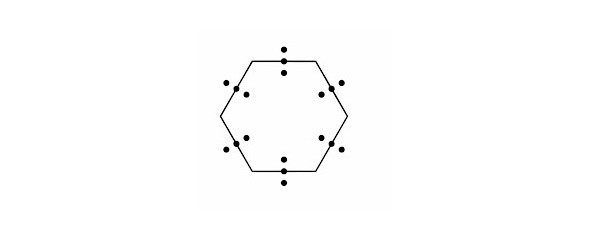
Benzene molecule with three-electron bond (W.O. Kermak and R. Robinson, J. J. Thomson).
2. Structure of the benzene molecule on the basis of the three-electron bond
2.1. Results and discussion
Supposing that the chemical bond between two atoms can be established by means of three electrons with oppositely oriented spins (↑↓↑) the structure of the benzene molecule can be expressed as follows (see figure 1 and figure 2):
...