



Онлайн кітапты тегін оқу The Philippine Islands
The Philippine Islands



The Philippine Islands
By
Ramon Reyes Lala
A Native of Manila
Illustrated
MDCCCXCIX
Continental Publishing Company
25 Park Place, New York
Copyright 1898
By
Continental Publishing Co.
The Philippine Islands
TO
Rear-Admiral Dewey,
WHOSE RECENT GREAT VICTORY OVER THE
SPANISH FLEET
HAS BEGUN A NEW ERA OF FREEDOM AND PROSPERITY
FOR MY COUNTRY,
AND TO
President McKinley,
IN WHOSE HAND LIES THE DESTINY OF
EIGHT MILLIONS OF FILIPINOS,
THIS BOOK IS DEDICATED.
Contents.
Preface 23
Early History of the Islands.
Discovery and Conquest—Adventures of Juan Sebastian Elcano-Legaspi, the first Governor-General—Li-ma-hong, the Chinese Pirate—The Dutch appear upon the Scene—The Japanese, and the Martyred Saints 29–48
The British Occupation.
General Draper’s Expedition—The British demand an Indemnity—Intrigues against the British 49–56
The Spanish Colonial Government.
The Encomiendoros and the Alcaldes—The Present Division and Administration—The Taxes and what became of Them—Dilatory and Abortive Courts—A New Yorker’s Experience 57–70
The Church in the Colony.
Priesthood and the People—Conflicts between Church and State—Clashing among the Friars—The Monks opposed to Reform 71–79
The Various Tribes of the Philippines.
Character of the Natives—A Native Wedding—Dress and Manners—The Half-Breeds, or Mestizos—Savage Tribes in the Interior: the Aetas, or Negritos—The Gaddanes—The Igorrotes—The Igorrote-Chinese—The Tinguianes—The Chinese: Hated but Indispensable 80–106
The Mohammedans of Sulu.
Cross or Crescent?—The Sultan’s State—The Dreaded Juramentados—The Extent of Mohammedan Rule—Sulu Customs 107–118
Manila.
The Old City—Binondo and the Suburbs—Educational and Charitable Institutions—The Cathedral and the Governor-General’s Palace—The Beautiful Luneta; the Sea Boulevard 119–137
Other Important Cities and Towns.
Iloilo; Capital of the Province of Panay—Cebú, a Mecca for many Filipinos—General Topography of the Islands 138–150
Natural Beauty of the Archipelago.
A Botanist’s Paradise—A Diadem of Island Gems—The Magnificence of Tropical Scenery—The Promise of the Future 151–158
A Village Feast.
The Morning Ceremonies—How the Afternoon is Spent—The Evening Procession—The Entertainment at Home—The Moro-Moro and the Fire-works 159–173
History of Commerce in the Philippines.
The Spanish Policy—The Treasure-Galleons—Disasters to Spanish Commerce—Other Nations enter into Competition—Fraud and Speculation—The Merchants of Cádiz—Royal Restrictions on Trade 174–187
Commerce During the Present Century.
The Royal Company—The Restrictions are gradually Abolished—Vexatious Duties on Foreign Imports—Duties made Uniform—Spanish Opposition to Foreign Trade—Trade with the Natives—The Decline of American Trade—Recent Measures and Statistics—Bad Results of Spanish Rule 188–198
Agriculture: The Sugar and Rice Crops.
Agriculture, the Chief Industry—The Principal Products of the Colony—The Cultivation of Sugar-cane—Methods of Manufacturing Sugar—The Several Systems of Labor—The Rice Crop—Methods of Rice-Cultivation—Primitive Machines, and Importance of the Rice Crop 199–213
The Hemp Plant and its Uses.
Description of the Abacá—The Process of Manufacture—Some Facts about Hemp-growing—Difficulties with Native Labor—Tricks of the Natives—Competition with Other Lands—Experience of a Planter—What the Hemp is used for 214–226
Culture and Use of Tobacco.
The Cultivation of Tobacco, a State Monopoly—Oppressive Conditions in Luzon—How Speculators take Advantage of the Natives—The Quality of Manila Tobacco—Methods of Preparing the Tobacco Leaf—Smoking, a Universal Habit 227–236
The Cultivation of Coffee.
The Origin of the Industry—Indifference of Coffee-planters—Speculation in Coffee—Methods of Cultivation—Harsh Methods of the Government 237–242
Betel-Nut, Grain, and Fruit-Growing.
The Areca Palm and the Betel Nut—The Nipa Palm and Nipa Wine—Various Fruits of the Islands—Cereals and Vegetables—Cotton and Indigo Planting—The Cocoa Industry—The Traffic in Birds’ Nests 243–250
Useful Woods and Plants.
The Huge Forests—The Bamboo Plant and its Uses—The Bejuco Rope—The Useful Cocoanut Palm—Oppressive Regulations of the Government—The Early Missionaries Beneficial to the Natives 251–259
Mineral Wealth of the Islands.
Early Search for Gold—The Mining Laws and Methods of the Colony—Where the Precious Metal is Found—The Whole Country a Virgin Mine—Precious Stones and Iron—Peculiar Method of Mining Copper—Other Materials and the Coal Fields, 260–272
Animal Life in the Colony.
The Useful Buffalo, and Other Domestic Animals—Reptiles, Bats, and Insects—A Field for the Sportsman—The Locust Scourge—The Chief Nuisances: Mosquitoes and Ants 273–283
Struggle of the Filipinos for Liberty.
Early Insurrections Against the Spaniards—The Burgos Revolt—The Present Rebellion—The Katipunan—The Black Hole of Manila—The Forbearance of the Natives—The Rebel Army—The Tagál Republic Proclaimed—Treachery of the Spaniards—Dr José Rizal and his wife Josephine—Execution of Rizal—The Philippine Joan of Arc—Rizal’s Farewell Poem—Aguinaldo Confers with Admiral Dewey—Aguinaldo as Dictator: His Proclamations—Triumphant Progress of the Rebels—The Spaniards Fortify Manila—Sketch of Aguinaldo 284–309
Dewey at Manila.
The White Squadron—Declaration of War, and Journey to the Philippines—Luzon Sighted, and Preparations for Battle—The Fleet Sails by Corregidor—First Shot of the War—The Spanish Fleet is Sighted—Dewey Attacks the Enemy—The Fate of the Reina Cristina—The Commodore Pipes all Hands to Breakfast—The Americans Renew the Battle—The Yankees are Victorious 310–325
The American Occupation.
Merritt and the Expedition—The Battle of Malate—Capture of Manila—Capitulation of the Philippines—Awaiting the Peace Commission—Instructions to Merritt 326–342
Illustrations.
- Page.
- The Fortifications of Old Manila 30
- A Glimpse of the Old Canal 35
- In the Batangas Province 36
- In the Province of Pangasinan 39
- San Augustine Church, in Old Manila 43
- A Suburb of Old Manila 45
- The Abandoned Aqueduct 47
- Tower of Defense, Church, and Priest’s House 50
- A Native Village in the foot-hills: Old Manila 52
- A Bamboo House in Pampanga Province 54
- A Street Scene in Albay 59
- Children of a Gobernadorcillo 61
- Along the Escolta: Principal Business Street in New Manila 63
- A Business Street in Old Manila 65
- In the Lumber District 68
- Throne Room of the Archbishop’s Palace 72
- The Famous Shrine of Antipolo 74
- A Parish Priest 77
- Negritos of Pampanga 81
- The Igorrotes 82
- Interior of a Native Hut 85
- A High-born Filipina—upper garment of costly Piña 86
- The Fashionable Church and the Village of Majayjay 89
- Author in Silken Suit: kind worn by high-class natives 90
- Full-blooded Native Girl in Reception Attire 92
- Negritos Enjoying a Primitive Sun-shade 95
- Volcano of Albay—a near view 97
- A Body-guard of Igorrotes 99
- A Native Restaurant, in Binondo 101
- Chinese Merchants on their way to the Joss House 103
- A Chinese Chocolate-maker 105
- Chieftains of Sulu 108
- Sulu Warriors in Fighting Attitude 110
- A Bamboo Thicket in Sulu 112
- The Devil’s Bridge, in Wild Laguna 114
- A Jungle in Luzon 116
- The Magnificent New Cathedral in Old Manila, and Ruins of the Old Cathedral, Destroyed by Earthquake 1863 121
- Commercial House of Russell & Sturgis; First American Merchants; Later, Lala’s Hotel 123
- “Home, Sweet Home,” as the Filipino knows it 125
- Balcony of Manila Jockey Club, overlooking Pandacan 126
- The Nactajan Mess: Manila Jockey Club 128
- Church of San Francisco, and the Old City Walls 130
- A Rear View of the Governor-General’s Palace 132
- A Water-girl 133
- The Garrote, Manila Method of Capital Punishment 135
- The Beautiful Luneta 136
- At the Port of Iloilo 139
- Interior of a House Destroyed by an Earthquake 140
- Open-air View of an Earthquake’s Violence 142
- A Milkwoman of Calamba 144
- A Native Hut in the Interior 147
- Hot Water Springs, Albay; and Mayon Volcano 149
- The Once-beautiful Botanical Gardens 152
- Malecon Promenade, along Manila Bay 154
- A Mestiza Flower-girl 157
- A Village Feast 160
- A Fashionable Church in Majayjay, Near Manila 162
- Home of a well-to-do Manila Merchant 164
- Cock-fighting: the Supreme Enjoyment 166
- Interior of the Cathedral, where all Processions Begin And End 168
- Square of Cervantes: Fashionable Quarter of Manila 170
- A Scene From the Moro-Moro Play 172
- The Puente de España: Stone Bridge, Replacing the Old Wooden One 175
- Square of Cervantes—New Manila 178
- Tondo: The Ancient Quarter of Native Fishermen 180
- Water-Carriers and Fruit-Vender 182
- Ancient and Present Method of Washing Clothes 184
- A Procession of Natives Carrying Fish 186
- A Mestizo Merchant 189
- The Escolta: Looking Toward Santa Cruz 191
- A Milkman on his Rounds 193
- A Village of Santa Ana 195
- A Water-Carrier and Customer 196
- Weaving the Beautiful Piña Cloth 200
- Women Employed in a Piña Shop 202
- Natives Preparing the Ground for Sugar-Cane Planting 204
- Old-fashioned Process of Drying Black Sugar 206
- Cane-stalk Yard, Tanduay; Drying Crushed Cane for Fuel 208
- Native Women Hulling Rice 211
- Mayon Volcano, Albay; in the Hemp-producing District 215
- A Hemp Warehouse, Manila 217
- A Hemp Press at a Busy Hour 219
- A Chinese Hemp Merchant in Gala Attire 221
- A Wealthy Spanish Merchant of Albay 223
- A Bamboo Bridge in Albay 225
- A Cigar and Cigarette Factory in Manila 228
- A View of the Suspension Bridge, Manila; over the Pasig River 230
- Native Girls Making Manila Cheroots 233
- Spanish Luxury in the Old Days 234
- District of Taäl: in the Batangas Province 238
- The Useful Buffalo: for all Hauling Purposes 240
- A Betel-Nut Gatherer of Luzon 244
- A Typical Native Fruit-Girl 246
- “La Belle Chocolatière” of Luzon 248
- Shifting Lumber in a Forest of Tayabas 252
- Natives Transporting Lumber to the Coast 254
- The Young Proprietor of a Cocoanut Grove Gathering Tuba 256
- A Wealthy Mestiza of the Upper Class 258
- A Group of Tagals Employed by a Mining Company 262
- Another Glimpse of the Great Stone Bridge 264
- La Laguna Lake; the Neighborhood of a Gold Discovery 266
- A Country House in Tanguet Village 268
- House of Native Coal-Laborer of Cebú 270
- A Buffalo in Harness; Harrowing the Soil 274
- Grand Stand, Santa Mesa, where the Pony Races are run 276
- At the National Sport; Just Before the Contest 278
- A Wayside Restaurant 281
- A Native Servant-Girl 282
- Buffalo Transporting Lumber in Pampanga 285
- Enterprising Sugar Refineries, Tanduay 287
- La Bella Filipina in Troubadour Costume 290
- Foreigners at Tiffin in Manila 292
- Dr José Rizal, Martyred Leader of the Present Insurrection 295
- An Execution of Insurgent Chiefs on the Luneta 296
- Entrance of the River Pasig, Manila 299
- The President of the United States and His War-Cabinet 300
- Andres Bonifacio, sometime Rebel President of so-called Tagal Republic 303
- Emilio Aguinaldo 305
- Native Women: their Upper Garment—Pañuelo—of Piña 306
- Types of the Tagbanua Tribe 308
- A Battery at the Corner of the Old Fortifications, Manila; Facing the Bay 313
- The Spanish Fleet as it Appeared in the Philippine Waters 315
- The Hot Springs of Luzon Province 317
- The Reina Cristina, Flagship of Admiral Montojo 318
- The Isla de Cuba; To it the Spanish Flag was Transferred 322
- The Olympia; Admiral Dewey’s Flagship 324
- Admiral Montojo, Commander of Spanish Fleet at Manila 327
- Cavité; a Rebel Stronghold, Noted for its Arsenal 328
- Alfonzo XIII., the Boy King of Spain 330
- The Queen-Regent of Spain 333
- Rear-Admiral George Dewey 334
- Don Basilo Augustine, Spanish Captain-General of the Philippine Islands 338
- General Wesley Merritt, American Commander of Military Forces at Manila 340
Maps 343

Introduction.
The absolute present necessity for accurate information by the people of the United States respecting the Philippines has been met in no more satisfactory manner than by this book.
The author, Mr. Ramon Reyes Lala, is a Filipino and was born in Manila. His collegiate education was completed in England and Switzerland. A long sojourn in Europe has instructed him in European thought, tendencies, and methods. He has lived in the United States for many years, and has become, by naturalization, a citizen of this country.
He collected the historical material for this work largely from the Spanish archives in Manila before the last rising of the people of Luzon in rebellion against Spain. His mastery of the English language is that of the thorough scholar. His qualifications for his work are those of the student, trained by many studies. He possesses by nativity the gift, incommunicable to any alien, of giving a true color and duly proportioned form to his delineations of his own people. These endowments have enabled him to produce a work of striking and permanent value.
The most meritorious feature of Mr. Lala’s book is unquestionably its impartiality of statement and judgment. This is particularly apparent in his descriptions of the moral and intellectual character of his countrymen. No defect is extenuated, nor is there any patriotic exaggeration of merits. The capacities and limitations of the Filipinos are plainly and photographically depicted. The difficulties and the facilities of their political control by the United States are weighed in a just balance by the reader himself in considering these portrayals of national character.
This colorless truth of statement appears not alone in Mr. Lala’s special descriptions of the character of his people. It is also manifest, as it is incidentally displayed, in his many expositions of the systems and methods of labor, of social usages, of domestic life, of civil administration, of military capacity, of popular amusements and of religious faith. The result is that he has communicated to the reader an unusually distinct conception of national and ethnic character. This is always a very difficult task. The most graphic portrayal in this respect most commonly enables the reader merely to perceive indistinctly, but not clearly to see.
The book is of a most practical character. Its statements of commercial history and methods, and of past and present business and industrial conditions, are most satisfactory. Such an exposition is at this time most indispensably needed. Everybody knows, in a general way, that the Philippine Islands produce sugar, rice, hemp, tobacco, coffee, and many other agricultural staples, and that they are rich in minerals and valuable woods. But heretofore it has been very difficult to obtain specific information upon these subjects. Mr. Lala has given this information. The practical man, the farmer, the manufacturer, the merchant, the miner is here informed concerning resources, methods, prices, labor, wages, profits, and roads. While this information is not technical, it is instructively full and is evidently reliable.
The descriptions of the processes of cultivating and preparing hemp, sugar, coffee, rice, and tobacco, and the suggestions of the ways by which these methods can be easily improved, and the products made more profitable, are, in every way, most satisfactory.
The Philippines began to come under European control with the administration of Legaspi, the first Governor-General, in 1565, long before the English had colonized any portion of North America.
For about three hundred and fifty years the Spanish system has been in contrast with that of every other colonizing nation. It has been worse than the worst of any of these. While there is no elaborate contrast of these systems in Mr. Lala’s book, he nevertheless depicts so thoroughly the manifold and inveterate rapacity, cruelty, corruption, and imbecility of Spanish colonial administration, that he also discloses the vast possibilities of the better contrasted systems.
No war was ever yet waged in the interests of humanity, as the war against Spain unquestionably was, that did not produce consequences entirely unforeseen at its beginning. This truth was never more convincingly confirmed than by the war just ended. The United States demanded the evacuation by Spain of Cuba and Cuban waters. Compliance by Spain would have limited the consequences to the evacuation. She did not comply. She chose the arbitrament of war, and the result was her extirpation from her insular possessions in the West Indies and the Philippines.
This providential and revolutionary event imposed upon the United States duties unforeseen, but none the less imperious. As to the Philippines, those duties are complicated by the irresistible tendencies which seem to make certain the dismemberment of China, and the subjection of that immemorial empire to all the influences of Western civilization. This is an event not inferior in importance to the discovery of America by Columbus, and the interest of the United States in its consequences is of incalculable importance. With this interest its relations to the Philippines is inseparably connected, and those relations present for consideration policies which disenchant the situation of all idealism and make it intensely practical. To this possible result the war waged against the United States by Aguinaldo and his followers has decisively contributed.
But, in any event, whatever the relations of the United States to the Philippines may finally become, the book of Mr. Lala will undoubtedly influence and assist the considerate judgment of those whose duty shall call them to determine the momentous questions which are now enforcing themselves for solution upon the attention of the American people.

Washington, March 22d, 1899.
[Cushman Kellogg Davis, U. S. Senate, Minnesota, 1887 to ——; Chairman Committee on Foreign Relations; Member of the Commission that met at Paris, September 1898, to arrange terms of peace between the United States and Spain.]

Preface.
About twenty years ago, when a student at St. John’s College, London, I was frequently asked by people I met in society for information regarding the Philippines and the Filipinos. Many also, who showed considerable interest, and who wished, for various reasons, to carry their investigations further, complained that there was in English no good book on the subject. Afterward, when I continued my studies at a French college in Neûchatel, Switzerland, I met with many similar inquiries, and here too in America I found demand for a comprehensive, reliable work upon my country.
But it was not until I had traveled considerably through Europe, studying the history of the various States and peoples, that the idea of writing a history of my own fatherland occurred to me. It was mortifying then to think that the glories of my native land were no better known. Accordingly, I resolved to become the chronicler, and I began at once to collect material for a work on the Philippines, that should, I trusted, be deemed a permanent contribution to historical literature.
Upon my return to Manila from Europe, I immediately began a study of the Colonial archives in the office of the Governor-General. From these I gathered many valuable data about the early history of the colony, and also much information that would be locked to the curious traveler. And on account of my knowledge of Spanish, and because of my friendship with the Governor-General Moriones, I was enabled to do this thoroughly. Thus I gradually laid the foundation for the present work.
When, a few years later,—in 1887,—because of my sympathy with the rising cause of the insurgents, Spanish tyrants banished me from my country and my kindred, I carried away all the manuscripts I had already written, resolved to finish the task I had set before me amid a more congenial environment.
I came to the United States. Of this country I, in due time, became a citizen. However, I kept up my relations with friends in Manila; for I still felt an interest in the fate of my native land. Though I have since revisited the Orient, I preferred to retain my American citizenship, rather than again put myself under the iron yoke of Spain. I have, nevertheless, kept pace with the march of events in the colony, and had, indeed, about completed my history when Dewey’s grand victory denoted a new era for the Filipinos, and, hence, made the addition of several chapters necessary. I have thus added much of supreme interest to Americans; bringing the book to the capture of Manila by the American forces.
My acquaintance with the leading insurgents,—Rizal, Aguinaldo, Agoncillo, the Lunas, and others,—has also enabled me to speak with authority about them and the cause for which they have fought.
In writing this work I have consulted all previous historians, the old Spanish chroniclers, Gaspar de San Agustin, Juan de la Concepcion, Martinez Zuñiga, Bowring, Foreman, and various treatises, anthropological and historical, in French, Spanish, and English.
To all these writers I am indebted for many valuable facts.
It has been my aim to give—rather than a long, detailed account—a concise, but true, comprehensive, and interesting history of the Philippine Islands; one, too, covering every phase of the subject, and giving also every important fact.
And my animating spirit of loyalty for my own countrymen makes me feel that I cannot more clearly and fully manifest my affection for them and my native land than by writing this book.
Many of the pictures are photographs taken by myself. The rest were selected from a great number of others, that were accessible, as being most typical of Philippine life and scenery.
The student of history, and he that would learn something about the customs of the people, and the natural resources of the country, may, I trust, find the perusal of this work not without profit and interest.
I desire to attest here my gratitude for the many courtesies shown me, and for the hearty manner in which I have been received, in this great, free country.
Everywhere it was the same.
And I would say to all loyal, ardent Filipinos, that I believe that they eventually will not regret the day when Commodore Dewey sundered the galling chains of Spanish dominance, and when General Merritt, later, hoisted the Stars and Stripes over the Archipelago.
They will, rather, most surely live to recognize and appreciate the unsullied manifold advantages and benefits incident to American occupation and to a close contact with this honest, vigorous type of manhood.
The Author.
New York December, 1898.

Early History of the Islands.
Discovery and Conquest.
When Magellan in the spring of 1521 took formal possession of Mindanao, one of the largest of the Philippine group, he was surrounded by crowds of the curious brown-skinned natives of that island; with sensations of awe, they watched their strange white visitors, believing them to be angels of light. It was Easter-week, and the Spanish discoverers, with all the ritualistic splendor of the mass, dedicated the newly-found islands to God and the Church.
The natives, too, manifested great friendliness to the tempest-tossed mariners. Indeed, one of their most prominent chieftains himself piloted the exploring party to Cebú, where thousands of natives, arrayed in all the barbarous paraphernalia of savagery, stood on the beach, and, with their spears and shields, menaced the strangers.
The Mindanao chieftain, who had acted as pilot, thereupon went on shore and volunteered an explanation: these strange voyagers were seeking rest and provisions, having been many weary months away from their own country.
A treaty of amity was then ratified according to their native custom, each party thereto simultaneously drawing and drinking blood from the breast of the other. Magellan then caused a rude chapel to be built on this new and hospitable shore, and here the natives witnessed the first rites of that Church that, within a century, extended its oppressive sway from one end of the Archipelago to the other.
The King and Queen of the natives were soon persuaded to accept the rite of baptism. This they seemed to enjoy greatly. To persuade the good-natured savages to take the oath of allegiance to the King of far-away Spain was but a step farther. One ceremony was probably as intelligible to them as the other; and thus the first two links in the fetters of the Filipinos had been forged.
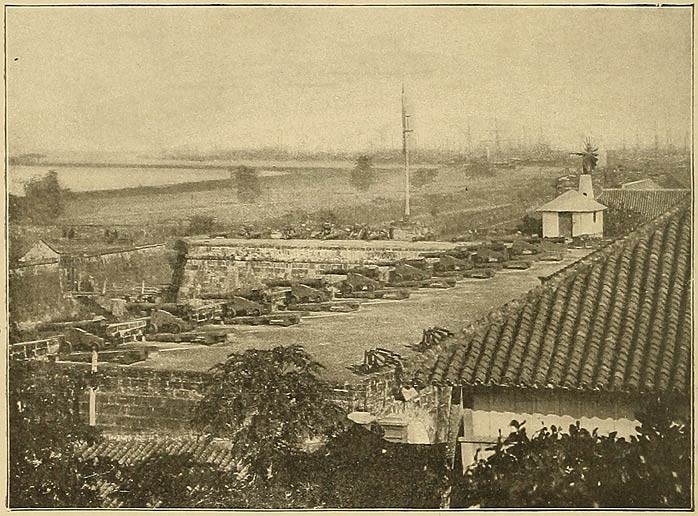
The Fortifications of Old Manila.
With characteristic arrogance the Spaniards henceforth conducted themselves as the rightful masters of both the confiding natives and their opulent country.
It appears, now, that the natives of Cebú were engaged in war with another tribe on the island of Magtan. The adventurous Magellan, beholding an opportunity for conquest, and, perhaps, for profit, accompanied his allies into battle, where he was mortally wounded by an arrow.
Thus perished the brave and brilliant discoverer, in the very bloom of life, when both fame and fortune seemed to have laid their most precious offerings at his feet.
Posterity has erected a monument on the very spot where this hero was slain. Cebú also boasts an obelisk that commemorates the discovery; while on the left bank of the Pasig river, Manila, stands another testimonial to the splendid achievements of the intrepid Magellan.
Duarte de Barbosa was now chosen leader of the expedition, and he, with twenty-six companions, was invited to a banquet by Hamabar, the King of the island. In the midst of the royal festivities the Spaniards were treacherously murdered. Juan Serrano alone—so the old chronicles relate—was spared. He had, in some way, secured the favor of the natives, and now, stripped of his clothing and his armor, he was made to walk up and down the beach, in full view of his companions on board the ships.
For his person the natives shrewdly demanded a ransom of two of the Spanish cannon. A consultation was held among the Spaniards, and it was decided that it was better that one should perish than that the lives of all be jeoparded. And so Serrano was left to his fate.
Adventures of Juan Sebastian Elcano.
Reduced, at last, to about 100 men and two ships, the Spaniards decided to return home. The captain of one of these—of the Victoria—was Juan Sebastian Elcano. This gallant sailor, after losing many brave companions and meeting many thrilling adventures, at last brought his ship safely to a Spanish port—three years after he had embarked, en route to the Moluccas, under his first commander, the unfortunate Magellan.
When Elcano and his seventeen companions landed in Spain, they were mere skeletons, so reduced were they by hunger and disease. Everywhere they were received with acclamations of joy, and upon their arrival in Seville they straightway proceeded to the Cathedral, where, amid grand Te Deums, they gave thanks to God for their return.
It must, indeed, have been a strange sight to see this remnant, these gaunt survivors of the splendid company of adventurers that had left that city but three years before,—flaming with zeal for the spread of the Church, and glowing in the desire of conquest,—these few half-starved wretches, now walking barefooted, with lighted candles, through the streets,—all that was left of that eager throng.
And yet, pitiable as they were, they must have been conscious of an achievement that meant glory for their country and immortality for themselves.
Nor were they unrewarded. All received food and money, and Elcano, the leader, was voted a life-pension of 500 ducats; and, in token of his great accomplishment in having first circumnavigated the globe, the King knighted him, awarding him, as his escutcheon, a globe with the motto: “Primus circundedit me.”
The cargo of the Victoria consisted of 26½ tons of cloves and other spices: cinnamon, sandalwood, nutmegs, and so forth. It is said that one of the Tidor islanders, brought back with the expedition, who was presented to the King, was never permitted to return to his home, because he had committed the blunder of making inquiry regarding the value of spices in the Spanish markets.
The Trinidad, the other vessel of this remarkable expedition, after many terrible hardships, fell into the hands of the Portuguese, who sent the survivors to Lisbon. They reached that port five years after their departure with Magellan.
The enthusiasm of the Spanish monarch and his subjects on account of these remarkable discoveries was unbounded. Other expeditions to the islands were soon fitted out. One, under the leadership of Ruy Lopez de Villalobos, gave to them the name of the Philippine Islands. This was in honor of Philip, Prince of Austria, the son of King Charles I., heir-apparent to the throne of Castile; to which, in 1555, upon the abdication of his father, he succeeded as Philip II.
This bigot, convinced by his religious advisers of the importance of winning the newly-discovered islands for the Church, caused another expedition to be fitted out from Navidad, in the South Sea.
Legaspi, the First Governor-General.
Accordingly, Miguel Lopez de Legaspi, a well-known Basque navigator, of great piety, and with a reputation for probity and ability, set out with four ships and one frigate, all well armed and carrying 800 soldiers and sailors. Six priests also accompanied them. One was Urdaneta, who had formerly sailed as a captain to the Moluccas. The avowed object of the expedition was to subjugate and to Christianize the benighted natives of those islands.
After a propitious voyage, not without incident, General Legaspi resolved to cast anchor at Cebú, a safe port. On the way the ships stopped at the port of Dapitan, on the island of Mindanao. Prince Pagbuaya, the ruler of this island, was so astonished at the sight of these large ships off the coast of his country, that he commanded one of his subjects, who had some reputation for boldness, to observe their movements and to report his observations.
He did. They were manned, he said, by enormous men with long, pointed noses; that these strange beings were dressed in fine robes, and actually ate stones (hard sea-biscuits); most wonderful of all, they drank fire, and blew smoke out of their mouths and through their nostrils—referring, of course, to their drinking and smoking. He also said that they could command the thunder and the lightning—meaning their fire-arms;—that their proud bearing, their bearded faces, and splendid attire, moreover, surely proclaimed them to be gods.
Having heard this report, the Prince, accordingly, thought it not unwise to treat with these wonderful beings. Legaspi not only succeeded in obtaining provisions—in barter for European wares—from this chief, but he also obtained much useful information about his destination, Cebú. He learnt that it was considered a powerful kingdom, whose greatness was much feared by other States, and that its port was not only safe, but also favorably situated.
The General, therefore, determined to annex it to the Crown of Castile at the earliest opportunity. He landed at Cebú April 27th, 1565, and immediately began negotiations with the natives.
These, however, remembering their successful resistance to Magellan’s party but a generation before, opposed every advance of the Spaniards. The latter, notwithstanding, finally took possession of the town, and sacked it; but for months they were so harassed by the chief and his subjects that they were several times on the point of retiring. Legaspi, however, decided to remain, and the natives, growing accustomed to their presence, gradually yielded to the new order of things; and thus the first step in the conquest of the islands was made. The people were declared Spanish subjects. Happy at his success, Legaspi determined to send the news at once to Spain. Urdaneta was therefore commissioned to bear the despatches. In due time he arrived at his destination.
Legaspi, meanwhile, steadily and successfully pursued the conquest of Cebú and surrounding islands. He succeeded most admirably also in winning the confidence of the natives. Their dethroned King Tupas was baptized, and his daughter married one of the Spaniards. Other alliances also were made, which bound the two races together.
The Portuguese, the natural enemies of Spanish exploration and conquest, now appeared on the scene and attempted, in vain, to dispute the possession of the successful invaders. The Spaniards then built a fort, and plots of land were marked out for the building of houses for the colonists. In 1570 Cebú was declared a city, and Legaspi, by special grant from the King, received the title of Governor-General of all the lands that he might be so fortunate as to conquer.
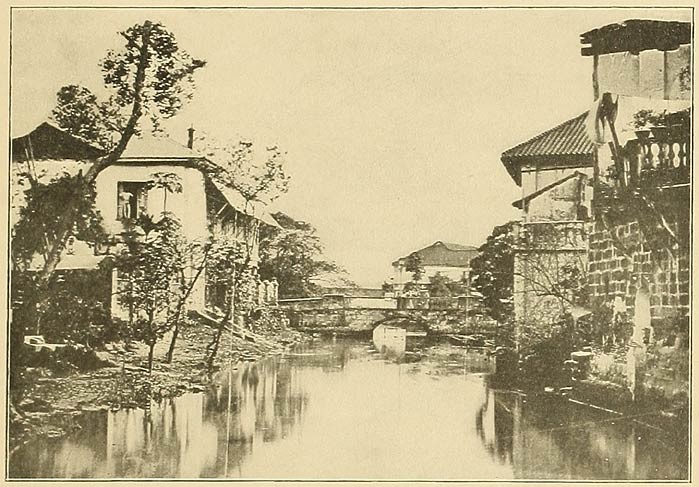
A Glimpse of the Old Canal.
Soon afterward, Captain Juan Saicedo, Legaspi’s grandson, was sent to the island of Luzon to reconnoiter the territory and to bring it into subjection to Spain. Martin de Goiti and a few soldiers accompanied him. They were well received by the various chiefs they visited. Among these were King Lacandola, the Rajah of Tondo, and his nephew, the stern young Rajah Soliman, of Manila. Intimidated by the countenances of the warlike-looking foreigners, and awed by the mysterious symbols of their priests, these superstitious chiefs agreed forever, for no consideration, and without reservation, to yield up their independence, to pay tribute, and to aid in the subjugation of their own countrymen. A treaty of peace having been made, the Spaniards acted as if they were the natural owners of the soil.
Young Soliman, however, soon found occasion to demonstrate that he, at least, had no intention of carrying out his part of this enforced contract. He sowed the seeds of insurrection broadcast among the various surrounding tribes, and not only carried on an offensive warfare against the invaders, but set fire to his capital, Manila, that it might not become the spoil of the invaders. Soliman and his little army were put to flight by Salcedo, who generously pardoned the young chief upon his again swearing fealty to the King of Spain. Then, while Goiti with his forces remained in the vicinity of Manila, Salcedo pursued his adventurous way as far as the Taal district. All the country of the Batangas province was also subdued by him. About this time Salcedo himself, severely wounded by an arrow, returned to Manila.
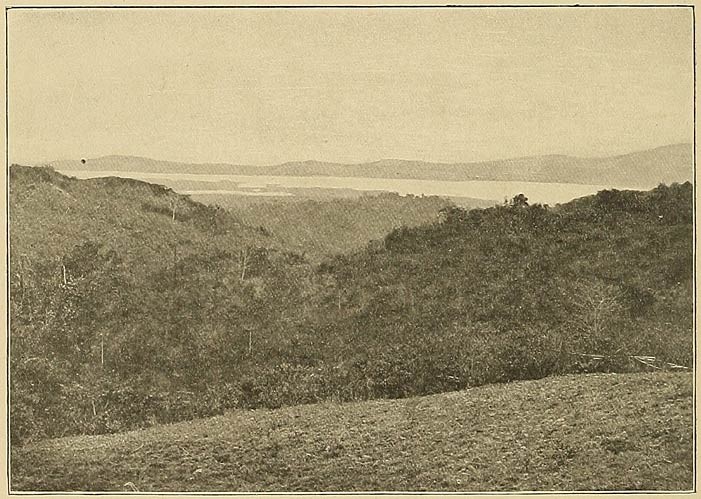
In the Batangas Province.
Legaspi being informed of the occurrences in Luzon, soon joined Salcedo at Cavité, where chief Lacondola gave his submission. Legaspi, continuing his journey to Manila, was there received with much pomp and acclamation. He not only took formal possession of all the surrounding territory, but also declared Manila to be the capital of the whole Archipelago. He next publicly proclaimed the sovereignty of the King of Spain over all the islands.
Speaking of this period, the old chronicler, Gaspar de San Agustin, says: “He (Legaspi) ordered them (the natives) to finish the building of the fort in construction at the mouth of the river (Pasig), so that His Majesty’s artillery might be mounted therein for the defense of the port and the town. He also ordered them to build a large house inside the battlement walls for Legaspi’s own residence, and another large house and church for the priests.
“Besides building these two large houses, he told them to erect 150 dwellings of moderate size for the remainder of the Spaniards to live in. All this they promptly promised to do; but they did not obey; for the Spaniards were themselves obliged to complete the work of the fortifications.”
The City Council of Manila was constituted on the 24th June, 1571. On the 20th of August of the following year Miguel Lopez de Legaspi died. His was a most eventful, arduous life. His career was honorable, and he occupied a prominent place in the colonial history of his country. He was buried in the Augustine chapel of San Fausto in Manila, where his royal standard and armorial bearings hung until the occupation of the city by the British in 1763.
Li-ma-hong, the Chinese Pirate.
Guido de Lavezares succeeded Legaspi as Governor of the islands, and had not long taken possession when he had to defend them against the assaults of the celebrated Chinese corsair, Li-ma-hong.
This redoubtable Celestial had early shown a martial spirit, and became a member of a band of pirates that for many years infested the seas. Here he so distinguished himself by his prowess and cruelty that, upon the death of the leader, he was at once elected chief of the buccaneers. At length this Celestial Viking essayed an attack on the Philippines. It is said that he first heard of the remarkable wealth of the islands from the crew of a Chinese merchantman returning from Manila. After committing a few depredations along the coast, this Captain Kidd of the Chinese Main appeared before Manila on the 29th of November, 1594, with a fleet of 62 armed junks, manned by more than 2,000 sailors. Twenty-five hundred soldiers were also on board for effective warfare, and more than 2,000 Chinese artisans and women, with which he intended to found the colony that was to be the capital of his new Empire.
So secret was the landing of the Chinese, and so sudden was their attack, that they were already within the gates of the city before the Spaniards knew that they were at hand.
Martin de Goiti, second in command to the Governor, was the first to receive their attack; and, after a brave defense, he was killed with many of his soldiers. The flames from his burning residence gave the Governor himself his first intimation of the enemy’s presence. Flushed with success, Sioco, the Japanese leader of the buccaneers, then stormed the Fort of Santiago, where many Spanish soldiers had taken refuge. A small body of fresh troops coming to the aid of the besieged, the Chinese, after considerable loss, retreated, fearing that other reinforcements might follow and cut off their return to the ships.
It was now reported that Li-ma-hong himself, who, with the greater part of his force, was at Cavité, would lead the next assault. The inhabitants of Manila, therefore, awaited him in great terror.
Fortunately, however, that intrepid warrior, Juan Salcedo, fresh from his conquests in the north, now came to the city’s aid. Just about sunrise on the 3d of December the Chinese squadron again appeared in the bay near the capital. The Celestials disembarked, and, it is said, their leader, in an eloquent speech, incited his followers to the assault, with glowing promises of plunder.
Meantime, while the Chinese were forming into battle-line, within the walls of the city the drums and the trumpets of the Spaniards kept up an inspiring din, and all that were able to bear arms hastened to the defense. It was an important moment in the history of the colony,—an hour big with fate; for the coming battle would decide for either European or Asiatic domination.
Again Li-ma-hong chose his trusted lieutenant to lead the attack; and fifteen hundred picked troops, armed to the teeth, followed him, swearing to take the fort or leave their corpses as a testimonial to their valor.
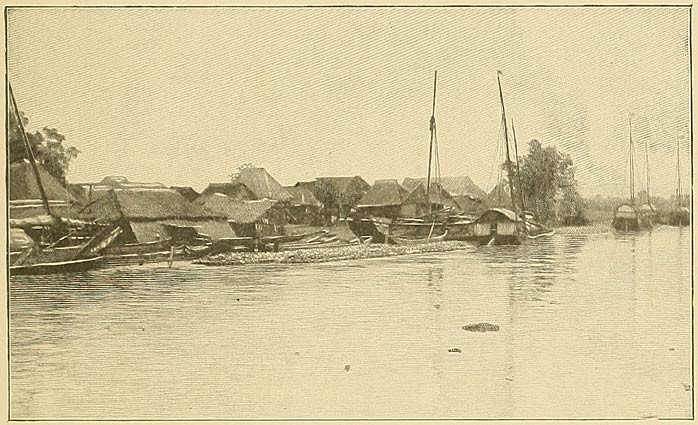
In the Province of Pangasinan.
The city was then set on fire in several places, and in three divisions the Chinese advanced to the attack, Li-ma-hong himself from the outside supporting them with a well-directed cannonade against the walls.
After a spirited assault, Sioco succeeded in entering the fort, and here a bloody hand-to-hand conflict took place. Again and again the Spaniards forced their fierce assailants over the walls; again and again the Chinese poured into the breaches, while the trembling non-combatants within the city awaited the result in agonized suspense.
Salcedo was at the front and everywhere. Time and again, with indomitable courage, he rallied his men; and splendidly did they respond to his magnificent leadership. The old Governor himself was at the front, shouting encouragement; and many prominent citizens also distinguished themselves by feats of remarkable heroism. The Chinese, once more, gathering their shattered numbers together, plunged into the ranks of their enemies, and it was not until after the loss of their daring leader that the few that remained turned their repulse into a disorderly flight, and Manila and the Philippines were saved to Spain and America. Salcedo now eagerly took the offensive and pursued the panic-stricken fugitives back to their ships, killing great numbers on the way.
In vain Li-ma-hong tried to regain his advantage. Troop after troop were sent ashore, only to join the rout and return confused and disorganized back to the fleet. The Spaniards had conquered.
Li-ma-hong, nevertheless, was determined to found his Empire and to set up his capital in another part of the islands—in the province of Pangasinan. Salcedo was accordingly despatched against him, but was unable to dislodge him. Hearing, however, that the Chinese Emperor also was about to send an expedition against him, the wily pirate secretly departed, leaving his Spanish enemies not at all displeased at being thus cheaply rid of his presence.
The friars, ever on the lookout for their own interests, attributed their deliverance to the aid of St. Andrew. He, therefore, was declared the Patron Saint of Manila—high mass in his honor being celebrated at 8 A. M. in the Cathedral every 30th of November.
The old chroniclers relate that some of the native chiefs took advantage of the disturbance to foment a rebellion against their Spanish conquerors; but all other disturbances were speedily quelled.
Civil disturbances, civil conflicts, now followed in the wake of these struggles against foreign aggression and domestic insurrection. In these internal dissensions, all branches of the Government took part. It was the Governor-General against the Supreme Court, the Supreme Court against the Clergy, the Clergy against All.
The Governor was censured for alleged undue exercise of arbitrary authority. The Supreme Court, patterned after the one in Mexico, was also accused of seeking to overstep the limits of its functions. Every law was reduced to the practise of a quibble, every quibble was administered with a dilatoriness that was destructive not only to all legitimate industry, but also to the encouragement and maintenance of order. To make matters even worse, the clergy, with their pretense of immunity from all State-control, interfered in all matters that promised profit. Indeed, there were few things out of which these wily friars were unable to extract a generous tithe.
The Dutch Appear upon the Scene.
The Chinese pirate had been taught a severe lesson, and had departed. The memory of his ravages, however, was still fresh in the minds of his conquerors when other buccaneers, far mere formidable and dangerous, appeared in the waters of the Philippines, threatening the peace and safety of the colonists.
Kindling with a desire for vengeance on their ancient foes the Spaniards, and flaming with greed for the richly-freighted Spanish argosies, the Dutch made repeated sallies from their secure retreat in the Moluccas, spreading terror in their wake. The galleons full of silver from Mexico, the ships laden with the comforts and luxuries of far-away Spain, fell a delightful prey into the hands of these remorseless freebooters, that never gave nor asked quarter. Many were the conflicts with these ruthless invaders, and many a rich prize did they tow away from the Philippine waters, while the angry Spaniards on shore stood transfixed,—in helpless misery.
Millions of dollars intended for the salaries of the Government officials and the troops, were thus stolen, and though the colonists were often victorious, yet the enemy, with characteristic Dutch audacity, refused to be defeated; in fact, he invariably reappeared with a new demonstration of bloody rapacity.
Upon one occasion a Dutch squadron anchored at the entrance of Manila Bay. It remained several months, seizing from time to time the merchantmen on their way to the Manila market. It thus secured an immense booty; its presence, too, becoming extremely prejudicial to trade and to the interests of the colony.
Juan de Silva, the Governor, therefore began to prepare an armament to drive these freebooters from the bay. One night he dreamt that St. Mark had offered to help him. Awaking, he consulted a priest about his dream, who interpreted it to be an omen of victory. On St. Mark’s day, accordingly, the Spaniards sallied forth to meet their hereditary foe; they sailed from Cavité with ten ships, carrying twenty guns. Over 1,000 Europeans and a large number of natives manned this fleet, the latter being religiously told that the Dutch were infidels, and, therefore, deserved extermination.
Once more the possession of the colony was to be decided. This time the conflict was to be between two rival nations from the same continent,—between Protestant and Catholic. The clergy, hence, were keenly alive to its importance: mass was said in all the churches, bells were tolled, and images of the Patron Saints of the colony were daily paraded through the streets.
The Governor himself took command, and incited his followers to martial order by proclaiming St. Mark’s promised intercession. From his ship he unfurled the royal standard,—on which the image of the Virgin was conspicuously embroidered,—to give encouragement to the eyes of the faithful. He then gave the signal for the advance, and they swiftly bore down upon the enemy. The Dutch were quietly awaiting the attack, and the conflict was fierce and sanguinary. It was a calm, beautiful day; but the calmness soon gave place to the thundering turbulence of battle, and the beauty soon became the ugliness of war.
The contest lasted about six hours, and the Dutch, unable longer to cope against odds so overwhelming, were finally vanquished; their three ships were destroyed, and their flags, artillery, and plundered merchandise to the value of $300,000 were seized.
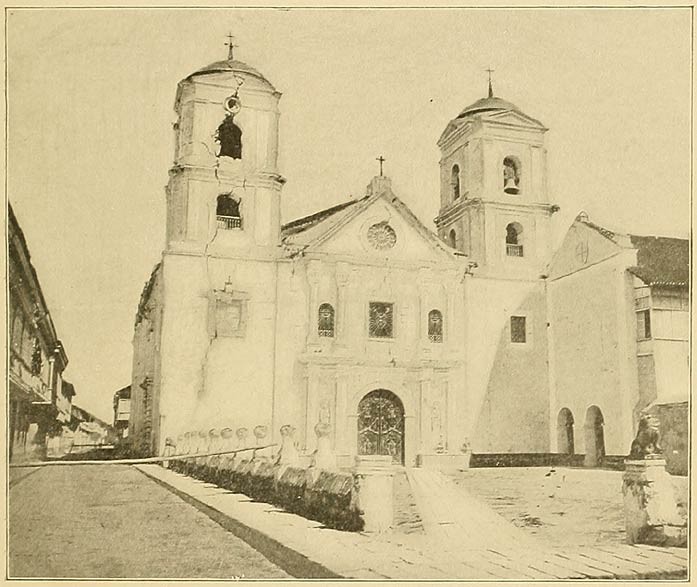
San Augustine Church, in Old Manila.
This important struggle is known in the history of the islands as the battle of Playa Honda. Had it ended otherwise, it is probable that the Philippines would have been for the Dutch another Java, and a most interesting problem would not have sought solution at the hands of the American people.
Several other engagements with the Dutch occurred at different times; first one, then the other side being victorious. And thus for over a century the contest continued, until by the Peace of Westphalia, in 1648, Holland’s independence was fully established, her impoverished and weakened foe being forced to a tardy recognition of what had been an obstinate fact for many years.
The Japanese, and the Martyred Saints.
The struggling colony was menaced by yet another foe. Early commercial relations had been entered into with the Japanese, who had established one or two trading-settlements in different parts of Luzon. It was not long, therefore, before the news of the Spanish occupation of the Philippines reached the Emperor of Japan. Accordingly, in 1593, he sent an ultimatum to the Governor-General, demanding his surrender, and that he acknowledge him as his liege lord.
The Japanese Ambassador, Farranda Kiemon, was received with great honor, and treated with all the deference due to a royal envoy: the colonists were not yet strong enough to manifest a high degree of independence when threatened by so powerful a foe. So the Governor prudently resorted to diplomacy. He replied, that, being but a vassal of the King of Spain, a most powerful and opulent sovereign, he was prevented from giving homage to any other monarch; that his first duty, naturally, was to defend the colony against invasion; that he should, however, be happy to make a Treaty of Commerce with His Majesty, and would, accordingly, send several envoys to his capital to treat concerning the same.
This done, it is related, the Spaniards were received in great state. The treaty was then adjusted to the satisfaction of both parties.
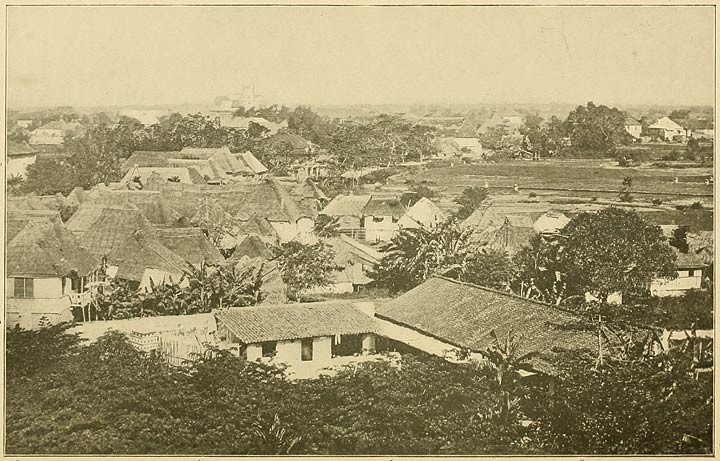
A Suburb of Old Manila.
Unfortunately, however, these envoys, returning homeward, were drowned, and shortly afterward two religious embassies were sent to Japan to renew the treaty and to convert the benighted inhabitants of that country to God and the true Church. After thirty days, sailing they arrived at their destination. The friar Pedro Bautista, chief of the embassy, was now presented to the Emperor Taycosama, and the treaty was renewed. The most important feature of this agreement was the permission to build a chapel at Meaco, near Osaka. This was opened with ceremonial pomp in 1594.
Now the chief of the Jesuits—the sect were by royal favor allowed to follow their calling among the Portuguese traders in Nagasaki—bitterly opposed what he deemed the exclusive right of his order, conceded by Pope Gregory XIII., and confirmed by Imperial decree.
The Portuguese traders, foreseeing that the arrival of Bautista and his priests was but a prelude to Spanish domination,—when they, naturally, would be the sufferers,—forewarned the Governor of Nagasaki.
The Emperor was alarmed; for he now also became convinced that the Philippine Ambassadors were actuated to missionary zeal by ulterior motives; and, fearing that the priests, by their doctrines, might pollute the fountain of his ancient religion,—thus paving the way for their domination and his own ultimate ruin,—he at once commanded that all attempts to convert the natives must cease. Bautista, in holy zeal, not heeding the Imperial injunction, was expelled, and retired to Luzon, leaving several of his embassy behind. Some of these also, obstinately persisting in violating the Imperial mandate, were arrested and imprisoned.
Upon his arrival in Manila, Bautista fitted out another expedition, and soon again landed in Japan with a company of Franciscans.
The indignant Emperor, convinced of the duplicity of the Spaniards, caused them to be seized and cast into prison. A few natives, who had forsaken the religion of their forefathers for the discord-breeding doctrines of the foreigners, were also apprehended. All—twenty-six in number—were then condemned to death. After their ears and noses had been cut off, they were exhibited in various towns, as a warning to the other foreigners and to the populace. Upon the breast of each hung a board, that announced the sentence of the wearer and the reasons for his punishment. They were then crucified, and, after lingering for several hours in great agony, were speared to death.
The colony was much perturbed when the news of the sad fate of the zealous Franciscans reached Manila. Special masses were said, and processions of monks daily paraded through the streets.
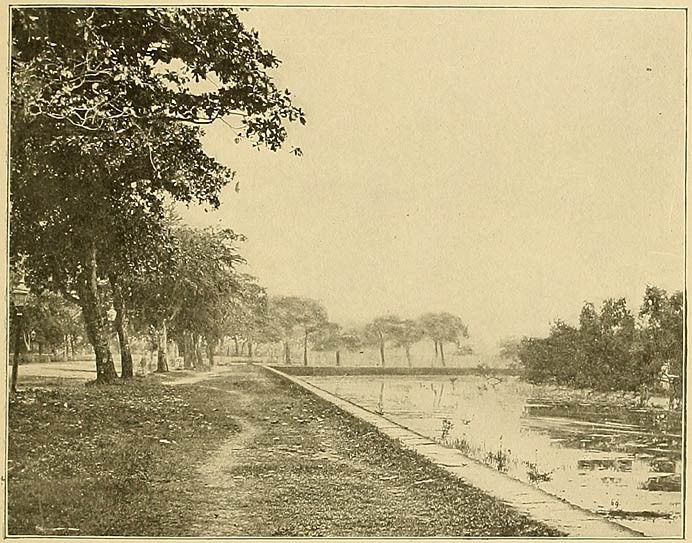
The Abandoned Acqueduct.
The Governor was finally prevailed on to send a deputation to Japan for the bodies of the executed priests; for the relics of these martyrs were fraught with too many possibilities of profit to their co-religionists to be left in a foreign country in ignominious sepulture. It is related, also, that these envoys were entertained most royally, and the Emperor gave them a long letter to the Governor, justifying with many reasons the late execution and his vigorous policy. It seems, however, that the relics were lost on the homeward voyage. Notwithstanding, many priests soon ventured to Japan, to court a martyr’s doom and to furnish relics for the adoration of their superstitious countrymen. Hence, it is not surprising that a great many other similar executions afterward took place.
Incensed at these frequent and persistent violations of his well-founded prohibition, the Emperor finally refused to treat with the embassies sent from the colony; and, as he and his successors continued to enforce their stern decrees, the transportation of Spanish priests to Japan was finally prohibited. Had the Japanese been less severe, less astute, it is highly probable that all the evil consequences that they foresaw,—as a result of the Christian propaganda,—would really have taken place. As it was, they saved both their religion and their Empire.


The British Occupation.
General Draper’s Expedition.
The affairs of the colony—now directed by custom and precedence into the narrow channel of official routine—flowed placidly along in undisturbed monotony. But in 1762 another enemy appeared before the walls of Manila; an enemy more powerful than any that had heretofore threatened the peace of that tropical capital. War had been declared by Spain against England, and the enterprising inhabitants of that little isle were not slow in following their traditional policy of striking the first blow. Rodney and Monckton were sent to Havana. This they took without great difficulty, and soon a British squadron, composed of thirteen ships, under the command of Admiral Cornish, was despatched to Manila.
It was the evening of the 22nd of September when the English fleet arrived in the bay, and the following morning Admiral Cornish sent an officer to the Governor, demanding the surrender of the citadel. At this peremptory proceeding the haughty Spaniard was highly incensed, and his refusal was couched in terms no less indignant than defiant.
Words having signally failed to bring the Spanish to terms, a demonstration of force was decided upon, and Brigadier-General Draper was sent on shore with a large body of troops. The garrison, however, treated this display with counter demonstrations, and Draper’s threats with lofty disdain. Draper therefore resolved to parley no longer, and the bombardment began the next day.
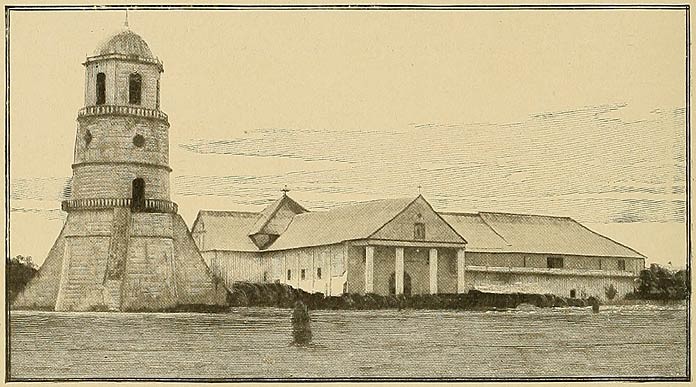
Tower of Defense, Church, and Priest’s House.
The British forces consisted of 1600 European troops, nearly 3000 seamen, and about 800 Sepoys—about 5000 fighting men. The forces in Manila, on the other hand, were only 603 Spaniards and 77 small guns. In the meantime, the ardor of the British had been inflamed by the capture of a Spanish galleon containing $2,500,000 in specie.
The Archbishop, Manuel Antonio Rojo, who acted also as Governor,—the seat of that functionary being vacant at the time,—seeing the hopelessness of the conflict, and desiring to avert unavailing bloodshed, counseled surrender. But the soldiers in the garrison, under their fiery leader Simon de Anda, were utterly intractable, and prepared vigorously for the defense. After a few unsuccessful sorties, the Spanish batteries, on the 24th September, began a rapid but harmless cannonade. Again a company sallied forth from the garrison to attack the invaders, but this also was repulsed, with considerable loss to the Spanish. The English now renewed the bombardment, and terrific havoc was made among the ranks of the enemy. Some two thousand natives, in three columns, advanced toward the three improvised redoubts held by the British, and were driven back with great loss and confusion. Panic-stricken, the natives fled back to their villages, and on the 5th of October the besieging forces entered the walled city. The bombardment, meanwhile, continued. Nor did it cease until the forts were demolished and most of the Spanish artillerymen killed. It is estimated that 20,000 cannon-balls and 5000 shells were thrown into the city.
The military men among the Spanish now counseled surrender. The civilians, contrariwise, were eager to continue the defense. But as most of the fortifications were destroyed, and since “confusion worse confounded” already reigned in the city, many fled to the surrounding villages.
The opposing civilians having barricaded and otherwise obstructed the streets, the British advanced into the heart of the city, clearing the way before them with a raking fire of musketry.
General Draper now sent Colonel Monson to the Archbishop, demanding instant and absolute surrender. The Archbishop appeared and offered himself as a prisoner, also presenting terms of capitulation. These provided for the free exercise of religion, the security of private property, unrestricted commerce between the Spaniards and the natives, and the English support of the Supreme Court in its attempts to preserve order.
The British Demand an Indemnity.
General Draper readily granted these terms, but demanded an indemnity of $4,000,000. To this the Spanish agreed, and these terms were then signed by both parties to the compact.
When the Union Jack was first unfurled from Fort Santiago, it is said that the British burst forth into a chorus of ringing cheers.
But their joy was not unmixed with sensations of sorrow; for, it is reported, over 1500 men, and many gallant officers, were lost in the assault. The city was then given over to the mercy of the victorious troops, and a riotous scene of pillage ensued; many excesses were committed, the Sepoys, in particular, committing many atrocities. General Draper forthwith gave the command that these outrages should cease; and guards were at once placed at the doors of the convents and the nunneries to prevent outrages on the women. A few thieving Chinamen, who had taken advantage of the confusion to add to their own profit, were hanged; and the General, it is said, with his own hand cut down a soldier that he caught stealing after his inhibition had been proclaimed.

A Native Village in the Foot-hills: Old Manila.
The English now demanded the payment of the stipulated indemnity, but the enforced contributions from the wealthy inhabitants, with the silver from the churches—all that the Spaniards professed to be able to collect—amounted to only a little more than half a million dollars,—but one-eighth of the stipulated sum. Threat and force were alike unavailing to produce the other monies promised, although the friars, it is believed, had secreted immense sums, determined at all hazards to preserve their accumulated store from the rapacity of their Protestant enemy.
By the terms of the capitulation the entire Archipelago had been surrendered to the British; but Simon de Anda, who commanded the Spanish forces during the siege, had now established himself in Bulacan as Provisional Governor, in opposition to the authority of the Archbishop who had bitterly denounced the surrender. The clergy, however, were the more influential part of the Colonial Government, and General Draper accordingly treated with them alone, obtaining their consent to a cession of all the islands to the King of England. Draper himself then returned to England, leaving behind a Provisional Military Government.
Admiral Cornish now demanded the payment of the million dollars that the British had finally decided to accept as full indemnity.
The Spaniard, however, continued to plead poverty, and the money was not forthcoming. Several thousands of dollars were eventually unearthed in the convent where the friars had hidden it. The British, though convinced of the deception that these holy brethren had practised to save these dollars,—wrung from the hearts of the poor,—were, however, unable to lay their hands upon the treasure.
Simon de Anda, the self-constituted Governor, now became unusually active in the provinces, and several expeditions were sent out to quell the various insurrections that he had been stirring up. One of these, numbering 600 men, under the leadership of Captain Eslay, in the province of Bulacan, assaulted and took a fortified convent. They were also victorious in some engagements with a body of natives, several thousand strong, under the command of Lieutenant Bustos, a Spanish officer. As several Austin friars had been found among the slain, the British rightly believed that their order had been conspiring against them. Many, therefore, were arrested. Eleven were sent back to Europe.
Naturally suspicious of all the friars, the English now entered the Augustine convent and found that these priests had been no less deceitful than their brethren in the other orders. Six thousand, five hundred dollars in coin were found hidden in the garden, and large quantities of wrought silver elsewhere. The convent itself was then searched and all the valuables found therein taken.
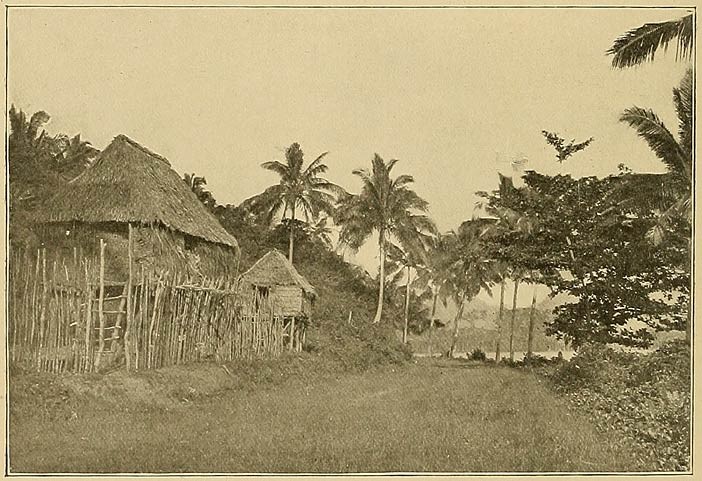
A Bamboo House in Pampanga Province.
About this time the Spaniards professed to have discovered a conspiracy among the Chinese in the province of Pampanga, the object being, they said, to murder Anda and his Spanish followers. The Chinese had raised extensive fortifications, saying that these preparations were all made as a defense against an expected attack from the British.
The Spaniards, however, suspecting sympathy with their enemies, attacked the Celestials and a general massacre of the Chinese followed. Many thousands, too, were killed that had taken no part in the war.
Admiral Cornish, disgusted and infuriated with their obvious deception and palpable dilly-dallying, again demanded the payment of the indemnity. But he was forced to content himself with a bill on the Madrid Treasury.
Anda now appointed Bustos Alcalde of Bulacan: he hoped great things of his seditious and unscrupulous lieutenant; he knew that he would resort to every means to harass the enemy: he therefore, accordingly, ordered him to recruit and train troops.
For Anda still cherished the hope of confining the British, perhaps, even, of driving them from the colony. So, with practiced subtlety and with masked deviltry, he set about accomplishing his grim purpose.
Intrigues Against the British.
The British were now kept busy suppressing the numerous intrigues against their power that sprang up among the Spanish residents everywhere. Many sorties also were made to dislodge the persistent and irrepressible Anda and his lieutenant Bustos, now encamped at Malinta, a village a few miles from Manila. Most of those assaults, however, proved indecisive and ineffectual. The priests proved troublesome, and were the cause of much bloodshed, teaching the natives that the British were infidels.
The Augustine friars were especially hostile, many laying aside the cowl for the helmet. At Masilo, indeed, the British were defeated by an Austin friar, who, with a small band of natives, attacked them from ambush.
The Austin friars, however, had some cause for grievance. For, according to a recent historian, they had lost nearly a quarter of a million dollars, fifteen of their convents were destroyed, several valuable estates despoiled, ten of the members killed in the battle, and nineteen were taken prisoners and sent as exiles to India and Europe.
On the 23d of July, 1763, an English vessel brought news of an armistice between the conflicting Powers. And in the latter part of August the British Commander received notice of the articles of peace, by which Manila was to be evacuated (Peace of Paris, 10th of Feb., 1763).
It was several months, however, before peace was finally established in the island, fierce quarrels having arisen among the rival factions of the Spaniards as to who should be Governor and receive the city officially from the British. The Archbishop having died, Anda, who was in actual command of the troops, was fully recognized by the British as Governor. Don Francisco de La Torre arriving at this time from Spain with a commission as Governor-General, Anda resigned the Government to him on the 17th of March, 1764. Several serious quarrels now took place, due to jealousy among the English officers; but Anda, on behalf of the new Governor, formally received the city from the British, who embarked for India, after having met all claims that could be justly established against them.


The Spanish Colonial Government.
The Encomiendoros and the Alcaldes.
In the early days of the colony there were, besides the Governor-General, the sub-governors, known as Encomiendoros, who rented their provinces at so much per annum, called Encomiendas, from the General Government. These Encomiendoros were usually men of wealth, that entered into politics as a speculation. More properly, I should say, as a peculation; for it became their policy to fleece the natives and to extort as much money as possible during the term of their incumbency. Few, indeed, left the scene of their civil brigandage without full coffers; and as enormous fortunes were to be made during a few years sojourn in the islands, no wonder that this office was eagerly sought after in Spain.
This imitation of the methods of the Roman tax-payers, however, became so demoralizing to the morale of the Spaniards themselves, and so ruinous to the colony and to the natives, that a more equitable policy was introduced. The Encomiendoros were succeeded by Judicial Governors, called Alcaldes, to whom was paid a small salary, from $300 upward a year, according to the prominence of the province.
This office, however, proved almost equally remunerative to the holders; for, by means of a Government license to trade, they were able to create, to their own advantage, monopolies in every line of industry, thus freezing out all competitors. Though each was responsible to the Central Government for the taxes of his provinces, yet this did not prevent the shrewd and unprincipled from finding profit here also. For, by a system of false weights and measures, the native, who, in lieu of silver, brought his produce in payment for taxes, was shamefully defrauded, the Alcalde sending the indebted amount to the Government storehouse and selling the rest to his own profit. In addition, many of these Alcaldes, by arbitrary decrees and despotic methods, conducted a system of public robbery that in a few years enriched them at the expense of the long-suffering natives; for them there was no redress, inasmuch as each Alcalde was also the head of the Legal Tribunal in his own province. These abuses, however, became so flagrant that the Alcaldes were finally forbidden to trade; but as this measure was not as effectual as had been expected, sweeping reforms were instituted.
To recount what these were; to mention in detail what malignant opposition was manifested by a large body of natives and resident Spaniards toward the purposed overthrow of the old system, would be only to reiterate well-known characteristics and abnormalities of the Spanish nature; placed, too, in but a slightly different setting.
I will merely add that these Alcaldes, these perpetrators and beneficiaries of wholesale misrule and dishonor, yielded finally to the reform-wave, and, accordingly, fell away before their own judicial perversion. And the new system, it must be confessed, is a great improvement upon the old.
But the evil wrought upon the Filipino mind and character was deep-planted. For, by the despotic and summary disposing of his labor and chattels, in the name of the King,—abetted frequently, too, by seemingly supernatural means,—respect for the Spaniard and the white man in general had fled, fear and distrust supplanting it.
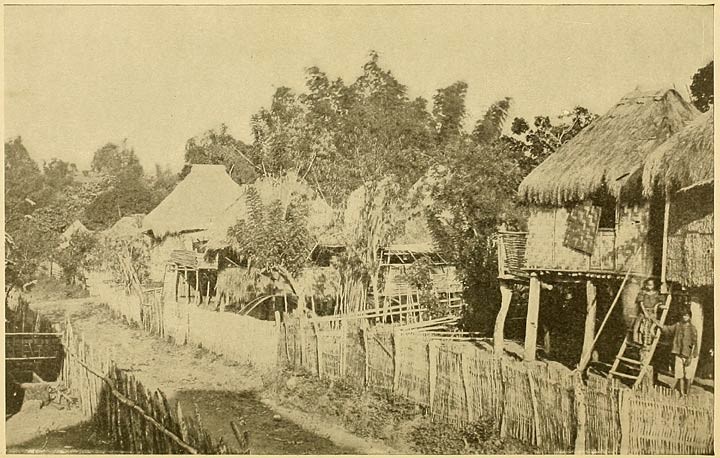
A Street Scene in Albay.
In the new order of things,—instituted by a decree from the Queen-Regent Maria Cristina, the 26th of February, 1886,—18 Civil Governorships were created, and the Alcaldes’ functions were confined to their Judgeships. And thus the former frightful distortion of justice was overcome and banished.
So, too, under this law of 1886 each Civil Governor has a Secretary, who serves as a check upon his chief, if he be illegally inclined.
Accordingly, two new official safeguards were thus erected in the fabric of Colonial Administration in these 18 different provinces.
The Present Division and Administration.
The colony was then divided into 19 civil provinces, including Sulu, and into 3 grand military divisions.
As before, at the head was the Governor-General,—the supervising and executive officer of the province,—directly responsible to Spain. His salary is $40,000 a year. He is assisted by an Executive Cabinet and by an Administrative Council. The Provincial Governor, the successor to the Alcalde, must be a Spaniard, and at least 30 years old. He is the direct representative of the Governor-General and it is his duty to execute his decrees and to maintain order. He also has the power of appointment and removal, presides over provincial elections, controls the civil and local guard, interprets the laws,—usually to suit his own profit or convenience,—supervises the balloting for military conscription, can assess fines to the amount of $50, or imprison for 30 days, is Superintendent of Public Instruction, issues licenses and collects taxes. It is his duty also to furnish statistics and to control the Postal and Telegraph service. He is the Superintendent of health, prisons, charities, agriculture, forestry, and of manufactures. It will thus be seen that his duties are as diverse as they are important. He is now allowed no percentage, nor other emolument than his salary. At the same time, a shrewd Governor is yet able to reap a golden harvest. This, however, can be done only in conjunction with other Government officers.
Owing to the extreme shortness of his term of office—three years only—there is no incentive for the improvement of his province, as his successors would reap the results as well as the credit of his industry. Besides, he has no reason to hope that a good work begun will be a good work continued; for the next Governor may be averse to exertion, or may be at variance with his policy.
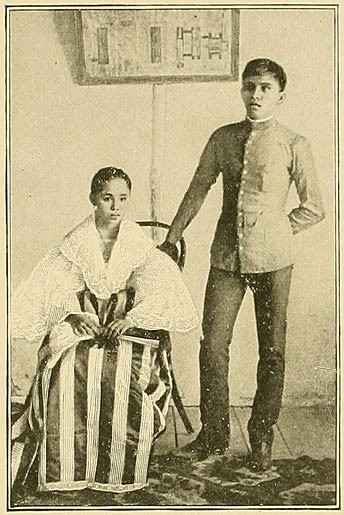
Children of a Gobernadorcillo.
Most of the Governors live in good style; as a rule they spend about two hours a day in Government employ. Is it to be wondered at, then, that this office is so eagerly sought after in Spain?
There are about 750 towns in the colony; each governed by a Gobernadorcillo, “Little Governor,” called Capitan; usually a native or half-caste. This office is elected every two years, and is to the Provincial Governor what the latter is to the Governor-General. He is the tax-collector of his district, and is, furthermore, responsible for the amount apportioned to his district. If he fails to collect this, he must make the deficit good out of his own pocket. Under him are a number of deputies, called Cabezas, each likewise responsible for another division of the population called a Barangay,—a collection of forty or fifty families. If the individuals of this group are unable to pay, the property is distrained and sold by the deputy, who would otherwise have to make good the amount himself. If the proceeds of the sale fail to equal the indebtedness of the delinquent, he is cast into prison.
I have often seen respectable men deported to the penal settlements; and for no other offense than inability to pay the oppressive tax laid upon their shoulders, regardless of the season,—whether productive or not. Their families, meanwhile, left without a head, were thrown into the most woeful destitution.
The Gobernadorcillo gets the munificent salary of $200 a year, though his expenses, for clerk-hire, for presents to his chief, and for entertainments in his honor, are often many times greater. A shrewd Gobernadorcillo, however, manages to make something out of the place, which, in some districts, is eagerly sought after by rich planters. The official dress of this worthy is a short black jacket, the tail worn over the trousers. He also carries a stick as a sign of authority. To him is entrusted the apprehension of criminals, and he has command of the local guards, or cuadrilleros, the police of the towns.
The Taxes and What Became of Them.
It can easily be guessed that the taxes are not inconsiderable, when I simply mention a few things that are assessed: There is a tax on the ownership and sale of live-stock and vehicles, on realty, and on all private industries and manufactures. Opium, liquors, stamps, tobacco, and lotteries yield an immense revenue. Then there is a Community-fund, which is usually several hundred thousand dollars a year in each province, and is supposed to be spent in the interest of the community. The Chinese Capitation tax also brings in a large amount. But the most common and onerous tax of all is that arising from the Government sale of Cédulas, or documents of identity, which is a poll-tax from $25 down. The individual paying less than $3.50 is subject to 15 days’ hard labor each year and to a fine of 50 cents for each day that he shall fail to work. Those whose cédulas have cost more than $3.50 must also pay a municipal tax of $1.50. The cédula is also used as a passport, and must be brought into court to render legal instruments effective.
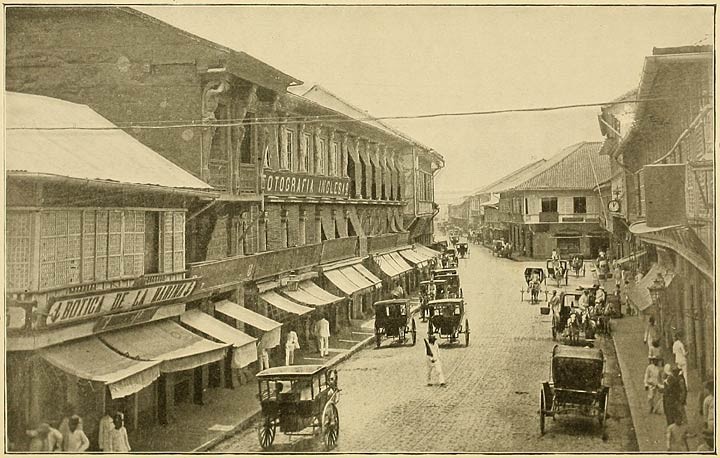
Along the Escolta; Principal Business Street in New Manila.
From this brief and imperfect survey of the system of provincial taxation, it can easily be gathered that the revenues are considerable; and yet, of the hundreds of thousands of dollars extorted from the natives in each province, under the plausible pretexts of an avaricious policy, it is safe to say that not a dollar is expended for any local improvements. No building of bridges, no constructing of highways, no public schools, nor halls of justice must mar the stagnant serenity of provincial life. Nothing is ever repaired; a system of “let alone” blights every aspiration, and is fatal to the extension of commerce and industry. Consequently, in the wet season, for vehicles, the public roads are impassable, and, in many parts of the country, for months transportation is practically at a stand-still. As if effectually to close every door to progress, private individuals, too, are forbidden by law to repair the highways.
Did any government ever foster a more imbecile and iniquitous policy for its own damnation?
Although the speculations in the colony are not so enormous as formerly, yet there is no doubt that they still amount to several millions annually; mostly, however, at the seat of Government in Manila. It is indeed notorious that General Weyler, during his brief incumbency of the office, succeeded in placing several millions of dollars to his credit—I should have said to his dishonor!
Dilatory and Abortive Courts.
Perhaps no feature of Colonial life is fraught with more evil and is so disgusting, as the process of the courts. The Supreme Court of the early years of the colony was modeled after the one in Majorca, and on several occasions when the Governorship has been left vacant, it has assumed the functions of the executive—pro-tem.
There are two Supreme Law Courts in the colony: one in Manila; the other in Cebú. The President of the one in Manila has a salary of $7,000 a year; that of Cebú, $6,000. There are also 41 Superior Courts, of various degrees of importance, the salary of the judges ranging from $2,000 to $4,000 per annum. The department of Justice alone costs the colony about $350,000 a year.
The dilatoriness of the courts has become proverbial. It is, in fact, years before a case can be brought to a close. Meantime, the litigant has been fleeced out of an amount perhaps a hundred times the value of the article under litigation. The islands are full of native pettifoggers from the law schools of Manila, who have learned too well the meaning of the Spanish mañana. A suit can never be considered as disposed of; for another judge, scenting the faint possibility of a fee, may again have it retried. Thus I have seen the lives of acquitted persons again brought into jeopardy by the meddlesome officiousness and the grasping greed of a new judge. He that goes to court in the Philippines must not do so without reckoning the cost.
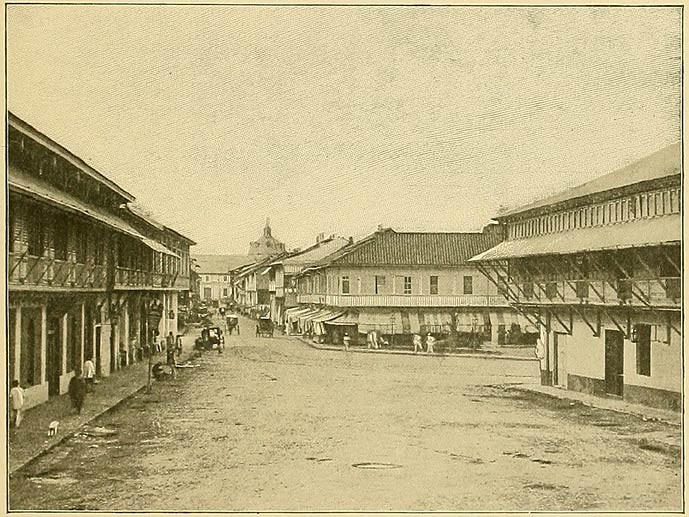
A Business Street in Old Manila.
Commenting on this, a recent English traveler says: “Availing one self of the dilatoriness of the Spanish law, it is possible for a man to occupy a house, pay no rent, and refuse to quit on legal grounds during a couple of years or more.” A person who has not a cent to lose can persecute another by means of a trumped up accusation, until he is ruined by an “informacion de pobreza”—a declaration of poverty—which enables the persecutor to keep the case going as long as he chooses, without needing money for fees.
A New Yorker’s Experience.
The following experience of an American friend of mine, whom I knew very well in Manila, will bring out in a graphic way the course of justice in the Philippines. Nor is his experience uncommon. It is, in fact, the usual one of the stranger or the native who goes to the fountain of Justice for the redress of a grievance.
I quote part of his letter written to a common friend:
In 1871 I joined Mr. William Morton Clark of Philadelphia, who had a large timber business on the island of Luzon, and started cutting some timber contracted for by the Chinese government.
I soon discovered that I was interfering with the business of a certain priest, who was also in the same line of business.
Shortly before this, this priest and an inspector of roads had loaded the Spanish bark Santa Lucia for Hong-Kong, and had made things so disagreeable for others who had tried to ship merchandise that foreigners were becoming afraid to risk their capital.
Mr. Clark finding how things were going on soon abandoned the enterprise, and I then determined to fight the thing out on my own account.
At this time I had 25,000 cubic feet of hard timber, cut and squared, for a foreign market, eighty-two buffaloes for hauling, and a plant of machinery and appliances valued at $7,000.
I had a license for carrying on my business, duly granted by the superior government, and in 1874 chartered a vessel at Manila to carry my timber to Hong-Kong, and then went to the port of Love, where my timber was, taking with me $940 in gold to prepare for the vessel’s arrival and to continue cutting.
Upon arriving at Love I found that during my absence at Manila a portion of my timber had been forcibly taken possession of and had been shipped on board the Spanish bark Teresa by Joaquin Barcello, the captain of the Teresa, who was then on his way to Hong-Kong. I also learned that my buffaloes, stock and rice had been removed, and that Juan Gaal, my foreman, whom I had left in charge of my property, was all subject to the orders of this Barcello, and that my choppers had been bribed into the service of Padre Fidel Moreno, the priest of the town.
When I complained of this I was confronted with a document signed by the Adelantado of Love, to the effect that no notice should be taken of my complaints, to give no testimony in my behalf (thereby shutting me out of my legal rights), and that my foreman, Juan Gaal, should look after the interests of Captain Barcello until the captain’s return from China.
I then applied to the Governor, protesting against the robbery of my timber and the appropriation of my property by Captain Barcello and Juan Gaal, but was merely told that the commandante had so ordered and that there would be no interference.
Seeing there was no justice to be had at home, I sought to regain my rights at Manila and so left the next morning for Manila on the bark Industria, taking with me all my private papers, contracts, &c.
That night we encountered a terrible typhoon in which the vessel was wrecked, and all that I was able to save was the clothes I then wore.
Upon my arrival at Manila I put in a complaint against Captain Barcello, and also against Padre Moreno and the commandante of the district, as accomplices in the above fraud and robbery.
The case dragged along, as is customary in Spanish countries, and about a year later my funds were all exhausted. At this time a Spanish friend at Manila, acquainted with my misfortunes, took me to his home and lent me some money, shortly afterwards sailing for Europe.
With this money I returned to Love, expecting to find at least a portion of my timber left which I intended to ship. Upon arriving at Love I found that Captain Barcello had been there before me and had seized and shipped everything but a few worm-eaten logs. Barcello had even hauled the timber I had cut in the mountains, and aided by his accomplices had cleaned me out entirely during my absence.
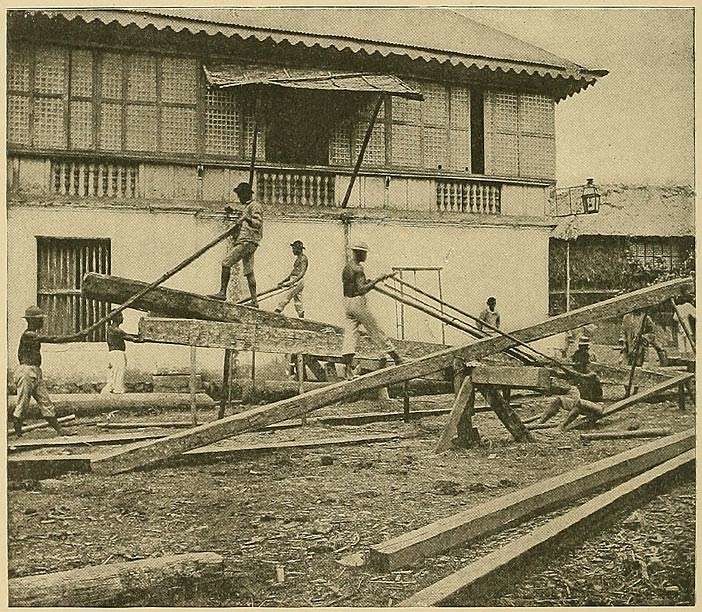
In the Lumber District.
I saw it was no use to complain further, and so I set to work to cut some more timber, and after much trouble and expense got two cargoes ready and left for Manila, intending to go from there to Hong-Kong to sell what I had last cut.
Learning that Barcello was in Manila and was about to leave for Hong-Kong, I applied to the Alcalde, Señor Torranco, who had my suit in charge, to stop Barcello from leaving the country, as my case against him had not yet been decided.
This didn’t benefit me much, as the Alcalde wouldn’t grant my request, and although a case of robbery and fraud was pending against him, Barcello was allowed to leave without hindrance.
I then applied for my passport, but to my surprise this was refused me, on the ground that my suit should first be decided.
I then returned to Love, having authorized Charles Germain to charter for me, and in due time I had despatched three cargoes to Hong-Kong, but finding that my presence in Hong-Kong would be absolutely necessary for the success of my business I applied a second time for my passport, and was again refused.
Thinking that if I offered security I would be allowed to leave the town, I named a friend who was willing to go on my bond, but the Alcalde shut me off from this chance by sending his clerk to my friend’s house, and succeeded in so frightening him that my friend withdrew his name as my bondsman.
I know that this act was done deliberately, as at this time, and during the whole of my suit, the Alcalde was on the most intimate terms with Captain Barcello.
My next step was to protest against Señor Torranco trying or hearing my case, as I showed conclusively that he was hand and glove with Barcello. This had the desired effect, and the case was transferred to another Alcalde. Torranco had, however, served his friend well: he had stopped my passport at a vital point in my business on a frivolous pretext.
I was a foreigner, and that was enough, and not being able to obtain permission to leave the country, all my efforts being frustrated by those in power, although I was the aggrieved and injured party, I was held a captive in Manila, my business, meantime, going to ruin abroad.
This state of affairs continued for months, with no signs of any beneficial change in my circumstances, and so I finally brought the matter officially before the American Consul, who wrote to the Captain-General, stating my case in full, and advised me to abandon my suit, which I did, the Consul officially notifying the Captain-General of the fact.
From that day to this I have been sustained by my friends. My means were exhausted, and I was compelled to leave the hotel a beggar on the streets, with my resources all gone and heavy debts pressing upon me.
Mr. Collins was never able to get justice, though he tried frequently. His experience is no uncommon one. The establishment of a pure judiciary and the purification of the courts should be one of the first reforms undertaken by the Americans.


The Church in the Colony.
Priesthood and the People.
The hierarchy of the colony consists of an Archbishop, resident in Manila, and four bishops. The Archbishop lives in a Palace, and has a salary of $12,000 a year, while the annual expenses of the Cathedral in Manila are not less than $60,000. It was not till several years after the founding of Manila, in 1578, that the first bishop was consecrated and a Cathedral was built. Not long afterward, the Manila See was raised to an Archbishopric.
The present hierarchy costs the Government about $800,000 a year. The salaries of the priests range from $500 to $2500 per annum; but, in addition, they derive a large income from the sale of masses, indulgences, marriage, burial and baptismal-fees, and from the various commissions incident to their calling. They receive all, and give nothing.
The several orders have immense revenues from investments in the islands and in Hong-Kong. They possess magnificent estates; but, notwithstanding their enormous wealth, they are hard task-masters, grinding the poor to the paying of the last penny. Their injustice and tyranny have of late aroused bitter complaint, and are a chief cause of the late insurrection.
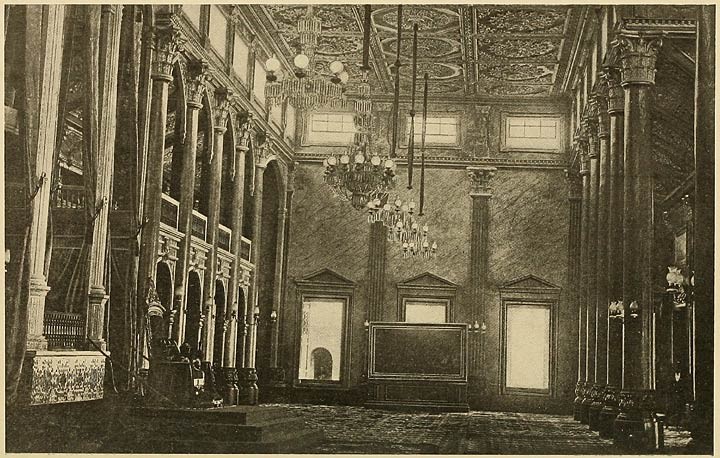
Throne Room of the Archbishop’s Palace.
And yet the picture has its lights as well as its shadows. The friars have, also, in many places, the confidence of the natives, and, on the whole, surely influence them for the repression of their vicious and brutal instincts. A half-barbarous people can be led only by superstition, and a semi-sacerdotal government is most effective among an ignorant people.
The friar is usually from a lowly family, and is, therefore, able at once to enter into sympathy with the humble life of the people. He is doctor, architect, engineer, and adviser; in all things truly the father of the community, the representative of the white race and of social order. Such is the ideal village-curate, and many such—good men and true—are to be found. There, are, however, many black sheep among them. And the gross immorality of those that should be examples in virtue, has been a great impediment to the work of the Church among the thinking natives. There are, also, some Chinese and native friars; but, owing to the various insurrections, in which some of these were involved, they are no longer trusted; in fact, a native can no longer become a priest.
So great is the paternal influence of the priests, that I have often seen delinquent parishioners flogged for non-attendance at mass.
The Chinese often adopt Christianity for social or business reasons, or that they may marry the daughter of a native.
All over the islands are shrines to which the people make long pilgrimages; such pilgrimages, however, partaking more of the character of feasts than of fasts. The self-denial and the self-imposed hardships of the European devotee have never found fruitful soil in the native character. He is never so glad as when a holy-day furnishes him with a pretext for an elaborate feast, and, in truth, the feast-days alone relieve the gloom of his monotonous life. Two of the most famous shrines are the Holy Child of Cebú and the Virgin of Antipolo,—thousands visiting them yearly.
Conflicts Between Church and State.
A book might be written, and an interesting one, too, about the various contests between Church and State during this period of the colony’s history.
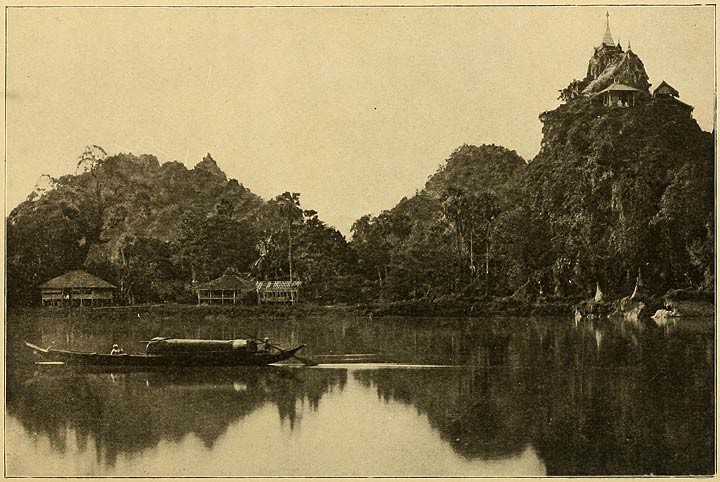
The Famous Shrine of Antipolo.
The Archbishops—with an exaggerated idea of their own importance—soon became exceedingly troublesome to the Civil Power, by reason of their excessive claims. This was never more manifest than in their pretended immunity from all State-control. Upon one occasion the Governor demanded of the Archbishop to produce several persons charged with capital and other crimes, who had found asylum in a convent. The Archbishop promptly refused, claiming the prerogative of Sanctuary. The accused not only openly defied the Governor, but armed themselves, intending to resist, should he endeavor to apprehend them. The Governor, learning this, arrested the Archbishop, and confined him and the priests that had been his abettors in prison, charging them with conspiracy against the Government.
The news spread over the province with incredible swiftness, and hundreds of priests, collecting hordes of natives on the way, marched with riotous demonstrations and violent clamor to the Palace. Franciscans, Dominicans, and Augustinians forgot their fierce rivalry and joined together in the shout, “Long live the church!” “Long live King Philip V!”
The mob burst open the doors of the Palace, and, the terror-stricken guards having fled, they forced their way to the Governor, who calmly awaited them, standing with a loaded musket in his hand. He then ordered the rabble to retreat, but with wild shrieks, incited by the priests that accompanied them, they rushed on him. The Governor pulled the trigger, but his flint failing to strike fire he defended himself with his bayonet. He was finally surrounded; and insulted, beaten, and stabbed, he was dragged to jail.
The son of the Governor, running to his father’s aid, was severely wounded by the rebels. Attempting, nevertheless, to cut his way through, he was killed, and his body horribly mutilated.
The mob then broke open the door of the fortress where the Archbishop was confined, and liberated him. This worthy was then escorted with much acclamation to the Palace, and assumed charge of the Government, which he held for four years.
This is only one of many exciting conflicts between these two factions, sometimes one, sometimes the other, being victorious. On four different occasions the Governorship of the colony was vested in the Archbishop.
Every Governor-General that has attempted to introduce a liberal policy has been recalled; for the friars’ combined influence is all-powerful. Not even the Archbishop has been able to prevail over the corporation of the friars; and if he would retain his see, he must not oppose their traditional prerogatives, nor work for that reform that would mean the decline of the orders. Indeed, only a few years ago, one Archbishop, who had made several ineffectual attempts to correct the abuses in the orders, was one morning found dead in his bed. His successors have taken good care to profit by his example.
Clashings among the Friars.
Interesting is the story of the bitter rivalries between the different orders, who, though of one religion, were extremely jealous of one another, showing little of that charity and forbearance that Christianity, above all, is supposed to inculcate.
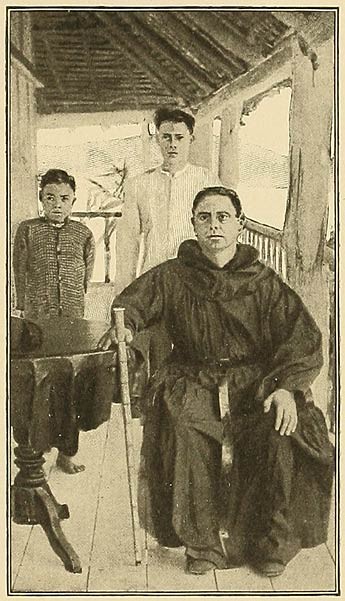
A Parish Priest.
On account of several clashes with the civil power, a priest had early been sent to Spain by the Church party to gain redress of grievances. Chief of these was their inability to guide the entire affairs of the colony into a narrow ecclesiastical groove. The result was, the introduction of new laws so favorable to the clergy, that, within three or four years, the colony swarmed with mendicant friars, whose habits, say the old chroniclers, placed the Spaniards and their vaunted religion in a most ridiculous light before the natives.
As most of these monks belonged to a different order from the bishop, who was an Augustinian, and as they often boldly defied his authority, he became greatly alarmed at their expanding power. But, after a fierce struggle, he succeeded in so curtailing their privileges that he still retained his pre-eminence in the colony.
Urdaneta and his Austin friars were the pioneers in the islands, and following them came a horde of Dominicans and Franciscans, and the Recoletos, or bare-foot monks. As the saving of souls was the chief policy of Philip II., the co-operation of the friars was eagerly welcomed by the early Colonial Government, and it must be admitted that without their influence the lot of the natives would have been a far harder one. For the substitution of the rites of paganism for those of Christianity, even in so crude a form as taught by the friars, was, in the main, beneficial. Religion—though not of a very exalted kind—was put on an ethical basis, and the self-denial, obedience, and sacrifice that formed the foundation of the new doctrine, somewhat reconciled the conquered races to the loss of their primal freedom.
The Monks Opposed to Reform.
These orders, presenting the united front of a corporation, were extremely powerful, and practically unassailable. When arrayed against an individual, it always resulted in his defeat,—that is, his expulsion or imprisonment. They practically had their way in all things and under all circumstances. Nothing could withstand them; for, to attack one friar was to attack his whole order. Thus, much injustice was occasioned. I have known a highly respectable man, possessed of great wealth, cheated out of house and home—yes, his very liberty—through the intrigues of a friar that desired to enrich his order. Such societies are a cancer in the body politic,—a constant enemy to good government, a menace to justice, and a foe to liberty.
In the future history of the islands, this will be found one of the hardest problems to solve. The easiest and most effective plan, it seems to me, is to cut the Gordian knot—that is, to expel the whole body of friars from the islands. By so doing, much shedding of blood will be saved. For I do not believe that these good brethren will soon cease to foment insurrection against the hated Protestant conqueror. They have ever been breeders of mischief under the congenial rule of Catholic Spain: what won’t they do under the régime of enlightened America, whose first thought is the liberty that means death to extortion and oppression—the cardinal principles of their order. By this, I do not mean a propaganda against the Catholic Church; for I am a Catholic myself, and firmly believe that this religion is far better suited to the character of our people than any form of Protestantism. But the appointment of secular Spanish or American priests to the parishes would do away with the evils of the other system, without doing violence either to the Church or to the conscience of the natives.
The monks have opposed every attempt at reform. Their policy has ever been the policy of ignorance, knowing that their livelihood depended upon its perpetuation. It has been their aim chiefly to limit public instruction to the mere rudiments of knowledge—giving to every subject a religious bias. Even the colleges and the University of Manila are not free from their narrow supervision; while they have ever maintained a rigid censorship over the press.
The natives, however, are gradually breaking through the network of superstition that centuries of priestcraft have woven round them. That they are open to conviction,—to the light of reason and the hope of truth,—deeds bear witness.
None but the most enlightened natives, of course, recognize, as yet, their spiritual wants or desire a higher moral state, but many of them, privately, attest their waning belief in the Church monopoly of all things temporal in their lives.
Still, owing to the reasons previously stated, those that thus impugn and combat ecclesiastical preponderance, do so rarely except by secret word or in a limited conclave.
But the enlightening and invigorating effects incidental to American occupation will inevitably loose their tongues and rally recruits to their new standard of thought.
Of this I hope and expect great results.


The Various Tribes of the Philippines.
Character of the Natives.
To judge of the character of one’s own people is extremely difficult. One is likely to be either too severe or too complimentary. However, I believe, that—after a residence of many years in England and on the Continent, and a subsequent stay of eleven years in America, with frequent visits to the Philippines—I am able to judge in the abstract, and, in fact, comparatively to look upon my own countrymen with the eye of a thorough cosmopolitan.
The natives of the islands are a branch of the Malay race, and may be divided into three large groups,—the Tagalogs, the Visayos, and the Sulus,—each group subject to modifications and exceptions. The Tagalogs inhabit Luzon, the northern islands of the Archipelago, and it is with these that we have mainly to deal, as they are by far the most numerous and the most intelligent part of the population, forming, as they do, also the majority of the inhabitants in Manila and in the largest ports.
The first thing that in the native character impresses the traveler is his impassive demeanor and imperturbable bearing. He is a born stoic, a fatalist by nature. This accounts for his coolness in moments of danger, and his intrepid daring against overwhelming odds. This feature of the Malay character has often been displayed in the conflicts of the race with the Europeans in the East Indies. Under competent leadership the native, though strongly averse to discipline, can be made a splendid soldier. As sailors, too, I do not believe they can be equalled. For, lithe, active, and fond of the water, the Malays have ever shown their inclination for the sea. Their pirates, coursing in their prahus, have, till a few years ago, for centuries infested the bays and inlets of the eastern Archipelagos, looting the towns and villages on shore and taking as booty such foreign merchantmen as they were able to overcome. On account of the ravages of these fierce eastern Vikings, Europeans have come to regard the whole Malay race as cruel and bloodthirsty. But these were pirates in their own waters, and preyed upon their own countrymen, by whom they were feared no less than were the Spanish and English freebooters of old by their countrymen. Why, then, should their outrages and rapacity be taken as indicative of the Malay character any more than are the atrocities of the Caucasian corsair of their race?
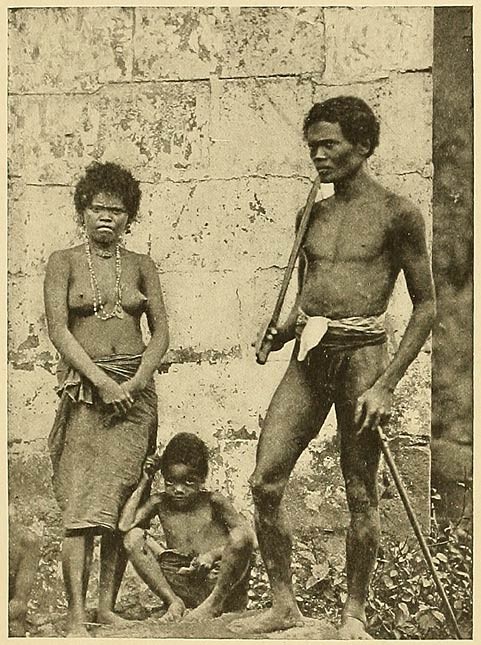
Negritos of Pampanga.
The natives are all excellent swimmers, and are absolutely fearless in the water. I have seen groups of boys diving thirty or forty feet for pennies, dropped into the sea by foreign officers on ships anchored in the bay. Many swim miles with the greatest ease; and it is no uncommon sight in the outlying districts to see groups of naked men plunging with drawn dagger among a shoal of sharks, with whom they fight with a fierceness that always results in the victory of the native.
Along the beach at Manila, on a summer evening, at the close of the day’s labor, hundreds of hands from the various tobacco factories—men, women, and children, of all ages and sizes, married and unmarried—may be seen disporting themselves, with peals of laughter and squeals of delight, in the cool surf.
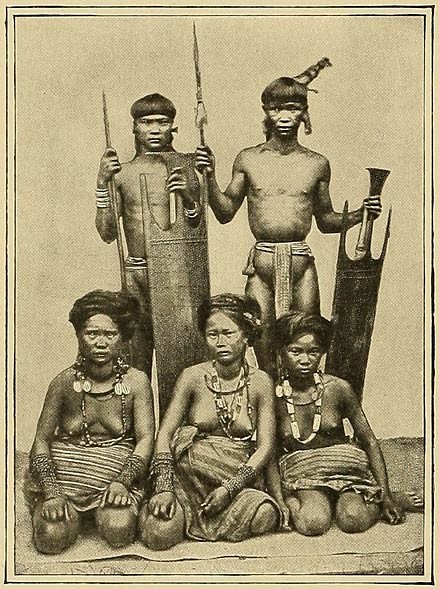
The Igorrotes.
As a result of the stoicism of the native character, he never bewails a misfortune, and has no fear of death. When anything happens he merely says, It is fate, and calmly goes about his business as if nothing had happened.
Europeans often seem to notice in them what they deem a lack of sympathy for the misfortunes of others; but it is not this so much as resignation to the inevitable. This, it must be confessed, saves them many a bitter pang. The educated native, however, impregnated with the bitter philosophy of the civilized world, is by no means so imperturbable. While more keenly alive to the sufferings of others, he is also more sensitive to his own sorrows. After all, whether he is any happier for his wisdom, is a question.
Incomprehensible inconsistencies obtain in nearly every native. Students of character may, therefore, study the Filipinos for years, and yet, at last, have no definite impression of their mental or moral status. Of course those living in the cities are less baffling to the physiognomist and the ethnologist; for endemic peculiarities have been rubbed off or so modified, that the racial traits are not obvious.
But observe the natives in the wilds, in their primitive abodes, where civilizing forces have not penetrated! You will then be amazed at the extraordinary mingling and clashing of antithetical characteristics in one and the same person; uncertain as to when the good or the bad may be manifested. Like the wind, the mood comes and goes,—and no one can tell why.
I myself, with all the inherited feelings, tastes, and tendencies of my countrymen,—modified and transmuted, happily,—have stood aghast or amused at some hitherto unknown characteristic suddenly manifesting itself in an intimate acquaintance; and after I had been for years, too, wholly ignorant of his being so possessed or obsessed. And after that, the same mental or moral squint would be displayed at irregular intervals.
It is said by some that the native is shiftless and improvident.
It is true that he is not noted for foresight and energy, as are the peoples of the temperate zones; but his indolence is the result of generations of tropical ancestors. Even the most energetic Europeans yield, in a few years, to the enervating effects of the climate, and are unable to shake off the lassitude bred by the heat. Besides, deprived by the Spaniards from all active participation in affairs of the Government, and robbed of the fruits of industry, all incentive to advancement and progress was taken away. He, therefore, yields with composure to the crushing conditions of his environment, preferring the lazy joys of indolence rather than labor for the benefit of his oppressors. Naturally. Recent events, however, show that, given the stimulant of hope, even the “indolent natives” of the Philippines can achieve and nobly dare.
Some Spaniards also have asserted that the Filipinos are naturally disloyal and treacherous, and that their word is not to be depended on.
Now, the whole world knows that they have every reason to be disloyal to the Spaniard, who has for centuries so cruelly oppressed them. The devotion to the cause of freedom, however, which has recently made Rizal and hundreds of others martyrs to Spanish cruelty, shows that they also have the stuff that heroes are made of, and that they can be loyal to an animating principle.
In many places the natives are unwilling to work without pay in advance, and this has been a great drawback to investors. For, after receiving their money, they frequently refuse to perform a stroke of work, knowing that their employer has no remedy except in the dilatory process of the courts, which would only increase his expense and exaggerate his troubles. This has no terrors for the native. While, of course, this is to be deprecated, it may be remedied by gaining the confidence of the natives; for it is undoubtedly the result of generations of Spanish robbery, where these people were forced to labor for their employers,—frequently the priests,—having no reward save the lash or promises of a golden crown in heaven. They, therefore, naturally look upon investors with some suspicion. However, in the more civilized districts, where modern and humane business methods prevail, hundreds of thousands are employed, to the profit both of themselves and their employers.
Though calm, the native is not secretive, but often loquacious. He is naturally curious and inquisitive, but always polite, and respectful withal—especially to his superiors. He is passionate, and, in common with all half-civilized races, is cruel to his foes. The quality of mercy, like the sentiment—as distinguished from the passion—of love, is perhaps more the product of the philosophy of civilization than a natural attribute of the human heart. The romantic history of Mediæval Europe, as compared with the placid present, is proof of this.
All travelers unite in attributing to the natives extreme family affection. They are very fond of their children, who, as a rule, are respectful and well-behaved. The noisy little hoodlums of European and American cities are utterly unknown. The old are tenderly cared for, and are venerated; while in almost every well-to-do household are one or two poor relatives who, while mere hangers-on, are, nevertheless, always made welcome to the table of their host. Indeed, the hospitality of the Filipinos is proverbial. A guest is always welcome, and welcome to the best. The better class, too, gladly embrace every opportunity to feast their neighbors or the stranger within their gates.
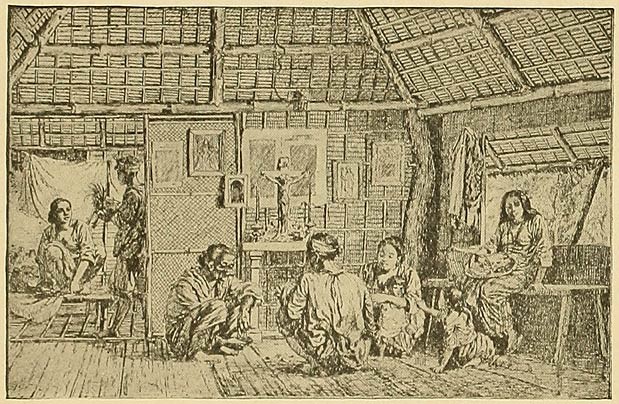
Interior of a Native Hut.
As a rule, the people are superstitious and very credulous; but how could they be otherwise? For three hundred years they have been denied even the liberty of investigation; when no light, save the dim glimmer of priestcraft pierced the utter darkness of their lot. Those that have been educated, however, have proved apt converts—only too apt say the priests and the Spaniards—to the conclusions of Science and of modern research.
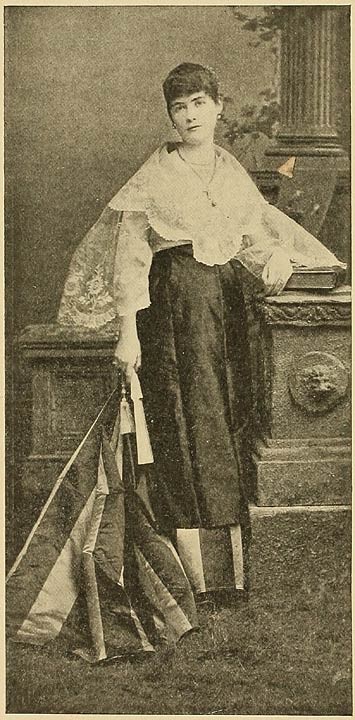
A High-born Filipina: Upper Garment of Costly Piña.
The native is rarely humorous and seldom witty. He is not easily moved to anger, and when angry does not often show it. When he does, like the Malay of Java, he is prone to lose all control of himself, and, with destructive energy, slays all in his path. This is infrequent, however, but is a contingency that may occur at any time.
If a native has been unjustly punished, he will never forget it, and will treasure the memory of his wrong until a good opportunity for revenge presents itself.
Like all courageous people, he despises cowardice and pusillanimity. He has, therefore, but little regard for the meek and humble Chinaman, who will pocket an insult rather than avenge himself. He greatly esteems the European, who is possessed of the qualities that he admires, and will follow him into the very jaws of death. He is easily awed by a demonstration of superior force, and is ruled best by mild but firm coercion,—based upon justice. He is not often ambitious, save socially, and to make some display, being fond of ceremony and of the pomp and glitter of a procession. He is sober, patient, and always clean. This can be said of few peoples. He easily adjusts himself to new conditions, and will soon make the best of his surroundings. As servants they are honest, obedient, and will do as they are told.
It must be said that they enjoy litigation more than is good for them or for the best interests of the colony. There must be some psychological reason for this. It doubtless gives some play to the subtlety of the Oriental mind. It is said that he lacks the sense of initiative; and to some extent this may be true. The recent conduct of Aguinaldo—a full-blooded native—proves, notwithstanding, that he is not wholly deficient in aggressiveness nor in organizing power.
Though not as artistic as the Japanese, the Filipinos have shown many evidences of art talent. This is seen in the embroidery of the women, as well as in the work of the native painters and sculptors. Some of these have been honored with high prizes at the Art Exhibition in Madrid. I remember particularly the brothers Luna: one educated in Spain, and there distinguished by his remarkable talent with the brush; the other known for his wonderful virtuosity.
Moreover, in nothing are the Filipinos so proficient as in music. Every village has its orchestra, and in the evening the whole district turns out to enjoy its playing.
All the people are, in fact, born musicians; even little boys and girls of five or six years of age play the harp, the guitar, or the piano as if by instinct; while their elders show a proficiency that, when their opportunities are considered, is truly astonishing. The clergy, appreciating that music is the foe of vice and a promoter of virtue, have wisely encouraged the natives in this art. It is now taught in all the higher schools in the colony.
At the many feasts, religious and secular, which are the delight of the natives, music is always the most enjoyable feature, the bands playing for hours together, both performers and listeners being so engrossed as to be wholly unconscious of the lapse of time.
A Native Wedding.
The native usually marries early,—the brides often but eleven or twelve years of age. A marriage-feast is entered into with pomp and ceremony. It is a not unimportant occasion for the priest also, who usually sets the day, and expects a large fee,—dependent upon the wealth of the contracting parties. The evening before the ceremony, both bride and groom go to confession, to receive absolution. About five o’clock the following morning they leave the house of the bride, joined by a long procession of relatives.
After mass has been said, the bride and groom stand before the priest, who places over their shoulders a thick mantle, which is to typify the bodily union. He then recites his formula and asks the usual questions. To these both respond in the same low voice characteristic of such replies the world over. As the wedded pair are leaving the church, a bowl of coin is passed to them. The new husband stops, takes a handful and gives it to his wife, who receives it and returns it to the bowl. This is a token that he gives to her his worldly goods. All then solemnly return to the paternal residence, where, meanwhile, a banquet has been prepared.
This feast is called Catapusan which means a gathering of friends. All the notables of the village, as well as all the relatives on both sides, are invited to it. The table is loaded with the good things of the season. Light liquors, chocolate, and sweetmeats are then offered to the guests, with betel-nuts and cigars and cigarettes.
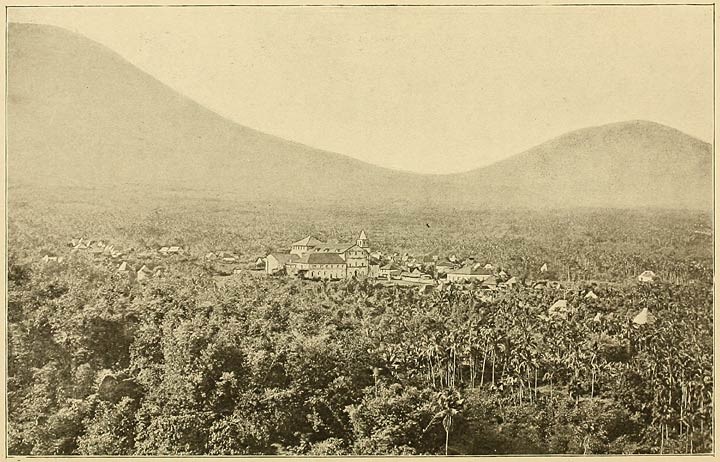
The Fashionable Church and the Village of Majayjay, Near Manila.
The dancing now begins. A youth and a maiden stand facing each other, both singing a sentimental song. Then follows a musical dialogue, while both dance round each other, keeping step to the music furnished by the native orchestra. A young woman then steps into the middle of the floor,—her long hair flowing down her back, her eyes sparkling. The music begins in a low plaintive key, that gradually becomes more and more forlorn, while her languid movements express various degrees of sorrow. Gradually the strain flows into a livelier measure, and she becomes more and more animated, until at last she sinks down in a whirl of delirious passion. Then, again, a girl dances with a glass of water on her head; or some other form of entertainment is given.
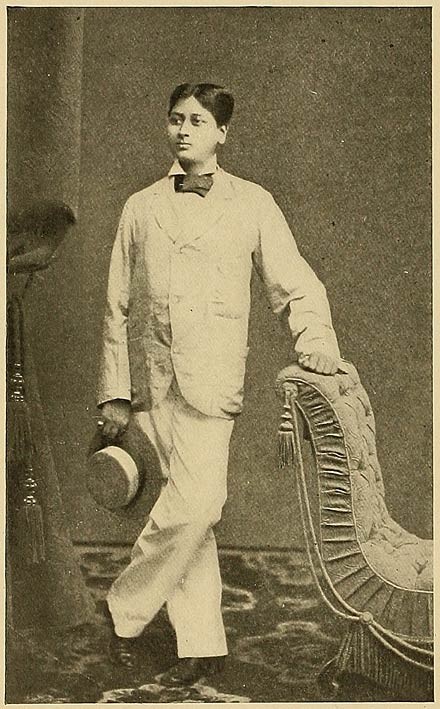
Author in Silken Suit: Kind Worn by High-class Natives.
After the dancing, the men and women retire to their respective quarters.
The marriage is always arranged by the parents of the two young persons, who go through an established etiquette of advance and refusal before the dowry terms are arranged. If the parents of the young man are poor and he can offer no dowry, he often enters the household of his intended on probation,—as Jacob did to win Rachael.
The wedding-feast is always given by the father of the groom, who also furnishes the dowry for the bride. The young married couple then live with the parents of one of the parties. The wife always remains mistress of her own property, and the husband can in no event inherit it. The children often add the surname of the mother to that of the father, thus making the woman of greater prominence.
Before the middle of the century there were no distinct family surnames, and there were, consequently, no complications of families possible. To introduce greater simplicity into the laws of inheritance, the names of distinguished Spanish families were introduced into the colony,—each family receiving a distinct appellation.
Dress and Manners.
The men are usually of medium height, lithe, and of a rich brown color, with large cheek-bones, bright eyes and immobile countenances. The better kind dress in loose shirts, or blouses, worn outside the trousers and of native manufacture, made of abacá, or Manila hemp; or of the airy, delicate, and almost transparent piña,—a texture of pine-apple leaf, as choice as the finest lace.
This is of white, or light yellow, and often interwoven with red, green or blue silk, or embroidered with flowers. The white or light-colored trousers are fastened round the waist with a belt. The feet are sometimes bare, or protected by sandals or patent-leather shoes. On the head is usually worn a salacot—a large round hat, strongly plaited with gray-and-black intersecting patterns of nito or liana fibre, the brim ornamented with a band of embroidered cloth or silver.
The dress of the poorer class is very similar—the material being coarser, the colors red and orange predominating.
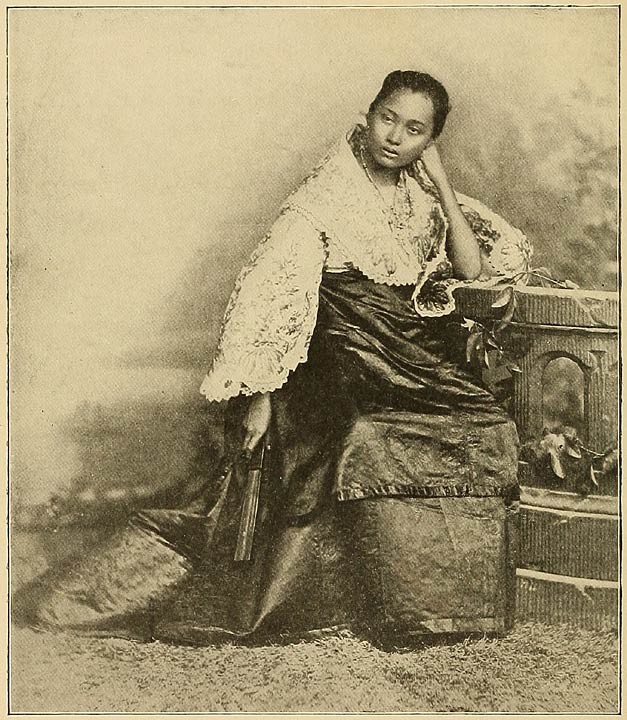
Full-blooded Native Girl in Reception Attire.
The woman wears a flowing skirt of gay colors—bright red, green or white—with a silken saya or sarong of many colors. Over this is a narrower waist-cloth usually of silk and of a darker color. Over the breast and shoulders is generally thrown a starched neckcloth of beautiful embroidered piña—folded triangularly, the points fitting in the hollow of the V-shaped chemisette. On the head is worn a white mantle, from which the rippling cataract of raven hair falls in massy folds almost to the ground. The toes of the naked feet are enveloped in chinelas,—a heelless slipper, which is shuffled with languorous grace.
Many of the women are pretty, and all are good-natured and smiling. Their complexion, of light brown, is usually clear and smooth; their eyes are large and lustrous, full of the sleeping passion of the Orient. The figures of the women are usually erect and stately, and many are models of grace and beauty.
The women of every class are far more industrious than the men, and also more cheerful and devout. Adultery is almost unheard of. The men, however, are exceedingly jealous. The natives believe that during sleep the soul is absent from the body, and they say that if one be suddenly wakened they fear the soul may not be able to return. Therefore, they are extremely careful not to waken anyone rudely or suddenly, but always call with softly-rising and falling tones, to bring the sleeper gradually to consciousness.
The preceding observations concerning the Tagalogs, the natives of the north, are also, in the main, true of the Visayos, their southern brethren. The latter, however, are not so cheerful or so hospitable, and are more ostentatious and aggressive. Their women, too, are more vain and avaricious. These slight differences are perhaps due to the fact that they have far less intercourse with the civilized world than the Tagalogs.
The Half-breeds, or Mestizos.
No less interesting, and even more influential than the natives, are the half-breeds, or mestizos. They form a large percentage of the population. These are usually of native mothers and of Spanish or Chinese fathers. The Spanish fathers are, however, a distinct class from the Chinese fathers, and rank much higher socially, exchanging visits with the pure Spanish. They are, most always, a handsome race, and more intelligent than the pure natives, and far more energetic and ambitious. Among them are many leading merchants and men of influence.
The mestiza girls are, as a rule, often of wonderful beauty. They are lithe and graceful and of a soft olive complexion, with red lips, pearly teeth, and ravishing black eyes, whose long lashes droop coquettishly in response to the admiring glance of a stranger. Their dancing is justly famed, and those educated in the convents are musical and often accomplished in other ways. The peculiar characteristics and the increase of energy due to this infusion of European blood, however, disappear if no further admixture takes place in the second generation. It is more lasting, on the other hand, where the Malay has been crossed with the Chinese. This is probably due to the great similarity of the two races.
These Malays, with an infusion of Chinese, are called mestizo-Chinos. They also are more intelligent than the pure Malay, and far more shrewd. Many of the leading merchants of Manila are of this mixture. They do not, however, enjoy the confidence of the people, and are a tricky and disturbing element in the population. They have the mongrel stamp and a cunning, shifty look. They are full of intrigue too, and it was, indeed, because they formed so large a part of the rebels that the high-class natives hesitated so long about joining the insurgents; not wishing to combine even with the despised mestizo-Chinos against the hated Spanish; for the government of the latter was preferable to that of the former.
Savage Tribes in the Interior: Aetas, or Negritos.
Over all the islands are scattered a mountain tribe called Aetas, or Negritos. These are supposed to be the aborigines. They are very dark, some being as black as negroes. They are doubtless of African descent and are said to resemble the natives of New Guinea. Their hair is black, curly, and matted. They go almost naked, and have but little self-respect. They are also puny, stupid, and ugly, and of a low order of intellect, incapable of improvement, and deficient in judgment and in aggressiveness. They are, on the other hand, remarkably fleet of foot. They subsist mainly by hunting. Their usual weapons are a lance of bamboo, a palm-wood bow, and a quiver of poisoned arrows.
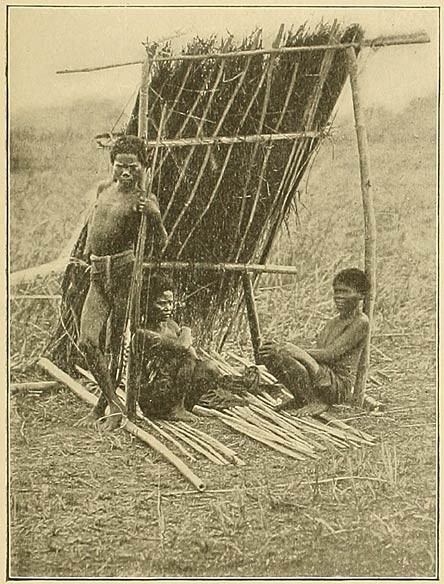
Negritos Enjoying a Primitive Sun-shade.
About fifty families commonly live together, and their villages of rude, thatched huts, raised on bamboo poles high from the ground, present a curious appearance. They were the original lords of the islands, and when the first Malays settled here, they, with unfailing regularity, exacted tribute from the newcomers. The latter, however, soon became too powerful, and the Negritos are now either employed by the Tagalogs as servants, or they have fled to their retreats in the mountains. But they are fast disappearing, and, hence, before many generations, will have perished before the destructive blast of progress.
Their principal food is fish, roots, fruits, and rice. They are notorious cattle-thieves, swooping down upon the valley and carrying their prey to their fastnesses in the mountains. Their agricultural skill consists in scratching the soil with a stick and throwing in the seed. They rarely ever spend more than one season in one locality, thus constantly moving from place to place.
Their religion seems to consist in a deification of the supernatural and of the mysterious. When the railroad was first constructed from Manila to Dagupan, these Negritos constantly appeared along the track, which they regarded with feelings of awe.
When the trial journey of the first locomotive took place, and that huge iron salamander appeared thundering down the track, it is related that they all fell upon their knees in abject terror, worshiping the strange monster as some new and powerful deity.
Unlike most savages, they care tenderly for their aged, and are full of reverence for their dead.
As a rule, too, they are independent of Spanish domination, and neither pay taxes nor submit to enumeration for the census.
A few years ago the Government started a mission in Pampanga; a great many Negritos were herded together, and were given a year’s provisions and tools to work with. Teachers were also provided, and all went well as long as the provisions lasted. They refused to work, however, and were averse to all restraint, and the second year they returned to their native haunts.
They have a curious marriage custom. After a young man has shown his passion for a girl, and his advances have been well received by the parents of his intended, he catches her in his arms. She breaks loose, however, and runs. He follows hard behind. Again he catches her. She resists, and once more frees herself, running away from the eager arms of her ardent lover. After this play of struggle and chase have been kept up a little while, she finally yields, and he leads her triumphantly back to her home.
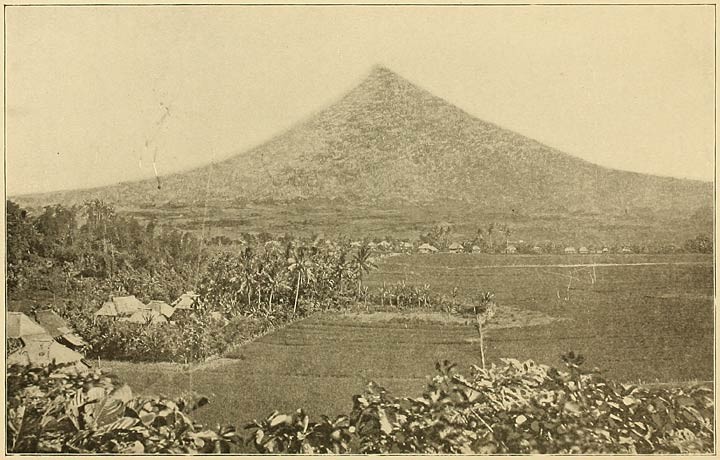
Volcano of Albay, a Near View.
The father of the bride now drags the youth up a rude ladder to the floor of the elevated hut; the mother likewise leads up her daughter. They are then made to kneel down, when the old man throws a cocoanut-shell full of water over the pair. He then bumps their heads together, and they are adjudged man and wife. They spend their honeymoon in the mountains, where, in undisturbed and shelterless connubial bliss, they remain five days and nights. Then they return to the commonplace life of the village.
The Gaddanes.
In the northwestern part of Luzon is a fierce, unsubdued tribe known as the Gaddanes. They are very dark and strong, and present a fine appearance, armed with long, sharp spears and with bows and arrows. They wear their hair down to their shoulders, and, like the American Indians, take the scalps of their enemies slain in battle; these the young men present to the fathers of their intended as a proof of their valor.
This takes place when the fire-tree bursts into bloom; its fiery blossoms have, to their minds, a certain religious significance. It is then they collect all trophies of war, and perform the rude rites of their nature-worship. They subsist on fish, game, and fruit.
The Igorrotes.
A fine race are the Igorrotes, spread over the northern half of Luzon. They are copper-colored, and also wear their hair long. A few are bearded. Their shoulders are broad, and their limbs brawny and powerful. Because of their high cheek-bones, flat noses, and thick lips, they would not, however, by a European or an American, be considered good-looking.
They cultivate sugar-cane, rice, and sweet-potatoes, but have never been able to give up their savage customs for civilization. Their houses are not unlike the huts of the Esquimaux. Polygamy sometimes exists, but adultery is almost unknown. Murder is said to be frequent, and family feuds often take off great numbers.
Their depredations in the interior are often of great annoyance to the domesticated natives; for they carry off their cattle and their crops. Many expeditions have, from time to time, been made by the Spaniards against them; but all have signally failed. The Igorrotes obstinately refuse to be civilized. Spanish dominion holds for these liberty-loving people few advantages; Catholicism offers them little peace; while they maintain that the traditional heaven of the European would not at all suit them.
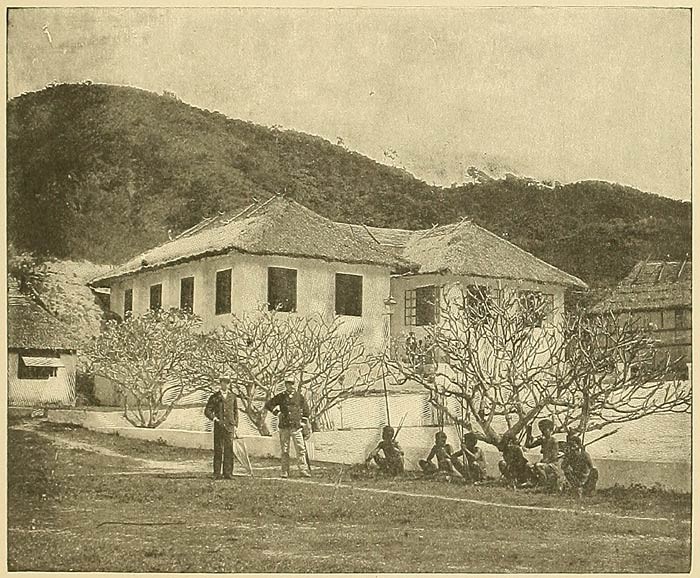
A Body-guard of Igorrotes.
Upon one occasion a Catholic priest was horrified when an Igorrote asked him why it was that no black man ever became a white man’s Saint? When told that it was possible, he refused to believe it, saying that he, for his part, was content with the religion of his ancestors, and did not intend to bend his knees in adoration of the gods of the pale-faces.
The Igorrote-Chinese.
The Igorrote-Chinese are the descendants of the Chinese that the pirate Li-ma-hong left behind him when he suddenly quitted his colony in the province of Pangasinan in 1574. These, to escape the advancing Spaniards, hid in the hills, where they intermarried with the Igorrotes, their descendants, whom they much resemble, with, however, some important differences. For, with the cunning and the shrewdness of their Chinese ancestors, they combine the Igorrote fierceness and independence. Many of these have been domesticated.
The Tinguianes.
In the district of El Abra, in Luzon, are the Tinguianes, who are semi-civilized and under the control of the Spaniards. They prefer, however, their own laws to those of the Spanish code, and usually abide by them. If a man is accused of a crime and he denies it, the head-man of his village, who is also the judge, causes a handful of straw to be burnt in his presence. The accused then holds up an earthen pot and says: “May my belly be changed to a pot like this if I am guilty of the crime of which I am accused.” If he remains unchanged in body, the judge declares him innocent.
The head-man himself, upon assuming his office, takes the following curious oath: “May a destructive whirlwind kill me, may the lightning strike me, and may an alligator devour me when I am asleep if I fail to do my duty.”
They are pagans, and they believe that their gods will answer prayer. For worship, they resort to their caves in the mountains. When a child is to be named, it is carried to the woods, where the priest raises a knife over its head, at the same time pronouncing a name. He then, with the knife, strikes a tree. If sap flows forth, the name is deemed good; if not, he goes through the same ceremony until the desired result is produced; the god, then, is supposed to have given his consent.
They are very intelligent, and are a well-formed race, and many are handsome, with aquiline noses. On the crown of the head they wear a tuft of hair, like the Japanese. Like the domesticated natives, they are very fond of music and of dress. They tattoo their bodies and also black their teeth, and are supposed to have descended from the shipwrecked Japanese cast upon the island.
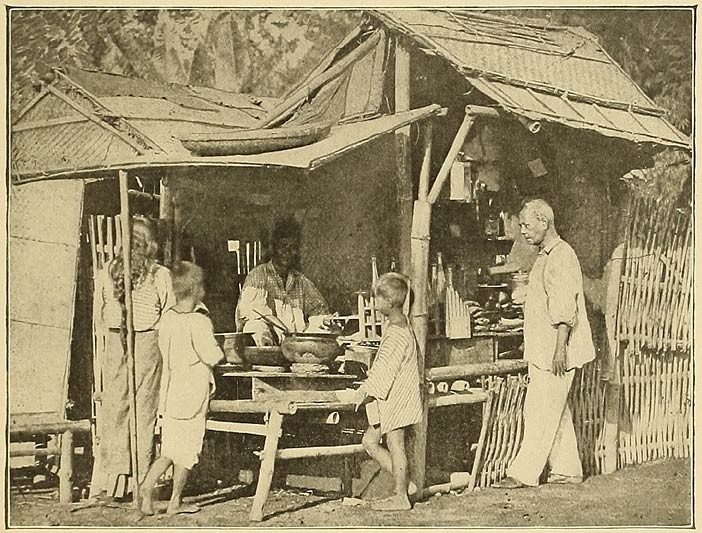
A Native Restaurant, in Binondo.
The Chinese: Hated but Indispensable.
Long before the Spanish occupation, Chinese trading-junks stopped at the Philippine Islands; and, after the founding of Manila, being well received by the Spaniards, who depended upon them for many necessities, they established trading-posts in various parts of the colony.
In 1580 the Government built the Alcayceria—a large building that was used as a kind of Chinese market. Here were situated all the Chinese shops, which it was thought better to confine to one locality: they might be regulated the more easily.
The Alcayceria proved too small, however, and the shops were soon in every part of the Binondo. Other centres were soon provided for them, where the Government protected and even encouraged the enterprise of the Chinamen.
The native and the Spanish merchants becoming alarmed at the increase of the Celestials, began an agitation, whose object was to limit their number to 6,000; but the movement received little encouragement from the Government, which drew a large revenue from the Chinamen.
In 1755 this agitation was renewed, and it was resolved to expel all non-Christian Chinese. The day before the law went into effect 515 asked for and obtained baptism, while over 1100 desired to stay, that they might study the mysteries of the Christian religion. More than 2,000 were banished from the colony. In 1603 two Chinese mandarins, accompanied by a large retinue, came to Manila to make inquiries concerning a mountain of gold that some of their countrymen had said was located near Cavite. They were received with much ceremony, and the Governor-General allowed them to pursue their quest. It proved fruitless, of course.
Persuaded that they had been deceived, they sailed away, leaving the colony in a fever of speculation as to the real object of their visit. Various rumors sprang up in Manila; all to the effect that the Chinese Emperor contemplated the conquest of the colony, and that the Chinese population were fomenting an insurrection to aid his designs. They were also accused of secreting arms, and many outbreaks from time to time arose against them, until finally the poor Chinese, beset on every hand, and hourly menaced by secret assassination and open violence, were forced to assume the offensive. Accordingly, they raised fortifications, and on the eve of St. Francis’ day they opened hostilities by attacking one of the suburbs of the city. With the beating of gongs and the flying of colors they next besieged Binondo itself, burning houses and committing many other outrages on the way.
The Spaniards gallantly advanced to repel them, and Dasmariñas, the ex-Governor-General, led the attack with the flower of his countrymen; but the odds against them were too great, and scarcely a man was left to tell the tale of their defeat.
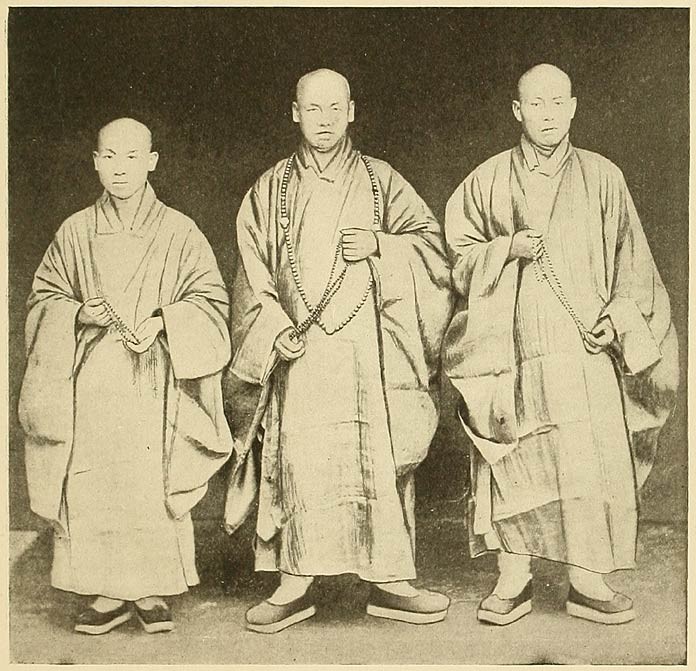
Chinese Merchants on Their Way to the Joss House.
The Chinese, flushed with success, now besieged the city itself, but, running short of provisions,—which the natives were, of course, unwilling to furnish them,—they were finally compelled to give up the siege.
As they retreated, the Spaniards, constantly reinforced by bands of natives, pursued them, killing thousands on the way. They were then finally driven into the interior, where the same fate awaited them—of whom not less than 24,000 were killed and taken prisoners.
In 1639 some Chinese traders, in the town of Calamba, Laguna province, exasperated beyond endurance by the insults and outrages heaped upon them by the Spanish Governor, killed this official and one or two of his subordinates, and flew to open rebellion. The Chinese all over the colony joined the rebels, and it is estimated that not less than 30,000 Chinese were under arms. This lasted nearly a year, and resulted in the surrender of the Chinese; most of whom, however, were spared.
In 1660 there was another rising and a massacre. The Chinese, nevertheless, were still allowed to remain. They were so important a part of the commercial life of the province they could not long be spared. For more than a century the Chinese now pursued their avocations in absolute security.
When, however, in 1763 they joined the British invaders, little mercy was shown them by the Spaniards, who killed several thousands.
In 1820 the natives began the massacre of the Chinese and other foreigners, whom they accused of poisoning the drinking water, thus producing an epidemic of cholera.
Only since 1843 have the Chinese shops been opened on the same terms as those of other foreigners. But there is no doubt that the Chinese have been a great boon to the colony. They have had, in the main, a civilizing influence on the natives, and have taught them many important things: as the working of iron and the manufacture of sugar from the juice of the sugar-cane. They have also ever been the leaders in commerce and the chief middlemen of the colony; and, for this reason mainly they have been deemed an unwelcome necessity; for, without them, trade would almost be brought to a standstill, and, in consequence, labor would suffer and living be rendered dearer to every class.
By their superior shrewdness and unscrupulous cunning they have, on the other hand, excited the hatred of the natives, who despise them for their cowardice. Thus, from time to time, the feeling against them is very bitter.

A Chinese Chocolate Maker.
Another objection against the Celestial is that he underbids all competitors, working for what others deem less than living wages. Furthermore, he spends little, and all that he saves he carries to his own country. Their expulsion, however, would be as unwise as it is impracticable, and the only remedy that meets the case is a proper State-control. The employment of coolie labor, notwithstanding, is at present impossible, on account of the hatred that the lower-class natives feel toward them.
In Manila there are at present no less than 40,000 Chinese, while the whole colony contains about 100,000. They have their own courts, their guilds, and secret societies, which are necessary for their self-protection, and they choose representative deputations to represent them in the Government.


The Mohammedans of Sulu.
Cross or Crescent?
In the lower part of the Philippine group, in the islands of Sulu and Mindanao, the Catholic Spanish conqueror early came into conflict with a religion not less intense and fanatical than his own. The story of this fierce struggle between Malay Mussulman and Spanish Catholic reads not unlike the more celebrated conflict between Christian and Mohammedan in the days of good King Ferdinand and pious Isabella. Here, too, was waged that dire battle of the creeds that deluged half of Europe with holy blood. Here, too, was mutual advance and retreat, but no reconciliation—no conversion.
The island of Sulu, on account of its position between Mindanao and Borneo, became, in this wise, populated by the followers of the Prophet: About three centuries ago Paguian Tindig, a Borneo chief, quarreled with his brother and was forced to flee for his life. He landed on Sulu Island, where he soon achieved great fame as a warrior. His cousin, Adasaolan, who had accompanied him, had taken up his abode in Basilan. Here he lorded it over the natives, but acknowledged the suzerainty of the Spaniards.
Adasaolan married a Mahometan princess—a daughter of the King of Mindanao, where, it appears, Islamism had been carried by Arab missionaries.
Soon afterward, Adasaolan, longing for the possession of the fat acres of Sulu, attacked his cousin Tindig, and vanquished that intrepid soldier, who died fighting bravely. However, Rajah Bongso, and not Adasaolan, succeeded Tindig. Nevertheless, Adasaolan had, with the aid of friends from Borneo and Mindanao, introduced Mahometanism into Sulu, which has since become the Mecca of the Philippines.
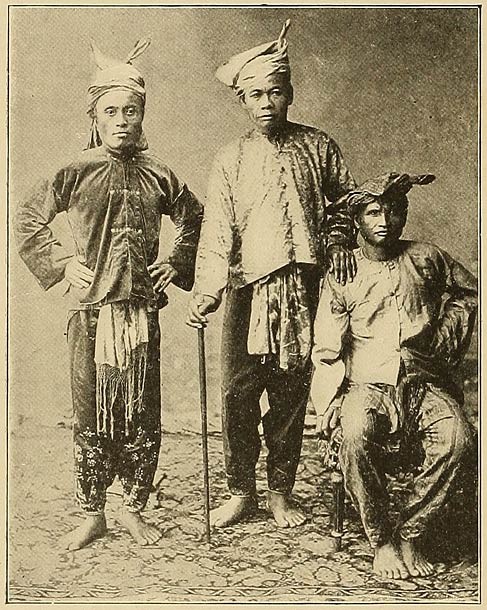
Chieftains of Sulu.
In 1596 the Spaniards sent an expedition to Mindanao, but were repulsed. Their ravages and constant desire for conquest embittered the Mohammedans,—who, retaliating, began to fit out expeditions against their Christian enemies; like birds of prey they hovered round the bays with their prahus, penetrating every inlet. These pirates soon became the terror of the Spanish coasts, and were as brave as they were merciless. For three centuries they preyed upon Spanish merchantmen, pillaged the northern towns and villages, massacring the old and helpless, leading thousands of Christian women into concubinage, and tens of thousands of able-bodied men into slavery. Myriads were thus murdered, and incalculable damage done, all because of the continued attempt of the Spaniards to win their southern neighbors to their own faith.
In 1750 the Sultan Mahamed Alimudin, having been deposed by his brother, Prince Bantilan, visited Manila. He was lavishly entertained by the Priest-Governor, who was unceasing in his efforts to persuade him to embrace Christianity. The Sultan at last yielded and was baptized. He was christened Ferdinand I. of Sulu. The rank of a Spanish Lieutenant-General was also accorded him.
All this was done with great pomp and ceremony. Te Deums were sung in all the churches; glittering processions marched daily through the streets; comedies were acted on the streets, for the benefit of the populace, who shared in the general rejoicing: bull-fights and other equally delightful and harmless recreations were also the order of the day—all given at the expense of the Church, which regarded the conversion of the Head of the hated Mussulmans as an event of no ordinary importance.
The Sultan’s State.
The Sultan lived in great state. He had a retinue of sixty persons, and was accompanied by many of the princes of the blood. All lived on the generous bounty of Spain.
Measures were now apparently begun to restore the deposed monarch to his throne. But the Spaniards pretended to discover that the Sultan harbored designs against them, and that he possessed a secret preference for the Mussulman faith. For this crime he, with all his relatives and retainers, 160 in number, was cast into prison, where he was confined several years.
A decree of extermination was then declared against the Mohammedans. A fleet of ships, carrying 2000 men, at once proceeded to Sulu, which the natives defended most ably. The Spanish campaign proved a dismal failure, and awful were the reprisals of the infuriated Mussulmans.
In 1755 most of the Sultan’s suite was sent back to Sulu, though the Sultan himself was still kept in close confinement.
The wily Mohammedan again professed Christianity; but, though the Sultan was henceforth treated with greater leniency, he was not released: he remained captive in Manila until the occupation of the British, in 1763, who restored him to his throne in Sulu.
As might be expected, Mahamed lost no opportunity to avenge the insults that his hereditary enemies had for so many years been heaping upon him; accordingly, he led several incursions against them.
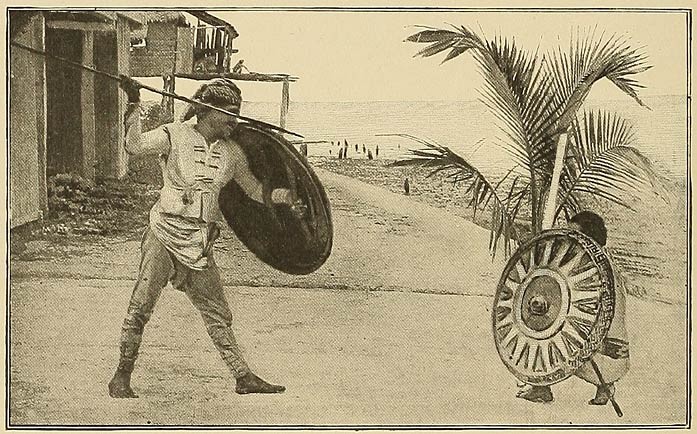
Sulu Warriors in Fighting Attitude.
I have not space here to recount the various expeditions of the Spaniards against their southern neighbors. I shall, instead, mention only the more prominent ones of recent years.
In 1851, Sulu Town, the capital of Sulu, was attacked and razed by the Spaniards. Their advantage, however, proved but temporary. The Mohammedans now changed their capital to Maybun on the south coast, which is far less accessible.
In 1860, Governor-General Norzagaray led another expedition against the Mohammedans. This also met with some success; but none of it was decisive. On account of the persistent renewals of the hated Sulu piracy in 1876, another expedition, under Vice-Admiral Malcampo, pierced the interior of Sulu, where he was ambushed and attacked by a body of juramentados,—formidable fanatics, armed with javelins and the deadly kris. He returned to Manila having sustained great loss.
The Dreaded Juramentados.
These juramentados are Mohammedans, who, having taken an inviolable oath to shed the blood of the hated Christian, and, having absolutely no fear of death, are as dangerous as they are fanatical.
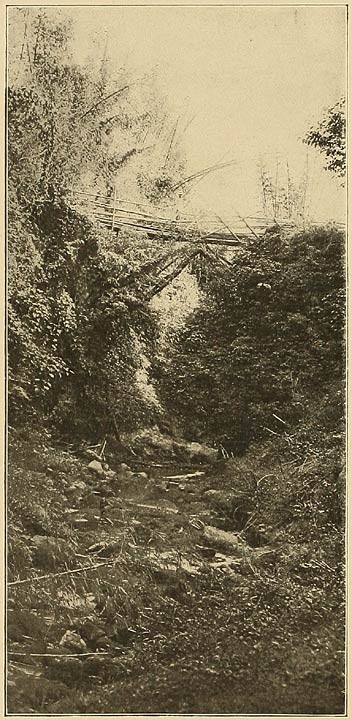
A Bamboo Thicket in Sulu.
By the laws of Sulu, the bankrupt debtor is the slave of his creditor; and not only he, but likewise his wife and children, whom he can free only by the sacrifice of his life—by enrolling himself in the ranks of the juramentados, who combine the performance of a religious duty with the patriotic pleasure of killing their Christian enemy. The panditas, or priests, encourage him in this resolve until he is brought to a very frenzy of enthusiasm. In their meetings the priests sing to these sworn assassins impassioned chants, that hold out the most entrancing visions of the joys of Paradise, perpetual happiness, and the honeyed kisses and rapturous embraces of beautiful houris. Similar to the Druids of old, they, too, stand like avenging deities in the religious gloom of the forests, and incite these fanatics to the destruction of their enemies: they promise eternal reward; holding up to their excited imaginations delightful pictures of sensual enjoyment.
Thus lashed into a fury of madness, the juramentado becomes more beast than human, and is forever lusting for murder. He oils his supple limbs and rushes ferociously into the conflict. Nothing can stay him. He knows that he is going to certain death—that is but the door to Paradise! In his excitement he feels no pain; and, though severely wounded, he will continue his furious onset until killed. Hence, he cares not how many oppose him; the more the better; he will probably succeed in doing greater execution.
A distinguished French scientist, Dr. Montano, gives a vivid description of the entry of eleven juramentados into the village of Tianzgi. Divided into three or four bands they secretly entered the town, by concealing themselves, with their krises, in loads of fodder that they pretended to have for sale. After stabbing the guards they rushed up the street,—striking at all whom they met.
The soldiers in the garrison, hearing the cry “Los juramentados!” seized their guns and advanced to meet them.
The mad Mahometans rushed blindly on them, cutting and slashing right and left. Again and again, though shot and shattered by the hail of bullets, they rose and flung themselves upon their enemies. One of them, though transfixed by a bayonet, remained erect,—struggling fiercely to reach the soldier that had impaled him. Nor would he cease his furious efforts till another soldier had blown his brains out with a pistol. Before all of the juramentados could be killed, they had hacked fifteen soldiers to pieces, besides wounding many others.
“And what wounds!” says Dr. Montano; “the head of one corpse is cut off as clean as if it had been done with a razor; another soldier is cut almost in two. The first of the wounded to come under my hand was a soldier of the Third Regiment, who was mounting guard at the gate through which some of the assassins entered. His left arm was fractured in three places; his shoulder and breast were literally cut up like mince-meat; amputation appeared to be the only chance for him; but in that lacerated flesh there was no longer a spot from which could be cut a shred.”
The Extent of Mohammedan Rule.
The Mussulmans are, indeed, over the whole of the island of Mindanao. It is under the Sultanate of Sulu, there being two Sultanates in the island. Not more than a fourth of Mindanao is under Spanish rule, although by an old treaty, never enforced, Spain claimed suzerainty over all the territory subject to the Sultan of Sulu. This treaty was formally recognized at the close of the war of 1876.
In the interior of Mindanao are many fierce and savage tribes, owning allegiance to no government, controlled only by their own fierce passions.
A bagani, or man of might, is one that has won recognition by having cut off sixty heads. This entitles him to wear a scarlet turban. No one not a bagani can be a chief. Thus, murder and assassination are legalized and honored.
The Mandayas, to escape from the baganis, are wont to build their huts in the branches of lofty trees, thirty or forty feet from the ground. Here they climb when attacked, defending themselves by hurling stones upon their assailants. The baganis usually attempt to take them by surprise, shooting burning arrows at the ærial habitation, that they may set it on fire. Sometimes, it is said, the bagani will climb up to the hut with their shields locked together above them. Then, cutting down the posts that support this abode in the tree-tops, they soon bring the besieged to terms. The captives are then divided among the besiegers—the heads of the dead and of the wounded, and of all the grown males, are cut off, and the women and children are carried away captives.
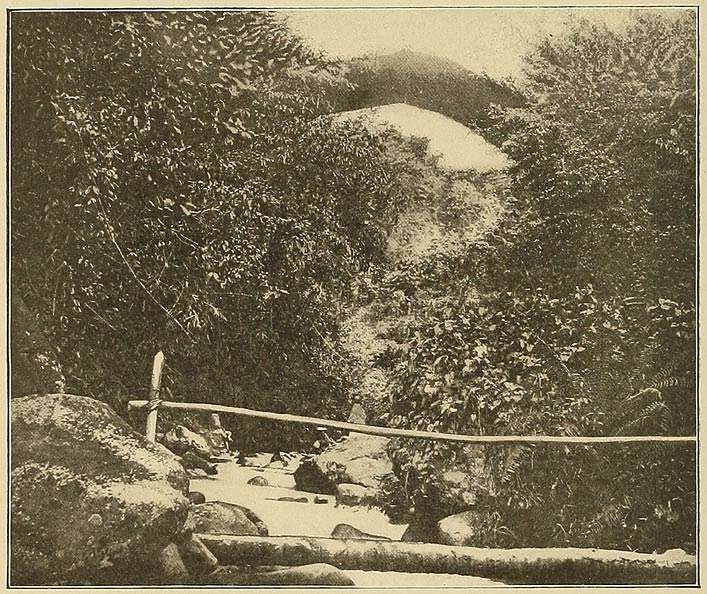
The Devil’s Bridge, in Wild Laguna.
Such is the interior of Mindanao; and from this description it can readily be seen how ineffective has been the Spanish occupation of that island.
In 1877 a protocol was signed by England and Germany recognizing Spain’s rights to the Tawi-Tawi group and the chain of islands from Sulu to Borneo.
In 1885 the heir to the Sultanate, having failed to appear in Manila, where he had been cited to receive his investiture at the hands of the Governor-General, as had for some years been the custom, another chief, Datto Harun, was selected by the Spanish Government to take his place. He took the oath of allegiance to the King of Spain, and was supported in his office. Two years later several chiefs found another pretext for rebellion, but they were finally compelled to yield their submission. Over this trifling victory the Spaniards made a great display.
Hardly had the Mohammedan chiefs submitted, when war broke out afresh and Colonel Arolas was sent to the scene of the disturbance. He defeated the natives in several engagements, and, at last, a permanent peace was established. The Sulu protectorate comprises Sulu Mindanao, and about 140 other islands; many of these are uninhabited. Next to Luzon, Mindanao is the largest island in the Archipelago. Sulu is about 35 miles long and 12 miles broad. The population of Mindanao is unknown. Luzon contains about 125,000 Mohammedans, many of whom are slaves.
Sulu Customs.
The fierce and conservative nature of the people, the peculiar and long-rooted feudal laws, the presence of an ancient dynasty, and of an ineradicable, fanatical belief,—these are a few phases of the complex problem to be met now. So far, the Spaniards have succeeded in maintaining their protectorate only by a protracted military occupation, which, as I have said, has by no means been always effective.
The Sulu Islanders dress with great taste. The women are fond of bright colors and love to adorn themselves with jewelry. They have the baggy nether dual-garment, so dear to all other women of their faith. Their tight-fitting bodice is usually covered with arabesque designs. In embroidering them they show great skill. For a head-covering they wear the jabul, a long strip of stuff, sewn like a deep narrow sack, open at the sides. This, if allowed to fall, would reach down to the feet; the end, however, is always held under the arm. The women are usually very graceful, and many are also pretty.
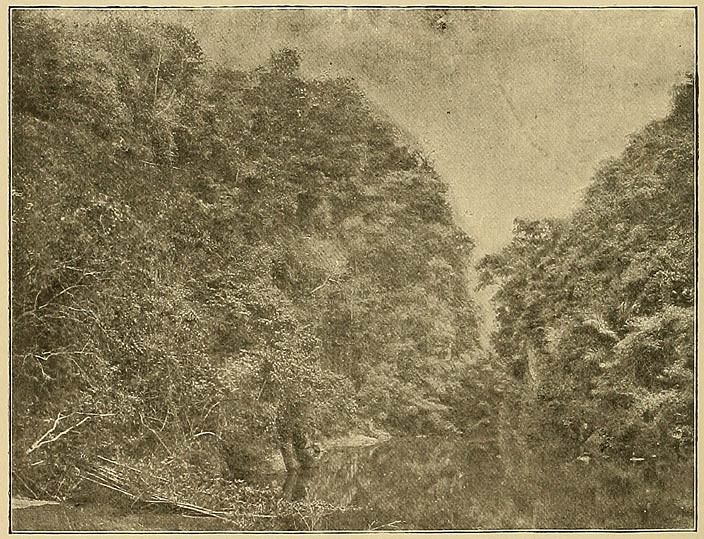
A Jungle in Luzon
The men wear tight breeches, usually a scarlet, or of some other bright, color. On the sides are rows of shining buttons, that give a very dazzling effect. A buttoned waistcoat, a jacket with close-fitting sleeves, and a turban complete a costume that is as picturesque as it is unique. The men are handsome and very robust, lithe and active. Their complexion is a dusky bronze, and they have piercing black eyes. Their forehead is low, and their black hair falls in glossy waves upon the neck. Though brave and daring to an extraordinary degree, they are conservative and cautious—no less quick in mind than agile in body, and always sober and self-contained. They are extremely suspicious, and as merciless when angry as they are obstinate and vindictive. They are far more artistic than their Christian neighbors in the north. Their coats of mail, krises, lances, swords, and other weapons are of their own making. They are most skilful navigators, too, which accounts for their success as pirates. All males over sixteen years of age bear arms. The office of chief is hereditary. When a chief dies, the pandita, or priest, chants a requiem, while the attendants beat a hollow piece of wood that serves as a gong. The neighbors rush in, and shout and stamp their feet while the body is sprinkled with salt. A successor is then proclaimed. The panditas have great power over their flocks, inciting them to frequent fasts and to furious flagellations. Many and varied are the ceremonials of their belief.
The Spanish Government derives no taxes from the Sulu Protectorate, but gives the Sultan a pension of $2,400 a year. The Sultan is called the Stainless One, and is the chief of both Church and State. He is an irresponsible despot, and the head of the feudal system. The Sultanate is hereditary under the Salic law. The Sultan has his Advisory Council and his Ministers. He lives in considerable state in the centre of the new capital, Maybun, in a large well-constructed palace of wood.
The roomy vestibule is always lined with an abundant display of indigenous plants and shrubs, dazzling to the eye and intoxicating to the senses. It is, indeed, as if the entire tropic realm had been ravished of its richest, rarest, and most gorgeous specimens of plant-life to glorify this spacious entrance-way. From there on to the throne-room is of but little interest.
Of course, letters, despatches, or verbal requests of foreigners have all to be transmitted through the official interpreter, servants meanwhile flitting about, in the gayest and most ludicrous costumes, offering betel-nut to each and everyone,—to the bevy of Sultanas and to foreign guests, all seated on silken and highly embroidered cushions scattered on the floor.
In the town of Maybun there is nothing to be seen of any note, but the country round about is magnificent.
Slavery exists by birth and conquest. Rice, Indian corn, sugar-cane, indigo, and coffee are the common products of the Sultanate. The chief export is pearls, for which the natives dive often a hundred feet. They frequently attack sharks, which they fight with the deadly kris, never failing to come off victors.


Manila.
The Old City.
Manila, the capital of the Philippines, is situated on the island of Luzon, at the mouth, and on the left bank, of the river Pasig. It is in N. lat. 14° 36′, by E. long., 20° 57′. The city was founded in 1571. The present fortifications and the walls and battlements of the old city were built by Chinese labor in 1590, in the time of Governor-General Gomez Perez Dasmariñas. The walls are 2¼ miles long and are mounted with old and useless cannon. These, however, were quite formidable in the early days of the colony, and did great service against the successive invaders that threatened its peace and safety.
The old city is almost surrounded by water. On the north is the Pasig; on the west the sea; while moats flank the other two sides. These moats are connected with the river by sluices; but they are sadly in need of repair, and are filled with stagnant water and putrid matter,—a continual menace to the health of the city.
Until 1852 the drawbridge, connecting the old city with the new, was raised at night and the city closed, presenting the curious fact of a feudal Spanish city in the heart of the tropics. In the citadel are the Government offices; also the Post, Telegraph, and Custom offices, various convents and colleges, an Artillery depot, the Cathedral, and eleven other churches. This part of the city presents a dilapidated and mediæval appearance. The dull, narrow streets have a sombre, monastic aspect; and one, therefore, is not surprised to find that the gloomy superstitions of the 15th century hold Cimmerian sway here, undisturbed by the dawn of Science. It seems the fit capital of a despotism, a suitable home for tyranny and priestcraft.
Manila Bay is thirty miles from north to south, and about twenty-five miles wide. On each side the entrance are steep volcanic mountains. Ten miles from Manila, near the entrance of the bay, lies Cavité, which contains about 5,000 people. Here also is the arsenal, a patent slip, and a garrison of 500 men. In the channel lies the island of Corregidor, 640 feet high, and just beyond, the island of Caballo, 420 feet high, both fortified. On each island stands a lighthouse. Other fortified points are San José and Tibonis.
Manila, however, is, like Batavia and Calcutta, a great trade-centre. But I must leave the old city to find any signs of life and progress.
Binondo and the Suburbs.
Binondo, on the northern shore of the Pasig, and opposite the old city, is the business quarter. Here are the large tobacco factories, which employ about 10,000 men, women, and children. One factory alone, indeed, employs 2,000. The Manila wrappers and Manila cheroots and cigars are famed the world over. The employees in these factories earn on an average about 15 cents a day. With this they are able to live very well; for food is cheap, and rent is even cheaper. Most of the boys and men in these factories wear only a thin pair of trousers, being naked from the waist up. The girls also have but a slight covering. In the midst of every group of girls sits an old woman, who acts as a kind of combined overseer and chaperon.
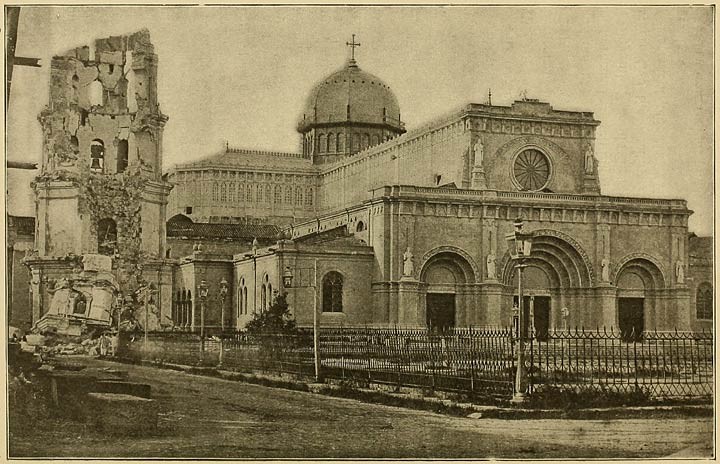
The Fashionable New Cathedral in Old Manila, and the Ruins of the Old Cathedral, Destroyed by Earthquake, 1863.
The main street of Binondo is the Escolta, and here are situated the commercial warehouses, the bazaars, and the European shops. In the Rosario are the Chinese shops. These are very small, and a dozen or more are usually grouped together. In each, on the little counter, sits a Chinaman, casting accounts with the ancient abacus. Another stands behind the counter and acts as salesman; a third is in front drumming up customers, very much after the manner of Moses Cohn, Baxter street, New York. These Chinese traders are exceedingly shrewd, and it is almost useless for the buyer to attempt to secure a reduction in price; they have a uniform scale, agreed upon by themselves. Many of these Chinese merchants are fabulously rich; and all are prosperous and progressive, the natives and the Europeans not being able to compete against them.
In the Escolta are many fine shops owned by Spaniards, mestizos, Germans, English, and Americans. The Escolta, in the daytime, presents an animated appearance: about ten thousand carriages pass here daily, and a great volume of business is transacted. The commerce is yearly increasing, too. The principal articles of export are honey, tobacco, cigars, sugar, coffee, and indigo.
The laboring class live in Tondo, another suburb. Their dwellings are covered with roofs of nipa thatch. The drainage around these huts is very bad, and under them are pools of stagnant water, the cause of great mortality among the natives. The endemic diseases of the islands are swamp-fever, diarrhœa, beri-beri, and typhoid.
The traffic on the river along the Binondo shore is considerable. The river is not navigable by the large ocean-liners; only by boats of light draught.
The streets of Manila, for the most part, are badly paved and still more badly lighted, though some of the public gardens have been recently much improved in this respect.
Beyond Binondo lies the aristocratic suburb, San Miguel, where live the wealthy European merchants and many of the Government officials. Here are many elegant and imposing residences.
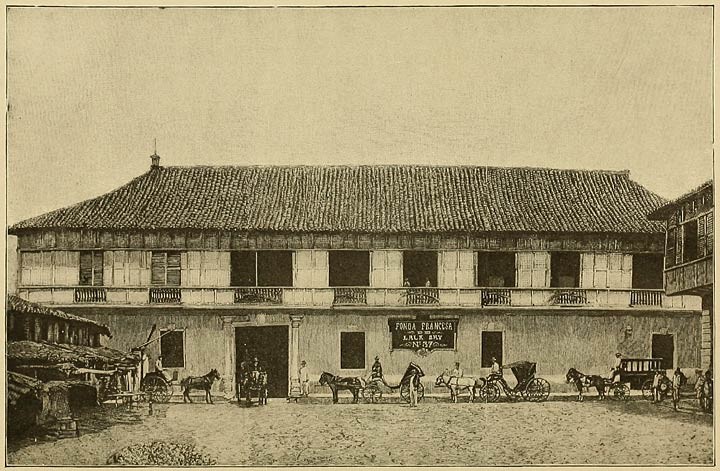
Commercial House of Russell & Sturgis; First American Merchants; Later, Lala’s Hotel.
It is a unique sight to pass these white bungalows at night, and hear the merry chatter or the sweet music of the happy people on the wide, cool verandas; men and women, boys and girls, all smoking cigarillos. For everybody smokes—from the Spanish grandee down to his native postilion.
A more contented people than the Filipinos surely do not exist. Naturally averse to exertion, and possessing few wants, they accept the dispensations of Providence with a philosophic acquiescence not far removed from indifference. One day differs little from another. Upon rising, early in the morning, they take a cup of chocolate or coffee. At eight o’clock they partake of a light breakfast, consisting of two or three dishes and a dessert. The head of the family then goes to his work, the women, meanwhile, attending to their household duties. From twelve to one is tiffin—a heavy lunch, consisting of soup, fish, meat, dessert, and coffee, including rice and curry. From one to four all enjoy the luxury of a siesta, after which, from four to five, they have chocolate and cakes served, exchange visits, go out riding, or take some other kind of recreation. Dinner is at eight. This is usually an elaborate meal, consisting of meats, fruits, and various native delicacies. After dinner, different diversions, such as music and dancing, make the evening an agreeable one. About eleven o’clock, the entire family goes to bed.
“Bed” consists of a fine mat, and one narrow and one long pillow. There are no sheets. Both men and women sleep in their stockings and pajamas. Mosquito curtains are, of course, a necessity.
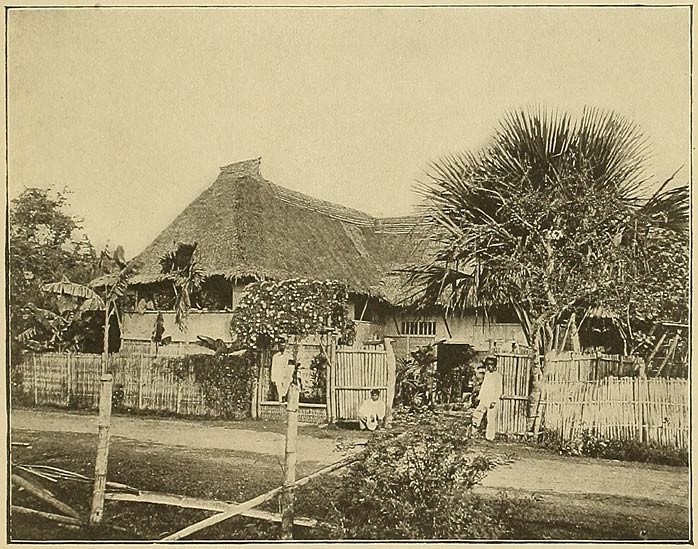
“Home, Sweet Home,” As the Filipino Knows It.
All this, of course, applies to the better class of natives, whose residences are often fine and commodious. Very few houses are more than one story above the ground floor. If so, the extra story is uninhabited or serves as a sleeping-place for the servants, or as a coach-house. The roofs are usually of tin or iron, which makes them extremely hot in summer. For this reason many houses are also covered with a thin layer of nipa-palm, which is cooler. The ground-story is usually of stone or brick; the upper of wood, with sliding windows of opaque sea-shells. The bath-house is really the greatest personal necessity in Manila. For a daily bath is almost indispensable to health and comfort.
Educational and Charitable Institutions.
Most of the educational institutions of the colony are in Manila, where the Department of Education has its headquarters. Many of the native graduates of the various colleges go into the professions; many of the poorer kind into teaching. The village schoolmaster receives, on an average, about 180 dollars a year, and out of even this miserable stipend he has to pay his own expenses to and from the city once every month, to receive his salary. Thus, it can readily be surmised that the cause of public education is not in as prosperous a condition as it might be. The children of the wealthy are sometimes sent abroad—to Spain, France, or England—to be educated. I myself went to St. John’s College, London, and, afterward, to Pension Roulet, Neûchatel, Switzerland.
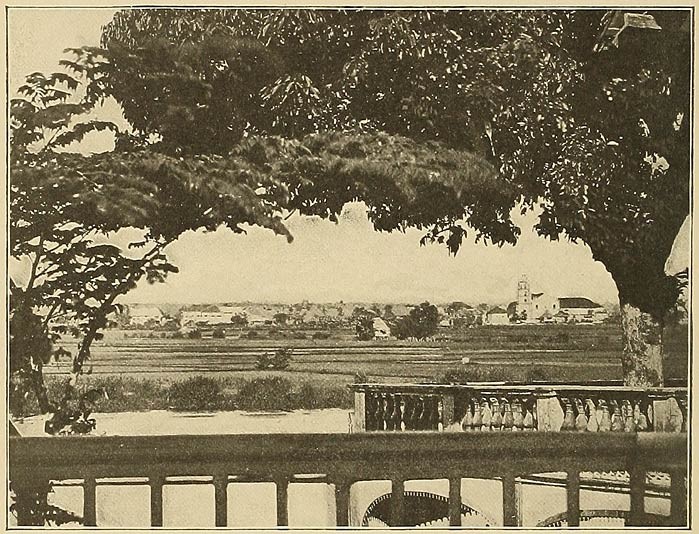
Balcony of Manila Jockey Club, Overlooking Pandacan.
The Royal and Pontifical University of St. Thomas, in Manila, is maintained by the Dominicans. It has schools of theology and church law, jurisprudence, notarial law, medicine, and pharmacy. In the undergraduate department are 40 free scholarships for Spanish boys.
The college of San José gives instruction in medicine and pharmacy. The Dominican college of San Juan de Letran is justly celebrated for its excellent equipment, and for its fine museums of history and of the arts. It is attended exclusively by the sons of the natives.
The Cambobong Orphan Asylum, under the care of the Augustinians, furnishes elementary instruction, and is a preparatory school for the University. It also teaches book-keeping, and provides a good business education.
The Mandaloya Asylum, of the same order and of the same grade, is for girls, and teaches the proper performance of household duties and the various feminine accomplishments.
Poor and demented children find shelter in the St. Joseph’s Home; while the Hospital of San Juan de Dios, founded in 1595, is open to all. This institution has two chaplains, one head nurse, six physicians, eight resident medical students, one pharmaceutist, and a corps of trained nurses.
The Hospital of San Lazaro is for lepers. It was founded in 1578 by the Franciscans, under rather peculiar and not uninteresting circumstances. The Emperor of Japan, full of resentment at the attempts of the Spaniards to convert his subjects to Christianity, sent the infant colony a ship-load of lepers with his compliments, saying, sarcastically, that he had no doubt but that the good brethren to whose care he felt called upon to send these useless subjects of his kingdom, would, in their exceeding love for souls, receive them most gratefully.
The Spaniards, however, needless to say, were by no means delighted, and were at first inclined to send the lepers back. Pity and Christian feeling, however, at last prevailed, and this hospital was built to receive them.
One of the most important organizations is the Chamber of Commerce. There are also several good banks and a savings bank. Under the Department of Charity and Health are several subordinate boards, all conducive to public improvement.
The Royal Polytechnic Society has for its object the promotion of the arts and the sciences. The Musical Society, the Spanish Casino, the Manila Club, the German Casino, the Gun, Jockey, Lawn-tennis and Bicycle clubs are highly successful social organizations. At Santa Mesa, on the outskirts of the city, is a race-course, which in the spring is very popular.
The mint is only for the striking of subsidiary coins. It has been in operation but a few years.
There are six daily papers: El Diario de Manila, and La Oceania Española, both issued in the morning. The evening papers are: El Comercio, La Voz de España, El Español, and El Noticero.
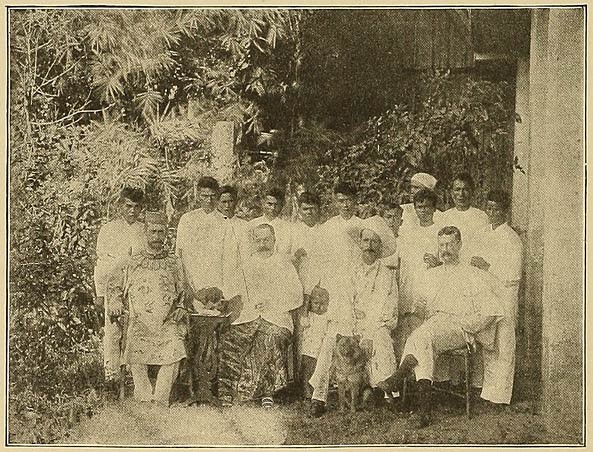
The Nactajan Mess: Manila Jockey Club.
Tramways of a very primitive kind run in the principal streets. There are also electric lights in the public parks, along the Luneta, and in the finest business houses. A telephone system extends throughout the city, and there is a railway—the only one in the province—to Dagupan. It is a single track, and is 123 miles long. It was opened to traffic November 23, 1892. An Englishman has secured the contract, and English engines are used, whose speed is 45 miles an hour. This road has paid more than ten per cent. to the shareholders. There is also a steam road to Dagupan. Another branch railroad is under construction by the Government. Manila being on low peat-ground,—considerably lower in fact than the lake of Laguna, whose overflow forms the Pasig river,—in the wet season it seems an Oriental Venice; for the numerous creeks and canals that intersect the city and its suburbs are then flooded with water and thronged with native boats. Drinking-water is carried to the city through pipes from Santolan, on the river Pasig. Fountains are also distributed at convenient places throughout the city, to which the poorer people have access.
A new harbor is now under construction. For the payment of it special dues have from time to time been imposed upon the trade of the port: 2 per cent. on imports, 1 per cent. on exports, a tonnage tax, and a duty on fishing-boats.
There are several theatres in Manila, but they are very inferior. The opera is very popular, and is well supported. Foreign celebrities sometimes visit Manila, when the audiences are most enthusiastic and whole scenes are encored. In the theatre every one smokes, from the fashionable ladies and gentlemen in full dress, to the half-naked gallery-gods in the loft. Between the acts pretty mestiza flower-girls pass to and fro offering their fragrant wares to the onlookers. A theatre-night in Manila is one of unrestrained gayety—and the fun-loving Filipinos rarely miss an opportunity to attend a show. In the Palacio Square is a statue of Charles IV., and in front of the Variedades is one of Queen Isabella.
The Cathedral and the Governor-General’s Palace.
The churches are well worthy of a visit, being picturesque and interesting. The Cathedral was founded in 1570, and has several times been destroyed by earthquakes. The new Cathedral, on the site of the old, which was destroyed by the earthquake of 1880, cost a half-million dollars. It is an immense structure of brick and stone and is the most imposing building in the colony. It is in old Manila, and is celebrated for the splendor of its interior decorations and its gorgeous altars. Here start and end most of the great religious processions for which Manila is so noted. The cost of maintaining the Cathedral, including the salaries of the officiating priests, is not far from $60,000 per annum.
The Church of San Francisco—also in old Manila—is the oldest church in Manila. It is under the patronage of the Franciscans and is very wealthy. The magnificence of its interior is unrivalled.
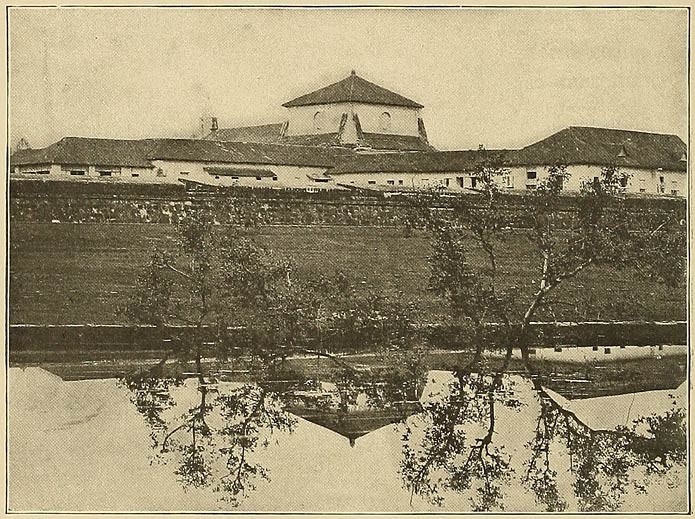
Church of San Francisco, and the Old City Walls.
The Governor-General’s Palace is in Malacanan, a suburb of new Manila. It is a low massive structure and occupies an immense area. It is in the midst of a large garden—a veritable Paradise. It is on the bank of the river Pasig, in a healthful locality, and commands a fine view of the city and the river. The garden is famed for its luxuriance. Here grow, in rich profusion, cocoanuts, bananas, lemons, mangoes, and a wealth of flowers: the white champaca, the yellow ilang-ilang with its exquisite perfume, gigantic orchids, and a thousand other blooms. Among the trees and shrubbery of this gorgeous Eden, wind broad garden paths paved with sea-shells.
Facing the river is a large balcony from which the Governor views the yearly boat-race that takes place on the birthday of the King. This boat-race is one of the great events of the year and is usually rowed by native champions.
The interior of the Palace is of unusual splendor, and there is evidence on every hand of great pomp and ceremony. A host of liveried servants and numerous guards in showy uniforms are everywhere apparent. There is an excellent library and a spacious ball-room, where receptions are held, to which, several times a year, the élite of the city and distinguished visitors are invited.
The Governor rides in a carriage drawn by four horses, with several outriders, who, by means of a shrill whistle, announce his approach. All streets are instantly cleared and traffic suddenly ceases, every one standing still to make respectful obeisance. On, on, they come, the dashing four, with the postilions in scarlet jackets. The Governor, dressed in civilian’s dress, sits within—the picture of dignity. He bows right and left, in that perfunctory way characteristic of public dignitaries the world over, and the carriage passes on, while the citizens resume their wonted demeanor and avocations.
The Jesuits support and manage a fine observatory. And there is a large botanical garden, now neglected; but it could easily be made the finest in the world. The English Club, in the suburbs, is noted for its hospitality and for the delightful personality of its members. Most of the hotels are bad, with poor accommodations. The Hotel de Oriente, however, is a noteworthy exception.
The police of the city are natives, and are under military discipline. The department of police is known as the Municipal Guard. From 10 o’clock at night until 5 o’clock in the morning night-watchmen patrol the city.
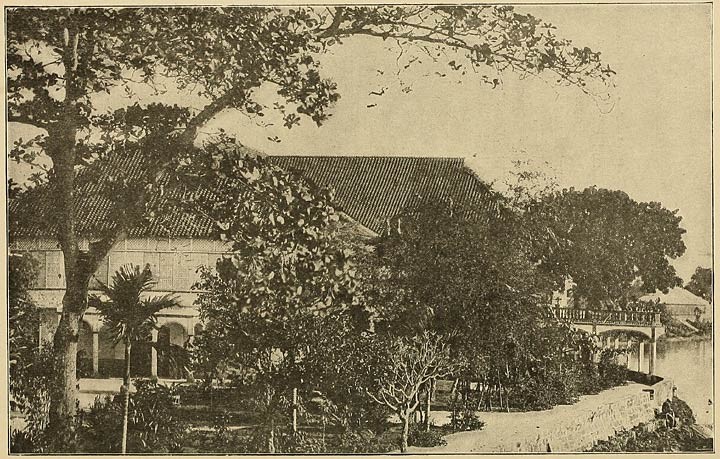
A Rear View of the Governor-General’s Palace.
One is struck by the number of carriages in the thoroughfares, drawn by pretty ponies of mixed Chinese and Andalusian breed. There are also many hacks to hire. The drivers, too, are as civil in address as they are moderate in their charges. There are three days in the year when the ponies are given absolute rest. These are Holy Wednesday, Thursday, and Good Friday,—when no traffic is permitted, only the Archbishop and the doctors being allowed to ride in carriages. On these days the church-bells are muffled, and the people, dressed in sombre black, walk solemnly in the various religious processions. A vast concourse assembles in the several squares to await the toll that shall announce the end of the fast and of this enforced abstinence from labor and worldly care. As soon as the first stroke is given, there is a mighty rush in every direction, a thousand ponies are trotted through the streets, ten thousand natives renew their daily traffic with clamorous zeal, which shows how feeble was the bond that kept them under restraint.
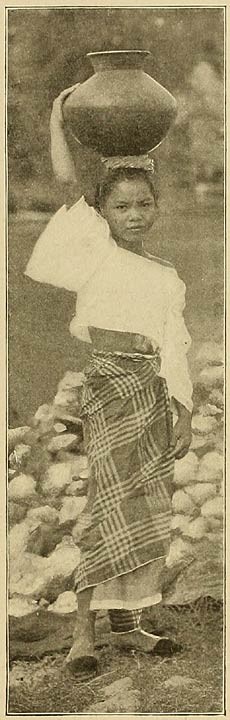
A Water-girl.
On the streets of the city are many wayside native restaurants. Here the employees of the huge tobacco factories come at noon for their “quick lunch” or for a refreshing drink. Most of these establishments are very primitive, and little more than rice, fruit, or meat is for sale. The charges are the merest pittance. For two cents a sumptuous meal can be had. It may, therefore, be understood that few people in Manila go hungry.
The water-girls or the peddlers of milk or cocoa are also worthy of mention; inasmuch as they, with their rude jars, have a most Oriental look. One, too, is likely, almost any time, to encounter a religious procession, such as The Feast of the Twelve Apostles, or The Feast of Corpus Christi, when the companies of friars, in their long robes of black, blue, white, or brown, alternate with long lines of solemn natives dressed in their sombre clothes. There are, in fact, forty holidays in the year, and, as each of these is distinguished by some feast or religious ceremonial, it can readily be seen how large an influence the Church has upon the people. The Archbishop is a greater man than the Governor-General, and as he passes through the streets in his carriage drawn by four white horses, every head is bared. There are 4,000 priests in Manila alone.
An execution in Manila is an interesting, though a gruesome, sight. The populace always flock to see one, and the condemned, with the stoicism natural to their race, as a rule seem perfectly indifferent to their fate. The garrote is the instrument usually employed. There is the pomp and ceremony incident to all Spanish functions of State: a procession of soldiers, a solemn death-cart, draped in mourning, on which sits the culprit apparently enjoying his last ride, two or three priests chanting a dolorous refrain, and the executioner,—all slowly approach the place of execution. Here is a raised platform, on which is a rude seat; against the back of it is an upright post. To this the condemned is firmly bound, and the deadly brass collar—the garrote—that is attached thereto, closes with a click around his neck. The executioner now takes his place behind, the priests elevate the crucifix and continue their chant, while the victim, half-bewildered, smiles a last farewell or mumbles a hasty prayer. The commanding officer gives the signal; the executioner gives a twist to the screw, that just touches the base of the prisoner’s brain; there is a convulsive shiver and a groan, and all is over. And the spectators, laughing and chattering, turn homeward.
But no street scene is more interesting than a native funeral. The hearse is a rude wagon, drawn by white horses. A most melancholy-looking person is the driver, who, clad in black and a high beaver hat, sits aloft in mournful dignity. In front is a brass band, playing a lively march, while a long line of carriages follow slowly behind. On account of the heat, the burial is nearly always on the same day as the death. The bodies of the well-to-do are usually deposited in a vault in the church as long as the relatives of the deceased pay the priests well for the privilege. When this tribute ceases, the remains are dumped without ceremony into a huge pit at the back of the church, where perhaps are the bones of a thousand others. The pit, it is safe to say, is the ultimate destiny of all.
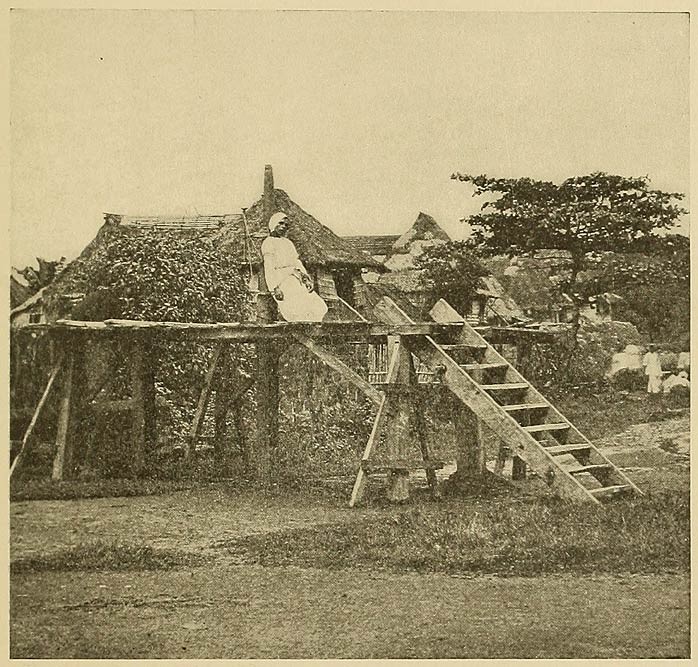
The Garrote: Manila Method of Capital Punishment.
Bull-fights have never made the headway in the Philippines that they have in Cuba. In the suburb of Paco is a bull-ring; but it is not attended by the better classes, and it offers but a sorry spectacle.
The Beautiful Luneta: the Sea-boulevard.
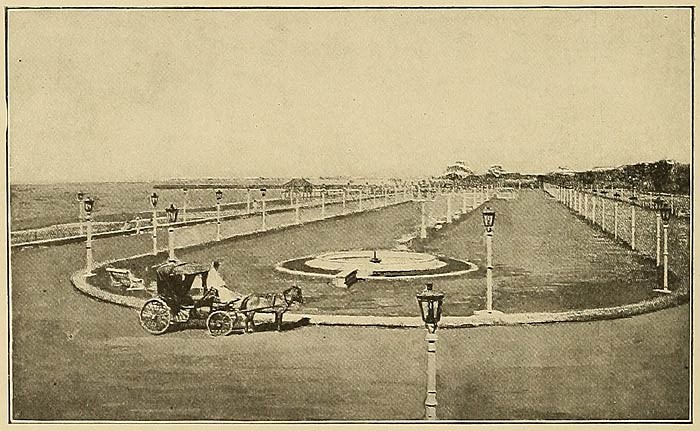
The Beautiful Luneta.
There are many drives and promenades in the city of Manila. The principal one, and the most celebrated, is the Luneta, which is by the old sea-wall. Here in the cool summer evening is stationed the Governor’s fine military band, and all Manila comes out to see and to be seen. Thousands of people, natives and foreigners, pair in careless promenade. Here comes a group of English Jack Tars, from some British Man-of-War in the harbor. The sailors are flirting vigorously with a number of bewitching mestiza-girls, just behind. These olive-cheeked damsels, whose long raven hair, red lips, and pearly teeth are cunningly displayed in daring coquetry, are all laughing merrily, smoking betimes a dainty cigarette. Here comes a whole native-family, trooping along with almost stolid demeanor, yet listening keenly to the stirring music. And then follow Chinamen, in their national dress, Englishmen in white drill, and Spaniards in European costume,—all walking with the leisurely manner of the tropics, as if to the climate born. And so thousands pass by, bowing and smiling, with never one careworn face in the vast throng.
Here, too, were enacted some of the most horrible tragedies in the recent rebellion. Hundreds of native prisoners were here executed. And such an execution was made occasion of great rejoicing. The fashionable Spanish element, men and women, was not wanting to witness it; and while the band discoursed a lively air, the poor fellows were made to stand on the sea-wall, facing the sea; at a given signal the firing-squad discharged a volley, and they fell dead or mortally wounded, while the onlookers cheered for tyranny and Spain.
Though Manila lies very low, it is by no means unhealthy. It is a pleasant city to live in, but not nearly so pleasant as it might be made to be. The climate is thus described by an old Spanish proverb: “Six months of dust; six months of mud; six months of everything.” The spring months are December, January, and February; the climate then is most agreeable. In March, April, and May the heat is very oppressive. In June, July, August, and September occur heavy rains. October and November are either wet or dry. The population of Manila is not far from 300,000, of which 70 per cent. are pure natives, 15 per cent. Chinese, 14 per cent. mestizo Chinos, and one per cent. Europeans and Creoles.


Other Important Cities and Towns.
Iloilo, Capital of the Province of Panay.
In the province of Iloilo, in the southern part of the island of Panay, is the town of Iloilo. It is on the sea, and is built on a low, marshy plain. Iloilo is the capital of the province in which it is situated, and it is also one of the principal sea-ports of the colony. The harbor is excellent, being well-protected by the island of Guimaras, which lies just beyond. This island is much higher than the mainland, with which it forms a kind of funnel, so that there is a constant breeze, which makes Iloilo much cooler and healthier than Manila. During the spring-tides the whole town is covered with water.
Iloilo is a manufacturing town. Its principal product is piña, a fine cloth made from the fibre of the pineapple-leaf. Jusi—another fabric made from silk and woven into various colors—is also manufactured here.
The country around the town is very fertile, and is extensively cultivated. The facilities for transportation to and from the interior of the island are very poor. This, of course, is a great bar to the development of the commerce. However, over 1,000,000 piculs of sugar are raised around Iloilo; also a great amount of tobacco; much rice, too, is raised here. The town is doubtless destined to become a great commercial centre. It is about 250 miles from Manila. Typhoons are not uncommon, though earthquakes are infrequent. Most of the traders are Chinese Mestizos. Some of them are very wealthy.
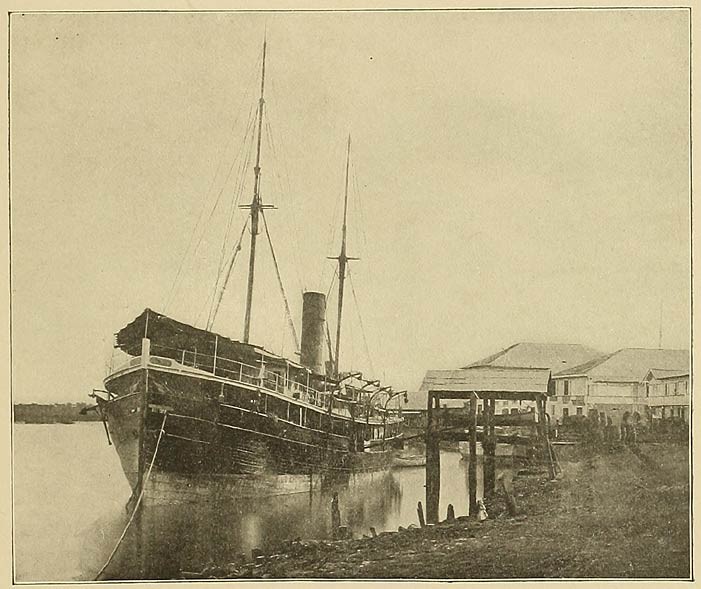
At the Port of Iloilo
The port of Iloilo is of recent date, its opening being wholly due to foreigners. The produce shipped from there comes mostly in American sailing vessels to the United States. Iloilo has become the shipping centre for the crops of sugar and sapan-wood of the islands of Negros and Panay, and the opening up of this port has greatly encouraged agriculture in the Visayas district. Manila is too far away. The Iloilo district includes the large islands of Panay, Negros, Cebú, and others, and has a second port of rising importance, Cebú, on the island of that name.
Cavité is a fortified town, on a small peninsula, in the bay of Manila, about ten miles from the capital. To it a steamboat runs twice daily. The Government arsenal and the only shipyard in the colony are located here, and it is, therefore, the chief naval station in the islands. Cavité is also the residence of most of the Spanish naval officers and of many foreigners: their handsome bungalows are on the outskirts of the town. Some fine shops, a theatre, a few cafés, and the old Cathedral are the most noteworthy objects of interest in the town itself. The Cathedral is large and imposing, and its architecture is characteristic of most of the churches of the colony. The houses in Cavité were formerly of wood, but since a fire, in 1754, which destroyed the town, most of them are built of stone or brick. But even this did not save the town; for the earthquake of 1880 again laid it waste.
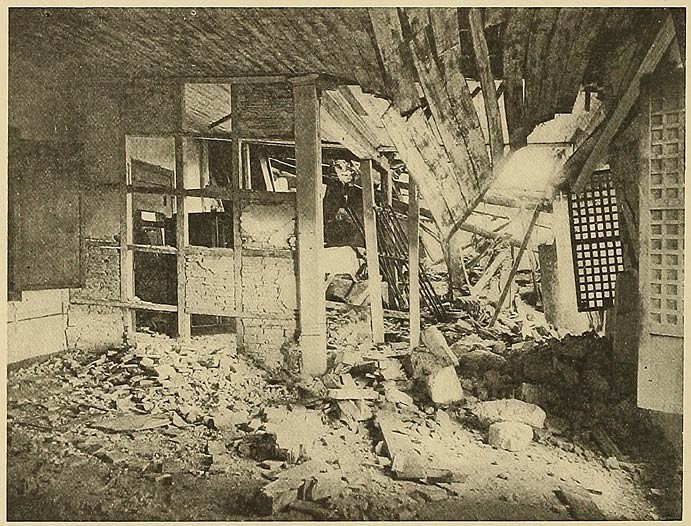
Interior of a House Destroyed by an Earthquake.
Cavité was taken by the British in 1763, and has always been deemed the key to the capital. It was the seat of the rebellion of 1872, when the rebels seized and plundered the arsenal. This insurrection, however, was put down, and the leaders executed or deported. Cavité, on account of its strategic value, was the first place taken by Admiral Dewey after the battle. As elsewhere described, it then became the headquarters for Aguinaldo and the insurgents. Under a humane and an advanced government of the islands, Cavité should become a large city.
Majajay is a picturesque mountain-town, in Luzon; it contains several fine streets and many charming residences. The church and the convent are striking; the scenery in the vicinity is magnificent. The waterfall of Botócan is well worth a visit. It is about 600 feet high, and 60 feet wide. The view is impressive.
Lúgbang, near Majajay, is a thousand feet higher. Around it are extensive rice-fields. In the town are several fine canals, some good streets, and many commodious residences. A stone church and a convent front the little plaza. On the other side is the Tribunal, an imposing government building.
Tayabas is the capital of Tayabas province. In some of the streets are canals. Besides the houses of the wealthy planters, there are the usual church and convent. In the vicinity of Tayabas are extensive timber-yards.
Laguimanoc, a small town on the coast of Luzon, is also a port. The mail steamers stop there. The chief trade is in building-timber; for around the town are magnificent forests. The harbor is an excellent one, and, with increase of trade, the place should have a great future.
Lipa is the capital of the Batangas province, Luzon. It is a centre of the coffee-trade. Besides, the temperature there is cooler than that of most of the Philippine towns. It is noted for its large church and its convent—among the most remarkable in the colony. Most of the houses are three stories high, and many wealthy planters live in the vicinity.
Taal is one of the principal towns of Luzon. It is situated on a hill upon the left bank of the Pansipit river. On the opposite side is the town of Lemeri. A bridge connects the two.
Taal was formerly on the shore of the Lake of Taal, near the volcano, but the old town was destroyed by the earthquake of 1754. The new town is hilly, and is surrounded by sugar-cane plantations and great forests. The streets are lined with modern shops and spacious residences. Many of the inhabitants are of Japanese origin; but the Chinese, strange to say, are not tolerated. As there is considerable trade in sugar, in coffee, and cotton stuffs, trading-steamers ply between Taal and Manila. The population of the town and its suburbs is about 50,000.
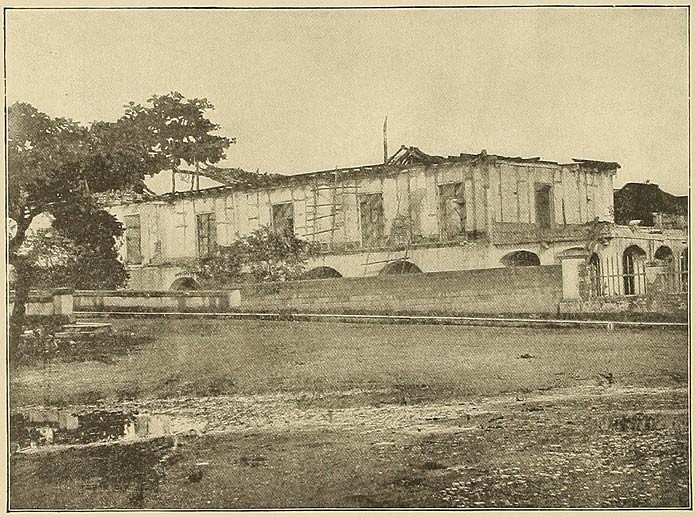
Open-air View of an Earthquake’s Violence.
Batangas, another town in Luzon, is the capital of the province of that name. It is near the sea, and is the residence of the Governor and the other chief officials of the province. There is a beautiful park in the centre of the town, and a fine drive, where the European residents are wont to meet. In and around the town are many pretty bungalows and some large sugar-factories.
Santa Cruz de Malabon is a town in the rice-district of Luzon. It is a charming little place, and some wealthy natives live there. Near the town are several water-power rice-husking mills, that give employment to hundreds of natives. The country all around is low and flat, but not lacking in beauty.
Silan is also in Luzon, and is a good-sized town. It is noted for its religious feasts and fairs. The church and the convent are celebrated, and are among the handsomest in the colony.
Carmona, Perez Dasmariñas, and Viñan, are flourishing towns in the vicinity of Silan. All are well worthy of a visit.
At the foot of the Maquiling mountain is Calamba, a market-town. Nearly all the land thereabouts is owned by the Dominicans, who rent it to the native rice and sugar-planters.
Below the Maquiling mountain, which is a crater, are hot springs. Near them is the town of Los Baños, or the Baths. These springs are beneficial in curing rheumatism and other ills. A hospital, therefore, has been erected there, which is dedicated to our Lady of the Holy Waters.
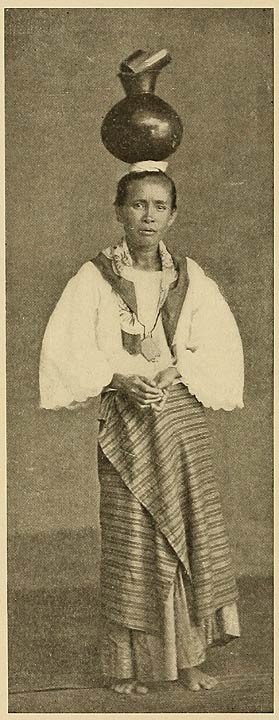
A Milkwoman of Calamba.
Other objects of interest are a vapor bath-house and the remains of several large public buildings. Los Baños was once a popular resort, and was under the administration of the Franciscans. The Government, however, desiring a share of the profits, gradually, by onerous exactions, caused the ruin of the place. If some enterprising American would get hold of it, Los Baños could be made a great resort.
A few miles from Los Baños, on the Malanin river, about 1200 feet above the sea, is the boiling lake of Natungos. This, too, possesses wonderful medicinal properties.
Santa Cruz is the capital of the Laguna province. It is a market-town of considerable size and importance, and contains a fine church and one or two impressive government buildings. The principal street is also called the Escolta. Santa Cruz is the centre of the cocoanut trade, and is a meeting-place for stock-dealers.
Pagsanjan, a small old town near Santa Cruz, contains some elegant residences. It has, however, an air of fallen grandeur. And well it may! for it was once an important place. Around it are extensive forests of cocoanut palms.
Puerta is on Palaúan Island, and has an excellent harbor. Near it is a lighthouse and a naval station. It is a penal settlement, and is surrounded by large sugar-estates, worked by the convicts. The town is pretty, and the suburbs are delightful.
The principal port of Mindanao is Zamboanga, a small but interesting town. Sulu is the principal port of Sulu, and is the centre of the pearl trade.
The capital of Negros is Bacólod. It contains, besides a church and a government house, some handsome residences belonging to the chief traders and to the government officials. The town is on the coast, but, as the water is very shallow, steamers are obliged to anchor a half-mile from the shore. Bacólod is a good field for investors, as it is in the very heart of the sugar and rice-district of Negros, and its trade is constantly growing.
Mataban, Talisay, Silay, Sarávia and Victoria are rising towns in the same province. Cádiz Nuevo, a small town just beyond Victoria, has some fine streets, and many large shops owned by the irrepressible Chinamen. The new stone church and convent of the town are the handsomest on the island. In the country round about live many wealthy native-planters, famed for their hospitality.
Cebú: a Mecca for Many Filipinos.
Cebú is the capital of the island of Cebú, and ranks next to Iloilo among the ports of the Philippines. The town is well-constructed, and is surrounded by fine roads. The people are conservative, and lack thrift and enterprise. The principal exports are hemp and sugar, most of which comes from the large plantations of the neighboring islands of Leyte, Camaguin, and Mindanao. The cathedral of Cebú is one of the most celebrated in the islands. It contains the shrine of the Holy Child of Cebú, which thousands of pilgrims visit yearly.
General Topography of the Islands.
The Philippines, with the Sulu Protectorate, number about 600 habitable islands, that lie all the way from 4° 45′ to 21° N. latitude.
The area of the eleven largest islands is variously computed to be somewhere between 55,000 and 150,000 square miles. It is probably not far from the latter sum. All the islands together are about as large as the combined area of New York, Pennsylvania, New Jersey, Maryland, and Delaware.
The eleven largest islands are: Luzon, Mindanao, Sámar, Panay, Negros, Palaúan, Mindoro, Leyte, Cebú, Masbate, and Bojol. Luzon and Mindanao are probably as large as all the others combined.
All the islands are mountainous and of volcanic formation.
Here is a list of the principal peaks:
Halcon, (Mindoro)
8,868 feet above sea.
Apo, (Mindanao)
8,804 feet above sea.
Mayon: active volcano, (Luzon)
8,283 feet above sea.
San Cristobal, (Luzon)
7,375 feet above sea.
Isarog, (Luzon)
6,443 feet above sea.
Banájao (Luzon)
6,097 feet above sea.
Labo (Luzon)
5,090 feet above sea.
South Caraballo, (Luzon)
4,720 feet above sea.
Caraballo del Baler (Luzon)
3,933 feet above sea.
Maquiling, (Luzon)
3,720 feet above sea.
In the interior of the islands are magnificent forests of stately trees, splendid with luxuriant foliage and the glorious flora of the tropics. Here are gigantic creepers and gorgeous festoons,—the splendid parasites of this opulent clime. Luscious fruits in rich clusters hang from pendent boughs of myriad trees, inviting the passer-by to pluck.
One that has never seen it, can form no idea of the splendor of such a tropical forest—teeming with all that is brilliant and grand in nature. It would seem as if the Creator had emptied the cornucopia of his gifts over this garden-spot of the world, making it a veritable Eden.
There are many rivers throughout the islands,—some navigable. The Pasig river, in Luzon, empties into Manila Bay. Vessels drawing thirteen feet of water enter the Pasig river. In the same island, the Rio Grande de Cagayan is also navigable and runs through the Cagayan valley northward. It yearly overflows its banks. On them are the richest tobacco-districts in the colony. The Rio Grande de la Pampanga flows southward through the glorious valley of Pampanga, emptying by twenty mouths into Manila Bay. On the banks of this river are extensive rice-fields and sugar-cane plantations, and great forests; among them gleam numerous towns and villages, full of a thriving population. The Rio Agno, which flows southward, past the port of Dagupan and the Bicol river—which flows from Bato lake to the bay of San Miguel—is also in Luzon, and navigable.
In Mindanao, the Rio Agusan cuts the island almost in two. It is navigable only a few miles. In Negros Island, the Danao is navigable.
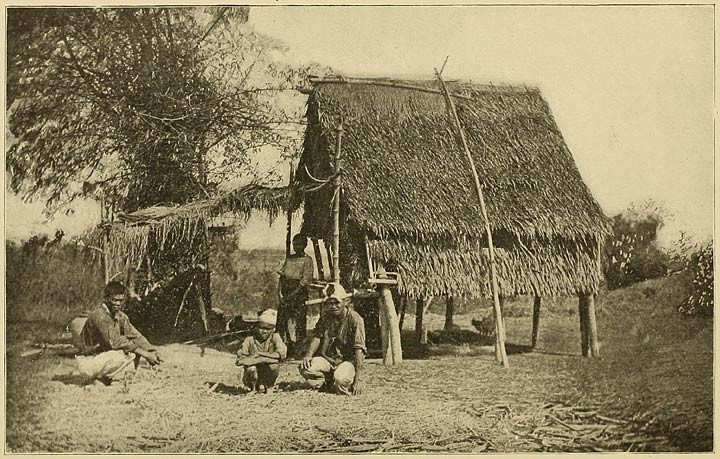
A Native Hut in the Interior.
The Bay lake (Luzon)—Laguna de Bay,—is 25 miles long and 12 miles broad. It is higher than Manila, and its overflow is the Pasig river.
In the centre of Bombon lake is an active volcano called Taal, which is no less famed in the history of the colony than is Vesuvius in the history of Naples. It has had many celebrated eruptions, some very destructive. In 1754 several towns were overwhelmed by a flood of burning lava, which was thrown as far as fifteen miles from the crater, causing great damage, even at that distance. It is said that cinders fell in Manila, 34 miles away. There was a smell of sulphur in the air for months; the lake was full of dead fish; and the earth, for miles, was heaped with burning lava and ashes. This eruption lasted nearly six months. The town of Taal was entirely destroyed, and most of the inhabitants perished. On that day darkness hung over the whole sky, and the air was full of cries and lamentations. It seemed as if the end of the world had come.
The Mayon volcano, in Albay, has also had several destructive eruptions. Its crest is always fiery. In 1814, 2,500 natives were killed and wounded. During the last eruption, in 1888, fifteen lives were lost, and many cattle.
Near the volcano of Mayon are the sulphur springs of Albay, noted for their wonderful medicinal properties. Here, no doubt, some enterprising American will soon build a resort, or a sanitarium. And a most splendid location indeed it would be!
Though in the heart of the tropics, the Philippines are by no means unhealthy. The year is divided into the wet and the dry monsoons; the west coast being dry, the eastern coast wet, and vice-versa. The annual rainfall is about 90 inches. Mosquitoes and white ants are the most troublesome pests. Terrific tornados are common, and earthquakes are as plentiful as blackberries in an Alabama cemetery. In 1875 a typhoon destroyed 4000 houses and killed about 300 people. In 1863 an earthquake destroyed the greater part of Manila—3000 people were killed and injured. The earthquake of 1880 was also very destructive.
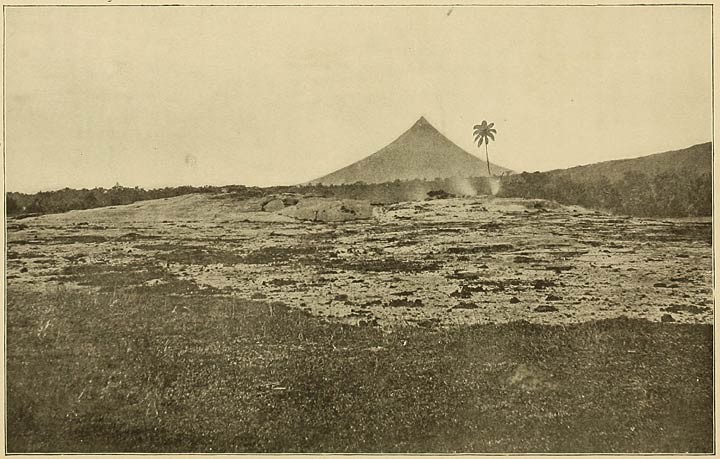
Hot-water Springs, Albay; and Mayon Volcano.
That of ’63 occurred at night, and I remember it well. I was then a little boy, but the horrors of that night I can never forget. The earth trembled and seemed to rise and fall; huge fissures opened in the ground, and dull rumblings were heard everywhere, while the shrieks of tens of thousands arose on every hand. Many were buried in the ruins of their houses.
For weeks afterward, the people slept in the streets; for the greater part of the city was destroyed.
The earthquake of 1880 occurred while the people were at tiffin, or lunch. Hence the number of casualties was not so great; for most of the people were able to leave their houses before they were shaken down.