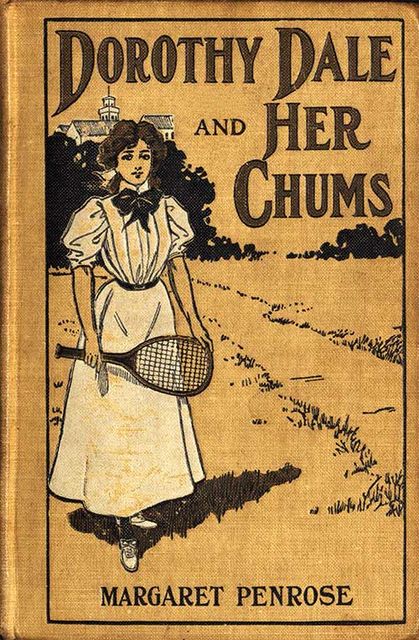



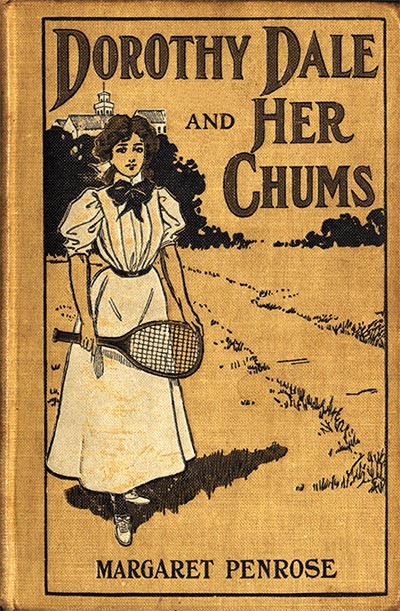
автордың кітабын онлайн тегін оқу Dorothy Dale and Her Chums
E-text prepared by Stephen Hutcheson, MFR,
and the Online Distributed Proofreading Team
(http://www.pgdp.net)
DOROTHY DALE AND
HER CHUMS
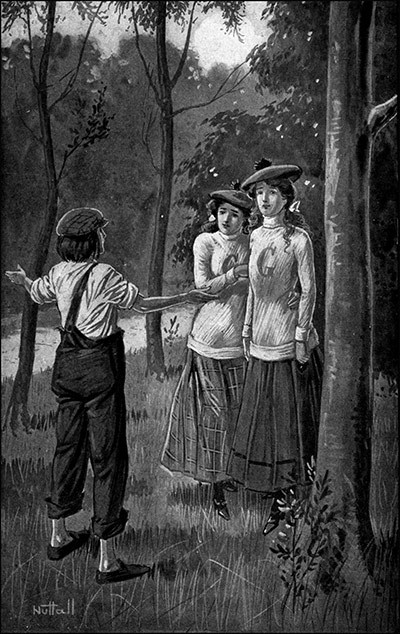
“Stretched out his arms to bar their way”
Page 142
At this Miette and Dorothy hurried toward the road, but just as they were about to reach the open path a boy deliberately jumped out from the bushes, and stretched out his arms to bar their way!
DOROTHY DALE AND
HER CHUMS
BY
MARGARET PENROSE
AUTHOR OF “DOROTHY DALE: A GIRL OF TO-DAY,” “DOROTHY
DALE AT GLENWOOD SCHOOL,” “DOROTHY DALE’S
GREAT SECRET,” ETC.
ILLUSTRATED
NEW YORK
CUPPLES & LEON COMPANY
THE DOROTHY DALE SERIES
By Margaret Penrose
Cloth. Illustrated. Price per volume, 60 cts., postpaid
- DOROTHY DALE: A GIRL OF TO-DAY
- DOROTHY DALE AT GLENWOOD SCHOOL
- DOROTHY DALE’S GREAT SECRET
- DOROTHY DALE AND HER CHUMS
(Other volumes in preparation)
CUPPLES & LEON COMPANY NEW YORK
Copyright, 1909, by
Cupples & Leon Company
Dorothy Dale and Her Chums
CONTENTS
CHAPTER
PAGE
I.
Stolen Birds
1II.
The Gypsy Girl
8III.
Dorothy at the Camp
21IV.
The Midnight Alarm
29V.
An Awful Experience
43VI.
“The Goods”
59VII.
A Strange Girl
72VIII.
The Runaway
77IX.
Miette
87X.
A Rumpus
98XI.
“Girls and Girls”
104XII.
A Girl’s Mean Act
112XIII.
The Troubles of Miette
120XIV.
Dorothy to the Rescue
128XV.
A Queer Tramp
143XVI.
Surprises
152XVII.
Dorothy’s Courage
161XVIII.
Tavia’s Double
171XIX.
The Capture
177XX.
Urania in the Toils
187XXI.
Complications
197XXII.
Sincere Affection’s Power
206XXIII.
The Real Miette
218XXIV.
The Search
231XXV.
Dorothy and Her Chums
243CHAPTER I
STOLEN BIRDS
CHAPTER II
THE GYPSY GIRL
CHAPTER III
DOROTHY AT THE CAMP
CHAPTER IV
THE MIDNIGHT ALARM
CHAPTER V
AN AWFUL EXPERIENCE
CHAPTER VI
“THE GOODS”
CHAPTER VII
A STRANGE GIRL
CHAPTER VIII
THE RUNAWAY
CHAPTER IX
MIETTE
CHAPTER X
A RUMPUS
CHAPTER XI
“GIRLS AND GIRLS”
CHAPTER XII
A GIRL’S MEAN ACT
CHAPTER XIII
THE TROUBLES OF MIETTE
CHAPTER XIV
DOROTHY TO THE RESCUE
CHAPTER XV
A QUEER TRAMP
CHAPTER XVI
SURPRISES
CHAPTER XVII
DOROTHY’S COURAGE
CHAPTER XVIII
TAVIA’S DOUBLE
CHAPTER XIX
THE CAPTURE
CHAPTER XX
URANIA IN THE TOILS
CHAPTER XXI
COMPLICATIONS
CHAPTER XXII
SINCERE AFFECTION’S POWER
CHAPTER XXIII
THE REAL MIETTE
CHAPTER XXIV
THE SEARCH
CHAPTER XXV
DOROTHY AND HER CHUMS
DOROTHY DALE AND HER CHUMS
CHAPTER I
STOLEN BIRDS
“Of all things, to have that happen just now! Isn’t it too mean!” sighed Dorothy, perching herself on the high shelf at the side of the pump, and gazing dejectedly beyond the wire fence into the pigeon loft, where a few birds posed in real “Oh fair dove, Oh, fond dove!” fashion.
“Mean?” repeated Tavia, who was inside the wire fence, calling live birds, and looking for dead ones, both of which efforts were proving failures. “It is awful, Dorothy, such a doings as this. They are gone, sure enough,” and she crawled through the low gate that was intended as an emergency exit for chickens or pigeons. “I’d just like to know who took them,” she finished.
“So would I,” and Dorothy shook her blonde head with a meaning clearer than mere words might impart. “Yes, I would like to know, and I’ve just a notion of finding out.”
Tavia reached for the clean little drinking pan that rested on the shelf at Dorothy’s elbow. She held it under the pump spout while Dorothy worked the pump handle up and down. Then, with the fresh water in her hand, Tavia crawled inside the wire enclosure again. A few tame bantams flew across the yard to the treat. Then the doves left their perch and joined the party around the pan.
“How lonely they look without the others,” remarked Dorothy, as she, too, crept through the wire gate. “And I did love the Archangels. I never saw prettier doves. They always reminded me of real Paradise birds. No wonder they were called by a heavenly name.”
“And to have taken both pairs!” denounced Tavia. “My favorites were the fantails—they always made me think of—What do you think?”
“Think? I know.”
“What, then?”
“Why, accordion-pleated automobile coats,” teased Dorothy.
“Of course! With such dainty white lingerie! Wouldn’t Nat and Ned look swell in such coats!”
“Well, if you insist, Tavia, I shall give you my real opinion—memoirs of the fantails, as it were. They looked exactly like star chorus girls. But I was loathe to bring up such thoughts in your presence. Yet, those birds were the purest white—”
“Oh, how I shall miss them! I just enjoyed coming down here every morning to see them,” and Tavia very gently picked up two of the doves, placed one on each of her shoulders, and then proceeded to walk “around the ring,” doing a trick she called “The Winged Venus.”
But there was very little of the Venus type about Tavia. It was rather early in the morning, and her hair had as yet only received the “fire alarm brush,” which meant that Tavia, upon hearing the breakfast bell, had smuggled her brown hair into a most daring knot, promising to do it up properly later. But it was at breakfast that Dorothy’s two cousins, Ned and Nat, told of their loss—that the pigeons had been stolen during the night. The boys made no attempt to hide either their anger at the unknown thieves’ act, or their genuine grief at the loss of their fine birds. Dorothy and Tavia were almost as wrought up over the affair as were the boys, and, as a matter of fact, very little breakfast was partaken of by any of the quartette that morning. So Tavia did not get back to her room to give the “back tap” to the “fire alarm” hair dressing, and as she now marched around the chicken yard, with the doves on her shoulders, proclaiming herself to be the Winged Venus, Dorothy suggested it might be well to do away with the Psyche knot at the back of her head first, and not get her mythology so hopelessly mixed.
Over in a grassy corner Dorothy was feeding from her hands the bantams. She looked like a “living picture,” for a pretty girl feeding chicks always looks like something else, a page from fairy tales, or a colored plate from Mother Goose.
Tavia had always complained that Dorothy “didn’t have to do” her hair, she only had to “undo it,” for the blonde waves had a way of nestling in very close at night, only to be shaken out the next morning. So Dorothy’s hair looked pretty, and her simple white gown was smooth, not wrinkled like Tavia’s, for Dorothy’s dress couldn’t wrinkle, the stuff was too soft to hold creases. Tavia wore a pink muslin slip—it was intended to be worn as an underslip, with a thin lace or net covering, but like other things Tavia had cut her dressing down that morning, so she wore the slip without the cover. And to add to the “misery,” the pink slip was a mass of wrinkles—it had been making itself comfortable in a little lump on Tavia’s bedroom chair all the night, and so was not quite ready (copying its mistress) to be on parade in the morning sunlight.
“Here come the boys,” suddenly announced Dorothy, as two youths strode down the path toward the little enclosure.
“Hello there!” called Ned. “What’s the entrance?”
“Reserved seats fifty cents,” answered Dorothy promptly.
“This way for the side show,” called out Tavia, who still had the birds on her shoulders.
“I’ve seen worse,” declared Nat, the youth who always saw something to compliment about Tavia. “Say, Coz”—this to Dorothy—“I think I know who took the pigeons, and I want your help to bring them to—justice.”
“Oh, she’s just aching to go on the force,” declared Tavia, “shooing” the doves away, as the news of the thievery was promised. “She thinks those Archangels will ‘telepath’ to her. They were her pets, you know, and what on earth (or in heaven) would be the use of being Archangelic if—well, if in a case of the kind the ‘Archs’ couldn’t make good?”
“She’s only jealous,” declared Dorothy. “Her fantails are sure to fly away to some other country, and so there is no hope for them. They were such high-flyers.”
“Nat thinks he’s got the game dead to rights,” remarked Ned, with a sly wink at Dorothy. “But wait until he tries to land it.”
“Exactly!” announced Nat. “Just wait until I do. There’ll be some doin’s in Birchland, now, I tell you. And if I can’t get the birds alive, I’ll get their feathers—for the girls’ hats.”
“Oh, I am going to join the Bird Protection Society this very day,” and Dorothy shivered. “To think that any one can wear real bird feathers—”
“Now that you know real birds—your Archangels, you can see how it feels,” commented Nat. “We fellows have the same regard for woodcock or snipe. But just suppose some one should shoot those pretty pigeons, and give the feathers to a girl for her hat. She’ll wear them, of course. They were beautiful birds,” and he walked off toward the cage where only the day previous he had so admired the birds that were now strangely missing.
“But who took them?” demanded Tavia.
“Of course, if I knew—”
“Said you did,” pouted Tavia, before Nat had a chance to finish the sentence.
“Now, did I?”
“Well, you said you thought—”
“And I still think. It’s a habit I have. And, by the way, little girl,” (Nat always called Tavia “little g-ir-l” when he wanted to tease) “it’s a great thing to think. Try it some time.”
“Well, if I ever get at it, I’ll begin on you,” and Tavia’s Psyche knot almost fell over on her left ear in sheer indignation.
“Do. I shall be de-lighted. But to be exact,” and he drew from the pocket of his sweater two feathers, one white and the other copper color. “Do you recognize these?” and he held the little quills out to the girls.
“That white one is from a fantail,” declared Tavia promptly.
“And the other—that is certainly from an Archangel,” exclaimed Dorothy, taking the pretty bit of fluff in her hand, and examining it closely.
“Well, I found those—”
“Hush!” whispered Ned. “There’s Urania!”
CHAPTER II
THE GYPSY GIRL
With a gait that betokened indolence, and her entire appearance bearing out that suggestion, a girl with a bright-colored handkerchief on her head, sauntered along the path in the direction of the little party, who had been conferring in the “enclosure.” Her feet seemed weighed down with shoes many sizes beyond her real need, and her dress was so long that she looked as if she might have been playing grandmother up in some attic, and had forgotten to leave the things behind after the game.
“Well, Urania,” began Dorothy, smiling, “you are out early, aren’t you?”
“Haven’t been in yet,” drawled the girl. “So much fussin’ around the camp last night I just left the wagon to little Tommie, and made a bed out under the pines.”
“Fussing?” inquired Nat, showing keen interest in the girl’s remarks.
“Yes, comin’ and goin’ and—” She shot a quick glance at the boy who was listening so intently to her words. Then she peered through the wire cage over to the dove cote. “What’s the matter?” she asked. “Your birds sick?”
“Worse,” spoke up Tavia. “They’re gone, stolen!”
“Flew the coop?” said the gypsy girl, with a grim smile. “Them pretty ones, with the pleated tails?”
“Yes, and those beautiful dark ones,” sighed Dorothy. “Those with all the colors—like sunset, you know.”
“Too bad,” murmured the strange girl. “Lots of chicken thieves around here lately. Dad says people will be blaming us. But we’ve been in this township every summer for ten years, and Dad is just as thick with the ‘cops’ as—the old woman is with the peddlars,” she finished, grinning at her own wit.
“You didn’t happen to hear any strangers around the camp last night, did you?” asked Ned, kindly.
“Heard more than that,” answered the girl. “But, say, I came over here to borrow something. Business is bad, and the old woman wants to know if you could just lend her a quarter. I didn’t want to ask, as I don’t forget good turns, and you’ve treated me all right,” with a nod to Dorothy. “But when the old woman says ‘go’ I’ve got to turn out. She’s gettin’ awful sassy lately.”
The girl dug the broken toe of her shoe deep into the soft sod. Evidently she did not relish asking the favor, and as Nat handed her the coin she looked up with a sad smile.
“Much obliged,” she stammered, “I’ll bring it back the first chance I get, if I—have to—steal it.”
“Oh, no! I’m making you a present of that,” the youth answered, pleasantly. “You mustn’t think of bringing it back. But about the noises at the camp last night? Did you say there were strangers about?”
“Might have been,” answered the girl slowly. “But you know gypsies never squeal.”
“I don’t expect you to,” followed Nat. “But you see my best birds are gone, and you, being a friend of ours, might help in the search for them.”
“So I might,” said Urania. “And if I found them?”
“Why, you would get the reward, of course. I’ve offered a dollar a piece for them—alive.”
“A dollar apiece?” she repeated. “And how many were swiped?”
“Six—the very best three pairs,” answered the young man. “I’ll have the reward published in to-night’s paper—”
“No, don’t,” interrupted the girl. “That’s what they’re after. Keep them guessing for a day or two, and well, maybe the doves will coo loud enough for you to hear them in the mean time.” At this the gypsy girl turned away, leaving the party to draw their own conclusions from her remarks.
And while the others stand gazing after Urania, we may take time to get acquainted with the various characters who will come and go in this story, and who have appeared in the other books of this series. As told in my first volume, called “Dorothy Dale: a Girl of To-Day,” Dorothy was a daughter of Major Dale, formerly of a little town called Dalton, but now living with his sister, Mrs. Winthrop White, at North Birchland. Dorothy’s chum, Octavia Travers, familiarly called Tavia, was the sort of girl who gets all the fun possible out of life, besides injecting a goodly portion of her own original nonsense into every available spot. Dorothy and Tavia had been chums since their early days in Dalton—chums of the sort that have absolute faith in each other: a faith sufficient to overcome all troubles and doubts, yes, even reports that might be sent out by the unthinking or the unkind, for Tavia naturally got into trouble and kept Dorothy busy getting her out.
Several instances of this kind were told of in the first book of the series; in the second called, “Dorothy Dale at Glenwood School,” Tavia developed still greater facilities for finding trouble, while Dorothy kept up with her in the matter of “development” in smoothing out the tangles. In the third volume, “Dorothy Dale’s Great Secret,” Tavia came very near “social shipwreck,” and no one but such a friend as Dorothy Dale proved herself to be, could have, and actually did, rescue her.
Mrs. Winthrop White, called by Dorothy, Aunt Winnie, was also an interesting character in the books. She was described by Tavia as a “society thoroughbred,” and was mother to Ned and Nat, the two jolly boys whose acquaintance we have just made. These boys were Dorothy’s cousins, of course, and Tavia’s friends. Tavia was spending part of her vacation with Dorothy at the Cedars, Mrs. White’s country place. The boys played an important part in the rescue of Tavia when she tried to “earn money by going on the stage” with a “barnstorming” company, when Dorothy herself got into complications at Glenwood School, (trying to assist a girl who proved entirely unworthy of the interest Dorothy manifested in her affairs,) it was Tavia who “helped out.” At Glenwood School we met some of the jolliest sort of boarding school girls, and were permitted to get a glimpse into the sacred life of those who consider every boarding school a college junior, and in imitating the college girl antics actually outdo their elders in the matter of fun making.
The gypsy girl, Urania, also appeared in a previous volume, and it was Dorothy’s characteristic wit that then helped the brown-eyed Urania out of a very unpleasant predicament.
And now this gypsy girl was offered a chance to return a kindness to Dorothy, for in getting trace of the stolen birds all who lived at the Cedars, would be relieved of worry, and spared much anxiety, for the birds had been great pets with the folks there.
But would Urania make her clues clear? Dare she risk gypsy vengeance to show her gratitude to Dorothy?
“She knows, all right,” remarked Nat, as the girl swung out into the roadway on her way to the camp.
“But she’ll never tell,” added Ned. “She wouldn’t dare. That Melea, her stepmother, whom she calls the old woman, is a regular ‘tartar.’”
“I think,” ventured Dorothy, “she might give just a hint. We wouldn’t want her to do anything that would endanger herself. But if we guessed—”
“You’re the star guesser, Doro,” put in Tavia. “For my part I never was any good at that trick. You remember how near I came to the mark at the Glens’ Donkey party?”
“Then keep away from this tale,” said Nat laughing. “It wouldn’t do for the clue to be pinned on the wrong party.”
“I must have a talk with Urania alone,” Dorothy said, seriously. “I am sure she will tell me what she knows about the birds. I’ll go see her this afternoon—I want to go over to the camp with some things, and then I will get Urania to walk out with me. It wouldn’t do for Melea to see our two heads together.”
“Great idea,” commented Ned. “I quite agree with Tavia. You would make a star detective, Doro. And the best of it is no one would ever suspect you of being ‘on the rubber.’ Now Tavia—well, she just up and asks, the most impertinent questions—”
“For instance. Who that nice looking boy is who has been dodging around here lately?” interrupted Tavia, taking up the young man’s sally, and adding to the joke on herself. “I must say he is the smartest looking chap—”
“Oh, the fellow with the red cheeks?” asked Nat.
“Exactly,” answered Tavia, in a serious voice.
“And those deep blue eyes?” questioned Ned.
“I have not seen his eyes—close by,” admitted Tavia, “but with his hair, they must be deep blue,” and she looked entranced at the very thought of the “deep blue orbs.”
“Why, I haven’t seen this—Adonis,” said Dorothy, interested. “When might a body lay eyes on his perfection?”
“He goes along the river road every morning,” Tavia informed her companion, with great importance.
“And he carries a small leather case, like a doctor’s satchel—only different?” went on Nat.
“You have certainly observed him closely,” declared Tavia, still cherishing the importance of her “great find.”
“Yes, I know him,” said Nat.
“So do I,” added Ned.
“Oh, who is he?” implored Tavia, “Do introduce us!”
“Just as you like,” assented Ned, “But he is only a boy—goes to school in Ferndale every day.”
“I thought so,” and Tavia was more interested than ever. “Where does he go? He is studying some profession, of course.”
“Hum,” grunted Nat, with a sly wink at Dorothy.
“But just what a hero might be studying, would, of course, not influence the opinion of such a broad-minded young woman as Tavia Travers,” challenged Ned.
“I should say—no!” declared Tavia, with mock dramatic effect.
“Well, then, that boy is studying a most remunerative and heroic profession,” went on Ned.
“I knew it,” cried Tavia, bounding over in front of Ned to get the important information.
“Yes, he is studying—the plumbing business,” said Ned, and the way he looked at Tavia—well, she just dropped in a lump at his feet, and when Nat fetched the wheelbarrow, she still played limp, so they put her in the barrow, wheeled her up the path, and she “stayed put,” until they actually carried her indoors.
When she “recovered,” she declared she would waylay the plumber the very next morning, and have him look over some little jobs that might be found in need of looking over, by just such an intelligent youth. The boys seconded this motion, and agreed that a good plumber was a much more desirable acquaintance than might be a fellow who studied so many other languages that he necessarily forgot entirely his interest in English.
“Besides,” said Nat, “A nice little plumber like that, with deep blue hair and red eyes—”
“And a lunch box that looks like a doctor’s kit,” interrupted Ned.
“Just jealous,” snapped Tavia. “I once knew the loveliest plumber, never charged me a cent for fixing my bike.”
“And you would forget him for this stranger!” said Dorothy, in tragic tones.
“No, indeed. I would think of this one in memory of the o-th-er!” answered Tavia, clapping her hand over her heart, and otherwise giving “volume” to her assertion.
“Well,” sighed Nat, “If it’s all the same to the ladies, we will continue our search for the missing birds. Can’t afford to let them get too far away, and the morning is wasting.”
“Hanged if I’ll tramp another step,” objected Ned, “not for all the birds in Paradise. My feet are so lame now they feel like the day after a ball match, and besides, Nat, unless we get an airship and explore further up, it’s no use. We’ve covered all the lowland territory.”
“All but the swamp,” admitted Nat, “and I have some hopes of the swamp. That would be just the place to hide a barrel full of stolen pigeons.”
“Or we might look in somebody’s pot-pie,” drawled the brother, indifferently.
“No, sir,” declared Dorothy, “Those birds would begin to sing when the pie was opened. Now you boys had better let me take this case. I have a feeling I will be able to land the game. But I can’t have any interference.”
“Go ahead, and good luck,” said Ned. “Take the case, the feeling, the game, the whole outfit. You’re welcome,” and he stretched himself in the hammock with such evident relish that Tavia could not resist slipping around the other side, and giving the hammock a push that “emptied,” the weary boy on the red rug beneath the “corded canopy.” He lay there—turned up a corner of the carpet for a pillow, and remarked that in his earlier days, it was said of him that he could roll out of bed and “finish up on the floor,” and he “guessed he hadn’t quite forgotten the trick.”
“Now this afternoon I’ll go down to the camp,” announced Dorothy. “So don’t expect me back—until you see me.”
“Is that a threat?” joked Nat. “Sounds so like the kind of note one gets pinned to the pillow when there’s been a row. ‘Don’t expect me back. I am gone out of your life for ever—’” and he pressed his handkerchief to his eyes, while Ned just rolled around in “agony” at the thought.
“And she was such a sweet girl!” wailed Tavia, adding her “howl” to the noise.
Such a racket!
Mrs. White appeared at the French window. “What in the world is the matter?” she demanded, beholding Ned with his face buried in the carpet, Nat with his eyes covered in his handkerchief, and Tavia with both arms “wrapped around her forehead.”
“Oh, mother!” sobbed Nat. “We mustn’t expect her back—”
“And she won’t stand for any interference!” groaned Ned.
“And she’s going with the gypsies,” blubbered Tavia.
“Well,” and Mrs. White joined in the laugh that now evolved from the reign of terror. “You children do find more ways of amusing yourselves! But it might not be a bad idea to get ready for luncheon,” with a sly look at Tavia’s uncovered slip. “Those pigeons seem to have rather upset the regime.”
“I’m off!” shouted Tavia, with a bound over the low rail of the porch.
“I’m on!” added Nat making himself comfortable on the “tete” beneath the honey-suckle vines.
“I’m in!” remarked Ned, as he slipped into the hammock.
“And I’m out!” declared Dorothy, with a light laugh, as she jumped off the steps “out” into the path, then was gone to follow the suggestion of her Aunt Winnie, for Dorothy had learned that to follow the house rules was the most important line in the social code of Mrs. Winthrop White.
CHAPTER III
DOROTHY AT THE CAMP
Under a clump of trees, near a brook and an open meadow, and beside a broad country road, was pitched the gypsy camp.
This spot was chosen deliberately and with much care. The trees furnished shade for the tents: the brook furnished water for the horses and for housekeeping purposes, the meadow furnished pasture for the cattle, and the roadway furnished trade for the fortune tellers.
Outside the tents were the wagons, with the queer racks, like fire escapes, running from roof to hub. These racks are used at moving time, to carry such stuff as might interfere with the inside “berths” during a long journey, and at other times the racks do service as “store rooms” for articles not needed in the tents.
In one of the wagons Urania had her sleeping quarters which were shared by a baby half brother on such occasions as he chose to climb into the high berth. But little Tommie was a typical gypsy, and often preferred to cuddle up at the root of a pine tree rather than to “hump” up in hot pillows in the wagon on summer nights.
So Urania never looked for him—if he were not in bed he must be asleep somewhere, she knew, so in real Nomad philosophy, Tommie never looked for Urania, and Urania never looked for Tommie,—the wisdom of living independently comes very early to members of their class.
Neither do gypsies bother about meal times. They eat when they are hungry—so it was that Dorothy found Urania eating her dinner at two o’clock in the afternoon, when she made the promised call at the camp.
There appeared to be no one about the tent but Urania, and when Dorothy pulled the little camp stool up to the “door” (the opened tent flap) and seated herself there for a chat with the gypsy girl, she felt she had chosen an opportune time for the confidential talk with Urania.
“Get the birds?” asked Urania, while eating.
“No,” replied Dorothy, “and I came over to see if you had heard anything about them.”
“Heard?” sneered the girl, “I thought they were home by this time.”
“Home?” repeated Dorothy, under her breath, for she heard the bushes rustle close by.
Urania helped herself to more sweet potatoes. She was stretched on a piece of carpet in the center of the tent, and there spread on the floor or ground before her was the noon day meal. A
huge
white cat sat like an old fashioned chimney corner statue, straight up, at her elbow, looking over her shoulder in the queerest way.From a corner of the tent a very small black dog was tugging at its rope, that just allowed the tiny animal the privilege of drawing in atmospheric gravy—but the rope was too short to reach the dish. And the gypsy girl ate her meal with evident relish in such surroundings!
Flashes of the “Simple Life” idea rose before Dorothy’s mind. Was this what it meant?
Finally the gypsy girl gathered herself up, and without attempting to remove anything from the ground, not even the remaining eatables—although there were numbers of chickens about waiting their turn at the “spread” she came out to where Dorothy sat.
“The old woman’s over there,” she whispered, indicating the back of the tent. “Suppose we walk along, and talk?”
Dorothy left her parcels down in plain view of the gypsy woman, Melea, who, upon seeing them, stepped out from her hiding place and approached the girls.
“I brought you some little things for Tommie,” said Dorothy, “I hope you can make use of them.”
“Thank you very much, miss,” the woman replied, as she gathered up in her apron the bundles Dorothy had left in the camp chair. “Tommie does need things, poor little fellow. And business is awful slow.”
Urania had slipped out to the road side now, and while the woman was “feasting” on the new things the two girls made their way toward a quiet path through the woods.
“And the birds are not home yet?” asked Urania, as the barking of the little dog in the tent became almost beyond hearing.
“No,” answered Dorothy with a question in her voice.
“Well, I saw them leave the swamp, and I thought they would fly straight home,” declared the gypsy girl.
“Leave the swamp?”
“Hush! Not so loud. Sometimes bushes have ears,” cautioned Urania. “The birds were tied in the swamp, and—some one cut the cords,” she hissed.
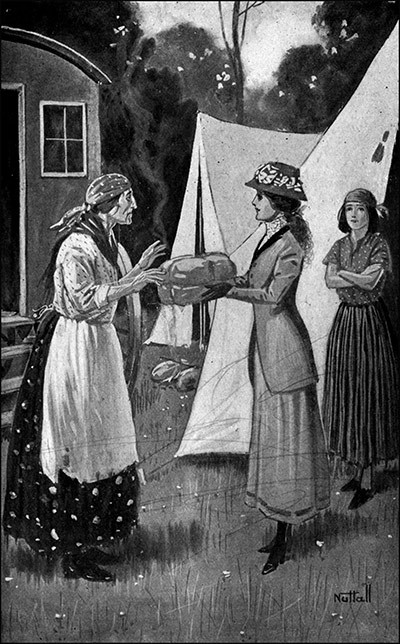
“I brought you some little things for Tommie,” said Dorothy. Page 24
No need to tell Dorothy who the “some one” was. She glanced gratefully at the girl walking beside her.
“I must hurry back,” she declared, “and tell the boys. Some one may trap them.”
Dorothy noticed that Urania stopped often to rub one foot against the other. She also noticed a frown of pain cover the girl’s brown face, and now Urania sat down, pulled a torn stocking below her knee, and attempted to adjust a very dirty rag over her thin limb.
“What is it?” asked Dorothy, seeing in spite of the girl’s evident attempt to conceal it, that the rag was stained with blood.
“Oh, nothin’” replied Urania, carelessly. “I just scratched my knee, that’s all,” and she bound the rag about the member as best she could.
“You have torn your limb in the swamp,” declared Dorothy, as the truth came suddenly to her. “I know that place is full of poison briars—”
“But I don’t poison,” interrupted the girl, getting up to continue her walk. “Besides it ain’t nothin’,” and she trudged along bravely enough.
“You must have the reward if the birds get back home,” Dorothy said, as she reached the turn in the path that led to the open roadway.
“Well, money’s all right,” admitted the girl, “but it wouldn’t do for me to show any just now. You see, there’s a lot of bad gypsies prowlin’ around here. Dad don’t mix in with them, but they’re wise, slick, you know. And if they should get next, see me limp, and find out I had fresh scratches, they’d get on to the swamp game quick. So I’ll have to lay low, and I’ll be much obliged if you will help me out, and tell the same to the young gents.”
Dorothy could not repress a smile at the girl’s queer way of telling things, for the slang seemed as natural to Urania as chirping does to a wood sparrow. Neither did the common expressions sound vulgar, as they slipped from the full red lips, and became the utterances of the wild girl of the camps.
“You can depend on me,” whispered Dorothy, pressing Urania’s hand. “And do be careful to wash those scratches—keep the poison out, you know.”
“Oh, I’m all right,” the other replied. “There comes Tommie, and he’s got on the new togs. My, but he does look swell!”
Plunging through the bushes came the little gypsy boy, in the “new togs,” the pretty dark blue sailor suit that Dorothy had bought for him while in the city a few days before.
“He does look nice,” agreed Dorothy, when the boy stood before her, waiting for compliments. “And they fit you so nicely,” she continued, taking a critical look at the blue sailor suit. “But I must hurry off now. Be a good boy, Tommie, and don’t tear your new clothes in the bushes,” she cautioned.
“I won’t,” declared the little fellow. “I’m goin’ to town next time dad goes, and I want to save ’em.”
“That’s right. Good-bye, Urania, look after the scratches,” said Dorothy, aside, “and if you want any of the reward money, just come over and tell me. I’ll see that you get it without the others knowing.”
“Much obliged,” stammered Urania. “Come along, Tommie, if you want a ‘piggy-back,’” and she stooped to the ground to allow the boy to climb on her back. “Now, don’t kick—there. Hold fast!” and at this the gypsies started down one path, while Dorothy hurried along another, for it was growing dusk, and the prospect of meeting the “bad gypsies,” the chicken thieves, that Urania said might be prowling about, was not a pleasant thought to Dorothy. Fortunately
the
road was not far away, and when finally she did reach it, without encountering any “dark figures,” she breathed a sigh of relief, and then made her way quickly to the Cedars.“I brought you some little things for Tommie,” said Dorothy, “I hope you can make use of them.”
CHAPTER IV
THE MIDNIGHT ALARM
But one week remained now of all the long summer vacation—then school must be taken up again, and the labor of learning must become both work and play for our young friends.
Dorothy and Tavia were to go back to Glenwood. Mrs. White had decided that the girls should not be separated, and consequently she provided the funds that were lacking on the part of the Travers family; for Tavia’s father had not been as prosperous in business during the past summer as he had formerly been, and in spite of many heroic efforts on his part, it was found impossible to get the necessary money together to send Tavia back to Glenwood.
It was on the very evening that Dorothy came in from her walk with Urania, that the school affairs were definitely decided upon. Mrs. White had received from Mr. Travers an answer to her letter regarding the school question, and so, when dinner was over, and stolen pigeons fully and finally discussed (they had not come home, however), Dorothy, Tavia and Mrs. White—the boys being rigorously excluded—adjourned to the sitting room to make notes and give notes, necessary in the formality of getting ready for boarding school.
Mrs. White was a beautiful woman, and her very presence seemed an inspiration to young girls, she was so gentle, so kind, so charming and so correct, without being prudish. Even the careless, frivolous Tavia “went down” beneath Aunt Winnie’s power, and was bound to admit it was “nice” to be well dressed, and “attractive” to have good manners.
On this particular evening Mrs. White was gowned in the palest lavender—a delicate orchid shade, and in her hair was a wild flower that Dorothy had brought in from the woods, the tints of this little spray toning exactly with the shade of the soft, silky gown.
Dorothy, too, was becomingly dressed. She wore her favorite light green—the one that Tavia always declared made Dorothy look like a lily, for her fair head above the “green stalk” easily suggested the comparison. Tavia, as usual, picked out the first dress that brushed her face as she entered the wardrobe, but it happened to be a pretty one, a bright plaid in fine Scotch gingham, that suited Tavia’s high color and light brown hair admirably.
“Now, my dears,” began Mrs. White, “I think we had best all go to town together, and then there will be no mistakes made about the sizes of your school things. The boys will leave for Cadet Hall in a few days, and after that we will be at liberty to take a whole day in town without neglecting any one. Major and the little boys” (Dorothy’s brothers) “will not be home for a week yet, schools do vary so in the time of opening, so that the thing for us to do now is, first: get Nat and Ned off, then attend to the shopping. After that we will just have time for a little reunion with the major and the boys, then it will be time to pack my girls off. Dear me,” said she, laughing, “I have quite a large family nowadays, but their care seems to agree with me.”
“You never looked better, Aunt Winnie,” declared Dorothy, with evident sincerity. “I hope I will grow tall and—straight like you.”
“You are doing your best now, girlie,” her aunt assured her, as she glanced at Dorothy’s slender form, that made such a pretty picture against the dark portieres she happened to cling to.
“But I’m getting fat,” groaned Tavia. “My clothes won’t button, and, oh, I do hate fat!”
“Take more exercise,” said Mrs. White, with a meaning laugh, for Tavia’s “tom-boy” habits were a confirmed joke among her friends, and for her “to take more exercise” seemed to mean to climb more fences and tear more dresses.
The sitting room was on the first floor, just off the side porch, and the long, low, French windows in the room were draped with a transparent stuff, but on this evening the shades had not yet been drawn.
There was a fixed rule at the Cedars that all shades should be drawn down as soon as the lights were turned on, but the interest in school talk so occupied our little party that the uncovered windows were entirely overlooked on this particular evening.
Tavia was seated on a low stool, very close to an open window, and just as Mrs. White made the remark about the major being away from home, Tavia fancied she heard a step on the side porch. She was positive the boys had gone out in their automobile, the Fire Bird, and so was puzzled as to the sound—it certainly was a step and a very light one, as well.
But Tavia did not interrupt the talk, in fact, she had no idea of alarming any one while the boys were away, and perhaps the servants might be off somewhere, for the evening was a pleasant one, and everybody seemed to be making the most of these last few fine nights of summer.
“And about your trunks,” went on Mrs. White, “I think we had better get larger ones, for you say you did have such a time getting all your clothes in when leaving school last term. Don’t you think, Tavia—but what are you listening to?” asked Mrs. White, noting the look on Tavia’s face. “Do you hear the boys coming? My! we have forgotten to draw the shades. Dorothy, just draw that one, and, Tavia, close the one at your elbow. It is never safe to sit by uncovered windows after dark.”
The light from the room fell across the broad piazza and as Tavia put her arm up to the shade she distinctly saw the line of light outside crossed by a shadow. She stepped back involuntarily, and at the same instant Dorothy gave a scream.
“A man!” she called. “He just passed the window. And, oh, he looked at me so!”
This was all Dorothy could say. Then she sank into a chair trembling visibly.
“I saw him,” said Tavia, “but I’ve seen him before. I suppose he’s prowling around for something to eat.”
“There is no need to be so frightened, Dorothy,” said Mrs. White. “We will just go about and see that things are locked up. I do wish the boys were in, though, and perhaps you had better call up the stable, Tavia, and ask John to come down to the house.”
The ’phone to the stable was just at the door of the sitting room, so Tavia did not have to venture far to call the man. But no answer came to the summons. John was not in the stable.
“Well, the boys will be back shortly,” Mrs. White said confidently, “and there is no need for alarm. We will see that the doors are fastened. You did get a start, Dorothy, but you know, my dear, in the country people cross lawns and take short cuts without really meaning to trespass.”
“Oh, I’m all right now,” replied Dorothy, “but it was—sudden. I’ll see that the shades are drawn at dark after this,” and she laughed lightly as she followed her aunt and Tavia through the hall to fasten the front door.
It was strange they should be so alarmed, but they were, and the measured tread that marked the small procession on its way to the front door showed plainly that each member of the trio wanted the door locked, but was not personally anxious to turn the key.
“There,” sighed Mrs. White, when finally her jeweled finger was withdrawn from the heavy panel. “I have often dreamed of doing that—and having some one grab me as I turned the key, but I escaped, luckily, this time. Now we may go back to our school plans. Suppose we sit in the library, just to get away from the side porch.”
To this welcome suggestion the girls promptly agreed, and if the intruder who had so disturbed them a few minutes before, chose to follow them up, and peer through the library windows, he would have had to cross directly under the electric light that illumined the entrance to the villa at the Cedars.
But, somehow, Dorothy could not forget the face that she had caught sight of, and she felt instinctively that the prowler was not a neighbor “taking a short cut,” for he need not have stepped on the porch in that case.
So when school matters were settled, and the boys had returned from their ride in the Fire Bird to hear the account of the little adventure, and to take extra precautions in locking up the big house, Dorothy whispered to Ned and Nat her suspicion—that the man who peeked in at the windows might be one of the bad gypsies, and that he might know something about the stolen pigeons.
“We ought to set a trap for the rascal,” Ned whispered in answer to his cousin’s suspicions, “he may be coming back for the rest of the birds. I wish I had told John to keep his ears open while his eyes were shut, but it’s too late to do that now,” and then, with every assurance of safety, and the promise to be up at the slightest alarm, Ned and Nat said good-night to their cousin, and Dorothy’s fears were soon forgotten in the sleep that comes to healthy girls after the pleasant exercise of a lingering summer’s day.
Ned and Nat, too, soon fell into sound sleep, for their evening ride left in its tracks the pleasant flavor of most persuasive drowsiness, in spite of the promises made to Dorothy that they would be “on the lookout” all night, and no intruder should come around the Cedars without the two youths of the estate being aware of the intrusion.
But alas for such promises! Did boys ever sleep so soundly? And even Dorothy, though usually one apt to awake at small sounds, “hugged her pillow” with a mighty “grip,” because, of course, when a girl insists upon keeping awake just as long as she can keep her eyes propped open, when the “props” do slip away, sleep comes with a “thud.”
So it was that Tavia, she who made a practice of covering up her head and getting to sleep in order to avoid trouble (when she heard it coming)—Tavia it was who heard something very like a step on the side porch, just after midnight.
Some one has said that it is easier to keep burglars out than to chase them out: this infers, of course, that it may be wiser to give a false alarm than to take the opposite course. But true to her principles Tavia covered up her head, and told herself that it would be very foolish to arouse the household just because she heard a strange sound.
Yet there was something uncanny about the noise! There it was again!
Tavia raised her head and looked around. Dorothy slept in the alcove and a light burned dimly from a shaded lamp between the two sleeping apartments. Tavia could see that her chum was sleeping soundly.
“Dorothy! Dorothy!” she whispered, afraid now to hear her own voice. “Dorothy! get up! I think I hear some one—”
Crash!
Every one in the house heard that! It came from the dining room and was surely a heavy crash of glass breaking!
Instantly Dorothy dashed to the door, and putting her finger on an electric button, flooded the hallways upstairs and down with glaring light. The next moment she touched another button! The burglar alarm.
And all this time Tavia trembled there, in her bed—she who was wide awake, and she who usually could boast of some courage!
“Oh!” she kept gasping, “I heard them long ago! They are inside, I’m sure!”
“Heard them long ago!” Dorothy took time to exclaim, “Then do, for goodness sake, do something! Get up and make a noise anyway! John will be in from the stable in a moment. Get up and slip on your robe,” for Tavia seemed “glued” to the spot.
By this time the boys were out in the hall, Ned with a glittering revolver clutched firmly in his hand, and his younger brother leading the way with a night light thrust out like a danger signal.
“Boys! boys!” begged Mrs. White. “Do be careful! Don’t shoot even if you—Oh, I wish you would wait until John comes. I know I shall faint if I hear a shot!”
Indeed, the mother was almost in a state of collapse at that very moment, and Dorothy, meeting her aunt in the hall, quietly put her arm around her and led her away from the stairway into the secluded alcove.
“Auntie, dear! Don’t be so alarmed,” soothed Dorothy. “They are surely gone by this time. They never hang around after the lights are turned on. And when that bell went off, I know they were glad to get off at that signal.”
“Oh, I’m so—glad—Dorothy, that you turned in the alarm,” gasped Mrs. White, “for the boys—were determined to go right down upon them—Oh! I feel some one would surely have been shot—if you had not acted so quickly!” and the trembling woman sank down on Dorothy’s couch, thoroughly exhausted.
“There they go! There they go!” called Tavia, throwing up the curtains, and thrusting her head out of the window.
“See! There’s two men! Running down the path!”
That instant a shot rang out, and then another!
“Oh!” screamed Mrs. White, dashing up and rushing down the stairs with Dorothy close behind her. “The boys! My boys!” Then she stumbled and fell into the arms of Ned, who knew how keen would be her anxiety, and was hurrying to assure her that the shots were only sent out to alarm the neighborhood, and that John and men from other nearby stables were now trying to run down the midnight intruders.
“Mother! Mother!” whispered the youth. “Everything is all right. No one is hurt. Mother, see! Here is Nat now. He didn’t go out. Come, let us put you to bed.”
“Boys!” breathed Mrs. White, opening her eyes. “I am all right now. But I was so frightened! Ned—Nat, are you both here? Then I will go upstairs,” and she rallied bravely. “I do hate so to hear a pistol shot. It was that—but no one is hurt, and they are gone? No matter what they took, I am so glad they did get away.”
In spite of the boys’ regard for their mother, it was quite evident they were not so well pleased at the safe departure of the robbers, but now they must “put their mother to bed,” and then—
“You girls stay upstairs with her,” whispered Nat to Dorothy, as the party made its way to Mrs. White’s room. “We may be out for a while. If she calls us, just say—”
“Oh, leave that to me,” said Dorothy authoritatively. “We can keep the burglars out now, I guess,” and she laughed lightly at the “guess,” when there was positive assurance that the burglar scare had entirely subsided, and that John and the others were on active “picket duty” about the place.
“What was broken?” Mrs. White asked, more for the sake of saying something than to express interest in the loss.
“The lamp,” answered Dorothy, “and what a pity. That lamp was such a beauty. It came as near making moonlight as anything artificial possibly could.”
“Then we will get a sunshine in place of it,” said Mrs. White, brightening up.
“Yes, daylight for mine,” added Tavia, with a “scary” face. “Mr. Moon goes behind a cloud too—”
“Noisily,” finished Dorothy. “At the same time he acted promptly in this case. It is not a bad idea to have some such safeguard.”
“I always thought the lamp was in the way,” agreed the aunt, “but as you say, Dorothy, it was in the right way this time. Well, let us be thankful no one is hurt—it is easy to replace mere
merchandise
.”Dawn was peeping through blinds, and with the first ray of light quietness again fell upon the Cedars. The servants had gone back to their rooms, Dorothy and Tavia were again in their “corners,” as Tavia termed the pretty twin alcoves, allotted the young girls while visiting at the Cedars, and the young men—well, they did not return to their rooms. To lose five homing pigeons, and good family silver all within one week, was rather too exciting for boys like Nat and Ned. There was something to be done other than sleeping just then.
Even real, daring burglars are only mortal, and sometimes the most daring are the greatest cowards—when daylight comes and people are wide awake!