автордың кітабын онлайн тегін оқу The Principles of Economics, with Applications to Practical Problems
THE PRINCIPLES OF ECONOMICS
WITH APPLICATIONS TO PRACTICAL PROBLEMS
BY
FRANK A. FETTER, PH.D.
PROFESSOR OF POLITICAL ECONOMY AND FINANCE,
CORNELL UNIVERSITY

NEW YORK
THE CENTURY CO.
1904
Copyright, 1904, by
The Century Co.
The DeVinne Press
TO THE STUDENTS
OF THREE UNIVERSITIES
—INDIANA, STANFORD, AND CORNELL—
FOR WHOM, WITH WHOM, AND BY WHOSE AID
THIS BOOK CAME TO BE WRITTEN
CONTENTS
PART I
PAGE
The Value of Material Things 1-169
DIVISION A—WANTS AND PRESENT GOODS
CHAPTER
1 The Nature and Purpose of Political Economy: Name and Definition; Place of Economics Among the Social Sciences; The Relation of Economics to Practical Affairs 3
2 Economic Motives: Material Wants, The Primary Economic Motives; Desires for Non-material Ends, as Secondary Economic Motives 9
3 Wealth and Welfare: The Relation of Men and Material Things to Economic Welfare; Some Important Economic Concepts Connected with Wealth and Welfare 15
4 The Nature of Demand: The Comparison of Goods in Man's Thought; Demand for Goods Grows Out of Subjective Comparisons 21
5 Exchange in a Market: Exchange of Goods Resulting from Demand; Barter Under Simple Conditions; Price in a Market 30
6 Psychic Income: Income as a Flow of Goods; Income as a Series of Gratifications 39
DIVISION B—WEALTH AND RENT
7 Wealth and Its Direct Uses: The Grades of Relation of Indirect Goods to Gratification; Conditions of Economic Wealth 46
8 The Renting Contract: Nature and Definition of Rent; The History of Contract Rent and Changes in It 53
9 The Law of Diminishing Returns: Definition of the Concept of (Economic) Diminishing Returns; Other Meanings of the Phrase "Diminishing Returns"; Development of the Concept of Diminishing Returns 61
10 The Theory of Rent: The Market Value of the Usufruct: Differential Advantages in Consumption Goods; Differential Advantages in Indirect Goods 73
11 Repair, Depreciation, and Destruction of Wealth: Relation to its Sale and Rent: Repair of Rent-bearing Agents; Depreciation in Rent-earning Power of Agents Kept in Repair; Destruction of Natural Stores of Material 81
12 Increase of Rent-bearers and of Rents: Efforts of Men to Increase Products and Rent-bearers; Effects of Social Changes in Raising the Rents of Indirect Agents 90
DIVISION C—CAPITALIZATION AND TIME-VALUE
13 Money as a Tool in Exchange: Origin of the Use of Money; Nature of the Use of Money; The Value of Typical Money 98
14 The Money Economy and the Concept of Capital: The Barter Economy and its Decline; The Concept of Capital in Modern Business 108
15 The Capitalization of All Forms of Rent: The Purchase of Rent-charges as an Example of Capitalization; Capitalization Involved in the Evaluating of Indirect Agents; The Increasing Role of Capitalization in Modern Industry 118
16 Interest on Money Loans: Various Forms of Contract Interest; The Motive for Paying Interest 131
17 The Theory of Time-value: Definition and Scope of Time-value; The Adjustment of the Rate of Time-discount 141
18 Relatively Fixed and Relatively Increasable Forms of Capital: How Various Forms of Capital May Be Increased; Social Significance of These Differences 152
19 Saving and Production as Affected by the Rate of Interest: Saving as Affected by the Interest Rate; Conditions Favorable to Saving; Influence of the Interest Rate on Methods of Production 159
PART II
The Value of Human Services 171-355
DIVISION A—LABOR AND WAGES
20 Labor and Classes of Laborers: Relation of Labor to Wealth; Varieties of Talents and of Abilities in Men 173
21 The Supply of Labor: What Is a Doctrine of Population? Population in Human Society; Current Aspect of the Population Problem 184
22 Conditions for Efficient Labor: Objective Physical Conditions; Social Conditions Favoring Efficiency; Division of Labor 195
23 The Law of Wages: Nature of Wages and the Wages Problem; The Different Modes of Earning Wages; Wages as Exemplifying the General Law of Value 205
24 The Relation of Labor to Value: Relation of Rent to Wages, Relation of Time-value to Wages; The Relation of Labor to Value 215
25 The Wage System and its Results: Systems of Labor; The Wage System as it Is; Progress of the Masses Under the Wage System 226
26 Machinery and Labor: Extent of the Use of Machinery; Effect of Machinery on the Welfare and Wages of the Masses 236
27 Trade-unions: The Objects of Trade-unions; The Methods of Trade-unions; Combination and Wages 245
DIVISION B—ENTERPRISE AND PROFITS
28 Production and the Combination of the Factors: The Nature of Production; Combination of the Factors 257
29 Business Organization and the Enterpriser's Function: The Direction of Industry; Qualities of a Business Organizer; The Selection of Ability 265
30 Cost of Production: Cost of Production from the Enterpriser's Point of View; Cost of Production from the Economist's Standpoint 273
31 The Law of Profits: Meaning of Terms; The Typical Enterpriser's Services Reviewed; Statement of the Law of Profits 282
32 Profit-sharing, Producers' and Consumers' Coöperation: Profit-sharing; Producers' Coöperation; Consumers' Coöperation 292
33 Monopoly Profits: Nature of Monopoly; Kinds of Monopoly; The Fixing of a Monopoly Price 302
34 Growth of Trusts and Combinations in the United States: Growth of Large Industry in the United States; Advantages of Large Production; Causes of Industrial Combinations 312
35 Effect of Trusts on Prices: How Trusts Might Affect Prices; How Trusts Have Affected Prices 323
36 Gambling, Speculation, and Promoters' Profits: Gambling vs. Insurance; The Speculator as a Risk taker; Promoter's and Trustee's Profits 333
37 Crises and Industrial Depressions: Definition and Description of Crises; Crises in the Nineteenth Century; Various Explanations of Crises 345
PART III
The Social Aspects of Value 357-563
DIVISION A—RELATION OF PRIVATE INCOME TO SOCIAL WELFARE
38 Private Property and Inheritance: Impersonal and Personal Shares of Income; The Origin of Private Property; Limitations of the Right of Private Property 359
39 Income and Social Service: Income from Property; Income from Personal Services 370
40 Waste and Luxury: Waste of Wealth; Luxury 381
41 Reaction of Consumption on Production: Reaction upon Material Productive Agents; Reaction upon the Efficiency of the Workers; Effects on the Abiding Welfare of the Consumer 392
42 Distribution of the Social Income: The Nature of Personal Distribution; Methods of Personal Distribution 402
43 Survey of the Theory of Value: Review of the Plan Followed; Relation of Value Theories to Social Reforms; Interrelation of Economic Agents 412
DIVISION B—RELATION OF THE STATE TO INDUSTRY
44 Free Competition and State Action: Competition and Custom; Economic Harmony through Competition; Social Limiting of Competition 422
45 Use, Coinage, and Value of Money: The Precious Metals as Money; The Quantity Theory of Money 431
46 Token Coinage and Government Paper Money: Light-Weight Coins; Paper Money Experiments; Theories of Political Money 443
47 The Standard of Deferred Payments: Function of the Standard; International Bimetallism; The Free-silver Movement in America 453
48 Banking and Credit: Functions of a Bank; Typical Bank Money; Banks of the United States To-day 462
49 Taxation in its Relation to Value: Purposes of Taxation; Forms of Taxation; Principles and Practice 471
50 The General Theory of International Trade: International Trade as a Case of Exchange; Theory of Foreign Exchanges of Money; Real Benefits of Foreign Trade 480
51 The Protective Tariff: The Nature and Claims of Protection; The Reasonable Measure of Justification of Protection; Values as Affected by Protection 491
52 Other Protective Social and Labor Legislation: Social Legislation; Labor Legislation 504
53 Public Ownership of Industry: Examples of Public Ownership; Economic Aspects of Public Ownership 514
54 Railroads and Industry: Transportation as a Form of Production; The Railroad as a Carrier; Discrimination in Rates on Railroads 525
55 The Public Nature of Railroads: Public Privileges of Railroad Corporations; Political and Economic Power of Railroad Managers; Commissions to Control Railroads 534
56 Public Policy as to Control of Industry: State Regulation of Corporate Industry; Difficulties of Public Control of Industry; Trend of Policy as to Public Industrial Activity 544
57 Future Trend of Values: Past and Present of Economic Society; The Economic Future of Society 555
Questions and Critical Notes 565
Index 595
PREFACE
This book had its beginning ten years ago in a series of brief discussions supplementing a text used in the class-room. Their purpose was to amend certain theoretical views even then generally questioned by economists, and to present most recent opinions on some other questions. These critical comments evolved into a course of lectures following an original outline, and were at length reduced to manuscript in the form of a stenographic report made from day to day in the class-room. The propositions printed in italics were dictated to the class, to give the key-note to the main divisions of the argument. Repeated revisions have shortened the text, cut out many digressions and illustrations, and remedied many of the faults both of thought and of expression; but no effort has been made to conceal or alter the original and essential character of the simple, informal, class-room talks by teacher to student. To this origin are traceable many conversational phrases and local illustrations, and the occasional use of the personal form of address.
The lectures, at the outset, sought to give merely a summary of widely accepted economic theory, not to offer any contribution to the subject. While they were in progress, however, special studies in the evolution of the economic concepts were pursued, and the manuscript of a book on that more special subject was carried well toward completion. That work, which it is hoped some time to complete, was, for several reasons, put aside while the present text was preparing for publication. The economic theories of the present transition period show many discordant elements, yet the author felt that his attempt to unify the statement of principles, in an elementary text explaining modern problems, and consistent in its various parts, helped to reveal to him both difficulties and possible solutions in the more special theoretical field. The unforeseen outcome of these varied studies is an elementary text embodying a new conception of the theory of distribution, an outline of which will be found in Chapter Forty-three. It is, in brief, a consistently subjective analysis of the relations of goods to wants, in place of the admixture of objective and subjective distinctions found in the traditional conceptions of rent, interest, and price.
The beginning of the systematic study of economics, like the first steps in a language, is difficult because of the entire strangeness of the thought, and it is not to be hoped that any pedagogic device can do away with the need of strenuous thinking by the student. The aim, however, in the development of this theory of distribution, has been to proceed by gradual steps, as in a series of geometrical propositions, from the simple and familiar acts and experiences of the individual's every-day life, through the more complex relations, to the most complex, practical, economic problems of the day. The hope has long been entertained by economists that a conception of the whole problem of value would be attained that would coördinate and unify the various "laws,"—those of rent, wages, interest, etc. This solution has here been sought by a development of recent theories, the unit of the complex problem of value being the simplest, immediate, temporary gratification.
Possibly some teachers will observe and regret the almost entire absence of critical discussions of controverted points in theory, which make up so large a part of some of the older texts. The more positive manner of presentation has been purposely adopted, and only such reference is made to conflicting views as is needed to guard the student against misunderstanding in his further reading. The author would not have it thought that he doubts the disciplinary value of economic theory or its scientific worth for more advanced students, for, on the contrary, he believes in it, perhaps to an extreme degree; but, for his own part, he has become convinced of the unwisdom of carrying on these subtle controversies in classes of beginners. The inherent difficulties of the subject are great enough, without the creation of new ones.
The fifty-seven chapters represent the work of the typical college course in elementary economics, allowing two chapters a week, and a third meeting weekly for review and for the discussion of questions, exercises, and reports. The subject is so large that the text is, in many places, hardly more than a suggestive outline. In class-room work it should be supplemented by other sources of information, such as personal observation by the students (many of the questions following the text serving to stimulate the attention); visits to local industries; interchange of opinions; examples given by the teacher; study and discussion, in the light of the principles stated in the text, of some such problems as are suggested in the appended list of questions; collateral reading; the preparation of exercises and the use of statistical material from the census, labor reports, etc.; history and description of industries; history of the growth of economic ideas. Suggestions, from teachers, of changes that will make the text more useful in their classes, will be thankfully received by the author.
Lack of space makes it impossible to mention by name the many sources to which the writer is indebted. Special acknowledgment, however, is gratefully made to C. H. Hull, of Cornell University; to E. W. Kemmerer, now of the Philippine Treasury Department, and to U. G. Weatherly, of Indiana University, who have read large portions of the manuscript, and have made many valuable suggestions; to W. M. Daniels, of Princeton University, who has read every page of the copy, and to whom are due the greatest obligations for his numerous and able criticisms both of the argument and of the expression; to R. C. Brooks, now of Swarthmore College, for a number of the questions in the appended list, and for helpful comments given while the course was developing; and to R. F. Hoxie and to A. C. Muhse, whose thoughtful reading of the proof has eliminated many errors. For the defects remaining, not these friendly critics, but the author alone, should be held accountable.
No book on economics can to-day satisfy everybody—"Or even anybody," adds a friend. But with this book may go the hope that what has been written with love of truth and of democracy may serve, in its small way, both to further sound economic reasoning and to extend among American citizens a better understanding of the economic problems set for this generation to solve.
Frank A. Fetter.
Ithaca, N. Y., August, 1904.
THE PRINCIPLES OF ECONOMICS
PART I
DIVISION A—WANTS AND PRESENT GOODS
CHAPTER I
THE NATURE AND PURPOSE OF POLITICAL ECONOMY
§ I. NAME AND DEFINITION
Verbal definition of economics
1. Economics, or political economy, may be defined, briefly, as the study of men earning a living; or, more fully, as the study of the material world and of the activities and mutual relations of men, so far as all these are the objective conditions to gratifying desires. To define, means to mark off the limits of a subject, to tell what questions are or are not included within it. The ideas of most persons on this subject are vague, yet it would be very desirable if the student could approach this study with an exact understanding of the nature of the questions with which it deals. Until a subject has been studied, however, a definition in mere words cannot greatly aid in marking it off clearly in our thought. The essential thing for the student is to see clearly the central purpose of the study, not to decide at once all of the puzzling cases.
Natural sciences deal with material things
2. A definition that suggests clear and familiar thoughts to the student seem at first much more difficult to get in any social science than in the natural sciences. These deal with concrete, material things which we are accustomed to see, handle, and measure. If a mere child is told that botany is a study in which he may learn about flowers, trees, and plants, the answer is fairly satisfying, for he at once thinks of many things of that kind. When, in like manner zoölogy is defined as the study of animals, or geology as the study of rocks and the earth, the words call up memories of many familiar objects. Even so difficult and foreign-looking a word as ichthyology seems to be made clear by the statement that it is the name of the study in which one learns about fish. It is true that there may be some misunderstanding as to the way in which these subjects are studied, for botany is not in the main to teach how to cultivate plants in the garden, nor ichthyology how to catch fish or to propagate them in a pond. But the main purpose of these studies is clear at the outset from these simple definitions. Indeed, as the study is pursued, and knowledge widens to take in the manifold and various forms of life, the boundaries of the special sciences become not more but less sharp and definite.
Economics studies some social acts and relations
Political economy, on the other hand, as one of the social sciences, which deal with men and their relations in society, seems to be a very much more complex thought to get hold of. We are tempted to say that it deals with less familiar things; but the truth may be, as a thoughtful friend suggests, that the simple social acts and relations are more familiar to our thought than are lions, palm-trees, or even horses. Every hour in the streets or stores, one may witness thousands of acts, such as bargains, labor, payments, that are the subject-matter of economic science. Their very familiarity may cause men to overlook their deeper meaning.
Many other definitions have been given of political economy. It has been called the science of wealth, or the science of exchanges. Evidently there are various ways in which wealth may be considered or exchanges made. The particular aspects that are dealt with in political economy will be made clear by considering two other questions, the place of economics among the social sciences and the relation of economics to practical affairs.
§ II. PLACE OF ECONOMICS AMONG THE SOCIAL SCIENCES
Economics contrasted with the natural sciences
1. Political economy, as one of the social sciences, may be contrasted with the natural sciences, which deal with material things and their mutual relations, while it deals with one aspect of men's life in society, namely, the earning of a living, or the use of wealth. It is true that political economy also has to do with plants and animals and the earth—in fact, with all of those things which are the subject-matter of the natural sciences; but it has to do with them only in so far as they are related to man's welfare and affect his estimate of the value of things; only in so far as they are related to the one central subject of economic interest, the earning of a living.
Character of the social sciences
2. The social sciences deal with men and their relations with each other. The word "social" comes from the Latin socius, meaning a fellow, comrade, companion, associate. As men living together have to do with each other in a great many different ways, and enter into a great many different relations, there arise a great many different social problems. Each of the social sciences attempts to study man in some one important aspect—that is, to view these relations from some one standpoint.
Man's acts, his life, and his motives are so complex that it is not surprising that there has been less definiteness in the thought of the social sciences, and that they have advanced less rapidly toward exactness in their conclusions, than have the natural sciences. This complexity also explains the discouragement of the beginner in the early lessons in this subject. Usually the greatest difficulties appear in the first few weeks of its study. The thought is more abstract than in natural science; it requires a different, I will not say higher, kind of ability than does mathematics. But little by little the strangeness of the language and ideas disappears; the bare definitions become clothed with the facts of observation and recalled experiences; and soon the "economic" acts and relations of men in society come to be as real and as interesting to the student as are the materials in the natural world about him—often, indeed, more interesting.
Economics, politics, law, and ethics
3. Political economy is related to all the other social sciences, it being the study of certain of men's relations, while politics, law, and ethics have to do with other relations or with relations under a different aspect. Politics treats of the form and working of government and is mainly concerned with the question of power or control of the individual's actions and liberty. Law treats of the precepts and regulations in accordance with which the actions of men are limited by the state, and the contracts into which they have seen fit to enter are interpreted. Ethics treats the question of right or wrong, studies the moral aspects of men's acts and relations. The attempt just made to distinguish between the fields occupied by the various social sciences betrays at once the fundamental unity existing among them. The acts of men are closely related in their lives, but they may be looked at from different sides. The central thought in economics is the business relation, the relation of men in exchanging their services or material wealth. In pursuing economic inquiries we come into contact with political, legal, and ethical considerations, all of which must be recognized before a final practical answer can be given to any question. Nevertheless the province of economics is limited. It is because of the feebleness of our mental power that we divide and subdivide these complex questions and try to answer certain parts before we seek to answer the whole. When we attempt this final and more difficult task, we should rise to the standpoint of the social philosopher.
§ III. THE RELATION OF ECONOMICS TO PRACTICAL AFFAIRS
Economics is first a science
1. The ideal of political economy here set forth is that it should be a science, a search for truth, a systematized body of knowledge, arriving at a statement of the laws to which economic actions conform. It is not the advocacy of any particular policy or idea, but if it arrives at any conclusions, any truths, these cannot fail to affect the practical action of men.
But it touches many practical interests
Political economy, because defined as the science of wealth, has been described by some as a gospel of Mammon. It is hardly necessary to refute such a misconception. Political economy is not the science of wealth-getting for the individual. Its study is not primarily for the selfish ends and interest of the individual. (Certainly some of its lessons may be of practical value to men in active business) for many economic "principles" are but the general statement of those ideas that have been approved by the experience of business men, of statesmen, and of the masses of men. Some of its lessons must have educational value in practical business, for political economy is not dreamed out by the closet philosopher, but more and more it is the attempt to describe the interests and the action of the practical world in which men must live. Many men are working together to develop its study—those who collect statistics and facts bearing on all kinds of practical affairs, and those who search through the records of the past for illustrations of experiments and experiences that may help us in our life to-day.
Economic study needed in a democracy
2. But, in the main, the study of political economy is a social study for social ends and not a selfish study for individual advantage. The name political economy was first suggested in France when the government was monarchical and despotic in the extreme. As domestic economy indicates a set of rules or principles to guide wisely the action of the housekeeper or the owner of an estate, so political economy was first thought of as a set of rules or principles to guide the king and his counselors in the control of the state. The term has continued to bear something of that suggestion in it, though of late the term "economics," as being broader and less likely to be confused with politics, has very generally come into use. But in the degree in which unlimited monarchy has given way to the rule of the people, the conception of political economy has been modified. In a democracy there is need for a general diffusion of knowledge. The power now rests not with the king and a few counselors, but in the last resort with the people, and therefore the people must be acquainted with the experience of the past, must have all possible systematic knowledge to enlighten public policy and to guide legislation.
Is of growing interest and influence
Moreover, with the growth of the modern state, with the interest increasing importance of business, and of industrial and commercial interests, as compared with changes of dynasty or the personal rivalries of rulers, economic questions have grown in relative importance. In our own country, particularly since the subjects of slavery and of States' rights ceased to absorb the attention of our people, economic questions have pushed rapidly into the foreground. Indeed, it has of late been more clearly seen that many of the older political questions, such as the American Revolution and slavery, formerly discussed almost entirely in their political and constitutional aspects, were at bottom questions of economic rivalry and of economic welfare. The remarkable increase in the attention given to this study in colleges and universities in the last twenty years is but the index of the greatly increased interest and attention felt in it by citizens generally.
To sum up, it may be said that in the study of political economy we are seeking the reason, connection, and relations in the great multitude of acts arising out of the dependence of desires on the world of things and men.
CHAPTER 2
ECONOMIC MOTIVES
§ I. MATERIAL WANTS, THE PRIMARY ECONOMIC MOTIVES
Feeling urges to economic actions
1. A logical explanation of industry must begin with a discussion of the nature of wants, for the purpose of industry is to gratify wants. An economic want may be defined as a feeling of incompleteness, because of the lack of a part of the outer world or of some change in it. Often the question asked when one first sees a moving trolley car or automobile or bicycle is: What makes it go? The first question to ask in the part of the study of economic society here undertaken is: What is its motive force? Without an answer to that question one cannot hope to understand the ceaseless and varied activities of men occupied in the making of a living. The question merits long and careful study, but the general answer is so simple that it seems almost self-evident: The motive force in economics is found in the feelings of men. It is men's desire to make use of men and things about them which calls forth all the manifold phenomena studied in economics.
Animal species shaped by their environment
2. Wants among animals depend on the environment; that is to say, the utmost that creatures of a lower order than man can do is to take things as they find them. The imagination and intelligence of animals are not developed enough to lead them to desire much beyond that which is ordinarily to be obtained. And so the environment shapes and affects the animal. The fish is fitted to live in the water and thrives there, and we must believe, enjoys living there. The horse and the cow like best the food of the fields, and so each species of animal, in order to survive in the severe struggle for existence, has been forced to fit itself to the conditions in which it lives. After the animal has been thus fitted, its desire is for those things normally to be found in its surroundings. So different animals desire or want different things, but always it is the environment that determines the want, and not the want that determines the environment.
Simple wants of primitive men
3. In simpler human societies, wants are mostly confined to physical necessities; that is, in the earlier stages of society, man's wants are very much like those of the animals. Man bends his energies to securing the things necessary to survival. He feels the pangs of hunger and he strives to secure food. He feels the need of companionship, for it is only through association and mutual help that men, so weak as compared with many kinds of animals, are able to resist the enemies which beset them. He needs clothing to protect him against the harsher climates of the lands to which he moves. For the same purpose, to protect himself against the cold and rain, he needs a shelter, a cave, a wigwam, or a hut; for a house is but a larger dress.
Manifold wants in civilized society
4. In human society, wants develop and transform the world. In the rudest societies of which there is any record, savages are found with wants developed in a great number of directions beyond the wants of any animals. Man is not a passive victim of circumstances; his wants are not determined solely by his environment; his desires soar beyond the things about him. As men become more the masters of circumstances, their desires anticipate mere physical wants; they seek a more varied food of finer flavor and more delicately prepared. Dress is not limited by physical comfort, for one of the earliest of the esthetic wants to develop is the love of personal ornament. The rude hut or communal lodge to protect against rain and cold becomes a home. Out of the earlier rude companionship develop the noblest sentiments of friendship and family life. Seeking to gratify the senses and the love of action, men develop esthetic tastes, the love of the beautiful in sound, in form, in taste, in color, in motion. And finally, as the imagination and intellect develop, there grow up the various forms of intellectual pleasures—the love of reading, of study, of travel, and of thought.
The various wants of man are sometimes classified as necessities, comforts, and luxuries, but all economists take care to emphasize that these terms have only relative meanings which, in the rapidly changing conditions of modern life, are changing constantly. The comforts of one generation, or of one country, become the necessities in another; and luxuries becoming comforts, are looked upon finally as necessities. And as the desires grow, they more and more alter the world. Man has changed the face of the earth; he has affected its climate, its fertility, its beauty, because, either for better or for worse, his desires have impressed themselves upon the world about him.
Wants must precede wealth
5. In human society the growth of wants is necessary to progress. From the earliest times teachers of morals have argued for simplicity of life and against the development of refinements. We do not now raise the moral question, but there is no doubt that the economic effect of developing wants is in the main to impel to greater effort. They are the mainspring of economic progress. In recent discussion of the control of the tropics, the too great contentedness of tropical peoples has been brought out prominently. Some one has said that if a colony of New England school-teachers and Presbyterian deacons should settle in the tropics, their descendants would, in a single generation, be wearing breech-clouts and going to cock-fights on Sunday. Certain it is that the energy and ambition of the temperate zone are hard to maintain in warmer lands. The negro's content with hard conditions, so often counted as a virtue, is one of the difficulties in the way of solving the race problem in our South to-day. Booker T. Washington, and others who are laboring for the elevation of the American negroes, would try first to make them discontented with the one-room cabins, in which hundreds of thousands of families live. If only the desire for a two- or three-room cabin can be aroused, experience shows that family life and industrial qualities may be improved in many other ways.
But impossible hopes lessen gratifications
Not only in America, but in most civilized lands to-day, is seen a rapid growth of wants in the working-classes. The incomes and the standard of living have become increasing, but not so fast as have the desires of the working-classes. Regret has been expressed by some that the workers of Europe are becoming "declassed." Increasing wages, it is said, bring not welfare, but unhappiness, to the complaining masses. If discontent with one's lot goes beyond a moderate degree, if it is more than the desire to better one's lot by personal efforts, if it becomes an unhappy longing for the impossible, then indeed it may be a misfortune. But a moderate ambition to better one's condition is the "divine discontent" absolutely indispensable if energy and enterprise are to be called into being.
Wants grow refined as wealth advances
It is a suggestive fact that civilized man, equipped with all of the inventions and the advantages of science, spends more hours of effort in gaining a livelihood than does the savage with his almost unaided hands. Activity is dependent not on bare physical necessity, but on developed wants—in the economic sense of the term. Such social institutions as property and inheritance owe their origin and their justification to their average effect on the motives to activity. If society is to develop, if progress is to continue, human wants—not of the grosser sort, but ever more refined—must continue to emerge and urge men to action.
§ II. DESIRES FOR NON-MATERIAL ENDS, AS SECONDARY ECONOMIC MOTIVES
The real man in economics
1. The spiritual nature of man must not be ignored in economic reasoning. There has been much and just criticism of the earlier writers and of their conclusions because so little account was taken by them of any but the motive of self-interest in economic affairs. Generally it was assumed that men knew their own interest, and sought in a very unsympathetic way those things which would gratify their material wants. Thus man in economic reasoning was made an abstraction, differing from real men in his lack of manifold spiritual and social elements.
Desires for the non-material may become economic motives
2. The main classes of non-material wants that are secondarily economic are fear of temporal punishment; sentiments of moral and religious duty; pride, honor, and fear of disgrace; and pleasure in work for itself, for social approval, or for a social result. The first is best illustrated by slavery, where the slave is not impelled to seek wealth for his own welfare, but is driven by punishment to perform the task. The object is to create within the mind of the slave a motive that will take the place of the ordinary economic motive. The feeling of religious or moral duty leads men to act often in direct opposition to the usual economic motive. The taboo is faithfully observed by the members of a savage tribe who suffer as a result the severest hardships. A religious injunction prevents the use of food that would save from starvation. Pride, either of family or of calling; the soldier's honor leading him to sacrifice not only his future but his life; the love of social approval, holding men to the most disagreeable tasks—these illustrate how strongly social sentiments oppose the narrower motive of immediate self-interest as generally thought of. Pleasure in work for work's sake, and pride in the result, may act as motives quite as strong in some cases as desire for the product that can be used. And even where this does not change the kind of work done, it comes in to influence the interest and earnestness with which the work is performed.
Economists must overlook no influence on value
3. Whatever motive in man's complex nature makes him desire things more or less, becomes for the time, and in so far, an economic motive. These various social and spiritual motives sometimes work positively, in the direction of magnifying man's desire for things; sometimes negatively, to diminish it. If we are to understand economic action, we must take men as they are. A religious motive that leads men to refrain from the eating of meat or to eat fish in preference on certain days, is a fact which the economist has but to accept, for it is sure to affect the value of meat and fish at that place and time. Moral convictions, whatever be their origin, whether due to the teaching of parents, to unconscious influences, or to native temperament, may be quite as effective as the pangs of hunger in determining what men desire. Therefore, while these various motives are primarily social or moral or religious, they may be said to be secondarily economic motives, and they may become in certain cases the most important influences of which the economist must take account.
CHAPTER 3
WEALTH AND WELFARE
§ I. THE RELATION OF MEN AND MATERIAL THINGS TO ECONOMIC WELFARE
Man is the center of economic reasoning
1. The gratifying of economic wants depends on things outside of the man who feels the wants. Man is to himself the center of the world. He groups things and estimates things with reference to their bearing on his desires, be these what are called selfish or unselfish. If we were discussing the economics of an inferior species of animals, things would be grouped in a very different way. But economics being the study of man's welfare, everything must be judged from his standpoint, and things are or are not of economic importance according as they have relation to his wants and satisfactions. Things needful for any of the lower animals are spoken of as "ministering to welfare" in the economic sense only in case these animals are useful to men. Examples are the mulberry-tree on which the silkworm feeds, the flower visited by the honey-bee. In the same view some men are seen to minister to the welfare of other men and therefore bear the same relation for the moment to the welfare of the others as do material things. In any case we study man's welfare as affected by the world which surrounds him.
Physical nature is an unchangeable fact
2. Material things and natural forces differ in kind and nature. This is an axiom which we must take as a basis for reasoning in economics. Things have certain physical qualities quite apart from any action or influence of man. They are operated on by mechanical laws; the force of gravitation causes them to fall at a certain rate under given conditions. They differ in specific gravity, reflect the rays of light, absorb or transmit heat. All these things are for man ultimate physical facts, but unless he knows these facts he cannot take full advantage of the favorable qualities of things or weigh properly their importance to his welfare. Things differ in a multitude of ways in their chemical qualities. Niter, charcoal, and saltpeter, combined in certain proportions, give certain reactions; different combinations give various results. Solids combine to form gases, and liquids unite to form solids, and these qualities and reactions of material things are for man ultimate truths of chemistry. Likewise many things have certain physiological effects. Sunshine acts on living bodies, whether plant, animal, or man, in certain ways. Some plants are nourishing to man, others are poisonous. If man were not on the earth, things would have the same physical and chemical qualities, mechanical laws would be the same as at present so far as we can conclude. Man cannot change the nature of things; but he can acquaint himself with that nature and then put the things into the relations where a given result will follow.
But economics has to do with psychological effects
3. As a result of these differences, things have different relations to wants. These various qualities, physical, chemical, physiological, are important in an economic sense only as they produce psychological effects, that is, as they affect the feelings and judgments of men. We come to some general thoughts which it will be well to define.
Some definitions
Gratification is the feeling that results when a want has been met. Feelings are hard to define in words; the best definition is found in the experience of each individual. We can only say, therefore, that gratification is the attainment of desire, the fulfilment of wants. The word that has usually been employed in this sense in economic discussion is "satisfaction"; but by its derivation and general usage satisfaction means "the complete or full gratification" of a desire, and this meaning is quite inconsistent with the thought in many connections in which the word is used. We shall therefore prefer here the word gratification, and its corresponding verb, gratify.
Wealth is the collective term for those things which are felt to be related to the gratification of wants. The word is applied in economic discussion to any part of those things, no matter how small. We shall have occasion later to define and discuss this term more fully.
Welfare, in an immediate or narrow sense, is the same as gratification of the moment; in a broader sense, it means the abiding condition of well-being. We have here a distinction very much like that often made between pleasure and happiness. If we think of only the present moment, welfare is the absence of pain, and the presence of the pleasureable feeling; but if we consider a longer period in a man's life or his entire lifetime, it is seen that many things that afford a momentary gratification do not minister to his ultimate, or abiding, welfare. Moralists and philosophers often have dwelt on this contrast. The difference is illustrated by the thoughtlessness and impulsiveness of a child or savage as contrasted with the more rational life of those with foresight and patience.
Economics first studies wealth
Wealth, in the general economic sense, is judged with reference to gratification rather than with reference to abiding welfare. It is the first duty of the economist not to preach what should be, but to understand things as they are. He must, in studying the problem of value, recognize any motive that leads men to attach importance to acts and things. He will therefore take account of abiding welfare and of immediate gratification to exactly the degree that men in general do, and the sad fact is that the present impulse rules a large part of the acts of men. Whether tobacco or alcohol or morphine minister to the abiding happiness of those who use them does not alter the immediate fact that here and now they are sought and an importance is attached to them because of their power to gratify an immediate desire.
Then wealth and welfare
5. In studying the question of social prosperity, however, we must rise to the standpoint of the social philosopher and consider the more abiding effects of wealth. Wants may be developed and made rational, and the permanent prosperity of a community depends upon this result. Any species of animal that continued regularly to enjoy that which weakens the health and strength would become extinct. Any society or individual that continues to derive gratification, to seek its pleasure, in ways that do not, on the average, minister to permanent welfare, sinks in the struggle of life and gives way to those men or nations that have a sounder and healthier adjustment of wants and welfare. We touch here, therefore, on the edge of the great problems of morals, and while we must recognize the contrast that often exists in the life of any particular man between his "pleasures" and his health and happiness, we see that there is a reason why, on the whole, and in the long run, these two cannot remain far apart. The old proverbs, "Be virtuous and you will be happy," "Honesty is the best policy," and "Virtue is its own reward," have a sound basis in the age-long experience of the world. Cynics or jesters may easily disprove these truths in a multitude of particular cases.
Freemen are not economic wealth
6. Wealth does not include such personal qualities as honesty, integrity, good health. Some economists speak of these as "internal goods," but it is far better not to speak of free men or of their qualities as wealth. Many difficulties arise from such a use of the term in practical discussion. One of the most important of all distinctions to maintain in economics is that between material things and men. Only in the case of human slavery may persons be counted as economic wealth. It is a different thing, however, to consider human services as wealth of an ephemeral kind at the moment they are rendered. We are, thus merely recognizing that men may bear at the given moment the same relation to our wants as do material things.
§ II. SOME IMPORTANT ECONOMIC CONCEPTS CONNECTED WITH WEALTH AND WELFARE
Popular meaning of useful
1. Utility, in its broadest usage, is the general capability that things have of ministering to human well being. The term is evidently one without any scientific precision. It expresses only a general or average impression that we have in reference to the relation of a class of goods to human wants. Every one would agree to the statement that "water is useful," thinking of the fact that it is indispensable to life and that it ministers to life in a multitude of ways. But what of water in one's cellar, water soaking one's clothes on a cold day, water breaking through the walls of a mountain reservoir and carrying death and destruction in its path? The poison that is doing what we at the moment desire, we call useful; that doing what we would prevent, we call harmful. Noxious weeds become "useful" by the discovery of some new process by which they can be worked into other forms, though they may still continue to be noxious in many a farmer's fields. The utility of anything, therefore, is seen to be of a relative and limited nature. The term "utility" in popular speech is very inexact. It can be employed in economic discussion only when carefully modified and defined.
Kinds of goods
2. Goods consist of all those things objective to the user which have a beneficial relation to human wants. They fall into several classes. We may first distinguish between free and economic goods. Free goods are things that exist in superfluity, that is, in quantities sufficient not only to gratify, but to satisfy all the wants that may depend on them. Economic goods are things so limited in quantity that all of the wants to which they could minister are not satisfied. The whole thought of economy begins with scarcity; indeed, even the conception of free goods is hardly possible until some limitation of wants is experienced. Practical economics is the study of the best way to employ things to secure the highest amount of gratification. The problem itself arises out of the fact that many things are used up before all wants dependent on them are completely satisfied.
A distinction is often made between consumption and production goods, or it may be better to say immediate and intermediate goods. Consumption goods are those things which are immediately at the point of gratifying man's desires. Production goods are those things which are not yet ready to gratify desires; some of them, being merely means of securing consumption goods, never will themselves immediately gratify desire.
Value is utility given precision
3. Value, in the narrow personal sense, may be defined as the importance attributed to a good by a man. The vagueness and inexactness of the word "utility," or the word "good," disappears when we reach the word "value." It is not a usual relation or a vague degree of benefit sometimes present and sometimes absent, but it refers to a particular thing, person, time, and condition. Value is in the closest relation with wants, and in this narrow sense depends on the individual's estimate. From the meeting and comparison of the estimates of individuals, arise market values or prices, which are the central object of study in economics.
CHAPTER 4
THE NATURE OF DEMAND
§ I. THE COMPARISON OF GOODS IN MAN'S THOUGHT
Wants and goods must be constantly adjusted
1. As wants differ in kind and degree, so goods differ in their power to gratify wants. This general and simple statement unites the leading thoughts of the two chapters preceding. Confirmation of its truth may be found in observation and experience. The purpose of this chapter is to show how, starting from the general nature of wants and the nature of goods, we can arrive at an explanation of the exchange of goods. Recognizing the simple but fundamental fact stated at the opening of this paragraph, an exchange may be seen to be a rational and a logical result when men are living together in society.
Ripe and unripe goods
2. Immediately enjoyable goods are the first objective things whose value is to be explained. Goods come into relation with wants in a multitude of ways. Some things will not gratify a want until after the lapse of a long time, as ice cut in December and stored for summer use. Other things will never themselves directly gratify a want, but will be of help in getting things that do; such are the young fruit trees planted in the orchard, and the hammer that will be used to drive nails in a house that will shelter men. Still other things are gratifying wants at this moment, or are ready for use and will be used up in a very short time; examples of such are the food on the table and in the pantry, and the cigar in the pocket. All these things are called goods, because of their beneficial relation to man's desires, but the relation is very immediate in some cases, very remote in others. The value of all goods is to be explained, but the explanation will be more or less complex according to the directness or indirectness of their relation with wants. As it is the power of goods to gratify wants that alone causes value to be attributed to them, those goods which are ripest, which are ready to gratify wants, are nearest to the source of an explanation. The value of unripe enjoyments must be traced to some expected gratification as its cause or basis. In order to attack the difficulties one by one we will, therefore, in the following discussion, deal first with this class of ripe, consumable goods, as food, personal services, enjoyments of any sort that are immediately available. The explanation of these cases of value must precede that of cases in which the relation to wants is less obvious and direct.
The law of diminishing utility
3. As the amount of any good increases, after a certain point the gratification that the added portions afford decreases. This is called the law of the diminishing utility of goods or of the decreasing gratification afforded by goods. The reason for the truth of this proposition is found in the very nature of man and his nervous organization. Any stimulus to the nerves, however pleasant at first, becomes painful when long continued or increased unduly. The trumpet too distant at first for the ear to distinguish its notes, may swell to pleasing tones as it approaches, until at length its volume and its din may become absolutely painful. If we were to express the degree of gratification by a curve, we should see the curve rising gradually to a maximum, and then falling somewhat suddenly and becoming a negative quantity, when pain, not pleasure, resulted. The same change could be illustrated by any sensation or by any of men's activities.
The proposition must be understood as applying to the gratification resulting from each added portion of the sensation. There is a maximum point in the gratification afforded by any nerve-stimulus. A man coming in from the winter's storm and holding out his hands before the fire, feels an intense pleasure in the grateful warmth; a few moments later, the same heat becomes unpleasant. In winter we wish for a moderation of the temperature; on the sultry days of summer, we think of a cool breeze as the most to be desired of all things. Whether the temperature rises or falls, there is a point beyond which the change is no longer an addition to, but a subtraction from, pleasure. A man, however hungry at first, may be made miserable if forced to eat beyond his capacity. Each added portion of the good consumed contributes to the gratification up to a certain point. The sum of these pleasurable sensations may be called the total gratification, which finally reaches satisfaction or fullness. Then begins what may be called in algebraic phrase a "negative gratification" which, if it becomes large enough, will make the total gratification a negative quantity. Each added portion, dose or increment beyond a certain point reduces thus the welfare of the user. One may have too much of a good thing.
The marginal utility
4. Marginal utility is the gratification afforded by the added portion of the good. The marginal dose, increment, or portion is that which may be logically considered as coming last in the case of any good or group of goods divisible into small parts. In considering the strict theory of the case, in order to get at the principle involved, the doses may be spoken of as infinitesimally small. The marginal utility expresses the importance that men attach to one unit of this kind of goods under the particular circumstances at the moment existing, and not under certain conceivable conditions which do not in fact exist or need to be taken into account by the persons affected. The marginal unit of a homogeneous supply cannot be considered to have a greater utility than any other unit at the moment, and therefore the product of the marginal utility by the number of units, gives the total measure of importance of the supply then and there, and this is the value.
The value of goods, as has been indicated, is the measure of the dependence felt by men on a portion of the outer world, as the condition of gratifying their wants. From the very nature of wants, which reside in feelings, a dependence that is not felt, a relation between things and gratification that is not recognized, can have no influence on value. Now, it is at this margin of supply that dependence is felt. Men do not concern themselves about that which they have in superfluity—unless, indeed, the excess causes them some discomfort. It is well that they do not, for a wise direction of effort can only take place when men think mainly of their need of things that they want, and want most, and direct their efforts toward securing them.
From marginal utility to value
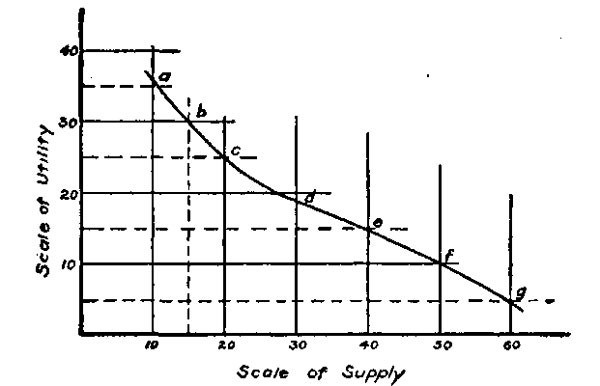
The diminishing utility of successive portions (doses or increments, as they are called) may be represented by a curve of utility.
Scale of Supply
The diagram is constructed on the hypothesis that a tenth unit of a certain good would have a utility expressed as 36; a fifteenth unit of 30, etc., and that the value of the whole supply is estimated according to these marginal units. Of course if the conditions were that "all or none" was to be taken, the result would be different.
Unit of Supply
Marginal Utility
Value of Whole Supply
10
36
360
15
30
450
20
25
500
30
19
570
40
15
600
50
10
500
60
5
300
This diagram is frequently used, and it is important to guard against some misunderstandings. The marginal unit of any given supply—for example, ten units—is not any particular unit, it is any one of the ten units. In the presence of nine units of the good the person or persons find all the various wants that are dependent on that good gratified to such a degree that the tenth unit has an importance expressed by 36. But as this last or marginal unit of supply may be used for any of the purposes, the importance of each and every unit likewise will be expressed by 36. Any one of the units, when once present is, in a logical sense, a marginal unit. When, however, it is a question of increasing the supply, some one unit may properly be looked upon as marginal. The dependence felt by men on the whole group is the product of the units by the marginal utility. As the number of units increases, the marginal utility decreases, until at length it may reach zero, and the total value would be nothing. A point of maximum value evidently will be found somewhere between the two extremes.
Only one marginal utility at one moment
Note carefully that on the one diagram are represented a large number of marginal utilities which never exist at one and the same moment. At any one moment there is a given number of units and there is but one marginal utility, and this is the same for each of the units. It is quite erroneous to say that when there are 30 units the utility of the tenth unit is 36; of the twentieth, 25; of the thirtieth, 19. It is equally incorrect to say that when there are 60 units the "total utility" is equal to the area between the right angle and the curve a-g, while the value is equal to the rectangle below and to the left of the point g. The curve from a-g but marks the height of marginal utilities that have no existence when the supply is 30. The "total utility," often spoken of in this connection, if it has any existence certainly cannot be calculated. The diagram must be understood as representing indicatively at any given moment but one marginal utility, the same for every unit of like goods. The other perpendicular lines are expressed in the conditional mood; they are what the marginal utility would be were the numbers of units different.
Changing feelings changes utility
5. Since goods possess utility only as they gratify wants, it follows that if wants change, the utility changes. Utility does not rest unchanging in the goods as something "intrinsic," but it depends on the relation of goods to men. This truth, unrecognized for many centuries, is now seen to be fundamental to the whole problem of value. The portions of a good added later do not appeal to the same man as the earlier portions. The man has been changed by what he has enjoyed. In changing his feelings, goods have also changed his wants. Hence, the added portions of the good are changed in respect to their utility or power to gratify a man's wants. Though physically and chemically, i.e., in every material way, they are exactly like the earlier portions, they cannot have the same want-gratifying power until he again changes, for they are not in the presence of the same feelings.
Wants are constantly shifting; different kinds of goods are compared in man's thought and arranged on a scale at every moment according to their felt utility. An increase in the amount of a good will drop the marginal utility of the added portions down the scale of usefulness for the next moment. When we rise in the morning, we want our breakfast; the breakfast eaten, another breakfast does not appeal to us. Our tasks done, we take a boat-ride or go golfing; then, appetite returning, we are tempted to our dinner. And thus from hour to hour wants are gratified, are altered and are shifted, until, wearied with the day's labor and pastimes, we go to rest. In a well-ordered life, in an advanced economic society, the means for gratifying our wants as they arise are provided in advance. The changing series of desires is met by a changing series of goods. Life has been defined as a constant adjustment of inner relations to outer conditions. Economic life is therefore like physical life, a constant adjustment; and this adjustment of goods but reflects the shifting and adjustment of feelings.
Choice is constantly shifting
6. The substitution of goods in men's thought is the shifting of the choice from a good that does not give the highest gratification economically possible at the time, to another good that does. The shifting that takes place on the scale of gratification makes it necessary for man to shift constantly his choice of goods. This again is the problem of "economy." Waste results when goods continue to be used to secure a lower degree of gratification, if they might be used to secure a higher. The change of choice may be because of a change in the man, or because of a change in the quality or the quantity of the goods; or because of a change in the ratio at which the goods can be secured.
§ II. DEMAND FOR GOODS GROWS OUT OF SUBJECTIVE COMPARISONS
Desire may become demand
1. Demand is desire for goods united with the power to give something in exchange. An example frequently given to show the difference between desire and demand is the hungry boy looking longingly at the sweetmeats in the confectioner's window. He represents desire, but not until the kind-hearted gentleman gives him a nickel does he represent effective demand. Desire, therefore, must be united with power to give something in exchange before it can be called demand. It must be for something that is attainable; yearning for something beyond reach, sighing for the moon, is desire that never can become effective demand.
Demand the Social expression of shifting choice
2. Demand is the social aspect of the individual man's comparison of utilities. It is the expression of the man's wish to substitute some of his goods for some one else's goods in order to get a higher satisfaction. This comparison is often made between two goods owned in different quantities. When men are constantly comparing things in their own possession, it is a short step to compare their goods with their neighbor's.
Demand for consumption goods is thus the manifestation of the man's desire to redistribute his enjoyments. In demand for goods men virtually say: "Part of what I have I am ready to give for part of what you have." The strength of their desire is expressed by the amount of their offer. When he makes this comparison and this offer, man enters into a social, economic relation with his fellows.
The limit of the exchanger's demand
3. The law of individual demand is: The trader will reduce his stock of a particular good to the point where its marginal utility equals that of the alternative goods. The greater the divergence in his estimates of the marginal utilities of two goods, the more ready is he to trade the lower utility for the higher one. Exchange is but the effort to adjust goods to wants in the best way. The less useful (marginally viewed) is traded for the more useful. The greater the difference, in the one trader's judgment, between the marginal utilities of the two goods, the greater is the maladjustment, and the greater, therefore, is the motive to seek readjustment by means of exchange. As the quantity of the good parted with declines, its marginal utility increases; and as more of the other good is acquired, its marginal utility declines. The marginal utility of the two exchangeable units must come to equilibrium in the individual's judgment. At this point demand ceases, not because an additional unit of the one good could afford no gratification, but because it would afford less gratification than the other good in which demand must be expressed to be effectual.
The Demand curve
4. Demand thus varies at different ratios of exchange between goods, and may be expressed graphically by a demand curve. This would show for any one man the decline of the marginal utility of each added portion of a good, and these individual demand curves may be united into a demand curve for a group of men. The demand curve expresses graphically what a man would be willing to pay at each particular stage in the increase of goods. We have here come to the very threshold of the subject of markets and exchange.
Elasticity of demand
5. Elasticity of demand, in the case of any good, expresses the degree in which a change in its ratio to other goods will increase the demand. Elasticity varies for different classes of men according to their wealth and to the cost of the goods. If strawberries are a dollar a box in the city market, a slight fall in the price, say to seventy-five cents, will increase the demand but slightly. But if the price is fifteen cents and falls to ten, the increase in the demand will be marked, for the number of consumers to whom a difference of five cents is important is then very great. The demand for the staples is comparatively inelastic. A certain amount of simple food is necessary to support life; an increase in its price will not quickly check the demand. On the other hand, if the price of staple foods falls, no very great increase will take place in the demand.
CHAPTER 5
EXCHANGE IN A MARKET
§ I. EXCHANGE OF GOODS RESULTING FROM DEMAND
Reciprocal demand becomes exchange
1. Exchange in the usual economic sense is the transfer of two goods by two owners, each of whom deems the good taken more than a value-equivalent for the one given. The comparison of goods that has been discussed above is a kind of exchange. When a person chooses one thing rather than another, one form of gratification may be said to be mentally exchanged for another. This is exchange in that person's mind, or subjective exchange. But the word "exchange" as usually employed means an exchange of goods between persons. It is objective exchange, and when the word is used without modification, it is to be understood in the objective sense. In the last chapter were analyzed the motives of the individual man. Robinson Crusoe on his desert island would in very many ways be acted upon by the same motives in reference to economic goods that men are in society. Yet, it is exchange in society and the complicated problems arising from this transfer of goods from person to person that constitute nearly the whole of the subject-matter of political economy.
Exchange is seen to arise out of the differences in the situations of men with reference to goods. The different subjective valuations give rise to demand, and demand leads to exchange. In early societies differences in natural products were the most usual causes of exchange. Salt, though so essential to life, is found in few places. The metals early became indispensable for weapons of defense or for the chase, and were sought far and wide. Rare shells, feathers, jewels, and the precious metals appealed in early times to a universal desire for ornament. Products like these are the objects of a rude sort of exchange in the first simple efforts made to adjust possessions to wants. Within the tribe, differences in the skill and ability of men to produce arrow heads or weapons or ornaments, bring about the exchange of goods.
Mutual advantage in exchange
2. The advantage of exchange consists in the raising of the want-gratifying power of goods to both parties. It generally was assumed by medieval thinkers that if one party to an exchange gained, the other must lose. The mistaken idea prevailed that value is something fixed in the good, and unchangeable. Where the exchange is voluntary (and only that kind is here being considered), it is mutual advantages which make the exchange rational. Many false conclusions on practical questions still result from a failure to grasp this simple truth. It follows from this that the act of exchange is itself useful, for goods having a small importance to men are given a higher importance by being brought into better relations with wants. Merchants, peddlers, traders, and common carriers of all sorts, therefore, are adding to the utility of goods. This idea has been only slowly apprehended, but is now one of the least disputed propositions in economics.
Demand is supply in another aspect
3. Barter is the exchange of goods without the use of money. Either one of the goods traded in cases of barter may be considered as sold, and either one as bought, according as the matter is looked at from the standpoint of the one or the other party to the exchange. Demand, therefore, is supply, and supply is demand when the point of view is shifted from one party to another. The fisherman's demand for venison is expressed in terms of fish; the hunter's demand for fish is expressed in terms of venison. But to the fisherman the venison is the supply offered to him. The term "marginal utility" of a good, therefore, does not refer merely to the demand of the consumer; for it expresses by a single phrase the idea both of demand and of supply. The utility of the goods composing the supply is expressed in terms of the goods that represent demand and vice versa. The only way in which man can give definite, concrete, numerical expression to his desire for goods is to state it in terms of other goods. In expressing numerically, in terms of other objects, an estimate of the utility of an apple, a horse or a house, one inevitably gives expression to a ratio of exchange; demand for one good is the offer of another good.
§ II. BARTER UNDER SIMPLE CONDITIONS
In isolated exchange the price is not economically fixed
1. In isolated exchange, where only two traders engage in barter, their estimates give respectively the upper and the lower figures of the ratio at which the trade can take place. Let us recall the fact that a difference in the relative estimates that men place on goods is the first essential of exchange. Those estimates may be expressed in a ratio; we may say that A will give four apples for one orange, would be glad to give fewer, but will not give more; while B will give one orange for three apples, would be glad to get more apples, but will not take fewer. The outside limits of the ratio at which the exchange must take place will, therefore, be one orange for three or four apples.
A, seller of apples, offers 4 (or fewer) apples for 1 orange.
B, buyer of apples, demands 3 (or more) apples for 1 orange.
There is, in entirely isolated exchange, therefore, a lack of definiteness in the price, much depending on what Adam Smith called the "higgling of the market." In the old-time American horse trade much depended on "bluff"; in such cases it was as important to be able to judge character as to judge horses. A thorough analysis of the trade, however, would probably show that the bargain is concluded at a point which exactly balances the hopes of gain and fears of loss of one of the parties.
Competitive bidding narrows the limits of price
2. Where one-sided competition exists, the ratio of the exchange will be somewhere between the estimates of the two buyers most eager for the last portion offered. By competition is here meant the independent seeking of the same thing at one time by two or more persons. Where there is one market price paid by a number of buyers, it may be that no two of the subjective estimates are alike; the exchange value may differ from all of their estimates, and yet must correspond closely to two. Auction sales well illustrate the principle. If there is one ax to be sold and ten possible buyers for an ax, and there is no combination among them, the bidding will go on until the estimate of the buyer next to the most eager, has been reached. The most eager buyer can then secure the ax by bidding just a little above his next competitor. But if there are ten axes and ten buyers who know that there will be ten axes offered, the more eager buyers will refuse to bid much above the less eager ones. A shrewd auctioneer, therefore, often conceals the fact that there is more than one of an article, and having sold it off, brings out a second or a third one of the same kind, thus keeping the buyers in ignorance of the supply and getting somewhere near the estimate of the most eager buyer in each case. Advertisements of "a limited supply," "the last chance," "positively the last appearance," are meant to stimulate the demand of the patrons, and to lead them to buy at once. In general, therefore, where competition exists on one side, price is fixed with greater definiteness than in isolated exchange. Not so much depends on shrewd bargaining, on bluff, or on the stubbornness of an individual. Far more depends on forces outside the control of any one man. The bidders are impelled by self-interest to outbid their competitors, and thus the limits within which the market price must fall are narrowly fixed.
Buyers fix price of perishable goods
If things already brought to market must be sold at any price that can be secured, the buyers may be said to fix the price. This does not mean that they can buy it for any sum that they wish, but it means that when each one is trying to get it as cheap as possible, their bids finally determine how much it will sell for. In such cases, therefore, the competition is for the moment one-sided.
If a part of the supply can be withdrawn and kept without great loss, this will be done if the price is low. Strawberries, fish, and meat may be sold Saturday night at any price that will secure purchasers, but every thing that can be kept with little or no depreciation will be withheld from sale for a time. It may even be of advantage to the seller to destroy a part of the supply, when the increased price of the smaller amount will give a larger total.
The margin of advantage and the marginal pair
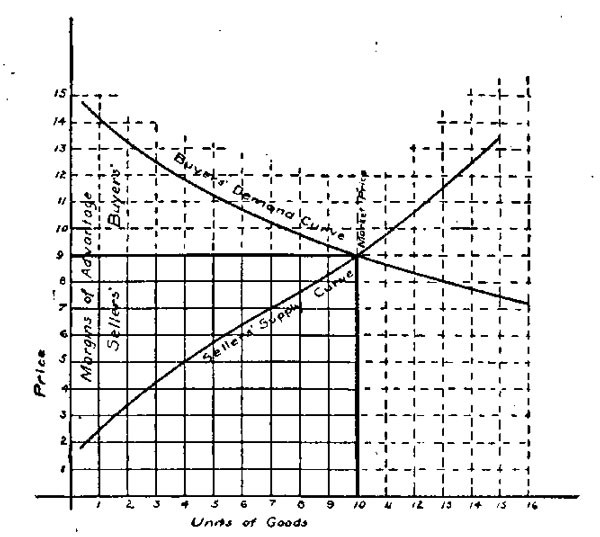
3. Where two-sided competition exists, the bidding goes on until a price is reached where the least eager seller and the least eager buyer have the narrowest possible motive to exchange. As the market ratio varies from those in the minds of the individuals when they come to the market, there is left a considerable margin to some and a very small one to others. This difference between the market value and the ratio of exchange at which any given individual would continue to exchange for the good may be called the margin of advantage. Moreover, the buyers will have a margin and the sellers a margin, and as that margin narrows there is less and less motive to continue the exchange until, finally, the margin disappearing, the buyer or seller, withdrawing from the market, ceases to be an exchanger, at least for that particular part of the goods.
The least eager buyer and the least eager seller may be called the marginal pair. They are the buyer and the seller respectively having the narrowest margin of advantage. Their outside estimates are nearest to the market ratio. If the market ratio shifts slightly in either direction, one of them will drop out of the exchange. It is evident that a buyer who is taking ten units may be on the margin with reference to the tenth unit, and yet may continue to be one of the most eager buyers to secure one unit. Thus, the marginal buyer is to be thought of as that person who, logically considered, is the least eager, or on the margin, with reference to a particular unit of supply, however eager he may be with reference to any other unit of supply. It would be well to recall here the discussion of the nature of wants and the variation in the intensity of demand.
Units of Goods
Market values built on individual estimates
4. Market values are built up on subjective valuations. The idea of market values, therefore, is that of the want-gratifying power of goods as expressed in terms of other goods, where there are various buyers and sellers. They are not an average of the subjective valuations, nor are they made up of the extremes. They correspond closely with the subjective estimates of two of the exchangers. The other parties to the exchange are willing to accept the market ratio, for it offers them more inducements than it does to either one of the marginal pair.
§ III. PRICE IN A MARKET
One price in a market
1. A market is a body of buyers and sellers in such close business relations that the actual price conforms closely to the valuation of the marginal pair. The word "price" which we have used, may be defined as value expressed in terms of some commonly exchanged commodity. The term is used more broadly of anything given in exchange. The very terms of this definition imply that there can be but one price in a market. This is a somewhat abstract but a useful economic proposition. Very often within sound of each other's voices traders are paying different prices for a good. On the occasion of a break in the stock-market, excited traders within ten feet of each other make bids that differ by thousands of dollars. Retail and wholesale merchants may be purchasing goods in the same room at the same time at very different prices. But within a group of buyers and sellers where competition is approximately complete, price is fixed with some degree of exactness. The more nearly the actual conditions approach to the ideal of a market, the less are prices fixed by higgling, and the more impersonal they become, the buyers and sellers being compelled to adjust their bids to the needs of the market, and not being able to vary them greatly one way or the other.
The earlier markets
2. Markets are steadily widening through the improvement of means of communication and transportation. The earliest markets were established on the borders between tribes, villages or nations as a common ground where strangers met to trade. At such markets were brought together from sparsely settled districts a comparatively large number of merchants and customers. Buyers had the opportunity of wide selection both in kind and quality, and the sellers found a large body of customers gathered at one point. Throughout the Middle Ages purchases were made by the more prosperous husbandmen in great quantities once a year at the fairs or markets. As both the buyers and sellers came from widely separated places, there was, in most respects, no combination, and the conditions of a competitive market were present.
The growth of markets
The number of buyers and sellers that can constitute a single market is limited both directly and indirectly by the means of transportation. A dense population cannot usually be maintained without easy means of transportation to bring in a large supply of food, and to carry back manufactured goods great distances. The remarkable growth in the means of commerce since the application of steam to water traffic, and the invention of the railroad, have made it possible for goods to be gathered from most distant points. A market implies a common understanding among traders. Modern means of communication such as newspapers, post-offices, telegraph and cable, trade bulletins, commercial travelers, the consular service, and many forms of special agencies, are diffusing information widely. As a result of these changes, there has been a widening of the village-market to the markets of the province, of the nation, and finally of the world. While a part of every one's purchases continues to be made in the neighborhood, a greater and greater portion of the total business is done by traders who are widely separated and who are indeed members of the world market. Various articles produced in the same locality may seek different markets. The market for wheat may be in Liverpool, while that for fruit and eggs is in the village near the farm-house. If a given product of any community is sold in different markets, the net prices secured must be very nearly equal.
The conceptions normal and market price
3. Normal price is spoken of in contrast to market price when the actual market price results from exceptional circumstances and probably will not be maintained. The term "normal price," much used in economic discussion, is the price which, apart from exceptional conditions, is expected to prevail, and to which actual prices seem constantly striving to adjust themselves. As actual prices are nearly always either more or less than so-called normal price, and only momentarily ever correspond with it, the term "normal" would appear to be something of a misnomer. Moreover, as the circumstances of production change, this normal price itself is altered so that what is normal one day may be quite abnormal the next. The thought of "normal price" is an abstract one, but despite the inaptness of the word it is not without some practical validity. In determining whether he shall continue to produce certain goods, the business man is practically guided by his view of normal price. An example of departure from normal price as above defined, is found in the price of food when an expected ship has failed to arrive at a port with its cargo of grain. A scarcity amounting almost to famine might thus exist in a seaboard city, and the market price would rise; but as this would be due to an accident and would afford a larger gain than usual to those who happened to have a supply of grain, men would say that the market price was above the normal price. The arrival of the expected ship would cause the market price to return to the normal.
Review of the argument
In review, we see that the market value of goods grows out of the different personal estimates made by men. Market value itself being a complex and difficult problem, it can be mastered only by dividing it. First, therefore, must be studied the more general and obvious motives of men, the nature of wants and their effects on man's subjective estimates. The same simple motives that influence the subjective valuations made by individual men, may be traced to the conditions of the complicated market. It is their workings that are seen in the obscurest problems of market price.
CHAPTER 6
PSYCHIC INCOME
§ I. INCOME AS A FLOW OF GOODS
The recurrence of wants
1. Satisfaction and gratification being only temporary conditions, economic wants appear in more or less regularly recurring series. Impressions are short lived, sensations are temporary, wants that have been satisfied recur. Wants recur for the same reason that they first arose. No impression on the nerves or on the senses is lasting. Man's senses were developed for the purpose of bringing him into relation with the outer world, of enabling him to survive in his struggle with the forces of nature. So, when a good has been enjoyed, the utility to that person of that thing or service for that particular moment, falls, it may be even to zero. To keep wants satisfied is impossible; we cannot do next year's reading or next week's eating now; we cannot live the life of to-morrow. The best results in reading or eating come from taking the right amount day by day. But it is a need in the life of men that wants should recur after a time, otherwise there would be no motive for action.
Series of wants and series of goods
2. The economic ideal is that this series of recurring wants should be met by a corresponding series of goods. It is evident that if a series or succession of goods varies, at different times, moments, and conditions, in its power to gratify wants, the closer the correspondence between the two series, that of wants and that of goods, the greater will be the total of gratification. We may liken man's life to a journey in which the supplies of food are gotten at the stations. If any one of these supplies fails, the traveler suffers the pangs of hunger, and if two or three supplies are at one point, they do not serve the needs of man so well as if distributed along the way. This constant inflow of goods is one of the fundamental needs of life. The savage dimly understands this need. Even the birds and the beasts adjust their lives to it either by travel or by toil. The spring and autumn migrations to new feeding grounds are the attempts of the bird to gratify this series of wants as they arise. The ant, the bee, and the squirrel anticipate, and work to fill their storehouses against the days of need.
Social and private incomes
3. Objective income consists of the additional sums of goods acquired by individuals or by society during the income period. The term national or social income may be contrasted with individual or private income in the objective sense. The nature of the acquisition of objective incomes may, in some cases, be different if viewed from the social and individual standpoints. Society, as a whole, may be said to acquire income only when goods are produced; individuals may acquire income by gift, bequest, theft, or other modes of transfer from other individuals. In many cases the two kinds of income, however, agree, the objective income of society being the algebraic sum of the goods acquired or parted with by all the individuals.
We should not understand that either social or private objective incomes include only material goods, for many utilities and labor services that never take on a material or money expression are included in either case. Indeed, we are close here to the conception of psychic income which is to be developed more fully.
Money income
Income of money is not often the same as income of things. Usually many of these subtler utilities are overlooked and omitted from the recognized money income. In this day the use of money is so common that we are sometimes led to ignore the value of things to which the money expression is not given. The money income is merely the money expression of the value of currently acquired goods, and it is the only medium through which such varied sources of gratification can be compared.
Gross and net income
4. Income in the logical sense must be a net addition, but the term gross income is not without popular and practical meaning. Gross income is sometimes spoken of in the sense of total receipts, as the total of goods secured; net income is the remainder after deducting expenditures and after replacing the goods employed to secure the income. In order to produce some goods technically, men make use of other goods. While they are storing up a supply of wood or coal it may be looked upon as the income, but they may burn it to help grow hothouse plants. While they gather flowers with one hand, they destroy fuel with the other. Only the net increase in value can be accounted income in the second period. The goods that come into a man's possession in any period are of many sorts: to get some he has destroyed many previously existing goods; while to get others he has not needed to use up the accumulations of the past or to mortgage the future. The one kind is gross, the other net income.
Wealth and income
5. An income of consumption goods is a part of wealth, but not the whole of it. The consumption goods, the "present goods" at the moment available, are the essential part of wealth for the moment's enjoyment. The only essential and immediate conditions of a series of gratifications is a regular series of consumption goods. But many things existing which could be used to secure a gratification are not in fact treated as consumption goods. A crop of corn is not all income. In a time of famine it could be used, but seed-corn was saved from last year, and some must be kept for next year. This is a part of wealth, but not of "present goods" as we understand the term.
Some goods never can become enjoyable goods
Further, in the economic world there is much wealth that never can gratify any want directly; many forms of wealth never can be consumption goods. It is true that everything called wealth is expected to contribute sooner or later in some way to the sum of gratifications. It is for that reason it is called wealth. It is, however, a mere figure of speech to say indirect want-gratifiers become want-gratifying goods. For example, the engine transporting a load of coal is indirectly gratifying wants; if it is transporting a train-load of passengers, the gratification is direct. A machine making cloth for next year is gratifying wants only in a metaphorical sense. A field used to produce food is not a direct want-gratifier until it is transformed into a residence site, a playground, or a tennis-court.
It is necessary therefore to recognize the distinction between present and future incomes. The value of the mass of wealth in possession and yielding income, rests in large part upon its power of contributing to income in some future period. Thus, any durable good may be looked upon as embodying a series of incomes ranging from present to future in varying degrees. This will be fully considered under the subject of capital.
Income from wealth and from labor
6. Incomes are called funded or unfunded according to the sources from which they are derived. Funded income arises from the possession of wealth or of claims on wealth, such as lands, railroad stocks, government bonds, etc. The income is "funded" because it corresponds to an abiding fund of wealth. The income arising from current labor is unfunded, because there is no permanent fund of accumulated wealth corresponding to it.
The idea of regularity connected with funded income is not essential to the idea of income in general, i.e., we cannot refuse to call a thing income because it occurs only this year. If it is part of the sum of goods that flows in, that is newly available for the man's use, it is income. But funded income is the more abiding, for income from wages stops when the man dies or fails to perform his work, while the income from wealth continues after he ceases to be active. Thus, families with equal incomes may differ greatly in wealth, the one depending entirely on salaries, the other on rents.
§ II. INCOME AS A SERIES OF GRATIFICATIONS
Gratification the test of psychic income
All sources of income are productive
1. The value of consumption goods is derived from the pleasurable psychic impressions which they aid to produce, and these psychic effects constitute the psychic income. The objective income is sometimes called the "real" income, but certainly it is not income in the most essential sense. Things outside of men cannot be feelings, they can only call out or occasion feeling, and it is the attainment of pleasurable conditions in mind or soul that is the aim of all economic activity. Material income and immaterial income are both related to and reducible to psychic income. Some portions at least of the objective incomes of goods are continually by use becoming subjective incomes of enjoyment. Men talk of material income as consisting of bushels of wheat, head of cattle, etc., and of immaterial income as the uses that durable goods yield directly or that men perform for each other, e.g., those of the singer, physician, teacher, judge—all services that do not take on material form. There was a long-standing dispute in economic literature regarding the difference between productive and unproductive labor. Productive labor was said to be that which embodied itself in abiding material form. The distinction led to some peculiar puzzles and paradoxes. The bartender mixing drinks, adds to the value of those ingredients; in a minute that value is dissipated. According to the distinction in question, he is a productive laborer because his services are embodied in material form, whereas the lecturer is regarded as an unproductive laborer because the results of his labor are not embodied in material form. But whether or not the service has for a moment embodied itself in material form is of no essential economic import. The presence of the waiter is as essential to the well-served dinner as are the polished silver and china, or as the well-cooked food. The distinction in question is not now made by economists, all labor that contributes to value being regarded as productive. But a similar distinction is inconsistently preserved by many writers in the case of material things. A building used as a factory is called productive, but used by the owner as a dwelling it is called unproductive because the service it renders does not appear in material form. But the use of the house, or that of land for a school ground or campus, secures a certain gratification, an immaterial good. Consistency requires that the services of men and the use of material things be judged by their psychic results, the question whether the service takes on a material or an immaterial form being disregarded.
All wealth is logically related to psychic income
2. Only those things and actions that are in some causal relation to gratifications can have value to man. This proposition of theory is demonstrated every hour in practical life. The business man always is trying to trace a causal relation between things that do not and cannot themselves directly satisfy wants, and things that do. The vineyard has no value to Tantalus, unable to reach its fruit. A captive, chained to a rock, attaches value only to the things within his reach. Men living in savagery and ignorance starve amid the possibilities of plenty. Chained by their ignorance and improvidence to a little spot of earth, they do not see clearly, either in time or space, the economic relations about them.
Values of things distant in time
3. Man's foresight and knowledge enable him to think of many periods at once, and thus his felt dependence on goods extends over a series of future productive agents. In order to simplify the problem, we have spoken of the economic man as living only in and for the moment. If he had no more knowledge, memory, or imagination than is necessary to compare goods here, only present goods could have value to him. Even the higher animals, and much more the savages, rise above that level of improvidence. With increased intelligence the economic life of man expands, and he attaches importance to things which at the present moment have not, and cannot have, the slightest influence on his immediate gratification. The extension of man's view works a momentous change in his economic estimates. Of the thousands of forms of matter in the world, only a comparatively few ever will make an immediate gratifying impression on man's senses. But many of them are so connected in his thought by chains of association with pleasures or uses, that almost instinctively and most intensely he attaches an importance to them. In most cases it would require close thought to see that the service attributed directly to them was but a reflection of that performed by some other good. Thus, more and more, the estimates placed by men on goods come to depend on knowledge and foresight, and not on immediate impressions and feelings.
Goods related in varying degrees to psychic income
4. Things are causally related in varying degrees to the psychic income, and have value only as their relation is known and felt. The explanation of value is not complete till value has been traced back to its source in gratification. Often the complex nature of the problem is ignored. If one discusses the trading of a bushel of grain, to be used by a hungry man for food, for a sheep to be kept for breeding, or for wool to be made into cloth next year, he may overlook the difference in the grade of wants compared. In this case, a gratification of the present moment is compared with a gratification of a very different kind at a future time. The problem involved is complex because of differences in time, in place, and in the nature of the want-gratifiers. The student should endeavor to reduce the problem of value to its simplest form by considering first the exchange, at the present moment, of immediately enjoyable goods. The logical starting-point in the theory of value is in those goods that are in closest touch with feeling, and on this basis may be built up an explanation of values in which reason and forethought have a greater part. Starting from the proposition that psychic income is the foundation of all values, we shall go on, however, to trace causes that give value to all the physical agents, and to the most indirect of want-gratifiers.
DIVISION B—WEALTH AND RENT
CHAPTER 7
WEALTH AND ITS INDIRECT USES
§ I. THE GRADES OF RELATION OF INDIRECT GOODS TO GRATIFICATION
Technical rank of agents
1. Goods may be ranked according to their technical relation to wants. The technical rank of goods (sometimes spoken of as the degree of roundaboutness of the process) signifies the number of steps or processes that intervene between the agent used and the desired form. If one wishing the hickory-nut hanging above his head must first pick up a stick to throw at it, the nut is removed one step from desire. But even among savages the processes are much more complicated. The Indian with a crude knife fashions his bow and arrow, fastens the flint and cord which represent still other processes of industry, and shoots the bird which satisfies his hunger. In modern conditions the relations are vastly more complicated; only at the end of a long series do men arrive at the thing which gratifies their wants.
Time relations of goods to wants
2. Goods may be ranked by their relation to wants in time. The relation in respect to time is measured by the period that must elapse before the utility of an agent results in, is converted into, gratification. No agent or influence intervening, a thing may yet be removed a long way from gratification. A tree may not be fitted to bear fruit for ten years to come. Meantime, there are many other possible uses for the tree: it may be used for fuel, or to make a canoe with which to catch fish, or to follow some other indirect method of production. Evidently the technical and time relations of goods are very different. The number of steps has no necessary relation to the time. A number of technical steps may be taken in half an hour, or a process of a single technical step may last a year. In the mechanic arts the technical relations are of primary significance, but in economics the time relations are mainly to be considered.
3. Economic goods may be classified as immediately enjoyable goods and durable agents. Enjoyable goods are goods in a final form, producing gratification or just ready to give gratification the next moment, as the cool draft of air made by a fan on a hot day, the cup of coffee steaming on the table.
Enjoyable goods and durable agents
Many goods of just the same form as the foregoing may not be affording current gratification (except that afforded by thrift and forethought), but are kept because later they will gratify a more intense want or gratify a want better. Apples and potatoes are kept in a cellar so that their use is distributed throughout the winter; cider and wine are kept till they get a quality that appeals more to the palate. Coal, wood, and stocks of goods, are thus kept in the form of enjoyable goods, destined to be physically destroyed when at length they yield a gratification. Evidently they must be storing up meantime a certain additional utility, for otherwise there would be no reason why they should be kept for the future. Such goods as these are sometimes called unripened consumption goods, but until ripened they bear in part the character of durable agents.
Abiding sources of economic enjoyments are called durable agents. The inhabited house is a source of continued gratification in each moment's shelter it affords; but, further, it is the durable source of a series of future uses, as yet unripened. The hammer, the hoe, the tree, the field may all be considered as agents to secure consumption goods. Some of these are but one step removed from direct gratification, as the hoe helping the gardener to get food for his own use. Other agents are bound by many technical links to the ultimate gratification.
Degrees of durableness
4. This classification of goods is abstract, in that it is a classification, not of concrete goods, but of qualities shared in some degree by nearly all goods. Most goods unite in some degree both characters, but in varying measure. This is, therefore, a continuity classification, the varying classes of goods grading from those whose durableness is zero (just at the moment of consumption) to those most durable, which yield an endless series of uses or products. Yet the classification is practical, corresponding as it does with thoughts which men have in the use of goods. By repairs and other methods goods become, and are looked upon as, durable sources of a series of uses.
It is to be noted further that the enjoyable goods pass over into psychic income, that is, they are the stream of objective utilities that is each moment detaching itself as income from the great mass of wealth. The durable goods are those utilities which for the time remain, not yet ripened or ready to be converted into psychic income.
§ II. CONDITIONS OF ECONOMIC WEALTH
Income as affected by climatic conditions
1. The bounty and variety of the natural supply of indirect goods in the material world are the prime conditions of a bountiful income to society. The effect of climate on the supply of goods available for man is complex. Climate is itself a direct source of gratification. As temperature must be adjusted to man's need, climate satisfies wants directly. Health, energy, the beauty of noonday woods and of sunlit clouds are conditioned on the favor of nature. Climate affects, further, the supply of material economic goods. All the earlier civilizations arose in warmer countries. But, after man had gained a certain mastery over the obstacles of nature, he was able to soften the harsher features of climate, and with better shelter and clothing, with better stocks of winter food and fuel, the more favorable features of the temperate zone could be utilized. So civilization moved northward from Egypt and India to Greece and Rome, to northern Europe and America.
By natural resources
Soil conditions for vegetable life determine first the amount and kind of animal life. Animal life from one point of view is a parasite, living on the vegetable; it is only the vegetable that has power to assimilate most inorganic compounds. Water being a need of plant life, the amount of rainfall is one of the most important conditions of industry. Man, therefore, depends on the resources of the soil directly or indirectly; a fertile soil furnishes him either directly a supply of vegetable food, or indirectly a supply of animal food.
Natural supplies of metals, of coal, and of timber are important consumption goods, but they are also indirectly the condition for a vast variety of other goods. The industry that could exist without iron, copper, and coal would be of a very low grade.
By flora and fauna
The variety of flora and fauna, and their fitness for man's needs, largely condition the possible production. If, in the course of evolution, it had chanced that wheat and corn, the horse and the cow, had been crowded out in the struggle for existence, we should have had a very different civilization. The possibilities of civilization in Peru, and those of all the Indians on the American continent, were limited for lack of domestic animals. Animals that are fit for domestication are a necessary intermediate agent by aid of which man can appropriate and turn to his use the fertile qualities of the soil.
Not content with the material world about him, even when it is at its best, man alters it in many ways. He enriches the soil, improves the varieties of animals, he even in some slight degree affects the climate, and by the use of a multitude of artificial bits of matter called tools, works profound changes in the world in which he lives.
By motion and energy
2. A large part of the utility of goods is conditioned on motion and energy. It has been said that man's power in production is limited to moving things. The outer world is to man the sole source of motive forces. He can bring things together and they produce the result. Further, it may be said that nearly every kind of utility is conditioned on motion. It is man's aim to secure a constant inflow of goods. To secure this either he must move to get the goods, or he must cause goods to move toward him.
The law of "conservation of energy" helps to explain economic action; the supply of energy in the universe cannot be increased or diminished, but may take on new forms. So a limited supply in man's control may take on various forms and so have different effects on gratifications. One and the same source of energy may be converted into the different forms of heat, light, motion, electricity, etc. But there must be some source. Man's desire is directed to getting force at the right place and in the right degree. If light or heat is too intense, it causes pain; the glare of the sun blinds instead of giving keener vision. A moderate force applied to any of the senses gives the maximum clearness or pleasure. Man is constantly endeavoring to secure forces from the outer world and to adjust motion so that it will directly or indirectly best serve his purposes.
By food, animals, and fuel
3. Among the main sources of power used by men are food, domestic animals, and fuel. In eating food man stores up force in his own body. When he draws the bow he puts force into it to lie latent until liberated at the right moment. There must be a source of energy likewise that mental action may go on, and the power of sunbeams, stored for a time in food, is liberated in the processes of thought.
This first natural mode of liberating energy within their own bodies does not satisfy the growing needs and aims of men. Such a mode is "labor," which becomes at times painful and distasteful. In the earliest societies known, some sorts of domestic animals are found supplementing man's efforts and acting upon the material world to alter it for man. The dog joining in the chase guards his master's safety, and helps to bear his burdens. The draft-beast in the field turns the heavy soil, and aids in the final harvest. The trained elephant does the work of twenty men piling logs, loading ships, or carrying burdens.
Man further increases his control over the material world by making other men do his bidding. Domestic slavery, where wife or child serves the father of the family, or chattel slavery, where the vanquished toils for the victor, are all but universal in early communities. Such a method of increasing one's control over the forces of the world requires only superior strength, no special intelligence in mechanics, and is thus one of the first crude devices in a primitive civilization.
Fuel has been, up to the present time, perhaps the most important source of energy. Fire in the hands of savage man gave him dominion over the forests and over the metals. In this age of steam the liberation of the energy of the sun, stored up in coal in ages past, is still the indispensable condition of our developed industry.
By the energy in wind and flowing water
4. The greatest and most exhaustless reservoirs of power for man's use are in wind and water. While the supply of fuel is being used at a progressive rate and will soon approach exhaustion, there are elsewhere exhaustless stores of energy awaiting man's command. To make use of the wind for sailing a boat, only the simplest arrangements are needed; a windmill fixed at one place requires more ingenuity and machinery. The energy of the wind is derived from the sun and will last until the sun loses its heat. If some means can be found for equalizing the flow and for storing the power of the wind, it may yet become a great agency of industry. The force of falling water, long used in a petty way by the old water-mills, is just beginning to be employed on a large scale at such points as Niagara. Where fuel is high, as on the Pacific coast, wave motors have been successfully used in a small way, but wave motion is too irregular to serve well the needs for power. But the constant motion of the tides offers, at some favored points, a source of power that will remain as long as the earth revolves upon its axis.
By the intelligent utilization of all these agencies
5. Man studies and compares the durable goods that give him command over enjoyable goods, and attaches value to them. Thus energy is found dissipating itself throughout the world in ways useless to man, and in places where it cannot serve his purposes. As man grows in power of control over nature, he seeks to apply these forces in forms and at places he has selected. If he can arm himself with the energies of mine and torrent, he can react with giant strength on the material world. He ceases to accept passively its conditions, and to live on its grudging gifts; he becomes its fashioner, in a sense its creator. His intelligence and his wants are most important factors determining what the form of the physical world about him shall be.
But all the efforts of men in the most developed economy cannot make to disappear the differences in the quality of goods and agents. Desirable goods to consume are limited in quantity, and they vary in quality; hence they have value and some higher than others. Likewise, durable material agents and sources of power are limited in number and vary in convenience of location and efficiency. As men seek to gratify their desires, they attach importance to these agents of power. Each is valued for its service or its series of services. When anything is seen to contain a series of uses, it becomes a rent-bearer, and the economic problem of rent arises, one step more complex than the problem of valuing simple consumption goods.
CHAPTER 8
THE RENTING CONTRACT
§ I. NATURE AND DEFINITION OF RENT
Temporary use and permanent possession of agents
1. The temporary use of materials and power and their sources is necessary to bring most enjoyable goods into being. Indirect goods have value solely because they help to get direct goods. The apple-tree is valued because it bears fruit, and the orchard because the trees give promise of yielding a succession of crops for years to come. There are thus two problems of value in connection with durable goods: that of the value of a temporary use for a brief period, as for a year; and that of the value of a thing itself, the use-bearer, for a long series of years or in perpetuity. To explain what fixes the value of the temporary use is the problem of rent; to explain what determines the value of long-continued use or of permanent control and ownership of a use-bearer is the problem of capitalization.
Origin of the term rent
2. The term rent is used in a number of senses, which must be carefully distinguished. The original meaning of rent was any regular income or revenue arising from wealth. The word comes from the low Latin renta from renda, in turn from redditus, that which is given, yielded or given back, or rendita, that which is given or returned. The French rendre (English render), to give or return that which belongs to one, is used very early. Chaucer used "rente" as an income. "Cattle had he enough and rente," cattle probably meaning property (chattels), and rente income. Rental is a collective term for a number of rents. The total yield of an estate was called its rental or rent-roll, and a list of the various sources of income, including all payments from tenants in money, produce or services, constituted its rental.
Popular and special meaning of rent
3. The popular meaning of rent is the amount paid for the use of material things which must be returned to the owners after the time of use agreed upon. We speak of the rent of a house, boat, etc., using the word as a synonym for hire. In the European languages the word is used more frequently in that sense. In the French la rente means the income from any kind of property; but corporate securities and national bonds came particularly to be called les rentes, because they are a form of investment yielding a permanent income. The one who has a perpetual income from bonds or rents is called a rentier. In German the term Rente is used more broadly than in English, as an income of any sort, Grundrente meaning the rent of land, and Capitalrente the income usually in England called interest.
A restricted meaning has long been applied by economists to the word: the income yielded by lands, etc. This was put in contrast with interest for money and capital, and with wages of labor. This meaning is now being abandoned by economic students.
A wider meaning recently given to the word by many economists turns on the supposed relation of some portions of price to cost of production. Thus, frequent use is made of the expressions: consumer's rent, producer's rent, buyer's rent, seller's rent, etc. In the well-founded opinion of some recent critics this usage rests on a mistaken reasoning. However, in the midst of this wide variety of usage the student must be forewarned and alert. Doubtless agreement will at length be arrived at. Meantime, no economist can dictate what meaning is to be attached to the term, but one may suggest the definition that seems to him most expedient. Throughout this work we shall endeavor to use the term rent uniformly and consistently as it is now to be defined.
The essence of rent
4. The essential thought in rent, as we shall use it, is that it is the value of the usufruct as distinguished from the value of the use-bearer or thing itself. The meaning of usufruct is the use of the fruits, or in legal phrase: "the right of using and enjoying the income of an estate or other thing belonging to another, without impairing the substance." The obvious fact is that fruits can be eaten without destroying the tree, the harvest gathered without destroying the field. By a metaphor the word in legal discussion is applied to the use of any product, and we shall employ it, as in common speech, in reference to one's own goods as well as to the goods of another.
Rented agents are looked upon as durable
The qualities whose use gives value are not usually indestructible, but they are treated as undestroyed. There is a famous phrase used by Ricardo, "rent is paid for the original and indestructible qualities of the soil." He said "indestructible," but the word is not apt. There are many qualities in the fertile field that must be destroyed when it is used. Every economist since Ricardo's time has recognized this, and many excuses for the inaccuracy have been given. After every harvest, the field is less serviceable than before, and if it is to be of the same grade of efficiency, the fertile elements must be restored. We cannot assert that Ricardo meant undestroyed, for he was not quite clear on the question. But it is evident that one can count as true income only that part of the value of product that remains after full repairs have been made. It is only by a fiction that most indirect agents can be regarded as indestructible. Things yielding rent are not indestructible, but generally they are preserved undestroyed.
True rent a net income
5. A distinction must be made between gross and net, or true and false rent. Before the usufruct is estimated, allowance must be made for repairs, depreciation, and for various expenses which absorb a good portion of the gross product. When this allowance has been made, the income may be considered as a net sum not due to the sale, or to the using up of any part of the thing rented. This is the essential thought in typical rent—that it is the value of the surplus, or net product, of an economic agent leaving the agent itself unimpaired in efficiency. The total product is sometimes called the "gross rent," but economic rent is "net rent." This thought is made clearer by the following discussion.
§ II. THE HISTORY OF CONTRACT RENT AND CHANGES IN IT
Economic and contract rent distinguished
1. Economic rent (likewise called natural, competitive, and sometimes rack rent) is to be distinguished from contract rent. Economic rent is the market value of the usufruct, and contract rent is the amount a man pays for the use of wealth by virtue of an existing agreement. The one is impersonal or economic; the other is personal or legal, being fixed by agreements between persons. The rents usually spoken of are contract rents.
The two diverge more or less. If the contract has been lately made the two will be nearly the same. Contracts of long standing often bind the tenant or borrower to pay either more or less than the present competitive price. If, after a time, the value of the use is greater than the contract rent, the tenant is fortunate in having his lease. But he is the loser if he is bound by lease or agreement to pay rent in a locality where land has become less valuable.
Economic and contract rent usually diverge also because of the agreement that the owner, or lender, keep up the repairs and pay the taxes. Here it is simply the difference between gross and net rent.
Custom may prevent the owner from charging all the usufruct of the agent is worth. If the contract rent is less than the economic rent, evidently the borrower enjoys a part of the usufruct, without charge, and to that degree is in the position of an owner. The usufruct in this case is divided between the two parties. Such instances were numerous in the Middle Ages in the renting of land, and still are found in many countries.
Contract rent is based on economic rent and tends to conform to it whenever there is competition. The existence of economic rent is the basis of the agreement to pay contract rent. Prospective hirers of agents forecast what the use will be worth to them and make their bids accordingly.
The renting contract for the use of wealth
2. The renting contract is the agreement of a borrower to pay for the use of a thing and, at the end of the time, to restore it in good condition or pay for its complete repair. In practical business it is necessary to have definite agreements to prevent disputes. Some provide that one party, some that the other party, shall keep up repairs. The form of the renting contract is observed by men in estimating the uses of their own wealth where no contract exists. If they count the gross product of an agent as rent, it is bad bookkeeping. In many cases it is necessary, therefore, to follow the form of the renting contract in order to determine the net yield of indirect goods.
The renting contract in the middle Ages
3. In early stages of industry the use of nearly all wealth is estimated under the renting contract. In the lower stages of culture, in hunting, fishing, or nomadic pastoral tribes, land is not recognized as wealth to be exchanged or owned. But at a later stage, as in the Middle Ages in Europe, land and the things pertaining to it, as ditches, houses, mills, cattle, stock, and the few simple implements, constituted the larger portion of the wealth. Land was granted to the tenant or serf in return for services. The contract was pretty strictly drawn and all items were specified. It was not hard to hold the tenant to his contract to keep the land in about the same condition. There was a certain rotation of crops; the tenant was obliged to keep his stock up to standard; and, moreover, he had a certain interest in the land because his contract rent (as explained above) was less than the economic rent. The landlord, therefore, could count pretty surely on the undiminished power of his land and stock from one year to another.
At that time, truck and barter were the common modes of exchange, and rents were paid in products and services, not in money. The fruits of the soil were consumed on the spot instead of being sold as now. Land was rarely, if ever, sold outright, so that there was no occasion to estimate its total selling value. It was thought of as a place on which to live and as a source of livelihood. Its yearly use was all that was subject to contract, sale, and exchange. Not the land itself but a rent charge on the land was sold, the term rent charge meaning an annual sum payable out of the yield of an estate. Many medieval estates were so tied up by legal conditions that they could not be sold outright; all that the owner could do was to sell or mortgage the annual rental. Thus, in the Middle Ages, it was all but universal to look upon most indirect agents as exchangeable only under the renting contract, as subject to renting but not to complete transfer and sale.
The renting contract not convenient in commerce
4. As industry developed, the renting contract remained almost wholly confined to cases of renting lands and houses. The materials and appliances needed for manufacture and commerce are so manifold and varying in quality that the rent-form of contract is very cumbersome and difficult for exchangers to enforce. If a merchant about to embark on a trading journey wished to rent a ship and a stock of goods, the renting contract became most difficult to interpret. He must agree to repay the loan in goods of the same kind and quality as those received, a contract most difficult to execute, and giving occasion to costly tests and countless disagreements. It was much easier for the merchant to get his loan under the interest contract, i.e., a money loan, with which to buy the goods. With the growth of industry and commerce, wealth increased in towns, taking many forms, as those of ships, wagons, tools, and stocks of goods, that could not conveniently be rented.
The thought of it remains associated with a rural economy
In England, the country which developed its industrial system earliest, the idea of rent, therefore, gradually became disassociated almost entirely from the use or hire of any wealth but land and real property. Because in the Middle Ages rent was associated almost entirely with natural resources, they being the only important forms of wealth which men rented from others, there was fostered the idea that the essential mark of rent is the connection with natural resources. It is a simple example of the association of ideas. In the transfer or loan of movable goods, the rent contract was quite overshadowed by the other form of contract, that of a money loan. According to this explanation the essential and primary difference between renting wealth and borrowing money at interest is not in the kind of wealth whose use is thus temporarily transferred, but in the nature of the contract. But as forms of wealth differ in their fitness for transfer under the two forms of contract, there goes on a competition between them, as a result of which each becomes associated with certain groups of goods. In the Middle Ages the renting contract was the dominant form, but it has been progressively displaced by loans in the money form, and its importance is still declining.
Renting contracts most used with land
5. The main forms of wealth whose usufruct is still sold under long renting contracts are land and its more durable improvements. In England farms are let under long leases, a very common form being the thirty-year lease. Under the old, almost fixed, conditions in agriculture such a lease was equitable, but when prices are rapidly changing and when new methods are being introduced, it gives rise to great hardships. About twenty-five years ago, the great fall in the price of agricultural products brought ruin to many of the tenant farmers. The land troubles in Ireland have been largely about tenants' improvements. When the lease expired, the landlord could appropriate all the improvements that the tenant had made. In America farms are let usually on shares, and from year to year, but the plan of a money rent is increasingly followed. The difficulty of getting an equitable arrangement between landlord and tenant is recognized by all. The landlord must make the proper repairs or see that they are made; he must specify in the contract whether the products can be taken away or are to be fed on the place so that the soil may not be impoverished, and he must provide for the purchase of other fertilizers. On the other hand, the tenant under the renting contract has little motive for improvement, and many occasions for discontent. So in America, far more than in the older countries, land changes hands by sale, the purchaser going into debt for it, giving his note and paying interest on the loan rather than rent for the farm.
But many other goods are rented
Many less durable goods are rented for brief periods. Carriages are rented for the day, bicycles by the week or month. Sewing-machines, boats, guns, tents, and even diamond engagement rings, yield their joys under the renting contract. People frequently hesitate between the renting and the purchase of a piano, and in some cases renting is the more convenient and desirable way of securing its use. The purchase of a dress-coat or of a masquerade-suit to be worn but once, involves for some an excessive and needless sacrifice. For a moderate sum its temporary use may be had, and it is then returned, little the worse for wear, to the accommodating clothier.
Economic rent much wider than the renting contract
A final word of caution may be given. Economic rent is not confined to the cases of contract rent. It exists in every case where a more or less durable agent yields a use that is scarce and desirable. The owner who uses a thing himself gets the advantage in the product as clearly as if he collected rent from a borrower. Houses lived in by the owners, house furnishings, clothing, books, all scarce and durable agents, are yielding rents in this logical sense. To the economist, therefore, the problem of economic rent, as one of the grand divisions of the problem of value, remains of undiminished importance, for in these unceasing streams of uses emanating from our environment, is found the basis for the value of all durable wealth.
CHAPTER 9
THE LAW OF DIMINISHING RETURNS
§ I. DEFINITION OF THE CONCEPT OF (ECONOMIC) DIMINISHING RETURNS
Economic agents contain uses to be obtained only with progressive difficulty
1. The phrase "diminishing returns of industrial agents" is the expression of the fact that there is an elastic limit to the utility any indirect good can afford within a given time. Successive attempts to get additional services from a thing are usually in part successful, but each additional service is gained with more difficulty, or a smaller added service is gained for an equal expenditure of materials or effort. A book stands many hours untouched on the shelves of the library; but if, as often happens, two or more persons wish to use it at the same hour, time and energy are wasted. The book has a potential use during the twenty-four hours, but all this can be secured only at the cost of the greatest inconvenience. The greatest net uses, therefore, are seen to be to the first user and in the first hour, for these uses cost the least time and trouble. If the members of a family will take turns, one chair will serve for all of them; but if all are to be able to sit down together, a chair must be provided for each. Often it will happen that only one chair is in use, the other nine chairs being valued only for their potential uses. I knew two young men who owned a dress-coat in partnership, and as they had different evenings free from business all went well until both were invited to a reception which both were very eager to attend.
This is true of all classes of agents
Illustrations of this principle may be drawn from every class of durable goods. The example generally given is that of a field used for agriculture. It was long ago seen that a larger crop could usually be obtained on the same area, only with greater effort or expenditure; but this fact has been thought to be peculiar to the use of land. The examples given above have been purposely chosen from very different fields, to show that the truth is a general one: a good that affords a given service can be made to increase that service, ordinarily, only on condition that men put forth greater effort, or sacrifice more goods.
The decreased utility is most clearly seen in the diminished effect which other agents produce when used in connection with the thing. When several are trying to use the same book, and are wasting time trying to get it, we often say their study hours are less fruitful because of the poor library facilities. Again, we speak either of the diminished returns of the field, or of the labor applied to the field. Either the particular thing is said to show diminished returns or the other coöperating agents are said to show them.
Decreasing technical effectiveness of material things
2. As the agents used in connection with a fixed amount of any other agent (for mechanical, chemical, physiological, psychological, and other purposes) increase, their objective effectiveness after a given point decreases. Objective or technical effectiveness means effectiveness independent of the thought or estimate of men. It is not the effectiveness to produce a feeling in men, but to produce results on the material world. In a mechanism, if one part is increased without increasing the other parts, a point is reached where it does not add to the result. If in the building of a bridge the weight of the floor is increased beyond a certain point, the rest of the bridge being left unchanged, the bridge is weakened instead of strengthened. If the weight of the iron in the framework is increased beyond a certain point without strengthening the piers, the structure is weakened. If the pier is greatly enlarged, the bridge may not be weakened, but there is an utter waste of material and effort, and perhaps the main purpose of the bridge is defeated by the damming up of the stream. A bicycle frame, like a chain, is no stronger than its weakest part. If the strength of all parts of the wheel and frame is in equal proportion to the strain they must bear, added weight to any single part weakens the whole machine. The development of the modern type of bicycle, by many experiments, is a good example of the adjustment of materials according to the principle of technical efficiency.
A variation of the same principle is seen in chemical combinations. Exact proportions of materials must be used to get a certain result. Increase of one ingredient will not increase the desired product. Either the added part is rejected, does not enter at all into the compound, or it unites to form another and different product.
That the same principle holds good of the psychological effects of things, we have already fully recognized in discussing wants and marginal utility. A given amount of a good will affect the senses in a pleasurable way, but an increase in the amount will not cause a proportional addition to pleasure of sight, sound, or smell. On the contrary, such an increase may defeat the object entirely. Here we are at the threshold of the economic problem, for we have touched on "feeling."
Economic diminishing returns relate to value
3. The idea of economic diminishing returns arises when man recognizes these technical facts and their relation to gratification, in his use of a limited supply of indirect agents. All economy begins with scarcity. The varying effects produced by different agents therefore require to be studied or the sum or direct goods of enjoyment will not be as great as is possible. Waste will take place. A bridge will have its maximum use with a minimum outlay when the parts are in a certain proportion. Beyond that point, the increase of any part may add something to the usefulness of the bridge, but the agents must be taken from some other and greater use.
The thought of economic diminishing returns always has reference to value. If a particular kind and amount of a certain material is used in varying combinations with other agents, the value of the added product will not always be in the same proportion to the value of the added agent. The bridge-builder must consider not only what the added material will add to strength, but what it will cost, and whether the result will justify this expense. So the economic problem of diminishing returns is more complicated than the mechanical one, for it contains not only the technical but other factors.
The marginal utility in goods
If the value of the product increases less rapidly than the cost of the agents successively added to secure it, a point must at length be reached where the value of the added agents and of the additional product just balance; this is called the point of marginal utility.
If a certain value in labor, fertilizer, or material, be applied to an acre of land, it may be more than recovered in the value of the product. Further applications give a product increased not in equal proportion to the former yield, and so on till the value of the last-added agent just balances that of the added product. This is the best adjustment possible, and beyond this point there will be a deficit in value. Just where the equilibrium is found at any time is the margin of cultivation.
The term "cultivation" is taken from agriculture but must be understood in the broader sense of utilization, as the principle is not confined to the case of land or agriculture, but applies as well to the use of furniture, books, clothing, horses, or any other indirect agents.
Meaning of intensive margin of utilization
The extensive margin of utilization
4. There are two margins, the intensive and the extensive. The margin of utilization in the case of a single piece of wealth is called the intensive margin. Any form of indirect wealth, anything kept to use, may be considered as containing a series of uses. Using one thing more and more while uniting other things with it, is using it more intensively.
Getting more use out of the book by effort, out of the farm by applying more fertilizer, out of the house by putting more people into it, is intensive utilization. The earlier uses come easily, naturally; the later ones are gotten with increasing difficulty.
When a number of agents are of different qualities, the point between the one last used and the next unused is the extensive margin of utilization. The best agents that are available are naturally used first, but as they are more intensively used there is increasing inconvenience. Then recourse must be made to the inferior agents, whose first uses, however, are greater than the later, intensive uses, of the better grades. When the step is made to the use of agents that were before unused because inferior, it is extending the margin of utilization. The intensive margin of use is in the particular thing; the extensive margin of use lies outside of this.
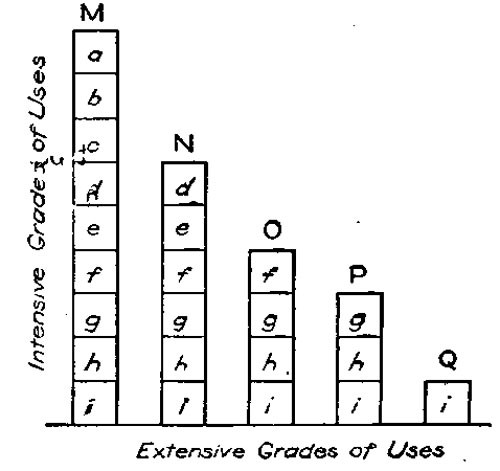
Extensive Grades of Uses
The relation of the two margins may be shown in a simple diagram. Let the better grades of indirect agents be represented by longer rectangles, the upper parts of which represent the more accessible, more easily secured utilities. Each agent consists of many strata of uses. The best uses are grades a, b, and c, in M; but after M has been utilized intensively down to d, N will begin to be utilized at its highest point. When utilization goes down to f, O comes into use, and so on. Therefore it will be seen that until the intensive margin takes in d, M is on the extreme margin of utilization, and N is just outside it; when the intensive margin falls to g and h, P is inside the extensive margin, and Q is just outside.
Equilibrium of the two margins
The marginal utility or effectiveness of added agents tends to be equal on the intensive and the extensive margins. This is simply a case of the substitution of goods in the use of indirect agents. If the value of the added product in the use of a particular good decreases, a point finally is reached where it is better to transfer the outlay to another agent, to change from intensive to extensive utilization, to go over to the use of another field or of another machine not so good. The effectiveness of the labor or capital that men have to apply is being compared constantly in the two cases, and to the extent that this comparison is perfect the effectiveness of the agents tends to be equal on the margin in the two applications.
§ II. OTHER MEANINGS OF THE PHRASE "DIMINISHING RETURNS"
Does not mean declining prosperity
1. The phrase diminishing returns is sometimes taken as meaning merely a decrease in prosperity. Many ideas are connected with this phrase. It is not self-explanatory. It suggests various thoughts according to context and these have not failed to give rise to different uses. The student must be cautious if he is to think clearly about it. If population declines, or industry changes from one place to another, or from one kind of goods to another, it is sometimes said that returns are diminishing in the deserted district.
Nor exhaustion of the soil
2. A more common misuse of the term is to apply it to the exhaustion of the soil. If the soil of a district has been robbed of its fertile qualities and smaller crops are raised than was the case fifty years before, it is said to be a case of of the increased difficulty in the extraction of natural stores in mining. The veins near the surface being mined first, later the galleries must be cut deeper and greater expense incurred to get the stores. But the conditions here are very different from those we have considered under diminishing returns. Mines are used not under the renting contract, but under the royalty contract, which permits and contemplates a progressive using up of the limited stores of natural resources.
Fallacious contract between manufacture and agriculture
All industries if limited as to one factor, as area, show diminishing returns
3. Manufactures are often said to show increasing returns in contrast with agriculture as an industry of decreasing returns. There is here an inconsistent shifting of thought. Agriculture is thought of as limited to a certain area of ground, whereon evidently diminishing returns will take place. But the fixed limit of ground-space is not thought of in connection with manufactures. Taking the same view of manufactures, commerce, education, etc., that is, assuming each industry to be confined to limited area of ground, each is seen to be subject to diminishing returns. Some ground-space is one of the essentials to carry on any business. If the attempt is made to accumulate a large library in one small room, a point is reached where much energy is wasted in trying to find the books. In a university the psychical product, education, may be limited by the need of space. The school-room, laboratory, or college class-room could be used at midnight, it is true, but not conveniently; and as students increase, buildings must be added. The same is true of any industry. We cannot conveniently increase the business of a lumber-yard without a larger yard-space, or of a factory without a larger floor-space. But the added space may be gotten by spreading horizontally or piling up perpendicularly. A ten-story building on an acre lot represents ten acres of floor-space. Putting up higher buildings is an expansion in area by the more intensive utilization of the land. Devices like elevators, and more compact appliances, make possible an increasing business in manufacture, trade, or commerce upon the same area of land. All industries, if looked at consistently from this standpoint, are subject to the same condition, though it is true this will make itself felt in varying degrees in different lines of industry. In agriculture some similar devices are possible by the use of greenhouses, but it is true that in it, on account of the need of sun, light, and air, the limits of space are more quickly felt, and are less elastic than in most other industries. The difference, however, is one of degree, and not of kind. Higher factories, larger stores, enable manufacturers to adapt themselves to the law as applied to the surface of land, but not to escape its operations. Neither the law of gravitation nor the law of diminishing returns is violated or broken when materials are lifted to build the upper stories. Both "laws" are at work, even when the building is rising from the ground. Men are merely adapting their conduct to the conditions imposed by gravitation and diminishing returns.
Confused with the question of large production
Manufactures usually are thought of as enlarging by increase of the amount of capital employed, without limitation as to the area covered. But even here a limit is reached in the amount of capital that can be employed at any one location because of the difficulty of widening the market. The question, however, is one of the advantages of large production with large capital, not of the increasing use of a limited area of land. If manufactures and agriculture are to be compared with reference to their economic nature, it is essential to clear thinking that both be looked at with reference to the same conditions, and from the same point of view.
Technical confused with historical diminishing returns
4. Technical diminishing returns are often confused with historical diminishing returns. The principle of technical diminishing returns is that at any given moment the uses obtainable from any indirect agent cannot be indefinitely increased without increasing difficulty. Historical diminishing returns occur when, in fact, human effort is less bountifully rewarded in a later period than in an earlier one. If to-day a day's labor in agriculture produced less than fifty years ago, historical diminishing returns would have occurred. In fact, labor is more bountifully rewarded in agriculture than fifty years ago, yet it is true to-day that there are few fields or appliances which, if used more intensively with the prevailing prices of labor and material, would not show a diminishing return to the additional capital applied. Therefore, in the historical sense, increasing returns have prevailed, yet at every moment it has been necessary to apply resources under the guidance of the principle of diminishing returns.
§ III. DEVELOPMENT OF THE CONCEPT OF DIMINISHING RETURNS
Recognition of diminishing returns to land
1. The law of "diminishing returns" was first recognized and expressed with reference to the use of land in agriculture. There are several evident reasons why this occurred. It is obvious to every farmer and gardener that he cannot indefinitely increase his crop, that two men cannot always produce twice as much as one man, and that in general the product does not always vary in proportion to the labor and materials applied. Moreover, the food supply is a fundamental factor in industry and in the welfare of states. The limit to the supply of food on a given area, cultivated by a given method, early appeared and became a serious practical problem.
The circumstances in Europe in the eighteenth century drew attention to the subject. Population was increasing, and the pressure for food was strong. While all the forms of industry most common in cities were increasing, and the wealth of the cities was growing, poverty was increasing among the peasantry. Especially was this true in England during the Napoleonic wars, 1793-1815, owing to exceptional conditions. The food-supply from abroad was cut off, and when the English farmers, tempted by the high prices, took poorer land into cultivation, and sought to get larger crops from their older fields, a great object-lesson was presented on the principle of diminishing returns in agriculture.
This confused with historical diminishing returns
2. This truth of diminishing returns in agriculture was confused with the thought of historical diminishing returns. Circumstances of the time led to the belief that because of lack of food misery must continue among the masses of men. It was thought inevitable that the population would continue to increase and food become more scarce. The idea of diminishing returns became thus a prophecy of what would happen, a social philosophy, that affected the thought of men on every practical social question.
The principle applies to land in all of its uses
3. The application of the principle of diminishing returns was soon broadened to include land in other than agricultural uses. This was a natural and inevitable extension of the thought. It was evident that an unlimited use could not be made of a limited area of land, in any industry whatever. There is no explanation of rent of business sites, residences, lots, wharves, waterfalls, etc., unless account is taken of diminishing returns. If it were possible to do an unlimited amount of business upon a limited area of land, it would never get more scarce and could never rise in value. The idea of diminishing returns came properly, therefore, to be applied to land in all its uses. It is true, however, that the relatively large areas needed in agriculture make the phenomenon of diminishing returns much more striking in it than in most other industries.
And to all indirect agents
4. "Diminishing returns" should be broadly applied to all wealth having indirect uses. The argument for this view may take both a negative and a positive form. Why should we say that the principle applies to land and not to cases of other industrial agents? Why in the case of a waterfall and not in the case of the water-wheel? Why in the case of the field and not in the case of the trees in the field? Are they not all scarce and desirable goods yielding a limited supply of uses?
Positively it can be argued that the concept of diminishing returns is indispensable to a reasonable explanation of the value of any indirect agents. Anything that could afford an infinite series of uses at once would be an infinite supply. If an infinite number of uses could be gotten out of one hammer in all places at once, it would pound all the nails in the world. One wagon, one acre of land, one ax, one book of each kind, would serve for all men, and duplicates would be valueless. But in the case of every material thing there is a limit of convenient and economic use.
Diminishing returns related to diminishing gratification
5. Diminishing returns of indirect agents is a special case of the universal law of the diminishing utility of goods. Diminishing returns have to do with indirect goods, while diminishing gratification has to do with direct or consumption goods. They are two species or aspects of the same general principle. If the supply of certain indirect agents is increased, thereby increasing consumption goods, the utility of the indirect agents per unit diminishes. In such a case a diminishing return is the reflection, back to the indirect good, of the diminishing utility of the direct goods it helps to secure. Any indirect agent, added to a fixed amount of other agents with which it is technically used, is credited with a diminished utility, just as an additional supply of enjoyable goods, coming to meet a fixed demand, falls in value.
The concept of technical diminishing returns has reference to a limited period of time. Though a definite agent may have bound up in it a long series of uses, these cannot be secured at the moment. If a rent-bearer, such as a fruit-tree, were permanent, and men could wait through eternity for its yield, they would get an infinite yield of fruit. But in any finite period, there can be only a limited yield.
The basal law of economics
The concept of diminishing returns is one aspect of the great economic law of proportionality, that is, it is one expression of the fundamental, axiomatic truth, that there is a best or proper adjustment of means and ends. It is, therefore, the central and essential thought in political economy. On it depend all important conclusions with reference to the value of indirect goods. Out of it grow the important economic theories of rent and capitalization.
CHAPTER 10
THE THEORY OF RENT: THE MARKET VALUE OF THE USUFRUCT
§ I. DIFFERENTIAL ADVANTAGES IN CONSUMPTION GOODS
Connection between gratification, rents, and value of wealth
1. Both rent and the value of durable wealth are based on the value of the fruits or products yielded by the wealth. Gratification, afforded directly or indirectly, is the basis of all values. The relation of most kinds of wealth to wants is indirect; but gratification thus afforded indirectly is none the less the basis on which the usufruct of wealth is estimated. Men find the logical or causal connection between direct goods, or final product, and indirect goods, or agents.
To explain the value of the durable wealth, or rent-bearer, a still farther step in thought must be taken. The value of the rent-bearer is based on the series of rents which it affords. To explain how these rents are added to give the value of the indirect agents is the task of a theory of capitalization. This being the relation, a change in the value of the product changes the rent, and this in turn changes the value of the rent-bearer. The theory of rent, therefore, has to begin with a review of the valuation of enjoyable goods.
Effect of scarcity on utility of uniform goods
2. In a group of consumption goods, all of the same quality, the marginal utility declines as the quantity increases. If the quantity of an article capable of ministering to man's wants is very limited, its value is high. If the supply of something of uniform quality, for which there is no substitute, is scanty, the value is estimated without reference to any other grade. If a fishing tribe caught very few fish, but these were all equally good, and if no other food were to be had, fish would have a high ratio of exchange with every other kind of goods.
If the quantity increases, the value of each unit of the whole supply falls, as the importance attributed to its parts declines. If an Indian hunting-party met with unusual success, the value of buffalo meat declined. If there is a remarkable potato crop, potatoes fall in value.
Relation of different grades of consumption goods
3. In a series of consumption goods of different qualities, the lower grades acquire value only as scarcity increases in the higher grades. If difference in quality between two grades of apples is marked and there is a superabundant supply of the best grade, no importance is attached to the poorer. But if the better grade becomes scarce, the appetite for the poorer grade increases, and finally it, too, will be consumed. In some years the small, knotty apples are allowed to rot on the ground; in other years they are gathered and are sold at good prices. But if there is an abrupt difference in quality, and hence in the marginal utility of the two grades, the value of the better goods may rise considerably before there is any recourse to the poorer. If the differences in quality are very slight, the presence of the lower grades has the effect of limiting the increase of value of the higher grades. Practically in almost all kinds of goods there are gradations in quality. Complete uniformity is of the rarest occurrence. When did one ever see a basket of peaches that were all of the same size, ripeness, color, flavor, and perfection? If the step from the higher to the lower grade is very slight, resort is immediately made to the next lower grade, some of which is substituted for the higher.
There is an independent reason for the value of each grade of goods; each grade would have value if there were none of the other, but they mutually affect each other's value when they exist, side by side, in the same market. The marginal utility of each is lessened by the presence of the other. And thus, two or ten grades constitute for many purposes a single supply as they shade into each other or are merged by substitution.
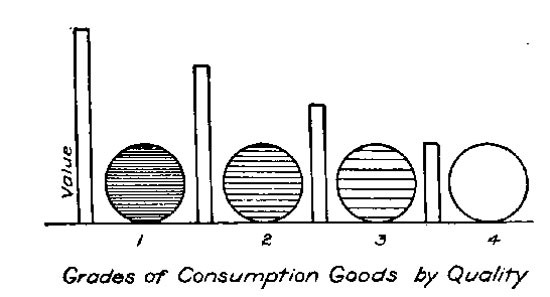
Grades of Consumption Goods by Quality
Free goods are on the margin of utilization
4. Goods of the lowest grades, having no marginal utility, are free goods. This is a simple truth, but it has important bearings. There may be said to be an "extensive margin of utilization" of many consumption goods. The poorer grades of apples, rotting on the ground, the multitudes of waste things not valued, are on the margin of utilization. When a lower grade is used, the margin is extended. The value of goods is measured upward from the margin of utilization, but this is simply to say that their value is measured from zero upward.
Likewise, there is an intensive marginal utility in consumption goods. As the better grade of apples becomes more scarce, they will be used more sparingly and kept to satisfy only the intenser wants. The superiority of some consumption goods, either in quantity or quality, often is exactly analogous to the "differential advantage" spoken of by economists in the case of productive agents. The differential advantage of the highest grade over the grade of free goods, whose value is zero, evidently is the whole value of the highest grade.
§ II. DIFFERENTIAL ADVANTAGES IN INDIRECT GOODS
Differential advantage of agents in the quality of their products
1. Rent varies with the quality of the products yielded by agents, other things being equal. Let us take first a simple case where the agent is the sole condition of the product. If there is but one tree bearing a certain luscious fruit, or but one spring yielding a mineral water, the rent of the tree or spring being equal to the value of the products must vary as the quality of the products varies. If two or more trees are standing side by side, they will be compared with regard to the difference in the quality of their fruits. If two fields differ in quality, greater importance will be attached to the field capable of producing the better grade or variety of fruit or product. A peculiar mineral quality in the soil may impart to wine a choice flavor that can at once be recognized by experts; while other fields, distant but a few rods, cannot by any effort be made to produce wine of the same rare quality. There is said to be a marked difference in the success of vineyards lying only a short distance apart on the shores of the larger lakes of New York. Nearness to the water moderates the temperature, often prevents frosts, and hence insures the ripening and quality of the fruit. In the Santa Clara valley, as in other parts of California, there is a frostless belt, sharply marked off from the lands where it is unsafe to attempt to cultivate the delicate orange-tree and other semi-tropical plants. In manifold ways differences in geological formation affect the use of land and the success of many industries. On one side of a little creek is limestone land, on the other shale, the limestone producing a crop larger and of better quality. When the peculiar nature of the one field is found to be the cause of the exceptional quality of its fruits, the difference in value is attributed to it.
The lower grade limits the value of the higher grade
If there is but one grade of agent, it is, of course, valued without reference to any lower grade. The effect of the presence of lower grades of agents is to lower the value of the higher, inasmuch as the lower grades are substituted for the higher. There may be at first enough of the higher grade of agents to produce all the fruit wanted of the better quality. If, then, there is an increasing demand, and the additional yield can be secured only with greater effort, the value of the product will rise. The presence of poorer grades, however, checks that rise, because use can be shifted to them. The value of grade one is not high because grades two, three, and four, which are worse than it, are available, but because they are not of better quality than they are. Poor as they are, their presence reduces somewhat the intensity of demand for the best grade. Indirect agents, therefore, are seen to be subject to just the same comparisons, substitutions, and estimates, when their value is considered, as are direct consumption goods.
Differential advantage of agents in the amount of their products
2. The rents of two agents differ as do the quantities of goods yielded by them, other things being equal. In the case just considered, the quantity remained the same while the quality differed; now is to be considered the case where the quantity differs while the quality remains the same. It is possible that one grade of agents is "poorer" because it produces less fruit, not fruit of poorer quality. Consider first the static problem. If both agents yield fruits exactly alike, the value of equal units at the same place and time must be equal, and the usufructs would vary in just proportion with the quantity of product. Now consider the dynamic problem. If the desire for that fruit increases, rent would grow as scarcity became more felt. The agents yielding, under the prevailing conditions, the largest product, would first be used; later, the poorer agents. The possibility of resorting to the poorer agents would keep the better from rising so high.
Grades of Agents by amount of Product of Uniform Quality
Complementary agents unite to form a product
3. When two agents are necessary to secure a product, the value attributed to each is influenced by competing uses. The thought of one agent independently producing a certain product is far too simple to correspond with reality. Two or more agents unite to produce a single product, and each agent at the same time can be used for acquiring other products. Complex as the problem appears, it is solved according to the principle of marginal utility at every moment in every market. The different uses, figuratively speaking, bid for an agent, and thus its marginal utility is determined just as is the price of a good by the bidding of buyers. Indeed, it is the bidding of buyers, indirectly. The more urgent the use, the higher the bid. The felt importance is reflected from the consumption goods that are sought, to the agent that will aid to get them. Two or more agents that are mutually needed for the acquiring of a product are complementary goods. A complementary agent may be either other material agents or labor.
Complementary agents used intensively show diminishing returns
When labor is applied to an agent, either to improve the Quality or to increase the quantity, it is subject to the law of diminishing returns. In the effort to increase the quantity of products, labor is applied first more intensively to the better agents. If it meets with resistance, if returns diminish, it is transferred to any of the poorer agents that have in them uses of as high grade as those still in the better agent. The superior effectiveness of the earlier over the later units of the added agent is called the "differential advantage" of the two fixed agents. The result of a day's labor applied to a field may be represented by 100, a second day's labor by 90 (it being only ninety per cent, as effectual), a third day's labor by 75; but it is more usual to say that the first field produces 10 more than the second and 25 more than the third, the second 15 more than the third. To the agent fixed in supply is attributed the difference in the effectiveness of the agent that is applied.
The relentless extensive margin of agents
4. The marginal uses of indirect goods are free uses. Here again is noted the close parallelism in the process of evaluating direct and indirect goods. There is an extensive margin in the use of an indirect agent, a point in the gradation from the better to the poorer agents where the materials and forces are left unused and have no value. Land beyond that point is free. Outworn goods in manifold forms, old pictures, old machines, having no longer charms even for a rummage sale, form a no-rent margin of wealth. On every hand a great multitude of things unused and worthless differ by only a shade from things that still are used and valued. Every rubbish-heap, rag-bag, junk-shop, and garret contains things once prized, now lingering on the margin of utilization.
There is also in agents an intensive margin, beyond which are certain unexploited uses in the things that we already have. This is a more subtle thought, but it has been already discussed in connection with diminishing returns. These potential uses in agents, uses which in the existing conditions lie outside the margin of utilization, of course have no value. We have noted that there is an equilibrium between these two margins. Rent is measured from a zero point of utility either in a good, or in other poorer grades of goods.
A corollary of this proposition is that there is a limit to the rental that anything can yield under any given condition. Below the present margin of utility of any goods there exist great quantities of free goods, unused goods, or unexploited uses. It is only uses above this margin that yield rent. Rent is the difference between the value of the better grades and the value of the free goods. It is therefore due to the limitation in the supply of indirect agents of the better quality, or to the scarcity of the more effective uses in those agents.
Restatement of rent, economic and contract
Economic rent is primary
5. Rent may be redefined as the value of the scarce uses of wealth within a given period. Rent is the felt importance of the usufructs of agents in securing gratification. It is measured by the marginal utility of any particular grade of agents in securing products. These definitions and the discussion throughout this chapter applies to economic rather than to contract rent. In fixing and agreeing on contract rent, men are seeking to estimate the importance of indirect goods, the importance that an agent will have in getting a product. They are bidding for the use of things, and what they bid is contract rent. Contract rent is based on the existence of economic rent. Economic rent does not depend on contract rent, but on the differences in the effectiveness of agents to secure a given product. If there were not differences in the product, and no limits to the supply of indirect agents, rent could not exist; it would be inconceivable. But these differences existing, economic rent inevitably arises, for men cannot keep from attaching value to the things that affect their desires. Contract rent in turn appears wherever the use of wealth becomes an object of exchange and agreement between men in a free society.
CHAPTER 11
REPAIR, DEPRECIATION, AND DESTRUCTION OF WEALTH: RELATION TO ITS SALE AND RENT
§ I. REPAIR OF RENT-BEARING AGENTS
The necessity of repairing nearly all economic agents
1. The continued rent of indirect agents is dependent on the continual repair of certain parts necessary for their efficiency. All earthly things wear out or decay. Whenever man's hand is withheld, nature takes possession of his work, regardless of his purposes. Dust gathers on unused clothes, and moths burrow in them. Shut up a house, and windows are shattered, roofs leak, and vermin swarm. To close a factory is to hasten the time when buildings and machinery will be piled upon the rubbish heap. The most magnificent and solid works of man have crumbled under the finger of time. The earth is strewn with ruins of gigantic engineering works, aqueducts, canals, temples, and monuments, whose restoration would be no less a task than was their first building. Everywhere vigilance and repairs are the conditions of continued uses of wealth. Some works of nature, such as waterfalls, may appear to have a continued use without repair, but they bear rent only when used with other things that must be constantly mended. A certain amount of labor on the banks of the mill-stream, and certain repairs on the dam, the water-wheel, and the gates are necessary. By a fiction in business contracts the waterfall may be dealt with apart from those conditions to its use, and may be rented, as a field is, with the agreement that the tenant keep up the repairs.
The efficiency of land as mere standing-room usually does not seem to be dependent on repairs. But here again the land yields rent in connection with other rent-bearing agents (such as houses and other agents above ground), which must be repaired. Standing-room on land is not a complete indirect agent; it is but one of the conditions for carrying on an industry, and even it often requires repairs to make it usable. Ranging from these extreme cases of stableness and durability, indirect agents vary to the extremes of fragility and ephemeralness.
The fertile lands of large regions have lost their usefulness
2. Most of the qualities that contribute to make land fertile in agriculture being destructible, the constant repair of tilled land is necessary to its continued fertility. If any things could be said to be indestructible, they would be some of the works of nature. In a sense, all matter is indestructible. Man cannot annihilate it, he can simply change its condition. But in economic discussion it is the value of things that is being considered, and from this point of view everything is in some degree destructible. The effects of bad husbandry are everywhere apparent, and in many regions fertile fields have been physically and economically destroyed. In Asia, lands that once supported millions, perhaps hundreds of millions, of population are now deserts. Egypt, for a time reduced to a semi-desert condition, has only in the past century been restored to a certain extent by the use of new methods and a return to the old ones. Many of the areas that were the granaries of Rome can now hardly support a sparse, half-starving population. The lands, or at any rate, the elements that gave them value, have been destroyed.
Wearing out of some American lands
Even in young America may be seen the effect of a failure to keep land in repair. As the new rich lands of the West were opened up, the old lands in the East were allowed to wear out, and many of them were abandoned. On the new lands in turn the same methods were followed, using up the first rich store of fertility with no attempt to keep up the quality of the soil. This may have been the best policy for the time; it would not have been economical to employ Old World methods of intensive husbandry when such rich extensive areas were being opened up. But the process was one destructive of natural resources. As settlement moved westward, great forests fell in ashes, and the soil was robbed of the fertile elements which it had taken centuries for nature to store up.
Wearing out of the parts the railroad
3. The machinery and appliances used in transportation and manufacturing are all perishable in varying degrees. Take as an example the great agency for transportation, the railway. The roadbed, which is but the natural soil excavated or filled to a better grade, is the most permanent part; yet every frost weakens, every rain undermines, a portion of it. Earthquake, landslide, and flood fill up the ditches, or tear down the embankments. Constant work is needed to keep it fit and safe for use. Above this is the track, slightly less permanent, more frequently changed. The ties rot, and even the rails of steel must be at times replaced. The rolling-stock is still less durable, and the different parts vary in length of life. It is said that the wheel-tires are renewed four times, the boiler three times, and the paint seven times, before a locomotive is entirely worn out. The oil used in the wheel, which is a necessary part of the running machine, has to be applied every day.
Depreciation of manufacturing appliances
There is a great difference in the length of life of manufacturing appliances. The building is fairly durable; yet an average depreciation-rate of one and one half per cent. a year must be allowed to offset a reduction in its value of over fifty per cent, in thirty years. Machinery differs greatly in durability; well-made, substantial machinery depreciates about five per cent. yearly. The engines and boilers depreciate more rapidly than the running gear; the loose tools have to be replaced every second to fourth year; while the materials consumed in the industry must be repaired and replaced at every repetition of the process of manufacture. If a factory is to be maintained in its efficiency in accordance with the terms of the renting contract, and is to continue its renting power, everything about it must be from time to time repaired and replaced.
Neglect of repairs often has evil effects
4. Neglect or postponement of repairs must cause a falling off of the rent-earning power. The neglect of repairs may have different results in the factory. The neglect of one kind simply reduces present rental while not preventing the future restoration of the plant to its full efficiency. If certain necessary tools wear out and are not replaced, the factory as a whole will be less efficient. Each part of the entire outfit being needed in due proportion, the loss in rental will correspond not merely to the lost efficiency of the missing tools, but to the crippled efficiency of the remaining appliances. Failure to apply seed to the land causes the land as a whole to be useless for that year's crop. In other cases, neglect of repairs increases the expenses of repairs and cuts off future rental. The adages, "A stitch in time saves nine," and "An ounce of prevention is worth a pound of cure," must be acted upon in every industry. The neglect to repair a roof causes damage to an amount many times the cost of a new roof. Failure to replace a bolt costing five cents may result in the rack and ruin of a machine worth many dollars. A handful of earth on a dike may save a whole country from destruction.
But sometimes is economical
Neglect of repairs may be economical, however, when outer conditions have first reduced the demand for the agent and consequently the rental. When the line of travel changes, it does not pay to keep an old hotel up to the same state of repair as when it had a great patronage. Old factories sometimes may better be allowed to depreciate while the price of repairs is invested in more prosperous industries. In a declining neighborhood the houses fall into decay, the owners seeing that "it would not pay" to keep them up.
§ II. DEPRECIATION IN RENT-EARNING POWER OF AGENTS KEPT IN REPAIR
Repairs can not always prevent ultimate decay of agents
1. Even where repairs are thoroughly kept up and present rent is undiminished, future rents may be decreasing because of natural decay. Changes go on in the substance of things which cannot be prevented by any attention to repairs. The wood in a framework will decay, the metals crystallize. There is also an unpreventable wear of parts that cannot be replaced without replacing the whole machine. It is the aim of the modern manufacturers to make machines like the wonderful one-horse shay, every part of equal durability. The development in America of the system of "interchangable parts" has greatly simplified and cheapened repairs, and has lengthened the working life of machines; nevertheless their lot is the scrap-heap at last. This general depreciation appears to be nearly avoided in large factories where there is serial replacement of the parts, but occasionally some invention or some improvement of process necessitates an almost completely new equipment. An old man once said to me: "I have lived in this house forty years: it was well built, has been repainted regularly, has never been allowed to leak a drop, and it is as good as it ever was. I see no reason why it could not be kept to eternity if always kept in repair." But the same could not be said of the house now. In general, there is finally a termination of the rent-earning power of wealth, and the whole has to be replaced.
Technical changes destroy the uses of agents
2. A change in inventions and processes may reduce the rent of agents, independently of their material condition. Rent is dependent on the indirect relation of things to wants; that relation may be changed if some other agent is found fitted to serve these wants more directly. Not only do the materials of houses change, but fashion and engineering skill change, making the old mansions cheerless and inconvenient, and affecting their rent-earning power. At every moment, in a progressive society, many rent-earning agents are being thrown out of use. The machinery in flour-mills has been almost completely changed, parts of it repeatedly, while the roller process has been substituted for the old millstones. Water-power, because of its uncertainty, has been replaced in many places by steam-power, and in many places steam-power in turn, has been rivaled by water-power since the improvements in the generation and transmission of electricity. A change in the process of making paper threw out of use much machinery that was only in part saved by its removal and adaptation to the making of coarser grades of paper. Many minor inventions in the iron industry, still more the invention of the Bessemer process, threw out of use great numbers of the old appliances.
Industrial circumstances affect the uses of agents
3. A change in the outer conditions that give occasion to the use of agents may cause depreciation. The exhaustion of materials on which machinery is employed may reduce its usefulness. A sawmill located in the midst of a forest has a high-earning power while the forest lasts, but when the forest is cut off the mill itself declines in value. Unless it can be removed to another forest and thus have its earning power renewed, it will have the value only of scrap-iron; it has become an indirect agent in the wrong place. Oil-boring machinery where a rich supply of oil is found has a high rental for a time, but when the oil-fields give out the machinery falls in value, being worth more or less than the cost of transporting it according as the next oil-field is near or far. Changes in fashions, calling for different kinds of products, cause a depreciation in the value of the old agents. Coarse salt, evaporated by the sun, was used by our fathers, but the finer product of the steam process is driving out the product of the old solar plants. As homespun went out of use, much machinery still in good physical condition was cast aside. Changes in transportation work revolutions in industrial methods. Many prosperous small forges on the country roads of Pennsylvania became valueless after the building of the railroads. New forges were built at favored points where materials and products could be shipped by rail.
Various grades of efficiency in rent-bearers
4. The agents employed in any industry range from the more efficient, high rent, down to the less efficient, low rent, grades in a more or less regular series. It follows that as these changes are going on, the place of agents on the scale of efficiency is constantly shifting. The various agents represent all grades of efficiency. One depreciates, possibly is restored later and takes a high place, and again depreciates until finally it is thrown out of use. One loom embodies the latest improvements and corresponds to the most fertile field; another can still be made to yield a little rent; the use of a third results in certain loss. A great mass of no-rent agents lie just below the margin of utilization in every industry. Some of these are permanently abandoned; some will be taken back into use when business conditions improve. When the iron industry is dull, many forges are out of blast; but when iron is again in demand, there is a gradual taking up of the abandoned forges, factories, and machines as they are brought within the margin of profitable utilization. Many agents not actually earning a rent, may become rent-earning through a change in business conditions.
§ III. DESTRUCTION OF NATURAL STORES OF MATERIALS
Destruction of the American forests
1. A large part of industry is now conducted without regard to the preservation of the source of income. A striking example of this is the use, or rather the destruction, of the American forests. In the last century the demand for lumber grew rapidly both on account of domestic needs and of the needs of the older countries. Great quantities of wood have been used and still greater quantities wasted, trees being girdled, the ground burned over, the timber destroyed in any way that would clear the soil—timber which to-day would be of far more value than is the cleared land on which it stood. Considering present needs and conditions, the labor seems to have been worse than wasted.
Effects on value of timber
The direct effect of this destruction of the supply has been the increase in the value of timber. To the settlers much of the timber was worse than useless; they paid and labored to get rid of it; now the supplies of lumber must be sought on the very margins of our territory: Florida, Maine, northern Michigan and Wisconsin, Washington, and Oregon. The supplies in Washington and Oregon are almost unavailable in the Eastern states on account of the cost of transportation. Professor Marsh, thirty years ago, strikingly characterized the policy that has been pursued: "We are breaking up the foundation timbers and the wainscoting of the house in which we live in order to boil our mess of pottage."
Physical effects
The indirect effects of these changes are fully as great as the direct ones. Forests greatly affect climate, temperature, and soil; they influence the humidity. They equalize the flow of streams, moderate floods, and by preventing the washing down of the rich soil, keep the mountain sides from becoming bare and sterile rocks. So, within the last two decades, the people in America have begun to think of forestry. Its purpose is to restore the forests to the condition of permanent rent-earners, to make the mountains yield not a temporary supply, but a perpetual crop of timber.
Possible exhaustion of the coal-supply
2. The extraction of coal and other mineral deposits reduces for future generations a supply already limited. The coal deposits in the earth have only recently been drawn upon. A small city like Ithaca probably uses to-day a greater quantity of coal than was used in all Europe two centuries ago. The large deposits of coal and their early development in England long gave a great advantage to English industry over that of other countries. In England, however, has first been felt the fear of the exhaustion of the coal-supply. Professor Jevons, in 1861, sounded the note of alarm; he prophesied that because the coal deposits of America were many times as great as those of England, industrial supremacy must inevitably pass to America. Already the supremacy in coal and iron production has passed to America, and that in textiles soon will come. In England the accessible supply of coal is limited, deeper shafts must be sunk, and the coal gotten with greater difficulty and at greater expense. Coal has risen in price in England within the last few years, and will continue to rise in the future. The coal deposits of America are thirty-seven times as great as those of England, but even these will soon be exhausted. And yet on the part of all except the coal trust, there appears in America a thoughtless disregard for the future. Supplies of copper, iron, and lead in favored positions are likewise limited, and are being rapidly centered in the hands of great companies. The increasing demand for these products insures a steadily rising income from their annual use. The value of the mines, being based on the series of incomes they will yield, may increase while their unused treasures dwindle in quantity.
Many natural resources are being rapidly exhausted
3. The exhaustion of natural stores of material is due to civilization, but it threatens to put an end to industrial progress. The savage does not go deep enough to use up permanently the world in which he lives. He uses the fruits that he finds, and those fruits are, almost without exception, renewed the next year. The only mines that were worked out in ancient times were gold and silver mines, while the mines of useful metals were touched but lightly. Within the last century the earth's crust has been exploited with startling rapidity. Scientific knowledge and mechanical improvement have combined to unlock the storehouses of the geologic ages. At the ever-increasing rate of their use, many important materials must be exhausted in the not far distant future. While it is probable that substitutes will be discovered for many of them, the outlook in some directions has little promise. To treat terminable incomes, exhaustible sources of supply, as permanent sources of income, leads alike to unsound theory and to reckless practice.
CHAPTER 12
INCREASE OF RENT-BEARERS AND OF RENTS
§ I. EFFORTS OF MEN TO INCREASE PRODUCTS AND RENT-BEARERS
Desire for better agents impels men to improvements
1. While man destroys some agents of production he multiplies many others. We have noted many kinds of depreciation, destruction, and wearing out of wealth; but the normal thing in a healthy society is an increase, on the whole, of rent-bearers. The increase of rents is due to two causes: changes in the agents by which they become more efficient technically, or more numerous; and changes taking place outside of the agents, affecting the utility of the products. The first of these will be considered in this section.
The increase of the efficiency of agents is usually the aim of the individual producer, and thus is brought about an increase of the stock of wealth. In some cases, however, improvements such as the dredging of harbors or as the protecting of forests, are made by men collectively through the agency of governments. Somewhere, however, the desire for these changes must arise in the minds of individuals. Increase of most things involves "cost" or sacrifice, in the psychological sense; that is, man must strive, perhaps suffer, to get a certain result. This end, therefore, must be in itself desirable, and social organization must be such as to present a motive to the men to make the needed effort.
Improvements by adaptation of natural resources
2. Rent-bearers may be increased in quantity and improved in quality by the adaptation of natural resources to man's purposes. To get food, men use the tracts of land that under the conditions give the largest product. Other tracts less fertile, or for some reason less available, are ditched, tiled, and diked, and fertilizers are carried up steep hillsides to make a soil upon the very crags. In commerce and transportation, new ways are opened by canals, railroads, and tunnels. An isthmian canal will raise the efficiency of ships plying between New York and San Francisco, enabling them to carry a greater amount of freight within a year. The tolls will represent to the users an expenditure only partially offsetting the increased efficiency of the agents of transportation. By the building of wharves, the dredging of harbors, and by many other methods, indirect agents are constantly growing in number and efficiency.
Machinery is an adaptation of natural resources
3. Rent-bearers may be increased by inventions and improvements that make machines stronger, quicker, and better. This proposition is not logically different from the preceding. A machine is an arrangement of material things through which force may be indirectly applied to move matter. No fast line divides machinery as regards form, purpose, or cause of value, from the artificially improved natural agents that we have been discussing. Just as a field is drained, plowed, and cultivated to fit it better to yield a crop, so is the iron ore shaped into a form called a machine, better fitted to cut, carve, and weave as man wills. Machines are merely adaptations of natural resources.
Bettering quality of agents
Increase in machinery may be either in quality or quantity. The two causes have in most cases the same result. If the quality or efficiency of looms is doubled, it is as if their number had grown in like proportion. In its economic function the beast of burden may not illogically be classed with inanimate machines. The horses in America have been remarkably improved of recent years by the importation of thoroughbred stock from Europe. Ten or fifteen years ago the number of horses in the United States was found to have decreased, and there was much comment on this evidence of a declining industry. It was not at once recognized that there was embodied in horse-flesh more horse-power than ever before, as a single Norman horse has the strength of several Mexican mustangs. Numbers alone are not the measure of efficiency.
Increasing number and better grouping of agents
4. The increase of wealth and the betterment of environment go on as well through the increase in the number of appliances and through their improved arrangement, as through changes in their kind. A machine is an adjustment of various natural agents to each other so as to make a more efficient agent, and machines in turn may be adjusted as parts of a larger system of production. The ideal of the modern factory system is so to arrange the machinery that no bit of material will make an unnecessary motion. The log, once started through the mill, is carried automatically from one machine to another until it emerges as a roll of paper or as a box of tooth-picks, ready for use. In an American watch-factory one man tends twelve or fifteen automatic machines. A small brass rod is fed automatically to the machine; a piece is cut off, is picked up by a human-like metal hand; is put into a lathe, and shifted or held firmly while it goes through fifteen or twenty processes; and then is dropped into a box where it is ready for the "assembling" of the watch. As the machinery improves, factories making allied products are grouped to make a system still more efficient.
As the number of agents increases they are distributed so as to be where most useful to the owner. A man having two umbrellas keeps one at his office and the other at home; a student having two books of the same kind keeps one at his room and the other at the university; a farmer having two hoes keeps one at the barn and the other in a distant field, and by this distribution the agents are increased in efficiency.
A larger and better environment
The aim of a progressive society is to enlarge the environment, and constantly to adapt it better to the service of wants. This is done largely by mechanical agents, which capture the natural forces of the world, put them into the right place at the right time, and make them do the right thing, or which group and relate the materials of the world in the right ways. Some of the groupings in the chemical and physical world that do not fit man's purposes may be made to do so. The world in this way becomes more and more a great workshop, better and better adjusted to man's wants.
Increasing some rent-bearers reduces the rents of others
5. The betterment of the environment of society in some directions reduces the rent of other parts. The wish of the individual is to raise his own rent-bearers in efficiency, but in doing that he affects the agents owned and controlled by others. The ideal from a social standpoint is to increase not rent but the welfare of society, and this is not always the ideal of individuals seeking their own interest. However, as the efficiency of some agents rises, it becomes unnecessary and unprofitable to use the less fertile fields; they cease to be rent-bearers, and the rent of the richer fields falls under the influence of the new supply of products. Some inventions suddenly increase the efficiency of free goods to such a degree that the less efficient rented agents are thrown out of use, and the margin of utilization is moved to a higher plane than it was on before. Improved types of machinery more or less rapidly displace the older, less efficient types, which, therefore, more or less completely lose their rent-bearing power long before they are physically worn out. When improvements in agriculture that are applicable to a considerable area of land take place, and the product thus is increased and cheapened, the poorer land is abandoned. Inventions and improvements thus gradually becoming common property, increase the free goods and free uses not bearing rent and open to every one. One who improves the quality of a machine or the economy of a process may thus unintentionally injure some of the owners of low-rent agents, while unintentionally increasing the welfare of the mass of men for whom the margin of utilization is thus lifted.
§ II. EFFECTS OF SOCIAL CHANGES IN RAISING THE RENTS OF INDIRECT AGENTS
Effect of decrease of the competing agents
1. Changes in the number and kind of competing resources may raise the rents of particular agents. Rents may increase without increase in the quantity or number of a particular group of agents or without change in their technical efficiency. As changes in the conditions of society may reduce rents, so other changes may increase them. Agents of the same kind may diminish in number, either absolutely or relatively. If some of the competing machines are destroyed, the rents of the machines that remain rise, while if new supplies are found, either in nature or by improved industrial processes, the rents of the older agents fall.
Effect of new uses for agents
2. The discovery of new uses for agents or for their products raises their rents. Farm land of the poorest kind often is found to contain valuable mineral deposits. Such a lucky find has lifted the mortgage from a farm in eastern Pennsylvania, from which, in two or three years, has been taken feldspar exceeding in value the agricultural products of the same land in the last fifty years. The discovery of building stone, coal, natural gas, or oil land may make the annual rent (or royalty) of land tenfold its former total value. Fitness to produce nettles is not ordinarily a virtue in land, but the discovery that certain fields produce a superior quality of the nettle used for heckling cloth, causes them to take on a new value. A mineral spring, because of the supposed or proved healing properties of its waters, may be as good as a mine to the owner. Peculiar fitness for the cultivation of celery may convert marsh land into a substantial source of income.
Social changes are constantly causing agents to shift from lower to higher uses. As population grows and groups about new industries, farm land is used for residence lots, and in turn for business purposes. Rents therefore rise, and this rise is reflected in the higher selling value of the land. If a new demand arises for the product of any machine, its rent rises, although it may continue to turn out the same product as measured by number or quantity. For, if consumers increase, a given supply of agents becomes relatively smaller than before.
Sudden variations in demand
3. A rise in rents due to social changes may be relatively permanent or temporary. Business conditions sometimes change quickly. An urgent demand for special machinery raises quickly its rent and value. It is said that lace machinery is sometimes thrown out of use for several years, until a sudden renewal of the demand for lace causes the rental to equal, in two years, more than the original cost. At such times the value of factories increases greatly, but after a few years of prosperity business again collapses. Such prosperous periods are the opportunity of the business man and of the promoter to sell the factory at its highest price. Machinery adapted only for a special product will not sell as readily when less needed for its special use, as that which, like a turning-lathe, can be used for many purposes; but the more special the appliances needed for a certain product, the higher, more abnormal will be their temporary value when they are suddenly needed. Land near the site of an exposition takes on a very great value and again falls after the exposition is over. During the Boer War horses and mules rose in price in the United States on account of British purchases.
Cause efforts to increase the supply of agents
A rise in the value of any agent at once causes an attempt to duplicate it or to find a substitute for it; this attempt, if successful, puts a check or sets a limit to the rise. In this search for new devices the man who can see most quickly and clearly has a key to wealth. Some kinds of agents, as rare minerals or tools that can be produced only by highly skilled labor, cannot be increased rapidly in number and remain high in price for a long period; and favorably located building sites illustrate the same principle. In some cases, it is true, the demand may be due to some temporary cause, as in a period of unsound land speculation, but usually the growing value of location is due to a steady and abiding change in population or business.
Franchises guard the growing rents from the influence of substitution
4. Such public utilities as are guarded from competition by franchises, often rise in rental with increase in population. The leading classes of public utilities referred to are waterworks, gas-works, street-railways, ferries, and wharves. This evidently is only a special illustration of the principle just stated, where it is not easy to find a substitute for certain agents. Public franchises entitle the owners to special, sometimes exclusive, privileges, and protect them legally from competition. Not all franchises are valuable; many street-railways are unfortunate ventures, the earnings being insufficient to pay expenses, to say nothing of interest on the investment. But when they pay greatly, their high value is due to the impossibility of competition. The cars, mules, dynamos, steam-engines, and other agents combined to furnish transportation, have a special earning power because other similar agents are forbidden to be used in that market.
Various kinds of "unearned increments"
5. Industry abounds with cases of unearned increments of value due to accidental and social causes raising the rents of wealth. The term unearned increment may be defined as an increase in rents (or value) of agents, due to something other than the efforts or merits of the owner; in fact, it is that of which we have been speaking. In some cases powerful or wealthy men can bring about social changes in entirely legitimate ways. The owner of a large factory, moving it into the country, may buy up surrounding land and found a city, converting pasture lands and corn-fields into valuable building lots. Again, social changes are produced immorally, if not illegitimately, when wealthy men or influential politicians cause laws to be passed which inure to their advantage but which may ruin many other citizens.
Also many chances of loss
In most cases, however, social changes are impersonally caused. The individual owner who profits by them is powerless to affect the result. He can only adapt his conduct in some measure so as to reap an advantage. He can strive to increase the number and quality and to get control of such agents as he foresees will yield higher rents. In making such a forecast there is chance of loss as well as of gain. The term "unearned increment" has been frequently used in recent years. It is often assumed to be a peculiar thing, sharply in contrast to other changes in value. The foregoing hasty review may serve to suggest how manifold and complex are the instances of it, and what an important part it plays in modern industry.
DIVISION C—CAPITALIZATION AND TIME-VALUE
CHAPTER 13
MONEY AS A TOOL IN EXCHANGE
§ I. ORIGIN OF THE USE OF MONEY
The consideration of money can no longer be postponed
1. The exchange of goods by barter is extremely difficult in most cases. Thus far we have not considered the subject of money and have so far as possible avoided even the use of the term. Value in economics does not depend on money, and is not necessarily connected with it. Things can be compared in their utility, their importance to our welfare can be estimated, without the use of money. Many problems of economics can be discussed pretty thoroughly and solved without the use of the word money or any term of similar meaning. But to-day it is impossible to go very far in the discussion of economic questions without using the concept of money, which is interwoven with every practical and theoretical problem in economics. We have delayed to the farthest limit the formal recognition of the subject; but we are now approaching the question of capital and interest, and it is no longer possible to avoid a preliminary consideration of the money concept.
Exact measurement of utilities is not possible without some medium of exchange
In considering the problem of exchange of consumption goods, we have assumed that it is possible to weigh small differences in the marginal utility of goods, and that such differences have influence on exchange. Now in exchange by barter such a small estimate is impossible. In barter things are exchanged directly for each other in kind. If the two things do not chance to coincide in value, the exchange cannot be completed. An equivalent must be found, or a multiple, if the marginal utility of two goods is to be equalized for either party by exchange. As in most cases this adjustment must be very incomplete, many exchanges that otherwise would be advantageous cannot take place. In the earlier stages of development, this careful estimate of value is not found. Children do not make it. The typical trade of the small boy is a "trade even"; Johnny exchanges his gingerbread for Jimmie's jack-knife. It marks an epoch in the industrial development of the boy when he begins to keep store with pins, and no longer trades candy for apples, but both for pins, which have become the medium of exchange in his boy world. He then can express values in much more exact terms. In our society most children begin early to grow familiar with this conception; but travelers find some savage tribes still in the earlier childish stage of development, unable to grasp the thought of a general medium of exchange. When, through lack of a medium of exchange, there is a failure to adjust utilities, there is a loss of the possible advantage in each defeated exchange. There is a further waste of time and of vain efforts to find something that will be accepted in exchange, and the loss offsets a large part of the gain even when the barter is effected.
Money is found to serve as a general medium of exchange
2. Some kind of enjoyable good in general use comes to be money, that is, to be accepted as a medium of exchange. The difficulties just mentioned are met by the use of a medium of exchange. A medium of exchange is simply one kind of wealth which is taken, not for itself, but to pass along, in the belief that it will enable the taker to gratify his wants and distribute his purchasing power in a more effective way. Money is an "invention" in that it is a means of exchange that came into use independently in a great number of communities. It is not an invention in the sense of a mechanical device suddenly hit upon, but rather in the sense of a social custom that grows as its convenience is tested by practice. Money is used, in some degree, everywhere except in the most primitive tribes. Historically viewed, the money first used in any community is seen in every case to be a commodity capable of giving immediate gratification, a direct good in immediate use. It then gradually comes to be used as money, which is an indirect agent. Still later, when the money habit is well established, a kind of material having no utility except as a medium of exchange may come to be used.
Qualities of the primitive money
3. Money in its origin is that good which best unites the qualities that make it easy to sell, to carry, to know, to keep, to divide, and unite. It is evident that if some one commodity is gradually to take on this use as a medium of exchange there will be a choice; some things will be better fitted than others. First, this thing must have the quality of salability, or marketability. In the channels of exchange it is taken not because it is wanted for itself, but because it will help to get something else that is wanted. To be sure of a ready sale in a primitive community it must, however, be something that is generally desired. Food and clothing, which supply the fundamental physical needs, are the most generally used and desired of all goods. But they do not have the second quality of a good money material, that of great value in small bulk, transportability. Food is bulky. The carrying of a venison or of a bag of wheat on one's back a short distance requires an effort as great as that for the procuring of the food. Furs, however, have this quality in a high measure, united with other qualities of money, as is shown by their general use in the exchanges of northern tribes. Thirdly, a thing must be recognizable; counterfeits must be easily avoided, and the quality must be easy to test: this is the quality of cognizability. The love of ornament is universal in human societies, and gives value to many materials combining in a high degree the qualities thus far named. Fourthly, the money material, when taken in exchange, must remain without loss of quality, perhaps for long periods, until it can be exchanged again. Food does not answer to this requirement, being organic and perishable. But some of the metals, having value in small bulk, salability, cognizability, and durability, step by step displaced other forms of money. Finally, money must be made of a material easy to divide and unite. It is a great convenience in small transactions to be able to represent a fractional value by a small coin. The money material thus, likewise, is easily shifted to and from its money use. It is a very poor money that has not this quality, yet a thing may serve for money in larger transactions without it. Cattle, slaves, and land have been thus used, although they answer in a very rough way these fundamental requirements of the money material.
Industrial changes affect the convenience of certain money forms
4. The changing material and industrial conditions of society change the kind of money that is used. The money use, as has just been shown, is a resultant of a number of different motives in men. Things that have the highest claim to fitness for money with a people at one stage of development would have a low claim at another. As each of these stages is passed, the thing used as money either increases or decreases in its fitness. The final choice depends on the resultant of all the advantages. The use of a material may become more general or less so. Shells used for ornament in poor communities cease to be so used in a higher state of advancement, and thus their salability ceases. Furs, used at some stage of development as money in all northern climes, cease to be generally marketable when the fur-bearing animals are nearly killed off and the fur trade declines. Tobacco was at one time in Virginia a great staple. Merchants were always ready to take it, and its market price was known by all; but as it ceased to be the almost exclusive product of the province, it lost the knowableness and marketability it had before. In agricultural and pastoral communities where every one had a share in the pasture, cattle were a fairly convenient form of money, but to-day would be a most inconvenient one; a city merchant exchanging goods for Poland China pigs and Texas steers would envy the proverbial owner of a white elephant.
The proved fitness of gold and silver as money
The value of the money material may fall so greatly as a result of greater production, as in the case of iron, tin, copper, that it becomes unsuitable. Again, as wealth grows, as exchanges increase, as the use of money develops, as commerce extends to more distant lands, the heavier, less precious metals fail to serve the money need, especially in the larger transactions. Thus, in a sense, different commodities compete, each trying to prove its fitness to be a medium of exchange; but only one, or two, or three at the most, can at one time hold such a place. Silver and gold, step by step, often making little progress in a century, have displaced other commodities, and are the staple and dominant forms of money in the world to-day. Every community has witnessed some stage of this evolution. Now nations are divided into two great groups, silver- and gold-using, in accordance with the metals they use as standards. The gold-using countries are the most advanced industrially, requiring the most valuable money metal. Many countries have passed in the last century from the silver to the gold standard, and in an intermediate period have tried to use both standards. The Asiatic and South American countries mainly use silver, while most of those in North America and Europe use gold.
While industrial changes thus affect the choice of money, in turn money reacts upon the other industrial conditions. If a new and more convenient material is found, or the value of the money metal changes to a degree that affects the generalness of its use, industry is greatly affected. The discovery of mines in America brought into Europe, in the sixteenth century, a great supply of the precious metals, and this change in the use of money reacted powerfully on industry. Money being itself one of the most important of the industrial conditions, is affected by and in turn affects all others.
§ II. NATURE OF THE USE OF MONEY
Money is an indirect agent, a tool to effect exchanges
1. Money in all its money uses is an indirect agent, to be judged just as other indirect agents are. The key to this section is the thought that the function of money is to serve as an indirect agent. Money is often, by a figure of speech, called a tool. Literally a tool is a bit of material which, taken in the hand, is used to apply force to other things, to shape them or move them. Figuratively, this is just what money does. A man takes it in his hand not to get enjoyment out of it, but to apply force, to move something, and that which he moves is the other commodity. Adam Smith aptly likened money to the road and wagons that transport goods, thus gratifying wants by putting things into a more convenient place. Money is only one of a multitude of forms of wealth. It is not even the most "valuable"; it has value just as other indirect agents have. The loss caused by taking away an indirect agent entirely is greater than the benefit usually attributed to it. Its utility in the extremest conditions is greater than its marginal utility under ordinary conditions. Food is not credited in the market with enormous value, but if starvation threatened, all else would be given for food. In a like manner, each individual values money according to the importance of the marginal service it renders, but the marginal service is far from measuring the loss that would be caused by the entire disuse of money. In a society without money, industrial processes would be very different, and exchange would be hampered in almost inconceivable ways. It is true, therefore, that money is an economic factor of high importance, but it is not so indispensable as many other factors to which far less value is attributed.
Why a poor community lacks money
A poor community has little money because it cannot afford more; it gets along with less money than is convenient just as it gets along with fewer indirect agents of every other kind than it could use. Pioneers in a poor community where the average wealth is low, cannot afford to keep a large number of wagons, plows, good roads, or school-houses. If the community were wealthy enough it would have more of these and of other things, and great as is the convenience of money, poorer communities have to do with little of it. It is, therefore, a confusion of cause and effect for poor communities to imagine that their poverty is due to lack of money.
The use of money as a common denominator
2. Out of its use as a medium of exchange comes the use of money as a common denominator of values. Money serves as a "common denominator," for, as all other things can be expressed in terms of money, through it the value of other things can be compared. The other things can be expressed in money because they are constantly exchanged for it. All things being compared with money, can in turn be compared with each other. Some consider this service as a common denominator to be the primary and most important function of money. Sometimes a money of account is found, which is not in use as a medium of exchange. Cattle and slaves have served as money of account while not used as a medium of exchange in larger transactions. Money of account is used, as the shilling in New York, which for a century has not been in use at all as a medium of exchange. It is, however, only apparently a denominator of value; the shilling represents five fourths of ten cents. The actual standard is the dollar; the shilling is only a habitual form of speech and is mentally reduced to terms of the money in use. A decimal system is a great convenience in the use of money as a common denominator, but not indispensable. It is a striking fact that England, until a few years ago the greatest industrial nation, still uses a money unit requiring cumbrous calculations.
Money used as a storehouse for saving.
3. Other uses of money are as a storehouse of saving and as a standard of deferred payments. These uses grow out of those before mentioned. The standard of deferred payments is the unit of value in which debts are agreed to be paid later. It is evidently most convenient, and therefore almost inevitable, that the common denominator in which all values are expressed from day to day should continue to be taken as the value unit when the completion of the exchange is delayed a day, a month, or a year. This will be more fully discussed at a later stage of our study.
The use of money as a storehouse of saving was more common formerly than it is now, when better ways than the hoarding of money are found for "laying up for a rainy day." In some measure, however, money is hourly serving this use, which is still an important one. Money kept to be used to-morrow or five years hence is a storehouse of value for twenty-four hours or for five years. In either case it is being kept to complete at a later time its use as a medium of exchange. A thing ceases to be money, logically viewed, the moment its owner keeps it without the purpose that it shall be spent ultimately. The typical miser is a man who has lost his reason as regards the money use. Money must be deemed, therefore, to perform the same essential service as a storehouse of saving that it does as a medium of exchange. In either case it is to be kept only to the moment when it will afford the maximum of pleasure.
§ III. THE VALUE OF TYPICAL MONEY
The money use is added to other uses
1. The money use, historically considered, is a new use added to a good, and increases the demand for that good. The history of any particular kind of money may be traced back to a point where it was not money, since which the money use has been added gradually to the other uses. The value of the material later to become money is determined, as is that of any good, according to its marginal utility in all possible applications. No new theory is required to explain the value of this same commodity as it gradually acquires the added use of a medium of exchange. The new use influences demand for the thing just as do the other uses. What is here said must be understood as applying to typical money, which is at the same time a commodity having other uses. Other things that are not typical money come later to be used as money, under legal regulations.
The other uses continue, slightly modified by the money use
2. A good that comes to be used as money continues to have a commodity use along with the money use. When a thing is wanted for some quality that gives immediate gratification to the user, the explanation of its value is simple. Ornaments, shells, feathers, food can be seen to have a direct want-gratifying power. The money use is one that works no physical or visible change in goods, and to many minds it appears so different from other utilities that it remains quite mysterious and incomprehensible. To persons accustomed to thinking on problems of value, this case appears to be no more difficult than that of anything else having two or more uses. Cows are used for milk, for meat, and as beasts of burden. Each of these uses is logically independent as a cause of value, yet all are mutually related, the values of cattle being determined by the consideration of all their uses united into one scale of diminishing utility.
Money yields a series of rents which are the basis of its value
3. The uses of money make it a rent-bearing form of wealth. The rent that money yields is in the form of convenience and economy. This is sometimes rendered directly as psychic income, as in enabling the traveler to buy his dinner, for the money thus yields gratification just as does the carriage in which he rides. One may go for a day to the seashore without a parasol and suffer from heat, or without money and suffer from hunger. In every case where money is retained for a time in possession, there is expected from it a usufruct as great as, or greater than, can be secured from anything else for which it can be exchanged. This usufruct is a net surplus, or income, yielded by a sum of money undiminished in amount up to the moment it is spent, but meantime increasing in the gratification it will help to secure. In many cases in practical business money yields gratification only indirectly, as the objective contract rent received as interest for borrowed money in business uses, or as economic rent when the use of money in business enables one to secure a larger income. Because money yields a rent men make the sacrifice involved in keeping a stock of it on hand. On this rent is based that part of the value of money that is derived from its money use. As the use of money as a standard of deferred payment, or basis of commercial obligations, does not require that it be owned by the parties writing the contract, this use of money is a free good, a sort of social by-product of the medium of exchange. When money is in use in a community, any person may draw up contracts in terms of money, borrowing and lending, buying and selling wealth, later to be repaid in other wealth or services expressed in the circulating medium.
The general use of money is characteristic of this age
4. Money may be defined as a generally accepted material means of payment and medium of exchange. This, its primary and essential function, may appear to be less important as new modes of balancing accounts of wealth are devised. But its functions as a common denominator of values and as a standard of deferred payment are increasingly important in an advancing society. It is this expression of the value of all other things in terms of money which may well be deemed the essential characteristic of the capitalistic age. In earlier periods wealth was thought of and expressed in concrete terms; now it is expressed in money. The general use of money affects men's ways of looking at wealth and speaking of it. Without appreciating the nature and function of money, it is impossible to grasp the significance of capital in modern industry, the consideration of which we are now to enter upon.
CHAPTER 14
THE MONEY ECONOMY AND THE CONCEPT OF CAPITAL
§ I. THE BARTER ECONOMY AND ITS DECLINE
Various points of view of the students regarding money
1. The use of money prevails in very different degrees in various parts of the United States. The members of this class, representing nearly every state and territory in the Union, have lived amid very diverse industrial conditions. Some know best the country where conditions are similar to those of a hundred years ago; some, the villages where may be seen the handicrafts and the small general store. Others know better the cities with their varied industries; while doubtless still others, through family relations, know of the methods of great wholesale business, perhaps even of the larger commerce and foreign trade. Methods differ in the different lines of business, and according as a man is a farmer, a merchant, or a banker, he has different ideas as to the use of money and of the part it plays in modern industry. You come to this study with different experiences and preconceptions; as a result every statement produces a somewhat different impression on each of you. This is true in general of the statements made in political economy; but it is most strikingly true in the discussions of money. A city boy rarely sees a case of barter; whereas in many parts of the West and Southwest, and in the mountainous districts of the East, a large part of the business is carried on in this way. Town and city in New York state differ in this respect, but hardly more than do the rural districts of the different sections of our country. Banks are very numerous in the East, are few in the Northwest, and still fewer in the South. Men can understand each other better in a discussion if they are conscious of the fact that they do not instinctively take the same point of view.
Countries differ in their use of money
2. The extent to which, on an average, money is used in different countries of the world, differs widely. Statements in political economy must be guarded; few of them can be taken as universally true. As the different parts of one country may be contrasted, so may the different countries. The use of money in Siberia would be much less than that in Moscow and St. Petersburg, and again the average use in Western Russia is doubtless less than that in Austria. In Austria the money use is less developed than in Germany. While there is now little difference between Germany and France in this respect, France for a long time was the more developed industrially and made greater use of money.
There is greater use of money in the cities of the outlying countries than in the rural districts. In the cities of Mexico banks and credit agencies are employed as in the American cities. The rural districts are more backward and make far less use of money than is the case in the United States. The great ports of China are provided with all the facilities of modern banking. In the great cities of India one can get a bank draft that will be paid in any part of the world. But go a very little way out of the cities of China and India, and conditions greatly change; money is far less used and principally as a storehouse of saving.
Slight use of money in the Middle Ages
3. In a historical view the European nations are seen to begin with a barter economy and to pass through great changes as regards the use of money. Here the view shifts from a comparison of different nations at the same moment to a comparison of the same nation through a period of centuries. To understand, even in a measure, what is about them men must know out of what it grows. In the early Middle Ages money was used chiefly in cities, and there only to a limited extent. Almost universally a "barter economy" prevailed, or, as it has been called, a "natural economy," a term taken from the German "Naturalien," which means natural products, enjoyable things, as opposed to money. Natural economy, therefore, means that condition of society in which things are exchanged in kind. In the Middle Ages land was the great and dominant form of wealth. The prince himself was dependent on land for his income. The conquering chief or invader took possession of the land and parceled it out to his followers, and they in turn to their vassals. The income of the rulers was in the form of "Naturalien" (wheat, chickens, eggs), the kind and amount of which was fixed by contract or by immemorial usage. The landlord had land as his wealth and income-getter; the tenant received the use of the land in payment for his labor.
Land, the main form of wealth, was rented without the use of money
The condition of the serf appears to have been, under these circumstances, inevitably connected with the "barter economy" as applied to the renting of land. A farm cannot be moved, and in medieval conditions its products mainly had to be used on the spot. If the serf was to use and enjoy the land, he had to stay upon it. Having no money he had to pay in labor or in products, for its usufruct. In those times the powerful man, politically, was also a wealthy man whose wealth consisted of landed estates. Between the landlord and the serf existed a lasting relation, inherited rather than voluntary, but similar in its conditions to the renting contract. The villein had the use of the stock, pastures, fields, woodlands, provided he kept them undiminished and undestroyed to transmit to his children. Under such conditions there was great fixity of economic relations. While in some respects this was a happy condition, it had its disadvantages. The renting contract, in connection with a fixed rotation of crops and some communal modes of cultivation, hindered improvements. The more intelligent cultivator could not change his methods for the better. It may be seen not only that the use of money on a medieval manor was slight, but that the conditions for the growth of the money habit were most unfavorable. The terms of agricultural contracts, the modes of speech, the habits and thought of the mass of the people, were therefore determined by the conditions of the barter economy. A change in these respects was slowly worked by forces originating outside, in a very different industrial environment.
Contrast between city wealth and feudal estates in the Middle Ages
4. With the growth of cities developed a new class of wealthy men and a new view of wealth. The student of history knows of the conflict that grew up during the Middle Ages between the cities and the landed aristocracy. It found its cause in economic conditions. There were obvious differences between the wealth of the feudal landlords, and the wealth that grew up in cities. One must be used mostly on the spot, the other can be moved. The fruits of one are perishable for the most part; the fruits of the other can be kept for a longer period. The methods of agriculture are exceptionally stable; production by handicraftsmen is dependent on the peculiar skill of the workman, giving greater room for invention and a premium on skill. The one industry may be carried on by servile labor; the other can be efficiently followed only by free workers having the ambition to excel.
Money thus more used in city trade
The use of money grew up in the city. The density of population made it easy, the growth of wealth made it possible, and the nature of the exchanges made it necessary. Whereas the relation of landlord and serf under the renting contract continues from year to year, the relation of the buyer and seller of shoes, hats, etc., in the city, is temporary, these things forming only a part of man's economic needs. Barter with a particular individual is much more inconvenient if exchange is only occasional than where the contract is a continuing one, and there is an annual balancing and settlement of accounts. So, as city industry and commerce grew the use of money increased, both in small neighborhood trade and in the larger transactions with distant countries; and thus the business methods of the cities grew into sharper contrast with those of the rural districts.
Money loaned and borrowed in cities
5. The loan and hire of wealth in medieval cities came to be expressed as a money loan. The loan of money and of other wealth expressed in terms of money, began in the cities. The use of money and the expression of the value of things in terms of money was common there throughout the Middle Ages. Moreover, as the movable forms of wealth multiplied, the agreement to return borrowed wealth in kind became impossible in cities; the loan in terms of money became the only practicable thing. A merchant embarking on a trading expedition must have such a number and variety of goods, that he finds it both very difficult to rent them and wasteful in time to enumerate them and return them in like kind. It therefore became usual to make a loan either of the things expressed in terms of money, or of money with which to buy the things, thereby reducing to a single, simple, easily interpreted contract, the indebtedness which the borrowing of a thousand different things occasioned.
The medieval opposition to loans at interest
Such a contract differed not in economic purpose, but only in form and terms of obligation, from the renting of wealth. The church writers, however, got much confused in regard to the nature of money loans. They did not see that it was things which the merchant wished to borrow. They did not see that the money loan was simply a more convenient mode of transferring the use of wealth from one person to another. The moralists and lawmakers of that day said: Money is unfruitful, therefore taking interest for it is robbery. We cannot follow here the controversy as to the justice of interest on money which involved other ideas than those mentioned, but even to the present time traces of the old fallacy may be seen more or less plainly in the economic theory as well of conservative writers as of the socialistic opponents of interest. The principal sum expressed in the loan contract was called the capital sum, from caput, head, and the amount paid for its use was first called usury, money for the use. How the word interest came to take its place, and the word usury came to mean excessive interest is one of the most interesting chapters in economic history. The term capital then came to be connected with city wealth, with movable forms of wealth, with things supposed to be peculiarly "the product of labor"; and interest was assumed to be connected only with this capital. The term rent on the other hand was connected especially with the use of land. The connection was a historical accident, but it has had an important influence on economic theory.
Rivalry of the commercial and landholding classes in Europe
6. The owners of city wealth and of country landed estates often were opposed as well in social and political as in economic affairs. The practical economic questions of the Middle Ages and the practical political questions largely turned on these two groups of interests. The men of wealth in the cities, the merchants and manufacturers, often were found opposed to the landed aristocracy. This social division between the commercial and agricultural classes doubtless helped to strengthen the prejudgment as to the nature of the two kinds of wealth. Indeed, in view of the situation, it may have been in a measure justifiable and expedient to contrast the thought of city wealth, which has come to be called capital, with that of landed wealth. But even if it were, it is now misleading and erroneous to continue the use of such concepts in a new country and in our modern conditions.
Land continues to be rented while city wealth is borrowed in money form
Indeed, for centuries the sharper features of the contrast have been steadily softened. The money economy of the city gradually spread to the rural districts, but never entirely displaced barter, which lingers everywhere. Important steps toward a money economy were the commuting of forced or customary labor of the serfs into a money payment to the lord, and at the same time the substitution of money payments for payments in kind (use of lands, specified goods, etc.) to the peasants. Thus arose a free peasant class receiving wages. But land continued to be rented and landed estates to be hereditary throughout Europe. As they did not pass from hand to hand as a commercial or marketable form of wealth, their value was rarely, if ever, expressed in terms of money and as a ratio to the rent they bore. The result was the fixing of the erroneous idea that agricultural wealth is essentially different in the character of its service and yield from wealth used in manufactures. One phase of the error was the idea held by the physiocratic writers and by Adam Smith that in agriculture "nature labors along with man," while in manufacture "nature does nothing, man does all." This view was corrected by later critics (Buchanan, Ricardo, and others), but the main portion of the fallacy persisted in the supposed contrast between the characters of the services performed by natural resources and by artificially produced wealth.
§ II. THE CONCEPT OF CAPITAL IN MODERN BUSINESS
Extension of the use of the money loan and of the capital concept
1. The development of the use of money and credit has led to the expression of the value of all indirect agents, without distinction, in terms of money. This is a capitalistic age. The development of a class of money-lenders has led to a transfer of all sorts of wealth from owners to users by means of money. As in medieval Europe city wealth was bought and sold, and measured and expressed, so in twentieth century America are the farm, the waterfall, and the mine. Every purchase with money owned or borrowed is to-day called an investment of capital. To invest means to clothe, and an investment of capital is clothing money in any kind of wealth, whether it be a ship, a factory, or a farm.
Interest on money is the contractual form in which more and more the use of wealth is paid for. The borrower does not ask the wealthy man to buy for him a factory and to rent it to him. It is not impossible for the transaction to take that form; but in practice it is inconvenient. The capital concept, the expression of wealth in the form of money, spreads over almost the whole face of the economic world. In promissory notes, mortgages, capital stock, bonds, and many other forms, are expressed the obligations of borrowers bound to pay regularly a sum called interest for the use of the multifarious wealth they have chosen to employ.
Definition of capital
2. Capital to-day may be defined as economic wealth expressed in terms of the general unit of value. In economic discussion new conditions must be recognized and an attempt made to adapt definitions to the language and needs of practical life. By this definition, capital, at any given moment of time, includes all economic goods in existence, when they are thought of in terms of their value. But things have different durations, some are parts of the capital of the world only for an instant, others for a week, a month, or years. Most capital is composed of things durable in a large degree.
It has been seen above that there is no reason for keeping things unless they will increase in value, that is, unless a rental is logically attributable to them. Everything kept for a day, a month, a year, is kept because thus it will continually give off uses or by accumulating them it will become more useful. Hence, when interest is defined as the payment for the use of capital, it is connected with all wealth that is expressed in the capital form. In practical business and in theoretical discussion this is the idea of capital that alone can be consistently followed. Capital is the value equivalent of a sum of money "invested," "clothed" in forms of wealth purchased and exchanged. Wealth has become fluid in modern times; it was crystallized in medieval times. Under the new conditions, wealth, expressed in the mobile form of capital, flows into the most distant corners of the industrial world.
Distinction between money and capital
3. Capital must not be identified with money although it is expressed in terms of money. While money and capital are not identical, neither are they opposite or mutually contradictory. Money is but one species of the genus capital. It is a particularly durable form when industry as a whole is considered, a particularly fleeting form in the individual's possession, and a particularly important, though not necessarily the most important, form in its social significance. The things composing capital are concrete things, scarce forms of wealth, some of which are yielding gratification at the present moment, or are destined to do so at some future moment; others of which are not themselves giving direct gratification, but are indirect agents for the gratifying of wants. To this latter group belongs money.
The caution contained in this proposition may appear to some to be superfluous, but it is most needed. The mind is so prone to identify things that are expressed currently by the same words. The ease with which money and capital are thus confused has led to various popular fallacies on practical economic questions.
Contractual interest and rent involve a difference of business procedure
4. Renting wealth and borrowing capital have the same economic purpose, but the capital contract presents certain peculiar features. In the interest contract for the loan of capital the interest always is and must be expressed in money; the capital sum must be expressed as value; and the interest rate expresses the relation between these two values. In each of these features the interest contract is in contrast with the renting contract. While the rent itself may or may not be expressed in terms of money, the value of the rented wealth is not so expressed, and there is no rent-rate expressing the relation between the two values.
The wealth concept and the capital concept contrasted
As here presented, the essence of the capital concept is in the mode or form of expression of wealth, not in the physical nature, the origin of its value, or any peculiarity in the kind of wealth; the content of the concept is limited only by man's thought of wealth, every good becoming capital when it is capitalized, that is, when the totality of its uses is expressed as a present sum of values. The difference between the wealth concept and the capital concept is therefore subjective, not objective; it is a difference in the mode of man's thought regarding wealth. The rent contract and the interest contract are modes of borrowing and lending which reflect this difference of conception. In their effort to express more exactly to themselves and to others the relative felt importance of their environment, men take in turn different points of view, and use different modes of expression. The most developed and exact of these devices for the social expression of valuations, which became possible only with a money economy and widened markets, is the capital concept, whose nature has been analyzed here.
The capital concept now prevalent
Summarizing the thought of this chapter, it may be said that the capital concept has gradually developed with industry, and is now the most widely prevailing mode of expressing the quantity of wealth. It is used in the discussion of all the most important problems of modern industry. The questions of income from wealth, of trusts and corporations, nearly all that is most notable in the development of modern industry, require the use of the capital concept. Yet (returning to the thought with which this chapter started) in many of the outlying districts other modes of looking upon wealth are employed. References to modern industry must be understood usually as applying to the most developed capitalistic conditions.
CHAPTER 15
THE CAPITALIZATION OF ALL FORMS OF RENT
§ I. THE PURCHASE OF RENT-CHARGES AS AN EXAMPLE OF CAPITALIZATION
The nature and sale of rent-charges
1. From the twelfth to the sixteenth centuries the sale and purchase of rent-charges was the most general form of borrowing and lending wealth. A rent-charge in the Middle Ages was a definite income that was to be paid out of the rents of an estate, business house, manor, etc. The property was said to be "charged" with the payment of that income, and some estates were passed on for generations from father to son charged with a certain rent. It was thus possible for the owner of money to buy a rent-charge, either one that had been created a generation before, or a new one created by some landowner for the especial purpose of borrowing money to go on a crusade or of improving his estate or of investing in other business. The transaction took this form: the purchaser of the rent-charge paid a sum of money, called the capital sum, and obtained in return a rent-paper entitling him to receive permanently a given income. The house or land was security for the debt. The seller gave up the right to the rent as it came in year by year, and received in return a capital sum in hand. Generally he had the right to repay the sum whenever he wished and thus extinguish the rent-charge. Logically viewed, the purchaser bought an equitable part of the income, therefore an equitable part of that rent-bearing wealth. In effect it was just like a loan except that the purchaser of the rent-charge could not demand the repayment of his money. He could, however, sell the rent-charge when he wished to get his capital out. Gradually it became usual to sell and transfer rent-papers just as is done to-day with mortgages and bonds. Rent-papers thus came in the fifteenth century to be negotiable paper in somewhat general use. There was a rise and fall of the value of the rent-paper with changes in the demand for investment in rent-charges or with changes in the security.
Rent-charges were a convenient investment in medieval cities
2. The sale of rent-charges grew out of an industrial need of the exchange of safe permanent incomes for larger sums of wealth. The custom of the purchase of rent-charges grew up in the cities. The increasing wealth of cities, the growth of commerce and enterprise, caused rent-charges to be sold by the owners of houses and real estate in the cities, and the custom spread to the country. It is an instance of the way income became more fluid in the cities during the Middle Ages. This kind of loan contrasted strikingly in the Middle Ages with those loans made commonly by reckless kings, prodigal nobles, and distressed peasants to secure consumption goods. Merchants needed large amounts of wealth for their growing enterprises, and they felt that if they could get a capital sum down they could make it earn more than the rent-charge. A perpetual income of one hundred units was therefore exchanged for a sum at the moment of twenty or twenty-five times that amount. As the wealth of the cities increased, there were some men who wished to retire from active business, and there were widows and children with property which they could not manage directly. Such persons either could not afford to take the risks of active business, or could not judge of them, and they formed a class of lenders or investors seeking some safe income. Between the two classes of active merchants and capitalist lenders, each of whom saw his own advantage and followed it, the practice of buying and selling rent-charges thus grew up.
Rent-charges were not forbidden by the church
The practice was allowed by the church, though interest and the lending of money were forbidden. The loan was substantially a loan of capital and the rent-charge was substantially interest, but in the eyes of the church moralists there was a marked difference, in that the obligation to the purchaser of the rent-charge was secured by a permanent and substantial form of wealth, and the contract usually was favorable to the borrowers. In its origin the practice was not merely an evasion of the law against usury, but a convenient form of contract. It doubtless came, however, to be used as a means of evading the law of the church against usury, and thus became an entering wedge for the general use of money loans.
The market value of rent-charges reflects the exchange ratio between present and future money incomes
3. Rent-charges had a market-value, varying with time and place, and expressed as a number of years' purchase of the rent-charge. The sellers of rent-charges were influenced by many motives: a lord wished to build a castle, or go on a crusade; a farmer wished to improve his estate; a merchant wished to embark on larger ventures. Opportunities thus opened in the cities for men of wealth to get a fixed income for a payment of ready money. In the cities, the buyers seeking a fixed income would bid down, or bid up, the value of the rent-charges, which thus came to have a quotable market value. In time, greater and greater amounts were paid by the investors in return for the guarantee of a given income. In rural districts the value of the charges was low, that is, the capital sum was but ten or twelve times the value of the annual rent-charge; while in the cities it rose to twenty and even twenty-five times the annual rent-charge.
A memento of this practice, probably, is the manner in which the price paid for land is spoken of still in England and the continental countries in a phrase quite unfamiliar to American ears, as a certain number of "years' purchase." If an estate is sold for twenty times the annual net rental it is said to be sold at twenty "years' purchase." This does not mean that the rental for twenty years only is sold, but that the rental in perpetuity is sold for twenty times the annual rent; that is, the land is sold outright for twenty years' rent paid at once. The estate is looked upon primarily as yielding a fixed income; the value of the permanent possession of the estate is thought of as a certain number of times the value of the income secured. "Years' purchase" means, therefore, the length of time required for the income to amount to the purchasing price.
This attains the thought of the present value of the estate, or capital sum in it, though the capital sum is thought of as a multiple of the income, instead of the income being calculated as a percentage of the capital value. Now at the rate of "ten years' purchase" an investment of money in land affords an annual interest of ten per cent., as each year the rental is one tenth of the original investment; twelve years' purchase yields eight and one third per cent., twenty years' purchase, five per cent., and twenty-five years' purchase, four per cent. Increase in the number of years' purchase corresponds to a decrease in the rate of interest which the original investment of money, the capital sum, is expected to yield. This is equally true whether the investment be in the legal form of a purchase of the fee-simple of land, or in that of the purchase of a rent-charge. We are brought to this conclusion: that the present value of the rents in perpetuity, of any given wealth, is the capital value of the wealth; and that the reciprocal of the number of years' purchase is the rate of interest that an investment is expected to yield.
Purchase and sale of rent-charges gives way to more modern contracts
4. The sale of rent-charges has gradually given place to the modern form of money loan. The conditions of the contract in the sale of rent-charges were gradually changed for greater convenience. When the purchaser (the lender) was given the right to require repayment of the capital sum at the end of a specified time, the transaction was brought still closer to an ordinary loan. In this form, the sale of rent-charges is still found in southern Germany, but the greater simplicity of the money loan, and of the sale outright, has led to the almost total disuse of the older form of transaction.
The purchase of rent-charges was long looked upon as a very different thing from the loan of money, but to modern eyes it is not, and the old distinctions between the moralities of the two kinds of income appear now mainly quibbles, justified in a slight degree by certain social facts of the time. The rise of industry led to different ideas on the lending of money; the prejudice against it weakened in large classes of the population, especially in Protestant countries, and its use rapidly spread. Not until 1830 did a decision of Rome remove all disapproval on the part of the church. Rent-charges are instructive now as showing the mode in which rents began to be capitalized in earlier centuries.
§ II. CAPITALIZATION INVOLVED IN THE EVALUATING OF INDIRECT AGENTS
The capital value of durable wealth is the sum of its expected rents
1. The buying of any indirect agent is practically the purchasing of a "rent-charge." To account rationally for the market value of anything, its importance must be traced back to "gratification." We have examined and accepted the proposition that if a good is not affording enjoyment at the present moment it is kept because it will yield a rent until it is used. If it is never to afford direct enjoyment, if it is never to mature physically into the class of enjoyable goods, the explanation for its value must be found in the fact that it is capable of yielding a series of rents of enjoyable goods. In the last analysis the value of anything must be found in its power of affording psychic income, a series of psychic rents. Now when such a durable income is bought outright, what is the basis on which its value is estimated? What other than the rents it will afford? Exactly as did the purchasers of a medieval rent-charge, the buyer of the durable wealth pays a definite sum in return for the right to enjoy a series of future rents. As was the case with rent-charges, however, the amount paid will be less than the full matured value of the rents. A long series, even a perpetual series, may be exchanged for no more than ten, twenty, or twenty-five annual rents. While therefore the selling value of the good is the sum of the values of the rents, it evidently is that sum discounted. Immediately, when we have reached this point in the reasoning, our proposition must suggest itself as self-evidently true in this form: the value of any good is the sum of the entire series of rents it contains, discounted, at some rate, to their present worth. What determines the rate of discount is a question that will call later for a fuller explanation.
Capital value is not primary
2. There are two modes of approach to the problem of interest: one from the side of income (rents); the other, from the side of the bearer (capital). The rate of interest expresses a relation between two values, the value of the income and the value of the sum loaned, whether it consists of money or of other wealth expressed in terms of money; But which of these values is primary in a study of the causes of value? Which is the base from which the other is derived by multiplying at the rate expressing their ratio? The answer to this question cannot be a matter of indifference to the economic theorist. Universally heretofore the study of interest has been approached from the side of capital. A capital sum was said to be invested and to earn a certain interest, that is, per cent., of that sum. The usage of speaking of the investment of capital as a sum given, and of "interest on capital" predisposes the mind to this view.
Expected rents are primary, and capital value is the "years' purchase"
But the approach from the side of income has been shown to be in some important cases the historical origin of the rate of interest, and we need but reconsider reasoning that has gone before to see that this is the logical order in all cases. Rent, or income, is a link in the chain of value, connecting gratification or psychic income, consumption goods, rent or usufruct value, and finally capital value. To one keeping in mind the logical cause of value, it becomes inconceivable that capital value could precede income, a view possible only when a fragment of the problem is seen. This being true, the mere mention of a capital sum implies the interest problem, and assumes the interest rate. The capital is of that amount because the anticipated incomes, discounted at some rate, equal that sum. The capital sum is a certain number of years' purchase of the series of rents which can be secured by the use of wealth in various industries. The owner of a number of dollars (or of an amount of other wealth expressed in dollars) has open to him various investments. The value of any wealth is due to the possibility of deriving incomes from it. If, however, the expected income fails to be realized, the capital loses its value, or it is revalued on the basis of the new rents. The investment is then said to be a losing one. Thus, at each stage in the valuation of capital, before it is invested and at every moment thereafter when the valuation is readjusted to the rents realized or expected, rents are logically primary, the source from which the capital sum is derived.
The rate of capitalization of rents is not fixed merely in commerce
3. The capitalization of comparatively safe permanent incomes from real estate contains within itself all the factors for the independent determination of the interest rate, and is not to be explained merely by reference to "the prevailing rate of interest" in other investments. The value of land usually is explained simply as the capitalizing of its rents at "the prevailing rate of interest." The rate is assumed to be fixed by conditions in manufacturing and commerce, and if five per cent, can be gotten there the capitalist would never buy land unless investment in it were made equally attractive. The cause of the rate thus is supposed to rest outside the transaction itself, the exchange of land for other capital seeking investment. The economic student is safe in assuming always that explanations of this sort are fallacious. The cause of value in any one exchange or any one industry is not thus to be juggled and shifted into another industry. It is true that the values of goods are so wonderfully interrelated by substitution that as the price of fresh beef will affect that of salt mackerel, so the capitalization rate of machinery affects that of land; but the influence is not from one side only, it is mutual. When anything has value, it must have in itself an independent cause of value.
The exchange of any present and future rents results in a rate of time discount
It can not be otherwise in the particular problem of value called capitalization. The first task of scientific study is to state clearly the nature of the problem. In this case it is seen to be the exchange of a present sum of wealth for a series of future rents. Whenever there are income-bearers and buyers and sellers of them, there are the conditions required for the determination of the market rate at which those future incomes shall be discounted. Manufactures and commerce have no peculiar relation to this process. By a flight of scientific imagination we might assume that the stock of indirect agents in the world consisted only of natural food producers, and that this stock and its yield were absolutely unchangeable by man's will or efforts. Each man in such case would have to stand with hands tied, and take the fruits as they matured. Even in such a case there would be capitalization and a rate of discount on future rents. The fruit-tree (that is, the whole future series of fruits) would bear a certain relation to one year's yield; the field would bear a certain relation to its crop. Wherever there are buyers and sellers of more or less durable agents of it matters not what kind or origin, there are present the elements and causes for the fixing of a rate of time discount.
Capitalization of a perpetual uniform series of rents;
4. In practical business may be seen innumerable instances of the capitalization of both permanent and limited series of incomes. The simplest case is the capitalization of an unvarying and supposedly perpetual series of rents. Whatever the rate of time discount prevailing, rents infinitely distant become infinitesimally small when discount is compounded. The present rent is worth most, next year's less, and so on in a decreasing series.
Of a probably increasing series of rents;
But social changes alter rental values, and so far as these changes are foreseen, these anticipated or expected rents are made the basis for present capitalization. Investors and owners alike may foresee that a piece of land used only for agriculture will, within a few years, be taken up for city lots, or will be needed for a factory or as the site of a railroad station. The capitalized value would not in this case be based upon a series of uniform rents each of the amount yielded annually now, but on the progressive series expected. In some cases the physical output of an agent may decline while the price of the product increases. Modern foresters foresee that the selling price of the timber will be greater twenty-five years from now than it is to-day, and they therefore estimate the rental value of the forest on the basis of the future price, thus justifying expenditure that would be unwise if present prices were to continue.
And of a declining or fluctuating series of rents
Again the expected series of incomes may be declining, as the royalties (not typical rents) secured from mines. If the income is expected steadily to fall, and to disappear at the end of the twenty-fifth year, the value of the mine would be the capitalized sum of a limited and degressive series of incomes.
Mode of fixing the rate of time discount in practical business
Every exchange of a durable agent involves an estimate, rough and imperfect it may be, of that agent's future. The practical men, however, who are thus fixing the "capital value" of goods, are usually only dimly conscious of the logical nature of the process. In fact the process goes on in a way much less analytical and conscious, much more empirical, than this analysis would indicate. Most men simply buy as cheap as they can the agents which at the price they believe will add most to their income. The future changes are only roughly, not accurately estimated. The shrewd bargainer is the one who foresees more clearly than his fellows the complex changes to come. Other men blindly follow. The ability and the inability to foresee such changes make men rich and poor. In all this bidding for capital the logical basis of the value is the series of rents. When the agent is bought outright, the very concluding of the bargain fixes a relation between the expected value of the income and the value of the capital invested. In other words, the exchange of durable agents virtually wraps up in them a net income, which it is expected will unfold year by year when rents mature and are secured. At the moment of the investment, the expected rents are expressed as a percentage of the capital sum.
§ III. THE INCREASING ROLE OF CAPITALIZATION IN MODERN INDUSTRY
As exchange increases capitalization of goods becomes more usual
1. Where a system of exchange is highly developed, things are looked upon as capital yielding an objective income rather than as wealth yielding immediate means of enjoyment. In the old organization of industry most men got most of their living from the things they raised or made. At the present time goods are gotten in the most indirect ways; men seek wealth because it will yield them an objective or money income, knowing that if they can get the income, they can get other things by exchange. In business to-day, wherever there is a rental, it is capitalized, has a market value, is bought and sold. Men compete in the purchase of income-yielding agents. There is a continual contest in judgment among investors to secure the largest rent for the smallest outlay. On the other hand, the owners of any rental strive to secure the largest capitalization for it that they can. In this market for capital it is money rents that are exchanged as an indirect means of arriving at gratifications.
Various kinds of corporation securities put expected incomes in salable form
2. The issue of capital stock is the putting of the incomes of wealth into marketable form. Stock companies, or corporations, are business enterprises which issue stock, or certificates of a share in their wealth and income. Doubtless the convenience of the sale and transfer of invested capital by the use of stock, has been one of several reasons for the large increase of this form of organization during the past century. Originally the stock of a company taken collectively represented all the capital invested, and each share entitled the owner to a given portion of the total income earned. The shares were issued in regular denominations in terms of money, and this amount expressed on the face of the stock remained fixed. But as a business proves more or less profitable, the value of a share of its income rises and falls regardless of the original amount of stock issued. At once there is a divergence between the nominal or face value and the market value of the stock. The nominal value is relatively permanent, the same year after year; it may increase by further issues, but rarely is it decreased. But when stock is the only form of claim on the earnings that is issued, the fluctuations of the market value of the stock record the real value of the business, that is, the capital value of the rents it is expected to yield. But in present practice there are several forms (of which stock is but one) in which an investor may buy a share in the earnings of a business. Bonds usually do not give their owner a vote in the management or make him in the technical legal sense a part owner in the business. Bonds representing money loaned to a company, and entitling their holder to regular interest payments, are nearest in form to the medieval rent-charge. Next stands preferred stock, which entitles the owners to share first in the dividends, if there are any; and finally the common stock, which gets a share only when the other claims are satisfied. By the multiplication and further variation of these readily salable claims on industrial incomes, the needs and desires of investors are met more fully and with greater precision.
Any continuing income can be capitalized
3. Men seek to convert into marketable capital any increase of income in their wealth or business. A man who invests a given capital sum in machines, buildings, and materials buys them, as others do, at prices that represent their usual, or market, earning power. If he succeeds exceptionally in his business, he makes the capital earn more than the rents on which it was capitalized. The same material wealth becomes worth more because of the reputation of his products, and therefore the trade-mark and good-will of the business can be capitalized. In this sense a good name can be sold, and is at least as much to be desired, even in a mercenary age, as great riches. Likewise, social changes, new needs, the growth of population, increase the net income of wealth, or the rents of a business. The basis of capital value is income, and whatever be its cause, political or economic, material income can and will be capitalized and added to the market value of the privilege, wealth, or industry on which the income is conditioned.
The capitalizing of franchises for public-service corporations
Notable cases of this sort arise in connection with public franchises. If a street-railway or a gas-company is given the exclusive right to operate in a given locality, any income above average interest on the investment is capitalized either in the higher price of the stock or in additional stock issued without the addition of any material to the plant. If the franchise is unlimited, the income may be capitalized as practically perpetual; if the franchise is limited, and is to expire in thirty or forty years, only the limited series of privileged incomes can ordinarily be capitalized. When, however, the managers are able to exert influence enough to have the franchise extended, and the investors believe in the skill of the managers and perhaps in their power to bribe the legislators, the value of the stock continues higher than it could usually be under a limited franchise. Such circumstances becloud the question whether the exceptional income arising under the franchise should go to the public or to the company. Granted, however, that the company is entitled to the income, the burden of proof is on those who object to the capitalizing of the income as is done in every other business.
Some difficulties in the capitalization of corporate incomes
4. The manipulation of dividends and the resulting changes in capitalization open up great opportunities for the dishonest increase of private fortunes. A great change in the market value of stock is made by a comparatively small change in the income it regularly affords, for if the prevailing rate of interest on money loans is five per cent., each dollar of dividends is capitalized at $20. It might seem that the dividend would be declared if earned, otherwise not. The matter is not so simple and impersonal, however. The control of corporations is vested in the hands of a small group of directors who have both the opportunity and the temptation to withhold dividends when they are earned, to pay them with borrowed money if unearned, and in either case to keep the stockholders and the public in ignorance of the real condition and earning power of the business. The stocks can, by this manipulation of dividends, be made a lottery for the legitimate investor, a trap for the unwary, and a source of unrighteous gain by men recreant to their trusts.
In this way it may be seen that an earning power not known to bidders in the market does not enter into capitalization; a fictitious earning power, however, is capitalized so long as the investors continue to be deceived. Instances of this kind present problems not only of private morality, but of the preservation of free industrial institutions. The solution of these problems would perhaps be hastened if the a economic nature of capitalization were more clearly understood. Capital value in modern industry is everywhere the expression of the serial rents of wealth, discounted at a prevailing rate of time discount.
CHAPTER 16
INTEREST ON MONEY LOANS
§ I. VARIOUS FORMS OF CONTRACT INTEREST
Distinction between contract interest and time-value
1. Interest, the amount paid according to contract by one person to another for credit given in terms of money, is but one expression of a larger problem, that of the difference in present worth of goods at two periods of time. This larger problem appears under several forms: first, as a difference in value, due to time, where there is no money expression (to be considered in the following chapter); second, in discount on a money loan for a short, definite time; third, in a long-time money loan at a fixed rate of interest; fourth, in a credit loan—that is, the sale of the thing on credit in terms of money.
The last three cases involve interest more or less clearly. Time-discount, as will be more fully explained, is the basis of interest. The interest may be greater or less than the time-discount in the goods, owing to miscalculation on the part of the borrower or to an unforeseen change in the conditions. Men bid for the use of wealth with the intention of repaying it at some future time, and the interest they agree to pay is based on their estimate of the discount of future rents, which they think is involved in the present valuations of the goods. Time-discount is involved in goods, however, in numberless cases where there is no contract interest. Even a Robinson Crusoe must recognize in his consumption goods and in his various indirect agents differences in value at different periods of time, of which he must take account.
Risk and expenses to the money-lender
2. Gross interest must be distinguished from net interest. The forms of wealth yielding incomes are so mutable, and are used under such complicated conditions, that both in theoretical discussion and in practice much care is needed to distinguish between the yield attributable to the income-bearer, and that attributable to other wealth or services used in connection with it. That the sum paid as interest on a loan contains other elements is recognized constantly in practice. As in the case of contract-rent allowance must be made for repairs and depreciation, so in the case of contract-interest allowance must be made for risk, or the average loss occurring in the industry. Money loaned in hazardous ventures must yield a higher rate of interest. Likewise capital used by the owner in a hazardous venture must frequently earn very high returns (not all logically interest) to offset the losses that are likely to occur.
The lender must also, in estimating net interest, count the cost of placing, supervising, and collecting the loan. A pawnbroker lends only small sums and spends much time and effort to keep at interest a moderate capital. Five thousand dollars loaned in sums averaging ten dollars represents five hundred transactions, and yet if placed at five per cent, it yields but two hundred and fifty dollars a year. While, therefore, the borrower of a small sum estimates the economic interest (or anticipated gain in income) even higher than the oppressively high contract-interest he may be forced to pay, the lender must credit a large part of the gross interest to the labor he expends in carrying on the business.
Short-time loans by discounting of commercial paper
3. The most usual form of short-time loan is that made by a bank or broker to business men on security of commercial paper. By commercial paper is meant promissory notes given by customers of the merchants, bills of lading for goods that have been shipped to their customers, and various other evidences of indebtedness that may be offered the banks for discount. When goods have been sold on time (as thirty, sixty, or ninety days) the seller has the choice between letting the time expire and collecting the bills direct from the customers, and discounting the bills for ready money at the bank. According to the conditions and needs of the particular business, either method may be chosen. In most industries there is need for larger capital at the seasons when the product is put upon the market. The merchant or manufacturer plans his business in the expectation of an average rate of discount at such times, and if it chances that the discount rates are abnormally high, he has no choice but to go on borrowing and paying the high interest out of the expected profits of his business. This risk of a change in the interest rate is one of many chances he has to run.
Long-time loans by purchase of mortgages, bonds, and stocks
4. Most debts in modern times are outstanding for a term of years and represent the lender's purchase of a claim on the earnings of some productive enterprise. The simplest forms of long-time loans are those made on the security of real estate, which is mortgaged to the lender for the term of the debt. Usually the debtor is obliged to pay the interest either annually or semi-annually, and often, but not always, is permitted to reduce the principal by partial payments. These real-estate mortgages rest on the security of the particular mortgaged wealth, and, unlike most short-time loans in bank, are not personal obligations resting on the general credit of the borrower. Most other long-time debts share this character of being non-personal; if payment is defaulted, only the particular wealth can be sold for payment, not the general wealth of the borrower. Corporation bonds, issued by railroads and other large stock companies, have increased greatly in number in recent years. They yield an income fixed in advance, and are secured usually by mortgage on the entire property of the corporation issuing them. The income of some special kinds of "preferred stocks" is so guaranteed as to make them for investors substantially the same as bonds. Another large class of long-time loans are those made by national, state, and local governments. Tens of billions of dollars of public debts are now outstanding, held by private investors in every walk of life.
The contract in the case of each kind of these loans provides for a fixed term after which the borrower must repay or renew, and for a fixed rate on the nominal or par value of the loan. Nearly all the securities (bonds, certificates, evidences of indebtedness) are salable at a market rate. It is therefore the income that is fixed, the selling price (or capital value) fluctuating above or below the nominal sum except just at the moment when it is payable. The long-time loan thus is very similar in its economic character to the old-time rent-charge.
The cost of credit to the improvident buyer
5. The sale of goods on credit is a mode of lending and involves interest in a disguised form. In some cases merchants will not sell cheaper for cash than for credit, for fear of offending their main body of credit customers; but this is exceptional, as there are good reasons why such a difference should be made. The credit sale usually involves interest, and often at a very high rate. In many stores there are two appreciably different prices, one for "slow pay," the other for "spot cash." If a bill paid at the end of the month is five per cent. more than the cash price, the difference is equal to sixty per cent. per annum for the privilege of postponing payment. Such a rate of interest is paid only by the improvident, but that is a large class ranging from factory workers to college students. The cash discounts allowed by merchants clearly express the time difference. On fifty to one hundred dollars of outstanding bills, many perfectly honest persons are paying interest at the rate of seventy-five per cent. per annum. The merchant is forced to make this difference because he must seek not only to earn interest on the capital thus invested, but to recover the costs of bookkeeping and collections, and the risk and loss of unpaid bills. The discounts allowed by manufacturers and wholesale houses measure in the same way the difference between cash and credit sales. Not unusual is a discount of "six per cent, in ten days, five per cent, in thirty, or sixty net." The buyer allowing his bills to run for two months (six per cent, for sixty days) pays thirty-six per cent, per annum for the use of that money. The difference is so great that it is impossible to carry on in this way a large business against strong competition. Such purchases on credit frequently are made, however, by dealers in small towns.
Evasion of legal rate of interest
6. Interest is often concealed under other forms which increase the apparent rate. This fact is well shown in the ways by which usury laws fixing the legal rate of interest are evaded. A simple method is for the lender to charge a commission for making the loan, or, if it is a bank, to charge for a pretended cost of exchange to bring the money from some other city. Sometimes the borrower is required to keep larger deposits with the bank than he voluntarily would. Needing $5000, he is compelled to borrow $10,000 and to pay interest on twice as much as he is permitted to use. Again the borrower, in periods of unusual demand for money, is forced to make a long loan instead of a short one. When a one month's loan at ten per cent, would meet his need, he is forced to borrow for twelve months at six per cent., during ten months of which time four or five per cent, is the prevailing rate. In these and other ways the real rate, or burden of the loan, is made different from that which is expressed.
§ II. THE MOTIVE FOR PAYING INTEREST
Money borrowed to buy consumption goods
1. Interest for loans to obtain consumption goods is paid because they are felt to have greater importance at the moment than an equal amount (either of goods or of money) will have in the future. A sudden stress of misfortune may impart to a thing at the moment far more than its usual value. One standing face to face with starvation cannot be worse off a year hence; often there is good ground to hope that if the present misfortune can be relieved, the future better fortune will make it possible to repay a loan with interest. In other cases, the object of a loan of consumption goods is to increase the future earning-power of the borrower. When the student borrows money that represents to him food, clothing, text-books, tuition, and other expenses incidental to a course in college, the expenditure is intended to increase the effectiveness of the worker. When he borrows he has little earning-power, but with that faith in himself which makes the young American so interesting, he pictures himself four years later, sheepskin in hand, drawing a munificent salary with which he can easily satisfy the most exacting Shylock. Such an expenditure is sometimes called "an investment of capital," but it should be called a consumption loan—nevertheless in many cases a loan wisely made. To call this an investment of capital is to confuse man, the end of production, with material means.
Sometimes this higher estimate of the present good is unwise, viewed in the light of wider experience. Goods that meet momentary desire make an exaggerated appeal to untrained minds. The child, the spendthrift, the savage, cannot properly estimate the relative values of present and future. The improvident sometimes lightly agree to pay an exorbitant interest for an immediate consumption loan, making a ruinous difference between present and future gratifications.
Money borrowed to buy indirect agents
2. Interest on indirect agents is paid as a more or less indirect means of securing gratification. This can be clearly seen when durable agents are hired that produce gratification directly. A carriage bought with borrowed capital and used for the pleasure of the borrower is expected to afford a utility greater than that to be gotten by the amount of the interest in any other way. A spade bought with borrowed capital and used to cultivate the owner's garden is expected to add products of greater value than the interest.
But how is it in case the agent is used to gratify persons other than the owner? The music-teacher who buys a piano on credit expects to increase his earnings by a sum greater than the interest he has to pay. If the addition to his earnings exceeds the interest charge, it is because he has found a use for the borrowed capital greater than that on the basis of which it was capitalized in the market. The amount of the interest is secured through the pleasures and services the piano affords to the patrons of the teacher. In the most complex cases of the borrowing and use of indirect agents, there is ultimately this same basis for the interest: enjoyment afforded by the use of capital in the particular period. To the borrower, what the capital makes possible is an addition to his income as great as, or greater than, the prevailing interest. Most loans in our society are now of this sort. Money is borrowed to invest in business, to get better machinery or a larger stock; with this capital is secured a better or larger product, and the product finally being sold at a profit, the business man is at a point where he can satisfy his wants without encroaching on his capital. Logically, therefore, the consumer of the product pays the interest in the price, and the final consumer's enjoyment must be deemed the logical source of the money interest. The borrower's motive for paying interest on these indirect goods evidently is his hope of profit through realizing a greater money rent than he has contracted to pay for their use.
The special case of money borrowed to pay debts
3. The money market in which short-time loans are made is peculiar in that the money frequently is borrowed to pay debts, not for investment. In beginning the discussion of interest, it always is remarked that it is not money, but capital, that is borrowed and loaned. This caution against the superficial errors that so easily beset the popular discussion of interest is much needed, but it is well to note a peculiar case which is apparently in contradiction to this statement. The usual method by which money is loaned in the great industrial centers is called discount, which is the exchange of a certain sum of money for a note or other credit paper of a larger amount, the interest thus being taken out in advance. Much borrowing in the form of discount is for the same purpose as other borrowing—to acquire control of more productive agents, to embark on new enterprises. The peculiarity of the discount money-market is that an unusual number of loans are made to meet contracts that have already been made. There is always a great mass of outstanding obligations, and merchants are compelled to renew these loans on penalty of bankruptcy. This market for short-time loans is not connected closely with the general market for loanable capital. When the need is for ready money, other concrete capital cannot flow in to meet it. This special money demand, therefore, in time of greater or less stress, may fluctuate rapidly, and the interest rate be temporarily higher or lower than the rate on long-time loans. This case is similar to that where two markets, as a retail and a wholesale one, exist side by side, but slowly exerting a mutual influence.
Productive borrowers seek a profit on their investments
4. In the long-time money loan the money generally is borrowed first merely as a medium of exchange to get control of indirect agents. The borrower of a long-time money loan for productive purposes is always seeking to gain by investing the money in wealth that will yield an income larger than the interest he must pay. The borrower, therefore, invests in view of the rate of interest, of the market price of the goods in which he plans to invest, and of the probable chances for earning profits in the business. This case, where certain goods whose price is known are approximately selected before the money is borrowed for investment, is the type of loan to be kept most usually in mind in economic discussion.
Evidently the price of these goods, to control which is the real object of the loan, is merely the sum of the expected rents they will yield, capitalized at the prevailing rate of time-discount. The borrower expects either to make these particular goods earn rents larger than those on the basis of which they have been capitalized, or to transfer them to an economy where goods are capitalized at a higher rate than he is paying. The income yielded by these goods, if the borrower's expectation is fulfilled, is but the difference between present and future rents that has been wrapped up in their capitalization. As time elapses and the rents emerge in wisely chosen investments, the borrower has a surplus large enough to pay the contract interest. It appears, therefore, that the motive of the borrower is to get control of future rents at prices that already involve, in their capitalization, a rate of discount somewhat greater than the interest he contracts to pay.
The developed market for money loans
5. The rate of contract interest on money loans is adjusted at each moment in the money market by the bidding for money loans. This is a true statement only if it is understood in a somewhat superficial sense. No error connected with interest is, however, more crude than the view that the interest rate is in any broad sense due to the quantity of money. Some loans are made apart from the general market, by private agreement between borrower and lender; but in nearly every such case the rate agreed upon is seen to be closely related to that of the general market to which either borrower or lender can resort if he wishes. The greater number of borrowers and lenders of money have a range of choice in their bargaining. The interest rate in modern developed money markets is that rate which brings to equilibrium the demand for money loans and the money capital available within the period. If the ready, loanable money in private hands, in banks, in insurance-company reserves, &c., increases, a lower rate must be offered to borrowers; if the supply decreases, a higher rate will be quoted. In the one case, more men borrow; in the other, fewer borrow and more seek to lend. Thus a rate results, but a rate that is closely connected with larger set of facts—those, indeed, which determine in the long run the rate of capitalization in the community.
Every person is a buyer or a seller of present goods
6. The individual must adjust his business dealings to the market rate of interest. The market rate is fixed by the bidding of individuals, and every one has something to do with fixing it. In a multitude of minutely small ways, as present and future goods are compared by men, the rate of interest is affected positively or negatively. But for practical purposes the individual, counting for little in the midst of millions, must look upon the interest rate as beyond his influence. Therefore, while the rate is determined by each to some degree, all that any one does is to buy or sell present goods, borrow or lend capital, use up or save wealth, according as his own estimate of time-value is less or more than the market rate. In fact, the estimates of individuals diverge constantly from the market rate, but are brought into harmony by their actions with reference both to money loans and to the use and valuation of the various forms of wealth. A Robinson Crusoe working on his island and valuing future goods relatively to present goods higher than before, consumes less; or, valuing them lower, consumes more. The business man who values indirect agents above the market rate borrows, and if he miscalculates and fails to make them earn the expected rent, he loses. In this experimental way many other acts are influenced by the prevailing interest rate and in turn affect it, thus aiding to formulate society's estimate of the value of present as compared with future rents.
CHAPTER 17
THE THEORY OF TIME-VALUE
§ I. DEFINITION AND SCOPE OF TIME-VALUE
The simplest cases of time-value
1. Time-value is the difference between the values of things at different times. Things differ in value according to form, place, quality of goods, and according to the feelings of men, and—not least important factor—according to time. The simplest and clearest case of time-value is the difference noticeable in the same thing at different moments. Is this good worth more now or next week? Shall this apple be eaten now or next winter? These questions can be answered only after comparing the marginal utilities which differ according to the varying conditions of the two periods.
All the other cases of time-value can, by the practical device of substituting other goods of equivalent value, be reduced to the typical case of comparison of the same thing at different times. The comparison may be between very similar things, the one consumed being replaced by a duplicate. An apple borrowed now may be returned next year in the form of one of the same size and quality. The essential thing in this comparison is not physical identity, but equivalence in size, sort, and quality at the two periods. This is borrowing under the renting contract.
Time-value in the case of different kinds of gratifications
But two or more quite different things may be expressed in terms of another thing and so be made comparable. Money becomes the value-unit through which different things may be reduced to the same terms for comparison. With this mode of expressing the value-equivalence of various goods, the interest contract first becomes possible, money (the standard of deferred payments) being the thing exchanged (possibly only in name) at two periods of time. What is really compared are various gratifications which may be produced by very different material things or services. In its last analysis comparison of values at different periods of time must be a comparison of psychic incomes, of two sums of gratification. The comparison of the value of a bushel of apples with that of a barrel of potatoes or a suit of clothes at the same moment appears simple enough. When all are expressed in terms of money, the comparison of each with its value-equivalent at a later date becomes easy. The simplicity and obviousness of time-value in the case of money loans at interest led men at first to recognize that phase of the problem exclusively, and later the term "interest," not without much confusion of thought, was given a wider significance. Let us now see how large a part of the whole problem of time-value is outside of the money loan.
Time-value is involved in capitalization of land
2. The problem of time-value is quite separable from the concepts of money and capital, though usually connected with them in practice and theory. It is true that the problem of time-value was first clearly recognized in connection with money and a formally expressed capital sum. Misled by this fact, and taking a very narrow view, writers seventy-five years ago recognized but dimly the problem of time-value in connection with the valuation of the incomes derived from land. It is true, as has been shown above, that the mere putting of an estimate on a durable good such as land involves the process of capitalization, which in turn implies a comparison of the values of the rents expected at different periods. Diminishing returns in the use of agents involves a loss of time to secure the usufructs emerging. The relation of these facts was not clearly seen until of late.
The phenomenon of time-value as above defined may be seen to be broader even than that of capitalization. The difference in the value of the successive rents of wealth must have been recognized and in some degree measured before there was any conscious calculation of capital value. Differences in value due to time are everywhere. The problem of time-value often is present where money is not even spoken of or thought of. Money no more causes this time-difference in value than balances cause weight.
Time-value is taken account of in the keeping up of repairs
3. The problem of time-value is involved in repairs and depreciation, and in the use of consumption goods. It is possible, as we have seen, to increase the sum available for present needs, and to encroach upon the future by postponing repairs on intermediate goods. The balancing of the cost of repairs against the future income is a never-ending task in practical business. One making repairs must purchase the needed materials and labor at a capitalization determined by their expected earning-power in other industries. If the repairs in question will not ensure an annual saving as great as this expected rent, they will not be made. When an industry is declining, it may, for the sake of putting the capital into a better business, be good policy to let the machinery fall into bad repair. The problem of time-value is involved in the application of one's energy to repairing one's own possessions. It is a thought of wide bearings that numberless minor decisions in every petty business involve, if they are correctly made, a measuring of the rate of capitalization.
And in the choice of enjoyments
As will be more fully shown in discussing the relation of the prevailing rate of interest to saving, the recognition of time-value is implied in the use men make of consumption goods, in their postponement of enjoyment, in their storing of goods for future use. The varying gratifications yielded by consumption goods, and their values in different conditions cannot be explained without taking account of differences in time. Wherever there can be a choice in the time at which, and consequently in the conditions under which, a thing can be used, there is a choice presented between the different values. Time-value is present even in a period during which no goods continue to exist, as when a good is consumed at a moment of greater need, to be replaced at a time when less valuable. If an apple is borrowed on the promise to return an apple and a peach at the end of a year, the peach represents the time-difference in value but in the meantime there has been no apple in existence. It is only in a figurative sense that it may be said that interest is paid on that "capital." Interest is paid because of a difference in want-gratifying power, but during the interval there is no material capital.
Prodigality and vice involve a high discount of future happiness
4. The problem of time-value is involved in much foolish pleasure, in prodigality, and in vice. Economics touches frequently on the borders of ethics. If there were to be formulated an economics of personal conduct, it surely would give a large place to the comparison between present and future pleasures. Forethought, or prudence, is the virtue of recognizing not only future dangers to be avoided, but the greater future joys to be gained in exchange for present pleasures. The reckless and the prodigal underestimate the future and barter all to gratify the moment's impulse. The drinker exchanges the hopes of worthy life for the exhilaration of the spree. Indulgence in social pleasures, if secured at the price of lost sleep, weakened health, and debauched character, are loans from the future made by youthful prodigals at usurious interest. If no one ever paid more than a moderate rate of interest for the gratification of his present whims and impulses, most hospitals, drug-stores, and medical colleges would close, and half, if not all, the prisons would be empty.
Indeed, time difference in value is a universal phenomenon of life and conduct. Contract interest is but one phenomenal form of time-value, and this in turn is but one phase of value. This section may serve to suggest how much more varied and pervasive the fact of time-value is than has usually been recognized in popular or economic discussion of the subject of interest.
§ II. THE ADJUSTMENT OF THE RATE OF TIME-DISCOUNT
The exchange value of present and future goods
1. The fixing of the discount on future goods is, in its essentials, like the fixing of the market price of consumption goods. This problem appears to be one of the most difficult in economic theory; but reduced to its simplest terms, it is an aspect of exchange value, and its ultimate explanation must be found in a comparison of psychic incomes. There must be noted the conditions of demand and supply, the interplay and final equilibrium of the two forces. The declining and marginal utility to the two parties to exchange must be carefully analyzed. One who can do these things is prepared to find the answer to the problem of time-value. Whenever a group of buyers and sellers meet, a ratio of exchange commonly will be arrived at. The ratio of exchange between buyers and sellers of present and future rents likewise is fixed at the estimates of a "marginal pair," at which point the amount offered and taken comes to equilibrium, for at that point no motive exists for any one to change sides.
The peculiar nature of the exchange in the case of time-value
Several reasons why this is not easily recognized
2. Time-value as the premium rate on present goods is unlike the ordinary market price, of goods only in the special nature of the utilities exchanged. The one peculiar need in the theory of this subject is a clear understanding on this point. The goods exchanged, or compared, are direct and indirect goods, or present and future goods, or, more generally speaking, two goods or groups of goods unequally distant in time from present enjoyment. What are sold in a case such as capitalization, involving an estimate of time-value, are present goods or gratifications; what are bought are future gratifications, or indirect agents which stand for, typify, or make possible, future gratifications. Practically every man in a market acts on the knowledge of what the exchange of direct and indirect goods means; yet abstractly stated, the thought seems at first difficult. In valuing any durable good, the theory of time-value is implied. Every time a machine, a house, a book, a field, is bought, the distinction between direct and indirect goods is acted upon, for a choice has been made between present enjoyment and future provision. Anything that endures is an indirect good and implies in its valuation a premium rate on present goods.
The real nature of the exchange in time-valuation is made unclear by the uncertainty of life, leading men to work on to provide against possibility of mishaps; for the most part the world's treasures never afford to their temporary owners the gratification that they typify, or could give. The nature of this exchange is made unclear also by habit, under the influence of which the exchange in so many cases is not carefully thought out, is not the result of a close comparison of the utilities of goods in present and future moments. The real nature of this exchange is made unclear by the indirect, or induced, gratification derived from wealth. Wealth gives to its owner power, prestige, the esteem of his fellows, and pride in evidences of success and growing prosperity. Its very possession creates a new need and imparts to it another utility, that of insuring against the misery of a declining fortune one who has enjoyed wealth and power. Men make the greatest efforts up to the last moment of life to retain wealth that they will enjoy only in this subtle and indirect way. Thus every motive that leads men to postpone present enjoyment makes them bidders for indirect agents and for future goods, and helps to determine the market rate of premium on the present, and of discount on the future.
The scarcity of present gratifications
3. There being a limited number of indirect agents, their limited powers in a given period limit the supply of present goods. The principle is familiar that value is always connected with relative scarcity. Now the desire for the present goods is indefinitely large. If the right kind and quality could be had at will, an enormously greater amount of present goods would be used. But the present goods are dependent on indirect agents. The psychic income of a civilized community is dependent on a favorable and extremely refined environment: houses, libraries, theaters, the agencies of travel, as well as the sources supplying the more material needs. These indirect agents, even in the richest community, are limited in variety, in quality, and in number.
The total of future uses in vastly greater
But if indirect agents could produce an indefinitely large product at any given moment, the supply of present goods could be indefinitely increased. The supply of utilities, therefore, is limited by "diminishing returns" in the use of agents, making their maximum yield depend upon the lapse of time. The uses any given material can yield in a limited period have an absolute limit: an acre of land with the most perfect cultivation cannot feed the world; but remove the limit of time, wait an eternity, and the acre would yield an infinite crop. The economic return of a given agent in a given period is reached much sooner than the technical return. If agents are forced to yield more bountifully, it is at the sacrifice of utilities in other agents, and a point of maximum net yield is found in any given period. Here also the lapse of time is the condition of the increase of the net utilities derivable from limited agents.
The choice open to the investor of money
4. The rate of capitalization of income and the rate of contract interest on money capital tend to unite into a single market rate. A person wishing to exchange present goods or income for future goods may buy an income-bearer at its capitalized value, or he may create a new rent-bearer. Having saved a sum of money, either he may purchase a factory known to be profitable; or he may hire the services of men and unite them with materials and machinery to create a new industry or a new form of income-bearer; or he may loan his money to others to make either kind of purchase. In any one of the three cases it is evident that capitalization (that is, the discounting of future rents in goods) is the primary and important fact making possible the emergence of a surplus, or net yield, over and above the value of the capital. The expected uses contained not only in whole industrial establishments, but in the particular materials and agents united to form new agents, are purchased at their capitalized value; that is, the future uses have been discounted and have entered into the price of the goods as less than they will be when realized as actual rents. This is the crucial point in the theory either of contract interest or of time value; for to explain the rate of interest as due to the process of "producing" capital agents out of other materials, is to beg the question involved. The surplus yielded by capital above its cost is but the realization of a net income made possible by the discounting of future rents.
The choice open to the borrower of wealth
A person wishing to make an exchange of the opposite kind to that described may sell his wealth for money; he may exchange for present enjoyable goods his income at its capitalized value; or he may use up what he has, let it depreciate, fail to make repairs, convert it to various consumption purposes, and thus invade his earning power. When the interest rate is five per cent., the sacrifice of any unit of regular income permits the spending of twenty times that amount for present enjoyment. The advantages of these various methods tend to equilibrium. If the owners of developed productive agents hold them at too high a capitalized value, investors will apply their efforts and savings to duplicating these forms of wealth. If, in turn, any of the minor factors, as materials or uses of goods, are overvalued (overcapitalized) it will appear ultimately in a check in the demand for them at these prices, and in a reduction in the demand for money loans. As it is possible for any investor and for any borrower to choose among these investments and loans, there is practically but one rate, the rate which expresses the general ratio of exchange between present and future income. Owners and investors take the line of least resistance, get the most they can for their money, and choose whatever form is most advantageous. The interrelations between the various interest rates are therefore close and constant. The market rate of interest thus extends over all forms of wealth and pervades every phase of business. The value of every durable agent is fixed with reference to a prevailing interest rate, through the discounting to their present worth of all the incomes it is believed to contain.
A sacrifice sale involves a high rate of interest
5. Where goods are sold at forced sale or sacrifice, it is equivalent to a contract loan at a high rate of interest. Market values being dependent upon market conditions, the offer of goods at a given moment may not find the usual or normal number of buyers or the usual demand. Just such conditions are most likely to exist at the times when business men feel an unusual need of money. Two courses are open to them in this emergency, either to borrow the money at a very high rate of interest, holding the goods for better prices, or to sell the goods under the unfavorable conditions. The end of both courses is the same—to get ready money; and the methods are not essentially unlike—the exchange of greater future values for present values. The sacrifice sale thus reveals the merchant's high estimate of the interest rate. The purchaser of some kinds of property in times of depression is securing them at a lower capitalization than they will later have. The rise in value may be foreseen as well by seller as by buyer, but the low capitalization reflects the high interest rate temporarily obtaining. A. T. Stewart is said to have laid the foundation of his fortune when, being out of debt himself, he bought up the bankrupt stocks of his competitors in a great financial panic. The high contract interest at such times is but the reflection of the high premium on present purchasing power. Here then is another mode in which the prevailing rate of interest on money loans is kept in close harmony with the rate of time valuation.
Interrelations of the money interest rate and of time-discount
6. The rate of contract interest on safe long-time loans registers pretty nearly the prevailing rate of time-discount in the community. There are of course different capital markets, and the estimates put upon next year's income as compared with this year's is very different in Montana, New York, and London. Because of the friction in the transfer of investments from one locality to another, these differences may persist indefinitely; but within each capital market the interest on any particular loan must, for reasons readily seen, tend to conform pretty closely to the prevailing rate. Various groups of men living in the same community have, however, varying estimates of time-value. The increase of safe long-time bonds issued by strong corporations and by wealthy nations as, for example, the New York Central Railroad, and the government of Great Britain, gives a large number of choice investments where the element of risk is almost entirely absent. Various agencies have developed for making the loans, that is, for bringing the borrower and lender together with the minimum of trouble and expense. Other efficient, but somewhat more costly, agencies for bringing together the owners of loanable capital and men wishing to use capital are savings-banks, building and loan associations, insurance companies issuing endowment policies, and mortgage-investment companies of many kinds. While on the one side of the bidding are thousands of lenders offering to exchange ready money for assured incomes, on the other are thousand of borrowers offering to exchange the promise of assured incomes for ready money. If either of these classes got far out of touch with the prevailing rate of capitalization, to which all the valuations are adjusted, that class would lose greatly.
Relations between the concepts of rent, interest, and time-value
7. All the net usufructs actually yielded by wealth are rents; economic time-discount is never a realized income; it is merely a calculation form, or anticipation of the difference between present and future gratifications. There has been much discussion as to what should be the relations in thought between rent and interest. Space permits here only an indication of the view on this question involved in the foregoing treatment. Rent, as the term is here applied, includes all the net productivity attributable to the ownership and use of capital, whether the yield be in economic form (in an increment of value) or in contractual form. Even contract money-interest must be looked upon as a species of the genus contract rent, the peculiarity in the money loan being merely that the thing which it is agreed to return is a certain number of units of the standard money.
The term "interest," first applied in the Middle Ages to a payment for the use of a money loan, came to be used more broadly by the earlier economists as the income attributable to those goods which generally were bought and sold in terms of money. In other words, interest was supposed (though erroneously) to be uniquely connected with the particular production instruments to which the term capital was narrowly and mistakenly confined. Still more to add to the confusion, the term interest was about this same time identified with the broad problem of time-value. The terminology has remained ever since in this stage of arrested development. Our suggestion is to retain the word interest in its original meaning, still almost universal in business circles, of a contractual payment on money loans, applying the term time-value (for lack of a better word) to the subtler economic problem.
Rent and time-value are essentially different phrases of the value problem
Time-value is here understood to be that all-pervading difference in the values of uses and gratifications of wealth at different points of time. A comparison of the value of momently appearing uses of wealth is the rent problem. Here are, therefore, very different aspects of the value problem. The rent conception is earlier grasped by men, is nearer in point of logic; the concept of time-value has only recently been clearly recognized. If men lived only in the moment, they would be concerned only with rent; living in the future also, they are constantly regulating their acts with reference to time-value.
CHAPTER 18
RELATIVELY FIXED AND RELATIVELY INCREASABLE FORMS OF CAPITAL
§ I. HOW VARIOUS FORMS OF CAPITAL MAY BE INCREASED
The older and the modern way of viewing wealth
1. Men seek to increase income by increasing capital. Men may strive to increase their rents without expressing the rent-bearer in terms of capital. Peasant owners and small proprietors, toiling fondly on their little estates, seeking steadily a larger crop, a larger income, accomplish wonders in bringing waste land to a high state of cultivation. Working on the soil that is at once their livelihood and their home, they do not consciously reckon the value of the labor they are putting upon it. No money can buy that which to them is beyond price. But, in our money economy, efforts are largely directed toward the increase of the capital sum. Investment takes the form of putting in a sum of money in the hope of getting an income bearing a certain relation to it. The first thought is of the value of the wealth invested, which has been carefully measured and expressed in dollars and cents. Wealth looked at in the older way was valued for what it did immediately for its owner, for its concrete fruits; looked at in the modern way, it is valued as a marketable income-bearer readily convertible into a multitude of other forms. Thus investments come to be thought of in terms of general purchasing power, from which it is expected to realize an income of a given percentage.
Free goods of unlimited supply
Beginning of scarcity of common materials
2. There are some classes of goods that can be increased without any noticeable increase in difficulty. The extremest examples are undiminished goods such as air, sea-water, the water of large rivers. These are free goods because, however much is used, the supply is immediately renewed. But they are undiminished only in a relative sense and in reference to present need. The water in the Western rivers long flowed on, undiminished by the uses made of it. But progressing civilization required more water for cities, for mining, and for irrigation, and now states and corporations are going to law over these formerly undiminished free goods. Some kinds of goods are produced from such very common materials that it might seem possible, by the substitution of agents, to produce an unlimited supply. How can bricks be limited in number, being made as they are from one of the commonest materials on the earth's surface? But the largest clay banks are limited in size; a large proportion of the places where bricks are needed are not near a supply of clay of good quality; and after a brick-yard has been used for a time there is increasing difficulty in getting out the material. While, therefore, bricks are scarce and hard to get from the outset in some places, the scarcity grows more marked in many places at first well supplied. If materials are scarce in any degree, their continued use for one purpose increases their scarcity in all other uses. Economic goods are goods having value; value implies scarcity, and an increasing demand means inevitably a higher value at some point. This is true of clay, stone, water, and the commonest kinds of labor.
No scarce goods can be indefinitely increased
It has long been customary for economists to talk of economic goods that could be increased indefinitely (meaning infinitely or, in any event, without any limit ever appreciable to man) without any increase in the cost or scarcity. This class of goods was considered to be very large. There is no such class of economic goods; it is evidently impossible that there should be. If they are already "scarce," increasing demand must make them scarcer. There are, however, some goods that practically can be increased with so little difficulty that their limitation is not of great social importance. Progress, population, prosperity, are not primarily conditioned on their amount; limitation will be felt far earlier elsewhere. They are at one end of the scale; they are the relatively increasable goods.
The products of land are increased at a given time and place at increasing cost
3. There is a large class of goods whose increase is seen to be gained with increasing difficulty. This is seen most clearly in the diminishing returns from land. In the attempt to get some food-products in greater quantity from a given area at a given time, increasing difficulty is met with at once. This attempt continued for a series of years results in historical diminishing returns, as was strikingly illustrated in English experience during the Napoleonic wars, when wheat rose in value because of the greater difficulty of producing the larger supply needed. Some replenishing agents will restore themselves if given time; the forest will grow up if left untouched by man; the field will recover its fertile quality if allowed to lie fallow. But this self-replenishing of agents is a slow process, and time is costly. Man therefore tries in other ways to force more uses out of goods, until checked by the increasing difficulty. The goods subject to "the law of increasing cost," as it was called formerly, were considered to be a peculiar class comprising only a small portion of wealth. But it can now be seen that the law may apply ultimately, though in differing degrees, to every kind of economic goods. Indeed, the principle just discussed is no more than one phase of the law of economic diminishing returns, which has a universal application to the realm of values.
Agents most nearly fixed in amount are somewhat increasable
4. There is a class of goods, natural agents and stores of materials which appears to be relatively fixed in quantity or which is increasable only with much difficulty. The first part of this proposition expresses mildly the thought that long obtained among economists: it was said that the supply of certain things was absolutely fixed, the chief of these being land used for agriculture. The idea as held by Malthus and Ricardo was modified by John Stuart Mill in somewhat inconsistent ways. Land, it was said, is a thing which "man cannot make," therefore its supply is fixed. The second part of the opening proposition expresses the view here held: the supply of no important class of goods is absolutely fixed, in any reasonable sense. Most, if not all, belong to the class that is increasable, although it may be with much difficulty. Even when the exact thing cannot be duplicated, as a bust by an ancient sculptor or an autograph of a dead author, many substitutes serving the same or closely related wants, affect and limit the demand, and thus increase the supply. Men cannot, it is true, increase the stores of copper in the earth, but they devise new processes to extract it from ores before worthless, and invent methods of procuring aluminium, which yields some of the same utilities as copper. Even the supply of land, as is shown elsewhere, is constantly changing. Thus all kinds of wealth can be increased in some degree; many kinds in the course of time are very greatly increased with little or no direct effort, but the supply of all alike can be secured in larger amount at any given moment only at the cost of increasing difficulty.
§ II. SOCIAL SIGNIFICANCE OF THESE DIFFERENCES
Physical amount vs. economic supply
1. Not the fixity of the physical amount of agents, but the economic supply is significant. There is danger of confusion between these two ideas. The statement that "land" cannot be created and that therefore "the supply is fixed" involves a fallacy. The word supply means the amount that is available at the moment or during the period spoken of. The land in Greenland is not, and probably never can be, a part of the supply of land in England. The land in America for centuries was not, but now has become, for some purposes, a part of the supply in the same market as the land of England. The question of importance in economic discussion is not whether the physical material can be brought into existence, but whether the economic "supply" can be increased. The existence of coal-mines in Venus or Mars is of no economic importance to us, but coal-mines on the earth, yet undiscovered, present a potential supply that at any moment may be realized.
Discovery enlarges the supply of natural resources
2. Discovery of new lands and of new natural deposits continually enlarges the economic supply of the agents most nearly fixed in physical amount. This proposition states a historical fact. Any explanation of the economic occurrences of the last five centuries or of the immediate future, that ignores this fact of the increasing supply of many kinds of land and natural resources in the markets of the civilized world, must lead to false conclusions. The rate of this movement has been more rapid in the past century than theretofore, and perhaps more rapid than it will be henceforward; but that this development will continue in large measure and for a long period, is not open to question. Undeveloped areas will be opened to the world, and new geologic realms will be explored. Yet the notion criticized above is found in all the older text-books. The idea arose in England in the first quarter of the nineteenth century when land and food were rapidly rising in price, and it has vitiated a large part of both the economic theory and the practical conclusions on this subject.
The effective supply grows by invention
3. Invention, including new modes of transportation and new processes, increases the economic supply of most scarce goods and provides substitutes for the others. Some inventions increase economic supply by making available the uses in goods that were before unavailable. Subsoil ploughing annexes to agricultural land new layers of soil that are just as important as new acres added to the surface. If land could be used three times as deep, it would be as good for many purposes as if it were of three times the extent. New trade routes and new means of transportation add to the supplies available in the older countries as effectively as if their areas were increased. The building of railroads in western America had an effect on English rents identical in nature with that which would have been produced had an equal area of somewhat less fertile land touching England, risen out of the ocean. Every country in Europe has repeatedly felt the shock of these great economic changes which have compelled the recapitalization on a lower plane, of nearly all kinds of their landed wealth. Where the same agents have not been multiplied, substitutes have been found that are just as effective in meeting the economic need. It is the result, the gratification, that man seeks: any particular good is but the means to an end.
Production of land by physical change
4. Increasing wealth and new labor make possible the increase of the agents that appear most nearly fixed in supply. When the need arises men turn to new enterprises. The reclaiming of land in Holland is a striking but far from isolated example. Among the larger undertakings of this kind are the draining of the Haarlem Lake in 1840-58, by which 40,000 acres of rich land were made available, and the draining of the Zuyder Zee, which is adding 1,300,000 acres. Though there have been many minor undertakings of the kind, the area reclaimed is relatively small compared with the whole area of the land in the world used for agricultural purposes. There are still great areas of fens, swamps, and marshlands, such as those on the Jersey coast in this country, which with moderate effort could be reclaimed. While the possibility must be recognized, the increase of the area of available agricultural land by means of such physical changes is relatively small.
And by the work of pioneers
The work of the pioneer, as a producer of a supply of land, is, however, of the greatest importance. The pioneer annexes new areas to the economic world and to the market in which he has lived. This is recognized of late by writers that perhaps do not fully mark its significance to economic theory. The work of the explorer and prospector is that of a producer of mineral resources, and daily market quotations reflect the changes in "the supply" of these natural stores.
Successive utilization of various grades of agents
5. Limitation of the supply appears first in the better qualities, and efforts to increase wealth are then directed to making available the poorer grades. Great quantities of the poorer grades of wealth, even of those things that are relatively fixed in supply, lie unused. Great areas on the edge of civilization still await the pioneer, the prospector, and the miner. Here is a source of wealth and a field for enterprise. The growth of society may cause some of the poorer agents in time to become the best. When men crossed the ocean to settle on Manhattan Island, it was a wilderness; but the growth of commerce has caused the land in New York city to become more valuable than that in London. Changes are still in progress, for of late the smaller ports to the south have increased their trade at a more rapid pace than New York has.
Goods ranged on a scale of increasableness
The difference in increasableness of the various forms of wealth is of importance in considering various social questions such as the effects of an increase of population, and the kinds of taxation most equitable and most favorable to the progress of society. Account must be taken of the fact that the number of bricks can be increased more easily than the amount of land; but there must not be overlooked the possibility of increase in any of these forms of wealth, nor the limits to the increase of any one of them. When one wishes to save or increase wealth, he turns to these great unappropriated fields, unused things or things imperfectly used, and tries to convert them into effective agents. The different forms of wealth may be ranged on a scale according to the ease with which they can be increased by effort. They may therefore be classed as relatively fixed and relatively increasable. Some natural resources belong at one end, and some at the other end of this scale. No hard and fast line divides the different kinds of goods, but the difference in degree of increasableness is a fact of great social importance, affecting the direction in which industry can and must progress.
CHAPTER 19
SAVING AND PRODUCTION AS AFFECTED BY THE RATE OF INTEREST
§ I. SAVING AS AFFECTED BY THE INTEREST RATE
The interest rate traces the division between present and future gratifications
1. In the case of consumption goods, present marginal uses are often less than future uses as judged at the present. The proposition that future goods sometimes have a greater instead of a less value than present goods may at first seem to deny the general fact of economic interest, which is a premium on present over future goods. The contradiction is only apparent, however, and the proposition is merely a proper interpretation of the theory of interest. The assertion that present goods have greater value than future goods, as we have accepted it, requires two explanations. First, it means that this difference exists when the two are judged and compared at the present moment. The future use when it matures may be much greater than the present use; indeed, the very existence of interest depends upon this surplus of value arising by the lapse of time in the future use. Secondly, the proposition does not mean that every concrete good, or every use of the goods, is worth more in the present than in the future; it means merely that the demand for present goods preponderates so that a market rate in favor of present possession prevails. In a great many cases a particular good may have a greater value to be kept for the future than to be used at present, in which case it is kept, or it is exchanged for something else having a higher value in the present. But this preference of the future over the present cannot pass a moderate limit without condemning the person to present misery, and at length to death. On the other hand the excessive preference of present over future would lead to the using up and wearing out of wealth, to the present enjoyment of every possible resource, on the penalty of future misery. Evidently somewhere between these two extremes there must be, in each economy, a ratio of exchange between present and future, which in fact is the interest rate. This rate applied to utilities traces through each good a line analagous to the isothermal line on the map, marking off a zone of utilities for the present and other zones for each period of the future. There is thus a close relation between saving and the rate of time-discount.
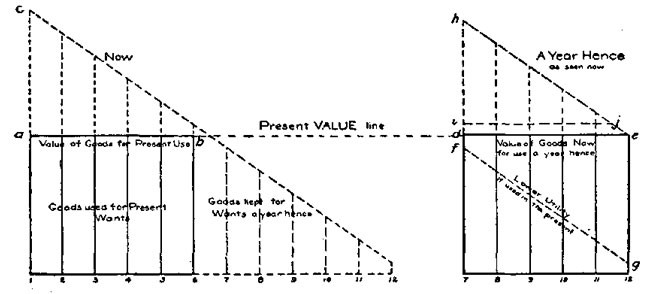
Present VALUE line
The less necessary goods are the ones saved
Let us illustrate by the case of fruit stored in the cellar for future use. In the fall after the appetite for apples has been gratified up to a certain point, there still remains a large stock which affords less gratification if consumed at once than if kept for a time. Thus wood, food, and clothing are stored in the summer for the winter's need. Even the animals act on this principle. Squirrels, bees, and ants store up in the season of superfluity for the season of scarcity. The animals recognize with their feeble intelligence or by instinct, that a time will come when these consumption goods will represent greater importance to their welfare than they do at the moment. It results from the nature of wants and the principle of diminishing utility that in many cases some portion of a large supply of present goods must be worth less now than at a future time. This part, the marginal, less necessary part, will be left for a future time, and it is to this part that our opening proposition refers. This is roughly illustrated by the diagram.
Things that cannot be kept, perishable goods, do not permit of this comparison. But if goods that can be kept continue to be used after utility has fallen down the scale, their high value for the future is cast away. Man lives not alone in the present but, in a far greater measure than do any animals, he lives in the future also. His economic life and his economic judgment comprehend a great number of periods at once. With the aid of memory and imagination he forecasts the future, and compares it with the present. The diminishing utility of goods, therefore, is modified by this fact that a thing has want-gratifying power at different periods. Before man uses goods for an inferior purpose he will ask whether, if they are kept for the future, they will not gratify a greater want.
The less valuable rise in value with the lapse of time
2. The gradual rise of a consumption good with the lapse of time from the lower to the higher degree of gratification is the rent it yields. The difference in value of present and future rents is expressed by the discount of the future use when it is capitalized at any earlier moment, and emerges in the rise in value as the thing approaches to the time when it can render the later use. Next year the unit whose use is deferred will afford as much gratification as the earlier units do now, and more than if used at the present moment. The importance of any present utility is compared with its importance a year later, plus interest at a rate which expresses the limit to which future uses are discounted. Anything that makes men feel more the importance of future uses causes them to value those uses more. But the pressure of present want is such that a present use of a lower order competes with a future use of a higher order. Only goods of a lower order, nearer the margin, are reserved for the future. But just as the possibility of using a thing for several different purposes at present causes it to be valued more highly than if it had but one use, so the possibility of reserving to the future a portion of a stock imparts to every unit a higher marginal utility.
Interest is the equalizer of time values
3. The saving of present goods for future use is encouraged by the motive of gaining the interest. Many consumption goods grow into higher uses in the hands of the owner, whether he uses them for himself or not. Ice may be stored in midwinter when it is all but a free good and a little labor serves to fill the ice-house. Kept until the summer months, the ice rises in value as the desire for it grows. Likewise the higher price secured by the owner of a thing kept for sale to others, reflects the change in utility, and affords practically a rent which is the motive for investing capital in that business. Any saver or abstainer puts aside present wants only when the future good, with the addition of time-value or of money interest, appears as large as the present good. Interest is therefore the equalizer of the value of things in different periods. Put into the scale of judgment when present and future are compared, it helps to balance the disparity in the gratifications given by economic goods in different periods of time.
Saving increases and improves economic agents
4. The postponement of present wants results in bettering the economic environment for the future. Economic environment means simply the economic conditions in which men live, the stock of wealth, the supply of useful things with which they are surrounded. This betterment may be only temporary, only for the immediate future. Like the busy bee or the prudent ant, one may in summer store the cellar with consumption goods to be consumed the following winter. But often there is a more lasting way of improving the economic environment by converting savings into durable indirect agents. The accumulation of wealth that will yield its fruits only after years of growth is the record, so to speak, of the successful competition of forethought with present desires. It means that the two periods have presented their respective claims and that men have decided in favor of the future. Saving thus lifts society from poverty to wealth by the progressive enlargement of the sources of future utilities.
The kinds of abstinence
5. Abstinence is the faculty of mind that enables present wants to be subordinated to future wants. Abstinence may be considered as a quality, or faculty, of the mind, or as an act resulting from that quality. There is little danger of confusion in this usage, but it is well to note the distinction and the fact that the former is the primary meaning. Abstinence expresses an act of the will, a choice made by man. It is the guardian of the future, so to speak, against the greediness of the present. For convenience we may speak of conservative abstinence as that which keeps men from using up or invading their present stock of resources, and of cumulative abstinence as that which impels them to add to that stock. There is no sharp dividing line, no abrupt break, between these two, yet on the whole they differ. There is a quality of mind very like the inertia or momentum of physical matter. The inertia of mind makes men resist stubbornly the reduction of wealth and of inherited social position; but it requires a more positive quality of mind to add to wealth at the cost of present sacrifice. Abstinence is embodied in individuals, never elsewhere, and is found in most varying degrees of strength. Upon it depends the growth and betterment of man's environment.
§ II. CONDITIONS FAVORABLE TO SAVING
Political insecurity discourages saving
1. Political security and domestic order are essential to the development of saving. As saving results from a comparison of the future with the present, any lack of certainty regarding the future decreases the appeal it makes. Men employ roughly the theory of probabilities in this matter, and count a utility only half as much when there is but one chance in two of enjoying it. In countries where there are constant revolutions and border wars, as in Africa and South America, and in lands where brigandage is common, as in Italy, Macedonia, and Bulgaria, the motive for saving is cut in two. Oppressive and irregular taxation kills the motives of providence, and decreases the appeal made by the future. While the miserable subjects of the state live from hand to mouth, the very sources of the public revenue disappear. Improvidence grows upon such a people into a prevailing national custom; ambition is wanting; industry is the sport of chance; economic order and economic prosperity are impossible.
Influence of private property on saving
2. Social institutions that give a motive to the individual are essential to saving. Among these institutions the most important are the family and, closely connected with it, the institution of private property which, in its ideal manifestation, places the responsibility for economic welfare on the individual or the family. Through it the state says to men: "Save if you will; the wealth and its fruits shall be yours. But if you spend and consume all you can, you alone will suffer the consequences." It is true that the institution of private property never is found in an ideal form. Dishonest public officials weaken and defeat its benefits. Every propertyless family marks a failure in its purpose. Private property is a favorite object of attack by social reformers, but it never can be safely abolished in a civilized state until some other incentive is provided, equally effective to make men subordinate present desires to future welfare. Unless the mass of men can be greatly changed, property creates the only motive that can induce saving regularly and on a large scale. It diffuses responsibility for present consumption. It multiplies the motives for abstinence and thus increases the welfare of all economic society.
Safe and paying investments encourage saving
3. Opportunity for the investment of small savings favors a spirit of abstinence. The institution of small property, peasant proprietorship, worked powerfully in this direction in many parts of Europe, and the same effects have resulted in America from the wide diffusion of property in land. If the decline in the number of small independent farmers has somewhat weakened this influence in America, in other ways other agencies are effectively performing the same functions. Savings-banks, penny banks, building and loan associations, penny-provident funds, and other convenient means of investing small sums, encourage men to reduce their tobacco bills, their candy bills, their saloon bills, and to lay aside for the winter's coal, for the children's education, for houses, for business investments, or for old age. Probably no one thing has given a greater stimulus to saving than has the development of insurance and the endowment policies in connection with it. While the great modern corporations have destroyed many of the small business enterprises into which so much of the saving of the past was put, at the same time the increase of negotiable paper, of loans, and of stock in joint-stock companies, has opened up other large fields for investors.
Changing interest rate in relation to saving
4. Variations in the rate of discount of the future react upon the spirit of saving in various ways. This very general proposition requires more detailed discussion. In general, a high rate of interest gives a large motive to save, for as the discount on the future is large, so is the reward for waiting. But this favoring motive may be offset by other unfavorable conditions, and is, in fact, wherever the high rate continues. In countries backward economically, where war, brigandage, and political oppression prevail, the rate of interest is frequently ten and twelve per cent. on the best secured loans. A high interest rate does not of itself insure a high degree of cumulative abstinence; it is only one of several factors. But in a new and favored country like America, a high rate of interest is a strong stimulus to saving. Again, interest may fall while saving continues at the same or a greater pace. Ordinarily a fall from six per cent. to five, giving men a smaller motive for abstinence, would be expected to cause less saving, yet this is not always the case. Custom and example help to fix a habit of saving in individuals and cause them to continue saving at a lower rate of interest. With the growth of wealth, the prevailing ideas as to the amount needed for a competence change, impelling to greater saving. The tendency, however, of a fall in the rate of interest is to weaken, and that of a rise of the rate, other things being equal, is to strengthen the motive to save. But the influence of the interest rate on saving is relative to the character of men.
§ III. INFLUENCE OF THE INTEREST RATE ON METHODS OF PRODUCTION
Saving permits improvement of agents
1. The individual saver is enabled to improve the agents that he uses. The simplest case is presented when means of enjoyment are improved and made more durable. If Crusoe on his island spends less time and fewer resources on gratifying his immediate wants, he may improve the quality of his clothing and the convenience of his house and furniture. By thus putting his consumption goods into durable instead of temporary forms, he will increase eventually the sum of utilities enjoyed. Again, abstinence permits the tools of the laborer to be made more convenient. If the farmer spends less time in the garden and he and his family live on plainer food, while he makes a plow, mends a rake, and builds a shed, he will be enabled thereafter to gather a greater crop with less effort.
Saving of consumption goods for exchange
2. Consumption goods, when saved, may be exchanged for services, and these may be used to create durable agents. Various ways are open to one wishing to increase his stock of durable agents. He may forego seeking immediate enjoyments while he makes durable agents himself. Or he may make and save a stock of consumption goods, a surplus supply for the future, and exchange it for durable agents. Finally, one who has accumulated consumption goods can always exchange them for the services of those seeking subsistence and enjoyment; and thus in control of a labor force, he can direct it toward the production of new forms of productive agents.
Money savings are converted into other wealth
3. In modern industry, saving frequently takes the form of money, which is then loaned to productive borrowers. This is the typical form of saving in modern industry. As it is more and more the case that income takes first the form of money, saving most conveniently takes the money form. The clerk on a salary of $60 a month spends $50 and saves $10 which he lends to a neighbor or deposits in a savings-bank. The borrower is thus empowered to increase his stock of productive agents in the measure that the lender has limited his consumption. The complexity of the process by which money saving becomes embodied through a money loan in new productive agents should not blind to its real nature. The money is saved as a means to the exchange of present goods for future income. Money even in our day is occasionally stored away for future use under hearthstones or in old stockings and hollow trees, but this is a primitive and wasteful method, involving the loss of all the additional rents that its exchange and investment would yield.
If the money saved by the thrifty saver is loaned to a thriftless borrower, wealth is not increased, but merely changes hands. The prodigal mortgaging his wealth, spending the money, and living beyond his income, absorbs the savings of the other. One saves and adds to wealth, the other consumes it. There is no net increase of goods, but two individuals have shifted positions; each has gotten his reward of growing affluence or penury.
The "normal" end, however, of savings and loans is productive. The borrower, in getting control of purchasing power, aims to put a new machine where it will be useful, to remove obstacles, and to make economic agents more effective. Along the border-land of industry the active and alert borrower seeks out opportunities to make new agents earn a rental, and having found the opening, turns to the money market for the means to profit by it.
Lower interest means higher capitalization
4. A fall in the rate of interest normally accompanies an increase in the mass, efficiency, and valuation of durable economic agents. A lower rate of interest means a higher capitalization of all incomes. It is not that either can be called the cause of the other; rather both are aspects of the same thing, the interest rate merely registering the change in capitalization. If the rate of interest has been five per cent., an income of $100 has been capitalized at $2000. When the rate falls to four per cent. the income is recapitalized at $2500. All along the line of investment there is an increase in the value of the durable economic agents.
And more complex industrial processes
It encourages the increase of fixed charges to reduce cost of operation
Another phase of the change is the greater complexity of the processes of industry. Production becomes technically more complex when interest falls. Rental, product, and present goods, bear a smaller ratio to the value of capital, and therefore it becomes advantageous to apply newly formed capital to uses which before did not justify the investment. Where formerly the utility of a second tool did not justify its making, now it can be made to earn the smaller rental needed to balance its capital value. One form, therefore, which the change takes, is a multiplication of the tools already used. Things are placed wherever most convenient. Another form this change takes is the putting of new links into the chain of technical production. Cost of operation constantly is compared with fixed charges, the interest with the capital investment. Expensive improvements on railroads, the straightening of curves, the tunneling of mountains, the reducing of grades, the replacement of lighter by heavier rails, have been made possible by a fall in the rate of interest. A fall in the rate of interest disturbs the equilibrium that has been arrived at, between the cost of operation, the amount paid for wages, coal, etc., and the income on permanent investment. If the rate of interest has been five per cent. and falls to four per cent. many permanent improvements before unwise become economical. One thousand dollars paid annually in wages then balanced an interest charge on a capital investment of $20,000; now it balances the interest charge on $25,000. It becomes a paying thing for the railroad to abandon or throw aside an enormous capital represented by the old, less perfect roadbed, and build a new one alongside of it. The changes of this kind one sees in traveling on the great and progressive railroads, reflect in part the growth of traffic, but in part also a change of the interest rate, making it a net saving to increase the capital investment in order to reduce the cost of operation per unit of traffic.
Diffused benefits of saving
The benefits of saving viewed broadly are not confined to the owner of the wealth saved, but are diffused throughout society, in the degree that they increase and improve the industrial environment, and thus raise the efficiency of production. Such a change works the same results as would a magical increase in the fertility of the soil, an improvement in the richness and accessibility of natural mineral stores, or in the quantity and quality of artificial appliances.
PART II
THE VALUE OF HUMAN SERVICES
DIVISION A—LABOR AND WAGES
CHAPTER 20
LABOR AND CLASSES OF LABORERS
§ I. RELATION OF LABOR TO WEALTH
Work and play defined and distinguished
1. Labor is any human effort having an aim or purpose outside of itself. It is difficult to define satisfactorily the term labor. No definition will quite mark off all the cases. The efforts put forth by men may be classified according as they are pleasant in themselves, and according as they have separable useful results. These two factors combine to form four groups of actions.
Effort
Objective result sought
Name of action
1. Pleasurable
Not useful
Play
2. Pleasurable
Useful
Labor
3. Painful
Useful
Labor
4. Painful
Not useful
No special name
The fourth combination is not found in rational life, for no motive exists to do a painful act for a useless result. Let us consider the other three.
Play
The first group comprises most of the sports, games, and pastimes found in every land and time. In the mere putting forth of the powers of mind and muscle there is a joy felt by children and men of all races, and this is heightened by companionship, emulation, and even by a spice of danger. Play is not dependent on a useful objective result later to be enjoyed, but, like beauty, is its own excuse for being. The tired student goes out-of-doors to bat the tennis-ball, making no change in the material world, except to wear out his shoes and to lose the ball, but finding that hour rich in the joy of life. If properly chosen, play strengthens and vivifies both soul and body, leaving an afterglow of health and happiness. The choice of sports and temperance in their pursuit are among the surest tests of wisdom in men and in societies. A love of vigorous play no less than the power of sustained work, marks the dominant and progressive peoples of the earth.
Labor as pleasure
Acts in the second group give pleasure and at the same time leave an objective result. The hunter gets more pleasure if he returns with well-filled bags of game, but the distinction between the sportsman and the "pot-hunter" is not hard to find. The one has his joy in the sport, the other in the material results of the sport. This kind of action presents some puzzling cases, but in general must be classed as labor, since labor is to be judged by the objective economic results rather than by the pleasure of the act itself.
Labor as sacrifice
In a third class are the acts that are painful in themselves, that are done unwillingly, but that leave a pleasurable result. Unfortunately a large part of the actions of men are of this class, which to most minds is the typical labor.
Joy in work is the ideal
There is thus labor that is pleasurable in itself and labor that is painful though it leads to a desirable result. The social ideal clearly is that all human labor should be made pleasurable. Social dreamers love to picture a day when all shall find for effort a full reward in the mere doing,—the reward of the artist, of the scholar, of the saint, in addition to the objective result in economic wealth. Probably we are slowly nearing this ideal. Not only in the professions and in the esthetic arts, but in commerce, in mechanics, and in the humblest walks of life are found men free from envy, rejoicing in their daily tasks. Such is the normal feeling of the healthy optimist. And yet in every serious occupation there are numberless moments and occasions when the spirit flags and only hard necessity holds men to their tasks. The dilettante does not go far or long or steadily; the real tasks of the world are done by men that labor, now with joy, now wearily.
The distinction between men and things
2. The agents of production compose two great species, material goods and human services. Our discussion of consumption goods, rent, and interest has been an analysis of the nature and uses of material goods. We now come to the other great species, human services, which comprise those acts of men (one's own or other's) that minister to the gratification of wants. There are also misdirected efforts, and evil deeds which are "disutilities" to all but the doer.
The distinction between men and things is fundamental in modern economic discussion where each man is looked upon as free. It is not so clear where slavery exists and the master looks in the same way upon the services of his cattle, of his chattel slaves, and of his land. Even in the freest society, man's services are compared purely as to their utility, with the uses of other parts of the material world. It is said that the price of mules at the Pennsylvania mines has been affected by immigration, because a man and a mule sometimes represent interchangeable services. But in the study of political economy the distinction between men and other material things must never be lost sight of; they are the two fundamental classes of economic agents, the one being solely a means to an end, the other being an end in itself.
Rent and wages mutually affect each other
3. Labor and material wealth are complementary and indispensable to each other in most of their uses. The discussion of material wealth and its value apart from the subject of labor, of the problem of rent and interest apart from that of wages, does not imply that this material wealth would have the same value in real life if labor were absent. As one field affects the value of another field, and one good, by substitution, the value of another good, so does labor affect material wealth. Some material wealth can be used apart from labor, but most of it must be used in combination with some labor. Rent, therefore, is not determined in concrete cases apart from men and their services. It is allowable, however, in abstract analysis, to simplify the question by leaving out a difficult complication, and thus to set forth more clearly the logical bearing and effect of a certain factor.
Certain shares of the product are logically attributed to each
Each of two kinds of agents used together affects the utility of the other, and the value of the product. If neither can be credited with the whole value, how is any distribution to be made between them? It is not possible to measure their technical services in the product, but it usually is possible to gage their marginal utility under particular conditions. Flour, water, and labor are needed to make biscuits; but water being a free agent, does not enter into the combination with any marginal utility. A match also is almost indispensable to start the fire (and who has not seen the time when he would give far more for a match than for a bucket of coal), but as things usually are, the match is credited with a value of a very small fraction of a cent. Again, how is to be measured the economic service of the tree and of the labor needed for gathering its fruits? There is here suggested the superficial aspect of what is known as the problem of complementary values. Where two or more things are indispensable to a product, how much shall be credited to each?
Labor gratifies directly and indirectly
4. Human service has the same general relation to wants that material goods have, affording gratification either directly or indirectly. It is axiomatic that to be "economic goods" human efforts like material goods must afford utilities whose importance is felt. Many services give pleasure directly and are immediately consumed. A tropical potentate has an attendant to fan him, and another to carry an umbrella; a humble citizen is shaved, doctored, sung to, and played for. The gratification in such cases is directly produced in personal comfort, in the consciousness of heightened beauty, in the feeling of self-esteem. Value is thus created and consumed immediately, taking no material form apart from the consumer.
Labor embodied for a time in material form
But the results of most human services may be seen to rest, at least temporarily, in some material form. Effort is put upon a material thing to be used later. The work of the waiter in spreading and arranging the table is not an immediate service, for it is embodied in material form an hour or two before the meal. The service of cook no less than that of gardener and butcher, is put into material form before it comes to the consumer. The woodman fells, cuts up and splits a tree, and piles it at the door, putting his labor into a utility to be consumed months afterward. The old economists used to class labor as productive and unproductive according as it was or was not embodied in material form. The classing of the services of cook, waiter, valet, etc., as unproductive seems, even from the old point of view, to have been inconsistent, and the attempt to distinguish services by any such test is now wholly given up. Whether the service rests in material form for a week, a month, a year, or as often happens, for a much longer period, is not essential. The test of the productiveness of services is not their embodiment in material form, but their appearance as psychic income, their ministry to wants. The most varied kinds of human activity may be unified by this thought in the concept of economic labor.
§ II. VARIETIES OF TALENTS AND OF ABILITIES IN MEN
Grades of labor are analogous to grades of wealth
1. As material things differ in their fitness to gratify wants, so do men differ in their powers of labor. The fields, hammers, plows, tools, and machinery of different kinds and qualities have been seen to grade off from the best to the poorest. The poorest, discarded or just about to be discarded, are no-rent agents. The utility felt and recognized in the better qualities is expressed in the rents they yield. Recognizing the variety and inequality of human talent, some economists of late speak of the "rent" of ability, meaning that, like land rent, the greater utility (and corresponding reward) of some labor as compared with others, reflects the difference in the quality of agents. But this expression, though often met in contemporary economic writings, is one to be avoided because it tends to blur the essential distinction between human and other agents. Pursuing the same analogy some economists have talked of capitalizing the worker,—expressing in a lump sum the value of the man as the present worth of the series of incomes which he may be expected to earn in his working life. This, also, is to be avoided, for while possibly it is suggestive in studying some problems, it is on the whole a misleading analogy, dimming the distinction between free-workers and owned and exchangeable wealth.
Physical differences among men
2. The physical strength of workers differs according to age, individual, race, and sex. Differences due to age are the most obvious. The child, at first weak, grows toward his maximum of physical strength, which he attains before his fullest intellectual capacity. The period of maximum physical working power lasts fifteen to twenty-five years according to the individual, and then gradually declines as the old worker approaches again the inefficiency of the child. Mental efficiency develops more slowly and longer, the highest qualities of judgment and wisdom being the fruits only of a life rich in experiences. Families and strains of stock differ notably in physical and mental powers; one excels in stature, another in development of muscle. The differences within families are inexplicable, sometimes one brother excelling in one thing, the other in another. The physically perfect man is a rare product. Among three thousand students are but two score endowed with the remarkable combination of lungs, heart, muscle, nerve, and character, that makes possible the finest athletes. The national and racial differences in working power, even in the simplest tasks, are marked but difficult to explain, as so many influences of customs, habits of life, and varieties of diet modify the result. We cannot tell how much of the Englishman's great superiority over the East Indiaman is due to individual, native differences of mind and body, how much to the social environment in which they have lived. Certainly, though, the difference is not mainly one in size; in the Chinese War the little brown men of Japan outmarched all the others. Certainly fiber counts for more than bulk, and character for more than muscle.
Comparative strength of men and women
A difference in the physical strength of the sexes is found in some degree throughout the world, but it would appear to be far more marked in civilized than in savage communities. Compare the records at the Vassar field-games with that of the men in any leading college: in the hundred-yard dash, fifteen seconds as against ten and a fraction; in the high jump, forty-eight inches as against six feet and over. The muscular force of American college women as tested in the Yale and the Oberlin gymnasiums is but one third that of men, that is, taking all the students, the weaklings and the little men along with the athletes, and the women large and small. As to strength of back the average for men is 154 kilograms, for women 54 kilograms; legs, average for men 186, average for women 76.5; right forearm, average for men 56, average for women 21.4. This is an abnormal difference. The natural and possible strength is more nearly attained by men than by women under our social conditions. Women escape the physical toil which strengthens, but not the mental strain which kills. Men carry more of the wood, but the women not less of the worries. A fairer test is applied among peasants in field-work in France and Germany, where the strength of women is found to be about two thirds that of men. American women should do and will do more to attain their natural strength when we attain sounder ideas of education and saner modes of living.
Talent and training as factors of efficiency
3. Differences in intelligence are a resultant of native talent and acquired ability. It is difficult to distinguish these two factors sharply. Two men sitting side by side in an examination, get the same grade; one of them has had excellent preparation from childhood, and all the opportunities that money, travel, and cultured associates can give; the other, under great difficulties, has prepared in a country district school with a little coaching now and then, and struggling against great odds, has at last entered college. The same grade does not mean that their natural ability or even their efficiency in this particular class, is equal. Yet the grade is the best expression to be had of their efficiency in the particular work. Native intelligence shortens the time needed for preparation in any calling; hastens new methods; decreases the cost of supervision; saves materials, tools, and time; diminishes loss from breakage; makes possible the use of finer machinery and better appliances, and imparts those subtler qualities that distinguish the best from the mediocre products. Education and native talent are in a degree interchangeable; one supplements the other. Education increases adaptability; the trained mind will outstrip the untrained mind of greater power. It makes direction easier, fits for higher tasks, and decreases the difficulty of coöperation. Any ability may be helped by education in the broad and true sense, though a fool cannot be made wise by training, and though many a potential genius doubtless has been dwarfed in dusty school-rooms by stupid teachers.
The moral qualities required in industry
4. The moral qualities of the worker are increasingly important as society grows more complex. The need of a particular moral quality is relative to the special task in hand. Honesty is needed in the bank teller, but he need not spoil a good story. The champion broncho-buster of Arizona is not a Sunday-school superintendent. So, discipline, obedience, self-control, regularity, and punctuality are needed, for more and more in these days business is run by the watch; confidence, patience, good temper, in fact all the virtues in the calendar are necessary at some time and place, and most of them are needed all the time in business. Places may be found in our developed society for those who are deficient in these qualities (it is fortunate that it is so), but these are the poorer places. Many men fail to examine the qualities necessary for success, and do not understand the causes of their own failure. Blind to their own faults, they are dropped down one notch after another in the scale of industry, and, equally blind to the virtues of their successful rivals, they rail against the unjust fates.
The union of many qualities needed
5. Skill and capacity in industrial tasks is a resultant of many qualities. The simplest task calls for a combination of force and judgment,—even the digging of a ditch, the raising of a window, or the fitting of a stovepipe. For most industrial tasks rarer combinations of qualities are required. The retail clerk must be neat, punctual, polite, and long suffering. A confidential clerk must have discretion, judgment, and other moral qualities in an unusual combination. The substitution of qualities is possible within limits; a rare quality may make amends for the lack of a commoner one, and a man may, because of peculiar fitness in some regards, continue to hold a position for which in other ways he is little fitted. The rarest and most valued worker is one uniting many good qualities and fitted to deal with emergencies. The economic efficiency of the worker often is no stronger than its weakest link. A strong motive for training is offered by the fact that supplying some one lacking quality may raise the total efficiency in a remarkable degree.
Inequality of talents shown by biologic studies
6. Biologic studies have of late made clearer the existence and continuation of the inequality of talents. The political philosophy of the eighteenth century was based on the idea of natural rights and natural equality. Adam Smith, accepting the prevailing view, discussed wages on the assumption that all men had equal natural ability. It is still a favorite assumption of radical social reformers that the natural ability of all men is equal, and that all the differences in success result from political injustice. The study of biology of late has made patent the unending differences that prevail throughout the animate world. No two members of the same family or species are just alike; no two pigeons have wings of just the same length. Nature by numberless devices is experimenting constantly with variations on either side of the established mean. The accepted fact of biologic evolution rests on the foundation of inequality in structure and powers, making possible selection and adaptation. Men in all their qualities of mind and body display this kaleidescopic variety. In all life there is inequality, and the whole drama of human history as well as that of biologic evolution must be meaningless or illusory to the man who does not see this truth. Accustomed now to this point of view, we as inevitably think of the natural inequalities in men as did Adam Smith of their equality.
This fact does not force to the conclusion that industrial inequality as it exists to-day, the great disparity of incomes, correctly or justly reflects the degree of difference in men's qualities, either native or acquired. It does not follow that a thousand-dollar income represents ten times the ability of a hundred dollar one—far from it. But to those who ignore the inequality of men, the whole problem of industrial remuneration must remain a mystery. A crude socialism is possible only to those who are blind to the enormous differences in human capacity.
Scarcity of labor is essential to wages
Unlimited demand for labor
7. The scarcity of human services, relative to wants, is the fundamental fact in the problem of wages. It is clearly seen that some qualities of service are scarce. Most women will confess that they cannot warble as Patti could, most men will admit that they have not the mercantile ability of John Wanamaker. The man of mediocre capacity recognizes even through the fog of his self-esteem that there is a reason for the high value of certain rare services. But it must also be recognized that the commonest services have value only because they are scarce. There are many things to be done if there were labor enough to do them. There is no need to "make work," in the popular sense; it is here, but labor is lacking to do it. It is true there may be a temporary superfluity of human labor at a time of an industrial crisis. There is at all times a superfluity of "useless" human agents whose qualities are such that they have no net utility. The ignorant, insane, feeble-minded, vicious, drunken, and debauched, can give to the world only negative utilities. But services that are in any degree useful are nearly always in demand, and the higher services are so rare that they are in great demand. The proverb, "There's always room at the top," is seen to be true when conditions are thus analyzed. There is a large, though limited, supply of the commoner kinds of services at the bottom of the scale, but in every branch of human effort there is a never-ending lack of that higher qualification and training required for the best results.
CHAPTER 21
THE SUPPLY OF LABOR
§ I. WHAT IS A DOCTRINE OF POPULATION?
The employer's and the social view of supply of labor
1. The supply of labor means here not the number of workers available in any one industry, but the number available in the whole field of industry. The individual employer thinks of the supply of labor as consisting of the men seeking employment in his special industry. In this view it is the demand by the employers that apportions the workers among the various occupations. The social view of the supply of labor, however, looks at the whole field. The demand for labor is then seen to be represented not by human employers, but by resources and agents presenting opportunities and demanding labor to employ them. The rich acre, the tool, the machine, all material wealth needing the human touch to give it a higher utility, represent a demand for labor in this broad sense. The thought of a supply of labor is therefore relative to that of the demand embodied in resources. A million men are a great or a small supply of labor according as they occupy a little island or a large continent, according as they are equipped with a small or a large supply of agents.
Population in relation to resources
2. "Supply of labor," as an economic problem, presents a large and complex case of diminishing returns. The population of different countries and of different sections of a country is seen to bear a general relation to their resources. An unintelligent race with little wealth and poor machinery is doomed to remain few in numbers. Mountains, districts poorly watered, the frozen regions of the North, are sparsely populated because natural resources are lacking. If food production alone is thought of there are apparent exceptions to this statement, but there are no absolute contradictions of it. A favored harbor may make possible a flourishing commerce on a rocky coast; an unfertile soil may support a large population when great deposits of coal or iron insure by exchange great food-supplies. Productivity must be measured under modern conditions by the purchasing power that is possible in the environment. The connection of wealth and resources with the extent of the population is in itself a recognition of diminishing returns, of an objective limit to the number of men that can occupy a certain area and employ a given stock of agents.
Equilibrium between numbers of animals of different species
3. Each species of the lower animals is seen to have a relatively fixed habitat limited by its food-supply and by its enemies. The rocks tell a story of a slow and steady change that has gone on in the earth and in the species of animals that inhabit it. History records some rapid changes due to convulsions of nature or to interference by man with the natural conditions. But the usual condition is an equilibrium of numbers, long maintained, though each species appears to have in itself a capacity for unlimited increase. Why this contradiction? The limit set by the food-supply is seen in a simple case when herbivorous animals are placed on an island from which they cannot escape, and where there are no dogs, wolves, weasels, or foxes. Substantially this experiment was unintentionally tried on an enormous scale with the rabbit in Australia. This peculiar and long-isolated continent contained none of the rabbit's ancient enemies. The rabbits became a pest, devastated great areas, were hunted, trapped, poisoned, and great numbers of them died of starvation outside the fences erected to stop their advance. In the imaginary island they would increase up to the point where starvation would bring about an equilibrium between the number of animals and the food supply. The destruction of one kind of animal by another limits numbers in another way. The number of lions is limited by the number of their prey in the region where they roam. The number of deer, therefore, is limited in two ways, by the amount of their food and by the number of lions which catch the deer. The more numerous the lions, the fewer the deer; the fewer the deer, the greater the supply of vegetable food; as the pressure increases on one side, it decreases on the other, until an equilibrium is reached.
The surplus of life germs
Throughout nature each species of animal keeps its customary place, changing little despite its efforts to increase and to crowd into the habitat of other species. Even the slow-breeding elephant, with a period of gestation of three years, and producing one calf at a birth, would cover the entire earth and leave no standing-room in a few centuries if every calf born could live to full age. The myriads of frogs born every spring, the swarms of insects, the countless plants, are struggling to find a foothold on the crowded earth. Of the vastly greater number of seeds and embryos, only one in a multitude ever comes or could come to maturity. Here are the undisputed facts on which rests a biologic "doctrine of population," so to speak, for the vegetable and lower animal world. Because of the limited powers of the soil, no form of life, animal or vegetable, can continue to increase even for a single generation, without meeting enormous forces of opposition, which destroy great numbers and set a limit to the increase of the species.
These facts related to the doctrine of population
4. A doctrine of human population is a reasoned explanation of the causes determining the number of people in the world. Man in his economic life is constantly struggling with the problem of the scarcity of goods. If in any given environment men continue long to increase, they must, like the lower animals, meet limits in the capacities of the resources they use. The supply of labor force which is thus brought to be combined with the material agents must meet with diminishing returns unless these agents also continue to increase at a like rate. The relation of population to resources thus presents probably the most fundamental problem in the realm of economics. It is a problem of great complexity, bristling with difficulties, and incapable of exact mathematical treatment; but it is capable of rational study. There is a great difference between a purely fatalistic view of this question and the view that is to be reached by a consideration of the motives, causes, and physical influences at work; It is possible to find some principles in the chaos of prejudices and contradictions that the subject presents. The fruit of a century of discussion of the economic, social, and biologic factors involved, is a rational, if not a final, doctrine of population.
§ II. POPULATION IN HUMAN SOCIETY
The biologic stage of human population
1. In the earlier stages of human history, population is limited mainly by biologic factors. The biologic stage continues so long as there are no artificial restraints put on the birth-rate, and no deliberate destruction of offspring for the purposes of limiting the size of the family. There the limits are all objective; they are found in scantiness of the food-supply, or in destruction by enemies, animal or human. Each species has an average or normal birth-rate, great or small. Just why this varies, why the rabbit produces a score of young in a year, and the elephant but one in three years, is a question capable of a rational answer, but it is one for the natural scientist rather than for the economist. Each species is impelled by instinct to realize this birth-rate, to bring into existence as many young as possible.
No human society known to us is so primitive that it has not passed this stage, but many societies have risen but little above it. In most savage tribes, where starvation, disease, and war are constantly at work, the difficult task is to maintain the population. Few of those born arrive at maturity. The custom of the adoption of captives from hostile tribes is widespread, because the efficiency and even the survival of the tribe depends upon keeping up its number of warriors.
War among primitive societies
2. War for the possession of limited resources is the first rude social remedy for an excess of population. War is the normal condition of most primitive tribes. Its cause usually appears to be standing feuds and ancient enmities, but the deeper and abiding cause is the struggle for hunting-grounds, for pasturage, for natural resources. The rude industry and economy of hunting, fishing, or pastoral peoples, or of those in the earlier stages of agriculture, requires a large area for a small population. Distant excursions and frequent forays, when food fails, develop rival claims to favored districts, and war is the only settlement. Fighting under these conditions is an activity of such economic importance that much of the energy of the tribe must be strenuously given to it. The ceaseless loss of life in savage wars is almost incredible to modern minds. The invasion of the Roman Empire by the Teutonic tribes, the later successive inundations of medieval Europe by the fierce pastoral tribes from central Asia, are more recent and familiar examples of the economic and political effects of the increase of population and of the outgrowing of resources by barbarian peoples. When the custom arises of capturing enemies and reducing them to slavery instead of killing them, forces are set into operation to reorganize society and to create new checks on the growth of population.
Crude beginnings of volitional control
3. Volitional control of population begins by the destruction of offspring before or after birth. The population problem ceases to be simply biologic, and takes on its sociological aspect, when the awakening intelligence of man first grasps the mystery of birth, and when the first attempts are made in any way to regulate family relations or to interfere with the growth of numbers. The student of primitive peoples finds in the methods applied to prevent the birth of children an almost inconceivable brutality. The same methods to a large degree persist in savage communities to-day. Infanticide was generally practiced in ancient times among peoples of advanced civilization, as, for example, in Sparta and Rome, where not only deformed and weak children, but unwelcome ones, commonly were destroyed. The practice, if not legalized, is at least permitted even to-day by public opinion in great portions of India, China, and other densely populated districts of the world. It is one of the dark spots on our own civilization.
Private property limits population
The problem a psychic one
4. The pressure of increase of numbers on resources is confined by individual industry and by private property to special portions of the population. A condition of communism, where all the members of the tribe or family share equally, means that all enjoy together when food and wealth are abundant, and all starve together when it becomes scarce. Along with a fierce enmity for other tribes, is found in many early societies a close approximation to tribal communism. Private property alters the nature of the struggle for subsistence and of the motives for limiting population. Society divides into a number of partially independent classes or family groups, each holding its share of wealth apart, not in common with the tribe. A society with private property is like a ship divided into a number of water-tight compartments. In communistic conditions if population increases, all sink together into want. The self-interest of those having private property keeps them from dividing their property, and starvation is confined to the propertyless members. This acts in two ways: it increases the motive for the production of wealth; it gives a motive for the limitation of the consumers of the wealth. A smaller family with larger resources means a wider margin between numbers and misery. This converts the problem of population from a material one of a balance of food and physical needs, to a psychic one of a balance of motives in the minds of men. When this stage is reached, the extreme objective limit of the birth-rate or of increase of population is no longer attained in the well-to-do classes, although it may still continue to be in the less provident.
Social classes differ in volitional control
5. Volitional control is effective in very different degrees in different families and industrial classes. The possession of property is both a sign of forethought and an incentive to it. Concern for the welfare of children is one of the most powerful motives, especially after social distinctions become marked. It may become abnormally strong, leading parents to sacrifice their own welfare or their own lives foolishly for their children, as is done often in the accumulation of property. Among the classes with property the provision for the children depends not only upon the amount of wealth, but upon the number among whom it is to be divided. It is simple division: wealth the dividend, number of children the divisor.
Among the poorer classes very different motives operate. After the first few years the parents' income is increased by the earnings of the children, both on the farm and in the factory districts if the laws do not prohibit child labor. Moreover, when the children are grown, their wages will depend on the general labor market, not upon the number of their brothers and sisters. So, according as the family income is from rents or from wages, the motives of the parents differ.
Motives in volitional control
Postponement of marriage must be classed as a mode of volitional control of population. The average age of marriage, both of men and women, is higher in the classes of greater wealth and ambition than in the poorer classes. The contrast in this regard between civilized and savage peoples is likewise noteworthy. The failure to marry, from whatever cause, is, in the social view of the question, volitional control. It is rare that the motive is directly and immediately the wish to avoid parenthood; now it is religious zeal, again it is disappointed sentiment; here it is conflicting duty, and there it is the individual selfish wish to retain an undivided income for one's own enjoyment. By countless strands of motive in the form of sentiments, social institutions, and interests, the primitive impulses of humanity are firmly bound; and in varying degrees, in different classes, the enormous possibilities of reproduction are controlled by human volition.
§ III. CURRENT ASPECT OF THE POPULATION PROBLEM
The many motives controlling population
1. Changes in population are resultants of many forces: those favoring a high birth-rate and low death-rate, and those limiting births or survival. Whether the population on the whole shall grow, stand still, or diminish, depends upon the relative strength of contending forces making for life or death. But this control may lose its cruder aspect and may be waged in the realm of motive. More and more it is volition that controls in human society the growth of population; less and less it is the objective limit of the food-supply. Dire need resulting in ill-health and even in starvation, is still acting in some portions of society, but less to-day than ever before. The growth of population in this stage is not "fatalistic," as there is no inevitable tendency to increase or to decrease. It depends on the interaction of a number of forces, clearly distinguishable, by which population actually is kept far within the limits of food resources. Volitional control is not by a central and unified despotism determining human action, but it is by motives of the most complex sort, diffused throughout society and acting upon every member of it.
The standard of life in Asiatic countries
2. The desire to maintain and raise the standard of life is the most effective motive limiting population in our society. The phrase "standard of life" expresses the complex thought of that measure of necessities, comforts, and luxuries considered by any individual to be indispensable for himself and his children; that measure which he will make great sacrifices to secure. This standard differs from land to land, and from time to time. In the Asiatic countries it is so low that it touches in large classes the minimum of subsistence. Despite adverse influences and the uninterrupted series of famines, the population of India in the last century under English rule increased from two hundred millions to three hundred millions. Such a population "lets out all the slack" of income, and never takes up any. The great public works of irrigation, forestry, and transportation, and the development of industry under English rule, gave an opportunity for a higher standard of living; but it was used instead to permit the existence of a greater number of men in the same old misery. These facts have a bearing upon the question of Oriental immigration to America. The emigration of millions of Chinese from their native land would leave no void in their numbers. Peopling their own land constantly down to their own standard of living, they have the power, if they are tempted hither in great numbers, to people this continent also to the same density.
The American standard
The American standard of living, while it differs in different classes, is on the whole the highest found anywhere in the world. The increasing appeal to individual selfishness in the last twenty-five years, the greater ease of travel and taste for it, the multiplied and costly pleasures and pastimes, make children a greater and greater burden. The abnormal conditions of city life increase the sacrifice required to support children, and take away a large part of the value of their services in the home. In the greater cities are whole areas larger than the city of Ithaca where children are not admitted to the apartment houses, where no one who has a child can rent rooms. Despite the increasing incomes of the masses of the population, the number of childless homes is increasing, and while the standard of comfort grows, the size of the average family dwindles.
The decreasing death-rate
3. Great improvements in medical and in sanitary science are decreasing the death-rate and thus partly neutralizing the effects of a lower birth-rate. The death-rate in a community is a fairly good index of its general welfare. The death of a large proportion of the children before they arrive at maturity indicates poverty or ignorance. The death-rate in the Middle Ages, especially in cities, was tremendously high, but during the last hundred years has steadily decreased. The race of man which, ever since the beginnings of volitional control, probably has had a smaller death-rate relative to the total number of individuals coming into existence than has any other species of living creatures, has to-day a far lower rate than ever before. Even in the most miserable industrial population where one half the children die before they are five years old, the death-rate is much less than among the young of the lion or the eagle.
The quality of population counts
4. Volitional control is acting with the greatest force in the more capable classes and thus threatens to reduce the quality of the population. The quality of population is of more import than its quantity, alike in its economic, its social, and its ethical results. The productive force of a population is not measured merely by numbers. "Who" make up the population at any moment is no more a matter of indifference than "how many." One new-born child represents a negative addition to society, unintelligent, incapable, foredoomed to become a burden; another, with energy, thrift, inventive genius, comes to enrich and uplift his fellow-men. Quality counts for much.
Change in the American birth-rate
The average number of children reaching maturity in the families of the American colonists was six; the average number to-day in families of American descent is about two. Since many of these do not live to maturity, and of those who do survive many do not marry, the stock does not maintain itself in numbers. Much larger families are found among the poor whites of the mountains, the foreign population, the rate negroes, and, in general, in the lower ranks of labor. Forces are at work to sterilize or reduce in number the more intelligent elements of the population. The "new woman" movement, tempting into "careers," takes away from family life many of the women most worthy to become the mothers of succeeding generations, Self-interest is at war with the social interest. The individual asks, "Am I bound to sacrifice my comfort and happiness to the general good?" If this continues, the result must be a steady decline in the proportion of the population born of the successful strains of stock, and a steady increase of the descendants of the mediocre and duller-witted elements.