Symmetry and the Riemann Hypothesis
Symmetry in the Zeta Function
— The Riemann Hypothesis (RH) states that all non-trivial zeros of the Riemann zeta function $ \zeta (s) $ lie on the «critical line» where the real part of $ s $ is $ 1/2 $ [1].
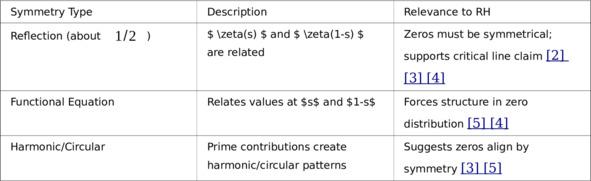
— A key feature of $ \zeta (s) $ is its reflection symmetry about the critical line, expressed by the functional equation relating $ \zeta (s) $ and $ \zeta (1-s) $ [2] [3] [4].
— This symmetry implies that if $ \zeta (\alpha + i\beta) = 0 $, then $ \zeta (1-\alpha + i\beta) = 0 $ as well, so zeros are mirrored across the line $ Re (s) = 1/2 $ [3].
Role of Symmetry in Approaches to RH
— Several recent approaches attempt to prove RH by analyzing symmetries:
— Reflection symmetry: Some proofs use the symmetry of certain combinations involving the zeta and Gamma functions, showing that their minima-and thus the zeros-must occur on the critical line, as any deviation would break the reflection symmetry [2].
— Circular and harmonic symmetry: Others note that the distribution of zeros exhibits properties similar to circular symmetry, or relate the zeros to harmonic contributions from primes, suggesting that symmetry enforces the alignment of zeros on the critical line [3] [5].
— Functional equation symmetry: The functional equation of $ \zeta (s) $ ensures that the function is symmetric across the critical strip, reinforcing that the critical line is special [5] [4].
Summary Table: Types of Symmetry in RH Context
Conclusion
Symmetry-especially reflection symmetry about the critical line and the symmetry imposed by the functional equation-is central to both the formulation of the Riemann Hypothesis and many modern attempts to prove it. These symmetries constrain the possible locations of non-trivial zeros and are a major reason why the critical line $ Re (s) = 1/2 $ is so significant in the theory of the zeta function [2] [3] [5] [4].
⁂
Enhanced Summary and Insights on «Symmetry and the Riemann Hypothesis»
Based on the provided preprint by Vitaly Fartushnov (December 2021)
1. Overview of the Document
The preprint titled «Symmetry and Riemann Hypothesis» by Vitaly Fartushnov explores the deep connections between symmetry concepts and the Riemann Hypothesis (RH). The paper collects fundamental tools from algebra and geometry, particularly focusing on localization techniques in noncommutative rings and modules, and relates these to the geometric and algebraic structures underlying the RH.
2. Key Themes and Contributions
a. Symmetry and Localization in Algebraic Structures
— The paper discusses Ore localization of rings and modules, a method to «localize» algebraic structures, which is crucial in noncommutative geometry.
— This algebraic localization is linked to understanding spaces described by noncommutative rings, which can be seen as a geometric framework.
— The study of localization is enriched by descent formalism, flatness, and categories of sheaves, all of which provide a categorical and geometric viewpoint.