автордың кітабын онлайн тегін оқу The Lay of the Land
E-text prepared by Giovanni Fini, Bryan Ness,
and the Online Distributed Proofreading Team
(http://www.pgdp.net)
from page images generously made available by
Internet Archive/American Libraries
(https://archive.org/details/americana)
Note:
Images of the original pages are available through Internet Archive/American Libraries. See
https://archive.org/details/layoflandsharpda00sharrichThe Lay of the Land
The Lay of the Land
By
Dallas Lore Sharp
AUTHOR OF “WILD LIFE NEAR HOME” AND
“ROOF AND MEADOW”
With Drawings by
Elizabeth Myers Snagg

BOSTON AND NEW YORK
HOUGHTON MIFFLIN COMPANY
The Riverside Press Cambridge
1908
COPYRIGHT 1908 BY DALLAS LORE SHARP
ALL RIGHTS RESERVED
Published September 1908
To the Memory of my Friend
William Frank Morrison, M. D.
Contents
I.
The Muskrats are Building
1II.
Christmas in the Woods
19III.
A Cure for Winter
35IV.
The Nature-Student
56V.
Chickadee
74VI.
The Missing Tooth
89VII.
The Sign of the Shad-bush
105VIII.
The Nature Movement
114IX.
June
127X.
A Broken Feather
137XI.
High Noon
148XII.
The Palace in the Pig-pen
161XIII.
An Account with Nature
175XIV.
The Buzzard of the Bear Swamp
189XV.
The Lay of the Land
200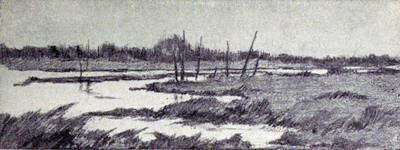
I
The Muskrats are Building
We have had a series of long, heavy rains, and water is standing over the swampy meadow. It is a dreary stretch, this wet, sedgy land in the cold twilight, drearier than any part of the woods or the upland pastures. They are empty, but the meadow is flat and wet, naked and all unsheltered. And a November night is falling.
The darkness deepens. A raw wind is rising. At nine o’clock the moon swings round and full to the crest of the ridge, and pours softly over. I button the heavy ulster close, and in my rubber boots go down to the river and follow it out to the middle of the meadow, where it meets the main ditch at the sharp turn toward the swamp. Here at the bend, behind a clump of black alders, I sit quietly down and wait.
I am not mad, nor melancholy; I am not after copy. Nothing is the matter with me. I have come out to the bend to watch the muskrats building, for that small mound up the ditch is not an old haycock, but a half-finished muskrat house.
The moon climbs higher. The water on the meadow shivers in the light. The wind bites through my heavy coat and sends me back, but not until I have seen one, two, three little figures scaling the walls of the house with loads of mud-and-reed mortar. I am driven back by the cold, but not until I know that here in the desolate meadow is being rounded off a lodge, thick-walled and warm, and proof against the longest, bitterest of winters.
This is near the end of November. My wood is in the cellar; I am about ready to put on the double windows and storm doors; and the muskrats’ house is all but finished. Winter is at hand: but we are prepared, the muskrats even better prepared than I, for theirs is an adequate house, planned perfectly.
Throughout the summer they had no house, only their tunnels into the sides of the ditch, their roadways out into the grass, and their beds under the tussocks or among the roots of the old stumps. All these months the water had been low in the ditch, and the beds among the tussocks had been safe and dry enough.
Now the autumnal rains have filled river and ditch, flooded the tunnels, and crept up into the beds under the tussocks. Even a muskrat will creep out of his bed when cold, wet water creeps in. What shall he do for a house? He does not want to leave his meadow. The only thing to do is to build,—move from under the tussock, out upon the top, and here, in the deep, wiry grass, make a new bed, high and dry above the rising water, and close the new bed in with walls that circle and dome and defy the winter.
Such a house will require a great deal of work to build. Why not combine, make it big enough to hold half a dozen, save labor and warmth, and, withal, live sociably together? So they left, each one his bed, and joining efforts, started, about the middle of October, to build this winter house.
Slowly, night after night, the domed walls have been rising, although for several nights at a time there would be no apparent progress with the work. The builders were in no hurry, it seems; the cold was far off; but it is coming, and to-night it feels near and keen. And to-night there is no loafing about the lodge.
When this house is done, then the rains may descend, and the floods come, but it will not fall. It is built upon a tussock; and a tussock, you will know, who have ever grubbed at one, has hold on the bottom of creation. The winter may descend, and the boys, and foxes, come,—and they will come, but not before the walls are frozen,—yet the house stands. It is boy-proof, almost; it is entirely rain-, cold-, and fox-proof. Many a time I have hacked at its walls with my axe when fishing through the ice, but I never got in. I have often seen, too, where the fox has gone round and round the house in the snow, and where, at places, he has attempted to dig into the frozen mortar; but it was a foot thick, as hard as flint, and utterly impossible for his pick and shovel.
Yet strangely enough the house sometimes fails of the very purpose for which it was erected. I said the floods may come. So they may, ordinarily; but along in March when one comes as a freshet, it rises sometimes to the dome of the house, filling the single bedchamber and drowning the dwellers out. I remember a freshet once in the end of February that flooded Lupton’s Pond and drove the muskrats of the whole pond village to their ridgepoles, to the bushes, and to whatever wreckage the waters brought along.
The best laid schemes o’ muskrats too
Gang aft a-gley.
But ganging a-gley is not the interesting thing, not the point with my muskrats: it is rather that my muskrats, and the mice that Burns ploughed up, the birds and the bees, and even the very trees of the forest, have foresight. They all look ahead and provide against the coming cold. That a mouse, or a muskrat, or even a bee, should occasionally prove foresight to be vain, only shows that the life of the fields is very human. Such foresight, however, oftener proves entirely adequate for the winter, dire as some of the emergencies are sure to be.
The north wind doth blow,
And we shall have snow,
And what will Robin do then,
Poor thing?
And what will Muskrat do? and Chipmunk? and Whitefoot? and little Chickadee? poor things! Never fear. Robin has heard the trumpets of the north wind and is retreating leisurely toward the south, wise thing! Muskrat is building a warm winter lodge; Chipmunk has already dug his but and ben, and so far down under the stone wall that a month of zeros could not break in; Whitefoot, the woodmouse, has stored the hollow poplar stub full of acorns, and has turned Robin’s deserted nest, near by, into a cosy house; and Chickadee, dear thing, Nature herself looks after him. There are plenty of provisions for the hunting, and a big piece of suet on my lilac bush. His clothes are warm, and he will hide his head under his wing in the elm-tree hole when the north wind doth blow, and never mind the weather.
I shall not mind it either, not so much, anyway, on account of Chickadee. He lends me a deal of support. So do Chipmunk, Whitefoot, and Muskrat.
This lodge of my muskrats in the meadow makes a difference, I am sure, of at least ten degrees in the mean temperature of my winter. How can the out-of-doors freeze entirely up with such a house as this at the middle of it? For in this house is life, warm life,—and fire. On the coldest day I can look out over the bleak white waste to where the house shows, a tiny mound in the snow, and I can see the fire burn, just as I can see and feel the glow when I watch the slender blue wraith rise into the still air from the chimney of the old farmhouse along the road below. For I share in the life of both houses; and not less in the life of the mud house of the meadow, because, instead of Swedes, they are muskrats who live there. I can share the existence of a muskrat? Easily. I like to curl up with the three or four of them in that mud house and there spend the worst days of the winter. My own big house here on the hilltop is sometimes cold. And the wind! If sometimes I could only drive the insistent winter wind from the house corners! But down in the meadow the house has no corners; the mud walls are thick, so thick and round that the shrieking wind sweeps past unheard, and all unheeded the cold creeps over and over the thatch, then crawls back and stiffens upon the meadow.
The doors of our house in the meadow swing open the winter through. Just outside the doors stand our stacks of fresh calamus roots, and iris, and arum. The roof of the universe has settled close and hard upon us,—a sheet of ice extending from the ridge of the house far out to the shores of the meadow. The winter is all above the roof—outside. It blows and snows and freezes out there. In here, beneath the ice-roof, the roots of the sedges are pink and tender; our roads are all open and they run every way, over all the rich, rooty meadow.
The muskrats are building. Winter is coming. The muskrats are making preparations, but not they alone. The preparation for hard weather is to be seen everywhere, and it has been going on ever since the first flocking of the swallows back in July. Up to that time the season still seemed young; no one thought of harvest, of winter;—when there upon the telegraph wires one day were the swallows, and work against the winter had commenced.
The great migratory movements of the birds, mysterious in some of their courses as the currents of the sea, were in the beginning, and are still, for the most part, mere shifts to escape the cold. Why in the spring these same birds should leave the southern lands of plenty and travel back to the hungrier north to nest, is not easily explained. Perhaps it is the home instinct that draws them back; for home to birds (and men) is the land of the nest. However, it is very certain that among the autumn migrants there would be at once a great falling off should there come a series of warm open winters with abundance of food.
Bad as the weather is, there are a few of the seed-eating birds, like the quail, and some of the insect-eaters, like the chickadee, who are so well provided for that they can stay and survive the winter. But the great majority of the birds, because they have no storehouse nor barn, must take wing and fly away from the lean and hungry cold.
And I am glad to see them go. The thrilling honk of the flying wild geese out of the November sky tells me that the hollow forests and closing bays of the vast desolate north are empty now, except for the few creatures that find food and shelter in the snow. The wild geese pass, and I hear behind them the clang of the arctic gates, the boom of the bolt—then the long frozen silence. Yet it is not for long. Soon the bar will slip back, the gates will swing wide, and the wild geese will come honking over, swift to the greening marshes of the arctic bays once more.
Here in my own small woods and marshes there is much getting ready, much comforting assurance that Nature is quite equal to herself, that winter is not approaching unawares. There will be great lack, no doubt, before there is plenty again; there will be suffering and death. But what with the migrating, the strange deep sleeping, the building and harvesting, there will be also much comfortable, much joyous and sociable living.
Long before the muskrats began to build, even before the swallows commenced to flock, my chipmunks started their winter stores. I don’t know which began his work first, which kept harder at it, chipmunk or the provident ant. The ant has come by a reputation for thrift, which, though entirely deserved, is still not the exceptional virtue it is made to seem. Chipmunk is just as thrifty. So is the busy bee. It is the thought of approaching winter that keeps the bee busy far beyond her summer needs. Much of her labor is entirely for the winter. By the first of August she has filled the brood chamber with honey—forty pounds of it, enough for the hatching bees and for the whole colony until the willows tassel again. But who knows what the winter may be? How cold and long drawn out into the coming May? So the harvesting is pushed with vigor on to the flowering of the last autumn asters—on until fifty, a hundred, or even three hundred pounds of surplus honey are sealed in the combs, and the colony is safe should the sun not shine again for a year and a day.
But here is Nature, in these extra pounds of honey, making preparation for me, incapable drone that I am. I could not make a drop of honey from a whole forest of linden bloom. Yet I must live, so I give the bees a bigger gum log than they need; I build them greater barns; and when the harvest is all in, this extra store I make my own. I too with the others am getting ready for the cold.
It is well that I am. The last of the asters have long since gone; so have the witch-hazels. All is quiet about the hives. The bees have formed into their warm winter clusters upon the combs, and except “when come the calm, mild days,” they will fly no more until March or April. I will contract their entrances,—put on their storm-doors. And now there is little else that I can do but put on my own.
The whole of my out-of-doors is a great hive, stored and sealed for the winter, its swarming life close-clustered, and covering in its centre, as coals in the ashes, the warm life-fires of summer.
I stand along the edge of the hillside here and look down the length of its frozen slope. The brown leaves have drifted into the entrances, as if every burrow were forsaken; sand and sticks have washed in, too, littering and choking the doorways.
There is no sign of life. A stranger would find it hard to believe that my whole drove of forty-six ground hogs (woodchucks) are gently snoring at the bottoms of these old uninteresting holes. Yet here they are, and quite out of danger, sleeping the sleep of the furry, the fat, and the forgetful.
The woodchuck’s is a curious shift, a case of Nature outdoing herself. Winter spreads far and fast, and Woodchuck, in order to keep ahead out of danger, would need wings. But he wasn’t given any. Must he perish then? Winter spreads far, but does not go deep—down only about four feet; and Woodchuck, if he cannot escape overland, can, perhaps, underland. So down he goes through the winter, down into a mild and even temperature, five long feet away—but as far away from the snow and cold as Bobolink among the reeds of the distant Orinoco.
Indeed, Woodchuck’s is a farther journey and even more wonderful than Bobolink’s, for these five feet carry him beyond the bounds of time and space into the mysterious realm of sleep, of suspended life, to the very gates of death. That he will return with Bobolink, that he will come up alive with the spring out of this dark way, is very strange.
For he went in most meagrely prepared. He took nothing with him, apparently. The muskrat built him a house, and under the spreading ice turned all the meadow into a well-stocked cellar. The beaver built a dam, cut and anchored under water a plenty of green sticks near his lodge, so that he too would be under cover when the ice formed, and have an abundance of tender bark at hand. Chipmunk spent half of his summer laying up food near his underground nest. But Woodchuck simply digged him a hole, a grave, then ate until no particle more of fat could be got into his baggy hide, and then crawled into his tomb, gave up the ghost, and waited the resurrection of the spring.
This is his shift! This is the length to which he goes, because he has no wings, and because he cannot cut, cure, and mow away in the depths of the stony hillside, enough clover hay to last him over the winter. The beaver cans his fresh food in cold water; the chipmunk selects long-keeping things and buries them; the woodchuck makes of himself a silo, eats all his winter hay in the summer while it is green, turns it at once into a surplus of himself, then buries that self, feeds upon it, and sleeps—and lives!
The north wind doth blow,
And we shall have snow,
but what good reason is there for our being daunted at the prospect? Robin and all the others are well prepared. Even the wingless frog, who is also lacking in fur and feathers and fat, even he has no care at the sound of the cold winds. Nature provides for him too, in her way, which is neither the way for the robin, the muskrat, nor the woodchuck. He survives, and all he has to do about it is to dig into the mud at the bottom of the ditch. This looks at first like the journey Woodchuck takes. But it is really a longer, stranger journey than Woodchuck’s, for it takes the frog far beyond the realms of mere sleep, on into the cold, black land where no one can tell the quick from the dead.
The frost may or may not reach him here in the ooze. No matter. If the cold works down and freezes him into the mud, he never knows. But he will thaw out as good as new; he will sing again for joy and love as soon as his heart warms up enough to beat.
I have seen frogs frozen into the middle of solid lumps of ice in the laboratory. Drop the lump on the floor, and the frog would break out like a fragment of the ice itself. And this has happened more than once to the same frog without causing him the least apparent suffering or inconvenience. He would come to, and croak, and look as wise as ever.
The north wind may blow,
but the muskrats are building; and it is by no means a cheerless prospect, this wood-and-meadow world of mine in the gray November light. The frost will not fall to-night as falls the plague on men; the brightness of the summer is gone, yet this chill gloom is not the sombre shadow of a pall. Nothing is dying in the fields: the grass-blades are wilting, the old leaves are falling, but no square foot of greensward will the winter kill, nor a single tree perhaps in my woodlot. There will be no less of life next April because of this winter, unless, perchance, conditions altogether exceptional starve some of the winter birds. These suffer most; yet as the seasons go, life even for the winter birds is comfortable and abundant.
The fence-rows and old pastures are full of berries that will keep the fires burning in the quail and partridge during the bitterest weather. Last February, however, I came upon two partridges in the snow, dead of hunger and cold. It was after an extremely long severe spell. But this was not all. These two birds since fall had been feeding regularly in the dried fodder corn that stood shocked over the field. One day all the corn was carted away. The birds found their supply of food suddenly cut off, and, unused to foraging the fence-rows and tangles for wild seeds, they seem to have given up the struggle at once, although within easy reach of plenty.
Hardly a minute’s flight away was a great thicket of dwarf sumac covered with berries; there were bayberries, rose hips, green brier, bittersweet, black alder, and checkerberries—hillsides of the latter—that they might have found. These were hard fare, doubtless, after an unstinted supply of sweet corn; but still they were plentiful, and would have been sufficient had the birds made use of them.
The smaller birds of the winter, like the tree sparrow and junco, feed upon the weeds and grasses that ripen unmolested along the roadsides and waste places. A mixed flock of these small birds lived several days last winter upon the seeds of the ragweed in my mowing. The weeds came up in the early fall after the field was laid down to clover and timothy. They threatened to choke out the grass. I looked at them, rising shoulder-high and seedy over the greening field, and thought with dismay of how they would cover it by the next fall. After a time the snow came, a foot and a half of it, till only the tops of the seedy ragweeds showed above the level white; then the juncos, goldfinches, and tree sparrows came, and there was a five-day shucking of ragweed-seed in the mowing, and five days of life and plenty.
Then I looked and thought again—that, perhaps, into the original divine scheme of things were put even ragweeds. But then, perhaps, there was no original divine scheme of things. I don’t know. As I watch the changing seasons, however, across the changeless years, I seem to find a scheme, a plan, a purpose, and there are weeds and winters in it, and it seems divine.
The muskrats are building; the last of the migrating geese have gone over; the wild mice have harvested their acorns; the bees have clustered; the woodchucks are asleep; and the sap in the big hickory by the side of the house has crept down out of reach of the fingers of the frost. I will put on the storm-doors and the double windows. Even now the logs are blazing cheerily on the wide, warm hearth.
II
Christmas in the Woods
On the night before this particular Christmas every creature of the woods that could stir was up and stirring, for over the old snow was falling swiftly, silently, a soft, fresh covering that might mean a hungry Christmas unless the dinner were had before morning.
But when the morning dawned, a cheery Christmas sun broke across the great gum swamp, lighting the snowy boles and soft-piled limbs of the giant trees with indescribable glory, and pouring, a golden flood, into the deep spongy bottoms below. It would be a perfect Christmas in the woods, clear, mild, stirless, with silent footing for me, and everywhere the telltale snow.
And everywhere the Christmas spirit, too. As I paused among the pointed cedars of the pasture, looking down into the cripple at the head of the swamp, a clear wild whistle rang in the thicket, followed by a flash through the alders like a tongue of fire, as a cardinal grosbeak shot down to the tangle of greenbrier and magnolia under the slope. It was a fleck of flaming summer. As warm as summer, too, the stag-horn sumac burned on the crest of the ridge against the group of holly trees,—trees as fresh as April, and all aglow with berries. The woods were decorated for the holy day. The gentleness of the soft new snow touched everything; cheer and good-will lighted the unclouded sky and warmed the thick depths of the evergreens, and blazed in the crimson-berried bushes of the ilex and alder. The Christmas woods were glad.
Nor was the gladness all show, mere decoration. There was real cheer in abundance, for I was back in the old home woods, back along the Cohansey, back where you can pick persimmons off the trees at Christmas. There are persons who say the Lord might have made a better berry than the strawberry, but He didn’t. Perhaps He didn’t make the strawberry at all. But He did make the Cohansey Creek persimmon, and He made it as good as He could. Nowhere else under the sun can you find such persimmons as these along the creek, such richness of flavor, such gummy, candied quality, woodsy, wild, crude,—especially the fruit of two particular trees on the west bank, near Lupton’s Pond. But they never come to this perfection, never quite lose their pucker, until midwinter,—as if they had been intended for the Christmas table of the woods.
It had been nearly twenty years since I crossed this pasture of the cedars on my way to the persimmon trees. The cows had been crossing every year, yet not a single new crook had they worn in the old paths. But I was half afraid as I came to the fence where I could look down upon the pond and over to the persimmon trees. Not one of the Luptons, who owned pasture and pond and trees, had ever been a boy, so far as I could remember, or had ever eaten of those persimmons. Would they have left the trees through all these years?
I pushed through the hedge of cedars and stopped for an instant, confused. The very pond was gone! and the trees! No, there was the pond,—but how small the patch of water! and the two persimmon trees? The bush and undergrowth had grown these twenty years. Which way? Ah, there they stand, only their leafless tops showing; but see the hard angular limbs, how closely globed with fruit! how softly etched upon the sky!
I hurried around to the trees and climbed the one with the two broken branches, up, clear up to the top, into the thick of the persimmons.
Did I say it had been twenty years? That could not be. Twenty years would have made me a man, and this sweet, real taste in my mouth only a boy could know. But there was college, and marriage, a Massachusetts farm, four boys of my own, and—no matter! it could not have been years—twenty years—since. It was only yesterday that I last climbed this tree and ate the rich rimy fruit frosted with a Christmas snow.
And yet, could it have been yesterday? It was storming, and I clung here in the swirling snow and heard the wild ducks go over in their hurry toward the bay. Yesterday, and all this change in the vast treetop world, this huddled pond, those narrowed meadows, that shrunken creek! I should have eaten the persimmons and climbed straight down, not stopped to gaze out upon the pond, and away over the dark ditches to the creek. But reaching out quickly I gathered another handful,—and all was yesterday again.
I filled both pockets of my coat and climbed down. I kept those persimmons and am tasting them to-night. Lupton’s Pond may fill to a puddle, the meadows may shrivel, the creek dry up and disappear, and old Time may even try his wiles on me. But I shall foil him to the end; for I am carrying still in my pocket some of yesterday’s persimmons,—persimmons that ripened in the rime of a winter when I was a boy.
High and alone in a bare persimmon tree for one’s dinner hardly sounds like a merry Christmas. But I was not alone. I had noted the fresh tracks beneath the tree before I climbed up, and now I saw that the snow had been partly brushed from several of the large limbs as the ’possum had moved about in the tree for his Christmas dinner. We were guests at the same festive board, and both of us at Nature’s invitation. It mattered not that the ’possum had eaten and gone this hour or more. Such is good form in the woods. He was expecting me, so he came early, out of modesty, and, that I too might be entirely at my ease, he departed early, leaving his greetings for me in the snow.
Thus I was not alone; here was good company and plenty of it. I never lack a companion in the woods when I can pick up a trail. The ’possum and I ate together. And this was just the fellowship I needed, this sharing the persimmons with the ’possum. I had broken bread, not with the ’possum only, but with all the out-of-doors. I was now fit to enter the woods, for I was filled with good-will and persimmons, as full as the ’possum; and putting myself under his gentle guidance, I got down upon the ground, took up his clumsy trail, and descended toward the swamp. Such an entry is one of the particular joys of the winter. To go in with a fox, a mink, or a ’possum through the door of the woods is to find yourself at home. Any one can get inside the out-of-doors, as the grocery boy or the census man gets inside our houses. You can bolt in at any time on business. A trail, however, is Nature’s invitation. There may be other, better beaten paths for mere feet. But go softly with the ’possum, and at the threshold you are met by the spirit of the wood, you are made the guest of the open, silent, secret out-of-doors.
I went down with the ’possum. He had traveled home leisurely and without fear, as his tracks plainly showed. He was full of persimmons. A good happy world this, where such fare could be had for the picking! What need to hurry home, except one were in danger of falling asleep by the way? So I thought, too, as I followed his winding path; and if I was tracking him to his den, it was only to wake him for a moment with the compliments of the season. But it was not even a momentary disturbance; for when I finally found him in his hollow gum, he was sound asleep, and only half realized that some one was poking him gently in the ribs and wishing him a merry Christmas.
The ’possum had led me to the centre of the empty, hollow swamp, where the great-boled gums lifted their branches like a timbered, unshingled roof between me and the wide sky. Far away through the spaces of the rafters I saw a pair of wheeling buzzards, and under them, in lesser circles, a broad-winged hawk. Here, at the feet of the tall, clean trees, looking up through the leafless limbs, I had something of a measure for the flight of the birds. The majesty and the mystery of the distant buoyant wings were singularly impressive.
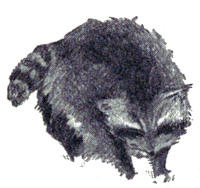
I have seen the turkey-buzzard sailing the skies on the bitterest winter days. To-day, however, could hardly be called winter. Indeed, nothing yet had felt the pinch of the cold. There was no hunger yet in the swamp, though this new snow had scared the raccoons out, and their half-human tracks along the margin of the swamp stream showed that, if not hungry, they at least feared that they might be.
For a coon hates snow. He will invariably sleep off the first light snowfalls, and even in the late winter he will not venture forth in fresh snow unless driven by hunger or some other dire need. Perhaps, like a cat or a hen, he dislikes the wetting of his feet. Or it may be that the soft snow makes bad hunting—for him. The truth is, I believe, that such a snow makes too good hunting for the dogs and the gunner. The new snow tells too clear a story. His home is no inaccessible den among the ledges; only a hollow in some ancient oak or tupelo. Once within, he is safe from the dogs, but the long fierce fight for life taught him generations ago that the nest-tree is a fatal trap when behind the dogs come the axe and the gun. So he has grown wary and enduring. He waits until the snow grows crusty, when without sign, and almost without scent, he can slip forth among the long shadows and prowl to the edge of dawn.
Skirting the stream out toward the higher back woods, I chanced to spy a bunch of snow in one of the great sour gums that I thought was an old nest. A second look showed me tiny green leaves, then white berries, then mistletoe.
It was not a surprise, for I had found it here before,—a long, long time before. It was back in my schoolboy days, back beyond those twenty years, that I first stood here under the mistletoe and had my first romance. There was no chandelier, no pretty girl, in that romance,—only a boy, the mistletoe, the giant trees, and the sombre silent swamp. Then there was his discovery, the thrill of deep delight, and the wonder of his knowledge of the strange unnatural plant! All plants had been plants to him until, one day, he read the life of the mistletoe. But that was English mistletoe; so the boy’s wonder world of plant life was still as far away as Mars, when, rambling alone through the swamp along the creek, he stopped under a big curious bunch of green, high up in one of the gums, and—made his first discovery.
So the boy climbed up again this Christmas Day at the peril of his precious neck, and brought down a bit of that old romance.
I followed the stream along through the swamp to the open meadows, and then on under the steep wooded hillside that ran up to the higher land of corn and melon fields. Here at the foot of the slope the winter sun lay warm, and here in the sheltered briery border I came upon the Christmas birds.
There was a great variety of them, feeding and preening and chirping in the vines. The tangle was a-twitter with their quiet, cheery talk. Such a medley of notes you could not hear at any other season outside a city bird store. How far the different species understood one another I should like to know, and whether the hum of voices meant sociability to them, as it certainly meant to me. Doubtless the first cause of their flocking here was the sheltered warmth and the great numbers of berry-laden bushes, for there was no lack either of abundance or variety on the Christmas table.
In sight from where I stood hung bunches of withering chicken or frost grapes, plump clusters of blue-black berries of the greenbrier, and limbs of the smooth winterberry bending with their flaming fruit. There were bushes of crimson ilex, too, trees of fruiting dogwood and holly, cedars in berry, dwarf sumac and seedy sedges, while patches on the wood slopes uncovered by the sun were spread with trailing partridge berry and the coral-fruited wintergreen. I had eaten part of my dinner with the ’possum; I picked a quantity of these wintergreen berries, and continued my meal with the birds. And they also had enough and to spare.
Among the birds in the tangle was a large flock of northern fox sparrows, whose vigorous and continuous scratching in the bared spots made a most lively and cheery commotion. Many of them were splashing about in tiny pools of snow-water, melted partly by the sun and partly by the warmth of their bodies as they bathed. One would hop to a softening bit of snow at the base of a tussock, keel over and begin to flop, soon sending up a shower of sparkling drops from his rather chilly tub. A winter snow-water bath seemed a necessity, a luxury indeed, for they all indulged, splashing with the same purpose and zest that they put into their scratching among the leaves.
A much bigger splashing drew me quietly through the bushes to find a marsh hawk giving himself a Christmas souse. The scratching, washing, and talking of the birds; the masses of green in the cedars, holly, and laurels; the glowing colors of the berries against the snow; the blue of the sky, and the golden warmth of the light made Christmas in the heart of the noon that the very swamp seemed to feel.
Three months later there was to be scant picking here, for this was the beginning of the severest winter I ever knew. From this very ridge, in February, I had reports of berries gone, of birds starving, of whole coveys of quail frozen dead in the snow; but neither the birds nor I dreamed to-day of any such hunger and death. A flock of robins whirled into the cedars above me; a pair of cardinals whistled back and forth; tree sparrows, juncos, nuthatches, chickadees, and cedar-birds cheeped among the trees and bushes; and from the farm lands at the top of the slope rang the calls of meadowlarks.
Halfway up the hill I stopped under a blackjack oak, where, in the thin snow, there were signs of something like a Christmas revel. The ground was sprinkled with acorn shells and trampled over with feet of several kinds and sizes,—quail, jay, and partridge feet; rabbit, squirrel, and mice feet, all over the snow as the feast of acorns had gone on. Hundreds of the acorns were lying about, gnawed away at the cup end, where the shell was thinnest, many of them further broken and cleaned out by the birds.
As I sat studying the signs in the snow, my eye caught a tiny trail leading out from the others straight away toward a broken pile of cord-wood. The tracks were planted one after the other, so directly in line as to seem like the prints of a single foot. “That’s a weasel’s trail,” I said, “the death’s-head at this feast,” and followed it slowly to the wood. A shiver crept over me as I felt, even sooner than I saw, a pair of small sinister eyes fixed upon mine. The evil pointed head, heavy but alert, and with a suggestion of fierce strength out of all relation to the slender body, was watching me from between the sticks of cord-wood. And so he had been watching the mice and birds and rabbits feasting under the tree!
I packed a ball of snow round and hard, slipped forward upon my knees, and hurled it. “Spat!” it struck the end of a stick within an inch of the ugly head, filling the crevice with snow. Instantly the head appeared at another crack, and another ball struck viciously beside it. Now it was back where it first appeared, and did not flinch for the next, nor the next ball. The third went true, striking with a “chug” and packing the crack. But the black, hating eyes were still watching me a foot lower down.
It is not all peace and good-will in the Christmas woods. But there is more of peace and good-will than of any other spirit. The weasels are few. More friendly and timid eyes were watching me than bold and murderous. It was foolish to want to kill—even the weasel. For one’s woods are what one makes them, and so I let the man with the gun, who chanced along, think that I had turned boy again, and was snowballing the woodpile, just for the fun of trying to hit the end of the biggest stick.
I was glad he had come. As he strode off with his stained bag I felt kindlier toward the weasel. There were worse in the woods than he,—worse, because all of their killing was pastime. The weasel must kill to live, and if he gloated over the kill, why, what fault of his? But the other weasel, the one with the blood-stained bag, he killed for the love of killing. I was glad he was gone.
The crows were winging over toward their great roost in the pines when I turned toward the town. They, too, had had good picking along the creek flats and ditches of the meadows. Their powerful wing-beats and constant play told of full crops and no fear for the night, already softly gray across the white silent fields. The air was crisper; the snow began to crackle under foot; the twigs creaked and rattled as I brushed along; a brown beech leaf wavered down and skated with a thin scratch over crust; and pure as the snow-wrapped crystal world, and sweet as the soft gray twilight, came the call of a quail.
The voices, colors, odors, and forms of summer were gone. The very face of things had changed; all had been reduced, made plain, simple, single, pure! There was less for the senses, but how much keener now their joy! The wide landscape, the frosty air, the tinkle of tiny icicles, and, out of the quiet of the falling twilight, the voice of the quail!
There is no day but is beautiful in the woods; and none more beautiful than one like this Christmas Day,—warm and still and wrapped, to the round red berries of the holly, in the magic of the snow.
III
A Cure for Winter
For, lo, the winter is past,
The rain is over and gone—
yet the snow lies white upon the fields, my little river huddles under the ice, and a new calendar hangs against the faded wall. But the storm is spent, the sun is out, there is a cheery drip, drip, drip from the eaves, eggs are sixty cents a dozen, and I am writing to the golden cackle of my hens. New Year’s Day, and winter gone! No, not quite gone, with eggs at such a price; still, it must be plain to every one that I can have but little of winter left: eggs are liable to come down any day.
It would be different, of course, were I buying eggs at sixty cents,—all the difference between a winter-sick and a winter-well condition. Selling eggs for sixty cents is a cure, though not for poverty when one has only thirty hens; but it is a cure for winter. The virtue, however, is not in the sixty cents. There is no cure for winter in mere money. The virtue is in the eggs, or, perhaps, it is really found in keeping the hens.
Keeping the hens, and the two pigs, the horse, the cow, the four boys, and the farm, for the year around, is a sure cure for winter, and for a great many other ills. In addition to the farm, one must have some kind of a salary, and a real love for nature; but given the boys and the farm, the love will come, for it lies dormant in human nature, as certain seeds seem to lie dormant in the soil; and as for the salary, one must have a salary—farm or flat.
The prescription, then, should read:—
℞
A small farm—of an acre or more,
A small income—of a thousand or more,
A small family—of four boys or more,
A real love of nature.
Sig. Morning and evening chores. The dose to be taken daily, as long as winter lasts.
This will cure. It is an old-fashioned household mixture that can be compounded in any country kitchen. But that is the trouble with it,—it is a home remedy that cannot be bought of the apothecary. There is more trouble with it, too, largely on account of the regularity with which milking time returns and the dose of chores. But it is effective. A farm and congenial chores are a sovereign cure for uncongenial time.
Here on the farm the signs of coming winter are not ominous signs. The pensive, mellowing days of early autumn have been preparing the garden and your mind for the shock of the first frost. Once past this and winter is welcome; it becomes a physical, spiritual need. The blood reddens at the promise of it; the soul turns comfortingly in and finds itself; and the digging of the potatoes commences, and the shocking of the corn, the picking of the apples, the piling up on the sunny side of the barn of the big golden squashes.
A single golden squash holds over almost enough of the summer to keep a long winter away from the farm; and the six of them in the attic, filling the rafter room with sunshine, never allow the hoary old monarch to show more than his face at the skylight. Pie is not the only thing one brings in with his winter squashes. He stores the ripe September in their wrinkled rinds, rinds that are ridged and bossy with the summer’s gold.
To dig one’s own potatoes! to shock one’s own corn! to pick one’s own apples! to pile one’s own squashes at one’s own barn! It is like filling one’s system with an antitoxin before going into a fever-plagued country. One is immune to winter after this, provided he stays to bake his apples in his own wood fire. One works himself into a glow with all this digging, and picking, and piling that lasts until warm weather comes again; and along with this harvest glow comes stealing over him the after-harvest peace. It is the serenity of Indian summer, the mood of the after-harvest season, upon him,—upon him and his fields and woods.
The stores are all in: the acorns have ripened and lie hidden where the squirrels will forget some of them, but where none of the forgotten will forget to grow; the winged seeds of the asters have drifted down the highways, over the hillsides and meadows; the birds are gone; the muskrats’ lodge is all but finished; the hickories and the leaf-hid hepaticas are budded against the coming spring. All is ready, all is safe,—the stores are all in. Quiet and a golden peace lie warm upon the fields. It is Indian summer.
Such a mood is a necessary condition for the cure. Such a mood is the cure, indeed, for such a mood means harmony with earth and sky, and every wind that blows. In all his physical life man is as much a part of Nature, and as subject to her inexorable laws, as the fields and the trees and the birds. I have seen a maple growing out of the pavement of a city street, but no such maple as stands yonder at the centre of my neighbor’s meadow. I lived and grew on the same street with the maple; but not as I live and grow here on the farm. Only on a farm does a man live in a normal, natural environment, only here can he comply with all the demands of Nature, can he find a cure for winter.
To Nature man is just as precious as a woodchuck or a sparrow, but not more. She cares for the woodchuck as long as he behaves like a woodchuck; so she cares for the sparrow, the oyster, the orchid, and for man. But he must behave like a natural man, must live where she intended him to live, and at the approach of winter he must neither hibernate nor migrate, for he is what the naturalists call a “winter resident.” It is not in his nature to fly away nor to go to sleep, but, like the red squirrel and the muskrat, to prepare to live up all the winter. So his original, unperverted animal instinct leads him to store.
Long ago he buried his provisions in pits and hung them up on poles. Even his vocabulary he gathered together as his word-hoard. He is still possessed of the remnant of the instinct; he will still store. Cage him in a city, give him more than he needs for winter, relieve him of all possibility of want, and yet he will store. You cannot cage an instinct nor eradicate it. It will be obeyed, if all that can be found in the way of pit and pole be a grated vault in the deep recesses of some city bank.
Cage a red squirrel and he will store in the cage; so will the white-footed mouse. Give the mouse more than he can use, put him in a cellar, where there is enough already stored for a city of mice, and he will take from your piles and make piles of his own. He must store or be unhappy and undone.
A white-footed mouse got into my cellar last winter and found it, like the cellar of the country mouse in the fable,—
Full benely stuffit, baith but and ben,
Of beirris and nuttis, peis, ry and quheit—
all of it, ready stored, so that,
Quhen ever scho list scho had aneuch to eit.
Enough to eat? Certainly; but is enough to eat all that a mouse wants? So far from being satisfied with mere meat was this particular mouse, that finding herself in the cellar in the midst of plenty, she at once began to carry my winter stores from where I had put them, and to make little heaps for herself in every dark cranny and corner of the cellar. A pint, or less, of “nuttis”—shagbarks—she tucked away in the toe of my hunting boot. The nuts had been left in a basket in the vegetable cellar; the boots stood out by the chimney in the furnace room, and there were double doors and a brick partition wall between. No matter. Here were the nuts she had not yet stored, and out yonder was the hole, smooth and deep and dark, to store them in. She found a way past the partition wall.
Every morning I shook those nuts out of my boot and sent them rattling over the cellar floor. Every night the mouse gathered them up and put them snugly back into the toe of the boot. She could not have carried more than one nut at a time,—up the tall boot-leg and down the oily, slippery inside. I should have liked to see her scurrying about the cellar, looking after her curiously difficult harvest. Apparently, they were new nuts to her every evening. Once or twice I came down to find them lying untouched. The mouse, perhaps, was away over night on other business. But the following night they were all gathered and nicely packed in the boot as before. And as before I sent them sixty ways among the barrels and boxes of the furnace room. But I did it once too often, for it dawned upon the mouse one night that these were the same old nuts that she had gathered now a dozen times; and that night they disappeared. Where? I wondered. Weeks passed, and I had entirely forgotten about the nuts, when I came upon them, the identical nuts of my boot, tiered carefully up in a corner of the deep, empty water-tank away off in the attic.
Store? The mouse had to store. She had to, not to feed her body,—there was plenty in the cellar for that,—but to satisfy her soul. A mouse’s soul, that something within a mouse which makes for more than meat, may not be a soul at all, but only a bundle of blind instincts. The human soul, that thing whose satisfaction is so often a box of chocolates and a silk petticoat, may be better and higher than the soul of a mouse, may be a different thing indeed; but originally it, too, had simple, healthful instincts; and among them, atrophied now, but not wholly gone, may still be found the desire for a life that is more than something to eat and something to put on.
To be sure, here on the farm, one may eat all of his potatoes, his corn, his beans and squashes before the long, lean winter comes to an end. But if squashes to eat were all, then he could buy squashes, bigger, fairer, fatter ones, and at less cost, no doubt, at the grocery store. He may need to eat the squash, but what he needs more, and cannot buy, is the raising of it, the harvesting of it, the fathering of it. He needs to watch it grow, to pick it, to heft it, and have his neighbor heft it; to go up occasionally to the attic and look at it. He almost hates to eat it.
A man may live in the city and buy a squash and eat it. That is all he can do with a boughten squash; for a squash that he cannot raise, he cannot store, nor take delight in outside of pie. And can a man live where his garden is a grocery? his storehouse a grocery? his bins, cribs, mows, and attics so many pasteboard boxes, bottles, and tin cans? Tinned squash in pie may taste like any squash pie; but it is no longer squash; and is a squash nothing if not pie? Oh, but he gets a lithograph squash upon the can to show him how the pulp looked as God made it. This is a sop to his higher sensibilities; it is a commercial reminder, too, that life even in the city should be more than pie,—it is also the commercial way of preserving the flavor of the canned squash, else he would not know whether he were eating squash or pumpkin or sweet potato. But then it makes little difference, all things taste the same in the city,—all taste of tin.
There is a need in the nature of man for many things,—for a wife, a home, children, friends, and a need for winter. The wild goose feels it, too, and no length of domesticating can tame the wild desire to fly when the frosts begin to fall; the woodchuck feels it; carry him to the tropics and still he will sleep as though the snows of New England lay deep in the mouth of his burrow. The partridge’s foot broadens at the approach of winter into a snowshoe; the ermine’s fur turns snow-white. Winter is in their bones; it is good for them; it is health, not disease—with snowshoes provided and snow-colored fur.
Nature supplies her own remedies. Winter brings its own cure,—snowshoes and snowy coats, short days and long nights, the narrowed round, the widened view, the open fire, leisure, quiet, and the companionship of your books, your children, your wife, your own strange soul—here on the farm.
Where else does it come, bringing all of this? Where else are conditions such that all weather is good weather? The weather a man needs? Here he is planted like his trees; his roots are in the soil; the changing seasons are his life. He feeds upon them; works with them; rests in them; yields to them, and finds in their cycle more than the sum of his physical needs.
A man lives quite without roots in a city, like some of the orchids, hung up in the air; or oftener, like the mistletoe, rooted, but drawing his life parasitically from some simpler, stronger, fresher life planted far below him in the soil. There he cannot touch the earth and feed upon life’s first sources. He knows little of any kind but bad weather. Summer is hot, winter is nasty, spring and autumn scarcely are at all, for they do not make him uncomfortable. The round year is four changes of clothes—and a tank-sprinkled, snow-choked, smoke-clouded, cobble-paved, wheel-wracked, street-scented, wire-lighted half-day, half-night something, that is neither spring, summer, autumn, nor winter.
A city is a sore on the face of Nature; not a dangerous, ugly sore, necessarily, if one can get out of it often enough and far enough, but a sore, nevertheless, that Nature will have nothing kindly to do with. The snows that roof my sheds with Carrara, that robe my trees with ermine, that spread close and warm over my mowing, that call out the sleds and the sleigh-bells, fall into the city streets as mud, as danger on the city roofs,—as a nuisance over the city’s length and breadth, a nuisance to be hauled off and dumped into the harbor as fast as shovels and carts can move it.
But you cannot dump your winter and send it off to sea. There is no cure for winter in a tip-cart; no cure in the city. There is consolation in the city, for there is plenty of company in the misery. But company really means more of the misery. If life is to be endured, if all that one can do with winter is to shovel it and suffer it, then to the city for the winter, for there one’s share of the shoveling is small, and the suffering there seems very evenly distributed.
Here on the farm is neither shoveling nor suffering, no quarrel whatever with the season. Here you have nothing to do with its coming or going further than making preparation to welcome it and to bid it farewell. You slide, instead, with your boys; you do up the chores early in the short twilight, pile the logs high by the blazing chimney and—you remember that there is to be a lecture to-night by the man who has said it all in his book; there is to be a concert, a reception, a club dinner, in the city, sixteen blissful miles away,—and it is snowing! You can go if you have to. But the soft tapping on the window-panes grows faster, the voices at the corners of the house rise higher, shriller. You look down at your slippers, poke up the fire, settle a little deeper into the big chair, and beg Eve to go on with the reading.
And she reads on—
Shut in from all the world without,
We sat the clean-winged hearth about,
Content to let the north wind roar
In baffled rage at pane and door,
While the red logs before us beat
The frost-line back with tropic heat;
And ever, when a louder blast
Shook beam and rafter as it passed,
The merrier up its roaring draught
The great throat of the chimney laughed.
•
•
•
•
•
•
•
•
•
And, for the winter fireside meet,
Between the andirons’ straddling feet,
The mug of cider simmered slow,
The apples sputtered in a row,
And, close at hand, the basket stood
With nuts from brown October’s wood.
But you will be snow-bound in the morning and cannot get to town? Perhaps; but it happened so only twice to me in the long snowy winter of 1904. So twice we read the poem, and twice we lived the poem, and twice? yes, a thousand times, we were glad for a day at home that wasn’t Sunday, for a whole long day to pop corn with the boys.
A farm, of all human habitations, is most of a home, and never so much of a home as in the winter when the stock and the crops are housed, when furrow and boundary fence are covered, when earth and sky conspire to drive a man indoors and to keep him in,—where he needs to stay for a while and be quiet.
No problem of city life is more serious than the problem of making in the city a home. A habitation where you can have no garden, no barn, no attic, no cellar, no chickens, no bees, no boys (we were allowed one boy by the janitor of our city flat), no fields, no sunset skies, no snow-bound days, can hardly be a home. To live in the fifth flat, at No. 6 West Seventh Street, is not to have a home. Pictures on the walls, a fire in the grate, and a prayer in blending zephyrs over the door for God to bless the place can scarcely make of No. 6 more than a sum in arithmetic. There is no home environment about this fifth flat at No. 6, just as there is none about cell No. 6, in the fifth tier of the west corridor of the Tombs.
The idea, the concept, home, is a house set back from the road behind a hedge of trees, a house with a yard, with flowers, chickens, and a garden,—a country home. The songs of home are all of country homes:—
How dear to this heart are the scenes of my childhood
When fond recollection presents them to view:
•
•
•
•
•
•
•
•
•
•
•
•
The gutter, the lamp-post, the curb that ran by it,
And e’en the brass spigot that did for a well.—
Impossible! You cannot sing of No. 6, West Seventh, fifth flight up. And what of a home that cannot be remembered as a song! It is not a home, but only a floor over your head, a floor under your feet, a hole in the wall of the street, a burrow into which you are dumped by a hoisting machine. It is warm inside; Eve is with you, and the baby, and your books. But you do not hear the patter of the rain upon the roof, nor the murmur of the wind in the trees; you do not see the sun go down beyond the wooded hills, nor ever feel the quiet of the stars. You have no largeness round about you; you are the centre of nothing; you have no garden, no harvest, no chores,—no home! There is not room enough about a city flat for a home, nor chores enough in city life for a living.
For a man’s life consisteth not in an abundance of things, but in the particular kind and number of his chores. A chore is a fragment of real life that is lived with the doing. All real living must be lived; it cannot be bought or hired. And herein is another serious problem in city life,—it is the tragedy of city life that it is so nearly all lived for us. We hire Tom, Dick, and Harry to live it; we buy it of the butcher, the baker, the candlestick-maker. It is not so here on the farm; for here one has the full round of life’s chores, and here, on a professor’s salary, one may do all the chores himself.
We may hire our praying and our thinking done for us and still live; but not our chores. They are to the life of the spirit what breathing and eating and sleeping are to the life of the body. Not to feed your own horse is to miss the finest joy of having a horse,—the friendship of the noble creature; not to “pick up” the eggs yourself, nor hoe your own garden, nor play with your own boys! Why, what is the use of having boys if you are never going to be “it” again, if you are not to be a boy once more along with them!
There are some things, the making of our clothes, perhaps, that we must hire done for us. But clothes are not primitive and essential; they are accidental, an adjunct, a necessary adjunct, it may be, but belonging to a different category from children, gardens, domestic animals, and a domestic home. And yet, how much less cloth we should need, and what a saving, too, of life’s selvage, could we return to the spinning-wheel and loom as we go back to the farm and the daily chores!
She, harvest done, to char work did aspire,
Meat, drink, and twopence were her daily hire.
And who has not known the same aspiration? has not had a longing for mere chores, and their ample compensation? It is such a reasonable, restful, satisfying aspiration! Harvest done! Done the work and worry of the day! Then the twilight, and the evening chores, and the soft closing of the door! At dawn we shall go forth again until the evening; but with a better spirit for our labor after the fine discipline of the morning chores. The day should start and stop in our own selves; labor should begin and come to an end in the responsibility of the wholesome, homely round of our own chores.
Summer is gone, the harvest is done, and winter is passing on its swiftest days. So swift, indeed, are the days that morning and evening meet, bound up like a sheaf by the circle of the chores. For there is never an end to the chores; never a time when they are all done; never a day when the round of them is not to be done again. And herein lies more of their virtue as a winter cure.
Life is not busier here than elsewhere; time is not swifter, but more enjoyable, because so much of life is left unfinished and time is thrown so much more into the future. There is no past on the farm; it is all to come; no sure defeat, but always promise; no settled winter, but always the signs of coming spring.
To-day is the first of January, snowy, brilliant, but dripping with the sound of spring wherever the sun lies warm, and calling with the heart of spring yonder where the crows are flocking. There is spring in the talk of the chickadees outside my window, and in the cheerful bluster of a red squirrel in the hickory. No bluebird has returned yet: spring is not here, not quite, I hope, but it is coming, and so near that I shall drop my pen and go out to the barn to put together some new beehives, for I must have them ready for the spring. Winter! The winter is almost gone. Why, it is barely a month since I brought my bees into the cellar, and here I am taking them out again—in prospect.
The hives have just come from the factory “in the flat”: sawed, planed, dovetailed, and matched,—a delightful set of big blocks,—ready to be nailed together. You feel a bit mean, keeping them from the children. But the oldest of the boys is only six, and he had a walking bear for Christmas. Besides, when you were a little boy you never had many blocks, and never a walking bear. So you keep the hives. And how suddenly the January day goes! You hammer on into the deepening dusk, and the chickens go to roost without their supper. You would have hammered on all night, but the hives ran out. Five hives won’t last very long; and you sigh as they stand finished. You could wish them all in pieces to do over again, so smooth the stock, so fragrant the piny smell, so accurate and nice the parts from cover to bottom board!
Winter! with January started, and February two days short! It is all a fiction. You had dreams of long evenings, of books and crackling fires, and of days shut in. It still snows; there is something still left of the nights, but not half enough, for the seed catalogues are already beginning to arrive.
The snow lies a foot deep over the strawberry bed and the frozen soil where the potatoes are to be. Yet the garden grows—on paper? No, not on paper, but in your own eager soul. The joy of a garden is as real in January as in June.
And so the winter goes. For if it is not the garden and the bees, it is some of a thousand other chores that keep you busy and living past the present,—and past the present is the spring.
I am watching for the phœbes to return to the shed,—they are my first birds. I long to hear the shrill piping of the March frogs, to pick a blue hepatica from beneath the pines; for these are some of the things, besides cheaper rent, more room, more boys, fresh air, quiet, and a cow, that one lives for here on the farm. But I am not waiting, winter-sick, for I have stored the summer in attic and cellar; I am already having my spring—in prospect; and as for the actual winter, the snow-bound days are all too few for the real winter joys of this simple, ample life, here in the quiet, among the neighbor fields.
IV
The Nature-Student
I
I had made a nice piece of dissection, a pretty demonstration—for a junior.
“You didn’t know a dog was put together so beautifully, did you?” said the professor, frankly enjoying the sight of the marvelous system of nerves laid bare by the knife. “Now, see here,” he went on, eyeing me keenly, “doesn’t a revelation like that take all the moonshine about the ‘beauties of nature’ clean out of you?”
I looked at the lifeless lump upon my table, and answered very deliberately: “No, it doesn’t. That’s a fearful piece of mechanism. I appreciate that. But what is any system of nerves or muscles—mere dead dog—compared with the love and affection of the dog alive?”
The professor was trying to make a biologist out of me. He had worked faithfully, but I had persisted in a very unscientific love for live dog. Not that I didn’t enjoy comparative anatomy, for I did. The problem of concrescence or differentiation in the cod’s egg also was intensely interesting to me. And so was the sight and the suggestion of the herring as they crowded up the run on their way to the spawning pond. The professor had lost patience. I don’t blame him.
“Well,” he said, turning abruptly, “you had better quit. You’ll be only a biological fifth wheel.”
I quit. Here on my table lies the scalpel. Since that day it has only sharpened lead pencils.
Now a somewhat extensive acquaintance with scientific folk leads me to believe that the attitude of my professor toward the out-of-doors is not exceptional. The love for nature is all moonshine, all maudlin sentiment. Even those like my professor, who have to do with out-of-door life and conditions,—zoölogists, botanists, geologists,—look upon naturalists, and others who love birds and fields, as of a kind with those harmless but useless inanities who collect tobacco tags, postage stamps, and picture postal cards. Sentiment is not scientific.
I have a biological friend, a professor of zoölogy, who never saw a woodchuck in the flesh. He would not know a woodchuck with the fur on from a mongoose. Not until he had skinned it and set up the skeleton could he pronounce it Arctomys monax with certainty. Yes, he could tell by the teeth. Dentition is a great thing. He could tell a white pine (strobus) from a pitch pine (rigida) by just a cone and a bundle of needles,—one has five, the other three, to the bundle. But he wouldn’t recognize a columned aisle of the one from a Jersey barren of the other. That is not the worst of it: he would not see even the aisle or the barren,—only trees.
As we jogged along recently, on a soft midwinter day that followed a day of freezing, my little three-year-old threw his nose into the air and cried: “Oh, fader, I smell de pitch pines, de scraggly pines,—’ou calls ’em Joisey pines!” And sure enough, around a double curve in the road we came upon a single clump of the scraggly pitch pines. Our drive had taken us through miles of the common white species.
Did you ever smell the pitch pines when they are thawing out? It is quite as healthful, if not as scientific, to recognize them by their resinous breath as by their needles per bundle.
I want this small boy some time to know the difference between these needle bundles. But I want him to learn now, and to remember always, that the hard days are sure to soften, and that then there oozes from the scraggly pitch pines a balm, a piny, penetrating, purifying balm,—a tonic to the lungs, a healing to the soul.
All foolishness? sentiment? moonshine?—this love for woods and fields, this need I have for companionship with birds and trees, this longing for the feel of grass and the smell of earth? When I told my biological friend that these longings were real and vital, as vital as the highest problems of the stars and the deepest questions of life, he pitied me, but made no reply.
He sees clearly a difference between live and dead men, a difference between the pleasure he gets from the society of his friends, and the knowledge, interesting as it may be, which he obtains in a dissecting-room. But he sees no such difference between live and dead nature, nature in the fields and in the laboratory. Nature is all a biological problem to him, not a quick thing,—a shape, a million shapes, informed with spirit,—a voice of gladness, a mild and healing sympathy, a companionable soul.
“But there you go!” he exclaims, “talking poetry again. Why don’t you deal with facts? What do you mean by nature-study, love for the out-of-doors, anyway!”
I do not mean a sixteen weeks’ course in zoölogy, or botany, or in Wordsworth. I mean, rather, a gentle life course in getting acquainted with the toads and stars that sing together, for most of us, just within and above our own dooryards. It is a long life course in the deep and beautiful things of living nature,—the nature we know so well as a corpse. It is of necessity a somewhat unsystematized, incidental, vacation-time course,—the more’s the pity. The results do not often come as scientific discoveries. They are personal, rather; more after the manner of revelations,—data that the professors have little faith in. For the scientist cannot put an April dawn into a bottle, cannot cabin a Hockomock marsh, nor cage a December storm in a laboratory. And when, in such a place, did a scientist ever overturn a “wee bit heap o’ weeds an’ stibble”? Yet it is out of dawns and marshes and storms that the revelations come; yes, and out of mice nests, too, if you love all the out-of-doors, and chance to be ploughing late in the fall.
But there is the trouble with my professor. He never ploughs at all. How can he understand and believe? And isn’t this the trouble with many of our preacher poets, also? Some of them spend their summers in the garden; but the true poet—and the naturalist—must stay later, and they must plough, plough the very edge of winter, if they would turn up what Burns did that November day in the field at Mossgiel.
How amazingly fortunate were the conditions of Burns’s life! What if he had been professor of English literature at Edinburgh University? He might have written a life of Milton in six volumes,—a monumental work, but how unimportant compared with the lines “To a Mouse”!
We are going to live real life and write real poetry again,—when all who want to live, who want to write, draw directly upon life’s first sources. To live simply, and out of the soil! To live by one’s own ploughing, and to write!
Instead, how do we live? How do I live? Nine months in the year by talking bravely about books that I have not written. Between times I live on the farm, hoe, and think, and write,—whenever the hoeing is done. And where is my poem to a mouse?
Its silly wa’s the win’s are strewin!
With a whole farm o’ foggage green, and all the year before me, I am not sure that I could build a single line of genuine poetry. But I am certain that, in living close to the fields, we are close to the source of true and great poetry, where each of us, at times, hears lines that Burns and Wordsworth left unmeasured,—lines that we at least may live into song.
Now, I have done just what my biological friend knew I would do,—made over my course of nature-study into a pleasant but idle waiting for inspiration. I have frankly turned poet! No, not unless Gilbert White and Jefferies, Thoreau, Burroughs, Gibson, Torrey, and Rowland Robinson are poets. But they are poets. We all are,—even the biologist, with half a chance,—and in some form we are all waiting for inspiration. The nature-lover who lives with his fields and skies simply puts himself in the way of the most and gentlest of such inspirations.
He may be ploughing when the spirit comes, or wandering, a mere boy, along the silent shores of a lake, and hooting at the owls. You remember the boy along the waters of Winander, how he would hoot at the owls in the twilight, and they would call back to him across the echoing lake? And when there would come a pause of baffling silence,
Then, sometimes, in that silence, while he hung
Listening, a gentle shock of mild surprise
Has carried far into his heart the voice
Of mountain-torrents; or the visible scene
Would enter unawares into his mind
With all its solemn imagery.
That is an inspiration, the kind of experience one has in living with the out-of-doors. It doesn’t come from books, from laboratories, not even from an occasional tramp afield. It is out of companionship with nature that it comes; not often, perhaps, to any one, nor only to poets who write. I have had such experiences, such moments of quiet insight and uplift, while in the very narrowest of the paths of the woods.
It was in the latter end of December, upon a gloomy day that was heavy with the oppression of a coming storm. In the heart of the maple swamp all was still and cold and dead. Suddenly, as out of a tomb, I heard the small, thin cry of a tiny tree frog. And how small and thin it sounded in the vast silences of that winter swamp! And yet how clear and ringing! A thrill of life tingling out through the numb, nerveless body of the woods that has ever since made a dead day for me impossible.
That was an inspiration. I learned something, something deep and beautiful. Had I been Burns or Wordsworth I should have written a poem to Hyla. All prose as I am, I was, nevertheless, so quickened by that brave little voice as to write:—
The fields are bleak, the forests bare,
The swirling snowflakes fall
About the trees a winding-sheet,
Across the fields a pall.
A wide, dead waste, and leaden sky,
Wild winds, and dark and cold!
The river’s tongue is frozen thick,
With life’s sweet tale half told.
Dead! Ah, no! the white fields sleep,
The frozen rivers flow;
And summer’s myriad seed-hearts beat
Within this breast of snow.
With spring’s first green the holly glows
And flame of autumn late,—
The embers of the summer warm
In winter’s roaring grate.
The thrush’s song is silent now,
The rill no longer sings,
But loud and long the strong winds strike
Ten million singing strings.
O’er mountains high, o’er prairies far,
Hark! the wild pæan’s roll!
The lyre is strung ’twixt ocean shores
And swept from pole to pole!
My meeting with that frog in the dead of winter was no trifling experience, nor one that the biologist ought to fail to understand. Had I been a poet, that meeting would have been of consequence to all the world; as I was, however, it meant something only to me,—a new point of view, an inspiration,—a beautiful poem that I cannot write.
This attitude of the nature-lover, because it is contemplative and poetical, is not therefore mystical or purely sentimental. Hooting at the owls and hearing things in baffling silences may not be scientific. Neither is it unscientific. The attitude of the boy beside the starlit lake is not that of Charlie, the man who helps me occasionally on the farm.
We were clearing up a bit of mucky meadow recently when we found a stone just above the surface that was too large for the horse to haul out. We decided to bury it.
Charlie took the shovel and mined away under the rock until he struck a layer of rather hard sandstone. He picked a while at this, then stopped a while; picked again, rather feebly, then stopped and began to think about it. It was hard work,—the thinking, I mean, harder than the picking,—but Charlie, however unscientific, is an honest workman, so he thought it through.
“Well,” he said finally, “‘t ain’t no use, nohow. You can’t keep it down. You bury the darned thing, and it’ll come right up. I suppose it grows. Of course it does. It must. Everything grows.”
Now that is an unscientific attitude. But that is not the mind of the nature-lover, of the boy with the baffling silences along the starlit lake. He is sentimental, certainly, yet not ignorant, nor merely vapid. He does not always wander along the lake by night. He is a nature-student, as well as a nature-lover, and he does a great deal more than hoot at the owls. This, though, is as near as he comes to anything scientific, and so worth while, according to the professor.
II
And it is as near as he ought to come to reality and facts—according to the philosopher.
“We want only the facts of nature,” says the scientist. “Nothing in nature is worth while,” says the philosopher, “but mood, background, atmosphere.”
“Nor can I recollect that my mind,” says one of our philosophers, “in these walks, was much called away from contemplation by the petty curiosities of the herbalist or birdlorist, for I am not one zealously addicted to scrutinizing into the minuter secrets of nature. It never seemed to me that a flower was made sweeter by knowing the construction of its ovaries.... The wood thrush and the veery sing as melodiously to the uninformed as to the subtly curious. Indeed, I sometimes think a little ignorance is wholesome in our communion with nature.”
So it is. Certainly if ignorance, a great deal of ignorance, were unwholesome, then nature-study would be a very unhealthy course, indeed. For, when the most curious of the herbalists and birdlorists (Mr. Burroughs, say) has made his last prying peep into the private life of a ten-acre woodlot, he will still be wholesomely ignorant of the ways of nature. Is the horizon just back of the brook that marks the terminus of our philosopher’s path? Let him leap across, walk on, on, out of his woods to the grassy knoll in the next pasture, and there look! Lo! far yonder the horizon! beyond a vaster forest than he has known, behind a range of higher rolling hills, within a shroud of wider, deeper mystery.
There isn’t the slightest danger of walking off the earth; nor of unlearning our modicum of wholesome ignorance concerning the universe. The nature-lover may turn nature-student and have no fear of losing nature. The vision will not fade.
Let him go softly through the May twilight and wait at the edge of the swamp. A voice serene and pure, a hymn, a prayer, fills all the dusk with peace. Let him watch and see the singer, a brown-winged wood thrush, with full, spotted breast. Let him be glad that it is not a white-winged spirit, or a disembodied voice. And let him wonder the more that so plain a singer knows so divine a song.
Our philosopher mistakes his own dominant mood for the constant mood of nature. But nature has no constant mood. No more have we. Dawn and dusk are different moods. The roll of the prairie is unlike the temper of a winding cowpath in a New England pasture. Nature is not always sublime, awful, and mysterious; and no one but a philosopher is persistently contemplative. Indeed, at four o’clock on a June morning in some old apple orchard, even the philosopher would shout,—
“Hence, loathèd melancholy!”
He is in no mind for meditation; and it is just possible, before the day is done, that the capture of a drifting seed of the dandelion and the study of its fairy wings might so add to the wonder, if not to the sweetness, of the flower, as to give him thought for a sermon.
There are times when the companionship of your library is enough; there are other times when you want a single book, a chapter, a particular poem. It is good at times just to know that you are turning with the earth under the blue of the sky; and just as good again to puzzle over the size of the spots in the breasts of our several thrushes. For I believe you can hear more in the song when you know it is the veery and not the wood thrush singing. Indeed, I am acquainted with persons who had lived neighbors to the veery since childhood, and never had heard its song until the bird was pointed out to them. Then they could not help but hear.
No amount of familiarity will breed contempt for your fields. Is the summer’s longest, brightest day long enough and bright enough, to dispel the brooding mystery of the briefest of its nights? And tell me, what of the vastness and terror of the sea will the deep dredges ever bring to the surface, or all the circumnavigating drive to shore? The nature-lover is a man in a particular mood; the nature-student is the same man in another mood, as the fading shadows of the morning are the same that lengthen and deepen in the afternoon. There are times when he will go apart into the desert places to pray. Most of the time, however, he will live contentedly within sound of the dinner horn, glad of the companionship of his bluebirds, chipmunks, and pine trees.
This is best. And the question most frequently asked me is, How can I come by a real love for my pine trees, chipmunks, and bluebirds? How can I know real companionship with nature?
How did the boy along the starlit lake come by it,—a companionship so real and intimate that the very cliffs knew him, that the owls answered him, that even the silences spoke to him, and the imagery of his rocks and skies became a part of the inner world in which he dwelt? Simply by living along Winander and hallooing so often to the owls that they learned to halloo in reply. You may need to be born again before you can talk the language of the owls; but if there is in you any hankering for the soil, then all you need for companionship with nature is a Winander of your own, a range, a haunt, that you can visit, walk around, and get home from in a day’s time. If this region can be the pastures, woodlots, and meadows that make your own door-yard, then that is good; especially if you buy the land and live on it, for then Nature knows that you are not making believe. She will accept you as she does the peas you plant, and she will cherish you as she does them. This farm, or haunt, or range, you will come to know intimately: its flowers, birds, walls, streams, trees,—its features large and small, as they appear in June, and as they look in July and in January.
For the first you will need the how-to-know books,—these while you are getting acquainted; but soon acquaintance grows into friendship. You are done naming things. The meanings of things now begin to come home to you. Nature is taking you slowly back to herself. Companionship has begun.
Many persons of the right mind never know this friendship, because they never realize the necessity of being friendly. They walk through a field as they walk through a crowded street; they go into the country as they go abroad. And the result is that all this talk of the herbalist and birdlorist, to quote the philosopher again, seems “little better than cant and self-deception.”
But let the philosopher cease philosophizing (he was also a hermit), and leave off hermiting; let him live at home with his wife and children, like the rest of us; let him work in the city for his living, hoe in his garden for his recreation; and then (I don’t care by what prompting) let him study the lay of his neighbor fields, woods, and orchards until he knows every bird and beast, every tree-hole, earth-hole, even the times and places of the things that grow in the ground; let him do this through the seasons of the year,—for two or three years,—and he will know how to enjoy a woodchuck; he will understand many of the family affairs of his chipmunks; he will recognize and welcome back his bluebirds; he will love and often listen to the solemn talk of his pines.
All of this may be petty prying, not communion at all; it may be all moonshine and sentiment, not science. But it is not cant and self-deception,—in the hearts of thousands of simple, sufficient folk, who know a wood thrush when they hear him, and whose woodpaths are of their own wearing. And if it is not communion with nature, I know that it is at least real pleasure, and rest, peace, contentment, red blood, sound sleep, and, at times, it seems to me, something close akin to religion.
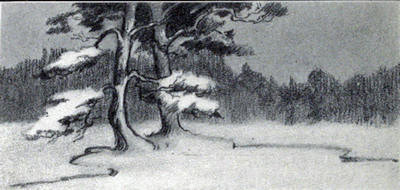
V
Chickadee
Once (it was a good while ago, when I was a boy), I tried to write a poem. The first stanza ran:—
I heard him when the reeds were young
Along a clover sea;
Above the purple waves he hung,
And o’er the fragrant waters flung
His storm of ecstasy;
and the last stanza ran:—
He’s left the meadows burnt and hot,
He’s left me lone and drear;
But still within the white-birch lot
Cheeps Chickadee—whom I forgot
While Bobolink was here;
which means in plainer prose that chickadee does not sing a while in June and then fly away and leave us. He stays the year around; he is constant and faithful in his friendship, though I sometimes forget.
He cannot sing with bobolink. But suppose I could have only one of the birds? As it is, I get along for more than half the year without bobolink, but what would my out-of-doors be without chickadee? There is not a single day in the year that I cannot find him, no matter how hot, or cold, how hard it rains or snows. Often he is the only voice in all the silent woods, the only spark of life aglow in all my frozen winter world.
I was crunching along through the January dusk toward home. The cold was bitter. A half-starved partridge had just risen from the road and fluttered off among the naked bushes,—a moment of sound, a bit of life vanishing in the winter night of the woods. I knew the very hemlock in which he would roost; but what were the thick, snow-bent boughs of his hemlock, and what were all his winter feathers in such a night as this?—this vast of sweeping winds and frozen snow!
The road dipped from the woods into a meadow, where the winds were free. The cold was driving, numbing here with a power for death that the thermometer could not mark. I backed into the wind and hastened on toward the double line of elms that arched the road in front of the house. Already I could hear them creak and rattle like things of glass. It was not the sound of life. Nothing was alive; for what could live in this long darkness and fearful cold?
Could live? The question was hardly thought, when an answer was whirled past me into the nearest of the naked elms. A chickadee! He caught for an instant on a dead limb over the road, scrambled along to its broken tip, and whisked over into a hole that ran straight down the centre of the stub, down, for I don’t know how far.
I stopped. The stub lay out upon the wind, with only an eddy of the gale sucking at the little round hole in the broken end, while far down in its hollow heart, huddling himself into a downy, dozy ball for the night, was the chickadee. I know by the very way he struck the limb and turned in that he had been there before. He knew whither, across the sweeping meadows, he was being blown. He had even helped the winds as they whirled him, for he had tarried along the roads till late. But he was safe for the night now, in the very bed, it may be, where he was hatched last summer, and where at this moment, who knows, were half a dozen other chickadees, the rest of that last summer’s brood, unscathed still, and still sharing the old home hollow, as snug and warm this bitter night as in the soft May days when they were nestlings here together.
The cold drove me on; but the chickadee had warmed me and all my naked world of night and death. And so he ever does. The winter has yet to be that drives him seeking shelter to the south. I never knew it colder than in January and February of 1904. During both of those months, morning and evening, I drove through a long mile of empty, snow-buried woods. For days at a time I would not see even a crow, but morning and evening, at a certain dip in the road, two chickadees would fly from bush to bush across the hollow and cheer me on the way. They came out to the road, really, to pick up whatever scanty crumbs were to be found in my wake. They came also to hear me, to see me pass,—to escape for a moment, I think, the silence, desertion, and death of the woods. They helped me to escape, too.
Four other chickadees, all winter long, ate with us, sharing, as far as the double windows would allow, the cheer of our dining-room. We served them on the lilac bush outside the window, tying their suet on so that they could see us and we them during meal time. Perhaps it was mere suet, no feast of soul at all, that they got; but constantly, when our pie was opened, the birds began to sing,—a dainty dish indeed, savory, wholesome, and good for our souls.
There are states in the far Northwest where the porcupine is protected by law, as a last food resource for men lost and starving in the forests. Perhaps the porcupine was not designed by nature for any such purpose. Perhaps chickadee was not left behind by summer to feed our lost and starving hope through the cheerless months. But that is the use I make of him. He is summer’s pledge to me. The woods are hollow, the winds chill, the earth cold and stiff, but there flits chickadee, and—I cannot lose faith, nor feel that this procession of bleak white days is all a funeral!
He is the only bird in my little world that I can find without fail three hundred and sixty-five days in the year. From December to the end of March he comes daily to my lilac bush for suet; from April to early July he is busy with domestic cares in the gray birches of the woodlot; from August to December he and his family come hunting quietly and sociably as a little flock among the trees and bushes of the farm; and from then on he is back for his winter meals at “The Lilac.”
Is it any wonder that he was the first bird I ever felt personally acquainted with, and the first bird my children knew? That early acquaintance, however, was not due to his abundance and intrusion, as it might be with the English sparrow, but rather due to the cheerful, confiding, sociable spirit of the little bird. He drops down and peeps under your hat-brim to see what manner of boy you are, and if you are really fit to be abroad in this world, so altogether good—for chickadees.
He has a mission to perform besides the eating of eggs and grubs of the pestiferous insects. This destruction he does that the balance of things may be maintained out of doors. He has quite another work to do, which is not economic, and which, in nowise, is a matter of fine feathers or sweet voice, but simply a matter of sweet nature, vigor, and concentrated cheerfulness.
I said he is summer’s pledge, the token of hope to me. He is a lesson also. I don’t often find sermons in stones, because, no doubt, I look so little for the sermons, so little for the very stones. But I cannot help seeing chickadee,—and chickadee is all sermon. I hear him on a joyous May morning calling Chick-a-dee! dee! Chick-a-dee! dee!—brisk, bright, and cheery; or, soft and gentle as a caress, he whistles, Phœ-ee-bee! Phœ-ee-bee! I meet him again on the edge of a bleak, midwinter night. He is hungry and cold, and he calls, as I hasten along, Chick-a-dee! dee! Chick-a-dee! dee!—brisk, bright, and cheery; or, soft and gentle as a caress, he whistles, Phœ-ee-bee! Phœ-ee-bee!
Will you lend me your wings, chickadee, those invisible wings on which you ride the winds of life so evenly? For I would hang my ill-balanced soul between them, as your bird soul hangs, and fly as you fly.
The abundant summer, the lean and wolfish winter, find chickadee cheerful and gentle. He is busier at some seasons than at others, with fewer chances for friendship. He almost disappears in the early summer. But this is because of family cares; and because the bigger, louder birds have come back, and the big leaves have come out and hidden him. A little searching, and you will discover him, in one of your old decayed fence posts, maybe, or else deep in the swamp, foraging for a family so numerous that they spill over at the door of their home.
Here about the farm, this is sure to be a gray birch home. Other trees will do—on a pinch. I have found chickadee nesting in live white oaks, maples, upturned roots, and tumbling fence posts. These were shifts, however, mere houses, not real homes. The only good homelike trees are old gray birches dead these many years and gone to punk,—mere shells of tough circular bark walls.
Why has chickadee this very decided preference? Is it a case of protective coloration,—the little gray and black bird choosing to nest in this little gray and black tree because bird and tree so exactly match each other in size and color? Or (and there are many instances in nature) is there a subtle strain of poetry in chickadee’s soul, something æsthetic, that leads him into this exquisite harmony,—into this little gray house for his little gray self?
Explain it as you may, it is a fact that this little bird shows a marked preference, makes deliberate choice, and in his choice is protection, and poetry, too. Doubtless he follows the guidance of a sure and watchful instinct (whatever instinct be), but who shall deny to him a share of the higher, finer things of the imagination? a share of real æsthetic taste?
His life inside the birch is of a piece with the artistic exterior. It is all gentle and sweet and idyllic. There is no happier spot in the summer woods than that about the birch of the chickadees; and none whose happiness you will be so little liable to disturb.
Before the woods were in leaf one spring I found a pair of chickadees building in a birch along the edge of the swamp. They had just begun, having dug out only an inch of cavity. It was very interesting to discover them doing the work themselves, for usually they refit some abandoned chamber or adapt a ready-made hole.
The birch was a long, limbless cylinder of bark, broken off about fourteen feet up, and utterly rotten, the mere skin of a tree stuffed with dust. I could push my finger into it at any point. It was so weak that every time the birds lighted upon the top the whole stub wobbled and reeled. Surely they were building their house upon the sand. Any creature without wings would have known that. Birds, however, seem to have lost the sense of such insecurity, often placing their nests as if they expected them also to take wings and fly to safety when the rains descend and the winds come.
This shaking stub of the chickadees was standing directly beneath a great overshadowing pine, where, if no partridge bumped into it, if two squirrels did not scamper up it together, if the crows nesting overhead did not discover it, if no strong wind bore down upon it from the meadow side, it might totter out the nesting season. But it didn’t. The birds were leaving too much to luck. I knew it, and should have pushed their card house down, then and there, and saved the greater ruin later. Perhaps so, but I was too interested in their labor.
Both birds were working when I discovered them, and so busily that my coming up did not delay them for a single billful. It was not hard digging, but it was very slow, for chickadee is neither carpenter nor mason. He has difficulty in killing a hard-backed beetle. So, whenever you find him occupying a clean-walled cavity, with a neat, freshly clipped doorway, you may be sure that some woodpecker built the house, not this short-billed, soft-tailed little tit. He lacks both the bill-chisel and the tail-brace. Perhaps the explanation of his fondness for birch trees lies here: they die young and soon decay.
The birds were going down through the top, not by a hole in the leathery rind of the sides, for the bark would have been too tough for their beaks. They would drop into the top of the stub, pick up a wad of decayed wood, and fly off to the dead limb of the pine. Here, with a jerk and a snap of their bills, they would scatter the stuff in a shower so thin and far around that I could neither hear it fall nor find a trace of it upon the dead leaves of the ground. This nest would never be betrayed by the workmen’s chips.
Between the pair there averaged three beakfuls of excavating every two minutes, one of the birds regularly shoveling twice to the other’s once. They looked so exactly alike that I could not tell which bird was pushing the enterprise; but I have my suspicions.
There is nothing so superior about his voice or appearance that he should thus shirk. He was doing part of his duty, apparently, but it was half-hearted work. Hers was the real interest, the real anxiety; and hers the initiative. To be a male and show off! That’s the thing. To be a male and let your wife carry the baby! The final distinctive difference between a truly humanized, civilized man and all other males of every order, is a willingness to push the baby carriage.
The finer the feathers or the song among male birds the less use they are in practical, domestic ways. Fine beaux, captivating lovers, they become little else than a nuisance as husbands. One of my friends has been watching a pair of bluebirds building. The male sat around for a week without bringing in a feather. Then one day he was seen to enter the hole, after his busy mate had just left it, and carry out a beakful of grass which he scattered to the winds in pure perversity, criticising her bungling work, maybe! More likely he was jealous.
Chickadee was no such precious fool as that. He was doing something; trying to drown his regret for the departing honeymoon in hard labor, not, however, to the danger of his health.
I sat a long time watching the work. It went on in perfect silence, not a chirp, not the sound of a fluttering wing. The swamp along whose margin the birds were building had not a joyous atmosphere. Damp, dim-shadowed, and secret, it seemed to have laid its spell upon the birds. Their very gray and black was as if mixed of the dusk, and of the gray, half-light of the swamp; their noiseless coming and going was like the slipping to and fro of shadows. They were a part of it all, and that sharing was their defense, the best defense they knew.
It didn’t save their nest, however. They felt and obeyed the spirit of the swamp in their own conduct, but the swamp did not tell them where to build. It was about three weeks later that I stopped again under the pine and found the birch stub in pieces upon the ground. Some robber had been after the eggs and had brought the whole house tumbling down. This is not the fate of all such birch-bark houses. Now and again they escape; but it is always a matter for wonder.
I was following an old disused wood road once when I scared a robin from her nest. Her mate joined her, and together they raised a great hubbub. Immediately a chewink, a pair of vireos, and two black and white warblers joined the robins in their din. Then a chickadee appeared. He (I say “he” knowingly; and here he quite redeems himself) had a worm in his beak. His anxiety seemed so real that I began to watch him, when, looking down among the stones for a place to step, what should I see but his mate emerging from the end of a birch stump at my very feet. She had heard the din and had come out to see what it was all about. At sight of her, he hastened with his worm, brushing my face, almost, as he darted to her side. She took it sweetly, for she knew he had intended it for her. But how do I know that? Perhaps he meant it for the young! There were no young in the nest, only eight eggs. Even after the young came (there were eight of them!), and when life, from daylight to dark, was one ceaseless, hurried hunt for worms, I saw him over and over again fly to her side caressingly and tempt her to eat.
The house of this pair did not fall. How could it when it stood precisely two and a half feet from the ground! But that it wasn’t looted is due to the sheer audacity of its situation. It stood alone, against the road, so close that the hub of a low wheel in passing might have knocked it down. Perhaps a hundred persons had brushed it in going by. How many dogs and cats had overlooked it no one can say, nor how many skunks and snakes and squirrels. The accident that discovered it to me happened apparently to no one else, and I was friendly.
Cutting a tiny window in the bark just above the eggs, I looked in upon the little people every day. I watched them grow and fill the cavity and hang over at the top. I was there the day they forced my window open, the day when there was no more room at the top, and when, at the call of their parents, one after another of this largest and sweetest of bird families found his wings and flew away through the woods.
VI
The Missing Tooth
The snow had melted from the river meadows, leaving them flattened, faded, and stained with mud,—a dull, dreary waste in the gray February. I had stopped beside a tiny bundle of bones that lay in the matted grass a dozen feet from a ditch. Here, still showing, was the narrow path along which the bones had dragged themselves; there the hole by which they had left the burrow in the bank of the ditch. They had crawled out in this old runway, then turned off a little into the heavy autumn grass and laid them down. The rains had come and the winter snows. The spring was breaking now, and the small bundle, gently loosened and uncovered, was whitening on the wide, bare meadow.
I had recognized the bones at once as the skeleton of a muskrat. It was something peculiar in the way they lay that had caused me to pause. They seemed outstretched, as if composed by gentle hands, the hands of Sleep. They had not been flung down. The delicate ribs had fallen in, but not a bone was broken or displaced, not one showed the splinter of shot, or the crack that might have been made by a steel trap. No violence had been done them. They had been touched by nothing rougher than the snow. Out into the hidden runway they had crept. Death had passed them here; but no one else in all the winter months.
The creature had died—a “natural” death. It had starved, while a hundred acres of plenty lay round about. Picking up the skull, I found the jaws locked together as if they were a single solid bone. One of the two incisor teeth of the upper jaw was missing, and apparently had never developed. The opposite tooth on the lower jaw, thus unopposed and so unworn, had grown beyond its normal height up into the empty socket above, then on, turning outward and piercing the cheek-bone in front of the eye, whence, curving like a boar’s tusk, it had slowly closed the jaws and locked them, rigid, set, as fixed as jaws of stone.
Death had lingered cruelly. At first the animal had been able to gnaw; but as the tooth curved through the bones of the face and gradually tightened the jaws, the creature got less and less to eat, until, one day, creeping out of the burrow for food, the poor wretch was unable to get back.
One seldom comes upon the like of this. It is commoner than we think; but it is usually hidden away and quickly over. How often do we see a wild thing sick,—a bird or animal suffering from an accident, or dying, like this muskrat, because of some physical defect? The struggle between two lives for life—the falling of the weak as prey to the strong—is ever before us; but this single-handed fight between the creature and Nature is a far rarer, silenter tragedy. Nature is too swift, too merciless to allow us time for sympathy. It was she who taught the old Roman to take away his weak and malformed offspring and expose it on the hills.
There is, at best, scarcely a fighting chance in the meadow. Only strength and craft may win. The muskrat with the missing tooth never enters the race at all. He slinks from some abandoned burrow, and, if the owl and mink are not watching, dies alone in the grass, and we rarely know.
I shall never forget the impression made upon me by those quiet bones. It was like that made by my first visit to a great city hospital,—out of the busy, cheerful street into a surgical ward, where the sick and injured lay in long white lines. We tramp the woods and meadows and never step from the sweet air and the pure sunlight of health into a hospital. But that is not because no sick, ill-formed, or injured are there. The proportion is smaller than among us humans, and for very good reasons, yet there is much real suffering, and to come upon it, as we will, now and then, must certainly quicken our understanding and deepen our sympathy with the life out of doors.
No sensible person could for a moment believe the animals capable of suffering as a human being can suffer, or that there is any such call for our sympathy from them as from our human neighbors. But an unselfish sharing of the life of the fields demands that we take part in all of it,—and all of it is but little short of tragedy. Nature wears a brave face. Her smile is ever in the open, her laughter quick and contagious. This brave front is no mask. It is real. Sunlight, song, color, form, and fragrance are real. And so our love and joy in Nature is real. Real, also, should be our love and sorrow with Nature. For do I share fully in as much of her life as even the crow lives as long as I think of the creature only with admiration for his cunning or with wrath for his destruction of my melons and corn?
A crow has his solemn moments. He frequently knows fear, pain, hunger, accident, and disease; he knows something very like affection and love. For all that, he is a mere crow. But a mere crow is no mean thing. Few of us, indeed, are ourselves, and as much besides as a mere crow. A real love, however, will give us part in all of his existence. We will forage and fight with him; we will parley and play; and when the keen north winds find him in the frozen pines, we will suffer, too.
With Nature as mere waters, fields, and skies, it is, perhaps, impossible for us to sorrow. She is too self-sufficient, too impersonal. She asks, or compels, everything except tears. But when she becomes birds and beasts,—a little world of individuals among whom you are only one of a different kind,—then all the others, no matter their kind, are earth-born companions and fellow mortals.
Here are the meadow voles. I know that my hay crop is shorter every year for them,—a very little shorter. And I can look with satisfaction at a cat carrying a big bobtailed vole out of my mowing. The voles are rated, along with other mice, as injurious to man. I have an impulse to plant both of my precious feet upon every one that stirs in its runway.
If that feeling was habitual once, it is so no longer; for now it is only when the instincts of the farmer get the better of me that I spring at this quiet stir in the grass. Perhaps, long ago, my forbears wore claws, like pussy; and, perhaps (there isn’t the slightest doubt), I should develop claws if I continued to jump at every mouse in the grass because he is a mouse, and because I have a little patch of mucky land in hay.
One day I came upon two of my voles struggling in the water. They were exhausted and well-nigh dead. I helped them out as I should have helped out any other creature, and having saved them, why, what could I do but let them go—even into my own meadow? This has happened several times.
When the drought dries the meadow, the voles come to the deep, walled spring at the upper end, apparently to drink. The water usually trickles over the curb, but in a long dry spell it shrinks a foot or more below the edge, and the voles, once within for their drink, cannot get out. Time and time again I had fished them up, until I thought to leave a board slanting down to the water, so that they could climb back to the top.
It is stupid and careless to drown thus. The voles are blunderers. White-footed mice and house mice are abundant in the stumps and grass of the vicinity, but they never tumble into the spring. Still, I am partly responsible for the voles, for I walled up the spring and changed it into this trap. I owe them the drink and the plank, for certainly there are rights of mice, as well as of men, in this meadow of mine, where I do little but mow. But even if they have no rights, surely
A daimen icker in a thrave
’S a sma’ request
for such of them as the foxes, cats, skunks, snakes, hawks, and owls leave! Rights or no, hay or no, I don’t jump at my meadow mice any more, for fear of killing one who has taken a cup of cold water from me off the plank, or has had my helping hand out of the depths of the spring.
It is wholesome to be the good Samaritan to a meadow mouse, to pour out, even waste, a little of the oil and wine of sympathy on the humblest of our needy neighbors.
Here are the chimney swallows. One can look with complacency, with gratitude, indeed, upon the swallows of other chimneys, as they hawk in the sky; yet, when the little creatures, so useful, but so uncombed and unfumigated, set up their establishments in your chimney, to the jeopardy of the whole house, then you need an experience like mine.
I had had a like experience years before, when the house did not belong to me. Now, however, the house was mine, and if it became infested because of the swallows, I could not move away; so I felt like burning them in the chimney, bag and baggage. There were four nests, as nearly as I could make out, and, from the frequent squeakings, I knew they were all filled with young. Then one day, when the birds were feathered and nearly ready to fly, there came a rain that ran wet far down the sooty chimney, loosened the mortar of the nests, and sent them crashing into the fireplace.
Some of the young birds were killed outright; the others were at my mercy, flung upon me,—helpless, wailing infants! Of course I made it comfortable for them on the back-log, and let their mothers flutter down unhindered to feed them. Had I understood the trick, I would have hawked for them and helped feed them myself.
They made a great thunder in the chimney; they rattled down into the living-room a little soot; but nothing further came of it. We were not quarantined. On the contrary, we had our reward, according to promise; for it was an extremely interesting event to us all. It dispelled some silly qualms, it gave us intimate part in a strange small life, so foreign, yet so closely linked to our own, and it made us pause with wonder that even our empty, sooty chimney could be made use of by Nature to our great benefit.
I wonder if the nests of the chimney swallows came tumbling down when the birds used to build in caves and hollow trees? It is a most extraordinary change, this change from the trees to the chimneys, and it does not seem to have been accompanied by an increase of architectural wisdom necessary to meet all the contingencies of the new hollow. The mortar or glue, which, I imagine, held firmly in the empty trees, will not mix with the chimney soot, so that the nest, especially when crowded with young, is easily loosened by the rain, and is sometimes even broken away by the slight wing-stroke of a descending swallow, or by the added weight of a parent bird as it settles with food.
We little realize how frequent fear is among the birds and animals, nor how often it proves fatal. A situation which would have caused no trouble ordinarily, becomes through sudden fright a tangle or a trap. I have known many a quail to bolt into a fast express train and fall dead. Last winter I left the large door of the barn open, so that my flock of juncos could feed inside upon the floor. They found their way into the hayloft, and went up and down freely. On two or three occasions I happened in so suddenly that they were thoroughly frightened, and flew madly into the cupola to escape through the windows. They beat against the glass until utterly dazed, and would have perished there, had I not climbed up later and brought them down. So thousands of the migrating birds perish yearly by flying wildly against the dazzling lanterns of the lighthouses, and thousands more lose their way in the thick darkness of the stormy nights, or are blown out of their course, and drift away to sea.
Hasty, careless, miscalculated movements are not as frequent among the careful wild folk as among us, perhaps; but there is abundant evidence of their occasional occurrence and of their sometimes fatal results.
Several instances are recorded of birds that have been tangled in the threads of their nests; and one case of a bluebird that was caught in the flying meshes of an oriole’s nest into which it had been spying.
I once found the mummied body of a chippy twisting and swinging in the leafless branches of a peach tree. The little creature was suspended in a web of horsehair about two inches below the nest. It looked as if she had brought a snarled bunch of the hair and left it loose in the twigs. Later on, a careless step and her foot was fast, when every frantic effort for freedom only tangled her the worse. In the nest above were four other tiny mummies,—a double tragedy that might with care have been averted.
A similar fate befell a song sparrow that I discovered hanging dead upon a barbed-wire fence. By some chance it had slipped a foot through an open place between the two twisted strands, and then, fluttering along, had wedged the leg and broken it in the struggle to escape.
We have all held our breath at the hazardous traveling of the squirrels in the treetops. What other animals take such risks,—leaping at dizzy heights from bending limbs to catch the tips of limbs still smaller, saving themselves again and again by the merest chance.
But luck sometimes fails. My brother, a careful watcher in the woods, was hunting on one occasion, when he saw a gray squirrel miss its footing in a tree and fall, breaking its neck upon a log beneath.
I have frequently known them to fall short distances, and once I saw a red squirrel come to grief like the gray squirrel above. He was scurrying through the tops of some lofty pitch pines, a little hurried and flustered at sight of me, and nearing the end of a high branch was in the act of springing, when the dead tip cracked under him and he came tumbling headlong. The height must have been forty feet, so that before he reached the ground he had righted himself,—his tail out and legs spread,—but the fall was too great. He hit the earth with a dull thud, and before I could reach him lay dead upon the needles, with blood oozing from his eyes and nostrils.
Unhoused and often unsheltered, the wild things suffer as we hardly yet understand. No one can estimate the deaths of a year from severe cold, heavy storms, high winds and tides. I have known the nests of a whole colony of gulls and terns to be swept away in a great storm; and I have seen the tides, over and over, flood the inlet marshes, and drown out the nests in the grass,—those of the clapper-rails by thousands.
I remember a late spring storm that came with the returning redstarts and, in my neighborhood, killed many of them. Toward evening of that day one of the little black and orange voyageurs fluttered against the window and we let him in, wet, chilled, and so exhausted that for a moment he lay on his back in my open palm. Soon after there was another soft tapping at the window,—and two little redstarts were sharing our cheer and drying their butterfly wings in our warmth.
During the summer of 1903 one of the commonest of the bird calls about the farm was the whistle of the quails. A covey roosted down the hillside within fifty yards of the house. Then came the winter,—such a winter as the birds had never known. Since then, just once have we heard the whistle of a quail, and that, perhaps, was the call of one which a game protective association had liberated in the woods about two miles away.
The birds and animals are not as weather-wise as we; they cannot foretell as far ahead nor provide as certainly against need, despite the popular notion to the contrary.
We point to the migrating birds, to the muskrat houses, and the hoards of the squirrels, and say, “How wise and far-sighted these nature-taught children are!” True, they are, but only for conditions that are normal. Their wisdom does not cover the exceptional. The gray squirrels did not provide for the unusually hard weather of the winter of 1904. Three of them from the woodlot came begging of me, and lived on my wisdom, not on their own.
Consider the ravens, that neither sow nor reap, that have neither storehouse nor barn, yet they are fed,—but not always. Indeed, there are few of our winter birds that go hungry so often, and that die in so great numbers for lack of food and shelter, as the crows.
After severe and protracted cold, with a snow-covered ground, a crow-roost looks like a battlefield, so thick lie the dead and wounded. Morning after morning the flock goes over to forage in the frozen fields, and night after night returns hungrier, weaker, and less able to resist the cold. Now, as the darkness falls, a bitter wind breaks loose and sweeps down upon the pines.
List’ning the doors an’ winnocks rattle,
I thought me on the owrie cattle,
and how often I have thought me on the crows biding the night yonder in the moaning pines! So often, as a boy, and with so real an awe, have I watched them returning at night, that the crows will never cease flying through my wintry sky,—an endless line of wavering black figures, weary, retreating figures, beating over in the early dusk.
To-night another wild storm sweeps across the January fields. All the afternoon the crows have been going over, and at five o’clock are still passing though the darkness settles rapidly. Now it is eight, and the long night is but just begun. The storm is increasing. The wind shrieks about the house, whirling the fine snow in hissing eddies past the corners and driving it on into long, curling crests across the fields. I can hear the roar as the wind strikes the shoal of pines where the fields roll into the woods,—a vast surf sound, but softer and higher, with a wail like the wail of some vast heart in pain.
I can see the tall trees rock and sway with their burden of dark forms. As close together as they can crowd on the bending limbs cling the crows, their breasts turned all to the storm. With crops empty and bodies weak, they rise and fall in the cutting, ice-filled wind for thirteen hours of night!
Is it a wonder that the life fires burn low? that the small flames flicker and go out?